
Stock Code: 1398 USD Preference Shares Stock Code: 4603 EUR Preference Shares Stock Code: 4604 RMB Preference Shares Stock Code:
|
|
|
- Merilyn Lee
- 10 years ago
- Views:
Transcription
1 Stock Code: 1398 USD Preference Shares Stock Code: 4603 EUR Preference Shares Stock Code: 4604 RMB Preference Shares Stock Code: Annual Report 2014
2 Company Profile Industrial and Commercial Bank of China Limited, formerly known as Industrial and Commercial Bank of China, was established on 1 January On 28 October 2005, the Bank was wholly restructured to a joint-stock limited company. On 27 October 2006, the Bank was successfully listed on both SSE and SEHK. Through its continuous endeavor and stable development, the Bank has developed into the top large listed bank in the world, possessing an excellent customer base, a diversified business structure, strong innovation capabilities and market competitiveness. The Bank has its presence in six continents, and its overseas network has expanded to 41 countries and regions. The Bank provides comprehensive financial products and services to 5,090 thousand corporate customers and 465 million personal customers by virtue of the distribution channels consisting of 17,122 domestic institutions, 338 overseas institutions and 2,007 correspondent banks worldwide, as well as through its E-banking network comprising a range of Internet and telephone banking services and self-service banking centers, forming a diversified and internationalized operating structure focusing on commercial banking business and maintaining a leading position in the domestic market in the commercial banking sector. By virtue of its outstanding performance, the Bank s brand image and international influence have been consolidated. The Bank has become one of most valuable financial brands in the world. In 2014, the

3 CONTENTS Bank was named the Global Bank of the Year by The Banker, ranked the first place among the Top 1000 World Banks by the Banker and the largest enterprise in the world among the Global 2000 listed by the US magazine Forbes for the second consecutive year. The Bank strives to duly implement the organic unification of economic and social responsibilities, gaining wide social recognition in the aspects of supporting economic and social development, protecting environment and resources, and participating in community services, and has won awards including Best Social Responsibility Financial Institution Award and Best Social Responsibility Award. Definitions 2 Important Notice 3 Corporate Information 5 Financial Highlights 6 Chairman s Statement 9 President s Statement 12 Discussion and Analysis 17 Economic, Financial and Regulatory Environments 17 Financial Statements Analysis 19 Business Overview 34 Risk Management 51 Capital Management 67 Outlook 71 Other Information Disclosed Pursuant to Regulatory Requirements 73 Social Responsibility 76 Details of Changes in Share Capital and Shareholding of Substantial Shareholders 77 Directors, Supervisors, Senior Management, Employees and Institutions 85 Corporate Governance Report 95 Internal Control 112 Report of the Board of Directors 114 Report of the Board of Supervisors 118 Significant Events 121 Organizational Chart 124 Independent Auditors Report and Financial Statements Ranking and Awards 280 List of Domestic and Overseas Branches and Offices 284

4 Definitions In this report, unless the context otherwise requires, the following terms shall have the meanings set out below: Articles of Association Capital Regulation CBRC Company Law convertible bonds CSRC Global Systemically Important Banks Hong Kong Listing Rules Huijin ICBC (Almaty) ICBC (Argentina) ICBC (Asia) ICBC (Brasil) ICBC (Canada) ICBC (Europe) ICBC (Indonesia) ICBC (London) ICBC (Macau) ICBC (Malaysia) ICBC (Moscow) ICBC (New Zealand) ICBC (Peru) ICBC (Thai) ICBC (USA) ICBC Convertible Bonds ICBC Credit Suisse Asset Management ICBC Credit Suisse Investment Management ICBC International ICBC Leasing ICBC-AXA ICBCFS IFRSs MOF PBC PRC GAAP Securities and Futures Ordinance of Hong Kong SEHK SSE SSF Standard Bank State Council the Bank/the Group The Articles of Association of Industrial and Commercial Bank of China Limited Regulation Governing Capital of Commercial Banks (Provisional) promulgated by CBRC in June 2012 China Banking Regulatory Commission Company Law of the People s Republic of China convertible corporate bonds China Securities Regulatory Commission Banks undertaking key functions with global features in the financial markets as released by the Financial Stability Board Rules Governing the Listing of Securities on The Stock Exchange of Hong Kong Limited Central Huijin Investment Ltd. Industrial and Commercial Bank of China (Almaty) Joint Stock Company Industrial and Commercial Bank Of China (Argentina) S.A. Industrial and Commercial Bank of China (Asia) Limited Industrial and Commercial Bank of China (Brasil) S.A. Industrial and Commercial Bank of China (Canada) Industrial and Commercial Bank of China (Europe) S.A. PT. Bank ICBC Indonesia Industrial and Commercial Bank of China, (London) plc Industrial and Commercial Bank of China (Macau) Limited Industrial and Commercial Bank of China (Malaysia) Berhad ZAO Industrial and Commercial Bank of China (Moscow) Industrial and Commercial Bank of China (New Zealand) Limited ICBC PERU BANK Industrial and Commercial Bank of China (Thai) Public Company Limited Industrial and Commercial Bank of China (USA) NA A Share convertible corporate bonds of Industrial and Commercial Bank of China Limited ICBC Credit Suisse Asset Management Co., Ltd. ICBC Credit Suisse Investment Management Co., Ltd. ICBC International Holdings Limited ICBC Financial Leasing Co., Ltd. ICBC-AXA Assurance Co., Ltd. Industrial and Commercial Bank of China Financial Services LLC The International Financial Reporting Standards promulgated by the International Accounting Standards Board, which comprise the International Accounting Standards Ministry of Finance of the People s Republic of China The People s Bank of China Accounting Standards for Business Enterprises promulgated by the Ministry of Finance Securities and Futures Ordinance (Chapter 571 of the Laws of Hong Kong) The Stock Exchange of Hong Kong Limited Shanghai Stock Exchange National Council for Social Security Fund Standard Bank Group Limited The State Council of the People s Republic of China Industrial and Commercial Bank of China Limited; or Industrial and Commercial Bank of China Limited and its subsidiaries 2

5 Important Notice The Board of Directors, the Board of Supervisors, Directors, Supervisors and Senior Management members of Industrial and Commercial Bank of China Limited undertake that the information in this report contains no false record, misleading statement or material omission, and assume individual and joint and several liability for the authenticity, accuracy and completeness of the information in this report. The 2014 Annual Report of the Bank and its abstract have been considered and approved at the meeting of the Board of Directors of the Bank held on 26 March There were 14 directors eligible for attending the meeting, of whom 14 directors attended the meeting in person. The 2014 financial statements prepared by the Bank in accordance with PRC GAAP and IFRSs have been audited by KPMG Huazhen (Special General Partnership) and KPMG in accordance with Chinese and International Standards on Audit respectively, with standard unqualified auditors reports being issued. The Board of Directors of the Bank proposed distributing cash dividends for ordinary shares of RMB2.554 (pre-tax) for each ten shares for The distribution plan will be submitted for approval to the Annual General Meeting for the Year The Board of Directors of Industrial and Commercial Bank of China Limited 26 March 2015 Mr. Jiang Jianqing, Legal Representative of the Bank, Mr. Yi Huiman, President in charge of finance of the Bank, and Mr. Liu Yagan, General Manager of the Finance and Accounting Department of the Bank, hereby represent and warrant that the financial statements contained in the Annual Report are authentic, accurate and complete. Notes on Material Risks During the reporting period, the Bank did not identify any material risks that exerted negative impact on the Bank s development strategy and business objectives in the future. The Bank has actively adopted measures to effectively manage various types of risks. Please refer to the section headed Discussion and Analysis Risk Management for detailed information. The report contains forward-looking statements on the Bank s financial positions, business performance and development. The statements are made based on existing plans, estimates and forecast, and bear upon future external events or the Group s future finance, business or performance in other aspects and may involve future plans which do not constitute substantive commitment to investors, hence shall not be unduly relied upon. Annual Report

6 Our Mission Excellence for You Excellent Services to Clients, Maximum Returns to Shareholders Real Success for Our People, Great Contribution to Society Our Vision A Global Leading Bank with the Best Profitability, Performance and Prestige Our Value Integrity Leads to Prosperity Integrity, Humanity, Prudence, Innovation and Excellence 4
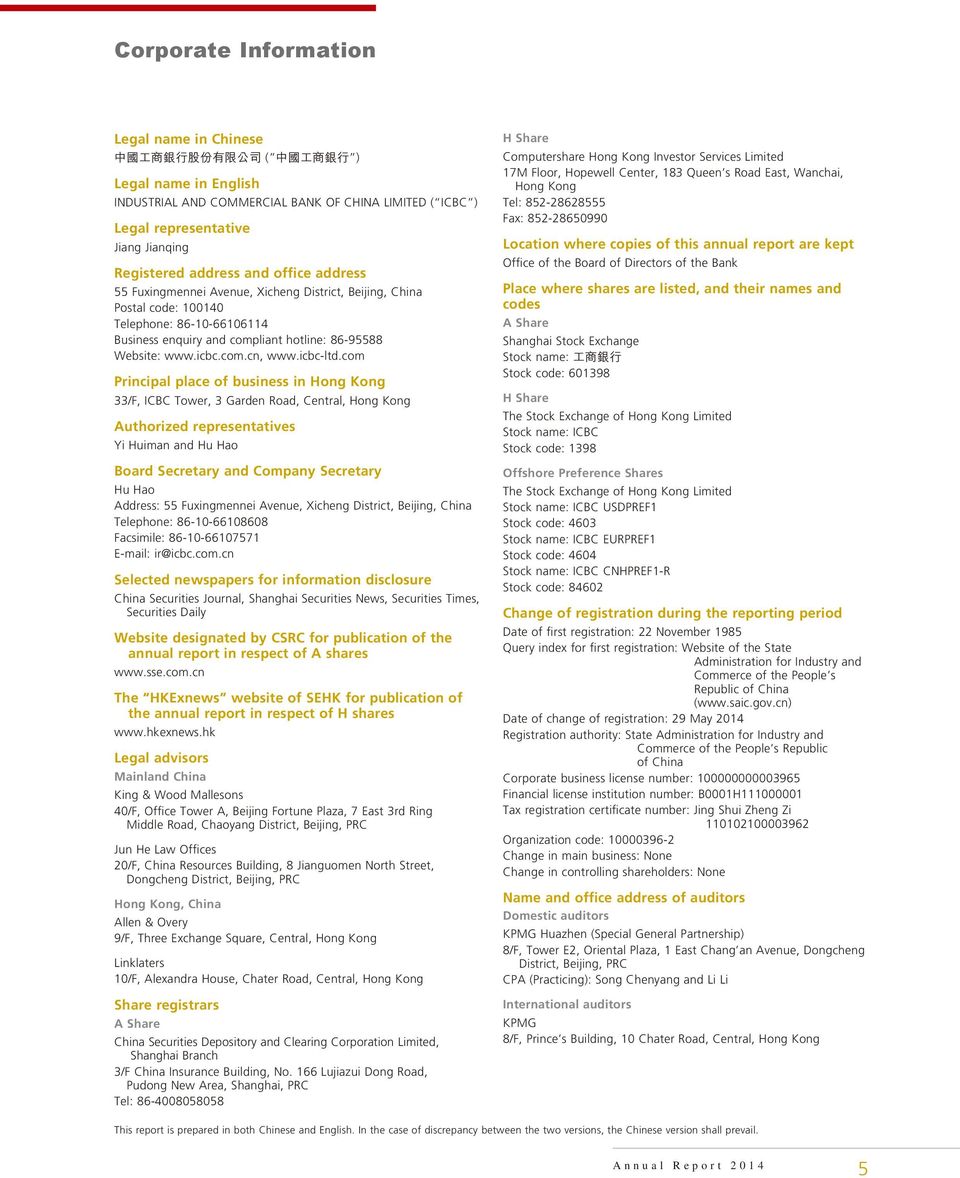
7 Corporate Information Legal name in Chinese ( ) Legal name in English INDUSTRIAL AND COMMERCIAL BANK OF CHINA LIMITED ( ICBC ) Legal representative Jiang Jianqing Registered address and office address 55 Fuxingmennei Avenue, Xicheng District, Beijing, China Postal code: Telephone: Business enquiry and compliant hotline: Website: Principal place of business in Hong Kong 33/F, ICBC Tower, 3 Garden Road, Central, Hong Kong Authorized representatives Yi Huiman and Hu Hao Board Secretary and Company Secretary Hu Hao Address: 55 Fuxingmennei Avenue, Xicheng District, Beijing, China Telephone: Facsimile: [email protected] Selected newspapers for information disclosure China Securities Journal, Shanghai Securities News, Securities Times, Securities Daily Website designated by CSRC for publication of the annual report in respect of A shares The HKExnews website of SEHK for publication of the annual report in respect of H shares Legal advisors Mainland China King & Wood Mallesons 40/F, Office Tower A, Beijing Fortune Plaza, 7 East 3rd Ring Middle Road, Chaoyang District, Beijing, PRC Jun He Law Offices 20/F, China Resources Building, 8 Jianguomen North Street, Dongcheng District, Beijing, PRC Hong Kong, China Allen & Overy 9/F, Three Exchange Square, Central, Hong Kong Linklaters 10/F, Alexandra House, Chater Road, Central, Hong Kong Share registrars A Share China Securities Depository and Clearing Corporation Limited, Shanghai Branch 3/F China Insurance Building, No. 166 Lujiazui Dong Road, Pudong New Area, Shanghai, PRC Tel: H Share Computershare Hong Kong Investor Services Limited 17M Floor, Hopewell Center, 183 Queen s Road East, Wanchai, Hong Kong Tel: Fax: Location where copies of this annual report are kept Office of the Board of Directors of the Bank Place where shares are listed, and their names and codes A Share Shanghai Stock Exchange Stock name: Stock code: H Share The Stock Exchange of Hong Kong Limited Stock name: ICBC Stock code: 1398 Offshore Preference Shares The Stock Exchange of Hong Kong Limited Stock name: ICBC USDPREF1 Stock code: 4603 Stock name: ICBC EURPREF1 Stock code: 4604 Stock name: ICBC CNHPREF1-R Stock code: Change of registration during the reporting period Date of first registration: 22 November 1985 Query index for first registration: Website of the State Administration for Industry and Commerce of the People s Republic of China ( Date of change of registration: 29 May 2014 Registration authority: State Administration for Industry and Commerce of the People s Republic of China Corporate business license number: Financial license institution number: B0001H Tax registration certificate number: Jing Shui Zheng Zi Organization code: Change in main business: None Change in controlling shareholders: None Name and office address of auditors Domestic auditors KPMG Huazhen (Special General Partnership) 8/F, Tower E2, Oriental Plaza, 1 East Chang an Avenue, Dongcheng District, Beijing, PRC CPA (Practicing): Song Chenyang and Li Li International auditors KPMG 8/F, Prince s Building, 10 Chater Road, Central, Hong Kong This report is prepared in both Chinese and English. In the case of discrepancy between the two versions, the Chinese version shall prevail. Annual Report
8 Financial Highlights (Financial data and indicators in this annual report are prepared in accordance with IFRSs and, unless otherwise specified, are consolidated amounts of the Bank and its subsidiaries and denominated in Renminbi.) Net profit Total assets Unit: RMB100 millions 2,084 2,387 2,630 2,763 Unit: RMB100 millions 154, , , ,100 1, , Basic earnings per share Unit: RMB Return on weighted average equity % Ratio of net fee and commission Cost-to-income ratio income to operating income % % Non-performing loans ratio % Allowance to non-performing loans %
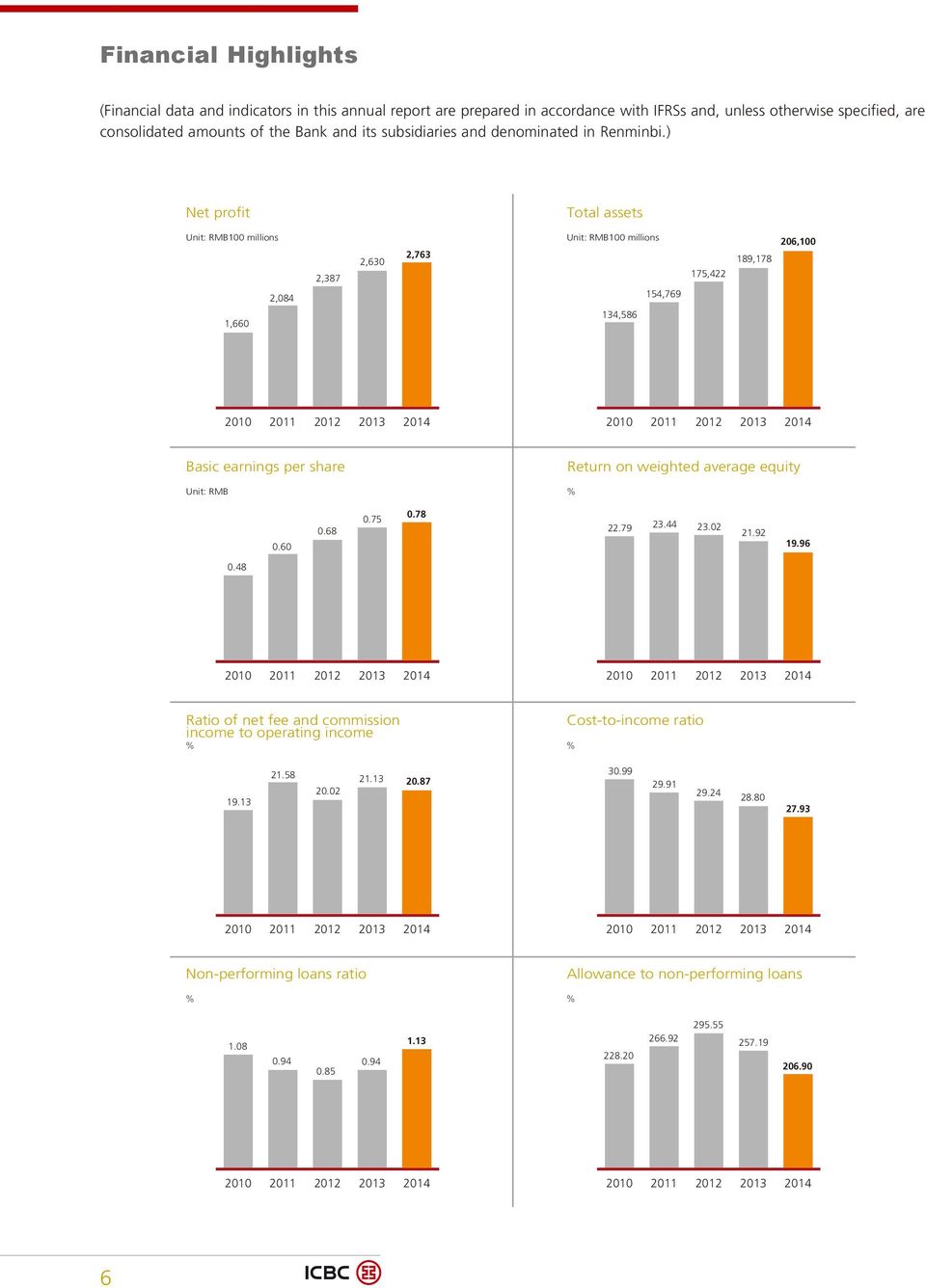
9 Financial Highlights Financial Data Annual operating results (in RMB millions) Net interest income 493, , , , ,749 Net fee and commission income 132, , , ,550 72,840 Operating income 634, , , , ,748 Operating expenses 218, , , , ,480 Impairment losses 56,729 38,321 33,745 31,121 27,988 Operating profit 359, , , , ,280 Profit before taxation 361, , , , ,426 Net profit 276, , , , ,025 Net profit attributable to equity holders of the parent company 275, , , , ,156 Net cash flows from operating activities 201,457 (1,947) 533, , ,176 As at the end of reporting period (in RMB millions) Total assets 20,609,953 18,917,752 17,542,217 15,476,868 13,458,622 Total loans and advances to customers 11,026,331 9,922,374 8,803,692 7,788,897 6,790,506 Allowance for impairment losses on loans 257, , , , ,134 Investment 4,433,237 4,322,244 4,083,887 3,915,902 3,732,268 Total liabilities 19,072,649 17,639,289 16,413,758 14,519,045 12,636,965 Due to customers 15,556,601 14,620,825 13,642,910 12,261,219 11,145,557 Due to banks and other financial institutions 1,539,239 1,269,255 1,486,805 1,341,290 1,048,002 Equity attributable to equity holders of the parent company 1,530,859 1,274,134 1,124, , ,430 Share capital 353, , , , ,019 Net core tier 1 capital (1) 1,486,733 1,266,841 Net tier 1 capital (1) 1,521,233 1,266,859 Net capital base (1) 1,812,137 1,572,265 1,299,014 1,112, ,373 Risk-weighted assets (1) 12,475,939 11,982,187 9,511,205 8,447,263 7,112,357 Per share data (in RMB yuan) Net asset value per share (2) Basic earnings per share Diluted earnings per share Credit rating S&P (3) A/Stable A/Stable A/Stable A/Stable A/Stable Moody s (3) A1/Stable A1/Stable A1/Stable A1/Stable A1/Stable Annual Report

10 Financial Highlights Financial Indicators Profitability (%) Return on average total assets (4) Return on weighted average equity (5) Net interest spread (6) Net interest margin (7) Return on risk-weighted assets (8) Ratio of net fee and commission income to operating income Cost-to-income ratio (9) Asset quality (%) Non-performing loans ( NPL ) ratio (10) Allowance to NPL (11) Allowance to total loans ratio (12) Capital adequacy (%) Core tier 1 capital adequacy ratio (1) Tier 1 capital adequacy ratio (1) Capital adequacy ratio (1) Total equity to total assets ratio Risk-weighted assets to total assets ratio Notes: (1) Data for period since 2013 were calculated in accordance with the Capital Regulation and those for were calculated in accordance with the Regulations Governing Capital Adequacy of Commercial Banks and related regulations promulgated by CBRC. (2) Calculated by dividing equity attributable to equity holders of the parent company at the end of the reporting period by the number of shares issued at the end of the reporting period. (3) The rating results are in the form of long-term foreign currency deposits rating/outlook. (4) Calculated by dividing net profit by the average balance of total assets at the beginning and at the end of the reporting period. (5) Calculated by dividing net profit attributable to equity holders of the parent company by the weighted average balance of equity attributable to equity holders of the parent company, which is calculated in accordance with the Rules for the Compilation and Submission of Information Disclosure by Companies that Offer Securities to the Public No. 9 Calculation and Disclosure of Return on Net Assets and Earnings per Share (Revision 2010) issued by CSRC. (6) Calculated by the spread between yield on average balance of interest-generating assets and cost on average balance of interest-bearing liabilities. (7) Calculated by dividing net interest income by the average balance of interest-generating assets. (8) Calculated by dividing net profit by the average balance of risk-weighted assets at the beginning and at the end of the reporting period. (9) Calculated by dividing operating expense (less business tax and surcharges) by operating income. (10) Calculated by dividing the balance of NPLs by total balance of loans and advances to customers. (11) Calculated by dividing allowance for impairment losses on loans by total balance of NPLs. (12) Calculated by dividing allowance for impairment losses on loans by total balance of loans and advances to customers. 8

11 Chairman s Statement Chairman Jiang Jianqing Annual Report

12 Chairman s Statement In the past year, the global economy experienced a weak recovery, with diverging trends in major economies. As China s economic development entered a new normal, transformation and upgrading became the main theme of the economy, which brought about positive influences as well as many difficulties and challenges. Profound changes took place in the financial ecological environment and the operating mechanism. Financial regulation became increasingly strict, interest rates and exchange rates liberalization sped up, financial disintermediation accelerated, and the emergence of Internet-based finance rose swiftly to prominence, which brought a profound impact on and new opportunities for banks operations and development. The economic new normal gave birth to a financial new normal. Last year, in the context of greater-than-expected difficulties and challenges, we achieved better than expected operating results and managed to maintain a generally healthy and stable development trend. Meanwhile, our operation and development entered a new normal with new features emerging in terms of profit growth, asset quality control, business development, and operational transformation. In 2014, we realized a net profit of RMB276.3 billion (or USD44.5 billion), up 5.1%. Although the profit growth rate fell to the one-digit level for the first time in recent years, it should be noted that this growth was based on a higher level and greater size, which meant that every percentage point of growth contained higher value. The net profit of 2014 alone was equal to the total sum of profit of the eight years since 2000, or that of the three years following 2005 after the Bank became a joint-stock company. The enormous financial strength of ICBC, the world s largest bank in terms of net profit, constituted an important ground for absorbing and mitigating risks, supporting innovative transformation, and accumulating new growth energy. What s more valuable is that the constitution and structure of our profit growth are undergoing good qualitative changes. For instance, the upgrading and efficiency increase of traditional business and the innovative development of emerging business constitute hybrid power and multiple supporting points for profit growth. In particular, we seized favorable opportunities brought by increased consumer spending and diversified consumer demand, a widening investment field for market players, accelerated business merger and acquisition etc., and strived to build mega retail banking, mega asset management, and mega investment banking into new engines for profit growth. In 2014, our total financial assets from personal customers exceeded RMB10 trillion, which led the industry. Our retail banking business made a contribution of 40%; asset management, investment banking and other businesses also maintained an industry-leading position. Taking another example, the accelerated optimization and structural adjustment of existing credit business brought new power and space for our business development and profit growth. To make further good and flexible use of these resources, we focused on increasing the revolving rate instead of the growth rate, which could not only enhance the effectiveness of serving the real economy, but also create inexhaustible value. To give another example, we deepened our transformation into less asset-intensive and less capital-intensive operations to further balance and coordinate profit growth and capital support. Last year, we issued credit asset-backed securities on the inter-bank market, and maintained a relatively satisfactory capital adequacy ratio (CAR) by employing various methods such as promotion of capital-saving development, strict control of risk asset growth, and multi-channel capital replenishment. Our CAR, tier 1 CAR and core tier 1 CAR reached 14.53%, 12.19%, and 11.92%, up 141BP, 162BP, and 135BP from the previous year, respectively, and outperformed regulatory requirements. The new normal also brought new risk control challenges. In the course of de-production capacity, de-inventory and deleveraging readjustment to the real economy, some enterprises suffer production or operational difficulties, with a higher frequency of market entry and exit. Economic transformation and industrial structural adjustments will no doubt cause some non-performing loans (NPLs). We took extraordinary measures to control and resolve NPLs and enhanced the predictability of risk control and the stability of asset quality under the economic new normal by means of innovative managerial models. We set up a credit risk monitoring center in the Head Office to strengthen dynamic monitoring and real-time early warning of risks through combining our risk management experiences with big data technologies. During the reporting period, we conducted risk screening on about half of the credit assets and made prompt rectification of financing with potential risk; at present, we are further expanding the scope of risk screening to every product, every customer, and the whole process. Risk-oriented credit base management was consolidated to highlight risk prevention and control in key fields such as local government financing vehicles (LGFVs), real estate development, industries with excessive capacity and commodity financing. Both the Head Office and branches built up specialized teams and applied innovative means such as investment banking to increase the efficiency and effectiveness of NPL disposal. In 2014, our NPL ratio climbed slightly 0.19 percentage points to 1.13%, but was still staying at a lower level among large international banks. We attached great importance to resolving NPLs in business development and took enhancing quality and efficiency of the real economy as the basis for improving the quality and status of our credit business and stabilizing our asset quality. Oriented towards serving effective financial service demand and seizing strategic opportunities under the economic new normal, we actively supported major projects as well as advantageous and emerging industries in economic adjustment and upgrading, and we backed key fields and weak spots such as small and micro enterprises, personal consumption, and Sannong (agriculture, farmers and rural areas) in a bid to better nourish the real economy with financial services and to improve our quality structure and foundation in virtuous interactions with the real economy. At present, Internet-based finance is profoundly changing the operating mode, decisive factors, and competitive landscape of traditional finance. Compared with Internet enterprises advantages in operation development and sensitivity to customer 10

13 Chairman s Statement experience, commercial banks have their own competitiveness beyond the reach of young Internet enterprises, such as a rich risk management culture and practical experiences accumulated over the years, and capability of both online and offline services. Banks have always been the most active force for innovation. Thus, the real challenge is not competitors from other industries but whether we can ground the innovation-oriented culture and embrace the new trends of scientific and technological development and financial industry reform with an open-minded and entrepreneurial attitude. This is based on the practical and strategic considerations that we, while focusing on the essence of finance, actively employed the Internet mentality and techniques to innovate in financial services and operational management, so as to gain a firstmover advantage in Internet-based finance and promote intelligent growth under the new normal. At present, over 86% of our transactions are completed through e-channels, mainly Internet banking, and the number of E-banking customers reached 460 million, including 150 million mobile banking customers. We have initially set up an Internet-based finance system integrating payment, financing, trading, business, and information, and capable of online-offline interaction; a group of new Internet-based finance platforms and products have been successively launched in the market, presenting a booming scenario of wide sowing and continuous harvesting. For instance, e-mall platform, an e-commerce platform launched at the beginning of last year, entered into the list of domestic front-rank e-commerce platforms in terms of transaction volume. The new-type payment product ICBC e Payment, featuring small amounts and efficiency, has over million users and boasts an industry-leading capability of simultaneous transaction processing per second. Moreover, the newly developed Easy Loan, a kind of small-amount consumer loan product based on consumers online or offline direct consumption, shows robust development momentum. The online revolving loan product, which is designed to meet short-term, frequent, and urgent financing needs of small and micro enterprises and allows enterprises to withdraw money and make repayments via the Internet, has a balance of close to RMB300.0 billion, and is the Internet financing product with the single largest amount in China. Quick moves are essential to innovating Internet-based finance. At present, we are speeding up the upgrading of Internet-based finance from the innovation of individual products to innovation of the overall service model, building a development structure for Internet-based finance featuring abundant and quality products, active customer trading, online-offline interaction, and comprehensive services and operations, and trying to imprint a clear e-icbc mark on the game of Internet-based finance and to cover a bigger customer group by universal finance with lower costs, higher efficiency, and better customer experience. Internationalized development is another highlight of our operational transformation. The internationalized operation pattern has basically taken shape, with a network of 338 overseas institutions covering 41 countries and regions, as well as another 20 African countries through strategic equity participation in the Standard Bank of South Africa. We have the widest coverage of overseas institutions among Chinese banks. In 2014, our overseas institutions realized a net profit of RMB15.1 billion (or USD2.44 billion), up 35.6%, and boosting the Group s profit growth by 1.4 percentage points. If our overseas institutions were regarded as an independent banking entity, it could be one of the world s top 100 banks in terms of scale and profitability. Our overseas institutions in Singapore, Luxembourg, Qatar, Canada, and Thailand have obtained the qualification of RMB clearing banks, making ICBC the first domestic financial institution that has branches with capacity of RMB clearing banks in Asia, Europe, and the Americas, the clearing business volume of our overseas RMB clearing banks has cumulatively exceeded RMB37 trillion (or USD5.96 trillion), the largest RMB business has officially become a unique advantage of our internationalized development. Moreover, we have completed the closing of our acquisition of 60% equity in Standard Bank Limited, the first acquisition of an institution engaged in commodity, capital, and money market trading in the history of Chinese banks. Under the macro context of China s new round of higher-level opening up and implementation of the One Belt and One Road strategy, we will set higher goals, accelerate the deepening development of our internationalized operations, and emphasize the improvement of localized operations of our overseas institutions and global service capability in a bid to make a contribution to China s economic integration into the world and the global economic recovery and development. In the past year, all our enterprising efforts, whether in long-term construction or in our fearless exploration, have become more visible as we progress. Looking into the future, we see new conflicts and new challenges under the new normal, but we also see new development opportunities. We firmly believe that challenges are everywhere, thus, we should be prepared anytime anywhere, as opportunities always come hand in hand with challenges, and opportunities only favor those who are prepared. We are prepared and will strive to be even better prepared. Chairman: Jiang Jianqing 26 March 2015 Annual Report

14 President s Statement President Yi Huiman 12

15 President s Statement In 2014, facing complex domestic and overseas economic and financial situations, we adapted and made active efforts in the areas of profit growth, structure optimization, operational transformation, reform innovation, and risk management, maintaining healthy and steady development under the economic new normal and bringing to an end the first ten-year development outline and the third three-year development planning after our stock restructuring. There are five distinctive features of our development and business performance in 2014: First, profit growth relied more on multi-source drive. We conquered many difficulties such as narrowing interest spread as a result of interest rate liberalization, drainage of traditional business caused by financial disintermediation and increasing market competition, and increasing loss of financial resources due to rebounding NPLs, and actively explored new sources of profit growth by means of transformation and innovation. Our net profit for the year reached RMB276.3 billion, up 5.1% from the previous year; basic earnings per share went up RMB0.03 to RMB0.78. From the perspective of income sources, we generated a net interest income of RMB493.5 billion, up 11.3%, through optimizing asset and liability structure and increasing capital operation efficiency; net interest margin (NIM) increased by 9BP to 2.66%; through vigorously developing asset management, investment banking, consumer finance, and other innovative businesses, we realized fee and commission income of RMB146.7 billion, representing a growth of 9.0%. Our overseas institutions and comprehensive subsidiaries earned a net profit of RMB18.5 billion, up 34.2% from the previous year, becoming an important new profit growth pole for the Group. Second, we focused more on serving the real economy in business development. We coordinated credit increment and existing credit and the management of credit financing and non-credit financing, and we boosted the transformation, upgrading, and development of the real economy through diversified financial services. In terms of credit financing, we adhered to the overall principle of utilizing increments, revitalizing existing credit, optimizing structure, and improving quality to proactively improve our credit business operations, which not only optimized the credit structure and marginal benefits, but also promoted the transformation, upgrading and enhancement of quality and efficiency of the real economy. Newly increased loans and relending of recovered loans mainly went to key economic development fields as well as new growth points and growth belts. Our domestic branches saw RMB927.3 billion worth of newly increased loans in both domestic and foreign currencies, up RMB34.9 billion or 10.1% on a year-on-year basis; they cumulatively extended loans of RMB8.98 trillion, 9.6 times the size of newly increased loans. During the year, RMB910.2 billon worth of project loans were granted, representing an increase of RMB166.4 billion year on year; RMB billion of newly increased loans went to the advanced manufacturing, modern services, cultural industry, and strategic emerging industries that represented the orientation of the industrial restructuring and optimization, accounting for 67% of the increment of corporate loans; residential mortgages, personal consumption loans, and credit card overdrafts increased by RMB346.0 billion, or 14.6%. In terms of non-credit financing, we actively adapted ourselves to the increasing trend of enterprises demands for direct investment and financing, production capacity integration, merger and acquisition, and reorganization in economic transformation and upgrading, and utilized a combination of commercial banking + investment banking and on-balancesheet + off-balance-sheet to vigorously develop bond underwriting, loan syndication, merger and acquisition advisory, etc. Debt financing instruments underwritten by us as the lead underwriter amounted to RMB470.0 billion, ranking No. 1 in the industry; the contractual amount of syndicated loans where we acted as the lead bank reached RMB46.7 billion, and we became the No. 1 lead bank of syndicated loans in Asia Pacific; 319 investment banking merger and acquisition advisory projects were completed, involving a transaction value of over RMB140.0 billion and increasing by nearly 60%, occupying the first position in Asia Pacific in terms of transaction volume. Third, our operational transformation focused more on breakthroughs in key business fields. Capitalizing on the new trends of growing residents wealth and diversified configurations of social financial assets, we made great efforts to implement mega retail banking and mega asset management strategies. The total amount of financial assets of personal customers exceeded RMB10 trillion, leading the industry; over 660 million bank cards have been issued with a transaction volume of RMB7.5 trillion, of which, over 100 million were credit cards, making ICBC one of the world s top three credit card issuers; the number of private banking customers totaled 40,000, and the scale of assets under management grew by 35.9%; the balance of wealth management products surpassed RMB1.9 trillion, consolidating our position as the largest banking asset custodian in Mainland China; the scale of asset custody reached RMB5.8 trillion and pension funds in custody approximated RMB70.0 billion, both maintaining the first position in the industry; in spite of the fluctuating downward trend of the market, we actively adjusted the structure of the precious metal business, resulting in a growth rate of over 50% in new businesses such as precious metal financing and pledging. Internationalized operations were developed both in scope and in depth. In addition to refining our overseas institution layout, we paid particular attention to the building of overseas key product lines. We provided 24-hour non-stop services for the trading of foreign-currency bonds, foreign exchange purchase and sale, paper precious metals and bulk commodities on the global market, and the centralized trading volumes of overseas Annual Report

16 President s Statement foreign exchange spot, foreign-currency bonds, and derivatives multiplied six, seven and eight times, respectively. Our global cash management product line has been extended to nearly 70 countries and regions, and cooperative business relations have been established with over 4,300 corporate customers. Our global wealth management fund under private banking obtained approval from the Luxembourg Monetary Institute, turning ICBC into the first Chinese bank that had registered a private fund in a mainstream international fund market. With great attention paid to business cooperation between domestic and overseas institutions, we leverage on our domestic products, customers, and funds to support the high-level development of overseas institutions, and meanwhile, promoted domestic business development through the global services network built overseas. We supported a total of 121 Going Global projects like resources and energy introduction, highend equipment export, export of advantageous product capacity, large project contracting etc., forging new advantages in serving economic globalization and China s new round of higher-level opening up. Tapping into our advantageous position as the biggest RMB business bank, we offered RMB business in all overseas institutions where the local regulator permitted, and have built up a global RMB clearing system covering 75 overseas countries and regions. In 2014, our cross-border RMB business volume amounted to RMB3.66 trillion, up 65.7% over the previous year. Comprehensive subsidiaries developed rapidly and played an increasing role in strategic synergy with the Group. ICBC Leasing has formed three financial leasing sections aviation, shipping and large-scale equipment, operating and managing total assets of RMB235.6 billion and consolidating the industry-leading position. ICBC Credit Suisse Asset Management managed public funds of over RMB250.0 billion, jumping to the top three in the industry. ICBC-AXA realized premium income of RMB15.4 billion, representing an increase of nearly 50% and topping the rest of the bancassurance companies. Fourth, reform and innovation became more market-oriented and customer-oriented. We defined 2014 as the Year of Reform. Oriented to the market and customer demands, we enhanced top design for reform and advanced reforms in eight fields including organizational reform and human resources reform, credit business flow optimization and credit review reform, and performance appraisal system optimization, which reinvigorated operating vitality and comprehensively enhanced management effectiveness. In particular, facing the surging wave of Internet-based finance innovation, we made great efforts to build the e-icbc service and operation system and expedited integration of online and offline services. A comprehensive Internet-based finance structure has been built up, consisting of three online platforms the e-commerce platform e-mall platform, the direct distribution platform direct banking platform and the instant communication platform social networking platform along with three product lines financing, payment and investment. We quickly established our advantageous position in Internet-based finance in the banking sector, and Internet-based finance business launched by us showed explosive growth momentum. For instance, e-mall platform targeting renowned merchants, renowned brands, and renowned goods has over million registered customers and has a transaction volume of over RMB70.0 billion only one year after it was opened, joining the list of domestic front-rank e-commerce platforms. The smallamount and quick payment product ICBC e Payment has over million users and a yearly transaction volume of over RMB50.0 billion. Easy Loan the small-amount consumer loan product based on residents online and offline direct consumptions, also shows a robust development momentum with a balance of up to RMB152.7 billion. The online revolving loan product designed to address the short-term, frequent and urgent financing needs of small and micro enterprises, has cumulatively provided loans of RMB1.6 trillion for 69 thousand small and micro enterprises with a balance of close to RMB300.0 billion, and it is the Internet-based financing product with the single largest amount in China by far. In 2014, the business volume of self-service and electronic channels accounted for 86% of all business volume. Continuous efforts were made to advance the operational transformation of banking outlets, carry out intelligent upgrading and optimization of marketing and service models of banking outlets in the IT-based construction initiative, and accelerate the new O2O service model combining online appointments and offline service rendering, resulting in an improvement in operating efficiency, competitiveness, and service quality of our outlets. To meet the needs of the IT-based construction initiative, we built up teams of data analysts and professional analysts covering all the main business lines, which were responsible for supporting marketing, risk control, and operational decision making through mining and analyzing all sorts of business information and data. In 2014, our Shanghai Secondary Data Center was officially put into operation, forming the highest-level deployment for production, operation and disaster recovery in the three centers in Beijing and Shanghai, and further consolidating our advantages in IT infrastructure. 14

17 President s Statement Fifth, risk management was made to be more forward-looking and precise. In the face of the rebounding trend of the banking industry s NPLs as a result of the triple impacts of the change of the economic growth rate, the pain of economic restructuring and the assimilation of the earlier stimulus policies, we carried out two big projects of credit asset quality and credit base management, strengthened credit risk management, stepped up the pre-setting of lines of defense, adopted category-specific measures, addressed root causes, lowered existing loans, and controlled new loan extension, thereby maintaining generally stable asset quality and enhancing the overall credit business operation and management capability of our institutions at all levels. At the year end, the Group s NPL ratio was 1.13%, maintaining at a lower level among domestic and overseas peers. As for fields of wide public concern like the LGFVs, real estate development, and over-capacity industries, we adopted full-coverage financing management and conducted industrial restructuring and optimization, further bringing down the financing balance and controlling the NPL ratio at a low level. Innovative risk prevention and control techniques and means, the setting up of a credit risk monitoring center in the Group s Head Office and the employment of big data technologies to strengthen dynamic monitoring and real-time pre-warning of risks cumulatively mitigated potential risks of RMB375.2 billion. Internal control and case prevention were strengthened with increased efforts in screening and disposing of key risk points. Therefore, indicators such as loss rate of operational risk were kept below the target set by the regulator. We finished the first recovery and resolution plan with high quality according to the regulator s requirements for global systemically important banks. The enterprise risk management system was further refined, and the abilities of making pre-judgments on and dealing with market risk, liquidity risk and reputational risk were thoroughly enhanced. We were also among the first domestic banks that have obtained approval for adopting advanced capital management approaches, which helped boost our capital-saving development. In some ranking lists issued by international professional institutions in 2014, ICBC continued to maintain the global first position in terms of major indicators like tier 1 capital, profitability, operating income, and customer deposits. Due to our long-term stable operating performance, we were named as Bank of the Year in China and Bank of the Year in Asia- Pacific by several authoritative media outlets; we were named as Global Bank of the Year by The Banker, becoming the first Asian bank that has obtained this honor during the 15 years since this award came into being is an important year for us to adapt to the new normal and move into a new development stage, as well as being the starting year of a new round of ten-year development outline and three-year development planning. The Management, oriented to the development strategy and business target set by the Board of Directors, will strive to realize better quality, more efficient and more sustainable development, to offer better services to our customers, and to create more stable returns for our investors. President: Yi Huiman 26 March 2015 Annual Report
18 16 Chairman of the Board of Supervisors Zhao Lin

19 Discussion and Analysis ECONOMIC, FINANCIAL AND REGULATORY ENVIRONMENTS In 2014, the global economy struggled to grow slowly, but the instability and imbalance of the recovery remained conspicuous. Different from other developed economies, the US maintained sound momentum of growth. European economy recovered slightly, but its deflation risk escalated. Japanese economy tended to decline, with its deflation still lingering. Emerging markets economic growth continued to slow down while capital flight deteriorated. In the monetary markets, US dollar alone remained strong, while Euro, pound, yen and currencies of emerging markets generally depreciated. The stock markets of the US, Europe and Japan saw gains, and the stock markets of emerging economies generally fell. As the international oil price plummeted, international gold price also remained low. The yields of treasury bonds of developed economies decreased, and those of emerging markets went up slightly. The liquidity of US dollar was tightened, and that of Hong Kong dollar was relatively loose. In 2014, in the face of the complicated international environments and the tough tasks of domestic development, reform and stability, China adhered to the guideline of making progress while ensuring stability; national economy showed a sound trend of smooth growth, structural upgrading, quality enhancement and improvement of the people s livelihood. China s gross domestic product (GDP) grew by 7.4% in China s consumer price index (CPI), total retail sales, fixed asset investment, industrial added value of above-scale enterprises and total imports and exports rose by 2.0%, 12.0%, 15.7%, 8.3% and 2.3% respectively. PBC continued to follow a prudent monetary policy. In response to the economic downturn pressure and slowdown of CPI rise, PBC took the following actions with great composure: it cut reserve requirement ratio for targeted institutions twice with a view to supporting Sannong (agriculture, farmers and rural areas) and commercial banks with a high proportion of loans to small and micro enterprises; it guided the long and medium-term interest rates innovatively using the medium-term lending facility (MLF) and pledged supplementary lending (PSL); it also made a breakthrough in interest rate liberalization reform, increasing the upper limit of RMB deposit rate band to 1.2 times of the benchmark interest rates from originally 1.1 times; besides, it reduced the foreign exchange intervention significantly. CBRC adjusted the loan-to-deposit ratio calculation criteria, improved regulatory indicators regarding deposits and loans of commercial banks and enhanced commercial banks lending capacity. It approved the establishment of several private banks. It also further strengthened the management of deposit deviation of banks and promoted the smooth operation of commercial banks. Money supply maintained stable growth in The M2 balance was RMB122.8 trillion, representing an increase of 12.2%. The outstanding RMB loans reached RMB81.7 trillion, an increase of 13.6%. The balance of RMB deposits was RMB113.9 trillion, up 9.1%. The social financing scale was RMB16.5 trillion. The Shanghai Composite Index and the Shenzhen Component Index rose by 52.9% and 35.6% respectively. The capitalization of the free float stocks on the Shanghai and Shenzhen stock markets increased by 58.1%. The accumulative issuance amount of bonds (including central bank notes) in the bond market reached RMB10.98 trillion, representing an increase of RMB2.12 trillion. The central parity of RMB against the US dollar was RMB6.1190, representing a depreciation of 0.36% from the end of the previous year. The government bond yields moved downward on the whole in the inter-bank market. Annual Report

20 Discussion and Analysis RMB Loan Growth of Domestic Financial Institutions since 2013 Unit: RMB100 million 15,000 12,000 9,000 6,000 3,000 % Movements of Interest Rate in Domestic Inter-bank Market since 2013 Unit: % Monthly growth of RMB loans (left axis) YoY growth rate of RMB loans (right axis) Monthly weighted average interest rate of collateralized repo Monthly weighted average interest rate at inter-bank borrowing market Data source: PBC. Data source: PBC. Asset scale of the banking industry grew steadily. At the end of 2014, the total assets of banking financial institutions (corporate) were RMB trillion, representing an increase of 13.87%. The balance of NPLs of commercial banks reached RMB842.6 billion; NPL ratio was 1.25%; allowance to NPL was %; core tier 1 capital adequacy ratio (CAR), tier 1 CAR and CAR were 10.56%, 10.76% and 13.18% respectively. Looking into 2015, though favorable factors such as the economic recovery in the US, drop of energy price and emergence of new technique and new industries are expected to bring new momentum to economic growth, it is difficult for the global economy to put an end to weak growth and high unemployment in a short term, and the international financial market will continue the high volatility triggered by strong US dollar and low oil price. In the medium term the international economic and financial development will be characterized by increasingly differentiated economic growth in the world, monetary policy differentiation of major economies, exacerbation of geopolitical turmoil and drastic fluctuation of commodity prices. The Chinese Government will continue to pursue a proactive fiscal policy and prudent monetary policy. China will implement three major strategies One Belt and One Road, coordinated development for the Beijing-Tianjin-Hebei region, and Yangtze Economic Belt, and make efforts to promote the Going Global of infrastructure production capacity and construction of key city clusters. China will further expand the pilot scope and fields of changing business tax to valueadded tax, and successively launch the measures such as implementation of the new budget law, trial implementation of three-year balanced budgets and reform in transfer payment rules. China will actively promote the government and social capital cooperation (PPP) model, and exploit new areas for private capital in order to channel more funds into key projects related to the people s livelihood and technological innovation fields. It will speed up state-owned enterprise reform and further streamline administration and delegate powers. It will maintain the reasonable growth of monetary credits and social financing scale, improve and upgrade financing and credit structure and increase the proportion of direct financing. In addition, it will also push forward the interest rate liberalization and the reform in RMB exchange rate formation mechanism, deepen financial institution reform, strengthen macro prudent management and enhance the financial operation efficiency and capability of serving the real economy. 18

21 Discussion and Analysis FINANCIAL STATEMENTS ANALYSIS Income Statement Analysis In 2014, the Bank proactively responded to profound changes in the domestic and international operating environment and new normal demands of economic development, substantially promoted operational transformation and service enhancement on the basis of serving the real economy and satisfying customers financial needs, and implemented strict cost management and risk prevention and control, achieving steady growth in profit on the whole. The Bank realized a net profit of RMB276,286 million in 2014, representing an increase of RMB13,321 million or 5.1% as compared to the previous year. Return on average total assets stood at 1.40%, and return on weighted average equity was 19.96%. Operating income amounted to RMB634,858 million, recording an increase of 9.7%. Specifically, net interest income was RMB493,522 million, growing by 11.3%. Non-interest income reached RMB141,336 million, rising by 4.3%. Operating expenses amounted to RMB218,674 million, recording an increase of 7.1%, and cost-to-income ratio dropped by 0.87 percentage points to 27.93%. Allowance for impairment losses was RMB56,729 million, indicating an increase of 48.0%. Income tax expense added by RMB9,754 million or 12.9% to RMB85,326 million. CHANGES OF KEY INCOME STATEMENT ITEMS In RMB millions, except for percentages Item Increase/ (decrease) Growth rate (%) Net interest income 493, ,335 50, Non-interest income 141, ,566 5, Operating income 634, ,901 55, Less: Operating expenses 218, ,140 14, Less: Impairment losses 56,729 38,321 18, Operating profit 359, ,440 23, Share of profits of associates and joint ventures 2,157 2, Profit before taxation 361, ,537 23, Less: Income tax expense 85,326 75,572 9, Net profit 276, ,965 13, Attributable to: Equity holders of the parent company 275, ,649 13, Non-controlling interests Net Interest Income Confronted by the accelerated interest rate liberalization reform and increasingly fierce market competition, the Bank constantly strengthened asset and liability management, proactively adjusted its credit structure and optimized its investment portfolio structure. Meanwhile, the Bank reinforced liquidity management and interest rate pricing management, strived to control liability cost and achieved stable growth in net interest income. In 2014, net interest income was RMB493,522 million, RMB50,187 million or 11.3% higher than that of last year, accounting for 77.7% of the Bank s operating income. Interest income amounted to RMB849,879 million, growing by RMB82,768 million or 10.8%, and interest expenses rose by RMB32,581 million or 10.1% to RMB356,357 million. Net interest spread and interest margin came at 2.46% and 2.66%, 6 basis points and 9 basis points higher than those of the previous year, respectively. Annual Report
22 Discussion and Analysis AVERAGE YIELD OF INTEREST-GENERATING ASSETS AND AVERAGE COST OF INTEREST-BEARING LIABILITIES In RMB millions, except for percentages Item Average balance Interest income/ expense Average yield/cost (%) Average balance Interest income/ expense Average yield/cost (%) Assets Loans and advances to customers 10,599, , ,457, , Investment 4,047, , ,969, , Investment in bonds not related to restructuring 3,817, , ,711, , Investment in bonds related to restructuring (2) 230,818 5, ,826 5, Due from central banks (3) 3,087,982 48, ,883,971 45, Due from banks and other financial institutions (4) 826,615 26, ,823 24, Total interest-generating assets 18,561, , ,219, , Non-interest-generating assets 1,371,253 1,172,816 Allowance for impairment losses (253,327) (234,280) Total assets 19,679,578 18,157,992 Liabilities Deposits 14,627, , ,843, , Due to banks and other financial institutions (4) 1,819,544 42, ,685,542 38, Debt securities issued 397,785 14, ,733 11, Total interest-bearing liabilities 16,844, , ,820, , Non-interest-bearing liabilities 1,389,264 1,171,539 Total liabilities 18,233,851 16,992,011 Net interest income 493, ,335 Net interest spread Net interest margin Notes: (1) The average balances of interest-generating assets and interest-bearing liabilities represent their daily average balances. The average balances of non-interest-generating assets, non-interest-bearing liabilities and the allowance for impairment losses represent the average of the balances at the beginning of the year and that at the end of the year. (2) Investment in bonds related to restructuring includes Huarong bonds and special government bonds. Please see Note 27.(a) to the Financial Statements: Receivables for details. (3) Due from central banks mainly includes mandatory reserves and surplus reserves with central banks. (4) Due from banks and other financial institutions includes the amount of reverse repurchase agreements, and due to banks and other financial institutions includes the amount of repurchase agreements. 20
23 Discussion and Analysis ANALYSIS OF CHANGES IN INTEREST INCOME AND EXPENSE In RMB millions Comparison between 2014 and 2013 Increase/(decrease) due to Item Volume Interest rate Net increase/ (decrease) Assets Loans and advances to customers 65, ,848 Investment 3,696 7,052 10,748 Investment in bonds not related to restructuring 4,305 7,052 11,357 Investment in bonds related to restructuring (609) (609) Due from central banks 3,185 (288) 2,897 Due from banks and other financial institutions (2,724) 4,999 2,275 Changes in interest income 70,059 12,709 82,768 Liabilities Deposits 16,838 8,306 25,144 Due to banks and other financial institutions 3,244 1,348 4,592 Debt securities issued 3,895 (1,050) 2,845 Changes in interest expenses 23,977 8,604 32,581 Impact on net interest income 46,082 4,105 50,187 Note: Changes in volume are measured by the changes in average balances, while the changes in interest rate are measured by the changes in average interest rates. Changes resulted from the combination of volume and interest rate have been allocated to the changes resulted from business volume. Interest Income Interest Income on Loans and Advances to Customers Interest income on loans and advances to customers was RMB615,488 million, RMB66,848 million or 12.2% higher than that of the previous year, principally due to an increase of RMB1,141,594 million in average balance. The benchmark interest rate cut in November 2014 had slight impact on interest income on loans and advances to customers in ANALYSIS OF THE AVERAGE YIELD OF LOANS AND ADVANCES TO CUSTOMERS BY MATURITY STRUCTURE In RMB millions, except for percentages Item Average balance Interest income Average yield (%) Average balance Interest income Average yield (%) Short-term loans 3,684, , ,297, , Medium to long-term loans 6,914, , ,159, , Total loans and advances to customers 10,599, , ,457, , Annual Report
24 Discussion and Analysis ANALYSIS OF THE AVERAGE YIELD OF LOANS AND ADVANCES TO CUSTOMERS BY BUSINESS LINE In RMB millions, except for percentages Item Average balance Interest income Average yield (%) Average balance Interest income Average yield (%) Corporate loans 6,750, , ,216, , Discounted bills 221,383 12, ,591 10, Personal loans 2,873, , ,509, , Overseas business 754,158 26, ,046 18, Total loans and advances to customers 10,599, , ,457, , Interest Income on Investment Interest income on investment was RMB159,262 million, RMB10,748 million or 7.2% higher than that of the previous year. Specifically, interest income on investment in bonds not related to restructuring was RMB154,070 million, representing an increase of RMB11,357 million or 8.0%, mainly because the Bank seized a favorable opportunity in the bond market to increase bond investment and actively optimized the structure of bonds investment portfolios during the reporting period and the new bond investment produced a relatively high yield, resulting into a rise of 19 basis points in average yield of bonds not related to restructuring. Interest income on bond investments related to restructuring declined by RMB609 million or 10.5% to RMB5,192 million from the previous year, mainly because advance repayment of part of the Huarong bonds in 2013 resulted in a decrease in the average balance. Interest Income on Due From Central Banks Interest income on due from central banks was RMB48,384 million, RMB2,897 million or 6.4% higher than that of the previous year, mainly driven by the increase in the size of mandatory reserves with central banks resulting from the growth in customers deposits. Interest Income on Due from Banks and Other Financial Institutions Interest income on due from banks and other financial institutions was RMB26,745 million, RMB2,275 million or 9.3% higher than that of last year, mainly because the Bank actively adjusted the outward financing structure based on the trend of market interest rate and effectively enhanced return on funds operation, resulting in an increase of 55 basis points in average yield. Interest Expense Interest Expense on Deposits Interest expense on deposits amounted to RMB298,941 million, RMB25,144 million or 9.2% higher than that of last year, and accounted for 83.9% of total interest expense, principally due to an increase of RMB784,061 million in average balance of deposits, and a rise of 6 basis points in average cost as affected by a growth in corporate time deposits with a relatively higher cost and upward floating of deposit interest rate. 22
25 Discussion and Analysis ANALYSIS OF AVERAGE DEPOSIT COST BY PRODUCTS In RMB millions, except for percentages Item Corporate deposits Average balance Interest expense Average cost (%) Average balance Interest expense Average cost (%) Time deposits 3,398, , ,011,134 99, Demand deposits (1) 3,853,902 30, ,771,329 28, Subtotal 7,251, , ,782, , Personal deposits Time deposits 3,911, , ,858, , Demand deposits 2,951,896 10, ,807,087 9, Subtotal 6,863, , ,665, , Overseas business 511,599 9, ,090 6, Total deposits 14,627, , ,843, , Note: (1) Includes outward remittance and remittance payables. Interest Expense on Due to Banks and Other Financial Institutions Interest expense on due to banks and other financial institutions was RMB42,801 million, RMB4,592 million or 12.0% higher than the previous year, principally attributable to an increase of RMB134,002 million in average balance and a rise of 8 basis points in cost. The Bank intensified liquidity management and optimized inter-bank liability structure to make great efforts to control the cost of funding. Interest Expense on Debt Securities Issued Interest expense on debt securities issued was RMB14,615 million, RMB2,845 million or 24.2% higher than that of last year, mainly attributable to the rapid increase in the issuance of certificates of deposit and bills by overseas institutions. Please refer to Note 38. to the Financial Statements: Debt Securities Issued for details of the debt securities issued by the Bank. Non-interest Income In 2014, the Bank realized non-interest income of RMB141,336 million, RMB5,770 million or 4.3% higher than that of the previous year. Specifically, net fee and commission income grew by 8.3% to RMB132,497 million, and other non-interest income dropped by 33.2% to RMB8,839 million. The Bank promoted innovation and development in fee-based business transformation as well as optimization of income structure, and carried out product and service innovation in retail banking to ultimately satisfy customer needs to the maximum extent. It enhanced its investment management and asset allocation capacity of asset management business, standardized the design, marketing and fund investment direction of banking wealth management products, and facilitated coordinated development of private banking, credit card, precious metals, asset custody and pension services. Moreover, the Bank promoted the application of technological progress of financial services to benefit customers and actively reduced or exempted part of service fees, while the new version of service price list strictly followed regulatory rules and exercised standardized fee charging. In 2014, fee and commission income augmented by RMB12,128 million or 9.0% to RMB146,678 million, of which, income from bank card business, private banking and wealth management services achieved a rapid growth. Fee and commission expense increased by 16.0% to RMB14,181 million, mainly attributable to the increase in fee and commission expense from bank card and lease business. Annual Report
26 Discussion and Analysis NET FEE AND COMMISSION INCOME In RMB millions, except for percentages Item Increase/ (decrease) Growth rate (%) Bank card business 35,133 28,533 6, Investment banking business 30,474 29, Settlement, clearing business and cash management 30,422 30,513 (91) (0.3) Personal wealth management and private banking services 20,676 18,231 2, Corporate wealth management services 14,929 12,611 2, Asset custody business 5,923 6,893 (970) (14.1) Guarantee and commitment business 4,614 4, Trust and agency services 2,019 1, Others 2,488 2, Fee and commission income 146, ,550 12, Less: Fee and commission expense 14,181 12,224 1, Net fee and commission income 132, ,326 10, Income from bank card business grew by RMB6,600 million or 23.1% to RMB35,133 million, mainly due to the increase in income from relevant business driven by the increase in the number of bank cards issued, consumption volume and acquiring business. Income from investment banking business rose by RMB988 million or 3.4% to RMB30,474 million. Specifically, the Bank achieved growth in income from businesses including equity financing, merger and acquisition and structural financing. Income from personal wealth management and private banking services amounted to RMB20,676 million, increasing by RMB2,445 million or 13.4%, of which, income from private banking and personal wealth management services increased rapidly. Income from corporate wealth management services rose by RMB2,318 million or 18.4% to RMB14,929 million, mainly due to the increase in investment income from corporate wealth management products and income from gold accumulation service. Income from others increased by RMB419 million or 20.3% to RMB2,488 million, mainly attributable to a fast growth in income from pension business. Income from settlement, clearing business and cash management was RMB30,422 million, slightly lower than that of last year, mainly because the List of Service Prices of Commercial Banks Guided and Mandated by the Government was promulgated to decrease the fee standards for some products settled in RMB, leading to an increase in business volume of RMB settlement and certain decline in income at the same time. Income from franchise foreign exchange purchase and sales and e-commerce business realized a fast growth. OTHER NON-INTEREST RELATED GAIN In RMB millions, except for percentages Item Increase/ (decrease) Growth rate (%) Net trading income 1, ,591 1,033.1 Net loss on financial assets and liabilities designated at fair value through profit or loss (10,024) (2,413) (7,611) N/A Net gain on financial investments 1, , Other operating income, net 15,315 14, Total 8,839 13,240 (4,401) (33.2) 24
27 Discussion and Analysis Other non-interest income was RMB8,839 million, RMB4,401 million less than that in 2013, mainly because the increase in expenses from structural deposits paid to customers resulted in a large increase in net loss on financial assets and liabilities designated at fair value through profit or loss. Operating Expenses OPERATING EXPENSES In RMB millions, except for percentages Item Increase/ (decrease) Growth rate (%) Staff costs 112, ,455 8, Including: Salaries and bonuses 70,284 68,216 2, Premises and equipment expenses 28,898 26,094 2, Business tax and surcharges 41,351 37,441 3, Amortisation 2,211 2, Others 34,192 35,132 (940) (2.7) Total 218, ,140 14, The Bank exercised strict cost management and control and continued to boost its operating efficiency. Operating expenses recorded at RMB218,674 million, RMB14,534 million or 7.1% higher than that in 2013, among which, staff costs grew by 8.3% to RMB112,022 million; salaries and bonuses added by 3.0%; and other operating expenses dropped by 2.7% to RMB34,192 million, mainly due to a reduction in marketing expense, conference expense and publicity expense compared with last year. Cost-to-income ratio declined by 0.87 percentage points to 27.93%. Impairment Losses The Bank continued to strengthen loan risk prevention and control and maintained its capability in risk offsetting. It set aside allowance for impairment losses of RMB56,729 million, an increase of RMB18,408 million or 48.0% as compared to the previous year. Specifically, allowance for impairment losses on loans was RMB56,267 million, indicating a rise of RMB18,169 million or 47.7%. Please refer to Note 26. to the Financial Statements: Loans and Advances to Customers and Note 15. to the Financial Statements: Impairment Losses on Assets Other than Loans and Advances to Customers for details. Income Tax Expense Income tax expense was RMB85,326 million, RMB9,754 million or 12.9% higher than that of the previous year. The effective tax rate stood at 23.60%. Please see Note 16. to the Financial Statements: Income Tax Expense for the reconciliation of income tax expense applicable to profit before tax at the PRC statutory income tax rate and the effective income tax rate. Annual Report
28 Discussion and Analysis Segment Information The Bank s principal operating segments include corporate banking, personal banking and treasury operations. The Bank adopts the Management of Value Accounting (MOVA) to evaluate the performance of each of its operating segments. SUMMARY OPERATING SEGMENT INFORMATION In RMB millions, except for percentages Item Amount Percentage (%) Amount Percentage (%) Corporate banking 303, , Personal banking 237, , Treasury operations 85, , Others 8, , Total operating income 634, , Please refer to the section headed Discussion and Analysis Business Overview for the details of the development of each of these operating segments. SUMMARY GEOGRAPHICAL SEGMENT INFORMATION In RMB millions, except for percentages Item Amount Percentage (%) Amount Percentage (%) Head Office 70, , Yangtze River Delta 114, , Pearl River Delta 79, , Bohai Rim 114, , Central China 83, , Western China 102, , Northeastern China 32, , Overseas and others 36, , Total operating income 634, , Note: Please see Note 53. to the Financial Statements: Segment Information for the Bank s classification of geographic regions. Balance Sheet Analysis In 2014, the Bank timely adjusted its business strategy based on the external macroeconomic environment, improved the asset and liability structure, maintained coordinated development of deposit and loan business, strengthened liquidity management and interest rate pricing management and strived to enhance the efficiency of resource allocation for assets and liabilities. Taking development needs of the real economy into account, the Bank reasonably controlled the aggregate amount, direction and pace of lending. Closely monitoring the trends of the domestic and international financial markets, the Bank flexibly arranged its investment schedule and priorities and optimized the structure of investment portfolios. It followed the fund position and the trend of price changes to develop inter-bank business in a prudent manner. Furthermore, the Bank actively adopted measures to promote steady growth in due to customers, and refined the inter-bank liability structure, thereby ensuring a stable and sustainable growth of funding sources. 26
29 Discussion and Analysis Assets Deployment As at the end of 2014, total assets of the Bank amounted to RMB20,609,953 million, RMB1,692,201 million or 8.9% higher than that at the end of the previous year. Specifically, total loans and advances to customers (collectively referred to as loans ) increased by RMB1,103,957 million or 11.1%; investment grew by RMB110,993 million or 2.6%; and cash and balances with central banks rose by RMB229,615 million or 7.0%. In terms of structure, net loans and advances to customers accounted for 52.2% of total assets; investment accounted for 21.5%; and cash and cash balances with central banks accounted for 17.1%. ASSETS DEPLOYMENT In RMB millions, except for percentages Item At At 31 December 2013 Amount Percentage (%) Amount Percentage (%) Total loans and advances to customers 11,026,331 9,922,374 Less: Allowance for impairment losses on loans 257, ,959 Loans and advances to customers, net 10,768, ,681, Investment 4,433, ,322, Cash and balances with central banks 3,523, ,294, Due from banks and other financial institutions 782, , Reverse repurchase agreements 468, , Others 633, , Total assets 20,609, ,917, Loan In 2014, the Bank attached importance to the combination of credit increment optimization and structural adjustment in supporting the real economy development based on changes in macroeconomic environment and financial regulatory requirements. The Bank continuously bolstered the national key projects under construction and continuing projects, focused on supporting advanced manufacturing, modern services, culture industries and strategic emerging sectors, innovated the financial service modes for small and micro enterprises, and intensified its support for the Going Global Chinese-invested enterprises. Besides, the Bank proactively backed rational credit demands of residents, and paid equal attention to both credit structure adjustment and risk prevention and control, maintaining a stable and balanced loan growth and the reasonable lending direction and structure. As at the end of 2014, total loans reached RMB11,026,331 million, RMB1,103,957 million or 11.1% higher than that at the end of the previous year, of which, RMB-denominated loans of domestic branches were RMB9,717,224 million, RMB902,042 million or 10.2% higher than that at the end of Composition of Loan Unit: RMB100 millions 30,635 27,276 22,871 3,503 1,483 1,840 76,126 70,465 63, Corporate loans Personal loans Discounted bills Annual Report
30 Discussion and Analysis DISTRIBUTION OF LOANS BY BUSINESS LINE In RMB millions, except for percentages Item At At 31 December 2013 Amount Percentage (%) Amount Percentage (%) Corporate loans 7,612, ,046, Discounted bills 350, , Personal loans 3,063, ,727, Total 11,026, ,922, DISTRIBUTION OF CORPORATE LOANS BY MATURITY In RMB millions, except for percentages Item At At 31 December 2013 Amount Percentage (%) Amount Percentage (%) Short-term corporate loans 2,982, ,871, Medium to long-term corporate loans 4,630, ,175, Total 7,612, ,046, DISTRIBUTION OF CORPORATE LOANS BY PRODUCT LINE In RMB millions, except for percentages Item At At 31 December 2013 Amount Percentage (%) Amount Percentage (%) Working capital loans 3,411, ,227, Including: Trade finance 982, ,110, Project loans 3,711, ,302, Property loans 489, , Total 7,612, ,046, Corporate loans rose by RMB566,077 million or 8.0% from the end of last year. In terms of maturity structure, shortterm corporate loans increased by RMB111,387 million or 3.9%, while medium to long-term corporate loans grew by RMB454,690 million or 10.9%. In terms of product type, working capital loans were RMB183,922 million or 5.7% higher, mainly because the Bank actively responded to the strategy of economic transformation and upgrade, and stepped up its support to superior enterprises in advanced manufacturing, modern services and other sectors; project loans increased by RMB408,906 million or 12.4%, mainly due to the continuous support to national key projects under construction and continuing projects; and property loans declined by RMB26,751 million or 5.2%. Discounted bills rose by RMB202,016 million or 136.3%, principally because the Bank moderately increased its supply of discounted bills based on the pace of bank-wide credit granting to satisfy management needs of asset-liability portfolios. 28
31 Discussion and Analysis DISTRIBUTION OF PERSONAL LOANS BY PRODUCT LINE In RMB millions, except for percentages Item At At 31 December 2013 Amount Percentage (%) Amount Percentage (%) Residential mortgages 2,070, ,720, Personal consumption loans 309, , Personal business loans 316, , Credit card overdrafts 366, , Total 3,063, ,727, Personal loans rose by RMB335,864 million or 12.3%, primarily resulting from an increase of RMB349,831 million or 20.3% in residential mortgages. Personal consumption loans dropped by RMB61,249 million or 16.5%, mainly because the Bank reinforced the purpose management on personal consumption loans and took the initiative to adjust the loan product system. Personal business loans declined by RMB11,828 million or 3.6%, mainly due to the lower willingness of some small and micro enterprise owners to obtain financing as affected by the decelerated growth of the macro economy. Credit card overdrafts grew by RMB59,110 million or 19.2%, primarily attributable to the continuously healthy development of credit card installment business as well as a stable growth in the number of credit cards issued and their consumption volume. Please see Discussion and Analysis Risk Management for detailed analysis of the Bank s loans and their quality. Investment In 2014, the Bank precisely seized opportunities in the market, flexibly organized its investment schedule and focus, optimized the investment structure in strict adherence to the trends in financial markets, and continuously improved the return on investment portfolios on the basis of guaranteeing liquidity and risk under control. As at the end of 2014, investment amounted to RMB4,433,237 million, RMB110,993 million or 2.6% higher compared with the end of the previous year. INVESTMENT In RMB millions, except for percentages Item At At 31 December 2013 Amount Percentage (%) Amount Percentage (%) Debt instruments 4,268, ,144, Investment in bonds not related to restructuring 3,978, ,836, Investment in bonds related to restructuring 197, , Other debt instruments 92, , Equity instruments and others 164, , Total 4,433, ,322, Bonds not related to restructuring amounted to RMB3,978,565 million, RMB141,570 million or 3.7% higher than that at the end of last year. Investment in bonds related to restructuring was RMB197,128 million, reducing by RMB33,918 million or 14.7%, mainly due to advance repayment of part of the Huarong bonds. For details of the investment in bonds related to restructuring, please refer to Note 27.(a) to the Financial Statements: Receivables. Annual Report
32 Discussion and Analysis DISTRIBUTION OF INVESTMENT IN BONDS NOT RELATED TO RESTRUCTURING BY ISSUERS In RMB millions, except for percentages Item At At 31 December 2013 Amount Percentage (%) Amount Percentage (%) Government bonds 1,026, , Central bank bills 346, , Policy bank bonds 1,687, ,682, Other bonds 917, , Total 3,978, ,836, In terms of distribution by issuers, government bonds increased by RMB50,634 million or 5.2%; central banks bills fell by RMB43,508 million or 11.2%, principally because of the maturity of part of the central bank bills during the reporting period; policy bank bonds added by RMB5,172 million or 0.3%; and other bonds augmented by RMB129,272 million or 16.4%, mainly because the Bank moderately intensified investment in high-quality credit bonds. DISTRIBUTION OF INVESTMENT IN BONDS NOT RELATED TO RESTRUCTURING BY REMAINING MATURITY In RMB millions, except for percentages Remaining maturity At At 31 December 2013 Amount Percentage (%) Amount Percentage (%) Undated (1) Less than 3 months 180, , to 12 months 444, , to 5 years 2,370, ,129, Over 5 years 982, ,036, Total 3,978, ,836, Note: (1) Refers to impaired bonds. In terms of remaining maturity structure, bonds not related to restructuring within 1-year maturity reduced by RMB45,889 million from the end of the previous year and their percentage dropped by 1.8%; and bonds not related to restructuring within 1 to 5-year maturity grew by RMB241,433 million or 11.3%, mainly because the Bank actively reduced investment in short-term bonds and moderately stepped up investment in medium-term bonds. DISTRIBUTION OF INVESTMENT IN BONDS NOT RELATED TO RESTRUCTURING BY CURRENCY In RMB millions, except for percentages Item At At 31 December 2013 Amount Percentage (%) Amount Percentage (%) RMB-denominated bonds 3,829, ,734, USD-denominated bonds 98, , Other foreign currency bonds 50, , Total 3,978, ,836,
33 Discussion and Analysis In terms of currency structure, RMB-denominated bonds rose by RMB94,834 million or 2.5%; USD-denominated bonds increased by the equivalent of RMB23,037 million or 30.5%, and other foreign currency bonds grew by the equivalent of RMB23,699 million or 88.9%, principally driven by the increased investment of overseas institutions in foreign currency bonds. DISTRIBUTION OF INVESTMENT BY HOLDING PURPOSE In RMB millions, except for percentages Item At At 31 December 2013 Amount Percentage (%) Amount Percentage (%) Financial assets at fair value through profit or loss 346, , Available-for-sale financial assets 1,188, ,000, Held-to-maturity investments 2,566, ,624, Receivables 331, , Total 4,433, ,322, As at the end of 2014, the Group held RMB2,046,902 million of financial bonds 1, including RMB1,687,791 million of policy bank bonds and RMB359,111 million of bonds issued by banks and non-bank financial institutions, accounting for 82.5% and 17.5% of financial bonds, respectively. TOP 10 FINANCIAL BONDS HELD BY THE BANK In RMB millions, except for percentages Debt securities Nominal value Annual interest rate Maturity date Impairment loss Policy bank bonds , % 3 February 2015 Policy bank bonds , % 29 November 2017 Policy bank bonds , % 11 March 2018 Policy bank bonds , % 4 March 2015 Policy bank bonds , % 25 August 2018 Policy bank bonds , % 24 March 2018 Policy bank bonds , % 25 June 2022 Policy bank bonds , % 21 August 2019 Policy bank bonds , % 27 July 2020 Policy bank bonds , % 13 July Financial bonds refer to the debt securities issued by financial institutions on the bond market, including bonds issued by policy banks, banks and non-bank financial institutions but excluding debt securities related to restructuring and central bank bills. Annual Report
34 Discussion and Analysis Liabilities As at the end of 2014, total liabilities of the Bank amounted to RMB19,072,649 million, RMB1,433,360 million or 8.1% higher than that at the end of the previous year. LIABILITIES In RMB millions, except for percentages Item At At 31 December 2013 Amount Percentage (%) Amount Percentage (%) Due to customers 15,556, ,620, Due to banks and other financial institutions 1,539, ,269, Repurchase agreements 380, , Debt securities issued 279, , Others 1,316, ,196, Total liabilities 19,072, ,639, Due to Customers Due to customers is the Bank s main source of funds. In 2014, proactively responding to the changes in external environment such as in-depth advancement of interest rate liberalization, increasingly fierce interbank competition and rapid development of Internet-based finance, the Bank gave full play to its comprehensive edges in financial services, improved the differential pricing mechanism of deposit interest rate, reinforced marketing for deposits and promoted the steady growth in deposit business. As at the end of 2014, the balance of due to customers was RMB15,556,601 million, RMB935,776 million or 6.4% higher than that at the end of the previous year. In terms of customer structure, the balance of corporate deposits grew by RMB533,636 million or 7.1%; and the balance of personal deposits increased by RMB292,768 million or 4.2%. In terms of maturity structure, the balance of time deposits rose by RMB571,372 million or 7.8%, while the balance of demand deposits grew by RMB255,032 million or 3.6%. Composition of Due to Customers Unit: RMB100 millions 3,309 2,215 1,804 71,886 68,958 65,543 80,371 75,035 69, Corporate deposits Other deposits Personal deposits DISTRIBUTION OF DUE TO CUSTOMERS BY BUSINESS LINE In RMB millions, except for percentages Item At At 31 December 2013 Amount Percentage (%) Amount Percentage (%) Corporate deposits Time deposits 3,902, ,464, Demand deposits 4,134, ,038, Subtotal 8,037, ,503, Personal deposits Time deposits 4,034, ,901, Demand deposits 3,153, ,994, Subtotal 7,188, ,895, Other deposits (1) 330, , Total 15,556, ,620, Note: (1) Includes outward remittance and remittance payables. 32
35 Discussion and Analysis DISTRIBUTION OF DUE TO CUSTOMERS BY GEOGRAPHIC AREA Item In RMB millions, except for percentages At At 31 December 2013 Amount Percentage (%) Amount Percentage (%) Head Office 76, , Yangtze River Delta 3,078, ,961, Pearl River Delta 2,001, ,903, Bohai Rim 4,163, ,783, Central China 2,189, ,070, Western China 2,572, ,432, Northeastern China 901, , Overseas and others 573, , Total 15,556, ,620, DISTRIBUTION OF DUE TO CUSTOMERS BY REMAINING MATURITY Remaining maturity In RMB millions, except for percentages At At 31 December 2013 Amount Percentage (%) Amount Percentage (%) Demand deposits (1) 7,908, ,602, Less than 3 months 2,290, ,112, to 12 months 3,361, ,237, to 5 years 1,958, ,610, Over 5 years 37, , Total 15,556, ,620, Note: (1) Includes time deposits payable on demand. In terms of the currency structure, the balance of RMB deposits amounted to RMB14,798,876 million, which accounted for 95.1% of the total balance of due to customers, RMB766,755 million or 5.5% higher than that at the end of the previous year. The balance of foreign currency deposits was equivalent to RMB757,725 million, an increase of RMB169,021 million or 28.7%. Shareholders Equity As at the end of 2014, shareholders equity amounted to RMB1,537,304 million in aggregate, RMB258,841 million or 20.2% higher than that at the end of the previous year. Equity attributable to equity holders of the parent company amounted to RMB1,530,859 million, recording an increase of RMB256,725 million or 20.1%. Please refer to the Financial Statements: Consolidated Statement of Changes in Equity for details. For details of off-balance sheet items, please refer to Note 48. to the Financial Statements: Commitments and Contingent Liabilities. Analysis on Statement of Cash Flows Net cash inflows from operating activities amounted to RMB201,457 million. Specifically, net cash outflows of operating assets grew by RMB77,345 million compared with last year and net cash inflows of operating liabilities rose by RMB249,920 million, mainly due to the increase in net deposits from banks and other financial institutions as compared to the previous year. Net cash outflows from investing activities amounted to RMB146,741 million, of which, cash inflows declined by RMB103,295 million to RMB1,016,718 million, principally due to lower cash inflows generated from sale and payment of bond investment compared with last year; and cash outflows dropped by RMB120,715 million to RMB1,163,459 million, mainly resulting from less cash payment generated from investment in RMB-denominated bonds compared with last year. Net cash outflows from financing activities amounted to RMB26,344 million, of which, cash inflows were RMB131,496 million, mainly due to the issuance of debt securities and preference shares; and cash outflows were RMB157,840 million, primarily resulting from the distribution of ordinary share dividends and the repayment of debt securities. Annual Report
36 Discussion and Analysis BUSINESS OVERVIEW Corporate Banking The Bank took initiatives to be aligned with the overall requirements of China s economic restructuring, transformation and upgrading. With optimized business structure, solidified customer base and improved control of credit risk, corporate banking developed steadily in return. At the end of 2014, the Bank s corporate customers increased by 359 thousand over the end of the previous year to 5,094 thousand, including 140 thousand corporate customers having loan balances with the Bank. According to statistics from PBC, the Bank had the largest balance of both corporate loans and corporate deposits in the banking industry, with a market share of 11.17% and 11.64%, respectively. Corporate Deposits and Loans To serve diversified financing requirements of customers, the Bank promoted the interactive development of commercial banking and investment banking businesses and also accelerated the development of bond underwriting, assets trading, syndicated loan, equity financing and entrusted loan businesses. E-commerce platforms and supply chains, among other new channels and approaches, were utilized to expand the customer base. The Bank promoted all-product marketing and leveraged on its advantages in diversified financial services such as corporate wealth management, cash management, E-banking, assets custody and cross-border RMB settlement to sharpen market competitiveness in corporate deposits business. The Bank was awarded the title of the Best Corporate Bank in China by the Global Finance for five years in a row and ranked top in the list of 2014 syndicated loan lead banks in Asia Pacific by Thomson Reuters LLP. At the end of 2014, the balance of corporate loans reached RMB7,612,592 million, representing an increase of RMB566,077 million or 8.0% over the end of the previous year. The balance of corporate deposits hit RMB8,037,133 million, representing an increase of RMB533,636 million or 7.1% over the end of the previous year. Small and Medium-Sized Enterprise Business The Bank established an independent micro and small enterprise banking business management system, propelled the pilot micro and small enterprise banking center, developed the institutions specialized in micro and small enterprise banking in a down-to-earth manner and improved the intensive and professional operation model. Actively engaging into product innovation, the Bank released Chain Financing products after R&D and also strengthened cooperation with policy financing guarantee institutions in a bid to enhance the credits of small and micro enterprise loans in diverse ways. Breakdown of Corporate Loans by Industry Growth of Corporate Deposits Unit: RMB100 millions Manufacturing Transportation, storage and postal services Wholesale and retail Production and supply of electricity, heat, gas and water 22.7% 19.8% 11.5% 10.4% 29,150 34,646 39,023 Leasing and commercial services 8.5% Water, environment and public utility management Real estate Mining 7.0% 6.6% 3.9% 39,932 40,389 41,348 Construction 3.1% Lodging and catering industry Science, education, culture and sanitation 2.4% 1.7% Demand deposits 2014 Time deposits Note: Domestic operations data. Others 2.4% 34
37 Discussion and Analysis The Bank was named the Award of Outstanding Contribution to Micro and Small Enterprise Finance by National Business Daily. At the end of December 2014, the balance of loans to small, micro and medium enterprises totaled RMB4,525,444 million, of which, the loans to medium-sized enterprises reached RMB2,803,904 million and the loans to small and micro enterprises stood at RMB1,721,540 million. LOANS TO DOMESTIC SMALL, (MICRO) AND MEDIUM-SIZED ENTERPRISES In RMB millions, except for percentages At At 31 December 2013 Percentage Percentage Item Amount (%) Amount (%) Loans to small, (micro) and medium-sized enterprises 4,525, ,386, Medium-sized enterprises 2,803, ,516, Small and micro enterprises 1,721, ,869, Notes: (1) Percentage refers to the proportion against domestic branch loans. (2) Small and micro enterprises loans in 2014 include loans granted to small and micro enterprises, loans to privately or individuallyowned business and loans to small and micro enterprise owners. Institutional Banking The Bank improved people s livelihood related financial services, actively blazed new trails into interbank cooperation and effectively consolidated partnership with customers. The Bank kept on leading the market in the number of thirdparty custody customers and the amount of funds under custody for five straight years. The Bank ranked the first in the banking industry in terms of the amount of central finance and government business cards under agency service and in terms of the number and amount of local government bonds for which it was the lead underwriter. The Bank was designated as one of the first banks to provide settlement service for Southbound Trading Link and New Third Board, centralized clearing business of RMB interest rate swap in the Shanghai Clearing House, centralized e-payment service for local national treasury and reform on the clearance of e-l/g in Beijing, Tianjin and Hebei on a pilot basis. Settlement and Cash Management The Enterprise Link service integrating such functions such as industrial and commercial registration, account opening, Internet banking and settlement was rolled out in some places for a full range of whole-process and onestop services for new registrants. The card functions of Caizhi Account were improved in a way enabling enterprises interbank POS card-swiping and self-service small deposit & withdrawal. With diversified products system and service contents, the Bank offered comprehensive cash management solutions to enterprises across account management, liquidity management, collection and payment management, information service and risk management. The Bank provided enterprise group customers with the centralized operations management service of cross-border RMB and foreign exchange funds and the China (Shanghai) Pilot Free Trade Zone policy-based cross-border cash management service, extending the global cash management business to nearly 70 countries and regions. The Bank was named the Best Cash Management Bank in China by The Asset, Global Finance and The Asian Banker. At the end of 2014, the Bank maintained 6,126 thousand corporate settlement accounts, representing an increase of 7.3% over the end of the previous year, and the volume of settlements reached RMB1,897 trillion, up 9.6% over the previous year. The Bank maintained its leading position in the business size. Our cash management customers grew by 16.6% to 1,125 thousand, including 4,374 global cash management customers after increasing by 14.7% over the year beginning. Annual Report
38 Discussion and Analysis International Settlement and Trade Finance Leveraging on its advantages in local and foreign currency resources and close interaction between domestic and overseas branches, the Bank enhanced its services to import and export enterprises. Optimizing of the ICBC Quick Remittance product functions and improvement of the differential pricing policy enhanced the Bank s cross-border remittance service capability. Import aval business and e-presentation of documents of L/C were innovated. The Bank rolled out a global documents management system, further enhancing the centralized processing efficiency of the documents business system. In 2014, domestic branches disbursed an aggregate of USD148.6 billion in international trade finance. International settlements in domestic branches scaled up by 16.7% over the previous year to USD2.7 trillion. Overseas institutions handled transactions worth USD956.7 billion, up 29.9%. Investment Banking The Bank proactively expanded merger and acquisition advisory business. It participated in the rights issue by CMB Securities and the share placement by C&D, and was also the financial advisor for Fosun International s acquiring of a Portuguese insurer CSS and Jin Jiang International s acquiring of Louvre Hotels Group. The Bank participated into the reform of state-owned enterprise, innovated major capital financing methods and expanded equity financing business in the capital market. It provided equity financing advisory service for the mixed ownership reform of Sinopec Chemical Commercial Holding Company, the investment by China Railway Development Fund on preference shares and equity asset securitization of Suning Cloud. The Bank took the lead in participating in the enterprise asset securitization business as a financial advisor, innovatively introduced the advisory service for distribution of investment banking products and stepped up marketing and integration of funding channels outside the Bank. Moreover, it expanded bond underwriting business and underwrote various debt financing instruments worth RMB470.0 billion throughout The Bank was named the Best Investment Bank in China by the Euromoney, and it was named as Best Bank in Investment Banking by Securities Times for six consecutive years. In 2014, the investment banking income jumped by 3.4% from the previous year to RMB30,474 million. Personal Banking Pressing ahead with the mega retail strategy, the Bank improved the customer-oriented operating service system as well as the integrated service capability and market edges of retail banking. The Bank still developed ahead of other banks in terms of personal loans, banking wealth management and credit card businesses. The Bank stood out as the Best Consumer Bank in China in the selection of the Global Finance and was named the Best Large-Scale Retail Bank in China by The Asian Banker for the seventh time consecutively. At the end of 2014, the Bank had 465 million personal customers, including 9.64 million personal loan customers, representing an increase of million and 0.90 million from the end of the previous year respectively. Personal Deposits The Bank targeted important customer groups, constantly expanded the base of basic customers and optimized the customer structure. The Bank promoted the ICBC Salary Manager, a financial service product on the basis of payroll payment agency service. Adapting to the trend of interest rate liberalization, the Bank enhanced sophisticated management of interest rates. The more synergetic development of wealth management products and savings deposits promoted a benign circulation of customer funds within the Bank s system. The balance of financial assets of personal customers exceeded RMB10 trillion. At the end of 2014, the balance of the Bank s personal deposits amounted to RMB7,188,607 million, representing an increase of RMB292,768 million or 4.2% from the end of the previous year, of which, personal demand deposits and personal time deposits added by 5.3% and 3.4% respectively. 36
39 Discussion and Analysis Personal Loans Growth of Personal Loans The Bank put the role of residential mortgages as a main component and the pillar of personal loans system into play. Personal housing loans continued to grow in a steady and healthy manner. Unit: RMB100 millions 30,635 To accord with consumers changing consumption ways and transaction practices in the new era, the Bank applied Easy Loan in a wider scope. Easy Loan is an unsecured consumer loan product for individuals characterized with small value, quickness and convenience for meeting customers various living, consuming and financing needs for financing to support their consumption. 22,871 27,276 The Bank s personal customers could pledge their financial assets on a self-service basis and thus obtain loans by providing different kinds of collaterals through simple process and speedy channels. At the end of 2014, the balance of the Bank s personal loans amounted to RMB3,063,465 million, representing an increase of RMB335,864 million or 12.3% from the end of the previous year. According to PBC data, the Bank remained an industry leader in terms of personal loan balance with a market share of 12.94% Private Banking Private banking services were made available under mobile banking, Internet banking, WeChat services and social networking platform on all fronts. Global Wealth Management Fund of Private Banking was registered in Luxembourg as the first PE established by a Chinese commercial bank in the international mainstream fund market. A global private banking service network was formed across 20 countries and regions. The Bank was named the Best Private Bank in China by the FinanceAsia, The Asset and the Shanghai Securities News. At the end of 2014, the Bank managed RMB735.7 billion assets for 43.1 thousand private banking customers. The managed assets increased by RMB194.4 billion or 35.9% compared with the previous year end and the customer size expanded by 11.8 thousand or 37.5%. Bank Card Business At the end of 2014, the Bank issued 660 million cards, representing an increment of million from the end of the previous year. In 2014, bank cards-based consumptions increased by 29.8% compared with last year to RMB7,491.5 billion. Bank card business income rose by 23.1% to RMB35,133 million. Item At At 31 December 2013 Growth rate (%) Issued bank cards (in 10 thousands) 66,288 57, Debit cards 56,232 48, Credit cards 10,056 8, Growth rate (%) Consumption volume (in RMB100 millions) 74,915 57, Average consumption volume per card (1) (in RMB yuan) 12,056 11, Note: (1) Average consumption volume per card = Consumption volume during the reporting period/average monthly cards issued during the reporting period. Annual Report
40 Discussion and Analysis Credit Card Business Rights and interests of Peony Driver s Card, ETC Co-brand Card were upgraded to better serve auto owners. A brandnew credit card, named ICBC I Sports, was made debut to provide exercisers with discounts and privileges. To expand the offshore consumption markets, the Bank made greater effort to promote all-currency card, Global Travel Credit Card and air travel card. A larger share of the small-value quick payment market was seized on the strength of ICBC Cool Pass Card. With innovations in Internet-based financial products, the Bank was the first in China to have POS online by combining the four authentication methods (Internet banking payment, mobile phone verification, 3D certification and card-notpresent payment) for universal acceptance of bank cards by online merchants. The Bank quickened the promotion of Easy Loan corporate cards for small and micro merchants based on the big data technology by expanding our marketing coverage in a bid to remove financing bottleneck of small and medium-sized enterprises. The Bank was named No. 1 Credit Card Brand in China by the Ministry of Industry and Information Technology. Apart from that, the Bank was also the winner of the Global Finance Best Commercial Corporate Credit Card and received the Best Risk Control in Asia-Pacific from the Visa Inc. At the end of 2014, over 100 million credit cards were issued and the consumption volume expanded by 15.8% from the previous year to RMB1,868.6 billion. Total credit card loans went up by RMB59,110 million or 19.2% to RMB366,245 million. The Bank led its peers in terms of number of cards issued, consumption volume and loan volume. Debit Card Business The Bank adopted measures to improve the safety of chip cards, strengthened the popularization of single chip cards, improved card replacement service and launched the activity of replacing magnetic cards with chip cards to speed up the replacement. Chip cards had wider industry applications such as with social security, medical care, transportation, education and eid such that one card could be applied in many sectors. In 2014, debit card based consumption volume ascended by 35.2% from 2013 to RMB5,622.9 billion. Financial Asset Services Embracing the opportunities of co-existing cross-industry competition and cooperation and addressing the diverse needs of customers for allocating their financial assets, the Bank expedited the establishment of an integrated business operation system across different sectors throughout the world based on the integration of the Group s business strengths including asset management, custody, pension and precious metals, along with the functions of diversified subsidiaries specializing in investment banking, fund, insurance, etc. Wealth Management Services Priority was given to develop the line of net-worth products including Enhanced Return series, Stable Return series, Non-fixed Term series and Quasi-fund series. The Bank launched TONGLI corporate product series exclusively for customers of other banks and customized country area-specific wealth management products, in order to bolster the development of Western China, county areas and remote regions. The Bank seized the investment opportunities from mixed ownership reform and made a breakthrough in purely market-based equity investment. Besides, structured investment in other banks assets and credit enhancements for other banks were released creatively to explore the potential investment opportunities, with normalization and scale development of investment in other banks bill assets. The Bank optimized product issuance and marketing strategies, and meanwhile, expanded on and off-line sales channels. As a result, customers could be accessible to wealth management products online through e-mall platform. By the end of 2014, the Bank s stock wealth management products increased by 48.0% compared with the previous year end to RMB1,982,483 million. 38
41 Discussion and Analysis Asset Custody Services The Bank rallied the advantages of custody services on the capital markets and launched marketing campaigns actively. We successfully took custody of the first mixed ownership reform fund, the first merger and acquisition concept fund, the first fund investing into the Hong Kong market under the Shanghai-Hong Kong Stock Connect approach and the first securities broker s publicly offered fund. The Bank actively expanded emerging custody service markets. Enterprise annuity funds under custody scaled up rapidly, giving the Bank the largest market share among banks. The Bank was recognized as the Best Custodian Bank in China by the Global Custodian, the Global Finance and The Asset. At the end of 2014, total net value of assets under the Bank s custody exceeded RMB5.82 trillion, representing an increase of 26.1% from the previous year end. The Bank remained as China s top custodian bank. Pension Services Diversifying the product system, the Bank optimized the integrated enterprise annuity scheme Ruyi Pension Management and the serial pension-related wealth management products Ruyi Benefit Plan and issued Taikang Golden Banking Co-brand Card for Special Medical Services. A variety of service channels including sales outlets, Internet banking, telephone banking and mobile banking were made available, enabling customers to have better experience. The Bank s pension services won a slew of awards from the China Banking Association, e.g. the Best Performance Award and the Best Development Award. At the end of 2014, the Bank provided pension management services for 44,024 enterprises, rising by 4,749 from the end of the previous year. The pension funds under the Bank s trusteeship amounted to RMB69.1 billion; the Bank managed million individual pension accounts, and the pension funds under the Bank s custody totaled RMB349.7 billion. The Bank led other banks in terms of the scale of enterprise annuity funds under the Bank s trusteeship, number of individual enterprise annuity accounts and enterprise annuity funds under the Bank s custody. Precious Metal Business New precious metal offerings adapting to the needs of the youth and suitable for collection and inheritance by virtue of their traditional cultural features were introduced innovatively. The Bank provided precious metal trading brokerage, agency and clearing services to Chinese and foreign customers and physical gold warehousing and agency custodian services in the China (Shanghai) Pilot Free Trade Zone for foreign customers through the Shanghai Gold Exchange s International Board in the China (Shanghai) Pilot Free Trade Zone. The Bank became the winner of the Best Precious Metal Trading Bank in China from the Euromoney. What s more, we were also selected as the China s Excellent Precious Metal Trading Bank by the Financial Times and the Excellent Financial Institution Member by the Shanghai Gold Exchange. In 2014, the sum of precious metal business transactions was RMB1.03 trillion. The Bank cleared RMB343.7 billion on behalf of the Shanghai Gold Exchange, ranking No. 1. Franchise Treasury Business The Bank enhanced the service capability of personal foreign exchange settlement and sales outlets and enriched the variety of trading currencies. As a result, 18 currencies were tradable through the personal E-banking channel. Usance/ forward foreign exchange trading business of corporate Internet banking was promoted, further enhancing the Bank s corporate exchange trading service capability. The Bank could provide exchange trading for 26 currencies, leading the banking industry. It completed franchise foreign exchange settlement and sales of USD523.6 billion. Bundled marketing of foreign exchange trading, trade finance and RMB and foreign currency-denominated deposits was launched to meet customers requirements for managing currency risk. The franchise foreign exchange trading volume hit USD160.7 billion. The Bank had paper gold, silver, platinum and palladium to offer and supported RMB and USD-denominated deals under a range of flexible transaction patterns including real-time, pending order, conversion and automatic investment. The franchise paper precious metal trading volume increased to USD29.9 billion. Annual Report
42 Discussion and Analysis The Bank issued the first counter-based China Development Bank Bond and the first counter-based Export-Import Bank of China Bond on innovation as the exclusive agent and routinized the issuance. The counter-based bond trading volume had an increment of 190.9%. Asset Securitization Business The Bank successfully issued an aggregate of RMB5,572 million worth credit assets backed securities on 14 May Corporate loans were the underlying assets of this project in which the Bank served as originator and lending services provider. Besides, ICBC (Argentina), a subsidiary of the Bank, originated two issues of traditional asset securitization products in Agency Sales By attracting new customers and strengthening precision marketing, the Bank increased the funds under agency sales by 19.7% compared with 2013 to RMB1,062.8 billion. Leveraging on the yield characteristics of treasury bond products and expanding the base of customers preferring low risk, the Bank conducted agency sales of RMB81.5 billion worth of treasury bonds. Widening the distribution channels of Internet banking, self-service terminals and e-commerce platform, etc., the Bank sold RMB102.7 billion worth of insurance products on an agency basis, increasing by 21.5%. Treasury Operations In 2014, the Bank actively adapted to the new normal of economic growth, adjusted investment and trading strategies at due time, took different measures to increase the profitability of treasury operations and proactively explored the innovation of business patterns and key products. Money Market Activities The Bank conducted a flexible operation and improved fund returns to satisfy the liquidity management needs. In 2014, domestic trading amount in the inter-bank market was RMB15.27 trillion, of which lending amounted to RMB11.25 trillion. The transaction volume in foreign exchange money markets recorded USD198.6 billion. The Bank actively probed into the innovation of business patterns, steadily expanded the scale of RMB bond loans and put efforts into vitalizing stock bond assets. In the foreign exchange money markets, the Bank innovatively launched interbank lending to non-banking financial institutions. Investment In 2014, the yield on RMB bond descended. The Bank took a variety of measures to raise the yield. In the first half year when the yield was relatively high, the Bank properly invested more in RMB bond, increased the weight of premier unsecured bonds as long as the risk was controllable and stably replaced the existing low-yield bonds. The Bank actively optimized the structure of foreign currency bond portfolio, suitably increased the investment in offshore USD bonds of Chinese institutions and effectively improved the resistance against interest rate risk and the profitability of foreign currency bond portfolio. In 2014, the transaction volume of RMB bonds and foreign currency bonds in trading book scored RMB246.6 billion and USD12.2 billion respectively. Financing As an innovator of active liability models and approaches, the Bank enhanced the support of diversified liabilities toward asset business growth. In 2014, the Head Office offered RMB bonds totaling RMB2.5 billion in Hong Kong and eight issues of interbank CDs totaling RMB10,640 million in the domestic interbank market. For details on the Bank s CDs and debt securities issued, please refer to Notes to the Financial Statements: 36. CDs; 38. Debt Securities Issued. For details on the Bank s issuing of preference shares and tier-2 capital instruments, please refer to Details of Changes in Share Capital and Shareholding of Substantial Shareholders Details of Securities Issuance and Listing. 40
43 Discussion and Analysis Innovations and Services Internet-based Finance The Bank improved its service mode by virtue of Internet-based thinking, and built a relatively comprehensive Internet-based financial service and operational system integrating five major functions including fundraising, finance, trade, commerce and information, so as to establish its superiority in Internet-based finance and set up an e-icbc. E-mall Platform Targeting the famous merchants, commodities and stores, the Bank officially launched the B2C e-mall platform integrating online shopping and consumer credit, which gathered brand products under direct sales relating to finance, digital home appliance, automobile, clothing and shoes, food and beverage, jewelry and other sectors. Besides, the Bank researched and developed the B2B e-mall platform to corporate customers, offering supply chain, specialized wholesale and other market modes. Caizhi Trade Link products were launched to provide financial service solutions integrating account, payment and financing for B2B electronic trading market. Social Networking Platform The Bank formally launched the social networking platform mobile financial information service platform to set up the social circle between customers and customer managers, online customer service as well as institutions inside and outside ICBC. It rendered intelligent and convenient services for customers through modes of voice, text, picture and video, forming a uniform platform for financial services and social communication. Direct Banking Platform The Bank built the open-ended direct banking platform, i.e. ICBC direct banking platform, to attract, obtain and serve customers through the Internet. It included electronic account opening, deposit taking, investment, transaction and other core functions, providing all-in-one online financial services for customers. Payment Product Line The Bank introduced the online POS cashier product, with which, merchants could access by a simple click to accept domestic and overseas bank cards. The Bank also launched the open-ended multi-channel general payment platform and added new payment channels via mobile banking and open-ended website to support bill payment for customers of other banks. ICBC e Payment products were upgraded to facilitate customers in small-value payment on the Internet. Financing Product Line Easy Loan products were improved. Customers may apply for loans by self-service on Internet banking, mobile banking, SMS banking and other channels during or after consumption. Loans would be reviewed and approved automatically by the system and loan funds can be transferred to customers account in a real-time manner. The self-service pledged loan platform of personal Internet banking was equipped with a new feature regarding partial pledge of wealth management products, paper precious metals and book-entry treasury bonds, and a new channel, i.e. mobile banking was added for handling pledged loans. Investment and Financing Product Line The Bank launched the transaction terminal ICBC e Investment integrating express delivery of market information, professional analysis, rich information, efficient transaction and other functions, to satisfy personal customers needs with respect to investment in paper precious metals, paper crude oil, franchise foreign exchange, paper agricultural products and so on. Online and Offline Integration The Bank explored O2O business modes, and integrated online and offline channels to provide integrated services for customers whenever and wherever possible. E-banking account and authentication system were integrated to establish a unified customer-oriented electronic authentication system centering on customers. Moreover, the Bank strengthened collaboration online and offline, and introduced the foreign currency online appointment and offline cash withdrawal service. Annual Report
44 Discussion and Analysis Channel Development Physical Outlets The Bank started a reform standardizing the operational management throughout outlets, built an operational management platform and formulated operating standards including operating status, high/low counter allocation, post setting and teller allocation of outlets to optimize their resource allocation. The Bank improved the layout of physical outlets and moderately expanded the channel network in key regions, areas with potential and emerging markets. It also upgraded and adjusted outlets with low efficiency and completed upgrading and adjustment of 607 outlets with low efficiency by diversified means of merger, relocation and renovation. The Bank reinforced coordination and allocation as well as service collaboration between self-service banking and physical outlets, introduced the intelligent service mode on a pilot basis, and continued to enhance the service efficiency of outlets. E-banking Based on the e-icbc strategy, the Bank closely followed the trend of mobile, personalized and intelligent banking, intensified innovation and application of E-banking products and services, and stepped up to build an integrated and open E-banking platform. It continued to build the overseas E-banking channel, and launched overseas products such as trade finance of overseas corporate Internet banking and corporate Internet banking cross-border authorization, basically completing global distribution of overseas E-banking business. The transaction volume of E-banking topped RMB400 trillion. The number of E-banking transactions accounted for 86.0% of total transactions of the Bank, representing an increase of 5.8 percentage points from the previous year. Proportion of E-banking Business % Internet Banking The Bank further enriched its Internet banking product lines. Innovative products, including simplified version of personal Internet banking, electronic lottery and corporate B2B settlement-backed electronic bills, were launched to solidify the core competitive edge of Internet banking. A series of marketing activities such as Home, My Environment Contribution were carried out to effectively lift the number of transactions via electronic channels regarding remittance, fund, wealth management, precious metals and other business of the Bank. At the end of 2014, personal Internet banking customers broke the record of 180 million. The Bank was named the Best Corporate/Institutional Internet Bank in China by Global Finance for the fourth time Note: The proportion of E-banking business refers to the number of E-banking transactions against the total number of transactions of the Bank. Telephone Banking The Bank optimized the self-service menu of telephone banking, and set up an information management platform for customer service centers, shaping a management system with a full range of functions and intelligent services. It also upgraded the self-service voice service of telephone banking, strengthened customer diversion from staff service and interchannel development, and enhanced the value creation capacity of telephone banking. Furthermore, the Bank expanded customer service channels, resulting in a year-on-year growth of 136% in daily average business volume of SMS banking and WeChat banking, as well as more convenient and efficient services offered. Mobile Banking The Bank continuously enriched business features of mobile banking, launching credit card application, remittance to any mobile phone number and other distinctive services. More application scenarios for mobile life were added to mobile banking, and emerging applications were brought in such as car rental and medical care. The Bank also upgraded the safety of mobile banking products, optimized user interactive interface and improved customer experience. At the end of 2014, the number of mobile banking customers increased by 33.6% from the end of the previous year. 42
45 Discussion and Analysis Self-service Banking The Bank intensified its efforts in self-service development, achieving initial results in intelligent service. Emerging areas including commodity trading market and key counties were mainly selected to extend service channels. The Bank optimized the transaction process of self-service terminals and increased new agent sales business of personal insurance. The Bank made intellectualized reconstruction to some outlets, and handled cash and non-cash businesses of outlets by the humancomputer interaction mode. At the end of 2014, the Bank owned 25,861 self-service banking outlets, representing an increase of 18.5% from the end of the previous year, and 92,319 ATMs, up by 14.7%. The volume of ATM transactions amounted to RMB10,852.4 billion, up by 23.5% from the previous year. Product Innovation and Service Enhancement The Bank improved the working mechanism and approaches on product innovation, implemented product lifecycle management and elevated its financial service level for customers. Large-denomination certificates of deposit (CD) for personal customers were launched to enrich their investment and wealth management ways. The Bank improved the corporate Caizhi account/card product and increased new product functions such as POS channel consumption. It launched the comprehensive service management platform on social security and upgraded the centralized electronic payment products for local treasuries. It promoted cross-border financial innovation, put into production ICBC Express AUD- and CAD-denominated products, and offered abundant products and services to customers in the China (Shanghai) Pilot Free Trade Zone. The Bank also expanded the product innovation scope by holding the Fifth ICBC Cup Banking Product Innovative Design Competition for College Students. The Bank carried out activities themed Year for Developing a Bank of People s Satisfaction and propelled the service improvement from sources to enhance the bank-wide customer service level. It reinforced the duties of persons in charge of outlets, posed strict lobby management and provided more customer-friendly window services. It also set up a mobile teller team and implemented flexible windows and shifting system to reduce waiting time of customers in peak hours. More than 120 transactions in personal business such as personal account opening and E-banking registration can be handled without filling in any form at the counter. The Bank strengthened management on customer complaints and established the initial consultation system for onsite services, so that customer satisfaction rate in relation to complaint handling maintained at higher than 95%. Besides, the Bank intensified inspection and supervision, and assessed service quality of outlets more frequently. The Bank continuously strengthened the mechanism and framework development for consumer protection. It paid attention to respecting and protecting consumers legitimate rights and interests and ensured that business arrangements and legal documents were fair and reasonable and met laws, regulations and regulatory requirements on consumer protection. It reinforced internal control and management on agency sales and issued explicit risk alerts to consumers so as to prevent from misleading sales behavior. It organized various activities to expose consumers to financial knowledge, such as 3 15 Theme Education, Popularizing Financial Knowledge, National Financial Education Campaign and Financial Literacy Education Month, and launched regular promotion by taking advantage of portal websites and operating outlets. Moreover, the Bank enhanced its employees awareness and capacity in customer rights protection via training, knowledge contest and other activities. Internationalized and Diversified Operation The Bank steadily advanced internationalized and diversified operation and development, and stepped up its financial support to Going Global enterprises, One Belt and One Road construction and RMB internationalization. It further improved the distribution of global services network, and enhanced core market penetration rate and localization operation. ICBC (New Zealand), Kuwait Branch and London Branch officially started business. Yangon Branch and Mexico Subsidiary have obtained regulatory approval. As the project of share acquisition of Standard Bank PLC 1 had obtained regulatory approval, ICBC became the first Chinese-funded bank acquiring an institution engaging in transactions in commodity, capital and monetary market. The Bank entered into a share purchase agreement to acquire 75.5% shares of Tekstilbank. Comprehensive subsidiaries delivered stronger profit contributions and strategic synergies to the Group. ICBC Credit Suisse Asset Management remarkably elevated its size of funds under management, achieving balanced growth in both size and benefits. ICBC Leasing insisted on serving the real economy and consolidated its leading position in the industry. ICBC-AXA seized the market development opportunity in life insurance, taking its profitability into a higher level. ICBC International proactively promoted large-sized transnational companies and domestic enterprises listing in Hong Kong, further stabilizing its profit structure. 1 The Bank s acquisition of 60% shares in Standard Bank PLC was formally completed on 1 February Annual Report
46 Discussion and Analysis At the end of 2014, the Bank established 338 institutions in 41 countries and regions and indirectly covered 20 African countries as a shareholder of Standard Bank Group. The Bank also established correspondent banking relationships with 1,809 overseas banking institutions in 147 countries and regions, making its service network covering six continents and important international finance centers around the world. MAJOR INDICATORS FOR OVERSEAS INSTITUTIONS Item Assets (in USD millions) At the end of 2014 Profit before tax (in USD millions) At the end of Number of institutions At the end of 2014 At the end of 2013 Hong Kong and Macau 118, ,024 1,374 1, Asia-Pacific region (except Hong Kong and Macau) 62,457 46, Europe 22,592 22, America 52,370 54, Africa (1) 4,305 4, Eliminations (23,838) (20,636) Total 235, ,163 3,023 2, Note: (1) The assets represent the balance of the Bank s investment in Standard Bank and the profit before tax represents the Bank s gain on investment recognized by the Bank during the reporting period. As at the end of 2014, total assets of overseas institutions (including overseas branches, subsidiaries and investments in Standard Bank) of the Bank were USD235,996 million, an increase of USD26,833 million or 12.8% from the end of the previous year, and they accounted for 7.1% of the Group s total assets, representing an increase of 0.4 percentage points. Total loans amounted to USD130,983 million, rising by USD22,862 million or 21.1%, and total deposits were USD92,449 million, indicating an increase of USD17,699 million or 23.7%. Profit before tax during the reporting period was USD3,023 million, increasing by 35.4% compared with the previous year. Cross-border RMB Business Following Singapore Branch, Luxembourg Branch, Doha Branch and ICBC (Canada) successively obtained authorization from PBC to act as RMB business clearing banks in local countries and regions. Hence, the Bank became the first financial institution with RMB clearing banks across Asian, European and American time zones. Its RMB clearing accounts increased continuously with 543 accounts opened accumulatively and RMB clearing network covering 75 countries and regions around the world. The Bank boosted business product innovation and bolstered the establishment of offshore RMB market. ICBC (Asia) promoted the completion of issuance and trading of the first International Finance Corporation (IFC) RMB bond in London Stock Exchange. The RMB clearing bank in Singapore realized large growth in business volume. Lion City bonds underwriting accounted for 68.5% of the market. ICBC (Europe) successfully issued the European UCITS fund, becoming the first Chinese-funded institution entering the European investment fund industry. The Bank took the initiative in offering cross-border RMB bi-directional fund pool and completing the first cross-border RMB loan disbursement and the first cross-border merger and acquisition etc. in China (Shanghai) Pilot Free Trade Zone. The Bank took the lead in promoting establishment of the first sovereign wealth fund in Shenzhen Qianhai. In 2014, the volume for cross-border RMB business reached RMB3.66 trillion, increasing by 65.7% over the previous year. 44
47 Annual Report 2014 Institution Number of (country/region) institutions ICBC (Asia) (Hong Kong, China) 73 Hong Kong Branch (Hong Kong, China) ICBC International (Hong Kong, China) ICBC (Macau) (Macau, China) Hong Kong and Macau Note: Institutions in light red are under preparation. Institution Number of (country/region) institutions Investments in Standard Bank (South Africa) African Representative Office (South Africa) Africa Institution Number of (country/region) institutions Luxembourg Branch (Luxembourg) Frankfurt Branch (Germany) London Branch (UK) ICBC (Europe) (Luxembourg) Paris Branch (France) Warsaw Branch (Poland) Madrid Branch (Spain) Milan Branch (Italy) Amsterdam Branch (the Netherlands) Brussels Branch (Belgium) ICBC (London) (UK) ICBC (Moscow) (Russia) Europe Institution Number of (country/region) institutions Singapore Branch (Singapore) Tokyo Branch (Japan) Seoul Branch (South Korea) Busan Branch (South Korea) Hanoi Branch (Vietnam) Vientiane Branch (Lao PDR) Phnom Penh Branch (Cambodia) Yangon Branch (Under preparation) (Myanmar) ---1 Doha Branch (Qatar) Abu Dhabi Branch (UAE) Riyadh Branch (Saudi Arabia) Dubai (DIFC) Branch (UAE) Kuwait Branch (Kuwait) Karachi Branch (Pakistan) Mumbai Branch (India) ICBC (Malaysia) (Malaysia) ICBC (Indonesia) (Indonesia) ICBC (Thai) (Thailand) ICBC (Almaty) (Kazakhstan) Sydney Branch (Australia) ICBC (New Zealand) (New Zealand) Asia-Pacific Region (except Hong Kong and Macau) Institution Number of (country/region) institutions New York Branch (USA) ICBC (USA) (USA) ICBCFS (USA) ICBC (Canada) (Canada) ICBC (Argentina) (Argentina) ICBC (Brazil) (Brazil) ICBC (Peru) (Peru) Mexico Subsidiary (Under preparation) (Mexico)-- 1 America Discussion and Analysis DISTRIBUTION MAP OF OVERSEAS INSTITUTIONS 45
48 Discussion and Analysis Controlled Subsidiaries and Major Equity Participating Company Overseas Subsidiaries INDUSTRIAL AND COMMERCIAL BANK OF CHINA (ASIA) LIMITED ICBC (Asia) is a wholly owned Hong Kong registered bank by the Bank, and has an issued share capital of HKD23,592 million. It provides comprehensive commercial banking services and the major businesses include commercial credit, trade finance, investment service, retail banking, E-banking, custody, credit card, receiving bank services for IPOs and dividend distribution etc. At the end of 2014, ICBC (Asia) recorded total assets of USD86,920 million and net assets of USD6,638 million respectively. It generated a net profit of USD821 million during the year. ICBC INTERNATIONAL HOLDINGS LIMITED ICBC International, a wholly-owned subsidiary of the Bank as well as a full-licensed investment bank in Hong Kong, has a paid-up capital of HKD4,882 million. It mainly renders a variety of investment banking services, including listing sponsor and underwriting, equity financing, bond financing, securities brokerage and fund management etc. At the end of 2014, ICBC International recorded total assets of USD2,599 million and net assets of USD766 million respectively. It generated a net profit of USD43.85 million during the year. INDUSTRIAL AND COMMERCIAL BANK OF CHINA (MACAU) LIMITED ICBC (Macau) is the largest local legal banking entity in Macau. It has a share capital of MOP461 million, in which the Bank holds an 89.33% stake. ICBC (Macau) mainly engages in comprehensive commercial banking services such as deposit, loan, trade finance and international settlement etc. At the end of 2014, ICBC (Macau) recorded total assets of USD22,177 million and net assets of USD1,460 million respectively. It generated a net profit of USD222 million during the year. INDUSTRIAL AND COMMERCIAL BANK OF CHINA (MALAYSIA) BERHAD ICBC (Malaysia) is a wholly-owned subsidiary of the Bank established in Malaysia. With a registered capital of MYR331 million, it is able to provide a full range of commercial banking services. At the end of 2014, ICBC (Malaysia) recorded total assets of USD1,155 million and net assets of USD110 million. It generated a net profit of USD5.49 million during the year. PT. BANK ICBC INDONESIA ICBC (Indonesia) is a full-licensed commercial banking subsidiary registered in Indonesia, with a paid-up capital of IDR2.69 trillion, in which ICBC holds a 98.61% stake. ICBC (Indonesia) mainly specializes in financial services such as deposit, loan and trade finance, settlement, agency services, inter-bank borrowing and lending and foreign exchange etc. At the end of 2014, ICBC (Indonesia) recorded total assets of USD3,021 million and net assets of USD279 million. It generated a net profit of USD24.66 million during the year. INDUSTRIAL AND COMMERCIAL BANK OF CHINA (THAI) PUBLIC COMPANY LIMITED ICBC (Thai), a subsidiary of the Bank, has a registered capital of THB20,132 million, in which the Bank holds a 97.86% stake. ICBC (Thai) holds a comprehensive banking license and provides various services including deposit, loan, trade finance, remittance, settlement, leasing and consulting etc. At the end of 2014, ICBC (Thai) recorded total assets of USD5,915 million and net assets of USD711 million. It generated a net profit of USD35.62 million during the year. 46
49 Discussion and Analysis INDUSTRIAL AND COMMERCIAL BANK OF CHINA (ALMATY) JOINT STOCK COMPANY ICBC (Almaty), a wholly-owned subsidiary of the Bank, was incorporated in Kazakhstan with a registered capital of KZT8,933 million. It principally engages in commercial banking services such as deposit, loan, international settlement and trade finance, foreign currency exchange, guarantee, account management, Internet banking and bank card service etc. At the end of 2014, ICBC (Almaty) recorded total assets of USD243 million and net assets of USD69.53 million. It generated a net profit of USD4.68 million during the year. INDUSTRIAL AND COMMERCIAL BANK OF CHINA (NEW ZEALAND) LIMITED ICBC (New Zealand) is a wholly-owned subsidiary of the Bank. On 26 February 2014, it officially started business with registered capital of NZD60,377.7 thousand. ICBC (New Zealand) provides financial services such as account management, transfer and remittance, international settlement, trade finance and corporate credit etc. At the end of 2014, it recorded total assets of USD526 million and net assets of USD44.92 million. INDUSTRIAL AND COMMERCIAL BANK OF CHINA, (LONDON) PLC ICBC (London), a wholly-owned subsidiary of the Bank, was incorporated in the United Kingdom with a registered capital of USD200 million. It provides a full spectrum of banking services such as exchange and remittance, loan, trade finance, international settlement, funds clearing, agency and custody etc. At the end of 2014, ICBC (London) recorded total assets of USD3,838 million and net assets of USD329 million. It generated a net profit of USD30.25 million during the year. INDUSTRIAL AND COMMERCIAL BANK OF CHINA (EUROPE) S.A. ICBC (Europe), a wholly-owned subsidiary of the Bank, was incorporated in Luxembourg with a registered capital adding to EUR215 million. Paris Branch, Amsterdam Branch, Brussels Branch, Milan Branch, Madrid Branch and Warsaw Branch are structured under ICBC (Europe), which mainly offers corporate and retail banking services such as deposit, withdrawal, remittance, settlement, loan, trade finance, capital, investment banking, custody, franchise wealth management. At the end of 2014, ICBC (Europe) recorded total assets of USD6,485 million and net assets of USD385 million. It generated a net profit of USD50.37 million during the year. ZAO INDUSTRIAL AND COMMERCIAL BANK OF CHINA (MOSCOW) ICBC (Moscow), a wholly-owned subsidiary of the Bank, was incorporated in Russia with a registered capital of RUB2,310 million. It mainly provides a full spectrum of corporate banking services including loan, settlement, trade finance, deposit, foreign currency exchange, franchise treasury business, global cash management, corporate financial consulting and financing arrangement in bond market, opening accounts in various currencies for financial institutions and handling interbank clearing, as well as remittance for natural persons without account. ICBC (Moscow) is RUB clearing bank for RMB trading against RUB on China Foreign Exchange Trade System, important market maker and RMB clearing bank for RMB trading against RUB on MICEX-RTS. At the end of 2014, ICBC (Moscow) recorded total assets of USD1,028 million and net assets of USD54.64 million. It generated a net profit of USD7.41 million during the year. INDUSTRIAL AND COMMERCIAL BANK OF CHINA (USA) NA ICBC (USA), a controlled subsidiary of the Bank in the United States, has a paid-up capital of USD309 million, in which the Bank holds an 80% stake. Holding a full-functional commercial banking license registered in the UFIQAC, ICBC (USA) is a member of Federal Deposit Insurance Corporation, providing corporate and retail banking services such as deposit, loan, settlement and remittance, trade finance, cross-border settlement, cash management, E-banking and bank card services. At the end of 2014, ICBC (USA) recorded total assets of USD1,251 million and net assets of USD311 million. It generated a net profit of USD1.04 million during the year. Annual Report
50 Discussion and Analysis INDUSTRIAL AND COMMERCIAL BANK OF CHINA FINANCIAL SERVICES LLC ICBCFS, a wholly-owned subsidiary of the Bank in the United States, has a registered capital of USD50.00 million. It mainly specializes in securities clearing business in Europe and America, and offers professional banking services including securities clearing, settlement and financing, accounting and transaction statement in European and American markets for institutional customers. At the end of 2014, ICBCFS recorded total assets of USD34.55 billion and net assets of USD97.78 million. It generated a net profit of USD13.87 million during the year. INDUSTRIAL AND COMMERCIAL BANK OF CHINA (CANADA) ICBC (Canada) is a subsidiary of the Bank in Canada with a paid-up capital of CAD million, in which the Bank holds an 80% stake. Holding a full-functional commercial banking license, ICBC (Canada) became RMB clearing bank in North America on 9 November 2014, providing various corporate and retail banking services such as deposit, loan, settlement remittance, trade finance, foreign exchange trading, funds clearing, RMB cross-border settlement, RMB currency notes, cash management, E-banking, bank card and investment and financing information consulting service etc. At the end of 2014, ICBC (Canada) recorded total assets of USD972 million and net assets of USD124 million. It generated a net profit of USD8.62 million during the year. INDUSTRIAL AND COMMERCIAL BANK OF CHINA (ARGENTINA) S.A. ICBC (Argentina), a controlled subsidiary of the Bank in the Argentina, has a paid-up capital of ARS1,345 million, in which the Bank holds an 80% stake. With the full-functional commercial banking license, ICBC (Argentina) specializes in deposit, loan, settlement and remittance, trade finance, foreign exchange trading, capital settlement, financial market, offshore finance, cash management, investment banking, cross-border loan, E-banking, credit card, retail banking and small and medium-sized enterprise business etc. At the end of 2014, ICBC (Argentina) recorded total assets of USD4,514 million and net assets of USD526 million respectively. It generated a net profit of USD151 million during the year. INDUSTRIAL AND COMMERCIAL BANK OF CHINA (BRASIL) S.A. ICBC (Brasil), a subsidiary of the Bank, has a registered capital of BRL202 million, in which the Bank holds a 99.99% stake. ICBC (Brasil) mainly engages in commercial banking and investment banking services such as deposit, loan, trade finance, international settlement, fund transaction, franchise wealth management and financial advisory etc. At the end of 2014, ICBC (Brasil) recorded total assets of USD300 million and net assets of USD75.42 million. It generated a net profit of USD0.42 million during the year. ICBC PERU BANK ICBC (Peru), a wholly-owned subsidiary of the Bank in Peru, officially started business on 6 February 2014 with registered capital of USD50.00 million. Holding a full-functional commercial banking license, ICBC (Peru) offers corporate deposit, loan, financial leasing, international settlement, trade finance, foreign exchange trading, offshore finance, E-banking and other services. At the end of 2014, ICBC (Peru) had total assets of USD96.10 million and net assets of USD37.56 million. 48
51 Discussion and Analysis Major Domestic Subsidiaries ICBC CREDIT SUISSE ASSET MANAGEMENT CO., LTD. ICBC Credit Suisse Asset Management, a subsidiary of the Bank, has a registered capital of RMB200 million, in which the Bank holds an 80% stake. It mainly engages in fund placement, fund distribution, asset management and such other businesses as approved by the CSRC, and owns many business qualifications including public fund, QDII, enterprise annuity, specific asset management, domestic and overseas investment manager of social security fund, RQFII, insurance asset management and special asset management. It is one of the fund companies with full-qualification in the industry. ICBC Credit Suisse Asset Management (International) and ICBC Credit Suisse Investment are structured under ICBC Credit Suisse Asset Management. At the end of 2014, ICBC Credit Suisse Asset Management managed a total of 52 public funds and over 150 enterprise annuities and special account portfolios, and the size of the assets under management amounted to over RMB254.1 billion, recorded total assets of RMB2,285 million and net assets of RMB1,539 million. It generated an annual net profit of RMB505 million. ICBC FINANCIAL LEASING CO., LTD. ICBC Leasing, a wholly-owned subsidiary of the Bank, has a registered capital of RMB11.0 billion. It mainly engages in financial leasing in the fields of aviation, shipping and large-scale equipment and provides a variety of financial and industrial services including rental assignment, investment funds, securitization of investment assets, assets transactions and management. It has become a financial leasing company with the strongest comprehensive strength in China. At the end of 2014, ICBC Leasing recorded total assets of RMB235.6 billion and net assets of RMB19,077 million. It generated a net profit of RMB2,813 million during the year. ICBC-AXA ASSURANCE CO., LTD. ICBC-AXA, a subsidiary of the Bank, has a registered capital of RMB8,705 million, in which the Bank holds a 60% stake. ICBC-AXA engages in a variety of insurance businesses such as life insurance, health insurance and accident insurance, and re-insurance of these businesses, businesses in which use of insurance capital is permitted by laws and regulations of the State, and other businesses approved by the CIRC. At the end of 2014, it recorded total assets of RMB40.5 billion and net assets of RMB8,299 million. It generated a net profit of RMB70.72 million during the year. Majority Equity Participation Company STANDARD BANK GROUP LIMITED Standard Bank is the largest commercial bank in Africa. Its scope of business covers commercial banking, investment banking, life insurance business and other areas. The Bank holds 20.08% ordinary shares of Standard Bank, and both sides maintains frequent strategic cooperation and exchange. In 2014, upholding the spirit of mutually beneficial cooperation, both sides continued to keep sound cooperation in areas such as corporate banking and investment banking, financial market and international clearing and settlement, and precious metals. At the end of 2014, Standard Bank recorded total assets of ZAR1,902,845 million and net assets of ZAR161,634 million. It generated an annual net profit of ZAR17,905 million. Annual Report
52 Discussion and Analysis IT-based Banking Development The Bank continued to improve the big data basis for IT-based banking development, inputted data of financial market, e-commerce platform and comprehensive subsidiaries into data warehouse, and incorporated personal Internet banking logs and other unstructured data into the Group s database. It strengthened data analysis mining and application in terms of e-commerce, risk management, precision marketing and product classification. It integrated business handling process, continued to improve uniform view of customer information and optimized the customer-oriented marketing assessment system. It also perfected the financial asset service system constantly and realized management on asset investment and operation throughout the complete process. Furthermore, the Bank advanced the system building in respect of international and diversified operations with FOVA covering 38 overseas institutions, and accomplished comprehensive business system development in ICBC-AXA, ICBC Credit Suisse Investment Management and other subsidiaries. The information system maintained stable operation. Among the domestic financial peers, the Bank took the lead in switching operation of city-wide host systems in two technical parks within several minutes, and transformed from traditional disaster recovery mode to dual-center parallel mode, to ensure the around-the-clock operation of global business in an all-round manner. It continued to build the group-wide daily administrative mechanism on information security and conducted tiered authorization and protection to information. By utilizing the cryptographic algorithm under national security review, the Bank reformed the financial IC card, mobile payment and other application systems, enhanced its controllability on information security protection and reinforced security protection measures for customer service system. In 2014, the Bank obtained 50 patents from the State Intellectual Property Office, and the total number of patents owned by the Bank increased to 357. Human Resources Management Based on the bank-wide information-based, internationalized and diversified development strategy, the Bank adhered to the concept of humanity, service collaboration and scientific management, and continued to boost innovation in philosophy and methods as well as system and mechanism on human resources management of the Group. It strengthened the human resources system building, deepened cadre system reform and optimized official rank system. It improved remuneration incentive mechanism and expanded the career development platform for all staff. It ceaselessly enhanced the Group s human resources allocation and perfected the supporting mechanism for selection, utilization, cultivation and reserve of talents. It carried forward the institutional reform and in-depth human resources management project. Focusing on the establishment of a perfect employee training and qualification authentication system, the professional competence of all employees was enhanced. The Bank reinforced training innovation, carried out the study+practice dualistic training mode and the training evaluation and feedback mechanism of compulsory examination for each training course, built the knowledge sharing platform and pushed information to front-line staff on a real-time basis. It set up the ICBC College website on the intranet, explored to launch ICBC mobile learning, and organized bank-wide reading series activities, providing diversified and multi-channel learning path for all staff. In 2014, the Bank organized 52 thousand sessions of training for 4.56 million persons, with an average of 9.5 days per person. The total page view of the bank-wide online college reached million person-times and the daily average page view came at 95 thousand person-times. The Bank intensified the dissemination of corporate culture inside and outside the Bank. It also organized the fourth Touching ICBC selection activity, to inspire staff and gather strengths of the Bank. It carried out activities themed Year for Developing a Bank of People s Satisfaction and led staff to set up the customer first service concept, enhancing customer satisfaction of the whole bank again. Through the column of President talks about culture on the Internal Information Net, the Bank established an experience sharing platform on cultural development for administrative staff at various levels. It reinforced publicity and cultural exchange, and made special coverage on Enterprise Spirit, Gathering Strength at China Economic Net. In addition, the Bank strengthened compliance culture development and blended such culture into staff compliance education. 50
53 Discussion and Analysis RISK MANAGEMENT Enterprise Risk Management System Enterprise risk management is a process where the Board of Directors, the Senior Management and other employees of the Bank perform their respective duties and responsibilities to take effective control of all the risks at various business levels in order to provide reasonable guarantee to the achievement of objectives of the Bank. The principles of risk management include matching return with risk, internal check and balance with consideration as to efficiency, risk diversification, combination of quantitative and qualitative analysis, dynamic adaptability adjustments and gradual improvement, etc. The Bank s organizational structure of risk management comprises the Board of Directors and its special committees, the Senior Management and its special committees, the Risk Management Department, the Internal Audit Department, etc. The risk management organizational structure is illustrated below: Board of Directors Risk Management Committee of the Board of Directors At the level of Board of Directors President Risk Management Committee Asset & Liability Management Committee Senior Executive Vice Presidents Credit and Investment Management Department Internal Control & Compliance Department Credit Risk Operational Risk Chief Risk Officer Risk Management Department Market Risk At the level of Head Office Asset & Liability Management Department Liquidity Risk Management of Branches Risk Management Departments of Branches Primary reporting line Secondary reporting line At the level of branches Note: Substantial risks including country risk and reputational risk have been incorporated into the enterprise risk management framework. In 2014, the Bank further improved the enterprise risk management system, proactively implemented domestic and overseas regulatory requirements on systemically important banks, strengthened the development of enterprise risk management regulations, and further strengthened the risk appetite and risk limit management system. It reinforced consolidated risk management at the Group level, with the focus on risk management of non-banking subsidiaries. It also reinforced country risk management and strengthened country risk monitoring and reporting and limit management. The Bank also propelled the implementation of advanced capital management approaches and improved the measurement system, system development and management application concerning credit risk, market risk and operational risk. Accordingly, the Bank further improved the level of its enterprise risk management. Annual Report
54 Discussion and Analysis Credit Risk Credit Risk Management The Bank is primarily exposed to credit risk. Credit risk is the risk that loss is caused to banking business when the borrower or counterparty fails to meet its contractual obligations. The Bank s credit risks mainly originate from loans, treasury operations (including due from banks, placements with banks, reverse repurchase agreements, corporate bonds and financial bonds investment), receivables and off-balance sheet credit business (including guarantees, commitments and financial derivatives trading). The Bank strictly adheres to the guidance from CBRC regarding credit risk management and other regulatory requirements, diligently fulfills established strategies and objectives under the leadership of the Board of Directors and the Senior Management, and implements an independent, centralized and vertical credit risk management mode. The Board of Directors assumes the ultimate responsibility for the effectiveness of the implementation and monitoring of credit risk management. The Senior Management is responsible for executing the strategies, overall policy and system regarding credit risk management approved by the Board of Directors. The Credit Risk Management Committee of the Senior Management is the reviewing and decision-making organ of the Bank in respect of credit risk management, is responsible for reviewing material and important affairs of credit risk management, and performs its duty in accordance with the Working Regulations for the Credit Risk Management Committee. The credit risk management departments at different levels undertake the responsibility of coordinating credit risk management at respective levels, and the business departments play their roles in implementing credit risk management policies and standards in respective business areas. The Bank s credit risk management has the following characteristics: (1) standardized credit management processes are implemented throughout the Bank; (2) the principles and processes of risk management focus on the entire process of credit business, covering customer investigation, credit rating, loan evaluation, loan review and approval, loan payment and postlending monitoring; (3) special organization is set up to supervise the entire process of credit business; (4) the qualification of the employees who are responsible for credit review and approval is strictly reviewed; and (5) a series of information management systems are designed to reinforce monitoring on the risks. According to the regulatory requirement on loan risk classification, the Bank implemented five-category classification management in relation to loan quality and classified loans into five categories: pass, special mention, substandard, doubtful and loss, based on the possibility of collecting the principal and interest of loans. In order to implement sophisticated management of credit asset quality and improve risk management, the Bank implemented the 12-category internal classification system for corporate loans. The Bank applied five-category classification management to personal credit assets and ascertained the category of the loans based on the number of months for which the lender is in default, anticipated loss rate, credit rating, collaterals and other quantitative and qualitative factors. In 2014, in response to the changes in the macroeconomic environment and financial regulatory requirements, the Bank proactively innovated the credit risk management mechanism and means, enhanced the foresight and effectiveness of risk prevention and control, and continuously improved credit risk management. The Bank set up a credit risk monitoring center, and strengthened the dynamic monitoring and real time pre-warning of credit risk using big data technology. The Bank continued to reinforce credit asset quality management, enhance NPL management, recovery and disposal, and maintain stable credit asset quality on the whole. Credit Risk Management of Corporate Loans The Bank continued to strengthen the formation of the credit rule framework and improve credit system. The Bank improved loan guarantee management and revised the administrative measures for loan guarantee. The Bank designed the new version of basic operating procedures for credit business of corporate customers, and enhanced the control over risks throughout the whole process of credit business while optimizing and integrating business processes. The Bank expedited the improvement of rules for Internet-based financing business, and formulated the rules and measures related to supporting credit products of e-mall platform. The Bank continuously adjusted and improved industrial credit policy in accordance with the macroeconomic policy, the prevailing trends of industry policy and the characteristics of the operation of the industry. The Bank vigorously supported the development of advanced manufacturing industry, modern services, cultural industry and strategic emerging industries, highlighted key indicators such as resource consumption, benefit and environmental protection in industrial credit policy, strictly controlled the loans to local government financing vehicles (LGFVs) and real estate industry, and focused on preventing industry-specific systemic risks. 52
55 Discussion and Analysis The Bank strengthened risk management of loans to LGFVs. The Bank strictly implemented various loan policies and regulatory requirements of CBRC on loans to LGFVs. The Bank also strengthened the control over total financing amount and adjusted credit direction dynamically and further optimized the loan structure. The Bank strengthened risk management of the real estate industry. The Bank closely monitored the risk changes in the real estate market of each place and reinforced the control over total amount of financing for real estate development. It also formulated strict customer and project eligibility criteria, enhanced the monitoring of risks from outstanding real estate loans and promptly took measures to prevent and mitigate project risk. The Bank strengthened risk management in relation to trade finance. The Bank revised domestic trade finance and supply chain finance credit policy, in order to strengthen the prevention and control of trade finance business risk. The Bank modified and improved trade finance product rules to fortify the foundation for product management. The Bank enhanced the inspection on the truthfulness of trade background, and specially reinforced the refined management of trade finance with the focus on preventing and combating fraudulent transactions. The Bank perfected supply chain finance management, tightened the core enterprise eligibility criteria and reinforced the supply chain financing limit management. The Bank also strengthened the quality management of trade finance assets. The Bank strengthened credit risk management of small enterprise. The Bank reinforced the small enterprise credit market plan, and promptly adjusted credit policies of small enterprises. The Bank reinforced credit orientation management on small enterprises and improved post-lending management. The Bank inspected and evaluated risks of small enterprises involved in industries with excessive capacity, strictly controlled total financing amount, and promptly took effective risk management measures to avoid systemic risks. Furthermore, the Bank optimized credit business system for small enterprises, applied big data technology to create the risk monitoring model, and increased accuracy and timeliness of risk pre-warning. Credit Risk Management of Personal Loans The Bank improved the credit risk management system for personal loans, proactively adjusted personal credit product structure, optimized credit resource allocation and further perfected the management of credit risk on personal loans. The Bank continued to push forward the personal customer financing limit management, improved limit management process and realized the differentiated approval of customer limits. The Bank bettered the classified approval process for residential mortgages, and continued to implement the differentiated housing credit policy. The Bank proactively furthered the innovation in personal consumer loan products. The Bank enhanced the personal loan compliance management to ensure the business legality and compliance. Credit Risk Management of Credit Card Business In accordance with risk characteristics and trends of credit card business, the Bank improved credit card credit policies and reinforced dynamic and differentiated credit management of credit cards. The Bank strictly controlled the lending to the same customer by several branches, and adjusted personal credit card limit based on financing limit, so as to effectively control the credit exposure. The Bank integrated the credit card approval system, and enhanced the precise credit of credit cards and credit risk prevention and control capability. The Bank extended the functions of dynamic management of credit cards and reinforced post-lending risk control. The Bank put into service the real-time intervention system for credit card authorization and the visible monitoring platform of big data of credit cards, improved business monitoring system and enhanced business monitoring and analysis capability. The Bank reinforced overdue loan collection management of credit cards, optimized and adjusted collection strategies and further strengthened the NPL collection and disposal of credit cards. Credit Risk Management of Treasury Operations The Bank s treasury operations are exposed to credit risk mainly as a result of bonds investment and trading, interbank offering, bills with reverse repurchase agreements and RMB securities borrowing. The RMB debt securities investment portfolio mainly included bonds issued by the Chinese government and other domestic issuers. The foreign currency debt securities investment portfolio mainly included investment-rated bonds. Most of the counterparties of RMB securities borrowing business were financial peers with good asset quality. Credit risk management measures adopted by the Bank in relation to treasury operations mainly comprised defining customers entry criteria, controlling credit limit, controlling investment limit (scale), strict margin management, rating management and controlling authorization limit for single transactions. Except for sovereign bonds, central bank bills and other government bonds, the Bank has purchased bonds of an entity within the credit line limit of that entity as approved by the Bank. The Bank set financing limits for each interbank offering and adopted the principle of management for both credit and authorization. Annual Report
56 Discussion and Analysis In 2014, the Bank continued to strengthen credit risk management of treasury operations. It further developed the credit risk management system for institutional customers, improved the risk monitoring and analysis mechanism and proactively optimized the structure of bonds investment portfolios based on international and domestic financial market trends, thus effectively reducing credit risk of bonds investment portfolios. Risk Management of Financial Asset Service Business The Bank s financial asset service business is exposed to risks mainly as a result of credit risk of financing customers, management risk of partner institutions and market risk of price fluctuation of underlying assets. The Bank took various risk management measures in the financial asset service business. The Bank implemented measures to manage access of capital according to different business nature of financial asset business and risk management requirements, performed access approval process in terms of investment customers, financing customers, partner institutions, new business types, new products and domestic and overseas affiliates of financial asset service business according to applicable access standards, included business authorization into unified authorization management of the Bank, and established risk limit management system. In 2014, in view of the Bank s core objective in building sound financial asset service policies and rules, the Bank kept enhancing the risk management level of financial asset service business. It formulated 10 policies, including basic rules on management of financial asset service business and administrative measures for direct investment under the wealth management plan. As a result, policies on agency investment business under financial asset service covered all products, all processes and all links, and policy and systems for financial asset service business were fully established. The Bank also further regulated the authorization of its agency investment business and accelerated the system development for its financial asset service business. Credit Risk Analysis By the end of 2014, the Bank s maximum exposure to credit risk without taking account of any collateral and other credit enhancements was RMB22,440,721 million, up by RMB1,484,682 million from the end of the previous year. Please refer to Note 54.(a)(i) Details of the Bank s Maximum Exposure to Credit Risk Without Taking Account of Any Collateral and Other Credit Enhancements. For mitigated risk exposures of credit risk asset portfolio of the Bank, please refer to Credit Risk of the 2014 Capital Adequacy Ratio Report. DISTRIBUTION OF LOANS BY FIVE-CATEGORY CLASSIFICATION In RMB millions, except for percentages Item At At 31 December 2013 Amount Percentage (%) Amount Percentage (%) Pass 10,582, ,632, Special mention 319, , NPLs 124, , Substandard 66, , Doubtful 49, , Loss 8, , Total 11,026, ,922, Loan quality was generally stable. As at the end of 2014, according to the five-category classification, pass loans amounted to RMB10,582,050 million, representing an increase of RMB949,527 million from the end of the previous year and accounting for 95.97% of total loans. Special mention loans amounted to RMB319,784 million, representing an increase of RMB123,622 million and accounted for 2.90% of the total. NPLs amounted to RMB124,497 million, increased by RMB30,808 million, and NPL ratio was 1.13%, up 0.19 percentage points. 54
57 Discussion and Analysis DISTRIBUTION OF LOANS AND NPLS BY BUSINESS LINE In RMB millions, except for percentages At At 31 December 2013 Item Loan Percentage (%) NPLs NPL ratio (%) Loan Percentage (%) NPLs NPL ratio (%) Corporate loans 7,612, , ,046, , Discounted bills 350, , Personal loans 3,063, , ,727, , Total 11,026, , ,922, , Non-performing corporate loans stood at RMB92,277 million, increasing by RMB19,024 million from the end of the previous year, and NPL ratio was 1.21%, up 0.17 percentage points, which was mainly due to loan default by some enterprises, especially small and medium-sized enterprises as a result of operating difficulties in the face of macroeconomic slowdown and weak external markets. Non-performing personal loans stood at RMB32,149 million, increased by RMB11,723 million, and NPL ratio was 1.05%, which was mainly due to the increase in NPL amount of personal loans as a result of decrease of operating income or salaries of some borrowers. DISTRIBUTION OF LOANS AND NPLS BY GEOGRAPHIC AREA In RMB millions, except for percentages Item Loan At 31 December 2013 Percentage (%) NPLs NPL ratio (%) Loan Percentage (%) NPLs NPL ratio (%) Head Office 475, , , , Yangtze River Delta 2,191, , ,071, , Pearl River Delta 1,453, , ,319, , Bohai Rim 1,861, , ,731, , Central China 1,500, , ,340, , Western China 1,988, , ,750, , Northeastern China 625, , , , Overseas and others 929, , , , Total 11,026, , ,922, , The Bank continuously optimized the geographic credit mix and promoted a balanced allocation of credit resources for different geographic areas, maintaining the stability of credit quality. The Bank actively supported the regional development of Central China, Western China and Northeastern China, and granted RMB455,447 million loans to the three regions, accounting for 41.3% of the total new loans. Overseas and other loans increased by RMB176,678 million or 23.5%, accounting for 16.0% of the total new loans, which was mainly due to the rapid lending growth of ICBC (Macau), ICBC (Asia) and other overseas institutions, resulting from their stronger support to Going Global of Chinese-funded enterprises, innovation in cross-border trade finance and efforts in exploring local businesses. The Western China, the Pearl River Delta and the Bohai Rim witnessed relatively large increases in NPLs. NPL increase in Western China was mainly caused by loan default of some coal-related enterprises as a result of price fall in coal, as well as NPL increase of several other enterprises. NPL rise in the Pearl River Delta primarily resulted from operating difficulties of some small and medium-sized trade enterprises in the face of weak domestic and overseas demand. NPL rise in the Bohai Rim was largely due to loan default of some enterprises in the manufacturing and wholesale and retail industry afflicted by funds shortage. Annual Report
58 Discussion and Analysis DISTRIBUTION OF CORPORATE LOANS AND NON-PERFORMING CORPORATE LOANS OF DOMESTIC BRANCHES BY INDUSTRY In RMB millions, except for percentages At At 31 December 2013 Percentage NPL ratio Percentage NPL ratio Item Loan (%) NPLs (%) Loan (%) NPLs (%) Manufacturing 1,532, , ,488, , Chemical industry 256, , , , Machinery 238, , , , Metal processing 175, , , , Textiles and apparels 139, , , , Computer, telecommunications equipment, and other electronic equipment 121, , , Iron and steel 111, , Transport equipment 98, , , , Non-metallic mineral 70, , , , Petroleum processing, coking and nuclear fuel 51, , Others 270, , , , Transportation, storage and postal services 1,335, , ,219, , Wholesale and retail 772, , , , Production and supply of electricity, heat, gas and water 699, , , , Leasing and commercial service 575, , , Water, environment and public utility management 470, , Real estate 443, , , , Mining 262, , , Construction 205, , , Accommodation and catering 159, , , Science, education, culture and sanitation 114, , Others 172, , , , Total 6,743, , ,338, , In 2014, the Bank navigated credit extension and credit structure adjustment in a scientific manner, and proactively supported the development of advanced manufacturing, modern service sector, culture industries and strategic emerging industries in line with the country s economic structural adjustment orientation. The increment of loans to the leasing and commercial service industry was RMB118,950 million, up 26.1%, which was mainly attributable to the rapid growth of loans to the commercial service and lease of machinery equipment. Loans granted to the transportation, storage and postal services industry increased by RMB115,782 million or 9.5%, which was mainly used to support high-quality transportation infrastructure construction projects. Loans granted to the production and supply of electricity, heat, gas and water industry rose by RMB81,403 million or 13.2%, mainly meeting the loan demand of the energy sector. Loans to the real estate industry decreased by RMB20,114 million, which primarily resulted from continuous strict limit management on the industry. Loans to the wholesale and retail industry declined by RMB13,666 million, which was mainly caused by the Bank s proactive adjustment of its commodity financing business. 56
59 Discussion and Analysis NPLs of the transportation, storage and postal services industry declined by a large margin. Increase in NPLs of the wholesale and retail industry was largely attributable to loan default of some wholesale enterprises triggered by funds shortage, which is caused by macroeconomic slowdown and price fall of bulk commodity. NPLs increased in the manufacturing industry, mainly because of operating difficulties of some enterprises in industries facing overcapacity pressure, amidst macroeconomic slowdown and declining market demand. CHANGES IN ALLOWANCE FOR IMPAIRMENT LOSSES ON LOANS In RMB millions Individually assessed Collectively assessed At the beginning of the year 39, , ,959 Charge for the year 37,610 18,657 56,267 Including: Impairment allowances charged 59, , ,927 Total Impairment allowances transferred 861 (861) Reversal of impairment allowances (22,767) (114,893) (137,660) Accrued interest on impaired loans (2,779) (2,779) Write-offs (33,875) (4,489) (38,364) Recoveries of loans and advances previously written off 1, ,498 At the end of the year 41, , ,581 As at the end of 2014, the allowance for impairment losses on loans stood at RMB257,581 million, a year-on-year increase of RMB16,622 million. Allowance to NPL was %; allowance to total loans was 2.34% and that to loans of domestic branches was 2.48%. DISTRIBUTION OF LOANS BY COLLATERAL In RMB millions, except for percentages Item At 31 December 2013 Amount Proportion (%) Amount Proportion (%) Loans secured by mortgages 4,964, ,446, Including: Residential mortgages 2,070, ,720, Pledged loans 1,372, ,184, Including: Discounted bills 350, , Guaranteed loans 1,534, ,365, Unsecured loans 3,154, ,926, Total 11,026, ,922, Loans secured by mortgages stood at RMB4,964,791 million, representing an increase of RMB518,768 million or 11.7% from the end of the previous year. Pledged loans amounted to RMB1,372,605 million, representing an increase of RMB188,430 million or 15.9% from the end of the previous year. Unsecured loans amounted to RMB3,154,923 million, representing an increase of RMB227,946 million or 7.8% from the end of the previous year. Annual Report
60 Discussion and Analysis OVERDUE LOANS In RMB millions, except for percentages Overdue periods At At 31 December 2013 Amount % of total Amount % of total 1 to 90 days 95, , days to 1 year 65, , to 3 years 35, , Over 3 years 14, , Total 210, , Note: Loans and advances to customers are deemed overdue when either the principal or interest is overdue. For loans and advances to customers repayable by installments, the total amount of loans is deemed overdue if part of the installments is overdue. Overdue loans stood at RMB210,578 million, representing an increase of RMB76,947 million from the end of the previous year. Among which, loans overdue for over 90 days amounted to RMB115,168 million, representing an increase of RMB35,405 million. RENEGOTIATED LOANS Renegotiated loans and advances amounted to RMB4,579 million, representing a decrease of RMB350 million or 7.1% as compared to the end of the previous year. Renegotiated loans and advances overdue for over three months amounted to RMB1,926 million, representing a decrease of RMB775 million. EXTENDED LOANS The balance of extended loans amounted to RMB28,988 million, representing an increase of RMB18,605 million from the end of the previous year, of which the NPL was RMB4,212 million, representing an increase of RMB1,736 million from the end of last year. BORROWER CONCENTRATION The total amount of loans granted by the Bank to the single largest customer and top ten single customers accounted for 4.8% and 14.9% of the Bank s net capital respectively. The total amount of loans granted to the top ten single customers was RMB270,381 million, accounting for 2.5% of the total loans. The table below shows the details of the loans granted to the top ten single borrowers of the Bank as at the end of In RMB millions, except for percentages Borrower Industry Amount % of total Borrower A Transportation, storage and postal services 86, Borrower B Transportation, storage and postal services 28, Borrower C Transportation, storage and postal services 26, Borrower D Manufacturing 22, Borrower E Transportation, storage and postal services 20, Borrower F Transportation, storage and postal services 19, Borrower G Transportation, storage and postal services 18, Borrower H Transportation, storage and postal services 16, Borrower I Mining 16, Borrower J Transportation, storage and postal services 16, Total 270,
61 Discussion and Analysis Market Risk Market risk is defined as the risk of loss to the Bank s on- and off-balance sheet activities caused by adverse movements in market rates (including interest rates, exchange rates, and stock price and commodity prices). The Bank is primarily exposed to interest rate risk and currency risk (including gold). The Bank s market risk management is the process of identifying, measuring, monitoring, controlling and reporting market risk for the purposes of setting up and enhancing the market risk management system, specifying responsibilities and process, determining and standardizing the measurement approaches, limit management indicators and market risk reports, controlling and mitigating market risk and improving the level of market risk management. The objective of market risk management is to control market risk exposures within a tolerable level and maximize risk-adjusted return according to the Bank s risk appetite. The Bank strictly complies with the Guidelines on Market Risk Management of Commercial Banks issued by CBRC and other related regulatory requirements, implemented an independent, centralized and coordinated market risk management model under the leadership of the Board of Directors and the Senior Management, and formed a management organizational structure featuring the segregation of the front office, the middle office and the back office in the financial market business. The Board of Directors assumes the ultimate responsibility for the implementation and monitoring of market risk management. The Senior Management is responsible for executing the strategies, overall policy and system regarding market risk management approved by the Board of Directors. The Market Risk Management Committee of the Senior Management is the reviewing and decision-making organ of the Bank in respect of market risk management, and is responsible for reviewing important matters of market risk management, and performs its duty in accordance with the Working Regulations for the Market Risk Management Committee. The market risk management departments at different levels are responsible for coordinating the market risk management at respective levels, and the business departments play their roles in implementing market risk management policies and standards in respective business areas. In 2014, the Bank continued to strengthen consolidated management of market risk and comprehensively enhanced the management and measurement of market risk at the Group s level. Besides, the Bank reinforced market risk limit management of the Group and accelerated overseas expansion of the global market risk management (GMRM) system. It also improved the automation level of market risk control measures and enhanced data quality management. In addition, the Bank optimized market risk measurement models and promoted the application of risk measurement results in management practices. Banking Book and Trading Book In order to take more effective market risk management measures and accurately measure regulatory capital arising from market risk, the Bank categorized all on- and off-balance sheet assets and liabilities into its trading book and banking book according to the nature and characteristics of different books. The trading book includes tradable financial instruments and commodity positions held by the Bank for the purposes of trading or hedging the risks of other items in the trading book, whereas all other positions are included in the banking book. Market Risk Management of the Banking Book Interest Rate Risk Management Interest rate risk is defined as the risk of loss in the overall gain and economic value of the banking book arising from adverse movements in interest rate and term structure, etc. Interest rate risks mainly include repricing risk, yield curve risk, benchmark rate risk and option risk, of which, repricing risk and benchmark rate risk are the Bank s primary interest rate risks. The Bank s interest rate risk management is aimed at maximizing the risk-adjusted net interest income within the tolerable level of interest rate risk under its risk management and risk appetite. The Bank adheres to the prudence principle in interest rate risk management of the banking book. The department in charge of interest rate risk management of the banking book and business departments jointly monitor and forecast interest rate trends and manage the interest rate risk based on monitoring results, so as to maximize the risk-adjusted income. Annual Report
62 Discussion and Analysis In 2014, the Bank closely followed policy trends and market changes and actively responded to the challenges brought by interest rate liberalization. It propelled development of loan prime rate (LPR) system, put into operation the pricing and quotation management system for LPR and enhanced management and control over interest rate risk of market-based pricing loan products. Besides, the Bank strengthened control over interest rate risk limit of the banking book and guided branches to reasonably control the floating range of interest rates and optimize the interest rate structure. In addition, it intensified interest rate risk monitoring and analysis and improved interest rate risk management level. Currency Risk Management Currency risk is the risk of adverse movements of exchange rate resulting in losses on the foreign currency exposure, which is due to the currency structure s mismatch between foreign currency assets and liabilities. The Bank s objective of currency risk management is to control the impact of exchange rate fluctuations on the Bank s financial position and shareholders equity within a tolerable extent. The Bank mitigates such risk principally by limit management and hedging of risks. The Bank carries out sensitivity analysis and stress testing of currency risk on a quarterly basis, and submits currency risk reports to the Senior Management and the Market Risk Management Committee. Market Risk Management of the Trading Book The Bank continued to improve risk measurement and product control of the trading book by adopting multiple methods including Value at Risk (VaR), sensitivity analysis and exposure analysis to measure and manage products in the trading book. The Bank further also optimized the market risk limit management system based on trading portfolios, established and improved the three-tier limit approval mechanism consisting of the Board of Directors, the Market Risk Management Committee and business departments. In addition, it optimized limit setting in a scientific manner and realized quick and flexible limit monitoring and dynamic adjustment relying on the Global Market Risk Management system (GMRM). Market Risk Analysis Interest Rate Risk Analysis In 2014, PBC continued to advance the interest rate liberalization reform. As a result, interest rate controls on financial institutions were lifted in an orderly manner, the disciplined market interest rate pricing system was further improved and the interbank CDs issuance and trading was advanced steadily. In response to the new challenges of interest rate risk management, the Bank actively developed plans to promote the application of loan prime rate (LPR) and improve the accuracy of LPR-based quotation. It also bettered the differentiated pricing management of deposits and increased the pricing elasticity of deposit rate. Moreover, the Bank rationally controlled the high-cost medium and long-term interbank time deposits and negotiated deposits, striving to reduce the interest cost and effectively prevent the downward interest rate repricing risk. As at the end of 2014, the Bank had a cumulative interest rate sensitivity positive exposure within one year of RMB100,469 million, representing an increase of RMB452,174 million, mainly because of the increase of loans repriced and matured within one year. Cumulative interest rate sensitivity positive exposure over one year stood at RMB1,384,453 million, a decrease of RMB181,121 million from the end of the previous year, mainly due to rise of customer deposits with the term of over one year. The structure of the Bank s interest rate risk exposure according to the contractual repricing date or maturity date (whichever is earlier) is shown in the following table: INTEREST RATE RISK EXPOSURE In RMB millions Less than 3 months 3 months to 1 year 1 to 5 years Over 5 years At (1,047,439) 1,147, ,676 1,022,777 At 31 December 2013 (1,106,776) 755, ,593 1,091,981 Note: Please refer to Note 54.(c)(ii) to the Financial Statements: Interest Rate Risk. 60
63 Discussion and Analysis For interest rate sensitivity analysis of the Bank, please refer to Note 54.(c)(ii) to the Financial Statements: Interest Rate Risk. Currency Risk Analysis In 2014, Renminbi depreciated slightly with obvious two-way fluctuations, and exchange rate elasticity was significantly enhanced. The exchange rate of Renminbi against US dollar depreciated by 221 basis points from the end of the previous year. The Bank closely watched the changes in external market, actively took a combination of measures such as price leverage to adjust and optimize the aggregate amount and structure of foreign exchange assets and liabilities, and controlled the currency risk of the Bank while maintaining a coordinated development of foreign exchange deposit and loan businesses. FOREIGN EXCHANGE EXPOSURE In RMB (USD) millions Item At At 31 December 2013 RMB USD equivalent RMB USD equivalent Exposure of on-balance sheet foreign exchange items, net 262,643 42, ,530 41,824 Exposure of off-balance sheet foreign exchange items, net (136,602) (22,018) (149,043) (24,587) Total foreign exchange exposure, net 126,041 20, ,487 17,237 Please refer to Note 54.(c)(iii) to the Financial Statements: Currency Risk for the exchange rate sensitivity analysis. For value at risk (VaR) of the trading book of the Bank, please refer to Note 54.(c)(i) to the Financial Statements: Value at Risk (VaR). Liquidity Risk Liquidity risk is the risk that the Bank is unable to raise funds on a timely basis or at a reasonable cost to settle liabilities as they fall due, perform other payment obligations and satisfy other funding demands of normal business development. Liquidity risk may arise from the following events or factors: withdrawal of customers deposits, drawing of loans by customers, overdue payment of debtors, mismatch between assets and liabilities, difficulties in assets realization, operating losses, derivatives trading risk and risk associated with its affiliates. Liquidity Risk Management In 2014, in accordance with relevant regulatory requirements specified by CBRC in the Regulation Concerning Liquidity Risk of Commercial Banks (Provisional) and based on business management needs, the Bank promptly revised the liquidity risk management measures, liquidity risk contingency plan, RMB fund management measures and other relevant policies and rules and further improved the liquidity risk management mechanism. The Bank also actively promoted system development regarding liquidity risk management and realized more sophisticated and automated management and the Bank successfully gained access to the PBC second-generation payment system, further improved the liquidity management efficiency. Besides, the Bank kept enhancing its consolidated liquidity risk management through strengthening coordinated management of onand off-balance sheet liquidity and unified management of domestic and overseas liquidity. Annual Report
64 Discussion and Analysis Liquidity Risk Management System and Governance Structure The Bank s liquidity risk management system conforms to the overall development strategy and the entire risk management system of the Bank, and is commensurate with the business scale, business nature, complexity and other aspects of the Bank. The system includes the following fundamental elements: effective governance structure for liquidity risk management; sound strategy, policy and procedures for liquidity risk management; effective identification, measurement, monitoring and control procedures for liquidity risk and a complete management information system. In respect of liquidity risk management, the Bank s governance structure embodies the decision-making system comprising the Board of Directors and its special committees as well as the Asset & Liability Management Committee and the Risk Management Committee of the Head Office; the supervision system comprising the Board of Supervisors, the Internal Audit Bureau and the Internal Control & Compliance Department; and the execution system comprising the Asset & Liability Management Department, leading management departments of on and off-balance sheet businesses, the Information Technology Department, operation management departments of the Head Office and relevant departments of branches. Each of these systems performs corresponding decision making, supervision and execution functions according to division of responsibilities. Objective, Strategy and Important Policy of Liquidity Risk Management Objective of liquidity risk management: By establishing and improving the liquidity risk management system, the Bank aims at realizing complete identification, accurate measurement, continuous monitoring and effective control of the liquidity risk at the Group level, the Bank, the branches and the business lines, and ensuring the liquidity demand is satisfied at a reasonable cost in time under the normal business scenario and the stress scenario. Formulated taking into account the liquidity risk appetite, the liquidity risk management strategy, policy and procedure cover all businesses on and off the balance sheet, all domestic and overseas business departments and branches that are likely to deliver a material impact on the liquidity risk, and contain the liquidity risk management under normal and stress scenarios. The liquidity risk management strategy specifies the overall objective and management mode of liquidity risk management and lists major policies and procedures for liquidity risk management. Important policies for liquidity risk management are formulated in accordance with external and macro operating environments and business development of the Bank, with a view to striking an effective balance among security, liquidity and profitability. Liquidity Risk Management Mode The mode of liquidity risk management of the Bank is consolidated liquidity risk management based on management of liquidity risk at the bank level. The Head Office manages the liquidity risk of the Bank in a unified and centralized manner and ensures liquidity security of the Bank through dynamic adjustment of the aggregate and structure of assets and liabilities, whereas the affiliates assume primary responsibilities concerning liquidity risk management of respective institution, and undertake corresponding responsibilities as required by the leading liquidity risk management departments of the Head Office. Stress Test Following the prudence principle, the Bank employs the scenario analysis and the sensitivity analysis to perform stress test on liquidity risk. The Bank has taken full consideration of various macroscopic and microscopic factors that may influence the Bank s liquidity status to set stress scenarios against those products, businesses and institutions with concentrated liquidity risk in line with the characteristics and complexity of the Bank s businesses. The Bank performs stress tests on a quarterly basis. Where necessary, the Bank may carry out temporary and special stress tests at a particular time in light of changes in the external operating environment and regulatory requirements. 62
65 Discussion and Analysis Liquidity Risk Analysis The Bank paid close attention to the macro-control policy and the trend of market funds, and dynamically adjusted its liquidity management strategy and fund operation tempo, consolidated the foundation for deposit growth and strived to stabilize liability growth, in accordance with the Bank s assets and liabilities business development and liquidity status. It flexibly adjusted internal and external pricing strategies, further strengthened the management over matching degree of assets and liabilities, optimized term structure, focused on preventing long and medium-term liquidity risk and took various measures to properly perform daily liquidity management. In respect of foreign currencies, the Bank closely observed the changes in market interest rates and funds, adjusted foreign currency liquidity management strategy and internal and external fund prices in a flexible manner and coordinated the balanced development of foreign currency assets and liabilities business while ensuring a safe liquidity level. In 2014, the deposit and loan businesses of the Bank maintained coordinated development, and liquidity risk management ability was further strengthened. Relevant indicators reflecting the Bank s liquidity status all met the regulatory requirements. Specifically, the RMB liquidity ratio, foreign currency liquidity ratio, loan-to-deposit ratio and liquidity coverage ratio of the Bank were 33.2%, 91.1%, 68.4% and 142.4%, respectively. Please refer to Discussion and Analysis Other Information Disclosed Pursuant to Regulatory Requirements for details. The Bank also assessed the liquidity risk status by using liquidity exposure analysis. As at the end of 2014, the increased positive liquidity exposure for the 1 to 5 years category was mainly due to the increase of loans with corresponding term and bond investment; the increased positive liquidity exposure for the over 5 years category was mainly attributed to the increase of loans. Deposits of the Bank maintained steady growth with a high deposition rate, and at the same time the Bank made major investment in central bank bills, treasury bonds and other high-liquidity assets, and possessed sufficient liquidity reserves, which have driven the cumulative positive liquidity exposure to further increase compared to the end of last year. Therefore, the overall liquidity of the Bank maintained at a safe level. The liquidity exposure analysis of the Bank as at the end of 2014 is shown in the table below: LIQUIDITY EXPOSURE ANALYSIS In RMB millions Overdue/ repayable on demand Less than 1 month 1 to 3 months 3 months to 1 year 1 to 5 years Over 5 years Undated Total At (7,958,354) (325,851) (782,933) (479,125) 3,082,273 4,628,344 3,372,950 1,537,304 At 31 December 2013 (7,569,949) (339,167) (767,112) (529,145) 2,978,075 4,387,952 3,117,809 1,278,463 Note: Please refer to Note 54.(b) to the Financial Statements: Liquidity risk. Operational Risk Operational Risk Management Operational risk is defined as the risk of loss resulting from insufficient or problematic internal processes, employees and IT systems or from external events, including legal risk, but excluding strategic and reputational risk. There are seven major types of operational risks faced by the Bank, including internal fraud, external fraud, employment system and workplace safety, customers, products and business activities, damage to physical assets, IT system, execution and delivery and process management. Among these, customers, products and business activities, and external fraud constitute major sources of operational risk losses of the Bank. Annual Report
66 Discussion and Analysis The Bank strictly followed the requirements of the Guidance to the Operational Risk Management of Commercial Banks issued by CBRC. Under the leadership of the Board of Directors and the Senior Management, the Bank adopted the operational risk control mode of integrated management, classified control. The Board of Directors assumes relevant responsibility for the effectiveness of the operational risk management according to the Articles of Association, and the Senior Management is responsible for implementing the strategy, overall policy and system for operational risk management approved by the Board of Directors. The Operational Risk Management Committee under the Senior Management, as the organizer and coordinator of operational risk management of the Bank, is responsible for reviewing and approving significant matters related to operational risk management according to the Working Regulations for the Operational Risk Management Committee. Marketing and product departments at all levels form the first line of defense of operational risk management, which assume direct responsibility for operational risk management in each business line. Internal control and compliance departments at various levels are comprehensive management departments for operational risk in institutions at various levels and assume the duty of operating the second line of defense of operational risk management, which are responsible for the overall management of operational risks of institutions at various levels and for the arrangement and organization for the establishment and implementation of operational risk management system at each level; discipline enforcement, security, human resources, IT, finance and accounting, legal affairs, operation management, credit management and risk management departments at all levels are classification control departments for operational risk in institutions at various levels, which are responsible for management and control on specific types of operational risk. These departments, together with comprehensive management departments, form the second line of defense of operational risk management. The internal audit departments at all levels are responsible for auditing and evaluating the operation of the operational risk management system, and form the third line of defense. In 2014, in accordance with latest regulatory requirements concerning operational risk and the trends of operational risk, the Bank continuously strengthened the refined management of operational risks in key fields and core links, gradually promoted operational risk management in overseas institutions, and further improved the operational risk management of the Group. The Bank further developed the operational risk management policies, improved the three-tier operational risk management policy system consisting of regulations, measures and implementing rules and manuals concerning operational risk management. It strengthened the risk management functions and system development of the controlling departments of various operational risks, continuously enhanced compliance supervision over credit business and improved the operational risk control system of each business line. Besides, the Bank promoted the application of operational risk limit management tools, reinforced the compliance management of operational risk and reinforced quality control over the loss data and assessment data concerning operational risk. Moreover, the Bank fully upgraded the operational risk measurement system, proactively promoted the optimization of system functions in domestic institutions and extension of system functions in overseas institutions, laying a solid foundation for the implementation of the advanced measurement approach (AMA) for operational risk. During the reporting period, the operational risk management system of the Bank operated smoothly and the operational risk was controllable on the whole. Legal Risk Legal risk is the risk of incurring legal sanctions, regulatory penalties, financial losses, reputational losses or other negative consequences that arise out of or in connection with the failure of the Bank to comply with relevant laws, regulations, administrative rules, regulatory provisions and requirements of other relevant rules in the operational management of the Bank; the unfavorable legal defects that exist in products, services or information provided, transactions engaged in, and contracts, agreements or other documents executed by the Bank; legal disputes (legal or arbitration proceedings) between the Bank and its customers, counterparties and stakeholders; important changes in relevant laws and regulations, administrative rules, regulatory provisions and other relevant rules; and other relevant legal events that occur internally and externally. Based on the objective to ensure legal and compliant operation, the Bank always attaches importance to establishing a sound legal risk management system and forming a full-process legal risk prevention and control mechanism to support and secure business innovation and market competition, and prevent and eliminate various potential or practical legal risks. The Board of Directors is responsible for reviewing and determining the strategy and policy relating to legal risk management, and assumes the ultimate responsibility of legal risk management. The Senior Management is responsible for executing the legal risk management strategy and policy, formulating relevant systems and measures, and examining and approving relevant important affairs. The Legal Affairs Department of the Head Office is the functional department in charge of legal risk management across the Bank, with relevant business departments providing related support and assistance on the work regarding legal risk prevention and control, and the affiliates and domestic and overseas branches undertaking the responsibility of legal risk management of their respective institutions. 64
67 Discussion and Analysis In 2014, the Bank continued to strengthen legal risk management and control and provided stronger legal support to business transformation and innovative development with a view to ensuring the legal and compliant operation and healthy business development of the Group. The Bank advanced IT-based legal risk prevention and control and upgraded the working mechanism and process for consolidated legal risk management. The Bank collected NPLs by legal means and improved the effectiveness of legal collection. In addition, the Bank strengthened the management of lawsuits, in particular where the Bank was the defendant, to continuously enhance litigation management. The Bank also further standardized contract management and reinforced authorization management, trademark management and intellectual property protection. Anti-Money Laundering In strict compliance with applicable laws and regulations concerning anti-money laundering, the Bank actively implemented the risk-based regulatory requirements in respect of anti-money laundering, earnestly fulfilled the social duties and legal obligations concerning anti-money laundering, and kept enhancing the Group s risk management level regarding anti-money laundering and anti-terrorist financing. In 2014, the Bank completed the reform on centralized identification mechanism for the global special control list, thus realizing centralized, specialized and systematic management of sanction-related risks in key business areas. It revised the risk classification system for anti-money laundering customers, regularly conducted analysis on money laundering types and completed the money-laundering risk assessment on existing products. The Bank also formulated the administrative guideline for anti-money laundering of overseas institutions and intensified supervision over and inspection on their antimoney laundering actions, which effectively prevented the anti-money laundering compliance risk and reputational risk arising amidst the international development of the Group. The Bank also developed the model for monitoring terrorism financing, which reinforced system monitoring, manual identification and timely reporting of terrorism financing activities. Besides, it optimized the anti-money laundering monitoring model and system functions, strengthened the reporting, analysis, judgment and random quality examination on suspicious transactions and improved the value of information in the suspicious transaction reports. The Bank upgraded customer information maintenance to further enhance the integrity, authenticity and validity of customer information. In addition, it stepped up anti-money laundering team building and organized anti-money laundering trainings and qualification authentication, so as to improve the compliance awareness, professionalism and duty performance ability of anti-money laundering professionals. During the reporting period, no domestic or overseas institutions or any employees were found to be or were suspected of being involved in money laundering or terrorist financing activities. Reputational Risk Reputational risk is defined as the risk of negative assessment or comments on a commercial bank from stakeholders as a result of its operation, management and other behaviors or external events. Reputational risk may arise in any part of the Bank s operation and management, and usually co-exists and correlates with credit risk, market risk, operational risk and liquidity risk. Reputational risk management of the Bank refers to the process and method for ensuring the achievement of the overall objective of reputational risk management based on the objective and planning for reputational risk management, including the establishment and improvement of the reputational risk management system through the identification, assessment, monitoring and handling of reputational risk factors and reputational events. The Bank adheres to the prevention oriented principle and incorporates reputational risk management into each aspect of operational management of the Bank and every customer service process, with a view to controlling and mitigating reputational risk at its source and minimizing the possibility of occurrence of and influence from reputational events. As the highest decision-making body of the Bank s reputational risk management, the Board of Directors is responsible for formulating strategies and policies concerning reputational risk management that are in line with the strategic objective of the Bank. The Senior Management is responsible for implementing such strategies and policies established by the Board of Directors and leading reputational risk management of the Bank. The Bank has established a special reputational risk management team to take charge of the daily management of reputational risk. Annual Report
68 Discussion and Analysis In 2014, the Bank continued to strengthen reputational risk management and enhance the reputational risk management level and prevention ability across the Bank. According to the latest regulatory requirements and external situation changes, the Bank further improved reputational risk management system and working mechanism. In response to the influence of the new media development on reputational risk management, the Bank studied and worked out corresponding reputational risk management strategies. It also carried out identification, evaluation, monitoring, control, mitigation and assessment of reputational risk in an in-depth manner and strengthened consolidated management of reputational risk. Besides, it conducted reputational risk assessment on new businesses and products, made comprehensive inspections on reputational risk and created the reputational risk management ledger level by level. In addition, the Bank organized emergency response drill on reputational risk and reinforced prevention control and mitigation of reputational risk. Country Risk Country risk is the risk incurred to a bank arising from the inability or refusal by the borrower or debtor to repay bank debt, losses suffered by the Bank or its commercial presence in such country or region and other losses due to economic, political and social changes and events in a country or a region. Country risk may be triggered by deterioration of economic conditions, political and social turmoil, asset nationalization or expropriation, government s refusal to pay external debt, foreign exchange control or currency depreciation in a country or region. The Bank strictly observes the Guidelines on the Management of Country Risk by Banking Financial Institutions and other regulatory requirements of CBRC, implemented a management model where responsibilities of each department or business line are clearly defined under the leadership of the Board of Directors and the Senior Management. The Board of Directors assumes the ultimate responsibility for the effectiveness of country risk management. The Senior Management is responsible for executing the country risk management policies approved by the Board of Directors. The Risk Management Committee of the Head Office is responsible for reviewing matters regarding country risk management. The Bank manages and controls country risk through a series of management tools, including country risk assessment and rating, country risk limits for the entire group and continuous statistics, analysis and monitoring of country risk exposure, as well as country risk assessment using stress tests. The Bank reviews the country risk rating and limits at least once every year. In 2014, in response to the new changes in international political and economic situation, the Bank continued to strengthen country risk management according to regulatory requirements and business development. It further improved the country risk management policies and procedures, closely monitored country risk exposure, kept tracking, monitoring and reporting country risk and promptly updated and adjusted the rating and limits of country risk. The Bank also further improved the country risk pre-warning mechanism, actively conducted stress test on country risk and effectively controlled country risk while pushing ahead the internationalization strategy. 66
69 Discussion and Analysis CAPITAL MANAGEMENT The Bank implements a group-based capital management mechanism, and takes capital as the object and an instrument for its management activities, including planning, measurement, allocation, application and operation. The Bank s capital management aims at maintaining appropriate capital adequacy ratio and continuously meeting capital supervisory regulations and policies; ceaselessly consolidating and enhancing the bank-wide capital base and supporting business growth and implementation of strategic planning; establishing a value management system focusing on economic capital, reinforcing capital constraint and incentive mechanism and improving capital allocation efficiency; innovating and expanding capital replenishment channel, raising capital quality and optimizing capital structure. The Bank s capital management covers various operating entities in the Group, and its contents include capital adequacy ratio management, economic capital management and capital financing management. In 2014, the Bank further improved its capital management mechanism, strived to promote the optimization of bankwide capital utilization, intensified the rigid constraint of economic capital on business and continued to elevate the capital use efficiency and return on capital. On the basis of supplementing core tier 1 capital by retained profits, the Bank issued preference shares for the first time to replenish the additional tier 1 capital, and issued eligible tier 2 capital instruments with write-down feature for the first time to replenish the tier 2 capital, further consolidating the bank-wide capital base and reinforcing its capacity in supporting the real economy development. Moreover, the Bank coordinated, allocated and utilized various capital resources to satisfy capital supplement requirements of subsidiaries. At the end of 2014, the Bank s capital management indicators performed soundly, and capital adequacy ratio reached the highest level since its listing. Capital Adequacy Ratio and Leverage Ratio In April 2014, CBRC officially approved the Bank s implementation of advanced capital management approaches. In accordance with the implementation terms of the approval, the foundation internal ratings-based (IRB) approach has been adopted for corporate credit risk, the IRB approach for retail credit risk, the internal model approach (IMA) for market risk, and the standardized approach for operational risk meeting regulatory requirements. CHANGES IN VARIOUS RISK MEASUREMENT APPROACHES Risk type At At 31 December 2013 Parts covered by internal ratings-based approach Corporate risk exposure Foundation internal ratings-based approach Credit risk Retail risk exposure Internal ratings-based approach Weighted approach Parts uncovered by internal ratings-based approach Weighted approach Parts covered by internal model approach Internal model approach Market risk Parts uncovered by internal model approach Standardized approach Standardized approach Operational risk Standardized approach Basic indicator approach Annual Report
70 Discussion and Analysis The table below sets out the capital adequacy ratios of the Bank at the end of 2014 calculated in accordance with the Capital Regulation and the Regulation Governing Capital Adequacy of Commercial Banks promulgated by CBRC. RESULTS OF CAPITAL ADEQUACY RATIO CALCULATION OF THE GROUP AND PARENT COMPANY In RMB millions, except for percentages Item At At 31 December 2013 Group Parent Company Group Parent Company Calculated in accordance with the Capital Regulation: Net core tier 1 capital 1,486,733 1,393,120 1,266,841 1,190,490 Net tier 1 capital 1,521,233 1,427,548 1,266,859 1,190,490 Net capital base 1,812,137 1,699,357 1,572,265 1,478,863 Core tier 1 capital adequacy ratio 11.92% 12.05% 10.57% 10.58% Tier 1 capital adequacy ratio 12.19% 12.35% 10.57% 10.58% Capital adequacy ratio 14.53% 14.70% 13.12% 13.14% Calculated in accordance with the Regulation Governing Capital Adequacy of Commercial Banks and related regulations: Core capital adequacy ratio 11.49% 11.82% 10.62% 10.86% Capital adequacy ratio 14.29% 14.35% 13.31% 13.25% As at the end of 2014, the core tier 1 capital adequacy ratio, tier 1 capital adequacy ratio and capital adequacy ratio calculated by the Bank in accordance with the Capital Regulation stood at 11.92%, 12.19% and 14.53%, respectively, complying with regulatory requirements. In 2014, the Bank s profits maintained continuous growth and effectively replenished the core tier 1 capital. The Bank proactively carried out external capital replenishments and effectively replenished the additional tier 1 capital and tier 2 capital. Meanwhile, the Bank further reinforced its capital constraint mechanism so that the growth rate of risk-weighted assets was controlled effectively and that the capital adequacy ratio remained at a moderate level. In addition, the adoption of advanced capital measurement approaches had a positive impact on the Bank s current capital adequacy ratio. 68
71 Discussion and Analysis CAPITAL ADEQUACY RATIO In RMB millions, except for percentages Item At At 31 December 2013 Core tier 1 capital 1,498,403 1,276,344 Paid-in capital 353, ,390 Valid portion of capital reserve 144, ,202 Surplus reserve 150, ,870 General reserve 221, ,940 Retained profits 650, ,024 Valid portion of minority interests 2,191 1,956 Others (24,839) (24,038) Core tier 1 capital deductions 11,670 9,503 Goodwill 8,487 8,049 Other intangible assets other than land use rights 1,279 1,474 Cash flow hedge reserves that relate to the hedging of items that are not fair valued on the balance sheet (3,796) (3,920) Investment in core tier 1 capital instruments issued by financial institutions that are under control but not subject to consolidation 5,700 3,900 Net core tier 1 capital 1,486,733 1,266,841 Additional tier 1 capital 34, Additional tier 1 capital instruments and related premium 34,428 Valid portion of minority interests Net tier 1 capital 1,521,233 1,266,859 Tier 2 capital 306, ,806 Valid portion of tier 2 capital instruments and related premium 187, ,877 Surplus provision for loan impairment 118, ,857 Valid portion of minority interests Tier 2 capital deductions 15,800 19,400 Significant minority investments in tier 2 capital instruments issued by financial institutions that are not subject to consolidation 15,800 19,400 Net capital base 1,812,137 1,572,265 Risk-weighted assets (2) 12,475,939 11,982,187 Core tier 1 capital adequacy ratio 11.92% 10.57% Tier 1 capital adequacy ratio 12.19% 10.57% Capital adequacy ratio 14.53% 13.12% Notes: (1) Please refer to Note 54.(d) to the Financial Statements: Capital management. (2) As at the end of 2014, this refers to risk-weighted assets after capital floor and adjustments. Please refer to the 2014 Capital Adequacy Ratio Report of Industrial and Commercial Bank of China Limited issued by the Bank for further information on capital measurement of the Bank. Annual Report
72 Discussion and Analysis LEVERAGE RATIO In RMB millions, except for percentages Item At At 31 December 2013 Tier 1 capital 1,532,903 1,276,362 Deductions of tier 1 capital 11,670 9,503 Net tier 1 capital 1,521,233 1,266,859 Balance of adjusted on-balance sheet assets 20,597,355 18,927,994 Balance of adjusted off-balance sheet items 2,824,092 2,557,075 Balance of adjusted on- and off-balance sheet assets 23,409,777 21,475,566 Leverage ratio 6.50% 5.90% Note: Calculated based on relevant provisions in the Administrative Measures for Leverage Ratio of Commercial Banks promulgated by CBRC in Capital Financing Management The Bank proactively carried out external capital replenishment and constantly promoted the issuance of new capital instruments on the basis of achieving capital replenishment by retained profits. Pursuant to the issuance plans on eligible tier 2 capital instruments and preference shares as reviewed and approved by the Board of Directors of the Bank, the Bank issued tier 2 capital bonds worth of RMB20.0 billion in the national interbank bond market in August 2014 to replenish its tier 2 capital. In December 2014, the Bank privately offered non-cumulative, non-participating and perpetual offshore preference shares in U.S. dollar, Euro and Renminbi, raising total funds of around RMB34.55 billion. All of these funds (net of costs of issuance) were used to replenish additional tier 1 capital. As a result of the issuance of preference shares and tier 2 capital instruments, the Bank further strengthened its capital strength and ability to support the real economy, optimized its capital structure and raised its risk resistance capability. For details on the issuance of tier 2 capital bonds and offshore preference shares, please refer to the announcements published by the Bank on the websites of SEHK and SSE. For details of relevant fundraising activities, please refer to Details of Changes in Share Capital and Shareholding of Substantial Shareholders Details of Securities Issuance and Listing. Allocation and Management of Economic Capital Economic capital management of the Bank includes three major aspects: measurement, allocation and application. Economic capital indicators include Economic Capital (EC), Risk-Adjusted Return on Capital (RAROC) and Economic Value-added (EVA). All of the above are applied in credit resource allocation, quota management, performance assessment, expenditure allocation, product pricing and customer management, etc. The Bank intensified the adjustment of the aggregate amount and structure of risk-weighted assets through its economic capital management, further raising the level of resource allocation efficiency and return on capital. In 2014, the Bank further improved its economic capital management in terms of measurement, allocation and assessment, intensified the capital constraint mechanism, and strictly implemented the measures for quota management to enhance the capital management efficiency and vigorously pushed forward operational management and business front-line application of economic capital. The Bank constantly carried through the optimization of economic capital, collated and analyzed the economic capital occupation status in all products, prepared the schemes for optimization and enhancement, promoted and explored the capital-intensive development mode. The Bank further improved its economic capital measurement policy and optimized its economic capital measurement standards and system. Moreover, the Bank upgraded the economic capital measurement and appraisal policy of credit business and proactively facilitated the bank-wide credit structure adjustment. 70
73 Discussion and Analysis OUTLOOK At present, the global economy is still undergoing profound post-crisis adjustment while the Chinese economy enters into a new normal featuring medium-high-level growth rate, structure optimization, new driving forces and various challenges. Meanwhile, the financial regulatory environment and market operational mechanism are also undergoing profound changes, bringing a slew of new opportunities and challenges to business development of the Bank. Major opportunities faced by the Bank are listed as follows. First, as the Chinese economy is of strong resilience, great potential and has plentiful room for maneuvering, the simultaneous acceleration of economic growth model transformation and structural adjustment have created a stable and healthy environment for business development of the Bank in general. Second, with the advance of New Four Modernizations and implementation of the strategy of developing the Three Supporting Belts comprising One Belt And One Road, the synchronizing development of Beijing-Tianjin-Hebei region, and the Yangtze River Economic Belt, the Bank is offered new opportunities and broad room for transformation and development. Third, the booming Internet technology and extensive application of big data technology have offered good opportunities for the Bank to propel fundamental reform on operation and management models and service methods. Fourth, new favorable conditions for the Bank s internationalized development and integrated operation will be created by the nation s new round of high-quality opening-up and comprehensive deepening of financial reforms in key sectors. Major challenges faced by the Bank include: First, in the process of de-capacity, de-stocking and de-leverage of the real economy, enterprises in some industries are under mounting pressure to maintain stable credit asset quality. At the same time, various risks in domestic and overseas operations as well as on- and off-balance sheet operations interact and change, and emerge frequently in many fields, which raises higher requirements on the Bank s comprehensive risk prevention and control ability. Second, a series of macro-prudential regulatory rules under the framework of Basel III have been gradually carried out, resulting in stricter regulatory requirements on banks regarding capital, liquidity and leverage ratio, which necessitates further adjustment and transformation of the business structure and model. Third, market pricing ability and profit growth of banks are challenged by the accelerated reform of interest rate liberalization. Fourth, multi-tier capital market is growing rapidly and Internet banking springs up, which bring fiercer competition to banks was the year of completing the first ten-year development outline and the third three-year development planning of the Bank after its shareholding reform. Major operating indicators were fully completed, indicating a new step in business development of the Bank is a critical year for the Bank s transformation and development, and is also the starting year of the new round of ten-year development outline and three-year development planning. The Bank will proactively adapt to the economic new normal, seize opportunities and rise up to challenges, striving to increase quality and efficiency and maintain healthy and stable growth in the new economic and market environment. Serve the real economy and optimize credit business layout. The Bank will closely track financial needs under the new normal, innovate in and improve credit management and make full use of existing and new credit facilities in a coordinated manner, in a bid to raise the efficiency in allocating credit resources and the effectiveness in serving the real economy. By seizing the new opportunities emerging during the implementation of national strategies and plans, the Bank will actively support the development of the Three Supporting Belts as well as modern service industry, advanced manufacturing, cultural industry and strategic emerging industries that conform to the national industrial structure adjustment direction. In addition, the Bank will actively explore and improve the small and micro financial service model and innovatively expand personal credit business to support the development of small and micro economies. Firmly promote business transformation and innovative development. The Bank will put equal emphasis on the transformation and upgrading of traditional businesses and the rapid growth of emerging businesses, actively cultivate new profit growth points and build retail finance, asset management and other operations into important driving forces of business transformation and upgrading. It will promote in-depth internationalized operation standard and strive to improve overseas institutions local operation ability and profit contribution to the Group. Furthermore, the Bank will step up developing Internet-based finance and establishing an Internet-based finance system featuring numerous and high-quality products, active customer transactions, online and offline interaction and comprehensive service operation. Annual Report
74 Discussion and Analysis Deepen reform on key sectors and links. The Bank will continuously enhance the customer service system and vigorously raise customer service quality. It will reform the capital management mechanism and urge institutions at all levels to strengthen self-restraint on capital and increase the capital allocation efficiency and the return level by placing more direct and efficient pressure. Besides, the Bank will improve financial resource allocation mechanism and further motivate the value creation of business entities, on the basis of strengthening cost control and expense management. Properly manage risks. The Bank will keep strengthening and improving credit management through aspects like improving the credit system, optimizing the credit process and implementing accountability mechanism. It will give full play to the role of big data analysis in risk alert, thus realizing whole-process sophisticated monitoring on risk profile across the Group. It will also understand the cross-market, cross-industry and cross-region risks in the new situation and improve the enterprise risk management system adaptable to internationalized and integrated development. Based on the macroeconomic requirements and its own operation and development strategies, the Bank expects to increase its total assets and total liabilities by RMB1.3 trillion and RMB1.1 trillion respectively in 2015 and control its NPL ratio at the end of the year within 1.45%. 72
75 Discussion and Analysis OTHER INFORMATION DISCLOSED PURSUANT TO REGULATORY REQUIREMENTS Major Regulatory Indicators Item Regulatory criteria Liquidity ratio (%) RMB >= Loan-to-deposit ratio (%) Liquidity coverage ratio (%) Percentage of loans to single largest customer (%) Percentage of loans to top 10 customers (%) Foreign currency >= RMB and foreign <= currency RMB and foreign >=100.0 (2) currency <= Loan migration ratio (%) Pass Special mention Substandard Doubtful Notes: (1) The regulatory indicators of the current period in the table are calculated in accordance with related regulatory requirements, definitions and accounting standards applicable to the current period. The comparative figures are not adjusted and restated. (2) Pursuant to the Administrative Measures for Liquidity Risk Management of Commercial Banks (Provisional), the liquidity coverage ratio of commercial banks shall reach 100% by the end of During the transitional period, such ratio shall reach 60%, 70%, 80% and 90% by the end of 2014, 2015, 2016 and 2017, respectively. Financial Instruments Measured at Fair Value MOVEMENT OF FINANCIAL INSTRUMENTS MEASURED AT FAIR VALUE In RMB millions Item Balance at the beginning of the year Balance at the end of the year Changes in current year Effects on profit for the year Financial assets at fair value through profit or loss 372, ,828 (25,728) 3,208 Available-for-sale financial assets 999,999 1,187, ,496 (163) Derivative financial assets 25,020 24,048 (972) (969) Total financial assets 1,397,575 1,558, ,796 2,076 Financial liabilities at fair value through profit or loss (553,607) (589,385) (35,778) (2,643) Derivative financial liabilities (19,168) (24,191) (5,023) (5,041) Total financial liabilities (572,775) (613,576) (40,801) (7,684) Annual Report
76 Discussion and Analysis Reconciliation of Differences between the Financial Statements Prepared under PRC GAAP and those under IFRSs In respect of the financial statements of the Bank prepared under PRC GAAP and those under IFRSs, net profit attributable to equity holders of the parent company for the year ended and equity attributable to equity holders of the parent company as at the end of the reporting period have no differences. Shares in Other Listed Companies and Financial Enterprises Held by the Bank SECURITIES INVESTMENT Number of shares held (10,000 shares) Book value at the end of the period (RMB yuan) Percentage of total securities investment at the end of the period (%) Gain/(loss) during the period (RMB yuan) S/N Type Stock code Stock name Initial investment cost (RMB yuan) 1 Stock 1299 AIA 92,556, ,683, ,685,074 (Hong Kong, China) CCB 2,569, ,539, ,552 2 Stock 939 (Hong Kong, China) 3 Stock 1288 ABC 2,093, ,251, ,258 (Hong Kong, China) Other securities investment held as at the end of the reporting period Gain/(loss) from sale of securities investment during the reporting period Total 97,220, ,475, ,315,884 Note: The stocks specified above are recognized as financial assets held for trading. The Bank held shares in AIA, China Construction Bank and Agricultural Bank of China through its subsidiary, ICBC (Asia). SHARES IN OTHER LISTED COMPANIES Stock code SBK (South Africa) Stock name Standard Bank Group AVIC Electromechanical 966 (Hong Kong, China) Initial investment cost (RMB yuan) Shareholding percentage (%) Book value at the end of the period (RMB yuan) Gain/(loss) during the reporting period (3) (RMB yuan) Change in owner s equity during the reporting period (RMB yuan) Accounting item Source of shares 34,713,171, ,706,658,225 2,054,018,274 (1,256,880,651) Long-term equity investment 216,468, ,197,911, ,993, ,442,932 Available-for-sale financial assets CHINA TAIPING 132,306, ,283, ,929,627 Available-for-sale financial assets FSS (Thailand) FSS 65,751, ,536,958 7,472,844 Long-term equity investment MY (U.S.) M-CHAI-CS (Thailand) Mingyang Wind Power 101,315, ,091,269 (5,460,074) Available-for-sale financial assets M-CHAI-CS 4,963, ,377, ,686 8,158,086 Available-for-sale financial assets PPP-CS (Thailand) PPP-CS 745, ,487,424 37,395 1,115,522 Available-for-sale financial assets 2468 (Hong Kong, China) TRONY SOLAR 168,439, (65,660) Available-for-sale financial assets Investment with self-owned capital Debt-equity swap Purchase from market Investment with self-owned capital Investment with self-owned capital Purchase from market Debt-equity swap Investment with self-owned capital Total 35,403,162,680 28,554,346,347 2,494,025,158 (123,694,558) Notes: (1) The table sets out shares held by the Group in other listed companies at the percentage of 1% or above included in the accounting of long-term equity investment and available-for-sale equity investment. (2) The shares in CHINA TAIPING were held by ICBC (Asia), a subsidiary of the Bank; shares in Mingyang Wind Power and TRONY SOLAR were held by ICBC International, a subsidiary of the Bank; and shares in FSS, M-CHAI-CS and PPP-CS were held by ICBC (Thai), a subsidiary of the Bank. (3) Refers to dividend income, investment income of associates and impairment losses. 74
77 Discussion and Analysis SHARES IN UNLISTED FINANCIAL INSTITUTIONS Company China UnionPay Co., Ltd. Xiamen International Bank Initial investment cost (RMB yuan) Number of shares held (10,000 shares) Shareholding percentage (%) Book value at the end of the period (RMB yuan) Gain/(loss) during the period (3) (RMB yuan) Change in owner s equity during the reporting period (RMB yuan) Accounting item Source of shares 146,250,000 11, ,250,000 5,062,500 Available-for-sale financial assets 102,301,500 20, ,301,500 50,000,000 Available-for-sale financial assets Bangkok BTMU Ltd. 4,272, ,843, ,544 Available-for-sale financial assets Luen Fung Hang Insurance Co., Ltd. 1,518, ,347, ,367 Available-for-sale financial assets Investment with self-owned capital Investment with self-owned capital Investment with self-owned capital Investment with self-owned capital Total 254,342, ,742,288 56,373,411 Notes: (1) The table sets out shares held by the Group at the percentage of 1% and above in unlisted financial institutions. (2) The shares in Bangkok BTMU Ltd. were held by ICBC (Thai), a subsidiary of the Bank; and shares in Luen Fung Hang Insurance Co., Ltd. were held by ICBC (Macau), a subsidiary of the Bank. (3) Refers to dividend income. PURCHASE AND SALE OF SHARES IN OTHER LISTED COMPANIES Stock name Shares held at the beginning of the period (Share) Shares bought/sold during the reporting period (Share) Shares held at the end of the period (Share) Capital utilized (RMB yuan) Investment income generated (RMB yuan) Buy 21,285,487 5,645,952 26,931,439 53,702,186 Sell 41,266,772 16,721,695 24,545, ,203,507 GLOBAL SYSTEMICALLY IMPORTANCE ASSESSMENT INDICATORS OF COMMERCIAL BANKS In RMB millions Indicator Balance of adjusted on- and off-balance sheet assets 23,409,777 21,475,566 Intra-financial system assets 2,191,729 2,113,543 Intra-financial system liabilities 1,630,141 1,314,192 Securities and other financing instruments issued 1,937,790 1,557,845 Payments settled via payment systems or correspondent banks 287,748, ,468,189 Assets under custody 5,828,863 4,621,301 Underwritten transactions in debt and equity markets 512, ,523 Notional amount of over-the-counter (OTC) derivatives 2,529,568 2,198,301 Trading and available-for-sale securities 625,941 92,585 Level 3 assets 155, ,819 Cross-jurisdictional claims 915, ,895 Cross-jurisdictional liabilities 1,155,853 1,046,604 Annual Report
78 Social Responsibility Taking providing outstanding financial services excellent services to customers, maximum returns to shareholders, real success for our people and great contribution to society as its mission, the Bank has been dedicated to meeting the general appeal of economic and social development and serving the overall economic growth and social progress in a sustainable way. The Bank gained extensive social recognition by its good performance in social responsibility fulfillment, and successively won various awards, including Best Social Responsibility Financial Institution Award, Most Respectable Enterprise in China and Most Responsible Enterprise. The Bank was dedicated to meeting the essential requirement that finance shall serve the real economy. It has substantially fulfilled the obligations of a large bank by assuring credit directions, strictly controlling asset quality, accelerating financial innovation and improving service efficiency. It made great efforts to support the development of real economy, promote industry structural adjustment, drive regional structural balance, intensify support for small and micro enterprises and Sannong (agriculture, farmers and rural areas), and improve people s livelihood. The Bank improved counter-based service and elevated outlet service efficiency by the campaign themed Year of Development of Satisfactory Bank. It also kept innovating in form and content of financial services and improving business process and management mechanisms. Besides, the Bank has actively improved its overseas strategic layout to raise its global financial service ability and competitiveness. The Bank was ranked the global largest corporation by Forbes, the largest bank in terms of tier 1 capital and total assets by The Banker and the 1st place among commercial banks in terms of revenue by Fortune for the second year in a row. Strictly adhering to the guideline of green finance and the principle of controllable risk and sustainable business, the Bank actively promoted green, recyclable and low-carbon development and green credit and enhanced support to the green economy sectors such as energy saving and environment protection. It continued to speed up the innovation of online banking, mobile banking and telephone banking products and services, and spared no efforts to build a green and convenient mobile Internet-based financial ecosphere. It also kept advancing IT-based banking development, innovating in the emission reduction mode and beautifying our homeland with practical actions. The Bank made active efforts to build a long-acting and normalized mechanism to protect customers rights and interests from such aspects as financial knowledge publicity, service pricing management and customer complaint coordination. In the year, the Bank organized over 66,000 financial knowledge popularizing and publicity activities with over 480,000 employees participated. The Bank adhered to legal compliance, enhanced internal self-discipline and actively participated in establishing and improving the social credit system where good credit behaviors are rewarded and poor ones are disincentivised, in a bid to raise the public responsibility awareness of money laundering crimes and create a healthy financial ecosphere. Adhering to the people-oriented concept, the Bank effectively protected the legitimate rights and interests of employees, improved their career development path and strived to build a harmonious employer-employee relationship, so that employees and the Bank could grow together. The Bank also proactively promoted a commitment performance culture with intensive involvement of employees, to achieve beneficial interaction between personal competence improvement and business performance enhancement. It attached great importance to employees health and safety. The Bank closely connected its sustainable development with the fulfillment of social responsibility and devotion to public welfare and charity. It was committed to developing ICBC into a brand that is known for its caring about society by involving in disaster relief, poverty alleviation, environmental protection, volunteer services and other public welfare efforts, as well as creating a corporate culture that attaches great importance to public welfare. The Bank actively participated in disaster relief and donated RMB5.00 million to the earthquake-stricken Ludian County. It also created a green financial service channel to ensure efficient operation of the fund transfer and settlement system, to meet the financial service demand of post-disaster reconstruction. It input poverty alleviation fund over RMB11.00 million to build new dormitory buildings, reward excellent village teachers, support outstanding college students from lowincome families and develop infrastructure construction projects in local education and health care sectors, which gave strong support to economic growth and farmers income increase in designated poverty alleviation areas. In addition, the Bank organized a series themed of public welfare activities including Pursuit of Dreams Schoolbag Donation Program for the Blind. For more details on the Bank s social responsibilities, please refer to the 2014 Social Responsibility Report of Industrial and Commercial Bank of China Limited published on its official website. 76
79 Details of Changes in Share Capital and Shareholding of Substantial Shareholders Changes in Ordinary Shares DETAILS OF CHANGES IN SHARE CAPITAL Unit: Share At 31 December 2013 Number of shares Percentage (%) Increase/decrease during the reporting period (+, -) At Conversion of convertible bonds Number of shares Percentage (%) I. Shares subject to restrictions on sales II. Shares not subject to 351,388,672, ,105,540, ,494,213, restrictions on sales 1. RMB-denominated 264,594,628, ,105,540, ,700,169, ordinary shares 2. Foreign shares listed 86,794,044, ,794,044, overseas III. Total number of shares 351,388,672, ,105,540, ,494,213, Note: Foreign shares listed overseas, namely H shares, are within the same meaning as defined in the No. 5 Standards on the Content and Format of Information Disclosure of Companies with Public Offerings Content and Format of the Report of Change in Corporate Shareholding (Revision 2007) of CSRC. Details of Securities Issuance and Listing The Bank conducted no rights issue nor issued convertible bonds in the three years prior to the end of the reporting period. For details on the issuance of preference shares of the Bank, please refer to Details of Changes in Share Capital and Shareholding of Substantial Shareholders Particulars of Preference Shares. Upon the approval of CBRC and PBC, the Bank issued tier 2 capital bonds worth of RMB20.0 billion in national interbank bond market in August 2014 to replenish its tier 2 capital. Such tier 2 capital bonds were 10-year bonds at a fixed coupon rate of 5.8%, with the issuer s right of redemption exercisable at the end of the fifth year. For information on the tier 2 capital bonds and other bonds issued by the Bank and its subsidiaries, please refer to Note 38 to the Financial Statements: Debt Securities Issued for details. The Bank did not have any employee shares. Annual Report
80 Details of Changes in Share Capital and Shareholding of Substantial Shareholders Particulars of Shareholders Number of Shareholders and Particulars of Shareholding As at the end of the reporting period, the Bank had a total number of 827,567 ordinary shareholders and no preference shareholders with their voting rights resumed, including 143,131 holders of H shares and 684,436 holders of A shares. As at the end of the fifth trading day (19 March 2015) before the release day of the Annual Report, the Bank had a total number of 854,445 ordinary shareholders and no preference shareholders with voting rights restored. PARTICULARS OF SHAREHOLDING OF THE TOP 10 ORDINARY SHAREHOLDERS OF THE BANK (The following data are based on the register of shareholders as at ) Unit: Share Name of shareholder Nature of shareholder Type of shares Shareholding percentage (%) Total number of shares held Number of shares subject to restrictions on sales Number of pledged or locked-up shares Huijin State-owned A shares ,155,852,951 None MOF State-owned A shares ,316,451,864 None Hong Kong Securities Clearing Company Limited/ HKSCC Nominees Limited Ping An Life Insurance Company of China, Ltd. Traditional Ordinary insurance products ICBC Credit Suisse Asset Management Co., Ltd. Asset management for specific customers China Life Insurance Company Limited Traditional Ordinary insurance products 005L CT001 Hu TEMASEK FULLERTON ALPHA PTE LTD China Securities Finance Co., Ltd. Guarantee securities accounts for customer unsecured transactions of Guotai Junan Investment Management Co., Ltd. China Foreign Economy and Trade Trust Co., Ltd. Yun Feng Securities Investment Collective Fund Trust Plan Foreign legal person A shares ,028,761 None H shares ,021,039,918 Unknown Other domestic entities A shares ,503,771,410 None Other domestic entities A shares ,053,190,083 None Other domestic entities A shares ,038,827 None Foreign legal person A shares ,422,003 None Other domestic entities A shares ,612,909 None Other domestic entities A shares ,865,702 None Other domestic entities A shares ,007,006 None Notes: (1) Particulars of shareholding of H shareholders were based on the number of shares set out in the Bank s register of shareholders maintained at the H share registrar. (2) The Bank is not aware of any connected relations or concert party action among the afore-mentioned shareholders. (3) Hong Kong Securities Clearing Company Limited held 625,028,761 A shares and HKSCC Nominees Limited held 86,021,039,918 H shares. 78
81 Details of Changes in Share Capital and Shareholding of Substantial Shareholders Particulars of Substantial Shareholders During the reporting period, the Bank s controlling shareholders and de facto controller remained unchanged. Controlling shareholders The single largest shareholder of the Bank is Huijin, whose full name is Central Huijin Investment Ltd. incorporated on 16 December 2003, Huijin is a state-owned company founded by the State according to the Company Law. Both of its registered capital and paid-in capital are RMB828,209 million. Its registered address is New Poly Plaza, 1 Chaoyangmen North Street, Dongcheng District, Beijing, its organizational code is , and its legal representative is Ding Xuedong. Huijin, a wholly-owned subsidiary of China Investment Corporation, makes equity investment in state-owned key financial institutions as authorized by the State, and exercises the contributor s rights and obligations in such financial institutions up to its contribution on behalf of the State to achieve preservation and appreciation of state-owned financial assets. Huijin does not engage in any other commercial activities nor does it intervene in the daily operation of those state-owned key financial institutions in which it holds shares. As at 31 December 2013, Huijin had total assets of RMB2,650,373,613.0 thousand, total liabilities of RMB135,993,548.5 thousand, and owner s equity of RMB2,514,380,064.5 thousand. It realized net profit of RMB450,150,738.8 thousand in The net cash flows from operating activities, investing activities and financing activities of Huijin in 2013 totaled RMB41,743,761.4 thousand 1. As at, it held approximately 35.12% shares of the Bank. As at, enterprises whose shares are directly held by Huijin are listed below: S/N Enterprise Proportion of Huijin s shareholding (%) 1 China Development Bank Corporation Industrial and Commercial Bank of China Limited (A; H) Agricultural Bank of China Limited (A; H) Bank of China Limited (A; H) China Construction Bank Corporation (A; H) China Everbright Group Ltd. (1) China Everbright Bank Company Limited (A; H) China Export & Credit Insurance Corporation China Reinsurance (Group) Corporation New China Life Insurance Company Limited (A; H) China Jianyin Investment Limited China Galaxy Financial Holdings Company Limited Shenyin & Wanguo Securities Co., Ltd. (2) China International Capital Corporation Limited China Securities Co., Ltd China Investment Securities Co., Ltd Jiantou CITIC Asset Management Co., Ltd Guotai Junan Investment Management Co., Ltd Notes: (1) On 8 December 2014, China Everbright Group was restructured into China Everbright Group Ltd., 55.67% shares of which was held by Huijin. Huijin contributed to China Everbright Group Ltd. by its holding of RMB9.0 billion shares of China Everbright Bank Company Limited and 100% equity of China Everbright Industry Group Limited. The transfer procedures for relevant shares (equity) are currently in progress. (2) On 26 January 2015, Shenwan Hongyuan Group Co., Ltd. which was formed as a result of the merger between Shenyin & Wanguo Securities Co., Ltd. and Hongyuan Securities Co., Ltd. was listed on the Shenzhen Stock Exchange. Huijin held 25.03% shares of Shenwan Hongyuan Group Co., Ltd., and China Jianyin Investment Limited held 32.89% shares of Shenwan Hongyuan Group Co., Ltd. (3) A represents A share listed company, while H represents H share listed company. 1 The operating results, financial position and cash flows of Huijin in 2014 shall be determined after the financial statements of all institutions controlled or held by Huijin have been audited. Annual Report
82 Details of Changes in Share Capital and Shareholding of Substantial Shareholders The second single largest shareholder of the Bank is MOF, which held approximately 34.88% shares of the Bank as at 31 December MOF is a constituent part of the State Council, and is responsible for overseeing the State s fiscal revenue and expenditure, formulating the financial and taxation policies, and supervising State finance at a macro level. Particulars of other Corporate Shareholders Holding 10% Shares or More (excluding HKSCC Nominees Limited) None. Particulars of the De Facto Controller None. Interests and Short Positions Held by Substantial Shareholders and Other Persons Substantial Shareholders and Persons Having Notifiable Interests or Short Positions Pursuant to Divisions 2 and 3 of Part XV of the Securities and Futures Ordinance of Hong Kong As at, the Bank received notices from the following persons about their interests or short positions held in the Bank s shares and relevant shares, which were recorded in the register pursuant to Section 336 of the Securities and Futures Ordinance of Hong Kong as follows: Interests or short positions of ordinary shares of the Bank: HOLDERS OF A SHARES Name of substantial shareholder Capacity Number of A shares held (share) Nature of interests MOF (1) Beneficial owner 118,006,174,032 Long position Huijin (2) Beneficial owner 118,006,174,032 Long position Percentage of A shares (%) Percentage of total ordinary shares (%) Notes: (1) According to the register of shareholders of the Bank as at, MOF held 123,316,451,864 shares in the Bank. (2) According to the register of shareholders of the Bank as at, Huijin held 124,155,852,951 shares in the Bank. 80
83 Details of Changes in Share Capital and Shareholding of Substantial Shareholders HOLDERS OF H SHARES Name of substantial shareholder Capacity Number of H shares held (share) Nature of interests SSF Beneficial owner 9,540,438,314 Long position Temasek Holdings (Private) Limited Interest of controlled corporations 7,812,951,355 Long position JPMorgan Chase & Co. Beneficial owner 981,208,567 Long position Blackrock, Inc. Investment manager Trustee (excluding bare trustee) Custodian/ approved lending agent 655,207,259 Long position 99,300 Long position 3,954,514,159 Shares available for lending Percentage of H shares (%) Percentage of total ordinary shares (%) Total 5,591,029, Beneficial owner 416,834,931 Short position Interest of 5,239,506,203 Long controlled position corporations 12,070,000 Short position Particulars of A Share Convertible Bonds PARTICULARS OF HOLDING OF THE TOP 10 HOLDERS OF THE A SHARE CONVERTIBLE BONDS Unit: RMB yuan Nominal value of Name of bond holder bonds held Guotai Junan Investment Management Co., Ltd. 809,411,000 Shanghai Baoyin Chuangyin Investment Management Co., Ltd. Shanghai Baoyin Chuangyin Hedge Fund with Most Buffett Potential Issue 3 315,158,000 Dacheng Value Growth Securities Investment Fund 302,053,000 E Fund Management (HK) Co., Limited Customer Funds (Exchange) 256,794,000 ICBC Credit Suisse Asset Management Co., Ltd. 255,774,000 Manulife Teda Efficient Optimal Hybrid Securities Investment Fund 205,190,000 MERRILL LYNCH INTERNATIONAL 203,330,000 Sunshine Life Insurance Co., Ltd. Participating insurance products 167,574,000 Happy Life Insurance Co., Ltd Participating 166,161,000 Bosera Value Growth Securities Investment Fund 165,000,000 Note: Pursuant to the Notice on Participation of Convertible Corporate Bonds in Collateralized Bond Repurchase Business and relevant rules of SSE, convertible bonds of the Bank have participated in collateralized bond repurchase since 21 May The Bank consolidated and summed up relevant data according to the register of holders of A share convertible bonds at the end of the reporting period provided by China Securities Depository and Clearing Corporation Limited and the information on holders of specific accounts for collateralized bond repurchase of settlement participants. Annual Report
84 Details of Changes in Share Capital and Shareholding of Substantial Shareholders Conversion and Redemption of Convertible Bonds The conversion period of ICBC Convertible Bonds started on 1 March As at, a total of RMB15,463,371,000 ICBC Convertible Bonds were converted into A shares of the Bank, and the total number of converted shares reached 4,475,667,993. As at the end of the reporting period, an amount of RMB9,536,629,000 of ICBC Convertible Bonds remains outstanding, representing 38.15% of the total value of the issued ICBC Convertible Bonds. Given that the closing price of A shares of the Bank from 19 November 2014 to 30 December 2014 is not less than 130% (i.e., RMB4.25 per share) of the prevailing conversion price of the ICBC Convertible Bonds (RMB3.27 per share) for 15 trading days out of 30 consecutive trading days, the redemption clause of convertible bonds was triggered. The Board of Directors of the Bank resolved to exercise the right of early redemption of the ICBC Convertible Bonds to redeem all outstanding ICBC Convertible Bonds which appeared on the register on the redemption record date. The abovementioned redemption record date was 12 February As at 12 February 2015, a total amount of RMB24,985,764,000 ICBC Convertible Bonds were converted into A shares of the Bank, and unconverted ICBC Convertible Bonds of RMB14,236,000 were redeemed by the Bank. The redemption payment date was 26 February 2015 and the delisting date of ICBC Convertible Bonds was 26 February For the redemption results, payment and delisting details, please refer to the Announcement on Results of Redemption and Delisting of ICBC Convertible Bonds issued by the Bank on 16 February Particulars of Guarantors of Convertible Bonds The Bank had no guarantor of convertible bonds. Adjustment of Conversion Price of Convertible Bonds On 31 August 2010, the Bank issued A share convertible bonds with an aggregate nominal value of RMB25.0 billion and an initial conversion price of RMB4.20 per share. The conversion price at the end of the reporting period was RMB3.27 per share. The table below shows the details of adjustment: Date of adjustment Conversion price after adjustment Details 26 November A share rights issue 27 December H share rights issue 15 June profit distribution, RMB1.84 per ten shares (pre-tax) 14 June profit distribution, RMB2.03 per ten shares (pre-tax) 26 June profit distribution, RMB2.39 per ten shares (pre-tax) 20 June profit distribution, RMB2.617 per ten shares (pre-tax) Unit: RMB yuan/share Credit Rating of Convertible Bonds China Chengxin Securities Appraisal Co., Ltd. traced and analyzed the credit standing of the ICBC Convertible Bonds and issued a credit rating report (Xin Ping Wei Han Zi [2014] Gen Zong No. 074). The Bank was rated AAA with a stable prospect, and the credit rating for the convertible bonds as at the end of the reporting period was AAA. 82
85 Details of Changes in Share Capital and Shareholding of Substantial Shareholders Preference Shares Issuance and Listing of Preference Shares in Latest Three Years To ensure the continuous business development of the Bank and further enhance its comprehensive competitiveness and risk resistance capability, the Bank proposed to issue preference shares in domestic and offshore markets so as to replenish additional tier 1 capital. The Meeting of the Board of Directors and the Second Extraordinary General Meeting of 2014 considered and approved the Proposal on General Authorization to Share Issue of Industrial and Commercial Bank of China Limited, the Proposal in Respect of Issuance of Offshore Preference Shares by Industrial and Commercial Bank of China Limited and the Proposal in Respect of Issuance of Domestic Preference Shares by Industrial and Commercial Bank of China Limited on 25 July and 19 September 2014 respectively, approving the Bank to issue preference shares within and outside the People s Republic of China with an aggregate amount of private offering not more than RMB80.0 billion based on general authorization as well as relevant authorization for the issuance of preference shares. In particular, the Bank was to issue preference shares of not more than RMB35.0 billion or its equivalent in the offshore market and not more than RMB45.0 billion or its equivalent in the domestic market. Upon the approval granted by CBRC in the Yin Jian Fu [2014] No. 801 Document and by CSRC in the Zheng Jian Xu Ke [2014] No Document in November 2014, the Bank privately offered non-cumulative, non-participating and perpetual offshore preference shares in U.S. dollar, Euro and Renminbi on 10 December 2014 (The table below shows the details). The offshore preference shares issued by the Bank were listed on SEHK on 11 December Type of preference share Stock code Dividend rate Total amount Full amount of raised fund per share Number of issued shares USD preference shares % USD2,940,000,000 USD20 147,000,000 EUR preference shares % EUR600,000,000 EUR15 40,000,000 RMB preference shares % RMB12,000,000,000 RMB ,000,000 Each offshore preference share had a par value of RMB100. The USD preference shares, EUR preference shares and RMB preference shares were fully paid and issued in U.S. dollar, Euro and Renminbi. The offshore preference shares had no maturity. They had no less than 6 qualified placees. They were offered to professional investors only rather than retail investors and transferred privately in the OTC market only. In accordance with the middle rate of RMB exchange rate on 10 December 2014 published by China Foreign Exchange Trade System, total funds raised from the issuance of offshore preference shares amounted to about RMB34.55 billion. After the deduction of commissions and issuance fees, net funds raised therefrom reached around RMB34.43 billion. All funds raised therefrom net of cost of issuance fees would be used to replenish additional tier 1 capital and increase capital adequacy ratio. Changes in Preference Shares As at the end of the reporting period, the Bank had two preference shareholders (or proxies). As at the end of the fifth trading day (19 March 2015) before the publication date of the Annual Report, the Bank had two preference shareholders (or proxies). Annual Report
86 Details of Changes in Share Capital and Shareholding of Substantial Shareholders PARTICULARS OF SHAREHOLDING OF THE TOP 10 PREFERENCE SHAREHOLDERS (OR PROXIES) OF THE BANK (The following data are based on the register of shareholders as at ) unit: Share Name of shareholder Nature of shareholder Type of shares Increase/decrease during the reporting period Shareholding percentage (%) Total number of shares held Number of shares subject to restrictions on sales Number of pledged or locked-up shares Cede & Co. Foreign legal person Foreign legal person USD preference shares RMB preference shares 147,000, ,000,000 None The Bank of New York Depository (Nominees) Limited The Bank of New York Depository (Nominees) Limited 120,000, ,000,000 None Foreign legal person EUR preference shares 40,000, ,000,000 None Notes: (1) Particulars of shareholding of preference shareholders were based on the number of shares set out in the Bank s register of preference shareholders maintained. (2) As the issuance was private offering, the register of preference shareholders presented the information on proxies of placees. (3) The Bank is not aware of any connected relations or concert party action among the afore-mentioned preference shareholders. Profit Distribution of Preference Shares During the reporting period, the Bank did not distribute any preference share dividend. Redemption or Conversion of Preference Shares During the reporting period, the Bank did not redeem or convert any preference share. Restoration of Voting Rights of Preference Shares During the reporting period, the Bank did not restore any voting right of preference share. Accounting Policy Adopted for Preference Shares and Grounds According to the Rules for Distinguishing Financial Liabilities and Equity Instruments and Relevant Accounting Treatment (Cai Kuai [2014] No. 13) promulgated by MOF as well as other accounting standards and main issuance clauses of the offshore preference shares, issued and existing preference shares of the Bank excluded contractual obligations of delivering cash or other financial assets and contractual obligations of settlement by delivering variable equity instruments, and shall be calculated as other equity instruments. 84
87 Directors, Supervisors, Senior Management, Employees and Institutions Basic Information on Directors, Supervisors and Senior Management Name Position Gender Age Tenure Jiang Jianqing Chairman of the Board of Directors, Male 61 January 2015 January 2018 Executive Director Yi Huiman Vice Chairman, Executive Director, Male 50 July 2013 July 2016 President Zhao Lin Chairman of the Board of Supervisors Male 60 June 2014 June 2017 Wang Xiaoya Non-executive Director Female 50 January 2015 January 2018 Ge Rongrong Non-executive Director Female 46 January 2015 January 2018 Fu Zhongjun Non-executive Director Male 57 December 2013 December 2016 Zheng Fuqing Non-executive Director Male 51 February 2015 February 2018 Fei Zhoulin Non-executive Director Male 56 March 2015 March 2018 Cheng Fengchao Non-executive Director Male 55 March 2015 March 2018 Wong Kwong Shing, Independent Non-executive Director Male 66 January 2012 January 2015 Frank Malcolm Christopher Independent Non-executive Director Male 70 March 2013 March 2016 McCarthy Kenneth Patrick Chung Independent Non-executive Director Male 57 March 2013 March 2016 Or Ching Fai Independent Non-executive Director Male 65 May 2012 May 2015 Hong Yongmiao Independent Non-executive Director Male 50 August 2012 August 2015 Yi Xiqun Independent Non-executive Director Male 67 December 2013 December 2016 Wang Chixi Shareholder Supervisor Female 59 January 2015 January 2018 Dong Juan External Supervisor Female 62 May 2012 May 2015 Meng Yan External Supervisor Male 59 May 2012 May 2015 Zhang Wei Employee Supervisor Male 52 August 2012 August 2015 Li Mingtian Employee Supervisor Male 58 July 2012 July 2015 Zhang Hongli Senior Executive Vice President Male 49 May 2010 Wang Xiquan Senior Executive Vice President Male 54 September 2012 Zheng Wanchun Senior Executive Vice President Male 50 October 2013 Gu Shu Senior Executive Vice President Male 47 October 2013 Wang Jingdong Senior Executive Vice President Male 52 December 2013 Wei Guoxiong Chief Risk Officer Male 59 August 2006 Lin Xiaoxuan Chief Information Officer Male 49 November 2010 Hu Hao Board Secretary Male 52 December 2010 Directors Leaving Office Liu Lixian Executive Director, Secretary of Party Male 60 July 2013 December 2014 Discipline Committee Li Jun Non-executive Director Male 55 November 2011 November 2014 Wang Xiaolan Non-executive Director Male 59 January 2012 December 2014 Yao Zhongli Non-executive Director Male 60 January 2012 November 2014 Notes: (1) Please refer to the section headed Directors, Supervisors, Senior Management, Employees and Institutions Appointment and Removal. (2) The current terms of Mr. Jiang Jianqing and Mr. Yi Huiman as Directors of the Bank are set out in the above table and their terms as Senior Management members of the Bank started from October 2005 and July 2008 respectively. (3) According to the Articles of Association, before the newly elected directors take office, the current directors shall continue to act as directors. (4) During the reporting period, the Bank did not implement any share incentives. Existing and retiring Directors, Supervisors and Senior Management members during the reporting period, except Mr. Zhang Hongli who held 2,000 H shares of the Bank, did not hold any share or share option nor were authorized with any restricted share of the Bank, and there was no change during the reporting period. Annual Report
88 Directors, Supervisors, Senior Management, Employees and Institutions Biographies of Directors, Supervisors and Senior Management Jiang Jianqing, Chairman, Executive Director Mr. Jiang has served as Chairman of the Board of Directors and Executive Director of Industrial and Commercial Bank of China Limited since October He joined ICBC in 1984, and was appointed as President in February Mr. Jiang previously served in several positions including Deputy Head of ICBC Shanghai Branch, President of Shanghai Urban Cooperation Commercial Bank (now known as Bank of Shanghai), Head of ICBC Shanghai Branch and Senior Executive Vice President of ICBC. At present, he is concurrently Vice Chairman of China Society for Finance and Banking, and a tutor to PhD students of Shanghai Jiao Tong University. He graduated from Shanghai University of Finance and Economics and Shanghai Jiao Tong University, and received a Master s degree in Engineering and a Doctorate degree in Management from Shanghai Jiao Tong University. Yi Huiman, Vice Chairman, Executive Director, President Mr. Yi has served as Vice Chairman and Executive Director of Industrial and Commercial Bank of China Limited since July 2013, and President since May He joined ICBC in 1985 and has served as a member of Senior Management of Industrial and Commercial Bank of China Limited since October He had previously served in several positions including Deputy Head of ICBC Zhejiang Branch, Head of ICBC Jiangsu Branch and ICBC Beijing Branch and Senior Executive Vice President of ICBC. He obtained a Master s degree in Executive Business Administration from Guanghua School of Management of Peking University. Zhao Lin, Chairman of the Board of Supervisors Mr. Zhao has served as Chairman of the Board of Supervisors of Industrial and Commercial Bank of China Limited since June He was appointed as Executive Director and Senior Executive Vice President of China Construction Bank in September 2004, and previously was Deputy Head of Hubei Branch, Deputy General Manager and General Manager of the Executive Office of the Head Office, Chief Auditor, and Senior Executive Vice President of China Construction Bank. He graduated from Zhongnan University of Economics and Law, and received the Executive Master of Business Administration (EMBA) degree from Tsinghua University. He is a senior economist. Wang Xiaoya, Non-executive Director Ms. Wang has served as Non-executive Director of Industrial and Commercial Bank of China Limited since January She has joined Central Huijin Investment Ltd. since She joined the Research Bureau of the People s Bank of China in 1997 where she served as Deputy Chief of division, Chief of division and Deputy Director and served as Deputy Mayor of Tongliao City in Inner Mongolia Autonomous Region at the same time. Ms. Wang was a researcher and a Member of the Post- Doctoral Academic Committee and a Post-Doctoral Co-mentor at the People s Bank of China Research Institute of Finance. She previously taught at Central China Normal University where she served as Assistant Lecturer and Lecturer. Ms. Wang graduated from the Graduate School of Chinese Academy of Social Sciences and received a Doctorate degree in Economics. Ge Rongrong, Non-executive Director Ms. Ge has served as Non-executive Director of Industrial and Commercial Bank of China Limited since January She has worked at Huijin since 2005 and had served as Deputy Officer and Officer of the Construction Bank Share Management Division of the Banking Department at Huijin and an Employee Supervisor of Huijin. Ms. Ge previously served as Lecturer at the Economics Management College of Beijing University of Industry in 1994, and subsequently served as Assistant Researcher at China Eagle Securities Company and staff member of the Department of Public Offering and Supervision at China Securities Regulatory Commission. Ms. Ge graduated from China University of Technology and received a Doctorate degree in Management. Ms. Ge also received a Bachelor s degree in Engineering from Zhejiang University and a Master s degree in Economics from Beijing Normal University. She is a senior economist. 86
89 Directors, Supervisors, Senior Management, Employees and Institutions Fu Zhongjun, Non-executive Director Mr. Fu has served as Non-executive Director of Industrial and Commercial Bank of China Limited since December He joined MOF in 1983, and once serviced as Secretary of Organizational Communist Youth League of MOF, Deputy Chief and Chief of the Business and Finance Department, Finance Supervision Department and Inspection and Supervision Department of MOF, Vice Ombudsman of Shanghai Finance Ombudsman Office of MOF, Vice Ombudsman (person-in-charge) of Anhui Finance Ombudsman Office of MOF, Associate Counsel and Counsel of Beijing Finance Ombudsman Office of MOF. He served as Non-executive Director of Industrial and Commercial Bank of China Limited and China Everbright Industry Group Limited. He graduated from Sichuan University and obtained a Bachelor s degree of Philosophy. Zheng Fuqing, Non-executive Director Mr. Zheng has served as Non-executive Director of Industrial and Commercial Bank of China Limited since February He joined MOF in 1989, and once serviced as Deputy Head and Head of Shanxi Finance Ombudsman Office of MOF, and Assistant Ombudsman and Associate Counsel of Shanxi Finance Ombudsman Office of MOF. Mr. Zheng graduated from the Party School of the Central Committee of C.P.C. majoring in law theory. He is an economist. Fei Zhoulin, Non-executive Director Mr. Fei has served as Non-executive Director of Industrial and Commercial Bank of China Limited since March He joined MOF in 1995, and previously served as Deputy Head of General Section and Head of Business Section II of Shaanxi Finance Ombudsman Office of MOF, Assistant Ombudsman and Vice Ombudsman of Shaanxi Finance Ombudsman Office of MOF, and Ombudsman of Ningxia Finance Ombudsman Office of MOF. Mr. Fei graduated from the Correspondence Institute of the Party School of the Central Committee of C.P.C. in economic management. Cheng Fengchao, Non-executive Director Mr. Cheng has served as Non-executive Director of Industrial and Commercial Bank of China Limited since March He joined Huijin in 2009, and served as Deputy Director of Finance Bureau of Pingquan County in Hebei Province, Deputy Director of Finance Office of Hebei Province, Head of Hebei Certified Public Accountants, Vice Chairman and Secretary of Hebei Institute of Certified Public Accountants, Deputy General Manager of Shijiazhuang Office, General Manager of Evaluation Management Department, General Manager of Tianjin Office and General Manager of Development Research Department of China Great Wall Asset Management Corporation, and a Non-executive Director of Agricultural Bank of China Limited. Currently, he also acts as guest professor of Peking University HSBC Business School, tutor to PhD students of Hunan University, graduate supervisor for Graduate School of Chinese Academy of Social Sciences, Central University of Finance and Economics and Capital University of Economics and Business, and member of the Expert Advisory Committee for Mergers, Acquisitions and Restructurings of CSRC. He obtained Doctorate degree in management from Hunan University. Now, he is a senior accountant, PRC Certified Public Accountant and China s Certified Public Valuer. Wong Kwong Shing, Frank, Independent Non-executive Director Mr. Wong has served as Independent Non-executive Director of Industrial and Commercial Bank of China Limited since January He previously held a number of senior positions with regional responsibility at financial institutions including Citibank, JPMorgan and NatWest, and took positions as Chairman of Hong Kong Futures Exchange Limited, Chairman of the Leveraged Foreign Exchange Trading Ordinance Arbitration Panel and member of the Foreign Exchange and Money Market Practices Committee of Hong Kong Association of Banks. He joined DBS Bank in 1999, and served as Vice Chairman of DBS Bank Ltd., Director and Chief Operating Officer of DBS Bank Ltd. and DBS Group Holdings, and Chairman of DBS Bank (Hong Kong) and Chairman of DBS Bank (China). He also served as an Independent Non-executive Director of the National Healthcare Group Pte Ltd under the Ministry of Health of Singapore and Mapletree Investments Pte Ltd. At present, he is concurrently a Non-executive Director of PSA International Pte Ltd and PSA Corporation Limited, Independent Non-executive Director of China Mobile Limited, and President and Independent Non-executive Director of Mapletree Greater China Commercial Trust. Annual Report
90 Directors, Supervisors, Senior Management, Employees and Institutions Malcolm Christopher McCarthy, Independent Non-executive Director Sir M.C. McCarthy has served as Independent Non-executive Director of Industrial and Commercial Bank of China Limited since December He worked first as an economist for ICI before joining the UK Department of Trade and Industry where he held various posts from economic adviser to undersecretary. He subsequently worked as a senior executive of Barclays Bank first in Japan and then North America. He served as Chairman and Chief Executive of Office of Gas and Electricity Markets (Ofgem), Chairman of the Financial Services Authority (FSA), a non-executive director of HM Treasury, Chairman of the board of directors of J.C. Flowers & Co. UK Ltd, and a non-executive director of NIBC Holding N.V., NIBC Bank N.V., OneSavings Bank plc and Castle Trust Capital plc. Currently Sir M.C. McCarthy serves as a non-executive director of Intercontinental Exchange, a Trustee of the Said Business School of Oxford University and IFRS Foundation, and the Chairman in the United Kingdom of Promontory Financial Group. He is an Honorary Fellow of Merton College, an Honorary Doctorate of the University of Stirling and the Cass Business School, and a Freeman of the City of London. He has a MA History at Merton College of Oxford University, PhD Economics of Stirling University, and MS at Graduate School of Business of Stanford University. Kenneth Patrick Chung, Independent Non-executive Director Mr. Chung has served as Independent Non-executive Director of Industrial and Commercial Bank of China Limited since December He joined Deloitte Haskins and Sells London Office in He became a partner of PricewaterhouseCoopers in 1992, and was a financial service specialist of PricewaterhouseCoopers (Hong Kong and China) since Previously, he was the human resources partner of PricewaterhouseCoopers (Hong Kong), the responsible partner of the audit department of PricewaterhouseCoopers (Hong Kong and China), the global lead partner of the audit engagement team for Bank of China Limited, the honorary treasurer of The Community Chest of Hong Kong and was a member of the Ethics Committee, Limitation of Professional Liability Committee, Communications Committee, and the Investigation Panel of the Hong Kong Society of Accountants. Mr. Chung has also served as the audit partner for the restructurings and initial public offerings of Bank of China Limited, Bank of China (Hong Kong) Limited and Bank of Communications Co. Ltd. and Chairman of the Audit Committee of the Harvest Real Estate Investments (Cayman) Limited. Currently, Mr. Chung serves as the Vice Chairman of International Social Service Hong Kong Branch. He is a member of the Institute of Chartered Accountants in England and Wales, a member of the Hong Kong Institute of Certified Public Accountants and a member of the Macau Society of Certified Practising Accountants. Mr. Chung received a bachelor s degree in economics from the University of Durham. Or Ching Fai, Independent Non-executive Director Mr. Or has served as Independent Non-executive Director of Industrial and Commercial Bank of China Limited since May Mr. Or previously served as General Manager and a Director of The Hongkong and Shanghai Banking Corporation Limited, Chairman of HSBC Insurance Limited, Chief Executive and Vice Chairman of Hang Seng Bank Limited, Chairman of Hang Seng Insurance Company Limited and Hang Seng Bank (China) Limited, a Director of Cathay Pacific Airways Limited, and a Director of Hutchison Whampoa Limited. He was Chairman of the Hong Kong Association of Banks, Vice President and a Council Member of the Hong Kong Institute of Bankers, Chairman of the Financial Services Advisory Committee and a member of the Services Promotion Programme Committee of the Hong Kong Trade Development Council, a member of the Risk Management Committee of the Hong Kong Exchanges and Clearing Limited, a member of the Aviation Development Advisory Committee, Chairman of Executive and Campaign Committee of the Community Chest of Hong Kong, Acting Chairman of the Council of City University of Hong Kong, a Council Member of The University of Hong Kong, and an Adviser of the Employers Federation of Hong Kong. Mr. Or currently acted as Chairman, CEO and Executive Director of China Strategic Holdings Limited, Chairman and Independent Non-executive Director of Esprit Holdings Limited, Vice Chairman and an Independent Non-executive Director of G-Resources Group Limited, an Independent Non-executive Director of Chow Tai Fook Jewellery Group Limited and Television Broadcasts Limited, and a Vice Patron of the Board of the Community Chest of Hong Kong. Mr. Or graduated from The University of Hong Kong with a Bachelor s degree in Economics and Psychology. He is an Honorary Doctorate of Social Science of City University of Hong Kong. Mr. Or was awarded a Silver Bauhinia Star from the Hong Kong Special Administrative Region and Honorary University Fellowships from The University of Hong Kong in He is a Justice of the Peace. 88
91 Directors, Supervisors, Senior Management, Employees and Institutions Hong Yongmiao, Independent Non-executive Director Mr. Hong has served as Independent Non-executive Director of Industrial and Commercial Bank of China Limited since August Mr. Hong was previously in charge of the National Science Fund for Distinguished Overseas Young Scholars supported by the National Natural Science Foundation of China, and has acted as President of the Chinese Economists Society in North America, and editor for journals such as Journal of Econometrics and Econometric Theory. He is currently a professor of Economics and International Studies at Cornell University in the United States. He has been enrolled as one of the first participants of the Thousand Talents Plan and serves as a lecture professor of the Changjiang Scholars launched by the Ministry of Education, and Dean of the School of Economics and the Wang Yanan Institute for Studies in Economics at Xiamen University. He is a part-time professor in some scientific and research institutions and colleges, including Tsinghua University, Chinese Academy of Sciences and Shandong University. He is also a committee member of the academic board of Economic Research Journal of the Chinese Academy of Social Sciences and China Economic Quarterly published by Peking University. Mr. Hong graduated from Xiamen University with a Bachelor of Science degree and a Master s degree in Economics, and obtained his Doctorate degree in Economics from the University of California San Diego. Yi Xiqun, Independent Non-executive Director Mr. Yi has served as Independent Non-executive Director of Industrial and Commercial Bank of China Limited since December He once served as Deputy General Manager of Beijing Second Light Industry Company, Deputy Director of Beijing Municipal Restructuring Economic System Office, Head of Xicheng District of Beijing, Assistant to Mayor of Beijing and concurrently Director of the Foreign Economy and Trade Committee, Director of Administrative Committee of Beijing Economic and Technological Development Zone, member of Chinese People s Political Consultative Committee Beijing Committee and Chairman of the board of directors of Beijing Holdings Limited. He had been the Chairman of the board of directors of Beijing Enterprises Holdings Limited, the Chairman of the board of directors of Beijing Enterprises Holdings Group Company Limited, the Chairman of the board of directors of Beijing Private Equity Investment & Development Fund Management Co., Ltd., the Chairman of Bowei Capital and an independent non-executive of China Merchants Bank. He concurrently acts as Vice President of China Association of Private Equity, an Independent Non-executive Director of China Merchants Securities Co., Ltd., SOHO China Ltd., Asian Capital Holdings Limited, and Zheshang Jinhui Trust Co., Ltd. and a member of Entrepreneur Advisory Committee of Zhongguancun. He graduated from Tsinghua University and obtained a Master s degree in Economics Management Engineering. Wang Chixi, Shareholder Supervisor Ms. Wang has served as Supervisor of Industrial and Commercial Bank of China Limited since October She was appointed as full-time Supervisor (at the rank of Director-General) and General Manager of the Supervisory Board Office of ICBC as designated by the State Council in She joined ICBC in Ms. Wang had taken several positions including Deputy Director-General of the Financial Audit Department of the National Audit Office, Deputy Director-General of the Agricultural, Forestry and Sea Products Audit Bureau of the National Audit Office and was appointed as full-time Supervisor (at the rank of Director-General) and General Manager of the Board of Supervisors Office of Agricultural Bank of China as designated by the State Council. She graduated from Shenyang Agricultural College, and is a PRC Certified Public Accountant (as a non-practising member). Dong Juan, External Supervisor Ms. Dong has served as External Supervisor of Industrial and Commercial Bank of China Limited since May She previously served as Deputy Chief and Chief of the Foreign Trade Division of Commerce and Trade Department of MOF, Director-General of the Enterprise Affairs Department of the State Administration of State-owned Assets, Director-General of the Evaluation Department of MOF, Chairperson of the Board of Directors of Grandchina International Consulting Co., Ltd., an external supervisor of China Cinda Asset Management Corporation and an independent non-executive director of Baocheng Investment Co., Ltd. and Sinotex Investment & Development Co., Ltd. Ms. Dong graduated from Shanxi Finance and Economics Institute and from Dongbei University of Finance and Economics with a Master s degree in economics. Ms. Dong is also a PRC Certified Public Accountant (as a non-practising member). Annual Report
92 Directors, Supervisors, Senior Management, Employees and Institutions Meng Yan, External Supervisor Mr. Meng has served as External Supervisor of Industrial and Commercial Bank of China Limited since May Currently, he is Dean, Professor and Tutor to PhD students in the School of Accountancy of Central University of Finance and Economics ( CUFE ). He is also an Executive Council Member of the Accounting Society of China, a Council Member of the China Audit Society, an Executive Council Member of the Banking Accounting Society of China, a member of the Steering Committee on Teaching and Learning of Business Administration Disciplines of Higher Education Institutions under the Ministry of Education, and a member of the National Accounting Master Education Steering Committee. Mr. Meng served as Head of the Department of Accountancy of CUFE. He was also an Expert Consultant of the Accounting Standards Committee of MOF for accounting standards, MOF for independent auditing standards, and MOF for enterprise performance evaluation and an independent non-executive director of Beijing North Star Company Limited, China Merchants Property Development Company and Beijing Bashi Media Co., Ltd. At present, he concurrently serves as an independent supervisor of China COSCO Holdings Company Limited, and an independent non-executive director of Wanhua Chemical Group Co., Ltd., Jolimark Holdings Limited and COFCO Property (Group) Co., Ltd. Mr. Meng obtained his Doctorate degree in economics from the Research Institute for Fiscal Science of MOF. Zhang Wei, Employee Supervisor Mr. Zhang has served as Employee Supervisor of Industrial and Commercial Bank of China Limited since August He joined ICBC in 1994, and has served as General Manager of the Legal Affairs Department since Currently, he is also Vice Chairman of the Banking Law Research Institute, a council member of China Legal Aid Foundation and Executive Deputy Director of the Legal Work Committee of China Banking Association. He graduated from Peking University with a Doctorate degree in Law and is a research fellow. Li Mingtian, Employee Supervisor Mr. Li has served as Employee Supervisor of Industrial and Commercial Bank of China Limited since July He joined ICBC in 1984 and has served as Deputy Secretary of the Party Discipline Committee since 2001 and concurrently as Director of the Discipline Enforcement Department since He had previously served as Deputy Director of the Human Resources Department, Deputy General Manager of the Banking Department, and Deputy Head and CPC Committee member of Shaanxi Branch. He graduated from Hunan University of Finance and Economics with a Master s degree in Economics. He is a senior economist. Zhang Hongli, Senior Executive Vice President Mr. Zhang has served as Senior Executive Vice President of Industrial and Commercial Bank of China Limited since May Previously, he had been serving as a member of the Global Banking Management Committee and Head of Asia Pacific of Deutsche Bank Global Banking and Chairman of Deutsche Bank (China) Co., Ltd. since October He worked as Financial Manager at the headquarters of Hewlett-Packard since July 1991, a Director and Head of the China operations of Schroders PLC since July 1994, an Executive Director of Goldman Sachs Asia and the Chief Representative of Goldman Sachs (China) LLC Beijing Representative Office since June 1998, and Head of Deutsche Bank Investment Banking Greater China, Vice Chairman of Deutsche Bank Asia and Chairman of Deutsche Bank China from March 2001 to September He was concurrently Chairman of ICBC International Holdings Limited and Chairman of Industrial and Commercial Bank of China (Brasil) S.A., and once serviced as Vice Chairman of Standard Bank Group Limited (SBG) and Chairman of Industrial and Commercial Bank of China (USA) NA. Mr. Zhang received a Bachelor s degree from Heilongjiang Bayi Agricultural University and a Master s degree in Genetics from the University of Alberta, Canada, as well as a Master s degree in Business Administration (MBA) from the Santa Clara University in California, USA, and a Doctorate degree in Management Science and Engineering from the Chinese Academy of Social Sciences. 90
93 Directors, Supervisors, Senior Management, Employees and Institutions Wang Xiquan, Senior Executive Vice President Mr. Wang has served as Senior Executive Vice President of Industrial and Commercial Bank of China Limited since September He joined ICBC in 1985 and has served as a member of Senior Management of Industrial and Commercial Bank of China Limited since April He previously served in several positions at ICBC, including Head of Yangquan Branch in Shanxi Province, Deputy Head of Hebei Branch, General Manager of the Asset Risk Management Department, Director- General of the Internal Audit Bureau and General Manager of the Human Resources Department of the Head Office. He graduated from Nanjing University, and received a Doctorate degree in Management. Zheng Wanchun, Senior Executive Vice President Mr. Zheng has served as Senior Executive Vice President of Industrial and Commercial Bank of China Limited since October He joined ICBC in 1991 and once serviced as Assistant to Head and General Manager of Banking Department of Hainan Branch of ICBC, Deputy General Manager of Industrial and Commercial Credit Department of ICBC, Vice President of China Huarong Asset Management Corporation and President of China Great Wall Asset Management Corporation. He currently serves concurrently as Vice Chairperson of National Debt Association of China. Mr. Zheng Wanchun graduated from Renmin University of China, and obtained Doctorate degree in Economics. He is a senior economist. Gu Shu, Senior Executive Vice President Mr. Gu has served as Senior Executive Vice President of Industrial and Commercial Bank of China Limited since October He joined ICBC in 1998, served as Deputy General Manager of Accounting and Settlement Department, Deputy General Manager of the Planning and Finance Department, General Manager of Finance and Accounting Department, Board Secretary, General Manager of Corporate Strategy and Investor Relations Department and Head of Shandong Branch of ICBC. Mr. Gu obtained Doctorate degree in Economics from Shanghai University of Finance and Economics, Master s degree in Economics from Dongbei University of Finance and Economics and Bachelor s degree in Engineering from Shanghai Jiao Tong University. He is a senior accountant. Wang Jingdong, Senior Executive Vice President Mr. Wang has served as Senior Executive Vice President of Industrial and Commercial Bank of China Limited since December He joined the China Development Bank ( CDB ) in 1994 and served as Deputy Head of Harbin Branch, Deputy Director of the Human Resources Department of the Head Office, Head of Project Appraisal Department III of the Head Office, Head of Beijing Branch and Head of Human Resources Department of the Head Office of CDB. He graduated from Huazhong Agricultural University and got the bachelor s degree of agronomy. He is a senior engineer. Wei Guoxiong, Chief Risk Officer Mr. Wei has served as Chief Risk Officer of Industrial and Commercial Bank of China Limited since August He joined ICBC in 1987 and previously served in several positions at ICBC including Acting Head of Wenzhou Branch, Deputy Head of Zhejiang Branch and General Manager of the Industrial and Commercial Credit Department and the Credit Management Department of the Head Office. He graduated from Tianjin University of Finance and Economics, and received a Master s degree in Economics. He is a research fellow. Lin Xiaoxuan, Chief Information Officer Mr. Lin has served as Chief Information Officer of Industrial and Commercial Bank of China Limited since November Mr. Lin joined ICBC in 1989, and has served as General Manager of Information and Technology Department of ICBC from 2001, and Chief Officer of Information and Technology of ICBC since He also served as Chief of Technology Protection Section and Head of Software Development and Operation Centre of ICBC Fujian Branch, Deputy General Manager of Technology Protection Department of the Head Office and later General Manager of Information and Technology Department of ICBC, and for a certain period of time concurrently served as General Manager of Data Centre of ICBC. He graduated from East China Normal University and received a Master s degree in Engineering. He is a research fellow and has been granted the special governmental allowance by the State Council since Annual Report
94 Directors, Supervisors, Senior Management, Employees and Institutions Hu Hao, Board Secretary Mr. Hu has served as Board Secretary of Industrial and Commercial Bank of China Limited since December Mr. Hu joined ICBC in 1984, serving successively as Deputy General Manager of the Industrial and Commercial Credit Department, Deputy General Manager of the Credit Management Department, General Manager of the Institutional Banking Department, General Manager of the International Banking Department. He previously served as President of Chinese Mercantile Bank, Chairman of Industrial and Commercial Bank of China Luxembourg S.A., Deputy Director-General of Construction and Administration Bureau of South-to-North Water Diversion Middle Route Project, a Director of Taiping General Insurance Company Limited and Taiping Life Insurance Co., Ltd. and a Director of Xiamen International Bank. Currently, Mr. Hu is also General Manager of Corporate Strategy and Investor Relations Department of Industrial and Commercial Bank of China Limited. Mr. Hu graduated from Hunan University, and received a Doctorate degree in Economics from the Graduate School of the Chinese Academy of Social Sciences. He is a senior economist. Ms. Wang Xiaoya, Ms. Ge Rongrong, Mr. Fu Zhongjun, Mr. Zheng Fuqing, Mr. Fei Zhoulin and Mr. Cheng Fengchao were recommended by Huijin to serve as Non-executive Directors of the Bank. Huijin holds interests in shares of the Bank. Please refer to the section headed Details of Changes in Share Capital and Shareholding of Substantial Shareholders Interests and Short Positions Held by Substantial Shareholders and Other Persons for further details. Appointment and Removal Directors At the First Extraordinary General Meeting of 2014 held on 15 April 2014, Mr. Zhang Hongli was appointed as Executive Director of the Bank, and his qualification remains to be approved by CBRC. At the First Extraordinary General Meeting of 2015 held on 23 January 2015, Mr. Jiang Jianqing was re-appointed as Executive Director of the Bank, and Ms. Wang Xiaoya and Ms. Ge Rongrong were appointed as Non-executive Directors of the Bank. Their terms of office took effect from the date of review and approval by the meeting. In addition, Mr. Zheng Fuqing was appointed as Non-executive Director of the Bank and his qualification was approved by CBRC in February Mr. Fei Zhoulin and Mr. Cheng Fengchao were appointed as Non-executive Directors of the Bank, and their qualifications were approval by CBRC in March Mr. Anthony Francis Neoh was appointed as Independent Non-executive Director of the Bank, and his qualification remains to be approved by CBRC. In November 2014, Mr. Yao Zhongli submitted a resignation to the Board of the Bank and ceased to act as Non-executive Director of the Bank due to his age. In December 2014, Mr. Wang Xiaolan and Mr. Liu Lixian submitted their resignations respectively to the Board of the Bank. By reason of their age, Mr. Wang Xiaolan ceased to act as Non-executive Directors of the Bank, and Mr. Liu Lixian ceased to act as Executive Director of the Bank. In March 2015, due to expiration of the term of office, Mr. Li Jun ceased to act as Non-executive Director of the Bank. Supervisors Upon the approval at the Annual General Meeting for the Year 2013 held on 6 June 2014, Mr. Zhao Lin was re-appointed as Shareholder Supervisor of the Bank, and his term of office took effect from the date of review and approval by the meeting. Upon the approval at the First Extraordinary General Meeting of 2015 held on 23 January 2015, Ms. Wang Chixi was reappointed as Shareholder Supervisor of the Bank, and her term of office took effect from the date of review and approval by the meeting. Annual Remuneration Pursuant to the State s policies, the 2014 annual remuneration to the Chairman of the Board of Directors, the President, the Chairman of the Board of Supervisors, Shareholder Supervisors and other Senior Management members of the Bank still followed the former measures, and the table below sets out the remuneration paid for Since January 2015, the remuneration to the Chairman of the Board of Directors, the President, the Chairman of the Board of Supervisors and other executives of the Bank has followed the State s policies relating to the remuneration reform on executives of central enterprises, and the specific remuneration will be disclosed in the 2015 Annual Report. 92
95 Directors, Supervisors, Senior Management, Employees and Institutions Unit: RMB10,000 Name Remuneration paid (before tax) Remuneration from the Bank Note1 Contribution by the employer to social insurance, housing allowance, annuities, and additional medical insurances Fee Total remuneration before tax (1) (2) (3) (4)=(1)+(2)+(3) Obtain remuneration from shareholder entities or not Jiang Jianqing No Yi Huiman No Zhao Lin No Wang Xiaoya Yes Ge Rongrong Yes Fu Zhongjun Yes Zheng Fuqing Yes Fei Zhoulin Yes Cheng Fengchao Yes Wong Kwong Shing, Frank No Malcolm Christopher McCarthy No Kenneth Patrick Chung No Or Ching Fai No Hong Yongmiao No Yi Xiqun No Wang Chixi No Dong Juan No Meng Yan No Zhang Wei 5.0 Note2 5.0 No Li Mingtian 5.0 Note2 5.0 No Zhang Hongli No Wang Xiquan No Zheng Wanchun No Gu Shu No Wang Jingdong No Wei Guoxiong No Lin Xiaoxuan No Hu Hao No Directors leaving office Liu Lixian No Li Jun Yes Wang Xiaolan Yes Yao Zhongli Yes Notes: 1. According to the requirements of relevant government authorities, the 2014 final remuneration payable to the Chairman of the Board of Directors, the President, the Chairman of the Board of Supervisors, Shareholder Supervisors and other Senior Management members is still subject to final confirmation by relevant government authorities. Additional details of remuneration will be disclosed when they have been determined. 2. Fees of Employee Supervisors Mr. Zhang Wei and Mr. Li Mingtian are their allowances obtained as Employee Supervisors of the Bank, excluding their remuneration with the Bank in accordance with the employee remuneration system. Annual Report
96 Directors, Supervisors, Senior Management, Employees and Institutions Basic Information on Employees and Institutions At the end of 2014, the Bank had 462,282 employees 1, an increase of 20,380 from the end of the previous year, of whom 4,909 were employees in major domestic subsidiaries and 11,759 were local employees in overseas institutions. SPECIALIZATIONS AND ACADEMIC ACHIEVEMENTS OF DOMESTIC EMPLOYEES Employee Specialization Academic Achievements Personal banking Finance, accounting, treasury operations and opertional management Corporate banking Management Risk and compliance management IT Other financial businesses Non-banking business Others 42.4% 15.1% 10.5% 6.3% 5.5% 3.2% 2.5% 1.1% 13.4% Bachelor Associate Below associate Master Doctorate 47.0% 33.6% 14.6% 4.7% 0.1% At the end of 2014, the Bank had a total of 17,460 institutions, representing a decrease of 114 as compared with the end of the previous year. Among them, there were 17,122 domestic institutions and 338 overseas ones. Domestic institutions include the Head Office, 31 tier-one branches, 5 branches directly controlled by the Head Office, 26 banking offices of tierone branches, 403 tier-two branches, 3,081 tier-one sub-branches, 13,467 outlets, 30 Head Office-level profitability units along with their directly controlled-institutions and branches, and 78 major subsidiaries and their branches. GEOGRAPHIC DISTRIBUTION OF ASSETS, INSTITUTIONS AND EMPLOYEES (As at the end of December 2014) Item Assets (In RMB millions) Percentage (%) Number of institutions Percentage (%) Employees Percentage (%) Head Office 8,820, , Yangtze River Delta 4,680, , , Pearl River Delta 3,342, , , Bohai Rim 3,394, , , Central China 2,008, , , Western China 2,579, , , Northeastern China 1,001, , , Overseas and others 1,919, , Eliminated and undistributed assets (7,136,620) (34.6) Total 20,609, , , Note: (1) Overseas and others include investments in associates and joint ventures. 1 Does not include labor dispatched for services totaling 2,962 persons, of which 43 were dispatched to major subsidiaries. 94
97 Corporate Governance Report Corporate Governance Framework Shareholders General Meeting Primary reporting line Secondary reporting line Board of Directors Board of Supervisors Strategy Committee Risk Management Committee Nomination Committee Compensation Committee Related Party Transactions Control Committee Audit Committee Supervision Committee Senior Management Financial Approval Committee Asset & Liability Management Committee Credit Risk Management Committee Internal Audit Bureau Information Technology Approval Committee Information Technology Management Committee Risk Management Committee Market Risk Management Committee Internal Audit Sub-bureau Business & Product Innovation Management Committee Credit Approval Committee Operational Risk Management Committee Marketing Management Departments Risk Management Departments Comprehensive Administration Departments Supporting Departments Profitability Units Directly Controlled Institutions Domestic Institutions Overseas Institutions Note: The above is the corporate governance framework chart as of the end of The Bank has made constant efforts to improve the corporate governance and checks and balances mechanism comprising the Shareholders General Meeting, the Board of Directors, the Board of Supervisors and the Senior Management featuring clearly-defined responsibilities and accountability, coordination and effective checks and balances, and to optimize responsibilities of the authority organ, decision-making organ, supervisory organ and executive organ. As a result, the corporate governance operation mechanism with scientific decision-making process, effective supervision and steady operation has been in place. Responsibilities of the Shareholders General Meeting As the authority organ of the Bank, the Shareholders General Meeting involves all shareholders. The Shareholders General Meeting is responsible for, among others, deciding on business policies and material investment plans of the Bank; considering and approving the proposals on the annual financial budget, final accounts, profit distribution plans and loss recovery plans, electing and changing directors, shareholder supervisors and external supervisors; considering and approving the work report of the Board of Directors and the work report of the Board of Supervisors; adopting resolutions on merger, division, dissolution, liquidation, change of corporate form, increase or decrease of registered capital, issuance and listing of corporate bonds or other negotiable securities and repurchase of stocks; and amending the Articles of Association of the Bank. Annual Report
98 Corporate Governance Report Responsibilities of the Board of Directors As the decision-making organ of the Bank, the Board of Directors of the Bank is accountable to, and shall report to, the Shareholders General Meeting. The Board of Directors is responsible for, among others, convening the Shareholders General Meeting; implementing resolutions of the Shareholders General Meeting; deciding on business plans, investment plans and development strategies of the Bank; formulating annual financial budgets and final accounts of the Bank; formulating profit distribution plans and loss recovery plans; formulating proposals on the increase or decrease of registered capital of the Bank; formulating fundamental management rules on risk management and internal control, and supervising the implementation of these rules; appointing or removing the President and the Board Secretary, and based on the President s nomination, appointing or removing Senior Executive Vice Presidents and other Senior Management members (except the Board Secretary), and deciding on their remuneration, rewards and sanctions; deciding or authorizing the President to set up relevant internal institutions of the Bank; regularly evaluating and improving corporate governance of the Bank; managing information disclosure matters of the Bank; and supervising and ensuring effective performance of management responsibilities of the President and other Senior Management members. Responsibilities of the Board of Supervisors As the supervisory organ of the Bank, the Board of Supervisors is accountable to, and shall report to, the Shareholders General Meeting. The Board of Supervisors is responsible for, among others, supervising the performance and due diligence of Directors and Senior Management members; supervising the performance of duties of the Board of Directors and the Senior Management; conducting audits on retiring or resigning Directors and Senior Management members where appropriate; examining and supervising the Bank s financial activities; examining financial information such as financial report, business report and profit distribution plan to be submitted to the Shareholders General Meeting by the Board of Directors; examining and supervising business decisions, risk management and internal control of the Bank, and providing guidance for the internal audit departments of the Bank; formulating performance assessment measures for supervisors, assessing the performance and conduct of supervisors, and reporting to the Shareholders General Meeting for approval; presenting proposals to the Shareholders General Meeting; proposing to convene extraordinary general meetings, and convening and presiding over such meetings in case the Board of Directors fails to perform its duty of convening Shareholders General Meeting; proposing to convene interim meetings of the Board of Directors. Responsibilities of the Senior Management As the executive organ of the Bank, the Senior Management is accountable to the Board of Directors. The Senior Management is responsible for, among others, carrying out operational management of the Bank; organizing the implementation of business plan and investment plan approved by the Board of Directors; formulating detailed regulations and rules for operational management; formulating proposals on remuneration distribution and performance assessment for heads of internal departments and branches of the Bank; reporting operating results to the Board of Directors and the Board of Supervisors; preparing the annual financial budget, final accounts, profit distribution plans and loss recovery plans, and proposals on the increase or decrease of registered capital, issuance or listing of bonds, and making recommendations to the Board of Directors. Overview of Corporate Governance During the reporting period, the Bank highlighted the improvement of corporate governance as a key move in responding to the challenges and opportunities under the new normal in economic development. The Bank accommodated to supervisory requirements on Global Systemically Important Banks, intensified the duty performance and effective checks and balances mechanism of the Shareholders General Meeting, the Board of Directors, the Board of Supervisors and the Senior Management, and enhanced the enterprise risk management of the Group and interaction between the parent bank and subsidiaries and between domestic and overseas institutions. Additionally, the Bank focused on service quality improvement, enhanced the core competitiveness, and boosted the healthy development of businesses in an all-around manner. There is neither material divergence between actual corporate governance of the Bank and applicable regulations and requirements of regulatory authorities including CSRC, nor any problem identified by regulatory authorities but remain unresolved in respect of corporate governance. During the reporting period, the Bank received various important domestic and overseas corporate awards, including the Platinum Award for All-Round Excellence by The Asset, the Citation for Corporate Governance Disclosure by The Hong Kong Management Association and the Icon on Corporate Governance by the Corporate Governance Asia. 96
99 Corporate Governance Report Construction of the Organizational Framework of Corporate Governance During the reporting period, the Bank appointed and renewed the appointments of some Directors and changed the chairman of some special committees of the Board of Directors to ensure the Board of Directors operate in compliance with laws and regulations. The Bank also implemented the strategies of simplification, efficiency and good service and improved its organizational structure by organizing and implementing institutional restructuring of the Head Office and domestic branches. In addition, the Bank proactively explored the Group s corporate governance, and perfected group management and control and collaboration mechanism as well as the corporate governance framework, institutional system and working mechanism of its subsidiaries. Construction of the Corporate Governance Mechanism The Bank put the strategic decision-making role and corporate governance leading role of the Board of Directors into good use. The Board of Directors focused on the reform of important fields and key links, constantly followed up the implementation of strategies, plans and decisions, promptly adjusted strategic priorities, and thoroughly studied various matters including objectives of transformation and development, institution and business layout, resource allocation and integration of the Group and enterprise risk management, ensuring the stable results growth of the Group. Supporting rules and regulations for performance standards of the Board of Directors were established and improved to ensure the Board of Directors fulfill its duties in accordance with relevant laws and regulations. The Bank put the supervisory function of the Board of Supervisors into good use. The Board of Supervisors reinforced its supervision over performance standards of the Board of Directors, the Senior Management and their members in accordance with the priorities of the Bank. In order to help the Bank continue to improve corporate governance and realize healthy and sustainable growth, supervision over material risks and internal control system was enhanced. On-site inspections on compliance of financial income and expenses and use efficiency of financial resources were also scaled up. The Bank improved its enterprise risk management system and implemented supervisory requirements on Global Systemically Important Banks. External and internal audit achievements were used to improve internal control and audit supervision. The overall risk of the Group was under control. The Bank improved the compensation management system and resource allocation mechanism of the Group, and steadily enhanced employee performance management and compensation incentive system, to boost vitality of all institutions and enthusiasm of all employees of the Bank. Besides, the Bank vigorously fulfilled its social responsibilities by enhancing social responsibilities management and communication and actively answering justified appeals of the stakeholders. The Bank continuously increased the level of transparency. Adhering to the principle of authenticity, accuracy, completeness, timeliness and fairness and the orientation of meeting investors needs, the Bank continuously enhanced voluntary disclosure, to effectively guarantee shareholders right to information. The Bank strictly implemented the administrative measures for inside information and insiders to prevent inside transactions and fully protect the interests of shareholders. The Bank improved its comprehensive investor relation management system, to reconcile the market value and inherent value of the Bank. Development of Corporate Governance Regulations During the reporting period, the Bank amended the Articles of Association according to the regulatory requirements and the Bank s actual circumstances. The amended Articles of Association was approved by the Second Extraordinary General Meeting of the Bank of 2014 and by CBRC. Chapter 21 Special Provisions regarding Preference Shares was added, including articles on management of preference shares, issuance limit of preference shares, types of shareholders, conversion and repurchase of preference shares, rights and obligations of preference shareholders, rules for voting rights of preference shares, profit distribution for preference shares and distribution of residual properties. Besides, the Bank amended the Rules on the Recommendation and Nomination of Candidates for Directors, adding relevant provisions on diversified composition of the Board of Directors. Annual Report
100 Corporate Governance Report Compliance with the Corporate Governance Code Regarding Code Provisions A.2.7 and E.1.2 of the Corporate Governance Code (the Code ) under Appendix 14 of the Hong Kong Listing Rules, Mr. Jiang Jianqing, Chairman of the Bank, held a meeting with the Non-executive Directors without other Executive Directors present on 22 January 2015; Mr. Jiang Jianqing, Chairman of the Bank, was absent from the Annual General Meeting for the Year 2013 held on 6 June 2014 due to important business arrangement, and thus delegated Mr. Yi Huiman, Vice Chairman and President of the Bank, to attend and chair the meeting. Save as disclosed above, during the reporting period, the Bank fully complied with the code provisions and the recommended best practices as stipulated in the Code. Shareholders Rights Proposing the convening of an extraordinary general meeting An extraordinary general meeting should be convened within 2 months from the date when shareholders holding more than 10% of the voting shares of the Bank, either individually or jointly, request to convene in writing. Proposing shareholders shall have the right to request the board of directors in writing to convene an extraordinary general meeting of shareholders. The Board of Directors shall make a written response as to whether or not it agrees to convene such a meeting within 10 days upon receipt of the request in accordance with laws, administrative regulations, rules and the Articles of Association of the Bank. Reasonable expenses incurred from the case where shareholders convene the meeting by themselves due to the failure of the Board of Directors to convene the meeting shall be borne by the Bank, and deducted from the payment to those negligent directors. Submitting interim proposals for the shareholders general meeting Shareholders who hold more than 3% of shares of the Bank, either individually or jointly, may prepare an interim proposal and submit it in writing to the Board of Directors 10 days before the Shareholders General Meeting is convened. The Board of Directors shall issue a supplementary notice for the Shareholders General Meeting within 2 days upon receipt of the proposal and submit such proposal to the Shareholders General Meeting for approval. Putting forward suggestions or inquiries Shareholders are entitled to supervise business operation of the Bank and put forward suggestions or inquiries accordingly. Shareholders are entitled to review the information of the Bank such as the Articles of Association, the register of shareholders, share capital documents and minutes of Shareholders General Meetings, etc. Rights of preference shareholders Preference shareholders of the Bank enjoy precedence over ordinary shareholders in dividend distribution and are entitled to propose recommendations or questions on the Bank s business activities, review the Articles of Association, the register of shareholders, receipts of company bonds, minutes of the shareholders general meeting, resolutions made at meetings of the Board of Directors, resolutions made at meetings of the Board of Supervisors, financial accounting reports, etc. In the calculation of shareholding ratio in case of requesting the convening of an extraordinary general meeting, convening and chairing a shareholders general meeting, submitting interim proposals to a shareholders general meeting, etc., only ordinary shares and preference shares with restored voting rights shall be included. Other rights Shareholders have the right to collect dividends and other forms of benefits distributed on the basis of the number of shares held by them. Shareholders have other rights conferred by laws, administrative regulations, rules and the Articles of Association of the Bank. 98
101 Corporate Governance Report Effective Communication with Shareholders The Bank has strictly complied with laws, regulations, regulatory requirements and fundamental regulations of corporate governance, and has taken various measures such as improving information disclosure management, strengthening investor relations management and optimizing the operations mechanism of the Shareholders General Meeting, with a view to safeguarding the rights of all shareholders, especially minority investors, and increasing communication and exchange among shareholders. The Bank continued to improve the management of group information disclosure affairs by adhering to the principle of authenticity, accuracy, completeness, timeliness and fairness and the orientation of meeting investors needs. While ensuring legal and regulatory compliance of information disclosure, the Bank moderately enhanced voluntary disclosure and continued to expand the depth and breadth of information disclosure, to effectively guarantee shareholders right to information. The Bank improved various communication channels for investors through organizing press conferences in relation to periodic results, domestic and overseas road shows and reverse road shows and attending famous investment forums at home and abroad and delivering keynote speeches during the reporting period. The Bank gave full play to the communication platforms including investor interactive platform of SSE, investor relations website, investor hotline and investor of the Bank, to understand investors needs and provide sufficient information feedback in a timely manner. During the reporting period, convening, holding, notices, announcements, proposals, voting and other procedures of the shareholders general meetings of the Bank strictly complied with the relevant provisions of the Company Law and the Articles of Association of the Bank, ensuring that shareholders could exercise their right of participation in the shareholders general meetings smoothly. Since it was listed, in order to treat A and H minority shareholders fairly, the Bank has held the Annual General Meeting for the Year 2013 in Beijing and Hong Kong concurrently by satellite and set up registration offices of A and H shareholders both in Beijing and Hong Kong to facilitate the voting of shareholders. The number of shareholders who participated in voting at the Annual General Meeting for the Year 2013 amounted to 2,528, further increasing compared to the previous year. Contacts Pursuant to relevant laws and regulations as well as the Articles of Association of the Bank, shareholders can put forward suggestions and inquiries through participating in activities including the shareholders general meetings, press conferences in relation to periodic results and road shows of the Bank or by means of platforms including investor interactive platform of SSE, investor relations website, investor hotline and investor and hotline, fax and of the shareholders general meetings of the Bank as well. For contact details, please refer to the section headed Corporate Governance Report Investor Relations. If a shareholder wishes to enquire about share transfer, changes in name or address, reporting loss of share certificates and dividend notes or any other information relating to his/her shares, please contact the Share Registrars of the Bank. For contact details, please refer to Corporate Information. Annual Report
102 Corporate Governance Report Shareholders General Meeting During the reporting period, the Bank convened one annual general meeting and two extraordinary general meetings, which considered and approved a total of 16 proposals, and listened to three reports. Details of the meetings are as follows: Meeting Date Place Content First Extraordinary General Meeting of 2014 Annual General Meeting for the Year 2013 Second Extraordinary General Meeting of April June September 2014 Meeting results Beijing Proposal on Fixed Asset Investment Budget for 2014 Reviewed and approved Beijing and Hong Kong concurrently by satellite Beijing Spot voting and Internet voting Proposal on the Appointment of Mr. Zhang Hongli as an Executive Director of Industrial and Commercial Bank of China Limited Proposal on the 2013 Work Report of the Board of Directors of Industrial and Commercial Bank of China Limited Proposal on the 2013 Work Report of the Board of Supervisors of Industrial and Commercial Bank of China Limited Proposal on the Appointment of Mr. Zhao Lin as a Shareholder Supervisor of Industrial and Commercial Bank of China Limited Proposal on the 2013 Audited Accounts Proposal on the 2013 Profit Distribution Plan Proposal on Launching the Engagement of Accounting Firm for 2014 Report on the Related Party Transactions of Industrial and Commercial Bank of China Limited in 2013 Work Report of Independent Non-executive Directors of Industrial and Commercial Bank of China Limited for 2013 Report on the Implementation of the Plan on Authorization of the Shareholders General Meeting to the Board of Directors of Industrial and Commercial Bank of China Limited in 2013 Proposal on Capital Planning of ICBC Proposal on General Authorization to Share Issuance of Industrial and Commercial Bank of China Limited Proposal in Respect of Issuance of Offshore Preference Shares by Industrial and Commercial Bank of China Limited Proposal in Respect of Issuance of Domestic Preference Shares by Industrial and Commercial Bank of China Limited Proposal on the Impact of Diluted Current-period Return from Preference Share Issuance of Industrial and Commercial Bank of China Limited on Major Financial Indicators and Measures to Make Up the Return Proposal on Developing the Shareholders Return Plan of ICBC Proposal on Amendments to the Articles of Association of Industrial and Commercial Bank of China Limited Proposal on the Payment of Remuneration to Directors and Supervisors for 2013 Reviewed and approved Reviewed and approved Reviewed and approved Reviewed and approved Reviewed and approved Reviewed and approved Reviewed and approved Listened to Listened to Listened to Reviewed and approved Reviewed and approved Reviewed and approved Reviewed and approved Reviewed and approved Reviewed and approved Reviewed and approved Reviewed and approved The shareholders general meetings were convened and held in strict compliance with relevant laws and regulations and the Articles of Association of the Bank. The Bank made announcements on the resolutions and disclosed legal opinions in a timely manner in accordance with regulatory requirements. For details of the above meetings, please refer to the announcements of the Bank on 15 April 2014, 6 June 2014 and 19 September 2014 on the websites of SEHK and SSE or the website of the Bank.
103 Corporate Governance Report Implementation of Resolutions of the Shareholders General Meeting by the Board of Directors The Board of Directors of the Bank earnestly and fully implemented the resolutions adopted by the Shareholders General Meeting of the Bank during the reporting period. Board of Directors and Special Committees Composition of the Board of Directors The Bank formulated relatively complete procedures for nominating and electing directors. With diversified backgrounds, the Directors complemented each other on one hand with regard to their expertise, professional competence and experience and expressed diversified perspectives and views, which ensured scientific decision-making of the Board of Directors. As at the disclosure date of this annual report, the Board of Directors of the Bank consisted of 14 directors, including two Executive Directors: Mr. Jiang Jianqing and Mr. Yi Huiman; six Non-executive Directors: Ms. Wang Xiaoya, Ms. Ge Rongrong, Mr. Fu Zhongjun, Mr. Zheng Fuqing, Mr. Fei Zhoulin and Mr. Cheng Fengchao; six Independent Non-executive Directors: Mr. Wong Kwong Shing, Frank, Sir Malcolm Christopher McCarthy, Mr. Kenneth Patrick Chung, Mr. Or Ching Fai, Mr. Hong Yongmiao and Mr. Yi Xiqun. Mr. Jiang Jianqing was Chairman and Mr. Yi Huiman was Vice Chairman of the Board of Directors. All Executive Directors have worked in the areas of banking and management for a long time, possess extensive professional expertise and experience in those areas and are familiar with operation and management of the Bank. Most Non-executive Directors specialize in economic management and have rich management experience and good understanding of relevant polices and theories. The Independent Non-executive Directors are prestigious experts in the areas of economy, finance and audit, respectively, and most of them once worked at international institutions and are familiar with corporate finance and management. The number of Independent Non-executive Directors of the Bank accounted for more than onethird of the total members of the Board of Directors, complying with relevant regulatory requirements. Meetings of the Board of Directors During the reporting period, the Board of Directors of the Bank held 10 meetings, considered 61 proposals and listened to 28 reports. The main proposals and reports are set out below: Proposal on the Fixed Asset Investment Budget for 2014 Proposal on the Employment Plan of the Group for 2014 Proposal on the Amendment of the Rules of ICBC on the Recommendation and Nomination of Candidates for Directors Proposal on the Internal Audit Plan for 2014 Proposal on Convening the First Extraordinary General Meeting of 2014 Proposal on the Consolidated Statement Management of the Group in 2013 and Consolidated Statement Management Plan for 2014 Proposal on the Liquidity Risk Management Strategy of Industrial and Commercial Bank of China Limited for 2014 Proposal on the 2013 Internal Control Assessment Report of Industrial and Commercial Bank of China Limited Proposal on Launching the Engagement of Accounting Firm for 2014 Proposal on the 2013 Audited Accounts Proposal on the 2013 Profit Distribution Plan Proposal on the 2013 Annual Report and its Abstract Proposal on the 2013 Capital Adequacy Ratio Report Proposal on the 2013 Capital Adequacy Ratio Management Report of Industrial and Commercial Bank of China Limited Proposal on the 2013 Corporate Social Responsibility Report of Industrial and Commercial Bank of China Limited Proposal on the 2013 Work Report of the Board of Directors of Industrial and Commercial Bank of China Limited Proposal on Convening the Annual General Meeting for the Year 2013 Proposal on the First Quarterly Report of 2014 Proposal on Acquisition of Shares in Turkey-based Tekstilbank Proposal on the Payment of Remuneration to Senior Management Members for 2013 Proposal on the Payment of Remuneration to Directors and Supervisors for 2013 Proposal on Changes in the Chairman of Certain Special Committees of the Board of Directors Proposal on the Nomination of Mr. Zhang Hongli as a Candidate for Executive Director of Industrial and Commercial Bank of China Limited Proposal on the Appointment of Mr. Zhang Hongli as a Member of the Risk Management Committee of the Board of Directors of Industrial and Commercial Bank of China Limited Annual Report
104 Corporate Governance Report Proposal on Capital Planning of ICBC Proposal on General Authorization to Share Issuance of Industrial and Commercial Bank of China Limited Proposal in Respect of Issuance of Offshore Preference Shares by Industrial and Commercial Bank of China Limited Proposal in Respect of Issuance of Domestic Preference Shares by Industrial and Commercial Bank of China Limited Proposal on the Impact of Diluted Current-period Return from Preference Share Issuance of Industrial and Commercial Bank of China Limited on Major Financial Indicators and Measures to Make Up the Return Proposal on Developing the Shareholders Return Plan of ICBC Proposal on Amendments to the Articles of Association of Industrial and Commercial Bank of China Limited Proposal on Convening the Second Extraordinary General Meeting of 2014 Proposal on the 2014 Interim Report and its Abstract Proposal in Respect of the Senior Management Performance Evaluation Plan for 2014 Proposal on Renewal of the Liability Insurance for Directors, Supervisors and Senior Management Members for Proposal on the Management Measures of ICBC for Global Systemically Important Banks Proposal on the Country Risk Concentration Limit for 2014 Proposal on the Third Quarterly Report of 2014 Proposal on the Measures for the Liquidity Risk Management of ICBC (2014 Version) Proposal on the Liquidity Risk Contingency Program of ICBC (2014 Version) Proposal on the Nomination of Mr. Jiang Jianqing as a Candidate for Executive Director of Industrial and Commercial Bank of China Limited Proposal on the Nomination of Mr. Anthony Francis Neoh as a Candidate for Independent Director of Industrial and Commercial Bank of China Limited Proposal on the Nomination of Ms. Wang Xiaoya as a Candidate for Non-executive Director of Industrial and Commercial Bank of China Limited Proposal on the Nomination of Ms. Ge Rongrong as a Candidate for Non-executive Director of Industrial and Commercial Bank of China Limited Proposal on the Nomination of Mr. Zheng Fuqing as a Candidate for Non-executive Director of Industrial and Commercial Bank of China Limited Proposal on the Nomination of Mr. Fei Zhoulin as a Candidate for Non-executive Director of Industrial and Commercial Bank of China Limited Proposal on the Nomination of Mr. Cheng Fengchao as a Candidate for Non-executive Director of Industrial and Commercial Bank of China Limited Proposal on Amendments to the Working Rules for the President of Industrial and Commercial Bank of China Limited Proposal on Adjusting the Validity of Authorization for Tier-2 Capital Instrument Issuance and the Issuing Markets Proposal on Convening the First Extraordinary General Meeting of 2015 Proposal on Early Redemption of A Share Convertible Corporate Bonds Report on Internal Audit in 2013 Report on the Composition of the Board of Directors in 2013 Report on the Work of the Board of Directors in 2013 and the Work Plan for 2014 Report on Internal Control Audit Results of 2013 Report on External Audit Work for 2013 Report on Risk Management in 2013 Report on Information Technology Management in 2013 Report on the Identification of Related Parties in 2013 Report on the Related Party Transactions of Industrial and Commercial Bank of China Limited in 2013 Report on the Management Report about the Inside Transactions of Industrial and Commercial Bank of China Limited in 2013 Report on Anti-money Laundering of the Group for 2013 Report on the Report on the Directors Performance Appraisal by the Board of Directors for 2013 Report on the Implementation of the Plan on Authorization of the Shareholders General Meeting to the Board of Directors of Industrial and Commercial Bank of China Limited in 2013 Report on the Implementation of the Plan on Authorization of the Board of Directors to the President in 2013 of Industrial and Commercial Bank of China Limited Report on Appraisal Plan for Annual Performance of External Auditors of ICBC Report on Risk Management for the First Half of 2014 Report on Internal Audit for the First Half of 2014 Report on the Meeting Plan of the Board of Directors for
105 Corporate Governance Report The attendance of each of the Directors in Shareholders General Meetings and meetings of the Board of Directors and the special committees of the Board of Directors during the reporting period is set out below: Shareholders General Meeting Attendances in person/number of meetings during the reporting period Special Committees of the Board of Directors Risk Management Committee Related Party Transactions Control Committee Board of Strategy Audit Nomination Compensation Directors Directors Committee Committee Committee Committee Executive Directors Jiang Jianqing 1/3 9/10 3/4 Yi Huiman 3/3 8/10 3/4 3/3 4/4 Non-executive Directors Wang Xiaoya 3/3 10/10 4/4 4/4 Ge Rongrong 3/3 10/10 3/3 3/3 Fu Zhongjun 3/3 10/10 4/4 4/4 Zheng Fuqing Fei Zhoulin Cheng Fengchao Independent Non-executive Directors Wong Kwong Shing, Frank 3/3 7/10 4/4 5/5 1/3 2/4 6/6 Malcolm Christopher McCarthy 3/3 8/10 4/4 3/3 1/3 2/4 Kenneth Patrick Chung 3/3 10/10 5/5 3/3 4/4 6/6 Or Ching Fai 3/3 9/10 3/4 4/5 3/3 2/3 3/4 Hong Yongmiao 3/3 10/10 4/4 5/5 3/3 3/3 6/6 Yi Xiqun 3/3 10/10 5/5 3/3 4/4 6/6 Resigned Directors Liu Lixian 3/3 5/9 5/6 Li Jun 3/3 10/10 5/5 3/3 Wang Xiaolan 3/3 9/9 5/5 3/3 3/3 Yao Zhongli 3/3 6/8 2/4 1/3 Notes: (1) Attendances in person refers to attending meetings in person or on telephone or by video conference. (2) Directors who did not attend the meetings of the Board of Directors and its special committees in person appointed other directors to attend the meetings and exercise the voting right on their behalf. (3) For the change of directors, please refer to the section headed Directors, Supervisors, Senior Management, Employees and Institutions Appointment and Removal. Special Committees of the Board of Directors The Board of Directors of the Bank has established six special committees, namely, the Strategy Committee, the Audit Committee, the Risk Management Committee, the Nomination Committee, the Compensation Committee and the Related Party Transactions Control Committee. Except the Strategy Committee, chairmen of all the other committees were assumed by independent non-executive directors and more than half of the committee members were independent non-executive directors. During the reporting period, the performance of duties by the special committees of the Board of Directors of the Bank is set out below: Annual Report
106 Corporate Governance Report Strategy Committee The Strategy Committee is mainly responsible for considering the Bank s strategic development plan, business and institutional development plan, major investment and financing plan and other major matters critical to the Bank s development, making recommendations to the Board, and examining and assessing the soundness of the corporate governance framework to ensure financial reporting, risk management and internal control are compliant with corporate governance criteria of the Bank. As at the disclosure date of this annual report, the Strategy Committee of the Bank consisted of nine directors, including Executive Directors Mr. Jiang Jianqing and Mr. Yi Huiman; Independent Non-executive Directors Sir Malcolm Christopher McCarthy, Mr. Wong Kwong Shing, Frank, Mr. Or Ching Fai and Mr. Hong Yongmiao; Non-executive Directors Ms. Wang Xiaoya, Mr. Fu Zhongjun and Mr. Zheng Fuqing. Chairman of the Board of Directors Mr. Jiang Jianqing and Independent Non-executive Director Sir Malcolm Christopher McCarthy were the chairman and vice chairman of the committee, respectively. Performance Standards of the Strategy Committee During the reporting period, the Strategy Committee of the Board of Directors held four meetings, considered 12 proposals including the Final Accounts Plan for 2013, the Capital Planning and the Issuance Plan for Preference Shares. The Strategy Committee put forward comments or suggestions on matters including the strategic development planning, strategic capital allocation and major investment and financing plan of the Bank. Audit Committee The Audit Committee is mainly responsible for supervising, inspecting and evaluating internal control, financial information and internal audit of the Bank and assessing mechanisms for the Bank s staff to report misconducts in financial statements, internal control, etc. and for the Bank to make independent and fair investigations and take appropriate actions. As at the disclosure date of this annual report, the Audit Committee of the Bank consisted of seven directors, including Independent Non-executive Directors Mr. Wong Kwong Shing, Frank, Mr. Kenneth Patrick Chung, Mr. Or Ching Fai, Mr. Hong Yongmiao and Mr. Yi Xiqun; Non-executive Directors Mr. Fei Zhoulin and Mr. Cheng Fengchao. Independent Non-executive Director Mr. Wong Kwong Shing, Frank was the chairman of the committee. Performance Standards of the Audit Committee During the reporting period, the Audit Committee held five meetings, considered eight proposals including the 2013 Annual Report, the 2013 Capital Adequacy Ratio Report, the 2013 Internal Control Assessment Report and the Internal Audit Plan for 2014, and heard 13 reports including the internal audit report and appraisal plan for performance of external auditors. The Audit Committee put forward comments or suggestions on matters including the preparation of regular reports and the arrangement of internal and external audit. The Audit Committee reviewed financial statements of the Bank on a regular basis, and had reviewed and submitted to the Board of Directors to approve the annual report, interim report and quarterly reports of the Bank. It also organized and conducted the internal control assessment for 2013 of the Group and engaged external auditors to audit the assessment report and procedures of the Bank with respect to the relevant regulatory requirements. Additionally, it strengthened communication with external auditors, attached importance to the supervision of external auditors and heard several reports of external auditors concerning annual audit results, management proposal and audit plan. During the preparation and audit of the 2014 financial statements, the Audit Committee set out related matters such as audit schedule and arrangement through negotiation with external auditors, followed the status of external audit and conducted supervisions over relevant works at appropriate time by means of listening to reports and holding informal discussions, and reviewed the unaudited and preliminarily audited annual financial statements respectively. The Audit Committee held a meeting on 24 March 2015, and considered that the annual financial statements truly and completely reflected the financial position of the Bank. The Audit Committee reviewed the summary of audit work performed by external auditors during the year and made an overall and objective assessment on its performance and quality of practice. It also approved the renewal of the engagement of KPMG Huazhen (Special General Partnership) and KPMG as the external auditors of the Bank for 2015 and the engagement of KPMG Huazhen (Special General Partnership) as the internal control auditors of the Bank for 2015, and presented the proposals to the Board of Directors for consideration. 104
107 Corporate Governance Report Risk Management Committee The Risk Management Committee is primarily responsible for reviewing and revising the strategy, policy and procedures of risk management and internal control process of the Bank, and supervising and evaluating the performance of Senior Management members and risk management department in respect of risk management. As at the disclosure date of this annual report, the Risk Management Committee of the Bank consisted of eight directors, including Independent Non-executive Directors Mr. Or Ching Fai, Sir Malcolm Christopher McCarthy, Mr. Kenneth Patrick Chung and Mr. Hong Yongmiao; Non-executive Directors Ms. Ge Rongrong, Mr. Zheng Fuqing, Mr. Fei Zhoulin and Mr. Cheng Fengchao. Independent Non-executive Director Mr. Or Ching Fai was the chairman of the committee. Performance Standards of the Risk Management Committee During the reporting period, the Risk Management Committee held three meetings, considered seven proposals including the liquidity risk management strategy for 2014, the country risk concentration limit for 2014, the measures for the liquidity risk management and the management measures for Global Systemically Important Banks, and heard six reports including the risk management for 2013 and the first half of The Risk Management Committee put forward comments or suggestions on matters including the enterprise risk management of the Bank. Nomination Committee The Nomination Committee is mainly responsible for making recommendations to the Board of Directors on candidates for directors and Senior Management members, nominating candidates for chairmen and members of special committees of the Board of Directors, and formulating the standards and procedures for selection and appointment of directors and Senior Management members as well as the training and development plans for Senior Management members and key reserved talents. The Nomination Committee is also responsible for assessing the structure, size and composition of the Board of Directors on a yearly basis and making recommendations to the Board of Directors based on the Bank s development strategy. As at the disclosure date of this annual report, the Nomination Committee of the Bank consisted of eight directors, including Executive Director Mr. Yi Huiman; Independent Non-executive Directors Mr. Hong Yongmiao, Mr. Wong Kwong Shing, Frank, Sir Malcolm Christopher McCarthy, Mr. Or Ching Fai and Mr. Yi Xiqun; Non-executive Directors Ms. Ge Rongrong and Mr. Fei Zhoulin. Independent Non-executive Director Mr. Hong Yongmiao was the chairman of the committee. The Articles of Association of the Bank specifies methods and procedures to nominate directors. Please refer to Article 115 of the Articles of Association of the Bank. During the reporting period, the Bank appointed and renewed the appointments of directors of the Bank in strict accordance with the Articles of Association of the Bank. The Nomination Committee reviews the qualifications of candidates for directors based on whether the candidate complies with applicable laws, administrative rules, regulations and the Articles of Association of the Bank. According to the requirement on diversified composition of the Board of Directors in the Rules for Recommendation and Nomination of Board Candidates of the Bank, the Nomination Committee shall pay attention to the complementarity in terms of expertise, professional competence and experience, cultural and educational background, gender, etc. of the candidates, to ensure the directors are well equipped, experienced and have diversified perspectives and views. In order to implement the requirement, the Nomination Committee assesses the improvement of diversified composition of the Board of Directors in addition to framework, number of directors and formation on a yearly basis, and discusses and designs measurable goals according to actual conditions. As at the disclosure date of this annual report, there were six Independent Non-executive Directors and two female Directors, accounting for three-seventh and one-seventh of the total members of the Board of Directors, respectively. The Bank attached importance on diversified sources and backgrounds of directors and continued the efforts to build a professional board, thus underpinning the effective operation and scientific decision-making of the Board of the Directors. Performance Standards of the Nomination Committee During the reporting period, the Nomination Committee held three meetings, considered 11 proposals including the nomination of Mr. Jiang Jianqing and Mr. Zhang Hongli as candidates for Executive Directors, the nomination of Mr. Anthony Francis Neoh as a candidate for Independent Non-executive Director, the nomination of Ms. Wang Xiaoya, Ms. Ge Rongrong, Mr. Zheng Fuqing, Mr. Fei Zhoulin and Mr. Cheng Fengchao as candidates for Non-executive Directors and the amendment of the Rules of ICBC on the Recommendation and Nomination of Candidates for Directors, and heard the report in respect of the composition of the Board of Directors in The Nomination Committee put forward comments or suggestions on matters including the preparation of diversified policy for members of the Board of Directors and recommendation and nomination of candidates for directors. Annual Report
108 Corporate Governance Report Compensation Committee The Compensation Committee is mainly responsible for formulating assessment measures on the performance of duties for directors, organizing the assessment on the performance of duties of Directors, putting forth proposal on remuneration distribution for Directors, putting forth proposal on remuneration distribution for Supervisors based on the performance assessment on Supervisors carried out by the Board of Supervisors, formulating and reviewing the assessment measures and compensation plans for Senior Management members of the Bank and evaluating the performance and behaviors of Senior Management members. As at the disclosure date of this annual report, the Compensation Committee of the Bank consisted of eight directors, including Executive Director Mr. Yi Huiman; Independent Non-executive Directors Mr. Yi Xiqun, Mr. Wong Kwong Shing, Frank, Sir Malcolm Christopher McCarthy, Mr. Kenneth Patrick Chung and Mr. Or Ching Fai; Non-executive Directors Ms. Wang Xiaoya and Mr. Fu Zhongjun. Independent Non-executive Director Mr. Yi Xiqun was the chairman of the committee. Performance Standards of the Compensation Committee During the reporting period, the Compensation Committee held four meetings, considered three proposals on the payment of remuneration to Directors, Supervisors and Senior Management members for 2013 and the 2014 performance evaluation plan for Senior Management members, etc., and heard two reports including the 2013 assessment report on the performance of duties of the directors by the Board of Directors. The Compensation Committee put forward comments or suggestions on matters including improvement of performance standards assessment of directors. The Compensation Committee organized the performance assessment of directors, and put forth proposal on remuneration distribution for directors and submitted the same to the Shareholders General Meeting after the approval of the Board of Directors. It also formulated and reviewed the assessment measures and compensation plans for Senior Management members of the Bank and evaluated the performance and behaviors of Senior Management members, results of which were submitted to the Board of Directors or the Shareholders General Meeting, if falling into the responsibilities of the Shareholders General Meeting, for approval. According to applicable regulations including the Measures on the Assessment of Performance of Duties of Directors in Commercial Banks (Trial) issued by CBRC, the Articles of Association and the Rules on the Assessment of Performance of Duties of Directors by the Board of Directors (Trial) of the Bank, the Compensation Committee organized the performance assessment of directors by the Board of Directors for Related Party Transactions Control Committee The Related Party Transactions Control Committee is mainly responsible for identifying the Bank s related parties, reviewing major related party transactions, and receiving related party transaction statistics and reporting information of general related party transactions. As at the disclosure date of this annual report, the Related Party Transactions Control Committee of the Bank consisted of four directors, including Independent Non-executive Directors Mr. Kenneth Patrick Chung, Mr. Wong Kwong Shing, Frank, Mr. Hong Yongmiao and Mr. Yi Xiqun. Independent Non-executive Director Mr. Kenneth Patrick Chung was the chairman of the committee. Performance Standards of the Related Party Transactions Control Committee During the reporting period, the Related Party Transactions Control Committee held six meetings, considered four proposals in respect of, among others, the identification of related parties of the Bank, and heard four reports on the related party transactions in 2013, the inside transactions management in 2013 and the identification of related parties of the Bank in 2013, etc. The Related Party Transaction Control Committee put forward comments or suggestions on matters including the improvement of management of related party transactions and inside transactions of the Bank. 106
109 Corporate Governance Report Important Comments and Suggestions Put Forward by Special Committees of the Board of Directors During the reporting period, the Strategy Committee put forward comments or suggestions on matters including the strategic development planning, strategic capital allocation and major investment and financing plans of the Bank. The Audit Committee put forward comments or suggestions on matters including the preparation of regular reports, the internal audit plan and the assessment of performance standards of external auditors. The Risk Management Committee put forward comments or suggestions on matters including the enterprise risk management, management measures for Global Systemically Important Banks, anti-money laundering of the Group. The Nomination Committee put forward comments or suggestions on matters including the diversified composition of directors, recommendation and nomination of directors, the adjustment of members of special committees of the Board of Directors and the assessment of composition of the Board of Directors. The Compensation Committee put forward comments or suggestions on matters including the assessment of performance standards of directors, the payment of remuneration to Directors, Supervisors and Senior Management members and the Senior Management performance evaluation plan. The Related Party Transaction Control Committee put forward comments or suggestions on matters including the identification of related parties, the improvement of related party transactions management system and the management of inside transactions. Working Groups of Special Committees of the Board of Directors To effectively play the role of special committees of the Board of Directors in offering professional support to the Board of Directors, according to the working regulations for special committees, the Bank established a mechanism of working groups of special committees. The Board of Directors Office led relevant departments of the Bank and set up working groups of special committees of the Board of Directors as decision-making support center, research supporting institution and regular communication bridge for special committees. Working groups provided service support work for special committees in terms of information gathering, research support, day-to-day contact, etc. The working groups of special committees of the Board of Directors are mainly responsible for, among others, assisting on the formulation of annual work plans of the Board of Directors and special committees; preparing for regular meetings of special committees of the Board of Directors; assisting special committee members to draft their research plans and carry out related researches; assisting special committees to communicate with Senior Management and relevant departments of the Bank; and providing assistance in daily operation of special committees. During the reporting period, the working groups of the special committees provided various services and supports to the performance of duties by special committees with the focus on transformation and development as well as reform and innovation. In particular, the working groups researched and discussed many activities to support and complement the work of the special committees, assisted in the surveys of special committees in respect of making good use of both existing and additional monetary and financial resources and strictly controlling credit risk, training and management of employees, etc., arranged special reports and seminars and provided references to directors, to further enhance the involvement of the special committees in the reform and development of the Bank and the communication and exchange between the Directors, between the Directors and the Management and between branches. Responsibilities of Directors in Respect of Financial Statements The Directors of the Bank acknowledged that they are responsible for the preparation of the financial statements of the Bank. During the reporting period, in strict compliance with relevant provisions, the Bank published the 2013 Annual Report, the First Quarterly Report, the Interim Report and the Third Quarterly Report of 2014 as scheduled. Term of Directors The Bank has strictly complied with the provisions of the places where the Bank is listed and the Articles of Association of the Bank that Directors are elected by the Shareholders General Meeting with a term of three years, and the appointment shall take effect from the date of approval by CBRC. Directors may be re-appointed through re-election at the Shareholders General Meeting after expiry of their term. The term for re-appointment is from the date of approval by the Shareholders General Meeting. Annual Report
110 Corporate Governance Report Investigation and Training of Directors During the reporting period, the Bank developed the training plan for the Board of Directors, increased training resources, and encouraged and actively organized the Directors to attend trainings, with the aim of assisting the Directors in continuing to improve their comprehensive quality and ability to perform their duties. During the reporting period, the Directors of the Bank complied with Code Provision A.6.5 of the Corporate Governance Code under Appendix 14 of the Hong Kong Listing Rules and the relevant regulatory requirements in the PRC, and attended relevant trainings according to work needs. Besides, the Directors of the Bank enhanced their professional level by attending forums and seminars as well as conducting on-site investigations in some domestic and overseas peers and affiliates of the Bank. Subject matters of the trainings attended by the Directors of the Bank during the reporting period were mainly as follows: Trainings held by the regulatory institutions: Introduction to best corporate governance practices Interpretation of regulatory policies Overview of regulation over Global Systemically Important Banks Training on qualifications of independent directors of listed companies Special business trainings of the Bank: Cash flow statement of commercial banks Internet-based finance and e-commerce platforms Introduction to RMB bonds business Review of Chinese listed banks in 2013 and outlook From the perspective of bank governance leadership network Status quo of the banking sector five years after the financial crisis Introduction to investigation of the International Audit Committee in 2014 Introduction to deposits models of commercial banks Introduction trainings for newly-appointed directors of the Bank: Introduction to corporate governance of the Bank and operation of the Board of Directors Introduction to provisions on related party transactions management Introduction to management of inside information and insiders Training of Board Secretary During the reporting period, the Board Secretary of the Bank attended the specialized trainings held by the regulatory institutions and The Hong Kong Institute of Charted Secretaries, with the training hours over 15 hours, which meets relevant regulatory requirements. Independence and Performance of Duties of Independent Non-executive Directors The qualifications, number and proportion of the Bank s Independent Non-executive Directors fully comply with regulatory requirements. The Bank s Independent Non-executive Directors do not have any business or financial interests in the Bank or its subsidiaries, and they have not assumed any managerial position in the Bank. The Bank has received the annual confirmation on independence from all Independent Non-executive Directors and considered that they were independent. During the reporting period, the Bank s Independent Non-executive Directors earnestly attended the meetings of the Board of Directors and special committees, gave independent opinions during consideration of issues, and provided recommendations on areas such as business development and significant decision-making of the Bank. During the adjournment, Independent Non-executive Directors of the Bank conducted on-site investigations in terms of localized operation and development of overseas institutions, risk management, Internet-based finance and talent cultivation, etc. Additionally, they also exchanged opinions with the Management during special-topic discussions. During the reporting period, the Bank s Independent Non-executive Directors put forward comments and suggestions in respect of operation and management and the implementation of the strategies of the Bank, such as improving the Group s corporate governance, controlling asset quality, implementing capital planning and so on. The Bank paid close attention to the comments and suggestions, and organized the implementation thereof according to the actual conditions. 108
111 Corporate Governance Report During the reporting period, the Bank s Independent Non-executive Directors did not raise any objection on proposals of the Board of Directors and special committees of the Board of Directors. For information of performance of duties of Independent Non-executive Directors of the Bank during the reporting period, please refer to the Work Report of Independent Non-executive Directors for 2014 issued by the Bank on 26 March Board of Supervisors and Special Committee Composition of the Board of Supervisors As at the end of the reporting period, the Board of Supervisors of the Bank consisted of six members, including two Shareholder Supervisors, namely Mr. Zhao Lin and Ms. Wang Chixi, two External Supervisors, namely Ms. Dong Juan and Mr. Meng Yan, and two Employee Supervisors, namely Mr. Zhang Wei and Mr. Li Mingtian. Operation of the Board of Supervisors The Board of Supervisors discusses official matters at the meeting of the Board of Supervisors, which includes regular meetings and special meetings. Regular meetings shall be held at least four times a year and such meetings shall, in principle, be held before the disclosure of periodical reports. As the day-to-day administrative organ of the Board of Supervisors, the Supervisory Board Office, as entrusted by the Board of Supervisors, is responsible for supervising and scrutinizing matters such as corporate governance, financial activities, risk management and internal control of the Bank, and organizing meetings of the Board of Supervisors and its special committee, preparing meeting documents, and taking minutes of the meetings. Supervision Committee As the special committee of the Board of Supervisors established pursuant to the Articles of Association of the Bank, the Supervision Committee operates in accordance with the authorization of the Board of Supervisors and is accountable to the Board of Supervisors. The Supervision Committee is mainly responsible for formulating plans for the inspection and supervision of financial activities of the Bank; formulating plans for the audits on retiring or resigning Directors, President and other Senior Management members; formulating plans for the audits on business policies, risk management and internal control of the Bank when necessary; providing comments after review of the financial report of the Bank and reporting to the Board of Supervisors; reviewing the investigation report on significant events in the annual operation and financial status of the Bank submitted by the Supervisory Board Office, and reporting to the Board of Supervisors; giving opinions on the performance assessment of directors and Senior Management members, and reporting to the Board of Supervisors; giving opinions on the assessment of the development and implementation of risk management and internal control system, and reporting to the Board of Supervisors; and other functions and duties as may be authorized by the Board of Supervisors. The Supervision Committee consists of four Supervisors, including Ms. Dong Juan, Ms. Wang Chixi, Mr. Meng Yan and Mr. Zhang Wei. Ms. Dong Juan serves as the head member of the Supervision Committee. Daily operations of the Supervision Committee are conducted by the Supervisory Board Office. For information of meetings of the Board of Supervisors and the Supervision Committee, please refer to the section headed Report of the Board of Supervisors Meetings of the Board of Supervisors and its Special Committee. Securities Transactions of Directors and Supervisors The Bank has adopted a set of codes of conduct concerning the securities transactions by directors and supervisors which are no less stringent than the standards set out in the Model Code for Securities Transactions by Directors of Listed Issuers, Appendix 10 to the Hong Kong Listing Rules. After making enquiries with all Directors and Supervisors of the Bank, each Director and Supervisor confirmed that he/she has complied with the provisions of the aforesaid codes of conduct during the year ended. Chairman and President Pursuant to Code Provision A.2.1 of the Corporate Governance Code (Appendix 14 to the Hong Kong Listing Rules) and the Articles of Association of the Bank, the roles of Chairman and President should be separated, and the Chairman shall not concurrently hold the position of legal representative or chief responsible officer of the controlling shareholder. Annual Report
112 Corporate Governance Report Mr. Jiang Jianqing is the Chairman and legal representative of the Bank, who is responsible for leading the Board of Directors in considering and formulating business development strategies, risk management, internal control and other significant matters of the Bank. Mr. Yi Huiman is the President of the Bank, who is responsible for the daily management of the business operations of the Bank. The President is appointed by and accountable to the Board of Directors, and performs his responsibilities as stipulated in the Articles of Association of the Bank and as authorized by the Board of Directors. Powers and Functions of the Senior Management The powers of the Board of Directors and the Senior Management are separated in strict compliance with the Articles of Association and other corporate governance documents of the Bank. During the reporting period, the Bank made an inspection on the implementation of the plan on authorization of the Board of Directors to the President, and no matter was found to be beyond the approval authority of the President. Inside Information Management During the reporting period, the Bank actively implemented regulatory requirements and strictly implemented the registration and reporting system in respect of insiders to strengthen inside information confidentiality management and control the number of insiders, and also organized insider transaction self-inspection activities. After self examination, none of the insider of the Bank was found to be involved in dealings in shares of the Bank which has taken advantage of inside information during the reporting period. Internal Audit The Bank established a vertical and independent internal audit management system responsible and reporting to the Board of Directors. The chart below illustrates the internal audit management and reporting framework of the Bank: Board of Directors Board of Supervisors Audit Committee Senior Management Internal Audit Bureau Beijing Office Shenyang Office Tianjin Office Nanjing Office Shanghai Office Wuhan Office Xi an Office Guangzhou Office Kunming Office Chengdu Office Primary reporting line Secondary reporting line During the reporting period, the Bank implemented risk-oriented audit activities according to the development strategy and central tasks of the Bank, and fully accomplished the annual internal audit plan. In response to the changes of operating environment and financial regulation, the Bank intensified the audit efforts in the fields of credit business, financial benefits, financial assets business, Internet-based finance, information system security, liquidity management of overseas institutions, etc., reviewed the adequacy and effectiveness of identification, measurement, management and reporting of various risks during the implementation of the Capital Regulation, and assessed the efficiency and results of internal control of the Group. The Bank also paid close heed to audit findings and made full use of relevant audit recommendations, with the aim 110
113 Corporate Governance Report of enhancing risk management and internal control of the Bank. Moreover, in order to address efficiency and effectiveness of audits, the Bank improved audit procedures, integrated audit resources, strengthened quality management, promoted information-based audit, upgraded audit information system platforms and popularized new audit technologies. Last but not least, the Bank continued to build a professional audit team by strengthening professional training and continuous education after obtaining professional qualifications for audit personnel and improving the structure and qualifications of the audit team. Engagement of Auditors The Annual General Meeting for the Year 2013 of the Bank reviewed and approved the Proposal on Launching the Engagement of Accounting Firm for 2014, engaging KPMG Huazhen (Special General Partnership) to be domestic auditors of the Bank for the financial statements audit in 2014, and KPMG was international auditors of the Bank for the financial statements audit in KPMG Huazhen (Special General Partnership) was also auditors of internal control of the Bank in KPMG Huazhen (Special General Partnership) and KPMG have been providers of audit services for the Bank for two consecutive years (2013 and 2014). Ernst & Young Hua Ming (LLP) and Ernst & Young were external auditors of the Bank in During the reporting period, the Group paid KPMG and its member institutions a total fee of RMB161 million for the audit of financial statements (including the audit of financial statements of subsidiaries and overseas branches), of which, RMB135 million (including fee for internal control audit of RMB11.40 million) was paid by the Bank. During the reporting period, KPMG and its member institutions provided the Group with non-audit services such as tax advisory services and professional services for the RMB-denominated bonds issuance project, and received RMB8.11 million for such professional non-audit services. Investor Relations Overview of Investor Relations Activities in 2014 In 2014, against the backdrop of more stringent financial regulation around the globe and the new normal in Chinese economic development and operation of banks, the Bank strived to improve the quality of investor relations services and the generation of good return to shareholders following the principle of serving investors in a proactive, detailed, efficient and interactive manner. The Bank established a comprehensive management system for investor relations across regions and types of investors, and further enhanced the awareness to serve the investors in a more detailed manner. The Bank explored the effect of reform, predictable prospect and strategic consistency of the Bank through press conference in relation to periodic results, domestic and overseas non-transactional road shows, press conferences with large institutions, reverse road shows and daily investor communication platform. The Bank improved investor relations information collection and market information feedback transmission mechanism, strengthened dynamic monitoring of share price valuation, analyst reports and media public opinions, followed and analyzed spotlight issues of the capital market, and effectively enhanced the quality of communication with the investors. The Bank actively understood and solicited the opinions and suggestions of the capital market on the Bank, facilitated the timely reaction of the Management with the help of many operation and communication strategies, and minimized the influence of emergencies on the share price, so as to continuously strengthen the level of corporate governance and core values of the Bank. In 2015, the Bank will further and proactively deepen the communication and exchange with investors to enhance the investors understanding and acceptance of the Bank and protect legitimate interests of the investors, and at the same time expect to arouse more support from, and attention of, the investors. Investor Enquiries If an investor wishes to enquire any questions related to operation performance of the Bank, please contact: Telephone: Facsimile: [email protected] Address: Corporate Strategy and Investor Relations Department, Industrial and Commercial Bank of China Limited, 55 Fuxingmennei Avenue, Xicheng District, Beijing, PRC Postal code: Annual Report
114 Internal Control The Board of Directors is responsible for formulating the basic regulations for internal control and supervising the implementation of such regulations. The Audit Committee, the Risk Management Committee and the Related Party Transactions Control Committee of the Board of Directors perform the responsibilities of internal control management and review the effectiveness of internal control. The Bank has set up the Internal Audit Bureau and the Internal Audit Subbureau, which adopt a hierarchical management system and are responsible to and report to the Board of Directors. The Head Office and branches have internal control and compliance departments which are responsible for the bank-wide organization, promotion and coordination of internal control. The internal control environment has been optimized continuously. The Bank revised the Articles of Association, adjusted the composition of special committees under the Board of Directors, and intensified the duty fulfillment and effective checks and balances mechanism of the Shareholders General Meeting, the Board of Directors, the Board of Supervisors and the Senior Management. The Development Plan of the Internal Control System for was completed successfully. The enterprise risk management system has been continuously improved. The Bank formulated the Administrative Measures of ICBC for Global Systemically Important Banks and proactively carried forward the implementation of advanced capital management approaches. Control measures on business operations have been intensified. The Bank continuously ameliorated the financial resource allocation mechanism and performance assessment method. The standardized management reform of outlet operations was carried out to achieve unified monitoring and control of operational risks. Besides, the Bank optimized the global credit line approval system and strengthened the Group s anti-money laundering management. Information communication has been further smoothed. The Bank reinforced the information disclosure and investor relations management, enhanced its voluntary disclosure constantly and improved the communication with shareholders. It strengthened the development of the Group s information standardization and intensified data management and application to fulfill the task of IT-based banking development in an all-round manner. Moreover, the Bank improved the petition working mechanism and put more efforts on direct investigation of important petition letters. Supervision and inspection have been strengthened continuously. All business lines and internal control and compliance departments launched the supervision and inspection activities within the scope of their respective business and effectively fulfilled the responsibilities of the first and second defense lines of internal control. Centering on the bank-wide reform and development strategy as well as central tasks, the internal audit departments conducted effective audit and supervision activities on bank-wide major risks, important systems and key business fields, provided constructive decisions and management suggestions from a systematic and strategic perspective, and paid attention to the following up of problem rectification. They effectively fulfilled the responsibilities of the third defense line of internal control. Internal Control Evaluation Report and Internal Control Audit While disclosing the annual report, the Bank also disclosed the Internal Control Assessment Report of Industrial and Commercial Bank of China Limited in accordance with the requirements of MOF, CSRC and SSE. The report stated that, as at (benchmark date) the Bank had maintained effective internal control over financial reporting in all material aspects in accordance with the standard system for enterprise internal control and relevant rules as at 31 December 2014 (benchmark date). The Bank engaged KPMG Huazhen (Special General Partnership) to audit and issue standardized audit report on internal controls of the Bank. 112
115 Internal Control Internal Control Evaluation and Defects The Board of Directors of the Bank conducted a self-assessment on the effectiveness of the Group s internal control during the reporting period in accordance with the Basic Standard for Enterprise Internal Control and its supporting guidelines, the Guidelines for Internal Control of Listed Companies issued by SSE and relevant regulatory requirements of CBRC. No material or significant deficiencies were detected in the Bank s internal control system during the assessment. Risks that may arise from ordinary deficiencies are controllable and corrective actions have been or are being taken, which have no material impact on the fulfillment of internal control objectives of the Bank. There was no factor that affected the assessment conclusion of internal control effectiveness from the benchmark date to the issuance date of the internal control assessment report. Declaration of the Board of Directors on Internal Control Responsibility To establish, improve and effectively implement internal control and to evaluate the effectiveness of the internal control are the responsibilities of the Board of Directors of the Bank. The target for the internal control of the Bank is to reasonably assure its operation and management are in compliance with relevant laws, safety of its assets, as well as the authenticity and completeness of its financial reports and relevant information, to enhance operation efficiency and results, and to facilitate the Bank to achieve its development strategy. Due to inherent limitation of internal control, only reasonable assurance can be provided for the above target. Establishment and Implementation of the Accountability System for Material Errors in Information Disclosure in Annual Report During the reporting period, the Bank strictly implemented regulations and rules on annual report preparation and disclosure, and constantly reinforced the responsibility awareness of concerned parties to guarantee the quality of information disclosure in quality of annual report. During the reporting period, no correction of significant accounting errors, remediation of material omissions or modification of results preview referred in the Accountability System for Material Errors in Information Disclosure in Annual Report took place at the Bank. Annual Report
116 Report of the Board of Directors Principal Business The principal business of the Bank and its subsidiaries is the provision of banking and related financial services. Profits and Dividends Distribution The profit and financial status of the Bank during the reporting period are presented in the Independent Auditors Report and Financial Statements of the Annual Report. Upon the approval at the Annual General Meeting for the Year 2013 held on 6 June 2014, the Bank has distributed cash dividends of RMB91,960 million, or RMB2.617 per ten shares (pre-tax), for the period from 1 January 2013 to 31 December 2013 to the ordinary shareholders whose names appeared on the share register after the close of market on 19 June The Board of Directors of the Bank proposed distributing cash dividends of RMB2.554 (pre-tax) for each ten shares to ordinary shareholders for 2014, totaling RMB91,026 million. The Bank proposed to distribute dividends on the basis of the total share capital of ordinary shares as at the close of market on the record date for dividend distribution. The distribution plan will be submitted for approval to the Annual General Meeting for the Year The Bank had no plan for converting capital reserve to share capital in the recent three years. The table below sets out the dividend distribution of ordinary shares of the Bank for the recent three years: Item Dividend per ten shares (pre-tax, in RMB yuan) Cash dividends (pre-tax, in RMB millions) 91,026 91,960 83,565 Percentage of cash dividends (1) (%) Note: (1) Calculated by dividing cash dividends (pre-tax) by net profit attributable to equity holders of the parent company for the period. During the reporting period, the Bank did not distribute any preference share dividend. Formulation and Implementation of Cash Dividend Policy The Articles of Association of the Bank explicitly stipulates that the Bank s profit distribution policy shall maintain its continuity and stability and meanwhile take account of the long-term interests of the Bank, the overall interests of all shareholders and the sustainable development of the Bank. It emphasizes the priority to adopt cash dividend as the profit distribution method and provides that the Bank s adjustment to the profit distribution policy shall be discussed by the Board of Directors as a special proposal and the grounds for adjustment shall be argued and proved in detail to form a written argumentative report for Independent Non-executive Directors to issue their opinions, and then the report will be submitted to the Shareholders General Meeting for approval as a special resolution. The formulation and implementation of the Bank s cash dividend policy, which has been reviewed and approved by the Independent Non-executive Directors, accords with the provisions stipulated in the Articles of Association and the requirements provided in the resolutions of the Shareholders General Meeting, the dividend distribution standards and proportion are clear and explicit, and the decision-making procedure and mechanism are complete. Minority shareholders can fully express their opinions and appeals, to completely safeguard their legitimate rights. Reserves Changes in the reserves as at the end of 2014 are set out in the Consolidated Statement of Changes in Equity of the financial statements. 114
117 Report of the Board of Directors Distributable Reserves Details of the distributable reserves of the Bank as at are set out in Note 42. to the Financial Statements: Reserves of this annual report. Financial Summary The summary of results, assets and liabilities for the five years ended is set out in the section headed Financial Highlights of this annual report. Donations During the reporting period, the Group made external donations of RMB50,863.3 thousand in total. Property and Equipment Changes in property and equipment for the year ended are set out in Note 30. to the Financial Statements: Property and Equipment in this annual report. Subsidiaries Particulars of the Bank s major subsidiaries as at are set out in the sections headed Discussion and Analysis Business Overview Internationalized and Diversified Operation and Note 28. to the Financial Statements: Investments in Subsidiaries in this annual report respectively. Share Capital and Public Float Changes in the share capital of the Bank for the year ended are set out in Note 40. to the Financial Statements: Share Capital. As at the latest practicable date before the publication of this annual report, the Bank has maintained the minimum public float of 23.45%, based on the publicly available information and to the best knowledge of the Board of Directors of the Bank. Purchase, Sale or Redemption of Securities For details on the redemption of ICBC Convertible Bonds, please refer to Details of Changes in Share Capital and Shareholding of Substantial Shareholders Particulars of A Share Convertible Bonds. Save as disclosed above, during the reporting period, neither the Bank nor any of its subsidiaries purchased, sold or redeemed any listed securities of the Bank. Pre-emptive Rights The Articles of Association of the Bank does not have any mandatory provision regarding preemptive rights. Pursuant to the Articles of Association, the Bank may increase its registered capital by issuing shares through public or non-public offering, issuing bonus shares to the existing shareholders, converting capital reserve to share capital or using other methods as allowed by applicable laws and administrative regulations or approved by relevant authorities. Major Customers In 2014, the aggregate interest income and other operating income from top five customers of the Bank did not exceed 30% of the interest income and other operating income of the Bank during the year. Use of Proceeds from Fundraising Activities The funds raised from the Bank s fundraising activities were used for the purposes as disclosed in the prospectuses, namely, strengthening the capital base to support the ongoing growth of the Bank. For future planning disclosed in the public disclosure documents such as previous offering prospectuses and fund raising prospectuses issued by the Bank which has continued during the reporting period, its implementation progress conformed to the planning as described after verification and analysis. For details on the use of funds raised from the issue of preference shares of the Bank, please refer to Details of Changes in Share Capital and Shareholding of Substantial Shareholders Particulars of Preference Shares. Annual Report
118 Report of the Board of Directors Directors and Supervisors Interests in Contracts of Significance During the reporting period, none of the Directors or Supervisors of the Bank had any material interests, whether directly or indirectly, in any contract of significance regarding the Bank s business to which the Bank or any of its subsidiaries was a party. None of the Directors or Supervisors of the Bank has entered into any service contract with the Bank, which is not determinable by the Bank within one year without payment of compensation (other than statutory compensation). Directors Interests in Competing Business None of the Bank s Directors held any interests in any business competes or competed or is or was likely to compete, either directly or indirectly, with the Group. Directors and Supervisors Rights to Acquire Shares or Debentures As at, the Bank did not grant any rights to acquire shares or debentures to any of its Directors or Supervisors, nor were any such rights exercised by any of the Directors or Supervisors. Neither the Bank nor its subsidiaries entered into any agreement or arrangement enabling the Directors or Supervisors to acquire benefits by means of the acquisition of shares in or debentures of the Bank or any other body corporate. Interests in Shares, Underlying Shares, and Debentures Held by Directors and Supervisors As at, the following Director of the Bank is regarded to possess the interests as defined in Part XV of the Securities and Futures Ordinance of Hong Kong for the shares held by his spouse: Name Capacity Number of H shares held (share) Nature of interests Percentage in H shares (%) Percentage in total ordinary share capital (%) Or Ching Fai (Director) Spouse s interest 1,316,040 Long position Save as disclosed above, as at, none of the Directors or Supervisors of the Bank had any interests or short positions in the shares, underlying shares or debentures of the Bank or any of its associated corporations (as defined in Part XV of the Securities and Futures Ordinance of Hong Kong) which have to be notified to the Bank and SEHK under Divisions 7 and 8 of Part XV of the Securities and Futures Ordinance of Hong Kong (including interests or short positions therein that they shall be deemed to have pursuant to such provisions of the Securities and Futures Ordinance of Hong Kong), or any interests or short positions which have to be recorded in the register under Section 352 of the Securities and Futures Ordinance of Hong Kong, or any interests or short positions which have to be notified to the Bank and SEHK pursuant to the Model Code for Securities Transactions by Directors of Listed Issuers as set out in Appendix 10 to the Hong Kong Listing Rules. Connected Transactions In 2014, the Bank carried out standardized management of the Group s connected transactions in strict accordance with the regulations of CBRC and CSRC as well as listing rules in Shanghai and Hong Kong, and fostered the compliance culture on connected transactions by optimizing the information management system for connected transactions, organizing connected transaction management training and improving the connected transactions management process of pre-transaction examination, in-process monitoring and post-transaction assessment audit. As a result, the Group s refined management of connected transactions was further boosted. During the reporting period, the Bank s connected transactions were conducted in compliance with applicable laws and regulations, and no connected transaction that impaired the interest of the Bank and small and medium-sized shareholders was found. During the reporting period, the Bank s connected transactions were conducted in accordance with ordinary commercial terms under conditions that were not more favorable than the similar transactions between non-related parties. The terms and conditions of the relevant transactions were reasonable and complied with the overall interests of the Bank and shareholders. Furthermore, the Bank had no connected transaction to be submitted to the Board of Directors or the Shareholders General Meeting for review, and all connected transactions occurred complied with the Listing Rules of the Shanghai Stock Exchange and the Hong Kong Listing Rules on disclosure exemptions. 116
119 Report of the Board of Directors Please refer to Note 52. to the Financial Statements: Related Party Disclosures for particulars on the related party transactions defined under the laws, regulations and accounting standards of China. Relations among Directors, Supervisors and Senior Management Directors, Supervisors and Senior Management members of the Bank do not relate to one another with respect to finance, business, family, or other material relations required to be disclosed. Remuneration Policy for Directors, Supervisors and Senior Management The Bank has clearly documented the remuneration policy for Directors, Supervisors and Senior Management members, and has continuously improved performance assessment system and incentive restriction mechanism. From the perspectives of economic benefit, risk cost control and social responsibilities, the Bank adopted a system composed of balanced scorecard-based indicators for management and duties allocation based indicators for individuals. Payment of part of the performance-based annual remuneration of the Bank s Chairman of the Board of Directors, President, Chairman of the Board of Supervisors, Shareholder Supervisors and other Senior Management members is deferred and shall be paid in three years, and the proportion payable each year will be one-third of the amount. The deferred payment is accrued in the Bank s accounts, and shall be made with regard to the operating performance and status for the said years. The Bank has contributed to statutory retirement programs organized by Chinese governmental organizations at different levels for Directors, Supervisors and Senior Management members concurrently as the employees of the Bank. Upon obtaining all applicable approvals, the Bank will implement a long-term incentive program. As at, the Bank had not granted any share appreciation rights to any Director, Supervisor, Senior Management member, or other core business personnel designated by the Board of Directors. Members of the Board of Directors Executive Directors: Mr. Jiang Jianqing and Mr. Yi Huiman; Non-executive Directors: Ms. Wang Xiaoya, Ms. Ge Rongrong, Mr. Fu Zhongjun, Mr. Zheng Fuqing, Mr. Fei Zhoulin and Mr. Cheng Fengchao; Independent Non-executive Directors: Mr. Wong Kwong Shing, Frank, Sir Malcolm Christopher McCarthy, Mr. Kenneth Patrick Chung, Mr. Or Ching Fai, Mr. Hong Yongmiao and Mr. Yi Xiqun. By Order of the Board of Directors Jiang Jianqing Chairman Annual Report
120 Report of the Board of Supervisors Meetings of the Board of Supervisors and its Special Committee Meetings of the Board of Supervisors During the reporting period, the Board of Supervisors held eight meetings, reviewed and approved 20 proposals and listened to 44 reports, of which the major ones are listed as follows: Proposal on the 2013 Work Report of the Board of Supervisors of Industrial and Commercial Bank of China Limited Proposal on the 2014 Annual Work Plan of the Board of Supervisors of Industrial and Commercial Bank of China Limited Proposal on the 2013 Annual Report and its Abstract Proposal on the 2013 Audited Accounts Proposal on the 2013 Profit Distribution Plan Proposal on the 2013 Internal Control Assessment Report of Industrial and Commercial Bank of China Limited Proposal on the 2013 Corporate Social Responsibility Report of Industrial and Commercial Bank of China Limited Proposal on the 2013 Supervision Report of the Board of Supervisors of Industrial and Commercial Bank of China Limited Proposal on the 2013 Assessment Report on the Performance of Duties of the Board of Directors, the Senior Management and their Members Proposal on the 2013 Assessment Report on the Performance of Duties of the Supervisors Proposal on the First Quarterly Report of 2014 Proposal on the 2014 Interim Report and its Abstract Proposal on the Third Quarterly Report of 2014 Proposal on Amendments to the Articles of Association of Industrial and Commercial Bank of China Limited Proposal on the Implementation Measures for Duty Performance of Financial Internal Control Risk Supervision by the Board of Supervisors of Industrial and Commercial Bank of China Limited Proposal on the Nomination of Candidates for Shareholder Supervisor of Industrial and Commercial Bank of China Limited Proposal on the 2014 Implementation Plan on the Performance Assessment of Duties of the Board of Directors, the Senior Management and their Members by the Board of Supervisors Proposal on the 2014 Implementation Plan on the Performance Assessment of Duties of the Supervisors by the Board of Supervisors Proposal on the Engagement of Accounting Firm for 2014 Report on Interviews with Directors and Senior Management Report on the Supervision for the Fourth Quarter of 2013 Report on the Supervision for the First Quarter of 2014 Report on the Supervision for the Second Quarter of 2014 Report on the Supervision for the Third Quarter of 2014 Report on the Special Research Report on the Special Inspection of Financial Income and Expenses Report on the Special Investigation and Research concerning Idle Fixed Assets of ICBC Report on the Special Investigation and Research concerning Inter-bank Business of ICBC Report on the Implementation of 2013 Supervision Report and 2014 Special Research Report of the Board of Supervisors Report on the Audit Results of 2013 Financial Statements Report on the Management Recommendations for 2013 Report on Internal Control Audit Results of 2013 Report on the Agreed-upon Procedures for the First Quarter of 2014 Report on Review Results of the 2014 Interim Financial Report Report on the Agreed-upon Procedures for the Third Quarter of 2014 Report on Internal Audit for 2013 and Internal Audit Plan for 2014 Report on Internal Control and Compliance Report on the Operating Results for the First Quarter of 2014 Report on the Operating Results for the First Half Year of 2014 Report on the Operating Results for the Third Quarter of 2014 Report on the Financial Management Report on the Group s Consolidated Management Report on the Implementation of Risk Appetite Report on the Liquidity Risk Management Report on the Inter-bank Business Management Report on the Disposal and Write-off of Assets Report on the Credit Risk Management of Overseas Institutions Report on the Risk Management of Asset Business Report on the Specialized Financing Business Management 118
121 Report of the Board of Supervisors Meetings of the Supervision Committee During the reporting period, the Supervision Committee held six meetings, reviewed and approved 12 proposals including the 2013 Supervision Report of the Board of Supervisors and the Implementation Plan on Supervision and Inspection of the Board of Supervisors for 2014, and heard 17 reports. The table below sets out the attendance of Supervisors in meetings of the Board of Supervisors and the meetings of the Supervision Committee in 2014: Attendances in person/number of meetings during the reporting period Supervisor Board of Supervisors Supervision Committee Zhao Lin 8/8 6/6 Wang Chixi 8/8 6/6 Dong Juan 8/8 6/6 Meng Yan 8/8 6/6 Zhang Wei 7/8 5/6 Li Mingtian 8/8 6/6 Notes: (1) During the reporting period, supervisors who could not attend the meetings of the Board of Supervisors and the Supervision Committee in person have appointed other supervisors to attend the meetings and exercise the voting right on their behalf. (2) For the change of supervisors, please refer to the section headed Directors, Supervisors, Senior Management, Employees and Institutions Appointment and Removal. Work of the Board of Supervisors During the reporting period, the Board of Supervisors, pursuant to relevant laws and regulations of the State, regulatory requirements and the Articles of Association of the Bank, focused on the key work of the Bank, carried out supervision tasks in depth, did a large number of work and played an important role in promoting the Bank to continuously improve the corporate governance, implement the operation transformation and achieve sound and sustainable development. Supervision on the performance of duties. Facing the new normal in economy and finance, the Board of Supervisors constantly deepened supervision on duty fulfillment, proactively made innovation in the supervision method on duty fulfillment, and conducted duty fulfillment supervision throughout financial activities, risk management, internal control and other supervision tasks. It paid high attention to strategic decisions and their implementation, carried out in-depth research, listened to reports on corporate governance, operational management and supervision, attended the meetings of the Board of Directors, its special committees and the Senior Management, and reviewed information on significant approval matters, to strengthen supervision on the implementation of the State s macro-policy, performance of responsibilities and execution of duty behaviors by the Board of Directors, the Senior Management and its members. Pursuant to regulatory requirements, the Board of Supervisors organized and launched the duty performance assessment, held interviews with the Board of Directors and Senior Management members one by one, heard opinions from other management personnel and reviewed the performance assessment report of the Board of Directors and the personal performance report. Upon appraisal and deliberation, the Board of Supervisors formulated its assessment report. Chairman of the Board of Supervisors reported on the annual supervision of the Board of Supervisors at the meeting of the Board of Directors, and the Board of Supervisors reported to the Shareholders General Meeting and regulatory authorities about the performance assessment results. Financial supervision. The Board of Supervisors reviewed regular reports in an earnest manner, heard reports on annual or quarterly operating results and preparation of regular reports and audits, and made spot checks on financial income and expense accounting of branches pertinently to verify the authenticity of financial information. On the basis of intensifying supervision on material financial activities, the Board of Supervisors stepped up efforts in on-site inspection of financial affairs, organized and launched special inspections on the compliance of financial income and expenses and idle fixed assets management, and promoted the Bank to reinforce resource allocation management and increase use efficiency of assets. The Board of Supervisors regularly listened to reports on external audits, provided guidance to external audits and strengthened supervision on the audit independence and effectiveness. Annual Report
122 Report of the Board of Supervisors Supervision on risk management. The Board of Supervisors took initiative to adapt to changes in operating position and reinforce the risk management supervision. It highlighted regional features and risk management on cross-market, crossindustry and cross-field business, kept a watchful eye on new situations and new issues arising in the process of operating transformation and structural adjustment, and intensified supervision on the material risk management. It regularly heard reports on risk management supervision, reviewed the risk management report, and specially listened to ten reports on the Group s consolidated management, implementation of risk appetite, liquidity risk management, risk management on assets business, specialized financing business management, credit risk management of overseas institutions and so on. Furthermore, the Board of Supervisors carried out special investigations and researches on assets quality, management on small enterprise loans and personal business loans, wealth management and agency sales and financial interbank business to offer risk alerts in a timely manner. Supervision on internal control. The Board of Supervisors, in accordance with the Basic Standard for Enterprise Internal Control and the Guidelines for Internal Control of Commercial Banks, conducted internal control supervision throughout financial activities, risk management and duty performance supervision, and mainly reinforced supervision on the soundness and effectiveness of internal control system as well as internal control status of key institutions and business areas. The Board of Supervisors carried out special investigations and researches on domestic subsidiaries and some overseas institutions, to get insights on corporate governance, risk management, internal control and legal and compliant operation. It listened to reports on internal control assessment and audit results, and reviewed the annual internal control assessment report. Besides, it strengthened supervision on swindle prevention and control, and reviewed inspection reports, to reinforce guidance on the internal audit as well as internal control and compliance. Further strengthening the team building. During the reporting period, the Board of Supervisors reviewed and approved the Proposal on the Implementation Measures for Duty Performance of Financial Internal Control Risk Supervision by the Board of Supervisors of Industrial and Commercial Bank of China Limited to improve the rule system of the Board of Supervisors with ICBC features. It organized and carried out the annual assessment on duty performance of supervisors. The members of the Board of Supervisors fulfilled their duties with due diligence, actively attended the meetings, earnestly deliberated the proposals, conducted in-depth surveys and studies and regularly participated in trainings to step up communication with peers and enhance performance capability constantly. During the reporting period, all external supervisors worked for the Bank exceeding 15 working days. Independent Opinions of the Board of Supervisors on Relevant Issues Compliant Operation During the reporting period, the Bank continued to operate in compliance with applicable laws and regulations and improve its internal control system, and the decision-making procedures complied with applicable laws and regulations and the Articles of Association of the Bank. Members of the Board of Directors and the Senior Management earnestly performed their duties. The Board of Supervisors did not find any violation of laws and regulations, or any act that contravened the interests of the Bank in the performance of duties during the reporting period. Preparation of Annual Report Preparation and review procedures of this annual report were in compliance with laws, administrative regulations and regulatory rules. Contents of this report reflected the actual conditions of the Bank truly, accurately and completely. Use of Proceeds from Fundraising Activities During the reporting period, the use of proceeds from the Bank s fundraising activities was consistent with the purpose stated in the prospectuses. Purchase and Sale of Assets During the reporting period, the Board of Supervisors did not find any insider trading or any act that contravened the shareholders interests or caused the loss of the Bank s assets in the process of the Bank s purchase or sale of assets. Connected Transactions During the reporting period, the connected transactions of the Bank were conducted on normal commercial terms. The Board of Supervisors did not find any act that infringed upon the interests of the Bank. The approval, voting, disclosure and implementation of connected transactions complied with applicable laws and regulations and the Articles of Association of the Bank. Implementation of Resolutions Passed at the Shareholders General Meeting During the reporting period, the Board of Supervisors had no objection to the reports or proposals presented by the Board of Directors to the Shareholders General Meeting for consideration. The Board of Directors earnestly implemented the resolutions approved at the Shareholders General Meeting. Internal Control Assessment Report of the Board of Directors The Board of Supervisors reviewed the 2014 Internal Control Assessment Report of the Board of Directors and had no objection to the report. Implementation of Information Disclosure Management Rules During the reporting period, the Bank performed its duty of information disclosure in strict compliance with the regulatory policies, implemented the information disclosure management rules in earnest, and disclosed information in a timely and fair manner. Information disclosed during the reporting period was authentic, accurate and complete. Save as disclosed above, the Board of Supervisors had no objection to other supervision matters during the reporting period. 120
123 Significant Events Material Legal Proceedings and Arbitration The Bank was involved in several legal proceedings in the ordinary course of business. Most of these legal proceedings were initiated by the Bank for recovering non-performing loans. In addition, some legal proceedings arose from customer disputes. As at, the amount of pending proceedings which the Bank and/or its subsidiaries acted as defendants totaled RMB3,001 million. The Bank does not expect any material adverse effect from the abovementioned pending legal proceedings on the Bank s business, financial position or operating results. Common Queries from the Media During the year, the Bank did not have any common queries from the media. Material Assets Acquisition, Sale and Merger Acquisition of 20% Shares in Bank SinoPac On 2 April 2013, the Bank, SinoPac Financial Holdings Co., Ltd. ( SinoPac Holdings ) and Bank SinoPac Co., Ltd. ( Bank SinoPac ) entered into an agreement, pursuant to which the Bank shall subscribe 20% shares of SinoPac Holdings or Bank SinoPac. On 27 February 2014, the Bank, SinoPac Holdings and Bank SinoPac entered into an supplemental agreement on the extension of the transaction waiting period. The transaction will be carried out after the limit of shareholding percentage of a commercial bank from Mainland China is relaxed to 20% by the Taiwan s financial regulator. At that time, the Bank will subscribe for shares of Bank SinoPac. The final completion of the abovementioned transaction is subject to approvals of relevant regulatory authorities. Acquisition of 60% Shares in Standard Bank PLC On 29 January 2014, the Bank entered into a share purchase agreement to acquire 60% of the existing issued shares in Standard Bank PLC ( Target Bank ) from Standard Bank London Holdings Limited ( SBLH ). In addition, the Bank also has a five-year option to acquire additional 20% of the existing issued shares of Target Bank exercisable from the second anniversary of the date that the transaction is completed (the Call Option ). SBLH will have a put option, exercisable six months following the date on which the Bank s Call Option is exercised, to require the Bank to purchase all shares of the Target Bank that are held by SBLH and its related parties. This transaction was completed on 1 February 2015 (Beijing time) after obtaining approval from domestic and overseas regulatory authorities and complying with relevant preconditions for completion. Acquisition of 75.5% Shares of Tekstilbank On 29 April 2014, the Bank entered into a share purchase agreement to acquire 75.5% of the existing issued shares in Tekstilbank from GSD Holding A.Ş. of Turkey. According to the capital markets law of Turkey, this transaction will trigger the provision that a mandatory tender offer shall be issued to purchase all the remaining shares of Tekstilbank that are traded on the Istanbul Stock Exchange. The Board of Directors of the Bank has authorized the Bank to issue a mandatory tender offer for the remaining shares at a proper time. The final completion of the abovementioned transaction is subject to approval of relevant regulatory authorities. Implementation of Share Incentive Plan The Fourth Extraordinary General Meeting of 2006 of the Bank held on 31 July 2006 approved the share appreciation rights plan. As at the end of the reporting period, the Bank did not grant any share appreciation right. Please refer to Note 47. to the Financial Statements: Share Appreciation Rights Plan for details. Material Related Party Transactions During the reporting period, the Bank had not entered into any material related party transactions. Please refer to Note 52. to the Financial Statements: Related Party Disclosures for particulars on the related party transactions defined under the laws, regulations and accounting standards of China. Annual Report
124 Significant Events Material Contracts and Performance of Obligations thereunder Material Trust, Sub-contract and Lease During the reporting period, the Bank had not held on trust to a material extent or entered into any material subcontract or lease arrangement in respect of assets of other corporations, which were subject to disclosure, and no other corporation had held on trust to a material extent or entered into any material sub-contract or lease arrangement in respect of the Bank s material assets, which were subject to disclosure. Material Guarantees The provision of guarantees is in the ordinary course of business of the Bank. During the reporting period, the Bank did not have any material guarantee that needed to be disclosed except for the financial guarantee services within the business scope as approved by PBC and CBRC. Independent Non-executive Directors Special Explanation and Independent Opinions on External Guarantees of the Bank In accordance with the Circular Concerning Several Issues on Regulating Fund Transfers between Listed Companies and Their Related Parties and External Guarantee of Listed Companies (Zheng Jian Fa [2003] No. 56) issued by CSRC and relevant provisions of SSE, we, in the capacity of Independent Non-executive Directors of the Bank, reviewed external guarantees of the Bank on the principles of fairness, impartiality and objectivity, and hereby give our specific explanation and opinions as follows: upon review, external guarantees provided by the Bank mainly focus on issuance of letters of guarantee, which is part of the ordinary banking services within the business scope of the Bank as approved by PBC and CBRC. As at, the balance of letters of guarantee offered by the Bank totaled RMB307,555 million. The Bank has attached great importance to the management of risks arising from such business, formulated strict rules on the credit ratings of the entities to which the guarantee was provided and on the operation process and review procedures of provision of guarantee services, and carried out relevant business on such basis. Independent Non-executive Directors of Industrial and Commercial Bank of China Limited Wong Kwong Shing, Frank, Malcolm Christopher McCarthy, Kenneth Patrick Chung, Or Ching Fai, Hong Yongmiao, Yi Xiqun Occupation of Fund by Controlling Shareholders and Other Related Parties During the reporting period, none of the controlling shareholders or related parties of the Bank occupied any fund of the Bank. The auditors have issued the Special Explanation on the Occupation of Fund by Controlling Shareholders and Other Related Parties of Industrial and Commercial Bank of China Limited in
125 Significant Events Commitments Made by the Bank or Its Shareholders Holding 5% Shares or Above During the reporting period, the Bank and the shareholders holding 5% shares or above did not make any new commitments. As at, all of the continuing commitments made by the shareholders were properly fulfilled, and were listed as follows: Shareholder Huijin Type of commitment Commitment of non-competition Time and term of commitment October 2006/ No specific term August 2010/ No specific term November 2010/ No specific term Legal document under which the commitment is made Prospectus of Industrial and Commercial Bank of China Limited on Initial Public Offering (A Shares) Prospectus on Issuance of the A Share Convertible Corporate Bonds of Industrial and Commercial Bank of China Limited Prospectus on A Share Rights Issue of Industrial and Commercial Bank of China Limited Commitment Provided that Huijin continues to hold any shares of the Bank or is deemed as the controlling shareholder of the Bank or the related party of the controlling shareholder of the Bank according to the laws or listing rules of China or the listing place of the Bank, Huijin will not engage in or participate in any competitive commercial banking business including but not limited to granting loans, attracting deposits and providing settlement, fund custody, bank card and money exchange services. However, Huijin can engage in or participate in some competitive businesses by investing in other commercial banks. In this regard, Huijin has committed that it will (1) fairly treat the investments in commercial banks and will not make any decision or judgment that will have adverse impact on the Bank or be beneficial to other commercial banks by taking advantage of the status of being a shareholder of the Bank or information obtained by taking advantage of the status of being a shareholder of the Bank; and (2) perform the shareholders rights for the maximum interests of the Bank. Fulfillment of commitment Properly fulfilled according to the commitment Additional Commitments on Restrictions on Sale of Shares Made by the Shareholders Holding 5% Shares or Above During the Reporting Period None. Investigations, Administrative Penalties, Censures by CSRC; Public Reprimand by Stock Exchanges; and Sanctions Imposed by Other Regulatory and Judicial Authorities During the Reporting Period During the reporting period, neither the Bank nor any of its Directors, Supervisors, Senior Management members and shareholders holding 5% shares or above was subject to any investigation by competent authorities, coercive measures taken by judicial authorities or disciplinary inspection departments, transfer to judicial authorities or charged for criminal responsibility, case filing investigation or administrative penalty by CSRC, restricted access to market, identification as unqualified, penalty by other administrative authorities or public reprimand by the stock exchanges. Annual Report
126 Organizational Chart Shareholders General Meeting Board 董 of 事 Directors 會 Board of Directors Office Risk Management Committee Strategy Committee Audit Committee Nomination Committee Compensation Committee Related Party Transactions Control Committee Senior Management Internal Audit Sub-bureau Internal Audit Bureau Head Office Departments, Profitability Units and Directly Controlled Institutions of the Head Office Marketing Management Departments Risk Management Departments Comprehensive Administration Departments Supporting Departments Profitability Units Directly Controlled Institutions Corporate Banking Department Credit and Investment Management Department Executive Office IT Department Global Market Department Software Development Center Personal Banking Department Credit Approval Department Finance &Accounting Department Operation Management Department Asset Management Department Data Center (Beijing) Institutional Banking Department Risk Management Department Human Resources Department Product Innovation Management Department Asset Custody Department Data Center (Shanghai) Settlement &Cash Management Department Bank Card Department (ICBC Peony Card Center) E-banking Department Internal Control & Compliance Department Legal Affairs Department (Consumer Protection Office) Asset&Liability Management Department Corporate Strategy and Investor Relations Department Channel Management Department Information Management Department Corporate Culture Department Urban Finance Research Institute ICBC Bills Discounting Department Private Banking Department Investment Banking Department Changchun Institute of Financial Managers Hangzhou Institute of Financial Managers E-banking Center International Banking Department Discipline Enforcement Department Precious Metal Business Department International Settlement Documents Center Security Department Special Financing Department (Banking Department) Production Research & Development Center Retired Staff Management Department Pension Business Department Staff Union Working Committee 124
127 Organizational Chart Board of Supervisors Supervision Committee Supervisory 監 事 會 Board 辦 公 Office 室 Financial Approval Committee Asset & Liability Management Committee Information Technology Management Committee Information Technology Approval Committee Business and Product Innovation Management Committee Credit Approval Committee Risk Management Committee Credit Risk Management Committee Market Risk Management Committee Operational Risk Management Committee Domestic Institutions Overseas Institutions Tier-one Branches (31) Branches Directly Controlled by the Head Office (5) 境 外 分 Overseas 行 及 其 Branches 分 支 機 構 and their Institutions (21 (36) 家 ) Domestic Branches Banking Departments of Tier-one Branches (26) Tier-one Sub-branches (3,081) Outlets (13,467) Tier-two Branches (403) 境 外 控 股 Overseas 公 司 Subsidiaries 及 其 分 支 機 構 and their Institutions (181 (299) 家 ) Overseas 境 外 Center 中 心 and its Representative Offices (1(3) 家 ) Domestic Subsidiaries and their Branches Subsidiaries with Diversified Operation and their Branches (76) Rural Banks (2) Primary reporting line Secondary reporting line Annual Report
128 Organizational Chart Independent Auditors Report and Financial Statements 126
129 CONTENTS Pages INDEPENDENT AUDITORS REPORT 128 AUDITED FINANCIAL STATEMENTS Consolidated: Income statement 129 Statement of comprehensive income 130 Statement of financial position 131 Statement of changes in equity 132 Statement of cash flows 134 Company: Statement of financial position 136 NOTES TO FINANCIAL STATEMENTS 1. Corporate Information Basis of Preparation Summary of Significant Accounting Policies Significant Accounting Judgements and Estimates Impact of Issued but not yet Effective International Financial Reporting Standards Net Interest Income Net Fee and Commission Income Net Trading Income Net Loss on Financial Assets and Liabilities Designated at Fair Value through Profit or Loss Net Gain on Financial Investments Other Operating Income, Net Operating Expenses Directors and Supervisors Emoluments Five Highest Paid Individuals Impairment Losses on Assets Other than Loans and Advances to Customers Income Tax Expense Profit Attributable to Equity Holders of the Parent Company Dividends Earnings Per Share Cash and Balances with Central Banks Due from Banks and Other Financial Institutions Financial Assets Held for Trading Financial Assets Designated at Fair Value through Profit or Loss Derivative Financial Instruments 171 Pages 25. Reverse Repurchase Agreements Loans and Advances to Customers Financial Investments Investments in Subsidiaries Investments in Associates and Joint Ventures Property and Equipment Deferred Income Tax Assets and Liabilities Other Assets Financial Liabilities Designated at Fair Value through Profit or Loss Due to Banks and Other Financial Institutions Repurchase Agreements Certificates of Deposit Due to Customers Debt Securities Issued Other Liabilities Share Capital Preference Shares Reserves Components of Other Comprehensive Income Involvement with Unconsolidated Structured Entities Notes to the Consolidated Statement of Cash Flows Transferred Financial Assets Share Appreciation Rights Plan Commitments and Contingent Liabilities Designated Funds and Loans Assets Pledged as Security Fiduciary Activities Related Party Disclosures Segment Information Financial Instruments Risk Management Fair Value of Financial Instruments Other Events After the Reporting Period Event Comparative Amounts Approval of the Consolidated Financial Statements 261 UNAUDITED SUPPLEMENTARY FINANCIAL INFORMATION 262 Annual Report
130 Independent Auditors Report To the shareholders of Industrial and Commercial Bank of China Limited (Incorporated in the People s Republic of China with limited liability) We have audited the consolidated financial statements of Industrial and Commercial Bank of China Limited (the Bank ) and its subsidiaries (together, the Group ) set out on pages 129 to 261, which comprise the consolidated and Bank s statements of financial position as at, and the consolidated statement of profit or loss, the consolidated statement of profit or loss and other comprehensive income, the consolidated statement of changes in equity and the consolidated statement of cash flows for the year then ended, and a summary of significant accounting policies and other explanatory information. Directors responsibility for the consolidated financial statements The directors of the Bank are responsible for the preparation of consolidated financial statements that give a true and fair view in accordance with International Financial Reporting Standards and the disclosure requirements of the Hong Kong Companies Ordinance, and for such internal control as the directors determine is necessary to enable the preparation of consolidated financial statements that are free from material misstatement, whether due to fraud or error. Auditors responsibility Our responsibility is to express an opinion on these consolidated financial statements based on our audit. Our report is made solely to you, as a body, and for no other purpose. We do not assume responsibility towards or accept liability to any other person for the contents of this report. We conducted our audit in accordance with International Standards on Auditing. Those standards require that we comply with ethical requirements and plan and perform the audit to obtain reasonable assurance about whether the consolidated financial statements are free from material misstatement. An audit involves performing procedures to obtain audit evidence about the amounts and disclosures in the consolidated financial statements. The procedures selected depend on the auditors judgement, including the assessment of the risks of material misstatement of the consolidated financial statements, whether due to fraud or error. In making those risk assessments, the auditors consider internal control relevant to the entity s preparation of consolidated financial statements that give a true and fair view in order to design audit procedures that are appropriate in the circumstances, but not for the purpose of expressing an opinion on the effectiveness of the entity s internal control. An audit also includes evaluating the appropriateness of accounting policies used and the reasonableness of accounting estimates made by the directors, as well as evaluating the overall presentation of the consolidated financial statements. We believe that the audit evidence we have obtained is sufficient and appropriate to provide a basis for our audit opinion. Opinion In our opinion, the consolidated financial statements give a true and fair view of the state of affairs of the Bank and of the Group as at and of the Group s profit and cash flows for the year then ended in accordance with International Financial Reporting Standards and have been properly prepared in accordance with the disclosure requirements of the Hong Kong Companies Ordinance. KPMG Certified Public Accountants 8th Floor, Prince s Building 10 Chater Road Central, Hong Kong 26 March
131 Consolidated Statement of Profit or Loss Year ended Notes Interest income 6 849, ,111 Interest expense 6 (356,357) (323,776) NET INTEREST INCOME 6 493, ,335 Fee and commission income 7 146, ,550 Fee and commission expense 7 (14,181) (12,224) NET FEE AND COMMISSION INCOME 7 132, ,326 Net trading income 8 1, Net loss on financial assets and liabilities designated at fair value through profit or loss 9 (10,024) (2,413) Net gain on financial investments 10 1, Other operating income, net 11 15,315 14,874 OPERATING INCOME 634, ,901 Operating expenses 12 (218,674) (204,140) Impairment losses on: Loans and advances to customers 26 (56,267) (38,098) Others 15 (462) (223) OPERATING PROFIT 359, ,440 Share of profits of associates and joint ventures 2,157 2,097 PROFIT BEFORE TAXATION 361, ,537 Income tax expense 16 (85,326) (75,572) PROFIT FOR THE YEAR 276, ,965 Attributable to: Equity holders of the parent company 275, ,649 Non-controlling interests , ,965 EARNINGS PER SHARE Basic (RMB yuan) Diluted (RMB yuan) Details of the dividends declared and paid or proposed are disclosed in note 18 to the financial statements. The notes on pages 137 to 261 form part of these financial statements. Annual Report
132 Consolidated Statement of Profit or Loss and Other Comprehensive Income Year ended Notes Profit for the year 276, ,965 Other comprehensive income: (after tax, net) 43 Items that may be reclassified subsequently to profit or loss: Net gain/(loss) from change in fair value of available-for-sale financial assets 34,550 (25,750) Effective hedging portion of gains or losses arising from cash flow hedging instruments 110 (209) Share of the other comprehensive income of the investee accounted for using equity method which will be reclassified subsequently to profit or loss Foreign currency translation differences (2,173) (11,436) Others 3 Subtotal of other comprehensive income for the year 32,567 (36,629) Total comprehensive income for the year 308, ,336 Total comprehensive income attributable to: Equity holders of the parent company 308, ,375 Non-controlling interests 731 (39) 308, ,336 The notes on pages 137 to 261 form part of these financial statements. 130
133 Consolidated Statement of Financial Position Notes 31 December 2013 ASSETS Cash and balances with central banks 20 3,523,622 3,294,007 Due from banks and other financial institutions , ,984 Financial assets held for trading 22 34,373 28,143 Financial assets designated at fair value through profit or loss , ,413 Derivative financial assets 24 24,048 25,020 Reverse repurchase agreements , ,903 Loans and advances to customers 26 10,768,750 9,681,415 Financial investments 27 4,086,409 3,949,688 Investments in associates and joint ventures 29 28,919 28,515 Property and equipment , ,347 Deferred income tax assets 31 24,758 28,860 Other assets , ,457 TOTAL ASSETS 20,609,953 18,917,752 LIABILITIES Due to central banks Financial liabilities designated at fair value through profit or loss , ,607 Derivative financial liabilities 24 24,191 19,168 Due to banks and other financial institutions 34 1,539,239 1,269,255 Repurchase agreements , ,304 Certificates of deposit , ,558 Due to customers 37 15,556,601 14,620,825 Income tax payable 60,666 55,674 Deferred income tax liabilities Debt securities issued , ,018 Other liabilities , ,736 TOTAL LIABILITIES 19,072,649 17,639,289 EQUITY Equity attributable to equity holders of the parent company Share capital , ,390 Other equity instrument 34,428 Equity component of convertible bonds ,960 Reserves , ,835 Retained profits 650, ,949 1,530,859 1,274,134 Non-controlling interests 6,445 4,329 TOTAL EQUITY 1,537,304 1,278,463 TOTAL EQUITY AND LIABILITIES 20,609,953 18,917,752 Jiang Jianqing Yi Huiman Liu Yagan Chairman Vice Chairman and President General Manager of Finance and Accounting Department The notes on pages 137 to 161 form part of these financial statements. Annual Report
134 Consolidated Statement of Changes in Equity Year ended Issued share capital Other equity instrument Equity component of convertible bonds Capital reserve Surplus reserve Attributable to equity holders of the parent company General reserve Investment revaluation reserve Reserves Foreign currency translation reserve Cash flow hedge reserve Other reserves Subtotal Retained profits Total Noncontrolling interests Balance as at 1 January ,390 1, , , ,940 (29,379) (24,038) (3,961) , ,949 1,274,134 4,329 1,278,463 Profit for the year 275, , ,286 Other comprehensive income 34,188 (2,065) ,311 32, ,567 Net gain from change in fair value of available-for-sale financial assets 34,188 34,188 34, ,550 Effective hedging portion of gains arising from cash flow hedging instruments Share of the other comprehensive income of the investee accounted for using equity method which will be reclassified subsequently to profit or loss Foreign currency translation differences (2,065) (2,065) (2,065) (108) (2,173) Total comprehensive income 34,188 (2,065) , , , ,853 Dividend 2013 final (note 18) (91,960) (91,960) (91,960) Appropriation to surplus reserve (i) 26,882 26,882 (26,882) Appropriation to general reserve (ii) 18,682 18,682 (18,682) Capital injection by other equity holder 34,428 34,428 34,428 Conversion of convertible bonds 2,105 5,572 5,572 7,677 7,677 Capital injection by non-controlling shareholders 1,393 1,393 Dividends to non-controlling shareholders (8) (8) Conversion of equity component of convertible bonds (note 38) (1,572) (1,572) (1,572) Others Balance as at 353,495 34, , , ,622 4,809 (26,103) (3,853) , ,236 1,530,859 6,445 1,537,304 Total equity (i) (ii) Includes the appropriation made by overseas branches and subsidiaries in the amounts of RMB114 million and RMB345 million, respectively. Includes the appropriation made by subsidiaries in the amount of RMB520 million. The notes on pages 137 to 261 form part of these financial statements. 132
135 Consolidated Statement of Changes in Equity Year ended Issued share capital Equity component of convertible bonds Capital reserve Surplus reserve Attributable to equity holders of the parent company General reserve Investment revaluation reserve Reserves Foreign currency translation reserve Cash flow hedge reserve Other reserves Subtotal Retained profits Total Noncontrolling interests Balance as at 1 January ,620 2, ,835 98, ,071 (3,757) (12,822) (3,754) (508) 400, ,541 1,124,997 3,462 1,128,459 Profit for the year 262, , ,965 Other comprehensive income 8 (25,622) (11,216) (207) 763 (36,274) (36,274) (355) (36,629) Net loss from change in fair value of available-for-sale financial assets (25,622) (25,622) (25,622) (128) (25,750) Effective hedging portion of losses arising from cash flow hedging instruments (207) (207) (207) (2) (209) Share of the other comprehensive income of the investee accounted for using equity method which will be reclassified subsequently to profit or loss Foreign currency translation differences (11,216) (11,216) (11,216) (220) (11,436) Others (5) 3 Total comprehensive income 8 (25,622) (11,216) (207) 763 (36,274) 262, ,375 (39) 226,336 Dividend 2012 final (note 18) (83,565) (83,565) (83,565) Appropriation to surplus reserve (i) 25,807 25,807 (25,807) Appropriation to general reserve (ii) 13,869 13,869 (13,869) Conversion of convertible bonds 1,770 5,009 5,009 6,779 6,779 Capital injection by non-controlling shareholders Dividends to non-controlling shareholders (47) (47) Conversion of equity component of convertible bonds (note 38) (748) (748) (748) Others Balance as at 31 December ,390 1, , , ,940 (29,379) (24,038) (3,961) , ,949 1,274,134 4,329 1,278,463 Total equity (i) (ii) Includes the appropriation made by overseas branches and subsidiaries in the amounts of RMB67 million and RMB358 million, respectively. Includes the appropriation made by subsidiaries in the amount of RMB1,140 million. The notes on pages 137 to 261 form part of these financial statements. Annual Report
136 Consolidated Statement of Cash Flows Year ended Notes CASH FLOWS FROM OPERATING ACTIVITIES Profit before taxation 361, ,537 Adjustments for: Share of profits of associates and joint ventures (2,157) (2,097) Depreciation 12 16,094 14,420 Amortisation 12 2,211 2,018 Amortisation of financial investments (102) (163) Impairment losses on loans and advances to customers 26 56,267 38,098 Impairment losses on assets other than loans and advances to customers Unrealised foreign exchange gain/(loss) (476) 6,206 Interest expense on debt securities issued 11,705 10,785 Accreted interest on impaired loans 6 (2,779) (2,019) Gain on disposal of available-for-sale financial assets, net 10 (1,626) (524) Net trading gain on equity investments 8 (24) (40) Net loss on financial assets and liabilities designated at fair value through profit or loss 9 10,024 2,413 Net gain on disposal and overage of property and equipment and other assets (other than repossessed assets) (944) (848) Dividend income 10 (177) (101) 450, ,908 Net (increase)/decrease in operating assets: Due from central banks (223,291) (319,010) Due from banks and other financial institutions 3,069 81,342 Financial assets held for trading (6,047) (7,804) Financial assets designated at fair value through profit or loss 35,022 (142,720) Reverse repurchase agreements (173,890) 5,443 Loans and advances to customers (1,121,840) (1,159,539) Other assets (143,088) (10,432) (1,630,065) (1,552,720) Net increase/(decrease) in operating liabilities: Financial liabilities designated at fair value through profit or loss 33, ,583 Due to central banks (93) (409) Due to banks and other financial institutions 260,411 (207,685) Repurchase agreements 81,653 61,540 Certificates of deposit 43,147 94,351 Due to customers 920, ,119 Other liabilities 130,182 42,214 1,468,633 1,218,713 Net cash flows from operating activities before tax 288,658 72,901 Income tax paid (87,201) (74,848) Net cash flows from operating activities 201,457 (1,947) The notes on pages 137 to 261 form part of these financial statements. 134
137 Consolidated Statement of Cash Flows Year ended Notes CASH FLOWS FROM INVESTING ACTIVITIES Purchases of property and equipment and other assets (53,957) (44,427) Proceeds from disposal of property and equipment and other assets (other than repossessed assets) 3,802 1,088 Purchases of financial investments (1,109,178) (1,239,747) Proceeds from sale and redemption of financial investments 1,011,771 1,117,779 Investments in associates and joint ventures (324) Proceeds from disposal of investments in associates and joint ventures 493 Dividends received 1, Net cash flows from investing activities (146,741) (164,161) CASH FLOWS FROM FINANCING ACTIVITIES Proceeds from issue of preference shares 34,549 Capital injection by non-controlling shareholders 1, Proceeds from issuance of debt securities 95,554 44,367 Interest paid on debt securities (11,278) (10,074) Repayment of other debt securities (54,594) (17,084) Acquisition of non-controlling interests (17) Dividends paid on ordinary shares (91,960) (83,565) Dividends paid to non-controlling shareholders (8) (47) Net cash flows from financing activities (26,344) (65,465) NET INCREASE/(DECREASE) IN CASH AND CASH EQUIVALENTS 28,372 (231,573) Cash and cash equivalents at beginning of the year 957,402 1,201,647 Effect of exchange rate changes on cash and cash equivalents 8,490 (12,672) CASH AND CASH EQUIVALENTS AT END OF THE YEAR , ,402 NET CASH FLOWS FROM OPERATING ACTIVITIES INCLUDE: Interest received 836, ,529 Interest paid (315,230) (265,008) The notes on pages 137 to 261 form part of these financial statements. Annual Report
138 Statement of Financial Position Notes 31 December 2013 ASSETS Cash and balances with central banks 20 3,473,327 3,253,660 Due from banks and other financial institutions , ,506 Financial assets held for trading 22 32,865 27,607 Financial assets designated at fair value through profit or loss , ,091 Derivative financial assets 24 22,292 23,049 Reverse repurchase agreements ,213 95,575 Loans and advances to customers 26 10,184,215 9,169,446 Financial investments 27 3,958,201 3,861,326 Investments in subsidiaries 28 80,419 73,850 Investments in associates 29 34,242 34,243 Property and equipment , ,716 Deferred income tax assets 31 23,899 28,139 Other assets , ,170 TOTAL ASSETS 19,553,715 18,058,378 LIABILITIES Due to central banks Financial liabilities designated at fair value through profit or loss , ,759 Derivative financial liabilities 24 22,324 16,986 Due to banks and other financial institutions 34 1,393,280 1,172,312 Repurchase agreements ,718 63,754 Certificates of deposit ,109 99,186 Due to customers 37 15,024,101 14,201,528 Income tax payable 59,571 54,868 Debt securities issued , ,481 Other liabilities , ,911 TOTAL LIABILITIES 18,040,854 16,790,203 EQUITY Share capital , ,390 Other equity instrument 34,428 Equity component of convertible bonds ,960 Reserves , ,720 Retained profits , ,105 TOTAL EQUITY 1,512,861 1,268,175 TOTAL EQUITY AND LIABILITIES 19,553,715 18,058,378 Jiang Jianqing Yi Huiman Liu Yagan Chairman Vice Chairman and President General Manager of Finance and Accounting Department The notes on pages 137 to 261 form part of these financial statements. 136
139 Notes to Financial Statements 1. CORPORATE INFORMATION Industrial and Commercial Bank of China Limited (the Bank ), which was previously known as Industrial and Commercial Bank of China ( ICBC ), used to be a wholly-state-owned commercial bank established on 1 January 1984 based on the authorisation of the State Council and the People s Bank of China (the PBOC ) of the People s Republic of China (the PRC ). On 28 October 2005, with the approval of the State Council, ICBC was restructured and incorporated as a joint-stock limited company. The joint-stock limited company undertook all the assets and liabilities of ICBC upon the restructuring. The Bank obtained its finance permit No. B0001H from the China Banking Regulatory Commission (the CBRC ) of the PRC. The Bank obtained its business license No from the State Administration for Industry and Commerce of the PRC. The legal representative is Jiang Jianqing and the registered office is located at No. 55 Fuxingmennei Avenue, Xicheng District, Beijing, the PRC. The Bank s A Shares and H Shares are listed on the Shanghai Stock Exchange and the Stock Exchange of Hong Kong Limited and the stock codes are and 1398, respectively. The principal activities of the Bank and its subsidiaries (collectively referred to as the Group ) comprise corporate and personal banking, treasury operations, investment banking, asset management, trust, financial leasing, insurance and other financial services. Domestic establishments refer to the Head Office of the Bank, branches and subsidiaries established inside Mainland China. Overseas establishments refer to branches and subsidiaries established under local jurisdictions outside Mainland China. 2. BASIS OF PREPARATION (1) Statement of compliance The consolidated financial statements have been prepared in accordance with International Financial Reporting Standards ( IFRSs ) and interpretations promulgated by the International Accounting Standards Board (the IASB ) and the disclosure requirements of the Hong Kong Companies Ordinance. (2) Basis of preparation The consolidated financial statements have been prepared under the historical cost convention, except for derivative financial instruments, financial assets and liabilities held for trading, financial assets and liabilities designated at fair value through profit or loss and available-for-sale financial assets (unless the fair value cannot be reliably measured) that have been measured at fair value, as further explained in the respective accounting policies below. The preparation of financial statements in conformity with IFRSs requires management to make judgements, estimates and assumptions that affect the application of policies and reported amounts of assets and liabilities, income and expenses. Actual results may differ from these estimates. Judgements made by management in the application of IFRSs that have significant effect on the financial statements and major sources of estimation uncertainty are discussed in Note 4. Annual Report
140 Notes to Financial Statements (3) Change in accounting policies The IASB has issued the following revised IFRSs (including International Accounting Standards ( IASs )) and amendments to standards that are effective in 2014 and relevant to the Group s operation. Amendments to IFRS 10, IFRS 12 and IAS 27, Amendments to IAS 32 Amendments to IAS 36 Amendments to IAS 39 IFRIC 21 Investment entities Financial instruments: presentation Offsetting financial assets and financial liabilities Impairment of assets recoverable amount disclosures for non-financial assets Financial instruments: recognition and measurement Novation of derivatives and continuation of hedge accounting Levies Accounting for levies The principal effects of adopting these new and amended IFRSs are as follows: Amendments to IFRS 10, IFRS 12 and IAS 27, Investment entities The amendments provide consolidation relief to those parents which qualify to be an investment entity as defined in the amended IFRS 10. Investment entities are required to measure their subsidiaries at fair value through profit or loss. The adoption does not have any material impact on the Group s financial statements. Amendments to IAS 32 Financial instruments: presentation offsetting financial assets and financial liabilities The amendments to IAS 32 clarify the offsetting criteria in IAS 32. The amendments to IAS 32 clarify the meaning of currently has a legally enforceable right to set-off. To the extent that the requirements are applicable to the Group, the Group has provided those disclosures in notes 24 and 25. Amendments to IAS 36 Impairment of assets Recoverable amount disclosures for non-financial assets The amendments to IAS 36 modify the disclosure requirements for impaired non-financial assets. Among them, the amendments expand the disclosures required for an impaired asset or cash generating units ( CGU ) whose recoverable amount is based on fair value less costs of disposal. The adoption does not have any material impact on the Group s financial statements. Amendments to IAS 39 Financial instruments: recognition and measurement Novation of derivatives and continuation of hedge accounting The amendments to IAS 39 provide relief from discontinuing hedge accounting when novation of a derivative designated as a hedging instrument meets certain criteria. The adoption does not have any material impact on the Group s financial statements. IFRIC 21 Levies Accounting for levies The interpretation defines a levy as an outflow from an entity imposed by a government in accordance with legislation. The interpretation provides guidance on when a liability to pay a levy imposed by a government should be recognised. The adoption does not have significant impact on the Group s financial statements. The Group does not adopt any issued but not yet effective international financial reporting standards, interpretation and amendments. 138
141 Notes to Financial Statements 3. SUMMARY OF SIGNIFICANT ACCOUNTING POLICIES (1) Subsidiaries Subsidiaries are entities controlled by the Group. The Group controls an entity if it is exposed, or has rights to, variable returns from its involvement with the entity and has the ability to affect those returns through its power over the entity. The Group reassesses whether it has control if there are changes to one or more of the elements of control. This includes circumstances in which protective rights held (e.g. those resulting from a lending relationship) become substantive and lead to the Group having power over an entity. An investment in a subsidiary is consolidated into the consolidated financial statements from the date that control commences until the date that control ceases. Intra-group balances, transactions and any unrealised profit or loss arising from intra-group transactions are eliminated in full in preparing the consolidated financial statements. In the Bank s statement of financial position, its investments in subsidiaries are stated at cost less impairment losses (see note 3(21)). (2) Non-controlling interests Non-controlling interests represent the equity in a subsidiary not attributable directly or indirectly to the Group. Non-controlling interests are presented in the consolidated statement of financial position within equity, separately from equity attributable to the equity shareholders of the Bank. Non-controlling interests in the results of the Group are presented on the face of the consolidated statement of profit or loss and the consolidated statement of profit or loss and other comprehensive income as an allocation of the total profit or loss and total comprehensive income for the year between noncontrolling interests and the equity shareholders of the Bank. Changes in the Group s interests in a subsidiary that do not result in a loss of control are accounted for as equity transactions, whereby adjustments are made to the amounts of controlling and non-controlling interests within consolidated equity to reflect the change in relative interests, but no adjustments are made to goodwill and no gain or loss is recognised. (3) Associates and Joint ventures An associate is an entity in which the Group or Bank has significant influence. A joint venture is an arrangement whereby the Group or Bank and other parties contractually agree to share control of the arrangement, and have rights to the net assets of the arrangement. The Group s investments in associates or joint ventures are accounted for under the equity method of accounting. Under the equity method, an investment in an associate or joint venture is carried in the consolidated statement of financial position at cost plus post-acquisition changes in the Group s share of the net assets of the associate or joint venture, less any impairment losses. The consolidated statement of profit or loss reflects the share of the results of operations of the associate or joint venture. Where there has been a change recognised directly in the equity of the associate or joint venture, the Group recognises its share of any changes and discloses this, when applicable, in the consolidated statement of changes in equity. Under the equity method, unrealised profits and losses resulting from transactions between the Group and the associates or joint ventures are eliminated to the extent of the Group s interests in the associates or joint ventures. If an investment in an associate becomes an investment in a joint venture or vice versa, retained interest is not remeasured. Instead, the investment continues to be accounted for under the equity method. In the Bank s statement of financial position, investments in associates and joint ventures are stated at cost less impairment losses (see note 3(21)). Annual Report
142 Notes to Financial Statements (4) Foreign currency translation The consolidated financial statements are presented in RMB, being the functional and presentation currency of the Bank s operations in Mainland China. Each entity in the Group determines its own functional currency and the financial statements of each entity are presented using that functional currency. Foreign currency transactions are initially recorded in the functional currency using the exchange rates ruling at the dates of the transactions. Monetary assets and liabilities denominated in foreign currencies are retranslated into the functional currency at the applicable exchange rates ruling at the end of the reporting period. Exchange differences arising on the settlement of monetary items or on translating monetary items at period end rates are recognised in profit or loss, with the exception that they are taken directly to other comprehensive income when the monetary items are designated as part of the hedge of the Bank s net investment of a foreign entity, and the aggregate exchange differences are not recognised in profit or loss until the disposal of such net investment. Tax charges and credits attributable to exchange differences on those monetary items are also recorded in other comprehensive income. Non-monetary items that are measured at historical cost in a foreign currency are translated using the exchange rates as at the dates of the initial transactions. Non-monetary items measured at fair value in a foreign currency are translated using the exchange rates as at the date when the fair value is determined. Any goodwill arising on the acquisition of a foreign operation and any fair value adjustments to the carrying amounts of assets and liabilities arising on the acquisition are treated as assets and liabilities of the foreign operation and translated at the rates ruling at the end of the reporting period. The exchange differences are recognised in profit or loss or in other comprehensive income, depending on the nature of non-monetary items. As at the end of the reporting period, the assets and liabilities of foreign operations are translated into the presentation currency of the Bank at the exchange rates ruling at the end of the reporting period. All items within equity except for retained profits are translated at the exchange rates ruling at the dates of the initial transactions. Income and expenses in the statement of profit or loss are translated at the weighted average exchange rates for the year. The exchange differences arising on the above translation are taken directly to other comprehensive income. On disposal of a foreign operation, the deferred cumulative amount recognised in other comprehensive income relating to that particular foreign operation is recognised in profit or loss. Cash flows arising from transactions in foreign currencies and cash flows of overseas subsidiaries are translated using the weighted average exchange rates for the year. The effect of exchange rate movements on cash is presented separately in the statement of cash flows as a reconciling item. (5) Financial instruments A financial instrument is any contract that gives rise to a financial asset of one entity and a financial liability or equity instrument of another entity. Initial recognition of financial instruments At initial recognition, financial assets are classified into four categories: financial assets at fair value through profit or loss, held-to-maturity financial investments, loans and receivables and available-for-sale financial assets. At initial recognition, financial liabilities are classified into two categories: financial liabilities at fair value through profit or loss and other financial liabilities. A financial asset or financial liability is measured initially at its fair value plus, in the case of a financial asset or financial liability not at fair value through profit or loss, transaction costs that are directly attributable to the acquisition or issue of the financial asset or financial liability. 140
143 Notes to Financial Statements Measurement of fair value Fair value is the price that would be received to sell an asset or paid to transfer a liability in an orderly transaction between market participants at the measurement date. When measuring fair value, the Group shall take into account the characteristics of the asset or liability if market participants would take those characteristics into account when pricing the asset or liability at the measurement date (including the condition and location of the asset; and restrictions, if any, on the sale or use of the asset, etc.), and use valuation techniques that are appropriate in the circumstances and for which sufficient data and other information are available to measure fair value. The adopted valuation techniques mainly include market approach, income approach and cost approach. Financial assets or financial liabilities at fair value through profit or loss Financial assets or financial liabilities at fair value through profit or loss include financial assets or financial liabilities held for trading and financial assets or financial liabilities designated at fair value through profit or loss. Financial assets or financial liabilities held for trading A financial asset or financial liability is classified as held for trading if: (i) (ii) (iii) it is acquired or incurred principally for the purpose of selling or repurchasing it in the near term; on initial recognition it is part of a portfolio of identified financial instruments that are managed together and for which there is evidence of a recent actual pattern of short term profit-taking; or it is a derivative that is not designated as an effective hedging instrument. Financial assets or financial liabilities held for trading are measured at fair value after initial recognition. Realised or unrealised income or expenses are recognised in profit or loss. Financial assets or financial liabilities designated at fair value through profit or loss A financial instrument may be designated as a financial asset or financial liability at fair value through profit or loss upon initial recognition, if it meets any of the criteria set out below. (i) (ii) (iii) It eliminates or significantly reduces a measurement or recognition inconsistency that would otherwise arise from measuring the financial asset or financial liability or from recognising the gains and losses on them on different bases; It applies to a group of financial assets, financial liabilities or both which is managed and its performance evaluated on a fair value basis, in accordance with a documented risk management or investment strategy, and where information about that group of financial instruments is provided internally on that basis to key management personnel; or The financial instrument contains one or more embedded derivatives, unless the embedded derivative(s) does not significantly modify the cash flows or it is clear, with little or no analysis, that it would not be separately recorded. In the case of an equity investment, if neither a quoted market price in an active market exists nor its fair value can be reliably measured, it cannot be designated as a financial asset at fair value through profit or loss. Financial assets and liabilities designated at fair value through profit or loss are measured at fair value after initial recognition. Realised and unrealised income or expenses are recognised in profit or loss. Annual Report
144 Notes to Financial Statements Held-to-maturity financial investments Held-to-maturity financial investments are non-derivative financial assets with fixed or determinable payments and a fixed maturity and which the Group has the positive intention and ability to hold to maturity. After initial measurement, held-tomaturity financial investments are subsequently measured at amortised cost using the effective interest rate method, less any impairment loss. Gains and losses are recognised in profit or loss when the held-to-maturity financial investments are derecognised or impaired, as well as through the amortisation process. If, as a result of a change in intention or ability, it is no longer appropriate to classify an investment as held-to-maturity, it shall be reclassified as available-for-sale and remeasured at fair value. Loans and receivables Loans and receivables are non-derivative financial assets with fixed or determinable payments that are not quoted in an active market and the Group has no intention of trading the assets immediately or in the near term. After initial measurement, such assets are subsequently carried at amortised cost using the effective interest rate method, less any allowance for impairment losses. Gains and losses are recognised in profit or loss when such assets are derecognised or impaired, as well as through the amortisation process. Discounted bills are granted by the Group to its customers based on the bank acceptance held which has not matured. Discounted bills are carried at face value less unrealised interest income and the interest income of the discounted bills is recognised using the effective interest rate method. Available-for-sale financial assets Available-for-sale financial assets are non-derivative financial assets which are designated as such or are not classified in any of the three preceding categories. After initial recognition, available-for-sale financial assets are subsequently measured at fair value. Premiums and discounts on available-for-sale financial assets are amortised using the effective interest rate method and are taken to the statement of profit or loss as interest income. Changes in fair value of availablefor-sale financial assets are recognised as a separate component of other comprehensive income until the financial asset is derecognised or determined to be impaired at which time the cumulative gains or losses previously recorded in other comprehensive income are transferred to profit or loss. Dividend and interest income on available-for-sale financial assets are recorded in profit or loss. In the case of an equity investment classified as available for sale, if neither a quoted market price in an active market exists nor its fair value can be reliably measured, it will be measured at cost less any impairment loss. Other financial liabilities Other financial liabilities are carried at amortised cost using the effective interest rate method after initial recognition. (6) Impairment of the financial assets An assessment on carrying amount of financial assets is made at the end of each reporting period. Impairment is recognised if there is objective evidence of impairment of financial assets, i.e., one or more events that occur after the initial recognition of those assets and have an impact on the estimated future cash flows of the financial assets or group of financial assets that can be reliably estimated. Evidence of impairment may include indications that the borrower or a group of borrowers is experiencing significant financial difficulty, default or delinquency in interest or principal payments, they would probably enter into bankruptcy or other financial reorganisation and where observable data indicate that there is a measurable decrease in the estimated future cash flows. 142
145 Notes to Financial Statements Financial assets carried at amortised cost If there is objective evidence that an impairment loss on loans and receivables or held-to-maturity investments has been incurred, the amount of the loss is measured as the difference between the asset s carrying amount and the present value of estimated future cash flows (excluding future credit losses that have not been incurred) discounted at the financial asset s original effective interest rate and shall include the value of any relevant collateral. The original effective interest rate is the rate used to determine the values of financial assets at initial recognition. With respect to floating-rate loans, receivables and held-to-maturity investments, the discount rate could be the current effective interest rate determined under the contract. The carrying amount of the asset is reduced through the use of an impairment provision account and the amount of the loss is recognised in profit or loss. The Group first assesses whether objective evidence of impairment exists individually for financial assets that are individually significant, and individually or collectively for financial assets that are not individually significant. If it is determined that no objective evidence of impairment exists for an individually assessed financial asset, whether significant or not, the asset is included in a group of financial assets with similar credit risk characteristics and that group of financial assets is collectively assessed for impairment. Assets that are individually assessed for impairment and for which an impairment loss is or continues to be recognised are not included in a collective assessment of impairment. Future cash flows of a group of financial assets that are collectively evaluated for impairment are estimated on the basis of historical loss experience for assets with credit risk characteristics similar to those in the group. Historical loss experience is adjusted on the basis of current observable data to reflect the impact of current conditions that did not affect the period on which the historical loss experience is based and to eliminate the impact of historical conditions that do not exist currently. The methodology and assumptions used for estimating future cash flows are reviewed regularly by the Group. If, in a subsequent period, the amount of an impairment loss decreases and the decrease can be attributed objectively to an event occurring after the impairment was recognised, the previously recognised impairment loss is reversed. Any subsequent reversal of an impairment loss is recognised in profit or loss, to the extent that the carrying value of the assets does not exceed its amortised cost at the reversal date. When an item of loans and receivables is uncollectible, it is written off against the related allowance for impairment losses. Such loans and receivables are written off after all the necessary procedures have been completed and the amount of the loss has been determined. Subsequent recoveries of the amounts previously written off decrease the amount of the provision for loan impairment in profit or loss. Financial assets carried at cost If there is objective evidence that an impairment loss has been incurred on the financial asset, the amount of impairment loss, measured as the difference between the carrying amount of that financial asset and the present value of estimated future cash flows discounted at the current market rate of return for a similar financial asset, is recognised in profit or loss. In the case of an equity investment, if neither a quoted market price in an active market exists nor its fair value can be reliably measured, the amount of impairment loss is recognised in profit or loss. Impairment losses on these assets are not reversed. Available-for-sale financial assets If there is objective evidence that the financial asset is impaired, the cumulative loss, measured as the difference between the acquisition cost (net of any principal repayment and amortisation) and the current fair value, less any impairment loss on that financial asset previously recognised in profit or loss, is removed from other comprehensive income and recognised in profit or loss. In the case of equity investments classified as available-for-sale, objective evidence would include a significant or prolonged decline in the fair value of the investment below its cost. The Group considers the time period and continuity of the magnitude of the decline to evaluate whether the decline in fair value is prolonged. More significantly the fair value declines relative to the cost, the less the volatility moves, and the longer the decline lasts or the more obvious the continuity of the magnitude of the decline is, the more likely the equity investment impairs. In general, the Group considers the situation when fair value is less than 40% of the cost as significant decline and that when fair value falls below the cost in a period over 12 months as prolonged decline Annual Report
146 Notes to Financial Statements If, after an impairment loss has been recognised on an available-for-sale debt instrument, the fair value of the debt instrument increases in a subsequent period and the increase can be objectively related to an event occurring after the impairment loss was recognised the impairment loss is reversed through profit or loss. An impairment loss recognised for an investment in an equity instrument classified as available-for-sale is not reversed through profit or loss. The impairment loss on an investment in unquoted equity instrument whose fair value cannot be reliably measured is not reversed. (7) Renegotiated loans Where possible, the Group seeks to restructure loans rather than to take possession of collateral. This may involve extending the payment arrangements and the agreement of new loan conditions. Once the terms have been renegotiated, the loan is no longer considered past due. Management continuously reviews renegotiated loans to ensure that all criteria are met and that future payments are likely to occur. The loans continue to be subject to individual or collective impairment assessment, and the provision is calculated using the loan s original effective interest rate. (8) Derecognition of financial assets and liabilities Financial assets A financial asset (or, where applicable, a part of a financial asset or part of a group of similar financial assets) is derecognised when: The rights to receive cash flows from the asset have expired; or The Group has transferred its rights to receive cash flows from the asset; or has retained its rights to receive cash flows from the asset but has assumed an obligation to pay them in full without material delay to a third party under a pass-through arrangement; and either the Group has transferred substantially all the risks and rewards of ownership of the financial asset; or the Group has neither transferred nor retained substantially all the risks and rewards of ownership of the financial asset, but has transferred control of the asset. Where the Group has transferred its rights to receive cash flows from an asset or has retained its rights to receive cash flows from the asset but has entered into a pass-through arrangement, and has neither transferred nor retained substantially all the risks and rewards of the asset nor transferred control of the asset, the asset is recognised to the extent of the Group s continuing involvement in the asset. Continuing involvement that takes the form of a guarantee over the transferred asset is measured at the lower of the original carrying amount of the asset and the maximum amount of consideration that the Group could be required to repay. Securitisation As part of its operational activities, the Group securitises financial assets, generally through the sale of these assets to structured entities which issue securities to investors. Further details on prerequisites for derecognition of financial assets are set out above. When a securitisation of financial assets does not qualify for derecognition, the relevant financial assets are not derecognised, and the consideration paid by third parties are recorded as a financial liability; when the securitisation of financial assets partially qualifies for derecognition, the Group continue to recognise the transferred assets to the extent of its continuing involvement, derecognise the remaining. The book value of the transferred assets is apportioned between the derecognised portion and the retained portion based on their respective relative fair values, and the difference between the book value of the derecognised portion and the total consideration paid for the derecognised portion is recorded in profit or loss. Sales of assets on condition of repurchase The derecognition of financial assets sold on condition of repurchase is determined by the economic substance of the transaction. If a financial asset is sold under an agreement to repurchase the same or substantially the same asset at a fixed price or at the sale price plus a reasonable return, the Group will not derecognise the asset. If a financial asset is sold together with an option to repurchase the financial asset at its fair value at the time of repurchase (in case of transferor sells such financial asset), the Group will derecognise the financial asset. 144
147 Notes to Financial Statements Financial liabilities A financial liability is derecognised when the obligation under the liability is discharged, cancelled or expires. (9) Convertible instruments Convertible instruments issued by the Group that can be converted to equity shares, where the number of shares to be issued and the value of consideration to be received at that time do not vary, are accounted for as compound financial instruments containing both liability and equity components. The initial carrying amount of a compound financial instrument is allocated to its equity and liability components. The amount recognised in the equity is the difference between the fair value of the instrument as a whole and the separately determined fair value of the liability component (including the value of any embedded derivatives other than the equity component). Transaction costs that relate to the issue of a compound financial instrument are allocated to the liability and equity components in proportion to the allocation of proceeds. Subsequent to initial recognition, the liability component is measured at amortised cost using the effective interest method, unless it is designated upon recognition at fair value through profit or loss. The equity component is not re-measured. If the convertible instrument is converted, the liability component, together with the equity component, is transferred to equity. If the convertible instrument is redeemed, the consideration paid for the redemption, are allocated to the liability and equity components. The method used to allocate the consideration and transaction costs is the same as that used for issuance. After allocating the consideration and transaction costs, the difference between the allocated and carrying amounts is charged to profit or loss if it relates to the liability component or directly recognised in equity if it relates to the equity component. (10) Preference shares Such preference shares or their components are initially recognised as financial assets, financial liabilities or equity instruments according to the terms and the economic substance combined with the definition of financial assets, financial liabilities and equity instruments. When the issued preference shares contain equity and liability components, the Group follows the same accounting policy as for convertible bonds with equity components. For the issued preference shares which do not contain equity component, the Group follows the accounting policy as accounting for the convertible bonds only with liability component. For the issued preference shares that should be classified as equity instruments, will be recognised as equity in actual amount received. Dividends payables are recognised as distribution of profits. Redemption before maturity will write down equity as redemption price. (11) Derivatives and hedge accounting Derivatives Derivative financial instruments are initially recognised at fair value on the date on which a derivative contract is entered into and are subsequently remeasured at fair value. Derivatives are carried as assets when the fair value is positive and as liabilities when the fair value is negative. Certain derivatives embedded in other financial instruments are treated as separate derivatives when their economic characteristics and risks are not closely related to those of the host contract and the hybrid instrument is not carried at fair value through profit or loss. These embedded derivatives are measured at fair value with the changes in fair value recognised in profit or loss. Any gains or losses arising from changes in fair value on derivatives that do not qualify for hedge accounting are taken directly to profit or loss. For less complex derivative products, the fair values are principally determined by valuation models which are commonly used by market participants. Inputs to valuation models are determined from observable market data wherever possible, including foreign exchange spot and forward rates and interest rate yield curves. For more complex derivative products, the fair values are mainly determined by quoted prices from dealers. Annual Report
148 Notes to Financial Statements Hedge accounting At the inception of a hedge relationship, the Group formally designates and documents the hedge relationship to which the Group wishes to apply hedge accounting and the risk management objective and strategy for undertaking the hedge. The documentation includes identification of the hedging instrument, the hedged item or transaction, the nature of the risk being hedged and how the entity will assess the hedging instrument s effectiveness in offsetting the exposure to changes in the hedged item s fair value or cash flows attributable to the hedged risk. Such hedges are expected to be highly effective in achieving offsetting changes in fair value or cash flows and are assessed on an ongoing basis to determine that they have actually been highly effective throughout the financial reporting periods for which they were designated. Certain derivative transactions, while providing effective economic hedges under the Group s risk management positions, do not qualify for hedge accounting and are therefore treated as derivatives held for trading with fair value gains or losses recognised in profit or loss. Hedges which meet the strict criteria for hedge accounting are accounted for in accordance with the Group s accounting policy as set out below. Fair value hedges Fair value hedges are hedges of the Group s exposure to changes in the fair value of a recognised asset or liability or an unrecognised firm commitment, or an identified portion of such an asset, liability or unrecognised firm commitment, that is attributable to a particular risk and could affect the profit or loss. For fair value hedges, the carrying amount of the hedged item is adjusted for gains and losses attributable to the risk being hedged, the derivative is remeasured at fair value and the gains and losses from both are taken to profit or loss. For hedged items recorded at amortised cost, the difference between the carrying value of the hedged item and the face value is amortised over the remaining term of the original hedge using the effective interest rate method. When an unrecognised firm commitment is designated as a hedged item, the subsequent cumulative change in the fair value of the firm commitment attributable to the hedged risk is recognised as an asset or liability with a corresponding gain or loss recognised in profit or loss. The changes in the fair value of the hedging instrument are also recognised in profit or loss. The Group discontinues fair value hedge accounting if the hedging instrument expires or is sold, terminated or exercised, the hedge no longer meets the criteria for hedge accounting or the Group revokes the designation. If the hedged items are derecognised, the unamortised fair value is recorded in profit or loss. Cash flow hedges Cash flow hedges are hedges of the Group s exposure to variability in cash flows that is attributable to a particular risk associated with a recognised asset or liability or a highly probable forecast transaction and could affect profit or loss. For designated and qualifying cash flow hedges, the effective portion of the gain or loss on the hedging instrument is initially recognised directly in other comprehensive income. The ineffective portion of the gain or loss on the hedging instrument is recognised immediately in profit or loss. When the hedged cash flow affects profit or loss, the gain or loss on the hedging instrument recognised directly in other comprehensive income is recycled in the corresponding income or expense line of the statement of profit or loss. When a hedging instrument expires, or is sold, terminated, exercised, or when a hedge no longer meets the criteria for hedge accounting, any cumulative gain or loss existing in other comprehensive income at that time remains in other comprehensive income until the hedged forecast transaction ultimately occurs. When a forecast transaction is no longer expected to occur, the cumulative gain or loss that was reported in other comprehensive income is immediately transferred to profit or loss. (12) Trade date accounting All regular way purchases and sales of financial assets are recognised at the trade date, which is the date that the Group commits to purchase or sell the assets. A regular way purchase or sale is the purchase or sale of financial assets that requires delivery of assets within the time frame generally established by regulation or convention in the marketplace. 146
149 Notes to Financial Statements (13) Offsetting of financial instruments Financial assets and financial liabilities are generally presented separately in the statement of financial position and are not offset. However, a financial asset and a financial liability are offset and the net amount is presented in the statement of financial position when both the following conditions are satisfied: the Group currently has a legally enforceable right to set off the recognised amounts; and the Group intends either to settle on a net basis, or to realise the financial asset and settle the financial liability simultaneously. (14) Repurchase and reverse repurchase transactions (including securities borrowing and lending) Assets sold under agreements to repurchase at a specified future date ( repos ) are not derecognised from the statement of financial position. The corresponding cash received, including accrued interest, is recognised on the statement of financial position as a repurchase agreement, reflecting its economic substance as a loan to the Group. The difference between the sale and repurchase prices is treated as an interest expense and is accrued over the life of the agreement using the effective interest rate method. Conversely, assets purchased under agreements to resell at a specified future date ( reverse repos ) are not recognised on the statement of financial position. The corresponding cash paid, including accrued interest, is recognised on the statement of financial position as a reverse repurchase agreement. The difference between the purchase and resale prices is treated as an interest income and is accrued over the life of the agreement using the effective interest rate method. Securities borrowing and lending transactions are usually collateralised by securities or cash. The transfer of the securities to counterparties is only reflected on the statement of financial position if the risks and rewards of ownership are also transferred. Cash advanced or received as collateral is recorded as an asset or liability. Securities borrowed are not recognised on the statement of financial position, unless they are then sold to third parties, in which case the obligation to return the securities is recorded as a financial liability held for trading and measured at fair value with any gains or losses included in profit or loss. (15) Precious metals Precious metals comprise gold, silver and other precious metals. Precious metals that are not related to the Group s precious metals trading activities are initially measured at acquisition cost and subsequently measured at the lower of cost and net realisable value. Precious metals acquired by the Group for trading purposes are initially measured at fair value and subsequent changes in fair value are recorded in profit or loss. The Group records the precious metals received as an asset. A liability to return the amount of precious metals deposited is also recognised. The precious metals deposited in the Group are measured at fair value both on initial recognition and in subsequent measurement. (16) Property and equipment Property and equipment, other than construction in progress are stated at cost less accumulated depreciation and any impairment losses. The cost of an item of property and equipment comprises its purchase price, tax and any directly attributable costs of bringing the asset to its present working condition and location for its intended use. Expenditure incurred after items of property and equipment have been put into operation, such as repairs and maintenance, is normally charged to profit or loss in the period in which it is incurred. In situations where the recognition criteria are satisfied, the expenditure for a major inspection is capitalised in the carrying amount of the asset as a replacement. Construction in progress comprises the direct costs of construction during the period of construction and is not depreciated. Construction in progress is reclassified to the appropriate category of property and equipment when completed and ready for use. The carrying values of property and equipment are reviewed for impairment when events or changes in circumstances indicate that the carrying values may not be recoverable. Annual Report
150 Notes to Financial Statements Depreciation is calculated on the straight-line basis to write off the cost of each item of property and equipment, less any estimated residual value, over the estimated useful life. The estimated useful life, estimated residual value and the annual depreciation rate of each item of property and equipment (excluding aircraft and vessels) are as follows: Estimated useful life Estimated residual value rate Annual depreciation rate Properties and buildings 5 35 years 3% 2.77% 19.40% Office equipment and motor vehicles (excluding aircraft and vessels) 3 6 years 16.67% 33.33% Over the shorter of the economic useful lives Leasehold improvements and remaining lease terms Equipment under operating leases where the Group is the lessor is aircraft, aircraft engines and vessels. The estimated useful lives and depreciation methods are determined according to the real conditions of each individual aircraft and vessels. The residual values are assessed by an independent valuer based on historical data. The estimated useful lives range from 15 to 25 years. For an item of impaired fixed assets, the depreciation is calculated based on the carrying value less the cumulative impairment losses. Where parts of an item of property and equipment have different useful lives, the cost of that item is allocated on a reasonable basis among the parts and each part is depreciated separately. Residual values, useful lives and depreciation methods are reviewed, and adjusted if appropriate, at least at each financial year end. An item of property and equipment and any significant part initially recognised is derecognised upon disposal or when no future economic benefits are expected from its use or disposal. Any gain or loss arising on derecognition of the asset (calculated as the difference between the net disposal proceeds and the carrying amount of the asset) is included in the statement of profit or loss in the year the asset is derecognised. (17) Land use rights Land use rights are recognised at cost, being the fair value at the time of injection from the central government of the PRC (the Government ) or the consideration paid. The rights are amortised using the straight-line basis over the period of the leases. When the prepaid land lease payments cannot be allocated reliably between the land and buildings elements, the entire lease payments are included in the cost of properties and buildings as finance leases in property and equipment. (18) Repossessed assets Repossessed assets are initially recognised at fair value, and are subsequently measured at the lower of the carrying value and net recoverable amount. If the recoverable amount is lower than the carrying value of the repossessed assets, the assets are written down to the recoverable amount. (19) Business combination and goodwill Business combinations are accounted for using the acquisition method. The consideration transferred is measured at acquisition date fair value which is the sum of the acquisition date fair values of assets transferred by the Group, liabilities assumed by the Group to the former owners of the acquiree and the equity interests issued by the Group in exchange for control of the acquiree. Acquisition costs incurred are expensed. 148
151 Notes to Financial Statements When the Group acquires a business, it assesses the financial assets and liabilities assumed for appropriate classification and designation in accordance with the contractual terms, economic circumstances and pertinent conditions as at the acquisition date. This includes the separation of embedded derivatives in host contracts by the acquiree. If the business combination is achieved in stages, the acquisition date fair value of the acquirer s previously held equity interest in the acquiree is remeasured to fair value as at the acquisition date through profit or loss. Any contingent consideration to be transferred by the acquirer is recognised at fair value at the acquisition date. Subsequent changes to the fair value of the contingent consideration which is deemed to be an asset or liability, is recognised either in profit or loss or as change to other comprehensive income. If the contingent consideration is classified as equity, it shall not be remeasured until it is finally settled within equity. Goodwill is initially measured at cost, being the excess of the aggregate of the consideration transferred, the amount recognised for non-controlling interests and any fair value of the Group s previously held equity interests in the acquiree over the net identifiable assets acquired and liabilities assumed. If the sum of this consideration and other items is lower than the fair value of the net assets of the subsidiary acquired, the difference is, after reassessment, recognised in profit or loss as gain on bargain purchase. After initial recognition, goodwill is measured at cost less any accumulated impairment losses. Goodwill is tested for impairment annually or more frequently if events or changes in circumstances indicate that the carrying value may be impaired. The Group performs its annual impairment test of goodwill as at 31 December. For the purpose of impairment testing, goodwill acquired in a business combination is, from the acquisition date, allocated to each of the Group s cashgenerating units ( CGU ), or groups of CGUs, that are expected to benefit from the synergies of the combination, irrespective of whether other assets or liabilities of the Group are assigned to those units or groups of units. Impairment is determined by assessing the recoverable amount of the CGU (group of CGUs) to which the goodwill relates. Where the recoverable amount of the CGU (group of CGUs) is less than the carrying amount, an impairment loss is recognised. An impairment loss recognised for goodwill is not reversed in a subsequent period. Where goodwill forms part of a CGU (group of CGUs) and part of the operation within that unit is disposed of, the goodwill associated with the operation disposed of is included in the carrying amount of the operation when determining the gain or loss on disposal of the operation. Goodwill disposed of in this circumstance is measured based on the relative values of the operation disposed of and the portion of the CGU retained. (20) Provisions Provisions are recognised when the Group has a present obligation (legal or constructive) as a result of a past event, and it is probable that an outflow of resources embodying economic benefits will be required to settle the obligation and a reliable estimate can be made of the amount of the obligation. A provision shall be initially measured at the best estimate of the expenditure required to settle the related present obligation. When the effect of the time value of money is material, the best estimate shall be determined by discounting the related future cash outflows. When determining the best estimate, the Group considers factors pertaining to a contingency such as risks, uncertainties and time of value of money. Where there is a continuous range of the expenditure required, and each possible outcome in that range is as likely as any other, the best estimate shall be the mid-point of that range. In other cases, the best estimate shall be determined according to the following circumstances: Where the contingency involves a single item, the best estimate shall be the most likely outcome. Where the contingency involves a large population of items, the best estimate shall be determined by weighting all possible outcomes by their associated probabilities. The Group shall review the carrying amount of a provision at the end of reporting period. The carrying amount shall be adjusted to the current best estimate. Annual Report
152 Notes to Financial Statements (21) Asset impairment Impairment losses on assets except for deferred tax assets, financial assets and goodwill are determined based on the following: The Group assesses at the end of each reporting period whether there is any indication that an asset may be impaired. If any such indication exists, or when impairment testing for an asset is required, the Group makes an estimate of the asset s recoverable amount. An asset s recoverable amount is the higher of its fair value less costs to sell and its value in use and is determined on an individual basis, unless the asset does not generate cash inflows that are largely independent of those from other assets or groups of assets, in which case the recoverable amount is determined for the CGU to which the asset belongs. Where the carrying amount of an asset exceeds its recoverable amount, the asset is considered to be impaired and is written down to its recoverable amount. In assessing value in use of an asset, the estimated future cash flows are discounted to their present values using a pre-tax discount rate that reflects current market assessments of the time value of money and the risks specific to the asset. An assessment is made at the end of each reporting period as to whether there is any indication that previously recognised impairment losses may no longer exist or may have decreased. If such an indication exists, the recoverable amount is estimated. A previously recognised impairment loss is reversed only if there has been a change in the estimates used to determine the asset s recoverable amount since the last impairment loss was recognised. If that is the case, the carrying amount of the asset is increased to its recoverable amount. That increased amount cannot exceed the carrying amount that would have been determined, net of any depreciation/amortisation, had no impairment loss been recognised for the asset in prior years. Any such reversal is recognised in profit or loss. After such a reversal, the depreciation/amortisation charge is adjusted in future periods to allocate the asset s revised carrying amount, less any residual value, on a systematic basis over its remaining useful life. (22) Cash and cash equivalents Cash and cash equivalents refer to short term highly liquid assets, which are readily convertible into known amounts of cash and subject to an insignificant risk of changes in value. Cash and cash equivalents comprise cash, unrestricted balances with central banks, amounts due from banks and other financial institutions and reverse repurchase agreements with original maturity of less than three months. (23) Employee benefits Employee benefits refer to all forms of consideration and other related expenditure given by the Group in exchange for services rendered by employees. The benefits payable are recognised as liabilities during the period in which the employees have rendered services to the Group. If the effect of discounting the benefits payable which are payable after one year from the end of the reporting period is significant, the Group will present them at their present value. Short-term employee benefits Employee wages or salaries, bonuses, social security contributions such as medical insurance, work injury insurance, maternity insurance and housing fund, measured at the amount incurred or at the applicable benchmarks and rates, are recognised as a liability as the employee provides services, with a corresponding charge to profit or loss or included in the cost of assets where appropriate. All eligible employees outside Mainland China participate in local defined contribution schemes. The Group contributes to these defined contribution schemes based on the requirements of the local regulatory bodies. 150
153 Notes to Financial Statements Post-employment benefits-defined contribution plans Pursuant to the relevant laws and regulations of the PRC, the Group participated in a defined contribution basic pension insurance in the social insurance system established and managed by government organizations. The Group makes contributions to basic pension insurance plans based on the applicable benchmarks and rates stipulated by the government. Basic pension insurance contributions are recognised as part of the cost of the assets or charged to profit or loss as the related services are rendered by the employees. In addition, employees in Mainland China also participate in a defined contribution retirement benefit plan established by the Group (the Annuity Plan ). The Group and its employees are required to contribute a certain percentage of the employees previous year basic salaries to the Annuity Plan. The contribution is charged to profit or loss when it is incurred. The Group pays a fixed contribution into the Annuity Plan and has no obligation to pay further contributions if the Annuity Plan does not hold sufficient assets to pay all employee benefits. Termination benefits Termination benefits are payable as a result of either the Group s decision to terminate an employee s employment before the normal retirement date or an employee s decision to accept an offer of benefits in exchange for the termination of employment. The Group recognise termination benefits in profit or loss at the earlier of: When the Group can no longer withdraw an offer of those benefits; and When the Group has a specific, formal restructure plan involving payment of termination benefits, and the plan has started or informed each affected party about the influence of the plan, therefore each party formed reasonable expectations. Early retirement benefits According to the Bank s policy on early retirement benefits, certain employees are entitled to take leave of absence and in return receive a certain level of staff salaries and related benefits from the Bank. The salaries and benefit payments are made from the date of early retirement to the normal retirement date. Differences arising from changes in assumptions and estimates of the present value of the liabilities are recognised in profit or loss when it is incurred. (24) Fiduciary activities Where the Group acts in a fiduciary capacity such as custodian or agent, assets arising thereon together with related undertakings to return such assets to customers are excluded from the statement of financial position. The asset custody services of the Group refer to the business that the Group as trustee approved by regulatory authorities, signs custody agreement with clients and takes the responsibility of trustee in accordance with relevant laws and regulations. The assets under custody are recorded as off-balance sheet items as the Group merely fulfils the responsibility as trustee and charges fees in accordance with these agreements without retaining any risks or rewards of the assets under custody. The Group grants entrusted loans on behalf of trustors, which are recorded off-balance sheet. The Group, as a trustee, grants such entrusted loans to borrowers under the direction of those trustors who fund these loans. The Group has been contracted by those trustors to manage the administration and collection of these loans on their behalf. Those trustors determine both the underwriting criteria for and the terms of all entrusted loans including their purposes, amounts, interest rates, and repayment schedules. The Group charges a commission related to its activities in connection with entrusted loans which are recognised ratably over the period in which the service is provided. The risk of loss is borne by those trustors. Annual Report
154 Notes to Financial Statements (25) Insurance contracts Insurance contracts classification The Group s insurance subsidiary executes the contract with the policyholder. Where the Group undertakes insurance risk, which means a risk, rather than a financial risk, transferred from the holder of a contract to the insurance provider and over time, the combined cost of claims, administration and acquisition of the contract may exceed the aggregate amount of premiums received and investment income, the contract is classified as an insurance contract; where the Group undertakes the risks other than insurance risk. the contract is classified as non-insurance contract; and where the Group undertakes both insurance risk and other risks, forming a contract with mixed risks, the following stipulations are applied: (i) (ii) Where the insurance risk and other risks can be distinguished from each other and separately measured, the insurance risk is separated from other risks. The insurance risk is accounted for as an insurance contract and other risks are accounted for according to the relevant accounting standards. Where the insurance risk and other risks cannot be distinguished from each other, or can be distinguished but cannot be separately measured, an umbrella contract applies and significant insurance risk test shall be performed based on it. If the insurance risk is significant, the contract is accounted for as an insurance contract; otherwise, it is accounted for as a non-insurance contract. Insurance income recognition Insurance premium income is recognised when: (i) (ii) (iii) The insurance contract is issued, and related insurance risk is undertaken by the Group; The related economic benefits are likely to flow to the Group; and Related income can be reliably measured. Insurance contract liabilities When measuring insurance contract liabilities, the Group classifies insurance contracts whose insurance risks are of similar nature as a measurement unit. Insurance contract liabilities are measured based on a reasonably estimated amount of payment that the Group is obliged to pay to fulfill relevant obligations under the insurance contract. At the end of each reporting period, liability adequacy tests are performed. If the insurance contract liabilities re-calculated with the insurance actuarial method exceed their carrying amounts on date of the liability adequacy test, an additional provision shall be made for the respective insurance contract liabilities based on the difference. Otherwise, no adjustment is made to the respective insurance contract liabilities. (26) Revenue recognition Revenue is recognised to the extent that it is probable that the economic benefits will flow to the Group and when the revenue can be reliably measured. The following specific recognition criteria must also be met before revenue is recognised: Interest income For all financial instruments measured at amortised cost and interest-generating financial instruments classified as availablefor-sale financial assets, interest income is recorded at the effective interest rate, which is the rate that exactly discounts estimated future cash payments or receipts through the expected life of the financial instrument or a shorter period, where appropriate, to the net carrying amount of the financial asset. The calculation takes into account all contractual terms of the financial instrument (for example, prepayment options) and includes any fees or incremental costs that are directly attributable to the instrument and are an integral part of the effective interest rate, but not future credit losses. The carrying amount of the financial asset is adjusted if the Group revises its estimates of payments or receipts. The adjusted carrying amount is calculated based on the original effective interest rate and the change in carrying amount is recorded in profit or loss. 152
155 Notes to Financial Statements Once a financial asset or a group of similar financial assets has been written down as a result of an impairment loss, interest income is recognised using the rate of interest used to discount the future cash flows for the purpose of measuring the impairment loss. Fee and commission income The Group earns fee and commission income from a diverse range of services it provides to its customers. Fee income can be divided into the following two categories: (i) (ii) Fee income on transactions conducted or from services provided over a period of time These fees mainly include fee income on settlement and clearing business, commission income and fee income on asset management, custody and other management advisory services. Fee income is recognised on the basis of when the transaction is completed or on an accrual basis when the service is provided over a period of time. Fee income from providing transaction services Fees arising from negotiating or participating in the negotiation of a transaction for a third party, such as the arrangement of the acquisition of shares or other securities or the purchase or sale of businesses, are recognised on completion of the underlying transaction. Fees or components of fees that are linked to a certain performance are recognised after fulfilling the corresponding criteria. The fair value of the award credits granted to the bank card holders is deferred and recognised as fee and commission income when the award credits are redeemed or expire. Dividend income Dividend income is recognised when the Group s right to receive payment is established. Net trading income Results arising from trading activities include all gains and losses from changes in fair value for financial assets and financial liabilities that are held for trading. This includes gains and losses from changes in fair value relating to the ineffective portion of the hedging arrangements. (27) Income tax Income tax comprises current and deferred income tax. Income tax is recognised in profit or loss except that it relates to items recognised directly in equity, in which case it is recognised in equity. Current tax Current tax assets and liabilities for the current and prior periods are measured at the amount expected to be recovered from or paid to the taxation authorities. The tax rates and tax laws used to compute the amount are those that are enacted or substantively enacted by the end of each reporting period. Deferred income tax Deferred income tax is provided using the liability method on temporary differences at the end of the reporting period between the tax bases of assets and liabilities and their carrying amounts. Deferred income tax liabilities are recognised for all taxable temporary differences, except: (i) Where the deferred income tax liability arises from the initial recognition of goodwill or of an asset or liability in a transaction that is not a business combination and, at the time of the transaction, affects neither the accounting profit nor taxable income or deductible expenses; and Annual Report
156 Notes to Financial Statements (ii) In respect of taxable temporary differences associated with investments in subsidiaries, associates and joint ventures, where the timing of the reversal of the temporary differences can be controlled and it is probable that the temporary differences will not be reversed in the foreseeable future. Deferred income tax assets are recognised for all deductible temporary differences, carryforward of unused tax credits and unused tax losses, to the extent that it is probable that taxable profit will be available against which the deductible temporary differences, and the carryforward of unused tax credits and unused tax losses can be utilised, except: (i) (ii) Where the deferred income tax asset relating to the deductible temporary differences arises from the initial recognition of an asset or liability in a transaction that is not a business combination and, at the time of the transaction, affects neither the accounting profit nor taxable income or deductible expenses; and In respect of deductible temporary differences associated with investments in subsidiaries, associates and joint ventures, deferred income tax assets are recognised only to the extent that it is probable that the temporary differences will be reversed in the foreseeable future and taxable profit will be available against which the temporary differences can be utilised. Deferred income tax assets and deferred income tax liabilities are measured at the tax rates that are expected to apply to the period when the asset is realised or the liability is settled, based on tax rates (and tax laws) that have been enacted or substantively enacted by the end of each reporting period and reflect the corresponding tax effect. The carrying amount of deferred income tax assets is reviewed at the end of each reporting period and reduced to the extent that it is no longer probable that sufficient taxable income will be available to allow all or part of the deferred income tax asset to be utilised. When it is virtually probable that sufficient taxable income will be available, the reduced amount can be reversed accordingly. Deferred income tax assets and deferred income tax liabilities are offset if a legally enforceable right exists to set off current tax assets against current tax liabilities and the deferred income taxes relate to the same taxable entity and the same taxation authority. (28) Leases Leases which transfer substantially all the risks and rewards of ownership of the assets to the lessees are classified as finance leases. Leases where substantially all the rewards and risks of the assets remain with the lessor are accounted for as operating leases. Finance leases When the Group is a lessor under finance leases, an amount representing the minimum lease payment receivables and initial direct costs is included in the statement of financial position as loans and advances to customers. Any unguaranteed residual value is also recognised at the inception of the lease. The difference between the sum of the minimum lease payment receivables, initial direct costs, the unguaranteed residual value and their present value is recognised as unearned finance income. Unearned finance income is recognised over the period of the lease using the effective interest rate method. Operating leases Rental payments applicable to operating leases are charged to profit or loss on the straight-line basis over the lease terms. When the Group is the lessor under operating leases, the assets subject to operating leases are accounted for as the Group s assets. Rental income is recognised as other operating income, net in the statement of profit or loss on the straight-line basis over the lease term. 154
157 Notes to Financial Statements (29) Related parties A party is considered to be related to the Group if: (a) the party is a person or a close member of that person s family and that person, (i) (ii) (iii) has control or joint control over the Group; has significant influence over the Group; or is a member of the key management personnel of the Group or of a parent of the Group; or (b) the party is an entity where any of the following conditions applies: (i) (ii) (iii) (iv) (v) (vi) the entity and the Group are members of the same group; one entity is an associate or joint venture of the other entity (or of a parent, subsidiary or fellow subsidiary of the other entity); the entity and the Group are joint ventures of the same third party; one entity is a joint venture of a third entity and the other entity is an associate of the third entity; the entity is a post-employment benefit plan for the benefit of employees of either the Group or an entity related to the Group; the entity is controlled or jointly controlled by a person identified in (a); and (vii) a person identified in (a)(i) has significant influence over the entity or is a member of the key management personnel of the entity (or of a parent of the entity). (30) Financial guarantee contracts The Group issues financial guarantee contracts, including letters of credit, letters of guarantee and acceptance. These financial guarantee contracts provide for specified payments to be made to reimburse the holders for the losses they incur when a guaranteed party defaults under the original or modified terms of a debt instrument, loan or any other obligation. The Group initially measures all financial contracts at fair value, in other liabilities, being the premium received. This amount is recognised ratably over the period of the contract as fee and commission income. Subsequently, the liabilities are measured at the higher of the initial fair value less cumulative amortisation and the best estimate of expenditure being required to settle any financial obligation arising as a result of the guarantee. Any increase in the liability relating to a financial guarantee is taken to the statement of profit or loss. (31) Contingent liabilities A contingent liability is a possible obligation that arises from past events and whose existence will only be confirmed by the occurrence or non-occurrence of one or more uncertain future events not wholly within the control of the Group. It can also be a present obligation arising from past events that is not recognised because it is not probable that an outflow of economic resources will be required or the amount of obligation cannot be measured reliably. Contingent liabilities are disclosed in the notes to the financial statements. When a change in the probability of an outflow occurs so that outflow is probable and can be reliably estimated, it will then be recognised as a provision. (32) Dividends Dividends are recognised as a liability and deducted from equity when they are approved by the Bank s shareholders in general meetings and declared. Interim dividends are deducted from equity when they are approved and declared, and no longer at the discretion of the Bank. Dividend for the year that is approved after the end of the reporting period is disclosed as an event after the reporting period. Annual Report
158 Notes to Financial Statements 4. SIGNIFICANT ACCOUNTING JUDGEMENTS AND ESTIMATES In the process of applying the Group s accounting policies, management has used its judgements and made assumptions of the effects of uncertain future events on the financial statements. The most significant use of judgements and key assumptions concerning the future and other key sources of estimation uncertainty at the end of the reporting period that have a significant risk of causing a material adjustment to the carrying amounts of assets and liabilities within the next financial period are described below. Designation of held-to-maturity investments Non-derivative financial assets with fixed or determinable payments and fixed maturity are classified as held-to-maturity investments when the Group has the positive intention and ability to hold the investments to maturity. Accordingly, in evaluating whether a financial asset shall be classified as a held-to-maturity investment, significant management judgement is required. If the Group fails correctly to assess its intention and ability to hold the investments to maturity and the Group sells or reclassifies more than an insignificant amount of held-to-maturity investments before maturity, the Group would reclassify the whole held-to-maturity investment portfolio as available for sale. Impairment losses of loans and advances and amounts due from banks and other financial institutions The Group determines periodically whether there is any objective evidence that impairment losses have occurred on loans and advances and amounts due from banks and other financial institutions. If any such evidence exists, the Group assesses the amount of impairment losses. The amount of impairment losses is measured as the difference between the carrying amount and the present value of estimated future cash flows. Assessing the amount of impairment losses requires significant judgement on whether the objective evidence for impairment exists and also significant estimates when determining the present value of the expected future cash flows. Impairment losses of available-for-sale and held-to-maturity investments In determining whether there is any objective evidence that impairment losses have occurred on available-for-sale and heldto-maturity investments, the Group assesses periodically whether there has been a significant or prolonged decline in the fair value below its cost or carrying amount, or whether other objective evidence of impairment exists based on the investee s financial conditions and business prospects, including industry environment, change of technology as well as operating and financing cash flows. This requires a significant level of judgement, which would affect the amount of impairment losses. Impairment of goodwill The Group determines whether goodwill is impaired at least on an annual basis and when circumstances indicate that the carrying value may be impaired. This requires an estimation of the recoverable amount of the CGU or groups of CGUs to which the goodwill is allocated. Estimating the recoverable amount requires the Group to make an estimate of the expected future cash flows from the CGU or groups of CGUs and also to choose a suitable discount rate in order to calculate the present value of those cash flows. Income tax Determining income tax provisions requires the Group to estimate the future tax treatment of certain transactions. The Group carefully evaluates tax implications of transactions in accordance with prevailing tax regulations and makes tax provisions accordingly. In addition, deferred income tax assets are recognised to the extent that it is probable that future taxable profit will be available against which the deductible temporary differences can be utilised. This requires significant estimation on the tax treatments of certain transactions and also significant assessment on the probability that adequate future taxable profits will be available for the deferred income tax assets to be recovered. Fair value of financial instruments If the market for a financial instrument is not active, the Group establishes fair value by using a valuation technique. Valuation techniques include using recent arm s length market transactions between knowledgeable and willing parties, if available, reference to the current fair value of another instrument that is substantially the same, discounted cash flow analysis and option pricing models. To the extent practicable, valuation technique makes maximum use of market inputs. However, where market inputs are not available, management needs to make estimates on such unobservable market inputs. 156
159 Notes to Financial Statements Determination of control over investees Management applies its judgement to determine whether the control indicators set out in Note 3(1) indicate that the Group controls a securitisation vehicle, an investment fund, a non-principal guaranteed wealth management product, a segregated asset management plan, trust plans or asset-backed financings. Securitisation vehicles Certain securitisation vehicles sponsored by the Group under its securitisation programme are run according to predetermined criteria that are part of the initial design of the vehicles. In addition, the Group is exposed to variability of returns from the vehicles through its holding of debt securities in the vehicles. Outside the day-to-day servicing of the receivables (which is carried out by the Group under a servicing contract), key decisions are usually required only when receivables in the vehicles go into default. Therefore, in considering whether it has control, the Group considers whether it manages these key decisions that most significantly affect these vehicles returns. Investment funds, non-principal guaranteed wealth management products, segregated asset management plans, trust plans and asset-backed financings The Group acts as manager to a number of investment funds, non-principal guaranteed wealth management products, segregated asset management plans, trust plans and assets-backed financings. Determining whether the Group controls such a structured entity usually focuses on the assessment of the aggregate economic interests of the Group in the entity (comprising any carried interests and expected management fees) and the decision-making authority of the entity. For all these structured entities managed by the Group, the Group s aggregate economic interest is in each case not significant and the decision makers establish, market and manage them according to restricted parameters as set out in the investment agreements as required by laws and regulations. As a result, the Group has concluded that it acts as agent as opposed to principal for the investors in all cases, and therefore has not consolidated these structured entities. For further disclosure in respect of unconsolidated investment funds, non-principal guaranteed wealth management products, segregated asset management plans, trust plans and assets-backed financings in which the Group has an interest or for which it is a sponsor, see Note IMPACT OF ISSUED BUT NOT YET EFFECTIVE INTERNATIONAL FINANCIAL REPORTING STANDARDS The Group has not applied the following new and revised IFRSs and IASs that have been issued but are not yet effective, in these financial statements. Annual Improvements to IFRSs Cycle and Cycle 1 IAS 19 Amendments Employee benefits 1 IFRS 11 Amendments Joint Arrangements 2 IFRS 14 Regulatory deferral accounts 2 IAS 16 and IAS 38 Amendments Clarification of acceptable methods of depreciation and amortization 2 IAS 27 Amendments Separate financial statements 2 IFRS 10 and IAS 28 Amendments Sale or contribution of assets between an investor and its associate or joint venture 2 Annual Improvements to IFRSs Cycle 2 IFRS 15 Revenue from contracts with customers 3 IFRS 9 Financial instruments 4 1 Effective for annual periods beginning on or after 30 June Effective for annual periods beginning on or after 1 January 2016, early adoption is permitted. 3 Effective for annual periods beginning on or after 1 January 2017, early adoption is permitted. 4 Effective for annual periods beginning on or after 1 January 2018, early adoption is permitted. Annual Report
160 Notes to Financial Statements Further information about those changes that are expected to affect the Group is as follows: Annual Improvements to IFRSs Cycle and Cycle The cycle of annual improvement contains amendments to seven standards with consequential amendments to other standards and interpretations including IFRS 2 Share based payment, IFRS 3 Business combinations, IFRS 8 Operating segments, IFRS 13 Fair value measurement, IAS 24 Related party disclosures, IAS 16 Property, plant and equipment and IAS 38, Intangible assets. The cycle of annual improvement contains amendments to four standards with consequential amendments to other standards and interpretations including IFRS 1 First-time adoption of International Financial Reporting Standards, IFRS 3 Business combinations, IFRS 13, Fair value measurement, IAS 40 Investment property. The adoption of these annual improvements will not have any material impact on the financial position and the financial result of the Group. Amendments to IAS 19, Employee benefits Defined benefit plans: Employee contributions The amendments introduce a relief to reduce the complexity of accounting for certain contributions from employees or third parties under defined benefit plans. When the contributions meet the criteria set out in the amendments, a company is permitted (but not required) to recognise the contributions as a reduction of the service cost in the period in which the related service is rendered, instead of including them in calculating the defined benefit obligation. The adoption will not have any material impact on the financial position and the financial result of the Group. IFRS14, Regulatory deferral accounts This interim standard permits first-time adopters of IFRS to continue to use previous GAAP to account for regulatory deferral account balances while the IASB completes its comprehensive project in this area. As an existing IFRS adopter, the Group is not applicable for the new standard. Amendments to IFRS 11, Joint Arrangements Accounting for acquisitions of interests in joint operations The amendments provide new guidance on how to account for the acquisition of an interest in a joint operation that constitutes a business. Specifically, the amendments require business combination accounting to be applied in this situation. The adoption will not have any material impact on the financial position and the financial result of the Group. Amendments to IAS 16 and IAS 38, Clarification of acceptable methods of depreciation and amortization The amendments introduce a rebuttable presumption to IAS 38 that the use of revenue-based amortisation methods for intangible assets is inappropriate. This presumption can be overcome only when revenue and the consumption of the economic benefits of the intangible asset are highly correlated, or when the intangible asset is expressed as a measure of revenue. The amendments also prohibit the use of revenue-based depreciation methods for property, plant and equipment under IAS 16. The adoption will not have any material impact on the financial position and the financial result of the Group. 158
161 Notes to Financial Statements Amendments to IAS 27, Separate financial statements Equity method in separate financial statements The amendments allow an entity to apply the equity method to account for its investments in subsidiaries, joint ventures and associates in its separate financial statements. As a result of the amendments, the entity can choose to account for these investments either: at cost; in accordance with IFRS 9 (or IAS 39); or using the equity method as described in IAS 28. The adoption will not have any material impact on the financial position and the financial result of the Group. Amendments to IFRS10 and IAS28, Sale or contribution of assets between an investor and its associate or joint venture The amendments address a long-standing conflict on transactions with Joint Venture, by creating a new dividing line-namely whether a business has been sold- with a new approach to steps-up. The amendments require the full gain to be recognised when the assets transferred meet the definition of the business under IFRS 3 Business Combinations. The adoption will not have any material impact on the financial position and the financial result of the Group. Annual Improvements to IFRSs Cycle The cycle of annual improvement contains amendments to four standards with consequential amendments to other standards and interpretations including IFRS 5 Non-current assets held for sale and discounted operations, IFRS 7 Financial instruments: disclosures, IAS 19 Employee benefits, IAS 34 Interim financial reporting. The adoption of these annual improvements will not have any material impact on the financial position and the financial result of the Group. IFRS 15, Revenue from contracts with customers The standard contains a single model that applies to contracts with customers and two approaches to recognising revenue: at a point in time or over time. The model features a contract-based five-step analysis of transactions to determine whether, how much and when revenue is recognised. IFRS 15 also introduces extensive qualitative and quantitative disclosure requirements which aim to enable users of the financial statements to understand the nature, amount, timing and uncertainty of revenue and cash flows arising from contracts with customers. Some of these apply to interim financial reports prepared under IAS 34 as well as to annual financial statements. An entity may adopt IFRS 15 on a full retrospective basis. Alternatively, it may choose to adopt it from the date of initial application by adjusting opening balances at that date. Transitional disclosures are different depending on the approach adopted by the entity. The adoption will not have any material impact on the financial position and the financial result of the Group. IFRS 9, Financial instruments On 24 July 2014, the IASB issued the complete standard of IFRS 9 (IFRS 9 (2014)). Annual Report
162 Notes to Financial Statements Classification and measurement of financial assets and financial liabilities IFRS 9 (2014) includes a 3rd business model and requires some debt instruments to be measured at fair value through other comprehensive income less impairment with recycling. For the classification and measurement, IFRS 9 introduces a new requirement that the gain or loss on a financial liability designated at fair value through profit or loss that is attributable to changes in the entity s own credit risk is recognised in other comprehensive income; the remaining amount of change in fair value is recognised in profit or loss ( own credit risk requirements ). Hedge accounting The new standard aligns hedge accounting more closely with risk management. It does not fundamentally change the types of hedging or the requirement to measure and recognise ineffectiveness; however, more hedging strategies that are used for risk management will qualify for hedge accounting. Impairment The new impairment methodology in IFRS 9 replaces the incurred loss model in IAS 39 with an expected credit loss model. Under IFRS 9 it is not necessary for a credit event to have occurred before credit losses are recognised. The Group has started the process of evaluating the potential effect of this standard. Given the nature of the Group s operations, this standard is expected to have a pervasive impact on the Group s financial statements. 6. NET INTEREST INCOME Interest income on: Loans and advances to customers (i) 615, ,640 Corporate loans and advances 437, ,461 Personal loans 164, ,625 Discounted bills 13,087 10,554 Financial investments (ii) 159, ,514 Due from central banks 48,384 45,487 Due from banks and other financial institutions 26,745 24, , ,111 Interest expense on: Due to customers (298,941) (273,797) Due to banks and other financial institutions (42,801) (38,209) Debt securities issued (14,615) (11,770) (356,357) (323,776) Net interest income 493, ,335 The above interest income and expense were related to financial instruments which are not at fair value through profit or loss. (i) Included in interest income on loans and advances to customers for the year is an amount of RMB2,779 million (2013: RMB2,019 million) with respect to the accreted interest on impaired loans. (ii) Included in interest income on financial investments for the year is an amount of RMB27 million (2013: RMB7 million) with respect to interest income on impaired debt securities. 160
163 Notes to Financial Statements 7. NET FEE AND COMMISSION INCOME Settlement, clearing business and cash management 30,422 30,513 Investment banking business 30,474 29,486 Bank card business 35,133 28,533 Personal wealth management and private banking services (i) 20,676 18,231 Corporate wealth management services (i) 14,929 12,611 Asset custody business (i) 5,923 6,893 Guarantee and commitment business 4,614 4,357 Trust and agency services (i) 2,019 1,857 Others 2,488 2,069 Fee and commission income 146, ,550 Fee and commission expense (14,181) (12,224) Net fee and commission income 132, ,326 (i) Included in personal wealth management and private banking services, corporate wealth management services, asset custody business and trust and agency services above is an amount of RMB16,307 million (2013: RMB15,050 million) with respect to trust and other fiduciary activities. 8. NET TRADING INCOME Debt securities 1,103 1,383 Equity investments Derivatives 618 (1,269) 1, The above amounts include gains and losses arising from the buying and selling of, interest income and expense on, and changes in the fair value of financial assets and liabilities held for trading. 9. NET LOSS ON FINANCIAL ASSETS AND LIABILITIES DESIGNATED AT FAIR VALUE THROUGH PROFIT OR LOSS Financial assets 16,158 8,021 Financial liabilities (26,182) (10,434) (10,024) (2,413) The above amounts represent gains and losses arising from the buying and selling of, interest income and expense on, and changes in the fair value of financial assets and liabilities designated at fair value through profit or loss upon initial recognition. 10. NET GAIN ON FINANCIAL INVESTMENTS Dividend income from unlisted investments Dividend income from listed investments 32 8 Dividend income Gain on disposal of available-for-sale financial assets, net 1, , Annual Report
164 Notes to Financial Statements 11. OTHER OPERATING INCOME, NET Insurance net income (i) 590 1,043 Gain from foreign exchange and foreign exchange products, net 3,673 6,593 Leasing income 6,722 3,412 Net gain on disposal of property and equipment, repossessed assets and others 1,319 1,012 Sundry bank charge income Others 2,708 2,499 15,315 14,874 (i) Details of insurance net income are as follows: Premium income 15,400 10,287 Less: premiums ceded to reinsurers (147) (177) Net premium income 15,253 10,110 Insurance operating costs (14,663) (9,067) Insurance net income 590 1, OPERATING EXPENSES Staff costs: Salaries and bonuses 70,284 68,216 Staff benefits 28,541 24,185 Post-employment benefits defined contribution plans (i) 13,197 11, , ,455 Premises and equipment expenses: Depreciation (note 30) 16,094 14,420 Lease payments under operating leases in respect of land and buildings 6,543 5,799 Repairs and maintenance charges 3,556 3,206 Utility expenses 2,705 2,669 28,898 26,094 Amortisation 2,211 2,018 Other administrative expenses (ii) 23,709 24,721 Business tax and surcharges 41,351 37,441 Others 10,483 10, , ,140 (i) (ii) The defined contribution plans mainly include contributions to the state pension and the Bank s Annuity Plan. Auditors remuneration (including related assurance services for the Group and its subsidiaries and overseas branches) of RMB161 million for the year (2013: RMB160 million) is included in other administrative expenses. 162
165 Notes to Financial Statements 13. DIRECTORS AND SUPERVISORS EMOLUMENTS Details of the directors and supervisors emoluments before tax, as disclosed pursuant to the Rules Governing the Listing of Securities on the Stock Exchange of Hong Kong Limited and Chapter 622G of the Hong Kong Companies Ordinance, are as follows: Year ended Remuneration paid Contributions to defined contribution Total emoluments Name Position (before tax) schemes Fees before tax RMB 000 RMB 000 RMB 000 RMB 000 (1) (2) (3) (4)=(1)+(2)+(3) JIANG Jianqing Chairman of the Board of Directors, ,139 Executive Director Executive Director, President YI Huiman Vice Chairman of the Board of Directors, ,089 Executive Director, President ZHAO Lin Chairman of the Board of Supervisors ,070 LIU Lixian (i) Former Executive Director, Secretary of Party ,025 Discipline Committee WANG Xiaoya Non-executive Director GE Rongrong Non-executive Director LI Jun (ii) Former Non-executive Director YAO Zhongli (iii) Former Non-executive Director WANG Xiaolan (iv) Former Non-executive Director FU Zhongjun Non-executive Director WONG Kwong Shing, Frank Independent Non-executive Director M.C. McCarthy Independent Non-executive Director Kenneth Patrick CHUNG Independent Non-executive Director Or Ching Fai Independent Non-executive Director HONG Yongmiao Independent Non-executive Director YI Xiqun Independent Non-executive Director WANG Chixi Shareholder Representative Supervisor DONG Juan External Supervisor MENG Yan External Supervisor ZHANG Wei (v) Employee Representative Supervisor LI Mingtian (v) Employee Representative Supervisor Total 4,056 1,230 3,200 8,486 Note: The total compensation packages for the Chairman of the Board of Directors, President, Chairman of the Board of Supervisors, Executive Directors, and Shareholder Supervisors of the Bank have not been finalised in accordance with the regulations of the PRC relevant authorities. The remuneration not yet accrued is not expected to have a significant impact on the Group s and the Bank s 2014 financial statements. The total compensation packages will be further disclosed when determined by the relevant authorities. (i) Mr. Liu Lixian, executive director of the Bank, due to his age, has tendered his resignation to the board of directors of the Bank on 29 December 2014, resigning from the positions as executive director of the Board and member of the Related Party Transactions Control Committee of the Board. (ii) Mr. Li Jun, non-executive director of the Bank, due to expiration of his term of office, has ceased to act as nonexecutive director of the Bank as well as member of the relevant special committees of the Board in March (iii) Mr. Yao Zhongli, non-executive director of the Bank, due to his age, has tendered his resignation to the board of directors of the Bank on 19 November 2014, resigning from the positions as non-executive director of the Board and member of the Strategy Committee and Risk Management Committee of the Board. (iv) Mr. Wang Xiaolan, non-executive director of the Bank, due to his age, has tendered his resignation to the board of directors of the Bank on 16 December 2014, resigning from the positions as non-executive director of the Board and member of the Audit Committee, Risk Management Committee and Nomination Committee of the Board. (v) Fees of Employee Supervisors Mr. Zhang Wei and Mr. Li Mingtian are their allowances obtained as Employee Supervisors of the Bank, excluding their remuneration with the Bank in accordance with the employee remuneration system. Annual Report
166 Notes to Financial Statements Year ended 31 December 2013 Contribution by the employer to social Name Position Fees Remuneration paid Discretionary bonuses insurance and welfare plans, housing allowance, etc. Total emoluments before tax Of which: deferred payment Actual amount of remuneration paid (pre-tax) RMB 000 RMB 000 RMB 000 RMB 000 RMB 000 RMB 000 RMB 000 (1) (2) (3) (4) (5)=(1)+(2)+(3)+(4) (6) (7)=(5)-(6) JIANG Jianqing Chairman of the Board of Directors, 510 1, , ,419 Executive Director YANG Kaisheng (iii) Former Vice Chairman of the Board of Directors, Executive Director, President YI Huiman Vice Chairman of the Board of Directors, 448 1, , ,346 Executive Director, President ZHAO Lin Chairman of the Board of Supervisors 449 1, , ,358 LIU Lixian Executive Director, Secretary of Party 434 1, , ,288 Discipline Committee WANG Lili (iii) Former Executive Director, Vice President , ,062 LI Xiaopeng (iii) Former Executive Director, Vice President LUO Xi (iv) Former Executive Director, Vice President 434 1, , ,288 HUAN Huiwu (v) Former Non-executive Director WANG Xiaoya Non-executive Director GE Rongrong Non-executive Director LI Jun Non-executive Director WANG Xiaolan Non-executive Director YAO Zhongli Non-executive Director FU Zhongjun (vi) Non-executive Director XU Shanda (v) Former Independent Non-executive Director WONG Kwong Shing, Frank Independent Non-executive Director M.C. McCarthy Independent Non-executive Directoror Kenneth Patrick CHUNG Independent Non-executive Director Or Ching Fai Independent Non-executive Director HONG Yongmiao Independent Non-executive Director YI Xiqun (vi) Independent Non-executive Director WANG Chixi Shareholder Representative Supervisor , ,215 DONG Juan External Supervisor MENG Yan External Supervisor ZHANG Wei Employee Representative Supervisor ZHU Lifei (vii) Former Employee Representative Supervisor LI Mingtian Employee Representative Supervisor ,972 3,411 8,417 2,405 17,205 4,125 13,080 (i) (ii) (iii) (iv) The above directors and supervisors emoluments for the year ended 31 December 2013 were restated in accordance with the supplemental announcement for the 2013 annual report released by the Bank on 29 June The remuneration before tax payable to the Chairman of the Board of Directors, the President, the Chairman of the Board of Supervisors and other senior management members for 2013 set out in the table above represents the total amount of annual remuneration for each of these individuals, which includes the amount of remuneration paid as disclosed in the 2013 Annual Report. Pursuant to the PRC relevant regulations, a portion of the discretionary bonus payments for the Chairman of the Board of Directors, the President, the Chairman of the Board of Supervisors, Executive Directors and other senior management members are deferred based on the future performance. On 22 May 2013, Mr. Yang Kaisheng, Ms.Wang Lili and Mr. Li Xiaopeng tendered his or her resignation to the Board of the Bank. Mr Yang Kaisheng ceased to act as Executive Director and President. Ms. Wang Lili and Mr. Li Xiaopeng ceased to act as Executive Director and Vice President. At the Annual General Meeting for the year 2012 held on 7 June 2013, Mr. Luo Xi was appointed as Executive Directors of the Bank. Mr. Luo Xi, Executive Director and Executive Vice President of the Bank, due to change of job assignments, tendered his resignation to the board of the Bank on 11 November As well as, he ceased to act as member of the relevant special committees of the Board. 164
167 Notes to Financial Statements (v) (vi) (vii) On December 31, 2013, Mr. Xu Shanda has ceased to act as a director of the Bank as well as member of the relevant special committees of the Board due to expiration of his term of office; Mr. Huan Huiwu has ceased to act as a director of the Bank as well as member of the relevant special committees of the Board due to change of job assignments. At the Second Extraordinary Meeting held on 10 September 2013, Mr. Fu Zhongjun and Mr. Yi Xiqun were appointed as Non- Executive Director and Independent Non-Executive Director of the Bank, respectively, and their appointments were approved by CBRC in December Mr. Zhu Lifei, the Employee Representative Supervisor of the Bank, due to the expiration of the term of office, ceased to act as Employee Representative Supervisor of the Bank with effect from 9 September The non-executive directors of the Bank received emoluments from the Bank s shareholders or its affiliates in respect of their services during the year. During the year, there was no arrangement under which a director or a supervisor waived or agreed to waive any remuneration (2013: Nil). During the year, no emoluments were paid by the Group to any of the persons who are directors or supervisors as an inducement to join or upon joining the Group or as compensation for loss of office (2013: Nil). 14. FIVE HIGHEST PAID INDIVIDUALS The five highest paid individuals of the Group are employees of the Bank s subsidiaries. Their emoluments were determined based on the prevailing market rates in the respective countries/regions where the subsidiaries are operating. None of them are directors, supervisors or key management personnel of the Bank whose emoluments are disclosed in notes 13 and 52(e) to the financial statements. Details of the emoluments in respect of the five highest paid individuals are as follows: Group RMB 000 RMB 000 Salaries and allowances 11,676 19,927 Discretionary bonuses 57,407 31,427 Contributions to defined contribution schemes ,083 51,995 The number of these individuals whose emoluments fell within the following bands is set out below. Number of employees RMB7,500,001 to RMB8,000,000 1 RMB9,500,001 to RMB10,000,000 1 RMB10,000,001 to RMB10,500, RMB10,500,001 to RMB11,000,000 1 RMB11,000,001 to RMB11,500,000 1 RMB13,000,001 to RMB13,500,000 1 RMB14,000,001 to RMB14,500,000 1 RMB14,500,001 to RMB15,000,000 1 RMB18,000,001 to RMB18,500, During the year, no emoluments were paid by the Group to any of these non-director and non-supervisor individuals as an inducement to join or upon joining the Group or as compensation for loss of office (2013: Nil). Annual Report
168 Notes to Financial Statements 15. IMPAIRMENT LOSSES ON ASSETS OTHER THAN LOANS AND ADVANCES TO CUSTOMERS Notes Charge/(reversal) of impairment losses on: Due from banks and other financial institution Financial investments: Held-to-maturity investments 27(d) 3 (295) Available-for-sale financial assets 27(c)(i),(d) Other assets INCOME TAX EXPENSE (a) Income tax Current income tax expense: Mainland China 88,981 74,159 Hong Kong and Macau 1,613 1,081 Overseas 2,151 1,044 92,745 76,284 Adjustments in respect of current income tax of prior years 254 (2,684) Deferred income tax (credit)/expense (7,673) 1,972 85,326 75,572 (b) Reconciliation between income tax and accounting profit PRC income tax has been provided at the statutory rate of 25% in accordance with the relevant tax laws in Mainland China during the year. Taxes on profits assessable elsewhere have been calculated at the applicable rates of tax prevailing in the countries/regions in which the Group operates, based on existing legislation, interpretations and practices in respect thereof. A reconciliation of the income tax expense applicable to profit before taxation at the PRC statutory income tax rate to income tax expense at the Group s effective income tax rate is as follows: Profit before taxation 361, ,537 Tax at the PRC statutory income tax rate 90,403 84,634 Effects of different applicable rates of tax prevailing in other countries/regions (575) (264) Non-deductible expenses (i) 3,937 1,865 Non-taxable income (ii) (9,081) (8,283) Profits attributable to associates and joint ventures (539) (524) Adjustment in respect of current income tax of prior years 254 (2,684) Others Current income tax expenses 85,326 75,572 (i) (ii) The non-deductible expenses mainly represent non-deductible impairment provision and write-offs. The non-taxable income mainly represents interest income arising from the PRC government bonds, which is exempted from income tax. 166
169 Notes to Financial Statements 17. PROFIT ATTRIBUTABLE TO EQUITY HOLDERS OF THE PARENT COMPANY The consolidated profit attributable to equity holders of the parent company for the year ended includes a profit of RMB263,201 million (2013: RMB252,870 million) which has been dealt with in the financial statements of the Bank (Note 42). 18. DIVIDENDS Dividends on ordinary shares declared and paid: Final dividend for 2013: RMB per share (2012: RMB0.239 per share) 91,960 83, Dividends on ordinary shares proposed for approval (not recognised as at 31 December): Final dividend for 2014: RMB per share (2013: RMB per share) 91,026 91, EARNINGS PER SHARE The calculation of basic earnings per share is based on the following: Earnings: Profit for the year attributable to ordinary equity holders of the parent company 275, ,649 Shares: Weighted average number of ordinary shares in issue (in million shares) 351, ,068 Basic earnings per share (RMB yuan) Basic earnings per share was calculated as the profit for the year attributable to ordinary equity holders of the Bank divided by the weighted average number of ordinary shares in issue. The calculation of diluted earnings per ordinary share is based on the following: Earnings: Profit for the year attributable to ordinary equity holders of the parent company 275, ,649 Add: Interest expense on convertible bonds (net of tax) Profit used to determine diluted earnings per share 276, ,214 Shares: Weighted average number of ordinary shares outstanding (in million shares) 351, ,068 Add: Weighted average number of ordinary shares assuming conversion of all dilutive shares (in million shares) 2,916 4,652 Weighted average number of ordinary shares for diluted earnings per share (in million shares) 354, ,720 Diluted earnings per share (RMB yuan) Diluted earnings per share was computed from dividing the profit attributable to ordinary equity holders of the parent company (after adjusting for interest expense on the convertible bonds) by the weighted average number of ordinary shares outstanding during the year plus the weighted average number of ordinary shares that would be issued on conversion of all the dilutive potential ordinary shares into ordinary shares. Annual Report
170 Notes to Financial Statements 20. CASH AND BALANCES WITH CENTRAL BANKS Group Bank Cash and unrestricted balances with central banks: Cash on hand 88,714 80,913 85,693 77,985 Surplus reserves with central banks (i) 80,436 66,077 80,027 63,959 Unrestricted balances with central banks of overseas countries or regions 31,935 47,772 20,477 26, , , , ,021 Restricted balances with central banks: Mandatory reserves with central banks (ii) 2,967,011 2,805,957 2,946,700 2,798,814 Fiscal deposits with the PBOC 337, , , ,987 Mandatory reserves with central banks of overseas countries or regions (ii) 18,232 7,076 3, Other restricted balances with the PBOC (ii) ,322,537 3,099,245 3,287,130 3,085,639 3,523,622 3,294,007 3,473,327 3,253,660 (i) (ii) Surplus reserves with the PBOC include funds for the purpose of cash settlement and other kinds of unrestricted deposits. The Group is required to place mandatory reserve deposits and other restricted deposits with the PBOC and certain central banks of overseas countries or regions where it has operations. Mandatory reserve deposits with central banks and other restricted deposits are not available for use in the Group s daily operations. Mandatory reserve deposits mainly consist of deposits placed with the PBOC. As at, the mandatory deposit reserve ratios of the domestic branches of the Bank in respect of customer deposits denominated in RMB and foreign currencies were consistent with the requirement of the PBOC. The amounts of mandatory reserve deposits placed with the central banks of those countries or regions outside Mainland China are determined by local jurisdictions. 168
171 Notes to Financial Statements 21. DUE FROM BANKS AND OTHER FINANCIAL INSTITUTIONS Group Bank Due from banks and other financial institutions: Banks operating in Mainland China 202, , , ,677 Other financial institutions operating in Mainland China 1,331 3,439 1,331 3,438 Banks and other financial institutions operating outside Mainland China 100,864 94,342 88,085 95, , , , ,670 Less: Allowance for impairment losses (231) (183) (231) (183) 304, , , ,487 Placements with banks and other financial institutions: Banks operating in Mainland China 90,107 89,643 29,659 61,428 Other financial institutions operating in Mainland China 272, , , ,264 Banks and other financial institutions operating outside Mainland China 116,030 44, , , , , , ,083 Less: Allowance for impairment losses (26) (66) (26) (64) 478, , , , , , , ,506 As at, the amount of the placements from the Group with non-principal guaranteed wealth management products sponsored by the Group is RMB163,700 million (31 December 2013: RMB175,862 million). During the year of 2014, the maximum exposure of the placements from the Group with non-principal guaranteed wealth management products sponsored by the Group is RMB176,624 million (2013: RMB207,546 million). The transactions were conducted in the ordinary course of business under normal terms and conditions and at market rates. Movements of the allowance for impairment losses during the year are as follows: Group Due from banks and other financial institutions Placements with banks and other financial institutions At 1 January Charge/(reversal) for the year 135 (77) 58 At 31 December 2013 and 1 January Charge/(reversal) for the year 48 (40) 8 At Total Annual Report
172 Notes to Financial Statements Bank Due from banks and other financial institutions Placements with banks and other financial institutions At 1 January Charge/(reversal) for the year 135 (68) 67 At 31 December 2013 and 1 January Charge/(reversal) for the year 48 (38) 10 At Total 22. FINANCIAL ASSETS HELD FOR TRADING Group Bank Debt securities 23,970 27,808 22,845 27,607 Other debt instruments: Banks and other financial institutions 10,020 10,020 Equity investments ,373 28,143 32,865 27,607 Debt securities analysed into: Listed in Hong Kong Listed outside Hong Kong 2, , Unlisted 21,272 27,199 21,258 27,176 23,970 27,808 22,845 27, FINANCIAL ASSETS DESIGNATED AT FAIR VALUE THROUGH PROFIT OR LOSS Group Bank Debt securities 101, , , ,705 Other debt instruments: Banks and other financial institutions 71,096 70,689 71,096 70,689 Others 139, , , , , , , ,091 Analysed into: Listed in Hong Kong Listed outside Hong Kong 3,312 4,306 3,206 4,047 Unlisted 309, , , , , , , ,
173 Notes to Financial Statements 24. DERIVATIVE FINANCIAL INSTRUMENTS A derivative is a financial instrument, the value of which changes in response to the change in a specified interest rate, financial instrument price, commodity price, foreign exchange rate, index of prices or rates, credit rating or credit index, or other similar variables. The Group uses derivative financial instruments including forwards, swaps and options. The notional amount of a derivative represents the amount of an underlying asset upon which the value of the derivative is based. It indicates the volume of business transacted by the Group but does not reflect the risk. Fair value is the price that would be received to sell an asset or paid to transfer a liability in any orderly transaction between market participates at measured date. In accordance with master derivative financial instrument agreements and related supplementary agreements, the Group do not have derivative financial instruments which meet the criteria for offsetting (Note3 (13)). At the end of the reporting period, the Group and the Bank had derivative financial instruments as follows: Group Within three months 2014 Notional amounts with remaining life of Over three months but within one year Over one year but within five years Fair values Over five years Total Assets Liabilities Exchange rate contracts: Forward and swap contracts 1,015, ,091 92,944 4,237 1,866,178 19,068 (20,281) Option contracts purchased 12,670 32, , Option contracts written 9,564 6, ,582 (140) 1,038, ,191 93,344 4,237 1,927,912 19,233 (20,421) Interest rate contracts: Swap contracts 70,707 88, ,041 33, ,162 2,408 (2,382) Forward contracts 5,198 11, ,236 2 (5) 75, , ,860 33, ,398 2,410 (2,387) Commodity derivatives and others 185,228 52,507 1, ,258 2,405 (1,383) 1,299, , ,508 38,054 2,529,568 24,048 (24,191) Within three months 2013 Notional amounts with remaining life of Over three months but within one year Over one year but within five years Fair values Over five years Total Assets Liabilities Exchange rate contracts: Forward and swap contracts 841, ,653 79,228 1,492 1,602,338 17,977 (13,331) Option contracts purchased 4,071 30, , Option contracts written 605 5, ,286 (33) 846, ,519 79,648 1,492 1,643,300 18,141 (13,364) Interest rate contracts: Swap contracts 39,736 98, ,414 21, ,324 3,068 (3,394) Forward contracts 823 3, ,749 (1) 40, , ,462 21, ,073 3,068 (3,395) Commodity derivatives and others 195,466 40, ,077 3,811 (2,409) 1,082, , ,954 23,309 2,198,450 25,020 (19,168) Annual Report
174 Notes to Financial Statements Bank Within three months 2014 Notional amounts with remaining life of Over three months but within one year Over one year but within five years Fair values Over five years Total Assets Liabilities Exchange rate contracts: Forward and swap contracts 836, ,144 56,735 3,331 1,558,414 18,045 (18,839) Option contracts purchased 6,019 26,960 32, Option contracts written 3,133 2,399 5,532 (70) 845, ,503 56,735 3,331 1,596,925 18,123 (18,909) Interest rate contracts: Swap contracts 66,383 69, ,153 10, ,052 1,791 (2,054) Forward contracts 1,383 5, ,455 (4) 67,766 74, ,972 10, ,507 1,791 (2,058) Commodity derivatives and others 182,605 52,507 1, ,635 2,378 (1,357) 1,095, , ,011 13,701 2,100,067 22,292 (22,324) Exchange rate contracts: Within three months 2013 Notional amounts with remaining life of Over three months but within one year Over one year but within five years Fair values Over five years Total Assets Liabilities Forward and swap contracts 660, ,330 66,302 1,726 1,334,588 16,687 (11,638) Option contracts purchased 3,590 26,863 30, Option contracts written 197 1,948 2,145 (6) 664, ,141 66,302 1,726 1,367,186 16,810 (11,644) Interest rate contracts: Swap contracts 35,798 83, ,522 8, ,112 2,634 (2,934) Forward contracts 788 3,806 4,594 36,586 87, ,522 8, ,706 2,634 (2,934) Commodity derivatives and others 195,232 40, ,843 3,605 (2,408) 895, , ,668 10,482 1,856,735 23,049 (16,986) 172
175 Notes to Financial Statements Cash flow hedges The Group s cash flow hedges consist of interest rate swap contracts, currency swap contracts and currency forward contracts that are used to protect against exposures to variability of future cash flows arising from foreign currency assets and foreign currency liabilities during the year. Among the above derivative financial instruments, those designated as hedging instruments in cash flow hedges are set out below. Group Within three months 2014 Notional amounts with remaining life of Fair values Over three Over months one year but within but within Over one year five years five years Total Assets Liabilities Interest rate swap contracts ,778 3,734 6, (31) Currency swap contracts 3,022 6,508 9, Currency forward contracts ,340 6,911 1,778 3,734 15, (31) Within three months 2013 Notional amounts with remaining life of Fair values Over three Over months one year but within but within Over one year five years five years Total Assets Liabilities Interest rate swap contracts 127 3,138 2,531 3,490 9, (49) Bank Within three months 2014 Notional amounts with remaining life of Fair values Over three Over months one year but within but within Over one year five years five years Total Assets Liabilities Interest rate swap contracts (3) Currency swap contracts 3,022 6,508 9, Currency forward contracts ,022 6, , (3) Within three months 2013 Notional amounts with remaining life of Fair values Over three Over months one year but within but within Over one year five years five years Total Assets Liabilities Interest rate swap contracts (1) There is no ineffectiveness recognised in profit or loss that arises from the cash flow hedge for the current year (2013: Nil). Annual Report
176 Notes to Financial Statements Fair value hedges Fair value hedges are used by the Group to protect against changes in the fair value of financial assets and financial liabilities due to movements in market interest rates and exchange rates. Interest rate swaps and currency swaps are used as hedging instruments to hedge the interest risk and currency risk of financial assets and financial liabilities, respectively. The effectiveness of hedges based on changes in fair value of the derivatives and the hedged items attributable to the hedged risk recognised in profit or loss during the year is presented as follows: Group Gain/(loss) arising from fair value hedges, net: Hedging instruments Hedged items attributable to the hedged risk (129) (206) 7 (3) Among the above derivative financial instruments, those designated as hedging instruments in fair value hedges are set out below: Group 2014 Notional amounts with remaining life of Fair values Within three months Over three months but within one year Over one year but within five years Over five years Total Assets Liabilities Currency swap contracts Interest rate swap contracts ,748 3,688 13, (217) ,748 3,688 13, (217) 2013 Notional amounts with remaining life of Fair values Within three months Over three months but within one year Over one year but within five years Over five years Total Assets Liabilities Currency swap contracts (5) Interest rate swap contracts 1,080 3,761 5,386 3,187 13, (316) 1,135 4,063 5,454 3,187 13, (321) Bank 2014 Notional amounts with remaining life of Fair values Within three months Over three months but within one year Over one year but within five years Over five years Total Assets Liabilities Interest rate swap contracts ,297 3,093 12, (148) 174
177 Notes to Financial Statements Within three months 2013 Notional amounts with remaining life of Fair values Over three Over months one year but within but within Over one year five years five years Total Assets Liabilities Interest rate swap contracts ,036 2,350 8, (188) The credit risk-weighted assets in respect of the above derivatives of the Group and the Bank as at the end of the reporting date are as follows: Group Bank Counterparty credit default risk-weighted assets 24,882 33,670 22,568 14,460 Currency derivatives 22,676 31,252 21,259 12,513 Interest rate derivatives 1,631 1, Commodity derivatives and others 565 1, ,123 Netting settled credit default risk-weighted assets Credit value adjustment 17,717 19,874 14,399 16,194 42,599 53,544 36,967 30,654 (i) The credit risk-weighted assets represent the counterparty credit risk associated with derivative transactions and are calculated with reference to Regulation Governing Capital of Commercial Banks (Provisional) promulgated by the CBRC, which includes counterparty credit default risk-weighted assets and credit value adjustment. 25. REVERSE REPURCHASE AGREEMENTS Reverse repurchase agreements comprise reverse repurchases of securities, bills, loans, and cash advanced as collateral on securities borrowing. Group Bank Reverse repurchases (i) 388, , ,213 95,575 Cash advanced as collateral on securities borrowing 79,950 39, , , ,213 95,575 Reverse repurchases analysed by counterparty: Banks 232,592 94, ,922 81,447 Other financial institutions 155, ,782 28,291 14, , , ,213 95,575 Reverse repurchases analysed by collateral: Securities 251, , ,478 28,976 Bills 133,752 61, ,752 58,736 Loans 2,983 2,518 2,983 7, , , ,213 95,575 Annual Report
178 Notes to Financial Statements (i) (ii) In accordance with master repo agreements and related supplementary agreements, the Group offsets reverse repurchase agreements and repurchase agreements which meet the criteria for offsetting (note 3(13)), and presents net positive (or negative) amounts as reverse repurchase agreements (or repurchase agreements) in the financial statement. As at 31 December 2014, reverse repurchase agreements and repurchase agreements which meet the criteria for offsetting were RMB385,031 million and RMB429,705 million respectively (31 December 2013: RMB339,102 million and RMB366,696 million respectively), and the net reverse repurchase agreements and net repurchase agreements were RMB110,748 million and RMB155,422 million, respectively (31 December 2013: RMB173,497 million and RMB201,091 million respectively). As part of the reverse repurchase agreements, the Group has received securities that it is allowed to sell or repledge in the absence of default by their owners. As at, the Group had received securities with a fair value of approximately RMB189,195 million on such terms (31 December 2013: RMB199,239 million). Of these, securities with a fair value of approximately RMB168,769 million have been repledged under repurchase agreements (31 December 2013: RMB191,300 million). The Group has an obligation to return the securities to its counterparties. If the collateral received declines in value, the Group may, in certain circumstances, require additional collateral. 26. LOANS AND ADVANCES TO CUSTOMERS Group Bank Corporate loans and advances 7,612,592 7,046,515 7,083,319 6,574,098 Personal loans 3,063,465 2,727,601 3,007,959 2,685,987 Discounted bills 350, , , ,846 11,026,331 9,922,374 10,435,377 9,404,931 Less: Allowance for impairment losses (257,581) (240,959) (251,162) (235,485) 10,768,750 9,681,415 10,184,215 9,169,446 Movements of allowance for impairment losses during the year are as follows: Group Individually assessed Collectively assessed Total At 1 January , , ,403 Impairment loss: 22,941 15,157 38,098 impairment allowances charged 35, , ,853 impairment allowances transferred 417 (417) reversal of impairment allowances (13,440) (92,315) (105,755) Accreted interest on impaired loans (note 6) (2,019) (2,019) Write-offs (14,002) (2,498) (16,500) Recoveries of loans and advances previously written off At 31 December 2013 and 1 January , , ,959 Impairment loss: 37,610 18,657 56,267 impairment allowances charged 59, , ,927 impairment allowances transferred 861 (861) reversal of impairment allowances (22,767) (114,893) (137,660) Accreted interest on impaired loans (note 6) (2,779) (2,779) Write-offs (33,875) (4,489) (38,364) Recoveries of loans and advances previously written off 1, ,498 At 41, , ,
179 Notes to Financial Statements Bank Individually assessed Collectively assessed At 1 January , , ,460 Impairment loss: 22,175 14,000 36,175 impairment allowances charged 35, , ,691 impairment allowances transferred 404 (404) reversal of impairment allowances (13,279) (92,237) (105,516) Accreted interest on impaired loans (2,008) (2,008) Write-offs (13,644) (2,414) (16,058) Recoveries of loans and advances previously written off At 31 December 2013 and 1 January , , ,485 Impairment loss: 36,955 18,147 55,102 impairment allowances charged 58, , ,248 impairment allowances transferred 856 (856) reversal of impairment allowances (22,282) (114,864) (137,146) Accreted interest on impaired loans (2,772) (2,772) Write-offs (33,726) (4,408) (38,134) Recoveries of loans and advances previously written off 1, ,481 At 39, , ,162 Total Movements of allowance for impairment losses during the year analysed into those attributable to corporate loans and advances and discounted bills and personal loans are as follows: Group Corporate loans and advances and discounted bills Personal loans Total At 1 January ,054 60, ,403 Impairment loss: 27,644 10,454 38,098 impairment allowances charged 112,027 31, ,853 reversal of impairment allowances (84,383) (21,372) (105,755) Accreted interest on impaired loans (note 6) (2,019) (2,019) Write-offs (14,002) (2,498) (16,500) Recoveries of loans and advances previously written off At 31 December 2013 and 1 January ,417 68, ,959 Impairment loss: 40,176 16,091 56,267 impairment allowances charged 155,673 38, ,927 reversal of impairment allowances (115,497) (22,163) (137,660) Accreted interest on impaired loans (note 6) (2,779) (2,779) Write-offs (33,875) (4,489) (38,364) Recoveries of loans and advances previously written off 1, ,498 At 177,163 80, ,581 Annual Report
180 Notes to Financial Statements Bank Corporate loans and advances and discounted bills Personal loans Total At 1 January ,570 59, ,460 Impairment loss: 25,983 10,192 36,175 impairment allowances charged 110,145 31, ,691 reversal of impairment allowances (84,162) (21,354) (105,516) Accreted interest on impaired loans (2,008) (2,008) Write-offs (13,644) (2,414) (16,058) Recoveries of loans and advances previously written off At 31 December 2013 and 1 January ,580 67, ,485 Impairment loss: 39,144 15,958 55,102 impairment allowances charged 154,131 38, ,248 reversal of impairment allowances (114,987) (22,159) (137,146) Accreted interest on impaired loans (2,772) (2,772) Write-offs (33,726) (4,408) (38,134) Recoveries of loans and advances previously written off 1, ,481 At 171,439 79, ,162 Group Bank Loans and advances for which allowance for impairment losses are: Individually assessed 92,348 73,263 88,854 70,025 Collectively assessed 10,933,983 9,849,111 10,346,523 9,334,906 11,026,331 9,922,374 10,435,377 9,404,931 Less: Allowance for impairment losses: Individually assessed (41,245) (39,065) (39,080) (37,410) Collectively assessed (216,336) (201,894) (212,082) (198,075) (257,581) (240,959) (251,162) (235,485) Net loans and advances for which allowance for impairment losses are: Individually assessed 51,103 34,198 49,774 32,615 Collectively assessed 10,717,647 9,647,217 10,134,441 9,136,831 10,768,750 9,681,415 10,184,215 9,169,446 Identified impaired loans and advances 124,497 93, ,756 90,199 Percentage of impaired loans and advances 1.13% 0.94% 1.16% 0.96% 178
181 Notes to Financial Statements 27. FINANCIAL INVESTMENTS Group Bank Receivables (a) 331, , , ,407 Held-to-maturity investments (b) 2,566,390 2,624,400 2,548,977 2,624,378 Available-for-sale financial assets (c) 1,188,288 1,000,800 1,090, ,541 4,086,409 3,949,688 3,958,201 3,861,326 (a) Receivables The receivables are stated at amortised cost and comprise the following: Group Bank Huarong bonds (i) 112, , , ,046 Special government bond (ii) 85,000 85,000 85,000 85,000 Others (iii) 134,603 93, ,980 89, , , , ,407 Group Bank Analysed into: Listed outside Hong Kong 23,720 23,720 Unlisted 308, , , , , , , ,407 (i) (ii) (iii) The Huarong bonds are a series of long term bonds issued by China Huarong Asset Management Corporation ( Huarong ) in the year of 2000 and 2001 to the Bank, with an aggregate amount of RMB312,996 million. The proceeds from the issuance of the bonds were used to purchase non-performing loans of the Bank. The bonds are non-negotiable, with a tenure of 10 years and bear interest at a fixed rate of 2.25% per annum. In 2010, the Bank received a notice from the Ministry of Finance of the People s Republic of China (the MOF ) that the maturity dates of the Huarong bonds were extended for another ten years and the interest rate remains unchanged. Additionally, the MOF will continue providing funding in support of the repayment of the principal and interest of the bonds. As at, the Bank received early repayments amounting to RMB200,868 million accumulated. The special government bond represents a non-negotiable bond with a nominal value of RMB85,000 million issued by the MOF to the Bank in The bond will mature in 2028 and bears interest at a fixed rate of 2.25% per annum. Others include government, financial and corporate bonds, asset management plans with fixed or determined payments. They will mature from February 2015 to July 2027 and bear interest rates ranging from 3.35% to 8.60% per annum. During the reporting period, the amounts which have been matured have been repaid without overdue history. Annual Report
182 Notes to Financial Statements (b) Held-to-maturity investments Held-to-maturity investments are stated at amortised cost and comprise the following: Group Bank Debt securities 2,566,532 2,624,542 2,549,001 2,624,436 Less: Allowance for impairment losses (142) (142) (24) (58) 2,566,390 2,624,400 2,548,977 2,624,378 Group Bank Analysed into: Listed in Hong Kong 11,477 1, Listed outside Hong Kong 863, , , ,066 Unlisted 1,690,999 1,779,819 1,693,463 1,782,312 2,566,390 2,624,400 2,548,977 2,624,378 Market value of listed debt securities 875, , , ,066 For the year ended, the Group disposed of securities classified as held-to-maturity with a total carrying amount of RMB16,370 million (31 December 2013: RMB898 million) prior to their maturity. The carrying amount of heldto-maturity securities sold accounted for 0.62% (31 December 2013: 0.03%) of the total amount of the Group s held-tomaturity investments. 180
183 Notes to Financial Statements (c) Available-for-sale financial assets Available-for-sale financial assets comprise the following: Group Bank Debt securities, at fair value (i) 1,164, ,318 1,079, ,488 Other debt instruments, at fair value 11,751 6,220 8,079 Equity investments: At fair value (i) 10,889 5,461 1,965 1,370 At cost (ii) Debt for equity swaps 1,061 1,209 1,061 1,209 Others Less: Allowance for impairment losses of equity investments, at cost (670) (803) (606) (801) 1,188,288 1,000,800 1,090, ,541 Debt securities analysed into: Listed in Hong Kong 23,843 14,954 11,701 4,981 Listed outside Hong Kong 211, , , ,641 Unlisted 929, , , ,866 1,164, ,318 1,079, ,488 Equity investments analysed into: Listed in Hong Kong 1, Listed outside Hong Kong 3,040 2,088 1,965 1,280 Unlisted 7,251 3, ,682 6,262 2,697 2,053 Market value of listed securities: Debt securities 234, , , ,622 Equity investments 4,431 2,435 1,965 1, , , , ,902 (i) (ii) When impairment of an available-for-sale investment measured at fair value occurs, any impairment loss recognised is recorded in the carrying amount directly. As at, the available-for-sale financial assets measured at fair value include impaired debt securities whose carrying amount was RMB75 million (31 December 2013: RMB39 million), and individually impaired equity investments whose carrying amount was RMB593 million (31 December 2013: RMB470 million), with the accrual of impairment loss recognised in profit or loss for the year of RMB52 million (2013: accrual of impairment loss of RMB36 million) on available-for-sale debt securities; and the accrual of impairment loss recognised in profit or loss for the year of RMB111 million (2013: RMB66 million) on available-for-sale equity investments. Certain available-for-sale unlisted equity investments which do not have any quoted market prices and whose fair values cannot be measured reliably are stated at cost less any impairment losses. There is no active market for these investments and it is the Group s intention to dispose of them as opportunities arise. During the year, the carrying amount of these equity investments decreased by RMB244 million (2013: RMB31 million). The gain on disposal of available-for-sale equity investments is RMB213 million during the year (2013: RMB10 million). Annual Report
184 Notes to Financial Statements (d) Movements of allowance for impairment losses of held-to-maturity investments and available-for-sale equity investments measured at cost during the year are as follows: Group Bank Held-tomaturity investments Availablefor-sale equity investments Total Held-tomaturity investments Availablefor-sale equity investments Total At 1 January , ,162 Reversal (295) (295) (282) (282) Disposals (23) (23) (21) (21) At 31 December 2013 and 1 January Charge for the year Reversal (38) (38) (31) (31) Disposals (3) (195) (198) (3) (195) (198) Others At INVESTMENTS IN SUBSIDIARIES Bank Unlisted investments, at cost 80,419 73,
185 Notes to Financial Statements Particulars of the Group s principal subsidiaries as at the end of the reporting period are as follows: Percentage of equity interest % Voting rights % Nominal value of issued share/ paid-in capital Name Industrial and Commercial Bank of China (Asia) Limited ( ICBC Asia ) ICBC International Holdings Limited ( ICBC International ) Industrial and Commercial Bank of China (Almaty) Joint Stock Company Amount invested by the Bank Place of incorporation/ registration and operations Principal activities HKD23,592 million HKD34,142 million Hong Kong, the PRC Commercial banking HKD4,882 million HKD4,882 million Hong Kong, the PRC Investment banking KZT8,933 million KZT8,933 million Almaty, Kazakhstan Commercial banking ICBC (London) PLC ( ICBC London ) USD200 million USD200 million London, United Kingdom ICBC Credit Suisse Asset Management Co., Ltd. * Industrial and Commercial Bank of China (Europe) S.A. Commercial banking RMB200 million RMB433 million Beijing, the PRC Fund management EUR215 million EUR215 million Luxembourg Commercial banking PT. Bank ICBC Indonesia ( ICBC Indonesia ) IDR2,692.2 billion USD286 million Jakarta, Indonesia Commercial banking ZAO Industrial and Commercial Bank of China (Moscow) RUB2,310 million RUB2,310 million Moscow, Russia Commercial banking ICBC Financial Leasing Co., Ltd. * RMB11,000 million RMB11,000 million Tianjin, the PRC Leasing Industrial and Commercial Bank of China (Macau) Limited ( ICBC Macau ) MOP461 million MOP9,188 million Macau, the PRC Commercial banking Zhejiang Pinghu ICBC Rural Bank Co., Ltd.* RMB200 million RMB120 million Zhejiang, the PRC Commercial banking Chongqing Bishan ICBC Rural Bank Co., Ltd.* Industrial and Commercial Bank of China (Canada) Industrial and Commercial Bank of China (Malaysia) Berhad Industrial and Commercial Bank of China (Thai) Public Company Limited ( ICBC Thai ) Industrial and Commercial Bank of China Financial Services LLC RMB100 million RMB100 million Chongqing, the PRC Commercial banking CAD108 million CAD million Toronto, Canada Commercial banking MYR331 million MYR331 million Kuala Lumpur, Malaysia Commercial banking THB20,132 million THB23,711 million Bangkok, Thailand Commercial banking USD50 million USD50.25 million Delaware and New York, United States Broker dealer ICBC-AXA Assurance Co., Ltd * RMB8,705 million RMB5,700 million Shanghai, China Insurance Industrial and Commercial Bank of China (USA) NA Industrial and Commercial Bank of China (Argentina) S.A.( ICBC Argentina ) Industrial and Commercial Bank of China (Peru) Limited Industrial and Commercial Bank of China (Brazil) Limited Industrial and Commercial Bank of China (New Zealand) Limited ( ICBC New Zealand ) Industrial and Commercial Bank of China (Mexico) Limited USD309 million USD258 million New York, United States ARS1,345 million ARS3,505 million Buenos Aires, Argentina Commercial banking Commercial banking USD50 million USD50 million Lima, Peru Commercial banking Real202 million Real202 million Sao Paulo, Brazil Commercial and investment banking NZD60.38 million NZD60.38 million Auckland, New Zealand Commercial banking MXN664 million MXN664 million Mexico City, Mexico Commercial banking * These subsidiaries incorporated in Mainland China are all limited liability companies. Annual Report
186 Notes to Financial Statements The above table lists the principal subsidiaries of the Bank. To give details of other subsidiaries would, in the opinion of the management, result in particulars of excessive length. There is no subsidiary of the Group which has material non-controlling interests during the reporting period. 29. INVESTMENTS IN ASSOCIATES AND JOINT VENTURES Investment in associate and joint ventures comprise the following: Group Interest in associates (a) 27,005 27,857 Interest in joint ventures (b) 1, ,919 28,515 Group Share of net assets 16,954 16,550 Goodwill 12,313 12,313 29,267 28,863 Less: Allowance for impairment losses (348) (348) 28,919 28,515 Bank Shares listed outside Hong Kong, at cost 34,242 34,243 (a) Interest in associates (i) Particulars of the Group s only material associate is as follows: Name Standard Bank Group Limited ( Standard Bank ) (i) Percentage of equity interest % 31 December December 2013 Voting rights % 31 December 2014 Place of incorporation/ registration Johannesburg, Republic of South Africa Principal activities Commercial banking (i) Standard Bank, a listed commercial bank in Republic of South Africa and a strategic partner for the Group, enables the Group to widen its customer base in Africa. The market value of the Group s investment in Standard Bank amounts to RMB25,019 million as at (31 December 2013: RMB24,016 million). 184
187 Notes to Financial Statements The summarised financial information of Standard Bank, being consistent with the Group s accounting policies, and reconciled to the carrying amounts in the Group s consolidated financial statements: Gross amounts of the associate Assets 1,021, ,554 Liabilities 934, ,821 Net assets 86,730 90,733 Revenue 48,112 44,931 Profit from continuing operations 10,229 9,919 Other comprehensive income 187 3,798 Total comprehensive income 10,416 13,717 Dividends received from the associate 5,061 3,742 Reconciled to the Group s interests in the associate Gross amounts of net assets of the associate attribute to the parent company 76,606 77,871 Group s effective interest 20.08% 20.09% Group s share of net assets of the associate 15,382 15,644 Goodwill 11,324 12,277 Carrying amount of the Group s interest in Standard Bank in the consolidated financial statements 26,706 27,921 (ii) The following tables illustrate the summarised financial information of the associates that are not individually material to the Group: Aggregate amounts of the Group s share of those associates Profit from continuing operations Other comprehensive income Total comprehensive income (iii) Reconciliation of carrying amounts to the Group s total interests in the associates: Carrying amount of material associates Standard Bank 26,706 27,921 Carrying amount of individually immaterial associates Less: Allowance for impairment losses (348) (348) Interest in associates in the consolidated financial statements 27,005 27,857 All of the above associates are accounted for using the equity method in the consolidated financial statements. (b) Interest in joint ventures The Group has interests in a number of individually immaterially joint ventures. The following tables illustrate the summarised financial information of the joint ventures that are not individually material to the Group: Aggregate carrying amount of individually immaterial joint ventures in the consolidated financial statements 1, Aggregate amounts of the Group s share of those joint ventures Profit from continuing operations Other comprehensive income Total comprehensive income All of the above joint ventures are accounted for using the equity method in the consolidated financial statements. Annual Report
188 Notes to Financial Statements 30. PROPERTY AND EQUIPMENT Group Properties and buildings Construction in progress Leasehold improvements Office equipment and motor vehicles Aircraft and vessels Cost: At 1 January ,626 22,662 6,660 51,778 15, ,520 Additions 3,918 15,132 1,735 7,972 14,860 43,617 CIP transfer in/(out) 7,639 (12,561) 1,349 3,573 Disposals (428) (322) (138) (1,369) (214) (2,471) At 31 December 2013 and 1 January ,755 24,911 8,257 59,730 34, ,666 Additions 4,398 10, ,731 29,070 53,815 CIP transfer in/(out) 5,931 (10,615) 165 4,519 Disposals (671) (94) (568) (3,053) (778) (5,164) At 127,413 24,845 8,662 65,573 66, ,317 Accumulated depreciation and impairment: At 1 January , ,650 32, ,631 Depreciation charge for the year (note 12) 5,459 1,034 6,852 1,075 14,420 Impairment charge for the year Disposals (256) (70) (1,318) (158) (1,802) At 31 December 2013 and 1 January , ,614 38,523 1,970 80,319 Depreciation charge for the year (note 12) 5,348 1,041 7,909 1,796 16,094 Impairment charge for the year Disposals (293) (29) (35) (2,120) (22) (2,499) At 40, ,620 44,312 3,867 94,037 Net carrying amount: At 31 December ,613 24,841 3,643 21,207 32, ,347 At 87,216 24,804 3,042 21,261 62, ,280 Total Bank Properties and buildings Construction in progress Leasehold improvements Office equipment and motor vehicles Cost: At 1 January ,085 18,681 6,068 51, ,902 Additions 3,571 8,861 1,054 6,196 19,682 CIP transfer in/(out) 7,639 (8,988) 1,349 Disposals (423) (263) (26) (1,024) (1,736) At 31 December 2013 and 1 January ,872 18,291 7,096 57, ,848 Additions 4,347 5, ,714 19,653 CIP transfer in/(out) 5,931 (6,096) 165 Disposals (671) (77) (61) (2,233) (3,042) At 125,479 17,792 7,953 64, ,459 Accumulated depreciation and impairment: At 1 January , ,424 32,668 65,952 Depreciation and impairment charge for the year 5, ,077 12,317 Disposals (252) (13) (872) (1,137) At 31 December 2013 and 1 January , ,370 37,873 77,132 Depreciation and impairment charge for the year 5, ,678 13,896 Disposals (293) (29) (32) (2,083) (2,437) At 39, ,272 43,468 88,591 Net carrying amount: At 31 December ,053 18,221 2,726 19, ,716 At 85,669 17,751 2,681 20, ,868 Total 186
189 Notes to Financial Statements The carrying value of the Group s and the Bank s properties and buildings is analysed based on the remaining terms of the land leases as follows: Group Bank Long term leases (over 50 years): Held in the PRC (other than Hong Kong) 12,236 10,254 12,236 10,254 Held in Hong Kong Held overseas ,331 11,317 12,572 10,460 Medium term leases (10 to 50 years): Held in the PRC (other than Hong Kong) 70,751 68,316 70,751 68,423 Held in Hong Kong Held overseas ,601 69,146 70,829 68,445 Short term leases (less than 10 years): Held in the PRC (other than Hong Kong) 2,179 2,147 2,179 2,147 Held in Hong Kong Held overseas ,284 2,150 2,268 2,148 87,216 82,613 85,669 81,053 As at, the process of obtaining the title for the Group s properties and buildings with an aggregate net carrying value of RMB10,781 million (31 December 2013: RMB9,327 million) was still in progress. Management is of the view that the aforesaid matter would not affect the rights of the Group to these assets nor have any significant impact on the business operation of the Group. As at, the net carrying value of aircraft and vessels leased out by the Group under operating leases was RMB62,957 million (31 December 2013: RMB32,043 million). As at, the net carrying value of aircraft and vessels owned by the Group that have been pledged as security for liabilities due to banks and financial institutions was RMB15,598 million (31 December 2013: RMB4,980 million). 31. DEFERRED INCOME TAX ASSETS AND LIABILITIES (a) Analysed by nature Group Deductible/ (taxable) temporary differences Deferred income tax assets/ (liabilities) Deductible/ (taxable) temporary differences Deferred income tax assets/ (liabilities) Deferred income tax assets: Allowance for impairment losses 104,244 25,807 78,779 19,612 Change in fair value of available-for-sale financial assets (5,457) (1,341) 39,044 9,782 Change in fair value of financial instruments at fair value through profit or loss (2,400) (602) (6,941) (1,874) Accrued staff costs 25,791 6,448 23,005 5,751 Others (22,701) (5,554) (18,311) (4,411) 99,477 24, ,576 28,860 Annual Report
190 Notes to Financial Statements Group Taxable/ (deductible) temporary differences Deferred income tax liabilities/ (assets) Taxable/ (deductible) temporary differences Deferred income tax liabilities/ (assets) Deferred income tax liabilities: Allowance for impairment losses (465) (68) (244) (45) Change in fair value of available-for-sale financial assets Others 2, , , Bank Deductible/ (taxable) temporary differences Deferred income tax assets/ (liabilities) Deductible/ (taxable) temporary differences Deferred income tax assets/ (liabilities) Deferred income tax assets: Allowance for impairment losses 100,136 25,022 77,126 19,279 Change in fair value of available-for-sale financial assets (4,477) (1,110) 39,425 9,876 Change in fair value of financial instruments at fair value through profit or loss (2,411) (601) (7,576) (1,894) Accrued staff costs 25,791 6,448 23,005 5,751 Others (23,368) (5,860) (19,390) (4,873) 95,671 23, ,590 28,139 (b) Movements of deferred income tax Group Total gains/(losses) recorded in profit or loss Total losses recorded in other comprehensive income At 31 December 2014 At 1 January Deferred income tax assets: Allowance for impairment losses 19,612 6,195 25,807 Change in fair value of available-for-sale financial assets 9,782 (11,123) (1,341) Change in fair value of financial instruments at fair value through profit or loss (1,874) 1,272 (602) Accrued staff costs 5, ,448 Others (4,411) (387) (756) (5,554) 28,860 7,777 (11,879) 24,
191 Notes to Financial Statements Group 2013 At 1 January 2013 Total gains/(losses) recorded in profit or loss Total gains recorded in other comprehensive income At 31 December 2013 Deferred income tax assets: Allowance for impairment losses 19, ,612 Change in fair value of available-for-sale financial assets 1,670 8,112 9,782 Change in fair value of financial instruments at fair value through profit or loss (387) (1,487) (1,874) Accrued staff costs 5,932 (181) 5,751 Others (3,987) (456) 32 (4,411) 22,789 (2,073) 8,144 28,860 Total gains/(losses) recorded in profit or loss Total gains/(losses) recorded in other comprehensive income 2014 At 1 January 2014 At 31 December 2014 Deferred income tax liabilities: Allowance for impairment losses (45) (23) (68) Change in fair value of available-for-sale financial assets 149 (79) 70 Others (73) At 1 January 2013 Total gains/(losses) recorded in profit or loss Total losses recorded in other comprehensive income At 31 December 2013 Deferred income tax liabilities: Allowance for impairment losses (45) (45) Change in fair value of available-for-sale financial assets 151 (2) 149 Others 446 (101) (29) (101) (31) 420 Annual Report
192 Notes to Financial Statements Bank 2014 At 1 January 2014 Total gains/(losses) recorded in profit or loss Total losses recorded in other comprehensive income At 31 December 2014 Deferred income tax assets: Allowance for impairment losses 19,279 5,743 25,022 Change in fair value of available-for-sale financial assets 9,876 (10,986) (1,110) Change in fair value of financial instruments at fair value through profit or loss (1,894) 1,293 (601) Accrued staff costs 5, ,448 Others (4,873) (259) (728) (5,860) 28,139 7,474 (11,714) 23,899 Total gains/(losses) recorded in profit or loss Total gains/(losses) recorded in other comprehensive income 2013 At 1 January 2013 At 31 December 2013 Deferred income tax assets: Allowance for impairment losses 19, ,279 Change in fair value of available-for-sale financial assets 1,692 8,184 9,876 Change in fair value of financial instruments at fair value through profit or loss (406) (1,488) (1,894) Accrued staff costs 5,932 (181) 5,751 Others (4,309) (543) (21) (4,873) 22,144 (2,168) 8,163 28,139 The Group and the Bank did not have significant unrecognised deferred income tax assets or liabilities at the end of the reporting period. 32. OTHER ASSETS Group Bank Interest receivable 108,330 98, ,841 94,825 Precious metals 95,950 61,821 95,885 61,772 Land use rights 20,499 21,039 20,429 20,952 Advance payments 12,124 30, Settlement accounts 95,014 91,380 79,474 82,162 Goodwill (i) 8,966 8,528 Repossessed assets 3,726 1,926 3,477 1,741 Others 11,492 9,871 6,443 5, , , , ,
193 Notes to Financial Statements (i) Goodwill arising from business combinations has been allocated to the Group s CGU, which is not larger than the reportable segment of the Group, for impairment testing. The recoverable amount of the CGU is determined based on the discounted future cash flows of the CGU. The cash flow projections based on financial forecasts approved by management of the subsidiaries. The average growth rates are extrapolated using the estimated rates which do not exceed the long term average growth rate for the business in which the CGU operates. The discount rate is the pre-tax rate and reflects the specific risk associated with the CGU. As indicated by the impairment tests, goodwill arising from business combinations is not impaired and thus, no impairment loss was recognised. 33. FINANCIAL LIABILITIES DESIGNATED AT FAIR VALUE THROUGH PROFIT OR LOSS Group Bank Wealth management products (1) 312, , , ,634 Structured deposits (2)(a) 217, , , ,790 Financial liabilities related to precious metals (2)(b) 53,227 59,527 53,223 59,524 Debt securities (2)(c) 6,227 2,358 6,227 1,811 Other Total 589, , , ,759 (1) The principal guaranteed wealth management products issued by the Group and the financial assets invested in by the aforementioned products form part of a group of financial instruments that are together managed on a fair value basis, and are classified as financial liabilities and financial assets designated at fair value through profit or loss, respectively. The fair value of the wealth management products was RMB1,531 million higher than the amount that the Group would be contractually required to pay to the holders of the wealth management products upon maturity as at (31 December 2013: RMB869 million lower). (2) Structured deposits, certain financial liabilities related to precious metals and debt securities have been matched with derivatives or precious metals as part of a documented risk management strategy to mitigate market risk, such as interest rate risk. An accounting mismatch would arise if these financial liabilities were accounted for at amortised cost, whereas the related derivatives or precious metals were measured at fair value with movements in the fair value taken through profit or loss. By designating these financial liabilities at fair value through profit or loss, the movement in their fair values is recorded in the statement of profit or loss. (a) (b) (c) As at, the fair value of structured deposits was higher than the amount that the Group would be contractually required to pay to the holders of these structured deposits upon maturity by RMB588 million (31 December 2013: RMB306 million higher). As at, the fair value of the financial liabilities related to precious metals was approximately the same as the amount that the Group would be contractually required to pay to the holders (31 December 2013: approximately the same). The debt securities including notes issued by the Singapore Branch in 2012 and 2014 at fixed rates were classified as financial liabilities designated at fair value through profit or loss. The fair value of the debt securities is lower than the amount that the Group would be contractually required to pay to the holders of these debt securities upon maturity as at by RMB641 million(31 December 2013: RMB21 million lower). There were no significant changes in the credit spread of the Bank and therefore the amounts of changes in fair value of the financial liabilities that were attributable to changes in credit risk were considered not significant during the years presented and cumulatively as at and 31 December The changes in fair value of the financial liabilities were mainly attributable to changes in other market factors. Annual Report
194 Notes to Financial Statements 34. DUE TO BANKS AND OTHER FINANCIAL INSTITUTIONS Group Bank Deposits: Banks and other financial institutions operating in Mainland China 941, , , ,395 Banks and other financial institutions operating outside Mainland China 165,007 34, ,548 23,501 1,106, ,094 1,092, ,896 Money market takings: Banks and other financial institutions operating in Mainland China 136, ,987 39,674 24,606 Banks and other financial institutions operating outside Mainland China 295, , , , , , , ,416 1,539,239 1,269,255 1,393,280 1,172, REPURCHASE AGREEMENTS Repurchase agreements comprise repurchases of securities, bills, loans, and cash received as collateral on securities lending. Group Bank Repurchases (note 25(i)) 344, , ,718 63,754 Cash received as collateral on securities lending 36,577 18, , , ,718 63,754 Repurchases analysed by counterparty: Banks 191,763 83, ,649 62,756 Other financial institutions 152, , , , ,718 63,754 Repurchases analysed by collateral: Securities 332, , ,884 55,507 Bills 10,834 8,259 10,834 8,247 Loans 968 1, , , ,718 63, CERTIFICATES OF DEPOSIT Certificates of deposit were issued by Hong Kong Branch, Tokyo Branch, Singapore Branch, Luxembourg Branch, Seoul Branch, Frankfurt Branch, Doha Branch, New York Branch, Sydney Branch, Abu Dhabi Branch, Mumbai Branch, Dubai (DIFC) Branch, ICBC Asia, ICBC Macau, ICBC London and ICBC Argentina, and were recognised at amortised cost. 192
195 Notes to Financial Statements 37. DUE TO CUSTOMERS Group Bank Demand deposits: Corporate customers 4,134,828 4,038,872 4,026,374 3,967,375 Personal customers 3,153,817 2,994,741 3,115,187 2,964,012 Time deposits: Corporate customers 3,902,305 3,464,625 3,601,210 3,206,967 Personal customers 4,034,790 3,901,098 3,950,564 3,841,987 Others 330, , , ,187 15,556,601 14,620,825 15,024,101 14,201, DEBT SECURITIES ISSUED Group Bank Subordinated bonds issued by: The Bank (1)(a) 187, , , ,023 Subsidiaries (1)(b) 9,638 7, , , , ,023 Convertible bonds (2) 9,485 15,907 9,485 15,907 Other debt securities issued by: (3) The Bank 47,181 21,048 47,181 21,551 Subsidiaries 26,262 25,518 73,443 46,566 47,181 21, , , , ,481 As at, the amount of debt securities issued due within one year was RMB28,886 million. (31 December 2013: RMB29,731 million) (1) Subordinated bonds (a) As approved by the PBOC and the CBRC, the Bank issued callable subordinated bonds through open market bidding in 2005, 2009, 2010, 2011, 2012 and These subordinated bonds were traded in the bond market among banks. The Bank has not had any defaults of principal or interest or other breaches with respect to the subordinated bonds during the year (2013: Nil). The relevant information on these subordinated bonds is set out below: Name Issue date Issue price (RMB) Coupon rate Value date Maturity date Circulation date Issue amount (RMB) Notes 05 ICBC 02 Bond % ,000 million (i) 09 ICBC 02 Bond % ,000 million (ii) 10 ICBC 01 Bond % ,800 million (iii) 10 ICBC 02 Bond % ,200 million (iv) 11 ICBC 01 Bond % ,000 million (v) 11 ICBC 02 Bond % ,000 million (vi) 12 ICBC 01 Bond % ,000 million (vii) 14 ICBC 01 Bond % ,000 million (viii) Annual Report
196 Notes to Financial Statements (i) (ii) (iii) (iv) (v) (vi) (vii) The Bank has the option to redeem all or part of the bonds at face value on 6 September If the Bank does not exercise this option, the annual coupon rate will increase by 300 basis points ( bps ) thereafter. The Bank has the option to redeem all or part of the bonds at face value on 20 July If the Bank does not exercise this option, the annual coupon rate will increase by 300 bps thereafter. The Bank has the option to redeem all of the bonds on 14 September 2015 upon the approval of the relevant regulatory authorities. The Bank has the option to redeem all of the bonds on 14 September 2020 upon the approval of the relevant regulatory authorities. The Bank has the option to redeem all of the bonds on 30 June 2026 upon the approval of the relevant regulatory authorities. The Bank has the option to redeem all of the bonds on 30 December 2021 upon the approval of the relevant regulatory authorities. The Bank has the option to redeem all of the bonds on 13 June 2022 upon the approval of the relevant regulatory authorities. (viii) The Bank has the option to redeem all of the bonds on 05 August 2019 upon the approval of the relevant regulatory authorities. (b) On 30 November 2010, ICBC Asia issued a subordinated bond with an aggregate nominal amount of USD500 million, bearing a fixed interest rate of 5.125% per annum. The bond was issued at the price fixed at % of the nominal amount with maturity due on 30 November On 4 November 2011, ICBC Asia issued subordinated notes with an aggregate nominal amount of RMB1,500 million, with a fixed interest rate of 6% per annum. The subordinated notes were issued at the price fixed at 100% of the nominal amount maturing on 4 November On 10 October 2013, ICBC Asia issued a subordinated bond with an aggregate nominal amount of USD500 million, bearing a fixed interest rate of 4.5% per annum. The bond was issued at the price fixed at % of the nominal amount with maturity due on 10 October On 10 September 2014, ICBC Macau issued a subordinated bond with an aggregate nominal amount of USD320 million, bearing a floating interest rate. The bond was issued at the price fixed at % of the nominal amount with maturity due on 10 September The above subordinated bonds and notes are all listed on The Singapore Exchange Securities Trading Limited and The Stock Exchange of Hong Kong Limited. ICBC Asia and ICBC Macau have not had any defaults of principal or interest or other breaches with respect to the subordinated bonds and notes during the year (2013: Nil). (2) Convertible bonds As approved by the CBRC and the China Securities Regulatory Commission, the Bank issued RMB25 billion A share convertible bonds on 31 August Name Issue date Issue price Coupon rate Value date Maturity date Circulation date Issue amount ICBC convertible bonds 31 August 2010 RMB100 Step-up interest rate 31 August August September 2010 RMB25 billion The convertible bonds have a term of six years. From the first year to the sixth year, the bonds pay an annual coupon at the rates of 0.5%, 0.7%, 0.9%, 1.1%, 1.4% and 1.8%, respectively. The conversion period of the bonds commenced on 1 March 2011, which was the first trading day immediately following the expiry of the six-month period after the date of issuance of the convertible bonds, and ends on 31 August 2016, which is the maturity date of the bonds. Within five trading days after the maturity of the bonds, the Bank shall redeem all the outstanding convertible bonds which have not been converted into shares by then at 105% of the nominal value of these convertible bonds (including the interest last accrued). RMB15,463 million convertible bonds had been converted into shares from 1 March 2011 to (1 March 2011 to 31 December 2013: RMB8,577 million). 194
197 Notes to Financial Statements During the conversion period of the convertible bonds, if the closing prices of the A Shares of the Bank in at least 15 trading days out of 30 consecutive trading days are equal to or higher than 130% of the prevailing conversion price, the Bank shall have the right to redeem all or any part of the outstanding convertible bonds which have not been converted into the shares, at a price equal to the nominal value of the convertible bonds plus the interest accrued. When the nominal value of the balance of the outstanding convertible bonds is less than RMB30 million, the board of the Bank shall have the right to decide whether to redeem all the outstanding convertible bonds at a price equal to the nominal value plus the interest accrued. If, during the term of the convertible bonds, the closing prices of the A Shares of the Bank in any 15 trading days out of any 30 consecutive trading days are lower than 80% of the prevailing conversion price, the board of the Bank may propose a downward adjustment to the conversion price to the shareholders for their consideration and approval at a shareholders general meeting. The initial conversion price was RMB4.20 per share. The conversion price is subject to adjustment, upon the occurrence of certain events which affect the share capital of the Bank, such as distribution of share dividend, capitalisation, issuance of new shares, rights issue or distribution of cash dividend. During the period from the date of issuance to 31 December 2014, the conversion price was adjusted from RMB4.20 per share to RMB3.27 per share, as a result of the cash dividend distribution and rights issue of A shares and H shares. From 19 November 2014 to 30 December 2014, the closing prices of the A Shares of the Bank in at least 15 trading days out of 30 consecutive trading days were equal to or higher than RMB4.25 per share, which is 130% of the prevailing conversion price (RMB3.27 per share), and the Bank shall have the right to redeem all or any part of the outstanding convertible bonds which have not been converted into the shares, at a price equal to the nominal value of the convertible bonds plus the interest accrued. The board of the Bank had approved to early redeem all of the outstanding convertible bonds in advance. The early redemption of the convertible bond had got the approval from the China Banking Regulatory Commission. The convertible bonds issued have been split into the liability and equity components as follows: Liability component Equity component Nominal value of convertible bonds 21,998 3,002 25,000 Direct transaction costs (113) (17) (130) Balance as at the issuance date 21,885 2,985 24,870 Accretion of interest Balance as at 31 December ,124 2,985 25,109 Conversion (234) (31) (265) Accretion of interest Balance as at 31 December ,608 2,954 25,562 Conversion (1,916) (246) (2,162) Accretion of interest Balance as at 31 December ,353 2,708 24,061 Conversion (6,001) (748) (6,749) Accretion of interest Balance as at 31 December ,907 1,960 17,867 Conversion (6,829) (1,572) (8,401) Accretion of interest Balance as at 9, ,873 Total Annual Report
198 Notes to Financial Statements (3) Other debt securities issued As at, the Group s other debt securities issued mainly include: The Bank: (i) (ii) (iii) (iv) (v) (vi) Sydney Branch issued debt securities amounting to RMB4,452 million denominated in AUD, HKD and JPY. These securities were issued with maturities between 2015 and 2023 at fixed or floating interest rates. In 2014, Sydney Branch newly issued debt securities amounting to RMB7,998 million denominated in AUD, CHF, RMB, EUR, USD, HKD and JPY. These securities were issued with maturities between 2015 and 2024 at a fixed interest rate. In 2013, Singapore Branch issued debt securities amounting to RMB2,000 million with maturities in 2015 at a fixed interest rate. In 2014, Singapore branch issued debt securities amounting to RMB4,000 million with maturities between 2016 and 2021 at a fixed interest rate. In 2014, Tokyo Branch issued interest free commercial papers amounting to RMB2,380 million denominated in HKD, JPY and RMB. These commercial papers were issued at a discount with maturities in The Head Office issued debt securities in Hong Kong amounting to RMB3,495 million denominated in RMB with maturities between 2015 and 2019 at a fixed interest rate. The Head Office issued first to eighth edition interbank deposit and the unsettlement amount was RMB6,959 million with maturities in In 2013, Head Office issued debt securities in London amounting to RMB1,300 million and RMB700 million respectively denominated in RMB with maturities between 2016 and 2018 at a fixed interest rate. (vii) In 2014, New York Branch issued medium-term notes amounting to RMB13,914 million denominated in USD with maturities between 2017 and 2019 at fixed and floating interest rates. Subsidiaries: (i) (ii) ICBC Asia issued medium-term notes amounting to RMB9,414 million denominated in RMB, HKD and USD. The notes were issued at the price between % and 100% of the nominal amount with maturities between 2015 and In 2014, ICBC Asia issued interbank deposit at a discount of RMB498 million with maturities in Skysea International Capital Management Limited ( Skysea International ), which is controlled by the Group, issued guaranteed notes of USD750 million with a fixed interest rate of 4.875%. The notes were guaranteed by Hong Kong Branch and were issued at the price fixed at % of the nominal amount with maturities due on 7 December 2021 amounted to RMB4,494 million. By satisfying certain conditions, Skysea International has the option to redeem all of the notes at any time. The notes were listed on the Stock Exchange of Hong Kong Limited. (iii) ICBC Thai issued debt securities amounting to RMB2,220 million denominated in THB with maturities between 2015 and 2018 at a fixed interest rate. In 2014, ICBC Thai issued debt securities of RMB4,705 million denominated in THB with maturities between 2015 and 2019 at a fixed interest rate. (iv) (v) (vi) (vii) In 2014, ICBC International issued fixed interest rate bonds amounting to RMB4,014 million denominated in USD with maturities in In 2014, ICBC New Zealand issued medium-term notes amounting to RMB243 million denominated in NZD with maturities in 2017 at fixed or floating interest rates. In 2014, ICBC Indonesia issued fixed interest rate notes amounting to RMB250 million denominated in IDR with maturities between 2015 and In 2014, ICBC Argentina issued floating interest rate notes amounting to RMB424 million denominated in ARS with maturities between 2015 and
199 Notes to Financial Statements 39. OTHER LIABILITIES Group Bank Interest payable 242, , , ,129 Settlement accounts 104, ,461 89, ,580 Salaries, bonuses, allowances and subsidies payables (i) 21,038 18,742 19,679 17,850 Early retirement benefits 4,798 4,215 4,798 4,215 Sundry tax payables 11,612 11,378 11,870 10,928 Bank drafts 2,409 2,148 2,161 1,655 Others 77,428 75,215 43,507 56, , , , ,911 (i) Except for the deferred discretionary bonuses for those employees under the deferred performance-based salary scheme pursuant to regulations of the PRC relevant authorities, the salaries, bonuses, allowances and subsidies payables were scheduled to be paid before 30 June There was no overdue payment for staff salaries, bonuses, allowances, subsidies payables as at (31 December 2013: Nil). (ii) As at, the amount of other liabilities due within one year was RMB403,335million. (31 December 2013: RMB383,847million) 40. SHARE CAPITAL Number of shares (millions) Nominal value Number of shares (millions) Nominal value Issued and fully paid: H shares of RMB1 each 86,795 86,795 86,795 86,795 A shares of RMB1 each (i) 266, , , , , , , ,390 Except for the dividends for H shares which are payable in Hong Kong dollars, all of the H shares and A shares rank pari passu with each other in respect of dividends. (i) According to the Announcement in relation to the Conversion of ICBC Convertible Bonds, the 250 million convertible bonds (with a nominal value of RMB100 each and an aggregate amount of RMB25 billion) issued by the Bank on 31 August 2010, can be converted into the Bank s A Shares from 1 March As at 31 December 2014, a total of 154,633,710 convertible bonds were converted into A Shares of the Bank, resulting in an increase of 4,475,667,993 A Shares. In 2014, a total of 68,863,380 convertible bonds were converted into A shares of the Bank, resulting in an increase of 2,105,540,874 A Shares. The number of the Bank s A Shares amounted to 266,700,169,270 at the end of the year. Annual Report
200 Notes to Financial Statements 41. PREFERENCE SHARES (a) Preference shares outstanding at the end of the year Financial instrument outstanding Preference shares in: Issue date Accounting classification Dividend rate Issue price Amount (million shares) In original currency million In RMB million Maturity Conversion condition USD Equity 6.00% 20USD/ Share 147 2,940 17,991 None Mandatory No EUR Equity 6.00% 15EUR/ Share ,558 None Mandatory No RMB Equity 6.00% 100RMB/ Share ,000 12,000 None Mandatory No Total ,549 Less: Issue fees 121 Book value 34,428 Conversion (b) Main Clauses (i) Dividend Fixed rate for a certain period (5 years for USD and RMB tranche and 7 years for EUR tranche) after issuance. Dividend reset every 5 years thereafter to the sum of the benchmark rate and the fixed spread. The fixed spread will be equal to the spread between the dividend rate at the time of issuance and the benchmark rate. The fixed spread will remain unchanged throughout the term of the preference shares. Dividends will be paid annually. (ii) Conditions to distribution of dividends The Bank could pay dividends while the Bank still has distributable after-tax profit after making up previous years losses, contributing to the statutory reserve and making general provisions, and the Bank s capital adequacy ratio meets regulatory requirements. The Bank may elect to cancel any dividend, but such cancellation will require a shareholder s resolution to be passed. (iii) Dividend stopper If the Bank cancels all or part of the dividends to the preference shareholders, the Bank shall not make any dividend distribution to ordinary shareholders before the Bank pays the dividends for the current dividend period to the preference shareholders in full. (iv) Order of distribution and liquidation method The USD, EUR and RMB preference shareholders will rank equally for payment. The preference shareholders will be subordinated to the depositors, ordinary creditors, holders of subordinated debt, holders of convertible bonds, holders of Tier 2 capital bonds and holders of other Tier 2 capital instruments of the Bank, but will be senior to the ordinary shareholders. (v) Mandatory conversion trigger events Upon the occurrence of an Additional Tier 1 Capital Trigger Event (Core Tier 1 Capital Adequacy Ratio of the Bank falling to 5.125% or below), the Bank shall have the right to convert all or part of the preference shares into H shares, in order to restore the Core Tier 1 Capital Adequacy Ratio of the Bank to above 5.125%. Upon the occurrence of a Non-Viability Trigger Event (Earlier of the two situations: (1) CBRC has determined that the Bank would become non-viable if there is no conversion or write-down of capital; or (2) the relevant authorities have determined that a public sector injection of capital or equivalent support is necessary, without which the Bank would become nonviable), the Bank shall have the right to convert all preference shares into H shares. 198
201 Notes to Financial Statements (vi) Redemption Under the premise of obtaining the approval of the CBRC and condition of redemption, the bank has right to inform foreign preference shareholders, registered persons and financial agents at least 30 days in advance but no more than 60 days, to redeem all or some of oversee preference shares in first call date and subsequent any dividend payment date. The first call date after issuance and subsequent any dividend payment date (redemption price is equal to issue price plus accrued dividend in current period). USD Preference Shares: the First Redemption Date is five years after issuance EUR Preference Shares: the First Redemption Date is seven years after issuance RMB Preference Shares: the First Redemption Date is five years after issuance (c) Changes in Preference shares outstanding Preference shares Financial instrument outstanding USD EUR RMB Total 1 January 2014 Amount (million shares) In original currency (million) N/A In RMB (million) Increase this year Amount (million shares) In original currency (million) 2, ,000 N/A In RMB (million) 17,991 4,558 12,000 34,549 Decrease this year Amount (million shares) In original currency (million) N/A In RMB (million) Amount (million shares) In original currency (million) 2, ,000 N/A In RMB (million) 17,991 4,558 12,000 34,549 (d) Dividends Non cumulative dividend is a dividend on preference shares which does not cumulate upon omission of payment so as to require payment of a passed or omitted dividend of one year out of earnings of a following year. The Bank could pay dividends while the bank still has distributable after-tax profit after making up previous years losses, contributing to the statutory reserve and making general provisions, and the Bank s capital adequacy ratio meets regulatory requirements. Preference shareholders of the Bank are senior to the ordinary shareholders on the right to dividends. The Bank shall distribute dividends for the preference shares in cash, based on the total amount of the issued and outstanding preference shares on the corresponding times. Interest method of the preference shares of the Bank is once a year. (e) Interests attribute to equity instruments holder Equity instrument 1 January Total equity attribute to equity holders of the parent company 1,274,134 1,530,859 (1) Equity attribute to ordinary equity holders of the parent company 1,274,134 1,496,431 (2) Equity attribute to other equity holders of the parent company 34, Total equity attribute to non-controlling interests 4,329 6,445 (1) Equity attribute to non-controlling interests of ordinary shares 4,329 6,445 (2) Equity attribute to non-controlling interests of other equity instruments Annual Report
202 Notes to Financial Statements 42. RESERVES (a) Capital reserve Capital reserve mainly includes share premium arising from the issuance of new shares at prices in excess of par value. (b) Surplus reserves (i) Statutory surplus reserve The Bank is required to appropriate 10% of its profit for the year pursuant to the Company Law of the People s Republic of China and the Articles to the statutory surplus reserve until the reserve balance reaches 50% of its registered capital. Subject to the approval of the shareholders, the statutory surplus reserve may be used to offset accumulated losses of the Bank, if any, and may also be converted into capital of the Bank, provided that the balance of the statutory surplus reserve after such capitalisation is not less than 25% of the registered capital immediately before capitalisation. Pursuant to the resolution of the board of directors meeting held on 26 March 2015, an appropriation of 10% of the profit for the year determined under the generally accepted accounting principles of PRC ( PRC GAAP ) to the statutory surplus reserve, in the amount of RMB26,423 million (2013: RMB25,382 million) was approved. (ii) Discretionary surplus reserve After making the appropriation to the statutory surplus reserve, the Bank may also appropriate its profit for the year determined under PRC GAAP to the discretionary surplus reserve upon approval by the shareholders in general meetings. Subject to the approval by the shareholders, the discretionary surplus reserve may be used to offset accumulated losses of the Bank, if any, and may be converted into capital. (iii) Other surplus reserve The Bank s overseas entities appropriate their profits to the surplus reserves in accordance with the relevant regulations promulgated by the local regulatory bodies. (c) General reserve From 1 July 2012, the Bank is required by the MOF to maintain a general reserve within equity, through the appropriation of profit, which should not be less than 1.5% of the year end balance of its risk assets. The Bank s subsidiaries appropriate their profits to the general reserve according to the applicable local regulations. The general reserve balance of the Bank as at amounted to RMB218,078 million (2013: RMB199,916 million), which has reached 1.5 % of the year end balance of the Bank s risk assets. (d) Investment revaluation reserve The investment revaluation reserve records the fair value changes of available-for-sale financial assets. (e) Foreign currency translation reserve The foreign currency translation reserve is used to record exchange differences arising from the translation of the financial statements of the subsidiaries and branches incorporated outside Mainland China. (f) Cash flow hedge reserve The cash flow hedge reserve comprises the effective portion of the gain or loss on the hedging instrument. (g) Other reserves Other reserves represent share of reserves of associates and joint ventures. 200
203 Notes to Financial Statements (h) Distributable profits The Bank s distributable profits are based on the retained profits of the Bank as determined under PRC GAAP and IFRSs, whichever is lower. The amount that the Bank s subsidiaries can legally distribute is determined by reference to their profits as reflected in their financial statements prepared in accordance with the accounting regulations and principles promulgated by the local regulatory bodies of the respective countries/regions. These profits may differ from those dealt with in these financial statements, which are prepared in accordance with IFRSs. The movements in reserves and retained profits of the Bank during the year are set out below. Capital reserve Surplus reserves General reserve Reserves Investment revaluation reserve Foreign currency translation reserve Cash flow hedge reserve Balance as at 1 January ,851 97, ,187 (4,509) (338) (4,080) 413, ,978 Profit for the year 252,870 Convertible bonds 5,009 5,009 Change in fair value of available-for-sale investments (24,632) (24,632) Foreign currency translation (1,235) (1,235) Dividend 2012 final (note 18) (83,565) Appropriation to surplus reserves (i) 25,449 25,449 (25,449) Appropriation to general reserve 12,729 12,729 (12,729) Others 5 5 Balance as at 31 December 2013 and 1 January , , ,916 (29,141) (1,573) (4,080) 430, ,105 Profit for the year 263,201 Convertible bonds 5,572 5,572 Change in fair value of available-for-sale investments 32,993 32,993 Effective hedging portion of gains arising from cash flow hedging instruments Foreign currency translation (125) (125) Dividend final (note 18) (91,960) Appropriation to surplus reserves (i) 26,537 26,537 (26,537) Appropriation to general reserve 18,162 18,162 (18,162) Balance as at 148, , ,078 3,852 (1,698) (4,036) 513, ,647 Total Retained profits (i) Includes the appropriation made by overseas branches in the amount of RMB114 million (2013: RMB67 million). 43. COMPONENTS OF OTHER COMPREHENSIVE INCOME Items that may be reclassified subsequently to profit or loss: Net gain/(loss) from change in fair value of available-for-sale financial assets: Changes in fair value recorded in other comprehensive income 43,992 (32,502) Less: Transfer to profit or loss arising from disposal/impairment 1,602 (1,362) Income tax effect (11,044) 8,114 34,550 (25,750) Effective hedging portion of gains or losses arising from cash flow hedging instruments: gain/(loss) during the year 122 (272) Less: Income tax effect (12) (209) Share of the other comprehensive income of the investee accounted for using equity method which will be reclassified subsequently to profit or loss Foreign currency translation differences (2,173) (11,436) Others 5 Less: Income tax effect (2) 3 32,567 (36,629) Annual Report
204 Notes to Financial Statements 44. INVOLVEMENT WITH UNCONSOLIDATED STRUCTURED ENTITIES (1) Structured entities sponsored by third party institutions in which the Group held an interest The Group holds an interest in some structured entities sponsored by third party institutions through investments in the notes issued by these structured entities. Such structured entities include investment funds, wealth management products, segregated asset management plans, trust plans and asset-backed securities and the Group does not consolidate these structured entities. The nature and purpose of these structured entities are to generate fees from managing assets on behalf of investors and are financed through the issue of notes to investors. The following table sets out an analysis of the carrying amounts of interests held by the Group as at in the structured entities sponsored by third party institutions: Group 31 December 2013 Carrying amount Maximum exposure Carrying amount Maximum exposure Investment funds 2,039 2,039 Wealth management products 3,872 3,872 6,220 6,220 Segregated asset management plans 139, , , ,566 Trust plans 11,225 11,225 Asset-backed securities 6,459 6, , , , ,561 The following table sets out an analysis of the line items in the statement of financial position as at in which assets were recognised relating to the Group s interests in structured entities sponsored by third parties: Held-to maturity investments Group Availablefor-sale financial assets Financial assets designated at fair value through profit or loss Receivables Wealth management products 3, Segregated asset management plans 139, Trust plans 11,225 Asset-backed securities 465 4,666 1, , ,004 12,943 Held-tomaturity investments Group 31 December 2013 Available-for-sale financial assets Financial assets designated at fair value through profit or loss Investment funds 2,039 Wealth management products 6,220 Segregated asset management plan 140,566 Asset-backed securities , ,
205 Notes to Financial Statements The maximum exposures to loss in the above investment funds, wealth management products and segregated asset management plans are the fair value of the assets held by the Group at the reporting date. The maximum exposures to loss in the asset-backed securites are the amortised cost or fair value of the assets held by the Group at the reporting date in accordance with the line items of these assets recognised in the statement of financial positions. (2) Structured entities sponsored by the Group which the Group did not consolidate but holds an interest in as at The types of unconsolidated structured entities sponsored by the Group include investment funds and non-principalguaranteed wealth management products. The nature and purpose of these structured entities are to generate fees from managing assets on behalf of investors. These structured entities are financed through the issue of notes to investors. Interest held by the Group includes investments in notes issued by these structured entities and fees charged by providing management services. As at, the carrying amounts of the investments in the notes issued by these structured entities and fee receivables being recognised were not material in the statement of financial positions. As at, the amount of assets held by the unconsolidated non-principal-guaranteed wealth management products and investment funds, which are sponsored by the Group, was RMB1, billion and RMB billion respectively (31 December 2013:RMB billion and RMB billion respectively). (3) Unconsolidated structured entities sponsored by the Group during the year which the Group does not have an interest in as at During the year of 2014, the amount of fee and commission income received from such category of non-principalguaranteed wealth management products by the Group was RMB7,812 million. (2013: RMB10,541 million) During the year of 2014, the amount of income received from such category of investment funds was RMB17 million. (2013: the amount was not significant.) The aggregated amount of the non-principal-guaranteed wealth management products sponsored and issued by the Group after 1 January 2014 but matured before was RMB2, billion. (The aggregated amount of the nonprincipal-guaranteed wealth management products sponsored and issued by the Group after 1 January 2013 but matured before 31 December 2013 was RMB2, billion.) The aggregated amount of the investment funds sponsored and issued by the Group after 1 January 2014 but matured before was RMB45,288 million. 45. NOTES TO THE CONSOLIDATED STATEMENT OF CASH FLOWS Analysis of balances of cash and cash equivalents Note Cash on hand 20 88,714 80,913 Balances with central banks other than restricted deposits , ,849 Nostro accounts with banks and other financial institutions with original maturity of three months or less 293, ,474 Placements with banks and other financial institutions with original maturity of three months or less 245, ,479 Reverse repurchase agreements with original maturity of three months or less 254, , , ,402 Annual Report
206 Notes to Financial Statements 46. TRANSFERRED FINANCIAL ASSETS The Group enters into transactions in the normal course of business by which it transfers recognised financial assets to third parties or to structured entities. In some cases where these transfers may give rise to full or partial derecognition of the financial assets concerned. In other cases where the transferred assets do not qualify for derecognition as the Group has retained substantially all the risks and rewards of these assets, the Group continued to recognise the transferred assets. Repurchase transactions and securities lending transactions Transferred financial assets that do not qualify for derecognition mainly include debt securities held by counterparties as collateral under repurchase agreements and debt securities lent to counterparties under securities lending agreements. The counterparties are allowed to sell or repledge those securities sold under agreements to repurchase in the absence of default by the Group, but has an obligation to return the securities at the maturity of the contract. If the securities increase or decrease in value, the Group may in certain circumstances require or be required to pay additional cash collateral. The Group has determined that it retains substantially all the risks and rewards of these securities and therefore has not derecognised them. In addition, it recognises a financial liability for cash received as collateral. The following table analyses the carrying amount of the abovementioned financial assets transferred to third parties that did not qualify for derecognition and their associated financial liabilities: 31 December 2013 Carrying amount of transferred assets Carrying amount of associated liabilities Carrying amount of transferred assets Carrying amount of ssociated liabilities Repurchase agreements 1,998 1,472 3,390 2,145 Securities lending agreements 13,361 17,443 15,359 1,472 20,833 2,145 Securitisation transactions The Group enters into securitisation transactions in the normal course of business by which it transfers credit assets to structured entities which issue asset-backed securities to investors. As the Group neither transfers nor retains substantially all the risks and rewards of ownership of the financial asset and it has retained control of them, those financial assets are recognised on the statement of financial position to the extent of the Group s continuing involvement. The extent of the Group s continuing involvement is the extent to which the Group is exposed to changes in the value of the transferred assets. As at, loans with an original carrying amount of RMB9,164 million (31 December 2013: RMB3,592 million) had been securitised by the Group under arrangements in which the Group retains a continuing involvement in such assets in the form of subordinated tranches. As at 31 December 2014, the carrying amount of assets that the Group continues to recognise was RMB268 million (31 December 2013: RMB182 million). With respect to the securitisation of financial assets that do not qualify for derecognition, the relevant financial assets are not derecognised, and the consideration paid by third parties are recorded as a financial liability. As at, carrying amount of transferred assets that did not qualify for derecognition were RMB270 million (31 December 2013: RMB522 million) and carrying amount of their associated liabilities were RMB126 million (31 December 2013: RMB214 million). 47. SHARE APPRECIATION RIGHTS PLAN The Bank s share appreciation rights plan was approved in 2006, which allows share appreciation rights to be granted to eligible participants including directors, supervisors, senior management and other key personnel designated by the board of directors. The share appreciation rights will be granted and exercised based on the price of the Bank s H shares and will be valid for 10 years. As at the approval date of these financial statements, no share appreciation rights have been granted. 204
207 Notes to Financial Statements 48. COMMITMENTS AND CONTINGENT LIABILITIES (a) Capital commitments At the end of the reporting period, the Group and the Bank have capital commitments as follows: Group Bank Authorised, but not contracted for Contracted, but not provided for 28,738 1,521 8,215 1,521 29,588 2,213 9,065 2,197 (b) Operating lease commitments Operating lease commitments Lessee At the end of the reporting period, the Group and the Bank lease certain of its office properties under operating lease arrangements, and the total future minimum lease payments in respect of non-cancellable operating leases are as follows: Group Bank Within one year 5,210 4,448 4,799 4,090 Over one year but within five years 12,389 9,163 11,533 8,964 Over five years 580 2, ,073 18,179 16,044 16,809 15,127 Operating lease commitments Lessor At the end of the reporting period, the Group leases certain aircraft and vessels to third parties under operating lease arrangements, and the total future minimum lease receivables in respect of non-cancellable operating leases with its tenants are as follows: Group Within one year 6,156 2,993 Over one year but within five years 23,987 10,745 Over five years 25,198 7,755 55,341 21,493 (c) Credit commitments At any given time, the Group has outstanding commitments to extend credit. These commitments are in the form of approved loans and undrawn credit card limits. The Group provides letters of credit and financial guarantees to guarantee the performance of customers to third parties. Bank acceptances comprise undertakings by the Group to pay bills of exchange drawn on customers. The Group expects most acceptances to be settled simultaneously with the reimbursement from the customers. Annual Report
208 Notes to Financial Statements The contractual amounts of credit commitments by category are set out below. The amounts disclosed in respect of loan commitments and undrawn credit card limit are under the assumption that the amounts will be fully advanced. The amounts for bank acceptances, letters of credit and guarantees represent the maximum potential losses that would be recognised at the end of the reporting period had the counterparties failed to perform as contracted. Group Bank Bank acceptances 348, , , ,147 Guarantees issued: Financing letters of guarantees 33, ,275 86, ,441 Non-financing letters of guarantees 274, , , ,312 Sight letters of credit 56,096 88,669 48,505 72,480 Usance letters of credit and other commitments 334, , , ,713 Loan commitments: With an original maturity of under one year 235, ,303 99, ,583 With an original maturity of one year or over 584, , , ,595 Undrawn credit card limit 474, , , ,465 2,342,123 2,445,956 2,220,619 2,309,736 Group Bank Credit risk-weighted assets of credit commitments(i)(ii) 1,014, , , ,779 (i) (ii) As at, Internal Ratings-Based approach was adopted to calculate the credit risk-weighted assets according to the scope approved by the CBRC, and others were calculated by weighted approach. As at 31 December 2013, the credit risk-weighted assets were calculated by weighted approach in accordance with Regulation Governing Capital of Commercial Banks (Provisional) promulgated by the CBRC. (d) Legal proceedings As at, there were a number of legal proceedings outstanding against the Bank and/or its subsidiaries with a claimed amount of RMB3,001 million (31 December 2013: RMB2,389 million). In the opinion of management, the Group and the Bank have made adequate allowance for any probable losses based on the current facts and circumstances, and the ultimate outcome of these lawsuits will not have a material impact on the financial position or operations of the Group and the Bank. (e) Redemption commitments of government bonds As an underwriting agent of the Government, the Bank underwrites certain PRC government bonds and sells the bonds to the general public. The Bank is obliged to redeem these bonds at the discretion of the holders at any time prior to maturity. The redemption price for the bonds is based on the nominal value of the bonds plus any interest accrued up to the redemption date. As at, the Bank had underwritten and sold bonds with an accumulated amount of RMB90,874 million (31 December 2013: RMB87,982 million) to the general public, and these government bonds have not yet matured nor been redeemed. Management expects that the amount of redemption of these government bonds through the Bank prior to maturity will not be material. The MOF will not provide funding for the early redemption of these government bonds on a back-to-back basis but is obliged to repay the principal and the respective interest upon maturity. (f) Underwriting obligations As at, the Group and the Bank had no unexpired securities underwriting obligations (31 December 2013: Nil). 206
209 Notes to Financial Statements 49. DESIGNATED FUNDS AND LOANS Group Designated funds 940, ,931 Designated loans 939, ,492 The designated loans represent the loans granted to specific borrowers designated by the trustors on their behalf according to the entrusted agreements signed by the Group and the trustors. The Group does not bear any risk. The designated funds represent the funding that the trustors have instructed the Group to use to make loans to third parties as designated by them. The credit risk remains with the trustors. 50. ASSETS PLEDGED AS SECURITY Financial assets of the Group including securities, bills and loans have been pledged as security for liabilities or contingent liabilities, mainly the repurchase agreements and derivative contracts. As at, the carrying value of the financial assets of the Group pledged as security amounted to approximately RMB194,448 million (31 December 2013: RMB64,358 million). 51. FIDUCIARY ACTIVITIES The Group provides custody, trust and asset management services to third parties. Revenue from such activities is included in net fee and commission income set out in note 7 above. Those assets held in a fiduciary capacity are not included in the Group s consolidated statement of financial position. 52. RELATED PARTY DISCLOSURES In addition to the transactions detailed elsewhere in these financial statements, the Group had the following transactions with related parties during the year: (a) Shareholders with significant influence (i) The MOF The MOF is a ministry under the State Council of the PRC, primarily responsible for, among others, state fiscal revenues, expenses and taxation policies. As at, the MOF directly owned approximately % (31 December 2013: approximately 35.09%) of the issued share capital of the Bank. The Group enters into banking transactions with the MOF in its normal course of business, including the subscription and redemption of government bonds issued by the MOF. Details of the material transactions are as follows: Balances at end of the year: The PRC government bonds and the special government bond 1,037,908 1,015, Transactions during the year: Subscription of the PRC government bonds 150, ,505 Redemption of the PRC government bonds 123, ,087 Interest income on the PRC government bonds 29,323 32,988 Interest rate ranges during the year are as follows: % % Bond investments 2.25 to to 6.34 Annual Report
210 Notes to Financial Statements As at, the Group holds a series of long term bonds issued by Huarong, which is under the control of the MOF, with an aggregate amount of RMB112,128 million (31 December 2013: RMB146,046 million). The details of the Huarong bonds are included in note 27. Other related party transactions between the Group and enterprises under the control or joint control of the MOF are disclosed in note 52(g) transactions with state-owned entities in the PRC. (ii) Huijin As at, Central Huijin Investment Ltd ( Huijin ) directly owned approximately 35.12% (31 December 2013: approximately 35.33%) of the issued share capital of the Bank. Huijin is a state-owned investment company established on 16 December 2003 under the Company Law of the PRC. Huijin has total registered and paid-in capital of RMB828,209 million. Huijin is a wholly-owned subsidiary of China Investment Corporation, and in accordance with the authorisation by the State, Huijin makes equity investments in the key state-owned financial institutions, and shall, to the extent of its capital contribution, exercise the rights and perform the obligations as an investor on behalf of the State in accordance with applicable laws, to achieve the goal of preserving and enhancing the value of state-owned financial assets. Huijin does not engage in other business activities, and does not intervene in the day-to-day business operations of the key state-owned financial institutions it controls. As at, the Huijin Bonds held by the Bank were of an aggregate face value of RMB21.63 billion (31 December 2013: RMB21.63 billion), with terms ranging from 5 to 30 years and coupon rates ranging from 3.14% to 4.20% per annum. The Huijin Bonds are government-backed and the Bank s subscription of the Huijin Bonds was conducted in the ordinary course of business, in compliance with relevant regulatory requirements and the corporate governance of the Bank. The Group entered into banking transactions with Huijin in the ordinary course of business under normal commercial terms and at the market rates. Details of the material transactions are as follows: Balances at end of the year: Debt securities purchased 20,821 19,387 Interest receivable Deposits 16,506 11,763 Interest payable Transactions during the year: Interest income on debt securities purchased Interest expense on deposits Interest rate ranges during the year are as follows: % % Debt securities purchased 3.14 to to 4.20 Deposits 0.01 to to
211 Notes to Financial Statements Huijin has equity interests in certain other banks and financial institutions under the direction of the Government. The Group enters into transactions with these banks and financial institutions in the ordinary course of business under normal commercial terms. Management considers that these banks and financial institutions are competitors of the Group. Significant transactions during the year conducted with these banks and financial institutions, and the corresponding balances as at are as follows: Balances at end of the year: Debt securities purchased 973, ,156 Due from these banks and financial institutions 82,410 69,330 Derivative financial assets Due to these banks and financial institutions 143,845 82,077 Derivative financial liabilities Transactions during the year: Interest income on debt securities purchased 38,975 39,579 Interest income on amounts due from these banks and financial institutions Interest expense on amounts due to these banks and financial institutions 2,193 2,290 Interest rate ranges during the year are as follows: % % Debt securities purchased to to 8.25 Due from these banks and financial institutions 0 to to 7.80 Due to these banks and financial institutions 0 to to 7.50 The interest rates disclosed above vary across product groups and transactions depending on the maturity date, credit risk of counterparty and currency. In particular, given local market conditions, the spread of certain significant or long dated transactions can vary across the market. (b) Subsidiaries Balances at end of the year: Debt securities purchased 13,768 6,868 Due from banks and other financial institutions 195, ,705 Loans and advances to customers 18,308 9,701 Derivative financial assets 1, Due to banks and other financial institutions 210, ,164 Derivative financial liabilities 1,984 2,459 Commitments 127, , Transactions during the year: Interest income on debt securities purchased Interest income on amounts due from banks and other financial institutions Interest income on loans and advances to customers Interest expense on amounts due to banks and other financial institutions Net trading expense Net fee and commission income Interest rate ranges during the year are as follows: % % Debt securities purchased to to 2.74 Due from banks and other financial institutions 0 to to 7.78 Loans and advances to customers 1.84 to to 6.77 Due to banks and other financial institutions 0.01 to to 7.77 The material balances and transactions with subsidiaries have been eliminated in full in the consolidated financial statements. Annual Report
212 Notes to Financial Statements (c) Associates and affiliates Balances at end of the year: Due from banks Loans to associates Due to banks Deposits Transactions during the year: Interest income on loans to associates 2 20 Interest expense on amounts due to banks 8 14 Interest rate ranges during the year are as follows: % % Due from banks 0.15 to to 2.50 Loans to associates 2.23 to to 2.68 Due to banks 0.35 to to 2.50 Deposits 0 to to 1.11 The major transactions between the Group and the associates and their affiliates mainly comprised taking and placing interbank balances, lending and deposit taking and the corresponding interest income and interest expense. In the opinion of management, the transactions between the Group and the associates and their affiliates were conducted under normal commercial terms and conditions. (d) Joint ventures and affiliates Balances at end of the year: Deposits Transactions during the year: Interest expense on deposits 2 Interest rate ranges during the year are as follows: % % Deposits 0.35 to 3.90 In the opinion of management, the transactions between the Group and the aforementioned parties were conducted in the ordinary course of business under normal terms and conditions and at market rates. 210
213 Notes to Financial Statements (e) Key management personnel The key management personnel are those persons who have the authority and responsibility to plan, direct and control the activities of the Group, directly or indirectly, including members of the board of directors, the supervisory board and executive officers. The aggregate compensation for the year, other than those for the personnel disclosed in note 13 above, is as follows: RMB 000 RMB 000 Short term employment benefits 7,770 9,774 Post-employment benefits ,087 9,973 Note: The above compensation for the year ended 31 December 2013 was restated in accordance with the supplemental announcement for the 2013 annual report. The total compensation packages for senior management of the Bank for the year ended have not been finalised in accordance with the regulations of the PRC relevant authorities. The remuneration not yet accrued is not expected to have a significant impact on the Group s and the Bank s 2014 financial statements. The total compensation packages will be further disclosed when determined by the relevant authorities. Companies or corporations, in which the key management of the Group or their close relatives are shareholders or key management personnel who are able to exercise control directly or indirectly are also considered as related parties of the Group. The transactions between the Group and the aforementioned parties for the year are as follows: Loans The aggregated balance of loans and credit card overdraft to the person which are considered as related parties according to the relevant rules of Shanghai Stock Exchange was RMB0.54 million as at (31 December 2013: RMB2.44 million). In the opinion of management, the transactions between the Group and the aforementioned parties were conducted in the ordinary course of business under normal terms and conditions and at market rates. (f) Annuity fund Apart from the obligations for defined contributions to the annuity fund, annuity fund holds convertible bonds issued by the Group with an amount of RMB27.36 million (31 December 2013: RMB18.58 million). (g) Transactions with state-owned entities in the PRC The Group operates in an economic environment predominated by enterprises directly or indirectly owned and/or controlled by the Government through its authorities, affiliates or other organizations (collectively the state-owned entities ). During the year, the Group entered into extensive banking transactions with these state-owned entities, including but not limited to, lending and deposit taking, taking and placing of interbank balances, entrusted lending and the provision of intermediary services, the sale, purchase, underwriting and redemption of bonds issued by other state-owned entities, and the sale, purchase, and leasing of properties and other assets. Annual Report
214 Notes to Financial Statements Management considers that transactions with state-owned entities are activities conducted in the ordinary course of business, and that the dealings of the Group have not been significantly or unduly affected by the fact that the Group and those state-owned entities are ultimately controlled or owned by the Government. The Group has also established pricing policies for products and services and such pricing policies do not depend on whether or not the customers are state-owned entities. 53. SEGMENT INFORMATION (a) Operating segments For management purposes, the Group is organised into different operating segments, namely corporate banking, personal banking and treasury operations, based on internal organisational structure, management requirement and internal reporting system. Corporate banking The corporate banking segment covers the provision of financial products and services to corporations, government agencies and financial institutions. The products and services include corporate loans, trade financing, deposit-taking activities, corporate wealth management services, custody activities and various types of corporate intermediary services. Personal banking The personal banking segment covers the provision of financial products and services to individual customers. The products and services include personal loans, deposit-taking activities, card business, personal wealth management services and various types of personal intermediary services. Treasury operations The treasury operations segment covers the Group s treasury operations which include money market transactions, investment securities, foreign exchange transactions and the holding of derivative positions, for its own accounts or on behalf of customers. Others This segment covers the Group s insurance and leasing services as well as the other assets, liabilities, income and expenses that are not directly attributable or cannot be allocated to a segment on a reasonable basis. Management monitors the operating results of the Group s business units separately for the purpose of making decisions about resources allocation and performance assessment. Segment information is prepared in conformity with the accounting policies adopted for preparing and presenting the financial statements of the Group. Transactions between segments mainly represent the provision of funding to and from individual segments. These transactions are conducted on terms determined with reference to the average cost of funding and have been reflected in the performance of each segment. Net interest income and expense arising on internal fund transfer are referred to as internal net interest income/expense. Net interest income and expense relating to third parties are referred to as external net interest income/expense. 212
215 Notes to Financial Statements Segment revenues, expenses, results, assets and liabilities include items directly attributable to a segment as well as those that can be allocated on a reasonable basis. The basis for allocation is mainly based on occupation of or contribution to resources. Income taxes are managed on a group basis and are not allocated to operating segments. Corporate banking Personal banking Treasury operations Others Total Year ended External net interest income 294,461 17, ,776 1, ,522 Internal net interest income/(expense) (72,827) 168,038 (95,211) Net fee and commission income 80,513 52, (908) 132,497 Other income, net (i) 1, (466) 8,058 8,839 Operating income 303, ,532 85,674 8, ,858 Operating expenses (97,626) (93,075) (20,129) (7,844) (218,674) Impairment losses on: Loans and advances to customers (40,176) (16,091) (56,267) Others (322) (1) (144) 5 (462) Operating profit 165, ,365 65, ,455 Share of profits and losses of associates and joint ventures 2,157 2,157 Profit before taxation 165, ,365 65,401 2, ,612 Income tax expense (85,326) Profit for the year 276,286 Other segment information: Depreciation 7,473 5,576 2, ,094 Amortisation 1, ,211 Capital expenditure 26,235 19,322 9, ,104 As at Segment assets 7,978,544 3,110,238 9,402, ,896 20,609,953 Including: Investments in associates and joint ventures 28,919 28,919 Property and equipment 81,543 60,209 30,286 27, ,280 Other non-current assets (ii) 16,915 7,059 4,629 10,377 38,980 Segment liabilities 8,733,027 7,404,957 2,865,472 69,193 19,072,649 Other segment information: Credit commitments 1,867, ,684 2,342,123 (i) (ii) Including net trading income, net loss on financial assets and liabilities designated at fair value through profit or loss, net gain on financial investments and other operating income (net). Including long term receivables, intangible assets, goodwill, long term deferred expenses and other non-current assets. Annual Report
216 Notes to Financial Statements Corporate banking Personal banking Treasury operations Others Total Year ended 31 December 2013 External net interest income/(expense) 271,599 (168) 171, ,335 Internal net interest income/(expense) (68,036) 154,921 (86,885) Net fee and commission income 76,911 45, (834) 122,326 Other income, net (i) 1, ,779 8,130 13,240 Operating income 281, ,028 89,310 7, ,901 Operating expenses (92,594) (85,994) (17,827) (7,725) (204,140) Impairment losses on: Loans and advances to customers (27,644) (10,454) (38,098) Others (276) (223) Operating profit/(loss) 161, ,581 71,492 (222) 336,440 Share of profits and losses of associates and joint ventures 2,097 2,097 Profit before taxation 161, ,581 71,492 1, ,537 Income tax expense (75,572) Profit for the year 262,965 Other segment information: Depreciation 6,614 5,058 2, ,420 Amortisation 1, ,018 Capital expenditure 21,195 15,990 8, ,880 As at 31 December 2013 Segment assets 7,193,345 2,765,136 8,820, ,401 18,917,752 Including: Investments in associates and joint ventures 28,515 28,515 Property and equipment 64,306 48,874 24,496 26, ,347 Other non-current assets (ii) 14,867 7,141 4,638 9,902 36,548 Segment liabilities 8,030,376 7,087,551 2,475,913 45,449 17,639,289 Other segment information: Credit commitments 2,005, ,408 2,445,956 (i) (ii) Including net trading income, net loss on financial assets and liabilities designated at fair value through profit or loss, net gain on financial investments and other operating income (net). Including long term receivables, intangible assets, goodwill, long term deferred expenses and other non-current assets. 214
217 Notes to Financial Statements (b) Geographical information The Group operates principally in Mainland China, and also has branches and subsidiaries operating outside Mainland China (including: Hong Kong, Macau, Singapore, Frankfurt, Luxembourg, Seoul, Tokyo, London, Almaty, Jakarta, Moscow, Doha, Dubai, Abu Dhabi, Sydney, Toronto, Kuala Lumpur, Hanoi, Bangkok, New York, Karachi, Mumbai, Phnom Penh, Vientiane, Lima, Buenos Aires, Sao Paulo, Auckland, Kuwait City, Mexico City and Yangon). The distribution of the geographical areas is as follows: Mainland China (Head Office and domestic branches): Head Office ( HO ): the HO business division (including institutions directly controlled by the HO and their offices); Yangtze River Delta: including Shanghai, Jiangsu, Zhejiang and Ningbo; Pearl River Delta: including Guangdong, Shenzhen, Fujian and Xiamen; Bohai Rim: including Beijing, Tianjin, Hebei, Shandong and Qingdao; Central China: including Shanxi, Henan, Hubei, Hunan, Anhui, Jiangxi and Hainan; Western China: including Chongqing, Sichuan, Guizhou, Yunnan, Guangxi, Shaanxi, Gansu, Qinghai, Ningxia, Xinjiang, Inner Mongolia and Tibet; and Northeastern China: including Liaoning, Heilongjiang, Jilin and Dalian Overseas and others: branches located outside Mainland China, domestic and overseas subsidiaries, and investments in associates and joint ventures. Mainland China (HO and domestic branches) Yangtze Pearl Bohai Central Western Northeastern Overseas and Head Office River Delta River Delta Rim China China China others Eliminations Total Year ended External net interest income 189,569 62,596 47,949 29,633 48,166 75,409 18,613 21, ,522 Internal net interest income/(expense) (134,777) 21,946 9,293 70,935 15,274 7,669 9, Net fee and commission income 4,532 32,565 22,016 22,364 20,643 19,403 5,143 6,150 (319) 132,497 Other income/(expense), net (i) 11,915 (2,221) (197) (8,272) (312) 110 (168) 7,984 8,839 Operating income 71, ,886 79, ,660 83, ,591 32,715 36,254 (319) 634,858 Operating expenses (21,206) (35,353) (25,307) (36,334) (33,689) (38,735) (14,525) (13,844) 319 (218,674) Impairment losses on: Loans and advances to customers (3,727) (15,641) (11,495) (6,806) (7,574) (7,131) (2,637) (1,256) (56,267) Others (67) (49) 7 (25) (52) 3 (11) (268) (462) Operating profit 46,239 63,843 42,266 71,495 42,456 56,728 15,542 20, ,455 Share of profits and losses of associates and joint ventures 2,157 2,157 Profit before taxation 46,239 63,843 42,266 71,495 42,456 56,728 15,542 23, ,612 Income tax expense (85,326) Profit for the year 276,286 Other segment information: Depreciation 1,809 2,252 1,469 2,016 2,440 2,806 1,083 2,219 16,094 Amortisation ,211 Capital expenditure 2,413 4,795 1,376 3,033 3,246 4,007 1,317 35,917 56,104 (i) Including net trading income/(expense), net loss on financial assets and liabilities designated at fair value through profit or loss, net gain on financial investments and other operating income (net). Annual Report
218 Notes to Financial Statements (b) Geographical information (continued) Mainland China (HO and domestic branches) Yangtze Pearl Bohai Central Western Northeastern Overseas and Head Office River Delta River Delta Rim China China China others Eliminations Total As at Assets by geographical areas 8,820,680 4,680,319 3,342,070 3,394,573 2,008,309 2,579,889 1,001,247 1,919,486 (7,161,378) 20,585,195 Including: Investments in associates and joint ventures 28,919 28,919 Property and equipment 14,363 26,113 12,294 19,086 19,839 24,204 10,748 72, ,280 Other non-current assets (i) 11,274 5,986 2,691 3,631 5,307 5,674 1,325 3,092 38,980 Unallocated assets 24,758 Total assets 20,609,953 Liabilities by geographical areas 7,431,623 4,693,296 3,457,784 4,344,494 1,983,382 2,555, , ,042 (7,161,378) 19,011,532 Unallocated liabilities 61,117 Total liabilities 19,072,649 Other segment information: Credit commitments 469, , , , , ,055 58, ,904 2,342,123 (i) Including long term receivables, intangible assets, goodwill, long term deferred expenses and other non-current assets. Mainland China (HO and domestic branches) Yangtze Pearl Bohai Central Western Northeastern Overseas and Head Office River Delta River Delta Rim China China China others Eliminations Total Year ended 31 December 2013 External net interest income 172,708 58,681 43,074 29,780 41,725 63,647 17,334 16, ,335 Internal net interest income/(expense) (143,331) 25,426 10,766 64,587 18,543 13,666 9, Net fee and commission income 3,860 30,125 20,056 20,493 19,439 18,133 4,829 5,441 (50) 122,326 Other income/(expense), net (i) 6,139 (125) 865 (388) ,909 13,240 Operating income 39, ,107 74, ,472 80,006 95,872 32,056 28,301 (50) 578,901 Operating expenses (16,468) (34,465) (24,769) (34,237) (32,384) (36,463) (14,199) (11,205) 50 (204,140) Impairment losses on: Loans and advances to customers (2,695) (16,599) (5,428) (4,108) (2,754) (3,586) (739) (2,189) (38,098) Others 83 (21) (18) (159) (2) (358) (223) Operating profit 20,296 63,022 44,546 75,968 44,866 55,908 17,285 14, ,440 Share of profits and losses of associates and joint ventures 2,097 2,097 Profit before taxation 20,296 63,022 44,546 75,968 44,866 55,908 17,285 16, ,537 Income tax expense (75,572) Profit for the year 262,965 Other segment information: Depreciation 1,564 2,203 1,472 1,984 2,327 2,623 1,075 1,172 14,420 Amortisation ,018 Capital expenditure 3,169 5,307 3,410 4,631 5,855 6,955 2,341 14,212 45,880 (i) Including net trading income/(expense), net loss on financial assets and liabilities designated at fair value through profit or loss, net gain on financial investments and other operating income (net). 216
219 Notes to Financial Statements Mainland China (HO and domestic branches) Yangtze Pearl Bohai Central Western Northeastern Overseas and Head Office River Delta River Delta Rim China China China others Eliminations Total As at 31 December 2013 Assets by geographical areas 8,178,181 4,769,329 3,032,428 3,326,666 1,808,412 2,331, ,023 1,599,413 (7,101,686) 18,888,892 Including: Investments in associates and joint ventures 28,515 28,515 Property and equipment 13,857 23,791 12,458 18,498 19,467 23,017 10,470 42, ,347 Other non-current assets (i) 11,177 5,552 2,766 3,690 4,896 4,716 1,348 2,403 36,548 Unallocated assets 28,860 Total assets 18,917,752 Liabilities by geographical areas 6,891,849 4,709,007 2,988,614 3,648,679 1,763,358 2,273, ,129 1,483,349 (7,101,686) 17,583,140 Unallocated liabilities 56,149 Total liabilities 17,639,289 Other segment information: Credit commitments 494, , , , , ,459 71, ,550 2,445,956 (i) Including long term receivables, intangible assets, goodwill, long term deferred expenses and other non-current assets. 54. FINANCIAL INSTRUMENTS RISK MANAGEMENT A description and an analysis of the major risks faced by the Group are as follows: The board of directors (the Board ) has the ultimate responsibility for risk management and oversees the Group s risk management functions through the Risk Management Committee and the Audit Committee of the Board. The President supervises the risk management strategies and reports directly to the Board. He chairs two management committees including the Risk Management Committee and the Asset and Liability Management Committee. These two committees formulate and make recommendations in respect of risk management strategies and policies through the President to the Risk Management Committee of the Board. The Chief Risk Officer assists the President to supervise and manage various risks. The Group has also assigned departments monitoring financial risks within the Group, including the Credit Management Department to monitor credit risk, the Risk Management Department together with the Asset and Liability Management Department to monitor market and liquidity risks, and the Internal Control and Compliance Department to monitor operational risk. The Risk Management Department is primarily responsible for coordinating and establishing a comprehensive risk management framework, preparing consolidated reports on credit risk, market risk and operational risk and reporting directly to the Chief Risk Officer. The Bank maintains a dual-reporting line structure at the branch level for risk management purposes. Under this structure, the risk management departments of the branches report to both the corresponding risk management departments at the Head Office and management of the relevant branches. Annual Report
220 Notes to Financial Statements (a) Credit risk Credit risk is the risk of loss arising from a borrower s or counterparty s inability to meet its obligations. Credit risk can also arise from operational failures that result in an unauthorised or inappropriate guarantee, commitment or investment of funds. The Group is exposed to credit risk primarily due to loans, guarantees and other credit related commitments. The principal features of the Group s credit risk management function include: Centralised credit management policies and procedures; Risk management rules and procedures that focus on risk control throughout the entire credit business process, including customer investigation and credit rating, granting of credit limits, loan evaluation, loan review and approval, granting of loan and post-disbursement loan monitoring; Stringent qualification system for the loan approval officers; and Information management systems designed to enable a real time risk monitoring. To enhance the credit risk management practices, the Group also launches training programs periodically for credit officers at different levels. In addition to the credit risk exposures on credit-related assets and amounts due from or lending to banks and other financial institutions, credit risk also arises in other areas. For instance, credit risk exposure also arises from derivative financial instruments which is, however, limited to those with positive fair values, as recorded in the statement of financial position. In addition, the Group also makes available to its customers guarantees which may require the Group to make payments on their behalf. Such payments are collected from customers based on the terms of the agreements signed. They expose the Group to similar risks as loans and these are mitigated by the same control processes and policies. The Group will normally sign an ISDA Master Agreement, a China Interbank Market Financial Derivatives Master Agreement ( NAFMII master agreement ) with its counterparties for documenting over-the-counter derivative activities. Each of these master agreements provides the contractual framework within which derivative dealing activities are conducted. Under each of these master agreements, close-out netting shall be applied across all outstanding transactions covered by the agreement if either party defaults. Risk concentration Credit risk is often greater when counterparties are concentrated in one single industry or geographical location or have comparable economic characteristics. Impairment assessment The main considerations for the loan impairment assessment include whether any payments of principal or interest are overdue or whether there are any liquidity problems of counterparties, credit rating downgrades, or infringement of the original terms of the contract. The Group addresses impairment assessment in two areas: individually assessed impairment and collectively assessed impairment. Individually assessed loans All corporate loans and discounted bills are individually reviewed for objective evidence of impairment and classified based on a five-tier classification system. Corporate loans and discounted bills that are classified as substandard, doubtful or loss are assessed individually for impairment. 218
221 Notes to Financial Statements (a) Credit risk (continued) If there is objective evidence that an impairment loss on a loan or advance has been incurred on an individual basis, the amount of the loss is measured as the difference between the asset s carrying amount and the present value of estimated future cash flows discounted at the asset s original effective interest rate. The allowance for impairment loss is deducted in the carrying amount. The impairment loss is recognised in profit or loss. In determining allowances on an individual basis, the following factors are considered: The sustainability of the counterparty s business plan; The borrower s ability to improve performance once a financial difficulty has arisen; Projected receipts and the expected payout should bankruptcy ensue; The availability of other financial support and the realisable value of collateral; and The timing of the expected cash flows. It may not be possible to identify a single, discrete event that caused the impairment, but it may be possible to identify impairment through the combined effect of several events. The impairment losses are evaluated at the end of each reporting period, unless unforeseen circumstances require more careful attention. Collectively assessed loans Loans that are assessed for impairment losses on a collective basis include the following: Homogeneous groups of loans, including all personal loans; and All loans for which no impairment can be identified individually, either due to the absence of any loss events or due to an inability to measure reliably the impact of potential loss events on future cash flows. For the purpose of collective assessment, assets are grouped on the basis of similar credit risk characteristics that are indicative of the debtors ability to pay all amounts due according to the contractual terms. Objective evidence of impairment losses on a collective basis consists of observable data indicating a measurable decrease in the estimated future cash flows from a portfolio of loans since the initial recognition of those loans, including: Adverse changes in the payment status of borrowers in the group of loans; and National or local economic conditions that correlate with defaults on assets in the portfolio of loans. Homogenous groups of loans not considered individually significant For homogeneous groups of loans, the Group uses a collective assessment approach for impairment losses. The approach analyses historical trends of probability of default and the amount of the consequential loss, as well as evaluates current economic conditions that may have a consequential impact on inherent losses in the portfolio. Annual Report
222 Notes to Financial Statements (a) Credit risk (continued) Individually assessed loans with no objective evidence of impairment Individually assessed loans with no objective evidence of impairment are grouped together in portfolios of similar credit risk characteristics for the purpose of assessing a collective impairment loss. The collective impairment loss is assessed after taking into account: Historical loss experience in portfolios of similar risk characteristics; and The current economic and credit environment and, whether these, in management s experience, indicate that the actual level of incurred but not yet identified losses is likely to be greater or less than that suggested by historical experience. As soon as information that specifically identifies objective evidence of impairment on individual assets in a pool is available, those assets are excluded and individually assessed. Assets that are individually assessed for impairment and for which an impairment loss is or continues to be recognised are not included in a collective assessment for impairment. Collateral The amount and type of collateral required depend on the assessment of the credit risk of the counterparty. Guidelines are in place specifying the types of collateral and valuation parameters which can be accepted. Reverse repurchase business is mainly collateralised by bills, loans or investment securities. As part of the reverse repurchase agreements, the Group has received securities that it is allowed to sell or repledge in the absence of default by their owners. Fair value of collateral is shown in note 25. Corporate loans are mainly collateralised by properties or other assets. As at, the carrying value of corporate loans and discounted bills covered by collateral amounted to RMB7,962,866 million (31 December 2013: RMB7,194,773 million), of which credit exposure of corporate loans covered by collateral amounted to RMB3,666,694million (31 December 2013: RMB3,256,175 million). Retail loans are mainly collateralised by residential properties. As at, the carrying value of retail loans covered by collateral amounted to RMB3,063,465 million (31 December 2013: RMB2,727,601 million), of which credit exposure of retail loans covered by collateral amounted to RMB2,577,534 million (31 December 2013: RMB2,336,089 million). The Group prefers more liquid collateral with relatively stable market value and does not accept collateral that is illiquid, with difficulties in registration or high fluctuations in market value. The value of collateral should be assessed and confirmed by the Group or valuation agents identified by the Group. The value of collateral should adequately cover the outstanding balance of loans. The loan-to-value ratio depends on types of collateral, usage condition, liquidity, price volatility and realisation cost. All collateral has to be registered in accordance with the relevant laws and regulations. The credit officers inspect the collateral and assess the changes in the value of collateral regularly. Although collateral can be an important mitigation of credit risk, the Group grants loans based on the assessment of the borrowers ability to meet obligations out of their cash flow, instead of the value of collateral. The necessity of a collateral is dependent on the nature of the loan. In the event of default, the Group might sell the collateral for repayment. The fair value of collateral of past due but not impaired loans and impaired loans are disclosed in note 54(a)(iii). 220
223 Notes to Financial Statements (a) Credit risk (continued) Management monitors the market value of collateral periodically and requests additional collateral in accordance with the underlying agreement when it is considered necessary. It is the Group s policy to dispose of repossessed assets in an orderly manner. In general, the Group does not occupy repossessed assets for business use. (i) Maximum exposure to credit risk without taking account of any collateral and other credit enhancements As at the end of the reporting period, the maximum credit risk exposure of the Group and of the Bank without taking account of any collateral and other credit enhancements is set out below: Group Bank Balances with central banks 3,434,908 3,213,094 3,387,634 3,175,675 Due from banks and other financial institutions 782, , , ,506 Financial assets held for trading 33,990 27,808 32,865 27,607 Financial assets designated at fair value through profit or loss 312, , , ,091 Derivative financial assets 24,048 25,020 22,292 23,049 Reverse repurchase agreements 468, , ,213 95,575 Loans and advances to customers 10,768,750 9,681,415 10,184,215 9,169,446 Financial investments Receivables 331, , , ,407 Held-to-maturity investments 2,566,390 2,624,400 2,548,977 2,624,378 Available-for-sale financial assets 1,176, ,538 1,087, ,488 Others 198, , , ,070 20,098,598 18,510,083 19,054,736 17,633,292 Credit commitments 2,342,123 2,445,956 2,220,619 2,309,736 Total maximum credit risk exposure 22,440,721 20,956,039 21,275,355 19,943,028 (ii) Risk concentrations Credit risk is often greater when counterparties are concentrated in one single industry or geographic location or have comparable economic features. In addition, different geographic areas and industrial sectors have their unique characteristics in terms of economic development, and could present a different credit risk. Annual Report
224 Notes to Financial Statements (a) Credit risk (continued) By geographical distribution The following tables set out the breakdown of the Group s and the Bank s maximum credit risk exposure without taking account of any collateral and other credit enhancements, as categorised by geographical distribution: Group Head Office Yangtze River Delta Pearl River Delta Bohai Rim Central China Western China Northeastern China Overseas and others Total Balances with central banks 3,006,630 67,318 49, ,692 20,387 32,200 8,599 70,888 3,434,908 Due from banks and other financial institutions 408,339 5,506 2,479 47,527 1,513 1,917 1, , ,776 Financial assets held for trading 32,865 1,125 33,990 Financial assets designated at fair value through profit or loss 301, , , ,455 Derivative financial assets 9,377 1,371 5, ,446 24,048 Reverse repurchase agreements 256,230 2, , ,462 Loans and advances to customers 463,735 2,141,295 1,412,991 1,816,719 1,462,435 1,940, , ,904 10,768,750 Financial investments Receivables 304,092 1, ,948 5,960 1, , ,731 Held-to-maturity investments 2,454,903 51,699 18,931 4,140 36,717 2,566,390 Available-for-sale financial assets 695,131 62,585 37, ,694 15,006 17,094 3, ,410 1,176,606 Others 93,801 16,278 10,303 16,925 11,312 11,572 2,823 35, ,482 8,026,334 2,347,364 1,537,317 2,311,151 1,516,926 2,005, ,034 1,728,198 20,098,598 Credit commitments 469, , , , , ,055 58, ,904 2,342,123 Total maximum credit risk exposure 8,496,038 2,785,580 1,857,168 2,730,645 1,646,014 2,163, ,845 2,077,102 22,440,721 The compositions of each geographical distribution above are set out in note 53(b). 31 December 2013 Head Office Yangtze River Delta Pearl River Delta Bohai Rim Central China Western China Northeastern China Overseas and others Total Balances with central banks 2,829,619 63,151 46, ,319 23,007 30,700 9,848 64,454 3,213,094 Due from banks and other financial institutions 277,596 37,545 12, ,188 8,836 6,924 29,484 94, ,984 Financial assets held for trading 27, ,808 Financial assets designated at fair value through profit or loss 342, , ,413 Derivative financial assets 16, , ,929 25,020 Reverse repurchase agreements 57,440 3,203 3,845 10,972 7,334 7, , ,903 Loans and advances to customers 378,717 2,017,579 1,282,763 1,688,082 1,306,448 1,707, , ,257 9,681,415 Financial investments Receivables 311, ,124 2,480 1, , ,488 Held-to-maturity investments 2,526,627 54,571 23,682 6,334 13,186 2,624,400 Available-for-sale financial assets 565,796 50,368 33, ,179 14,440 13,955 4,029 97, ,538 Others 119,699 15,825 7,274 15,255 8,463 10,080 2,763 45, ,020 7,453,774 2,243,356 1,413,425 2,334,787 1,371,068 1,770, ,429 1,314,313 18,510,083 Credit commitments 494, , , , , ,459 71, ,550 2,445,956 Total maximum credit risk exposure 7,947,927 2,699,471 1,802,778 2,721,673 1,520,163 1,963, ,774 1,620,863 20,956,039 The compositions of each geographical distribution above are set out in note 53(b). 222
225 Notes to Financial Statements (a) Credit risk (continued) Bank Head Office Yangtze River Delta Pearl River Delta Bohai Rim Central China Western China Northeastern China Overseas and others Total Balances with central banks 3,006,630 67,318 49, ,692 20,387 32,200 8,599 23,614 3,387,634 Due from banks and other financial institutions 524,317 5,516 2,675 47,560 1,556 2,068 1, , ,740 Financial assets held for trading 32,865 32,865 Financial assets designated at fair value through profit or loss 301, , , ,398 Derivative financial assets 10,479 1,371 5, ,588 22,292 Reverse repurchase agreements 256,230 2, ,213 Loans and advances to customers 463,735 2,141,295 1,412,991 1,823,446 1,462,435 1,940, , ,642 10,184,215 Financial investments Receivables 304,092 1, ,948 5,960 1, ,108 Held-to-maturity investments 2,454,903 51,699 18,931 4,140 19,304 2,548,977 Available-for-sale financial assets 695,131 62,585 37, ,694 15,006 17,094 3,422 28,223 1,087,419 Others 93,801 16,278 10,303 16,925 11,312 11,572 2,823 1, ,875 8,143,414 2,347,374 1,537,513 2,317,911 1,516,969 2,005, , ,085 19,054,736 Credit commitments 470, , , , , ,578 63, ,028 2,220,619 Total maximum credit risk exposure 8,614,343 2,801,050 1,864,694 2,748,808 1,653,111 2,175, , ,113 21,275,355 The compositions of each geographical distribution above are set out in note 53(b), except that overseas and others does not include domestic and overseas subsidiaries. 31 December 2013 Head Office Yangtze River Delta Pearl River Delta Bohai Rim Central China Western China Northeastern China Overseas and others Total Balances with central banks 2,829,619 63,151 46, ,319 23,007 30,700 9,848 27,035 3,175,675 Due from banks and other financial institutions 299,076 37,783 13, ,231 8,851 7,022 29, , ,506 Financial assets held for trading 27,607 27,607 Financial assets designated at fair value through profit or loss 342, ,091 Derivative financial assets 18, , ,186 23,049 Reverse repurchase agreements 57,440 3,203 3,845 12,972 7,334 10, ,575 Loans and advances to customers 378,717 2,017,579 1,282,763 1,690,001 1,306,448 1,707, , ,369 9,169,446 Financial investments Receivables 311, ,124 2,480 1, ,407 Held-to-maturity investments 2,526,627 54,571 23,682 6,334 13,164 2,624,378 Available-for-sale financial assets 565,796 50,368 33, ,179 14,440 13,955 4,029 17, ,488 Others 119,686 15,825 7,274 15,255 8,463 10,080 2,763 1, ,070 7,477,013 2,243,594 1,413,898 2,338,749 1,371,083 1,771, , ,136 17,633,292 Credit commitments 494, , , , , ,480 73, ,356 2,309,736 Total maximum credit risk exposure 7,971,166 2,714,426 1,821,696 2,736,312 1,526,071 1,967, , ,492 19,943,028 The compositions of each geographical distribution above are set out in note 53(b), except that overseas and others does not include domestic and overseas subsidiaries. Annual Report
226 Notes to Financial Statements (a) Credit risk (continued) By industry distribution The credit risk exposures of the Group mainly comprise loans and advances to customers and investments in securities. Details of the composition of the Group s investments in debt securities are set out in note 54(a)(iv) to the financial statements. The composition of the Group s and of the Bank s gross loans and advances to customers by industry is analysed as follows: Group Bank Manufacturing 1,642,460 1,580,147 1,565,314 1,511,663 Transportation, storage and postal services 1,439,285 1,301,794 1,352,250 1,235,150 Wholesale and retail 923, , , ,155 Production and supply of electricity, heating, gas and water 751, , , ,368 Leasing and commercial services 624, , , ,232 Real estate 530, , , ,612 Water, environment and public utility management 477, , , ,037 Mining 301, , , ,348 Lodging and catering 224, , , ,748 Construction 220, , , ,132 Science, education, culture and sanitation 123, , , ,590 Others 354, , , ,063 Subtotal for corporate loans and advances 7,612,592 7,046,515 7,083,319 6,574,098 Personal mortgage and business loans 2,387,331 2,049,328 2,345,742 2,024,557 Others 676, , , ,430 Subtotal for personal loans 3,063,465 2,727,601 3,007,959 2,685,987 Discounted bills 350, , , ,846 Total for loans and advances to customers 11,026,331 9,922,374 10,435,377 9,404,931 (iii) Loans and advances to customers The total credit risk exposures of loans and advances to customers are summarised as follows: Group Bank Neither past due nor impaired 10,814,697 9,785,110 10,233,526 9,275,770 Past due but not impaired 87,137 43,575 81,095 38,962 Impaired 124,497 93, ,756 90,199 11,026,331 9,922,374 10,435,377 9,404,931 Less: Allowance for impairment losses (257,581) (240,959) (251,162) (235,485) 10,768,750 9,681,415 10,184,215 9,169,
227 Notes to Financial Statements (a) Credit risk (continued) Neither past due nor impaired The balance of loans and advances to customers of the Group and the Bank that are neither past due nor impaired analysed by five-tier classification and by collateral are as follows: Group Pass Special mention Total Pass Special mention Total Unsecured loans 3,082,321 41,084 3,123,405 2,915,241 32,189 2,947,430 Guaranteed loans 1,394,854 64,417 1,459,271 1,312,889 41,048 1,353,937 Loans secured by mortgages 4,740, ,667 4,846,744 4,246,081 59,793 4,305,874 Pledged loans 1,359,527 25,750 1,385,277 1,154,073 23,796 1,177,869 10,576, ,918 10,814,697 9,628, ,826 9,785,110 Bank Pass Special mention Total Pass Special mention Total Unsecured loans 2,903,774 39,852 2,943,626 2,695,788 30,840 2,726,628 Guaranteed loans 1,275,140 63,887 1,339,027 1,188,005 40,213 1,228,218 Loans secured by mortgages 4,502, ,629 4,605,962 4,119,019 56,506 4,175,525 Pledged loans 1,319,691 25,220 1,344,911 1,122,145 23,254 1,145,399 10,000, ,588 10,233,526 9,124, ,813 9,275,770 Past due but not impaired The following tables present the ageing analysis of each type of loans and advances to customers of the Group and the Bank that are subject to credit risk which are past due but not impaired as at the end of the reporting period: Group Corporate loans and advances Corporate Personal loans and Personal loans Total advances loans Total Past due for: Less than one month 33,068 14,004 47,072 13,652 15,930 29,582 One to two months 14,428 6,891 21, ,667 6,909 Two to three months 10,977 7,769 18, ,072 7,084 Over three months 58,473 28,664 87,137 13,906 29,669 43,575 Fair value of collateral held 57,332 54, ,784 14,666 57,502 72,168 Annual Report
228 Notes to Financial Statements (a) Credit risk (continued) Bank Corporate loans and advances Personal loans Total Corporate loans and advances Personal loans Past due for: Less than one month 28,232 13,609 41,841 9,434 15,643 25,077 One to two months 13,758 6,841 20, ,633 6,822 Two to three months 10,899 7,756 18, ,061 7,063 Over three months 52,889 28,206 81,095 9,625 29,337 38,962 Fair value of collateral held 54,934 53, ,372 13,676 57,237 70,913 Total Impaired Impaired loans and advances are defined as those loans and advances having objective evidence of impairment as a result of one or more events that occured after initial recognition and that event has an impact on the estimated future cash flows of loans and advances that can be reliably estimated. These loans and advances include corporate loans and personal loans which are graded as Substandard, Doubtful or Loss. The fair values of collateral that the Group and the Bank hold relating to loans individually determined to be impaired as at amounted to RMB28,925 million (31 December 2013: RMB21,601 million) and RMB28,058 million (31 December 2013: RMB20,537 million), respectively. The collateral mainly consists of land and buildings, equipment and others. Renegotiated loans and advances to customers The Group has formulated a set of loan restructuring policies to renegotiate the contractual terms with customers, to maximise the collectability of loans and to manage customer relationships. The carrying amount of renegotiated loans and advances to customers is as follows: Group Bank Renegotiated loans and advances to customers 4,579 4,929 3,882 4,825 Impaired loans and advances to customers included in above 2,061 3,225 2,004 3,179 Collateral repossessed During the year, the Group took possession of collateral held as security with a carrying amount of RMB2,030 million (2013: RMB868 million). Such collateral mainly comprises land and buildings, equipment and others. 226
229 Notes to Financial Statements (a) Credit risk (continued) (iv) Debt securities The credit risk of debt securities mainly arises from the risk that the issuer might default on a payment or go into liquidation. Debt securities by different types of issuers are generally subject to different degrees of credit risk. The following tables present an analysis of the Group s total credit risk exposures of debt securities by types of issuers and investments: Group Receivables Held-tomaturity investments Availablefor-sale financial assets Financial assets held for trading Financial assets designated at fair value through profit or loss Neither past due nor impaired Governments and central banks 87,486 1,231, ,276 2,636 1,458,139 Policy banks 15,090 1,275, , ,120 1,687,791 Public sector entities 1,500 21,125 93, , ,326 Banks and other financial institutions 167,278 16, , , ,111 Corporate entities 47,564 21, ,755 19,557 57, ,198 Subtotal 318,918 2,566,337 1,164,780 23, ,560 4,175,565 Impaired (*) Banks and other financial institutions Corporate entities Less: Allowance for impairment losses (142) (142) Subtotal Total 318,918 2,566,390 1,164,855 23, ,560 4,175,693 Total 31 December 2013 Receivables Held-tomaturity investments Availablefor-sale financial assets Financial assets held for trading Financial assets designated at fair value through profit or loss Neither past due nor impaired Governments and central banks 90,544 1,262,845 95, ,954 1,451,019 Policy banks 15,090 1,319, , ,223 1,682,619 Public sector entities 1,500 20,960 70,362 2,327 95,149 Banks and other financial institutions 176,597 8, ,292 5, ,182 Corporate entities 40,757 12, ,925 26,996 60, ,003 Subtotal 324,488 2,624, ,279 27, ,027 4,067,972 Impaired (*) Banks and other financial institutions Corporate entities Less: Allowance for impairment losses (142) (142) Subtotal Total 324,488 2,624, ,318 27, ,027 4,068,041 Total (*) Impaired debt securities above are mainly determined based on individual assessments. In determining whether a debt security is impaired, the Group considers the evidence of a loss event and the decreases in estimated future cash flows. No collateral was held by the Group as security of the impaired debt securities. Annual Report
230 Notes to Financial Statements (a) Credit risk (continued) Bank Receivables Held-tomaturity investments Availablefor-sale financial assets Financial assets held for trading Financial assets designated at fair value through profit or loss Neither past due nor impaired Governments and central banks 87,486 1,222, ,090 1,538 1,428,808 Policy banks 15,090 1,273, , ,120 1,678,396 Public sector entities 1,500 20,110 90, , ,487 Banks and other financial institutions 167,278 22, , , ,141 Corporate entities 47,564 9, ,860 19,557 57, ,609 Subtotal 318,918 2,548,977 1,079,310 22, ,391 4,071,441 Impaired (*) Banks and other financial institutions Corporate entities Less: Allowance for impairment losses (24) (24) Subtotal Total 318,918 2,548,977 1,079,340 22, ,391 4,071,471 Total 31 December 2013 Receivables Held-tomaturity investments Availablefor-sale financial assets Financial assets held for trading Financial assets designated at fair value through profit or loss Neither past due nor impaired Governments and central banks 90,544 1,260,755 85, ,954 1,439,531 Policy banks 15,090 1,318, , ,223 1,673,559 Public sector entities 1,500 20,124 67,326 2,327 91,277 Banks and other financial institutions 176,597 15, ,806 5, ,454 Corporate entities 36,676 9, ,364 26,941 59, ,733 Subtotal 320,407 2,624, ,488 27, ,705 3,989,554 Impaired (*) Banks and other financial institutions Corporate entities Less: Allowance for impairment losses (58) (58) Subtotal Total 320,407 2,624, ,488 27, ,705 3,989,585 Total (*) Impaired debt securities above are all determined based on individual assessments. In determining whether a debt security is impaired, the Bank considers the evidence of a loss event and the decreases in estimated future cash flows. No collateral was held by the Bank as security of the impaired debt securities. 228
231 Notes to Financial Statements (b) Liquidity risk Liquidity risk is the risk that capital will not be sufficient or funds will not be raised at a reasonable cost in a timely manner to meet the need of asset growth or repayment of debts due, although remaining solvent. This may arise from amount or maturity mismatches of assets and liabilities. The Group manages its liquidity risk through the Asset and Liability Management Department and aims at: optimising the structure of assets and liabilities; maintaining the stability of the deposit base; projecting cash flows and evaluating the level of current assets; and in terms of liquidity of the branches, maintaining an efficient internal fund transfer mechanism. The Group and the Bank s expected remaining maturity of its financial instruments may vary significantly from the following analysis. For example, demand deposits from customers are expected to maintain a stable or increasing balance although they have been classified as repayable on demand in the following tables. (i) Analysis of the remaining maturity of the assets and liabilities is set out below: Group Overdue/ repayable on demand Less than one month One to three months Three months to one year One to five years More than five years Undated (***) Total Assets: Cash and balances with central banks 538,177 2,985,445 3,523,622 Due from banks and other financial institutions (*) 362, , ,831 99,055 30,310 1,251,238 Financial assets held for trading 155 3,693 27,449 2, ,373 Financial assets designated at fair value through profit or loss ,025 39, , ,550 13,506 4, ,455 Derivative financial assets 4,496 5,525 10,483 2,524 1,020 24,048 Loans and advances to customers 37, , ,101 2,631,307 2,697,265 3,690,574 99,506 10,768,750 Financial investments 39, , ,039 2,311,141 1,171,357 14,412 4,086,409 Investments in associates and joint ventures 28,919 28,919 Property and equipment 199, ,280 Others 174,503 24,360 18,882 58,129 27,051 37,089 40, ,859 Total assets 1,113,487 1,480,361 1,180,383 3,364,692 5,183,848 4,914,232 3,372,950 20,609,953 Liabilities: Due to central banks Financial liabilities designated at fair value through profit or loss 53, , ,024 58,708 6, ,385 Derivative financial liabilities 4,210 5,639 10,612 2, ,191 Due to banks and other financial institutions (**) 922, , , ,326 15,779 31,858 1,920,196 Certificates of deposit 33,936 53,404 66,727 21, ,248 Due to customers 7,908, ,881 1,291,090 3,361,635 1,958,020 37,292 15,556,601 Debt securities issued 4,606 11,189 13,091 46, , ,590 Others 187,518 63,224 72, ,568 49,964 11, ,807 Total liabilities 9,071,841 1,806,212 1,963,316 3,843,817 2,101, ,888 19,072,649 Net liquidity gap (7,958,354) (325,851) (782,933) (479,125) 3,082,273 4,628,344 3,372,950 1,537,304 (*) Includes reverse repurchase agreements. (**) Includes repurchase agreements. (***) Includes loans and advances to customers and bond investments that are impaired or not impaired but overdue for more than one month. Annual Report
232 Notes to Financial Statements (b) Liquidity risk (continued) 31 December 2013 Overdue/ repayable on demand Less than one month One to three months Three months to one year One to five years More than five years Undated (***) Total Assets: Cash and balances with central banks 480,749 2,813,258 3,294,007 Due from banks and other financial institutions (*) 244, , ,131 71,258 43,179 2,812 1,049,887 Financial assets held for trading 937 7,211 18,237 1, ,143 Financial assets designated at fair value through profit or loss ,265 25,330 22, ,487 8,776 9, ,413 Derivative financial assets 3,095 7,669 9,736 4, ,020 Loans and advances to customers 16, , ,950 2,428,835 2,340,307 3,357,223 56,229 9,681,415 Financial investments 39,347 94, ,330 2,063,210 1,264,229 6,331 3,949,688 Investments in associates and joint ventures 28,515 28,515 Property and equipment 164, ,347 Others 161,959 27,330 27,575 55,093 20,334 20,638 39, ,317 Total assets 903,831 1,385,557 1,083,107 3,088,310 4,684,784 4,654,354 3,117,809 18,917,752 Liabilities: Due to central banks Financial liabilities designated at fair value through profit or loss 59, , ,261 1,279 1, ,607 Derivative financial liabilities 2,678 3,716 8,057 4, ,168 Due to banks and other financial institutions (**) 598, , , ,382 9,745 1,705 1,568,559 Certificates of deposit 29,135 39,796 51,353 10, ,558 Due to customers 7,602, ,305 1,280,864 3,237,621 1,610,908 57,150 14,620,825 Debt securities issued 9,570 6,490 13,671 27, , ,018 Others 212,691 52,946 42, ,042 41,186 11, ,830 Total liabilities 8,473,780 1,724,724 1,850,219 3,617,455 1,706, ,402 17,639,289 Net liquidity gap (7,569,949) (339,167) (767,112) (529,145) 2,978,075 4,387,952 3,117,809 1,278,463 (*) Includes reverse repurchase agreements. (**) Includes repurchase agreements. (***) Includes loans and advances to customers and bond investments that are impaired or not impaired but overdue for more than one month. 230
233 Notes to Financial Statements (b) Liquidity risk (continued) Bank Overdue/ repayable on demand Less than one month One to three months Three months to one year One to five years More than five years Undated (***) Total Assets: Cash and balances with central banks 523,289 2,950,038 3,473,327 Due from banks and other financial institutions (*) 244, ,533 82, ,694 25,572 2, ,953 Financial assets held for trading 150 3,664 26,820 1, ,865 Financial assets designated at fair value through profit or loss ,025 39, , ,696 13,506 4, ,398 Derivative financial assets 4,249 5,331 10,297 1, ,292 Loans and advances to customers 31, , ,272 2,472,172 2,518,038 3,561,413 97,041 10,184,215 Financial investments 35, , ,644 2,247,973 1,157,691 2,727 3,958,201 Investments in subsidiaries and associates 114, ,661 Property and equipment 126, ,868 Others 168,632 22,751 9,429 48,807 24,779 34,066 25, ,935 Total assets 968,098 1,321,083 1,069,642 3,171,523 4,932,476 4,769,927 3,320,966 19,553,715 Liabilities: Due to central banks Financial liabilities designated at fair value through profit or loss 53, , ,024 58,708 6, ,217 Derivative financial liabilities 3,801 5,301 10,284 2, ,324 Due to banks and other financial institutions (**) 869, , , ,181 4,835 1,554,998 Certificates of deposit 28,620 39,966 47,779 20, ,109 Due to customers 7,768, ,581 1,187,301 3,260,494 1,936,382 34,420 15,024,101 Debt securities issued 2,251 7,469 6,665 37, , ,690 Others 163,906 49,115 68, ,334 44,936 7, ,189 Total liabilities 8,855,469 1,458,104 1,797,623 3,644,445 2,052, ,888 18,040,854 Net liquidity gap (7,887,371) (137,021) (727,981) (472,922) 2,880,151 4,537,039 3,320,966 1,512,861 (*) Includes reverse repurchase agreements. (**) Includes repurchase agreements. (***) Includes loans and advances to customers and bond investments that are impaired or not impaired but overdue for more than one month. Annual Report
234 Notes to Financial Statements (b) Liquidity risk (continued) 31 December 2013 Overdue/ repayable on demand Less than one month One to three months Three months to one year One to five years More than five years Undated (***) Total Assets: Cash and balances with central banks 454,008 2,799,652 3,253,660 Due from banks and other financial institutions (*) 218, , , ,913 26,205 2, ,081 Financial assets held for trading 910 7,211 18,199 1, ,607 Financial assets designated at fair value through profit or loss ,174 25,330 22, ,317 8,776 9, ,091 Derivative financial assets 2,804 7,248 9,163 3, ,049 Loans and advances to customers 14, , ,913 2,313,664 2,167,134 3,213,682 54,396 9,169,446 Financial investments 35,725 92, ,733 2,014,192 1,249,111 2,083 3,861,326 Investments in subsidiaries and associates 108, ,093 Property and equipment 121, ,716 Others 147,257 22,507 20,679 40,403 17,685 19,835 27, ,309 Total assets 833,852 1,154,502 1,017,714 2,992,835 4,442,216 4,493,970 3,123,289 18,058,378 Liabilities: Due to central banks Financial liabilities designated at fair value through profit or loss 59, , ,079 1,158 1, ,759 Derivative financial liabilities 2,205 3,298 7,287 3, ,986 Due to banks and other financial institutions (**) 620, , ,130 52,968 1, ,236,066 Certificates of deposit 26,296 35,253 28,822 8,815 99,186 Due to customers 7,503, ,396 1,175,993 3,174,854 1,593,899 53,706 14,201,528 Debt securities issued 3,005 1,788 7,127 25, , ,481 Others 209,555 54,284 42, ,240 27,228 7, ,779 Total liabilities 8,392,941 1,373,253 1,721,753 3,394,456 1,663, ,738 16,790,203 Net liquidity gap (7,559,089) (218,751) (704,039) (401,621) 2,779,154 4,249,232 3,123,289 1,268,175 (*) Includes reverse repurchase agreements. (**) Includes repurchase agreements. (***) Includes loans and advances to customers and bond investments that are impaired or not impaired but overdue for more than one month. (ii) Maturity analysis of contractual undiscounted cash flows The tables below summarise the maturity profile of the Group s and of the Bank s financial instruments based on the contractual undiscounted cash flows. The balances of some items in the tables below are different from the balances on the statement of financial position as the tables incorporate all cash flows relating to both principal and interest. The Group and the Bank s expected cash flows on these instruments may vary significantly from the following analysis. For example, demand deposits from customers are expected to maintain a stable or increasing balance although they have been classified as repayable on demand in the following tables. 232
235 Notes to Financial Statements (b) Liquidity risk (continued) Group Overdue/ repayable on demand Less than one month One to three months Three months to one year One to five years More than five years Undated (***) Total Non-derivative cash flows: Financial assets: Cash and balances with central banks 538,177 4,030 2,985,445 3,527,652 Due from banks and other financial institutions (*) 362, , , ,080 32,303 1,310,953 Financial assets held for trading 164 3,836 29,015 2, ,448 Financial assets designated at fair value through profit or loss ,376 41, , ,307 13,910 4, ,671 Loans and advances to customers (**) 38, ,226 1,039,168 3,217,940 4,643,923 5,658, ,851 15,568,828 Financial investments 48, , ,907 2,696,242 1,398,445 14,412 4,857,696 Others 146,900 19,800 4,564 3, , ,699 1,087,163 1,596,495 1,375,179 4,019,801 7,496,216 7,071,583 3,164,510 25,810,947 (*) Includes reverse repurchase agreements. (**) The maturity profile of the renegotiated loans contractual undiscounted cash flows is determined according to the negotiated terms. (***) Includes loans and advances to customers and bond investments that are impaired or not impaired but overdue for more than one month. Overdue/ repayable on demand Less than one month One to three months Three months to one year One to five years More than five years Undated Total Non-derivative cash flows: Financial liabilities: Due to central banks Financial liabilities designated at fair value through profit or loss 53, , ,981 59,683 6, ,370 Due to banks and other financial institutions (*) 922, , , ,947 18,295 33,683 1,933,499 Certificates of deposit 34,189 53,902 68,015 22, ,095 Due to customers 7,910,143 1,002,203 1,307,264 3,450,308 2,085,875 46,026 15,801,819 Debt securities issued 4,627 11,510 20,991 79, , ,256 Others 67,980 28,138 27,609 37,415 17,277 6,991 5, ,225 8,954,042 1,771,340 1,932,748 3,833,512 2,230, ,270 5,815 19,074,916 Derivative cash flows: Derivative financial instruments settled on net basis (42) Derivative financial instruments settled on gross basis: Cash inflow 687, , ,747 94,650 4,456 2,329,769 Cash outflow (683,700) (661,258) (884,026) (94,173) (4,454) (2,327,611) 3,444 (486) (1,279) ,158 (*) Includes reverse repurchase agreements. Annual Report
236 Notes to Financial Statements (b) Liquidity risk (continued) 31 December 2013 Overdue/ repayable on demand Less than one month One to three months Three months to one year One to five years More than five years Undated (***) Total Non-derivative cash flows: Financial assets: Cash and balances with central banks 480,749 1,266 2,813,258 3,295,273 Due from banks and other financial institutions (*) 247, , ,385 76,579 48,255 4,512 1,069,625 Financial assets held for trading 987 7,595 19,300 1, ,981 Financial assets designated at fair value through profit or loss ,931 26,365 27, ,134 10,354 9, ,854 Loans and advances to customers (**) 16, , ,581 2,932,718 4,001,244 5,089, ,682 13,844,011 Financial investments 46, , ,788 2,466,506 1,521,807 6,331 4,762,988 Others 140,761 15,266 3,899 1, , , ,782 1,443,316 1,232,448 3,660,704 6,742,745 6,626,776 2,942,095 23,533,866 (*) Includes reverse repurchase agreements. (**) The maturity profile of the renegotiated loans contractual undiscounted cash flows is determined according to the negotiated terms. (***) Includes loans and advances to customers and bond investments that are impaired or not impaired but overdue for more than one month. 31 December 2013 Overdue/ repayable on demand Less than one month One to three months Three months to one year One to five years More than five years Undated Total Non-derivative cash flows: Financial liabilities: Due to central banks Financial liabilities designated at fair value through profit or loss 59, , ,115 1,330 1, ,278 Due to banks and other financial institutions (*) 598, , , ,587 10,681 3,768 1,582,938 Certificates of deposit 29,206 40,026 52,953 10, ,744 Due to customers 7,608, ,620 1,319,164 3,369,544 1,755,324 66,671 14,965,556 Debt securities issued 10,142 7,228 22,677 50, , ,222 Others 69,748 5,200 18,795 31,027 18,560 5,721 4, ,957 8,336,246 1,694,076 1,869,972 3,655,169 1,847, ,314 4,906 17,752,492 Derivative cash flows: Derivative financial instruments settled on net basis (10) (4) (102) (127) (136) (379) Derivative financial instruments settled on gross basis: Cash inflow 474, , ,032 80,165 1,745 1,736,376 Cash outflow (474,523) (420,304) (754,715) (80,235) (1,515) (1,731,292) 382 3,225 1,317 (70) 230 5,084 (*) Includes reverse repurchase agreements. 234
237 Notes to Financial Statements (b) Liquidity risk (continued) Bank Overdue/ repayable on demand Less than one month One to three months Three months to one year One to five years More than five years Undated (***) Total Non-derivative cash flows: Financial assets: Cash and balances with central banks 523,289 3,983 2,950,038 3,477,310 Due from banks and other financial institutions (*) 244, ,385 83, ,344 26,378 2,375 1,005,312 Financial assets held for trading 158 3,801 28,345 1, ,829 Financial assets designated at fair value through profit or loss ,375 41, , ,507 13,910 4, ,698 Loans and advances to customers (**) 31, , ,972 3,025,846 4,366,518 5,454, ,360 14,763,191 Financial investments 44, , ,382 2,621,735 1,375,927 2,727 4,704,024 Others 140,322 12, , , ,428 1,385,608 1,250,880 3,793,806 7,137,001 6,847,681 3,107,525 24,462,929 (*) Includes reverse repurchase agreements. (**) The maturity profile of the renegotiated loans contractual undiscounted cash flows is determined according to the negotiated terms. (***) Includes loans and advances to customers and bond investments that are impaired or not impaired but overdue for more than one month. Overdue/ repayable on demand Less than one month One to three months Three months to one year One to five years More than five years Undated Total Non-derivative cash flows: Financial liabilities: Borrowing from central banks Financial liabilities designated at fair value through profit or loss 53, , ,981 59,683 6, ,202 Due to banks and other financial institutions (*) 869, , , ,345 5,022 1,560,660 Certificates of deposit 28,872 40,449 49,003 20, ,838 Due to customers 7,769, ,965 1,202,171 3,347,164 2,063,319 42,938 15,263,357 Debt securities issued 2,253 7,679 14,021 66, , ,172 Others 65,183 20,609 21,383 31, , ,263 8,757,632 1,429,120 1,762,783 3,629,240 2,162, , ,028,719 Derivative cash flows: Derivative financial instruments settled on net basis (65) (218) (266) Derivative financial instruments settled on gross basis: Cash inflow 590, , ,818 58,039 3,550 2,010,365 Cash outflow (590,643) (573,508) (785,033) (58,146) (3,536) (2,010,866) (69) (124) (215) (107) 14 (501) (*) Includes reverse repurchase agreements. Annual Report
238 Notes to Financial Statements (b) Liquidity risk (continued) 31 December 2013 Overdue/ repayable on demand Less than one month One to three months Three months to one year One to five years More than five years Undated (***) Total Non-derivative cash flows: Financial assets: Cash and balances with central banks 454,008 1,260 2,799,652 3,254,920 Due from banks and other financial institutions (*) 220, , , ,899 28,899 2, ,723 Financial assets held for trading 958 7,595 19,258 1, ,352 Financial assets designated at fair value through profit or loss ,838 26,363 27, ,966 10,354 9, ,522 Loans and advances to customers (**) 14, , ,127 2,793,363 3,744,041 4,875, ,083 13,141,260 Financial investments 42, , ,860 2,411,189 1,502,346 2,083 4,660,728 Others 131,925 13, , , , ,641 1,212,175 1,162,019 3,552,073 6,410,420 6,390,969 2,916,377 22,465,674 (*) Includes reverse repurchase agreements. (**) The maturity profile of the renegotiated loans contractual undiscounted cash flows is determined according to the negotiated terms. (***) Includes loans and advances to customers and bond investments that are impaired or not impaired but overdue for more than one month. 31 December 2013 Overdue/ repayable on demand Less than one month One to three months Three months to one year One to five years More than five years Undated Total Non-derivative cash flows: Financial liabilities: Borrowing from central banks Financial liabilities designated at fair value through profit or loss 59, , ,933 1,209 1, ,430 Due to banks and other financial institutions (*) 620, , ,260 54,206 1, ,242,480 Certificates of deposit 26,339 35,428 29,368 8, ,131 Due to customers 7,508, ,570 1,214,061 3,306,237 1,736,614 62,408 14,542,820 Debt securities issued 3,022 1,813 16,160 44, , ,014 Others 69,334 3,415 18,206 29,544 18,062 5, ,131 8,258,122 1,338,448 1,738,701 3,436,724 1,812, , ,907,424 Derivative cash flows: Derivative financial instruments settled on net basis (8) (5) (21) (114) (215) (363) Derivative financial instruments settled on gross basis: Cash inflow 341, , ,655 66,819 1,980 1,460,030 Cash outflow (340,553) (371,358) (673,839) (67,025) (1,750) (1,454,525) 622 3,043 1,816 (206) 230 5,505 (*) Includes reverse repurchase agreements. 236
239 Notes to Financial Statements (b) Liquidity risk (continued) (iii) Analysis of credit commitments by contractual expiry date Management expects that not all of the commitments will be drawn before the expiry of the commitments. Group Three Repayable on demand Less than one month One to three months months to one year One to five years More than five years Total Credit commitments 692, , , , , ,751 2,342, December 2013 Three Repayable on demand Less than one month One to three months months to one year One to five years More than five years Total Credit commitments 856, , , , , ,669 2,445,956 Bank Three Repayable on demand Less than one month One to three months months to one year One to five years More than five years Total Credit commitments 688, , , , , ,584 2,220, December 2013 Three Repayable on demand Less than one month One to three months months to one year One to five years More than five years Total Credit commitments 736, , , , , ,587 2,309,736 (c) Market risk Market risk is the risk of loss, in respect of the Group s on and off-balance sheet activities, arising from adverse movements in market rates including interest rates, foreign exchange rates, commodity prices and stock prices. Market risk arises from both the Group s trading and non-trading businesses. The Group is primarily exposed to structural interest rate risk arising from commercial banking and position risk arising from treasury transactions. Interest rate risk is inherent in many of its businesses and largely arises from mismatches between the repricing dates of interest-generating assets and interest-bearing liabilities. The Group s currency risk mainly results from the risk arising from exchange rate fluctuations on its foreign exchange exposures. Foreign exchange exposures include the mismatch of foreign exchange assets and liabilities, and off-balance sheet foreign exchange positions arising from derivative transactions. Annual Report
240 Notes to Financial Statements (c) Market risk (continued) The Group considers the market risk arising from stock price fluctuations in respect of its investment portfolios as immaterial. Sensitivity analysis, interest rate repricing gap analysis and currency risk concentration analysis are the major market risk management tools used by the Group. The Bank monitors market risk separately in respect of trading and other nontrading portfolios. The Bank adopts VaR analysis as the major tool for calculating and monitoring the market risk of trading portfolios. The following sections include a VaR analysis by risk type of the Group s trading portfolios of the parent company and a sensitivity analysis based on the Group s interest rate risk exposure and currency risk exposure (both trading and nontrading portfolios). (i) VaR VaR analysis is a statistical technique which estimates the potential maximum losses that could occur on risk positions taken due to movements in interest rates, foreign exchange rates or prices over a specified time horizon and at a specified level of confidence. The Bank adopts a historical simulation model to calculate and monitor trading portfolio VaR with 250 days historical market data (with a 99% confidence level, and one-day holding period) on a daily basis. A summary of VaR by risk type of the Bank s trading portfolios is as follows: 2014 Average Highest Lowest Interest rate risk Currency risk Commodity risk Total portfolio VaR December 2013 Average Highest Lowest Interest rate risk Currency risk Commodity risk Total portfolio VaR VaR for each risk factor is the derived largest potential loss due to fluctuations solely in that risk factor. As there was a diversification effect due to the correlation amongst the risk factors, the individual VaR did not add up to the total portfolio VaR. Although VaR is an important tool for measuring market risk under normal market environment, the assumptions on which the model is based do give rise to some limitations, mainly including the following: (1) VaR does not reflect liquidity risk. In the VaR model, a one-day holding period assumes that it is possible to hedge or dispose of positions within that period without restriction, the price of the financial instruments will fluctuate in the specified range, and the correlation between these market prices will remain unchanged. This may not fully reflect the market risk arising at times of severe illiquidity, when a one-day holding period may be insufficient to liquidate or hedge all positions fully; (2) Even though positions may change throughout the day, VaR only represents the risk of the portfolios at the close of each business day, and it does not account for any losses that may occur beyond the 99% confidence level; and (3) VaR relies heavily on historical data to provide information and may not clearly predict the future changes and modifications of the risk factors, especially those of an exceptional nature due to significant market moves. 238
241 Notes to Financial Statements (c) Market risk (continued) (ii) Interest rate risk The Group s interest rate risk mainly arises from the mismatches between the repricing dates of interest-generating assets and interest-bearing liabilities. The Group s interest-generating assets and interest-bearing liabilities are mainly denominated in RMB. The Group manages its interest rate risk by: regularly monitoring the macroeconomic factors that may have impact on the PBOC benchmark interest rates; optimising the differences in timing between contractual repricing (maturities) of interest-generating assets and interest-bearing liabilities; and managing the deviation of the pricing of interest-generating assets and interest-bearing liabilities from the PBOC benchmark interest rates. A principal part of the Group s management of interest rate risk is to monitor the sensitivity of projected net interest income under varying interest rate scenarios (simulation modeling). The Group aims to mitigate the impact of prospective interest rate movements which could reduce future net interest income, while balancing the cost of such hedging on the current revenue. The following tables demonstrate the sensitivity to a reasonably possible change in interest rates, with all other variables held constant, of the Group s and the Bank s net interest income and equity. The effect of the net interest income is the effect of the assumed changes in interest rates on the net interest income, arising from the financial assets and financial liabilities held at year end that are subject to repricing within the coming year, including the effect of hedging instruments. The effect of equity is the effect of the assumed changes in interest rates on other comprehensive income, calculated by revaluing fixed rate available-for-sale financial assets held at year end, including the effect of any associated hedges. Group Effect on net interest income Effect on equity Change in basis points basis points (1,635) (3,625) (30,483) (23,845) 100 basis points 1,635 3,625 32,354 25,219 Bank Effect on net interest income Effect on equity Change in basis points basis points (1,891) (4,408) (28,604) (22,475) 100 basis points 1,891 4,408 30,306 23,794 The interest rate sensitivities set out in the tables above are for illustration only and are based on simplified scenarios. The figures represent the effect of the pro forma movements in net interest income and equity based on the projected yield curve scenarios and the Group s and the Bank s current interest rate risk profile. This effect, however, does not incorporate actions that would be taken by management to mitigate the impact of interest rate risk. The projections above also assume that interest rates of all maturities move by the same amount and, therefore, do not reflect the potential impact on net interest income and equity in the case where some rates change while others remain unchanged. Annual Report
242 Notes to Financial Statements (c) Market risk (continued) The tables below summarise the contractual repricing or maturity dates, whichever is earlier, of the Group s assets and liabilities: Less than three months Three months to one year One to five years More than five years Noninterestbearing Assets: Cash and balances with central banks 3,097, ,916 3,523,622 Due from banks and other financial institutions (*) 1,117, ,192 27,269 5,585 1,251,238 Financial assets held for trading 4,327 27,444 1, ,373 Financial assets designated at fair value through profit or loss 59, , ,527 13,506 4, ,455 Derivative financial assets 24,048 24,048 Loans and advances to customers 6,336,158 4,053, , ,863 72,744 10,768,750 Financial investments 336, ,238 2,074,855 1,129,018 11,682 4,086,409 Investments in associates and joint ventures 28,919 28,919 Property and equipment 199, ,280 Others 2,518 9, , ,859 Total assets 10,953,605 4,847,836 2,375,759 1,290,053 1,142,700 20,609,953 Liabilities: Due to central banks Financial liabilities designated at fair value through profit or loss 471,059 58,708 6,351 53, ,385 Derivative financial liabilities 24,191 24,191 Due to banks and other financial institutions (**) 1,675, ,198 15,158 30,487 6,188 1,920,196 Certificates of deposit 103,831 64,932 7, ,248 Due to customers 9,727,351 3,360,963 1,953,002 34, ,865 15,556,601 Debt securities issued 23,343 21,977 32, , ,590 Others 525, ,807 Total liabilities 12,001,044 3,699,928 2,014, ,276 1,090,318 19,072,649 Interest rate mismatch (1,047,439) 1,147, ,676 1,022,777 N/A N/A Total (*) Includes reverse repurchase agreements. (**) Includes repurchase agreements. 240
243 Notes to Financial Statements (c) Market risk (continued) 31 December 2013 Less than three months Three months to one year One to five years More than five years Noninterestbearing Assets: Cash and balances with central banks 2,925, ,370 3,294,007 Due from banks and other financial institutions (*) 904, ,495 12,998 3,133 17,071 1,049,887 Financial assets held for trading 8,599 18, ,143 Financial assets designated at fair value through profit or loss 94,699 26, ,352 6,984 9, ,413 Derivative financial assets 25,020 25,020 Loans and advances to customers 5,948,681 3,447,561 96, ,208 42,294 9,681,415 Financial investments 327, ,507 1,810,986 1,181,841 6,262 3,949,688 Investments in associates and joint ventures 28,515 28,515 Property and equipment 164, ,347 Others 32,904 1, , ,317 Total assets 10,241,802 4,230,098 2,127,632 1,338, ,878 18,917,752 Liabilities: Due to central banks Financial liabilities designated at fair value through profit or loss 490,989 1,279 1,812 59, ,607 Derivative financial liabilities 19,168 19,168 Due to banks and other financial institutions (**) 1,380, ,563 9,543 2,211 2,749 1,568,559 Certificates of deposit 68,931 51,353 10, ,558 Due to customers 9,380,482 3,237,299 1,607,592 54, ,010 14,620,825 Debt securities issued 27,632 11,483 24, , ,018 Others 492, ,830 Total liabilities 11,348,578 3,475,027 1,654, , ,284 17,639,289 Interest rate mismatch (1,106,776) 755, ,593 1,091,981 N/A N/A Total (*) Includes reverse repurchase agreements. (**) Includes repurchase agreements. Annual Report
244 Notes to Financial Statements (c) Market risk (continued) The tables below summarise the contractual repricing or maturity dates, whichever is earlier, of the Bank s assets and liabilities: Less than three months Three months to one year One to five years More than five years Noninterestbearing Assets: Cash and balances with central banks 3,050, ,896 3,473,327 Due from banks and other financial institutions (*) 852, ,694 25,572 2,023 9, ,953 Financial assets held for trading 4,241 26,820 1, ,865 Financial assets designated at fair value through profit or loss 59, , ,674 13,506 4, ,398 Derivative financial assets 22,292 22,292 Loans and advances to customers 6,033,430 3,907,837 59, ,002 72,544 10,184,215 Financial investments 321, ,118 2,014,637 1,114,350 2,697 3,958,201 Investments in subsidiaries and associates 114, ,661 Property and equipment 126, ,868 Others , ,935 Total assets 10,321,875 4,667,765 2,212,438 1,241,532 1,110,105 19,553,715 Liabilities: Due to central banks Financial liabilities designated at fair value through profit or loss 471,059 58,708 6,227 53, ,217 Derivative financial liabilities 22,324 22,324 Due to banks and other financial institutions (**) 1,418, ,432 4,835 7,175 1,554,998 Certificates of deposit 84,951 46,014 5, ,109 Due to customers 9,414,307 3,260,487 1,936,382 34, ,505 15,024,101 Debt securities issued 16,336 16,150 21, , ,690 Others 469, ,189 Total liabilities 11,405,435 3,505,791 1,974, , ,416 18,040,854 Interest rate mismatch (1,083,560) 1,161, ,890 1,016,868 N/A N/A Total (*) Includes reverse repurchase agreements. (**) Includes repurchase agreements. 242
245 Notes to Financial Statements (c) Market risk (continued) 31 December 2013 Less than three months Three months to one year One to five years More than five years Noninterestbearing Assets: Cash and balances with central banks 2,888, ,442 3,253,660 Due from banks and other financial institutions (*) 734,452 96,163 1,061 3,133 18, ,081 Financial assets held for trading 8,560 18, ,607 Financial assets designated at fair value through profit or loss 94,607 26, ,182 6,985 9, ,091 Derivative financial assets 23,049 23,049 Loans and advances to customers 5,579,731 3,370,294 59, ,474 40,587 9,169,446 Financial investments 316, ,038 1,767,610 1,172,354 2,053 3,861,326 Investments in subsidiaries and associates 108, ,093 Property and equipment 121, ,716 Others , ,309 Total assets 9,622,171 4,114,644 2,034,721 1,302, ,743 18,058,378 Liabilities: Due to central banks Financial liabilities designated at fair value through profit or loss 490,265 1,158 1,812 59, ,759 Derivative financial liabilities 16,986 16,986 Due to banks and other financial institutions (**) 1,185,047 47,784 1, ,357 1,236,066 Certificates of deposit 61,549 28,822 8,815 99,186 Due to customers 9,108,912 3,174,854 1,593,899 53, ,157 14,201,528 Debt securities issued 15,434 5,755 21, , ,481 Others 462, ,779 Total liabilities 10,861,207 3,258,373 1,628, , ,803 16,790,203 Interest rate mismatch (1,239,036) 856, ,481 1,070,519 N/A N/A Total (*) Includes reverse repurchase agreements. (**) Includes repurchase agreements. Annual Report
246 Notes to Financial Statements (c) Market risk (continued) (iii) Currency risk The Group conducts its businesses mainly in RMB, with certain transactions denominated in USD, HKD and, to a lesser extent, other currencies. Transactions in foreign currencies mainly arise from the Group s treasury operations, foreign exchange dealings and overseas investments. The exchange rate of RMB to USD is managed under a floating exchange rate system. The HKD exchange rate has been pegged to USD and therefore the exchange rate of RMB to HKD has fluctuated in line with the changes in the exchange rate of RMB to USD. The Group manages its currency risk through various methods, including limitation management and risk hedging to hedge currency risk, and performing currency risk sensitivity analysis and stress testing regularly. The tables below indicate a sensitivity analysis of exchange rate changes of the currencies to which the Group had significant exposure on its monetary assets and liabilities and its forecasted cash flows. The analysis calculates the effect of a reasonably possible movement in the currency rates against RMB, with all other variables held constant, on profit before taxation and equity. A negative amount in the table reflects a potential net reduction in profit before taxation or equity, while a positive amount reflects a potential net increase. This effect, however, is based on the assumption that the Group s foreign exchange exposures as at the year end are kept unchanged and, therefore, have not incorporated actions that would be taken by the Group to mitigate the adverse impact of this currency risk. Group Change in Effect on profit before taxation Effect on equity Currency currency rate USD -1% (42) (86) (184) (192) HKD -1% (585) (511) Bank Change in Effect on profit before taxation Effect on equity Currency currency rate USD -1% (3) (71) (16) (10) HKD -1% (12) (10) While the tables above indicates the effect on profit before taxation and equity of 1% depreciation of USD and HKD, there will be an opposite effect with the same amount if the currencies appreciate by the same percentage. 244
247 Notes to Financial Statements (c) Market risk (continued) A breakdown of the assets and liabilities analysed by currency is as follows: Group RMB USD HKD Others (equivalent (equivalent (equivalent to RMB) to RMB) to RMB) Total Assets: Cash and balances with central banks 3,437,427 37,638 22,551 26,006 3,523,622 Due from banks and other financial institutions (*) 773, ,649 22,996 47,076 1,251,238 Financial assets held for trading 33, ,373 Financial assets designated at fair value though profit or loss 312, ,455 Derivative financial assets 6,730 12,517 3,157 1,644 24,048 Loans and advances to customers 9,743, , ,227 96,913 10,768,750 Financial investments 3,936,518 98,502 13,181 38,208 4,086,409 Investments in associates and joint ventures ,424 26,455 28,919 Property and equipment 152,346 44, , ,280 Others 236,247 36,628 2, , ,859 Total assets 18,631,153 1,419, , ,192 20,609,953 Liabilities: Due to central banks Financial liabilities designated at fair value through profit or loss 529,931 6,227 53, ,385 Derivative financial liabilities 3,948 14,609 3,477 2,157 24,191 Due to banks and other financial institutions (**) 1,270, ,625 10, ,206 1,920,196 Certificates of deposit 57,040 90,490 9,793 18, ,248 Due to customers 14,798, , , ,302 15,556,601 Debt securities issued 221,052 39,353 3,891 15, ,590 Others 474,466 32,883 5,993 12, ,807 Total liabilities 17,356,492 1,120, , ,988 19,072,649 Net position 1,274, ,727 (50,288) 13,204 1,537,304 Credit commitments 1,773, ,876 87,527 53,552 2,342,123 (*) Includes reverse repurchase agreements. (**) Includes repurchase agreements. Annual Report
248 Notes to Financial Statements (c) Market risk (continued) 31 December 2013 RMB USD HKD Others (equivalent (equivalent (equivalent to RMB) to RMB) to RMB) Total Assets: Cash and balances with central banks 3,217,297 38,088 22,619 16,003 3,294,007 Due from banks and other financial institutions (*) 628, ,912 14,742 57,037 1,049,887 Financial assets held for trading 27, ,143 Financial assets designated at fair value though profit or loss 343, ,413 Derivative financial assets 13,668 9, ,177 25,020 Loans and advances to customers 8,765, , ,498 94,027 9,681,415 Financial investments 3,846,591 76,616 2,956 23,525 3,949,688 Investments in associates and joint ventures ,661 28,515 Property and equipment 137,944 23,891 1,232 1, ,347 Others 242,542 23,986 1,663 84, ,317 Total assets 17,222,563 1,227, , ,767 18,917,752 Liabilities: Due to central banks Financial liabilities designated at fair value through profit or loss 491,716 2,377 59, ,607 Derivative financial liabilities 7,328 8,864 2, ,168 Due to banks and other financial institutions (**) 953, ,795 19,373 69,907 1,568,559 Certificates of deposit 30,133 78,806 9,807 11, ,558 Due to customers 14,032, , , ,942 14,620,825 Debt securities issued 217,185 23,352 1,781 10, ,018 Others 465,563 12,741 6,629 7, ,830 Total liabilities 16,197, , , ,189 17,639,289 Net position 1,024, ,197 (66,245) 43,578 1,278,463 Credit commitments 1,804, , ,051 95,306 2,445,956 (*) Includes reverse repurchase agreements. (**) Includes repurchase agreements. 246
249 Notes to Financial Statements (c) Market risk (continued) Bank RMB USD HKD Others (equivalent (equivalent (equivalent to RMB) to RMB) to RMB) Total Assets: Cash and balances with central banks 3,429,507 29,572 2,391 11,857 3,473,327 Due from banks and other financial institutions (*) 747, ,773 20,728 44, ,953 Financial assets held for trading 32, ,865 Financial assets designated at fair value though profit or loss 310, ,398 Derivative financial assets 6,819 13,946 1,527 22,292 Loans and advances to customers 9,575, ,158 9,773 30,295 10,184,215 Financial investments 3,876,423 58,041 1,350 22,387 3,958,201 Investments in subsidiaries and associates 16,920 3,836 34,331 59, ,661 Property and equipment 126, ,868 Others 215,667 23, , ,935 Total assets 18,338, ,232 68, ,283 19,553,715 Liabilities: Due to central banks Financial liabilities designated at fair value through profit or loss 529,768 6,227 53, ,217 Derivative financial liabilities 4,121 16,183 2,020 22,324 Due to banks and other financial institutions (**) 1,173, ,703 13,365 98,174 1,554,998 Certificates of deposit 46,156 64,469 7,818 18, ,109 Due to customers 14,696, ,220 24,386 34,382 15,024,101 Debt securities issued 218,713 14,523 2,913 7, ,690 Others 438,194 21,040 3,006 6, ,189 Total liabilities 17,106, ,365 51, ,180 18,040,854 Net position 1,231, ,867 17,429 43,103 1,512,861 Credit commitments 1,764, ,315 55,594 53,342 2,220,619 (*) Includes reverse repurchase agreements. (**) Includes repurchase agreements. Annual Report
250 Notes to Financial Statements (c) Market risk (continued) 31 December 2013 RMB USD HKD Others (equivalent (equivalent (equivalent to RMB) to RMB) to RMB) Total Assets: Cash and balances with central banks 3,209,507 34,298 2,264 7,591 3,253,660 Due from banks and other financial institutions (*) 618, ,486 21,811 52, ,081 Financial assets held for trading 27, ,607 Financial assets designated at fair value though profit or loss 343, ,091 Derivative financial assets 13,710 8,281 1,058 23,049 Loans and advances to customers 8,627, ,956 9,593 23,898 9,169,446 Financial investments 3,807,218 38,790 1,614 13,704 3,861,326 Investments in subsidiaries and associates 12,553 4,742 30,504 60, ,093 Property and equipment 121, ,716 Others 205,272 18, , ,309 Total assets 16,986, ,559 66, ,633 18,058,378 Liabilities: Due to central banks Financial liabilities designated at fair value through profit or loss 491,418 1,830 59, ,759 Derivative financial liabilities 7,322 8, ,986 Due to banks and other financial institutions (**) 884, ,320 21,337 60,230 1,236,066 Certificates of deposit 16,969 64,763 5,910 11,544 99,186 Due to customers 13,934, ,349 34,418 31,650 14,201,528 Debt securities issued 208,199 5,043 1,300 5, ,481 Others 446,918 8,068 3,988 3, ,779 Total liabilities 15,989, ,224 66, ,910 16,790,203 Net position 997, ,335 (705) 57,723 1,268,175 Credit commitments 1,824, ,073 22,812 73,299 2,309,736 (*) Includes reverse repurchase agreements. (**) Includes repurchase agreements. 248
251 Notes to Financial Statements (d) Capital management The Group s objectives on capital management are: Maintain reasonable capital adequacy ratio to continuously meet regulatory requirements on capital. Keeping stable capital base to ensure the Group s business growth and the implementation of business development and strategic plan in order to achieve comprehensive, coordinated and sustainable development; Adopt the advanced measurement approaches, improve the internal capital adequacy assessment process (ICAAP), disclose information on capital management, cover all types of risks, and ensure the stable operation of the Group; Integrated the quantified results of various risks into daily management, establish a bank value management system with economic capital as the core tool, improve the policy, process and application management system, strengthen the capital constraint and incentive mechanism, enhance the product pricing and decision-making capabilities, and improve the capital allocation efficiency; and Make reasonable use of various capital instruments, continuously enhance capital strengths, refine capital structure, improve capital quality, reduce capital cost, and maximize shareholder returns. The Group manages its capital structure and makes adjustments in light of changes in economic conditions and the risk profile of its activities. In order to maintain or adjust the capital structure, the Group may adjust its profit distribution policy, issue or repurchase own shares, other tier 1 capital instruments, qualifying tier 2 capital instruments and convertible bonds, etc. The Group s Management monitors the capital adequacy and the use of regulatory capital regularly based on regulations issued by the CBRC. The required information is respectively filed with the CBRC by the Group and the Bank semi-annually and quarterly. From 1 January 2013, the Group commenced to calculate the capital adequacy ratios in accordance with Regulation Governing Capital of Commercial Banks (Provisional) and other relevant regulations promulgated by the CBRC. In April 2014, CBRC officially approved the Bank to adopt advanced capital management approaches. Within the scope of the approval, the foundation internal ratings-based (IRB) approach is adopted to corporate credit risk, the IRB approach to retail credit risk, the internal model approach (IMA) to market risk, and the standardized approach to operational risk meeting regulatory requirements. The CBRC requires commercial banks to meet the requirements of capital adequacy ratios by the end of 2018 in accordance with Regulation Governing Capital of Commercial Banks (Provisional). For systemically important banks, CBRC requires minimum core tier 1 capital adequacy ratio, tier 1 capital adequacy ratio and capital adequacy ratio of 8.50%, 9.50% and 11.50%, respectively. For non-systemically important banks, CBRC requires corresponding minimum ratios of 7.50%, 8.50% and 10.50%, respectively. In addition, overseas entities are directly regulated by local banking regulatory commissions, and the requirements of capital adequacy ratios differ by countries. The Group calculates the following core tier 1 capital adequacy ratio, tier 1 capital adequacy ratio and capital adequacy ratio in accordance with Regulation Governing Capital of Commercial Banks (Provisional) and relevant requirements promulgated by the CBRC. The requirements pursuant to these regulations may have certain differences comparing to those applicable in Hong Kong and other jurisdictions. The capital adequacy ratios and related components of the Group are calculated in accordance with the statutory financial statements of the Group prepared under PRC GAAP. During the year, the Group has complied in full with all its externally imposed capital requirements. Annual Report
252 Notes to Financial Statements (d) Capital management (continued) The capital adequacy ratios calculated in accordance with Regulation Governing Capital of Commercial Banks (Provisional) and relevant requirements promulgated by the CBRC are as follows: 31 December 2013 Core tier 1 capital 1,498,403 1,276,344 Paid-in capital 353, ,390 Valid portion of capital reserve 144, ,202 Surplus reserve 150, ,870 General reserve 221, ,940 Retained profits 650, ,024 Valid portion of minority interests 2,191 1,956 Others (24,839) (24,038) Core tier 1 capital deductions: 11,670 9,503 Goodwill 8,487 8,049 Other intangible assets other than land use rights 1,279 1,474 Cash flow hedge reserves that relate to the hedging of items that are not fair valued on the balance sheet (3,796) (3,920) Investments in core tier 1 capital instruments issued by financial institutions that are under control but not subject to consolidation 5,700 3,900 Net core tier 1 capital 1,486,733 1,266,841 Additional tier 1 capital 34, Additional tier 1 capital instruments and related premium 34,428 Valid portion of minority interests Net tier 1 capital 1,521,233 1,266,859 Tier 2 capital 306, ,806 Valid portion of tier 2 capital instruments and related premium 187, ,877 Surplus provision for loan impairment 118, ,857 Valid portion of minority interests Tier 2 capital deductions 15,800 19,400 Significant minority investments in tier 2 capital instruments issued by financial institutions that are not subject to consolidation 15,800 19,400 Net capital base 1,812,137 1,572,265 Risk-weighted assets (i) 12,475,939 11,982,187 Core tier 1 capital adequacy ratio 11.92% 10.57% Tier 1 capital adequacy ratio 12.19% 10.57% Capital adequacy ratio 14.53% 13.12% (i) As at, it refers to risk-weighted assets after capital floor and adjustments. 250
253 Notes to Financial Statements 55. FAIR VALUE OF FINANCIAL INSTRUMENTS Fair value estimates are generally subjective in nature, and are made as of a specific point in time based on the characteristics of the financial instruments and relevant market information. The Group uses the following hierarchy for determining and disclosing the fair value of financial instruments: Level 1: Level 2: Level 3: quoted (unadjusted) prices in active markets for identical assets or liabilities; techniques for which all inputs which have a significant effect on the recorded fair value are observable, either directly or indirectly; and techniques which use inputs which have a significant effect on the recorded fair value that are not based on observable market data. The Group has established policies and internal controls with respect to the measurement of fair values, specify the framework of fair value measurement of financial instrument, fair value measurement methodologies and procedures. Fair value measurement policies specify valuation techniques, parameter selection and relevant concepts, models and parameter solutions. Operating procedures specify measurement operating procedures, valuation date, market parameter selection and corresponding allocation of responsibilities. In the process of fair value measurement, front office is responsible for daily transactions management. Financial Accounting Department plays a lead role of developing accounting policies of fair value measurement, valuation methodologies and system implementation. Risk Management Department is responsible for verifying trade details and valuation models. The following is a description of the fair value of the financial instruments recorded at fair value which are determined using valuation techniques. These incorporate the Group s estimate of assumptions that a market participant would make when valuing the instruments. Financial investments Financial investments valued using valuation techniques consist of debt securities and asset-backed securities. The Group values such securities in use of a discounted cash flow analysis which incorporates either only observable data or both observable and non-observable data. Observable inputs include assumptions regarding current interest rates; unobservable inputs include assumptions regarding expected future default rates, prepayment rates and market liquidity discounts. A majority of the debt securities classified as level 2 are RMB bonds. The fair value of these bonds are determined based on the valuation results provided by China Central Depository & Clearing Co., Ltd., which are determined based on a valuation technique for which all significant inputs are observable market data. Derivatives Derivatives valued using a valuation technique with market observable inputs are mainly interest rate swaps, foreign exchange forwards, swaps and options, etc. The most frequently applied valuation techniques include discounted cash flow model and Black-Scholes model. The models incorporate various inputs including foreign exchange spot and forward rates, foreign exchange rate volatility, interest rate yield curves, etc. Structured products are mainly valued using dealer s quotations. Other liabilities designated at fair value through profit or loss For unquoted other liabilities designated at fair value through profit or loss, discounted cash flow model is used based on current yield curve appropriate for the remaining term to maturity adjusted for market liquidity and credit spreads; and Heston model is applied based on yield curves, foreign exchange forward rates, foreign exchange rate volatilities, etc., which is calibrated by active market quotes of standard European options with the same underlying. Annual Report
254 Notes to Financial Statements (a) Financial instruments recorded at fair value The following tables show an analysis of financial instruments recorded at fair value by level of the fair value hierarchy: Group Level 1 Level 2 Level 3 Total Financial assets which are measured at fair value on a recurring basis: Financial assets held for trading Equity investments Debt securities ,868 23,970 Other debt instruments 10,020 10, ,888 34,373 Financial assets designated at fair value through profit or loss Debt securities , ,560 Other debt instruments 71,096 71,096 Others , , , , ,455 Derivative financial assets Exchange rate contracts 18,093 1,140 19,233 Interest rate contracts 1, ,410 Commodity derivatives and others 86 2, , ,020 1,942 24,048 Available-for-sale financial assets Equity investments 9, ,889 Debt securities 80,841 1,070,162 13,852 1,164,855 Other debt instruments 11,751 11,751 90,716 1,082,623 14,156 1,187,495 91,664 1,311, ,102 1,558,371 Financial liabilities which are measured at fair value on a recurring basis: Financial liabilities designated at fair value through profit or loss Wealth management products 312, ,336 Structured deposits 217, ,431 Financial liabilities related to precious metals 53,227 53,227 Other debt securities issued 6,227 6,227 Others , ,385 Derivative financial liabilities Exchange rate contracts 19,102 1,319 20,421 Interest rate contracts 1, ,387 Commodity derivatives and others 25 1, , ,087 2,079 24, ,472 2, ,
255 Notes to Financial Statements (a) Financial instruments recorded at fair value (continued) 31 December 2013 Level 1 Level 2 Level 3 Total Financial assets which are measured at fair value on a recurring basis: Financial assets held for trading Equity investments Debt securities ,588 27, ,588 28,143 Financial assets designated at fair value through profit or loss Debt securities , ,027 Other debt instruments 70,689 70,689 Others 30, , , , , ,413 Derivative financial assets Exchange rate contracts 17, ,141 Interest rate contracts 2, ,068 Commodity derivatives and others 205 3, , ,703 1,112 25,020 Available-for-sale financial assets Equity investments 4, ,461 Debt securities 72, ,610 3, ,318 Other debt instruments 6,220 6,220 77, ,732 3, ,999 78,700 1,174, ,819 1,397,575 Financial liabilities which are measured at fair value on a recurring basis: Financial liabilities designated at fair value through profit or loss Wealth management products 349, ,634 Structured deposits 141, ,925 Financial liabilities related to precious metals 59,527 59,527 Other debt securities issued 2,358 2,358 Others , ,607 Derivative financial liabilities Exchange rate contracts 12, ,364 Interest rate contracts 2, ,395 Commodity derivatives and others 2, ,409 17,914 1,254 19, ,521 1, ,775 Annual Report
256 Notes to Financial Statements (a) Financial instruments recorded at fair value (continued) Bank Level 1 Level 2 Level 3 Total Financial assets which are measured at fair value on a recurring basis: Financial assets held for trading Debt securities 64 22,781 22,845 Other debt instrument 10,020 10, ,801 32,865 Financial assets designated at fair value through profit or loss Debt securities , ,391 Other debt instruments 71,096 71,096 Others , , , , ,398 Derivative financial assets Exchange rate contracts 16,974 1,149 18,123 Interest rate contracts 1, ,791 Commodity derivatives and others 2, ,378 20,341 1,951 22,292 Available-for-sale financial assets Equity investment 1,965 1,965 Debt securities 41,497 1,032,226 5,617 1,079,340 Other debt instrument 8,079 8,079 43,462 1,040,305 5,617 1,089,384 43,734 1,266, ,684 1,454,939 Financial liabilities which are measured at fair value on a recurring basis: Financial liabilities designated at fair value through profit or loss Wealth management products 312, ,336 Structured deposits 217, ,431 Financial liabilities related to precious metals 53,223 53,223 Debt securities issued 6,227 6, , ,217 Derivative financial liabilities Exchange rate contracts 17,646 1,263 18,909 Interest rate contracts 1, ,058 Commodity derivatives and others 1, ,357 20,306 2,018 22, ,523 2, ,
257 Notes to Financial Statements (a) Financial instruments recorded at fair value (continued) 31 December 2013 Level 1 Level 2 Level 3 Total Financial assets which are measured at fair value on a recurring basis: Financial assets held for trading Debt securities ,499 27,607 Financial assets designated at fair value through profit or loss Debt securities , ,705 Other debt instruments 70,689 70,689 Others 30, , , , , ,091 Derivative financial assets Exchange rate contracts 16, ,810 Interest rate contracts 2, ,634 Commodity derivatives and others 3, ,605 21,949 1,100 23,049 Available-for-sale financial assets Equity investment 1, ,370 Debt securities 29, ,512 2, ,488 30, ,613 2, ,858 31,372 1,135, ,138 1,310,605 Financial liabilities which are measured at fair value on a recurring basis: Financial liabilities designated at fair value through profit or loss Wealth management products 349, ,634 Structured deposits 141, ,790 Financial liabilities related to precious metals 59,524 59,524 Debt securities issued 1,811 1, , ,759 Derivative financial liabilities Exchange rate contracts 11, ,644 Interest rate contracts 2, ,934 Commodity derivatives and others 2, ,408 15,880 1,106 16, ,639 1, ,745 Annual Report
258 Notes to Financial Statements (b) Movement in level 3 financial instruments measured at fair value The following table shows a reconciliation of the opening and closing balance of level 3 financial assets and liabilities which are recorded at fair value and the movement during the year: Group As at 1 January 2014 Total gains/ (losses) recorded in profit or loss Total losses recorded in other comprehensive income Additions Disposals Settlements Transfers to Level 2 from Level 3 As at 31 December 2014 Financial assets: Derivative financial assets Exchange rate contracts (317) 1,140 Interest rate contracts (52) (51) 770 Commodity derivatives and others 52 (19) (1) 32 1,112 1,251 (370) (51) 1,942 Financial assets designated at fair value through profit or loss 140,566 6,857 43,793 (52,212) 139,004 Available-for-sale financial assets Debt securities 3,141 (142) ,256 (244) (2,295) 13,852 Equity investment ,819 7, ,353 (52,456) (2,665) (51) 155,102 Financial liabilities: Derivative financial liabilities Exchange rate contracts (650) (1,096) (1,319) Interest rate contracts (552) (236) 59 3 (726) Commodity derivatives and others (52) 18 (34) (1,254) (1,314) (2,079) As at 1 January 2013 Total gains/ (losses) recorded in profit or loss Total losses recorded in other comprehensive income Additions Disposals Settlements Transfers to Level 2 from Level 3 As at 31 December 2013 Financial assets: Derivative financial assets Exchange rate contracts (1) 508 Interest rate contracts (389) (5) 552 Commodity derivatives and others (186) (74) 52 1, (576) (79) 1,112 Financial assets designated at fair value through profit or loss 2, ,082 (3,088) 12, ,566 Available-for-sale financial assets Debt securities 1, ,467 (95) (251) (19) 3,141 2,398 3, ,594 (3,183) (827) 12, ,819 Financial liabilities: Derivative financial liabilities Exchange rate contracts (180) (467) (3) (650) Interest rate contracts (943) (17) (44) (552) Commodity derivatives and others (76) (2) (1) (47) 74 (52) (1,199) (486) (45) (1,254) 256
259 Notes to Financial Statements (b) Movement in level 3 financial instruments measured at fair value (continued) Bank As at 1 January 2014 Total gains/ (losses) recorded in profit or loss Total losses recorded in other comprehensive income Additions Disposals Settlements Transfers to Level 2 from Level 3 As at 31 December 2014 Financial assets: Derivative financial assets Exchange rate contracts (307) 1,149 Interest rate contracts (52) (51) 770 Commodity derivatives and others 51 (19) 32 1,100 1,261 (359) (51) 1,951 Financial assets designated at fair value through profit or loss 140,566 6,857 41,905 (52,212) 137,116 Available-for-sale financial assets Debt securities 2,472 (90) 112 5,418 (2,295) 5, ,138 8, ,323 (52,212) (2,654) (51) 144,684 Financial liabilities: Derivative financial liabilities Exchange rate contracts (506) (1,049) (1,263) Interest rate contracts (548) (233) 57 3 (721) Commodity derivatives and others (52) 18 (34) (1,106) (1,264) (2,018) As at 1 January 2013 Total gains/ (losses) recorded in profit or loss Total losses recorded in other comprehensive income Additions Disposals Settlements Transfers to Level 2 from Level 3 As at 31 December 2013 Financial assets: Derivative financial assets Exchange rate contracts (8) 497 Interest rate contracts (389) (5) 552 Commodity derivatives and others (74) 51 1, (351) (79) 1,100 Financial assets designated at fair value through profit or loss 2, ,082 (3,088) 12, ,566 Available-for-sale financial assets Debt securities (5) 2,467 (95) (216) (19) 2,472 1,487 3,172 (5) 130,594 (3,183) (567) 12, ,138 Financial liabilities: Derivative financial liabilities Exchange rate contracts (180) (327) 1 (506) Interest rate contracts (943) (7) (44) (548) Commodity derivatives and others (76) (2) (1) (47) 74 (52) (1,199) (336) (45) (1,106) Annual Report
260 Notes to Financial Statements (b) Movement in level 3 financial instruments measured at fair value (continued) Gains or losses on level 3 financial instruments included in the statement of profit or loss for the year comprise: 2014 Group Bank Realised Unrealised Total Realised Unrealised Total Total gains for the year 5, ,652 5,720 1,044 6, Group Bank Realised Unrealised Total Realised Unrealised Total Total gains for the year 33 2,657 2, ,799 2,836 (c) Transfers between levels (i) Transfers between level 1 and level 2 Due to changes in market conditions for certain securities, quoted prices in active markets were available for these securities. Therefore, these securities were transferred from level 2 to level 1 of the fair value hierarchy on the balance sheet date. Due to changes in market conditions for certain securities, quoted prices in active markets were no longer available for these securities. However, there was sufficient information available to measure the fair values of these securities based on observable market inputs. Therefore, these securities were transferred from level 1 to level 2 of the fair value hierarchy on the balance sheet date. During the year, the transfers between level 1 and level 2 of the fair value hierarchy for financial assets and liabilities of the Group were immaterial. (ii) Transfers between level 2 and level 3 On the balance sheet date, certain financial instruments were transferred out from level 3 to level 2 of the fair value hierarchy for financial assets and liabilities when significant inputs used in their fair value measurements, which was previously unobservable became observable. During the year, certain derivatives financial instruments were transferred out from level 3 to level 2 of the fair value hierarchy when significant inputs used in their fair value measurements such as market price volatility, which was previously unobservable became observable. (d) Valuation of financial instruments with significant unobservable inputs Financial instruments valued with significant unobservable inputs are primarily certain structured derivatives, certain debt securities and asset-backed securities. These financial instruments are valued using cash flow discount model. The models incorporate various non-observable assumptions such as discount rate and market rate volatilities. As at, the carrying amount of financial instrument valued with significant unobservable inputs were immaterial, and the effects of changes in significant unobservable assumptions to reasonably possible alternative assumptions were also immaterial. 258
261 Notes to Financial Statements (e) Fair value of financial assets and liabilities not carried at fair value The following table summarises the carrying amounts, the fair value and the analysis by level of the fair value hierarchy of held-to-maturity investments, receivables, subordinated bonds and convertible bonds: Group 2014 Carrying amount Fair value Level 1 Level 2 Level 3 Financial assets Held-to-maturity investments 2,566,390 2,568,458 26,454 2,309, ,042 Receivables 331, ,582 74, ,947 Subtotal 2,898,121 2,900,040 26,454 2,384, ,989 Financial liabilities Subordinated bonds 196, , ,702 Convertible bonds 9,485 14,264 14,264 Subtotal 206, ,966 14, , Carrying amount Fair value Level 1 Level 2 Level 3 Financial assets Held-to-maturity investments 2,624,400 2,498,557 5,373 2,262, ,621 Receivables 324, ,825 43, ,513 Subtotal 2,948,888 2,821,382 5,373 2,305, ,134 Financial liabilities Subordinated bonds 190, , ,847 Convertible bonds 15,907 16,634 16,634 Subtotal 206, ,481 16, ,847 Bank 2014 Carrying amount Fair value Level 1 Level 2 Level 3 Financial assets Held-to-maturity investments 2,548,977 2,550,726 5,464 2,304, ,600 Receivables 319, ,959 74, ,324 Subtotal 2,868,085 2,869,685 5,464 2,379, ,924 Financial liabilities Subordinated bonds 187, , ,711 Convertible bonds 9,485 14,264 14,264 Subtotal 196, ,975 14, ,711 Annual Report
262 Notes to Financial Statements 2013 Carrying amount Fair value Level 1 Level 2 Level 3 Financial assets Held-to-maturity investments 2,624,378 2,498,502 2,105 2,264, ,683 Receivables 320, ,744 43, ,432 Subtotal 2,944,785 2,817,246 2,105 2,308, ,115 Financial liabilities Subordinated bonds 183, , ,094 Convertible bonds 15,907 16,634 16,634 Subtotal 198, ,728 16, ,094 Subject to the existence of an active market, such as an authorised securities exchange, the market value is the best reflection of the fair value of financial instruments. As there is no available market value for certain of the financial assets and liabilities held and issued by the Group, the discounted cash flow method or other valuation methods described below are adopted to determine the fair values of these assets and liabilities: (i) (ii) (iii) The receivables are not quoted in an active market. The fair values of those receivables relating to the restructuring of the Bank are estimated on the basis of the stated interest rates and the consideration of the relevant special clauses of the instruments evaluated in the absence of any other relevant observable market data, and the fair values approximate to their carrying amounts. The fair values of receivables other than those relating to the restructuring of the Bank are estimated on the basis of pricing models or discounted cash flows. The fair values of held-to-maturity investments, subordinated bonds and convertible bonds are determined with reference to the available market values. If quoted market prices are not available, then fair values are estimated on the basis of pricing models or discounted cash flows. Available-for-sale equity investments measured at cost were all non-listed shares. The fair value was approximately the same with its book value and classified in fair value hierarchy level 3. All of the above-mentioned assumptions and methods provide a consistent basis for the calculation of the fair values of the Group and the Bank s assets and liabilities. However, other institutions may use different assumptions and methods. Therefore, the fair values disclosed by different financial institutions may not be entirely comparable. Those financial instruments for which their carrying amounts are the reasonable approximations of their fair values because, for example, they are short term in nature or repriced at current market rates frequently, are as follows: Assets Balances with central banks Due from banks and other financial institutions Reverse repurchase agreements Loans and advances to customers Other financial assets Liabilities Due to banks and other financial institutions Repurchase agreements Due to customers Other financial liabilities 56. OTHER IMPORTANT MATTERS (a) Acquire 60% shares of Standard Bank Plc The Bank entered into a share purchase agreement on 29 January Under the share purchase agreement, the Bank agreed to acquire 60 percent of the existing issued shares in Standard Bank Plc ( SB Plc ) from Standard Bank London Holdings Limited ( SBLH ). Standard Bank Group Limited ( SBG ) entered into the share purchase agreement as guarantor of the performance of SBLH s obligations. The Bank also has a five-year option to acquire a further 20 percent of the existing issued shares of SB Plc, exercisable from the second anniversary of the date that the transaction is completed (the Call Option ). SBLH will have a put option, exercisable six months following the date on which the Bank s Call Option is exercised, to require the Bank to purchase all of the shares held by SBLH and its affiliates. The Transaction completed on 1 February 2015, Beijing time. As of the issuing date of the report, SB Plc is held as to 60 per cent by the Bank. 260
263 Notes to Financial Statements (b) The issuance of preference shares The meeting of the board of directors and the shareholders general meeting of the Bank were held on 25 July 2014 and 19 September 2014 respectively, at which the Proposal in respect of Issuance of offshore Preference Shares by Industrial and Commercial Bank of China Limited and the Proposal in respect of Issuance of Domestic Preference Shares by Industrial and Commercial Bank of China Limited were considered and approved, with an aggregate amount of not more than RMB80 billion or its equivalent. The Bank proposes to issue domestic preference shares with an aggregate amount of not more than RMB45 billion and offshore preference shares with an aggregate amount of not more than RMB35 billion or its equivalent. The specific issuance amount was determined by shareholders general meeting under the authorization of the board of directors within the above limit. The funds raised through issuing domestic and offshore preferred shares will be totally used to replenish the Bank s capital after deducting issuance fee. The issuance of offshore preference shares has been completed on 10 December The listing of the offshore preference shares on The Stock Exchange of Hong Kong Limited has become effective on 11 December The net amount of the offshore insurance of preference shares was RMB34.4 billion or its equivalent. The Bank has submitted the issuance of domestic preference shares to relevant regulatory authorities for approval in accordance with relevant laws and regulations. On 9 March 2015, the Bank has received the Approval from CBRC concerning the Issuance of Domestic Preference Shares by Industrial and Commercial Bank of China Limited (Yin Jian Fu [2015] No. 189) pursuant to which, approval was granted to the Bank by the CBRC to issue no more than 450 million domestic preference shares raising proceeds not exceeding RMB45 billion which will be counted as Additional Tier-1 Capital of the Bank in accordance with relevant regulatory requirements. (c) Redemption of convertible bond Given that the closing price of the A shares of the Bank from 19 November 2014 to 30 December 2014 is not less than 130% (i.e., RMB4.25 per share) of the prevailing conversion price of the ICBC Convertible Bonds (RMB3.27 per share) for 15 trading days out of 30 consecutive trading days, the redemption clause of the Convertible Bonds has been triggered according to the Prospectus in Relation to the Public Issuance of the A Share Convertible Corporate Bonds of the Bank. By a resolution of the board of directors of the Bank, it was resolved that the Bank would exercise its right of early redemption of the Convertible Bonds to redeem all outstanding ICBC Convertible Bonds which appear on the register of bonds on the Redemption Record Date. The early redemption of the Convertible Bonds was approved by the CBRC. The Redemption Price for the current redemption of the ICBC Convertible Bonds is RMB per bond (including included tax accrued interest for the current period RMB0.629 per bond), and the redemption amount was paid on 26 February 2015.The ICBC Convertible bonds (113002) and the ICBC Converted Shares (191002) have been delisted from the Shanghai Stock Exchange from 26 February AFTER THE REPORTING PERIOD EVENT The profit distribution plan A final dividend of RMB per share after the appropriation of statutory surplus reserve and general reserve, was approved at the board of directors meeting held on 26 March 2015, and is subject to the approval of the Bank s shareholders at the forthcoming annual general meeting. Based on the number of shares issued as at, the final dividend amounted to RMB91,026 million. The dividend payable was not recognised as a liability as at 31 December COMPARATIVE AMOUNTS Certain comparative amounts have been reclassified to conform with the current year s presentation. 59. APPROVAL OF THE CONSOLIDATED FINANCIAL STATEMENTS The financial statements were approved and authorised for issue by the board of directors on 26 March Annual Report
264 Unaudited Supplementary Financial Information (a) Illustration of differences between the financial statements prepared under IFRSs and those prepared in accordance with PRC GAAP There are no differences between the profit attributable to equity holders of the parent company under PRC GAAP and IFRSs for the year ended (2013: no differences). There are no differences between the equity attributable to equity holders of the parent company under PRC GAAP and IFRSs as at (31 December 2013: no differences). (b) Liquidity ratios As at 31 December 2014 Average for the year ended 31 December 2014 As at 31 December 2013 Average for the year ended 31 December 2013 RMB current assets to RMB current liabilities 33.19% 33.37% 30.20% 31.02% Foreign currency current assets to foreign currency current liabilities 91.10% 86.14% 60.98% 64.25% The above liquidity ratios are calculated in accordance with the formula promulgated by the CBRC and based on the financial information prepared in accordance with PRC GAAP. The Hong Kong Banking (Disclosure) Rules (the Rules ) took effect on 1 January It requires the disclosure of an average liquidity ratio, which is the arithmetic mean of the liquidity ratios for each calendar month liquidity ratio. The Group prepares the liquidity ratio on a semi-annual basis and the disclosed average liquidity ratio is the arithmetic mean of two consecutive liquidity ratios as at 30 June and 31 December. (c) Foreign currency concentrations USD HKD Others Total Spot assets 1,374, , ,172 1,903,117 Spot liabilities (1,101,771) (264,653) (330,988) (1,697,412) Forward purchases 856, , ,242 1,358,653 Forward sales (1,100,639) (34,123) (361,857) (1,496,619) Net option position 1,364 1,364 Net long/(short) position 29,831 40,703 (1,431) 69,103 Net structural position 27,348 1,570 28,020 56,938 USD HKD Others Total 31 December 2013 Spot assets 1,202, , ,826 1,640,400 Spot liabilities (945,124) (228,251) (262,189) (1,435,564) Forward purchases 714, , ,060 1,099,581 Forward sales (928,733) (43,345) (265,291) (1,237,369) Net option position (11,255) (11,255) Net long/(short) position 32,225 13,162 10,406 55,793 Net structural position 18,325 1,428 28,941 48,
265 Unaudited Supplementary Financial Information The net option position is calculated using the delta equivalent approach required by the Hong Kong Monetary Authority. The net structural position of the Group includes the structural positions of the Bank s overseas branches, banking subsidiaries and other subsidiaries substantially involved in foreign exchange. Structural assets and liabilities include: property and equipment, net of depreciation charges; capital and statutory reserves of overseas branches; and investments in overseas subsidiaries, associates and joint ventures. (d) Cross-border claims The Group is principally engaged in business operations within Mainland China, and regards all claims on third parties outside Mainland China as cross-border claims. Cross-border claims include loans and advances to customers, balances with central banks, amounts due from banks and other financial institutions and debt investments. A country or geographical area is reported where it constitutes 10% or more of the aggregate amount of cross-border claims, after taking into account any risk transfers. Risk transfers are only made if the claims are guaranteed by a party in a country which is different from that of the counterparty or if the claims are on an overseas branch of a bank whose head office is located in another country. Banks and other financial institutions Public sector entities Others Total Asia Pacific excluding Mainland China 80,328 13, , ,466 of which attributed to Hong Kong 25,733 2, , ,746 North and South America 91, , , ,896 14, , ,464 Banks and other financial institutions Public sector entities Others Total 31 December 2013 Asia Pacific excluding Mainland China 73,091 3, , ,645 of which attributed to Hong Kong 25, , ,983 North and South America 93, , , ,418 3, , ,883 Annual Report
266 Unaudited Supplementary Financial Information (e) Loans and advances to customers (i) Analysis by industry sector Gross loans and advances to customers Loans and advances covered by collateral Overdue loans and advances to customers* Loans and advances individually assessed to be impaired Allowance for impairment losses Individually Collectively assessed assessed Manufacturing 1,642, ,403 57,155 36,184 16,802 27,695 44,497 Transportation, storage and postal services 1,439, ,696 6,666 4,788 2,117 24,733 26,850 Wholesale and retail 923, ,576 56,773 35,935 14,754 15,294 30,048 Production and supply of electricity, heating gas and water 751, ,319 2,792 1,634 1,102 12,933 14,035 Real estate 530, ,577 6,213 4,198 2,157 9,067 11,224 Water, environment and public utility management 477, ,171 1, ,226 8,267 Leasing and commercial services 624, ,920 5,093 2, ,720 11,465 Mining 301,261 44,742 3,034 1, ,165 6,149 Construction 220, ,291 2,901 1, ,785 4,341 Lodging and catering 224, ,739 3,217 1, ,850 4,648 Science, education, culture and sanitation 123,207 38, ,116 2,451 Others 354, ,849 3,408 1, ,078 6,881 Subtotal of corporate loans and advances 7,612,592 3,316, ,018 92,277 41, , ,856 Personal mortgage and business loans 2,387,331 2,295,752 39,954 62,669 62,669 Others 676, ,782 21,307 17,749 17,749 Subtotal of personal loans 3,063,465 2,577,534 61,261 80,418 80,418 Discounted bills 350, , ,256 6,307 Total loans and advances to customers 11,026,331 6,244, ,578 92,348 41, , ,581 Current market value of collateral held against the covered portion of overdue loans and advances * 189,729 Covered portion of overdue loans and advances * 95,409 Uncovered portion of overdue loans and advances * 115,169 * Please see section (e) (ii) for the definition of overdue loans and advances to customers. Total 31 December 2013 Gross loans and advances to customers Loans and advances covered by collateral Overdue loans and advances to customers* Loans and advances individually assessed to be impaired Allowance for impairment losses Individually Collectively assessed assessed Manufacturing 1,580, ,905 31,151 27,679 15,710 29,069 44,779 Transportation, storage and postal services 1,301, ,295 5,188 5,798 4,053 24,268 28,321 Wholesale and retail 914, ,330 30,320 27,052 12,271 16,609 28,880 Production and supply of electricity, heating, gas and water 666, ,262 1,872 2, ,441 13,433 Real estate 530, ,202 5,169 4,480 2,827 9,852 12,679 Water, environment and public utility management 472, , ,854 8,945 Leasing and commercial services 482, ,876 1,709 1, ,024 9,296 Mining 273,049 45, ,099 5,363 Lodging and catering 203, ,661 2,210 1, ,789 4,615 Construction 193,035 95,209 1, ,597 4,081 Science, education, culture and sanitation 104,510 28, ,947 2,356 Others 323, ,272 2,443 1, ,027 6,886 Subtotal of corporate loans and advances 7,046,515 3,107,917 82,828 73,253 39, , ,634 Personal mortgage and business loans 2,049,328 1,991,041 31,367 51,498 51,498 Others 678, ,048 19,301 17,044 17,044 Subtotal of personal loans 2,727,601 2,336,089 50,668 68,542 68,542 Discounted bills 148, , ,776 2,783 Total loans and advances to customers 9,922,374 5,592, ,631 73,263 39, , ,959 Current market value of collateral held against the covered portion of overdue loans and advances * 125,538 Covered portion of overdue loans and advances * 55,990 Uncovered portion of overdue loans and advances * 77,641 * Please see section (e) (ii) for the definition of overdue loans and advances to customers. Total 264
267 Unaudited Supplementary Financial Information The amount of new impairment loss charged to the consolidated income statement and the amount of impaired loans and advances written off during the year are set out below: New impairment loss Write-offs of impaired loans New impairment loss Write-offs of impaired loans Manufacturing 33,480 15,120 26,339 6,709 Transportation, storage and postal services 23,953 1,129 18, Wholesale and retail 25,687 14,438 20,520 5,803 Production and supply of electricity, heating, gas and water 16, , Real estate , Water, environment and public utility management 1, Leasing and commercial services 24, , Mining 3, , Lodging and catering 4, , Construction 5, , Science, education, culture and sanitation 2, , Others 5, , Subtotal for corporate loans and advances 146,728 33, ,570 14,002 Personal mortgage and business loans 19,945 1,961 19,157 1,089 Others 18,309 2,528 12,669 1,409 Subtotal for personal loans 38,254 4,489 31,826 2,498 Discounted bills 8,945 2,457 Total for loans and advances to customers 193,927 38, ,853 16,500 (ii) Overdue loans and advances to customers Gross loans and advances to customers of the Group which have been overdue with respect to either principal or interest for periods of: Between 3 and 6 months 33,930 18,712 Between 6 and 12 months 31,204 17,518 Over 12 months 50,034 43, ,168 79,763 As a percentage of the total gross loans and advances to customers: Between 3 and 6 months 0.31% 0.19% Between 6 and 12 months 0.28% 0.17% Over 12 months 0.45% 0.44% 1.04% 0.80% The definition of overdue loans and advances to customers is set out as follows: Loans and advances with a specific repayment date are classified as overdue when the principal or interest is overdue. For loans and advances repayable by regular instalments, if part of the instalments is overdue, the whole amounts of these loans and advances would be classified as overdue. Annual Report
268 Unaudited Supplementary Financial Information (iii) Overdue and impaired loans and advances to customers by geographical distribution Overdue loans and advances to customers Individually assessed Individually allowance for Gross assessed to impairment amount be impaired losses Impaired loans and advances to customers Individually assessed Individually allowance for assessed to impairment be impaired losses Collectively assessed allowance for impairment losses Head Office 9, ,729 Yangtze River Delta 47,637 14,229 4,868 15,113 4,926 44,967 Pearl River Delta 38,947 18,951 9,494 19,747 9,572 30,710 Western China 37,171 16,269 6,628 16,908 6,761 41,301 Central China 28,334 13,702 7,116 14,094 7,143 31,331 Bohai Rim 28,260 17,046 6,893 17,391 6,993 38,037 Northeastern China 9,511 5,251 3,533 5,465 3,598 13,060 Overseas and others 10,923 3,009 1,423 3,607 2,231 5,201 Total 210,578 88,480 39,976 92,348 41, , December 2013 Overdue loans and advances to customers Individually assessed Individually allowance for Gross assessed to impairment amount be impaired losses Impaired loans and advances to customers Individually assessed Individually allowance for assessed to impairment be impaired losses Collectively assessed allowance for impairment losses Head Office 8, ,379 Yangtze River Delta 33,896 15,276 7,232 17,047 9,284 44,172 Pearl River Delta 21,432 10,362 5,981 13,091 7,652 28,606 Bohai Rim 19,971 13,490 6,195 13,878 6,983 36,645 Central China 19,160 9,030 4,101 12,200 5,526 28,654 Western China 16,703 7,705 4,360 9,169 5,401 37,569 Northeastern China 6,790 4,135 2,170 4,462 2,457 12,229 Overseas and others 6,821 2, ,411 1,761 4,640 Total 133,631 62,043 30,792 73,263 39, ,894 (iv) Renegotiated loans and advances to customers 31 December 2013 % of total loans and advances % of total loans and advances Renegotiated loans and advances 4, % 4, % Less: Renegotiated loans and advances overdue for more than three months (1,926) (0.02%) (2,701) (0.03%) Renegotiated loans and advances overdue for less than three months 2, % 2, % 266
269 Unaudited Supplementary Financial Information (f) Overdue placements with banks and other financial institutions The Group s gross placements with banks and other financial institutions which have been overdue with respect to either principal or interest for a period of: Over 12 months As a percentage of total gross placements with banks and other financial institutions: Over 12 months 0.01% 0.01% (g) Exposures to Mainland China non-bank entities On-balance sheet exposure 13,133,159 11,751,059 Off-balance sheet exposure 2,319,179 2,408,947 15,452,338 14,160,006 Individually assessed allowance for impairment losses 41,571 39,363 In addition to those disclosed above, exposures to other non-bank counterparties outside Mainland China to which credit is granted for use in Mainland China are considered insignificant to the Group. (h) Correspondence between balance sheet in published financial statements and capital composition The disclosure of correspondence between balance sheet in published financial statements and capital composition is based on CBRC Notice on issuing regulatory documents on capital regulation for Commercial Banks (Yin Jian Fa, No 33, 2013) Appendix 2 Notice on Enhancing Disclosure Requirements for Composition of Capital. (i) Capital composition Item 31 December 2013 Index Core tier 1 capital: 1 Paid in capital 353, ,390 X18 2 Retained earnings 1,022, ,834 2a Surplus reserve 150, ,870 X21 2b General reserve 221, ,940 X22 2c Retained profits 650, ,024 X23 3 Accumulated other comprehensive income (and other public reserve) 120,035 84,164 3a Capital reserve 144, ,202 X19 3b Others (24,839) (24,038) X24 4 Valid portion to core tier 1 capital during the transition period (only applicable to non-joint stock companies. Fill in 0 for joint stock banks) 5 Valid portion of minority interests 2,191 1,956 X25 6 Core tier 1 capital before regulatory adjustments 1,498,403 1,276,344 Core tier 1 capital: Regulatory adjustments 7 Prudential valuation adjustments Annual Report
270 Unaudited Supplementary Financial Information Item 31 December 2013 Index 8 Goodwill (net of deferred tax liabilities) 8,487 8,049 X16 9 Other intangible assets other than land use rights (net of deferred tax liabilities) 1,279 1,474 X14-X15 10 Deferred tax assets that rely on future profitability excluding those arising from temporary differences 11 Cash flow hedge reserves that relate to the hedging of items that are not fair valued on the balance sheet (3,796) (3,920) X20 12 Shortfall of provisions for loan impairment 13 Gain on sale related to asset securitization 14 Unrealised gains and losses due to changes in own credit risk on fair valued liabilities 15 Defined-benefit pension fund net assets (net of related deferred tax liabilities) 16 Directly or indirectly holding in own ordinary shares 17 Reciprocal cross-holdings in core tier 1 capital between banks or between banks and other financial institutions 18 Deductible amount of non-significant minority investment in core tier 1 capital instruments issued by financial institutions that are not subject to consolidation 19 Deductible amount of significant minority investment in core tier 1 capital instruments issued by financial institutions that are not subject to consolidation 20 Mortgage servicing rights N/A N/A 21 Deductible amount in deferred tax assets arising from temporary differences 22 Deductible amount exceeding the 15% threshold for significant minority capital investments in core tier 1 capital instruments issued by financial institutions that are not subject to consolidation and undeducted portion of deferred tax assets arising from temporary differences 23 Including: Deductible amount of significant minority investments in core tier 1 capital instruments issued by financial institutions 24 Including: Deductible amount of mortgage servicing rights N/A N/A 25 Including: Deductible amount in deferred tax assets arising from temporary differences 26a Investment in core tier 1 capital instruments issued by financial institutions that are under control but not subject to consolidation 5,700 3,900 X11 26b Shortfall in core tier 1 capital instruments issued by financial institutions that are under control but not subject to consolidation 268
271 Unaudited Supplementary Financial Information Item 31 December 2013 Index 26c Others that should be deducted from core tier 1 capital 27 Undeducted shortfall that should be deducted from additional tier 1 capital and tier 2 capital 28 Total regulatory adjustments to core tier 1 capital 11,670 9, Core tier 1 capital 1,486,733 1,266,841 Additional tier 1 capital: 30 Additional tier 1 capital instruments and related premium 34, Including: Portion classified as equity 34,428 X28 32 Including: Portion classified as liabilities 33 Invalid instruments to additional tier 1 capital after the transition period 34 Valid portion of minority interests X26 35 Including: Invalid portion to additional tier 1 capital after the transition period 36 Additional tier 1 capital before regulatory adjustments 34, Additional tier 1 capital: Regulatory adjustments 37 Directly or indirectly holding additional tier 1 capital of the Bank 38 Reciprocal cross-holdings in additional tier 1 capital between banks or between banks and other financial institutions 39 Deductible amount of non-significant minority investment in additional tier 1 capital instruments issued by financial institutions that are not subject to consolidation 40 Significant minority investments in additional tier 1 capital instruments issued by financial institutions that are not subject to consolidation 41a Investment in additional tier 1 capital instruments issued by financial institutions that are under control but not subject to consolidation 41b Shortfall in additional tier 1 capital instruments issued by financial institutions that are under control but not subject to consolidation 41c Others that should be deducted from additional tier 1 capital 42 Undeducted shortfall that should be deducted from tier 2 capital 43 Total regulatory adjustments to additional tier 1 capital 44 Additional tier 1 capital 34, Tier 1 capital (core tier 1 capital + additional tier 1 capital) 1,521,233 1,266,859 Tier 2 capital 46 Tier 2 capital instruments and related premium 187, ,877 X17 47 Invalid instruments to tier 2 capital after the transition period 164, ,346 Annual Report
272 Unaudited Supplementary Financial Information Item 31 December 2013 Index 48 Valid portion of minority interests X27 49 Including: Invalid portion to tier 2 capital after the transition period 50 Valid portion of surplus provision for loan impairment 118, ,857 X02+X04 51 Tier 2 capital before regulatory adjustments 306, ,806 Tier 2 capital: Regulatory adjustments 52 Directly or indirectly holding tier 2 capital of the Bank 53 Reciprocal cross-holdings in tier 2 capital between banks or between banks and other financial institutions 54 Deductible portion of non-significant minority investment in tier 2 capital instruments issued by financial institutions that are not subject to consolidation 55 Significant minority investments in tier 2 capital instruments issued by financial institutions that are not subject to consolidation 15,800 19,400 X10 56a Investment in tier 2 capital instruments issued by financial institutions that are under control but not subject to consolidation 56b Shortfall in tier 2 capital instruments issued by financial institutions that are under control but not subject to consolidation 56c Others that should be deducted from tier 2 capital 57 Total regulatory adjustments to tier 2 capital 15,800 19, Tier 2 capital 290, , Total capital (tier 1 capital + tier 2 capital) 1,812,137 1,572, Total risk-weighted assets 12,475,939 11,982,187 Requirements for capital adequacy ratio and reserve capital 61 Core tier 1 capital adequacy ratio 11.92% 10.57% 62 Tier 1 capital adequacy ratio 12.19% 10.57% 63 Capital adequacy ratio 14.53% 13.12% 64 Institution specific buffer requirement 3.5% 3.5% 65 Including: Capital conservation buffer requirement 2.5% 2.5% 66 Including: Countercyclical buffer requirement 67 Including: G-SIB buffer requirement 1% 1% 68 Percentage of core tier 1 capital meeting buffers to risk-weighted assets 6.92% 5.57% Domestic minima for regulatory capital 69 Core tier 1 capital adequacy ratio 5% 5% 70 Tier 1 capital adequacy ratio 6% 6% 71 Capital adequacy ratio 8% 8% 270
273 Unaudited Supplementary Financial Information Item 31 December 2013 Index Amounts below the thresholds for deduction 72 Undeducted amount of non-significant minority investments in capital instruments issued by financial institutions that are not subject to consolidation 33,067 26,898 X05+X06+ X08+X09+X12 73 Undeducted amount of significant minority investments in capital instruments issued by financial institutions that are not subject to consolidation 26,658 27,893 X07+X13 74 Mortgage servicing rights (net of deferred tax liabilities) N/A N/A 75 Deferred tax assets arising from temporary differences (net of deferred tax liabilities) 24,569 28,724 Valid caps of surplus provision for loan impairment to tier 2 capital 76 Provision for loan impairment under the weighted approach 15, ,959 X01 77 Valid cap of provision for loan impairment to tier 2 capital under the weighted approach 9, ,857 X02 78 Provision for loan impairment under the internal ratings-based approach 242,040 N/A X03 79 Valid cap of provision for loan impairment to tier 2 capital under the internal rating-based approach 108,949 N/A X04 Capital instruments subject to phase-out arrangements 80 Valid cap to core tier 1 capital instruments for the current period due to phase-out arrangements 81 Excluded from core tier 1 capital due to cap 82 Valid cap to additional tier 1 capital instruments for the current period due to phase-out arrangements 83 Excluded from additional tier 1 capital due to cap 84 Valid cap to tier 2 capital instruments for the current period due to phase-out arrangements 164, , Excluded from tier 2 capital for the current period due to cap 17,932 17,006 Annual Report
274 Unaudited Supplementary Financial Information (ii) Consolidated financial statements 31 December December 2013 Balance sheets as in published financial statement (i) Under regulatory scope of consolidation (i) Balance sheets as in published financial statement (i) Under regulatory scope of consolidation (i) Assets Cash and Balances with central banks 3,523,622 3,523,622 3,294,007 3,294,006 Due from banks and other financial institutions 304, , , ,543 Precious Metals 95,950 95,950 61,821 61,821 Placements with banks and other financial institutions 478, , , ,618 Financial assets at fair value through profit or loss 346, , , ,477 Derivative financial assets 24,048 24,048 25,020 25,020 Reverse repurchase agreements 468, , , ,870 Loans and advances to customers 10,768,750 10,767,798 9,681,415 9,680,819 Available-for-sale financial assets 1,188,288 1,176,369 1,000, ,556 Held-to-maturity investments 2,566,390 2,565,606 2,624,400 2,623,602 Receivables 331, , , ,407 Long term equity investments 28,919 34,619 28,515 32,415 Fixed assets 171, , , ,828 Construction in progress 24,804 24,784 24,841 24,841 Deferred income tax assets 24,758 24,758 28,860 28,860 Other assets 263, , , ,332 Total assets 20,609,953 20,576,732 18,917,752 18,900,015 (i) Prepared in accordance with PRC GAAP. 272
275 Unaudited Supplementary Financial Information 31 December December 2013 Balance sheets as in published financial statement (i) Under regulatory scope of consolidation (i) Balance sheets as in published financial statement (i) Under regulatory scope of consolidation (i) Liabilities Due to central banks Due to banks and other financial institutions 1,106,776 1,106, , ,094 Placements from banks and other financial institutions 432, , , ,161 Financial liabilities at fair value through profit or loss 589, , , ,543 Derivative financial liabilities 24,191 24,191 19,168 19,168 Repurchase agreements 380, , , ,616 Certificates of deposit 176, , , ,558 Due to customers 15,556,601 15,559,727 14,620,825 14,622,319 Employee benefits payable 28,148 27,982 24,529 24,425 Taxes payable 72,278 72,207 67,051 67,002 Debt securities issued 279, , , ,018 Deferred income tax liabilities Other liabilities 424, , , ,665 Total liabilities 19,072,649 19,043,294 17,639,289 17,623,429 Shareholders equity Share capital 353, , , ,390 Other equity instrument 34,428 34,428 Including: Preference shares 34,428 34,428 Capital reserve 144, , , ,844 Other comprehensive income (24,548) (24,839) (56,859) (56,680) Surplus reserve 150, , , ,870 General reserve 221, , , ,940 Retained profits 650, , , ,024 Equity attributable to equity holders of the parent company 1,530,859 1,530,640 1,274,134 1,274,388 Minority interests 6,445 2,798 4,329 2,198 Total equity 1,537,304 1,533,438 1,278,463 1,276,586 (i) Prepared in accordance with PRC GAAP. Annual Report
276 Unaudited Supplementary Financial Information (iii) Description of related items Item Under regulatory scope of consolidation Loans and advances to customers 10,767,798 Total loans and advances to customers 11,025,379 Less: Provision for loan impairment under the weighted approach 15,541 X01 Including: Valid cap of provision for loan impairment to tier 2 capital under the weighted approach 9,684 X02 Less: Provision for loan impairment under the Internal Ratings-Based Approach 242,040 X03 Including: Valid cap of provision for loan impairment to tier 2 capital under the Internal Ratings-Based Approach 108,949 X04 Available-for-sale financial assets 1,176,369 Bond investment measured at fair value 1,156,165 Including: Non-significant minority investments in tier 2 capital instruments issued by financial institutions that are not subject to consolidation 5,781 X05 Other debt instrument investment measured at fair value 11,751 Equity investment 8,453 Including: Undeducted portion of non-significant minority investments in capital instruments issued by financial institutions that are not subject to consolidation 2,135 X06 Including: Undeducted portion of significant minority investments in capital instruments issued by financial institutions that are not subject to consolidation 135 X07 Held-to-maturity investments 2,565,606 Including: Non-significant minority investments in tier 2 capital instruments issued by financial institutions that are not subject to consolidation 2,441 X08 Receivables 319,108 Including: Non-significant minority investments in tier 2 capital instruments issued by financial institutions that are not subject to consolidation 22,613 X09 Including: Significant minority investments in tier 2 capital instruments issued by financial institutions that are not subject to consolidation 15,800 X10 Long term equity investments 34,619 Including: Investment in core tier1 capital instruments issued by financial institutions that are under control but not subject to consolidation 5,700 X11 Including: Undeducted portion of non-significant minority investments in capital instruments issued by financial institutions that are not subject to consolidation 97 X12 Including: Undeducted portion of significant minority investments in capital instruments issued by financial institutions that are not subject to consolidation 26,523 X13 Index 274
277 Unaudited Supplementary Financial Information Item Under regulatory scope of consolidation Index Other assets 256,829 Interest receivable 107,846 Intangible assets 21,879 X14 Including: land use rights 20,600 X15 Other receivables 108,291 Goodwill 8,487 X16 Long-term deferred and prepaid expenses 4,748 Repossessed assets 3,726 Others 1,852 Debt securities issued 279,590 Including: Valid portion of tier 2 capital instruments and their premium 187,829 X17 Share capital 353,495 X18 Other equity instrument 34,428 Including: Preference shares 34,428 X28 Capital reserve 144,874 X19 Other comprehensive income (24,839) X24 Reserve for changes in fair value of available-for-sale financial assets 4,519 Reserve for cash flow hedging (3,854) Including: Cash flow hedge reserves that relate to the hedging of items that are not fair valued on the balance sheet (3,796) X20 Changes in share of other owners equity of associates and joint ventures 408 Foreign currency translation reserve (25,912) Surplus reserve 150,752 X21 General reserve 221,622 X22 Retained profits 650,308 X23 Minority interests 2,798 Including: Valid portion to core tier 1 capital 2,191 X25 Including: Valid portion to additional tier 1 capital 72 X26 Including: Valid portion to tier 2 capital 242 X27 Annual Report
278 Unaudited Supplementary Financial Information (iv) Main features of eligible capital instruments Main features of regulatory capital instrument Ordinary share (A share) Ordinary share (H share) Additional tier 1 capital instrument Additional tier 1 capital instrument Additional tier 1 capital instrument Issuer ICBC ICBC ICBC ICBC ICBC Unique identifier Governing law(s) of the instrument Regulatory treatment Including: transition Arrangement of Regulation Governing Capital of Commercial Banks (Provisional) Including: post-transition arrangement of Regulation Governing Capital of Commercial Banks (Provisional) Including: Eligible to the parent company/group level Securities Law of the People s Republic of China/China Securities and Futures Ordinance of Hong Kong/ Hong Kong, China The creation and issue of the Offshore Preference Shares and the rights and obligations (including non-contractual rights and obligations) attached to them are governed by, and shall be construed in accordance with, PRC law The creation and issue of the Offshore Preference Shares and the rights and obligations (including non-contractual rights and obligations) attached to them are governed by, and shall be construed in accordance with, PRC law The creation and issue of the Offshore Preference Shares and the rights and obligations (including non-contractual rights and obligations) attached to them are governed by, and shall be construed in accordance with, PRC law Core tier 1 capital Core tier 1 capital Additional tier 1 capital Additional tier 1 capital Additional tier 1 capital Core tier 1 capital Core tier 1 capital Additional tier 1 capital Additional tier 1 capital Additional tier 1 capital Parent company/ Group Parent company/ Group Instrument type Ordinary share Ordinary share Additional tier 1 capital instrument Amount recognised in regulatory capital (in millions, as at the latest reporting date) Parent company/ Group Parent company/ Group Parent company/ Group Additional tier 1 capital instrument Additional tier 1 capital instrument RMB 328,447 RMB 169,200 RMB equivalent 17,928 RMB equivalent 4,542 RMB 11,958 Par value of instrument (in millions) RMB 266,700 RMB 86,795 USD 2,940 EUR 600 RMB 12,000 Accounting treatment Share capital, Share capital, Other equity Other equity Other equity Capital reserve Capital reserve Original date of issuance 19 October October December December December 2014 Perpetual or dated Perpetual Perpetual Perpetual Perpetual Perpetual Including: Original maturity date No maturity date No maturity date No maturity date No maturity date No maturity date Issuer call (subject to prior Supervisory approval) No No Yes Yes Yes Including: Optional call date, Contingent call dates and redemption amount Including: Subsequent call dates, if applicable N/A N/A The First Redemption Date is 10 December 2019, in full or partial amount N/A N/A 10 December in each year after the First Redemption Date The First Redemption Date is 10 December 2021, in full or partial amount 10 December in each year after the First Redemption Date The First Redemption Date is 10 December 2019, in full or partial amount 10 December in each year after the First Redemption Date Coupons/dividends Including: Fixed or floating Floating Floating Fixed to floating Fixed to floating Fixed to floating dividend/coupon Including: Coupon rate and any related index N/A N/A 6% (dividend rate) before 10 December % (dividend rate) before 10 December % (dividend rate) before 10 December 2019 Including: Existence of a dividend stopper N/A N/A Yes Yes Yes Including: Fully discretionary, partially Fully discretionary Fully discretionary Partially discretionary Partially discretionary Partially discretionary discretionary or mandatory cancellation of coupons/ dividends Including: Redemption incentive No No No No No mechanism Including: Non-cumulative or cumulative Non-cumulative Non-cumulative Non-cumulative Non-cumulative Non-cumulative Convertible or non-convertible No No Yes Yes Yes Including: If convertible, conversion trigger(s) N/A N/A Additional Tier 1 Capital Trigger Event or Tier 2 Capital Trigger Event Additional Tier 1 Capital Trigger Event or Tier 2 Capital Trigger Event Additional Tier 1 Capital Trigger Event or Tier 2 Capital Trigger Event 276
279 Unaudited Supplementary Financial Information Main features of regulatory capital instrument Ordinary share (A share) Ordinary share (H share) Additional tier 1 capital instrument Additional tier 1 capital instrument Additional tier 1 capital instrument Including: If convertible, fully or partially N/A N/A Fully or partially convertible when an Additional Tier 1 Capital Trigger Event occurs, fully convertible when a Tier 2 Capital Trigger Event occurs Including: If convertible, conversion rate N/A N/A The initial conversion price is equal to the average trading price of the H shares of the Bank for the 20 trading days preceding 25 July 2014, the date of publication of the Board resolution in respect of the issuance plan Fully or partially convertible when an Additional Tier 1 Capital Trigger Event occurs, fully convertible when a Tier 2 Capital Trigger Event occurs The initial conversion price is equal to the average trading price of the H shares of the Bank for the 20 trading days preceding 25 July 2014, the date of publication of the Board resolution in respect of the issuance plan Fully or partially convertible when an Additional Tier 1 Capital Trigger Event occurs, fully convertible when a Tier 2 Capital Trigger Event occurs The initial conversion price is equal to the average trading price of the H shares of the Bank for the 20 trading days preceding 25 July 2014, the date of publication of the Board resolution in respect of the issuance plan Including: If convertible, mandatory N/A N/A Mandatory Mandatory Mandatory or optional conversion Including: If convertible, specify N/A N/A Core tier 1 capital Core tier 1 capital Core tier 1 capital instrument type convertible into Including: If convertible, specify issuer of N/A N/A ICBC ICBC ICBC Instrument it converts into Write-down feature No No No No No Including: If write-down, N/A N/A N/A N/A N/A write-down trigger(s) Including: If write-down, full or partial N/A N/A N/A N/A N/A Including: If write-down, N/A N/A N/A N/A N/A permanent or temporary Including: If temporary write-down, description of write-up mechanism N/A N/A N/A N/A N/A Position in subordination hierarchy in liquidation (specify instrument type immediately senior to instrument) After depositor, general creditor and the creditor of the subordinated debts After depositor, general creditor and the creditor of the subordinated debts After all liabilities of the Bank and instruments issued or guaranteed by the Bank ranking senior to the Offshore Preference Shares, in the same liquidation order with the holders of Parity Obligations After all liabilities of the Bank and instruments issued or guaranteed by the Bank ranking senior to the Offshore Preference Shares, in the same liquidation order with the holders of Parity Obligations After all liabilities of the Bank and instruments issued or guaranteed by the Bank ranking senior to the Offshore Preference Shares, in the same liquidation order with the holders of Parity Obligations Non-compliant transitioned features No No No No No Including: If yes, specify N/A N/A N/A N/A N/A non-compliant features Annual Report
280 Unaudited Supplementary Financial Information Main features of regulatory capital instrument Tier 2 capital instrument Tier 2 capital instrument Issuer ICBC (Asia) ICBC Unique identifier ISIN: XS BBGID:BBG005CMF4N6 Governing law(s) of the instrument The Notes and any non-contractual obligations arising out of or Securities Law of the People s Republic of China/China in connection with the Notes will be governed by, and shall be construed in accordance with English law, except that the provision of the Notes relating to Subordination shall be governed by, and construed in accordance with, the laws of Hong Kong Regulatory treatment Including: Transition arrangement of Tier 2 capital Tier 2 capital Regulation Governing Capital of Commercial Banks (Provisional) Including: Post-transition arrangement of Tier 2 capital Tier 2 capital Regulation Governing Capital of Commercial Banks (Provisional) Including: Eligible to the parent company/ Group Group group level Instrument type Tier 2 capital instrument Tier 2 capital instrument Amount recognised in regulatory capital RMB equivalent 3,102 RMB 19,974 (in millions, as at the latest reporting date) Par value of instrument (in millions) USD 500 RMB 20,000 Accounting treatment Debt securities issued Debt securities issued Original date of issuance 10 October August 2014 Perpetual or dated Dated Dated Including: Original maturity date 10 October August 2024 Issuer call (subject to prior supervisory approval) Yes Yes Including: Optional call date, contingent call dates 10 October 2018, in full amount 5 August 2019, in full amount and redemption amount Including: Subsequent call dates, if applicable N/A N/A Coupons/dividends Including: Fixed or floating dividend/coupon Fixed Fixed Including: Coupon rate and any related index 4.50% 5.80% Including: Existence of a dividend stopper No No Including: Fully discretionary, Mandatory Fully discretionary partially discretionary or mandatory cancellation of coupons/dividends Including: Redemption incentive mechanism No No Including: Non-cumulative or cumulative Cumulative Cumulative 278
281 Unaudited Supplementary Financial Information Main features of regulatory capital instrument Tier 2 capital instrument Tier 2 capital instrument Convertible or non-convertible No No Including: If convertible, conversion trigger (s) N/A N/A Including: If convertible, fully or partially N/A N/A Including: If convertible, conversion rate N/A N/A Including: If convertible, mandatory or N/A N/A optional conversion Including: If convertible, specify instrument type N/A N/A convertible into Including: If convertible, specify issuer of N/A N/A instrument it converts into Write-down feature Yes Yes Including: If write-down, write-down trigger(s) Including: If write-down, full or partial Including: If write-down, permanent or temporary Including: If temporary write-down, description of write-up mechanism Position in subordination hierarchy in liquidation (specify instrument type immediately senior to instrument) Non-viability of ICBC(Asia) or the Bank Full write-down Permanent write-down N/A After depositor and general creditor, in the same liquidation order with other subordinated debts Non-viability of the Bank Full write-down Permanent write-down N/A After depositor and general creditor, in the same liquidation order with other subordinated debts Non-compliant transitioned features No No Including: If yes, specify non-compliant features N/A N/A Annual Report
282 2014 Ranking and Awards 2014 Ranking Forbes The 1st place among the Global 2000 Ranking in terms of combination of sales, profit, assets, and market value The Banker The 1st place among the Top 1000 World Banks Ranking in terms of tier 1 capital of the bank Fortune The 25th place among the Global 500 (The 1st place on the sub-list of commercial banks) Ranking in terms of operating income Millward Brown The 17th place among the Top 100 Most Valuable Global Brands (The 2nd place among the brands of financial institutions) Ranking in terms of brand value China Enterprise Confederation The 4th place among the Top 500 Enterprises of China Ranking in terms of operating income 2014 Awards OVERSEAS AWARDS The Banker Global Bank of the Year Bank of the Year in Asia-Pacific Bank of the Year in China Euromoney Best Investment Bank in China Best Precious Metal Trading Bank in China Best Airfinance Transaction in China Global Finance Best Corporate Bank in China Best Consumer Bank in China Best Sub-Custodian Bank in China Best Treasury & Cash Management Bank in China Best Commercial Corporate Credit Card Bank in China Best Corporate/Institutional Internet Bank in China Best Mobile Banking App in Asia-Pacific Financial Times Precious Metal Trading Bank of the Year in China Interbrand Best China Brand The Hong Kong Management Association Citation for Corporate Governance Disclosure The Asset Best Domestic Bank in China Best Private Bank in China Best Custodian Bank in China Best Service Providers, Cash Management in China Platinum Award for All-Round Excellence Best Commodity Derivatives Trading Bank in China Global Custodian Domestic Top Rated Provider (China) The Asian Banker Best Internet Banking Product in China Best Large-Scale Retail Bank in China Best Cash Management Bank in China Leading Counterparty Bank in China Best Asian International Transaction Bank Asiamoney Best of The Best Domestic Bank in China Best Domestic Bank in China Corporate Governance Asia Icon on Corporate Governance Best Investor Relations Asian Best CEO Recognition Awards Asian Corporate Director Recognition Awards Asian Company Secretary Recognition Awards YZZK Excellent Corporate Governance Enterprise Enterprise with the Largest Market Value Enterprise with the Best Performance FinanceAsia Best Bank in China Best Private Bank in China Ta Kung Pao Best Corporate Governance: Listed Companies 280
283 2014 Ranking and Awards The American Lawyer Best M&A Deal of the Year Institutional Investor Best Cross-border M&A Expert in China Visa Inc. Best Risk Control in Asia-Pacific MasterCard Worldwide Leading Enterprise in Mobile Payment Innovation Best Business Card Issuer of the Year Best Acquiring Bank in Merchant Marketing Improvement Award in Cross-border Transaction Best Traveling Innovative Payment Product American Express Best Product Best Acquirer Service Partner Best Channel Cooperation DOMESTIC AWARDS MOF 1st Place among counter-based service handling banks by spot trading volume of book-entry treasury bond PBC First Award for Bank Technological Development Ministry of Culture, PBC Award for Excellent Achievement in Innovative Cultural and Financial Cooperation Ministry of Industry and Information Technology No. 1 Credit Card Brand in China China Banking Association Best Social Responsibility Financial Institution Award Best Green Finance Award in Social Responsibility of the Year Social Responsibility Leader Award of the Year Excellent Charity Project Award of the Year Best Social Responsibility Special Contribution Outlet Award of the Year Best Effect Award for Popularizing Financial Knowledge Series in Chinese Banking Industry Outstanding Contribution Award in The Month of Bank Card Internet Payment Security of the Chinese Banking Sector Outstanding Contribution Award in Civilized and Standard Services of the Chinese Banking Sector Best Bank in Internet Trade Finance Best Performance Award for Syndicated Loans Best Management Award for Syndicated Loans Best Transaction Award for Syndicated Loans Best Performance Award for Pension Service Best Growth Award for Pension Service Most Influential Figure in Pension Sector Customer Service Center Comprehensive Model Award Customer Service Center Excellent Innovation Award Customer Service Center Excellent Services Award China Foreign Exchange Trade System Best Market Maker Best Market Making Award Best Market Maker Award in Forward and Swap Best Trading Award Best Spot Trading Award Best Forward and Swap Trading Award Best Non-USD Trading Award Best Foreign Currency Pair Trading Award Most Popular Forward and Swap Market Maker Best Market Maker Award in Outright-traded Currency Best Market Maker Award in Technology Best Market Maker Award in Back-office Support Best Membership Award in Foreign Currency Pair Top 100 Interbank RMB Market Transactions Member of Excellent Interbank RMB Market Transactions Best Market Maker in Back-office Support of Interbank Foreign Exchange Market Shanghai Clearing House Excellent Member of Shanghai Clearing House in Settlement Excellent Member of Shanghai Clearing House in Clearing Excellent Member of Shanghai Clearing House in Foreign Exchange Clearing China Gold Association Best Innovation Award of the World Gold Council Special Contribution Award of the World Gold Council Shanghai Gold Exchange Excellent Financial Institution Member First Award in Leasing Services China UnionPay Outstanding Contribution Award in UnionPay Card Cross-bank Transaction Contribution Award in UnionPay Card Promotion Contribution Award in UnionPay IC Card Promotion Police-Bank Joint Development Contribution Award China Advertising Association China Advertising Great Wall Award: Advertiser China Enterprise Confederation Award of Innovation Achievements of National Enterprises Management Modernization The Chinese Institute of Business Administration Best Award in Transparency to Public Model of Transparency to the Public Brand Building and Promotion Society of China, China National Institute of Standardization 1st Place among enterprises of China Brand Value Assessment Daonong Center for Enterprise Chinese Green Companies Top 100 Annual Report
284 2014 Ranking and Awards China Business Council for Sustainable Development Excellent Corporate Social Responsibility Report: Leader Enterprise Corporate Citizen Committee of China Association of Social Work, CCTV-2, Tencent Charity Foundation Excellent Corporate Citizen of China Global Compact Network China Caring for Climate, Ecological Civilization Pioneer Enterprise Award Best Practices in Contributing to Social Development and Cooperation Chinese Foundation for Lifeline Express Bright Merit Award Govmade Informationization Development Research Center Comprehensive Leadership Award China Internet Finance Conference, China Internet Finance Association, Hexun Top 100 Internet Finance Brands in China China Financial Certification Authority Best E-banking in China Ten 10 Marketing Cases in Financial Sector: Connections China Internet Banking Union E-banking Innovation Award: Best Practices in Financial Internet China Financial Industry Call Center Development League Operation and Management Elite Team Award China Association of Trade in Service, China Information Industry Association Best Customer Service Center in China Best Customer Service Management Team in China China Call-Centre & CRM Association China Best Call Center Operations Award Organizing Committee of Annual China E-finance Conference Internet-based Finance Innovation Award in China Asia Pacific Call Center Association Leaders China Best Call Center Operations Award Association for Safe Internet-based Payment Excellence Award for Security Promotion China E-Commerce Association China Best Call Center Operations Award Financial News Best Commerical Bank China Financial Institutions Medal Tally: Golden Dragon Award China Securities Journal Golden Bull Wealth Management Bank Award Golden Bull Award: Top 100 Listed Companies Golden Bull Award: Best Board Secretary Shanghai Securities News Best Brand Financial Institutions Award Golden Governance Information Disclosure Enterprises: Board Secretary Award Best Private Bank in China Best Credit Card Securities Times Best Bank in Investment Banking Best Merger & Acquisition Advisor Bank Best Equity Financing Project Best Structured Financing Project China Business Journal Brand Building Bank with Excellent Competitiveness State-owned Commercial Bank with Excellent Competitiveness International Banking with Excellent Competitiveness Investment Banking with Excellent Competitiveness The Economic Observer Excellent Financial E-commerce Platform of the Year Most Respectable Enterprise in China China Business Network Retail Bank of the Year CBN Corporate Social Responsibility Ranking in China: Excellent Enterprise Award Chinese Securities Journal Gold Board Secretary Excellent Board Secretary Award in Investor Relations Maintenance Best Main Board Listed Company National Business Daily Best Internet Marketing Bank of the Year Small & Micro Finance Outstanding Contribution Award Golden Tripod Award: Most Reputed Credit Card of the Year 21st Century Business Herald Best Precious Metal Bank Best Chinese-funded Private Bank Southern Weekly First Place in the List of Chinese State-owned Listed Companies on Corporate Social Responsibilities Social Responsibility Leader of the Year Wisemoney Excellent E-banking Excellent Bank President Brand Bank with Excellent Global Competitiveness Excellent Bank Card Innovation Management Figure Excellent Bank Card 282
285 2014 Ranking and Awards China Newsweek Most Responsible Enterprise CCM World Best Call Center in China CFO WORLD Best Corporate Wealth Management Award Best Cash Management Brand Award Financial Money Gold E-banking of the Year Financial Wealth Management Bank of the Year Gold Retail Banker of the Year Excellence Award of Gold Private Bank of the Year Gold Custodian Bank of the Year China Times Golden Shield Award for Information Disclosure of Listed Companies Leading Bank in Mobile Finance in China Directors & Boards Special Contribution Award for Golden Round Table Board Building Golden Round Table Most Innovative Board Secretary China Report Top 50 Chinese Enterprises in terms of Overseas Image Brand Observation Top 500 Valuable Brands in China Treasury China Best Treasury Management Bank of the Year Best Global Cash Management Bank of the Year Best Reliable Bank for Enterprises of the Year Social One Classic Socialized Marketing Cases: Connections Taihe Consulting 2014 China Employer Bankrate.com.cn Financial Service Innovation Award Consumer Satisfaction Awards: General Banking Services Consumer Satisfaction Awards: Internet Banking Service Consumer Satisfaction Awards: Personal Loans Business Financial Product Innovation Award Zhaopin.com Best Employer in China (Top 100) Xinhuanet. com Best Payment Product of the Year People.cn Best Corporate Social Responsibility Award Caijing.com.cn Best Credit Card of the Year Finance.sina.com.cn Best E-banking of the Year Most Popular Credit Card Best State-owned Commercial Bank Netease Best Banking Brand Sohu Best Interaction Innovation Award Best Mobile Banking Award Best Security Award JRJ.com Best Chinese-funded Bank Award Best Internet Banking Customer Experience Award Best E-banking Brand Award Best Retail Bank Award Best Social Responsibility Award Best Wealth Management Product Brand Award Eastmoney.com Best Universal Bank of the Year Best Precious Metal Trading Platform DZH Most Popular Private Bank among Investors Hexun Top Ten Brand Banks Excellent Internet Banking Brand of the Year Excellent Mobile Banking Brand of the Year Best Financial Services Website Best Precious Metal Business Service Bank ChinaHR Top 50 Best Employers for University Students Top 50 Best Banking Employers for University Students Annual Report
286 List of Domestic and Overseas Branches and Offices Domestic Institutions ANHUI PROVINCIAL BRANCH Address: No. 189 Wuhu Road, Hefei City, Anhui Province, China Postcode: Tel: / Fax: BEIJING MUNICIPAL BRANCH Address: Tower B, Tianyin Mansion, No. 2 Fuxingmen South Street, Xicheng District, Beijing, China Postcode: Tel: Fax: CHONGQING MUNICIPAL BRANCH Address: No. 9 Jiangnan Road, Nan an District, Chongqing, China Postcode: Tel: Fax: DALIAN BRANCH Address: No. 5 Zhongshan Square, Dalian City, Liaoning Province, China Postcode: Tel: / Fax: FUJIAN PROVINCIAL BRANCH Address: No. 108 Gutian Road, Fuzhou City, Fujian Province, China Postcode: Tel: / / Fax: / GANSU PROVINCIAL BRANCH Address: No. 408 Qingyang Road, Chengguan District, Lanzhou City, Gansu Province, China Postcode: Tel: Fax: GUANGDONG PROVINCIAL BRANCH Address: No. 123 Yanjiangxi Road, Guangzhou City, Guangdong Province, China Postcode: Tel: / Fax: GUANGXI AUTONOMOUS REGION BRANCH Address: No Jiaoyu Road, Nanning City, Guangxi Autonomous Region, China Postcode: Tel: Fax: / GUIZHOU PROVINCIAL BRANCH Address: No. 200 Zhonghua North Road, Guiyang City, Guizhou Province, China Postcode: Tel: / Fax: / HAINAN PROVINCIAL BRANCH Address: Tower A, No. 3 Heping South Road, Haikou City, Hainan Province, China Postcode: Tel: Fax: HEBEI PROVINCIAL BRANCH Address: Tower B, Zhonghua Shangwu Tower, No. 188 Zhongshan West Road, Shijiazhuang City, Hebei Province, China Postcode: Tel: / Fax: / HENAN PROVINCIAL BRANCH Address: No. 99 Jingsan Road, Zhengzhou City, Henan Province, China Postcode: Tel: / Fax: / HEILONGJIANG PROVINCIAL BRANCH Address: No. 218 Zhongyang Street, Daoli District, Harbin City, Heilongjiang Province, China Postcode: Tel: / Fax: / HUBEI PROVINCIAL BRANCH Address: No. 31 Zhongbei Road, Wuchang District, Wuhan City, Hubei Province, China Postcode: Tel: / Fax: HUNAN PROVINCIAL BRANCH Address: No. 619 Furong Middle Road Yi Duan, Changsha City, Hunan Province, China Postcode: Tel: / Fax: JILIN PROVINCIAL BRANCH Address: No Renmin Avenue, Changchun City, Jilin Province, China Postcode: Tel: / Fax: JIANGSU PROVINCIAL BRANCH Address: No. 408 Zhongshan South Road, Nanjing City, Jiangsu Province, China Postcode: Tel: Fax: JIANGXI PROVINCIAL BRANCH Address: No. 233, Fuhe North Road, Nanchang City, Jiangxi Province, China Postcode: Tel: / Fax: LIAONING PROVINCIAL BRANCH Address: No. 88 Nanjing North Road, Heping District, Shenyang City, Liaoning Province, China Postcode: Tel: Fax:
287 List of Domestic and Overseas Branches and Offices INNER MONGOLIA AUTONOMOUS REGION BRANCH Address: No. 105 Xilin North Road, Huhehot City, Inner Mongolia Autonomous Region, China Postcode: Tel: Fax: NINGBO BRANCH Address: No. 218 Zhongshan West Road, Ningbo City, Zhejiang Province, China Postcode: Tel: Fax: NINGXIA AUTONOMOUS REGION BRANCH Address: No. 901 Huanghe East Road, Jinfeng District, Yinchuan City, Ningxia Autonomous Region, China Postcode: Tel: Fax: QINGDAO BRANCH Address: No. 25 Shandong Road, Shinan District, Qingdao City, Shandong Province, China Postcode: Tel: Fax: QINGHAI PROVINCIAL BRANCH Address: No. 2 Shengli Road, Xining City, Qinghai Province, China Postcode: Tel: / Fax: SHANDONG PROVINCIAL BRANCH Address: No. 310 Jingsi Road, Jinan City, Shandong Province, China Postcode: Tel: Fax: SHANXI PROVINCIAL BRANCH Address: No. 145 Yingze Street, Taiyuan City, Shanxi Province, China Postcode: Tel: / Fax: SHAANXI PROVINCIAL BRANCH Address: No. 395 Dongxin Street, Xi an City, Shaanxi Province, China Postcode: Tel: / Fax: SHANGHAI MUNICIPAL BRANCH Address: No. 9 Pudong Avenue, Pudong New District, Shanghai, China Postcode: Tel: Fax: SHENZHEN BRANCH Address: North Block Financial Center, No Shennan East Road, Luohu District, Shenzhen City, Guangdong Province, China Postcode: Tel: Fax: SICHUAN PROVINCIAL BRANCH Address: No. 35 Zongfu Road, Jinjiang District, Chengdu City, Sichuan Province, China Postcode: Tel: Fax: TIANJIN MUNICIPAL BRANCH Address: No. 123 Weidi Road, Hexi District, Tianjin, China Postcode: Tel: Fax: / XIAMEN BRANCH Address: No. 17 Hubin North Road, Xiamen City, Fujian Province, China Postcode: Tel: Fax: XINJIANG AUTONOMOUS REGION BRANCH Address: No. 231 Remin Road, Tianshan District, Urumuqi, Xinjiang Autonomous Region, China Postcode: Tel: Fax: TIBET AUTONOMOUS REGION BRANCH Address: No. 31 Jinzhu Mid-Rd., Lhasa, Tibet Autonomous Region Postcode: Tel: / Fax: YUNNAN PROVINCIAL BRANCH Address: Bank Mansion, No. 395 Qingnian Road, Kunming City, Yunnan Province, China Postcode: Tel: / Fax: ZHEJIANG PROVINCIAL BRANCH Address: No. 150 Zhonghe Middle Road, Hangzhou City, Zhejiang Province, China Postcode: Tel: Fax: ICBC Credit Suisse Asset Management Co., Ltd. Address: Bank of Beijing Building, 17 C Financial Street, Xicheng District, Beijing, China Postcode: Tel: Fax: ICBC Financial Leasing Co., Ltd. Address: E5AB, Finance Street, No. 20 Plaza East Road, Economic Development Zone, Tianjin Postcode: Tel: / Fax: / ICBC-AXA Assurance Co., Ltd. Address: 19/F Mirae Asset Tower, No. 166 Lujiazui Ring Road, Pudong New Area, Shanghai Postcode: Tel: Fax: Chongqing Bishan ICBC Rural Bank Co., Ltd. Address: No. 1 Aokang Avenue, Bishan County, Chongqing Postcode: Tel: Fax: Zhejiang Pinghu ICBC Rural Bank Co., Ltd. Address: No. 258 Chengnan West Road, Pinghu, Zhejiang Province Postcode: Tel: Fax: Annual Report
288 List of Domestic and Overseas Branches and Offices Overseas Institutions ICBC, Hong Kong Branch Address: 33/F, ICBC Tower, 3 Garden Road, Central, Hong Kong [email protected] Tel: Fax: SWIFT: ICBKHKHH ICBC, Singapore Branch Address: 6 Raffles Quay #12-01, Singapore [email protected] Tel: Fax: SWIFT: ICBKSGSG ICBC, Tokyo Branch Address: 2-1 Marunouchi 1-Chome, Chiyoda-Ku Tokyo, ,Japan [email protected] Tel: Fax: SWIFT: ICBKJPJT ICBC, Seoul Branch Address: 16th Floor, Taepyeongno Bldg., #73 Sejong-daero, Jung-gu, Seoul , Korea [email protected] Tel: Fax: SWIFT: ICBKKRSE ICBC, Busan Branch Address: 1st Floor, Samsung Fire & Marine Insurance Bldg., #184, Jungang-daero, Dong-gu, Busan , Korea [email protected] Tel: Fax: SWIFT: ICBKKRSE ICBC, Hanoi Branch Address: 3rd Floor Daeha Business Center, No. 360, Kim Ma Str., Ba Dinh Dist., Hanoi, Vietnam [email protected] Tel: Fax: SWIFT: ICBKVNVN ICBC, Vientiane Branch Address: Lanexang Avenue, Home No. 12, Unit 15, Ban Hatsadee, Chanthabouly District, Vientiane Capital, Lao PDR. [email protected] Tel: Fax: SWIFT: ICBKLALA ICBC, Phnom Penh Branch Address: No. 15, Preah Norodom Boulevard, Phsar Thmey I, Duan Penh, Phnom Penh, Cambodia Tel: Fax: SWIFT: ICBKKHPP ICBC, Doha Branch Address: Office 1202, 12/F, QFC Tower 1, Diplomatic Area, West Bay, Doha, Qatar [email protected], Tel: Fax: SWIFT: ICBKQAQA ICBC, Abu Dhabi Branch Address: 9th floor & Mezzanine floor AKAR properties, Al Bateen Tower C6 Bainuna Street, Al Bateen Area Abu Dhabi United Arab Emirates [email protected] Tel: Fax: SWIFT: ICBKAEAA ICBC, Dubai (DIFC) Branch Address: Floor 5&6, Gate Village Building 1, Dubai International Financial Center, Dubai, United Arab Emirates [email protected] Tel: Fax: SWIFT: ICBKAEAD ICBC, Karachi Branch Address: Room No.G-02 & G-03 Ground Floor, Office # , 8th Floor, Parsa Towers, Plot No.31-1-A, Block 6, PECHS, Karachi, Pakistan Tel: Fax: SWIFT: ICBKPKKAXXX ICBC, Mumbai Branch Address: Level 1, East Wing, Wockhardt Tower, C-2, G Block, Bandra Kurla Complex, Bandra (E), Mumbai , India [email protected] Tel: Fax: SWIFT: ICBKINBBXXX 286
289 List of Domestic and Overseas Branches and Offices ICBC, Sydney Branch Address: Level 1, 220 George Street, Sydney NSW 2000, Australia Tel: Fax: SWIFT: ICBKAU2S ICBC, Luxembourg Branch Address: 32, Boulevard Royal, L-2449 Luxembourg B.P.278 L-2012 Luxembourg Tel: Fax: SWIFT: ICBKLULL ICBC, Frankfurt Branch Address: Bockenheimer Anlage 15, Frankfurt am Main, Germany Tel: Fax: SWIFT: ICBKDEFF ICBC, New York Branch Address: 725 Fifth Avenue, 20th Floor, New York, NY 10022, USA Tel: Fax: SWIFT: ICBKUS33 ICBC, London Branch Address: 81 King William Street, London EC4N 7BG, UK Tel: Fax: SWIFT: ICBKGB3L ICBC, Kuwait Branch Address: Mazaya Tower 2, Floor 21, Al-Morqab, Khalid Bin Al-Waleed St. Block 3, Section 4, Kuwait City, Kuwait. Tel: Fax: SWIFT: ICBKKWKW Industrial and Commercial Bank of China (Asia) Limited Address: 33/F, ICBC Tower, 3 Garden Road, Central, Hong Kong [email protected] Tel: Fax: SWIFT: UBHKHKHH ICBC International Holdings Limited Address: 37/F, ICBC Tower, 3 Garden Road, Central, Hong Kong [email protected] Tel: Fax: SWIFT: ICBHHKHH Industrial and Commercial Bank of China (Macau) Limited Address: 18th Floor, ICBC Tower, Macau Landmark, 555 Avenida da Amizade, Macau [email protected] Tel: Fax: SWIFT: ICBKMOMX Industrial and Commercial Bank of China (Malaysia) Berhad Address: Level 34C, Menara Maxis, Kuala Lumpur City Centre, Kuala Lumpur, Malaysia icbcmalaysia@icbcmalaysia. com.my Tel: Fax: SWIFT: ICBKMYK PT. Bank ICBC Indonesia Address: 32nd TCT ICBC Tower, Jl. MH. Thamrin No. 81, Jakarta Pusat 10310, Indonesia [email protected] Tel: Fax: SWIFT: ICBKIDJA Industrial and Commercial Bank of China (Thai) Public Company Limited Address: 622 Emporium Tower 11th 13th Fl., Sukhumvit Road, Khlong Ton, Khlong Toei, Bangkok, Thailand Tel: Fax: SWIFT: ICBKTHBK Industrial and Commercial Bank of China (Almaty) Joint Stock Company Address: 150/230, Abai/ Turgut Ozal Street, Almaty, Kazakhstan [email protected] Tel: Fax: SWIFT: ICBKKZKX Annual Report
290 List of Domestic and Overseas Branches and Offices Industrial and Commercial Bank of China (New Zealand) Limited Address: Level 11,188 Quay Street, Auckland 1010, New Zealand Tel: Fax: SWIFT: ICBKNZ2A ICBC (London) PLC Address: 81 King William Street, London EC4N 7BG, UK Tel: Fax: SWIFT: ICBKGB2L Industrial and Commercial Bank of China (Europe) S.A. Address: 32,Boulevard Royal, L-2449 Luxembourg Tel: Fax: SWIFT: ICBKLULU ZAO Industrial and Commercial Bank of China (Moscow) Address: Building 29, Serebryanicheskaya embankment, Moscow, Russia Federation Tel: Fax: SWIFT: ICBKRUMM Industrial and Commercial Bank of China (USA) NA Address: 202 Canal Street, New York, NY 10013, USA Tel: Fax: SWIFT: ICBKUS3N Industrial and Commercial Bank of China Financial Services LLC Address: 1633 Broadway, 28th Floor, New York, NY, 10019, USA Tel: Fax: SWIFT: ICBKUS33FIN Industrial and Commercial Bank of China (Canada) Address: Unit 3710, Bay Adelaide Centre, 333 Bay Street, Toronto, Ontario, M5H 2R2, Canada Tel: Fax: SWIFT: ICBKCAT2 Industrial and Commercial Bank of China (Argentina) S.A. Address: Florida 99-City of Buenos Aires, Argentina Tel: Fax: SWIFT: ICBKARBA Industrial and Commercial Bank of China (Brasil) S.A. Address: Av.Brigadeiro Faria Lima, Block B - 6 andar - SAO PAULO/SP - Brasil [email protected] Tel: Fax: SWIFT: ICBKBRSP ICBC PERU BANK Address: Av.Juan de Arona 151, Oficina 204, San Isidro, Lima27, Perú [email protected] Tel: Fax: Industrial and Commercial Bank of China Limited, Yangon Representative Office Address: 601A, 6th Floor, Sakura Tower, No. 339, Bogyoke Aung San Street, Kyauktada Township, Yangon, Union of Myanmar Tel: Fax: Industrial and Commercial Bank of China Limited, African Representative Office Address: 47 Price Drive, Constantia, Cape Town, South Africa, [email protected] Tel: Fax:
291 No.55 Fuxingmennei Avenue, Xicheng District, Beijing, PRC Post Code:
2014 ANNUAL RESULTS ANNOUNCEMENT
 Hong Kong Exchanges and Clearing Limited and The Stock Exchange of Hong Kong Limited take no responsibility for the contents of this announcement, make no representation as to its accuracy or completeness
China Merchants Bank Co., Ltd. 2013 Annual Results Announcement
 China Merchants Bank Co., Ltd. 2013 Annual Results Announcement Forward-Looking Statement Disclaimer This presentation and subsequent discussions may contain forward-looking statements that involve risks
Stock Code: 1398 USD Preference Shares Stock Code: 4603 EUR Preference Shares Stock Code: 4604 RMB Preference Shares Stock Code: 84602
 Stock Code: 1398 USD Preference Shares Stock Code: 4603 EUR Preference Shares Stock Code: 4604 RMB Preference Shares Stock Code: 84602 2015 Interim Report Our Mission Excellence for You Excellent Services
Operating Performance 2011. - For Annual Results Briefing
 Operating Performance 2011 - For Annual Results Briefing March 2012 Contents Operation and Management in 2011 Business Strategy for 2012 2 Part 1 Operation and Management in 2011 Note: Figures without
Financial Overview INCOME STATEMENT ANALYSIS
 In the first half of 2006, China s economy experienced steady and swift growth as evidenced by a 10.9% surge in GDP. In order to prevent the economy from getting overheated and to curb excess credit extension,
CHINA LIFE INSURANCE COMPANY LIMITED ANNOUNCES 2014 ANNUAL RESULTS (H SHARE)
 For Immediate Release CHINA LIFE INSURANCE COMPANY LIMITED ANNOUNCES 2014 ANNUAL RESULTS (H SHARE) HONG KONG, 24 March 2015 China Life Insurance Company Limited (SSE: 601628, SEHK: 2628, NYSE: LFC) today
2014 Results Announcement. China CITIC Bank Corporation Limited
 Results Announcement China CITIC Bank Corporation Limited 2 Contents Part I: Financial Performance Part II: Business Development Part III: Outlook and Strategies 3 Part I Financial Performance Main Financial
OUR HISTORY, RESTRUCTURING AND OPERATIONAL REFORM
 OUR HISTORY We were established in 1951 as an agricultural cooperative bank. In the 1950s, as a specialized subsidiary bank of the PBOC, we assumed the functions of organizing and promoting rural financial
China Pacific Insurance (Group) Co., Ltd. Issue of 2010 Interim Results
 China Pacific Insurance (Group) Co., Ltd. Issue of 2010 Interim Results Strong Growth of Insurance Business and Significant Increase in Operating Profit Shanghai, Hong Kong, 30 August 2010 China Pacific
Further Developments of Hong Kong s Offshore RMB Market: Opportunities and Challenges
 Further Developments of Hong Kong s Offshore RMB Market: Opportunities and Challenges Zhang Ying, Senior Economist In recent years, as the internationalization of the RMB has been steadily carrying out,
CHINA LIFE INSURANCE COMPANY LIMITED ANNOUNCES 2012 ANNUAL RESULTS (H SHARE)
 Press Release For Immediate Release CHINA LIFE INSURANCE COMPANY LIMITED ANNOUNCES 2012 ANNUAL RESULTS (H SHARE) HONG KONG, 27 March 2013 China Life Insurance Company Limited (SSE: 601628, SEHK: 2628,
Risk Management. Credit Risk Management
 Risk Management In response to market changes, the Bank intensified proactive risk management to improve the Group s overall risk control capability. Credit Risk Management The Bank made deeper adjustments
2014 Annual Results Announcement
 214 Annual Results Announcement Hong Kong 27 March 215 Disclaimer This document may contain time-sensitive information which is only current as of the date of publication. In addition, this document may
Weiqiao Textile Announces its 2015 Interim Results
 Weiqiao Textile Announces its 2015 Interim Results Seize new opportunities in new normal development phase Continued leadership against the backdrop of industry changes Financial Summary Revenue was approximately
Contents 100 102 110 127 148 154 156 160 162 168 326
 Profile The predecessor of Agricultural Bank of China is Agricultural Cooperative Bank established in 1951. Since the late 1970s, the Bank has evolved from a state-owned specialized bank to a wholly state-owned
Forecasting Chinese Economy for the Years 2013-2014
 Forecasting Chinese Economy for the Years 2013-2014 Xuesong Li Professor of Economics Deputy Director of Institute of Quantitative & Technical Economics Chinese Academy of Social Sciences Email: [email protected]
INDUSTRY OVERVIEW OVERVIEW. China s Economy
 This section contains information and statistics on the industry in which our Bank operates. We have extracted and derived such information and statistics, in part, from statistics relating to our Bank
FAR EAST HORIZON (BBB- (S)) Strong Earnings Growth With Asset Quality In Good Position
 FAR EAST HORIZON (BBB- (S)) Strong Earnings Growth With Asset Quality In Good Position NET YTM is at 5.23% as at 13 January 2014 Market Recognition of Far East Horizon s business Far East Horizon is a
Focus on China Market and Pursue Sustainable Value Growth
 Focus on China Market and Pursue Sustainable Value Growth (Beginning) Distinguished guests, ladies and gentlemen: Good morning. I 'm Wu Zongmin, from China Pacific Property Insurance Company Limited (CPIC
Mr. Yang Chao, Chairman of the Board of Directors of China Life, said: In 2010, the
 Press Release For Immediate Release CHINA LIFE INSURANCE COMPANY LIMITED ANNOUNCES 2010 ANNUAL RESULTS HONG KONG, 23 March 2011 China Life Insurance Company Limited (SSE: 601628, SEHK: 2628, NYSE: LFC;)
RISK FACTORS AND RISK MANAGEMENT
 Bangkok Bank Public Company Limited 044 RISK FACTORS AND RISK MANAGEMENT Bangkok Bank recognizes that effective risk management is fundamental to good banking practice. Accordingly, the Bank has established
Rating Methodology by Sector. Non-life Insurance
 Last updated: March 26, 2012 Rating Methodology by Sector Non-life Insurance *This rating methodology is a modification of the rating methodology made public on July 13, 2011, and modifications are made
Monetary policy, fiscal policy and public debt management
 Monetary policy, fiscal policy and public debt management People s Bank of China Abstract This paper touches on the interaction between monetary policy, fiscal policy and public debt management. The first
REPORT OF THE SUPERVISORY BOARD ON OPERATION IN 2013 AND ORIENTATION FOR 2014
 JSC BANK FOR FOREIGN TRADE OF VIET NAM Address: 198 Tran Quang Khai St, Ha No Business Registration No. 0100112437 (8 th revision dated 1 st August, 2013) SOCIALIST REPUBLIC OF VIETNAM Independence - Freedom
Quarterly Securities Report
 Quarterly Securities Report (The third quarter of the 39th fiscal year) ACOM CO., LTD. Quarterly Securities Report 1. This document has been outputted and printed by adding a table of contents and page
The Chinese corporate credit bond market. Broad prospects for development
 The Chinese corporate credit bond market Broad prospects for development Dear Mr. Martin Scheck, Mr. Spencer Lake, Distinguished Guests, Ladies and Gentlemen, Good Morning! I am very pleased to attend
ECONOMIC REVIEW(A Monthly Issue) March, April, 2015 2014
 ECONOMIC REVIEW(A Monthly Issue) March, April, 2015 2014 Economics & Strategic Planning Department http://www.bochk.com Effects The of Reasons CNH Exchange Why the Rate Singapore on Offshore Economy RMB
ICBC ANNUAL REPORT 2002. Core Business
 ICBC ANNUAL REPORT 2002 15 Core Business 2002 was the first year after China's WTO entry. In this year, China's macro economy maintained vigorous growth with GDP growing by 8%, fixed assets investment
Development of consumer credit in China
 Development of consumer credit in China Shen Bingxi and Yan Lijuan 1 Summary Consumer credit particularly personal consumer loans such as home mortgages and loans financing purchases of automobiles and
2011 Interim Results. August,2011
 2011 Interim Results August,2011 Cautionary Statements Regarding Forward-Looking Statements To the extent any statements made in this presentation containing g information that is not historical are essentially
RMB Internationalization and RMB Offshore Markets Development
 RMB Internationalization and RMB Offshore Markets Development Dr. Qin Xiao Former Chairman, China Merchants Group and China Merchants Bank Council Member, Hong Kong Financial Services Development Council
Consolidated Settlement of Accounts for the First 3 Quarters Ended December 31, 2011 [Japanese Standards]
![Consolidated Settlement of Accounts for the First 3 Quarters Ended December 31, 2011 [Japanese Standards]](/thumbs/37/17704792.jpg "Consolidated Settlement of Accounts for the First 3 Quarters Ended December 31, 2011 [Japanese Standards]") The figures for these Financial Statements are prepared in accordance with the accounting principles based on Japanese law. Accordingly, they do not necessarily match the figures in the Annual Report issued
The figures for these Financial Statements are prepared in accordance with the accounting principles based on Japanese law. Accordingly, they do not necessarily match the figures in the Annual Report issued
DBS BANK (HONG KONG) LIMITED
 DBS BANK (HONG KONG) LIMITED INTERIM FINANCIAL DISCLOSURE STATEMENT FOR THE SIX MONTHS ENDED 30 JUNE 2004 TABLE OF CONTENTS Page Unaudited consolidated profit and loss account 2 Unaudited consolidated
(April 1, 2015 June 30, 2015)
 Financial Results Summary of Consolidated Financial Results For the Three-month Period Ended June 30, 2015 (IFRS basis) (April 1, 2015 June 30, 2015) *This document is an English translation of materials
Company Profile Industrial and Commercial Bank of China Limited, formerly known as Industrial and Commercial Bank of China, was established on 1
 2013 Annual Report Company Profile Industrial and Commercial Bank of China Limited, formerly known as Industrial and Commercial Bank of China, was established on 1 January 1984. On 28 October 2005, the
Summary of Financial Statements (J-GAAP) (Consolidated)
 Summary of Financial Statements (J-GAAP) (Consolidated) February 10, 2016 Company Name: Sodick Co., Ltd. Stock Exchange: Tokyo Stock Exchange, 1st Section Code Number: 6143 URL: http://www.sodick.co.jp
As of July 1, 2013. Risk Management and Administration
 Risk Management Risk Control The ORIX Group allocates management resources by taking into account Group-wide risk preference based on management strategies and the strategy of individual business units.
Rating Methodology by Sector. Life Insurance
 Last Updated: March 26, 2012 Rating Methodology by Sector Life Insurance *This rating methodology is a modification of the rating methodology made public on July 13, 2011, and modifications are made to
TO OUR SHAREHOLDERS A MESSAGE FROM THE CEO. shareholders equity ratio and ROE both rose to over 10%.
 TO OUR SHAREHOLDERS A MESSAGE FROM THE CEO During the fiscal year ended March 31, 2004, attained record-high total revenues, income before income taxes, and net income. We also made steady progress in
NATIONAL ASSOCIATION OF FINANCIAL MARKET INSTITUTIONAL INVESTORS
 NATIONAL ASSOCIATION OF FINANCIAL MARKET INSTITUTIONAL INVESTORS 2012 August 21 http://www.nafmii.org.cn/site/home/en INSIDE THIS ISSUE MARKET NEWS 2 Bond Market Macroeconomics NAFMII NEWS 3 NAFMII RESEARCH
How the Foreign Financial Institutions Play a Role in China s Insurance QDII Business
 Llinks Asset Management Bulletin October 2012 How the Foreign Financial Institutions Play a Role in China s Insurance QDII Business By Sandra Lu and Lily Luo China Insurance Regulatory Commission ( CIRC
Bank of Ghana Monetary Policy Report. Financial Stability Report
 BANK OF GHANA E S T. 1 9 5 7 Bank of Ghana Monetary Policy Report Financial Stability Report Volume 5: No.1/2013 February 2013 5.0 Introduction Conditions in global financial markets have improved significantly
OVERSEAS REGULATORY ANNOUNCEMENT
 Hong Kong Exchanges and Clearing Limited and The Stock Exchange of Hong Kong Limited take no responsibility for the contents of this announcement, make no representation as to its accuracy or completeness
MS&AD Insurance Group Holdings 2 nd Information Meeting of FY 2015 (Held on November 25, 2015) Q&A Session Summery
 MS&AD Insurance Group Holdings 2 nd Information Meeting of FY 2015 (Held on November 25, 2015) Q&A Session Summery Below is a summery of Q&A session from the Information Meeting held on November 25, 2015
CHARACTERISTICS OF THE GROWTH ENTERPRISE MARKET ( GEM ) OF THE STOCK EXCHANGE OF HONG KONG LIMITED (THE STOCK EXCHANGE )
 CHARACTERISTICS OF THE GROWTH ENTERPRISE MARKET ( GEM ) OF THE STOCK EXCHANGE OF HONG KONG LIMITED (THE STOCK EXCHANGE ) GEM has been positioned as a market designed to accommodate companies to which a
CONSOLIDATED FINANCIAL REPORT FIRST QUARTER FISCAL 2009
 CONSOLIDATED FINANCIAL REPORT FIRST QUARTER FISCAL 2009 (March 1, 2009 to May 31, 2009) July 9, 2009 F&A Aqua Holdings, Inc. is listed on the First Section of the Tokyo Stock Exchange under the securities
Brief Statement of the Third Quarter Financial Results for the Fiscal Year Ending March 2016 [Japanese GAAP (Consolidated)]
![Brief Statement of the Third Quarter Financial Results for the Fiscal Year Ending March 2016 [Japanese GAAP (Consolidated)]](/thumbs/29/13390125.jpg "Brief Statement of the Third Quarter Financial Results for the Fiscal Year Ending March 2016 [Japanese GAAP (Consolidated)]") (Translation for reference only) In the event of any discrepancy between this translated document and the original Japanese document the original document shall prevail. Brief Statement of the Third Quarter
(Translation for reference only) In the event of any discrepancy between this translated document and the original Japanese document the original document shall prevail. Brief Statement of the Third Quarter
Charlene Hamrah (Investment Community) (212) 770-7074 Joe Norton (News Media) (212) 770-3144
 Contact: Charlene Hamrah (Investment Community) (212) 770-7074 Joe Norton (News Media) (212) 770-3144 AIG REPORTS FIRST QUARTER 2006 NET INCOME OF $3.20 BILLION NEW YORK, NY, May 10, 2006 American International
Mitsubishi Electric Announces Consolidated and Non-consolidated Financial Results for Fiscal 2016
 MITSUBISHI ELECTRIC CORPORATION PUBLIC RELATIONS DIVISION 7-3, Marunouchi 2-chome, Chiyoda-ku, Tokyo, 100-8310 Japan FOR IMMEDIATE RELEASE No. 3023 Investor Relations Inquiries Investor Relations Group,
Catalogue of Major Existing Laws and Regulations in Effect on Foreign Exchange Administration (as of June 30, 2015) 1
 Catalogue of Major Existing Laws and Regulations in Effect on Foreign Exchange Administration (as of June 30, 2015) 1 I. General (24 Items) 1- Basic Rules 1. Regulations of the People's Republic of China
2013 Taiwan Life Insurance Market Overview I. Life Insurance Business and Financial Overview
 2013 Taiwan Life Insurance Market Overview I. Life Insurance Business and Financial Overview 1. Business Statistical Overview In 2013, life insurers in Taiwan reported NTD2,583.5 billion in premium income,
Summary of Consolidated Financial Statements for the Second Quarter of Fiscal Year Ending March 31, 2012 (Japanese GAAP)
 This document is a translation of the Japanese financial statements and is not in conformity with accounting principles of the United States. Summary of Consolidated Financial Statements for the Second
Financial Results of the Daiwa Bank (Non-Consolidated)
 Our Stockholders To Our Stockholders The Daiwa Bank, Limited Annual Report 2000 The Japanese financial services industry is reaching the final stages of its Big Bang as the implementation of limitations
The Board of Directors of DBS Group Holdings Ltd ( DBSH ) reports the following:
 DBS Group Holdings Ltd Incorporated in the Republic of Singapore Company Registration Number: 199901152M To: Shareholders The Board of Directors of DBS Group Holdings Ltd ( DBSH ) reports the following:
March 10, 2011 Company name:
 Second Quarter Financial Results For the Six Months Ended January 31, 2011-[Japanese Standards]Consolidated March 10, 2011 Company name: Dr. Ci:Labo Co., Ltd. Shares listed on: The First Section of the
Highlights of 1H FY2015 Results. November 18, 2015
 Highlights of 1H FY2015 Results November 18, 2015 Table of Contents 1. Trend of business results 3. Domestic life insurance Summary of 1H FY2015 results 3 Overview of 1H FY2015 results Himawari Life 27
Summary of Consolidated Financial Statements for the First Quarter of Fiscal Year Ending December 31, 2016 (Japanese GAAP)
 This document is a translation of the Japanese financial statements and is not in conformity with accounting principles of the United States. Summary of Consolidated Financial Statements for the First
Financial Highlights for the Fiscal Year Ended March 31, 2016 May 13, 2016
 Financial Highlights for the Fiscal Year Ended March 31, 2016 May 13, 2016 Japan Post Holdings: Financial Highlights Results of Operations for the Fiscal Year Ended March 31, 2016 Japan Post Holdings (Consolidated)
Consolidated Earnings Report for the Second Quarter of Fiscal 2011 [Japanese GAAP]
![Consolidated Earnings Report for the Second Quarter of Fiscal 2011 [Japanese GAAP]](/thumbs/39/20260573.jpg "Consolidated Earnings Report for the Second Quarter of Fiscal 2011 [Japanese GAAP]") Consolidated Earnings Report for the Second Quarter of Fiscal 2011 [Japanese GAAP] October 27, 2010 Company Name: KOITO MANUFACTURING CO., LTD. Stock Listing: First Section, Tokyo Stock Exchange Code Number:
Consolidated Earnings Report for the Second Quarter of Fiscal 2011 [Japanese GAAP] October 27, 2010 Company Name: KOITO MANUFACTURING CO., LTD. Stock Listing: First Section, Tokyo Stock Exchange Code Number:
The Economic Outlook of Hong Kong. in the Context of China s 12th Five-Year Plan
 The Economic Outlook of Hong Kong in the Context of China s 12th Five-Year Plan A Speech by Dr Victor Fung to the Students and Professionals at Savantas Liberal Arts Academy 匯 賢 智 庫 學 苑 on 21 May 2011
International Monetary and Financial Committee
 International Monetary and Financial Committee Thirty-Second Meeting October 9-10, 2015 Statement by the Honorable YI Gang, Alternate Governor, International Monetary Fund for China On behalf of People's
CHAPTER I GENERAL PROVISIONS
 China Securities Depository and Clearing Corporation Ltd. Implementing Rules for Registration, Depository and Clearing Services under the Shanghai-Hong Kong Stock Connect Pilot Program Declaimer: For the
Chairman s Statement. Dear Shareholders,
 Xi Guohua Chairman Dear Shareholders, The year of 2012 brought positive momentum for the Group s development, underpinned by China s steady economic growth and the rapid development of the information
http://www.chinaccs.com.hk 2014 Interim Results 28 August 2014
 http://www.chinaccs.com.hk 2014 Interim Results 28 August 2014 Management Present MR. LI PING CHAIRMAN MR. SI FURONG PRESIDENT MS. HOU RUI EXECUTIVE VICE PRESIDENT & CFO MR. CHENG HONGYAN EXECUTIVE VICE
Consolidated Financial Results for the Third Quarter Ended December 31, 2014
 Consolidated Financial Results for the Third Quarter Ended February 3, 2015 SHARP CORPORATION Stock exchange listings: Tokyo Code number: 6753 URL: http://www.sharp.co.jp/ Representative: Kozo Takahashi,
30 January 1998 FOR IMMEDIATE RELEASE
 Proposed acquisition of LGT Asset Management Division and Preliminary Results for the year ended ember 1997 30 January 1998 FOR IMMEDIATE RELEASE The Board of AMVESCAP PLC has entered into an agreement
THIS DOCUMENT IS IMPORTANT AND REQUIRES YOUR IMMEDIATE ATTENTION. IF IN DOUBT, PLEASE SEEK PROFESSIONAL ADVICE.
 Fidelity Funds Société d Investissement à Capital Variable 2a, Rue Albert Borschette B.P. 2174 L-1021 Luxembourg R.C.S. B34036 Tél: +352 250 404 (1) Fax: +352 26 38 39 38 THIS DOCUMENT IS IMPORTANT AND
SSE Newsletter. October 2015. Vol. 29. Highlights:
 Vol. 29 SSE Newsletter October 2015 Highlights: SSE Composite rose by 10.80% in October 2015, while trading volume showed significant increase compared with that of the previous month SSE, Deutsche Boerse
Medium-term Business Plan
 Mitsubishi UFJ Financial Group, Inc. Medium-term Business Plan Tokyo, May 15, 2015 --- Mitsubishi UFJ Financial Group, Inc. (MUFG) announced today that it has formulated its medium-term business plan for
A REGIONAL GATEWAY FOR RMB. Singapore
 A REGIONAL GATEWAY FOR RMB Singapore GROWING INTERNATIONAL AND REGIONAL ROLE OF THE RMB Rising Potential for International use of RMB China accounts for more than 10% of global trade and investment flows
HAIER ELECTRONICS GROUP CO., LTD (STOCK CODE: 1169)
 To: Business Editor [For immediate release] HAIER ELECTRONICS GROUP CO., LTD (STOCK CODE: 1169) ANNOUNCES INTERIM RESULTS FOR THE SIX MONTHS ENDED 30 JUNE 2012 TURNOVER UP 8.4% TO RMB 26,303,993,000 PROFIT
News Release January 28, 2016. Performance Review: Quarter ended December 31, 2015
 News Release January 28, 2016 Performance Review: Quarter ended December 31, 20% year-on-year growth in total domestic advances; 24% year-on-year growth in retail advances 18% year-on-year growth in current
We also assign a D- bank financial strength rating (BFSR) to the bank. The rationale for this rating mirrors that for the BCA.
 Moody s Investors Service Ltd CREDIT OPINION MORTGAGE AND LAND BANK OF LATVIA Summary Rating Rationale In accordance with Moody s rating methodology for government-related issuers (GRIs), we assign A2/Prime-1
Consolidated Financial Results for the Fiscal Year Ended March 31, 2016 [under Japanese GAAP]
![Consolidated Financial Results for the Fiscal Year Ended March 31, 2016 [under Japanese GAAP]](/thumbs/38/17889463.jpg "Consolidated Financial Results for the Fiscal Year Ended March 31, 2016 [under Japanese GAAP]") This English version is a translation of the original Japanese document and is only for reference purposes. In the case where any differences occur between the English version and the original Japanese
This English version is a translation of the original Japanese document and is only for reference purposes. In the case where any differences occur between the English version and the original Japanese
Important Notice. Board of Directors of Industrial and Commercial Bank of China Limited. 25 March 2008
 Company Pro le Industrial and Commercial Bank of China Limited (hereinafter referred to as ICBC or the Bank ), formerly known as Industrial and Commercial Bank of China, was established on 1 January 1984.
ABF PAN ASIA BOND INDEX FUND An ETF listed on the Stock Exchange of Hong Kong
 Important Risk Disclosure for PAIF: ABF Pan Asia Bond Index Fund ( PAIF ) is an exchange traded bond fund which seeks to provide investment returns that corresponds closely to the total return of the Markit
Press release. For immediate release CHINA LIFE INSURANCE COMPANY LIMITED ANNOUNCES 2006 ANNUAL RESULTS
 Press release For immediate release CHINA LIFE INSURANCE COMPANY LIMITED ANNOUNCES 2006 ANNUAL RESULTS HONG KONG, 17 April 2007 - China Life Insurance Company Limited (SEHK: 2628; NYSE: LFC; SSE: 601628)
Foreign Exchange Investments Discover the World of Currencies. Private Banking USA
 Foreign Exchange Investments Discover the World of Currencies Credit Suisse Securities (USA) llc Private Banking USA 2 Foreign exchange: There s no ignoring the largest market in the world. Introduction
Consolidated Financial Results for the First Two Quarters of the Fiscal Year Ending March 31, 2016 (Japan GAAP)
 Consolidated Financial Results for the First Two Quarters of the Fiscal Year Ending March 31, 2016 (Japan GAAP) Name of Listed Company: Yokogawa Electric Corporation (the Company herein) Stock Exchanges
INDUSTRIAL AND COMMERCIAL BANK OF CHINA ICBC: Your Global Portal to RMB Market. July 2012
 ICBC: Your Global Portal to RMB Market July 2012 Content General Introduction Investment in RMB Services Solution 1 General Introduction to Renminbi (RMB) RMB Renminbi (commonly abbreviated as RMB) is
Financial information prepared in accordance with China Accounting Standards (Unless otherwise stated, all amounts are denominated in Renminbi)
 The Board of Directors (the Board ) of Hisense Kelon Electrical Holdings Company Limited (the Company ) hereby announces the unaudited interim report of the Company and its subsidiaries (collectively referred
Statement. 4 China Life Insurance Company Limited. Yang Chao, Chairman. Dear Shareholders,
 4 China Life Insurance Company Limited Statement to establish China Life as a first international life insurance company with strong capital resources, advanced corporate governance, well-established management
The China Stock Exchange IPO Overview 1
 The China Stock Exchange IPO Overview 1 1. Regulatory Background 1.1 Overview of Regulatory In China, there are two public stock exchange markets, i.e., Shanghai Stock Exchange (the SSE ) and Shenzhen
Consolidated Financial Results for the Six Months Ended September 30, 2013 Japanese Standards
 Consolidated Financial Results for the Six Months Ended September 30, 2013 Japanese Standards October 31, 2013 Summary of Quick Financial Announcement of Consolidated Financial Information For the Second
Group Financial Review
 Management Discussion and Analysis of Financial Statements. Fifth consecutive year of record performance for the Group. Simplified Income Statement RM Million +/- RM Million % Net interest income 2,065.9
How To Make Money From A Bank Loan
 NEWS RELEASE FOR FURTHER INFORMATION: WEBSITE: www.bnccorp.com TIMOTHY J. FRANZ, CEO TELEPHONE: (612) 305-2213 DANIEL COLLINS, CFO TELEPHONE: (612) 305-2210 BNCCORP, INC. REPORTS THIRD QUARTER NET INCOME
Will the Chinese market welcome foreign investors? Reasons for the Focus on Future Reforms
 Mizuho Bank, Ltd., Hong Kong Corporate Banking Division No.1 China ASEAN Research & Advisory Department September 2015 Will the Chinese market welcome foreign investors? Reasons for the Focus on Future
Consolidated Financial Results April 1, 2001 - June 30, 2001
 Consolidated Financial Results April 1, 2001 - June 30, 2001 August 3, 2001 In preparing its consolidated financial information, ORIX Corporation and its subsidiaries have complied with accounting principles
New Issuer: China Merchants Land Limited
 New Issuer: China Merchants Land Limited China Merchants Land has picked Bank of American Merrill Lynch, DBS, Industrial and Commercial Bank of China as joint global co-ordinators, joint lead managers
Quarterly Financial Supplement - 1Q 2016
 Quarterly Financial Supplement - 1Q 2016 Page # Consolidated Financial Summary... 1 Consolidated Income Statement Information... 2 Consolidated Financial Information and Statistical Data... 3 Consolidated
Management s Discussion and Analysis
 Management s Discussion and Analysis 6 Financial Policy Sysmex regards increasing its market capitalization to maximize corporate value an important management objective and pays careful attention to stable
Introduction of Chinese Debt Capital Market From Private Sector Perspective
 Presented To: ABMI Conference Introduction of Chinese Debt Capital Market From Private Sector Perspective CITIC Securities Corporation Limited December 2009 Table of Contents Contents Part 1 OVERVIEW OF
The Daiwa Securities Group has made a new start with strong solidarity and passion.
 To Our Shareholders and Investors The Daiwa Securities Group has made a new start with strong solidarity and passion. Shigeharu Suzuki, President and CEO Daiwa Securities Group Inc. 12 daiwa securities
Taiwan Life Insurance Report 2011
 一 Business Overview of the Industry ( 一 )Business Overview Taiwan Life Insurance Report 2011 The Taiwan life insurance sector reported TWD 2,198.2 billion in premium income in 2011, down by 4.96% when
Air China Limited Announces 2014 Annual Results
 Air China Limited Announces 2014 Annual Results Hong Kong March 26, 2015 Air China Limited ( Air China or the Company, together with its subsidiaries, collectively the Group ) (HKEX: 00753; LSE: AIRC;