
Semiannual Report to Congress
|
|
|
- Jonah Reynolds
- 10 years ago
- Views:
Transcription
1 U.S. Department of Housing and Urban Development Office of Inspector General Semiannual Report to Congress October 1, 2008, through March 31, 2009

2 Profile of Performance Results Audit profile of performance for the period October 1, 2008, through March 31, 2009 Recommendations that funds be put to better use Recommended questioned costs Collections from audits Administrative sanctions This reporting period $1,638,500,723 $110,885,379 $144,108,065 5 Investigation profile of performance for the period October 1, 2008, through March 31, 2009 Results Funds put to better use Recoveries/receivables Indictments/informations Convictions/pleas/pretrial diversions Civil actions Administrative sanctions Personnel actions 1 Arrests 2 Search warrants Subpoenas issued This reporting period $72,643,348 $91,209, Results Funds put to better use Recoveries/receivables Hotline profile of performance for the period October 1, 2008, through March 31, 2009 This reporting period $2,465,727 $374,025 1 Personnel actions include reprimands, suspensions, demotions, or terminations of the employees of Federal, State, or local governments or of Federal contractors and grantees, as the result of Office of Inspector General (OIG) activities. In addition, this reporting category includes actions by Federal agencies to suspend, debar, or exclude parties from contracts, grants, loans, and other forms of financial or nonfinancial transactions with the government, based on findings produced by OIG. 2 Included in the arrests is our focus on the nationwide Fugitive Felon Initiative.

3 Inspector General Message The U.S. Department of Housing and Urban Development Office of Inspector General (HUD OIG) is proud to present its Semiannual Report to the Congress for the first half of fiscal year HUD OIG employees--auditors, agents, attorneys, and support staff--are filled with a new spirit of commitment in their mission on behalf of the taxpayers of the United States. Meetings with my staff around the country have revealed a deep understanding that the very economic vitality of the country depends on the work we do here to aid in our Nation's recovery. Consequently, we have become immersed in the operations of the Department, specifically activities affecting the housing industry. Our people have engaged in a strong forward outreach to the States' comptrollers and auditors, advising them of their part in the American Recovery and Reinvestment Act, the Housing and Economic Reform Act, and the Neighborhood Stabilization Program. We are gearing up to closely monitor stimulus spending and ensuring that the recipients have the capacity to successfully use the funding for its intended purposes. During this reporting period, we had $72.6 million in funds put to better use, questioned costs of $110.8 million, and $91.5 million in recoveries and receivables while closing 636 cases, a 9 percent increase over the last reporting period. This exceptional work has had an impact on reducing fraud and the misuse of taxpayer dollars, and it is with gratitude that I acknowledge the HUD OIG staff who worked so hard to achieve these results and their associated deterrent effect. Our high-profile audits and investigations have once again paralleled the Department's strategic initiatives. HUD OIG staff continues to work with the Department to improve its effectiveness and as a result, has developed and implemented better and more effective audit recommendations. Agents from our Office of Investigation have enhanced their partnership with the Department in outreach programs to warn the public of areas of potential fraud in HUD programs. HUD OIG has successfully combated fraud in the Federal Housing Administration (FHA) single-family mortgage insurance program and the Government National Mortgage Association (Ginnie Mae). An example is the owners of Marathon Mortgage of Detroit, Michigan, who were ordered to repay $21.5 million to Ginnie Mae when we prosecuted defendants who used the funds they obtained from terminated or satisfied mortgages for personal investments. We are deeply immersed in fighting the effects of the mortgage industry crisis. We have joined the aggressive efforts of the U.S. Department of Justice and our partners in law enforcement in the nationwide strategy to combat mortgage fraud. I have testified to Congress about potential fraud and abuse, and my staff has been working diligently with congressional staff on legislation to tighten laws to protect the FHA and borrowers. We are proud that our efforts have produced new laws that have recently been signed by the president. With all of this, we continue our vigorous audit activities. During this reporting period, our audits shined a light on the San Diego Block Grant program and recommended solutions to Chicago Section 8 subsidized housing problems that we uncovered. We asked HUD to take appropriate actions to Inspector General Message iii

4 tighten regulations governing Native American housing to prevent fraud and abuse and to ensure that FHA-approved lenders comply with federal requirements for FHA loans. We do all of this while maintaining our vigilance in hurricane-related and flood-related disaster relief, post-september 11 redevelopment efforts, Section 8 rental subsidy fraud, and any activity involving waste or abuse in HUD programs or operations. None of these achievements would have been possible without the staff of HUD OIG, and for them I am truly thankful. Kenneth M. Donohue Inspector General iv Inspector General Message Inspector General s Message
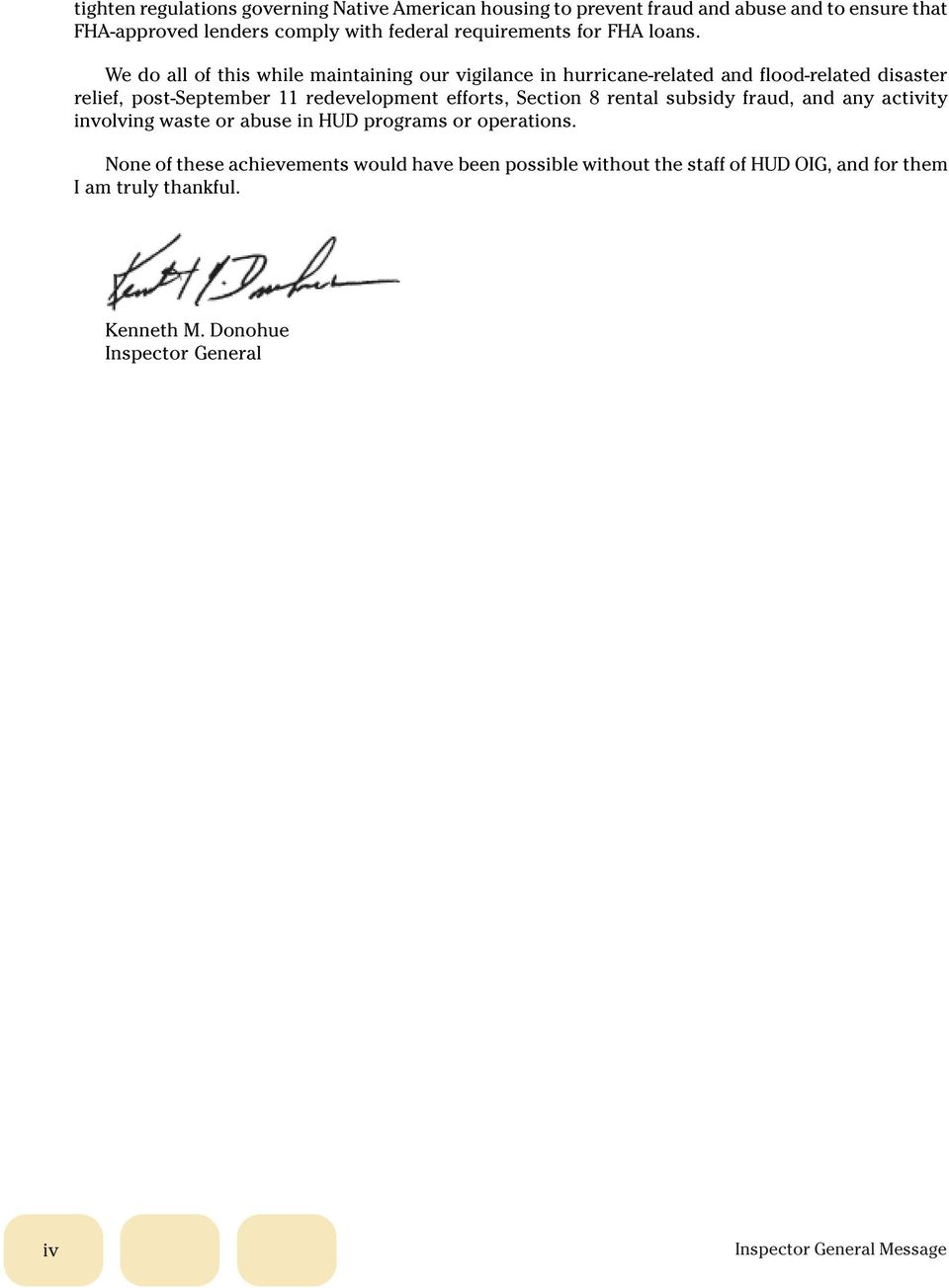
5 Audit reports issued by program Single-family housing, 13% Multifamily housing, 10% Public and Indian housing, 36% Community planning and development, 30% Hurricane relief oversight, 3% Other programs, 8% Monetary benefits identified by program Single-family housing, 0% Multifamily housing, 3% Public and Indian housing, 6% Community planning and development, 3% Hurricane relief oversight, 1% Other programs*, 87% * Other programs include CFO and CIO related audits Monetary benefits identified in millions of dollars $1,600 $1,523.0 $1,400 $1,200 $1,000 $800 $600 $400 $200 $3.9 $50.6 $107.8 $56.7 $7.5 $0 Single-family housing Multifamily housing Public and Indian housing Community planning and development Hurricane relief oversight Other programs* * Other programs include CFO and CIO related audits Audit Charts Audit Charts v
6 Investigative cases opened by program area (total: 608) Single-family housing, 23% (142) Public and Indian housing, 53% (320) Multifamily housing, 8% (46) Community planning and development, 12% (74) Other, 4% (26) Investigative recoveries by program area (total: $91,209,379) Single-family housing, 59% ($54,204,565) Public and Indian housing, 10% ($9,110,822) Multifamily housing, 1% ($1,009,812) Community planning and development, 6% ($5,156,194) Other, 24% ($21,727,986) vi Investigation Charts Investigation Charts

7 Acronyms List AFGE American Federation of Government Employees AIGA Assistant Inspector General for Audit AIGI Assistant Inspector General for Investigation ARIGA Assistant Regional Inspector General for Audit ASAC Assistant Special Agent in Charge CDBG Community Development Block Grant CPD Office of Community Planning and Development DHAP Disaster Housing Assistance Program DHS U.S. Department of Homeland Security DOJ U.S. Department of Justice EIV Enterprise Income Verification FEMA Federal Emergency Management Agency FFI Fugitive Felon Initiative FFMIA Federal Financial Management Improvement Act of 1996 FHA Federal Housing Administration FHAP Fair Housing Assistance Program FHEO Office of Fair Housing and Equal Opportunity FISMA Federal Information Security Management Act FSS Family Self-Sufficiency FY fiscal year GAO U.S. Government Accountability Office Ginnie Mae Government National Mortgage Association GPRA Government Performance Results Act HECM Home equity conversion mortgages HERA Housing and Economic Recovery Act (HERA) of 2008 HOME HOME Investment Partnerships Program HUD U.S. Department of Housing and Urban Development IAA Interagency agreement IG Inspector General IOI Identity of interest IRS Internal Revenue Service IT Information technology NAHASDA Native American Housing Assistance and Self-Determination Act of 1996 NAHRO National Association of Housing and Redevelopment Officials Acronyms List Acronyms List vii

8 NCDF OA OI OIG OMB PFCRA PHA PIH REAP RESPA RIGA SA SAC SBA SEMAP SFA SHP SSA SSA SSN TEAM U.S.C. USMS USPS VA National Center for Disaster Fraud Office of Audit Office of Investigation Office of Inspector General Office of Management and Budget Program Fraud Civil Remedies Act Public housing agency Office of Public and Indian Housing Resource Estimation and Allocation Process Real Estate Settlement Procedures Act Regional Inspector General for Audit Special Agent Special Agent in Charge Small Business Administration Section Eight Management Assessment Program Senior Forensic Auditor Supportive Housing Program Senior Special Agent Social Security Administration Social Security number Total Estimation and Allocation Mechanism United States Code United States Marshals Service United States Postal Service U.S. Department of Veterans Affairs viii Acronyms List Acronyms List

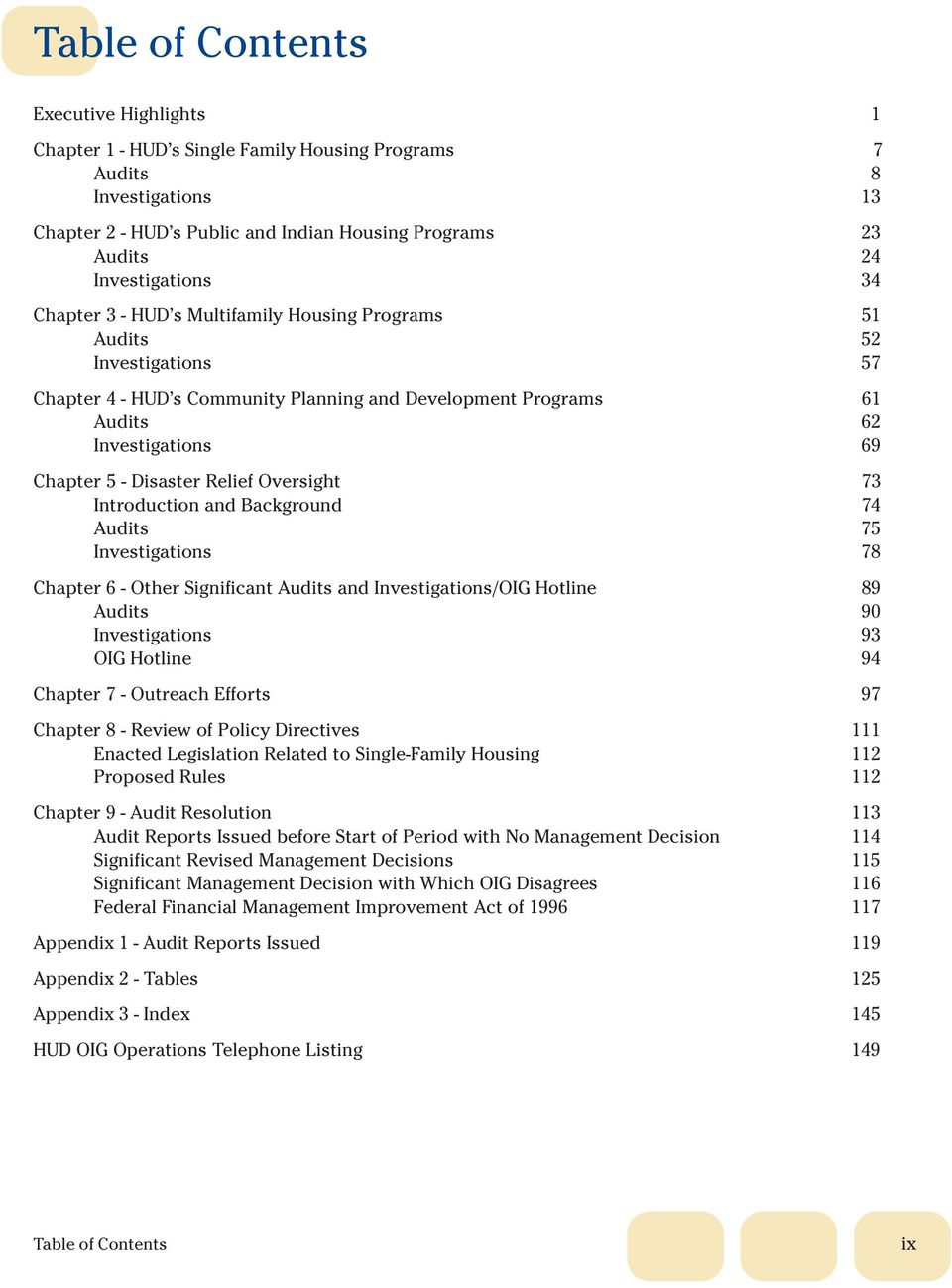
9 Table of Contents Executive Highlights 1 Chapter 1 - HUD s Single Family Housing Programs 7 Audits 8 Investigations 13 Chapter 2 - HUD s Public and Indian Housing Programs 23 Audits 24 Investigations 34 Chapter 3 - HUD s Multifamily Housing Programs 51 Audits 52 Investigations 57 Chapter 4 - HUD s Community Planning and Development Programs 61 Audits 62 Investigations 69 Chapter 5 - Disaster Relief Oversight 73 Introduction and Background 74 Audits 75 Investigations 78 Chapter 6 - Other Significant Audits and Investigations/OIG Hotline 89 Audits 90 Investigations 93 OIG Hotline 94 Chapter 7 - Outreach Efforts 97 Chapter 8 - Review of Policy Directives 111 Enacted Legislation Related to Single-Family Housing 112 Proposed Rules 112 Chapter 9 - Audit Resolution 113 Audit Reports Issued before Start of Period with No Management Decision 114 Significant Revised Management Decisions 115 Significant Management Decision with Which OIG Disagrees 116 Federal Financial Management Improvement Act of Appendix 1 - Audit Reports Issued 119 Appendix 2 - Tables 125 Appendix 3 - Index 145 HUD OIG Operations Telephone Listing 149 Table of Contents Table of Contents ix
10 Reporting Requirements The specific reporting requirements as prescribed by the Inspector General Act of 1978, as amended by the Inspector General Act of 1988, are listed below: Source/Requirement Pages Section 4(a)(2)-review of existing and proposed legislation and regulations. 112 Section 5(a)(1)-description of significant problems, abuses, and deficiencies relating to 1-95, 112 the administration of programs and operations of the Department. Section 5(a)(2)-description of recommendations for corrective action with respect to 7-95 significant problems, abuses, and deficiencies. Section 5(a)(3)-identification of each significant recommendation described in Appendix 2, previous semiannual report on which corrective action has not been completed. Table B Section 5(a)(4)-summary of matters referred to prosecutive authorities and the 7-95 prosecutions and convictions that have resulted. Section 5(a)(5)-summary of reports made on instances in which information or assistance was unreasonably refused or not provided, as required by Section 6(b)(2) of the Act. No Instances Section 5(a)(6)-listing of each audit report completed during the reporting period and Appendix 1 for each report, where applicable, the total dollar value of questioned and unsupported costsand the dollar value of recommendations that funds be put to better use. Section 5(a)(7)-summary of each particularly significant report and the total dollar value 7-95 of questioned and unsupported costs. Section 5(a)(8)-statistical tables showing the total number of audit reports and the Appendix 2, total dollar value of questioned and unsupported costs. Table C Section 5(a)(9)-statistical tables showing the total number of audit reports and the dollar value of recommendations that funds be put to better use by management. Appendix 2, Table D Section 5(a)(10)-summary of each audit report issued before the commencement Appendix 2, of the reporting period for which no management decision had been made by the Table A end of the period. Section 5(a)(11)-a description and explanation of the reasons for any No Instances significant revised management decisions made during the reporting period. Section 5(a)(12)-information concerning any significant management decision with which the 115 Inspector General is in disagreement. Section 5(a)(13)-the information described under section 05(b) of the Federal Financial 117 Federal Financial Management Improvement Act of x Reporting Requirements Reporting Requirements

11

12 Strategic Initiative 1 HUD Strategic Goal: Increase Homeownership Opportunities OIG Strategy: Contribute to the reduction of fraud in single-family insurance programs through - Audits uncovering single-family and loan origination abuse - Audits of the U.S. Department of Housing and Urban Development's (HUD) internal policies to determine whether controls are adequate - National strategy for single-family mortgage fraud task forces - Outreach to industry and consumer groups and the Department Highlights: Results or impact of significant OIG work - Audits of four Federal Housing Administration (FHA) single-family mortgage lenders found page 9 that lenders did not follow HUD requirements when underwriting loans and performing quality control procedures - HUD did not implement a cohesive partial claims process to ensure that partial claims were page 11 processed in a timely manner - Audit of Government National Mortgage Association's (Ginnie Mae) internal controls over page 12 its "match to terminated process" for mortgages and related documentation of the Mortgage Backed Securities Information System - Florida, Pennsylvania, and Texas mortgage fraud schemes cause HUD losses in excess of $13 page 14 million - Fraudulent appraisals trigger $ 4 million in HUD losses page 14 - False identities and Social Security numbers generate millions in HUD losses page 17 - More than 500 mortgage and real estate professionals attend a mortgage fraud presentation page 101 in Virginia Emerging Issues: Areas of OIG interest - American Recovery and Reinvestment Act funding for tax credits - Dramatic increase in lenders/brokers/issuers seeking to do business with FHA and Ginnie Mae - FHA's ability and capacity to oversee its expanding market share - FHAs refinancing of riskier loans than it has historically had in its portfolio - Foreclosure rescue fraud - Home Equity Conversion Mortgage program - Implementation of Secure and Fair Enforcement for Mortgage Licensing Act of Loan limitation increases open new metropolitan areas with unknown risks 2 Executive Highlights

13 Strategic Initiative 2 HUD Strategic Goal: Promote Decent Affordable Housing OIG Strategy: Contribute to the reduction of erroneous payments in rental assistance programs through - Audits of Section 8 Housing Choice Voucher program activities - Investigative initiatives involving corruption in the management of troubled public housing authorities and multifamily developments - Section 8 fraud initiatives in each Office of Inspector General (OIG) region - Public Housing Fugitive Felon and Sex Offender Initiatives - locate and remove - Public and Department-wide outreach initiatives Highlights: Results or impact of significant OIG work - Indianapolis Housing Agency failed to meet HUD's lease-up thresholds for Section 8 page 25 project-based units, resulting in 1,569 households not being housed and $8.7 million in funds not used to provide decent, safe, and sanitary housing - More than 79 percent of East St. Louis Housing Authority's Section 8 units materially failed page 28 to meet HUD's housing quality standards - HUD's policies allowed tribal housing authorities to redirect and abuse about $40 million page 33 in rent revenue per year from Native American Housing and Self-Determination Act of 1996-assisted low-rent program units - Indian housing developer found liable in U.S. Bankruptcy Court proceeding page 35 - Former East Haven Housing Authority executive director and her husband steal more than page 35 $397,000 - Fake landlord produces almost $300,000 for housing specialist page 35 - San Bernardino Section 8 tenants illegally obtained more than $330,000 in housing assistance page 40 - Section 8 tenant jailed for possession of child pornography page 49 - HUD has not implemented recommendations calling for changes to the performance-based page 53 contract, which could result in payments of up to $1.9 million for services not performed - Housing fraud schemes and prosecutions presented to 250 multifamily property managers page 105 Emerging Issues: Areas of OIG interest - HUD's oversight of performance-based contract administrators - Landlord fraud - Public housing corruption and multifamily mismanagement - Rental assistance fraud initiatives targeting public housing agencies (PHA) in receivership or on the HUD troubled list Executive Highlights Executive Highlights 3

14 Strategic Initiative 3 HUD Strategic Goal: Strengthen Communities OIG Strategy: - Promote integrity, efficiency, and effectiveness of programs - Contribute to the reduction of fraud, waste, and abuse through - Audits of the Community Development Block Grant (CDBG), Supportive Housing Program, and HOME Investment Partnerships program - Audits of disaster activities - Investigative initiative involving corruption in the administration of State or local community planning and development programs in each OIG region - Hurricane relief fraud in HUD CDBG-funded programs - Public dissemination of HUD OIG activities and outreach activities with State and local government agencies Highlights: Results or impact of significant OIG work - City of San Diego failed to properly administer its CDBG funds, resulting in more than page 63 $1.8 million in ineligible and $11 million in unsupported costs - City of Durham, NC, did not administer $1.3 million in CDBG funds in accordance with page 63 HUD requirements - Chief financial officer pleads guilty to embezzling more than $183,000 in Emergency Shelter page 70 Grant funds - New Brunswick housing preservation and rehabilitation director sent to prison for accepting page 70 bribes from contractors - Gulfport mayor and wife indicted for allegedly making false statements and committing page 79 theft of government funds - Hurricane relief fraud involving millions in CDBG funding for homeowners pages HUD homeless and Supportive Housing programs described for more than 50 Louisiana page 87 officials and nonprofit representatives - An overview of the HUD Neighborhood Stabilization program presented to more than 275 page 105 grant administrators Emerging Issues: Areas of OIG interest - American Recovery and Reinvestment Act funding and the Neighborhood Stabilization program - Gulf Coast hurricane assistance fraud - Homeless and Emergency Shelter Grants 4 Executive Highlights Executive Highlights

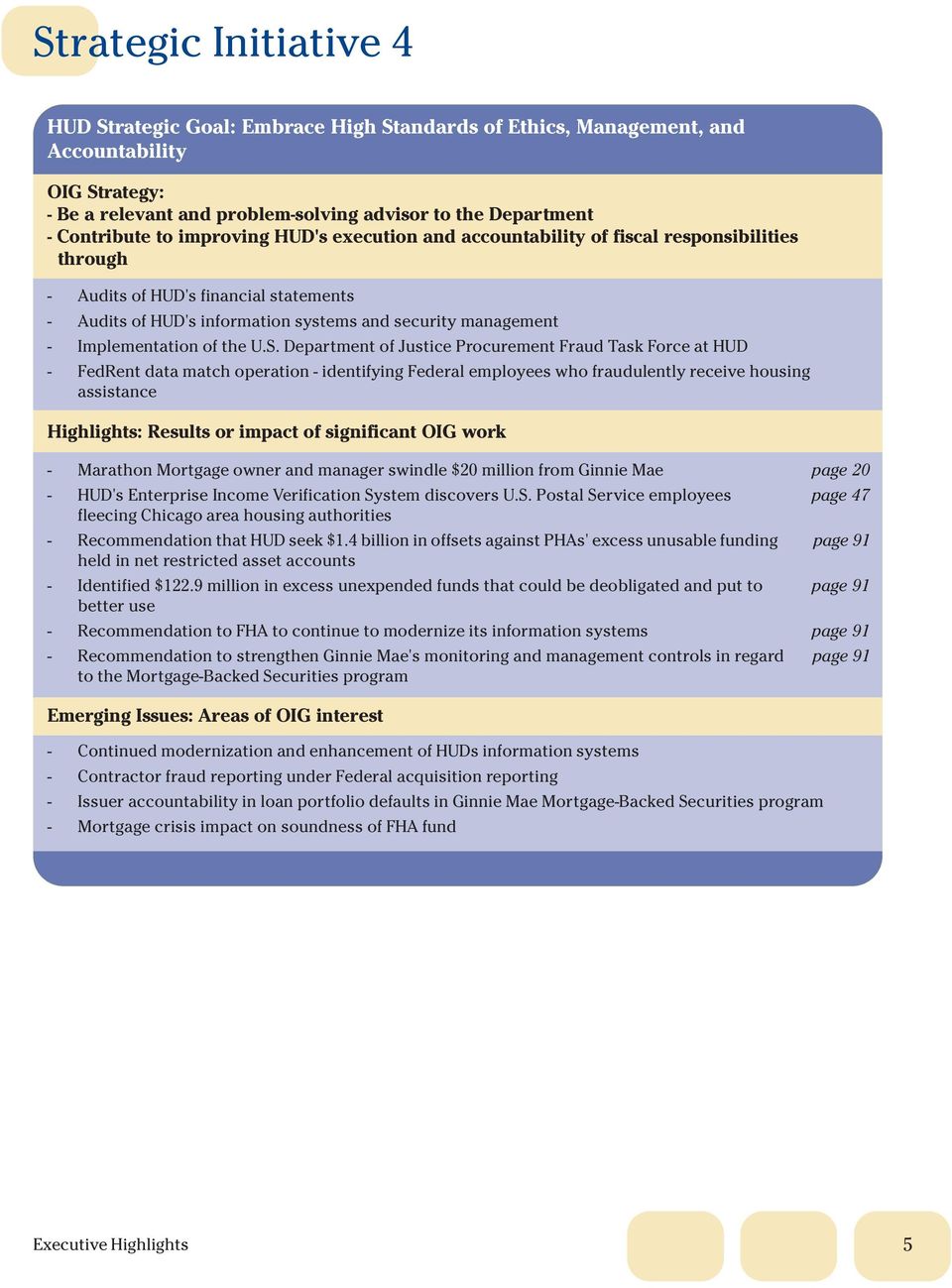
15 Strategic Initiative 4 HUD Strategic Goal: Embrace High Standards of Ethics, Management, and Accountability OIG Strategy: - Be a relevant and problem-solving advisor to the Department - Contribute to improving HUD's execution and accountability of fiscal responsibilities through - Audits of HUD's financial statements - Audits of HUD's information systems and security management - Implementation of the U.S. Department of Justice Procurement Fraud Task Force at HUD - FedRent data match operation - identifying Federal employees who fraudulently receive housing assistance Highlights: Results or impact of significant OIG work - Marathon Mortgage owner and manager swindle $20 million from Ginnie Mae page 20 - HUD's Enterprise Income Verification System discovers U.S. Postal Service employees page 47 fleecing Chicago area housing authorities - Recommendation that HUD seek $1.4 billion in offsets against PHAs' excess unusable funding page 91 held in net restricted asset accounts - Identified $122.9 million in excess unexpended funds that could be deobligated and put to page 91 better use - Recommendation to FHA to continue to modernize its information systems page 91 - Recommendation to strengthen Ginnie Mae's monitoring and management controls in regard page 91 to the Mortgage-Backed Securities program Emerging Issues: Areas of OIG interest - Continued modernization and enhancement of HUDs information systems - Contractor fraud reporting under Federal acquisition reporting - Issuer accountability in loan portfolio defaults in Ginnie Mae Mortgage-Backed Securities program - Mortgage crisis impact on soundness of FHA fund Executive Highlights Executive Highlights 5
16

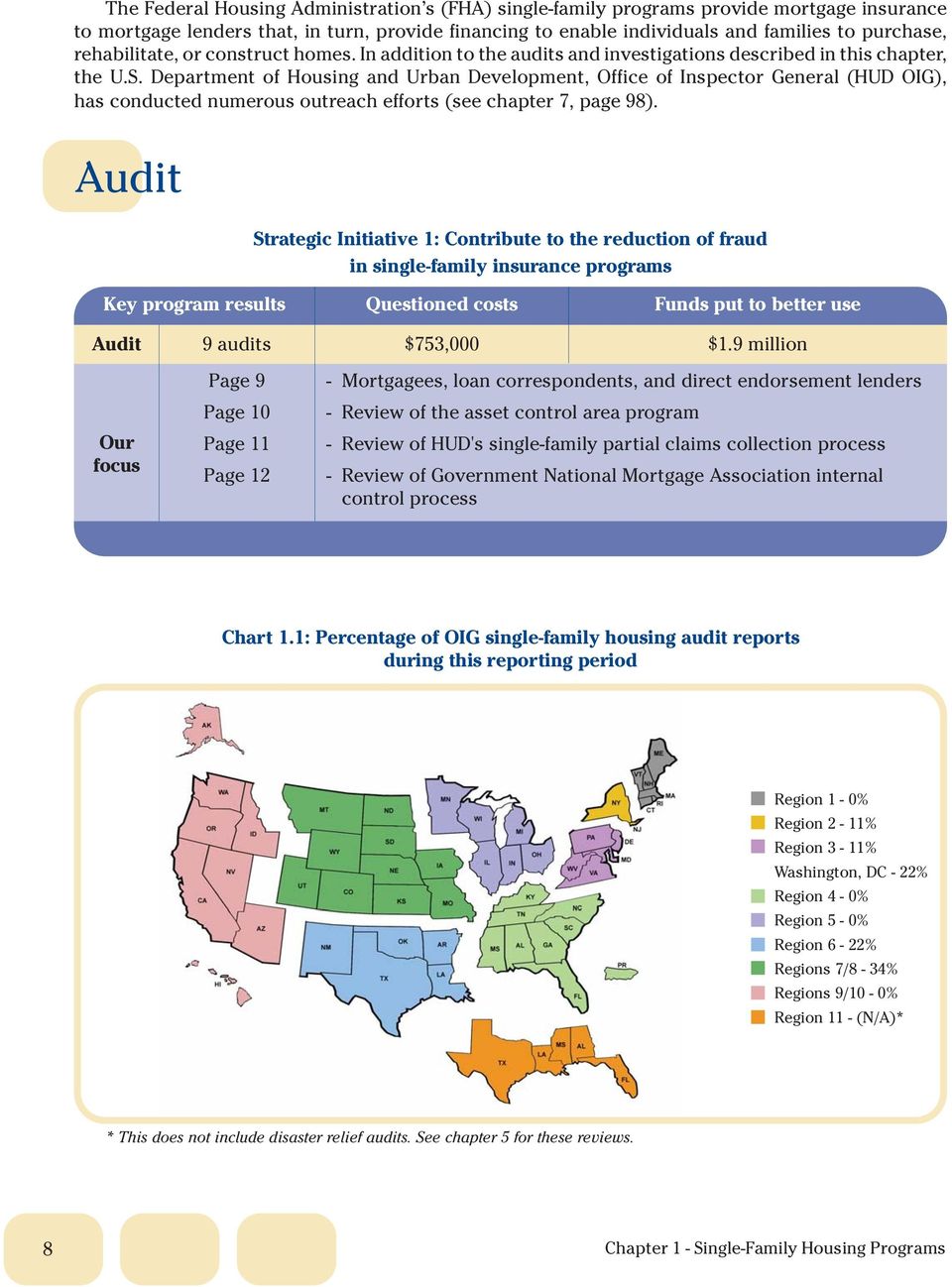
17 The Federal Housing Administration s (FHA) single-family programs provide mortgage insurance to mortgage lenders that, in turn, provide financing to enable individuals and families to purchase, rehabilitate, or construct homes. In addition to the audits and investigations described in this chapter, the U.S. Department of Housing and Urban Development, Office of Inspector General (HUD OIG), has conducted numerous outreach efforts (see chapter 7, page 98). Audit Strategic Initiative 1: Contribute to the reduction of fraud in single-family insurance programs Key program results Questioned costs Funds put to better use Audit 9 audits $753,000 $1.9 million Our focus Page 9 Page 10 Page 11 Page 12 - Mortgagees, loan correspondents, and direct endorsement lenders - Review of the asset control area program - Review of HUD's single-family partial claims collection process - Review of Government National Mortgage Association internal control process Chart 1.1: Percentage of OIG single-family housing audit reports during this reporting period Region 1-0% Region 2-11% Region 3-11% Washington, DC - 22% Region 4-0% Region 5-0% Region 6-22% Regions 7/8-34% Regions 9/10-0% Region 11 - (N/A)* * This does not include disaster relief audits. See chapter 5 for these reviews. 8 Chapter 1 - Single-Family Housing Programs Chapter 1: HUD s Single-Family Housing Programs
18 Mortgagees, Loan Correspondents, and Direct Endorsement Lenders Audits to uncover single-family lenders and loan origination abuses continued to be a priority during this semiannual period. Lenders are targeted for audit through the use of data mining techniques, along with prioritizing audit requests from outside sources. During this period, the U.S. Department of Housing and Urban Development's (HUD) Office of Inspector General (OIG) reviewed four Federal Housing Administration (FHA) single-family mortgage lenders. The following section illustrates the audits conducted in the single-family mortgage lender area. HUD OIG audited CitiMortgage, Incorporated, in St Louis, MO, to determine whether CitiMortgage followed HUD requirements for underwriting loans and performing its quality control program for single-family production. CitiMortgage did not properly underwrite 20 of the 60 defaulted loans reviewed. These loans had material underwriting deficiencies that affected the insurability of the loans. In addition, CitiMortgage did not meet HUD's quality control requirements. OIG recommended that HUD (1) require CitiMortgage to indemnify HUD against future losses and reimburse HUD for loans that have already resulted in losses; (2) verify that CitiMortgage implements adequate controls that allow managers to identify, mitigate, and prevent underwriting problems; and (3) ensure that CitiMortgage implements a revised quality control plan that complies with HUD requirements. (Audit Report: 2009-KC-1001) HUD OIG audited FHA loans originated by CTX Mortgage's Overland Park, KS, branch office to determine whether CTX Mortgage followed HUD requirements for (1) borrower eligibility and creditworthiness and property eligibility when underwriting loans and (2) developing a written quality control plan. CTX Mortgage did not follow HUD's requirements when underwriting 12 of 23 FHA loans reviewed. In addition, CTX Mortgage's written quality control plan did not contain all HUD-required elements. OIG recommended that HUD (1) require CTX Mortgage to indemnify HUD for 12 loans with unpaid principal balances totaling more than $1.2 million and (2) ensure that CTX Mortgage revises its quality control plan to fully comply with HUD's requirements. (Audit Report: 2009-KC-1003) HUD OIG audited Allied Home Mortgage Capital Corporation in Houston, TX, a nonsupervised loan correspondent, to determine the validity of a hotline complaint that Allied operated its branches in violation of HUD requirements. Allied did not fully follow HUD's branch office requirements. It (1) required branch managers to personally enter into certain contractual agreements, such as office space leases, equipment contracts, and utility arrangements, at all five branches reviewed; (2) did not consistently pay rental, utility, and telephone expenses at all five branches; (3) requested that a former employee use personal funds to cover branch operating losses; and (4) hired an ineligible employee to originate FHA-insured single-family mortgages. Chapter 1 - Single-Family Housing Programs Chapter 1: HUD s Single-Family Housing Programs 9
19 OIG recommended that HUD require Allied to (1) immediately discontinue its practices related to leases/agreements for all branch offices; (2) adopt new practices and controls that require it to directly enter into leases and/or agreements; and (3) implement the necessary policies, systems, and controls to ensure that it pays all required branch operating costs. Further, HUD should confirm that all Allied branch offices have appropriate agreements, take appropriate actions if compliance does not occur, and pursue civil money penalties and/or administrative sanctions, as appropriate, against Allied for the violations cited. (Audit Report: 2009-FW-1005) HUD OIG audited the Leawood, KS, branch office of Clarion Mortgage Capital, an FHA-approved loan correspondent, to determine whether Clarion Mortgage Capital followed HUD requirements for implementing a quality control program. Clarion Mortgage Capital did not fully comply with HUD's or its own quality control process. It did not (1) ensure that its quality control contractor reviewed loans within the proper timeframes or (2) document on-site quality control reviews of the branch office or corrective actions taken to address deficiencies identified in the quality control reports. OIG recommended that HUD verify that Clarion Mortgage Capital has fully implemented a quality control program that complies with HUD requirements. (Audit Report: 2009-KC-1002) Review of the Asset Control Area Program HUD OIG audited the City of Camden, NJ's asset control area (ACA) program to determine whether the City complied with requirements in the ACA agreement pertaining to the resale of properties it acquired from HUD. The City did not comply with the provisions in the ACA agreement pertaining to the resale of its acquired ACA properties. It did not (1) ensure that 17 of 68 properties that it acquired from HUD were rehabilitated and sold within the required timeframe, (2) ensure that all expenses included in net development costs for rehabilitated properties were eligible, and (3) verify home buyers' eligibility and maintain the appropriate related supporting documentation. As a result, the City was unable to support property discounts from HUD for the 17 outstanding properties. It also included ineligible expenses in the net property development costs for four properties, which increased their sales prices and, consequently, the related mortgages by more than $11,700. OIG recommended that (1) HUD direct the City to obtain and provide evidence that it has the necessary resources to complete the rehabilitation and sale of the 17 outstanding properties or pay HUD $441,500, (2) the City buy down the mortgages for the four properties which had more than $11,600 in ineligible expenses included as part of their net development costs and verify and document the eligibility of each home buyer in the future, and (3) HUD not renew the ACA agreement with the City until it has demonstrated that it is in compliance with the requirements of the agreement. (Audit Report: 2009-PH-1004) HUD OIG audited the City of Rochester, NY's ACA program to determine whether the City administered its program in compliance with program requirements to increase homeownership for low- and moderate-income borrowers and contribute to the revitalization of blighted communities. 10 Chapter 1 - Single-Family Housing Programs Chapter 1: HUD s Single-Family Housing Programs
20 The City's ACA program generally met the program objectives for increasing homeownership for low- and moderate-income borrowers and contributed to the revitalization of blighted communities but was not always administered in compliance with program requirements. Specifically, the City did not (1) obtain HUD approval for a nonprofit organization to participate in its ACA program, (2) resell ACA properties within the required timeframe, (3) sell an ACA property within the price limit imposed by HUD, (4) obtain HUD's approval for conflict-of-interest issues, and (5) accurately calculate or report to HUD net development costs for each ACA property. OIG recommended that HUD instruct the City to (1) develop procedures to ensure that any nonprofit hired to administer or participate in the ACA program is approved by HUD in accordance with ACA policies, (2) ensure that ACA properties are resold within the established timeframe, (3) buy down the mortgage for an ACA property that was resold to the eligible purchaser for $4,700 more than the established limit, (4) cease participation with individuals or entities that have conflict-of-interest relationships unless HUD approval can be obtained, (5) establish procedures to ensure accurate calculation and reporting of net development costs and compliance with program requirements, and (6) review the noncompliance issues identified and decide whether to impose sanctions in accordance with section 8 of the ACA standard operating procedures. (Audit Report: 2009-NY-1007) HUD OIG audited Enterprise Home Ownership Partners-Dallas, Inc. (EHOP-Dallas), in Dallas, TX, to determine whether EHOP-Dallas administered its ACA program in compliance with the agreement and the program objective to promote revitalization through expanded homeownership opportunities. EHOP-Dallas administered its ACA program in an effective manner, increasing homeownership in revitalization areas and contributing to reducing blight in some neighborhoods. However, it did not comply with requirements when it (1) provided home buyers excess equity in the homes it resold, (2) did not resell all homes within the time limits established under the agreement, and (3) included ineligible expenses associated with theft and vandalism in net development costs. OIG recommended that HUD require EHOP-Dallas to calculate home-buyer enforcement notes as defined in the agreement and exclude expenses associated with casualty losses in its calculations of net development costs. In addition, OIG recommended that HUD revise the agreement to address disposition of properties the purchaser cannot sell within 18 months because of market conditions or other factors beyond its control. (Audit Report: 2009-FW-1006) Review of HUD's Single-Family Partial Claims Collection Process HUD OIG audited HUD's single-family partial claims collection process and its effectiveness in protecting the FHA insurance fund to determine whether the single-family partial claims program operated effectively and efficiently to minimize the costs to the insurance fund and collect amounts in a timely manner. A partial claim is a loss-mitigation option that is used when a lender advances funds on behalf of a borrower in an amount necessary to reinstate a delinquent loan (not to exceed the equivalent of 12 months principal, interest, taxes, and insurance). HUD and its contractors did not properly implement a cohesive partial claims collection process to ensure that partial claims were serviced in a timely manner. HUD did not (1) fully develop and implement written policies and procedures, (2) define follow-up procedures for the forbearance plan option, (3) promptly transfer partial claims to the Albany Financial Operations Center, and (4) actively track and monitor lender billing. Chapter 1 - Single-Family Housing Programs Chapter 1: HUD s Single-Family Housing Programs 11
21 OIG recommended that HUD (1) formulate and implement procedures to comply with Federal regulations and enhance training provided to its contractors so that debts can be transferred to the Albany Financial Operations Center in a timely manner, (2) develop procedures to pursue lenders for administrative offsets in a timely manner and improve the forbearance plans, and (3) fully implement the Single Family Mortgage Asset Recovery Technology system as the one system of record for partial claims. (Audit Report: 2009-DP-0001) Review of Government National Mortgage Association Internal Control Process HUD OIG audited the internal controls of the Government National Mortgage Association (Ginnie Mae) to assess the "match to terminated" process and related documentation of the Mortgage Backed Securities Information System. OIG determined that the contents of this report would not be appropriate for public disclosure and has limited its distribution to selected HUD officials. (Audit Report: 2009-DP-0002) 12 Chapter 1 - Single-Family Housing Programs Chapter 1: HUD s Single-Family Housing Programs
22 Investigations Some investigations discussed in this report were generated from leads provided by HUD single-family housing program staff or conducted jointly with Federal, State, and local law enforcement agencies. The results of various significant investigations are described below. Key program results $ recovered Admin/civil actions Investigations 93 $54,204, Our focus Strategic Initiative 1: Contribute to the reduction of fraud in single-family insurance programs Cases closed Page 14 Page 17 Page 18 Page 20 - Loan origination fraud - Identity fraud and false Social Security numbers - Civil and administrative actions - Other single-family fraud Convictions/pleas/ pretrials Chart 1.2: Percentage of OIG single-family housing closed investigation cases during this reporting period Region 1-3% Region 2-14% Region 3-11% Region 4-12% Region 5-21% Region 6-9% Regions 7/8-13% Regions 9/10-16% Region 11-1% Chapter 1 - Single-Family Housing Programs Chapter 1: HUD s Single-Family Housing Programs 13
23 Loan Origination Fraud Robert and Patrick Singletary and Peter Russo, owners of CAL Investments, Universal Title Company, and Tropical and Sunshine Mortgage Companies, each pled guilty in U.S. District Court, Jacksonville, FL, to committing wire fraud and a conspiracy to make false statements to HUD. From 1997 to January 2004, the above defendants and others conspired and provided fraudulent gift fund checks used by unqualified borrowers to obtain FHA-insured mortgages. HUD realized losses in excess of $9 million after 139 mortgages defaulted. Ciriaco Gatta, an appraiser doing business as Gatta and Associates; Anthony Giampietro and Mary Diantonio, settlement agents for Rittenhouse Abstract or First City Abstract; and Trung Tam Dang and Zu Yun Kim, also known as Andy Kim, were collectively sentenced in U.S. District Court, Philadelphia, PA, to 92 months incarceration and 15 years probation and ordered to pay HUD more than $4.46 million in restitution, jointly and severally, for their earlier guilty pleas to making false statements to HUD and committing wire and identity fraud and a conspiracy. The above defendants and others created fraudulent appraisals or documents used by unqualified borrowers to obtain FHA-insured mortgages. HUD realized losses in excess of $4.46 million after 183 mortgages defaulted. Copyright, The Times Union - Jacksonville, FL. Reprinted with permission. Kandace Yancy Marriott, the former owner of One Way Home and Land, was sentenced in Navarro County District Court, Corsicana, TX, to 99 years incarceration and fined $10,000 for her earlier conviction of engaging in an organized criminal activity and misapplication of fiduciary funds. From October 2003 through August 2004, Marriott forged home buyers' signatures and provided fraudulent information or documents used by unqualified borrowers to obtain FHA-insured mortgages. HUD realized losses in excess of $4 million after 68 mortgages defaulted. LaDonna Mullins, the owner of LaDonna's Realty and Management, was sentenced in U.S. District Court, Denver, CO, to 15 months home detention and 36 months probation and ordered to pay HUD $66,459 in restitution and forfeit $44,292 for her earlier conviction of committing wire fraud and aiding and abetting. Mullins and others submitted or caused the submission of fraudulent documents used by unqualified borrowers to obtain FHA-insured mortgages. HUD realized losses of about $1.25 million after 25 mortgages defaulted. Copyright, Rocky Mountain News - Denver, CO. Reprinted with permission. 14 Chapter 1 - Single-Family Housing Programs Chapter 1: HUD s Single-Family Housing Programs
24 Carey O'Laughlin, the president of National Housing Foundation, a nonprofit approved by HUD to obtain FHA-insured mortgages, was sentenced in U.S. District Court, Chicago, IL, to 33 months incarceration and 3 years probation and ordered to pay HUD $1.1 million and American Charter Bank $900,000 in restitution for his earlier guilty plea to making false statements to a federally insured bank. O'Laughlin provided false statements and documents to secure and later default on $1 million in credit from American Charter Bank, failed to disclose this liability on National Housing Foundation mortgage loan applications, and obtained and defaulted on about $2.47 million in FHA-insured mortgages. HUD realized losses of $1.1 million after 18 mortgages defaulted. Arvin Weiss, a real estate broker and president of Reserve Capital Funds (Reserve), and Reserve real estate sales assistant Jesus Guevara were collectively sentenced in U.S. District Court, Denver, CO, to 105 months incarceration and 72 months supervised release and ordered to jointly pay HUD $852,000 in restitution for their previous conviction or guilty plea to committing mail and wire fraud and tampering with a witness. From June 1998 to February 2002, Weiss, Guevara, and others submitted fraudulent documents or provided downpayment funds used by unqualified borrowers to obtain FHA-insured mortgages. HUD realized losses of about $852,000 after 18 mortgages defaulted. Juan Garcia, a mortgage broker for All Star Mortgage and president of J.G. Home Investment, and nine additional defendants were each indicted in U.S. District Court, Miami, FL, for allegedly making false statements and committing wire fraud and a conspiracy to commit wire fraud. Garcia allegedly provided fraudulent documents and downpayment funds used by the above defendants and others to obtain FHA-insured and conventional mortgages. HUD realized losses of about $727,000 after three mortgages defaulted. Garcia and eight of the above defendants were arrested after their indictments. Copyright, Rocky Mountain News - Denver, CO. Reprinted with permission. Henry and Elizabeth Robertson, doing business as Elohim, Inc., were each indicted in U.S. District Court, Chicago, IL, for allegedly committing bank and wire fraud. Henry and Elizabeth Robertson allegedly provided fraudulent documents and downpayment funds used by unqualified borrowers to obtain FHA-insured and conventional mortgages. HUD realized losses of about $459,000 after 20 mortgages defaulted. Alberto Hernandez, president of ASH Homes Investment, Inc., and his partner John Fraga were collectively sentenced in U.S. District Court, Miami, FL, to 45 months incarceration and ordered to pay HUD $232,060 and others $201,086 in restitution, jointly and severally, for their earlier guilty pleas to committing mail fraud and a conspiracy. Hernandez sold properties he owned and provided the Chapter 1 - Single-Family Housing Programs Chapter 1: HUD s Single-Family Housing Programs 15
25 downpayment or gift funds used by unqualified borrowers to obtain FHA-insured mortgages. Fraga and others converted the downpayment or gift funds provided by Hernandez to financial instruments used by the unqualified borrowers. In addition, Fraga obtained an FHA-insured mortgage on investment property he purchased from Hernandez. HUD realized losses of $232,060 after four mortgages defaulted. Scott Hinkley, a loan officer for ABK Mortgage, was sentenced in Colorado District Court, Brighton, CO, to 10 years community corrections for his earlier guilty plea to committing forgery and violating the Colorado Organized Crime Control Act. Hinkley and others provided fraudulent loan applications used by unqualified borrowers to obtain FHA-insured and conventional mortgages. HUD realized losses of $153,814 after three mortgages defaulted. Uriel Ortiz, a former office manager for Exclusive Rights Realty, was sentenced in U.S. District Court, Los Angeles, CA, to 36 months probation and ordered to pay HUD $143,384 in restitution for his earlier guilty plea to committing a conspiracy. Ortiz and others provided false documents used by unqualified borrowers to obtain FHA-insured mortgages. HUD realized losses of $143,384 after 13 mortgages defaulted. Rebecca Loeffler was indicted in U.S. District Court, Kansas City, MO, for allegedly making false statements and committing wire fraud. Loeffler allegedly provided false information to obtain an FHA-insured mortgage. HUD realized a loss of $115,051 after her mortgage defaulted. Maria Gallucci, a realtor for Keller Williams Realty and loan officer for Uptown Mortgage Service, was sentenced in Adams County District Court, Brighton, CO, to a 2-year deferred sentence for her earlier guilty plea to committing forgery. Gallucci forged the signature of her former spouse on documents associated with her jointly owned FHA-insured mortgage. HUD realized a loss of $81,626 after her mortgage defaulted. Ricardo Bonilla and Abraham Rezex, former mortgage brokers for Consorcio Lending or American Loan Services, Inc., and Kathy Kilmer, a former real estate agent for Mortgage One Corporation, were each charged in U.S. District Court, Riverside, CA, with allegedly making false statements. Bonilla, Rezex, and Kilmer allegedly created or provided fraudulent information or documents used by unqualified borrowers to obtain FHA-insured mortgages. HUD losses are not yet determined. Real estate closing attorney Anthony Natale and Kenneth Lagonia, the president of Quality Homes Are Us, each pled guilty in U.S. District Court, Newark, NJ, to making false statements to HUD or committing a conspiracy to commit wire fraud. From March 2003 through August 2005, Natale and others created and provided fraudulent documents used by unqualified borrowers to obtain 16 Chapter 1 - Single-Family Housing Programs Chapter 1: HUD s Single-Family Housing Programs
26 FHA-insured mortgages, and Lagonie and others created and provided fraudulent information and documents used by real estate investors to obtain FHA-insured or conventional mortgages. HUD losses are not yet determined. Dorie Dimarca, an individual claiming to be an FHA appraiser, was indicted in U.S. District Court, Concord, NH, for allegedly committing wire fraud. Dimarca allegedly used the FHA license of another and fraudulently prepared and submitted appraisals for 17 FHA-insured and 18 non-fha mortgage loans. HUD losses are not yet determined. Julie Weaver, a former loan officer for Alliance Guaranty Mortgage Corporation, was charged in Denver County Court, Denver, CO, with allegedly committing theft. Weaver allegedly signed closing documents for a straw buyer and stole $24,310 in mortgage loan proceeds from an FHA-insured refinance loan. HUD losses are not yet determined. Frank Conti and Keith Rice, a manager and assistant mortgage broker for Regal Mortgage, each pled guilty in U.S. District Court, Erie, PA, to committing a conspiracy or mail fraud. In addition, Greg Finney, a former owner of the now-defunct A&M Homes, was sentenced to 53 months incarceration and 5 years probation and ordered to pay six FHA-insured mortgagors $56,500 and other victims $77,500 in restitution for his earlier guilty plea to committing a conspiracy, mail fraud, and money laundering. Finney and others provided fraudulent property information and values to prospective buyers and directed them to Conti, Rice, and others, who provided the unqualified borrowers with false information and documents used to obtain FHA-insured and conventional mortgages. Identity Fraud and False Social Security Numbers Antonio Vitale, also known as Tony Vitale, a former loan officer for Sterling Capital Mortgage Company, was sentenced in Adams County District Court, Brighton, CO, to 60 months probation and ordered to perform 200 hours of community service for his earlier guilty plea to offering a false instrument for recording and attempting to influence a public servant. In addition, Iris Rodriguez pled guilty to offering a false instrument for recording, Jorge Barajas was sentenced to 24 months probation for his earlier guilty plea to offering a false instrument for recording, and previously sentenced Claudia Hernandez-Martinez was arrested when she attempted to reenter the United States. Vitale provided forged documents and a fraudulent Social Security number (SSN) used by an unqualified borrower to obtain an FHA-insured mortgage, Rodriguez sold her FHA-insured property to her undocumented immigrant spouse who fraudulently obtained an FHA-insured mortgage, Barajas provided a false SSN and other fraudulent documents to obtain and later default on his FHA-insured mortgage, and Hernandez-Martinez violated the terms of her probation. HUD realized losses of $3.2 million after 49 mortgages defaulted. Asifali Mahomed, a real estate broker formerly doing business as Luxor Real Estate Investment, was sentenced in U.S. District Court, Ft. Worth, TX, to 37 months incarceration and 36 months probation and ordered to pay HUD $445,862 in restitution for his earlier guilty plea to committing a Chapter 1 - Single-Family Housing Programs Chapter 1: HUD s Single-Family Housing Programs 17
27 conspiracy to make false entries to HUD. Mahomed inflated financial information and provided downpayment funds and fraudulent SSNs used by unqualified borrowers to obtain FHA-insured mortgages. HUD realized losses of $445,862 after 12 mortgages defaulted. Straw buyers John Prados and Caridad Paz were each sentenced in U.S. District Court, Newark, NJ, to 6 months home detention and 36 months probation for their earlier guilty pleas to using false SSNs to obtain FHA-insured mortgages and committing bankruptcy fraud or a conspiracy to defraud HUD. In addition, Prados was ordered to pay HUD $80,232 in restitution and was suspended from procurement and nonprocurement transactions with HUD and throughout the Executive Branch of the Federal Government pending the outcome of criminal proceedings or any related debarment action. Prados, Paz, and others used or supplied fraudulent identity and other documents to obtain FHA-insured mortgages. HUD realized losses of $349,000 after 12 mortgages defaulted. Karla Preciado, also known as Karla Venegas, a former loan processor for JLF Properties, pled guilty in U.S. District Court, Los Angeles, CA, to committing a conspiracy. Preciado and others created false identity and financial documents used by unqualified borrowers to obtain FHA-insured mortgages. HUD realized losses of about $220,695 after 10 mortgages defaulted. FHA-insured mortgagors Juan Cantu, Jair Almaguer, and Jose Arellano Lopez were each indicted in Dallas County District Court, Dallas, TX, for allegedly securing execution of a document by deception. The above defendants allegedly used fraudulent SSNs and other documents to obtain FHA-insured mortgages. HUD realized losses of $83,855 after their mortgages defaulted. Karla Martinez-Porras and Ludibeth Salazar, former loan officers for American United Mortgage Corporation or Primero Home Loan; Xochilt Alamillo, a former realtor for Frontier GMAC Real Estate; and FHA-insured mortgagors Prisciliano and Alma Peralta-Lopez, Alfredo Gomez-Rosales, and Rigoberto Olivas were each charged in Adams County Court, Brighton, CO, with allegedly attempting to influence a public servant; offering a false instrument for recording; and committing theft, conspiracy, forgery, and criminal impersonation. Martinez-Porras, Salazar, and Alamillo allegedly assisted undocumented immigrants who used fraudulent SSNs or documents to obtain FHA-insured mortgages; and Prisciliano and Alma Peralta-Lopez, Gomez-Rosales, and Olivas allegedly used false SSNs and other fraudulent documents to obtain FHA-insured mortgages. HUD realized a loss of $54,753 after one mortgage defaulted. Civil and Administrative Actions RBC Mortgage Company (RBC), a HUD direct endorsement lender, entered into a False Claims Act civil settlement filed in U.S. District Court, Chicago, IL, and agreed to pay the U.S. Department of Justice (DOJ) more than $10.9 million. From February 2001 to April 2004, RBC allegedly approved FHA-insured mortgages for unqualified borrowers and falsely certified that mortgages were current when they submitted loans for FHA insurance. HUD realized losses of about $2.6 million after 75 mortgages defaulted. 18 Chapter 1 - Single-Family Housing Programs Chapter 1: HUD s Single-Family Housing Programs
28 Devon Bowie, the former owner and president of Neighborhood Mortgage Bankers who was previously sentenced in U.S. District Court, Newark, NJ, for his earlier guilty plea to committing a conspiracy to submit false documents to HUD, entered into a PFCRA settlement and agreed to pay HUD $10,000. Bowie conspired with others and provided false information or documents used by unqualified borrowers to obtain FHA-insured mortgages. HUD realized losses in excess of $1.2 million after 33 mortgages defaulted. Dolphin Mortgage Corporation (Dolphin), previously named in a False Claims Act complaint filed in U.S. District Court, Chicago, IL, was found liable and ordered to pay the U.S. Government and HUD more than $1.1 million. Dolphin failed to prevent the fraudulent actions of two employees who previously pled guilty to originating six fraudulent FHA-insured mortgages. HUD realized losses of more than $1.1 million after the six mortgages defaulted. Demetri Coffee, an appraiser for Chase Residential Appraisal, Inc., who was previously sentenced in U.S. District Court, Atlanta, GA, for his earlier guilty plea to committing wire fraud; money laundering; and a conspiracy to commit mail, wire, bank, and bank loan frauds, was debarred from procurement and nonprocurement transactions with HUD and throughout the Executive Branch of the Federal Government for 7 years. Coffee and others created or submitted false appraisals or documents used by straw borrowers to obtain FHA-insured and conventional mortgages. HUD realized losses of $300,000 after two mortgages defaulted. Denise Baskerville, an administrative assistant for M.T. Real Estate Development, Inc., who previously pled guilty in U.S. District Court, Newark, NJ, to committing a conspiracy to make false statements, was debarred from procurement and nonprocurement transactions with HUD and throughout the Executive Branch of the Federal Government for 3 years. Baskerville and others created and provided fraudulent documents used by unqualified borrowers to obtain FHA-insured mortgages. HUD realized losses of $242,981 after 16 mortgages defaulted. Wachovia Mortgage Company, a successor in interest for First Union Mortgage Corporation (First Union) located in Rochester, NY, entered into a PFCRA settlement and agreed to pay HUD $64,132. First Union allegedly certified a fraudulent FHA-insured mortgage submitted by previously sentenced Morgan Haines. Haines and others purchased homes in the Rochester area, flipped the properties to each other at inflated values, and provided fraudulent documents to obtain and later default on FHA and conventional mortgages. HUD realized losses of $186,475 after two FHA-insured mortgages defaulted. Sammie Parr III, a HUD Officer/Teacher Next Door (Officer/Teacher) program participant and an officer with the Chicago Police Department, was ordered to pay DOJ $149,850 in a civil default judgment entered in U.S. District Court, Chicago, IL. Parr obtained a HUD-owned property and received a $49,950 discount, but Parr allegedly failed to report his ownership of additional real estate on HUD certifications. Chapter 1 - Single-Family Housing Programs Chapter 1: HUD s Single-Family Housing Programs 19
29 Burrell Robinson, a HUD Good Neighbor Next Door (Good Neighbor) program participant and an officer with the Baton Rouge Police Department, entered into a civil settlement filed in U.S. District Court, Baton Rouge, LA, and agreed to pay HUD $22,500. Robinson obtained a HUD-owned property and received a $22,500 discount, but Robinson failed to reside in the property or report his nonresidency on HUD certifications. Madison Home Equities (Madison Home) and Nadine Malone, president of Madison Home, were each named in a civil complaint filed in U.S. District Court, Brooklyn, NY, and issued a temporary restraining order preventing them from using the mails or wire to fraudulently obtain mortgage insurance from the FHA; advertising or soliciting business to originate federally insured home mortgage loans; or originating, underwriting, or submitting any new loans or defaulted loan claims to HUD. Malone and Madison Home allegedly overstated assets, understated debts, or provided other false information on loan applications used by unqualified borrowers to obtain about $4 million in FHA-insured mortgages. HUD losses are not yet determined. Richard Banach, a HUD-approved mortgage broker doing business as North Shore Financial located in East Meadow, NY, was suspended from procurement and nonprocurement transactions with HUD and throughout the Executive Branch of the Federal Government pending the outcome of criminal proceedings or any related debarment actions. Banach, who previously pled guilty to committing bank fraud, allegedly assisted unqualified borrowers who obtained fraudulent mortgages and failed to report his criminal history on annual HUD certifications. Aspen Builders, Inc. (Aspen); Robert and Michelle Benes, the owners of Aspen; Lincoln Mortgage, Inc. (Lincoln); Lu Friend, the owner of Lincoln; Amy Wooten, a loan officer for Lincoln; appraisers Liga Coons and Aaron Wilson; and Jeremy Stickney were each named in a civil complaint filed in Lancaster County Court, Lincoln, NE, for allegedly committing a civil conspiracy and violating the Uniform Deceptive Trade Practices and the Nebraska Consumer Protection Acts. The above defendants allegedly made false representations and harmed mortgage lenders who approved undercollateralized FHA-insured and conventional mortgages and home buyers who owned properties with market values lower than their purchase price. Other Single-Family Fraud Aubrey Terbrack, the owner of Marathon Mortgage (Marathon), and Marathon manager Denise Money were collectively sentenced in U.S. District Court, Detroit, MI, to 78 months and 1 day incarceration, 180 days in a half-way house, 6 months home confinement, and 3 years supervised release and ordered to jointly pay Ginnie Mae more than $21.4 million in restitution for their earlier guilty pleas to committing wire fraud. From July 1998 to October 2007, Terbrack and Money failed to report 2,041 terminated or satisfied loans to Ginnie Mae and fraudulently used the funds they obtained from the terminated or satisfied mortgages for personal stock investments or to continue payments for nonexistent loans. Ginnie Mae realized losses of about $20 million. 20 Chapter 1 - Single-Family Housing Programs Chapter 1: HUD s Single-Family Housing Programs
30 Jermaine Spencer, an Officer/Teacher program participant and Bureau of Prisons employee, pled guilty in U.S. District Court, Denver, CO, to making false statements and was suspended from procurement and nonprocurement transactions with HUD and throughout the Executive Branch of the Federal Government. Spencer obtained a HUD-owned property and received a $72,500 discount, but Spencer failed to reside in the property or report his nonresidency on HUD certifications. Jason Lindsey, a Good Neighbor program participant and former University of Kansas police officer, was sentenced in U.S. District Court, Kansas City, MO, to 36 months probation and ordered to pay HUD $27,000 in restitution for his earlier guilty plea to making false statements. Lindsey obtained a HUD-owned property and received a $45,000 discount, but Lindsey failed to reside in the property or report his nonresidency on HUD certifications. FHA-insured mortgagor Taeana Stokes was charged in U.S. District Court, Springfield, IL, with allegedly committing bankruptcy fraud. Stokes allegedly failed to report four prior bankruptcy petitions and delayed foreclosure proceedings relating to her FHA-insured property. Twenty-two individuals employed as attorneys, appraisers, mortgage brokers, loan officers and processors, and others were each indicted in U.S. District Court, Chicago, IL, for allegedly committing wire and mail fraud. The above defendants allegedly obtained and flipped HUD real estate-owned properties and provided fraudulent appraisal, identity, income, and other documents used by unqualified borrowers to obtain conventional mortgages. Reprinted with permission of the Chicago Tribune; copyright Chicago Tribune; all rights reserved. Darrell Underwood, the owner of Walkwood Properties, a real estate company promoting foreclosure relief for distressed homeowners, was indicted in U.S. District Court, Richmond, VA, for allegedly engaging in unlawful monetary transactions and committing money laundering and mail, wire, and bank fraud. Underwood allegedly operated a "Ponzi" scheme through Walkwood Properties when he fraudulently obtained more than $18 million in investors' funds to purchase distressed or Chapter 1 - Single-Family Housing Programs Chapter 1: HUD s Single-Family Housing Programs 21
31 foreclosed properties, but Underwood only purchased about $2.1 million in properties, used about $13.4 million in subsequent investments to repay earlier investors, and misused the remaining funds. In addition, real estate closing attorney Colin Connelly, doing business as Connelly & Associates, pled guilty to committing a conspiracy to commit wire fraud. Connelly transferred the ownership of distressed properties to Walkwood Properties, falsified HUD-1 settlement statements, and stole about $376,465 in equity belonging to six homeowners, including three homeowners with FHA-insured mortgages. Andre Johnson, doing business as Hat General Contractors, Inc., a HUD Rehabilitation Loan Insurance program contractor, and former HUD-approved Rehabilitation Loan Insurance program inspector Brian Lillie were each indicted in U.S. District Court, Chicago, IL, for allegedly committing mail fraud. Johnson and Lillie allegedly submitted fraudulent work completion documents and obtained $91,891 in rehabilitation loan escrow funds they were not entitled to receive. Charlotte Schuett, a mortgage broker for Wall Street Mortgage, was sentenced in U.S. District Court, Chicago, IL, to 1 year incarceration and 3 years probation for her earlier guilty plea to committing mail fraud. Schuett used straw buyers to purchase FHA-insured and other distressed properties through companies she controlled, helped the distressed homeowners to file fraudulent Chapter 7 bankruptcy petitions, and then leased the properties back to the debtors and allowed the properties to go into foreclosure. Robert Miller was sentenced in U.S. District Court, Washington, DC, to 17 years incarceration and 3 years supervised release and ordered to pay numerous victims $495,000 in restitution for his earlier conviction of committing wire fraud and inducement to travel in interstate commerce in execution of a scheme to defraud. Miller posed as a lawyer, realtor, mortgage broker, foreclosure expert, and other professionals; obtained about $500,000 from investors to purchase HUD-owned and other properties to "flip" for a profit; and then failed to purchase the investment properties and personally used investor funds. Henry Broussard, a real estate investor doing business as HBRE Development, pled guilty in U.S. District Court, St. Louis, MO, to committing mail fraud. Broussard purchased and flipped HUD real estate-owned properties and provided fraudulent loan documents used by unqualified buyers to obtain conventional mortgages. 22 Chapter 1 - Single-Family Housing Programs Chapter 1: HUD s Single-Family Housing Programs
32 Acronyms List
33 The U.S. Department of Housing and Urban Development (HUD) provides grants and subsidies to 3,496 public housing agencies (PHA) nationwide. Many PHAs administer both public housing and Section 8 programs. HUD also provides assistance directly to PHAs' resident organizations to encourage increased resident management entities and resident skills programs. Programs administered by PHAs are designed to enable low-income families, the elderly, and persons with disabilities to obtain and reside in housing that is safe, decent, sanitary, and in good repair. In addition to the audits and investigations described in this chapter, the Office of Inspector General (OIG), has conducted numerous outreach efforts (see chapter 7, page 102). Audit Strategic Initiative 2: Contribute to the reduction of erroneous payments in rental assistance Key program results Questioned costs Funds put to better use Audit 24 audits $7.4 million $95.5 million Our focus Page 25 Page 25 Page 29 - Native American program activities - Section 8 Housing Choice Voucher and leased housing program activities at public housing agencies - Public housing program activities Chart 2.1: Percentage of OIG public and Indian housing audit reports during this reporting period Region 1-17% Region 2-4% Region 3-17% Region 4-8% Region 5-12% Region 6-8% Regions 7/8-13% Regions 9/10-21% Region 11 - (N/A)* * This does not include disaster relief audits. See chapter 5 for these Chapter reviews. 2: HUD s Public and Indian Housing Programs 24 Chapter 2 - Public and Indian Housing Programs
34 During this reporting period, OIG reviewed HUD's controls over the Native American program activities, Section 8 Housing Choice Voucher and leased housing program activities, and public housing activities. Native American Program Activities HUD OIG audited HUD's rules regarding calculation of program income under the Native American Housing and Self-Determination Act of 1996 (NAHASDA) to determine whether HUD's guidance for calculating program income for the NAHASDA-assisted United States Housing Act of 1937 (1937 Act) housing projects was consistent with generally accepted accounting principles and whether the effects of implementing this guidance were consistent with the purpose and goals of NAHASDA. HUD policies allowed tribal housing authorities to redirect and abuse rent revenue from NAHASDAassisted low-rent program units developed under the 1937 Act. Further, HUD allowed tribal authorities to claim these funds as unrestricted income retroactively to 1998 and use the funds to cover expenditures not permitted under NAHASDA. As a result, tribal housing authorities redirected and abused millions of dollars in rent collected from low-income Native Americans living in NAHASDAassisted units. About $400 million in NAHASDA-assisted rental revenue is currently unrestricted or available to be retroactively reclassified as unrestricted by restating accounting records back to HUD lacks assurance that all of these funds have been used to maintain existing rental properties or to assist other families in obtaining affordable housing in conformance with the purpose and goals of NAHASDA. OIG recommended that HUD (1) take immediate action to suspend the redirecting of revenue from NAHASDA-assisted 1937 Act units unless all costs for operation, maintenance, rehabilitation, and capital improvement have been reimbursed by offsetting expenses against revenue of those units in a method consistent with self-sufficiency and (2) rescind Public and Indian Housing Notice and associated guidance, such as Program Guidance Memorandums T and , until appropriate guidance can be designed that supports the purpose and goals of NAHASDA. (Audit Report: 2009-SE-0002) Section 8 Housing Choice Voucher and Leased Housing Program Activities at Public Housing Agencies Audits of the Section 8 Housing Choice Voucher program were a priority during this semiannual reporting period. PHAs were selected for audit based on risk analysis and/or hotline complaints. While OIG's objectives varied by auditee, the majority of the reviews were to determine whether the units met housing quality standards, whether the PHA managed the program according to HUD requirements, and whether the eligibility of the tenants was correctly determined. The following section illustrates the audits conducted in the Section 8 Housing Choice Voucher program area. HUD OIG audited the Housing Authority of the City of Los Angeles in Los Angeles, CA, regarding Section 8 housing quality standards inspections for its Section 8 Housing Choice Voucher program. Of 68 Section 8 units inspected, 43 did not meet HUD's housing quality standards, and 19 were in material noncompliance with HUD's standards. OIG recommended that HUD require the Authority to (1) implement adequate procedures and controls to ensure that all units meet HUD's housing quality standards to prevent $65.6 million in program funds from being spent on units that are in noncompliance with HUD's standards and Chapter 2 - Public and Indian Housing Programs Chapter 2: HUD s Public and Indian Housing Programs 25
35 (2) verify and certify that the owners have taken appropriate corrective actions for all applicable housing quality standards deficiencies identified. If appropriate actions have not been taken, the Authority should abate the rents or terminate the housing assistance payments contracts. (Audit Report: 2009-LA-1002) HUD OIG audited the Housing Choice Voucher program of the Indianapolis Housing Agency in Indianapolis, IN, and found that the Agency failed to administer its program according to HUD's requirements. Further, its administration regarding the use of available program funding, selection and approval of project-based units, and housing conditions for its project-based units was inadequate. The Agency's failure to meet HUD's lease-up thresholds resulted in approximately 1,569 households not being housed in fiscal year (FY) 2008 and more than $8.7 million in program funds not being used to provide decent, safe, and sanitary housing for eligible households. The Agency lacked documentation to support its selection and approval of project-based voucher program projects. As a result, it could not support that any of the 11 projects was eligible for more than $2 million in project-based assistance and that nearly $212,000 in program administrative fees received by the Agency was appropriate. Of the 18 project-based units inspected, 17 did not meet minimum housing quality standards, and 11 had material violations that existed before the Agency's previous inspections. As a result, more than $24,000 in program funds was spent on units that were not decent, safe, and sanitary. OIG recommended that HUD require the Agency to (1) reimburse its Housing Choice Voucher program from nonfederal funds for the improper use of nearly $236,000 in program funds, (2) provide documentation or reimburse its program from nonfederal funds for the unsupported payments identified, (3) implement adequate procedures and controls to address the findings cited to prevent nearly $9 million in program funds from not being used over the next year to house needy families, and (4) implement a detailed comprehensive written action plan to improve its procedures and controls to ensure that it operates its program in accordance with HUD's and its own requirements. (Audit Report: 2009-CH-1002) HUD OIG audited the Housing Authority of the City of Pittsburgh, PA's administration of its leased housing under its Moving to Work Demonstration program to determine whether the Authority ensured that its leased housing units met HUD's housing quality standards. The Authority failed to ensure that its leased program units met HUD's housing quality standards. Of 66 program units inspected, 62 did not meet HUD's standards, and 53 were in material noncompliance with standards. The Authority spent more than $100,000 in program and administrative funds for these 53 units. OIG recommended that HUD require the Authority to ensure that housing units inspected during the audit are repaired to meet HUD's housing quality standards, reimburse its program for the improper use of program funds for units that materially failed to meet HUD's standards, and implement adequate procedures and controls to ensure that program units meet housing quality standards to prevent an estimated $9.3 million from being spent annually on units that materially fail to meet HUD's standards. (Audit Report: 2009-PH-1003) 26 Chapter 2 - Public and Indian Housing Programs Chapter 2: HUD s Public and Indian Housing Programs
36 HUD OIG audited the Section 8 Housing Choice Voucher program of the Chicago Housing Authority in Chicago, IL, under its Moving to Work Demonstration program to determine whether the Authority administered its program in accordance with HUD's requirements and its program administrative plan regarding the enforcement of housing quality standards. The Authority's program administration regarding housing unit conditions and timeliness of annual housing unit inspections was inadequate. Of the 65 housing units inspected that did not receive a quality control inspection by CVR Associates, Incorporated, the Authority's inspections contractor, 52 did not meet HUD's housing quality standards, and 23 had exigent health and safety violations that existed at the time of CVR's previous inspections. Of the 39 housing units inspected that received a quality control inspection by CVR, 33 did not meet HUD's housing quality standards, and 12 had exigent health and safety violations that existed at the time of CVR's previous inspections. The Authority also failed to ensure that its housing unit inspections were conducted in a timely manner. Of the 300 household files reviewed, 62 contained inspections that were not conducted within the required 1 year of the previous inspections. The number of days late ranged from 4 to 1,001. OIG recommended that HUD require the Authority to reimburse its program from nonfederal funds for the improper use of nearly $102,000 in program funds and implement adequate procedures and controls to address the finding cited. These procedures and controls should help to ensure that more than $3.1 million in program funds is spent on housing units that meet HUD's requirements. (Audit Report: 2009-CH-1005) HUD OIG audited the City of Hartford, CT's administration of its Housing Choice Voucher program and found that the City generally administered its program in compliance with its annual contributions contracts and HUD regulations. However, housing did not always meet minimum standards, the City continued to pay for housing with uncorrected housing quality standards violations, it could not support administrative fees charged, and it did not properly account for tenant fraud recoveries. Questioned costs and opportunities for funds to be put to better use totaled more than $2.4 million. Of the housing units inspected, 47 percent did not meet minimum standards, and 27 percent had serious safety hazards. In addition, rent payments were made when owners failed to correct deficiencies within required timeframes. The City may pay more than $1.5 million over the next year for units with material deficiencies--if it does not monitor its contract inspectors and implement effective quality control procedures--and more than $225,000 for housing with uncorrected deficiencies. The City also could not support more than $623,000 in administrative fees charged to the program and did not properly account for and monitor tenant fraud recoveries. During the audit, the contractor implemented corrective actions, and OIG estimates that the City will now receive more than $17,000 in additional funds from HUD in OIG recommended that HUD require the City to (1) implement controls to ensure that housing units meet minimum housing quality standards and abate rents when units are not repaired within required timeframes; (2) implement a reasonable method for allocating salaries, benefits, and other costs to its Housing Choice Voucher program and repay the program for any unsupported costs; and (3) properly monitor, account for, and report tenant fraud recoveries to HUD. (Audit Report: 2009-BO-1004) Chapter 2 - Public and Indian Housing Programs Chapter 2: HUD s Public and Indian Housing Programs 27
37 HUD OIG audited the Delaware County Housing Authority, Woodlyn, PA, regarding the administration of its housing quality standards inspection program for its Section 8 Housing Choice Voucher program and found that the Authority did not adequately administer its inspection program to ensure that its program units met housing quality standards as required. Of 61 housing units inspected, 60 did not meet HUD's housing quality standards, and 32 had health and safety violations that the Authority's inspectors did not report during their last inspection. The Authority spent more than $43,000 in program and administrative funds for these 32 units. It also did not properly abate rents when units failed its housing quality standards inspections. Of 25 program units that did not pass the Authority's housing quality standards inspections, it failed to abate payments for 21 of the units and inappropriately abated payments for four units, resulting in improper payments of nearly $7,000 and nearly $2,000 in underpayments to landlords. OIG recommended that HUD require the Authority to (1) ensure that housing units inspected during the audit are repaired to meet HUD's housing quality standards, (2) reimburse its program from nonfederal funds for the improper use of program and administrative funds for units that materially failed to meet HUD's housing quality standards, (3) implement adequate procedures and controls to ensure that program units meet housing quality standards to prevent an estimated $1.9 million from being spent annually on units that materially fail to meet HUD's housing quality standards, (4) reimburse its program for the 21 units for which it did not abate assistance payments, (5) pay landlords for payments that were not abated correctly, and (6) enforce its established policies and procedures to ensure that its abatements comply with HUD requirements, thereby preventing an estimated $26,000 from being spent annually on units that should have had assistance payments abated. (Audit Report: 2009-PH-1002) HUD OIG audited the Housing Choice Voucher program of the Portage Metropolitan Housing Authority in Ravenna, OH, under its Moving to Work Demonstration program and found that the Authority inappropriately administered its program. It failed to properly select owners, approve program units, execute contracts, and monitor the operations of its project-based voucher program. As a result, it paid nearly $349,000 in improper housing and utility assistance, was unable to support nearly $300,000 in housing and utility assistance, and received more than $65,000 in improper Section 8 administrative fees. Over the next 12 months, the Authority could spend more than $200,000 in program funds for inappropriate housing assistance and utility allowance payments and Section 8 administrative fees. Of the 58 program units selected for inspection, 42 did not meet minimum housing quality standards, and 32 had material violations that existed before the Authority's previous inspections. As a result, more than $38,000 in program funds was spent on units that were not decent, safe, and sanitary. Over the next year, HUD could pay more than $1 million in housing assistance on units with material housing quality standards violations. OIG recommended that HUD require the Authority to reimburse its program from nonfederal funds for the improper use of more than $450,000 in program funds; provide documentation or reimburse its program from nonfederal funds for the unsupported payments identified; and implement adequate procedures and controls to address the findings cited to prevent more than $1.2 million from being spent on housing that is not eligible for program assistance or decent, safe, and sanitary. (Audit Report: 2009-CH-1003) 28 Chapter 2 - Public and Indian Housing Programs Chapter 2: HUD s Public and Indian Housing Programs
38 HUD OIG audited the Housing Choice Voucher program of the East St. Louis Housing Authority, East St. Louis, IL, and found that 79 percent of the Authority's Section 8 program units materially failed to meet HUD's housing quality standards. OIG recommended that HUD require the Authority to reimburse its program from nonfederal funds for the improper use of more than $64,000 and implement adequate procedures to address the finding cited. These procedures should ensure that approximately $1.7 million in program funds is spent on housing units that meet HUD requirements. (Audit Report: 2009-KC-1005) HUD OIG audited the Richmond Redevelopment and Housing Authority, Richmond, VA, regarding the administration of its housing quality standards inspection program for its Section 8 Housing Choice Voucher program and found that the Authority did not adequately administer its inspection program to ensure that its program units met housing quality standards as required. Of 62 housing units inspected, 42 did not meet HUD's housing quality standards, and 26 had material health and safety violations that the Authority's inspectors neglected to report during their last inspection. As a result, the Authority spent nearly $69,000 in program funds on units that were not decent, safe, and sanitary. OIG recommended that HUD require the Authority to (1) ensure that housing units are repaired to meet HUD's housing quality standards, (2) reimburse its program from nonfederal funds for the improper use of program funds for units that materially failed to meet HUD's standards, and (3) implement adequate procedures and controls to ensure that program units meet housing quality standards to prevent an estimated $1.1 million from being spent annually on units that materially fail to meet HUD's standards. (Audit Report: 2009-PH-1001) HUD OIG audited the Housing Choice Voucher program of the Taunton Housing Authority in Taunton, MA, and found that the Authority generally administered the program efficiently and effectively and in compliance with its annual contributions contract and HUD regulations. However, it could not readily identify whether program funds were used only for the administration of the program because it did not properly account for and report interprogram fund transactions between its Federal and State programs, resulting in unsupported transactions being recorded in its program accounts. OIG recommended that HUD require the Authority to (1) provide support for more than $593,000 in interprogram fund transactions that were out of balance between Federal and State programs, (2) implement procedures for recording and reconciling interprogram transactions and correcting imbalances, and (3) establish controls to ensure that all interprogram transactions are recorded and reconciled monthly and inspections are properly performed and supported by adequate documentation. (Audit Report: 2009-BO-1001) Public Housing Program Activities HUD OIG audited the Housing Authority of the City of Conyers, GA's administration of its disbursements and procurement procedures to determine whether the Authority used its Federal funds in compliance with HUD regulations and other requirements. The Authority used more than $891,000 in Federal funds to pay ineligible and unsupported costs. Its board did not ensure that the former executive director expended funds in accordance with Authority and HUD requirements, adequately documented expenditures, and followed procurement policies. Chapter 2 - Public and Indian Housing Programs Chapter 2: HUD s Public and Indian Housing Programs 29
39 OIG recommended that HUD require the Authority to (1) repay nearly $186,000 to its public housing operating and capital improvement programs for ineligible payments made to or on behalf of the former board chairman, (2) support more than $182,000 in payments made to or on behalf of the executive director and the former lease enforcement officer, (3) provide documentation to support more than $523,000 in payments made for various purchases or repay its public housing program, (4) review and implement internal controls for purchasing goods and services, and (5) ensure that its board performs its oversight duties in a responsible manner. OIG also recommended that HUD take appropriate administrative action against the Authority officials responsible for the improper disbursements. (Audit Report: 2009-AT-1001) HUD OIG audited the Area Housing Authority of the County of Ventura in Newby, CA, to determine whether the Authority fulfilled its payment-in-lieu-of-taxes obligations for its low-rent public housing program and if not, whether applicable funds were used in accordance with HUD requirements. The Authority disregarded its low-rent public housing program's payment-in-lieu-of-taxes obligations to the County, including the Cities of Ojai, Moorpark, Camarillo, and Thousand Oaks, contrary to its consolidated annual contributions contract and cooperation agreements. Specifically, it discontinued the payment of its payment-in-lieu-of-taxes obligations in 2001 and instead allocated more than $637,000 in reserves between 2001 and 2007, which it maintained in an interest-bearing bank account. It also requested and received additional funding from HUD to make this paymentin-lieu-of-taxes obligation as part of an additional $196,000 expense incurred for calendar years 2007 and OIG recommended that HUD require the Authority to comply with HUD's requirements regarding the use of payment-in-lieu-of-taxes funds with the County and the Cities by settling its payment-in-lieuof-taxes obligations to the County or reimburse HUD more than $736,000. (Audit Report: 2009-LA-1003) HUD OIG audited the Housing Authority of the City of El Paso, El Paso, TX, regarding its procurement process and board of commissioners' activities to determine whether the Authority properly followed procurement requirements and whether the executive director was selected in accordance with applicable procedures. The Authority did not follow its procurement policies or HUD's procurement requirements. Specifically, it inappropriately paid more than $700,000 because it did not properly administer its procurements. Also, a former board member and a former employee created conflicts of interest. Further, the Authority did not establish written procedures for the selection of its executive director, and its board members did not always file ethics questionnaires in a timely manner. OIG recommended that the Authority (1) repay from nonfederal funds nearly $662,000 to its restricted operating reserve for locally owned properties account, nearly $13,000 to HUD, and nearly $32,000 to its capital fund account; (2) implement procedures to ensure that it complies with its procurement policies and HUD regulations and requirements; and (3) ensure that its executive director and its contracting department employees attend HUD-approved procurement training. Further, OIG recommended that HUD take administrative or other actions regarding the conflicts of interest created by a former board vice-chair and a former employee. (Audit Report: 2009-FW-1003) 30 Chapter 2 - Public and Indian Housing Programs Chapter 2: HUD s Public and Indian Housing Programs
40 HUD OIG audited the New York City Housing Authority in New York City, NY, regarding the administration of its capital fund program as part of the OIG strategic plan goals to improve HUD's fiscal accountability. There were weaknesses in the Authority's controls over the obligation and disbursement of capital funds. Specifically, the Authority (1) lacked adequate documentation to support that all funds were obligated within prescribed timeframes, (2) charged capital funds for routine maintenance costs that should have been charged to the low-rent program, and (3) executed contracts with timeframes that exceeded those authorized by its procurement policy. As a result, the Authority lacked support that $82 million was properly obligated, improperly charged more than $590,000 in routine maintenance expenses to the capital fund program, and executed contracts with terms that exceeded its policy limitations. OIG recommended that HUD instruct the Authority to (1) provide support that capital funds were obligated within prescribed timeframes, (2) reimburse the capital fund program from the low-rent housing program for the routine maintenance costs charged, and (3) strengthen procurement controls to ensure compliance with its policy. (Audit Report: 2009-NY-1002) HUD OIG audited the Fort Smith Housing Authority in Fort Smith, AR, to determine whether the Authority and its instrumentality, North Pointe Limited Partnership, spent HUD-provided funds in compliance with HUD's rules and regulations for costs related to North Pointe Development, including relocation activities, and whether they complied with Federal procurement regulations. The Authority and its instrumentality improperly encumbered Authority assets and did not comply with Federal procurement regulations for three procurements, and the Authority inappropriately spent HUD program funds on activities that did not benefit HUD programs. OIG recommended that HUD require the Authority to (1) obtain the release of any encumbered assets and ensure that it will no longer encumber assets; (2) support or repay $400,000 to its HOME Investment Partnerships program, more than $94,000 to its Community Development Block Grant program, more than $30,000 to its capital fund grants, and more than $9,700 to its Section 8 project reserve or HUD as appropriate; (3) ensure that it procures goods and services as required; and (4) implement written procedures and controls to prevent future noncompliance. (Audit Report: 2009-FW-1001) HUD OIG audited the Section 8 funds transfer and public housing program tenant rent calculations of the Housing Authority of the County of Marin in San Rafael, CA, to determine whether (1) the transfer of Section 8 operating reserve funds to the public housing program in FY 2006 was made in compliance with HUD regulations and (2) the Authority calculated public housing tenant rents in accordance with HUD requirements. The Authority's transfer of Section 8 operating reserve funds to the public housing program in FY 2006 was made using pre-2004 funds in compliance with HUD regulations. However, the Authority did not calculate public housing tenant rents in accordance with HUD requirements in 35 of the 71 files reviewed. Chapter 2 - Public and Indian Housing Programs Chapter 2: HUD s Public and Indian Housing Programs 31
41 OIG recommended that HUD require the Authority to (1) reimburse its program residents nearly $4,000 for overcharged tenant rents, (2) establish and implement procedures and controls to ensure that tenant rents are calculated in accordance with HUD requirements, and (3) provide appropriate training to Authority staff to ensure that they understand how to calculate tenant rents correctly. OIG also recommended that HUD perform a review of the Authority's tenant files within 6 months to ensure that tenant rents are calculated correctly. (Audit Report: 2009-LA-1001) HUD OIG audited the Housing Authority of Douglas County in Roseburg, OR, to determine whether the Authority procured goods and services in accordance with HUD regulations and its procurement policy, accounted for HUD funds in accordance with HUD's administrative requirements, and managed its Housing Choice Voucher program in accordance with HUD regulations. The Authority had internal control weaknesses that resulted in incomplete procurement documentation, inadequate source documentation, inaccurate housing assistance calculations and payments, and unallowable expenditures. It spent more than $2,000 on charitable donations and social events that were unallowable. OIG recommended that HUD require the Authority to implement procedures and processes to remedy the internal control weaknesses and repay the ineligible expenditures from nonfederal funds. (Audit Report: 2009-SE-1001) HUD OIG audited the Housing Authority of the City of Brush, CO, to determine whether the Authority performed contracting activities in accordance with Federal procurement requirements. The Authority did not perform contracting activities in accordance with Federal procurement requirements. It did not follow HUD requirements regarding price quotations, price analyses, written justification requirements, or contract determinations. OIG recommended that HUD require the Authority to properly train its staff regarding Federal procurement requirements. In addition, OIG recommended that HUD perform a postmonitoring review to ensure that the Authority took the recommended actions. (Audit Report: 2009-DE-1002) HUD OIG audited the Housing Authority of the City of Annapolis, MD's management of lead-based paint in its public housing units to determine whether the Authority complied with HUD and State of Maryland requirements for inspecting and abating lead-based paint hazards in its public housing units. The Authority did not comply with HUD and State lead-based paint requirements in a timely manner. HUD regulations required the Authority to complete lead-based paint inspections by September 15, 2000, and risk assessments by March 15, 2002, for all of its public housing units. The Authority did not comply with these requirements until April Further, it did not comply in a timely manner with the terms of an agreement with the Maryland Department of the Environment obligating it to comply with State lead paint requirements by February On December 31, 2008, the Authority submitted documentation to the State as evidence of its compliance with the agreement and the State's lead paint requirements. 32 Chapter 2 - Public and Indian Housing Programs Chapter 2: HUD s Public and Indian Housing Programs
42 OIG recommended that HUD ensure that the documentation the Authority provided to the State in December 2008 brought the Authority into compliance with State lead paint laws and if not, reemphasize to the Authority its obligation to comply with the State lead paint laws. OIG also recommended that HUD direct the Authority to develop and implement a written policy and procedures for its ongoing maintenance and reevaluation program for units with lead-based paint, including maintaining supporting documentation. (Audit Report: 2009-PH-1006) Chapter 2 - Public and Indian Housing Programs Chapter 2: HUD s Public and Indian Housing Programs 33
43 Investigations Some investigations discussed in this report were generated from leads provided by HUD public and Indian housing program staff or conducted jointly with Federal, State, and local law enforcement agencies. The results of various significant investigations are described below. Key program results Strategic Initiative 2: Contribute to the reduction of erroneous payments in rental assistance $ recovered Admin/civil actions Investigations 356 $9,110, Our focus Cases closed Page 35 Page 40 Page 45 Page 48 Page 48 - Public housing authority theft/embezzlement - Rental assistance fraud - FedRent initiative - Fugitive Felon Initiative - Other fraud and crimes Convictions/pleas/ pretrials Chart 2.2: Percentage of OIG public and Indian housing closed investigation cases during this reporting period Region 1-4% Region 2-13% Region 3-12% Region 4-14% Region 5-18% Region 6-13% Regions 7/8-10% Regions 9/10-15% Region 11-1% 34 Chapter 2 - Public and Indian Housing Programs Chapter 2: HUD s Public and Indian Housing Programs
44 Public Housing Authority Theft/Embezzlement Lodgebuilder Inc. (Lodgebuilder), a former developer under contract with the Fort Defiance Housing Corporation (Fort Defiance), an organization that receives HUD funding through the Navajo Housing Authority (Navajo), and Lodgebuilder principals William Aubrey and Brenda Todd were each found liable in an adversary proceeding held in U.S. Bankruptcy Court, Phoenix, AZ, and collectively ordered to pay Fort Defiance more than $1.9 million for breaching their fiduciary duties. Lodgebuilder failed to complete Chilchinbeto Estates, a Navajo housing project located in Window Rock, AZ. Carl Payne, the former executive director for the Harrisburg Housing Authority (Harrisburg) and president and chief executive officer for the now-defunct Greater Harrisburg Community Credit Union (Harrisburg Credit Union), was sentenced in U.S. District Court, Harrisburg, PA, to 5 months incarceration, 5 months home confinement, and 1 year probation and fined $10,000 for his earlier guilty plea to making false statements. Payne and others created false documents to obstruct a grand jury investigation involving the unauthorized diversion of $834,969 in Harrisburg housing funds to the Harrisburg Credit Union. Rudolph Crawford, an individual claiming to be a Tampa Housing Authority landlord, was sentenced in U.S. District Court, Tampa, FL, to 4 months home detention and 5 years probation and ordered to pay HUD $23,152 in restitution for his earlier guilty plea to committing theft of government funds. Crawford and others conspired and used the Authority's computer system to fraudulently generate and obtain $455,168 in housing assistance payments. Cassandra Ashe, the former East Haven Housing Authority (East Haven) executive director and New London Housing Authority (New London) Section 8 coordinator, and her husband Jonathan Ashe, a former New London employee, each pled guilty in U.S. District Court, Hartford, CT, to committing a conspiracy. From August 2003 through August 2005, Cassandra and Jonathan Ashe conspired and created a fictitious landlord to obtain $204,951 in New London housing contract payments, and from March 2007 through April 2008, they stole $192,600 in East Haven housing funds through unauthorized bank withdrawals. HUD realized losses of $397,191. Juanita Cruz, a former housing specialist for the Deland Housing Authority, was arrested in Deland, FL, on probable cause for allegedly committing grand theft over $100,000. From November 2003 to September 2008, Cruz allegedly created a fictitious Section 8 landlord and fraudulently obtained $292,446 in housing assistance payments. Brent Wells, the former Crow Creek Housing Authority (Crow Creek) executive director; former Crow Creek finance officer Alyce McGhee, also known as Alyce Shields; and former Crow Creek employees Carla Big Eagle, Velsworth Hawk, and Terra Thompson, each previously sentenced in U.S. District Court, Fort Thompson or Pierre, SD, for their guilty pleas to committing embezzlement and theft from an Indian tribal organization, were debarred from procurement and nonprocurement Chapter 2 - Public and Indian Housing Programs Chapter 2: HUD s Public and Indian Housing Programs 35
45 transactions with HUD and throughout the Executive Branch of the Federal Government for 24 months to 3 years. From May 2004 through December 2005, the above defendants and others submitted fictitious receipts or invoices and embezzled $186,669 in Crow Creek funds. Laura Morales, the former Bexar County Housing Authority (Bexar County) executive director, was charged in U.S. District Court, San Antonio, TX, with allegedly committing theft of Federal program funds. Morales allegedly stole more than $131,000 in Bexar County funds when she fraudulently inflated her annual leave hours and compensated herself by creating, endorsing, and negotiating unauthorized Bexar County checks. Copyright, San Antonio Express - San Antonio, TX. Reprinted with permission. Kristi and Ronnie Wilson, the former Conyers Housing Authority (Conyers) executive director and lease enforcement officer, were each indicted in U.S. District Court, Atlanta, GA, for allegedly committing a conspiracy, theft of government funds, mail fraud, and honest service violations. Kristi and Ronnie Wilson allegedly used Conyers credit cards for personal expenses, and Kristi Wilson Copyright, Rockdale Citizen - Conyers, GA. Reprinted with permission. 36 Chapter 2 - Public and Indian Housing Programs Chapter 2: HUD s Public and Indian Housing Programs
46 allegedly approved and obtained unauthorized salary payments for herself and Ronnie Wilson. HUD losses are estimated at $130,000. Norman Taylor, a Housing Authority of New Orleans (New Orleans) security manager, was indicted in U.S. District Court, New Orleans, LA, for allegedly committing Federal program fraud. From January 2006 to March 2008, Taylor allegedly prepared, endorsed, and negotiated $85,000 in bogus New Orleans payroll checks. Robert Newell, the former governor for the Passamaquoddy Tribe Indian Township Reservation (Passamaquoddy), a HUD-funded Indian tribal organization, and former Passamaquoddy financial officer James Parisi were each convicted in U.S. District Court, Bangor, ME, of committing a conspiracy and embezzlement and making false statements and claims. From 2003 to 2006, Newell and Parisi diverted and used more than $1.7 million in Passamaquoddy funds without authorization, including $82,000 in HUD funds. Copyright, Bangor Daily News - Bangor, ME. Reprinted with permission. James Pumpelly, a manager for Parkside Management and Rental Company (Parkside), an organization that receives housing assistance from both the Barre and Vermont Housing Authorities, was indicted in U.S. District Court, Rutland, VT, for allegedly committing theft of government funds, bank fraud, and fraud by interstate commerce. From October 2007 to January 2008, Pumpelly allegedly embezzled more than $500,000 in Parkside funds, including $75,000 in Section 8 subsidies. Copyright, The Times-Picayune - New Orleans, LA. Reprinted with permission. Audrey Hall, a former housing counselor for the Lancaster Housing Agency, pled guilty in U.S. District Court, Dallas, TX, to making a false writing or document to a Federal agency. Hall created a fictitious tenant and corresponding documents and fraudulently obtained about $65,000 in housing assistance payments Rosita Colon, the former leased housing coordinator for the Everett Housing Authority and a Metropolitan Boston Housing Partnership Section 8 tenant, was arrested and charged in U.S. District Court, Boston, MA, with allegedly committing theft of public money and misrepresentation of a Social Security number (SSN). From September 1996 through November 2007, Colon allegedly used several Chapter 2 - Public and Indian Housing Programs Chapter 2: HUD s Public and Indian Housing Programs 37
47 fraudulent identities and SSNs, failed to report income on housing and other certifications, and obtained $37,301 in housing assistance and $167,079 in other benefits she was not entitled to receive. Erica Spears, the former Omaha Tribal Housing Authority (Omaha Tribal) executive director, was sentenced in U.S. District Court, Omaha, NE, to 3 years probation and ordered to pay Omaha Tribal $23,000 in restitution for her earlier guilty plea to misapplication and unauthorized conversion of money from an entity receiving Federal funds. Spears embezzled approximately $30,000 from Omaha Tribal through unauthorized salary payments, falsified travel forms, and loans she failed to repay. LaVina McNeil, the former executive director for the Wolf Creek Community Committee (Wolf Creek), a Navajo Housing Authority contractor, was indicted in U.S. District Court, Phoenix, AZ, for allegedly committing embezzlement and theft from an Indian tribal organization. McNeil allegedly embezzled Wolf Creek funds when she prepared, endorsed, and negotiated one $28,296 Wolf Creek check without authorization. Ronnie Faison and Sergio Gonzalez, the former Englewood Housing Authority (Englewood) deputy director and bookkeeper, were each arrested and charged in U.S. District Court, Newark, NJ, with allegedly committing theft of government funds. Faison and Gonzalez allegedly used $7,400 in Englewood funds to purchase personal use items. William Stevens, Jacqueline Washington, and Barbara Johnson, the president, vice-president, and treasurer of the local advisory council for Crestview Apartments (Crestview), a housing development funded by the Cuyahoga Metropolitan Housing Authority, were each charged in Cuyahoga County Court of Common Pleas, Cleveland, OH, with allegedly committing theft. The above defendants allegedly diverted and personally used $4,236 in Crestview funds. Carlos Madrid, the former board chairman for the Housing Authority of Bexar County (Bexar County), pled guilty in U.S. District Court, San Antonio, TX, to depravation of honest services. Madrid failed to disclose his relationship to or employment with a developer involved in a Bexar County housing project, acted as an advocate for the project before the Bexar County board and voted to approve the project, and then altered the Bexar County board meeting minutes in an attempt to corroborate his reported abstinence from the vote. Copyright, San Antonio Express - San Antonio, TX. Reprinted with permission. 38 Chapter 2 - Public and Indian Housing Programs Chapter 2: HUD s Public and Indian Housing Programs
48 Benny Ramos, the former deputy director for the City of Paterson Section 8 program, was sentenced in U.S. District Court, Newark, NJ, to 37 months incarceration and 36 months supervised release and fined $1,100 for his earlier guilty plea to accepting cash intending to be influenced and rewarded. From 2004 through February 2006, Ramos solicited and accepted bribes from an unnamed conspirator in exchange for steering Section 8 tenants to specific properties. Teresa Meegan, the Moline Housing Authority executive director, pled guilty in U.S. District Court, Rock Island, IL, to making false statements to HUD. Meegan falsified and altered public housing waiting lists to assist family members and friends. Real estate appraiser Anthony Staph was indicted in U.S. District Court, Pittsburgh, PA, for allegedly committing bank fraud, and the Lawrence County Housing Authority (Lawrence County) board of directors chairman Gary Felasco was charged with allegedly failing to file a Federal income tax return. Staph allegedly prepared and provided seven fraudulent property appraisals used by Affordable Housing of Lawrence County, Inc., a nonprofit organization created by Lawrence County to obtain conventional mortgage loans. Felasco allegedly failed to file a 2005 Federal income tax return or report income he received for his involvement in the above scheme. Michael Macaruso, a former Providence, North Providence, and Cranston Housing Authorities contractor, doing business as Ocean State Building Wrecking and Asbestos Removal, Inc., was sentenced in U.S. District Court, Providence, RI, to 2 years incarceration and 3 years supervised release, ordered to perform 720 hours of community service and pay his former employees $117,841 in restitution, and fined $50,000 for his earlier guilty plea to obtaining kickbacks from public works employees and filing false Federal income tax returns. From July 2003 to December 2006, Macaruso submitted false employee wage and benefit certifications to the above housing authorities and failed to report income on his 2005 and 2006 Federal income tax returns. Copyright, Providence Journal - Providence, RI. Reprinted with permission. Chapter 2 - Public and Indian Housing Programs Chapter 2: HUD s Public and Indian Housing Programs 39
49 John Fischer, a former Buffalo Municipal Housing Authority (Buffalo) administrator, was indicted in U.S. District Court, Buffalo, NY, for allegedly committing bribery and extortion and tampering with a witness. Fischer allegedly pressured a Buffalo contractor to provide and install a roof at a private residence in exchange for his support on a Buffalo project. In addition, Fischer allegedly attempted to influence the official statements provided by others after he learned of the ongoing investigation. Darnell Johnson, a former Cook County Housing Authority (Cook County) employee, was indicted in Cook County Circuit Court, Chicago, IL, for allegedly committing theft, forgery, and identity theft. Johnson allegedly obtained, forged, and attempted to negotiate Cook County checks without authorization and allegedly used personal information belonging to other Cook County employees to obtain credit. Roman Villa, a former maintenance employee for the El Paso County Housing Authority (El Paso County), was indicted in U.S. District Court, El Paso, TX, for allegedly making a false statement during a criminal investigation. Villa allegedly performed work at a privately owned apartment complex during his normal El Paso County work hours and denied his unauthorized activities when questioned by Federal agents. Dora Rodriguez, a Nassau County Department of Housing and Homeless Services (Nassau County) Housing Choice Voucher program participant, pled guilty in Nassau County District Court, Nassau County, NY, to committing criminal facilitation. Rodriguez solicited and obtained $6,000 from a potential Housing Choice Voucher program participant and then contacted and paid Nassau County employees who fraudulently provided a housing voucher. Rental Assistance Fraud Twenty San Bernardino County Housing Authority (San Bernardino) Section 8 tenants were arrested in Victorville, CA, on probable cause for allegedly committing housing program fraud. San Bernardino Section 8 tenants Frances Navarro, Laquetta Carrington, and Sabrina Kendall were each charged with allegedly committing perjury and obtaining aid by misrepresentation; San Bernardino Section 8 tenant Rochelle Hampton pled guilty to fraudulently obtaining aid by misrepresentation; and San Bernardino Section 8 tenant Jose Arroyo was sentenced to 13 days incarceration for his earlier guilty plea to accessory to a felony. The above defendants allegedly or admittedly failed to report income, accurate household compositions, or unauthorized residents and their criminal histories on housing certifications and collectively obtained about $330,000 in housing assistance they were not entitled to receive. Copyright, The Daily Press - Victor valley and High Desert, CA. Reprinted with permission. 40 Chapter 2 - Public and Indian Housing Programs Chapter 2: HUD s Public and Indian Housing Programs
50 Chicago Housing Authority (Chicago) Section 8 landlord John Farano was indicted in U.S. District Court, Chicago, IL, for allegedly committing theft of government funds; Chicago Section 8 landlord Jonathon Hon pled guilty to committing wire fraud; Chicago Section 8 tenants Norma Lara and Myrtis Burkhart, also known as Myrtis Griffin, each pled guilty to committing theft of government funds; and fictitious Chicago Section 8 landlord Charles Woods was sentenced to 18 months probation and ordered to pay four property owners $12,000 in restitution for his earlier guilty plea to committing theft. Farano allegedly obtained $2,610 in housing assistance payments for a subsidized property he did not own, Hon failed to report the sale of his Section 8 subsidized properties and fraudulently obtained more than $210,000 in housing assistance payments, Lara and Burkhart failed to report income, and Woods illegally claimed ownership of four Chicago subsidized properties. Collectively, the above defendants obtained $284,423 in housing assistance and $140,144 in other benefits they were not entitled to receive. Five former Las Vegas Housing Authority (Las Vegas) Section 8 tenants and a landlord were each charged in Clark County Justice Court, Las Vegas, NV, with allegedly committing theft by misrepresentation or intimidating a witness. In addition, current or former Las Vegas Section 8 tenants Margree Geter, Aran and Marquita Tolliver, and Georgina Pedregon each pled guilty to committing theft by misrepresentation, attempted theft, or a conspiracy to commit theft; former Las Vegas Section 8 tenant Paulette Godfrey was sentenced to 12 months incarceration (suspended) and 3 years probation and ordered to perform an unspecified number of community service hours for her earlier guilty plea to committing an attempted theft; and previously sentenced Las Vegas Section 8 tenants Donald and Mayra Colbert were named in a joint consent judgment and ordered to pay HUD $109,168 for their earlier guilty pleas to committing a conspiracy. From May 2002 through October 2008, the above defendants allegedly or admittedly failed to report income, assets, or accurate household composition on housing certifications and collectively obtained $282,470 in housing assistance they were not entitled to receive. Abraham Aizenberg, Patricia Jackson, Tieta Wong, and Tasheka Coutrier, a New York City Housing Authority (New York City) Section 8 landlord and housing recipients, were each arrested and charged in U.S. District Court, Manhattan, NY, with allegedly committing theft of government funds or public money, aggravated identity theft, or misuse of an SSN. In addition, former New York City housing recipients Chun and Yi Li each pled guilty to committing a conspiracy to steal government funds, Sandra Feliciano entered into a deferred prosecution and agreed to undergo 6 months supervised release and pay New York City $12,370 in restitution, and Alfredo Solis was sentenced to 6 months home detention and 36 months supervised release and ordered to pay New York City $8,913 in restitution for his earlier guilty plea to committing theft of government funds. The above defendants allegedly or admittedly failed to report income, assets, familial relationships, nonresidency in their subsidized unit, or their concurrent receipt of other housing assistance and collectively obtained $234,838 in housing assistance and $50,000 in other benefits they were not entitled to receive. Juana Nunez, a former Ventura County Housing Authority (Ventura County) Housing Choice Voucher program participant, was charged in Ventura County Superior Court, Santa Paula, CA, with allegedly committing grand theft and welfare fraud. In addition, former Ventura County housing recipients Corrina Arenas, Raquel Garcia, and Christina Edwardson were collectively sentenced to 105 days Chapter 2 - Public and Indian Housing Programs Chapter 2: HUD s Public and Indian Housing Programs 41
51 incarceration, 60 days home arrest, and 132 months supervised release; and Arenas was ordered to pay Ventura County $13,854 in restitution for their earlier guilty pleas to committing grand theft or welfare fraud. Nunez allegedly and the remaining defendants admittedly failed to report income or unauthorized residents and their criminal histories on housing certifications and collectively obtained $207,682 in housing assistance they were not entitled to receive. Copyright, Ventura County Star, Ventura, CA. Reprinted with permission. Marion Oliver and Ronetta Ramos, West Palm Beach Housing Authority (West Palm Beach) Housing Choice Voucher program participants, and Rene Ramos, an unauthorized West Palm Beach tenant, were each arrested on probable cause for allegedly committing an organized scheme to defraud, grand theft, public assistance fraud, or a conspiracy to commit fraud. In addition, West Palm Beach housing recipients Martha Aguilar and Latoya Mills, Section 8 landlord Scott Epstein, and unauthorized tenants Reginald Bradley and Vivian Smith were each arrested and charged in Fifteenth Judicial Circuit Court, Wellington, FL, with allegedly committing an organized scheme to defraud, a conspiracy to commit fraud, grand and petit theft, or public assistance fraud. The above defendants allegedly failed to report accurate household composition or unauthorized residents and their criminal histories and collectively obtained $165,640 in housing assistance they were not entitled to receive. Seven current or former Torrance Housing Authority (Torrance) Section 8 tenants, were each charged in Los Angeles County Superior Court, Torrance, CA, with allegedly filing false or forged instruments, obtaining money by false pretenses, defrauding another person of money, making false statements, or committing grand theft or perjury by declaration. The above defendants allegedly failed to report accurate household compositions or unauthorized residents and their criminal histories on housing certifications and together obtained $126,280 in housing assistance they were not entitled to receive. In addition, former Torrance Section 8 tenants Hannah Kyong Hui Agnola, Raja Ashiq, and Marouf Begum were collectively sentenced to 31 days incarceration and 13 years probation and ordered to pay Torrance $35,803 in restitution for their earlier conviction or guilty pleas to committing perjury by declaration or a scheme to defraud another person of money; 42 Chapter 2 - Public and Indian Housing Programs Chapter 2: HUD s Public and Indian Housing Programs
52 attempting to file false and forged instruments; or obtaining money, labor, or property by false pretenses. Agnola, Ashiq, and Begum failed to report income on housing certifications and together obtained $35,803 in housing assistance they were not entitled to receive. Collectively, the above defendants caused HUD losses of $162,083. Andres Corporan, also known as Alberto Ayala, a former Boston Housing Authority (Boston) Section 8 tenant, was arrested after his indictment in U.S. District Court, Boston, MA, for allegedly making false statements, committing theft of public money, and misuse of an SSN. In addition, Boston Section 8 tenants Ana Cruz, Gladys Hill, and Zina Worley were each charged with allegedly committing larceny or making false claims to a government agency, and former Boston Section 8 tenant Suezanne Bruce was sentenced to 36 months probation and ordered to pay Boston $20,000 in restitution for her earlier guilty plea to committing larceny. Between October 1999 and January 2008, Andres allegedly failed to report income or his true identity, Cruz allegedly provided altered Section 8 vouchers for others in exchange for $1,330, and Hill and Worley allegedly and Bruce admittedly failed to report income. Collectively, the above defendants obtained $158,423 in housing assistance they were not entitled to receive. Copyright, The Boston Globe, Boston, MA. Reprinted with permission. Samuel Johnston, a former San Diego Housing Commission (San Diego) Section 8 tenant, was charged in San Diego County Superior Court, San Diego, CA, with allegedly making false statements and committing grand theft. In addition, five former San Diego housing recipients were collectively sentenced to 184 days incarceration and 240 months probation and ordered to perform 90 days community service and pay San Diego $106,442 in restitution for their earlier guilty pleas to committing grand theft. Johnston allegedly and the remaining defendants admittedly failed to report income, accurate household composition, or unauthorized residents on housing certifications and collectively obtained $148,742 in housing assistance they were not entitled to receive. Chapter 2 - Public and Indian Housing Programs Chapter 2: HUD s Public and Indian Housing Programs 43
53 Cook County Housing Authority (Cook County) Section 8 landlord James Branthaver and Section 8 tenant Lynnette Bridier-Grzelak were each indicted in Cook County Circuit Court, Chicago, IL, for allegedly committing theft by deception and forgery. In addition, former Cook County Section 8 tenant Aida Contreras was sentenced to 2 years probation and ordered to pay HUD $12,000 in restitution for her earlier guilty plea to committing theft by deception. Branthaver and Bridier-Grzelak allegedly and Contreras admittedly failed to report income, familial relationships, or their joint residency on housing certifications and collectively obtained more than $146,900 in housing assistance they were not entitled to receive. Francis and Mary Turner, Sonya Pierce, and Debra Everett, Cuyahoga Metropolitan Housing Authority (Cuyahoga) Section 8 landlords or tenants, were each charged in U.S. District Court or Cuyahoga County Court of Common Pleas, Cleveland, OH, with allegedly making false statements, committing theft of government funds, or tampering with records. The above defendants allegedly used false identities or failed to report income, assets, an accurate marital status, or their familial relationships and criminal histories on housing certifications. In addition, Cuyahoga Homeownership Voucher Assistance (Homeownership) program participant Valerie Valentine was indicted for allegedly committing grand theft. Valentine allegedly failed to remit Homeownership funds to her lender or report an unauthorized resident and his criminal history on housing certifications and obtained $27,082 in housing assistance she was not entitled to receive. Collectively, the above defendants obtained $121,805 in housing assistance and $34,602 in other benefits they were not entitled to receive. Betty Hidalgo, Andy Hart, and Linda Perez, current or former New York City Housing Development Corporation Section 8 tenants, were each arrested and charged in U.S. District Court, New York City, NY, with allegedly committing theft of government funds or making false statements. The above defendants allegedly failed to report income on housing certifications and collectively obtained about $119,052 in housing assistance they were not entitled to receive. Jeromeia Franklin, Rohini Singh, Bridget Collins, and Nai Saechao, current or former Sacramento Housing and Redevelopment Agency (Sacramento) housing recipients, were each charged in California or Sacramento County Superior Courts, Sacramento, CA, with allegedly committing grand theft, perjury, and welfare violations or obtaining services by false pretenses. In addition, former Sacramento housing recipient Rickisa Garner was sentenced to 90 days incarceration and 3 years probation and ordered to pay HUD $6,193 in restitution for her earlier nolo contendere plea to allegedly committing grand theft. The above defendants allegedly failed to report income, unauthorized residents and their criminal histories, or their nonresidency in their subsidized units on housing certifications and collectively obtained $102,174 in housing assistance they were not entitled to receive. Kisha Parks and Elaine Manor, also known as Elaine Thomas, former Rochester Housing Authority (Rochester) Housing Choice Voucher program participants, were each charged in U.S. District Court, Rochester, NY, with allegedly committing theft of government funds. In addition, former Rochester housing recipient Rita Gaston pled guilty to committing theft of government funds. The above 44 Chapter 2 - Public and Indian Housing Programs Chapter 2: HUD s Public and Indian Housing Programs
54 defendants allegedly or admittedly failed to report income or their concurrent receipt of other housing assistance on housing certifications and collectively obtained $101,498 in housing assistance they were not entitled to receive Linda Mahogany, a former Prince Georges County Department of Housing and Community Development (Prince Georges County) Housing Choice Voucher program participant, was indicted in Prince Georges County Circuit Court, Upper Marlboro, MD, for allegedly making false statements and committing theft over $500. In addition, former Prince Georges County housing recipient Lenee Smith was sentenced to 5 years probation and ordered to pay Prince Georges County $10,000 in restitution for her earlier guilty plea to committing theft. From 2000 through 2007, Mahogany allegedly and Smith admittedly failed to report income or an unauthorized resident and his criminal history on housing certifications and together obtained $93,715 in housing assistance they were not entitled to receive. Howard and Nancy Lewis, Cumberland County Housing and Redevelopment Authority (Cumberland County) Housing Choice Voucher program participants and the president and treasurer for the New Covenant Evangelistic Ministry (New Covenant), a Cumberland County landlord, each pled guilty in U.S. District Court, Harrisburg, PA, to committing a conspiracy to defraud HUD. Howard and Nancy Lewis failed to report their financial interests in their Cumberland subsidized or other New Covenant properties and together obtained $79,500 in housing assistance they were not entitled to receive. Sandra Singleton and Michael Elmore, a former King County Housing Authority (King County) Section 8 tenant and unauthorized resident, were each indicted in King County Superior Court, Kent, WA, for allegedly committing theft. From January 2002 through November 2006, Singleton allegedly failed to report Elmore's residency or income on housing certifications and obtained $74,081 in housing assistance she was not entitled to receive. Sandra Wade, Christopher Shaw, Deborah Price, and Pamela Govan, former Memphis Housing Authority Housing Choice Voucher program participants, were each indicted in U.S. District Court, Memphis, TN, for allegedly making false statements and committing embezzlement. The above defendants allegedly failed to report income on housing certifications and collectively obtained $71,491 in housing assistance they were not entitled to receive. Vanessa Ruiz, Stevie Sizemore, and Tina Cross, former Westminster Office of Housing (Westminster) Housing Choice Voucher program participants, were each sentenced in U.S. District Court, Baltimore, MD, to 60 months probation and collectively ordered to pay Westminster $70,394 in restitution for their earlier guilty pleas to committing theft. The above defendants failed to report accurate household compositions on housing certifications and together obtained about $70,394 in housing assistance they were not entitled to receive. Chapter 2 - Public and Indian Housing Programs Chapter 2: HUD s Public and Indian Housing Programs 45
55 Tracie Wiggins, a former Baltimore County Housing Authority (Baltimore County) Section 8 tenant, was charged in Baltimore County Circuit Court, Baltimore, MD, with allegedly committing theft by deception and fraudulently obtaining housing benefits. In addition, former Baltimore County housing recipient Beverly Beard was convicted in U.S. District Court of making false statements and committing Social Security Administration fraud. Wiggins allegedly and Beard failed to report income on housing and other certifications and together obtained about $69,976 in housing assistance and $125,024 in other benefits they were not entitled to receive. FedRent Initiative Constituting HUD's primary appropriated activity, housing assistance programs served more than 4.8 million households and expended more than $24 billion in FY Recent studies indicate that an estimated 60 percent of all subsidized housing rents are miscalculated, and approximately $3.2 billion in erroneous and $2 billion in net annual subsidy overpayments are a result of both errors in program administration and tenants underreporting income. In an effort to combat administrative overpayments and tenant fraud, HUD and HUD OIG commenced "Operation FedRent," a joint effort to address rental assistance fraud involving Federal employees. Operation FedRent compares HUD tenant data to current and retired Federal employee information maintained by the U.S. Office of Personnel Management. After the data comparison, an income eligibility determination is made, and the SSNs for family members 6 years of age and older are verified. If a discrepancy exists, an investigation is opened, and appropriate administrative or legal actions are initiated to collect any overpaid housing assistance. Results of Operation FedRent during this semiannual reporting period are described below. Diane Reid and Natasha Acoff, former Cook County Housing Authority (Cook County) Section 8 tenants and current U.S. Postal Service (USPS) or U.S. Department of Homeland Security (DHS) employees, each pled guilty in U.S. District Court, Chicago, IL, to committing theft of government funds. In addition, former Cook County Section 8 tenants and current or former USPS employees Marsha Pate-Rollins and Latesia Foster were collectively sentenced to 3 years probation and ordered to pay HUD $30,803 in restitution for their earlier guilty pleas to committing theft of government funds. The above defendants failed to report income on housing certifications and collectively obtained $80,803 in housing assistance they were not entitled to receive. Jonathan Harrington, a former Prince Georges County Department of Housing and Community Development Section 8 tenant and USPS employee, was indicted in Prince Georges County Circuit Court, Upper Marlboro, MD, for allegedly committing theft over $500. From 1998 through 2006, Harrington allegedly failed to report income on housing certifications and obtained $65,221 in housing assistance he was not entitled to receive. Lakeesha Jefferson, a former San Francisco Housing Authority Section 8 tenant and Federal Emergency Management Agency (FEMA) employee, pled guilty in U.S. District, San Francisco, CA, to committing theft of government funds. From October 2004 through October 2006, Jefferson failed to report income or her familial relationship to her Section 8 landlord on housing certifications, 46 Chapter 2 - Public and Indian Housing Programs Chapter 2: HUD s Public and Indian Housing Programs
56 submitted fraudulent FEMA travel vouchers, and obtained about $41,029 in housing assistance and $16,252 in travel reimbursements she was not entitled to receive. Doris Smith and Quinchitta Jackson, former Chicago Housing Authority housing recipients and current or former USPS employees, each pled guilty in U.S. District Court, Chicago, IL, to committing theft of government funds. Smith and Jackson failed to report income on housing certifications and together obtained $38,900 in housing assistance they were not entitled to receive. Kenyada Spates and Cindy Valentine, also known as Cindy Engle, current or former Cuyahoga Metropolitan Housing Authority (Cuyahoga) housing recipients and Internal Revenue Service (IRS) employees, and Cuyahoga Section 8 landlord Daniel Engle were collectively sentenced in U.S. District Court, Cleveland, OH, to 30 months incarceration and 60 months probation and ordered to pay Cuyahoga $35,997 in restitution for their earlier guilty pleas to making false statements, committing theft, or tampering with records. Spates failed to report income or assets, and Valentine and Engle failed to report their familial relationship or their joint residency in and ownership of the subsidized unit. Collectively, the above defendants obtained $35,997 in housing assistance they were not entitled to receive. Elizabeth Rosa, a former Orange County Housing Agency Section 8 tenant and USPS employee, was sentenced in U.S. District Court, Tampa, FL, to 90 days home detention and 3 years probation and ordered to pay HUD $28,931 in restitution for her earlier guilty plea to making false statements and committing theft of government funds. From June 2001 to July 2006, Rosa failed to report income on housing certifications and obtained $28,931 in housing assistance she was not entitled to receive. Dora Fry, a former Kansas City Housing Authority Housing Choice Voucher program participant and IRS employee, pled guilty in U.S. District Court, Kansas City, MO, to committing theft of government funds. From 2000 through 2004, Fry failed to report income on housing certifications and obtained $25,424 in housing assistance she was not entitled to receive. Mentha Jefferson and Lekeisha McKinney, former Memphis Housing Authority Housing Choice Voucher program participants and U.S. Department of Agriculture or IRS employees, were each charged in U.S. District Court, Memphis, TN, with allegedly making false statements and committing embezzlement. From 2000 to 2006, Jefferson and McKinney allegedly failed to report income on housing certifications and together obtained $23,702 in housing assistance they were not entitled to receive. Lavon Wright, a San Bernardino County Housing Authority Section 8 tenant and U.S. Department of Veterans Affairs employee, was sentenced in U.S. District Court, Los Angeles, CA, to 6 months home detention and 24 months probation and ordered to pay HUD $14,411 in restitution for his earlier guilty Chapter 2 - Public and Indian Housing Programs Chapter 2: HUD s Public and Indian Housing Programs 47
57 plea to making false statements. Wright failed to report income on housing certifications and obtained $21,000 in housing assistance he was not entitled to receive. Amy Pena, a former Ogden Housing Authority Housing Choice Voucher program participant and IRS employee, pled guilty in U.S. District Court, Salt Lake City, UT, to making false statements. From 2004 through 2006, Pena failed to report income on housing certifications and obtained $17,125 in housing assistance she was not entitled to receive. Tara Maxwell, a New York City Housing Authority public housing tenant and DHS employee, was arrested and charged in U.S. District Court, Manhattan, NY, with allegedly committing theft of government funds. Maxwell allegedly failed to report income on housing and other certifications and obtained $16,608 in housing assistance and $43,530 in other benefits she was not entitled to receive. Dinorah Cancel, a former Tampa Housing Authority Section 8 tenant and USPS employee, was sentenced in U.S. District Court, Tampa, FL, to 90 days home detention and 5 years supervised release and ordered to pay HUD $10,601 in restitution for her earlier guilty plea to committing theft of government funds. Cancel failed to report income on housing certifications and obtained $10,601 in housing assistance she was not entitled to receive. Sharlyn Thomas, a North Little Rock Housing Authority Section 8 tenant and USPS employee, was indicted in U.S. District Court, Little Rock, AR, for allegedly making false statements. Thomas allegedly failed to report income on housing certifications and obtained $9,024 in housing assistance she was not entitled to receive Fugitive Felon Initiative Enacted into law in 1996, Section 903 of Public Law , "Elimination of Housing Assistance with Respect to Fugitive Felons and Probation and Parole Violators," allows for the termination of housing subsidies for public or assisted housing tenants who flee to avoid prosecution, avoid confinement after conviction of a felony, or violate conditions of their parole or probation. The law also authorizes Federal, State, and local law enforcement agencies to exchange information and perform data matches. OIG supports a Fugitive Felon Initiative (FFI) by matching HUD housing assistance information with crime data from the National Crime Information Center, U.S. Marshals Service (Marshals), and other participating law enforcement data banks. In addition, OIG special agents actively participate in the Marshals' "Operation FALCON," a joint law enforcement effort to locate and apprehend fugitive felons wanted for violent crimes. Conducted in most major cities throughout the United States and its territories, Operation FALCON places a strong emphasis on apprehending fugitive felons involved in gangs, homicides, sexual assaults, or crimes against the elderly and children. Since the inception of OIG's FFI, hundreds of cases have been opened and closed, resulting in more than 8,467 arrests. OIG strongly supports Operation FALCON in an effort to make HUD public and assisted housing safe for families. FFI results during this semiannual reporting period are described below. 48 Chapter 2 - Public and Indian Housing Programs Chapter 2: HUD s Public and Indian Housing Programs
58 Jacquelyn McFarland was sentenced in U.S. District Court, Wichita, KS, to 1 year supervised release for her earlier guilty plea to impeding a Federal law enforcement officer. McFarland assaulted a HUD OIG special agent and a deputy U.S. marshal during Operation FALCON. Johanna Gurule, Angela Cockrell, and Kirsten Jewett, Salt Lake City Housing Authority Housing Choice Voucher program participants, were each arrested in Salt Lake City, UT, on outstanding warrants for allegedly driving with a measurable controlled substance or committing sexual solicitation, domestic violence, or theft. Anthony Andrews, an unauthorized Sacramento Housing and Redevelopment Agency tenant, was arrested in Sacramento, CA, on an outstanding parole violation for allegedly failing to report his whereabouts. Other Fraud and Crimes Kim Nicholson and Edlan Jones were each indicted in U.S. District Court, St. Louis, MO, for allegedly committing a conspiracy to manufacture counterfeit securities and submitting false claims, and Laron Cook pled guilty to committing a conspiracy to manufacture counterfeit securities and submitting false claims. Nicholson and Jones allegedly and Cook admittedly conspired to fraudulently manufacture and negotiate $33,261 in St. Clair County Housing Authority, $17,292 in St. Louis Housing Authority, and $32,639 in other counterfeit checks and provided false information used by others to file fraudulent Federal income tax returns. Robert Guerrero, Alison Edeleman, and Johanny Mendez, employees for Property Cash, a Huntington Housing Authority (Huntington) Section 8 landlord, were each arrested after their indictments in U.S. District Court, Greenlawn, NY, for allegedly committing theft of government funds. The above defendants allegedly obtained and fraudulently negotiated $25,279 in Huntington housing assistance payments belonging to another Huntington Section 8 landlord. Jerry Carti, a former loan officer for U.S. Mortgage Corporation; Renford Davis, a property manager for Renhops Management, LLC; and real estate investor Norman Barna each pled guilty in U.S. District Court, Newark, NJ, to committing a conspiracy to commit wire fraud and money laundering or committing a conspiracy to commit wire fraud. Carti and others inflated home values through bogus appraisals, fabricated borrower deposit amounts, and caused the falsification of loan documents used by Davis, Barna, and others to fraudulently obtain conventional mortgages. The fraudulently mortgaged properties were then placed into the Paterson Housing Authority or the City of Paterson Section 8 programs. Sharon Forest, a former Maine State Housing Authority and Aroostook County Action Program Section 8 tenant, was charged in U.S. District Court, Bangor, ME, with allegedly committing mail fraud. From August 1996 through April 2007, Forest allegedly stole about $18,193 in housing assistance Chapter 2 - Public and Indian Housing Programs Chapter 2: HUD s Public and Indian Housing Programs 49
59 payments from her Section 8 landlord, used her landlord's identity to secure multiple credit cards, and fraudulently obtained about $17,872 in goods and services. Mayra Montano, a former Islip Housing Authority Section 8 tenant who previously pled guilty in Suffolk County Superior Court, Central Islip, NY, to committing grand larceny, entered into a Program Fraud Civil Remedies Act settlement and agreed to pay HUD $15,000. Montano failed to report her ownership of her subsidized property on housing certifications and obtained $107,000 in housing assistance she was not entitled to receive. Helen Lowe, a former San Francisco Housing Authority Section 8 landlord previously sentenced in U.S. District Court, San Francisco, CA, for her earlier guilty plea to making false statements to HUD, was debarred from procurement and nonprocurement transactions as a participant or principal with HUD and throughout the Executive Branch of the Federal Government for 2 years. From August 1998 to December 2006, Lowe failed to report her familial relationship to or the nonresidency of her Section 8 tenant and obtained $126,934 in housing assistance payments she was not entitled to receive. Anthony Woskow, a former Stover Housing Authority Section 8 tenant, was sentenced in U.S. District Court, Jefferson City, MO, to 87 months incarceration and 10 years supervised release for his earlier guilty plea to possession and receipt of child pornography through the U.S. mail. Woskow obtained and possessed child pornography at his subsidized housing unit. Joseph Maddens pled guilty in Macomb County Circuit Court, St. Clair Shores, MI, to making false pretenses. Maddens posed as a State employee, sold phony Detroit Housing Commission housing vouchers, and fraudulently obtained about $2,000 from numerous victims. Fawaz Najjar, a Syrian citizen and an unauthorized Jacksonville Housing Authority (Jacksonville) public housing tenant, was arrested and charged in U.S. District Court, Jacksonville, FL, with allegedly committing immigration violations. Najjar allegedly resided with his spouse in her Jacksonville public housing unit without authorization and violated immigration laws when he allegedly failed to carry immigration documentation and illegally obtained employment. 50 Chapter 2 - Public and Indian Housing Programs Chapter 2: HUD s Public and Indian Housing Programs
60 Chapter 2: HUD s Public and Indian Housing Programs
61 In addition to multifamily housing developments with U.S. Department of Housing and Urban Development (HUD)-held or HUD-insured mortgages, the Department owns multifamily projects acquired through defaulted mortgages, subsidizes rents for low-income households, finances the construction or rehabilitation of rental housing, and provides support services for the elderly and handicapped. Audit Strategic Initiative 2: Contribute to the reduction of erroneous payments in rental assistance Key program results Questioned costs Funds put to better use Audit 7 audits $50.2 million --- Our focus Page 53 Page 53 Page 54 - Review of HUD's monitoring of performance-based contract administrators - Review of HUD's Sections 202 and 811 capital advance programs - Owner and management agent operations Chart 3.1: Percentage of OIG multifamily housing audit reports during this reporting period Region 1-14% Region 2-14% Region 3-14% Region 4-0% Region 5-0% Region 6-29% Regions 7/8-0% Regions 9/10-29% Region 11 - (N/A)* * This does not include disaster relief audits. See chapter 5 for these reviews. 52 Chapter 3 - Multifamily Housing Programs Chapter 3: HUD s Multifamily Housing Programs
62 Review of HUD's Monitoring of Performance-Based Contract Administrators The HUD Office of Inspector General (OIG) audited HUD's monitoring of its annual contributions contract with its performance-based contract administrator, the New York State Housing Trust Fund Corporation, New York, NY, to determine whether HUD appropriately monitored the contractor with respect to contract performance. HUD did not effectively assess the performance and contractual compliance of the contractor and its subcontractor. Specifically, (1) HUD did not fulfill its monitoring responsibilities regarding appeals of fee determinations, monthly invoice reviews, and the annual compliance review; and (2) HUD headquarters and hub management failed to keep open lines of communication to provide clear and concise guidance. As a result, more than $2.08 million in reduced administrative fees that were reversed were unsupported, and the contractor's substandard performance was not adequately addressed. OIG recommended that HUD (1) establish policies and procedures defining the roles and responsibilities of hub staff; (2) provide training to hub staff in monitoring the contractor's performance; (3) examine the appeals and ensure that the appropriate supporting documentation exists for the fees reimbursed to the contractor; and (4) develop policies and procedures for monitoring the Section 8 contract administration initiative and reviewing challenges to HUD's fee determination, the monthly invoice review, and the annual compliance review. (Audit Report: 2009-NY-0001) HUD OIG audited HUD's recent invitation to submit applications for performance-based contract administrator services for Southern California to be effective June 1, 2009, and its related annual contributions contract to determine whether the invitation and proposed contract were consistent with the management decisions on Audit Report 2007-SE-0001 and to advise HUD of any inconsistency. HUD did not implement the two recommendations from Audit Report 2007-SE-0001 calling for changes to the contract. As a result, the deficiencies reported in that report were not corrected. Consequently, HUD could pay as much as $1.9 million or 19 percent of the contract's basic fee each year for work not required and not performed on this contract and will not achieve its objective of obtaining the best value for dollars spent for contract administrator services. OIG recommended that HUD immediately rescind the invitation until it and its related contract are revised to (1) not include tasks that are not required, (2) include a mechanism to adjust workload and commensurate fees as program needs change, and (3) include a provision for making adjustments to the contracts if requirements change. (Audit Report: 2009-SE-0801) Review of HUD's Sections 202 and 811 Capital Advance Programs HUD OIG audited HUD's processing of its Section 202 and Section 811 capital advances to determine whether HUD's program centers under the jurisdiction of its Region 3 processed Sections 202 and 811 capital advances in accordance with HUD requirements. Program centers did not always process Sections 202 and 811 capital advances in accordance with applicable HUD requirements. Two of six program centers did not obtain required approval from HUD headquarters to extend the fund reservation period past 24 months for 21 of 58 open projects with Chapter 3 - Multifamily Housing Programs Chapter 3: HUD s Multifamily Housing Programs 53
63 capital advances valued at $46.3 million. HUD had not implemented controls to monitor compliance with this requirement, which is intended to ensure that extending the fund reservation period is consistent with HUD's goal of increasing affordable housing for low-income families. Additionally, of the 60 projects that received fund reservation letters during the audit period, 50 were not approved for construction within HUD's 18-month guideline. Capital advance funding often did not cover housing development costs, and program centers did not consider canceling projects despite indications that they would be significantly delayed. OIG recommended that HUD direct responsible program centers to (1) justify and obtain approval from headquarters to extend the fund reservation period past 24 months for two projects with capital advances totaling $1.8 million that have not gone to initial closing or cancel them if appropriate; (2) justify and provide current status for 19 projects with capital advances of $44.5 million that went to initial closing, although program centers had not obtained required HUD approvals of the fund reservation period past 24 months, and ensure that the use of the funds is consistent with HUD's goal of increasing affordable housing for low-income families; and (3) establish and implement adequate controls for obtaining required headquarters approvals for extension of the fund reservation period past 24 months and for reviewing projects and making recommendations to cancel projects when warranted. OIG also recommended that HUD reevaluate the effectiveness of its current method for calculating capital advances to ensure that it covers the development costs for Sections 202 and 811 projects or consider providing notice in the Federal Register that additional capital advance funds will generally be needed to cover the costs of developing the housing. (Audit Report: 2009-PH-0001) Owner and Management Agent Operations HUD OIG audited Ebony Lake Healthcare Center to determine whether the project's owner (1) transferred funds from the project in violation of its regulatory agreement with HUD and HUD directives and (2) expended property funds for only reasonable and necessary project expenses in accordance with the regulatory agreement. The owner violated the regulatory agreement when its managers ignored HUD directives by making 96 transfers from the project, totaling more than $4 million, of which $497,000 had not been repaid to the project. In addition, the managers did not follow the regulatory agreement and instructions from HUD, which caused ineligible and unsupported costs of nearly $341,000 to be charged to the project. Also, the managers' unauthorized transfers during June 2007 prevented more than $167,000 from being deposited into the project's residual receipts account. Further, the owner did not implement the required financial and accounting controls. OIG recommended that HUD require the owner to (1) ensure that unauthorized transfers of funds do not resume, (2) deposit more than $657,000 into the project's residual receipts account, (3) provide support for $180,000 in accrued legal fees or make the necessary adjustments to the financial records, (4) implement financial and accounting controls, and (5) correct and maintain accounting records in compliance with the regulatory agreement. OIG also recommended that HUD seek civil money penalties and administrative sanctions, as appropriate, against the responsible parties. (Audit Report: 2009-FW-1002) HUD OIG audited the Orchard Court project in Bath, ME, to determine whether the project owner and/or management agents operated the project in accordance with HUD requirements. The project owner and/or prior management agents failed to operate the project in accordance with HUD regulations. They did not comply with HUD requirements with regard to (1) maintaining 54 Chapter 3 - Multifamily Housing Programs
64 vacancies at a reasonable rate; (2) making payments that were eligible, reasonable, and adequately supported; (3) following proper procurement procedures; (4) maintaining the project in good physical condition; and (5) ensuring that tenants qualified for subsidized rental housing. As a result, the project had more than $265,000 in vacancy losses and incurred ineligible, unreasonable, and unsupported costs of nearly $512,000. In violation of the regulatory agreement, the project owner and a prior management agent executed two interest-bearing promissory notes as well as a "letter of agreement" that may have violated the project owner's/management agent's certification. The two notes allowed for the inappropriate accrual of more than $56,000 in interest. Further, accounting records were incomplete, inaccurate, or unavailable. The project's certified public accounting firm refused to prepare the project's 2007 financial statements because it considered the project's records not auditable. The project also lacked controls over the calculation of management fees and bad debts. OIG recommended that HUD require the project owner to (1) reimburse or require the responsible management agents to reimburse the project more than $49,000 for ineligible fees paid to management agents, (2) eliminate from the project's accounting records more than $151,000 in accrued fees that were ineligible project costs, and (3) request from responsible management agents supporting documentation for the more than $265,000 in unsupported costs charged to the project so that the eligibility of these costs can be determined. For any amounts determined to be ineligible, the project owner should repay or seek reimbursement from the responsible management agent to pay the project from nonproject funds and remove the interest accrued on the notes payable from the accounting records. In addition, HUD should consider pursuing administrative sanctions against the project owner and three prior management agents, including recovering management fees paid and removing payables representing unpaid management fees from the project's accounting records. (Audit Report: 2009-BO-1002) HUD OIG audited Stonebrook Apartments Phase I and Phase II (projects) in Baytown, TX, to determine whether the projects' owners complied with the regulatory agreements and HUD regulations; specifically, whether the owners (1) made unauthorized distributions of project funds when the projects were in a non-surplus-cash position, (2) fully funded the tenant security deposit accounts, and (3) supported disbursements with invoices or other supporting documentation. The owners and/or their management agents did not comply with the regulatory agreements and HUD regulations. They paid more than $187,000 in questioned costs. The questioned costs included unauthorized distributions from the projects' operating and tenant security deposit accounts when the projects were in a non-surplus-cash position, underfunded tenant security deposit accounts, ineligible and unsupported disbursements, duplicate payments, excessive management fees, and unreasonable and unnecessary bonuses. Further, the owners and/or their management agents did not maintain accurate financial information, did not submit annual audited financial statements in a timely manner, and transferred the management of the projects without HUD's approval. OIG recommended that HUD require the owners to (1) repay the projects more than $81,000 for unauthorized distributions, (2) fully fund the tenant security deposit accounts, (3) repay the projects more than $62,000 for ineligible or unnecessary disbursements and either furnish supporting documentation or repay the projects nearly $17,000 for unsupported expenses, and (4) correct and maintain the projects' accounting records in compliance with the regulatory agreements. OIG also recommended that HUD seek civil money penalties and administrative sanctions, as appropriate, against the owners for violating the projects' regulatory agreements. (Audit Report: 2009-FW-1007) Chapter 3 - Multifamily Housing Programs 55
65 HUD OIG audited Campaige Place at Jackson in Phoenix, AZ, to determine whether it used its project funds in compliance with HUD's regulatory agreement and other federal requirements. Campaige Place did not use its project funds in compliance with HUD's and other federal requirements. Specifically, (1) nearly $74,000 in owner advances was repaid when the project had no surplus cash, (2) tenant security deposit accounts were underfunded by nearly $58,000, (3) an unexplained payable of more than $26,000 was mistakenly recorded as a liability, (4) support was incomplete or missing for more than $8,000 in operating expenses, and (5) nearly $21,000 in management expenses was inappropriately charged to the project. OIG recommended that HUD require the project's owner/agent to repay or support more than $160,000 in questioned costs, less the more than $81,000 already repaid or supported, and remove the unsupported payable from the project's accounts. OIG also recommended that HUD require the project to establish controls to ensure compliance with HUD's regulatory agreement and other federal requirements. (Audit Report: 2009-LA-1008) 56 Chapter 3 - Multifamily Housing Programs
66 Investigations Some investigations discussed in this report were generated from leads provided by HUD multifamily housing program staff or conducted jointly with Federal, State, and local law enforcement agencies. The results of various significant investigations are described below. Strategic Initiative 2: Contribute to the reduction of erroneous payments in rental assistance Key program results Cases closed $ recovered Convictions/pleas/ pretrials Admin/civil actions Investigations 63 $1,009, Our focus Page 58 Page 58 - Theft/embezzlement - Rental assistance fraud Chart 3.2: Percentage of OIG multifamily housing closed investigation cases during this reporting period Region 1-8% Region 2-24% Region 3-11% Region 4-11% Region 5-11% Region 6-8% Regions 7/8-14% Regions 9/10-11% Region 11-2% Chapter 3 - Multifamily Housing Programs 57
67 Theft/Embezzlement Brenda Phillips, the former manager for Quail Ridge Apartments, a HUD-subsidized multifamily housing development, was charged in U.S. District Court, Wichita, KS, with allegedly making false statements. Phillips allegedly provided fraudulent tenant information on HUD certifications and obtained $160,234 in housing assistance overpayments. Linda Copenhaver, a former manager for Kingston House, a HUD-subsidized multifamily housing development, was sentenced in U.S. District Court, Harrisburg, PA, to 1 year probation and ordered to pay HUD $4,589 in restitution for her earlier guilty plea to committing embezzlement. Copenhaver embezzled $12,000 in tenant rents. Latonya Anderson, the office manager for Live Oak Masonic Housing, Inc. (Live Oak), a HUDsubsidized multifamily housing development, was arrested and charged in Vermillion Parish District Court, Abbeville, LA, with allegedly committing extortion. Anderson allegedly inflated Live Oak employee payroll checks and forced the employees to relinquish $7,000 in fabricated wages. Nina Parker-Davis, an occupancy specialist for Pilgrim Baptist Village, a HUD-subsidized multifamily housing development, was arrested after her indictment in U.S. District Court, Newark, NJ, for allegedly accepting bribes. Parker-Davis allegedly accepted cash payments from prospective tenants in exchange for immediate placement into subsidized housing units. HUD losses are not yet determined. Carol Aranjo, the former chief executive officer for D. Edward Wells Federal Credit Union (D. Edward Wells), was sentenced in U.S. District Court, Springfield, MA, to 54 months incarceration and 5 years supervised release and ordered to pay the National Credit Union Association and others $1.4 million in restitution for her earlier conviction of making false entries; filing false Federal income tax returns; and committing bank fraud, obstruction of an examination, and embezzlement. Aranjo and previously sentenced Mary Spruell, the former treasurer for D. Edward Wells and owner of Walnut Street Apartments, an Federal Housing Administration-insured multifamily housing development, embezzled and misused D. Edward Wells funds, including HUD funds held in D. Edward Wells accounts. Rental Assistance Fraud Fay Bobb-Sampson, Olanrewaju Abudu, Grantley Bacchus, and Sherland Renaud, Section 8 tenants at Parkhill Apartments, a HUD-subsidized multifamily housing development, were each arrested and charged in U.S. District or Staten Island Criminal Courts, Staten Island, NY, with allegedly submitting a false instrument for recording; falsifying business records; or committing theft of government funds, grand larceny, or forgery. The above defendants allegedly failed to report income on housing certifications and collectively obtained $181,158 in housing assistance they were not entitled to receive. 58 Chapter 3 - Multifamily Housing Programs Chapter 3: HUD s Multifamily Housing Programs
68 Eight Section 8 tenants at Pemberton Manor Apartments, a HUD-subsidized multifamily housing development, were each charged in Maryland or Wicomico County District Courts, Salisbury, MD, with allegedly making false statements and committing theft by deception. Between April 2003 and November 2008, the above defendants allegedly failed to report unauthorized residents or their criminal histories on housing certifications and collectively obtained $80,563 in housing assistance they were not entitled to receive. Shera Menes and Leonila Milanes, Section 8 tenants at Coral Gardens Apartments (Coral Gardens), a HUD-subsidized multifamily housing development, were each arrested in Homestead, FL, on probable cause for allegedly committing public assistance fraud and grand theft. In addition, Coral Gardens Section 8 tenants Marlenda Minnis, Jaime Sellers, and Trenell Peoples were collectively sentenced to 72 months supervised release and ordered to pay HUD an undetermined amount in restitution for their earlier guilty pleas to committing public assistance fraud and grand theft. The above defendants allegedly or admittedly failed to report their criminal histories or unauthorized residents and their criminal histories on housing certifications and collectively obtained $70,812 in housing assistance they were not entitled to receive. Eric and Adenike Ogundipe, former Section 8 tenants at Mandela Homes, a HUD-subsidized multifamily housing development, were each sentenced in U.S. District Court, Boston, MA, to 3 years supervised release and ordered to jointly pay HUD $68,138 in restitution for their earlier guilty pleas to making false statements, misusing the Social Security number of another, or committing theft of public money or identity theft. Eric Ogundipe was also sentenced to 15 months incarceration (time served). From 1991 through August 2005, Eric and Adenike Ogundipe used false identities, failed to report income or assets on housing certifications, and together obtained $68,138 in housing assistance they were not entitled to receive. Fazia Monroe, also known as Fazia Edwards, a Section 8 tenant at St. Johns Associates, a HUD-subsidized multifamily housing development, was arrested and charged in U.S. District Court, New York City, NY, with allegedly committing theft of government funds. From 2003 to 2008, Monroe allegedly failed to report income on housing certifications and obtained $59,942 in housing assistance she was not entitled to receive. Five Section 8 tenants at Williamsport NSA Apartments, a HUD-subsidized multifamily housing development, were each charged in U.S. District Court, Harrisburg, PA, with allegedly making false statements. The above defendants allegedly failed to report income or their criminal histories on housing certifications and collectively obtained about $53,500 in housing assistance they were not entitled to receive. Shiray Savoy, a former Housing Commission of Anne Arundel County (Anne Arundel) Section 8 tenant and housing recipient at Bay Ridge Garden Apartments (Bay Ridge), a HUD-subsidized multifamily housing development, was sentenced in Anne Arundel County Circuit Court, Glen Burnie, MD, to 5 years supervised probation and ordered to pay HUD $48,583 in restitution for her earlier Chapter 3 - Multifamily Housing Programs Chapter 3: HUD s Multifamily Housing Programs 59
69 guilty plea to committing theft by deception. From 2002 through 2007, Savoy failed to report her Anne Arundel housing assistance or an accurate household composition on Bay Ridge certifications and obtained $48,583 in Bay Ridge housing assistance she was not entitled to receive. Genevieve Simmons, a Section 8 tenant at Lambert Houses, a HUD-subsidized multifamily housing development, was arrested and charged in U.S. District Court, New York City, NY, with allegedly making false statements and committing theft of government funds. From April 2003 through March 2007, Simmons allegedly failed to report income on housing certifications and obtained more than $40,000 in housing assistance she was not entitled to receive. Eight Section 8 tenants at Sherman Hills Apartments, a HUD-subsidized multifamily housing development, were each charged in U.S. District Court, Harrisburg, PA, with allegedly making false statements. The above defendants allegedly failed to report income or their criminal histories on housing certifications and collectively obtained about $40,000 in housing assistance they were not entitled to receive. Monique Ellis, a Section 8 tenant at St. Ambrose Apartments, a HUD-subsidized multifamily housing development, pled guilty in U.S. District Court, Brooklyn, NY, to defrauding HUD. Ellis failed to report income on housing certifications and obtained $39,968 in housing assistance she was not entitled to receive. Sheila, Glonita, and Michael Talton and Katrina Mitchell, Section 8 tenants at Lincoln Fields Apartments (Lincoln), a HUD-subsidized multifamily housing development, were each arrested on probable cause or charged in Eleventh Judicial Circuit Court, Miami, FL, with allegedly committing public assistance fraud and grand theft. The above defendants allegedly failed to report income or their concurrent receipt of other housing assistance on Lincoln certifications and collectively obtained $38,859 in housing assistance they were not entitled to receive. Migdalia Diaz, a Section 8 tenant at Maria Estella Apartments, a HUD-subsidized multifamily housing development, was arrested after her indictment in U.S. District Court, Bronx, NY, for allegedly committing embezzlement of public money. Diaz allegedly failed to report income on housing certifications and obtained $36,000 in housing assistance she was not entitled to receive. 60 Chapter 3 - Multifamily Housing Programs Chapter 3: HUD s Multifamily Housing Programs
70 Chapter 3: HUD s Multifamily Housing Programs
71 The Office of Community Planning and Development (CPD) seeks to develop viable communities by promoting integrated approaches that provide decent housing, suitable living environments, and expanded economic opportunities for low- and moderate-income persons. The primary means toward this end is the development of partnerships among all levels of government and the private sector. In addition to the audits and investigations described in this chapter, the U.S. Department of Housing and Urban Development, Office of Inspector General (HUD OIG), has conducted numerous outreach efforts (see chapter 7, page 105). Audit Strategic Initiative 3: Contribute to the strengthening of communities Key program results Questioned costs Funds put to better use Audit 20 audits $30.6 million $17.6 million Our focus Page 63 Page 66 Page 68 Page 68 - Community Development Block Grant programs - HOME Investment Partnerships program - Supportive Housing Program grants - Section 108 Loan Guarantee program Chart 4.1: Percentage of OIG community planning and development audit reports during this reporting period Region 1-0% Region 2-40% Region 3-10% Region 4-10% Region 5-10% Region 6-5% Regions 7/8-5% Regions 9/10-20% Region 11 - (N/A)* * This does not include disaster relief audits. See chapter 5 for these reviews. 62 Chapter 4 - Community Planning and Development Programs Chapter 4: HUD s Community Planning and Development Programs
72 The Office of Inspector General (OIG) audited the Community Development Block Grant (CDBG) program, the HOME Investment Partnerships Program (HOME), the Supportive Housing Program grants, and the Section 108 Loan Guarantee program. While OIG's objectives varied by auditee, the majority of the reviews were to determine whether the grant funds were administered for eligible activities and that the auditee met program objectives. The following section illustrates the audits conducted in the CPD area. Community Development Block Grant Programs The U.S. Department of Housing Development (HUD) OIG audited the CDBG program of the City of San Diego, San Diego, CA, and found that the City failed to properly administer its CDBG funds. It did not (1) enter into required agreements with its redevelopment agency, (2) list the projects in its action plan or subsequent amendments to HUD, or (3) monitor the project activities, resulting in more than $1.8 million in ineligible and $11 million in unsupported costs. The City also failed to execute loan agreements and repayment schedules for CDBG-funded loans issued to the agency with an overall principal and interest balance of more than $139 million, and the agency did not make consistent good faith efforts to repay the CDBG loans so that program income could be used for eligible CDBG activity. OIG recommended that HUD require the City to (1) pay back ineligible costs of more than $1.8 million plus any applicable interest to HUD from nonfederal funds, (2) provide supporting documentation or reimburse HUD more than $11 million from nonfederal funds, (3) execute written interagency agreements and loan agreements with the agency for outstanding CDBG loans, and (4) implement procedures and controls to ensure that the City and the agency adequately monitor CDBG activity. (Audit Report: 2009-LA-1005) HUD OIG audited the CDBG program administered by the Economic Development Corporation, Newark, NJ, a subgrantee of Essex County Consortium, and found that the Corporation did not adequately administer its CDBG program. It (1) did not properly administer economic development loan programs, (2) did not carry out adequate technical assistance and site search services, (3) could not support that its activities met the CDBG national objectives, and (4) lacked evidence to justify its CDBG administrative expenses. Also, it did not always ensure that adequate financial records were maintained for its two economic development loan programs, program income was properly accounted for, and adequate budget and cost allocation procedures were implemented. OIG recommended that HUD instruct the County to require the Corporation to (1) develop and implement appropriate program plans and controls to ensure that more than $662,000 in CDBG funds is used effectively to make economic development loans, (2) repay $100,000 for an ineligible loan and $33,000 for a duplicate drawdown, (3) obtain and submit all supporting documentation showing the appropriateness and eligibility of more than $1.6 million in administrative expenditures, (4) develop and implement proper financial controls to safeguard CDBG funds, and (5) establish adequate procedures to ensure that receipts and expenditures of program income are properly recorded and reported. OIG also recommended that the County discontinue further funding to the Corporation until HUD determines that it has the capacity to carry out CDBG activities in compliance with HUD regulations. (Audit Report: 2009-NY-1004) HUD OIG audited the CDBG program administered by the City of Durham, NC, and found that the City did not administer its program in accordance with all of HUD's requirements. It was deficient in (1) documenting national objectives, (2) monitoring, (3) procuring services, (4) reporting program Chapter 4 - Community Planning and Development Programs Chapter 4: HUD s Community Planning and Development Programs 63
73 income, and (5) preparing accurate consolidated annual performance and evaluation reports. As a result, it had no assurance that more than $1.3 million in CDBG funds met HUD requirements. OIG recommended that HUD require the City to (1) establish and implement effective written procedures for documenting compliance with HUD's requirements for national objectives and monitoring, procurement, program income, and preparing performance reports; (2) record unreported program income in HUD's Integrated Disbursements and Information System, expend the funds on eligible CDBG activities, and repay the interest earned on unreported program income; and (3) provide adequate supporting documentation to show that CDBG funds disbursed were awarded to the lowest responsive and responsible bidder, met one of the three national objectives, and were properly monitored. (Audit Report: 2009-AT-1004) HUD OIG audited the City of Newburgh, NY's administration of its CDBG program and found that the City did not always carry out its activities effectively, efficiently, and economically in compliance with HUD regulations and expended CDBG funds for activities that did not meet a national objective of the program. It (1) routinely charged certain costs to the CDBG program without adequate support or detail, (2) could not adequately demonstrate that program funds were used for eligible activities that achieved program objectives, (3) awarded a contract for consulting services without ensuring compliance with Federal procurement requirements, and (4) charged costs to the CDBG program without evidence that all of the contract services provided related to the program. As a result, the City could not ensure that only reasonable and necessary administrative costs were charged to its CDBG program. OIG recommended that HUD instruct the City to (1) provide supporting documentation to justify the eligibility of nearly $895,000 in questionable disbursements or reimburse the program from nonfederal funds any amounts not supported, (2) establish procedures to ensure adequate monitoring of subrecipient-administered activities, and (3) establish procedures to ensure compliance with CDBG program requirements. (Audit Report: 2009-NY-1008) HUD OIG audited the City of Rome, NY's administration of its CDBG program and found that the City did not always carry out its activities effectively, efficiently, and economically in compliance with HUD regulations and expended CDBG funds for activities that did not meet a national objective of the program. Specifically, the City did not (1) adequately monitor a subrecipient-administered economic development revolving loan fund activity to ensure that performance goals were achieved, (2) establish adequate administrative and management controls to ensure that costs associated with a public facilities subrecipient and self-administered street improvement activities were eligible and met a national objective of the CDBG program, and (3) establish adequate controls to ensure that performance goals for subrecipient-supported activities were achieved. Consequently, its revolving loan fund activity expended program funds in an inefficient manner that did not effectively address program objectives, and ineligible and unsupported costs were expended for the planned renovation of a building previously owned by a subrecipient and for the purchase of ornamental streetlights. In addition, no progress had been made on a subrecipient rehabilitation and preservation activity, and a national program objective was not met, thus depriving other worthwhile activities of program resources. As a result, the revolving loan fund activity was deprived of program income that could have been used to make additional loans and create more jobs, and the City's ability to administer its programs efficiently and effectively and ensure that CDBG program objectives were met was diminished. 64 Chapter 4 - Community Planning and Development Programs Chapter 4: HUD s Community Planning and Development Programs
74 OIG recommended that HUD instruct the City to (1) reimburse the CDBG program from nonfederal funds the nearly $141,000 paid for ineligible program expenditures, (2) provide supporting documentation to justify the eligibility of more than $58,000 in questionable CDBG disbursements or reimburse the program from nonfederal funds any amounts not supported, (3) establish procedures to ensure adequate monitoring of subrecipient-administered activities, and (4) comply with CDBG program requirements. (Audit Report: 2009-NY-1006) HUD OIG audited the City of Augusta, GA's CDBG Façade Rehabilitation Grant program and found that the City did not have adequate controls over its financial management of the façade program. Payments were not recorded in the general ledgers, and HUD could not be assured that the remaining program funds would be accurately recorded or expended in a timely manner. The City did not adequately monitor its façade program. It did not verify the program match requirements or complete façade grants in a timely manner. In addition, it did not ensure that program files were complete and contained all information required by its policies and procedures. OIG recommended that HUD require the City to (1) properly support or repay the façade program nearly $181,000 from nonfederal funds and establish controls to ensure that all program transactions are accurately recorded in the general ledgers and (2) establish controls to ensure that the remaining more than $270,000 in program funds is used for its intended purpose or reprogrammed to fund other eligible CDBG activities. OIG also recommended that HUD ensure that the City establishes controls to ensure that staff follows written policies and procedures for administering the façade program. (Audit Report: 2009-AT-1002) HUD OIG audited the CDBG program administrated by the Township of South Orange Village, South Orange Village, NJ, a subgrantee of the Essex County Consortium, and found that the Township (1) did not always comply with HUD's rules and regulations while disbursing CDBG funds, (2) spent more than $76,000 for activities related to fundraising, and (3) paid nearly $8,000 in legal fees related to the Township's other general activities. It also did not execute a subgrantee agreement with a nonprofit entity, and its contracts did not include the required Federal contract provisions. OIG recommended that HUD instruct the County to require the Township to (1) repay nearly $84,000 related to the ineligible expenses from nonfederal funds, (2) develop and execute an adequate subgrantee agreement, and (3) develop and implement contracts containing all mandatory provisions when using Federal funds. (Audit Report: 2009-NY-1005) HOME Investment Partnerships Program HUD OIG audited the HOME funds of the HOME Investment Partnership Consortium, Alameda County, CA, and found that the Consortium used $5.6 million in HOME funds to pay for construction and rehabilitation cost increases on six projects resulting from unreasonable delays. It also provided nearly $82,000 in excessive assistance to home buyers under the American Dream Downpayment Initiative and did not comply with HUD's requirements for committing HOME funds within 24 months from the date the funds became available. OIG recommended that HUD require the Consortium to (1) repay its HOME trust fund from nonfederal sources for HOME funds used to pay for the cost increases resulting from construction delays and implement policies and procedures to ensure that foreseeable construction delays do not Chapter 4 - Community Planning and Development Programs Chapter 4: HUD s Community Planning and Development Programs 65
75 occur; (2) repay its HOME trust fund from nonfederal sources for the ineligible use of Downpaynent Initiative assistance and implement policies and procedures to ensure that downpayment assistance is calculated using the purchase price; (3) review all agreements for the use of HOME funds entered into the information system from October 1998 to the present and change the entry dates to the dates of the agreements; and (4) repay HUD or have its future funding reduced by the amount determined not to have been committed within the requisite 24-month period and implement policies, procedures, and internal controls to comply with HUD's requirements. (Audit Report: 2009-LA-1004) HUD OIG audited Adams County, CO's HOME program and found that Adams County inappropriately spent or could not support more than $2.1 million in HOME funds. Specifically, it (1) used nearly $73,000 for ineligible community housing development organization operating grants, (2) used $25,000 without entering into a contract with the subrecipient, (3) provided $10,000 to a subrecipient before the cost was incurred, (4) spent nearly $2 million without documentation to support that the funds benefited eligible recipients, and (5) could not support two of the last three matching contributions that it reported to HUD totaling more than $1.8 million. OIG recommended that HUD ensure that Adams County reimburses its HOME trust fund from nonfederal funds for any ineligible expenditures. OIG also recommended that Adams County (1) provide supporting documentation showing that the funds benefited eligible recipients, (2) reduce the amount of HOME matching contributions recorded on its books that are not supported or eligible, (3) implement an acceptable internal control structure by preparing and implementing effective policies and procedures, and (4) receive technical assistance from HUD to ensure compliance. (Audit Report: 2009-DE-1001) Copyright, The Denver Post - Denver, CO. Reprinted with permission. HUD OIG audited the City of Norfolk, VA's HOME program and found that the City generally followed HUD requirements related to home buyer assistance, modernization rehabilitation, and funds for community housing development organizations. However, it did not properly monitor its subrecipient to ensure that nearly $289,000 in program income was returned to its HOME program as required. The City has since implemented adequate procedures for monitoring its subrecipients to ensure that this problem does not recur. OIG recommended that HUD require the City to recover the program income that was not properly returned to its HOME program or repay the amount to its program from nonfederal funds. (Audit Report: 2009-PH-1007) 66 Chapter 4 - Community Planning and Development Programs Chapter 4: HUD s Community Planning and Development Programs
76 HUD OIG audited Cook County, IL's HOME program and found that the County did not adequately manage its program. It incorrectly reported program contributions and the amounts of program contributions it was required to provide in its consolidated reports to HUD, thereby inappropriately reporting nearly $5.6 million in program contributions available for future fiscal years. It also inappropriately disbursed program funds drawn down from its HOME trust fund treasury account and program income from its HOME trust fund local account for multifamily projects and disbursed program funds drawn down from its treasury account for nonadministrative activities. As a result, HUD lost more than $59,000 in interest on nearly $7.2 million in program funds that the County did not use for eligible program costs within 15 days of being drawn down from its treasury account, and the County lost more than $6,000 in interest on more than $1.4 million in program income that it did not immediately use for eligible program costs. OIG recommended that HUD require the County to (1) implement a detailed comprehensive written action plan to improve its procedures and controls to ensure that it operates its HOME program in accordance with HUD's and its own requirements, (2) reimburse HUD more than $59,000 and its local account more than $6,000 from nonfederal funds, and (3) implement adequate procedures and controls to address the findings cited. (Audit Report: 2009-CH-1004) Supportive Housing Program Grants HUD OIG audited its Supportive Housing Program grants to the New Phoenix Assistance Center in Chicago, IL, and found that the Center (1) materially failed to manage its program grants, (2) did not comply with Federal requirements regarding its use of program funds, and (3) lacked sufficient documentation to support that it followed HUD's requirements in providing contributions for its program grants. It (1) could not support that it used program funds for appropriate program expenses, (2) inappropriately used program funds, and (3) could not support that it followed HUD's requirements in providing contributions for its program grants. Further, it (1) could not support its use of more than $574,000 in program funds for appropriate lease payments and more than $72,000 in program funds for eligible nonlease expenses, (2) used nearly $16,000 in program funds for improper nonlease expenses, and (3) could not support that its transfers of $25,000 in program funds among its program grants were allowable. Due to the Center's lack of documentation, HUD could not be assured that the Center provided more than $333,000 in eligible contributions for its program grants. OIG recommended that HUD (1) terminate the Center's three current authorized program grants, (2) reallocate the nearly $92,000 in remaining program funds, (3) deny the Center's three applications for nearly $838,000 in future program funds, (4) require the Center to provide sufficient supporting documentation or reimburse HUD from nonfederal funds for the unsupported payments and contributions, (5) reimburse HUD from nonfederal funds for the improper use of program funds, and (6) pursue the appropriate administrative sanctions against the Center's officers for their failure to adequately manage its program grants. (Audit Report: 2009-CH-1001) Section 108 Loan Guarantee Program HUD OIG audited the City of Newburgh, NY's administration of its Section 108 Loan Guarantee program and found that the City failed to ensure that all Section 108 Loan Guarantee funds and related project costs pertaining to the Front Street Marina redevelopment project were proper, necessary, and fully supported. It (1) failed to enforce loan agreement provisions and adequately pursue loan collateral to satisfy the debt, (2) did not ensure that all funding sources were supported and documented, (3) unnecessarily used CDBG funds to repay the loan and deprived the project of funds that could have been used for other activities, and (4) improperly expended Economic Development Initiative (EDI) funds. Chapter 4 - Community Planning and Development Programs Chapter 4: HUD s Community Planning and Development Programs 67
77 In addition, (1) the City did not achieve the primary objective of job creation for the industrial park project, (2) loan proceeds remained unused in a bank account for more than 7 years, (3) possible collateral or program income for loan repayment was not pursued, and (4) the City did not ensure that the industrial site was feasible for commercial development and job creation. The failure of the industrial park project negatively impacted the City's CDBG program, as CDBG funds were used to repay the Section 108 debt and additional CDBG funds were scheduled to retire the debt, thereby hindering the program from effectively using future CDBG funds to provide maximum benefit to low- and moderate-income residents. OIG recommended that HUD instruct the City to (1) enforce the loan provisions for the marina redevelopment project within 90 days or reimburse the CDBG program from nonfederal funds the nearly $450,000 used for debt repayment, (2) take appropriate actions against the marina developer and ensure that nonfederal funds are used to repay the remaining $1.3 million in future loan obligations, (3) reimburse the EDI program from nonfederal funds the more than $144,000 paid for ineligible duplicate costs, (4) establish a plan for the industrial park site within 90 days or reimburse the CDBG program from nonfederal funds the approximate $1.8 million used for debt repayment, and (5) reprogram the approximate $1.7 million in CDBG funds currently scheduled to be used for future repayment of the industrial park project loan. (Audit Report: 2009-NY-1001) HUD OIG audited the City of Yonkers, NY's administration of its Section 108 Loan Guarantee program and found that the City disbursed program funds for eligible activities in accordance with HUD rules and regulations and maintained a financial management system that adequately safeguarded funds. However, it did not (1) adequately document data on borrower compliance with job creation and retention requirements, (2) consistently monitor and report on the use of loan proceeds, (3) properly maintain its loan repayment account, and (4) notify HUD when loan collateral was changed or loans defaulted. As a result, the City lacked assurance that loan job creation and retention goals were achieved, loan disbursements were used for eligible purposes, and loan repayments would be sufficient to meet the City's future loan repayment obligations. In addition, HUD was not made aware of changes to loan collateral and defaulted loans, which could have affected its financial interest. OIG recommended that HUD instruct the City to strengthen its controls to (1) monitor and verify loan recipients' compliance with job creation and retention requirements, (2) obtain and review borrower documentation for expenditure of loan proceeds to ensure that they are used for eligible purposes, (3) properly maintain loan repayment records, and (4) report changes in loan collateral and defaults to HUD. (Audit Report: 2009-NY-1009) 68 Chapter 4 - Community Planning and Development Programs Chapter 4: HUD s Community Planning and Development Programs
78 Investigations Some investigations discussed in this report were generated from leads provided by HUD CPD program staff or conducted jointly with Federal, State, and local law enforcement agencies. The results of various significant investigations are described below. Strategic Initiative 3: Contribute to the strengthening of communities Key program results Cases closed $ recovered Convictions/pleas/ pretrials Admin/civil actions Investigations 80 $5,156, Our focus Page 70 Page 72 - Theft/embezzlement - Other fraud/crimes Chart 4.2: Percentage of OIG community planning and development closed investigation cases during this reporting period Region 1-1% Region 2-9% Region 3-3% Region 4-8% Region 5-5% Region 6-6% Regions 7/8-4% Regions 9/10-8% Region 11-56% Chapter 4 - Community Planning and Development Programs Chapter 4: HUD s Community Planning and Development Programs 69
79 Theft/Embezzlement Raymond Vella, the owner of Pavel Construction, a contractor for the Linden Neighborhood Preservation program (Linden NP), an organization that receives HUD CDBG and HOME funds, was convicted in U.S. District Court, Trenton, NJ, of committing mail fraud, offering and giving a corrupt thing of value, and obtaining property by fraud. From January 1998 to December 2006, Vella paid bribes to previously indicted and former Linden NP employee Frank Rose in exchange for more than $652,448 in Linden NP contracts. Barbara Alvarado, a former office manager for The Los Angeles House of Ruth (House of Ruth), a homeless and domestic violence shelter that receives HUD Supportive Housing funds, was indicted in U.S. District Court, Los Angeles, CA, for allegedly committing misapplication of property from an organization that receives Federal funds. Alvarado allegedly altered House of Ruth accounting records and victim funding requests and fraudulently obtained and personally used $238,000 in House of Ruth funds. Carolyn Edwards Herron, the chief financial officer for Travelers Aid of Metropolitan Atlanta (Travelers Aid), an organization that receives HUD Emergency Shelter Grant funds, pled guilty in U.S. District Court, Atlanta, GA, to committing embezzlement. Herron used Travelers Aid funds and credit cards for personal expenses and created and deposited fabricated employee wages into her personal bank account. HUD realized losses in excess of $183,000. William Walker, the former director for the New Brunswick Neighborhood Preservation and Housing Rehabilitation programs, organizations that receive HUD CDBG and HOME funds, was sentenced in U.S. District Court, Newark, NJ, to 87 months incarceration and 36 months supervised release and ordered to pay HUD $112,500 in restitution for his earlier guilty pleas to committing a conspiracy to extort under color of law, soliciting and accepting corrupt payments, and filing a false Federal income tax return. Walker accepted $112,500 in bribes from construction and maintenance companies under contract with both HUD-funded programs identified above and failed to report the kickbacks on his Federal income tax return. Dawn Monteneri, a former bookkeeper for Support Ministries, Inc. (Support Ministries), an organization that receives CDBG, Emergency Shelter, and other HUD funding, was arrested and charged in Albany County Court, Albany, NY, with allegedly committing grand larceny and filing false business documents. Monteneri allegedly diverted and personally used $56,000 in Support Ministries' funds. Connie Kuzma, a former program manager for the Northern Cambria Community Development Corporation (Northern Cambria), an organization that receives HUD HOME funds, was sentenced in U.S. District Court, Johnstown, PA, to 10 months home detention and 60 months probation and ordered to pay Northern Cambria $46,960 in restitution for her earlier guilty plea to committing 70 Chapter 4 - Community Planning and Development Programs
80 embezzlement. Kuzma failed to report income or her actual household composition on Northern Cambria loan applications, fraudulently obtained two Northern Cambria HOME loans and a grant totaling $49,450, and then removed the Northern Cambria HOME liens from the property deed without authorization. Marlene Woodson, the former chief executive officer for Christian Vision Center (Christian Vision), an organization that receives HUD CDBG funds, entered into a pretrial diversion filed in U.S. District Court, Chicago, IL, and agreed to pay HUD $46,109. Woodson admitted that she embezzled and personally used $46,109 in Christian Vision funds. Latricia Collins, a resident program manager and public housing tenant at Glendale Apartments, a housing development that receives HUD Supportive Housing funds, was charged in Hennepin County District Court, Minneapolis, MN, with allegedly committing theft by swindle over $5,000. Collins allegedly embezzled and personally used $35,566 in HUD Supportive Housing funds. Margare Segura, also known as Margare Lewis, a former case manager for the Catholic Charities of the Archdioceses of New Orleans (Catholic Charities), an organization that receives HUD Supportive Housing funds, was sentenced in U.S. District Court, New Orleans, LA, to 20 months incarceration and ordered to pay HUD $29,867 and the Federal Emergency Management Agency $1,596 in restitution for her earlier guilty plea to making false statements and committing theft of government funds and a conspiracy. In addition, fabricated Catholic Charities landlords Deborah Knighten and Lola Davis were collectively sentenced to 3 months home confinement and 8 years probation and ordered to pay HUD $28,567 in restitution for their earlier guilty pleas to committing a conspiracy. The above defendants and others conspired and created fake landlords and nonexistent homeless families to conceal their personal use of $35,217 in Catholic Charities funds. Robert Chiarappa, a former purchasing agent for both the John Galt Corporation and Safeway Environmental, organizations under contract with LMDC, an organization that receives HUD CDBG Disaster Recovery Assistance funds, was indicted in New York State Supreme Court, Manhattan, NY, for allegedly committing grand larceny. In addition, AW Meyer and James Kelly, a supply manager for AW Meyer, a company that provides demolition and abatement supplies for others under contract with LMDC, each pled guilty to falsifying business records. From September 2006 through October 2007, Chiarappa allegedly instructed AW Meyer and other vendors to submit more than $24,500 in fraudulent invoices for goods not delivered to the Deutsche Bank building deconstruction site; approved and submitted the false invoices to LMDC; and obtained cash, jewelry, and other personal use items in return. Copyright, The Times-Picayune - New Orleans, LA. Reprinted with permission. Chapter 4 - Community Planning and Development Programs 71
81 Steven Scott, a former New Brunswick housing inspector previously sentenced in U.S. District Court, Newark, NJ, for his earlier guilty plea to committing theft of public funds, was debarred from procurement and nonprocurement transactions with HUD and throughout the Executive Branch of the Federal Government for 3 years. Scott used the identification of another when he applied for and received $19,940 in HUD housing rehabilitation grant funds. Staci Billings, the former executive director for the Adirondack Veteran's House (Adirondack), an organization that receives HUD CDBG and Supportive Housing funds, pled guilty in Warren County Court, Glens Falls, NY, to committing grand larceny. Billings diverted and personally used $11,600 in Adirondack funds. Abdullah Aziz was sentenced in U.S. District Court, New York City, NY, to 6 months incarceration and 36 months probation and ordered to pay Empire State Development Corporation (Empire) $3,500 in restitution for his earlier guilty plea to committing theft of government funds. Aziz submitted false applications and fraudulently obtained $2,430 in business recovery funds from Empire, a HUD-funded nonprofit established to provide assistance to businesses in lower Manhattan after the September 11, 2001, terrorists attacks. Anthony Saccomanno, the director for the Cherry Hill Department of Code Enforcement and Inspections (Cherry Hill), an organization that receives HUD CDBG funds, and Russell McLauglin, Jr., the president of Building Inspections Underwriters, Inc., were each arrested and charged in U.S. District Court, Newark, NJ, for allegedly committing bribery. From July 2007 to December 2008, Saccomanno allegedly received cash payments from McLauglin in return for $240,000 in Cherry Hill contracts. Other Fraud/Crimes Michael Cenzi and Ronald Caceci, employees for Sinisgalli, Inc., a demolition contractor for the City of Rochester, a HUD CDBG-funded municipality, were each arrested and charged in Perinton County Court, Rochester, NY, with allegedly endangering public health and illegal dumping of hazardous waste. Cenzi and Caceci allegedly dumped asbestos and other illegal hazardous waste. 72 Chapter 4 - Community Planning and Development Programs Chapter 4: HUD s Community Planning and Development Programs
82 Chapter 4: HUD s Community Planning and Development Programs
83 Introduction and Background The U.S. Department of Housing and Urban Development (HUD), Office of Inspector General (OIG), Offices of Audit and Investigation, monitor HUD disaster funds, conduct audits of disaster funding, identify program weaknesses, perform outreach to State agencies and HUD program partners, perform outreach to Federal, State, and local law enforcement partners, identify potential civil and criminal cases, and coordinate the efforts of HUD OIG field offices, auditors, and agents around the country in disaster-related audits and investigations. HUD OIG s Office of Audit continues to be diligent in its efforts to pursue fraud, waste, and abuse in the audits of HUD's emergency supplemental funding provided to the Gulf Coast States. HUD OIG has expanded its disaster relief oversight to take an active role in the oversight of its audit functions relating to all disaster funding nationwide. The detection, deterrence, prevention, and punishment of frauds related to HUD disaster funding are the business of HUD OIG s Office of Investigation. HUD OIG established the Disaster Response Oversight Division (DROD), previously known as the Hurricane Relief Oversight Division, in the wake of Hurricane Katrina. DROD coordinates with the investigating regions regarding all HUD disaster funding nationwide, from the World Trade Center disaster relief efforts to relief efforts related to last year's Hurricane Ike. Major Relief Programs Louisiana's Road Home program, the largest single-housing recovery program in U.S. history, uses funding provided through HUD's Community Development Block Grant (CDBG) program. Road Home offers up to $150,000 to eligible homeowners whose primary residences were destroyed or severely damaged following Hurricanes Katrina or Rita. In addition, Louisiana offers Road Home applicants up to $100,000 to elevate their homes. To date, the Road Home program has paid out approximately $7.9 billion to more than 141,000 homeowners. The State of Mississippi's Homeowner Grant Assistance Program is designed to provide financial assistance to those homeowners outside the flood plain whose homeowners' insurance did not cover structural flood damage. Single-family homes, owner-occupied duplexes, and manufactured housing, including mobile homes, are eligible for grants under this program. Under the Homeowner Grant Assistance Program, homeowners may receive grants of up to $150,000. Phase II of the program expanded coverage to include homeowners whose homes flooded but were not eligible for the original program. In addition, homeowners who must elevate their homes when rebuilding to reduce the risk of damage from future storms may be eligible for grants of up to $30,000 to cover the higher cost of construction. The Disaster Housing Assistance Program (DHAP), funded by the Federal Emergency Management Agency (FEMA), is administered by HUD and public housing authorities and agencies to provide temporary housing assistance and case management services for about 45,000 families displaced by Hurricanes Katrina and Rita. Disaster Housing Assistance Program-Ike (DHAP-Ike) provides assistance to families displaced by Hurricane Ike. Iowa's Jumpstart Program, funded by HUD's CDBG program and other existing State and Federal funds, is a housing and small business program designed to help Iowans affected by last year's devastating severe weather. 74 Chapter 5 - Disaster Relief Oversight Chapter 5: Hurricane Relief Oversight
84 Audit HUD OIG is responsible for conducting a variety of audits and other reviews in all program areas. OIG's significant workload is generally divided into four primary categories: performance audits, information system audits, financial audits, and advisory and assistance services. OIG has continued to work on audits related to HUD disaster funding and HUD's Gulf Coast Region. During the reporting period, OIG issued five audit reports on disaster-related areas: two on the Housing Authority of New Orleans (HANO), two on the Lower Manhattan Development Corporation (LMDC) (9-11 disaster), and one on the Texas disaster housing program. To date, HUD OIG has completed 12 audits of the supplemental funding with questioned costs of more than $28.7 million. Final Reports At the request of two United States Senators, HUD OIG initiated an audit of HUD's administration of HANO, New Orleans, LA. OIG's audit objective was to determine whether HUD's receiver provided adequate management oversight to ensure that HANO complied with HUD's requirements. OIG found that HUD's receiver did not provide adequate management oversight to ensure that HANO complied with HUD's requirements when operating its voucher program and public housing operations. Specifically, HUD's receiver did not ensure that eight of ten sample voucher program units complied with HUD's housing quality standards and six of nine sample public housing units were in good repair. Additionally, the receiver did not ensure that HANO used a rent reasonableness system to avoid excessive payments to landlords, properly calculated or paid voucher program tenant rents, and maintained a proper waiting list for its Section 8 program. OIG recommended that HUD require the receiver to ensure that HANO (1) conducts annual inspections of all of its voucher program units and supervisory quality control inspections, as required by its (HANO's) administrative plan; (2) implements a process to routinely review the performance of its public housing managers and the physical condition of its public housing units to ensure compliance with HUD's requirements; and (3) develops and implements a method for assessing rent reasonableness to owners, properly calculates and pays rental assistance, and maintains a proper waiting list that complies with HUD's requirements for its Section 8 applicants. (Audit Report: 2009-AO-0001) HUD OIG audited HUD's administration of HANO, New Orleans, LA, to determine the effect of HUD's receivership on HANO's performance in its contracting activities and financial functions. Specifically, OIG wanted to determine whether HUD's receivership ensured that HANO properly (1) accounted for its fungibility funds, (2) monitored and paid its contractors, and (3) disbursed its accounts payable. OIG found that HUD's receiver did not ensure that HANO (1) correctly supported, expensed, or reported its expensed fungible funds in accordance with HUD requirements, resulting in at least $4.9 million in unsupported and $2.3 million in ineligible expenses (2) monitored and/or paid two of its contractors in accordance with contract terms and HANO's procurement policy, resulting in $97,193 in ineligible and $1,153 in unsupported costs; and (3) supported 10 of 20 accounts payable disbursements in accordance with HANO's financial policy, resulting in at least $15,000 in unsupported costs. OIG recommended that HUD require the receiver to ensure that HANO provides support or repays the ineligible and unsupported costs. OIG further recommended that HANO provide an accurate Chapter 5 - Disaster Relief Oversight Chapter 5: Hurricane Relief Oversight 75
85 annual progress report, including all eligible fungibility funds expensed in its 2006 annual report, and develop and implement the appropriate controls to ensure that it (1) maintains adequate financial records for the accounts payable disbursements and (2) properly authorizes its accounts payable disbursements to safeguard the accounts payable funding. (Audit Report: 2009-AO-0002) HUD OIG audited the HUD CDBG Supplemental I Disaster Recovery program, administered by the Texas Department of Housing and Community Affairs (Department), as part of OIG's commitment to HUD to implement oversight of the Disaster Recovery Assistance funds to prevent fraud, waste, abuse, and duplication of benefits. OIG's objective was to determine whether the Department administered Supplemental I Disaster Recovery funds (funds) in compliance with the supplemental appropriation's Federal Register requirements, HUD's policies, and the State of Texas' (State) disaster recovery action plan. The Department administered the funds in compliance with requirements. The funds were accounted for and were used for eligible program applicants and projects that met national program objectives. (Audit Report: 2009-FW-1004) The eleventh in HUD OIG's series of ongoing audits of LMDC's administration of the $2.783 billion in CDBG Disaster Recovery Assistance funds, provided to the State of New York following the September 11, 2001, terrorist attacks on the World Trade Center in New York City, concluded that the auditee administered the grant funds reviewed in accordance with HUD regulations and continued to maintain a financial management system that adequately safeguarded funds and prevented misuse. However, two concerns were raised for HUD's attention: the auditee (1) charged legal costs to the World Trade Center Memorial and Cultural program as activity delivery costs instead of administrative and planning costs and (2) had not corrected drawdowns inadvertently charged to the wrong program budgets in HUD's Line of Credit Control System. As a result, the auditee has fewer funds than would otherwise be available for the World Trade Center Memorial and Cultural Program, and HUD's Line of Credit Control System is reporting incorrect amounts for individual budget line items. OIG recommended that HUD direct the auditee to (1) provide documentation for the rationale to classify legal costs as direct program activity delivery costs instead of as administrative and planning costs so that HUD can make an eligibility determination and (2) enhance its procedures to allow for correction of misclassifications within HUD's Line of Credit Control System as funds are drawn down. (Audit Report: 2009-NY-1003) As part of the tenth of HUD OIG's ongoing audits of LMDC's administration of CDBG Disaster Recovery Assistance funds, we reviewed the nature of costs incurred under the activity entitled "World Trade Center Memorial and Cultural" program related to the deconstruction of the Deutsche Bank building in New York City. The review raised concern about funding of the deconstruction activity; specifically, that escalating costs since July 2007 have resulted in LMDC reallocating $67.5 million in HUD funds from other previously approved activities and LMDC officials maintaining that, as of September 30, 2007, LMDC had disbursed $27.1 million more than its share of applicable costs. In addition, other costs which LMDC had paid may qualify for cost sharing. As a result, other programs 76 Chapter 5 - Disaster Relief Oversight Chapter 5: Hurricane Relief Oversight
86 previously approved by HUD have been impacted, and more HUD funds than may have been necessary were used to pay for deconstruction activity. OIG recommended that HUD instruct LMDC to (1) provide an updated accounting of deconstruction costs, both aggregate and nonaggregate, and an estimate of anticipated additional expenditures in each of these categories so that HUD may assess the extent to which additional funds may need to be reprogrammed for deconstruction activity; (2) periodically provide HUD a report on the status of efforts to resolve the escrow account underfunding; and (3) provide documentation to support why funds disbursed for the initial building characterization study and air monitoring should not be classified as aggregate deconstruction costs. In addition, OIG recommends that HUD closely monitor the remaining disbursement of HUD funds under this activity. (Audit Report: 2009-NY-0801) Chapter 5 - Disaster Relief Oversight Chapter 5: Hurricane Relief Oversight 77
87 Investigations Summary of Accomplishments Prosecution and Enforcement During the reporting period, HUD OIG prosecuted 37 individuals in Federal, State, and local judicial districts throughout the country for disaster-related frauds. Judicial actions include 31 individuals charged or indicted, 31 arrested, and 23 individuals or corporate entities convicted. In addition, 16 individuals investigated by OIG regarding disaster-related crimes were sentenced during the reporting period. Deterrence and Returned Funds Working with the Louisiana Recovery Authority (LRA) and the Mississippi Development Authority (MDA), HUD OIG has taken a proactive role to prevent payments on fraudulent disaster-related claims. As a result of OIG investigations during the reporting period, the LRA stopped payments on fraudulent claims totaling more than $2 million. As a result of investigations conducted by OIG and its investigative partners during the reporting period, OIG reported financial recoveries of $729,852 in funds returned by recipients of individual assistance programs and disaster program funds. OIG investigations during the reporting period resulted in funds put to better use of more than $37.7 million. In addition, HUD suspended, debarred, and removed 47 individuals from participation in HUD and other Federal programs. These suspensions and debarments were based on findings of OIG investigations during the reporting period. Continued Agency Coordination HUD OIG has been and continues to be a dedicated partner in the National Center for Disaster Fraud (NCDF) Task Force (previously known as the Hurricane Katrina Fraud Task Force). The Task Force's Joint Command Center in Baton Rouge, LA, to which OIG has provided personnel support, has proved to be a major source of support for disaster-related investigative efforts throughout the country. OIG is making sound use of the Command Center for the receipt and referral of complaints and timely information sharing with other relevant law enforcement agencies. To coordinate efforts, OIG performs outreach actions with law enforcement partners, State and local agencies, HUD personnel, HUD multifamily property owners and managers, HUD public housing agencies and authorities, and community partners. OIG continues to work closely with law enforcement agencies on complaints, intelligence, and joint investigations of disaster-related fraud. Most of the investigations discussed in this report were conducted jointly with Federal, State, and local law enforcement agencies and in coordination with the NCDF. 78 Chapter 5 - Disaster Relief Oversight Chapter 5: Hurricane Relief Oversight
88 Training and Proactive Detection HUD OIG has continued to provide HUD fraud-related training for other law enforcement agencies including the Louisiana State Inspector General's Office, the Federal Bureau of Investigation (FBI), and other investigative partners. OIG continues to play a significant role in proactively identifying patterns of potentially fraudulent activities in applications for disaster benefits and to provide outreach to community partners, such as the Texas Office of Rural Community Affairs, to continue efforts to prevent frauds. In Iowa, OIG has established investigative contacts with the United States Attorney's Office and local police departments in Des Moines and Cedar Rapids. OIG has also reached out to the FBI, the Small Business Administration (SBA), and the U.S. Department of Homeland Security (DHS) OIG in Iowa to initiate coordination of efforts. Prosecution and Enforcement The most tangible proof of the commitment of HUD OIG is the number of prosecutions stemming from disaster fraud investigations. For the reporting period, OIG has charged 31 individuals in 25 separate cases with disaster-related frauds. These prosecutions span Federal judicial districts throughout six States. State and local prosecutors' offices have also continued to bring criminal cases involving disaster-related fraud. As of March 31, 2009, more than 175 individuals have been arrested, more than 127 have been indicted, and more than 87 have been convicted of disaster-related crimes as a result of OIG investigations. In addition, since the initiation of the Disaster Relief Oversight Division, OIG has recorded more than 106 administrative actions, two civil actions, six personnel actions, and more than $13.3 million in investigative recoveries. While the majority of OIG prosecutions during the reporting period still involve fraud to obtain individual assistance benefits, OIG is pursuing more cases involving public corruption and procurement fraud. The following summaries of recent disaster fraud-related cases are offered as a sample of the fraudulent schemes being successfully investigated and prosecuted. Homeowner Grant Fraud Cases Mississippi Gregory Warr, the mayor of Gulfport, MS, a city directly impacted by Hurricane Katrina, and Laura Warr, his wife, were each charged in a 16-count federal indictment with mail fraud, wire fraud, theft of public money, false statements, false claims and conspiracy. The case is now pending in U.S. District Court in Gulfport, MS. According to the indictment, the Warrs fraudulently obtained disaster assistance from HUD and FEMA and filed fraudulent insurance claims in the wake of Hurricane Katrina. Mayor Warr and his wife applied for and received $150,000 in HUD CDBG Disaster Recovery Assistance funds through the MDA and $9,558 in FEMA disaster assistance for hurricane-damaged residential property, but allegedly the damaged property was not their primary residence during Hurricane Katrina. Copyright, Hattiesburg American - Hattiesburg, MS. Reprinted with permission. Chapter 5 - Disaster Relief Oversight Chapter 5: Hurricane Relief Oversight 79
89 Wayne Rogers and Latanicia McMillan, also known as Latanicia McMillan-Rogers, were arrested and indicted by a Federal grand jury. The criminal case is now pending in U.S. District Court, Jackson, MS. Rogers and McMillan were charged with three counts of theft of government funds and one count of false claims. They applied for and received $91,021 in CDBG Disaster Recovery Assistance funds through the MDA, $4,358 in FEMA disaster assistance, and $152,000 in SBA disaster loan funds for hurricane-damaged residential property, but allegedly the damaged property was not their residence during Hurricane Katrina. Roger and Annette Williams were sentenced in U.S. District Court, Gulfport, MS, to a combined 28 months incarceration, 4 months home confinement, and 10 years supervised release. They were ordered to pay $116,505 in restitution and perform 200 hours of community service. The two had pled guilty to charges making false statements, submitting false loan or credit applications, and committing theft of government funds or Federal program fraud. Roger and Annette Williams applied for and received FEMA, U.S. Department of Agriculture (USDA), and SBA disaster loan funds and attempted to obtain $150,000 in CDBG Disaster Recovery Assistance funds through the MDA for hurricane-damaged residential property. They admitted that they did not occupy the damaged property as their primary residence during Hurricane Katrina. Beatrice E. Moses, of Ocean Springs, MS, was sentenced in U.S. District Court to serve 15 months in federal prison for fraud against HUD, FEMA, the SBA, and USDA. Moses was also ordered to make restitution to FEMA in the amount of $24,779, to the Mississippi Emergency Management Agency (MEMA) in the amount of $50,929 (for a MEMA cottage), and to USDA in the amount of $1,810. A forfeiture order of a money judgment in the sum of $24,779 was also entered against Moses. Moses pled guilty on October 28, 2008, to making false statements to the MDA for a HUD disaster home grant, making false statements to USDA and the SBA, and stealing government funds from FEMA. In the same case, Leverne Moses, husband of Beatrice Moses, entered a plea of guilty to making a false statement to the SBA and was sentenced to 5 years probation. Copyright, The Sun Herald - Gulfport, MS. Reprinted with permission. Louisiana Barbara Dowl was indicted by a federal grand jury and charged with theft of government funds, false statements, mail fraud, and wire fraud. The case is now pending in U.S. District Court, New Orleans, LA. Dowl's ex-husband, Nathaniel Dowl, was charged in Orleans Parish Criminal District Court, New Orleans, LA, and pled guilty to filing false public records. According to the indictment, before Hurricane Katrina, Nathaniel and Barbara Dowl's property was foreclosed on by the City of New Orleans for unpaid taxes. After Hurricane Katrina, Nathaniel Dowl filed a false quit claim deed on the property in his and Barbara Dowl's name. Barbara Dowl allegedly, using the quit claim deed, 80 Chapter 5 - Disaster Relief Oversight
90 applied for and received $132,000 in CDBG Disaster Recovery Assistance funds through the Road Home program and $75,000 in SBA disaster assistance for hurricane-damaged residential property. Dowl is scheduled to go to trial on June 1, Ryant Price, a resident of Saint Rose, LA, was charged in a one-count indictment by a Federal grand jury on charges of theft of government funds in connection with his 2006 application for Louisiana Road Home program funds. The case is now pending in U.S. District Court, New Orleans, LA. According to the indictment, before and during the time of Hurricane Katrina, Ryant Price resided in his primary residence in Saint Rose. It is alleged that in 2006, Price applied for funds from the Louisiana Road Home program, claiming that a second home he owned, located in New Orleans, was his primary residence at the time of the storm. According to court documents, as a result of his application, Price received approximately $105,000 in Louisiana Road Home program funds to which he was not entitled. Copyright, The Times-Picayune - New Orleans, LA. Reprinted with permission. Billy Lawrence, a resident from New Orleans, LA, was charged with one count of theft of government funds. According to the bill of information, Lawrence applied for and received a Road Home grant of $98,486 for a rental property he owned on Short Street in New Orleans. It is alleged that Lawrence fraudulently represented that he was a full-time resident of the Short Street property, when he had been renting the property to tenants and lived elsewhere at the time of the storm. Pearl DiLeo, a New Orleans resident, was charged in a one-count indictment by a Federal grand jury for theft of government funds in connection with her 2007 application for Louisiana Road Home program funds. According to the indictment, before and during the time of Hurricane Katrina, DiLeo resided in her primary residence on St. Charles Avenue in New Orleans, LA. It is alleged that in 2006, DiLeo applied for funds from the Louisiana Road Home program, claiming that a second home she owned, located in Mandeville, LA, was her primary residence at the time of the storm. According to court documents, as a result of her application, she received approximately $149,925 in Louisiana Road Home program funds to which she was not entitled. Robert Lombardino was charged with committing theft of government funds. The case is now pending in U.S. District Court, New Orleans, LA. Lombardino applied for and received $134,000 in CDBG Disaster Recovery Assistance funds through the Road Home program for hurricane-damaged property, but allegedly the damaged property was not Lombardino's primary residence, but rather a rental property, during Hurricane Katrina. Chapter 5 - Disaster Relief Oversight 81
91 Jacqueline Foreman-Pottinger, a resident of Metairie, LA, was charged via a bill of information with and pled guilty to one count of theft of government funds. Pottinger applied for and received a Road Home grant of $148, 078 for a rental property she owned on Florida Boulevard in New Orleans. Pottinger fraudulently represented that she was a full-time resident of the Florida Boulevard property, when she had been renting the property to tenants at the time of the storm. Eva Baptiste, a New Orleans resident, pled guilty to a one-count bill of information for theft of government funds in connection with her 2007 application for Louisiana Road Home program funds. According to the bill of information, before and during the time of Hurricane Katrina, Eva Baptiste resided in her primary residence on North Roman Street in New Orleans, LA. In 2007, Baptiste applied for funds from the Copyright, The Times-Picayune - New Orleans, LA. Reprinted with permission. Louisiana Road Home program, claiming that a second home she owned, located in the 1500 block of Lesseps Street in New Orleans, LA, was her primary residence at the time of the storm. According to court documents, as a result of her application, Baptiste received approximately $110,420 in Louisiana Road Home program funds to which she was not entitled. Raymond Cuccia pled guilty in U.S. District Court, New Orleans, LA, to charges of theft of government funds. Cuccia applied for and received $64,320 in CDBG Disaster Recovery Assistance funds through the Road Home program for hurricane-damaged residential property, but the damaged property was not his primary residence during Hurricane Katrina. Angelica Williams and her sister Carrie Williams each pled guilty in U.S. District Court, Baton Rouge, LA. Angelica Williams pled guilty to charges of false statements; Carrie Williams pled guilty to charges of false statements and aiding and abetting. Angelica Williams was not the legal, registered owner of the home in which she resided at the time of Hurricane Katrina. Using a computer, Angelica Williams created a false and fraudulent bill of sale showing that she had purchased the property. Carrie Williams forged the signature of the seller on the fraudulent bill of sale. Angelica Williams, using the bogus bill of sale, applied for and received $28,967 in CDBG Disaster Recovery Assistance funds through the Road Home program for hurricane-damaged residential property. Copyright, The Times-Picayune - New Orleans, LA. Reprinted with permission. Copyright, The Times-Picayune - New Orleans, LA. Reprinted with permission. 82 Chapter 5 - Disaster Relief Oversight Chapter 5: Hurricane Relief Oversight
92 Maryland Months before Hurricane Katrina hit Louisiana, Schewanda Baptiste rented out her home in New Orleans and moved to Maryland. After Katrina, Baptiste applied for and received FEMA disaster assistance, claiming that she had evacuated Louisiana as a result of the storm. When Baptiste's tenant, who did evacuate as a result of Katrina, applied for FEMA disaster assistance, the tenant was denied assistance because someone had already filed a claim from the address. In addition to receiving FEMA disaster assistance, Baptiste applied for and received $30,000 in CDBG Disaster Recovery Assistance funds through the Road Home program. In the first Hurricane Katrina fraud case prosecuted in the District of Maryland, Schewanda Baptiste pled guilty in U.S. District Court, Greenbelt, MD, to charges of theft of government property. HUD and FEMA Disaster Housing Assistance Fraud Nevada Zelda Richardson pled guilty in Clark County District Court, Las Vegas, NV, to reduced charges of attempted theft. Richardson, who resided in Nevada during Hurricane Katrina, claimed that she had resided in New Orleans and evacuated as a result of the hurricane. Richardson applied for and received about $17,241 in HUD DHAP payments. California Kim Pounds, a former HUD and FEMA DHAP participant, was convicted in U.S. District Court, Los Angeles, CA, on charges of mail fraud and aiding and abetting. From September 2005 to May 2008, Pounds applied for and received $14,194 in HUD and $34,507 in FEMA disaster assistance after she claimed Hurricane Katrina evacuee status, but Pounds resided in California during the storm. Arizona Sheila Johnson, a HUD DHAP participant, was sentenced in U.S. District Court, Phoenix, AZ, to 36 months probation and ordered to pay the Arizona Department of Housing $1,520 and FEMA $2,000 in restitution for her earlier guilty plea to making false statements to defraud HUD. Johnson applied for and received HUD DHAP and FEMA disaster assistance after she claimed Hurricane Katrina evacuee status, but Johnson resided in Arizona during the storm. Mississippi Pamela Burdine, a HUD DHAP participant and Mississippi Regional Housing Authority VIII (Mississippi Regional) Section 8 tenant, pled guilty in U.S. District Court, Gulfport, MS, to committing theft of government funds. From September 2006 to February 2007, Burdine sublet her subsidized housing unit and obtained $4,506 in Mississippi Regional and $2,345 in FEMA housing assistance she was not entitled to receive. Texas Shandrika Smith and Rodney Cordova were each charged in Harris County District Court, Houston, TX, with committing theft. According to the charges, in 2007, Shandrika Smith applied for DHAP through the Montgomery County Housing Authority. Smith was provided a DHAP voucher that she used to rent a property she claimed was owned by Rodney Cordova, doing business as RCC Chapter 5 - Disaster Relief Oversight Chapter 5: Hurricane Relief Oversight 83
93 Properties LLC. Smith and Cordova allegedly failed to disclose that they were married and further that Smith and Cordova jointly owned the property. As a result of the concealment of her marriage to Cordova and her ownership of the rented property, Smith received $8,309 in rental assistance benefits to which she was not entitled. Eric Gibbs, a HUD DHAP participant, was sentenced in U.S. District Court, Houston, TX, to 6 months incarceration and 3 years supervised release and ordered to pay FEMA $15,068 in restitution for his earlier guilty plea to making false claims. Gibbs applied for and received HUD and FEMA DHAP and FEMA disaster assistance after he claimed residential property damage from Hurricane Katrina, but Gibbs did not own any property in Louisiana and resided in Texas during the storm. Phyllis Taylor, a Houston, TX, resident and a former New Orleans Housing Authority public housing tenant, pled guilty in U.S. District Court, Houston, TX, to charges of mail fraud and aggravated identity theft. Taylor filed numerous false claims for disaster assistance, using variations of her name and claiming damage to various New Orleans and Texas addresses, some of which did not exist. Taylor was the first Houston-area person charged in connection with Hurricane Ike. FEMA and Other Fraud by HUD Tenants Mississippi Numerous Section 8 tenants of the Royal Oaks Apartments, a HUD-subsidized multifamily housing development in Hattiesburg, MS, filed for HUD housing assistance and FEMA disaster assistance, claiming Hurricane Katrina evacuee status and property damage, although Royal Oaks suffered no storm damage and no tenants were evacuated. In U.S. District Court, Jackson, MS, Royal Oaks housing recipients Merica Carter, Diedra Hardy, and Cheryl Lewis were collectively ordered to pay FEMA $6,850 and were each sentenced to 3 years probation and ordered to perform 40 hours of community service for their earlier guilty pleas to committing theft of government funds. Three additional Royal Oaks residents were indicted on charges of false statements, theft of government funds, wire fraud, and mail fraud. Those cases are now pending in U.S. District Court, Jackson, MS. California Numerous San Francisco Housing Authority Section 8 tenants and public housing residents have been investigated for claiming Hurricane Katrina evacuee status, although they resided in San Francisco at the time of the storm. Moreshia Williams was charged in U.S. District Court, San Francisco, CA, with committing theft of government funds; Carmen Mack pled guilty to mail fraud charges; and Michelle Chapman and Janale King were collectively sentenced to 5 years probation and ordered to pay FEMA $9,955 in restitution for their earlier guilty pleas to committing theft of government funds. Brenda Frazier, a Housing Choice Voucher program participant at both the City and County of Fresno Housing Authorities, was sentenced in U.S. District Court, Fresno, CA, to 60 months probation and ordered to pay FEMA $9,790 in restitution for her earlier guilty plea to filing a false claim and making false statements. Frazier applied for and received FEMA disaster assistance after she claimed Hurricane Katrina evacuee status, but Frazier resided in California during the storm. 84 Chapter 5 - Disaster Relief Oversight Chapter 5: Hurricane Relief Oversight
94 Louisiana Debra Jackson, an East Baton Rouge Housing Authority (East Baton Rouge) public housing tenant, was sentenced in U.S. District Court, Baton Rouge, LA, to 3 years supervised probation and ordered to pay FEMA $2,000 in restitution for her earlier guilty plea to committing wire fraud. Jackson applied for and obtained FEMA disaster assistance after she claimed Hurricane Katrina evacuee status, but East Baton Rouge suffered no hurricane damage, nor were tenants evacuated. Other Fraud New York Robert Chiarappa was indicted on multiple grand larceny charges related to his work for John Galt Corp. on the former Deutsche Bank tower, located across from the former World Trade Center site. Manhattan, NY, prosecutors said the construction official overbilled LMDC, an organization that receives HUD CDBG Disaster Recovery Assistance funds, more than $1 million for work on the condemned skyscraper. Investigators described Chiarappa's massive alleged scheme as an invoicepadding racket. The district attorney stated that Chiarappa signed off on fake invoices for $1.2 million in materials that were never delivered and took kickbacks including clothes, cars, trips, and cash. AW Meyer, a company that provides demolition and abatement supplies for others under contract with LMDC, and James Kelly, a supply manager for AW Meyer, each pled guilty to falsifying business records related to their roles in the Chiarappa scheme. Louisiana Shawnzell Venson and Willie Smith, both residents of New Orleans, were charged in a one-count indictment by a Federal grand jury for conspiracy to steal government funds. The case is now pending in U.S. District Court, New Orleans, LA. The indictment charges Venson and Smith with conspiracy to steal federal funds intended for grants to homeowners through the Louisiana Road Home program. According to the indictment, Venson and Smith conspired to have elderly individuals' Road Home grants deposited into their personal bank accounts. It is alleged that Venson and Smith changed the bank routing instructions in the recipients' closing documentation so that the grants would be directly transferred to Venson and Smith's bank accounts. According to the indictment, Venson and Smith would then call the bank and pose as relatives of the grantees. Over the course of the conspiracy, it is alleged that Venson and Smith attempted to steal more than $600,000 in government funds intended for five different elderly Road Home recipients. Roy Johnson, of Baton Rouge, LA, was convicted of three counts of mail fraud in connection with a fraudulent application for expedited disaster assistance benefits. Johnson applied for disaster assistance from FEMA, falsely claiming to be a HANO resident during Hurricane Katrina and claiming that he had evacuated to Denham Springs, LA. However, at the time of the storm and for all of 2005, Johnson was in State custody in the Baton Rouge area. Before being incarcerated, Johnson lived in Baton Rouge. Through his false and Copyright, The Times- Picayune - New Orleans, LA. Reprinted with permission. Chapter 5 - Disaster Relief Oversight Chapter 5: Hurricane Relief Oversight 85
95 fraudulent representations to FEMA, Johnson caused FEMA to mail him three checks for disaster assistance totaling more than $14,000. Johnson was sentenced to 33 months imprisonment and 3 years supervised release. Texas Stanley Burrell pled guilty in U.S. District Court, Beaumont, TX, to making false claims. Burrell applied for and received $12,750 in FEMA disaster assistance after he claimed to be a HANO Hurricane Katrina evacuee, but Burrell never resided in HUD-subsidized housing. Shannon Isadore was indicted in Harris County District Court, Houston, TX, on charges of theft of government funds. Isadore applied for and received $5,202 in HUD DHAP and FEMA disaster assistance after he claimed to be a Hurricane Katrina evacuee, but Isadore allegedly resided in Texas during the storm. Arizona Kenneth Hart was sentenced in U.S. District Court, Tucson, AZ, to 60 months probation and ordered to collectively pay FEMA, the Red Cross, and the Tucson Community Services $5,365 in restitution for his earlier guilty plea to making false statements. Hart applied for and received disaster assistance after he claimed Hurricane Katrina evacuee status, but Hart resided in Arizona during the storm. Deterrence and Returned Funds - Proactive investigations conducted by HUD OIG determined that numerous individuals approved for MDA grants were ineligible. As a result of these OIG investigations, MDA did not pay grants totaling more than $1 million. - Proactive investigations conducted by HUD OIG determined that numerous individuals approved for Louisiana Road Home grants were ineligible. As a result of these OIG investigations, Road Home grants totaling more than $1 million were not paid. - HUD OIG reported funds put to better use totaling more than $37.7 million during the reporting period. - Six Section 8 tenants were removed from the Section 8 low-income Housing Choice Voucher program after being charged with disaster-related fraud in Jackson, MS. - A Section 8 tenant was removed from the Section 8 Housing Choice Voucher program after being charged with disaster-related fraud in Texas; the tenant's husband was removed from DHAP and the Housing Choice Voucher program after also being charged with disaster-related fraud. - During the reporting period, HUD OIG reported 47 administrative actions, including suspensions and debarments. 86 Chapter 5 - Disaster Relief Oversight Chapter 5: Hurricane Relief Oversight
96 Continued Coordination - HUD OIG has been and continues to be a dedicated partner in the NCDF Task Force. It has provided personnel support to the Task Force and is making sound use of the Task Force's Joint Command Center for the receipt and referral of complaints, review and analysis of potentially fraudulent applications for disaster-related benefits, and timely information sharing with other relevant law enforcement agencies. During this reporting period, the NCDF Task Force received 5,243 complaints and referred 3,317 complaints for investigation, including 296 referred to HUD OIG. - HUD OIG continues to work closely with law enforcement agencies, including the FBI, SBA, DHS OIG, State Inspector General's Offices in Louisiana and Mississippi, and the City of New Orleans, among others, on complaints, intelligence, and joint investigations of disaster-related fraud. OIG also continues to contract with partners KPMG, the Reznick Group, and ICF International. - HUD OIG continues to perform outreach actions with law enforcement partners, State and local agencies, HUD personnel, HUD multifamily property owners and managers, HUD public housing agencies and authorities, and community partners. Training and Proactive Detection - Special Agent in Charge (SAC) Thomas Luke provided an overview of the HUD Neighborhood Stabilization program, the State of Louisiana Action Plan, and action plans for both Baton Rouge and New Orleans and described funding availability and contractual requirements during a meeting with the Louisiana Inspector General in Baton Rouge, LA. The Louisiana Inspector General and six staff members attended. - SAC Thomas Luke provided an overview of the HUD Neighborhood Stabilization program and the New Orleans Action Plan and described funding availability and contractual requirements during a meeting held with the interim New Orleans Inspector General in New Orleans, LA. The interim New Orleans Inspector General and five staff members attended. - Assistant Special Agent in Charge Fernando Ramos and Assistant Regional Inspector General for Audit Tracey Carney provided an overview of HUD OIG's mission and described funding and oversight for HUD disaster and homeless programs at a HUD-sponsored Homeless and Supportive Funding seminar in New Orleans, LA. Approximately 50 individuals representing HUD and various organizations from the State of Louisiana, Calcasieu and Terrebonne Parishes, and other nonprofit organizations attended. Chapter 5 - Disaster Relief Oversight Chapter 5: Hurricane Relief Oversight 87
97 Chapter 5: Hurricane Relief Oversight
98 Chapter 5: Hurricane Relief Oversight
99 In addition to the audits and investigations described in this chapter, the U.S. Department of Housing and Urban Development (HUD) Office of Inspector General (OIG), has conducted numerous outreach efforts (see chapter 7, pages ). Audit Strategic Initiative 4: Contribute to improving HUD s execution and accountability of fiscal responsibilities as a relevant and problem-solving advisor to the Department Key program results Questioned costs Funds put to better use Audit 5 audits $92,000 $1.523 billion Our focus Page 90 Page 91 Page 91 Page 92 - Audit of HUD's financial statements - Federal Housing Administration financial statements - Audit of the Government National Mortgage Association's financial statements - Review of HUD's centralized HUD account management process Audit of HUD's Financial Statements HUD OIG provided additional details to supplement the report on HUD's fiscal years (FY) 2008 and 2007 financial statements, which is included in HUD's Fiscal Year 2008 Performance and Accountability Report. In our opinion, HUD's FY 2008 and 2007 financial statements were fairly presented. The report details the following significant deficiencies in internal controls related to the need to - Continue improvements in the oversight and monitoring of subsidy calculations and intermediaries' program performance and promote full utilization of Housing Choice Voucher program funds, - Improve the processes for reviewing obligation balances, - Comply with Federal financial management systems requirements, - Further strengthen controls over HUD's computing environment, - Improve personnel security practices for access to the Department's critical financial systems, - Continue to enhance and modernize the Federal Housing Administration's (FHA) financial information systems, and - Strengthen the Governmant National Mortgage Association's (Ginnie Mae) monitoring and management controls in regard to the Mortgage-Backed Securities program. 90 Chapter 6 - Other Significant Audits and Investigations/OIG Hotline Chapter 6: Other Significant Audits and Investigations/OIG Hotline
100 The report also includes the following instances of noncompliance with applicable laws and regulations: - HUD did not substantially comply with the Federal Financial Management Improvement Act regarding system requirements, - HUD did not substantially comply with the Antideficiency Act, - FHA did not comply with the Credit Reform Act of 1990, and - Ginnie Mae did not comply with the Federal Information Management Security Act. The audit further identified $122.9 million in excess obligations recorded in HUD's records, and OIG recommended that HUD seek legislative authority to implement $1.4 billion in offsets against housing agencies' excess unusable funding held in net restricted assets accounts at the housing agencies. These amounts represent funds that HUD could put to better use. OIG assessed the actions taken by HUD to mitigate the deficiencies noted and recommended corrective actions. (Audit Report: 2009-FO-0003) FHA Financial Statements Urbach, Kahn, and Werlin LLP (UKW) audited FHA's financial statements for the fiscal years ending September 30, 2008 and The financial statements presented fairly, in all material respects, FHA's financial position as of September 30, 2008 and 2007, and its net costs, changes in net position, and combined budgetary resources for those years in conformity with accounting principles generally accepted in the United States of America. The report also details a significant deficiency in internal controls concerning the need for FHA to continue its efforts to enhance and modernize its financial information systems. Two reportable instances of noncompliance with laws, regulations, and government-wide policies were also identified. UKW assessed management's responses to the report and recommended corrective actions. (Audit Report: 2009-FO-0002) Audit of the Government National Mortgage Association's Financial Statements Carmichael, Brasher, Tuvell, and Company (CBTC) audited Ginnie Mae's financial statements for the fiscal years ending September 30, 2008 and The financial statements presented fairly, in all material respects, Ginnie Mae's financial position as of September 30, 2008, and September 30, 2007, and the results of its operations and its cash flows for those years in conformity with accounting principles generally accepted in the United States of America. One significant deficiency was identified regarding internal control and the need for Ginnie Mae to strengthen monitoring and management controls in the Mortgage-Backed Securities program. In addition, the audit identified one reportable instance of noncompliance with laws, regulations, and government-wide policies concerning noncompliance with the Federal Information Management Security Act. CBTC assessed management's responses to the report and recommended corrective actions. (Audit Report: 2009-FO-0001) Chapter 6 - Other Significant Audits and Investigations/OIG Hotline Chapter 6: Other Significant Audits and Investigations/OIG Hotline 91
101 Review of HUD's Centralized HUD Account Management Process HUD OIG audited the Centralized HUD Account Management Process (CHAMP) to determine whether HUD efficiently and effectively managed its information system user access accounts in accordance with Federal security requirements. OIG assessed the accuracy and completeness of data in CHAMP and verified the adequacy of HUD's user account management, including establishing, activating, modifying, disabling, and removing of the user accounts. OIG has determined that the contents of this report would not be appropriate for public disclosure and has, therefore, limited its distribution to selected HUD officials. (Audit Report: 2009-DP-0003) 92 Chapter 6 - Other Significant Audits and Investigations/OIG Hotline
102 Investigations Strategic Initiative 4: Contribute to improving HUD s execution and accountability of fiscal responsibilities as a relevant and problem-solving advisor to the Department Key program results Cases closed $ recovered Convictions/pleas/ pretrials Admin/civil actions Investigations 44 $21,727, The investigation discussed below was conducted jointly with other Federal law enforcement agencies. Sheena Wade was indicted in U.S. District Court, Nashville, TN, for allegedly committing wire fraud and aggravated identity theft and producing counterfeit U.S. and State securities. From September 2006 through March 2007, Wade allegedly obtained or created and negotiated several HUD counterfeit checks. Chapter 6 - Other Significant Audits and Investigations/OIG Hotline 93
103 OIG Hotline The HUD OIG hotline is operational 5 days a week, Monday through Friday, from 10:00 a.m. to 4:30 p.m. The hotline is staffed by 10 full-time OIG employees, who take allegations of waste, fraud, abuse, or serious mismanagement in HUD or HUD-funded programs from HUD employees, contractors, and the public. The hotline also coordinates reviews with internal audit and investigative units or with HUD program offices. During this reporting period, the hotline received and processed 8,265 complaints--84 percent received by telephone, 8 percent by mail, and 8 percent by . Every allegation received by the Hotline is logged into a database and tracked. Of the complaints received, 667 were related to the mission of OIG and were addressed as hotline cases. Hotline cases are referred to OIG's Offices of Audit and Investigation or to HUD program offices for action and response. The following illustration shows the distribution of Hotline case referrals by percentage. Chart 6.1: Hotline cases opened by program area Single-family housing, 3% Public and Indian housing, 61% Multifamily housing, 11% Community planning and development, 3% OIG Audit and Investigation, 18% Other, 4% The hotline closed 505 cases this reporting period. The closed Hotline cases included 114 substantiated allegations. The substantiated allegations resulted in 33 administrative sanctions, including action taken against four supportive service activities that were found to be ineligible to receive community planning and development grant funds. The Department also took 102 corrective actions that resulted in $374,025 in recoveries of losses and more than $2.4 million in HUD funding that could be put to better use. The recoveries included repayments of overpaid rental subsidies. Some of the funds that could be put to better use were the result of cases in which tenants were terminated from public housing or multifamily housing programs for improperly reporting their incomes or family composition to qualify for rental assistance. 94 Chapter 6 - Other Significant Audits and Investigations/OIG Hotline Chapter 6: Other Significant Audits and Investigations/OIG Hotline
104 Chart 6.2: Hotline dollar impact from program offices $2,500,000 $2,024,412 $2,000,000 $1,500,000 $1,000,000 $500,000 $125,055 $276,316 $24,685 $0 Public and Indian housing Funds put to better use Multifamily housing Recoveries Chapter 6 - Other Significant Audits and Investigations/OIG Hotline Chapter 6: Other Significant Audits and Investigations/OIG Hotline 95
105 Chapter 6: Other Significant Audits and Investigations/OIG Hotline
106
107 To foster cooperative, informative, and mutually beneficial relationships with agencies and organizations assisting the U.S. Department of Housing and Urban Development (HUD) in accomplishing its mission, the Office of Inspector General (OIG) participates in special outreach efforts. The outreach efforts described below complement routine coordination with Federal, State, and local law enforcement agencies; various congressional committees or subcommittees; and other OIGs. During outreach efforts, OIG personnel present information about HUD OIG's role and function, provide audit and investigative results, and discuss desired goals and objectives. Single-Family Housing Programs Special Agent in Charge (SAC) Peter Emerzian and Assistant Special Agent in Charge (ASAC) Diane DeChellis provided an overview of HUD OIG's mission and priorities, described HUD's role in mortgage fraud investigations, and discussed the Housing and Economic Recovery Act and the Economic Stimulus Act of 2008 at a Commonwealth of Massachusetts Division of Banks meeting in Boston, MA. Approximately 25 senior bank executives attended. SAC Barry McLaughlin, Assistant U.S. Trustee Sandra Rasnak, and Federal Bureau of Investigation (FBI) Supervisory Special Agent (SSA) Steven Secor provided an overview of HUD OIG's mission and role and described common fraud findings in HUD's single-family housing and Home Equity Conversion Mortgage programs for two Illinois Mortgage Bankers Association (MBA) conference sessions in Lombard, IL. Approximately 65 MBA members attended. SAC Peter Emerzian, ASAC Diane DeChellis, and Special Agent (SA) Ed Redmond provided an overview of HUD OIG's mission and priorities, described HUD OIG's role in mortgage fraud investigations, and discussed the Housing and Economic Recovery Act and the Economic Stimulus Act of 2008 at a New Hampshire State Banking Commission conference in Concord, NH. Approximately 25 banking executives and Federal law enforcement personnel attended. SAC Barry McLaughlin and the Chicago HUD Supervisory Operations Officer Judy Heaney provided an overview of HUD's increased role in the Federal Housing Administration (FHA) insurance, HOPE for Homeowners, Neighborhood Stabilization, and Home Equity Conversion Mortgage programs for Illinois Mortgage Fraud Working Group members meeting in Chicago, IL. More than 20 Federal, State, and local regulatory agency representatives attended. SAC Peter Emerzian and ASACs Diane DeChellis and Michael Wixted provided an overview of the Housing and Economic Recovery Act and the impact it will have on HUD programs at a meeting with New England Mortgage Fraud Group members in Boston, MA. Approximately 60 assistant U.S. attorneys (AUSA) and Federal, State, and local law enforcement officials and regulators attended. 98 Chapter 7 - Outreach Efforts Chapter 7: Outreach Efforts
108 SAC Michael Powell, ASAC Cortez Richardson, and SA Jerome Winkle provided an overview of HUD OIG's mission and role and described FHA program responsibilities at a mortgage fraud meeting sponsored by the FBI in Augusta, GA. More than 40 representatives from financial institutions, the Georgia Department of Banking and Finance, the U.S. Attorney's and District Attorney's Offices, and other Federal law enforcement agencies attended. SAC Barry McLaughlin described mortgage fraud trends and schemes and provided information on the national loan officer and mortgage lender database at an Illinois Mortgage Fraud Working Group meeting in Chicago, IL. Approximately 25 representatives from the financial and real estate industries, along with Federal and State regulatory and law enforcement personnel, attended. SAC Peter Emerzian, Regional Inspector General for Audit (RIGA) John Dvorak, ASAC Diane DeChellis, Assistant Regional Inspector General for Audit (ARIGA) Michael Motulski, and SA Alex Rosania provided an overview of fraud found in the HUD HOPE for Homeowners, Home Equity Conversion Mortgage, and FHA-insured mortgage programs and described mortgage fraud involving Rhode Island banking institutions at a Rhode Island Division of Banking and Securities meeting in Cranston, RI. At the conclusion, a question and answer forum was held for 15 employees in attendance. SAC Peter Emerzian, ASAC Diane DeChellis, ARIGA Kevin Smullen, and SA Steven Tufts provided an overview of fraud found in the HUD HOPE for Homeowners, Home Equity Conversion Mortgage, and FHA-insured mortgage programs and described fraud involving mortgage companies in the State of Maine at meetings in Gardiner, ME, for staff members from both the Maine Bureaus of Consumer Credit Protection and Financial Institutions. At the conclusion of each presentation, a question and answer forum was held for approximately 20 employees in attendance. SAC Peter Emerzian, ASAC Diane DeChellis, ARIGA Kevin Smullen, and SA Brian Gosselin provided an overview of fraud found in the HUD HOPE for Homeowners, Home Equity Conversion Mortgage, and FHA-insured mortgage programs and described fraud involving mortgage companies in the State of Vermont at a meeting in Montpelier, VT, with Thomas Canton, the Deputy Commissioner for the Vermont Commission on Banking, Insurance, Securities, and Health Care Administration. SAC Peter Emerzian, RIGA John Dvorak, ASAC Diane DeChellis, ARIGA Michael Motulski, and SA Alex Rosania provided an overview of fraud found in the HUD HOPE for Homeowners, Home Equity Conversion Mortgage, and FHA-insured mortgage programs; described mortgage fraud involving Rhode Island banking institutions; and discussed HUD-funded programs found in the American Recovery and Reinvestment and the Housing and Economic Recovery Acts at a meeting held in Providence, RI, with employees of the Rhode Island Office of the Auditor General. At the conclusion, a question and answer forum was held for 15 staff members in attendance. Chapter 7 - Outreach Efforts Chapter 7: Outreach Efforts 99
109 ASAC Brad Geary provided a presentation, entitled "The Latest Trends in Mortgage and Real Estate Fraud," and described common mortgage fraud schemes, criminal statutes, and HUD's increased role as a result of the current economic crisis at a meeting in Chicago, IL, sponsored by the law firm of Holland & Knight, LLP. Approximately 75 mortgage industry representatives and attorneys attended. ASACs Jeanne Daumen and Cary Rubenstein and SA Jennifer Schofield-Lake provided an overview of the legal aspects involving mortgage fraud at a Certified Fraud Examiners conference at the Columbia Bank in Fairlawn, NJ. Approximately seven certified fraud examiners, auditors, and Freddie Mac employees attended. ASAC Wallace Merriman provided an overview of HUD OIG's mission and described predatory lending, property flipping, equity skimming, appraisal fraud, and the potential for Home Equity Conversion Mortgage program fraud at a HUD-sponsored Loss Mitigation training conference in Washington, DC. Approximately 50 nonprofit and State and local government representatives attended. ASAC Michael Gibson provided an overview of HUD OIG mortgage fraud investigations and described HUD OIG's response to and plan for mortgage rescue and loss modifications scams at a Southern California congressional briefing in Los Angeles, CA. Approximately 30 congressional representatives and HUD officials attended. ASAC Suzanne Steigerwald provided an overview of HUD OIG's mission and authority and described fraud detection and enforcement methods used to successfully prosecute investigations at a real estate fraud training seminar hosted by the HUD Homeownership Center in Denver, CO. More than 50 real estate professionals attended. ASAC Edwin Bonano, ARIGA Michael Rivera, and SAs Hector Mercado and Jose Laureano provided an overview of HUD OIG's mission and role and described the organization structure and Offices of Audit and Investigation functions at a meeting with MBA members in San Juan, PR. Approximately 20 financial institution representatives attended. ASAC Brad Geary provided a presentation, entitled "Introduction to Mortgage Fraud," and described the current trends in mortgage fraud schemes, HUD OIG's role in mortgage fraud investigations, and the prosecutorial process at an International Association of Financial Crimes Investigators meeting in Chicago, IL. Approximately 60 loss prevention specialists from various financial institutions and law enforcement agencies attended. 100 Chapter 7 - Outreach Efforts Chapter 7: Outreach Efforts
110 SA Michael Wagenhauser and AUSA Robert Krask presented an educational seminar, entitled "Common HUD/FHA Fraud and Fraud Schemes," at the Virginia Association of Mortgage Brokers annual convention in Virginia Beach, VA. SA Wagenhauser provided an overview of HUD OIG's mission and authority and described common mortgage fraud schemes, and AUSA Krask provided an overview of the U.S. Department of Justice mortgage fraud prosecutions. Approximately 500 mortgage industry representatives attended. SA Scott Tanchak, AUSA Ellen Cohen, and FBI SSA William Stern provided a presentation, entitled "Effectiveness of the Mortgage Fraud Task Force Approach," and described the West Palm Beach Mortgage Fraud Task Force operations at a mortgage fraud conference sponsored by the MBA in Las Vegas, NV. At the conclusion, a question and answer forum was held for approximately 100 individuals in attendance. SA Heather Yannello provided a presentation, entitled "Holding on to Your Home," and described refinancing, reverse mortgages, foreclosure initiatives, and bankruptcies at a workshop sponsored by the Erie County Fair Housing Partnership and Predatory Lending Task Force in Amherst, NY. Approximately 100 area lenders, legal aid and housing counselors, HUD representatives, and individuals confronting foreclosures attended. SA Robert Jones provided an overview of current FHA-insured and Home Equity Conversion Mortgage program fraud trends and described fraud prevention methods and reporting procedures at the National Association of Hispanic Real Estate Professionals conference in Dallas, TX. Approximately 50 representatives from the mortgage and realty professions attended. SA Heather Yannello provided an overview of HUD OIG's role in mortgage fraud at a Mortgage Fraud Investigations training course sponsored by the New York State Division of Criminal Justice and Department of Banking in Batavia, NY. Approximately 30 State and local government investigators attended. SA Eric Huhtala provided an overview of HUD OIG's mission for members of the Sacramento Association of Realtors attending a real estate and finance forum in Sacramento, CA. More than 70 real estate and mortgage industry personnel attended. SA Nelson Sanchez provided an overview of the FHA mortgage insurance, Home Equity Conversion Mortgage, and HUD Section 8 programs and described financial exploitation of the elderly at a training seminar, entitled "Investigating Elder Abuse," hosted by the Adams County District Attorney's Office in Brighton, CO. More than 50 social workers, law enforcement personnel, prosecutors, and others providing elderly services attended. Chapter 7 - Outreach Efforts Chapter 7: Outreach Efforts 101
111 SA DeChantel Bahr provided an overview of HUD OIG's mission, described the challenges involved in Home Equity Conversion Mortgage program and foreclosure recovery fraud investigations, and discussed recent legislation involving the FHASecure, HOPE NOW, and HOPE for Homeowners programs at a Security Association of Financial Institutions training seminar in Springfield, VA. Approximately 65 financial institution officials and security officers attended. SA Joshua Stockman provided an overview of HUD OIG's history and mission and described the investigative process and specific investigations involving HUD mortgage, rental assistance, and grant programs at a Society of Exchange Counselors meeting in Carefree, AZ. Approximately 45 real estate brokers and investors attended. SA Alisha Mahabir participated as a panelist and provided an overview of HUD OIG mortgage fraud trends at the 2008 Houston Bar Association's Real Estate Institute in Houston, TX. Approximately 60 real estate attorneys attended. SA James Carrieres provided an overview of HUD OIG's mission and described successful Arizona mortgage fraud investigations for students attending criminal justice courses at the Arizona State University campus in Phoenix, AZ. About 100 students attended. SA Nicholas Fasciglione provided an overview of HUD OIG's mission and priorities at a Central Oklahoma Clearing House Association meeting in Oklahoma City, OK. Approximately 20 financial institution representatives; local government officials; and Federal, State, and local law enforcement personnel attended. Public Housing and Rental Assistance Programs SAC Phyllis Robinson and SAs Amy Durso, Melissa McFadden, and Fran Novak helped to distribute food, linens, and toys to needy families attending the 10th annual "Christmas in the City" event sponsored by the Kansas City Housing Authority and other local agencies in Kansas City, KS. All families living in Kansas City Section 8 and public housing units were eligible to participate, and about 400 children received bicycles at this year's event. Santa's helper, also known as Special Agent Melissa McFadden, gives a bike to a young resident of HUD-assisted housing in Kansas City, KS 102 Chapter 7 - Outreach Efforts Chapter 7: Outreach Efforts
112 SAC Peter Emerzian and ASAC Diane DeChellis provided an overview of HUD OIG's mission and priorities and described rental assistance fraud investigations for Section 8 coordinators meeting at the Maine State Housing Authority in Augusta, ME. Approximately 60 Section 8 coordinators and administrators attended. SAC Rene Febles and SA Frank Aeillo provided an overview of landlord and tenant fraud and described corruption and bid rigging at a meeting in Camden, NJ, for officials from RPM Development, a HUD-funded multifamily housing developer and manager operating in both New York and New Jersey. Approximately seven divisional representatives attended. SAC Timothy Mowery and SA Malinda Antonik provided an overview of HUD OIG's mission and described an array of investigations and methods to overcome fraud at a Hillsborough County Affordable Housing meeting in Tampa, FL. Approximately 35 Hillsborough County Affordable Housing staff members and representatives from the Hillsborough County Attorney's and Administrator's Offices attended. SAC Hershel Harvell and ASAC Michael Wilson provided an overview of HUD OIG's mission and authority and described common tenant, landlord, and Community Development Block Grant (CDBG) fraud schemes at a training session for Arkansas/Texas Commission members in Texarkana, AR. HUD officials and approximately 20 Texas and Arkansas housing representatives attended. SAC George Dobrovic described the Housing Choice Voucher program and the program's impact on neighborhoods, discussed violent crime and gang activity in public housing, and provided an overview of mortgage fraud and blight in depressed communities as a panelist at a Public Safety and Security conference hosted by the Youngstown Metropolitan Housing Authority in Youngstown, OH. Approximately 45 public housing tenants, housing authority representatives, city council members, and local law enforcement personnel attended. SAC Herschell Harvell provided an overview of HUD OIG's priorities and initiatives, discussed public housing authority public corruption and the benefits of internal controls, and described stimulus funding for the HUD Neighborhood Stabilization, FHA, and public housing programs for North Texas Housing Agency Association members meeting in Lancaster, TX. At the conclusion, a question and answer forum was held for approximately 60 members in attendance. SAC Joseph Clarke, ARIGA David Kasperowicz, and ARIGA Osiko Tekpetey participated in a meeting in Philadelphia, PA, with the Director of the Philadelphia Office of Public Housing and representatives from 37 public housing authorities scheduled to receive capital funds under the American Recovery and Reinvestment Act. The housing authorities participating in the meeting were from the Commonwealth of Pennsylvania and the State of Delaware. ARIGAs Kasperowicz and Tekpetey, Chapter 7 - Outreach Efforts Chapter 7: Outreach Efforts 103
113 along with SAC Clarke, provided an overview of the role and responsibilities of HUD OIG in providing critical oversight of the distribution and use of these funds. RIGA John Buck and ARIGA Dave Kasperowicz were guest speakers at the Pennsylvania Association of Housing and Redevelopment Agencies (PAHRA) annual conference in Harrisburg, PA. PAHRA is an affiliation of Pennsylvania's housing authorities, redevelopment authorities, community development agencies, and nonprofit corporations. The purposes of PAHRA are to disseminate information relating to housing and community development; study and analyze national, State, and local legislation affecting housing and community development; provide a channel for the frequent exchange of ideas, experiences, and innovations within the field of housing and community development; and increase public understanding of the methods and objectives of housing and community development agencies. RIGA Buck and ARIGA Kasperowicz facilitated a session which described the Office of Audit mission and functions and highlighted recent audits with particular emphasis on Section 8 audits. Afterward, they participated in a question and answer session with approximately 70 housing representatives in attendance. ASAC Gene Westerlind provided an overview of HUD OIG's mission and authority and described rental assistance fraud schemes at an Armour Boulevard Community Group meeting in Kansas City, MO. At the conclusion, ASAC Westerlind hosted a question and answer forum for approximately 15 city officials, community leaders, multifamily property managers, and others in attendance. ASAC Jeanne Daumen provided an overview of HUD OIG's mission, 2009 investigative priorities, and public and Indian housing investigations involving fraud and corruption at a New Jersey Chapter of the National Association of Housing and Redevelopment Officials (NAHRO) meeting in Newark, NJ. At the conclusion, a question and answer forum was held for approximately 45 housing officials in attendance. ASAC Gene Westerlind and SA Karen Gleich provided an overview of HUD OIG's mission and authority and described rental assistance fraud schemes and "red flag" indicators at a Kansas NAHRO conference in Manhattan, KS. At the conclusion, a question and answer forum was held for approximately 130 housing officials in attendance. ARIGA Helen Sparks made a presentation to the Northern California Fair Housing Coalition in San Francisco, CA. The presentation consisted of an overview of OIG, examples of issues that could be referred, and information on the OIG Hotline. SSA Daniel Ellis provided an overview of housing assistance fraud and public housing crime and evictions strategies at a Pennsylvania-Delaware Affordable Housing Management Association 104 Chapter 7 - Outreach Efforts Chapter 7: Outreach Efforts
114 conference in Dover, DE. At the conclusion, SSA Ellis, ASAC Cary Rubenstein, and two local attorneys discussed the tenant eviction process for approximately 100 housing officials in attendance. SA Brian Caldwell provided an overview of HUD OIG's mission and role involving multifamily housing fraud and described Federal prosecutions at a Southeastern Affordable Housing Management Association conference in Hoover, AL. Approximately 250 multifamily property managers attended. SA Richard Salom provided an overview of HUD OIG's mission and described public housing fraud schemes and prevention techniques at a NAHRO conference in San Francisco, CA. Approximately 20 housing officials attended. SA Greg Williams provided an overview of HUD OIG's mission and priorities and described methods to detect, prevent, and report fraud at a public safety meeting at the Great Brook Valley public housing development in Worcester, MA. Approximately 40 State and local law enforcement personnel, city officials, and community members attended. SA Jesse Barragan provided an overview of HUD OIG's mission and described housing counseling fraud schemes and prevention techniques at an annual Rural Community Assistance Corporation conference in Sacramento, CA. Approximately 30 housing officials attended. SA John Rodriguez provided an overview of rental assistance programs and tenant and landlord fraud indicators at a meeting with the Southern California Chapter of the Family Self-Sufficiency Network members in Norwalk, CA. Approximately 60 Southern California housing authority representatives attended. Community Planning and Development SACs Rene Febles and Timothy Mowery and RIGA Jim McKay provided an overview of the concerns and vulnerabilities in the Neighborhood Stabilization program and described the HUD OIG zero tolerance stance and planned program monitoring at a conference held for Neighborhood Stabilization grant administrators in Orlando, FL. Approximately 275 State and local government representatives attended. SAC Peter Emerzian, ASAC Michael Wixted, SA John Keaney, and the Connecticut HUD Office of Community Planning and Development (CPD) Director Gary Reisine provided an overview of the Neighborhood Stabilization program and described the program's vulnerabilities at a meeting with Connecticut Department of Economic and Community Development officials in Hartford, CT. Approximately 20 community development officials attended. Chapter 7 - Outreach Efforts Chapter 7: Outreach Efforts 105
115 SAC Barry McLaughlin and ARIGA Brent Bowen provided an overview of HUD CPD audits and fraud indicators associated with the Neighborhood Stabilization program at a HUD-sponsored conference in Chicago, IL. Approximately 60 HUD grantees attended. SAC Peter Emerzian, ASAC Diane DeChellis, ARIGA Kevin Smullen, SA Steven Tufts, and HUD CPD representative Lynn Morrow provided an overview of the HUD Neighborhood Stabilization program and described the program's fraud vulnerabilities at a meeting in Augusta, ME, for employees of the Maine Department of Economic and Community Development. At the conclusion, a question and answer forum was held for approximately 20 staff members in attendance. SAC Rene Febles, RIGA Edgar Moore, ARIGA Joseph Vizer, SA Damian Salvati, FBI SSA Sandra Brown, and AUSA Brian Howe provided an overview of HUD OIG audits, investigations, and corruption prosecutions during an outreach session for New Jersey CDBG officials in Newark, NJ. At the conclusion, a question and answer forum was held for approximately 30 representatives in attendance. SAC Peter Emerzian, ASACs Diane DeChellis and Michael Wixted, and SAs Alexander Rosania and Jessica Piecuch provided an overview of HUD OIG's mission and priorities and described the Neighborhood Stabilization program outlined in the Housing and Economic Recovery Act of 2008 at a meeting with Massachusetts OIG personnel in Boston, MA. Approximately 25 investigators, auditors, and others attended. SAC Michael Powell and ASAC Nadine Gurley provided an overview of HUD OIG's mission and role and described responsibilities involving the HUD Neighborhood Stabilization program and previous grantee prosecutions at a meeting with Alabama Community Planning and Development directors and HUD CPD staff in Birmingham, AL. Approximately 20 representatives attended. SAC Peter Emerzian, ASAC Diane DeChellis, ARIGA Kevin Smullen, and SA Brian Gosselin provided an overview of the HUD Neighborhood Stabilization program and described the program's fraud vulnerabilities at a meeting in Montpelier, VT, with Vermont Agency of Commerce and Community Development employees. At the conclusion, a question and answer forum was held for approximately 24 staff members in attendance. SAC Peter Emerzian, RIGA John Dvorak, ASAC Diane DeChellis, ARIGA Kevin Smullen, SA Edward Redmond, and HUD CPD representative Roslyn Block provided an overview of the HUD Neighborhood Stabilization program and described the program's fraud vulnerabilities at a meeting in Concord, NH, with New Hampshire Community Development Finance Agency employees. At the conclusion, a question and answer forum was held for 20 staff members in attendance. 106 Chapter 7 - Outreach Efforts Chapter 7: Outreach Efforts
116 SAC Peter Emerzian, RIGA John Dvorak, ASAC Michael Wixted, SA Thomas Neighbors, and HUD CPD representative Paul Connolly provided an overview of the HUD Neighborhood Stabilization program grant awarded to the City of Brockton and described the program's fraud vulnerabilities at a meeting in Brockton, MA, with employees of Building a Better Brockton, Inc. At the conclusion, a question and answer forum was held for 20 staff member in attendance. SAC Peter Emerzian, RIGA John Dvorak, ASAC Diane DeChellis, SA Alex Rosania, and HUD CPD representative Robert Shumeyko provided an overview of the HUD Neighborhood Stabilization program and described the program's fraud vulnerabilities at a meeting in Providence, RI, with Rhode Island Office of Housing and Community Development and Office of Housing staff. At the conclusion, a question and answer forum was held for approximately 20 employees in attendance. SAC Peter Emerzian, RIGA John Dvorak, ASAC Michael Wixted, ARIGA Michael Motulski, SA Samuel Ortiz-Diaz, and HUD CPD representative Paula Newcombe provided an overview of the HUD Neighborhood Stabilization program and described the program's fraud vulnerabilities at a meeting in Springfield, MA, with Springfield's Office of Community Development, Office of Housing and Neighborhood Services, and Office of Economic Development staff and National Development Council members. At the conclusion, a question and answer forum was held for approximately 20 employees and members in attendance. SAC Peter Emerzian; RIGA John Dvorak; ASAC Michael Wixted; ARIGA Kevin Smullen; SA Jessica Piecuch; and HUD CPD representatives Robert Shumeyko, Samantha Graves, and Laura Schiffer provided an overview of the HUD Neighborhood Stabilization program and described the program's fraud vulnerabilities at meetings in Boston, MA, with Massachusetts Department of Housing and Community Development and Boston Department of Neighborhood Development staff. At the conclusion, a question and answer forum was held for approximately 45 employees in attendance. SAC Peter Emerzian, RIGA John Dvorak, ASAC Diane DeChellis, ARIGA Kevin Smullen, SA Gregory Williams, and HUD CPD representative Richard Patoski provided an overview of the HUD Neighborhood Stabilization program and described the program's fraud vulnerabilities at a meeting in Worcester, MA, with Worcester Economic and Neighborhood Development staff. At the conclusion, a question and answer forum was held for approximately 20 employees in attendance. SAC Joseph Clarke and RIGA John Buck met with the Director of HUD's Philadelphia, PA, Office of Community Planning and Development and several grantees scheduled to receive funds under the Neighborhood Stabilization program. Grantees participating in the meeting were from Allentown, York County, and Philadelphia, PA; the Commonwealth of Pennsylvania; and the State of Delaware. RIGA Buck and SAC Clarke provided an overview of the role and responsibilities of HUD OIG in providing critical oversight of these funds. Chapter 7 - Outreach Efforts Chapter 7: Outreach Efforts 107
117 RIGA Heath Wolfe and SAC Joe Clark gave a presentation to the Neighborhood Stabilization program grantees in Columbus, OH. The presentation consisted of an overview of HUD OIG's mission and goals and the functions of the Offices of Investigation and Audit. RIGA Wolfe presented information on the Neighborhood Stabilization program, common CPD audit findings, and the Program Fraud Civil Remedies Act. SAC Clark presented information on CDBG fraud and potential criminal issues/activities associated with the Neighborhood Stabilization program and provided examples of HUD OIG criminal cases involving government funds. There were more than 300 individuals in attendance. RIGA Gerald Kirkland, ARIGA William Nixon, and Senior Auditor Danita Wade held a discussion with Terdema Ussery, the Dallas Housing Authority's new board chairman. The discussion took place in Dallas, TX. RIGA Kirkland, ARIGA Nixon, and Senior Auditor Wade presented information on the audit work performed at the Authority and background on HUD and OIG's role and responsibilities. They answered questions from Mr. Ussery on the condition of the Authority, causes, and recommendations to improve the Authority's operations. RIGA Joan Hobbs and SAC Jim Todak addressed a conference of about 300 people in Los Angeles, CA, regarding the Neighborhood Stabilization program. They explained the role of OIG and the types of problems that would be addressed in the program. ASAC Gene Westerlind and SA Ray Essman provided an overview of HUD OIG's mission and authority at a Community Action Task Force meeting in East St. Louis, IL. Approximately 20 individuals, including representatives of religious and nonprofit organizations, city officials, and the U.S. Attorney, attended. ARIGA Tanya Schulze gave a presentation at the Housing Authority Association of Southern California's quarterly meeting in Burbank, CA. ARIGA Schulze gave an overview of OIG's organizational structure and responsibilities, as well as recent audit results and the audit process. There were about 45 members in attendance from housing authorities in Southern California. SAs John Keaney and Michaela Jackson provided an overview of the HUD Neighborhood Stabilization program at a Connecticut Department of Economic and Community Development Neighborhood Stabilization workshop in Hartford, CT. Approximately 75 Neighborhood Stabilization program partners and city officials attended. Audit Outreach The Seattle, WA, Offices of Audit and Investigation gave a presentation to a group of recently hired HUD staff in conjunction with the Region X "HUD's World" program, in which new HUD employees are taken to each of the Region X HUD program offices for an overview of each program's organization and 108 Chapter 7 - Outreach Efforts Chapter 7: Outreach Efforts
118 functions. ARIGAs Ed Schmidt and Tracey Vargas gave an overall presentation on the mission and organization of HUD OIG, along with a description of the work performed by the Office of Audit. SAs Charles Grace and Dana Papesh described the functions of the Office of Investigation. ARIGA Kelly Anderson and Senior Auditor Zakia Haneef participated in the Loyola University Spring 2009 Career Fair at the Gentile Center on the campus of Loyola University in Chicago, IL. The career fair provided the the opportunity to meet and inform undergraduate and graduate students about the career and internship opportunities available with HUD OIG. Information Systems Audits Division Director, Hanh Do, and Financial Audits Division Director, Tom McEnanly, attended the Information Systems Audit and Control Association National Capital Area Chapter's 1st Annual Career Night in Washington, DC. The Directors discussed HUD OIG's organizational structure and mission as well as information systems and financial audits performed by their respective divisions. They also discussed career opportunities with students, accounting instructors, and audit professionals. ARIGA Frederick Smith participated in a meeting of the Accounting Advisory Board for the University of Northern Colorado School of Business in Greeley, CO. The board consists of representatives from public accounting, industry, nonprofits, and State and Federal Government. ARIGA Smith identified the attributes required of government auditors, especially entry-level auditors. He discussed how HUD OIG accomplishes its mission; keeps the HUD Secretary, Congress, and the American public fully and currently informed; and works collaboratively with HUD staff and program participants to ensure the success of HUD program goals. ARIGA Kim Randall participated in an employer panel at the University of Missouri - Kansas City, MO. Employers conducted timed mock interviews with students, provided students with feedback on their interviewing skills, and offered suggestions on how to improve their skills. Employers also explained what their jobs entailed and discussed potential job openings and internships with the students. ARIGA Tracey Carney and Auditor Teri Smith provided an overview of HUD OIG s mission, goals, and audit process, during HUD's disaster recovery team's retreat in Ocean Springs, MS. Tracey and Teri answered questions and provided clarification on a number subjects presented by the attendees. The retreat was held for 12 members of HUD's disaster recovery team in attendance. Law Enforcement Outreach ASACs Lou Mancini and Kevin Chan provided an overview of HUD OIG investigations, fraud indicators, and investigative priorities and described the Housing and Economic Recovery Act of 2008 and the FHA, Neighborhood Stabilization, and Emergency Shelter Grant programs for individuals attending a meeting held at the Westchester County District Attorney's Office in White Plains, NY. Chapter 7 - Outreach Efforts Chapter 7: Outreach Efforts 109
119
120 Reviewing and making recommendations on legislation, regulations, and policy issues is a critical part of the Office of Inspector General's (OIG) responsibilities under the Inspector General Act. During this 6-month reporting period, OIG reviewed 121 issuances. This chapter highlights some of OIG's prior comments on notices, comments for this reporting period, and other policy directives. Enacted Legislation Related to Single-Family Housing Due to the collapse of the subprime mortgage market and resulting increase in foreclosures, Congress and the President approved the Housing and Economic Recovery Act of 2008 and the American Recovery and Reinvestment Act of This legislation contains significant new funding and programs for the U.S. Department of Housing and Urban Development (HUD); specifically, the Neighborhood Stabilization ($5.92 billion) and the HOPE for Homeowners programs. These programs and their related rules create new challenges and risks to HUD and its partners. OIG plans to closely monitor proposed guidance and regulations and work in cooperation with the Department on these new programs. To that end, OIG has reviewed and provided comments on the draft front-end risk assessments for these and other funded programs. In addition, the Housing and Economic Recovery Act of 2008 contains four items that OIG believes will reduce fraud and strengthen the Federal Housing Administration (FHA) single-family mortgage programs. Specifically, - Section 2129 amends Title 18, Section 1014, to include FHA loans. Therefore, it is a criminal offense to make a false statement on an FHA loan commitment, insurance agreement, or application for insurance or guarantee. The offender may receive up to 30 years in jail and/or up to a $1 million fine. - Section 2113 prohibits seller-funded downpayment assistance. Seller-funded downpayment assistance has resulted in substantial loses to the FHA fund. - Section 2113 increases the cash investment of the buyer. Therefore, buyers must have an equity investment in the FHA loan. - The Act also places a moratorium on FHA's proposed risk-based insurance premium structure, thus allowing the equitable treatment of program participants. Proposed Rules OIG nonconcurred on a number of HUD-proposed rules. Working cooperatively with the Department, we were able to reach agreement on these nonconcurrences. OIG continues to work with HUD to resolve other outstanding nonconcurrences. 112 Chapter 8 - Reviews of Policy Directives Chapter 8: Review of Policy Directives
121
122 In the audit resolution process, Office of Inspector General (OIG) and U.S. Department of Housing and Urban Development (HUD) management agree upon the needed actions and timeframes for resolving audit recommendations. Through this process, OIG hopes to achieve measurable improvements in HUD programs and operations. The overall responsibility for assuring that the agreed-upon changes are implemented rests with HUD managers. This chapter describes significant management decisions with which OIG disagrees. It also contains a status report on HUD's implementation of the Federal Financial Management Improvement Act of 1996 (FFMIA). In addition to this chapter on audit resolution, see appendix 2, table B, "Significant Audit Reports Described in Previous Semiannual Reports in Which Final Action Had Not Been Completed as of March 31, 2009." Audit Reports Issued before Start of Period with No Management Decision as of March 31, 2009 Office of Housing, Washington, DC Single-Family Mortgage Insurance Claims, Issued July 11, The Inspector General referred this issue to the Deputy Secretary on December 4, 2006, because agreement could not be reached with the Office of Housing. The three recommendations relate to the Office of Housing's not independently determining that mortgage loans insured under the Mutual Mortgage Insurance Fund met program requirements after paying billions in single-family insurance claims. During the period October 1, 2003, through June 3, 2005, HUD received and paid claims on loans for which the lender did not show that the borrower (1) was able to make the required monthly payments, (2) made the minimum investment in the property, and (3) was creditworthy. HUD paid the claims and did not subsequently review the loan files for compliance with the program requirements, fraud, and/or misrepresentations. HUD relied upon lender certifications that loans were eligible and contained all required supporting documents, a preendorsement review of the insurance applications for key documents, and risk-based compliance testing of recently insured loans. We estimate that final HUD costs for claims that HUD's files did not support as meeting program requirements during the period reviewed totaled $356 million on those claims for which all revenues and expenses were finalized. In his February 23, 2007, response, the Deputy Secretary stated support of OIG's objective and agreed with the overall conclusions reached. The Deputy Secretary directed the Office of Housing to immediately begin implementing procedures in conjunction with and acceptable to OIG to effect the recommendations. However, the Office of Housing did not submit its plan to implement the Deputy Secretary's directive until March 30, Even then, the plan was unacceptable. On June 11, 2007, the Office of Housing submitted an additional proposal, which was also rejected by OIG. OIG met again with Office of Housing officials on September 30, 2008, and an agreement was reached on proposed actions by the Office of Housing that satisfied two of the three outstanding recommendations, 1A and 1C. However, recommendation 1B remains without a management decision. In his August 4, 2008, memorandum, the Assistant Secretary for Housing stated that the Federal Housing Administration (FHA) will follow up and seek recovery from any lender that cannot support the claims in the audit sample. The recommendation remains open because the Office of Housing has not provided adequate documentation in support of claims paid on 31 of the 44 loans from OIG's audit sample that did not meet FHA eligibility requirements. (Report No SE-0001). 114 Chapter 9 - Audit Resolution Chapter 9: Audit Resolution
123 Significant Revised Management Decisions Section 5(a)(11) of the Inspector General Act, as amended, requires that OIG report information concerning the reasons for any significant revised management decisions made during the reporting period. During the current reporting period, there were significant revised management decisions on two audits. Dallas Housing Authority - Dallas, TX Issue Date: December 5, As part of our strategic plan objective to assist HUD's efforts to reduce rental assistance overpayments, we audited the portability features of the Dallas Housing Authority's Housing Choice Voucher program (voucher program). Our objective was to determine whether the Authority managed and administered the portability features of its voucher program in accordance with HUD requirements. The Authority mismanaged its portable vouchers and failed to administer portability in accordance with HUD requirements. It could not identify its portable families and attempted to collect portability payments from other housing authorities based on unreliable billing information. It did not bill other housing authorities or reconcile its accounts accurately or in a timely manner. Further, it violated portability requirements by denying and discouraging families from porting into its voucher program. This condition occurred because the Authority's management did not establish and implement the controls, systems, and procedures needed to ensure accurate and responsible operation of its program. We recommended that HUD require the Authority to (recommendation 1A) reconcile its portability accounts, (recommendation 1B) establish and implement adequate and effective controls to ensure that the portability features of its voucher program operate in compliance with HUD requirements, (recommendation 1C) repay administrative fees associated with the portable vouchers since it did not properly administer its program in accordance with requirements, and (recommendation 1D) support or repay more than $3.7 million that it requested from HUD. HUD agreed with the recommendations in March After multiple discussions in August 2008, HUD requested to revise the management decisions for recommendations 1C and 1D to allow the funds to be repaid to the Authority instead of HUD. HUD also wanted to combine the two recommendations. It stated that the Authority hired a certified public accountant (CPA) to perform agreed-upon procedures regarding the Authority's portability files to support its 2005 request for the release of more than $3.7 million. The CPA's agreed-upon procedures 1 projected more than $1 million in errors from unexplained differences, differences in the balance requested and the balance according to the Authority's data, and files missing the required forms. HUD reviewed the results of the agreed-upon procedures to ensure adequacy and acceptability. It agreed that more than $1 million should be repaid to the Authority's program reserve. HUD stated that the Authority would have to spend these funds in accordance with HUD requirements, thus reducing future outlays by HUD. OIG agreed to revise the management decisions on August 15, (Audit Report: 2008-FW-1003) HDC Retirement Village. - St. Louis, Missouri Issue Date: June 29, HUD OIG conducted an audit which disclosed that HDC Retirement Village's owner did not use project funds in compliance with the regulatory agreement. It also violated several other terms of the agreement. 1 The agreed-upon procedures did not confirm balances with other housing authorities. Chapter 9 - Audit Resolution Chapter 9: Audit Resolution 115
124 We recommended that HUD require HDC to (1) obtain independent management; (2) develop and implement procedures and controls to ensure future compliance; (3) provide documentation to support the nearly $167,000 in unsupported distributions for payroll, office utilities, office maintenance, and miscellaneous expenses or reimburse the project's reserve account the applicable portion that could not be supported as necessary to the project; (4) deposit nearly $18,000 for improper distributions into the project's reserve for replacement or a restricted capital account; (5) resolve sewer liens; (6) properly fund the tenant security deposit account with nearly $7,000; (7) reimburse tenants from project funds nearly $2,000 for their rent credits; and (8) pursue civil money penalties and administrative sanctions. On October 27, 2008, the owner of HDC sold the project. The new owner did not finance the transaction with an FHA-insured mortgage. After paying the sewer liens and other project expenses, all net proceeds from the sale were transferred to the new owner's reserve for replacement account in the amount of more than $100,000. Since this amount was short of the amount that we requested be repaid or supported, HUD requested that OIG accept a revised management decision. HUD stated that although the owner did not provide supporting documentation, it believe that some of the questioned expenses were legitimate project expenses. On November 10, 2008, disallowed costs of more than $82,000 were written off, and the audit was closed. (Audit report: 2006-KC-1012) Significant Management Decision with Which OIG Disagrees Single Family Housing Late Endorsement Rule Changes Issue Date: August 16, On May 17, 2005, HUD issued Mortgagee Letter , removing the 6-month payment history requirement for loans submitted late for endorsement. HUD OIG analyzed the impact of the policy changes and reviewed the decision process followed by HUD in approving the rule change to determine whether the changed late endorsement submission rules were adequately supported. Although HUD asserted that the change did not materially increase FHA's mortgage insurance risk, it did not perform a risk analysis to support this determination. A review of the performance of loans from seven prior OIG late endorsement audits found a three and one-half times higher risk of claims when loans had unacceptable payment histories within the prior 6 months. Further, since the issuance of the mortgagee letter, the default rate for loans submitted late has increased and is significantly higher than the default rate for loans submitted in a timely manner. Based upon the results of this review, OIG recommended that HUD rescind Mortgagee Letter until appropriate rule changes can be designed that are supported by an adequate risk assessment considering newly endorsable loans. On November 9, 2006, the Office of Housing disagreed with the OIG recommendations, and the report was referred to the Deputy Secretary for final decision. On February 27, 2007, the Deputy Secretary instructed the Office of Housing to implement our recommendations, including a recommendation to rescind Mortgagee Letter until appropriate rule changes can be designed that are supported by an adequate risk assessment considering newly endorsable loans. A management decision to do so was accepted on March 30, 2007, with a March 30, 2008, final action target date, which was not met. Upon further review of information from OIG and the Office of Housing, the Deputy Secretary again instructed the Office of Housing to implement the OIG recommendations, and a notice of a proposed rule to rescind the provisions of Mortgagee Letter and reinstate the 6-month payment history rule for loans submitted late for endorsement was published in the Federal Register on June 9, 2008, for comments. On February 18, 2009, we learned that this recommendation had been closed by the Office of Housing. However, the final rule reinstating the 6-month payment history was never 116 Chapter 9 - Audit Resolution Chapter 9: Audit Resolution
125 published, and Mortgagee Letter was still in effect two and one-half years after the audit report was issued. The rationale provided by the Office of Housing did not support closure of the recommendation. On March 3, 2009, OIG contacted the Deputy Assistant Secretary for Single Family Housing to determine why the audit recommendation was closed without the agreed-to action having been completed. The Deputy Assistant Secretary informed OIG that the Office of General Counsel (OGC) advised that his office could not proceed further on finalizing the proposed rule to rescind the provisions of Mortgagee Letter and reinstate the 6-month payment history rule for loans submitted late for endorsement. The Deputy Assistant Secretary added that the failure/inability to issue revised standards is beyond the control of the program office and, since the Office of Single Family Housing has taken every action within its control, the management decision should be closed out. However, OGC advised that it was still committed to finalizing the rule. OIG has reopened the recommendation, and it will remain open until the agreed-upon final action has been completed. (Audit Report: 2006-SE-0002) Federal Financial Management Improvement Act of 1996 In fiscal year 2008, HUD did not substantially comply with FFMIA. In this regard, HUD's financial management systems did not substantially comply with Federal financial management system requirements. FFMIA requires that HUD implement a remediation plan that will bring financial systems into compliance with Federal financial management system requirements within 3 years or obtain Office of Management and Budget concurrence if more time is needed. FFMIA requires OIG to report in its Semiannual Reports to the Congress instances and reasons when an agency has not met the intermediate target dates established in its mediation plan required by FFMIA. In April 1998, HUD determined that 38 of its systems were not in substantial compliance with FFMIA. At the end of 2008, the Department reported that 2 of its 42 financial management systems were not in substantial compliance with FFMIA. These two systems are the HUD Procurement System and Small Purchase System. Chapter 9 - Audit Resolution Chapter 9: Audit Resolution 117
126
127 Internal Reports 13 Audit Reports Chief Financial Officer (1 Report) 2009-FO-0003 Additional Details to Supplement Our Report on HUD's Fiscal Years 2008 and 2007 Financial Statements, 11/14/2008. Better Use: $1,522,900,000. Chief Information Officer (1 Report) 2009-DP-0003 Review of the Centralized HUD Account Management Process, 01/09/2009. Government National Mortgage Association (2 Reports) 2009-DP-0002 Review of Controls over Securitized Single Family Loans, 12/03/ FO-0001 Audit of Ginnie Mae's Financial Statements for Fiscal Years 2008 and 2007, 11/07/2008. Housing (4 Reports) 2009-DP-0001 Review of Single-Family Partial Claims Collection Process, 11/20/2008. Better Use: $175, FO-0002 Audit of the FHA's Financial Statements for Fiscal Years 2008 and 2007, 11/07/ NY-0001 HUD Did Not Adequately Monitor Its Performance-Based Contract Administrator, New York State Housing Trust Fund Corporation, 10/16/2008. Questioned: $2,088,908; Unsupported: $2,088, PH-0001 HUD's Region 3 Program Centers Did Not Always Process Section 202 and Section 811 Capital Advances in Accordance with HUD Requirements, 12/09/2008. Questioned: $46,287,890; Unsupported: $46,287,890. Public and Indian Housing (3 Reports) 2009-AO-0001 HUD's Receiver Did Not Provide Adequate Management Oversight to Ensure That the Housing Authority of New Orleans Complied with HUD's Requirements When Performing Its Housing Choice Voucher Program, Disaster Voucher Program, and Public Housing Operations, 12/12/2008. Questioned: $3, AO-0002 HUD's Receivership Did Not Ensure That the Housing Authority of New Orleans Properly Accounted for Its Fungibility Funding, Monitored and Paid Two of Its Contractors, and Paid Its Accounts Payable Disbursements, 01/29/2009. Questioned: $7,535,600; Unsupported: $5,068, SE-0002 NAHASDA Program Income from 1937 Act Properties, 02/06/2009. Audit-Related Memorandums 1 Community Planning and Development (1 Report) 2009-NY-0801 Deconstruction Activity Costs under the World Trade Center Memorial and Cultural Program Are Impacting Other Approved Programs, 11/06/2008. Better Use: $868, The memorandum format is used to communicate the results of reviews not performed in accordance with generally accepted government audit standards, to close out assignments with no findings and recommendations, to respond to requests for information, to report on the results of a survey, to report results, or to report the results of civil actions or settlements. 120 Appendix 1 - Audit Reports Issued Appendix 1: Audit Reports Issued
128 Housing (1 Report) 2009-SE-0801 External Reports HUD's Recent Performance-Based Contract Administration Activity Was Inconsistent with Agreed-Upon Management Decisions between HUD and HUD OIG on Audit Report 2007-SE-0001, Dated June 7, 2007, 12/08/ Audit Reports Community Planning and Development (19 Reports) 2009-AT-1002 The City of Augusta Needs to Improve Controls Over its CDBG Façade Program, Augusta, GA, 02/10/2009. Questioned: $180,817; Unsupported: $180,817; Better Use: $270, AT-1004 The City of Durham Did Not Adequately Administer Its CDBG Program, Durham, NC, 03/31/2009. Questioned: $1,251,548; Unsupported: $1,239,865; Better Use: $125, CH-1001 New Phoenix Assistance Center Substantially Failed to Manage Its Supportive Housing Program Grant, Chicago, IL, 10/24/2008. Questioned: $1,020,323; Unsupported: $1,004,599; Better Use: $929, CH-1004 Cook County Failed to Adequately Manage Its HOME Investment Partnerships Program, Chicago, IL, 02/13/2009. Questioned: $65, DE-1001 The Adams County Office of Community and Development Did Not Comply with HOME Investment Partnerships Program Regulations, Denver, CO, 02/11/2009. Questioned: $3,974,959; Unsupported: $3,867, FW-1004 The Texas Department of Housing and Community Affairs Properly Administered Supplemental I Disaster Recovery Program Funds, Austin, TX, 01/14/ LA-1004 Alameda County HOME Investment Partnership Consortium Did Not Use Program Funds in Compliance with HUD Requirements, Hayward, CA, 11/26/2008. Questioned: $5,734, LA-1005 The City of San Diego Did Not Administer Its CDBG Program in Accordance with HUD Requirements When Funding the City's Redevelopment Agency Projects, San Diego, CA, 12/30/2008. Questioned: $12,989,963; Unsupported: $11,183,193; Better Use: $7,269, LA-1006 St. Vincent de Paul Village, Inc., Supportive Housing Program, San Diego, CA, 02/09/ LA-1007 The City of Los Angeles Housing Department Did Not Always Ensure That Its HOME-Assisted Rehabilitation Work Was Complete and in Accordance with HOME Requirements, Los Angeles, CA, 02/20/2009. Questioned: $22,466; Unsupported: $22, NY-1001 The City of Newburgh Needs to Make Improvements in Administering Its Section 108 Loan Guarantee Program, Newburgh, NY, 11/07/2008. Questioned: $1,597,007; Unsupported: $1,002,849; Better Use: $3,765, NY-1003 Lower Manhattan Development Corporation CDBG Disaster Recovery Assistance Funds, New York, NY, 12/04/2008. Questioned: $468,649; Unsupported: $468,649; Better Use: $3,031,351. Appendix 1 - Audit Reports Issued Appendix 1: Audit Reports Issued 121
129 2009-NY-1004 The Economic Development Corporation Did Not Administer Its CDBG Program in Accordance with HUD Requirements, Newark, NJ, 12/08/2008. Questioned: $1,811,732; Unsupported: $1,678,732; Better Use: $662, NY-1005 The Township of South Orange Village Did Not Always Disburse CDBG Funds As Per HUD Requirements, South Orange Village, NJ, 12/16/2008. Questioned: $83,757; Better Use: $214, NY-1006 The City of Rome Did Not Always Administer Its CDBG Program in Accordance with HUD Requirements, Rome, NY, 01/26/2009. Questioned: $198,559; Unsupported: $58,036; Better Use: $431, NY-1008 The City of Newburgh Did Not Always Administer Its CDBG Program in Accordance with HUD Requirements, Newburgh, NY, 02/24/2009. Questioned: $894,783; Unsupported: $894,783; Better Use: $78, NY-1009 The City of Yonkers Had Weaknesses in the Administration of its Section 108 Loan Guarantee Program, Yonkers, NY, 03/06/ PH-1005 The City of Bethlehem Generally Administered Its CDBG Program in Accordance with HUD Requirements, Bethlehem, PA, 02/02/ PH-1007 The City of Norfolk Did Not Ensure That Program Income Was Returned to Its HOME Program as Required, Norfolk, VA, 03/20/2009. Questioned: $288,728. Housing (11 Reports) 2009-BO-1002 Orchard Court Multifamily Project Was Not Properly Managed in Accordance with HUD Regulations, Bath, ME, 11/06/2008. Questioned: $567,813; Unsupported: $265, FW-1002 The Owner of Ebony Lake Healthcare Center Violated Its Regulatory Agreement with HUD, Brownsville, TX, 11/25/2008. Questioned: $837,549; Unsupported: $180, FW-1005 Allied Home Mortgage Capital Corporation Did Not Fully Follow HUD's Branch Office Requirements, Houston, TX, 02/10/ FW-1006 Enterprise Home Ownership Partners-Dallas, Inc. Achieved Program Objectives but Did Not Fully Comply with Certain Requirements, Dallas, TX, 02/18/ FW-1007 The Owners of Stonebrook Apartments Phase I and Phase II Violated Their Regulatory Agreements with HUD, Baytown, TX, 03/25/2009. Questioned: $187,507; Unsupported: $16, KC-1001 CitiMortgage Did Not Follow HUD Requirements When Underwriting 20 Loans and Performing Its Quality Control Program, St. Louis, MO, 11/13/2008. Questioned: $109,315; Better Use: $1,213, KC-1002 Clarion Mortgage Capital Did Not Fully Comply with HUD's or Its Own Quality Control Requirements, Leawood, KS, 12/17/ KC-1003 CTX Mortgage Did Not Follow HUD's Requirements When Underwriting 12 FHA Loans and Developing Its Quality Control Plan, Overland Park, KS, 12/17/2008. Better Use: $523, LA-1008 Campaige Place at Jackson Did Not Use Its Project Funds in Compliance with HUD's Regulatory Agreement and Other Federal Requirements, Phoenix, AZ, 03/18/2009. Questioned: $186,741; Unsupported: $34, Appendix 1 - Audit Reports Issued
130 2009-NY PH-1004 The City of Rochester's Management Controls Over the Asset Control Area Program Needs Improvement To Comply With All Requirements, Rochester, NY, 02/12/2009. Questioned: $190,700; Unsupported: $186,000. The City of Camden Did Not Always Administer Its Asset Control Area Program in Compliance with HUD Requirements, Camden, NJ, 01/30/2009. Questioned: $453,233; Unsupported: $441,500. Public and Indian Housing (22 Reports) 2009-AT-1001 The Housing Authority of the City of Conyers Did Not Maintain Adequate Controls over its Federal Funds, Conyers, GA, 10/20/2008. Questioned: $891,468; Unsupported: $705, AT-1003 The Puerto Rico Housing Finance Authority Generally Calculated Housing Assistance Correctly, San Juan, PR, 02/25/ BO-1001 The Taunton Housing Authority Needs to Improve Accounting for its Interprogram Funds, Taunton, MA, 10/01/2008. Questioned: $593,418; Unsupported: $593, BO-1003 New Hampshire Housing Finance Authority Generally Administered Its Cost Allocation, Operating Reserves, and Technology Expenditures as Required, Bedford, NH, 11/18/ BO-1004 The City of Hartford Did Not Always Comply with Its Annual Contributions Contracts and HUD Regulations in Administering Its Housing Choice Voucher Program, Hartford, CT, 01/05/2009. Questioned: $630,955; Unsupported: $623,229; Better Use: $1,773, CH-1002 The Indianapolis Housing Agency Failed to Operate Its Housing Choice Voucher Program According to HUD's and Its Requirements, Indianapolis, IN, 01/23/2009. Questioned: $2,317,387; Unsupported: $2,081,512; Better Use: $8,950, CH-1003 The Portage Metropolitan Housing Authority Improperly Operated Its Section 8 Housing Choice Voucher Program, Ravenna, OH, 01/28/2009. Questioned: $750,080; Unsupported: $298,178; Better Use: $1,226, CH-1005 The Chicago Housing Authority Did Not Always Ensure That Section 8 Units Met HUD's Housing Quality Standards, Chicago, IL, 02/19/2009. Questioned: $101,618; Better Use: $3,167, DE-1002 The Housing Authority of the City of Brush Did Not Perform Contracting Activities in Accordance with Federal Procurement Requirements, Brush, CO, 02/25/ FW-1001 The Fort Smith Housing Authority Made Inappropriate Guarantees, Did Not Follow Procurement Requirements, and Spent Program Funds on Questionable Activities, Fort Smith, AR, 10/22/2008. Questioned: $534,686; Unsupported: $530, FW-1003 Housing Authority of the City of El Paso Did Not Follow Procurement and Other Requirements, El Paso, TX, 12/24/2008. Questioned: $705, KC-1004 The St. Louis Housing Authority Did Not Perform Adequate Physical Inventories, St. Louis, MO, 02/03/ KC-1005 The East St. Louis Housing Authority's Section 8 Voucher Program Units Did Not Always Meet HUD's Housing Quality Standards, East St. Louis, IL, 03/02/2009. Questioned: $64,528; Better Use: $1,708,938. Appendix 1 - Audit Reports Issued Appendix 1: Audit Reports Issued 123
131 2009-LA-1001 The Housing Authority of the County of Marin Did Not Correctly Calculate Tenant Rents in the Public Housing Program, San Rafael, CA, 10/17/2008. Better Use: $3, LA-1002 The Housing Authority of the City of Los Angeles Did Not Adequately Conduct Housing Quality Standards Inspections, Los Angeles, CA, 11/17/2008. Better Use: $65,565, LA-1003 The Area Housing Authority of the County of Ventura Did Not Comply with HUD Requirements In Its Annual Contributions Contract, Ventura, CA, 11/25/2008. Better Use: $736, NY-1002 The New York City Housing Authority Had Administration Weaknesses in Its Capital Fund Program, New York, NY, 11/25/2008. Questioned: $590, PH-1001 The Richmond Redevelopment and Housing Authority Did Not Ensure That Its Section 8 Housing Choice Voucher Program Units Met Housing Quality Standards, Richmond, VA, 11/14/2008. Questioned: $68,506; Better Use: $1,138, PH-1002 The Delaware County Housing Authority Did Not Ensure That Its Section 8 Housing Choice Voucher Program Units Met Housing Quality Standards, Woodlyn, PA, 12/03/2008. Questioned: $49,846; Better Use: $1,935, PH-1003 The Housing Authority of the City of Pittsburgh Did Not Ensure That Its Leased Housing Units Met Housing Quality Standards under Its Moving to Work Program, Pittsburgh, PA, 01/15/2009. Questioned: $100,362; Better Use: $9,304, PH-1006 The Housing Authority of the City of Annapolis Did Not Comply with HUD and State of Maryland Lead-Based Paint Requirements in a Timely Manner, Annapolis, MD, 03/06/ SE-1001 The Housing Authority of Douglas County Needs to Strengthen Its Internal Controls, Roseburg, OR, 01/09/2009. Questioned: $2,197. Audit-Related Memorandums General Counsel (1 Report) 2009-SE-1801 Actions under Program Fraud Civil Remedies Act, Washington Mutual Bank, Seattle, WA, 11/18/2008. Questioned: $91,978. Public and Indian Housing (1 Report) 2009-BO-1801 Housing Authorities at Bath and Brunswick Overpaid Basic Rent and Housing Assistance Payments for Section 8 Tenants in a Subsidized Multifamily Project (Orchard Court), Bath, ME, 01/27/2009. Better Use: $32, Appendix 1 - Audit Reports Issued Appendix 1: Audit Reports Issued
132 Appendix 1: Audit Reports Issued
133 Table A Audit reports issued prior to start of period with no management decision at March 31, 2009 * Significant audit reports described in previous semiannual reports Report number and title Reason for lack of management decision Issue date/target for management decision *2006-SE-0001 Single Family Mortgage Insurance Claims See chapter 9, page /11/ Appendix 2 - Tables Appendix 2: Tables
134 Table B Significant audit reports in which final action had not been completed within 12 months after the date of the Inspector General s report Report number Report title Issue date Decision date Final action 1997-AT-1003 Municipality of Mayaguez, CDBG and Section 108 Loan Guarantee Assistance Programs, Mayaguez, PR 07/01/ /29/ /30/ AT-1002 Housing Authority of the City of Tupelo, Housing Programs Operations, Tupelo, MS 07/03/ /31/ /30/ KC-0002 Nationwide Survey of HUD's Office of Housing Section 232 Nursing Home Program 07/31/ /22/2002 Note PH-0001 Procedures for Filing Uniform Commercial Code Continuation Statements 11/26/ /14/ /31/ DP-0002 Application Control Review of the Tenant Rental Assistance Certification System 02/25/ /14/2004 Note PH-1008 Safe Haven Outreach Ministry, Incorporated, Washington, DC 06/03/ /31/2004 Note CH-1007 A-Pan American Mortgage Group, Non-Supervised Loan Correspondent, Chicago, IL 08/09/ /09/2004 Note CH-1803 Somerset Point Nursing Home, Multifamily Equity Skimming, Shaker Heights, OH 08/09/ /09/ /31/ PH-1012 Mortgage America Bankers, LLC, Nonsupervised Loan Correspondent, Kensington, MD 09/10/ /06/ /31/ FW-1009 Mays Property Management,Inc., Multifamily Management Agent, Little Rock, AR 09/17/ /23/ /31/ AT-1004 Housing Authority of the City of Durham, NC 11/19/ /15/ /15/2015 Appendix 2 - Tables Appendix 2: Tables 127
135 Report number Report title Issue date Decision date Final action 2005-CH-1002 Washington Mutual Bank, Underwriting of Federal Housing Administration-Insured Loans, Downers Grove, IL 11/29/ /28/2005 Note CH-1003 Royal Oak Township Housing Commission, Public Housing Program, Ferndale, MI 11/29/ /29/ /31/ AT-1013 Corporacion Para el Fomento Economico de la Ciudad Capital Did Not Administer Its Independent Capital Fund in Accordance with HUD Requirements, San Juan, PR 09/15/ /11/2006 Note CH-1020 Housing Authority of the City of Gary, Section 8 Housing Program, Gary, IN 09/29/ /25/ /31/ CH-0001 Real Estate Assessment Center's Physical Condition Assessment Was Compromised 11/30/ /10/ /31/ AT-1004 The Housing Authority of the City of Prichard Did Not Ensure Section 8 Subsidy Payments Were for Eligible Units, Tenants, and Landlords, Prichard, AL 01/13/ /25/ /30/ NY-1003 The Housing Authority of the City of Newark's Controls over Bond Financing Activities, Obtaining Supporting Documentation, and Legal Settlements Require Improvement, Newark, NJ 02/14/ /17/ /01/ CH-1007 Huntington National Bank, Supervised Lender, Generally Complied with Requirements Regarding Submission of Late Requests for Endorsement and Underwriting of Loans, Columbus, OH 03/15/ /18/ /30/ NY-0001 HUD's Controls over the Reporting, Oversight, and Monitoring of the Housing Counseling Assistance Program Were Not Adequate 06/08/ /08/ /31/ Appendix 2 - Tables Appendix 2: Tables
136 Report number Report title Issue date Decision date Final action 2006-BO-1009 The Rhode Island Housing and Mortgage Finance Corporation Incorrectly Made More Than $1.8 Million in Section 8 Subsidy Payments and Released More Than $900,000 from Restricted Residual Receipts Accounts, Providence, RI 07/06/ /24/ /01/ BO-0001 HUD Incorrectly Approved $42 Million in Operating Subsidies for Phase-Down for Demolition Add-On Funding 07/11/ /13/ /01/ AT-1016 The Municipality of Humacao Did Not Administer Its CDBG in Accordance with HUD Requirements, Humacao, PR 07/28/ /17/ /30/ CH-1014 National City Mortgage Company, Nonsupervised Lender, Did Not Comply with HUD's Requirements Regarding Underwriting of Loans and Quality Control Reviews, Miamisburg, OH 07/31/ /31/ /08/ SE-0002 The Office of Single Family Housing Expanded Late Endorsement Eligibility Without Studying Associated Risks 08/16/ /30/2007 Note KC-1013 The Columbus Housing Authority Improperly Expended and Encumbered Its Public Housing Funds, Columbus, NE 08/30/ /17/ /30/ AT-1019 The Municipality of Toa Baja Did Not Administer Its Section 108 Loan Guarantee Assistance Program in Accordance with HUD Requirements, Toa Baja, PR 09/06/ /11/ /30/ DP-0802 Assessment of HUD's Compliance with OMB Memorandum M-06-16, "Protection of Sensitive Agency Information" 09/21/ /24/ /01/2009 Appendix 2 - Tables Appendix 2: Tables 129
137 Report number Report title Issue date Decision date Final action 2007-AT-1002 Pine State Mortgage Company Did Not Always Comply with FHA Underwriting and Quality Control Requirements, Atlanta, GA 11/03/ /02/ /31/ LA-0001 Tax Credit Project Owners Are Allowed to Charge Higher Rents for Tenant-Based Section 8 Voucher Households than Non-Voucher Households 11/08/ /05/ /01/ CH-1002 Benton Harbor Housing Commission Did Not Effectively Manage Its Public Housing Program and Has Not Used Special Purpose Grant Funds It Received More Than Nine Years Ago, Benton Harbor, MI 01/25/ /25/ /31/ DP-0003 Review of HUD's Procurement Systems 01/25/ /25/ /30/ KC-0002 HUD Can Improve Its Use of Residual Receipts to Reduce Housing Assistance Payments 01/29/ /29/ /31/ DP-0004 FY 2006 Review of Information Systems Controls in Support of the Financial Statements Audit 02/22/ /21/2007 Note AT-1004 The Wilmington Housing Authority Needs to Improve Internal Controls Over Its Program, Wilmington, NC 03/09/ /25/ /28/ DP-0005 Review of HUD's Information Technology Security Program 04/05/ /03/ /30/ AT-1007 The Municipality of Toa Baja Needs to Improve Its CDBG Program Administration, Toa Baja, PR 04/11/ /16/ /30/ KC-0003 HUD Did Not Recapture Excess Funds from Assigned Bond-Financed Projects 04/30/ /27/2007 Note BO-0002 HUD Did Not Process Multifamily Accelerated Processing Applications within Established Processing Goals and the Multifamily Accelerated Processing Guide Is Outdated 05/21/ /07/ /15/ Appendix 2 - Tables Appendix 2: Tables
138 Report number Report title Issue date Decision date Final action 2007-LA-1011 Suburban Mortgage Company Did Not Comply with HUD Requirements in the Origination of FHA-Insured Single-Family Mortgages, Phoenix, AZ 05/29/ /31/2007 Note LA-1012 Central City Lutheran Mission Did Not Properly Administer Its Supportive Housing Program Grants, San Bernardino, CA 06/04/ /21/2007 Note SE-0001 HUD Did Not Ensure That Payments to Contract Administrators Were for Work Performed or That Interest Was Earned on Advances and Recovered 06/07/ /05/2007 Note NY-1008 The City of Newark Did Not Always Administer Its CDBG Program in Accordance with HUD Requirements, Newark, NJ 06/22/ /17/ /30/ FW-1011 Capmark Finance, Inc. Misrepresented Asbury Square Apartments' Financial and Physical Condition When Underwriting the $9.098 Million Loan, Tulsa, OK 07/02/ /23/ /31/ CH-1011 The Indianapolis Housing Agency Lacked Adequate Controls over Expenses Charged to Its Section 8 Program, Indianapolis, IN 07/23/ /19/ /01/ LA-1014 The Housing Authority of the County of San Mateo Did Not Use HUD Program Funds in Accordance with HUD Requirements, San Mateo, CA 07/27/ /23/ /24/ CH-1012 The Plymouth Housing Commission Needs to Improve Its Section 8 Housing Choice Voucher Program Administration, Plymouth, MI 08/03/ /23/ /30/ AT-1010 The Cathedral Foundation of Jacksonville Used More Than $2.65 Million in Project Funds for Questioned Costs, Jacksonville, FL 08/14/ /03/ /01/2009 Appendix 2 - Tables Appendix 2: Tables 131
139 Report number Report title Issue date Decision date Final action 2007-PH-0002 HUD's Oversight of Contractors' Marketing of Its Real Estate-Owned Properties 08/17/ /12/2007 Note DP-0006 Review of HUD's Personal Identity Verification and Privacy Program 08/28/ /20/ /30/ NY-1012 The City of Passaic's Community Development Department Has Weaknesses in Its HOME Investment Partnerships Program, Passaic, NJ 09/12/ /17/ /29/ AT-0001 HUD Needs to Improve Controls Over Its Contract Administration Processes 09/19/ /19/ /30/ LA-1016 A Community of Friends Did Not Always Administer Its Cash Match in Compliance with HUD Requirements, Los Angeles, CA 09/21/ /18/2008 Note KC-0004 More Than 80 Percent of Recently Insured Title II Manufactured Housing Loans Are on Homes With Substandard Foundations 09/24/ /28/2008 Note KC-0801 Lenders Submitted Title II Manufactured Housing Loans for Endorsement without the Required Foundation Certifications 09/24/ /11/2008 Note AT-1011 The Wilmington Housing Authority Did Not Follow HUD Requirements for Its Nonprofit Development Activities, Wilmington, NC 09/26/ /24/ /01/ CH-1015 Cook County Lacked Adequate Controls over Its HOME Investment Partnerships Program, Chicago, IL 09/26/ /24/2008 Note CH-1016 The Plymouth Housing Commission Failed to Adequately Administer Its Section 8 Housing Choice Voucher Program, Plymouth, MI 09/28/ /24/ /24/ CH-1017 The City of Cincinnati Lacked Adequate Controls over Its HOME Investment Partnerships Program, Cincinnati, OH 09/30/ /28/ /30/ Appendix 2 - Tables Appendix 2: Tables
140 Report number Report title Issue date Decision date Final action 2007-CH-1018 The City of Milwaukee Needs to Improve Existing Controls over Its HOME Program Regarding Housing Conditions and Contracting, Milwaukee, WI 09/30/ /20/ /30/ SE-1004 The Tacoma Consortium Did Not Properly Administer its HOME Investment Partnerships Grants, Tacoma, WA 09/30/ /25/2008 Note DP-0001 Review of Unisys Performance and Security Controls 10/19/ /08/2008 Note NY-0801 CDBG Disaster Recovery Assistance Funds Lower Manhattan Development Corporation 10/23/ /03/ /29/ SE-1001 Accounting for Program Income from NAHASDA-Assisted 1937 Act Housing Projects at Warm Springs Housing Authority, Warm Springs, OR 10/30/ /23/ /23/ DP-0002 Review of FHA Controls over Its Information Technology Resources 10/31/ /26/ /30/ LA-0001 The Los Angeles Multifamily Hub Did Not Properly Monitor Its Performance-Based Contract Administrator, Los Angeles LOMOD 11/05/ /03/2008 Note FO-0003 Additional Details to Supplement Our Report on HUD's FY 2007and 2006 Financial Statements 11/14/ /14/2008 Note AT-1002 The Municipality of Canovanas Needs to Improve Administration of Its CDBG Program, Canovanas, PR 11/15/ /07/ /29/ CH-1001 The Housing Authority of the City of Michigan City Failed to Follow Federal Requirements for Its Nonprofit Development Activities, Michigan City, IN 11/19/ /10/ /15/2009 Appendix 2 - Tables Appendix 2: Tables 133
141 Report number Report title Issue date Decision date Final action 2008-AO-0001 HUD Had a Less Than 1 Percent Error Rate in Housing Ineligible Participants for Katrina Disaster Housing Assistance Program and Disaster Voucher Program Disaster Housing Assistance 12/04/ /01/ /31/ NY-1002 Richard A. Hutchens and Associates, Management Agent, Used Project Funds for Ineligible and/or Unsupported Costs, Buffalo, NY 12/05/ /05/ /28/ FW-1004 Community Development Corporation of Brownsville Did Not Use Its Housing Counseling Grants for the Intended Purpose, Brownsville, TX 12/18/ /16/ /15/ LA-1003 Home for Life Foundation Did Not Properly Administer Its Supportive Housing Program Grants, Los Angeles, CA 12/18/ /26/2008 Note NY-0001 HUD's Monitoring Controls and Procedures Regarding the CDBG Program Were Not Adequate 12/31/ /27/ /30/ FW-1005 The Housing Authority of the City of McKinney Inappropriately Advanced Funds and Transferred Real Estate to Its Not-for-Profit Affiliate, McKinney, TX 01/07/ /24/ /17/ AT-1004 The City of West Palm Beach Did Not Properly Administer Its CDBG Program, West Palm Beach, FL 01/09/ /05/ /01/ AT-1005 The City of Fort Lauderdale Did Not Properly Administer Its CDBG Program, Fort Lauderdale, FL 01/11/ /05/ /01/ KC-0001 HUD's Quality Assurance Division Did Not Always Resolve Materially Deficient or Potentially Fraudulent Loans Consistently 01/14/ /05/ /15/ Appendix 2 - Tables Appendix 2: Tables
142 Report number Report title Issue date Decision date Final action 2008-LA-1004 The City of Los Angeles Housing Department Did Not Adequately Monitor HOME Program-Assisted Rehabilitation Construction, Los Angeles, CA 01/15/ /14/ /14/ NY-1003 The City of New York's Department of Housing Preservation and Development Had Administrative Weaknesses in Its HOME Program, New York, NY 01/23/ /21/ /21/ AO-1002 State of Louisiana, Road Home Program, Funded 418 Grants Coded Ineligible or Lacking an Eligibility Determination, Baton Rouge, LA 01/30/ /12/2008 Note LA-1006 Phoenix Apartments Did Not Use Project Funds in Accordance with HUD Requirements, Concord, CA 02/04/ /28/ /28/ LA-1007 The Housing Authority of the County of Los Angeles Did Not Adequately Administer Its Section 8 Voucher Program, Los Angeles, CA 02/08/ /24/ /24/ KC-1001 The Douglas County Housing Authority Improperly Encumbered and Spent Its Public Housing Funds, Omaha, NE 02/11/ /28/ /31/ CH-1003 The Highland Park Housing Commission Did Not Effectively Administer Its Public Housing and Capital Fund Programs, Highland Park, MI 02/15/ /19/ /01/ SE-1002 Oneida Housing Authority Did Not Properly Recognize and Use Program Income from Native American Housing Assistance and Self- Determination Act-Assisted 1937 Act Housing Projects, Oneida, WI 02/20/ /30/ /30/ DP-0003 FY 2007 Review of Information Systems Controls in Support of the Financial Statements Audit 03/04/ /26/ /30/2009 Appendix 2 - Tables Appendix 2: Tables 135
143 Report number Report title Issue date Decision date Final action 2008-AT-1006 Fulton County Lacked Adequate Controls Over Its HOME Program, Atlanta, GA 03/07/ /13/ /01/ DE-1002 The Housing Authority of the City of Brighton Did Not Maintain Proper Inventory Records and Improperly Awarded Contracts, Brighton, CO 03/18/ /18/ /30/ FW-1006 Dallas Housing Authority Management Failed to Implement Internal Controls over Its Housing Choice Voucher Program, Dallas, TX 03/20/ /07/ /15/ FW-1008 The Owner of Century Mission Oaks Violated Its Regulatory Agreement with HUD, San Antonio, TX 03/21/ /26/ /11/ KC-0002 HUD Did Not Ensure That Housing Authorities Properly Administered the Community Service and Self- Sufficiency Requirement 03/24/ /22/ /01/ AO-0801 Review of Duplication of Participants Benefits under HUD's Katrina Disaster Housing Assistance Program and Disaster Voucher Program 03/28/ /01/ /01/ Appendix 2 - Tables Appendix 2: Tables
144 Significant audit reports issued within the past 12 months that were described in previous semiannual reports in which final action had not been completed as of March 31, 2009 Report number Report title Issue date Decision date Final action 2008-CH-1006 The Indianapolis Housing Agency Did Not Effectively Operate Its Section 8 Housing Choice Voucher Program, Indianapolis, IN 04/15/ /12/ /06/ PH-1006 The Richmond Redevelopment and Housing Authority Did Not Effectively Operate Its Housing Choice Voucher Program, Richmond, VA 04/15/ /14/ /10/ CH-1007 The Housing Authority of the City of Fort Wayne Needs to Improve Its Section 8 Housing Choice Voucher Program Administration, Fort Wayne, IN 04/18/ /16/ /30/ AT-0002 The Miami Dade Housing Agency Did Not Maintain Adequate Controls over Its Capital Fund Program 04/24/ /22/ /31/ CH-1008 The Lansing Housing Commission Failed to Follow HUD's Requirements for Its Nonprofit Development Activities, Lansing, MI 04/30/ /30/ /31/ PH-1008 The State of Maryland Did Not Always Administer Its HOME- Assisted Single-Family Owner- Occupied Rehabilitation Program in Accordance with Federal Regulations, Crownsville, MD 04/30/ /27/ /31/ LA-1009 The Housing Authority of the City of Eloy Did Not Have Adequate Internal Controls to Safeguard Assets and Ensure Compliance with HUD's Requirements, Eloy, AZ 05/05/ /26/ /26/ SE-1004 A Plus Mortgage, Inc., Overcharged Borrowers and Allowed Independent Contractors and Unapproved Branches to Originate Loans, Tukwila, WA 05/07/ /24/ /31/2009 Appendix 2 - Tables Appendix 2: Tables 137
145 Report number Report title Issue date Decision date Final action 2008-AT-0003 HUD Lacked Adequate Controls over the Physical Condition of Section 8 Voucher Program Housing Stock 05/14/ /10/ /01/ BO-1006 Woonsocket Housing Authority Housing Choice Voucher Program and Public Housing Program Deficiencies Resulted in Cost Exceptions Totaling $904,494, Woonsocket, RI 05/14/ /10/ /30/ BO-0002 Maintenance of Effort Requirements Are Needed to Ensure Intended Use of CDBG Program Funds 05/21/ /02/2008 Note NY-1006 The City of Troy Did Not Always Administer Its CDBG Program in Accordance with HUD Requirements, Troy, NY 05/21/ /30/ /30/ LA-1010 The Housing Authority of the City of San Buenaventura Did Not Manage HUD Program Funds in Accordance with HUD Requirements, San Buenaventura, CA 05/28/ /10/ /01/ NY-1007 The County of Essex Did Not Always Administer Its CDBG Program in Accordance with HUD Requirements, Verona, NJ 05/29/ /16/ /01/ CH-1009 Cook County Lacked Adequate Controls over Its HOME Investment Partnerships Program Income and Administrative Costs, Chicago, IL 06/07/ /03/ /03/ AT-1009 The City of Augusta Controls Over Its HOME Program Were Inadequate, Augusta, GA 06/09/ /04/ /01/ CH-1010 The City of Cincinnati Lacked Adequate Controls over Its System Reporting and Rental Rehabilitation Projects for Its HOME Investment Partnerships Program, Cincinnati, OH 06/11/ /09/ /08/ Appendix 2 - Tables Appendix 2: Tables
146 Report number Report title Issue date Decision date Final action 2008-DP-0004 Review of Selected FHA Major Applications' Information Security Controls 06/12/ /08/ /31/ CH-1011 The Portage Metropolitan Housing Authority Needs to Improve Its Section 8 Housing Choice Voucher Program Administration, Ravenna, OH 06/30/ /28/ /16/ LA-1012 The Housing Authority of the City of Calexico Did Not Comply with Public Housing Program Rules and Regulations, Calexico, CA 07/01/ /14/ /15/ LA-1013 First Magnus Financial Corporation Violated the Real Estate Settlement Procedures Act When Paying Incentives to Brokers for Generating FHA Mortgages, Tucson, AZ 07/14/ /07/ /21/ PH-1009 The Housing Authority of the City of Allentown Did Not Ensure That Its Section 8 Housing Choice Voucher Program Units Met Housing Quality Standards, Allentown, PA 07/14/ /29/ /30/ FW-0001 HUD's CDBG Set-Aside for Colonias Was Not Used for Its Intended Purposes 07/29/ /24/ /27/ FW-1011 The Dallas Housing Authority Mismanaged Its Housing Choice Voucher Program, Dallas, TX 07/31/ /28/ /27/ LA-1014 First Magnus Financial Corporation Violated the Real Estate Settlement Procedures Act When Paying Builders and Real Estate Companies Marketing Fees and Non-Competition Fees in Exchange for FHA Mortgage Business, Tucson, AZ 08/01/ /17/ /16/ FW-1012 The City of Tulsa Allowed Its Largest Subrecipient to Expend $1.5 Million in Unsupported CDBG Funding, Tulsa, OK 08/04/ /24/ /30/2009 Appendix 2 - Tables Appendix 2: Tables 139
147 Report number Report title Issue date Decision date Final action 2008-AO-1005 State of Louisiana, Road Home Program, Did Not Ensure That All Additional Compensation Grant Applicants Were Eligible, Baton Rouge, LA 08/07/ /13/2009 Note NY-1010 Wells Fargo Bank NA, Rochester, NY, Branch Office, Did Not Always Comply with HUD/FHA Loan Origination Requirements 08/26/ /28/ /31/ BO-1008 The State of Connecticut Department of Social Services Significantly Underleased Its Housing Choice Voucher Program and Did Not Always Comply with Its Annual Contributions Contracts and HUD Regulations, Hartford, CT 09/04/ /01/ /30/ LA-0003 Implementation Weaknesses Existed in All Major Phases of the FHA Appraiser Review Process 09/04/ /19/ /31/ AT-1012 The City of Jacksonville Lacked Adequate Controls over Its HOME Program, Jacksonville, FL 09/05/ /08/ /30/ KC-1006 Heartland Funding Corporation Violated the Real Estate Settlement Procedures Act and Did Not Fully Comply with HUD's Underwriting, Quality Control, or Employee Compensation Requirements, Springfield, MO 09/08/ /22/ /30/ AT-0004 The Miami-Dade Housing Agency Did Not Maintain Adequate Controls over Capital Fund Program Drawdowns, Miami, FL 09/17/ /17/ /31/ LA-1016 The City of Los Angeles Housing Department Did Not Comply with HOME Affordability Monitoring and Inspection Requirements for Its HOME-Assisted Rental Housing, Los Angeles, CA 09/18/ /02/ /18/ Appendix 2 - Tables Appendix 2: Tables
148 Report number Report title Issue date Decision date Final action 2008-PH-1013 The Housing Authority of Baltimore City Did Not Ensure That Its Program Units Met Housing Quality Standards under Its MTW Program, Baltimore, MD 09/19/ /13/ /31/ CH-1012 The City of Cincinnati Lacked Adequate Controls over Its System Reporting and Rental Rehabilitation Projects for Its HOME Investment Partnerships Program, Cincinnati, OH 09/23/ /22/ /15/ DE-1003 The State of Colorado Did Not Comply with CDBG Program Requirements, Denver, CO 09/23/ /14/ /30/ CH-1014 The City of Cincinnati Did Not Adequately Manage Its HOME Investment Partnerships Program, Cincinnati, OH 09/26/ /22/ /23/ CH-1015 The City of Dayton Lacked Adequate Controls Regarding Staff Salaries Paid From Its CDBG Program, Dayton, OH 09/26/ /23/ /26/ CH-1016 The Springfield Housing Authority Did Not Always Ensure That Section 8 Units Met HUD's Housing Quality Standards, Springfield, IL 09/29/ /23/ /31/ KC-0007 HUD Inappropriately Authorized the Use of Residual Receipts in Lieu of Reserve for Replacement or Operating Funds 09/29/ /29/ /31/2009 Audits excluded 50 audits under repayment plans 33 audits under debt claims collection processing, formal judicial review, investigation, or legislative solution Notes 1 Management did not meet the target date. Target date is over 1 year old. 2 Management did not meet the target date. Target date is under 1 year old. Appendix 2 - Tables Appendix 2: Tables 141
149 Table C Inspector General-issued reports with questioned and unsupported costs at March 31, 2009 (thousands) Audit reports Number of audit reports Questioned costs Unsupported costs A1 For which no management decision had been made by the commencement of the reporting period 40 96,231 80,678 A2 For which litigation, legislation, or investigation was pending at the commencement of the reporting period 6 14,317 11,524 A3 For which additional costs were added to reports in beginning inventory - 14,360 4,480 A4 For which costs were added to noncost reports B1 Which were issued during the reporting period 41 96,526 81,004 B2 Which were reopened during the reporting period Subtotals (A+B) , ,686 C For which a management decision was made during the reporting period , ,763 (1) Dollar value of disallowed costs: - Due HUD - Due program participants ,589 73,337 88,335 47,295 (2) Dollar value of costs not disallowed 8 3 2,274 2,133 D For which management decision had been made not to determine costs until completion of litigation, legislation, or investigation 7 14,749 11,956 E For which no management decision had been made by the end of the reporting period 25 <59> 4 40,485 <28,711> 4 27,967 <16,784> audit reports also contain recommendations with funds be put to better use. 2 6 audit reports also contain recommendations with funds due program participants. 3 6 audit reports also contain recommendations with funds agreed to by management. 4 The figures in brackets represent data at the recommendation level as compared to the report level. See explanations of tables C and D. 142 Appendix 2 - Tables Appendix 2: Tables
150 Table D Inspector General-issued reports with recommendations that funds be put to better use at March 31, 2009 (thousands) Audit reports Number of audit reports Dollar value A1 For which no management decision had been made by the commencement of the reporting period ,163 A2 For which litigation, legislation, or investigation was pending at the commencement of the reporting period 4 15,863 A3 For which additional costs were added to reports in beginning inventory A4 For which costs were added to noncost reports 0 0 B1 Which were issued during the reporting period 27 1,638,003 B2 Which were reopened during the reporting period 0 0 Subtotals (A+B) 59 1,905,527 C For which a management decision was made during the reporting period ,646,279 (1) Dollar value of disallowed costs: - Due HUD - Due program participants ,358 44,821 (2) Dollar value of costs not disallowed ,100 D For which management decision had been made not to determine costs until completion of litigation, legislation, or investigation 2 6,517 E For which no management decision had been made by the end of the reporting period 15 <22> 3 252,731 <31,460> audit reports also contain recommendations with questioned costs. 2 6 audit reports also contain recommendations with funds agreed to by management. 3 The figures in brackets represent data at the recommendation level as compared to the report level. See explanations of tables C and D. Appendix 2 - Tables Appendix 2: Tables 143
151 Explanations of Tables C and D The Inspector General Act Amendments of 1988 require Inspectors General and agency heads to report cost data on management decisions and final actions on audit reports. The current method of reporting at the "report" level rather than at the individual audit "recommendation" level results in misleading reporting of cost data. Under the Act, an audit "report" does not have a management decision or final action until all questioned cost items or other recommendations have a management decision or final action. Under these circumstances, the use of the "report" based rather than the "recommendation" based method of reporting distorts the actual agency efforts to resolve and complete action on audit recommendations. For example, certain cost items or recommendations could have a management decision and repayment (final action) in a short period of time. Other cost items or nonmonetary recommendation issues in the same audit report may be more complex, requiring a longer period of time for management's decision or final action. Although management may have taken timely action on all but one of many recommendations in an audit report, the current "all or nothing" reporting format does not take recognition of their efforts. The closing inventory for items with no management decision on tables C and D (line E) reflects figures at the report level as well as the recommendation level. 144 Appendix 2 - Tables Appendix 2: Tables
152
153 State Page numbers Alabama 105, 106 Arkansas 31, 48, 103 Arizona 35, 38, 56, 83, 86, 102 California 16, 18, 25, 30, 31, 40, 41, 42, 43, 44, 46, 47, 49, 50, 63, 65, 70, 83, 84, 100, 101, 104, 105, 108 Colorado 14, 15, 16, 17, 18, 21, 32, 66, 100, 101, 109 Connecticut 27, 35, 105, 108 District of Columbia 22, 100, 109, 114 Delaware 105 Florida 14, 15, 35, 42, 47, 48, 50, 59, 60, 103, 105 Georgia 19, 29, 36, 65, 70, 99 Illinois 15, 18, 19, 21, 22, 26, 28, 39, 40, 41, 44, 46, 47, 67, 71, 98, 99, 100, 106, 108, 109 Indiana 25 Kansas 9, 10, 49, 58, 102, 104 Louisiana 20, 37, 58, 71, 75, 78, 80, 81, 82, 85, 87 Maine 37, 49, 54, 99, 103, 106 Maryland 32, 45, 46, 59, 83 Massachusetts 29, 37, 43, 58, 59, 98, 105, 106, 107 Michigan 20, 50 Minneapolis 71 Mississippi 79, 80, 83, 84 Missouri 9, 16, 21, 22, 32, 47, 49, 50, 104, 109 Nebraska 20, 38 Nevada 41, 83, 101 New Hampshire 17, 98, 106 New Jersey 10, 16, 18, 19, 38, 39, 49, 58, 63, 65, 70, 72, 100, 103, 104, 106 New York 10, 19, 20, 30, 40, 41, 44, 48, 49, 50, 53, 58, 59, 60, 64, 67, 68, 70, 71, 72, 76, 85, 101, 109 North Carolina 63 Ohio 28, 38, 44, 47, 103, 108 Oklahoma Appendix 3 - Index Appendix 3: Index
154 State Page numbers Oregon 31 Pennsylvania 14, 17, 26, 27, 35, 39, 45, 58, 59, 60, 70, 103, 107 Puerto Rico 100 Rhode Island 39, 99, 107 South Dakota 35 Tennessee 45, 47, 93 Texas 9, 11, 14, 17, 18, 30, 36, 37, 38, 40, 55, 83, 84, 86, 101, 102, 103, 108, 115 Utah 48, 49 Vermont 37, 99, 106 Virginia 21, 28, 66, 101, 102 Washington 12, 45, 108 Appendix 3 - Index Appendix 3: Index 147
155
156 Office of Audit Headquarters Office of Audit, Washington, DC Region 1 Boston, MA Hartford, CT Region2 New York, NY Albany, NY Buffalo, NY Newark, NJ Region 3 Philadelphia, PA Baltimore, MD Pittsburgh, PA Richmond, VA Region 4 Atlanta, GA Miami, FL Greensboro, NC Jacksonville, FL Knoxville, TN San Juan, PR Region 5 Chicago, IL Columbus, OH Detroit, MI Region 6 Fort Worth, TX Houston, TX Oklahoma City, OK San Antonio, TX Regions 7/8 Kansas City, KS St. Louis, MO Denver, CO Regions 9/10 Los Angeles, CA Phoenix, AZ San Francisco, CA Seattle, WA Gulf Coast Region New Orleans, LA Jackson, MS HUD OIG Operations Telephone Listing HUD OIG Operations Telephone Listing
157 Office of Investigation Headquarters Office of Investigation, Washington, DC Region 1 Boston, MA Hartford, CT Manchester, NH Region 2 New York, NY Buffalo, NY Newark, NJ Region 3 Philadelphia, PA Baltimore, MD Pittsburgh, PA Richmond, VA Region 4 Atlanta, GA Miami, FL Greensboro, NC Jacksonville, FL Knoxville, TN San Juan, PR Tampa, FL Region 5 Chicago, IL Cleveland, OH Columbus, OH Detroit, MI Indianapolis, IN Minneapolis-St. Paul, MN Region 6 Arlington, TX Houston, TX Oklahoma City, OK San Antonio, TX Region 7/8 Kansas City, KS St. Louis, MO Denver, CO Billings, MT Salt Lake City, UT Region 9/10 Los Angeles, CA San Francisco, CA Phoenix, AZ Sacramento, CA Las Vegas, NV Seattle, WA Gulf Coast Region New Orleans, LA Arlington, TX Baton Rouge, LA Hattiesburg, MS Houston, TX Jackson, MS HUD OIG Operations Telephone Listing HUD OIG Operations Telephone Listing 151
158 HUD OIG Operations Telephone Listing
159 Report fraud, waste, and mismanagement in HUD programs and operations by Calling the OIG Hotline: Faxing the OIG Hotline: Sending written information to: Department of Housing and Urban Development Inspector General Hotline (GFI) 451 7th Street, SW Washington, DC ing the OIG Hotline: Internet: fraud_waste.cfm All information is confidential, and you may remain anonymous.
160 Semiannual Report to Congress October 1, 2008, through March 31, No. 61 HUD OIG
U.S. Department of Housing and Urban Development Office of Inspector General. Semiannual Report to Congress
 U.S. Department of Housing and Urban Development Office of Inspector General Semiannual Report to Congress April 1, 2008, through September 30, 2008 Profile of Performance Audit profile of performance
AUDIT PLAN As of February 28, 2014 OFFICE OF INSPECTOR GENERAL U.S. DEPARTMENT OF HOUSING AND URBAN DEVELOPMENT
 As of 28, OFFICE OF INSPECTOR GENERAL U.S. DEPARTMENT OF HOUSING AND URBAN DEVELOPMENT Overview The U.S. Department of Housing and Urban Development s (HUD) primary mission is to create strong, sustainable,
Semiannual Report to Congress
 U.S. Department of Housing and Urban Development Office of Inspector General Semiannual Report to Congress April 1, 2009, through September 30, 2009 Profile of Performance Audit profile of performance
U.S. Department of Housing and Urban Development. Office of Inspector General. Semiannual Report to Congress
 U.S. Department of Housing and Urban Development Office of Inspector General Semiannual Report to Congress April 1, 2010, through September 30, 2010 Profile of Performance Audit profile of performance
U.S. Department of Housing and Urban Development Offce of Inspector General
 U.S. Department of Housing and Urban Development Offce of Inspector General Semiannual Report to Congress April 1, 2011, through September 30, 2011 Profile of Performance Audit profile of performance for
U.S. Department of Housing and Urban Development Office of Inspector General. Semiannual Report to Congress
 U.S. Department of Housing and Urban Development Office of Inspector General Semiannual Report to Congress October 1, 2007, through March 31, 2008 Profile of Performance Audit profile of performance for
Vicki B. Bott, Deputy Assistant Secretary for Single Family Housing, HU
 Issue Date October 25, 2010 Audit Report Number 2011-AT-1001 TO: Vicki B. Bott, Deputy Assistant Secretary for Single Family Housing, HU FROM: //signed// James D. McKay, Regional Inspector General for
Fraud in HUD-Funded Disaster Recovery Gulf Coast Programs CDBG Compliance Training Grantees April 23-24, 2008 New Orleans, LA.*
 Fraud in HUD-Funded Disaster Recovery Gulf Coast Programs CDBG Compliance Training Grantees April 23-24, 2008 New Orleans, LA.* HUD OIG Presentation John P. McCarty Assistant Inspector General For Investigation
STATEMENT. Marta McCall Senior Vice President for Risk Management American Mortgage Network Inc. Mortgage Fraud and Its Impact on Mortgage Lenders
 STATEMENT of Marta McCall Senior Vice President for Risk Management American Mortgage Network Inc. on Mortgage Fraud and Its Impact on Mortgage Lenders before the Subcommittee on Housing and Community
Office of Inspector General. .S.. Depar. tment of Housin. velopment. g and Urban De. Housing
 Office of Inspector General U.S tment of Housin g and Urban De velopment.s.. Depar Department Housing Dev Semiannual Report to Congress April 1, 2006, through September 30, 2006 Profile of ofile of Perf
MORTGAGE TERMS. Assignment of Mortgage A document used to transfer ownership of a mortgage from one party to another.
 MORTGAGE TERMS Acceleration Clause This is a clause used in a mortgage that can be enforced to make the entire amount of the loan and any interest due immediately. This is usually stipulated if you default
OFFICE OF AUDIT REGION 6 FORT WORTH, TX. Eustis Mortgage Corporation New Orleans, LA. HUD Federal Housing Administration Direct Endorsement Lender
 OFFICE OF AUDIT REGION 6 FORT WORTH, TX Eustis Mortgage Corporation New Orleans, LA HUD Federal Housing Administration Direct Endorsement Lender 2013-FW-1002 MARCH 21, 2013 Issue Date: March 21, 2013 Audit
OFFICE OF INSPECTOR GENERAL OCTOBER 1, 2012 MARCH 31, 2013 U.S. DEPARTMENT OF HOUSING AND URBAN DEVELOPMENT
 OFFICE OF INSPECTOR GENERAL semiannual Report to CONGRESS OCTOBER 1, 2012 MARCH 31, 2013 DEDICATION RESPONSE Oversight U.S. DEPARTMENT OF HOUSING AND URBAN DEVELOPMENT OUR Mission The Office of Inspector
Energy Efficient Mortgage Program DOYLE Loan #: 3001716496 Case #: 045-8129173-703
 Date: MAY 28, 2014 U.S. Department of Housing and Urban Development Energy Efficient Mortgage Program Case #: 045-8129173-703 FHA's Energy Efficient Mortgage program (EEM) helps homebuyers or homeowners
OFFICE OF AUDIT REGION 9 LOS ANGELES, CA. The Lending Company, Inc. Phoenix, AZ. Single Family Housing Mortgage Insurance Program
 OFFICE OF AUDIT REGION 9 LOS ANGELES, CA The Lending Company, Inc. Phoenix, AZ Single Family Housing Mortgage Insurance Program 2013-LA-1008 AUGUST 20, 2013 Issue Date: August 20, 2013 Audit Report Number:
The False Claims Act and FHA Lending: Legal Counsel to the Financial Services Industry. What Does U.S. v. Deutsche Bank Mean For you?
 The False Claims Act and FHA Lending: Legal Counsel to the Financial Services Industry What Does U.S. v. Deutsche Bank Mean For you? Implications of U.S. v. Deutsche Bank Deutsche Bank has meaning for
Vicki Bott, Deputy Assistant Secretary for Single Family Housing, HU
 Issue Date June 22, 2010 Audit Report Number 2010-PH-1010 TO: FROM: SUBJECT: Vicki Bott, Deputy Assistant Secretary for Single Family Housing, HU //signed// John P. Buck, Regional Inspector General for
Brian D. Montgomery Assistant Secretary for Housing Federal Housing Commissioner, H
 Issue Date February 10, 2009 Audit Report Number 2009-FW-1005 TO: Brian D. Montgomery Assistant Secretary for Housing Federal Housing Commissioner, H Henry S. Czauski, Acting Director, Departmental Enforcement
Summary of the Housing and Economic Recovery Act of 2008
 Summary of the Housing and Economic Recovery Act of 2008 On July 30, President Bush signed major housing legislation, HR 3221, the Housing and Economic Recovery Act of 2008. The bill restructures regulation
AN ACT IN THE COUNCIL OF THE DISTRICT OF COLUMBIA
 AN ACT IN THE COUNCIL OF THE DISTRICT OF COLUMBIA To amend the District of Columbia Procurement Practices Act of 1985 to make the District s false claims act consistent with federal law and thereby qualify
CHAPTER 3: LENDER APPROVAL 7 CFR 3555.51
 3.1 INTRODUCTION CHAPTER 3: LENDER APPROVAL 7 CFR 3555.51 A lender is defined as an entity that originates, services, or holds a loan guaranteed by the Agency. The SFHGLP is not intended to promote risky
OFFICE OF AUDIT REGION 6 FORT WORTH, TX. Cornerstone Home Lending Houston, TX. Single-Family Housing Mortgage Insurance Program
 OFFICE OF AUDIT REGION 6 FORT WORTH, TX Cornerstone Home Lending Houston, TX Single-Family Housing Mortgage Insurance Program 2014-FW-1006 September 26, 2014 Issue Date: September 26, 2014 Audit Report
 PERSONAL FINANCIAL STATEMENT 7(a) / 504 LOANS AND SURETY BONDS OMB APPROVAL NO.: 3245-0188 EXPIRATION DATE: 01/31/2018 U.S. SMALL BUSINESS ADMINISTRATION As of, SBA uses the information required by this
PERSONAL FINANCIAL STATEMENT 7(a) / 504 LOANS AND SURETY BONDS
 PERSONAL FINANCIAL STATEMENT 7(a) / 504 LOANS AND SURETY BONDS OMB APPROVAL NO.: 3245-0188 EXPIRATION DATE: 01/31/2018 U.S. SMALL BUSINESS ADMINISTRATION As of, SBA uses the information required by this
Frank L. Davis, General Deputy Assistant Secretary for Housing, H. //signed// Ronald J. Hosking, Regional Inspector General for Audit, 7AGA
 Issue Date May 13, 2005 Audit Report Number 2005-KC-1006 TO: FROM: Frank L. Davis, General Deputy Assistant Secretary for Housing, H //signed// Ronald J. Hosking, Regional Inspector General for Audit,
Duplication of Benefits DRAFT Submitted to HUD: July 3, 2013
 Duplication of Benefits DRAFT Submitted to HUD: July 3, 2013 Introduction This duplication of benefit plan explains methods and procedures to prevent the duplication of benefits, as required by the Robert
Affordable Housing Partnership Housing Counseling Program
 Affordable Housing Partnership Housing Counseling Program ORGANIZATION AND STAFF INFORMATION Name of Organization: Affordable Housing Partnership of the Capital Region Inc. 255 Orange Street Albany, New
PROGRAM DESCRIPTION FY 2007 ANNUAL PROGRAM PERFORMANCE MEASURES. APPROPRIATION UNIT: Michigan State Housing Development Authority Date:02/12/08
 PROGRAM DESCRIPTION FY 2007 ANNUAL PROGRAM PERFORMANCE MEASURES DEPARTMENT: Michigan Department of Labor & Economic Growth APPROPRIATION UNIT: Michigan State Housing Development Authority Date:02/12/08
U.S. Small Business Administration DISASTER HOME LOAN APPLICATION --FOR SBA INTERNAL USE ONLY--
 Physical Declaration Number: U.S. Small Business Administration DISASTER HOME LOAN APPLICATION --FOR SBA INTERNAL USE ONLY-- OMB Control No.: 3245-0018 Exp.: 01/31/2015 Date Received: By: FEMA Registration
How To Get A Loan From The Small Business Administration
 Thank you for your interest in applying for a small business loan through the Local Initiatives Support Corporation (LISC). Please complete the following forms so that we may prescreen your loan request.
DEPARTMENT OF HOUSING AND URBAN DEVELOPMENT
 DEPARTMENT OF HOUSING AND URBAN DEVELOPMENT Funding Highlights: Provides $44.8 billion, an increase of 3.2 percent, or $1.4 billion, above the 2012 program funding level. Increases are made to protect
Department of Homeland Security Office of the Inspector General. Office of Emergency Management Oversight. Audit Division- Eastern District
 Department of Homeland Security Office of the Inspector General Office of Emergency Management Oversight Audit Division- Eastern District Introduction The Department of Homeland Security (DHS), Office
Colorado West HealthCare System Grand Junction, CO
 Policy Title: Effective Date: 1/30/2008 Supersedes Date: N/A Colorado West HealthCare System Grand Junction, CO CWHS-WIDE POLICY FALSE CLAIMS ACT Responsible Departments: All Departments Administration
U.S. DEPARTMENT OF HOUSING AND URBAN DEVELOPMENT OFFICE OF INSPECTOR GENERAL. Dane M. Narode Associate General Counsel for Program Enforcement, CACC
 U.S. DEPARTMENT OF HOUSING AND URBAN DEVELOPMENT OFFICE OF INSPECTOR GENERAL March 8, 2013 MEMORANDUM NO: 2013-PH-1802 Memorandum TO: FROM: SUBJECT: Dane M. Narode Associate General Counsel for Program
Member First Mortgage, LLC, Grand Rapids, MI
 Member First Mortgage, LLC, Grand Rapids, MI HUD s Loss Mitigation Program for FHA-Insured Loans Office of Audit, Region 5 Chicago, IL Audit Report Number: 2015-CH-1005 September 10, 2015 To: From: Subject:
Title XIV - Mortgage Reform and Anti-Predatory Lending Act. Short title: "Mortgage Reform and Anti-Predatory Lending Act"
 Title XIV - Mortgage Reform and Anti-Predatory Lending Act Short title: "Mortgage Reform and Anti-Predatory Lending Act" Subtitles A, B, C, and E are designated as Enumerated Consumer Law under the Bureau
LISC SMALL BUSINESS PRE-SCREEN FORM
 LISC SMALL BUSINESS PRE-SCREEN FORM Thank you for your interest in applying for a small business loan through the Local Initiatives Support Corporation (LISC). This intake form allows us to prescreen your
MORTGAGE BANKING TERMS
 MORTGAGE BANKING TERMS Acquisition cost: Add-on interest: In a HUD/FHA transaction, the price the borrower paid for the property plus any of the following costs: closing, repairs, or financing (except
Independent Bank, Ionia, MI
 OFFICE OF AUDIT REGION 5 CHICAGO, IL Independent Bank, Ionia, MI Single-Family Housing Mortgage Insurance Program 2013-CH-1007 SEPTEMBER 17, 2013 Issue Date: September 17, 2013 Audit Report Number: 2013-CH-1007
Deficit Reduction Act Employee Information Requirements
 November 9, 2006 Deficit Reduction Act Employee Information Requirements The Deficit Reduction Act ( DRA ) requires states participating in the Medicaid program to amend their State Plans to mandate that
FEDERAL LAWS RELATING TO FRAUD, WASTE AND ABUSE
 FEDERAL LAWS RELATING TO FRAUD, WASTE AND ABUSE FEDERAL CIVIL FALSE CLAIMS ACT The federal civil False Claims Act, 31 U.S.C. 3729, et seq., ( FCA ) was originally enacted in 1863 to combat fraud perpetrated
National Mortgage Settlement
 National Mortgage Settlement Housing and Land Use Policy Program University of Iowa Public Policy Center Sally Scott, Ph.D. and Jerry Anthony, Ph.D. October 2012 Overview On February 9 of 2012, a bipartisan
HARRIS COUNTY, TEXAS NEIGHBORHOOD STABILIZATION PROGRAM
 HARRIS COUNTY, TEXAS NEIGHBORHOOD STABILIZATION PROGRAM SUBSTANTIAL AMENDMENT TO THE 2008-2012 CONSOLIDATED PLAN FY 2008 ANNUAL ACTION PLAN AMENDMENT APPLICATION Prepared by the Community Services Department
Prevention of Fraud, Waste and Abuse
 Procedure 1910 Responsible Office: Yale Medical Group Effective Date: 01/01/2007 Responsible Department: Administration Last Revision Date: 09/20/2013 Prevention of Fraud, Waste and Abuse Policy Statement...
HP0868, LD 1187, item 1, 123rd Maine State Legislature An Act To Recoup Health Care Funds through the Maine False Claims Act
 PLEASE NOTE: Legislative Information cannot perform research, provide legal advice, or interpret Maine law. For legal assistance, please contact a qualified attorney. Be it enacted by the People of the
Medicare Fraud & ID Theft Prevention
 Medicare Fraud & ID Theft Prevention 2013 SMP National Training Meeting Washington, D.C. August 5, 2013 Margaret Peggy Sparr, Director Program Integrity Enforcement Group (PIEG) Center for Program Integrity,
Texas Security Freeze Law
 Texas Security Freeze Law BUSINESS & COMMERCE CODE CHAPTER 20. REGULATION OF CONSUMER CREDIT REPORTING AGENCIES 20.01. DEFINITIONS. In this chapter: (1) "Adverse action" includes: (A) the denial of, increase
NOYES HEALTH ADMINISTRATION POLICY/PROCEDURE
 NOYES HEALTH ADMINISTRATION POLICY/PROCEDURE SUBJECT: DETECTION AND PREVENTION OF POLICY: 200.161 FRAUD, WASTE, AND ABUSE EFFECTIVE DATE: June, 2012 ISSUED BY: Administration TJC REF: None PAGE: 1 OF 5
UNITED STATES DISTRICT COURT NORTHERN DISTRICT OF ILLINOIS EASTERN DIVISION
 UNITED STATES DISTRICT COURT NORTHERN DISTRICT OF ILLINOIS EASTERN DIVISION UNITED STATES OF AMERICA ) ) Case No. v. ) ) KEITH AUSTIN, ) Violations: Title 18, United States Code, CESAR MARIN, ) Sections
VA Assumption Package With Release of Liability *Please Read Carefully*
 VA Assumption Package With Release of Liability *Please Read Carefully* The loan must be current PRIOR to the receipt of the Assumption Package. The assumption process will NOT begin until the below items
METHODIST HEALTH SYSTEM ADMINISTRATIVE TITLE: DETECTING FRAUD AND ABUSE AND AN OVERVIEW OF THE FEDERAL AND STATE FALSE CLAIMS ACTS
 METHODIST HEALTH SYSTEM ADMINISTRATIVE Formulated: 6/19/07 Reviewed: Revised: Effective: 10/30/07 TITLE: DETECTING FRAUD AND ABUSE AND AN OVERVIEW OF THE FEDERAL AND STATE FALSE CLAIMS ACTS PURPOSE: Methodist
CITY OF MURFREESBORO AFFORDABLE HOUSING ASSISTANCE PROGRAM POLICIES AND PROCEDURES
 CITY OF MURFREESBORO AFFORDABLE HOUSING ASSISTANCE PROGRAM POLICIES AND PROCEDURES 100. Purpose The Murfreesboro Affordable Housing Assistance Program (the Program) encourages homeownership for low-income,
Vicki Bott, Deputy Assistant Secretary for Single Family Housing, HU. Joan S. Hobbs, Regional Inspector General for Audit, Region IX, 9DGA
 Issue Date March 19, 2010 Audit Report Number 2010-LA-1009 TO: Vicki Bott, Deputy Assistant Secretary for Single Family Housing, HU FROM: Joan S. Hobbs, Regional Inspector General for Audit, Region IX,
Appraiser: a qualified individual who uses his or her experience and knowledge to prepare the appraisal estimate.
 Mortgage Glossary 203(b): FHA program which provides mortgage insurance to protect lenders from default; used to finance the purchase of new or existing one- to four family housing; characterized by low
House Republican Housing Plan The Responsible Homeowners Act
 House Republican Housing Plan The Responsible Homeowners Act Keeping Families in Their Home, Lowering Costs for All Homeowners: $5,000 Refinancing Credit: House Republicans propose to provide a $5,000
Joint Federal-State Mortgage Servicing Settlement EXECUTIVE SUMMARY
 Joint Federal-State Mortgage Servicing Settlement EXECUTIVE SUMMARY The settlement between the state attorneys general and the five leading bank mortgage servicers will result in approximately $25 billion
Funding Programs: HUD Performance Funding System (operating subsidy for PHA) Private foundation operating grants
 Funding Programs by Funding Tools Federal Funding Programs 1. Owner or participant investment - An investment of funds from agency operation or fees paid by a participant to offset the cost of providing
POLICY AND STANDARDS. False Claims Laws and Whistleblower Protections
 POLICY AND STANDARDS Corporate Policy Applicability: Magellan BH (M) NIA (N) ICORE (I) Magellan Medicaid Administration (A) Corporate Policy: Policy Number: Policy Name: Date of Inception: January 1, 2007
NOT ALL COMMUNITY SERVICES BLOCK GRANT RECOVERY ACT COSTS CLAIMED
 Department of Health and Human Services OFFICE OF INSPECTOR GENERAL NOT ALL COMMUNITY SERVICES BLOCK GRANT RECOVERY ACT COSTS CLAIMED ON BEHALF OF THE COMMUNITY ACTION PARTNERSHIP OF NATRONA COUNTY FOR
GAO. SINGLE-FAMILY HOUSING Stronger Oversight of FHA Lenders Could Reduce HUD s Insurance Risk
 GAO United States General Accounting Office Testimony Before the Permanent Subcommittee on Investigations, Committee on Governmental Affairs, U.S. Senate For Release on Delivery Expected at 9:30 a.m.,
U.S. Department of Justice
 U.S. Department of Justice United States Attorney Northern District of Illinois Western Division Scott A. Verseman 308 West State Street - Room 300 PH: (815) 987-4444 Assistant U.S. Attorney Rockford,
CitiMortgage, Inc. Foreclosure and Claims Process Review O Fallon, MO
 OFFICE OF AUDIT REGION VII KANSAS CITY, KS MEMORANDUM OF REVIEW OFFICE OF INSPECTOR GENERAL U.S. DEPARTMENT OF HOUSING AND URBAN DEVELOPMENT CitiMortgage, Inc. Foreclosure and Claims Process Review O Fallon,
ESCROW ACCOUNT OPTION NOTICE TO BORROWER
 ESCROW ACCOUNT OPTION NOTICE TO BORROWER The mortgage interest rate and discount points agreement which you are entering into with Mission Mortgage is based on the assumption that you will be making monthly
HOMEBUYER PROGRAM MANUAL (Existing & New Construction) AMENDED DECEMBER, 2008
 HOME INVESTMENT PARTNERSHIP PROGRAM HOMEBUYER PROGRAM MANUAL (Existing & New Construction) AMENDED DECEMBER, 2008 ADMINISTERED BY: HARLINGEN COMMUNITY DEVELOPMENT CORPORATION 518 E. HARRISON Harlingen,
Foreclosure Process Timeline
 Foreclosure A legal process spanning 150-415+ days, by which a creditor (bank, mortgage company, etc..) takes ownership of a property to satisfy a debt (mortgage, second mortgage or home equity loan).
HOUSTON HOUSING AUTHORITY SECTION 8 HOMEOWNERSHIP PROGRAM ADMINISTRATIVE PLAN
 HOUSTON HOUSING AUTHORITY SECTION 8 HOMEOWNERSHIP PROGRAM ADMINISTRATIVE PLAN HOUSTON HOUSING AUTHORITY HOUSING CHOICE VOUCHER HOMEOWNERSHIP PROGRAM PROGRAM GUIDE TABLES OF CONTENTS Program Description
United States Attorney Northern District of Illinois FOR IMMEDIATE RELEASE NOVEMBER 27, 2013
 U.S. Department of Justice United States Attorney Northern District of Illinois Zachary T. Fardon United States Attorney Everett McKinley Dirksen United States Courthouse 219 South Dearborn Street, 5th
Policies and Procedures: WVUPC Policy Pursuant to the Requirements of the Deficit Reduction Act of 2005
 POLICY/PROCEDURE NO.: B-17 Effective date: Jan. 1, 2007 Date(s) of review/revision: Nov. 1, 2015 Policies and Procedures: WVUPC Policy Pursuant to the Requirements of the Deficit Reduction Act of 2005
White Collar Criminal Defense, Internal Investigations & Corporate Compliance
 Butzel Long :: Practice :: Practice Teams :: White Collar Criminal Defense, Internal Investigations & Corporate Compliance Team Contacts David F. DuMouchel Related Lawyers George B. Donnini Damien DuMouchel
NEIGHBORHOOD LAND BANK
 NEIGHBORHOOD LAND BANK Purpose: Contribute to the community stabilization, revitalization and preservation of San Diego County s communities, particularly San Diego s low and moderate income communities,
UPDATED. OIG Guidelines for Evaluating State False Claims Acts
 UPDATED OIG Guidelines for Evaluating State False Claims Acts Note: These guidelines are effective March 15, 2013, and replace the guidelines effective on August 21, 2006, found at 71 FR 48552. UPDATED
OFFICE OF AUDIT REGION 8 DENVER, CO. Utah Housing Corporation West Valley City, UT. Federal Housing Administration s Preforeclosure Sale Program
 OFFICE OF AUDIT REGION 8 DENVER, CO Utah Housing Corporation West Valley City, UT Federal Housing Administration s Preforeclosure Sale Program 2013-DE-1001 MAY 15, 2013 U.S. DEPARTMENT OF HOUSING AND URBAN
Residential Loan Application for Reverse Mortgages
 Residential Loan Application for Reverse Mortgages This application is designed to be completed by the applicant(s) with the lender s assistance. Applicants should complete this form as Borrower or Co-Borrower,
AVOID FORECLOSURE HOW TO A CONSUMER GUIDE. Open mail from your mortgage company. Can you afford your home? Contact your mortgage company
 HOW TO AVOID FORECLOSURE A CONSUMER GUIDE Open mail from your mortgage company Can you afford your home? Contact your mortgage company Keeping or not keeping your home What happens if you do not contact
502 Home Loan Pre Qualification Worksheet
 502 Home Loan Pre Qualification Worksheet Please complete the following information and have each person over the age of 18 sign a separate Form 3550 1 Authorization to Release Information and in house
Guide to Fair Mortgage Lending and Home Preservation
 Guide to Fair Mortgage Lending and Home Preservation Fair Housing Legal Support Center & Clinic Guide to Fair Mortgage Lending and Home Preservation What does this guide cover? What is Fair Lending? What
CHAPTER 7. FHA-APPROVED LENDERS AUDIT GUIDANCE
 CHAPTER 7. FHA-APPROVED LENDERS AUDIT GUIDANCE 7-1 Program Objective. The U.S. Department of Housing and Urban Development (HUD) insures loans and mortgages made by private and governmental, financial,
Department of Veterans Affairs Office of Inspector General Strategic Plan FY 2009-2015
 Department of Veterans Affairs Office of Inspector General Strategic Plan FY 2009-2015 Plans are nothing; planning is everything. -Dwight D. Eisenhower The Strategic Plan of the VA Office of Inspector