
A Suitable Match: Best Practices for Annuity Sales
|
|
|
- Amelia Newman
- 10 years ago
- Views:
Transcription
1 A Suitable Match: Best Practices for Annuity Sales California Depar tment of Insurance 2006

2 A SUITABLE MATCH: BEST PRACTICES FOR ANNUITY SALES
3 A Suitable Match: Best Practices for Annuity Sales TABLE OF CONTENTS A Message from Insurance Commissioner John Garamendi i Introduction 1 Suitability Standards 4 Customer Questionnaire 7 Disclosures to and Education of the Purchaser 11 Insurer Review of Applications 20 Producer Training and Education 23 Conclusion 25 Endnotes 26 Appendixes I Appendix A II Appendix B V Appendix C X Appendix D XII
4 A Message From Insurance Commissioner John Garamendi In the past year, I have had the opportunity to travel extensively throughout the state, hearing from Californians about issues close to their hearts and of importance to their pocketbooks. In an era when even Social Security may no longer be a certainty, many Californians particularly our seniors have told me that they are seeking to safeguard their financial futures. The insurance industry provides at least one financial vehicle for these seekers annuities. Annuities are excellent products for insurers since most annuities require no individual underwriting. Annuities are also excellent products for agents and brokers, as they are easily marketed as a guarantee of adequate income for life and often are accompanied by high commissions. Annuities can also be excellent investments for consumers who understand the risks and the benefits of these oftentimes complicated products. Unfortunately, far too many consumers are being sold annuities that are not suitable for their financial circumstances. In statehouses across the country, at the National Association of Insurance Commissioners, at the National Association of Securities Dealers, and within insurance trade associations, suitability standards have been recognized as the foundation of an annuity sale that will provide financial shelter for the consumer, and prevent the collapse of a house of cards. Over the past year, I have asked my staff here at the Department of Insurance to raise the level of scrutiny given to the suitability of annuity sales, particularly to seniors. Through market conduct examinations and enforcement actions, the Department is using a stick to ensure that annuity sales are not made based on misrepresentations, and that protective practices mandated by statute for seniors are always followed. CALIFORNIA DEPARTMENT OF INSURANCE i

5 The role of the Department is not only to penalize insurers and producers for bad conduct but to offer guidance on best practices within the industry. This report presents an array of current industry best practices related to the sale of annuities, as well as collecting the statutory mandates governing such sales. My staff has reviewed hundreds of pages of insurer materials to cull the best annuity sales practices of the life insurance industry. Together, my staff and I offer this report to the life industry to encourage those selling annuities to learn from the best practices of their colleagues. I am convinced that the best method of ensuring that customers are purchasing only annuities that are well-matched to their financial goals and financial circumstances is for the insurer, not just the producer, to review every sale. While more costly, this procedure balances the desire of insurers and producers to market a lucrative product with necessary protection for consumers. After all, it is not the producer but the insurer that will be entering into the contract with the insured. It is the insurer that may find itself in a lawsuit when a customer discovers that, contrary to his understanding, he cannot access his own money without paying a large penalty taken out of principal. It is the insurer that will suffer from the bad publicity arising from unsuitable sales. In summary, I encourage every insurer selling annuities to: Establish and maintain rigorous suitability standards guiding the sale of each annuity product Train producers selling its annuities on these suitability standards and require that the standards be followed Use a detailed customer questionnaire that will bring out the financial circumstances and goals of the customer Educate its customer on the particularities of the annuities being offered, especially the associated fees and surrender costs of the annuity Review each and every application to ensure that the product being sold is suitable for the applicant. If insurers follow the best practices discussed in this report, the chances are that the promise of an annuity that the purchaser has found a financially suitable match will be kept. CALIFORNIA DEPARTMENT OF INSURANCE ii

6 INTRODUCTION Most annuities are complex financial products offering a dazzling array of features. Providing customers with numerous choices can lead to both good and bad consequences. The annuity ultimately purchased may fit the needs of the customer perfectly. Or, the process of selection may prove so overwhelming that the customer may select a totally unsuitable product. Worse still, an unscrupulous producer may take advantage of the customer s trust in order to gain a high commission on the sale of an unsuitable annuity. In 2004, California residents invested $9.9 billion in variable annuities, accounting for 9 percent of the total nationwide variable annuity market 1. According to the American Council of Life Insurers (ACLI), payments to annuitants in California in 2004 totaled $7 billion. As a huge wave of long-lived Baby Boomers moves toward retirement age, this total is likely to rise and the market for annuities will expand. While each Californian with an annuity has only a tiny fraction of this huge amount of money at risk, for that individual making the wrong choice can be devastating. Here s one story we heard in testimony for SB 192(Scott), a bill that sought to mandate insurer suitability standards: *** I will be 85 years old on July 25 th. I live in Ojai California in a mobile home park. In August of 2004, I attended a free dinner seminar given by Mr. X. I wanted to learn about annuities as a possibl e way to increase my life savings of $68,000. Mr. X offered everyone at the seminar a one-hour fre e consultation in your home to discuss your finances and options. I thought this was a good deal so I signed up. Mr. X came to my home and said that he thought an annuity would be a good idea for me. My money would earn more interest than at the bank. I told Mr. X that I was 83 years old, blind in my left eye and would soon need surgery on my good eye. I told him that the cost for the surgery would have to come from the annuity. I also told him that I would have to take money out each month to cover my living expenses since I only had $1,359 [per month] in social security to live on. I explained that right now, all the money I had in the world was at the bank in a money market account and that I hoped to put it into something that would earn more interest. CALIFORNIA DEPARTMENT OF INSURANCE 1
7 Mr. X did not take any notes of the information I gave him he did not write it down anywhere! He did fill out the forms and check the boxes himself and just asked me to sign. He also filled in the wrong information about my savings account--$84,000 instead of $68,000. When I saw that the annuity was deferred and would not mature until I was over 100 years old, Mr. X s reply was, It s ok. Your son will get the account balance. Mr. X did not explain all the rules of an annuity to me. He did not explain the surrender charges, penalties or other charges. He did not take my whole financial situation into consideration when he told me the annuity was right for me. The insurance company has returned the money I had left in the annuity to me. They have also agreed to return the amoun t they took out in penalties I haven t seen this check yet! If the insurer had looked at a form with my financial information, I don t think they would have sold that annuity to me! It wasn t suitable based on my circumstances. I m very sad that these things happen to seniors. There are many seniors out there who don t know how to get their money back. The testimony above is one example of the stories the California Department of Insurance (CDI) has encountered. Scattered throughout this report are case summaries from our investigation and complaint logs, showing the real life effects of the failure to use best practices in the sale of annuities. *** During calendar year 2003, CDI received 493 complaints involving annuities. In 2004, this total increased to 501. In 2005, CDI started to refine the way in which this data was captured. Here are the most recent statistics, as of December 1, 2006, tallying complaints regarding annuities and related data. Description (through 12/1/06) Total individual annuity complaints Total group annuity complaints Total individual annuity complaints seniors Additionally, annuity complaints come directly to the Commissioner, the Investigations Division, the Legal Division and the Special Counsel. CALIFORNIA DEPARTMENT OF INSURANCE 2

8 Seeing a steady increase in complaints concerning annuities, and knowing that the population wave known as the Baby Boom is heading for retirement, CDI received legislative approval through the Chan bill (AB 2613) to detail five investigators exclusively to investigate financial abuse cases. More often than not, these cases involve seniors who have purchased unsuitable annuities. But seeking redress for problematic sales is a slow and painful process. Prevention is a better approach. In 2005, Commissioner Garamendi initiated a series of actions aimed at curbing senior financial abuse. First, he wrote to the CEOs of insurance companies selling annuities, urging them to establish suitability standards for use by producers and to review applications for annuities sent on by producers using those standards. (See Appendix A.) Next, he issued a Bulletin to insurance producers warning them not to use the introduction of MediCare Part D as a pretext to sell annuities to seniors. (See Appendix B.) Based on the response to the Commissioner s letter (Appendix A), the Commissioner s Special Counsel followed up by making an informal request to companies selling annuities for information regarding their suitability screening standards, as well as producer training on those standards and disclosures to applicants regarding terms and fees of the annuity being sold. (See Appendix C.) This informal survey of practices in the industry led to the issuance of this report. Eighty-two insurers responded to the Commissioner s initial letter for information regarding their annuity sales practices 2. Thirty-seven companies said that they follow National Association of Insurance Commissioners (NAIC), National Association of Securities Dealers (NASD), or American Council of Life Insurers (ACLI) annuity suitability standards. Thirty-three insurers indicated they have their own policies and procedures regarding sale of annuities. Most of these in-house practices were similar to the NAIC standards. Two companies said outright that they leave suitability screening to the producers. We followed up with seventy companies, asking to examine the actual documents used for training, suitability screening and disclosure. Not all of these companies provided their documents, including at least one major issuer of annuity products. Strikingly, the only companies that rigorously reviewed the applications sent in by producers were those companies with captive producers. Seemingly, these applications would be the ones most likely to follow company guidelines, yet these were the only ones that CALIFORNIA DEPARTMENT OF INSURANCE 3
9 were closely reviewed. Our view is that companies ought to ensure that independent producers are selling annuities that suit the needs of company customers. Virtually all of the companies asked that we keep their documents confidential or redact all identifying features from the documents. Therefore, this report does not reproduce any actual company document. Instead, our recommendations arise from documents received, and from independent research including review of documentation from ACLI, the Life Insurance and Market Research Association (now LIMRA International Inc.), the Insurance Marketplace Standards Association (IMSA), and the National Association for Variable Annuities (NAVA), as well as the NASD and consumer groups. We have distilled best practices in the areas of suitability standards, customer questionnaires, disclosures and customer education, insurer review of applications and producer training and education. While ensuring a suitable match requires judgment, rigorously following best practices can help to protect vulnerable seniors from funding only the producer s retirement, instead of their own. *** This complaint came to us from Adult Protective Services. Mrs. C. was ony l age 72, but chronic alcoholism had taken its toll and she was suffering from dementia when she placed her liquid asset s into an annuity. One year later, she was in a nursing home with no prospects to leave. Forty thousand dollars was needed to pay for her care until MediCal would be available. The annuity had a 25% surrender penalty during the first six years. CDI provided the insurance company with two doctors statements indicating that, in their opinion, she had been suffering from Alzheimer s for several years and would not have fully understood the implications of putting her money into the annuity. The doctors statements were rejected by the insurance company, which asked for a doctor s statement from a doctor who had been treating her at the time of the transaction. The problem was that there was no one who treated her on a regular basis while she was deteriorating. *** Suitability Standards Who should bear the responsibility for the sale of an annuity to a demented person the producer, the insurer, or both? While producers must take mandatory training to recognize indicators that a prospective insured may lack short-term memory or judgment, it cannot be denied that suitability standards would make this judgment call easier. CALIFORNIA DEPARTMENT OF INSURANCE 4

10 Presently, California does not have an explicit suitability assessment requirement, although Insurance Code section 785 does impose an explicit duty of honesty, good faith and fair dealing with people over 65. In 2006, SB 192 (Dunn) 3 attempted to establish a suitability assessment standard, but the bill did not get voted out of committee. However, the NAIC has a broadbrush model regulation for annuity suitability. The provision regarding duties of insurers in the NAIC Model Regulation 4 for Suitability in Annuity Transactions states the following: Section 6. Duties of Insurers and of Insurance Producers A. In recommending to a consumer the purchase of an annuity or the exchange of an annuity that results in another insurance transaction or series of insurance transactions, the insurance producer, or the insurer where no producer is involved, shall have reasonable grounds for believing that the recommendation is suitable for the consumer on the basis of the facts disclosed by the consumer as to his or her investments and other insurance products and as to his or her financial situation and needs. B. Prior to the execution of a purchase or exchange of an annuity resulting from a recommendation, an insurance producer, or an insurer where no producer is involved, shall make reasonable efforts to obtain information concerning: (1) The consumer s financial status; (2) The consumer s tax status; (3) The consumer s investment objectives; and (4) Such other information used or considered to be reasonable by the insurance producer, or the insurer where no producer is involved, in making recommendations to the consumer. Many companies say that they follow this NAIC model on suitability standards, which is substantially similar to NASD Rule Unfortunately, this model does not establish the need for a detailed inquiry and it puts the burden of determining suitability on the producer, without mandating at least a review by the insurer. CALIFORNIA DEPARTMENT OF INSURANCE 5

11 Pending before the Securities and Exchange Commission (SEC), however, is a more detailed NASD proposed Rule 2821 setting forth disclosure and information-gathering responsibilities regarding the sale of deferred variable annuities. This proposed rule requires that no recommendation shall be made unless reasonable efforts have been made to obtain, at a minimum, information concerning the customer s: age, annual income, financial situation and needs, investment experience, investment objectives, intended use of the deferred variable annuity, investment time horizon, existing investment and life insurance holdings, liquidity needs, liquid net worth, risk tolerance, and tax status. This list is excellent, offering producers a set of pertinent inquiries, but does not, in itself, provide any guidelines for a producer looking through myriad products for the right match for the customer. The Insurance Commissioner believes strongly that insurance companies, not just producers, should have explicit suitability standards for each product offered. Such standards should help to guide the producer and the customer to the right product. Moreover, the insurer can simply take some types of transactions off the table. For instance, some companies have a policy against selling annuities if more than 25% of the applicant s liquid assets will be in annuities, or if the applicant is over a certain age and therefore likely to die or need the funds during the surrender period. Other companies disallow certain annuity replacements such as: sales to clients aged 65 or more, involving a replacement of a life or annuity contract that is less than 3 years old sales to clients aged 75 or more, involving a replacement of a life or annuity contract that incurs a surrender charge greater than or equal to 1% of the cost of the annuity sales to clients aged 80 or more, involving any replacement of a life or annuity contract CALIFORNIA DEPARTMENT OF INSURANCE 6

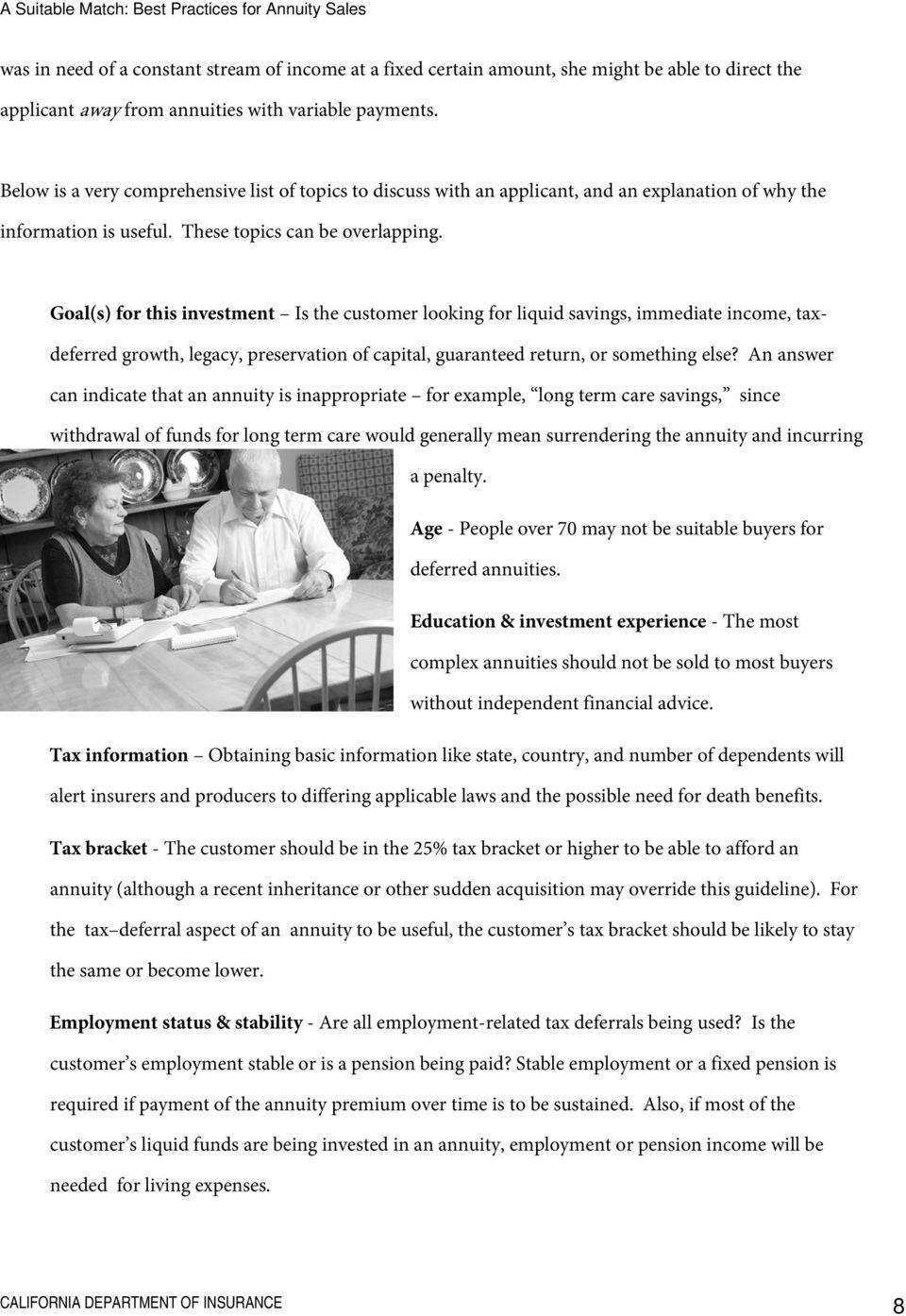
12 Although the customer s health and mental state are not mentioned as inquiry categories in the NAIC model, nor in any California statute or NASD rule, insurers and producers need to assess these customer attributes. Insurers must make it clear to producers that an inappropriate match, especially one that can be perceived as taking advantage of a customer s vulnerabilities, will not ultimately be in the interest of either the producer or the insurer. Insurer suitability standards flesh out the skeleton standards provided by law and industry associations. But the fully detailed personal financial portrait needed by the insurer to fit an annuity to a customer is to be gleaned from the answers to a thorough customer questionnaire. *** Mrs. S. purchased an annuity based on her agent s assurance that she could obtain a monthly income of at least $2,200 per month. The cost for her nursing home was $1,757. She was receiving approximately $550 in social security benefits. The first year s interest rate was 7.75%. After the first year, the minimum guaranteed interest rate was 2%. She was interested in maintaining her principal and did not understand that the interest would drop. For the first year, everything worked just as she expected. However, at the beginning of the second year, the monthly interest income dropped to approximately $900 per month and she was forced to borrow money from her daughter to cover her monthly expenses. The 10% penalty free withdrawal did not apply because she had been taking out the interest each month in the first year. Neither the agent nor the insurer seemed to think that her inability to cover her expenses was their problem. Customer Questionnaire *** How could the insurer and agent have known that Mrs. S required at least $1700 per month from her annuity? The customer questionnaire must go beyond basic identifying information. Insurer that want to be certain that a customer receives the right product will solicit detailed information about the applicant s current circumstances and future plans. While some applicants will balk at sharing these private matters, the insurer and the producer must explain that it is in the applicant s interest to divulge a great deal about finances and goals, so that a suitable match between product and applicant can be made. Giving an example of a mis-match will help. For instance, a producer could explain that if she knew that an applicant CALIFORNIA DEPARTMENT OF INSURANCE 7

13 was in need of a constant stream of income at a fixed certain amount, she might be able to direct the applicant away from annuities with variable payments. Below is a very comprehensive list of topics to discuss with an applicant, and an explanation of why the information is useful. These topics can be overlapping. Goal(s) for this investment Is the customer looking for liquid savings, immediate income, taxdeferred growth, legacy, preservation of capital, guaranteed return, or something else? An answer can indicate that an annuity is inappropriate for example, long term care savings, since withdrawal of funds for long term care would generally mean surrendering the annuity and incurring a penalty. Age - People over 70 may not be suitable buyers for deferred annuities. Education & investment experience - The most complex annuities should not be sold to most buyers without independent financial advice. Tax information Obtaining basic information like state, country, and number of dependents will alert insurers and producers to differing applicable laws and the possible need for death benefits. Tax bracket - The customer should be in the 25% tax bracket or higher to be able to afford an annuity (although a recent inheritance or other sudden acquisition may override this guideline). For the tax deferral aspect of an annuity to be useful, the customer s tax bracket should be likely to stay the same or become lower. Employment status & stability - Are all employment-related tax deferrals being used? Is the customer s employment stable or is a pension being paid? Stable employment or a fixed pension is required if payment of the annuity premium over time is to be sustained. Also, if most of the customer s liquid funds are being invested in an annuity, employment or pension income will be needed for living expenses. CALIFORNIA DEPARTMENT OF INSURANCE 8
14 Income & sources of income - Is there a need for immediate income? How much and must it stay constant? Cash/Net Worth - Since annuities are long-term commitments, available liquid assets as a percentage of net worth needs to be high. Annuities within the surrender period do not count as liquid assets. Emergency funds - At least six months of usual income should be available in liquid form. Other investments - An over-abundance of long-term investments should be avoided. Long Term Care insurance & Health insurance - If these types of insurance have not been purchased, they may be more advisable purchases than an annuity. At a minimum, they should be discussed and proposed as an option. Source of funds for annuity - If funds are from savings or checking accounts, will enough liquid funds be left for daily expenses? Is replacement of another annuity a wise choice? Is there a taxable event from the sale of mutual funds or stock? If funds are from another source 5, is there an IRA or other tax-deferred retirement plan available or is long term care insurance needed more than deferred or immediate income? Next of kin & dependents information - This is necessary for death benefits decisions and assessment of the need for current income and liquid assets. Survivor needs - Will survivors need income, funeral expenses, mortgage pay-offs, or other available cash (e.g., to pay off a debt to business partner of applicant). Need for significant funds within surrender period - Is it likely that funds will need to be withdrawn, e.g., for roof repair, grandchildren s education, debt pay-down? If so, a substantial portion of the annuity principal could be lost to a penalty and the annuity may not be an appropriate investment. Recent major medical problems for self or spouse - How likely are these problems to recur; will they require expensive health or assisted living care? Expected major changes in family or financial situation in the next 12 months? - Is there a pending retirement or grandchild adoption? CALIFORNIA DEPARTMENT OF INSURANCE 9

15 Time horizon for holding investment - This needs to be longer than the surrender period. Annuitization choice and irrevocability - Especially for immediate annuities, applicants need to understand that the amount of the regular payment and the regular date of the payment cannot be changed. Risk tolerance Assessing risk tolerance is important for equity-indexed annuities and variable annuities, because the annuitant s stream of income and underlying annuity value may be diminished depending upon how the funds in the annuity are invested. Names of other investment advisors, attorney or CPA - Under most circumstances, a knowledgeable advisor such as an attorney or a CPA should be consulted before the purchase of an annuity. Have Friends or Family been consulted about this investment? Especially if an independent professional advisor is not being consulted, producers should protect themselves by urging customers to consult a trusted third party regarding the annuity purchase. In determining suitability, the best practice is to determine whether some other use of available funds is more appropriate. Potentially more suitable alternative investments include: a pre-tax contribution to a retirement plan; purchase of a long-term care policy; purchase of a Certificate of Deposit or double-tax-free municipal bond. The insurer can offer the producer many tools to guide the producer to the right product once the answers to the questions are known. These include decision trees, computer programs, color-coded guideline booklets, and of course, consultation by phone, or in person. (See infra Producer Training and Education.) CALIFORNIA DEPARTMENT OF INSURANCE 10

16 Disclosures to and Education of the Purchaser The customer questionnaire forms the basis of a targeted education on annuities for the customer. Once the answers to the questionnaire, insurer guidelines and standards have channeled the producer to the most appropriate annuity products, the producer must make sure that the customer understands the products, and the differences between them. Quite often, this discussion will uncover more information about the customer, and may narrow the selection further. When a product is chosen, the disclosures must begin. Beyond mandated disclosures, producers and insurers can go further to educate the potential buyer about the complexities of the annuity contract. California has specific statutes 6 that govern sales of annuities to seniors, requiring written disclosures that are meant to alert the potential purchaser to specific rights and protections. These include a written notification that a home visit by an insurance agent will take place, a 30-day free look period during which a contract can be canceled; and written disclosure of surrender charges and penalties in at least 12-point type size for seniors. We suggest that these and additional disclosures be offered in even larger print format on request or if the consumer obviously has a sight impairment. In the experience of the California Department of Insurance (CDI), the two most important disclosures, which are not explicitly required, are (1) that an annuity is not a short-term investment; and (2) that the fees and costs associated with an annuity are usually higher than other investments like a CD. The CDI has found that many people do not understand the impact of a surrender fee on the value of their annuity, i.e., that while the early surrender of a CD may cause the owner to incur a penalty subtracted from interest, early surrender of a deferred annuity may cause surrender charges to be deducted from the principal. Also, many people do not understand that there are other tax-deferred savings and growth vehicles that might better suit their needs. For instance, they may be unaware that a mutual fund will have a stepped-up basis for their heirs while an annuity will not. CALIFORNIA DEPARTMENT OF INSURANCE 11
17 Additionally, most people need to be educated on the difference between an immediate and deferred annuity, as well as a fixed and variable annuity. Below we list some typical terms with meanings wellknown to insurers, but more obscure to potential annuity purchasers. In this section, we highlight some of the intricacies that should be explained to these customers. Immediate Annuity Insurers know that an immediate annuity is one that, in return for a premium, offers immediate payouts, over a set time period or for life. It may be the simplest contract to understand. But often it is not revealed that during a low interest rate environment, an immediate annuity with an equal installment payout period may not return the entire principal. Also, if it is the case, the potential annuitant needs to understand that there are no withdrawal rights, or if withdrawals are made, what effect that will have on payments. Traditional Fixed Annuity Traditionally, a fixed annuity is an insurance contract under which the insurer makes fixed dollar payments to the annuitant for the term of the contract, usually until the annuitant dies or for a set period of years. It can be immediate or deferred, and the insurer guarantees both principal and interest. It would be helpful to explain that a traditional fixed annuity would be particularly useful for those who have no interest in investment decision-making and who are in need of increased monthly income and level payments for life. A fixed annuity would be most appropriate for those with no need or desire to leave money to heirs or charity, since in a fixed annuity the amount remaining in the annuity at the annuitant s death stays with the insurance company. Also, the fixed annuity customer should be someone who is comfortable with the inability to vary payment amount, frequency or date of payment. The fixed annuity customer also needs to know what the credited interest rate is, how often it changes and why, and the minimum guaranteed rate of payment. Deferred Annuity Similarly, it could be explained that a deferred annuity is more useful than an immediate annuity for those who: do not currently need the money invested or the income from it; and CALIFORNIA DEPARTMENT OF INSURANCE 12

18 who are interested in diversifying into a non-qualified tax-deferred product because they have maxed out contributions to any available tax-deferred retirement plan. It should be explained that the IRS taxes the distributions from tax-deferred vehicles at ordinary income rates while investment in non-retirement accounts earn a portion of their return in the form of (usuallylower taxed) capital gains. For a Fixed Deferred Annuity with Market Value Adjustment, there needs to be an explanation of what happens to the payment amount and interest earned if the annuitant withdraws money before the end of the interest rate guarantee period, and what that period is. For a Deferred Annuity with Front-End Load, it should be explained that the front-end load might not be recovered if there is a full surrender or partial withdrawals, because there would be less principal upon which to earn an amount equal to or more than the subtracted amount of the front-end load. Equity-Indexed Annuity Equity-indexed annuities combine features of traditional insurance products (secure principal) and traditional securities (return linked to equity markets through an index). The customer needs to know what the index is and what the formula is for crediting or debiting the annuitant s account with the index s gains or losses. For instance, if a participation rate is used, what percentage of gain or loss on the index will be credited to or debited from the annuity? If there is a cap on the maximum rate of interest gain that will be credited, what is the cap and does it change? If the index-linked interest is determined by subtracting a percentage from any gain in the index (a margin, spread, or administrative fee ), what is the percentage subtracted? Also, the indexing method should be explained. Is it an annual reset or rachet, a point to point (what are the points?) or a high water mark (how is the high water mark identified)? How often is indexed interest credited? How might these factors change and what, if any, are the minimum guaranteed values? CALIFORNIA DEPARTMENT OF INSURANCE 13

19 If there is a minimum guarantee, the customer needs to understand whether the guarantee is based on an amount that s less than the full amount of the purchase payments, and how long it will take to break even based on receiving only the minimum guarantee. Variable Annuity A variable annuity provides the opportunity for both insurance (through periodic payments) and investment returns( through subaccounts that are invested in equities, bonds, money markets and mutual funds). Therefore, the customer s tolerance for risk and financial ability to bear risk are crucial attributes to ascertain in determining if this product is the right financial vehicle for them. The potential annuitant needs to know that subaccounts will have fluctuating values. If the funds chosen by the customer reflect the most conservative choice, it may indicate a lack of understanding of the reasons to choose this type of annuity. The customer may be more comfortable with a fixed-value annuity. Often variable deferred annuities are sold as part of retirement planning regimes and call for repetitive transactions, such as bank debit authorizations for dollar cost averaging. As the annuity owner ages, monitoring suitability of subaccounts on an ongoing basis is necessary for this type of product. It is also important that the customer understands that distributions from the annuity are taxed at ordinary income rates, not at capital gain rates. Moreover, the customer must understand who has control over the investment part of the product, especially since there is the potential for churning the account for commissions. Also, the customer needs to know if any of the subaccounts share the same name as a retail mutual fund but not the holdings, fees or operating expenses of that fund. Particularly Complex Options When there are complicated options (e.g. a fixed deferred annuity with First Year Rate enhancement that will credit a higher interest rate than contracts without a First Year Rate Enhancement), there should be a comparison chart that illustrates the short-term and long-term effect. Thus, the chart might show that after that first year, the interest rate is higher for contracts without that First Year Rate Enhancement. The Accumulation value early in the withdrawal period might be higher for the contracts with the First Year CALIFORNIA DEPARTMENT OF INSURANCE 14
20 Rate enhancement, but later on, the contracts without the First Year Rate Enhancement will likely have a higher value. Tax Implications Because annuities defer ordinary income taxes until annuitized or withdrawn, there is no tax reason to have an annuity in a tax-deferred account. Instead, there may be a disincentive that should be explained: if the annuitant starts to withdraw money prior to age 59.5, penalties may apply. One company includes one page, but comprehensive, retirement plan cost disclosures with every solicitation or account opening package for products aimed at 401(k), 403(b), 403(b)(7) and 457 retirement plans. If the potential annuitant will be over age 70.5 before the end of the surrender period, he or she may need to be advised that mandatory withdrawals from qualified accounts at age 70.5 and up is going to lead to a surrender charge. Also, customers should know that use of the annuity as collateral for a loan will end tax-deferred treatment. Potential annuitants must also understand that distributions from the annuity are taxed at ordinary income rates, not at capital gain rates. Liquidity A customer should be educated about limiting the percentage of non-real estate assets in an annuity. A conservative view is that no more than 25% of liquid net worth should be in an annuity. Similarly, no more than 20% of gross income annually should be paid as a contribution to premium. Source of Funds California requires by statute that certain disclosures be made when an annuity will be funded by the sale of stocks or mutual funds. California Insurance Code section provides in pertinent part: (a) "Elder" for purposes of this section means any person residing in this state who is 65 years of age or older. (b) If a life agent offers to sell to an elder any life insurance or annuity product, the life agent shall advise an elder or elder's agent in writing that the sale or liquidation of any stock, bond, IRA, certificate of deposit, mutual fund, annuity, or other asset to fund the purchase of this product may have tax consequences, early withdrawal penalties, or other costs or penalties as a result of the sale or liquidation, and that CALIFORNIA DEPARTMENT OF INSURANCE 15

21 the elder or elder's agent may wish to consult independent legal or financial advice before selling or liquidating any assets and prior to the purchase of any life or annuity products being solicited, offered for sale, or sold. Sale of annuities to fund a new annuity demand even more disclosure. Replacements California imposes certain duties on both the agent and the insurer when the funds for a new annuity are coming from the sale of an existing annuity. 7 When an existing annuity needs to be sold to fund a new annuity, it is imperative from a best practices standpoint to provide a comparison of benefits between the two annuities, as well as a clear catalogue of losses. Losses would include: loss of accrued interest; back-end sales loads (redemption fees); loss of death benefits, and of course, any surrender penalty. Comparisons should include the two companies A.M. Best or similar rating, interest rates, cap rates, spread, participation rates or other methods of determining how funds will accrue to or be debited from the principal, and surrender penalty rates. There should also be a comparison of the two annuities with respect to payouts between equal annuitization periods, as well as of guarantees on accrual of interest, minimum withdrawals, payouts and other features. Note should also be made of any new surrender penalty period or the likely extension of the existing one. Fees & Costs One sample disclosure that CDI received starts out by warning the consumer, This retirement plan is not free. Indeed, an applicant should be informed about applicable premium fees, processing fees, expense fees, records fees, annuity payment fees, statement fees, back and front end loads, management fees, contract fees, transaction fees, percentage of net assets charges, investment advisory fees, market value adjustment fees, mortality fees, the cost of each additional guarantee or rider and any fees, charged expenses or other costs deducted from interest or principal. Producers should disclose as well as how often the fees, costs, charges or deductions are taken. Full transparency would suggest that the life producer s commission on the sale of the annuity should also be revealed. CALIFORNIA DEPARTMENT OF INSURANCE 16
22 Disclosures of fees and expenses should include an estimate of what percentage of the average annuity account balance goes to pay fees each year and a table showing how product fees might affect the product s end-of-year balance over a 20-year period. Annuitization The potential owner needs to know how long the period is until money (beyond a minimum guaranteed annual withdrawal) can be withdrawn. The term annuitization should be explained as the period when the annuitant starts to receive regular payments from the annuity. Customers need to know if the annuity permits early annuitization (i.e., before the surrender charge period has expired and the annuity has matured). They need to know the consequences of early annuitization: they will receive less money in the form of periodic payments. They should also be advised that early annuitization may adversely affect their right to any promised bonuses if this is the case. Surrender Period and Penalty Annuitants sometimes take all or part of their funds from the annuity prior to annuitization. Customers need to know that there are penalties for these early withdrawals usually called surrender charges and they need to know how many years they will be subject to such charges if they withdraw funds in excess of the penalty-free amount. They need to know that in addition to paying a penalty on a partial withdrawal, there will be other consequences such as reduced future annuity payments. A potential annuitant needs to know if there is a surrender penalty assessed upon death if death occurs the surrender period and the annuitant s heirs wish a lump sum payment instead of continuing to take payments based on annuitization. Bonus Features If the annuity being considered offers a bonus feature, it is imperative to reveal when the annuity owner actually has access to the bonus. Often, bonuses are not paid immediately and therefore may not really offset a surrender charge paid when an annuity within a surrender period is liquidated to fund a replacement annuity. The customer needs to know what actions can eliminate the bonus opportunity, such as a partial withdrawal or early annuitization. The customer needs to understand whether there are specific fees or additional years of a surrender fee associated with choosing the bonus feature. CALIFORNIA DEPARTMENT OF INSURANCE 17
23 Maturity The customer needs to know what happens at annuitization. Is there a surrender fee even at maturity, as is the case sometimes if a lump sum payout is chosen instead of payouts over a lengthy period? What are the consequences if the owner wants to leave the money in the annuity and put off annuitizing until a later date? Death Benefit Is there one? How much is it? How will it be paid? When will it be paid? What is the charge or percentage deduction from account value for guaranteed minimum death benefits that lock in a gain in subaccounts? Can an increased payout amount be received for forgoing any death benefit? How will death benefits be taxed (subject to a step-up basis or not)? Will a death benefit to a named beneficiary bypass probate? Medi-Cal Eligibility A producer and an insurer must not promise or imply that an annuity can shelter assets in order to qualify a senior for Medi-Cal. 8 California Insurance Code section provides explicit disclosures that must be made to people over age 65 regarding annuities and Medi-Cal eligibility. Insurers should also check for updates from both the Department of Health Services and the Department of Insurance on necessary disclosures on this topic as California law may change in keeping with federal law changes. Long Term Care Needs Some new products are including long-term care provisions as part of the contract. The details of how this benefit can be accessed must be fully explained. If there is a nursing home waiver that allows withdrawal of funds for such care, explain if nursing home waiver only applies to nursing homes, not assisted-living or other rehabilitative facilities, and how many consecutive days in the nursing home are necessary to trigger this provision. CALIFORNIA DEPARTMENT OF INSURANCE 18
24 Distributions Producers should explain how distribution of funds from the annuity (whether interest earnings or withdrawal of principal) are treated for income and estate tax purposes. Company Solvency Producers should disclose the insurer s A.M. Best Rating, S&P rating, Fitch and Moody s Ratings. Producer Licensure/Consumer Complaints The CDI website address ( and Hotline number ( ) should be offered so that the customer can check that the producer is licensed in the state. The information may also be useful in case of later problems. Independent Advice Finally, the customer should be verbally cautioned to get independent legal or financial advice, especially before he or she sells or liquidates any holdings to purchase an annuity. This admonition is in addition to the written warning mandated by the Insurance Code. This laborious process of education and disclosure should lead to fewer unsuitable annuity sales and more satisfied customers. But insurers can still do more to catch errors and protect themselves and their customers. *** Mrs. Y met the agent at a seminar he was conducting about protecting one s assets. She made an appointment with him to come to her house to discuss her financial situation. At that time, she was 85 years old and living alone in her house. She was trying to decide whether to stay in the house o r move to a retirement hom e. Due to this potential change in her living situation, she was in a state of depression. She was also suffering from several health problems that she described to the agent including asthma, emphysema, TB, abdominal aortic aneurysm, and macular degeneration. The agent was always very nice during their meetings and did not pressure her in any way or use any scare tactics. The agent suggested that she cash in some investments and purchase an annuity. She purchased a single premium annuity for $138,000. A few month s later, when she came out of her depression, she realized that the annuity she purchased would not mature for fifteen years. She also realized that she would probably not survive fo r fifteen years especially given the state of her health. She surrendered the annuity and was surprised that the CALIFORNIA DEPARTMENT OF INSURANCE 19
25 insurance company charged her a surrender fee of $12, She feels that the insurance company should have noticed that the annuity was not appropriate for her, given her age and poor health, and should not have approved the application in the first place. She also feels the agent did not act in good faith since he had been advised of her health problems, but still sold her a long-deferred annuity. *** Insurer Review of Applications If there is one finding that the research for this report supports, it is that the best practice for an insurer is to review the annuity application of every applicant to ensure an appropriate match between product and purchaser, particularly when annuities are being sold to seniors. Our survey indicated that some insurers have dedicated suitability review units to undertake this task. Other companies have the agent and two supervisors review the files to ensure suitability and sign a document indicating that they have done so. More companies have a single person do an annual spot check on a random sample of files. Unfortunately, some companies do not review applications at all, leaving the decision on suitability to the producer. In their responses, many insurers took the view that allowing the producer to determine whether a particular annuity is suitable for the customer, accompanied by annual spot checks, is in keeping with the NAIC model regulation. 10 In our view, it is not the best practice to wait until an unsuitable sale has been made and then try to unwind it. Not only may significant harm be done to the finances of the customer, but it harms the reputation of the company as well. Moreover, the large commissions paid to producers on annuity sales make unsuitable sales very tempting indeed. It may be a matter of judgment whether the sale is unsuitable in such a case, it will be more in the interest of the insurer than the producer to determine the suitability of the sale. Notably, proposed NASD rule 2821 requires principal review and approval of a customer application for a deferred variable annuity, within two business days after a member has sent it to the issuing insurance CALIFORNIA DEPARTMENT OF INSURANCE 20
26 company. This review applies to both a purchase and an exchange. The principal shall consider and sign documentation of consideration regarding: Extent of customer benefit; Extent to which age or liquidity needs make the investment inappropriate; Extent to which the amount to be invested would result in undue concentration in deferred variable annuity(ies) in the context of the customer s overall investment portfolio; If an exchange, the extent to which the customer would incur a surrender charge, commence a new surrender period, lose death or existing benefits, or be subject to increased fees or charges (such as mortality & expense fees, investment advisory fees, and charges for riders and similar product enhancements); If an exchange, the extent to which the customer would benefit from any potential product enhancements and improvements; If an exchange, the extent to which the customer s account has had another deferred variable annuity exchange within the preceding 36 months. Moreover, the proposed rule requires a member to establish and maintain written supervisory procedures reasonably designed to achieve compliance with the standards of the rule and, additionally, to discern whether the person effecting the transaction has a particularly high rate of effecting deferred variable annuity exchanges. The NASD, like the Insurance Commissioner, also recommends that insurers develop systems for reviewing applications, rather than only written practices and policies for producers to follow. Running the application through a computer system loaded with a suitability rules engine that will automatically red flag problematic applications is an effective first screen. Certainly the insurer should review these kickedout applications and investigate further if there appears to be missing or unusual information in the application. In these cases, close review of the customer questionnaire and disclosures made will be necessary. But computers alone cannot provide detection of all unsuitable sales. CALIFORNIA DEPARTMENT OF INSURANCE 21
27 A best practice system for review of annuity sales must include more than review of the computer-flagged applications. Of course, a multi-state insurer should ensure that all the producers selling its insurance products in California are licensed in the state. One easy way to ensure that the applicant will get a suitable product is for the company to send the application and suitability questionnaire back to the applicant to acknowledge that everything in the documents is correct, with a pre-stamped return envelope to facilitate and encourage response. If the form is not returned, the applicant should be contacted by the insurer, or the file closed and payment returned. If there is a consistent pattern of applicant answer changes for specific producers, follow-up training for that producer should be conducted. An additional safeguard is independent review by a company principal or suitability specialist of consumer questionnaires, applications, and disclosures. Contacting the customer directly will be necessary whenever a red flag shows up: Is there a disconnect between the goals of the annuitant (e.g., immediate need for income) and the annuity being sold (e.g., deferred annuity.)? Is the annuitant over the age of 65? Has this producer been selling to too many very mature annuitants (over 75)? Has an annuity been replaced or has a loan been taken to fund a new annuity? Was the contract signed on the same day that the producer first contacted the annuitant? Does it appear that the purchase of this annuity would mean that the applicant would have more than 25% of liquid net worth in annuities? Does the annuitant have more than one annuity? Are the purchase funds from the replacement of another annuity? More comprehensive review by the insurer can only help the customer. Additionally, this review will discern patterns of unsuitable sales among producers selling annuities on behalf of an insurer. The producer s annuity sales should be further scrutinized and reassessed for suitability, and further remedial education may be in order. CALIFORNIA DEPARTMENT OF INSURANCE 22
28 Producer Training and Education While it appears that many companies do not offer special training to independent producers regarding their products, California does require that agents complete eight hours of training prior to soliciting individual consumers to sell annuities as well as four hours in annuity-related training every two years as a condition for license renewal (Cal. Ins. Code section 1749). This training must be approved by the Commissioner and may not be primarily intended to promote the sale of annuities, but rather to protect consumers. Specifically, this training is to include the recognition of indicators that a prospective insured may lack the short-term memory or judgment to knowingly purchase the insurance product. One of the best sources for producer education, in addition to periodic training, is a Policy Manual. Such a manual can set forth the company s specific policies on suitability and disclosure, in addition to the suitability assessment responsibilities embodied in the NASD Conduct Rules if applicable. Oftentimes, these manuals can also include: Sample questions Checklists for disclosures Replacement Comparison Matrix forms State specific requirements Review of features chosen do they indicate another, less costly product is a better option One insurer operating in California has a senior suitability supervisor s manual that is 50 pages long; this could be shared with producers. After a narrative about considerations for sales to seniors, it has a step-bystep decision tree that covers what should be done when anomalies are encountered in an application. For instance, if an applicant s income is less than $25,000, the supervisor is to contact the agent to verify that it is earned income before a tax-qualified annuity is approved. The next step, if it is earned income but is less than the initial payment for the annuity, is to check whether the initial payment is from a checking or savings account. If so, the manual directs that further inquiry with the applicant is necessary to determine whether the annuity is suitable. (Presumably, one would inquire whether any liquid assets will remain for CALIFORNIA DEPARTMENT OF INSURANCE 23
29 emergencies and if so, whether there is a tax-deferred retirement fund that would be less costly.) The manual continues in this manner, using different fact patterns and resultant actions. This company also has a Suitability Specialist with whom the supervisors can consult if they are not sure what to do in a particular case. In every fact pattern, if the applicant does not respond or gives an answer that indicates that the sale is unsuitable, the application is declined. If a decision tree is not workable, we have seen other companies use flow charts, booklets with colorblocked overlay pages or other color coding, and computer- assisted analyses to help a producer make the right decision on an application. Because not everyone learns best by reading, new selling agents should also have the opportunity to have personal training with question & answer sessions on each of the company-specific forms and procedures for annuity sales. Role-playing can be a very effective teaching method to make the point that not every sale is an appropriate sale. Of course, California-specific training would include California s explicit prohibitions and mandates regarding sales to seniors. 11 Producers can be just as baffled by the complexity of today s annuity products as a purchaser. Since the producer is the person working closely with the customer, representing the insurer s products, it behooves the industry to train these producers rigorously to eliminate inappropriate sales before they are made. CALIFORNIA DEPARTMENT OF INSURANCE 24
30 CONCLUSION As the Baby Boom generation retires, the search for appropriate financial vehicles to protect capital and provide income will intensify. Life insurers and producers have a key role to play as the matchmakers between these customers and industry products. With this report, the Commissioner urges the life insurance industry to do the best job possible to ensure a suitable match for its customers. For vulnerable seniors, the industry has an explicit duty of honesty, good faith and fair dealing. 11 This statute requires a conscientious protocol to ensure that annuity products are being sold to help the customer, not just the producer. Ideally, such efforts should include: Writing suitability standards and guidelines for each annuity product Training producers, both captive and independent, on those suitability standards Using a thorough customer questionnaire as an opportunity to educate the customer Going beyond the required disclosures to ensure understanding Reviewing every annuity application for suitability of the match Requiring every producer to urge senior customers to have a trusted family member or professional advisor with them before making any investment decisions. The insurance industry is about the business of providing security against financial hardship and disaster. In our complex world, there is a place for complex products. But there is no place for unscrupulous or sloppy sales practices. Every life insurer selling annuities should adopt a version of these best practices and truly provide the financial security that so many Californians seek. CALIFORNIA DEPARTMENT OF INSURANCE 25
31 1 NAVA 2006 Annuity Fact Book, p. 101, Table ENDNOTES 2 Of those, eighteen did not write annuities in California, and one writes only funeral annuities. 3 The original language of SB 192 was as follows: (a) Every insurer or other entity marketing annuities shall: (1) Develop and use written suitability standards to determine whether the purchase or replacement of an annuity contract is appropriate for the needs of a senior applicant or annuitant if the applicant or annuitant is 65 years old or older; (2) Develop and use procedures to determine whether the sale and marketing of annuity contracts to seniors meets the suitability standards developed by the insurer; (3) Train its agents that they shall use the suitability standards developed by the insurer in marketing annuities; (4) Maintain a copy of its suitability standards and make them available for inspection upon request by the commissioner. The commissioner may order amendment or revision of the suitability standards if any portion violates California or other applicable law; (5) Conduct periodic reviews of its records that are reasonably designed to assist in detecting and preventing violations of this section and the applicable suitability standards. (b) The suitability standards developed by the insurer shall take into account the senior s insurance needs and goals, including but not limited to the following: (1) The senior s age; (2) The senior s investment experience; (3) The senior s current financial status, assets and ability to pay for the proposed annuity; (4) Whether the senior is selling real estate in order to finance the purchase of the annuity; (5) The senior s goals or needs with respect to the annuity and the advantages and disadvantages of investing in this annuity to meet these goals or needs; (6) The value, benefits, and costs of the senior s existing investments, if any, when compared to the values, benefits, and costs of the proposed annuity purchase; (7) Whether the senior is replacing an existing annuity, and whether the replacement is unnecessary as defined in Insurance code section ; (8) The disadvantages related to the conversion of any existing investments, savings or other sources of funding for the proposed annuity; (9) The senior s need to have funds readily available for major expenses, including emergency expenses, that may arise from time to time in their daily lives, and the affect of the annuity purchase on the applicant s ability to access those funds; (10) The availability of funds for catastrophic life changes that may lead to long term in-home health care or a change of domicile into a long term care setting such as a continuing care, assisted living, residential care or nursing home; (11) The tax advantages and disadvantages of the annuity purchase to the senior at the time of the purchase; (12) The senior s ability to pay capital gains taxes that may arise from selling assets in order to purchase an annuity; (13) Whether the senior believes that the annuity will allow him/her to qualify for Medi-Cal or Medicaid and whether any other factors identified in section apply; (14) Whether the senior is aware of the state s Medi-Cal recovery program against annuities and whether he/she believes that recovery of the annuity by the state s Medi-Cal recovery is consistent with the applicant s testamentary wishes; and, (15) Whether the senior was adequately informed of any limitations, penalties or other adverse consequences for accessing the annuity funds prior to the maturity date, or for changing the maturity date. (c) The insurer, and where an agent is involved, the agent, shall make reasonable efforts to obtain the information set out in subdivision (b) and may request that the senior applicant provide additional information necessary to determine suitability. (d) The insurer shall use the suitability standards it has developed pursuant to this section in determining whether issuing the annuity is appropriate for the senior. If the insurer determines that the senior does not meet its financial suitability standards, or if the senior applicant has declined to provide the information requested, the insurer shall reject the application. (e) The insurer shall report the following information to the commissioner on an annual basis: (1) The total number of applications for annuities received from residents of this state; CALIFORNIA DEPARTMENT OF INSURANCE 26
32 (2) The age of the applicants; (3) The number of applicants or annuitants who did not meet the insurer s suitability standards; (4) If the insurer s suitability standards include a provision for special exemptions to the standards, the number of applicants who were issued annuities after obtaining an exemption from the insurer s suitability standards; and, (5) The reason that the insurer granted an exemption. (f) Any provision in this section that is in conflict with the provisions of Corporations Code section et.seq. shall be of no force or effect. 4 The National Association of Insurance Commissioner Model Regulation for Suitability in Annuity Transactions: Section 1. Purpose A. The purpose of this regulation is to set forth standards and procedures for recommendations to consumers that result in a transaction involving annuity products so that the insurance needs and financial objectives of consumers at the time of the transaction are appropriately addressed. B. Nothing herein shall be construed to create or imply a private cause of action for a violation of this regulation. Drafting Note: The language of Subsection B comes from the NAIC Unfair Trade Practices Act. If a state has adopted different language, it should be substituted for Subsection B. Section 2. Scope This regulation shall apply to any recommendation to purchase or exchange an annuity made to a consumer by an insurance producer, or an insurer where no producer is involved, that results in the purchase or exchange recommended. Section 3. Authority This regulation is issued under the authority of [insert reference to enabling legislation]. Drafting Note: States may wish to use the Unfair Trade Practices Act as enabling legislation or may pass a law with specific authority to adopt this regulation. Section 4. Exemptions Unless otherwise specifically included, this regulation shall not apply to recommendations involving: A. Direct response solicitations where there is no recommendation based on information collected from the consumer pursuant to this regulation; B. Contracts used to fund: (1) An employee pension or welfare benefit plan that is covered by the Employee Retirement and Income Security Act (ERISA); (2) A plan described by Sections 401(a), 401(k), 403(b), 408(k) or 408(p) of the Internal Revenue Code (IRC), as amended, if established or maintained by an employer; CALIFORNIA DEPARTMENT OF INSURANCE 27
33 (3) A government or church plan defined in Section 414 of the IRC, a government or church welfare benefit plan, or a deferred compensation plan of a state or local government or tax exempt organization under Section 457 of the IRC; (4) A nonqualified deferred compensation arrangement established or maintained by an employer or plan sponsor; (5) Settlements of or assumptions of liabilities associated with personal injury litigation or any dispute or claim resolution process; or (6) Formal prepaid funeral contracts. Section 5. Definitions A. Annuity means a fixed annuity or variable annuity that is individually solicited, whether the product is classified as an individual or group annuity. B. Insurer means a company required to be licensed under the laws of this state to provide insurance products, including annuities. C. Insurance producer means a person required to be licensed under the laws of this state to sell, solicit or negotiate insurance, including annuities. D. Recommendation means advice provided by an insurance producer, or an insurer where no producer is involved, to an individual consumer that results in a purchase or exchange of an annuity in accordance with that advice. Section 6. Duties of Insurers and of Insurance Producers A. In recommending to a consumer the purchase of an annuity or the exchange of an annuity that results in another insurance transaction or series of insurance transactions, the insurance producer, or the insurer where no producer is involved, shall have reasonable grounds for believing that the recommendation is suitable for the consumer on the basis of the facts disclosed by the consumer as to his or her investments and other insurance products and as to his or her financial situation and needs. B. Prior to the execution of a purchase or exchange of an annuity resulting from a recommendation, an insurance producer, or an insurer where no producer is involved, shall make reasonable efforts to obtain information concerning: (1) The consumer s financial status; (2) The consumer s tax status; (3) The consumer s investment objectives; and CALIFORNIA DEPARTMENT OF INSURANCE 28
34 (4) Such other information used or considered to be reasonable by the insurance producer, or the insurer where no producer is involved, in making recommendations to the consumer. C. (1) Except as provided under Paragraph (2) of this subsection, neither an insurance producer, nor an insurer where no producer is involved, shall have any obligation to a consumer under Subsection A related to any recommendation if a consumer: (a) (b) (c) Refuses to provide relevant information requested by the insurer or insurance producer; Decides to enter into an insurance transaction that is not based on a recommendation of the insurer or insurance producer; or Fails to provide complete or accurate information. (2) An insurer or insurance producer s recommendation subject to Paragraph (1) shall be reasonable under all the circumstances actually known to the insurer or insurance producer at the time of the recommendation. D. (1) An insurer either shall assure that a system to supervise recommendations that is reasonably designed to achieve compliance with this regulation is established and maintained by complying with Paragraphs (3) to (5) of this subsection, or shall establish and maintain such a system, including, but not limited to: (a) (b) Maintaining written procedures; and Conducting periodic reviews of its records that are reasonably designed to assist in detecting and preventing violations of this regulation. (2) A general agent and independent agency either shall adopt a system established by an insurer to supervise recommendations of its insurance producers that is reasonably designed to achieve compliance with this regulation, or shall establish and maintain such a system, including, but not limited to: (a) (b) Maintaining written procedures; and Conducting periodic reviews of records that are reasonably designed to assist in detecting and preventing violations of this regulation. (3) An insurer may contract with a third party, including a general agent or independent agency, to establish and maintain a system of supervision as required by Paragraph (1) with respect to insurance producers under contract with or employed by the third party. (4) An insurer shall make reasonable inquiry to assure that the third party contracting under Paragraph (3) of this subsection is performing the functions required under Paragraph (1) of this subsection and shall take such action as is reasonable under the circumstances to enforce the contractual obligation to perform the functions. An insurer may comply with its obligation to make reasonable inquiry by doing all of the following: (a) (b) The insurer annually obtains a certification from a third party senior manager who has responsibility for the delegated functions that the manager has a reasonable basis to represent, and does represent, that the third party is performing the required functions; and The insurer, based on reasonable selection criteria, periodically selects third parties contracting under Paragraph (3) of this subsection for a review to determine whether CALIFORNIA DEPARTMENT OF INSURANCE 29
35 the third parties are performing the required functions. The insurer shall perform those procedures to conduct the review that are reasonable under the circumstances. (5) An insurer that contracts with a third party pursuant to Paragraph (3) of this subsection and that complies with the requirements to supervise in Paragraph (4) of this subsection shall have fulfilled its responsibilities under Paragraph (1) of this subsection. (6) An insurer, general agent or independent agency is not required by Paragraph (1) or (2) of this subsection to: (a) (b) Review, or provide for review of, all insurance producer solicited transactions; or Include in its system of supervision an insurance producer s recommendations to consumers of products other than the annuities offered by the insurer, general agent or independent agency. (7) A general agent or independent agency contracting with an insurer pursuant to Paragraph (3) of this subsection shall promptly, when requested by the insurer pursuant to Paragraph (4) of this subsection, give a certification as described in Paragraph (4) of this subsection or give a clear statement that it is unable to meet the certification criteria. (8) No person may provide a certification under Paragraph (4)(a) of this subsection unless: (a) (b) The person is a senior manager with responsibility for the delegated functions; and The person has a reasonable basis for making the certification. E. Compliance with the National Association of Securities Dealers Conduct Rules pertaining to suitability shall satisfy the requirements under this section for the recommendation of variable annuities. However, nothing in this subsection shall limit the insurance commissioner s ability to enforce the provisions of this regulation. Drafting Note: This subsection is intended to grant a safe harbor when the NASD has reviewed a transaction and found that it complies with the NASD Conduct Rules pertaining to suitability. CALIFORNIA DEPARTMENT OF INSURANCE 30
36 Section 7. Mitigation of Responsibility A. The commissioner may order: (1) An insurer to take reasonably appropriate corrective action for any consumer harmed by the insurer s, or by its insurance producer s, violation of this regulation; Drafting Note: Section 7A(1) is not intended to apply to violations by an insurance producer who, under a state s laws, is not an insurer s agent. A state may wish to review this issue and, if necessary, clarify that the paragraph does not apply to brokers who are agents of the consumer, not the insurer. (2) An insurance producer to take reasonably appropriate corrective action for any consumer harmed by the insurance producer s violation of this regulation; and (3) A general agency or independent agency that employs or contracts with an insurance producer to sell, or solicit the sale, of annuities to consumers, to take reasonably appropriate corrective action for any consumer harmed by the insurance producer s violation of this regulation. Drafting Note: A consumer may have a right to seek relief through NASD arbitration for sale of a variable annuity in violation of the NASD Conduct Rules pertaining to suitability. State insurance departments may wish to consider this right when determining whether to bring an action requiring corrective action under Subsection A. B. Any applicable penalty under [insert statutory citation] for a violation of Section 6A, B, or C(2) of this regulation may be reduced or eliminated [, according to a schedule adopted by the commissioner,] if corrective action for the consumer was taken promptly after a violation was discovered. Drafting Note: A state that has authority to adopt a schedule of penalties may wish to include the words in brackets. In that case, shall should be substituted for may in the same sentence. Section 8. [Optional] Recordkeeping A. Insurers, general agents, independent agencies and insurance producers shall maintain or be able to make available to the commissioner records of the information collected from the consumer and other information used in making the recommendations that were the basis for insurance transactions for [insert number] years after the insurance transaction is completed by the insurer. An insurer is permitted, but shall not be required, to maintain documentation on behalf of an insurance producer. Drafting Note: States should review their current record retention laws and specify a time period that is consistent with those laws. For some states this time period may be five (5) years. B. Records required to be maintained by this regulation may be maintained in paper, photographic, microprocess, magnetic, mechanical or electronic media or by any process that accurately reproduces the actual document. Drafting Note: This section may be unnecessary in states that have a comprehensive recordkeeping law or regulation. CALIFORNIA DEPARTMENT OF INSURANCE 31
37 5 Other one-off sources include inheritance, gift, legal settlement or sale of real estate. Roll-overs, transfers and 1035 exchanges may or may not entail fees, so the economic benefit of the purchase should be analyzed. 6 Insurance Code : (a) This section applies to the sale, offering for sale, or generation of leads for the sale of life insurance, including annuities, to senior insureds or prospective insureds by any person. (b) Any person who meets with a senior in the senior's home is required to deliver a notice in writing to the senior no less than 24 hours prior to that individual's initial meeting in the senior's home. If the senior has an existing insurance relationship with an agent and requests a meeting with the agent in the senior's home the same day, a notice shall be delivered to the senior prior to the meeting. The notice shall be in substantially the following form, with the appropriate information inserted, in 14-point type: "(1) During this visit or a followup visit, you will be given a sales presentation on the following (indicate all that apply): ( ) Life insurance, including annuities ( ) Other insurance products (specify):. (2) You have the right to have other persons present at the meeting, including family members, financial advisors or attorneys. (3) You have the right to end the meeting at any time. (4) You have the right to contact the Department of Insurance for information, or to file a complaint. (The notice shall include the consumer assistance telephone numbers at the department) (5) The following individuals will be coming to your home: (list all attendees, and insurance license information, if applicable)" (c) Upon contacting the senior in the senior's home, the person shall, before making any statement other than a greeting, or asking the senior any other questions, state that the purpose of the contact is to talk about insurance, or to gather information for a followup visit to sell insurance, if that is the case, and state all of the following information: (1) The name and titles of all persons arriving at the senior's home. (2) The name of the insurer represented by the person, if known. (d) Each person attending a meeting with a senior shall provide the senior with a business card or other written identification stating the person's name, business address, telephone number, and any insurance license number. (e) The persons attending a meeting with a senior shall end all discussions and leave the home of the senior immediately after being asked to leave by the senior. (f) A person may not solicit a sale or order for the sale of an annuity or life insurance policy at the residence of a senior, in person or by telephone, by using any plan, scheme, or ruse that misrepresents the true status or mission of the contact. Insurance Code (a) Every policy of individual life insurance and every individual annuity contract that is initially delivered or issued for delivery to a senior citizen in this state on and after July 1, 2004, shall have printed thereon or attached thereto a notice stating that, after receipt of the policy by the owner, the policy may be returned by the owner for cancellation by delivering it or mailing it to the insurer or agent from whom it was purchased. The period of time set forth by the insurer for return of the policy by the owner shall be clearly stated on the notice and this period shall be not less than 30 days. The owner may return the policy to the insurer by mail or otherwise at any time during the period specified in the notice. During the 30-day cancellation period, the premium for a variable annuity may be invested only in fixed-income investments and money-market funds, unless the investor specifically directs that the premium be invested in the mutual funds underlying the variable annuity contract. Return of the policy within the 30-day cancellation period shall have one of the following effects: (1) In the case of individual life insurance policies and variable annuity contracts for which the owner has not directed that the premium be invested in the mutual funds underlying the contract during the cancellation period, return of the policy during the cancellation period shall have the effect of voiding the policy from the beginning, and the parties shall be in the same position as if no policy had been issued. All premiums paid and any policy fee paid for the policy shall be refunded by the insurer to the owner within 30 days from the date that the insurer is notified that the owner has canceled the policy. The premium and policy fee shall be refunded by the insurer to the owner within 30 days from the date that the insurer is notified that the owner has canceled the policy. (2) In the case of a variable annuity for which the owner has directed that the premium be invested in the mutual funds underlying the contract during the 30-day cancellation period, cancellation shall entitle the owner to a refund of the account value. The account value shall be refunded by the insurer to the owner within 30 days from the date that the insurer is notified that the owner has canceled the contract. (b) This section applies to all individual policies issued or delivered to senior citizens in this state on or after January 1, All policies subject to this section which are in effect on January 1, 2003, shall be construed to be in compliance with this section, and any provision in any policy which is in conflict with this section shall be of no force or effect. CALIFORNIA DEPARTMENT OF INSURANCE 32
38 (c) Every individual life insurance policy and every individual annuity contract, other than variable contracts and modified guaranteed contracts, subject to this section, that is delivered or issued for delivery in this state shall have the following notice either printed on the cover page or policy jacket in 12-point bold print with one inch of space on all sides or printed on a sticker that is affixed to the cover page or policy jacket: "IMPORTANT YOU HAVE PURCHASED A LIFE INSURANCE POLICY OR ANNUITY CONTRACT. CAREFULLY REVIEW IT FOR LIMITATIONS. THIS POLICY MAY BE RETURNED WITHIN 30 DAYS FROM THE DATE YOU RECEIVED IT FOR A FULL REFUND BY RETURNING IT TO THE INSURANCE COMPANY OR AGENT WHO SOLD YOU THIS POLICY. AFTER 30 DAYS, CANCELLATION MAY RESULT IN A SUBSTANTIAL PENALTY, KNOWN AS A SURRENDER CHARGE." The phrase "after 30 days, cancellation may result in a substantial penalty, known as a surrender charge" may be deleted if the policy does not contain those charges or penalties. (d) Every individual variable annuity contract, variable life insurance contract, or modified guaranteed contract subject to this section, that is delivered or issued for delivery in this state, shall have the following notice either printed on the cover page or policy jacket in 12-point bold print with one inch of space on all sides or printed on a sticker that is affixed to the cover page or policy jacket: "IMPORTANT YOU HAVE PURCHASED A VARIABLE ANNUITY CONTRACT (VARIABLE LIFE INSURANCE CONTRACT, OR MODIFIED GUARANTEED CONTRACT). CAREFULLY REVIEW IT FOR LIMITATIONS. THIS POLICY MAY BE RETURNED WITHIN 30 DAYS FROM THE DATE YOU RECEIVED IT. DURING THAT 30-DAY PERIOD, YOUR MONEY WILL BE PLACED IN A FIXED ACCOUNT OR MONEY-MARKET FUND, UNLESS YOU DIRECT THAT THE PREMIUM BE INVESTED IN A STOCK OR BOND PORTFOLIO UNDERLYING THE CONTRACT DURING THE 30-DAY PERIOD. IF YOU DO NOT DIRECT THAT THE PREMIUM BE INVESTED IN A STOCK OR BOND PORTFOLIO, AND IF YOU RETURN THE POLICY WITHIN THE 30-DAY PERIOD, YOU WILL BE ENTITLED TO A REFUND OF THE PREMIUM AND POLICY FEES. IF YOU DIRECT THAT THE PREMIUM BE INVESTED IN A STOCK OR BOND PORTFOLIO DURING THE 30- DAY PERIOD, AND IF YOU RETURN THE POLICY DURING THAT PERIOD, YOU WILL BE ENTITLED TO A REFUND OF THE POLICY'S ACCOUNT VALUE ON THE DAY THE POLICY IS RECEIVED BY THE INSURANCE COMPANY OR AGENT WHO SOLD YOU THIS POLICY, WHICH COULD BE LESS THAN THE PREMIUM YOU PAID FOR THE POLICY. A RETURN OF THE POLICY AFTER 30 DAYS MAY RESULT IN A SUBSTANTIAL PENALTY, KNOWN AS A SURRENDER CHARGE." The words "known as a surrender charge" may be deleted if the contract does not contain those charges. (e) This section does not apply to life insurance policies issued in connection with a credit transaction or issued under a contractual policy-change or conversion privilege provision contained in a policy. Additionally, this section shall not apply to contributory and noncontributory employer group life insurance, contributory and noncontributory employer group annuity contracts, and group term life insurance, with the exception of subdivision (f). (f) When an insurer, its agent, group master policyowner, or association collects more than one month's premium from a senior citizen at the time of application or at the time of delivery of a group term life insurance policy or certificate, the insurer must provide the senior citizen a prorated refund of the premium if the senior citizen delivers a cancellation request to the insurer during the first 30 days of the policy period. (g) For purposes of this chapter, a senior citizen means an individual who is 60 years of age or older on the date of purchase of the policy. Insurance Code Every insurer and life agent offering for sale individual life insurance policies or individual annuity contracts that are initially delivered or issued for delivery to senior citizens in this state on and after January 1, 1995, with the use of nonpreprinted illustrations of nonguaranteed values shall disclose on those illustrations or on an attached cover sheet, in bold or underlined capitalized print, or in the form of a contrasting color sticker, bright highlighter pen, or in any manner that makes it more prominent than the surrounding material, with at least one-half inch space on all four sides, the following statement: CALIFORNIA DEPARTMENT OF INSURANCE 33
39 "THIS IS AN ILLUSTRATION ONLY. AN ILLUSTRATION IS NOT INTENDED TO PREDICT ACTUAL PERFORMANCE. INTEREST RATES, DIVIDENDS, OR VALUES THAT ARE SET FORTH IN THE ILLUSTRATION ARE NOT GUARANTEED, EXCEPT FOR THOSE ITEMS CLEARLY LABELED AS GUARANTEED." All preprinted policy illustrations shall contain this notice in 12-point bold print with at least one-half inch space on all four sides and shall be printed on the illustration form itself or on an attached cover sheet, or in the form of a contrasting color sticker placed on the front of the illustration. All preprinted illustrations containing nonguaranteed values shall show the columns of guaranteed values in bold print. All other columns used in the illustration shall be in standard print. "Values" as used here includes cash value, surrender value, and death benefit. Insurance Code Whenever an insurer provides an annual statement to a senior citizen policyowner of an individual life insurance policy or an individual annuity contract issued after January 1, 1995, the insurer shall also provide the current accumulation value and the current cash surrender value. Insurance Code All individual life insurance policies and individual annuity contracts for senior citizens that contain a surrender charge period shall either disclose the surrender period and all associated penalties in 12-point bold print on the cover sheet of the policy or disclose the location of the surrender information in bold 12-point print on the cover page of the policy, or printed on a sticker that is affixed to the cover page or to the policy jacket. The notice required by this section may appear on a cover sheet that also contains the disclosure required by subdivision (d) of Section Insurance Code (a) Each agent who accepts an application shall submit to the insurer with which an application for life insurance or annuity is presented, or as part of each application, both of the following: (1) A statement signed by the applicant as to whether replacement of existing life insurance or annuity is involved in the transaction. (2) A signed statement as to whether or not the agent knows replacement is or may be involved in the transaction. (b) Where a replacement is involved, the agent shall do all of the following: (1) Present to the applicant, not later than at the time of taking the application, a "Notice Regarding Replacement of Life Insurance" in the form as described in subdivision (d). The notice shall be signed by both the applicant and the agent and left with the applicant. Obtain with or as part of each application a list of all existing life insurance or annuities to be replaced and properly identified by name of insurer, the insured and contract number. If a contract number has not been assigned by the existing insurer, alternative identification, such as an application or receipt number, shall be listed. (2) Leave with the applicant the original or a copy of all printed communications used for presentation to the applicant. (3) Submit to the replacing insurer with the application a copy of the replacement notice. (c) Every agent who uses written or printed communications in conservation shall leave with the applicant the originals of any materials used. (d) Each agent or broker shall present to an applicant the following notice: NOTICE REGARDING REPLACEMENT REPLACING YOUR LIFE INSURANCE POLICY OR ANNUITY? Are you thinking about buying a new life insurance policy or annuity and discontinuing or changing an existing one? If you are, your decision could be a good one--or a mistake. You will not know for sure unless you make a careful comparison of your existing benefits and the proposed benefits. Make sure you understand the facts. You should ask the company or agent that sold you your existing policy to give you information about it. Hear both sides before you decide. This way you can be sure you are making a decision that is in your best interest. We are required by law to notify your existing company that you may be replacing their policy. (applicant) (agent) (date) CALIFORNIA DEPARTMENT OF INSURANCE 34
40 Insurance Code Every life insurer shall do the following: (a) Inform its field representatives or other personnel responsible for compliance with this article of the requirements of this article. (b) Require with, or as part of, each completed application for life insurance or annuity a statement signed by the applicant as to whether such proposed insurance or annuity will replace existing life insurance or annuity. Insurance Code Every life insurer that uses an agent in a life insurance or annuity sale shall do the following: (a) Require with or as part of each completed application for life insurance or annuity, a statement signed by the agent as to whether he or she knows replacement is or may be involved in the transaction. (b) Where a replacement is involved: (1) Require from the agent with the application for life insurance or annuity: (i) a list of all of the applicant's existing life insurance or annuity to be replaced, and (ii) a copy of the replacement notice provided the applicant pursuant to Section The existing life insurance or annuity shall be identified by name of insurer, insured, and contract number. If a number has not been assigned by the existing insurer, alternative identification, such as an application or receipt number shall be listed. (2) Send to each existing life insurer a written communication advising of the replacement or proposed replacement and the identification information obtained pursuant to this section and a policy summary, contract summary, or ledger statement containing policy data on the proposed life insurance or annuity. Cost indices and equivalent level annual dividend figures need not be included in the policy summary or ledger statement. This written communication shall be made within three working days of the date the application is received in the replacing insurer's home or regional office, or the date the proposed policy or contract is issued, whichever is sooner. (3) Every existing life insurer or the insurer's agent that undertakes a conservation shall, within 20 days from the date the written communication plus the materials required in subdivisions (1) and (2) are received by the existing insurer, furnish the policyowner with a policy summary for the existing life insurance or ledger statement containing policy data on the existing policy or annuity. Information relating to premiums, cash values, death benefits, and dividends, if any, shall be computed from the current policy year of the existing life insurance. The policy summary or ledger statement shall include the amount of any outstanding indebtedness, the sum of any dividend accumulations or additions, and may include any other information that is not in violation of any regulation or statute. Cost indices and equivalent level annual dividend figures need not be included. When annuities are involved, the disclosure information shall be that in the contract summary. The replacing insurer may request the existing insurer to furnish it with a copy of the summaries or ledger statement, which shall be within five working days of the receipt of the request. (c) The replacing insurer shall maintain evidence of the "notice regarding replacement," the policy summary, the contract summary, and any ledger statements used, and a replacement register, cross-indexed by replacing agent and existing insurer to be replaced. The existing insurer shall maintain evidence of policy summaries, contract summaries, or ledger statements used in any conservation. Evidence that all requirements were met shall be maintained for at least three years. (d) The replacing insurer shall provide in its policy or in a separate written notice which is delivered with the policy that the applicant has a right to an unconditional refund of all premiums paid which right may be exercised within a period of 30 days commencing from the date of delivery of the policy. In the case of variable annuity contracts, variable life insurance contracts, and modified guaranteed contracts, return of the contract during the cancellation period shall entitle the owner to a refund of account value and any policy fee paid for the policy. The account value and policy fee shall be refunded by the insurer to the owner within 30 days from the date that the insurer is notified that the owner has canceled the policy. Insurance Code (a) If in the solicitation of a direct response sale, an insurer does not propose the replacement, and a replacement is involved, the insurer shall send to the applicant with the policy a replacement notice as described in subdivision (c) of Section or other substantially similar form approved by the commissioner. In those instances the insurer may delete the last sentence and the reference to signatures from the form without having to obtain approval of the form from the commissioner. (b) If the insurer proposed the replacement it shall do the following: (1) Provide to applicants or prospective applicants with or as part of the application a replacement notice as described in subdivision (d) of Section CALIFORNIA DEPARTMENT OF INSURANCE 35
41 (2) Request from the applicant with or as part of the application, a list of all existing life insurance or annuities to be replaced and properly identified by name of insurer and insured. (3) Comply with the requirements of paragraph (2) of subdivision (b) of Section , if the applicant furnishes the names of the existing insurers, and the requirements of subdivision (c) of Section , except that it need not maintain a replacement register. Insurance Code (a) A violation of this article shall occur if an agent or insurer recommends the replacement or conservation of an existing policy by use of a materially inaccurate presentation or comparison of an existing contract's premiums and benefits or dividends and values, if any, or recommends that an insured 65 years of age or older purchase an unnecessary replacement annuity. (b) For purposes of this section, "unnecessary replacement" means the sale of an annuity to replace an existing annuity that requires that the insured will pay a surrender charge for the annuity that is being replaced and that does not confer a substantial financial benefit over the life of the policy to the purchaser so that a reasonable person would believe that the purchase is unnecessary. (c) Patterns of action by policyowners who purchase replacement policies from the same agent after indicating on applications that replacement is not involved, shall constitute a rebuttable presumption of the agent's knowledge that replacement was intended in connection with the sale of those policies, and such patterns of action shall constitute a rebuttable presumption of the agent's intent to violate this article. (d) This article does not prohibit the use of additional material other than that which is required that is not in violation of this article or any other statute or regulation. 8 Insurance Code (a) In addition to any other reasons that a sale of an individual annuity to a senior may violate any provision of law, an annuity shall not be sold to a senior in any of the following circumstances: (1) The senior's purpose in purchasing the annuity is to affect Medi-Cal eligibility and either of the following is true: (A) The purchaser's assets are equal to or less than the community spouse resource allowance established annually by the State Department of Health Services pursuant to the Medi-Cal Act (Chapter 7 (commencing with Section 14000) of Part 3 of Division 9 of the Welfare and Institutions Code). (B) The senior would otherwise qualify for Medi-Cal. (2) The senior's purpose in purchasing the annuity is to affect Medi-Cal eligibility and, after the purchase of the annuity, the senior or the senior's spouse would not qualify for Medi-Cal. (b) In the event that a fixed annuity specified in subdivision (a) is issued to a senior, the issuer shall rescind the contract and refund to the purchaser all premiums, fees, any interest earned under the terms of the contract, and costs paid for the annuity. This remedy shall be in addition to any other remedy that may be available. 9 Insurance Code (a) "Elder" for purposes of this section means any person residing in this state who is 65 years of age or older. (b) If a life agent offers to sell to an elder any life insurance or annuity product, the life agent shall advise an elder or elder's agent in writing that the sale or liquidation of any stock, bond, IRA, certificate of deposit, mutual fund, annuity, or other asset to fund the purchase of this product may have tax consequences, early withdrawal penalties, or other costs or penalties as a result of the sale or liquidation, and that the elder or elder's agent may wish to consult independent legal or financial advice before selling or liquidating any assets and prior to the purchase of any life or annuity products being solicited, offered for sale, or sold. This section does not apply to a credit life insurance product as defined in Section (c) A life agent who offers for sale or sells a financial product to an elder on the basis of the product's treatment under the Medi-Cal program may not negligently misrepresent the treatment of any asset under the statutes and rules and regulations of the Medi-Cal program, as it pertains to the determination of the elder's eligibility for any program of public assistance. (d) A life agent who offers for sale or sells any financial product on the basis of its treatment under the Medi-Cal program shall provide, in writing, the following disclosure to the elder or the elder's agent: "NOTICE REGARDING STANDARDS FOR MEDI-CAL ELIGIBILITY If you or your spouse are considering purchasing a financial product based on its treatment under the Medi-Cal program, read this important message! You or your spouse do not have to use up all of your savings before applying for Medi-Cal. UNMARRIED RESIDENT CALIFORNIA DEPARTMENT OF INSURANCE 36
42 An unmarried resident may be eligible for Medi-Cal benefits if he or she has less than (insert amount of individual's resource allowance) in countable resources. The Medi-Cal recipient is allowed to keep from his or her monthly income a personal allowance of (insert amount of personal needs allowance) plus the amount of any health insurance premiums paid. The remainder of the monthly income is paid to the nursing facility as a monthly share of cost. MARRIED RESIDENT COMMUNITY SPOUSE RESOURCE ALLOWANCE: If one spouse lives in a nursing facility, and the other spouse does not live in a facility, the Medi-Cal program will pay some or all of the nursing facility costs as long as the couple together does not have more than (insert amount of community countable assets). MINIMUM MONTHLY MAINTENANCE NEEDS ALLOWANCE: If a spouse is eligible for Medi-Cal payment of nursing facility costs, the spouse living at home is allowed to keep a monthly income of at least his or her individual monthly income or (insert amount of the minimum monthly maintenance needs allowance), whichever is greater. FAIR HEARINGS AND COURT ORDERS Under certain circumstances, an at-home spouse can obtain an order from an administrative law judge or court that will allow the at-home spouse to retain additional resources or income. The order may allow the couple to retain more than (insert amount of community spouse resource allowance plus individual's resource allowance) in countable resources. The order also may allow the at-home spouse to retain more than (insert amount of the monthly maintenance needs allowance) in monthly income. REAL AND PERSONAL PROPERTY EXEMPTIONS Many of your assets may already be exempt. Exempt means that the assets are not counted when determining eligibility for Medi-Cal. REAL PROPERTY EXEMPTIONS ONE PRINCIPAL RESIDENCE: One property used as a home is exempt. The home will remain exempt in determining eligibility if the applicant intends to return home someday. The home also continues to be exempt if the applicant's spouse or dependent relative continues to live in it. Money received from the sale of a home can be exempt for up to six months if the money is going to be used for the purchase of another home. REAL PROPERTY USED IN A BUSINESS OR TRADE: Real estate used in a trade or business is exempt regardless of its equity value and whether it produces income. PERSONAL PROPERTY AND OTHER EXEMPT ASSETS IRAs, KEOGHs, AND OTHER WORK-RELATED PENSION PLANS: These funds are exempt if the family member whose name it is in does not want Medi-Cal. If held in the name of a person who wants Medi-Cal and payments of principal and interest are being received, the balance is considered unavailable and is not counted. It is not necessary to annuitize, convert to an annuity, or otherwise change the form of the assets in order for them to be unavailable. PERSONAL PROPERTY USED IN A TRADE OR BUSINESS. ONE MOTOR VEHICLE. IRREVOCABLE BURIAL TRUSTS OR IRREVOCABLE PREPAID BURIAL CONTRACTS. THERE MAY BE OTHER ASSETS THAT MAY BE EXEMPT. This is only a brief description of the Medi-Cal eligibility rules. For more detailed information, you should call your county welfare department. Also, you are advised to contact a legal services program for seniors or an attorney who is not connected with the sale of this product. I have read the above notice and have received a copy. Dated: Signature: " The statement required in this subdivision shall be printed in at least 12-point type, shall be clearly separate from any other document or writing, and shall be signed by the prospective purchaser and that person's spouse, and legal representative, if any. CALIFORNIA DEPARTMENT OF INSURANCE 37
43 (e) The State Department of Health Services shall update this form to ensure consistency with state and federal law and make the disclosure available to agents and brokers through its Internet Web site. (f) Nothing in this section allows or is intended to allow the unlawful practice of law. (g) Subdivisions (b) and (d) shall become operative on July 1, The NAIC model regulation is provided in full in Endnote 4. This Endnote particularly refers to Section 6, subparagraphs D and E. 11 California Insurance Code section 787 provides: Any advertisement or other device designed to produce leads based on a response from a potential insured which is directed towards persons age 65 or older shall prominently disclose that an agent may contact the applicant if that is the fact. In addition, an agent who makes contact with a person as a result of acquiring that person's name from a lead generating device shall disclose that fact in the initial contact with the person. (a) No insurer, agent, broker, solicitor, or other person or other entity shall solicit persons age 65 and older in this state for the purchase of disability insurance, life insurance, or annuities through the use of a true or fictitious name which is deceptive or misleading with regard to the status, character, or proprietary or representative capacity of the entity or person, or to the true purpose of the advertisement. (b) For the purposes of this section, an advertisement includes envelopes, stationery, business cards, or other materials designed to describe and encourage the purchase of a policy or certificate of disability insurance, life insurance, or an annuity. (c) Advertisements shall not employ words, letters, initials, symbols, or other devices which are so similar to those used by governmental agencies, a nonprofit or charitable institution, senior organization, or other insurer that they could have the capacity or tendency to mislead the public. Examples of misleading materials, include, but are not limited to, those which imply any of the following: (1) The advertised coverages are somehow provided by or are endorsed by any governmental agencies, nonprofit or charitable institution or senior organizations. (2) The advertiser is the same as, is connected with, or is endorsed by governmental agencies, nonprofit or charitable institutions or senior organizations. (d) No advertisement may use the name of a state or political subdivision thereof in a policy name or description. (e) No advertisement may use any name, service mark, slogan, symbol, or any device in any manner that implies that the insurer, or the policy or certificate advertised, or that any agency who may call upon the consumer in response to the advertisement, is connected with a governmental agency, such as the Social Security Administration. (f) No advertisement may imply that the reader may lose a right, or privilege, or benefits under federal, state, or local law if he or she fails to respond to the advertisement. (g) An insurer, agent, broker, or other entity may not use an address so as to mislead or deceive as to the true identity, location, or licensing status of the insurer, agent, broker, or other entity. (h) No insurer may use, in the trade name of its insurance policy or certificate, any terminology or words so similar to the name of a governmental agency or governmental program as to have the capacity or the tendency to confuse, deceive, or mislead a prospective purchaser. (i) All advertisements used by agents, producers, brokers, solicitors, or other persons for a policy of an insurer shall have written approval of the insurer before they may be used. (j) No insurer, agent, broker, or other entity may solicit a particular class by use of advertisements which state or imply that the occupational or other status as members of the class entitles them to reduced rates on a group or other basis when, in fact, the policy or certificate being advertised is sold on an individual basis at regular rates. (k) In addition to any other prohibition on untrue, deceptive, or misleading advertisements, no advertisement for an event where insurance products will be offered for sale may use the terms "seminar," "class," "informational meeting," or substantially equivalent terms to characterize the purpose of the public gathering or event unless it adds the words "and insurance sales presentation" immediately following those terms in the same type size and font as those terms. 11 California Insurance Code section 785 provides: (a) All insurers, brokers, agents, and others engaged in the transaction of insurance owe a prospective insured who is 65 years of age or older, a duty of honesty, good faith, and fair dealing. This duty is in addition to any other duty, whether express or implied, that may exist. CALIFORNIA DEPARTMENT OF INSURANCE 38
44 (b) Conduct of an insurer, broker, or agent, or other person engaged in the transaction of insurance, during the offer and sale of a policy or certificate previous to the purchase is relevant to any action alleging a breach of the duty of good faith and fair dealing. CALIFORNIA DEPARTMENT OF INSURANCE 39
45 Appendixes CALIFORNIA DEPARTMENT OF INSURANCE I
46 Appendix A CALIFORNIA DEPARTMENT OF INSURANCE II
47 STATE OF CALIFORNIA DEPARTMENT OF INSURANCE EXECUTIVE OFFICE 300 CAPITOL MALL, SUITE 1700 SACRAMENTO, CA (916) (916) (FAX) John Garamendi, Insurance Commissioner October 5, 2005 Dear I write to you today about a problem that troubles me deeply. The Department of Insurance continues to receive complaints regarding sales of annuities to seniors in circumstances that clearly indicate the annuity is not appropriate. For instance, if annuitization commences beyond a senior s actuarial lifetime, it is unlikely that the benefit of the bargain will ever be realized. If surrender charges are prohibitive and the purchase is funded by a senior s life savings, what will happen if that senior has a costly medical event? While some insurers may wish to blame such inappropriate sales on rogue agents -- and surely there are a number out there -- I want to urge you, as the leader of your organization, to make it crystal clear to your agents that you will not tolerate the abuse of trust inherent in borderline annuity sales. After all, under the Insurance Code, insurers, as well as brokers, agents and others engaged in the transaction of insurance, owe a prospective insured over the age of 65 a duty of honesty, good faith and fair dealing ( See Ins. Code 785). Additionally, Insurance Code sections regarding replacements of life insurance and annuity policies (Ins. Code et seq.) also apply to the sale of annuity contracts. Licensees who sell unsuitable annuity contracts do so in violation of various provisions of the Insurance Code. At this juncture, because SB 192 (Scott), a Department-sponsored measure requiring insurer suitability standards, will not be taken up again until next year, insurers are not explicitly required to adopt suitability standards. Nevertheless, some insurers already have suitability standards and have developed checklists for use by agents selling annuity products. I urge all insurers to follow suit. Even without SB 192, the National Association of Securities Dealers (NASD) will soon subject the sales practices for some annuities to more refined regulation in light of continuing questionable sales practices engaged in by member-associated persons since the late 1990s. Proposed Rule Sales Practice Standards and Supervisory Requirements for Transactions in Deferred Variable Annuities lists information about a potential purchaser that a member should make reasonable efforts to acquire prior to selling a deferred variable annuity, as well as criteria for a CALIFORNIA DEPARTMENT OF INSURANCE III
48 Page Two October 5, 2005 supervising entity to consider before approving a transaction and forwarding it to an insurer. The rule highlights the need to disclose the complex features of such annuities, and the need for training of the sales force so that they are able to explain issues like suitability of the investment for seniors, the result of exchanges of other deferred annuities, tax consequences, surrender charges and loss of death or other benefits when selling a deferred variable annuity. Thus, I am asking you to take a proactive -- and self-protective -- stance by developing suitability standards for the sale of annuity products to seniors. Tell your brokers and agents that in your view the duty of honesty, good faith and fair dealing requires that the annuity product be suitable for the senior purchasing it, and that the method of funding a purchase must be included in any suitability analysis. I urge you to adopt standards for your brokers and agents so that they receive the guidance they need from your company on this very important matter. Further, I request that you inform me of the actions that your company has or will take to ensure that your annuity products are sold in appropriate ways to appropriate people. Sincerely, JOHN GARAMENDI Insurance Commissioner JG:ab/vov CALIFORNIA DEPARTMENT OF INSURANCE IV
49 Appendix B CALIFORNIA DEPARTMENT OF INSURANCE V
50 DATE: November 18, 2005 NOTICE TO: Life Insurers and Life Agents FROM: California Insurance Commissioner John Garamendi SUBJECT: Unlawful Sales Practices Pertaining to Medicare Part D and Annuities for Seniors The purpose of this notice is to make life insurers and life agents aware of specific communications with the Center for Medicare & Medicaid Services (CMS) and the National Association of Insurance Commissioners (NAIC) with regard to: (A) allegations of unfair sales practices regarding the sale of Medicare Part D, and reinforce the application of state laws to marketing and sales practices involving Part D benefits; (B) address the provisions of the Insurance Information and Privacy Protection Act of the California Insurance Code, as they relate to the use of pretext interviews by insurers, producers and insurance-support organizations and; (C) inform insurers and agents regarding the use of marketing practices that are in violation of the Insurance Code and to address the responsibilities of both insurers and producers in assuring that the described or similar marketing practices are not used in the solicitation and sale of insurance in California. Medicare Part D Sales Since October 1, 2005, marketing activity for the new Medicare prescription drug benefit, Medicare Part D, has been permissible. Several questions have arisen in regard to the sale of Part D. The Department wishes to provide the following clarification and guidelines to insurers and agents: Q. Is an insurance license required to market Medicare Part D? A. Only state-licensed insurance producers may engage in marketing activity. Q. Does the State retain jurisdiction over the conduct of agents and brokers selling Part D? A. The Medicare Modernization Act does not pre-empt producer licensing laws. Thus, state law and regulatory provisions regarding producer activity apply to the marketing of Medicare Part D. CMS has already received complaints about alleged misconduct by licensed producers with regard to Medicare Part D marketing. CMS will refer complaints it receives about producers licensed in this state to the California Department of Insurance. This bulletin reminds licensed producers that they are subject to all the laws and regulations of this state, including those relating to the duty of good faith and fair dealing, the suitability of sale, and the prohibitions against misrepresentation, churning, and high pressure sales tactics when marketing, soliciting, or selling Medicare Part D. (See below). Q. May agents cross-sell Part D or use Medicare Part D information to generate leads? A. CMS marketing guidelines permit the sale of multiple lines with Part D subject to restrictions outlined in Marketing Materials Guidelines. CALIFORNIA DEPARTMENT OF INSURANCE VI
51 Although the sale of multiple lines is not prohibited by state law, the manner in which products are represented or promoted is subject to all of the laws of this state regarding the sale of insurance products. We view with a high degree of skepticism the use of a lead relating to Part D marketing activity to cross-sell other insurance products of any type and will continue to apply state laws prohibiting inappropriate marketing and sales practices in this context. The new Part D benefit is extremely confusing for the Medicare beneficiary and most seniors are looking for guidance on this decision. It would be unwise for the producer to take advantage of the Part D lead to sell other insurance products to a Medicare beneficiary. Allegations of misconduct related to Part D marketing or sales will be thoroughly investigated by this office. Any proven misconduct will be prosecuted under the laws of this state relating to producer licensing. Sales of Annuities The Department of Insurance is aware of a number of unlawful marketing schemes designed to accomplish the sale of annuities principally to senior citizens through the use of misrepresentation of identity and/or purpose. The initial approach to clients may be to solicit senior citizens at seminars, purportedly to educate participants about the benefits of living trusts, retirement planning, long term nursing care and explanations of Medicare Part D. The approach may be through mass mailing, telemarketing, door-to-door solicitation, or even while providing entertainment at senior related functions. Sometimes high CD rates or reverse mortgages are offered in newspaper ads or in banks in a classic bait and switch. Regardless of the initial area of interest to the senior, the senior is eventually sold an annuity. Seniors characteristically perceive the agent as a legal advisor or estate planner and not as an insurance agent because the representatives misrepresent themselves as experts in the initial subject area. They gain the trust and confidence of the senior, and then misuse that trust to sell an annuity that is oftentimes unsuitable for the senior. Because of this perception that the salesperson has their best interests in mind, seniors may conclude that they need not totally understand what the pros and cons of an annuity are for their specific situation. They may not be told, or if told, they may not understand, the impact of surrender penalties on their net worth, or far-off annuitization dates on their liquidity, or the sale of an annuity or other investment to buy the annuity offered on the taxes they will owe. Summary of Prohibitions Pretext interviews and unfair marketing and sales tactics are in violation of, and may be sanctioned under various California law as outlined more completely below. These include criminal elder abuse, prohibitions against churning, twisting, material omissions or misrepresentations of fact, violations of the heightened duties of honesty and fair deal in relations with seniors, and unfair business practices. These prohibitions may apply to insurers as well as agents. Insurers and agents are therefore advised to review all marketing programs they are involved in to assure compliance with all of the provisions of law cited below. Such review is particularly important with regard to new programs, such as those that may involve Medicare Part D marketing or sale. CALIFORNIA DEPARTMENT OF INSURANCE VII
52 Legal Authority Unfair marketing and sales tactics in certain circumstances may be criminal elder abuse under Welfare and Institutions Code section (a)(2). The Insurance Code prohibits: (1) churning and twisting misleading claims or material omissions leading to the replacement of insurance products (Ins. Code sections 781 and ); and (2) lead-generating gambits or advertisements that are misleading (Ins. Code section 787). Moreover, under Insurance Code section 785, dealings with seniors require a heightened duty of honesty, integrity and fair dealing. The Commissioner, along with other state and local officials, is determined to stop these fraudulent practices by pursuing all appropriate administrative, civil and criminal enforcement remedies necessary to the task. (For instance, Insurance Code sections 780 et. seq. and 790 et. seq.). These sections may apply to insurers as well as agents, and certainly insurers may be parties in any enforcement action if an agent participates in any activities set forth in Insurance Code sections Insurers should clearly define the high standard of fair dealing expected of agents when working with seniors. Insurers should review and approve solicitation materials and techniques. Insurers may be subject to suspension of a certificate of authority under Insurance Code section 704 or fine under section if an insurer permits its life agents to engage in deceptive marketing schemes. The activities described in this Notice are also actionable under Business and Professions Code sections and 17500, and may be actionable under Civil Code section 1761, which may allow punitive damages under Civil Code section 3294 or the trebling of a damage award under Civil Code section As indicated above, established violations can result in injunctive relief, restitution and both civil and criminal penalties. As well, such violations are administratively actionable under the provisions of the Insurance Information and Privacy Protection Act, 1 and may result in orders to cease and desist, subsequent monetary penalties and the suspension or revocation of certificates of authority and production agent licenses. Insurance Code section provides that [no insurance institution, agent or insurance support-organization 2 shall use or authorize the use of pretext interviews to obtain information in connection with an insurance transaction. Insurance Code section (u) defines Pretext interview as an interview whereby a person, in an attempt to obtain information about a natural person, performs one or more of the following acts: (1) Pretends to be someone he or she is not; (2) Pretends to represent a person he or she is not in fact representing; (3) Misrepresents the true purpose of the interview; and/or (4) Refuses to identify himself or herself upon request. While neither the Business and Professions Code s Unfair Competition Law nor the Insurance Information and Privacy Protection Act are limited in their application to solicitations for Medicare Part D coverage, the potential for pretext interviews while marketing Medicare Part D is cause for the Insurance Commissioner to request agents and insurers to conduct a focused identification and review of each marketing program in which they are involved, for the purpose of assessing their compliance with the above cited statutes. Particular attention should be given to any program for annuity sales in which the insurer or agent states or infers that they possess particular expertise in the areas of law, finance, health or financial planning. Offending programs should be corrected immediately, and remedial action should be taken. Remediation should include allowing purchasers that were unlawfully solicited to rescind their contracts. Thank you for your consideration of this matter. 1 Insurance Code section 791 et seq. CALIFORNIA DEPARTMENT OF INSURANCE VIII
53 2 Insurance-support organizations are persons engaged in the business of assembling or collecting information about natural persons for the primary purpose of providing the information to an insurance institution or agent for insurance transactions. Insurance institutions include insurers holding certificates of authority, and agents include production agents licenses pursuant to the provision of the California Insurance Code. CALIFORNIA DEPARTMENT OF INSURANCE IX
54 Appendix C CALIFORNIA DEPARTMENT OF INSURANCE X
55 Dear: Thank you for your response to the Commissioner s letter of October 6, 2005 in which he asked insurers to be proactive by adopting suitability standards for annuity sales to seniors. The Commissioner has asked me to follow up with those companies that indicated there was a procedure in place and/or a suitability form used to assure that annuity products were sold in appropriate ways to appropriate people. In your letter, you stated that your company: (LIST WHAT PARTICULAR COMPANY SAYS IT Does or Has) I am interested in collecting documents setting forth procedures and form samples like these in order to see what different companies are doing and to craft a set of model best practice documents. Would you please send me copies of these documents? At this point, this is an informal request, not a data call or market conduct survey. Please let me know, as well, whether I may share your documents with other companies with or without attribution to your company. The documents would most likely be seen only by Department personnel, but confidentiality cannot be guaranteed. Your efforts to assure that all annuities sold are appropriate for the needs of your customers, particularly seniors, are appreciated. Your company s commitment to train and monitor your agents on suitability is a crucial component in a marketing strategy aimed at appropriate sales. Please send any documents that you think would be relevant to this inquiry directly to me: Andrea L. Biren Special Counsel to the Commissioner 45 Fremont Street, 23 rd Floor San Francisco, CA Thank you for your assistance. If you have any questions or comments, please feel free to telephone me at (415) Sincerely, Andrea L. Biren Special Counsel to the Commissioner CALIFORNIA DEPARTMENT OF INSURANCE XI
56 Appendix D CALIFORNIA DEPARTMENT OF INSURANCE XII
57 Partial Transcription of NASD 11/15/06 Submittal for Proposed Rule Text of Proposed Rule (a) Pursuant to the provisions of Section 19(b)(1) of the Securities Exchange Act of 1934 ( Act ),1 the National Association of Securities Dealers, Inc. ( NASD ) is filing with the Securities and Exchange Commission ( SEC or Commission ) Amendment No. 3 to SR- NASD , proposed new NASD Rule 2821, that sets forth recommendation requirements (including a suitability obligation), principal review and approval requirements, and supervisory and training requirements tailored specifically to transactions in deferred variable annuities. The purpose of Amendment No. 3 is to modify further certain provisions in response to comments. Below is the text of the proposed rule. Proposed new language is underlined. * * * * * Members Responsibilities Regarding Deferred Variable Annuities (a) General Considerations (1) Application This Rule applies to the purchase or exchange of a deferred variable annuity and the subaccount allocations. This Rule does not apply to reallocations of subaccounts made or to funds paid after the initial purchase or exchange of a deferred variable annuity. This Rule also does not apply to deferred variable annuity transactions made in connection with any tax-qualified, employer sponsored retirement or benefit plan that either is defined as a qualified plan under Section 3(a)(12)(C) of the Securities Exchange Act of 1934 or meets the 1 15 U.S.C. 78s(b)(1).requirements of Internal Revenue Code Sections 403(b), 457(b), or 457(f), unless, in the case of any such plan, a member or person associated with a member makes recommendations to an individual plan participant regarding a deferred variable annuity, in which case the Rule would apply as to the individual plan participant to whom the member or person associated with the member makes such recommendations. (2) Creation, Storage, and Transmission of Documents For purposes of this Rule, documents may be created, stored, and transmitted in electronic or paper form, and signatures may be evidenced in electronic or other written form. (3) Definitions For purposes of this Rule, the term registered principal shall mean a person registered as a General Securities Sales Supervisor (Series 9/10), a General Securities Principal (Series 24), or an Investment Company Products/Variable Contracts Principal (Series 26), as applicable. (b) Recommendation Requirements (1) No member or person associated with a member shall recommend to any customer the purchase or exchange of a deferred variable annuity unless such member or person associated with a member has determined. (A) that the transaction is suitable in accordance with Rule 2310 and, in particular, that there is a reasonable basis to believe that (i) the customer has been informed, in general terms, of various features of deferred variable annuities, such as the potential surrender period and surrender charge; potential tax penalty if customers sell or redeem deferred variable annuities before reaching the age of 59½; mortality and expense fees; investment advisory fees; potential charges for and features of riders; the insurance and investment components of deferred variable annuities; and market risk; (ii) the customer would benefit from certain features of deferred variable annuities, such as tax-deferred growth, annuitization, or a death or living benefit; and (iii) the particular deferred variable annuity as a whole, the underlying subaccounts to which funds are allocated at the time of the purchase or exchange of the deferred variable annuity, and riders and similar product enhancements, if any, are suitable (and, in the case of an exchange, the CALIFORNIA DEPARTMENT OF INSURANCE XIII
58 transaction as a whole also is suitable) for the particular customer based on the information required by subparagraph (b)(2) of this Rule; and (B) in the case of an exchange of a deferred variable annuity, the exchange also is consistent with the suitability determination required by subparagraph (b)(1)(a) of this Rule, taking into consideration whether (i) the customer would incur a surrender charge, be subject to the commencement of a new surrender period, lose existing benefits (such as death, living, or other contractual benefits), or be subject to increased fees or charges (such as mortality and expense fees, investment advisory fees, or charges for riders and similar product enhancements); (ii) the customer would benefit from product enhancements and improvements; and (iii) the customer s account has had another deferred variable annuity exchange within the preceding 36 months. The determinations required by this paragraph shall be documented and signed by the associated person recommending the transaction. (2) Prior to recommending the purchase or exchange of a deferred variable annuity, a member or person associated with a member shall make reasonable efforts to obtain, at a minimum, information concerning the customer s age, annual income, financial situation and needs, investment experience, investment objectives, intended use of the deferred variable annuity, investment time horizon, existing assets (including investment and life insurance holdings), liquidity needs, liquid net worth, risk tolerance, tax status, and such other information used or considered to be reasonable by the member or person associated with the member in making recommendations to customers. (c) Principal Review and Approval No later than two business days following the date when a member or person associated with a member transmits a customer s application for a deferred variable annuity to the issuing insurance company for processing or five business days from the transmittal date if additional contact with the customer or person associated with the member is necessary in the course of the review, a registered principal shall review and determine whether he or she approves of the purchase or exchange of the deferred variable annuity. Subject to the exception in this paragraph, and treating all transactions as if they have been recommended for purposes of this principal review, a registered principal shall approve the transaction only if the registered principal has determined that there is a reasonable basis to believe that the transaction would be suitable based on the factors delineated in paragraph (b) of this Rule. Notwithstanding the foregoing, a registered principal may authorize the processing of the transaction if the registered principal determines that the transaction was not recommended and that the customer, after being informed of the reason why the registered principal has not approved the transaction, affirms that he or she wants to proceed with the purchase or exchange of the deferred variable annuity. The determinations required by this paragraph shall be documented and signed by the registered principal who reviewed and approved, rejected or authorized the transaction. (d) Supervisory Procedures In addition to the general supervisory and recordkeeping requirements of Rules 3010, 3012, 3013, and 3110, a member must establish and maintain specific written supervisory procedures reasonably designed to achieve compliance with the standards set forth in this Rule. The member also must (1) implement surveillance procedures to determine if the member s associated persons have rates of effecting deferred variable annuity exchanges that raise for review whether such rates of exchanges evidence conduct inconsistent with the applicable provisions of this Rule, other applicable NASD rules, or the federal securities laws ( inappropriate exchanges ) and (2) have policies and procedures reasonably designed to implement corrective measures to address CALIFORNIA DEPARTMENT OF INSURANCE XIV
59 inappropriate exchanges and the conduct of associated persons who engage in inappropriate exchanges. (e) Training Members shall develop and document specific training policies or programs reasonably designed to ensure that associated persons who effect and registered principals who review transactions in deferred variable annuities comply with the requirements of this Rule and that they understand the material features of deferred variable annuities, including those described in subparagraph (b)(1)(a)(i) of this Rule. * * * * * Additional Response to Comments and Modification of the Proposed Rule (some footnotes have been excised from the following text) In response to the Commission s publication in the Federal Register of NASD s Amendment No. 2 to NASD , numerous commenters requested that NASD modify the Principal Review and Approval section to allow principals more than two business days after transmittal of the application to the insurance company to review the transaction. In large part, these commenters argued that principals may require more than two business days to perform an appropriate review, especially when they need to contact customers or associated persons for additional information. In its most recent response to comments, filed on August 31, 2006, NASD did not separately address this issue because NASD had addressed it previously. Upon further consideration, however, NASD agrees that more time may be appropriate under such circumstances. Accordingly, NASD modified the timing provision so that it now states that a principal must review and approve the transaction [n]o later than two business days following the date when a member or person associated with a member transmits a customer s application for a deferred variable annuity to the issuing insurance company for processing or five business days from the transmittal date if additional contact with the customer or person associated with the member is necessary in the course of the review A number of commenters also objected to the application of the proposed rule s Principal Review and Approval requirements to non-recommended transactions (i.e., situations where the member is acting solely as an order taker). Some of these commenters argued that customers should be free to decide on their own whether they want to purchase or exchange a deferred variable annuity. NASD agrees that Proposed Rule 2821 should not prevent a fully informed customer from making his or her own investment decision. Accordingly, NASD is modifying the proposed rule so that a registered principal may authorize the processing of the transaction if the registered principal determines that the transaction was not recommended and that the customer, after being informed of the reason why the registered principal has not approved the transaction, affirms that he or she wants to proceed with the purchase or exchange of the deferred variable annuity. 11 This change allows a customer to decide to continue with the non-recommended purchase or exchange of a deferred variable annuity notwithstanding the broker-dealer s belief that the transaction would be viewed as unsuitable if it had been recommended. Nonetheless, the new requirement that the principal independently determine that the transaction was not recommended adds another layer of protection. For example, this should discourage salespersons from attempting to bypass compliance requirements for explained that the general suitability rule, NASD Rule 2310, applies only to securities that a broker-dealer or its associated persons recommend to customers. Rule 2310 does not apply when the broker-dealer is acting as a mere order taker. The Notice also stated that recommendations may be made in a variety of ways and the determination of whether a recommendation has been made in any given case does not depend on the mode of communication. The Notice concluded that the determination of CALIFORNIA DEPARTMENT OF INSURANCE XV
60 [w]hether a particular transaction is in fact recommended depends on an analysis of all the relevant facts and circumstances.... NASD For Your Information: Clarification of Notice to Members (March 1997). In NASD Notice to Members (April 2001), NASD reiterated that simply effecting a trade that a customer initiated does not trigger application of the general suitability rule. NASD also reiterated that the determination of whether a particular communication constitutes a recommendation remains a facts and circumstances test. Nonetheless, Notice to Members announced several principles that should be considered when determining whether a particular transaction could be deemed a recommendation. The Notice explained that a communication s content, context, and presentation will inform most determinations of whether a particular communication is a recommendation. In addition, the Notice stated that the more individually tailored a communication to a specific customer or targeted group of customers about a security or group of securities, the more likely the communication will be viewed as a recommendation that triggers suitability obligations. The Notice further cautioned that a series of actions that may not constitute recommendations when considered individually may amount to a recommendation when considered in the aggregate. Additionally, the Notice stated that it did not matter whether the communication was initiated by a person employed by the brokerdealer or by a computer software program used by the broker-dealer recommended sales by simply checking the not recommended box on a form. 12 The additional requirement that customers must indicate an explicit intent to continue with the non-recommended transaction notwithstanding the unsuitability determination will help to ensure that the customer s decision is an informed one. 13 Some commenters also asked that we eliminate the requirement that registered principals consider the extent to which the amount of money invested would result in an undue concentration in a deferred variable annuity or deferred variable annuities in the context of the customer s overall investment portfolio. These commenters indicated that the requirement was unclear and could cause confusion. Because NASD believes that other provisions already capture the important aspects of this undue concentration determination, NASD has eliminated it as superfluous. 14 A number of commenters further suggested that NASD make changes to some of the language located in the Recommendation Requirements section of the proposed rule. 12 NASD s analysis indicates that the vast majority of transactions in deferred variable annuities are recommended. NASD thus expects that it will be the extremely rare case where the transaction is viewed as not recommended. 13 NASD notes that Proposed Rule 2821 would not require firms to effect trades that they determine are not suitable; rather, the new provision would permit them to do so under the narrow circumstances discussed above. 14 For instance, the Recommendation Requirements section requires a determination of the suitability of the recommendation on the basis of, among other factors, the customer s age, investment time horizon, liquidity needs, and existing assets (including investment and life insurance holdings). An associated person thus necessarily must consider whether placing all or a large percentage of a customer s wealth in a deferred variable annuity is appropriate in light of a number of factors, including whether the investment product is liquid and whether it is foreseeable that the customer might need some or all of the funds being invested in the near future. Of course, consideration of the diversification of the subaccount investments also is subsumed within a suitability analysis involving deferred variable annuities. For instance, a number of commenters asked NASD to clarify in the rule text that the type of disclosure required is generic and not product specific. NASD now makes that point explicit in CALIFORNIA DEPARTMENT OF INSURANCE XVI
61 the rule text by stating that the member or person associated with a member must have a reasonable basis to believe that the customer has been informed, in general terms, of various features of deferred variable annuities Numerous commenters also requested that NASD modify the requirement in the Recommendation Requirements section that the associated person have a reasonable basis to believe that the customer would benefit from the unique features of a deferred variable annuity (e.g., tax-deferred growth, annuitization or a death benefit). These commenters stated that there are some other products that have features similar to those of a deferred variable annuity and they suggested that NASD eliminate the reference to unique features. Some also suggested that NASD include living benefits and not merely death benefits. After further analysis, NASD generally agrees with these suggestions and has modified the language so that it now states that the associated person must have a reasonable basis to believe that... the customer would benefit from certain features of deferred variable annuities, such as tax-deferred growth, annuitization, or a death or living benefit. Furthermore, a number of commenters asked that NASD clarify the provision in the Supervisory Procedures section dealing with associated persons who have particularly high rates of effecting deferred variable annuity exchanges. In particular, commenters wanted to know whether a principal needed to consider this factor in connection with each transaction. The answer is no. The provision stated that the member must implement procedures to screen the transaction and require a registered principal to consider... whether the associated person effecting the transaction has a particularly high rate of effecting deferred variable annuity exchanges. The provision was intentionally placed in the Supervisory Procedures section rather than the Principal Review and Approval section to signal that a firm could perform this type of review on a periodic basis via exception reporting rather than as part of the principal review of each exchange transaction. To make this point clearer, however, NASD modified the provision, which now reads as follows: The member also must (1) implement surveillance procedures to determine if the member s associated persons have rates of effecting deferred variable annuity exchanges that raise for review whether such rates of exchanges evidence conduct inconsistent with the applicable provisions of this Rule, other applicable NASD rules, or the federal securities laws ( inappropriate exchanges ) and (2) have policies and procedures reasonably designed to implement corrective measures to address inappropriate exchanges and the conduct of associated persons who engage in inappropriate exchanges. 16 Finally, some commenters asked NASD to clarify its position regarding automated supervisory systems. Rule 2821 does not preclude firms from using automated supervisory systems (or a mix of automated and manual supervisory systems) to facilitate compliance with the proposed rule or any other NASD rule. Of course, firms that intend to rely on automated supervisory systems for compliance with NASD rules, including Proposed Rule 2821, must remember that the use of an automated system does not alter a firm s responsibility for regulatory compliance both to comply with the rules and to have systems and procedures reasonably designed to achieve compliance with NASD rules and the federal securities laws. Thus, when using an automated system, at a minimum, a principal or principals must (1) approve the criteria that the automated supervisory system uses, (2) audit and update the automated supervisory system as necessary to ensure compliance with the Rule, and (3) review exception reports that the automated supervisory system creates. Of course, the firm and the relevant associated persons remain responsible for each transaction s compliance with the rules and statutory provisions. A principal or principals relying on such an automated supervisory system would be responsible for any deficiency in the system s criteria that would result in such system s not being reasonably designed to comply with applicable rules and statutory provisions. 17 CALIFORNIA DEPARTMENT OF INSURANCE XVII
62 NASD notes, however, that a firm need not designate only one principal to perform these tasks. Consistent with NASD Rules 3010 and 3012, a firm generally is free to allocate supervisory responsibilities among its qualified, registered principals as appropriate (whether in the context of automated or manual supervisory reviews). Thus, a firm may, for example, designate several principals to be responsible for various parts of an automated supervisory system. Firms must ensure, however, that they provide training for (1) the firm's relevant associated persons on how to correctly input information into the firm's automated supervisory systems and (2) the firm's principals responsible for reviewing and approving deferred variable annuity transactions on how to utilize and interpret the reports generated by the firm's automated supervisory systems in order to properly review and monitor deferred variable annuity transactions. The foregoing discussion is not meant to imply that automated surveillance, when conducted as noted, is an inferior form of supervision. To the contrary, NASD believes that automated surveillance can be very beneficial. Nor is the discussion meant to impose a standard for review of deferred variable annuities only. NASD believes that the principles discussed above generally should inform determinations of whether a particular automated supervisory system is appropriate regardless of the rule at issue. CALIFORNIA DEPARTMENT OF INSURANCE XVIII
NAIC Buyer s Guide for Deferred Annuities
 NAIC Buyer s Guide for Deferred Annuities Prepared by the National Association of Insurance Commissioners The National Association of Insurance Commissioners is an association of state insurance regulatory
Understanding Annuities
 This guide: Explains the different types of annuity contracts Describes the various contractual features Discusses how to shop for an annuity State of Wisconsin Office of the Commissioner of Insurance
BUYER S GUIDE TO FIXED DEFERRED ANNUITIES. The face page of the Fixed Deferred Annuity Buyer s Guide shall read as follows:
 BUYER S GUIDE TO FIXED DEFERRED ANNUITIES The face page of the Fixed Deferred Annuity Buyer s Guide shall read as follows: Prepared by the National Association of Insurance Commissioners The National Association
Understanding Annuities
 This guide: Explains the different types of annuity contracts Describes the various contractual features Discusses how to shop for an annuity State of Wisconsin Office of the Commissioner of Insurance
Fixed Deferred Annuities
 Buyer s Guide to: Fixed Deferred Annuities with Appendix for Equity-Indexed Annuities National Association of Insurance Commissioners 2301 McGee St Suite 800 Kansas City, MO 64108-2604 (816) 842-3600 1999,
Guide to buying annuities
 Guide to buying annuities Summary of the key points contained in this disclosure document Before you purchase your annuity contract, make sure that you read and understand this guide. While reading this
Buyer s Guide for. Deferred Annuities
 Buyer s Guide for Deferred Annuities Prepared by the NAIC National Association of Insurance Commissioners The National Association of Insurance Commissioners is an association of state insurance regulatory
The Individual Annuity
 The Individual Annuity a resource in your retirement an age of Decision Retirement today requires more planning than for previous generations. Americans are living longer many will live 20 to 30 years
The Individual Annuity
 The Individual Annuity a re s o u rc e i n yo u r r e t i r e m e n t an age of Decision Retirement today requires more planning than for previous generations. Americans are living longer many will live
Buyer s Guide for Deferred Annuities. Table of Contents
 Buyer s Guide for Deferred Annuities Table of Contents What Is an Annuity?... 1 When Annuities Start to Make Income Payments... 1 How Deferred Annuities Are Alike... 1 How Deferred Annuities Are Different...
BUYER S GUIDE TO FIXED DEFERRED ANNUITIES WITH APPENDIX FOR EQUITY-INDEXED ANNUITIES
 BUYER S GUIDE TO FIXED DEFERRED ANNUITIES WITH APPENDIX FOR EQUITY-INDEXED ANNUITIES Prepared by the NAIC National Association of Insurance Commissioners The National Association of Insurance Commissioners
Buyer s Guide for Deferred Annuities Fixed. Table of Contents
 Buyer s Guide for Deferred Annuities Fixed Table of Contents What Is an Annuity?...2 When Annuities Start to Make Income Payments... 2 How Deferred Annuities Are Alike... 2 How Deferred Annuities Are Different...
NAIC Buyer s Guide for Fixed Deferred Annuities
 NAIC Buyer s Guide for Fixed Deferred Annuities It s important that you understand how annuities can be different from each other so you can choose the type of annuity that s best for you. The purpose
Guide to buying annuities
 Guide to buying annuities Summary of the key points contained in this disclosure document Before you purchase your annuity contract, make sure that you read and understand this guide. While reading this
Understanding Annuities: A Lesson in Indexed Annuities
 Understanding Annuities: A Lesson in Indexed Annuities Did you know that an annuity can be used to systematically accumulate money for retirement purposes, as well as to guarantee a retirement income that
Annuities. and. Elders
 Annuities and Elders Opportunity for Tax-Deferred Growth No Further Investment Decision-Making Necessary Guaranteed Return Eligibility for Medi-Cal for an Elder Defers Income in Anticipation of a Lower
Consumer s Guide to. Fixed Deferred Annuities
 Consumer s Guide to Fixed Deferred Annuities Louisiana Department of Insurance Jim Donelon, Commissioner CONTENTS What is an Annuity?...3 What are the different kinds of Annuities?...4 How are the interest
Buyer s Guide for. Deferred Annuities. Fixed
 Buyer s Guide for Deferred Annuities Fixed Prepared by the NAIC National Association of Insurance Commissioners The National Association of Insurance Commissioners is an association of state insurance
1-800-927-4357. www.insurance.ca.gov. Annuities. What Seniors Need to Know. California Department of Insurance
 1-800-927-4357 www.insurance.ca.gov Annuities What Seniors Need to Know California Department of Insurance Table of Contents Page 2 What Seniors Need to Know 4 Kinds of Annuities 6 Deferred Annuities
Fixed Deferred Annuities
 Buyer s Guide to: Fixed Deferred Annuities National Association of Insurance Commissioners 2301 McGee St Suite 800 Kansas City, MO 64108-2604 (816) 842-3600 1999, 2007 National Association of Insurance
Variable Annuities: Beyond the Hard Sell
 Page 1 of 5 Variable Annuities: Beyond the Hard Sell May 27, 2003 The marketing efforts used by some variable annuity sellers deserve scrutiny - especially when seniors are the targeted investors. Sales
BUYER S GUIDE TO FIXED DEFERRED ANNUITIES
 BUYER S GUIDE TO FIXED DEFERRED ANNUITIES IT IS IMPORTANT that you understand the differences among various annuities so you can choose the kind that best fits your needs. This guide focuses on fixed deferred
Important Information about your Annuity Investment
 Robert W. Baird & Co. Incorporated Important Information about your Annuity Investment What is an Annuity Contract? An annuity is a contract between you and an insurance company, under which you make a
Buyer s Guide for. Deferred Annuities. For personal, non-commercial use only.
 Buyer s Guide for Deferred Annuities Prepared by the NAIC National Association of Insurance Commissioners The National Association of Insurance Commissioners is an association of state insurance regulatory
BUYER S GUIDE TO FIXED DEFERRED ANNUITIES
 BUYER S GUIDE TO FIXED DEFERRED ANNUITIES Prepared by the National Association of Insurance Commissioners The National Association of Insurance Commissioners is an association of state insurance regulatory
UNDERSTANDING FIXED INDEXED ANNUITIES
 UNDERSTANDING FIXED INDEXED ANNUITIES INTRODUCING FIXED INDEXED ANNUITIES Fixed Indexed Annuities combine the features of Fixed Annuities including tax-deferred interest accumulation, a minimum guaranteed
The Basics of Annuities: Planning for Income Needs
 March 2013 The Basics of Annuities: Planning for Income Needs summary the facts of retirement Earning income once your paychecks stop that is, after your retirement requires preparing for what s to come
9 ANSWERS EVERY INVESTOR NEEDS TO KNOW ABOUT ANNUITIES
 9 ANSWERS EVERY INVESTOR NEEDS TO KNOW ABOUT ANNUITIES You may have received, or have been asked to download, information about annuities produced by someone who doesn t sell them or doesn t believe you
Understanding Annuities
 Understanding Annuities Annuities ARE NOT INSURED BY FDIC OR ANY FEDERAL GOVERNMENT AGENCY MAY LOSE VALUE ARE NOT A DEPOSIT OF OR GUARANTEED BY ANY BANK OR ANY BANK AFFILIATE IFS-A092313 Ed. 01/2005 Letter
CONSUMER S GUIDE TO. Annuities. Be secure and confident in the decisions you make
 A CONSUMER S GUIDE TO Annuities Be secure and confident in the decisions you make Americans are living longer than ever before. How will they fund these extra years? There are many different approaches.
Important Information about your Annuity
 Robert W. Baird & Co. Incorporated Important Information about your Annuity Annuities are long-term investments that may help you meet or supplement your retirement and other long-term goals. Annuities
Variable Annuities. Reno J. Frazzitta Investment Advisor Representative 877-909-7233 www.thesmartmoneyguy.com
 Reno J. Frazzitta Investment Advisor Representative 877-909-7233 www.thesmartmoneyguy.com Variable Annuities Page 1 of 8, see disclaimer on final page Variable Annuities What is a variable annuity? Investor
Annuities. Introduction 2. What is an Annuity?... 2. How do they work?... 3. Types of Annuities... 4. Fixed vs. Variable annuities...
 An Insider s Guide to Annuities Whatever your picture of retirement, the best way to get there and enjoy it once you ve arrived is with a focused, thoughtful plan. Introduction 2 What is an Annuity?...
The Basics of Annuities: Income Beyond the Paycheck
 The Basics of Annuities: PLANNING FOR INCOME NEEDS TABLE OF CONTENTS Income Beyond the Paycheck...1 The Facts of Retirement...2 What Is an Annuity?...2 What Type of Annuity Is Right for Me?...2 Payment
ANNUITIES: WHAT ARE THEY AND HOW ARE THEY USED
 ANNUITIES: WHAT ARE THEY AND HOW ARE THEY USED (FORC Journal: Vol. 18 Edition 1 - Spring 2007) 1 An annuity is a contract under which the owner of the contract pays money or transfers assets to the obligor
Buyer s Guide for. Deferred Annuities. Fixed
 Buyer s Guide for Deferred Annuities Fixed Prepared by the NAIC National Association of Insurance Commissioners The National Association of Insurance Commissioners is an association of state insurance
Understanding annuities
 ab Wealth Management Americas Understanding annuities Rethinking the role they play in retirement income planning Protecting your retirement income security from life s uncertainties. The retirement landscape
Understanding Annuities
 Annuities, 06 5/4/05 12:43 PM Page 1 Important Information about Variable Annuities Variable annuities are offered by prospectus, which you can obtain from your financial professional or the insurance
The Hartford Saver Solution SM A FIXED INDEX ANNUITY DISCLOSURE STATEMENT
 The Hartford Saver Solution SM A FIXED INDEX ANNUITY DISCLOSURE STATEMENT THE HARTFORD SAVER SOLUTION SM FIXED INDEX ANNUITY DISCLOSURE STATEMENT This Disclosure Statement provides important information
WHAT YOU DON'T KNOW ABOUT ANNUITIES CAN HURT YOU FINANCIALLY
 WHAT YOU DON'T KNOW ABOUT ANNUITIES CAN HURT YOU FINANCIALLY Presented by: James J. Holtzman, CFP, CPA Personal Chief Financial Officer and Shareholder Legend Financial Advisors, Inc. And EmergingWealth
Annuity Owner Mistakes Tips and Ideas That Could Save You Thousands
 Annuity Owner Mistakes Tips and Ideas That Could Save You Thousands Provided to you by: Milton D. Flanagan ChFC, CLU, CASL, MBA Annuity Owner Mistakes Written by Financial Educators Provided to you by
Annuities. Products. Safe Money. that Stimulate Financial Growth & Preserve Wealth. Safe Money is for money you cannot afford to lose.
 Annuities Safe Money Products that Stimulate Financial Growth & Preserve Wealth Safe Money is for money you cannot afford to lose. Learn why Annuities are considered to be a Safe Money Place and how these
BUYER'S GUIDE TO EQUITY-INDEXED ANNUITIES WHAT ARE THE DIFFERENT KINDS OF ANNUITY CONTRACTS?
 BUYER'S GUIDE TO EQUITY-INDEXED ANNUITIES Prepared by the National Association of Insurance Commissioners The National Association of Insurance Commissioners is an association of state insurance regulatory
ANNUITY DISCLOSURE MODEL REGULATION. Standards for the Disclosure Document and Buyer s Guide Report to Contract Owners *****
 Draft: 7/15/08 Revisions to Appendix A in Model 245 Edits by K Kitt and B. Cude 9/16/09 Comments should be sent by email to Jennifer Cook at [email protected] by October 23, 2009. Table of Contents ANNUITY
Understanding Annuities
 Understanding Annuities Annuities issued by Pruco Life Insurance Company (in New York, issued by Pruco Life Insurance Company of New Jersey) and The Prudential Insurance Company of America. 0160994-00006-00
ohio shopper s guide series Annuity Contracts
 ohio shopper s guide series Annuity Contracts This guide: Explains annuity contracts and their purpose Describesvarious contracts being sold today Details your choices for paying premiums and receiving
Annuities. Chapter 17 SYNOPSIS. Rebecca L. Franciscus, Esq. Attorney-Advisor Denver Regional Office U.S. Securities and Exchange Commission
 Chapter 17 Annuities Rebecca L. Franciscus, Esq. Attorney-Advisor Denver Regional Office U.S. Securities and Exchange Commission SYNOPSIS 17-1. What Is an Annuity? 17-2. Types of Annuities 17-3. Regulation
Understanding Annuities: A Lesson in Annuities
 Understanding Annuities: A Lesson in Annuities Did you know that an annuity can be used to systematically accumulate money for retirement purposes, as well as to guarantee a retirement income that you
Annuity Owner Mistakes
 Annuity Owner Mistakes Tips and Ideas That Could Save You Thousands Provided to you by: William E. Watson III, RFC Registered Financial Consultant Annuity Owner Mistakes Written by Javelin Marketing, Inc.
INCOME PLANNING FOR YOUR LIFETIME. THE FACTS ON ANNUITIES
 { INCOME PLANNING FOR YOUR LIFETIME. } THE FACTS ON ANNUITIES ANNUITIES: INCOME PLANNING FOR YOUR LIFETIME Whether you are dreaming of golfing in Arizona or traveling around the world, a financially comfortable
Basic Facts about Variable Annuities
 Basic Facts about Variable Annuities Variable annuities are long-term investment vehicles that provide a unique combination of insurance and investment features. Fundamentally, a variable annuity is an
No bank guarantee Not a deposit May lose value Not FDIC/NCUA insured Not insured by any federal government agency
 Understanding annuities An Overview for Your Retirement No bank guarantee Not a deposit May lose value Not FDIC/NCUA insured Not insured by any federal government agency 2/15 13096-15A Contents Get Ready
Understanding annuities
 Wealth Management Americas Understanding annuities Rethinking the role they play in retirement income planning Helping to protect your retirement income security from life s uncertainties. The retirement
Preserving value for the next generation. Lincoln LifeLINC Advisor Guide. For agent or broker use only. Not for use with the public.
 Preserving value for the next generation Lincoln LifeLINC Advisor Guide For agent or broker use only. Not for use with the public. Contents Wealth transfer planning 2 Connect your clients to the Lincoln
The Hartford Saver Solution Choice SM A FIXED INDEX ANNUITY DISCLOSURE STATEMENT
 The Hartford Saver Solution Choice SM A FIXED INDEX ANNUITY DISCLOSURE STATEMENT THE HARTFORD SAVER SOLUTION CHOICE SM FIXED INDEX ANNUITY DISCLOSURE STATEMENT This Disclosure Statement provides important
A CONSUMER GUIDE TO ANNUITIES INSURANCE ADMINISTRATION
 A CONSUMER GUIDE TO ANNUITIES INSURANCE ADMINISTRATION TABLE OF CONTENTS Who We Are...1 How We Help Consumers....1 Resources For Consumers...2 What Is An Annuity?....2 Five Basic Questions For Understanding
ANNUITY PRODUCTS TRAINING COURSE
 ANNUITY PRODUCTS TRAINING COURSE Single Premium Immediate Annuity The Sagicor Gold Series Single Premium Immediate Annuity (SPIA) turns a single lump-sum deposit into a reliable and consistent income stream.
Income Preferred Bonus Fixed Indexed Annuity
 Income Preferred Bonus Fixed Indexed Annuity 55542 (03/14) What is a fixed indexed annuity? It is a contract between you and an insurance company. In return for your money, or premium, the insurance company
Annuity Answer Booklet
 Annuity Answer Booklet Explanations of Annuity Concepts and Language Standard Insurance Company Annuity Answer Booklet Explanations of Annuity Concepts and Language Annuity Definition... 3 Interest Rates...
Six Strategies to Help Retirees Reduce Taxes and Preserve Their Assets
 Six Strategies to Help Retirees Reduce Taxes and Preserve Their Assets Provided to you by: H. Howard Rigg CFS,CRPS,RFC,CASL Six Strategies to Help Retirees Reduce Taxes and Preserve Their Assets Written
SHENANDOAH LIFE ANNUITIES
 ANNUITIES AGENT GUIDE SHENANDOAH LIFE ANNUITIES FOR AGENT USE ONLY This piece is not intended to create public interest in an insurance product, an insurer, or an agent. SHENANDOAH LIFE ANNUITIES For
A GUIDE TO INVESTING IN ANNUITIES
 A GUIDE TO INVESTING IN ANNUITIES What Benefits Do Annuities Offer in Planning for Retirement? Oppenheimer Life Agency, Ltd. Oppenheimer Life Agency, Ltd., a wholly owned subsidiary of Oppenheimer & Co.
SENTINEL SECURITY LIFE INSURANCE COMPANY PO Box 65478 Salt Lake City, Utah 84165 Phone: 1-800-247-1423
 SENTINEL SECURITY LIFE INSURANCE COMPANY PO Box 65478 Salt Lake City, Utah 84165 Phone: 1-800-247-1423 Annuity Disclosure Statement for Single Premium Deferred Annuity PERSONAL CHOICE ANNUITY SSLANPOL11-TX
Annuity Transactions: Ensuring Suitability
 Annuity Transactions: Ensuring Suitability i Contents Introduction... 1 Learning Objectives... 1 National Association of Insurance Commissioners... 1 1.0 Obtaining Consumer Suitability Information... 2
VERMONT DEPARTMENT OF BANKING AND INSURANCE REVISED REGULATION 77-2 VERMONT LIFE INSURANCE SOLICITATION REGULATION
 VERMONT DEPARTMENT OF BANKING AND INSURANCE REVISED REGULATION 77-2 VERMONT LIFE INSURANCE SOLICITATION REGULATION Section 1. AUTHORITY This rule is adopted and promulgated by the Commissioner of Banking
Annuity Owner Mistakes Tips and Ideas That Could Save You Thousands
 Annuity Owner Mistakes Tips and Ideas That Could Save You Thousands Provided to you by: Victoria Woods & Damon King 405-348-0909 Annuity Owner Mistakes Written by Financial Educators Provided to you by
How To Understand An Annuity In North Carolina
 A CONSUMER'S GUIDE TO ANNUITIES from YOUR North Carolina Department of Insurance CONSUMER'SGUIDE A MESSAGE FROM YOUR INSURANCE COMMISSIONER Greetings, The North Carolina Department of Insurance makes
Understanding Annuities: A Lesson in Variable Annuities
 Understanding Annuities: A Lesson in Variable Annuities Did you know that an annuity can be used to systematically accumulate money for retirement purposes, as well as to guarantee a retirement income
Annuities The Key to a
 Annuities The Key to a Secure Retirement 1 Saving for retirement is crucial, and making sure those resources last throughout your lifetime is just as important. Annuities do both helping you save, then
BUYER S GUIDE TO FIXED DEFERRED ANNUITIES. Prepared by the National Association of Insurance Commissioners
 BUYER S GUIDE TO FIXED DEFERRED ANNUITIES Prepared by the National Association of Insurance Commissioners OAR 836-051-0915 EXHIBIT 1 The National Association of Insurance Commissioners is an association
for a secure Retirement Retirement Gold (INDEX-2-09)* *Form number varies by state.
 for a secure Retirement Retirement Gold (INDEX-2-09)* *Form number varies by state. Where Will Your Retirement Dollars Take You? RETIREMENT PROTECTION ASSURING YOUR LIFESTYLE As Americans, we work hard
Introduction. Overview. One Size Does Not Fit All Variable annuities are not a one-sizefits-all
 Introduction Overview One Size Does Not Fit All Variable annuities are not a one-sizefits-all investment. Variable annuities are products that have gained great popularity because of retirement planning.
Handling the Complexities of Planning With Annuities
 Handling the Complexities of Planning With Annuities Although commercial annuities are popular investments for seniors, these assets can be complex and are often misunderstood. This article explores planning
Find out more a http://legacy.retirevillage.com 2015 Annuity.com. All rights reserved. This guide is copyrighted. It may not be reproduced without
 1 Presented by: Shawn Hogan Legacy Insurance & Financial Group http://legacy.retirevillage.com An Insider s Guide to Annuities Plus Secrets the Insurance Companies don t want you to know! Whatever your
How To Know If An Annuity Is Suitable
 CALIFORNIA ANNUITY TRAINING 4 HOURS 1. A producer s obligation to ensure that an annuity is suitable ends. A. when the customer signs the application B. when the customer pays the first premium C. when
CHAPTER 10 ANNUITIES
 CHAPTER 10 ANNUITIES are contracts sold by life insurance companies that pay monthly, quarterly, semiannual, or annual income benefits for the life of a person (the annuitant), for the lives of two or
Protection Now. Income Later.
 Protection Now. Income Later. Life Insurance Retirement Plan for Women AD-OC-749C What are two problems facing today s woman? 1 2 The Family s Financial Vulnerability. Whether you are part of a two-income
Guide to Buying Annuities
 Guide to Buying Annuities Buying an Annuity Contract at H.D. Vest Before you buy any investment, it is important to review your financial situation, investment objectives, risk tolerance, time horizon,
Index Growth Annuity 5 And 7
 Index Growth Annuity 5 And 7 The Broker s Sales Guide To An Individual Fixed Annuity From The Standard With an Index Growth Annuity you ll find a rewarding combination of safety, tax deferral and choice.
Annuities & Retirement Planning
 This customized article, originally provided by Broadridge, is to provide some basic education about this topic as a prelude for the in-depth conversation that you will have with your advisor. This is
FG Guarantee-Platinum. A Single Premium, Fixed Deferred Annuity with tax-deferred earnings featuring a choice of a 3, 5 or 7-year rate guarantee
 A Single Premium, Fixed Deferred Annuity with tax-deferred earnings featuring a choice of a 3, 5 or 7-year rate guarantee ADV 1010 (01-2011) Fidelity & Guaranty Life Insurance Company Rev. 07-2014 12-716
SUMMARY REVIEW COLORADO COUNTY OFFICIALS AND EMPLOYEES RETIREMENT ASSOCIATION 457 DEFERRED COMPENSATION PLAN FOR THE
 SUMMARY REVIEW FOR THE COLORADO COUNTY OFFICIALS AND EMPLOYEES RETIREMENT ASSOCIATION 457 DEFERRED COMPENSATION PLAN TABLE OF CONTENTS INTRODUCTION... i HIGHLIGHTS... 2 PARTICIPATION... 2 Eligibility to
Understanding Annuities
 Retirement Planning Understanding Annuities Learn how these versatile investments can be part of your strategy for retirement savings and income. understanding annuities Annuities can help provide the
White Paper Annuities: Guaranteed Lifetime Withdrawal Benefit
 White Paper Annuities: Guaranteed Lifetime Withdrawal Benefit www.selectportfolio.com Toll Free 800.445.9822 Tel 949.975.7900 Fax 949.900.8181 Securities offered through Securities Equity Group Member
White Paper: Using Cash Value Life Insurance for Retirement Savings
 White Paper: Using Cash Value Life Insurance for Retirement Savings www.selectportfolio.com Toll Free 800.445.9822 Tel 949.975.7900 Fax 949.900.8181 Securities offered through Securities Equity Group Member
What You Should Know About Buying. Life Insurance
 What You Should Know About Buying Life Insurance Life insurance is the foundation of financial security for you and your family. It protects your financial resources against the uncertainties of life so
FG Guarantee-Platinum 5 Year Product
 5 Year Product Applications for the FG Guarantee-Platinum 5 year product must be submitted electronically. Please log on to Saleslink for additional details at https://www.fglife.com. Fidelity & Guaranty
Understanding variable annuities
 Allianz Life Insurance Company of North America Understanding variable annuities Discover how you can insure a portion of your retirement assets. USA-1517 Page 1 of 20 Solutions for RETIREMENT REALITIES
Helping you recruit, reward and retain the best people
 The Nationwide Corporate Incentive Program Plan sponsor guide Helping you recruit, reward and retain the best people NATIONWIDE BUSINESS SOLUTIONS GROUP In this guide, Nationwide assumes that the employer