
Index Annuities. A Suitable Approach
|
|
|
- Teresa Bond
- 10 years ago
- Views:
Transcription
1 Index Annuities A Suitable Approach Jack Marrion & John Olsen, CLU, ChFC, AEP
2 Index Annuities: A Suitable Approach Chapter 1 Annuity Basic 1 Chapter 2 Annuity Interest 21 Chapter 3 Crediting Methods 45 Chapter 4 Crediting Method Truths 75 Chapter 5 Hypothetical & Real Returns 117 Chapter 6 Rider Revolution 141 Chapter 7 Tax Traps In Annuity Planning 187 Chapter 8 Suitability 209 Chapter 9 When Is An Index Annuity (or any annuity) Appropriate? 237 Chapter 10 Case Studies 266 Glossary & Charts 289 Appendix 302 Index 322

3 v Introduction Welcome. This is a book about index annuities. The authors have written about them before. John Olsen s book The Annuity Advisor (which he co-authored with Michael Kitces) provided an in-depth look at how annuities work, their uses and misuses, and extensive discussion of annuity taxation. Jack Marrion s book Index Annuities Power & Protection covered index annuity basics, crediting methods and sales tips. The book you hold in your hand was written for the new index annuity world a world where one needs to understand, not only how index annuities work, but where they fit and don t fit, and when they are suitable or unsuitable. After you read this book you will know how to compare different crediting methods and understand when lifetime benefit riders make sense (and when they don t). You ll have seen the real world returns index annuities have generated and be able to recognize some common and dangerous tax traps that can cause problems in annuity planning. You ll have a better appreciation of what suitability really means, and a better understanding of the kinds the advice you can, should, cannot, and must never give in your dealings with prospects and clients. If you d like to jump start your learning, begin with Chapter 1 Annuity Basics, and Chapter 2 Annuity Interest, and then use the index in the back to investigate future topics as needed. We ve arranged it so that you don t need to read every single word to make this book work for you. Key points of each chapter are highlighted in blue and the back of each chapter contains a cheat sheet summarizing the important ideas. This book attempts to give you the facts about index annuities and where they fit. We once said that index annuities are a wonderfully simple concept made complicated. We hope this book makes everything clearer. We would like to thank Tonia Cronin, Yvonne de Brazil and Hugo Ernst for their suggestions on readability.

4 Chapter 1 Annuity Basics The first index annuity was purchased 15 February 1995 by a 60 year old from Massachusetts. Over the next five years his $21,000 premium placed in a Keyport KeyIndex annuity grew to $51,779. The index annuity era had begun. Cumulative Index Annuity Sales (in Billions) $210 $175 $140 $105 $70 $35 $ Data Source: Advantage Compendium, Beacon Research, Fixed Annuity Premium Study: As the financial tools to create index annuities had been around for several years, why were index annuities introduced only in the mid 90s? One big reason for that is that the psychology of the times was right. It had been a rocky 1994 bond fund returns were poor, the S&P 500 ended the year on a down note, and many stock funds and variable annuities had marginal or negative returns. In addition, the 8% and 9% rates consumers had realized on traditional fixed annuities in the previous decade appeared to be over. Interest rates were on a long downward slope, from a historic point of view, and insurers were looking for an annuity that had the potential to deliver
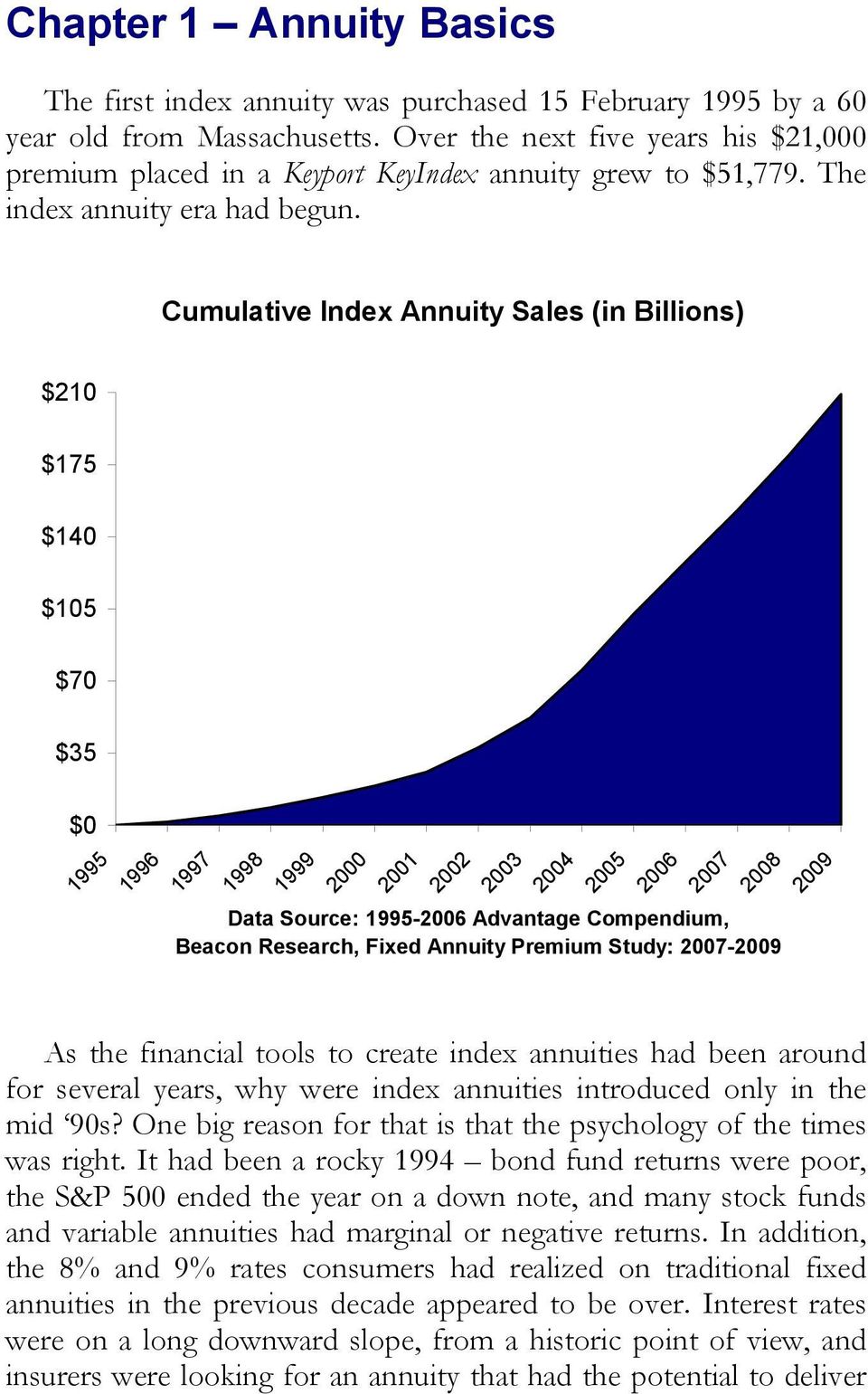
5 2 Index Annuities: A Suitable Approach respectable returns. It was time to announce a new annuity that would provide the principal protection from market losses enjoyed by all fixed annuity owners, but given them the potential for higher interest. Index annuity sales were barely over $100 million that first year, but grew to $1.5 billion in 1996, $3.0 billion in 1997 and $4.0 billion in Growth slowed down over the next few years, but with memories of the millennium bear market still fresh, index annuity sales exploded to over $23 billion in 2004 and reached over $27 billion by By the close of 2009, over $200 billion of index annuities had been purchased. There was once an agent from Ames That gave clients annuity gains It isn t his interest they said That put them ahead T was the risk of loss that he tames A Tool For Uncertain Times When Black Monday hit in October 1987, it was a tremendous shock to stockbrokers because it was not supposed to be able to happen. They had been told, and believed, that a sudden drop of that magnitude was impossible. The bear markets of the last decade have cut much deeper than the one 20 years ago. People near retirement may need to work for more years to be able to retire and current retirees may need to cut back their standard of living to try to ensure that their money does not run out. But perhaps the most long-lasting outcome is that the risk/return paradigm guiding consumer financial habits has changed. The 1920s were a time of irrational exuberance where the little people invested in the stock market many for the first time. The resultant crash soured investors of the day and their children were repeatedly told to stay away from the stock market. It wasn t until the

6 Chapter 1 Annuity Basics s that interest in investing began to rise and the general press again spoke positively of the stock market. The 1960s attitude then became that investing in blue chips or the nifty 50 would make you a lot of money. However, in the crash of , the market dropped by half and then it failed to recover. The stock market limped along for several years and the tone of the media changed once again this time, to investing in the stock market is a sucker s game began the greatest bull market of the century, with fortunes being made by professional investors. There were a couple of bumps along the way a severe one in 1987 and a minor one in 1990 but the market quickly recovered. After 15 years or so of a rising market, the small investor once again entered the market en masse in the late 1990s. The millennium bear market tested their faith, but was followed by 5 straight up years. By 2008, it was obvious to many that the market would trend up forever. Then came the crash of ; it was a generation killer. The damage to investor s psyches may well be similar to that caused by the Great Depression and the 70s bear markets. It may keep individual investors leery of investing for decades. However, they probably won t be able to flee to the bank and earn high safe yields, as they could in the 1970s. Index annuities are one of the few instruments that still offer the potential for higher yields and that protect principal and credited interest from market loss. Real World Returns We will explore actual index annuity returns in depth in Chapter 5, but the following chart provides an overview of index annual performance during volatile times. The average index annuity return reported beat the index for five of the eight periods since How is that possible? Let s look at a specific example. The annualized average index annuity return of the carriers providing policy returns for the five years ending 30 September 2008 was 6.05%. The annualized return

7 4 Index Annuities: A Suitable Approach Annualized 5-Year Returns Periods S&P 500 Index Annuity Return Average Return % 9.19% % 5.46% % 4.69% % 4.33% % 4.36% % 6.12% % 6.05% % 4.19% for an S&P 500 index fund with a 0.15% expense ratio for the same period was 5.05% (the annualized return for the index alone - that is, without considering dividends - was 3.18% and that is the return shown in the chart). Even though the index annuity returns did not include reinvested dividends and were generally tempered by caps, the average index annuity returned more than a fully participating dividend yielding index fund. Why? Because during that final year when the index went down, the index annuity owners kept their credited interest earned in previous years. Staying On Message Here is how three carriers defined their index annuities when introduced in the mid 90s: You enjoy the safety and security that a traditional fixed annuity guarantees, combined with the potential of interest earnings linked to the S&P 500 Index Interstate Assurance Company, Freedom 500 Index Annuity, 3158-D, 7/96 You will only share in the increases in the index. Your index annuity value will never decline due to decreases in the index and previous increases once earned are locked in and guaranteed Community National Assurance Co., Money$Worth Indexed Annuity, P-AN7, 8/95

8 Chapter 1 Annuity Basics 9 Statements about annuities that do not make clear what kind of annuities are being described, can be confusing or misleading. A statement that is true of a deferred annuity may be false when applied to an immediate one, and vice versa. And a true statement about a fixed annuity may be false when applied to a variable annuity, and vice versa. Tax Treatment of Annuities All deferred annuities generally enjoy tax deferred treatment. The cash value growth is not subject to tax as earned, but, instead, is taxed only when distributed. This tax-deferral applies only to annuities owned by natural persons (human beings). [IRC 72(u)]. Cash value growth in deferred annuities owned by non-natural persons such as corporations or trusts will be taxed as earned, unless the owning entity is acting as the agent of a natural person [IRC 72(u)(1)]. All distributions from annuities are either (a) amounts received as an annuity or amounts not received as an annuity. (a) Amounts received as an annuity includes both the payments from an immediate annuity and payments made under a regular annuity payout option from a deferred annuity (i.e.: a deferred annuity that has been annuitized ). These income amounts are taxed as part interest and part non-taxable return of principal, according to an exclusion ratio. The ratio depends upon the length of the payout period and, for life-contingent payouts (where annuity payments will persist for the entire life of the annuitant), whether a refund feature (a guarantee of payment if the annuitant dies before all of the money placed under that life payout options has been received as annuity payments) was elected. (b) Amounts not received as an annuity are any other distributions (actual or deemed ) from a deferred annuity. Such amounts are taxable to the extent of gain (or earnings) and the tax treatment depends upon when the contract was issued.

9 Chapter 1 Annuity Basics 15 Some Questions To Ask About Fixed Annuities What is the initial interest rate or index participation rate and how long is it guaranteed? Does the initial rate include a bonus? Are there any special requirements to receive the bonus or to cash out the annuity? What is the guaranteed minimum return? What are the surrender or withdrawal penalties or charges? Is there a Market Value (MVA) Adjustment? Do the surrender costs still apply at death? What rate is being credited on similar annuities issued in the past? Cheat Sheet Index annuities are the latest stage in the evolution of the annuity Deferred annuities offer tax-deferral, lifetime income options, and may avoid probate. Money withdrawn is always taxed as ordinary income (to the extent that it is includible in income) and may be subject to IRS Under Age 59½ Premature Distribution Rules. The major difference between fixed and variable annuities is that a variable annuity owner bears the investment risk, while fixed rate and fixed index annuities protect principal and credited interest from investment risk and guarantee a minimum interest return. The major difference between fixed rate and fixed index annuities is the crediting of interest earned above and beyond the minimum guarantee. Fixed index annuities are insurance products; not securities.
10 Chapter 2 Annuity Interest How Do Fixed Rate Annuities Pay Interest? When you place your money with the bank they invest this money, earn a return, and after subtracting their costs pay you a stated interest rate for a stated period of time. Your principal does not fluctuate, but the interest you receive can, and usually does, fluctuate from period to period. Fixed Rate Annuity Interest A fixed rate annuity operates in a similar way, except you place your money with an insurance company instead of a bank. When you place your money with the insurance company they invest this money, earn a return, and after subtracting their costs pay you stated interest. Minimum Rate A fixed rate annuity guarantees to credit a minimum yield and that is what makes a fixed annuity a fixed annuity instead of an investment. The minimum rate typically ranges from 1% to 3% but it may be linked to movements of an external interest indicator such as U.S. Treasury Notes. One Year or Multiple Year Rates All fixed annuities guarantee the interest rate for at least the coming policy year (or guarantee the rate of participation in the case of an index annuity). Typically the annuity will guarantee the rate for one year at a time and declare a new interest rate on the policy anniversary for the next year. But the new rate can never be less than the minimum guaranteed interest rate.
11 26 Index Annuities: A Suitable Approach Growth of $1000 $179,524 $84, How Much Interest? S&P 500 S&P 500 w/dividends S&P 500 no dividends, w/annual reset $18,615 The highest index annuity interest rate ever credited for a single year was over 40%, in both 1998 and On the other hand, in 2001, 2002, and 2008, the major stock market indices declined, and index annuities linked to these indices credited 0% for the year - but no previous interest was lost. Index annuities are designed to provide the potential for longterm yields above those of other safe money places while always protecting principal and credited interest from market risk - and they have performed as intended. Minimum Guarantee A fixed annuity guarantees the crediting of a minimum rate of interest which is what makes it a fixed annuity. In the case of an index annuity, the minimum guarantee is usually structured to protect

12 Chapter 3 Crediting Methods In the last six years only ONE completely new structure has been created, the rainbow method. Every other crediting method on the market today had its genesis in a structure used in the past, and this includes the balanced allocation method (earlier called the equity kicker method) and low water mark designs. The truly new development in the index annuity world is the lifetime income withdrawal benefit and this is discussed at length in Chapter 6. There are still really only two ways to credit index-linked interest to an annuity. One can either measure index movement over a year or two an annual reset method, or one can measure index movement over a period of years a term end point method. And yet, over four dozen variations on these methods have floated around since index annuities were introduced. The first index annuity offered a term end point method variation that used the higher of the index value at the end of the surrender period or the index value on any policy anniversary. This term high point method, also known as a high water mark design, was consumerfriendly but expensive to offer, and has not been available for the last five years (although variations of this design are still available they are not the same thing). We ve decided to include brief descriptions of crediting methods that are not currently offered because they may resurface. This chapter illustrates how all of the major index crediting methods work by using the fictional Federal Stock Index. In the next chapter we will examine the good and bad points of the different methods. Term End Point (Term Point-to-Point) Our definition of a term end point structure was one that measured index movements over a period greater than a year or two.

13 46 Index Annuities: A Suitable Approach Index Values Yr1 Yr2 Yr3 Yr4 Yr5 Yr6 Yr7 Yr8 Yr9 Federal Stock Index Example: You have decided to buy an index annuity. You will earn index-linked interest based on the performance of the fictional Federal Stock Index, which is currently at an index level of 100. The insurance company says that at the end of nine years they will credit the greater of the minimum guarantee or 100% of any index-linked interest earned calculated by dividing the ending index value by the beginning index value How Term End Point Interest Is Calculated (170 /100) - 1 = 70% Index Gain 70% x 100% participation = 70% 70% = Total Interest Earned It is now the end of year nine and the Federal Stock Index is at a level of 170. The index annuity divides the current index level by the starting index level and multiples the gain by our original premium. You earned a total of 70% interest for the nine years. What if the index difference had been negative because the ending index was at a lower level than when you began? The index annuity would credit the minimum guaranteed return.

14 62 Index Annuities: A Suitable Approach How Annual Reset Interest Is Calculated: Monthly Cap Beginning Value 100 2% Cap Value Period % Value Period % Value Period % Value Period % Value Period % Value Period % Value Period % Value Period % Value Period % Value Period % Value Period % Value Period % 2.00%+0.98%+1.94%+1.90%-2.80%+1.92% +2.00%+2.00%- 0.90%-2.70%-0.92%+2.00%= 7.42% Interest Earned Annual Fixed Rate with Equity Component (Balanced Allocation or Equity Kicker) Crediting a fixed rate to a portion of the premium with the remainder participating in the index was first used in the last century in an annual reset design, but sales in products with this design were small. There are a couple of variations to this theme currently in use. In both variations, the annuity credits a fixed interest rate to a portion of the contract value, crediting to the balance interest at a rate derived from index performance. A yield spread or asset fee is then deducted from the total. Net gains are credited as interest and net losses are treated as zero interest earned. In the balanced allocation method the buyer typically selects a fixed rate component (the range of rates depends on the interest rate environment) and also a term end point part that participates in positive index movements over a four, five or six-year period. The higher the fixed interest rate selected, the lower the participation rate
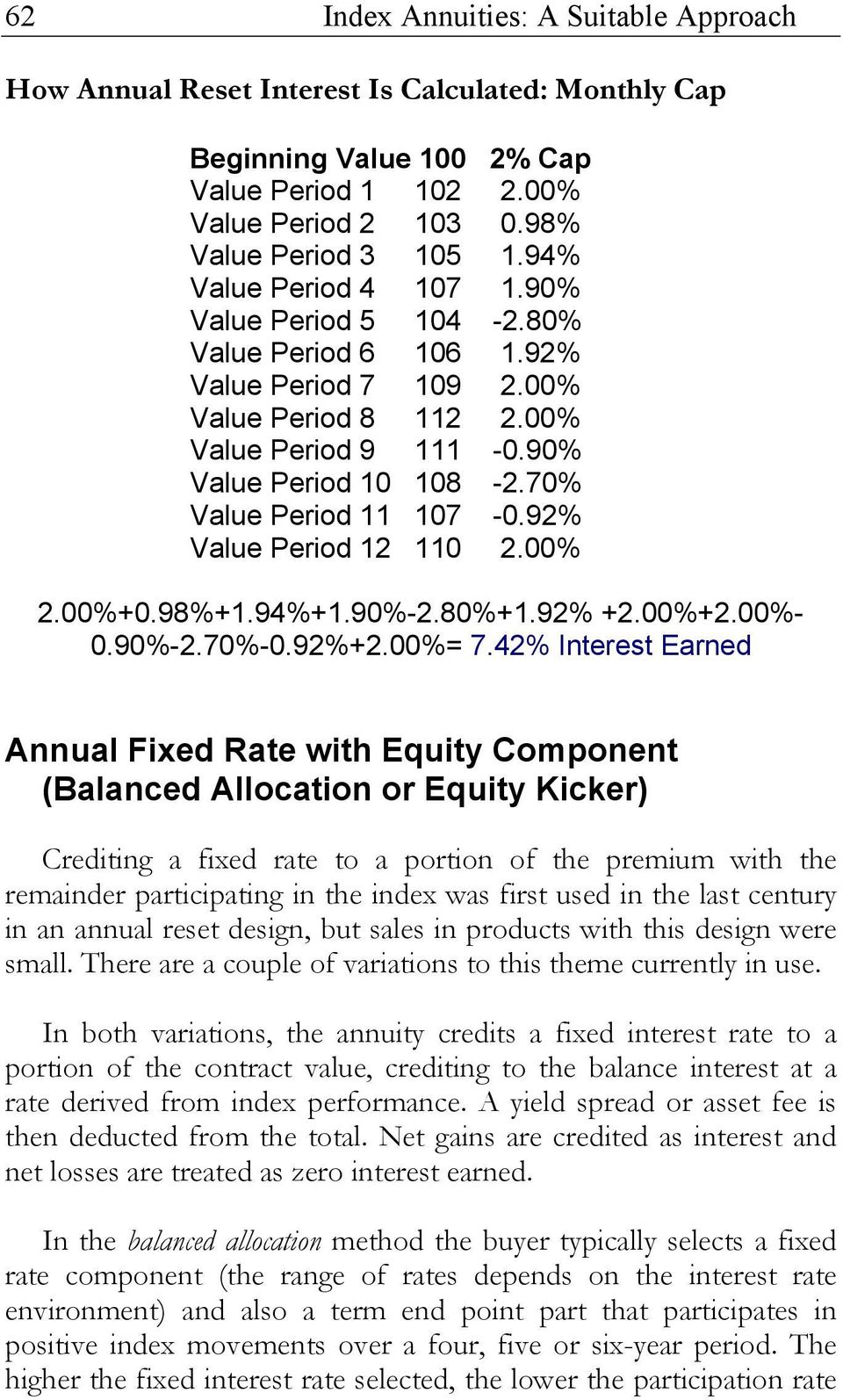
15 Chapter 3 Crediting Methods 63 applied to the index. At the end of the period, gains from the fixed rate and index-linked components are combined and credited. An annualized asset fee (yield spread) may be deducted from the combined return. This equity kicker or balanced approach might look at a six year time frame and offer a couple of options. One option might allocate 50% into a fixed account paying 4% and the remaining 50% would provide a 100% participation rate on any gains in the index from start to end of the six year period. The other option might allocate 20% into a fixed account paying 4% and the remaining 80% would provide a 100% participation rate on any gains in the index from start to end of the six year period; however, a 2% yield spread would be deducted from the combined annualized gain before net interest was credited. Let s suppose that our Federal Stock Index has increased from 100 to 150 (50%) in six years, and that the 4% fixed rate gain, compounded over those six years is 26.5%. What is the return under these two balanced method options? Allocation 50% Index Gain 26.5% Fixed Gain Calculated Gain 50/50 25% 13.3% 38.3% 80/20 40% 5.3% 45.3% Allocation Annualized Gain Yield Spread Actual Yield 50/50 5.5% 0% 5.5% 80/20 6.4% -2% 4.4% Since a yield spread was not deducted from the 50/50 allocation the total gain remains at 38.3% for the six year period and that translates into an annualized return of 5.5%, while the 80/20 allocation produced a total gain of 29.7% (after application of the yield spread) for an annualized return of 4.4%. In this example you would have better off putting half of the premium into the fixed rate sure thing. When would the 80/20 allocation have won? If the index had gone up more than 87% the total net yield, even after the 2% yield spread, would have been higher than the yield on the 80/20 allocation.
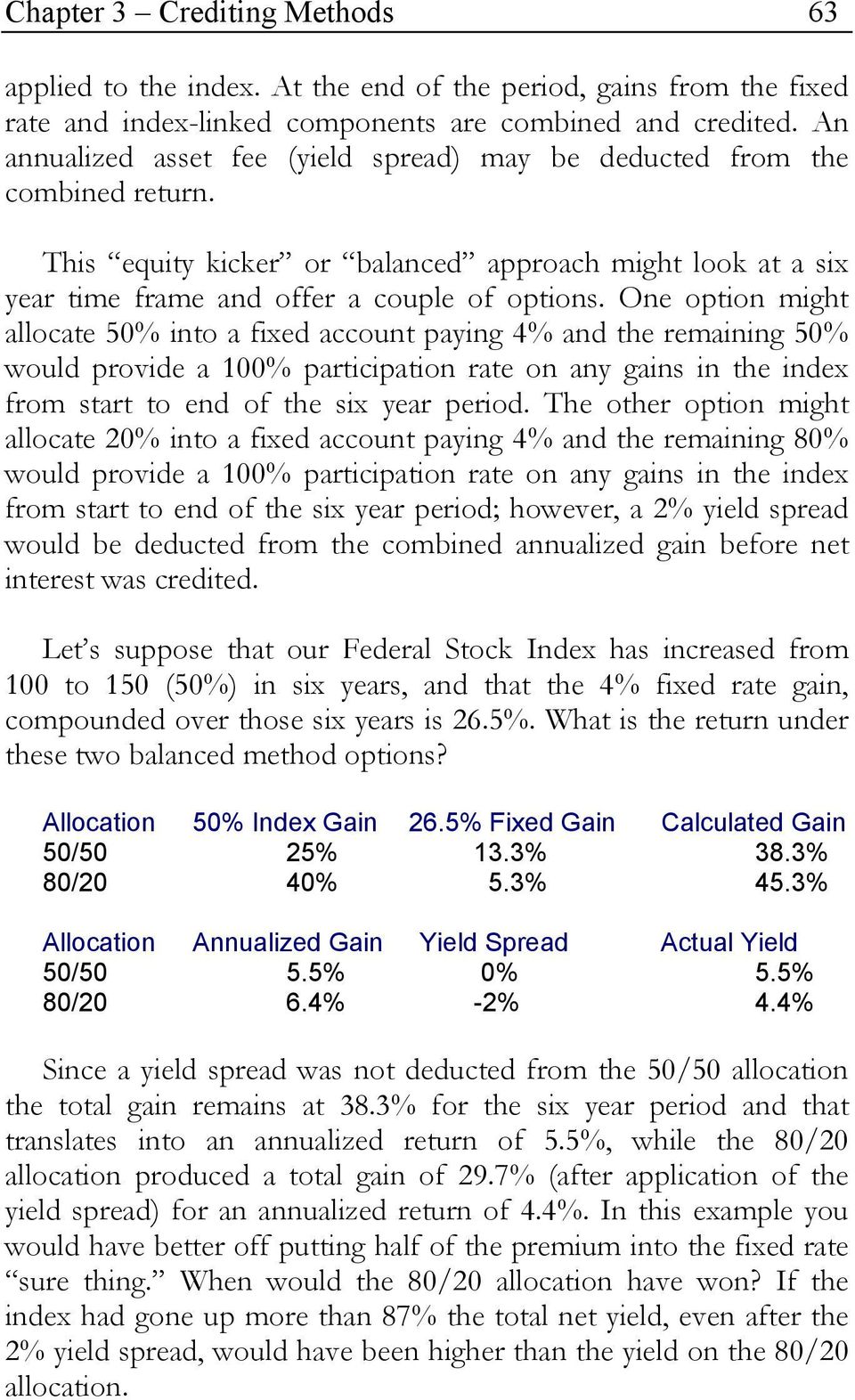
16 Chapter 3 Crediting Methods 65 Allocation 14% Index Gain 8.2% Fixed Gain Calculated Gain 60/40 8.4% 3.3% 11.7% 40/60 5.6% 4.9% 10.5% Allocation Calculated Gain Yield Spread 2 Year Yield 60/ % -2.5% 9.2% 40/ % -0.5% 10.0% Rainbow Method Although new to the index annuity arena the rainbow concept itself is not new. It has been used for many years in the investment world. It is an option basket whose best-performing indices are weighted more heavily than those that perform less well. It is always a "look-back" because the money is allocated based on the ranking of the performance after the period is over. Not all allocation methods are rainbows. A couple of carriers credit interest based on the blended performance of multiple indices, but the specific index allocation is fixed at the beginning of each year so they are not rainbow methods. To show how the rainbow method works we will compare it to the blended indices example used earlier. Blended Federal Stock Index 60% x 35% = 21% Federal Bond Index 20% x 35% = 7% Foreign Index 40% x 20% = 8% Medium Foreign Index -50% x 10% = - 5% 31% The rainbow method may also use the Federal Index, Federal Bond Index movement, Foreign Index and Medium Federal Index and allocations of 35%, 35%, 20% 10%, but the allocations are ranked by performance. After the period is over the returns will be ranked highest to lowest and then the greatest allocation is given to the best performer, then the next best, and so on.
17 Chapter 4 Crediting Method Truths 77 reset designs in rising markets. The tradeoff is that if the market period is flat or down, term end point designs are more likely to generate only the minimum guaranteed return. The Truth Financial Writers Ignore Financial columnists, when writing about index annuities, often use a term end point annuity as an example of how index annuities work. They then say how much better it would be in a perfect world if you were to put three quarters of your money into competitive zero coupons 10 year bonds and the balance in an index fund. If you were to follow their suggestion and put 75% of your money into zero coupon bonds, you would never get back less than 100% at the end of the period something like an annuity s minimum guarantee. However, because only 25% of your money is in the index your effective participation rate on your total investment can only be 25%. By contrast, the participation rate of a term end point index annuity often nears 100%. But the real problem with such articles is that their authors employ a crediting method that is used by only 2% of index annuities, while suggesting (if only by implication) that its results are representative of all index annuities. That s like focusing on the performance of health care sector stocks as an example of how the S&P 500 performs. An advantage of almost every term end point annuity is that there are no moving parts for the entire crediting period, which is often the same length as the surrender period. The risk of getting an uncompetitive renewal rate is reduced or eliminated. A possible disadvantage is that if the climate for index participation improves in the future the rate cannot be raised. Term end point designs follow index movements. This means potential interest can be lost if the index falls back. In addition, interest is not credited until the end of the period. If a policy is surrendered, any increases in the index from the beginning of the
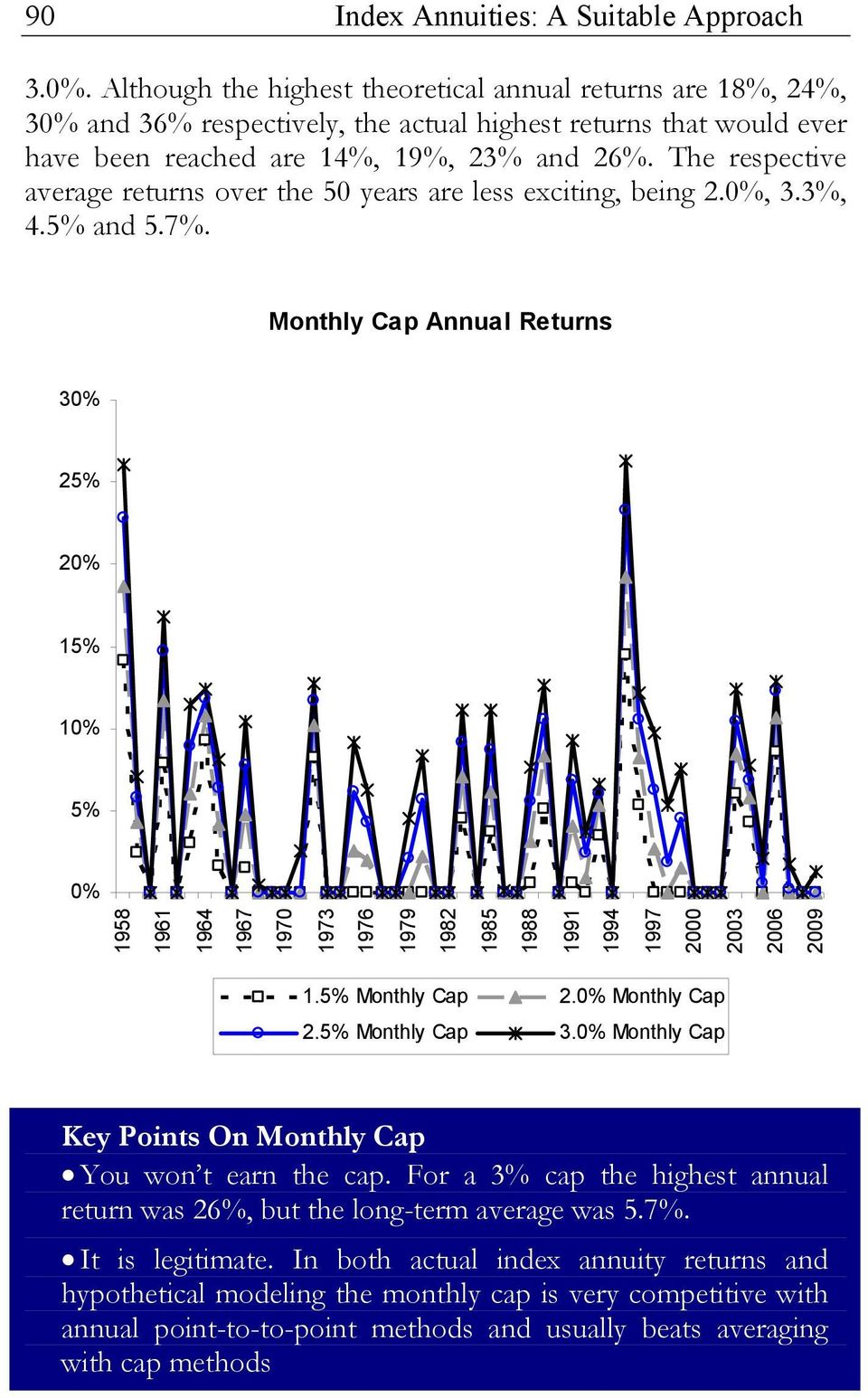
18 90 Index Annuities: A Suitable Approach 3.0%. Although the highest theoretical annual returns are 18%, 24%, 30% and 36% respectively, the actual highest returns that would ever have been reached are 14%, 19%, 23% and 26%. The respective average returns over the 50 years are less exciting, being 2.0%, 3.3%, 4.5% and 5.7%. Monthly Cap Annual Returns 30% 25% 20% 15% 10% 5% 0% % Monthly Cap 2.0% Monthly Cap 2.5% Monthly Cap 3.0% Monthly Cap Key Points On Monthly Cap You won t earn the cap. For a 3% cap the highest annual return was 26%, but the long-term average was 5.7%. It is legitimate. In both actual index annuity returns and hypothetical modeling the monthly cap is very competitive with annual point-to-to-point methods and usually beats averaging with cap methods
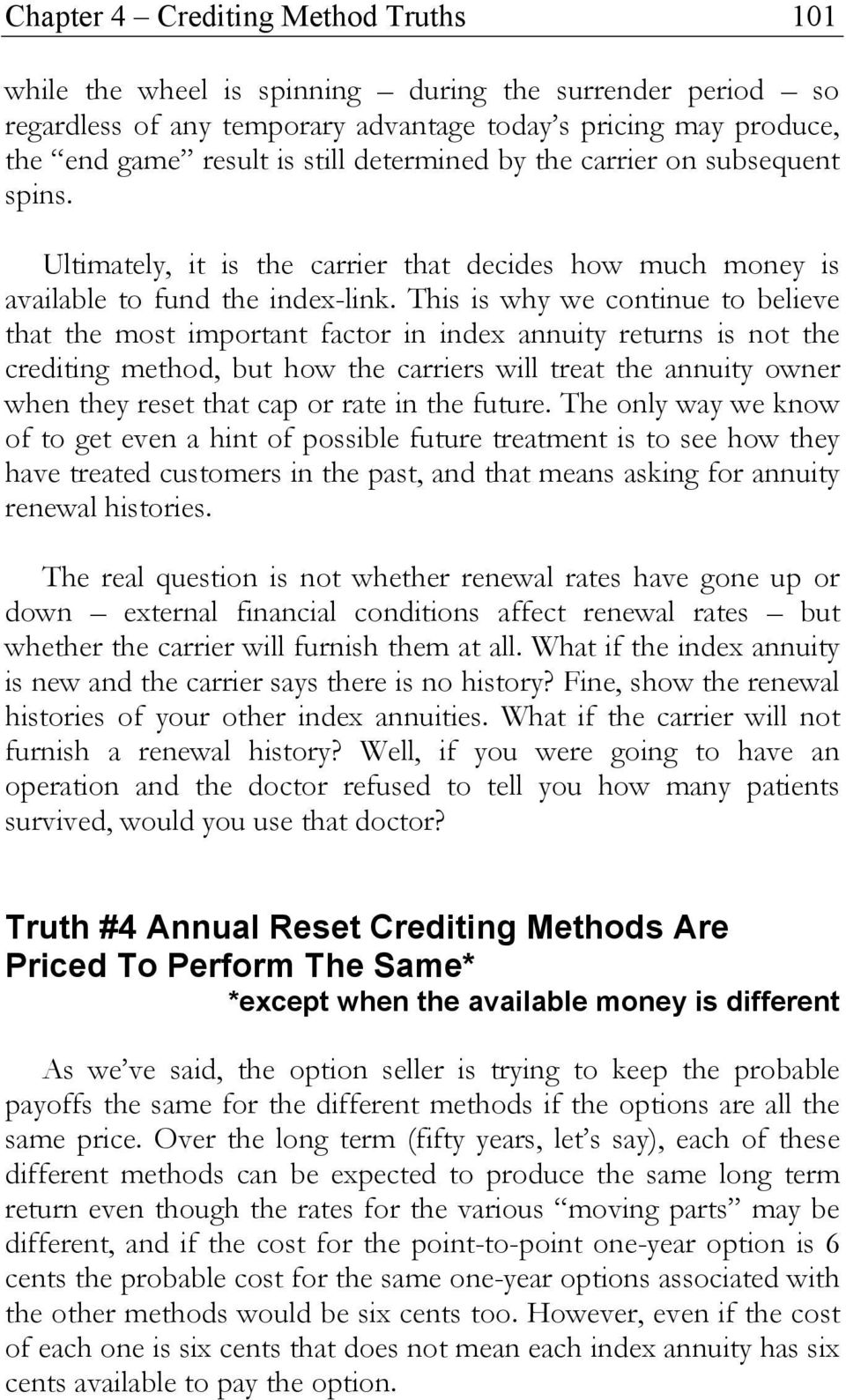
19 Chapter 4 Crediting Method Truths 101 while the wheel is spinning during the surrender period so regardless of any temporary advantage today s pricing may produce, the end game result is still determined by the carrier on subsequent spins. Ultimately, it is the carrier that decides how much money is available to fund the index-link. This is why we continue to believe that the most important factor in index annuity returns is not the crediting method, but how the carriers will treat the annuity owner when they reset that cap or rate in the future. The only way we know of to get even a hint of possible future treatment is to see how they have treated customers in the past, and that means asking for annuity renewal histories. The real question is not whether renewal rates have gone up or down external financial conditions affect renewal rates but whether the carrier will furnish them at all. What if the index annuity is new and the carrier says there is no history? Fine, show the renewal histories of your other index annuities. What if the carrier will not furnish a renewal history? Well, if you were going to have an operation and the doctor refused to tell you how many patients survived, would you use that doctor? Truth #4 Annual Reset Crediting Methods Are Priced To Perform The Same* *except when the available money is different As we ve said, the option seller is trying to keep the probable payoffs the same for the different methods if the options are all the same price. Over the long term (fifty years, let s say), each of these different methods can be expected to produce the same long term return even though the rates for the various moving parts may be different, and if the cost for the point-to-point one-year option is 6 cents the probable cost for the same one-year options associated with the other methods would be six cents too. However, even if the cost of each one is six cents that does not mean each index annuity has six cents available to pay the option.
20 102 Index Annuities: A Suitable Approach Crediting Method (option money) Effective Rate Annual Pt-to-Pt (6 ) at 45% participation 74% Monthly Averaging (8 ) at 100% participation 96% Daily Averaging (4 ) at 53% participation 49% Annual Pt-to-Pt (6 ) with 8.45% cap 74% Monthly Cap (4 ) 2% cap on monthly gain 38% Monthly Averaging (6 ) less 2.75% yield spread 74% In the second chapter, we said the insurance company invests the premiums, earns a return, and then after paying the expenses and covering the cost of the minimum guarantee buys the option. What if the sales commission on Index Annuity A is 7% but Index Annuity B pays a 4% commission? As the expenses for Annuity B are less, that annuity issuer has more of the premium available with which to buy options. If the lower expenses gives Annuity B 8 cents left over (after buying enough bonds to secure contract guarantees) instead of the 6 cents left over in Annuity A, Annuity B can buy one-third more options, which means that the owner of Annuity B can participate in more of the index gain than can the owner of Annuity A. Costs matter! What if Annuity B has a higher minimum guarantee, but all other factors are equal (to those in Annuity A)? If Annuity B guarantees 3% when Annuity A guarantees only 1%, Annuity A might have 4 cents with which to buy options, when Annuity B has only 2 cents. In this scenario, Annuity A can offer a higher participation rate. Suppose the expenses for both annuities are identical, but Company A can invest its money at a higher rate (by buying bonds with longer maturities or rated less highly than the bonds bought by Company B)? Once again, Company A will have more money with which to buy options. (Of course, it will bear more risk with regard to the contract s guarantees if its bond portfolio is more at risk).

21 110 Index Annuities: A Suitable Approach Statements from term end point styled annuities are a different matter because interest is usually not credited until the end of the term. So, even if the index gained 40% in the first year, the statement would only reflect the minimum guaranteed interest. Most insurers also provide a kind of running summary of hypothetical performance in their annual statements, as if the interest crediting period were to terminate on the statement date. It is a good idea to review a sample annual statement before purchasing such an annuity, if only to avoid future surprises. Selecting An Index Annuity Carrier Financial Strength Pick a carrier with finances you feel comfortable with. If you like to use third party ratings, pick a carrier evaluated by a rating service you like and define the minimum ratings you will accept. Better yet, look at that carrier s ratings from multiple ratings services. These services use different methodologies in arriving at their ratings, and a carrier might be rated more highly (even much more highly) by one service than by another. We look at a lot of factors when we are evaluating insurance companies and, in some situations, we may feel that a B+ carrier offers the same relative safety as one rated A+ because rating services scores are merely one measure of an insurer s stability. Renewal Rates We strongly believe that a carrier s treatment of renewal rates is far more important than the crediting method or even the actual movement of the index in estimating how much interest an annuity is likely to give us. By renewal history, we do not mean interest credited to the policy; we mean the history of how the level of index participation in that particular annuity changes over time. The problem is this: Some annuity issuers maintain a contract s participation in the underlying index at a fair level after the initial
22 116 Index Annuities: A Suitable Approach reset offering 60% of annual point-to-point gain approach to ten year periods would have produced an average return that was equal to 88.2% of the average S&P 500 index return for the same ten year periods. % of Annualized S&P 500 Return 80s 90s Term End Point 75% of term gain, last 52 weeks averaged 78.2% 78.4% 100% of gain, 12% caps, 5 yr high pt look-back 64.0% 59.0% annualized gain less 1.9%, last year averaged 74.5% 80.1% Annual Reset 60% of annual point-to-point gain 88.2% 65.3% 50% of annual point-to-point gain 73.7% 54.6% 100% of annual point-to-point gain, 9% cap 70.7% 47.5% 100% of annual point-to-point gain, 8% cap 63.3% 43.2% 100% of annual point-to-point gain, 7% cap 56.0% 38.9% 100% of monthly averaged gain 90.2% 69.5% 80% of monthly averaged gain 72.6% 55.9% 60% of monthly averaged gain 54.8% 42.1% 100% of monthly averaged gain, 10% cap 65.4% 48.1% 100% of monthly averaged gain, 9% cap 60.2% 44.3% 100% of monthly averaged gain, 8% cap 54.7% 40.1% 4% monthly cap 76.1% 70.4% 3% monthly cap 49.2% 51.3% 2% monthly cap 21.5% 28.9% Biennial Reset 5% monthly cap 68.3% 67.4% 4% monthly cap 48.7% 54.1% 3% monthly cap 25.6% 37.7% 100% of two year point-to-point gain, 17% cap 72.3% 56.4% 100% of two year point-to-point gain, 15% cap 67.3% 51.1% 100% of two year point-to-point gain, 13% cap 61.1% 45.3%
23 Chapter 5 Hypothetical & Real Returns 127 Index Annuity Returns Are Competitive We compared fixed rate annuity, fixed index annuity and taxable bond fund returns for five year periods beginning in 1992 and ending in Our conclusions are that both fixed rate and fixed index annuities have been competitive with U.S. taxable bond mutual funds for these periods. From 1997 thru 2007 the taxable bond fund averaged 5.29% a year while the index annuity averaged 5.79% If you look at the period from 1997 through 2007, the 5-year annualized returns for the index annuities averaged 5.79%. The average taxable bond fund return was 5.29%; the average one year certificate of deposit return was 3.64%, and the average fixed rate annualized return was 4.73%. For the periods from 1992 through 2007 the average taxable bond fund return was 5.71%; the average one year CD was 4.43%, and the average fixed rate annuity return was 5.18%. Annualized Returns For 5-Year Periods Fixed Rate Annuity Fixed Index Annuity Taxable Bond Fd CD 1 Yr
24 Chapter 6 Rider Revolution Let s suppose you re fifty years old and plan to retire at 65. You re considering putting $100,000 into a mutual fund this year. What amount will you be able to withdraw each year from that fund, starting at retirement, and be guaranteed that the income will last as long as you live? Is that too tough a question? Here is another. What will that mutual fund be worth fifteen years from now? When we priced this example, there were deferred annuities available that would provide a 50 year old buyer with the assurance of a lifetime income of at least $12000, starting at age 65, based on minimum contractual guarantees. This requires annuitization (election of an annuity payout option ), which amounts to a conversion of the annuity cash value to an income stream. When you annuitize an annuity contract, the decision is generally irrevocable (meaning that you cannot undo the conversion); you trade control of (and access to) the annuity s cash value for the right to those income payments. GLWB Comparison Start With age 50 Lifetime Guaranteed Age 65 Income Principal Stock Market?? Fixed Annuity Annuitized $12,000 $0 Index Annuity GLWB $15,000 $100,000+ There is another option. As we write this there are several index annuities where, if we paid our $100,000 premium at age 50, we could receive $15,000 a year or more for life at age 65 based on the annuity s guaranteed lifetime withdrawal benefit (GLWB). The GLWB removes uncertainty over the amount and length of the payments; it offers the same protection against living too long that annuitization does, but we also have access to the annuity s cash value. The GLWB is transforming the retirement income landscape.
25 Chapter 6 Rider Revolution 165 Which GLWB is best depends upon how it is used. In Table 1 the rider with the large up front income factor (the rider crediting an initial 25% bonus) has the highest payout if withdrawals begin quickly, but the 5% payout factor makes it less attractive at older ages. A $100,000 deposit at age 65 to an index annuity that earned only the minimum return of 2% for 5 years a possibility in a bad economic patch would have an accumulated value of $110,408. Yet a GLWB rider on that same annuity could guarantee a lifetime income of $8,000 to $9,000 a year! This represents a payout percentage of over 8% of the account balance and that s a worst case scenario. Table 2 assumes the annuity accumulated value growing at 6% a year, but deducts an annual GLWB rider fee of 0.4% meaning the account is growing at 5.6%. Table 2 Initial Payout Assuming Annuity Purchase Age 65 6% (5.6% after rider fee) Growth Results: $100,000 Age % income acct bonus, then 5%/yr 6,250 7,977 10,181 12,993 10%/yr simple interest income acct growth 5,500 9,000 13,000 17,500 8%/yr income acct growth 5,500 8,816 14,033 22,205 7%/yr income acct growth 5,500 8,415 12,786 19,313 1% payout growth each 5 yr deferral 6,000 9,192 13,795 18,115 In Table 2 (which assumes a 5.6% net growth rate), the only payout method providing a higher value than it would have produced at the GLWB guaranteed growth rate (Table 1) is the payout based method (1% payout growth each 5 yr deferral), which uses the annuity accumulated account value. In all the other methods, the payout under the GLWB growth guarantee rate is higher (which is why the numbers in Table 2, for all other methods, are those from Table 1). Unless one assumes index annuities will produce significantly higher returns than they have produced historically, the payouts generated solely by the income factor growth guarantees may be what a 65 year old can expect from a GLWB.
26 174 Index Annuities: A Suitable Approach There Are Solutions We have noted that it is difficult for many consumers to grasp that a 7% income account growth factor is not the same thing as a 7% cash value account yield, and, indeed, cannot even be translated into an income payout yield. One solution to this problem would be for the marketing materials for these products to show only the payout percentages and the actual payout generated. This would be less likely to confuse annuity owners as to the cash value of their contracts. Another solution would be to require annuity representatives to use sales materials that show clearly what the income payout growth results really means. For example, a sliding card matrix that specifically translates the growth rate into the payout that would be produced by that rate would make it clear that growth of the GLWB benefit base will produce a higher GLWB benefit payment but not a higher cash value. $100,000 Age 65 $157, $147,500 $137,500 $13,397 $11, $127,500 $117,500 $107,500 $97,500 $8,614 $7,345 $6,833 $6,356 $5,912 $10,701 $9,954 $9, $87, Minimum Guarantee Initial Income Benefit
27 Chapter 7: Tax Traps In Annuity Planning One of the greatest challenges to those who deal with annuities is the complexity (and, in some cases, uncertainty) of the tax laws governing these contracts. There are four parties to the annuity contract Issuer, Owner, Annuitant, and Beneficiary. Several tax traps can be triggered when the owner and annuitant are not the same individual or when the owner or beneficiary is not a human being. And when the owner, annuitant, and beneficiary are all different individuals, the result is not so much a tax trap as a tax disaster all because of how annuity contracts say death proceeds will be payable and how Federal tax law says they must be payable. IRC 72(s) The Rules Governing Annuity Death Proceeds Section 72(s) of the Internal Revenue Code provides rules governing how annuity contracts must be paid out upon the death of the contract owner. This section prescribes how the contract value must be distributed only when an annuity owner dies; it does not apply if a non-owner annuitant dies. If Owner Dies On Or After Annuity Starting Date If the owner dies on or after the annuity starting date (that is, after regular annuity payments, under an annuity payout option had begun), and before owner s entire interest in the contract has been distributed, 72(s)(1)(A) states that the remaining portion of such interest will be distributed at least as rapidly as under the method of distributions being used as of the date of his death. If those death proceeds ( remaining portion of such interest ) are received by the beneficiary either as a lump sum or in installments under the same annuity payout option elected by the deceased owner, those proceeds will be excluded from income until the total amount received tax-free (by both owner and beneficiary) exceeds the owner s investment in the contract.
28 Chapter 8 Suitability What are the suitability rules that sellers of annuities must observe? Regrettably, there is no simple answer to that question for at least four reasons. 1. There is not one set of rules. Annuities, and those who sell them, are subject to regulation by multiple regulatory entities. 2. The existing rules, from those various regulatory authorities, are not always perfectly consistent. 3. The existing rules are not always clear. 4. The rules keep changing! Regulators those responsible for overseeing the activities of financial advisors have their own tests for determining appropriateness and advisors subject to their oversight may be held accountable for the results of those tests. The Current Environment Registration and Regulation Of Variable Annuities As Products Variable annuities are securities, subject to regulation by the Securities & Exchange Commission (SEC) and by the securities regulatory agencies of the various states. They are also insurance products, and, as such, are regulated by the departments of insurance of the various states. Registration And Regulation Of Sellers Of Variable Annuities & Registered Index Annuities Sellers of securities must be properly licensed at both the Federal and State levels. A representative who wishes to sell mutual funds and/or commissionable variable annuities or life insurance policies, must first have passed at least the Series 6 exam, regulated by the Financial Industry Regulatory Authority (FINRA), and be registered to sell such
29 210 Index Annuities: A Suitable Approach contracts with the state department regulating securities. As variable annuities are also insurance products, those who sell them must be properly licensed with, and be subject to the regulatory authority of, the various State Departments of Insurance. FINRA Rule 2330 (formerly, NASD Rule 2821) imposes particular duties upon sellers of variable annuities and those who exercise compliance oversight over those sellers. Variable annuities (and variable life insurance policies) that pay commissions may be sold only by a registered representative, affiliated with a Broker/Dealer that is a member of FINRA. Contrary to popular belief, this does not mean that one who is not a registered representative may never sell any variable annuity or variable life insurance policy. That s because there are numerous variable contracts out there that pay no commissions. These contracts are designed to appeal to (and be sold by) Registered Investment Advisors (who are not required to be registered representatives of a Broker/Dealer member of FINRA). These individuals are subject to a different regulatory regime and are held to a different, and higher, standard of duty. Securities registered index annuities are typically not registered as variable annuities but as modified single premium deferred annuities. These are essentially securities versions of index annuities with reset features and protection of principal from market risk. Because they pay commissions, they also may be sold only by a registered representative, and because they are insurance products, that representative must hold the required insurance licenses. Many advisors are dually registered, as both registered representatives of a FINRA-member Broker/Dealer and as either a Registered Investment Advisor or Associate of a Registered Investment Advisory firm (affiliated with that Broker/Dealer). This hybrid registration allows these advisors to act either as a registered representative (and receive commissions) or as a Registered Investment Advisor (or Advisory Associate) (and receive fees). Such advisors must comply with the rules applicable to whichever hat they are wearing. The standard of duty applicable to Registered Investment Advisors is a form of the fiduciary standard, which is
30 Chapter 8 Suitability 229 You could try to explain that the minimum interest rate is 1%, 2% or 3%, or that it floats, and then go on to say that in reality, the effective minimum rate may be 0.75% or even zero, and then say that this rate is not even credited each year, and it is not paid in addition to the index-linked interest earned. We don t recommend this. Or, you could say At the end of x years (or however long the surrender period is), the insurer guarantees that you will have an account value of at least $1.10 (or $1.07 or $1) for each $1 of premium, and, if, at that point, the index crediting hasn t produced that much, the insurer will go back and RETROACTIVELY credit you the additional interest required to produce that guaranteed minimum value. The key word here is retroactive. When you tell consumers that they will probably see years with zero interest credited and then add that last explanation, they will understand that they will, by the end of the term, get at least the minimum return because retroactive means that the minimum interest isn t lost, for those years when zero interest was earned; it is merely delayed. Why Surrender Charges? Surrender charges serve two functions. The first is to encourage the annuity owner to keep the annuity for at least a minimum number of years so that carrier can match up the maturity of the investments supporting the annuity. In other words, if the carrier issues an annuity that they expect will be cashed in after seven years, they probably do not want to back that annuity with a pool of bonds having a 15 year maturity. Why? Because, while the value of those bonds after 15 years is assured, the value at any time before that is not known (or knowable). The insurer cannot adequately back its liability to pay the surrender value of the annuity with assets that may, at the time, be worth less. Another factor is that longer maturity bonds tend, in most situations, to pay higher yields than bonds of shorter duration, to compensate the buyer for the time element risk. If an annuity s surrender charge is longer, the carrier can invest in longer maturity bonds, typically producing higher yields, and this extra yield can be
31 246 Index Annuities: A Suitable Approach Tax Treatment of Annuities Versus Alternatives All annuities receive tax-favored treatment, but the treatment of immediate annuities is very different from that of deferred annuities. Immediate Annuities The income payments under an immediate annuity are taxed according to a cost recovery rule, in which part of each payment is deemed to be a return of principal (and, thus, not taxable). Readers can find a detailed explanation of this treatment in chapters 2 and 3 of The Annuity Advisor (National Underwriter Co., 2nd ed., 2009), by John Olsen and Michael Kitces. Deferred Annuities The earnings in deferred annuities are, generally speaking, not subject to tax as earned. Tax on those earnings is due only when earnings are distributed, which is why these contracts are sometimes called tax deferred annuities. All distributions from any annuity are, under current tax law, either (a) amounts received as an annuity or (b) amounts not received as an annuity. This is a source of considerable confusion for many people, so let s clear it up now. How can a distribution from an annuity contract consist of amounts not received as an annuity? This seeming contradiction stems from the fact that annuity has different meanings. When paired with the word contract, the result ( annuity contract ) refers to a specific type of legal agreement, a contract for income, between an issuer (usually, an insurance company) and a purchaser, guaranteeing the latter the right to convert (immediately or at a future date) the amount(s) invested to an income that is guaranteed to last for a specified period of years or for life. Those payments of income are what the Internal Revenue Code and Treasury Regulations refer to as amounts received as an annuity. In the latter sense, annuity refers, not to a contract for income, but to the special nature of the income itself (that it consists of part principal and part earnings, guaranteed for a specified duration).
32 252 Index Annuities: A Suitable Approach 2. It can charge annual expenses or reduce credited interest to accomplish the same objective. And carriers do this until expenses are recaptured. 3. It can assess surrender charges, typically reducing over time (because the potential loss to the insurer from early surrender declines with each year the annuity remains in force). The principal advantage of this is that the loss to the insurer wrought by early surrenders is offset by charges borne only by those who made those early surrenders. Buyers of contracts that impose surrender charges are far less likely to complain about those charges when they understand that they re (a) contingent (that is, they only apply to buyers who surrender early) and (b) are in lieu of a front end sales charge. Having dealt with two of the most commonly cited elements in complaints as to the suitability of an annuity, let s now look at some rules of thumb bright line tests that annuity representatives can use to make quick initial judgments on that subject. Bright Line Rules for Annuity Suitability 1. If wealth accumulation or wealth transfer to heirs is a planning goal, an immediate annuity is never appropriate (for the dollars in question). 2. If wealth transfer to heirs is a planning goal, a deferred annuity may not be appropriate, chiefly because (a) it is not eligible for the step up in basis that is enjoyed by many types of investments and (b) the earnings are taxed at Ordinary Income rates, either to the contract owner or the beneficiar(ies). That said, the guaranteed death benefit riders in some deferred annuities (both fixed and variable) may be attractive to buyers who are uninsurable (or whose insurance would be extremely expensive), notwithstanding the fact that those benefit amounts would be taxed to the beneficiaries in the same manner as other contract earnings.
33 Chapter 10 Case Studies In Annuity Planning In this chapter, we will look at a series of case studies where we describe different financial situations and objectives of hypothetical consumers ( prospective clients, if you will), who have asked our hypothetical annuity professional, Matt, for recommendations. We ll assume, in each case, that Matt is acting (a) as an insurance agent and, alternatively, (b) as an investment advisor, wealth manager, financial consultant or in any other capacity that would subject Matt to some form of fiduciary standard. We ll do it this way for two reasons: First, to point out that the factors that Matt must consider, when acting solely as an insurance agent may (but not necessarily will) be different from those factors he must consider when he s acting as an investment advisor. And second, to point out the potential differences in the obligations and duties he must assume in each scenario. Let s get started. Case One: I m Tired of Paying Taxes! Jubal is a single 45 year old physician. He currently earns $220,000 per year (net of expenses), and expects his income to increase each year by at least 8%. Jubal contributes the maximum amount permissible to the 401(k) plan at his practice (Tanstaafl Medical, LLC) and still manages to put away $4,000 per month into a moderately aggressive portfolio of mutual funds. Jubal has very little debt (other than his home mortgage) and his health is quite good, but he doesn t want to continue working forever. In fact, he d like to retire in ten years or so. Jubal s one main gripe is taxes. Not only does he pay substantial income taxes each year on his earnings, but he expects that the taxes he ll have to pay when he sells his practice to his partners (pursuant to a buy-sell agreement) will be downright confiscatory. He s asked Matt to recommend something that (a) will give him some income tax relief, (b) offers decent growth, but isn t risky (he feels he s already taking a lot of market risk), and (c) will give him an income in retirement. What factors should Matt consider,
34 266 Index Annuities: A Suitable Approach when developing a recommendation and what annuity products (if any) would be most appropriate for Jubal? Scenario A: Matt is an insurance agent, but not a registered representative or investment advisor As an insurance agent with no securities registration, Matt is limited, not only with respect to the investment types he may sell, but also with respect to those he may even discuss. He cannot discuss variable annuities. Moreover, he cannot offer advice regarding Jubal s mutual fund portfolio. He s limited to talking about fixed insurance products. Let s assume that Matt wants to recommend a fixed annuity. What factors should he take into account prior to making any such recommendation? If Matt is subject to the NAIC Suitability in Annuity Transactions Model Regulation, Matt must take into account the twelve factors listed in that Regulation (see Chapter 8) These are: (1) Age (2) Annual income; (3) Financial situation and needs, including the financial resources used for the funding of the annuity; (4) Financial experience; (5) Financial objectives; (6) Intended use of the annuity; (7) Financial time horizon; (8) Existing assets, including investment and life insurance holdings; (9) Liquidity needs; (10) Liquid net worth; (11) Risk tolerance; and (12) Tax status. Let s look at some of these: Note: The fact that we may not address every one of these 12 factors in every scenario should not be interpreted to mean that only those factors we address should be considered. Age. Jubal is 45 years old. He doesn t need more income currently, so an immediate annuity clearly isn t called for. But what
35 Chapter 10 Case Studies In Annuity Planning 287 This is especially true when one acts in multiple roles (e.g.: sometimes, as a pure insurance agent, sometimes, as a registered rep, and sometimes as an investment advisor, depending upon the products being sold and/or services being performed). If this describes your practice (or what may become your practice), make very, very sure that your client understands, not only what you are recommending and why, but the capacity in which you are acting. It is far easier, and far less costly, to explain these things to a client, up front, before making any recommendation, than to a jury or panel of arbitrators. Cheat Sheet The suitability factors may changes depending upno whether one is acting as an insurance agent, registered representative or financial advisor Professional certifications such as CLU, ChFC, or CFP may cause regulators to hold an agent to a higher standard The consumer needs to fully understand the capacity in which you are acting
36 Index 325 surrender charges 11, 43-44, 206, 218, tax deferral tax status, suitability 220, 270 term end point method 45-48, 77-80, , term rolling average method 52 term two-step method 50 term yield spread method 48 3 card monte 124 trigger method 68 two-tier annuities unrepresentativeness 140 variable annuities 7, , , withdrawals 69 women and GLWBs Charts annualized 5-year returns 129 best returns by crediting method 126 certificates of deposit rates 299 cumulative index annuity sales 1 death benefit ridr comparison 187 GLWB comparison index annuity returns, , inflation rate 300 investment grade bond yields 298 monthly cap method comparison 92 personal savings rate 301 rainbow method comparison 108 reinvested dividends vs annual reset 26 S&P year annualized returns 78 S&P 500 annual returns 24, 82, 88
Annuities. Products. Safe Money. that Stimulate Financial Growth & Preserve Wealth. Safe Money is for money you cannot afford to lose.
 Annuities Safe Money Products that Stimulate Financial Growth & Preserve Wealth Safe Money is for money you cannot afford to lose. Learn why Annuities are considered to be a Safe Money Place and how these
Fixed Deferred Annuities
 Buyer s Guide to: Fixed Deferred Annuities with Appendix for Equity-Indexed Annuities National Association of Insurance Commissioners 2301 McGee St Suite 800 Kansas City, MO 64108-2604 (816) 842-3600 1999,
Buyer s Guide for Deferred Annuities. Table of Contents
 Buyer s Guide for Deferred Annuities Table of Contents What Is an Annuity?... 1 When Annuities Start to Make Income Payments... 1 How Deferred Annuities Are Alike... 1 How Deferred Annuities Are Different...
Important Information about your Annuity
 Robert W. Baird & Co. Incorporated Important Information about your Annuity Annuities are long-term investments that may help you meet or supplement your retirement and other long-term goals. Annuities
Buyer s Guide for Deferred Annuities Fixed. Table of Contents
 Buyer s Guide for Deferred Annuities Fixed Table of Contents What Is an Annuity?...2 When Annuities Start to Make Income Payments... 2 How Deferred Annuities Are Alike... 2 How Deferred Annuities Are Different...
ANNUITY DISCLOSURE MODEL REGULATION. Standards for the Disclosure Document and Buyer s Guide Report to Contract Owners *****
 Draft: 7/15/08 Revisions to Appendix A in Model 245 Edits by K Kitt and B. Cude 9/16/09 Comments should be sent by email to Jennifer Cook at [email protected] by October 23, 2009. Table of Contents ANNUITY
NAIC Buyer s Guide for Deferred Annuities
 NAIC Buyer s Guide for Deferred Annuities Prepared by the National Association of Insurance Commissioners The National Association of Insurance Commissioners is an association of state insurance regulatory
BUYER S GUIDE TO FIXED DEFERRED ANNUITIES. The face page of the Fixed Deferred Annuity Buyer s Guide shall read as follows:
 BUYER S GUIDE TO FIXED DEFERRED ANNUITIES The face page of the Fixed Deferred Annuity Buyer s Guide shall read as follows: Prepared by the National Association of Insurance Commissioners The National Association
Buyer s Guide for. Deferred Annuities
 Buyer s Guide for Deferred Annuities Prepared by the NAIC National Association of Insurance Commissioners The National Association of Insurance Commissioners is an association of state insurance regulatory
NAIC Buyer s Guide for Fixed Deferred Annuities
 NAIC Buyer s Guide for Fixed Deferred Annuities It s important that you understand how annuities can be different from each other so you can choose the type of annuity that s best for you. The purpose
UNDERSTANDING FIXED INDEXED ANNUITIES
 UNDERSTANDING FIXED INDEXED ANNUITIES INTRODUCING FIXED INDEXED ANNUITIES Fixed Indexed Annuities combine the features of Fixed Annuities including tax-deferred interest accumulation, a minimum guaranteed
Guide to buying annuities
 Guide to buying annuities Summary of the key points contained in this disclosure document Before you purchase your annuity contract, make sure that you read and understand this guide. While reading this
Understanding Annuities: A Lesson in Indexed Annuities
 Understanding Annuities: A Lesson in Indexed Annuities Did you know that an annuity can be used to systematically accumulate money for retirement purposes, as well as to guarantee a retirement income that
Consumer s Guide to. Fixed Deferred Annuities
 Consumer s Guide to Fixed Deferred Annuities Louisiana Department of Insurance Jim Donelon, Commissioner CONTENTS What is an Annuity?...3 What are the different kinds of Annuities?...4 How are the interest
Understanding Fixed Indexed Annuities
 Fact Sheet for Consumers: Understanding Fixed Indexed Annuities PRESENTED BY Insured Retirement Institute Fact Sheet for Consumers: Understanding Fixed Indexed Annuities Put simply, a Fixed Indexed Annuity
Guide to buying annuities
 Guide to buying annuities Summary of the key points contained in this disclosure document Before you purchase your annuity contract, make sure that you read and understand this guide. While reading this
Buyer s Guide for. Deferred Annuities. For personal, non-commercial use only.
 Buyer s Guide for Deferred Annuities Prepared by the NAIC National Association of Insurance Commissioners The National Association of Insurance Commissioners is an association of state insurance regulatory
Buyer s Guide for. Deferred Annuities. Fixed
 Buyer s Guide for Deferred Annuities Fixed Prepared by the NAIC National Association of Insurance Commissioners The National Association of Insurance Commissioners is an association of state insurance
The Hartford Saver Solution SM A FIXED INDEX ANNUITY DISCLOSURE STATEMENT
 The Hartford Saver Solution SM A FIXED INDEX ANNUITY DISCLOSURE STATEMENT THE HARTFORD SAVER SOLUTION SM FIXED INDEX ANNUITY DISCLOSURE STATEMENT This Disclosure Statement provides important information
The Basics of Annuities: Planning for Income Needs
 March 2013 The Basics of Annuities: Planning for Income Needs summary the facts of retirement Earning income once your paychecks stop that is, after your retirement requires preparing for what s to come
BUYER S GUIDE TO FIXED DEFERRED ANNUITIES WITH APPENDIX FOR EQUITY-INDEXED ANNUITIES
 BUYER S GUIDE TO FIXED DEFERRED ANNUITIES WITH APPENDIX FOR EQUITY-INDEXED ANNUITIES Prepared by the NAIC National Association of Insurance Commissioners The National Association of Insurance Commissioners
WHAT YOU DON'T KNOW ABOUT ANNUITIES CAN HURT YOU FINANCIALLY
 WHAT YOU DON'T KNOW ABOUT ANNUITIES CAN HURT YOU FINANCIALLY Presented by: James J. Holtzman, CFP, CPA Personal Chief Financial Officer and Shareholder Legend Financial Advisors, Inc. And EmergingWealth
Basic Facts about Variable Annuities
 Basic Facts about Variable Annuities Variable annuities are long-term investment vehicles that provide a unique combination of insurance and investment features. Fundamentally, a variable annuity is an
The Basics of Annuities: Income Beyond the Paycheck
 The Basics of Annuities: PLANNING FOR INCOME NEEDS TABLE OF CONTENTS Income Beyond the Paycheck...1 The Facts of Retirement...2 What Is an Annuity?...2 What Type of Annuity Is Right for Me?...2 Payment
The Hartford Saver Solution Choice SM A FIXED INDEX ANNUITY DISCLOSURE STATEMENT
 The Hartford Saver Solution Choice SM A FIXED INDEX ANNUITY DISCLOSURE STATEMENT THE HARTFORD SAVER SOLUTION CHOICE SM FIXED INDEX ANNUITY DISCLOSURE STATEMENT This Disclosure Statement provides important
Buyer s Guide for. Deferred Annuities. Fixed
 Buyer s Guide for Deferred Annuities Fixed Prepared by the NAIC National Association of Insurance Commissioners The National Association of Insurance Commissioners is an association of state insurance
9 ANSWERS EVERY INVESTOR NEEDS TO KNOW ABOUT ANNUITIES
 9 ANSWERS EVERY INVESTOR NEEDS TO KNOW ABOUT ANNUITIES You may have received, or have been asked to download, information about annuities produced by someone who doesn t sell them or doesn t believe you
Understanding Annuities
 Understanding Annuities Annuities issued by Pruco Life Insurance Company (in New York, issued by Pruco Life Insurance Company of New Jersey) and The Prudential Insurance Company of America. 0160994-00006-00
THE SECURITY BENEFIT FOUNDATIONS ANNUITY
 THE SECURITY BENEFIT FOUNDATIONS ANNUITY The Security Benefit Foundations Annuity Retirement. It s a big step and one you ve spent your whole career saving for and building on. As you enter retirement,
Understanding Annuities
 Annuities, 06 5/4/05 12:43 PM Page 1 Important Information about Variable Annuities Variable annuities are offered by prospectus, which you can obtain from your financial professional or the insurance
Understanding fixed index annuities
 Allianz Life Insurance Company of North America Understanding fixed index annuities M-5217 Page 1 of 12 Page 2 of 12 It s time to rethink retirement. In past years, the financial markets have experienced
A GUIDE TO INVESTING IN ANNUITIES
 A GUIDE TO INVESTING IN ANNUITIES What Benefits Do Annuities Offer in Planning for Retirement? Oppenheimer Life Agency, Ltd. Oppenheimer Life Agency, Ltd., a wholly owned subsidiary of Oppenheimer & Co.
A variable annuity is a type of annuity in which the contract owner directs the overall investment strategy for the funds placed in the contract.
 The term annuity derives from a Latin term meaning annual and generally refers to any circumstance where principal and interest are liquidated through a series of regular payments made over a period of
MEMBERS Index Annuity
 MEMBERS Index Annuity GUARANTEES, WITH FLEXIBILITY AND UPSIDE POTENTIAL Move confidently into the future 07-0002 REV 09MHC A financial services company serving financial institutions and their clients
Important Information about your Annuity Investment
 Robert W. Baird & Co. Incorporated Important Information about your Annuity Investment What is an Annuity Contract? An annuity is a contract between you and an insurance company, under which you make a
Immediate Annuities. Reno J. Frazzitta Investment Advisor Representative 877-909-7233 www.thesmartmoneyguy.com
 Reno J. Frazzitta Investment Advisor Representative 877-909-7233 www.thesmartmoneyguy.com Immediate Annuities Page 1 of 7, see disclaimer on final page Immediate Annuities What is an immediate annuity?
Understanding Annuities
 Understanding Annuities Annuities ARE NOT INSURED BY FDIC OR ANY FEDERAL GOVERNMENT AGENCY MAY LOSE VALUE ARE NOT A DEPOSIT OF OR GUARANTEED BY ANY BANK OR ANY BANK AFFILIATE IFS-A092313 Ed. 01/2005 Letter
Voya SmartDesign Multi-Rate Index Annuity
 Voya Insurance and Annuity Company Deferred Modified Guaranteed Annuity Prospectus Voya SmartDesign Multi-Rate Index Annuity May 1, 2015 This prospectus describes Voya SmartDesign Multi-Rate Index Annuity,
Find out more a http://legacy.retirevillage.com 2015 Annuity.com. All rights reserved. This guide is copyrighted. It may not be reproduced without
 1 Presented by: Shawn Hogan Legacy Insurance & Financial Group http://legacy.retirevillage.com An Insider s Guide to Annuities Plus Secrets the Insurance Companies don t want you to know! Whatever your
PARTIES TO AN ANNUITY CONTRACT By: Edward J. Barrett
 PARTIES TO AN ANNUITY CONTRACT By: Edward J. Barrett Overview An annuity is a contract between an annuity owner and an insurance company. However, while most other types of contracts involve only two parties,
Understanding the taxability of investments
 Understanding the taxability of investments Managing your portfolio to help control your tax bill Investors need to consider many factors in the process of choosing investments. One at the top of many
Understanding Annuities
 Retirement Planning Understanding Annuities Learn how these versatile investments can be part of your strategy for retirement savings and income. understanding annuities Annuities can help provide the
Mutual Fund Investing Exam Study Guide
 Mutual Fund Investing Exam Study Guide This document contains the questions that will be included in the final exam, in the order that they will be asked. When you have studied the course materials, reviewed
Security Benefit Secure Income Annuity. Base Product. live CONFIDENTLY
 Security Benefit Secure Income Annuity Base Product live CONFIDENTLY Welcome! Security Benefit Secure Income Annuity Most of us look forward to retirement. We want to know that when we retire, especially
Annuities. Chapter 17 SYNOPSIS. Rebecca L. Franciscus, Esq. Attorney-Advisor Denver Regional Office U.S. Securities and Exchange Commission
 Chapter 17 Annuities Rebecca L. Franciscus, Esq. Attorney-Advisor Denver Regional Office U.S. Securities and Exchange Commission SYNOPSIS 17-1. What Is an Annuity? 17-2. Types of Annuities 17-3. Regulation
BUYER S GUIDE TO FIXED DEFERRED ANNUITIES
 BUYER S GUIDE TO FIXED DEFERRED ANNUITIES Prepared by the National Association of Insurance Commissioners The National Association of Insurance Commissioners is an association of state insurance regulatory
Make a note of the disclaimer on the bottom of the slide it may come in to play as you are prospecting for clients.
 This is an introduction to the benefits of selling annuities. If you are an experienced annuity seller, then this class may not be the one for you. If you are not used to selling annuities, hang on and
for a secure Retirement Retirement Gold (INDEX-2-09)* *Form number varies by state.
 for a secure Retirement Retirement Gold (INDEX-2-09)* *Form number varies by state. Where Will Your Retirement Dollars Take You? RETIREMENT PROTECTION ASSURING YOUR LIFESTYLE As Americans, we work hard
Series. Eagle Select. Fixed Indexed Annuity (ICC13 E-IDXA)* Issued by:
 Fixed Indexed Annuity Eagle Select Series (ICC13 E-IDXA)* Issued by: * Form number and availability may vary by state. Annuity contracts are products of the insurance industry and are not guaranteed by
Income Preferred Bonus Fixed Indexed Annuity
 Income Preferred Bonus Fixed Indexed Annuity 55542 (03/14) What is a fixed indexed annuity? It is a contract between you and an insurance company. In return for your money, or premium, the insurance company
No bank guarantee Not a deposit May lose value Not FDIC/NCUA insured Not insured by any federal government agency
 Understanding annuities An Overview for Your Retirement No bank guarantee Not a deposit May lose value Not FDIC/NCUA insured Not insured by any federal government agency 2/15 13096-15A Contents Get Ready
Fixed Deferred Annuities
 Buyer s Guide to: Fixed Deferred Annuities National Association of Insurance Commissioners 2301 McGee St Suite 800 Kansas City, MO 64108-2604 (816) 842-3600 1999, 2007 National Association of Insurance
G U A R A N T E E D I N C O M E S O L U T I O N S NEW YORK LIFE LIFETIME INCOME ANNUITY
 G U A R A N T E E D I N C O M E S O L U T I O N S NEW YORK LIFE LIFETIME INCOME ANNUITY NEW YORK LIFE: BUILT FOR TIMES LIKE THESE New York Life Insurance Company, the parent company of New York Life Insurance
Understanding annuities
 Wealth Management Americas Understanding annuities Rethinking the role they play in retirement income planning Helping to protect your retirement income security from life s uncertainties. The retirement
Annuities. Introduction 2. What is an Annuity?... 2. How do they work?... 3. Types of Annuities... 4. Fixed vs. Variable annuities...
 An Insider s Guide to Annuities Whatever your picture of retirement, the best way to get there and enjoy it once you ve arrived is with a focused, thoughtful plan. Introduction 2 What is an Annuity?...
Secure Income Annuity. Base Product. live CONFIDENTLY
 Secure Income Annuity Base Product live CONFIDENTLY Welcome! Security Benefit Secure Income Annuity Most of us look forward to retirement. We want to know that when we retire, especially in the volatile
Choosing tax-efficient investments
 Choosing tax-efficient investments Managing your portfolio to help control your tax bill Investors need to consider many factors in the process of choosing investments. One at the top of many investors
BUYER S GUIDE TO FIXED DEFERRED ANNUITIES
 BUYER S GUIDE TO FIXED DEFERRED ANNUITIES IT IS IMPORTANT that you understand the differences among various annuities so you can choose the kind that best fits your needs. This guide focuses on fixed deferred
ANNUITY PRODUCTS TRAINING COURSE
 ANNUITY PRODUCTS TRAINING COURSE Single Premium Immediate Annuity The Sagicor Gold Series Single Premium Immediate Annuity (SPIA) turns a single lump-sum deposit into a reliable and consistent income stream.
Annuity Transactions: Ensuring Suitability
 Annuity Transactions: Ensuring Suitability i Contents Introduction... 1 Learning Objectives... 1 National Association of Insurance Commissioners... 1 1.0 Obtaining Consumer Suitability Information... 2
Understanding Annuities: A Lesson in Variable Annuities
 Understanding Annuities: A Lesson in Variable Annuities Did you know that an annuity can be used to systematically accumulate money for retirement purposes, as well as to guarantee a retirement income
Lifetime Retirement Planning with Wells Fargo Advisors Income guarantees for your retirement savings
 Lifetime Retirement Planning with Wells Fargo Advisors Income guarantees for your retirement savings Get there. Your way. Lifetime Retirement Planning with Wells Fargo Advisors 1 Guaranteed income for
NAC RetireChoice SM 10 FIXED INDEX ANNUITY 16107Z REV 07-12
 NAC RetireChoice SM 10 FIXED INDEX ANNUITY 16107Z REV 07-12 FLEXIBLE CHOICES THAT FIT Most people dream about having a secure and comfortable retirement. And now because we re living longer, healthier
for a secure Retirement Bonus Gold (INDEX-1-07)* *Form number varies by state.
 for a secure Retirement Bonus Gold (INDEX-1-07)* *Form number varies by state. Where Will Your Retirement Dollars Take You? RETIREMENT PROTECTION ASSURING YOUR LIFESTYLE As Americans, we work hard everyday
Allstate ChoiceRate Annuity
 Allstate ChoiceRate Annuity Allstate Life Insurance Company P.O. Box 80469 Lincoln, NE 68501-0469 Telephone Number: 1-800-203-0068 Fax Number: 1-866-628-1006 Prospectus dated May 1, 2008 Allstate Life
CONSUMER S GUIDE TO. Annuities. Be secure and confident in the decisions you make
 A CONSUMER S GUIDE TO Annuities Be secure and confident in the decisions you make Americans are living longer than ever before. How will they fund these extra years? There are many different approaches.
Strategies for Turning Retirement Savings Into Retirement Income
 Private Wealth Management Products & Services Strategies for Turning Retirement Savings Into Retirement Income How to move from accumulating assets to utilizing them Retirement Income Planning is more
Managing Home Equity to Build Wealth By Ray Meadows CPA, CFA, MBA
 Managing Home Equity to Build Wealth By Ray Meadows CPA, CFA, MBA About the Author Ray Meadows is the president of Berkeley Investment Advisors, a real estate brokerage and investment advisory firm. He
Allianz MasterDex 10 Plus Annuity
 Allianz Life Insurance Company of North America Allianz MasterDex 10 SM Plus Annuity Start building today the life you want tomorrow CB51288-03 Page 1 of 16 Discover the MasterDex 10 Plus SM Annuity from
Allianz Endurance Plus Annuity
 Allianz Life Insurance Company of North America Allianz Endurance Plus Annuity A versatile and flexible retirement solution CB59951-03 Page 1 of 16 Discover the Allianz Endurance Plus Annuity. A solid
Variable Annuities. Reno J. Frazzitta Investment Advisor Representative 877-909-7233 www.thesmartmoneyguy.com
 Reno J. Frazzitta Investment Advisor Representative 877-909-7233 www.thesmartmoneyguy.com Variable Annuities Page 1 of 8, see disclaimer on final page Variable Annuities What is a variable annuity? Investor
14-YEAR SURRENDER PERIOD Issue Ages 0-65 1
 NORTH AMERICAN Charter SM 14 Fixed INDEX ANNUITY 16761Z-04 PRT 08-12 [Any annotations are personal comments for research, informational and education purposes ONLY. Sales Proposals ONLY allow the addition
Understanding Annuities: A Lesson in Annuities
 Understanding Annuities: A Lesson in Annuities Did you know that an annuity can be used to systematically accumulate money for retirement purposes, as well as to guarantee a retirement income that you
Income Plus Variable Annuity
 Just the facts about New York Life... Income Plus Variable Annuity What is the New York Life Income Plus Variable Annuity? 1 Why should I consider Income Plus with the Guaranteed Future Income Benefit
A Technical Guide for Individuals. The Whole Story. Understanding the features and benefits of whole life insurance. Insurance Strategies
 A Technical Guide for Individuals The Whole Story Understanding the features and benefits of whole life insurance Insurance Strategies Contents 1 Insurance for Your Lifetime 3 How Does Whole Life Insurance
Understanding annuities
 ab Wealth Management Americas Understanding annuities Rethinking the role they play in retirement income planning Protecting your retirement income security from life s uncertainties. The retirement landscape
Variable annuities. A tax-advantaged way to save for retirement
 Variable annuities A tax-advantaged way to save for retirement Common terms Annuitant The person (may be the same as the contract owner) whose life expectancy is used to calculate the income payment amount
Aim for the Horizon. Security. Growth. Flexibility. Strength. CONSUMER Guide
 CONSUMER Guide AG HorizonIndex 9 Annuity AG HorizonIndex 12 Annuity index single-premium deferred annuity with premium bonus, market value adjustment and AG Lifetime Income Builder optional living benefit
Guide to Buying Annuities
 Guide to Buying Annuities Buying an Annuity Contract at H.D. Vest Before you buy any investment, it is important to review your financial situation, investment objectives, risk tolerance, time horizon,
BUYER'S GUIDE TO EQUITY-INDEXED ANNUITIES WHAT ARE THE DIFFERENT KINDS OF ANNUITY CONTRACTS?
 BUYER'S GUIDE TO EQUITY-INDEXED ANNUITIES Prepared by the National Association of Insurance Commissioners The National Association of Insurance Commissioners is an association of state insurance regulatory
LIFE INSURANCE KEY FACTS
 GENERAL INSURANCE CONCEPTS LIFE INSURANCE KEY FACTS A condition that could result in a loss is known as an EXPOSURE. An insurer is responsible for all acts of their agents as long as the agent operates
longevity Income Guarantee a safety net of lifetime income for later in life Flexible Access Version Maximum Income Version ANNUITIES income
 ANNUITIES income longevity SM Income Guarantee a safety net of lifetime income for later in life Flexible Access Version Maximum Income Version MetLife Investors Longevity Income Guarantee SM is issued
LiveWell Fixed Index Annuity
 LiveWell Fixed Index Annuity Issued by Midland National Life Insurance Company Administered by 19231I PRT 03-14 1 May Provide Guaranteed Income for Life. Retain Control of Your Money. Potential for Stock
BUYER S GUIDE TO FIXED DEFERRED ANNUITIES. Prepared by the National Association of Insurance Commissioners
 BUYER S GUIDE TO FIXED DEFERRED ANNUITIES Prepared by the National Association of Insurance Commissioners OAR 836-051-0915 EXHIBIT 1 The National Association of Insurance Commissioners is an association
The Truth About Fixed Indexed Annuities
 The Truth About Fixed Indexed Annuities Index annuities were first introduced in the United States nearly two decades ago. They were initially created as an alternative to mutual funds and variable annuities,
A Powerful Combination for Retirement
 Power Select Plus Income Index Annuity A Powerful Combination for Retirement Principal Protection. Growth Potential. Lifetime Income. Plus, the Opportunity to Guarantee Rising Income for Up to 10 Contract
Glossary: The Language of Variable Annuities
 Glossary: The Language of Variable Annuities Glossary: The Language of Variable Annuities A variable annuity (VA) is a long-term, tax-deferred investment designed to help investors save for retirement.
Variable Annuities. Introduction. Settlement Options. Methods of Buying Annuities. Tracking Separate Accounts. Suitability. Tax Deferred Annuities
 Variable Annuities Introduction Settlement Options Methods of Buying Annuities Tracking Separate Accounts Suitability Tax Deferred Annuities Using this study guide. This study guide is intended for use