
Subj: MILITARY SUBSTANCE ABUSE PREVENTION AND CONTROL
|
|
|
- Pierce Bradford
- 10 years ago
- Views:
Transcription

1 ASN(M&RA) SECNAV INSTRUCTION E From: Secretary of the Navy Subj: MILITARY SUBSTANCE ABUSE PREVENTION AND CONTROL Ref: (a) DoD Instruction of 20 Apr 2009 (b) 10 U.S.C. Ch. 47, Uniform Code of Military Justice (c) HA Policy Memorandum of 13 Feb 97 (NOTAL) (d) 21 U.S.C. 801 et seq. (e) DoD Directive of 9 Dec 94 (f) DoD Directive of 3 Sep 97 (g) OPNAVINST A/MCO D (h) 10 U.S.C. 978 (i) DoD Instruction of 9 Dec 94 (j) DoD Instruction of 28 Aug 2008 (k) SECNAVINST C (l) OPNAVINST D/MCO D Encl: (1) Pre-service and In-service Military Drug and Alcohol Abuse (2) Detection and Deterrence of Military Drug and Alcohol Abuse (3) Impaired Driving Policy (4) Definitions 1. Purpose. To establish policies and procedures for the prevention and control of alcohol and drug abuse within the Department of the Navy (DON), under references (a) through (l) and to establish responsibility for their execution; and to establish DON policies to prevent, control, and document incidents of impaired driving under reference (a). This instruction is a complete revision and should be read in its entirety. 2. Cancellation. SECNAVINST D. 3. Applicability. This instruction applies to all Navy and Marine Corps active duty personnel and members of their reserve components on active duty or inactive-duty training.

2 4. Policy. The release of information pertaining to treatment and or rehabilitation programs is subject to Federal laws, such as the Privacy Act (5 United States Code (U.S.C.) 552a), Freedom of Information Act (5 U.S.C. 552), as well as the implementing instructions and directives. Alcohol and drug abuse by members of the Armed Forces is incompatible with the maintenance of high standards of performance, military discipline, readiness, and reliable mission accomplishment. Therefore, it is the goal of the DON to be free from the effects of alcohol and drug abuse; the illegal possession of and or the trafficking of drugs by DON military personnel; and the wrongful possession, use, distribution, or promotion of drugs or drug abuse paraphernalia. To achieve these goals it is DON policy that: a. Persons who have any record of drug trafficking offenses or whose patterns of drug involvement indicate dependency shall not be inducted in the Navy or Marine Corps except as provided in enclosure (1). b. Navy and Marine Corps members shall never wrongfully use, possess, manufacture, distribute, import into the customs territory of the United States, export from the United States, or introduce into an installation, vessel, vehicle, or aircraft used by or under the control of the Armed Forces, drugs, abuse substances described in paragraph 5c, or drug abuse paraphernalia. Members shall report all prescription medications received from non-military medical treatment facilities to their chain of command within 10 days of issue and ensure they are entered into their military health record. c. Navy and Marine Corps resale outlets are prohibited from possessing, selling, or advertising drug abuse paraphernalia. The prohibition applies to military exchanges, open messes, commissaries, and to private organizations and concessions located on DON installations. d. Military members determined to be using drugs, in violation of applicable provisions of the Uniform Code of Military Justice (reference (b)) and Federal, State, or local statutes, who abuse substances described in paragraph 5c in violation of this instruction or applicable provisions of reference (b) and Federal, State or local statutes; who 2

3 wrongfully possess or engage in the manufacturing or trafficking of drugs, substances described in paragraph 5c, or drug abuse paraphernalia, or who are diagnosed as drug dependent, shall be disciplined as appropriate and processed for administrative separation. Trafficking as used in this section includes importing, exporting, introduction and distribution of drugs or the substances identified in paragraph 5c. Additionally, military members who incur a second driving under the influence (DUI) or driving while impaired (DWI) conviction during their naval career regardless whether the member has entered a prescribed treatment program or a subsequent alcohol incident after entering a prescribed treatment program (successful completion notwithstanding) precipitated by a prior alcohol incident, shall be disciplined as appropriate, and processed for administrative separation. Members who are found to be physically dependent on alcohol and or drug(s) shall, prior to separation, be afforded treatment by an appropriate facility based on a medical officer's (MO) or Department of Defense (DoD) authorized licensed practitioner's opinion. Members who have received treatment for alcohol and or drug dependency and are in a prescribed command-approved aftercare status may not be eligible for another treatment period prior to separation. e. Military personnel who abuse alcohol but are determined to have a high probability of successful treatment shall be disciplined as appropriate. They shall be provided counseling and or treatment in order to be restored to full duty under enclosure (2). f. Family members of alcohol or drug dependent military members should be counseled and encouraged to participate on a voluntary basis in the member's rehabilitation program. If a family member is also alcohol or drug dependent, he or she shall be encouraged to voluntarily enter treatment. Eligible beneficiaries shall be referred for evaluation and treatment to the nearest TRICARE program. Refer to reference (c). g. Commands shall conduct proactive preventive education and counseling programs to help prevent alcohol and drug abuse. h. DWI or DUI is in violation of reference (b) and shall be handled following the provisions of enclosure (3) as required by reference (a). 3

4 5. Prohibitions Governing the Conduct of DON Military Personnel. For purposes of this paragraph, the definitions controlled substance analogues (designer drugs), and deceptive devices and methods in enclosure (4) of this instruction apply. a. Controlled Substance Abuse, Possession, Manufacture, Distribution, Importation, Exportation, and Introduction. Reference (b), article 112a, prohibits all persons subject to reference (b) from wrongfully using, possessing, manufacturing, distributing, importing into the United States, or introducing into an installation, vessel, vehicle, or aircraft used by or under the control of the Armed Forces a substance described in the following paragraphs 5a(1) and 5a(2). (1) Cannabinoids (THC), cocaine, amphetamine, methamphetamine, morphine, codeine, heroin, phencyclidine, barbituric acid, lysergic acid diethylamide, anabolic steroids, and any compound, derivative, or isomer of any such substance. (2) Any substances not specified in paragraph 5a(1) which are listed on a Controlled Substances Act (CSA) schedule of controlled substances prescribed by the President under clause (2) of reference (b), article 112a, or which are listed in schedules I through V of section 202 of the CSA (reference (d)). b. Drug Abuse Paraphernalia. Drug abuse paraphernalia is drug paraphernalia that is not used, or intended to be used, for authorized medicinal purposes, or paraphernalia that is manufactured for the purpose of abusing drugs. Except for authorized medicinal purposes, the use, possession, or distribution of drug abuse paraphernalia by persons in the DON is prohibited. A violation of this prohibition by such personnel may result in punitive action under reference (b) or adverse administrative action or both. c. Other Substance Abuse. The wrongful use, possession, manufacture, distribution, importation into the customs territory of the United States, exportation from the United States, and introduction onto an installation, vessel, vehicle, or aircraft used by or under the control of the Armed Forces by persons in the DON of controlled substance analogues (designer 4

5 drugs), products containing synthetic THC agonists (e.g., spice), natural substances (e.g., fungi, excretions, plant substances such as salvia divinorm), and or a prescribed or over-the-counter drug or pharmaceutical compound, with the intent to induce or enable intoxication, excitement, or stupefaction of the central nervous system, is prohibited and will subject the violator to punitive action under reference (b) or adverse administrative action or both. Although not illegal to possess, using chemicals illicitly for purposes other than what they are intended for, (e.g., rubbing alcohol, ethanol), and propellants and inhalants (e.g., dust-off, nitrous oxide), is prohibited and the violator will also be subject to punitive action under reference (b) or adverse administrative action or both. d. Deceptive Devices and Methods. Any intentional acts to avoid providing a urine sample when lawfully directed, to dilute a urine sample to reduce the quantitative value of that sample when confirmed by mass spectroscopy and gas chromatography, to substitute any substance for one's own urine, or to chemically alter, adulterate or modify one's own urine to avoid detection of any controlled substance, or to assist another in attempting to do the same is prohibited. A violation of this prohibition by such personnel may result in punitive action under reference (b) or adverse administrative action or both. Personnel violating this prohibition may be subject to punitive action under reference (b) or adverse administrative action or both. 6. Responsibilities a. The Assistant Secretary of the Navy (Manpower and Reserve Affairs) (ASN(M&RA)) is responsible for overall policy and execution of the alcohol and drug abuse prevention and control programs. b. The Chief of Naval Operations (CNO) shall establish and operate drug-testing laboratories, and contract as necessary for testing services, to be fully responsive to the military urinalysis testing requirements of the Navy and Marine Corps. In addition, the CNO and the Commandant Marine Corps (CMC) shall: 5

6 (1) Establish and conduct alcohol and drug abuse control programs consistent with this policy guidance, giving specific attention to the functional areas of detection and deterrence, treatment and rehabilitation, preventive education and intervention training, enforcement and discipline, including support of Chief of Naval Research programs as mutually agreed. These programs shall be designed to support functional areas of personnel management, recruiting, retention, and administrative separation. (2) Establish offices in their respective headquarters to enhance integration of the total substance abuse prevention and control program. These offices shall monitor and coordinate all aspects of prevention, detection, testing, deterrence, enforcement, education, training, treatment and rehabilitation. (3) Ensure that procedures related to collection, transmission, testing, storing, and documentation in the urinalysis testing program are conducted under a standard procedure conforming to the requirements of reference (e). (4) Establish and operate alcohol and drug abuse treatment programs. Additionally, the CNO and CMC will provide coordination of these services to accomplish a standardized treatment regimen per references (a), (c), and (f). (5) Ensure treatment and rehabilitation programs and standards of practice for eligible family members with substance abuse disorders shall be consistent, to the extent permitted by law and within the limitations of this instruction, with those for military personnel, and with accepted practices in the substance abuse area. (6) Provide alcohol and drug abuse program managers from each respective service to represent DON on military and governmental committees and task groups as may be requested by the Office of the Secretary of Defense. Those representatives may not make policy commitments on behalf of the DON, but shall keep ASN(M&RA) continuously apprised of actions considered by such groups which would modify or impact upon the effectiveness of DON policies and programs under this instruction. 6

7 (7) Ensure that appropriate measures are taken to: (a) Prevent trafficking of controlled substances, substances listed in paragraph 5c, and drug abuse paraphernalia on military ships, vehicles, aircraft or installations used by or under the control of the Armed Forces. (b) Minimize the effect on military personnel of illegal possession and use of controlled substances by civilian employees. (c) Provide for off-station enforcement (e.g., establishment of off-limits areas), per references (a) and (g), when the availability of controlled substances, substances listed in paragraph 5c, and drug abuse paraphernalia in the civilian community reveals a threat to the discipline, health, welfare or morale of Service members. (d) Provide guidance and assistance to commanding officers and activity heads to ensure effective execution of alcohol and drug abuse control policies and programs. (e) Provide training to military and civilian supervisors and counselors per reference (f). (f) Continue to improve programs for prevention and control of alcohol abuse, including personal accountability for all substantiated incidents of impaired driving (on or off base), following the guidelines of this instruction. (8) Assure maximum cooperation through joint participation in a policy committee sponsored by the CNO. The committee shall ensure that Navy and Marine Corps programs demonstrate uniformity and economy of purpose. As part of this cooperation, rehabilitation treatment services will be provided for the Marine Corps. The CMC will provide counselors and administrative assistance to naval treatment centers in equal proportion to Marine Corps personnel undergoing treatment. (9) Establish procedures for identifying pre-service drug users at the point of initial application, and in recruit and major initial specialty training programs per enclosure (1). 7

8 (10) Request exceptions to these policies for medical, educational, operational, or personnel management purposes when deemed essential, and propose changes when needed to meet basic policy objectives, providing supporting justification. (11) Maintain such records to be able to supply data similar to that provided in reference (h) as required to the Office of the Secretary of Defense with copies to ASN(M&RA). 7. Reports. The reporting requirements contained in this instruction are exempt from reports control per Secretary of the Navy (SECNAV) Manual of December Records Management. Records created as a result of this instruction, regardless of media and format, shall be managed per SECNAV Manual of November JUAN M. GARCIA Assistant Secretary of the Navy (Manpower and Reserve Affairs) Distribution: Electronic only, via Department of the Navy Issuances Web site 8

9 PRE-SERVICE AND IN-SERVICE MILITARY DRUG AND ALCOHOL ABUSE 1. Policy. It is DON policy that no person who is alcohol and or drug dependent, who currently abuses alcohol and or drugs, whose pre-service abuse of alcohol and or drugs indicates a proclivity to continue abuse in the service, or who has a record of any drug trafficking offenses, be permitted to enter or be retained in the Naval Service. Some people have clear potential to adhere to a substance abuse-free military service despite past substance use. Pre-service use and abuse, as long as the substance use and abuse is completely discontinued upon entry into the Naval Service, is not necessarily disqualifying. Therefore, persons who have abused alcohol or drugs prior to application for military service, but who are not substance dependent, may be considered for entrance on a case-by-case basis. However, the overall record must show the applicant is qualified in all other ways and displays the potential to meet acceptable standards of performance and conduct. 2. Guidelines for Acceptance. The CNO and CMC shall establish recruiting procedures that will screen out individuals whose past drug and or alcohol abuse was of such a kind, intensity, frequency, or duration as to render them unsuitable for military service. Guidelines for acceptance into the Naval Service are as follows: a. Except as provided for in paragraph 2b, applicants are not eligible for enlistment, appointment, or commissioning if they have: (1) Ever been convicted of or the subject of action tantamount to conviction of a drug abuse offense; (2) Ever been psychologically or physically dependent upon any chemical, drug or alcohol; and or (3) Ever been a trafficker of drugs. b. Acceptance may be authorized for applicants falling in paragraphs 2a(1) and 2a(2) on a case-by-case basis when the preservice abuse or dependency was resolved in such a way that there is little likelihood that such behavior will recur. CNO Enclosure (1)

10 and CMC shall establish procedures for acceptance to pre-service drug users and alcohol abusers considered to be good risk applicants. c. Applicants for service as a commissioned officer and for Submarine, Nuclear Power and Personnel Reliability Programs, medical and dental rating, and other programs requiring an exceptional degree of reliability, dependability or trust and confidence, as designated by the CNO or CMC, may be considered for acceptance under additional special entry criteria established by the CNO and CMC for each program to assure a very low risk of drug-related incidents in such programs. 3. New Entrant Drug Use and Alcohol Testing and Dependency Evaluation. Per references (h) and (i), unless otherwise directed by SECNAV, all new entrants shall be tested for drug and alcohol use and evaluated for dependency within 72 hours after the member's initial entry on active duty (IEAD) following enlistment or appointment. For reserve component members not entering active duty, the tests shall be administered no later than 72 hours after the beginning of the first scheduled annual training or initial active duty training. a. Testing Policy (1) All persons covered by this accession program shall be tested for the use of THC, cocaine, and alcohol. The CNO and CMC may direct testing for additional substances as necessary, whenever circumstances warrant expanding the testing program to ensure that individuals using chemicals or drugs are identified at the entry point. (2) All persons covered by this program shall be medically evaluated for dependency using appropriate medical and psychiatric criteria. b. Enlisted Separation Policy (1) Enlisted personnel who refuse to consent to testing or evaluation during IEAD or whose drug test is confirmed positive for cocaine shall be discharged. 2 Enclosure (1)
11 (2) Enlisted personnel whose drug test is confirmed positive for THC alone shall be discharged unless a waiver is granted under criteria established by the CNO and CMC following an individual assessment of the particular case. (3) Enlisted personnel whose alcohol test indicates a 0.05 percent blood alcohol level or greater and who are determined not alcohol dependent shall be discharged unless a waiver is granted under criteria established by the CNO and CMC following an individual assessment of the particular case. c. Officer Separation Policy (1) Applications for appointment as midshipmen shall be disapproved if the applicant refuses to consent to drug testing or alcohol testing, or if the drug test is confirmed positive for controlled substances, or through medical evaluation the applicant is determined to be dependent on chemicals, drugs, and or alcohol. (2) Appropriate disenrollment action shall be taken against a Naval Reserve Officer Training Corps (NROTC) member and no offer of appointment will be made to such an individual upon refusal to consent to drug or alcohol testing, or if the results indicate a positive drug test for controlled substances, or a medical diagnosis of alcohol, chemical, or drug dependency is determined. A drug test indicating a drug presence or refusal to consent to drug testing or evaluation may be treated as evidence of misconduct on the part of the NROTC member for the purpose of recoupment or ordering to active duty in an enlisted status. Only those NROTC midshipmen with a confirmed drug test positive for THC alone and who receive a waiver from SECNAV may be ordered to active duty, except during periods of conscription. (3) Officers who are drug tested after appointment under this policy and are found to use controlled substances, or refuse to consent to substance testing or evaluation, shall be given an uncharacterized discharge unless the separating authority determines that a characterized discharge is more appropriate based upon other misconduct. 3 Enclosure (1)

12 (4) Applicants for appointment as midshipmen and officers who are tested after appointment and who are found to have a 0.05 percent blood alcohol level and who are not alcohol dependent shall be denied the appointment established by the CNO and CMC following an individual assessment of the particular case. 4. Post Enlistment Disclosure of Pre-service Alcohol and or Drug Abuse. Military personnel who as applicants disclaim preservice alcohol and or drug abuse and subsequently admit to preservice use which could have disqualified them from entry into the service specified above at time of entry, and who have demonstrated a potential for further useful service, will be evaluated on a case by case basis at the time of such admission. Those who would have met the acceptance criteria for future useful abuse-free service may be retained under criteria established by the CNO and CMC. All others should be processed for separation. 5. Pre-service Drug-Related Offenses. For purposes of this enclosure, the phrase "convicted of a drug offense" will not include civil arrests or judicial action involving drug use when the charges were dropped or the individual was adjudged not guilty, unless such judgment or dismissal was the result of an agreement or deferral of prosecution conditioned on entry into the Naval Service. Persons with substance abuse-related convictions identified by the recruiter's local police check and on their entrance national agency check should normally be considered ineligible for Naval Service. 6. Pre-service Alcohol-Related Offenses. Individuals who have been convicted of an alcohol-related offense may also be considered within the guidelines for acceptance provided for in paragraph 2a. However, persons with multiple alcohol-related civil convictions (DWIs, etc.) should normally be considered ineligible for Naval Service. 7. In-Service Drug-Related Offenses a. Drug trafficking incidents mandate disciplinary action, as appropriate, and processing for separation under references (j) and (k) due to their detrimental effect on military readiness, reliable mission accomplishment, and the health and welfare of naval personnel. 4 Enclosure (1)
13 b. Drug use by members of the Naval Service is inconsistent with the high standards expected of all personnel. Members will be disciplined, as appropriate, and processed for separation per references (j) and (k). 5 Enclosure (1)

14 DETECTION AND DETERRENCE OF MILITARY DRUG AND ALCOHOL ABUSE 1. Policy. Effective detection and deterrence programs are essential to prevent and eliminate alcohol and or drug abuse in the Naval Service. To be effective, detection and deterrence programs must be supported by a rehabilitation program for those who want help without risk of disciplinary action. It is DON policy to impose a zero tolerance for drug abuse, and to discipline as appropriate for alcohol abuse. Alcohol abusers who are determined to have a potential for future useful service shall be provided counseling and or treatment and restored to full duty whenever feasible. a. Alcohol Abuse and Alcoholism. Alcohol abuse and the disease of alcoholism are treatable. Prevention of alcohol abuse is the responsibility of the individual. Enlightened attitudes and techniques by command, supervisory, and health service personnel can help individuals recognize and accept their personal responsibility for its prevention. Less seriously afflicted individuals are also responsible for obtaining treatment. However, the denial by the alcohol dependent member of his or her alcoholism is a common symptom of the illness, and the actively drinking alcohol dependent member is least qualified to diagnose his or her illness and prescribe proper treatment. Alcohol abuse shall be identified as early as possible. The DON will treat and provide the required rehabilitation for those members showing potential for further useful service, whether or not they first seek treatment, and effect separation for those members who cannot perform duties free from alcohol abuse after rehabilitation. b. Drug Use and Drug Dependence. Effective detection and deterrence, urinalysis testing, and voluntary self-referral for rehabilitation shall be employed to identify incidents of drug abuse and to identify and treat military members, whether or not they first seek treatment. c. Referral of Dependent Separatees. Drug or alcohol dependent members who are to be separated will be given appropriate required treatment by referral to a military treatment facility, or if in the commander's judgment the needs of the Service member warrants, to a medical treatment facility per reference (c). Enclosure (2)

15 2. Detection and Deterrence. To ensure that programs to control alcohol and or drug abuse among DON personnel are effective, comprehensive actions to detect and deter abuse are necessary. Commanders, commanding officers, and officers in charge shall, within the limits of their resources, make fullest use of administrative and disciplinary procedures including, but not limited to, the following: a. Employ trained investigative and enforcement personnel. b. Request drug detector dog team sweeps. c. Use urinalysis to support inspections and readiness programs. d. Schedule frequent inspections and assistance visits. e. Conduct random inspection of vehicles and personal possessions on entry or exit of vessels, military installations, or other property under military control. f. In every case, without exception, take prompt corrective disciplinary and or administrative action. g. When warranted, initiate positive restorative action such as motivational education coupled with a rigorous, productive work routine and command counseling, or rehabilitation at an outpatient counseling center or residential rehabilitation facility. h. Monitor the aftercare regimen of rehabilitees after treatment and promptly address any recidivism. i. Provide prompt and accurate substance abuse-related incident reports as prescribed by CNO and CMC to help identify area "hot spots" and abuse trends, and apply or realign resources to meet the threat. Reporting of onboard alcohol and or drug abuse problems will be treated like other reports of serious manpower or equipment casualties. The mere fact of reporting incidents will not reflect adversely upon the reporting officer's professional abilities. 2 Enclosure (2)

16 j. Develop and maintain the disciplined lifestyle anticipated by virtually all members upon entry into Naval Service. Reinforce historic Navy and Marine Corps customs and traditions coupled with strong emphasis on honor, courage, and commitment to establish a climate where substance abuse is not tolerated by the mature officers and enlisted members, is rejected as a matter of choice by the younger leaders, and is generally discouraged through positive peer pressure. k. Hand held alcohol detection devices may be used as technical aides for inspections under Military Rule of Evidence 313. The results of these cannot be used as the basis for disciplinary action, but can provide the foundation for a probable cause search or fitness for duty examination. 3. A Comprehensive Drug Testing Program a. The primary drug testing method for DON personnel will be through the DoD Certified Urinalysis Program. Mandatory urinalysis testing of all officers and enlisted members for drugs is authorized under the following four major collection premises: (1) Inspection - periodic inspections, including unit sweep and random sampling, health and welfare inspections, under Military Rule of Evidence 313. (2) Search or seizure - a search or seizure under Military Rule of Evidence 312 through 316. (3) Medical examination - any examination ordered by medical personnel for a valid medical purpose including emergency medical treatment, periodic physical examinations, and such other medical examinations as are necessary for diagnostic or treatment purposes, but not including fitness for duty examinations. (4) Fitness for Duty - a command-directed examination or referral of a specified member for a valid medical purpose when there is a reasonable suspicion of drug use, and examination of a specified member incident to a mishap or safety investigation, or an examination of a specified member in conjunction with a member's participation in a drug treatment or rehabilitation 3 Enclosure (2)
17 program. This includes a command-directed examination of a specified individual to determine a member's competency for duty or to ascertain whether a member requires counseling, treatment, or rehabilitation for substance use and abuse. b. The DON selected urinalysis testing in its certified laboratories as the best method to maintain rigorous scientific standards for the protection of those tested and to ensure the integrity of the program. While other means of substance abuse testing have proliferated, those commands which weigh results that contradict a finding from the certified urinalysis laboratory must consider carefully the scientific credibility and limits of detection of alternate substance abuse testing. 4. Limitation on Use of Urinalysis Test Results. Results obtained from urinalysis testing under paragraph 3a(4), if not supported by probable cause or valid medical purposes, may not be used against the member in actions under reference (b) or as the basis for the unfavorable characterization of a discharge in separation proceedings, except when used for impeachment or rebuttal purposes in any proceeding in which the evidence or drug abuse (or lack thereof) has been first introduced by the member. Subject to the above limitations, the results of mandatory urinalysis may be used to refer a military member to a treatment or rehabilitation program, to take appropriate disciplinary action, and to establish the basis for separation and characterization of discharge in separation proceedings following applicable laws and regulations. The results of mandatory urinalysis may be used in other administrative determinations except as otherwise limited in this instruction or under rules issued by SECNAV. 5. Statistical and Analytical Studies. Data from urinalysis test results may be used to conduct longitudinal, statistical, and analytical studies of military personnel drug testing and drug usage by military personnel. Demographic data reports regarding drug testing shall not contain personal identifiers per the provisions of the Privacy Act of 1974 as amended (5 U.S.C. 552a). Demographic data reports regarding drug testing may contain information regarding age, gender, rank and rate, specialty, geographic location, military service or component, and related demographic information concerning military personnel both active duty and reserve. All requests for 4 Enclosure (2)

18 Service-specific drug testing demographics data shall be approved by DoD coordinator for Drug Enforcement Policy and Support. 6. Voluntary Self-Referral for Rehabilitation for Drug Abuse. All Navy and Marine Corps active duty and reserve personnel who self-refer for drug abuse to qualified representatives shall be screened for drug dependency at a medical facility. Those who are officially confirmed as valid self-referrals shall be exempt from any disciplinary action, but will be processed for administrative separation and offered treatment as outlined in reference (c). Those personnel who are subsequently screened as "not drug dependent" will be ineligible for exemption from disciplinary action. 7. Confidentiality of Records. Records of the identity, diagnosis, prognosis, or treatment of any member who has sought or received counseling, treatment, or rehabilitation in any DON substance abuse counseling, treatment, or rehabilitation program which are maintained in connection with such program may not be introduced against the member in a court-martial except as authorized by a court order issued under the standards set forth in section 1175 of title 21, U.S.C., or sections 290dd-3 and 290ee-3 of title 42, U.S.C., or for rebuttal or impeachment purposes where evidence of illegal substance use or alcohol abuse (or lack thereof) has first been introduced by the member. It is intended to create an enforceable right of privacy for all medical and rehabilitation records associated with the drug and alcohol program. Except on an administrative discharge proceeding, no medical or rehabilitation record covered by this instruction may be released to any person without the signed consent of the Service member or the written order of a military judge. Records shall carefully be preserved and maintained per SECNAV Manual Failure to protect records generated by this instruction may cause legal harm to the DON and or members of the Naval Service. 8. Limitations on Use of Information. Disclosures made by a member to substance abuse screening, counseling, treatment, or rehabilitation personnel relating to the member's past substance use and abuse, or possession incident to such use, including disclosures made at Alcoholics Anonymous meetings, Narcotics Anonymous meetings, or when attending Navy and Marine Corps preventive education or intervention classes, may not be used 5 Enclosure (2)

19 against the member in any disciplinary action under reference (b) or as the basis for characterizing a discharge, provided that the information is disclosed by the member for the express purpose of seeking or obtaining treatment or rehabilitation. This does not preclude the use of disclosed information to establish the basis for separation in a separation proceeding or to take other administrative action, nor does it preclude the introduction of evidence for impeachment or rebuttal purposes in any proceeding in which illegal substance abuse (or lack thereof) has first been introduced by the member. The use of information disclosed by a member to persons other than military substance abuse program personnel is not limited under this paragraph. Similarly, the use of information disclosed in response to official questioning in connection with any investigation or disciplinary proceeding will not be considered information disclosed for the purpose of seeking or obtaining treatment or rehabilitation and is not limited under this paragraph. 6 Enclosure (2)

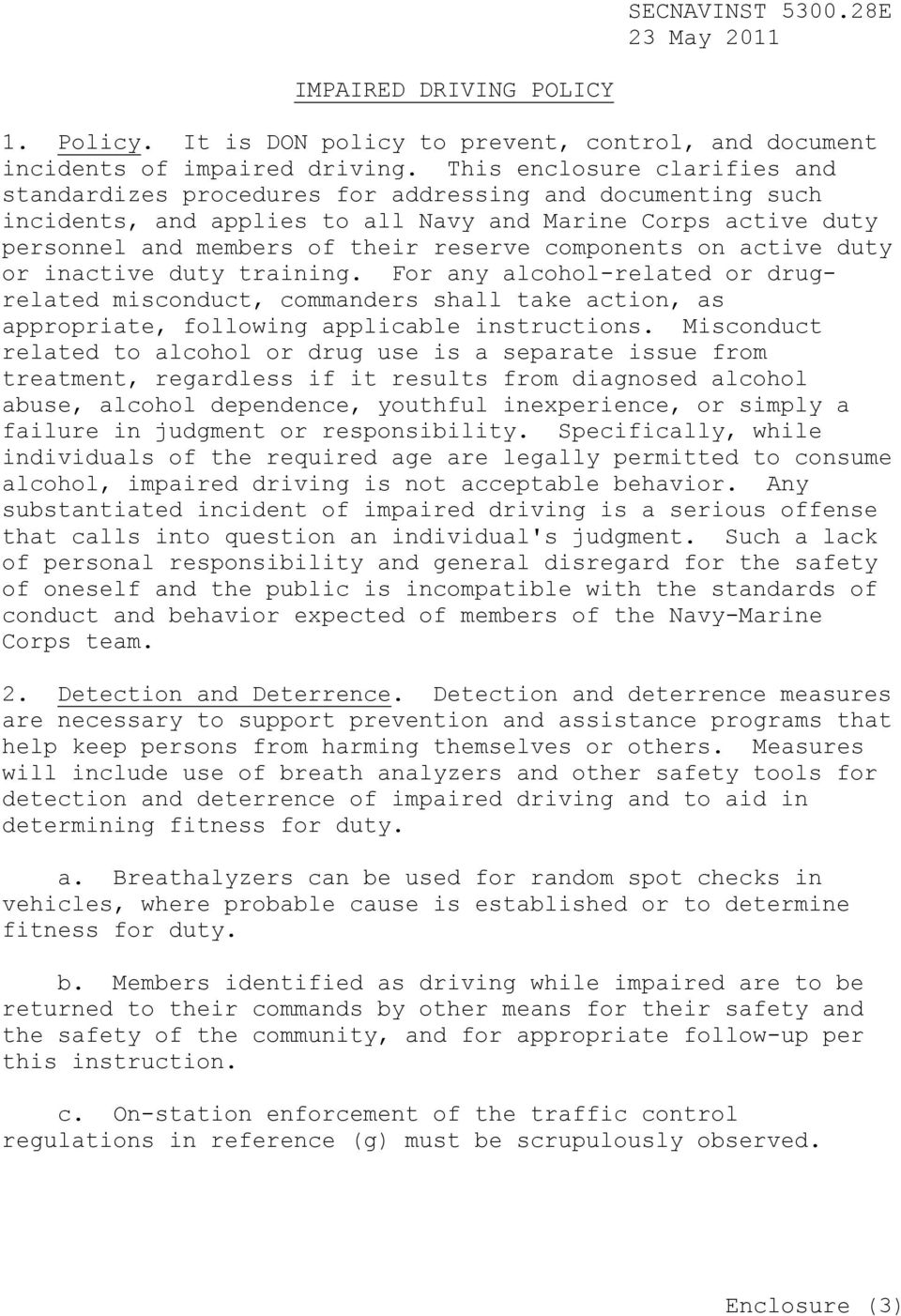
20 IMPAIRED DRIVING POLICY 1. Policy. It is DON policy to prevent, control, and document incidents of impaired driving. This enclosure clarifies and standardizes procedures for addressing and documenting such incidents, and applies to all Navy and Marine Corps active duty personnel and members of their reserve components on active duty or inactive duty training. For any alcohol-related or drugrelated misconduct, commanders shall take action, as appropriate, following applicable instructions. Misconduct related to alcohol or drug use is a separate issue from treatment, regardless if it results from diagnosed alcohol abuse, alcohol dependence, youthful inexperience, or simply a failure in judgment or responsibility. Specifically, while individuals of the required age are legally permitted to consume alcohol, impaired driving is not acceptable behavior. Any substantiated incident of impaired driving is a serious offense that calls into question an individual's judgment. Such a lack of personal responsibility and general disregard for the safety of oneself and the public is incompatible with the standards of conduct and behavior expected of members of the Navy-Marine Corps team. 2. Detection and Deterrence. Detection and deterrence measures are necessary to support prevention and assistance programs that help keep persons from harming themselves or others. Measures will include use of breath analyzers and other safety tools for detection and deterrence of impaired driving and to aid in determining fitness for duty. a. Breathalyzers can be used for random spot checks in vehicles, where probable cause is established or to determine fitness for duty. b. Members identified as driving while impaired are to be returned to their commands by other means for their safety and the safety of the community, and for appropriate follow-up per this instruction. c. On-station enforcement of the traffic control regulations in reference (g) must be scrupulously observed. Enclosure (3)
21 d. Off-station controls must be implemented following reference (g) and the requirements of this instruction. These controls must be enforced in those instances when availability of alcoholic beverages or drugs in the civilian community poses a threat to the wellbeing of Service members. 3. Substantiated Incidents of Impaired Driving. A substantiated incident of impaired driving per reference (l) includes, but is not limited to, the following: a. A conviction by summary, special, or general courtmartial of a violation of reference (b), article 111. b. A finding by competent authority during a hearing under reference (b), article 15, that, based upon a preponderance of the evidence, the member has violated reference (b), article 111, or an applicable lesser included offense thereto, regardless of whether the officer imposes punishment under reference (b), article 15. c. A final adjudication by Federal, State, local, or foreign authorities that the member violated a Federal statute, State statute, local ordinance, or foreign country law prohibiting operating a motor vehicle while impaired. The final adjudication may be based on any of the following: (1) The court's acceptance of a plea of guilty; (2) A finding of guilty after entry of a plea of not guilty; the court's acceptance of a plea of nolo contendere or other equivalent plea; or the court's acceptance of a request for probation before judgment or other equivalent diversionary programs designed to impose accountability for misconduct while avoiding a criminal conviction. (NOTE: A court's acceptance of a plea bargain to a lesser offense in paragraph 3c(1) above, such as reckless driving, does not preclude a commander from making an independent determination that an allegation of impaired driving is substantiated. Use of a foreign tribunal adjudication as the basis for command action under this instruction is permitted when the fundamental fairness of the foreign nation adjudicatory process is certified under SECNAVINST G.) 2 Enclosure (3)
22 d. A final adjudication by Federal, State, local, or foreign authorities that the member violated any Federal statute, State statute, local ordinance, or foreign country law regulating the operation of vehicles, when, incident to the violation, the member submits to a blood alcohol test and the results of the test exceed the state or foreign country standard for operating a vehicle while impaired. 4. Accountability. All commanding officers must properly document all substantiated incidents of impaired driving and take action, as appropriate, in cases of other unacceptable behaviors while under the influence. Consistent with current directives for the preparation of officer performance reports and enlisted performance evaluations, all substantiated incidents of impaired driving (on or off duty) shall be documented in officer fitness reports and enlisted evaluations, appropriate administrative record entries, and other reports required by instruction. Fitness report and evaluation grades should not be based solely upon a substantiated incident of impaired driving, but upon an evaluation of the individual's total performance during the rating period. It is DON policy to evaluate a person's total record in determining promotion, retention, reenlistment and assignment issues. 5. Records. It is imperative that all records are maintained per SECNAV Manual to ensure that the legal process is captured and protected. 3 Enclosure (3)
23 DEFINITIONS The following definitions are for operational use within the military drug and alcohol abuse prevention and control programs of the DON. The terms and provisions of this instruction are not intended to modify or otherwise affect statutory provisions and those regulations or DoD directives concerned with personnel administration, medical care, or with determination of misconduct and criminal or civil responsibilities for persons acts or omissions. 1. Alcohol Abuse. The use of alcohol to an extent that it has an adverse effect on performance, conduct, discipline, or mission effectiveness, and or the users health, behavior, family, community, or DON, or leads to unacceptable behavior as evidenced by one or more acts of alcohol-related misconduct. Alcohol abuse is a clinical diagnosis based on specific diagnostic criteria delineated in the American Psychiatric Association Diagnostic and Statistical Manual of Mental Disorders (DSM), current edition, and must be determined by a qualified MO or DoD-authorized licensed practitioner. A diagnosis of alcohol abuse generally requires some form of intervention and treatment. 2. Alcohol Dependence and or Alcoholism. Psychological and or physiological reliance on the drug alcohol as indicated by evidence of tolerance or symptoms of withdrawal as characterized by the development of withdrawal symptoms 12 hours or so after the reduction of intake following prolonged, heavy, alcohol ingestion. People are said to be dependent on alcohol when abstinence from use impairs their performance or behavior. Alcohol dependence is a clinical diagnosis based on specific diagnostic criteria delineated in the DSM, and must be determined by an MO or DoD-authorized licensed practitioner. Untreated, alcohol dependence may lead to death. 3. Alcohol-Incident. An offense punishable under reference (b) or civilian authority committed by a member where, in the judgment of the member's commanding officer, the consumption of alcohol was a contributing factor. 4. Anabolic Steroids. Any drug or hormonal substance, chemically and pharmacologically related to testosterone (other Enclosure (4)
24 than estrogens, progestins, and corticosteroids) that promotes muscle growth, and includes any salt, ester, or isomer of such a drug or substance described or listed in reference (d), section 802, if that salt, ester, or isomer promotes muscle growth. 5. Controlled Substances. Chemical compounds, anabolic steroids or other substance included in schedule I, II, III, IV, or V under reference (h) as updated and republished under the provisions of the Controlled Substance Act, title II of the Comprehensive Drug Abuse Prevention and Control Act of 1970 and its amendments. 6. Controlled Substance Analogue (Designer Drugs) a. Per reference (d), section 802, except as provided in paragraph 6b below, this term means a substance: (1) The chemical structure of which is substantially similar to the chemical structure of a controlled substance in schedule I or II of reference (d); and (2) Which has a stimulant, depressant, or hallucinogenic effect on the central nervous system that is substantially similar to or greater than the stimulant, depressant, or hallucinogenic effect on the central nervous system of a controlled substance in schedule I or II of reference (c); or (3) With respect to a particular person, which such person represents or intends to have a stimulant, depressant, or hallucinogenic effect on the central nervous system of a controlled substance in schedule I or II of reference (h). b. Such a term does not include: (1) A controlled substance; (2) Any substance for which there is an approved new drug application; (3) With respect to a particular person any substance, if an exemption is in effect for investigation use, for that person under section 505 of the Federal Food, Drug, and Cosmetic Act (21 U.S.C. 355) to the extent conduct with respect to such substance is under such exemption; or 2 Enclosure (4)
25 (4) Any substance to the extent not intended for human consumption before an exemption takes effect with respect to that substance. 7. Driving Under the Influence (DUI) and Driving While Intoxicated (DWI). DUI and DWI refers to the operation of, or being in the physical control of a motor vehicle or craft while impaired by any substance, legal or illegal. Definitions vary slightly from state to state. In most states recorded blood alcohol content (BAC) for alcohol ranging from 0.08 to 0.10 is prima facie proof of DUI and DWI without any other evidence. It should be noted that in many states, drivers can be impaired at levels lower than 0.08 and can be convicted on other evidence without a recorded BAC (see Substantiated Incidents of Impaired Driving, enclosure (3), paragraph 3). Additionally, operation of, or being in physical control of a motor vehicle or craft with any recorded BAC for alcohol by a person under the age of 21 may be prima facie evidence of DUI in many states. Further guidance concerning DUI and DWI is contained in reference (b), article 111, and its analysis. 8. Drug. Any substance, other than food, that is inhaled, injected, consumed, or introduced into the body in any manner to alter mood or function is considered a drug in this instruction. 9. Drug Abuse. The wrongful use of a controlled substance, prescription medication, over-the-counter medication, or intoxicating substance (other than alcohol) to an extent that it has an adverse effect on performance, conduct, discipline, or mission effectiveness, and or the user s health, behavior, family, community, or DON, or leads to unacceptable behavior as evidenced by one or more acts of drug-related misconduct. For purposes of this instruction, drug abuse also includes the intentional inhalation of fumes or gasses of intoxicating substances with the intent of achieving an intoxicating effect on the user s mental or physical state, and steroid usage other than that specifically prescribed by a competent authority. Drug abuse is also a clinical diagnosis based on specific diagnostic criteria delineated in the American Psychiatric Association DSM, current edition, and must be determined by a qualified MO or DoD-authorized licensed practitioner. A diagnosis of drug abuse generally requires some form of intervention and treatment. See definition of Wrongful. 3 Enclosure (4)
26 10. Drug Abuse Paraphernalia. All equipment, products, and materials of any kind that are used, intended for use, or designed for use, in planting, propagating, cultivating, growing, harvesting, manufacturing, compounding, converting, producing, processing, preparing, testing, analyzing, packaging, repackaging, storing, containing, concealing, injecting, ingesting, inhaling or otherwise introducing into the human body controlled substance in violation of reference (h). Drug abuse paraphernalia includes, but is not limited to: a. Hypodermic syringes, needles, and other objects used, intended for use, or designed for use in injecting controlled substances into the human body, and metallic or other containers used for mixing or other preparation of heroin, morphine, or other narcotic substances prior to such an injection. b. Objects used, intended for use, or designed for use in ingesting, inhaling, or otherwise introducing controlled substances (e.g., marijuana, cocaine, or hashish oil) into the human body, such as: (1) Pipes, with or without screens, designed for the purpose of smoking marijuana, hashish, or cocaine bearing names such as chamber pipes, carburetor pipes, electric pipes, air driven pipes, chillums, bongs, ice pipes or chiller, hashish heads, punctured metal bowls, etc.; (2) Roach clips: meaning objects used to hold burning marijuana too small or too short to be held in the hand; and (3) Cocaine spoons. c. The words "equipment, products, and materials" should be interpreted according to their ordinary or dictionary meaning. To insure that innocently possessed objects are not classified as drug abuse paraphernalia, paragraph 5b of the basic instruction makes the criminal intent of the person in possession or control of an object a key element of the definition. Some evidentiary factors to consider in determining this criminal intent, and hence whether an object is illegal drug abuse paraphernalia, are as follows: (1) Statements by the person in possession or by anyone in control of the object concerning its use; 4 Enclosure (4)
27 (2) The proximity of the object, in time and space, to the unlawful use, possession, or distribution of drugs; (3) The proximity of the object to controlled substances; (4) The existence of any residue of controlled substances on the object; (5) Instructions, oral or written, provided with the object concerning its use; (6) Descriptive materials accompanying the object which explain or depict its use; (7) The existence and scope of legitimate uses for the object in the community; and (8) Expert testimony concerning its use. 11. Drug Dependence. Psychological and or physiological reliance on a chemical or pharmacological agent as such reliance is defined by the DSM. The physiological alteration to the body or state of adaptation to a drug which after repeated use results in the development of, tolerance, and or withdrawal symptoms when discontinued, and or the psychological craving for the mental or emotional effects of a drug that manifests itself in repeated use and leads to a state of impaired capability to perform basic functions. Drugs have varying degrees of risk of addiction with nicotine and crack cocaine having the highest potential for addiction with very little use. The term does not include the continuing prescribed use of pharmaceuticals as part of the medical management of a chronic disease or medical condition. 12. Drug-Related Incident. Any incident where the use of a controlled substance or illegal drug, or the misuse of a legal drug or intoxicating substance (other than alcohol) is a contributing factor. Mere possession or trafficking in a controlled substance, illegal drug, legal drug intended for improper use, or drug paraphernalia may be classified as a drug related incident. Additionally, testing positive for a controlled substance, illegal drug or a legal drug not prescribed, may be considered a drug-related incident. 5 Enclosure (4)
28 13. Drug Trafficking. The wrongful distribution (includes sale or transfer) of a controlled substance, and or the wrongful possession or introduction into a military unit, base, station, ship, or aircraft of a controlled substance with the intent to distribute. 14. Inhalant Abuse (Huffing). The intentional inhalation or breathing of gas, fumes, or vapors of a chemical substance or compound with the intent of inducing intoxication, excitement, or stupefaction in the user. Nearly all abused inhalants produce effects similar to anesthetics, which slow down the body's function. Varying upon the level of dosage, the user can experience slight stimulation, feeling of less inhibition, loss of consciousness, or suffer from Sudden Sniffing Death Syndrome. (This means the user can die from the first, tenth, or one hundredth time he or she abuses an inhalant.) 15. Marijuana and Cannabis. For purposes of this instruction the terms marijuana and cannabis are used interchangeably. Cannabis is the botanical name for a genus of plants commonly referred to as marijuana. 16. Natural Substances. Chemicals that are produced by or within living organisms (plants, animals, or fungi). A nonexclusive list of these substances include salvia divinorum, psilocybin, psilocin, and 5-methoxy-dimethyltryptamine. 17. Prevention Program. An ongoing process of planned activities to specifically counter the identified threat of drug and alcohol abuse in a geographical area or command. Prevention programs normally include: threat assessment, policy development and implementation, public information activities, education and training, deglamorization, and evaluation. Effective prevention programs are tailored to the specific area or command, i.e., command and community-based. 18. Wrongful. Possession, use, distribution or manufacture of a controlled substance is wrongful if it is without legal justification, authorization or excuse, and includes use contrary to the directions of the manufacturer or prescribing healthcare provider, and use of any intoxicating substance not intended for human ingestion. Possession, use, distribution, or manufacture of a controlled substance is not wrongful if such act or acts are: 6 Enclosure (4)
29 a. Done under legitimate law enforcement activities (e.g., an informant who receives drugs as part of an undercover operation is not in wrongful possession); b. Done by authorized personnel in the performance of medical duties; or c. Without knowledge of the contraband nature of the substance (e.g., a person who possesses cocaine, but actually believes it to be sugar, is not guilty of wrongful possession of cocaine). 7 Enclosure (4)
Drug-Free Workplace. Policy Statement. Reason for the Policy. Policy V. 7.2.1
 Policy V. 7.2.1 Responsible Official: Vice President for Human Resources, Diversity, and Multicultural Affairs Effective Date: October 26, 2009 Drug-Free Workplace Policy Statement The University of Vermont
Greater Altoona Career & Technology Center ADULT EDUCATION DRUG & ALCOHOL POLICY
 The Greater Altoona Career & Technology Center recognizes that the abuse of controlled substances is a serious problem with legal, physical and social implications for the whole school community. As an
Department of Defense INSTRUCTION
 Department of Defense INSTRUCTION NUMBER 1010.01 September 13, 2012 USD(P&R) SUBJECT: Military Personnel Drug Abuse Testing Program (MPDATP) References: See Enclosure 1 1. PURPOSE. This Instruction: a.
ADMINISTRATIVE INSTRUCTION
 Washington Headquarters Services ADMINISTRATIVE INSTRUCTION NUMBER 17 November 6, 2007 SUBJECT: Civilian Employee Alcohol and Drug Abuse Prevention, Testing, and Control Program WHS References: (a) Administrative
SYSTEM REGULATIONS. 34.02.01 Drug and Alcohol Abuse and Rehabilitation Programs July 14, 2000 Supplements System Policy 34.02
 SYSTEM REGULATIONS 34.02.01 Drug and Alcohol Abuse and Rehabilitation Programs July 14, 2000 Supplements System Policy 34.02 1. ADMINISTRATION The provisions of this regulation are based on requirements
CITY OF ESSEXVILLE SUBSTANCE ABUSE POLICY
 CITY OF ESSEXVILLE SUBSTANCE ABUSE POLICY Department of Transportation Regulated Employees (Original Adoption November 29, 1995, Latest Revision November 17, 2008) I. PURPOSE The City of Essexville ( Employer
POLICY FOR A DRUG AND ALCOHOL-FREE WORKPLACE
 POLICY FOR A DRUG AND ALCOHOL-FREE WORKPLACE I. STATEMENT OF PURPOSE Crossroads of Western Iowa recognizes the problems of substance abuse in society and in the workplace. Substance abuse poses a serious
SAMPLE DRUG AND ALCOHOL POLICY
 SAMPLE DRUG AND ALCOHOL POLICY (MISSISSIPPI) DRUG AND ALCOHOL POLICY DISCLAIMER WARNING!!! The attached Drug and Alcohol Policy is being furnished to you as a courtesy. Stonetrust Management Services highly
Utica College Annual Notice Regarding Drug and Alcohol Abuse Prevention Policies
 Utica College Annual Notice Regarding Drug and Alcohol Abuse Prevention Policies Utica College is required by federal law to provide the following notice to all students and employees. This notice is being
MILPERSMAN 1910-146 Separation By Reason Of Misconduct - Drug Abuse
 Page 1 of 5 MILPERSMAN 1910-146 Separation By Reason Of Misconduct - Drug Abuse Responsible Office NAVPERSCOM (PERS-832) NAVPERSCOM (PERS-913) Inactive Enlisted Mbrs. Phone: Phone: DSN COM FAX DSN COM
MOSAIC DES MOINES Alcohol/Drug Free Workplace Policy
 MOSAIC DES MOINES Alcohol/Drug Free Workplace Policy Purpose: To help safeguard employee health, provide a safe and productive workplace, and supply our people served with high quality service, Mosaic
5530.01 - DRUG TESTING DRUG TESTING PROGRAMS
 5530.01 - DRUG TESTING Drug and alcohol abuse in any school is a threat to the safety and health of students, faculty, staff, and the community as a whole. It jeopardizes the efficiency and the quality
Employee Assistance Program
 Employee Assistance Program SUBSTANCE ABUSE POLICY: Substance Abuse Policy Law Substance Abuse policies and procedures are complex and subject to frequent change by legislation and court decision. It is
Alcohol and Drug-Free Work Place Policy
 Alcohol and Drug-Free Work Place Policy Cleary University, in compliance with Public Law 101-226 (Drug-Free Schools and Communities Act), presents the standards listed below to the entire University community:
POLICY 5290. Student Discipline - Drugs/Alcohol/Tobacco
 A. Authority POLICY 5290 Student Discipline - Drugs/Alcohol/Tobacco The Box Elder School District Board of Education recognizes that the use, possession, distribution, or sale of tobacco, nicotine (including
STUDENT 3.0 POLICY: 3.1 DRUG/ALCOHOL
 STUDENT 3.0 POLICY: 3.1 The manufacture, control, trafficking, possession, use, sale, purchase or distribution of drugs, including but not limited to, designer drugs, anabolic/performance enhancing drugs,
Chapter 813. Driving Under the Influence of Intoxicants 2013 EDITION. Title 59 Page 307 (2013 Edition)
 Chapter 813 2013 EDITION Driving Under the Influence of Intoxicants GENERAL PROVISIONS 813.010 Driving under the influence of intoxicants; penalty 813.011 Felony driving under the influence of intoxicants;
DEKALB COUNTY GOVERNMENT DRUG-FREE WORKPLACE POLICY
 DEKALB COUNTY GOVERNMENT DRUG-FREE WORKPLACE POLICY Reviewed For Updates March 1, 2015 CURRENT DATE OF CONTENTS OF DRUG-FREE WORKPLACE POLICY Pg. Section Date 1 1.1.0. 02/19/1992 1 1.1.1. 02/19/1992 1
Source/Reference: Drug-Free Workplace Act of 1988 Drug-Free Schools and Communities Act Amendments of 1989
 Page 1 of 7 Revision Responsibility: Responsible Executive Officer: Executive Director of Human Resources Vice President for Business Affairs Source/Reference: Drug-Free Workplace Act of 1988 Drug-Free
BROADALBIN-PERTH CENTRAL SCHOOL ADOPTED 7/19/04 2 ND READING AND ADOPTION 6/21/10 SUBSTANCE ABUSE
 BOARD OF EDUCATION ADMINISTRATIVE REGULATION 7.6.1A BROADALBIN-PERTH CENTRAL SCHOOL ADOPTED 7/19/04 2 ND READING AND ADOPTION 6/21/10 Primary Prevention SUBSTANCE ABUSE The intent of primary prevention
Northern New Mexico College HUMAN RESOURCES POLICY
 Northern New Mexico College HUMAN RESOURCES POLICY Subject: Substance Abuse File Reference: 3.3 Date Approved By Board of Regents: Replaces Policy Approved On: Purpose: September 21, 1990 Policy: Procedures:
Substance Abuse Program
 Substance Abuse Program www.tridentinsurance.net Lines of Business: Auto, Worker Compensation, Public Officials Liability, Educators Legal Liability, General Liability Risk Control Strategy/Key Issues:
Alcohol. Policies. on campus and in the workplace
 Alcohol and Drug Policies on campus and in the workplace September 2014 The University of Kansas Alcohol and Drug Policies The consumption of alcoholic liquor on the campus of the University of Kansas
Policies & Procedures
 2.2 Drug Free Work Place Adopted 1.24.2003 Revised 3.28.2004; 5.26.2006; 3.2.2011 Reference: WAC 388.805.200(3) POLICY In accordance with "The Drug Free Workplace Act of 1988, The Healing Lodge prohibits
PANTHER VALLEY SCHOOL DISTRICT
 No. 227 SECTION: PUPILS PANTHER VALLEY SCHOOL DISTRICT TITLE: DRUGS AND ALCOHOL ADOPTED: May 27, 2010 REVISED: 227. DRUGS AND ALCOHOL 1. Purpose The Board expresses its belief in the accompanying policy
It s a Privilege to Drive: Snapshot of Impaired Driving in Montana
 It s a Privilege to Drive: Snapshot of Impaired Driving in Montana Unlawful Acts Notes Montana Code Drive under the influence of drugs or alcohol: DUI Operate a noncommercial vehicle with excessive alcohol
Overview of Sample Drug and Alcohol Abuse Policy
 Overview of Sample Drug and Alcohol Abuse Policy All employers should have a vital interest in maintaining a safe, healthy, and efficient working environment. Being under the influence of a drug or alcohol
Drug-Free Workplace Policy and Procedures July 16, 2015
 Drug-Free Workplace Policy and Procedures July 16, 2015 Regional Transit Authority of Southeast Michigan Drug-Free Workplace Policy and Procedures Purpose In compliance with regulations governing anti-drug
UNIVERSITY OF NORTH DAKOTA SUBSTANCE ABUSE POLICY FOR FACULTY AND STAFF
 UNIVERSITY OF NORTH DAKOTA SUBSTANCE ABUSE POLICY FOR FACULTY AND STAFF PURPOSE The University of North Dakota recognizes that the use of illegal drugs, and abuse of alcohol and prescription drugs is a
State Recommended Drug Free Workplace Policy
 INSTRUCTIONS: State Recommended Drug Free Workplace Policy The following policy should have the first page printed on company letterhead. The sections which are in italics are to be removed. They are for
Asset Marketing Services, Inc. Drug and Alcohol Testing Policy (MN)
 Drug and Alcohol Use Asset Marketing Services, Inc. Drug and Alcohol Testing Policy (MN) Illegal drug use in the workplace is against the law and highly detrimental to the safety and productivity of our
The following procedures are established in implementation of Policy No. 5530, Substance Abuse.
 R5530.DR Page 1 of 11 The following procedures are established in implementation of Policy No. 5530,. A. Definitions 1. Evaluation means those procedures used by a certified or licensed professional to
UNIVERSITY OF MARYLAND POLICY ON EMPLOYEE ALCOHOL AND OTHER DRUG ABUSE
 VI-8.00(A) UNIVERSITY OF MARYLAND POLICY ON EMPLOYEE ALCOHOL AND OTHER DRUG ABUSE (Approved by the President September 9, 1992; technical changes November 2009; technical changes September 2014.) The University
HACH COMPANY DRUG AND ALCOHOL POLICY
 HACH COMPANY DRUG AND ALCOHOL POLICY I. Purpose Hach Company is committed to a safe, healthy, and productive work environment for all Associates free from the effects of substance abuse. Abuse of alcohol,
Policies and Procedures
 Page 1 of 7 Policies and Procedures Policy Governing Use of Alcohol and Other Drugs 1 Introduction: The College of Environmental Science and Forestry is committed to providing a safe and healthy environment
Drug Free Campus Plan
 Baptist University of the Américas, San Antonio, Texas, is committed to maintaining a drug free environment, free of the abuse of alcohol, tobacco and other drugs. Baptist University of the Américas is
Student Drug, Alcohol and Tobacco Use ABERDEEN SCHOOL DISTRICT #58. POLICY NO: 551 PAGE 1 of 5 PHILOSOPHY
 POLICY TITLE: Student Drug, Alcohol and Tobacco Use ABERDEEN SCHOOL DISTRICT #58 POLICY NO: 551 PAGE 1 of 5 PHILOSOPHY It is the Idaho Legislature s intent that parental involvement in all aspects of a
AN ACT. The goals of the alcohol and drug treatment divisions created under this Chapter include the following:
 ENROLLED Regular Session, 1997 HOUSE BILL NO. 2412 BY REPRESENTATIVE JACK SMITH AN ACT To enact Chapter 33 of Title 13 of the Louisiana Revised Statutes of 1950, comprised of R.S. 13:5301 through 5304,
How To Keep A Drug And Alcohol Free Workplace
 CDHD DRUG/TOBACCO/ALCOHOL-FREE WORKPLACE POLICY Central District Health Department is committed to maintaining a drug, tobacco and alcohol-free workplace in the interest of high quality health care, safety
Halifax Regional Municipality ( HRM ) Substance Abuse Prevention Policy ( Policy )
 Halifax Regional Municipality ( HRM ) Substance Abuse Prevention Policy ( Policy ) I. Policy Statement and Purpose Halifax Regional Municipality ( HRM ) is committed to providing a safe work environment
X. SUBSTANCE ABUSE/DRUG-FREE WORKPLACE POLICY
 X. SUBSTANCE ABUSE/DRUG-FREE WORKPLACE POLICY GENERAL POLICY It is the policy of Scott County to provide safe, dependable and efficient services to the public which it serves. Scott County is committed
1.7.8.5 EFFECTIVE DATE: February 12, 2010, unless a later date is cited at the end of a section. [1.7.8.5 NMAC - Rp, 1.7.8.5 NMAC, 02/12/2010]
![1.7.8.5 EFFECTIVE DATE: February 12, 2010, unless a later date is cited at the end of a section. [1.7.8.5 NMAC - Rp, 1.7.8.5 NMAC, 02/12/2010]](/thumbs/21/1191525.jpg "1.7.8.5 EFFECTIVE DATE: February 12, 2010, unless a later date is cited at the end of a section. [1.7.8.5 NMAC - Rp, 1.7.8.5 NMAC, 02/12/2010]") TITLE 1 CHAPTER 7 PART 8 GENERAL GOVERNMENT ADMINISTRATION STATE PERSONNEL ADMINISTRATION DRUG AND ALCOHOL ABUSE 1.7.8.1 ISSUING AGENCY: State Personnel Board. [1.7.8.1 NMAC - Rp, 1.7.8.1 NMAC, 02/12/2010]
TITLE 1 CHAPTER 7 PART 8 GENERAL GOVERNMENT ADMINISTRATION STATE PERSONNEL ADMINISTRATION DRUG AND ALCOHOL ABUSE 1.7.8.1 ISSUING AGENCY: State Personnel Board. [1.7.8.1 NMAC - Rp, 1.7.8.1 NMAC, 02/12/2010]
PARTICIPANT CONTRACT
 PARTICIPANT CONTRACT, DEKALB COUNTY DRUG/DUI COURT: C.L.E.A.N. PROGRAM (CHOOSING LIFE AND ENDING ABUSE NOW) IN THE CIRCUIT COURT FOR THE SIXTEENTH JUDICIAL CIRCUIT DEKALB COUNTY, ILLINOIS PARTICIPANT CONTRACT
ALCOHOL AND DRUG-FREE WORKPLACE 6.65
 ALCOHOL AND DRUG-FREE WORKPLACE 6.65 I. Legislative Intent It is the intent of the School Board of Seminole County, Florida (SBSB) to establish a policy that ensures all employees remain drug free as a
CHAPTER 48 DRUG PARAPHERNALIA
 CHAPTER 48 DRUG PARAPHERNALIA 48.01 Purpose 48.05 Possession of Drug Paraphernalia 48.02 Controlled Substance Defined 48.06 Manufacture, Delivery or Offering For Sale 48.03 Drug Paraphernalia Defined 48.07
Drug and Alcohol Testing for Safety- and Security-sensitive Positions
 [Minor revision posted 3/7/14 (replaces 1/27/12 edition)] Operating Policy and Procedure : Drug and Alcohol Testing for Safety- and Security-sensitive Positions DATE: March 7, 2014 PURPOSE: The purpose
LAKE COUNTY SCHOOLS RECEIPT OF DRUG-FREE WORKPLACE POLICY
 LAKE COUNTY SCHOOLS RECEIPT OF DRUG-FREE WORKPLACE POLICY I hereby acknowledge receipt of the Lake County School Board s Drug-Free Workplace Policy. I Understand that the name, address and telephone number
Drug and Alcohol Policy. Marathon Petroleum Company LP Drug and Alcohol Policy. Employee Guide
 Marathon Petroleum Company LP Drug and Alcohol Policy Employee Guide Revised as of April 2014 Table of Contents Introduction... 1 Part I Drug Policy... 1 Part II Alcohol Policy... 1 Part III Policy Application...
OFFICIAL NOTICE TO FACULTY AND STAFF REGARDING SUBSTANCE ABUSE IN UNIVERSITY CAMPUS COMMUNITIES AND WORKSITES
 OFFICIAL NOTICE TO FACULTY AND STAFF REGARDING SUBSTANCE ABUSE IN UNIVERSITY CAMPUS COMMUNITIES AND WORKSITES This Official Notice is issued pursuant to the requirements of Subpart B, Section 86.100 of
Alcoholism and Drug Abuse Program
 Technician Personnel Regulation 792 Alcoholism and Drug Abuse Alcoholism and Drug Abuse Program National Guard Bureau Arlington, VA 22202-3231 8 February 2011 UNCLASSIFIED SUMMARY of CHANGE TPR 792 Alcoholism
Addressing the Use of Alcohol
 Addressing the Use of Alcohol Illicit drugs and alcohol are dangerous because they are addictive both physically and psychologically. Memphis Theological Seminary prohibits the possession, use or distribution
DEPARTMENT OF DEFENSE DEFENSE OFFICE OF HEARINGS AND APPEALS. In the matter of: ) ) ) ISCR Case No. 14-03297 ) Applicant for Security Clearance )
 DEPARTMENT OF DEFENSE DEFENSE OFFICE OF HEARINGS AND APPEALS In the matter of: ) ) ) ISCR Case No. 14-03297 ) Applicant for Security Clearance ) Appearances For Government: Gina L. Marine, Esq., Department
5131.6. Students. Drugs and Alcohol/Tobacco. Drug and Alcohol Use by Students. Policy Statement
 5131.6 Students Drugs and Alcohol/Tobacco Drug and Alcohol Use by Students Policy Statement The Board is required by Connecticut law to prescribe rules for the management and discipline of its schools.
Cincinnati Christian University Drug Abuse Prevention Program
 Cincinnati Christian University Drug Abuse Prevention Program Cincinnati Christian University maintains that our bodies are created by God and should be used to glorify Him. The misuse or abuse of alcohol
SUBSTANCE ABUSE POLICY
 SUBSTANCE ABUSE POLICY It is the policy of The Rockefeller University to make every effort to ensure a drug-free workplace in order to protect the health, safety, and welfare of its employees, its students,
SOUTH CAROLINA DEPARTMENT OF ADMINISTRATION DRUG AND ALCOHOL TESTING POLICY AND PROCEDURE
 SOUTH CAROLINA DEPARTMENT OF ADMINISTRATION DRUG AND ALCOHOL TESTING POLICY AND PROCEDURE THE LANGUAGE USED IN THIS DOCUMENT DOES NOT CREATE AN EMPLOYMENT CONTRACT BETWEEN THE EMPLOYEE AND THE AGENCY.
R 5530 SUBSTANCE ABUSE (M) [See POLICY ALERT Nos. 125, 133, 144, 145, 157, 173, 179 and 204]
![R 5530 SUBSTANCE ABUSE (M) [See POLICY ALERT Nos. 125, 133, 144, 145, 157, 173, 179 and 204]](/thumbs/33/16413880.jpg "R 5530 SUBSTANCE ABUSE (M) [See POLICY ALERT Nos. 125, 133, 144, 145, 157, 173, 179 and 204]") R 5530/Page 1 of 17 M R 5530 [See POLICY ALERT Nos. 125, 133, 144, 145, 157, 173, 179 and 204] The following procedures are established in implementation of Policy 5530, Substance Abuse. A. Definitions
R 5530/Page 1 of 17 M R 5530 [See POLICY ALERT Nos. 125, 133, 144, 145, 157, 173, 179 and 204] The following procedures are established in implementation of Policy 5530, Substance Abuse. A. Definitions
No Eastern International student shall coerce, even subtly, another Eastern International student to use drugs or alcohol.
 Eastern International College Alcohol and Drug Policy for Students and Employees This Policy applies to all students on any Eastern International College property or at any activity sponsored or authorized
Alcohol and Drug Program
 Alcohol and Drug Program June 5, 2013 Table of Contents Strathcona County Alcohol and Drug Program 1 PURPOSE... 3 2 PROGRAM STATEMENT... 3 3 RESPONSIBILITIES... 3 4 PREVENTION, ASSISTANCE, REHABILITATION...
COLLEGE POLICY STATEMENT ON DRUG-FREE WORKPLACE FOR FACULTY AND STAFF
 COLLEGE POLICY STATEMENT ON DRUG-FREE WORKPLACE FOR FACULTY AND STAFF American society is harmed in many ways by alcohol abuse and other drug use. Decreased productivity, serious health problems, breakdown
Drug and Alcohol Policy
 Drug and Alcohol Policy Functional Area: Student Affairs Applies To: All Faculty and Staff Policy Reference(s): Federal Drug-Free Schools and Communities Act of 1989 Number: N/A Date Issued: July 2012
Robbinsville Board of Education REGULATION Section: s Regulation 5530: Substance Abuse (M) Edited: September 2014 Page 1 of 12
 R Robbinsville Board of Education REGULATION Section: s Regulation 5530: Substance Abuse (M) Edited: September 2014 Page 1 of 12 R 5530 SUBSTANCE ABUSE (M) The following procedures are established in implementation
POLICY TINTON FALLS BOARD OF EDUCATION. PUPILS 5530/Page 1 of 10 SUBSTANCE ABUSE 5530 SUBSTANCE ABUSE
 5530/Page 1 of 10 M 5530 The Board of Education recognizes that a pupil's abuse of harmful substances seriously impedes that pupil's education and threatens the welfare of the entire school community.
A. Alcohol Ale, beer, wine, whiskey, rum, gin, or any other spirituous, vinous, malt, or fermented liquor or compound by whatever name called.
 BOARD OF EDUCATION POLICY 9230 ALCOHOL, OTHER DRUGS, PRESCRIPTION MEDICATION AND OVER THE COUNTER PRODUCTS Effective: August 14, 2014 I. Policy Statement The Board of Education of Howard County is committed
College Policy on Drugs & Alcohol
 College Policy on Drugs & Alcohol Introduction and Table of Contents The Drug Free Workplace Act of 1988 and the Drug Free Schools and Communities Act Amendments require the Institute of Technology to
ENGROSSED ORIGINAL A BILL 20-409 IN THE COUNCIL OF THE DISTRICT OF COLUMBIA
 0 0 A BILL 0-0 IN THE COUNCIL OF THE DISTRICT OF COLUMBIA To make the possession or transfer without remuneration of ounce or less of marijuana a civil violation subject to a fine and to make technical
Policy on Drug-Free Campus & Workplace
 President Page 1 of 5 PURPOSE: CI recognizes that substance abuse has become an increasingly serious problem affecting all aspects of society, including the workplace and academia. Substance abuse can
DRUG-FREE SCHOOLS AND COMMUNITIES ACT OF 1989
 DRUG-FREE SCHOOLS AND COMMUNITIES ACT OF 1989 Central Christian College of Kansas provides the following information in compliance with the Drug-Free Schools and Communities Act of 1989, and in support
MIDWESTERN UNIVERSITY DRUG FREE WORKPLACE AND SUBSTANCE ABUSE POLICY
 MIDWESTERN UNIVERSITY DRUG FREE WORKPLACE AND SUBSTANCE ABUSE POLICY PURPOSE: POLICY: I. To establish policies and procedures whereby Midwestern University shall, in order to appropriately serve the needs
Policies and Procedures VI-4, p.1 Reviewed/Revised January 2014 SUBSTANCE ABUSE PREVENTION
 Policies and Procedures VI-4, p.1 1. GENERAL Unless a standard of conduct is specifically limited to a particular group, the standards apply to all faculty and staff. This policy is not intended to affect
PARTICIPANT CONTRACT
 PARTICIPANT CONTRACT, DEKALB COUNTY DRUG/DUI COURT: C.L.E.A.N. PROGRAM (CHOOSING LIFE AND ENDING ABUSE NOW) IN THE CIRCUIT COURT FOR TWENTY-THIRD JUDICIAL CIRCUIT DEKALB COUNTY, ILLINOIS PARTICIPANT CONTRACT
How To Understand The Policies Of Goldey-Beacom College
 Goldey-Beacom College Human Resources Office 4701 Limestone Road Wilmington, Delaware 19808 (302) 225-6233 Alcohol and Drug Policy Statement What the Goldey-Beacom College Community Needs to Know About
3.1. The procedure shall be applicable to all University employees.
 LINCOLN UNIVERSITY Procedure: Confirmatory Testing for Substance Abuse Procedure Number: HRM 113p Effective Date: October 2008 Revisions: Review Officer: Chief Human Resources Officer 1. Purpose 1.1. It
FEDERAL HEIGHTS POLICE DEPARTMENT
 FEDERAL HEIGHTS POLICE DEPARTMENT Effective Date: May 1999 Directive: 171.5 Approved By: Chief Acker (City of Federal Heights Personnel Code) Employee Drug or Alcohol Abuse Section XII. - Drugs and Alcohol.
DHHS POLICIES AND PROCEDURES
 DHHS POLICIES AND PROCEDURES Section V: Human Resources Current Effective Date: 9/1/11 Revision History: 7/1/03, 4/1/04; 4/6/09; 9/1/11 Original Effective Date: 8/1/89 Purpose The purpose is to establish
REGULATIONS DRUG-FREE WORKPLACE/DRUG AND ALCOHOL ABUSE POLICY
 REGULATIONS REG No.: 878 I. PURPOSE DRUG-FREE WORKPLACE/DRUG AND ALCOHOL ABUSE POLICY Wharton County Junior College ( WCJC or College ) is committed to protecting the safety, health, and well being of
PINE HILL BOARD OF EDUCATION School Board Policy 1003 Turnerville Road Pine Hill, New Jersey 08021 5530- SUBSTANCE ABUSE
 PINE HILL BOARD OF EDUCATION School Board Policy 1003 Turnerville Road Pine Hill, New Jersey 08021 Phone: 856-783-6900 ext. 1115 FAX: 856-783-2955 Website: www.pinehill.k12.nj.us 5530- SUBSTANCE ABUSE
HEAT AND FROST INSULATORS AND ALLIED WORKERS LOCAL 45 JOINT APPRENTICESHIP AND TRAINING COMMITTEE DRUG-FREE SUBSTANCE ABUSE POLICY AND PROCEDURE
 HEAT AND FROST INSULATORS AND ALLIED WORKERS LOCAL 45 JOINT APPRENTICESHIP AND TRAINING COMMITTEE I. PURPOSE DRUG-FREE SUBSTANCE ABUSE POLICY AND PROCEDURE The purpose of this Substance Abuse Policy (hereinafter
SERVING GRANITE CITY, MITCHELL, AND PONTOON BEACH
 2001 Delmar Avenue Granite City, IL 62040-6238 618-452-6238 smrld.org Tina Hubert Executive Director SERVING GRANITE CITY, MITCHELL, AND PONTOON BEACH SMRLD Drug and Alcohol Free Workplace Policy Purpose
3. Use and/or abuse of substance is a detractor from the school s primary function of educating its students.
 1992 6152/7321 POLICY Policy on substance abuse Personnel SUBJECT: POLICY ON SUBSTANCE ABUSE Introduction As our country struggles to combat the growing problem of substance abuse, school systems across
DRUG AND ALCOHOL POLICY
 DRUG AND ALCOHOL POLICY Pace University seeks to promote individual wellness in as many ways as possible. Accordingly, in summary, the Policy prohibits the unlawful use, possession, sale, distribution,
1. University functions at which use of alcohol is approved.
 University of Michigan-Flint Alcohol and Other Drugs (AOD) Policy 2013-2014 Introduction The University of Michigan-Flint, is committed to providing a safe, healthy learning community for all its members.
1 March 2013. HUMAN RESOURCES Employee Drug Testing, Substance Abuse and Drug Free Workplace Policy POLICY Number: B-002
 HUMAN RESOURCES Employee Drug Testing, Substance Abuse and Drug Free Workplace Policy POLICY Number: B-002 1. AUTHORITY: Director of State Civil Service as contained La. R.S. 36:54 2. REFERENCES: La. R.S.
SUBCHAPTER IV. OFFENSES AND PENALTIES
 DISTRICT OF COLUMBIA OFFICIAL CODE TITLE 48. FOOD AND DRUGS SUBTITLE III. ILLEGAL DRUGS CHAPTER 9. CONTROLLED SUBSTANCES UNIT A. CONTROLLED SUBSTANCES ACT SUBCHAPTER IV. OFFENSES AND PENALTIES 48-904.01.
How To Test For Illegal Drugs And Alcohol
 DRUG AND ALCOHOL TESTING POLICY Policy This policy applies to all persons who are applicants for or who are employed in positions with duties or activities that involve the requirement of a commercial
5530 SUBSTANCE ABUSE (M)
 Haddonfield 5530 / Page 1 of 10 5530 SUBSTANCE ABUSE (M) The following procedures are established in implementation of Policy No. 5530, Substance Abuse. A. Definitions 1. Evaluation means those procedures
POLICY TITLE: Employee Drug and Alcohol Testing POLICY NO: 403.50 PAGE 1 of 7
 POLICY TITLE: Employee Drug and Alcohol Testing POLICY NO: 403.50 PAGE 1 of 7 It is the intent of the board of trustees of this district to promote an alcohol and drug-free workplace, thereby enhancing
Sample Written Program For. Drug Free Workplace Program
 Sample Written Program For Drug Free Workplace Program Drug Free Workplace Program Because drug laws can vary from state to state, you should obtain legal council before instituting any drug program. (YOUR