
Texas Education Agency
|
|
|
- Debra Cummings
- 10 years ago
- Views:
Transcription
1 TEACHER MANUAL Texas Education Agency Revised 2005

2 SECTION I PDAS Teacher Manual Introductory Information

3 PDAS Teacher Manual Table of Contents Page Introduction Table of Contents...1 Letter from Commissioner...2 Acknowledgements...3 Slide Notes Pages...5 Section II Legal considerations Executive Summary...17 Commissioner s Rules - Texas Education Code (TEC) Teacher Appraisal Chapter 150 ( )...20 Statutory Citations Texas Administrative Code (TAC) Chapter TAC Staff Development Requirements (TAC)- Chapter Section III PDAS process Appraisal Period Timeline...36 Appraisal Framework...37 Observation Summary/Summative Report Form (OSF)...47 Teacher Self-Report Form (TSR)...56 Scoring Factors and Performance Level Standards (SIVA)...62 Scoring Criteria Guide...63 Appendix State Board of Certification Teacher Certification Renewal worksheet Teacher checklist Question and Answer Index Page Teacher in Need of Assistance (TINA) Glossary
4 1701 North Congress Ave.* Austin, Texas * 512/ * FAX: 512/ * Shirley J. Neeley, Ed.D. Commissioner Dear Texas Educator: Welcome to the Instructional Leadership Development (ILD) training. Texas has developed three components that address the statutory requirements related to teacher and administrator appraisal and professional development: Instructional Leadership Development (ILD), Professional Development and Appraisal System (PDAS) and Administrator Appraisal. In developing these components, input was solicited from a state-level Appraisal Advisory Committee, several professional associations, and focus groups. All three components incorporate the learner-centered proficiencies based on input from over 10,000 of our state s teachers and other stakeholders. All components include the student performance link required in law and mutually reinforce each other as a continuous improvement process designed to help you meet the needs of your campus and/or district. PDAS is designed to enhance student learning through the professional development of educators. The ILD reflects the interconnections among major improvement initiatives in our state while Administrator Appraisal acknowledges the role of administrators as instructional leaders. I hope this ILD training experience assists you in school improvement. I also hope this system helps you create a productive future for your students and produces a supportive environment for all educators. Sincerely, Shirley J. Neeley, Ed.D. Good, Better, Best-never let it rest-until your good is better-and your better is BEST! 2

5 Acknowledgments Executive Management SHIRLEY J. NEELEY Commissioner of Education ROBERT SCOTT Chief Deputy Commissioner SUSAN BARNES Associate Commissioner, Standards and Programs GEORGE R. RISLOV Managing Director, Division of Curriculum LAURA J. PEREZ Program Specialist, Educator Development Unit Office of Statewide Initiatives, Region XIII ESC DIANE POLLARD Coordinator, Administrator Development and Support MARILYN BUCKNER Education Specialist VICKI STARCHER Program Assistant WARREN GIBBS Education Specialist MIRANDA CHAVEZ Program Assistant JANET PALMS Desktop Publisher 3

6 ACKNOWLEDGMENTS Special thanks to the following individuals for their contributions to the initial development process: Executive Management Mike Moses Bill Reaves Felipe Alanis Ann Smisko Mindy Sitton Cheryl Wright Terri Rodgers Millie Klein Susan Murphy Rose Ann Cantu Mychelle Malveaux Shawna Warren Nolan Wood 1997 Research Team Jill Burke Ted Guffy Betty Jo Monk 1997 Training Design Team Viviana Lopez Lois Moseley Cheryl Padgett Pam Padilla Ron Simpson Technical Review Doris Redfield 1997 Website Design/Production Brian Giza Video Production Team Anne Bustard Sara Lowrey Mackie Gary Pickle Carol Lane Horizon Film and Video 2001 Revision Team Mary Geiger Viviana Lopez Randee Reisinger Barbara Brown David Cavitt Ray Simmons Bill Reynolds Karen Maxwell Randy Scott Carlene Lenox Lawanna Goodwin Jerry Jimerson Cindy Acosta Johney Chandler David Manning Kathy Jones Bill Parry Jacqueline Cobbin Focus Group Barbara Adams Henry Amparan Royce Avery Anna Lisa Banegas-Pena LeAnn Barbee Bonnie Bogue Barbara Brown Julius Cano Judy Caskey Johney Chandler Jacqueline Cobbin Rudy Cordova Louann Dobbs Jeff Dock Barbara Dorff Harley Eckhart Scot Edington Isabel Fears Cecil Floyd Nan Gainer Kathy Jones Danna Joseph Susan Krals Viviana Lopez David Manning Marla McGhee Linda Mora Billie Ogden Pam Padilla Ron Peace Wynn Rolf George Saenz Ronald Simpson Linsae Snider Barb Stevanson Kip Sullivan Linda Tamburello Lorenz Villa Bobby West Jo Wicker Nolan Wood Dorothy Yawn Luana Zellner 2004 Redevelopment Team Genevieve Brown Donna H. Janssen Kathy Jones Pam Padilla Bill Parry Kip Sullivan Bobby West Nolan Wood 2004 Video Production Team Sara Lowrey Mackie Horizon Film and Video Special thanks to the campuses and districts which participated in the Field Trial, Pilot Training and Revision Process. 4

7 Professional Development and Appraisal System Teacher Orientation Welcome to PDAS Teacher Orientation Please be sure you have signed in. Help yourself to coffee, etc. Please introduce yourself to your new friends at your table. Take a minute to look through your materials. 2 Getting Ready Introductions Ground Norms Logistics 3 5
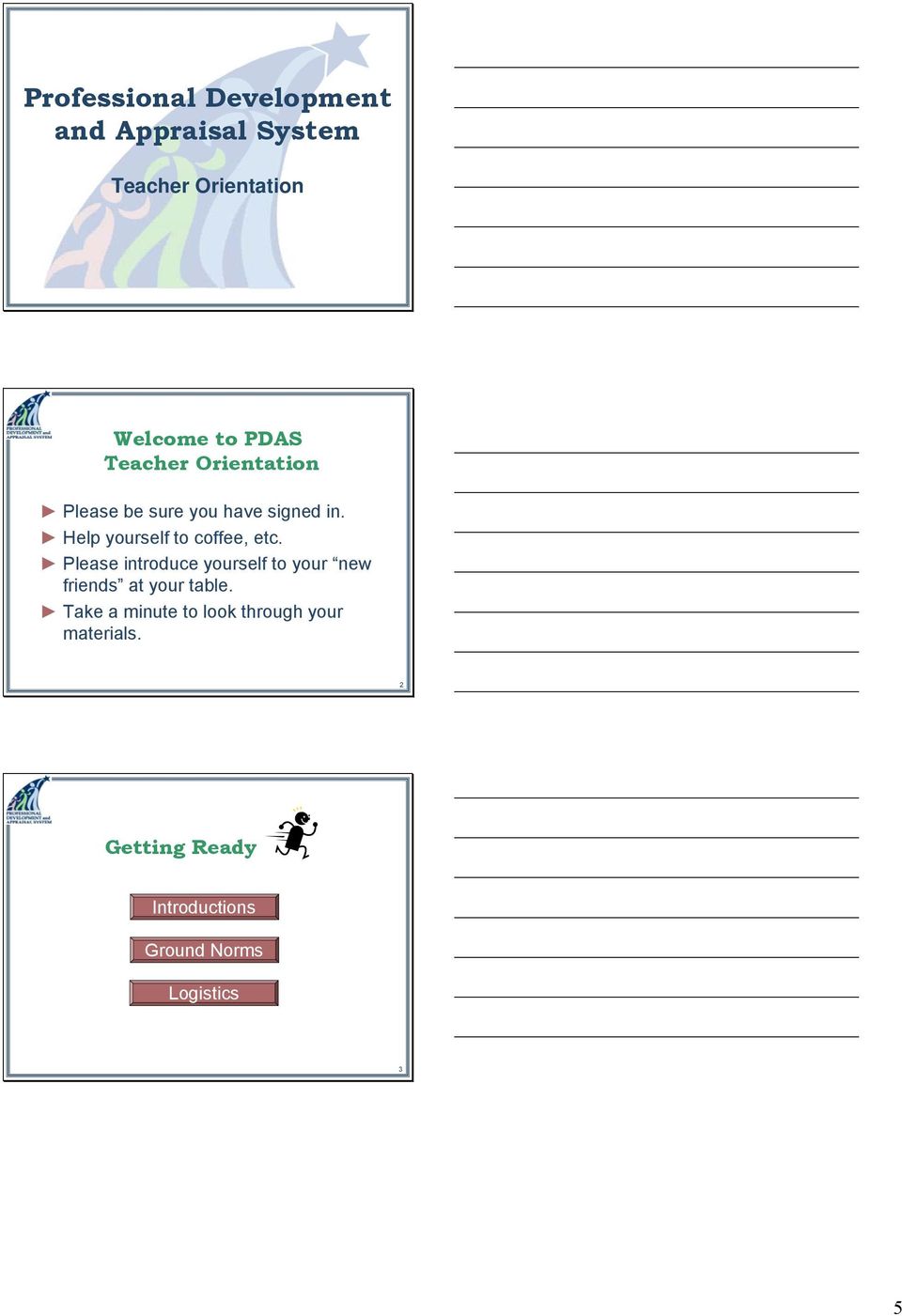
8 PDAS Teacher Orientation A school district shall ensure that all teachers are provided with an orientation of the Professional Development and Appraisal System (PDAS) no later than the final day of the first three weeks of school and at least three weeks before the first observation. Your understanding of the information in this orientation will be greatly enhanced by your active participation. We will need to keep to our schedule in order to finish on time. 4 PDAS Teacher s Manual Contents Page Commissioner s Letter 2 Slide Handouts 5 Legal Considerations (TEC and TAC) 17 Appraisal Period Timeline 36 Framework 37 Observation Summary Form (OSF) 47 OSF Examples 53 Teacher Self Report (TSR) 56 Scoring Factors (SIVA) 62 Scoring Criteria Guide 63 Appendices Overview of the System This presentation provides an overview of the elements of the PDAS system and its goal: to improve student performance through the professional development of teachers. Chapter 1 6 6
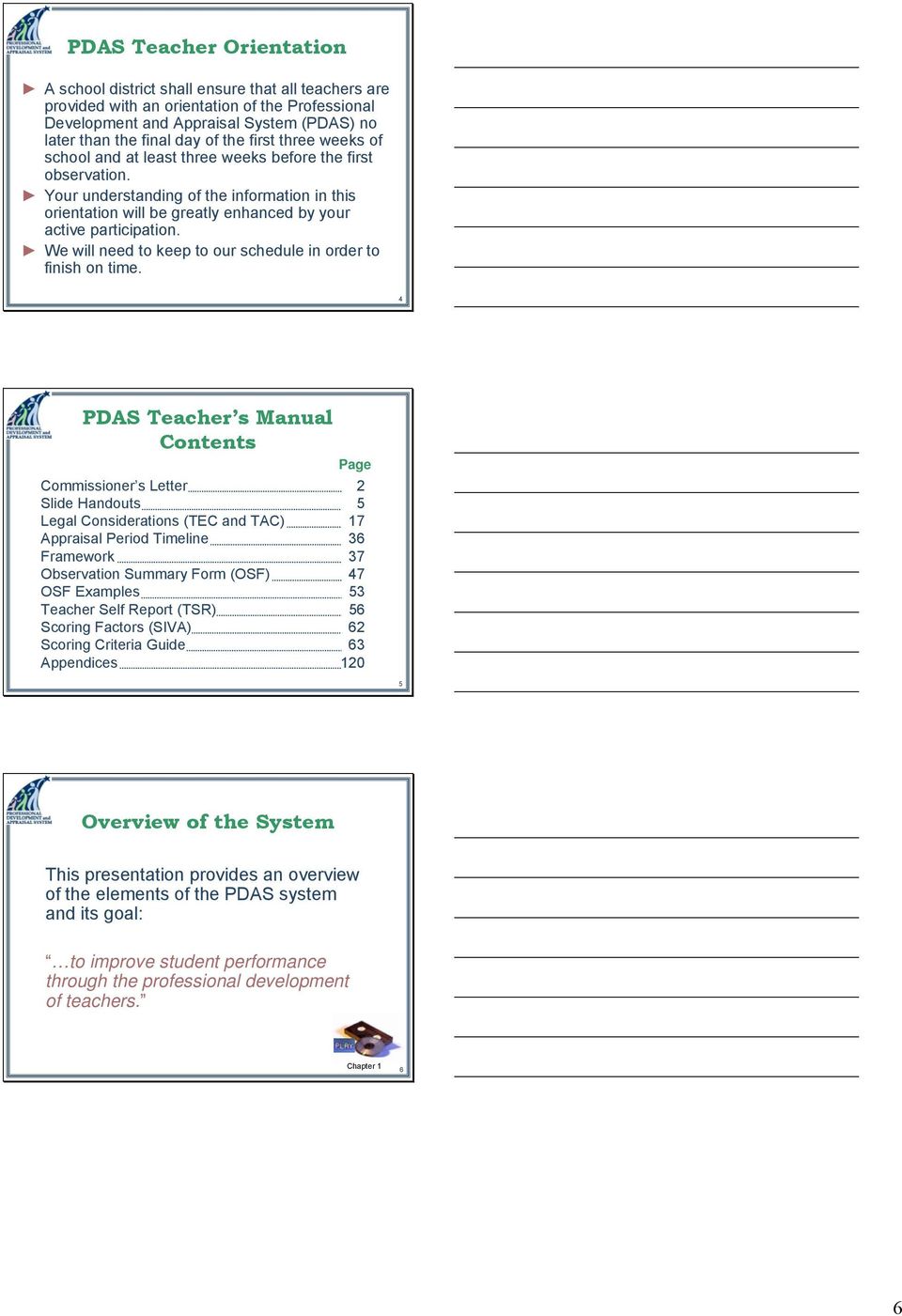
9 PDAS Characteristics Learner Centered Aligned High Standard of Proficiency Teacher Growth and Teacher Improvement Collaboration 7 Appraisal Process Steps Teacher Orientation Teacher Self Report (TSR) Formal Classroom Observation Walkthroughs Student Performance as seen in Campus Performance Rating and AYP Summative Annual Report/Conference 8 APPRAISAL PERIOD TIME LINE SCHOOL CALENDAR YEAR First 12 Weeks Second 12 Weeks Third 12 Weeks Last 15 Days of INST. Teacher Orientation Within 1 st 3 weeks Observations no earlier than 3 weeks after this orientation Teacher Self Teacher Self Report II & III Report, Part I At least two weeks prior to Summative Conference No later than three weeks after orientation Formal Observation Minimum of 45 minutes or shorter segments Written summary within 10 working days Advanced notice may be given/not REQUIRED. Follow district APPRAISAL CALENDAR May have pre- or post-conference at request of Teacher or Appraiser. WALKTHROUGH VISITS To be used at the discretion of the appraiser Documentation shared with teacher within 10 days SUMMATIVE ANNUAL REPORT 5 working days before conference ADDITIONAL TIME LINE ISSUES No later than 15 working days before last day of instruction Teacher Response Observation Summary Within 10 working days (Appraiser Walkthrough documentation may extend to 15) Third party/teacher documentation May rebut in writing or request 2 nd Completed TSR appraisal within 10 working days after SUMMATIVE CONFERENCE receiving the OSF or Summative No later than 15 working days before last day of instruction Annual Appraisal Report May be waived in writing by Teacher, NOT APPRAISER If Appraiser is not administrator on campus, principal/asst. or designated supervisory staff will participate. 9 7

10 Classroom Centered Domains Domain I Highlight Active, successful student participation in Domain I Title. Highlight Engaged in learning Criterion 1. This is a critical attribute. Highlight Successful in learning in Criterion 2. With your group, find and highlight the critical attributes in Criteria 3, 4, and 5. You can check your work by looking at the OSF. 10 Classroom Centered Domains Domain II Turn to Domain II. Highlight the domain title. Highlight the critical attributes as before and self-check using the OSF in your manual. Chapter 2 11 Examples At each table, identify an example for each of the criteria in Domains I and II from the classroom segments. They were: High School Art High School Geometry Middle School English High School Spanish Life Skills Elementary Bilingual Reading Elementary Reading 12 8

11 Classroom Centered Domains Domains III, IV, and V Turn to Domains III, IV, and V and highlight the Domain title and critical attributes. Self-check using the OSF. Chapter 3 13 Classroom Centered Domains Domain III You just viewed examples of evaluation and feedback. 4 th Grade Class High School History Class High School Physics Class With your group, identify examples of each of the six criteria in Domain III. 14 Classroom Centered Domains Domain IV Locate your Scoring Criteria Guide. Turn to Domain IV, Criterion 1. Notice that additional information is available in the Scoring Criteria Guide. Read notes (1) and (2) at the bottom of the page. These notes show that there is a higher standard for the criteria in Domain IV. Return to your Appraisal Framework and highlight the domain title and critical attributes. 15 9

12 Classroom Centered Domains Domain V Highlight the critical attributes. It is unlikely that appraisers will observe all of the criteria in Domain V in the classroom. With your group, identify which criteria are likely to be seen in the classroom and which are not. 16 IMPORTANT TO KNOW Your appraiser may not have evidence to rate every criteria in Domain V on the OSF. In the formal observation, some of the criteria may not have been observed in the classroom. 17 Professional Development Domain VI Find Domain VI in your PDAS Framework. Highlight the domain title and critical attributes. Inference cannot be used in Domain VI. Remember, The goal of PDAS is to improve student performance through the professional development of teachers

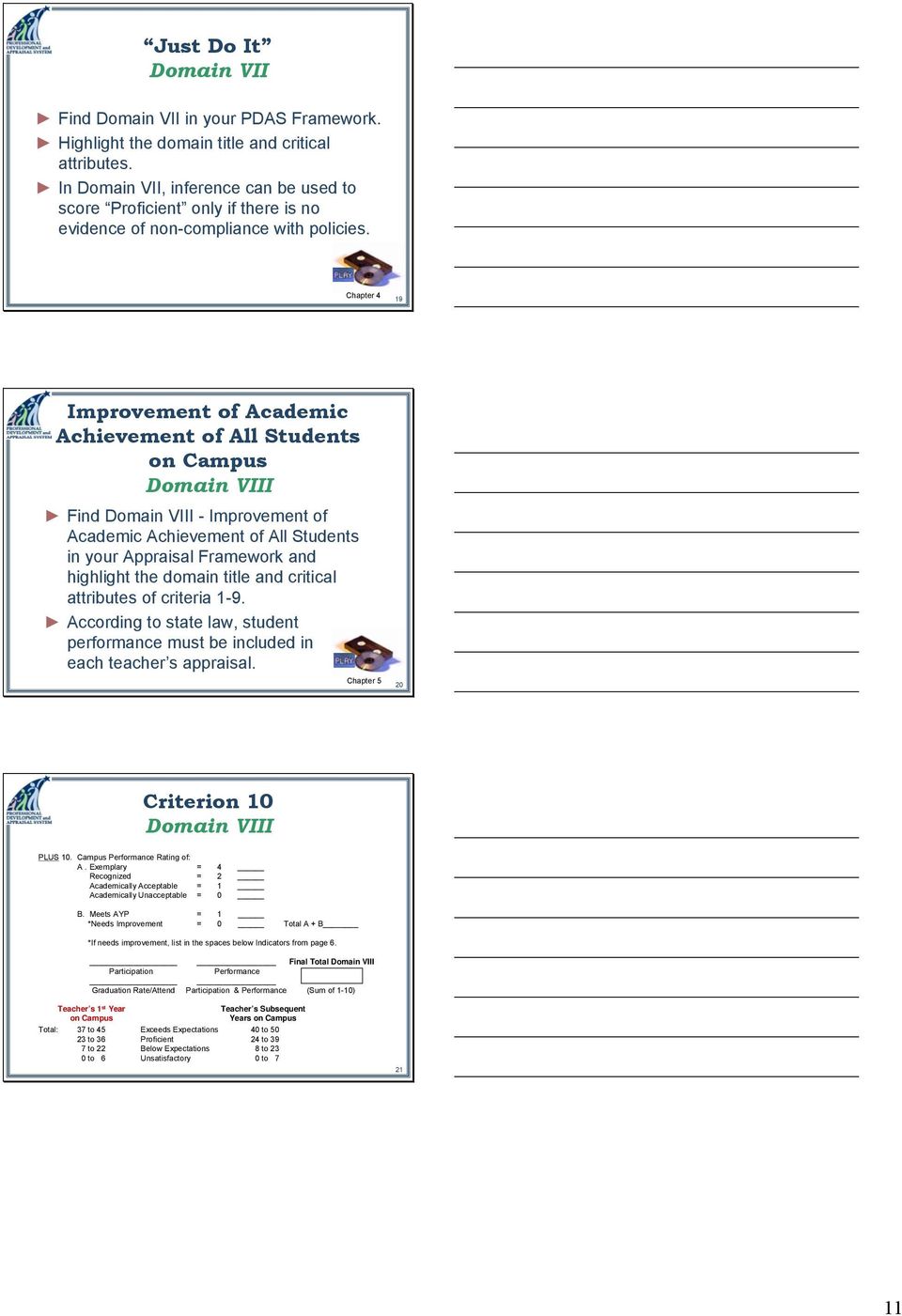
13 Just Do It Domain VII Find Domain VII in your PDAS Framework. Highlight the domain title and critical attributes. In Domain VII, inference can be used to score Proficient only if there is no evidence of non-compliance with policies. Chapter 4 19 Improvement of Academic Achievement of All Students on Campus Domain VIII Find Domain VIII - Improvement of Academic Achievement of All Students in your Appraisal Framework and highlight the domain title and critical attributes of criteria 1-9. According to state law, student performance must be included in each teacher s appraisal. Chapter 5 20 Criterion 10 Domain VIII PLUS 10. Campus Performance Rating of: A. Exemplary = 4 Recognized = 2 Academically Acceptable = 1 Academically Unacceptable = 0 B. Meets AYP = 1 *Needs Improvement = 0 Total A + B *If needs improvement, list in the spaces below Indicators from page 6. Final Total Domain VIII Participation Performance Graduation Rate/Attend Participation & Performance (Sum of 1-10) Teacher s 1 st Year on Campus Teacher s Subsequent Years on Campus Total: 37 to 45 Exceeds Expectations 40 to to 36 Proficient 24 to 39 7 to 22 Below Expectations 8 to 23 0 to 6 Unsatisfactory 0 to
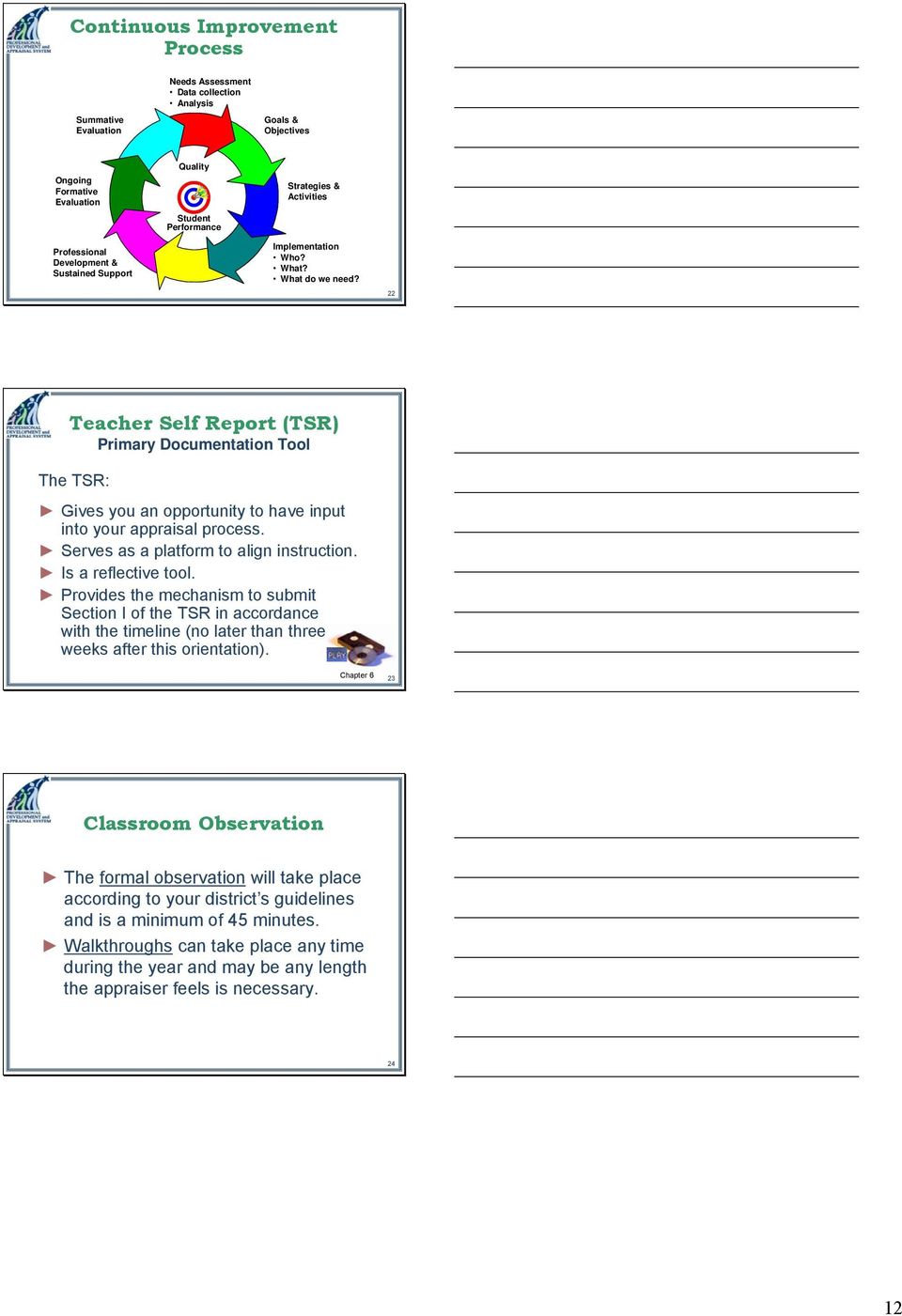
14 Continuous Improvement Process Summative Evaluation Ongoing Formative Evaluation Professional Development & Sustained Support Needs Assessment Data collection Analysis Quality Student Performance Goals & Objectives Strategies & Activities Implementation Who? What? What do we need? 22 Teacher Self Report (TSR) Primary Documentation Tool The TSR: Gives you an opportunity to have input into your appraisal process. Serves as a platform to align instruction. Is a reflective tool. Provides the mechanism to submit Section I of the TSR in accordance with the timeline (no later than three weeks after this orientation). Chapter 6 23 Classroom Observation The formal observation will take place according to your district s guidelines and is a minimum of 45 minutes. Walkthroughs can take place any time during the year and may be any length the appraiser feels is necessary
15 Scoring Factors and Performance Level Indicators Critical Attributes Quality Quantity 25 Quality Scoring Standards S trength I mpact V ariety A lignment 26 Strength Thinking at high cognitive levels Depth & Complexity Significant Content Connecting within/across disciplines & work/life applications Effective, clear & substantive 27 13

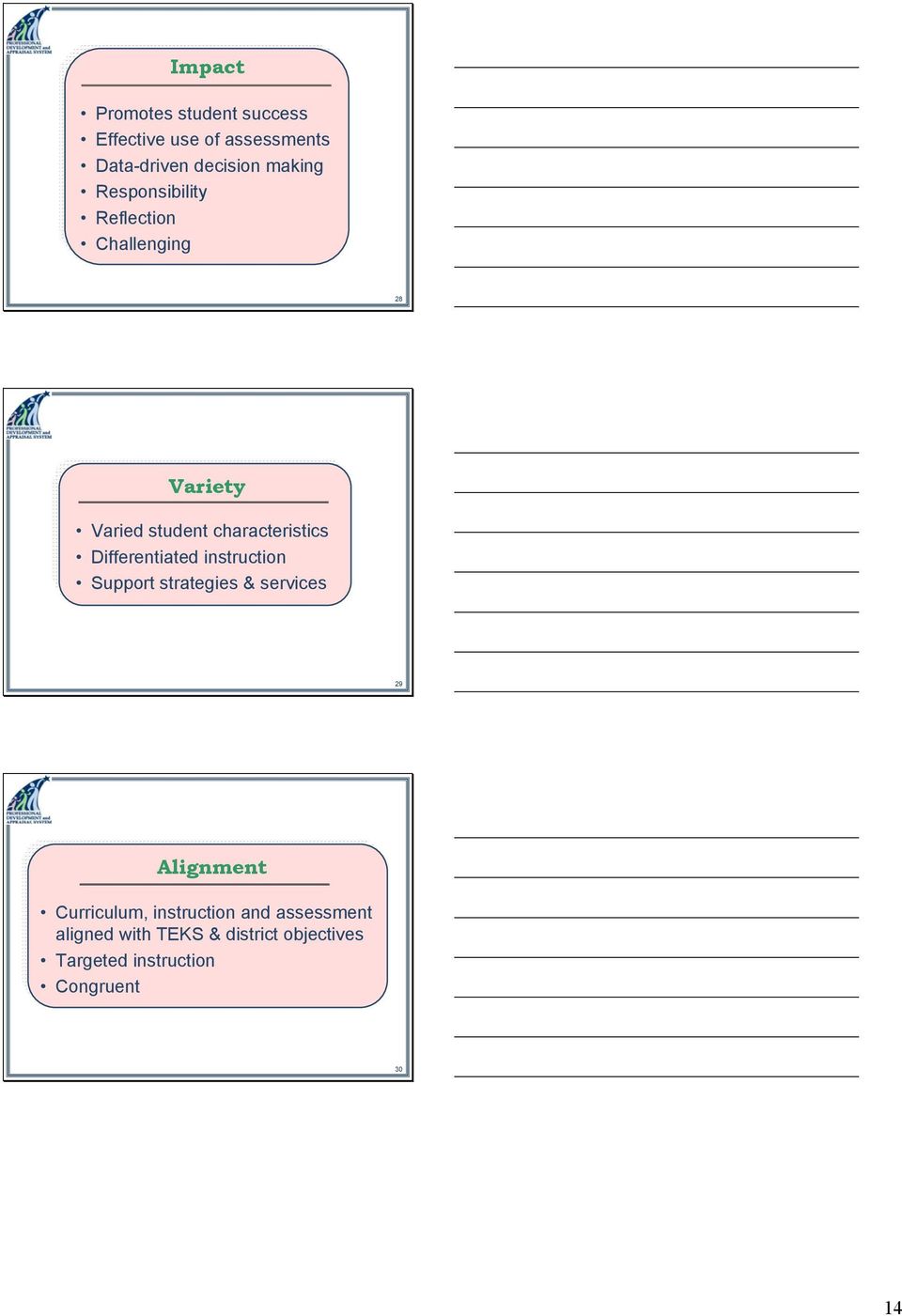
16 Impact Promotes student success Effective use of assessments Data-driven decision making Responsibility Reflection Challenging 28 Variety Varied student characteristics Differentiated instruction Support strategies & services 29 Alignment Curriculum, instruction and assessment aligned with TEKS & district objectives Targeted instruction Congruent 30 14
17 Quantity Can you see it? Did it happen? How often? How many students? 31 Classroom Example In the following example, classroom observations will be discussed as related to the SIVA. In the science lesson, what evidence do you see to indicate Proficient or above? Chapter 7 32 Teacher Self Report Parts II and III Parts II and III of the TSR give you an opportunity to give your appraiser additional information about your efforts to improve your students performance. In the next example, listen to how some teachers answered these questions. Chapter

18 Summative Annual Conference Your summative annual conference will occur within the required timeline, and shall focus on the written summative report and related data sources. * In the last example, you will see how a Summative Annual Conference might look and sound. *from Appraisals, Data Sources, and Conferences of the Commissioner s Rules Chapter 9 34 All that s left... PDAS Teacher Checklist Campus completion of orientation TSR, Section I by. Observation and other data - walkthroughs Conference(s) TSR, Sections II & III by. Summative Annual Conference by. Questions today? Questions later Your administrator or 35 Professional Development and Appraisal System Remember, The goal of PDAS is to improve student performance through the professional development of teachers

19 SECTION II PDAS Teacher Manual Legal Considerations

20 Legal Requirements PROFESSIONAL DEVELOPMENT AND APPRAISAL SYSTEM for Texas Teachers Executive Summary Senate Bill 1, passed in 1995, required the Commissioner of Education to develop a recommended appraisal system for Texas teachers with input from teachers and other professionals. In addition to specifying general characteristics of an appraisal system, Texas Education Code (TEC) requires that criteria for the commissioner s recommended system include: (1) teachers' implementation of discipline management procedures; and (2) the performance of teachers' students. Prior to the enactment of H. B. 1440, all teachers were required to have an annual appraisal by TEC (c). The new legislation allows districts to adopt policies at the local level to modify the appraisal schedule for qualifying teachers, as long as an appraisal is performed at least once during each five year period. A teacher must be rated as at least proficient on each PDAS domain to be eligible for less frequent appraisals permitted through H.B It should be noted that the individual teacher s consent is required prior to moving to less frequent appraisal for those who qualify. Should a teacher prefer to be appraised annually, the campus administrator should continue to perform annual appraisals. Pursuant to local policy, if an appraiser becomes aware of a teacher who is performing below expectations (whether through direct observation or notification from a third party), the appraiser may place the teacher on the traditional annual appraisal cycle even if the teacher had agreed to less frequent appraisals based on his or her most recent evaluation. Nothing in the legislation prohibits a walkthrough or other informal observation by appraisers, even for those teachers who have qualified for less frequent appraisals. The use of cumulative data for teachers on a revised appraisal schedule is also permissible, in accordance with the rules established in 19 TAC (f) for districts using the PDAS. Overview of the System The PDAS includes fifty-one evaluation criteria organized in eight domains. The eight PDAS domains are: Domain I: Domain II: Domain III: Domain IV: Domain V: Domain VI: Domain VII: Domain VIII: Active, Successful Student Participation in the Learning Process Learner-Centered Instruction Evaluation and Feedback on Student Progress Management of Student Discipline, Instructional Strategies, Time and Materials Professional Communication Professional Development Compliance with Policies, Operating Procedures and Requirements Improvement of Academic Performance of all Students on the Campus Revised

21 Domain VIII addresses the student performance link. This domain is comprised of a total of ten criteria. Five of the criteria relate to teacher efforts to plan, analyze, and deliver instruction that are aligned with appropriate academic skills objectives addressed within the teacher s particular assignment. One criterion in this domain relates to the teacher s continuing efforts to monitor student attendance and to be proactive in intervening with regard to students who experience attendance problems. Three criteria relate to teachers efforts to identify and intervene appropriately with students in at-risk situations. Finally, a tenth criterion is the shared score on the overall campus performance rating and AYP status. Scoring of the domains is done primarily through classroom observational data and input from teachers through responses on the Teacher Self-Report (TSR) Form. Relevant out-of-classroom data may also be used if documented and shared with the teacher. The domains are scored in four categories: (1) Exceeds Expectations; (2) Proficient; (3) Below Expectations; and (4) Unsatisfactory. Each domain is scored independently, and thus there are no cumulative scores. Implementation of the System The system will require a minimum of one observation of at least 45 minutes, plus additional observations and walkthroughs as necessary. Observations may be scheduled or unscheduled at the discretion of the local district. Teachers and appraisers may mutually elect to adjust the length of observations so long as the total amount of time adds up to 45 minutes. A teacher is guaranteed a summative appraisal conference unless he or she expressly waives the conference requirement. Teachers who have concerns about their appraisals may request a second appraisal, or may appeal the appraisal. For those teachers whose performance is appraised as less than proficient in any domain, adequate due process provisions have been incorporated in the rules. These teachers must be given the opportunity to improve their performance through the development of an intervention plan. The PDAS also provides for teachers input into their own appraisal ratings, especially in Domain VI (Professional Development) and Domain VIII (Efforts to Improve Academic Performance), through the inclusion of the TSR Form. This enables teachers to submit concrete examples of their best work, in a limited format, to their appraiser for consideration in the appraisal process. Training for Teachers In the initial year of adoption and implementation of PDAS, campuses must provide opportunities for representative teachers to participate in appraisal training. Districts are required to offer opportunities for appraisal training to a number of teachers equal to the number of campus administrators. At the discretion of the principal, these teachers may facilitate the orientation and may assist in presenting the orientation. These teachers may serve as orientation facilitators but are not certified as appraisers. Revised
22 District Options Under TEC , districts that elect to devise their own local system are encouraged to do so, as long as the local system meets the provisions of law, including a clear and direct link to the performance of teachers students. Thus, if after reviewing the commissioner s recommended system, districts feel that they have appraisal practices more suited to local needs, they may feel free to use them. For further information contact: Region XIII Education Service Center Statewide Initiatives 5701 Springdale Rd. Austin, TX (512) Texas Education Agency Division of Curriculum, Educator Development Unit 1701 N. Congress Avenue Austin, TX (512) Revised
23 Chapter 150. Commissioner's Rules Concerning Educator Appraisal Subchapter AA. Teacher Appraisal Statutory Authority: The provisions of this Chapter 150 issued under the Texas Education Code, , unless otherwise noted General Provisions. (a) Beginning with the school year, all school districts have two choices in selecting a method to appraise teachers: a teacher-appraisal system recommended by the Texas commissioner of education or a local teacher-appraisal system. (b) The commissioner's recommended teacher-appraisal system, the Professional Development and Appraisal System (PDAS), was developed in accordance with Texas Education Code (TEC), (c) The superintendent of each school district, with the approval of the school district board of trustees, may select the PDAS. Each school district or campus wanting to select or develop an alternative teacher-appraisal system must follow TEC, Source: The provisions of this adopted to be effective August 1, 1997, 22 TexReg Assessment of Teacher Performance. (a) The teacher proficiencies described in Learner-Centered Schools for Texas: A Vision of Texas Educators, approved by the State Board of Education on February 11, 1994, shall be the foundation for the Professional Development and Appraisal System (PDAS). (b) Each teacher shall be appraised on the following domains: (1) Domain I: Active, successful student participation in the learning process; (2) Domain II: Learner-centered instruction; (3) Domain III: Evaluation and feedback on student progress; (4) Domain IV: Management of student discipline, instructional strategies, time and materials; (5) Domain V: Professional communication; 20
24 (6) Domain VI: Professional development; (7) Domain VII: Compliance with policies, operating procedures and requirements; and (8) Domain VIII: Improvement of academic performance of all students on the campus (based on indicators included in the Academic Excellence Indicator System (AEIS)). (c) Each domain shall be scored independently. The evaluation of each of the domains shall consider all data generated in the appraisal process. The data for the appraisal of each domain shall be gathered from observations, the Teacher Self-Report Form, and other documented sources. The data shall describe teacher contributions in increasing student achievement, making the whole school safe and orderly, and creating a stimulating learning environment for children. (d) Each teacher shall be evaluated on Domains I through VIII using the following categories: (1) exceeds expectations; (2) proficient; (3) below expectations; and (4) unsatisfactory. (e) The teacher evaluation in Domain VIII shall include the following areas: (1) efforts to enhance academic performance; (2) efforts to enhance student attendance; (3) efforts to identify and assist students in at-risk situations; and (4) campus performance rating. (f) Campus performance rating data for Domain VIII shall be reported (not scored) by a campus or district for the first year of the PDAS implementation and/or during the first year for new teachers to a campus. Source: The provisions of this adopted to be effective August 1, 1997, 22 TexReg Appraisals, Data Sources, and Conferences. (a) Each teacher must be appraised each school year, except as provided by subsection (l) of this section. Whenever possible, an appraisal shall be based on the teacher's performance in fields and teaching assignments for which he or she is certified. 21
25 (b) The annual teacher appraisal shall include: (1) at least one classroom observation of a minimum of 45 minutes as identified in subsection (g) of this section, with additional walk-throughs and observations conducted at the discretion of the appraiser; (2) a written summary of each observation, which shall be given to teachers within ten working days after the completion of an observation, with a pre- and post-observation conference conducted at the request of the teacher or appraiser; (3) completion of Section I of the Teacher Self-Report Form that shall be presented to the principal: (A) within the first three weeks from the day of completion of the Professional Development and Appraisal System (PDAS) orientation as described in of this title (relating to Teacher Orientation); (B) within the first three weeks from the day of completion of the PDAS orientation as described in of this title for teachers new to the PDAS; or (C) within the first three weeks of instruction in the school years when the PDAS orientation is not required pursuant to of this title. (4) revision of Section I (if necessary) and completion of Sections II and III of the Teacher Self- Report Form that shall be presented to the principal at least two weeks prior to the summative annual conference; (5) cumulative data of written documentation collected regarding job-related teacher performance, in addition to formal classroom observations; (6) a written summative annual appraisal report; and (7) a summative annual conference. (c) A teacher may be given advance notice of the date or time of an appraisal, but advance notice is not required. (d) Each school district shall establish a calendar for the appraisal of teachers. The appraisal period for each teacher must include all of the days of a teacher's contract. Observations during the appraisal period must be conducted during the required days of instruction for students during one school year. The appraisal calendar shall: (1) exclude observations in the three weeks following the day of completion of the PDAS orientation in the school years when an orientation is required as described in of this title; 22
26 (2) exclude observations in the three weeks following the day of completion of the PDAS orientation for teachers new to the PDAS as described in of this title; (3) exclude observations in the first three weeks of instruction in the school years when the PDAS orientation is not required pursuant to of this title; (4) prohibit observations on the last day of instruction before any official school holiday or on any other day deemed inappropriate by the school district board of trustees; and (5) indicate a period for summative annual conferences that ends no later than 15 working days before the last day of instruction for students. (e) During the appraisal period, the appraiser shall evaluate and document teacher performance specifically related to the domain criteria as identified in (b) of this title (relating to Assessment of Teacher Performance). (f) The appraiser is responsible for documentation of the cumulative data identified in subsection (b)(5) of this section. Any third-party information from a source other than the teacher's supervisor that the appraiser wishes to include as cumulative data shall be verified and documented by the appraiser. Any documentation that will influence the teacher's summative annual appraisal report must be shared in writing with the teacher within ten working days of the appraiser's knowledge of the occurrence. The principal shall also be notified in writing when the appraiser is not the teacher's principal. (g) By mutual consent of the teacher and the appraiser, the required minimum of 45 minutes of observation may be conducted in shorter time segments. The time segments must aggregate to at least 45 minutes. (h) A written summative annual appraisal report shall be shared with the teacher no later than five working days before the summative conference and no later than 15 working days before the last day of instruction for students. The written summative annual appraisal report shall be placed in the teacher's personnel file by the end of the appraisal period. (i) Unless waived in writing by the teacher, a summative conference shall be held within a time frame specified on the school district calendar and no later than 15 working days before the last day of instruction for students. The summative conference shall focus on the written summative report and related data sources. (j) In cases where the appraiser is not an administrator on the teacher's campus, either the principal, assistant principal, or another supervisory staff member designated as an administrator on the campus will participate in the summative annual conference. (k) Any documentation collected after the summative conference but before the end of the contract term during one school year may be considered as part of the appraisal of a teacher. If the documentation affects the teacher's evaluation in any domain, another summative report shall be developed and another summative conference shall be held to inform the teacher of the change(s). 23
27 (l) Except as otherwise provided by this subsection, appraisal must be done at least once during each school year. A teacher may be appraised less frequently if the teacher agrees in writing and the teacher's most recent appraisal rated the teacher as at least proficient, or the equivalent, and did not identify any area of deficiency. A teacher who is appraised less frequently than annually must be appraised at least once during each period of five school years. (1) District policy may stipulate: (A) whether the appraisal option is to be made available to teachers; (B) whether the appraisal option is to be adopted districtwide or is to be campus specific; (C) if the appraisal accompanying a teacher new to a district or campus meets the option as specified in this subsection, whether the appraisal is to be accepted or whether that teacher is to be appraised by the new campus administrator; and (D) whether an appraiser may place a teacher on the traditional appraisal cycle as a result of performance deficiencies documented in accordance with subsections (b)(5) and (f) of this section. (2) A school district may choose annually to review the written agreement with the teacher. However, at the conclusion of the school year, the district may modify appraisal options through board policy and may make changes to expectations for appraisals that apply to all teachers regardless of a teacher's participation in the appraisal option in the previous year(s). (3) For purposes of this subsection, in the teacher-appraisal system recommended by the commissioner, an area of deficiency is a domain. A teacher must be rated as at least proficient for each domain (i.e., for all domains) to be eligible for less frequent appraisals under this subsection. Source: The provisions of this adopted to be effective August 1, 1997, 22 TexReg 4200; amended to be effective April 15, 1999, 24 TexReg 2934; amended to be effective May 31, 2004, 29 TexReg Teacher in Need of Assistance. (a) A teacher whose performance meets any of the following circumstances will be designated as a " teacher in need of assistance ": (1) a teacher who is evaluated as unsatisfactory in one or more domains; or (2) a teacher who is evaluated as below expectations in two or more domains. 24
28 (b) When a teacher is designated as a teacher in need of assistance, the appraiser and/or the teacher's supervisor shall, in consultation with the teacher, develop an intervention plan that includes the following: (1) domain(s) that designate a teacher as a teacher in need of assistance; (2) directives or recommendations for professional improvement activities; (3) evidence that is used to determine successful completion of professional improvement activities; (4) directives for changes in teacher behavior; (5) evidence that is used to determine if teacher behavior has changed; and (6) specific time line for successful completion. (c) In cases when the teacher's appraiser is not the teacher's principal, the principal shall be involved in the development and evaluation of the intervention plan. (d) A teacher who has not met all requirements of the intervention plan for teachers in need of assistance by the time specified may be considered for separation from the assignment, campus, and/or district. (e) The intervention plan shall include options for professional development activities designed to enhance teacher proficiency. At least one option shall not place significant financial burden on either the teacher or the school district. (f) An intervention plan may be developed at any time at the discretion of the appraiser when the appraiser has documentation that would potentially produce an evaluation rating of "below expectations" or "unsatisfactory". Source: The provisions of this adopted to be effective August 1, 1997, 22 TexReg Teacher Response and Appeals. (a) A teacher may submit a written response or rebuttal at the following times: (1) after receiving a written observation summary, or any other written documentation associated with the teacher's appraisal; and/or (2) after receiving a written summative annual appraisal report. (b) Any written response or rebuttal must be submitted within ten working days of receiving a written observation summary, a written summative annual appraisal report, or any other written 25
29 documentation associated with the teacher's appraisal. At the discretion of the appraiser, the time period may be extended to 15 working days. (c) A teacher may request a second appraisal by another appraiser at the following times: (1) after receiving a written observation summary with which the teacher disagrees; and/or (2) after receiving a written summative annual appraisal report with which the teacher disagrees. (d) The second appraisal must be requested within ten working days of receiving a written observation summary or a written summative annual appraisal report. At the discretion of the appraiser, the time period may be extended to 15 working days. (e) A teacher may be given advance notice of the date or time of a second appraisal, but advance notice is not required. (f) The second appraiser shall appraise the teacher in all domains. The second appraiser shall make observations and walk-throughs as necessary to evaluate Domains I through V. The second appraiser shall use the Teacher Self-Report Form and cumulative data from the first appraisal to evaluate Domains VI through VIII. Cumulative data may also be used by the second appraiser to evaluate other domains. (g) Each school district shall adopt written procedures for a teacher to present grievances and receive written comments in response to the written annual report. Each district shall also adopt written procedures for determining the selection of second appraisers. These procedures shall be disseminated to each teacher at the time of employment and updated annually or as needed. Source: The provisions of this adopted to be effective August 1, 1997, 22 TexReg Appraiser Qualifications. (a) The teacher-appraisal process requires at least one appraiser. (b) The teacher's supervisor shall conduct the teacher's appraisal and must hold a superintendent, midmanagement (principal), or supervisor certification, or must hold comparable certificates established by the State Board for Educator Certification. An appraiser other than the teacher's supervisor must be approved by the school district board of trustees, hold a valid teaching certificate, and have at least three years of prekindergarten, elementary, or secondary teaching experience. (c) An appraiser who is a classroom teacher may not appraise the performance of another classroom teacher who teaches at the same school campus at which the appraiser teaches, unless it is impractical because of the number of campuses or unless the appraiser is the chair of a department or grade-level whose job description includes classroom observation responsibilities. 26
30 (d) Before conducting an appraisal, an appraiser must be certified by having satisfactorily completed uniform appraiser training, including required Instructional Leadership Training (ILT) or Instructional Leadership Development (ILD) training, with a trainer and curriculum approved by the commissioner of education. Periodic recertification and training shall be required. (1) Educators certified as appraisers for the Texas Teacher Appraisal System (TTAS) before January 1997 shall be required to take only the Professional Development and Appraisal System (PDAS) training to qualify as a certified appraiser for the new system. Beginning June 1, 2002, individuals seeking to become PDAS appraisers must comply with requirements specified in subsection (d)(3) of this section. (2) Educators seeking certification as an appraiser for the PDAS after January 1, 1997, and no later than June 1, 2002, holding no prior TTAS certification, shall be required to complete the ILT or ILD training and the PDAS training with the successful completion of ILT or ILD training as a prerequisite to the PDAS training. (3) Educators seeking certification as an appraiser for the PDAS after June 1, 2002, shall be required to complete ILD training and the PDAS training with successful completion of ILD training as a prerequisite to the PDAS training. Source: The provisions of this adopted to be effective August 1, 1997, 22 TexReg 4200; amended to be effective July 31, 2001, 26 TexReg Teacher Orientation. (a) A school district shall ensure that all teachers are provided with an orientation of the Professional Development and Appraisal System (PDAS) no later than the final day of the first three weeks of school and at least three weeks before the first observation. (1) Additional orientations shall be provided any time substantial changes occur in the PDAS. (2) A teacher new to the district shall be provided with an orientation of the PDAS at least three weeks before the teacher's first observation. (b) Teachers' orientation shall include materials approved by the commissioner of education. These materials shall include all state and local appraisal policies, the local appraisal calendar, and information on the requirements for the completion of the Teacher Self-Report Form. In addition to the orientation, campuses may hold other sessions sufficient in length allowing teachers to actively participate in a discussion of the PDAS specifics and to have their questions answered. Source: The provisions of this adopted to be effective August 1, 1997, 22 TexReg
31 Training of Teacher Participants. (a) In the initial year of adoption and implementation of the Professional Development and Appraisal System (PDAS), selected teachers from each campus shall be given the opportunity to participate in the appraisal training for purposes of disseminating information to colleagues on their campus and assisting, at the discretion of the principal, in the orientation of all campus teachers. These teachers shall be designated as appraisal-orientation facilitators. (1) Each campus shall offer the opportunity to participate in appraisal training to a number of teachers equal to the number of campus administrators; however, each campus shall have at least one teacher participant. (2) The principal shall select representative teachers from nominations submitted by the sitebased decision making (SBDM) committee created in accordance with Texas Education Code, The principal may select representatives other than those nominated by the SBDM committee when nominated teachers are unable to attend appraisal training. (3) Each school district shall pay the training fees for its teachers attending the PDAS appraisal training. (b) School districts and regional education service centers shall make available additional training for teachers as part of the district's and education service center's menu of professional development opportunities. All teachers are eligible to participate in appraisal and/or Instructional Leadership Training or Instructional Leadership Development training at their own expense. Executive directors of regional education service centers may prescribe appropriate registration fees to offset the cost of providing these services. Source: The provisions of this adopted to be effective August 1, 1997, 22 TexReg 4200; amended to be effective July 31, 2001, 26 TexReg Alternatives to the Commissioner's Recommended Appraisal System. (a) District option. Beginning with the school year, a school district not wanting to use the commissioner's recommended Professional Development and Appraisal System must develop its own teacher-appraisal system supported by locally adopted policy and procedures and by the processes outlined in Texas Education Code (TEC), The Texas Teacher Appraisal System (TTAS) is no longer a state-recommended system; however, it may become a local option governed by the process outlined in TEC, If adopted as a local option, the TTAS must be modified to comply with TEC, (a)(1) and (2). (1) The school district-level planning and decision-making committee shall: (A) develop an appraisal process; 28
32 (B) develop evaluation criteria, including discipline management and performance of the teachers' students; and (C) consult with the campus planning and decision-making committee on each campus in the school district. (2) The appraisal process shall include: (A) at least one appraisal each year; (B) a conference between the teacher and the appraiser that is diagnostic and prescriptive with regard to remediation needed in overall performance by category; and (C) criteria based on observable, job-related behavior, including: (i) teachers' implementation of discipline management procedures; and (ii) performance of the teachers' students. (3) The school district-level planning and decision-making committee shall submit the appraisal process and criteria to the superintendent, who shall submit the appraisal process and criteria to the school district board of trustees with a recommendation to accept or reject. The school district board of trustees may accept or reject an appraisal process and performance criteria, with comments, but may not modify the process or criteria. (b) Campus option. A campus within a school district may choose to develop a local system as provided in this section. (1) The campus planning and decision-making committee shall: (A) develop an appraisal process; (B) develop evaluation criteria, including discipline management and performance of the teachers' students; and (C) submit the process and criteria to the district-level planning and decision-making committee. (2) The appraisal process shall include: (A) at least one appraisal each year; (B) a conference between the teacher and the appraiser that is diagnostic and prescriptive with regard to remediation needed in overall performance by category; and (C) criteria based on observable, job-related behavior, including: 29
33 (i) teachers' implementation of discipline management procedures; and (ii) performance of the teachers' students. (3) Upon submission of the appraisal process and criteria to the school district-level planning and decision-making committee, the committee shall make a recommendation to accept or reject the appraisal process and criteria and transmit that recommendation to the superintendent. (4) The superintendent shall submit the recommended campus appraisal process and criteria, the school district-level planning and decision-making committee's recommendation, and the superintendent's recommendation to the school district board of trustees. The school district board of trustees may accept or reject, with comments, an appraisal process and performance criteria, but may not modify the process or criteria. Source: The provisions of this adopted to be effective August 1, 1997, 22 TexReg District Notification to Regional Education Service Center. For purposes of providing training and support, the superintendent shall notify the executive director of the regional education service center of the district's choice of appraisal system(s) by a time designated by the commissioner of education. Source: The provisions of this adopted to be effective August 1, 1997, 22 TexReg
34 Related Statutory Citations in the Texas Education Code The following statutory citations in the Texas Education Code relate to the new 19 TAC, Chapter 150, Subchapter AA, Teacher Appraisal Chapter 21. Educators Subchapter H. Appraisals and Incentives RECOMMENDED APPRAISAL PROCESS AND PERFORMANCE CRITERIA. (a) The commissioner shall adopt a recommended appraisal process and criteria on which to appraise the performance of teachers. The criteria must be based on observable, job-related behavior, including: (1) teachers' implementation of discipline management procedures; and (2) the performance of teachers' students. (b) The commissioner shall solicit and consider the advice of teachers in developing the recommended appraisal process and performance criteria. (c) Under the recommended appraisal process, an appraiser must be the teacher's supervisor or a person approved by the board of trustees. An appraiser who is a classroom teacher may not appraise the performance of another classroom teacher who teaches at the same school campus at which the appraiser teaches, unless it is impractical because of the number of campuses or unless the appraiser is the chair of a department or grade level whose job description includes classroom observation responsibilities. (d) Under the recommended appraisal process, appraisal for teachers must be detailed by category of professional skill and characteristic and must provide for separate ratings for each category. The appraisal process shall guarantee a conference between the teacher and the appraiser. The conference shall be diagnostic and prescriptive with regard to remediation needed in overall performance and by category. Added by Acts 1995, 74th Leg., ch. 260, 1, eff. May 30, LOCAL ROLE. (a) In appraising teachers, each school district shall use: (1) the appraisal process and performance criteria developed by the commissioner; or 31
35 (2) an appraisal process and performance criteria: (A) developed by the district- and campus-level committees established under Section ; (B) containing the items described by Sections (a)(1) and (2); and (C) adopted by the board of trustees. (b) The board of trustees may reject an appraisal process and performance criteria developed by the district- and campus-level committees but may not modify the process or criteria. (c) Except as otherwise provided by this subsection, appraisal must be done at least once during each school year. A teacher may be appraised less frequently if the teacher agrees in writing and the teacher's most recent evaluation rated the teacher as at least proficient, or the equivalent, and did not identify any area of deficiency. A teacher who is appraised less frequently than annually must be appraised at least once during each period of five school years. The district shall maintain a written copy of the evaluation of each teacher's performance in the teacher's personnel file. Each teacher is entitled to receive a written copy of the evaluation on its completion. After receiving a written copy of the evaluation, a teacher is entitled to a second appraisal by a different appraiser or to submit a written rebuttal to the evaluation to be attached to the evaluation in the teacher's personnel file. The evaluation and any rebuttal may be given to another school district at which the teacher has applied for employment at the request of that district. (d) A teacher may be given advance notice of the date or time of an appraisal, but advance notice is not required. Added by Acts 1995, 74th Leg., ch. 260, 1, eff. May 30, Amended by Acts 2003, 78th Leg., ch. 244, 2, eff. June 18, APPRAISAL ON BASIS OF CLASSROOM TEACHING PERFORMANCE. A teacher who directs extracurricular activities in addition to performing classroom teaching duties shall be appraised only on the basis of classroom teaching performance and not on performance in connection with the extracurricular activities. Added by Acts 1995, 74th Leg., ch. 260, 1, eff. May 30, APPRAISAL OF ADMINISTRATORS. (a) The commissioner shall adopt a recommended appraisal process and criteria on which to appraise the performance of various classifications of school administrators. The criteria must be based on job-related performance. 32
36 (b) The commissioner may solicit and consider the advice of teachers and administrators in developing the appraisal process and performance criteria. (c) Each school district shall appraise each administrator annually using either: (1) the commissioner's recommended appraisal process and performance criteria; or (2) an appraisal process and performance criteria: (A) developed by the district in consultation with the district- and campus-level committees established under Section ; and (B) adopted by the board of trustees. (d) Funds of a school district may not be used to pay an administrator who has not been appraised under this section in the preceding 15 months. (e) The appraisal of a principal shall include consideration of the performance of a principal's campus on the indicators established under Section and the campus's objectives established under Section , including performance gains of the campus and the maintenance of those gains. Added by Acts 1995, 74th Leg., ch. 260, 1, eff. May 30, CONFIDENTIALITY. A document evaluating the performance of a teacher or administrator is confidential. Added by Acts 1995, 74th Leg., ch. 260, 1, eff. May 30,
37 Related Statutory Citations in the Texas Education Code The following statutory citations in the Texas Education Code relate to the new 19 TAC, Chapter 150, STAFF DEVELOPMENT REQUIREMENTS. (a) The staff development provided by a school district must be: (1) conducted in accordance with standards developed by the district; and (2) designed to improve education in the district. (b) The staff development must be predominantly campus-based, related to achieving campus performance objectives established under Section , and developed and approved by the campus-level committee established under Section (c) A school district may use district-wide staff development developed and approved through the district-level decision process under Section (d) The staff development may: (1) include training in: (A) technology; (B) conflict resolution; and (C) discipline strategies, including classroom management, district discipline policies, and the student code of conduct adopted under Section and Chapter 37; (2) include training that: (A) relates to instruction of students with disabilities; and (B) is designed for educators who work primarily outside the area of special education; and 34
38 (3) include instruction as to what is permissible under law, including opinions of the United States Supreme Court, regarding prayer in public school. Added by Acts 1995, 74th Leg., ch. 260, 1, eff. May 30, Amended by Acts 1999, 76th Leg., ch. 396, 2.06, eff. Sept. 1, 1999; Acts 2001, 77th Leg., ch. 766, 1, eff. June 13, 2001; Acts 2003, 78th Leg., ch. 495, 1. 35
39 SECTION III PDAS Process
40 APPRAISAL PERIOD TIMELINE SCHOOL CALENDAR YEAR Teacher Orientation Within 1 st 3 weeks Observations no earlier than 3 weeks after this orientation Teacher Self Report, Part I No later than three weeks after orientation First 12 Weeks Second 12 Weeks Third 12 Weeks Last 15 Days of INST. Teacher Self Report II & III At least two weeks prior to Summative Conference Formal Observation Minimum of 45 minutes or shorter segments Written summary within 10 working days Advanced notice may be given/not REQUIRED. Follow district APPRAISAL CALENDAR May have pre- or post-conference at request of Teacher or Appraiser. WALKTHROUGH VISITS To be used at the discretion of the appraiser Documentation shared with teacher within 10 days 36 ADDITIONAL TIMELINE ISSUES Teacher Response Within 10 working days (Appraiser may extend to 15) May rebut in writing or request 2 nd appraisal within 10 working days after receiving the OSF or Summative Annual Appraisal Report SUMMATIVE ANNUAL REPORT 5 working days before conference No later than 15 working days before last day of instruction Observation Summary Walkthrough documentation Third party/teacher documentation Completed TSR SUMMATIVE CONFERENCE No later than 15 working days before last day of instruction May be waived in writing by Teacher, NOT APPRAISER If Appraiser is not administrator on campus, principal/asst. or designated supervisory staff will participate.
41 P ROFESSIONAL D EVELOPMENT AND A PPRAISAL S YSTEM APPRAISAL FRAMEWORK Domain I: Active, Successful Student Participation in the Learning Process Evaluation Dimensions: a. Quantity and quality of active student participation in the learning process is evident. b. Students are challenged by instruction and make connections to work and life applications, both within the discipline and with other disciplines. Exceeds Expectations E VALUATION C RITERIA Proficient Below Expectations Unsatisfactory ALMOST ALL OF THE MOST OF THE SOME OF THE LESS THAN HALF OF THE 1. Students are actively engaged in learning. 1. Students are actively engaged in learning. 1. Students are actively engaged in learning. 1. Students are actively engaged in learning. 2. Students are successful in learning. 2. Students are successful in learning. 2. Students are successful in learning. 2. Students are successful in learning. 3. Student behaviors indicate learning is at a high cognitive level (e.g., critical thinking, creative thinking, problem solving, etc.). 4. Students are self-directed/selfinitiated as appropriate to the lesson objectives. 5. Students are connecting learning to work and life applications, both within the discipline and with other disciplines. 3. Student behaviors indicate learning is at a high cognitive level (e.g., critical thinking, creative thinking, problem solving, etc.). 4. Students are self-directed/selfinitiated as appropriate to the lesson objectives. 5. Students are connecting learning to work and life applications, both within the discipline and with other disciplines. 3. Student behaviors indicate learning is at a high cognitive level (e.g., critical thinking, creative thinking, problem solving, etc.). 4. Students are self-directed/selfinitiated as appropriate to the lesson objectives. 5. Students are connecting learning to work and life applications, both within the discipline and with other disciplines. 3. Student behaviors indicate learning is at a high cognitive level (e.g., critical thinking, creative thinking, problem solving, etc.). 4. Students are self-directed/selfinitiated as appropriate to the lesson objectives. 5. Students are connecting learning to work and life applications, both within the discipline and with other disciplines. 37 Revised June 2004
42 Domain II: Learner-Centered Instruction Evaluation Dimensions: a. The instructional content is based on appropriate goals and objectives. b. The instructional content includes basic knowledge and skills, as well as central themes and concepts, both within the discipline and with other disciplines. c. The instructional strategies are aligned with learning objectives and activities, student needs, and work and life applications, both within the discipline and with other disciplines. d. The instructional strategies promote application of learning through critical thinking and problem solving. e. The teacher uses appropriate motivational and instructional strategies which successfully and actively engage students in the learning process. E VALUATION C RITERIA Exceeds Expectations Proficient Below Expectations Unsatisfactory ALMOST ALL OF THE TIME MOST OF THE TIME SOME OF THE TIME LESS THAN HALF OF THE TIME 1. Objectives and goals include basic knowledge/skills and central themes/concepts of the discipline. 1. Objectives and goals include basic knowledge/skills and central themes/concepts of the discipline. 1. Objectives and goals include basic knowledge/skills and central themes/concepts of the discipline. 1. Objectives and goals include basic knowledge/skills and central themes/concepts of the discipline. 2. Instructional content is learnercentered (e.g., relates to the interests and varied characteristics of students). 2. Instructional content is learnercentered (e.g., relates to the interests and varied characteristics of students). 2. Instructional content is learnercentered (e.g., relates to the interests and varied characteristics of students). 2. Instructional content is learnercentered (e.g., relates to the interests and varied characteristics of students). 3. Instructional strategies promote critical thinking and problem solving. 3. Instructional strategies promote critical thinking and problem solving. 3. Instructional strategies promote critical thinking and problem solving. 3. Instructional strategies promote critical thinking and problem solving. 4. Instructional strategies include motivational techniques to successfully and actively engage students in the learning process. 4. Instructional strategies include motivational techniques to successfully and actively engage students in the learning process. 4. Instructional strategies include motivational techniques to successfully and actively engage students in the learning process. 4. Instructional strategies include motivational techniques to successfully and actively engage students in the learning process. 5. Instructional strategies are aligned with the objectives, activities, student characteristics, prior learning, and work and life applications, both within the discipline and with other disciplines. 5. Instructional strategies are aligned with the objectives, activities, student characteristics, prior learning, and work and life applications, both within the discipline and with other disciplines. 5. Instructional strategies are aligned with the objectives, activities, student characteristics, prior learning, and work and life applications, both within the discipline and with other disciplines. 5. Instructional strategies are aligned with the objectives, activities, student characteristics, prior learning, and work and life applications, both within the discipline and with other disciplines. 6. The teacher varies activities appropriately and maintains appropriate pacing and sequencing of instruction. 6. The teacher varies activities appropriately and maintains appropriate pacing and sequencing of instruction. 6. The teacher varies activities appropriately and maintains appropriate pacing and sequencing of instruction. 6. The teacher varies activities appropriately and maintains appropriate pacing and sequencing of instruction. 38 Revised June 2004
43 Domain II: Learner-Centered Instruction, continued 7. The teacher emphasizes the value and importance of the activity/content. 8. The teacher uses appropriate questioning and inquiry techniques to challenge students. 9. The teacher makes appropriate and effective use of available technology as a part of the instructional process. 7. The teacher emphasizes the value and importance of the activity/content. 8. The teacher uses appropriate questioning and inquiry techniques to challenge students. 9. The teacher makes appropriate and effective use of available technology as a part of the instructional process. 7. The teacher emphasizes the value and importance of the activity/content. 8. The teacher uses appropriate questioning and inquiry techniques to challenge students. 9. The teacher makes appropriate and effective use of available technology as a part of the instructional process. 7. The teacher emphasizes the value and importance of the activity/content. 8. The teacher uses appropriate questioning and inquiry techniques to challenge students. 9. The teacher makes appropriate and effective use of available technology as a part of the instructional process. 39 Revised June 2004
44 Domain III: Evaluation and Feedback on Student Progress Evaluation Dimensions: a. The teacher aligns assessment and feedback with goals and objectives and instructional strategies. b. The teacher uses a variety of evaluation and feedback strategies which are appropriate to the varied characteristics of the students. Exceeds Expectations E VALUATION C RITERIA Proficient Below Expectations Unsatisfactory ALMOST ALL OF THE TIME MOST OF THE TIME SOME OF THE TIME LESS THAN HALF OF THE TIME 1. Academic progress of students is monitored and assessed. 2. Assessment and feedback are aligned with goals and objectives and instructional strategies. 3. Assessment strategies are appropriate to the varied characteristics of students. 1. Academic progress of students is monitored and assessed. 2. Assessment and feedback are aligned with goals and objectives and instructional strategies. 3. Assessment strategies are appropriate to the varied characteristics of students. 1. Academic progress of students is monitored and assessed. 2. Assessment and feedback are aligned with goals and objectives and instructional strategies. 3. Assessment strategies are appropriate to the varied characteristics of students. 1. Academic progress of students is monitored and assessed. 2. Assessment and feedback are aligned with goals and objectives and instructional strategies. 3. Assessment strategies are appropriate to the varied characteristics of students. 4. Student learning is reinforced. 4. Student learning is reinforced. 4. Student learning is reinforced. 4. Student learning is reinforced. 5. Students receive specific constructive feedback. 6. The teacher provides opportunities for relearning and re-evaluation of material. 5. Students receive specific constructive feedback. 6. The teacher provides opportunities for relearning and re-evaluation of material. 5. Students receive specific constructive feedback. 6. The teacher provides opportunities for relearning and re-evaluation of material. 5. Students receive specific constructive feedback. 6. The teacher provides opportunities for relearning and re-evaluation of material. 40 Revised June 2004
45 Domain IV: Management of Student Discipline, Instructional Strategies, Time, and Materials Evaluation Dimensions: a. The teacher effectively implements the discipline-management procedures approved by the district. b. The teacher establishes a classroom environment which promotes and encourages self-discipline and self-directed learning. c. The teacher selects instructional materials which are equitable and acknowledge the varied characteristics of all students. d. The teacher effectively and efficiently manages time and materials. E VALUATION C RITERIA Exceeds Expectations Proficient Below Expectations Unsatisfactory ALMOST ALL OF THE TIME MOST OF THE TIME SOME OF THE TIME LESS THAN HALF OF THE TIME 1. The teacher effectively implements the discipline-management procedures approved by the campus. The teacher participates in the development of discipline management procedures and offers suggestions for improvement. 1. The teacher effectively implements the discipline-management procedures approved by the campus. Any lack of effective implementation is rare, inadvertent, and does not seriously compromise the needs of students or the effective operation of the classroom or campus. 1. The teacher effectively implements the discipline-management procedures approved by the campus. Any lack of effective implementation is rare, inadvertent, and does not seriously compromise the needs of students or the effective operation of the classroom or campus. 1. The teacher effectively implements the discipline-management procedures approved by the campus. Any lack of effective implementation is rare, inadvertent, and does not seriously compromise the needs of students or the effective operation of the classroom or campus. 2. The teacher establishes a classroom environment which promotes and encourages self-discipline and selfdirected learning as appropriate. 2. The teacher establishes a classroom environment which promotes and encourages self-discipline and selfdirected learning as appropriate. 2. The teacher establishes a classroom environment which promotes and encourages self-discipline and selfdirected learning as appropriate. 2. The teacher establishes a classroom environment which promotes and encourages self-discipline and selfdirected learning as appropriate. 3. The teacher interacts with students in an equitable manner, including the fair application of rules. 3. The teacher interacts with students in an equitable manner, including the fair application of rules. 3. The teacher interacts with students in an equitable manner, including the fair application of rules. 3. The teacher interacts with students in an equitable manner, including the fair application of rules. 4. The teacher specifies expectations for desired behavior. 4. The teacher specifies expectations for desired behavior. 4. The teacher specifies expectations for desired behavior. 4. The teacher specifies expectations for desired behavior. 5. The teacher intervenes and re-directs off-task, inappropriate or disruptive behavior as needed. 5. The teacher intervenes and re-directs off-task, inappropriate or disruptive behavior as needed. 5. The teacher intervenes and re-directs off-task, inappropriate or disruptive behavior as needed. 5. The teacher intervenes and re-directs off-task, inappropriate or disruptive behavior as needed. 6. The teacher reinforces desired behavior when appropriate. 6. The teacher reinforces desired behavior when appropriate. 6. The teacher reinforces desired behavior when appropriate. 6. The teacher reinforces desired behavior when appropriate. 7. The instructional materials selected by the teacher are equitable and acknowledge the varied characteristics of all students. 7. The instructional materials selected by the teacher are equitable and acknowledge the varied characteristics of all students. 7. The instructional materials selected by the teacher are equitable and acknowledge the varied characteristics of all students. 7. The instructional materials selected by the teacher are equitable and acknowledge the varied characteristics of all students. 8. The teacher effectively and efficiently manages time and materials. 8. The teacher effectively and efficiently manages time and materials. 8. The teacher effectively and efficiently manages time and materials. 8. The teacher effectively and efficiently manages time and materials. 41 Revised June 2004
46 Domain V: Professional Communication Evaluation Dimensions: a. The teacher uses appropriate and accurate written, verbal, and non-verbal modes of communication with students. b. The teacher uses appropriate and accurate written, verbal, and non-verbal modes of communication with parents, staff, community members, and other professionals. c. The teacher s interactions are supportive, courteous, respectful, and encouraging to students who are reluctant and having difficulty. E VALUATION C RITERIA Exceeds Expectations Proficient Below Expectations Unsatisfactory ALMOST ALL OF THE TIME MOST OF THE TIME SOME OF THE TIME LESS THAN HALF OF THE TIME 1. The teacher uses appropriate and accurate written communication with students 1. The teacher uses appropriate and accurate written communication with students. 1. The teacher uses appropriate and accurate written communication with students. 1. The teacher uses appropriate and accurate written communication with students. 2. The teacher uses appropriate and accurate verbal and non-verbal communication with students. 2. The teacher uses appropriate and accurate verbal and non-verbal communication with students. 2. The teacher uses appropriate and accurate verbal and non-verbal communication with students. 2. The teacher uses appropriate and accurate verbal and non-verbal communication with students. 3. The teacher encourages and supports students who are reluctant or having difficulty. 3. The teacher encourages and supports students who are reluctant or having difficulty. 3. The teacher encourages and supports students who are reluctant or having difficulty. 3. The teacher encourages and supports students who are reluctant or having difficulty. 4. The teacher uses appropriate and accurate written communication with parents, staff, community members, and other professionals. 4. The teacher uses appropriate and accurate written communication with parents, staff, community members, and other professionals. 4. The teacher uses appropriate and accurate written communication with parents, staff, community members, and other professionals. 4. The teacher uses appropriate and accurate written communication with parents, staff, community members, and other professionals. 5. The teacher uses appropriate and accurate verbal and non-verbal communication with parents, staff, community members, and other professionals. 5. The teacher uses appropriate and accurate verbal and non-verbal communication with parents, staff, community members, and other professionals. 5. The teacher uses appropriate and accurate verbal and non-verbal communication with parents, staff, community members, and other professionals. 5. The teacher uses appropriate and accurate verbal and non-verbal communication with parents, staff, community members, and other professionals. 6. The teacher s interactions are supportive, courteous, and respectful with students, parents, staff, community members, and other professionals. 6. The teacher s interactions are supportive, courteous, and respectful with students, parents, staff, community members, and other professionals. 6. The teacher s interactions are supportive, courteous, and respectful with students, parents, staff, community members, and other professionals. 6. The teacher s interactions are supportive, courteous, and respectful with students, parents, staff, community members, and other professionals. 42 Revised June 2004
47 Domain VI: Professional Development Evaluation Dimensions: a. The teacher determines and participates in professional development goals and activities that are aligned with the goals of the campus and the goals of the district. b. The teacher correlates professional development activities with assigned subject content and the varied needs of students. c. The teacher exhibits a willingness to collaborate with colleagues and other professionals for continuous growth and development. d. The teacher correlates professional development activities with the prior performance appraisal. E VALUATION C RITERIA Exceeds Expectations Proficient Below Expectations Unsatisfactory ALMOST ALL OF THE TIME MOST OF THE TIME SOME OF THE TIME LESS THAN HALF OF THE TIME 1. The teacher successfully seeks out and engages in professional development activities that positively correlate with the goals of the campus and district. 1. The teacher successfully engages in professional development activities that positively correlate with the goals of the campus and district. 1. The teacher successfully engages in professional development activities that positively correlate with the goals of the campus and district. 1. The teacher successfully engages in professional development activities that positively correlate with the goals of the campus and district. 2. The teacher successfully correlates professional development activities with assigned subject content and the varied needs of students. 2. The teacher successfully correlates professional development activities with assigned subject content and the varied needs of students. 2. The teacher successfully correlates professional development activities with assigned subject content and the varied needs of students. 2. The teacher successfully correlates professional development activities with assigned subject content and the varied needs of students. 3. The teacher successfully engages in professional development activities that positively correlate with the prior performance appraisal. 3. The teacher successfully engages in professional development activities that positively correlate with the prior performance appraisal. 3. The teacher successfully engages in professional development activities that positively correlate with the prior performance appraisal. 3. The teacher successfully engages in professional development activities that positively correlate with the prior performance appraisal. 4. The teacher works collaboratively and constructively with colleagues and other professionals toward the overall improvement of student performance. 4. The teacher works collaboratively and constructively with colleagues and other professionals toward the overall improvement of student performance. 4. The teacher works collaboratively and constructively with colleagues and other professionals toward the overall improvement of student performance. 4. The teacher works collaboratively and constructively with colleagues and other professionals toward the overall improvement of student performance. 43 Revised June 2004
48 Domain VII: Compliance With Policies, Operating Procedures and Requirements Evaluation Dimensions: a. The teacher contributes to making the whole school safe and orderly, and a stimulating learning environment for children. b. The teacher respects the rights of students, parents, colleagues, and the community. E VALUATION C RITERIA Exceeds Expectations Proficient Below Expectations Unsatisfactory 1. The teacher complies with all policies, operating procedures, and legal requirements (national, state, district, and campus). The teacher participates in the development of operating procedures and offers suggestions for improvement. 1. The teacher complies with all of the policies, operating procedures, and legal requirements (national, state, district, and campus). Any lack of compliance is rare, inadvertent, and does not seriously compromise the needs of students or the effective operations of the campus/ district. 1. The teacher occasionally does not comply with policies, operating procedures, or legal requirements (national, state, district, and campus). In instances of noncompliance, the needs of the students or the effective operations of the campus/district may be compromised. 1. The teacher frequently does not comply with policies, operating procedures, or legal requirements (national, state, district, and campus). In instances of non-compliance, the needs of the students or the effective operations of the campus/district are seriously compromised. 2. The teacher complies with all verbal and written directives, participates in the development of operating procedures, and offers suggestions for improvement. 2. The teacher complies with all verbal and written directives. Any lack of compliance is rare, inadvertent, and does not seriously compromise the needs of students or the effective operations of the campus/district. 2. The teacher occasionally does not comply with all verbal or written directives. In instances of noncompliance, the needs of the students or the effective operations of the campus/district may be compromised. 2. The teacher frequently does not comply with all verbal or written directives. In instances of noncompliance, the needs of the students or the effective operations of the campus/district are seriously compromised. 3. Apart from classroom responsibilities, the teacher consistently contributes to making the whole school safe and orderly, and a stimulating learning environment for all students. 3. Apart from classroom responsibilities, the teacher generally contributes to making the whole school safe and orderly, and a stimulating learning environment for all students. 3. Apart from classroom responsibilities, the teacher seldom contributes to making the whole school safe and orderly, and a stimulating learning environment for all students. 3. Apart from classroom responsibilities, the teacher rarely contributes to making the whole school safe and orderly, and a stimulating learning environment for all students. 44 Revised June 2004
49 Domain VIII: Improvement of Academic Performance of All Students On The Campus Evaluation Dimensions: a. The teacher diagnoses student needs and provides performance feedback related to all appropriate TEKS/TAKS objectives. b. The teacher aligns the planning and delivery of instruction to all appropriate TEKS/TAKS objectives. c. The teacher collaborates with other faculty and administration to improve TAKS-related performance of all students on the campus. d. The teacher identifies students who are at-risk and develops appropriate strategies to assist these students. e. The teacher monitors the attendance of all students and intervenes to promote regular attendance. E VALUATION C RITERIA (A) Efforts to Enhance Academic Performance* Exceeds Expectations Proficient Below Expectations Unsatisfactory ALMOST ALL OF THE TIME MOST OF THE TIME SOME OF THE TIME LESS THAN HALF OF THE TIME 1. The teacher works with colleagues to align instruction to include appropriate TEKS/TAKS objectives to support student achievement in all assigned classes. 1. The teacher aligns instruction to include appropriate TEKS/TAKS objectives to support student achievement in all assigned classes. 1. The teacher aligns instruction to include appropriate TEKS/TAKS objectives to support student achievement in all assigned classes. 1. The teacher aligns instruction to include appropriate TEKS/TAKS objectives to support student achievement in all assigned classes. 2. The teacher works with colleagues to analyze TAKS performance data relevant to all students in assigned classes prior to beginning instruction. 2. The teacher analyzes TAKS performance data relevant to all students in assigned classes prior to beginning instruction. 2. The teacher analyzes TAKS performance data relevant to all students in assigned classes prior to beginning instruction. 2. The teacher analyzes TAKS performance data relevant to all students in assigned classes prior to beginning instruction. 3. The teacher coordinates with others within and outside the teacher s discipline to determine the sequencing of classroom instruction to appropriately incorporate TEKS/TAKS objectives. 3. The teacher adjusts the sequencing of classroom instruction to appropriately incorporate TEKS/TAKS objectives. 3. The teacher adjusts the sequencing of classroom instruction to appropriately incorporate TEKS/TAKS objectives. 3. The teacher adjusts the sequencing of classroom instruction to appropriately incorporate TEKS/TAKS objectives. 4. The teacher collaborates with others within and outside the teacher s discipline to select/adapt instructional materials and activities which are correlated with appropriate TEKS/TAKS objectives. 4. The teacher selects/adapts instructional materials and activities which are correlated with appropriate TEKS/TAKS objectives. 4. The teacher selects/adapts instructional materials and activities which are correlated with appropriate TEKS/TAKS objectives. 4. The teacher selects/adapts instructional materials and activities which are correlated with appropriate TEKS/TAKS objectives. 5. The teacher provides feedback to all students regarding their learning progress on appropriate TEKS/TAKS objectives. 5. The teacher provides feedback to all students regarding their learning progress on appropriate TEKS/TAKS objectives. 5. The teacher provides feedback to all students regarding their learning progress on appropriate TEKS/TAKS objectives. 5. The teacher provides feedback to all students regarding their learning progress on appropriate TEKS/TAKS objectives. (Appraisal Framework for Domain VIII, continues) 45 Revised June 2004
50 Appraisal Framework for Domain VIII, continued. Exceeds Expectations Proficient Below Expectations Unsatisfactory ALMOST ALL OF THE TIME MOST OF THE TIME SOME OF THE TIME LESS THAN HALF OF THE TIME 6. The teacher monitors attendance of all students in assigned classes and contacts parents, counselors, or other school officials regarding an intervention plan for students with serious attendance problems. 7. The teacher works with teachers, counselors, and other school professionals to seek information to identify and assess the needs of assigned students in at-risk situations. 8. The teacher meets with parents and/or other teachers of students who are failing or in danger of failing to develop an appropriate plan for intervention. 9. The teacher participates in and/or contributes to campus-wide programs to modify and adapt classroom materials and/or instruction for students in at-risk situations. (B) Efforts to Enhance Student Attendance* 6. The teacher monitors attendance of all students in assigned classes and contacts parents, counselors, or other school officials for students with serious attendance problems. 7. The teacher identifies and assesses the needs of assigned students in at-risk situations. 6. The teacher monitors attendance of all students in assigned classes and contacts parents, counselors, or other school officials for students with serious attendance problems. (C) Efforts to Identify and Assist Students in At-Risk Situations 7. The teacher identifies and assesses the needs of assigned students in at-risk situations. 8. The teacher meets with students who are failing or in danger of failing and develops an appropriate plan for intervention. 9. The teacher modifies and adapts classroom materials and/or instruction for students in at-risk situations. (D) Campus Performance Rating 10. Campus performance includes the most recent: [a] Campus Performance Rating as reported in the State accountability system (AEIS) [b] Adequate Yearly Progress (AYP) as designated in the campus AYP report. 8. The teacher meets with students who are failing or in danger of failing and develops an appropriate plan for intervention. 9. The teacher modifies and adapts classroom materials and/or instruction for students in at-risk situations. 6. The teacher monitors attendance of all students in assigned classes and contacts parents, counselors, or other school officials for students with serious attendance problems. 7. The teacher identifies and assesses the needs of assigned students in at-risk situations. 8. The teacher meets with students who are failing or in danger of failing and develops an appropriate plan for intervention. 9. The teacher modifies and adapts classroom materials and/or instruction for students in at-risk situations. *The criteria are related to the teacher s efforts to encourage attendance. The criteria do not refer to the attendance level in particular classes. 46 Revised June 2004
51 Name: Appraiser: Date: Campus: Assignment/Grade: Beginning Time: PROFESSIONAL D EVELOPMENT AND A PPRAISAL S YSTEM Ending Time: 2004 R EVISION Observation Summary Summative Annual Appraisal Domain I: Active, Successful Student Participation in the Learning Process Exceeds (x 5) Proficient (x 3) Below (x 1) Unsatisfactory (x 0) Domain II: Learner-Centered Instruction Exceeds (x 5) Proficient (x 3) Below (x 1) Unsatisfactory (x 0) 1. Engaged in learning Goals and objectives Successful in learning Learner-centered Critical thinking/ problem solving Critical thinking and problem solving Self-directed Motivational strategies Connects learning Comments: SUBTOTAL TOTAL Total: 20 to 25 Exceeds Expectations 12 to 19 Proficient 4 to 11 Below Expectations 0 to 3 Unsatisfactory 5. Alignment 6. Pacing/sequencing 7. Value and importance 8. Appropriate questioning and inquiry 9. Use of technology TOTAL SUBTOTAL Total: 37 to 45 Exceeds Expectations 23 to 36 Proficient 7 to 22 Below Expectations 0 to 6 Unsatisfactory Strengths Areas to Address Comments: Strengths Areas to Address 47 Revised June 2004
52 Name: Appraiser: Date: Campus: Assignment/Grade: Beginning Time: PROFESSIONAL D EVELOPMENT AND A PPRAISAL S YSTEM Ending Time: 2004 R EVISION Observation Summary Summative Annual Appraisal Domain III: Evaluation and Feedback on Student Progress 1. Monitored and assessed 2. Assessment and instruction are aligned 4. Learning reinforced 5. Constructive feedback 6. Relearning and re-evaluation Comments: SUBTOTAL Exceeds (x 5) Proficient (x 3) Below (x 1) Unsatisfactory (x 0) TOTAL Total: 25 to 30 Exceeds Expectations 15 to 24 Proficient 5 to 14 Below Expectations 0 to 4 Unsatisfactory Domain IV: Management of Student Discipline, Instructional Strategies, Time, and Materials 1. Discipline procedures 2. Self-discipline and self-directed learning 3. Equitable teacherstudent interaction 4. Expectations for behavior 5. Redirects disruptive behavior 6. Reinforces desired behavior 7. Equitable and varied characteristics 8. Manages time and materials Exceeds (x 5) Proficient (x 3) Below (x 1) Appropriate assessment Unsatisfactory (x 0) TOTAL SUBTOTAL Strengths Areas to Address Comments: Total: 34 to 40 Exceeds Expectations 20 to 33 Proficient 6 to 19 Below Expectations 0 to 5 Unsatisfactory Strengths Areas to Address 48 Revised June 2004
53 Name: Appraiser: Date: Campus: Assignment/Grade: Beginning Time: PROFESSIONAL D EVELOPMENT AND A PPRAISAL S YSTEM Ending Time: 2004 R EVISION Observation Summary Summative Annual Appraisal Domain V: Professional Communication Exceeds (x 5) Proficient (x 3) Below (x 1) Unsatisfactory (x 0) Domain VI: Professional Development Exceeds (x 5) Proficient (x 3) Below (x 1) Unsatisfactory (x 0) 1. Written with students Campus/district goals Verbal/non-verbal with students 3. Reluctant students Student needs 3. Prior performance appraisal Written with parents, staff, community members, and other professionals Improvement of student performance SUBTOTAL TOTAL 5. Verbal/non-verbal with parents, staff, community members, and other professionals Total: 16 to 20 Exceeds Expectations 9 to 15 Proficient 3 to 8 Below Expectations 0 to 2 Unsatisfactory 6. Supportive, courteous TOTAL Comments: SUBTOTAL Total: 25 to 30 Exceeds Expectations 15 to 24 Proficient 5 to 14 Below Expectations 0 to 4 Unsatisfactory Comments: Strengths Areas to Address Strengths Areas to Address 49 Revised June 2004
54 Name: Appraiser: Date: Campus: Assignment/Grade: Beginning Time: PROFESSIONAL D EVELOPMENT AND A PPRAISAL S YSTEM Ending Time: 2004 R EVISION Observation Summary Summative Annual Appraisal Domain VII: Compliance With Policies, Operating Procedures, and Requirements Exceeds (x 5) Proficient (x 3) Below (x 1) Unsatisfactory (x 0) Comments: 1. Policies, procedures, and legal requirements Verbal/written directives 3. Environment TOTAL Strengths Areas to Address SUBTOTAL Total: 13 to 15 Exceeds Expectations 9 to 12 Proficient 3 to 8 Below Expectations 0 to 2 Unsatisfactory 50 Revised June 2004
55 Name: Appraiser: Date: Campus: Assignment/Grade: Beginning Time: PROFESSIONAL D EVELOPMENT AND A PPRAISAL S YSTEM Ending Time: 2004 R EVISION Observation Summary Summative Annual Appraisal Domain VIII: Improvement of Academic Performance Of All Students on the Campus 1. Aligns instruction 2. Analyzes TAKS data 3. Appropriate sequence 4. Appropriate materials 5. Monitors student performance 6. Monitors attendance 7. Students in at-risk situations 8. Appropriate plans for intervention 9. Modifies and adapts SUBTOTAL 1-9 Exceeds (x 5) Proficient (x 3) Below (x 1) PLUS 10. Campus Performance Rating of: A. Exemplary = 4 Recognized = 2 Academically Acceptable = 1 Academically Unacceptable = 0 Unsatisfactory (x 0) TOTAL 1-9 Comments: Strengths Areas to Address 51 B. Meets AYP = 1 *Needs Improvement = 0 TOTAL A + B *If needs improvement, list in the spaces below Indicators from page 6. FINAL TOTAL DOMAIN VIII Participation Performance Graduation Rate/Attend Participation & Performance (Sum of 1-10) **Teacher s 1 ST Year Teacher s Subsequent on Campus Years on Campus Total: 37 to 45 Exceeds Expectations 40 to to 36 Proficient 24 to 39 7 to 22 Below Expectations 8 to 23 0 to 6 Unsatisfactory 0 to 7 **Campus performance rating or AYP not scored as per Commissioner s Rules, Ch (f) Signature of Appraiser: Date: My appraiser has given me a copy of this Observation Summary Report. Signature of Teacher: Date: Observation Summary Signature of Appraiser: Date: My appraiser and I have discussed this Summative Annual Appraisal Report. Signature of Teacher: Date: Summative Annual Appraisal Revised June 2004
56 AYP Needs Improvement Indicators 1. Reading Performance and/or Participation 1a. Performance Only 1b. Participation Only 1c. Performance and Participation 2. Mathematics Performance and/or Participation 2a. Performance Only 2b. Participation Only 2c. Performance and Participation 3. Graduation Rate 4. Attendance 5. Reading and Mathematics 5a. Reading Performance Only and Math Performance Only 5b. Reading Performance Only and Math Participation Only 5c. Reading Performance Only and Math Performance and Participation 5d. Reading Participation Only and Math Participation Only 5e. Reading Participation Only and Math Performance and Participation 6. Reading Performance Only and Graduation Rate 7. Reading, Mathematics, and Graduation Rate 7a. Reading/Performance, Math/Performance and Graduation Rate 7b. Reading/Performance, Math/Participation and Graduation Rate 7c. Reading/Performance, Math Performance/Participation and Graduation Rate 8. Mathematics and Graduation Rate 8a. Mathematics/Performance and Graduation Rate 8b. Mathematics/Participation and Graduation Rate 8c. Mathematics Performance/Participation and Graduation Rate 52 Revised June 2004
57 Name: Appraiser: Date: Campus: Assignment/Grade: Example 1 st Year on Campus Reported but Not Scored Beginning Time: PROFESSIONAL D EVELOPMENT AND A PPRAISAL S YSTEM Ending Time: 2004 R EVISION Observation Summary Summative Annual Appraisal Domain VIII: Improvement of Academic Performance of All Students on The Campus Exceeds (x 5) Proficient (x 3) Below (x 1) Unsatisfactory (x 0) 1. Aligns instruction 2. Analyzes TAKS data 3. Appropriate sequence 4. Appropriate materials Monitors student performance 6. Monitors attendance Students in at-risk situations 8. Appropriate plans for intervention 9. Modifies and adapts TOTAL 1-9 SUBTOTAL PLUS 10. Campus Performance Rating of: A. Exemplary = 4 Recognized = 2 Academically Acceptable = 1 Academically Unacceptable = 0 Note: Criterion 10 not calculated for 1 st Year on Campus teacher. B. Meets AYP = 1 *Needs Improvement = 0 TOTAL A + B *If needs improvement, list in the spaces below Indicators from page 6. FINAL TOTAL DOMAIN VIII Participation Performance 29 Graduation Rate/Attend Participation & Performance (Sum of 1-10) **Teacher s 1 ST Year Teacher s Subsequent on Campus Years on Campus Total: 37 to 45 Exceeds Expectations 40 to to 36 Proficient 24 to 39 7 to 22 Below Expectations 8 to 23 0 to 6 Unsatisfactory 0 to 7 Comments: This is N. Learner s first year to teach on this campus. The classroom shows evidence of careful preparation and the resulting benefit for students. Working relationships that have been developed with parents and other student support entities are used to provide a relevant and meaningful learning environment. Strengths Communication with and willingness to seek information from other educators can be seen through initiation of opportunities to meet and learn. Students engagement is evident in their participation in the learning opportunities offered to them in this classroom. Areas to Address Alignment of the curriculum across disciplines and grade levels needs continuing study. Skill development in working with students exhibiting inappropriate classroom behavior might be explored. Along with other areas, a broader range of intervention techniques could be included in this study. Signature of Appraiser: Date: My appraiser has given me a copy of this Observation Summary Report. Signature of Teacher: Date: Observation Summary Signature of Appraiser: Date: My appraiser and I have discussed this Summative Annual Appraisal Report. Signature of Teacher: Date: **Campus performance rating or AYP not scored as per Commissioner s Rules, Ch (f) Summative Annual Appraisal 53 Revised June 2004
58 Name: Appraiser: Date: Campus: Assignment/Grade: Example Subsequent Year(s) on Campus Scored Campus Meets AYP Beginning Time: PROFESSIONAL D EVELOPMENT AND A PPRAISAL S YSTEM Ending Time: 2004 R EVISION Observation Summary Summative Annual Appraisal Domain VIII: Improvement of Academic Performance of All Students on The Campus Exceeds (x 5) Proficient (x 3) Below (x 1) Unsatisfactory (x 0) 1. Aligns instruction 2. Analyzes TAKS data 3. Appropriate sequence 4. Appropriate materials Monitors student performance 6. Monitors attendance Students in at-risk situations 8. Appropriate plans for intervention 9. Modifies and adapts TOTAL 1-9 SUBTOTAL PLUS 10. Campus Performance Rating of: A. Exemplary = 4 Recognized = 2 Academically Acceptable = 1 Academically Unacceptable = 0 Comments: A. Learner continues to be a leader on this campus by participation in campus/district committees, working closely with team members to analyze data and researching meaningful instructional opportunities. Students in this classroom can be observed to benefit from the thoughtful application of the understanding of their individual learning styles. High expectations provide challenge and a sense of satisfaction for students through their achievement of learning goals. Strengths The high level and quality of instruction and instructional materials show a comprehensive understanding of the curriculum. Work with other teachers/ grade levels/departments has been an asset to the entire campus. Learning goals are well defined for students. Areas to Address A more comprehensive understanding of the obstacles encountered by individual students may need to be sought. This knowledge can be used to create a more individualized and successful instructional environment. Look for ways to involve and guide students in the creation of their own academic goals. 54 B. Meets AYP = 1 *Needs Improvement = 0 TOTAL A + B 5 *If needs improvement, list in the spaces below Indicators from page 6. FINAL TOTAL DOMAIN VIII Participation Performance 40 Graduation Rate/Attend Participation & Performance (Sum of 1-10) **Teacher s 1 ST Year Teacher s Subsequent on Campus Years on Campus Total: 37 to 45 Exceeds Expectations 40 to to 36 Proficient 24 to 39 7 to 22 Below Expectations 8 to 23 0 to 6 Unsatisfactory 0 to 7 **Campus performance rating or AYP not scored as per Commissioner s Rules, Ch (f) Signature of Appraiser: Date: My appraiser has given me a copy of this Observation Summary Report. Signature of Teacher: Date: Observation Summary Signature of Appraiser: Date: My appraiser and I have discussed this Summative Annual Appraisal Report. Signature of Teacher: Date: Summative Annual Appraisal Revised June 2004
59 Name: Appraiser: Date: Campus: Assignment/Grade: Example Subsequent Year(s) on Campus Scored Campus Needs Improvement on AYP Beginning Time: PROFESSIONAL D EVELOPMENT AND A PPRAISAL S YSTEM Ending Time: 2004 R EVISION Observation Summary Summative Annual Appraisal Domain VIII: Improvement of Academic Performance of All Students on The Campus Exceeds (x 5) Proficient (x 3) Below (x 1) Unsatisfactory (x 0) 1. Aligns instruction 2. Analyzes TAKS data 3. Appropriate sequence 4. Appropriate materials Monitors student performance 6. Monitors attendance Students in at-risk situations 8. Appropriate plans for intervention 9. Modifies and adapts TOTAL 1-9 SUBTOTAL PLUS 10. Campus Performance Rating of: A. Exemplary = 4 Recognized = 2 Academically Acceptable = 1 Academically Unacceptable = 0 Comments: A. Learner continues to be a leader on this campus by participation in campus/district committees, working closely with team members to analyze data and researching meaningful instructional opportunities. Students in this classroom can be observed to benefit from the thoughtful application of the understanding of their individual learning styles. High expectations provide challenge and a sense of satisfaction for students through their achievement of learning goals. Strengths The high level and quality of instruction and instructional materials show a comprehensive understanding of the curriculum. Work with other teachers/ grade levels/departments has been an asset to the entire campus. Learning goals are well defined for students. Areas to Address A more comprehensive understanding of the obstacles encountered by individual students may need to be sought. This knowledge can be used to create a more individualized and successful instructional environment. Look for ways to involve and guide students in the creation of their own academic goals. Seek opportunities to work with campus to improve graduation rate for all students. 55 B. Meets AYP = 1 *Needs Improvement = 0 TOTAL A + B 2 *If needs improvement, list in the spaces below Indicators from page 6. 8b FINAL TOTAL DOMAIN VIII Participation Performance 8b 37 Graduation Rate/Attend Participation & Performance (Sum of 1-10) **Teacher s 1 ST Year Teacher s Subsequent on Campus Years on Campus Total: 37 to 45 Exceeds Expectations 40 to to 36 Proficient 24 to 39 7 to 22 Below Expectations 8 to 23 0 to 6 Unsatisfactory 0 to 7 **Campus performance rating or AYP not scored as per Commissioner s Rules, Ch (f) Signature of Appraiser: Date: My appraiser has given me a copy of this Observation Summary Report. Signature of Teacher: Date: Observation Summary Signature of Appraiser: Date: My appraiser and I have discussed this Summative Annual Appraisal Report. Signature of Teacher: Date: Summative Annual Appraisal Revised June 2004
60 Name: Appraiser: Campus: Appraisal Year: Date Submitted: Assignment/Grade: PROFESSIONAL DEVELOPMENT AND SUPPORT TEACHER SELF-REPORT FORM Contributions to The Improvement of Academic Performance of All Students on Campus The following are general rules for use of the Teacher Self-Report (TSR): (1) Based upon the nature of the teaching assignment, TEKS/TAKS objectives may vary in content and level of difficulty. (2) Context for the objectives include (1) teaching field, (2) assignment and/or (3) varying characteristics of the teacher s students. (3) Depending upon the classroom context, objectives may be identified for: a. A subset of the TEKS/TAKS objectives. b. A subset of classes assigned to the teacher. c. A subset of the teacher s students. (4) The TSR requires the least amount of writing necessary to communicate the point or make the example (limited to one-half page per item). Section I* The data requested in Section I must be presented to the principal within the first three weeks after the orientation. The teacher may elect to revise this section prior to the annual summative conference. 1. Which academic skills (TEKS/TAKS objectives) do you directly teach or reinforce in your classes? READING Objective Grades where TEKS/TAKS objectives are tested TEKS/TAKS Objectives Check all that apply ALL OBJECTIVES.. 1 3,4,5,6,7,8 The student will demonstrate a basic understanding of culturally diverse written texts. 2 3,4,5,6,7,8 The student will apply knowledge of literary elements to understand culturally diverse written texts. 3 3,4,5,6,7,8 The student will use a variety of strategies to analyze culturally diverse written texts. 4 3,4,5,6,7,8 The student will apply critical thinking skills to analyze culturally diverse written texts. 1 9,10,11 The student will demonstrate a basic understanding of culturally diverse written texts. 2 9,10,11 The student will demonstrate an understanding of the effects of literary elements and techniques in culturally diverse written texts. 3 9,10,11 The student will demonstrate the ability to analyze and critically evaluate culturally diverse written texts and visual representations. Revised June
61 Name: Appraiser: Campus: Appraisal Year: Date Submitted: Assignment/Grade: WRITING Objective Grades where TEKS/TAKS objectives are tested TEKS/TAKS Objectives Check all that apply ALL OBJECTIVES.. 1 4,7 The student will, within a given context, produce an effective composition for a specific purpose. 2 4,7 The student will produce a piece of writing that demonstrates a command of the conventions of spelling, capitalization, punctuation, grammar usage, and sentence structure. 3 4,7 The student will recognize appropriate organization of ideas in text. 4 4,7 The student will recognize correct and effective sentence construction in written text. 5 4,7 The student will recognize standard usage and appropriate word choice in written text. 6 4,7 The student will proofread for correct punctuation, capitalization, and spelling in written text. 1 10,11 The student will, within a given context, produce an effective composition for a specific purpose. 2 10,11 The student will produce a piece of writing that demonstrates a command of the conventions of spelling, capitalization, punctuation, grammar usage, and sentence structure. 3 10,11 The student will demonstrate the ability to revise and proofread to improve the clarity and effectiveness of a piece of writing. MATHEMATICS Grades where TEKS/TAKS objectives are Objective tested TEKS/TAKS Objectives Check all that apply ALL OBJECTIVES.. 1 3,4,5,6,7,8 The student will demonstrate an understanding of numbers, operations, and quantitative reasoning. 2 3,4,5,6,7,8 The student will demonstrate an understanding of patterns, relationships, and algebraic reasoning. 3 3,4,5,6,7,8 The student will demonstrate an understanding of geometry and spatial reasoning. 4 3,4,5,6,7,8 The student will demonstrate an understanding of the concepts and uses of measurement. 5 3,4,5,6,7,8 The student will demonstrate an understanding of probability and statistics. 6 3,4,5,6,7,8 The student will demonstrate an understanding of the mathematical processes and tools used in problem solving. Revised June
62 Name: Appraiser: Campus: Appraisal Year: Date Submitted: Assignment/Grade: 1 9,10,11 The student will describe functional relationships in a variety of ways. 2 9,10,11 The student will demonstrate an understanding of the properties and attributes of functions. 3 9,10,11 The student will demonstrate an understanding of linear functions. 4 9,10,11 The student will formulate and use linear equations and inequalities. 5 9,10,11 The student will demonstrate an understanding of quadratic and other nonlinear functions. 6 9,10,11 The student will demonstrate an understanding of geometric relationships and spatial reasoning. 7 9,10,11 The student will demonstrate an understanding of two-and threedimensional representations of geometric relationships and shapes. 8 9,10,11 The student will demonstrate an understanding of the concepts and uses of measurement and similarity. 9 9,10,11 The student will demonstrate an understanding of percents, proportional relationships, probability, and statistics in application problems. 10 9,10,11 The student will demonstrate an understanding of the mathematical processes and tools used in problem solving. SCIENCE Objective Grades where TEKS/TAKS objectives are tested TEKS/TAKS Objectives Check all that apply ALL OBJECTIVES.. 1 5,8 The student will demonstrate an understanding of the nature of science. 2 5,8 The student will demonstrate an understanding of the life sciences. 3 5,8 The student will demonstrate an understanding of the physical sciences. 4 5,8 The student will demonstrate an understanding of the earth sciences. 1 10,11 The student will demonstrate an understanding of the nature of science. 2 10,11 The student will demonstrate an understanding of the organizations of living systems. 3 10,11 The student will demonstrate an understanding of the interdependence of organisms and the environment. 4 10,11 The student will demonstrate an understanding of the structures and properties of matter. 5 10,11 The student will demonstrate an understanding of motion, forces, and energy. Revised June
63 Name: Appraiser: Campus: Appraisal Year: Date Submitted: Assignment/Grade: SOCIAL STUDIES Grades where TEKS/TAKS objectives are Objective tested TEKS/TAKS Objectives Check all that apply ALL OBJECTIVES.. 1 8,10,11 The student will demonstrate an understanding of issues and events in U. S. History. 2 8,10,11 The student will demonstrate an understanding of geographic influences on historical issues and events. 3 8,10,11 The student will demonstrate an understanding of economic and social influences on historical issues and events. 4 8,10,11 The student will demonstrate an understanding of political influences on historical issues and events. 5 8,10,11 The student will use critical-thinking skills to analyze social studies information. OTHER OBJECTIVES With the approval of the principal, certain high school teachers may substitute other standardized measures and related objectives which are addressed in the AEIS system. This may include SAT/ACT, AP, TASP, and end-ofcourse examinations. Specify below. 2. What processes do you use to assess the needs of your students with regard to academic skills (TEKS/TAKS objectives)? Disaggregated TEKS/TAKS data Curriculum-correlated assessment materials Teacher-designed assessment process/materials Diagnostic observations Other standardized test results Cumulative classroom performance data Other (describe) Check all that apply Revised June
64 Name: Appraiser: Campus: Appraisal Year: Date Submitted: Assignment/Grade: PROFESSIONAL DEVELOPMENT AND SUPPORT TEACHER SELF-REPORT FORM Contributions to The Improvement of Academic Performance of All Students on Campus Section II* The data requested in Sections II and III must be provided to the principal at least two weeks before the annual summative conference. Limit all responses to one-half page per response. 3. Describe a specific instructional adjustment (e.g., materials, sequencing, etc.), which you have made based on the needs assessment of your students. 4. Describe the approaches you have used to monitor classroom performance and to provide feedback to students regarding their progress in academic skills (TEKS/TAKS objectives). 5. Describe how you assisted your students who were experiencing serious attendance problems. 6. Describe your approach in working with students who were failing or in danger of failing. Revised June
65 Name: Appraiser: Campus: Appraisal Year: Date Submitted: Assignment/Grade: Section III** 7. List or describe, in the space provided below, your professional development activities for the past year related to campus/district goals, assigned subject/content, needs of students, or prior appraisal performance in the following areas: inservice, team planning, mentoring, collaboration with colleagues, self-study, video coursework or distance learning, university-level coursework, professional conferences, and other non-traditional activities. 8. As a result of your professional development activities described above, what have you been able to use in your classroom that has positively impacted the learning of students? 9. Be prepared to discuss three target areas for continued professional growth. In order to organize your thoughts, you may wish to make notes below, but it is not required. Revised June
66 PROFESSIONAL DEVELOPMENT AND APPRAISAL SYSTEM Scoring Factors and Performance Level Standards 2004 Revision A. CRITICAL ATTRIBUTES As described in the Appraisal Framework and the Observation Summary B. Scoring Standards for Exceeds Expectations (Great) Proficient (Considerable) Below Expectations (Limited) Unsatisfactory (Little or None) For criteria judged by APPROPRIATENESS (see Scoring Factors listed below) SCORING FACTORS Strength thinking at high cognitive levels depth and complexity significant content knowledge making connections within and across disciplines connecting learning to work and life applications Impact student success effective formative and summative assessment multiple forms of assessments data-driven decision-making Variety varied needs and characteristics of learners differentiated instruction range of strategies and support services Alignment TEKS and district curriculum alignment assessment data targeted instruction understanding of unified whole Alignment of Learning Objectives = Alignment (PDAS) Thinking at High Cognitive Levels and Making Connections = Strength (PDAS) Curriculum: What (TEKS/TAKS, district, campus, teacher) Quality Student Performance Assessment: To what extent (TEKS/TAKS, district, teacher) Assessing Student Progress = Impact (PDAS) Instruction: How (instructional attributes, designs, strategies) Addressing the Varied Needs and Characteristics of All Learners = Variety (PDAS) C. Scoring Standards for For criteria judged by FREQUENCY/PERCENTAGE OF TIME/REPEATED EVIDENCE Exceeds Expectations (All/Almost All) % Consistently: uniformly seen from beginning to end highly predictable seamless routines Proficient (Most) 80-89% Generally: common practice predictable typical prevalent as a rule Below Expectations (Some) 50-79% Occasionally: sporadic random moderately more often than not irregular seldom Unsatisfactory (Less than Half) 49% or less Rarely: infrequent nonexistent not attempted minimal hardly ever Revised June
67 SCORING CRITERIA GUIDE Performance at the Proficient Level is based upon documentary evidence, as appropriate. Documentary evidence may be collected over the entire appraisal period. Performance at the Proficient Level MAY be inferred for a criterion if 80% of the criteria in the Domain ARE documented at the Proficient or Exceeds Expectation Level and NO criteria are documented at Below Expectations or Unsatisfactory. Domain I: Active, Successful Student Participation in the Learning Process I-1. Students are actively engaged in learning. Things To Consider Students are focused on the learning objective during the academic learning time. Evidence of alignment of activities with the learning objective. Quality: Engagement in the learning produces student success. Look for the level of engagement as determined by the strength, impact, variety, and alignment of the activities with the learning objective. Quantity: Focus on the number of students actively engaged in the learning at regular intervals. Evaluation Criteria Exceeds Expectations Proficient Below Expectations Unsatisfactory Students are consistently engaged and successful in learning that has great depth and complexity. Student engagement is consistently selfdirected/intrinsically motivated. Students consistently take reasonable risks in responding, extending, questioning, and/or producing products. Students are consistently engaged in connecting/applying learning to other disciplines, their own lives, and/or issues in the world beyond the classroom. Multiple instructional strategies aligned with the learning objectives are used to engage learning. ALMOST ALL OF THE TIME (90-100%) Students are active learners. Students are focused on learning objectives that are at an appropriate level of difficulty. Instructional strategies/activities reflect the unique needs/characteristics of students. Students are engaged and successful in learning. Student engagement is selfdirected/intrinsically motivated. Student engagement is selfdirected/intrinsically motivated. Student engagement is selfdirected/intrinsically motivated. Instructional strategies are aligned with the learning objectives. MOST OF THE TIME (80-89%) Students are active learners. Students are focused on learning objectives that are at an appropriate level of difficulty. Instructional strategies/activities reflect the unique needs/characteristics of students. Students are occasionally successful in learning. Student engagement is occasionally selfdirected/intrinsically motivated. Student engagement is frequently a result of mechanical manipulation or coercion by the teacher. Student engagement is occasionally selfdirected/intrinsically motivated. Student engagement is frequently a result of mechanical manipulation or coercion by the teacher. Student engagement is occasionally selfdirected/intrinsically motivated. Student engagement is frequently a result of mechanical manipulation or coercion by the teacher. Instructional strategies are frequently driven by academic content and/or activities rather than by learning objectives. SOME OF THE TIME (50-79%) Students are active learners. Students are focused on learning objectives that are at an appropriate level of difficulty. Instructional strategies reflect the unique needs/characteristics of students. Students are rarely/never successful in learning. Student engagement is rarely/never selfdirected/intrinsically motivated. Student engagement is almost always/always a result of mechanical manipulation or coercion by the teacher. Student engagement is rarely/never selfdirected/intrinsically motivated. Student engagement is almost always/always a result of mechanical manipulation or coercion by the teacher. Student engagement is rarely/never selfdirected/intrinsically motivated. Student engagement is almost always/always a result of mechanical manipulation or coercion by the teacher. Instructional strategies are almost always/always driven by academic content and/or activities rather than by learning objectives. LESS THAN HALF OF THE TIME (0-49%) Students are active learners. Students are focused on learning objective that are at an appropriate level of difficulty. Instructional strategies reflect the unique needs/characteristics of students. Professional Development and Appraisal System 63 Scoring Criteria Guide Revised June 2004
68 SCORING CRITERIA GUIDE Performance at the Proficient Level is based upon documentary evidence, as appropriate. Documentary evidence may be collected over the entire appraisal period. Performance at the Proficient Level MAY be inferred for a criterion if 80% of the criteria in the Domain ARE documented at the Proficient or Exceeds Expectation Level and NO criteria are documented at Below Expectations or Unsatisfactory. Domain I: Active, Successful Student Participation in the Learning Process I-2. Students are successful in learning. Things To Consider Students demonstrate success with the stated, implied or written learning objectives. Assessment is aligned with the stated, implied or written learning objectives. Quality: Assessment criteria and standards are clear and have been communicated to the student. Look at the level of success of students through strength, impact, variety and alignment of the assessment with the content and instruction. Quantity: Focus on the number of students that are assessed. Focus on the number of students that are successful in the learning. Evaluation Criteria Exceeds Expectations Proficient Below Expectations Unsatisfactory Students are consistently successful in learning. Learning objectives have great depth and complexity. Students are successful in learning. Learning objectives have some depth and complexity. Students are occasionally successful in learning. Learning objectives are frequently at low levels of complexity. Students are rarely/never successful in learning. Learning objectives are almost always/always at low levels of complexity. Student engagement and success are consistently selfdirected/intrinsically motivated. Student engagement and success are selfdirected/intrinsically motivated. Students are occasionally successful in learning. Students are rarely/never successful in learning. Students consistently take reasonable risks in responding, extending, questioning, and/or producing products. Students are consistently successful in connecting/applying learning to other disciplines, their own lives, and/or issues in the world beyond the classroom. Students are consistently assessed on learning that is aligned with the learning objectives. Students take reasonable risks in responding, extending, questioning, and/or producing products. Students are successful in connecting/applying learning within the discipline. Students are assessed on learning that is aligned with the learning objectives. Students are occasionally successful in learning. Students are occasionally successful in learning. Assessment strategies are frequently driven by academic content and/or activities rather than by learning objectives. Students are rarely/never successful in learning. Students are rarely/never successful in learning. Assessment strategies are almost always/always driven by academic content and/or activities rather than by learning objectives. ALMOST ALL OF THE TIME (90-100%) Students are successful in reaching the learning objectives. MOST OF THE TIME (80-89%) Students are successful in reaching the learning objectives. SOME OF THE TIME (50-79%) Students are successful in reaching the learning objectives. LESS THAN HALF OF THE TIME (0-49%) Students are successful in reaching the learning objectives. Assessment strategies consistently reflect the unique needs/characteristics of students. Assessment strategies reflect the unique needs/characteristics of students. Assessment strategies reflect the unique needs/characteristics of students. Assessment strategies reflect the unique needs/characteristics of students. Professional Development and Appraisal System 64 Scoring Criteria Guide Revised June 2004
69 SCORING CRITERIA GUIDE Performance at the Proficient Level is based upon documentary evidence, as appropriate. Documentary evidence may be collected over the entire appraisal period. Performance at the Proficient Level MAY be inferred for a criterion if 80% of the criteria in the Domain ARE documented at the Proficient or Exceeds Expectation Level and NO criteria are documented at Below Expectations or Unsatisfactory. Domain I: Active, Successful Student Participation in the Learning Process I-3. Student behaviors indicate learning is at a high cognitive level (e.g., critical thinking, creative thinking, problem solving, etc.). Things To Consider Students are involved in learning activities at the application level or higher on Bloom's Taxonomy. Learning activities produce a logical and innovative approach, or a solution to a problem or concern. Quality: Look at the level of thinking to determine the strength, impact, variety and alignment of the learning activity. Learning activities are at the application level or higher on Bloom's Taxonomy when appropriate to the learning objective. Students are challenged by the instruction. Quantity: Focus on the number of students involved in learning activities at the application level or higher on Bloom's Taxonomy, when appropriate to the learning objective. Evaluation Criteria Exceeds Expectations Proficient Below Expectations Unsatisfactory Students are consistently successful in learning that has depth, complexity and links to a conceptual foundation. Students are successful in the learning objectives that are at an appropriate level of difficulty. Students are occasionally successful in the learning objectives that are at an appropriate level of difficulty. QUALTIY Students are rarely/never successful in the learning objectives that are at an appropriate level of difficulty. Students consistently take reasonable risks in responding, extending, questioning, and/or producing products that reflect the application level or higher on Blooms Taxonomy. Students are consistently engaged in connecting/applying learning to other disciplines, their own lives, and/or issues in the world beyond the classroom. Students take reasonable risks in responding, extending, questioning, and/or producing products that reflect the application level or higher on Blooms Taxonomy. Students are engaged in connecting/applying learning within the discipline. Students are occasionally successful in the learning objectives that are at an appropriate level of difficulty. Students are occasionally engaged in connecting/applying learning within the discipline. Students are rarely/never successful in the learning objectives that are at an appropriate level of difficulty. Students are rarely/never engaged in connecting/applying learning within the discipline. ALMOST ALL OF THE TIME (90%-100%) Students are focused on complex and challenging learning objectives. MOST OF THE TIME (80-89%) Students are focused on challenging learning objectives. SOME OF THE TIME (50-79%) Students are focused on challenging objectives. LESS THAN HALF OF THE TIME (0-49%) Students are focused on challenging objectives. Students are engaged in instructional activities that are driven by high level learning objectives. Students are engaged in instructional activities that are driven by high level learning objectives. Students are engaged in instructional activities that are driven by high level learning objectives. Students are engaged in instructional activities that are driven by high level learning objectives. Professional Development and Appraisal System 65 Scoring Criteria Guide Revised June 2004
70 SCORING CRITERIA GUIDE Performance at the Proficient Level is based upon documentary evidence, as appropriate. Documentary evidence may be collected over the entire appraisal period. Performance at the Proficient Level MAY be inferred for a criterion if 80% of the criteria in the Domain ARE documented at the Proficient or Exceeds Expectation Level and NO criteria are documented at Below Expectations or Unsatisfactory. Domain I: Active, Successful Student Participation in the Learning Process I-4. Students are self-directed/self-initiated as appropriate to the lesson objectives. Things To Consider Students create or extend a skill, knowledge or concept connected to the learning objective. Students initiate or adapt activities and projects to enhance understanding. Students demonstrate task commitment. Quality: Focus on appropriateness of content for self-directed/self-initiated opportunities. Quantity: Focus on the number of students that are appropriately self-directed/self-initiated. Evaluation Criteria Exceeds Expectations Proficient Below Expectations Unsatisfactory Students are consistently successful in extending the learning, appropriately questioning the teacher and/or peers and/or producing products using appropriate selfdirected/self-initiated activities. Students are successful in appropriate self-directed/self-initiated activities. Students are occasionally successful in appropriate self-directed/self-initiated activities. Students are rarely/never successful in appropriate self-directed/self-initiated activities. Students are consistently successful in finding their own strategies for connecting/applying learning to other disciplines, their own lives, and/or issues in the world beyond the classroom. Students are successful in finding their own strategies for connecting/applying learning. Students are occasionally successful in appropriate self-directed/self-initiated activities. Most instruction is teacher directed. Students are rarely/never successful in appropriate self-directed/self-initiated activities. Most instruction is teacher directed. The teacher uses a variety of motivational and instructional strategies to promote student responsibility/investment in appropriate self-directed/self-initiated activities. The teacher uses motivational and instructional strategies to promote student responsibility/investment in appropriate self-directed/self-initiated activities. The teacher occasionally uses motivational and instructional strategies to promote student responsibility/investment in appropriate selfdirected/self-initiated activities. The teacher rarely/never uses motivational and instructional strategies to promote student responsibility/investment in appropriate selfdirected/self-initiated activities. ALMOST ALL OF THE TIME (90%-100%) Students are engaged in appropriate self-directed/selfinitiated activities. ALMOST ALL OF THE TIME (80-89%) Students are engaged in appropriate selfdirected/self-initiated activities. SOME OF THE TIME (50-79%) Students are engaged in appropriate selfdirected/self-initiated activities. LESS THAN HALF OF THE TIME (0-49%) Students are engaged in appropriate selfdirected/self-initiated activities. Professional Development and Appraisal System 66 Scoring Criteria Guide Revised June 2004
71 SCORING CRITERIA GUIDE Performance at the Proficient Level is based upon documentary evidence, as appropriate. Documentary evidence may be collected over the entire appraisal period. Performance at the Proficient Level MAY be inferred for a criterion if 80% of the criteria in the Domain ARE documented at the Proficient or Exceeds Expectation Level and NO criteria are documented at Below Expectations or Unsatisfactory. Domain I: Active, Successful Student Participation in the Learning Process I-5. Students connecting learning to work and life applications, both within the discipline, and with other disciplines. Things To Consider Students demonstrate a connection of the learning to work and life applications. Students demonstrate a connection of the learning to prior/future learning within the discipline. Students demonstrate a connection of the learning with other disciplines. Quality: Look for strength, impact, variety, and alignment of the connection with the learning objective. Quantity: Focus on the number of students that can demonstrate a connection of the learning to work and life applications, both within the discipline, and with other disciplines. Evaluation Criteria Exceeds Expectations Proficient Below Expectations Unsatisfactory Depth and complexity of learning are consistently characterized by successful student connection of the learning with prior/future learning within the discipline, with other disciplines, with students interests/experiences, with issues beyond the classroom. Student responsibility/investment in complex learning is consistent. Students consistently take reasonable risks in responding, extending, questioning, and/or producing products. Students are consistently engaged in producing high quality products, which connect learning with prior/future learning within the discipline, with other disciplines, with students interests/experiences, with issues beyond the classroom. ALMOST ALL OF THE TIME (90-100%) Students are successful in connecting the learning to work and life applications, both within the discipline and with other disciplines. Students are engaged in multiple activities to connect the learning to work and life applications, both within the discipline and with other disciplines. Depth and complexity of learning are characterized by successful student connection of the learning with prior/future learning within the discipline. Student responsibility/investment in learning is present. Students take reasonable risks in responding, extending, questioning, and/or producing products. Students are engaged in producing quality products, which connect learning with prior/future learning within the discipline. MOST OF THE TIME (80-89%) Students are successful in connecting the learning to work and life applications, both within the discipline and with other disciplines. Students are engaged in multiple activities to connect the learning to work and life applications, both within the discipline and with other disciplines. Students are occasionally successful in learning. Students are occasionally successful in learning. Students are occasionally successful in learning. Students are occasionally successful in learning. SOME OF THE TIME (50-79%) Students are successful in connecting the learning to work and life applications, both within the discipline and with other disciplines. Students are engaged in multiple activities to connect the learning to work and life applications, both within the discipline and with other disciplines. Students are rarely/never successful in learning. Students are rarely/never successful in learning. Students are rarely/never successful in learning. Students are rarely/never successful in learning. LESS THAN HALF OF THE TIME (0-49%) Students are successful in connecting the learning to work and life applications, both within the discipline and with other disciplines. Students are engaged in multiple activities to connect the learning to work and life applications, both within the discipline and with other disciplines. Professional Development and Appraisal System Scoring Criteria Guide Revised June
72 SCORING CRITERIA GUIDE Performance at the Proficient Level is based upon documentary evidence, as appropriate. Documentary evidence may be collected over the entire appraisal period. Performance at the Proficient Level MAY be inferred for a criterion if 80% of the criteria in the Domain ARE documented at the Proficient or Exceeds Expectation Level and NO criteria are documented at Below Expectations or Unsatisfactory. Domain II: Learner-Centered Instruction II-1. Objectives and goals include basic knowledge/skills and central themes/concepts of the discipline. Things To Consider The learning objective is communicated or implied. The learning objective addresses a new skill or knowledge. The learning objective connects to a central theme/concept of the discipline. The learning objective addresses the TEKS, as appropriate. Quality: Objectives and goals reflect important learning and conceptual understanding. Look for strength, impact, variety, and alignment of the learning objective to a central theme/concept of the discipline. Quantity: Objectives and goals reflect needs of all students. Evaluation Criteria Exceeds Expectations Proficient Below Expectations Unsatisfactory Students are consistently successful in learning that is constructed around central themes/concepts of the discipline. Students are successful in learning that is constructed around central themes/concepts of the discipline. Students are occasionally successful in learning. Instruction is occasionally constructed around central themes/concepts of the discipline. Students are rarely/never successful in learning. Instruction is rarely/never constructed around central themes/concepts of the discipline. Students consistently find their own strategies for constructing learning and for connecting/applying learning to other disciplines, their own lives, and/or issues in the world beyond the classroom. Multiple strategies are consistently used to communicate the specific new learning objectives (skill and/or concept). Learning is consistently constructed around concepts that are central themes/concepts in more than one discipline. ALMOST ALL OF THE TIME (90-100%) Students are consistently aware of the specific, new learning objectives (skill and/or concept). Learning objectives are appropriate to the unique needs/characteristics of all students. New learning is aligned with the TEKS, when appropriate. Instruction has been collaboratively planned and delivered to insure connection between/among disciplines. Students find their own strategies for constructing learning and for connecting/applying learning to other disciplines, their own lives, and/or issues in the world beyond the classroom. Strategies are used to communicate the specific new learning objectives (skill and/or concept). Learning is constructed around central themes/concepts of the discipline rather than miscellaneous, unconnected sets of knowledge and/or skills. MOST OF THE TIME (80-89%) Students are aware of the specific, new learning objectives (skill and/or concept). Learning objectives are appropriate to the unique needs/characteristics of all students. New learning is aligned with the TEKS, when appropriate. Instruction has been collaboratively planned and delivered to insure connection between/among disciplines. Students are occasionally successful in learning. Instruction is occasionally constructed around central themes/concepts of the discipline. Strategies are occasionally used to communicate the specific new learning objectives (skill and/or concept). Learning is occasionally constructed around central themes/concepts of the discipline; it frequently consists of unconnected sets of knowledge/skills. SOME OF THE TIME (50-79%) Students are occasionally aware of the specific, new learning objectives (skill and/or concept). Learning objectives are appropriate to the unique needs/characteristics of all students. New learning is aligned with the TEKS, when appropriate. Instruction has been collaboratively planned and delivered to insure connection between/among disciplines. Students are rarely/never successful in learning. Instruction is rarely/never constructed around central themes/concepts of the discipline. Strategies are rarely/never are used to communicate the specific new learning objectives (skill and/or concept). Learning is rarely/never constructed around central themes/concepts of the discipline; it almost always/always consists of unconnected sets of knowledge/skills. LESS THAN HALF OF THE TIME (0-49%) Students are rarely/never aware of the specific, new learning objectives (skill and/or concept). Learning objectives are appropriate to the unique needs/characteristics of all students. New learning is aligned with the TEKS, when appropriate. Instruction has been collaboratively planned and delivered to insure connection between/among disciplines. Professional Development and Appraisal System Scoring Criteria Guide Revised June
73 SCORING CRITERIA GUIDE Performance at the Proficient Level is based upon documentary evidence, as appropriate. Documentary evidence may be collected over the entire appraisal period. Performance at the Proficient Level MAY be inferred for a criterion if 80% of the criteria in the Domain ARE documented at the Proficient or Exceeds Expectation Level and NO criteria are documented at Below Expectations or Unsatisfactory. Domain II: Learner-Centered Instruction II-2. Instructional content is learner-centered (e.g., relates to the interests and varied characteristics of students). Things To Consider Teacher relates instruction to the interests of students. Teacher relates instruction to the needs of students. Teacher relates instruction to the varied characteristics of students. Quality: Content is relevant to students and instructional goals. Lesson structure allows for different pathways according to student needs. Look for strength, impact, variety, and alignment of content with the varied characteristics of students. Quantity: Look for appropriate connections to all students. Evaluation Criteria Exceeds Expectations Proficient Below Expectations Unsatisfactory Students are consistently engaged and successful in the learning. Students are engaged and successful in the learning. Students are occasionally engaged and successful in the learning. the learning. Students consistently make their own connections between the learning and their unique needs, interests, and/or characteristics. The teacher consistently uses unique /creative/innovative strategies to relate the learning to the unique needs, interests, and or characteristics of the students. Instruction provides students with multiple pathways/approaches for new learning that meet their unique needs, interest, and or characteristics. ALMOST ALL OF THE TIME (90-100%) Instruction is related/connected with the unique needs, interests, and characteristics of students. Students are engaged and successful in the learning. Students are engaged and successful in the learning. Students are engaged and successful in the learning. MOST OF THE TIME (80-89%) Instruction is related/connected with the unique needs, interests, and/or characteristics of students. Students are occasionally engaged and successful in the learning. Students are frequently dependent on the teacher to make connections between their learning and their unique needs. Students are occasionally engaged and successful in the learning. Students are occasionally engaged and successful in the learning. SOME OF THE TIME (50-79%) Instruction is related/connected with the unique needs, interests, and/or characteristics of students. Students are rarely/never engaged and successful in Students are rarely/never engaged and successful in the learning. Students are almost always/always dependent on the teacher to make connections between their learning and their unique needs. Students are rarely/never engaged and successful in the learning. Students are rarely/never engaged and successful in the learning. LESS THAN HALF OF THE TIME (0-49%) Instruction is related/connected with the unique needs, interests, and/or characteristics of students. Professional Development and Appraisal System 69 Scoring Criteria Guide Revised June 2004
74 SCORING CRITERIA GUIDE Performance at the Proficient Level is based upon documentary evidence, as appropriate. Documentary evidence may be collected over the entire appraisal period. Performance at the Proficient Level MAY be inferred for a criterion if 80% of the criteria in the Domain ARE documented at the Proficient or Exceeds Expectation Level and NO criteria are documented at Below Expectations or Unsatisfactory. Domain II: Learner-Centered Instruction II-3. Instructional strategies promote critical thinking and problem solving. Things To Consider Content and activities are at the application level or higher on Bloom s Taxonomy when appropriate to the learning objective. Instructional strategies are research based. Instructional strategies reflect current knowledge and practice within the content area. Quality: Teacher guides students to construct knowledge through experience. Instruction progresses coherently producing success in application of the learning. Look for strength, impact, variety, and alignment of the strategies with the learning objective. Quantity: Focus on the number of students performing at the application level or higher on Bloom s Taxonomy when appropriate to the learning objective. Evaluation Criteria Exceeds Expectations Proficient Below Expectations Unsatisfactory Students are consistently successful in critical thinking and problem solving activities (i.e., application level or higher on Bloom s Taxonomy). Students are consistently successfully engaged in unique, creative, and/or innovative critical thinking/problem solving activities. Students' critical thinking/problem solving consistently leads to connections between new learning and prior/future learning, other disciplines, the world of the student, and/or issues in the world beyond the classroom. Students consistently initiate and/or devise their own strategies for critical thinking/problem solving and or devise their own activities. Students consistently construct their own knowledge through inquiry and experience. Students are doing the thinking and problem solving and the teacher is acting as a guide. ALMOST ALL OF THE TIME (90-100%) Students are engaged in critical thinking and problem solving activities (i.e., application level or higher on Bloom s Taxonomy). Instructional strategies are research based. Instructional strategies reflect current knowledge and practice within the content area. Students are successful in critical thinking and problem solving activities (i.e., application level or higher on Bloom s Taxonomy). Students are successfully engaged in creative, critical thinking/problem solving activities. Students are successfully engaged in creative, critical thinking/problem solving activities. Students are successfully engaged in creative, critical thinking/problem solving activities. Students are successfully engaged in creative, critical thinking/problem solving activities. MOST OF THE TIME (80-89%) Students are engaged in critical thinking and problem solving activities (i.e., application level or higher on Bloom s Taxonomy). Instructional strategies are research based. Instructional strategies reflect current knowledge and practice within the content area. Students are occasionally successful in critical thinking and problem solving activities (i.e., application level or higher on Bloom s Taxonomy). Students are occasionally successfully engaged in critical thinking/problem solving activities. Students are frequently engaged in routine, rote activities. Students are occasionally successfully engaged in critical thinking/problem solving activities. Students are frequently engaged in routine, rote activities. Students occasionally initiate and/or devise their own strategies for critical thinking/problem solving and/or devise their own activities. Strategies for critical thinking/problem solving are typically teacher devised and directed. The teacher frequently does most of the thinking and problem solving and the students are passive recipients. SOME OF THE TIME (50-79%) Students are engaged in critical thinking and problem solving activities (i.e., application level or higher on Bloom s Taxonomy). Instructional strategies are research based. Instructional strategies reflect current knowledge and practice within the content area. Students are rarely/never successful in critical thinking and problem solving activities (i.e., application level or higher on Bloom s Taxonomy). Students are rarely/never successfully engaged in critical thinking/problem solving activities. Students are almost always/always engaged in routine, rote activities. Students are rarely/never successfully engaged in critical thinking/problem solving activities. Students are almost always/always engaged in routine, rote activities. Students rarely/never initiate and/or devise their own strategies for critical thinking/problem solving and/or devise their own activities. Strategies for critical thinking/problem solving are typically almost always/always teacher devised and directed. The teacher almost always/always does most of the thinking and problem solving and the students are passive recipients. LESS THAN HALF OF THE TIME (0-49%) Students are engaged in critical thinking and problem solving activities (i.e., application level or higher on Bloom s Taxonomy). Instructional strategies are research based. Instructional strategies reflect current knowledge and practice within the content area. Professional Development and Appraisal System 70 Scoring Criteria Guide Revised June 2004
75 SCORING CRITERIA GUIDE Performance at the Proficient Level is based upon documentary evidence, as appropriate. Documentary evidence may be collected over the entire appraisal period. Performance at the Proficient Level MAY be inferred for a criterion if 80% of the criteria in the Domain ARE documented at the Proficient or Exceeds Expectation Level and NO criteria are documented at Below Expectations or Unsatisfactory. Domain II: Learner-Centered Instruction II-4. Instructional strategies include motivational techniques to successfully and actively engage students in the learning process. Things To Consider Strategies include elements of motivation, such as, level of concern, interest, knowledge of results, positive classroom climate and acknowledgments. Instructional strategies are research based. Instructional strategies reflect current knowledge and practice within the discipline. Quality: Motivational techniques produce active engagement of students in the learning process. Engagement in the learning process produces learning success. Look for strength, impact, variety, and alignment of the motivational techniques and the learning success. Quantity: Motivational techniques are used as necessary to engage students and produce learning success. Evaluation Criteria Exceeds Expectations Proficient Below Expectations Unsatisfactory Students are consistently successfully engaged in critical thinking and problem solving, connecting new learning to their own lives, to other disciplines, and/or to issues in the world beyond the classroom. Learning objectives are consistently at appropriate levels of complexity. Student engagement is consistently selfdirected/intrinsically motivated. Students consistently take reasonable risks in responding, extending, appropriately questioning the teacher and/or peers, and/or producing products that represent complex learning. Students are consistently engaged in connecting and/or applying learning to other disciplines, their own lives, and/or issues in the world beyond the classroom. Students are consistently eager and excited about the learning. Students are not reluctant to ask questions and/or ask for assistance when they are having difficulty. ALMOST ALL OF THE TIME (90-100%) Motivational techniques are used as necessary to engage students and produce learning success. Instructional strategies are research based. Instructional strategies reflect current knowledge and practice within the discipline. Students are successfully engaged in learning objectives that are at an appropriate level of difficulty. Learning objectives are at appropriate levels of complexity. Student engagement is selfdirected/intrinsically motivated. Students take risks in responding, extending, questioning, and/or producing products. Students are engaged in connecting/applying learning within the discipline. Students are eager and excited about the learning. MOST OF THE TIME (80-89%) Motivational techniques are used as necessary to engage students and produce learning success. Instructional strategies are research based. Instructional strategies reflect current knowledge and practice within the discipline. Students are occasionally successfully engaged in learning. Learning objectives are occasionally at appropriate levels of complexity. Students are occasionally successfully engaged in learning. Student engagement is frequently a result of mechanical manipulation or coercion by the teacher. Students are occasionally successfully engaged in learning. Students are occasionally engaged in connecting/applying learning within the discipline. Students are occasionally eager or excited about the learning. SOME OF THE TIME (50-79%) Motivational techniques are used as necessary to engage students and produce learning success. Instructional strategies are research based. Instructional strategies reflect current knowledge and practice within the discipline. Students are rarely/never successfully engaged in learning. Learning objectives are rarely/never at appropriate levels of complexity. Students are rarely/never successfully engaged in learning. Student engagement is almost always/ always a result of mechanical manipulation or coercion by the teacher. Students are rarely/never successfully engaged in learning. Students are rarely/never engaged in connecting/applying learning within the discipline. Students are rarely/never eager or excited about the learning. LESS THEN HALF OF THE TIME (0-49%) Motivational techniques are used as necessary to engage students and produce learning success. Instructional strategies are research based. Instructional strategies reflect current knowledge and practice within the discipline. Professional Development and Appraisal System 71 Scoring Criteria Guide Revised June 2004
76 SCORING CRITERIA GUIDE Performance at the Proficient Level is based upon documentary evidence, as appropriate. Documentary evidence may be collected over the entire appraisal period. Performance at the Proficient Level MAY be inferred for a criterion if 80% of the criteria in the Domain ARE documented at the Proficient or Exceeds Expectation Level and NO criteria are documented at Below Expectations or Unsatisfactory. Domain II: Learner-Centered Instruction II-5. Instructional strategies are aligned with the objectives, activities, student characteristics, prior learning, and work and life applications, both within the discipline and with other disciplines. Things To Consider Instructional strategies are aligned with the lesson objectives. Instructional strategies are aligned with the activities. Instructional strategies are aligned with student characteristics. Instructional strategies are aligned with prior learning. Instructional strategies are aligned with work and life applications. Instructional strategies are research based. Instructional strategies reflect current knowledge and practice within the content area. Quality: Teacher connects critical attributes of the learning, personal lives, work, prior/future learning, content within the discipline, and with other disciplines. Teacher selects and organizes topics so students make connections between what is taught in school and what they experience outside the classroom. Quantity: There is common practice of the alignment of instructional strategies to curriculum objectives. Evaluation Criteria Exceeds Expectations Proficient Below Expectations Unsatisfactory The teacher uses unique, creative, and/or innovative strategies to make multiple connections between the critical attributes of the learning and students personal lives, work, prior/future learning, content within the discipline, and/or the content in other disciplines. The teacher connects critical attributes of the learning to students personal lives, work, and prior/future learning, content within the discipline, and content in other disciplines. The teacher occasionally connects critical attributes of the learning to students personal lives, work, and prior/future learning, content within the discipline, and content in other disciplines. The teacher rarely/never connects learning within the discipline and rarely/never makes connections among the learning and students personal lives, work, prior/future learning, content within the discipline, or content in other disciplines. The teacher consistently selects topics, which are central themes and concepts of the discipline, and organizes academic content to focus it on issues in the world beyond the classroom. The teacher selects and organizes topics so students make connections between what is taught in school and what they experience outside the classroom. The teacher occasionally selects and organizes topics so students make connections between what is taught in school and what they experience outside the classroom. The teacher rarely/never selects and organizes topics so students make connections between what is taught in school and what they experience outside the classroom. The students successfully make their own and/or multiple connections between what is being learned and other disciplines, their own lives, the world of work, and/or issues in the world beyond the classroom. The students successfully make connections between what is being taught in school and the world beyond the classroom. The students occasionally make connections between what is being taught in school and the world beyond the classroom. The students rarely/never make connections between what is being taught in school and the world beyond the classroom. Professional Development and Appraisal System 72 Scoring Criteria Guide Revised June 2004
77 SCORING CRITERIA GUIDE Performance at the Proficient Level is based upon documentary evidence, as appropriate. Documentary evidence may be collected over the entire appraisal period. Performance at the Proficient Level MAY be inferred for a criterion if 80% of the criteria in the Domain ARE documented at the Proficient or Exceeds Expectation Level and NO criteria are documented at Below Expectations or Unsatisfactory. Domain II-5 Continued ALMOST ALL OF THE TIME (90-100%) Instructional strategies are aligned with the lesson objectives. Instructional strategies are aligned with the activities. MOST OF THE TIME (80-89%) Instructional strategies are aligned with the lesson objectives. Instructional strategies are aligned with the activities. SOME OF THE TIME (50-79%) Instructional strategies are aligned with the lesson objectives. Instructional strategies are aligned with the activities. LESS THAN HALF OF THE TIME (0-49%) Instructional strategies are aligned with the lesson objectives. Instructional strategies are aligned with the activities. Instructional strategies are aligned with student characteristics. Instructional strategies are aligned with student characteristics. Instructional strategies are aligned with student characteristics. Instructional strategies are aligned with student characteristics. Instructional strategies are aligned with prior learning. Instructional strategies are aligned with prior learning. Instructional strategies are aligned with prior learning. Instructional strategies are aligned with prior learning. Instructional strategies are aligned with work and life applications. Instructional strategies are aligned with work and life applications. Instructional strategies are aligned with work and life applications. Instructional strategies are aligned with work and life applications Instructional strategies reflect current knowledge and practice within the content area. Instructional strategies reflect current knowledge and practice within the content area. Instructional strategies reflect current knowledge and practice within the content area. Instructional strategies reflect current knowledge and practice within the content area. Professional Development and Appraisal System 73 Scoring Criteria Guide Revised June 2004
78 SCORING CRITERIA GUIDE Performance at the Proficient Level is based upon documentary evidence, as appropriate. Documentary evidence may be collected over the entire appraisal period. Performance at the Proficient Level MAY be inferred for a criterion if 80% of the criteria in the Domain ARE documented at the Proficient or Exceeds Expectation Level and NO criteria are documented at Below Expectations or Unsatisfactory. Domain II: Learner-Centered Instruction II-6. The teacher varies activities appropriately and maintains appropriate pacing and sequencing of instruction. Things To Consider Teacher varies activities. Teacher maintains pacing. Teacher sequences instruction. Quality: Look for appropriateness of activities, pacing and sequence of instruction. Learning activities are relevant to students. Transitions occur without loss of instructional time. Sequence of instruction reflects recent research and/or current knowledge and practice within the content area. Quantity: Activities are challenging for most students. Teacher demonstrates a variety of strategies, as appropriate. Focus on the number of students that are successful. Evaluation Criteria Exceeds Expectations Proficient Below Expectations Unsatisfactory Students consistently complete transitions and administrative tasks quickly, with little or no direction from the teacher procedures are in place and students know what they are. The teacher consistently adjusts and/or allows students to adjust the sequence of activities and/or the pace to meet the individual needs/characteristics of students. The teacher consistently uses interesting, fun, and/or relevant activities so that students are engaged in the learning process. The teacher is consistently proactive in insuring that prior learning for the new learning is in place. The teacher consistently monitors students understanding at every stage of the learning before moving to the next stage. ALMOST ALL OF THE TIME (90-100%) Activities are challenging for most students. Teacher demonstrates a variety of strategies/activities, as appropriate. Students complete transactions and administrative tasks quickly. Transitions and administrative tasks consume little or no instructional time. Student engagement and success indicate that the sequence of activities and pace of the lesson are appropriate. The teacher uses interesting, fun, and/or relevant activities so that students are engaged in the learning process. The teacher is proactive in insuring that prior learning for the new learning is in place. The teacher monitors students understanding at every stage of the learning before moving to the next stage. MOST OF THE TIME (80-89%) Activities are challenging for most students. Teacher demonstrates a variety of strategies/activities, as appropriate. Students occasionally complete transactions and administrative tasks quickly. Transitions and/or administrative tasks frequently consume significant amounts of instructional time. Student engagement and success occasionally indicate that the sequence of activities and pace of the lesson are appropriate. Students frequently disengage from learning and/or are unsuccessful as a result of inappropriate sequence of activities and/or inappropriate pace of the lesson (too fast or too slow). The teacher occasionally uses interesting, fun, and/or relevant activities so that students are occasionally engaged in the learning process. Students are frequently engaged because of teacher manipulation/coercion. The teacher frequently moves from one stage of the learning to the next even when many students are not being successful. The teacher occasionally monitors students understanding at every stage of the learning before moving to the next stage. SOME OF THE TIME (50-79%) Activities are challenging for most students. Teacher demonstrates a variety of strategies/activities, as appropriate. Students rarely/never complete transactions and administrative tasks quickly. Transitions and/or administrative tasks almost always/always consume significant amounts of instructional time. Student engagement and success rarely/never indicate that the sequence of activities and pace of the lesson are appropriate. Students almost always/always disengage from learning and/or are unsuccessful as a result of inappropriate sequence of activities and/or inappropriate pace of the lesson (too fast or too slow). The teacher rarely/never uses interesting, fun, and/or relevant activities so that students are never/almost never engaged in the learning process. Students are almost always/always engaged because of teacher manipulation/coercion. The teacher almost always/ always moves from one stage of the learning to the next even when many students are not being successful. The teacher rarely/never monitors students understanding at every stage of the learning before moving to the next stage. LESS THAN HALF OF THE TIME (0-49%) Activities are challenging for most students. Teacher demonstrates a variety of strategies/activities, as appropriate. Students are successful. Students are successful. Students are successful. Students are successful. Professional Development and Appraisal System Scoring Criteria Guide Revised June
79 SCORING CRITERIA GUIDE Performance at the Proficient Level is based upon documentary evidence, as appropriate. Documentary evidence may be collected over the entire appraisal period. Performance at the Proficient Level MAY be inferred for a criterion if 80% of the criteria in the Domain ARE documented at the Proficient or Exceeds Expectation Level and NO criteria are documented at Below Expectations or Unsatisfactory. Domain II: Learner-Centered Instruction II-7. The teacher emphasizes the value and importance of the activity/content. Things To Consider Teacher stresses value of the activity. Teacher projects necessity for content into future learning objectives. Teacher communicates importance of content in the lives of students. Quality: Teacher conveys genuine enthusiasm for the content. Students demonstrate commitment to the value of the activity/content. Look for strength, impact, variety, and alignment of connection to the activity/content. Quantity: Focus on the number of students that make the connection to the learning. Evaluation Criteria Exceeds Expectations Proficient Below Expectations Unsatisfactory Students consistently demonstrate an understanding of the value/importance of the learning. Students consistently are eager and excited about the activity/content. The students consistently make their own connections between the new learning and prior learning, future learning, learning in other disciplines, their own lives, and/or the world beyond the classroom. The teacher consistently uses a variety of creative, unique, and/or innovative strategies to demonstrate the value/importance of the content/activity. The teacher consistently structures the lesson in such a way that students discover for themselves the value/importance of the content/activity. Students consistently apply new learning and/or produce products that demonstrate the value/importance of the content/activity. The teacher consistently communicates genuine excitement and enthusiasm for the content/activity. ALMOST ALL OF THE TIME (90-100%) The teacher emphasizes the value and importance of the activity/content. Students make a commitment to the activity/content. Students demonstrate an understanding of the value/importance of the learning. Students are eager and excited about the activity/content. The students make their own connections between the new learning and prior learning, future learning, learning in other disciplines, their own lives, and/or the world beyond the classroom. The teacher uses a variety of strategies to demonstrate the value/importance of the content/activity. The teacher structures the lesson in such a way that students discover for themselves the value/importance of the content/activity. Students apply new learning and/or produce products that demonstrate the value/importance of the content/activity. The teacher communicates genuine excitement and enthusiasm for the content/activity. MOST OF THE TIME (80-89%) The teacher emphasizes the value and importance of the activity/content. Students make a commitment to the activity/content. Students occasionally demonstrate an understanding of the value/importance of the learning. Students are occasionally eager and excited about the activity/content. The students are occasionally able to make their own connections between the new learning and prior learning, future learning, learning in other disciplines, their own lives, and/or the world beyond the classroom. The teacher uses strategies to demonstrate the value/importance of the content/activity. The teacher occasionally structures the lesson in such a way that students discover for themselves the value/importance of the content/activity. Students occasionally apply new learning and/or produce products that demonstrate the value/importance of the content/activity. The teacher occasionally communicates genuine excitement and enthusiasm for the content/activity. SOME OF THE TIME (50-79%) The teacher emphasizes the value and importance of the activity/content. Students make a commitment to the activity/content. Students rarely/never demonstrate an understanding of the value/importance of the learning. Students are rarely/never eager and excited about the activity/content. The students are rarely/never able to make their own connections between the new learning and prior learning, future learning, learning in other disciplines, their own lives, and/or the world beyond the classroom. The teacher rarely/never uses strategies to demonstrate the value/importance of the content/activity. The teacher rarely/never structures the lesson in such a way that students discover for themselves the value/importance of the content/activity. Students rarely/never apply new learning and/or produce products that demonstrate the value/importance of the content/activity. The teacher rarely/never communicates genuine excitement and enthusiasm for the content/activity. LESS THAN HALF OF THE TIME (0-49%) The teacher emphasizes the value and importance of the activity/content. Students make a commitment to the activity/content. Professional Development and Appraisal System 75 Scoring Criteria Guide Revised June 2004
80 SCORING CRITERIA GUIDE Performance at the Proficient Level is based upon documentary evidence, as appropriate. Documentary evidence may be collected over the entire appraisal period. Performance at the Proficient Level MAY be inferred for a criterion if 80% of the criteria in the Domain ARE documented at the Proficient or Exceeds Expectation Level and NO criteria are documented at Below Expectations or Unsatisfactory. Domain II: Learner-Centered Instruction II-8. The teacher uses appropriate questioning and inquiry techniques to challenge students. Things To Consider Teacher uses questioning strategies that challenge. Teacher uses questioning strategies that engage students. Teacher varies questioning strategies. Quality: Look for evidence of student progress and/or success. Look for students initiating probes and making appropriate contributions. Look for strength, variety, impact, and alignment of questions with content. Quantity: Focus on the number of students sampled. Evaluation Criteria Exceeds Expectations Proficient Below Expectations Unsatisfactory Students consistently participate in challenging questioning and/or inquiry techniques. Instruction is consistently student-centered, inquiry-based learning and focuses on students as thinkers and problemsolvers. Students consistently and successfully initiate extensions of the questions/answers and/or the inquiry process. Students consistently initiate contributions to the questions/answers and/or the inquiry process. Students consistently appropriately challenge/question the teacher and/or their peers in the inquiry process. Students consistently design their own guiding questions/inquiry processes. The teacher consistently uses a variety of creative, unique, and/or innovative strategies for questioning and/or for guiding an inquiry process. Teacher and/or student questioning/inquiry strategies consistently promote successful critical thinking, problem solving, and connectivity within the discipline, with other disciplines, to the world of the student, and/or to issues in the world beyond the classroom. ALMOST ALL OF THE TIME (90-100%) The teacher uses appropriate questioning and inquiry techniques to challenge students. Students participate in challenging questioning and/or inquiry techniques. Instruction is student-centered, inquirybased learning and focuses on students as thinkers and problem-solvers. The teacher uses appropriate strategies for questioning and/or for guiding an inquiry process. The teacher uses appropriate strategies for questioning and/or for guiding an inquiry process. The teacher uses appropriate strategies for questioning and/or for guiding an inquiry process. The teacher uses appropriate strategies for questioning and/or for guiding an inquiry process. The teacher uses appropriate strategies for questioning and/or for guiding an inquiry process. Teacher and/or student questioning/inquiry strategies promote successful critical thinking, problem solving, connectivity within the discipline, and connectivity with other disciplines. MOST OF THE TIME (80-89%) The teacher uses appropriate questioning and inquiry techniques to challenge students. Students occasionally participate in challenging questioning and/or inquiry techniques. Instruction is occasionally student-centered, inquiry-based learning and focuses on students as thinkers and problem-solvers. The teacher occasionally uses appropriate strategies for questioning and/or for guiding an inquiry process. The teacher occasionally uses appropriate strategies for questioning and/or for guiding an inquiry process. The teacher occasionally uses appropriate strategies for questioning and/or for guiding an inquiry process. The teacher occasionally uses appropriate strategies for questioning and/or for guiding an inquiry process. The teacher occasionally uses appropriate strategies for questioning and/or for guiding an inquiry process. The teacher frequently uses rote, dull repetitive strategies for questioning and/or for guiding an inquiry process. The teacher occasionally uses appropriate strategies for questioning and/or for guiding an inquiry process. The teacher frequently uses rote, dull repetitive strategies for questioning and/or for guiding an inquiry process. SOME OF THE TIME (50-79%) The teacher uses appropriate questioning and inquiry techniques to challenge students. Students rarely/never participate in challenging questioning and/or inquiry techniques. Instruction is rarely/never student-centered, inquirybased learning and focuses on students as thinkers and problem-solvers. The teacher rarely/never uses appropriate strategies for questioning and/or for guiding an inquiry process. The teacher rarely/never uses appropriate strategies for questioning and/or for guiding an inquiry process. The teacher rarely/never uses appropriate strategies for questioning and/or for guiding an inquiry process. The teacher rarely/never uses appropriate strategies for questioning and/or for guiding an inquiry process. The teacher rarely/never uses appropriate strategies for questioning and/or for guiding an inquiry process. The teacher almost always/always uses rote, dull repetitive strategies for questioning and/or for guiding an inquiry process. The teacher rarely/never uses appropriate strategies for questioning and/or for guiding an inquiry process. The teacher almost always/always uses rote, dull repetitive strategies for questioning and/or for guiding an inquiry process. LESS THAN HALF OF THE TIME (0-49%) The teacher uses appropriate questioning and inquiry techniques to challenge students. Professional Development and Appraisal System Scoring Criteria Guide Revised June
81 SCORING CRITERIA GUIDE Performance at the Proficient Level is based upon documentary evidence, as appropriate. Documentary evidence may be collected over the entire appraisal period. Performance at the Proficient Level MAY be inferred for a criterion if 80% of the criteria in the Domain ARE documented at the Proficient or Exceeds Expectation Level and NO criteria are documented at Below Expectations or Unsatisfactory. Domain II: Learner-Centered Instruction II-9. The teacher makes appropriate and effective use of available technology as a part of the instructional process. Things To Consider Technologies (computers, calculators, telecommunication, multimedia, videotape and film, laser disc, CD-ROM, satellite/distance learning, facsimile (fax), modem, scanners, etc.) are used as instructional tools, when available and appropriate. Quality: Technology is suitable to the instructional goal. Technology engages the students mentally. Look for strength, impact, variety, and alignment of instructional process and technology. Quantity: Focus on the utilization of technology as an instructional tool. Evaluation Criteria Exceeds Expectations Proficient Below Expectations Unsatisfactory The use of available technology is appropriate and aligned with the instructional goals. The use of available technology is appropriate and aligned with the instructional goals. The use of available technology is occasionally appropriate and occasionally aligned with the instructional goals. The use of available technology is rarely/never appropriate and rarely/never aligned with the instructional goals. Students are highly engaged and enthusiastic as a result of the use of the technology. Students use available technology. Students occasionally use available technology. Students rarely/never use available technology. Students consistently use technology to: promote depth and complexity of learning; connect learning to other disciplines, their own world, and the world beyond the classroom and/or; produce products that represent complex learning. The teacher consistently utilizes a variety of technology resources when appropriate and available. The teacher consistently seeks out and secures available and/or new technology. ALMOST ALL OF THE TIME (90-100%) The teacher makes use of available technology as a part of the instructional process. Students use technology to: promote depth and complexity of learning; connect learning to other disciplines, their own world, and the world beyond the classroom and/or; produce products that represent complex learning. The teacher utilizes a variety of technology resources when appropriate and available. The teacher seeks out and secures available and/or new technology. MOST OF THE TIME (80-89%) The teacher makes use of available technology as a part of the instructional process. Students occasionally use technology. Student use of technology is frequently limited to transmission of rote information and/or for rote drill and practice. The teacher occasionally utilizes a variety of technology resources when appropriate and available. The teacher frequently misses opportunities to secure and use available and/or new technology. SOME OF THE TIME (50-79%) The teacher makes use of available technology as a part of the instructional process. Students rarely/never use technology. Student use of technology is almost always/ always limited to transmission of rote information and/or for rote drill and practice. The teacher rarely/never utilizes a variety of technology resources when appropriate and available. The teacher almost always/always misses opportunities to secure and use available and/or new technology. LESS THAN HALF OF THE TIME (0-49%) The teacher makes use of available technology as a part of the instructional process. Professional Development and Appraisal System 77 Scoring Criteria Guide Revised June 2004
82 SCORING CRITERIA GUIDE Performance at the Proficient Level is based upon documentary evidence, as appropriate. Documentary evidence may be collected over the entire appraisal period. Performance at the Proficient Level MAY be inferred for a criterion if 80% of the criteria in the Domain ARE documented at the Proficient or Exceeds Expectation Level and NO criteria are documented at Below Expectations or Unsatisfactory. Domain III: Evaluation and Feedback on Student Progress III-1. Academic progress of students is monitored and assessed. Things To Consider Teacher monitors student work during guided practice. Teacher provides for formative assessment prior to independent practice. Teacher assesses student progress toward learning goals. Quality: Teacher s system for obtaining, interpreting, and acting on information on student progress is focused on student progress in learning. Look for strength, impact, variety, and alignment of the assessment with the objectives. Quantity: Focus on the number of students that are monitored and assessed. Evaluation Criteria Exceeds Expectations Proficient Below Expectations Unsatisfactory Teacher s system for obtaining, interpreting, and acting on information on student progress is consistently focused on short-term and long-term student progress in learning. Teacher consistently uses a variety of effective, creative, unique, and/or innovative strategies for monitoring, assessing, and/or providing feedback on student progress. The teacher consistently acts on assessment data before moving from one stage of instruction to the next and to plan new instruction. The teacher consistently provides positive, specific, and timely feedback, which results in student progress toward learning goals (e.g., students repeating their successes and correcting their mistakes). The teacher consistently uses monitoring and assessment strategies that reflect an understanding of the unique needs and characteristics of students. The teacher consistently conducts formal/informal formative assessments and consistently acts on that information to adjust learning to promote student learning. ALMOST ALL OF THE TIME (90-100%) Academic progress of students is monitored and assessed using both formative and summative assessment. There is consistent alignment among objectives, instruction, and assessment. Teacher s system for obtaining, interpreting, and acting on information on student progress is focused on student progress in learning. Teacher uses effective strategies for monitoring, and assessing, and/or providing feedback on student progress. The teacher acts on assessment data before moving from one stage of instruction to the next and to plan new instruction. The teacher provides positive, specific, and timely feedback, which results in student progress toward learning goals (e.g., students repeating their successes and correcting their mistakes). The teacher uses monitoring and assessment strategies that reflect an understanding of the unique needs and characteristics of students. The teacher conducts formal/informal formative assessments and acts on that information to adjust learning to promote student learning. MOST OF THE TIME (80-89%) Academic progress of students is monitored and assessed using both formative and summative assessment. There is consistent alignment among objectives, instruction, and assessment. Teacher s system for obtaining, interpreting, and acting on information on student progress is frequently mechanical and is only occasionally focused on student progress in learning. Teacher occasionally uses effective strategies for monitoring, and assessing, and/or providing feedback on student progress. The teacher moves from one stage of instruction to the next and plans new instruction with limited information regarding student progress. The teacher s feedback to students is occasionally positive, specific, and/or timely; feedback occasionally results in student progress toward learning goals (e.g., students repeating their successes and correcting their mistakes). The teacher occasionally uses monitoring and assessment strategies that reflect an understanding of the unique needs and characteristics of students. The teacher occasionally conducts formal/informal formative assessments and occasionally acts on that information to adjust learning to promote student learning. SOME OF THE TIME (50-79%) Academic progress of students is monitored and assessed using both formative and summative assessment. There is consistent alignment among objectives, instruction, and assessment. Teacher s system for obtaining, interpreting, and acting on information on student progress is almost always/always mechanical and is rarely/never focused on student progress in learning. Teacher rarely/never uses effective strategies for monitoring, and assessing, and/or providing feedback on student progress. The teacher moves from one stage of instruction to the next and plans new instruction with little/no information regarding student progress. The teacher s feedback to students is rarely/never positive; feedback rarely/never results in student progress toward learning goals (e.g., students repeating their successes and correcting their mistakes). The teacher rarely/never uses monitoring and assessment strategies that reflect an understanding of the unique needs and characteristics of students. The teacher rarely/never conducts formal/informal formative assessments and rarely/never acts on that information to adjust learning to promote student learning. LESS THAN HALF OF THE TIME (0-49%) Academic progress of students is monitored and assessed using both formative and summative assessment. There is consistent alignment among objectives, instruction, and assessment. Professional Development and Appraisal System 78 Scoring Criteria Guide Revised June 2004
83 SCORING CRITERIA GUIDE Performance at the Proficient Level is based upon documentary evidence, as appropriate. Documentary evidence may be collected over the entire appraisal period. Performance at the Proficient Level MAY be inferred for a criterion if 80% of the criteria in the Domain ARE documented at the Proficient or Exceeds Expectation Level and NO criteria are documented at Below Expectations or Unsatisfactory. Domain III: Evaluation and Feedback on Student Progress III-2. Assessment and feedback are aligned with goals and objectives and instructional strategies. Things To Consider Assessment is directly linked to goals and objectives. Assessment is directly linked to instructional strategies. Feedback is directly linked to goals/objectives and instructional strategies. Quality: Quantity: Look for strength, impact, variety, and alignment of the assessment with the objectives. Feedback is specific to the assessment. Assessment and feedback are aligned with instructional goals, objectives, and strategies. Evaluation Criteria Exceeds Expectations Proficient Below Expectations Unsatisfactory Specific, positive feedback to all students is consistent and results in successful students repeating their success and unsuccessful students recognizing their errors and becoming successful. Teacher consistently uses a variety of effective, creative, unique, and/or innovative strategies for monitoring, assessing, and/or providing feedback on student progress. The teacher consistently acts on assessment data before moving from one stage of instruction to the next and to plan new instruction. The teacher consistently provides positive, specific, and timely feedback, which results in student progress toward learning goals. Monitoring and assessment strategies consistently reflect an understanding of the unique needs and characteristics of students. Positive feedback results in successful students repeating their success and unsuccessful students recognizing their errors and becoming successful. Teacher uses strategies for monitoring, assessing, and/or providing feedback on student progress. The teacher acts on assessment data before moving from one stage of instruction to the next and to plan new instruction. Positive feedback results in successful students repeating their success and unsuccessful students recognizing their errors and becoming successful. Monitoring and assessment strategies reflect an understanding of the unique needs and characteristics of students. Positive feedback is occasional and/or occasionally results in successful students repeating their success and unsuccessful students recognizing their errors and becoming successful. Teacher occasionally uses strategies for monitoring, assessing, and/or providing feedback on student progress. Teacher s system for obtaining, interpreting, and acting on information regarding student progress is frequently mechanical and is occasionally focused on student progress in learning. The teacher moves from one stage of instruction to the next and plans new instruction with limited information regarding student progress in learning. Positive feedback is occasional and/or occasionally results in successful students repeating their success and unsuccessful students recognizing their errors and becoming successful. Monitoring and assessment strategies occasionally reflect an understanding of the unique needs and characteristics of students. Positive feedback is rare/absent and/or rarely/never results in successful students repeating their success and unsuccessful students recognizing their errors and becoming successful. Teacher rarely/never uses a variety of strategies for monitoring, assessing, and/or providing feedback on student progress. Teacher s system for obtaining, interpreting, and acting on information regarding student progress is almost always/always mechanical and is rarely/never focused on student progress in learning. The teacher moves from one stage of instruction to the next and plans new instruction with little/no information regarding student progress in learning. Positive feedback is rare/absent and/or rarely/never results in successful students repeating their success and unsuccessful students recognizing their errors and becoming successful. Monitoring and assessment strategies rarely/never reflect an understanding of the unique needs and characteristics of students. Professional Development and Appraisal System 79 Scoring Criteria Guide Revised June 2004
84 SCORING CRITERIA GUIDE Performance at the Proficient Level is based upon documentary evidence, as appropriate. Documentary evidence may be collected over the entire appraisal period. Performance at the Proficient Level MAY be inferred for a criterion if 80% of the criteria in the Domain ARE documented at the Proficient or Exceeds Expectation Level and NO criteria are documented at Below Expectations or Unsatisfactory. Domain III-2 Continued ALMOST ALL OF THE TIME (90-100%) Assessment and feedback are aligned with instructional goals, objectives, and strategies. so that goals/objectives drive the instructional activities and both formative and summative strategies are assessing the extent to which students did/did not reach the goals/objectives. Students are monitored and assessed and receive feedback. MOST OF THE TIME (80-89%) Assessment and feedback are aligned with instructional goals, objectives, and strategies so that goals/objectives drive the instructional activities and both formative and summative strategies are assessing the extent to which students did/did not reach the goals/objectives. Students are monitored and assessed and receive feedback. SOME OF THE TIME (50-79%) Assessment and feedback are aligned with instructional goals, objectives, and strategies so that goals/objectives drive the instructional activities and both formative and summative strategies are assessing the extent to which students did/did not reach the goals/objectives. Students are monitored and assessed and receive feedback. LESS THAN HALF OF THE TIME (0-49%) Assessment and feedback are aligned with instructional goals, objectives, and strategies so that goals/objectives drive the instructional activities and both formative and summative strategies are assessing the extent to which students did/did not reach the goals/objectives. Students are monitored and assessed and receive feedback. Professional Development and Appraisal System 80 Scoring Criteria Guide Revised June 2004
85 SCORING CRITERIA GUIDE Performance at the Proficient Level is based upon documentary evidence, as appropriate. Documentary evidence may be collected over the entire appraisal period. Performance at the Proficient Level MAY be inferred for a criterion if 80% of the criteria in the Domain ARE documented at the Proficient or Exceeds Expectation Level and NO criteria are documented at Below Expectations or Unsatisfactory. Domain III: Evaluation and Feedback on Student Progress III-3. Assessment strategies are appropriate to the varied characteristics of students. Things To Consider Assessment strategies reflect developmental level of students. Assessment strategies address learning needs of students. Quality: Assessment strategies produce evidence of student success and/or the need for corrective teaching. Look for strength, impact, variety, and alignment of assessment strategies with varied characteristics of students. Quantity: Teacher uses a variety of assessment strategies/models to check for understanding. Evaluation Criteria Exceeds Expectations Proficient Below Expectations Unsatisfactory Assessment strategies consistently produce evidence of student success and/or the need for corrective teaching. Teacher consistently utilizes creative, unique, and/or innovative assessment strategies that consistently produce evidence of student success and/or the need for corrective teaching. Teacher consistently utilizes assessment strategies, which are chosen and/or customized to fit the developmental level of students. Teacher consistently utilizes assessment strategies, which are chosen and/or customized to fit the learning styles of students. Teacher consistently utilizes assessment strategies, which are chosen and/or customized to fit the unique, special needs of students. Teacher consistently utilizes assessment strategies, which are chosen and/or customized to fit the unique language/cultural characteristics of students. ALMOST ALL OF THE TIME (90-100%) Assessment strategies are appropriate to the varied characteristics of students. Assessment strategies produce evidence of student success and/or the need for corrective teaching. Assessment strategies produce evidence of student success and/or the need for corrective teaching. Teacher utilizes assessment strategies, which are appropriate to the developmental level of the students. Teacher utilizes assessment strategies, which are chosen and/or customized to fit the learning styles of students. Teacher utilizes assessment strategies, which are chosen and/or customized to fit the unique, special needs of students. Teacher utilizes assessment strategies, which are chosen and/or customized to fit the unique language/cultural characteristics of students. MOST OF THE TIME (80-89%) Assessment strategies are appropriate to the varied characteristics of students. Assessment strategies occasionally produce evidence of student success and/or the need for corrective teaching. Assessment strategies occasionally produce evidence of student success and/or the need for corrective teaching. Teacher frequently utilizes assessment strategies, which are inappropriate for the developmental level of students. Teacher frequently utilizes assessment strategies, which are inappropriate to the learning styles of students. Teacher frequently utilizes assessment strategies, which are inappropriate to the unique, special needs of students. Teacher frequently utilizes assessment strategies, which are inappropriate to the unique language/cultural characteristics of students. SOME OF THE TIME (50-79%) Assessment strategies are appropriate to the varied characteristics of students. Assessment strategies rarely/never produce evidence of student success and/or the need for corrective teaching. Assessment strategies rarely/never produce evidence of student success and/or the need for corrective teaching. Teacher almost always/always utilizes assessment strategies which are inappropriate to the developmental level of students. Teacher almost always/always utilizes assessment strategies which are inappropriate to the learning styles of students. Teacher almost always/always utilizes assessment strategies which are inappropriate to the unique, special needs of students. Teacher almost always/always utilizes assessment strategies which are inappropriate to the unique, language/cultural characteristics of students. LESS THAN HALF OF THE TIME (0-49%) Assessment strategies are appropriate to the varied characteristics of students. Professional Development and Appraisal System 81 Scoring Criteria Guide Revised June 2004
86 SCORING CRITERIA GUIDE Performance at the Proficient Level is based upon documentary evidence, as appropriate. Documentary evidence may be collected over the entire appraisal period. Performance at the Proficient Level MAY be inferred for a criterion if 80% of the criteria in the Domain ARE documented at the Proficient or Exceeds Expectation Level and NO criteria are documented at Below Expectations or Unsatisfactory. Domain III: Evaluation and Feedback on Student Progress III-4. Student learning is reinforced. Things To Consider Learning is positively reinforced. Reinforcement communicates high expectations. Reinforcement techniques are research based and reflect current knowledge and practice within the content area. Reinforcement is appropriate to the needs of the learner. Quality: Reinforcement results in student engagement and success in the learning. Look for strength, impact, variety, and alignment of reinforcement with the learning. Quantity: Look for uniformity and consistency of reinforcement. Evaluation Criteria Exceeds Expectations Proficient Below Expectations Unsatisfactory Reinforcement consistently results in students understanding why they are successful and they are able to repeat their effort and success. Reinforcement results in students understanding why they are successful and they are able to repeat their effort Reinforcement is sometimes used; it occasionally results in students understanding why they are successful and they are occasionally able to Reinforcement is sometimes used; it rarely/never results in students understanding why they are successful and they are rarely/never able to repeat Intensity and frequency of reinforcement are consistently monitored and adjusted to fit the level of the student performance and the needs of the students. Reinforcement of high level, complex responses and performances is consistently specific to the student and to the response/performance. Reinforcement consistently results in an increase in the frequency, level, and/or quality of student performances. Students consistently self-assess and provide feedback for themselves and/or their peers. ALMOST ALL OF THE TIME (90-100%) Successful student learning is acknowledged/positively reinforced. Successful student learning is reinforced using a variety of verbal, nonverbal, and extrinsic strategies. Reinforcement communicates high expectations for learning and performance. Reinforcement techniques are research based and reflect current knowledge and practice within the content area. and success. Intensity and frequency of reinforcement are appropriate to the student performance and the needs of the students. Reinforcement of student performance is specific to the student and to the response/performance. Reinforcement results in an increase in the frequency, level, and/or quality of student performances. Teacher appropriately reinforces learning. MOST OF THE TIME (80-89%) Successful student learning is acknowledged/positively reinforced. Successful student learning is reinforced using a variety of verbal, nonverbal, and extrinsic strategies. Reinforcement communicates high expectations for learning and performance. Reinforcement techniques are research based and reflect current knowledge and practice within the content area. repeat their effort and success. Intensity and frequency of reinforcement are occasionally appropriate to the student performance and the needs of the students. Reinforcement is frequently contrived and artificial. Reinforcement of student performance is occasionally specific to the student and to the response/performance. Reinforcement occasionally results in an increase in the frequency, level, and/or quality of student performances. Teacher occasionally appropriately reinforces learning. SOME OF THE TIME (50-79%) Successful student learning is acknowledged/positively reinforced. Successful student learning is reinforced using a variety of verbal, nonverbal, and extrinsic strategies. Reinforcement communicates high expectations for learning and performance. Reinforcement techniques are research based and reflect current knowledge and practice within the content area. their effort and success. Intensity and frequency of reinforcement are rarely/never appropriate to the student performance and/or the needs of the students. Reinforcement is almost always/always contrived and artificial. Reinforcement of student performance is rarely/never specific to the student and to the response/performance. Reinforcement rarely/never results in an increase in the frequency, level, and/or quality of student performances. Teacher rarely/never appropriately reinforces learning. LESS THAN HALF OF THE TIME (0-49%) Successful student learning is acknowledged/positively reinforced. Successful student learning is reinforced using a variety of verbal, nonverbal, and extrinsic strategies. Reinforcement communicates high expectations for learning and performance. Reinforcement techniques are research based and reflect current knowledge and practice within the content area. Professional Development and Appraisal System 82 Scoring Criteria Guide Revised June 2004
87 SCORING CRITERIA GUIDE Performance at the Proficient Level is based upon documentary evidence, as appropriate. Documentary evidence may be collected over the entire appraisal period. Performance at the Proficient Level MAY be inferred for a criterion if 80% of the criteria in the Domain ARE documented at the Proficient or Exceeds Expectation Level and NO criteria are documented at Below Expectations or Unsatisfactory. Domain III: Evaluation and Feedback on Student Progress III-5. Students receive specific, constructive feedback. Things To Consider Teacher gives specific and immediate feedback, when appropriate. Feedback pinpoints needed corrections. Feedback provides clarification of the content. Feedback moves the student toward success with the learning objective. Quality: Feedback results in student engagement and success in the learning process. Look for strength, impact, variety, and alignment of the feedback with the learning objective. Quantity: Focus on the specific and timely feedback. Evaluation Criteria Exceeds Expectations Proficient Below Expectations Unsatisfactory Feedback consistently results in students understanding Feedback results in students Feedback is present but only occasionally results Feedback is rarely/never present; when it is present, why they are successful (so that they repeat/extend to a higher level their effort and success) and/or why they are unsuccessful (so that they correct their understanding/errors and are successful). understanding why they are successful (so that they repeat their effort and success) and/or why they are unsuccessful (so that they correct their understanding/errors and are successful). in students understanding why they are successful (so that they repeat their effort and success) and/or why they are unsuccessful (so that they correct their understanding/errors and are successful). it rarely/never results in students understanding why they are successful (so that they repeat their effort and success) and/or why they are unsuccessful (so that they correct their understanding/errors and are successful). Timely, specific feedback consistently results in a higher level/frequency of student commitment to the learning. Teacher consistently utilizes creative, unique, and or innovative strategies to provide students with timely, specific feedback. ALMOST ALL OF THE TIME (90-100%) Students receive timely, specific, and constructive feedback on progress in learning. Timely, specific feedback results in a higher level/frequency of student commitment to the learning. Teacher provides students with timely, specific feedback. MOST OF THE TIME (80-89%) Students receive timely, specific, and constructive feedback on progress in learning. Feedback is occasionally timely and/or specific; when it is present it occasionally results in a higher level/frequency of student commitment to the learning. Teacher occasionally utilizes effective strategies to provide students with timely, specific feedback. Feedback is frequently non-specific/ harsh/negative and/or results in students disengaging from the learning. SOME OF THE TIME (50-79%) Students receive timely, specific, and constructive feedback on progress in learning. Feedback is rarely/never timely and/or specific; when it is present it rarely/never results in a higher level/frequency of student commitment to the learning. Teacher rarely/never utilizes effective strategies to provide students with timely, specific feedback. Feedback is always/almost always non-specific/ harsh/negative and/or results in students disengaging from the learning. LESS THAN HALF OF THE TIME (0-49%) Students receive timely, specific, and constructive feedback on progress in learning. Professional Development and Appraisal System 83 Scoring Criteria Guide Revised June 2004
88 SCORING CRITERIA GUIDE Performance at the Proficient Level is based upon documentary evidence, as appropriate. Documentary evidence may be collected over the entire appraisal period. Performance at the Proficient Level MAY be inferred for a criterion if 80% of the criteria in the Domain ARE documented at the Proficient or Exceeds Expectation Level and NO criteria are documented at Below Expectations or Unsatisfactory. Domain III: Evaluation and Feedback on Student Progress III-6. The teacher provides opportunities for relearning and re-evaluation of material. Things To Consider Teacher identifies content or skill, which needs to be re-taught or re-evaluated, as appropriate. Teacher utilizes a variety of re-teach and re-evaluation techniques, as appropriate. Techniques are research-based or reflect current knowledge and practice within the content area. Quality: Relearning opportunities result in student success. Look for strength, impact, variety, and alignment of the re-teach technique with the learning objective. Quantity: Focus on the impact of the re-teaching, not the number of times the teacher re-taught or re-evaluated material. Evaluation Criteria Exceeds Expectations Proficient Below Expectations Unsatisfactory Students are consistently successful as a result of a re-teach and/or have a higher/more complex understanding as a result of a re-evaluation of the learning. Teacher consistently uses creative, unique, and/or innovative strategies that result in a high level of student success and/or a higher, more complex understanding. Teacher consistently uses strategies that fit the unique needs/characteristics of students. The teacher consistently monitors and adjusts instruction and reflects an understanding of students by quickly adjusting instruction for additional clarification or for extension of the learning. ALMOST ALL OF THE TIME (90-100%) The teacher provides opportunities for relearning and reevaluation of material, when appropriate. Techniques for re-teaching and/or re-evaluation are researched-based and reflect current knowledge and practice within the content area. The teacher uses a variety of strategies to effectively reteach and/or re-evaluate learning. Students are successful as a result of a re-teach and/or have better understanding as a result of a re-evaluation of the learning. Teacher uses effective strategies that result in student success in learning. Teacher uses strategies that fit the unique needs/characteristics of students. The teacher monitors and adjusts instruction and reflects an understanding of students by adjusting instruction for additional clarification or for extension of the learning. MOST OF THE TIME (80-89%) The teacher provides opportunities for relearning and re-evaluation of material, when appropriate. Techniques for re-teaching and/or reevaluation are researched-based and reflect current knowledge and practice within the correct area. The teacher uses a variety of strategies to effectively re-teach and/or re-evaluate learning. Students are occasionally successful as a result of a re-teach and/or have little additional understanding as a result of a re-evaluation of the learning. Teacher occasionally uses effective strategies that result in student success in learning. Teacher occasionally utilizes strategies that fit the unique needs/characteristics of students. The teacher occasionally monitors and adjusts instruction and/or shows a lack of understanding of students by not adjusting instruction for additional clarification or for extension of the learning. SOME OF THE TIME (50-79%) The teacher provides opportunities for relearning and re-evaluation of material, when appropriate. Techniques for re-teaching and/or re-evaluation are researched-based and reflect current knowledge and practice within the content area. The teacher uses a variety of strategies to effectively re-teach and/or re-evaluate learning. Students are rarely/never successful as a result of a re-teach and/or have little additional understanding as a result of a re-evaluation of the learning. Teacher rarely/never uses effective strategies that result in student success in learning. Teacher rarely/never utilizes strategies that fit the unique needs/characteristics of students. The teacher rarely/never monitors and adjusts instruction and/or shows a lack of understanding of students by not adjusting instruction for additional clarification or for extension of the learning. LESS THAN HALF OF THE TIME (0-49%) The teacher provides opportunities for relearning and re-evaluation of material, when appropriate. Techniques for re-teaching and/or re-evaluation are researched-based and reflect current knowledge and practice within the content area. The teacher uses a variety of strategies to effectively re-teach and/or re-evaluate learning. Professional Development and Appraisal System 84 Scoring Criteria Guide Revised June 2004
89 SCORING CRITERIA GUIDE Performance at the Proficient Level is based upon documentary evidence, as appropriate. Documentary evidence may be collected over the entire appraisal period. Performance at the Proficient Level MAY be inferred for a criterion if 80% of the criteria in the Domain ARE documented at the Proficient or Exceeds Expectation Level and NO criteria are documented at Below Expectations or Unsatisfactory. Domain IV: Management of Student Discipline, Instructional Strategies, Time, and Materials IV-1. The teacher effectively implements the discipline management procedures approved by the campus. Any lack of effective implementation is rare, inadvertent, and does not seriously compromise the needs of students or the effective operation of the classroom or campus. Things To Consider Campus-adopted discipline management process is in evidence in the teacher s normal rules and routines of the classroom and school-related activities. Lack of implementation is rare, inadvertent, and does not seriously compromise the needs of students or the effective operation of the classroom or campus. [See NOTE (1) & (2).] Quality: Student behavior is appropriate. The classroom is safe. Teacher response to misbehavior is highly effective and sensitive to student s individual needs. Look for strength, impact, variety, and alignment of the discipline management process with instructional goals and objectives. Look for uniformity and consistency in implementation. Exceeds Expectations Evaluation Criteria Proficient Below Expectations Unsatisfactory Student behavior is consistently appropriate. Student behavior is appropriate. Student behavior is occasionally appropriate. Student behavior is rarely/never appropriate. Discipline management procedures are consistently implemented. Unique, creative, and/or innovative strategies are consistently used to implement the discipline management procedures. Implementation of the discipline management plan consistently reflects an understanding of the unique needs/characteristics of students. Implementation of the discipline management plan consistently relies on high interest/relevant classroom instruction. Students are consistently engaged in appropriate selfdirection/self-management. Discipline management procedures are implemented. Implementation of the discipline management plan reflects an understanding of the unique needs/characteristics of students. Implementation of the discipline management plan relies on high interest/relevant classroom instruction. Students are engaged in appropriate selfdirection/self-management. Discipline management procedures are occasionally implemented. Any lack of effective implementation is rare, inadvertent, and does not seriously compromise the needs of students or the effective operation of the classroom or campus. Implementation of the discipline management plan occasionally reflects an understanding of the unique needs/characteristics of students. The lack of understanding of the unique needs/characteristics of the students is repetitive and/or intentional but does not seriously compromise the needs of students. Implementation of the discipline management plan occasionally relies on high interest/relevant classroom instruction. Implementation frequently relies on the enforcement of rules/consequences. Students are occasionally engaged in appropriate self-direction/self-management. Discipline management procedures are rarely/never implemented. AND/OR Lack of implementation is repetitive and/or intentional and seriously compromises the needs of students or the effective operation of the classroom or campus. Implementation of the discipline management plan rarely/never reflects an understanding of the unique needs/characteristics of students. AND/OR Lack of understanding of the unique needs/characteristics of students is repetitive and/or intentional and seriously compromises the needs of students or the effective operation of the classroom or campus. Implementation of the discipline management plan rarely/never relies on high interest/relevant classroom instruction. Implementation almost always/always relies on the enforcement of rules/consequences. Students are rarely/never engaged in appropriate self-direction/self-management. NOTE: (1) The Proficient Standard in this Domain is HIGHER due to needs for consistency and safety. Exceeds Expectations requires participation in the development of discipline and other management procedures. NOTE: (2) The criteria in Domain IV relate to the MANAGEMENT of student discipline, instructional strategies, time, and materials which create an environment in which learning may take place. These criteria are to be evaluated in the context of student behavior as it impacts student success. The critical attributes of EACH criterion MUST be considered separately. Professional Development and Appraisal System Scoring Criteria Guide Revised June
90 SCORING CRITERIA GUIDE Performance at the Proficient Level is based upon documentary evidence, as appropriate. Documentary evidence may be collected over the entire appraisal period. Performance at the Proficient Level MAY be inferred for a criterion if 80% of the criteria in the Domain ARE documented at the Proficient or Exceeds Expectation Level and NO criteria are documented at Below Expectations or Unsatisfactory. Domain IV-1 Continued Implementation of the discipline management plan consistently results in a positive, supportive, respectful classroom environment. The teacher participates in the development of the discipline management procedures and offers suggestions for improvement. Any lack of effective implementation is rare/inadvertent and does not seriously compromise the needs of students or the effective operation of the classroom or campus. Implementation of the discipline management plan results in a positive, supportive, respectful classroom environment. Discipline management procedures are implemented. Any lack of effective implementation is rare/inadvertent and does not seriously compromise the needs of students or the effective operation of the classroom or campus. Implementation of the discipline management plan occasionally results in a positive, supportive, respectful classroom environment. Any lack of a positive, supportive, respectful classroom environment does not seriously compromise the needs of the students or the effective operation of the classroom or campus. Discipline management procedures are occasionally implemented. There are some elements of the plan that are not implemented but the lack of effective implementation is random/inadvertent and does not seriously compromise the needs of students or the effective operation of the classroom or campus. Implementation of the discipline management plan rarely/never relies on a positive, supportive, respectful classroom environment. AND/OR Lack of a positive, supportive, respectful classroom environment seriously compromises the needs of the students or the effective operation of the classroom or campus. Discipline management procedures are rarely/never implemented. Lack of implementation is repetitive and/or intentional and seriously compromises the needs of students or the effective operation of the classroom or campus. NOTE: (1) The Proficient Standard in this Domain is HIGHER due to needs for consistency and safety. Exceeds Expectations requires participation in the development of discipline and other management procedures. NOTE: (2) The criteria in Domain IV relate to the MANAGEMENT of student discipline, instructional strategies, time, and materials which create an environment in which learning may take place. These criteria are to be evaluated in the context of student behavior as it impacts student success. The critical attributes of EACH criterion MUST be considered separately. Professional Development and Appraisal System 86 Scoring Criteria Guide Revised June 2004
91 SCORING CRITERIA GUIDE Performance at the Proficient Level is based upon documentary evidence, as appropriate. Documentary evidence may be collected over the entire appraisal period. Performance at the Proficient Level MAY be inferred for a criterion if 80% of the criteria in the Domain ARE documented at the Proficient or Exceeds Expectation Level and NO criteria are documented at Below Expectations or Unsatisfactory. Domain IV: Management of Student Discipline, Instructional Strategies, Time, and Materials IV-2. The teacher establishes a classroom environment that promotes and encourages self-discipline and self-directed learning. Things To Consider Classroom procedures and routines result in student self-management of behavior. Classroom procedures and routines result in student self-directed extensions and application of learning. [See NOTE (2).] Quality: Student behavior is appropriate. Students are productively engaged. Teacher establishes high expectations for the learning and behavior of all students. Look for strength, impact, variety, and alignment of classroom routines with learning objectives. Quantity: Look for uniformity and consistency of behavior. Evaluation Criteria Exceeds Expectations Proficient Below Expectations Unsatisfactory Student behavior is consistently appropriate. Student behavior is appropriate. Student behavior is occasionally appropriate. Student behavior is rarely/never appropriate. Students are consistently engaged in appropriate selfdirection/self-management learning. Unique, creative, and/or innovative strategies are consistently used to promote and encourage self-discipline and self-directed learning and reflect an understanding of the unique needs/characteristics of students. The teacher consistently creates a safe, positive, supportive, respectful environment so that students take appropriate risks in the learning. High-interest/relevant classroom instructions consistently provide vehicles for self-management and self-directed learning. Students are engaged in appropriate selfdirection/self-management learning. Strategies to promote and encourage selfdiscipline and self-directed learning reflect an understanding of the unique needs/characteristics of students. The teacher creates a safe, positive, supportive, respectful environment so that students take appropriate risks in the learning. High-interest/relevant classroom instructions provide vehicles for selfmanagement and self-directed learning. Students are occasionally engaged in appropriate self-direction/self-management learning. Appropriate behavior is frequently the result of manipulation and/or enforcement of rules/consequences. Strategies to promote and encourage selfdiscipline and self-directed learning occasionally reflect an understanding of the unique needs/characteristics of students. The teacher occasionally creates a safe, positive, supportive, respectful environment so that students take appropriate risks in the learning. High-interest/relevant classroom instructions occasionally provide vehicles for selfmanagement and self-directed learning. Students are rarely/never engaged in appropriate self-direction/self-management learning. Appropriate behavior is almost always/always the result of manipulation and/or enforcement of rules/consequences. Strategies to promote and encourage self-discipline and self-directed learning rarely/never reflect an understanding of the unique needs/characteristics of students. The teacher rarely/never creates a safe, positive, supportive, respectful environment so that students take appropriate risks in the learning. High-interest/relevant classroom instruction rarely/never provide vehicles for self-management and self-directed learning. NOTE: (1) The Proficient Standard in this Domain is HIGHER due to needs for consistency and safety. Exceeds Expectations requires participation in the development of discipline and other management procedures. NOTE: (2) The criteria in Domain IV relate to the MANAGEMENT of student discipline, instructional strategies, time, and materials which create an environment in which learning may take place. These criteria are to be evaluated in the context of student behavior as it impacts student success. The critical attributes of EACH criterion MUST be considered separately. Professional Development and Appraisal System 87 Scoring Criteria Guide Revised June 2004
92 SCORING CRITERIA GUIDE Performance at the Proficient Level is based upon documentary evidence, as appropriate. Documentary evidence may be collected over the entire appraisal period. Performance at the Proficient Level MAY be inferred for a criterion if 80% of the criteria in the Domain ARE documented at the Proficient or Exceeds Expectation Level and NO criteria are documented at Below Expectations or Unsatisfactory. Domain IV-2 Continued ALMOST ALL OF THE TIME (90-100%) The teacher establishes a classroom environment that promotes and encourages self-discipline and self-directed learning. The teacher plans and implements instruction to provide opportunities for self-directed learning. MOST OF THE TIME (80-89%) The teacher establishes a classroom environment that promotes and encourages self-discipline and selfdirected learning. The teacher plans and implements instruction to provide opportunities for self-directed learning. SOME OF THE TIME (50-79%) The teacher establishes a classroom environment that promotes and encourages self-discipline and self-directed learning. The teacher plans and implements instruction to provide opportunities for self-directed learning. LESS THAN HALF OF THE TIME (0-49%) The teacher establishes a classroom environment that promotes and encourages self-discipline and self-directed learning. The teacher plans and implements instruction to provide opportunities for self-directed learning. NOTE: (1) The Proficient Standard in this Domain is HIGHER due to needs for consistency and safety. Exceeds Expectations requires participation in the development of discipline and other management procedures. NOTE: (2) The criteria in Domain IV relate to the MANAGEMENT of student discipline, instructional strategies, time, and materials which create an environment in which learning may take place. These criteria are to be evaluated in the context of student behavior as it impacts student success. The critical attributes of EACH criterion MUST be considered separately. Professional Development and Appraisal System Scoring Criteria Guide Revised June
93 SCORING CRITERIA GUIDE Performance at the Proficient Level is based upon documentary evidence, as appropriate. Documentary evidence may be collected over the entire appraisal period. Performance at the Proficient Level MAY be inferred for a criterion if 80% of the criteria in the Domain ARE documented at the Proficient or Exceeds Expectation Level and NO criteria are documented at Below Expectations or Unsatisfactory. Domain IV: Management of Student Discipline, Instructional Strategies, Time, and Materials IV-3. The teacher interacts with students in an equitable manner, including fair application of rules. Things To Consider Teacher provides opportunities for all students to participate. Teacher relates to students in an equitable and consistent manner. Teacher is fair in the application of rules. [See NOTE (1) & (2).] Quality: Teacher interactions are appropriate to developmental, cultural norms and varied characteristics of students. Teacher-student interactions demonstrate respect. Look for uniformity and consistency in interactions. Evaluation Criteria Exceeds Expectations Proficient Below Expectations Unsatisfactory All interactions (teacher/student and student/student) are consistently courteous and respectful. Rules are applied consistently and fairly to all students. All interactions (teacher/student and student/student) are courteous and respectful. Rules are applied consistently and fairly to all students. Interactions (teacher/student and student/student) are occasionally courteous and respectful. Interactions (teacher/student and student/student) frequently lack courtesy, but the interactions do not compromise the needs of students. Rules are occasionally applied consistently and/or fairly to all students. Inconsistency and/or unfairness in the application of rules do not compromise the needs of students. Interactions (teacher/student and student/student) are rarely/never courteous and respectful. Interactions (teacher/student and student/student) almost always/always lack courtesy and/or the interactions seriously compromises the needs of students. Rules are rarely/never-applied consistently/fairly to all students. AND/OR Inconsistency and/or unfairness in the application of rules seriously compromise the needs of students. Interactions consistently reflect an awareness of the unique needs/characteristics of students. Teacher is consistently courteous and respectful even when circumstances make it difficult to do so. Interactions are not only courteous/respectful but also serve to support, dignify, and encourage student efforts in learning. Interactions reflect an awareness of the unique needs/characteristics of students. Teacher is courteous and respectful even when circumstances make it difficult to do so. Interactions occasionally reflect an awareness of the unique needs/characteristics of students. Lack of courteousness or respect does not seriously compromise the needs of the students. Teacher is occasionally courteous and respectful even when circumstances make it difficult to do so. Lack of courteousness or respect does not seriously compromise the needs of the students. Interactions rarely/never reflect an awareness of the unique needs/characteristics of students. AND/OR Lack of an awareness of the unique needs/characteristics of students seriously compromises the needs of the students. Teacher is rarely/never courteous and respectful even when circumstances make it difficult to do so. AND/OR Lack of courteousness or respect seriously compromises the needs of the students. NOTE: (1) The Proficient Standard in this Domain is HIGHER due to needs for consistency and safety. Exceeds Expectations requires participation in the development of discipline and other management procedures. NOTE: (2) The criteria in Domain IV relate to the MANAGEMENT of student discipline, instructional strategies, time, and materials which create an environment in which learning may take place. These criteria are to be evaluated in the context of student behavior as it impacts student success. The critical attributes of EACH criterion MUST be considered separately. Professional Development and Appraisal System 89 Scoring Criteria Guide Revised June 2004
94 SCORING CRITERIA GUIDE Performance at the Proficient Level is based upon documentary evidence, as appropriate. Documentary evidence may be collected over the entire appraisal period. Performance at the Proficient Level MAY be inferred for a criterion if 80% of the criteria in the Domain ARE documented at the Proficient or Exceeds Expectation Level and NO criteria are documented at Below Expectations or Unsatisfactory. Domain IV: Management of Student Discipline, Instructional Strategies, Time, and Materials IV-4. The teacher specifies expectations for desired behavior. Things To Consider Teacher explains expectations for behavior. Teacher restates expectations when behavior is not appropriate. [See NOTE (2).] Quality: Student behavior is appropriate. Teacher states reason for desired student behavior. Student behavior is consistent with stated expectations. Quantity: Focus on appropriate behavior, not the overt statement of expectations. Focus on the number of students behaving appropriately. Evaluation Criteria Exceeds Expectations Proficient Below Expectations Unsatisfactory Students consistently understand and meet the expectations for desired behavior. Students understand and meet the expectations for desired behavior. Students occasionally understand and meet the expectations for desired behavior. Students rarely/never understand and meet the expectations for desired behavior. Students are consistently engaged in appropriate selfdirection/self-management and learning. Unique, creative, and/or innovative strategies are consistently used to promote and encourage self-discipline and self-directed learning. Students are engaged in appropriate selfdirection/self-management and learning. Students understand and meet the expectations for desired behavior. Students are occasionally engaged in appropriate self-direction/self-management and learning. Appropriate behavior is frequently the result of teacher manipulation and enforcement of rules/consequences rather than engagement in learning. Students occasionally understand and meet the expectations for desired behavior. Students are rarely engaged in appropriate selfdirection/self-management and learning. Appropriate behavior is almost always/ always the result of teacher manipulation and enforcement of rules/consequences rather than engagement in learning. Students rarely/never understand and meet the expectations for desired behavior. High-interest/relevant classroom instructions frequently and consistently provide vehicles for self-management and selfdirected learning. Students understand and meet the expectations for desired behavior. Students occasionally understand and meet the expectations for desired behavior. Students rarely/never understand and meet the expectations for desired behavior. ALMOST ALL OF THE TIME (90-100%) The teacher specifies expectations for desired behavior. MOST OF THE TIME (80-89%) The teacher specifies expectations for desired behavior. SOME OF THE TIME (50-79%) The teacher specifies expectations for desired behavior. LESS OF THE TIME (0-49%) The teacher specifies expectations for desired behavior. NOTE: (1) The Proficient Standard in this Domain is HIGHER due to needs for consistency and safety. Exceeds Expectations requires participation in the development of discipline and other management procedures. NOTE: (2) The criteria in Domain IV relate to the MANAGEMENT of student discipline, instructional strategies, time, and materials which create an environment in which learning may take place. These criteria are to be evaluated in the context of student behavior as it impacts student success. The critical attributes of EACH criterion MUST be considered separately. Professional Development and Appraisal System Scoring Criteria Guide Revised June
95 SCORING CRITERIA GUIDE Performance at the Proficient Level is based upon documentary evidence, as appropriate. Documentary evidence may be collected over the entire appraisal period. Performance at the Proficient Level MAY be inferred for a criterion if 80% of the criteria in the Domain ARE documented at the Proficient or Exceeds Expectation Level and NO criteria are documented at Below Expectations or Unsatisfactory. Domain IV: Management of Student Discipline, Instructional Strategies, Time, and Materials IV-5. The teacher intervenes and re-directs off-task, inappropriate, or disruptive behavior. Things To Consider Teacher identifies students engaged in activities other than the assigned task. Teacher re-directs students in accordance with adopted campus discipline management policies. [See inference opening statement for Domain IV] [See Note (1) & (2).] Quality: Student behavior is appropriate. Monitoring is subtle and preventative. Look for strength, impact, variety, impact, and alignment of intervention with the behavior. Focus on appropriate behavior not the overt redirection of behavior. Look for uniformity and consistency of interventions. Evaluation Criteria Exceeds Expectations Proficient Below Expectations Unsatisfactory The off-task, inappropriate, or disruptive behavior stops. There is little or no need to stop/redirect behavior because students are consistently engaged in quality learning and behaving appropriately. There is little or no need to stop/redirect behavior because the teacher has created a learning environment that is consistently safe, positive, supportive, and risk-free. The teacher consistently plans instruction that is challenging and that permits students to be consistently successful. There is little or no need to stop/redirect behavior because the teacher patiently assists students who are frustrated and/or unsuccessful. The off-task, inappropriate, or disruptive behavior stops. Students are engaged in learning and behaving appropriately. The teacher has created a learning environment that is safe, positive, supportive, and risk-free. The teacher plans instruction that is challenging and that permits students to be successful. Students are engaged in learning and behaving appropriately. The off-task, inappropriate, or disruptive behavior occasionally stops after redirection. Students are occasionally engaged in learning and behaving appropriately. The teacher frequently must redirect off-task, inappropriate or disruptive behavior because students show little interest/engagement in the learning. The teacher has created a learning environment that is occasionally safe, positive, supportive, and risk-free. Where the learning environment is frequently inappropriate, the needs of the students or effective operations of the campus/district have not been seriously compromised. The teacher occasionally plans instruction that is challenging and that permits students to be successful. There is a need to frequently stop/redirect behavior. Students are occasionally engaged in learning and behaving appropriately. The off-task, inappropriate, or disruptive behavior rarely/never stops after redirection. Students are rarely/never engaged in learning and behaving appropriately. The teacher almost always/always must redirect off-task, inappropriate or disruptive behavior because students show little interest/engagement in the learning. The teacher has created a learning environment that is rarely/never safe, positive, supportive, and riskfree. AND/OR Where the learning environment is inappropriate, the needs of the students or the effective operations of the campus/district are seriously compromised. The teacher rarely/never plans instruction that is challenging and that permits students to be successful. There is almost always/always a need to frequently stop/redirect behavior. Students are rarely/never engaged in learning and behaving appropriately. NOTE: (1) The Proficient Standard in this Domain is HIGHER due to needs for consistency and safety. Exceeds Expectations requires participation in the development of discipline and other management procedures. NOTE: (2) The criteria in Domain IV relate to the MANAGEMENT of student discipline, instructional strategies, time, and materials which create an environment in which learning may take place. These criteria are to be evaluated in the context of student behavior as it impacts student success. The critical attributes of EACH criterion MUST be considered separately. Professional Development and Appraisal System 91 Scoring Criteria Guide Revised June 2004
96 SCORING CRITERIA GUIDE Performance at the Proficient Level is based upon documentary evidence, as appropriate. Documentary evidence may be collected over the entire appraisal period. Performance at the Proficient Level MAY be inferred for a criterion if 80% of the criteria in the Domain ARE documented at the Proficient or Exceeds Expectation Level and NO criteria are documented at Below Expectations or Unsatisfactory. Domain IV-5 Continued The teacher consistently intervenes and re-directs off-task, inappropriate, or disruptive behavior in ways that preserve the student s dignity. The teacher uses creative, unique, and/or innovative strategies to stop-redirect off-task and/or disruptive behavior. The teacher intervenes and re-directs offtask, inappropriate, or disruptive behavior in ways that preserve the student s dignity. Students are engaged in learning and behaving appropriately. The teacher occasionally intervenes and re-directs off-task, inappropriate, or disruptive behavior in ways that preserve the student s dignity. The dignity and needs of students are not seriously compromised by the intervention/redirection. Students are occasionally engaged in learning and behaving appropriately. The teacher rarely/never intervenes and re-directs off-task, inappropriate, or disruptive behavior in ways that preserve the student s dignity. AND/OR The dignity and needs of students are seriously compromised by the intervention/redirection. Students are rarely/never engaged in learning and behaving appropriately. NOTE: (1) The Proficient Standard in this Domain is HIGHER due to needs for consistency and safety. Exceeds Expectations requires participation in the development of discipline and other management procedures. NOTE: (2) The criteria in Domain IV relate to the MANAGEMENT of student discipline, instructional strategies, time, and materials which create an environment in which learning may take place. These criteria are to be evaluated in the context of student behavior as it impacts student success. The critical attributes of EACH criterion MUST be considered separately. Professional Development and Appraisal System 92 Scoring Criteria Guide Revised June 2004
97 SCORING CRITERIA GUIDE Performance at the Proficient Level is based upon documentary evidence, as appropriate. Documentary evidence may be collected over the entire appraisal period. Performance at the Proficient Level MAY be inferred for a criterion if 80% of the criteria in the Domain ARE documented at the Proficient or Exceeds Expectation Level and NO criteria are documented at Below Expectations or Unsatisfactory. Domain IV: Management of Student Discipline, Instructional Strategies, Time, and Materials IV-6. The teacher reinforces desired behavior when appropriate. Things To Consider Teacher offers accurate and specific feedback to individuals or the class. Teacher does not reinforce inappropriate behavior. [See NOTE (2).] Quality: Quantity: Reinforcement results in desired change in behavior. Look for strength, impact, variety, and alignment of teacher response with the exhibited behavior. Focus on the appropriateness of reinforcement, not the number of times behavior is reinforced. Look for uniformity and consistency of reinforcement. Evaluation Criteria Exceeds Expectations Proficient Below Expectations Unsatisfactory Reinforcement results in desired behavior change or causes desired behavior to be repeated. Inappropriate behavior is rare because of the use of positive reinforcement of appropriate behavior. Reinforcement of behavior is consistently used to encourage/promote appropriate behavior and not simply to redirect inappropriate behavior. Reinforcement is consistently specific to the student and specific to the behavior. Use of reinforcement of behavior consistently reflects an understanding of the unique needs/characteristics of students so that reinforcement has an appropriate level of intensity appropriate to the behavior. Use of reinforcement of behavior consistently reflects an understanding of the unique needs/characteristics of students so that reinforcement has an appropriate frequency. Reinforcement results in desired behavior change or causes desired behavior to be repeated. Positive reinforcement of appropriate behavior is used as a method of encouraging/promoting and establishing models of appropriate behavior. Reinforcement is specific to the student and specific to the behavior. Use of reinforcement of behavior reflects an understanding of the unique needs/characteristics of students so that reinforcement has an appropriate level of intensity appropriate to the behavior. Use of reinforcement of behavior reflects an understanding of the unique needs/characteristics of students so that reinforcement has an appropriate frequency. Reinforcement occasionally results in desired behavior change or causes desired behavior to be repeated. Positive reinforcement of appropriate behavior is occasionally used as a method of encouraging/promoting and establishing models of appropriate behavior. Reinforcement is occasionally specific to the student and specific to the behavior. Use of reinforcement of behavior occasionally reflects an understanding of the unique needs/characteristics of students so that reinforcement has an appropriate level of intensity appropriate to the behavior. The use of reinforcement of behavior occasionally reflects an understanding of the unique needs/characteristics of students so that reinforcement has only a limited effect on the frequency of appropriate behavior. Reinforcement rarely/never results in desired behavior change or causes desired behavior to be repeated. Positive reinforcement of appropriate behavior is rarely/never used as a method of encouraging/promoting and establishing models of appropriate behavior. Reinforcement is rarely/never specific to the student and specific to the behavior. Use of reinforcement of behavior rarely/never reflects an understanding of the unique needs/characteristics of students so that reinforcement has an appropriate level of intensity appropriate to the behavior. The use of reinforcement of behavior rarely/never reflects an understanding of the unique needs/characteristics of students so that reinforcement has little/no effect on the frequency of appropriate behavior. NOTE: (1) The Proficient Standard in this Domain is HIGHER due to needs for consistency and safety. Exceeds Expectations requires participation in the development of discipline and other management procedures. NOTE: (2) The criteria in Domain IV relate to the MANAGEMENT of student discipline, instructional strategies, time, and materials which create an environment in which learning may take place. These criteria are to be evaluated in the context of student behavior as it impacts student success. The critical attributes of EACH criterion MUST be considered separately. Professional Development and Appraisal System 93 Scoring Criteria Guide Revised June 2004
98 SCORING CRITERIA GUIDE Performance at the Proficient Level is based upon documentary evidence, as appropriate. Documentary evidence may be collected over the entire appraisal period. Performance at the Proficient Level MAY be inferred for a criterion if 80% of the criteria in the Domain ARE documented at the Proficient or Exceeds Expectation Level and NO criteria are documented at Below Expectations or Unsatisfactory. Domain IV-6 Continued ALMOST ALL OF THE TIME (90-100%) The teacher reinforces desired behavior when appropriate. MOST OF THE TIME (80-89%) The teacher reinforces desired behavior when appropriate. SOME OF THE TIME (50-79%) The teacher reinforces desired behavior when appropriate. LESS THAN HALF OF THE TIME (0-49%) The teacher reinforces desired behavior when appropriate. Professional Development and Appraisal System 94 Scoring Criteria Guide Revised June 2004
99 SCORING CRITERIA GUIDE Performance at the Proficient Level is based upon documentary evidence, as appropriate. Documentary evidence may be collected over the entire appraisal period. Performance at the Proficient Level MAY be inferred for a criterion if 80% of the criteria in the Domain ARE documented at the Proficient or Exceeds Expectation Level and NO criteria are documented at Below Expectations or Unsatisfactory. Domain IV: Management of Student Discipline, Instructional Strategies, Time, and Materials IV-7. The instructional materials selected by the teacher are equitable and acknowledge the varied characteristics of all students. Things To Consider Teacher selects instructional materials that reflect ethnic diversity, gender equity and the learning needs of students. Students have equal access to appropriate instructional materials. [See NOTE (2).] Quality: Teacher is aware of resources available through the school, district, professional organizations and community. Teacher seeks out and evaluates materials needed to enhance instruction. Instructional materials contribute to student success. Look for strength, impact, variety, and alignment of instructional materials with goals and objectives. Quantity: Focus is on the consistent use of appropriate instructional materials. Evaluation Criteria Exceeds Expectations Proficient Below Expectations Unsatisfactory The teacher seeks out resources and instructional materials that are equitable and acknowledge the varied characteristics of all students. The instructional materials selected by the teacher are equitable and acknowledge the varied characteristics of all students. The instructional materials selected by the teacher are occasionally equitable and acknowledge the varied characteristics of all students. The instructional materials selected by the teacher are rarely/never equitable and acknowledge the varied characteristics of all students. The teacher utilizes unique and creative methods for including instructional materials aligned with the learning goals/ objective that reflect ethnic diversity, gender equality and learning needs of the students. The instructional materials selected by the teacher are equitable and acknowledge the varied characteristics of all students. The instructional materials selected by the teacher are occasionally equitable and acknowledge the varied characteristics of all students. The instructional materials selected by the teacher are rarely/never equitable and acknowledge the varied characteristics of all students. The teacher utilizes unique and creative methods for including instructional materials aligned with the goals/objectives that engage students and ensure success. ALMOST ALL OF THE TIME (90-100%) The teacher uses appropriate instructional materials. The instructional materials selected by the teacher are equitable and acknowledge the varied characteristics of all students. MOST OF THE TIME (80-89%) The teacher uses appropriate instructional materials. The instructional materials selected by the teacher are occasionally equitable and acknowledge the varied characteristics of all students. SOME OF THE TIME (50-79%) The teacher uses appropriate instructional materials. The instructional materials selected by the teacher are rarely/never equitable and acknowledge the varied characteristics of all students. QAUNTITY LESS THAN HALF OF THE TIME (0-49%) The teacher uses appropriate instructional materials. NOTE: (1) The Proficient Standard in this Domain is HIGHER due to needs for consistency and safety. Exceeds Expectations requires participation in the development of discipline and other management procedures. NOTE: (2) The criteria in Domain IV relate to the MANAGEMENT of student discipline, instructional strategies, time, and materials which create an environment in which learning may take place. These criteria are to be evaluated in the context of student behavior as it impacts student success. The critical attributes of EACH criterion MUST be considered separately. Professional Development and Appraisal System 95 Scoring Criteria Guide Revised June 2004
100 SCORING CRITERIA GUIDE Performance at the Proficient Level is based upon documentary evidence, as appropriate. Documentary evidence may be collected over the entire appraisal period. Performance at the Proficient Level MAY be inferred for a criterion if 80% of the criteria in the Domain ARE documented at the Proficient or Exceeds Expectation Level and NO criteria are documented at Below Expectations or Unsatisfactory. Domain IV: Management of Student Discipline, Instructional Strategies, Time, and Materials IV-8. The teacher effectively and efficiently manages time and materials. Things To Consider Teacher has materials ready for instruction. Academic learning time is maximized. [See NOTE (2).] Quality: Routines for handling materials occur without loss of instructional time. Transitions are seamless. Look for strength, impact, variety, and alignment of materials with student success in the learning. Quantity: Focus on the amount of time for teaching and learning. Evaluation Criteria Exceeds Expectations Proficient Below Expectations Unsatisfactory The teacher organizes and uses unique and creative instructional materials aligned with the learning goals/objectives that promote student success. The teacher has appropriate materials ready for instruction. The teacher occasionally has appropriate materials ready for instruction. Students frequently lose opportunities for learning. Transitions are seamless; routines for handling materials are effective and result in student success and maximum use of instructional time. The teacher consistently establishes routines and procedures that promote student responsibility for materials and transitions in the learning. ALMOST ALL OF THE TIME (90-100%) The teacher utilizes available time as academic learning time. Transitions and routines for handling materials are appropriate for the learning. The teacher establishes routines and procedures that promote student responsibility for materials and transitions in the learning. MOST OF THE TIME (80-89%) The teacher utilizes available time as academic learning time. Transitions and routines for handling materials are occasionally appropriate for the learning. Students frequently lose opportunities for learning. The teacher occasionally establishes routines and procedures that promote student responsibility for materials and transitions in the learning. SOME OF THE TIME (50-79%) The teacher utilizes available time as academic learning time. The teacher rarely/never has appropriate materials ready for instruction. Students always/almost always lose opportunities for learning. Transitions and routines for handling materials are rarely/never appropriate for the learning. Students almost always/ always lose opportunities for learning. The teacher rarely/never establishes routines and procedures that promote student responsibility for materials and transitions in the learning. LESS THAN HALF OF THE TIME (0-49%) The teacher utilizes available time as academic learning time. NOTE: (1) The Proficient Standard in this Domain is HIGHER due to needs for consistency and safety. Exceeds Expectations requires participation in the development of discipline and other management procedures. NOTE: (2) The criteria in Domain IV relate to the MANAGEMENT of student discipline, instructional strategies, time, and materials which create an environment in which learning may take place. These criteria are to be evaluated in the context of student behavior as it impacts student success. The critical attributes of EACH criterion MUST be considered separately. Professional Development and Appraisal System 96 Scoring Criteria Guide Revised June 2004
101 SCORING CRITERIA GUIDE Performance at the Proficient Level is based upon documentary evidence, as appropriate. Documentary evidence may be collected over the entire appraisal period. Performance at the Proficient Level MAY be inferred for a criterion if 80% of the criteria in the Domain ARE documented at the Proficient or Exceeds Expectation Level and NO criteria are documented at Below Expectations or Unsatisfactory. Domain V: Professional Communication V-1. The teacher uses appropriate and accurate written communication with students. Things To Consider Teacher s written communication is without significant error in content or presentation. Errors are corrected. Errors do not interfere with the ability of students to learn. Quality: Students are successful in the learning. Focus on the clarity of written communications. Written communications are legible. Look for strength, impact, variety, and alignment of the communication with the learning objectives. Quantity: Focus on the extent to which written communication supports learning. Evaluation Criteria Exceeds Expectations Proficient Below Expectations Unsatisfactory The teacher consistently uses appropriate and accurate written communication with students. The teacher uses appropriate and accurate written communication with students. The teacher consistently utilizes unique and creative ways to provide students with clear/accurate information, specific directives, corrective and reinforcing feedback that facilitates/encourages learning. ALMOST ALL OF THE TIME (90-100%) The teacher uses appropriate and accurate written communication with students. The teacher utilizes ways to provide students with information, directives and feedback that facilitate learning. MOST OF THE TIME (80-89%) The teacher uses appropriate and accurate written communication with students. The teacher occasionally uses appropriate and accurate written communication with students. The teacher frequently uses inappropriate and inaccurate written communication with students. The teacher occasionally utilizes ways to provide students with information, directives and feedback that facilitate learning. The teacher's written communication with students results in confusion that occasionally impedes learning. SOME OF THE TIME (50-79%) The teacher uses appropriate and accurate written communication with students. The teacher rarely/never uses appropriate and accurate written communication with students. The teacher almost always/always uses inappropriate and inaccurate written communication with students. The teacher never/rarely utilizes ways to provide students with information, directives and feedback that facilitate learning. The teacher's communication with students results in confusion that impedes learning. LESS THAN HALF OF THE TIME (0-49%) The teacher uses appropriate and accurate written communication with students. NOTE: (1) The Proficient Standard in this Domain is HIGHER due to needs for consistency and safety. Exceeds Expectations requires participation in the development of discipline and other management procedures. NOTE: (2) The criteria in Domain IV relate to the MANAGEMENT of student discipline, instructional strategies, time, and materials which create an environment in which learning may take place. These criteria are to be evaluated in the context of student behavior as it impacts student success. The critical attributes of EACH criterion MUST be considered separately. Professional Development and Appraisal System 97 Scoring Criteria Guide Revised June 2004
102 SCORING CRITERIA GUIDE Performance at the Proficient Level is based upon documentary evidence, as appropriate. Documentary evidence may be collected over the entire appraisal period. Performance at the Proficient Level MAY be inferred for a criterion if 80% of the criteria in the Domain ARE documented at the Proficient or Exceeds Expectation Level and NO criteria are documented at Below Expectations or Unsatisfactory. Domain V: Professional Communication V-2. The teacher uses appropriate and accurate verbal and non-verbal communication with students. Things To Consider The teacher s verbal and non-verbal communication establishes a learning climate that enhances student s ability to learn. Teacher s verbal communication is without significant error in content or presentation. Verbal and non-verbal errors are corrected. Quality: Students are successful in the learning. Focus on the clarity of oral communication. Oral communication is audible. Classroom environment is conducive to learning. Look for strength, impact, variety, and alignment of the communication with the learning objective. Quantity: Focus on the extent to which oral communication supports learning. Evaluation Criteria Exceeds Expectations Proficient Below Expectations Unsatisfactory The teacher's verbal and non-verbal communication consistently establishes a positive learning climate that promotes student learning and student success. The teacher's verbal and non-verbal communication is consistently clear and audible. The teacher's verbal and non-verbal communication consistently encourages students to take responsible risks in responding, extending, questioning, and/or producing products. The teacher's verbal and non-verbal communications consistently assist in the alignment of instruction with learning objectives. The teacher's verbal and non-verbal communications consistently contribute to the successful learning of students. ALMOST ALL OF THE TIME (90-100%) The teacher's oral communication and non-verbal communication supports a positive learning climate that promotes student success. The teacher's verbal and non-verbal communication establishes a learning climate that is positive and conducive to learning. The teacher's verbal and non-verbal communication is clear and audible. The teacher's verbal and non-verbal communication encourages students to take responsible risks in responding, extending, questioning, and/or producing products. The teacher's verbal and non-verbal communications assist in the alignment of instruction with learning objectives. The teacher's verbal and non-verbal communications contribute to the successful learning of students. MOST OF THE TIME (80-89%) The teacher's oral communication and nonverbal communication supports a positive learning climate that promotes student success. The teacher's verbal and non-verbal communication occasionally establishes a learning climate that is positive and conducive to learning. Errors are inadvertent and do not seriously compromise the needs of students or the effective and legal operation of campus/district. The teacher's verbal communication is occasionally clear and audible. The teacher's verbal and non-verbal communication occasionally engages students in learning. The teacher's verbal and non-verbal communications occasionally assist in the alignment of instruction with learning objectives. The teacher's verbal and non-verbal communications occasionally contribute to the successful learning of the students. SOME OF THE TIME (50-79%) The teacher's oral communication and nonverbal communication supports a positive learning climate that promotes student success. The teacher's verbal and non-verbal communication rarely/never establishes a learning climate that is positive and conducive to learning. AND/OR Errors seriously compromise the needs of students or the effective and legal operation of campus/ district. The teacher's verbal communication is rarely/never audible and clear. The teacher's verbal and non-verbal communication rarely/never engages students in learning. The teacher's verbal and non-verbal communications rarely/never assist in the alignment of instruction with learning objectives. The teacher's verbal and non-verbal communications rarely/never contribute to the successful learning of the students. LESS THAN HALF OF THE TIME (0-49%) The teacher's oral communication and non-verbal communication supports a positive learning climate that promotes student success. Professional Development and Appraisal System Scoring Criteria Guide Revised June
103 SCORING CRITERIA GUIDE Performance at the Proficient Level is based upon documentary evidence, as appropriate. Documentary evidence may be collected over the entire appraisal period. Performance at the Proficient Level MAY be inferred for a criterion if 80% of the criteria in the Domain ARE documented at the Proficient or Exceeds Expectation Level and NO criteria are documented at Below Expectations or Unsatisfactory. Domain V: Professional Communication V-3. The teacher encourages and supports students who are reluctant and having difficulty. Things To Consider Teacher readily recognizes students who have difficulty in performance. Teacher modifies and positively reinforces student-learning success. Quality: Look for strength, impact, variety, and alignment of teacher support and student success. Focus on appropriateness of the modification. Encouragement and support results in student success. Quantity: Look for uniformity and consistency of encouragement. Evaluation Criteria Exceeds Expectations Proficient Below Expectations Unsatisfactory The teacher consistently identifies and assesses the needs of the students who are reluctant and having difficulty. The teacher consistently encourages and supports students who are reluctant and having difficulty. The teacher consistently encourages and supports students who are reluctant and having difficulty. The teacher consistently uses creative and unique ways to encourage and support students who are reluctant and having difficulty, which results in students taking reasonable risks, reduced frustration and willingness to continue engagement in learning. ALMOST ALL OF THE TIME (90-100%) The teacher encourages and supports students who are reluctant or having difficulty. The teacher identifies and assesses the needs of the students who are reluctant and having difficulty. The teacher encourages and supports students who are reluctant and having difficulty. The teacher encourages and supports students who are reluctant and having difficulty. The teacher uses strategies to encourage and support students who are reluctant and having difficulty. MOST OF THE TIME (80-89%) The teacher encourages and supports students who are reluctant or having difficulty. The teacher occasionally identifies and assesses the needs of the students who are reluctant and having difficulty. The teacher occasionally encourages and supports students who are reluctant and having difficulty. The teacher occasionally encourages and supports students who are reluctant and having difficulty. The teacher occasionally uses strategies to encourage and support students who are reluctant and having difficulty. The teacher's communication / lack of communication with students who are reluctant and having difficulty frequently results in student frustration, unwillingness to take reasonable risks and/or disengagement. SOME OF THE TIME (50-79%) The teacher encourages and supports students who are reluctant or having difficulty. The teacher rarely/never identifies and assesses the needs of the students who are reluctant and having difficulty. The teacher rarely/never encourages and supports students who are reluctant and having difficulty. The teacher rarely/never encourages and supports students who are reluctant and having difficulty. The teacher rarely/never uses strategies to encourage and support students who are reluctant and having difficulty. The teacher's communication / lack of communication with students who are reluctant and having difficulty almost always/ always results in student frustration, unwillingness to take reasonable risks and/or disengagement. LESS THAN HALF OF THE TIME (0-49%) The teacher encourages and supports students who are reluctant or having difficulty. Professional Development and Appraisal System 99 Scoring Criteria Guide Revised June 2004
104 SCORING CRITERIA GUIDE Performance at the Proficient Level is based upon documentary evidence, as appropriate. Documentary evidence may be collected over the entire appraisal period. Performance at the Proficient Level MAY be inferred for a criterion if 80% of the criteria in the Domain ARE documented at the Proficient or Exceeds Expectation Level and NO criteria are documented at Below Expectations or Unsatisfactory. Domain V: Professional Communication V-4. The teacher uses appropriate and accurate written communication with parents, staff, community members, and other professionals. Things To Consider Teacher s written communication is without significant error in content or presentation. Written errors are corrected. Written errors do not interfere with the intent of the communication to parents, staff, community members, and other professionals. Communication reflects sensitivity to community standards. [NOTE: The written responses on the Teacher Self-Report are NOT to be used in the evaluation of Domain V.] Quality: Focus on the clarity of written communication. Written communications are legible. Communication serves a purpose. Communication serves the purpose for which it was written. Look for strength, impact, variety, and alignment of the communication with the intent. Quantity: Focus on the extent to which written communication is informative. Evaluation Criteria Exceeds Expectations Proficient Below Expectations Unsatisfactory The teacher consistently uses appropriate and accurate written communication with parents, staff, community members and professionals. The teacher's written communication with parents, staff, community members and professionals consistently results in positive responses that may include but are not limited to: increased collaboration with participants, increased involvement in the learning community. ALMOST ALL OF THE TIME (90-100%) The teacher uses appropriate and accurate written communication with parents, staff, community members and other professionals. The teacher uses appropriate and accurate written communication with parents, staff, community members and professionals. The teacher's written communication with parents, staff, community members and professionals results in positive responses. MOST OF THE TIME (80-89%) The teacher uses appropriate and accurate written communication with parents, staff, community members and other professionals. The teacher occasionally uses appropriate and accurate written communication with parents, staff, community members and professionals. Errors in communication are inadvertent and do not seriously compromise the needs of students or the effective and legal operation of the campus/district. The teacher's written communication with parents, staff, community members and professionals occasionally results in positive responses. The teacher's written communication includes comments that are inaccurate, insensitive, or inappropriate. SOME OF THE TIME (50-79%) The teacher uses appropriate and accurate written communication with parents, staff, community members and other professionals. The teacher rarely/never uses appropriate and accurate written communication with parents, staff, community members and professionals. AND/OR Errors in communication seriously compromise the needs of students or the effective and legal operation of the campus/district. The teacher's written communication with parents, staff, community members and professionals rarely/never results in positive responses. The teacher's written communication includes comments that are inaccurate, insensitive, or inappropriate. LESS THAN HALF OF THE TIME (0-49%) The teacher uses appropriate and accurate written communication with parents, staff, community members and other professionals. Professional Development and Appraisal System 100 Scoring Criteria Guide Revised June 2004
105 SCORING CRITERIA GUIDE Performance at the Proficient Level is based upon documentary evidence, as appropriate. Documentary evidence may be collected over the entire appraisal period. Performance at the Proficient Level MAY be inferred for a criterion if 80% of the criteria in the Domain ARE documented at the Proficient or Exceeds Expectation Level and NO criteria are documented at Below Expectations or Unsatisfactory. Domain V: Professional Communication V-5. The teacher uses appropriate and accurate verbal and non-verbal communication with parents, staff, community members, and other professionals. Things To Consider Teacher s verbal and non-verbal communication establishes a climate of trust and mutual respect. Teacher s verbal and non-verbal communication is without significant error in content or presentation. Verbal and non-verbal errors are corrected. Quality: Focus on the clarity of oral communication. Oral communication is audible. Look for strength, impact, variety, and alignment of the communication with the intent. Quantity: Focus on the extent to which communication interferes with /supports interactions between parents, staff, community members, and other professionals. Evaluation Criteria Exceeds Expectations Proficient Below Expectations Unsatisfactory The teacher consistently uses appropriate and accurate verbal and non-verbal communication with parents, staff, community members and professionals. The teacher's written communication with parents, staff, community members and professionals consistently results in positive responses that may include but are not limited to increased collaboration, participation, and involvement in the learning community. ALMOST ALL OF THE TIME (90-100%) The teacher uses appropriate and accurate verbal and nonverbal communication with parents, staff, community members and other professionals. The teacher uses appropriate and accurate verbal and non-verbal communication with parents, staff, community members and professionals. The teacher's written communication with parents, staff, community members and professionals results in positive responses. MOST OF THE TIME (80-89%) The teacher uses appropriate and accurate verbal and non-verbal communication with parents, staff, community members and other professionals. The teacher occasionally uses appropriate and accurate verbal and non-verbal communication with parents, staff, community members and professionals. AND/OR Errors in communication are inadvertent and do not seriously compromise the needs of students or the effective and legal operation of the campus/district. The teacher's written communication with parents, staff, community members and professionals occasionally results in positive responses. AND/OR The teacher's use of inappropriate and/or inaccurate verbal and non-verbal communication is inadvertent and does not seriously interfere with trust and mutual respect with parents, staff, community members and professionals. SOME OF THE TIME (50-79%) The teacher uses appropriate and accurate verbal and non-verbal communication with parents, staff, community members and other professionals. The teacher rarely/never uses appropriate and accurate verbal and non-verbal communication with parents, staff, community members and professionals. AND/OR Errors in communication seriously compromise the needs of students or the effective and legal operation of campus/district. The teacher's written communication with parents, staff, community members and professionals rarely/never results in positive responses. AND/OR The teacher's use of inappropriate and/or inaccurate verbal and non-verbal communication seriously interferes with trust and mutual respect with parents, staff, community members and professionals. LESS THAN HALF OF THE TIME (0-49%) The teacher uses appropriate and accurate verbal and non-verbal communication with parents, staff, community members and other professionals. Professional Development and Appraisal System 101 Scoring Criteria Guide Revised June 2004
106 SCORING CRITERIA GUIDE Performance at the Proficient Level is based upon documentary evidence, as appropriate. Documentary evidence may be collected over the entire appraisal period. Performance at the Proficient Level MAY be inferred for a criterion if 80% of the criteria in the Domain ARE documented at the Proficient or Exceeds Expectation Level and NO criteria are documented at Below Expectations or Unsatisfactory. Domain V: Professional Communication V-6. The teacher s interactions are supportive, courteous, and respectful with students, parents, staff, community members, and other professionals. Things To Consider Teacher models courtesy and respect through patience and active listening. Incorrect responses are handled with dignity. Quality: Teacher demonstrates support, courtesy and respect for students, parents, staff, community members, and other professionals that enhance student success. Quantity: Look for uniformity and consistency of interactions. Evaluation Criteria Exceeds Expectations Proficient Below Expectations Unsatisfactory The teacher consistently models and teaches courtesy and respect by displaying patience and actively listening to students, parents, staff, community members and other professionals. The teacher consistently establishes a climate that allows both other students and the teacher to provide corrective information for incorrect responses. ALMOST ALL OF THE TIME (90-100%) The teacher demonstrates support, courtesy, and respect with students, parents, staff, community members and other professionals. The teacher models and teaches courtesy and respect by displaying patience and actively listening to students, parents, staff, community members and other professionals. The teacher establishes a climate that allows both other students and the teacher to provide corrective information for incorrect responses. MOST OF THE TIME (80-89%) The teacher demonstrates support, courtesy, and respect with students, parents, staff, community members and other professionals. The teacher occasionally models and teaches courtesy and respect by displaying patience and actively listening to students, parents, staff, community members and other professionals. The teacher occasionally establishes a climate that allows both other students and the teacher to provide corrective information for incorrect responses. SOME OF THE TIME (50-79%) The teacher demonstrates support, courtesy, and respect with students, parents, staff, community members and other professionals. The teacher rarely/never models and teaches courtesy and respect by displaying patience and actively listening to students, parents, staff, community members and other professionals. The teacher rarely/never establishes a climate that allows both other students and the teacher to provide corrective information for incorrect responses. LESS THAN HALF OF THE TIME (0-49%) The teacher demonstrates support, courtesy, and respect with students, parents, staff, community members and other professionals. Professional Development and Appraisal System 102 Scoring Criteria Guide Revised June 2004
107 SCORING CRITERIA GUIDE Performance at the Proficient Level is based upon documentary evidence, as appropriate. Documentary evidence may be collected over the entire appraisal period. Domain VI: Professional Development VI-1. The teacher successfully engages in professional development activities that positively correlate with the goals of the campus and district. Things To Consider Professional development activities are directly related to the goals, the objectives and priorities of the campus or district. Professional development activities correlate to subject matter and past performance appraisal. Evidence of knowledge and skills from professional development activities are integrated in the instructional program. The teacher uses a variety of professional development models appropriate to the needs of students. (See Commissioner's Rules (d)). Quality: Look for evidence of alignment and strength through the Teacher Self-Report. How does the teacher make connections between goals and objectives, the professional development, and his/her own practice? Quantity: Focus is on integrating practice, not the number of professional development activities. Information is primarily provided through the Teacher Self-Report. Evaluation Criteria Exceeds Expectations Proficient Below Expectations Unsatisfactory Professional development activities consistently, thoughtfully, and positively correlate with the Teacher Self- Report and with the teacher s performance appraisal. Professional development activities consistently, positively and continuously correlate with the goals of the campus and the district. Professional development activities correlate with the Teacher Self-Report and with the teacher s performance appraisal. Professional development activities correlate with the goals of the campus and the district. Professional development activities occasionally positively correlate with the Teacher Self-Report and/or with the teacher s performance appraisal. Professional development activities occasionally positively correlate with the goals of the campus and the district. Professional development activities rarely/never positively correlate with the Teacher Self-Report and/or with the teacher s performance appraisal. Professional development activities rarely/never positively correlate with the goals of the campus and the district. Professional development activities consistently result in significantly different, improved teaching and learning in the teacher s classroom. Professional development activities result in different, improved teaching and learning in the teacher s classroom. Professional development activities occasionally result in different, improved teaching and learning in the teacher s classroom. Professional development activities rarely/never result in different, improved teaching and learning in the teacher s classroom. Teacher consistently, continuously seeks out professional development opportunities, which are designed to improve teaching and learning. Teacher seeks out professional development opportunities, which are designed to improve teaching and learning. Teacher occasionally seeks out professional development opportunities, which are designed to improve teaching and learning. Teacher rarely/never seeks out professional development opportunities, which are designed to improve teaching and learning. Teacher choices for professional development consistently and continuously focus on better understanding of and improved practices for the unique needs and characteristics of students. The teacher provides formal/informal leadership in working constructively with other professionals for continuous growth and development toward meeting the needs of students and the goals of the campus/district. Teacher choices for professional development focus on better understanding of and improved practices for the unique needs and characteristics of students. The teacher works constructively with other professionals for continuous growth and development toward meeting the needs of students and the goals of the campus/district. Teacher choices for professional development occasionally focus on better understanding of and improved practices for the unique needs and characteristics of students. The teacher occasionally works constructively with other professionals for continuous growth and development toward meeting the needs of students and the goals of the campus/district. Teacher choices for professional development rarely/never focus on better understanding of and improved practices for the unique needs and characteristics of students. The teacher rarely/never works constructively with other professionals for continuous growth and development toward meeting the needs of students and the goals of the campus/district. Professional Development and Appraisal System 103 Scoring Criteria Guide Revised June 2004
108 SCORING CRITERIA GUIDE Performance at the Proficient Level is based upon documentary evidence, as appropriate. Documentary evidence may be collected over the entire appraisal period. Domain VI-1 Continued ALMOST ALL OF THE TIME (90-100%) The teacher successfully integrates professional development activities into instruction. MOST OF THE TIME (80-89%) The teacher successfully integrates professional development activities into instruction. SOME OF THE TIME (50-79%) The teacher successfully integrates professional development activities into instruction. LESS THAN HALF OF THE TIME (0-49%) The teacher successfully integrates professional development activities into instruction. Professional Development and Appraisal System 104 Scoring Criteria Guide Revised June 2004
109 SCORING CRITERIA GUIDE Performance at the Proficient Level is based upon documentary evidence, as appropriate. Documentary evidence may be collected over the entire appraisal period. Domain VI: Professional Development VI-2. The teacher successfully correlates professional development activities with assigned subject content and the varied needs of students. Things To Consider Professional development activities are directly related to the assigned grade level and/or subject content. Professional development activities are directly related to the needs of students. Evidence that knowledge and skills from professional development activities are integrated in the instructional program. Quality: Look for evidence of strength, impact, variety and alignment through the Teacher Self-Report. The teacher makes connections between goals and objectives, the professional development, and his/her own practice. Quantity: Focus is on integrating practice, not the number of professional development activities. Information is primarily provided through the Teacher Self-Report. Evaluation Criteria Exceeds Expectations Proficient Below Expectations Unsatisfactory Professional development activities consistently result in significantly different, improved teaching and learning in the teacher s classroom. Professional development activities consistently, thoughtfully correlate with the Teacher Self-Report and with the teacher s performance appraisal. Teacher consistently and continuously seeks out professional development opportunities, which are designed to improve teaching and learning in the content area and grade, level at which the teacher teaches. Teacher choices for professional development consistently and continuously focus on better understanding of and improved practices for the unique needs and characteristics of students. The teacher takes a leadership role in working constructively with other professionals for continuous growth and development toward meeting the needs of students and the goals of the campus/district. ALMOST ALL OF THE TIME (90-100%) The teacher engages in professional development activities that are related to the assigned grade level/subject area(s). The teacher engages in professional development activities that are directly related to the needs/characteristics of students. Professional development activities result in different, improved teaching and learning in the teacher s classroom. Professional development activities correlate with the Teacher Self-Report and with the teacher s performance appraisal. Teacher seeks out professional development opportunities, which are designed to improve teaching and learning in the content area and grade, level at which the teacher teaches. Teacher choices for professional development focus on better understanding of and improved practices for the unique needs and characteristics of students. The teacher works constructively with other professionals for continuous growth and development toward meeting the needs of students and the goals of the campus/district. MOST OF THE TIME (80-89%). The teacher engages in professional development activities that are related to the assigned grade level/subject area(s). The teacher engages in professional development activities that are directly related to the needs/characteristics of students. Professional development activities occasionally result in different, improved teaching and learning in the teacher s classroom. Professional development activities occasionally correlate with the Teacher Self-Report and/or with the teacher s performance appraisal. Teacher occasionally seeks out professional development opportunities, which are designed to improve teaching and learning in the content area and grade, level at which the teacher teaches. Teacher choices for professional development occasionally focus on better understanding of and improved practices for the unique needs and characteristics of students. The teacher occasionally works constructively with other professionals for continuous growth and development toward meeting the needs of students and the goals of the campus/district. SOME OF THE TIME (50-79%) The teacher engages in professional development activities that are related to the assigned grade level/subject area(s). The teacher engages in professional development activities that are directly related to the needs/characteristics of students. Professional development activities rarely/never result in different, improved teaching and learning in the teacher s classroom. Professional development activities rarely/never correlate with the Teacher Self-Report and/or with the teacher s performance appraisal. Teacher rarely/never seeks out professional development opportunities, which are designed to improve teaching and learning in the content area and grade, level at which the teacher teaches. Teacher choices for professional development rarely/never focus on better understanding of and improved practices for the unique needs and characteristics of students. The teacher rarely/never works constructively with other professionals for continuous growth and development toward meeting the needs of students and the goals of the campus/district. LESS THAN HALF OF THE TIME (0-49%) The teacher engages in professional development activities that are related to the assigned grade level/subject area(s). The teacher engages in professional development activities that are directly related to the needs/characteristics of students. Professional Development and Appraisal System 105 Scoring Criteria Guide Revised June 2004
110 SCORING CRITERIA GUIDE Performance at the Proficient Level is based upon documentary evidence, as appropriate. Documentary evidence may be collected over the entire appraisal period. Domain VI: Professional Development VI-3. The teacher successfully engages in professional development activities that positively correlate with the prior performance appraisal. Things To Consider Professional development activities directly relate to the teacher s prior performance appraisal or analysis of needs. Evidence that knowledge and skills from professional development activities are integrated in the instructional program. Continuous improvement. Quality: Focus on how the teacher utilizes reflection and feedback for enhancing student learning. The teacher makes connections between prior performance/analysis of needs and his/her own professional development, and practice. Look for evidence of strength, impact, variety, and alignment through the Teacher Self-Report. Quantity: Focus is on integrating practice, not the number of professional development activities. Information is primarily provided through the Teacher Self-Report. Evaluation Criteria Exceeds Expectations Proficient Below Expectations Unsatisfactory Professional development activities consistently result in significantly different, improved teaching and learning in the teacher s classroom. Professional development activities consistently and continuously correlate with the goals of the campus and the district The teacher consistently and continuously seeks out professional development opportunities, which are designed to improve teaching and learning based on prior performance appraisal. Teacher choices for professional development continuously focus on better understanding of and improved practices for the unique needs and characteristics of students. ALMOST ALL OF THE TIME (90-100%) The teacher engages in professional development that is directly related to the teacher s prior performance appraisal or analysis of needs. Professional development activities result in different, improved teaching and learning in the teacher s classroom. Professional development activities correlate with the goals of the campus and the district. The teacher continuously seeks out professional development opportunities, which are designed to improve teaching and learning based on prior performance appraisal. Teacher choices for professional development focus on better understanding of improved practices for the unique needs and characteristics of students. MOST OF THE TIME (80-89 %). The teacher engages in professional development that is directly related to the teacher s prior performance appraisal or analysis of needs. Professional development activities occasionally result in different, improved teaching and learning in the teacher s classroom. Professional development activities occasionally correlate with the goals of the campus and the district. The teacher occasionally seeks out professional development opportunities, which are designed to improve teaching and learning based on prior performance appraisal. Teacher choices for professional development occasionally focus on better understanding of and improved practices for the unique needs and characteristics of students. SOME OF THE TIME (50-79%) The teacher engages in professional development that is directly related to the teacher s prior performance appraisal or analysis of needs. Professional development activities rarely/never result in different, improved teaching and learning in the teacher s classroom. Professional development activities rarely/never correlate with the goals of the campus and the district. The teacher rarely/never seeks out professional development opportunities, which are designed to improve teaching and learning based on prior performance appraisal. Teacher choices for professional development rarely/never focus on better understanding of and improved practices for the unique needs and characteristics of students. LESS THAN HALF OF THE TIME (0-49%) The teacher engages in professional development that is directly related to the teacher s prior performance appraisal or analysis of needs. Professional Development and Appraisal System 106 Scoring Criteria Guide Revised June 2004
111 SCORING CRITERIA GUIDE Performance at the Proficient Level is based upon documentary evidence, as appropriate. Documentary evidence may be collected over the entire appraisal period. Domain VI: Professional Development VI-4. The teacher works collaboratively and constructively with colleagues and other professionals toward the overall improvement of student performance. Things To Consider Teacher actively engages with colleagues in professional activities. Teacher engages in professional development activities in accordance with district/campus goals, objectives, policies, and directives. Collaborative activities are focused on improvement of student performance. Quality: Look for evidence of strength, impact, variety, and alignment in implementation of knowledge and skills or collaborative activities, which impact overall student performance. Quantity: Look for repeated evidence of formal/informal membership in collaborative partnerships or groups. Focus is on the appropriate level of participation/collaboration, not the number of groups or number of meetings. Evaluation Criteria Exceeds Expectations Proficient Below Expectations Unsatisfactory The teacher consistently works collaboratively and constructively with colleagues and other professionals toward the overall improvement of student performance. Continuous collaborative professional development activities of the teacher consistently result in different, improved teaching and learning in the teacher's classroom and in the school. The teacher consistently encourages, fosters and participates in collaborative professional development that furthers campus and district goals. ALMOST ALL OF THE TIME (90-100%) Teacher actively engages with colleagues in professional activities. Teacher engages in professional development activities in accordance with district/campus goals, objectives, policies and directives. The teacher works collaboratively and constructively with colleagues and other professionals toward the overall improvement of student performance. Continuous collaborative professional development activities of the teacher result in different, improved teaching and learning in the teacher's classroom and in the school. The teacher encourages, fosters and participates in collaborative professional development that furthers campus and district goals. MOST OF THE TIME (80-89%) Teacher actively engages with colleagues in professional activities. Teacher engages in professional development activities in accordance with district/campus goals, objectives, policies and directives. The teacher occasionally works collaboratively and constructively with colleagues and other professionals toward the overall improvement of student performance. Continuous collaborative professional development activities of the teacher occasionally result in different, improved teaching and learning in the teacher's classroom and in the school. Professional development activities of the teacher occasionally positively correlate with the goals of the campus and the district. SOME OF THE TIME (50-79%) Teacher actively engages with colleagues in professional activities. Teacher engages in professional development activities in accordance with district/campus goals, objectives, policies and directives. The teacher rarely/never works collaboratively and constructively with colleagues and other professionals toward the overall improvement of student performance. Continuous collaborative professional development activities of the teacher rarely/never result in different, improved teaching and learning in the teacher's classroom and in the school. Professional development activities of the teacher rarely/never positively correlate with the goals of the campus and the district. LESS THAN HALF OF THE TIME (0-49%) Teacher actively engages with colleagues in professional activities. Teacher engages in professional development activities in accordance with district/campus goals, objectives, policies and directives. Professional Development and Appraisal System 107 Scoring Criteria Guide Revised June 2004
112 SCORING CRITERIA GUIDE Performance at the Proficient Level is based upon documentary evidence, as appropriate. Documentary evidence may be collected over the entire appraisal period. Domain VII: Compliance with Policies, Operating Procedures, and Requirements VII-1. The teacher complies with all of the policies, operating procedures, and legal requirements (national, state, district, and campus). Any lack of compliance is rare, inadvertent, and does not seriously compromise the needs of students or the effective operations of the campus/district. Things To Consider Teacher complies with all policies. Teacher complies with all procedures. Teacher complies with all legal requirements. Quality: Look for impact and strength of non-compliance on the needs of the students. Look for impact and strength of non-compliance on the effective operation of the campus/district. Evaluation Criteria Exceeds Expectations Proficient Below Expectations Unsatisfactory The teacher consistently provides formal/informal leadership in developing; communicating; interpreting; applying policies, operating procedures, and/or legal requirements (national, state, district, and campus). The teacher complies with all the policies, operating procedures, and legal requirements (national, state, district, and campus). Any lack of compliance is rare, inadvertent, and/or does not seriously compromise the needs of students or the effective and legal operation of the campus/district. The teacher occasionally complies with all the policies, operating procedures, and legal requirements (national, state, district, and campus). In instances of non-compliance, the needs of the students or the effective operations of the campus/district may be compromised. The teacher rarely/never complies with all the policies, operating procedures, and legal requirements (national, state, district, and campus). The lack of compliance is frequent and/or seriously compromises the needs of students and/or the effective and legal operation of the campus/district. NOTE: (1) The Proficient Standard in the Domain is HIGHER due to needs for consistency and safety. Exceeds Expectations requires participation in the development of discipline and other management procedures. Professional Development and Appraisal System 108 Scoring Criteria Guide Revised June 2004
113 SCORING CRITERIA GUIDE Performance at the Proficient Level is based upon documentary evidence, as appropriate. Documentary evidence may be collected over the entire appraisal period. Domain VII: Compliance with Policies, Operating Procedures, and Requirements VII-2. The teacher generally complies with all of the verbal and written directives. Any lack of compliance is rare, inadvertent, and does not seriously compromise the needs of students or the effective operations of the campus/district. Things To Consider Teacher compliance with all verbal directives. Teacher compliance with all written directives. Quality: Impact and strength of non-compliance on the needs of the students. Impact and strength of non-compliance on the effective operation of the campus/district. Evaluation Criteria Exceeds Expectations Proficient Below Expectations Unsatisfactory The teacher consistently complies with all verbal and written directives. The teacher consistently provides formal/informal leadership in developing; communicating; interpreting; applying verbal and written directives. The teacher complies with all verbal and written directives. Any lack of compliance with verbal and written directives is rare, inadvertent, and/or does not seriously compromise the needs of students or the effective and legal operation of the campus/district. The teacher provides formal/informal leadership in developing; communicating; interpreting; applying verbal and written directives. The teacher occasionally complies with all verbal and written directives. In instances of non-compliance, the needs of the students or the effective operations of the campus/district may be compromised. The teacher occasionally participates in developing; communicating; interpreting; applying verbal and written directives. The teacher rarely/never complies with all verbal and written directives. The lack of compliance with verbal and written directives is frequent and/or seriously compromises the needs of students and/or the effective and legal operation of the campus/district. The teacher rarely/never participates in developing; communicating; interpreting; applying verbal and written directives. NOTE: (1) The Proficient Standard in the Domain is HIGHER due to needs for consistency and safety. Exceeds Expectations requires participation in the development of discipline and other management procedures. Professional Development and Appraisal System 109 Scoring Criteria Guide Revised June 2004
114 SCORING CRITERIA GUIDE Performance at the Proficient Level is based upon documentary evidence, as appropriate. Documentary evidence may be collected over the entire appraisal period. Domain VII: Compliance with Policies, Operating Procedures, and Requirements VII-3. Apart from classroom responsibilities, the teacher generally contributes to making the whole school safe and orderly, and a stimulating learning environment for all children. Things To Consider Teacher contributes to making the whole school safe. Teacher contributes to making the whole school orderly. Teacher contributes to creating a stimulating environment. Quality: Teacher contributes to establishing a secure and supportive environment. Teacher is highly visible. Teacher intervenes appropriately to maintain a safe, orderly school environment. Evaluation Criteria Exceeds Expectations Proficient Below Expectations Unsatisfactory The teacher consistently and continuously contributes to making the school a safe and orderly environment for all students. The teacher consistently and continuously contributes to making the school a stimulating environment for all students. The teacher consistently takes appropriate, professional initiative to monitor and supervise students. The teacher is consistently visible in areas of the school where students gather or are likely to gather. The teacher consistently takes appropriate initiatives to make the school a stimulating environment for students. Teacher consistently takes actions, which make the school a positive environment for students. The teacher contributes to making the school a safe and orderly environment for all students. The teacher contributes to making the school a stimulating environment for all students. The teacher takes appropriate, professional initiative to monitor and supervise students. The teacher is visible in areas of the school where students gather or are likely to gather. The teacher takes appropriate initiatives to make the school a stimulating environment for students. Teacher takes actions, which make the school a positive environment for students. The teacher occasionally contributes to making the school a safe and orderly environment for all students. The teacher occasionally contributes to making the school a stimulating environment for all students. The teacher occasionally takes appropriate, professional initiative to monitor and supervise students. The teacher is occasionally visible in areas of the school where students gather or are likely to gather. Teacher occasionally takes appropriate initiatives to make the school a stimulating environment for students. Teacher occasionally takes actions, which make the school a positive environment for students. The teacher rarely/never contributes to making the school a safe and orderly environment for all students. The teacher rarely/never contributes to making the school a stimulating environment for all students. The teacher rarely/never takes appropriate, professional initiative to monitor and supervise students. The teacher is rarely/never visible in areas of the school where students gather or are likely to gather. Teacher rarely/never takes appropriate initiatives to make the school a stimulating environment for students. Teacher rarely/never takes actions, which make the school a positive environment for students. NOTE: (1) The Proficient Standard in the Domain is HIGHER due to needs for consistency and safety. Exceeds Expectations requires participation in the development of discipline and other management procedures. Professional Development and Appraisal System Scoring Criteria Guide Revised June
115 SCORING CRITERIA GUIDE Performance at the Proficient Level is based upon documentary evidence, as appropriate. Documentary evidence may be collected over the entire appraisal period. Performance at the Proficient Level MAY be inferred for a criterion if 80% of the criteria in the Domain ARE documented at the Proficient or Exceeds Expectation Level and NO criteria are documented at Below Expectations or Unsatisfactory. Domain VIII: Improvement of Academic Performance for All Students on the Campus (Based on Indicators included in the AEIS) VIII.A-1. The teacher aligns instruction to include appropriate TEKS/TAKS objectives to support student achievement in all assigned classes. Things To Consider Teacher instruction of TEKS/TAKS objectives connected to the subject matter and content. Instructional planning reflects the inclusion of TEKS/TAKS objectives connected to the subject matter and content. Quality: Look for appropriate connections to the subject matter and content. Look for strength, impact, variety, and alignment of instructional delivery to TEKS/TAKS objectives. Quantity: All classes receive instruction on appropriate TEKS/TAKS objectives. Evaluation Criteria Exceeds Expectations Proficient Below Expectations Unsatisfactory There is consistent evidence of student success in using/applying the skills supportive of the TEKS/TAKS objectives in the curriculum. TEKS/TAKS objectives are consistently integrated in to regular subject matter and content. ALMOST ALL OF THE TIME (90-100%) The teacher aligns instruction to appropriate TEKS/TAKS objectives in all assigned classes. TEKS/TAKS objectives are integrated in to regular subject matter and content. There is evidence of student success in using/applying the skills supportive of the TEKS/TAKS objectives in the curriculum. TEKS/TAKS objectives are integrated in to regular subject matter and content. MOST OF THE TIME (80-89%) The teacher aligns instruction to appropriate TEKS/TAKS objectives in all assigned classes. TEKS/TAKS objectives are integrated in to regular subject matter and content. There is occasional evidence of student success in using/applying the skills supportive of the TEKS/TAKS objectives in the curriculum. SOME OF THE TIME (50-79%) The teacher aligns instruction to appropriate TEKS/TAKS objectives in all assigned classes. TEKS/TAKS objectives are integrated in to regular subject matter and content. There is little/no evidence of student success in using/applying the skills supportive of the TEKS/TAKS objectives in the curriculum. LESS THAN HALF OF THE TIME (0-49%) The teacher aligns instruction to appropriate TEKS/TAKS objectives in all assigned classes. TEKS/TAKS objectives are integrated in to regular subject matter and content. Professional Development and Appraisal System 111 Scoring Criteria Guide Revised June 2004
116 SCORING CRITERIA GUIDE Performance at the Proficient Level is based upon documentary evidence, as appropriate. Documentary evidence may be collected over the entire appraisal period. Performance at the Proficient Level MAY be inferred for a criterion if 80% of the criteria in the Domain ARE documented at the Proficient or Exceeds Expectation Level and NO criteria are documented at Below Expectations or Unsatisfactory. Domain VIII: Improvement of Academic Performance for All Students on the Campus (Based on Indicators included in the AEIS) VIII.A-2. The teacher analyzes TAKS performance data relevant to all students in assigned classes prior to beginning instruction. Things To Consider Instructional planning reflects an analysis of TAKS performance data. TAKS performance data is analyzed prior to beginning instruction. Quality: Individual student needs are addressed. Documentary evidence is used to support performance level. Quantity: TAKS performance data is relevant for all assigned students. Evaluation Criteria Exceeds Expectations Proficient Below Expectations Unsatisfactory Instructional planning consistently reflects that TAKS performance data has been analyzed in collaboration with other professionals prior to the beginning of instruction. Instructional planning reflects that TAKS performance data has been analyzed prior to the beginning of instruction. Instructional planning occasionally reflects that TAKS performance data has been analyzed prior to the beginning of instruction. Instructional planning rarely/never reflects that TAKS performance data has been analyzed prior to the beginning of instruction. The teacher provides formal/informal leadership in instructional planning which consistently shows evidence of addressing individual student needs as identified in the campus improvement plan. ALMOST ALL OF THE TIME (90-100%) The teacher analyzes TAKS performance data relevant to all students in assigned classes prior to beginning instruction. The teacher acts on the analyzed data by incorporating TEKS/TAKS objectives for remediation and/or reinforcement into all subject matter and content. Instructional planning shows evidence of addressing individual student needs as identified in the campus improvement plan. MOST OF THE TIME (80-89%) The teacher analyzes TAKS performance data relevant to all students in assigned classes prior to beginning instruction. The teacher acts on the analyzed data by incorporating TEKS/TAKS objectives for remediation and/or reinforcement into all regular subject matter and content. Instructional planning shows occasional evidence of addressing individual student needs as identified in the campus improvement plan. SOME OF THE TIME (50-79%) The teacher analyzes TAKS performance data relevant to all students in assigned classes prior to beginning instruction. The teacher acts on the analyzed data by incorporating TEKS/TAKS objectives for remediation and/or reinforcement into all subject matter and content. Instructional planning shows little or no evidence of addressing individual student needs as identified in the campus improvement plan. LESS THAN HALF OF THE TIME (0-49%) The teacher analyzes TAKS performance data relevant to all students in assigned classes prior to beginning instruction. The teacher acts on the analyzed data by incorporating TEKS/TAKS objectives for remediation and/or reinforcement into all subject matter and content. Professional Development and Appraisal System 112 Scoring Criteria Guide Revised June 2004
117 SCORING CRITERIA GUIDE Performance at the Proficient Level is based upon documentary evidence, as appropriate. Documentary evidence may be collected over the entire appraisal period. Performance at the Proficient Level MAY be inferred for a criterion if 80% of the criteria in the Domain ARE documented at the Proficient or Exceeds Expectation Level and NO criteria are documented at Below Expectations or Unsatisfactory. Domain VIII: Improvement of Academic Performance for All Students on the Campus (Based on Indicators included in the AEIS) VIII.A-3. The teacher adjusts the sequencing of classroom instruction to appropriately incorporate TEKS/TAKS objectives. Things To Consider Instructional delivery shows evidence of task analysis of TAKS performance data. Teacher adjusts the classroom content to include TEKS/TAKS objectives. Teacher adjusts the sequence of instruction in response to the timing of the TAKS test administration. Quality: Look for the appropriateness of the sequence adjustment. Look for strength, impact, variety, and alignment of the sequence with the TAKS test administration. Quantity: Adjustments are relevant for all students. Evaluation Criteria Exceeds Expectations Proficient Below Expectations Unsatisfactory The teacher collaborates and/or provides formal/informal leadership, which encourages other colleagues to align classroom content, and sequence of instruction with skills supportive of the TEKS/TAKS objectives across content areas and grade levels. The teacher aligns classroom content and sequence of instruction with the skills supportive of the TEKS/TAKS objectives. The teacher occasionally aligns classroom content and sequence of instruction with the skills supportive of the TEKS/TAKS objectives. The teacher rarely/never aligns classroom content and sequence of instruction with the skills supportive of the TEKS/TAKS objectives. There is consistent evidence that indicates student success has resulted due to appropriate sequence and alignment of the skills supportive of the TEKS/TAKS objectives. There is evidence that indicates student success has resulted due to appropriate sequence and alignment of the skills supportive of the TEKS/TAKS objectives. There is some evidence that indicates student success has resulted due to appropriate sequence and alignment of the skills supportive of the TEKS/TAKS objectives. There is little/ no evidence that indicates student success has resulted due to appropriate sequence and alignment of the skills supportive of the TEKS/TAKS objectives. Student needs as identified in the Campus Improvement Plan are consistently reflected in the sequence of instruction and instructional delivery. Student needs as identified in the Campus Improvement Plan are reflected in the sequence of instruction and instructional delivery. Student needs as identified in the Campus Improvement Plan are occasionally reflected in the sequence of instruction and instructional delivery. Student needs as identified in the Campus Improvement Plan are rarely/never reflected in the sequence of instruction and instructional delivery. ALMOST ALL OF THE TIME (90-100%) The teacher adjusts the sequencing of classroom instruction for all students to appropriately incorporate TEKS/TAKS objectives. Skills supportive of the TEKS/TAKS objectives are integrated into all subject areas. MOST OF THE TIME (80-89%) The teacher adjusts the sequencing of classroom instruction for all students to appropriately incorporate TEKS/TAKS objectives. Skills supportive of the TEKS/TAKS objectives are integrated into all subject areas. SOME OF THE TIME (50-79%) The teacher adjusts the sequencing of classroom instruction for all students to appropriately incorporate TEKS/TAKS objectives. Skills supportive of the TEKS/TAKS objectives are integrated into all subject areas. LESS THAN HALF OF THE TIME (0-49%) The teacher adjusts the sequencing of classroom instruction for all students to appropriately incorporate TEKS/TAKS objectives. Skills supportive of the TEKS/TAKS objectives are integrated into all subject areas. Professional Development and Appraisal System 113 Scoring Criteria Guide Revised June 2004
118 SCORING CRITERIA GUIDE Performance at the Proficient Level is based upon documentary evidence, as appropriate. Documentary evidence may be collected over the entire appraisal period. Performance at the Proficient Level MAY be inferred for a criterion if 80% of the criteria in the Domain ARE documented at the Proficient or Exceeds Expectation Level and NO criteria are documented at Below Expectations or Unsatisfactory. Domain VIII: Improvement of Academic Performance for All Students on the Campus (Based on Indicators included in the AEIS) VIII.A-4. The teacher selects/adapts instructional materials and activities that are correlated with appropriate TEKS/TAKS objectives. Things To Consider Teacher selects/adapts materials and techniques to support TEKS/TAKS objectives. Teacher selects/adapts activities and strategies to support TEKS/TAKS objectives. Teacher selects/adapts materials, techniques, activities, and strategies appropriate for the unique needs/characteristics of the students to support TEKS/TAKS objectives. Quality: Look for strength, impact, variety, and alignment of strategies/techniques with appropriate TEKS/TAKS objectives. Look for strength, impact, variety, and alignment of material with appropriate TEKS/TAKS objectives. Look for strength, impact, variety, and alignment of activities with appropriate TEKS/TAKS objectives. Quantity: All materials and activities are appropriate. Evaluation Criteria Exceeds Expectations Proficient Below Expectations Unsatisfactory The teacher consistently utilizes a variety of creative, unique, and/or innovative instructional materials and techniques that are supportive of the skills that are correlated to the TEKS/TAKS objectives. The teacher utilizes instructional materials and techniques, which are supportive of the skills that are correlated with appropriate TEKS/TAKS objectives. The teacher occasionally utilizes instructional materials and techniques, which are supportive of the skills that are correlated with appropriate TEKS/TAKS objectives. The teacher rarely/never utilizes instructional materials and techniques, which are supportive of the skills that are correlated with appropriate TEKS/TAKS objectives. The teacher consistently utilizes a variety of creative, unique, and/or innovative instructional strategies and activities, which are supportive of the skills that are correlated to the TEKS/TAKS objectives. The teacher utilizes instructional strategies and activities, which are supportive of the skills that are correlated with appropriate TEKS/TAKS objectives. The teacher occasionally utilizes instructional strategies and activities, which are supportive of the skills that are correlated with appropriate TEKS/TAKS objectives. The teacher rarely/never utilizes instructional strategies and activities, which are supportive of the skills that are correlated with appropriate TEKS/TAKS objectives. The teacher consistently utilizes a variety of creative, unique, and/or innovative instructional materials and techniques that are selected because of their relevance to the unique characteristics of the students. The teacher utilizes instructional materials and techniques that are selected because of their relevance to the unique needs/characteristics of the students. The teacher occasionally utilizes instructional materials and techniques that are selected because of their relevance to the unique needs/characteristics of the students. The teacher rarely/never utilizes instructional materials and techniques that are selected because of their relevance to the unique needs/characteristics of the students. ALMOST ALL OF THE TIME (90-100%) The teacher selects/adapts instructional materials and activities that are correlated with appropriate TEKS/TAKS objectives. Students are successful in learning the skills supportive of the TEKS/TAKS objectives. MOST OF THE TIME (80-89%) The teacher selects/adapts instructional materials and activities that are correlated with appropriate TEKS/TAKS objectives. Students are successful in learning the skills supportive of the TEKS/TAKS objectives. SOME OF THE TIME (50-79%) The teacher selects/adapts instructional materials and activities that are correlated with appropriate TEKS/TAKS objectives. Students are successful in learning the skills supportive of the TEKS/TAKS objectives. LESS THAN HALF OF THE TIME (0-49%) The teacher selects/adapts instructional materials and activities that are correlated with appropriate TEKS/TAKS objectives. Students are successful in learning the skills supportive of the TEKS/TAKS objectives. Professional Development and Appraisal System 114 Scoring Criteria Guide Revised June 2004
119 SCORING CRITERIA GUIDE Performance at the Proficient Level is based upon documentary evidence, as appropriate. Documentary evidence may be collected over the entire appraisal period. Performance at the Proficient Level MAY be inferred for a criterion if 80% of the criteria in the Domain ARE documented at the Proficient or Exceeds Expectation Level and NO criteria are documented at Below Expectations or Unsatisfactory. Domain VIII: Improvement of Academic Performance for All Students on the Campus VIII.A-5. The teacher provides feedback to all students regarding their learning progress on appropriate TEKS/TAKS objectives. Things To Consider Teacher instruction demonstrates awareness of TEKS/TAKS objectives appropriate to the content, subject matter, grade level, and curriculum. Feedback is provided and provisions made for students to use the feedback in their learning. Quality: Appropriate TEKS/TAKS objectives are addressed. Students are aware of their learning progress on TEKS/TAKS objectives. Quantity: Feedback is consistently provided in a timely manner. Evaluation Criteria Exceeds Expectations Proficient Below Expectations Unsatisfactory The teacher consistently provides a variety of creative, unique, and/or innovative activities and opportunities for students to use feedback to help them improve their performance on the skills supportive of the TEKS/TAKS objectives. The teacher provides activities and opportunities for students to use feedback to help them improve their performance on the skills supportive of the TEKS/TAKS objectives. The teacher occasionally provides activities and opportunities for students to use feedback to help them improve their performance on the skills supportive of the TEKS/TAKS objectives. The teacher rarely/never provides activities and opportunities for students to use feedback to help them improve their performance on the skills supportive of the TEKS/TAKS objectives. The teacher consistently provides a variety of creative, unique, and/or innovative activities and strategies to help students understand their own strengths and weaknesses on skills supportive of TEKS/TAKS objectives. Feedback on performance provided by the teacher helps students understand their own strengths and weaknesses on skills supportive of the TEKS/TAKS objectives. Feedback on performance provided by the teacher occasionally helps students understand their own strengths and weaknesses on skills supportive of the TEKS/TAKS objectives. Feedback on performance provided by the teacher rarely/never helps students understand their own strengths and weaknesses on skills supportive of the TEKS/TAKS objectives. ALMOST ALL OF THE TIME (90-100%) The teacher provides timely feedback to all students regarding their learning progress on appropriate TEKS/TAKS objectives. MOST OF THE TIME (80-89%) The teacher provides timely feedback to all students regarding their learning progress on appropriate TEKS/TAKS objectives. SOME OF THE TIME (50-79%) The teacher provides timely feedback to all students regarding their learning progress on appropriate TEKS/TAKS objectives. LESS THAN HALF OF THE TIME (0-49%) The teacher provides timely feedback to all students regarding their learning progress on appropriate TEKS/TAKS objectives. Professional Development and Appraisal System 115 Scoring Criteria Guide Revised June 2004
120 SCORING CRITERIA GUIDE Performance at the Proficient Level is based upon documentary evidence, as appropriate. Documentary evidence may be collected over the entire appraisal period. Performance at the Proficient Level MAY be inferred for a criterion if 80% of the criteria in the Domain ARE documented at the Proficient or Exceeds Expectation Level and NO criteria are documented at Below Expectations or Unsatisfactory. Domain VIII: Improvement of Academic Performance for All Students on the Campus VIII.B-6. The teacher monitors attendance of all students in assigned classes and contacts parents, counselors, and other school officials for students with serious attendance problems. Things To Consider (*) Teacher maintains accurate attendance records and identifies chronic attendance problems that affect student learning. Teacher works with appropriate staff to improve student attendance. Teacher works with students and parents to improve student attendance. Quality: Teacher identifies and implements strategies/techniques that promote regular attendance. Quantity: Teacher monitors attendance of all students. Evaluation Criteria Exceeds Expectations Proficient Below Expectations Unsatisfactory The teacher consistently identifies and implements creative, unique, and/or innovative strategies/techniques that promote attendance. The teacher identifies and implements strategies/techniques that promote attendance. The teacher occasionally identifies and implements strategies/techniques that promote attendance. The teacher rarely/never identifies and implements strategies/techniques that promote attendance. The teacher consistently establishes on-going partnerships with parents/other school officials to improve attendance. The teacher consistently establishes appropriate relationships with individual students, which result in improved attendance. There is consistent improvement in the attendance of significant number of students. The teacher consistently modifies the classroom-learning environment to encourage student attendance. Improvement in attendance results. The teacher consistently modifies the curriculum and instruction to encourage student attendance. Improvement in attendance results. ALMOST ALL OF THE TIME (90-100%) The teacher monitors attendance of all students in assigned classes and contacts parents, counselors, and other school officials for students with serious attendance problems. The teacher maintains accurate records and reports on student attendance. The teacher establishes on-going partnerships with parents/other school officials to improve attendance. The teacher establishes appropriate relationships with individual students, which results in improved attendance. There is improvement in the attendance of significant number of students. The teacher modifies the classroom-learning environment to encourage student attendance. Improvement in attendance results. The teacher modifies the curriculum and instruction to encourage student attendance. Improvement in attendance results. MOST OF THE TIME (80-89%) The teacher monitors attendance of all students in assigned classes and contacts parents, counselors, and other school officials for students with serious attendance problems. The teacher maintains accurate records and reports on attendance. The teacher occasionally establishes ongoing partnerships with parents/other school officials to improve attendance. The teacher occasionally establishes appropriate relationships with individual students, which results in improved attendance. There is occasional improvement in the attendance of significant number of students. The teacher occasionally modifies the classroom environment to encourage student attendance. Some improvement in attendance results. The teacher occasionally modifies the curriculum and instruction to encourage student attendance. Some improvement in attendance results. SOME OF THE TIME (50-79%) The teacher monitors attendance of all students in assigned classes and contacts parents, counselors, and other school officials for students with serious attendance problems. The teacher maintains accurate records and reports on student attendance. The teacher rarely/never establishes partnerships with parents/other school officials to improve attendance. The teacher rarely/never establishes appropriate relationships with individual students, which results in improved attendance. There is little or no improvement in the attendance of significant number of students. The teacher rarely/never modifies the classroom environment to encourage student attendance. Little/no improvement in attendance results. The teacher rarely/never modifies the curriculum and instruction to encourage student attendance. Little/no improvement in attendance results. LESS THAN HALF OF THE TIME (0-49%) The teacher monitors attendance of all students in assigned classes and contacts parents, counselors, and other school officials for students with serious attendance problems. The teacher maintains accurate records and reports on student attendance. * Although attendance is not a criteria indicator in the state accountability campus rating, the academic performance of students is largely dependent on being present in school. Professional Development and Appraisal System 116 Scoring Criteria Guide Revised June 2004
121 SCORING CRITERIA GUIDE Performance at the Proficient Level is based upon documentary evidence, as appropriate. Documentary evidence may be collected over the entire appraisal period. Performance at the Proficient Level MAY be inferred for a criterion if 80% of the criteria in the Domain ARE documented at the Proficient or Exceeds Expectation Level and NO criteria are documented at Below Expectations or Unsatisfactory. Domain VIII: Improvement of Academic Performance for All Students on the Campus VIII.C-7. The teacher identifies and assesses the needs of assigned students who are in at-risk situations. Things To Consider Teacher assesses instructional needs of students in at-risk situations. Teacher uses appropriate strategies to improve learning for students in at-risk-situations. Quality: Teacher ensures that all students in special populations are provided opportunities to succeed. Teacher monitors the progress of students in at-risk situations. Look for impact and alignment of strategies with needs of students in at-risk situations. Quantity: Teacher consistently meets the needs of students in at-risk situations. Evaluation Criteria Exceeds Expectations Proficient Below Expectations Unsatisfactory The teacher consistently identifies and assesses the needs of students who are in at-risk situations. The teacher identifies and assesses the needs of students who are in at-risk situations. The teacher occasionally identifies and assesses the needs of students who are in at-risk situations. The teacher rarely/never identifies and assesses the needs of students who are in at-risk situations. The teacher consistently identifies and implements creative, unique, and/or innovative strategies/techniques that result in significant changes in success/behavior for students who are in at-risk situations. The teacher consistently establishes on-going partnerships with parents/other school officials that result in changes in success/behavior for students who are in at-risk situations. The teacher consistently establishes appropriate relationships with individual students that result in changes in success/behavior for students who are in at-risk situations. ALMOST ALL OF THE TIME (90-100%) The teacher identifies and assesses the needs of assigned students who are in at-risk situations. The teacher takes action to meet the needs of assigned students who are in at-risk situations. The teacher identifies and implements strategies/techniques that result in changes in success/behavior for students who are in at-risk situations. The teacher establishes on-going partnerships with parents/other school officials that result in changes in success/behavior for students who are in at-risk situations. The teacher establishes appropriate relationships with individual students that result in changes in success/behavior for students who are in at-risk situations. MOST OF THE TIME (80-89%) The teacher identifies and assesses the needs of assigned students who are in at-risk situations. The teacher takes action to meet the needs of assigned students who are in at-risk situations. The teacher occasionally identifies and implements strategies/techniques that result in some changes in success/behavior for students who are in at-risk situations. The teacher occasionally establishes ongoing partnerships with parents/other school officials that result in some changes in success/behavior for students who are in at-risk situations. The teacher occasionally establishes appropriate relationships with individual students that result in changes in success/behavior for students who are in at-risk situations. SOME OF THE TIME (50-79%) The teacher identifies and assesses the needs of assigned students who are in atrisk situations. The teacher takes action to meet the needs of assigned students who are in atrisk situations. The teacher rarely/ never identifies and implements strategies/techniques; there are almost no/no changes in success/behavior for students who are in at-risk situations. The teacher rarely/never establishes on-going partnerships with parents/other school officials that result in almost no/no changes in success/behavior for students who are in at-risk situations. The teacher rarely/never establishes appropriate relationships with individual students that result in changes in success/behavior for students who are in at-risk situations. LESS THAN HALF OF THE TIME (0-49%) The teacher identifies and assesses the needs of assigned students who are in at-risk situations. The teacher takes action to meet the needs of assigned students who are in at-risk situations. Professional Development and Appraisal System 117 Scoring Criteria Guide Revised June 2004
122 SCORING CRITERIA GUIDE Performance at the Proficient Level is based upon documentary evidence, as appropriate. Documentary evidence may be collected over the entire appraisal period. Performance at the Proficient Level MAY be inferred for a criterion if 80% of the criteria in the Domain ARE documented at the Proficient or Exceeds Expectation Level and NO criteria are documented at Below Expectations or Unsatisfactory. Domain VIII: Improvement of Academic Performance for All Students on the Campus VIII.C-8. The teacher meets with students who are failing or in danger of failing and develops an appropriate plan for intervention. Things To Consider Teacher meets with students who are experiencing failure. Teacher develops short-term and long-term educational plans. Quality: Intervention plan meets the needs of individual students. Teacher meets individually with students who are experiencing failure. Look for strength, impact, variety, and alignment of intervention plan activities with student needs. Quantity: Focus on the results of interactions, not the number of interactions. Evaluation Criteria Exceeds Expectations Proficient Below Expectation Unsatisfactory The teacher consistently works cooperatively with students who are failing/in danger of failing to develop and implement a plan for intervention that results in improved student performance. The teacher works cooperatively with students who are failing/in danger of failing to develop and implement a plan for intervention that results in improved student performance. The teacher occasionally works cooperatively with students who are failing/in danger of failing to develop and implement a plan for intervention that results in improved student performance. The teacher rarely/never works cooperatively with students who are failing/in danger of failing to implement a plan for intervention. Carrying out the plan consistently results in significantly improved performance for most students. Carrying out the plan results in significantly improved performance for most students. Carrying out the plan occasionally results in some improved performance for some students. Carrying out the plan rarely/never results in little or no improvement in performance for most students. The teacher consistently establishes on-going partnerships with parents/other school officials to improve student performance. The teacher establishes on-going partnerships with parents/other school officials to improve student performance. The teacher occasionally establishes ongoing partnerships with parents/other school officials to improve student performance. The teacher rarely/never establishes on-going partnerships with parents/other school officials to improve student performance. The teacher consistently establishes appropriate relationships with individual students that result in improved performance. The teacher establishes appropriate relationships with individual students that result in improved performance. The teacher occasionally establishes appropriate relationships with individual students that result in improved performance. The teacher rarely/never establishes appropriate relationships with individual students that result in improved performance. ALMOST ALL OF THE TIME (90-100%) The teacher meets with students who are failing or in danger of failing and develops an appropriate plan for intervention. MOST OF THE TIME (80-89%) The teacher meets with students who are failing or in danger of failing and develops an appropriate plan for intervention. SOME OF THE TIME (50-79%) The teacher meets with students who are failing or in danger of failing and develops an appropriate plan for intervention. LESS THAN HALF OF THE TIME (0-49%) The teacher meets with students who are failing or in danger of failing and develops an appropriate plan for intervention. Professional Development and Appraisal System 118 Scoring Criteria Guide Revised June 2004
123 SCORING CRITERIA GUIDE Performance at the Proficient Level is based upon documentary evidence, as appropriate. Documentary evidence may be collected over the entire appraisal period. Performance at the Proficient Level MAY be inferred for a criterion if 80% of the criteria in the Domain ARE documented at the Proficient or Exceeds Expectation Level and NO criteria are documented at Below Expectations or Unsatisfactory. Domain VIII: Improvement of Academic Performance for All Students on the Campus (*) VIII.C-9. The teacher modifies and adapts classroom materials and/or instruction for students in at-risk situations. Things To Consider Teacher modifies/adapts materials for students in at-risk situations. Teacher modifies/adapts instruction for students in at-risk situations. Quality: Materials and instruction are appropriate for students in at-risk situations. Teacher is proactive in seeking out resources. Look for strength, impact, variety, and alignment of materials/instruction with specific risk factors and learning styles of students in at-risk situations. Quantity: Focus on the presence or absence of modifications/adaptations, when needed, for students in at-risk situations. Evaluation Criteria Exceeds Expectations Proficient Below Expectations Unsatisfactory The teacher consistently modifies the classroom learning environment; resulting in changes in success/behavior for students who are in at-risk situations. The teacher modifies the classroom learning environment; resulting in changes in success/behavior for students who are in at-risk situations. The teacher occasionally modifies the classroom learning environment; resulting in some success/behavior change for students who are in at-risk situations. The teacher rarely/never modifies the classroomlearning environment, resulting in little/no success/behavior change for students who are in atrisk situations. The teacher modifies the curriculum, instruction, and materials that consistently result in changes in success/behavior for students who are in risk situations. The teacher modifies the curriculum, instruction, and materials that result in changes in success/behavior for students who are in at-risk situations. The teacher occasionally modifies the curriculum, instruction, and materials. There is some success/behavior change for students who are in at-risk situations. The teacher rarely/never modifies the curriculum, instruction, and materials. There is little/no success/behavior change for students who are in atrisk situations. ALMOST ALL OF THE TIME (90-100%) The teacher modifies and adapts classroom materials and/or instruction for students in at-risk situations when appropriate. MOST OF THE TIME (80-89%) The teacher modifies and adapts classroom materials and/or instruction for students in at-risk situations when appropriate. SOME OF THE TIME (50-79%) The teacher modifies and adapts classroom materials and/or instruction for students in at-risk situations when appropriate. LESS THAN HALF OF THE TIME (0-49%) The teacher modifies and adapts classroom materials and/or instruction for students in at-risk situations when appropriate. The teacher is proactive in seeking out and using additional resources. The teacher is proactive in seeking out and using additional resources. The teacher is proactive in seeking out and using additional resources. The teacher is proactive in seeking out and using additional resources. The teacher is proactive in seeking out and acting on assistance from other professionals. The teacher is proactive in seeking out and acting on assistance from other professionals. The teacher is proactive in seeking out and acting on assistance from other professionals. The teacher is proactive in seeking out and acting on assistance from other professionals. The teacher is proactive in seeking out and acting on assistance from parents/community. The teacher is proactive in seeking out and acting on assistance from parents/community. The teacher is proactive in seeking out and acting on assistance from parents/community. The teacher is proactive in seeking out and acting on assistance from parents/community. * Campus performance includes the most recent [a] Campus Performance Rating as reported in the State accountability system (AEIS) and [b] Adequate Yearly Progress (AYP) as designated in the campus AYP report. Professional Development and Appraisal System 119 Scoring Criteria Guide Revised June 2004
124 SECTION IV PDAS Teacher Manual Appendix
125 State Board for Educator Certification Austin, TX CLASSROOM TEACHER - STANDARD CERTIFICATE RENEWAL AND CONTINUING PROFESSIONAL EDUCATOR REQUIREMENTS GENERAL PROVISIONS FOR CERTIFICATE RENEWAL The renewal date of a Standard Certificate will be five years after the last day of the certificate holder s birth month. If a teacher holds multiple certificates, all can be renewed concurrently and all are subject to renewal during the certificate holder s birth month five years after the earliest certificate was issued. Teachers who fail to satisfy each of the requirements to renew their Standard Certificate(s) by the renewal date move to inactive status and are ineligible for employment in a Texas public school district in a position for which that certificate is required until all appropriate requirements are satisfied. CERTIFICATE RENEWAL REQUIREMENTS All classroom teachers are required to complete at least 150 clock hours of Continuing Professional Education (CPE) during each five-year renewal period. Teachers are encouraged to complete a minimum of 30 clock hours of CPE each year of the renewal period. NOTE: Only those professional education activities from approved registered providers will be accepted for renewal purposes. ACCEPTABLE CONTINUING PROFESSIONAL EDUCATIONAL ACTIVITIES Types of acceptable Continuing Professional Education (CPE) activities include: 1. participation in institutes, workshops, seminars, conferences, in-service or staff development which are related to or enhance the professional knowledge and skills of the educator; 2. completion of undergraduate courses in the content area knowledge and skills related to the certificate being renewed, graduate courses, or training programs which are taken through an accredited institution of higher education; (One semester hour of credit earned at an accredited institution of higher education is equivalent to 15 CPE clock hours.) 3. participation in interactive distance learning, video conferencing, or on-line activities or conferences; 4. independent study, not to exceed 20% of the required clock hours, which may include self-study of relevant professional materials (books, journals, periodicals, video/audio tapes, computer software, and on-line information) or authoring a published work; 5. development of curriculum or CPE training materials; 6. serving as an assessor (does not include the required annual evaluation of the principal) for the principal assessment process [TAC ], not to exceed 10% of the required clock hours; 7. teaching or presenting a CPE activity, not to exceed 10% of the required clock hours; and/or 8. providing professional guidance as a mentor educator, not to exceed 30% of the required clock hours. Acceptable Content Areas of Required Continuing Professional Education Hours (b) One semester credit hour earned at an accredited institution of higher education is equivalent to 15 CPE clock hours. (c) At least 80% of the CPE activities should be directly related to the certificate(s) being renewed and focus on the standards required for the initial issuance of the certificate(s), including: (1) content area knowledge and skills; (2) professional ethics and standards of conduct; (3) professional development, which should encompass topics such as the following: (A) district and campus priorities and objectives; (B) child development, including research on how children learn; (C) discipline management; (D) applicable federal and state laws; (E) diversity and special needs of student populations; (F) increasing and maintaining parental involvement; (G) integration of technology into educational practices; (H) ensuring that students read on or above grade level; (I) diagnosing and removing obstacles to student achievement; and Revised ML 120
126 (J) instructional techniques. (d) Educators are encouraged to identify CPE activities based on results of the annual appraisal required under TEC, Chapter 21, Subchapter H. How to Renew Your Certificate: 1. Go to the SBEC web site 2. Log onto the SBEC on line for Educators at the top of the page. a. If you have already registered, log in with your user name and password. b. If not, create a new user. 3. On the left side of the page click on Applications 4. Then Click on Renew a Standard Certificate 5. You will check a box attesting to having completed the required CPE hours. a. SBEC is not requiring that educators submit written evidence of completion of CPE, but rather keep that information available in a personal file in the event that they are ever audited. Certificates can be renewed up to 6 months prior to the expiration date. For a list of providers, please see: The fee for certificate renewal is $20 for most educators and $10 for educational aides. Additional fees are assessed for late renewal and reactivation of an inactive certificate. Online payment of certification fees is available. Any questions about the online application or use of the online system should be directed to the SBEC at Revised ML 121
127 CLASSROOM TEACHER - STANDARD CERTIFICATE 5-YEAR RENEWAL WORKSHEET DIRECTIONS Written documentation and verification of the completion of all activities applied toward Continuing Professional Education (CPE) requirements for Standard Certificate renewal shall be maintained by each teacher. The Standard Certificate 5-Year renewal worksheet for the classroom teacher is provided to assist you in tracking your 150 CPE clock hours and should be updated as soon as your continuing education requirements are completed. This certificate renewal worksheet (also available on the SBEC website at is provided for your use only and does not have to be submitted to SBEC for renewal. SBEC is not requiring that educators submit written evidence of completion of CPE, but rather keep that information available in a personal file in the event that they are ever audited. The specific numbers of clock hours that may be applied toward fulfillment of the certificate renewal requirements are indicated in the CPE activity areas below. (Note: Special attention should be given to those activity areas in which the maximum number of CPE clock hours that can be used for certificate renewal during the five-year renewal period are limited.) Name: Last First Middle Initial Renewal Month/Year Certificate/Endorsement(s) Certificate Number Social Security Number Designated Renewal Areas Hours Earned (Summary) Area 1 Content Area Development (no limit) Area 2 Professional Development (no limit) Area 3 Independent Study (30 hr limit) Area 4 Teaching or Presenting CPEs (15 hr limit) Area 5 Mentor Educator (45 hr limit) Area 6 Serving As An Assessor (15 hr limit) 5 Year Total Hours For Certificate Renewal Continuing Professional Education (CPE) Activity Areas Area 1: Content Area Development Renewal Year 1 Clock Hours Renewal Year 2 Clock Hours Renewal Year 3 Clock Hours Renewal Year 4 Clock Hours Renewal Year 5 Clock Hours Area 2: Professional Development Area 3: Independent Study Area 4: Teaching/Presenting CPEs Area 5: Mentor Educator Area 6: Serving As An Assessor (Does not include the annual principal evaluation) Revised ML 122
128 CHECKLIST OF TEACHER ACTIONS Professional Development and Appraisal System for Texas Teachers ACTIVITY TASK TIME FRAME COMPLETED Participate in Teacher Orientation Must be provided for teachers no later than the final day of the first three weeks of school and at least three weeks before the first observation. No later than the final day of the first three weeks of school and at least three weeks before the first observation. Complete Teacher Self-Report Complete Sections I, II, and III of the Teacher Self-Report Section I: No later than the last day of the first three weeks of school. Sections II & III: No later than two weeks prior to the end of the period for summative annual conferences on the school district appraisal calendar. Participate in Observations Participate in Summative Annual Conference Participate in observations and walkthroughs based on district appraisal calendar. Advance notice may be given, but is not required. Prepare to discuss: Teacher Self-Report Observation Summary Form(s) Cumulative Data According to the observation period on the school district calendar and no later than 15 working days before the last day of instruction for students. No later than the end of the period for summative annual conferences on the school district appraisal calendar. 123
129 How to find the TEA PDAS webpage Home District Locator Index A-Z Divisions askted Professional Development and Appraisal System (PDAS) PDAS remains in place as the State's approved instrument for appraising its teachers and identifying areas that would benefit from staff development. Cornerstones of the process include a minimum of one 45-minute observation and completion of the Teacher Self-Report form. PDAS includes 51 criteria within eight domains reflecting the Proficiencies for Learnercentered Instruction adopted in 1967 by the State Board for Educator Certification (SBEC). The domains are: 1. Active, Successful Student Participation in the Learning Process 2. Learner-centered Instruction 3. Evaluation and feedback on Student Progress 4. Management of Student Discipline, Instructional Strategies, Time/Materials 5. Professional Communication 6. Professional Development 7. Compliance with Policies, Operating Procedures and Requirements 8. Improvement of All Students' Academic Performance Updated PDAS information PDAS forms Administrator Appraisal PDAS Questions and Answers For more information on PDAS policy questions contact: Diane Pollard or Marilyn Buckner Statewide Initiatives Region XIII ESC [email protected] or [email protected] Or the Texas Education Agency Educator Development Unit 1701 North Congress Avenue Austin, Texas Phone: (512) Fax: (512) [email protected] Educator Certification (SBEC) TRAIL State of Texas Contact/Comments TEA Jobs Texas Legislature Web Policy Public Information Compact With Texans Governor's Committee on People with Disabilities ESCs By using this site and its products, you agree to the Copyright and terms of service. 124
130 TEA - Curriculum - Educator Development and HSEP - PDAS FAQ Home Paee I of 1 TEx*s E nllc.a-i" t {-}lv A* rrg*rc:v Home I District Locator llndex A-Z I Divisions I Advanced Search Curriculum -> Educator Development and HSEP Educator Developmentand HSEP Frequently Asked Questionsfor Professional Development and AppraisalSystem (PDAS) (State Law and Commissioner's Rules Included) Laws Related to Teacher Appraisal ommissioner's Rules Related to Teacher and Staff Development praisal and Staff Development Frequently Asked Questions for Professional Development and Appraisal System (Entire Document in PDF format) ption and Implementation of eacher Appraisal System (Question s L-7) Assessment of Teacher Performance on PDAS (Questions 8-14 Conferences (Questions 59-62) Teacher In-Need of Assista nce/intervention Pla ns Questions Teacher Response, Appeals, and Second Student Performance Link: Domain VIII Appraisals (Questions 15-20) (Questions 67-71) Appraisal Calendar and Timeline (Questions 2I-27) Appraisal of Professional Staff (Questions Teacher Self-Report (TSR) (Questions Data Sources (Cumulative Data and Documentation) uestions 52-58) Requirements, Selection and Training of Ap p ra isers uestions Teacher Orientation (Question 78) eacher Participation in Training (Question 79 Professional Development and PDAS (Questions 80-81) Contact fhe Curriculum Division with any questions you may have. Copyright Notice This page last updated May 12, 2005 ESCs I Educator Certification (SBEC) I TRAIL I State of Texas I Contact/Comments I TEA Jobs ltexas Legislature lweb Policy I Public Information I Compact With Texans I Governor's Committee on People with Disabilities By using this site and its products, you agree to the Copyright and terms of service" r25 http ://www. tea. state. tx. us/eddev/faq/eddevfaqmai n. html
131 Name: Appraiser: Campus: Assignment/Grade: Period of Intervention: From: To: P ROFESSIONAL D EVELOPMENT AND A PPRAISAL S YSTEM INTERVENTION PLAN FOR TEACHER IN NEED OF ASSISTANCE 1. Domain(s) in which the teacher is in need of assistance. 2. Professional-improvement activities and dates for completion. 3. Evidence that will be used to determine that professional-improvement activities have been completed. 4. Directives for changes in teacher behavior and time lines. 5. Evidence that will be used to determine if teacher behavior has changed. Signature of Appraiser Date Signature of Principal Date My appraiser, principal, and I have discussed this intervention plan. My signature does not indicate whether I agree or disagree with this plan. Signature of Teacher Date Revised June
132 Name: Appraiser: Campus: Assignment/Grade: Period of Intervention: From: To: P ROFESSIONAL D EVELOPMENT AND A PPRAISAL S YSTEM INTERVENTION PLAN FOR TEACHER IN NEED OF ASSISTANCE This plan has been successfully completed. This plan has not been successfully completed. This plan was not successfully completed for the following reasons: Further action to be taken: Signature of Appraiser Date Signature of Principal Date My appraiser and I have discussed the evaluation of the completion of this plan. My signature does not indicate whether I agree or disagree with the evaluation of this plan. Signature of Teacher Date Revised June
133 Glossary for PDAS academic learning time That part of allocated time during which students are engaged and experiencing success. active engagement Reading, writing, thinking, talking, doing, manipulating, etc. AEIS Academic Excellence Indicator System aligned Mutually supportive and not in conflict. Curriculum may be aligned internally with elements supporting each other (vertically and horizontally). It may also be aligned externally, supportive of student needs, work and life applications, etc. appropriate goals/objectives As defined by state and district curriculum documents, such as the Texas Essential Knowledge and Skills (TEKS) and local frameworks and guides; includes developmental appropriateness. appropriate inquiry techniques Moving students to higher order thinking while maintaining an acceptable level of student success appropriate pacing and sequencing of instruction Delivery of instruction which is neither too fast nor too slow to establish and maintain student engagement and success assessment of student performance (formative) Assessment procedures and activities that continually assess the progress of student performance throughout a learning period. Assessment for learning assessment of student performance (summative) Assessment procedures, techniques, and activities that determine the extent to which each of the student learning objectives was met. Assessment of learning 128
134 at-risk of dropping out of school. The state definition includes: TEC Compensatory, Intensive, and Accelerated Instruction (d) For purposes of this section, "student at risk of dropping out of school" includes each student who is under 21 years of age and who: (1) was not advanced from one grade level to the next for one or more school years; (2) if the student is in grade 7, 8, 9, 10, 11, or 12, did not maintain an average equivalent to 70 on a scale of 100 in two or more subjects in the foundation curriculum during a semester in the preceding or current school year or is not maintaining such an average in two or more subjects in the foundation curriculum in the current semester; (3) did not perform satisfactorily on an assessment instrument administered to the student under Subchapter B, Chapter 39, and who has not in the previous or current school year subsequently performed on that instrument or another appropriate instrument at a level equal to at least 110 percent of the level of satisfactory performance on that instrument; (4) if the student is in prekindergarten, kindergarten, or grade 1, 2, or 3, did not perform satisfactorily on a readiness test or assessment instrument administered during the current school year; (5) is pregnant or is a parent; (6) has been placed in an alternative education program in accordance with Section during the preceding or current school year; (7) has been expelled in accordance with Section during the preceding or current school year; (8) is currently on parole, probation, deferred prosecution, or other conditional release; (9) was previously reported through the Public Education Information Management System (PEIMS) to have dropped out of school; (10) is a student of limited English proficiency, as defined by Section ; (11) is in the custody or care of the Department of Protective and Regulatory Services or has, during the current school year, been referred to the department by a school official, officer of the juvenile court, or law enforcement official; (12) is homeless, as defined by 42 U.S.C. Section 11302, and its subsequent amendments; or (13) resided in the preceding school year or resides in the current school year in a residential placement facility in the district, including a detention facility, substance abuse treatment facility, emergency shelter, psychiatric hospital, halfway house, or foster group home. Note: Districts may also identify local criteria. 129
135 AYP Adequate Yearly Progress, the evaluation indicator of the No Child Left Behind (NCLB) Act whereby districts, campuses and states must meet criteria in three measures: 1) Reading/Language Arts, 2) Mathematics and 3) Graduation Rate for high schools and districts or Attendance Rate for elementary and middle/junior high schools. Below Expectations PDAS domain rating Students in a teacher s classroom are occasionally successful in learning. (50-79% of the time) comparable improvement Operational decisions about comparable improvement are responsibilities of the Commissioner of Education and can be found in the State Accountability Manual. Continuous Improvement Instructional Planning Process A tool for teachers to link and align student needs with instruction, staff development, assessment and PDAS. creative thinking Alternative, divergent, cognitive processes which result in solving problems, making products, or posing questions which are initially novel or unconventional criteria Descriptions of behaviors evaluated within the Professional Development and Appraisal System. critical attributes Words and expressions used in each of the criteria in the appraisal framework which convey the central meaning of the criteria, i.e., that behavior which is to be evaluated. critical thinking and problem solving At the application level or higher of Bloom s Taxonomy (application, analysis, synthesis, and evaluation) curriculum - correlated assessment materials Assessment materials that are provided as part of curriculum packages and are designed to align with the instructional material. Tests associated with textbooks are examples of this type of assessment. 130
136 depth and complexity As described by Erickson (Concepts and Generalizations) diagnostic observations Formal or informal evaluation of student needs through analysis of student work and behavior in class. disaggregated TAKS data Analysis of TAKS test performance by grade level, subject area, or class group in order to identify TAKS objectives for which students show particular strengths or weaknesses; can include test item analysis also. Disaggregation of data can be done formally with software and in campus teams or groups, or can be done informally by campus groups or individual teachers. documentation For purposes of PDAS, documentation is data collected by a teacher s appraiser for use in the summative conference. Documentation is obtained from walkthroughs, the observation summary form (OSF), the Teacher Self-Report, verified third-party information and copies of written communications. documentation for less than annual appraisals Appraisers use of cumulative data, such as gathered from the Teacher Self- Report, walkthroughs and verified third-party information, remains permissible for teachers on a less than annual appraisal schedule. domain One of eight broad categories of teaching practice in the Professional Development and Appraisal System which serve to organize the behaviors (criteria) evaluated within the system. domain ratings Exceeds Expectations; Proficient; Below Expectations; Unsatisfactory Exceeds Expectations PDAS domain rating Students in a teacher s classroom are consistently engaged and successful in learning that has great depth and complexity. (90-100% of the time) high cognitive level At the application level or higher of Bloom s Taxonomy (application, analysis, synthesis, and evaluation). 131
137 learner centered Focused on learning, the learning needs of students and the varied characteristics of students; contributing to student success. locally defined As established by local policies and/or operating procedures. OSF Observation Summary Form management Efficient and effective use of time and materials, e.g., uses of appropriate instructional technology, discipline management, and referrals, uses of appropriate strategies, materials, and expectations to produce long-term student success. motivational strategies Teacher behaviors which increase the probability that a student will actively and successfully participate in the learning. Elements include level of concern, level of difficulty, stimulus variation, rewards and feeling tone. objective for student performance Objectives/goals which contain at least the behavior or expected student performance and the level of performance considered successful for the developmental level of the students. PDAS Professional Development and Appraisal System, the Commissioner s Recommended Teacher Appraisal System PDAS appraisal link Connecting the attributes of the PDAS domains and criteria with the teacher skills needs to implement each of the components of the Continuous Improvement Instructional Planning Model. Proficient PDAS domain rating Students in a teacher s classroom are engaged and successful in learning. (80-89% of the time) 132
138 self-directed/self-initiated Learning which is initiated and/or monitored and adjusted by the learner. Opportunities for choice are implied in an environment which allows and/or fosters self-directed learning. Self-directed/self-initiated learning allows for and fosters students to assume responsibility for their own learning. self-discipline Monitoring and adjusting one s own behavior in accordance with a plan to fulfill one s needs. student characteristics Unique characteristics of individual students, e.g., learning styles, handicapping conditions, gender expectations, cultural backgrounds, potential for at-risk indicators, age appropriateness. student academic content knowledge needs Student learning needs that are supportive of the successful mastery of the knowledge and skills at the appropriate learning level that are designated in the TEKS. student learning environment needs Student learning needs that are related to the unique learning characteristics of individual students. TAC Texas Administrative Code. TAKS Texas Assessment of Knowledge and Skills. TAKS-related objectives Learning objectives which address TAKS targets and objectives or prerequisites or extensions of TAKS targets and objectives. TEC Texas Education Code. 133
139 technology Equipment and resources such as calculators, computers, telecommunications, internet, cameras, multi-media, satellites and distance learning facilities, CD- ROMs, and scanners used for the purpose of instruction when available and appropriate. See Domain II, number 9, of Appraisal Framework & Scoring Criteria Guide. TEKS Texas Essential Knowledge and Skills is the state curriculum framework established by law. (TEC 28, Subchapter A. Essential Knowledge and Skills; Curriculum) TSR Teacher Self Report walkthroughs Informal, unannounced, and unplanned classroom visits of limited duration. work and life applications Current and/or future settings in which students may use learning. 134
140 For further information contact: Region XIII Education Service Center Statewide Initiatives 5701 Springdale Rd. Austin, TX (512) Texas Education Agency Division of Curriculum, Educator Development Unit 1701 N. Congress Austin, TX by the Texas Education Agency
GRANDVIEW INDEPENDENT SCHOOL DISTRICT ENGLISH AS A SECOND LANGUAGE POLICY AND PROCEDURES
 GRANDVIEW INDEPENDENT SCHOOL DISTRICT ENGLISH AS A SECOND LANGUAGE POLICY AND PROCEDURES ESL PROGRAM GOAL and MISSION The goal of the English as a Second Language (ESL) program in Grandview ISD is to enable
Chapter 8a Public Education Human Resource Management Act. Part 1 General Provisions
 Chapter 8a Public Education Human Resource Management Act Part 1 General Provisions 53A-8a-101 Title. This chapter is known as the "Public Education Human Resource Management Act." 53A-8a-102 Definitions.
Student Success Initiative Manual
 Student Success Initiative Manual Grade-Advancement Requirements Update for the 2014 2015 School Year Cover photography: From top, Pathathai Chungyam/fotolia.com; Glenda Powers/fotolia.com; moodboard/
DIRECTOR OF GUIDANCE AND COUNSELING/AT-RISK A. QUALIFICATIONS:
 DIRECTOR OF GUIDANCE AND COUNSELING/AT-RISK A. QUALIFICATIONS: 1. The Director of Guidance and Counseling/At-Risk shall have the general qualifications of a teacher as prescribed by the State Department
State Board for Educator Certification Discussion of 19 TAC 230.37 and 230.77
 Item 22: Discussion of 19 TAC Chapter 230, Professional Educator Preparation and Certification, Subchapter D, Types and Classes of Certificates Issued, 230.37, Probationary Certificates, and Subchapter
Be it enacted by the People of the State of Illinois,
 AN ACT concerning education. Be it enacted by the People of the State of Illinois, represented in the General Assembly: Section 1. This amendatory Act may be referred to as the Performance Evaluation Reform
CHAPTER 26. BE IT ENACTED by the Senate and General Assembly of the State of New Jersey:
 CHAPTER 26 AN ACT concerning school employees, revising various parts of the statutory law, and supplementing chapters 6 and 28 of Title 18A of the New Jersey Statutes. BE IT ENACTED by the Senate and
A L D I N E I N D E P E N D E N T S C H O O L D I S T R I C T 15010 Aldine-Westfield Road Houston, Texas 77032-3099 (281) 985-6310
 A L D I N E I N D E P E N D E N T S C H O O L D I S T R I C T 15010 Aldine-Westfield Road Houston, Texas 77032-3099 (281) 985-6310 July 21, 2014 TO ALL PERSONNEL: We are accepting applications for the
June 2008 Report No. 08-037. An Audit Report on The Texas Education Agency s Oversight of Alternative Teacher Certification Programs
 John Keel, CPA State Auditor An Audit Report on The Texas Education Agency s Oversight of Alternative Teacher Certification Programs Report No. 08-037 An Audit Report on The Texas Education Agency s Oversight
This section incorporates requirements found in Section 21-13 of the School Code. Preparation and Licensure Board
 5/21B-5 Licensure Powers of the State Board of Education This section incorporates the provisions of Sections 21-0.01 (certification powers and duties of ISBE) and 21-1c (exclusive certification authority)
ENROLLED SENATE BILL No. 103
 Act No. 173 Public Acts of 2015 Approved by the Governor November 5, 2015 Filed with the Secretary of State November 5, 2015 EFFECTIVE DATE: November 5, 2015 Introduced by Senator Pavlov STATE OF MICHIGAN
TITLE 23: EDUCATION AND CULTURAL RESOURCES SUBTITLE A: EDUCATION CHAPTER I: STATE BOARD OF EDUCATION SUBCHAPTER b: PERSONNEL
 ISBE 23 ILLINOIS ADMINISTRATIVE CODE 25 TITLE 23: EDUCATION AND CULTURAL RESOURCES : EDUCATION CHAPTER I: STATE BOARD OF EDUCATION : PERSONNEL Section 25.10 Accredited Institution PART 25 EDUCATOR LICENSURE
Sweeny ISD. ESL Program Handbook
 Sweeny ISD ESL Program Handbook Randy Miksch, Superintendent Dr. Donna Thompson, Assistant Superintendent Christy Howell, Coordinator of School Improvement 1310 N. Elm Sweeny, TX 77480 979-491-8000 Sweeny
PROGRAM DIRECTOR OF BILINGUAL/ESL ELEMENTARY EDUCATION
 PROGRAM DIRECTOR OF BILINGUAL/ESL ELEMENTARY EDUCATION A. QUALIFICATIONS: 1. The Program Director of Bilingual/ESL Elementary Education shall have the general qualifications of a bilingual/esl teacher
DISTRICT: Date Submitted to DOE: Contact Person s Name Title. Phone # E mail:
 Review and Approval Checklist for RTTT Principal Evaluation Systems 6 1 2011 *represents beginning of change and # represents end of change. * Modified to Reflect Statutory Changes 4/12/11 # DISTRICT:
Teacher Performance Evaluation System
 Chandler Unified School District Teacher Performance Evaluation System Revised 2015-16 Purpose The purpose of this guide is to outline Chandler Unified School District s teacher evaluation process. The
CERTIFICATION OF ENROLLMENT ENGROSSED SUBSTITUTE HOUSE BILL 2065. 62nd Legislature 2011 1st Special Session
 CERTIFICATION OF ENROLLMENT ENGROSSED SUBSTITUTE HOUSE BILL 2065 62nd Legislature 2011 1st Special Session Passed by the House May 25, 2011 Yeas 71 Nays 25 Speaker of the House of Representatives Passed
James Rumsey Technical Institute Employee Performance and Effectiveness Evaluation Procedure
 James Rumsey Technical Institute Employee Performance and Effectiveness Evaluation Procedure James Rumsey Technical Institute, a West Virginia state institution, is bound by Policy 5310, Performance Evaluation
Multiple Subject Internship Credential Single Subject Internship Credential Education Specialist Internship Credential
 INTERNSHIP CONTRACT AGREEMENT by and between BRANDMAN UNIVERSITY and SANTA BARBARA UNIFIED SCHOOL DISTRICT Multiple Subject Internship Credential Single Subject Internship Credential Education Specialist
Texas Teacher Evaluation and Support System FAQ
 A. Overview 1. *What is T-TESS? Texas Teacher Evaluation and Support System FAQ T-TESS is the Texas Teacher Evaluation and Support System. It is a new teacher evaluation system for the state of Texas designed
Section I: Introduction
 Section I: Introduction Educators: In order to fulfill the requirements of Texas Education Code 21.045 and Texas Administration Code (TAC) Chapter 229, the Texas Education Agency is required to collect
Chapter 70. Technology-Based Instruction. Subchapter AA. Commissioner's Rules Concerning the Texas Virtual School Network (TxVSN)
 ATTACHMENT II Text of Adopted New 19 TAC Chapter 70. Technology-Based Instruction Subchapter AA. Commissioner's Rules Concerning the Texas Virtual School Network (TxVSN) 70.1001. Definitions. The following
PERFORMANCE APPRAISAL PROFESSIONAL STUDENT SERVICES PERSONNEL (PSSP)
 BOARD PROCEDURE Approval Date 2015 Review Date 2020 Contact Person/Department Human Resources Administrator Replacing All previous procedures Page 1 of 20 Identification HR 4525 PERFORMANCE APPRAISAL PROFESSIONAL
Memorandum of Understanding
 Memorandum of Understanding The Department of Assistive and Rehabilitative Services and the Texas Education Agency I TEXAS EDUCATION AGENCY I. PURPOSES The purposes of this Memorandum of Understanding
MATTOON COMMUNITY UNIT SCHOOL DISTRICT #2 SCHOOL SOCIAL WORKER EVALUATION PROCEDURES AND FORMS
 MATTOON COMMUNITY UNIT SCHOOL DISTRICT #2 SCHOOL SOCIAL WORKER EVALUATION PROCEDURES AND FORMS Revised 07/03/12 By David R. Skocy, Ph.D. Purpose: NON-TENURED SCHOOL SOCIAL WORKER EVALUATION PROCEDURES
Guidance for the Implementation of NCLB Highly Qualified Teacher Requirements
 Guidance for the Implementation of NCLB Highly Qualified Teacher Requirements Division of Educator Leadership and Quality Texas Education Agency Updated September 5, 2014 Based on the December 2006 USDE-Approved
Essential Principles of Effective Evaluation
 Essential Principles of Effective Evaluation The growth and learning of children is the primary responsibility of those who teach in our classrooms and lead our schools. Student growth and learning can
How To Improve Your School
 DETROIT PUBLIC SCHOOLS August 19, 2013 Carver Elementary-Middle School 18701 Paul Street Detroit, Michigan 48228-3868 Annual Education Report (AER) Cover Letter (2012-2013) Dear Parents and Community Members:
9. Compensatory Education Guidelines, Financial Accounting Treatment, and an Auditing and Reporting System. Update 14
 9 Compensatory Education Guidelines, Financial Accounting Treatment, and an Auditing and Reporting System Update 14 A MODULE OF THE TEXAS EDUCATION AGENCY FINANCIAL ACCOUNTABILITY SYSTEM RESOURCE GUIDE
CODING: Words stricken are deletions; words underlined are additions. hb7029-03-er
 1 2 3 4 5 6 7 8 9 10 11 12 13 14 15 16 17 18 19 20 21 22 23 24 25 26 27 28 An act relating to education; amending s. 1002.321, F.S.; requiring the Department of Education to develop an online catalog of
EXECUTIVE DIRECTOR OF CURRICULUM AND INSTRUCTION
 EXECUTIVE DIRECTOR OF CURRICULUM AND INSTRUCTION A. QUALIFICATIONS: 1. The Executive Director of Curriculum and Instruction shall have the qualifications of a teacher as prescribed by the State Department
DATE ISSUED: 11/7/2013 1 of 13 UPDATE 98 EHDE(LEGAL)-P
 AND CORRESPONDENCE COURSES Credit toward state graduation requirements may be granted for distance learning and correspondence courses only as follows: The institution offering the correspondence course
Professional Education Competence Program
 Professional Education Competence Program PEC Program Purpose Statement: OVERVIEW The Highlands County Professional Education Competence (PEC) Program, aligned with the Florida Educator Accomplished Practices
The Illinois Teacher Preparation Program (1)
 TITLE 23: EDUCATION AND CULTURAL RESOURCES SUBTITLE A: EDUCATION CHAPTER I: SUBCHAPTER b: PERSONNEL PART 25 CERTIFICATION SUBPART A: DEFINITIONS Section 25.10 Definition of Terms Used in This Part SUBPART
MARZANO SCHOOL LEADERSHIP EVALUATION MODEL
 TEACHER & LEADERSHIP EVALUATION MARZANO SCHOOL LEADERSHIP EVALUATION MODEL Prepared by Learning Sciences Marzano Center Center for Teacher and Leadership Evaluation April 2012 1 TEACHER & LEADERSHIP EVALUATION
EDWARDSVILLE COMMUNITY UNIT SCHOOL DISTRICT NO. 7 CERTIFIED EMPLOYEE EVALUATION PLAN
 EDWARDSVILLE COMMUNITY UNIT SCHOOL DISTRICT NO. 7 CERTIFIED EMPLOYEE EVALUATION PLAN Developed 2012 Page 1 of 11 EVALUATION PROCESS AND SCHEDULE FOR TEACHERS AND CERTIFICATED SCHOOL SERVICE PERSONNEL Evaluation
70-1210.508C Reading Sufficiency Act - Programs of Reading Instruction
 70-1210.508C Reading Sufficiency Act - Programs of Reading Instruction Kindergarten Screening and Assessments A. 1. Each student enrolled in kindergarten in a public school in this state shall be screened
K-12 Lau (EL) Plan for Serving English Learners (ELs)
 Bondurant Farrar Community School District 300 Garfield SW Bondurant, IA 50035 K-12 Lau (EL) Plan for Serving English Learners (ELs) August, 2015 Required Lau Leadership Team Members: Central Office Administrator
DRAFT POLICY ON CONFIRMATION, EXTENSION AND TERMINATION OF PROBATIONARY APPOINTMENT OF CS EDUCATORS-KZN: DEC
 DRAFT POLICY ON CONFIRMATION, EXTENSION AND TERMINATION OF PROBATIONARY APPOINTMENT OF CS EDUCATORS-KZN: DEC 1. PURPOSE This policy seeks to provide measures for the confirmation, extension or termination
Frequently Asked Questions Regarding ELL Programs
 1. What is the requirement to have a bilingual education program or a special language program in Texas? Each district with an enrollment of 20 or more students of limited English proficiency in any language
TEACHER QUALIFICATIONS UNDER THE NO CHILD LEFT BEHIND ACT
 Certificated Personnel BP 4112.24(a) Recognizing the importance of teacher effectiveness in improving student achievement, the Board of Trustees desires to recruit and hire teachers who possess the subject
CHAPTER 2013-225. Committee Substitute for House Bill No. 7029
 CHAPTER 2013-225 Committee Substitute for House Bill No. 7029 An act relating to education; amending s. 1002.321, F.S.; requiring the Department of Education to develop an online catalog of digital learning
ROCORI Schools Professional Development Program (PDP)
 ROCORI SCHOOLS ISD 750 ROCORI Schools Professional Development Program (PDP) To be central Minnesota s public education standard of excellence A joint agreement between Education Minnesota-ROCORI and ISD
How To Become An Educational Specialist
 1 COLLEGE OF EDUCATION IDAHO STATE UNIVERSITY Education Specialist in Education Administration Policies & Procedures Handbook Revised & Approved: February 2015 2 Table of Contents PAGE Introduction 3 About
LEGISLATIVE EDUCATION STUDY COMMITTEE BILL ANALYSIS. Bill Number: FL/HB 76 52nd Legislature, 1st Session, 2015
 LEGISLATIVE EDUCATION STUDY COMMITTEE BILL ANALYSIS Bill Number: FL/HB 76 52nd Legislature, 1st Session, 2015 Tracking Number:.200503.1 Short Title: Teacher Licensure Levels & Advancement Sponsor(s): Representative
ADMINISTRATIVE PROCEDURE. Teacher Performance Appraisal
 ADMINISTRATIVE PROCEDURE HR113 Teacher Performance Appraisal Board Received: Review Date: Accountability: 1. Frequency of Reports As needed 2. Severity Threshold As needed (eg. Changes in Ministry guidelines/collective
SENATE STAFF ANALYSIS AND ECONOMIC IMPACT STATEMENT
 SENATE STAFF ANALYSIS AND ECONOMIC IMPACT STATEMENT (This document is based on the provisions contained in the legislation as of the latest date listed below.) BILL: SPONSOR: SUBJECT: SB 38A Senator Webster
Wyoming Department of Education Chapter 31. Graduation Requirements
 Wyoming Department of Education Chapter 31. Graduation Requirements Section 1. Authority. (a) These rules and regulations are promulgated pursuant to the Wyoming Education Code of 1969 (as amended - 2002)
BANKRUPTCY AND DEBTOR-CREDITOR LAW SPECIALIZATION ADVISORY BOARD STANDARDS AND PROCEDURES FOR CERTIFICATION, RECERTIFICATION AND DECERTIFICATION
 BANKRUPTCY AND DEBTOR-CREDITOR LAW SPECIALIZATION ADVISORY BOARD STANDARDS AND PROCEDURES FOR CERTIFICATION, RECERTIFICATION AND DECERTIFICATION By virtue of the authority vested in the Bankruptcy and
TITLE 23: EDUCATION AND CULTURAL RESOURCES SUBTITLE A: EDUCATION CHAPTER I: STATE BOARD OF EDUCATION SUBCHAPTER b: PERSONNEL
 ISBE 23 ILLINOIS ADMINISTRATIVE CODE 50 Section 50.10 Purpose 50.20 Applicability 50.30 Definitions TITLE 23: EDUCATION AND CULTURAL RESOURCES : EDUCATION CHAPTER I: STATE BOARD OF EDUCATION : PERSONNEL
THE SCHOOL BOARD OF ST. LUCIE COUNTY, FLORIDA TEACHER PERFORMANCE APPRAISAL SYSTEM, 2014-2015 TABLE OF CONTENTS
 , 2014-2015 TABLE OF CONTENTS Purpose and Key Components... 1 1. Core of Effective Practices... 1 2. Student Growth... 2 3. Evaluation Rating Criteria... 13 4. Teacher and Principal Involvement... 14 5.
GENERAL ASSEMBLY OF NORTH CAROLINA SESSION 2015 HOUSE BILL 1080 RATIFIED BILL AN ACT TO ESTABLISH THE ACHIEVEMENT SCHOOL DISTRICT.
 GENERAL ASSEMBLY OF NORTH CAROLINA SESSION 2015 HOUSE BILL 1080 RATIFIED BILL AN ACT TO ESTABLISH THE ACHIEVEMENT SCHOOL DISTRICT. The General Assembly of North Carolina enacts: SECTION 1. Subchapter III
AN ACT. 441, 442, 443, and 444(B)(1), to enact R.S. 17:418 and 532(C), and to repeal R.S.
 Regular Session, 0 HOUSE BILL NO. ACT No. BY REPRESENTATIVES CARTER, KLECKLEY, BROADWATER, CHAMPAGNE, CONNICK, HENRY, HENSGENS, LIGI, LORUSSO, PONTI, ROBIDEAUX, SCHRODER, SEABAUGH, TALBOT, AND THOMPSON
Teacher Appraisal. Houston Independent School District
 Houston Independent School District Teacher Appraisal and Development System Overview HISD is committed to helping each one of its teachers thrive in the classroom because when our teachers succeed, our
APPENDIX A. Level II Handbook
 APPENDIX A Level II Handbook Education Specialist Mild/Moderate Level II Credential Handbook CSUCI California State University Channel Islands Fall 2006 Jill M. Leafstedt Joan Karp Maria Denney Table of
State of Texas Assessments of Academic Readiness (STAAR TM ) Questions and Answers (Q&As) Updated March 9, 2012
 State of Texas Assessments of Academic Readiness (STAAR TM ) Questions and Answers (Q&As) Updated March 9, 2012 [As policies are finalized, these Q&As will be updated. Updates are marked with.] Note that
Brazos School for Inquiry and Creativity
 English as a Second Language (ESL) January 2013 It is the policy of the Brazos School for Inquiry and Creativity not to discriminate on the basis of race, color, national origin, sex or handicap in its
CURRICULUM. Texas Association of School Administrators
 HB 5 Aycock Accountability, Assessment, and Curriculum Requirements Due to the dense content of HB 5, the following summary is organized into four broad categories: (1) curriculum, (2) assessment, (3)
National Board for Professional Teaching Standards Certification Incentive Program
 Certificated Personnel BP 4112.2(a) CERTIFICATION The Superintendent or designee shall ensure that persons employed in positions requiring certification qualifications have the appropriate credential or
Wisconsin Educator Effectiveness System. Principal Evaluation Process Manual
 Wisconsin Educator Effectiveness System Principal Evaluation Process Manual Updated February 2016 This manual is an interim update to remove inaccurate information. A more comprehensive update for 2016-17
TITLE 23: EDUCATION AND CULTURAL RESOURCES SUBTITLE A: EDUCATION CHAPTER I: STATE BOARD OF EDUCATION SUBCHAPTER b: PERSONNEL
 ISBE 23 ILLINOIS ADMINISTRATIVE CODE 50 Section 50.10 Purpose 50.20 Applicability 50.30 Definitions TITLE 23: EDUCATION AND CULTURAL RESOURCES : EDUCATION CHAPTER I: STATE BOARD OF EDUCATION : PERSONNEL
TEACHER PERFORMANCE APPRAISAL
 201 TEACHER PERFORMANCE APPRAISAL SYSTEM Observation and Evaluation Forms and Procedures for Instructional Practice Effective July 1, 201 A Comprehensive System for Professional Development and Annual
CNL 8670 GRADUATE INTERNSHIP MANUAL FOR SCHOOL COUNSELING DEPARTMENT OF HUMAN SERVICES
 CNL 8670 GRADUATE INTERNSHIP MANUAL FOR SCHOOL COUNSELING DEPARTMENT OF HUMAN SERVICES COLLEGE OF EDUCATION AND HUMAN SERVICES Wright State University 108 Allyn Hall 3640 Colonel Glenn Highway Dayton,
CONNECTICUT GUIDELINES FOR THE ISSUANCE OF CONTINUING EDUCATION UNITS REQUIRED FOR CERTIFICATION
 CONNECTICUT GUIDELINES FOR THE ISSUANCE OF CONTINUING EDUCATION UNITS REQUIRED FOR CERTIFICATION Connecticut State Department of Education September 1999 2 CONNECTICUT GUIDELINES FOR THE ISSUANCE OF CONTINUING
7-2-613. Endorsements A. An endorsement shall be automatically renewed with the certificate on which it is posted. B. Except as noted, all
 7-2-613. Endorsements A. An endorsement shall be automatically renewed with the certificate on which it is posted. B. Except as noted, all endorsements are subject to the general certification provisions
I. THE PLAN. Init.10/10
 I. THE PLAN Professional employees will be grouped into four categories, or STAGES. Teacher evaluation occurs through a variety of activities: (1) required supervisory activities, (2) personalized supervisory
Principal Internship Handbook
 Principal Internship Handbook Texas A&M University Kingsville College of Education and Human Performance Kingsville, Texas 2011-2012 1 Table of Contents Welcome 3 Preparing for the Principal Internship
Chapter 232. General Certification Provisions. Subchapter A. Certificate Renewal and Continuing Professional Education Requirements
 Chapter 232. General Certification Provisions Subchapter A. Certificate Renewal and Continuing Professional Education Requirements Statutory Authority: The provisions of this Subchapter A issued under
Briefing Book on Public Education Legislation
 Briefing Book on Public Education Legislation Texas Education Agency 84th Texas Legislative Session July 2015 Table of Contents HB 4... 60 HB 7... 100 HB 10... 73 HB 18... 45 HB 77... 139 HB 114... 122
Mississippi Statewide Teacher Appraisal Rubric M-STAR
 Mississippi Statewide Teacher Appraisal Rubric M-STAR Introduction and Process Guide May 2012 2192_05/12 Contents Introduction... 1 Purpose of Teacher Performance Evaluation... 1 Teacher Evaluation Process...
Illinois State Board of Education
 Illinois State Board of Education 100 West Randolph Street, Suite 14-300 Chicago, Illinois 60601-3223 www.isbe.net James T. Meeks Chairman Christopher A. Koch, Ed.D. State Superintendent of Education April
Texas Principal Evaluation and Support System FAQ
 A. Overview 1. What is T-PESS? Texas Principal Evaluation and Support System FAQ T-PESS is the Texas Principal Evaluation and Support System. It is a new principal evaluation system for the state of Texas
Mississippi Gifted Education Programs. Program Standards. Evaluation & Monitoring. Pascagoula School District 2013-14
 Mississippi Gifted Education Programs Program Standards Evaluation & Monitoring Pascagoula School District 2013-14 The Mississippi Department of Education (MDE), Office of Gifted Education Programs, constituted
Comprehensive Reading Plan K-12 A Supplement to the North Carolina Literacy Plan. North Carolina Department of Public Instruction 2013-2014
 Comprehensive Reading Plan K-12 A Supplement to the North Carolina Literacy Plan North Carolina Department of Public Instruction 2013-2014 1 TABLE OF CONTENTS INTRODUCTION PAGE 3 NCDPI PAGE 4 STANDARDS-BASED
RELATIONS WITH HOME SCHOOLS REGULATION
 RELATIONS WITH HOME SCHOOLS REGULATION 1741-R Parents Responsibilities 1. Notification Parents or persons in parental relation to a student of compulsory school attendance age, who are residents in this
Q&A: Expanded Core Curriculum Instruction and Orientation and Mobility Evaluations Texas Updates Resulting From SB 39 and HB 590
 DRAFT GUIDANCE PENDING FINAL RULE ADOPTION Q&A: Expanded Core Curriculum Instruction and Orientation and Mobility Evaluations Texas Updates Resulting From SB 39 and HB 590 The 83rd session of the Texas
TEXAS EVALUATION MODEL FOR PROFESSIONAL SCHOOL COUNSELORS (TEMPSC II) Second Edition **ALL ORDERS MUST BE PREPAID** APPENDIX E: ORDER FORM
 APPENDIX E: ORDER FORM Name: Ship to: TEXAS COUNSELING ASSOCIATION Texas Evaluation Model for Professional School Counselors (TEMPSC-II) Order Form Work Phone: ( ) Home Phone: ( ) Email: TCA Member: Yes:
MARSHALL INDEPENDENT SCHOOL DISTRICT BILINGUAL & ENGLISH AS A SECOND LANGUAGE EDUCATION PROGRAM
 MARSHALL INDEPENDENT SCHOOL DISTRICT BILINGUAL & ENGLISH AS A SECOND LANGUAGE EDUCATION PROGRAM Marshall ISD Bilingual/ESL Program Handbook Page 1 Table of Contents Page District Vision 3 Position Statement
STUDENT PROGRESSION PLAN
 STUDENT PROGRESSION PLAN 2015 2016 HILLSBOROUGH COUNTY PUBLIC SCHOOLS School Board Members Susan L. Valdes, Chair District 1 Doretha W. Edgecomb, Vice Chair District 5 April Griffin District 6 Sally A.