
Contents. CEO s review 2 Corporate governance statement 4
|
|
|
- Loraine Jean Blankenship
- 10 years ago
- Views:
Transcription
1 Financial Review
2 Contents CEO s review 2 Corporate governance statement 4 Financial information Report by the Board of Directors 14 Consolidated financial statements 25 Parent company s financial statements 75 Shares and shareholders 86 Proposal of the Board of Directors 90 Auditors report 91 Information for shareholders 92 Contact information 93

3 Tieto is the leading IT service company in Northern Europe providing IT and product engineering services. Our highly specialized IT solutions and services complemented by a strong technology platform create tangible business benefits for our local and global customers. As a trusted transformation partner, we are close to our customers and understand their unique needs. With more than experts, we aim to become a leading service integrator creating the best service experience in IT. Key figures Net sales, EUR million Operating profit (EBIT), EUR million Operating margin, % Operating profit (EBIT) excl. one-off items, EUR million Operating margin excl. one-off items, % Profit before taxes, EUR million Earnings per share, EUR Equity per share, EUR Dividend per share, EUR Investments, EUR million Return on equity, % Return on capital employed, % Gearing, % Equity ratio, % Personnel on average Personnel on 31 Dec

4 CEO REVIEW Best service experience leading to growth The IT services market has gone through tough times during the past years. The global downturn that started in late 2007 has impacted the whole sector, resulting in tougher competition, price pressure, adoption of new delivery models and the need to change business models. All of this is true for Tieto as well, and we have worked hard to tackle the challenges posed by the economic development in our main markets. This has meant both changes in our operating model as well as restructuring the whole company.

5 Market recovery started in 2010 The year 2010 can be described as the beginning of the recovery the IT services market bottomed out and demand started to pick up, albeit slowly. At the beginning of the year, growth expectations were quite high customers were starting to talk about new investments and the economy seemed to be recovering. Later in the year, these expectations were somewhat hampered by the suffering economies of some EU countries, worries about the future of the euro, and concerns over the recovery of the US economy. But despite these worries, it seems that the most difficult times in the IT industry are now behind us. In 2010, Tieto signed a number of important new customer contracts, leading to a book-to-bill ratio of 1.18 for the full year. On a full-year basis, our sales were flat, but growth started to pick up towards the end of the year, which is very encouraging. Our EBIT margin, however, was a disappointment as our profitability was hampered by the substantial restructurings in our international businesses. One of our key targets in 2011 is to fix the underperforming businesses as that will help us improve our profitability and ability to invest in our future. Outsourcing is still the main growth driver We see continued good demand for outsourcing, and demand for project services is also gradually picking up. New service models such as IT as a service are gaining momentum and Tieto is well-prepared to increase its offerings and services in this area. We have fully upgraded our data centres with new energy-efficient units in Finland, Sweden and Russia. At the same time, we have continued to develop our global delivery model and now 37% of our employees are located in offshore countries. We are truly a top European IT services company in this respect. We see good growth opportunities in our selected markets and expect volumes to grow in On the other hand, the increasing use of offshore resources coupled with price pressure will strain top-line development, and our sales growth expectations for 2011 are therefore in line with the estimated market growth of 2 4%. Mobility + IT as a Service = ease of use One of our targets is to provide our customers with the Best Service Experience in IT in other words services that improve our customers competitiveness and efficiency. Tieto offers a wide range of services and solutions in many industry sectors. Despite the differing needs of various industries, there are two common themes for all businesses: IT as a service and mobility. Cloud computing or IT as a service means lower costs and more flexibility. Customers do not need to invest in hardware or reserve capacity just in case. Instead, they buy scalable capacity, use applications and services over the Internet and are charged on a pay as you go basis. New devices such as tablets and smart phones usher in great deal of new business opportunities for us and our customers. Ease of use means not being tied to a place or time modern consumers and business leaders want flexibility, speed and, at the end of the day, also excitement. Tieto has already developed a sound portfolio of mobile applications such as a mobile insurance service solution targeted at car owners for car crash situations or ipad solutions that enable doctors to access their ERP systems while on patient rounds. In addition to these, there are many more areas where similar applications are being developed or already in use. This is the future and we want to be the leader in this area. New operating model speed and efficiency Tieto s strategy drives for sharper differentiation and specialization. We re placing a greater focus on productizing high value adding services. Combining advanced technology with innovations and our deep understanding of customers businesses are clear competitive advantages for us. We want to support our customers in transforming their current IT operations to reflect the new demands of agility, innovations and cloud-based computing. We want to be a market leader in IT services in Northeast Europe, and become a strong player in new markets such as Russia and Poland. To support this, we revised our operating model at the beginning of 2011, aiming for a leaner structure that results in faster decision making, efficiency, and increased customer and market focus. The new structure reflects the company s strategic priorities in terms of both markets and solutions, and enables us to accelerate our own journey towards becoming the IT service company that provides the Best Service Experience in IT. Focus on improving business performance and driving growth After the exceptionally difficult times in the overall operating environment, we now aim to grow our revenues and improve our profitability. The main growth drivers are still our strong offering in outsourcing areas and specific industry solutions, which are the areas Tieto has traditionally excelled in. We aim to strengthen our enterprise services horizontal IT offerings to build real competitive advantage and differentiation, and use our innovation power to help our customers harness the many benefits of modern IT. Our product engineering business has gone through a major transformation and now many of these services are produced globally and cost-efficiently. Sustainability will be an integral element in everything we do whether we talk about internal operations, offerings or data centre operations. In 2010, two of our offices in Finland received WWF s Green Office certifications and we have plans to spread the Green Office concept throughout the whole company. The world of IT is in continuous transformation and we at Tieto need to be ready to reinvent ourselves every day in line with the market trends and customer demand. This is a big challenge, but also an opportunity and we are ready for it! My warmest thanks to all Tieto employees for your excellent work during the past year, and equally sincere thanks to our customers and shareholders for good collaboration, trust and support. Let s continue the good work and dialogue to make the most of the opportunities that the new world of IT offers to all of us. Helsinki, Finland February 2011 Hannu Syrjälä President and CEO 3
6 Corporate Governance Statement Tieto is committed to good corporate governance. In addition to the relevant legislation and the rules of the Helsinki and Stockholm stock exchanges, Tieto fully complies with the Finnish Corporate Governance Code issued by the Securities Market Association of Finland in This Corporate Governance Statement has been prepared in accordance with the Finnish Corporate Governance Code. The code is available at This statement has been issued separately from the report by the Board of Directors and included in the Financial Review Tieto s Audit and Risk Committee has reviewed this statement and our independent external auditor, PricewaterhouseCoopers Oy, has checked that the statement has been duly issued and that the description of the main features of the internal control and risk management systems related to the financial reporting process is consistent with the financial statements of the company. This document and previous statements have been published on our website ( Updated and additional information is also available on the website. The Governance section of the website provides further information on matters such as the Annual General Meeting (AGM), Articles of Association, Board of Directors, Leadership Team and auditors, as well as remuneration. Governance at Tieto Shareholders AGM and EGM External Control: Auditors Internal Control Shareholders Nomination Committee Remuneration and Nomination Committee Board of Directors Audit and Risk Committee Objectives and strategies Reporting President and CEO Leadership Team Business Units Group Operations Countries Finance, Risk Management, Industries Internal Control, Service Lines Legal Services, HR, ICT, Internal Audit Reporting Control and compliance Procurement, Facilities, CR, Communications, Marketing External rules and regulations Companies Act Securities Markets Act Rules of NASDAQ OMX Helsinki and Stockholm Standards of the Financial Supervisory Authority Finnish Corporate Governance Code Internal rules and regulations Articles of Association Charter of the Board Board Committee Charters Code of Conduct, values Policies, rules and guides 4 Tieto Financial Review 2010

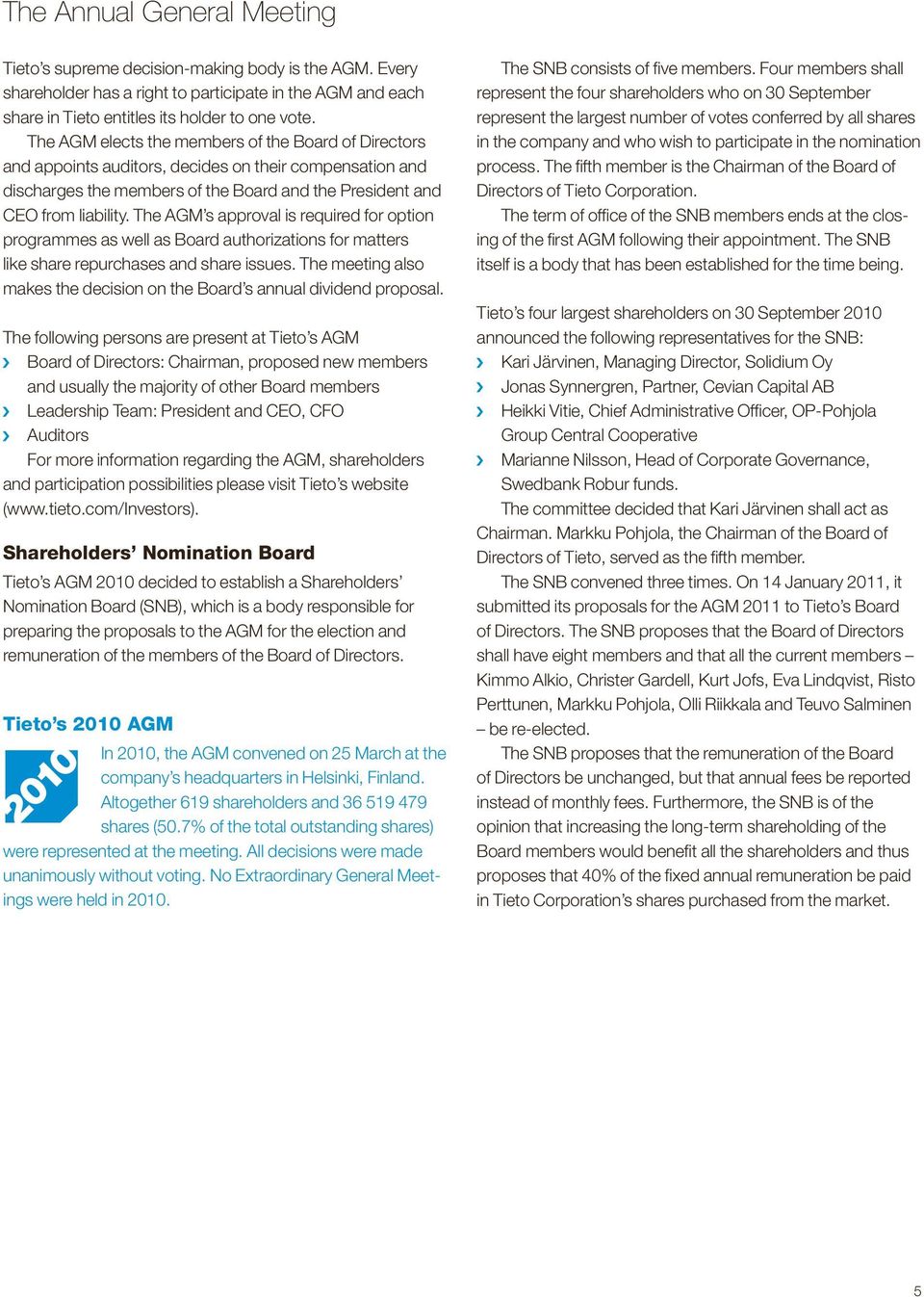
7 The Annual General Meeting Tieto s supreme decision-making body is the AGM. Every shareholder has a right to participate in the AGM and each share in Tieto entitles its holder to one vote. The AGM elects the members of the Board of Directors and appoints auditors, decides on their compensation and discharges the members of the Board and the President and CEO from liability. The AGM s approval is required for option programmes as well as Board authorizations for matters like share repurchases and share issues. The meeting also makes the decision on the Board s annual dividend proposal. The following persons are present at Tieto s AGM Board of Directors: Chairman, proposed new members and usually the majority of other Board members Leadership Team: President and CEO, CFO Auditors For more information regarding the AGM, shareholders and participation possibilities please visit Tieto s website ( Shareholders Nomination Board Tieto s AGM 2010 decided to establish a Shareholders Nomination Board (SNB), which is a body responsible for preparing the proposals to the AGM for the election and remuneration of the members of the Board of Directors. Tieto s 2010 AGM In 2010, the AGM convened on 25 March at the company s headquarters in Helsinki, Finland. Altogether 619 shareholders and shares (50.7% of the total outstanding shares) were represented at the meeting. All decisions were made unanimously without voting. No Extraordinary General Meetings were held in The SNB consists of five members. Four members shall represent the four shareholders who on 30 September represent the largest number of votes conferred by all shares in the company and who wish to participate in the nomination process. The fifth member is the Chairman of the Board of Directors of Tieto Corporation. The term of office of the SNB members ends at the closing of the first AGM following their appointment. The SNB itself is a body that has been established for the time being. Tieto s four largest shareholders on 30 September 2010 announced the following representatives for the SNB: Kari Järvinen, Managing Director, Solidium Oy Jonas Synnergren, Partner, Cevian Capital AB Heikki Vitie, Chief Administrative Officer, OP-Pohjola Group Central Cooperative Marianne Nilsson, Head of Corporate Governance, Swedbank Robur funds. The committee decided that Kari Järvinen shall act as Chairman. Markku Pohjola, the Chairman of the Board of Directors of Tieto, served as the fifth member. The SNB convened three times. On 14 January 2011, it submitted its proposals for the AGM 2011 to Tieto s Board of Directors. The SNB proposes that the Board of Directors shall have eight members and that all the current members Kimmo Alkio, Christer Gardell, Kurt Jofs, Eva Lindqvist, Risto Perttunen, Markku Pohjola, Olli Riikkala and Teuvo Salminen be re-elected. The SNB proposes that the remuneration of the Board of Directors be unchanged, but that annual fees be reported instead of monthly fees. Furthermore, the SNB is of the opinion that increasing the long-term shareholding of the Board members would benefit all the shareholders and thus proposes that 40% of the fixed annual remuneration be paid in Tieto Corporation s shares purchased from the market. 5
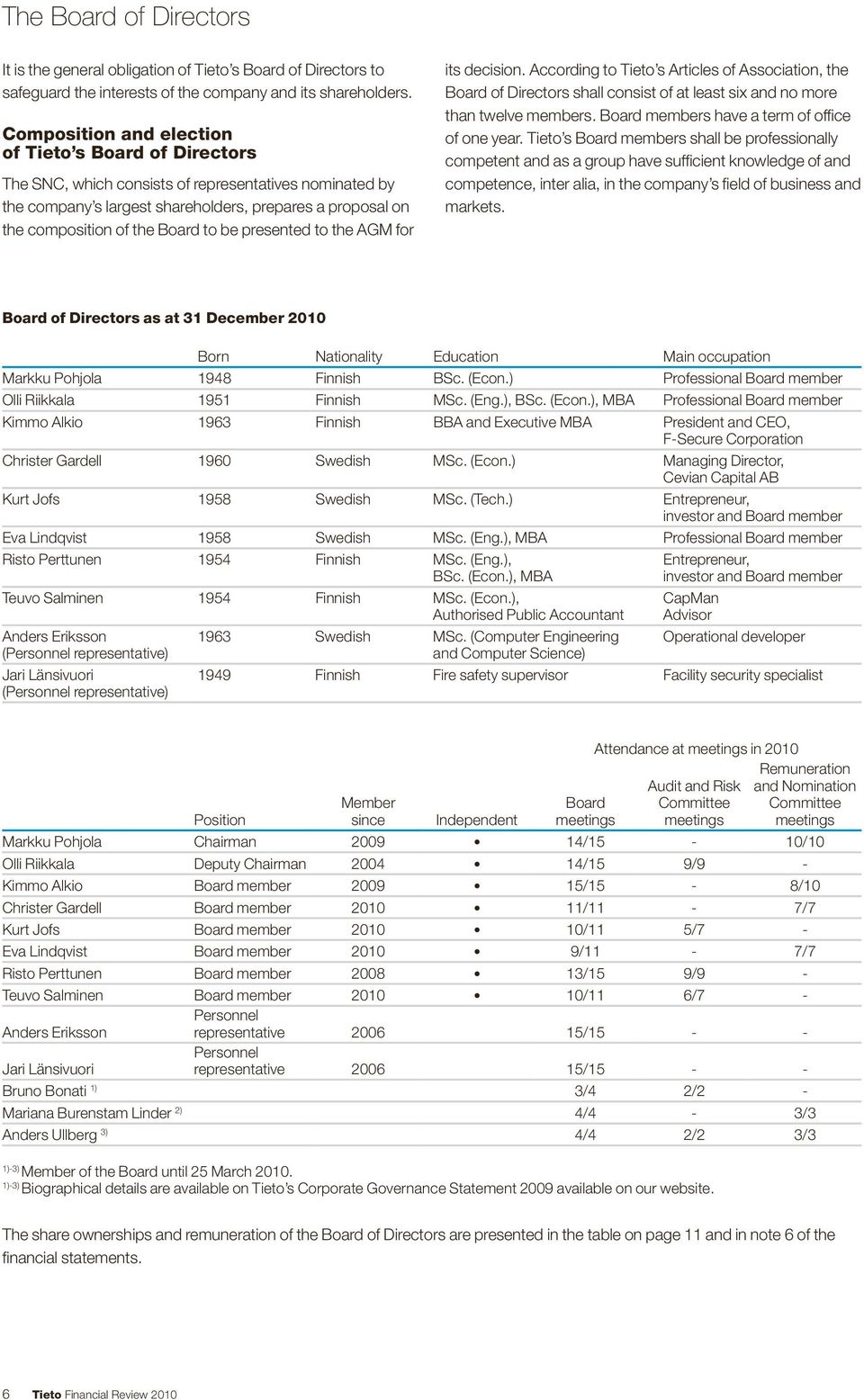
8 The Board of Directors It is the general obligation of Tieto s Board of Directors to safeguard the interests of the company and its shareholders. Composition and election of Tieto s Board of Directors The SNC, which consists of representatives nominated by the company s largest shareholders, prepares a proposal on the composition of the Board to be presented to the AGM for its decision. According to Tieto s Articles of Association, the Board of Directors shall consist of at least six and no more than twelve members. Board members have a term of office of one year. Tieto s Board members shall be professionally competent and as a group have sufficient knowledge of and competence, inter alia, in the company s field of business and markets. Board of Directors as at 31 December 2010 Born Nationality Education Main occupation Markku Pohjola 1948 Finnish BSc. (Econ.) Professional Board member Olli Riikkala 1951 Finnish MSc. (Eng.), BSc. (Econ.), MBA Professional Board member Kimmo Alkio 1963 Finnish BBA and Executive MBA President and CEO, F-Secure Corporation Christer Gardell 1960 Swedish MSc. (Econ.) Managing Director, Cevian Capital AB Kurt Jofs 1958 Swedish MSc. (Tech.) Entrepreneur, investor and Board member Eva Lindqvist 1958 Swedish MSc. (Eng.), MBA Professional Board member Risto Perttunen 1954 Finnish MSc. (Eng.), BSc. (Econ.), MBA Teuvo Salminen 1954 Finnish MSc. (Econ.), Authorised Public Accountant Anders Eriksson (Personnel representative) Jari Länsivuori (Personnel representative) 1963 Swedish MSc. (Computer Engineering and Computer Science) Entrepreneur, investor and Board member CapMan Advisor Operational developer 1949 Finnish Fire safety supervisor Facility security specialist Position Member since Independent Board meetings Attendance at meetings in 2010 Audit and Risk Committee meetings Remuneration and Nomination Committee meetings Markku Pohjola Chairman /15-10/10 Olli Riikkala Deputy Chairman /15 9/9 - Kimmo Alkio Board member /15-8/10 Christer Gardell Board member /11-7/7 Kurt Jofs Board member /11 5/7 - Eva Lindqvist Board member /11-7/7 Risto Perttunen Board member /15 9/9 - Teuvo Salminen Board member /11 6/7 - Anders Eriksson Personnel representative / Jari Länsivuori Personnel representative / Bruno Bonati 1) 3/4 2/2 - Mariana Burenstam Linder 2) 4/4-3/3 Anders Ullberg 3) 4/4 2/2 3/3 1)-3) Member of the Board until 25 March )-3) Biographical details are available on Tieto s Corporate Governance Statement 2009 available on our website. The share ownerships and remuneration of the Board of Directors are presented in the table on page 11 and in note 6 of the financial statements. 6 Tieto Financial Review 2010
9 All of the aforementioned Board members of Tieto are independent of the company and independent of the significant shareholders. Independency of the members is evaluated at the Board s constitutive meeting. The Board members shall inform the Board if any changes in these circumstances occur, in which case the independency will be re-evaluated. In addition to the members elected by the AGM, Tieto s personnel elects two members and two deputy members to the Board of Directors. This is done in accordance with the Personnel Representation Cooperation Agreement. In 2010, Anders Eriksson (deputy Bo Persson) and Jari Länsivuori (deputy Esa Koskinen) continued as personnel representatives. More detailed background information regarding the Board members, such as working experience, other positions of trust and the Remuneration Statement, is presented on our website ( Tasks of Tieto s Board The main duties and working principles of the Board have been defined in the written Working Orders. Additionally, the work of the Board is based on an annual action plan. More specifically, the Board: approves the company s values, strategy and organizational structure defines the company s dividend policy approves the company s annual plan and budget and supervises their implementation monitors management succession issues, appoints and discharges the President and CEO decides on the President and CEO s compensation, sets annual targets and evaluates their accomplishment decides on the compensation of the President and CEO s immediate subordinates addresses the major risks and their management at least once a year reviews and approves interim reports, annual reports and financial statements reviews and approves the company s key policies meets the company s auditors at least once a year without the company s management appoints the members and Chairmen of the Board s committees and defines their charters reviews assessments of its committees as well as the President and CEO evaluates its own activities. Work of Tieto s Board The Board has scheduled meetings every one to two months. Besides the Board members, the meetings are attended by the President and CEO, the Chief Financial Officer (CFO) and the General Counsel, who acts as secretary of the meetings. In addition to the scheduled meetings, the Chairman shall convene the Board whenever needed as well as at the request of any of its members or the President and CEO. Matters to be handled are prepared by the Board committees and the President and CEO. The Board receives information on the company s financial performance monthly Work of Tieto s Board The Board convened 15 times in 2010 and the average attendance was 91.3%. The Board met few times during the year without the management present. The Board held one joint meeting with the auditors and the Leadership Team members. The Board met the auditors once without the presence of the management. Work of Tieto s RNC The committee convened 11 times in 2010 and average attendance was 95.5%. The main issues considered by the Remuneration and Nomination Committee were compensation of the executive management and evaluation of the leadership capabilities in the company. Work of Tieto s ARC The committee convened 11 times in 2010 and attendance was 92.5%. In 2010, the work of the committee focused on internal control particularly the financial reporting process and risk management issues. and more detailed financial reports quarterly. Any material related to issues to be handled by the Board is provided five days prior to the meeting. Other case-specific materials are delivered at the management s initiative or the Board s request. Board members shall be informed about all significant company events immediately. Assessment of the Board The performance of Tieto s Board is assessed annually; the latest assessment was carried out by an external partner in late Assessments review the Board s knowledge of the company s operations and management as well as its understanding of the field of business. Additionally, the effectiveness of the Board work is evaluated. The SNC is informed of the results and they are also taken into consideration when the Board draws up its next annual plan. Board committees Tieto s Board is assisted by two permanent committees that prepare matters for which the Board is responsible. The Board defines the charters of the committees and decides on their composition. The entire Board remains responsible for the duties assigned to the committees. The Audit and Risk Committee, however, independently prepares a proposal on the nomination of the company s auditors for the AGM on behalf of the whole Board and assesses their compensation as well as arranges the tender process. Remuneration and Nomination Committee (RNC) The RNC comprises at least three non-executive directors elected by the Board. The majority of the members shall be independent of the company. The head of Human Resources (HR) acts as a secretary of the meetings. 7

10 In 2010, all committee members were non-executive directors and independent of the company. Based on the Board s decision, the RNC was composed of: Markku Pohjola (Chairman) Kimmo Alkio Christer Gardell Eva Lindqvist. The committee meets regularly and at least twice a year. The Chairman of the committee reports to the Board when applicable. The main tasks of the committee are to: monitor the targets of the compensation schemes, implementation of the compensation schemes, performance assessment and compensation determination ensure that the targets set for earning the bonuses defined in the compensation scheme are met prepare a proposal for the Chairman and Deputy Chairman of the Board prepare a proposal on the committee members and Chairmen, and the duties and responsibilities of these committees monitor corporate governance prepare a compensation proposal concerning the President and CEO and his immediate subordinates, and the principles of personnel compensation prepare for the Board option schemes and other sharebased incentive schemes evaluate the performance of the President and CEO prepare the assessment of the Leadership Team prepare a proposal on the Board s Working Orders. Audit and Risk Committee (ARC) The ARC comprises at least three non-executive directors who are independent of the company and out of whom at least one member shall be independent of significant shareholders. The Chairman and the members are elected by the Board. At least one committee member must have expertise in accounting, bookkeeping or auditing. The Chief Risk Officer (CRO) acts as a secretary of the meetings. In 2010, all committee members were non-executive directors who were independent of the company and significant shareholders. All four members have extensive experience in corporate management and therefore have the financial expertise required by the code. Based on the Board s decision, the ARC was composed of Olli Riikkala (Chairman) Kurt Jofs Risto Perttunen Teuvo Salminen. The committee convenes regularly at least four times a year and meets the company s auditors, also without the company s management present. The Chairman of the committee reports to the Board when applicable. The main tasks of the committee are to: review and supervise internal control particularly the financial reporting process and risk management issues discuss and review the interim and annual reports and the financial statements assess compliance with legislation, official regulations and the company s code of conduct evaluate the sufficiency of internal control and the internal audit examine, assess and approve the internal audit plan assess the appropriate coverage of risk management and monitor the efficiency of risk management review significant risks and unusual business events prepare a proposal for the AGM on the nomination of external auditors and their compensation evaluate the external auditors independence, assess the audit plan and examine the audit reports monitor the statutory audit and consult with the auditors regarding matters that should be brought to the Board s attention. The President and CEO and operative management Tieto Group s operative management consists of the President and CEO, the Leadership Team, the industry and country organizations and the service lines. The President and CEO is appointed by the Board and he is responsible for the Group s operative management, internal efficiency and quality. Tieto s President and CEO is assisted by the Leadership Team, which includes the heads of country and industry organizations, the head of Global Service Lines, the CFO, the head of Customer and Market Operations and the head of HR. Appointments of Leadership Team members are approved by the Chairman of the Board based on the President and CEO s proposal. The Leadership Team members are accountable for the performance and development of their management areas and they supervise the operations of the units belonging to their areas. As a general rule, the business units in each management dimension (industries, countries and service lines) make their own operative decisions and are responsible for conducting their operative duties. The country organizations, industry organizations and service lines have a profit and loss responsibility. The remuneration of the Leadership Team is presented in the tables on pages More detailed background information, such as full CVs of the Leadership Team members, is presented on our website ( 8 Tieto Financial Review 2010
11 The President and CEO and operative management as at 31 December 2010 Position Born Nationality Education Joined the company in Hannu Syrjälä The President and CEO 1966 Finnish MSc. (Econ.) 2008 Eva Gidlöf Executive Vice President, 1957 Swedish MSc. (Econ.) 2008 Country head of Sweden Kavilesh Gupta Executive Vice President, 1968 Indian BSc. (Physics) 2008 Strategy and Corporate Development Seppo Haapalainen Executive Vice President, 1961 Finnish MSc. (Econ.) 1990 Chief Financial Officer (CFO) Willem Hendrickx 4) Executive Vice President, 1968 Belgian Master in Economics 2010 Telecom & Media and Tieto International Per Johanson Executive Vice President, 1962 Swedish BA, Marketing and MBA 2009 Financial Services Ari Karppinen Executive Vice President, 1957 Finnish MSc. (Eng.) 1987 Country head of Finland Johanna Pyykönen-Walker Executive Vice President, 1966 Finnish Master of Education (M.Ed.), 2008 Human Resources MSc. (Econ.) Sampo Salonen Executive Vice President, 1954 Finnish MSc. (Econ.) 2005 Global Service Lines Ari Vanhanen Executive Vice President, 1961 Finnish MSc. (Eng.) 1994 Industry Group Bengt Möller 5) Executive Vice President, 1959 Swedish MSc. (Eng.) 1996 Telecom and Media Pekka Viljakainen 6) Executive Vice President, Tieto International 1972 Finnish Engineering studies ) Leadership Team Member as of 8 September ) Leadership Team Member until 8 September ) Leadership Team Member until 31 October Internal control, risk management and internal audit Internal control and risk management framework Tieto s internal control framework supports the execution of the strategy and ensures regulatory compliance. The foundation for internal control is set by internal control, risk management and governance policies as well as Tieto s values and Code of Conduct. The aim of Tieto s internal control framework is to assure that operations are effective and efficiently aligned with the strategic goals and to ensure reliable, complete and timely financial reporting and management information as well as compliance with applicable legislation and regulations. The framework endorses ethical values, good corporate governance and risk management practices. Tieto uses risk management as a means of developing business operations and their profitability and ensuring the continuity of successful business operations. The role of risk management is to maintain the company s risk management framework and report risk exposures consisting of strategic, financial and operational risks. Tieto s internal control In 2010, Tieto s risk management has concentrated on strategic risks related to the changed market situation. The main focus of Tieto s Internal Audit has been on project deliveries and business continuity. In addition, all finance process controls have been analyzed from the risk mitigation perspective during the year. The next step is to embed the risk management activities into organizational governance. Auditing The 2010 AGM re-elected the firm of authorized public accountants PricewaterhouseCoopers Oy as the company s auditor for the financial year PricewaterhouseCoopers Oy notified the company that authorized public accountant Kim Karhu acts as chief auditor. In 2010, Tieto Group paid the auditors for auditing a total of EUR 1.4 (1.4) million, of which EUR 1.3 (1.3) million to the Group s auditor PricewaterhouseCoopers Oy, and for consulting a total of EUR 0.9 (0.5) million, of which EUR 0.7 million to the Group s auditor. 9

12 The activities related to internal control and risk management are part of Tieto s management practices and integrated into the business and planning processes defined in the company s W2E (Way to Excellence) business system. The framework consists of Tieto s policies, procedures, operating principles and guidelines. The owner of each process is responsible for the continuous development of the established procedures, including internal control and risk management. Tieto s risk management is headed by the CRO, who reports to the CFO. The ARC monitors the efficiency of the company s internal control, risk management and internal audit. Internal control and risk management pertaining to financial reporting The purpose of internal control over financial reporting is to ensure the correctness of financial reporting, including interim and annual reports, and the compliance of financial reporting with regulatory requirements. Tieto s ARC has the oversight role in Tieto s external financial reporting. Financial reporting process and responsibilities Tieto has a common accounting and reporting platform, Tieto ERP. Group consolidation and reporting are based on the reporting system, which facilitates common control requirements for all cost centres and legal entities reporting to the Group. Financial reporting consists of monthly performance reports, including all the key performance indicators, rolling forecasts and interim financial reports. Tieto has documented the key financial process flows, such as order to cash, purchase to pay, record to report, master data management and accounting system access and role management. Processes are headed by a process owner. Tieto has organised its finance functions to global services, country units and group reporting. The Global Services function is in charge of centralized shared finance operations and the development of common finance processes and tools. It also has the ownership of finance policies and rules as well as the responsibility for process performance and operational compliance. Finance Country Units are responsible for implementing global practices, processes, tools, policies and rules in local operations. They are also responsible for executing local requirements set by authorities. Tieto s Group Reporting function provides leadership and coordination of financial reporting and ensures that accounting procedures conform to generally accepted accounting principles. It serves as the key legislative liaison for the Group s financial issues and executes operative follow-up of the adequacy and effectiveness of control activities. Information and releases concerning the internal financial guidelines and schedules are available on Tieto s intranet to all employees concerned. All the financial processes described are available in the company s W2E business system. Monitoring activities of financial reporting Financial reports are regularly reviewed by the Leadership Team and the Board of Directors. The follow-up is based on a thorough comparison of the actual figures with the set objectives, forecasts and previous periods. If the figures deviate, the Leadership Team members are responsible for initiating corrective actions. The ARC can assign individual audit engagements to the company s internal audit function related to the internal control and risk management systems of the financial reporting process. The committee also reviews interim and annual reports. Tieto s Board of Directors approves the financial reports. Internal audit Tieto s Internal Audit function carries out both business and internal audit activities. Business audit activities aim to ensure the efficiency and appropriateness of Tieto s operations. Internal audit activities are intended to assess and assure the adequacy and effectiveness of internal controls within Tieto. Internal audit is carried out independently and it reports to the President and CEO and to the ARC. The charter and annual internal audit plan are approved by the ARC. Auditors The ARC prepares a proposal on the appointment of Tieto s auditors, which is then presented to the AGM for its decision. The compensation paid to the auditors is decided by the AGM and assessed annually by the ARC. 10 Tieto Financial Review 2010

13 Remuneration The aim of Tieto s remuneration principles is to attract and retain talent, motivate key people and align the goals of the company s shareholders and executives in order to enhance the value of the company. Directives for how the company shall compensate its employees are defined in Tieto s Compensation & Benefits policy. The policy is globally applied at all Tieto entities and units to support the company s strategy, objectives and values. Remuneration of the Board of Directors is decided by the AGM of Tieto based on a proposal by the SNB. The RNC is responsible for planning the remuneration of the Leadership Team members and preparing the principles underlying the remuneration of Tieto personnel. The Board of Directors decides on the remuneration of the President and CEO and other members of the Leadership Team based on a proposal by the RNC. Remuneration of the Board According to the decision of the AGM, the Board members and the Chairman of each Board committee receive fixed monthly cash compensation. In addition, the Board members will be paid remuneration for each Board meeting and for the meetings of all permanent or temporary Board committees. Board remuneration does not include any shares or share-based arrangements, nor do the members have any pension plans at Tieto. Tieto executives or employees are not entitled to compensation for their Board meeting attendance. None of the Board members, except the personnel representatives, have an employment relationship or service contract with Tieto. Board remuneration in 2010 Board members received cash compensation as follows: EUR /month Chairman Deputy Chairman Member Committee Chairman/month ) 7) Provided that she or he is not the Chairman or the Deputy Chairman of the Board. Attendance at the meetings is presented on page 6 of this Corporate Governance Statement. Additionally, the members received EUR 800 for each Board and committee meeting. Remuneration of the Leadership Team Remuneration of the Leadership Team members consists of base salary and benefits short-term incentives: an annual bonus long-term incentives, such as option or other share-based programmes and pension plans. Short-term incentives The purpose of the annual bonuses is to reward performance that surpasses expectations. Tieto s bonus system is based on clear measurable targets set for net sales and operating profit as well as factors measuring success in the company s transformation, e.g. employee and customer satisfaction and quality improvements. Weighting of the reward factors for the President and CEO and other Leadership Team members is described in a separate table. Shareholdings and remuneration of the Board in 2010 Shareholding at 31 Dec Remuneration, EUR EUR Markku Pohjola Olli Riikkala Kimmo Alkio Christer Gardell Kurt Jofs Eva Lindqvist Risto Perttunen Teuvo Salminen Anders Eriksson Jari Länsivuori Bruno Bonati 1) Mariana Burenstam Linder 2) Anders Ullberg 3) )-3) Member of the Board until 25 March )-3) Biographical details are available on Tieto s Corporate Governance Statement

14 The reward targets are set annually by the Board of Directors. The bonus for the President and CEO is 50% of the annual base salary when the targets are met. The maximum bonus is 100%. For other Leadership Team members, the bonus stands at 30% of the annual base salary at the target, and the maximum bonus is 60%. The amount of bonuses is decided by the Board of Directors after the financial statements have been prepared. The bonuses are paid by the end of April. Share-based long-term incentives Tieto has two types of share-based long-term incentive arrangements: the Performance Share Plan and option programmes. The terms and conditions of the share plan are approved by the Board of Directors and the current plan covers the Leadership Team members. Key principles of Tieto s share plan, such as the basis and size of rewards, are described on our website ( The terms and conditions of option programmes are approved by the AGM and option allocations are approved by the Board of Directors with a view to reward individual performance. The current programmes cover the Leadership Team and around 500 other employees. Further information about Tieto s option programmes is available on our website ( Pension plans Tieto operates a number of different pension plans in accordance with national requirements and practices. In addition to statutory pension plans, most Leadership Team members are provided with additional pension schemes. The additional schemes are classified as defined contribution plans, except for the scheme of one member who is covered by a fund-based pension system previously adopted by Tieto. In contribution-based plans, the payments to the plans are recognized as expenses for the period to which they relate. After the payment of the contribution, the company has no further obligations in respect of such plans. In the case of the Finnish members with no earlier additional pension plans, annual payments to the plans managed by a pension insurance company amount to 15% or 23% of the participant s annual base salary. The accumulated pension, including return on capital investment, is paid to the participant during 20 years starting at the age of depending on individual choice. The annual expenditure related to the pension plans of the President and CEO and CFO amounts to 23% of their annual base salary, while that of other Finnish Leadership Team members with no earlier pension plans amounts to 15% of their annual base salary. The company provides the Swedish members and one non-finnish member with individual contribution-based pension plans in accordance with local practices. Remuneration of the Leadership Team Hannu Syrjälä, the President and CEO Salary and benefits EUR /month + car benefit Basis of bonus Maximum 100% of base salary based on the Group s net sales and profit. Weighting of the reward factors: - EBIT of the company 70% - Net sales of the company (organic and acquisitive) 30%. Options 2006 B option programme: right to subscribe for shares 2006 C option programme: right to subscribe for shares 2009 A option programme: right to subscribe for shares 2009 B option programme: right to subscribe for shares Terms and conditions of the option programmes are available on our website ( Performance Share Plan The reward to be paid to the President and CEO on the basis of the Performance Share Plan corresponds to a maximum of shares. Further information is available on our website ( Share ownership guideline The recommended minimum investment in the company s shares corresponds to the executive s one time annual gross base salary. Retirement age 60 Pension expenditure Annual fee in addition to statutory pension provision: 23% of the annual base salary (defined contribution plan 8) ) Period of notice 12 months Severance payment In addition to the 12 months salary for the notice period, the President and CEO is entitled to a severance payment equivalent to months salary. 8) Payments to defined contribution plans are recognized as expenses for the period to which they relate. After payment of the contribution the Group has no further obligations in respect of such plans. Updated information on the shares and options held by the President and CEO is available on our website ( under the insider register. 12 Tieto Financial Review 2010

15 Other Leadership Team members Basis of bonus Options Performance Share Plan Share ownership guideline Pension expenditure Maximum 60% of base salary based on the Group s net sales and profit as well as annual performance index of transformation. CFO: weighting of the reward factors is following - EBIT of the company 50% - Total net sales of the company (organic and acquisitive) 20% - Annual performance index of transformation 30% Other: weighting of the reward factors is following - EBIT of the company 34% - Total net sales of the company (organic and acquisitive) 33% - Annual performance index of transformation 33% Terms and conditions of the option programmes are available on Tieto s website. See the insider register on our website for updated information on the options held by each member. The reward to be paid to the other members of the Leadership Team corresponds to a maximum of shares. Further information is available on our website ( The recommended minimum investment in the company s shares corresponds to the executive s one time annual gross base salary. CFO: Annual fee equals to 23% of annual base salary (defined contribution plan) 9) Other Finnish Leadership Team members with no pension plans implemented earlier: Annual fee equals to 15% of annual base salary (defined contribution plan). The company provides most non-finnish members individual contribution-based pension plans accordant with local practices. 9) The compensation of the whole Leadership Team in 2010 is also summarized in note 6 of the financial statements. Remuneration statement is available on our website ( 9) Payments to defined contribution plans are recognized as expenses for the period to which they relate. After payment of the contribution the Group has no further obligations in respect of such plans. Shareholdings and remuneration of the Leadership Team in 2010 Shareholding at 31 Dec Options held at 31 Dec EUR Hannu Syrjälä Eva Gidlöf Kavilesh Gupta Seppo Haapalainen Willem Hendrickx 4) Per Johanson Ari Karppinen Johanna Pyykönen-Walker Sampo Salonen Ari Vanhanen Bengt Möller 5) Pekka Viljakainen 6) Remuneration in 2010, EUR President and CEO Salary and benefits Bonus Other Leadership Team members Salary and benefits Bonus ) Leadership Team Member as of 8 September ) Leadership Team Member until 8 September ) Leadership Team Member until 31 October

16 REPORT BY THE BOARD OF DIRECTORS Report by the Board of Directors NEW COMPANY STRUCTURE BASED ON REVISED STRATEGY Tieto revised its strategy during 2010 as part of an annual strategy process. Tieto s strategy seeks higher differentiation and specialization. IT is increasingly packaged and consumed as a service and therefore a greater focus is placed on productizing the company s high value adding services and offerings. Combining advanced technology with innovations and a deep understanding of customers businesses differentiates the company from its competitors. Tieto aims to be a market leader in IT services in North-East Europe and to expand operations in new markets such as Russia and Poland. To ensure efficient execution of the strategy, Tieto decided to adjust its operating model and made new appointments in the company management. The new structure reflects the company s strategic priorities in terms of both markets and offerings. The two dimensions of the new structure are Market Units and Business Lines. Market Units drive sales to their assigned customers and within their geographical markets and develop both customer relationships and Tieto s local position. Business Lines develop and deliver Tieto s offerings to customers, drive delivery efficiency and take part in sales. Business Lines are managed as global units. The new structure and appointments became effective on 1 January STREAMLINING ACTIONS In 2010, Tieto continued the transfer of operations to offshore countries and the streamlining of the company to improve its performance, especially in Tieto International. These actions included the renewal of business structures and strategy in Germany, office consolidations and personnel-related measures in selected countries. The total one-off costs related to the restructuring actions during 2010 amounted to EUR 30.4 million. The majority of the cash flow effect is expected to materialize in the second half of A considerable part of the one-off costs concerns Germany. During the year, Tieto also booked impairment losses of EUR 7.6 million related to the divestment of its operations in France and the USA, and a capital gain of EUR 0.4 million. MARKET DEVELOPMENT The IT services market in Western Europe was flat in Outsourcing of ICT infrastructure and application management as well as business process outsourcing were active throughout the year whereas demand for project services was stagnant. Buying patterns in the IT sector were backend loaded, supported by year-end sales of new software licenses. For 2011, industry analysts estimates indicate growth of 2 4% for the IT services market in Western Europe. The overall global IT market is expected to see even greater growth due to rising demand, especially in the emerging markets. Demand for new development projects aiming at growth or enhanced customer services is picking up, for example in the finance, industrial manufacturing, media and telecom sectors. Going forward, mobile applications comprise a clear growth area. Price pressure continues and improvements in productivity and efficiency remain among key the drivers in buying IT. Hence, outsourcing of IT is expected to be the strongest growth area in 2011 as well. The outsourcing trend is now extending from large companies to EUR million Net sales and growth % 25 EUR million 150 Operating profit (EBIT) and margin % Tieto Financial Review 2010

17 REPORT BY THE BOARD OF DIRECTORS small and medium-sized companies. Customers emphasize offshoring in their sourcing strategies, putting pressure on prices. Going forward, new service models have a key role in customers IT strategies. The transition from traditional IT projects to models where customers buy IT, or functionality, as a service is accelerating. Companies worldwide indicate that service-based IT or cloud services is a key initiative for them, and budgets in this area for 2011 are expected to grow by double-digit numbers, albeit from low levels. In 2015, cloud services are forecast to account for 20% of the IT market. At Tieto, cloud services currently account for less than 5% of net sales. As customers are now choosing to have IT delivered as a service via the internet instead of investing in their own IT systems, IT ties up less capital. Thanks to its scalability, this service is more affordable, attracting new user groups to utilize IT. Customers are billed based on time consumed or number of transactions or users. As cloud applications need only an internet connection and they also work on mobile devices, they are expected to attract more users and lead to higher business volumes. In the telecom sector, companies have gradually started investing. Both the operator segment and the mobile device manufacturers segment picked up in the first half of 2010, boosted by new technologies. Positive development is now visible also in the network equipment manufacturers segment. Offshore-based operations are a crucial part of service provision in the telecom sector. Demand for spearhead competences in some hype areas has increased, resulting in resource shortage. In the finance sector, the market is growing and Sweden is currently the strongest market for Tieto. In Finland, the pension insurance segment was declining in 2010 but bottomed out towards the year end. The mortgages market in the UK has also begun to recover. The IT outsourcing market remained strong. Banks have also started to invest in their existing IT systems by consolidating their current systems as well as in new applications, as they are seeking to transfer more services to the internet. Market development by country In Finland, the outsourcing market continued to grow throughout the year. Project business remained at a modest level, although the number of development initiatives increased towards the year end. Demand for IT services is expected to continue at a good level in the energy, healthcare and welfare sectors. Positive development is also expected in the finance sector and the industrial manufacturing sector in In the public sector, Tieto expects moderate growth to continue. In Sweden, demand for IT services, especially the outsourcing of IT, is at a healthy level. Despite higher volumes, the total value of the Swedish IT services market did not grow in 2010 due to price competition, which has remained hard. Growth expectations for the Swedish IT market in 2011 are slightly higher than those for Finland, but on the other hand, vendors in Sweden are facing resource shortages within some key competence areas, such as project management. In Russia, the IT market started to recover in In 2011, demand is expected to grow for project services driving cost-efficiency and customer satisfaction, especially in consumer-driven businesses like retail banking, retail and telecom. Demand is expected to grow also in the manufacturing, oil & gas and food industries. The emergence of the outsourcing market is slower than was earlier estimated by analysts. In Germany, the IT market started to recover in the second half of 2010 and is expected to remain active in The markets for local telecom R&D are weak, but demand in the healthcare sector is brisk. The manufacturing market has recovered and investment planning has been started. In Norway, demand is picking up and interest in restarting IT projects has increased. A strong outlook is indicated by companies in the oil & gas segment. Positive development is also expected in the healthcare sector. EUR million Net sales and growth by geography % EUR million 20 Operating profit and margin by geography 100 % Finland Sweden International Finland Sweden International 15
18 REPORT BY THE BOARD OF DIRECTORS BUSINESS TRANSACTIONS AND MAJOR AGREEMENTS IN JANUARY DECEMBER In January, the Legal, Financial and Administrative Services Agency in Sweden, Kammarkollegiet, chose Tieto as one of its ten IT-suppliers. The framework agreements with the chosen suppliers cover IT management services in the public sector and will affect all government agencies, 232 municipalities as well as 19 county councils and regions. In March, Tieto acquired T&T Telecom, an IT and consultancy company specializing in services for telecom operators. The company employs approximately 70 people and has offices in St. Petersburg and Moscow, Russia In March, Tieto divested the shares of TietoEnator Majiq, previously responsible for the company s pulp and paper operations in North America. The company employed close to 60 people. In the forest sector, Tieto now focuses on Europe and the growth markets in China and Russia. In March, Tieto and Yleisradio (YLE) agreed that Tieto will acquire 20% of Tieto Broadcasting IT Oy s share capital. Tieto Broadcasting IT was previously owned by Tieto (80%) and YLE (20%). In 2009, Tieto Broadcasting IT s net sales amounted to EUR 22.7 million. The transaction was completed at the beginning of June. In April, Tieto agreed to sell its French subsidiary to the French IT company Devoteam. In 2009, net sales from the sold entity were EUR 28.5 million. Altogether Tieto has booked EUR 7.3 million in impairment losses and EUR 0.4 million in restructuring costs related to the divestment. In June, Tieto and the City of Stockholm decided to continue cooperation in IT and telephony services and concluded an agreement that runs from August 2012 until July The order value during the extension period is more than SEK 600 million (approximately EUR 60 million), of which Tieto s proportion is about SEK 300 million (approximately EUR 30 million). The delivery will be made in cooperation with SiriusIT, Aditro, Agresso and TeliaSonera. In June, Skåne Regional Council chose Tieto as its outsourcing partner. The deal is valued at SEK 516 million (approximately EUR 50 million) during five years. In June, Tieto and the Finnish State Treasury concluded an agreement on operating services. Tieto delivers IT operating services to the Finnish State Treasury and the related Government IT Shared Service Centre until The delivery also includes an extensive operating service development plan for the whole contract period. The value of the contract is approximately EUR 20 million. In June, If P&C Insurance concluded a new five-year IT services agreement with Tieto as a one-stop supplier. The contract includes operations management services for If s IT systems in the Nordic countries. The total value of the contract is approximately EUR 160 million. In June, Tieto acquired the business of the Finnish healthcare IT solutions provider Intensium Oy to strengthen its position in the healthcare market. The business was transferred to Tieto on 1 July Intensium s 17 employees joined Tieto. In September, Tieto announced the signing of a share purchase agreement concerning a majority ownership in TrustInfo, a Russian company currently providing a full range of data centre services in Russia. The Russian Federal Antimonopoly Service approved the transaction in January 2011, and the agreement is expected to be signed during the first quarter of After the signing, a holding company fully owned by Tieto will own 70% of the shares in TrustInfo. I-Teco, a leading Russian IT service and consulting company, owns the remaining 30%. The initial investment amounts to approximately EUR 17 million. In September, Tieto and Sanoma signed a significant agreement on centralizing administrative IT services to Tieto starting from 2 September The agreement covers among others the financial systems, and intranet solutions of the Sanoma Group in Finland and as an option, partially in the Baltic countries. In November, Tapiola, a Finnish customer-owned group offering insurance, bank, savings and investment services, decided to centralize selected ICT operating services to Tieto. The total value of the five-year agreement is approximately EUR 23 million. The service agreement will commence after the migration phase in autumn In December, Hafslund ASA, one of the leading Nordic energy companies, signed an agreement to purchase a new billing system from Tieto Norway AS. The system is designed to handle the next generation advanced meter and control systems (AMS) that all energy companies in Norway will Net sales by quarter, EUR million Operating profit (EBIT) by quarter, EUR million Q1 Q2 Q3 Q4 Q1 Q2 Q3 Q4 16 Tieto Financial Review 2010

19 REPORT BY THE BOARD OF DIRECTORS be required to implement. The total value of the agreement amounts to around EUR 14 million. In December, the Swedish Legal, Financial and Administrative Services Agency and Tieto signed a frame agreement for services supporting e-government at municipalities, county councils and government agencies. The agreement covers six suppliers and is estimated to result in call-offs equivalent to SEK 200 million per year over a five-year period. In December, Tieto announced that it has made an agreement with Nokia Siemens Networks on outsourcing part of the device management software development related to base station products to Tieto. As a result, more than 30 persons have joined Tieto. ORDER BACKLOG The order backlog, which only comprises services ordered with binding contracts, amounted to EUR (1 258) million at the end of the period. In total, 60% (63) of the backlog is expected to be invoiced during Order intake in 2010 saw the strongest growth in Sweden. FINANCIAL PERFORMANCE IN JANUARY DECEMBER Full-year net sales amounted to EUR ( ) million. The increase in net sales was curbed by the divestments of the pulp and paper operations in North America and Tieto s French subsidiary in 2010 and the one-off income of EUR 13.2 million included in net sales for The divestments had a negative EUR 30.1 million impact on full-year net sales. On the other hand, the stronger currencies, especially the Swedish krona, had a positive EUR 60 million impact on net sales. When eliminating currency effects, the impacts of the divestments and one-off income on net sales of the underlying business declined by 1%. In 2010, growth came mainly from the outsourcing of ICT infrastructure and application management. Demand for new development projects aiming at growth or enhanced customer services was weak, although it picked up towards the year end. Price pressure remained strong throughout the year. Volumes in terms of man-hours were up by around 6% but that has not translated into net sales growth due to the fact that offshoring is in many cases leading to lower average unit prices. At the same time, however, average unit costs are down. The net impact of lower prices and lower average costs on operating profit is slightly positive. In this calculation, the impact of one-off items and currency effects is eliminated. Full-year operating profit (EBIT) amounted to EUR 72.4 (75.3) million, representing a margin of 4.2% (4.4). Tieto booked a net amount of EUR 30.4 million (negative) in restructuring costs, EUR 7.6 million in impairment losses related to the divestment of its operations in France and the USA, and a capital gain of EUR 0.4 million. Operating profit excluding one-off items stood at EUR (108.0) million, or 6.4% (6.3) of net sales. Savings achieved in subcontracting costs, business expenses and premises were offset by investments in global delivery capacity, growth initiatives in Russia and offerings such as cloud services. At the corporate level, personnel costs excluding currency effects and restructuring remained at the same level as in Net financial expenses stood at EUR 6.3 (5.0) million in the full-year. Net interest expenses were EUR 5.6 (7.3) million and net losses from foreign exchange transactions EUR 0.0 (positive 2.9) million. Other financial income and expenses amounted to EUR 0.7 (0.6) million. The Supreme Administrative Court in Finland has ruled that a merger loss of EUR 27.6 million related to the merger of Tieto Financial Solutions Oy in 2003 is tax-deductible. Recognition of a deferred tax asset related to this item had a positive net profit effect of EUR 7.2 million in Earnings per share (EPS) totalled EUR 0.69 (0.77). The 12-month rolling return on capital employed (ROCE) was 15.1% and the return on shareholders equity (ROE) 9.2%. In Finland, net sales remained flat. The drop in the finance sector offset the growth in other sectors. In the Finnish finance sector, the pension insurance segment was weak after a long investment cycle. Tieto s performance was strong in the energy, healthcare and welfare and the manufacturing sectors. The company made greater use of external resources due to the short-term shortage of staff, especially in the second half of This, coupled with lower prices, resulted in weaker profitability. Operating profit amounted to EUR 94.6 Return on equity, % Return on capital employed, %

20 REPORT BY THE BOARD OF DIRECTORS Financial performance by country Net sales in Jan Dec/2010, EUR million Net sales in Jan Dec/ 2009, EUR million Change, % Operating margin in Jan Dec 2010, % Operating margin in Jan Dec 2009, % Finland Sweden International Group elimination Total (110.3) million, or EUR (112.5) million excluding one-off items. Operating margin was 10.6% (12.4), or 11.3% (12.7) excluding one-off items. In Sweden, net sales grew by 9%. In local currency, net sales declined by 2%. The public, finance and healthcare and welfare sectors were growing, but in the telecom and manufacturing sectors, Tieto s performance was weak. All main cost items, e.g. personnel and subcontracting costs and operating and business expenses, excluding one-off items, were down in 2010, resulting in a substantial improvement in profitability. Operating profit rose to EUR 34.4 (-3.0) million, or 6.8% (-0.6.) of net sales. Operating profit excluding one-off items amounted to EUR 35.2 (17.9) million, or 7.0% (3.9) of net sales. In International, net sales declined by 2%. The decline was reinforced by divestments in 2010 and one-off income of EUR 13.2 million in 2009 that affected the comparison figures. The divestments of operations in North America and France had a negative EUR 30.1 million impact on net sales. On the other hand, the stronger currencies had a positive EUR 12 million impact. When eliminating divestments, oneoff items and changes in currencies, net sales grew by 4%. Growth is mainly attributable to growing operations in Asia and Eastern Europe, e.g. China, India, Poland and the Czech Republic. Despite cost savings and good performance in delivery countries, operating profit was unsatisfactory partly due to business development costs in Russia. Full-year operating profit of Tieto International amounted to EUR (-6.7) million and included EUR 21.2 million in restructuring costs, impairment losses of EUR 7.6 million related to the divestments, and a capital gain of EUR 0.4 million. Operating profit excluding one-off items rose to EUR 15.0 (1.4) million. Operating margin was -2.5% (-1.2), or 2.8% (0.3) excluding one-off items. Net sales by customer sector Net sales in Jan Dec /2010, EUR million Net sales in Jan Dec / 2009, EUR million Change, % Telecom Finance Industry sectors Total In the telecom sector, Tieto s net sales declined by 2%. The divestment in France had a negative EUR 23.2 million impact on net sales. When eliminating the divestment and the positive currency effects, net sales declined by 1%. The decline was mainly attributable to lower prices and lower delivery volumes to a few customers facing business challenges in their own operations. Profitability improved in 2010 due to lower costs and improved efficiency. In the finance sector, net sales remained flat. Excluding the positive currency effect, net sales declined by around 4% mainly due to the drop in Finland, where net sales in the pension insurance segment were at a low level. In Sweden, net sales in local currency turned to growth towards the year end. Profitability improved to a satisfactory level. In the industry sectors, net sales rose by 3%. The comparison figure in 2009 included one-off income of EUR 13.2 million. Excluding one-off items, currency effects and the di- Personnel by country Net recruitment Finland 33% China 6% Poland 5% India 8% Czech 11% Number of employees Sweden 17% Germany 6% Latvia 3% Norway 3% Other 8% Offshore Onshore 18 Tieto Financial Review 2010

21 REPORT BY THE BOARD OF DIRECTORS vestment of the pulp and paper operations in North America, net sales rose by around 2%. Net sales were growing in all sectors, except for the industrial manufacturing sector, which suffered from low performance in Sweden. Profitability was at a healthy level. In Tieto s reporting, the industry sectors cover customers in healthcare and welfare, forest, energy, manufacturing, automotive, public, retail and logistics. CASH FLOW AND FINANCING Full-year net cash flow from operations increased to EUR (126.4) million. Net cash flow from operations includes a decrease of EUR 12.6 (increase 3.9) million in net working capital. Tax payments amounted to EUR 18.1 (14.4) million in the full year. Payments for acquisitions totalled EUR 2.6 (4.6) million in the full year. Divestments amounted to EUR 3.6 (5.7) million. Dividends of EUR 35.7 (35.8) million were paid in April. At the end of 2010, the consolidated balance sheet totalled EUR ( ) million, a 3.8% increase compared with The equity ratio was 47.6% (46.0). Gearing decreased to 9.3% (12.7). Net debt totalled EUR 51.8 (66.0) million, including EUR million in interest-bearing debt, EUR 4.3 million in finance lease liabilities, EUR 6.5 million in finance lease receivables and EUR 98.0 million in cash and cash equivalents. The interest-bearing long-term debt consists of EUR 150 million in bonds, of which EUR 100 million will mature in December 2013 and EUR 50 million (private placement) in July The EUR 250 million syndicated revolving credit facility maturing in November 2011 was not in use and there were no commercial papers issued under the EUR 250 million Commercial Paper Programme at the end of December. Other short-term credit lines were utilized for EUR 1.1 million. INVESTMENTS Investments totalled EUR (58.9) million for the full year. Capital expenditure, including financial leasing, accounted for EUR 99.5 (57.5) million and investments in subsidiary and associated company shares for EUR 1.9 (1.4) million. Investments in new data centres in Finland, Sweden and Russia amounted to EUR 24.8 million. PERSONNEL The number of full-time employees amounted to (16 663) at the end of December. Tieto has actively been increasing its capacity in global delivery centres. At the end of December, the number of full-time employees in the global delivery centres totalled (4 996), or 37% (30) of personnel. Global operations have grown fast, especially in China and India. In onshore locations, the number of personnel has decreased by close to 500 employees year-on-year. The 12-month rolling employee turnover stood at 9.5% (6.3) at the end of December. The average number of fulltime employees was (16 568) in the full year. Wages and salaries for 2010 were EUR (739.4) million. In 2010, 73% (73) of personnel were male and 27% (27) female. Due to rising attrition rates, salary inflation is expected to rise. Emerging focus markets like India, China and Russia may see double-digit salary hikes. Salary inflation is expected to be 2 3% on average. The greater requirements of customers and rapidly changing operating environment coupled with continuing transformation within the company pose challenges for human resources management and the development of personnel. In 2010, Tieto continued building a global HR function that supports the strategy implementation by efficiently combining business goals with individual level objectives. To achieve this target, the company focused in 2010 on the Success for People process as well as further development of compensation and HR information systems. The global rollout of the Success for People process, launched in 2009, was completed during the year. It is designed to facilitate the translation of business goals into individual level objectives that define more clearly what is expected from each employee. Success for People includes processes and tools for goal and performance management, competence evaluation and development planning, talent management, compensation management as well as individual and company incentives. In the talent management area, the company conducted the annual talent evaluation process based on Tieto s global career path framework. In 2010, Tieto concentrated on managers, project managers and young talents. The career path Years <1 1 5 Length of employment Years <30 Personnel by age > % % >
22 REPORT BY THE BOARD OF DIRECTORS framework was developed further to address the strategic competence areas. Tieto s compensation system aims to create a clear connection between compensation, personal performance and the company s financial position. The key elements are clearly defined goals and performance-based compensation. In 2010, Tieto started streamlining and renewing its sales compensation programmes to boost sales performance. In line with the objectives for short-term incentives in general, the weighting of individual performance is on the rise. Competitive compensation supports the company s bid to become the employer of choice, as well as ensures that it can retain its skilled professionals and attract new talents. Development of Tieto s HR information systems covered, for example, tools for employment life- cycle management. In 2010, Tieto focused on the development of the automated global solution. It was taken into pilot use at the end of The global roll-out will continue during The company also invested in the transformation of competences to increase the agility of its operations. In this process, the work concentrated on defining the strategic competences and continues with business-focused capability building and transformation projects in Tieto conducts an annual employee engagement survey once again saw an all-time high response rate, 89%, showing that personnel around the world consider the annual survey to be an important feedback channel. The overall satisfaction level remained relatively stable, but there is still room for improvement. However, satisfaction improved in many areas, such as focus on customer satisfaction, stronger leadership, better communication and follow-up on goals as well as understanding of Tieto s strategy and values. One key area of improvement was the overall loyalty and relationship to Tieto as an employer. The company has used the results of this survey to define key development areas for These development areas relate to the implementation of a new, simplified operating model and organizational design that aims to increase efficiency and clarify accountabilities across the organization. Tieto s Code of Conduct and anti-corruption policy were renewed in 2010 and communicated to all employees. By the end of the year, close to 90% of employees had confirmed their commitment to the Code of Conduct by signing it. The purpose of these instructions is to communicate a common set of ethical and business principles to the company s stakeholders and to guide employees daily work. Suppliers and other business partners are also expected to adopt the principles of Tieto s Code of Conduct. ENVIRONMENT Tieto supports a preventative approach to environmental challenges and a responsible way of conducting our business operations. The company is included in selected sustainability indexes and certified according to international standards. In 2010, the company became a member of the United Nations Global Compact, which is a strategic policy initiative for businesses that are committed to aligning their operations and strategies with ten universally accepted principles in the areas of human rights, labour, environment and anti-corruption. Tieto s environmental impact is mainly related to energy consumption for running data centres, offices and other facilities (heating, electricity), business travelling and use of paper and other consumables. In accordance with the company s environmental management system, a systematic method is used to identify and evaluate the main environmental aspects. In 2010, the programme for Green Offices continued and business travelling was reduced, supported by greater reliance on video conferences and other types of virtual meetings. Tieto signed an agreement with the WWF with the aim of applying WWF s Green Office standard in In 2010, the head office in Helsinki and another office in Espoo, Finland were certified. The Green Office criteria include efficient use of energy and well-developed sorting of waste for recycling. The certification is subject to an audit conducted by an auditor from WWF. Data centres account for a great part of Tieto s energy consumption. The energy needed for running servers and computers in data centres, and the additional energy consumed for cooling, usually represents 20 30% of the total energy consumption. In 2010, Tieto opened a new energy-efficient data centre in Sweden. In addition, the company has made substantial environmental investments in new data centres in Finland and Russia. The company works in a number of ways to improve energy efficiency in the data centres, e.g. generating energy through recycling and reuse. To reduce greenhouse gas emissions and other environmental impacts, Tieto aims to cut down travelling as much as possible. Our travel policy states that travelling to internal meetings should be minimized, and that digital tools such as video- and teleconferences or live meetings should be used instead. During 2010, travel expenses were slightly down despite the higher level of business activity. Tieto has also designed a Future Office solution, with the ambition to reduce travelling and increase productivity. The Future Office concept featuring advanced technology for virtual meetings and videoconferences, IP telephony, document sharing and internal social media tools is implemented in all Tieto offices. The solution is also included in Tieto s offerings to customers. To avoid environmental risks and reduce environmental impacts from purchased goods and services, Tieto requires that all suppliers and sub-contractors follow the Global Compact principles. From 2010, all new suppliers and partners will be sent a self-assessment document with questions regarding their code of conduct and level of environmental work. The signed self-assessment document is binding and shall constitute a part of any contract with Tieto. 20 Tieto Financial Review 2010
23 REPORT BY THE BOARD OF DIRECTORS MAJOR RISKS Risks at Tieto are categorized as strategic, operational and financial risks. Strategic risks are related to Tieto s desired position, strategic targets and the threats resulting from the company s operating environment or management of its intangible assets, e.g. strategic capabilities and brand. Operational risks are related to core business activities, such as sales and deliveries, the development of offerings as well as the management of human resources, intellectual property rights, information security, uninterrupted operation of ICT infrastructure and the terms and conditions of the agreements made with the customers or suppliers or addressed by various regulators. Tieto s financial risks consist mainly of credit risks, currency risks, interest rate risks and liquidity risks. The company s main strategic, operational and financial risks as well as the measures for their mitigation are described below. Impacts of changes in the global economy The general market environment in customer industries and the development of the world economy influence demand for IT services and solutions. Changes in the economic environment and customer demand affect business volumes and price levels. These impacts are partly mitigated through multiyear contracts for continuous infrastructure services. Tieto also aims to foster long-term business relations and to be a preferred supplier to its key customers. Dependence on few markets or industries Close to 50% of Tieto s sales and the majority of profits are generated in Finland. Telecom and Financial Services customer sectors account for more than half of the company s sales. Sudden changes in the market environment, customer demand and customer strategies, or competitive landscape in these areas might harm the Group s operations and profitability. Expanding business outside Finland is one of the company s key targets for the future. Special growth plans have been made for countries such as Sweden, Russia and Poland but Tieto also aims to achieve growth in its other main markets in Northeast Europe. Tieto provides services for a number of different industries. Strengthening the company s position in these segments with both current and new customers and focusing the offerings reduce the risk of being dependent on one or few specific industries or customers. Cost competition and global delivery model Global service capabilities are a must in the IT industry. Global competition in the IT sector and tough price competition are the other drivers for the development of the global delivery model. A right balance between resources in the home markets and in emerging markets is essential. Inability to respond to this need fast enough might lead to a decline in Tieto s growth and customer demand. Tieto s aim is to steadily increase the amount of its employees working in the global delivery centres. Resources will be increased, especially in China and India. Competence development has also been given a high priority to ensure that customers get high-quality services globally. The new business line-driven global delivery model will ensure faster and efficient ramp-up of needed resources. Delivery risks Inability to meet the specifications of customer agreements in delivering projects or services can lead to project overruns, operating losses or termination of customer contracts. These can have a negative impact on the company s growth and profitability, and in some cases, the company s brand might be tarnished. Tieto continuously carries out delivery quality improvements. The implemented quality programmes covering the most critical processes to ensure successful deliveries, including enhanced risk management procedures and delivery portfolio management have systematically improved delivery quality. Retention of employees Tieto s success builds on the competence, experience and performance of its employees and key managers. Inability to retain key employees and to recruit new talents with the necessary competence might have a significant negative impact on the company s performance and strategy implementation. High employee turnover might cause delays in customer projects, leading to penalties or loss of customer accounts. To reduce these risks, Tieto offers its employees challenging jobs, diverse development and training opportunities as well as interesting career paths through job rotation. The company has competitive compensation packages, including corporate-wide bonus and incentive systems. Talent management and competence development have a high strategic priority at Tieto. The company also has an Employer Branding programme to motivate employees and to build and strengthen Tieto s image as an attractive employer. Credit risks Changes in the general market environment and world economy can usher in additional financial risks. Credit risks might arise if customers or financial counterparties are not able to fulfill their commitments towards Tieto. Under Tieto s Credit Policy, the finance department together with the business functions are responsible for assessing customers creditworthiness, taking into account past experience, their financial position and other relevant factors. Credit risk regarding financial counterparties is managed by using counterparty limits, as set out in Tieto s Treasury Policy. A special focus has been put on raising awareness of credit risks with additional reporting and training. The collection process has been designed to better correspond to higher credit risks. 21
24 REPORT BY THE BOARD OF DIRECTORS Currency risks The Groups s transaction exposure arises from foreign trade, cash management and internal funding. Translating the balance sheets and income statements of Group companies into euros causes a translation exposure. Treasury policy defines the principles and risk limits under which Group Treasury manages Tieto s currency risks. As a substantial proportion of the Group s consolidated revenues are generated in Sweden, fluctuations of the Swedish krona against the euro may have an impact on the consolidated financial statements. Liquidity risks Exceptional market conditions in the financial market may cause temporary limitations for raising new funding and/or an increase in the funding costs. Group Treasury monitors and manages the liquidity position of Tieto by maintaining an appropriate loan portfolio. Analyses of alternative financing sources for the company and their pricing are continuously updated. Tieto s financial risks are described in full in the notes to the financial statements and the principles of Tieto s risk management are described at DEVELOPMENT Tieto s development costs totalled EUR 44.2 million in 2010, representing 2.6% of net sales (EUR 53.1 million in 2009, representing 3.1% of net sales). These development costs are mostly related to the development of Tieto s offerings, own software products, data centre services and global delivery platform as well as quality. Development costs for major new business concepts and software products are capitalized as intangible assets if they fulfil the requirements stated in the accounting principles. No development costs were capitalized for either 2010 or BOARD OF DIRECTORS AND MANAGEMENT Based on the proposal by the Board s Remuneration and Nomination Committee, the 2010 AGM re-elected the Board s current members Kimmo Alkio, Risto Perttunen and Olli Riikkala. In addition, the meeting elected Christer Gardell, Kurt Jofs, Eva Lindqvist and Teuvo Salminen as new members. Anders Eriksson and Jari Länsivuori stayed on as personnel representatives. At its constitutive meeting, the Board elected Markku Pohjola as its Chairman and Olli Riikkala as its Vice Chairman. Anders Eriksson and Jari Länsivuori continued as personnel representatives. The 2010 AGM decided to establish a Shareholders Nomination Board to prepare proposals for the election and remuneration of the members of the Board of Directors to the next Annual General Meeting. The Shareholders Nomination Board comprises four members nominated by the largest shareholders and the Chairman of the Board of Directors. Shareholders may also propose Board members to be elected by the AGM. The largest shareholders of the company were determined on the basis of the shareholdings registered in the Finnish and Swedish book-entry systems on 30 September The composition of the Shareholders Nomination Board is the following: Kari Järvinen, Solidium Oy, Jonas Synnergren, Cevian Capital II Master Fund L.P., Heikki Vitie, OP-Pohjola Group Central Cooperative, Marianne Nilsson, Swedbank Robur Fonder AB, and Markku Pohjola, Chairman of the Board of Directors of Tieto Corporation. The Board has two committees. The Remuneration and Nomination Committee is composed of Markku Pohjola (Chairman), Kimmo Alkio, Christer Gardell and Eva Lindqvist. The Audit and Risk Committee is composed of Olli Riikkala (Chairman), Kurt Jofs, Risto Perttunen and Teuvo Salminen. In June, Willem Hendrickx was appointed Executive Vice President, Telecom & Media and member of Tieto s Leadership Team as of 9 August In October, Pekka Viljakainen, head of Tieto International, decided to leave Tieto, and Willem Hendrickx was appointed the head of Tieto International. Hendrickx also continued in his role as the head of Telecom & Media. In December 2010, a new Leadership Team was appointed. The composition as of 1 January 2011 is the following: Hannu Syrjälä, President and CEO Eva Gidlöf, Executive Vice President, Scandinavia Kavilesh Gupta, Executive Vice President, Strategy and Corporate Planning Seppo Haapalainen, Executive Vice President, Chief Financial Officer (CFO) Willem Hendrickx, Executive Vice President, Global Accounts and Customer and Market Operations (CMO) Wim Huisman, Executive Vice President, Central Europe & Russia Ari Järvelä, Executive Vice President, Finland and the Baltic countries Ari Karppinen, Executive Vice President, Operations and Managed services and transformation Business Line Johanna Pyykönen-Walker, Executive Vice President, Human Resources. The company has also decided to set an Extended Leadership Team as of 1 January. The Extended Leadership Team comprises the Leadership Team members and the following persons: Per Johanson, Executive Vice President, Industry Solutions Business Line Krister Högne, Executive Vice President, Enterprise Solutions Business Line. 22 Tieto Financial Review 2010
25 REPORT BY THE BOARD OF DIRECTORS Jouko Lonka, General Counsel Sampo Salonen, Executive Vice President, Global Delivery & Quality Antti Ritvos, Executive Vice President, Chief Technology Officer (CTO) Ari Vanhanen, Executive Vice President, Product Engineering Solutions Business Line. The related parties of Tieto are its Board of Directors, President and CEO, the Leadership Team and the Group s joint ventures. The transactions with the Group s joint ventures are specified in note 30 and the compensation for the Board and the Leadership Team in note 6 of the Financial Statements for the year ended at 31 December 2010.Tieto is committed to good corporate governance and in addition to the relevant legislation fully complies with the Finnish Corporate Governance Code issued by the Securities Market Association of Finland in In accordance with the Finnish Corporate Governance Code, the company has prepared a separate Corporate Governance Statement, which is available on the company s website SHARES AND SHARE-BASED INCENTIVES Tieto Corporation s issued and registered share capital on 31 December 2010 totalled EUR and the number of shares was Tieto s shares have no par value and their book countervalue is one euro. Tieto s shares are listed on NASDAQ OMX in Helsinki and Stockholm. The company has one class of shares, with each share conferring equal dividend rights and one vote. The company s Articles of Association include a restriction on voting at the Annual General Meeting, where no-one is allowed to vote with more than one-fifth of the votes represented at the meeting. The Articles of Association are available at The company had registered shareholders at the end of Based on the ownership records of the Finnish and Swedish central securities depositories, 56% of the shares were held by Finnish and 11% by Swedish investors. In total, there were retail investors in Finland and Sweden and they held 16% of shares. The members of the Board of Directors, the President and CEO and their close associates together held 0.08% of the shares and votes, and 4.15% of the option rights registered in the book-entry system on 31 December Based on current shareholdings, share-based incentive plan and total number of stock options, they can increase their aggregate holding to at most 0.41% of the shares and votes. The company has not issued any bonds with warrants. Tieto has two major shareholders: Solidium Oy and Cevian Capital II Master Fund L.P. Solidium Oy held 10.3% of Tieto s shares on 31 December. The holding of Cevian Capital II Master Fund L.P. is nominee registered and was between 5 10% of shares on 31 December. Tieto Corporation is not aware of any shareholder agreements or cross shareholdings which would limit the amount of shares available for trading. Additionally, since the existing stock option programmes and the share-based incentive plan represent limited dilution potential, the free float of the shares can be considered to be 100% excluding the treasury shares currently held by the company. On 1 January 2010, Tieto held own shares. Related to the Share Ownership Plan , a total of shares were returned to the company free of consideration in 2010 due to the fact that the terms regarding the service conditions of the holders were not fully met. At the end of 2010, the company held a total of shares, representing 0.77% of the shares and voting rights. The number of outstanding shares, excluding the shares in the company s possession, was at the end of Tieto currently has nine series of stock options issued for its key personnel. Out of these, three are synthetic options and are to be granted in countries where stock options may not be used. Six natural stock option series entitle their holders to subscribe for one share (1:1). A total of stock options 2006 B were cancelled in June 2010, and a total of stock options 2009 B were subscribed by 219 key employees of the Tieto Group in August Later in the year, stock options 2009 B were returned to the company. As a result of potential share subscriptions, the number of shares may increase by a maximum of The Board of Directors shall decide on measures concerning the unsubscribed options held by the company at a later date. In all the current physical option schemes, the persons covered by the scheme receive the options if they are employed by the Tieto Group on the starting date of the subscription period. Under the terms and conditions of both the 2006 option scheme and the 2009 option scheme, the subscription price will be reduced annually by the amount of dividend per share. No options were used for share subscription during The highest price of the Tieto share in 2010 was EUR on NASDAQ OMX Helsinki, which was lower than the exercise price of the 2006 A and 2006 B option programmes, EUR and EUR 18.79, respectively. In the company s synthetic option programme, Phantom Options 2009 are allocated to key employees of the Group based on performance in those countries where stock options are not practical to be used. The maximum number of Phantom Options 2009 is and they will be granted under series 2009 A, 2009 B and 2009 C. Phantom Options 2009 may entitle their holders to a cash reward based on the total share return of the underlying shares during (2009 A), (2009 B) and (2009 C). A total of Phantom Options 2009 B were allocated to 10 key employees in
26 REPORT BY THE BOARD OF DIRECTORS The share-based incentive plan (Performance Share Plan ) offered to the President and CEO and other members of the Leadership Team includes one three-year earning period, which began on 1 January 2009 and will end on 31 December The potential reward from the plan is based on the earnings per share (EPS) of Tieto in The rewards to be paid on the basis of the plan will correspond to a maximum of Tieto shares. In addition, accumulated dividends during related to the shares to be delivered will be compensated to the participants in cash. The amount of the reward will be determined and paid on the basis of the achievement of the EPS target after the financial statements have been prepared before the end of April No new shares will be issued in connection with the plan. The Share Ownership Plan ended in April The shares of earnings period 2008 were restricted from trading until 1 January Other incentive programmes do not include any lock-up period, i.e. a period during which participants are not entitled to sell or transfer the shares. The 2010 Annual General Meeting authorized the Board of Directors to repurchase the company s own shares or derivatives. The number of shares repurchased shall not exceed 10% of the company s aggregate number of shares. The authorization is intended to be used to develop the company s capital structure. The authorization shall be in force until the close of the next Annual General Meeting, however, until 25 September 2011 at the latest. The authorization was not used in Additional information regarding shares and shareholders is available at and in the Shares and shareholders section on pages EVENTS AFTER THE PERIOD On 17 January, the Shareholders Nomination Board announced its proposals to the Annual General Meeting. The committee proposes that the Board of Directors shall have eight members and that all the current Board members Kimmo Alkio, Christer Gardell, Kurt Jofs, Eva Lindqvist, Risto Perttunen, Markku Pohjola, Olli Riikkala and Teuvo Salminen be re-elected. Additionally, the Shareholders Nomination Board proposes that the remuneration of the Board of Directors be unchanged, but that annual fees be reported instead of monthly fees as follows: EUR to the ordinary members of the Board of Directors, EUR to the Deputy Chairman and EUR to the Chairman. In addition to these fees, it is proposed that the members of the Board of Directors be paid a remuneration of EUR 800 for each Board meeting and for each permanent or temporary committee meeting. OUTLOOK FOR 2011 The IT services market started to recover in the latter part of For 2011, industry analysts expect growth of 2 4% for the IT services market in Western Europe. In 2011, Tieto expects its net sales to develop in line with the Western European IT services market. Full-year operating profit excluding one-off items is expected to be better than in 2010 (EUR million in 2010). FLAGGING ANNOUNCEMENTS In 2010, there were six announcements of changes in the company s shareholding. Solidium announced on 8 April that its holding had increased above 5% and on 28 May that the holding exceeded 10%. On 26 January, OP Pohjola Group announced that its holding had decreased to 4.14% and on 14 December that the holding had increased to 5.07%. Goldman Sachs announced on 23 March that its holding had increased above 5% and on 8 April that the holding had decreased below the 5% threshold. DIVIDEND PROPOSAL The distributable funds of the Parent company amount to EUR of which net profit for the current year amounts to EUR The Board of Directors proposes a dividend of EUR 0.70 (0.50) per share for The proposed dividend payout does not endanger the solvency of the company. 24 Tieto Financial Review 2010
27 CONSOLIDATED FINANCIAL STATEMENTS Financial figures FIVE-YEAR FIGURES ) Net sales, EUR million Operating profit (EBIT), EUR million Operating margin, % Profit before taxes, EUR million % of net sales Total assets, EUR million Return on equity, % Return on capital employed, % Equity ratio, % Gearing, % Investments, EUR million % of net sales Average number of employees ) Represented for continuing operations Per share data for on page 88. KEY FIGURES BY QUARTER ) ) Unaudited Net sales, EUR million Operating profit, EUR million Profit before taxes, EUR million Earnings per share, EUR - basic diluted Equity per share, EUR Equity ratio, % Net interest-bearing liabilities, EUR million Gearing % Investments, EUR million Personnel - at end of period average, cumulative ) Audited See calculation of key figures on page
28 CONSOLIDATED FINANCIAL STATEMENTS Income statement (IFRS) EUR million Note 1 Jan 31 Dec Jan 31 Dec 2009 Net sales Other operating income Cost of sales Employee benefit expenses 5, Depreciation and amortization 10, Impairment loss 10, Other operating expenses Operating profit Interest and other financial income Interest and other financial expenses Net exchange losses and gains Profit before taxes Income taxes Net profit for the period Net profit for the period attributable to Shareholders of the Parent company Non-controlling interest Earnings per share attributable to the shareholders of the Parent company, EUR 9 Basic Diluted Statement of comprehensive income, EUR million Net profit for the period Translation difference from the net investment in Swedish subsidiaries (net of tax) Translation difference Cash flow hedges Total comprehensive income Total comprehensive income attributable to Shareholders of the Parent company Non-controlling interest Notes are an integral part of these consolidated financial statements. 26 Tieto Financial Review 2010
29 CONSOLIDATED FINANCIAL STATEMENTS Comments to the income statement In 2010, Tieto s net sales amounted to EUR ( ) million. The increase in net sales was curbed by the divestments of the pulp and paper operations in North America and Tieto s French subsidiary in 2010 and the one-off income of EUR 13.2 million included in the net sales in The divestments had a negative EUR 30.1 million impact on net sales in the full year. On the other hand, the stronger currencies, especially the Swedish krona, had a positive EUR 60 million impact on net sales. When eliminating currency effects, the impacts of the divestments and one-off income net sales of the underlying business declined by 1%. Full-year operating profit (EBIT) amounted to EUR 72.4 (75.3) million, representing a margin of 4.2% (4.4). Tieto booked a net amount of EUR 30.4 million (negative) in restructuring costs, EUR 7.6 million in impairment losses related to the divestment of its operations in France and the USA, and a capital gain of EUR 0.4 million. Operating profit excluding one-off items stood at EUR (108.0) million, or 6.4% (6.3) of net sales. Employee benefit expenses rose by 3% and represented 59% (58) of net sales. Employee benefit expenses include costs from personnel restructuring of EUR 27.5 (34.7) million. The result-based bonuses were EUR 21.1 (0.2) million. The average number of full-time employees was (16 568). Net financial expenses stood at EUR 6.3 (5.0) million. Net interest expenses were EUR 5.6 (7.3) million. Other financial income and expenses amounted to EUR 0.7 (0.6) million. Tax expenses reported for the year include EUR 19.1 million payable on the profit for the year and EUR 3.1 million positive from the change in deferred taxes. Tax rate was 26.0% in Finland and 26.3% in Sweden. Net profit amounted to EUR 49.5 (55.1) million. In 2010, the Supreme Administrative Court in Finland ruled that a merger loss of EUR 27.6 million related to the merger of Tieto Financial Solutions Oy in 2003 is tax-deductible. Recognition of a deferred tax asset related to this item had a positive net profit effect of EUR 7.2 million in Cost structure, % Cost of sales Employee benefit expenses Other operating expenses Impairment loss Depreciation and amortization Total Cost of sales 15.8% Cost structure in 2010 Other operating expenses 18.1% Impairment loss 0.5% Employee benefit expenses 61.3% Depreciation and amortization 4.3% 27
30 CONSOLIDATED FINANCIAL STATEMENTS Balance sheet (IFRS) EUR million Note 31 Dec Dec 2009 ASSETS Non-current assets Goodwill 10, 13, Other intangible assets Property, plant and equipment Deferred tax assets Loan receivables Available-for-sale financial assets Total non-current assets Current assets Trade and other receivables Pension benefit assets Loan receivables Current income tax receivables Cash and cash equivalents Total current assets Total assets EQUITY AND LIABILITIES Equity Share capital Share issue premiums and other reserves Retained earnings Parent shareholders' equity Non-controlling interest Total equity Non-current liabilities Loans 23, Deferred tax liabilities Provisions Pension obligations Other non-current liabilities Total non-current liabilities Current liabilities Trade and other payables Current income tax liabilities Provisions Loans 23, Total current liabilities Total equity and liabilities Notes are an integral part of these consolidated financial statements. 28 Tieto Financial Review 2010
31 CONSOLIDATED FINANCIAL STATEMENTS Comments to the balance sheet Assets The consolidated balance sheet totalled EUR ( ) million, an increase of 3.8% compared with Goodwill increased to EUR (402.0) million. The increase was mainly attributable to changes in exchange rates. Direct capital expenditure on fixed assets including new finance lease agreements amounted to EUR 99.5 (57.5) million. Investments in new data centres in Finland, Sweden and Russia amounted to EUR 24.8 million. Distribution of total assets on 31 Dec, % Goodwill Other intangible assets Tangible assets Other assets Cash and cash equivalents Total Equity and liabilities The total equity amounted to EUR (518.3) million. The net profit for the year increased equity by EUR 49.5 million and dividend payment decreased equity by EUR 35.7 million. The equity ratio was 47.6% (46.0). Gearing decreased to 9.3% (12.7). Net debt totalled EUR 51.8 (66.0) million, including EUR million in interest-bearing debt, EUR 4.3 million in finance lease liabilities, EUR 6.5 million in finance lease receivables and EUR 98.0 million in cash and cash equivalents. Trade and other payables increased mainly due to higher business volumes. The interest-bearing long-term debt consists of EUR 150 million in bonds, of which EUR 100 million will mature in December 2013 and EUR 50 million (private placement) in July The EUR 250 million syndicated revolving credit facility maturing in November 2011 was not in use and there were no commercial papers issued under the EUR 250 million Commercial Paper Programme at the end of December. Other short-term credit lines were utilized for EUR 1.1 million. Distribution of total equity and liabilities 31 Dec, % Share capital Other parent shareholders equity Interest-bearing liabilities Non-interest-bearing debt Total
32 CONSOLIDATED FINANCIAL STATEMENTS Statement of cash flow (IFRS) EUR million Note 1 Jan 31 Dec Jan 31 Dec 2009 Cash flow from operations Net profit Adjustments Depreciation, amortization and impairment Share-based payments Profit/loss on sale of fixed assets and shares Other adjustments Net financial expenses Income taxes Change in net working capital Change in current receivables Change in inventories Change in current non-interest-bearing liabilities Cash generated from operations Financing income received under leases Interest income received Interest expenses paid Other financial income received Other financial expenses paid Income taxes paid Net cash flow from operations Cash flow from investing activities Acquisition of Group companies and business operations, net of cash acquired Capital expenditure Disposal of business operations Change in loan receivables Sales of fixed assets Total net cash used in investing activities Cash flow from financing activities Dividends paid Repurchase of own shares Payment of finance lease liabilities Proceeds from short-term borrowings Repayments of short-term borrowings Proceeds from long-term borrowings Total net cash used in financing activities Change in cash and cash equivalents Cash and cash equivalents at the beginning of period Foreign exchange differences Cash and cash equivalents at the end of period Interests and other financial items included in net cash flow from operations have been regrouped in year 2009 figures. Notes are an integral part of these consolidated financial statements. 30 Tieto Financial Review 2010
33 CONSOLIDATED FINANCIAL STATEMENTS Statement of changes in equity EUR million Share issue premiums Share and other capital reserves Parent shareholders equity Own Translation shares differences Cash flow hedges Retained earnings Total Noncontrolling interest Total equity Balance at 31 Dec Comprehensive income Net profit for the period Other comprehensive income Translation difference from the net investment in Swedish subsidiaries (net of tax) Translation difference Total comprehensive income Transactions with owners Share-based payments recognized against equity Dividend Own shares purchased Transfer between restricted and non-restricted reserves Non-controlling interest Total transactions with owners At 31 Dec Balance at 31 Dec Comprehensive income Net profit for the period Other comprehensive income Translation difference from the net investment in Swedish subsidiaries (net of tax) Translation difference Cash flow hedges Total comprehensive income Transactions with owners Share-based payments recognized against equity Dividend Changes due to business combinations Non-controlling interest Total transactions with owners At 31 Dec Notes are an integral part of these consolidated financial statements. 31
34 NOTES TO THE CONSOLIDATED FINANCIAL STATEMENTS Notes to the consolidated financial statements (IFRS) ACCOUNTING POLICIES FOR THE CONSOLIDATED ACCOUNTS Corporate information Tieto Corporation is a Finnish public limited company organized under the laws of Finland and domiciled in Helsinki. The company is listed on NASDAQ OMX in Helsinki and Stockholm. The Board of Directors approved the consolidated financial statements to be published on 10 February According to the Limited Liability Companies Act, the shareholders have the right at the Annual General Meeting to approve, disapprove or change the consolidated financial statements after the publication. Basis of preparation These consolidated financial statements of Tieto Corporation are prepared in accordance with International Financial Reporting Standards (IFRS) as adopted by the European Union. The consolidated financial statements are presented in millions of euros and have been prepared under historical cost conventions, unless otherwise stated in these accounting policies. New and amended standards and interpretations In preparing these financial statements, the Group has followed the same accounting policies as in the annual financial statements for 2009 except for the effect of changes required by the adoption of the following new standards, interpretations and amendments to existing standards and interpretations on 1 January 2010: IFRS 3 (Revised), Business combinations. The revised standard continues to apply the acquisition method to business combinations, with some significant changes. For example, all payments to purchase a business are to be recorded at fair value at the acquisition date, with contingent payments classified as debt subsequently remeasured through the income statement. There is a choice on an acquisition-by-acquisition basis to measure the non-controlling interest in the acquiree either at fair value or at the non-controlling interest s proportionate share of the acquiree s net assets. All acquisition-related costs should be expensed. The Group has applied the revised standard on the accounting of all business combinations from 1 January IAS 27 (Revised), Consolidated and separate financial statements. The revised standard requires the effects of all transactions with non-controlling interests to be recorded in equity if there is no change in control and these transactions will no longer result in goodwill or gains and losses. The standard also specifies the accounting when control is lost. Any remaining interest in the entity is remeasured to fair value and a gain or loss is recognized in profit or loss. The Group has applied IAS 27 (Revised) prospectively to transactions with non-controlling interests from 1 January IFRIC 12 Service Concession Arrangements. The interpretation applies to contractual arrangement whereby a private sector operator participates in the development, financing, operation and maintenance of infrastructure for public sector services. The interpretation does not have any impact on the Group s financial statements. IFRIC 15 Agreements for the Construction of Real estate. The interpretation provides guidance on how to determine whether an agreement for the construction of real estate is within the scope of IAS 11 Construction Contracts or IAS 18 Revenue. The interpretation does not have any impact on the Group s financial statements. IFRIC 16 Net investment in a foreign operation. The interpretation clarifies the accounting for the hedge of a net investment in a foreign operation in an entity s consolidated financial statements. The interpretation does not have any impact on the Group s financial statements. IFRIC 17, Distribution of non-cash assets to owners. The interpretation provides guidance on accounting for arrangements whereby an entity distributes non-cash assets to shareholders either as a distribution of reserves or as dividends. The interpretation does not have any impact on the Group s financial statements. IFRIC 18, Transfers of Assets from Customers. The interpretation clarifies the requirements of IFRS standards for agreements in which an entity receives from a customer an item of property, plant and equipment or cash to be invested in such an item that the entity must then use either to connect the customer to a network or to provide the customer with ongoing access to a supply of goods or services. The interpretation does not have any impact on the Group s financial statements. IFRIC 9 (Amendment) Reassessment of Embedded Derivatives and IAS 39, Financial Instruments: Recognition and Measurement (Amendment) Embedded Derivatives. The amendments to IFRIC 9 and IAS 39 clarify that on reclassification of a financial asset out of the at fair value through profit or loss category all embedded derivatives have to be assessed and, if necessary, separately accounted for in financial statements. The amendment 32 Tieto Financial Review 2010
35 NOTES TO THE CONSOLIDATED FINANCIAL STATEMENTS does not have any impact on the Group s financial statements. IAS 39 (Amendment) Financial instruments: Recognition and measurement- Eligible hedged Items. The amendment prohibits designating inflation as a hedgeable component of a fixed rate debt. It also prohibits including time value in the one-sided hedged risk when designating options as hedges. The amendment does not have any impact on the Group s financial statements. IFRS 2 (Amendment), Share-based Payment Group Cash-settled Share-based Payment Transactions. The amendment to IFRS 2 clarifies that an entity that receives goods or services from its suppliers must apply IFRS 2 even though the entity has no obligation to make the required share-based cash payments. The amendment does not have any impact on the Group s financial statements. IASB published changes to 12 standards or interpretations in April 2009 as part of the annual improvements to IFRS project. The changes do not currently have any impact on the Group s financial statements: IFRS 2 (Amendment), Share-based Payment. The amendment to confirm that, in addition to business combinations as defined by IFRS 3 (revised) Business combinations, contributions of a business on formation of a joint venture and common control transactions are excluded from the scope of IFRS 2, Share-based payment. IFRS 5 (Amendment), Non-current Assets Held for Sale and Discontinued Operations. The amendment clarifies that IFRS 5, Non-current assets held for sale and discontinued operations, specifies the disclosures required in respect of non-current assets (or disposal groups) classified as held for sale or discontinued operations. It also clarifies that the general requirements of IAS 1 still apply, particularly paragraph 15 (to achieve a fair presentation) and paragraph 125 (sources of estimation uncertainty) of IAS 1. IFRS 8 (Amendment), Operating Segments. Minor textual amendment to the standard, and amendment to the basis for conclusions, to clarify that an entity is required to disclose a measure of segment assets only if that measure is regularly reported to the chief operating decision-maker. IAS 1 (Amendment), Presentation of Financial Statements. Clarification that the potential settlement of a liability by the issue of equity is not relevant to its classification as current or non-current. By amending the definition of current liability, the amendment permits a liability to be classified as non-current (provided that the entity has an unconditional right to defer settlement by transfer of cash or other assets for at least 12 months after the accounting period) notwithstanding the fact that the entity could be required by the counterparty to settle in shares at any time. IAS 7 (Amendment), Statement of Cash Flows. The amendment is to require that only expenditures that result in a recognized asset in the statement of financial position can be classified as investing activities. IAS 17 (Amendment), Leases. Deletion of specific guidance regarding classification of leases of land, so as to eliminate inconsistency with the general guidance on lease classification. As a result, leases of land should be classified as either finance or operating using the general principles of IAS 17. IAS 18 (Amendment), Revenue. Additional guidance added to the appendix to IAS 18 Revenue regarding the determination as to whether an entity is acting as a principal or an agent. IAS 36 (Amendment), Impairment of Assets. The amendment clarifies that the largest cash-generating unit (or group of units) to which goodwill should be allocated for the purposes of impairment testing is an operating segment as defined by paragraph 5 of IFRS 8, Operating segments (that is, before the aggregation of segments with similar economic characteristics permitted by IFRS 8). IAS 38 (Amendment), Intangible Assets. The amendment clarifies the requirements under IFRS 3 (2008) regarding accounting for intangible assets acquired in a business combination. IAS 38 (Amendment), Intangible Assets. The amendment clarifies the description of valuation techniques commonly used by entities when measuring the fair value of intangible assets acquired in a business combination that are not traded in active markets. IAS 39 (Amendment), Financial Instruments: Recognition and Measurement. The amendment clarifies that prepayment options, the exercise price of which compensates the lender for loss of interest by reducing the economic loss from reinvestment risk should be considered closely related to the host debt contract. IAS 39 (Amendment), Financial Instruments: Recognition and Measurement. The amendment clarifies that: (a) it only applies to binding (forward) contracts between an acquirer and a vendor in a business combination to buy an acquiree at a future date; (b) the term of the forward contract should not exceed a reasonable period normally necessary to obtain any required approvals and to complete the transaction; and (c) the exemption should not be applied to option contracts (whether or not currently exercisable) that on exercise will result in control of an entity, nor by analogy to investments in associates and similar transactions. IAS 39 (Amendment), Financial Instruments: Recognition and Measurement. The amendment clarifies when to recognize gains or losses on hedging instruments as a reclassification adjustment in a cash flow hedge of a forecast transaction that results subsequently in the recognition of a financial instrument. The amendment clarifies that gains or losses should be reclassified from equity to 33
36 NOTES TO THE CONSOLIDATED FINANCIAL STATEMENTS profit or loss in the period in which the hedged forecast cash flow affects profit or loss. IFRIC 9 (Amendment), Reassessment of Embedded Derivatives. The amendment to the scope paragraph of IFRIC 9 clarifies that it does not apply to possible reassessment, at the date of acquisition, to embedded derivatives in contracts acquired in a combination between entities or businesses under common control or the formation of a joint venture. IFRIC 16 (Amendment), Hedges of a net investment in a foreign operation. The amendment states that, in a hedge of a net investment in a foreign operation, qualifying hedging instruments may be held by any entity or entities within the Group, including the foreign operation itself, as long as the designation, documentation and effectiveness requirements of IAS 39 that relate to a net investment hedge are satisfied. The following new standards, interpretations and amendments to existing standards and interpretations issued during the year 2010 will be adopted by the Group in 2011 and the management is assessing the impact of these interpretations on the Group s financial statements. IAS 24 (Revised) Related Party Disclosures simplifies the disclosure requirements for government-related entities and clarifies the definition of a related party. The revised standard still requires disclosures that are important to users of financial statements but eliminates requirements to disclose information that is costly to gather and of less value to users. It achieves this balance by requiring disclosure about these transactions only if they are individually or collectively significant. IAS 32 (Amendment), Financial Instruments: Presentation Classification of Rights Issues. The amendment addresses the accounting for rights issues (rights, options or warrants) that are denominated in a currency other than the functional currency of the issuer. Previously such rights issues were accounted for as derivative liabilities. IFRIC 19, Extinguishing Financial Liabilities with Equity Instruments, clarifies the accounting when an entity renegotiates the terms of its debt with the result that the liability is extinguished by the debtor issuing its own equity instruments to the creditor. IFRIC 19 requires a gain or loss to be recognized in profit or loss when a liability is settled through the issuance of the entity s own equity instruments. The amount of the gain or loss recognized in profit or loss will be the difference between the carrying value of the financial liability and the fair value of the equity instruments issued. IFRIC 14 (Amendment) Prepayments of a minimum funding requirement. Without the amendments, entities are not permitted to recognize as an asset some voluntary prepayments for minimum funding contributions. IASB published changes to 7 standards or interpretations in July 2010 as part of the annual improvements to IFRS project, which will be adopted by the Group in The changes are still subject to endorsement by the European Union and the managements is assessing the impact of the changes on the Group s financial statements: IFRS 3 (Amendment) a) Transition requirements for contingent consideration from a business combination that occurred before the effective date of the revised IFRS. Clarifies that the amendments to IFRS 7, Financial instruments: Disclosures, IAS 32, Financial instruments: Presentation, and IAS 39, Financial instruments: Recognition and measurement, that eliminate the exemption for contingent consideration, do not apply to contingent consideration that arose from business combinations whose acquisition dates precede the application of IFRS 3 (as revised in 2008). b) Measurement of non-controlling interests. The choice of measuring non-controlling interests at fair value or at the proportionate share of the acquiree s net assets applies only to instruments that represent present ownership interests and entitle their holders to a proportionate share of the net assets in the event of liquidation. All other components of non-controlling interest are measured at fair value unless another measurement basis is required by IFRS. c) Unreplaced and voluntarily replaced share-based payment awards. The application guidance in IFRS 3 applies to all share-based payment transactions that are part of a business combination, including unreplaced and voluntarily replaced share-based payment awards. IFRS 7 (Amendment) Financial instruments: Financial statement disclosures. The amendment emphasizes the interaction between quantitative and qualitative disclosures about the nature and extent of risks associated with financial instruments. IAS 1 (Amendment) Presentation of financial statements statements of changes in equity. Clarifies that an entity shall present an analysis of other comprehensive income for each component of equity, either in the statement of changes in equity or in the notes to the financial statements. IAS 27 (Amendment) Consolidated and separate financial statements. Clarifies that the consequential amendments from IAS 27 made to IAS 21, The effect of changes in foreign exchange rates, IAS 28, Investments in associates and IAS 31 Interests in joint ventures, apply prospectively for annual periods beginning on or after 1 July IAS 34 (Amendment) Interim financial reporting. Provides guidance to illustrate how to apply disclosure principles in IAS 34 and add disclosure requirements around: a) The circumstances likely to affect their fair values of financial instruments and their classification b) Transfers of financial 34 Tieto Financial Review 2010
37 NOTES TO THE CONSOLIDATED FINANCIAL STATEMENTS instruments between different levels of the fair value hierarchy c) Changes in classification of financial assets d) Changes in contingent liabilities and assets. IFRIC 13 (Amendment) Customer loyalty programmes. The meaning of fair value is clarified in the context of measuring award credits under customer loyalty programs. The following standards, interpretations and amendments will be adopted in 2012 or later. The management is assessing the impact of these changes on the Group s financial statements. IFRS 9, Financial Instruments is the first step in the process to replace IAS 39. IFRS 9 introduces new requirements for classifying and measuring financial assets. IFRS 7 (Amendments) Disclosures Transfers of financial assets. The amendment adds disclosure requirements related to risk exposures derived from transferred assets. Consolidation principles The consolidated financial statements include the Parent company Tieto Corporation and all subsidiaries over which the Parent company has direct or indirect control generally accompanying a shareholding of more than one half of the voting rights. The existence and effect of potential voting rights that are currently exercisable or convertible are considered when assessing whether the Group controls another entity. Subsidiaries are consolidated from the date of acquisition until the date of divestment. The Group uses the acquisition method of accounting to account for business combinations. The consideration transferred for the acquisition of a subsidiary is the fair values of the assets transferred, the liabilities incurred and the equity interests issued by the Group. The consideration transferred includes the fair value of any asset or liability resulting from a contingent consideration arrangement. Acquisition-related costs are expensed as incurred. Identifiable assets acquired and liabilities and contingent liabilities assumed in a business combination are measured initially at their fair values at the acquisition date. On an acquisition-by-acquisition basis, the Group recognizes any non-controlling interest in the acquiree either at fair value or at the non-controlling interest s proportionate share of the acquiree s net assets. The excess of the consideration transferred, the amount of any non-controlling interest in the acquiree and the acquisition-date fair value of any previous equity interest in the acquiree over the fair value of the Group s share of the identifiable net assets acquired is recorded as goodwill. If this is less than the fair value of the net assets of the subsidiary acquired in the case of a bargain purchase, the difference is recognized directly in the statement of comprehensive income. Subsidiaries acquired prior to 1 January 2004 are consolidated in accordance with the originally applied accounting and consolidation principles pursuant to the exemption under IFRS 1. The purchase method of accounting is used to account for all acquisitions of subsidiaries except of one where the pooling-method is used. Subsidiaries acquired between 1 January 2004 and 31 December 2009 are consolidated in accordance with IFRS 3 Business Combinations. The cost of an acquisition is measured as the fair value of the assets given or liabilities incurred or assumed at the date of exchange, plus costs directly attributable to the acquisition. Tieto Corporation holds interests in companies for which it has assumed management responsibility and which are jointly controlled. Such companies have been consolidated by using the proportional method in accordance with IAS 31 Interests in Joint Ventures. Tieto Corporation s shares of the assets, liabilities, income and expenses have been included in the consolidated financial statements. Interests in associated companies with significant influence but not control, generally accompanying a shareholding of between 20% and 50% of the voting rights are consolidated in accordance with the equity method, under which they are carried at cost plus post-acquisition changes in the Group s share of the company s net assets. Goodwill arising on acquisition is included in the carrying amounts of the investments and tested for impairment as part of the investments. Goodwill is not amortized. The Group s share of the results of operations of the associated companies is shown separately and included in the operating profit. At the moment, Tieto Corporation does not have interests in any associated companies. Intra-group receivables, payables and transactions including dividends and internal profit are eliminated on consolidation. Minority interests are shown separately under consolidated shareholders equity. Segment reporting According to the Group s financial reporting structure the countries are the main operating segments and its reporting covers Finland, Sweden and International. The operating segments are reported in a manner consistent with the internal reporting provided to the chief operating decision maker. The chief operating decision maker, who is responsible for allocating resources and assessing performance of the operating segments, has been identified as the Leadership Team that makes strategic decisions. Deviating from IFRS 8, Operating segments, Tieto will start to report the Group s net sales by products and services in Foreign currency transactions Items included in the financial statements of each of the Group s entities are measured using the currency of the primary economic environment in which the entity operates ( the functional currency ). The consolidated financial statements are presented in the euro, which is the company s functional and the Group s presentation currency. 35
38 NOTES TO THE CONSOLIDATED FINANCIAL STATEMENTS Foreign currency transactions are recorded at the exchange rate prevailing on the transaction date. The foreign currency monetary items at the end of the financial period are valued at the closing rates on the balance sheet date. The foreign currency non-monetary items held at fair value are translated into the functional currency using the exchange rate prevailing at the date when the fair value was determined. Other non-monetary items are recorded at the exchange rate prevailing on the transaction date. Foreign exchange gains and losses related to business operations are included in operating profit, and foreign exchange gains and losses associated with financing are reported in financial income and expenses. Tieto has classified all internal long-term loans to Swedish subsidiaries as a net investment in a foreign operation according to IAS 21. All related unrealized foreign exchange gains and losses from the net investment are recognized directly in shareholders equity. In the consolidated financial statements, the income statements of subsidiaries whose functional currencies are not the euro are translated into euros using the average rates for the accounting period. Their balance sheets are translated using the closing rate on the balance sheet date. Translation differences arising from the consolidation are disclosed separately in consolidated equity. When a subsidiary is sold, any translation differences are recognized in the income statements as part of the gain or loss on the sale. Revenue recognition Revenue is recognized in accordance with the requirements of IAS 11 and 18. Revenue comprises the fair value for the sale of IT services and goods, net of value-added tax, discounts and exchange rate differences. Services mainly include the development of customized software solutions, maintenance of software solutions, and processing and network services. Goods mainly include sales of software licences. Sales of services are recognized in the accounting period in which the service is rendered. Revenue from fixed price projects and similar types of customer agreements is recognized according to the stage-of-completion method, which is calculated monthly by comparing completed work hours against total estimated work hours to finalise the project. Stage-of-completion method is used provided that the degree of completion can be assessed reliably and the amount of the income and costs related to the service contract can be estimated reliably. If these conditions are not met, revenue only equal to costs incurred to date is recognized to the extent that such costs are expected to be recovered. Provisions are made for losses in connection with long-term contracts when these losses are identified and amounts can be reliably estimated. Sales of goods are recognized when the decisive risks and rewards that are connected with the ownership of the goods sold are transferred to the buyer and the seller retains neither a continuing right to dispose of the goods, nor effective control of those goods. Other operating income Other operating income mainly includes gains from both asset and business disposals, rental income and govenrment grants. Gains from discontinued operations are included in the net profits of the discontinued operations. Research and development costs Research costs are expensed as incurred. Development expenditures related to major new business concepts and software products are capitalized as intangible assets when their future recoverability can reasonably be established and the following criteria can be demonstrated: the technical feasibility of completing the intangible asset so it will be available for sale and use, the intention to complete the intangible asset and use or sell it, the ability to use or sell the intangible asset, the availability of adequate technical, financial and other means to complete the development and to use or sell the intangible asset. In addition, the ability to demonstration how the intangible asset will generate future economic benefits is required and the ability to measure reliably the expenditure attributable to the intangible asset during its development. Intangible assets are carried at cost less any accumulated amortizations and accumulated impairment losses. Income taxes Income taxes include the current taxes of the Group companies based on taxable profit for the year, together with tax adjustments for previous years and the change in deferred taxes. Income tax which relates to items recognized directly in equity is recognized directly in equity as well. A deferred tax asset and liability have been determined for temporary differences between the tax bases and book values of assets and liabilities by using the tax rates and -laws which have been enacted or in practice accepted by closing date or are anticipated to be used when deferred tax asset or liability is realised. The most significant temporary differences arise from tax losses carried forward, depreciation differences and intangible assets. Deferred taxes are not accounted for the following: goodwill not deductible for taxation purposes, the initial recognition of an asset or liability in a transaction other than a business combination that affect neither accounting nor taxable profit or loss, and differences relating to investments in subsidiaries to the extent that they will probably not be reversed in the foreseeable future. A deferred tax asset is recognized only to the extent that it is probable that future taxable profits will be available against which the asset can be utilized. The deferred tax assets and liabilities arising from consolidation are recognized in the consolidated balance sheet if it is probable that tax effects will occur. Goodwill Goodwill arising from acquisitions prior to 1 January 2004 has been recognized in accordance with the accounting and consolidation principles applicable at the date of acquisition. The carrying value of goodwill on 1 January 2004 has been stated at cost less accumulated amortization and impairment 36 Tieto Financial Review 2010
39 NOTES TO THE CONSOLIDATED FINANCIAL STATEMENTS losses. The carrying value has been tested for impairment in accordance with the requirements of IFRS 1. Goodwill arising from acquisitions on or after 1 January 2004 represents the excess of the cost of the business combination over the Group s interest in the fair value of the acquiree s identifiable assets, liabilities and contingent liabilities. Goodwill is initially measured at cost. Subsequently goodwill is measured at cost less any accumulated impairment losses. Impairment losses on goodwill are not reversed. The carrying value of goodwill on 1 January 2004 and the cost of goodwill arising from acquisitions on or after 1 January 2004 is not amortized. Such goodwill is tested for impairment annually or whenever events or changes in circumstances indicate that the carrying amount may not be recoverable. Intangible assets Acquired intangible assets are capitalized at cost. Intangible assets acquired in business combinations are capitalized at fair value at the date of acquisition. The useful lives of the intangible assets are assessed to be either finite or indefinite. Intangible assets with finite useful lives are amortized over their useful lives. Intangible assets with indefinite useful lives are tested for impairment at least annually. Intangible assets recognized by the Group in business combinations are usually customer- or technology-related and have finite useful lives. Marketing-related intangible assets are not generally recognized by Tieto because normally the value of acquired business constitutes of customer relationships, technologies and personnel (which is included in goodwill) and therefore the marketing-related intangible assets do not generally have separately recognisable fair value. Impairment testing of goodwill Goodwill acquired in a business combination is tested for impairment annually or whenever events or changes in circumstances indicate that the carrying amount may not be recoverable. For the purpose of impairment testing goodwill is allocated to cash-generating units (CGU) based on the Group s management reporting structure used for monitoring business operations. If the carrying amount of a CGU exceeds its recoverable amount an impairment loss equal to the difference is recognized. The recoverable amount of a CGU is determined as its value in use represented by the net present value of its future cash flows. Property, plant and equipment Land is not depreciated. Other fixed assets are carried at cost less accumulated depreciation. Depreciation is charged according to plan based on the estimated economic lives of the individual assets and accounted for in accordance with the straight-line method. The assets residual useful lives are reviewed, and adjusted if appropriate, at each balance sheet date. The Group applies the following economic lives: Years Buildings Data processing equipment 1) 1 4 Other machinery and equipment 5 8 Other tangible assets 10 1) Purchases of personal computers are expensed immediately. Leases of lessees Lease agreements are classified as finance and operating leases. Assets procured under finance lease agreements are capitalized as fixed assets and depreciated during the estimated useful lives. The annual rents are disclosed as amortization of the finance lease liability and interest expenses. Leases in which a significant portion of the risks and rewards of ownership is retained by the lessor are classified as operating leases. Payments made under operating leases are charged to the income statement on a straight-line basis over the period of the lease. Leases of lessors In accordance with the criteria set out in IFRIC 4, certain assets, mainly technical equipment, are classified as embedded finance leases. Sales derived from these embedded finance leases are recognized at the beginning of the agreement period. The annual payments are disclosed as amortization of the finance lease loan receivable and interest income. Financial instruments Financial assets are classified into the following categories: at fair value through profit or loss, loans and receivables and available-for-sale. Currently the company holds no assets in held to maturity category. Financial liabilities are classified into categories: at fair value through profit or loss and financial liabilities measured at amortized cost. Financial instruments are recorded initially at fair value. Transaction costs are included in the carrying value if the financial instrument is not recorded at fair value through profit or loss. Usually the fair value equals amount received or paid. Subsequent measurement of financial instruments depends on the designation of the instruments. Financial assets and liabilities at fair value through profit or loss Derivatives, comprising foreign exchange forward contracts, currency options and interest rate swaps (and embedded derivatives), are held for trading and valued at fair value. The valuation method is described in the footnote of Note 26. Related valuation changes are reported in the income statement in exchange rate gains and losses (foregin exchange forward contracts), in other financial income and expenses (currency options) and in interest income and expenses (interest rate swaps). Correspondingly, in the balance sheet the valuations are shown in trade and other receivables or trade and other payables 37
40 NOTES TO THE CONSOLIDATED FINANCIAL STATEMENTS (asset or liability due in less than 12 months) or other noncurrent assets and liabilities in the balance sheet. Loans and receivables Fixed-term deposits, principally comprising funds held with banks and other financial institutions, and short-term and long-term loan receivables, as well as trade and other receivables, are classified as loans and receivables and held at amortized cost, using the effective interest method. In the balance sheet, they are reported according to their nature either in trade and other receivables, loan receivables or cash and cash equivalents (current assets) or in loan receivables or other non-current assets (non-current assets). Investments in money market instruments are reported as short-term deposits under cash and cash equivalents. Available-for-sale financial assets Investments in equity instruments, except for investments in associated companies and joint ventures, are classified as assets available-for-sale. They are measured at fair value if fair value can be measured reliably and unrealized gains and losses are recognized to shareholders equity. If fair value is not available, the assets are held at initial value. The available-for-sale assets are reported in other non-current assets in the balance sheet. When the investment is sold, the accumulated fair value adjustment is recognized in the income statement. Financial liabilities measured at amortized cost Short-term borrowings and overdrafts as well as longterm loans and trade and other payables are classified as financial liabilities measured at amortized cost. Loans are included in non-current and current liabilities. Interest expense and transaction costs are amortized in the income statement over the maturity of the loan using the effective interest method. Impairment of financial assets Assets carried at amortized cost The Group assesses at each balance sheet date whether there is objective evidence that a financial asset or a group of assets is impaired. A financial asset is regarded impaired if one or more of the following events have occurred after the initial recognition of the asset and that event has an impact on the estimated future cash flows of the financial asset: 1. significant financial difficulty of the issuer or obligor 2. a breach of contract such as default in interest or principal payments 3. it becomes probable that the borrower will enter bankruptcy or other financial reorganisation 4. the disappearance of an active market for that financial asset because of financial difficulties Possible impairment is booked in the income statement. Assets classified as available for sale The Group assesses at each balance sheet date whether there is objective evidence that a financial asset or a group of assets is impaired. For debt securities, the Group uses the criteria above. In the case of equity investments classified as available for sale, the Group evaluates whether there is any evidence of prolonged decline in the fair value of the security, thus justifying the assets are impaired. If such evidence exists, the impairmaint is booked in the income statement. Derivative financial instruments and hedging activities Derivatives are initially recognized at fair value on the date a derivative contract is entered into and are subsequently re-measured at their fair value. The Group designates certain derivatives as hedges of a particular risk associated with a recognized asset or liability or a highly probable forecast transaction (cash flow hedge). The Group documents the relationship between the hedging instrument and the underlying risk at the time of hedging transaction. The effectiveness or ineffectiveness of cash flow hedge is being regularly monitored. The effective portion of changes in cash flow hedge is recognized in other comphrehensive income. The gain or loss relating to the ineffective portion is recognized immediately in the income statement within other gains/losses net. Amounts accumulated in equity are reclassified to profit and loss in the periods when the hedged item affects profit or loss. When a hedging instrument expires or is sold, or when a hedge no longer meets the criteria for hedge accounting, any cumulative gain or loss existing in equity at that time remains in equity and is recognized when the forecast transaction is ultimately recognized in the income statement. When a forecast transaction is no longer expected to occur, the cumulative gain or loss that was reported in equity is immediately transferred to the income statement within other gain/losses net. Trade and other receivables Trade and other receivables are initially measured at cost. A provision is made for doubtful receivables and recorded in the income statement based on the principles defined in the Corporate credit policy. The provision is an accounting estimate of the amount of receivables with a high probability to be written off as uncollectable. The accounting estimate is based on amount of receivables overdue for a period of time defined in the credit policy. The final write off decision is made based on individual assessment of potential risk. Cash and cash equivalents Cash and cash equivalents comprise cash balances and call deposits with banks and other liquid investments with a maturity of less than 3 months. Bank overdrafts are included in short-term borrowings under current liabilities. Provisions The provisions are recognized in accordance with the requirements of IAS 37. A provision is a liability of uncertain timing or amount, which should be recognized when the entity has a present legal or constructive obligation as a result of a past event and it is more likely than not that an outflow of 38 Tieto Financial Review 2010
41 NOTES TO THE CONSOLIDATED FINANCIAL STATEMENTS economic benefits will be required to settle the obligation. An entity should also be able to make a reliable estimate of the obligation. Employee benefits The Group operates a number of different pension plans in accordance with national requirements and practices. The majority of the plans are classified as defined contribution plans. Payments to defined contribution plans are recognized as expenses for the period to which they relate. After payment of the contribution the Group has no further obligations in respect of such plans. For defined benefit pension plans, the liability equals the present value of the defined benefit obligation less the fair value of the plan assets adjusted for unrecognized actuarial gains and losses and unrecognized past service costs. The cost of providing pensions is computed and charged to the income statement in accordance with the requirements of IAS 19 Employee Benefits. The corridor approach under IAS 19 is applied to actuarial gains and losses. Share-based payments Tieto uses in its incentive programmes share options classified as being paid equity as well as rewards, which can either be paid in the form of shares, in the form of a cash payment or as a combination thereof. The fair value of the employee services received in exchange for the grant of the stock options and shares is recognized as an expense during the vesting period. The cost of such services is measured by reference to the fair value of the options at the grant date. Terms and conditions which are not on market terms (e.g. targets related to the financial results and the duration of the employment relationship) are taken into account in the number of the share options, which the employees are expected to become entitled to. The amount to be booked as an expense will be allocated to the period of time, during which all the criteria for the generation of the right are to be fullfilled. An estimate of the number of share options to which a right is expected to be generated based on the terms and conditions not being on market terms, is checked on each financial statement date. The possible effect of the readjustments made to the original estimates is recorded in the profit and loss statement and a corresponding adjustment is made to the equity. The rewards granted in the form of shares are booked as a personnel expense and as an increase in the equity. Sharebased compensation is recognized as an expense in the profit and loss account over the service period. The fair value of the amount payable to the employees in respect of share appreciation rights, which are settled in cash, is recognized as an expense with a corresponding increase in liabilities over the period in which the employees become unconditionally entitled to the payment. The liability is measured at each reporting date and at the settlement day. Any changes in the fair value of the liability are recognized as personnel expenses in the income statement. The level of the realization of the set financial targets influences the amount in which rewards are to be booked and paid. Equity, dividends and own shares Dividends proposed by the Board of Directors are not deducted from distributable equity until approved by the shareholders at an Annual General Meeting. When Tieto Corporation s own shares are repurchased, the amount of the consideration paid, including directly attributable costs, is recognized as a deduction in equity. Earnings per share Earnings per share (EPS) is calculated by dividing the net profit attributable to the shareholders of the company by the weighted average number of shares in issue during the year, excluding shares purchased by Tieto Corporation. Diluted earnings per share is calculated as if the warrants and options were exercised at the beginning of the period. In addition to the weighted average number of shares outstanding, the denominator includes the incremental shares obtained through the assumed exercise of the warrants and options. The assumption of exercise is not reflected in earnings per share when the exercise price of the warrants and options exceeds the average market price of the shares during the period. The warrants and options have a diluting effect only when the average market price of the share during the period exceeds the exercise price of the warrants and options. Changes in accounting policies After March 2010, Tieto has started to apply hedge accounting for selected hedging transactions, such as foreign hedging transactions between EUR and CZK. Critical accounting estimates and assumptions The preparation of the financial statements in accordance with IFRS requires management to make estimates and assumptions that affect the reported amounts of assets and liabilities and disclosure of contingent assets and liabilities at the date of the financial statements and the reported amount of revenues and expenses during the reporting period. Although these estimates are based on management s best knowledge of current events and actions, actual results may differ from the estimates. Critical accounting estimates and assumptions are presented in the following disclosures: Note Revenue recognition 1 Impairment of goodwill 14 Income taxes 16 Share-based payments 20 Employee benefits 21 Fair value of derivatives and other financial instruments 26 39
42 NOTES TO THE CONSOLIDATED FINANCIAL STATEMENTS 1. SEGMENT INFORMATION The operating segments constitute the structure in which the Leadership Team makes strategic decisions and whose reports are regularly reviewed by the Leadership Team. The Leadership Team considers and evaluates the business as a matrix structure comprising countries, industries and service lines. In a matrix organisation, the company shall determine the reportable operating segments so that the company can provide sufficient information to evaluate the nature and financial effects of the business activities in which it engages and the economic environments in which it operates. In Tieto, the country dimension constitutes the main operating segments in which the strategic decisions are made and thus form a basis for defining the reportable segments according to IFRS 8. The reportable operating segments based on country dimension are Finland, Sweden and International. International consists of 22 countries outside Finland and Sweden. Group level costs like the costs related to Group management, Group s share of support functions and other non-allocated costs are not included in the country segments but are reported under Group Operations in the segment reporting. The Leadership Team assesses the performance of the operating segments based on operating profit (EBIT) which corresponds to the operating profit in the Income statement according to IFRS. In 2011, the reportable operating segments will change due to the change in the operating model. The new operating model comprises of a matrix structure of Market Units and Business Lines, of which the Market Unit dimension constitutes the main operating segments. The reportable operating segments in market unit dimension are Finland & Baltic, Scandinavia, Central Europe & Russia and Global Accounts. Net sales of Business Lines will be reported as presenting the products and services of Tieto. Net sales by country Change EUR million % Finland Sweden International Group elimination Group total Internal sales by country Change EUR million % Finland Sweden International Group total Sales between segments are carried out at arm s length. Net sales according to customer location Change EUR million % Finland Sweden Other Group total Net sales by customer sector Change EUR million % Telecom Finance Industry sectors Group total Revenues of EUR million (EUR million in 2009) are derived from a single external customer. These revenues are attributable to all reportable segments. 40 Tieto Financial Review 2010
43 NOTES TO THE CONSOLIDATED FINANCIAL STATEMENTS Operating profit (EBIT) by country Change EUR million % Finland Sweden pos. International Group operations Operating profit (EBIT) Operating margin (EBIT) by country Change % Finland Sweden International Operating margin (EBIT) End of period Average Personnel by country 2010 Change Share % % Finland Sweden Czech India Germany China Poland Latvia Norway Italy Great Britain Denmark Lithuania Netherlands Russia Estonia Other Group total Total assets by country Change EUR million 31 Dec 31 Dec % Finland Sweden International Country elimination Countries total Group Operations Total assets Non-current assets according to asset location Change EUR million 31 Dec 31 Dec % Finland Sweden Other Total non-current assets
44 NOTES TO THE CONSOLIDATED FINANCIAL STATEMENTS Capital expenditure by country Change EUR million % Finland Sweden International Group Operations Group total Depreciation by country Change EUR million % Finland Sweden International Group Operations Group total Amortization on allocated intangible assets from acquisitions Change EUR million % Finland Sweden International Group Operations Group total Tieto Financial Review 2010
45 NOTES TO THE CONSOLIDATED FINANCIAL STATEMENTS EUR million 31 Dec Dec OTHER OPERATING INCOME Sales of fixed assets and shares Rental income Government grants released Settlement of terminated contract Non-controlling interest share of joint ventures service fees Exchange rate gains on derivatives Other operating income OTHER OPERATING EXPENSES Rents, licences and maintenance related to software Data and phone communication Advertising and marketing Travelling Training Consulting Premises related Exchange rate losses on derivatives Other operating expenses Year 2009 figures have been changed due to the regrouping between cost of sales and other operating expenses. 4. DEVELOPMENT COSTS The income statement includes development costs EUR 44.2 million for year 2010 corresponding to 2.6% of net sales (EUR 53.1 million for year 2009 corresponding to 3.1% of net sales). 5. EMPLOYEE BENEFIT EXPENSES Wages and salaries Pension costs defined contribution plans Pension costs defined benefit plans Other pay-related statutory social costs Social costs for personnel warrants Share-based payments Other personnel costs Employee benefit expenses include restructuring costs and other termination benefits amounting to EUR 27.5 (34.7) million. Equity settled share-based payment transactions recognized in the income statement are based on the fair value of the instrument which is measured using the Black & Scholes option pricing model. The counter-entry to the expense entered in the income statement is retained earnings, and therefore the expense has no effect on total equity. Share-based payments include the share ownership plan costs of EUR 0.7 million. The counter-entry for EUR 0.3 million is retained earnings and for EUR 0.4 million accruals. 43
46 NOTES TO THE CONSOLIDATED FINANCIAL STATEMENTS 6. MANAGEMENT REMUNERATION IN 2010 Board of Directors According to the decision by the AGM, executives are compensated in cash only. Chairman EUR 5 700/month, Deputy Chairman EUR 3 800/month, member EUR 2 500/month, Comittee Chairman EUR 3 800/month and EUR 800 for each board meeting. Total cash compensation To the Board of Directors in 2010 EUR Chairman of the Board EUR Deputy Chairman EUR Members EUR President and CEO Salary and benefits EUR Bonus EUR (2009 EUR 0 ) Bonus principles Maximum 100% of yearly base salary based on Group s net sales and profit Options and warrants 2006 B option programme: right to subscribe shares The fair value of these warrants amounts to EUR ) 2006 C option programme: right to subscribe shares The fair value of these warrants amounts to EUR ) 2009 A option programme: right to subscribe shares The fair value of these warrants amounts to EUR ) 2009 B option programme: right to subscribe shares The fair value of these warrants amounts to EUR ) The reward to be paid to the President and CEO on the basis of the Performance Share Plan corresponds to a maximum of shares. In addition, the participants will receive cash compensation for dividends accumulated on the shares during Share-based payment costs EUR (including option plan and share plan costs) Retirement age 60 Pension level Annual fee (in addition to statutory pension provision): 23% of the annual base salary (defined contribution plan) Period of notice 12 months Severance payment Equivalent to months salary. Leadership Team Excluding President and CEO Total salaries and benefits EUR Total bonuses EUR (2009 EUR 0) Bonus principles The reward factors are primarily based on EBIT and net sales. The relative weight of the reward factors is decided each year. Only improvement is rewarded. Options and warrants 2006 A option programme: right to subscribe shares The fair value of these warrants amounts to EUR 200 1) 2006 B option programme: right to subscribe shares The fair value of these warrants amounts to EUR ) 2006 C option programme: right to subscribe shares The fair value of these warrants amounts to EUR ) 2009 A option programme: right to subscribe shares The fair value of these warrants amounts to EUR ) 2009 B option programme: right to subscribe shares The fair value of these warrants amounts to EUR ) The reward to be paid to the members of the Leadership Team on the basis of the Performance Share Plan correspond to a maximum of shares. In addition, the participants will receive cash compensation for dividends accumulated on the shares during Share-based payment costs EUR (including option plan and share plan costs) Retirement age According to national standards Pension level Annual fee (in addition to statutory pension provision): 15% and 23% (for one executive member) of the annual base salary (Defined contribution and defined benefit arrangements) Period of notice Varies between 6 and 12 months Severance payment 0 for 11 executives members There were no loans to executive management on 31 December 2009 nor on 31 December There are no guarantees on behalf of key management. 1) Calculated on the basis of the fair market value of one Tieto 2006 A stock option on December 31, The quotation in NASDAQ OMX Helsinki on 31 December 2010 was EUR ) Calculated on the basis of the fair market value of one Tieto 2006 B stock option on December 31, The quotation in NASDAQ OMX Helsinki on 31 December 2010 was EUR ) The grant value of 2006 C options is calculated with the Black & Scholes method and the value for one option is EUR 7.63 on the grant date 23 April ) The grant value of 2009 A options is calculated with the Black & Scholes method and the value for one option is EUR 7.64 on the grant date 6 November 2008 and EUR 8.11 on the grant date 31 December ) The grant value of 2009 B options is calculated with the Black & Scholes method and the value for one option is EUR 5.06 on the grant date 9 August Tieto Financial Review 2010
47 NOTES TO THE CONSOLIDATED FINANCIAL STATEMENTS 7. FINANCIAL INCOME AND EXPENSES ACCORDING TO IAS 39 CLASSIFICATION 31 Dec 2010 EUR million Interest income Exchange rate Interest gains and expenses losses Other financial income Other financial expenses Total Financial assets at fair value through profit or loss 1) Loans and receivables Available-for-sale financial assets Financial liabilities measured at amortized cost Total Dec 2009 EUR million Financial assets at fair value through profit or loss 1) Loans and receivables Available-for-sale financial assets Financial liabilities measured at amortized cost Total ) Interest income and interest expenses include the financial income and expenses from the interest rate swap used for hedging the interest rate risk. Exchange rate gains and losses included in the operating profit were EUR 1.3 million in 2010 (EUR -5.6 million in 2009). EUR million 1 Jan 31 Dec Jan 31 Dec INCOME TAXES Current taxes Change of deferred taxes Taxes for prior years Total taxes in income statement Income tax reconciliation Profit before taxes Tax calculated at the domestic corporation tax rate of 26% Effect of different tax rates in foreign subsidiaries Taxes for prior years Income not subject to tax Expenses not deductible for tax purposes Unrecognized tax losses for the period Utilization of previously unrecognized tax losses Recognized previously unrecognized deferred tax assets Other items Income Taxes in the Consolidated Income Statement Effective tax rate
48 NOTES TO THE CONSOLIDATED FINANCIAL STATEMENTS 1 Jan 31 Dec Jan 31 Dec EARNINGS PER SHARE Net profit for the period attributable to the shareholders of the Parent company (EUR million) Earnings per share (EUR) Basic Diluted Number of shares during the year (1 000 shares) Basic 1) Weighted average shares Effect of dilutive stock options and shares Diluted Adjusted weighted average shares and assumed conversions Under IAS 33, basic Earnings per share is computed using the weighted average number of shares outstanding during the period. Diluted earnings per share is computed using the weighted average number of shares outstanding during the period plus the dilutive effect of stock options and shares. 1) Number of shares included in the calculation of basic Earnings per share. Shares conveyed in 2009 are excluded for the whole year as they could be returned until end of EUR million Note 31 Dec Dec INTANGIBLE ASSETS Goodwill At 1 Jan, net of accumulated impairment Increases Decreases Acquisitions through business combinations - - Impairment - - Exchange difference At 31 Dec, net of accumulated impairment At 1 Jan Cost Accumulated impairment - - Net carrying amount At 31 Dec Cost Accumulated impairment - - Net carrying amount Capitalized development costs At 1 Jan, net of accumulated amortization Increases - - Exchange difference Amortization in the period At 31 Dec, net of accumulated amortization At 1 Jan Cost Accumulated amortization and impairment Net carrying amount At 31 Dec Cost Accumulated amortization and impairment Net carrying amount Tieto Financial Review 2010
49 NOTES TO THE CONSOLIDATED FINANCIAL STATEMENTS EUR million Note 31 Dec Dec 2009 Intangible rights At 1 Jan, net of accumulated amortization Increases Decreases Acquisitions through business combinations Exchange difference Amortization in the period At 31 Dec, net of accumulated amortization At 1 Jan Cost Accumulated amortization and impairment Net carrying amount At 31 Dec Cost Accumulated amortization and impairment Net carrying amount Other capitalised expenditure At 1 Jan, net of accumulated amortization Increases Decreases Exchange difference Amortization in the period At 31 Dec, net of accumulated amortization At 1 Jan Cost Accumulated amortization and impairment Net carrying amount At 31 Dec Cost Accumulated amortization and impairment Net carrying amount Advance payments, intangibles At 1 Jan, net of accumulated amortization Increases Transfers At 31 Dec Net carrying amount of intangible assets, total 31 Dec
50 NOTES TO THE CONSOLIDATED FINANCIAL STATEMENTS EUR million Note 31 Dec Dec PROPERTY, PLANT AND EQUIPMENT Land At 1 Jan Increases Decreases - - At 31 Dec At 1 Jan Cost Net carrying amount At 31 Dec Cost Net carrying amount Buildings and structures At 1 Jan, net of accumulated depreciation Increases Decreases Depreciation in the period At 31 Dec, net of accumulated depreciation At 1 Jan Cost Accumulated depreciation and impairment Net carrying amount At 31 Dec Cost Accumulated depreciation and impairment Net carrying amount Machinery and equipment At 1 Jan, net of accumulated depreciation Increases Decreases Acquisitions through business combinations Exchange difference Depreciation in the period At 31 Dec, net of accumulated depreciation At 1 Jan Cost Accumulated depreciation and impairment Net carrying amount At 31 Dec Cost Accumulated depreciation and impairment Net carrying amount Tieto Financial Review 2010
51 NOTES TO THE CONSOLIDATED FINANCIAL STATEMENTS EUR million Note 31 Dec Dec 2009 Capitalised finance lease At 1 Jan, net of accumulated depreciation Increases Decreases - - Exchange difference Depreciation in the period At 31 Dec, net of accumulated depreciation At 1 Jan Cost Accumulated depreciation and impairment Net carrying amount At 31 Dec Cost Accumulated depreciation and impairment Net carrying amount Other tangible assets At 1 Jan, net of accumulated depreciation Increases Decreases Acquisitions through business combinations Exchange difference Depreciation in the period At 31 Dec, net of accumulated depreciation At 1 Jan Cost Accumulated depreciation and impairment Net carrying amount At 31 Dec Cost Accumulated depreciation and impairment Net carrying amount Advance payments and work in progress At 1 Jan Increases Transfers Exchange difference At 31 Dec Net carrying amount of tangible assets, total 31 Dec
52 NOTES TO THE CONSOLIDATED FINANCIAL STATEMENTS EUR million 31 Dec 2010 Book value 12. AVAILABLE-FOR-SALE FINANCIAL ASSETS Other shares and securities owned by the Parent company LifeIT Oyj 0.1 Right of residence Almen 10, Solna 0.1 Tapiolan Monitoimiareena Oy 0.1 Other shares and securities Other shares and securities owned by subsidiaries Fimecc Oy 0.1 Vierumäen Kuntorinne Oy 0.2 Other shares and securities ACQUISITIONS AND DISPOSALS Acquisitions in 2010 Tieto made the following acquisitions during 2010 which are all individually considered immaterial: T&T Telecom, IT and consultancy company in Russia specializing in services for telecom operators, ownership 100%, effective January 2010 The entire share capital of Tieto Broadcasting IT Oy, a company previously owned by Tieto (80%) and other parties (20%), effective June 2010 Business operations of the Finnish healthcare IT solutions provider Intensium Oy, effective July 2010 The total fair value of the identifiable assets and liabilities of the acquired businesses above at the date of acquisition were: EUR million Recognized on acquisition Carrying value Intangible assets Property, plant and equipment Receivables Cash and cash equivalents Other non-current liabilities Deferred tax liabilities Current liabilities Fair value of net assets Goodwill arising on acquisition The total cost of combinations was EUR 3.0 million and comprised cash paid and contingent consideration: EUR million Paid in cash 1.6 Contingent consideration 1.4 Total cost of business combinations 3.0 Cash outflow on the acquisitions: EUR million Net cash acquired in the business combinations 0.1 Cash paid 1.6 Net cash outflow -1.5 Since the date of acquisition, the acquired units have contributed about EUR 2.6 million to the revenue and EUR -3.3 million to the operating profit of the Group after amortization on the fair value of intangible assets. If the combinations had taken place at the beginning of the year, their contribution to the revenue for the Group would have been about EUR 3 million and profit about EUR -3 million. In September 2010, Tieto announced the signing of a share purchase agreement concerning a majority ownership of 70% in TrustInfo, a Russian company currently providing a full range of data centre services in Russia. The Russian Federal Antimonopoly Service approved the transaction in January 2011, and the agreement is expected to be signed during the first quarter of After the signing, a holding company fully owned by Tieto will own 70% of the 50 Tieto Financial Review 2010
53 NOTES TO THE CONSOLIDATED FINANCIAL STATEMENTS shares in TrustInfo. I-Teco, a leading Russian IT service and consulting company, owns the remaining 30%. The initial investment amounts to approximately EUR 17 million. No disclosures about the business combination can be made, as the initial accounting for the business combination including the value of total consideration and net assets is incomplete. Disposals in 2010 Tieto made the following disposals during 2010: TietoEnator Majiq Inc., effective March 2010 TietoEnator Canada Inc. and related businesses in Finland and Sweden, effective March 2010 Tieto France S.A., effective April 2010 The total impairment loss related to TietoEnator Majiq and Tieto France at the date of disposal is specified below: EUR million Recognized on disposal Carrying value Intangible assets Property, plant and equipment Deferred tax assets Receivables Cash and cash equivalents Other non-current liabilities Current liabilities Interest-bearing liabilities Fair value of net assets Goodwill allocation on disposals 2.1 Total net asset allocation on disposals 14.7 Transaction costs 0.7 Received in cash 7.8 Total impairment loss 7.6 Disposal of TietoEnator Canada and related businesses resulted to a capital gain of EUR 0.4 million. 14. IMPAIRMENT TESTING OF GOODWILL General principles Goodwill acquired in business combinations is allocated to cash-generating units (CGU) which are industry based subunits of the reportable country segments in the segment reporting. The recoverable amounts of all CGUs are determined based on value-in-use calculations. The cash flow projections covering the initial three-year period have been based on financial forecasts approved by senior management supported by industry growth forecasts obtained from external sources. The growth rate used to extrapolate the cash flows for the subsequent two-year period is 1 5%, which reflects the management s estimate of the industry s long-term average growth rate. Subsequent to the five-year projection period expectations of growth in real terms are not included in the cash flow projections. Forecasted profit margins are based on actual performance in prior years adjusted for expected efficiency improvements. The discount rate applied to cash flow projections is the weighted average pre-tax cost of capital. The discount rate is based on the weighted average of 10-year government bond rates in the countries where the CGUs operate. The bond rates are adjusted for the general market risk and the business risk of the separate service lines included in the CGUs. The pre-tax discount rates for the CGUs vary between 9% and 11% (between 9% and 11% in 2009). The calculated weighted average pre-tax cost of capital for Tieto has decreased approximately with 0.5%-unit from 2009 due to decrease in general interest rate level. Carrying amount of goodwill allocated to CGUs and segments The total goodwill at 31 December 2010 was EUR million. The increase compared to 31 December 2009 is EUR 20.9 million. Four individual CGUs, Finland Telecom, Finland Industry Group, Sweden Telecom and International Telecom, contain goodwill that may be considered significant in comparison with the Group s total carrying amount of goodwill. Each of these CGUs is a business operation providing services to selected customers in their market segments. In Finland Telecom, the carrying amount of goodwill allocated to the CGU at 31 December 2010 was EUR 64.2 million. The recoverable amount of the CGU has been calculated in accordance with the general principles described above. The growth rate for the initial three-year period varies between -7% and 1% and EBITDA margin is 10%. The growth rate used to extrapolate the cash flows subsequent to the initial three-year period varies between 2% and 4%. The discount rate applied to the cash flow projections is 9.0%. In Finland Industry Group, the carrying amount of goodwill allocated to the CGU at 31 December 2010 was EUR 63.1 million. The recoverable amount of the CGU has been calculated in accordance with the general principles described above. The growth rate for the initial three-year period varies between 4% and 5% and EBITDA margin between 14% and 15%. The growth rate used to extrapolate the cash flows subsequent to the initial three-year period varies between 3% and 4%. The discount rate applied to the cash flow projections is 8.8%. 51
54 NOTES TO THE CONSOLIDATED FINANCIAL STATEMENTS In Sweden Telecom, the carrying amount of goodwill allocated to the CGU at 31 December 2010 was EUR 77.8 million. The recoverable amount of the CGU has been calculated in accordance with the general principles described above. The growth rate for the initial three-year period is 1% and EBITDA margin is 10%. The growth rate used to extrapolate the cash flows subsequent to the initial three-year period is 1%. The discount rate applied to the cash flow projections is 9.0%. In International Telecom, the carrying amount of goodwill allocated to the CGU at 31 December 2010 was EUR 64.8 million. The recoverable amount of the CGU has been calculated in accordance with the general principles described above. The growth rate for the initial three-year period varies between 2% and 6% and EBITDA margin is 7%. The growth rate used to extrapolate the cash flows subsequent to the initial three-year period is 2%. The discount rate applied to the cash flow projections is 10.8%. As a result of the impairment testing, no impairment was identified. Value-in-use calculation for each CGU is sensitive to changes in short and medium term growth assumptions and in short, medium and long term EBIT margin assumptions and interest rates. If the EBIT margins used in the value-in-use calculations were one per cent unit lower than management s estimates, the Group would have identified a goodwill impairment of EUR 13 million in International Telecom CGU. If the interest rates were one per cent unit higher, the goodwill impairment identified in International Telecom CGU would have been EUR 2 million. The carrying amounts of the goodwill allocated to the CGUs are disclosed by segment below: EUR million 31 Dec Dec 2009 Finland Sweden International Total In 2011, the CGU structure will change due to the change in the operating model and the operating segments. The new CGUs are Business Line subunits of the reportable Market Unit segments in segment reporting. Goodwill will be reallocated to the new CGUs and impairment test will be performed during the first quarter in EUR million 31 Dec Dec INTEREST IN JOINT VENTURES Share of the assets, liabilities, net sales and expenses of the joint ventures are as follows at 31 Dec: Current assets Non-current assets Current liabilities Non-current liabilities Net sales Expenses Financial income and expenses Profit before income tax Income tax expense Net profit Joint ventures at 31 Dec 2010 Number of shares Share % Voting right % Book value EUR million Fidenta Oy FD Finanssidata Oy Tieto Esy Oy TietoIlmarinen Oy Tietokarhu Oy Tieto Corporation holds interest in companies for which it has assumed management responsibility and which are jointly controlled. All joint ventures are located in Finland. 52 Tieto Financial Review 2010
55 NOTES TO THE CONSOLIDATED FINANCIAL STATEMENTS 16. DEFERRED INCOME TAX The analysis of deferred tax assets and deferred tax liabilities is as follows: EUR million Deferred tax assets Deferred tax asset to be recovered after more than 12 months Deferred tax asset to be recovered within 12 months Total Deferred tax liabilities Deferred tax liability to be recovered after more than 12 months Deferred tax liability to be recovered within 12 months Total Deferred tax assets (net) The movement in deferred income tax assets and liabilities on gross basis during the year is as follows: Changes in deferred tax assets and liabilities during Jan 2010 Charged to Income Statement Charged in equity Acquisitions and disposals Other changes 31 Dec 2010 Deferred tax asset Restructuring costs Other provisions Employee benefits Depreciation difference Other temporary difference Tax losses carried forward Total Deferred tax liability Depreciation difference Intangible assets Employee benefits Finance lease Other temporary difference Total Net deferred tax asset
56 NOTES TO THE CONSOLIDATED FINANCIAL STATEMENTS Changes in deferred tax assets and liabilities during Jan 2009 Charged to Income Statement Charged in equity Acquisitions and disposals Other changes 31 Dec 2009 Deferred tax asset Restructuring costs Other provisions Employee benefits Depreciation difference Other temporary difference Tax losses carried forward Total Deferred tax liability Depreciation difference Intangible assets Employee benefits Finance lease Other temporary difference Total Net deferred tax asset At 31 December 2010, the Group had deferred tax assets on recognized tax losses carried forward totalling EUR 18.4 million (EUR 26.0 million in 2009) of which EUR 17.4 million had no expiry date and EUR 0.1 million will expire during the years and the remainder thereafter. At 31 December 2010, the Group had deferred tax assets on operational tax losses carried forward totalling EUR 16.5 million (EUR 13.8 million in 2009) which were not recognized due to uncertainty of utilization. The Group does not provide for deferred taxes on undistributed earnings of subsidiaries to the extent such earnings are intended to be permanently reinvested in those companies or if such earnings may be transferred to the Parent company without any tax consequences. EUR million 31 Dec Dec TRADE AND OTHER RECEIVABLES Trade receivables Prepaid expenses and accrued income Unbilled earned net sales Licence fees Rents Social costs Accrued interest income Mainframe computer costs Other prepaid expenses Other Aging and provision for doubtful trade receivables Not past due Past due 1 30 days Past due days Past due days Past due days Past due 180+ days Provision for doubtful receivables Provision for doubtful receivables, of which Past due days Past due 181+ days Total Tieto Financial Review 2010
57 NOTES TO THE CONSOLIDATED FINANCIAL STATEMENTS EUR million 31 Dec Dec CASH AND CASH EQUIVALENTS Cash in hand and at bank Short-term deposits Cash and cash equivalents Short-term deposits are with maturities up to and including three months. Cash and cash equivalents are carried at nominal value, which corresponds to their fair value. EUR million Number of shares Share capital Share issue premiums and other reserves Total 19. ISSUED CAPITAL AND RESERVES 1 Jan Translation difference Transfer from/to retained earnings Dec Translation difference Transfer from/to retained earnings Dec At the end of 2010, Tieto Corporation s total authorised number of shares was (2009: shares). The company has one class of shares, with each share conferring equal dividend rights and one vote. The company s Articles of Association include a restriction on voting at the Annual General Meeting, where no-one is allowed to vote with more than one-fifth of the votes represented at the meeting. Tieto s shares have no par value and have a book counter-value of one euro. All issued shares are fully paid. On 1 January 2010, Tieto held own shares. Related to the Share Ownership Plan , a total of of shares were returned, free of consideration, to the company due to the fact that the term regarding service conditions of the holders were not fully met. At the end of 2010, the company held a total of shares, representing 0.77% of the shares and voting rights. The number of outstanding shares, excluding the shares in the company s possession, was at the end of Share issue premiums and other reserves includes share issue premium of Parent company and statutory reserve fund of Tieto Sweden AB. 55
58 NOTES TO THE CONSOLIDATED FINANCIAL STATEMENTS 20. STOCK OPTIONS AND SHARE INCENTIVES Tieto 2006 Stock Options 2006 A Stock Options Initial number of Stock Options Number of stock options outstanding on 31 December Number of stock options granted during the year 0 Number of stock options forfeited during the year 0 Number of stock options annulled during the year 0 Number of stock options exercised during the year 0 Number of stock options expired during the year 0 Number of stock options converted during the year 0 Total number of stock options outstanding on 31 December Number of stock options held by Tieto Corporation on 31 December Total number of stock options exercisable on 31 December Share subscription period 1 March March 2011 Share subscription terms 1 share in exchange for 1 stock option The share subscription price is EUR ). The amount of the dividend decided after the beginning of the share subscription price determination period but before the share subscription will be deducted from the share subscription price of stock options as per the dividend record date. At the end of the year 2010, the share subscription price was EUR ) For Stock Option 2006A, the share subscription price is the trade volume weighted average quotation of the Tieto share, rounded off to the nearest cent, on NASDAQ OMX Helsinki during the two month period immediately following the announcement day of the financial statements for the year B Stock Options Initial number of Stock Options Number of stock options outstanding on 31 December Number of stock options granted during the year 0 Number of stock options forfeited during the year Number of stock options annulled during the year Number of stock options exercised during the year 0 Number of stock options expired during the year 0 Number of stock options converted during the year 0 Total number of stock options outstanding on 31 December Number of stock options held by Tieto Corporation on 31 December Total number of stock options exercisable on 31 December Share subscription period 1 March March 2012 Share subscription terms 1 share in exchange for 1 stock option The share subscription price is EUR ). The amount of the dividend decided after the beginning of the share subscription price determination period but before the share subscription will be deducted from the share subscription price of stock options as per the dividend record date. At the end of year 2010, the share subscription price was EUR ) For Stock Option 2006B, the share subscription price is the trade volume weighted average quotation of the Tieto share, rounded off to the nearest cent, on NASDAQ OMX Helsinki during the two month period immediately following the announcement day of the financial statements for the year Tieto Financial Review 2010
59 NOTES TO THE CONSOLIDATED FINANCIAL STATEMENTS 2006 C Stock Options Initial number of Stock Options Number of stock options outstanding on 31 December Number of stock options granted during the year 0 Number of stock options forfeited during the year Number of stock options annulled during the year 0 Number of stock options exercised during the year 0 Number of stock options expired during the year 0 Number of stock options converted during the year 0 Total number of stock options outstanding on 31 December Number of stock options held by Tieto Corporation on 31 December Total number of stock options exercisable on 31 December Share subscription period 1 March March 2013 Share subscription terms 1 share in exchange for 1 stock option. The share subscription price is EUR ). The amount of the dividend decided after the beginning of the share subscription price determination period but before the share subscription will be deducted from the share subscription price of stock options as per the dividend record date. At the end of year 2010, the share subscription price was EUR ) For Stock Option 2006C, the share subscription price is the trade volume weighted average quotation of the Tieto share, rounded off to the nearest cent, on NASDAQ OMX Helsinki during the two month period immediately following the announcement day of the financial statements for the year Tieto 2009 Stock Options 2009 A Stock Options Initial number of Stock Options Number of stock options outstanding on 31 December Number of stock options granted during the year 0 Number of stock options forfeited during the year Number of stock options annulled during the year 0 Number of stock options exercised during the year 0 Number of stock options expired during the year 0 Number of stock options converted during the year 0 Total number of stock options outstanding on 31 December Number of stock options held by Tieto Corporation on 31 December Total number of stock options exercisable on 31 December Share subscription period 1 March March 2014 Share subscription terms 1 share in exchange for 1 stock option. The share subscription price is EUR ). The amount of the dividend or funds distributed through a distribution of funds from the distributable equity fund decided after the beginning of the share subscription price determination period but before the share subscription will be deducted from the share subscription price of stock options as per the relevant record date. At the end of year 2010, the share subscription price was EUR ) For Stock Option 2009A, the share subscription price is the trade volume weighted average quotation of the Tieto share in continuous trading, rounded off to the nearest cent, on NASDAQ OMX Helsinki during the two month period immediately following the announcement day of the financial statements for the year
60 NOTES TO THE CONSOLIDATED FINANCIAL STATEMENTS 2009 B Stock Options Initial number of Stock Options Number of stock options outstanding on 31 December Number of stock options granted during the year Number of stock options forfeited during the year Number of stock options annulled during the year 0 Number of stock options exercised during the year 0 Number of stock options expired during the year 0 Number of stock options converted during the year 0 Total number of stock options outstanding on 31 December Number of stock options held by Tieto Corporation on 31 December Total number of stock options exercisable on 31 December Share subscription period 1 March March 2015 Share subscription terms 1 share in exchange for 1 stock option. The share subscription price is EUR ). The amount of the dividend or funds distributed through a distribution of funds from the distributable equity fund decided after the beginning of the share subscription price determination period but before the share subscription will be deducted from the share subscription price of stock options as per the relevant record date. At the end of year 2010, the share subscription price was EUR ) For Stock Option 2009B, the share subscription price is the trade volume weighted average quotation of the Tieto share in continuous trading, rounded off to the nearest cent, on NASDAQ OMX Helsinki during the two month period immediately following the announcement day of the financial statements for the year Information related to stock options during Weighted average Number of shares exercise price Shares under option at 31 December Granted Exercised Forfeited Expired Shares under option at 31 December Granted Exercised Forfeited Expired Shares under option at 31 December Granted Exercised Forfeited Expired Shares under option at 31 December Granted Exercised Forfeited Expired Shares under option at 31 December Granted Exercised Forfeited Expired Shares under option at 31 December Granted Exercised Forfeited Expired Shares under option at 31 December Granted Exercised Forfeited Expired Shares under option at 31 December Tieto Financial Review 2010
61 NOTES TO THE CONSOLIDATED FINANCIAL STATEMENTS Based on the outstanding options on 31 December 2010, the total number of shares may increase, at the maximum, as follows: Stock option series Maximum of new shares Subscription period Exercise price, EUR Stock option 2006 A Stock option 2006 B Stock option 2006 C Stock option 2009 A Stock option 2009 B Total Tieto Corporation holds options under the 2006 C stock options scheme, options under the 2009 A stock options scheme, and options under the 2009 B stock options scheme. The company also has stock options 2009 C. The Board of Directors shall decide on the allocation of these options to key employees of the Group at a later date. If all option rights in the company s possession are also taken into account, the number of shares could increase by a maximum of In all the current option schemes, the persons covered by the scheme receive the options if they are employed by Tieto on the starting date of the subscription period. Under the terms of both the 2006 option scheme and the 2009 option scheme, the subscription price will be reduced annually by the amount of dividend per share. The share subscription period of 2006 B stock options ended on 1 March No options were used for share subscription during the year The Annual General Meeting of Tieto decided on 26 March 2009 to offer a maximum total of stock options 2009 to the key personnel of the Group. The stock options have been issued under the series 2009 A, 2009 B, and 2009 C. Stock options 2009 B were allocated to key employees of the Group during the autumn The options outstanding by range of exercise prices at 31 December 2010 Options outstanding Vested options outstanding Exercise price EUR Number of shares Weighted average remaining contractual life in years Weighted average exercise price EUR Number of shares Weighted average exercise price EUR Assumptions made in determining the fair value of the Stock Options The fair grant value of the stock options has been determined using the Black & Scholes method. The volatility used in determining the value of the 2009 B options and 2009 B Phantom options is calculated on the basis of the actual volatility for the period prior to grant equalling the length of the contractual life time of the options. The risk-free interest rate is the yield on a government benchmark bond with equal time to maturity as stock options on the grant date. The fair values for the 2009 stock options have been calculated on the basis of the following weighted average assumptions: 2010 Subscription price of the underlying share Fair market value of the underlying share Expected volatility % 44.2 Risk-free interest % 4.0 Expected contractual life in years 4.6 Expected dividends % 0.0 The weighted average grant date fair value of the stock options was EUR 5.06 in
62 NOTES TO THE CONSOLIDATED FINANCIAL STATEMENTS Tieto Phantom Options 2010 In the autumn 2009, the Board of Directors decided to implement a synthetic option programme (Tieto Corporation Phantom Options 2009). Phantom Options 2009 are allocated to key employees of the Group based on performance in those countries where stock options may not be granted. The maximum number of Phantom Options 2009 is and they will be granted under series 2009 A, 2009 B and 2009 C. Phantom Options 2009 entitle their holders to a cash reward based on the total share return of the underlying shares during (2009 A), years (2009 B) and years (2009 C). However, the reward payable on the basis of the Phantom Options, if any, may not exceed a Phantom Option holder s annual salary. Phantom options 2009 B were allocated during the autumn A Phantom Options Initial number of Phantom Options 1) Number of Phantom Options outstanding on 31 December Number of Phantom Options granted during the year 0 Number of Phantom Options forfeited during the year 0 Number of Phantom Options annulled during the year 0 Number of Phantom Options exercised during the year 0 Number of Phantom Options expired during the year 0 Number of Phantom Options converted during the year 0 Total number of Phantom Options outstanding on 31 December Number of Phantom Options held by Tieto Corporation on 31 December Total number of Phantom Options exercisable on 31 December Exercise date 1 March 2012 Exercise of the Phantom Options Phantom Options 2009 A will be exercised automatically on the exercise date 1 March ). Phantom Options entitle their holder to a cash reward provided that the volume-weighted average price of the Tieto share in continuous trading on NASDAQ OMX Helsinki exceeds the base price on the exercise date. The base price of Phantom Options 2009 A is EUR ). From the base price of the Phantom Options shall, before the exercise date, be deducted the amount of the dividend or funds distributed through a distribution of funds from the distributable equity fund decided after the beginning of the period for determination of the base price but before the exercise date. At the end of the year 2010, the base price was EUR ) The maximum total number of Phantom Options 2009 is The Phantom Options will be granted under series 2009 A, 2009 B, and 2009 C as decided by the Board of Directors. 2) If this date is not a trading day on NASDAQ OMX Helsinki, the Phantom Options will be exercised on the first trading day on NASDAQ OMX Helsinki immediately following the aforementioned date. If the financial statements for the preceding financial year have not been published prior to the exercise date, the Board of Directors will decide on a later exercise date. 3) For Phantom Options 2009 A, 2009 B and 2009 C, the base price of the Phantom Option is the trade volume weighted average quotation of the Tieto share, rounded off to the nearest cent, in continuous trading on NASDAQ OMX Helsinki during the two month period immediately following the announcement day of the financial statements for the year 2008, 2009 and Tieto Financial Review 2010
63 NOTES TO THE CONSOLIDATED FINANCIAL STATEMENTS 2009 B Phantom Options Initial number of Phantom Options 1) Number of Phantom Options outstanding on 31 December Number of Phantom Options granted during the year Number of Phantom Options forfeited during the year 0 Number of Phantom Options annulled during the year 0 Number of Phantom Options exercised during the year 0 Number of Phantom Options expired during the year 0 Number of Phantom Options converted during the year 0 Total number of Phantom Options outstanding on 31 December Number of Phantom Options held by Tieto Corporation on 31 December Total number of Phantom Options exercisable on 31 December Exercise date 1 March 2013 Exercise of the Phantom Options Phantom Options 2009 B will be exercised automatically on the exercise date 1 March ). Phantom Options entitle their holder to a cash reward provided that the volume-weighted average price of the Tieto share in continuous trading on NASDAQ OMX Helsinki exceeds the base price on the exercise date. The base price of Phantom Options 2009 B is EUR ). From the base price of the Phantom Options shall, before the exercise date, be deducted the amount of the dividend or funds distributed through a distribution of funds from the distributable equity fund decided after the beginning of the period for determination of the base price but before the exercise date. At the end of the year 2010, the base price was EUR ) The maximum total number of Phantom Options 2009 is The Phantom Options will be granted under series 2009 A, 2009 B, and 2009 C as decided by the Board of Directors. 2) If this date is not a trading day on NASDAQ OMX Helsinki, the Phantom Options will be exercised on the first trading day on NASDAQ OMX Helsinki immediately following the aforementioned date. If the financial statements for the preceding financial year have not been published prior to the exercise date, the Board of Directors will decide on a later exercise date. 3) For Phantom Options 2009 A, 2009 B and 2009 C, the base price of the Phantom Option is the trade volume weighted average quotation of the Tieto share, rounded off to the nearest cent, in continuous trading on NASDAQ OMX Helsinki during the two month period immediately following the announcement day of the financial statements for the year 2008, 2009 and Determination of the fair value of the Phantom Options The fair value of the Phantom Options is remeasured at each balance sheet date based on the positive difference between the price of the Tieto share and the base price. The fair value of Phantom Options 2009 B was EUR 0.0 on 31 December Share-based incentive plans Tieto Share Ownership Plan The company has two share-based incentive plans. In the Share Ownership Plan , rewards can be paid either as shares or in cash during The cash payment covers taxes and tax-related costs. The share part of the programme has a maximum scope of shares for the whole three-year period. The amount of rewards allocated each year depends on the achievement of the targets for earnings per share (EPS) that are set by the Board of Directors annually. In 2008, the target was achieved and a total of shares were allocated to the entitled employees in April According to the terms and conditions of the scheme, the restriction period of the shares received from the last earning period, 2008, ended on 1 January Tieto Performance Share Plan The Performance Share Plan includes one three-year earning period, which began on 1 January 2009 and will end on 31 December The potential reward from the plan is based on the earnings per share of the company in The amount of the reward will be determined and paid to the participants of the plan on the basis of the achievement of the EPS target after the financial statements have been prepared before the end of April The reward will be paid in the form of Tieto shares. The rewards to be paid will correspond to a maximum of shares and the participants will receive cash compensation for dividends accumulated on the shares during No new shares will be issued in connection with the Performance Share Plan. Stock Options, Phantom Options and Share-based Incentives effect on the result and financial position EUR million 2010 Expenses for the financial year, share-based payments 4.7 Expenses for the financial year, share-based payments, equity-settled 4.3 Liabilities arising from share-based payments on 31 December
64 NOTES TO THE CONSOLIDATED FINANCIAL STATEMENTS EUR million 31 Dec Dec PENSION PLANS Pension benefit plans Present value of funded pension obligations Fair value of plan assets Present value of unfunded pension obligations Pension obligations less plan assets Unrecognized past service cost Unrecognized net actuarial gains/losses Provisions for pension benefit obligations Pension contribution plans Other pension commitments Sweden Finland Provisions for pension contribution obligations Total provisions for pension obligations Pension benefit plans amounts recognized in profit and loss Current service cost Interest cost Expected return on plan assets Gains and losses on curtailments and settlements Amortization of actuarial gains/losses Pension expenses Actual return on plan assets Amounts recognized in balance sheet Present value of pension obligations Opening balance Current service cost Interest cost Benefits paid Operations acquired/divested Curtailment and settlement Actuarial gains/losses Exchange rate difference Closing balance Plan assets Opening balance Expected return on plan assets Contribution to pension fund Curtailment and settlement Operations acquired/divested Actuarial gains/losses Exchange rate difference Closing balance Tieto Financial Review 2010
65 NOTES TO THE CONSOLIDATED FINANCIAL STATEMENTS 31 Dec Dec 2009 EUR million % EUR million % Plan assets are comprised as follows: Equity instruments Debt instruments Property Other Actuarial calculation assumptions Discount rate Expected return on plan assets Future salary increases Future pension increases Inflation rate The expected return on plan assets is determined by considering the expected returns available on the assets underlying the current investment policy. Expected contributions to post-employment benefit plans for the year ending on 31 December 2011 are EUR 11.1 million. The ITP pension plans operated by Alecta in Sweden are multi-employer defined benefit pension plans. It has not been possible to get sufficient information for the calculation of obligations and assets by employer from Alecta, and therefore this plan has been accounted for as a defined contribution plan in the financial statements. EUR million 31 Dec Dec PROVISIONS Provisions for restructuring At 1 Jan New provision Use of provision Reversal of provision At 31 Dec of which long-term short-term Total Provisions for loss-making contracts At 1 Jan New provision Use of provision Reversal of provision At 31 Dec of which long-term short-term Total
66 NOTES TO THE CONSOLIDATED FINANCIAL STATEMENTS EUR million 31 Dec Dec 2009 Other provisions At 1 Jan New provision Use of provision Reversal of provision At 31 Dec of which long-term short-term Total Major part of the new restructuring costs are related to strengthening and reorganizing the operations in Tieto International. Additionally Tieto s new operating model simplifies the organization structure and reduces number of layers. This streamlining extends to all segments. 23. FINANCE LEASES Finance lease receivables Amortization periods of finance lease gross receivables Within one year Between one and five years After five years - - Gross investment Unearned future finance income Net investment Present value of minimum lease payment receivables Within one year Between one and five years After five years - - Net investment Finance lease liabilities Future minimum lease payments and their present value under finance lease agreements were as follows: Finance lease future payments Within one year Between one and five years After five years Present value of future minimum lease payments Within one year Between one and five years After five years Future interest charge Tieto has finance leases for real estate, IT equipment and software. Certain leases include purchase options. Renewals are subject to separate negotiations. Interest rates of financial lease liabilities as of 31 December 2010 were between %. 64 Tieto Financial Review 2010
67 NOTES TO THE CONSOLIDATED FINANCIAL STATEMENTS EUR million 31 Dec Dec INTEREST-BEARING LOANS AND BORROWINGS Long-term Bonds Other loans Finance lease liabilities Short-term Bank loans Finance lease liabilities Commercial papers Other loans TRADE AND OTHER PAYABLES Trade payables Advances received and deferred income Accrued liabilities Vacation pay and related social costs Other accrued payroll and related social costs Interest Other accrued expenses Value added tax debt Payroll tax debt CARRYING AMOUNTS AND FAIR VALUES OF FINANCIAL ASSETS AND FINANCIAL LIABILITIES CLASSIFICATION BASED ON IAS 39 EUR million Carrying amounts 31 Dec Dec 2009 Fair Carrying values amounts Fair values Financial assets at fair value through profit or loss Trade and other receivables Other Non-current derivative receivables Current derivative receivables 1) Loans and receivables Non-current loan receivables Current loan receivables Trade and other receivables Trade receivables Unbilled earned net sales Accrued interest income Cash and cash equivalents Available-for-sale investments Other non-current assets Financial assets total
68 NOTES TO THE CONSOLIDATED FINANCIAL STATEMENTS EUR million Carrying amounts 31 Dec Dec 2009 Fair Carrying values amounts Fair values Financial liabilities at fair value through profit or loss Current liabilities Trade and other payables Other accrued expenses Non-current derivative liabilities Current derivative liabilities 1) Financial liabilities measured at amortized cost Non-current liabilities Finance lease liability, non-current Finance lease liability, current Loans Other non-current liabilities Current liabilities Trade and other payables Trade payables Interest Loans Financial liabilities total Foreign exchange derivatives fair values are calculated according to FX and interest rates on the closing date. Interest rate swaps are valued according to the present value of their cash flows, supported by all relevant market data. Loans and receivables and financial liabilities are held at amortized cost using the effective interest method. Their carrying amounts are considered to approximate their fair value, except for the fixed rate bond which have been revalued. Finance leases have been shown separately as they remain within the scope of IFRS 7, although they are outside the scope of IAS 39. Available-for-sale investments fair value can t be reliably measured. Currently the company holds no assets in held-to-maturity category. 1) Includes EUR 0.4 million derivatives relating to cash flow hedge FAIR VALUE MEASUREMENT OF FINANCIAL ASSETS AND LIABILITIES 31 Dec 2010 EUR million Level 1 Level 2 Level 3 Total Financial assets at fair value through profit or loss Derivatives Financial liabilities at fair value through profit or loss Derivatives Dec 2009 EUR million Financial assets at fair value through profit or loss Derivatives Financial liabilities at fair value through profit or loss Derivatives Available-for-sale investments are not included as fair value can t be reliably measured. 66 Tieto Financial Review 2010
69 NOTES TO THE CONSOLIDATED FINANCIAL STATEMENTS EUR million 31 Dec Dec DERIVATIVES Notional amounts of derivatives Foreign exchange forward contracts Forward contracts outside hedge accounting Forward contracts within hedge accounting Interest rate swap Currency options Includes the gross amount of all notional values for contracts that have not yet been settled or closed. The amount of notional value outstanding is not necessarily a measure or indication of market risk, as the exposure of certain contracts may be offset by other contracts. Fair values of derivatives The net fair values of derivative financial instruments at the balance sheet date were: Foreign exchange forward contracts Interest rate swaps Currency options Gross positive fair values of derivatives: Positive Positive 31 Dec Dec 2009 Foreign exchange forward contracts Forward contracts outside hedge accounting Forward contracts within hedge accounting 1) Interest rate swaps Currency options Gross negative fair values of derivatives: Negative Negative 31 Dec Dec 2009 Foreign exchange forward contracts Forward contracts outside hedge accounting Forward contracts within hedge accounting 1) Interest rate swaps Currency options ) The amount recognised in equity The amount that has been booked in the income statement as a result of ineffectiveness of cash flow hedge The hedged highly probable forecast transactions denominated in foreign currency are expected to occur at various dates during the next 12 months. 67
70 NOTES TO THE CONSOLIDATED FINANCIAL STATEMENTS EUR million 31 Dec Dec COMMITMENTS AND CONTINGENCIES For Tieto obligations Pledges On behalf of joint ventures Other Tieto obligations Rent commitments due in one year Rent commitments due in 1 5 years Rent commitments due after 5 years Operating lease commitments due in one year Operating lease commitments due in 1 5 years Operating lease commitments due after 5 years Other commitments 1) ) In addition commitments of EUR 9.8 million (EUR 7.6 million in 2009) related to liabilities in the Group balance sheet Operating lease commitments are principally three-year lease agreements that do not include buyout clauses. 29. FUTURE RENTAL INCOME Within one year After one year but not more than five years After five years Future rental income includes the external sublease payments from premises. 30. RELATED PARTY TRANSACTIONS The related parties of Tieto are its Board of Directors, President and CEO, the Leadership Team and the Group s joint ventures. Transactions and balances with joint ventures EUR million Sales Purchases Receivables Liabilities The above figures are presented as gross values, but in the consolidated financial statements the internal transactions and balances have been eliminated in proportion to Tieto Corporation s ownership in each joint venture. Sales to and purchases from related parties are made on normal market terms and conditions and at market prices. Commitments and contingencies on behalf of joint ventures are presented in note 28. In the case of some joint ventures,tieto Corporation has committed together with the other owners to contribute to financing arrangements when necessary, in proportion to ownership and on the basis of the approved strategy plans. Key management compensation Tieto s key management comprises of the Board of Directors, President and CEO and the Leadership Team. See note 6 in the Notes to the consolidated financial statements. 31. EVENTS AFTER THE BALANCE SHEET DATE On 17 January, the Shareholders Nomination Committee announced its proposals to the Annual General Meeting. The committee proposes that the Board of Directors shall have eight members and that all the current Board members Kimmo Alkio, Christer Gardell, Kurt Jofs, Eva Lindqvist, Risto Perttunen, Markku Pohjola, Olli Riikkala and Teuvo Salminen be re-elected. Additionally, the Shareholders Nomination Committee proposes that the remuneration of the Board of Directors be unchanged, but instead of monthly fees is notified as annual fees as follows: EUR to the ordinary members of the Board of Directors, EUR to the Vice Chairman and EUR to the Chairman. In addition to these fees, it is proposed that the member of the Board of Directors be paid a remuneration of EUR 800 for each Board meeting and for each permanent or temporary committee meeting. 68 Tieto Financial Review 2010
71 SUBSIDIARY SHARES Subsidiary shares Share % 31 Dec 2010 Book value EUR million SUBSIDIARY SHARES Subsidiary shares owned by the Parent company C and SAA Oy, Finland PT Tieto Indonesia, Indonesia Tieto Austria GmbH, Austria Tieto Belgium N.V., Belgium Tieto Canada Inc., Canada Tieto China Co., Ltd., China Tieto Czech s.r.o., Czech Republic Tieto Denmark A/S, Denmark Tieto Deutschland GmbH, Germany Tieto Estonia AS, Estonia Tieto Estonia Services OÜ, Estonia Tieto Finland Oy, Finland Tieto Healthcare & Welfare Oy, Finland Tieto Holding Lietuva UAB, Lithuania Tieto Global Oy, Finland Tieto Italy S.p.A, Italy Tieto Latvia SIA, Latvia Tieto Lietuva UAB, Lithuania Tieto Norway AS, Norway Tieto Poland sp. z o.o, Poland Tieto Sdn Bhd, Malaysia Tieto Spain S.A., Spain Tieto Sweden Professional Services AB, Sweden Tieto Telecom R&D Services India Pvt. Ltd., India TietoEnator AB, Sweden TietoEnator Consulting B.V., Netherlands TietoEnator Financial Solutions UK Ltd, Great-Britain TietoEnator Healthcare B.V., Netherlands TietoEnator Inc., USA TietoEnator OOO, Russia TietoEnator SIA, Latvia TietoEnator UK Ltd, Great-Britain Dormant subsidiaries (5 in total)
72 SUBSIDIARY SHARES Share % 31 Dec 2010 Book value EUR million Shares in Group companies owned by subsidiaries Abaris AB, Sweden Banxolutions (UK) Ltd., Great-Britain JLLC Tieto, Belarus Teledynamics B.V., Netherlands Tieto Rus OOO, Russia Tieto Software Technologies Pvt. Ltd, India Tieto Sweden AB, Sweden Tieto Sweden Healthcare & Welfare AB, Sweden Tieto UK Ltd, Great-Britain TietoEnator AttentiV Systems Ltd, Great-Britain TietoEnator Energy Inc., USA TietoEnator Finance Partner AB, Sweden Dormant subsidiaries (7 in total) Tieto Financial Review 2010
73 CALCULATION OF KEY FIGURES Calculation of key figures Earnings per share = Net profit for the period Adjusted average number of shares Equity/share = Total equity Adjusted number of shares at the year end Return on equity % = Profit before taxes and minority interests income taxes Total equity (12-month average) x 100 Return on capital employed % = Profit before taxes and minority interests + interest and other financial expenses Total assets non-interest-bearing liabilities (12-month average) x 100 Equity ratio % = Total equity Total assets advance payments x 100 Net interest-bearing liabilities = Interest-bearing liabilities interest-bearing receivables cash and cash equivalents securities carried as current assets Gearing % = Net interest-bearing liabilities Total equity x
74 MANAGEMENT OF FINANCIAL RISKS Management of financial risks The operative management of treasury activities of Tieto is centralised into the Group Treasury. The Group Treasury is responsible for managing the Group s financial risk position and maintaining adequate liquidity. The Treasury Policy defines principles for measuring and managing liquidity risks, interest rate risks, foreign exchange risks and counterparty risks of the Group. The Treasury Policy also defines the division of responsibilities with regard to financial risk management. The Group monitors financial risks on a regular basis. Currency risk management transaction exposure Foreign trade, Group s internal transactions and liquidity management in the non-euro countries generate transaction exposure to the Group. Exposure includes firm commitments as signed contracts, accounts receivables and payables of operative companies in foreign currency, bank account balances in non-home currency accounts and internal funding. Swedish krona, Czech koruna, Polish zloty and Norwegian krona are the largest currencies in the exposure. The company s policy is to hedge all identified currency exposures within the limits, defined in the Treasury Policy. The operational hedging ratio at the end of December was 97%. During 2010, Tieto used currency forward contracts, swaps and options for hedging. Treasury Policy defines the approved hedging instruments for Tieto. Currency derivatives have a maturity of less than 12 months. EUR million Net position External FX Total net hedges exposure Sensitivity 1) Effect in P/L SEK 31 Dec Dec NOK 31 Dec Dec PLN 31 Dec Dec USD 31 Dec Dec Internal Group loan between American and Belgium entities 31 Dec Dec CZK 31 Dec Dec Other 31 Dec Dec ) The maximum effect (EUR million) of ten percentage negative change in exchange rates on the Group s foreign exchange position over the following year. Translation exposure 31 Dec 2010 Transaction exposure 31 Dec 2010 Others 6% PLN 9% SEK 81% INR 3% NOK 23% USD 7% NOK 7% SEK 32% CZK 25% CZK 3% Others 4% 72 Tieto Financial Review 2010
75 MANAGEMENT OF FINANCIAL RISKS Currency risk management translation exposure At the end of 2010, the currency denominated translation exposure of Tieto s shareholders equity was approximately EUR 414 million. Exposure includes the acquisition price, share capital, restricted and non-restricted reserves as well as the result of the period for subsidiaries in non-euro countries. Translation exposure also includes such monetary items for which the exchange difference shall be booked against the equity. Group has internal loans of SEK 2.0 billion which are included in the translation position. According to the Treasury Policy, hedging translation exposure is subject to Board decision. Translation position was unhedged at the end of EUR million Exposure SEK 31 Dec Dec Internal Group loan between Swedish and Belgium entities 31 Dec Dec NOK 31 Dec Dec CZK 31 Dec Dec Interest rate risk management The objective of interest rate risk management is to minimise the effect of interest rate fluctuations on Tieto s annual results and economic positions. Group Treasury is responsible for the monitoring and operative management of the Group s interest rate position. Interest rate position includes loans, financial investments and derivative contracts. Treasury Policy defines the interest rate risk management principles for the Group. According to Treasury Policy, 12 months is defined as a benchmark for Group s interest rate position, in terms of average time to re-pricing. At the end of 2010, Tieto had swapped EUR 150 million of its long-term funding to fixed rate. Consequently, the average time to repricing for the interest position was 30 months. Treasury policy defines the allowed interest rate hedging instruments for the Group. Following tables show only interest rate risk on liabilities as assets have no significance from the Group perspective. 31 Dec 2010 EUR million Amount Duration Average rate % Rate sensitivity 2) Capital markets Money markets Other Dec 2009 EUR million Amount Duration Average rate % Rate sensitivity 2) Capital markets Money markets ) The maximum pre-tax effect (EUR million) of a one percentage point rise in interest rates on the Group s net interest expenses over the following year. The table includes the effect from swap contracts. INR 31 Dec Dec Other 31 Dec Dec Liquidity risk management and funding Liquidity risk management and funding principles are defined in the Treasury Policy. One of Group Treasury s main tasks is to secure adequate funding for the Group. The Group has committed EUR 250 million credit facility maturing November 2011 (to be refinanced in spring 2011), EUR 100 million bond and EUR 50 million private placement programme. The Group has also overdraft facilities and a EUR 250 million commercial paper programme available to maintain flexibility in funding. 73
76 MANAGEMENT OF FINANCIAL RISKS Credit risk management Credit risk is being managed on a Group level. The credit risk derives from financial investments, derivative contracts and customer-related risks, such as accounts receivable. Group Treasury maintains a counterparty list for commercial papers and other financial transactions according to the limits set in the Treasury Policy. According to the Treasury Policy, core banks of the Group should have a minimum long-term rating of Baa3 or BBB-. The credit policy defines the limits for the acceptable credit risk level. Customer-related credit risks are monitored based on their payment history and financial strength. During 2010, there was EUR 0.0 million bad debt provision (0.6 million in 2009). The maximum exposure to credit risk at the reporting date is the carrying value of trade receivables. The Group holds no collateral as a security for this credit risk. Capital management The capital structure of the Group is being continuously monitored through gearing. Gearing level is calculated by dividing interest-bearing net debt with total equity. The target is to keep the capital structure on a level securing adequate means for the operations. The net debt of the Group was EUR 51.8 million at the end of 2010 (EUR 66.0 million in 2009). The target-level for gearing is 40% and at the end of 2010, the level was 9.3% (12.7% in 2009). Debt structure 31 Dec 2010 EUR million Amount drawn Amount available Loans Bond Private Placement Commercial Paper Programme Revolving credit facility Maturity structure Interest payments Derivative Forward contracts outflow liabilities/assets Forward contracts inflow Interest rate swap outflow Interest rate swap inflow Trade payables Outflow Other liabilities Financial lease liability Other (debt) Total Dec 2009 EUR million Amount drawn Amount available Maturity structure Loans Bond Private Placement Commercial Paper Programme Revolving credit facility Interest payments Derivative Forward contracts outflow liabilities/assets Forward contracts inflow Interest rate swap outflow Interest rate swap inflow Trade payables Outflow Other liabilities Financial lease liability Other (debt) Total Tieto Financial Review 2010
77 PARENT COMPANY S FINANCIAL STATEMENTS Income statement (FAS) EUR Note 1 Jan 31 Dec Jan 31 Dec 2009 Net sales - - Other operating income Materials and services Personnel expenses Depreciations and reduction of values 8, Other operating expenses Operating profit Financial income and expenses Profit before extraordinary items Extraordinary items Profit before taxes Taxes Profit for the period
78 PARENT COMPANY S FINANCIAL STATEMENTS Balance sheet (FAS) EUR Note 31 Dec Dec 2009 ASSETS Non-current assets Intangible assets Tangible assets Investments Total non-current assets Current assets Long-term receivables Receivables from Group companies Other receivables Current receivables Accounts receivable Receivables from Group companies 12, Receivables from associated companies 12, Other receivables Prepaid expenses and accrued income Cash and cash equivalents Total current assets SHAREHOLDERS EQUITY AND LIABILITIES Shareholders equity 14 Share capital Share issue premiums Invested unrestricted equity reserve Retained earnings Net profit for the current year Provisions Liabilities Non-current liabilities Bonds Current liabilities Loans from financial institutions Accounts payable Liabilities to Group companies 17, Liabilities to associated companies 17, Other current liabilities Accrued liabilities and deferred income Total liabilities Tieto Financial Review 2010
79 PARENT COMPANY S FINANCIAL STATEMENTS Statement of cash flows (FAS) EUR Jan 31 Dec Jan 31 Dec 2009 Cash flow from operations Net profit Adjustments: Depreciation, amortization and impairment Financial income and expenses Other adjustments Cash generated from operations before net working capital Change in working capital: Change in current receivables Change in current non-interest-bearing liabilities Cash generated from operations Interest paid and other financial expenses Interest received Dividend received Taxes Net cash flow from operations Cash flow from investing activities Capital expenditure paid Proceeds from sale of tangible and intangible assets Proceeds from sale of investments Acquisition of Group companies and business operations Proceeds from sale of Group companies Change in long-term loan receivables Change in short-term loan receivables Total net cash used in investing activities Cash flow from financing activities Dividends paid Purchase of own shares Repayments of long-term borrowings Change in short-term borrowings Change in intercompany cash pool, net Group contributions received Group contributions paid Total net cash used in financing activities Change in cash and cash equivalents Cash and cash equivalents at beginning of period Cash and cash equivalents at end of period
80 NOTES TO THE PARENT COMPANY S FINANCIAL STATEMENTS Notes to the Parent company s financial statements (FAS) PARENT COMPANY ACCOUNTING PRINCIPLES The financial statements of the Parent company Tieto Corporation are prepared in accordance with Finnish Accounting Standards (FAS). Tieto Corporation is a Finnish public limited company organized under the laws of Finland and domiciled in Helsinki. The company is listed on NASDAQ OMX in Helsinki and Stockholm. The Board of Directors approved the financial statements to be published 10 February According to the Limited Liability Companies Act the shareholders have the right at the Annual General Meeting to approve, disapprove or change the financial statements after the publication. Foreign currency items Foreign currency transactions are recorded at the exchange rate prevailing on the transaction date. Foreign currency items at the end of the financial period are valued at the average exchange rates on the balance sheet date. Foreign currency items are hedged using derivative contracts. Exchange gains and losses on net financial liabilities are reported in the income statement under financial items, while other exchange gains or losses are included in operating profit. Other operating income Other operating income mainly includes internal service fees, rental income and gains from asset disposals. Pension arrangements The company s pension obligations are administered through pension insurance institutions. Pension obligations are fully covered. Financial instruments Financial assets are classified into the following categories: at fair value through profit or loss, loans and receivables and available-for-sale. Currently the company holds no assets in held to maturity category. Financial liabilities are classified into categories: at fair value value through profit or loss and financial liabilities measured at amortized cost. The company applies the Finnish Accounting Act chapter 5 section 2A and records financial instruments initially at fair value. Transaction costs are included if the financial instrument is not recorded at fair valued through profit or loss. Usually the fair value equals amount received or paid. Subsequent measurement of financial instruments depends on the designation of the instruments. Financial assets and liabilities at fair value through profit or loss Derivatives, comprising foreign exchange forward contracts, currency options and interest rate swaps (and embedded derivatives), are held for trading and valued at fair value. Foreign exchange derivatives fair values are calculated according to closing date s foreign exchange and interest rates. Interest rate swaps are valued according to present value of their cash flows, supported by all relevant market data. Related valuation changes are reported in the income statement and in current assets or liabilities (asset or liability due in less than 12 months) or non-current assets and liabilities in the balance sheet. Derivatives are used for economic hedging purposes only. Hedge accounting according to IAS 39 was used on a small extent in Loans and receivables Fixed deposits, principally comprising funds held with banks and other financial institutions, and short-term and long-term loan receivables, as well as trade and other receivables, are classified as loans and receivables and held at amortized cost. In the balance sheet, they are reported according to their nature either in current or noncurrent assets. Investments in money market instruments are reported as short-term deposits under cash and cash equivalents. Available for sale Investments in equity instruments, except for investments in associated companies and joint ventures, are classified as assets available-for-sale. They are measured at fair value if fair value can be measured reliably and unrealized gains and losses are recognized to shareholders equity. If fair value is not available, the assets are held at initial value. The available-for-sale assets are reported in noncurrent assets in the balance sheet. When the investment is sold, the accumulated fair value adjustment is recognized in the income statement. Finance liabilities measured at amortized cost Short-term borrowings and overdrafts as well as longterm loans and trade and other payables are classified as finance liabilities measured at amortized cost. Loans are included in non-current and current liabilities. Interest expense and transaction costs are amortized in the income statement over the maturity of the loan using the effective interest method. 78 Tieto Financial Review 2010
81 NOTES TO THE PARENT COMPANY S FINANCIAL STATEMENTS The company assesses at each balance sheet date whether there is objective evidence that a financial asset or a group of assets is impaired. Possible impairment is booked in the income statement. Extraordinary items Significant items not related to the regular business operations of the Group such as Group contributions are included under extraordinary items. Valuation of fixed assets Fixed assets are carried at cost less accumulated depreciation. Depreciation is charged according to plan based on the estimated economic lives of the individual assets and accounted for in accordance with the straight-line method. The company applies the following economic lives: Years Intangible assets (software) 1 3 Goodwill from operations 3 5 Other capitalized expenditure 5 10 Buildings 40 Data processing equipment 1) 1 4 Other machinery and equipment 5 8 Other tangible assets 10 1) Purchases of personal computers are expensed immediately. Leases of equipment are classified as operating leases. Income taxes The income statement includes the company s income taxes based on taxable profit for the period according to local tax regulations as well as adjustments to prior-year taxes. The information related to deferred tax items is included in the notes. EUR Dec Dec OTHER OPERATING INCOME Gain from sale of other fixed assets and shares Rental income Internal service fees Other income PERSONNEL EXPENSES Payroll costs Pension expenses Other pay-related statutory social costs The Parent company had an average of 228 employees during 2010 and 219 employees in OTHER OPERATING EXPENSES Volyntary personnel expenses Licenses and maintenance ICT and data communication expenses Administrative expenses Rents and other premises expenses Other operating expenses MANAGEMENT REMUNERATION See Note 6 in Notes to the consolidated financial statements. 79
82 NOTES TO THE PARENT COMPANY S FINANCIAL STATEMENTS EUR Dec Dec FINANCIAL INCOME AND EXPENSES Dividend income Dividend income from Group companies Dividend income from associated companies Other interest and financial income From Group companies From other companies Investment write-downs Interest and other financing expenses To Group companies To other companies Total financial income and expenses EXTRAORDINARY INCOME Group contributions received TAXES Taxes for the financial period Taxes for the previous years INTANGIBLE ASSETS Intangible rights Acquisition cost, 1 Jan Increases Transfers from advance payments - - Decreases - - Acquisition cost, 31 Dec Accumulated amortisation, 1 Jan Accumulated depreciation for decreases and transfers - - Amortisation for the period Accumulated amortisation, 31 Dec Book value, 31 Dec Other capitalised expenditures Acquisition cost, 1 Jan Increases Transfers from advance payments and work in process Decreases Acquisition cost, 31 Dec Accumulated amortisation, 1 Jan Accumulated depreciation for decreases and transfers Amortisation for the period Accumulated amortisation, 31 Dec Book value, 31 Dec Tieto Financial Review 2010
83 NOTES TO THE PARENT COMPANY S FINANCIAL STATEMENTS EUR Dec Dec 2009 Advance payments and work in progress Acquisition cost, 1 Jan Increases - - Transfers Acquisition cost, 31 Dec 0 0 Book value of intangible assets, total 31 Dec TANGIBLE ASSETS Land Acquisition cost, 1 Jan Increases - - Decreases - - Acquisition cost and book value, 31 Dec Buildings and structures Acquisition cost, 1 Jan Increases - - Decreases - - Acquisition cost, 31 Dec Accumulated depreciation, 1 Jan Accumulated depreciation for decreases and transfers - - Depreciation for the period Accumulated depreciation, 31 Dec Book value, 31 Dec Machinery and equipment Acquisition cost, 1 Jan Increases Decreases Acquisition cost, 31 Dec Accumulated depreciation, 1 Jan Accumulated depreciation for decreases and transfers Depreciation for the period Accumulated depreciation, 31 Dec Book value, 31 Dec Other tangible assets Acquisition cost, 1 Jan Increases - - Decreases - - Acquisition cost, 31 Dec Accumulated depreciation, 1 Jan - - Accumulated depreciation for decreases and transfers - - Depreciation for the period - - Accumulated depreciation, 31 Dec - - Book value, 31 Dec Book value of tangible assets, total 31 Dec
84 NOTES TO THE PARENT COMPANY S FINANCIAL STATEMENTS EUR Dec Dec INVESTMENTS Shares in Group companies Acquisition cost, 1 Jan Increases Decreases Transfers Write-downs Acquisition cost, 31 Dec Book value, 31 Dec Shares in associated companies Acquisition cost, 1 Jan Increases - - Decreases - -8 Transfers Acquisition cost, 31 Dec Book value, 31 Dec Other shares and interests Acquisition cost, 1 Jan Increases - - Decreases -2 - Acquisition cost, 31 Dec Write-downs - - Book value, 31 Dec Investments, total 31 Dec Subsidiary shares See page 69. Associated companies owned and managed by the Parent company See Note 15 in Notes to the consolidated financial statements. Other shares and securities See Note 12 in Notes to the consolidated financial statements. 11. NON-CURRENT RECEIVABLES Loan receivable from Group companies Other receivables CURRENT INTERCOMPANY RECEIVABLES Receivables from Group companies Accounts receivable Loan receivables Other receivables Group contributions receivable Prepaid expenses and accrued income Receivables from associated companies Accounts receivable Prepaid expenses and accrued income Tieto Financial Review 2010
85 NOTES TO THE PARENT COMPANY S FINANCIAL STATEMENTS EUR Dec Dec PREPAID EXPENSES AND ACCRUED INCOME Prepaid expenses and accrued income from Group companies Other Prepaid expenses and accrued income from associated companies Prepaid expenses and accrued income from other companies Licence fees Social costs Other Total Prepaid expenses and accrued income, total CHANGES IN SHAREHOLDERS EQUITY Restricted equity Share capital, 1 Jan Share capital, 31 Dec Share issue premiums, 1 Jan Share issue premiums, 31 Dec Restricted equity total Unrestricted equity Invested unrestricted equity reserve, 1 Jan Shares distributed to personnel Invested unrestricted equity reserve, 31 Dec Retained earnings, 1 Jan Dividend distributions Transfer to invested unrestricted equity Purchase of own shares Retained earnings, 31 Dec Net profit for the period Unrestricted equity, total Shareholders' equity, total PROVISIONS Pension commitments Restructuring commitments Costs related to divestments Rent commitment
86 NOTES TO THE PARENT COMPANY S FINANCIAL STATEMENTS EUR Dec Dec NON-CURRENT LIABILITIES Bonds Debts falling due after five years Bonds - - Loan from Group companies - - Other current liabilities include commercial papers EUR 0 million (EUR 3.0 million in 2009). 17. CURRENT INTERCOMPANY LIABILITIES Debts to Group companies Accounts payable Other debt including cash pool Accrued liabilities and deferred income Debts to associated companies Accounts payable Other debt Accrued liabilities and deferred income ACCRUED LIABILITIES AND DEFERRED INCOME Accrued liabilities and deferred income from Group companies Personnel related expenses Service fee Interest Other Total Accrued liabilities and deferred income from associated companies 4 7 Accrued liabilities and deferred income from other companies Vacation pay and related social costs Other accrued payroll and related social costs Interest Other social costs Other Total Accrued liabilities and deferred income, total Tieto Financial Review 2010
87 NOTES TO THE PARENT COMPANY S FINANCIAL STATEMENTS EUR Dec Dec DEFERRED TAX ASSETS AND LIABILITIES Deferred tax assets From losses carried forward From temporary differences From appropriations Total Deferred tax items are not included in the balance sheet. 20. CONTINGENT LIABILITIES For Tieto's obligations Pledges - - On behalf of Group companies Guarantees On behalf of joint ventures Other Tieto obligations Rent commitments due in 2010 (2009) Rent commitments due later Lease commitments due in 2010 (2009) Lease commitments due later Other commitments - - Lease commitments are principally three-year lease agreements that do not include buyout clauses. The Parent company s lease commitments include finance lease agreements that on a consolidated basis are capitalised as fixed assets. 21. DERIVATIVES CONTRACTS Foreign exchange forward contracts, nominal value Interest rate swaps, nominal value Currency options, nominal value Fair values of derivatives The net fair values of derivative financial instruments at the balance sheet date were: Foreign exchange forward contracts Interest rate swaps Currency options 45 0 Derivatives are used for economic hedging purposes only. Gross positive fair values of derivatives: Positive Positive 31 Dec Dec 2009 Foreign exchange forward contracts Interest rate swaps Currency options 47 0 Gross negative fair values of derivatives: Negative Negative 31 Dec Dec 2009 Foreign exchange forward contracts Interest rate swaps Currency options
88 SHARES AND SHAREHOLDERS Shares and shareholders Share capital and shares Tieto Corporation s issued and registered share capital on 31 December 2010 totalled EUR and the number of shares was Tieto s shares have no par value and their book countervalue is one euro. Tieto s shares are listed on NASDAQ OMX in Helsinki and Stockholm. The company has one class of shares, with each share conferring equal dividend rights and one vote. The company s Articles of Association include a restriction on voting at the Annual General Meeting, where no-one is allowed to vote with more than one-fifth of the votes represented at the meeting. The Articles of Association are available at Shareholders and holding of own shares The company had registered shareholders at the end of Based on the ownership records of the Finnish and Swedish central securities depositories, 56% of Tieto s shares were held by Finnish and 11% by Swedish investors. In total, there were retail investors in Finland and Sweden and they held 16% of Tieto s shares. The members of the Board of Directors, the President and CEO and their close associates together held 0.08% of the shares and votes, and 4.15% of the option rights registered in the book-entry system on 31 December Based on current shareholdings, share-based incentive plan and total number of stock options, they can increase their aggregate holding to at most 0.41% of the shares and votes. The company has not issued any bonds with warrants. Tieto has two major shareholders: Solidium Oy and Cevian Capital II Master Fund L.P. Solidium Oy held 10.3% of Tieto s shares on 31 December. The holding of Cevian Capital II Master Fund L.P. is nominee registered and was between 5 10% of shares on 31 December. Tieto Corporation is not aware of any shareholder agreements or cross shareholdings which would limit the amount of shares available for trading. Additionally, since the existing stock option programmes and the share-based incentive plan represent limited dilution potential, the free float of the shares can be considered to be 100% excluding the treasury shares currently held by the company. In 2010, there were six announcements of changes in the company s shareholding. Solidium announced on 8 April that its holding had increased above 5% and on 28 May that the holding exceeded 10%. On 26 January OP Pohjola Group announced that its holding had decreased to 4.14% and on 14 December that the holding had increased to 5.07%. Goldman Sachs announced on 23 March that its holding had increased above 5% and on 8 April that the holding had decreased below the 5% threshold. On 1 January 2010, Tieto held own shares. Related to the Share Ownership Plan , a total of of the shares were returned to the company free of consideration in 2010 due to the fact that the terms regarding the service conditions of the holders were not fully met. At the end of 2010, the company held a total of shares, representing 0.77% of the shares and voting rights. The number of outstanding shares, excluding the shares in the company s possession, was at the end of Stock options and share-based incentives Tieto currently has nine series of options issued for its key personnel. Out of these, three are synthetic options that are to be granted in countries where stock options may not be used. Six stock option series entitle their holders to subscribe for one share (1:1). The following table is based on the bookentry system on 31 December 2010: Stock option series Company s ownership Ownership of other holders Maximum number of new shares Dilution, % Subscription period Exercise price, EUR 2006 A Mar Mar B Mar Mar C Mar Mar A Mar Mar B Mar Mar C Mar Mar Total Tieto Financial Review 2010
89 SHARES AND SHAREHOLDERS A total of stock options 2006 B were cancelled in June 2010, and a total of stock options 2009 B were subscribed by 219 key employees of the Tieto Group in August Later in the year, a total of stock options 2009 B were returned to the company. As a result of potential share subscriptions, the number of shares may increase by a maximum of The Board of Directors shall decide on measures concerning the unsubscribed options held by the company at a later date. In all the current share option schemes, the persons covered by the scheme receive the options if they are employed by the Tieto Group on the starting date of the subscription period. Under the terms and conditions of both the 2006 option scheme and the 2009 option scheme, the subscription price will be reduced annually by the amount of dividend per share. No options were used for share subscription during The highest price of the Tieto share in 2010 was EUR on NASDAQ OMX Helsinki, which was lower than the exercise price of the 2006 A and 2006 B option programmes, EUR and EUR 18.79, respectively. In the company s synthetic option programme, Phantom Options 2009, are allocated to key employees of the Group based on performance in those countries where stock options may not be used. The maximum number of Phantom Options 2009 is and they will be granted under series 2009 A, 2009 B and 2009 C. Phantom Options 2009 may entitle their holders to a cash reward based on the total share return of the underlying shares during (2009 A), (2009 B) and (2009 C). A total of Phantom Options 2009 B were allocated to 10 key employees in The share-based incentive plan (Performance Share Plan ) offered to the President and CEO and other members of the Leadership Team includes one three-year earning period, which began on 1 January 2009 and will end on 31 December The potential reward from the plan is based on the earnings per share (EPS) of Tieto in The rewards to be paid on the basis of the plan will correspond to a maximum of Tieto shares. In addition, accumulated dividends during related to the shares to be delivered will be compensated to the participants in cash. The amount of the reward will be determined and paid on the basis of the achievement of the EPS target after the financial statements have been prepared before the end of April No new shares will be issued in connection with the plan. This programme does not include any lock-up period, i.e. a period during which participants are not entitled to sell or transfer the shares. The Share Ownership Plan ended in April The shares of earnings period 2008 were restricted from trading until 1 January Board authorizations The 2010 Annual General Meeting authorized the Board of Directors to repurchase the company s own shares or derivatives. The number of shares repurchased shall not exceed 10% of the company s aggregate number of shares. The authorization is intended to be used to develop the company s capital structure. The authorization shall be in force until the close of the next Annual General Meeting, however, until 25 September 2011 at the latest. The authorization was not used in Share performance and trading In 2010, the turnover of Tieto s shares totalled EUR million ( shares) in Helsinki and SEK million ( shares) in Stockholm. The total number of shares traded represented 124% of the shares. On NASDAQ OMX Helsinki, the volume weighted average share price in 2010 was EUR At the end of the year, the share price was EUR The highest price was EUR and the lowest EUR At the end of the year, the company s market capitalization totalled EUR million. The share price decreased by 2% in Helsinki and 15% in Stockholm during the year. At the same time, the OMX Helsinki All Share Index rose by 19% and the OMX Helsinki Cap Index by 30%. The OMX Stockholm All Share Index was up by 23% in In addition to NASDAQ OMX Helsinki and Stockholm, Tieto s share is traded on multilateral trading facilities (MTF). According to Bloomberg, it is traded at least on Chi-X, Turquoise, Burgundy and BATS Europe. The aggregate number of Tieto s Finnish shares traded on these marketplaces was shares. For additional information on shares and shareholders, see 87
90 SHARES AND SHAREHOLDERS SHARE INFORMATION Changes in share capital Share capital at year end, EUR Number of shares Adjusted number of shares at year end Adjusted average for the year Per share data Earnings per share, EUR - basic diluted Equity per share, EUR Share price performance and trading volumes NASDAQ OMX Helsinki Highest share price, EUR Lowest share price, EUR Average share price, EUR Turnover, number of shares Turnover, % NASDAQ OMX Stockholm Highest share price, SEK Lowest share price, SEK Average share price, SEK Turnover, number of shares Turnover, % Market capitalization, EUR million Dividends Dividend, EUR Dividend per share, EUR Payout ratio, % Price-weighted ratios NASDAQ OMX Helsinki Price per earnings ratio (P/E) Dividend yield, % NASDAQ OMX Stockholm Price per earnings ratio (P/E) Dividend yield, % Dividend / Share, EUR Market capitalization, EUR million Tieto Financial Review 2010
91 SHARES AND SHAREHOLDERS Major shareholders on 31 December 2010 Shares % 1 Solidium Oy OP-Pohjola Group Swedbank Robur fonder Ilmarinen Mutual Pension Insurance Co Varma Mutual Pension Insurance Co Tapiola Pension Svenska Litteratursällskapet i Finland The State Pension Fund Nordea funds Pekka Viljakainen Nominee registered Others Total Based on the ownership records of Euroclear Finland Oy and Euroclear Sweden AB. According to the latest information, Cevian Capital s holding on 30 Sep 2010 was shares which represent 7.7% of the shares and voting rights. Ownership structure on 31 December 2010, % of shares Non-profit organizations 5.9% Foreign 1.2% Public organizations 12.8% Corporations 14.0% Financial and insurance institutions 9.9% Households 13.7% Based on the ownership records of Euroclear Finland Oy. Tieto, trading codes NASDAQ OMX Helsinki NASDAQ OMX Stockholm Reuters, Helsinki Reuters, Stockholm Bloomberg, Helsinki Bloomberg, Stockholm ISIN code Nominee registered 42.5% TIE1V TIEN TIE1V.HE TIEN.ST TIE1V FH TIEN SS FI Division of shares on 31 December 2010 Number of shares Shareholders Shares No % No % Joint-book entry account Total Nominee registered Based on the ownership records of Euroclear Finland Oy Changes in share capital (1 share = 1 vote) Shares Share capital, EUR Total on 31 December Bonds with options subscribed, registered on 12 January Bonds with options subscribed, registered on 5 April Nullifying of the company s own shares, 10 April Bonds with options subscribed, registered on 13 June Total on 31 December Nullifying of the company s own shares, 19 Dec 2006, registered on 25 January Nullifying of the company s own shares, 26 Jun 2007, registered on 30 July Bonds with options subscribed, registered on 8 August Nullifying of the company s own shares, 20 Dec 2007, registered on 9 January Total on 31 December Million shares Share price development and turnover, Helsinki EUR Million shares Share price development and turnover, Stockholm SEK NASDAQ OMX Helsinki Tieto Corporation NASDAQ OMX Stockholm Tieto Corporation Turnover per month Source: Bloomberg Turnover per month Source: Bloomberg 89
92 Proposal of the Board of Directors EUR Distributable funds in the Parent company of which net profit for the current year The Board of Directors proposes that the distributable funds mentioned above be used as follows: - a dividend of EUR 0.70 per share be paid to shareholders the remainder be carried forward In the opinion of the Board of Directors, the proposed dividend distribution does not endanger the solvency of the company. Helsinki, Finland 9 February 2011 Markku Pohjola Chairman Olli Riikkala Deputy Chairman Kimmo Alkio Christer Gardell Anders Eriksson Kurt Jofs Eva Lindqvist Jari Länsivuori Risto Perttunen Teuvo Salminen Hannu Syrjälä President and CEO 90 Tieto Financial Review 2010
93 Auditors report To the Annual General Meeting of Tieto Corporation We have audited the accounting records, the financial statements, the report of the Board of Directors and the administration of Tieto Oyj for the period 1 January 31 December The financial statements comprise the consolidated statement of financial position, income statement, statement of comprehensive income, statement of changes in equity and statement of cash flows, and notes to the consolidated financial statements, as well as the parent company s balance sheet, income statement, cash flow statement and notes to the financial statements. Responsibility of the Board of Directors and the Managing Director The Board of Directors and the Managing Director are responsible for the preparation of consolidated financial statements that give a true and fair view in accordance with International Financial Reporting Standards (IFRS) as adopted by the EU, as well as for the preparation of financial statements and the report of the Board of Directors that give a true and fair view in accordance with the laws and regulations governing the preparation of the financial statements and the report of the Board of Directors in Finland. The Board of Directors is responsible for the appropriate arrangement of the control of the company s accounts and finances, and the Managing Director shall see to it that the accounts of the company are in compliance with the law and that its financial affairs have been arranged in a reliable manner. Auditor s Responsibility Our responsibility is to express an opinion on the financial statements, on the consolidated financial statements and on the report of the Board of Directors based on our audit. The Auditing Act requires that we comply with the requirements of professional ethics. We conducted our audit in accordance with good auditing practice in Finland. Good auditing practice requires that we plan and perform the audit to obtain reasonable assurance about whether the financial statements and the report of the Board of Directors are free from material misstatement, and whether the members of the Board of Directors of the parent company and the Managing Director are guilty of an act or negligence which may result in liability in damages towards the company or whether they have violated the Limited Liability Companies Act or the articles of association of the company. An audit involves performing procedures to obtain audit evidence about the amounts and disclosures in the financial statements and the report of the Board of Directors. The procedures selected depend on the auditor s judgment, including the assessment of the risks of material misstatement, whether due to fraud or error. In making those risk assessments, the auditor considers internal control relevant to the entity s preparation of financial statements and report of the Board of Directors that give a true and fair view in order to design audit procedures that are appropriate in the circumstances, but not for the purpose of expressing an opinion on the effectiveness of the company s internal control. An audit also includes evaluating the appropriateness of accounting policies used and the reasonableness of accounting estimates made by management, as well as evaluating the overall presentation of the financial statements and the report of the Board of Directors. We believe that the audit evidence we have obtained is sufficient and appropriate to provide a basis for our audit opinion. Opinion on the Consolidated Financial Statements In our opinion, the consolidated financial statements give a true and fair view of the financial position, financial performance, and cash flows of the group in accordance with International Financial Reporting Standards (IFRS) as adopted by the EU. Opinion on the Company s Financial Statements and the Report of the Board of Directors In our opinion, the financial statements and the report of the Board of Directors give a true and fair view of both the consolidated and the parent company s financial performance and financial position in accordance with the laws and regulations governing the preparation of the financial statements and the report of the Board of Directors in Finland. The information in the report of the Board of Directors is consistent with the information in the financial statements. Helsinki, 9 February 2011 PricewaterhouseCoopers Oy Authorized Public Accountants Kim Karhu Authorized Public Accountant 91
94 Information for shareholders Annual General Meeting Tieto Corporation s Annual General Meeting (AGM) will be held on Thursday 24 March 2011 at 5.00 pm (EET) at Finlandia hall, address Mannerheimintie 13 e, Helsinki, Finland. The right to participate and registration Each shareholder, who is registered on 14 March 2011 in the shareholder s register of the company held by Euroclear Finland Ltd, has the right to participate in the AGM. A shareholder, whose shares are registered on a personal book-entry account at Euroclear Finland Ltd is registered in the shareholder s register of the company. A shareholder, who wants to participate in the AGM, shall register for the AGM by giving a prior notice of participation no later than on 21 March 2011 at 4.00 pm (EET) by which time the registration needs to arrive in the company. Such notice can be given: online by [email protected] by phone by telefax or by mail Tieto, Legal/AGM, P.O. Box 38, FI Helsinki, Finland Holders of nominee registered shares A holder of nominee registered shares is advised without delay to request from his/her custodian bank necessary instructions regarding the registration in the temporary shareholder s register of the company, the issuing of proxy documents and registration for the AGM. The account management organization of the custodian bank will register a holder of nominee registered shares, who wants to participate in the AGM, to be temporarily entered into the shareholder s register of the company at the latest on 21 March 2011 by 10 am (EET). As regards nominee registered shares this constitutes due registration for the AGM. Further information on these matters can also be found on the company s website Proxy representative and powers of attorney A shareholder may participate in the AGM and exercise his/ her rights at the AGM by way of proxy representation. A proxy representative shall produce a dated proxy document or otherwise in a reliable manner demonstrate his/her right to represent the shareholder at the AGM. When a shareholder participates in the AGM by means of several proxy representatives representing the shareholder with shares at different securities accounts, the shares by which each proxy representative represents the shareholder shall be identified in connection with the registration for the AGM. Possible proxy documents should be delivered in originals to the address Tieto, Legal/AGM, P.O.Box 38, FI Helsinki, Finland before 21 March Dividend payment The Board of Directors proposes to the AGM that a dividend of EUR 0.70 per share be paid on the financial year The dividend will be paid to shareholders who are registered in the shareholder s register of the company maintained by the Euroclear Finland Ltd, or in the register maintained by Euroclear Sweden AB, on the record date for dividend payment, which is 29 March It is proposed that the dividend be paid out as from 13 April Tieto Financial Review 2010
95 Contact information All addresses are available at Tieto Corporation Aku Korhosen tie 2 6, P.O. Box 38 FI HELSINKI, FINLAND Tel Fax [email protected] Business ID: Registered office: Helsinki, Finland 93
96 Tieto Corporation Aku Korhosen tie 2 6, P.O. Box 38 HELSINKI, FINLAND Tel Fax [email protected]
Profitability improves despite a slow-growth IT services market
 Tieto Q2/213 Profitability improves despite a slow-growth IT services market Kimmo Alkio President and CEO Lasse Heinonen CFO Pellervo Hämäläinen VP, Communications & IR 19 July 213 Q2 213 in brief Profitability
New Tieto Knowledge. Passion. Results.
 New Tieto Knowledge. Passion. Results. Hannu Syrjälä President and CEO Annual General Meeting 26 March 2009 Tieto in brief Leading IT services provider in Northern Europe #1 IT services provider in Finland
Corporate Governance Report for Sectra AB (publ) for the 2015/2016 fiscal year
 1 (10) Corporate Governance Report for Sectra AB (publ) for the 2015/2016 fiscal year Sectra is a public Swedish limited-liability company, listed on the Nasdaq Stockholm Exchange since 1999. Management
Corporate Governance Report for Sectra AB (publ) for the 2014/2015 fiscal year
 Translation of original document in Swedish 1(8) Corporate Governance Report for Sectra AB (publ) for the 2014/2015 fiscal year Sectra is a public Swedish limited-liability company, listed on the Nasdaq
Corporate governance report Sandvik 2006
 Corporate governance report Sandvik 2006 Effective and transparent corporate governance enhances the confidence of Sandvik s stakeholders and also heightens focus on business value and shareholders value.
Tieto Corporation. 26 October 2015. Tanja Lounevirta Head of IR
 Tieto Corporation 26 October 215 Tanja Lounevirta Head of IR Financial facts Customer sales in 214: EUR 1 523 million EBIT margin excl. one-off items *) : 9.9% Sales by Service Line Tieto s market position:
Q1 2015 Interim Report 1/2015 January March
 Interim Report 1/ 1 Q1 Interim Report 1/ January March Accelerated investments to drive growth and renewal Modest growth in IT services continued strong order intake In IT services, investments in offering
Q3 2015 Interim Report 3/2015 January September
 Interim Report 3/ 1 Q3 Interim Report 3/ January September Solid performance and accelerated growth in IT services Organic growth in IT services 5% - Industry Products and addon sales as key drivers Solid
July 29, 2008 at 9.00am. (Unaudited figures. Unless otherwise stated comparisons are made to the same period one year ago. The currency is euro.
 F-SECURE CORPORATION Stock Exchange Release July 29, 2008 at 9.00am F-Secure Group January 1 - June 30, 2008 Financial Results Solid overall growth, good profitability (Unaudited figures. Unless otherwise
Solid profitability and strong cash flow
 Q4 Interim Report 4/ January December Solid profitability and strong cash flow Growth emerging in IT services driven by cloud services Increased investments in growth businesses High one-off restructuring
SBERBANK OF RUSSIA. Regulations on Sberbank Supervisory Board Committees
 SBERBANK OF RUSSIA APPROVED by Sberbank s Supervisory Board Minutes No 51, dated November 14, 2014 Regulations on Sberbank Supervisory Board Committees Moscow, 2014 Table of contents 1. General... 3 2.
CORPORATE GOVERNANCE CODE
 Contents PART I. THE BOARD OF DIRECTORS AND ITS MEMBERS... 2 PART II. OPERATIONAL RISK MANAGEMENT... 5 PART III. INTERNAL AUDIT FUNCTION... 6 PART IV. INVESTOR RELATIONS... 8 PART V. REMUNERATIONS... 10
NOTICE OF ANNUAL GENERAL MEETING
 NOTICE OF ANNUAL GENERAL MEETING The shareholders in Bure Equity AB (publ) are hereby invited to attend the Annual General Meeting to be held on Monday, 4 May 2015, 4 p.m. at IVA s Conference Centre, Wallenbergsalen,
Notice of the Annual General Meeting of Formpipe Software AB (publ)
 Notice of the Annual General Meeting of Formpipe Software AB (publ) The shareholders of Formpipe Software AB (publ), Swedish company reg. no. 556668-6605, (the Company ) are hereby invited to attend the
Finnish Corporate Governance Code
 Finnish Corporate Governance Code 2010 Finnish Corporate Governance Code N.B. This is an unofficial translation. In case of any discrepancy between the Finnish version and the English version, the Finnish
Corporate Governance. www.sinopec.com. Corporate Governance Fact Sheet
 Corporate Governance Corporate Governance Fact Sheet Board of Directors Responsibilities and Liability Composition Meetings of the Board of Directors Board Committees Supervisory Committee Role and Responsibilities
WSP GLOBAL INC. AMENDED AND RESTATED CORPORATE GOVERNANCE GUIDELINES
 WSP GLOBAL INC. AMENDED AND RESTATED CORPORATE GOVERNANCE GUIDELINES MARCH 2015 TABLE OF CONTENTS 3 WSP GLOBAL INC. 3 INTRODUCTION 3 A.BOARD RESPONSIBILITIES 3 B. EXPECTATIONS OF DIRECTORS 4 C. BOARD ORGANIZATION
For personal use only
 Statement of Corporate Governance for the Year Ended 30 June 2015 This Corporate Governance Statement is current as at 1 September 2015 and has been approved by the Board of Equus Mining Limited ( the
Postal address Public Company (publ) Telephone Telefax. SANDVIK AB Investor Relations Reg.No 556000-3468
 Press Release Annual General Meeting of Sandvik Aktiebolag The shareholders in Sandvik Aktiebolag are convened to the Annual General Meeting to be held on Wednesday, 2 May 2012 at 5:00 p.m. at Göransson
On behalf of the Board of Directors of GF and of the Compensation Committee, I am pleased to present the 2014 Compensation
 Compensation Report Introduction by the Chairman of the Compensation Committee Dear shareholder On behalf of the Board of Directors of GF and of the Compensation Committee, I am pleased to present the
Rolls Royce s Corporate Governance ADOPTED BY RESOLUTION OF THE BOARD OF ROLLS ROYCE HOLDINGS PLC ON 16 JANUARY 2015
 Rolls Royce s Corporate Governance ADOPTED BY RESOLUTION OF THE BOARD OF ROLLS ROYCE HOLDINGS PLC ON 16 JANUARY 2015 Contents INTRODUCTION 2 THE BOARD 3 ROLE OF THE BOARD 5 TERMS OF REFERENCE OF THE NOMINATIONS
PONSSE PLC, STOCK EXCHANGE RELEASE, 26 OCTOBER 2010, 9:00 a.m. PONSSE S INTERIM REPORT FOR 1 JANUARY 30 SEPTEMBER 2010
 PONSSE PLC, STOCK EXCHANGE RELEASE, 26 OCTOBER 2010, 9:00 a.m. PONSSE S INTERIM REPORT FOR 1 JANUARY 30 SEPTEMBER 2010 - Net sales were EUR 171.8 (Q1-Q3/2009 EUR 98.9) million. - Q3 net sales were EUR
Invitation to the Annual General Meeting of shareholders of Betsson AB (publ)
 APRIL 9 2015 Invitation to the Annual General Meeting of shareholders of Betsson AB (publ) The shareholders of Betsson AB (publ) (the Company ), are hereby invited to the Annual General Meeting of shareholders
SOLTEQ PLC S INTERIM REPORT 1.1.-30.6.2013
 Stock Exchange Bulletin 1 (13) SOLTEQ PLC S INTERIM REPORT 1.1.-30.6.2013 Solteq Plc Stock Exchange Bulletin - Solteq Plc s turnover increased 2.2 per cent and totalled 19.7 million euros (19.3 million
Ramsay Health Care Limited ACN 001 288 768 Board Charter. Charter
 Ramsay Health Care Limited ACN 001 288 768 Board Charter Charter Approved by the Board of Ramsay Health Care Limited on 23 October 2012 Ramsay Health Care Limited ABN 57 001 288 768 Board Charter Contents
Corporate Governance Report
 The Company is committed to maintaining a high standard of corporate governance to enhance shareholders interests and promote sustainable development. The Company emphasises a quality board of directors
Q2 2015 Interim Report 2/2015 January June
 Interim Report 2/ 1 Q2 Interim Report 2/ January June Healthy growth in IT services competitiveness strengthens further IT services growth close to 3% profit as expected Managed Services automation programme
Board means the Board of Directors of each of Scentre Group Limited, Scentre Management Limited, RE1 Limited and RE2 Limited.
 Board Charter SCENTRE GROUP LIMITED ABN 66 001 671 496 SCENTRE MANAGEMENT LIMITED ABN 41 001 670 579 AFS Licence No: 230329 as responsible entity of Scentre Group Trust 1 ABN 55 191 750 378 ARSN 090 849
Digia s first quarter 2013: Closure of contract engineering business continued to affect the net sales, leading to slightly negative operating profit
 Digia s first quarter 2013: Closure of contract engineering business continued to affect the net sales, leading to slightly negative operating profit Summary January-March Consolidated net sales: EUR 23.5
Corporate Governance Guidelines
 Corporate Governance Guidelines 1. Introduction Entra ASA ( Entra ), and together with its subsidiaries, ( the group ) will be subject to the reporting requirements on corporate governance set out in 3
SSH COMMUNICATIONS SECURITY CORPORATION CORPORATE GOVERNANCE STATEMENT. FEBRUARY 26 th, 2015
 SSH COMMUNICATIONS SECURITY CORPORATION CORPORATE GOVERNANCE STATEMENT FEBRUARY 26 th, 2015 CORPORATE GOVERNANCE STATEMENT 2015 OF SSH COMMUNICATION SECURITY SSH Communications Security Group comprises
Tieto s profitability improving growth offerings defined
 Q4 Interim Report 4/ January December Tieto s profitability improving growth offerings defined A year of challenging demand closes with strong order intake Efficiency programme on track, causing high restructuring
PRESS RELEASE. Ana Botín: Santander is well positioned to face the challenges. We will lead change GENERAL SHAREHOLDERS MEETING
 PRESS RELEASE GENERAL SHAREHOLDERS MEETING Ana Botín: Santander is well positioned to face the challenges. We will lead change Banco Santander has room for growth within our customer base and in our ten
AMERICAN EXPRESS COMPANY CORPORATE GOVERNANCE PRINCIPLES (as amended and restated as of February 23, 2015)
 AMERICAN EXPRESS COMPANY CORPORATE GOVERNANCE PRINCIPLES (as amended and restated as of February 23, 2015) 1) Director Qualifications A significant majority of the Board of Directors shall consist of independent,
中 國 通 信 服 務 股 份 有 限 公 司
 中 國 通 信 服 務 股 份 有 限 公 司 CHINA COMMUNICATIONS SERVICES CORPORATION LIMITED (A joint stock limited company incorporated in the People s Republic of China with limited liability) (Stock Code: 552) AUDIT COMMITTEE
Notice of Annual General Meeting in Sectra AB (publ)
 1(5) Press Release Linköping,, June 1, 2010 Notice of Annual General Meeting in The shareholders of are hereby invited to the Annual General Meeting (AGM) held on Wednesday, June 30, 2010 at 4.00 p.m.
Ordina does not have a one-tier board. In view of the above, a limited number of the Code s best practices do not apply.
 CORPORATE GOVERNANCE STATEMENT This is a statement regarding corporate governance as meant in article 2a of the decree on additional requirements for annual reports (Vaststellingsbesluit nadere voorschriften
Corporate Governance Charter
 BHF Kleinwort Benson Group SA Public limited liability company Avenue Louise 326 1050 Brussels RLE n 0866.015.010 Corporate Governance Charter Last amended as of 24 March 2015 Contents 1 Board of Directors...
Interim Report January 1 st March 31 st, 2003
 Interim Report January 1 st March 31 st, 2003 First Quarter 2003 Earnings before taxes increased by 23 per cent to 70 MSEK. Earnings after taxes increased by 36 per cent to 45 MSEK. Earnings per share
Immune Therapeutics. Corporate Governance Guidelines.
 Immune Therapeutics Corporate Governance Guidelines The Board of Directors has adopted these Guidelines in order to reflect the Company s commitment to good corporate governance. The Board believes that
Enea Corporate Governance Report, 2011
 report the Board of directors 20 11 Enea Corporate Governance Report, 2011 Enea AB ( Enea or the Company ) is a Swedish public limited company listed on the NASDAQ OMX Nordic exchange in Stockholm. Corporate
Corporate Governance Report. Stora Enso 2013
 Corporate Governance Report Stora Enso 2013 Contents Design: Miltton Oy Photography: Suvi-Tuuli Kankaanpää, Riitta Supperi Corporate Governance in Stora Enso 1 Shareholders meetings 1 Board of Directors
CORPORATE GOVERNANCE STATEMENT 2013 14
 CORPORATE GOVERNANCE STATEMENT 2013 14 1 CORPORATE GOVERNANCE STATEMENT Corporate Governance Statement Aurizon Holdings Limited and the entities it controls (Aurizon Holdings or Company) believe corporate
IMPROVING CORPORATE GOVERNANCE OF UNLISTED COMPANIES JANUARY 2006
 IMPROVING CORPORATE GOVERNANCE OF UNLISTED COMPANIES JANUARY 2006 Introduction The Board of Directors of the Central Chamber of Commerce of Finland established on 18 October 2004 a working group for the
AUDIT COMMITTEE TERMS OF REFERENCE
 AUDIT COMMITTEE TERMS OF REFERENCE 1. Purpose The Audit Committee will assist the Board of Directors (the "Board") in fulfilling its oversight responsibilities. The Audit Committee will review the financial
Unaudited Financial Report
 RECRUITING SERVICES Amadeus FiRe AG Unaudited Financial Report Quarter I - 2015 Temporary Staffing. Permanent Placement Interim Management. Training www.amadeus-fire.de Unaudited Amadeus FiRe Group Financial
APPLICATION OF THE KING III REPORT ON CORPORATE GOVERNANCE PRINCIPLES
 APPLICATION OF THE KING III REPORT ON CORPORATE GOVERNANCE PRINCIPLES Ethical Leadership and Corporate Citizenship The board should provide effective leadership based on ethical foundation. that the company
DEMERGER PLAN. concerning the partial demerger of. Digia Plc
 1 DEMERGER PLAN concerning the partial demerger of Digia Plc 1 Demerger Digia Plc (hereinafter the Demerging Company ) will be split such that part of its assets and liabilities will be transferred to
Kesa Risk Universe Compliance Risks
 Page 1 POLICY CHANGE MANAGEMENT Amendments made Edition Date Original version 00 09/2003 New original version all pages amended 01 06/2009 Pages 5, 7, 8, 9 amended 02 12/2010 Page 2 KESA AUDIT COMMITTEE
GREAT PLAINS ENERGY INCORPORATED BOARD OF DIRECTORS CORPORATE GOVERNANCE GUIDELINES. Amended: December 9, 2014
 GREAT PLAINS ENERGY INCORPORATED BOARD OF DIRECTORS CORPORATE GOVERNANCE GUIDELINES Amended: December 9, 2014 Introduction The Board of Directors (the Board ) of Great Plains Energy Incorporated (the Company
The Corporate Governance Code for the Companies Listed on NASDAQ OMX Vilnius
 APPROVED: Lithuanian Securities Commission Minutes No. 9K-16 As of 26 July 2006 APPROVED: Board of the Vilnius Stock Exchange Minutes No. 06-72 As of 21 August 2006 CHANGED: APPROVED: Lithuanian Securities
Notice of the Annual General Meeting of Duni AB (publ), May 5, 2015
 PRESS RELEASE Malmö, March 30, 2015 Notice of the Annual General Meeting of Duni AB (publ), May 5, 2015 In accordance with the listing agreement with Nasdaq Stockholm, Duni AB hereby also announces, by
CORPORATE GOVERNANCE PRINCIPLES ZEAL NETWORK SE. (as adopted by the Supervisory Board and Executive Board on 19 November 2014)
 CORPORATE GOVERNANCE PRINCIPLES OF ZEAL NETWORK SE (as adopted by the Supervisory Board and Executive Board on 19 November 2014) FOREWORD ZEAL Network SE ("Company") transferred its registered office from
Appendix 14 CORPORATE GOVERNANCE CODE AND CORPORATE GOVERNANCE REPORT
 Appendix 14 CORPORATE GOVERNANCE CODE AND CORPORATE GOVERNANCE REPORT The Code This Code sets out the principles of good corporate governance, and two levels of recommendations: code provisions; and recommended
Corporate Governance Regulations
 Corporate Governance Regulations Contents Part 1: Preliminary Provisions Article 1: Preamble... Article 2: Definitions... Part 2: Rights of Shareholders and the General Assembly Article 3: General Rights
Progen Pharmaceuticals Limited ABN 82 010 975 612
 Progen Pharmaceuticals Limited ABN 82 010 975 612 Corporate Governance - 2015 Progen Pharmaceuticals Limited (the Company or Progen ) is a dual listed Australian company. Our primary listing is on the
Corporate Governance in the ATP Group
 Corporate Governance in the ATP Group ATP s activities are regulated by statute. ATP is thus an independent, statutory institution, the aim of which is to administer the ATP pension scheme. Alongside the
Interim report April-June 2003
 Interim report April-June 2003 Pre-tax profit for the second quarter amounted to SEK -34m, which is a SEK 30m improvement compared to last year (SEK -64m). Software revenue grew by 5% during the second