
CITIZENSHIP NOW! CITIZENSHIP AND NATURALIZATION GUIDE
|
|
|
- Matilda Bates
- 10 years ago
- Views:
Transcription
1
2

3 CITIZENSHIP NOW! CITIZENSHIP AND NATURALIZATION GUIDE 2011 The materials in this guide are provided for informational purposes only. The use of information contained in this guide does not constitute the offering of legal advice. Any reliance on the information contained herein is solely at the reader's own risk. We make the best effort to include up-to-date and accurate information in all our publications. However, immigration laws forms, fees, regulations, procedures and policies are constantly changing, sometimes even retroactively and the information contained herein may not necessarily be complete or correct on the date of publication. Before making decisions or taking any actions affecting U.S. immigration status, please consult an immigration attorney at one of our centers. Revised March, 2011

4

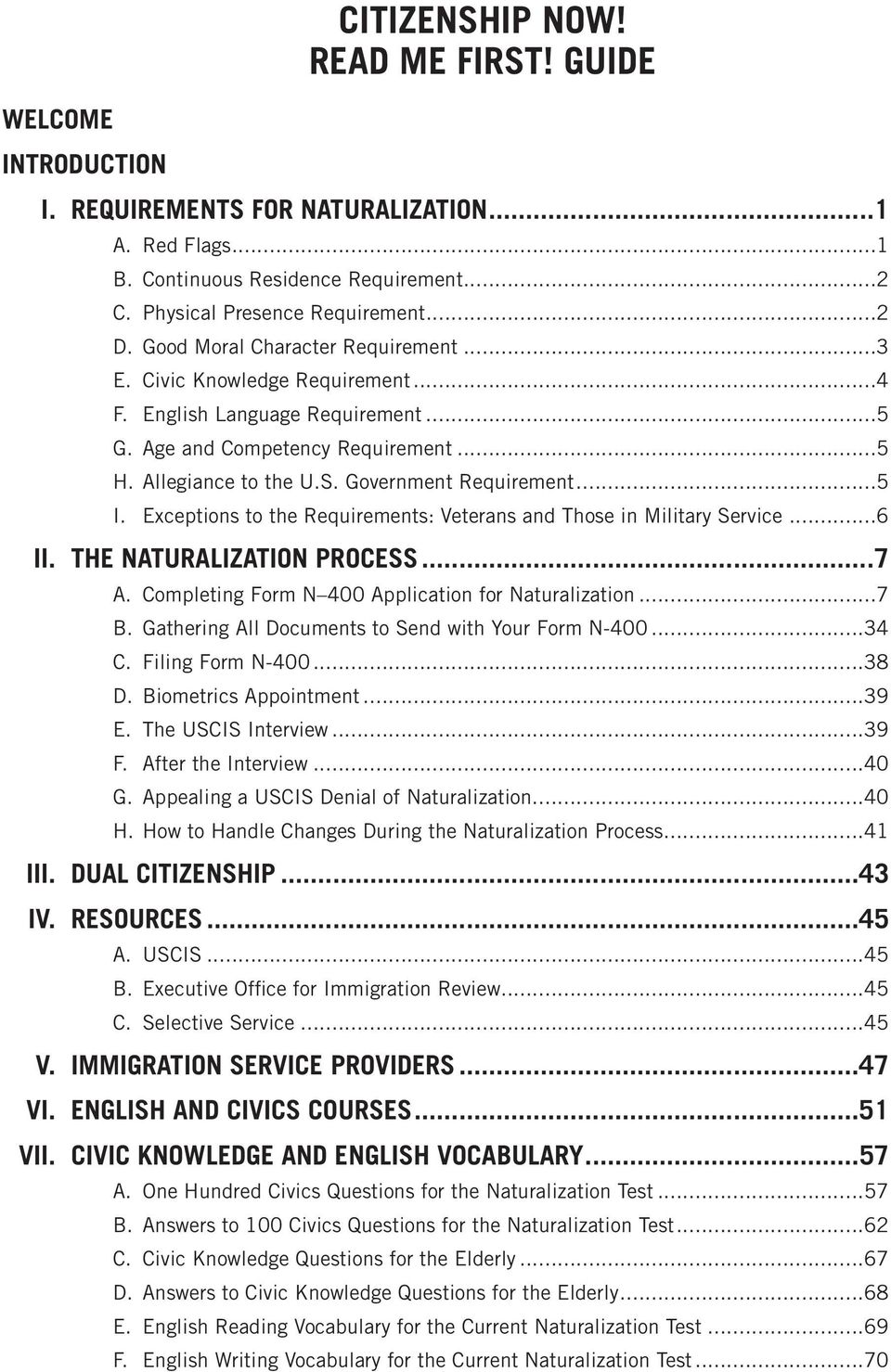
5 CITIZENSHIP NOW! READ ME FIRST! GUIDE WELCOME INTRODUCTION I. REQUIREMENTS FOR NATURALIZATION...1 A. Red Flags...1 B. Continuous Residence Requirement...2 C. Physical Presence Requirement...2 D. Good Moral Character Requirement...3 E. Civic Knowledge Requirement...4 F. English Language Requirement...5 G. Age and Competency Requirement...5 H. Allegiance to the U.S. Government Requirement...5 I. Exceptions to the Requirements: Veterans and Those in Military Service...6 II. THE NATURALIZATION PROCESS...7 A. Completing Form N 400 Application for Naturalization...7 B. Gathering All Documents to Send with Your Form N C. Filing Form N D. Biometrics Appointment...39 E. The USCIS Interview...39 F. After the Interview...40 G. Appealing a USCIS Denial of Naturalization...40 H. How to Handle Changes During the Naturalization Process...41 III. DUAL CITIZENSHIP...43 IV. RESOURCES...45 A. USCIS...45 B. Executive Office for Immigration Review...45 C. Selective Service...45 V. IMMIGRATION SERVICE PROVIDERS...47 VI. ENGLISH AND CIVICS COURSES...51 VII. CIVIC KNOWLEDGE AND ENGLISH VOCABULARY...57 A. One Hundred Civics Questions for the Naturalization Test...57 B. Answers to 100 Civics Questions for the Naturalization Test...62 C. Civic Knowledge Questions for the Elderly...67 D. Answers to Civic Knowledge Questions for the Elderly...68 E. English Reading Vocabulary for the Current Naturalization Test...69 F. English Writing Vocabulary for the Current Naturalization Test...70
6 VIII. APPENDICES...71 A. Rider Form N 400 Part 6, Section B...73 B. Rider Form N 400 Part 7, Section C...75 C. Rider Form N 400 Part 8, Section F...77 D. Rider Form N 400 Part 8, Section G...79 E. Rider Form N 400 Part 9, Section B...81 F. Rider Form N 400 Part 10, Section G...83 G. Form I 912 Fee Waiver Request IX. CUNY IMMIGRATION CENTERS
7 WELCOME CUNY Citizenship Now! is the largest and most comprehensive university-based immigration service effort in the United States. Under the direction of nationally-recognized expert immigration attorney Allan Wernick, Citizenship Now! began as an effort to provide free citizenship services to CUNY s students, staff and their families. Today it provides free immigration and citizenship services to all New Yorkers at nine immigration centers and at our affiliated centers throughout New York City and at Citizenship Now! community events. You will find a list of our centers with contact information at the back inside cover of the guide. Give us a call. We are pleased to be of service. Jay Hershenson Senior Vice Chancellor and Secretary to the Board of Trustees City University of New York

8

9 INTRODUCTION* CUNY Citizenship Now! wrote this Guide to provide legal permanent residents with a detailed review of the rules for becoming a U.S. citizen and with tips for completing the naturalization application. U.S. citizenship comes with both benefits and responsibilities. Only U.S. citizens can vote, be an elected official or be eligible for government jobs, obtain government benefits, and obtain citizenship for children born abroad. Responsibilities of citizenship include giving up allegiance to any other nation, serving the country when required, registering and voting in elections and serving on a jury. While you may want to use the Guide to complete your naturalization application on your own, we highly recommend that you get help. When you apply for naturalization, you give the U.S. Citizenship and Immigration Services (USCIS) the opportunity to review your immigration history and your criminal history. If you have any reason to believe that the USCIS may question your right to become a U.S. citizen or your right to remain in the United States, speak with an immigration law expert before submitting your application. If you have ever been arrested or charged with a crime, depending on your record, your filing for naturalization could result in deportation. CUNY offers assistance with these issues at our immigration centers. For a list see the back inside cover of this guide. Besides advice on naturalizing, the guide provides a list of free and low-cost ESL and civics classes (page 51). This list includes CUNY Citizenship Now s ESL/Civics classes offered thanks to the 2010 USCIS Citizenship and Intergration Grant. Finally, the guide includes the naturalization interview questions and answers. Good luck in becoming a U.S. citizen. Allan Wernick, Esq. Director, CUNY Citizenship Now! Professor, Baruch College * Portions of this guide are based on U.S. Immigration and Citizenship - Your Complete Guide, 4 th Edition, Emmis Books Copyright 2004, Allan Wernick

10

11 I. REQUIREMENTS FOR NATURALIZATION If you are a permanent resident, you can apply to become a U.S. citizen through the naturalization process, if you meet all of the following requirements: You have resided in the United States as a permanent resident continuously for at least five years. (You can qualify after only three years of permanent residence if you have been married to and living with the same U.S. citizen during the past three years and your spouse has been a U.S. Citizen for the past three years.); You have been physically present in the United States for at least half of the five (or three) years; You have resided for at least three months in the state in which you are filing the naturalization application; You are a person of good moral character (for a definition see Good Moral Character on page 3 of this guide); You have a basic knowledge of U.S. government and history (civics) (with exceptions for some disabled permanent residents); You are able to read, write and speak basic English (with exceptions for some older and long-time permanent residents, and for some disabled permanent residents); You are at least 18 years of age and legally competent to take an oath of allegiance to the United States; You express your allegiance to the United States. Please read on for more information on these requirements and the exceptions to them. A. Red Flags Note: As part of the application process, USCIS will review your entire immigration history and criminal history. If you have any reason to believe that USCIS may question your right to become a U.S. citizen or to remain in the United States, you should see an immigration law expert. USCIS may question your right to become a U.S. citizen if any of the following apply to you: You have ever been arrested or convicted of a crime, even if a court order has told you the record has been cleared, sealed or expunged. You have ever lied to any immigration officer, consular official or government official. You have ever failed to support your dependents or to pay alimony. You are a male who lived in the United States at any time between your 18 th and 26 th birthdays and failed to register with the Selective Service, unless you were a lawful non-immigrant, e.g. F-1 visa. You married solely to obtain permanent resident status. 1

12 You obtained your permanent residence through employment and you left that job shortly after becoming a permanent resident or never worked for that employer. Since becoming a permanent resident you have been absent from the United States for long periods of time, especially periods over six months. Since becoming a permanent resident you have ever failed to file an income tax return when you had an obligation to do so. Note: Beyond denying you U.S. citizenship, USCIS may have grounds to remove you from the United States if you have committed certain crimes (even if not convicted) or if you have ever committed immigration fraud. B. Continuous Residence Requirement To be naturalized, you must have continuously resided in the United States as a permanent resident for at least five years. If you are the spouse of a U.S. citizen, you can naturalize three years after becoming a permanent resident if you have been married to and living with that U.S. citizen for the entire three year period. The five or three years required are referred to as the statutory period. Continuous residence does not mean that you must have been in the United States without ever leaving during the statutory period. It does mean, however, that during the statutory period all of the following were true: You did not abandon your permanent resident status; The United States was your principal residence; You have not been out of the country for one year (365 consecutive days) or more at a time. An absence of one year breaks the continuity of your residence. If you have been out of the country for more than six months at a time, but less than one year, you may have to prove that you did not intend to abandon your residence in the United States. Such proof might include having close family, a house or apartment, a job, and bank or utility accounts in the United States. If you went abroad to work for a U.S. business or research institution, to do religious work, or to work for the U.S. government, you may have been absent for more than a year without breaking your continuous residence if you got prior approval from USCIS by filing Form N-470, Application to Preserve Residence for Naturalization Purposes. Individuals who break continuous residence and have obtained a re-entry permit can file for naturalization four years and one day after re-entry (two years and one day if you are qualifying under the special rules for the spouse of a U.S. citizen.) C. Physical Presence Requirement In order to be naturalized, you must have been physically present in the United States for half of the statutory period. You will be required to count the total number of days outside the United States (see Time Outside the United States on page 15 of this guide). You must have also been physically present in the United States for at least half of the time during the statutory period. The law allows exceptions for some religious workers, seamen, people serving in the military, and people working for the U.S. government abroad. 2
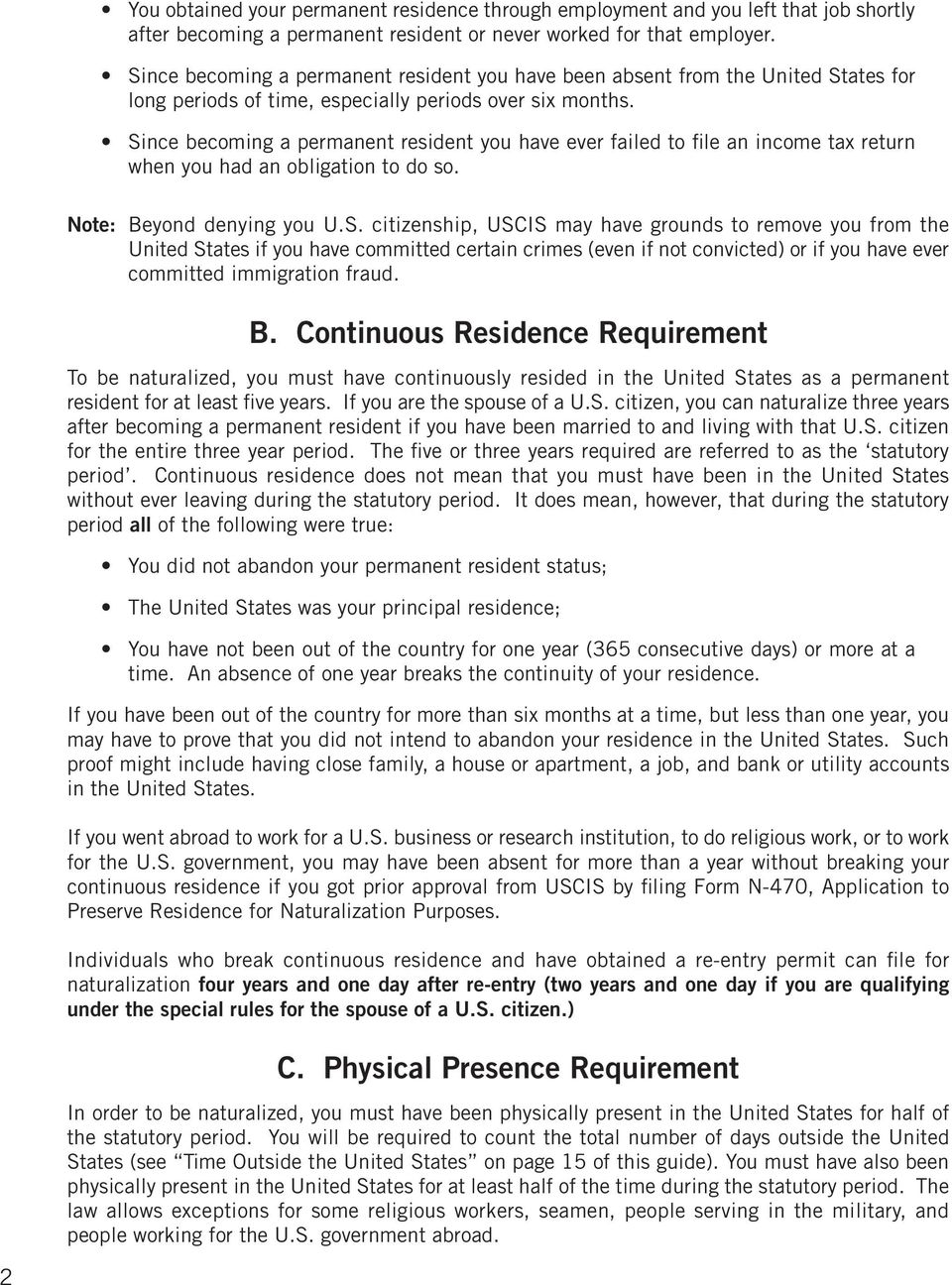
13 What is the difference between physical presence and continuous presence? Physical Presence concerns the total number of days you were in the United States during the period required for your naturalization. Continuous Residence concerns the time you resided lawfully in the United States without any single absence long enough to break that continuity for naturalization purposes.* *From A Guide to Naturalization, August 2010 (USCIS Article M-476, page 23) D. Good Moral Character Requirement The question of who has good moral character under U.S. law is not easy to answer. Good moral character does not mean moral excellence. However, if you have a criminal record; have failed to pay required family support; have had problems with alcohol or drugs; have been involved in illegal gambling or prostitution; have failed to pay your taxes; have failed to register with the Selective Service; or have lied to USCIS to gain immigration benefits, you may fail the good moral character requirement. Parking tickets, disorderly conduct convictions, and many other minor offenses usually will not prevent you from proving that you have good moral character. However, USCIS may argue that you do not have good moral character if you have repeated convictions for minor violations. If you have any doubts, particularly regarding a criminal record, you should speak with an immigration law expert before filing your naturalization application. Receipt of welfare and other public benefits has no bearing on good moral character. You can naturalize even if you have been receiving these benefits, as long as you were entitled to receive them. Criminal Activity If you have committed a crime, USCIS may find you ineligible for naturalization. If you have been convicted of certain serious crimes called aggravated felonies, you may be permanently barred (prohibited) from naturalizing. Other crimes may not be a permanent bar to naturalization, but may be grounds for USCIS to remove you from the United States. If you have ever been arrested or charged with a crime (even abroad), you need to get information about your criminal record before an immigration law expert can help you determine whether you qualify for U.S. citizenship. Go to the Clerk of the court in the county/borough/city where you were arrested or charged, and get a Certificate of Disposition for every arrest or charge. To obtain a disposition letter for tickets and summons issued by the New York Transit Authority, go to the MTA NYC s Adjustment Bureau at 29 Gallatin Place, 3rd Floor, Brooklyn NY Bring government issued ID, your Social Security card, and the date of arrest and docket number if you have them. You will be charged a fee of $10 cash. If you have any questions, call the Transit Adjudication Bureau at (347) For crimes abroad, consult with your consulate to determine how to acquire a copy of your criminal record. Bring your Certificate(s)/Letter(s) of disposition or the copy of your criminal record to one of our CUNY Immigration Centers or to an immigration law expert. For a list of CUNY Citizenship Now! Immigration Centers, see the back cover of this guide. 3
14 Child Support If you willfully fail to meet your child support obligations, you do not have good moral character for naturalization purposes. Child support refers to financial support that you provide to your children when they are not living with you, even if they live abroad. How does USCIS know whether you are meeting your child support obligations? On Form N 400 Application for Naturalization, you are asked whether you are separated or divorced and whether you are living with or apart from your spouse. Your interview notice will ask you to bring in your divorce papers and any papers relating to the divorce. You may be required to produce documentation, such as cancelled checks, to prove that you have met or are meeting your child support obligations. USCIS may check with the person caring for your children or ask you to get a letter from that person confirming that you are supporting your children. Other Common Indications of a Lack of Good Moral Character A habitual drunkard or a user or dealer of drugs is not a person of good moral character. The same is true of people who earn income from illegal gambling or prostitution. If a person has been arrested for one of these activities and currently has no visible means of support, USCIS may wonder if he/she is still engaging in illegal activities. If you are a polygamist (you abide by the ideology or practice of having many wives), you will fail to meet the good moral character requirement. You may also be unable to meet the good moral character requirement if you failed to pay taxes when the law required you to do so. If you have ever helped smuggle someone into the United States you may be unable to show good moral character and you may be deportable. E. Civic Knowledge Requirement To naturalize, you must have a basic understanding of U.S. history and government (civics). You must correctly answer ten questions from a list of 100 questions provided by USCIS (see Civic Knowledge and English Vocabulary on page 57 of this guide). If you are 65 years of age or older and you have been a permanent resident for at least 20 years at the time you submit your application for naturalization, you do not have to take the English test. You will still have to take the civics test in the language of your choice. You will need to answer ten questions from a list of only 25 questions (see Civic Knowledge and English Vocabulary on page 67 of this guide). You should indicate on Part 3, Section I of the Form N-400 that you qualify to take this simplified test (see Information about You on page 10 of this guide). If you cannot learn due to a mental impairment or physical disability, you can apply for an exemption from the civic knowledge test. To apply for this exemption, your medical doctor or clinical psychologist must fill out Form N-648 Medical Certification for Disability Exceptions. This completed form should be filed with your Form N-400 Application for Naturalization. You must also indicate on Part 3, Section H of the Form N-400 that you are requesting a waiver of the test (see Information About You on page 10 of this guide). Note: Requesting the mental impairment or physical disability exemption does not guarantee that you will be excused from the testing requirement. USCIS will decide whether to approve or deny your request at the interview. 4

15 F. English Language Requirement Every naturalization applicant must pass an English speaking, reading, and writing test. This requires that the applicant have a basic knowledge of English. (Certain applicants because of age and time as a permanent resident may be exempt from the English language requirement.) You are exempt from the English language requirement if you have been a permanent resident for at least 20 years and you are 50 years of age or older or if you have been a permanent resident for at least 15 years and you are 55 years of age or older, at the time you submit your application for naturalization. You should indicate on Part 3, Section I of the Form N-400 that you qualify for the exemption (see Information About You on page 10 of this guide). If you are exempt, you must still pass the civic knowledge test, but USCIS will test you in your native language. For a list of the civic knowledge questions in English, Spanish and Chinese, visit click on Resources, then click on Citizenship and Naturalization Based Resources. Note: Requesting this exemption does not guarantee that you will be excused from the testing requirement. G. Age and Competency Requirement To be naturalized, you must have the mental capacity to take an oath of allegiance to the United States. This means that you must be at least 18 years old and legally competent. If you have a physical or developmental disability or mental impairment which prevents you from understanding the meaning of the oath, you can apply for a waiver from the oath requirement. There is no particular form that is used to apply for the waiver, but you do need to submit a detailed written evaluation completed by your medical doctor or clinical psychologist with your Form N-400 Application for Naturalization. The evaluation must explain why and how you are unable to understand the Oath of Allegiance. You must also have a court appointed guardian who can take the oath on your behalf. H. Allegiance to the U.S. Government Requirement To become a U.S. citizen, you must express your allegiance to the United States and its form of government. To do so, you must take an oath of allegiance. It is not until you take the Oath of Allegiance that you actually become a citizen. If you have a physical or developmental disability or mental impairment which prevents you from understanding the meaning of the oath, follow the steps under Age and Competency Requirement above. Part of the Oath is giving up allegiance to other countries. Some countries will still allow you to keep your citizenship after you take the oath (see Dual Citizenship on page 43 of this guide), but to be certain you should check with your country s embassy or consulate in the United States about the procedures necessary to do so. You must also demonstrate your allegiance to the United States by being willing to either bear arms on behalf of the United States or perform some form of military service or civilian work of national importance (see Oath Requirements on page 30 of this guide). 5
16 I. Exceptions to the Requirements: Veterans and Those in Military Service If you are a U.S. military veteran or someone in the Army, Navy, Air Force, Marine Corps, Coast Guard, or in certain components of the National Guard or the Selected Reserve of the Ready Reserve, you may be able to naturalize without meeting the normal residence and physical presence requirements. You are also exempt from paying the application and biometrics fees. Individuals presently serving in the U.S. military during time of war, qualify for naturalization regardless of immigration status. For the purposes of this rule, the country has been at war as of September 11, Service members who recently separated from service qualify for naturalization even if they don t meet the Continuous Residence and Physical Presence and the three month state residency requirements if they: Have served honorably, in active duty or reserve service, for a period or periods adding up to one year or more, Are permanent residents, and Apply during service or within six months of the termination of service. Under Section 329 of the Immigration and Nationality Act (INA), any person who has served honorably as a member of the Selected Reserve of the Ready Reserve or in an active-duty status in the military, air, or naval forces of the United States may qualify for naturalization, even if they are not lawful permanent residents, if: They are veterans who serve(d) in active duty or are (were) in the Selected Reserve of the Ready Reserve during one of the following designated periods of conflict: April 6, November 11, 1918 September 1, December 31, 1946 June 25, July 1, 1955 February 28, October 15, 1978 September 11, Present At the time of enlistment, reenlistment, extension of enlistment, or induction they are/were physically present in the United States or a qualifying area, whether or not they have been lawfully admitted to the United States for permanent residence, or at any time subsequent to enlistment or induction they are/were lawfully admitted to the United States for permanent residence. N-400 Applications for Naturalization submitted by a member of the military must be accompanied by Form N-426 Request for Certification of Military or Naval Service, a copy of the permanent residence card (if applicable), and two passport- style photos. No fees are required. Also note that as of February 18, 2010, Form G-325B, Biographic Information, is no longer required for any Form N-400 that is pending or filed under section 328 or 329 of the Act. 6 More information for the military is available in the USCIS website at or by calling the USCIS military helpline at CIS-4MIL ( ).

17 II. THE NATURALIZATION PROCESS A. Completing Form N 400 Application for Naturalization Your eligibility for citizenship is based on the accuracy and completeness of USCIS Form N-400. Most of the form is very straightforward, but some questions require care in answering. Form N-400 is a legal document requiring truthful answers under penalty of perjury (a criminal offense consisting of deliberately making false statements under oath.) In addition to truthfulness, consistency is often important, because your N-400 will be compared to other immigration forms you previously filed with USCIS. In this section you will find images of the various parts of form N-400 followed by step-by-step instructions for all questions. General recommendations for completing the application: Use a black ink pen. PRINT. USE CAPITAL LETTERS If extra space is needed to answer a question attach a separate sheet of paper or the appropriate riders provided at the end of this guide. On that sheet, indicate the question number, write the date, and include your signature, name and A number. If a question is not applicable, write N/A. If the answer is none, write none. Write dates in the order month/day/year using eight digits (mm/dd/yyyy). Write your A number on the top right hand corner of each page where indicated. You can find your A number on your Permanent Resident Card (formerly known as the Alien Registration Card or green card). The A number the seven to nine digit number on your card (the number of digits will depend on when your card was created). If your A number is fewer than nine digits, write enough zeroes before the first number to make your A number a nine digit number. 7

18 Part 1. Your Name The information in Part 1 is of the person applying for naturalization. Your legal name is on your birth certificate, or if it was changed through marriage or divorce, it is on your marriage certificate or divorce judgement. Even if your name is misspelled on your Permanent Resident Card (green card), write it exactly that way here. This is important to identify you. USCIS will use your correct name from Part 1, Section A for your naturalization certificate. Include your maiden name and any other names you may have ever used on official documents, including misspelled names, if any. If there are none, write N/A. 8

19 You can use the citizenship process to legally change your name. To do so, in Question 1 check Yes and in Question 2 write the new name you would like to use. At your naturalization interview, you should confirm with the USCIS officer that if your naturalization application is approved you will be sworn in by a Federal Judge or Magistrate rather than by a USCIS officer. Only a Federal Court can change your name and a name change becomes final only when the court naturalizes you. If you do not want to change your name, in Question 1 check No and in Question 2 write N/A. Part 2. Information about Yor Eligibility Check the option that best describes your case: Check A. if you qualify because you have been a permanent resident for five or more years. Check B. if you have been married to, and living with the same U.S. citizen for three years while a permanent resident. (If you check this option, at the naturalization interview you must provide a marriage certificate and documentation of your spouse s U.S. citizenship, and proof that you are living together, and that you have been living together for the entire time that you have had your green card. Note that if you are applying based on marriage to a citizen, you must remain married until the Certificate of Naturalization is received. Death of a citizen spouse, even if it occurs after having filed the application, ends eligibility to naturalize based on marriage. 9

20 Check C. if you are applying for naturalization based on military service (see Exceptions to the Requirements: Veterans and Those in Military Service on page 6 of this guide). Check D. if you are applying for naturalization based on other factors, and explain. Speak with an immigration law expert if you think you qualify based on other factors. Part 3. Information about You For A. print your social security number. If you do not have a U.S. Social Security number write N/A. For B. be sure to write your date of birth as MONTH/DAY/YEAR using eight digits (mm/dd/yyyy). For C. write the official date your lawful permanent residence began. You can find this date on your Permanent Resident Card (green card.) For D. write the name of your country of birth, even if it no longer exists. For E. write the country where your passport is from. If you are stateless, write the name of the country where you were last a citizen or national. If you are a citizen or national of more than one country, write the name of the foreign country that issued your last passport. If one or both of your parents became U.S. citizens before you turned 18, you may already be a U.S. citizen. See an immigration law expert if this applies to you. Your marital status is important to USCIS for several reasons. If you are applying under the three-year rule as the spouse of a U.S. citizen, you must be currently married to and living with your U.S. citizen spouse, and be able to prove it. If you gained your permanent residence based on a spousal petition, and you divorced or separated from your spouse shortly after you gained permanent residence, USCIS may question whether yours was a bona fide (real) 10

21 marriage. The USCIS officer may also be interested in your marital status to make sure you have been honest in applying for public benefits and/or completing tax returns. You must be able to speak, read, and write basic English and learn about U.S. government and history, unless you qualify for a medical exemption, in which case you will need to apply for a waiver of the requirements using Form N-648 (see English Language Requirement and Age and Competency Requirement on page 5 of this guide). This is where you let USCIS know that you will need special accommodations. If you are unable to fully participate in the naturalization process because of a disability, USCIS will make every reasonable effort to ensure special accommodations on a case-by-case basis. Such accommodations may include sending an officer to your house or rest home to interview you if you are housebound. Check the appropriate box to describe the accommodation you need. If you qualify for and want the interview to be in your native language (see English Language Requirement on page 5 of this guide) or you qualify for and want to take the simplified civics test (see Civic Knowledge Requirement on page 4 of this guide) you should check the box that says I will need another type of accommodation, and write the accommodation you are requesting and your age and number of years of permanent residence. If you qualify for any other accommodation, request that here. 11
22 Part 4. Addresses and Telephone Numbers USCIS asks you to list both your home address and your mailing address. Your home address is your physical address, regardless of whether you receive mail there. Do not put a post office (P.O.) box number here. Note: There is one box for county and a different box for country. Do not confuse the two. In New York City, the counties are Kings (Brooklyn), The Bronx, Queens, New York (Manhattan) and Richmond (Staten Island). Your mailing address is where USCIS will send your notice to appear for fingerprinting (biometrics) and for the naturalization interview. If your mailing address is the same as your home address, write same. If it is different, write your mailing address. If you think you will be moving while your application is being processed, use the mailing address of a friend or relative. This is important because USCIS mail will not be forwarded to your new address when you move. Not receiving your mail from USCIS may result in you missing your biometrics and interview appointment notices and having your application denied. If you use the mailing address of a friend or relative, in the Care of box write the name of the person who will be receiving the mail for you. By including your telephone numbers and address, USCIS can more quickly contact you about your application, though phone contact from the USCIS is rare. If you are hearing impaired and use a TTY telephone connection, indicate this by writing TTY after the telephone number. 12
23 Part 5. Information for Criminal Records Search For each question, check the box or boxes that best describe you. The categories are those used by the FBI. You can select one or more. The Federal Bureau of Investigation (FBI) will use the information in this section, together with your fingerprints, to search for criminal records. Although the results of this search may affect your eligibility for naturalization, USCIS does not make naturalization decisions based on gender, race, or physical description. If you have had any encounters with the police or other governmental authorities, speak with an immigration law expert before filing a naturalization application. (See Good Moral Character Requirement on page 3 of this guide.) To request a copy of your FBI Identification Record, complete the Application Information form ( and send it to FBI CJIS Division - Record Request at 1000 Custer Hollow Road, Clarksburg, West Virginia Each letter must include proof of identity. The proof of identity consists of your name, date of birth and place of birth and an original set of rolled-ink fingerprint impressions placed upon a standard fingerprint form FD-258. All ten fingerprints should be taken simultaneously- these are sometimes referred to as plain or flat impressions. In New York City fingerprinting is available at One Police Plaza, Room 152A. Call (646) for more details. Be sure to explain that you need fingerprints for an FBI Record Check, NOT a New York State check. Along with your request, you must submit $18 U.S. dollars in the form of a money order or cashier s check made payable to the Treasury of the United States, or you may pay by credit card. If paying by credit card you must include the completed credit card payment form. Allow approximately 12 weeks for processing. If the request is for a couple or family, include $18 for each person. 13
24 Part 6. Information About Your Residence and Employment Write your addresses starting with where you live now and going backward. List every address where you have lived during the last five years. Include any residence in other countries. Note that you do not need to re-write your current address since you already wrote it in Part 4, Section A. Simply write in the From column the date on which you moved to your current address. If you got your green card through marriage, expect USCIS to compare the addresses listed with those on joint taxes and bank accounts. Make sure you list your places of employment or study starting with your current job/school and going backward, for the last five years. Also include military service, if applicable. If you worked for yourself, write self-employed. If you were not employed over the last five years, feel free to say so. You will not be kept from naturalizing just because you were not employed, but the officer may look more closely at how you support yourself to make sure you have not been receiving income from an illegal source. If you are receiving public benefits, that is not a bar to naturalization. You can still become a U.S. citizen, as long as you did not make a misrepresentation that you were a U.S. Citizen or lied to obtain a benefit. If you have been employed, USCIS will ask that you present your tax returns. Failure to report income may be grounds for denying you U.S. citizenship. Unless you earned so little income that you were not required to pay taxes, USCIS will not naturalize you until you have complied with Internal Revenue Service (IRS) regulations. 14
25 If you obtained your permanent residence through employment and you left that employment shortly after becoming a permanent resident, the USCIS officer may ask why you left the job with your sponsor. If you worked only a short period of time for your sponsor, talk to an immigration attorney or legal expert. If you need additional space to list all of your places of employment and study, attach a separate sheet of paper (see Appendix A on page 73 of this guide), and provide all the information requested. Make sure to write Part 6, Section B and the date, and sign the sheet. Part 7. Time Outside the United States Information on trips outside the United States is particularly important. Many people have traveled and or have been absent from the United States. If you have long absences, or if you have traveled a great deal, USCIS will want to make sure that you meet the continuous residence and physical presence requirements (see Continuous Residence Requirement and Physical Presence Requirement, both on page 2 of this guide). If you were outside of the United States for more than one continuous year (365 consecutive days) during the statutory period, you have broken your continuous residence. You must wait until you have accrued the five (or three) years of continuous residence before you can apply for citizenship. If you were outside of the United States for more than six consecutive months, but less than one year, the USCIS officer may want to know why you were abroad for so long. You must attach additional proof that you did not intend to abandon your residence (see Continuous Residence Requirement on page 2 of this guide). You must have also been physically present in the United States for at least half of the time during the statutory period. The law allows exceptions for some religious workers, seamen, people serving in the military, and people working for the U.S. government abroad. Write the total number of days you spent outside of the United States during the last five years (this may be easiest to do once you have completed Part 7, Section C of the N-400, on the following page). Count the days of every trip that lasted 24 hours or longer. Do not count days spent outside of the United States on military service. Write the number of trips you have taken outside the United States during the last five years. Count every trip that lasted 24 hours or longer in the last five years (this may be easiest to do once you have completed Part 7, Section C of the Form N-400, below). Do not count trips taken while on military service. 15
26 Make your best effort to provide the requested information for every trip that you have taken outside the United States since you became a permanent resident. The stamps in your passport may help you with this. If you are not sure about the dates or duration of a trip, say so by writing approximately. Begin with your most recent trip. If you need additional space to list all of your trips, attach a separate sheet of paper (see Appendix B on page 75 of this guide), and provide all the information requested. Make sure to write Part 7, Section C, the date, your full name and A number, and sign the sheet. Part 8. Information about Your Marital History As mentioned before, if you are applying under the three-year rule as the spouse of a U.S. citizen, you must be currently married to and living with your U.S. citizen spouse. If you obtained your permanent residence based on a spousal petition, and you divorced or separated from your spouse shortly after you obtained permanent residence, USCIS may question whether yours was a bona fide (real) marriage, or if it was simply to obtain immigration benefits. The USCIS officer may also be interested in your marital status to make sure you have been honest in applying for public benefits and/or completing tax returns. Write the number of times you have been married. Include any annulled marriages. If you were married to the same spouse more than one time, count each time as a separate marriage. If you have never been married indicate it by the number 0. 16
27 If you have never been married, this section is not applicable to you. Go to Part 9. If you have been married but are not currently married, this part is not applicable to you either, so go to Part 8, Section F. If you are now married, provide information about your current spouse. Include this information even if you are separated but not divorced, or if your spouse lives outside of the United States. Check the appropriate box to indicate whether your current spouse is a U.S. citizen. If your spouse is not a U.S. citizen, this section is not applicable to you. Go to Part 8, Section E. If your spouse is a U.S. citizen through naturalization, give the date and place of naturalization. 17
28 If your spouse is a U.S. citizen, this section is not applicable to you. Go to Part 8, Section F. If your spouse is not a U.S. citizen, complete this section. In Question 2, if your spouse does not have an A number, write N/A. In Question 3, if your spouse is a permanent resident, check the box that says Lawful Permanent Resident. If your spouse is not a permanent resident, check the box that says Other and list his/her status. If your spouse does not have an immigration status in the United States, write N/A after Other. Write Lives Abroad instead of listing his/her status if your spouse does not live in the United States. Information on all prior spouses of the applicant is required. If you were never married before, this section is not applicable to you. Go to Part 8, Section G. If you were married before or are a widow/widower, give information about your former spouse(s). Make your best attempt to contact your prior spouse(s), if necessary, to obtain this information. If your prior spouse(s) can not be contacted, include as much information as you have. For Question 2, if your prior spouse was not a U.S. citizen or a permanent resident during your marriage, check Other and list his/her status. If the prior spouse did not live in the United States, write Lived Abroad instead of listing his/her status here. For Question 5, if your marriage was annulled, check Other and say so. For more than one prior marriage, use a separate sheet of paper to provide answers to questions 1 through 5 for each marriage (see Appendix C on page 77 of this guide), and provide all the information requested. Make sure to write Part 8, Section F and the date, and sign the sheet. If you were married to the same spouse more than one time, write about each marriage separately. 18
29 Information on all prior marriages of the applicant s current spouse is required. If your current spouse was never previously married, then write the number 1 and go to Part 9. If your current spouse was previously married, write the number of times and give information about his/her former spouses. Make your best attempt to contact his/her prior spouse(s), to obtain the necessary information. If the prior spouse(s) can not be contacted, include as much information as you have. This is especially important if your current spouse obtained immigration benefits from his/her prior spouse. For Question 2, if the prior spouse was not a U.S. citizen or a permanent resident during your spouse s marriage to that individual, check Other and list his/her status at the time. If the prior spouse did not live in the United States, write Lived Abroad instead of listing his/her status here. For Question 5, if the marriage was annulled, check Other and say so. For more than one prior marriage of your spouse, use a separate sheet of paper to provide answers to questions 1 through 5 for each marriage (see Appendix D on page 79 of this guide), and provide all the information requested. Make sure to write Part 8, Section G and the date, and sign the sheet. If your spouse was married to the individual more than one time, write about each marriage separately. Part 9. Information about Your Children Count all sons and daughters alive, missing, deceased, adopted or stepchildren, even if they are U.S. citizens, adults, or live outside the United States. This is not an application for them, USCIS is simply requesting information about them. This information may assist USCIS in determining matters of good moral character and your obligation to pay child support. Be 19
30 prepared to show evidence that you support your children who are minors especially if they reside apart from you. If you file a petition for your child in the future, USCIS will want to see that you claimed the child as your own at the time you applied for citizenship. Failure to answer this question accurately may lead to problems later. Note: Children of an applicant for naturalization may automatically derive (obtain) citizenship through that parent when the parent naturalizes. The child must be a permanent resident, unmarried, under 18 years of age at the time that the parent naturalizes, and living in the United States in that parent s legal and physical custody. Speak with an immigration law expert if you think that your child may receive this benefit when you naturalize. The expert can assist you in identifying the documents you will need to prove that your child has derived citizenship. Provide all of the requested information for each son and daughter alive, missing, deceased, adopted or stepchild, even if they are U.S. citizens, adults, or live outside the United States. Failure to answer these questions accurately may lead to problems later. In the last column, titled Current Address, write: With me - if the son or daughter is currently living with you. If your children are not living with you then write the address including state and country where they are currently living. If the son or daughter is not currently living with you but is missing or deceased indicate such by writing Missing or Deceased. If you need space to list additional sons and daughters, attach a separate sheet of paper (see Appendix E on page 81 of this guide), and provide all the information requested. Make sure to write Part 9, Section B and the date, and sign the sheet. 20
31 Part 10. Additional Questions In order for you to be naturalized, you must be a person of good moral character and you must be committed to the principles of the United States. Part 10 is designed to help USCIS determine whether you meet these criteria. Answer these questions carefully. If any part of a question applies to you, you must answer Yes. If you answer Yes, make sure that you consult an immigration law expert before you submit your naturalization application. You will need to attach your written explanation and any additional information or documentation that helps explain your answer. Your Yes answer may negatively affect your eligibility for citizenship. Note: Do not lie. USCIS takes the position that if you make a statement that is not true, even if it is meaningless, it is grounds for denying your application. It might also bar you from applying for any immigration benefits in the future. These questions are designed to determine whether you have ever made a false claim to U.S. citizenship or improperly registered for or voted in an election. Only U.S. citizens can register to vote and vote in national and local elections in the United States. Making a false claim to U.S. citizenship by voting in such an election, or even by filling out a voter registration card, can make you deportable. Speak with an immigration law expert if this applies to you. In some cities, even undocumented immigrants can vote in school board and community elections. If a local law allowed you to vote in a particular election, your having voted in that election will not make you deportable and will not affect your ability to naturalize. If you were required to file a federal tax return but failed to do so, your naturalization application will be denied. Many people are not required to file tax returns because their income is less than the amount for which filing is required. Do not be afraid to answer No to this question if you did not file tax returns because you were not required to. Note: Usually USCIS asks you to bring to your interview tax returns from the statutory five (or three) year period, or they will want to know why you did not file tax returns. 21
32 Owing taxes is not an absolute bar to becoming a U.S. citizen; it is a factor that may be taken into consideration by the USCIS officer. If you do owe taxes, at the interview USCIS will want to see (1) a signed agreement from the Internal Revenue Service (IRS) showing that you have filed a tax return and arranged to pay the taxes you owe, and (2) documentation from the IRS showing the current status of your repayment program. A title of nobility is considered inconsistent with U.S. citizenship. nobility, you must renounce the title before becoming a citizen. If you hold a title of USCIS asks if you have been ever declared legally incompetent or confined to a mental institution within the last five years to decide whether you are capable of understanding the Oath of Allegiance to the United States. In 2000, a law went into effect allowing USCIS to waive the oath requirement for applicants who are mentally impaired or physical disabled. Answering Yes to this question will not bar you from naturalizing (see Age and Competency Requirement on page 5 of this guide). If you do not have any of the affiliations mentioned in question 8a, you should answer No. If that is not the case, answer Yes and in Question 8b list the names of the organizations that you are a member of or associated with, including religious, social, and athletic clubs. This 22
33 question is designed to help USCIS determine whether you are ineligible for naturalization because of certain political activities, such as membership in communist or pro-communist organizations. Having been associated with a communist or totalitarian party or terrorist organization may affect your ability to naturalize. Speak with an immigration law expert if you answer Yes to any of these questions. Having ever advocated the overthrow of a government may affect your ability to naturalize. Speak with an immigration law expert if you answer Yes to this question. Persecutors are generally not eligible for admission as permanent residents. Answering Yes to this question may lead USCIS to question if your permanent residence was obtained by fraud. Former Nazis may not naturalize no matter how much time has elapsed since party membership. Responding falsely to these particular questions can also lead to your naturalization being revoked (this is called denaturalization ). 23
34 If you answer Yes to either of these questions, you may be ineligible for naturalization because calling yourself a nonresident after becoming a Legal Permanent Resident can be considered abandoning your permanent residence. If you have ever committed certain criminal acts, even if you were never convicted of a crime, you may be ineligible for naturalization (see Good Moral Character Requirement on page 3 of this guide). Talk to an immigration law expert if this applies to you. USCIS takes the position that if you were arrested and never charged with a crime, or if your record was entirely expunged, you must still answer Yes to the relevant questions on the application. Refer to the definitions below to help you answer the questions in this section: 24
35 Being cited means to be notified of legal proceedings against one and be required to appear. Detained means to be kept in police custody. Charged means to have a legal statement made against one listing the crime of which one is accused. Convicted means to be found guilty, or plead guilty of the crime charged. Alternative sentencing is a collection of programs in which individuals may participate as an alternative to serving time in jail. Suspended sentence is when an individual convicted of a crime is given a sentence in which execution has been or is withheld by the court if the defendant performs certain services. Probation is when an individual found guilty of a crime is released by the court without imprisonment and subject to conditions imposed by the court, under the supervision of a probation officer. Violation of probation terms will usually result in the person being sent to jail for the term he/she would have served without probation. Parole is the conditional release of a convicted criminal after he/she has completed part of his/her prison sentence and demonstrated good conduct. The criminal receiving parole can serve the remainder of the term outside the prison if he/she complies with the terms and conditions connected with his/her release. Crime related issues are a very complicated area of immigration law. If you have any questions on crimes you have committed or your interaction with law enforcement, or you answer Yes to any of the above questions, see an immigration law expert. Answering Yes to any item in Questions 22 through 33 may mean that you cannot prove good moral character. USCIS may deny your naturalization application. Note: If the act occurred prior to the statutory five (or three) year period, you may still be able to show good moral character. A habitual drunkard is not eligible for naturalization. A chronic alcoholic is a habitual drunkard. The USCIS officer may question you about your drinking if you have several arrests for driving while intoxicated (DWI) or if you have been charged with disorderly conduct for incidents occurring due to alcohol abuse. A professional prostitute is not eligible for naturalization. However, having been convicted of a single act of prostitution will not necessarily make a person ineligible for naturalization. The same is true for a single conviction of soliciting a prostitute. Talk to an immigration law expert if this applies to you. 25
36 Selling or smuggling controlled substances may make a person removable/deportable and therefore, ineligible for naturalization. Talk to an immigration attorney if this applies to you. This question seeks to identify individuals who practice or advocate polygamy. USCIS takes the position that a person who has practiced polygamy in the past is barred from establishing good moral character. Still, if you have practiced polygamy in the past outside the United States and you did not come to the United States to practice or advocate polygamy, you might qualify for naturalization. An immigration law expert can help you argue your case. Even without a conviction, you may be barred from naturalizing if you helped smuggle someone into the United States. Gambling illegally may make you ineligible for naturalization. This clearly does not apply to a person involved in legal gambling activities, such as an employee at a Las Vegas casino. Nor should you be barred from naturalizing simply because you were convicted of a single act of illegal gambling, though that act must have occurred prior to the statutory five (or three) year period. Failure to support your dependents or to pay alimony may make you ineligible for naturalization. If you have children who are not living with you or a spouse who is not living with you, be prepared to answer questions as to whether you are required to support them and whether you are doing so. Particularly, if you have children who are not living with you, be prepared to establish to the satisfaction of the USCIS officer that you are contributing to the support of your children. If you are not required to support your children, you will need to prove that to the officer. Certain false statements made to any U.S. government official could make you removable/deportable (which may result in the government trying to take away your permanent resident status). Other false statements may prevent you from establishing good moral 26
37 character and would thus be only a temporary bar to naturalization. If you answer Yes to this question, speak with an immigration law expert. Note: If the false statements were made prior to getting permanent residence and the INS or USCIS were aware of these facts, the false statement should not be a bar to naturalization This question brings out information that would make you ineligible under the same rules that apply to Question 23 above and could make you removable. Note: If the false statements were made prior to getting permanent residence and the INS or USCIS were aware of these facts, the false statement should not be a bar to naturalization. If you are presently in removal proceedings, USCIS will put off a decision on your naturalization application until an immigration judge decides your case. If you were ordered removed, excluded or deported from the United States before getting permanent residence and the INS or USCIS were aware of these facts, this should not be a bar for naturalization. If you answer Yes to any of the questions in this section, speak with an immigration law expert. Refer to the definitions below to help you answer the questions: Removal proceedings are initiated by a Notice to Appear. This occurs when the Department of Homeland Security (DHS), formerly known as the Immigration and Naturalization Service (INS), believes that an individual is inadmissible (can not be allowed entry) to the United States, or entered the country illegally, or entered the country legally but then violated conditions of his/her visa. Exclusion proceedings occurred prior to April 1, 1997 and were initiated with a Form I-122 Notice to Applicant for Admission Detained for a Hearing before Immigration Judge. This occurred when a person tried to enter the United States but was stopped at the point of entry because INS found the person to be inadmissible. Rescission proceedings are initiated by a Notice of Intent to Rescind issued by DHS. This occurs when, within five years of granting adjustment of status, DHS discovers that the individual was not entitled to permanent residence status when it was granted. Deportation proceedings occurred prior to April 1, 1997 and were initiated by an Order to Show Cause. This type of proceeding occurred when INS believed that an individual entered the country illegally or entered the country legally but then violated conditions of his/her visa. 27
38 If you were ordered removed, excluded or deported before getting permanent residence and the INS or USCIS were aware of the facts before granting you permanent residence, these facts should not be a bar to naturalization. If you served in the U.S. Armed Forces, USCIS will check your Armed Services records as part of their investigation into your background and character. You will need to submit Form G-325B Biographic Information and Form N-426 Request for Certification of Military or Naval Service with your naturalization application. There is no extra fee for these forms. People who left the United States to avoid being drafted into the U.S. Armed Forces are permanently barred from naturalizing. However there are a number of exceptions. For example, Vietnam War era draft dodgers may naturalize because of a pardon granted by U.S. President Jimmy Carter. The pardon benefits men who left the country to avoid being drafted into the U.S. Armed Forces between August 4, 1964, and March 28, This is a complicated area of immigration law. If you answer Yes to this question, speak with an immigration law expert. Men who applied for an exemption from military service based on being a non-citizen (alienage) may be permanently barred from naturalizing. Applying for an exemption is not the same as making a claim for conscientious objector status. This is a complicated area of immigration law. If you answer Yes to this question, speak with an immigration law expert. To desert means to be absent without leave from the military for longer than 30 days. Wartime deserters may be permanently barred from naturalization. However some exceptions exist. Military deserters from the Vietnam era, between August 4, 1964, and March 28, 1973, may naturalize because of a pardon granted by U.S. President Jimmy Carter. This is a complicated area of immigration law. If you answer Yes to this question, speak with an immigration law expert. 28
39 Males living in the United States who are between the ages of 18 and 26 and were born after January 1, 1960 must register with the Selective Service System. This includes undocumented individuals, permanent residents and citizens. The requirement ends once you reach the age of 26. The registration requirement does not apply to men here on lawful non-immigrant status, such as F-1 student status or H-1B temporary worker status. Though the United States is not presently drafting men or women into the Armed Forces, it is USCIS s view that failing to register reflects negatively on your moral character and your adherence to the U.S. Constitution. If you registered with the Selective Service System, but you do not know your registration number, you can get your number by calling or writing to the Selective Service Administration. Call their machine operated toll-free number at (888) or check their website at Be sure to have your date of birth and Social Security number on hand. To reach a Selective Service representative, call (847) , or write to the Selective Service, P.O. Box 94636, Palatine, IL Be sure to include your name, date of birth, and Social Security number. To obtain their Selective Service registration number, men born before 1960 must write to the National Archives & Records Administration, Attn: Archival Programs, P.O. Box 28989, St. Louis, MO Men born between March 29, 1957 and December 31, 1959 will not have Selective Service registration numbers because the Selective Service was suspended when they would have reached age 18. If you did not register with the Selective Service System, and you are not yet 26 years old, you must register before you apply for naturalization so that you can complete the information requested in this question. You can get a Selective Service registration form at your local post office, or you can register online at If you have already submitted your naturalization application, you must still register. You can bring proof of your registration with you to your naturalization interview and the USCIS officer may excuse your failure to register earlier. Some men were unaware of their obligation to register and did not get a notice to register from either the Selective Service Administration or USCIS. They may have been in the United States illegally, or simply not have known about the obligation to register. If this describes why you did 29
40 not register with the Selective Service System when you were required to do so, it is advisable to wait until you are at least 31, five years after your obligation to register ended, to apply for U.S. citizenship. The USCIS officer may be more likely to approve your application then because the failure to register is beyond the five year statutory period of good moral character. If you are married to and living with a U.S. citizen, you may want to wait until you are at least 29, three years after your obligation to register ended. Attach a signed statement to your application explaining that you did not willfully and knowingly fail to register (see Appendix F on page 83 of this guide). You should also submit a Status Information letter from the Selective Service stating that you were never contacted by the Selective Service. Instructions for requesting this letter are online at Questions 34 to 39 ask about your willingness to swear allegiance to the United States, and question you regarding your understanding of the Oath. Be sure to read the full text of the Oath and confirm that you understand its meaning (see page 33 of this guide for the text of the Oath). If you answer No to any of the Questions 34 through 39, attach your written explanation of why the answer was No and any additional information or documentation that helps to explain your answer. You may want to speak with an immigration law expert. To naturalize, you must believe in the U.S. form of government and its Constitution. If you advocate totalitarianism or the overthrow of the U.S. government, you may be ineligible for naturalization. The law allows no exemption from the requirement that you believe in the U.S. form of government. This question may be used to determine whether you have the mental capacity to take the oath. If a physical or developmental disability or mental impairment prevents you from understanding the meaning of the oath, you can apply for a waiver of the oath requirement (see Age and Competency Requirement on page 5 of this guide). Some individuals object to parts of the oath based on their deeply held beliefs. examples are: Some Some applicants may have deeply held beliefs that prohibit them from bearing arms against another. These individuals may qualify to take an abbreviated form of the Oath that omits the part related to bearing arms. 30
41 Some individuals may hold beliefs that prevent them from performing any type of service in the U.S. Armed Forces. These applicants will not be required to say the words to perform noncombatant service in the Armed Forces of the United States when required by law. Other applicants may be unable to swear the Oath using the words on oath, and may replace these words with and solemnly affirm. Some individuals are unable to use the words so help me God because of their beliefs, and may not be required to say these words. If you object to any part of the oath, answer No to Question 36 and attach a written explanation of why the answer was No as well as any additional information or documentation that helps explain your answer. In the case of an objection due to religious beliefs, it is recommended that you include a letter from your religious or spiritual leader that supports your written explanation. You must be willing to either bear arms, perform some form of military service, or perform civilian work of national importance in order to naturalize. So, you must answer Yes to at least one of the above questions. As explained before, if you have certain deeply held beliefs you may not need to be willing to bear arms. Follow the directions in Question 36 if this applies to you, but you must answer yes to at least one of the above questions. Part 11. Your Signature If you are physically able to write, you must sign your name here. If you cannot sign your name in English, sign your name in your native language. If you are unable to write in any language, sign your name with an X. Note: By signing this you are indicating that the information and documents you submitted are correct to the best of your knowledge. 31
42 Part 12. Signature of Person Who Prepared This Application for You (If Applicable) If you are physically unable to write, the person who helped you complete the application signs here. Others who helped an individual complete an application may sign as well. 32
43 Part 13 and Part 14. Signature at Interview and Oath of Allegiance Do not complete Part 13 and Part 14 until a USCIS officer instructs you to do so. You will be instructed to sign these parts at your interview if your application for citizenship is approved. 33
44 B. Gathering All Documents to Send with Your Form N-400 Below you will find the USCIS checklist of documents to send with your form N-400. Department of Homeland Security M-477 U.S. Citizenship and Immigration Services All applicants must send the following three items with their N-400 application: 1. A photocopy of both sides of your Permanent Resident Card (formerly known as the Alien Registration Card or Green Card ). If you have lost the card, submit a photocopy of the receipt of your Form I-90, Application to Replace Permanent Resident Card; and 2. Two identical color photographs, with your name and A-number written lightly in pencil on the back of each photo. For details about the photo requirements, see Part 5 of A Guide to Naturalization and the Form M-603 instructions distributed with your application. Do not wear eyeglasses or earrings for the photo. If your religion requires you to wear a head covering, your facial features must still be exposed in the photo for purposes of identification; and 3. A check or money order for the application fee and the biometric services fee for fingerprinting, as stated in the M-479, Current Naturalization Fees enclosure in the Guide. (Applicants 75 years of age or older are exempted from fingerprinting and the biometrics services fee). Write your A-number on the back of the check or money order. Send copies of the following documents, unless we ask for an original. If an attorney or accredited representative is acting on your behalf, send: A completed original Form G-28, Notice of Entry of Appearance as Attorney or Representative. If your current legal name is different from the name on your Permanent Resident Card, send: The document(s) that legally changed your name (marriage certificate, divorce decree, or court document). If you are applying for naturalization on the basis of marriage to a U.S. citizen, send the following four items: 1. Evidence that your spouse has been a U.S. citizen for the last three years: Birth certificate (if your spouse never lost citizenship since birth), or Naturalization certificate, or Certificate of Citizenship, or The inside of the front cover and signature page of your spouse s current U.S. passport, or Form FS-240, Report of Birth Abroad of a Citizen of the United States of America, and 2. Your current marriage certificate; and Document Checklist 34
45 3. Proof of termination of all prior marriages of your spouse-divorce decree(s), annulment(s), or death certificate(s); and 4. Documents referring to you and your spouse: Tax returns, bank accounts, leases, mortgages, or birth certificates of children, or Internal Revenue Service (IRS)-certified copies of the income tax forms that you both filed for the past three years, or An IRS tax return transcript for the last three years. Contact the IRS at (800) If you were married before, send: Proof that all earlier marriages ended-divorce decree(s), annulments, or death certificates(s); If you were previously in the U.S. military service, send: A completed original Form G-325B, Biographic Information. If you are currently in the U.S. military service and are seeking citizenship based on that service, send: A completed original Form N-426, Request for Certification of Military or Naval Service; and A completed original Form G-325B, Biographic Information. If you have taken any trip outside the United States that lasted six months or more since becoming a Permanent Resident, send evidence that you (and your family) continued to live, work and/or keep ties to the United States, such as: An IRS tax return transcript or an IRS-certified tax return listing tax information for the last five years (or for the last three years if you are applying on the basis of marriage to a U.S.citizen). Rent or mortgage payments and pay stubs. If you have a dependent spouse or children who do not live with you, send: Any court or government order to provide financial support; and Evidence of your financial support (including evidence that you have complied with any court or government order), such as: Cancelled checks, Money and receipts, A court or agency printout of child support payments, Evidence of wage garnishments, A letter from the parent or guardian who cares for your children. If you have been arrested or detained by any law enforcement officer for any reason, and no charges were filed, send: An original official statement by the arresting agency or applicant court confirming that no charges were filed. If you have been arrested or detained by any law enforcement officer for any reason, and charges were filed, send: An original official or court-certified copy of the complete arrest record and disposition for each incident (dismissal order, conviction record or acquittal). 35
46 If you have ever been convicted or placed in an alternative sentencing program or rehabilitative program (such as a drug treatment or community service program), send: An original or court-certified copy of the sentencing record for each incident; and Evidence that you completed your sentence: An original or certified copy of your probation or parole record; or Evidence that you completed an alternative sentencing program or rehabilitative program. If you have ever had any arrest or conviction vacated, set aside, sealed, expunged or otherwise removed from your record, send: An original or court-certified copy of the court order vacating, setting aside, sealing, expunging or otherwise removing the arrest or conviction, or an original statement from the court that no record exists of your arrest or conviction. NOTE: If you have been arrested or convicted of a crime, you may send any countervailing evidence or evidence in your favor concerning the circumstances of your arrest and/or conviction that you would like USCIS to consider. If you have ever failed to file an income tax return since you became a Lawful Permanent Resident, send: All correspondence with the IRS regarding your failure to file. If you have any federal, state or local taxes that are overdue, send: A signed agreement from the IRS or state or local tax office showing that you have filed a tax return and arranged to pay the taxes you owe; and Documentation from the IRS or state or local tax office showing the current status of your repayment program. NOTE: You may obtain copies of tax documents and tax information by contacting your local IRS offices, using the Blue Pages of your telephone directory, or through its website at If you are applying for a disability exception to the testing requirement, send: An original Form N-648, Medical Certification for Disability Exceptions, completed less than six months ago by a licensed medical osteopathic doctor or licensed clinical psychologist. If you did not register with the Selective Service and you (1) are male, (2) are 26 years old or older, and (3) lived in the United States in a status other than as a lawful nonimmigrant between the ages of 18 and 26, send: A Status Information Letter from the Selective Service (Call for more information). 36
47 Fee Waiver Requests If an applicant is unable to pay the $680 filing fee to apply for naturalization he/she can request USCIS to waive it. To qualify, the applicant must prove an inability to pay. If you apply for a fee waiver and the USCIS rejects your request, the agency will send your application back to you asking you to submit the filing fee. USCIS recently introduced Form I-912 Request for Fee Waiver (see Appendix G, pages 85 88) to make this process easier for those who are eligible and to bring clarity and consistency to the process. While the use of Form I-912 is not mandated it is strongly encouraged. Presumably, it reflects what factors USCIS will consider when making a decision on the request. Form I-912 is available to download at and can be requested by telephone at USCIS published a Memorandum along with the I-912 form detailing the policy behind the introduction of the form and the three main criteria that the agency will consider in making a determination that a person is unable to pay and thus, qualifies to have the fee waived: 1. Receipt of a means-tested benefit from a State or Federal agency This means a benefit awarded on the basis of a person s income and resources, for example Supplemental Security Income (SSI), Food Stamps, and Temporary Assistance for Needy Families (TANF). If the recipient of the benefit has a spouse or is the head of household then their spouse and dependents may also qualify. Evidence that you are currently receiving a means-tested benefit should be in the form of a letter, notice, and/or other official document(s) containing the name of the agency granting you the benefit and the name of the recipient of the benefit. 2. The applicant s household income is at or below 150% of the Federal Poverty Guidelines at the time of filing The poverty guidelines are revised annually by the Secretary of Health and Human Services and can be found at A household may include the spouse, parents, and unmarried children under 21 (or 24 if the child is a full-time student). To establish that the household income is at or below the 150% level, an applicant may submit pay stubs, IRS Form W2 and tax Return Transcripts for the most recent tax year if employed, and proof of any income such as other benefits (for example child support, alimony, or Social Security) or financial support from family members. 3. The applicant has a financial hardship due to extraordinary expenses or other circumstances which makes him unable to pay the fee. This means an unexpected situation that could not normally be anticipated, for example a sudden illness that leaves the applicant unable to work. The applicant should submit proof of all assets owned or controlled by the applicant and his or her dependents (for example real estate, bank accounts, stocks or bonds but not pension plans or IRA s) as well as evidence of any liabilities and expenses. * All fees listed as of February For updated fees, check 37
48 While the Memorandum seems to suggest that establishing any one of the above three criteria will normally lead to a grant of a fee waiver, an applicant should feel free to submit any additional documentation that he believes will be relevant to proving an inability to pay. C. Filing Form N 400 File Form N 400 Application for Naturalization with a check or a money order in the amount of $680* ($595 application fee plus $85 biometrics fee) made out to: U.S. Department of Homeland Security. Write your A number on the front of the check or money order. Naturalization applicants 75 years of age or older are exempt from having to pay the fingerprinting fee of $85. These applicants need only to submit a check or money order in the amount of $595. As of October 1, 2004, there is no filing fee for applicants currently serving in the U.S. Armed Forces. If you live in New York, New Jersey, Connecticut and Pennsylvania, among others, mail the application by Certified Mail, Return Receipt Requested to:** USCIS P.O. Box Dallas, TX If sending your application by private courier (non-usps), mail to: USCIS, Attn: N S. State Hwy. 121 Business Suite 400 Lewisville, TX Other individuals can locate the USCIS address with jurisdiction over where they live at or by calling You may file your application as early as three months before you meet the continuous residence requirement of five years (or three years but note that you must have been married to and living with the U.S. citizen spouse for a full three years, not two years and nine months.) You must have resided in the state in which you currently claim residence for at least three months prior to filing your application. Remember to keep a copy of everything you send to USCIS, your postal receipts, and the receipts for the money order, if you sent one. To determine how long USCIS expects it to take to make a decision on your application, you can check the USCIS website for N-400 processing times. Do this by visiting clicking on Check Processing Times. * All fees listed as of February For updated fees, check ** Addresses change. For updated addresses, check or call (800)
49 D. Biometrics Appointment After mailing your application, USCIS will send you a receipt notice and notification advising you to appear for biometrics (fingerprinting) and photographs. Only a USCIS designated Application Support Center can do fingerprinting for naturalization purposes. After the biometrics appointment, you will receive a notice for an interview with a USCIS officer. E. The USCIS Interview At this interview you will be expected to prove your eligibility for naturalization and you will be tested on your basic knowledge of English and civics. All individuals should bring the following documents to the interview: Permanent Resident Card (green card). You may attend even if you have lost your green card. Valid government issued photo identification Passport(s) and any travel documents All tax returns filed during the five or three year statutory period, including any correspondence relating to payment arrangements All marriage certificates and divorce judgements/decrees Any additional documents requested by USCIS in the interview notice and copies of any documentation submitted with the naturalization application. Applicants are also advised to bring to the interview an extra copy of all documents, in case the USCIS officer requests to keep them on file. Males between the ages of 18 and 31 should bring proof of registration with the Selective Service System. Individuals unable to take the full oath of allegiance because of religious reasons should bring a letter from their church or other religious institution explaining how their religious beliefs prevent them from taking the full oath. Individuals who have ever been arrested should bring a certificate of disposition for each arrest, including arrests that may have been sealed or expunged, or that occurred in another country. Individuals with minor children residing outside the home should bring evidence of their payment of financial support, such as cancelled checks, money order receipts and bank drafts, along with copies of any court orders relating to the required payments. Individuals applying under the three year rule as the spouse of a U.S. citizen should bring proof that their spouse has been a U.S. citizen for over three years, such as a birth certificate, naturalization certificate, certificate of citizenship, or U.S. passport; marriage certificate; proof of termination of any and all prior marriages of both the applicant and the spouse; and evidence of living with the U.S. citizen spouse for the last three years, such as lease agreements, home ownership documents, or joint tax returns. Note: All documents must be originals or certified copies. Any documents in a foreign language must be accompanied by a certified translation in English. The translator must certify that he/she is competent to translate and that the translation is accurate. 39
50 At the start of your interview, the USCIS officer will ask you to swear that all the information you are about to give is true. After you have taken this oath, the USCIS officer will review your application to make sure that the statements you made in it are accurate. The officer will update your file with any changes that may have occurred since you submitted your application, such as marriage, travel abroad or change in employment. Your ability to speak and understand English is determined during this interview based on the way you answer the questions you are asked. A USCIS officer will also assess your English reading and writing ability and civics knowledge, during the interview. He/she will do so by asking you to read up to three sentences in English, to write up to three dictated sentences in English, and by testing you orally with up to ten questions on civics. As discussed earlier, some older, long-time resident applicants and some disabled residents are not required to read, write, and speak basic English in order to become U.S. citizens. USCIS has designed many online materials to provide an overview of the naturalization interview and test. These materials are available on CUNY Citizenship Now! also has materials to help you prepare, including audio files of the 100 civics questions and answers. Check for test preparation resources. An applicant who fails the English or civics tests will be scheduled for another appointment to retake that test within 90 days, and will not have to pay another fee. If the applicant fails the test a second time, the application will be denied. However, there is no limit to how often you can re-apply for citizenship. Keep in mind that each time you apply, you will be required to pay the filing fee. F. After the Interview The USCIS officer will usually decide your case at the interview, but not always. The law requires USCIS to make a decision within 120 days of the date of the interview. If your case is not decided within this amount of time, you have the right to file an application with the federal district court to get your case resolved. If USCIS approves your naturalization application during the interview, the USCIS officer should give you the choice of (1) waiting in the office to be given a swearing in ceremony notice, or (2) having USCIS mail the notice. At the time of the swearing-in ceremony, you will take the Oath of Allegiance to the United States and become a naturalized citizen. If on your application for naturalization you requested a name change, you will be sworn in by a Federal Judge or Magistrate. If you did not request a name change, you will be sworn in by a USCIS officer. If your name was previously changed through marriage or divorce, you too will be sworn in by a USCIS officer and your Certificate of Naturalization will be issued in this new name. You become a U.S. citizen when you complete the swearing-in ceremony. G. Appealing a USCIS Denial of Naturalization If USCIS denies your application, the USCIS officer must inform you that you have 30 days to request a hearing before an immigration officer. A request for a hearing is made by filing Form N-336 along with a $605 filing fee. If you are unsuccessful at that hearing, you may seek a review of the decision in federal court. 40
51 H. How to Handle Changes During the Naturalization Process Address Changes If you are likely to change your address while you have an application pending with USCIS, use a post office box or the mailing address of a friend or relative, as your mail may not get to your new residence. If you do move, you must update your address. To do so, do all of the following: Complete Form AR-11 Change of Address and mail it Certified Mail, Return Receipt Requested, to: U.S Department of Homeland Security U.S. Citizenship and Immigration Services Change of Address P.O. Box 7134 London, KY Be sure to save a copy of the submitted form and your post office receipts; Send a letter listing your old address and your new address to the USCIS address listed on your N-400 receipt notice. Attach a copy of your receipt notice. If you have not yet received a receipt notice, submit the change of address to the USCIS office where you filed; Report your change of address by phone, by calling (800) , or online at by clicking on Change your address with USCIS. To do this you will need your receipt number. If you have not yet received a receipt notice with a receipt number for your naturalization application, you can still submit a change of address. To do so, if you paid for your application by check, look at the back of the submitted check that was returned to you through your bank. On the back is your 13-digit USCIS receipt number. If you paid for your application by money order, you can change your address without a receipt number, by calling (800) Inform the post office that you have moved. You can do this online at or by visiting your local post office. Note: The law requires all individuals who are not U.S. Citizens, Legal Permanent Residents, or in A or G status to report a change of address to USCIS within 10 days of moving. Completing the necessary USCIS Form AR-11, Alien s Change of Address Card to abide by this legal requirement does not update an address on any applications pending with USCIS. Individuals with pending cases must follow all the steps listed above. Also note that one of the residence requirements for naturalization is that you must reside in the state or USCIS District for 90 days prior to examination by the USCIS officer. If you move from one state (or USCIS district) to another, you must reside at the new location for 90 days before your interview and exam. 41
52
53 III. DUAL CITIZENSHIP The countries below have clear laws on dual citizenship (being a citizen of two countries at once). Other countries have various restrictions regarding losing or acquiring citizenship and for that reason they are not listed below. If you are concerned about losing your present citizenship when you naturalize as a U.S. citizen, speak with a representative of your government before filing for naturalization. Even if your country allows Dual Citizenship you are required by U.S. law to use a U.S. passport to leave and re-enter the United States. A. Dual Citizenship Generally Allowed after U.S. Naturalization Albania Antigua Australia Barbados Belarus Belize Benin Brazil Bulgaria Burkina Faso Cambodia Canada Cape Verde Central African Republic Colombia Costa Rica Cote D Ivoire Croatia Cyprus Dominica Dominican Republic Ecuador Egypt El Salvador Finland France Germany Ghana Greece Grenada Guatemala Guyana Hong Kong Hungary Iran Iraq Ireland Israel Italy Jamaica Latvia Lesotho Libya Liechtenstein Maldives Mexico Morocco Namibia New Zealand Nigeria Panama Peru Poland Portugal Romania Russia St. Christopher St. Kitts and Nevis St. Lucia Slovenia South Africa Sri Lanka Sudan Sweden Switzerland Syria Taiwan Togo Tunisia Turkey Tuvalu United Kingdom Venezuela Yemen B. Dual Citizenship Generally Not Allowed After U.S. Naturalization Algeria Andorra Austria Azerbaijan Bahrain Belgium Bhutan Bolivia Botswana Brunei Burundi Cameroon Chile China Congo Cuba Denmark Djibouti Equatorial Guinea Gabon Guinea Haiti Honduras India Indonesia Japan Kazakhstan Kiribati Kuwait Kyrgyz Republic Laos Luxemburg Malawi Malaysia Mali Mongolia Monaco Myanmar (Burma) Nepal Netherlands New Guinea Nicaragua Niger North Korea Norway Oman Pakistan Palau Papua New Guinea Principe Island Qatar Rwanda Saudi Arabia Sierra Leone Singapore South Korea Swaziland Tonga Uganda Ukraine United Arab Emirates Uzbekistan Vietnam Zimbabwe 43
54
55 Forms Line (800) Call to obtain any USCIS form by mail. IV. RESOURCES A. USCIS National Customer Service Center (800) TTY: (800) Information on the status of applications filed with USCIS. Also, information about fingerprinting, local USCIS office locations, and forms, applications and immigration benefits and services. Website / Internet Services Information on services, fees, and laws and regulations, as well as forms and naturalization interview questions. B. Executive Office for Immigration Review Case Status Information (800) The Case Status Information phone number provides information on an individual s next hearing date, time and location; elapsed time and status of the clock for asylum cases; Immigration Judge decisions; case appeal information; and general filing information for appeals and motions. The person s alien number ( A number) is required to access case status information. Executive Office for Immigration Review (EOIR) Freedom of Information Act Requester Service Center (703) A person may find out about the status of his/her FOIA request through this line. The person s alien number ( A number) or FOIA control number, from the processing receipt is required to use this service. C. Selective Service (888) Verify registration and register through the website. Call to request proof of registration, verify registration, report a change of address or inquire about Social Security correspondence you have received or are waiting to receive. 45
56
57 V. FINDING IMMIGRATION ASSISTANCE A. Free or Low-Cost Immigration Services Providers We have made our best effort to ensure that the following information is accurate. However, organizations often change the services they provide, the languages they offer, and their fees due to factors such as funding. Please contact each organization for the latest information. Note: Unless a restriction is noted, all services are open to all. Bronx Hostos Community College Immigration Center (718) Walton Avenue, T-501, Bronx, NY Languages: English and Spanish Assists with: Citizenship and Green Card applications, Relative Petitions No fee Bronx Defenders (718) Courtland Avenue, Bronx, NY Languages: English, Spanish Assists with: Cases involving immigration consequences of criminal convictions No fee Youth Ministries for Peace and Justice, Inc. (718) Stratford Avenue, Bronx, NY Languages: English, Spanish Assists with: All immigration matters No fee Legal Services NYC (718) Courtland Avenue, Bronx, NY Languages: English, Spanish Assists with: Citizenship and Green Card applications No fee Emerald Isle Immigration Center (718) Katonah Avenue, Bronx, NY Languages: English Assists with: Citizenship and Green Card applications through family No fee Brooklyn New York City College of Technology Immigration Center (718) Department of Law and Paralegal Studies, Rm. N-622, 300 Jay Street, Brooklyn, NY Languages: English and Polish Assists with: Citizenship and Green Card applications, Relative Petitions No fee Medgar Evers College Immigration Center (718) Carroll Street, Room 226, Brooklyn, NY Languages: English Assists with: Citizenship and Green Card applications, Relative Petitions No fee 47
58 Brooklyn Defender Services (718) Livingston Street, 5 th Floor, Brooklyn, NY Languages: English, Spanish Assists with: Cases involving immigration consequences of criminal convictions No fee Caribbean Women s Health Association, Inc. (718) Snyder Avenue, Brooklyn, NY Languages: English, Spanish, Haitian Creole, French Assists with: All immigration matters except Green Card applications through a job No fee Catholic Migration Office, Diocese of Brooklyn (718) th Street, Brooklyn, NY Languages: English, Spanish, Haitian Creole, French, Polish, Albanian Assists with: All immigration matters including asylum There is a fee for consultations. Other fees may apply. Central American Legal Assistance (718) Hooper Street, Brooklyn, NY Languages: English, Spanish Assists with: Asylum, deportation, federal court litigation No fee CAMBA (718) Church Avenue, Room 301, Brooklyn, NY Languages: English, Spanish Assists with: Naturalization, Asylum, VAWA, Adjustment, deportation defense No fee Comité Nuestra Señora de Loreto Sobre Asuntos de Inmigración (718) Adelphi Street, Brooklyn, NY Languages: English, Spanish Assists with: All immigration matters May charge a nominal fee Manhattan City College Immigration Center (212) Convent Avenue North Academic Center, Rm New York, NY Languages spoken: English, Spanish, Arabic and Italian Assists with: Citizenship and Green Card applications, Relative Petitions No fee CUNY Express Immigration Center (212) West 181 st Street, New York, NY Languages: English and Spanish Assists with: Citizenship and Green Card applications, Relative Petitions No fee Catholic Charities Community Services (212) / (212) (Hotline) 1011 First Avenue, New York, NY Languages: English, Spanish, Italian, Polish, Romanian, Albanian, Japanese, Urdu, Hindi, French, Macedonian, Haitian Creole, Russian, Arabic, Turkish, Korean Assists with: Citizenship and Green Card applications, cases involving domestic violence, and cases in immigration court May charge a nominal fee Gay Men s Health Crisis (212) West 24th Street, New York, NY Languages: English, Spanish Assists with: Citizenship and Green Card applications, asylum, and work authorizations 48
59 No fee Limited to: Individuals with HIV Hebrew Immigrant Aid Society HIAS (212) / (212) HIAS-714 (hotline) 333 Seventh Avenue, New York, NY Languages: English, Hebrew Assists with: Citizenship and Green Card applications, asylum No fee The Legal Aid Society (212) Water Street, New York, NY Languages: English, Italian, Spanish, French Assists with: Deportation No fee Northern Manhattan Coalition for Immigrant Rights (212) , ext West 182 nd Street, First Floor, New York, NY Languages: English, Spanish Assists with: Citizenship and Green Card applications, adjustment of status, travel permits, deportation No fee for citizenship applications. There is a charge for other services. Safe Horizon (718) Court Street, 8th Floor, Brooklyn, NY Languages: English, Spanish Assists with: Cases involving domestic violence & similar crimes No fee Sanctuary for Families Manhattan Office: (212) Wall Street, New York, NY Brooklyn Office: (212) ext Jay Street, 15 th Floor, Brooklyn, NY 1120 Languages: English, Spanish, Haitian Creole Assists with: Cases involving domestic violence, asylum, and detention No fee The Door (212) ext Avenue of the Americas, New York, NY Languages: English, Spanish, Mandarin, French Assists with: U-visas, T-visas, asylum No fee Limited to: Youth 12 to 21 years old The New York Legal Assistance Group (212) West 33rd Street, 11 th Floor, New York, NY Languages: English, Spanish, French, Mandarin Assists with: Citizenship and Green Card applications, disability waivers, adjustment of status, VAWA cases No fee Queens Flushing Immigration Center (718) Prince Street, Suite 2B, Flushing, NY Languages: English, Chinese, and Korean Assists with: Citizenship and Green Card applications, Relative Petitions No fee York College Immigration Center (718) Welcome Center Atrium, Guy R. Brewer Blvd., Jamaica, NY Languages: English and Spanish Assists with: Citizenship and Green Card applications, Relative Petitions No fee 49
60 LaGuardia Community College Immigration Center (Part Time) (718) International Students Office Room M-166, Thomson Avenue, Long Island City, NY Languages: English and Spanish Assists with: Citizenship and Green Card applications, Relative Petitions No fee Queens Legal Services Jamaica Office: (347) Sutphin Boulevard, Suite 206, Jamaica, NY Long Island City Office: (347) Crescent Street, Long Island City, NY Languages: English, Spanish Assists with: Citizenship and Green Card applications, asylum No fee Catholic Migration Office (347) Queens Boulevard, Suite 201, Woodside, NY Languages: English, Spanish, Haitian Creole, French, Polish, Albanian Assists with: All immigration matters No fee Emerald Isle Immigration Center (718) Woodside Avenue, Queens, NY Languages: English Assists with: Citizenship and Green Card applications through family No fee STATEN ISLAND College of Staten Island, El Centro, and Project Hospitality Immigration Center at The Help Center (Part Time) (718) Bay Street, Staten Island, NY Languages: English and Spanish Assists with: Citizenship and Green Card applications, Relative Petitions No fee Staten Island Legal Services (718) Richmond Terrace, Suite 205, Staten Island, NY Languages: All languages Assists with: Citizenship and Green Card applications, asylum No fee for low income people from Staten Island For Referrals outside of New York City ( i.e. Westchester County, Nassau County, Suffolk County, and New Jersey) please refer to NYIC Low Cost Immigration Service Provider List. B. Referrals to Private Attorneys New York City Bar Association (212) (English) (212) (Spanish) The New York City Bar Association provides referrals to experienced lawyers, pre-screened for suitability and experience for specific legal matters. American Immigration Lawyers Association s Immigration Lawyer Search A person may use this on-line attorney locator service to search for an attorney by language, area of immigration expertise, and geographic area. 50
61 VI. ENGLISH AND CIVICS COURSES As of the publication of this guide CUNY Citizenship Now! is providing Citizenship Test Preperation classes. Thanks to a grant provided by USCIS these classes will avaiable from October 2010 to June For more information about these classes, please go to our website To find a class in New York City, call 311, visit online, or browse the list below. For an up to date version of the list, visit Note: This is not a comprehensive list of all available options. CUNY Citizenship Now! does not endorse any of the programs listed. Bronx New York New York Public Library (212) (Call Monday through Friday between 9:00 a.m. and 5:00 p.m.) Offers many free English Classes for Speakers of Other Languages (ESOL) throughout the year at most of its branch locations. Classes are held three times per year and are available in beginner and intermediate levels only. Call or check the website for current information about the classes offered. Must be age 16 or over. Must register in person. Class size is limited. No documentation is required. Branches may also have resources to prepare for the civics test. Highbridge Community Life Center 979 Ogden Avenue Bronx, NY (646) Call to make an appointment and check for class availability. Must take a replacement test in class. Test are held every 3 months. Offers free ESL and civics classes for citizenship and general English. ASPIRA of New York, Inc. at Project B.E.A.M. 1 Middle School Brook Avenue Bronx, NY (718) (Call after 12:00 p.m.) Offers free ESL classes for general English. Must be age 21 or over. Classes meet Tuesday through Thursday, 6:00 p.m. to 9:00 p.m. 51
62 Brooklyn Brooklyn Public Library (718) ext. 183 (718) (Central Library) Provides referrals for English for Speakers of Other Languages classes (ESOL) and civics classes. Also offers free ESOL classes at most of its library branches. Branches may also have resources to prepare for the civics test. Must be age 17 and older. Registration for classes is in September, January, April and July. Each branch has a different schedule for registration and classes. In person registration is required, as a test will be given during the registration to determine which class is best. For conversation classes, registration is not required. El Puente de Williamsburg 183 South 3 rd Street Brooklyn, NY (718) Offers free ESL classes for people over 21. Classes are offered weekly, Mondays and Wednesdays, from 6:00 to 9:00 p.m. New York City College of Technology Adult Learning Center Howard Building, 4 th Floor 25 Chapel Street Brooklyn, NY (718) Offers free ESL and civics classes. Must be age 19 or older. You must register in person. Photo Id required. Wait-listed to take exam; After exam, wait-listed to take course. Wait period is three to nine months. Classes are offered on weekdays from 11:00 a.m. to 2:00 p.m. and 5:30 to 8:30 p.m. and Saturdays from 9:00 a.m. to 3:00 p.m. South Side Community Mission 250 Hooper Street Brooklyn, NY (718) Offers civics classes. Call for the current schedule and fees. You must register in person on the day of the first class. Project Reach Youth th Street, 3 rd Floor Brooklyn, NY (718) Offers free civics courses on Mondays, Tuesdays and Wednesdays, from (5:00 to 8:00 p.m.). Must be age 17 or older. You can call to add your name to the waiting list, but you must register in person. 52
63 Lutheran Health Center Community Empowerment Program th Avenue Sunset Park, NY ( ) Offers free ESL courses. You must register in person. The class is year-long. Admission is typically allowed every few months, depending on availability. Call location for more information on placement availability. Kingsborough Community College 2001 Oriental Boulevard Brooklyn, NY (718) Offers ESL classes Monday through Saturday. Prices vary (depends if classes are full-time or part-time). Catholic Migration Office th Street Brooklyn, NY (718) Offers ESL classes. Prices vary. Manhattan New York Public Library (212) (Call Monday through Friday between 9:00 a.m. and 5:00 p.m.) Offers many free English Classes for Speakers of Other Languages (ESOL) throughout the year at most of its branch locations. Classes are held three times per year and are available in beginner and intermediate levels only. Call or check the website for current information about the classes offered.. Must be age 16 or over. Must register in person. Class size is limited. No documentation is required. Branches may also have resources to prepare for the civics test. Queens Queens Public Library (718) or (718) ESOL at Queens Public Library: Referral for Citizenship Classes: Referral for ESOL Classes: Provides referrals for English for Speakers of Other Languages Classes (ESOL) and civics classes. Also offers many free ESOL classes throughout the year at most of its branch locations. Branches may also have resources to prepare for the civics test. Classes are held three times a year (Winter, Fall, Spring). Classes are beginner and intermediate levels only. Call or check the website for class availability. 53
64 Queensborough Community College Humanities Building th Avenue, 3 rd Floor, Room H332 Bayside, NY (718) Offers free ESL classes. Must register in person. For local residents only, incoming or existing QCC students should contact the Continuing Education Department. Queens College Kiely Hall, Room Kissena Boulevard Flushing, NY (718) Offers part-time ESL classes, Monday through Saturday, daytime or evening. Prices vary. All classes are given in English to speed up the learning process. A full time class is also available. Some classes may require a placement test. LaGuardia Community College, Division of Adult and Continuing Education Thomson Avenue, Room C-250 Long Island City, NY (718) Offers free ESL and civics classes for individuals ages 18 and over. Classes meet Monday through Thursday, 11:45 a.m. to 2:45 p.m. or 6:00 p.m. to 9:00 p.m. Also offers Basic English for Immigrant Families with Children (ages 4-16). Classes meet Monday through Thursday, 11:45 p.m. to 2:00 p.m., or Monday through Wednesday, 6:00 p.m. to 9:00 p.m. Other classes may also be available. There is a waiting list of about 6 to 8 months. You must register in person. The New Land Community Center 677 Seneca Avenue Queens, NY (718) Offers free ESL classes. Class is weekly, offered on Wednesday, from 9:30 to 11:30 a.m. You must register in person. Must be age 21 or older. Limited number of seats available. 54
65 Staten Island New York Public Library (212) Offers many free English Classes for Speakers of Other Languages (ESOL) throughout the year at most of its branch locations. Classes are held three times per year and are available in beginner and intermediate levels only. Call or check the website for current information about the classes offered.. Must be age 16 or over. Must register in person. Class size is limited. No documentation is required. Branches may also have resources to prepare for the civics test. Upstate New York and Long Island New York State Department of Education (518) Provides referrals for ESL and civics classes. Visit to find classes offered at nearby universities and colleges. New Jersey New Jersey Department of Labor and Workforce Development (877) Visit for a comprehensive list of ESL providers within New Jersey. Provides referrals for ESL classes. Connecticut State Department of Education (860) Connecticut Provides referrals for ESL and civics classes. Visit to find classes offered at nearby universities and colleges. Can also visit sde.ct.gov, click on Adult Educuation and select Directory of Providers to gain information on Local Adult Education centers for additional information on ESL courses provided in local area. Pennsylvania Department of Education (717) Pennsylvania Provides referrals for ESL and civics classes. Visit to search for classes by zip code. 55
66
67 VII. CIVIC KNOWLEDGE AND ENGLISH VOCABULARY For a list of the civics questions in the naturalization test, see below. For the simplified set of civics questions for the elderly, see page 67. Answers follow each set of questions. For vocabulary lists for the English test, see page 69. A. One Hundred Civics Questions for the Naturalization Test American Government Principles of American Democracy 1. What is the supreme law of the land? 2. What does the Constitution do? 3. The idea of self-government is in the first three words of the Constitution. What are these words? 4. What is an amendment? 5. What do we call the first ten amendments to the Constitution? 6. What is one right or freedom from the First Amendment? 7. How many amendments does the Constitution have? 8. What did the Declaration of Independence do? 9. What are two rights in the Declaration of Independence? 10. What is freedom of religion? 11. What is the economic system in the United States? 12. What is the rule of law? System of Government 13. Name one branch or part of the government. 14. What stops one branch of government from becoming too powerful? 15. Who is in charge of the executive branch? 16. Who makes federal laws? 17. What are the two parts of the U.S. Congress? 18. How many U.S. Senators are there? 19. We elect a U.S. Senator for how many years? 20. Who is one of your state s U.S. Senators now? 21. The House of Representatives has how many voting members? 57
68 22. We elect a U.S. Representative for how many years? 23. Name your U.S. Representative. 24. Who does a U.S. Senator represent? 25. Why do some states have more Representatives than other states? 26. We elect a President for how many years? 27. In what month do we vote for President? 28. What is the name of the President of the United States now? 29. What is the name of the Vice President of the United States now? 30. If the President can no longer serve, who becomes President? 31. If both the President and the Vice President can no longer serve, who becomes President? 32. Who is the Commander in Chief of the military? 33. Who signs bills to become laws? 34. Who vetoes bills? 35. What does the President s Cabinet do? 36. What are two Cabinet-level positions? 37. What does the judicial branch do? 38. What is the highest court in the United States? 39. How many justices are on the Supreme Court? 40. Who is the Chief Justice of the United States now? 41. Under our Constitution, some powers belong to the federal government. What is one power of the federal government? 42. Under our Constitution, some powers belong to the states. What is one power of the states? 43. Who is the Governor of your state now? 44. What is the capital of your state? 45. What are the two major political parties in the United States? 46. What is the political party of the President now? 47. What is the name of the Speaker of the House of Representatives now? 58
69 Rights and Responsibilities 48. There are four amendments to the Constitution about who can vote. Describe one of them. 49. What is one responsibility that is only for United States citizens? 50. Name one right only for United States citizens? 51. What are two rights of everyone living in the United States? 52. What do we show loyalty to when we say the Pledge of Allegiance? 53. What is one promise you make when you become a United States citizen? 54. How old do citizens have to be to vote for President? 55. What are two ways that Americans can participate in their democracy? 56. When is the last day you can send in federal income tax forms? 57. When must all men register for the Selective Service? American History Colonial Period and Independence 58. What is one reason colonists came to America? 59. Who lived in America before the Europeans arrived? 60. What group of people was taken to America and sold as slaves? 61. Why did the colonists fight the British? 62. Who wrote the Declaration of Independence? 63. When was the Declaration of Independence adopted? 64. There were 13 original states. Name three. 65. What happened at the Constitutional Convention? 66. When was the Constitution written? 67. The Federalist Papers supported the passage of the U.S. Constitution. Name one of the writers. 68. What is one thing Benjamin Franklin is famous for? 69. Who is the Father of Our Country? 70. Who was the first President? 59
70 1800s 71. What territory did the United States buy from France in 1803? 72. Name one war fought by the United States in the 1800s. 73. Name the U.S. war between the North and the South. 74. Name one problem that led to the Civil War. 75. What was one important thing that Abraham Lincoln did? 76. What did the Emancipation Proclamation do? 77. What did Susan B. Anthony do? American History and Other Important Historical Information 78. Name one war fought by the United States in the 1900s. 79. Who was President during World War I? 80. Who was President during the Great Depression and World War II? 81. Who did the United States fight in World War II? 82. Before he was President, Eisenhower was a general. What war was he in? 83. During the Cold War, what was the main concern of the United States? 84. What movement tried to end racial discrimination? 85. What did Martin Luther King, Jr. do? 86. What major event happened on September 11, 2001 in the United States? 87. Name one American Indian tribe in the United States. Integrated Civics Geography 88. Name one of the two longest rivers in the United States. 89. What ocean is on the West Coast of the United States? 90. What ocean is on the East Coast of the United States? 91. Name one U.S. territory. 92. Name one state that borders Canada. 93. Name one state that borders Mexico. 94. What is the capital of the United States? 95. Where is the Statue of Liberty? 60
71 Symbols 96. Why does the flag have 13 stripes? 97. Why does the flag have 50 stars? 98. What is the name of the national anthem? Holidays 99. When do we celebrate Independence Day? 100. Name two national U.S. holidays. 61
72 B. Answers to 100 Civics Questions for the Naturalization Test American Government Principles of American Democracy 1. The Constitution 2. Sets up the government; defines the government; protects basic rights of Americans 3. We the people 4. A change (to the Constitution); an addition (to the Constitution) 5. The Bill of Rights 6. Speech; religion; assembly; press; petition the government 7. Twenty-seven (27) 8. Announced our independence (from Great Britain); declared our independence (from Great Britain); said that the United States is free (from Great Britain) 9. Life; liberty; pursuit of happiness 10. You can practice any religion, or not practice a religion. 11. Capitalist economy; market economy 12. Everyone must follow the law; Leaders must obey the law; Government must obey the law; No one is above the law. System of Government 13. Congress; legislative; President; executive; the courts; judicial 14. Checks and balances; separation of powers 15. The President 16. Congress; Senate and House (of Representatives); (U.S. or national) legislature 17. The Senate and House (of Representatives) 18. One hundred (100) 19. Six (6) 20. Kirsten Gillibrand; Charles Schumer* [For New York the answer is Kirsten Gillibrand or Charles Schumer. Other answers will vary.] 21. Four hundred thirty-five (435) * The answers marked with asterisks will change. Check to be sure you have the current answer. 62
73 22. Two (2) 23. [Answers will vary. You can identify your U.S. Representative at or by calling the U.S. House of Representatives at (202) ] 24. All people of the state 25. (Because of) the state s population; (because) they have more people; (because) some states have more people 26. Four (4) 27. November 28. Barack Obama; Obama* 29. Joseph R. Biden, Jr.; Joe Biden; Biden* 30. The Vice President 31. The Speaker of the House 32. The President 33. The President 34. The President 35. Advises the President 36. Secretary of Agriculture; Secretary of Commerce; Secretary of Defense; Secretary of Education; Secretary of Energy; Secretary of Health and Human Services; Secretary of Homeland Security; Secretary of Housing and Urban Development; Secretary of the Interior; Secretary of State; Secretary of Transportation; Secretary of the Treasury; Secretary of Veterans Affairs; Secretary of Labor; Attorney General; Vice President 37. Reviews laws; explains laws; resolves disputes (disagreements); decides if a law goes against the Constitution 38. The Supreme Court 39. Nine (9) 40. John Roberts; John G. Roberts, Jr.* 41. To print money; to declare war; to create an army; to make treaties 42. Provide schooling and education; provide protection (police); provide safety (fire departments); give a driver s license; approve zoning and land use 43. Andrew M. Cuomo,* [For New York the answer is Andrew M. Cuomo. Other answers will vary.] * The answers marked with asterisks will change. Check to be sure you have the current answer. 63
74 44. Albany [For New York the answer is Albany. Other answers will vary.] 45. Democratic and Republican 46. Democratic (Party)* 47. (John) Boehner* Rights and Responsibilities 48. Citizens eighteen (18) and older (can vote); You don t have to pay (a poll tax) to vote; Any citizen can vote. (Women and men can vote.); A male citizen of any race (can vote) 49. Serve on a jury; vote in federal election 50. Vote in federal election, run for federal office 51. Freedom of expression; freedom of speech; freedom of assembly; freedom to petition the government; freedom of worship; the right to bear arms 52. The United States; the flag 53. Give up loyalty to other countries; defend the Constitution and laws of the United States; obey the laws of the United States; serve in the U.S.military (if needed); serve (do important work for) the nation (if needed); be loyal to the United States 54. Eighteen (18) and older 55. Vote; join a political party; help with a campaign; join a civic group; join a community group; give an elected official your opinion on an issue; call Senators and Representatives; publicly support or oppose an issue or policy; runfor office; write to a newspaper 56. April At age eighteen (18); between eighteen (18) and twenty-six (26) American History Colonial Period and Independence 58. Freedom; political liberty; religious freedom; economic opportunity; practice their religion; escape persecution 59. Native Americans; American Indians 60. Africans; people from Africa 61. Because of high taxes (taxation without representation); because the British army stayed in their houses (boarding, quartering); because they didn t have self-government * The answers marked with asterisks will change. Check to be sure you have the current answer. 64
75 1800s 62. (Thomas) Jefferson 63. July 4, New Hampshire; Massachusetts; Rhode Island; Connecticut; New York; New Jersey; Pennsylvania; Delaware; Maryland; Virginia; North Carolina; South Carolina; Georgia 65. The Constitution was written; The Founding Fathers wrote the Constitution (James) Madison; (Alexander) Hamilton; (John) Jay; Publius 68. U.S. diplomat; oldest member of the Constitutional Convention; first Postmaster General of the United States; writer of Poor Richard s Almanac ; started the first free libraries 69. (George) Washington 70. (George) Washington 71. The Louisiana Territory; Louisiana 72. War of 1812; Mexican-American War; Civil War; Spanish-American War 73. The Civil War; the War between the States 74. Slavery; economic reasons; states rights 75. Freed the slaves (Emancipation Proclamation); saved (or preserved) the Union; led the United States during the Civil War 76. Freed the slaves; freed slaves in the Confederacy; freed slaves in the Confederate states; freed slaves in most Southern states 77. Fought for women s rights; fought for civil rights American History and Other Important Historical Information 78. World War I; World War II; Korean War; Vietnam War; (Persian) Gulf War 79. (Woodrow) Wilson 80. (Franklin) Roosevelt 81. Japan, Germany, and Italy 82. World War II 83. Communism 84. Civil rights (movement) 85. Fought for civil rights; worked for equality for all Americans 65
76 86. Terrorists attacked the United States. 87. Cherokee; Navajo; Sioux; Chippewa; Choctaw; Pueblo; Apache; Iroquois; Creek; Blackfeet; Seminole; Cheyenne; Arawak; Shawnee; Mohegan; Huron; Oneida; Lakota; Crow; Teton; Hopi; Inuit Integrated Civics Geography 88. Missouri (River); Mississippi (River) 89. Pacific (Ocean) 90. Atlantic (Ocean) 91. Puerto Rico; U.S. Virgin Islands; American Samoa; Northern Mariana Islands; Guam 92. Maine; New Hampshire; Vermont; New York; Pennsylvania; Ohio; Michigan; Minnesota; North Dakota; Montana; Idaho; Washington; Alaska 93. California; Arizona; New Mexico; Texas 94. Washington, D.C. 95. New York (Harbor); Liberty Island [Also acceptable are New Jersey, near New York City, and on the Hudson (River)] Symbols 96. Because there were 13 original colonies; because the stripes represent the original colonies 97. Because there is one star for each state; because each star represents a state; because there are 50 states. 98. The Star-Spangled Banner Holidays 99. July New Year s Day; Martin Luther King, Jr., Day; Presidents Day; Memorial Day; Independence Day; Labor Day; Columbus Day; Veterans Day; Thanksgiving; Christmas 66
77 C. Civic Knowledge Questions for the Elderly If you are 65 years of age or older and you have been a permanent resident for at least 20 years at the time you submit your application for naturalization, you will answer 10 questions from a list of only 20 questions when you are tested on your basic understanding of U.S. history and government (civics). You must answer correctly at least 6 of the 10 questions to pass. You also qualify to take the civics test in the language of your choice. On this page you will find the list of 20 questions. 1. What is one right or freedom from the First Amendment? 2. What is the economic system in the United States? 3. Name one branch or part of the government. 4. What are the two parts of the U.S. Congress? 5. Who is one of your state s U.S. Senators now? 6. In what month do we vote for President? 7. What is the name of the President of the United States now? 8. What is the capital of your state? 9. What are the two major political parties in the United States? 10. What is one responsibility that is only for United States citizens? 11. How old do citizens have to be to vote for President? 12. When is the last day you can send in federal income tax forms? 13. Who was the first President? 14. What was one important thing that Abraham Lincoln did? 15. Name one war fought by the United States in the 1900s. 16. What did Martin Luther King, Jr. do? 17. What is the capital of the United States? 18. Where is the Statue of Liberty? 19. Why does the flag have 50 stars? 20. When do we celebrate Independence Day? 67
78 D. Answers to Civic Knowledge Questions for the Elderly 1. Speech; religion; assembly; press; petition the government 2. Capitalist economy; market economy 3. Congress; Legislative; President; executive; the courts; judicial 4. The Senate and House (of Representatives) 5. Kirsten Gillibrand; Charles Schumer * 6. November 7. Barack Obama; Obama * 8. Albany [For New York the answer is Albany. Other answers will vary.] 9. Democratic and Republican 10. Serve on a jury; vote in a federal election 11. Eighteen (18) and older 12. April (George) Washington 14. Freed the slaves (Emancipation Proclamation); saved (or preserved) the Union; led the United States during the Civil War 15. World War I; World War II; Korean War; Vietnam War; (Persian) Gulf War 16. Fought for civil rights; worked for equality for all Americans 17. Washington, D.C. 18. New York (Harbor); Liberty Island [Also acceptable are New Jersey, near New York City, and on the Hudson (River).] 19. Because there is one star for each state; because each star represents a state; because there are 50 states 20. July 4 * The answers marked with asterisks will change. Check to be sure you have the current answer. 68
79 E. English Reading Vocabulary for the Current Naturalization Test PEOPLE CIVICS PLACES HOLIDAYS Abraham Lincoln George Washington American flag Bill of Rights capital citizen Congress country Father of Our Country government President right Senators state/states White House city America United States U.S. Presidents Day Memorial Day Flag Day Independence Day Labor Day Columbus Day Thanksgiving QUESTION WORDS VERBS OTHER (FUNCTION) OTHER (CONTENT) how what when where who why can come do/does elects have/has is/are/was/be lives/lived meet name pay vote want a for here in of on the to we colors dollar bill first largest many most north one people second south 69
80 F. English Writing Vocabulary for the Current Naturalization Test PEOPLE CIVICS PLACES MONTHS Adams Lincoln Washington American Indians capital citizens Civil War Congress Father of Our Country flag free freedom of speech President right state/states White House Alaska California Canada Delaware Mexico New York City Washington, D.C. United States Washington February May June July September October November HOLIDAYS VERBS OTHER (FUNCTION) OTHER (CONTENT) Presidents Day Memorial Day Flag Day Independence Day Labor Day Columbus Day Thanksgiving can come elect have/has is/was/be lives/lived meets pay vote want and during for here in of on the to we blue dollar bill fifty/50 first largest most north one hundred/100 people red second south Senators stripes taxes white one 70
81 Appendices A - G 71
82
83 RIDER N-400 Application for Naturalization A# Applicant: This is the continuation to Part 6, Section B. Employer or School Name Employer Or School Address (Street, City and State) Dates (mm/dd/yyyy) From To Your Occupation Signature Date 73
84
85 RIDER N-400 Application for Naturalization A# Applicant: This is the continuation to Part 7, Section C. Date You Left the U.S (mm/dd/yyyy) Date You Returned to the U.S. (mm/dd/yyyy) Did Trip Last 6 Months or More? Countries to Which You Traveled Total days Out of the U.S. Yes Yes Yes Yes Yes Yes Yes Yes Yes Yes Yes Yes No No No No No No No No No No No No Signature Date 75
86
87 RIDER N-400 Application for Naturalization A# Applicant: This is the continuation to Part 8, Section F. 1. Prior Spouse s: Family Name (Last Name) Given Name (First Name) Full Middle Name 2. Prior Spouse s Immigration Status: U.S. Citizen Lawful Permanent Resident Other 3. Date of Marriage (mm/dd/yyyy): 4. Date Marriage Ended (mm/dd/yyyy): 5. How Marriage Ended: Divorce Spouse Died Other Signature Date 77
88
89 RIDER N-400 Application for Naturalization A# Applicant: This is the continuation to Part 8, Section G. 1. Prior Spouse s: Family Name (Last Name) Given Name (First Name) Full Middle Name 2. Prior Spouse s Immigration Status: U.S. Citizen Lawful Permanent Resident Other 3. Date of Marriage (mm/dd/yyyy): 4. Date Marriage Ended (mm/dd/yyyy): 5. How Marriage Ended: Divorce Spouse Died Other Signature Date 79
90
91 RIDER N-400 Application for Naturalization A# Applicant: This is the continuation to Part 9, Section B. Full Name of Son or Daughter Date of Birth (mm/dd/yyyy) USCIS A number (if child has one) Country of Birth Current Address Street, (Street, City, State and Country) A A A A A A A A A A A Signature Date 81
92
93 RIDER N-400 Application for Naturalization A# Applicant: This is my explanation for my answer to Part 10, Section G, Question I am a male who lived in the United States at a time between my 18 th and my 26 th birthdays, but I did not register with the Selective Service because I was not aware of my obligation to do so. Had I known of the requirement, I would have registered. Signature Date 83
94
95 85
96 86
97 87
98 88
99 CUNY IMMIGRATION CENTERS* Please call for an appointment Bronx: Hostos Community College Immigration Center 427 Walton Avenue, T-501 Bronx, NY Tel: (718) Brooklyn: New York City College of Technology Immigration Center Legal Studies Department 300 Jay Street, Room N-622 Brooklyn, NY Tel: (718) Medgar Evers College Immigration Center 1150 Carroll Street, Room 226 Brooklyn, NY Tel: (718) Manhattan: City College Immigration Center North Academic Center, Room Convent Avenue New York, NY Tel: (212) CUNY Express Immigration Center 560 West 181 st Street New York, NY Tel: (212) Staten Island: College of Staten Island, El Centro, and Project Hospitality Immigration Center at The Help Center** 514 Bay Street Staten Island, NY Tel: (718) Queens: Flushing Immigration Center Prince Street, Suite 2B Flushing, NY Tel: (718) York College Immigration Center Welcome Center Atrium Guy R. Brewer Boulevard Jamaica, NY Tel: (718) LaGuardia Community College Immigration Center** International Students Office Thomson Avenue, Room M-166 Long Island City, NY Tel: (718) OUR SERVICES We provide assistance with: Naturalization Relative petitions Adjustment of status Consular processing Obtaining certificates of citizenship Replacement of lost/damaged immigration documents Diversity Visa lottery entries We also offer: Consultations on other immigration matters Free pictures for applications that require them * CUNY Immigration Center services are free to all members of the community - students and non-students! ** Part time centers Board of Immigration Appeals (BIA) recognized
100 VISIT OUR WEBSITE AT:
CITIZENSHIP PETITION: CANDIDATE INFORMATION SHEET
 CITIZENSHIP PETITION: CANDIDATE INFORMATION SHEET Please provide the following information to assist us in completing the necessary petition and application forms for the U.S. Citizenship and Immigration
Document Checklist. All applicants must send the following 3 items with their N-400 application:
 Department of Homeland Security U.S. Citizenship and Immigration Services M-477 Document Checklist All applicants must send the following 3 items with their N-400 application: 1. A photocopy of both sides
Citizenship Mock Interview Form
 Student Name Date Citizenship Mock Interview Form I. Following Instructions, Truth Oath, Small Talk, ID Check READ ALL DIRECTIONS/QUESTIONS IN THIS SECTION ALOUD Questions asked by USCIS Immigration Officer
EXAMPLE CIS CITIZENSHIP INTERVIEW/TEST
 EXAMPLE CIS CITIZENSHIP INTERVIEW/TEST This exercise shows how a typical CIS interview/test might be conducted. The purpose of this sample is to give citizenship applicants an idea of the general steps
A Guide to Naturalization
 A Guide to Naturalization M-476 (rev. 03/12) Table of Contents Welcome What Are the Benefits and Responsibilities of Citizenship? Frequently Asked Questions Who Is Eligible for Naturalization? Table of
Benefits for Permanent Residents and Naturalization
 Benefits for Permanent Residents and Naturalization Page 1 of 171 Benefits for Permanent Residents and Naturalization WHAT INFORMATION ARE YOU SEEKING? (PLEASE CHOOSE ONE BELOW) 4.3.1 Information About
FIRST NAME, MIDDLE INITIAL, LAST NAME
 SOCIAL SECURITY ADMINISTRATION TEL TOE 120/145 APPLICATION FOR DISABILITY INSURANCE BENEFITS Form Approved OMB. 0960-0060 (Do not write in this space) I apply for a period of disability and/or all insurance
Citizenship and Immigration Project
 City University of New York Citizenship and Immigration Project 101 West 31 Street, 12 th Floor, New York, NY 10001-3501 Tel (646) 344-7250 Fax (646) 344-7249 INTRODUCTION * The CUNY Citizenship and Immigration
What Is the Purpose of Form I-824? When Must I Use Form I-824? When Should I Not File Form I-824?
 Instructions for Application for Action on an Approved Application or Petition Department of Homeland Security U.S. Citizenship and Immigration Services USCIS Form I-824 OMB No. 1615-0044 Expires 10/31/2017
Citizenship for Children
 Chapter Eight Citizenship for Children In this Chapter: Overview Acquisition of Citizenship Derivation of Citizenship Certificate of Citizenship Naturalization of Children And the loveliest thing there
Information Available to U.S. Citizens
 Information Available to U.S. Citizens WHAT INFORMATION ARE YOU SEEKING? (PLEASE CHOOSE ONE BELOW) Information about U.S. Passports, Traveling Abroad and Returning to the US After a Trip How to Get Proof
PROTECTIVE SERVICES SPECIAL IMMIGRANT JUVENILE STATUS AND LEGAL PERMANENT RESIDENCY APPLICATION GUIDE AND INSTRUCTIONS
 PROTECTIVE SERVICES SPECIAL IMMIGRANT JUVENILE STATUS AND LEGAL PERMANENT RESIDENCY APPLICATION GUIDE AND INSTRUCTIONS TABLE OF CONTENTS What are SIJS and LPR?...Page 2 Who is eligible?...page 2 Why apply?...page
Citizenship Requirements
 Chapter Two Citizenship Requirements In this Chapter: Look before you leap. Anonymous How Naturalization Requirements Are Decided You May Already Be a Citizen Naturalization Requirements Summary Naturalization
Quincy Police Department One Sea Street Quincy, MA 02169 (617) 479-1212 TTY: (617) 376-1375
 PAUL KEENAN CHIEF OF POLICE Quincy Police Department One Sea Street Quincy, MA 02169 (617) 479-1212 TTY: (617) 376-1375 Please complete the attached Firearms Application. All questions must be answered
Services Available for Asylee and Refugee
 Services Available for Asylee and Refugee WHAT INFORMATION ARE YOU SEEKING? (PLEASE CHOOSE ONE BELOW) Chapter 1 Chapter 2 Chapter 3 Chapter 4 Chapter 5 Chapter 6 Chapter 7 Chapter 8 Filing for Asylum Asylum
GEORGIA BOARD OF PHARMACY 2 Peachtree Street, N.W. 36 th Floor Atlanta, Georgia 30303
 GEORGIA BOARD OF PHARMACY 2 Peachtree Street, N.W. 36 th Floor Atlanta, Georgia 30303 PHARMACY TECHNICIAN INFORMATION SHEET AND CHECKLIST In accordance with O.C.G.A. 26-4-28, the Georgia Board of Pharmacy
You will need to mail or fax us copies of items that apply to your case. See the next page for a list of these items.
 Getting started: Health care for children CHIP and Children s Medicaid These programs offer health-care benefits for newborns and children age 18 and younger who live in Texas. With these programs, your
DEFERRED ACTION FOR CHILDHOOD ARRIVALS (DACA)
 DEFERRED ACTION FOR CHILDHOOD ARRIVALS (DACA) Prepared by California Rural Legal Assistance Foundation (CRLAF), www.crlaf.org UC Davis Immigration Law Clinic WHAT IS DEFFERED ACTION FOR CHILDHOOD ARRIVALS
Filing a Form I-360 Self-Petition under the Violence Against Women Act
 Filing a Form I-360 Self-Petition under the Violence Against Women Act Prepared by: Northwest Immigrant Rights Project http://www.nwirp.org 615 Second Avenue, Suite 400 Seattle, Washington 98104 (206)
Typical N-400 Questions and Answers
 Typical N-400 Questions and Answers Here are many questions, with sample answers, that you may be asked during your INS interview or on the N-400 application form when you apply for naturalization. Practice
The Naturalization Oath Ceremony
 Chapter Nine The Naturalization Oath Ceremony In this Chapter: We are the champions my friends and we ll keep on fighting till the end. We are the champions... Queen After the Interview Preparing for the
Obtaining and Terminating U.S. Citizenship and Preserving and Terminating U.S. Green Cards. Steve Trow November 2012
 Obtaining and Terminating U.S. Citizenship and Preserving and Terminating U.S. Green Cards Steve Trow November 2012 SURPRISE! Your Client May Be A U.S. Citizen And Not Know It Citizenship By Birth In U.S.
NOTE: All mailings will be sent to the address you indicate below; if you change your address, you must advise this office.
 ATTACHMENT G 7/2013 STATE OF NEBRASKA Department of Health and Human Services Division of Public Health - Licensure Unit P.O. Box 94986 - Lincoln, Nebraska 68509-4986 Telephone #: 402-471-4918 [email protected]
Chapter Six. The Interview
 Chapter Six The Interview I ve been absolutely terrified my whole life and I ve never let it keep me from doing a single thing that I wanted to do. Georgia O Keefe In this Chapter: USCIS Interview Appointment
A U.S. IMMIGRATION LAW FIRM. Immigration Law Overview
 A U.S. IMMIGRATION LAW FIRM Immigration Law Overview Deportation and Removal Proceedings Immigrants face removal from the United States if they are charged with a crime or are caught living or working
Online Immigrant Visa and Alien Registration Application (DS-260)
 Online Immigrant Visa and Alien Registration Application (DS-260) Personal, Address, and Phone Information Name Provided: Full Name in Native Language: Other Names Used: Sex: Current Marital Status: State/Province
UNDERGRADUATE NON-DEGREE ENROLLMENT FORM
 UNDERGRADUATE NON-DEGREE ENROLLMENT FORM UNDERGRADUATE STUDENTS ONLY: You WILL NOT be eligible for non-degree enrollment if any of the following statements apply to you. If you have: n Previously attended
- - If this claim is awarded, do you want a password to use SSA's Internet/phone service? Yes
 SOCIAL SECURITY ADMINISTRATION APPLICATION FOR RETIREMENT INSURANCE BENEFITS TEL TOE 120/145/155 Form Approved OMB. 0960-0618 (Do not write in this space) I apply for all insurance benefits for which I
Western Michigan University Residency Policy for Admissions and/or Tuition and Fees Purposes
 Western Michigan University Residency Policy for Admissions and/or Tuition and Fees Purposes The governing board at each university in Michigan has the authority to establish a residency policy for admissions
HOW TO APPLY FOR VOLUNTARY DEPARTURE
 HOW TO APPLY FOR VOLUNTARY DEPARTURE WARNING: This booklet provides general information about immigration law and does not cover individual cases. Immigration law changes often, and you should try to consult
Cash Line Number (For Department Use Only)
 NEW YORK STATE EPARTMENT OF HEALTH NURSING HOME ADMINISTRATOR LICENSURE APPLICATION Cash Line Number (For Department Use Only) QUALIFICATIONS To Qualify for licensure as a nursing home administrator in
STATUS OF THE CITIZENS OF THE FREELY ASSOCIATED STATES OF THE FEDERATED STATES OF MICRONESIA AND THE REPUBLIC OF THE MARSHALL ISLANDS
 Office of Communications Fact Sheet Revised: February 13, 2008 STATUS OF THE CITIZENS OF THE FREELY ASSOCIATED STATES OF THE FEDERATED STATES OF MICRONESIA AND THE REPUBLIC OF THE MARSHALL ISLANDS Background:
Questions and Answers Aug. 31, 2009
 Office of Communications Questions and Answers Aug. 31, 2009 USCIS Provides Interim Deferred Action Relief For Surviving Spouses Relief for Spouses of Deceased U.S. Citizens Married Less Than Two Years
Instructions for Fiancé(e) Visa Applicants
 CONSULATE GENERAL OF THE UNITED STATES OF AMERICA Immigrant Visa Unit Av. Pres. Wilson, 147 Centro Rio de Janeiro RJ 20030-020 Tel: 21-3823-2000 Fax: 21-3823-2083 www.consuladodoseua-rio.org.br www.state.gov
UNITED STATES DISTRICT COURT WESTERN DISTRICT OF WASHINGTON AT SEATTLE ) ) ) ) ) ) ) ) ) ) ) INSTRUCTIONS AND CLASS MEMBER WORKSHEET INSTRUCTIONS
 1 1 1 1 1 1 1 0 1 NORTHWEST IMMIGRANT RIGHTS PROJECT, ET AL., Plaintiffs, vs. U.S. CITIZENSHIP AND IMMIGRATION SERVICES, ET AL., Defendants. UNITED STATES DISTRICT COURT WESTERN DISTRICT OF WASHINGTON
Filing a Form I-751 Waiver of the Joint Filing Requirement of the Petition to Remove Conditions on Residence
 Filing a Form I-751 Waiver of the Joint Filing Requirement of the Petition to Remove Conditions on Residence Prepared by: Northwest Immigrant Rights Project http://www.nwirp.org 615 Second Avenue, Suite
Tioga county DIVORCE WHERE PARTIES CONSENT TO THE DIVORCE AND NO PROPERTY NEEDS TO BE DIVIDED. Self help divorce kit
 Tioga county DIVORCE WHERE PARTIES CONSENT TO THE DIVORCE AND NO PROPERTY NEEDS TO BE DIVIDED Self help divorce kit IT IS STRONGLY RECOMMENDED THAT YOU CONSULT AN ATTORNEY!! DISCLAIMER THE STAFF IN ANY
Instructions to fill out this Application
 Application Information for Children s Health Insurance Program (CHIP), Children s Medicaid, and CHIP perinatal coverage CHIP CHIP offers health care for children, from birth to age 18, whose families
THOROUGHBRED RACING VENDOR LICENSE FORM
 THOROUGHBRED RACING VENDOR LICENSE FORM Name of Applicant: ----------OFFICE USE ONLY---------- Date: License Year: License.: Cash: / Check.: Credit Card Amount: Total Fees Received: Reviewer: New Renewal
Independent or Dependent Status
 DETERMINATION OF FLORIDA RESIDENCY FOR TUITION PURPOSES: DEPENDENT OR INDEPENDENT STATUS, THE RESIDENCY AFFIDAVIT AND DOCUMENTARY EVIDENCE Apply to Broward College Online I am Independent or Dependent
REQUEST TO BE SELECTED AS PAYEE DISTRICT OFFICE CODE
 SOCIAL SECURITY ADMINISTRATION TOE 250 Name or Bene. Sym. Program FOR SSA USE ONLY Date of Birth Type Gdn. Cus. Inst. Nam. Form Approved OMB No. 0960-0014 FOR SSA USE ONLY REQUEST TO BE SELECTED AS PAYEE
APPLICATION FOR CONSULAR REPORT OF BIRTH ABROAD OF A CITIZEN OF THE UNITED STATES OF AMERICA
 STEP 1: Read the instructions before completing and submitting this application. The instructions contain important information about completing the application and list what documents can be submitted
APPLICATION FOR TEXAS LICENSED VET TECH EXAM (LVTE) Licensed Veterinary Technician (LVT)
 APPLICATION FOR TEXAS LICENSED VET TECH EXAM (LVTE) Licensed Veterinary Technician (LVT) If you meet the following pre-requisites and criteria, you may download and fill out the Texas State Board Examination
Immigration and Taxation
 Immigration and Taxation Immigration, Employment and Tax Laws Why do immigrants without status pay taxes? Obligated by law Opportunity to contribute Document compliance and residency Immigration, Employment
EB-5 Immigrant Investor Program Frequently Asked Questions (09/2013)
 EB-5 Immigrant Investor Program Frequently Asked Questions (09/2013) 1. EB-5 Visas Issued to the Top 5 Countries for FY-2009 to FY-2013: FY-2013* C5 T5 I5 R5 Total China Mainland born 154 139 5,771 4 6,008
FACT SHEET Documents Needed to Prove Lawful Presence Department of Revenue Rule Implementing HB 07-1314
 FACT SHEET Documents Needed to Prove Lawful Presence Department of Revenue Rule Implementing HB 07-1314 I. Background In the summer of 2006 during a Special Session of the State Legislature, SSHB 06-1023
Health Insurance for Illinois Families. Rod R. Blagojevich, Governor
 Health Insurance for Illinois Families Rod R. Blagojevich, Governor KC 2378KC (R-3-04) IL478-2437 KidCare and FamilyCare Plans KidCare and FamilyCare are health insurance plans for Illinois residents.
P E N N S Y L V A N I A
 P E N N S Y L V A N I A Application for Payment of Medicare Premiums, Coinsurance and Deductibles If you have a disability and need this form in large print or another format, please call our helpline
Grandparent s Power of Attorney Information and Forms
 NOTICE AND DISCLAIMER Grandparent s Power of Attorney Information and Forms The forms in this packet have been provided to you as a public service by the Butler County Juvenile Court. Although you may
Instructions for Freedom of Information/Privacy Act Request
 Instructions for Freedom of Information/Privacy Act Request Department of Homeland Security U.S. Citizenship and Immigration Services USCIS Form G-639 OMB No. 1615-0102 Expires 03/31/2017 What is the Purpose
Michael Gayoso, Jr. Office of the County Attorney TH
 Michael Gayoso, Jr. Office of the County Attorney TH 11 Judicial District/Crawford County, Kansas DIVERSION PROGRAM -- DRIVING UNDER THE INFLUENCE Pursuant to K.S.A. 22-2906 et seq. the Crawford County
Instructions for Application for Permission to Reapply for Admission Into the United States After Deportation or Removal
 Instructions for Application for Permission to Reapply for Admission Into the United States After Deportation or Removal Department of Homeland Security U.S. Citizenship and Immigration Services USCIS
NASA DESK GUIDE ON THE EMPLOYMENT OF NONCITIZENS
 NASA DESK GUIDE ON THE EMPLOYMENT OF NONCITIZENS Agency Workforce Management and Development Division Office of Human Capital Management NASA Headquarters DG-08 August 2006 Table of Contents Page Section
UNDERGRADUATE TEACHER CERTIFICATION ENROLLMENT FORM
 UNDERGRADUATE TEACHER CERTIFICATION ENROLLMENT FORM ELED, SPED and ECED are not available through the Teacher s Certification program. For any K 12 programs listed below, please seek advising from the
ADULT NAME CHANGE FREQUENTLY ASKED QUESTIONS
 PC-NC-21.0-Adult (Rev. 7-2015) ADULT NAME CHANGE FREQUENTLY ASKED QUESTIONS 1. Q. How much does it cost to change my name? A. The cost to file a Name Change Application in the Probate Court is $128.00
2016 Visiting Undergraduate Student Application
 Hofstra University Office of Undergraduate Admission 100 Hofstra University Hempstead, NY 11549-1000 516-463-6700 hofstra.edu 2016 Visiting Undergraduate Student Application Matriculation A visiting undergraduate
Do You Have A Criminal Conviction History? A GUIDE TO YOUR EMPLOYMENT RIGHTS IN NEW YORK
 Do You Have A Criminal Conviction History? A GUIDE TO YOUR EMPLOYMENT RIGHTS IN NEW YORK Introduction Searching for the right job can be difficult. It can be harder if you have a criminal conviction history,
Department of Education Alternative Route to Certification Program Application
 Certification Office 800 Governors Drive Pierre, South Dakota 57501 [email protected] Telephone: 605.773.3426 Department of Education Alternative Route to Certification Program Application Instructions
INFORMATION ON EB-1A VISA CATEGORY AND IMMIGRANT VISA PROCESSING VS. ADJUSTMENT OF STATUS. Presentation by Terry Yale Feiertag
 INFORMATION ON EB-1A VISA CATEGORY AND IMMIGRANT VISA PROCESSING VS. ADJUSTMENT OF STATUS Presentation by Terry Yale Feiertag EB-1A VISA CATEGORY How to qualify for Legal Permanent Residence as an Extraordinary
Texas Common Application Admission to Two-Year Institutions Academic Year 2006-2007
 Texas Common Application Admission to Two-Year Institutions Academic Year 2006-2007 1 Name and Address Information 1. Social Security Number: (Optional: This will ensure your documents are matched and
STATE OF KANSAS OFFICE OF THE ATTORNEY GENERAL Through the KANSAS BUREAU OF INVESTIGATION INSTRUCTIONS
 STATE OF KANSAS OFFICE OF THE ATTORNEY GENERAL Through the KANSAS BUREAU OF INVESTIGATION INSTRUCTIONS RENEWAL OF PRIVATE DETECTIVE LICENSE *Complete this renewal form if you are an employee, owner, partner,
2014 PERSONAL HISTORY QUESTIONNAIRE
 Department of Safety and Security 6054 South Drexel Avenue Chicago, Illinois 60637 2014 PERSONAL HISTORY QUESTIONNAIRE Applicant Name: Instructions Applicants for police officer positions at The University
MassHealth Commonwealth of Massachusetts EOHHS www.mass.gov/masshealth. MassHealth Buy-In for people who are eligible for Medicare
 MassHealth Commonwealth of Massachusetts EOHHS www.mass.gov/masshealth MassHealth Buy-In for people who are eligible for Medicare IF your monthly income before taxes and deductions is below AND your assets
National Electrical Annuity Plan Lump Sum Benefit Application
 National Electrical Annuity Plan Lump Sum Benefit Application To avoid delays in the processing and payment of your benefit, please follow these instructions carefully and completely. 1. Print all information
30 Day Limited Permits for Professional Engineers and Land Surveyors
 THE STATE EDUCATION DEPARTMENT / THE UNIVERSITY OF THE STATE OF NEW YORK / ALBANY, NY 12234 Office of the Professions, State Board for Engineering and Land Surveying PHONE: 518-474-3817 ext. 140 FAX: 518-473-6282
"party" -- a person named in a Complaint (the Plaintiff or Defendant).
 PRO SE DIVORCE These forms, information and instructions have been developed so you will not need a lawyer to file for a no fault consensual divorce. You may file legal papers and appear in court by yourself.
International Adoption Specialists LLC www.legal-eaze.com
 H E L P I N G P E O P L E H E L P T H E M S E L V E S www.legal-eaze.com Dear Parent: New York State Readoption Thank you for inquiring about readoption in New York State. Enclosed/Attached please find
Under N. C. General Statutes GS 116-143.1(b), to qualify as a resident for tuition purposes, a person must:
 Residency for Tuition Purposes I. General Definition: Residency for Tuition Purposes A. Establish "Legal Residency" B. Maintain Legal Residency for 12 Months II. Establishing Legal Residency A. Physical
How To Get A Free College Tuition In California
 HOW TO ESTABLISH COLORADO DOMICILE FOR TUITION PURPOSES UNIVERSITY OF COLORADO -- ANSCHUTZ MEDICAL CAMPUS -- OFFICE OF THE REGISTRAR Introduction The requirements for establishing residency for tuition
Application Information for Children s Health Insurance Program (CHIP), Children s Medicaid, and CHIP perinatal coverage
 Application Information for Children s Health Insurance Program (CHIP), Children s Medicaid, and CHIP perinatal coverage CHIP CHIP covers children from birth through age 18 who do not qualify for Medicaid
LAYOFFS / TERMINATION OF EMPLOYMENT FREQUENTLY ASKED QUESTIONS
 The information contained in this FAQ memo is general in nature. It cannot be used in lieu of advice from an attorney familiar with immigration law. We encourage you to seek counsel from an attorney who
OHIO RESIDENCY VERIFICATION APPLICATION PACKET
 OHIO RESIDENCY VERIFICATION APPLICATION PACKET OFFICE OF THE REGISTRAR Columbus Campus, Madison Hall E-mail: [email protected] Voice Mail: 614-287-5533 Web: http://www.cscc.edu/services/recordsandregistration/residency.shtml
Self-Help Guide for a Prosecutorial Discretion Request
 Self-Help Guide for a Prosecutorial Discretion Request In June 2011, Immigration and Customs Enforcement ( ICE ) announced it would not use its resources to deport people it considers low priority and
HOW TO OBTAIN AND POST AN IMMIGRATION BOND: A Guide for Non-Citizens in Detention
 HOW TO OBTAIN AND POST AN IMMIGRATION BOND: A Guide for Non-Citizens in Detention January 2011 1 AM I ELIGIBLE FOR A BOND? Figuring out whether or not you are eligible for a bond is a very complicated
New York Life Insurance Company
 New York Life Insurance Company PO Box 30713 Tampa FL 33630-3713 Dear Beneficiary: Please accept our condolences on your recent loss. We understand this is a difficult time, and we hope that we can alleviate
MEDICAL ASSISTANCE (MEDICAID) FINANCIAL ELIGIBILITY APPLICATION
 COMMONWEALTH OF PENNSYLVANIA DEPARTMENT OF PUBLIC WELFARE MEDICAL ASSISTANCE (MEDICAID) FINANCIAL ELIGIBILITY APPLICATION FOR LONG TERM CARE, SUPPORTS AND SERVICES You may also apply online at www.compass.state.pa.us
OFFICE OF THE DISTRICT ATTORNEY Third Judicial District Of Kansas Chadwick J. Taylor, District Attorney
 OFFICE OF THE DISTRICT ATTORNEY Third Judicial District Of Kansas Chadwick J. Taylor, District Attorney Shawnee County Courthouse Fax: (785) 251-4909 200 SE 7th Street, Suite 214 Family Law Fax: (785)
Instructions for Interagency Record of Request - A, G, or NATO Dependent Employment Authorization or Change/Adjustment To/From A, G, or NATO Status
 Instructions for Interagency Record of Request - A, G, or NATO Dependent Employment Authorization or Change/Adjustment To/From A, G, or NATO Status Department of Homeland Security U.S. Citizenship and
PERSONAL HISTORY STATEMENT
 NORTH CAROLINA CRIMINAL JUSTICE EDUCATION AND TRAINING STANDARDS COMMISSION CRIMINAL JUSTICE STANDARDS DIVISION TELEPHONE: (919) 716-6470 It is the determination of the Commission that these questions
Pakistan. http://adoption.state.gov/country/pakistan.html. Country Information
 Page 1 of 6 Pakistan Country Information Pakistan is not party to the Hague Convention on Protection of Children and Co-operation in Respect of Intercountry Adoption (Hague Adoption Convention). Therefore,
July, 2011. The Self Help Legal Center. Southern Illinois University School Of Law Carbondale, IL 62901 (618) 453-3217
 July, 2011 The Self Help Legal Center Southern Illinois University School Of Law Carbondale, IL 62901 (618) 453-3217 2 TABLE OF CONTENTS Table of Contents 2 Disclaimer 3 Warning to all readers 4 How to
Please answer all questions which apply to you and mark those that do not apply with N/A. LAST NAME FIRST NAME MIDDLE NAME
 CRIMINAL JUSTICE INSTITUTE University of Arkansas System 26 Corporate Hill Dr Little Rock, Arkansas 72205 (501) 570-8000 APPLICATION FOR EMPLOYMENT The Criminal Justice Institute is an Equal Opportunity/Affirmative
City College of New York Residency Checklist
 City College of New York Residency Checklist All Students must complete the CUNY Residency Form with the appropriate documentation. Please choose one of the following if applicable: If you are Undocumented
Cleveland State University Residency Petition for Tuition Purposes
 Cleveland State University Residency Petition for Tuition Purposes Rev. 09/2015 PROCEDURES Any student classified as a nonresident of the state of Ohio for tuition purposes may apply for resident status
Instructions for Petition to Remove Conditions on Residence
 Instructions for Petition to Remove Conditions on Residence Department of Homeland Security U.S. Citizenship and Immigration Services USCIS Form I-751 OMB No. 1615-0038 Expires 11/30/2017 What Is the Purpose
Instructions for Affidavit of Support Under Section 213A of the INA
 Instructions for Affidavit of Support Under Section 213A of the INA Department of Homeland Security U.S. Citizenship and Immigration Services USCIS Form I-864 OMB No. 1615-0075 Expires 07/31/2017 What
THE BASICS Changing Your Name and Social Security Number in New York State
 THE BASICS Changing Your Name and Social Security Number in New York State WHY WOULD I WANT TO CHANGE MY NAME? You can change your name for any reason. Sometimes, when a person has been harassed or abused,
9 FAM 42.43 SUSPENSION OR TERMINATION OF ACTION IN PETITION CASES
 9 FAM 42.43 SUSPENSION OR TERMINATION OF ACTION IN PETITION CASES (CT:VISA-1418; 04-09-2010) (Office of Origin: CA/VO/L/R) 9 FAM 42.43 RELATED STATUTORY PROVISIONS (CT:VISA-985; 07-29-2008) See INA 203(g)
PUBLIC RECORD: This application is a public record for purposes of the Maine Freedom of Access Law (1 MRSA 401 et seq). Public records must be made
 PUBLIC RECORD: This application is a public record for purposes of the Maine Freedom of Access Law (1 MRSA 401 et seq). Public records must be made available to any person upon request. This application
EB-5 Immigrant Investor Program Overview
 EB-5 Immigrant Investor Program Overview 12/11/2009 USAINVESTCO This document explains the EB-5 program and how to qualify. It also includes answers to many of the frequently asked questions concerning
CHECKLIST FOR THE PREPARATION AND REVIEW OF A PETITION FOR ADOPTION INVOLVING A DEPARTMENT OR AGENCY ADOPTIVE PLACEMENT PURSUANT TO O.C.G.A.
 FOR ADOPTION INVOLVING A DEPARTMENT OR AGENCY ADOPTIVE PLACEMENT PURSUANT TO O.C.G.A. 19-8-4 REV. 07/8/2007 Page 1 of 6 NOTE: This checklist is intended as a guide to the practitioner in the preparation
DIRECT AIRSIDE TRANSIT (VAF6 DEC
 DIRECT AIRSIDE TRANSIT (VAF6 DEC 2008) This form is for use outside the UK only. This form is provided free of charge. READ THIS FIRST This form must be completed in English. You may use blue or black
ADMISSION PACKET IMPORTANT SUBMISSION INSTRUCTIONS
 ADMISSION PACKET IMPORTANT SUBMISSION INSTRUCTIONS This OREGON VETERANS HOME ADMISSION PACKET contains the forms required by the Oregon Department of Veterans Affairs (ODVA) to apply for residency at one
Life Insurance Claimant s Statement
 Life Insurance Claimant s Statement Policy Policy number(s) Information Name of Deceased Other names by which the deceased may have been known 55 No. 300 West, Suite 375 Salt Lake City, Utah 84101 (801)
MARIETTA COLLEGE. Application for Undergraduate Admission International Students. admission.marietta.edu
 Application for Undergraduate Admission International Students admission.marietta.edu Note: This application is intended for persons seeking/possessing F-1 student visa status and other visa categories.
How to Fill Out a Request for Information Under the Freedom of Information Act and Privacy Act
 How to Fill Out a Request for Information Under the Freedom of Information Act and Privacy Act I. Introduction The Department of Homeland Security ( DHS ) keeps an immigration file (also known as an A