
JBoss Enterprise Application Platform 5 HTTP Connectors Load Balancing Guide
|
|
|
- Janel Tucker
- 10 years ago
- Views:
Transcription
1 JBoss Enterprise Application Platform 5 HTTP Connectors Load Balancing Guide HTTP load-balancing for JBoss Enterprise Application Platform Edition Jared Morgan Joshua Wulf Laura Bailey Samuel Mendenhall James Livingston Jim Tyrell

2 JBoss Enterprise Application Platform 5 HTTP Connectors Load Balancing Guide HTTP load-balancing for JBoss Enterprise Application Platform Edition Jared Mo rgan Joshua Wulf Laura Bailey Samuel Mendenhall James Livingsto n Jim Tyrell Edited by Eva Kopalova Petr Penicka Russell Dickenso n Scott Mumford

3 Legal Notice Copyright 2012 Red Hat, Inc. T his document is licensed by Red Hat under the Creative Commons Attribution-ShareAlike 3.0 Unported License. If you distribute this document, or a modified version of it, you must provide attribution to Red Hat, Inc. and provide a link to the original. If the document is modified, all Red Hat trademarks must be removed. Red Hat, as the licensor of this document, waives the right to enforce, and agrees not to assert, Section 4d of CC-BY-SA to the fullest extent permitted by applicable law. Red Hat, Red Hat Enterprise Linux, the Shadowman logo, JBoss, MetaMatrix, Fedora, the Infinity Logo, and RHCE are trademarks of Red Hat, Inc., registered in the United States and other countries. Linux is the registered trademark of Linus Torvalds in the United States and other countries. Java is a registered trademark of Oracle and/or its affiliates. XFS is a trademark of Silicon Graphics International Corp. or its subsidiaries in the United States and/or other countries. MySQL is a registered trademark of MySQL AB in the United States, the European Union and other countries. Node.js is an official trademark of Joyent. Red Hat Software Collections is not formally related to or endorsed by the official Joyent Node.js open source or commercial project. T he OpenStack Word Mark and OpenStack Logo are either registered trademarks/service marks or trademarks/service marks of the OpenStack Foundation, in the United States and other countries and are used with the OpenStack Foundation's permission. We are not affiliated with, endorsed or sponsored by the OpenStack Foundation, or the OpenStack community. All other trademarks are the property of their respective owners. Abstract Read this guide to install and configure the supported HTTP connectors for use with JBoss Enterprise Application Platform and JBoss Enterprise Web Server. T his guide covers the Apache T omcat Connector (mod_jk), JBoss HT T P Connector (mod_cluster), Internet Server API (ISAPI) and Netscape Server API (NSAPI), and discusses clustering and load-balancing with regard to each.

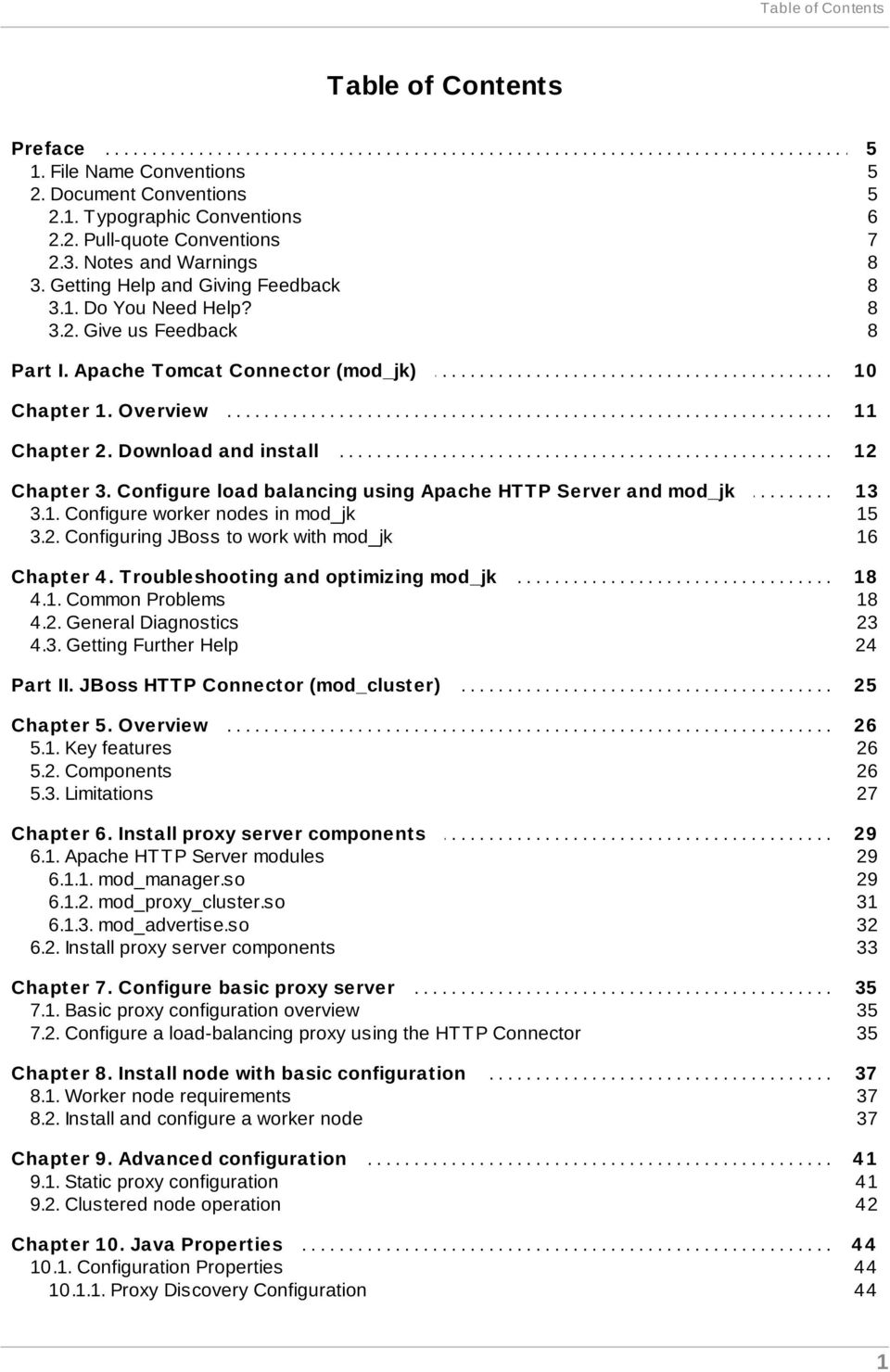
4 Table of Contents Table of Contents. Preface File Name Conventions 5 2. Document Conventions T ypographic Conventions Pull-quote Conventions Notes and Warnings 8 3. Getting Help and Giving Feedback Do You Need Help? Give us Feedback 8. Part..... I.. Apache T. omcat Connector (mod_jk) Chapter Overview Chapter Download and.... install Chapter Configure load..... balancing using Apache HT.. T.. P.. Server and..... mod_jk Configure worker nodes in mod_jk Configuring JBoss to work with mod_jk 16. Chapter T.. roubleshooting and.... optimizing mod_jk Common Problems General Diagnostics Getting Further Help 24. Part..... II... JBoss HT... T. P.. Connector (mod_cluster) Chapter Overview Key features Components Limitations 27. Chapter Install proxy server components Apache HTTP Server modules mod_manager.so mod_proxy_cluster.so mod_advertise.so Install proxy server components 33. Chapter Configure basic proxy server Basic proxy configuration overview Configure a load-balancing proxy using the HT T P Connector 35. Chapter Install node with.... basic configuration Worker node requirements Install and configure a worker node 37. Chapter Advanced configuration Static proxy configuration Clustered node operation 42. Chapter Java Properties Configuration Properties Proxy Discovery Configuration 44 1
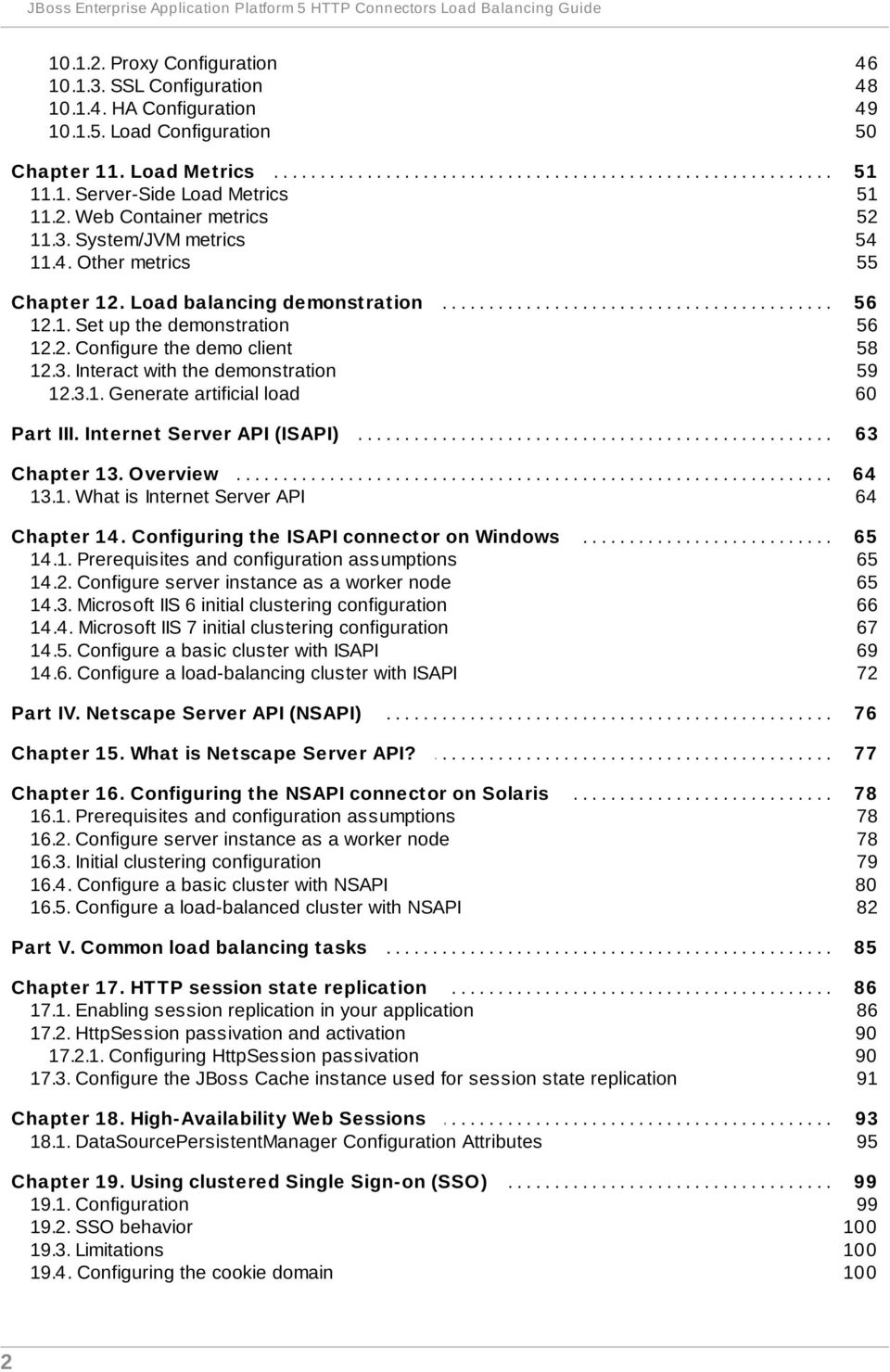
5 JBoss Enterprise Application Platform 5 HTTP Connectors Load Balancing Guide Proxy Configuration SSL Configuration HA Configuration Load Configuration Chapter Load Metrics Server-Side Load Metrics Web Container metrics System/JVM metrics Other metrics 55. Chapter Load balancing demonstration Set up the demonstration Configure the demo client Interact with the demonstration Generate artificial load 60. Part..... III... Internet Server API....(ISAPI) Chapter Overview What is Internet Server API 64. Chapter Configuring the.... ISAPI connector on... Windows Prerequisites and configuration assumptions Configure server instance as a worker node Microsoft IIS 6 initial clustering configuration Microsoft IIS 7 initial clustering configuration Configure a basic cluster with ISAPI Configure a load-balancing cluster with ISAPI 72. Part..... IV.... Netscape Server API....(NSAPI) Chapter What is.. Netscape Server API? Chapter Configuring the.... NSAPI connector on... Solaris Prerequisites and configuration assumptions Configure server instance as a worker node Initial clustering configuration Configure a basic cluster with NSAPI Configure a load-balanced cluster with NSAPI 82. Part..... V... Common load..... balancing tasks Chapter HT... T.. P.. session state replication Enabling session replication in your application HttpSession passivation and activation Configuring HttpSession passivation Configure the JBoss Cache instance used for session state replication 91. Chapter High-Availability Web..... Sessions DataSourcePersistentManager Configuration Attributes 95. Chapter Using clustered Single Sign-on (SSO) Configuration SSO behavior Limitations Configuring the cookie domain 100 2
6 Table of Contents. Chapter Complete working example Reference: workers.properties Reference: Java properties B.1. Proxy configuration 108. Revision history

7 4 JBoss Enterprise Application Platform 5 HTTP Connectors Load Balancing Guide

8 Preface Preface 1. File Name Conventions T he following naming conventions are used in file paths for readability. Each convention is styled so that it stands out from the rest of text: JBOSS_EAP_DIST T he installation root of the JBoss Enterprise Application Platform instance. T his folder contains the main folders that comprise the server such as /jboss-as, /seam, and /resteasy. JBOSS_EWP_DIST T he installation root of the JBoss Enterprise Web Platform instance. T his folder contains the main folders that comprise the server such as /jboss-as-web, /seam, and /resteasy. JBOSS_EWS_DIST T he installation root of the JBoss Enterprise Web Server instance. T his folder contains the main folders that comprise the server such as /extras, /httpd, and the /tom cat6 folders. NATIVE The installation root of the JBoss Native zip, extracted to the same directory level as JBOSS_EAP_DIST. SJWS The installation root of the Sun Java Web Server instance. The default file locations for this naming convention are: for Solaris 10 x86 or SPARC 64: /opt/sunwwbsrv70/ HTTPD_DIST The installation root of the Apache HTTP Server. This folder contains the main folders that comprise the server such as /conf, /webapps, and /bin. The JBoss Enterprise Web Server JBOSS_EWS_DIST directory contains the root installation of HTTPD_DIST. PROFILE The name of the server profile you use as part of your testing or production configuration. The server profiles reside in JBOSS_EAP_DIST/jboss-as/server or JBOSS_EWP_DIST/jbossas-web/server. 2. Document Conventions T his manual uses several conventions to highlight certain words and phrases and draw attention to specific pieces of information. In PDF and paper editions, this manual uses typefaces drawn from the Liberation Fonts set. T he 5
9 JBoss Enterprise Application Platform 5 HTTP Connectors Load Balancing Guide Liberation Fonts set is also used in HTML editions if the set is installed on your system. If not, alternative but equivalent typefaces are displayed. Note: Red Hat Enterprise Linux 5 and later include the Liberation Fonts set by default Typographic Conventions Four typographic conventions are used to call attention to specific words and phrases. T hese conventions, and the circumstances they apply to, are as follows. Mono-spaced Bold Used to highlight system input, including shell commands, file names and paths. Also used to highlight keys and key combinations. For example: T o see the contents of the file m y_next_bestselling_novel in your current working directory, enter the cat m y_next_bestselling_novel command at the shell prompt and press Enter to execute the command. The above includes a file name, a shell command and a key, all presented in mono-spaced bold and all distinguishable thanks to context. Key combinations can be distinguished from an individual key by the plus sign that connects each part of a key combination. For example: Press Enter to execute the command. Press Ctrl+Alt+F2 to switch to a virtual terminal. T he first example highlights a particular key to press. T he second example highlights a key combination: a set of three keys pressed simultaneously. If source code is discussed, class names, methods, functions, variable names and returned values mentioned within a paragraph will be presented as above, in m ono-spaced bold. For example: File-related classes include filesystem for file systems, file for files, and dir for directories. Each class has its own associated set of permissions. Proportional Bold T his denotes words or phrases encountered on a system, including application names; dialog box text; labeled buttons; check-box and radio button labels; menu titles and sub-menu titles. For example: Choose System Preferences Mouse from the main menu bar to launch Mouse Preferences. In the Buttons tab, select the Left-handed m ouse check box and click Close to switch the primary mouse button from the left to the right (making the mouse suitable for use in the left hand). T o insert a special character into a gedit file, choose Applications Accessories Character Map from the main menu bar. Next, choose Search Find from the Character Map menu bar, type the name of the character in the Search field and click Next. T he character you sought will be highlighted in the Character T able. Double-click this highlighted character to place it in the T ext to copy field and then click the Copy button. Now switch back to your document and choose Edit Paste from the gedit menu bar. T he above text includes application names; system-wide menu names and items; application-specific menu names; and buttons and text found within a GUI interface, all presented in proportional bold and all 6

10 Preface distinguishable by context. Mono-spaced Bold Italic or Proportional Bold Italic Whether mono-spaced bold or proportional bold, the addition of italics indicates replaceable or variable text. Italics denotes text you do not input literally or displayed text that changes depending on circumstance. For example: T o connect to a remote machine using ssh, type ssh username@ domain.name at a shell prompt. If the remote machine is example.com and your username on that machine is john, type ssh john@ exam ple.com. T he m ount -o rem ount file-system command remounts the named file system. For example, to remount the /home file system, the command is mount -o remount /home. T o see the version of a currently installed package, use the rpm -q package command. It will return a result as follows: package-version-release. Note the words in bold italics above username, domain.name, file-system, package, version and release. Each word is a placeholder, either for text you enter when issuing a command or for text displayed by the system. Aside from standard usage for presenting the title of a work, italics denotes the first use of a new and important term. For example: Publican is a DocBook publishing system Pull-quote Conventions T erminal output and source code listings are set off visually from the surrounding text. Output sent to a terminal is set in mono-spaced roman and presented thus: books Desktop documentation drafts mss photos stuff svn books_tests Desktop1 downloads images notes scripts svgs Source-code listings are also set in m ono-spaced rom an but add syntax highlighting as follows: package org.jboss.book.jca.ex1; import javax.naming.initialcontext; public class ExClient { public static void main(string args[]) throws Exception { InitialContext inictx = new InitialContext(); Object ref = inictx.lookup("echobean"); EchoHome home = (EchoHome) ref; Echo echo = home.create(); System.out.println("Created Echo"); } } System.out.println("Echo.echo('Hello') = " + echo.echo("hello")); 7

11 JBoss Enterprise Application Platform 5 HTTP Connectors Load Balancing Guide 2.3. Notes and Warnings Finally, we use three visual styles to draw attention to information that might otherwise be overlooked. Note Notes are tips, shortcuts or alternative approaches to the task at hand. Ignoring a note should have no negative consequences, but you might miss out on a trick that makes your life easier. Important Important boxes detail things that are easily missed: configuration changes that only apply to the current session, or services that need restarting before an update will apply. Ignoring a box labeled 'Important' will not cause data loss but may cause irritation and frustration. Warning Warnings should not be ignored. Ignoring warnings will most likely cause data loss. 3. Getting Help and Giving Feedback 3.1. Do You Need Help? If you experience difficulty with a procedure described in this documentation, visit the Red Hat Customer Portal at T hrough the customer portal, you can: search or browse through a knowledgebase of technical support articles about Red Hat products. submit a support case to Red Hat Global Support Services (GSS). access other product documentation. Red Hat also hosts a large number of electronic mailing lists for discussion of Red Hat software and technology. You can find a list of publicly available mailing lists at Click on the name of any mailing list to subscribe to that list or to access the list archives Give us Feedback If you find a typographical error, or know how this guide can be improved, we would love to hear from you. Submit a report in Bugzilla against the product JBoss Enterprise Application Platform 5 and the component doc-ht T P_Connectors_Guide. T he following link will take you to a pre-filled bug report for this product: Fill out the following template in Bugzilla's Description field. Be as specific as possible when describing the issue; this will help ensure that we can fix it quickly. 8

12 Preface Document URL: Section Number and Name: Describe the issue: Suggestions for improvement: Additional information: Be sure to give us your name so that you can receive full credit for reporting the issue. 9

13 JBoss Enterprise Application Platform 5 HTTP Connectors Load Balancing Guide Part I. Apache Tomcat Connector (mod_jk) 10

14 Chapter 1. Overview Chapter 1. Overview Apache HTTP Server ("Apache") is a well-known web server which can be extended using plug-ins. The Apache T omcat Connector mod_jk is a plug-in designed to allow request forwarding from Apache HT T P Server to a servlet container. The module also supports load-balancing HTTP calls to a set of servlet containers while maintaining sticky sessions. HTTP session replication is used to replicate the state associated with web client sessions to other nodes in a cluster. If one node becomes unavailable, another node in the cluster continues to service the failed node's requests. T his involves two distinct operations: Session state replication Load-balancing HT T P Requests Session state replication is handled by JBoss per application, providing the application is configured to make use of this feature (refer to Section 17.1, Enabling session replication in your application ). Load balancing must be handled externally to JBoss, via either hardware or software. A cost-effective way of enabling load balancing is to set up a software load balancer using Apache HTTP Server and the Apache T omcat Connector (mod_jk). 11

15 JBoss Enterprise Application Platform 5 HTTP Connectors Load Balancing Guide Chapter 2. Download and install Apache HTTP Server is included in the JBoss Enterprise Web Server binary you download from Apache mod_jk is included in the native installation binaries for JBoss Enterprise Application Platform and JBoss Enterprise Web Server. Follow the procedures in the JBoss Enterprise Application Platform or JBoss Enterprise Web Server Installation Guide to download and install the correct platform and native binaries. 12

16 Chapter 3. Configure load balancing using Apache HTTP Server and mod_jk Chapter 3. Configure load balancing using Apache HTTP Server and mod_jk Follow the tasks in this chapter to correctly configure load balancing using Apache HTTP Server and the mod_jk connector. Task: Configure Apache HTTP Server to Load mod_jk Complete this task to configure Apache HTTP Server to load mod_jk. Prerequisites Apache HT T P Server and mod_jk installed (Refer to Chapter 2, Download and install). 1. Open HTTPD_DIST/conf/httpd.conf and add the following text at the end of the file. # Include mod_jk's specific configuration file Include conf/mod-jk.conf 2. Create a new file named HTTPD_DIST/conf/m od-jk.conf 3. Add the following configuration block to m od-jk.conf. 13

17 JBoss Enterprise Application Platform 5 HTTP Connectors Load Balancing Guide # Load mod_jk module # Specify the filename of the mod_jk lib LoadModule jk_module modules/mod_jk.so # Where to find workers.properties JkWorkersFile conf/workers.properties # Where to put jk logs JkLogFile logs/mod_jk.log # Set the jk log level [debug/error/info] JkLogLevel info # Select the log format JkLogStampFormat "[%a %b %d %H:%M:%S %Y]" # JkOptions indicates to send SSK KEY SIZE JkOptions +ForwardKeySize +ForwardURICompat -ForwardDirectories # JkRequestLogFormat JkRequestLogFormat "%w %V %T" # Mount your applications JkMount /application/* loadbalancer # Add shared memory. # This directive is present with and # later versions of mod_jk, and is needed for # for load balancing to work properly JkShmFile logs/jk.shm # Add jkstatus for managing runtime data <Location /jkstatus/> JkMount status Order deny,allow Deny from all Allow from </Location> 4. Confirm that the LoadModule directive references the right path for the mod_jk library. If not, edit the path. 5. T he default configuration specifies that static content is served directly by Apache HT T P Server and all requests with URL path /application/* are sent to the load balancer. If mod_jk is only to be used as a load balancer, change the directive to /*. 6. Optional: JKMountFile Directive In addition to the JkMount directive, you can use the JkMountFile directive to specify a mount point's configuration file. T he configuration file contains multiple T omcat forwarding URL mappings. a. Navigate to HTTPD_DIST/conf. b. Create a file named uriworkerm ap.properties. c. Specify the URL whose requests are to be forwarded and the name of the worker node to which they are to be forwarded, using the following syntax example as a guide. The example block will configure mod_jk to forward requests to /jmx-console and /web-console to Apache HT T P Server. T he syntax required takes the form /url=worker_nam e. 14
![log # Set the jk log level [debug/error/info] JkLogLevel info # Select the log format JkLogStampFormat "[%a %b %d %H:%M:%S %Y]" # JkOptions indicates to send SSK KEY SIZE JkOptions +ForwardKeySize](/docs-images/40/4726440/images/page_17.jpg "+ForwardURICompat -ForwardDirectories # JkRequestLogFormat JkRequestLogFormat \"%w %V %T\" # Mount your applications JkMount /application/* loadbalancer # Add shared memory.")
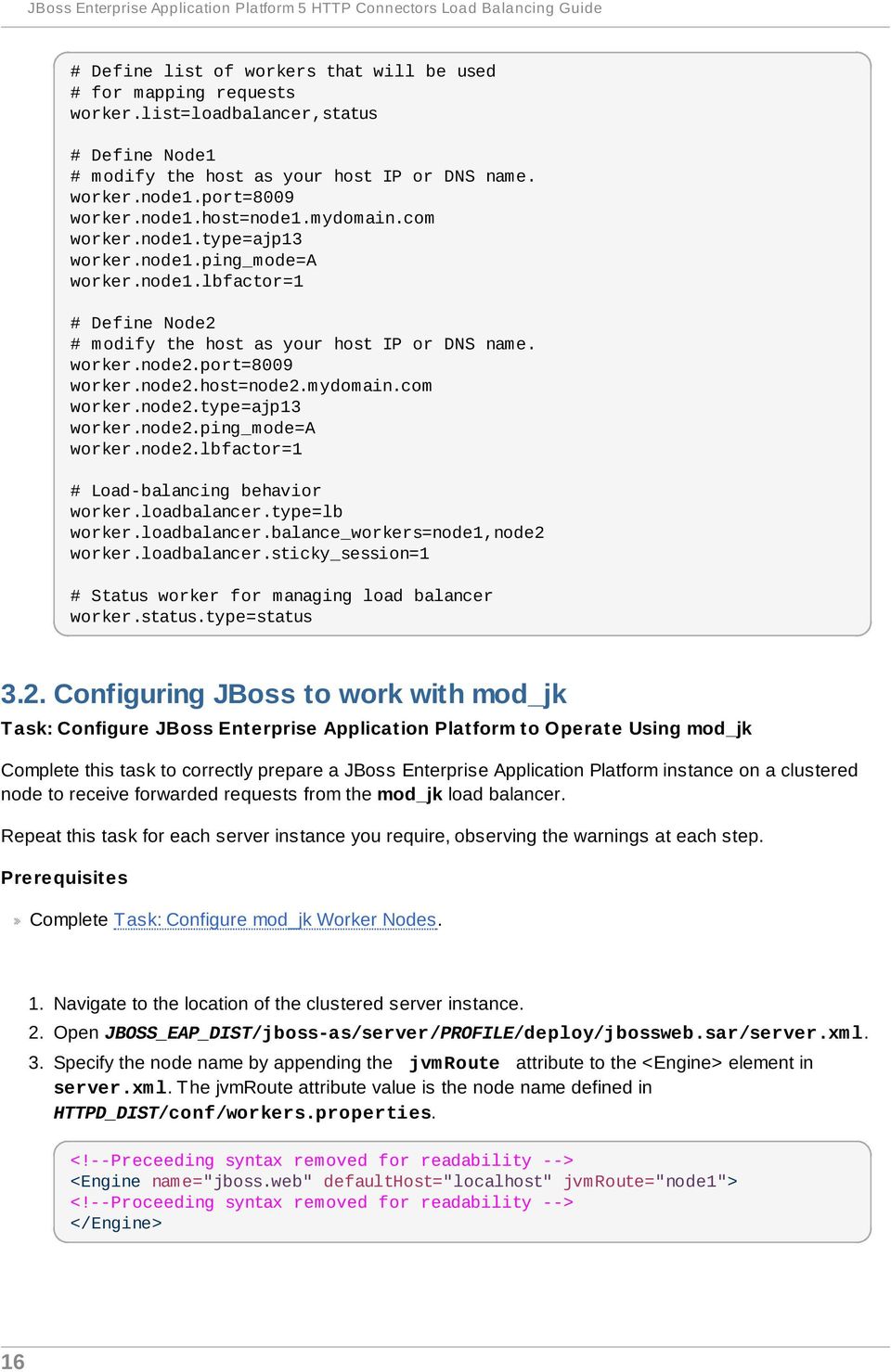
18 Chapter 3. Configure load balancing using Apache HTTP Server and mod_jk # Simple worker configuration file # Mount the Servlet context to the ajp13 worker /jmx-console=loadbalancer /jmx-console/* =loadbalancer /web-console=loadbalancer /web-console/* =loadbalancer d. In HTTPD_DIST/conf/m od-jk.conf, append the following directive. # You can use external file for mount points. # It will be checked for updates each 60 seconds. # The format of the file is: /url=worker # /examples/* =loadbalancer JkMountFile conf/uriworkermap.properties 3.1. Configure worker nodes in mod_jk T ask: Configure mod_jk Worker Nodes Complete this task to configure two mod_jk worker node definitions in a weighted round-robin configuration with sticky sessions active between two servlet containers. Prerequisites Understand the format of the workers.properties directives, as specified in Appendix A, Reference: workers.properties. 1. Navigate to HTTPD_DIST/conf/. 2. Create a file named workers.properties. 3. Append the following information to workers.properties. 15
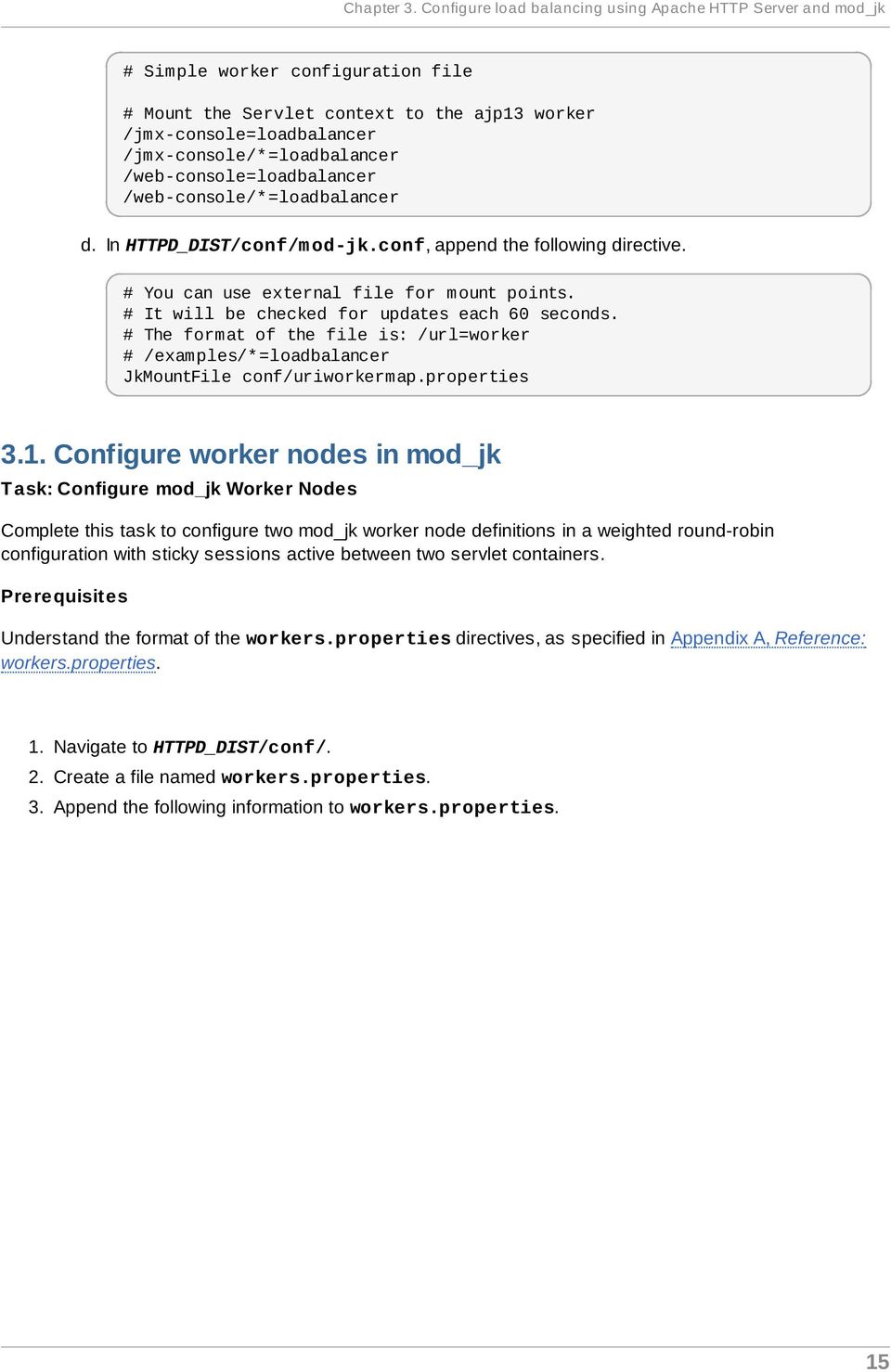
19 JBoss Enterprise Application Platform 5 HTTP Connectors Load Balancing Guide # Define list of workers that will be used # for mapping requests worker.list=loadbalancer,status # Define Node1 # modify the host as your host IP or DNS name. worker.node1.port=8009 worker.node1.host=node1.mydomain.com worker.node1.type=ajp13 worker.node1.ping_mode=a worker.node1.lbfactor=1 # Define Node2 # modify the host as your host IP or DNS name. worker.node2.port=8009 worker.node2.host=node2.mydomain.com worker.node2.type=ajp13 worker.node2.ping_mode=a worker.node2.lbfactor=1 # Load-balancing behavior worker.loadbalancer.type=lb worker.loadbalancer.balance_workers=node1,node2 worker.loadbalancer.sticky_session=1 # Status worker for managing load balancer worker.status.type=status 3.2. Configuring JBoss to work with mod_jk T ask: Configure JBoss Enterprise Application Platform to Operate Using mod_jk Complete this task to correctly prepare a JBoss Enterprise Application Platform instance on a clustered node to receive forwarded requests from the mod_jk load balancer. Repeat this task for each server instance you require, observing the warnings at each step. Prerequisites Complete T ask: Configure mod_jk Worker Nodes. 1. Navigate to the location of the clustered server instance. 2. Open JBOSS_EAP_DIST/jboss-as/server/PROFILE/deploy/jbossweb.sar/server.xm l. 3. Specify the node name by appending the jvmroute attribute to the <Engine> element in server.xml. The jvmroute attribute value is the node name defined in HTTPD_DIST/conf/workers.properties. <!--Preceeding syntax removed for readability --> <Engine name="jboss.web" defaulthost="localhost" jvmroute="node1"> <!--Proceeding syntax removed for readability --> </Engine> 16
20 Chapter 3. Configure load balancing using Apache HTTP Server and mod_jk Important If you intend to configure more than one server node in a cluster, ensure you change the jvmroute attribute value to a unique name each time you repeat this step. 4. In server.xm l, ensure the AJP protocol <connector> element is enabled (uncommented). T he element is uncommented by default in new installations. <Connector protocol="ajp/1.3" port="8009" address="${jboss.bind.address}" redirectport="8443" /> 5. You now have a correctly configured Apache HT T P Server with m od_jk load balancer, which balances calls to the servlet containers in the cluster, and ensures clients will always use the same servlet container (sticky sessions). Note For supplementary information about using mod_jk with JBoss, refer to the JBoss wiki page at 17

21 JBoss Enterprise Application Platform 5 HTTP Connectors Load Balancing Guide Chapter 4. Troubleshooting and optimizing mod_jk While optimizing the configuration in Apache HT T P Server, mod_jk, mod_proxy, mod_cluster and JBoss Enterprise Application Platform typically resolves any and all problems and errors in load balancing, there are exceptions (such as long running servlets that require additional optimization). In most cases, a correctly tuned configuration is the catch all for mod_jk issues. T his section discusses some problems and how the configuration can be improved to avoid them. Optimization Considerations Ensure you are on the latest supported component versions. Ensure the relevant configurations are tuned correctly. T he Red Hat Global Support Services staff can use interactive tools to assist you with tailored configuration settings. Find the appropriate contact details at If optimizing the configuration does not resolve the issue the problem is most likely on the JBoss/JVM side. Refer to Procedure 4.5, JBoss/JVM Problems for advice about these issues Common Problems T he list below outlines some common configuration problems. Ensuring your implementation is not subject to one of these may assist to resolve your issue. Specific errors and general performance issues are discussed later in this section. Common Configuration Issues JkShmFile on a NFS share Placing the JkShmFile on a NFS share can cause unexplained pauses in mod_jk and odd behavior. It is strongly recommended that the JkShm File always be placed on local storage to avoid problems. A firewall between Apache HT T P Server and JBoss Enterprise Application Platform If there is a firewall between Apache HT T P Server and JBoss Enterprise Application Platform and no socket_keepalive parameter is set, the firewall can close connections unexpectedly. MaxClients higher than maxthreads Setting the MaxClients parameter in Apache HT T P Server higher than the maxthreads setting in JBoss (with a high load on the server) will result in Apache HTTP Server overwhelming the JBoss instance with threads which will cause hung and/or dropped connections. No connectiontimeout parameter set T he connectiontimeout parameter set in JBoss is required for proper maintenance of old connections. 18 No CPing/CPong set T he CPing/CPong property in mod_jk is the most important worker property setting, allowing mod_jk to test and detect faulty connections. Not setting this parameter can lead to bad connections not being detected as quickly which can lead to web requests behaving as if 'hung'.
22 Chapter 4. Troubleshooting and optimizing mod_jk Running an old version of mod_jk. T here are known issues with sticky sessions in versions prior to mod_jk Running an older version of EAP. There is a bug in EAP 4.2 base and EAP 4.2 CP01 which causes sockets to be left in the CLOSE_WAIT state, thus causing the appearance of hung requests again. T his issue has been reported and fixed Unresponsive back end server java.lang.outofmem oryerror errors or high pause times can cause the back end server to become unresponsive. All of the problems listed above are typically resolved after optimizing the configuration in Apache HT T P Server, mod_jk, and JBoss. Common Errors "CPing/CPong" Errors Presents with errors like the following: [info] ajp_handle_cping_cpong::jk_ajp_common.c (865): timeout in reply cpong... [error] ajp_connect_to_endpoint::jk_ajp_common.c (957): (nodea) cping/cpong after connecting to the backend server failed (errno=110) [error] ajp_send_request::jk_ajp_common.c (1507): (nodea) connecting to backend failed. Tomcat is probably not started or is listening on the wrong port (errno=110) T hese CPing/CPong messages do not indicate a problem with mod_jk at all, they indicate that JBoss did not respond in the defined CPing/CPong time. This is seen many times when there is high load on the JVM JBoss is running on causing high garbage collection or potentially thread contention. It could also be that the JBoss instance is overloaded, or even that a firewall is blocking the connection or there are network issues. T he following workflow may assist to correct these type of issues: Procedure 4.1. Resolving "CPing/CPong" Errors 1. Optimize your Apache HT T P Server and JBoss Enterprise Application Platform configuration. You can contact Red Hat's Global Support Services for assistance with this. If this does not resolve the issue, proceed to Step 2 2. Confirm that there is no firewall blocking or dropping the AJP connections. "Tomcat is down" Errors Presents with errors like the following: 19
23 JBoss Enterprise Application Platform 5 HTTP Connectors Load Balancing Guide 1. [error] ajp_get_reply::jk_ajp_common.c (2020): (node1) Timeout with waiting reply from tomcat. Tomcat is down, stopped or network problems (errno=110) T he above error means that JBoss did not respond in the configured reply_timeout time. The solution can be one (or both) of the following: a. Increase the reply_timeout. b. Verify there are no garbage collection issues/long pause times in JBoss that may prevent the request from responding thus causing that error. 2. [Fri May 25 11:53: ][11159: ] [debug] init_ws_service::mod_jk.c (977): Service protocol=http/1.1 method=post ssl=false host=(null) addr= name=localhost port=80 auth=(null) user=(null) laddr= raddr= uri=/foo/bar... [Fri May 25 11:58: ][11159: ] [debug] jk_shutdown_socket::jk_connect.c (681): About to shutdown socket 17 [Fri May 25 11:58: ][11159: ] [debug] jk_shutdown_socket::jk_connect.c (689): Failed sending SHUT_WR for socket 17 [Fri May 25 11:58: ][11159: ] [info] ajp_connection_tcp_get_message::jk_ajp_common.c (1150): (node1) can not receive the response header message from tomcat, network problems or tomcat ( :8009) is down (errno=104) [Fri May 25 11:58: ][11159: ] [error] ajp_get_reply::jk_ajp_common.c (1962): (node1) Tomcat is down or refused connection. No response has been sent to the client (yet) T he above error likely means that JBoss Enterprise Application Platform did not respond within the configured core Apache HT T P Server timeout period. Note that with these messages the [11159: ] portion of the message serves as an identifier for the connection/request in question. T herefore tracing back from the point of the error in logs can help clarify the activity around the connection/request that lead to the error. In this case, that helps clarify that the error was experienced five minutes after the response was sent to JBoss, which likely points to a five minute timeout (this is Apache HTTP Server's Timeout directive default if not specified). If the Timeout is interrupting mod_jk requests, then it should be increased from the current value to allow for the maximum acceptable response time. Procedure 4.2. Resolving "T omcat is down" Errors a. Optimize your Apache HT T P Server and JBoss Enterprise Application Platform configuration. You can contact Red Hat's Global Support Services for assistance with this. If this does not resolve the issue, proceed to Step 2 b. Confirm that there is no firewall blocking or dropping the AJP connections. General Performance Issues Presents with errors like the following: ERROR [org.apache.coyote.ajp.ajpmessage] (ajp ) Invalid message received with signature
24 Chapter 4. Troubleshooting and optimizing mod_jk The above exception when using mod_jk in JBoss Web typically indicates a non AJP request sent to the AJP connector. Workflows that may assist in resolving these kinds of issues is below: Procedure 4.3. General Performance Problems 1. Optimize your Apache HT T P Server and JBoss Enterprise Application Platform configuration. You can contact Red Hat's Global Support Services for assistance with this. If this does not resolve the issue, proceed to Step 2 2. Gather garbage collection logs for analysis. If the logs show long garbage collection pause times then you should optimize the Java Virtual Machine to reduce the garbage collection pauses and gather/recheck updated logs. Refer to (Red Hat account required) for more information. If this is not the case, or did not resolve the issue, try Step 3, Step 4 and/or Step 5 until your issue is resolved. 3. Determine how long the longest request should take. Factor in transaction times. You may need to increase the reply_timeout to resolve the problem. If this does not resolve the issue, continue to Step Determine if your current environment can handle the given load. If not, you may need to upgrade or add more machines. If this does not resolve the issue, continue to Step Confirm that there is no firewall blocking or dropping the AJP connections. Procedure Errors 1. Optimize your Apache HT T P Server and JBoss Enterprise Application Platform configuration. You can contact Red Hat's Global Support Services for assistance with this. If this does not resolve the issue, proceed to Step 2 2. Gather garbage collection logs for analysis. If the logs show long garbage collection pause times then you should optimize the Java Virtual Machine to reduce the garbage collection pauses and gather/recheck updated logs. Refer to (Red Hat account required) for more information. If this is not the case, or does not resolve the issue, continue to Step 3 3. Determine how long the longest request should take. Factor in transaction times. You may need to increase the reply_timeout to resolve the issue. If this does not resolve the issue, move on to Step Determine if your current environment can handle the given load. If not, you may need to upgrade or add more machines. JBoss/JVM-related Issues May present with errors like: [error] service::jk_lb_worker.c (1473): All tomcat instances failed, no more workers left 21
25 JBoss Enterprise Application Platform 5 HTTP Connectors Load Balancing Guide If Apache HT T P Server and JBoss Enterprise Application Platform are optimized and you still receive "no more workers left" this typically indicates an issue on the JBoss/JVM side. A number of JVM-related problems could lead to mod_jk not being able to get a connection to JBoss in the configured timeouts, thus causing the worker to go into the error state and producing this message. Procedure 4.5. JBoss/JVM Problems 1. Enable garbage collection logging. a. For UNIX based systems, the options should be placed in run.conf, not run.sh. The run.conf in the server configuration directory (e.g. <JBOSS_HOME>/server/<PROFILE>/run.conf) takes precedence over the run.conf in the <JBOSS_HOME>/bin directory (except in JBoss EAP due to a regression fixed in version 5.0.1). b. For Windows, the options need to be added to run.bat, as it does not read run.conf. c. Check boot.log to see the value of the user.dir environment variable (e.g. <JBOSS_HOME>/bin), the default location for garbage collection logging when no path is provided. If you are running multiple instances of JBoss against the same directory like so:./run.sh -c node1 -b Djboss.messaging.ServerPeerID=1./run.sh -c node2 -b Djboss.messaging.ServerPeerID=2 - Djboss.service.binding.set=ports-01 d. Then for the gc.log files to be properly separated you will need to make sure each <PROFILE> has a unique run.conf with the JVM_OPTS specific to that <PROFILE>. For example node1 will contain a <JBOSS_HOME>/server/node1/run.conf with contents: JAVA_OPTS="$JAVA_OPTS -verbose:gc -Xloggc:gc_node1.log - XX:+PrintGCDetails -XX:+PrintGCDateStamps" e. And <JBOSS_HOME>/server/node2/run.conf with contents: JAVA_OPTS="$JAVA_OPTS -verbose:gc -Xloggc:gc_node2.log - XX:+PrintGCDetails -XX:+PrintGCDateStamps" Important gc.log is recreated every time JBoss starts. Be sure to back up gc.log if you are restarting the server. Alternatively you may be able to add a timestamp to the file name depending on the OS and/or shell. For example, with OpenJDK or Oracle/Sun JDK on Linux: - Xloggc:gc.log.`date +%Y%m%d%H%M%S`. f. On Windows, you can use 22
26 Chapter 4. Troubleshooting and optimizing mod_jk for /f "tokens=2-4 delims=/ " %%a in ('date /t') do (set mydate=%%c-%%a-%%b) for /f "tokens=1-2 delims=/:" %%a in ("%TIME%") do (set mytime=%%a%%b) set "JAVA_OPTS=%JAVA_OPTS% - Xloggc:C:/log/gv.log.%mydate%_%mytime% 2. For the time period when there are slowdowns, hangs, or errors, gather the following data: Garbage collection logs. Follow Procedure 4.5, JBoss/JVM Problems. High CPU data coupled with thread dumps (depending upon platform): The links below can assist in gathering Java thread data. A Red Hat subscription is required. CPU utilization by Java threads on Linux/Solaris: CPU utilization by Java threads on Windows: For cases where the Java application is an application server, gather log files: In JBoss: <JBOSS_HOME>/server/<PROFILE>/log/server.log <JBOSS_HOME>/server/<PROFILE>/log/boot.log In Tomcat: catalina.out 3. Determine if the CPU utilization is caused by the JVM (Java application). Here, you want to validate that a Java process is indeed using an unexpected amount of CPU. The Java thread data gathered in the first step should help identify this. 4. Assuming a Java process is identified as the cause of high CPU, the most common cause is java Garbage collection. Determine if the high CPU is caused by Java garbage collection by analyzing the garbage collection for long pause times and/or low throughput overall at the time of the issue. To find the garbage collection logging related to the issue, it is necessary to determine the number of seconds after JVM startup that the issue happens (that is the typical format of garbage collection logging timestamps). T o determine the time elapsed, you can use the first timestamp in the high CPU data gathered and the first timestamp in the console log, boot.log (JBoss), server.log (JBoss), or catalina.out (T omcat.) If you see long pause times and/or low throughput overall, refer to the following Knowledge Base article (Red Hat subscription required) 5. If Garbage collection is not responsible for the high CPU, use the thread dump information gathered when validating CPU information to identify the threads. One area that is not a direct consequence of an unoptimized mod_jk configuration but can still cause issues with mod_jk is JVM and garbage collection related problems. When there are high pause times and the JVM is not optimized for the app server, the pause times can cause mod_jk issues even when mod_jk is tuned General Diagnostics 23
27 JBoss Enterprise Application Platform 5 HTTP Connectors Load Balancing Guide 1. Verify the back end server is responsive by making a direct request to it. 2. Monitor high load using one of the following methods: Twiddle a. Locate the appropriate Twiddle script for your environment (twiddle.sh, twiddle.bat or twiddle.jar) in the <JBOSS_HOME>/bin/ directory. b. Run the following command: <TWIDDLE> -u admin -p password get "jboss.web:name=ajp ,type=threadpool" Use the script appropriate to your operating system and environment. Twiddle may need to be modified for each specific environment, but the above will work in a default JBoss instance where no ports have been changed and JBoss is starting on the localhost. JMX Console a. Navigate to x-console. b. Find the jboss.web section. c. Click on nam e=ajp-localhost/ ,type=t hreadpool (or whichever AJP ThreadPool matches your environment) d. Investigate the currentthreadsbusy attribute. If this attribute is reaching the maxthreads there will be a problem as JBoss Web is reaching the defined ThreadPool capacity Getting Further Help If none of the above information resolves your issue you can contact the Global Support Services staff for assistance. You can find the appropriate contact details at Please gather the following information prior to your call. JBoss EAP boot.log. Apache HTTP Server's httpd.conf and the httpd-mpm.conf file (if it exists). mod_jk's workers.properties. mod_jk's m od_jk.conf. <JBOSS_HOME>/server/<PROFILE>/deploy/JBOSSWEB/server.xm l <JBOSS_HOME>/server/<PROFILE>/deploy/JBOSSWEB/MET A-INF/jboss-service.xm l T he output of running httpd -V on Apache HT T P Server (httpd -V > httpd.out, for example). Note the capital "V". A lowercase "v" will not produced the desired output. Version of Apache HTTP Server or the JBoss Enterprise Web Server. /etc/sysconfig/httpd 24
28 Part II. JBoss HTTP Connector (mod_cluster) Part II. JBoss HTTP Connector (mod_cluster) 25
29 JBoss Enterprise Application Platform 5 HTTP Connectors Load Balancing Guide Chapter 5. Overview T he JBoss HT T P Connector mod_cluster is a reduced-configuration, intelligent load-balancing solution for JBoss Enterprise Application Platform, based on technology originally developed by the JBoss mod_cluster community project. T he JBoss HT T P connector load-balances HT T P requests to JBoss Enterprise Application Platform and JBoss Enterprise Web Server worker nodes, using Apache HTTP Server as the proxy server Key features Apache HT T P Server-based The JBoss HTTP Connector mod-cluster uses Apache HTTP Server as the proxy server. Real-time load-balancing calculation T he JBoss HT T P Connector mod_cluster creates a feedback network between the worker nodes and the proxy server. The mod_cluster service is deployed on each of the worker nodes. T his service feeds real-time load information to the proxy server. T he proxy server then makes intelligent decisions about where to allocate work, based on the current load on each worker node. T his real-time adaptive load distribution results in increased optimization of resources. The information that is reported by the worker nodes and the load-balancing policy used by the proxy are both customizable. Routing based on real-time application life-cycle The JBoss HTTP Connector mod_cluster service deployed on the worker nodes relays application life-cycle events to the proxy server. T his allows the server to dynamically update its routing table. When an application is undeployed on a node, the proxy server no longer routes traffic for that application to that node. Automatic Proxy Discovery The proxy server can be configured to announce its presence via UDP multicast. New worker nodes discover the proxy server and add themselves to the load-balancing cluster automatically. T his greatly reduces the configuration and maintenance needed. When UDP multicast is not available or is undesirable, worker nodes are configured with a static list of proxies. Multiple Protocol Support The JBoss HTTP Connector mod_cluster can use HTTP, HTTPS, or Apache JServ Protocol (AJP) for communication between the proxy and the worker nodes Components Proxy Server On the proxy server, the JBoss HTTP Connector, mod-cluster, consists of four Apache HTTP Server modules. 26
30 Chapter 5. Overview Shared Memory Manager module: m od_slotm em.so T he Shared Memory Manager module, mod_slotmem, makes the real-time worker node information available to multiple Apache HT T P Server server processes. Cluster Manager module: m od_m anager.so T he Cluster Manager module, mod_manager, receives and acknowledges messages from nodes, including worker node registrations, worker node load data, and worker node application life-cycle events. Proxy Balancer module: m od_proxy_cluster.so T he Proxy Balancer module, mod_proxy_cluster, handles the routing of requests to cluster nodes. T he Proxy Balancer selects the appropriate node to forward the request to, based on application location in the cluster, current state of each of the cluster nodes, and the Session ID (if a request is part of an established session). Proxy Advertisement module: m od_advertise.so T he Proxy Advertisement module, mod_advertise.so, broadcasts the existence of the proxy server via UDP multicast messages. T he server advertisement messages contain the IP address and port number on which the proxy is listening for responses from nodes that wish to join the load-balancing cluster. Note Refer to Section 6.1, Apache HT T P Server modules for detailed information about the available modules including user-configurable parameters. Worker Node Components The JBoss HTTP Connector client service, mod-cluster.sar, is deployed on each worker node. Worker node service: m od-cluster.sar T his service provides the proxy with real-time information on the worker node's state and sends notification of application life-cycle events; as well as allowing the node to discover and register itself with any proxies running on the same network Limitations The JBoss HTTP Connector mod_cluster uses shared memory to keep the nodes description, the shared memory is created at the startup of httpd and the structure of each item is fixed. Therefore, when defining proxy server and worker node properties, make sure to follow these character limits: Maximum Alias length: 100 characters (Alias corresponds to the network name of the respective virtual host; the name is defined in the Host element) Maximum context length: 40 characters (for example, if myapp.war is deployed in /myapp, then /myapp is the context) 27
31 JBoss Enterprise Application Platform 5 HTTP Connectors Load Balancing Guide Maximum balancer name length: 40 characters (the balancer property in MBean) Maximum JVMRoute string length: 80 character (JVMRoute in the <Engine> element) Maximum domain name length: 20 characters (the domain property in MBean) Maximum hostname length for a node: 64 characters (hostname address in the <Connector> element) Maximum port length for a node: 7 characters (8009 is 4 characters, the port property in the <Connector> element) Maximum scheme length for a node: 6 characters (possible values are http, https, ajp, the protocol of the connector) Maximum cookie name length: 30 characters (the header cookie name for session ID default value: JSESSIONID from org.apache.catalina.globals.session_cookie_name) Maximum path name length: 30 characters (the parameter name for the session ID default value: JSESSIONID from org.apache.catalina.globals.session_paramet ER_NAME) Maximum length of a session ID: 120 characters (session ID resembles the following: BE81FAA969BF64 C8EC2B EAAAA.node01) 28
32 Chapter 6. Install proxy server components Chapter 6. Install proxy server components Read this chapter to install the JBoss HTTP Connector, mod_cluster, on a proxy server Apache HTTP Server modules Read this section for expanded definitions of the Apache HT T P Server proxy server modules discussed in Section 5.2, Components. You specify these modules as part of T ask: Install Proxy Server Components mod_manager.so T he Cluster Manager module, mod_manager, receives and acknowledges messages from nodes, including worker node registrations, worker node load data, and worker node application life-cycle events. LoadModule manager_module modules/mod_manager.so You can also define the following related directives in the <VirtualHost> element: MemManagerFile Defines the location for the files in which mod_manager stores configuration details. mod_manager also uses this location to store generated keys for shared memory and lock files. This must be an absolute path name. It is recommended that this path be set explicitly and on a local drive, not an NFS share. The default value is platform/httpd specific. Valid paths are: HP-UX: HTTPD_HOME/cache/m od_cluster Red Hat Enterprise Linux: /var/cache/m od_cluster Maxcontext T he maximum number of contexts JBoss mod_cluster will use. T he default value is 100. Maxnode The maximum number of worker nodes JBoss mod_cluster will use. The default value is 20. Maxhost T he maximum number of hosts (aliases) JBoss mod_cluster will use. T his is also the maximum number of load balancers. The default value is 10. Maxsessionid T he maximum number of active session identifiers stored. A session is considered inactive when no information is received from that session within five minutes. T he default value is 0, which disables this logic. ManagerBalancerName The name of the load balancer to use when the worker node does not provide a load balancer 29
33 JBoss Enterprise Application Platform 5 HTTP Connectors Load Balancing Guide name. The default value is mycluster. PersistSlots When set to on, nodes, aliases and contexts are persisted in files. The default value is off. CheckNonce When set to on, session identifiers are checked to ensure that they are unique, and have not occurred before. The default is on. Warning Setting this directive to off can leave your server vulnerable to replay attacks. SetHandler Defines a handler to display information about worker nodes in the cluster. This is defined in the Location element: <Location $LOCATION> SetHandler mod_cluster-manager Order deny,allow Deny from all Allow from </Location> When accessing the $LOCATION defined in the Location element in your browser, you will see something like the following. (In this case, $LOCATION was also defined as m od_clusterhandler.) Figure 6.1. mod_cluster Status Transferred corresponds to the POST data sent to the worker node. Connected corresponds to the number of requests that had been processed when this status page was requested. Sessions corresponds to the number of active sessions. T his field is not present when Maxsessionid is 0. 30
34 Chapter 6. Install proxy server components mod_proxy_cluster.so T he Proxy Balancer module, mod_proxy_cluster, handles the routing of requests to cluster nodes. T he Proxy Balancer selects the appropriate node to forward the request to, based on application location in the cluster, current state of each of the cluster nodes, and the Session ID (if a request is part of an established session). LoadModule proxy_cluster_module modules/mod_proxy_cluster.so You can also define the following related directives in the <VirtualHost> element to change loadbalancing behavior. mod_proxy_cluster directives CreateBalancers Defines how load balancers are created in the Apache HTTP Server virtual hosts. The following values are valid in CreateBalancers : 0 Create load balancers in all virtual hosts defined in Apache HTTP Server. Remember to configure the load balancers in the ProxyPass directive. 1 Do not create balancers. When using this value, you must also define the load balancer name in the ProxyPass or ProxyPassMatch. 2 Create only the main server. T his is the default value for CreateBalancers. UseAlias Defines whether to check that the defined Alias corresponds to the ServerNam e. T he following values are valid for UseAlias : 0 Ignore Alias information from worker nodes. T his is the default value for UseAlias. 1 Verify that the defined alias corresponds to a worker node's server name. LBstatusRecalT ime Defines the interval in seconds between the proxy calculating the status of a worker node. The default interval is 5 seconds. ProxyPassMatch; ProxyPass ProxyPass maps remote servers into the local server namespace. If the local server has an 31
35 JBoss Enterprise Application Platform 5 HTTP Connectors Load Balancing Guide address then the following ProxyPass directive would convert a local request for into a proxy request for ProxyPass /requested/ ProxyPassMatch uses Regular Expressions to match local paths to which the proxied URL should apply. For either directive,! indicates that a specified path is local, and a request for that path should not be routed to a remote server. For example, the following directive specifies that.gif files should be served locally. ProxyPassMatch ^(/.*\.gif)$! mod_advertise.so T he Proxy Advertisement module, mod_advertise.so, broadcasts the existence of the proxy server via UDP multicast messages. T he server advertisement messages contain the IP address and port number where the proxy is listening for responses from nodes that wish to join the load-balancing cluster. T his module must be defined alongside mod_manager in the VirtualHost element. Its identifier in the following code snippet is advertise_m odule. LoadModule advertise_module modules/mod_advertise.so mod_advertise also takes the following directives: ServerAdvertise Enables or disables the advertising mechanism. When set to On, the advertising mechanism is used to tell worker nodes to send status information to this proxy. When set to Off, the advertising mechanism is disabled. You can also specify a hostname and port with the following syntax: ServerAdvertise On e:port/. T his is only required when using a name-based virtual host, or when a virtual host is not defined. T he default value is Off but it is automatically enabled if any Advertise directive is specified in defining a VirtualHost. AdvertiseGroup Defines the multicast address to advertise on. The syntax is AdvertiseGroup address:port, where address should correspond to AdvertiseGroupAddress, and port should correspond to AdvertisePort in your worker nodes. If your worker node is JBoss Enterprise Application Platform-based, and the -u switch is used at startup, the default AdvertiseGroupAddress is the value passed via the -u switch. The default value is : If port is not specified, the default port used is
36 Chapter 6. Install proxy server components AdvertiseFrequency T he interval (in seconds) between multicast messages advertising the IP address and port. The default value is 10. AdvertiseSecurityKey Defines a string used to identify the JBoss HTTP Connector mod_cluster in JBoss Web. By default this directive is not set and no information is sent. AdvertiseManagerUrl Defines the URL that the worker node should use to send information to the proxy server. By default this directive is not set and no information is sent. AdvertiseBindAddress Defines the address and port over which to send multicast messages. The syntax is AdvertiseBindAddress address:port. T his allows an address to be specified on machines with multiple IP addresses. T he default value is : Install proxy server components T ask: Install Proxy Server Components Follow this task to install the JBoss HTTP Connector. T he native components are specific to particular operating system and processor architectures. Refer to the JBoss Enterprise Application Platform Installation Guide to download the correct native components package for your server operating system and processor architecture. Prerequisites An installed Web Server distribution, such as JBoss Enterprise Web Server or HPWS installed (designated by HT T PD_HOME in this documentation). JBoss Enterprise Application Platform 5 Native components downloaded. 1. Extract Apache HT T P Server modules from Native Components download Extract the four modules mod_advertise.so, mod_manager.so, mod_proxy_cluster.so, m od_slotm em.so from the appropriate Native Components package directory for your processor architecture: either native/lib/httpd/modules or native/lib64/httpd/m odules. 2. Copy Apache HT T P Server modules to HTTPD_HOME Copy the JBoss HT T P Connector modules to the HTTPD_HOME/httpd/m odules directory of the JBoss Enterprise Web Server. 3. Disable the mod_proxy_balancer module Edit the HT T PD configuration file HTTPD_HOME/httpd/conf/httpd.conf and mark the following line as a comment by adding a # character at the start: LoadModule proxy_balancer_module modules/mod_proxy_balancer.so 33
37 JBoss Enterprise Application Platform 5 HTTP Connectors Load Balancing Guide This module is incompatible with the JBoss HTTP Connector. 4. Configure the server to load the JBoss HTTP Connector modules a. Create HTTPD_HOME/httpd/conf/JBoss_HT T P.conf. b. Add the following lines to HTTPD_HOME/httpd/conf/JBoss_HT T P.conf: LoadModule slotmem_module HTTPD_HOME/modules/mod_slotmem.so LoadModule manager_module HTTPD_HOME/modules/mod_manager.so LoadModule proxy_cluster_module HTTPD_HOME/modules/mod_proxy_cluster.so LoadModule advertise_module HTTPD_HOME/modules/mod_advertise.so 5. Restart the HTTPD service Refer to HT T PD-specific documentation for detailed instructions. 34
38 Chapter 7. Configure basic proxy server Chapter 7. Configure basic proxy server Follow the instructions in this chapter to configure an HTTPD to use the JBoss HTTP Connector (mod_cluster) Basic proxy configuration overview Configuration of the proxy server consists of one mandatory and one optional portion: 1. Configure a proxy server listener to receive worker node connection requests and worker node feedback. 2. Optional: Disable server advertisement. Server Advertisement T he proxy server can advertise itself using UDP multicast. When UDP multicast is available on the network between the proxy server and the worker nodes server advertisement allows you to add worker nodes with no further configuration required on the proxy server, and minimal configuration on the worker nodes. If UDP multicast is not available or undesirable, configure the worker nodes with a static list of proxy servers, as detailed in Section 9.1, Static proxy configuration. There is no need in either case to configure the proxy server with a list of worker nodes Configure a load-balancing proxy using the HTTP Connector Read this section to configure a load balancing proxy that uses the JBoss HTTP Connector. T ask: Configure a Proxy Server Listener Follow this task to configure the Apache HTTP Server service to act as a load-balancing proxy using the JBoss HTTP Connector. Prerequisites An installed Web Server distribution, such as JBoss Enterprise Web Server or HPWS installed (designated by HT T PD_HOME in this documentation). JBoss HT T P Connector modules. Refer to Chapter 6, Install proxy server components for details. 1. Create a listen directive for the proxy server Edit the configuration file HTTPD_HOME/httpd/conf/JBoss_HT T P.conf and add the following: Listen IP_ADDRESS:PORT_NUMBER Where IP_ADDRESS is the IP address of a server network interface to communicate with the worker nodes, and PORT_NUMBER is the port on that interface to listen on. Note T he port PORT_NUMBER must be open on the server firewall for incoming T CP connections. 35
39 JBoss Enterprise Application Platform 5 HTTP Connectors Load Balancing Guide Example 7.1. Example Listen Directive Listen : Create Virtual Host Add the following <VirtualHost> block to HTTPD_HOME/httpd/conf/JBoss_HT T P.conf: <VirtualHost IP_ADDRESS:PORT_NUMBER> <Location /> Order deny,allow Deny from all Allow from PARTIAL_IP_ADDRESS </Location> KeepAliveTimeout 60 MaxKeepAliveRequests 0 ManagerBalancerName mycluster AdvertiseFrequency 5 </VirtualHost> IP_ADDRESS and PORT_NUMBER match the values from the Listen directive. PARTIAL_IP_ADDRESS is the first 1 to 3 bytes of an IP address, to restrict access to a specific subnet , for example. 3. Configure SELinux to allow proxy traffic Enter the following commands as a root-equivalent user to modify the SELinux configuration to allow the proxy traffic: #semanage port -a -t http_port_t -p tcp 8079 #add port to the Apache port list to enable the next command to work #setsebool -P httpd_can_network_relay 1 #for mod_proxy to work 4. Optional: Disable Server Advertisement T he presence of the AdvertiseFrequency directive, which is set to five seconds here, causes the server to periodically send server advertisement messages via UDP multicast. T hese server advertisement messages contain the IP_ADDRESS and PORT_NUMBER specified in the VirtualHost definition. Worker nodes that are configured to respond to server advertisements use this information to register themselves with the proxy server. T o disable server advertisement, add the following directive to the VirtualHost definition: ServerAdvertise Off If server advertisements are disabled, or UDP multicast is not available on the network between the proxy server and the worker nodes, you must configure worker nodes with a static list of proxy servers. Refer to Section 9.1, Static proxy configuration for directions. 5. Restart the JBoss Enterprise Web Server Apache service Refer to HT T PD-specific documentation for detailed instructions. 36
40 Chapter 8. Install node with basic configuration Chapter 8. Install node with basic configuration Read this chapter to install the JBoss HTTP Connector on a worker node, and implement basic configuration for the node to begin immediate operation Worker node requirements Supported Worker Node types JBoss Enterprise Platform 5 JBoss Web component JBoss Enterprise Web Server T omcat service Note JBoss Enterprise Platform worker nodes support all JBoss HT T P Connector functionality. JBoss Enterprise Web Server Tomcat worker nodes support a subset of JBoss HTTP Connector functionality. JBoss HT T P Connector Enterprise Web Server Node Limitations Non-clustered mode only. Only one load metric can be used at a time when calculating the load balance factor Install and configure a worker node T his section contains a number of tasks. Follow the appropriate task to install and configure a worker node on JBoss Enterprise Application Platform, or JBoss Enterprise Web Server. Character Limitations on Worker Node Make sure your configuration definition meets the following character limits: Maximum JVMRoute string length: 80 character (JVMRoute in the <Engine> element) Maximum hostname length for a node: 64 characters (hostname address in the <Connector> element) Maximum port length for a node: 7 characters (8009 is 4 characters, the port property in the <Connector> element) Maximum scheme length for a node: 6 characters (possible values are http, https, ajp, the protocol of the connector) T ask: Install and Configure a JBoss Enterprise Application Platform Worker Node Follow this procedure to install JBoss HT T P Connector on a JBoss Enterprise Application Platform instance and configure it for non-clustered operation. Prerequisites Install a supported JBoss Enterprise Application Platform. Understand the Proxy Configuration parameters discussed in Appendix B, Reference: Java properties 37
41 JBoss Enterprise Application Platform 5 HTTP Connectors Load Balancing Guide 1. Deploy the worker node service Copy m od-cluster.sar from the JBOSS_EAP_DIST/m od_cluster directory to jbossas/server/profile/deploy. 2. Add a Listener to JBoss Web Add the following Listener element beneath the other Listeners in JBOSS_EAP_DIST/jbossas/server/PROFILE/deploy/jbossweb.sar/server.xm l: <Listener classname="org.jboss.web.tomcat.service.deployers.microcontainerintegrationlif ecyclelistener" delegatebeanname="modclusterservice"/> 3. Configure the service dependency Add the following depends element beneath the other depends elements in JBOSS_EAP_DIST/jboss-as/server/PROFILE/deploy/jbossweb.sar/MET A-INF/jbossbeans.xm l: <depends>modclusterservice</depends> 4. Give the worker a unique identity Edit JBOSS_EAP_DIST/jboss-as/server/PROFILE/deploy/jbossweb.sar/server.xm l and add a jvm Route attribute and value to the Engine element, as shown: <Engine name="jboss.web" defaulthost="localhost" jvmroute="worker01"> Use a unique jvm Route value for each node. 5. Optional: Configure firewall to receive multicast Proxy Server advertisements A proxy server using the JBoss HTTP Connector can advertise itself via UDP multicast. To enable the worker node to dynamically discover proxy servers, open port for UDP connections on the worker node's firewall. Use the following command on Red Hat Enterprise Linux to achieve this: /sbin/iptables -A INPUT -m state --state NEW -m udp -p udp --dport j ACCEPT -m comment --comment "receive mod_cluster proxy server advertisements" /sbin/iptables save If you are not using Automatic Proxy Discovery (see Automatic Proxy Discovery), configure worker nodes with a static list of proxies. Refer to Section 9.1, Static proxy configuration for directions. In this case you can safely ignore the following warning message: [warning] mod_advertise: ServerAdvertise Address or Port not defined, Advertise disabled!!! 38
42 Chapter 8. Install node with basic configuration Important If your nodes are on different machines that run Red Hat Enterprise Linux, they may not acknowledge each other automatically. JBoss Clustering relies on the UDP (User Datagram Protocol) multicasting provided by jgroups. Red Hat Enterprise Linux blocks these packets by default. To allow the packets, modify the iptables rules (as root). The following commands apply to an IP address that matches x: /sbin/iptables -I RH-Firewall-1-INPUT 5 -p udp -d /24 -j ACCEPT /sbin/iptables -I RH-Firewall-1-INPUT 5 -p udp -d /4 -j ACCEPT /sbin/iptables -I RH-Firewall-1-INPUT 9 -p udp -s /24 -j ACCEPT /sbin/iptables -I RH-Firewall-1-INPUT 10 -p tcp -s /24 -j ACCEPT /etc/init.d/iptables save T ask: Install and Configure a JBoss Enterprise Web Server Worker Node Follow this procedure to install the JBoss HTTP Connector on a JBoss Enterprise Web Server node and configure it for non-clustered operation. Prerequisites Install a supported JBoss Enterprise Web Server. Understand the Proxy Configuration parameters discussed in Appendix B, Reference: Java properties 1. Deploy worker node service Copy all of the library files in the JBOSS_EAP_DIST/m od_cluster/jbossweb-t om cat/lib directory. Move these files to JBOSS_EWS_DIST/tom cat6/lib/ 2. Add a Listener to Tomcat Add the following Listener element beneath the other Listener elements in JBOSS_EWS_DIST/tomcat6/conf/server.xm l. <Listener classname="org.jboss.modcluster.modclusterlistener" advertise="true" stickysession="true" stickysessionforce="false" stickysessionremove="true"/> 3. Give this worker a unique identity Edit JBOSS_EWS_DIST/tomcat6/conf/server.xm l and add a jvm Route attribute and value to the <Engine> element, as shown: <Engine name="catalina" defaulthost="localhost" jvmroute="worker01"> 4. Optional: Configure firewall to receive Proxy Server advertisements A proxy server using the JBoss HTTP Connector can advertise itself via UDP multicast. To receive these multicast messages, open port for UDP connections on the worker node's firewall. 39
43 JBoss Enterprise Application Platform 5 HTTP Connectors Load Balancing Guide For Linux users: /sbin/iptables -A INPUT -m state --state NEW -m udp -p udp --dport j ACCEPT -m comment -comment "receive mod_cluster proxy server advertisements" If you are not using Automatic Proxy Discovery (see Automatic Proxy Discovery), configure worker nodes with a static list of proxies. Refer to Section 9.1, Static proxy configuration for directions. In this case you can safely ignore the following warning message: [warning] mod_advertise: ServerAdvertise Address or Port not defined, Advertise disabled!!! 4 0
44 Chapter 9. Advanced configuration Chapter 9. Advanced configuration Read this chapter to configure advanced features of the JBoss HT T P Connector Static proxy configuration Server advertisement allows worker nodes to dynamically discover and register themselves with proxy servers. If UDP broadcast is not available or server advertisement is disabled then worker nodes must be configured with a static list of proxy server addresses and ports. Character Limitations on Proxy Node Make sure your configuration definition meets the following character limits: Maximum Alias length: 100 character (for example, if myapp.war is deployed in /m yapp, then/m yapp is the context) Maximum balancer name length: 40 (thebalancer property in MBean) Maximum domain name length: 20 (thedomain property in MBean) T ask: Configure Application Platform Worker Node with Static Proxy List Follow this task to configure a JBoss Enterprise Application Platform worker node to operate with a static list of proxy servers. Prerequisites JBoss Enterprise Application Platform worker node configured. Refer to Chapter 8, Install node with basic configuration for directions. 1. Disable dynamic proxy discovery Edit the file JBOSS_EAP_DIST/jboss-as/server/PROFILE/m od-cluster.sar/met A- INF/m od-cluster-jboss-beans.xm l and set the advertise property to false: <property name="advertise">false</property> 2. Choose, and implement, one of the following static proxy options: A. Option 1: Create a static proxy server list Edit JBOSS_EAP_DIST/jboss-as/server/PROFILE/m od-cluster.sar/met A-INF/m odcluster-jboss-beans.xml and add a comma separated list of proxies in the form of IP_ADDRESS:PORT in the proxylist property. Example 9.1. Example Static Proxy List <property name="proxylist"> :6666, :6666</property> B. Option 2: Start the worker node with a static proxy list as a parameter a. Edit JBOSS_EAP_DIST/server/PROFILE/m od-cluster.sar/met A-INF/m odcluster-jboss-beans.xm l 4 1
45 JBoss Enterprise Application Platform 5 HTTP Connectors Load Balancing Guide b. Add the following line: <property name="domain">${jboss.modcluster.domain:}</property> c. Add a comma-separated list of proxies in the form of IP_ADDRESS:PORT as the jboss.m odcluster.proxylist parameter when starting the node. Example 9.2. Example Static Proxy List Parameter -Djboss.modcluster.domain= :6666, :6666 T ask: Configure Web Server Worker Node with Static Proxy List Follow this procedure to configure a JBoss Enterprise Web Server worker node to operate with a static list of proxy servers. Prerequisites JBoss Enterprise Web Server worker node configured. Refer to Chapter 8, Install node with basic configuration for directions. Understand the Proxy Configuration parameters discussed in Appendix B, Reference: Java properties 1. Disable dynamic proxy discovery Edit JBOSS_EWS_DIST/tomcat6/conf/server.xm l. and set the advertise property of the ModClusterListener to false: 2. Define a mod_cluster listener Add a <Listener> element to server.xm l. <Listener classname="org.jboss.modcluster.modclusterlistener" advertise="false" stickysession="true" stickysessionforce="false" stickysessionremove="true"/> 3. Create a static proxy server list Add a comma separated list of proxies in the form of IP_ADDRESS:PORT as the proxylist property of the ModClusterListener <Listener> element. Example 9.3. Example Static Proxy List <Listener classname="org.jboss.modcluster.modclusterlistener" advertise="false" stickysession="true" stickysessionforce="false" stickysessionremove="true" proxylist=" :6666, :6666"/> 9.2. Clustered node operation The JBoss HTTP Connector can operate in either clustered or non-clustered mode. 4 2
46 Chapter 9. Advanced configuration Note Only JBoss Enterprise Application Platform nodes support clustered operation with the JBoss HT T P Connector. JBoss Enterprise Web Server nodes support non-clustered operation only. JBoss HT T P Connector non-clustered operation In non-clustered mode each worker node communicates directly with the proxy. JBoss HT T P Connector clustered operation In clustered mode multiple worker nodes form a JBoss HA (High Availability) cluster domain. A single worker node communicates with the proxy on behalf of the other nodes in the cluster domain. 4 3
47 JBoss Enterprise Application Platform 5 HTTP Connectors Load Balancing Guide Chapter 10. Java Properties Configuration Properties T he tables below enumerate the configuration properties available to an application server node. T he location for these properties depends on how mod_cluster is configured Proxy Discovery Configuration T he list of proxies from which an application expects to receive AJP connections is either defined statically, via the addresses defined in the proxylist configuration property; or discovered dynamically via the advertise mechanism. Using a special mod_advertise module, proxies can advertise their existence by periodically broadcasting a multicast message containing its address/port. T his functionality is enabled via the advertise configuration property. If configured to listen, a server can learn of the proxy's existence, then notify that proxy of its own existence, and update its configuration accordingly. T his frees both the proxy and the server from having to define static, environment-specific configuration values. 4 4
48 Chapter 10. Java Properties T able Proxy Discovery Attribute Default Description proxylist None Defines a comma-separated list of httpd proxies with which this node will initially communicate. Value should be of the form: address1:port1,address2 :port2 Using the default configuration, this property can by manipulated via the jboss.modcluster.proxylis t system property. excludedcontexts ROOT,adminconsole,invoker,jbossws,jmxconsole,juddi,web-console List of contexts to exclude from httpd registration, of the form: host1:context1,host2:con text2,host3:context3 If no host is indicated, it is assumed to be the default host of the server (e.g. localhost). "ROOT" indicates the root context. Using the default configuration, this property can by manipulated via the jboss.modcluster.excluded Contexts system property. autoenablecontexts T rue If false, the contexts are registered disabled in httpd, they need to be enabled via the enable() MBean method or via mod_cluster_manager. stopcontexttimeout 10 T he number of seconds to wait for clean shutdown of a context,. This could be the completion of all pending requests for a distributable context or the destruction/expiration of active sessions for a non-distributable context. proxyurl None If defined, this value will be prepended to the URL of MCMP commands. sockettimeout Number of milliseconds to wait for a response from an httpd proxy to MCMP commands before timing out and flagging the proxy as in error. 4 5
49 JBoss Enterprise Application Platform 5 HTTP Connectors Load Balancing Guide advertise T his is true if proxylist is undefined, false otherwise. If enabled, httpd proxies will be auto-discovered via multicast announcements. T his can be used either in concert or in place of a static proxylist. advertisegroupaddress T he UDP address on which to listen for httpd proxy multicast advertisements. advertiseport T he UDP port on which to listen for httpd proxy multicast advertisements. advertisesecuritykey None If specified, httpd proxy advertisements checksums will be verified using this value as a salt Proxy Configuration T he following configuration values are sent to proxies during server startup, when a proxy is detected via the advertise mechanism, or during the resetting of a proxy's configuration during error recovery. 4 6
50 Chapter 10. Java Properties T able Proxy Configuration Attribute Default Description stickysession true Indicates whether subsequent requests for a given session should, if possible, be routed to the same node. stickysessionremove false Indicates whether the httpd proxy should remove session stickiness in the event that the balancer is unable to route a request to the node to which it is stuck. This property is ignored if stickysession is false. stickysessionforce true Indicates whether the httpd proxy should return an error in the event that the balancer is unable to route a request to the node to which it is stuck. This property is ignored if stickysession is false. workertimeout -1 Number of seconds to wait for a worker to become available to handle a request. When all the workers of a balancer are unusable, mod_cluster will retry after a specified period (workert imeout/100) to find a usable worker. A value of -1 indicates that the httpd will not wait for a worker to be available and will return an error if none is available. maxattempts 1 Number of times an httpd proxy will attempt to send a given request to a worker before giving up. The minimum value is 1, meaning try only once. Note that mod_proxy default is also 1: no retry. flushpackets false Enables/disables packet flushing. flushwait -1 T ime to wait before flushing packets. A value of -1 means wait forever. ping 10 seconds Time to wait for an answer to a ping. smax Determined by httpd configuration. Soft maximum idle connection count (that is the smax in worker 4 7
51 JBoss Enterprise Application Platform 5 HTTP Connectors Load Balancing Guide mod_proxy documentation). T he maximum value depends on the httpd thread configuration (T hreadsperchild or 1). ttl 60 seconds T ime to live (in seconds) for idle connections above smax. nodetimeout -1 (none) T imeout (in seconds) for proxy connections to a node. That is the time mod_cluster will wait for the back-end response before returning an error. T his corresponds to timeout in the worker mod_proxy documentation. Note that mod_cluster always uses a CPing/CPong before forwarding a request and the connectiontimeout value used by mod_cluster is the ping value. balancer m ycluster T he balancer name. domain None If specified, load will be balanced among jvm Routes with the same domain. T his is primarily used in conjunction with partitioned session replication (e.g. buddy replication). Note: When nodet imeout is not defined the ProxyT imeout directive Proxy is used. If ProxyT imeout is not defined the server timeout (T imeout) is used (default 300 seconds). nodetimeout, ProxyTimeout or Timeout is set at the socket level SSL Configuration The communication channel between application servers and httpd proxies uses HTTP by default. This channel can be secured using HTTPS by setting the ssl parameter to true. Note: This HTTP/HTTPS channel should not be confused with the processing of HTTP/HTTPS client requests. 4 8
52 Chapter 10. Java Properties T able SSL Configuration Attribute Default Description ssl false Should connection to proxy use a secure socket layer. sslciphers T he default JSSE cipher suites Overrides the cipher suites used to init an SSL socket ignoring any unsupported ciphers. sslprotocol T LS Overrides the default SSL socket protocol. sslcertificateencodingalg orithm sslkeystore The default JSSE key manager algorithm. System.getProperty("user.home") + "/.keystore" The algorithm of the key manager factory. The location of the key store containing client certificates. sslkeystorepass changeit T he password granting access to the key store. sslkeystoretype JKS T he type of key store. sslkeystoreprovider ssltrustalgorithm T he default JSSE security provider. T he default JSSE trust manager algorithm. The key store provider. T he algorithm of the trust manager factory. sslkeyalias T he alias of the key holding the client certificates in the key store. sslcrlfile Certificate revocation list. ssltrustmaxcertlength 5 T he maximum length of a certificate held in the trust store. ssltruststore ssltruststorepassword ssltruststoretype ssltruststoreprovider System.getProperty("jav ax.net.ssl.truststorepas sword") System.getProperty("jav ax.net.ssl.truststore") System.getProperty("jav ax.net.ssl.truststoret yp e") System.getProperty("jav ax.net.ssl.truststorepro vider") The location of the file containing the trust store. T he password granting access to the trust store. The trust store type. T he trust store provider HA Configuration Additional configuration properties when mod_cluster is configured in clustered mode. 4 9
53 JBoss Enterprise Application Platform 5 HTTP Connectors Load Balancing Guide Table HA Configuration Attribute Default Description masterperdomain false If the domain directive is used, should HA partition use a singleton master per domain Load Configuration Additional configuration properties used when mod_cluster is configured in JBoss Web standalone or Tomcat. T able Load Configuration Attribute Default Description loadmetricclass org.jboss.modcluster.load.metric.impl.busyconnecto rsloadmetric Class name of an object implementing org.jboss.load.m etric.l oadmetric. loadmetriccapacity 1 T he capacity of the load metric defined via the loadmetricclass property. loadhistory 9 T he number of historic load values to consider in the load balance factor computation. loaddecayfactor 2 T he factor by which a historic load values should degrade in significance. 50
54 Chapter 11. Load Metrics Chapter 11. Load Metrics Server-Side Load Metrics A major feature of mod_cluster is the ability to use server-side load metrics to determine how best to balance requests. T he Dynam icloadbalancefactorprovider bean computes the load balance factor of a node from a defined set of load metrics. <bean name="dynamicloadbalancefactorprovider" class="org.jboss.modcluster.load.imp l.dynamicloadbalancefactorprovider" mode="on Demand"> <annotation>@ org.jboss.aop.microcontainer.aspects.jmx.jmx(name="jboss.web:service =LoadBalanceFactorProvider",exposedInterface=org.jboss.modcluster.load.impl.Dynami cloadbalancefactorprovidermbean.class)</annotation> <constructor> <parameter> <set elementclass="org.jboss.modcluster.load.metric.loadmetric"> <inject bean="busyconnectorsloadmetric"/> <inject bean="heapmemoryusageloadmetric"/> </set> </parameter> </constructor> <property name="history">9</property> <property name="decayfactor">2</property> </bean> Load metrics can be configured with an associated weight and capacity: 1. The weight (default is 1) indicates the significance of a metric with respect to the other metrics. For example, a metric of weight 2 will have twice the impact on the overall load factor than a metric of weight The capacity of a metric serves 2 functions: Each load metric contributes a value to the overall load factor of a node. The load factors from each metric are aggregated according to their weights. In general, the load factor contribution of given metric is: (load capacity) weight total weight T he DynamicLoadBalanceFactorProvider applies a time decay function to the loads returned by each metric. T he aggregate load, with respect to previous load values, can be expressed by the following formula: L = (L0 + L1 D + L2 D2 + L3 D LH DH) (1 + D + D2 + D DH)... or more concisely as: H H L = Li/Di * Di i=0 i=0... where D = decayfactor and H = history. 51
55 JBoss Enterprise Application Platform 5 HTTP Connectors Load Balancing Guide Setting history = 0 effectively disables the time decay function and only the current load for each metric will be considered in the load balance factor computation. The mod_cluster proxy module expects the load factor to be an integer between 0 and 100, where 0 indicates max load and 100 indicates zero load. Therefore, the final load balance factor sent to the proxy is: (L 100) While you are free to write your own load metrics, the following LoadMetrics are available out of the box: Web Container metrics 1. ActiveSessionsLoadMetric Requires an explicit capacity. Uses SessionLoadMetricSource to query session managers Analogous to method=s in mod_jk For example: <bean name="activesessionsloadmetric" class="org.jboss.modcluster.load.metric.impl.activesessionsloadmetric" mode="on Demand"> <annotation>@ org.jboss.aop.microcontainer.aspects.jmx.jmx(name="jboss.web:se rvice=activesessionsloadmetric",exposedinterface=org.jboss.modcluster.load.me tric.loadmetricmbean.class)</annotation> <constructor> <parameter><inject bean="sessionloadmetricsource"/></parameter> </constructor> <property name="capacity">1000</property> </bean> <bean name="sessionloadmetricsource" class="org.jboss.modcluster.load.metric. impl.sessionloadmetricsource" mode="on Demand"> <constructor> <parameter class="javax.management.mbeanserver"><inject bean="jmxkernel" property="mbeanserver"/></parameter> </constructor> </bean> 2. BusyConnectorsLoadMetric Returns the percentage of connector threads from the thread pool that are busy servicing requests Uses T hreadpoolloadmetricsource to query connector thread pools Analogous to method=b in mod_jk For example: 52
56 Chapter 11. Load Metrics <bean name="busyconnectorsloadmetric" class="org.jboss.modcluster.load.metric. impl.busyconnectorsloadmetric" mode="on Demand"> org.jboss.aop.microcontainer.aspects.jmx.jmx(name="jboss.web:se rvice=busyconnectorsloadmetric",exposedinterface=org.jboss.modcluster.load.me tric.loadmetricmbean.class)</annotation> <constructor> <parameter><inject bean="threadpoolloadmetricsource"/></parameter> </constructor> </bean> <bean name="threadpoolloadmetricsource" class="org.jboss.modcluster.load.metr ic.impl.threadpoolloadmetricsource" mode="on Demand"> <constructor> <parameter class="javax.management.mbeanserver"><inject bean="jmxkernel" property="mbeanserver"/></parameter> </constructor> </bean> 3. ReceiveT rafficloadmetric Returns the incoming request traffic in KB/sec Requires an explicit capacity Uses RequestProcessorLoadMetricSource to query request processors Analogous to method=t in mod_jk For example: <bean name="receivetrafficloadmetric" class="org.jboss.modcluster.load.metric.impl.receivetrafficloadmetric" mode="on Demand"> org.jboss.aop.microcontainer.aspects.jmx.jmx(name="jboss.web:se rvice=receivetrafficloadmetric",exposedinterface=org.jboss.modcluster.load.me tric.loadmetricmbean.class)</annotation> <constructor> <parameter class="org.jboss.modcluster.load.metric.impl.requestprocessorl oadmetricsource"><inject bean="requestprocessorloadmetricsource"/></parameter > </constructor> <property name="capacity">1024</property> </bean> <bean name="requestprocessorloadmetricsource" class="org.jboss.modcluster.loa d.metric.impl.requestprocessorloadmetricsource" mode="on Demand"> <constructor> <parameter class="javax.management.mbeanserver"><inject bean="jmxkernel" property="mbeanserver"/></parameter> </constructor> </bean> 4. SendT rafficloadmetric Returns the outgoing request traffic in KB/sec Requires an explicit capacity Uses RequestProcessorLoadMetricSource to query request processors Analogous to method=t in mod_jk For example: 53
57 JBoss Enterprise Application Platform 5 HTTP Connectors Load Balancing Guide <bean name="sendtrafficloadmetric" class="org.jboss.modcluster.load.metric.im pl.sendtrafficloadmetric" mode="on Demand"> <annotation>@ org.jboss.aop.microcontainer.aspects.jmx.jmx(name="jboss.web:se rvice=sendtrafficloadmetric",exposedinterface=org.jboss.modcluster.load.metri c.loadmetricmbean.class)</annotation> <constructor> <parameter class="org.jboss.modcluster.load.metric.impl.requestprocessorl oadmetricsource"><inject bean="requestprocessorloadmetricsource"/></parameter > </constructor> <property name="capacity">512</property> </bean> 5. RequestCountLoadMetric Returns the number of requests/sec Requires an explicit capacity Uses RequestProcessorLoadMetricSource to query request processors Analogous to method=r in mod_jk For example: <bean name="requestcountloadmetric" class="org.jboss.modcluster.load.metric.i mpl.requestcountloadmetric" mode="on Demand"> <annotation>@ org.jboss.aop.microcontainer.aspects.jmx.jmx(name="jboss.web:se rvice=requestcountloadmetric",exposedinterface=org.jboss.modcluster.load.metr ic.loadmetricmbean.class)</annotation> <constructor> <parameter class="org.jboss.modcluster.load.metric.impl.requestprocessorl oadmetricsource"><inject bean="requestprocessorloadmetricsource"/></parameter > </constructor> <property name="capacity">1000</property> </bean> System/JVM metrics 1. AverageSystemLoadMetric Returns CPU load Requires Java Uses OperatingSystemLoadMetricSource to generically read attributes For example: <bean name="averagesystemloadmetric" class="org.jboss.modcluster.load.metric. impl.averagesystemloadmetric" mode="on Demand"> <annotation>@ org.jboss.aop.microcontainer.aspects.jmx.jmx(name="jboss.web:se rvice=averagesystemloadmetric",exposedinterface=org.jboss.modcluster.load.met ric.loadmetricmbean.class)</annotation> <constructor> <parameter><inject bean="operatingsystemloadmetricsource"/></parameter> </constructor> </bean> <bean name="operatingsystemloadmetricsource" class="org.jboss.modcluster.load.metric.impl.operatingsystemloadmetricsource" mode="on Demand"> </bean> 54
58 Chapter 11. Load Metrics 2. SystemMemoryUsageLoadMetric Returns system memory usage Requires com.sun.management.operatingsystemmxbean (available in Sun's JDK or OpenJDK) Uses OperatingSystemLoadMetricSource to generically read attributes For example: <bean name="systemmemoryusageloadmetric" class="org.jboss.modcluster.load.met ric.impl.systemmemoryusageloadmetric" mode="on Demand"> org.jboss.aop.microcontainer.aspects.jmx.jmx(name="jboss.web:se rvice=systemmemoryusageloadmetric",exposedinterface=org.jboss.modcluster.load.metric.loadmetricmbean.class)</annotation> <constructor> <parameter><inject bean="operatingsystemloadmetricsource"/></parameter> </constructor> </bean> 3. HeapMemoryUsageLoadMetric Returns the heap memory usage as a percentage of max heap size For example: <bean name="heapmemoryusageloadmetric" class="org.jboss.modcluster.load.metri c.impl.heapmemoryusageloadmetric" mode="on Demand"> <annotation>@ org.jboss.aop.microcontainer.aspects.jmx.jmx(name="jboss.web:se rvice=heapmemoryusageloadmetric",exposedinterface=org.jboss.modcluster.load.m etric.loadmetricmbean.class)</annotation> </bean> Other metrics 1. ConnectionPoolUsageLoadMetric Returns the percentage of connections from a connection pool that are in use. Uses ConnectionPoolLoadMetricSource to query JCA connection pools For example: <bean name="connectionpoolusagemetric" class="org.jboss.modcluster.load.metric.imp l.connectionpoolusageloadmetric" mode="on Demand"> <annotation>@ org.jboss.aop.micr ocontainer.aspects.jmx.jmx(name="jboss.web:service=connectionpoolusageloadmetric",e xposedinterface=org.jboss.modcluster.load.metric.loadmetricmbean.class)</annotation > <constructor> <parameter><inject bean="connectionpoolloadmetricsource"/></parameter> </constructor> </bean> <bean name="connectionpoolloadmetricsource" class="org.jboss.modcluster.load.metri c.impl.connectionpoolloadmetricsource" mode="on Demand"> <constructor> <parameter class="javax.management.mbeanserver"><inject bean="jmxkernel" prope rty="mbeanserver"/></parameter> </constructor> </bean> 55
59 JBoss Enterprise Application Platform 5 HTTP Connectors Load Balancing Guide Chapter 12. Load balancing demonstration T he JBoss HT T P Connector includes a load balancing demonstration to show how different server-side scenarios affect the client request routing performed by the load balancing proxy server. T he required configuration is located in the JBOSS_EAP_DIST/m od_cluster/dem o directory. T he application consists of two primary components: /server/load-dem o.war A WAR file to be deployed in JBoss Enterprise Application Platform or JBoss Enterprise Web Server. This WAR includes a number of servlets. /client/lib/m od-cluster-dem o.jar A web application that lets users launch a pool of threads, by sending requests through the load balancer to the application's primary servlet. T he application displays information about which servers are handling the requests. It can also send separate requests to the application's load-generation servlets, allowing the user to see how certain load conditions affect request load balancing. T his application can be used to demonstrate how different worker-side scenarios impact the routing decisions of the proxy server. Important - Enterprise Web Server Limitation If running the demonstration on JBoss Enterprise Web Server, the only metrics available will be System, and JVM metrics. T he demonstration application is not designed to interact with any other metrics in Tomcat 6. The demonstration application is not a load testing tool T he demonstration application does not show the maximum load a cluster configuration can handle Set up the demonstration The following procedure summarizes how to set up and start the demonstration. These steps will then be explained in further detail. Once the demonstration is running, refer to Section 12.3, Interact with the demonstration. T ask: Start the Demo Complete this task to set up the base requirements of the demonstration. Prerequisites Install and Configure the Worker Node. Refer to Section 8.2, Install and configure a worker node Install and Configure the Proxy Server. Refer to Section 9.1, Static proxy configuration 56
60 Chapter 12. Load balancing demonstration 1. Start the Proxy Server Navigate to HTTPD_DIST/sbin and start the proxy server. [sbin]$ apachectl start 2. Start the Worker Node In a terminal, execute the following command: For JBoss Enterprise Web Server: [home]$./jboss_ews_dist/tomcat6/bin/startup.sh For JBoss Enterprise Application Platform: [home]$./jboss_eap_dist/bin/run.sh 3. On JBoss Enterprise Web Server, specify the Catalina Service Name T omcat 6 only: In $JBOSS_EWS_DIST/m od_cluster/src/dem o/resources/web.xm l, under the <web-app> element, append a <context-param > directive, which specifies Catalina as a service. <context-param> <param-name>service-name</param-name> <param-value>catalina</param-value> </context-param> 4. Deploy Demo Web Archive to Worker Node Copy load-dem o.war from JBOSS-EAP_DIST/m od_cluster/dem o/server into one of the following directories: For JBoss Enterprise Web Server: JBOSS_EWS_DIST/tomcat6/webapps For JBoss Enterprise Application Platform: JBOSS_EAP_DIST/jboss-as/server/PROFILE/deploy 5. Start the Demonstration Navigate to JBOSS_EAP_DIST/m od_cluster/dem o/client/, and start the demonstration. [client]$./run-demo.sh Result T he demonstration starts, and the Load Balancing Demonstration window opens. Proceed to T ask: Configure Client Control T ab Fields 57
61 JBoss Enterprise Application Platform 5 HTTP Connectors Load Balancing Guide Configure the demo client You must configure the demonstration's Client Control parameters to ensure the client operates as expected throughout the demonstration. T ask: Configure Client Control T ab Fields Complete this task to configure the Client Control tab of the Load Balancing Demonstration. Terms Proxy Hostname Hostname of the load-balancing proxy server, or the IP address on which the proxy server is listening for requests. The default value for this field is localhost, or determined by the m od_cluster.proxy.host system property, if set. Edit the -Dm od_cluster.proxy.host=localhost value in run-dem o.sh to avoid resetting this value each time you use the demo. Proxy Port Port on which the load-balancing proxy server listens for requests. T he default value is 8000, or determined by the m od_cluster.proxy.port property, if set. Edit the -Dm od_cluster.proxy.port=8000 value in run-dem o.sh to avoid re-setting this value each time you use the demo. Context Path The part of the request URL that specifies the request is for load-demo.war. 58
62 Chapter 12. Load balancing demonstration Session Life Number of seconds a client thread should use a session before invalidating or abandoning it. This should be a small value, or session stickiness can prevent changes in server load from affecting the proxy server's routing decisions. When sticky sessions are enabled (strongly recommended), the creation of new sessions allows the proxy to balance the workload. Invalidate When checked, specifies that a session is invalidated by the client thread when the thread stops using a session. When unchecked, the session is abandoned, and exists on the worker node until the session timeout expires. Session T imeout The number of seconds a session can remain unused before the worker node can expire and remove the session. Deselecting Invalidate and setting a high value relative to session life causes a significant number of unused sessions to accumulate on the server. Num Threads Number of client threads to launch. Each thread repeatedly makes requests until the Stop button is pressed, or a request receives a response other than HTTP 200. Sleep Time Number of milliseconds that client threads should sleep between requests. Startup T ime Number of seconds over which the application should stagger client thread start-up. Staggering the start time of sessions avoids the unrealistic situation where all sessions start and end almost simultaneously. Staggering the start time allows the proxy to continually see new sessions and decide how to route them. Prerequisites Complete T ask: Start the Demo before continuing with this task. 1. Click the Client Control tab. 2. Supply values for all fields on the Client Control tab, referring to the list of terms above. 3. Once you have specified the values, proceed to T ask: Interact with the Demonstration Interact with the demonstration Terms Active Sessions A session is considered active if a client thread will ever send a request associated with the session. When client threads stop using a session, they can either send a request to invalidate 59
63 JBoss Enterprise Application Platform 5 HTTP Connectors Load Balancing Guide it, or abandon it by no longer including its session cookie in requests. Once a session has been abandoned, it is no longer reflected in the Session Balancing chart, but will continue to exist on the worker node until it is removed based on session timeout values. T otal Clients The number of client threads created since the last time the Start button was clicked. Live Clients T he number of client threads currently running. Failed Clients T he number of clients threads that terminated abnormally, for example, a request that resulted in something other than a HTTP 200 response. This section shows you how to configure and start using the demo. T ask: Interact with the Demonstration Complete this task to test the effects of changing load-balancing parameters. Prerequisites Complete T ask: Start the Demo. Complete T ask: Configure Client Control T ab Fields. 1. Click on the Request Balancing tab to see how many requests are going to each of the worker nodes. 2. Click on the Session Balancing tab to see how many active sessions are being hosted by each of the worker nodes. 3. Stop some of the worker nodes, or undeploy load-dem o.war, and observe the effect that this has on request and session balancing. 4. Restart some of the worker nodes, or re-deploy the load-dem o.war to some of the workers, and observe the effect that this has on request and session balancing. 5. Experiment with adding artificial load to one or more worker nodes and observe the effects on load and session balancing. (See Section , Generate artificial load for details.) Generate artificial load You can use the Load Balancing Demonstration to instruct your worker nodes to generate various types of load, and then track how that load affects request and session balancing. Load generation is controlled in the Server Load Control tab: Target Hostname, Target Port The hostname and port number of the server on which to generate load. There are two strategies for setting these values: 1. Use the hostname and port of the proxy server. The proxy will route the load to a worker 60
64 Chapter 12. Load balancing demonstration node. However, the client does not maintain a session cookie for these requests, so subsequent generated load will not necessarily be routed to the same worker. 2. If the worker nodes are running the HttpConnector and the AJP connector, you can specify the IP address and port on which a worker's HttpConnector is listening. (T he default is 8080.) Load Creation Action Specifies the type of load the worker node should generate. Available Actions Active Sessions Generates server load by causing session creation on the target server. Datasource Use Generates server load by taking connections from the java:defaultds datasource for a set time. Connection Pool Use Generates server load by blocking threads in the webserver connections pool for a set time. Heap Memory Pool Use Generates server load by filling 50% of free heap memory for a set time. CPU Use Generates server CPU load by initiating a tight loop in a thread. Server Receive T raffic Generates server traffic receipt load by POSTing a large byte array to the server once per second for a set time. Server Send T raffic Generates server traffic send load by making a request once per second, to which the server responds with a large byte array. Request Count Generates server load by making numerous requests, increasing the request count on the target server. Params Zero or more parameters to pass to the specified load creation servlet, for example, Number of Connections and Duration, as seen in the screenshot. T he parameters displayed, their name, and their meaning depend on the selected Load Creation Action. T he label for each parameter includes a tooltip that explains its use. 61
65 62 JBoss Enterprise Application Platform 5 HTTP Connectors Load Balancing Guide
66 Part III. Internet Server API (ISAPI) Part III. Internet Server API (ISAPI) 63
67 JBoss Enterprise Application Platform 5 HTTP Connectors Load Balancing Guide Chapter 13. Overview Read this chapter for a brief introduction about the Internet Server Application Programming Interface (ISAPI) What is Internet Server API Internet Server Application Programming Interface (ISAPI) is a multi-tier application programming interface for Microsoft Internet Information Services (IIS) web servers, and other compatible third-party web servers. T wo application types exist for ISAPI applications: Extensions (full applications that run on IIS); and Filters (applications that modify or enhance IIS functionality by constantly filtering for requests relevant to their functionality). ISAPI applications are implemented by compiling Extensions or Filters into Dynamic Link Library (DLL) files. These DLLs must then be registered with the web server before they are available for use. 64
68 Chapter 14. Configuring the ISAPI connector on Windows Chapter 14. Configuring the ISAPI connector on Windows Read this chapter to learn how to configure the ISAPI connector to use JBoss Enterprise Application Platform as a worker node for a Windows Server 2003 or 2008 master node Prerequisites and configuration assumptions Complete the following prerequisites before continuing with the tasks that follow: On the master node install one of the following technology combinations, and the appropriate Native binary for its operating system and architecture. Windows Server 2003 (32-bit) with Microsoft IIS 6 Windows Server 2003 (64-bit) with Microsoft IIS 6 Windows Server 2008 (32-bit) with Microsoft IIS 7.0 Windows Server 2008 (64-bit) with Microsoft IIS 7.0 On the worker nodes install JBoss Enterprise Application Platform 5.2 or later. T he Native components are optional for worker nodes. Refer to the Installation Guide for assistance with these installation prerequisites Configure server instance as a worker node T ask: Configure Server Instance as a Worker Node Complete this task to correctly configure your JBoss Enterprise Application Platform instance as a worker node for use with Microsoft Internet Information Services (IIS). Prerequisites Section 14.1, Prerequisites and configuration assumptions 1. Create a server profile for each worker node Make a copy of the server profile you want to configure as a worker node, and rename it - worker-01 for example. 2. Give each instance a unique name Edit the following line in the PROFILE\deploy\jbossweb.sar\server.xm l file of each new worker instance: <Engine name="jboss.web" defaulthost="localhost"> Add a unique jvmroute value, as shown. This value is the identifier for this node in the cluster. <Engine name="jboss.web" defaulthost="localhost" jvmroute="worker-01"> 3. Enable session handling Uncomment the following line in the PROFILE\deployers\jbossweb.deployer\MET A- INF\war-deployers-jboss-beans.xm l file of each worker node: <property name="usejk">false</property> 65
69 JBoss Enterprise Application Platform 5 HTTP Connectors Load Balancing Guide T his property controls whether special session handling is used to coordinate with mod_jk and other connector variants. Set this property to true in both worker nodes: <property name="usejk">true</property> 4. Start worker nodes Start each worker node in a separate command line interface. Ensure that each node is bound to a different IP address with the --host switch and that the profile is specified with the -c switch. JBOSS_EAP_DIST\bin\run.bat --host= c worker Microsoft IIS 6 initial clustering configuration Microsoft IIS 6 contains basic ISAPI filters and ISAPI mapping as part of the default installation. Here we create a filter to direct web requests to JBoss Enterprise Application Platform. T ask: Define ISAPI Filter Complete this task to define the ISAPI Filter on the Master server using the management console. 1. On the master server, open IIS Manager: Start Run, then type inetmgr and hit Enter. Start Control Panel Administrative T ools Internet Information Services (IIS) Manager The IIS 6 Manager window opens. 2. In the tree view pane, expand Web Sites 3. Right click on Default Web Site, and then click Properties T he Properties window opens. 4. Click the ISAPI Filters tab. 5. Click the Add button, and specify the following values in the Add/Edit Filter Properties window: Filter name: Specify jboss (exactly as written). Executable: Specify NATIVE\sbin\isapi_redirect.dll. 6. Click OK to save the values, and close the Add/Edit Filter Properties dialog. Note T he ISAPI Filters tab now displays the jboss filter status and priority as Unknown because IIS has not yet received requests for the resource. The status and priority will change to Loaded and High respectively once a request is executed. T ask: Define ISAPI Virtual Directory Complete this task to define the ISAPI virtual directory using the IIS management console. 66
70 Chapter 14. Configuring the ISAPI connector on Windows 1. Right click on Default Web Site, and then click New Add Virtual Directory. T he Add Virtual Directory window opens. 2. Specify the following values in the Add Virtual Directory window: Alias: Specify jboss (exactly as written). Physical path: Specify NATIVE\sbin\. 3. Click OK to save the values and close the Add Virtual Directory window. 4. In the tree view pane, expand Web Sites Default Web Site. 5. Right click on the jboss virtual directory, and then click Properties. 6. Click the Virtual Directory tab, and make the following changes: Execute Permissions: Select Scripts and Executables. Read check box: Select to activate Read access. 7. Click OK to save the values and close the jboss Properties window. T ask: Define ISAPI Web Service Extension Complete this task to define the ISAPI web service extension using the management console. 1. Click Web Service Extensions, and in the T asks group select Add a new Web service extension. T he New Web Service Extension window opens. 2. Add the following values to the New Web Service Extension window: Extension name: Specify jboss (exactly as written). Required files: Specify the path NATIVE\sbin\isapi_redirect.dll. Set extension status to Allowed: Select the check box. 3. Click OK to save the values and close the New Web Service Extension window. 4. Confirm the jboss Web Service Extension displays in the list Microsoft IIS 7 initial clustering configuration Microsoft IIS 7 can be managed using the Management Console, or through the command prompt using the APPCMD.EXE command tool. Terms 67
71 JBoss Enterprise Application Platform 5 HTTP Connectors Load Balancing Guide ISAPI and CGI Restrictions ISAPI and CGI restrictions are request handlers that allow dynamic content to execute on a server. T hese restrictions are either CGI files (.exe) or ISAPI extensions (.dll). You can add custom ISAPI or CGI restrictions if the IIS configuration system allows this. [ Configuring ISAPI and CGI Restrictions in IIS 7 ]. T ask: Define a JBoss Native ISAPI Restriction Complete this task to define an ISAPI Restriction using the management console. 1. On the master server, open IIS Manager: Start Run, then type inetmgr and hit Enter. Start Control Panel Administrative T ools Internet Information Services (IIS) Manager The IIS 7 Manager window opens. 2. In the tree view pane, select IIS 7 (referred to as Server Home). The IIS 7 Home Features View opens. 3. Double-click ISAPI and CGI Restrictions. T he ISAPI and CGI Restrictions Features View opens. 4. In the Actions pane, click Add. T he Add ISAPI or CGI Restriction window opens. 5. Specify the following values in the Add ISAPI or CGI Restriction window: ISAPI or CGI Path: Specify NATIVE\sbin\isapi_redirect.dll. Description: Specify jboss (exactly as written). Allow extension path to execute Select the check box. 6. Click OK to save the values, and close the Add ISAPI or CGI Restriction window. Note T he ISAPI and CGI Restrictions Features View now displays the jboss restriction and path. T ask: Define a JBoss Native Virtual Directory Complete this task to define a virtual directory for the JBoss Native binary using the management console. 1. Right click on Default Web Site, and then click Add Virtual Directory. T he Add Virtual Directory window opens 2. Specify the following values in the Add Virtual Directory window: Alias: 68
72 Chapter 14. Configuring the ISAPI connector on Windows Specify jboss (exactly as written). Physical path: Specify NATIVE\sbin\. 3. Click OK to save the values and close the Add Virtual Directory window. T ask: Define a JBoss Native ISAPI Redirect Filter Complete this task to define a JBoss Native ISAPI Redirect Filter using the management console. 1. In the tree view pane, expand Sites Default Web Site. 2. Double-click ISAPI Filters. T he ISAPI Filters Features View opens. 3. In the Actions pane, click Add. T he Add ISAPI Filter window opens. 4. Specify the following values in the Add ISAPI Filter window: Filter name: Specify jboss (exactly as written). Executable: Specify NATIVE\sbin\isapi_redirect.dll. 5. Click OK to save the values and close the Add ISAPI Filters window. T ask: Enable the ISAPI-dll Handler Complete this task to enable the ISAPI-dll handler using the management console. 1. In the tree view pane, select IIS 7 (referred to as Server Home). The IIS 7 Home Features View opens. 2. Double-click Handler Mappings. T he Handler Mappings Features View opens. 3. In the Group by drop down box, select State. T he Handler Mappings are displayed in Enabled and Disabled groups. 4. If ISAPI-dll is in the Disabled group, right mouse click and select Edit Feature Permissions. 5. Ensure the Read, Script, and Execute check boxes are selected. 6. Click OK to save the values and close the Edit Feature Perm issions window Configure a basic cluster with ISAPI T ask: Configure ISAPI to serve a Basic Cluster Complete this task to configure ISAPI to manage applications common to all servers on a single IP address range, and route application requests to the correct server instance. Use the configuration as an example when configuring your ISAPI cluster. 69
73 JBoss Enterprise Application Platform 5 HTTP Connectors Load Balancing Guide Note T his task does not provide instructions for load-balancing or server outage fail over. Refer to Section 14.6, Configure a load-balancing cluster with ISAPI for configuration instructions. Prerequisites Complete the relevant Microsoft IIS clustering setup procedure. Refer to Section 14.3, Microsoft IIS 6 initial clustering configuration or Section 14.4, Microsoft IIS 7 initial clustering configuration for more information. T he following steps assume that the C:\connectors directory is used to store logs, properties files, and NSAPI locks. 1. Create isapi_redirect.properties file Create a new file named isapi_redirect.properties in the NATIVE\sbin\ directory. Important The isapi_redirect.properties file must be in the same directory as the isapi_redirect.dll file. Append the following configuration block to isapi_redirect.properties: # Configuration file for the ISAPI Redirector # Extension uri definition extension_uri=/jboss/isapi_redirect.dll # Full path to the log file for the ISAPI Redirector log_file=c:\connectors\isapi_redirect.log # Log level (debug, info, warn, error or trace) # Use debug only testing phase, for production switch to info log_level=debug # Full path to the workers.properties file worker_file=c:\connectors\workers.properties # Full path to the uriworkermap.properties file worker_mount_file=c:\connectors\uriworkermap.properties #Full path to the rewrite.properties file rewrite_rule_file=c:\connectors\rewrite.properties 2. Optional: Create rewrite.properties file T he rewrite.properties file allows you to specify simple URL rewrites specific to an application. This configuration file is optional, and can be excluded from the isapi_redirect.properties file if URL rewrites are not required. T he functionality offered is similar to Apache HT T P Server's mod_rewrite, but is less powerful. You specify the rewrite path using name-value pairs. A simple example is where the app_01 application has an abstract directory name, containing images, and you want to remap that 70
74 Chapter 14. Configuring the ISAPI connector on Windows directory to something more intuitive. #Simple example, images are accessible under abc path /app-01/abc/=/app-01/images/ 3. Create uriworkermap.properties file T he uriworkerm ap.properties file contains deployed application mapping configuration information. Append the following lines to the file. # images and css files for path /status are provided by worker01 /status=worker01 /images/* =worker01 /css/* =worker01 # Path /web-console is provided by worker02 # IIS (customized) error page is used for http errors with number greater or equal to 400 # css files are provided by worker01 /web-console/* =worker02;use_server_errors=400 /web-console/css/* =worker01 # Example of exclusion from mapping, logo.gif will not be displayed #!/web-console/images/logo.gif=* # Requests to /app-01 or /app-01/something will be routed to worker01 /app-01 /* =worker01 # Requests to /app-02 or /app-02/something will be routed to worker02 /app-02 /* =worker02 4. Create workers.properties file T he worker.properties file contains mapping definitions between worker labels and server instances. Append the following lines to the file. # An entry that lists all the workers defined worker.list=worker01, worker02 # Entries that define the host and port associated with these workers # First EAP server definition, port 8009 is standard port for AJP in EAP worker.worker01.host= worker.worker01.port=8009 worker.worker01.type=ajp13 # Second EAP server definition worker.worker02.host= worker.worker02.port=8009 worker.worker02.type=ajp13 5. Restart IIS Restart your IIS server to implement the changes. Execute the following commands for the IIS version you are running: IIS 6 C:\> net stop iisadmin /Y C:\> net start w3svc 71
75 JBoss Enterprise Application Platform 5 HTTP Connectors Load Balancing Guide IIS 7 C:\> net stop was /Y C:\> net start w3svc 6. Verify the Logs Ensure you check the ISAPI logs once IIS has restarted. The logs are saved to the file location specified in the log_file property in isapi_redirect.properties. You should also check IIS logs and the Event Viewer for other events of type Warning or Error Configure a load-balancing cluster with ISAPI T ask: Configure ISAPI to serve a Load-Balancing Cluster Complete this task to configure ISAPI to manage applications common to all servers, route requests to JBoss Enterprise Application Platform instances, and redirect requests to live nodes when some nodes are not online or experiencing connectivity issues. Use the configuration as an example when configuring your ISAPI cluster. Prerequisites Complete the relevant Microsoft IIS clustering setup procedure. Refer to Section 14.3, Microsoft IIS 6 initial clustering configuration or Section 14.4, Microsoft IIS 7 initial clustering configuration for more information. T he following steps assume that the C:\connectors directory is used to store logs, properties files, and NSAPI locks. 1. Create isapi_redirect.properties file Create a new file named isapi_redirect.properties in the NATIVE\sbin\ directory. Important The isapi_redirect.properties file must be in the same directory as the isapi_redirect.dll file. Append the following configuration block to the file: 72
76 Chapter 14. Configuring the ISAPI connector on Windows # Configuration file for the ISAPI Redirector # Extension uri definition extension_uri=/jboss/isapi_redirect.dll # Full path to the log file for the ISAPI Redirector log_file=c:\connectors\isapi_redirect.log # Log level (debug, info, warn, error or trace) # Use debug only testing phase, for production switch to info log_level=debug # Full path to the workers.properties file worker_file=c:\connectors\workers.properties # Full path to the uriworkermap.properties file worker_mount_file=c:\connectors\uriworkermap.properties #OPTIONAL: Full path to the rewrite.properties file rewrite_rule_file=c:\connectors\rewrite.properties 2. Optional: Create rewrite.properties file T he rewrite.properties file allows you to specify simple URL rewrites specific to an application. This configuration file is optional, and can be excluded from the isapi_redirect.properties file if URL rewrites are not required. T he functionality offered is similar to Apache HT T P Server's mod_rewrite, but is less powerful. You specify the rewrite path using name-value pairs. A simple example is where the app_01 application has an abstract directory name containing images, and you want to remap that directory to something more intuitive. #Simple example, images are accessible under abc path /app-01/abc/=/app-01/images/ 3. Create uriworkermap.properties file T he uriworkerm ap.properties file contains deployed application mapping configuration information. Append the following lines to the file. # images, css files, path /status and /web-console will provided by nodes defined in load-balancer /css/* =router /images/* =router /status=router /web-console /* =router # Example of exclusion from mapping, logo.gif will not be displayed!/web-console/images/logo.gif=* # Requests to /app-01 and /app-02 will be routed to nodes defined in loadbalancer /app-01 /* =router /app-02 /* =router # mapping for management console, nodes in cluster can be enabled or disabled here /jkmanager /* =status 4. Create workers.properties file 73
77 JBoss Enterprise Application Platform 5 HTTP Connectors Load Balancing Guide T he worker.properties file contains mapping definitions between worker labels and server instances. Append the following lines to the file. # The advanced router LB worker worker.list=router,status # First EAP server definition, port 8009 is standard port for AJP in EAP # # lbfactor defines how much the worker will be used. # The higher the number, the more requests are served # lbfactor is useful when one machine is more powerful # ping_mode=a all possible probes will be used to determine that # connections are still working worker.worker01.port=8009 worker.worker01.host= worker.worker01.type=ajp13 worker.worker01.ping_mode=a worker.worker01.socket_timeout=10 worker.worker01.lbfactor=3 # Second EAP server definition worker.worker02.port=8009 worker.worker02.host= worker.worker02.type=ajp13 worker.worker02.ping_mode=a worker.worker02.socket_timeout=10 worker.worker02.lbfactor=1 # Define the LB worker worker.router.type=lb worker.router.balance_workers=worker01,worker02 # Define the status worker for jkmanager worker.status.type=status Note For an explanation of workers.properties directives, refer to Appendix A, Reference: workers.properties. 5. Restart IIS Restart your IIS server to implement the changes. Execute the following commands for the IIS version you are running: IIS 6 C:\> net stop iisadmin /Y C:\> net start w3svc IIS 7 C:\> net stop was /Y C:\> net start w3svc 74
78 Chapter 14. Configuring the ISAPI connector on Windows 6. Verify the Logs Ensure you check the ISAPI logs once IIS has restarted. The logs are saved to the file location specified in the log_file property in isapi_redirect.properties. You should also check IIS logs and the Event Viewer for other events of type Warning or Error. 75
79 JBoss Enterprise Application Platform 5 HTTP Connectors Load Balancing Guide Part IV. Netscape Server API (NSAPI) 76
80 Chapter 15. What is Netscape Server API? Chapter 15. What is Netscape Server API? Read this chapter to gain a basic understanding of the Netscape Server API (NSAPI). NSAPI is a programming interface that allows developers to extend the functionality of web server software by creating applications (referred to as plug-ins) that run inside the server process itself. T he goal of NSAPI, and its plug-ins, is to provide a method of creating different functional interfaces between the web server and the back-end applications which run on it. T he NSAPI plug-ins are designed to implement Server Application Functions (SAFs). SAFs consume a HTTP request and take input from a server configuration database, and return a response to the client based on the inputs. Each SAF is linked to a particular class, which directly relates to the requestresponse step it helps implement. T he request-response steps (classes) are summarized in the following list: 1. Authorization translation; 2. Name translation; 3. Path checks; 4. Object type; 5. Request response; 6. Log transaction. You are not required to provide a SAF for each request-response step: NSAPI allows you to substitute your own custom functionality to the core request-response steps. You also have the choice of applying the SAF globally, or constraining the SAF to a directory, file group, or individual file. 77
81 JBoss Enterprise Application Platform 5 HTTP Connectors Load Balancing Guide Chapter 16. Configuring the NSAPI connector on Solaris T he following tasks describe how to configure the NSAPI connector to use a JBoss Enterprise Application Platform instance as a worker node for a Sun Java System Web Server (SJWS) master node. Sun Java System Web Server has been renamed to the Oracle iplanet Web Server. The old name is used throughout this guide for clarity. In this section, all of the server instances are on the same machine. To use different machines for each instance, use the -b switch to bind your instance of JBoss Enterprise Application Platform to a public IP address. Remember to edit the workers.properties file on the SJWS machine to reflect these changes in IP address Prerequisites and configuration assumptions Worker nodes are already installed with JBoss Enterprise Application Platform 5.2 or later. T he Native components are not a requirement of the NSAPI connector. Refer to the Installation Guide for assistance with this prerequisite. T he master node is already installed with one of the following technology combinations, and the appropriate Native binary for its operating system and architecture. Refer to the Installation Guide for assistance with this installation prerequisite. Solaris 10 x86 with Sun Java System Web Server 7.0 U8 Solaris 10 SPARC 64 with Sun Java System Web Server 7.0 U Configure server instance as a worker node T ask: Configure a JBoss Enterprise Application Platform Worker Node Follow this task to correctly configure a JBoss Enterprise Application Platform instance as a SJWS worker node. Prerequisites Section 16.1, Prerequisites and configuration assumptions 1. Create a server profile for each worker node Make a copy of the server profile that you wish to configure as a worker node. (This procedure uses the default server profile.) [user@ workstation jboss-ep-5.2]$ cd jboss-as/server [user@ workstation server]$ cp -r default/ default-01 [user@ workstation server]$ cp -r default/ default Give each instance a unique name Edit the following line in the deploy/jbossweb.sar/server.xm l file of each new worker instance: <Engine name="jboss.web" defaulthost="localhost"> Add a unique jvmroute value, as shown. This value is the identifier for this node in the cluster. 78
82 Chapter 16. Configuring the NSAPI connector on Solaris For the default-01 server profile: <Engine name="jboss.web" defaulthost="localhost" jvmroute="worker01"> For the default-02 server profile: <Engine name="jboss.web" defaulthost="localhost" jvmroute="worker02"> 3. Enable session handling Uncomment the following line in the deployers/jbossweb.deployer/met A-INF/wardeployers-jboss-beans.xm l file of each worker node: <property name="usejk">false</property> T his property controls whether special session handling is used to coordinate with mod_jk and other connector variants. Set this property to true in both worker nodes: <property name="usejk">true</property> 4. Start your worker nodes Start each worker node in a separate command line interface. Ensure that each node is bound to a different IP address with the -b switch. [user@workstation jboss-eap-5.2]$./jboss-as/bin/run.sh -b c default-01 [user@workstation jboss-eap-5.2]$./jboss-as/bin/run.sh -b c default Initial clustering configuration T ask: Configure Required Elements Complete this task to configure the basic elements required for clustering using Sun Java Web Server (SJWS) and NSAPI. Prerequisites T ask: Configure a JBoss Enterprise Application Platform Worker Node Native zip archive extracted to the directory /tmp/connectors/. The directory /tm p/connectors/jboss-ep-5.2/native/ is referred to as NATIVE in this procedure. T he directory /tm p/connectors is used as the storage location for logs, properties files, and NSAPI locks. SJWS is installed in one of the locations specified in the SJWS file path abbreviation in Section 1, File Name Conventions. 1. Disable servlet mappings Under Built In Servlet Mappings in the SJWS/PROFILE/config/default-web.xm l file, disable the mappings for the following servlets, by commenting them out as shown: default 79
83 JBoss Enterprise Application Platform 5 HTTP Connectors Load Balancing Guide invoker jsp <!-- ==================== Built In Servlet Mappings ===================== - -> <!-- The servlet mappings for the built in servlets defined above. --> <!-- The mapping for the default servlet --> <!--servlet-mapping> <servlet-name>default</servlet-name> <url-pattern>/</url-pattern> </servlet-mapping--> <!-- The mapping for the invoker servlet --> <!--servlet-mapping> <servlet-name>invoker</servlet-name> <url-pattern>/servlet/* </url-pattern> </servlet-mapping--> <!-- The mapping for the JSP servlet --> <!--servlet-mapping> <servlet-name>jsp</servlet-name> <url-pattern>*.jsp</url-pattern> </servlet-mapping--> 2. Load the required modules and properties Append the following lines to the SJWS/PROFILE/config/m agnus.conf file: Init fn="load-modules" funcs="jk_init,jk_service" shlib="native/lib/nsapi_redirector.so" shlib_flags="(global now)" Init fn="jk_init" worker_file="/tmp/connectors/workers.properties" log_level="debug" log_file="/tmp/connectors/nsapi.log" shm_file="/tmp/connectors/jk_shm" T hese lines define the location of the nsapi_redirector.so module used by the jk_init and jk_service functions, and the location of the workers.properties file, which defines the worker nodes and their attributes. Note T he lib directory in the NATIVE/lib/nsapi_redirector.so path applies only to 32- bit machines. On 64-bit machines, this directory is called lib Configure a basic cluster with NSAPI T ask: Configure a Basic Cluster with NSAPI Complete this task to configure a basic cluster, where requests for particular paths are forwarded to particular worker nodes. T he procedure specifies that worker02 serves the /nc path, while worker01 serves /status and all other paths defined in the first part of the obj.conf file. Prerequisites 80
84 Chapter 16. Configuring the NSAPI connector on Solaris T ask: Configure Required Elements SJWS is installed in one of the locations specified in the SJWS file path abbreviation in Section 1, File Name Conventions. 1. Define the paths to serve via NSAPI Edit the SJWS/PROFILE/config/obj.conf file. Define paths that should be served via NSAPI at the end of the default Object definition, as shown: <Object name="default"> [...] NameTrans fn="assign-name" from="/status" name="jknsapi" NameTrans fn="assign-name" from="/images( /*)" name="jknsapi" NameTrans fn="assign-name" from="/css( /*)" name="jknsapi" NameTrans fn="assign-name" from="/nc( /*)" name="jknsapi" NameTrans fn="assign-name" from="/jmx-console( /*)" name="jknsapi" </Object> You can map the path of any application deployed on your JBoss Enterprise Platform instance in this obj.conf file. In the example code, the /nc path is mapped to an application deployed under the name nc. 2. Define the worker that serves each path Edit the SJWS/PROFILE/config/obj.conf file and add the following jknsapi Object definition after the default Object definition. <Object name="jknsapi"> ObjectType fn=force-type type=text/plain Service fn="jk_service" worker="worker01" path="/status" Service fn="jk_service" worker="worker02" path="/nc(/*)" Service fn="jk_service" worker="worker01" </Object> This jknsapi Object defines the worker nodes used to serve each path that was assigned to nam e="jknsapi" in the default Object. In the example code, the third Service definition does not specify a path value, so the worker node defined (worker01) serves all of the paths assigned to jknsapi by default. In this case, the first Service definition in the example code, which assigns the /status path to worker01, is superfluous. 3. Define the workers and their attributes Create a workers.properties file in the location you defined in Step 2. Define the list of worker nodes and each worker node's properties in this file: 81
85 JBoss Enterprise Application Platform 5 HTTP Connectors Load Balancing Guide # An entry that lists all the workers defined worker.list=worker01, worker02 # Entries that define the host and port associated with these workers worker.worker01.host= worker.worker01.port=8009 worker.worker01.type=ajp13 worker.worker02.host= worker.worker02.port=8009 worker.worker02.type=ajp13 4. Restart the server Once your Sun Java System Web Server instance is configured, restart it so that your changes take effect. For Sun Java System Web Server 6.1: SJWS/PROFILE/stop SJWS/PROFILE/start For Sun Java System Web Server 7.0: SJWS/PROFILE/bin/stopserv SJWS/PROFILE/bin/startserv Configure a load-balanced cluster with NSAPI T ask: Configure a Load-balanced Cluster with NSAPI Complete this task to configure a load-balanced cluster consisting of two worker nodes. Prerequisites T ask: Configure Required Elements SJWS is installed in one of the locations specified in the SJWS file path abbreviation in Section 1, File Name Conventions. 1. Define the paths to serve via NSAPI Open SJWS/PROFILE/config/obj.conf and define paths that should be served through NSAPI at the end of the default Object definition, as shown: <Object name="default"> [...] NameTrans fn="assign-name" from="/status" name="jknsapi" NameTrans fn="assign-name" from="/images( /*)" name="jknsapi" NameTrans fn="assign-name" from="/css( /*)" name="jknsapi" NameTrans fn="assign-name" from="/nc( /*)" name="jknsapi" NameTrans fn="assign-name" from="/jmx-console( /*)" name="jknsapi" NameTrans fn="assign-name" from="/jkmanager/*" name="jknsapi" </Object> You can map the path of any application deployed on your JBoss Enterprise Platform instance in this obj.conf file. In the example code, the /nc path is mapped to an application deployed under 82
86 this obj.conf file. In the example code, the /nc path is mapped to an application deployed under the name nc. 2. Define the worker that serves each path Chapter 16. Configuring the NSAPI connector on Solaris Open SJWS/PROFILE/config/obj.conf and add the following jknsapi Object definition after the default Object definition. <Object name="jknsapi"> ObjectType fn=force-type type=text/plain Service fn="jk_service" worker="status" path="/jkmanager(/*)" Service fn="jk_service" worker="router" </Object> This jknsapi Object defines the worker nodes used to serve each path that was assigned to nam e="jknsapi" in the default Object. 3. Define the workers and their attributes Create SJWS/PROFILE/config/workers.properties. Define the list of worker nodes and each worker node's properties in this file: Note For an explanation of workers.properties directives, refer to Appendix A, Reference: workers.properties # The advanced router LB worker worker.list=router,status #First EAP server definition, port 8009 is standard port for AJP in EAP # #lbfactor defines how much the worker will be used. #The higher the number, the more requests are served #lbfactor is useful when one machine is more powerful #ping_mode=a all possible probes will be used to determine that #connections are still working worker.worker01.port=8009 worker.worker01.host= worker.worker01.type=ajp13 worker.worker01.ping_mode=a worker.worker01.socket_timeout=10 worker.worker01.lbfactor=3 #Second EAP server definition worker.worker02.port=8009 worker.worker02.host= worker.worker02.type=ajp13 worker.worker02.ping_mode=a worker.worker02.socket_timeout=10 worker.worker02.lbfactor=1 # Define the LB worker worker.router.type=lb worker.router.balance_workers=worker01,worker02 # Define the status worker worker.status.type=status 83
87 JBoss Enterprise Application Platform 5 HTTP Connectors Load Balancing Guide 4. Restart the server Once your Sun Java System Web Server instance is configured, restart it so that your changes take effect. For Sun Java System Web Server 6.1: SJWS/PROFILE/stop SJWS/PROFILE/start For Sun Java System Web Server 7.0: SJWS/PROFILE/bin/stopserv SJWS/PROFILE/bin/startserv 84
88 Part V. Common load balancing tasks Part V. Common load balancing tasks 85
89 JBoss Enterprise Application Platform 5 HTTP Connectors Load Balancing Guide Chapter 17. HTTP session state replication HT T P session state replication is a means of distributing clients' state across multiple servers. T he following terms are important in understanding load balancing. Refer to the Clustering Guide part of the Administration and Configuration Guide for details of associated JBoss Enterprise Application Platform high availability options. Software Load Balancer A dedicated software-based service designed to distribute HT T P client session requests across multiple computer servers (cluster). T he primary directive of a software load balancer is to maximize resource utilization, reduce request response times, and prevent server overload. T he load balancer forwards client session requests to a server cluster, based on server load and availability. Client Session A semi-permanent connection between the client (an application) and the server. T he load balancer determines whether the client session is created with persistence, or whether a client session is redistributed based on server load and availability. Session Persistence Session persistence is a feature where information about a client's session is stored by the server so that if the client's connection is interrupted temporarily, the session can continue at the time the connection error occurred. A persistent session is also commonly known as a sticky session. Sticky Session See Session Persistence. Section 3.1, Configure worker nodes in mod_jk describes how to configure session state persistence in the load balancer to ensure a client in a session is always routed to the same server node. Session persistence on its own is not a best-practice solution because if a server fails, all session state data is lost. For example, if a customer is about to make a purchase on a web site, and the server hosting the shopping cart instance fails, session state data associated with the cart is lost permanently. One way of preventing client session data loss is to replicate session data across the servers in the cluster. If a server node fails or is shut down, the load balancer can fail over the next client request to any server node and obtain the same session state. Using a load balancer that supports session persistence, but not configuring web applications for session replication, allows you to scale your implementation by avoiding the cost of session state replication: each request for a session will always be handled by the same node. Session state replication is more expensive than basic session persistence, but the reliability it provides for session state data makes it important when creating a load balanced cluster Enabling session replication in your application To enable replication of your web application you must tag the application as distributable in the web.xm l descriptor. Here's an example: 86
90 Chapter 17. HTTP session state replication <?xml version="1.0"?> <web-app xmlns=" xmlns:xsi=" xsi:schemalocation=" version="2.4"> </web-app> <distributable/> You can further configure session replication using the replication-config element in the jbossweb.xml file. However, the replication-config element only needs to be set if one or more of the default values described below is unacceptable. All of the configuration elements are optional, and can be omitted if the default value is acceptable. Here is an example: <!DOCTYPE jboss-web PUBLIC "-//JBoss//DTD Web Application 5.0//EN" " <jboss-web> <replication-config> <cache-name>custom-session-cache</cache-name> <replication-trigger>set</replication-trigger> <replication-granularity>attribute</replication-granularity> <replication-field-batch-mode>true</replication-field-batch-mode> <use-jk>false</use-jk> <max-unreplicated-interval>30</max-unreplicated-interval> <snapshot-mode>instant</snapshot-mode> <snapshot-interval>1000</snapshot-interval> <session-notificationpolicy>com.example.customsessionnotificationpolicy</session-notification-policy> </replication-config> </jboss-web> <replication-trigger> element determines when the container should consider that session data must be replicated across the cluster. The rationale for this setting is that after a mutable object stored as a session attribute is accessed from the session, in the absence of a setattribute call, the container has no clear way to know if the object (and hence the session state) has been modified and needs to be replicated. This element has 3 valid values: SET_AND_GET is conservative but not optimal (performance-wise): it will always replicate session data even if its content has only been accessed and not modified. This setting made (a little) sense in JBoss Enterprise Application Platform 4 since using it was a way to ensure that every request triggered replication of the session's timestamp. Since setting max_unreplicated_interval to 0 accomplishes the same thing at much lower cost, using SET_AND_GET makes no sense with JBoss Enterprise Application Platform 5 or JBoss Enterprise Web Platform 5. SET_AND_NON_PRIMIT IVE_GET is conservative but will only replicate if an object of a nonprimitive type has been accessed (in effect, the object is not of a well-known immutable JDK 87
91 JBoss Enterprise Application Platform 5 HTTP Connectors Load Balancing Guide type such as Integer, Long, String, etc.) This is the default value. SET assumes that the developer will explicitly call setattribute on the session if the data needs to be replicated. T his setting prevents unnecessary replication and can have a major beneficial impact on performance, but requires very good coding practices to ensure setattribute is always called whenever a mutable object stored in the session is modified. In all cases, calling setattribute marks the session as needing replication. <cachename> Specifies the name of the JBoss Cache configuration that should be used for storing distributable sessions and replicating them around the cluster. T his element lets web applications that require different caching characteristics specify the use of separate, differently configured, JBoss Cache instances. In JBoss Enterprise Application Platform 4 the cache to use was a server-wide configuration that could not be changed per web application. T he default value is standard-session-cache. See Section 17.3, Configure the JBoss Cache instance used for session state replication for more details on JBoss Cache configuration for web-tier clustering. <replication-field-batch-mode> Specifies whether all replication messages associated with a request will be batched into one message. This is applicable only if replication-granularity is FIELD. If replication-field-batch-m ode is set to true, fine-grained changes made to objects stored in the session attribute map will replicate only when the HTTP request is finished; otherwise they replicate as they occur. Setting this to false is not advised because it increases the number of replication requests and the chance of session state being out of sync. Default is true. FIELD Deprecated T he FIELD granularity option is now deprecated as JBoss Cache, which provides this feature, is to be subsituted by Infinispan (Infinispan does not support this granularity). <usejk> Specifies whether the container should assume that a JK-based software load balancer (for example,. mod_jk, mod_proxy, mod_cluster) is being used for load balancing for this web application. If set to true, the container will examine the session ID associated with every request and replace the jvmroute portion of the session ID if it detects a failover. You need only set this to false for web applications whose URL cannot be handled by the JK load balancer. <max-unreplicated-interval> Specifies the maximum interval between requests, in seconds, after which a request will trigger replication of the session's timestamp regardless of whether the request has otherwise made the session dirty. Such replication ensures that other nodes in the cluster are aware of the most recent value for the session's timestamp and will not incorrectly expire an unreplicated session upon failover. It also results in correct values for 88
92 Chapter 17. HTTP session state replication HttpSession.getLastAccessedT im e() calls following failover. The default value is null (in effect, unspecified). In this case the session manager will use the presence or absence of a jvm Route configuration on its enclosing JBoss Web Engine (see Section 3.2, Configuring JBoss to work with mod_jk ) to determine whether JK is used. A value of 0 means the timestamp will be replicated whenever the session is accessed. A value of -1 means the timestamp will be replicated only if some other activity during the request (for example,. modifying an attribute) has resulted in other replication work involving the session. A positive value greater than the HttpSession.getMaxInactiveInterval() value will be treated as probable misconfiguration and converted to 0; (in effect, replicate the metadata on every request). Default value is 60. <snapshot-mode> Specifies when sessions are replicated to the other nodes. Possible values are INST ANT (the default) and INT ERVAL. The typical value, INSTANT, replicates changes to the other nodes at the end of requests, using the request processing thread to perform the replication. In this case, the snapshotinterval property is ignored. With INT ERVAL mode, a background task is created that runs every snapshot-interval milliseconds, checking for modified sessions and replicating them. Note that this property has no effect if replication-granularity is set to FIELD. If it is FIELD, INSTANT mode will be used. <snapshot-interval> Specifies how often (in milliseconds) the background task that replicates modified sessions should be started for this web application. Only meaningful if snapshot-mode is set to INT ERVAL. <session-notification-policy> Specifies the fully qualified class name of the implementation of the ClusteredSessionNotificationPolicy interface that should be used to govern whether servlet specification notifications should be emitted to any registered HttpSessionListener, HttpSessionAttributeListener and/or HttpSessionBindingListener. Important Event notifications that may be appropriate in non-clustered environment may not necessarily be appropriate in a clustered environment; see for an example of why a notification may not be desired. Configuring an appropriate ClusteredSessionNotificationPolicy gives the application author fine-grained control over what notifications are issued. 89
93 JBoss Enterprise Application Platform 5 HTTP Connectors Load Balancing Guide HttpSession passivation and activation Passivation T he process of controlling memory usage by removing relatively unused sessions from memory while storing them in persistent storage. If a passivated session is requested by a client, it can be "activated" back into memory and removed from the persistent store. JBoss Enterprise Application Platform 5 supports HttpSession passivation from clustered web applications where the web.xm l file includes the distributable directive. Passivation occurs at three points during the life cycle of a web application: When the container requests the creation of a new session. If the number of currently active sessions exceeds a configurable limit, an attempt is made to passivate sessions to make room in memory. Periodically (by default every ten seconds) as the JBoss Web background task thread runs. When the web application is deployed and a backup copy of sessions active on other servers is acquired by the newly deploying web application's session manager. A session is passivated if one of the following conditions is true: The session has not been in use for longer than a configurable maximum idle time. T he number of active sessions exceeds a configurable maximum and the session has not been in use for longer than a configurable minimum idle time. In both cases, sessions are passivated on a Least Recently Used (LRU) basis Configuring HttpSession passivation Session passivation behavior is configured in the jboss-web.xm l deployment descriptor in your web application's WEB-INF directory. <!DOCTYPE jboss-web PUBLIC "-//JBoss//DTD Web Application 5.0//EN" " <jboss-web> <max-active-sessions>20</max-active-sessions> <passivation-config> <use-session-passivation>true</use-session-passivation> <passivation-min-idle-time>60</passivation-min-idle-time> <passivation-max-idle-time>600</passivation-max-idle-time> </passivation-config> </jboss-web> max-active-sessions Determines the maximum number of active sessions allowed. If the number of sessions managed by the session manager exceeds this value and passivation is enabled, the excess will be passivated based on the configured passivation-m in-idle-tim e. If after passivation is completed (or if passivation is disabled), the number of active sessions still exceeds this limit, attempts to create new sessions will be rejected. If set to -1 (the default), there is no limit. 90
94 Chapter 17. HTTP session state replication T he total number of sessions in memory includes sessions replicated from other cluster nodes that are not being accessed on this node. T ake this into account when setting m ax-active-sessions. Whether or not buddy replication is enabled will also affect the number of sessions replicated from other nodes. Say, for example, that you have an eight node cluster, and each node handles requests from 100 users. With total replication, each node would store 800 sessions in memory. With buddy replication enabled, and the default num Buddies setting (1), each node will store 200 sessions in memory. use-session-passivation Determines whether session passivation will be enabled for the web application. Default is false. passivation-min-idle-time Determines the minimum time (in seconds) that a session must have been inactive before the container will consider passivating it in order to reduce the active session count to obey the value defined by m ax-active-sessions. A value of -1 (the default) disables passivating sessions before passivation-m ax-idle-tim e. Neither a value of -1 nor a high value are recommended if m ax-active-sessions is set. passivation-max-idle-time Determines the maximum time (in seconds) that a session can be inactive before the container should attempt to passivate it to save memory. Passivation of such sessions will take place regardless of whether the active session count exceeds m ax-active-sessions. Should be less than the session-tim eout setting in web.xm l. A value of -1 (the default) disables passivation based on maximum inactivity Configure the JBoss Cache instance used for session state replication The container for a distributable web application makes use of JBoss Cache to provide HTTP session replication services around the cluster. It integrates with the CacheManager service to obtain a reference to a JBoss Cache instance. For more information, refer to the Distributed Caching with JBoss Cache and JBoss Cache Configuration and Deployment chapters in the Administration and Configuration Guide The name of the JBoss Cache configuration to use is controlled by the cachename element in the application's jboss-web.xm l (see Section 17.1, Enabling session replication in your application ). In most cases this does not need to be set because the default value of standard-session-cache is appropriate. T he JBoss Cache configurations in the CacheManager service expose a number of options. T he standard-session-cache configuration is already optimized for the web session replication use case, and most of the settings should not be altered. Administrators may be interested in altering the following settings: cachemode T he default is REPL_ASYNC, which specifies that a session replication message sent to the cluster does not wait for responses from other cluster nodes confirming that the message has been received and processed. T he alternative mode, REPL_SYNC, offers a greater degree of confirmation that session state has been received, but reduces performance significantly. enabled property in the buddyreplicationconfig section Set to true to enable buddy replication. Default is false. numbuddies property in the buddyreplicationconfig section 91
95 JBoss Enterprise Application Platform 5 HTTP Connectors Load Balancing Guide Set to a value greater than the default (1) to increase the number of backup nodes onto which sessions are replicated. Only relevant if buddy replication is enabled. buddypoolname property in the buddyreplicationconfig section A way to specify a preferred replication group when buddy replication is enabled. JBoss Cache tries to pick a buddy who shares the same pool name (falling back to other buddies if not available). Only relevant if buddy replication is enabled. multiplexerstack Name of the JGroups protocol stack the cache should use. clustername Identifying name JGroups will use for this cache's channel. Only change this if you create a new cache configuration, in which case this property should have a different value from all other cache configurations. If you wish to use a completely new JBoss Cache configuration rather than editing one of the existing ones, refer to Deployment via the CacheManager Service section in the Administration and Configuration Guide. 92
96 Chapter 18. High-Availability Web Sessions Chapter 18. High-Availability Web Sessions JBoss Enterprise Application Server allows you to make web sessions highly available by storing them in a database table. Session Replication Preferred HT T P session replication with JBoss Cache is the preferred approach to securing web session failover. It is strongly recommended to use this approach if possible (refer to Chapter 17, HTTP session state replication). T o provide high availability web sessions, you can configure JBoss Application Server to store the web session state in a database table. If the server then becomes unavailable, the web session state is still preserved in the database table and can be used by failover servers, while if using session replication, the web session is available on the server and the respective failover nodes. T he high availability web session setup can be useful in a WAN with several application server instance or in combination with session replication. To make web sessions highly available, you need to do the following: configure the server to use the session manager set on your web application (JBoss Application Server by default ignores the web application session manager and switches to JBossCacheManager automatically); configure your web applications to use DataSourcePersistentManager as their session manager (the manager handles the storing of web sessions to the defined database table); create the web session table in the target database and deploy the datasource, which will provide the connection between the session manager and the database table. Configuring JBoss Enterprise Application Server T o configure JBoss Enterprise Application Server to allow storing of sessions in a database, disable overriding of the session manager set on your web application (overriden to JBossCacheManager; this allows the web application to use its own session manager): 1. Open the JBOSS_HOME/server/PROFILE/deployers/jbossweb.deployer/MET A- INF/war-deployers-jboss-beans.xm l file for editing. 2. Set the overridedistributablemanager property of the WarDeployer bean to false: <bean name="wardeployer" class="org.jboss.web.tomcat.service.deployers.tomcatdeployer">... <!-- "False" disables overriding the session manager for distributable webapps --> <property name="overridedistributablemanager">false</property> </bean> Configuring Web Application Configure your web application to use the database persistent session manager: 1. In the application's WEB-INF directory, create the context.xm l file, which will define what 93
97 JBoss Enterprise Application Platform 5 HTTP Connectors Load Balancing Guide session manager is to be used as well as the manager's attributes. Important Note that it is not recommended to add the manager definition to the jboss-web.xml file, although it is the standard web application deployment descriptor. The goal of using the context.xm l file instead is to avoid any unnecessary changes to the existing JBoss Application Server code. 2. In the context.xm l file, add the Manager element and its attributes: classname fully-qualified class name of the session manager implementation datasourcejndiname datasource that allows the session manager to communicate with the database that stores the web sessions <Context cookies="true" crosscontext="true"> <Manager classname="org.jboss.web.tomcat.service.session.persistent.datasourcepersistent Manager" datasourcejndiname="java:httpsessionds"/> :</Context> Note T he classname and datasourcejndiname are compulsory attributes. You can also define further Context and Manager attributes (refer to Section 18.1, DataSourcePersistentManager Configuration Attributes. Configuring Database and Datasource Create the database session table, which will hold the web session data and then create the respective datasource: Create the web session ( httpsessions ) database table: You can change the name of the table and of the columns; however, make sure to configure the DataSourcePersistentManager attributes appropriately. Individual columns must be able to store values of particular datatypes: creationtime and lastaccess : java long values maxinactive and version : java int value metadata : serialized java objects (currently not used) attributes : serialized java objects (stores the session attributes map; should be large enough to store your largest sessions) primary key : synthetic primary key (optional, make sure there is a UNIQUE INDEX on app + id). T he following command creates the table with default settings in the most common databases (MySQL, IBM DB2, Oracle Database):
98 Chapter 18. High-Availability Web Sessions CREATE TABLE httpsessions (app VARCHAR(255) NOT NULL, id VARCHAR(255) NOT NULL, fullid VARCHAR(255) NOT NULL, creationtime BIGINT NOT NULL, maxinactive BIGINT NOT NULL, version INT NOT NULL, lastaccess BIGINT NOT NULL, isnew CHAR(1) NOT NULL, valid CHAR(1) NOT NULL, metadata VARBINARY NULL, attributes LONGVARBINARY NOT NULL, CONSTRAINT app_id PRIMARY KEY (app, id)) 2. Deploy an appropriate datasource to allow the DataSourcePersistentManager to communicate with the database (refer to the chapter on Datasource Configuration in the Administration and Configuration Guide. Make sure the datasource is set up as local-tx-datasource (xa-datasources are not supported). 3. Add the datasourcejndiname with the jndi-name of the created datasource to DataSourcePersistentManager element in the context.xm l file DataSourcePersistentManager Configuration Attributes T he DataSourcePersistentManager element must define the classname and datasourcejndiname attributes. Apart from these, it can define other properties to specify manager's behavior and the way it interacts with the database. Compulsory Properties classname fully-qualified class name of the org.apache.catalina.manager implementation (that is, org.jboss.web.tom cat.service.session.persistent.datasourcepersistentma nager) datasourcejndiname JNDI name of the data source, which defines the database connection to the httpsessions Properties Defining the Database Connection Properties connectionname value of the username parameter to pass to the DataSource.getConnection method (if null, the getconnection with no arguments is called) connectionpassword password to pass to DataSource.getConnection sessiont able name of the database session table in which sessions are stored (by default httpsessions) sessionappcol name of the column with the web application name associated with the session (by default app) 95
99 JBoss Enterprise Application Platform 5 HTTP Connectors Load Balancing Guide sessionidcol name of the column with the core, immutable part of a session ID (by default id; this and the sessionappcol columns form the unique index for the table) sessionfullidcol name of the column with the full session ID (including any mutable element added to the core session ID, for example a jvmroute; by default fullid) sessioncreationt imecol name of the column with the time when the session was created (of the long datatype, by default creationtim e) sessionmaxinactivecol name of the column with the maximum number of milliseconds the session can remain unaccessed before expiring (by default m axinactive) sessionversioncol name of the column which stores the session's "version" (session version is incremented each time the session is persisted; by default version) sessionlastaccessedcol name of the column with the timestamp of the last session access (take the long data type value; by default lastaccess) sessionnewcol Name of the column with the flag indicating whether the session is new (session is considered new if it was not yet joined by the client; by default isnew sessionvalidcol name of the column with the flag indicating whether the session is valid (by default isvalid sessionmetadatacol name of the column which can store serialized metadata about the session (currently unused; by default m etadata sessionattributecol name of the column with the serialized session attribute map (by default attributes) Properties Defining the Manager's Behavior cleanupinterval minimum period of time in seconds that must lapse from the last cleaning of old "abandoned" sessions from the database before the next cleaning (by default seconds, that is, 4 hours) 96
100 Chapter 18. High-Availability Web Sessions A session is abandoned if the only server that was handling the session requests was shut down before the session expired, no further requests for the session were received so that the session did not fail over to another server. Such session do not expire on the normal session expiration checks. T herefore a special process runs periodically to clean the session from the database. replicationt riggerstring activity executed during a request that makes the session database persistent (the activity with the replication-trigger property SET) maxunreplicatedinterval maximum interval between requests, in seconds, after which the session's timestamp is persisted regardless of whether the request caused the session to become dirty in any other way usejk flag determining whether the container assumes a JK-based software load balancer is used for load balancing (if set to true, the container examines the session ID associated with every request and replace the jvmroute portion of the session ID if it detects a failover) maxactiveallowed maximum number of active sessions usesessionpassivation flag for enabling/disabling session passivation (session is removed from memory but remains always in the persistent store) passivationminidlet ime minimum time, in seconds, a session must be inactive before passivated passivationmaxidlet ime maximum time, in seconds, a session can be inactive before passivated processexpiresfrequency frequency at which the background process thread calls the session manager to perform background processes (for example, expire or passivate sessions; (by default, every 10 seconds) This configuration is defined as value N with the background cleanup process called 1 in N callings to the session manager. Default is 1, that is, the cleanup process is performed every time the manager is called by the background process, that is cleanup is performed every 10 seconds. For example, if set to 6, the manager performs the cleanup once a minute (1/6, that is once in 60 seconds). sessionnotificationpolicy fully qualified class name of the implementation of the ClusteredSessionNotificationPolicy 97
101 JBoss Enterprise Application Platform 5 HTTP Connectors Load Balancing Guide interface that is used to govern whether servlet specification notifications is emitted to any registered HttpSessionListener, HttpSessionAttributeListener or HttpSessionBindingListener. 98
102 Chapter 19. Using clustered Single Sign-on (SSO) Chapter 19. Using clustered Single Sign-on (SSO) JBoss supports clustered single sign-on (SSO), allowing a user to authenticate to one web application and to be recognized on all web applications that are deployed on the same virtual host, regardless of whether they are deployed on that same machine or on another node in the cluster. Authentication replication is handled by JBoss Cache. Clustered single sign-on support is a JBossspecific extension of the non-clustered org.apache.catalina.authenticator.singlesignon valve that is a standard part of Tomcat and JBoss Web Configuration T o enable clustered single sign-on, you must add the ClusteredSingleSignOn valve to the appropriate Host elements of the JBOSS_HOME/server/PROFILE/deploy/jbossweb.sar/server.xm l file. T he valve element is already included in the standard file; you just need to uncomment it. T he valve configuration is shown here: Valve classname="org.jboss.web.tomcat.service.sso.clusteredsinglesignon" / T he element supports the following attributes: classname is a required attribute to set the Java class name of the valve implementation to use. T his must be set to org.jboss.web.tom cat.service.sso.clusteredsinglesign. cacheconfig is the name of the cache configuration to use for the clustered SSO cache. Default is clustered-sso. Note For more information about cache configuration, refer to The JBoss Enterprise Application Platform CacheManager Service section in the Administration and Configuration Guide. treecachename is deprecated; use cacheconfig. Specifies a JMX ObjectName of the JBoss Cache MBean to use for the clustered SSO cache. If no cache can be located from the CacheManager service using the value of cacheconfig, an attempt to locate an MBean registered in JMX under this ObjectName will be made. Default value is jboss.cache:service=t om catclusteringcache. cookiedomain is used to set the host domain to be used for SSO cookies. See Section 19.4, Configuring the cookie domain for more. Default is "/". maxemptylife is the maximum number of seconds an SSO with no active sessions will be usable by a request. T he clustered SSO valve tracks which cluster nodes are managing sessions related to an SSO. When a node is shutdown, all local copies of a session are invalidated. If a further user request is made within the time specified by maxemptylife, the request will fail over to another cluster node, activating the backup copy of the session. If maxemptylife is set to 0, the SSO valve terminates together with the local session copies. Default is 1800, (30 minutes). processexpiresinterval is the minimum number of seconds between efforts by the valve to find and invalidate SSOs that have exceeded their maxemptylife. Does not imply effort will be spent on such cleanup every processexpiresinterval, just that it will not occur more frequently than that. Default is 60. requirereauthentication is a flag to determine whether each request needs to be reauthenticated to the security Realm. If true, this valve uses cached security credentials (username and password) 99
103 JBoss Enterprise Application Platform 5 HTTP Connectors Load Balancing Guide to the security. If true, this valve uses cached security credentials (username and password) to reauthenticate to the JBoss Web security Realm for each request associated with an SSO session. If false, the valve can itself authenticate requests based on the presence of a valid SSO cookie, without rechecking with the Realm. Setting to true can allow web applications with different security-dom ain configurations to share an SSO. Default is false SSO behavior The user will not be challenged as long as they access only unprotected resources in any of the web applications on the virtual host. Upon access to a protected resource in any web app, the user will be challenged to authenticate, using the log in method defined for the web app. Once authenticated, the roles associated with this user will be utilized for access control decisions across all of the associated web applications, without challenging the user to authenticate themselves to each application individually. If the web application invalidates a session (by invoking the javax.servlet.http.httpsession.invalidate() method), the user's sessions in all web applications will be invalidated. A session timeout does not invalidate the SSO if other sessions are still valid Limitations T here are a number of known limitations to this T omcat valve-based SSO implementation: Only useful within a cluster of EAP instances; SSO does not propagate to other resources. Requires use of container-managed authentication (via login-config element in web.xm l). Requires cookies. SSO is maintained via a cookie and URL rewriting is not supported. Unless requirereauthentication is set to true, all web applications configured for the same SSO valve must share the same JBoss Web Realm and JBoss Security security-domain. This means: In server.xml you can nest the Realm element inside the Host element (or the surrounding Engine element), but not inside a context.xml packaged with one of the involved web applications. T he security-dom ain configured in jboss-web.xm l or jboss-app.xm l must be consistent for all of the web applications. Even if you set requirereauthentication to true and use a different security-dom ain (or, less likely, a different Realm) for different webapps, the varying security integrations must all accept the same credentials (for example,. username and password) Configuring the cookie domain T he SSO valve supports a cookiedom ain configuration attribute. T his attribute allows configuration of the SSO cookie's domain (the set of hosts to which the browser will present the cookie). By default the domain is "/", meaning the browser will only present the cookie to the host that issued it. The cookiedom ain attribute allows the cookie to be scoped to a wider domain. For example, suppose we have a case where two apps, with URLs and that wish to share an SSO context. T hese apps could be running on different 100
104 Chapter 19. Using clustered Single Sign-on (SSO) servers in a cluster or the virtual host with which they are associated could have multiple aliases. This can be supported with the following configuration: Valve classname="org.jboss.web.tomcat.service.sso.clusteredsinglesignon" cookiedomain="xyz.com" / 101
105 JBoss Enterprise Application Platform 5 HTTP Connectors Load Balancing Guide Chapter 20. Complete working example Following are a set of example configuration files for a complete working example. Proxy Server A proxy server listening on localhost: LoadModule slotmem_module modules/mod_slotmem.so LoadModule manager_module modules/mod_manager.so LoadModule proxy_cluster_module modules/mod_proxy_cluster.so LoadModule advertise_module modules/mod_advertise.so Listen :6666 <VirtualHost :6666> <Directory /> Order deny,allow Deny from all Allow from </Directory> KeepAliveTimeout 60 MaxKeepAliveRequests 0 ManagerBalancerName mycluster ServerAdvertise On AdvertiseFrequency 5 </VirtualHost> <Location /mod_cluster-manager> SetHandler mod_cluster-manager Order deny,allow Deny from all Allow from </Location> JBoss Web Client Listener Following are the listener definitions for JBOSS_EAP_DIST/server/PROFILE/deploy/jbossweb.sar/server.xm l. <!-- Non-clustered mode --> <Listener classname="org.jboss.web.tomcat.service.deployers.microcontainerintegrationlifecycl elistener" delegatebeanname="modclusterservice"/> <!-- Clustered mode Listener classname="org.jboss.web.tomcat.service.deployers.microcontainerintegrationlifecycl elistener" delegatebeanname="hamodclusterservice"/--> JBoss Web Client Service Dependencies Following are the required dependencies for the WebServer bean in JBOSS_EAP_DIST/server/PROFILE/deploy/jbossweb.sar/MET A-INF/jboss-beans.xm l. Add them to the existing dependencies. 102
106 Chapter 20. Complete working example <bean name="webserver" class="org.jboss.web.tomcat.service.deployers.tomcatservice"> <! > <depends>modclusterservice</depends><!-- Non-clustered mode --> <!--depends>hamodclusterservice</depends--><!-- Clustered mode --> <! > </bean> Example iptables Firewall Rules Following are a set of example firewall rules using iptables, for a cluster node on the /24 subnet. /sbin/iptables -I INPUT 5 -p udp -d /24 -j ACCEPT -m comment --comment "mod_cluster traffic" /sbin/iptables -I INPUT 6 -p udp -d /4 -j ACCEPT -m comment --comment "JBoss Cluster traffic" /sbin/iptables -I INPUT 9 -p udp -s /24 -j ACCEPT -m comment --comment "cluster subnet for inter-node communication" /sbin/iptables -I INPUT 10 -p tcp -s /24 -j ACCEPT -m comment -- comment "cluster subnet for inter-node communication" /etc/init.d/iptables save 103
107 JBoss Enterprise Application Platform 5 HTTP Connectors Load Balancing Guide Reference: workers.properties Apache HTTP Server worker nodes are Servlet containers that are mapped to the mod_jk load balancer. T he worker nodes are defined in HTTPD_DIST/conf/workers.properties. T his file specifies where the different Servlet containers are located, and how calls should be load-balanced across them. T he workers.properties file contains two sections: Global Properties T his section contains directives that apply to all workers. Worker Properties T his section contains directives that apply to each individual worker. Each node is defined using the Worker Properties naming convention. T he worker name can only contain alphanumeric characters, limited to [a-z][a-z][0-9][_\-]. T he structure of a Worker Property is worker.worker_name.directive. worker T he constant prefix for all worker properties. worker_name T he arbitrary name given to the worker. For example: node1, node_01, Node_1. directive T he specific directive required. T he main directives required to configure worker nodes are described below. Note For the full list of worker.properties configuration directives, refer directly to the Apache T omcat Connector - Reference Guide worker.properties Global Directives worker.list Specifies the list of worker names used by mod_jk. The workers in this list are available to map requests to. 104
108 Reference: workers.properties Note A single node configuration, which is not managed by a load balancer, must be set to worker.list=[worker name]. workers.properties Mandatory Directives type Specifies the type of worker, which determines the directives applicable to the worker. T he default value is ajp13, which is the preferred worker type to select for communication between the web server and Apache HTTP Server. Other values include ajp14, lb, status. For detailed information about ajp13, refer to T he Apache T omcat Connector - AJP Protocol Reference workers.properties Connection Directives host The hostname or IP address of the worker. The worker node must support the ajp13 protocol stack. T he default value is localhost. You can specify the port directive as part of the host directive by appending the port number after the hostname or IP address. For example: worker.node1.host= :8009 or worker.node1.host=node1.exam ple.com:8009 port T he port number of the remote server instance listening for defined protocol requests. T he default value is 8009, which is the default listen port for AJP13 workers. If you are using AJP14 workers, this value must be set to ping_mode Specifies the conditions under which connections are probed for their current network health. The probe uses an empty AJP13 packet for the CPing, and expects a CPong in return, within a specified timeout. You specify the conditions by using a combination of the directive flags. The flags are not comma-separated. For example, a correct directive flag set is worker.node1.ping_m ode=ci, which specifies that the connection will be pinged on connecting to the server and at regular intervals afterward. C (connect) Specifies the connection is probed once after connecting to the server. You specify the timeout using the connect_timeout directive, otherwise the value for ping_timeout is used. 105
109 JBoss Enterprise Application Platform 5 HTTP Connectors Load Balancing Guide P (prepost) Specifies the connection is probed before sending each request to the server. You specify the timeout using the prepost_timeout directive, otherwise the value for ping_timeout is used. I (interval) Specifies the connection is probed during regular internal maintenance cycles. You specify the idle time between each interval using the connection_ping_interval directive, otherwise the value for ping_timeout is used. A (all) T he most common setting, which specifies all directive flags are applied. For information about the *_timeout advanced directives, refer directly to Apache T omcat Connector - Reference Guide. ping_timeout Specifies the time to wait for CPong answers to a CPing connection probe (refer to ping_mode). T he default value is (milliseconds). worker.properties Load Balancing Directives lbfactor Specifies the load-balancing factor for an individual worker, and is only specified for a member worker of a load balancer. This directive defines the relative amount of HTTP request load distributed to the worker compared to other workers in the cluster. A common example where this directive applies is where you want to differentiate servers with greater processing power than others in the cluster. For example, if you require a worker to take three times the load of other workers, specify worker.worker name.lbfactor=3 balance_workers Specifies the worker nodes that the load balancer must manage. The directive can be used multiple times for the same load balancer, and consists of a comma-separated list of worker names as specified in the workers.properties file. sticky_session Specifies whether requests for workers with SESSION IDs are routed back to the same worker. T he default is 0 (false). When set to 1 (true), load balancer persistence is enabled. For example, if you specify worker.loadbalancer.sticky_session=0, each request is load balanced between each node in the cluster. In other words, different requests for the same session will go to different servers based on server load. If worker.loadbalancer.sticky_session=1, each session is persisted (locked) to one 106
110 Reference: workers.properties server until the session is terminated, providing that server is available. 107
111 JBoss Enterprise Application Platform 5 HTTP Connectors Load Balancing Guide Reference: Java properties Read this appendix to learn about the JBoss HT T P Connector (mod_cluster) configuration properties that apply to either a JBoss Enterprise Application Platform or JBoss Enterprise Application Platform server node. B.1. Proxy configuration T he configuration values are sent to proxies under the following conditions: During server startup; When a proxy is detected through the advertise mechanism; During error recovery, when a proxy's configuration is reset. Proxy Configuration Attributes stickysession Specifies whether subsequent requests for a given session should be routed to the same node, if possible. Default is true. stickysessionremove Specifies whether the httpd proxy should remove session stickiness if the balancer is unable to route a request to the node to which it is stuck. This property is ignored if stickysession is false. Default is false. stickysessionforce Specifies whether the httpd proxy should return an error if the balancer is unable to route a request to the node to which it is stuck. This property is ignored if stickysession is false. Default is true. workert imeout Specifies the number of seconds to wait for a worker to become available to handle a request. When all the workers of a balancer are usable, mod_cluster will retry after a while (workert imeout/100) to find a usable worker. A value of -1 indicates that the httpd will not wait for a worker to be available and will return an error if no workers are available. Default is -1. maxattempts Specifies the number of times the httpd proxy will attempt to send a given request to a worker before aborting. T he minimum value is 1: try once before aborting. Default is 1. flushpackets Specifies whether packet flushing is enabled or disabled. Default is false. flushwait Specifies the time to wait before flushing packets. A value of -1 means wait forever. Default is
112 Reference: Java properties ping Time to wait (in seconds) for a pong answer to a ping. Default is 10. smax Specifies the soft maximum idle connection count. T he maximum value is determined by the httpd thread configuration ( T hreadsperchild or 1 ). ttl Specifies the time (in seconds) idle connections persist, above the sm ax threshold. Default is 60. nodet imeout Specifies the time (in seconds) mod_cluster waits for the back-end server response before returning an error. mod_cluster always uses a CPing/CPong before forwarding a request. The connectiontim eout value used by mod_cluster is the ping value. Default is -1. balancer Specifies the name of the load-balancer. Default is m ycluster. domain Optional parameter, which specifies how load is balanced across jvmroutes within the same domain. dom ain is used in conjunction with partitioned session replication (for example, buddy replication). 109
113 JBoss Enterprise Application Platform 5 HTTP Connectors Load Balancing Guide Revision history Revision Rüdiger Landmann Rebuild with publican Revision T hu Jul Russell Dickenson Incorporated changes for JBoss Enterprise Application Platform GA. For information about documentation changes to this guide, refer to Release Notes Revision T hu Dec Jared Morgan Incorporated changes for JBoss Enterprise Application Platform GA. For information about documentation changes to this guide, refer to Release Notes Revision Mon Jul Jared Morgan Incorporated changes for JBoss Enterprise Application Platform GA. For information about documentation changes to this guide, refer to Release Notes
JBoss Enterprise Application Platform 5
 JBoss Enterprise Application Platform 5 HTTP Connectors Load Balancing Guide 1 JBoss Enterprise Application Platform 5 HTTP Connectors Load Balancing Guide HT T P load-balancing for JBoss Enterprise Application
JBoss Enterprise Application Platform 5 HTTP Connectors Load Balancing Guide
 JBoss Enterprise Application Platform 5 HTTP Connectors Load Balancing Guide HTTP load-balancing for the JBoss Enterprise Application Platform Jared Morgan Joshua Wulf Laura Bailey Samuel Mendenhall HTTP
Guide to Red Hat Enterprise Linux 6 Software Collections
 Red Hat Enterprise Linux 6 Software Collections Guide A guide to Software Collections for Red Hat Enterprise Linux Petr Kovář Software Collections Guide Draft Red Hat Enterprise Linux 6 Software Collections
JBoss Developer Studio 3.0
 JBoss Developer Studio 3.0 JBoss Web Services User Guide 1 JBoss Developer Studio 3.0 JBoss Web Services User Guide Provides information relating to the JBoss Web Services module. Edition 1.0 Denny Xu
Fuse ESB Enterprise 7.0 Installation Guide
 Fuse ESB Enterprise 7.0 Installation Guide Installing and uninstalling Fuse ESB Enterprise 7.0 Edition 1 Red Hat Inc. Fuse ESB Enterprise 7.0 Installation Guide Installing and uninstalling Fuse ESB Enterprise
Red Hat Enterprise Linux 6 Cluster Suite Overview. Overview of the High Availability Add- On for Red Hat Enterprise Linux 6
 Red Hat Enterprise Linux 6 Cluster Suite Overview Overview of the High Availability Add- On for Red Hat Enterprise Linux 6 Cluster Suite Overview Red Hat Enterprise Linux 6 Cluster Suite Overview Overview
Red Hat JBoss Core Services Apache HTTP Server 2.4 Apache HTTP Server Installation Guide
 Red Hat JBoss Core Services Apache HTTP Server 2.4 Apache HTTP Server Installation Guide For use with Red Hat JBoss middleware products. Red Hat Customer Content Services Red Hat JBoss Core Services Apache
Red Hat Enterprise Virtualization 3.0 User Portal Guide. Accessing and Using Virtual Machines from the User Portal Edition 1
 Red Hat Enterprise Virtualization 3.0 User Portal Guide Accessing and Using Virtual Machines from the User Portal Edition 1 Cheryn Tan David Jorm Red Hat Enterprise Virtualization 3.0 User Portal Guide
JBoss Developer Studio 3.0
 JBoss Developer Studio 3.0 Struts Tools Reference Guide 1 JBoss Developer Studio 3.0 Struts Tools Reference Guide Provides information relating to the Struts T ools module. Edition 1.0 Anatoly Fedosik
Red Hat JBoss Developer Studio 7.0 User Guide
 Red Hat JBoss Developer Studio 7.0 User Guide Information about using the plug-ins comprising JBoss Developer Studio Red Hat Documentation Team Red Hat JBoss Developer Studio 7.0 User Guide Information
JBoss Developer Studio 6.0
 JBoss Developer Studio 6.0 OpenShift Tools Reference Guide 1 JBoss Developer Studio 6.0 OpenShift Tools Reference Guide Provides information about the use of the JBoss Developer Studio with the Red Hat
JBoss Developer Studio 3.0
 JBoss Developer Studio 3.0 ESB Tools Reference Guide 1 JBoss Developer Studio 3.0 ESB Tools Reference Guide Provides information relating to the ESB T ools set. Edition 1.0 Svetlana Mukhina [email protected]
JBoss Communications Platform 5.0 SIP Presence Service User Guide
 JBoss Communications Platform 5.0 SIP Presence Service User Guide The Guide to the SIP Presence Service Edition 5.0.1 Eduardo Martins Tom Wells Jared Morgan Douglas Silas Ivelin Ivanov JBoss Communications
Discovery, Reporting, Capacity and Utilization Edition 1. ManageIQ Documentation Team
 ManageIQ Anand Insight Guide Discovery, Reporting, Capacity and Utilization Edition 1 ManageIQ Documentation Team ManageIQ Anand Insight Guide Discovery, Reporting, Capacity and Utilization Edition 1
JBoss Enterprise Application Platform 5 Performance Tuning Guide
 JBoss Enterprise Application Platform 5 Performance Tuning Guide for use with JBoss Enterprise Application Platform 5.2.x Edition 5.2.0 Andrig Miller JBoss Enterprise Application Platform 5 Performance
Red Hat Enterprise Linux OpenStack Platform 7 OpenStack Data Processing
 Red Hat Enterprise Linux OpenStack Platform 7 OpenStack Data Processing Manually provisioning and scaling Hadoop clusters in Red Hat OpenStack OpenStack Documentation Team Red Hat Enterprise Linux OpenStack
JBoss Communications Platform 1.2 Platform Installation Guide
 JBoss Communications Platform 1.2 Platform Installation Guide The JBoss Communications Platform Installation Guide Edition 1.2.11 Jared Morgan JBoss Communications Platform 1.2 Platform Installation Guide
JBoss Enterprise SOA Platform 5 ESB Tools Reference Guide. This guide is for developers Edition 5.3.1
 JBoss Enterprise SOA Platform 5 ESB Tools Reference Guide This guide is for developers Edition 5.3.1 David Le Sage B Long JBoss Enterprise SOA Platform 5 ESB Tools Reference Guide This guide is for developers
24x7 Scheduler Multi-platform Edition 5.2
 24x7 Scheduler Multi-platform Edition 5.2 Installing and Using 24x7 Web-Based Management Console with Apache Tomcat web server Copyright SoftTree Technologies, Inc. 2004-2014 All rights reserved Table
mod_cluster A new httpd-based load balancer Brian Stansberry JBoss, a division of Red Hat
 mod_cluster A new httpd-based load balancer Brian Stansberry JBoss, a division of Red Hat Agenda Who is Brian Stansberry? Principal Software Engineer at Red Hat Technical Lead for JBoss Application Server
JBoss Enterprise Data Services 5 Teiid Designer User Guide. for Developers Edition 5.3.1
 JBoss Enterprise Data Services 5 Teiid Designer User Guide for Developers Edition 5.3.1 JBoss Enterprise Data Services 5 Teiid Designer User Guide for Developers Edition 5.3.1 Red Hat Engineering Co ntent
Infor Web UI High Availability Deployment
 Infor Web UI High Availability Deployment Copyright 2012 Infor Important Notices The material contained in this publication (including any supplementary information) constitutes and contains confidential
Red Hat Subscription Management All Subscription Docs Quick Registration for RHEL
 Red Hat Subscription Management All Subscription Docs Quick Registration for RHEL quickly register and subscribe Red Hat Enterprise Linux systems Edition 4 John Ha Deon Ballard Red Hat Subscription Management
JBoss Communications Platform 5.1 SIP Load Balancer User Guide
 JBoss Communications Platform 5.1 SIP Load Balancer User Guide The Guide to the JBoss Communications Platform SIP Load Balancer Edition 5.1.0 Jean Deruelle Vladimir Ralev Ivelin Ivanov JBoss Communications
JBoss Enterprise Application Platform 6.2 Administration and Configuration Guide
 JBoss Enterprise Application Platform 6.2 Administration and Configuration Guide For Use with Red Hat JBoss Enterprise Application Platform 6 Edition 1 Nidhi Chaudhary Lucas Costi Russell Dickenson Sande
JBoss Enterprise Application Platform 6
 JBoss Enterprise Application Platform 6 Administration and Configuration Guide 1 JBoss Enterprise Application Platform 6 Administration and Configuration Guide For Use with JBoss Enterprise Application
EQUELLA. Clustering Configuration Guide. Version 6.0
 EQUELLA Clustering Configuration Guide Version 6.0 Document History Document No. Reviewed Finalised Published 1 17/10/2012 17/10/2012 17/10/2012 October 2012 edition. Information in this document may change
JBoss Enterprise BRMS Platform 5 BRMS Business Process Management Guide
 JBoss Enterprise BRMS Platform 5 BRMS Business Process Management Guide For JBoss Developers and Rules Authors Edition 5.3.1 Red Hat Content Services JBoss Enterprise BRMS Platform 5 BRMS Business Process
DEPLOYMENT GUIDE Version 1.1. Deploying F5 with Oracle Application Server 10g
 DEPLOYMENT GUIDE Version 1.1 Deploying F5 with Oracle Application Server 10g Table of Contents Table of Contents Introducing the F5 and Oracle 10g configuration Prerequisites and configuration notes...1-1
JBoss Enterprise Application Platform 5 Negotiation User Guide. for JBoss Enterprise Application Platform 5 Edition 5.2.0
 JBoss Enterprise Application Platform 5 Negotiation User Guide for JBoss Enterprise Application Platform 5 Edition 5.2.0 Darran Lofthouse Eva Kopalová JBoss Enterprise Application Platform 5 Negotiation
JBoss Enterprise Application Platform 4.3 Common Criteria Configuration Guide
 JBoss Enterprise Application Platform 4.3 Common Criteria Configuration Guide JBoss Enterprise Application Platform Edition 4.3.3 Red Hat Darrin Mison Isaac Rooskov Joshua Wulf JBoss Enterprise Application
Apache and Tomcat Clustering Configuration Table of Contents
 Apache and Tomcat Clustering Configuration Table of Contents INTRODUCTION REVISION HISTORY DOWNLOAD AND INSTALL JDK DOWNLOAD AND INSTALL APACHE WEB SERVER (HTTPD) DOWNLOAD AND INSTALL TOMCAT SERVER APACHE
JBoss AS Administration Console User Guide. by Shelly McGowan and Ian Springer
 JBoss AS Administration Console User Guide 1 by Shelly McGowan and Ian Springer Preface... v 1. We Need Feedback!... v 1. Overview... 1 2. Accessing the Console... 3 3. User Interface Overview... 5 4.
Red Hat Subscription Asset Manager 1.2 Installation Guide. Installing and Using Red Hat Subscription Asset Manager Edition 3
 Red Hat Subscription Asset Manager 1.2 Installation Guide Installing and Using Red Hat Subscription Asset Manager Edition 3 Sarah Chua Lana Brindley Red Hat Subscription Asset Manager 1.2 Installation
Apache Tomcat. Load-balancing and Clustering. Mark Thomas, 20 November 2014. 2014 Pivotal Software, Inc. All rights reserved.
 2 Apache Tomcat Load-balancing and Clustering Mark Thomas, 20 November 2014 Introduction Apache Tomcat committer since December 2003 [email protected] Tomcat 8 release manager Member of the Servlet, WebSocket
Setting Up B2B Data Exchange for High Availability in an Active/Active Configuration
 Setting Up B2B Data Exchange for High Availability in an Active/Active Configuration 2010 Informatica Abstract This document explains how to install multiple copies of B2B Data Exchange on a single computer.
Red Hat Enterprise Virtualization 3.2 Administration Guide
 Red Hat Enterprise Virtualization 3.2 Administration Guide Administrating Red Hat Enterprise Virtualization Environments. Edition 1 Jodi Biddle Andrew Burden Zac Dover Steve Gordon Tim Hildred Dan Macpherson
ovirt 3.0 Installation Guide
 ovirt 3.0 Installation Guide Installing and Configuring an ovirt Environment Stephen Gordon Tim Hildred Installation Guide ovirt 3.0 Installation Guide Installing and Configuring an ovirt Environment Edition
Intro to Load-Balancing Tomcat with httpd and mod_jk
 Intro to Load-Balancing Tomcat with httpd and mod_jk Christopher Schultz Chief Technology Officer Total Child Health, Inc. * Slides available on the Linux Foundation / ApacheCon2015 web site and at http://people.apache.org/~schultz/apachecon
JBoss Enterprise SOA Platform 5.2 Rule Flow Component Guide. for Business Rules Developers
 JBoss Enterprise SOA Platform 5.2 Rule Flow Component Guide for Business Rules Developers Rule Flow Component Guide JBoss Enterprise SOA Platform 5.2 Rule Flow Component Guide for Business Rules Developers
Configuring IIS 6 to Load Balance a JBoss 4.2 Adobe LiveCycle Enterprise Suite 2 (ES2) Cluster
 Adobe LiveCycle ES2 Technical Guide John C. Cummins, Technical Architect, Adobe Professional Services Public Sector Configuring IIS 6 to Load Balance a JBoss 4.2 Adobe LiveCycle Enterprise Suite 2 (ES2)
Red Hat Enterprise Linux 6 Logical Volume Manager Administration. LVM Administrator Guide
 Red Hat Enterprise Linux 6 Logical Volume Manager Administration LVM Administrator Guide Logical Volume Manager Administration Red Hat Enterprise Linux 6 Logical Volume Manager Administration LVM Administrator
Fedora 20 Networking Guide
 Fedora 20 Networking Guide Configuration and Administration of networking for Fedora 20 Stephen Wadeley Networking Guide Draft Fedora 20 Networking Guide Configuration and Administration of networking
Configuring multiple Tomcat instances with a single Apache Load Balancer
 Configuring multiple Tomcat instances with a single Apache Load Balancer How to set up Tomcat and Apache for load balancing HP Software Service Management Introduction... 2 Prerequisites... 2 Configuring
SpagoBI Tomcat Clustering Using mod_jk and httpd on Centos - In-Memory Session Replication.
 SpagoBI Tomcat Clustering Using mod_jk and httpd on Centos - In-Memory Session Replication. In an earlier post we did a basic session based replication, but the session was not redundant. Now we will be
Deploying the BIG-IP System v10 with Oracle Application Server 10g R2
 DEPLOYMENT GUIDE Deploying the BIG-IP System v10 with Oracle Application Server 10g R2 Version 1.1 Table of Contents Table of Contents Deploying the BIG-IP system v10 with Oracle s Application Server 10g
Application Servers - BEA WebLogic. Installing the Application Server
 Proven Practice Application Servers - BEA WebLogic. Installing the Application Server Product(s): IBM Cognos 8.4, BEA WebLogic Server Area of Interest: Infrastructure DOC ID: AS01 Version 8.4.0.0 Application
Fedora 22 Networking Guide
 Fedora 22 Networking Guide Configuration and Administration of Networking for Fedora 22 Stephen Wadeley Networking Guide Draft Fedora 22 Networking Guide Configuration and Administration of Networking
OnCommand Performance Manager 1.1
 OnCommand Performance Manager 1.1 Installation and Setup Guide For Red Hat Enterprise Linux NetApp, Inc. 495 East Java Drive Sunnyvale, CA 94089 U.S. Telephone: +1 (408) 822-6000 Fax: +1 (408) 822-4501
JAMF Software Server Installation Guide for Linux. Version 8.6
 JAMF Software Server Installation Guide for Linux Version 8.6 JAMF Software, LLC 2012 JAMF Software, LLC. All rights reserved. JAMF Software has made all efforts to ensure that this guide is accurate.
Simba XMLA Provider for Oracle OLAP 2.0. Linux Administration Guide. Simba Technologies Inc. April 23, 2013
 Simba XMLA Provider for Oracle OLAP 2.0 April 23, 2013 Simba Technologies Inc. Copyright 2013 Simba Technologies Inc. All Rights Reserved. Information in this document is subject to change without notice.
1. Configuring Apache2 Load Balancer with failover mechanism
 1. Configuring Apache2 Load Balancer with failover mechanism node01 Messaging Part 1 Instance 1 for e.g.: 192.168.0.140 192.168.0.2 node02 Messaging Part 1 Instance 2 for e.g.: 192.168.0.90 Configuring
Red Hat Enterprise Linux 6 Load Balancer Administration. Load Balancer Add-on for Red Hat Enterprise Linux
 Red Hat Enterprise Linux 6 Load Balancer Administration Load Balancer Add-on for Red Hat Enterprise Linux Load Balancer Administration Red Hat Enterprise Linux 6 Load Balancer Administration Load Balancer
Scaling Progress OpenEdge Appservers. Syed Irfan Pasha Principal QA Engineer Progress Software
 Scaling Progress OpenEdge Appservers Syed Irfan Pasha Principal QA Engineer Progress Software Michael Jackson Dies and Twitter Fries Twitter s Fail Whale 3 Twitter s Scalability Problem Takeaways from
SIEMENS. Teamcenter 11.2. Web Application Deployment PLM00015 11.2
 SIEMENS Teamcenter 11.2 Web Application Deployment PLM00015 11.2 Contents Getting started deploying web applications.................................. 1-1 Deployment considerations...............................................
DEPLOYMENT GUIDE Version 1.0. Deploying the BIG-IP LTM with Apache Tomcat and Apache HTTP Server
 DEPLOYMENT GUIDE Version 1.0 Deploying the BIG-IP LTM with Apache Tomcat and Apache HTTP Server Table of Contents Table of Contents Deploying the BIG-IP LTM with Tomcat application servers and Apache web
DEPLOYMENT GUIDE Version 2.1. Deploying F5 with Microsoft SharePoint 2010
 DEPLOYMENT GUIDE Version 2.1 Deploying F5 with Microsoft SharePoint 2010 Table of Contents Table of Contents Introducing the F5 Deployment Guide for Microsoft SharePoint 2010 Prerequisites and configuration
Table of Contents. Requirements and Options 1. Checklist for Server Installation 5. Checklist for Importing from CyberAudit 2.0 13
 Cy be r Audi t We b Table of Contents C H A P T E R 1 Requirements and Options 1 System and Hardware Requirements...1 Computer... 1 Operating System... 1 Browser... 2 CyberLock Hardware... 2 Installation
Red Hat Directory Server 8.2 Using the Directory Server Console
 Red Hat Directory Server 8.2 Using the Directory Server Console Managing users and access within the Red Hat Directory Server 8.2 console Edition 8.2.1 Landmann Red Hat Directory Server 8.2 Using the Directory
http://docs.trendmicro.com
 Trend Micro Incorporated reserves the right to make changes to this document and to the products described herein without notice. Before installing and using the product, please review the readme files,
EMC Data Domain Management Center
 EMC Data Domain Management Center Version 1.1 Initial Configuration Guide 302-000-071 REV 04 Copyright 2012-2015 EMC Corporation. All rights reserved. Published in USA. Published June, 2015 EMC believes
DEPLOYMENT GUIDE Version 1.2. Deploying F5 with Oracle E-Business Suite 12
 DEPLOYMENT GUIDE Version 1.2 Deploying F5 with Oracle E-Business Suite 12 Table of Contents Table of Contents Introducing the BIG-IP LTM Oracle E-Business Suite 12 configuration Prerequisites and configuration
Interstage Application Server V7.0 Single Sign-on Operator's Guide
 Interstage Application Server V7.0 Single Sign-on Operator's Guide Single Sign-on Operator's Guide - Preface Trademarks Trademarks of other companies are used in this user guide only to identify particular
Red Hat Enterprise Linux 4 Virtual Server Administration
 Red Hat Enterprise Linux 4 Virtual Server Administration Linux Virtual Server (LVS) for Red Hat Enterprise Linux Edition 1.0 Landmann Red Hat Enterprise Linux 4 Virtual Server Administration Linux Virtual
SWsoft, Inc. Plesk Firewall. Administrator's Guide
 SWsoft, Inc. Plesk Firewall Administrator's Guide (c) 1999-2004 ISBN: N/A SWsoft Inc 13800 Coppermine Drive Suite 112 Herndon VA 20171 USA Tel: +1 (703) 815 5670 Fax: +1 (703) 815 5675 Copyright 1999-2004
Tivoli Access Manager Agent for Windows Installation Guide
 IBM Tivoli Identity Manager Tivoli Access Manager Agent for Windows Installation Guide Version 4.5.0 SC32-1165-03 IBM Tivoli Identity Manager Tivoli Access Manager Agent for Windows Installation Guide
Ahsay Offsite Backup Server and Ahsay Replication Server
 Ahsay Offsite Backup Server and Ahsay Replication Server v6 Ahsay Systems Corporation Limited 19 April 2013 Ahsay Offsite Backup Server and Ahsay Replication Server Copyright Notice 2013 Ahsay Systems
http://docs.trendmicro.com
 Trend Micro Incorporated reserves the right to make changes to this document and to the products described herein without notice. Before installing and using the product, please review the readme files,
AXIOM 4 AXIOM SERVER GUIDE
 AXIOM 4 AXIOM SERVER GUIDE iconcur Software Corporation 1266 West Paces Ferry Road Atlanta, GA 30327-2306 Axiom is a trademark of iconcur Software Corporation. All other product and company names are trademarks
Administering Jive for Outlook
 Administering Jive for Outlook TOC 2 Contents Administering Jive for Outlook...3 System Requirements...3 Installing the Plugin... 3 Installing the Plugin... 3 Client Installation... 4 Resetting the Binaries...4
Configuring Single Sign-On for Documentum Applications with RSA Access Manager Product Suite. Abstract
 Configuring Single Sign-On for Documentum Applications with RSA Access Manager Product Suite Abstract This white paper outlines the deployment and configuration of a Single Sign-On solution for EMC Documentum
How To Back Up Your Pplsk Data On A Pc Or Mac Or Mac With A Backup Utility (For A Premium) On A Computer Or Mac (For Free) On Your Pc Or Ipad Or Mac On A Mac Or Pc Or
 Parallels Plesk Control Panel Copyright Notice ISBN: N/A Parallels 660 SW 39 th Street Suite 205 Renton, Washington 98057 USA Phone: +1 (425) 282 6400 Fax: +1 (425) 282 6444 Copyright 1999-2008, Parallels,
SOA Software API Gateway Appliance 7.1.x Administration Guide
 SOA Software API Gateway Appliance 7.1.x Administration Guide Trademarks SOA Software and the SOA Software logo are either trademarks or registered trademarks of SOA Software, Inc. Other product names,
Kony MobileFabric. Sync Windows Installation Manual - WebSphere. On-Premises. Release 6.5. Document Relevance and Accuracy
 Kony MobileFabric Sync Windows Installation Manual - WebSphere On-Premises Release 6.5 Document Relevance and Accuracy This document is considered relevant to the Release stated on this title page and
Copyright 2012 Trend Micro Incorporated. All rights reserved.
 Trend Micro Incorporated reserves the right to make changes to this document and to the products described herein without notice. Before installing and using the software, please review the readme files,
FileMaker Server 12. Getting Started Guide
 FileMaker Server 12 Getting Started Guide 2007 2012 FileMaker, Inc. All Rights Reserved. FileMaker, Inc. 5201 Patrick Henry Drive Santa Clara, California 95054 FileMaker and Bento are trademarks of FileMaker,
LogLogic Microsoft Domain Name System (DNS) Log Configuration Guide
 LogLogic Microsoft Domain Name System (DNS) Log Configuration Guide Document Release: September 2011 Part Number: LL600027-00ELS090000 This manual supports LogLogic Microsoft DNS Release 1.0 and later,
Postgres Enterprise Manager Installation Guide
 Postgres Enterprise Manager Installation Guide January 22, 2016 Postgres Enterprise Manager Installation Guide, Version 6.0.0 by EnterpriseDB Corporation Copyright 2013-2016 EnterpriseDB Corporation. All
HOW TO CONFIGURE PASS-THRU PROXY FOR ORACLE APPLICATIONS
 HOW TO CONFIGURE PASS-THRU PROXY FOR ORACLE APPLICATIONS Overview of Oracle JInitiator Oracle JInitiator enables users to run Oracle Forms applications using Netscape Navigator or Internet Explorer. It
McAfee Web Gateway 7.4.1
 Release Notes Revision B McAfee Web Gateway 7.4.1 Contents About this release New features and enhancements Resolved issues Installation instructions Known issues Find product documentation About this
Introduction to Mobile Access Gateway Installation
 Introduction to Mobile Access Gateway Installation This document describes the installation process for the Mobile Access Gateway (MAG), which is an enterprise integration component that provides a secure
Configuration Worksheets for Oracle WebCenter Ensemble 10.3
 Configuration Worksheets for Oracle WebCenter Ensemble 10.3 This document contains worksheets for installing and configuring Oracle WebCenter Ensemble 10.3. Print this document and use it to gather the
Installing and Configuring vcloud Connector
 Installing and Configuring vcloud Connector vcloud Connector 2.7.0 This document supports the version of each product listed and supports all subsequent versions until the document is replaced by a new
Red Hat Developer Toolset 1.1
 Red Hat Developer Toolset 1.x User Guide 1 Red Hat Developer Toolset 1.1 User Guide Installing and Using Red Hat Developer T oolset Edition 1 Jaromír Hradílek Red Hat Engineering Content Services [email protected]
EMC Data Protection Search
 EMC Data Protection Search Version 1.0 Security Configuration Guide 302-001-611 REV 01 Copyright 2014-2015 EMC Corporation. All rights reserved. Published in USA. Published April 20, 2015 EMC believes
UNICORE GATEWAY. UNICORE Team. Document Version: 1.0.1 Component Version: 1.4.0 Date: 19 Apr 2011
 UNICORE Gateway UNICORE GATEWAY UNICORE Team Document Version: 1.0.1 Component Version: 1.4.0 Date: 19 Apr 2011 This work is co-funded by the EC EMI project under the FP7 Collaborative Projects Grant Agreement
Product Manual. MDM On Premise Installation Version 8.1. Last Updated: 06/07/15
 Product Manual MDM On Premise Installation Version 8.1 Last Updated: 06/07/15 Parallels IP Holdings GmbH Vordergasse 59 8200 Schaffhausen Switzerland Tel: + 41 52 632 0411 Fax: + 41 52 672 2010 www.parallels.com
DEPLOYMENT GUIDE Version 1.2. Deploying the BIG-IP System v10 with Microsoft IIS 7.0 and 7.5
 DEPLOYMENT GUIDE Version 1.2 Deploying the BIG-IP System v10 with Microsoft IIS 7.0 and 7.5 Table of Contents Table of Contents Deploying the BIG-IP system v10 with Microsoft IIS Prerequisites and configuration
Polarion Application Lifecycle Management Platform. Installation Guide for Microsoft Windows
 Polarion Application Lifecycle Management Platform Installation Guide for Microsoft Windows Version: 2015 SR1 Polarion Application Lifecycle Management Platform Installation Guide for Microsoft Windows
Red Hat Enterprise Virtualization 3.2 Installation Guide
 Red Hat Enterprise Virtualization 3.2 Installation Guide Installing Red Hat Enterprise Virtualization Environments Edition 6 Andrew Burden Steve Gordon Tim Hildred Red Hat Enterprise Virtualization 3.2
Configuring Nex-Gen Web Load Balancer
 Configuring Nex-Gen Web Load Balancer Table of Contents Load Balancing Scenarios & Concepts Creating Load Balancer Node using Administration Service Creating Load Balancer Node using NodeCreator Connecting
Integration Guide. SafeNet Authentication Service. Oracle Secure Desktop Using SAS RADIUS OTP Authentication
 SafeNet Authentication Service Integration Guide Oracle Secure Desktop Using SAS RADIUS OTP Authentication Technical Manual Template Release 1.0, PN: 000-000000-000, Rev. A, March 2013, Copyright 2013
Configuring Apache HTTP Server With Pramati
 Configuring Apache HTTP Server With Pramati 45 A general practice often seen in development environments is to have a web server to cater to the static pages and use the application server to deal with
DameWare Server. Administrator Guide
 DameWare Server Administrator Guide About DameWare Contact Information Team Contact Information Sales 1.866.270.1449 General Support Technical Support Customer Service User Forums http://www.dameware.com/customers.aspx
FileMaker Server 15. Getting Started Guide
 FileMaker Server 15 Getting Started Guide 2007 2016 FileMaker, Inc. All Rights Reserved. FileMaker, Inc. 5201 Patrick Henry Drive Santa Clara, California 95054 FileMaker and FileMaker Go are trademarks
Installation and configuration of Real-Time Monitoring Tool (RTMT)
 Installation and configuration of Real-Time Monitoring Tool (RTMT) How to install and upgrade RTMT, page 1 Services, servlets, and service parameters on server, page 5 Navigation of RTMT, page 6 Nonconfigurable
JAMF Software Server Installation Guide for Windows. Version 8.6
 JAMF Software Server Installation Guide for Windows Version 8.6 JAMF Software, LLC 2012 JAMF Software, LLC. All rights reserved. JAMF Software has made all efforts to ensure that this guide is accurate.
VMware Identity Manager Connector Installation and Configuration
 VMware Identity Manager Connector Installation and Configuration VMware Identity Manager This document supports the version of each product listed and supports all subsequent versions until the document
TIBCO Runtime Agent Domain Utility User s Guide Software Release 5.8.0 November 2012
 TIBCO Runtime Agent Domain Utility User s Guide Software Release 5.8.0 November 2012 Important Information SOME TIBCO SOFTWARE EMBEDS OR BUNDLES OTHER TIBCO SOFTWARE. USE OF SUCH EMBEDDED OR BUNDLED TIBCO