
TREASURY INSPECTOR GENERAL FOR TAX ADMINISTRATION
|
|
|
- Rosanna Blair
- 10 years ago
- Views:
Transcription
1 TREASURY INSPECTOR GENERAL FOR TAX ADMINISTRATION Many Taxpayers Are Still Not Complying With Noncash Charitable Contribution Reporting Requirements December 20, 2012 Reference Number: This report has cleared the Treasury Inspector General for Tax Administration disclosure review process and information determined to be restricted from public release has been redacted from this document. Redaction Legend: 2(f) = Risk Circumvention of Agency Regulation or Statute Phone Number Address [email protected] Website

2 HIGHLIGHTS MANY TAXPAYERS ARE STILL NOT COMPLYING WITH NONCASH CHARITABLE CONTRIBUTION REPORTING REQUIREMENTS Highlights Taxpayers who donate motor vehicles must attach a Form 1098-C, Contributions of Motor Vehicles, Boats, and Airplanes, to their tax returns. However, the IRS is still not effectively identifying taxpayers who are not complying with reporting requirements for donations of motor vehicles. A match of the Forms 1098-C submitted with tax Final Report issued on returns processed as of December 31, 2011, to December 20, 2012 those submitted by charities identified 35,846 tax returns with motor vehicle claims Highlights of Reference Number: totaling approximately $77 million where no to the Internal Revenue Service Commissioner Form 1098-C was filed by the charity. In for the Wage and Investment Division. addition, 1,708 taxpayers reported fair market IMPACT ON TAXPAYERS values of the vehicles that exceeded sale proceeds by a combined total of $2.2 million. Taxpayers can generally deduct on their Federal tax return noncash charitable contributions WHAT TIGTA RECOMMENDED made to qualifying organizations during the tax TIGTA recommended that the IRS expand year. However, taxpayers who do not comply procedures to identify tax returns claiming with the noncash contributions reporting noncash charitable contributions that do not requirements could be incorrectly reducing their have a Form 8283, Noncash Charitable tax liabilities and receiving tax refunds to which Contributions, or qualified appraisal attached they are not entitled. TIGTA estimates more when required and develop processes to than 273,000 taxpayers claimed approximately systemically verify the accuracy of noncash $3.8 billion in potentially erroneous noncash charitable contributions. In addition, the IRS charitable contributions in Tax Year 2010, which should revise the Form 8283 and related resulted in an estimated $1.1 billion reduction in instructions and develop procedures to match tax. Forms 1098-C submitted with individual tax returns to those filed by charitable organizations. WHY TIGTA DID THE AUDIT IRS management agreed with three of the six This audit was initiated as a follow-up to prior recommendations and partially agreed with one. TIGTA audit recommendations. The objective of IRS management did not agree with TIGTA s this review was to assess the IRS s actions to conclusion that information contained in the ensure taxpayers are complying with reporting Individual Return Transaction File is incorrect. requirements for claiming noncash charitable In addition, IRS management did not agree to contributions. develop procedures to match Forms 1098-C submitted with individual tax returns to those WHAT TIGTA FOUND filed by charitable organizations. IRS controls are not sufficient to ensure ********************2(f)***************************** taxpayers are complying with noncash charitable ********************2(f)***************************** contribution reporting requirements. Statistical ********************2(f)****************************** samples of Tax Year 2010 tax returns that ***2(f)***. However, in response to our claimed more than $5,000 in noncash charitable recommendation to capture additional contributions showed that approximately information from the Form 8283, IRS 60 percent of the taxpayers did not comply with management agreed to capture the information the noncash charitable contribution reporting necessary to identify taxpayers who donate requirements. These taxpayers claimed motor vehicles, which will enable the IRS to noncash contributions totaling approximately match Forms 1098-C. $201.6 million.

3 DEPARTMENT OF THE TREASURY WASHINGTON, D.C TREASURY INSPECTOR GENERAL FOR TAX ADMINISTRATION December 20, 2012 MEMORANDUM FOR COMMISSIONER, WAGE AND INVESTMENT DIVISION FROM: SUBJECT: Michael E. McKenney Acting Deputy Inspector General for Audit Final Audit Report Many Taxpayers Are Still Not Complying With (Audit # ) This report presents the results of our review of the Internal Revenue Service s actions to ensure taxpayers are complying with the reporting requirements for claiming noncash charitable contributions. This audit was a follow-up to prior Treasury Inspector General for Tax Administration audit recommendations and was included in our Fiscal Year 2012 Annual Audit Plan. This audit addresses the major management challenge of Erroneous and Improper Payments and Credits. Management s complete response to the draft report is included as Appendix VIII. Copies of this report are also being sent to the Internal Revenue Service managers affected by the report recommendations. If you have any questions, please contact me or Augusta R. Cook, Acting Assistant Inspector General for Audit (Returns Processing and Account Services).

4 Table of Contents Background... Page 1 Results of Review... Page 5 The Internal Revenue Service Continues to Allow Unsupported Deductions for Noncash Charitable Contributions... Page 5 Recommendation 1:... Page 11 Recommendations 2 through 4:... Page 12 Better Controls Are Needed to Ensure Donations of Motor Vehicles Are Appropriately Reported... Page 13 Appendices Recommendation 5:... Page 14 Recommendation 6:... Page 15 Appendix I Detailed Objective, Scope, and Methodology... Page 16 Appendix II Major Contributors to This Report... Page 20 Appendix III Report Distribution List... Page 21 Appendix IV Outcome Measures... Page 22 Appendix V Treasury Inspector General for Tax Administration Reports on Compliance With Noncash Charitable Contribution Reporting Requirements... Page 27 Appendix VI Analysis of Statistically Valid Samples From Tax Year 2010 Returns With Noncash Charitable Contributions Claimed As Deductions... Page 29 Appendix VII Form 8283, Noncash Charitable Contributions... Page 31 Appendix VIII Management s Response to the Draft Report... Page 33

5 Abbreviations e-file(d), e-filing IRS IRTF TIGTA Electronically file(d); electronic filing Internal Revenue Service Individual Return Transaction File Treasury Inspector General for Tax Administration

6 Background The Internal Revenue Code allows individuals to deduct on their tax return noncash charitable contributions made to qualifying organizations during the tax year. 1 Noncash contributions of property, clothing, vehicles, art, and other noncash items have long been an important source of revenue for many charitable organizations and a popular deduction for taxpayers. In Processing Years and 2012, 3 approximately 21 million and 20 million individuals claimed noncash charitable contributions, respectively. 4 Taxpayers who donate property to a qualified charitable organization can generally deduct the fair market value of the property at the time of the contribution. 5 The fair More than 20 million individuals claimed noncash contributions in Processing Year market value is the price that the property would sell for on the open market. Contributions must be deducted in the year that they are made. However, the amount that can be deducted is generally limited to 50 percent of Adjusted Gross Income. 6 Contributions in excess of the Adjusted Gross Income limit can generally be carried over and deducted in each of the next five tax years until they are used up, but may not exceed that time. 7 Reporting requirements for individuals claiming noncash charitable contributions The legitimacy of the values placed on some of these noncash contributions has been questioned by the Internal Revenue Service (IRS) and Congress. Concerns primarily focused on taxpayers deducting amounts for noncash contributions that did not reflect the fair market value of the donation as required by the tax laws. As a result, taxpayers were benefiting from the deductions more than charities were benefiting from the donations. The American Jobs Creation Act of 2004, 8 enacted on October 22, 2004, expanded the reporting requirements for noncash charitable contributions. Taxpayers claiming noncash charitable contributions of more than $500 must attach Form 8283, Noncash Charitable Contributions, to 1 I.R.C. 170(a). 2 The calendar year in which the tax return or document is processed by the Internal Revenue Service. 3 As of August 9, 2011, and June 28, 2012, respectively. 4 Errors in IRS data prevented us from being able to compute the amount of noncash charitable contributions claimed. See page 10 of this report. 5 Some conditions can affect the taxpayer s ability to deduct fair market value. 6 Adjusted Gross Income is the total income minus certain allowable adjustments. 7 The period over which the deduction can be carried over is dependent on the property being donated. 8 Pub. L. No , 118 Stat Page 1

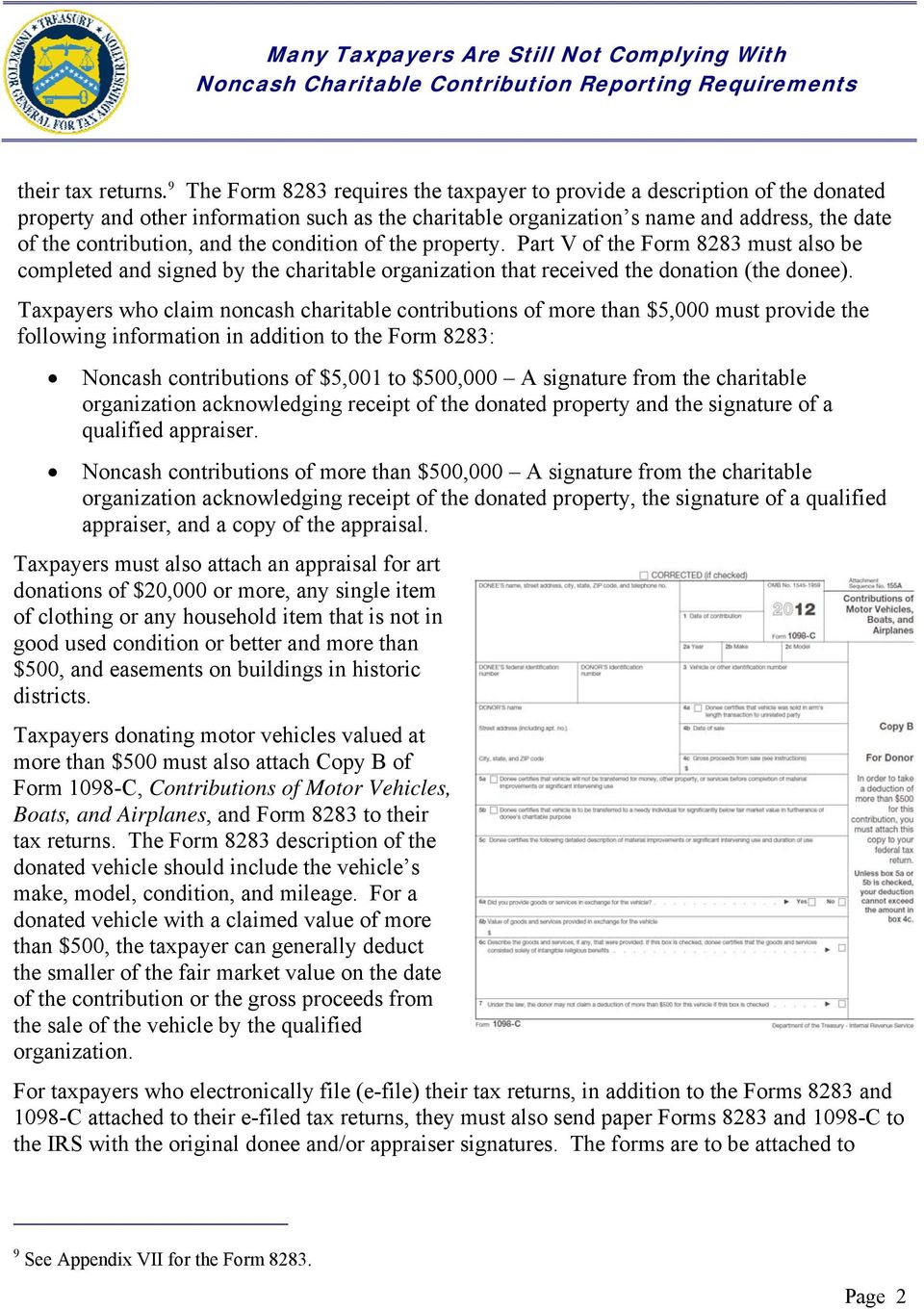
7 their tax returns. 9 The Form 8283 requires the taxpayer to provide a description of the donated property and other information such as the charitable organization s name and address, the date of the contribution, and the condition of the property. Part V of the Form 8283 must also be completed and signed by the charitable organization that received the donation (the donee). Taxpayers who claim noncash charitable contributions of more than $5,000 must provide the following information in addition to the Form 8283: Noncash contributions of $5,001 to $500,000 A signature from the charitable organization acknowledging receipt of the donated property and the signature of a qualified appraiser. Noncash contributions of more than $500,000 A signature from the charitable organization acknowledging receipt of the donated property, the signature of a qualified appraiser, and a copy of the appraisal. Taxpayers must also attach an appraisal for art donations of $20,000 or more, any single item of clothing or any household item that is not in good used condition or better and more than $500, and easements on buildings in historic districts. Taxpayers donating motor vehicles valued at more than $500 must also attach Copy B of Form 1098-C, Contributions of Motor Vehicles, Boats, and Airplanes, and Form 8283 to their tax returns. The Form 8283 description of the donated vehicle should include the vehicle s make, model, condition, and mileage. For a donated vehicle with a claimed value of more than $500, the taxpayer can generally deduct the smaller of the fair market value on the date of the contribution or the gross proceeds from the sale of the vehicle by the qualified organization. For taxpayers who electronically file (e-file) their tax returns, in addition to the Forms 8283 and 1098-C attached to their e-filed tax returns, they must also send paper Forms 8283 and 1098-C to the IRS with the original donee and/or appraiser signatures. The forms are to be attached to 9 See Appendix VII for the Form Page 2
8 Form 8453, U.S. Individual Income Tax Transmittal for an IRS e-file Return, and mailed to the IRS. Congress has previously raised concerns with noncash charitable contributions The Joint Committee on Taxation, at the request of the Senate Finance Committee, issued a report on January 27, 2005, 10 to address members concerns with noncash charitable contributions. The Committee made a number of proposals to reduce the number of improper claims for the noncash charitable contributions deduction. These proposals included: Eliminating the charitable contribution deduction for facade and conservation easements relating to personal residence properties, substantially reducing the deduction for all other qualified conservation contributions, and imposing new standards on appraisals and appraisers regarding the valuation of such contributions. Limiting the tax deduction for charitable contributions of clothing and household items to $500 per taxable year with no carryover of contributions of more than $500. Limiting the deduction for charitable contributions of property to the donor s basis in the property or, if less, the fair market value of the property. Requiring certain professional qualifications for appraisers and establishing uniform appraisal guidelines. Eliminating, in whole or in part, the charitable contribution deduction for property. In March 2007, the Treasury Inspector General for Tax Administration (TIGTA) reported that the IRS needed to take additional actions to identify taxpayers who do not comply with the noncash charitable contribution reporting requirements. 11 The TIGTA has since conducted two additional reviews of the IRS s efforts to ensure taxpayers are complying with the reporting requirements for noncash charitable contributions. 12 In each of the reviews conducted, we reported that the IRS had not implemented adequate controls to identify taxpayers noncompliance with noncash charitable contribution reporting requirements. This review was performed at the Wage and Investment Division Headquarters in Atlanta, Georgia, during the period December 2011 through July The purpose of this review was to determine if the actions taken in response to our prior audit recommendations were effective. We conducted this performance audit in accordance with generally accepted government auditing standards. Those standards require that we plan and perform the audit to obtain sufficient, appropriate evidence to provide a reasonable basis for our findings and 10 Joint Committee on Taxation, Options to Improve Tax Compliance and Reform Tax Expenditures (Jan. 27, 2005). 11 TIGTA, Ref. No , The Internal Revenue Service Needs to Improve Procedures to Identify Noncompliance With the Reporting Requirements for Noncash Charitable Contributions (Mar. 2007). 12 See Appendix V for a list of the reports, with their findings, recommendations, and IRS corrective actions. Page 3

9 conclusions based on our audit objective. We believe that the evidence obtained provides a reasonable basis for our findings and conclusions based on our audit objective. Detailed information on our audit objective, scope, and methodology is presented in Appendix I. Major contributors to the report are listed in Appendix II. Page 4

10 Results of Review The Internal Revenue Service Continues to Allow Unsupported Deductions for Noncash Charitable Contributions An analysis of statistical samples of large-dollar noncash charitable contributions claimed on Tax Year returns showed that the IRS did not effectively identify claims in which the required information was not provided or was incomplete. Approximately 60 percent (303 of 507) of individuals in our statistical samples did not comply with the reporting requirements. These individuals claimed approximately $201.6 million in noncash charitable contributions. 14 Figure 1 provides the results of our analysis. 15 Figure 1: Summary of Taxpayer Errors in Reporting Noncash Charitable Contributions on Tax Year 2010 Returns Taxpayer Errors Contributions of $5,000 to $500,000 Contributions of More Than $500,000 Totals Tax Returns Reviewed Exceptions Error Rate Unsubstantiated Contributions 74% $2.7 million 41% $198.9 million 60% $201.6 million Exception Issues 16 Proper Forms Not Attached Incorrectly Completed Form 8283 Incorrectly Reported Items on Form 8283 Unclear Description of Donated Property Source: TIGTA analysis of noncash charitable contributions more than $5,000 claimed on Tax Year 2010 returns. 13 A 12-month accounting period for keeping records on income and expenses used as the basis for calculating the annual taxes due. For most individual taxpayers, the tax year is synonymous with the calendar year. 14 See Appendix I for sampling details. 15 See Appendix VI for detailed results of the analysis of the statistically valid samples. 16 The number of tax returns will not equal the number of exceptions identified because some tax returns contain more than one error. Page 5

11 Errors included: Forms 8283 or appraisals not attached when required. Incomplete Donee Acknowledgement section and/or Declaration of Appraisal section on Form Incorrectly reported items on Section A of Form 8283 by not combining similar items or reporting non-publicly traded securities. Unclear or incomplete descriptions of the donated property, including donations of securities. Missing or ineligible contribution dates and dates of receipt acknowledged by the charitable organization. We estimate that more than 273,000 taxpayers claimed approximately $3.8 billion in potentially unsubstantiated noncash contributions in Tax Year 2010, which resulted in an estimated $1.1 billion reduction in tax. Since the Joint Committee on Taxation report in January 2005, the IRS has taken a number of steps to improve taxpayers compliance by: Including additional noncash charitable contribution reporting requirements. Revising tax forms and publications. Developing an outreach program for taxpayers and tax practitioners. Implementing checks to ensure that taxpayers include the Form 8283 and other required support with their tax returns. However, the IRS s actions have not been effective at identifying the majority of unsubstantiated noncash charitable contributions by taxpayers during returns processing. Without effective processes to identify individuals who do not comply with noncash charitable contribution reporting requirements, the IRS may be allowing these individuals to inappropriately reduce their tax liabilities and subsequently receive tax refunds to which they are not entitled. The IRS needs to ensure that current processes verify that required documentation for all noncash charitable contributions is present. In addition, the IRS is not effectively using the information on the Form 8283 to identify questionable noncash contributions at the time tax returns are filed. Clarifying taxpayer instructions and revising the Form 8283 can also help improve taxpayer compliance with noncash charitable contribution requirements. Page 6

12 Current processes do not ensure taxpayers provide the Form 8283 or a qualified appraisal when required In March 2007, we reported that additional procedures are needed to identify noncompliance with charitable contribution requirements during returns In general, individuals who claim processing. The IRS responded that it would correspond noncash charitable contributions must provide the following with with taxpayers claiming noncash contributions over a their tax returns: specific dollar threshold but with no Forms 8283 attached to their tax returns. It also stated it would use a specific Noncash contributions of $501 to $5,000 Form 8283 containing a indicator to identify for the Examination function tax description of the donated returns claiming noncash charitable contributions over a property. specific threshold dollar amount but with no Forms Noncash contributions of motor vehicles more than $500 Form 8283 and Form 1098-C. Noncash contributions of $5,001 to $500,000 Form 8283 containing a description of the donated property, a signature from the charitable organization acknowledging receipt of the donated property, and the signature of a qualified appraiser. Noncash contributions of more than $500,000 also require a copy of the appraisal. However, 18 percent (55 of 303) of the errors identified in our statistical samples of noncash charitable contributions of more than $5,000 resulted from missing documents missing Forms 8283, Forms 1098-C, or appraisals. Approximately 65 percent (36 of 55) were filed with paper returns while 35 percent (19 of 55) were e-filed. Processes for verifying tax returns are inconsistent IRS employees review paper-filed tax returns claiming noncash charitable contributions to determine if required information has been included with the tax return. Those above a certain threshold are identified for further actions (either for correspondence with the taxpayer or input of an examination indicator). The dollar thresholds applied and the actions taken differ depending on the IRS function that identified the missing documents. ******************************************2(f)********************************* ******************************************2(f)******************************* ******************************************2(f)****************** All donations of property of more than $500,000 are required to have a qualified appraisal, *** ****************************************2(f)*********************************** *******************************2(f)*****************************. Of the 37 paperfiled tax returns claiming noncash contributions of more than $500,000 that had reporting errors, 54 percent (20 of 37) did not have appraisals attached. *****************2(f)********** **************************************2(f)***********************************. Additionally, although the IRS places specific indicators to identify for the Examination function tax returns claiming noncash charitable contributions over a specific threshold dollar amount but Page 7

13 with no Forms 8283, there is no indication these tax returns are being reviewed by the IRS Examination function. None of the tax returns in our samples had been examined. IRS examination results indicate taxpayers are continuing to claim a significant amount of erroneous deductions for noncash charitable contributions. The IRS is in the process of or has completed at least eight compliance initiatives on noncash charitable contributions. As of April 2012, the IRS reported that it has closed 834 audits as part of these projects with total assessments of approximately $671 million. One project involving the examination of 219 tax returns over a four-year period resulted in 28 percent of the examinations closed with no changes proposed to the tax returns. Seventy-two percent (158 of 219) of the cases were closed with assessments, which totaled in all more than $5 million. The IRS is not using the Form 8283 to more efficiently identify questionable noncash charitable contributions at the time the tax return is processed Although the instructions on the Form 8283 require taxpayers to provide certain information about charitable contributions, the IRS does not capture information from the Form 8283 for paper-filed tax returns. It also does not use information it captures for e-filed tax returns to verify the accuracy of the charitable deduction at the time the tax return is filed. Not capturing key information from the Form 8283 limits the IRS s ability to verify the accuracy of noncash charitable contributions; i.e., it can only perform a manual review of documents. If the IRS captured key information from the Form 8283, it could improve its ability to identify questionable claims for noncash contributions at the time the tax return is filed. Information contained on Form 8283 that could be used to identify questionable charitable donations and improve validation of noncash charitable contributions includes, for example: 17 **************************************2(f)******************************* **************************************2(f)**************************** **************************************2(f)******************************* **************************************2(f)****************************** **************************************2(f)************************* **************************************2(f)*********. **************************************2(f)******************************* **************************************2(f)***************************** **************************************2(f)******************************* **************************************2(f)******************************* **************************************2(f)******************************* **************************************2(f)****. 17 Most tax returns reviewed had more than one error. Page 8

14 *****************************************2(f)************************ *****************************************2(f)**************************** *****************************************2(f)**************************** *****************************************2(f)**************************** *****************************************2(f)**************************** *****************************************2(f)********. **************************************2(f)**************************** **************************************2(f)******************************* **************************************2(f)****************. Revisions to the Form 8283 can also improve the IRS s ability to more efficiently identify questionable noncash charitable contributions The IRS instructs taxpayers claiming charitable contributions of $500 to $5,000 to put the date of contribution on Form The IRS does not require a contribution date for donations of more than $5,000. Instead, the IRS requires the donee to sign and date the Form 8283 acknowledging the receipt of charitable contributions of more than $5,000. If a taxpayer claiming charitable contributions of more than $5,000 submits his or her tax return on paper, the Form 8283 with the donee s signature is attached to the tax return and the IRS can use the acknowledgement to ensure the donation was made in the current tax year. However, a taxpayer who e-files his or her tax return must send the Form 8283 with the donee s signature to the IRS separately on paper to satisfy the IRS s requirement for original signatures. As a result, the donee s acknowledgement for e-filed tax returns is not available at the time the tax return is processed. Because the IRS does not ask the taxpayer to provide the date of contribution for contributions of more than $5,000, it must develop additional processes to ensure that the contribution was made in the current tax year. By revising the Form 8283 to require a date of contribution for all contributions, the IRS will be able to develop a single process to ensure that all contributions are eligible to be deducted in the tax year claimed. Clarifying taxpayer guidance could reduce reporting errors Some taxpayer reporting errors appear to be the result of taxpayer confusion. The Form 8283 instructs taxpayers to combine similar items of property donated to any organization during the tax year. However, the instructions are not clear that donations of like items are to be grouped together regardless of whether the donations were made to the same or different organizations. Of the 303 reporting errors identified, 129 (42.6 percent) involved taxpayers who did not combine like donations. If the like donations had been grouped as required, these taxpayers would have been subjected to additional reporting requirements designed to ensure the eligibility of noncash contributions of Page 9

15 more than $5,000. These additional reporting requirements include providing a written appraisal by a qualified appraiser, the signature of a qualified appraiser, and the signature of the qualified organization acknowledging receipt. Form 8283 instructions also do not ensure the IRS has all the information it needs to verify the eligibility of donations of publicly and non-publicly traded securities. Form 8283 instructions state that taxpayers are to: Describe the property in sufficient detail. The greater the value of the property, the more detail must be provided. For a vehicle, give the year, make, model, condition, and mileage at the time of the donation. For securities, include the name of the issuer, kind of security, whether it is a share of a mutual fund, and whether it s regularly traded on a stock exchange or in an over-the-counter market. However, the instructions do not state that taxpayers should include the number of shares donated when claiming a deduction for publicly and non-publicly traded securities. Without the number of shares, the IRS has no basis to determine if the fair market value of the securities and the resulting deduction is overstated or understated. Of the 507 Tax Year 2010 returns reviewed, 169 included donations of securities. Almost 22 percent (37 of 169) did not include the number of shares donated in the description of the securities. Further analysis found that nearly 18 percent (30 of 169) of tax returns overstated the value of the securities at the time of the donation. The reliability of IRS data for noncash charitable contributions could be improved Noncash charitable contribution data contained in the IRS s Individual Return Transaction File (IRTF) 18 are not always accurate. We conducted basic reliability testing of the data contained on the IRTF as part of our evaluation of taxpayers compliance with noncash contribution reporting requirements. We found the noncash contribution amounts recorded on the IRTF are not always accurate and the dollar amounts of some of the errors are substantial. For example, six tax accounts (two in Processing Year 2012 and four in Processing Year 2011) had noncash charitable contributions recorded on the IRTF that exceeded $1 billion. However, the actual amount of noncash contributions claimed by the taxpayer appears to be significantly less than what is recorded in the IRTF. We estimate the amount of noncash contributions recorded for these six tax accounts is overstated by approximately $88 billion. Government Accountability Office Standards for Internal Control in the Federal Government 19 state that agencies should develop application controls for information systems to help ensure the 18 IRS database that contains information originally filed by the taxpayer and transcribed from Forms 1040, 1040A, and 1040EZ and their accompanying forms and schedules. 19 Government Accountability Office (formerly known as the General Accounting Office), GAO/AIMD , Internal Control: Standards for Internal Control in the Federal Government (Nov. 1999). Page 10
16 completeness, accuracy, and validity of transactions during computer application processing. The IRS has controls in place to identify tax returns where the sum of the charitable contributions reported on Lines 16 through 18 on Schedule A (Form 1040), Itemized Deductions, total contribution amount reported on Line 19 on the Schedule A. These controls should alert the IRS to taxpayer and IRS input errors in recording charitable contributions. IRS employees are to review the return and correct any transcription errors identified. However, it does not appear these corrections are being made. Some taxpayers will likely continue to misreport noncash charitable contributions to reduce their tax liabilities unless the IRS takes steps to ensure taxpayers are complying with reporting requirements. Taxpayers who claim a deduction for noncash charitable contributions that were not made or that were overvalued are inappropriately reducing the amount of tax they must pay resulting in a loss of revenue to the Federal Government. The IRS can significantly improve its ability to detect and prevent improper deductions for noncash charitable contributions by ensuring that all tax returns claiming noncash contributions of more than $500 include a Form 8283 and a qualified appraisal, when required. The IRS can also improve its ability to identify questionable noncash contributions by capturing key information from the Form 8283 and using that information to validate the contribution at the time the tax return is filed. However, the IRS must ensure that the noncash contribution information captured is accurately reflected in its data systems. Without reliable charitable contribution data, IRS program decisions with regard to the processing and verification of noncash charitable contributions as well as efforts to improve the detection of questionable claims may be based on incomplete or inaccurate data. Recommendations The Commissioner, Wage and Investment Division, should: Recommendation 1: Expand current processes to identify all tax returns claiming noncash charitable contributions of more than $500 that do not have a Form 8283 attached to the tax return. The processes should identify all tax returns claiming noncash contributions of more than $500,000 for which a qualified appraisal has not been attached to the tax return. The IRS should request that the taxpayer provide the missing documentation before allowing a deduction for the noncash charitable contributions. Management s Response: The IRS agreed with this recommendation. The IRS will expand its processes to ensure that it identifies tax returns claiming noncash charitable contributions that do not have Form 8283 and/or a qualified appraisal attached, as required by applicable statutory thresholds. Correspondence will be initiated to obtain the missing documents from taxpayers before the applicable charitable contribution deduction is allowed. Page 11

17 Recommendation 2: **********************************2(f)******************* ******************************************2(f)****************************** ******************************************2(f)**************************** ******************************************2(f)*********************. Management s Response: The IRS agreed with this recommendation. **2(f)***** *********************************2(f)******************************* *********************************2(f)*********************************** ***************2(f)***********************. The transcribed data will be available for use by the IRS s existing compliance systems to ascertain compliance with reporting requirements. Recommendation 3: Revise the Form 8283 and related instructions to: 1) require taxpayers to include the contribution date in addition to the Donee Acknowledgment of Receipt for donations of noncash property of more than $5,000; 2) clarify that taxpayers must group similar items and claim the aggregate value of the noncash contributions as deductions regardless of the number of different organizations to which the donations are made; and 3) require taxpayers to include the number of shares donated when reporting contributions of securities. Management s Response: The IRS agreed with this recommendation. Form 8283 will be revised to require inclusion of the contribution date for donations of noncash property valued greater than $5,000. Additionally, the form and its instructions will be revised to clarify the grouping and aggregation of similar items as well as require that the number of shares be reported for donations of securities. Office of Audit Comment: Although the IRS agreed with our recommendation, IRS management did not agree with our $1.1 billion estimate of the potential impact on tax administration of unsubstantiated claims for noncash charitable donations. IRS management stated that an unsubstantiated expense does not automatically equate to an unallowable expense. They also stated that TIGTA did not consider subsequent enforcement activity when computing the outcome measure. However, IRS examination results from compliance initiatives indicate that taxpayers continue to claim a significant amount of erroneous deductions for noncash charitable contributions. Furthermore, none of the tax returns TIGTA reviewed had indications of examination activity. As such, we believe the outcome measure of $1.1 billion in potentially understated tax liabilities due to erroneous deductions for noncash charitable contributions accurately reflects the risk to tax administration associated with unsubstantiated donations. Recommendation 4: Develop a process to verify the accuracy of noncash contribution amounts captured in IRS data systems from individual tax returns. The IRS should also verify the noncash contribution amounts recorded for the tax accounts that the TIGTA identified as being potentially erroneous and make corrections where warranted. Page 12

18 Management s Response: IRS management disagreed with this recommendation. They responded that data validation is performed as each tax return is transcribed into the IRS s automated systems. Procedures require transcribers to correct all input errors; however, in the case of the six accounts identified, the transcribers corrected only the total contributions deduction field. This permitted the affected returns to process with the correct amount of total deductions, taxable income, and tax liability assessed. The IRS has ascertained that each of the amounts is correctly recorded on the Master File, which is the official system of record. Office of Audit Comment: Although we agree that total deductions, taxable income, and tax liability assessed are correctly recorded on the Master File, the Master File does not include information on the portion of total deductions related to noncash charitable contributions. The IRS relies on the information recorded for noncash contributions in the IRTF when evaluating the effectiveness of its noncash contribution compliance activities. Tests showed that noncash charitable contribution data contained in the IRS s IRTF are not always accurate. Therefore, the IRS should take the steps necessary to ensure the information contained in the IRTF accurately reflects the information provided by the taxpayer on his or her tax return. Better Controls Are Needed to Ensure Donations of Motor Vehicles Are Appropriately Reported Test results show that as of December 31, 2011, 89,772 taxpayers had claimed donations of motor vehicles totaling $242.5 million on their Tax Year 2010 returns. Approximately 42 percent (37,554 of 89,772) of the tax returns with Copy B of the Form 1098-C attached did not have a supporting Copy A of Form 1098-C filed with the IRS by the donee or the value of the donation claimed did not agree with IRS records. The IRS instructs donee organizations to furnish Copies B and C of Form 1098-C to the donor, generally no later than 30 days after the date of sale of the donated vehicle. The donee should file Copy A of Form 1098-C with the IRS by February 28, 2013, if submitting on paper, and by April 1, 2013, if submitting electronically. Taxpayers claiming donations of motor vehicles are required to attach Copy B of the Form 1098-C and Form 8283 to their tax returns in order to receive the deduction. IRS instructions also state: Filing deadline approaching and still no Form 1098-C. If the filing deadline is approaching and you still do not have a Form 1098-C, you have two choices. 1. Request an automatic 6-month extension of time to file your return. You can get this extension by filing Form 4868, Application for Automatic Extension of Time Page 13

19 To File U.S. Individual Income Tax Return. For more information, see the instructions for Form File the return on time without claiming the deduction for the qualified vehicle. After receiving the Form 1098-C, file an amended return, Form 1040X, Amended U.S. Individual Income Tax Return, claiming the deduction. Attach Copy B of Form 1098-C (or other statement) to the amended return. The IRS has not established processes to ensure donors or donees are complying with reporting requirements. In September 2009, we reported that taxpayers were not attaching Form 1098-C when claiming donations of motor vehicles. 20 We recommended the IRS develop procedures to capture the information on the Form 1098-C and match the information reported by charities on Forms 1098-C with the information reported on taxpayers tax returns. The IRS disagreed with this recommendation. A match of the Forms 1098-C filed by charitable organizations to Tax Year 2010 returns with Forms 1098-C attached to support donations of motor vehicles identified: 35,846 tax returns had motor vehicle donations claimed as deductions totaling approximately $77 million, but the IRS shows no record of receiving a Form 1098-C from the charitable organization. The unsupported donations could result in a potential loss of tax revenue of approximately $17 million. 1,708 tax returns reported donations for which the fair market values exceeded the sale proceeds by $2.2 million. These overvalued donations could result in a potential loss of tax revenue of approximately $456,000. While the IRS captures information from Forms 1098-C filed electronically by taxpayers, it does not transcribe the Form 1098-C for paper tax returns and does not match the taxpayer s Copy B of Form 1098-C to the taxpayer s Form This would allow the IRS to identify questionable donations of motor vehicles by taxpayers. The IRS also does not match the taxpayer s Copy B of the Form 1098-C to Copy A filed by the charitable organization. Matching the information reported by charities on Forms 1098-C with the information on taxpayers tax returns would help identify charities that do not provide the required documentation to donors and to the IRS. Recommendations The Commissioner, Wage and Investment Division, should: 20 TIGTA, Ref. No , Procedures to Address Noncompliance with the Reporting Requirements for Contributions of Motor Vehicles Continue to be Inadequate (Sept. 2009). Page 14

20 Recommendation 5: Match Copy B of Forms 1098-C submitted by taxpayers with their tax returns to the Forms 1098-C filed by charitable organizations to identify taxpayers who are claiming motor vehicle donations for more than the value reported by the charitable organization to identify questionable claims for motor vehicle contributions and take appropriate action to adjust the taxpayer s deduction for noncash charitable contributions accordingly. Management s Response: IRS management disagreed that the recommended action will be effective in identifying questionable deductions for the donated vehicles. Copy B of Form 1098-C is a supporting document only. ****************2(f)******** ******************************************2(f)*************************** *********************************2(f)*************. **************************************2(f)************************* **************************************2(f)**************************** **************************************2(f)******************************* **************************************2(f)******************************* **************************************2(f)****************************** **************************************2(f)******************************* **************************************2(f)******************************* **************************************2(f)**********. Office of Audit Comment: Our recommendation to match Copies A and B of the Form 1098-C is consistent with the IRS s Information Reporting and Document Matching program. In this program, the IRS matches copies of similar information reporting documents to help increase voluntary compliance and improve collections. In addition, the IRS stated that it is unable to determine the amount of noncash charitable donations claimed on Schedule A that is attributable to motor vehicle donations. Taxpayers must file a Form 8283 in addition to the Schedule A when claiming a motor vehicle donation. In their response to Recommendation 2 of this report, IRS management agreed to transcribe information from the Form This will enable the IRS to identify taxpayers who donate motor vehicles and match Copies A and B of Form 1098-C to ensure taxpayers claims for motor vehicle donations are substantiated by a charitable organization and the value of the donations claimed is accurate. Recommendation 6: Coordinate with the Commissioner, Tax Exempt and Government Entities Division, to develop a process to identify charitable organizations that did not file a Form 1098-C for a motor vehicle donation as required and take appropriate action to ensure the organization is in compliance. Management s Response: The IRS partially agreed with this recommendation. It responded that the Tax Exempt and the Government Entities Division has a vigorous outreach program in place to advise donor organizations of IRS filing requirements. It will continue to monitor whether program enhancements are needed. Page 15

21 Detailed Objective, Scope, and Methodology Appendix I Our overall objective was to assess IRS actions to ensure taxpayers are complying with the reporting requirements for claiming noncash charitable contributions. To accomplish our objective, we: I. Determined whether the IRS implemented appropriate corrective actions to address recommendations made in prior TIGTA reports. II. III. A. Determined the status of the corrective actions from prior TIGTA reviews. 1. Determined whether the IRS used math error authority to deny claims for noncash charitable contributions by identifying tax returns claiming motor vehicles that do not have the required supporting documentation attached. 2. Determined whether the IRS corresponded with taxpayers who claimed noncash charitable contributions greater than $50, Determined whether the IRS supplemented its outreach plan by promoting awareness of increased reporting requirements and responsibilities. Determined whether the IRS has processes to ensure individuals claiming noncash charitable contributions complied with the reporting requirements. A. Reviewed guidelines, interviewed management, and determined the reporting requirements for noncash charitable contributions. B. Reviewed Form 8283, Noncash Charitable Contributions, to assess the usefulness of the information requested from the taxpayer to identify noncompliance. C. Determined whether the IRS captured reporting requirements information to ensure individuals complied with these requirements. D. Determined whether the IRS used reporting requirements information to identify and stop potential erroneous noncash charitable contributions. Assessed the effectiveness of IRS processes and procedures to identify questionable noncash charitable contributions. A. Selected a statistically valid sample of 150 e-filed tax returns with noncash charitable contributions between $5,000 and $500,000 from a population of 276,942 e-filed tax Page 16
22 returns in Tax Year and determined whether taxpayers complied with the reporting requirements. We used attribute sampling to calculate the minimum sample size. n = (Z 2 p(1-p))/(a 2 +(Z 2 p(1-p)/n)) Z = Confidence Level: 90 percent (expressed as standard deviation) p = Expected Rate of Occurrence: 5 percent A = Precision Rate: ±3 percent N = Population: 276,942 B. Using the statistical sample in Step III.A., determined whether individuals complied with filing and documentation requirements. 1. Identified all individuals who claimed noncash contributions but did not submit a Form 8453, U.S. Individual Income Tax Transmittal for an IRS e-file Return. 2. Determined whether Form 8283 was signed by the appraiser and donee. C. Selected a statistically valid sample of 130 e-filed tax returns with noncash contributions more than $500,000 from a population of 857 e-filed tax returns in Tax Year 2010 and determined whether taxpayers complied with the reporting requirements. We used attribute sampling to calculate the minimum sample size. n = (Z 2 p(1-p))/(a 2 +(Z 2 p(1-p)/n)) Z = Confidence Level: 90 percent (expressed as standard deviation) p = Expected Rate of Occurrence: 5 percent A = Precision Rate: ±3 percent N = Population: 857 D. Using the statistical sample in Step III.C., determined whether individuals complied with filing and documentation requirements. 1. Identified all individuals who claimed noncash contributions but did not submit a Form Determined whether Forms 8283 were signed by the appraiser and donee. 3. Determined whether an appraisal was attached to the tax return. E. Selected a statistically valid sample of 150 paper-filed tax returns 2 with noncash contributions between $5,000 and $500,000 from a population of 85,034 paper-filed 1 A 12-month accounting period for keeping records on income and expenses used as the basis for calculating the annual taxes due. For most individual taxpayers, the tax year is synonymous with the calendar year. 2 We reviewed 137 of the 150 tax returns. The remaining 13 tax returns were unavailable for review because the returns were not received when requested or had been assigned to an IRS employee for action. Page 17
23 tax returns in Tax Year 2010 and determined whether taxpayers complied with the reporting requirements. We used attribute sampling to calculate the minimum sample size. IV. n = (Z 2 p(1-p))/(a 2 +(Z 2 p(1-p)/n)) Z = Confidence Level: 90 percent (expressed as standard deviation) p = Expected Rate of Occurrence: 5 percent A = Precision Rate: ±3 percent N = Population: 85,034 F. Using the statistical sample in Step III.D., determined whether individuals complied with filing and documentation requirements, by determining whether Forms 8283 were signed by the appraiser and donee when an item was valued greater than $5,000. G. Selected a statistically valid sample of 120 paper-filed tax returns 3 with noncash contributions of more than $500,000 from a population of 516 paper-filed tax returns in Tax Year 2010 and determined whether taxpayers were complying with the reporting requirements. We used attribute sampling to calculate the minimum sample size. N = (Z 2 p(1-p))/(a 2 +(Z 2 p(1-p)/n)) Z = Confidence Level: 90 percent (expressed as standard deviation) p = Expected Rate of Occurrence: 5 percent A = Precision Rate: ±3 percent N = Population: 516 H. Using the statistical sample in Step III.G., determined whether individuals complied with filing and documentation requirements. 1. Determined whether Forms 8283 were signed by the appraiser and donee. 2. Determined whether an appraisal was attached to the tax return. Assessed the effectiveness of IRS processes and procedures to identify erroneous noncash charitable contribution claims for donated vehicles. 1. Reviewed guidelines and determined the reporting requirements for Form 1098-C, Contributions of Motor Vehicles, Boats, and Airplanes. 2. Determined whether the IRS captured and used information provided by charitable organizations to validate 1098-C information reported on tax returns. 3 We reviewed 90 of the 120 tax returns. The remaining 30 tax returns were unavailable for review because the returns were not received when requested, had been assigned to an IRS employee, or did not meet our sample criteria. Page 18
24 3. Matched the Information Return Processing System data to the information on the taxpayer s tax return and identified 1098-C discrepancies between what the organization reported to the IRS and what the taxpayer claimed on his or her tax return. V. Determined whether the IRS has compliance programs to identify tax returns with questionable noncash charitable contributions. 1. Reviewed guidelines and determined how the IRS monitors reporting compliance for noncash contributions. 2. Reviewed available documentation and assessed the effectiveness of compliance activities. 3. Determined whether the IRS has any specific compliance initiatives or other projects for assessing noncash charitable contributions and their results. Internal controls methodology Internal controls relate to management s plans, methods, and procedures used to meet their mission, goals, and objectives. Internal controls include the processes and procedures for planning, organizing, directing, and controlling program operations. They include the systems for measuring, reporting, and monitoring program performance. We determined the following internal controls were relevant to our audit objective: the processes to ensure individuals claiming noncash charitable contributions complied with reporting requirements. We evaluated the controls by reviewing applicable documentation to identify questionable noncash charitable contributions and stop erroneous noncash charitable contribution claims. The TIGTA s contract statistician assisted with developing projections of potentially unsubstantiated claims for deductions of noncash charitable contributions. Page 19
25 Major Contributors to This Report Appendix II Augusta R. Cook, Acting Assistant Inspector General for Audit (Returns Processing and Account Services) Russell P. Martin, Director Deann Baiza, Acting Director Edward Gorman, Audit Manager Kimberly Parmley, Audit Manager Sandra L. Hinton, Senior Auditor Lawrence Smith, Senior Auditor Stephen Elix, Auditor Denise Gladson, Auditor Marcus Sloan, Auditor Page 20
26 Report Distribution List Appendix III Commissioner C Office of the Commissioner Attn: Chief of Staff C Assistant Deputy Commissioner for Services and Enforcement SE Commissioner, Small Business/Self-Employed Division SE:S Commissioner, Tax Exempt and Government Entities Division SE:T Deputy Commissioner, Services and Operations, Wage and Investment Division SE:W Chief Counsel CC National Taxpayer Advocate TA Director, Office of Legislative Affairs CL:LA Director, Office Program Evaluation and Risk Analysis RAS:O Office of Internal Control OS:CFO:CPIC:IC Audit Liaisons: Deputy Commissioner for Services and Enforcement SE Commissioner, Small Business/Self-Employed Division SE:S Commissioner, Tax Exempt and Government Entities Division SE:T Chief, Program Evaluation and Improvement, Wage and Investment Division SE:W:S:PEI Page 21
27 Outcome Measures Appendix IV This appendix presents detailed information on the measurable impact that our recommended corrective actions will have on tax administration. These benefits will be incorporated into our Semiannual Report to Congress. Type and Value of Outcome Measure: Revenue Protection Potential; $1,094,559,542 in potential tax revenue loss to the Federal Government as a result of 273,704 taxpayers claiming deductions for unsubstantiated noncash charitable donations (see page 5). Methodology Used to Measure the Reported Benefit: We conducted a review of four statistically valid samples of Tax Year returns with noncash charitable contribution claims of more than $5,000. We used attribute sampling to calculate the minimum sample size. n = (Z 2 p(1-p))/(a 2 +(Z 2 p(1-p)/n)) Z = Confidence Level: p = Expected Rate of Occurrence: A = Precision Rate: Figure 1 presents the results of our review. 90 percent (expressed as standard deviation) 5 percent ±3 percent Figure 1: Review of Noncash Charitable Contributions Type of Review Population of Tax Returns Number of Tax Returns Reviewed Number of Tax Returns With Compliance Issues E-filed returns with noncash contributions between $5,000 and $500,000 E-filed returns with noncash contributions more than $500, , % Error Rate 53 41% Error Rate 1 A 12-month accounting period for keeping records on income and expenses used as the basis for calculating the annual taxes due. For most individual taxpayers, the tax year is synonymous with the calendar year. Page 22
28 Type of Review Population of Tax Returns Number of Tax Returns Reviewed Number of Tax Returns With Compliance Issues Paper-filed returns with noncash contributions between $5,000 and $500,000 Paper-filed returns with noncash contributions more than $500,000 Source: TIGTA review of statistically valid samples. 85, % Error Rate 37 41% Error Rate We projected the results of our statistical sample review results using a 95 percent confidence level to estimate the potential number of taxpayers who did not comply with reporting requirements for noncash charitable contributions in Tax Year Figure 2 shows the details of our sample projections. Figure 2: Projection of Questionable Noncash Charitable Contributions Potential Number of Taxpayers Potential Erroneous Noncash Charitable Contributions Claimed Type of Review Lower Limit Point Estimate Upper Limit Lower Limit Point Estimate Upper Limit E-filed between $5,000 and $500,000 E-filed more than$500, , , ,125 $1,671,205,815 $1,980,866,427 $2,290,527, $327,304,028 $504,373,322 $681,442,615 Paper-filed between $5,000 and 54,383 60,827 67,271 $425,623,456 $731,046,116 $1,036,468,776 $500,000 Paper-filed more than $265,908,176 $623,198,169 $980,488,161 $500,000 Totals 248, , ,066 $2,690,041,475 $3,839,484,034 $4,988,926,590 Page 23
29 Source: Joseph L. Katz, Ph.D., Contractor, Statistical Sampling Consultant. We computed the total number of taxpayers who did not comply with the noncash charitable contribution reporting requirements and questionable charitable contributions by summing the statistical projections for each of our samples. We computed the estimated tax revenue lost as a result of taxpayers noncompliance using the following steps for each of our four statistical samples. 1. Computed the average Taxable Income (Line 43 of Form 1040, U.S. Individual Income Tax Return) reported on the exception cases. 2. Determined the most frequent Filing Status. 3. Identified the marginal tax rate applicable for the average Taxable Income and most frequently used Filing Status using the tax rate tables. 4. Multiplied the projected questionable noncash charitable contributions claimed by the applicable marginal tax rate. We then summed the estimated tax revenue lost for each of our samples to compute the total tax revenue we estimate the IRS lost as a result of taxpayers noncompliance with noncash charitable contribution reporting requirements. Figure 3 presents the details of our estimate of lost tax revenue. Figure 3: Estimated Tax Revenue Lost From Noncash Charitable Contributions Type of Review Average Taxable Income Most Frequent Filing Status Marginal Tax Rate Estimated Lost 2 Tax Revenue E-filed between $5,000 and $500,000 E-filed more than $500,000 Paper-filed between $5,000 and $500,000 Paper-filed more than $500,000 $107, % $495,216,607 $5,440, % $176,530,663 $146, % $204,692,913 $3,233, % $218,119,359 Total $1,094,559,542 Source: TIGTA analysis of statistically valid samples. 2 Rounded to the nearest whole dollar. 3 Filing Status 2 Married Filing Jointly. Page 24
30 Type and Value of Outcome Measure: Reliability of Information Potential; $87,966,530,511 in noncash charitable contributions that are incorrectly recorded in the IRS s IRTF 4 (see page 5). Methodology Used to Measure the Reported Benefit: We conducted basic reliability testing of the data contained in the IRS s IRTF as part of our evaluation of taxpayers compliance with noncash contribution reporting requirements. We identified six tax accounts, four in Processing Year and two in Processing Year 2012, where the IRTF shows noncash charitable contributions of more than $1 billion claimed by the taxpayer. To determine if the amount recorded for noncash contributions was valid, we compared the sum of cash, noncash, and prior year carryover contributions recorded in the IRTF to the total amount of contributions recorded for each of these six tax accounts. Our analysis showed that in all six tax accounts, the amount of noncash contributions significantly exceeds total contributions recorded in the IRTF. Further research of these six tax accounts on the Integrated Data Retrieval System 6 shows the amount of noncash contributions recorded in the IRTF may be overstated by $87,966,530,511. Type and Value of Outcome Measure: Revenue Protection Potential; $16,635,985 in potential tax revenue loss to the Federal Government as a result of 35,846 taxpayers claiming deductions for unsubstantiated donations of motor vehicles (see page 13). Methodology Used to Measure the Reported Benefit: We identified 89,772 Tax Year 2010 returns on the IRS Tax Return Database 7 that claimed a noncash charitable deduction of at least $500 and had a Form 1098-C, Contributions of Motor Vehicles, Boats, and Airplanes, attached to the tax return. We matched the 89,772 tax returns to third-party information documents on the IRS Information Returns Master File 8 to determine if the charitable organization had filed a Form 1098-C with the IRS as required. Our analysis identified 35,846 tax returns claiming deductions for 36,397 donations where the charitable organization had not filed a Form 1098-C with the IRS for the donation. The fair market values claimed for the 36,397 donations totaled $77,169, IRS database that contains information originally filed by the taxpayer and transcribed from Forms 1040, 1040A, and 1040EZ and their accompanying forms and schedules. 5 The calendar year in which the tax return or document is processed by the IRS. 6 Computer application consisting of databases and operating programs that support IRS employees working active tax cases within each business function across the entire IRS. 7 A relational database that stores tax return information submitted by the taxpayer. 8 A database containing all information returns transcribed by the IRS. Page 25
31 We computed the net tax effect of the unsupported motor vehicle donations as follows: 1. Computed the marginal tax rate applicable to each of the 35,846 tax returns using the tax return information available in the IRTF. 2. Applied the marginal tax rate computed for each of the 35,846 tax returns to the amount claimed for motor vehicle donations on each tax return. 3. Computed the total net tax effect for the 35,846 tax returns by summing the net tax effect computed on each tax return. Type and Value of Outcome Measure: Revenue Protection Potential; $456,201 in potential tax revenue loss to the Federal Government as a result of 1,708 taxpayers claiming fair market values for donations of motor vehicles in excess of the sales proceeds realized by the charitable organization (see page 13). Methodology Used to Measure the Reported Benefit: We identified 89,772 Tax Year 2010 returns on the IRS Tax Return Database that claimed a noncash charitable deduction of at least $500 and had a Form 1098-C attached to the tax return. We matched the 89,772 tax returns to third-party information documents on the IRS Information Returns Master File to determine if the charitable organization had filed a Form 1098-C with the IRS as required. Our analysis identified 37,573 tax returns where IRS data indicated the charitable organization had filed a Form 1098-C. We then matched the value of the donation claimed on the tax return to the sale proceeds reported by the charitable organization on Form 1098-C. Our analysis identified 1,708 taxpayers who claimed a fair market value for the motor vehicle that was in excess of the sale proceeds reported by the charitable organization. The fair market value of the donations claimed exceeded the sale proceeds by $2,224,572. We computed the net tax effect of the overvalued donations as follows: 1. Computed the marginal tax rate applicable to each of the 1,708 tax returns using the tax return information available in the Tax Return Data Base. 2. Applied the marginal tax rate computed for each of the 1,708 tax returns to the amount claimed for motor vehicle donations on each tax return. 3. Computed the total net tax effect for the 1,708 tax returns by summing the net tax effect computed on each tax return. Page 26
32 Appendix V Treasury Inspector General for Tax Administration Reports on Compliance With Noncash Charitable Contribution Reporting Requirements Report Number Findings Recommendations Corrective Actions Taxpayers are not complying with requirements for claiming motor vehicles as charitable contribution deductions. Ensure tax returns without required substantiation for charitable contributions of motor vehicles are processed pursuant to math error authority. The IRS agreed to use math error authority to deny claims for charitable contributions of motor vehicles when the supporting documentation is not submitted with the return. The IRS disagreed that matching the information reported by charities on Form 1098-C with the information on taxpayers tax returns would yield good results IRS procedures are inadequate to ensure taxpayers meet the requirements for deducting charitable contributions of motor vehicles. Ensure all Forms 1098-C 2 are transcribed and develop procedures to match the information reported by charities on Forms 1098-C with the information reported on taxpayers returns. Use outreach to ensure that charities are filing Form 1098-C with the IRS for each donated motor vehicle more than $500. Develop a comprehensive outreach plan. The IRS disagreed that outreach, educational material, and other methods were needed. Taxpayers and tax practitioners need to be better educated concerning requirements for claiming charitable contributions. The IRS agreed to supplement its outreach plan by promoting awareness of increased reporting requirements and responsibilities Procedures need to be established to identify noncompliance with charitable contribution requirements during returns processing. Develop procedures to address returns without required substantiation for noncash charitable contributions. The IRS partially agreed and will correspond with taxpayers claiming a noncash contribution more than $50, TIGTA, Ref. No , Procedures to Address Noncompliance With the Reporting Requirements for Contributions of Motor Vehicles Continue to Be Inadequate (Sept. 2009). 2 Contributions of Motor Vehicles, Boats, and Airplanes. 3 TIGTA, Ref. No , The Internal Revenue Service Needs to Improve Procedures to Identify Noncompliance With the Reporting Requirements for Noncash Charitable Contributions (Mar. 2007). Page 27
33 Report Number Findings Recommendations Corrective Actions Taxpayers and tax practitioners need to be better educated concerning requirements for claiming motor vehicle donations. The IRS should coordinate with the other responsible operating divisions to develop a comprehensive outreach plan on the reporting requirements for motor vehicle donations for affected taxpayers and tax practitioners. The IRS did not agree that a comprehensive outreach plan is needed at this time. The IRS believes the timing of the audit contributed to the issues noted in the report because the scope included returns filed during the first year in which the reporting requirements took effect. Additional procedures need The IRS should take the At the time of the report, the IRS to be established to identify following actions to address did not agree to lower the dollar noncompliance with motor returns without required threshold. vehicle donation requirements during returns processing. Source: Prior TIGTA audit reports. substantiation for charitable contributions of motor vehicles: a) lower the dollar threshold to ensure most of the returns claiming unsubstantiated deductions are addressed; b) correspond with taxpayers to obtain missing Forms and supporting documentation; As agreed in its response to the prior audit, the Submission Processing function will continue to correspond with taxpayers claiming a noncash charitable contribution greater than a specific threshold dollar amount and missing Forms c) input a specific audit code on As agreed in its response to the tax returns that fail to provide prior audit, in January 2008, the missing Forms and Submission Processing function substantiation to alert the will begin assigning an audit Examination function of returns indicator to returns claiming a without required substantiation charitable contribution of donated for charitable contributions of vehicles greater than a specific motor vehicles. threshold dollar amount and missing Forms TIGTA, Ref. No , Improved Procedures Are Needed to Identify Noncompliance With the Reporting Requirements for Contributions of Motor Vehicles (Sept. 2007). 5 Noncash Charitable Contributions. Page 28
34 Appendix VI Analysis of Statistically Valid Samples From Tax Year 2010 Returns With Noncash Charitable Contributions Claimed As Deductions Type of Tax Return Sampled E-Filed $5,000 to $500,000 E-Filed More Than $500,000 Paper-Filed $5,000 to $500,000 Paper-Filed More Than $500,000 Number of Returns Reviewed Total Noncash Contributions Claimed As Deductions $2.0 million $162.8 million $3.2 million $175.2 million Number of Returns With Errors Error Rate 77% 41% 72% 41% Erroneous Contributions Claimed Estimated Number of Individuals Claiming Erroneous Contributions Estimated Erroneous Contributions Claimed $1.1 million $77.3 million $1.6 million $121.6 million 212, , $2.0 billion $504.4 million $731.0 million $623.2 million Types of Errors (some tax returns have multiple errors) Missing Forms Missing Forms 1098-C Missing Appraisal Unclear Valuation Method Incomplete Donee Acknowledgement Incomplete Declaration of Appraisal Noncash Charitable Contributions. 2 Contributions of Motor Vehicles, Boats, and Airplanes. Page 29
35 Type of Tax Return Sampled E-Filed $5,000 to $500,000 E-Filed More Than $500,000 Paper-Filed $5,000 to $500,000 Paper-Filed More Than $500,000 Incorrectly Reported Items on Section A of Form Unclear Description of Property Missing Contribution Dates or Donee Dates of Receipt Overstated the Value of the Property Source: TIGTA analysis of statistically valid samples Page 30
36 Appendix VII Form 8283, Noncash Charitable Contributions Page 31
37 Source: IRS.gov. Page 32
38 Appendix VIII Management s Response to the Draft Report Page 33
39 Page 34
40 RECOMMENDATIONS The Commissioner, Wage and Investment Division, should: Attachment RECOMMENDATION 1 Expand current processes to identify all tax returns claiming noncash charitable contributions of more than $500 that do not have a Form 8283 attached to the tax return. The processes should identify all tax returns claiming noncash contributions more than $500,000 for which a qualified appraisal has not been attached to the tax return. The IRS should request that the taxpayer provide the missing documentation before allowing a deduction for the noncash charitable contributions. CORRECTIVE ACTION We will expand our processes to ensure that we identify tax returns claiming noncash charitable contributions that do not have Form 8283, Noncash Charitable Contributions, and/or a qualified appraisal attached, as required by applicable statutory thresholds. Correspondence will be initiated to obtain the missing documents from taxpayers before the applicable charitable contribution deduction is allowed. IMPLEMENTATION DATE January 15, 2014 RESPONSIBLE OFFICIAL Director, Submission Processing, Customer Account Services, Wage and Investment Division CORRECTIVE ACTION MONITORING PLAN We will monitor this corrective action as part of our internal management control system. RECOMMENDATION 2 ***********************************2(f)**************************** ***********************************2(f)*********************************** ** ***********************************2(f)*********************************** * ***********************************2(f)******************. CORRECTIVE ACTION ************************************2(f)********************************** **************************************2(f)******************************** *****************2(f)*******************************. The transcribed data will be available for use by our existing compliance systems to ascertain taxpayer compliance with reporting requirements. Page 35
41 Page 36
42 CORRECTIVE ACTION Data validation is performed as each tax return is transcribed into our automated systems. Procedures require transcribers to correct all input errors; however, in the case of the six accounts identified, the transcribers corrected only the total contributions deduction field. This permitted the affected returns to process with the correct amount of total deductions, taxable income, and tax liability assessed. Only the total deduction amounts, which were validated, were passed to downstream systems. Each of the accounts has been reviewed and it has been ascertained they are correctly recorded on the Master File, which is the official system of record. IMPLEMENTATION DATE N/A RESPONSIBLE OFFICIAL N/A CORRECTIVE ACTION MONITORING PLAN N/A RECOMMENDATIONS The Commissioner, Wage and Investment Division, should: 3 RECOMMENDATION 5 Match Copy B of Forms 1098-C submitted by taxpayers with their tax returns to the Forms 1098-C filed by charitable organizations to identify taxpayers who are claiming motor vehicle donations for more than the value reported by the charitable organization to identify questionable claims for motor vehicle contributions and take appropriate action to adjust the taxpayer's deduction for noncash charitable contributions accordingly. CORRECTIVE ACTION We disagree that the recommended action will be effective in identifying questionable deductions for the donation of motor vehicles. Copy B of Form 1098-C, Contributions of Motor Vehicles, Boats, and Airplanes, is a supporting document only. ******2(f)********* *************************************2(f)********************************* * *************************************2(f)*************************** *************************************2(f)********************************* ***************************************2(f)******************************* *****************************************2(f)***************************** *******************************************2(f)***** Page 37
43 4 *******************************************************************2(f)*** *********************************************************************2(f)* ********************************************************2(f)************** *********. IMPLEMENTATION DATE N/A RESPONSIBLE OFFICIAL N/A CORRECTIVE ACTION MONITORING PLAN N/A RECOMMENDATION 6 Coordinate with the Commissioner, Tax Exempt and Government Entities Division, to develop a process to identify charitable organizations that did not file a Form 1098-C for a motor vehicle donation as required and take appropriate action to ensure the organization is in compliance. CORRECTIVE ACTION The Tax Exempt and Government Entities Division has a vigorous outreach program in place to advise donor organizations of their filing requirements. We will continue to monitor whether program enhancements are needed. IMPLEMENTATION DATE N/A RESPONSIBLE OFFICIAL N/A CORRECTIVE ACTION MONITORING PLAN N/A Page 38
TREASURY INSPECTOR GENERAL FOR TAX ADMINISTRATION
 TREASURY INSPECTOR GENERAL FOR TAX ADMINISTRATION Millions of Dollars in Potentially Improper Claims for the Qualified Retirement Savings Contributions Credit Are Not Pursued March 26, 2014 Reference Number:
TREASURY INSPECTOR GENERAL FOR TAX ADMINISTRATION
 TREASURY INSPECTOR GENERAL FOR TAX ADMINISTRATION All Individual Tax Returns Filed Electronically in the 2013 Filing Season Were Processed Using the Modernized e-file System September 27, 2013 Reference
TREASURY INSPECTOR GENERAL FOR TAX ADMINISTRATION
 TREASURY INSPECTOR GENERAL FOR TAX ADMINISTRATION Results of the 2015 Filing Season August 31, 2015 Reference Number: 2015-40-080 This report has cleared the Treasury Inspector General for Tax Administration
TREASURY INSPECTOR GENERAL FOR TAX ADMINISTRATION
 TREASURY INSPECTOR GENERAL FOR TAX ADMINISTRATION The Correspondence Audit Selection August 27, 2013 Reference Number: 2013-30-077 This report has cleared the Treasury Inspector General for Tax Administration
TREASURY INSPECTOR GENERAL FOR TAX ADMINISTRATION
 TREASURY INSPECTOR GENERAL FOR TAX ADMINISTRATION Inappropriate Criteria Were Used to May 14, 2013 Reference Number: 2013-10-053 This report has cleared the Treasury Inspector General for Tax Administration
TREASURY INSPECTOR GENERAL FOR TAX ADMINISTRATION
 TREASURY INSPECTOR GENERAL FOR TAX ADMINISTRATION Fiscal Year 2015 Statutory Review of Restrictions on Directly Contacting Taxpayers July 7, 2015 Reference Number: 2015-30-061 This report has cleared the
TREASURY INSPECTOR GENERAL FOR TAX ADMINISTRATION
 TREASURY INSPECTOR GENERAL FOR TAX ADMINISTRATION The External Leads Program Results in the Recovery of Erroneously Issued Tax Refunds; However, Improvements Are Needed to Ensure That Leads Are Timely
PARTNERSHIPS AND S CORPORATIONS. IRS Needs to Improve Information to Address Tax Noncompliance
 United States Government Accountability Office Report to the Chairman, Committee on Finance, U.S. Senate May 2014 PARTNERSHIPS AND S CORPORATIONS IRS Needs to Improve Information to Address Tax Noncompliance
TREASURY INSPECTOR GENERAL FOR TAX ADMINISTRATION
 TREASURY INSPECTOR GENERAL FOR TAX ADMINISTRATION Fiscal Year 2015 Statutory Review of Compliance With Legal Guidelines When Issuing Levies June 18, 2015 Reference Number: 2015-30-058 This report has cleared
TREASURY INSPECTOR GENERAL FOR TAX ADMINISTRATION
 TREASURY INSPECTOR GENERAL FOR TAX ADMINISTRATION Revenue Officers Took Appropriate Levy Actions but Face Challenges and Delays Bringing Taxpayers Into Compliance November 21, 2011 Reference Number: 2012-30-007
TREASURY INSPECTOR GENERAL FOR TAX ADMINISTRATION
 TREASURY INSPECTOR GENERAL FOR TAX ADMINISTRATION Affordable Care Act: Tracking of Health Insurance Reform Implementation Fund Costs Could Be Improved September 18, 2013 Reference Number: 2013-13-115 This
TREASURY INSPECTOR GENERAL FOR TAX ADMINISTRATION
 TREASURY INSPECTOR GENERAL FOR TAX ADMINISTRATION Accounting and Controls Need to Be Improved for Excess Collections December 15, 2015 Reference Number: 2016-30-005 This report has cleared the Treasury
TREASURY INSPECTOR GENERAL FOR TAX ADMINISTRATION
 TREASURY INSPECTOR GENERAL FOR TAX ADMINISTRATION Procedures Need to Be Updated to Ensure Proper Determinations of Tax Relief for Taxpayers Affected by Disasters February 16, 2012 Reference Number: 2012-40-015
TREASURY INSPECTOR GENERAL FOR TAX ADMINISTRATION
 TREASURY INSPECTOR GENERAL FOR TAX ADMINISTRATION Processes Are Needed to Link Third-Party Payers and Employers to Reduce Risks Related to Employment Tax Fraud March 2, 2015 Reference Number: 2015-40-023
TREASURY INSPECTOR GENERAL FOR TAX ADMINISTRATION
 TREASURY INSPECTOR GENERAL FOR TAX ADMINISTRATION The Internal Revenue Service September 14, 2010 Reference Number: 2010-10-115 This report has cleared the Treasury Inspector General for Tax Administration
TREASURY INSPECTOR GENERAL FOR TAX ADMINISTRATION
 TREASURY INSPECTOR GENERAL FOR TAX ADMINISTRATION Direct Debit Installment Agreement Procedures Addressing Taxpayer Defaults Can Be Improved February 5, 2016 Reference Number: 2016-30-011 This report has
TREASURY INSPECTOR GENERAL FOR TAX ADMINISTRATION
 TREASURY INSPECTOR GENERAL FOR TAX ADMINISTRATION Improvements Can Be Made to Educate and Notify Taxpayers of Required Minimum Distribution Requirements From Individual Retirement Arrangements May 29,
TREASURY INSPECTOR GENERAL FOR TAX ADMINISTRATION
 TREASURY INSPECTOR GENERAL FOR TAX ADMINISTRATION Some Tax-Exempt Organizations Have July 3, 2014 Reference Number: 2014-10-012 This report has cleared the Treasury Inspector General for Tax Administration
TREASURY INSPECTOR GENERAL FOR TAX ADMINISTRATION
 TREASURY INSPECTOR GENERAL FOR TAX ADMINISTRATION Most Tax Returns Prepared by a Limited Sample of Unenrolled Preparers Contained Significant Errors September 3, 2008 Reference Number: 2008-40-171 This
How To Write A Report On The Recovery Act Of 2009
 TREASURY INSPECTOR GENERAL FOR TAX ADMINISTRATION RECOVERY ACT Initial Published Guidance for American Recovery and Reinvestment Act of 2009 Bonds Was Complete, Accurate, and Consistent March 16, 2010
GAO VEHICLE DONATIONS. Selected Charities Reported Mixed Experiences after Changes in Vehicle Donation Rules
 GAO United States Government Accountability Office Report to the Chairman, Subcommittee on Select Revenue Measures, Committee on Ways and Means, House of Representatives February 2008 VEHICLE DONATIONS
Instructions for Form 8283 (Rev. December 2014)
 Instructions for Form 8283 (Rev. December 2014) Noncash Charitable Contributions Department of the Treasury Internal Revenue Service Section references are to the Internal Revenue Code unless otherwise
How To Identify And Prevent Tax Fraud
 TREASURY INSPECTOR GENERAL FOR TAX ADMINISTRATION Detection Has Improved; However, Identity Theft Continues to Result in Billions of Dollars in Potentially Fraudulent Tax Refunds September 20, 2013 Reference
April 2004. Reference Number: 2004-40-088
 Information Is Needed to Determine the Effect the Wage and Investment Division Research Program Has on Improving Customer Service and Voluntary Compliance April 2004 Reference Number: 2004-40-088 This
TREASURY INSPECTOR GENERAL FOR TAX ADMINISTRATION
 TREASURY INSPECTOR GENERAL FOR TAX ADMINISTRATION The Office of Disclosure Continued to Improve Compliance With the Freedom of Information Act Requirements August 29, 2008 Reference Number: 2008-30-164
TREASURY INSPECTOR GENERAL FOR TAX ADMINISTRATION
 TREASURY INSPECTOR GENERAL FOR TAX ADMINISTRATION Affordable Care Act: Interim Results of the Internal Revenue Service Verification of Premium Tax Credit Claims May 29, 2015 Reference Number: 2015-43-057
TREASURY INSPECTOR GENERAL FOR TAX ADMINISTRATION
 TREASURY INSPECTOR GENERAL FOR TAX ADMINISTRATION Suspended E-File Providers Were Not Adequately Assisted With Reinstatement of Electronic Filing Privileges July 10, 2007 Reference Number: 2007-40-114
TREASURY INSPECTOR GENERAL FOR TAX ADMINISTRATION
 TREASURY INSPECTOR GENERAL FOR TAX ADMINISTRATION There Are Billions of Dollars in July 19, 2012 Reference Number: 2012-42-080 This report has cleared the Treasury Inspector General for Tax Administration
TREASURY INSPECTOR GENERAL FOR TAX ADMINISTRATION
 TREASURY INSPECTOR GENERAL FOR TAX ADMINISTRATION The Affordable Care Act: Processes Have Been Implemented to Administer the Patient-Centered Outcomes Research Fee, but Controls Need Improvement to Ensure
Tax-Exempt Organizations Alert: Reporting Requirements for Non-Cash Charitable Donations under the Form 990
 Tax-Exempt Organizations Alert: Reporting Requirements for Non-Cash Charitable Donations under the Form 990 Introduction In an attempt to improve compliance with the regulations surrounding charitable
How To Audit A Federal Contractor
 TREASURY INSPECTOR GENERAL FOR TAX ADMINISTRATION Contractor Employees Have August 30, 2013 Reference Number: 2013-10-082 This report has cleared the Treasury Inspector General for Tax Administration disclosure
11 HB 325/AP A BILL TO BE ENTITLED AN ACT BE IT ENACTED BY THE GENERAL ASSEMBLY OF GEORGIA:
 House Bill 325 (AS PASSED HOUSE AND SENATE) By: Representatives Ehrhart of the 36 th, Casas of the 103 rd, and Dutton of the 166 th A BILL TO BE ENTITLED AN ACT 1 2 3 4 5 6 To amend Titles 20 and 48 of
TREASURY INSPECTOR GENERAL FOR TAX ADMINISTRATION
 TREASURY INSPECTOR GENERAL FOR TAX ADMINISTRATION Improvements Are Needed to Better Ensure That Refunds Claimed on Potentially Fraudulent Tax Returns Are Not Erroneously Released November 12, 2015 Reference
TREASURY INSPECTOR GENERAL FOR TAX ADMINISTRATION
 TREASURY INSPECTOR GENERAL FOR TAX ADMINISTRATION Identity Protection Personal Identification Numbers Are Not Provided to All Eligible Taxpayers September 24, 2014 Reference Number: 2014-40-086 This report
TREASURY INSPECTOR GENERAL FOR TAX ADMINISTRATION
 TREASURY INSPECTOR GENERAL FOR TAX ADMINISTRATION The Impact of the Frontline Leader Readiness Program on Succession Planning Should Be Determined March 15, 2011 Reference Number: 2011-10-015 This report
INDIVIDUAL RETIREMENT ACCOUNTS
 GAO United States Government Accountability Office Report to the Committee on Finance, U.S. Senate August 2008 INDIVIDUAL RETIREMENT ACCOUNTS Additional IRS Actions Could Help Taxpayers Facing Challenges
Substantiation and Acknowledgment of Gifts A Practical Guide
 Substantiation and Acknowledgment of Gifts A Practical Guide Ellis M. Carter, J.D., LL.M. in Taxation Carter Law Group, P.C. 849 N. 3 rd. Avenue Phoenix, Arizona 85003 Ph. 602.456.0071 Fax 602.296.0415
TREASURY INSPECTOR GENERAL FOR TAX ADMINISTRATION
 TREASURY INSPECTOR GENERAL FOR TAX ADMINISTRATION Preparer Tax Identification Numbers Are Not Revoked for Unsuitable Tax Return Preparers August 27, 2015 Reference Number: 2015-40-075 This report has cleared
The Internal Revenue Service Is Making Progress in Addressing Compliance Among Small Businesses Engaged in Electronic Commerce.
 The Internal Revenue Service Is Making Progress in Addressing Compliance Among Small Businesses Engaged in Electronic Commerce November 2004 Reference Number: 2005-30-010 This report has cleared the Treasury
TREASURY INSPECTOR GENERAL FOR TAX ADMINISTRATION
 TREASURY INSPECTOR GENERAL FOR TAX ADMINISTRATION Federal Guidelines Do Not Prohibit the Awarding of Contracts to Contractors With Delinquent Tax Liabilities September 28, 2010 Reference Number: 2010-30-120
GAO TAX GAP. Actions Needed to Address Noncompliance with S Corporation Tax Rules. Report to the Committee on Finance, U.S. Senate
 GAO United States Government Accountability Office Report to the Committee on Finance, U.S. Senate December 2009 TAX GAP Actions Needed to Address Noncompliance with S Corporation Tax Rules GAO-10-195
2013 TAX PLANNING TIPS FOR INDIVIDUALS
 2013 TAX PLANNING TIPS FOR INDIVIDUALS The 2012 American Taxpayer Relief Act, which was enacted in early January 2013, was a sweeping tax package that included permanent extension of the Bush-era tax cuts
DoD Methodologies to Identify Improper Payments in the Military Health Benefits and Commercial Pay Programs Need Improvement
 Report No. DODIG-2015-068 I nspec tor Ge ne ral U.S. Department of Defense JA N UA RY 1 4, 2 0 1 5 DoD Methodologies to Identify Improper Payments in the Military Health Benefits and Commercial Pay Programs