
Contractor Compliance Assistance Guide. Federal State Contractor: Sharing EEO Responsibility
|
|
|
- Anthony Wilcox
- 10 years ago
- Views:
Transcription
1 Contractor Compliance Assistance Guide Federal State Contractor: Sharing EEO Responsibility

2 Introduction Federal law provides that no recipient or beneficiary of Federal aid shall discriminate against any person because of race, color, religion, sex, national origin, age, or disability. In the construction context, the nondiscrimination provisions extend to employment practices, solicitations for employment, selection of subcontractors and suppliers, and procurement of materials. Equal Employment Opportunity (EEO) requirements not to discriminate, and to take Affirmative Actions (AA) to assure EEO, are set forth by Executive Orders, laws (23 USC 140), regulations (23 CFR 200, 230, 635; 28 CFR 35; 29 CFR 1630 and 41 CFR 60), and agency orders. These provisions constitute the EEO/AA standards for all non-exempt Federal aid construction contracts and subcontracts in excess of $10,000. EEO/AA is the law. INDOT and Federal aid construction contractors and subcontractors must implement and monitor programs that ensure EEO/AA in all non-exempt construction activities. The Federal Highway Administration (FHWA) Regulations set forth in 23 CFR 230 provide the basis for contractual obligations and the contract compliance programs that must be established by the State to monitor contractor compliance with those obligations. EEO/AA requirements are specifically addressed through the inclusion of INDOT Recurring Special Provision 100-C-151a (Form FHWA 1273) in all non-exempt Federal aid construction contracts. INDOT s enforcement of EEO/AA provisions is therefore derived from many sources. INDOT is contractually obligated to enforce all applicable EEO/AA requirements through FHWA Those requirements are further set forth through various Acts, Orders, and regulations. FHWA 1273 likewise contractually obligates contractors to work with INDOT and the Federal government in carrying out EEO obligations. And because the provisions of 1273 apply to all non-exempt subcontracts pursuant to the INDOT contract, prime contractors are wholly responsible for the EEO/AA compliance of their subcontractors. Finally, the program is also enforceable by referral to appropriate agencies, including the Federal Highway Administration, the Office of Federal Contract Compliance Programs (OFCCP), and the Department of Justice (DOJ). This Guide is designed to help construction contractors better understand and comply with their legal EEO/AA obligations and with the provisions of their INDOT contracts. It sets out not just what INDOT and FHWA expects of contractors but will also provide examples of suggested or alternative actions that may be taken to achieve compliance. It is based upon applicable laws, regulations, Executive Orders, and guidance from the FHWA and the OFCCP. This Guide neither creates nor alters contractor legal obligations. Rather it is a minimal framework upon which contractors should build their EEO/AA compliance programs. INDOT therefore stresses that the information included herein is not exclusive and that compliance determinations are made on a case-by-case basis. Every effort has been taken to ensure that the information contained in this guide is accurate and up to date. If you have questions or desire assistance, please contact the INDOT Economic Opportunity Division. ii

3 Index Authorities... v Definitions... vii Part I: EEO Review Procedures... 1 A. Introduction... 2 B. Contract Compliance Review Process... 2 C. Ongoing Review Procedures... 8 Part II: EEO Requirements A. Introduction B. EEO Officer C. EEO Policy D. Employment Practices E. On The Job Training F. Wage & Benefits Compliance G. Title VI Compliance Part III: Disadvantaged Business Enterprise (DBE) Program Compliance A. DBE Program Overview B. DBE Goals Overview Contract Goal-Setting Criteria Contract Goal Pre-Award Reviews Good Faith Efforts Reviews iii

4 a. Generally b. Review Process Post-Award DBE Compliance a. Changes to Original DBE Commitments b. Commercially Useful Function Compliance c. DBE Prompt Payment d. Contract Close Out Procedures Part IV: Good Faith Efforts Appendices A. Generally B. GFE and the 16 Steps C. EEO Recruitment A. Sample Compliance Review Materials Onsite Compliance Review Questions Required EEO Jobsite Postings Desk Audit Contractor Data Sheet Show Cause Notice Notice of Compliance Voluntary Corrective Action Plan Show Cause Notice Rescission OJT Program Agreement and Forms B. Commercially Useful Function Policy C. Selected Davis-Bacon Review Materials D. Workforce Analysis Materials E. Selected Authorities iv
5 Authorities Civil Rights Act of 1964, as amended Prohibiting discrimination based on race, religion, sex, color, national origin, age or disability. Also see: Impacts of the Civil Rights Restoration Act of 1987 on FHWA Programs, FHWA Notice N U.S.C. 140, 324 Federal-Aid Highway Act of 1968 Implementing the 1964 Civil Rights act and including State EEO Assurances. 23 U.S.C. 113, as amended Making Davis-Bacon wage rates and Copeland Act requirements applicable to "work performed on highway projects on the Federal-aid highways." Executive Order 11246, as amended Executive Order prohibiting employment discrimination by the Federal Government and Federal contractors and subcontractors based on race, color, religion, national origin, or sex in hiring, discharge, promotion, wages, benefits, training and all other conditions of employment. 23 CFR 200 Implementing Title VI of the Civil Rights Act of 1964, which applies to all Federally-funded contracts and projects and the beneficiaries of such contracts. 23 CFR 230, Subpart A, Appendix A EEO and Affirmative Action Special Provisions for Federal aid highway construction projects. 23 CFR 230, Subpart A, Appendix B EEO On the Job Training Special Provisions. 23 CFR 230, Subpart B Implementing State Supportive Services for Disadvantaged Business Enterprises. 23 CFR 230, Subpart C State EEO Program format and internal responsibilities. 23 CFR 230, Subpart D, Construction Contract Equal Opportunity Compliance Procedures. 41 CFR 60-1 DOL Obligations of Contractors and Subcontractors. 41 CFR 60-4 DOL Affirmative Action in Construction Goals and Standards. v
6 49 CFR 21 Title VI of the Civil Rights Act of 1964 procedures for Federally-funded contracts and projects. 49 CFR 26 DBE Program Requirements, policies, and procedures. FHWA Order DOL/FHWA authorities and responsibilities under Exec. Order No Form FHWA-1273 Required Contract Provisions for Federal-Aid construction contracts; Also found in 23 CFR 230, Appendix A to Subpart A. Form FHWA-1391 Federal-Aid Highway Construction Contractors Annual EEO Report; Also found in 23 CFR 230, Appendix C to Subpart A. FHWA Contractor Compliance Desk Reference Equal Opportunity Contractor Compliance In The Federal-Aid Highway Program DOL Field Operations Handbook DOL Davis-Bacon Resource Book vi

7 Definitions 23 CFR , Affirmative Action Plan A written positive management tool of a total equal opportunity program indicating the action steps for all organizational levels of a contractor to initiate and measure equal opportunity program progress and effectiveness. (The Special Provisions [23 CFR part 230 A, appendix A] and areawide plans are Affirmative Action Plans.) Affirmative Action(s) The efforts exerted towards achieving equal opportunity through positive, aggressive, and continuous result-oriented measures to correct past and present discriminatory practices and their effects on the conditions and privileges of employment. These measures include, but are not limited to: recruitment, hiring, promotion, upgrading, demotion, transfer, termination, compensation, and training. Civilian Labor Force (CLF) Data consulted by INDOT to determine the relevant labor demographics for a particular geographic area, which is then compared to a contractor s work force. Typically, data is culled from the U.S. Census, the Department of Labor, and State Employment Agencies. Commercially Useful Function (CUF) Compliance Relating to the requirement that a Disadvantaged Business Enterprise (DBE) can be counted toward the contract DBE goals only when it is meaningfully responsible for the execution of the work of the contract and is carrying out its responsibilities by actually performing, managing, and supervising the work involved. A DBE must also be responsible, with respect to materials and supplies used on the contract, for negotiating price, determining quality and quantity, ordering the material, and installing (where applicable) and paying for the material itself. A DBE firm s failure to perform a CUF raises questions regarding the firm s independence, ownership and control which factors may eventually lead to its decertification. A determination made by, or in conjunction with, a Federal authority, that a contractor has fulfilled its EEO and other contractual obligations. For EEO matters, compliance is when the EEO requirements have been effectively vii
![equal opportunity program progress and effectiveness. (The Special Provisions [23 CFR part 230 A, appendix A] and areawide plans are Affirmative Action Plans.](/docs-images/41/4559496/images/page_7.jpg ") Affirmative Action(s) The efforts exerted towards achieving equal opportunity through positive, aggressive, and continuous result-oriented measures to correct past and present discriminatory")
8 implemented and are emphasized as any other vital management function, or there is evidence that every Good Faith Effort has been made toward achieving this end. Compliance Specialist A Federal or State employee regularly employed and experienced in civil rights policies, practices, procedures, and equal opportunity compliance review and evaluation functions. Consolidated Compliance Review Construction Contractor A review and evaluation of all significant construction employment in a specific geographical (target) area. Shall have the meanings set forth in 41 CFR (e) and 23 U.S.C. 101(a). References in both definitions to expenses or functions incidental to construction shall include preliminary engineering work in project development or engineering services performed by or for a State Highway Authority (SHA). Any person, corporation, partnership, or unincorporated association that holds a FHWA direct or federally assisted construction contract or subcontract regardless of tier. Corrective Action Plan (CAP) Days A contractor's unequivocal written and signed commitment outlining actions taken or proposed, with time limits and goals, where appropriate to correct, compensate for, and remedy each violation of the equal opportunity requirements as specified in a list of deficiencies (also called a conciliation agreement or a letter of commitment). When a contractor receives a Show Cause Notice and the deficiencies cannot be corrected within the 30 day show cause period, a written corrective action plan may be accepted. The written corrective action plan shall specify clear unequivocal action by the contractor with time limits for completion. Token actions to correct cited deficiencies will not be accepted. Once a Plan is deemed acceptable by INDOT, a contractor will receive a rescission of the Show Cause Notice and be provisionally deemed in compliance. A follow up review will be scheduled to take place within six to twelve (6-12) months. Shall mean calendar days. viii
9 Desk Audit A preliminary review of a contractor s EEO/AA compliance based on documentation analysis, only. Documentation is reviewed for completeness, reasonableness, accuracy, and indicators of patterns or practices that warrant further analysis. It may or may not lead to an Onsite Verification Review. Discrimination An act or failure to act, whether intentional or unintentional, through which a person in the United States, solely because of race, color, religion, sex, national origin, age, or disability, has been subjected to unequal treatment under any program or activity of a recipient, sub-recipient or contractor receiving Federal financial assistance. Equal Employment Opportunity (EEO) The absence of partiality or distinction in employment treatment, so that the right of all persons to work and advance on the basis of merit, ability, and potential is maintained. Equal Opportunity Compliance Review An evaluation and determination of a nonexempt direct Federal or Federal aid contractor's or subcontractor's compliance with equal opportunity requirements based on: 1. Project work force employees at the physical location of the construction activity; 2. Area work force employees at all Federal aid, Federal, and non-federal projects in a specific geographical area as determined under (b)(9); or 3. Home office work force employees at the physical location of the corporate, company, or other ownership headquarters or regional managerial, offices, including white collar personnel (managers, professionals, technicians, and clericals) and any maintenance or service personnel connected thereto. Equal Employment Opportunity Officer An individual formally appointed by a contractor, with the responsibility for and capability of effectively administering and promoting an active contractor ix

10 program of equal employment opportunity, and who has been assigned adequate authority and responsibility to do so. Equal Employment Opportunity Policy A contractor s coherent, comprehensive set of EEO-related notices and procedures both for employees to read and as part of a contractor s ongoing efforts to document compliance. Equal Opportunity Requirements A general term used throughout this document to mean all contract provisions relative to equal employment opportunity (EEO), subcontracting, and training. Good Faith Effort (GFE) Compliance Affirmative action measures, as defined in this section, designed to implement the established objectives of an Affirmative Action Plan. A contractor is found in compliance when there is sufficient information, data and evidence obtained during the compliance review to determine that the EEO/AA requirements have been effectively implemented with respect to all terms and conditions of employment, in the provisions of subcontracting opportunities in a non-discriminatory manner on the contractor s projects, and meeting DBE, OJT, Indian Preference, or Appalachian preference goals, where appropriate. Metropolitan Statistical Area (MSA) Minority The geographic boundaries of a metropolitan area used by the U.S. Census Bureau. Any person who appears to belong, or is regarded in the community as belonging to generally recognized racial/ethnic minority groups in the U.S., identified as one or more of the following groups: 1. Black (all persons having origins in any of the Black African racial groups not of Hispanic origin); 2. Hispanic (all persons of Mexican, Puerto Rican, Cuban, Central or South American or other Spanish Culture or origin, regardless of race); x

11 Non-Compliance 3. Asian and Pacific Islander (all persons having origins in any of the original peoples of the Far East, Southeast Asia, the Indian Subcontinent, or the Pacific Islands); and 4. American Indian or Alaskan Native (all persons having origins in any of the original peoples of North America and maintaining identifiable tribal affiliations through membership and participation or community identification). A contractor is found in noncompliance when there is sufficient information, data and evidence to determine that the contractor failed to effectively implement its nondiscrimination EEO/AA requirements. Generally, a finding of noncompliance results from: overt discrimination, insufficient Good Faith Efforts, insufficient documentation, insufficient EEO procedures, or for failure to take timely action. Onsite Verification Review A scheduled review visit by a Compliance Specialist to one or more of a contractor s jobsites and/or home offices, that will likely entail, but is not limited to: inspection of facilities and equipment, interviews, document analysis, and conferences with responsible individuals. Race/Gender-Conscious Measures that are focused specifically on assisting only certified DBE firms. Race/Gender-Neutral Measures that are, or can be, used to assist all small businesses, including certified DBE firms. Show Cause Notice (SCN) A written notification to a contractor based on the determination of the Compliance Specialist that the contractor is in noncompliance with the equal opportunity requirements of the contract. Contractors must immediately schedule a compliance conference to have an approved Corrective Action Plan within thirty (30) days of receipt of the SCN. If the contractor does not comply, through inaction or otherwise, INDOT may impose sanctions. State Highway Agency (SHA) xi

12 That department, commission, board, or official of any State charged by its laws with the responsibility for highway construction. The terms State or INDOT should be considered equivalent to State highway agency. With regard to direct Federal contracts, references herein to SHA's shall be considered to refer to FHWA regional offices, as appropriate. Underutilization A term to describe a contractor s work force where the percentage of minorities and/or females in a particular job classification is significantly less than that of the relevant Civilian Labor Force. The term can refer either to under-representation in: (1) numbers of individuals or (2) in the number of hours worked per employee. Where underutilization exists, a contractor must demonstrate Good Faith Efforts. If and only if a contractor evincing underutilization also lacks sufficient Good Faith Efforts, the finding may result in noncompliance. Voluntary Corrective Action Plan (VCAP) A written agreement reached between a contractor and INDOT similar to a CAP in form. Where deficiencies are mostly minor in nature, INDOT may accept a VCAP during the exit conference of an Onsite Review. If a VCAP is considered acceptable by INDOT, a contractor will be deemed in compliance. xii
13 Part I: EEO Review Procedures
14 A. Introduction 1. What are Affirmative Actions? Affirmative actions are results-oriented actions or processes that help bring minorities and females into the job applicant pool and onto contractor s workforces. Affirmative actions are outreach efforts to include groups that may have been intentionally or unintentionally previously excluded from contractor s workforces. Affirmative actions are not quotas. They are reasonable goals for minority and female workforce representation as compared to the Civilian Labor Force in a contractor s recruitment area. Affirmative actions are not preferential treatment. They represent equal consideration of all applicants and employees in employment opportunity and employment benefits. Affirmative action does not mean giving jobs to unqualified applicants. They entail helping ensure that all applicants/employees become qualified through experience and training. Affirmative actions are designed to remove all barriers to qualified applicants. 2. What is A Contract Compliance Review? A Contract Compliance Review is a systematic, objective, and comprehensive review of the employment practices of INDOT contractors and subcontractors in order to determine if they are complying with their EEO/AA contractual obligations. It is a spot check, designed to ensure compliance with EEO/AA requirements by identification and correction of deficiencies or problem areas through training, coordination, negotiation and conciliation. And because contractors are contractually obligated to ensure compliance, cooperation with INDOT is an additional component of compliance. It is in the best interests of the Federal and State Government, as well as the Contractor, to ensure that EEO/AA requirements are met rather than having to initiate corrective action measures. Even where a Review results in a determination of noncompliance, so long as a contractor continues to collaborate with INDOT and advance the aims of EEO/AA in good faith, formal sanctions need not be feared. B. Contract Compliance Review Process 2

15 1. The Steps The basic process for compliance reviews is found in 23 CFR 230, Subpart D. It entails six steps: I. Selection and Scheduling II. Contractor Notification III. Preliminary Analysis (Desk Audit) IV. Onsite Verification V. Exit/Compliance Conference VI. Compliance Determination Contractor Selection Step 1 Contractor Data Request Step 2 Preliminary Analysis Step 3 Areas of Concern? No Yes Onsite Review Scheduled & Contractor Notified with Additional Information Request (2 Weeks) No Onsite Scheduled & Contractor Notified Step 6 Onsite Review Conducted Exit Conference Compliance Determination Major Deficiencies Step 4 Step 5 No Deficiency Exit Conference Minor or No Deficiencies? VCAP Exit Conference Report (15 Days) and SCN (30 Days) Final Report and Compliance Notice (15 Days) VCAP Submitted and Approved No Administrative Remedies Initiated CAP Obtained and Accepted? Yes Administrative Remedies Initiated Final Closure Notice No Yes Performance Acceptable? CAP Follow Up Review (6-12 Months) SCN Rescission and Follow Up Notice 3
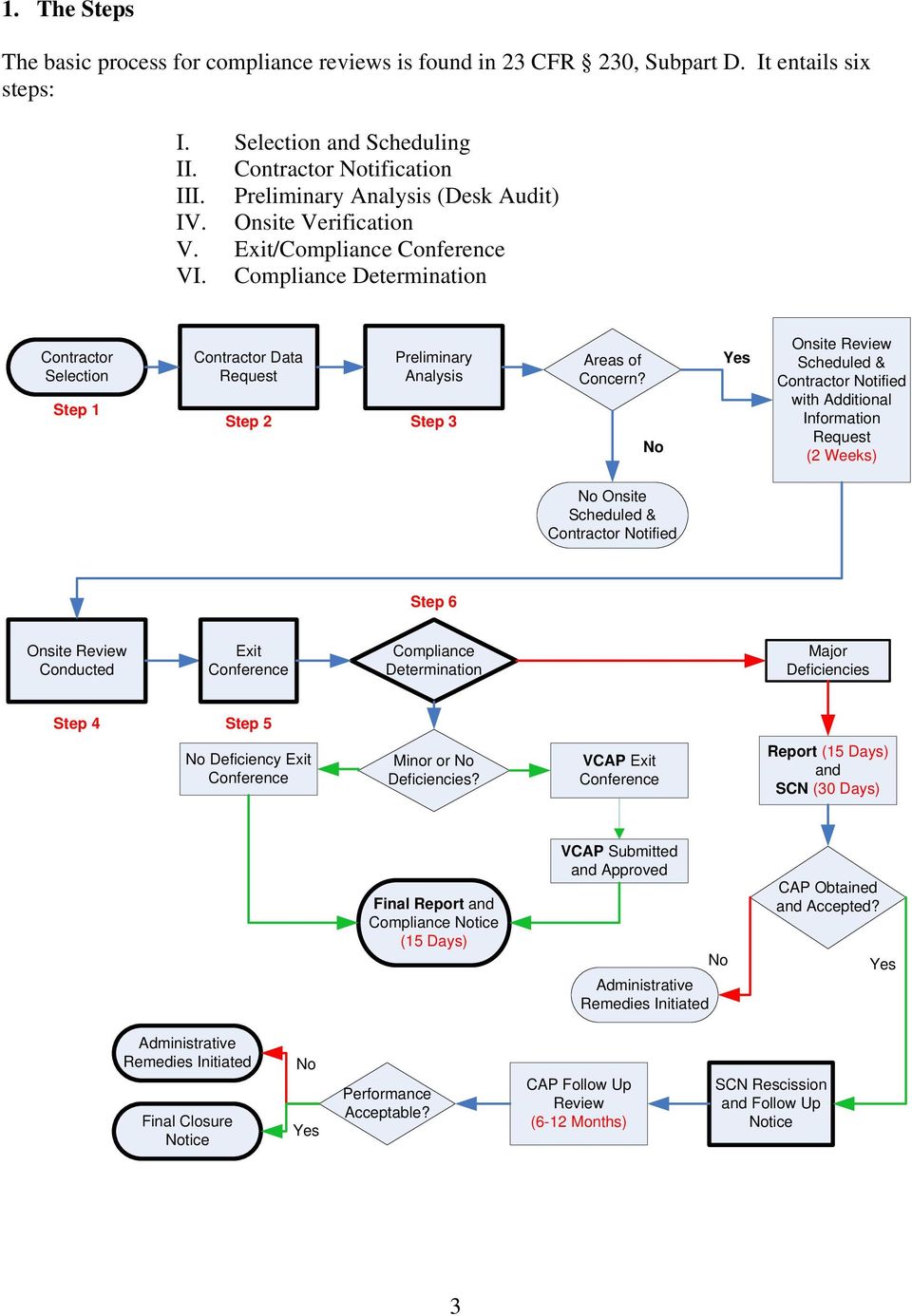
16 If minor or easily remedied deficiencies are discovered, a Voluntary Corrective Action Plan (VCAP) may be negotiated during the Exit Conference to achieve compliance. For more serious deficiencies or those that require more than thirty days to correct, a Show Cause Notice (SCN) requiring the contractor to submit a Corrective Action Plan (CAP) may be issued. Contractors have an affirmative duty to work with INDOT and FHWA both in carrying out EEO obligations and in complying with review procedures. FHWA 1273 II.1(a). If, at any point in the process, a contractor does not believe it can reasonably meet a deadline, then extensions of time may be granted if and only if requested within the initial deadline. Unresponsiveness is considered evidence of noncompliance. 2. Selection and Scheduling INDOT conducts three basic types of reviews: a. Project Specific Generally involves a review of a single major project to determine whether contractors are meeting the employment, training, and subcontracting and other requirements in their contracts. This type of review is usually best for major projects with significant employment, training, and subcontracting potential. Project reviews typically include the prime and all subcontractors, including joint ventures and material suppliers. Although representatives from all subcontractors are not required, a representative sampling is normally part of the review, especially DBE subcontractors. b. Area Wide A review of a particular contractor s operations in one geographical area circumscribed by the outer limits of a targeted city, county, MSA, or union local s boundaries. Its purpose is to obtain and consider information on the contractor s efforts to ensure nondiscrimination and provide equal opportunity in employment, training, and contracting on all of the contractor s projects within an area, whether a particular contract involves Federal or Federal aid funds or not. Subcontractors are reviewed for underutilization analysis, but typically are not required to be present for in-depth reviews. c. Consolidated A cooperative effort by multiple governmental agencies (i.e. FHWA, STA, and/or OFCCP) to review all active Federal aid contractors in a particular geographic area. Most often this type of review is conducted if it becomes known that 4
17 contractors in a certain area are experiencing similar problems in, for example, inadequate representation of minorities and females in particular crafts. Because construction work forces are not constant, particular attention is paid to the proper scheduling of compliance reviews. Many factors influence the selection of contractors and projects. 23 CFR states that priority in scheduling equal opportunity compliance reviews shall be given to reviewing those contractor's work forces: 1. Which hold the greatest potential for employment and promotion of minorities and females (particularly in higher skilled crafts or occupations); 2. Working in areas which have significant minority and female labor forces within a reasonable recruitment area; 3. Working on projects that include special training provisions; and 4. Where compliance with equal opportunity requirements is questionable. (Based on previous PR 1391's (23 CFR part 230, subpart A, appendix C) Review Reports and Hometown Plan Reports). In addition, the following considerations may apply: Reviews specifically requested by the Washington Headquarters shall receive priority scheduling; Reviews shall be conducted prior to or during peak employment periods; No compliance review shall be conducted that is based on a home office work force of less than 15 employees unless requested or approved by Washington Headquarters; and For compliance reviews based on an area work force (outside of areawide plan coverage), the Compliance Specialist shall define the applicable geographical area by considering: 1. Union geographical boundaries; 2. The geographical area from which the contractor recruits employees, i.e., reasonable recruitment area; 3. Standard Metropolitan Statistical Area (SMSA) or census tracts; and 5
18 4. The county in which the Federal or Federal aid project(s) is located and adjacent counties. 3. Notification and Preliminary Analysis After a contractor is selected for review, it is sent a letter via certified mail. Receipt of this letter will constitute sufficient statutory notice, and it will detail the information required by INDOT. A contractor typically has fourteen (14) calendar days to submit the requested materials. Again, extensions of time may be granted if formally requested and are reasonable. Documentation is reviewed for completeness, reasonableness, accuracy, and indications of patterns or practices that warrant further analysis. The Desk Audit phase is documentary in nature, only. A more detailed look at the data request can be found in Appendix A and specific compliance factors follow in Section II. 4. Onsite Verification Review When a Compliance Specialist identifies EEO concerns or requires verification, an Onsite Verification Review is scheduled. The contractor will receive an Onsite Notice with a proposed date for the review (normally within two weeks), along with a request for additional documents. When INDOT requires the presence of subcontractor representatives, the Notice will so state. This Notice will typically identify preliminary areas of concern based on the desk audit. These areas will be the primary focus of the Onsite. It is therefore important for contractors to carefully review these concerns and to address them directly at the Onsite Review. Please note that where Good Faith Efforts documentation is necessary, contractors must provide it on or by the day of the Onsite Review. The major features of the Onsite Review are: 5. Onsite Exit Conference 1. Opening Session with contractor (and subcontractor) representatives to review objectives; 2. Review of pertinent records and EEO documents; 3. A physical tour of the work site and/or home office; 4. Employee interviews; and 5. An Exit Conference to review preliminary findings. The Exit Conference is of special importance. At the end of the Onsite visit, the Compliance Specialist will meet with contractor representatives to discuss preliminary compliance findings. 6

19 If INDOT deems the preliminary deficiencies as minor or otherwise correctable within fifteen (15) days of the Onsite, the contractor may, at that time, negotiate the essential terms of a Voluntary Corrective Action Plan (VCAP). If INDOT preliminarily determines that a contractor s deficiencies are not correctable in 15 days (e.g. workforce underutilization) or are otherwise major deficiencies, INDOT shall not accept a VCAP and will find the contractor in noncompliance. If a contractor s VCAP is submitted to INDOT and accepted within the 15 days prior to INDOT s final compliance determination, INDOT will deem the contractor in compliance. If a contractor s VCAP is deemed not acceptable, is not submitted within 15 days, or if INDOT ultimately finds that a VCAP is not appropriate due to the severity of the deficiencies, INDOT will find the contractor in noncompliance. 6. Compliance Determination A Compliance Specialist is required to submit their final report to FHWA within fifteen (15) days following an Onsite Review. The report will: 1. Summarize INDOT s factual and documentary findings; 2. Make a determination of compliance or noncompliance; 3. Notify the prime contractor of the findings; 4. And request concurrence from FHWA. Three Possible Results From An Onsite Review 1. If a contractor has no notable deficiencies, then INDOT will find it in compliance. 2. When INDOT finds minor deficiencies, a contractor may negotiate an acceptable VCAP within the fifteen (15) day period prior to the compliance determination being filed. In such a case, INDOT would then find the contractor in compliance. 3. When INDOT finds major deficiencies, INDOT will find a contractor in noncompliance. The Onsite Review report will be accompanied by a Show Cause Notice (SCN) to the contractor. A contractor in receipt of a SCN has thirty (30) days to submit an acceptable Corrective Action Plan to INDOT. If an acceptable Plan is not timely submitted, INDOT may initiate 7
20 administrative remedies. Therefore, it is imperative that when a SCN is received, the contractor immediately schedules a compliance conference with INDOT to negotiate the Plan prior to the 30-day deadline. C. Ongoing Review Procedures In addition to the formal, directed review process, INDOT continually monitors all contractors for compliance. Where evidence of particular deficiencies is discovered at any time, INDOT will investigate. In particular, INDOT typically engages in two specific types of unscheduled reviews: Commercially Useful Function and Davis-Bacon Act reviews. Note that, unless otherwise stated, INDOT s procedures for unscheduled reviews will follow the same overall format and deadlines as any other review. 1. Commercially Useful Function One of the key requirements of the Disadvantaged Business Enterprise (DBE) program is that a DBE perform a commercially useful function (CUF) on a Federal aid project. A CUF concerns the role a firm plays in a particular transaction either on or off the jobsite. The phrase commercially useful function is defined in the Federal regulations, 49 CFR (c)(1), which states that a DBE performs a commercially useful function when it is being responsible for execution of the work of the contract and is carrying out its responsibilities by actually performing, managing, and supervising the work involved. The regulation goes on to say that To perform a commercially useful function, the DBE must also be responsible, with respect to materials and supplies used on the contract, for negotiating price, determining quality and quantity, ordering the material, and installing (where applicable) and paying for the material itself. INDOT has therefore developed CUF policies and procedures to monitor compliance, the details of which are found in Appendix B. A CUF deficiency could result in many negative outcomes. A DBE firm s failure to perform a CUF raises questions regarding the firm s independence, ownership and control, which may eventually lead to its decertification. In addition, where a prime contractor knew or should have known that CUF violations occurred on an INDOT contract, INDOT may initiate administrative proceedings against the prime, the subcontractor, or both parties. It is therefore incumbent upon both prime and subcontractors to read and understand INDOT s CUF policies. 2. Wage and Labor Compliance The 1931 Davis-Bacon Act requires the payment of prevailing wage rates and fringe benefit equivalents to all laborers and mechanics on Federal or Federally assisted construction contracts. Davis-Bacon Act requirements are implemented in various Federal assistance programs through the "related act" provisions in each agency's implementing statutes. For the purposes of Federal 8

21 aid highway construction contracts, these provisions are implemented in 23 U.S.C. 113, along with the Copeland Anti-Kickback Act as implemented in 40 U.S.C. 276(c). The Davis- Bacon and Related Acts (DBRA) requirements are incorporated both by reference and explicitly as part of every INDOT contract. As a guide for compliance, INDOT uses the analytical methods established by the Department of Labor and made available through their Field Operations Handbook. This document is available on the DOL website ( and the DBRA portion, Chapter 15, is available for download here: When INDOT receives evidence of potential DBRA deficiencies, it will immediately investigate. Because INDOT is charged with ensuring compliance with all applicable Federal aid contracting provisions, and because DBRA provisions are explicitly included in each INDOT contract, DBRA compliance is treated as seriously as any other compliance matter. Failure to promptly correct DBRA deficiencies can result in reference to the INDOT Prequalification Committee, to the Federal Highway Administration, and/or the Department of Labor (DOL). 3. On The Job Training Compliance The On the Job Training (OJT) Program was created by the Federal Highway Administration and the Indiana Department of Transportation to fulfill the Training Special Provisions requirements of Federal aid Construction contracts (23 CFR 230, Appendix B to Subpart A). The purpose of the provisions is to address the under-representation of minority and female workers in the construction trades. INDOT s OJT Program fulfills these requirements by assigning each Federal aid contractor an annual training goal (see Part II, Section E on page 17 of this guide). In addition to ongoing compliance monitoring, INDOT will perform an End of Year Audit for each contractor to verify goal attainment. INDOT will use review procedures identical to those of a routine compliance review regarding OJT compliance. 9
22 Part II: EEO Requirements
23 A. Introduction This Part will set forth the minimum features of a compliant contractor EEO program. All of the information included herein is based upon contractual and regulatory requirements, in addition to direct guidance from the Federal Highway Administration and the U.S. Department of Labor. Wherever possible, citations and direct regulatory language have been used for clarification. The compliance status of the contractor will usually be reflected by positive efforts in the following areas: 1. The contractor's equal employment opportunity (EEO) policy; 2. Dissemination of the policy and education of supervisory employees concerning their responsibilities in implementing the EEO policy; 3. The authority and responsibilities of the EEO officer; 4. The contractor's recruitment activities, especially establishing minority and female recruitment and referral procedures; 5. The extent of participation and minority and female utilization in FHWA training programs; 6. The contractor's review of personnel actions to ensure equal opportunities; 7. The contractor's participation in apprenticeship or other training; 8. The contractor's relationship (if any) with unions and minority and female union membership; 9. Effective measures to assure nonsegregated facilities, as required by contract provisions; 10. The contractor's procedures for monitoring subcontractors and utilization of minority and female subcontractors and/or subcontractors with substantial minority and female employment; and 11. The adequacy of the contractor's records and reports. 23 CFR (g)(3). EEO compliance is a set of ongoing processes that, if effectively implemented, will help ensure nondiscrimination and equal opportunity on all Federal Aid INDOT contracts. A contractor shall be considered to be in compliance when the equal opportunity requirements have been effectively implemented, or there is evidence that every good faith effort has been made toward achieving this end. Efforts to achieve this goal shall be 11
24 result-oriented, initiated and maintained in good faith, and emphasized as any other vital management function. Id (g)(4). Contractors are required to keep and provide to INDOT all such records as necessary to document compliance with the EEO requirements. FHWA 1273, II.9. Additionally, such records shall be retained for a period of three (3) years following completion of the contract work and shall be available at reasonable times and places for inspection by INDOT and FHWA. Id. Therefore, INDOT stresses that, in order to demonstrate compliance, a contractor must concentrate its efforts on creating and maintaining... ******** Documentation ******** Each requirement set forth in this section will detail both a contractor s EEO obligations and suggested documentation to establish those requirements. How ever a contractor chooses to document their EEO efforts, such documentation must sufficiently do so. If a contractor does not document their efforts with the suggested methods, then it must do so in an alternately sufficient manner. So, while a contractor s specific practices are the company s prerogative, the duty to adequately demonstrate EEO compliance can never be abrogated. Finally, please refer to Part III for guidance on Good Faith Efforts, generally, which are applicable to Section D: Employment Practices. B. EEO Officer Each Federal Aid contractor shall designate an EEO Officer. FHWA 1273 II states that this Officer shall: 1. Have the responsibility for effectively administering and promoting an active EEO program. Id. II.2. The Officer must know and understand his or her duties, and employees must know and understand who the Officer is and how and when to contact them. 2. Be capable of effectively promoting an active EEO program. Id. II.2. An EEO Officer may have other, primary, duties within the company, but they must nonetheless be capable of discharging all of their EEO duties as well. 12
25 3. They must be assigned adequate authority and responsibility to discharge their duties. Id. II Thoroughly indoctrinate all new supervisory or personnel in all aspects of the contractor s EEO obligations within thirty 30 days of the supervisor s start date. Id. II.3(b). Contractors must demonstrate that their EEO Officer conducts prompt and thorough training sessions. 5. Conduct the required periodic EEO meetings. Id. II.3(a). 6. Instruct, monitor, and assist personnel engaged in direct recruitment regarding procedures for locating and hiring female and minority group employees. Id. II.3(c). The EEO Officer has the duty to carry out all of the contractor s EEO policies, which extend to all of the provisions noted in this Part. Suggested Documentation EEO Officer Appointment letter signed by the firm s chief official or authorized agent, designating: o The name and title of the Officer, o The Officer s authority, essential duties, and contact information, and o The term of the Officer s appointment if applicable. Notice to employees of the above, Directives and documentation establishing that the Officer has exercised authority in accordance with other portions of the firm s EEO requirements. C. EEO Policy 1. Policy Statement A coherent, comprehensive EEO policy is essential for compliance. FHWA 1273 II.1 states that contractors shall adopt as their operating policy the following statement: "It is the policy of this Company to assure that applicants are employed, and that employees are treated during employment, without regard to their race, religion, sex, color, national origin, age or disability. Such action shall include: employment, 13
26 upgrading, demotion, or transfer; recruitment or recruitment advertising; layoff or termination; rates of pay or other forms of compensation; and selection for training, including apprenticeship, preapprenticeship, and/or on-the-job training." In addition, the contractor s EEO policy for compliance purposes should comprise much more. It should include all documents and procedures pertinent to EEO compliance both for employees to read and as part of a contractor s ongoing efforts to document their compliance for INDOT II.3(e). Therefore, a contractor s policy generally refers to all EEO-related employment practices, notices, and procedures. Contractors must ensure and document the following with regard to the policy, generally: 2. Complaint Procedures 1. The policy is disseminated to all employees. Id. II The policy is brought to the attention of employees through meetings, employee handbooks, and other appropriate means. Id. II Periodic meetings of supervisors and personnel are conducted before the start of work and then not less than once every six (6) months. During such meetings all relevant EEO policies and implementation procedures will be reviewed and discussed. Id. II.3(a). 4. The policy statement is placed in areas readily accessible to employees, applicants for employment, and potential employees. Id. II.3(d). While INDOT does not and can not interfere in a contractor s particular employment decisions, Federal aid contractors have an affirmative duty to ensure that: 1. Contractors promptly investigate all complaints of alleged discrimination; 2. Contractors undertake appropriate corrective actions in a reasonable time; 3. That all potential complainants are apprised of their avenues for appeal. 23 CFR 230, Appendix A to Subpart A, 6(d); FHWA 1273 II.5(d). In addition, these requirements are subject to the overall obligation to maintain adequate records necessary to document EEO compliance. Id. 10, FHWA 1273 II.9. 14
27 Therefore, in order to demonstrate that (1) investigations occur promptly, (2) that corrective actions are effective and occur in a reasonable time, and (3) that employees know their appeal avenues and what constitutes them, written documentation to establish these procedures is essential. A contractor, for example, can not establish that employees know their appeal options short of a written, well-distributed policy to that effect. And while it is true that each case is necessarily fact-sensitive, features such as promptness cannot be reasonably established short of documentation allowing for measurement. A contractor can not fulfill its complaint procedure obligations with a blanket statement that employees should direct complaints to the EEO officer or other supervisor. A minimal procedure such as this does not fulfill or otherwise demonstrate any of the above required components. 3. EEO Meetings The EEO Officer must conduct periodic EEO meetings with all supervisors and personnel (1) before the start of work and (2) not less than once every six months. FHWA 1273 II.3(a). At the meetings, the Officer will review and explain the contractor s EEO policies and procedures. 4. Subcontractor EEO Policy Federal aid prime contractors are obligated to ensure EEO compliance with their subcontractors. FHWA 1273 I.1. This contractual duty cannot be abrogated it is the affirmative duty of each prime contractor. Therefore, INDOT reviews will also consider the extent to which a Federal aid prime monitors each subcontractor. At a minimum, a contractor must make subcontractors aware that all of the provisions of FHWA 1273 apply to those subcontracts and conduct periodic workforce analyses (see Section D(2)) for each subcontractor. 5. Required EEO Postings Contractors are familiar with most EEO jobsite posting requirements, but such requirements do change over time and contractors often do not keep up with the changes. INDOT shall endeavor to update the list in this Guide often, and these requirements are found on both the FHWA and DOL contractor compliance websites:
28 Contractors must place all EEO-related postings in areas readily accessible to all employees. Additionally, contractors are reminded of the overall requirement that notices and posters setting forth the contractor's equal employment opportunity policy (which include DOL posters) will be placed in areas readily accessible applicants for employment and potential employees. FHWA 1273 II.3(d). The minimum postings that each INDOT project should feature 1. EEOC-P/E-1 Equal Opportunity is the Law Required by 41 CFR (b)(1) and FHWA-1273 II(3)(d) 2. Contractor's EEO policy statement Required by 41 CFR and FHWA-1273 II(1)(b) 3. Letter appointing contractor's EEO officer for project with contact information. Required by 41 CFR and FHWA-1273 II(3)(d) 4. FHWA-1022 Federal Aid Projects False statements Notice Required by 18 CFR 1020 and 23 CFR FHWA-1495 Wage Rate Information (May be substituted for WH per FHWA 1273 IV(1)(a)) (Superseded the PR-809) 6. WH-1321 Notice to Employees Davis-Bacon wage rate Required by 29 CFR 5.5(a)(1) and FHWA-1273 IV(1)(a) 7. Actual Davis-Bacon wage rates pertinent to project Required by both FHWA-1495 and WH OSHA-2203 Job Safety & Health Protection Required by 29 CFR (a)(1) through FHWA-1273 VIII(1) 9. Emergency phone numbers for safety and EEO Required by 29 CFR (f) through FHWA-1273 VIII(1) 10. WH-1284 Notice to Workers with Disabilities Paid at Special Minimum Wages Required by 29 CFR (Must be posted whenever the WH is posted AND the contractor has a certificate to pay less than minimum wage to disabled workers) 11. WH-1420 Your Rights under the Family and Medical Leave Act 16
29 of 1993 Required by 29 CFR (a) for employers of more than 50 people 12. WH-1462 Notice: Employee Polygraph Protection Act Required by 29 CFR 801 Note: The 5-in-1 poster from the DOL typically satisfies the following: 1. WH 1462 Employee Polygraph Protection Act 2. WH 1088 Fair Labor Standards Act Federal Minimum Wage 3. WH 1420 Family Medical Leave Act 4. EEOC P/E-1 Consolidated EEOC Poster 5. OSHA 3165 Standard OSHA Poster Suggested Documentation EEO Policy Employee handbook and all pertinent EEO policies and procedures, of which, INDOT suggests including: o The EEO policy statement, endorsed and signed by the chief company official; o The EEO officer s appointment letter and contact information; o Documentation to establish the Complaint Procedures conform with the criteria herein; o Documentation to establish that the Complaint Procedure is made known to all employees; o Internal EEO review policies for supervisors; o EEO policies specific to Federal highway projects; o Policy to encourage female and minority referrals; o Evidence that the policies are at least annually reviewed, updated, and endorsed by the chief company official; o Other specific actions the contractor shall take to ensure EEO compliance. Correspondence, advertisements, and other company directives that include the EEO assurance: An Equal Opportunity Employer. 17
30 Attendance lists, agendas, and minutes from each EEO meeting. Documentation to establish that the contractor has apprised its subcontractors of their EEO obligations and has meaningfully monitored their compliance. All required EEO, Labor, and safety postings. D. Employment Practices 1. Overview Although INDOT does not and cannot interfere with a contractor s particular employment decisions, effective implementation of the EEO policy must be ensured. Therefore, a major portion of INDOT s compliance review process involves a careful analysis of the contractor s workforce and employment practices. It is important that Federal aid contractors understand that efforts to ensure equal employment opportunity are predicated on the idea that a contractor must take affirmative actions as defined by the Federal regulations. Affirmative actions should be positive, aggressive, continuous, and result-oriented. 23 CFR (c). Good Faith Efforts are acceptable to INDOT only to the extent they are effective. Where a contractor s employment practices and affirmative actions do not produce results, the contractor must demonstrate a commitment to pursuing new and innovative EEO practices. 2. Workforce Analysis a. Overview INDOT reviews each contractor s workforce based on two sets of regulations: 23 CFR 230, pertaining to transportation and 41 CFR 60, pertaining to labor. Because of the overlapping nature of these EEO provisions, in 1999 the U.S. Department of Labor and the Federal Highway Administration issued a joint clarification Order (Order ; see Appendix D). The Order states that the DOL has exclusive authority to determine compliance regarding Title 41, and FHWA has exclusive authority to determine compliance under Title 23. If INDOT or the FHWA becomes aware of any possible violations of Title 41, each has the authority and the responsibility to notify the OFCCP. FHWA Order Therefore, INDOT has a legal 18
31 obligation to monitor contractors under both sets of provisions, but it may only determine compliance as it pertains to Title 23. This Part will focus on compliance with Title 23 for the above reasons. Although they overlap, there are differences between the sets of requirements. Please use the chart below for further reference. Criteria: Contractors must ensure EEO compliance in their workforce by demonstrating a reasonable representation of females and minorities in each job classification. 23 CFR (e)(6). Title 23 A contractor s workforce is compared to the available labor market: the Civilian Labor Force (CLF). Equal Opportunity Contractor Compliance In The Federal-Aid Highway Program: Desk Reference, FHWA. Result if Not Met: Where underutilization or under-representation exists compared to the CLF and the contractor has not implemented sufficient Good Faith Efforts, INDOT may, contractually or in conjunction with FHWA, issue a notice of noncompliance. Order Title 41 Criteria: Result if Not Met: Contractors must ensure EEO compliance in their workforce by meeting the female and minority hiring goals established by the Department of Labor s Office of Federal Contract Compliance Programs (OFCCP). The goals are fixed percentages that apply to the contractor s aggregate workforce in each trade on all construction work in the covered area. The appropriate fixed percentages are included as part of every Federal aid contract. 41 CFR 60.4, INDOT Recurring Special Provision 100-C- 151(d). A contractor s workforce is compared to the contract goal percentages for females and minorities. Where INDOT monitoring suggests that the goals are not met, INDOT may refer the contractor to the OFCCP for a compliance determination. Order b. Review Methods As stated above, an INDOT workforce analysis is designed to determine whether the contractor has a reasonable representation of females and minorities in each job classification. 23 CFR (d)(4), (e)(6)(i). The methods for doing so are set forth in the FHWA Equal Opportunity Contractor Compliance In The Federal-Aid Highway Program Desk Reference (Appendix D). 19
32 Step 1 Contractor Workforce INDOT first analyzes two aspects of a contractor s workforce: Representation: the head count for each job classification, and Utilization: the number of hours worked for each job classification. Thus, a contractor must demonstrate not only that it employs females and minorities, but also that such employees are used in a reasonable proportion to their numbers. A contractor is not allowed to engage in bicycling: moving females and minorities to INDOT-reviewed projects in order to bolster their head count. INDOT therefore begins its analysis by asking contractors to provide a demographic breakdown of their workforce. Contractors must provide a Workforce Utilization Report, pictured below, which closely resembles a Federal PR-1391 report. One Report is completed for head count, and a second is completed for hours. Job Category Total Workforce Total Minorities African American Hispanic American American Indian Asian American/ Pacific Islander White M F M F M F M F M F M F M F Official(s) Supervisors Foreman Administrative Equipment Operator Mechanics/ Oilers Truck Drivers Ironworkers Carpenters/ Pile Drivers Cement Mason/ Concrete Finisher Electricians Plumbers/ Pipefitters Painters 20
33 Laborers: Skilled-- Unskilled-- TOTAL Step 2 Under-representation INDOT next compares this data to the relevant Civilian Labor Force (CLF) to determine if females and minorities are underrepresented based on availability. The CLF is broadly defined as the labor data for an appropriate geographic region, acquired from the U.S. Census, the Department of Labor, and State Employment Agencies. INDOT primarily consults the U.S. Census, although other demographic sources are sometimes consulted according to the methods set forth in the FHWA Desk Reference. If females or minorities are substantially underrepresented in multiple job categories, INDOT will flag these as evidence of underrepresentation. To assist contractors with workforce evaluations, INDOT provides a user-friendly map application for all major construction trades by demographic group. The map application allows users to simply click on the relevant counties for their labor market, and the map will display female and minority percentages for all major trades. In addition, the full listing for every county is also provided on the map page. To access the application, visit the map website: Step 3 EEO Compliance Status INDOT stresses that under-representation, in itself, is not considered an EEO deficiency. Where under-representation is identified, INDOT must determine whether the workforce representation is reasonable. To do this, INDOT engages in a Good Faith Efforts analysis based on all relevant compliance factors and documentation that touch on: Recruitment, Referrals, Outreach, and Hiring opportunities. Where INDOT identifies underutilization patterns, a contractor must demonstrate evidence of sufficient Good Faith Efforts to remedy the situation. If a contractor does not demonstrate sufficient Good Faith Efforts, then the underutilization becomes an EEO deficiency. An EEO Officer must therefore monitor and periodically evaluate the contractor s workforce to avoid potential deficiencies. By using the evaluation methods and examples included in 21
34 Appendix D of this Guide, an Officer can not only identify underutilization prior to a Review, but they can also tailor their EEO recruitment and promotion efforts accordingly. INDOT Economic Opportunity staff are always available for guidance regarding this or any other EEOrelated matter. Remember: a contractor must be able to produce documented Good Faith Efforts in hiring and recruiting females and minorities when there is underutilization. INDOT strongly advises contractors to ensure that all affirmative actions are positive, aggressive, continuous, and result-oriented. Suggested Documentation Workforce Workforce Utilization Reports, broken down by job category, ethnicity, and gender for: o Hours o Head Count Good Faith Efforts documentation regarding recruitment and referrals. 3. Recruitment a. Generally A contractor s affirmative actions to achieve equal opportunity, which include recruitment, must be continuous and effective. Because recruitment is tied to many other aspects of contract compliance, Federal aid contractors must extensively document all such efforts. As a starting point, contractors must document applicant flow. This means that a contractor should be able to produce data to show, at a minimum: 1. The age, race, sex, and number of applicants; 2. The relative qualifications of the applicants; 3. Whether the applicants were offered employment; 4. And, if hired, the length of time the applicant remained employed by the contractor. Additionally, contractors must conduct systematic and direct recruitment through public and private employee referral sources likely to yield qualified minority and female applicants. FHWA 1273 II.4(a). The contractor is responsible for identifying sources of potential minority and female hires and applying affirmative actions designed to recruit effectively. In the event the contractor has a valid bargaining agreement providing for exclusive hiring hall referrals, the contractor is expected to observe those provisions to the extent they permit the contractor s compliance with EEO obligations. Contractors must likewise encourage present employees to refer minority and female applicants for employment. Id. II.4(b-c). 22
35 Finally, contractors are reminded that this data is subject to the same retention requirements as all other EEO-related data: that it is retained for a period of three (3) years following completion of the contract work. FHWA 1273, II.9. b. Unions INDOT recognizes that many of its Federal aid contractors are subject to collective bargaining agreements. Nonetheless, FHWA and Title 23 explicitly state that no such agreement shall preclude a Federal aid contractor from fulfilling its EEO obligations. FHWA 1273 II.4. Documentation of all actions taken by the contractor and union shall be maintained by the contractor. The OFCCP has established the following criteria for determining compliance when an exclusive referral agreement is involved: 1. It shall be no excuse that the union, with which the contractor has a collective bargaining agreement providing for exclusive referral, failed to refer minority or female employees. 2. Discrimination in referral for employment, even if pursuant to provisions of a collective bargaining agreement, is prohibited by the National Labor Relations Act and Title VII of the Civil Rights Act of 1964, as amended. 3. Contractors and subcontractors have a responsibility to provide equal opportunity if they want to participate in federally involved contracts. To the extent they have delegated the responsibility for some of their employment practices to some other organization or agency which prevents them from meeting their obligations, these contractors must be found in noncompliance. 4. If the contractor indicates that union action or inaction is a proximate cause of the contractor's failure to provide equal opportunity, a finding of noncompliance will be made and a show cause notice issued, and: a. The contractor will be formally directed to comply with the equal opportunity requirements. b. Reviews of other contractors with projects within the jurisdiction of the applicable union locals shall be scheduled. c. If the reviews indicate a pattern and/or practice of discrimination on the part of specific union locals, each contractor in the area shall be informed of the criteria outlined in (e)(1). Furthermore, the FHWA Washington Headquarters, OCR, shall be provided with full documentary evidence to support the discriminatory pattern indicated. 23
36 d. In the event the union referral practices prevent the contractor from meeting the equal opportunity requirements pursuant to the E.O , as amended, such contractor shall immediately notify the SHA. 23 CFR (e). Contractors shall provide immediate written notification to INDOT, and to the Director of OFCCP, if a union fails to refer back a minority or female applicant referred to the union by the contractor. The contractor must document all contacts with a union to request that minority and female applicants be referred for employment vacancies. If a union is unable to provide the contractor with a reasonable flow of minority and female referrals within the time limit set forth in the collective bargaining agreement, the contractor will, through independent recruitment efforts, fill the employment vacancies without regard to race, color, religion, sex, national origin, age or disability; making full efforts to obtain qualified and/or qualifiable minority group persons and females. FHWA 1273 II.6(d). INDOT strongly recommends that contractors exert their best efforts to assure that off the bank and/or name request provisions are in their collective bargaining agreements. Off-thebank allows them to hire walk-ins and refer them to the union within a specific number of days for membership. Name request allows them to refer the walk-in to the union and name request them back from the union. Suggested Documentation Recruitment Applicant flow data, including all information noted above; Lists of potential and currently used recruitment sources, with an emphasis on those likely to yield minority and female applicants, and data to establish the effectiveness of each; Documentation regarding aggressive efforts to increase minority and female referrals to and from unions and independent efforts in recruitment; Documentation regarding internal referrals; Follow-up correspondences regarding external applicants and internal referrals; Documents to show participation in hiring fairs, advertisements (especially in minority and female-oriented publications), and other outreach avenues. 24
37 4. Personnel Actions A contractor s EEO Officer must evaluate all internal personnel actions for evidence of discrimination. The types of actions to evaluate include, but are not limited to: hiring, promotion, transfer, demotion, layoffs, terminations, and the spread of wages within each job classification. FHWA 1273 II.5. INDOT suggests compiling data for each type of action, broken down by gender and ethnicity, and reviewing the rates for each category. Where an Officer identifies disparities, a contractor must assess the personnel actions and adjust its EEO policies and procedures accordingly. Where a contractor discovers discrimination, it must take corrective actions, immediately. Id. II.5(c). Additionally, to ensure that the contractor s EEO policies are implemented effectively, EEO Officers must evaluate managers, supervisors, and all personnel engaged in direct recruitment and employment actions to ensure that they are implementing the contractor s EEO policies and procedures. The EEO Officer must also conduct periodic inspections of all project sites to insure that working conditions and employee facilities do not indicate discriminatory treatment. FHWA 1273 II.5(a). INDOT suggests interviewing employees, especially minorities and females, during such visits. Suggested Documentation Personnel Actions Documents to demonstrate periodic reviews of personnel actions, including a list of promotions, including: race, national origin, sex, previous job held, job promoted into, and corresponding wage rates; Where disparities or discriminatory acts were identified, documentation to demonstrate corrective actions and assessments; Written EEO Evaluations of supervisors, managers, and other responsible individuals; Voluntary EEO-related data from job applicants; Project site inspection documentation. 5. Annual Workforce Report The contractors will submit an annual report to the SHA each July for the duration of the project, indicating the number of minority, female, and non-minority group employees currently engaged in each work classification required by the contract work. This information is to be reported on Form FHWA-1391 (see Appendix E). 25
38 E. On The Job Training 1. Program Description a. Purpose The On the Job Training (OJT) Program was created by the Federal Highway Administration (FHWA) and the Indiana Department of Transportation (INDOT) to fulfill the Training Special Provisions requirements of federal aid construction contracts (23 CFR 230, Appendix B to Subpart A). The purpose of the provisions is to address the under-representation of minority and female workers in the construction trades through the assignment of OJT training goals; therefore, the training and upgrading of minorities and females toward journey level status on INDOT federal aid contracts is the primary objective of INDOT s Training Special Provisions. b. Program Summary The 2009 INDOT OJT Program fulfills these objectives by: (1) fostering long-term relationships between contractors and trainees, (2) encouraging contractors to assist trainees in fully attaining journey level status, and (3) offering contractors abundant flexibility in fulfilling their training obligations. INDOT s Program assigns federal aid prime contractors an annual training goal as a set number of hours, which represents a percentage of the contractor s past performance as an INDOT prime. Contractors may assign approved trainees to any project (state or federal) on which the contractor is a prime, including non-indot projects, as long as the majority of training hours are assigned on INDOT projects. Contractors may also assign trainees to be trained by subcontractors on INDOT projects, so long as the prime contractor retains the primary responsibility for fulfilling its federal aid training requirements. Contractors shall make every effort to meet their OJT Program goals by enrolling minority and female trainees (i.e. by conducting systematic and direct recruitment through public and private sources likely to yield minority and female trainees) to the extent that such persons are available within a reasonable area of recruitment. Where a contractor can not meet its annual training hour goal with females and minorities, it is responsible for demonstrating the Good Faith Efforts taken in pursuance of the goal. Examples of what actions constitute Good Faith Efforts are set forth in Section II (C) below. INDOT will make compliance determinations regarding the Training Special Provisions based upon either attainment of the annual goal or Good Faith Efforts to meet it. Taken together, the OJT Program represents an understanding between Contractors and INDOT to select projects and assign training that fulfills both the letter and the spirit of the Federal Training Special Provisions. For clarity, the word trainee herein refers to persons enrolled in either a union or non-union training program. 26
39 2. Annual Training Goal Each year that the Contractor has a federal aid INDOT contract (or within thirty (30) days following receipt of a Notice to Proceed for an INDOT Federal Aid contract on which the Contractor is a prime contractor), the Contractor shall commit to an annual training hour goal. INDOT will calculate that goal as follows (see Section IV below for more details): 1. INDOT shall average the Contractor s blue collar work hours while performing as a prime on INDOT state and federal projects for the past three (3) years; 2. The Contractor s annual training goal shall total five percent (5%) of that three year average. Contractors that (1) do not have three years of INDOT prime contracting work or (2) are not yet in the Program must immediately contact the Economic Opportunity Division to schedule an OJT Conference. 3. Program Requirements a. Training and Wage Requirements The Contractor must use OJT trainees as part of an INDOT approved training program, which shall be registered with the U.S. Department of Labor, Bureau of Apprenticeship and Training or with a State apprenticeship agency recognized by the Bureau, and training programs approved but not necessarily sponsored by the U.S. Department of Labor, Bureau of Apprenticeship and Training. All training programs must be administered in a manner consistent with the equal employment obligations of Federal-aid highway construction contracts. INDOT reserves the right to request documentation that a program fulfills these obligations. Contractors must ensure that each trainee does not exceed the maximum number of training hours required for the completion of the selected training program, as approved by the Bureau of Apprenticeship and Training (BAT) or by INDOT and FHWA. In addition, contractors must pay each approved trainee at the appropriate percentage of journeyman s wage rate based on the training program selected and consistent with the applicable Federal regulations and guidance. b. Trainee Requirements Again, the primary objective of the OJT Program is the training and upgrading of females and minorities toward journey level status. Therefore, Good Faith Efforts include the following: 1. Contractors shall provide as many training hours as is feasible for each trainee accepted into the Program, even after its annual goal has been met. For example, if a contractor meets its goal in July but has enough work to support more training, the contractor shall continue to provide training. INDOT expects contractors to provide OJT Program trainees with schedules comparable to non-program trainees. 27
40 2. Contractors shall ensure that each trainee does not exceed the maximum number of training hours required for the completion of the selected training program, as approved by INDOT. 3. As a Good Faith Effort toward increasing the number of females and minorities in the highway construction industry, contractors shall make every effort to hire graduates of the Indiana Major Opportunities preemployment training program (see for more information) and other such INDOT-recommended programs. c. Reporting and Participation Requirements Reporting Contractors must submit the following documents to INDOT s Economic Opportunity Division: 1. Introduction and Termination/Completion Slips INDOT must approve the introduction of all OJT Program trainees and be notified of any terminations or completions. Contractors must therefore submit introduction and termination/completion slips, with all pertinent information. If a contractor hires a majority male trainee, or cannot replace departing trainees with females and minorities, it must also produce sufficient Good Faith Efforts documentation (See Section II (D) below). 2. Weekly Training Reports Contractors must submit weekly training reports. Contractors may request approval from INDOT to submit training reports monthly, in which case the progress reports are due on the 20th day of the month following the performed work. 3. Monthly Project Reports a. Contractors must submit monthly project CC-257 reports describing their aggregate or total workforce to INDOT by the 20th day of the following month. b. Contractors must also submit a listing of all INDOT projects (Federal, State) or private work to INDOT. These listings are due on the 20th of the following month. 4. Quarterly Training Evaluations Contractors must submit signed evaluations for each approved trainee or apprentice on April 20th, July 20th, and October 20th of the current year. 5. Annual Summary Report Contractors submit an Annual Summary Report by January 20th of the following calendar year. The report must give an 28
41 account of all trainee hours with a breakdown of each project and/or contract. Contractors should also note that: a. Weekly or monthly reports submitted after January 31st of the following year will not be accepted or considered towards goal attainment for the previous calendar year. b. If a contractor did not attain its annual goal, it must submit all Good Faith Efforts made to attain the goal to INDOT with the Annual Summary Report. Contractors should only submit paperwork for individuals accepted and enrolled in the OJT Program and not for individuals participating in other training and apprenticeship programs. Participation The Contractor s Equal Economic Opportunity Officer (EEO) shall be responsible for monitoring and administering the trainees progress. The EEO shall serve as the point of contact for INDOT representatives regarding information, documentation, and conflict resolution. The Contractor s EEO Officer or a knowledgeable substitute shall participate in at least one INDOT OJT Program training/informational session per calendar year (as made available by INDOT). The Contractor shall furnish each trainee a copy of the Training Program. The Contractor shall further make every reasonable effort to provide training that develops skills as required by the Training Program.. d. Good Faith Efforts Where a contractor does not or can not achieve its annual training goal with female or minority trainees, it must produce adequate Good Faith Efforts documentation. Good Faith Efforts are those designed to achieve equal opportunity through positive, aggressive, and continuous resultoriented measures. 23 CFR (g)(4). Good Faith Efforts should be taken as trainee hiring opportunities arise. Contractors should request minorities and females from unions when minorities and females are under-represented in the contractor s workforce. Whenever a contractor requests INDOT approval of someone other than a minority or female, the contractor must submit documented evidence of its Good Faith Efforts taken to fill that position with a minority or female. When a non-minority male is accepted, however, a contractor must continue to attempt to meet its annual training goal with females and minorities. INDOT will consider all contractors documentation of Good Faith Efforts on a case-by-case basis, and, take into account the following: Availability of minorities, females, and disadvantaged persons for training; The potential for effective training; Duration of the contract; Dollar value of the contract; 29
42 Total normal work force that the average bidder could be expected to use; Geographic location; Type of work; The need for journey level individuals in the area. Good Faith Efforts may include, but are not limited to, documentation of efforts to: Communicate with unions to increase the number of minority and female trainees and apprentices; Contact minority and female employees to gain referrals on other minority and female applicants; Contact minority and female recruitment sources when hiring opportunities arise or thirty (30) days prior to the start of a union s open enrollment application periods; Refer specific minorities and females to the unions or other applicable outlets for trainee recruits and specifically request these trainees by name in the future; Assist minority and female applicants in joining the union; Upgrade minority and female unskilled workers into the skilled classifications when possible; Accept applications at the project site or at the contractor s home office; Review and follow up on previously received applications from minorities and females when hiring opportunities arise; Maintain monthly evaluations that monitor efforts made to achieve diversity on Federal projects and the contractor s workforce in general (i.e. significant numbers of minorities and females employed on a company wide basis); Report incidents in which unions are providing a barrier to employment for individuals, especially minorities or females that you have referred to the union and any observed pattern of underutilization of females and minorities in a particular classification; Provide incentives for project management personnel or superintendents when hiring goals are met on a project (i.e. similar to performance bonuses paid when a job is completed timely and under 30
43 budget); Assist applicants with initiation fees; Allow applicants to work in the shop or as an OJT trainee for ninety (90) days prior to referring them to a union, and assist them in the enrollment process for skilled trades; Allow a trainee s payroll deduction to be saved to cover the initiation fees prior to referring them to the union; Purchase the journeyman s card for the trainee and allow that worker to prepay with payroll deductions. INDOT may reject non-minority male trainees for entry into the Program if it determines that a contractor failed to make sufficient Good Faith Efforts to hire minorities or female trainees and/or the contractor failed to document or submit evidence of its Good Faith Efforts to do so. The obligation to conduct sufficient Good Faith Efforts can not be excused by the provisions of: any collective bargaining agreement, any agreement the contractor has with a joint apprenticeship and training committee, or failure by the union with whom the contractor has a collective bargaining agreement to send the contractor minorities and female trainees. e. Trainee Termination and Completion Contractors must submit a termination/completion slip to INDOT after each approved trainee or apprentice has completed training or after the trainee or apprentice has been terminated for just cause. The contractor may terminate a trainee at any time for just cause. Contractors need not submit a termination slip when the trainee is expected to return the following construction season. A trainee may also be laid off due to the lack of work; however, a termination slip is not necessary in such a case unless the trainee is not expected to return the following construction season. If a trainee or apprentice terminates prior to the end of the construction season, the contractor must make Good Faith Efforts to replace the trainee with another minority or female applicant. 4. INDOT Program Monitoring a. Site Visits INDOT representatives will conduct periodic site visits to a contractor s worksite, in addition to OJT review as part of each routine Onsite Compliance Review (as entailed in 23 CFR 230 Subpart D). INDOT will make every effort to ensure minimal disruption to a contractor s work. b. End of Year Audits INDOT will perform an End of Year Audit for each contractor to verify attainment of the annual OJT goal. INDOT will use review procedures identical to those of a routine compliance review. 31
44 If a contractor can demonstrate that it attained its OJT Program goal, then INDOT will determine that the contractor is in compliance with its Training Special Provision requirements. Where a contractor has neither attained its goal nor submitted adequate Good Faith Efforts documentation, INDOT will issue a Show Cause Notice. Within thirty (30) days of receiving the Show Cause Notice, the contractor must submit a written Corrective Action Plan (CAP) outlining the steps that it will take to remedy the noncompliance. The CAP must be approved by INDOT. If a contractor fails or refuses to submit a CAP within the specified period or does not exercise the corrective actions outlined in an approved Plan, INDOT will commence enforcement proceedings by conducting a compliance hearing with INDOT, FHWA, and/or OFCCP. Sanctions for non-compliance may include, but are not limited to: liquidated damages, suspension of any payment in whole or in part, termination or cancellation of contracts in whole or in part, reduction in the contractor s experience rating, suspension, and debarment of the contractor. Suggested Documentation On the Job Training All required documents: o Introduction/Termination slips o Weekly/Monthly trainee reports o CC-257 or equivalent forms o Training evaluations o End of Year report o Certified payrolls (upon request) Where the contractor cannot meet their goal with females or minorities, documents supporting Good Faith Efforts to attain the training goal. F. Wage & Benefits Compliance 1. Applicability All Federal aid INDOT construction contracts contain provisions (FHWA 1273 IV) pertaining to the Davis Bacon and Related Acts (DBRA). The Davis-Bacon Act, as amended, requires that each contract over $2,000 to which the United States or the District of Columbia is a party for the construction, alteration, or repair of public buildings or public works shall contain a clause setting forth the minimum wages to be paid to various classes of laborers and mechanics employed under the contract. Under the provisions of the Act, contractors or their subcontractors 32
45 are to pay workers employed directly upon the site of the work no less than the locally prevailing wages and fringe benefits paid on projects of a similar character. On all non-exempt projects, the principal requirement contained in the provisions noted above is that all employees in the various work classifications engaged in the work under the contract must be paid at not less than the minimum wage rate established by the U.S. Department of Labor (DOL) and listed on the Wage Rate Decision in the contract. In addition to Davis-Bacon wage and fringe compliance, the Copeland (Anti-Kickback) Act of 1934 applies to all Federal aid construction contracts exceeding $2,000 (subject to Federal wage standards) and protects workers from paying kickbacks to employers in exchange for employment, in addition to enforcing the minimum wage provisions of the Davis-Bacon Act. 29 C.F.R. 3.1, 5. For INDOT purposes, the Acts cover all non-exempt Federal aid highway contracts such that: Every person paid by a contractor or subcontractor in any manner for his labor in the construction, prosecution, completion, or repair of a public building or public work or building or work financed in whole or in part by loans or grants from the United States is employed and receiving wages, regardless of any contractual relationship alleged to exist between him and the real employer. 29 CFR 2.3(e). The Act includes all laborers, mechanics, apprentices, trainees, watchmen, helpers and guards working at the site of work. FHWA The US Department of Transportation (USDOT), in turn, has implemented the above requirements, which are found in 23 U.S.C Enforcement of the provisions in FHWA 1273 IV is INDOT's responsibility. In addition to withholdings and liquidated damages, as provided for by Sections IV.7 and IV.8, the following actions may be considered for continued violations: Termination of the contract, or For more serious violations, legal prosecution and debarment (however, only the US DOL has the statutory authority to pursue a debarment for Davis-Bacon violations). INDOT s procedures for wage and fringe benefit compliance are found in the FHWA Labor Compliance Manual and the DOL Field Operations Handbook. 2. EEO Requirements INDOT Federal aid contractors shall do the following to document their DBRA compliance: The wage determination shall be posted at all times (see pages 7-8 of this guide for all required postings) by the contractor and its subcontractors at the site of the work and in a prominent and 33
46 accessible place where it can be easily seen by the workers. FHWA 1273 IV.1. Payrolls and basic records relating thereto shall be maintained by the contractor and each subcontractor during the course of the work and preserved for a period of three (3) years from the date of completion of the contract for all laborers, mechanics, apprentices, trainees, watchmen, helpers, and guards working at the site of the work. Id. V.2(a). Each contractor/subcontractor shall furnish, each week in which any contract work is performed, to the INDOT Project Engineer a properly annotated and certified statement of the wages paid each of its employees engaged on the project during the preceding weekly payroll period. Id. V.2(c). The payroll records shall contain the name, social security number (see below), and address of each such employee; his or her correct classification; hourly rates of wages paid (including rates of contributions or costs anticipated for bona fide fringe benefits or cash equivalent thereof the types described in Section 1(b)(2)(B) of the Davis Bacon Act); daily and weekly number of hours worked; deductions made; and actual wages paid. Id. V.2(b). Each payroll submitted shall be accompanied by a "Statement of Compliance," (DOL form WH-347) signed by the contractor or subcontractor or his/her agent who pays or supervises the payment of the persons employed under the contract. Id. V.2(d). 3. Privacy INDOT takes contractor privacy seriously and is guided by two principles regarding sensitive third-party information: Confidentiality and security are INDOT s primary concerns. Personal information submitted by contractors is requested only to the degree minimally necessary to comply with INDOT s administrative and legal needs. Therefore, and in accordance with Title 23 and Indiana Code (d) and , INDOT will not require contractors to include full Social Security Numbers on weekly certified payroll submissions or other EEO-related documents. When INDOT must verify the identity of specific employees, it may request full SSNs specific to those employees. In all other cases, however, INDOT only requires the last four digits of each employee s Social Security Number. As always, INDOT will continue to maintain and develop comprehensive security procedures to ensure confidentiality. 34
47 4. Review Procedures As noted in Part I of this guide, INDOT reviews DBRA compliance using methods approved by the FHWA and set forth in the DOL Field Operations Handbook and the DOL Davis-Bacon Resource Book (see Appendix C). Contractors should therefore consult the Handbooks for all questions regarding definitions, review methods, and interpretations. One area of particular confusion for many contractors is the method by which INDOT calculates fringe benefit equivalents owed to employees. INDOT contractors must understand that such calculations are made based on annualized contributions. Davis-Bacon credit for contributions made to fringe benefit plans are allowed based on the effective annual rate of contributions for all hours worked during the year by an employee, regardless of whether or not the hours were worked on a Davis-Bacon project. Therefore, when INDOT evaluates a contractor s wage/fringe compliance in this regard, contractors must submit information based on all applicable hours worked. Examples a. For a defined benefit pension plan, or for a defined contribution pension plan which does not provide for immediate or essentially immediate vesting, if a contractor wishes to receive $2.00 per hour credit for a pension contribution, the contractor must contribute at this same rate for all hours worked during the year. If this is not done, the credit for Davis-Bacon purposes would have to be revised accordingly. b. If the firm s contribution for the pension benefit was computed to be $2,000 a year for a particular employee, the employee worked 1,500 hours of the year on a Davis-Bacon covered project and 500 hours of the year on other jobs not covered by the Davis-Bacon provisions, only $1,500 or $1.00 per hour would be creditable towards meeting the firm s obligation to pay the prevailing wage on the Davis-Bacon project. (Annual contribution - $2,000, divided by total hours worked 1, = 2000; i.e. $2,000/2000 hours = $1.00 per hour.) For contributions made to defined contribution pension plans which provide for immediate participate and immediate or essentially immediate vesting schedules (100% vesting after an employee works 500 or fewer hours), and also certain supplemental unemployment benefit plans, a contractor may take Davis-Bacon credit at the hourly rate specified by the plan. Under such plans, contributions are irrevocably made by the contractor, most, if not at all, of the workers will become fully vested in 35
48 the plan, and the higher contributions made during Davis-Bacon work result in an increase in the value of the individual employee s account. The amount of contributions to such plans should be in conformance with any limitations imposed by the Internal Revenue Code. a. An employee works as an electrician where the wage determination rate is $12.00 (basic hourly rate) plus $2.50 in fringe benefits. Where the employer provides the electrician with medical insurance in the amount of $200 per month ($2,400 per year), the employer would divide the total annual cost of the benefit by 2,080 hours (40 hours x 52 weeks) to arrive at the allowable fringe benefit credit. Thus: ($200 x 12 months) divided by 2080 hours = $1.15 per hour. b. If the employee in this example receives no other bona fide fringe benefits, then for each hour worked on a covered contract the individual is due $12.00 (basic hourly rate) plus $1.35 paid as cash (the difference between the $2.50 per hour fringe benefit required under the applicable wage determination and the credit allowed for the provision of medical insurance.) Thus: Basic hourly rate $12.00 Medical insurance benefit 1.15 Additional cash due 1.35 Total due per hour $14.50 ($ $2.50) Suggested Documentation DBA Compliance Information regarding each bona fide fringe benefit offered to employees on Davis-Bacon contracts, including: o Eligibility requirements; o A list of employees, designating whether they participate in each benefit; o Premium information: Total medical major premiums paid in the year; Total term life premiums; Total vacation dollars; Total 401K payments; Total Profit Sharing payments; Total Davis Bacon Earning Paid in this year. 36
49 Total hours worked for each employee on both DBA and non-dba projects G. Title VI Compliance Title outlines INDOT s responsibilities regarding Title VI compliance, including complaint procedures. The purpose of Title VI of the Civil Rights Act of 1964 is to eliminate discrimination in federally financed programs. There are many forms of illegal discrimination based on race, color, sex, or national origin that frequently limit the opportunities of minorities to gain equal access to services. A recipient of Federal financial assistance may not, based on race, color, sex, or national origin: Deny services, financial aid or other benefits provided in any of its programs. Provide a different service, financial aid or other benefit, or provide them in a different manner from those provided to others under the program. Segregate or separately treat individuals in any matter related to the receipt of any service, financial aid or other benefit. INDOT has developed procedures for prompt processing and disposition of Title VI complaints. For more information on INDOT s Title VI program and complaint procedure, visit the INDOT Title VI website: 37
50 Part III: Disadvantaged Business Enterprise (DBE) Program Compliance
51 A. DBE Program Overview The purpose of the DBE Program is to increase opportunities for minority and women-owned small businesses to participate on contracts funded wholly or in part by the U.S. Department of Transportation. DBE Program Objectives Ensure nondiscrimination in the award and administration of USDOTassisted contracts in the Department s highway, transit, and airport financial assistance programs. Help remove barriers to the participation of DBEs in USDOT-assisted contracts. Assist the development of firms that can compete successfully in the marketplace outside the DBE program. Create a level playing field on which DBEs can compete fairly for USDOT-assisted contracts. Ensure the Department s DBE program is narrowly tailored in accordance with applicable law. Ensure only firms that fully meet eligibility standards are permitted to participate as DBEs. Provide appropriate flexibility to recipients of Federal financial assistance in establishing and providing opportunities for DBEs. The standards for DBE certification are found in 49 CFR Part 26, Subpart D. To qualify as a Disadvantaged Business Enterprise, a firm must be a for-profit small business that is at least 51% owned by socially and economically disadvantaged individuals who: Are US citizens or permanent residents. Possess expertise in the field. Control the daily business operations. Have a personal worth less than $750,000 (excluding the value of their primary residence and assets of the firm applying for DBE certification). The following groups are presumed by law to be socially and economically disadvantaged: Black Americans Hispanic Americans Native Americans Asian-Pacific Americans Subcontinent Asian Americans Women 39
52 In order to qualify as a small business, a DBE firm may not have gross receipts, averaged over a three (3) year period, that exceed the Small Business Administration (SBA) size standards associated with the specific type of firm. See 13 CFR Part 121. In no case may a DBE firm s gross receipts averaged over a three (3) year period exceed $20,410, B. DBE Goals 1. Overview INDOT is required to set an overall DBE goal 1 that represents a percentage of all Federal-aid highway funds it will expend in FHWA-assisted contracts in the forthcoming three (3) fiscal years. 49 CFR 26.45(b), 26.45(e)(1). This overall goal must be based on demonstrable evidence of the availability of ready, willing and able DBEs relative to all businesses ready, willing and able to participate on INDOT DOT-assisted contracts. It reflects INDOT s determination of the level of DBE participation it would expect absent the effects of discrimination. When INDOT assigns a DBE goal to an individual contract, any DBE firm a prime contractor commits to subcontract with toward achieving the goal is considered Race/Gender-Conscious participation. Conversely, Race/Gender-Neutral DBE participation includes any DBE participation, on any DOT-assisted contract, that is not used toward meeting a DBE goal. DBE participation is considered Race/Gender-Neutral: 1. When a DBE wins a prime contract through customary competitive bidding or procurement procedures; 2. When a DBE subcontractor on a contract is not used toward a DBE goal; or, 3. When the overall DBE firm commitments exceed a contract goal, the amount of DBE participation in excess of the goal. 49 CFR 26.51(a). In order to meet its overall DBE goal, INDOT sets individual contract goals on federal aid construction and professional services contracts throughout the fiscal year. Id (e). Note that INDOT is not required to set goals on every federal aid contract. Rather, INDOT must set contract goals so that they will cumulatively result in meeting any portion of its overall goal it does not expect to meet with Race/Gender-Neutral DBE participation. Id. 2. Contract Goal-Setting Criteria INDOT works to ensure that its Race/Gender-Conscious goals, and its overall DBE program are narrowly tailored, as required by U.S. Supreme Court 2 and federal regulations. As such, INDOT 1 You may request a free copy of INDOT s overall goal submission to FHWA at any time. For a copy, please contact the INDOT Economic Opportunity Division. 2 Adarand Constructors, Inc. v. Peña, 515 U.S. 200 (1995); which held that racial classifications, including those imposed by the 40
53 must work to ensure that it maximizes the amount of its overall goal it achieves through Race/Gender-Neutral DBE participation. INDOT may set individual contract goals on DOTassisted construction, consulting, and LPA contracts as a means of satisfying the INDOT Race/Gender-Conscious portion of its overall goal. However, INDOT maintains a narrowly tailored program by only setting DBE goals on those DOT-assisted contracts that have feasible subcontracting and subconsulting opportunities, as well as ready, willing, and able DBE firms that are certified to perform the pertinent work in the geographic area. When INDOT assesses whether a contract goal is appropriate for any DOT-assisted contract, it carefully evaluates: 1. The overall contract type; 2. The contract location; 3. The internal INDOT estimate amount; 4. The DBE firms certified to perform the contract items; and, 5. The Race/Gender-Conscious contract goal average, to date, as it relates to the overall DBE goal. 49 CFR 26.51(e)(2). If, during the course of the year, INDOT determines that it will exceed its overall goal, then it will reduce or eliminate the use of individual contract goals for the remainder of the year to the extent necessary to ensure narrow tailoring. Id (f)(2). 3. Contract Goal Pre-Award Reviews Each bidder for a contract with a Race/Gender-Conscious goal must submit with its proposal an Affirmative Action Certification (AAC). The bidder s AAC must include the names of the DBE firms, the line items and types of work to be performed, and the dollar amounts and contract percentage commitments to DBE firms by the bidder if the bidder is awarded the contract. 49 CFR 26.53(b)(2). On the AAC, the bidder certifies that it: Understands and agrees that all subcontracting or leasing in connection with the contract, whether undertaken prior to or subsequent to award of contract, will be in accordance with the requirements for the Disadvantaged Business Enterprise (DBE) Program; Understands and agrees that no subcontracting will be approved or commenced until INDOT has reviewed and approved the affirmative actions taken by the bidder; Understands that utilization of certified DBEs is in addition to all other equal employment opportunity requirements of this contract; Acknowledges that the AAC is to be made an integral part of the contract; Understands and agrees that the submission of a blank certification shall cause the bid to be rejected; federal government through the DBE program, must be analyzed under a standard of "strict scrutiny," the most stringent level of review which requires that racial classifications be narrowly tailored to further compelling governmental interests. 41
54 Has contacted the firms listed in the AAC, and that the bidder has confirmed that the firms are certified by the State of Indiana as DBEs on the official INDOT DBE List; and, Has obtained tentatively agreements with the listed DBE firms to perform the corresponding services as part of the contract's DBE goal if the bidder is awarded the contract. INDOT evaluates all proposed DBE participation based on what bidders submit with their proposals at the time of letting. INDOT will not consider post-letting changes to a bidder s AAC except under exceptional circumstances. Additionally, the actions that bidders take prior to, and during, the letting are those to which INDOT will give the greatest weight. 4. Good Faith Efforts Reviews a. Generally If the apparent Lowest Qualified Bidder (LQB) on a federal aid contract does not appear to have met the DBE goal, then INDOT must review the contract to a good faith efforts review. As part of the narrow tailoring requirements, contractors that do not meet a DBE goal at the time of letting are allowed to demonstrate their good faith efforts toward achieving the goal. 49 CFR 26.53(a). Good faith efforts are actions to achieve a DBE goal, which show that [the LQB] took all necessary and reasonable steps to achieve a DBE goal or other requirement of this part which, by their scope, intensity, and appropriateness to the objective, could reasonably be expected to obtain sufficient DBE participation, even if [the LQB was] not fully successful. 49 CFR Good Faith Efforts Recommended Documentation All written pre-bid quotes from certified DBE firms All written (and ed) pre-bid communications between the LQB and DBE firms Written pre-bid soliciations to DBE firms, even if unsuccessful Written pre-bid quotes from competing, non-dbe firms to establish price differentials Phone logs If, after its review, INDOT determines that the LQB s documented good faith efforts were sufficient, INDOT will award the contract to the LQB. If INDOT determines that LQB s documented efforts were insufficient, then INDOT may award the contract to the second-lowest 42
55 bidder (if that bidder s proposal is compliant), re-let the contract, or another action the INDOT Commissioner deems appropriate. b. Review Process i. Initial Determination When INDOT initiates a good faith efforts review, it will send the LQB a written notice that that the LQB has three (3) business days to provide INDOT with a written explanation accompanied by supporting documentation of its good faith efforts taken to achieve the goal prior to the bid letting. If the LQB provides a timely response to INDOT s request, the INDOT Economic Opportunity Division (EOD) will review the documentation and make a fair and reasonable judgment as to whether the LQB s good faith efforts are sufficient. The EOD reviews good faith efforts based on the guidance set forth in 49 CFR Part 26 Appendix A. The review process normally takes hours to complete, once INDOT receives the LQB s documentation. If the EOD determines that the LQB s efforts are sufficient, then the EOD will recommend to the INDOT Commissioner to award the contract. ii. Administrative Appeal and Informal Hearing If the EOD recommends that the Commissioner not award the contract to the LQB, based on insufficient good faith efforts, then the LQB may exercise it right to an administrative appeal. 49 CFR 26.53(d). INDOT will notify the LQB in writing of the recommendation, and the LQB has five (5) days from receipt of INDOT s notice to appeal. If the LQB chooses not to appeal or does not respond within five days, then the INDOT Commissioner will proceed to award the contract to the second-lowest bidder (if that bidder s proposal is compliant), re-let the contract, or take another action the INDOT Commissioner deems appropriate. If the LQB timely exercises its right to appeal, INDOT will provide the LQB with an opportunity for an informal review of the decision before INDOT s Deputy Commissioner and Chief Counsel or his or her designee who did not participate in the EOD s decision. Id (d)(2). The sole issue before the Deputy Commissioner is whether the EOD made any material errors of law or fact in its decision, or conducted its process in a manner sufficiently arbitrary or capricious, to support a recommendation to the Commissioner of INDOT contrary to EOD s decision not to award the contract to the contractor. At the informal hearing, the LQB may present any evidence it deems relevant, including but not limited to: affidavits, documents, and testimony of witnesses. The LQB may request INDOT staff to appear and present testimony; and, if applicable, the LQB may describe at the informal hearing any relevant information unavailable at the time of INDOT s decision that might have affected the EOD s recommendation. After the informal review, the Deputy Commissioner will make a written finding. If the Deputy Commissioner finds in favor of the LQB, then he or she will recommend that the INDOT Commissioner award the contract to the LQB. If the Deputy Commissioner does not find in favor of the LQB, then he or she will forward the EOD s original recommendation to the 43
56 Commissioner for review. In all matters, the INDOT Commissioner has the sole authority to award, or not award, the contract. Good Faith Efforts Tips Bidders are responsible for effectively using all available INDOT resources, prior to the letting, including, but not limited to: o o o Directly Contacting INDOT Staff for assistance Using only the official published DBE list Reading and understanding the DBE regulations and INDOT contract provisions Document all communications Ensure that all responsible staff understands how to correctly use the Bid Express software or seeks INDOT guidance prior to letting Produce all relevant written documentation timely upon receipt of INDOT s initial 3-day notice 5. Post-Award DBE Compliance a. Changes to Original DBE Commitments After award, prime contractors must ensure that they honor their Race/Gender-conscious DBE commitments. Primes may not terminate or otherwise alter their original DBE commitments for convenience. 49 CFR 26.53(f)(1). When a DBE subcontractor is terminated, or fails to complete its work on the contract for any reason, the prime contractor shall make good faith efforts to find another DBE subcontractor to substitute for the original DBE. Id (f)(2). These good faith efforts shall be directed at finding another DBE to perform at least the same amount of work under the contract as the DBE that was terminated, to the extent needed to meet the contract goal. Id. INDOT must approve all changes to any part of a prime contractor s AAC, whether for cause or not. Primes must address all such requests, in writing, to the INDOT Economic Opportunity Division. If the EOD approves the change, it will notify the prime in writing and request an updated AAC to reflect the changes. If the EOD does not approve the change, then INDOT may find that the prime contractor is in noncompliance with the DBE provisions. In such a case, INDOT may invoke administrative and contract sanctions to effect compliance, including suspension, the reduction of prequalification limits, and prequalification revocation. 44
57 b. Commercially Useful Function Compliance It is the prime contractor s duty to ensure that each DBE used on DOT-assisted contracts performs a commercially useful function on the contract, as outlined in Part I, Section C of this Guide. INDOT aggressively works to enforce CUF compliance and will employ all appropriate administrative and contract sanctions to this end. For a detailed explanation of INDOT s CUF Policy, please see Appendix B of this Guide. c. DBE Prompt Payment In order to ensure compliance with 49 CFR 26.29, INDOT requires prime contractors to pay all subcontractors, DBE and non-dbe, within ten (10) business days of receipt of payment for any INDOT estimate. Primes shall make payment to all subcontractors for the value of their work performed and materials complete in place in accordance with the contract. Failure to comply with INDOT s prompt payment provisions shall constitute a material breach of the contract and may result in sanctions under the contract. In addition, all prime contractors with DOT-assisted contracts must submit electronic payment data on all subcontractors through the Subcontractor Payment Tracking system (SPT) at the time that payment is made to subcontractors. This data helps to ensure compliance with federal prompt payment provisions as well as provide useful data on DBE compliance. d. Contract Close Out Procedures As part of its close out process, INDOT must verify all Race/Gender-Conscious and Neutral DBE participation on DOT-assisted contracts. 49 CFR 26.55(h). Therefore, INDOT requires all federal aid prime contractors to complete a DBE-3 affidavit prior to contract closeout. The DBE-3 form must be signed by both the prime and the DBE subcontractor, verifying that the latter has received all payments due under the contract, as well as the final payment amount. INDOT uses the forms to ensure that the prime contractor s actual payments to the DBE meet or exceed the original DBE commitment at the time of award. If the DBE-3 form indicates that a DBE subcontractor received less than was committed to it on the Affirmative Action Certification, then INDOT shall request a written explanation from the prime contractor before final payment is released. The contractor s explanation shall be reviewed by the INDOT Economic Opportunity Division to determine if any payment shortage was a result of the prime contractor s bad faith. If the EOD determines that the discrepancy in payment was not the result of a good faith contract variance or other legitimate reason, INDOT may not make final payment to the prime contractor, and the EOD will notify the INDOT Prequalification Committee to review the prime contractor s performance in lieu of possible sanctions. 45
58 Part IV: Good Faith Efforts 46
59 A. Good Faith Efforts Generally This section will address several factors in addition to those discussed in Part II of this guide. A contractor shall be considered to be in compliance when the equal opportunity requirements have been effectively implemented, or there is evidence that every Good Faith Effort has been made toward achieving this end. Efforts to achieve this goal shall be result-oriented, initiated and maintained in good faith, and emphasized as any other vital management function. 23 CFR (g)(4). FHWA 1273 stresses that contractors and INDOT are to work together to ensure EEO and nondiscrimination. FHWA II.1(a). Therefore, INDOT compliance procedures are designed to avoid playing gotcha with contractors. Transparency and communication are INDOT s primary objectives, and contractors should freely communicate with INDOT should any questions arise. Good Faith means just that evidence of meaningful, reasonable measures meant to further Equal Employment Opportunity. B. Good Faith Efforts and the 16 Steps As noted in Part II, INDOT Federal aid construction contracts are subject to EEO requirements from two, partly overlapping, sources of law: 23 CFR 230, pertaining to transportation and 41 CFR 60, pertaining to labor. Part II of this Guide primarily detailed GFEs related to Title 23, but the Department of Labor provisions regarding compliance in 41 CFR (a)7a-p also inform INDOT compliance reviews. Although these broad steps do not encompass every aspect of a minimally compliant EEO program, INDOT will accept their effective implementation as some evidence of Good Faith Efforts to the extent that they overlap with those requirements found in Title 23. Remember: INDOT must ensure compliance with both Titles 23 and 41. Where a contractor is substantially noncompliant specific to Title 41 s EEO provisions, INDOT will promptly notify the OFCCP. The Department of Labor s 16 Steps are listed below for reference. Note that item #1, regarding workplace harassment, is addressed expressly in Title 41 and also in Title (regarding Title VI of the Civil Rights Act). Therefore, contractors and subcontractors should include provisions regarding workplace harassment in their EEO Policies. This includes complaint procedures, training for supervisors and subordinates, and distribution of the policies. 47
60 U.S. Department of Labor s 16 Steps 41 CFR (a)7a-p 1. Ensure and maintain a working environment free of harassment, intimidation, and coercion at all sites, and in all facilities at which the Contractor's employees are assigned to work. The Contractor, where possible, will assign two or more females to each construction project. The Contractor shall specifically ensure that all foremen, superintendents, and other on-site supervisory personnel are aware of and carry out the Contractor's obligation to maintain such a working environment, with specific attention to minority or female individuals working at such sites or in such facilities. 2. Establish and maintain a current list of minority and female recruitment sources, provide written notification to minority and female recruitment sources and to community organizations when the Contractor or its unions have employment opportunities available, and maintain a record of the organizations' responses. 3. Maintain a current file of the names, addresses and telephone numbers of each minority and female off-the-street applicant and minority or female referral from a union, a recruitment source or community organization and of what action was taken with respect to each such individual. If such individual was sent to the union hiring hall for referral and was not referred back to the Contractor by the union or, if referred, not employed by the Contractor, this shall be documented in the file with the reason therefor, along with whatever additional actions the Contractor may have taken. 4. Provide immediate written notification to the Director when the union or unions with which the Contractor has a collective bargaining agreement has not referred to the Contractor a minority person or woman sent by the Contractor, or when the Contractor has other information that the union referral process has impeded the Contractor's efforts to meet its obligations. 5. Develop on-the-job training opportunities and/or participate in training programs for the area which expressly include minorities and females, including upgrading programs and apprenticeship and trainee programs relevant to the Contractor's employment needs, especially those programs funded or approved by the Department of Labor. The Contractor shall provide notice of these programs to the sources compiled under #2 above. 48
61 6. Disseminate the Contractor's EEO policy by providing notice of the policy to unions and training programs and requesting their cooperation in assisting the Contractor in meeting its EEO obligations; by including it in any policy manual and collective bargaining agreement; by publicizing it in the company newspaper, annual report, etc.; by specific review of the policy with all management personnel and with all minority and female employees at least once a year; and by posting the company EEO policy on bulletin boards accessible to all employees at each location where construction work is performed. 7. Review, at least annually, the company's EEO policy and affirmative action obligations under these specifications with all employees having any responsibility for hiring, assignment, layoff, termination or other employment decisions including specific review of these items with onsite supervisory personnel such as Superintendents, General Foremen, etc., prior to the initiation of construction work at any job site. A written record shall be made and maintained identifying the time and place of these meetings, persons attending, subject matter discussed, and disposition of the subject matter. 8. Disseminate the Contractor's EEO policy externally by including it in any advertising in the news media, specifically including minority and female news media, and providing written notification to and discussing the Contractor's EEO policy with other Contractors and Subcontractors with whom the Contractor does or anticipates doing business. 9. Direct its recruitment efforts, both oral and written, to minority, female and community organizations, to schools with minority and female students and to minority and female recruitment and training organizations serving the Contractor's recruitment area and employment needs. Not later than one month prior to the date for the acceptance of applications for apprenticeship or other training by any recruitment source, the Contractor shall send written notification to organizations such as the above, describing the openings, screening procedures, and tests to be used in the selection process. 10. Encourage present minority and female employees to recruit other minority persons and females and, where reasonable, provide after school, summer and vacation employment to minority and female youth both on the site and in other areas of a Contractor's work force. 11. Validate all tests and other selection requirements where there is an obligation to do so under 41 CFR Part
62 12. Conduct, at least annually, an inventory and evaluation at least of all minority and female personnel for promotional opportunities and encourage these employees to seek or to prepare for, through appropriate training, etc., such opportunities. 13. Ensure that seniority practices, job classifications, work assignments and other personnel practices, do not have a discriminatory effect by continually monitoring all personnel and employment related activities to ensure that the EEO policy and the Contractor's obligations under these specifications are being carried out. 14. Ensure that all facilities and company activities are nonsegregated except that separate or single-user toilet and necessary changing facilities shall be provided to assure privacy between the sexes. 15. Document and maintain a record of all solicitations of offers for subcontracts from minority and female construction contractors and suppliers, including circulation of solicitations to minority and female contractor associations and other business associations. 16. Conduct a review, at least annually, of all supervisors' adherence to and performance under the Contractor's EEO policies and affirmative action obligations. C. EEO Recruitment A great deal of EEO compliance entails recruitment, and contractors must be able to demonstrate their positive, aggressive, and continuous result-oriented EEO recruitment measures. INDOT Economic Opportunity staff are always available to help contractors develop their recruitment strategies. Please consult the following list, compiled by INDOT, for potential EEO recruitment sources in Indiana. As this list may change periodically, please make sure that you have the latest revision of this Guide. 50
63 Crawfordsville District Name Address City State Zip Code Phone Number American Red Cross American Red Cross 51 W. Clinton St. Suite West Clinton St. Suite 106 Frankfort IN Frankfort IN Boone County CAAP Office 1005 S Meridian St. Lebanon IN Boone County Employment Training Services 125 Lake Shore Dr. Lebanon IN C.A.A.P. 307 Binford St. (PO Box 248) Crawfordsville IN Camp Atterbury PO Box 187 Edinburg IN Career Development 57 N. Jackson Frankfort IN Chamber of Commerce 309 W. Green St. Crawfordsville IN Chamber of Commerce 221 N. Lebanon St. Lebanon IN Chamber of Commerce Lafayette 337 Columbia St. Lafayette IN City of Terre Haute 17 Harding Ave. Room 208 Terre Haute IN Community Action Program of Western Indiana Community Counseling Center 418 Washington St. Covington IN Alhambra Ave. Frankfort IN Flanner House 2424 Martin Luther King Jr. St. Indianapolis IN Hanna Community Center 1201 N. 18th St. Lafayette IN Hispanic Center 580 Steven St. Indianapolis IN Hyte Community Center 1101 South 13th St. Terre Haute IN Indiana Plan for Equal Employment 445 N. Pennsylvania St., Room 610 Indianapolis IN
64 Indiana Plan for Equal Employment Indiana State University African American Culture Center Indiana Vocational Rehabilitation Services 445 North Pennsylvania Street, Suite North 4th Street, Suite A Indianapolis IN Terre Haute IN Lafayette IN Indianapolis NAACP 300 East Fall Creek Pkwy North Dr. Indianapolis IN Indianapolis Urban League 777 Indiana Ave. Indianapolis IN Ivy Tech Lafayette IN Ivy Tech 7999 S. Education Dr. Terre Haute IN Ivy Tech 7377 Dixie Bee Road Terre Haute IN Kraig Smith & Associates 1417 E. 16th St. Indianapolis IN Lafayette Human Relations Council Lafayette Vocational Rehabilitation 20 N. Sixth St. Lafayette IN North 4th Street Lafayette IN Manpower 352 S. Hoke Ave. Suite 1 Frankfort IN Mr. Mark Blade, State Senator, District Heritage Drive Terre Haute IN N.A.A.C.P PO Box 522 Lafayette IN N.A.A.C.P Indianapolis 300 East Fall Creek Parkway North Drive Indianapolis IN x 201 N.A.A.C.P South 13th Street Terre Haute IN NAACP PO Box 441 Terre Haute IN Paul Phillippee Sr, Resource Center 401 W. Walnut St. Frankfort IN Second Baptist Church 1208 Seminary St. Vincennes IN
65 Second Missionary Baptist Church 1400 Oak St. Terre Haute IN St. Paul Baptist Church 1000 S. 15th St. Terre Haute IN United Way 51 W. Clinton St. Suite 102 Frankfort IN Veterans Service Officer 1715 Lebanon Road Crawfordsville IN Western Indiana Workforce Development 30 N. 8th Street Terre Haute IN Y.M.C.A 1950 S. 18th St. Lafayette IN Y.W.C.A 605 N. Sixth St. Lafayette IN Y.W.C.A 951 Dresser Dr. Terre Haute IN Y.W.C.A of Marion 615 South Adams Street Marion IN
66 Fort Wayne District Name Address City State Zip Code Phone Number Whitley County Work Release 351 W Plaza Dr. Columbia City IN Private Industry Council 1300 E 2nd St. Suite 202 Defiance OH Partners In Employment Inc. 204 Perry St. Defiance OH NAACP Briarwood Dr. Elkhart IN NAACP Ebe Indiana Black Expo 1219 Briarwood Drive 315 Wagner Ave. Suite A Elkhart IN Elkhart IN Hispanic Latino Health 326 Stocker Ct. Elkhart IN Seventh Bay Adventist Hispanic Church Elkhart Cnty Minority Health Coalition 2115 S 6th St. Elkhart IN Wagner Ave. Elkhart IN C.La Casa Estates 908 S Main St. Elkhart IN Workforce Development Services Of Northern Indiana Veteran's Employment Services 430 Waterfall Dr. Elkhart IN W Lusher Ave. Elkhart IN Frost Illustrated Newspaper 3121 S. Calhoun Street Fort Wayne IN NAACP 3329 Heritage Drive Fort Wayne IN JobWorks 201 E Rudisill Blvd. Fort Wayne IN Benito Jaurez Cultural Center 1210 Broadway Fort Wayne IN La Casa Del Nino 2106 S Calhoun St. Fort Wayne IN Minority Health Coalition of Allen Co Inc 2700 Lafayette St. Fort Wayne IN
67 Shelter-Battered Women Ft Wayne YWCA Greater ProgressiveBaptist Church Mt. Calvery Missionary Baptist Church 1610 Spyrun Ave. Fort Wayne IN John Street Fort Wayne IN Warsaw Street Fort Wayne IN Pilgrim Baptist Church 1331 Gay Street Fort Wayne IN St. John Missionary Baptist Church 2421 Hanna St. Fort Wayne IN True Love Baptist Church 715 E. Wallace Street Fort Wayne IN Dupree Memorial COGIC 1231 Hayden Street Fort Wayne IN Fellowship Missionary Church 2536 E. Tillman Road Fort Wayne IN Greater Mount Eria Baptist Church 2111 Edsall Ave. Fort Wayne IN New Horizon Baptist Church 2601 Alma Ave. Fort Wayne IN Providence Baptist Church 2317 Holton Ave. Fort Wayne IN Shiloh Baptist Church Friendship Baptist Church 2200 Covington Road 451 E. Douglas Street Fort Wayne IN Fort Wayne IN New Life Church of God 1201 McKee Street Fort Wayne IN New Covenant Worship Center 3701 S. Calhoun St. Fort Wayne IN x 201 Fort Wayne Urban League Inc Dupont Women's Resource Center Fort Wayne Hispanic Chamber Of Commerce 2135 S Hanna St. Fort Wayne IN E Dupont Rd. Fort Wayne IN Ewing St. Fort Wayne IN Indiana and Purdue University at Fort Wayne 2101 E. Coliseum Blvd. Fort Wayne IN
68 United Hispanic Americans 2424 Fairfield Ave. Fort Wayne IN Benito Jaurez Cultural Center 1210 Broadway Fort Wayne IN La Casa Del Nino 2106 S Calhoun St. Fort Wayne IN Victory Fellowship Church Of God Fort Wayne Women's Bureau 3601 Warsaw St. Fort Wayne IN Lake Ave. Fort Wayne IN AWS Employment Services 2826 S Calhoun Fort Wayne IN Employment W Coliseum Blvd. Fort Wayne IN Minority Suppliers of Indiana Mich & Ohio Wellspring Interfaith Social Services 5620 Gaywood Dr. Fort Wayne IN Broadway Fort Wayne IN Ft Wayne Women's Bureau 2440 Bowser Ave Fort Wayne IN NAACP Goshen College Goshen IN Lacasa Of Goshen Inc 202 N Cottage Ave. Goshen IN Four County Area Vocational Cooperative 603 N Townline Rd. Lagrange IN NAACP P.O. BOX 3276 Marion IN NAACP P.O. BOX 755 Michigan City IN Opportunity Knocks Employment & Business 450 Saint John Rd. Michigan City IN AK Smith Career Center 817 Lafayette St. Michigan City IN Seventh Day Adventist Hispanic Church Workforce Development Group 906 E Grove Mishawaka IN Main St. Rochester IN
69 Urban League of South Bend & St. Joe Co W Western Ave. South Bend IN NAACP P.O. Box 1304 South Bend IN NAACP University of Notre Dame South Bend IN Work Release Center 2421 S Michigan St. South Bend IN Memorial Office of Minority Health 613 Monroe Cir. South Bend IN La Casa De Amisted 746 S Meade St. South Bend IN YWCA Domestic Abuse Shelter & Services 1102 Fellows St. South Bend IN St. Joseph WorkOne Center 203 S William St. South Bend IN Workforce Development 401 E Colfax Ave. Services of Northern Indiana Ste 307 South Bend IN Workforce Development 2015 W Western Services of Northern Indiana Ave. South Bend IN Workforce Development 203 S William St South Bend IN Services of Northern Indiana Workforce Development Services 3131 E Center Street Ext Warsaw IN Kraig Smith & Associates 1417 E. 16th St. Indianapolis IN Camp Atterbury PO Box 187 Edinburg IN
70 Greenfield District Name Address City State Zip Code Phone Number American Indian Manpower Coun N Keystone Ave, Suite 357 Indianapolis IN Arlington High School 3838 North Rural St. Indianapolis IN Arsenal Technical High School Board of School Commissioners of the City of Indpls Broad Ripple High School 1500 E Michigan St. Indianapolis IN E Michigan St. Indianapolis IN Broad Ripple Ave. Indianapolis IN Camp Atterbury PO Box 187 Edinburg IN Catholic Social Services 1440 N. Meridian Street Indianapolis IN Center Township Administrator Center Township Assessor Family Center Center Township Assessor Family Centers Central Nine Vocat/Tech School 200 E Washington Indianapolis IN E Riverside Dr. Indianapolis IN Lafayette Rd. Indianapolis IN PO Box 710 Greenfield IN Christamore House 502 N Tremont Ave. Indianapolis IN Citizen's Multi-Service Center Coalition of Black Trade Unionists Coalition of Labor Union Women Community Action of Greater Indpls Community Alliance of the Far East Side Community Centers of Indianapolis 601 E 17th St. Indianapolis IN W 18th St. Indianapolis IN W 18th St. Indianapolis IN N Meridian St. Indianapolis IN E 38th St. Indianapolis IN N Alabama St. Indianapolis IN
71 Concord Center Association 1310 S Meridian St. Indianapolis IN Crooked Creek Multi- Service Center 2990 West 71st Street Indianapolis IN Dorsey & Associates 1271 Woodcreek Dr. Greenwood IN Edna Martin Christian Center Emmerich Manual High School 1970 Caroline Ave. Indianapolis IN Madison Ave. Indianapolis IN Executive Service Corp Flanner House 7435 N. Keystone Ave Dr. Martin L. King St Indianapolis IN Indianapolis IN Forest Manor Multi-Service Center 5603 E 38th St. Indianapolis IN Girls Inc. of Indianapolis 3959 Central Ave Indianapolis IN Government Marketing Assistence Group Hancock County Employment & Training Service Hawthorne Community Center Hawthrone Social Service Center One N. Capitol Ave, Suite South State Street Indianapolis IN Greenfield IN W. Ohio Street Indianapolis IN W Ohio St. Indianapolis IN Henry County Employment and Training Service 1416 Broad Street, Suite B-35 New Castle IN Hispanic Education Center 580 Stevens St. Indianapolis IN x 201 Hoosier Minority Chamber of Commerce PO Box Indianapolis IN IBEDC-Black Expo 3145 North Meridian Indianapolis IN Indiana Dept. of Commerce Indiana Plan for Equal Employment Indiana Plan for Equal Employment One N. Capitol Ave, Suite N. Pennsylvania St., Room North Pennsylvania Street Indianapolis IN Indianapolis IN Indianapolis IN 46204
72 Indiana State Hispanic Chamber of Commerce 2511 E. 46th St. Indianapolis IN Indiana University East 2325 Chester Blvd. Richmond IN Indianapolis Chamer of Commerce 320 N. Meridian St. Suite 200 Indianapolis IN Indianapolis Urban League 777 Indiana Ave. Indianapolis IN Interlocal Assoc. Occ. Dev. Center 143 Green Meadows Dr. Suite 2 Greenfield IN IPS Area Vocational Director 120 W Walnut Indianapolis IN J. Everett Light Career Center 1901 E 86th St. Indianapolis IN JTV Hill Park 1806 Columbia Ave. Indianapolis IN Kraig Smith & Associates 1417 E. 16th St. Indianapolis IN Luther Martin 40 W 40th St. Indianapolis IN Mary Rigg Neighborhood Center 1920 W. Morris St. Indianapolis IN McKenzie Career Center 7802 N Hague Rd. Indianapolis IN Minority Business Development 4755 Kingsway Indianapolis IN Nesco 2236 E 10th St. Indianapolis IN Northwest High School 5525 W 34th St. Indianapolis IN Occupational Development Center Professional Data Dimensions Property Management Services 143 Green Meadows Dr. Suite S Meridian St. Suite West Bayridge Circle Greenfield IN Indianapolis IN Indianapolis IN Salvation Army 540 N Alabama St Indianapolis IN Small Business Adminstration 429 N Pennsylvania St. Indianapolis IN
73 Small Business Development Center Southeast Community Center Southwest Multi-Service Center 342 N Senate Indianapolis IN Shelby St. Indianapolis IN S Mickley Ave. Indianapolis IN State Employment Service 17 West Market Street Indianapolis IN Thomas Carr Howe High School 4900 Julian Ave. Indianapolis IN Vets Center 3833 North Meridian Street Indianapolis IN Walker Career Center 9651 E 21st St. Indianapolis IN Wayne Township Schools Education Center 1220 S High School Rd. Indianapolis IN Wildcat Education Cooperative 21 Elson Road Lafayette IN Women and Minorites in Business - Indiana Small Business Development Corp. Indianapolis IN YWCA - Career Assistance 4460 Guion Road Indianapolis IN 46254
74 LaPorte District Name Address City State Zip Code Phone Number Adecco Employment Services 1417 Carroll St. East Chicago IN AK Smith Career Center 817 Lafayette St. Michigan City IN Bethany Bible Baptist Church Black Contractors United 261 Medical Plaza Michigan City IN West 76th St. Suite 200 Chicago IL C.La Casa Estates 908 S Main St. Elkhart IN Camp Atterbury PO Box 187 Edinburg IN Chicago Black United Communities 531 Plymouth Court #101 Chicago IL City of Gary 100 W. Fourth Ave. Gary IN City of Hammond, EEO Officer Commission on the Status of Women Core Placement Personnel Services Developmental Training Center East Chicago Human Rights Commission Ebe Indiana Black Expo Elkhart Cnty Minority Health Coalition 5925 S Calumet Ave. Hammond IN Broadway Gary IN (219) E 21st Pl. Gary IN Grant Street Gary IN E. Chicago Ave. 315 Wagner Ave Ste A East Chicago IN Elkhart IN Wagner Ave. Elkhart IN Empowerment Zone 841 Broadway Gary IN Four County Area Vocational Cooperative Gary Employment Relations Commission 603 N Townline Rd. Lagrange IN Broadway Gary IN Gary Jet Center Inc 5401 Industrial Hwy Gary IN
75 Goodwill Crown Point Vocational Services Grant Coordinator, City of Hammond Hammond Workone Hispanic American Cons. Industry 1450 E Joliet St. Crown Point IN Conkey St. Hammond IN S Columbia Ave. 531 Plymouth Court #101 Hammond IN Chicago IL Hispanic Catholic Ministries 3800 Grand Blvd. East Chicago IN Hispanic Latino Health 326 Stocker Ct. Elkhart IN Human Relations Center 970 Millpond Rd. Suite C Valparaiso IN Images of Hope 2131 Jackson Street Gary IN Impact Employment Solutions Indiana Minority Business Magazine Indiana Plan for Equal Employment 502 W US Highway 20 Michigan City IN Tacoma Ave. Indianapolis IN N. Pennsylvania St., Room 610 Indianapolis IN International Instute Lacasa 4506 Tod Ave. East Chicago IN Kankakee Valley Job Training Program Kankakee Valley Workforce Development Services Kankakee Valley Workforce Development Services 2576 Portage Mall Portage IN Roosevelt Rd. Ste Valparaiso IN x N. Monticello St. Winamac IN Kraig Smith & Associates 1417 E. 16th St. Indianapolis IN La Casa - NWI 837 W 45th Ave. Gary IN La Casa De Amisted 746 S Meade St. South Bend IN La Casa Of Goshen Inc 202 N Cottage Ave. Goshen IN Lake Co. & Jasper Co. Economic Opportunity Council 5518 Calumet Ave. Hammond IN 46320
76 Latin American Family Education Memorial Office of Minority Health Mich City Human Rights Commission. Michiana Resources Inc Midwest Hispanic Catholic Comm. Midwest Women's Center Minority Business Opportunity Committee Minority Health Coalition Of LaPorte County 425 W 151st St. East Chicago IN Monroe Cir. South Bend IN E Michigan Blvd. Michigan City IN E Michigan Blvd. Michigan City IN P.O. Box 703 Notre Dame IN S. Wabash Ave #200 Chicago IL Broadway Gary IN Saint John Rd. Michigan City IN N.A.A.C.P P.O. Box 3356 East Chicago IN N.A.A.C.P 1219 Briarwood Drive Elkhart IN N.A.A.C.P Briarwood Dr. Elkhart IN N.A.A.C.P 575 Broadway (P.O. Box 64843) Gary IN ( ) N.A.A.C.P P.O. BOX Gary IN N.A.A.C.P Goshen College Goshen IN N.A.A.C.P P.O. Box 376 Hammond IN N.A.A.C.P P.O. BOX 755 Michigan City IN N.A.A.C.P 914 Lincolnway W. South Bend IN N.A.A.C.P University of Notre Dame South Bend IN N.A.A.C.P. P.O. Box Gary IN Opportunity Enterprises 2801 Evans Ave Valparaiso IN Opportunity Knocks Employment & Business 450 Saint John Rd. Michigan City IN
77 Seventh Bay Adventist Hispanic Church Seventh Day Adventist Hispanic Church State of Indiana Employment Services Urban League Of Northwest Indiana Urban League Of South Bend & St Joseph County Inc 2115 S 6th St. Elkhart IN E Grove St. Mishawaka IN W 37th Ave. Gary IN Broadway Gary IN W Western Ave (219) fax South Bend IN Work Release Center 2421 S Michigan St. South Bend IN Workforce Development Services Workforce Development Services Workforce Development Services Inc Workforce Development Services Inc Workforce Development Services Inc Workforce Development Services Inc Workforce Development Services Of Northern Indiana 400 E Chicago Ave. East Chicago IN N Michigan St Plymouth IN N Main St. Crown Point IN Indianapolis Blvd. East Chicago IN Broadway Gary IN W 37th Ave. Gary IN Waterfall Dr. Elkhart IN Workforce Development 203 S William St. South Bend IN Services of Northern Indiana Workforce Development 401 E Colfax Ave. Services of Northern Indiana Suite 307 Workforce Development 2015 W Western Services of Northern Indiana Ave. South Bend IN South Bend IN Workforce Development 203 S William St South Bend IN Services of Northern Indiana WorkOne Center 911 Main St. Rochester IN YWCA 150 West 15th Ave. Gary IN
78 YWCA Domestic Abuse Shelter & Services 1102 Fellows St. South Bend IN
79 Seymour District Name Address City State Zip Code Phone Number Amos South 2303 California St. Columbus IN Bethel AME Church 302 North Rogers St. Bloomington IN Calvary Baptist Church 1202 Ewing Street Seymour IN Camp Atterbury PO Box 187 Edinburg IN City of North Vernon 275 E. Main St. North Vernon IN Columbus Human Rights Commission 123 Washington St. Suite 5 Columbus IN Community Action Agency 1200 S. Third St. Louisville KY Cook, Herschell 50 N.CR 240 W North Vernon IN Country Squire Lake Community Church 3342 Country Manor Road North Vernon IN Development Services, Inc th Street Columbus IN First Baptist Church 525 Hayden Pike North Vernon IN Gannaway, Rev. Tom 515 Euphemia Lawrenceburg IN Hoosier Valley Exon. Corp 510 W. Spring St. Jeffersonville IN Indiana Avenue Baptist Church 109 E. 14th Street Jeffersonville IN Indiana Business College 2222 Poshard Road Columbus IN Indiana Employment Security Division 4555 Central Avenue Columbus IN Indiana Plan for Equal Employment 445 N. Pennsylvania St., Room 610 Indianapolis IN
80 Indiana State Employment Service Indiana State Employment Service 4475 Central Ave. Columbus IN Front St. Lawrenceburg IN Indiana State Employment Service Indiana University Department of Afro- American Studies 3310 Grant Line Road Memorial Hall W.M. 15 New Albany IN Bloomington IN Indiana University Southeast 4201 Grant Line Rd. New Albany IN Indiana Workforce Development 450 S. Landmark Ave. Bloomington IN Indiana Workforce Development PO Box 1287 New Albany IN Indianapolis Urban League 777 Indiana Ave. Indianapolis IN Ivy Tech College 4475 Central Ave. Columbus IN Ivy Tech College 8204 Hwy 311 Sellersburg IN Ivy Tech College 200 Daniels Way Bloomington IN Jennings Co. Economic Development 1865 West U.S. Highway 50 North Vernon IN Jennings Co. Homeless Shelter 201 Hoosier Street North Vernon IN Jennings Co. Public Welfare Ext. Off N. Crestwood Dr. North Vernon IN Jennings Rehabilitation Industries 6780 North State Highway 7 Scipio IN Kraig Smith & Associates 1417 E. 16th St. Indianapolis IN x 201 Linda Lawyer, Director, Human Services PO Box 582 Seymour IN Louisville Urban League 1535 W. Broadway St. Louisville KY
81 McClusky, Leroy 811 S Tanglewood Osgood IN Mitchell, Robert 318 Gait St New Albany IN N.A.A.C.P (Clark County) 201 National Ave. Jeffersonville IN N.A.A.C.P (Bartolomew County) th St. Columbus IN N.A.A.C.P (Floyd County) 1630 Oak Hill Drive Madison IN N.A.A.C.P (Monroe Count) PO Box 243 Bloomington IN N.A.A.C.P (Vigo County) 1101 S. 13th St. Terre Haute IN Office of Affirmative Action Office of E.E.O. for Construction Poplars East Seventh Street 400 E. Seventh St. Room 610 Bloomington IN Indianapolis IN Second Baptist Church 1208 I Street Bedford IN Second Baptist Church 321 N. Rogers Bloomington IN Second Baptist Church 321 North Rogers St. Bloomington IN South Central Work Force Development Turning Point Regional Shelter for Victims of Domestic Violence 90 South Webster Street North Vernon IN th St. Columbus IN Urban League of Louisville 1535 West Broadway Louisville KY Webster University 319 E. Court Ave. Jeffersonville IN
82 Vincennes District Name Address City State Zip Code Phone Number Bill Caldwell Employment Service 2029 Washington Ave. Suite 207 Evansville IN Black Coalition of Evansville 720 Lincoln Ave Evansville IN Camp Atterbury PO Box 187 Edinburg IN Chamber of Commerce PO Box 208 Linton IN Daviess Co. Chamber of Commerce Dept. of Employment & Training 1 Train Depot St. Washington IN A St. NE Linton IN Dept. Of Metropolitan Development 206 Civic Center Complex Evansville IN Evansville Area Supplier Development Council 227 Court St. Evansville IN Evansville Employment Agency 1820 N. Green River Rd. Evansville IN Faith Baptist Church 1714 Wabash Ave. Vincennes IN Indiana American Indian Manpower 201 NW Fourth, Suite 10 Evansville IN Indiana Department of Employment Indiana Dept. of Employment Indiana Dept. of Employment and Training Indiana Employment Security Div. Indiana Employment Security Div. PO Box 336 Tell City IN S. Third St. Evansville IN Tell City IN RR2 Box 168 B Jasper IN N. Second St. Vincennes IN Indiana Plan for Equal Employment, Inc. 445 N. Pennsylvania Street, Suite 610 Indianapolis IN Indiana State Employment Agency 1619 M. Street Bedford IN 47421
83 Ivy Tech 3501 First St. Evansville IN Knox County Chamber of Commerce 102 N. Third St. Vincennes IN Kraig Smith & Associates 1417 E. 16th St. Indianapolis IN Liberty Missionary Baptist Church 701 Oak St. Evansville IN Linton-Stockton Chamber of Commerce 159 1st Street Southeast Linton IN Mt. Zion Baptist Church 1829 Purcell Avenue Vincennes IN N.A.A.C.P Kolb Drive Evansville IN N.A.A.C.P. 512 East Cherry Street Evansville IN New Hope Baptist Church 663 S. Elliott Ave. Evansville IN New Hope Baptist Church 663 South Elliott St. Evansville IN O.D.C. 800 South Prince Princeton IN Occupational Development Center Private Industrial Council, Evansville Private Industrial Council, Posey County 1001 Vincennes Ave Petersburg IN Court St. Evansville IN S. Kimball Mt. Vernon IN S.L.M. Marking Communications 605 S. Evan St. (PO Box 4751) Evansville IN x 201 Second Baptist Church 1208 Seminary Vincennes IN Sidney Taylor 2671 Effingham Dr. Evansville IN University of Evansville 1800 Lincoln Ave Evansville IN University of Southern Indiana 8600 University Blvd Evansville IN
84 Vincennes University (Administration Building) Warrick Co. Local Development Corp 1002 N. First St. Vincennes IN W. Main St. Boonville IN Work One th St. Bedford IN Work One 1600 A Street Northeast Linton IN
External Equal Opportunity (EO) Contract Compliance Requirements for Contractors
 External Equal Opportunity (EO) Contract Compliance Requirements for Contractors 2015 Tammie Y. Greene External EO and OJT Program Coordinator Office of Business Development & Special Programs South Carolina
LOUISIANA DEPARTMENT OF TRANSPORTATION AND DEVELOPMENT
 LOUISIANA DEPARTMENT OF TRANSPORTATION AND DEVELOPMENT CONTRACT COMPLIANCE PROGRAM MANUAL DECEMBER 2013 EQUAL EMPLOYMENT OPPORTUNITY PROGRAM CONTRACT COMPLIANCE PROGRAM LOUISIANA DEPARTMENT OF TRANSPORTATION
CONTRACTOR COMPLIANCE
 CONTRACTOR COMPLIANCE The Arkansas State Highway and Transportation Department is committed to equal employment opportunity. This commitment includes working cooperatively with highway construction contractors
INDIANA DEPARTMENT OF TRANSPORTATION ON-THE-JOB TRAINING PROGRAM & PARTNERSHIP AGREEMENT
 INDIANA DEPARTMENT OF TRANSPORTATION ON-THE-JOB TRAINING PROGRAM & PARTNERSHIP AGREEMENT Table of Contents 1.1 Definitions. 1 1.2 Policy Statement.... 1 1.3 Nondiscrimination in Programs and Activities
CONTRACT COMPLIANCE REVIEW CHECKLIST Nevada Department of Transportation, Contract Compliance Division
 CONTRACT COMPLIANCE REVIEW CHECKLIST Nevada Department of Transportation, Contract Compliance Division Contractor: Complete this checklist. Attach all required documentation and send to the NDOT Contract
CHAPTER 15 EQUAL EMPLOYMENT OPPORTUNITY, ON-THE-JOB TRAINING AND PREVAILING WAGES
 CHAPTER 15 EQUAL EMPLOYMENT OPPORTUNITY, ON-THE-JOB TRAINING AND PREVAILING WAGES 15.1 OVERVIEW To effectively assure Equal Employment Opportunity (EEO), the Federal Highway Administration (FHWA) requires
EQUAL EMPLOYMENT OPPORTUNITY (EEO) SPECIAL PROVISIONS
 Office of Civil Rights Revised 07/12 EQUAL EMPLOYMENT OPPORTUNITY (EEO) SPECIAL PROVISIONS This section of Special Provisions contains the Equal Employment Opportunity (EEO) rules and regulations for highway
Technical Assistance Guide for Federal Supply and Service Contractors
 U.S. Department of Labor Office of Federal Contract Compliance Programs Technical Assistance Guide for Federal Supply and Service Contractors August 2009 U.S. Department of Labor Employment Standards Administration
CITY OF DAYTON HUMAN RELATIONS COUNCIL AFFIRMATIVE ACTION ASSURANCE (AAA) FORM
 CITY OF DAYTON HUMAN RELATIONS COUNCIL AFFIRMATIVE ACTION ASSURANCE (AAA) FORM The City of Dayton requires an Affirmative Action Assurance form approved by the Human Relations Council for all entities
CIVIL RIGHTS EQUAL EMPLOYMENT OPPORTUNITY. Field Procedures Manual
 New Mexico Department of Transportation Office of Equal Opportunity Programs CIVIL RIGHTS EQUAL EMPLOYMENT OPPORTUNITY Field Procedures Manual Americans with Disabilities Act (ADA) Program Disadvantaged
EQUAL EMPLOYMENT OPPORTUNITY AND AFFIRMATIVE ACTION EEO/AA POLICY AND PLAN
 EEO/AA POLICY & PLAN PAGE 1 OF 6 hereafter referred to as the Company or this Company has adopted this policy and plan Date: By: EQUAL EMPLOYMENT OPPORTUNITY AND AFFIRMATIVE ACTION EEO/AA POLICY AND PLAN
UNITED STATES DEPARTMENT OF AGRICULTURE AGRICULTURAL MARKETING SERVICE DIRECTIVE 4300.5 4/6/04 EQUAL EMPLOYMENT OPPORTUNITY PROGRAM
 UNITED STATES DEPARTMENT OF AGRICULTURE AGRICULTURAL MARKETING SERVICE DIRECTIVE 4300.5 EQUAL EMPLOYMENT OPPORTUNITY PROGRAM I. PURPOSE This Directive establishes policy, procedures and responsibilities
Tri-State Transit Authority EEOC Program Tri-State Transit Authority (TTA) P.O. Box 7965 Huntington, WV 25779
 Tri-State Transit Authority EEOC Program Tri-State Transit Authority (TTA) P.O. Box 7965 Huntington, WV 25779 EEO Contact Paul E. Davis General Manager 304-529-6094 June 2008 Tri-State Transit Authority
STATE OF CONNECTICUT JUDICIAL BRANCH EQUAL EMPLOYMENT OPPORTUNITY PLAN. 2015-2016 (Period Ending 12/31/2016)
 STATE OF CONNECTICUT JUDICIAL BRANCH EQUAL EMPLOYMENT OPPORTUNITY PLAN 2015-2016 (Period Ending 12/31/2016) STATE OF CONNECTICUT ~ JUDICIAL BRANCH EQUAL EMPLOYMENT OPPORTUNITY PLAN EFFECTIVE JANUARY 1,
MINORITY AND WOMEN-OWNED BUSINESS UTILIZATION AGREEMENT
 MINORITY AND WOMEN-OWNED BUSINESS UTILIZATION AGREEMENT This MINORITY AND WOMEN-OWNED BUSINESS UTILIZATION AGREEMENT ( Agreement ) is entered into as of, 20, by and among ( General Contractor ), having
U.S. Department of Labor Code of Federal Regulations Equal Employment Opportunity In Apprenticeship and Training. Title 29 - Part 30
 U.S. Department of Labor Code of Federal Regulations Equal Employment Opportunity In Apprenticeship and Training Title 29 - Part 30 APPRENTICESHIP SECTION SPECIALITY COMPLIANCE SERVICES DIVISION DEPARTMENT
Mission Support Alliance Provision
 SPECIAL PROVISIONS SOFTWARE Rev. 0 December 9, 2014 1.0 GENERAL... 2 2.0 DEFINITIONS... 2 3.0 GRATUITIES... 2 4.0 ANTI-KICKBACK... 3 5.0 COVENANT AGAINST CONTINGENT FEES... 5 6.0 RESTRICTIONS ON SUBCONTRACTOR
FEDERAL CONSTRUCTION CONTRACT PROVISIONS
 FEDERAL CONSTRUCTION CONTRACT PROVISIONS COMMUNITY DEVELOPMENT BLOCK GRANT PROGRAM Office of Community and Rural Affairs One North Capitol, Suite 600 Indianapolis, Indiana 46204-2288 Revised April 2009
DIVERSITY & ECONOMIC OPPORTUNITY DEPARTMENT CONTRACT COMPLIANCE MANUAL (RC FTA)
 DIVERSITY & ECONOMIC OPPORTUNITY DEPARTMENT CONTRACT COMPLIANCE MANUAL (RC FTA) SECTION 100 DISADVANTAGED BUSINESS ENTERPRISE PROGRAM 100 FEDERAL OBLIGATION: This contract is subject to the requirements
GUIDE to the BASIC EEO Requirements Under Executive Order 11246 for SMALL BUSINESSES WITH FEDERAL CONTRACTS
 TABLE OF CONTENTS INTRODUCTION I. BASIC EEO REQUIREMENTS UNDER EXECUTIVE ORDER 11246 WHAT IS OFCCP? HOW DO I KNOW IF I AM A FEDERAL CONTRACTOR OR SUBCONTRACTOR SUBJECT TO EXECUTIVE ORDER 11246? WHAT ARE
Guide to the Basic EEO Requirements under Executive Order 11246 for Small Businesses with Federal Contracts
 under Executive Order 11246 for INTRODUCTION TABLE OF CONTENTS I. BASIC EEO REQUIREMENTS UNDER EXECUTIVE ORDER 11246 WHAT IS OFCCP? HOW DO I KNOW IF I AM A FEDERAL CONTRACTOR OR SUBCONTRACTOR SUBJECT TO
SAMPLE AFFIRMATIVE ACTION PROGRAM (AAP)
 SAMPLE AFFIRMATIVE ACTION PROGRAM (AAP) The following sample AAP is for illustrative purposes only and does not represent the only styles and formats that meet regulatory requirements. While this sample
Chapter 200 1999 EDITION. Disadvantaged, Minority, Women and Emerging Small Business Enterprises
 Chapter 200 1999 EDITION Disadvantaged, Minority, Women and Emerging Small Business Enterprises GENERAL PROVISIONS 200.005 Definitions for ORS 200.005 to 200.075 200.015 Legislative findings 200.025 Advocate
OSOS BUSINESS RULES AND DEFINITIONS REFERENCE GUIDE
 POLICIES RELATED TO JOB ORDERS Federal minimum wage - The Federal minimum wage is $7.25 per hour with health insurance benefits provided by employer and received by employee; minimum wage is $8.25 per
Puget Sound Regional Council
 Puget Sound Regional Council PSRC Request for Qualifications for Legal Services Consultant Services Solicited by the Puget Sound Regional Council Released: November 12, 2009 Submissions Due: 4:30pm, November
City of Round Rock. Request for Statement of Interest and Proposals. Transit Master Plan
 City of Round Rock Request for Statement of Interest and Proposals Transit Master Plan General The City of Round Rock seeks qualified planning firms to submit Statements of Interest and Proposals (SIP)
Technical Assistance Guide for Federal Construction Contractors
 Employment Standards Administration Office of Federal Contract Compliance Programs Technical Assistance Guide for Federal Construction Contractors May 2009 U.S. Department of Labor Employment Standards
AFFIRMATIVE ACTION PLAN
 AFFIRMATIVE ACTION PLAN FOR MINORITIES & WOMEN University of Virginia Academic January 1, 2014 through December 31, 2014 Darlene Scott Scurry Director, Office of Equal Opportunity Programs & Title IX Coordinator
16 LC 34 4725 A BILL TO BE ENTITLED AN ACT
 House Bill 712 By: Representatives Bruce of the 61 st, Smyre of the 135 th, Marin of the 96 th, Dukes of the 154 th, Dawkins-Haigler of the 91 st, and others A BILL TO BE ENTITLED AN ACT 1 2 3 4 5 6 7
PIMA COUNTY EQUAL EMPLOYMENT OPPORTUNITY PLAN SHORT FORM
 PIMA COUNTY EQUAL EMPLOYMENT OPPORTUNITY PLAN SHORT FORM STEP 1: Grant Title: Address: Contact: Introductory Statement Various Federal Grants Pima County Government County Administration 130 W. Congress,
GUIDELINES FOR RECRUITMENT AND SELECTION OF MINORITY BUSINESSES FOR PARTICIPATION IN STATE CONSTRUCTION CONTRACTS
 GUIDELINES FOR RECRUITMENT AND SELECTION OF MINORITY BUSINESSES FOR PARTICIPATION IN STATE CONSTRUCTION CONTRACTS In accordance with G.S. 143-128.2 (effective January 1, 2002) these guidelines establish
Minority and Women Business Enterprises (MBE/WBE) Program
 Minority and Women Business Enterprises (MBE/WBE) Program The Indiana Department of Transportation will ensure that all certified Minority and Women s Business Enterprises (MBE/WBE) will be afforded full
Request For Quotes. 928 South Ninth Street Springfield, IL 62703-2497 REQUEST FOR QUOTES PAYROLL PROCESSING SERVICES RFQ-2015-09
 928 South Ninth Street Springfield, IL 62703-2497 REQUEST FOR QUOTES PAYROLL PROCESSING SERVICES RFQ-2015-09 RESPONSES DUE: OCTOBER 16, 2015 Page 1 of 10 TABLE OF CONTENTS TABLE OF CONTENTS 2 PART I: SPRINGFIELD
Empire State Development - EXHIBIT G: PARTICIPATION BY MINORITY GROUP MEMBERS AND WOMEN WITH RESPECT TO STATE CONTRACTS: REQUIREMENTS AND PROCEDURES
 Empire State Development - EXHIBIT G: PARTICIPATION BY MINORITY GROUP MEMBERS AND WOMEN WITH RESPECT TO STATE CONTRACTS: REQUIREMENTS AND PROCEDURES I. General Provisions A. Empire State Development (ESD)
Application of EEO Record-Keeping and Affirmative Action Requirements to Temporary Employees
 June 17, 2013 By Stephen C. Dwyer General Counsel 703-253-2037 [email protected] Valerie J. Hoffman Partner, Seyfarth Shaw LLP 312-460-5870 [email protected] Application of EEO Affirmative
HADDONFIELD PUBLIC SCHOOLS ONE LINCOLN AVENUE HADDONFIELD, NJ 08033 Phone: 856-429-4130, X 215 Fax: 856-429-6015
 HADDONFIELD PUBLIC SCHOOLS ONE LINCOLN AVENUE HADDONFIELD, NJ 08033 Phone: 856-429-4130, X 215 Fax: 856-429-6015 REQUEST FOR PROPOSALS FOR SCHOOL DISTRICT HEALTH INSURANCE BROKER SERVICES Notice is hereby
THE HUDSON COUNTY IMPROVEMENT AUTHORITY AFFIRMATIVE ACTION COMPLIANCE/MANDATORY EEO LANGUAGE N.J.S.A.
 APPENDIX E-13 THE HUDSON COUNTY IMPROVEMENT AUTHORITY AFFIRMATIVE ACTION COMPLIANCE/MANDATORY EEO LANGUAGE N.J.S.A. 10:5-31 et seq. (P.L. 1975, C. 127) N.J.A.C. 17:27 CONSTRUCTION CONTRACTS This form is
NOW, THEREFORE, THE BOARD OF COMMISSIONER FOR THE COUNTY OF ALAMANCE DOTH ORDAIN:
 ORDINANCE FOR THE ESTABLISHMENT OF ALAMANCE COUNTY MINORITY BUSINESS ENTERPRISE (MBE) OUTREACH PLAN AND GUIDELINES FOR RECRUITMENT AND SELECTION OF MINORITY BUSINESSES WHEREAS, the Board of Commissioners
City of Tuscaloosa Affirmative Marketing Policy for Affordable Housing Programs
 City of Tuscaloosa Affirmative Marketing Policy for Affordable Housing Programs Note: Affirmative Marketing procedures do not apply to families with Section 8 tenant-based rental housing assistance or
A California Coalition for Worker Occupational Safety & Health Protection WORKSAFE! FACT SHEET
 WORKSAFE! A California Coalition for Worker Occupational Safety & Health Protection WORKSAFE! FACT SHEET ADDENDUM to 8 CCR 3203 IIPP JOINT LABOR-MANAGEMENT SAFETY & HEALTH COMMITTEES LABOR-MANAGEMENT or
Marion County Public Works
 Marion County Public Works Federally Funded Transportation Program Title VI Annual Accomplishment Report Fiscal Year 2014/15 Marion County Public Works Department Introduction The Marion County Department
EQUAL EMPLOYMENT OPPORTUNITY/AFFIRMATIVE ACTION
 Prepared by the Vice President for Administration. This is a new Administrative Procedure. EQUAL EMPLOYMENT OPPORTUNITY/AFFIRMATIVE ACTION A9.895 EEO/AA GLOSSARY 1. Purpose February 1983 To provide a glossary
CLASS TITLE: EQUAL EMPLOYMENT OPPORTUNITY SPECIALIST 1
 OCCUPATIONAL GROUP: Human Resources CLASS FAMILY: Agency Human Resources CLASS FAMILY DESCRIPTION: These positions are located in State Agencies and provide leadership roles in the management and implementation
Minority and Women-Owned Business Enterprise (M/WBE) Participation Goals Pursuant to Article 15-A of the New York State Executive Law
 Minority and Women-Owned Business Enterprise (M/WBE) Participation Goals Pursuant to Article 15-A of the New York State Executive Law The following M/WBE requirements apply when an applicant submits an
PUBLIC HEALTH - DAYTON & MONTGOMERY COUNTY APPLICATION PROCEDURES
 PUBLIC HEALTH - DAYTON & MONTGOMERY COUNTY APPLICATION PROCEDURES 1. A completed Application for Employment and Consent to Procurement of Consumer Credit Report are mandatory. The Office of Human Resources
THE LAW. Equal Employment Opportunity is
 Equal Employment Opportunity is THE LAW Private Employers, State and Local Governments, Educational Institutions, Employment Agencies and Labor Organizations Applicants to and employees of most private
OUTREACH AND COMPLIANCE COORDINATION PROGRAM
 OUTREACH AND COMPLIANCE COORDINATION PROGRAM Administered by The Office of Small Business and Civil Rights Corenthis B. Kelley Director OUTREACH AND COMPLIANCE COORDINATION PROGRAM TABLE OF CONTENTS I.
GUILFORD TECHNICAL COMMUNITY COLLEGE COLLEGE PLAN TO INCREASE PARTICIPATION BY
 GUILFORD TECHNICAL COMMUNITY COLLEGE COLLEGE PLAN TO INCREASE PARTICIPATION BY HISTORICALLY UNDERUTILIZED BUSINESSES IN THE PROCUREMENT OF GOODS AND SERVICES --_ Revised February 2008 Approved: November
ARTICLE V. DISCRIMINATION AGAINST AN INDIVIDUAL WITH A DISABILITY
 ARTICLE V. DISCRIMINATION AGAINST AN INDIVIDUAL WITH A DISABILITY Sec. 24-90. Policy. (a) It is the policy of the city that no individual with a disability shall, on the basis of a disability, be excluded
FACT SHEET Broadband Technology Opportunities Program Davis-Bacon Act Requirements Overview
 FACT SHEET Broadband Technology Opportunities Program Davis-Bacon Act Requirements Overview Section 1606 of the American Recovery and Reinvestment Act (ARRA) of 2009, Pub. L. No. 111-5, 123 Stat. 115 (Feb.
MDOT Prevailing Wage Compliance
 MDOT Prevailing Wage Compliance Introduction - MDOT Oversight / Labor Standards Statutes Chris Roe MDOT Prevailing Wage Compliance (517) 202-3716 [email protected] Contract Documents Wage Decisions Wage
1. The New Jersey Economic Development Authority Affirmative Action Addendum to Construction Contract,
 New Jersey Economic Development Authority Affirmative Action Addendum to Construction Contract MANDATORY EQUAL EMPLOYMENT OPPORTUNITY LANGUAGE Pursuant to N.J.A.C. 19:30 SUBCHAPTER 3. AFFIRMATIVE ACTION
RELOCATION ASSISTANCE SERVICES SPECIFICATIONS (LUMP SUM)
 RELOCATION ASSISTANCE SERVICES SPECIFICATIONS (LUMP SUM) A. PROJECT DESCRIPTION The Local Public Agency (LPA) will receive proposals for Relocation Assistance Services for: Project: CN: Location: The work
The University of North Carolina Plan to Increase Utilization of Historically Underutilized Businesses in Construction Projects
 The University of North Carolina Plan to Increase Utilization of Historically Underutilized Businesses in Construction Projects May 2002 1 of 15 The University of North Carolina Office of The President
Sample Employment Application
 Employment Application Please complete application in full and answer all questions completely. Type or print legibly. Indicate N/A if not applicable. Do not indicate See Résumé. A résumé may be attached
SHORT FORM For Use by presently certified firms.
 Economic Development Department Minority and Women-Owned Business Enterprise Certification Application SHORT FORM For Use by presently certified firms. M/WBE Certification Application, Short Form Rev.
Request for Proposals
 City of Sonora Request for Proposals City of Sonora Microenterprise Technical Assistance Program Lead Technical Assistance Consultant City of Sonora Community Development Department 94 N. Washington Street
On-the-Job Training (OJT) Federal Regulation
 On-the-Job Training (OJT) Federal Regulation Requirements under Workforce Investment Act (WIA) This document is a tool for WIA OJT administrators and monitoring staff to use as guidance when implementing
Q&As Regarding Workers Who Perform Work Activities Involved in Surveying
 Q&As Regarding Workers Who Perform Work Activities Involved in Surveying 1. What determines whether or not federal Davis-Bacon prevailing wage requirements apply to a construction project? Prevailing wage
Request for Proposal and Qualifications for Audit and Tax Preparation Services October 2015
 Request for Proposal and Qualifications for Audit and Tax Preparation Services October 2015 I. INTRODUCTION General Information Alaska Conservation Foundation, hereafter known as ACF, is requesting proposals
Minority and Women. Business Enterprise Plan. for the. Greenville Utilities Commission
 Minority and Women Business Enterprise Plan for the Greenville Utilities Commission MWBE Program P. O. Box 7207 200 Martin Luther King, Jr. Drive Greenville, NC 27835 252-329-4490 TABLE OF CONTENTS POLICY
EQUAL EMPLOYMENT OPPORTUNITY POLICY. Tar River Transit. Rocky Mount, North Carolina
 EQUAL EMPLOYMENT OPPORTUNITY POLICY of Tar River Transit Rocky Mount, North Carolina Revised April, 2015 TABLE OF CONTENTS PAGE I. STATEMENT OF POLICY 3 II. DISSEMINATION OF EQUAL EMPLOYMENT OPPORTUNITY
Civil Rights Compliance
 Civil Rights Compliance Agenda Civil Rights Laws Types of Discrimination The 113: 6 Big Issues Questions & Answers 2 Goals Of Civil Rights Compliance Equal treatment for all FDPIR applicants and beneficiaries
MINORITY/WOMEN BUSINESS ENTERPRISE CERTIFICATION PROCEDURES
 Minority/Women Contracting MINORITY/WOMEN BUSINESS ENTERPRISE CERTIFICATION PROCEDURES PROCEDURES FOR ASSURANCE OF BONA FIDE MINORITY/WOMEN BUSINESS ENTERPRISE PARTICIPATION IN THE M/WBE PROGRAM I. General
FORM OF RETENTION. PERIOD OF RETENTION a. Six months from date record made or personnel action taken, whichever is later.
 Federal EEO Record-Keeping Requirements Federal enforcement agencies must be able to review employment records in order to determine whether an employer has discriminated in employment on the basis of
City of Linton 86 South Main Street Linton, Indiana 47441 812-847-4257 [email protected]
 City of Linton 86 South Main Street Linton, Indiana 47441 812-847-4257 [email protected] CITY OF LINTON, INDIANA ABBREVIATED TITLE VI PLAN/NONDISCRIMINATION AGREEMENT ITEM DESCRIPTION PAGE INDEX
North American Electric Reliability Corporation. Compliance Monitoring and Enforcement Program. December 19, 2008
 116-390 Village Boulevard Princeton, New Jersey 08540-5721 North American Electric Reliability Corporation Compliance Monitoring and Enforcement Program December 19, 2008 APPENDIX 4C TO THE RULES OF PROCEDURE
C.1.5.2 (Procedure) Small, Minority, and Women Owned Business Enterprise Program PURPOSE DEFINITIONS
 PURPOSE Alamo Colleges encourages the use of Small, Minority, and/or Women Owned Business Enterprises as herein below defined to assist in the implementation of this procedure through race, ethnicity,
University Of New Hampshire Transportation Services. Disadvantaged Business Enterprises
 University Of New Hampshire Transportation Services Disadvantaged Business Enterprises Table of Contents Program Objectives/Procedures Statement..3 Non Discrimination Clause.4 Record Keeping Requirements...4
STATE OF MINNESOTA MINNESOTA STATE COLLEGES AND UNIVERSITIES Minnesota State University, Mankato/System Office
 STATE OF MINNESOTA MINNESOTA STATE COLLEGES AND UNIVERSITIES Minnesota State University, Mankato/System Office SERVICES CONTRACT/P. O. # Title: THIS CONTRACT, and amendments and supplements thereto, is
ADMINISTRATIVE INSTRUCTION
 Director of Administration and Management ADMINISTRATIVE INSTRUCTION SUBJECT: Equal Employment Opportunity (EEO) and Diversity Programs References: See Enclosure 1 NUMBER 31 August 19, 2013 EEOD, WHS 1.
Division of Labor Services
 Division of Labor Services SUPPLY AND SERVICES EMPLOYMENT REPORT GENERAL INFORMATION 1. Your contractual relationship in this contract is: Prime contractor Subcontractor 2. This Employment Report is for:
Minority & Women Business Enterprise Plan. Economic Development Department
 Minority & Women Business Enterprise Plan Economic Development Department Housing Division Approved by City Council, September 3, 2008 CITY OF PALMDALE Minority Women and Business Enterprise Plan MINORITY
PITTSBURG UNIFIED SCHOOL DISTRICT
 PITTSBURG UNIFIED SCHOOL DISTRICT New Construction and Modernization Projects PRE-QUALIFICATION PROGRAM QUESTIONNAIRE FOR PROJECTS $20 MILLION AND OVER TABLE OF CONTENTS PAGE NO. GENERAL INFORMATION.......i
24 CFR PART 85 85.36 Procurement. States. Procurement standards.
 85.36 Procurement. (a) States. When procuring property and services under a grant, a State will follow the same policies and procedures it uses for procurements from its non-federal funds. The State will
EEO Employer/Vet/Disabled
 Job Title: Reports to: Direct Reports: Location: Staff Accountant / Payroll Finance None San Jose, CA Education Required: High School Diploma Skills Required: The ideal candidate will have at least 3 to
Roane State Community College. Affirmative Action Plan For Protected Veterans
 Roane State Community College Affirmative Action Plan For Protected Veterans 2015 1 TABLE OF CONTENTS SECTION PAGE Definitions 3 A. Policy Statement 4 B. Review of Personnel Processes 6 C. Review of Physical
TITLE IX, PART E UNIFORM PROVISIONS SUBPART 1 PRIVATE SCHOOLS. Non-Regulatory Guidance
 TITLE IX, PART E UNIFORM PROVISIONS SUBPART 1 PRIVATE SCHOOLS Equitable Services to Eligible Private School Students, Teachers, and Other Educational Personnel Non-Regulatory Guidance Office of Non-Public
Chapter IV - Labor Compliance (LC) Program Oversight and Procedures (FHWA-1273 IV.,V.)
 Chapter IV - Labor Compliance (LC) Program Oversight and Procedures (FHWA-1273 IV.,V.) 1. Labor Compliance Program Objectives The NMDOT Labor Compliance (LC) Program is established under the guidance and
Munoz Engineering P.C.
 Munoz Engineering P.C. Subcontractor Prequalification Questionnaire Business Applicant Name TIN D/B/A or Trade Name (if any) Business address Mailing address (if different) Delivery address (if different)
Commonwealth of Kentucky, hereinafter referred to at the University or as the First Party, and
 Rev. 2/11 UNIVERSITY OF KENTUCKY STANDARD CONTRACT FOR PERSONAL SERVICES THIS CONTRACT is made and entered into this day of, 20, by and between UNIVERSITY OF KENTUCKY, (Agency) Personal Service Contract
TABLE OF CONTENTS. A. Equal Employment Opportunity Policy 41 C.F.R. 60-741.44(a), -250.1 3
 TABLE OF CONTENTS A. Equal Employment Opportunity Policy 41 C.F.R. 60-741.44(a), -250.1 3 B. Review of Personnel Processes 41 C.F.R. 60-741.44(b);-250.6(b). 4 C. Physical and Mental Qualifications 41 C.F.R.
RECORD RETENTION REQUIREMENTS SUMMARY GUIDE
 RECORD RETENTION REQUIREMENTS SUMMARY GUIDE Jennifer L. Suich Lindquist & Vennum P.L.L.P. (612) 371-2435 [email protected] I. Documents Related to Recruitment Type of Record Retention Period Statute
Guidelines for Certification of Minority Business Enterprises (MBEs) and Women-owned Business Enterprises (WBEs)
 Guidelines for Certification of Minority Business Enterprises (MBEs) and Women-owned Business Enterprises (WBEs) Office of Business Diversity and Civil Rights 233 Park Avenue South, 4 th Floor New York,
KANSAS DEPARTMENT OF HEALTH & ENVIRONMENT DIVISION OF ENVIRONMENT BUREAU OF WATER
 Appendix E-1 Page 1 of 4 July 2008 KANSAS DEPARTMENT OF HEALTH & ENVIRONMENT DIVISION OF ENVIRONMENT BUREAU OF WATER KANSAS PUBLIC WATER SUPPLY LOAN FUND KANSAS WATER POLLUTION CONTROL REVLOVING LOAN FUND