
Health Care Reform and Tax Implications
|
|
|
- Leo Copeland
- 5 years ago
- Views:
Transcription
1 IMPACT OF HEALTH CARE REFORM ON INDIVIDUAL AND SMALL BUSINESS TAXES ATLANTA ASHEVILLE BIRMINGHAM CHICAGO DALLAS DENVER JACKSONVILLE LOS ANGELES MELBOURNE MEMPHIS MIAMI MINNEAPOLIS NEW YORK ORLANDO PHOENIX SPARTANBURG TAMPA WASHINGTON, DC

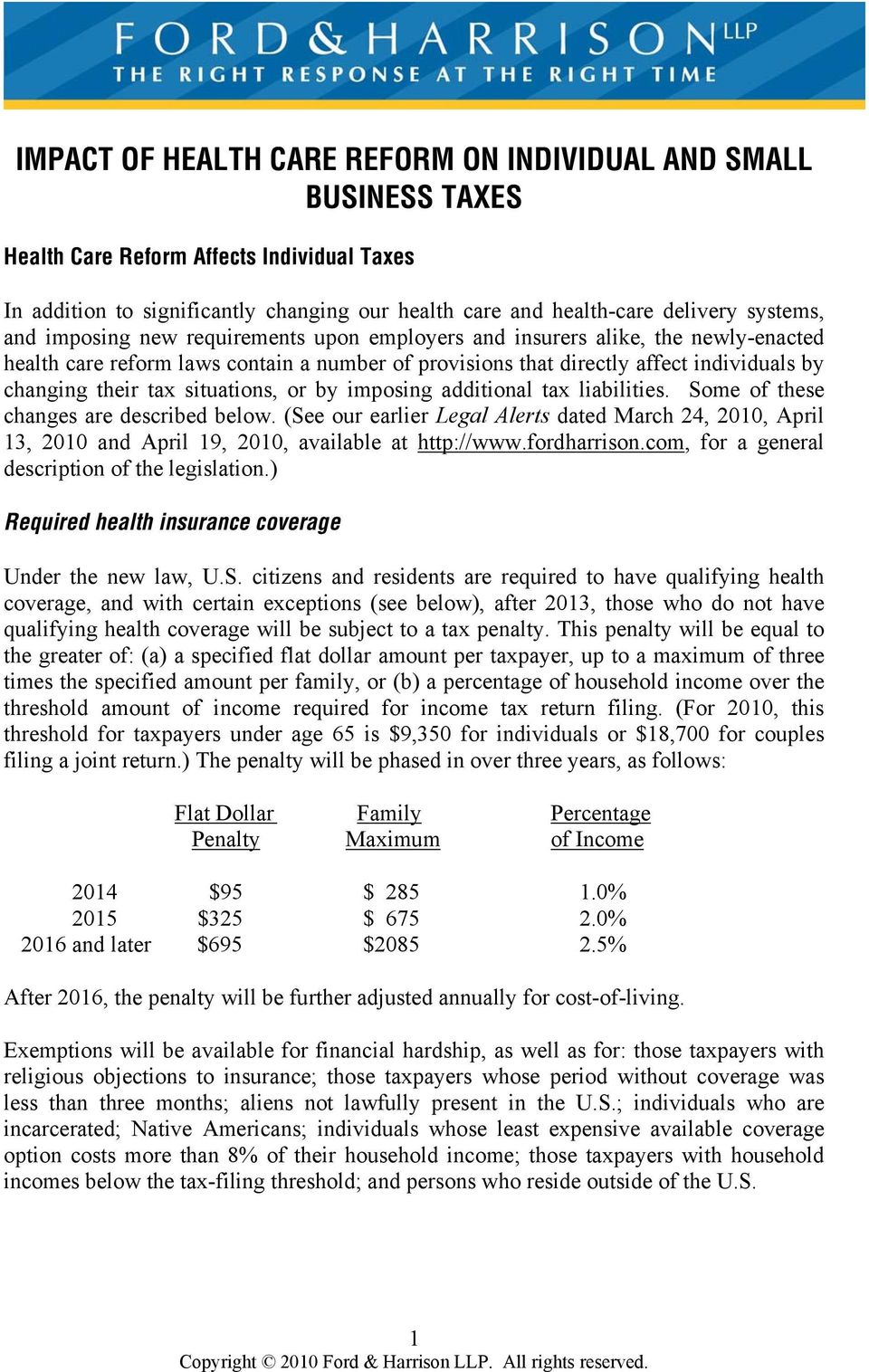
2 IMPACT OF HEALTH CARE REFORM ON INDIVIDUAL AND SMALL BUSINESS TAXES Health Care Reform Affects Individual Taxes In addition to significantly changing our health care and health-care delivery systems, and imposing new requirements upon employers and insurers alike, the newly-enacted health care reform laws contain a number of provisions that directly affect individuals by changing their tax situations, or by imposing additional tax liabilities. Some of these changes are described below. (See our earlier Legal Alerts dated March 24, 2010, April 13, 2010 and April 19, 2010, available at for a general description of the legislation.) Required health insurance coverage Under the new law, U.S. citizens and residents are required to have qualifying health coverage, and with certain exceptions (see below), after 2013, those who do not have qualifying health coverage will be subject to a tax penalty. This penalty will be equal to the greater of: (a) a specified flat dollar amount per taxpayer, up to a maximum of three times the specified amount per family, or (b) a percentage of household income over the threshold amount of income required for income tax return filing. (For 2010, this threshold for taxpayers under age 65 is $9,350 for individuals or $18,700 for couples filing a joint return.) The penalty will be phased in over three years, as follows: Flat Dollar Family Percentage Penalty Maximum of Income 2014 $95 $ % 2015 $325 $ % 2016 and later $695 $ % After 2016, the penalty will be further adjusted annually for cost-of-living. Exemptions will be available for financial hardship, as well as for: those taxpayers with religious objections to insurance; those taxpayers whose period without coverage was less than three months; aliens not lawfully present in the U.S.; individuals who are incarcerated; Native Americans; individuals whose least expensive available coverage option costs more than 8% of their household income; those taxpayers with household incomes below the tax-filing threshold; and persons who reside outside of the U.S. 1
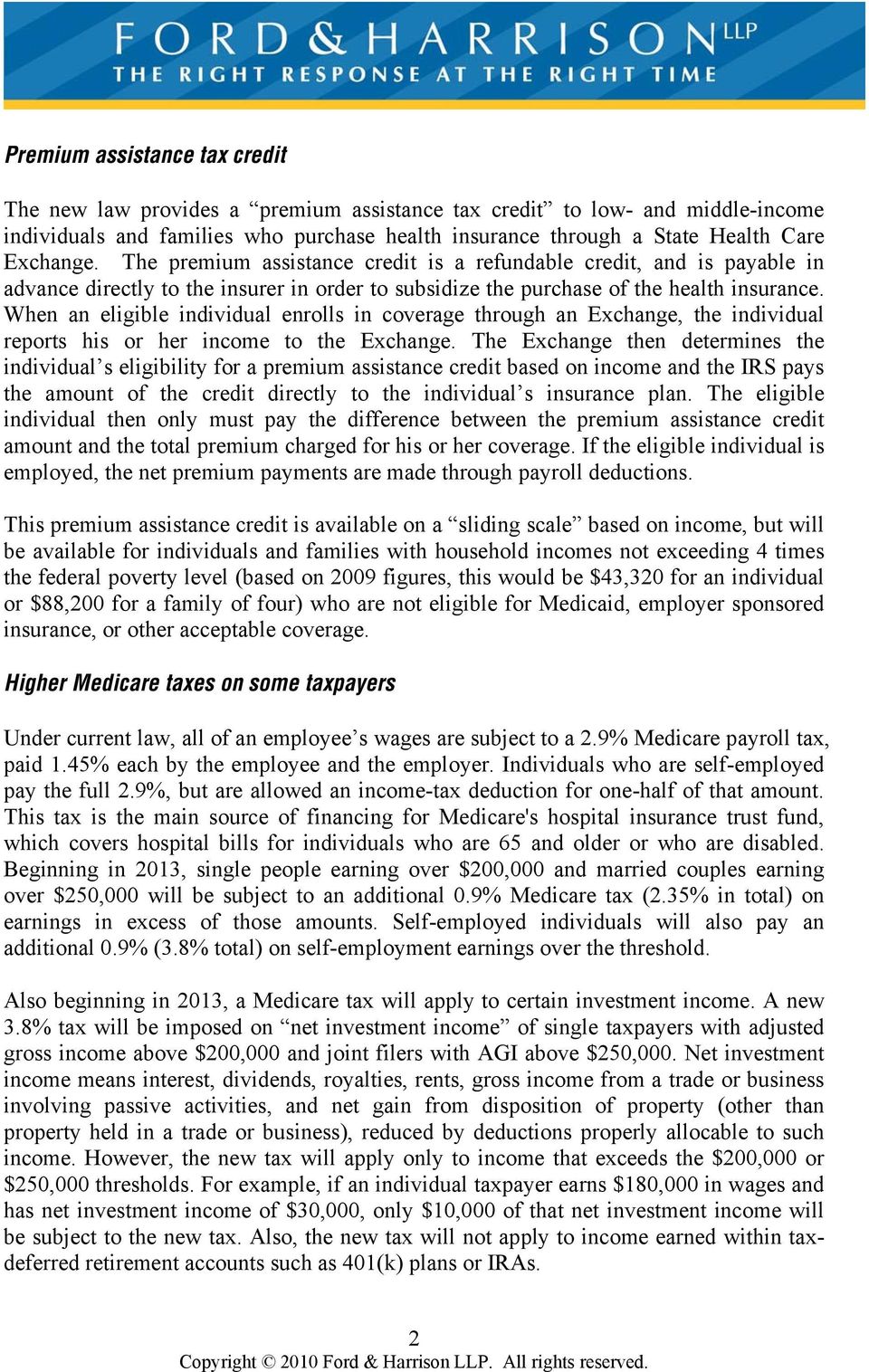
3 Premium assistance tax credit The new law provides a premium assistance tax credit to low- and middle-income individuals and families who purchase health insurance through a State Health Care Exchange. The premium assistance credit is a refundable credit, and is payable in advance directly to the insurer in order to subsidize the purchase of the health insurance. When an eligible individual enrolls in coverage through an Exchange, the individual reports his or her income to the Exchange. The Exchange then determines the individual s eligibility for a premium assistance credit based on income and the IRS pays the amount of the credit directly to the individual s insurance plan. The eligible individual then only must pay the difference between the premium assistance credit amount and the total premium charged for his or her coverage. If the eligible individual is employed, the net premium payments are made through payroll deductions. This premium assistance credit is available on a sliding scale based on income, but will be available for individuals and families with household incomes not exceeding 4 times the federal poverty level (based on 2009 figures, this would be $43,320 for an individual or $88,200 for a family of four) who are not eligible for Medicaid, employer sponsored insurance, or other acceptable coverage. Higher Medicare taxes on some taxpayers Under current law, all of an employee s wages are subject to a 2.9% Medicare payroll tax, paid 1.45% each by the employee and the employer. Individuals who are self-employed pay the full 2.9%, but are allowed an income-tax deduction for one-half of that amount. This tax is the main source of financing for Medicare's hospital insurance trust fund, which covers hospital bills for individuals who are 65 and older or who are disabled. Beginning in 2013, single people earning over $200,000 and married couples earning over $250,000 will be subject to an additional 0.9% Medicare tax (2.35% in total) on earnings in excess of those amounts. Self-employed individuals will also pay an additional 0.9% (3.8% total) on self-employment earnings over the threshold. Also beginning in 2013, a Medicare tax will apply to certain investment income. A new 3.8% tax will be imposed on net investment income of single taxpayers with adjusted gross income above $200,000 and joint filers with AGI above $250,000. Net investment income means interest, dividends, royalties, rents, gross income from a trade or business involving passive activities, and net gain from disposition of property (other than property held in a trade or business), reduced by deductions properly allocable to such income. However, the new tax will apply only to income that exceeds the $200,000 or $250,000 thresholds. For example, if an individual taxpayer earns $180,000 in wages and has net investment income of $30,000, only $10,000 of that net investment income will be subject to the new tax. Also, the new tax will not apply to income earned within taxdeferred retirement accounts such as 401(k) plans or IRAs. 2
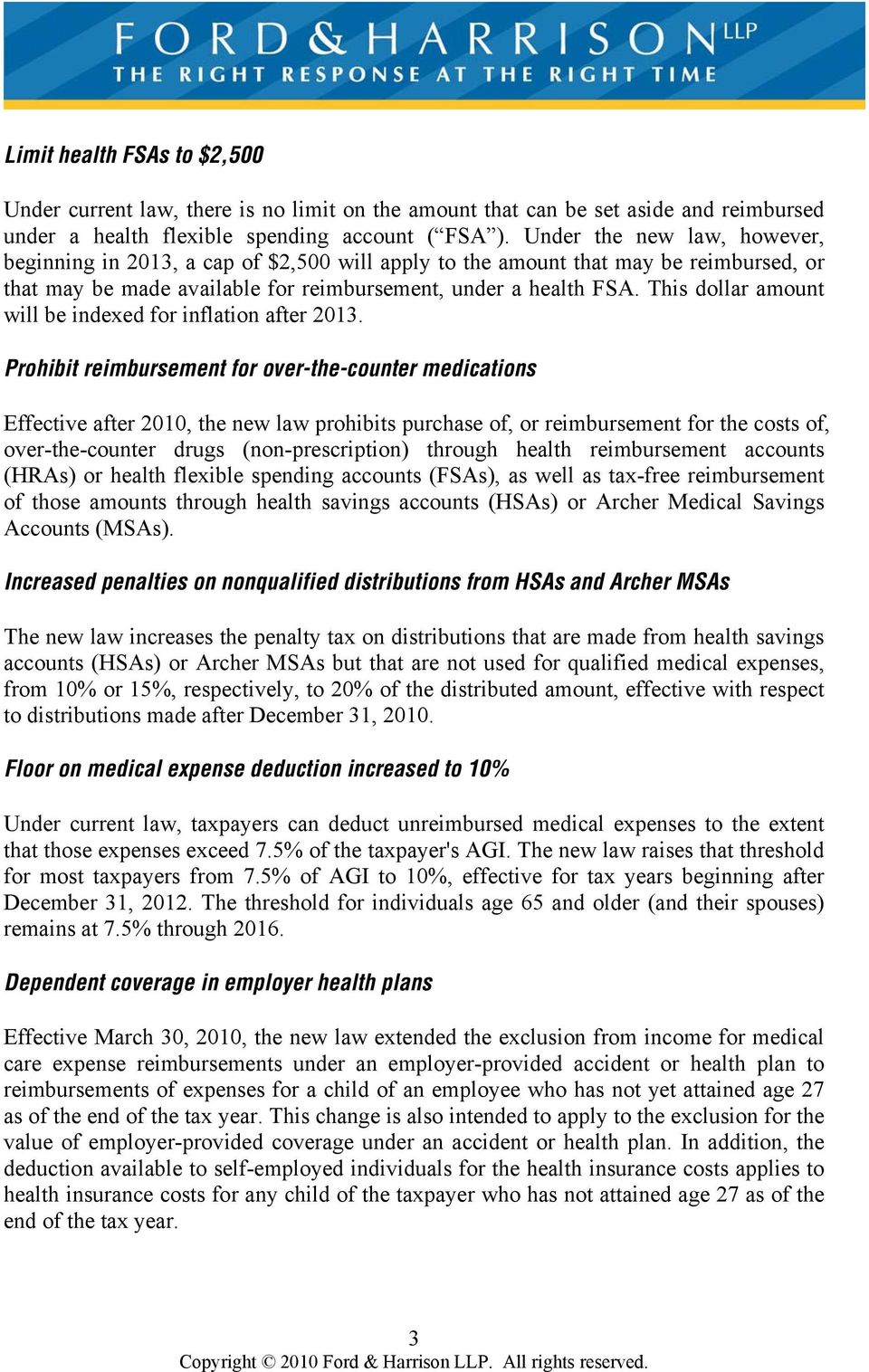
4 Limit health FSAs to $2,500 Under current law, there is no limit on the amount that can be set aside and reimbursed under a health flexible spending account ( FSA ). Under the new law, however, beginning in 2013, a cap of $2,500 will apply to the amount that may be reimbursed, or that may be made available for reimbursement, under a health FSA. This dollar amount will be indexed for inflation after Prohibit reimbursement for over-the-counter medications Effective after 2010, the new law prohibits purchase of, or reimbursement for the costs of, over-the-counter drugs (non-prescription) through health reimbursement accounts (HRAs) or health flexible spending accounts (FSAs), as well as tax-free reimbursement of those amounts through health savings accounts (HSAs) or Archer Medical Savings Accounts (MSAs). Increased penalties on nonqualified distributions from HSAs and Archer MSAs The new law increases the penalty tax on distributions that are made from health savings accounts (HSAs) or Archer MSAs but that are not used for qualified medical expenses, from 10% or 15%, respectively, to 20% of the distributed amount, effective with respect to distributions made after December 31, Floor on medical expense deduction increased to 10% Under current law, taxpayers can deduct unreimbursed medical expenses to the extent that those expenses exceed 7.5% of the taxpayer's AGI. The new law raises that threshold for most taxpayers from 7.5% of AGI to 10%, effective for tax years beginning after December 31, The threshold for individuals age 65 and older (and their spouses) remains at 7.5% through Dependent coverage in employer health plans Effective March 30, 2010, the new law extended the exclusion from income for medical care expense reimbursements under an employer-provided accident or health plan to reimbursements of expenses for a child of an employee who has not yet attained age 27 as of the end of the tax year. This change is also intended to apply to the exclusion for the value of employer-provided coverage under an accident or health plan. In addition, the deduction available to self-employed individuals for the health insurance costs applies to health insurance costs for any child of the taxpayer who has not attained age 27 as of the end of the tax year. 3
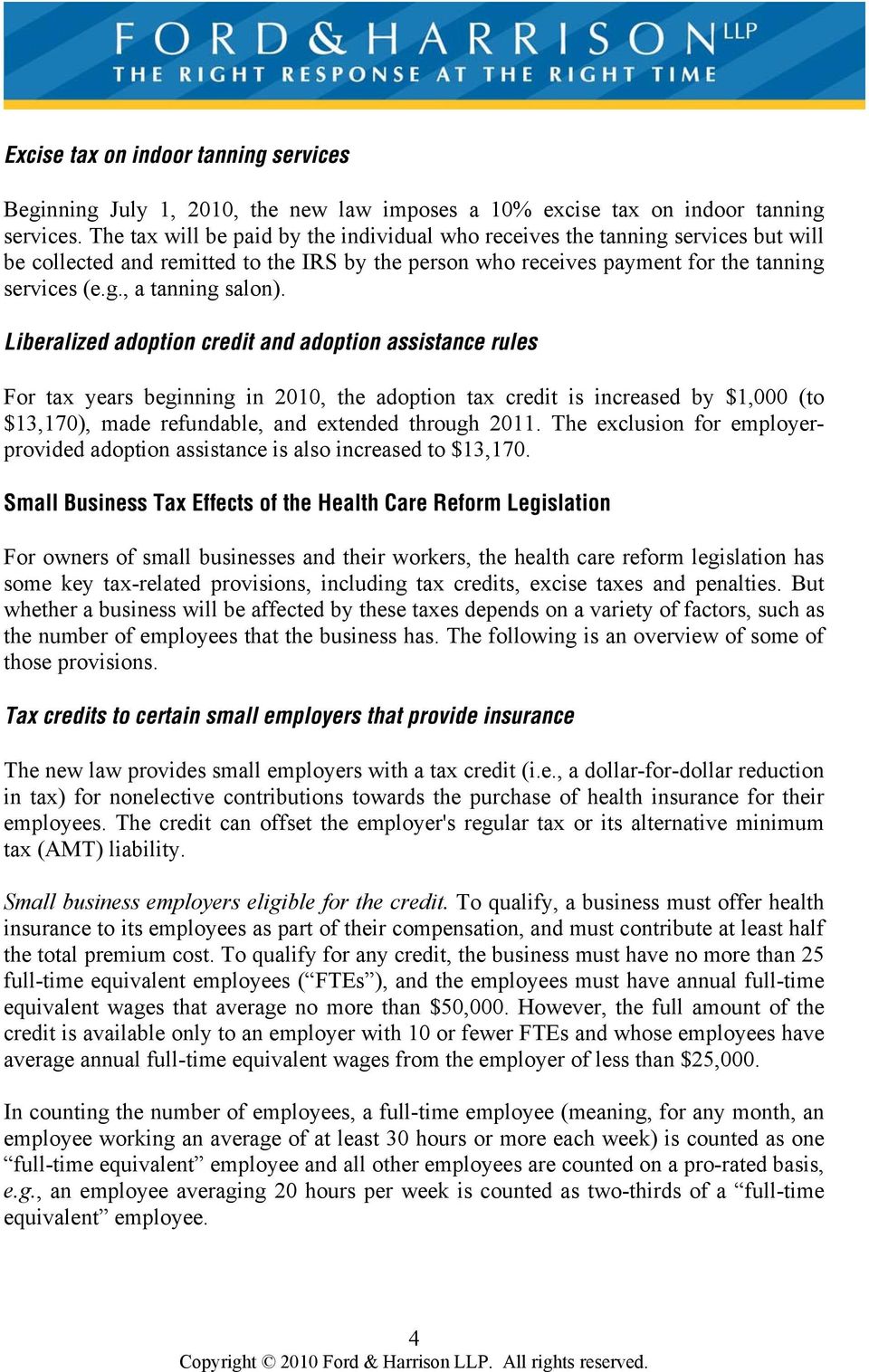
5 Excise tax on indoor tanning services Beginning July 1, 2010, the new law imposes a 10% excise tax on indoor tanning services. The tax will be paid by the individual who receives the tanning services but will be collected and remitted to the IRS by the person who receives payment for the tanning services (e.g., a tanning salon). Liberalized adoption credit and adoption assistance rules For tax years beginning in 2010, the adoption tax credit is increased by $1,000 (to $13,170), made refundable, and extended through The exclusion for employerprovided adoption assistance is also increased to $13,170. Small Business Tax Effects of the Health Care Reform Legislation For owners of small businesses and their workers, the health care reform legislation has some key tax-related provisions, including tax credits, excise taxes and penalties. But whether a business will be affected by these taxes depends on a variety of factors, such as the number of employees that the business has. The following is an overview of some of those provisions. Tax credits to certain small employers that provide insurance The new law provides small employers with a tax credit (i.e., a dollar-for-dollar reduction in tax) for nonelective contributions towards the purchase of health insurance for their employees. The credit can offset the employer's regular tax or its alternative minimum tax (AMT) liability. Small business employers eligible for the credit. To qualify, a business must offer health insurance to its employees as part of their compensation, and must contribute at least half the total premium cost. To qualify for any credit, the business must have no more than 25 full-time equivalent employees ( FTEs ), and the employees must have annual full-time equivalent wages that average no more than $50,000. However, the full amount of the credit is available only to an employer with 10 or fewer FTEs and whose employees have average annual full-time equivalent wages from the employer of less than $25,000. In counting the number of employees, a full-time employee (meaning, for any month, an employee working an average of at least 30 hours or more each week) is counted as one full-time equivalent employee and all other employees are counted on a pro-rated basis, e.g., an employee averaging 20 hours per week is counted as two-thirds of a full-time equivalent employee. 4
6 Years the credit is available. The credit is initially available for any tax year beginning in 2010, 2011, 2012, or 2013, in which health insurance coverage is purchased from an insurance company licensed under state law. For tax years beginning after 2013, the credit is only available to an eligible small employer that purchases health insurance coverage for its employees through a State Health Care Exchange and is only available for a two-year period. The maximum two-year coverage period does not take into account any tax years beginning before Thus, an eligible small employer could potentially qualify for this credit for six of its tax years four years under the first phase and two years under the second phase. Calculating the amount of the credit. For tax years beginning before 2014, the credit is generally 35% of the employer's nonelective contributions toward the employees' health insurance premiums; the percentage increases to 50% for years after The credit phases out as firm size and average wages increase. The employer remains entitled to an ordinary and necessary business expense deduction equal to the amount of the employer contribution minus the dollar amount of the credit. For example, if an eligible small employer were to pay 100% of the cost of its employees' health insurance coverage and the amount of the tax credit is 50% of that cost (i.e., in tax years beginning after 2013), the employer can still claim a deduction for the other 50% of the premium cost. Self-employed individuals, including partners and sole proprietors, two-percent shareholders of a subchapter-s corporation, and five-percent owners of an employer are not treated as employees for purposes of this credit. There is also a special rule to prevent sole proprietorships from receiving the credit for their owners and the owners family members. Thus, no credit is available for any contribution towards the purchase of health insurance for these individuals and the individual is not taken into account in determining the number of full-time equivalent employees or average full-time equivalent wages. Most small businesses not subject to penalty Although beginning January 1, 2014 the new law imposes penalties on certain businesses for not providing coverage to their employees (the so-called pay or play requirement), most small businesses won't have to worry about this provision because employers with fewer than 50 employees aren't subject to the pay or play penalty. Only an applicable large employer, defined as an employer who employed an average of at least 50 FTEs during the preceding calendar year, is subject to the requirement to offer coverage. Most small businesses, since they have fewer than 50 employees, are thus exempt from this requirement. However, even an employer with 50 or more FTEs isn't subject to the penalty for not offering coverage if the employer has no full-time employees who are certified to the employer as having purchased health insurance through a state Exchange with respect to which a tax credit or cost-sharing reduction is allowed or paid to the employee. 5
7 For businesses with at least 50 FTEs, and at least one full-time employee who receives a premium tax credit or cost-sharing reduction, the possible penalties vary depending on whether or not the employer offers health insurance to its employees. Penalty for employers not offering coverage. An applicable large employer who fails to offer its full-time employees and their dependents the opportunity to enroll in minimum essential coverage under an employer-sponsored plan for any month is subject to a penalty if at least one of its full-time employees is certified to the employer as having enrolled in health insurance coverage purchased through a state Exchange with respect to which a premium tax credit or cost-sharing reduction is allowed or paid to the employee. The penalty for any month is an excise tax equal to the number of FTEs over a 30- employee threshold during the applicable month (regardless of how many employees are receiving a premium tax credit or cost-sharing reduction) multiplied by one-twelfth of $2,000. For example, if an employer fails to offer minimum essential coverage and has 60 full-time employees, ten of whom receive a tax credit for the year for enrolling in a state Exchange-offered plan, the employer will owe $2,000 for each employee over the 30-employee threshold, for a total penalty of $60,000 ($2,000 multiplied by 30 (60 minus 30)). This penalty is computed and assessed on a monthly basis. Penalty for employers that offer coverage but have at least one employee receiving a premium tax credit. An applicable large employer who offers coverage but has at least one full-time employee receiving a premium tax credit or cost-sharing reduction is subject to a penalty. The penalty is an excise tax that is imposed for each employee who receives a premium tax credit or cost-sharing reduction for health insurance purchased through a state Exchange. For each full-time employee receiving a premium tax credit or cost-sharing subsidy through a state Exchange for any month, the employer is required to pay an amount equal to one-twelfth of $3,000. The penalty for each employer for any month is capped at an amount equal to the number of FTEs during the month (regardless of how many employees are receiving a premium tax credit or cost-sharing reduction) in excess of 30, multiplied by one-twelfth of $2,000. For example, if an employer offers health coverage and has 60 full-time employees, 15 of whom receive a tax credit for the year for enrolling in a state Exchange-offered plan, the employer will owe a penalty of $3,000 for each employee receiving a tax credit, for a total penalty of $45,000. The maximum penalty for this employer is capped at the amount of the penalty that it would have been assessed for a failure to provide coverage, or $60,000 ($2,000 multiplied by 30 (60 minus 30)). Since the calculated penalty of $45,000 is less than the maximum amount, the employer pays the $45,000 calculated penalty. This penalty is computed and assessed on a monthly basis. Requirement to offer free choice vouchers After 2013, employers offering minimum essential coverage through an eligible employer-sponsored plan and paying a portion of that coverage will have to provide qualified employees with a voucher whose value could be applied to purchase a health 6
8 plan through the Exchange. Qualified employees would be those employees: who do not participate in the employer's health plan; whose required contribution for employer sponsored minimum essential coverage exceeds 8%, but does not exceed 9.8% of household income; and whose total household income does not exceed 400% of the poverty line for the family. The value of the voucher would be equal to the dollar value of the employer contribution to the employer offered health plan. Employers providing free choice vouchers will not be subject to penalties for employees that receive a voucher. Tax on high-cost ( Cadillac ) health plans The new law places an excise tax on high-cost employer-sponsored health coverage (often referred to as Cadillac health plans). This is a 40% excise tax on insurance companies, based on premiums that exceed certain amounts. The tax is not on employers themselves unless their coverage is self-funded. However, it is expected that employers and workers will ultimately bear the cost of this tax in the form of higher premiums passed on by insurers. The new tax, which goes into effect for tax years beginning after Dec. 31, 2017, imposes a 40% nondeductible excise tax on insurance companies and plan administrators for any health plan to the extent that the annual premium exceeds $10,200 for single coverage and $27,500 for family coverage. An additional $1,650 for single coverage and $3,450 for family coverage is added to the threshold for retired individuals age 55 and older and for plans that cover employees engaged in high risk professions. The tax will apply to self-insured plans and plans sold in the group market, but not to plans sold in the individual market (except for coverage the cost of which is deductible for self-employed individuals). Stand-alone dental and vision plans are disregarded in applying the tax. The dollar thresholds will be automatically increased if the inflation rate for group medical premiums between 2010 and 2018 turns out to be higher than projected. Employers with age and gender demographics that result in higher premiums could value the coverage provided to employees using the rates that would apply using a national risk pool. Employers will be required to aggregate the coverages that are subject to the limit and to issue information returns for insurers indicating the amount subject to the excise tax. If you have any questions regarding this article, or would like additional details concerning the new law or concerning the matters discussed above, you can contact the author of this article, Jeffrey Ashendorf, , [email protected], any member of Ford & Harrison's Employee Benefits practice group or the Ford & Harrison attorney with whom you usually work. 7

Answers about. Health Care REFORM. for your business
 Answers about Health Care REFORM for your business Since the time of its enactment in 2010, the health care reform law has remained controversial at least in part due to a constitutional challenge to the
ABC Company 123 Main Street Anywhere, USA 12345 www.sampleabccompany.com 800.123.4567
 WHAT HEALTH CARE REFORM MEANS FOR YOUR BUSINESS Your promotional imprint here and/or back cover. ABC Company 123 Main Street Anywhere, USA 12345 www.sampleabccompany.com 800.123.4567 The Patient Protection
Tax Implications of Health Care Reform
 Tax Implications of Health Care Reform Presented by: Art Sparks, CPA Partner Certified Public Accountants Summary Summary The Patient Protection and Affordable Care Act (PPACA) and the companion Health
The Patient Protection and Affordable Care Act
 Private Wealth Management Products & Services March 2010 The Patient Protection and Affordable Care Act Health care act includes variety of tax changes President Obama signed the Patient Protection and
Health-Care Reform. Begley Insurance Group, Inc. Mary Angelo 5225 Old Orchard Rd. Skokie, IL 60077 800-867-7074
 Begley Insurance Group, Inc. Mary Angelo 5225 Old Orchard Rd. Skokie, IL 60077 800-867-7074 Health-Care Reform August 14, 2012 Page 1 of 8, see disclaimer on final page One primary goal of the Patient
HEALTH CARE REFORM FOR BUSINESSES
 HEALTH CARE REFORM FOR BUSINESSES Grandfathered Health Plans. We will start with information on health plans that were in existence on March 23, 2010 (i.e., the enactment date of the Affordable Care Act).
Timeline of New Health Care Law and Its Impact on American Businesses
 Timeline of New Health Care Law and Its Impact on American Businesses Summaries of the Patient Protection and Affordable Health Care Act (Public Law 111-148) Health Care and Education Reconciliation Act
Key Provisions of 2010 Healthcare Reform Legislation for Small (under 50) Employers. By Alice Eastman Helle. October 2013 Update
 Key Provisions of 2010 Healthcare Reform Legislation for Small (under 50) Employers By Alice Eastman Helle October 2013 Update The sweeping healthcare reform legislation enacted in 2010 is exceedingly
Health care reform is once again
 Marjorie M. Glover and Rachel M. Kurth Employee Benefit Plan Review Reprinted from April 2010 Health Care Reform: How It May Impact Employers, Employees, and Benefit Plans Health care reform is once again
THE PATIENT PROTECTION AND AFFORDABLE CARE ACT and THE RECONCILIATION ACT
 THE PATIENT PROTECTION AND AFFORDABLE CARE ACT and THE RECONCILIATION ACT On Sunday, March 21 st, the U. S. House of Representatives passed the Patient Protection and Affordable Care Act (H. R. 3590) by
The Income Tax Effects of Health Care Reform on Small Businesses and Real Estate Investors
 The Income Tax Effects of Health Care Reform on Small Businesses and Real Estate Investors BY J. RUSSELL HARDIN, PH.D. INTRODUCTION IF REAL ESTATE INVESTORS AND SMALL BUSINESS OWNERS intend to maximize
Christy Tinnes, Brigen Winters and Christine Keller, Groom Law Group, Chartered
 Preparing for Health Care Reform A Chronological Guide for Employers This Article provides an overview of the major provisions of health care reform legislation affecting employers and explains the requirements
Tax Implications of the Affordable Care Act
 Year-by-Year Guide Tax Implications of the Affordable Care Act 1 Year-by-Year Guide: Tax Implications of the Affordable Care Act Introduction The Patient Protection and Affordable Care Act, commonly referred
Chart: Key employer health care reform elements
 Chart: Key employer health care reform elements Health care reform with major implications for employers has now become law, with a package of revisions heading for Senate action. The approved measure
HEALTH REFORM AND MULTIEMPLOYER PLAN COVERAGE 2014 AND BEYOND
 WWW.BKLAWYERS.COM HEALTH REFORM AND MULTIEMPLOYER PLAN COVERAGE 2014 AND BEYOND ABA SECTION OF LABOR AND EMPLOYMENT LAW EMPLOYEE BENEFITS COMMITTEE MID- WINTER MEETING 201 BLITMAN & KING LLP Franklin Center,
Health Care Implementation Timeline
 Health Care Implementation Timeline The massive healthcare (H.R. 3590) and its companion reconciliation bill (H.R. 4872) passed by the Senate and House in early 2010 will go into effect over several years.
Important Effective Dates for Employers and Health Plans
 Brought to you by Krempa Associates, Inc. Important Effective Dates for Employers and Health Plans On March 23, 2010, President Obama signed the health care reform bill, or Affordable Care Act (ACA), into
Important Effective Dates for Employers and Health Plans
 Brought to you by Sullivan Benefits Important Effective Dates for Employers and Health Plans On March 23, 2010, President Obama signed the health care reform bill, or Affordable Care Act (ACA), into law.
Selected Employer Provisions in the Patient Protection and Affordable Care Act and the Health Care and Education Reconciliation Act of 2010
 Selected Employer Provisions in the Patient Protection and Affordable Care Act and the Health Care and Education Reconciliation Act of 2010 This chart outlines, in depth, selected provisions in the Patient
Health Care Reform Frequently Asked Questions
 Health Care Reform Frequently Asked Questions On March 23, 2010, President Obama signed federal health care reform into law, also known as the Patient Protection and Affordability Act. A second, or reconciliation
Affordable Care Act FAQs Individuals
 Affordable Care Act FAQs Individuals The Supreme Court s landmark decision on the Affordable Care Act (ACA) has resulted in uncertainties among many individuals, regardless of their tax bracket, personal
Health Savings Accounts
 HSAs Health Savings Accounts 2014 and 2015 Limits Questions & Answers What is a Health Savings Account (HSA)? An HSA is a tax-exempt trust or custodial account established for the purpose of paying medical
GUIDE TO HEALTH CARE REFORM S TAX PENALTIES
 The GUIDE TO HEALTH CARE REFORM S TAX PENALTIES Calculate Your Health Insurance Tax Penalty 2 Introduction The Affordable Care Act (ACA) requires certain employers and employees to purchase health insurance
Introduction. Affordable Care Act Overview of Changes
 Introduction Affordable Care Act Overview of Changes Presented by: Tim Dillingham, CLU Benefit Resource Group, Inc. 201 E Broad Street, Suite 1 Linden, MI 48451 810-735-6500 810-735-6610 (fax) [email protected]
Taxation and Health Insurance
 Thorley Wealth Management, Inc. Elizabeth Thorley, MS, CFP, CLU CEO & President 1478 Marsh Road Pittsford, NY 14534 585-512-8453 203 Fax: 585.625.0477 [email protected] www.thorleywm.com Taxation
THE AFFORDABLE CARE ACT IN ACTION
 THE AFFORDABLE CARE ACT IN ACTION How Health Insurance Reform Could Affect You The Impact of the Individual Mandate Health Insurance Marketplace Exchanges Provisions Affecting Individuals and Businesses
Health care reform at-a-glance. August 2014
 Health care reform at-a-glance August 2014 Employer mandate Shared responsibility payment for failing to offer coverage to at least 95%* of all fulltime employees (FTE) and children if any FTE gets subsidy
EMPLOYEE S GUIDE TO HEALTH CARE REFORM S TAX CREDITS
 The EMPLOYEE S GUIDE TO HEALTH CARE REFORM S TAX CREDITS Calculate Your Health Insurance Tax Credit 2 Introduction Beginning in 2014, massive tax credits will become available to help individuals buy health
Health Reform. Presented by USI Affinity
 Health Reform Presented by USI Affinity USI Affinity Introduction USI Affinity has been working with Associations and their members for over 50 years. USI Affinity has offices in Philadelphia, Harrisburg,
Health care reform at-a-glance. December 2013
 December 2013 Employer mandate Play or pay penalty for failing to offer coverage to at least 95% of all full-time employees (FTE) and children if any FTE gets subsidy in exchange $2,000 (indexed) times
American employers need prompt action on these six significant challenges. We urge Congress and the administration to address them now.
 In June 2014, the Board of Directors of the American Benefits Council (the Council) approved a long-term public policy strategic plan, A 2020 Vision: Flexibility and the Future of Employee Benefits. It
How To Pass The Health Care Bill
 Timeline/Summary of Tax s in the Health Reform Laws Effective Date Retrospective to Enactment Health professionals State loan repayment tax relief. Excludes from gross income payments made under any State
IRS Issues Guidance on Mandatory Form W-2 Informational Reporting of Employer-Sponsored Health Coverage
 IRS Issues Guidance on Mandatory Form W-2 Informational Reporting of Employer-Sponsored Health Coverage By Seth Perretta, Joel Wood and Matthew Fornataro of Crowell & Moring LLP On March 29, 2011, the
Small Employer Health Care Tax Credit: Questions & Answers (Q&A)
 Brought to you by Seubert & Associates Small Employer Health Care Tax Credit: Questions & Answers (Q&A) The Patient Protection and Affordable Care Act (ACA) provides a tax credit to certain small employers
Health Savings Accounts
 Health Savings Accounts I. What Are HSAs and Who Can Have Them? What is an HSA? An HSA is a tax-exempt trust or custodial account established exclusively for the purpose of paying qualified medical expenses
Health Care Reform: 2015 Refresher of the Affordable Care Act (ACA)
 Health Care Reform: 2015 Refresher of the Affordable Care Act (ACA) Brought to you by Aon Presented by: Ryan Comstock & Shawna Brown This information is provided for informational purposes only and is
Health Care Reform Implications for Employers with Seasonal Employees
 Health Care Reform Implications for Employers with Seasonal Employees Many industries (e.g. ski resorts, retail, restaurants, agriculture, fishing and tourism) have a significant number of seasonal employees.
InSight. A Littler Mendelson Report. Health Care Reform: Are You Prepared? A Timeline for Employers to Follow
 A Littler Mendelson Report InSight An Analysis of Recent Developments & Trends In This Issue: April 2010 The Patient Protection and Affordable Care Act was signed into law on March 23, 2010. Amendments
Healthcare Provisions 2013/2014. What Small Businesses Need to Know
 Healthcare Provisions 2013/2014 What Small Businesses Need to Know Healthcare Provisions 2013/2014 PPACA The healthcare reforms in the Patient Protection and Affordable Care Act (PPACA), commonly referred
National Health Insurance Reform
 JANUARY2011 National Health Insurance Reform Impact Year by Year With the passage of National Health Insurance Reform it is crucial that employers and plan sponsors have clear information about the impact
Understanding the Affordable Care Act Premium Tax Credit
 Understanding the Affordable Care Act Premium Tax Credit Most Americans are Required to Have Health Care Coverage The Affordable Care Act (ACA), or health care law, requires most U.S. citizens and legal
Small Business Health Care Tax Credit
 Small Business Health Care Tax Credit Frequently Asked Questions Small Business Health Care Tax Credit This information is only intended as a high-level guide and is not to be relied upon as actuarial,
IRS gives first glimpse of rules on ACA excise tax on high cost health plans and asks for input
 from Human Resource Services IRS gives first glimpse of rules on ACA excise tax on high cost health plans and asks for input February 27, 2015 In brief The IRS has issued a Notice laying out some initial
Bankers Insurance, LLC Your Health Care Reform Partner
 Bankers Insurance, LLC Your Health Care Reform Partner Are you in compliance with health care reform regulations? We can help you stay on top of health care reform to avoid penalties from legislative briefs
Health Care Reform Act: Who s Paying the Bill?
 Health Care Reform Act: Who s Paying the Bill? Walter Miller Schwabe, Williamson & Wyatt P.C. 800 Willamette Street, Suite 600 Eugene, OR 97401 (541) 686-3299 [email protected] TABLE OF CONTENTS Page
Healthcare Reform Provisions Unique to Small Employers/Financial and Other Benefits Concerns for All Employers (updated May 2, 2014)
 /Financial and Other Benefits Concerns for All Employers (updated May 2, 2014) Lisa L. Carlson, J.D., Area Senior Vice President, Compliance Counsel Gallagher Benefit Services, Inc. While most healthcare
Post Election Focus: Stars, Stripes & Taxes
 Post Election Focus: Stars, Stripes & Taxes Presented By: Margo Cook, CPA December 6, 2012 Click HERE to listen to webinar. Post Election Focus: Stars, Stripes & Taxes Presented By: Margo Cook, CPA December
Health savings account Q&As
 Health savings account Q&As What are HSAs and who can have them? 1. What is a Health Savings Account (HSA) and how does it work? An HSA is a tax-advantaged account established to pay for qualified medical
Staying Healthy, Wealthy & Wise: The Aftermath of the Fiscal Cliff. Heather Kovalsky, CPA
 Staying Healthy, Wealthy & Wise: The Aftermath of the Fiscal Cliff Heather Kovalsky, CPA 2013 Tax Changes The Patient Protection and Affordable Care Act American Tax Relief Act of 2012 The Patient Protection
Legislative Brief: HEALTH SAVINGS ACCOUNT (HSA) ELIGIBILITY
 EmPowerHR Legislative Brief: HEALTH SAVINGS ACCOUNT (HSA) ELIGIBILITY Many employers offer high deductible health plans (HDHPs) to control premium costs, and pair this coverage with health savings accounts
SUMMARY OF GUIDE CONTENTS... 1 HIGHLIGHTS OF TAX-ADVANTAGED PLANS... 2 EMPLOYEE SALARY REDUCTION PLANS... 5
 This Guide is for informational and educational purposes only. It does not constitute legal advice or a comprehensive guide to issues to be considered by employers in establishing tax-advantaged benefits
Health Care Reform Legislation and You
 (Customizable space for CPA Firm Logo to go here) Health Care Reform Legislation and You Timelines and Implications of the New Law for Individuals Updated as of January 2011 The Health Care Reform Legislation
And Changes under Healthcare Reform affecting businesses
 And Changes under Healthcare Reform affecting businesses 1 Individual Mandate 2 First there were two choices Under the Affordable Care Act every individual must have Minimum Essential Healthcare Coverage
Your guide to health care reform provisions
 Your guide to health care reform provisions February 2014 edition Since the Patient Protection and Affordable Care Act (PPACA) was enacted in March 2010, businesses have been impacted by federal health
Introduction. Healthcare Reform Reference Guide. Release Date: 7.29.10. General Questions Exchanges Adult Dependents Grandfathering Early Retirees
 q individual market q small group market Small Business Tax Credits Small Business Wellness Grants q large group market Blue Cross and Blue Shield companies are committed to working with the Administration
Income, Gift, and Estate Tax Update
 Income, Gift, and Estate Tax Update Individual Income Tax Rates p. 1 Phil Harris Department of Agricultural and Applied Economics University of Wisconsin-Madison Marriage Penalty Relief p. 1 Capital Gains
Tax Subsidies for Health Insurance An Issue Brief
 Tax Subsidies for Health Insurance An Issue Brief Prepared by the Kaiser Family Foundation July 2008 Tax Subsidies for Health Insurance Most workers pay both federal and state taxes for wages paid to them
HEALTH CARE ACT TAX OVERVIEW INDIVIDUALS. Expanded Medicare taxes and other changes make planning critical
 HEALTH CARE ACT TAX OVERVIEW INDIVIDUALS Expanded Medicare taxes and other changes make planning critical 1 The agenda The health care act s tax impact on individuals Medicare tax increase on earned income
Affordable Care Act (ACA) Violations Penalties and Excise Taxes
 Brought to you by The Insurance Exchange Affordable Care Act (ACA) Violations Penalties and Excise Taxes The Affordable Care Act (ACA) includes numerous reforms for group health plans and creates new compliance