
SmartLink: a Web-based editor and search environment for Linked Services
|
|
|
- Janel Ferguson
- 10 years ago
- Views:
Transcription
1 SmartLink: a Web-based editor and search environment for Linked Services Stefan Dietze, Hong Qing Yu, Carlos Pedrinaci, Dong Liu, John Domingue Knowledge Media Institute, The Open University, MK7 6AA, Milton Keynes, UK {s.dietze, h.q.yu, c.pedrinaci, d.liu, j.b.domingue}@open.ac.uk Abstract. Despite considerable research dedicated to Semantic Web Services (SWS), structured semantics are still not used significantly to annotate Web services and APIs. This is due to the complexity of comprehensive SWS models and has led to the emergence of a new approach dubbed Linked Services. Linked Services adopt Linked Data principles to produce simplified, RDF-based service descriptions that are easier to create and interpret. However, current Linked Services editors assume the existence of services documentation in the form of HTML or WSDL files. Therefore, we introduce SmartLink, a Web-based editor and search environment for Linked Services. Based on an easy-to-use Web form and a REST-ful API, SmartLink allows both humans as well as machines to produce light-weight service descriptions from scratch. Keywords: Semantic Web Services, Linked Services, Linked Data, SmartLink. 1 Introduction The past decade has seen a range of research efforts in the area of Semantic Web Services (SWS), aiming at the automation of Web service-related tasks such as discovery, orchestration or mediation. Several conceptual models, such as OWL-S [6], WSMO [3], and standards like SAWSDL [7] have been proposed, usually covering aspects such as service capabilities, interfaces and non-functional properties. However, SWS research has for the most part targeted WSDL or SOAP-based Web services, which are not prevalent on the Web. Also, due to the inherent complexity required to fully capture computational functionality, creating SWS descriptions has represented an important knowledge acquisition bottleneck and required the use of rich knowledge representation languages and complex reasoners. Hence, so far there has been little take up of SWS technology within non-academic environments. That is particularly concerning since Web services nowadays including a range of often more light-weight technologies beyond the WSDL/SOAP approach, such as RESTful services or XML-feeds are in widespread use throughout the Web. That has led to the emergence of more simplified SWS approaches to which we shall refer here as lightweight, such as WSMO-Lite [9] SA-REST [7] and Micro- WSMO/hRESTs [4] which replace heavyweight SWS with simpler models expressed in RDF(S) which aligns them with current practices in the growing Semantic Web [1] and simplifies the creation of service descriptions. While the
2 Semantic Web has successfully redefined itself as a Web of Linked (Open) Data (LOD) [2], the emerging Linked Services approach [7] exploits the established LOD principles for service description and publication, and is catering for exploiting the complementarity of the Linked Data and services to support the creation of advanced applications for the Web. In order to support annotation of a variety of services, such as WSDL services as well as REST APIs, the EC-funded project SOA4ALL 1, has developed the Linked Services registry and discovery engine iserve 2. iserve supports publishing service annotations as linked data expressed in terms of a simple conceptual model that is suitable for both human and machine consumption and abstracts from existing heterogeneity of service annotation formalisms: the Minimal Service Model (MSM). The MSM is a simple RDF(S) ontology able to capture (part of) the semantics of both Web services and Web APIs. While MSM [7] is extensible to benefit from the added expressivity of other formalisms, iserve allows import of service annotations following, for instance, SAWSDL, WSMO-Lite, MicroWSMO, or OWL-S. Once imported, service annotations are automatically published on the basis of the Linked Data principles. Service descriptions are thus accessible based on resolvable HTTP URIs by utilising content negotiation to return service instances in either plain HTML or RDF. In addition to a SPARQL endpoint, a REST API allows remote applications to publish annotations and to discover services through an advanced set of discovery strategies that combine semantic reasoning and information retrieval techniques. In order to support users in creating semantic annotations for services two editors have been developed: SWEET [5] (SemanticWeb services Editing Tool) and SOWER (SWEET is not a Wsdl EditoR), which support users in annotating Web APIs and WSDL services respectively. However, SWEET and SOWER build on the assumption that either HTML documentation of services/apis (SWEET) or WSDL files (SOWER) are available as starting point for annotation. While that holds for a certain set of services, a number of services on the Web neither provide a WSDL nor an HTML documentation and hence, current Linked Services editors cannot be deployed in a range of cases. In addition, we would like to promote an approach were services documentation relies on structured RDF(S) and additional human-readable documentation is not provided manually but automatically generated to avoid redundancies. Therefore, we introduce and demonstrate SmartLink, an editing and search environment for Linked Services addressing the issues described above. 2 SmartLink: Linked Services editor and search environment In order to provide a Linked Services editor which allows the annotation of REST-ful services without any pre-existing documentation, a new services annotation and search tool was created, SmartLink 3 ("SeMantic Annotation environment for Linked services"). SmartLink allows annotation of REST-ful services based on the MSM &
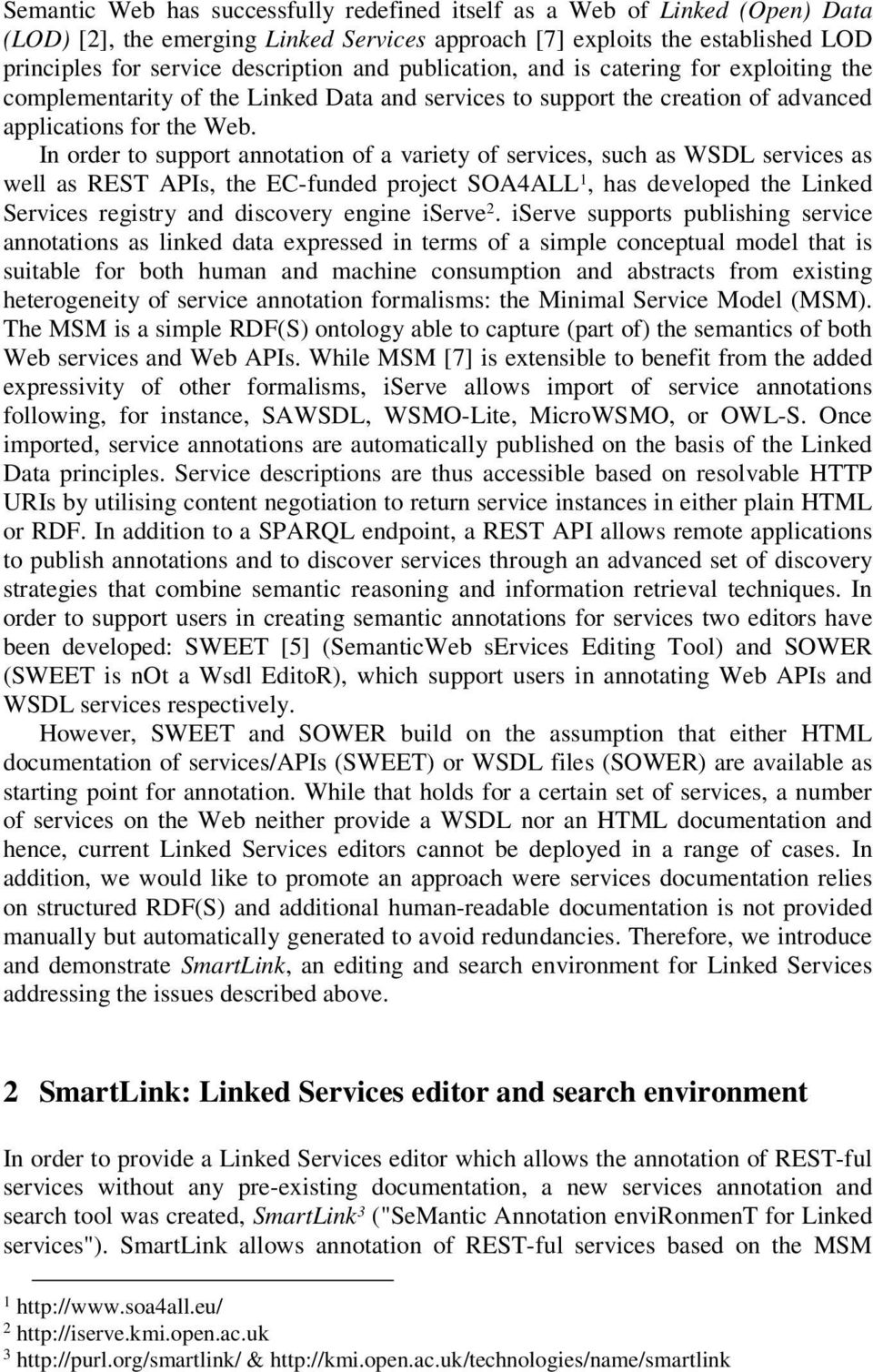
3 from scratch, that is, without any pre-existing services documentation such as WSDL or HTML files, as assumed by existing annotation tools (Section 1). SmartLink operates on top of LOD stores such as iserve and is an open environment accessible to users simply via OpenID 4 authentication. SmartLink exploits an extension of the MSM RDF schema proposing additional non-functional properties which are not covered yet. The schema 5 covers, for instance, contact person, developer name, Quality of Service (QoS), development status, service license, and WSMO goal reference. The latter property directly contributes to facilitate our approach of allowing MSM models to refer to existing WSMO goals which utilize the same service entity. MSM-schema properties are directly stored in iserve, while additional properties are captured in a complementary RDF store based on OpenRDF Sesame 6. Due to the SmartLink-specific extensions to the MSM, we refer in the following to our Linked Services RDF store as iserve+. The following figure depicts the overall architecture of the SmartLink environment. Fig. 1. SmartLink overall architecture. SmartLink allows developers to directly annotate existing RESTful services and APIs, which potentially also includes the annotation of WSMO goal requests which in fact are RESTful services themselves as MSM service instances. Figure 2 depicts the SmartLink Web interface showing the service editing form and the services library. Being an LOD-compliant environment, one of the core features of the MSM is the capability to associate service descriptions with so-called model references which refer to RDF descriptions in external vocabularies defining the semantics of the service or its parts. That way, for instance, a particular service response message can be associated with an external RDF description which details and further describes the nature of the response. However, while this feature is useful and even necessary in order to provide meaningful service models, finding appropriate model references across the entire Web of data is a challenging task. Therefore, SmartLink uses
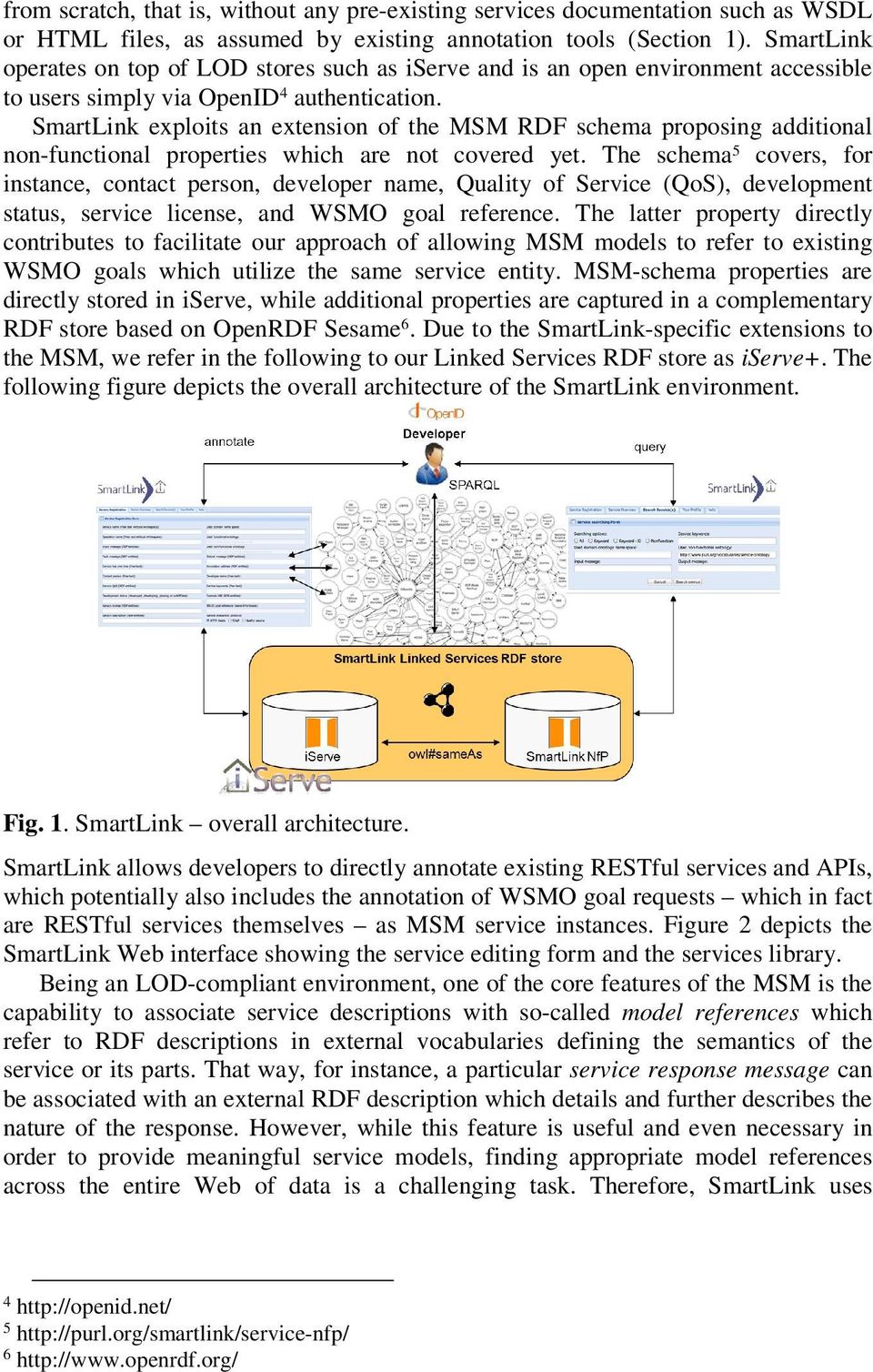
4 established Linked Data APIs currently the WATSON 7 API - to identify and recommend suitable model references to the user. Dedicated APIs allow machines and third party applications to interact with iserve+, e.g., to submit service instances or to discover and execute services. In addition, the Web application provides a search form which allows to query for particular services. Service matchmaking is being achieved by matching a set of core properties (input, output, keywords), submitting SPARQL queries, and a dedicated set of APIs. Fig. 2. SmartLink Web interface. SmartLink currently provides mechanisms which enable the export of particular (MSM) service instances as RDF or human-readable HTML. In order to facilitate service model transformation between MSM and other SWS formalisms, current research deals with the establishment of an export mechanism of MSM services. 3 Discussion and conclusion Current work deals with a first exploitation of SmartLink in the context of the NoTube project 8 where the ultimate goal is to develop a network of services, connected through the use of semantics, to personalize consumption of digital (IP)TV content. NoTube adopts the Linked Services approach by utilising the iserve+ and SmartLink tools. In addition, we have devised a functional classification for services specific to the NoTube domain, stored and exposed via our iserve+ environment. From our initial use case, a few observations have been made which will shape our future efforts. For instance, the recommendation of LOD model references via open

5 APIs proved very useful to aid SmartLink users when annotating services. However, due to the increasing number of LOD datasets strongly differing in terms of quality and usefulness it might be necessary in the future to select recommendations only based on a controlled subset of the LOD cloud in order to reduce available choices. While SmartLink proved beneficial when creating light-weight service annotations, the lack of service automation and execution support provided by our extended MSM models, and, more importantly, the current tool support, made it necessary to transform and augment these models to into more comprehensive service models (WSMO). Due to the lack of overlap between concurrent SWS models, transformation is a manual and costly process. Hence, our current research and development deals with the extension of the MSM by taking into account execution and composition oriented aspects and the development of additional APIs, which allow the discovery, execution and semi-automated composition of Linked Services, and make the exploitation of additional SWS approaches obsolete. 4 Acknowledgments This work is partly funded by the European projects NoTube and meducator. The authors would like to thank the European Commission for their support. 5 References [1] Berners-Lee, T., Hendler, J., Lassila, O (2001). "The Semantic Web". Scientific American Magazine. retrieved March 29, [2] Bizer, C., T. Heath, et al. (2009). "Linked data - The Story So Far." Special Issue on Linked data, International Journal on Semantic Web and Information Systems (IJSWIS). [3] Fensel, D.; Lausen, H.; Polleres, A.; de Bruijn, J.; Stollberg,, M.; Roman, D.; and Domingue, J Enabling Semantic Web Services: The Web Service Modeling Ontology. Springer. [4] Kopecky, J.; Vitvar, T.; and Gomadam, K. (2008). MicroWSMO. Deliverable, Conceptual Models for Services Working Group, URL: [5] Maleshkova, M., Pedrinaci, C., and Domingue, J. (2009). Supporting the creation of semantic restful service descriptions. In Workshop: Service Matchmaking and Resource Retrieval in the Semantic Web (SMR2) at 8th International Semantic Web Conference. [6] Martin, D., Burstein, M., Hobbs, J., Lassila, O., McDermott, D., McIlraith, S., Narayanan, S., Paolucci, M., Parsia, B., Payne, T., Sirin, E., Srinivasan, N., and Sycara, K. (2004). OWL-S: Semantic Markup for Web Services. Member submission, W3C. W3C Member Submission 22 November [7] Pedrinaci, C., and Domingue, J. Toward the Next Wave of Services: Linked Services for the Web of Data. Journal of Universal Computer Science, 16(13): , [8] Sheth, A. P., Gomadam, K., and Ranabahu, A. (2008). Semantics enhanced services: Meteor-s, SAWSDL and SA-REST. IEEE Data Eng. Bul l., 31(3):8 12. [9] Vitvar, T.; Kopecky, J.; Viskova, J.; and Fensel, D Wsmo-lite annotations for web services. In Hauswirth, M.; Koubarakis, M.; and Bechhofer, S., eds., Proceedings of the 5th European SemanticWeb Conference, LNCS. Berlin, Heidelberg: Springer Verlag.

Comprehensive service semantics and light-weight Linked Services: towards an integrated approach
 Comprehensive service semantics and light-weight Linked Services: towards an integrated approach Stefan Dietze, Neil Benn, Hong Qing Yu, Carlos Pedrinaci, Bassem Makni, Dong Liu, Dave Lambert, John Domingue
A QoS-Aware Web Service Selection Based on Clustering
 International Journal of Scientific and Research Publications, Volume 4, Issue 2, February 2014 1 A QoS-Aware Web Service Selection Based on Clustering R.Karthiban PG scholar, Computer Science and Engineering,
Evaluating Semantic Web Service Tools using the SEALS platform
 Evaluating Semantic Web Service Tools using the SEALS platform Liliana Cabral 1, Ioan Toma 2 1 Knowledge Media Institute, The Open University, Milton Keynes, UK 2 STI Innsbruck, University of Innsbruck,
CONTEMPORARY SEMANTIC WEB SERVICE FRAMEWORKS: AN OVERVIEW AND COMPARISONS
 CONTEMPORARY SEMANTIC WEB SERVICE FRAMEWORKS: AN OVERVIEW AND COMPARISONS Keyvan Mohebbi 1, Suhaimi Ibrahim 2, Norbik Bashah Idris 3 1 Faculty of Computer Science and Information Systems, Universiti Teknologi
City Data Pipeline. A System for Making Open Data Useful for Cities. [email protected]
 City Data Pipeline A System for Making Open Data Useful for Cities Stefan Bischof 1,2, Axel Polleres 1, and Simon Sperl 1 1 Siemens AG Österreich, Siemensstraße 90, 1211 Vienna, Austria {bischof.stefan,axel.polleres,simon.sperl}@siemens.com
A Semantic web approach for e-learning platforms
 A Semantic web approach for e-learning platforms Miguel B. Alves 1 1 Laboratório de Sistemas de Informação, ESTG-IPVC 4900-348 Viana do Castelo. [email protected] Abstract. When lecturers publish contents
Incorporating Semantic Discovery into a Ubiquitous Computing Infrastructure
 Incorporating Semantic Discovery into a Ubiquitous Computing Infrastructure Robert E. McGrath, Anand Ranganathan, M. Dennis Mickunas, and Roy H. Campbell Department of Computer Science, University or Illinois
Semantics-enabled Web API Organization and Recommendation
 Semantics-enabled Web API Organization and Recommendation Devis Bianchini, Valeria De Antonellis, Michele Melchiori Department of Information Engineering Università di Brescia - Italy 1 Fast Web app development:
Toward a Semantic Web service discovery and dynamic orchestration based on the formal specification of functional domain knowledge
 Toward a Semantic Web service discovery and dynamic orchestration based on the formal specification of functional domain knowledge Pierre Châtel LIP6/Thales Communications 1 à 5, avenue Carnot 91883 Massy
DC Proposal: Automation of Service Lifecycle on the Cloud by Using Semantic Technologies
 DC Proposal: Automation of Service Lifecycle on the Cloud by Using Semantic Technologies Karuna P. Joshi* Computer Science and Electrical Engineering University of Maryland, Baltimore County, Baltimore,
Ontology-based Web Service Composition: Part 1. Rolland Brunec Betreuerin: Sabine Maßmann Universität Leipzig, Abteilung Datenbanken
 Ontology-based Web Service Composition: Part 1 Rolland Brunec Betreuerin: Sabine Maßmann Universität Leipzig, Abteilung Datenbanken Motivation Semantic Web Web Services Web Service Composition Web Services
Lightweight Data Integration using the WebComposition Data Grid Service
 Lightweight Data Integration using the WebComposition Data Grid Service Ralph Sommermeier 1, Andreas Heil 2, Martin Gaedke 1 1 Chemnitz University of Technology, Faculty of Computer Science, Distributed
On the Standardization of Semantic Web Services-based Network Monitoring Operations
 On the Standardization of Semantic Web Services-based Network Monitoring Operations ChenglingZhao^, ZihengLiu^, YanfengWang^ The Department of Information Techonlogy, HuaZhong Normal University; Wuhan,
Supporting Change-Aware Semantic Web Services
 Supporting Change-Aware Semantic Web Services Annika Hinze Department of Computer Science, University of Waikato, New Zealand [email protected] Abstract. The Semantic Web is not only evolving into
LinkZoo: A linked data platform for collaborative management of heterogeneous resources
 LinkZoo: A linked data platform for collaborative management of heterogeneous resources Marios Meimaris, George Alexiou, George Papastefanatos Institute for the Management of Information Systems, Research
LDIF - Linked Data Integration Framework
 LDIF - Linked Data Integration Framework Andreas Schultz 1, Andrea Matteini 2, Robert Isele 1, Christian Bizer 1, and Christian Becker 2 1. Web-based Systems Group, Freie Universität Berlin, Germany [email protected],
Short Paper: Enabling Lightweight Semantic Sensor Networks on Android Devices
 Short Paper: Enabling Lightweight Semantic Sensor Networks on Android Devices Mathieu d Aquin, Andriy Nikolov, Enrico Motta Knowledge Media Institute, The Open University, Milton Keynes, UK {m.daquin,
Semantification of Query Interfaces to Improve Access to Deep Web Content
 Semantification of Query Interfaces to Improve Access to Deep Web Content Arne Martin Klemenz, Klaus Tochtermann ZBW German National Library of Economics Leibniz Information Centre for Economics, Düsternbrooker
An ARIS-based Transformation Approach to Semantic Web Service Development
 An ARIS-based Transformation Approach to Semantic Web Development Cheng-Leong Ang ϕ, Yuan Gu, Olga Sourina, and Robert Kheng Leng Gay Nanyang Technological University, Singapore [email protected] ϕ Abstract
Secure Semantic Web Service Using SAML
 Secure Semantic Web Service Using SAML JOO-YOUNG LEE and KI-YOUNG MOON Information Security Department Electronics and Telecommunications Research Institute 161 Gajeong-dong, Yuseong-gu, Daejeon KOREA
Model Driven and Service Oriented Enterprise Integration---The Method, Framework and Platform
 Driven and Oriented Integration---The Method, Framework and Platform Shuangxi Huang, Yushun Fan Department of Automation, Tsinghua University, 100084 Beijing, P.R. China {huangsx, fanyus}@tsinghua.edu.cn
Combining SAWSDL, OWL DL and UDDI for Semantically Enhanced Web Service Discovery
 Combining SAWSDL, OWL DL and UDDI for Semantically Enhanced Web Service Discovery Dimitrios Kourtesis, Iraklis Paraskakis SEERC South East European Research Centre, Greece Research centre of the University
Towards a reference architecture for Semantic Web applications
 Towards a reference architecture for Semantic Web applications Benjamin Heitmann 1, Conor Hayes 1, and Eyal Oren 2 1 [email protected] Digital Enterprise Research Institute National University
DISCOVERING RESUME INFORMATION USING LINKED DATA
 DISCOVERING RESUME INFORMATION USING LINKED DATA Ujjal Marjit 1, Kumar Sharma 2 and Utpal Biswas 3 1 C.I.R.M, University Kalyani, Kalyani (West Bengal) India [email protected] 2 Department of Computer
ONTOLOGY-BASED APPROACH TO DEVELOPMENT OF ADJUSTABLE KNOWLEDGE INTERNET PORTAL FOR SUPPORT OF RESEARCH ACTIVITIY
 ONTOLOGY-BASED APPROACH TO DEVELOPMENT OF ADJUSTABLE KNOWLEDGE INTERNET PORTAL FOR SUPPORT OF RESEARCH ACTIVITIY Yu. A. Zagorulko, O. I. Borovikova, S. V. Bulgakov, E. A. Sidorova 1 A.P.Ershov s Institute
HEALTH INFORMATION MANAGEMENT ON SEMANTIC WEB :(SEMANTIC HIM)
 HEALTH INFORMATION MANAGEMENT ON SEMANTIC WEB :(SEMANTIC HIM) Nasim Khozoie Department of Computer Engineering,yasuj branch, Islamic Azad University, yasuj, Iran [email protected] ABSTRACT Information
Service Oriented Architecture
 Service Oriented Architecture Charlie Abela Department of Artificial Intelligence [email protected] Last Lecture Web Ontology Language Problems? CSA 3210 Service Oriented Architecture 2 Lecture Outline
APPLICATION OF KNOWLEDGE MANAGEMENT AND SEMANTIC TECHNOLOGIES IN IT SERVICE MANAGEMENT
 Key words: IT Service Management, ITIL, Semantic technologies, Ontologies Martin SARNOVSKY*, Karol FURDIK**, Martin TOMASEK** APPLICATION OF KNOWLEDGE MANAGEMENT AND SEMANTIC TECHNOLOGIES IN IT SERVICE
A HUMAN RESOURCE ONTOLOGY FOR RECRUITMENT PROCESS
 A HUMAN RESOURCE ONTOLOGY FOR RECRUITMENT PROCESS Ionela MANIU Lucian Blaga University Sibiu, Romania Faculty of Sciences [email protected] George MANIU Spiru Haret University Bucharest, Romania Faculty
Application of ontologies for the integration of network monitoring platforms
 Application of ontologies for the integration of network monitoring platforms Jorge E. López de Vergara, Javier Aracil, Jesús Martínez, Alfredo Salvador, José Alberto Hernández Networking Research Group,
Model Driven Interoperability through Semantic Annotations using SoaML and ODM
 Model Driven Interoperability through Semantic Annotations using SoaML and ODM JiuCheng Xu*, ZhaoYang Bai*, Arne J.Berre*, Odd Christer Brovig** *SINTEF, Pb. 124 Blindern, NO-0314 Oslo, Norway (e-mail:
Extending SOA Infrastructure for Semantic Interoperability
 Extending SOA Infrastructure for Semantic Interoperability Wen Zhu [email protected] Sumeet Vij [email protected] 3rd Annual DoD SOA & Semantic Technology Symposium July 14, 2011 www.alionscience.com
Semantic Interoperability
 Ivan Herman Semantic Interoperability Olle Olsson Swedish W3C Office Swedish Institute of Computer Science (SICS) Stockholm Apr 27 2011 (2) Background Stockholm Apr 27, 2011 (2) Trends: from
Visual Analysis of Statistical Data on Maps using Linked Open Data
 Visual Analysis of Statistical Data on Maps using Linked Open Data Petar Ristoski and Heiko Paulheim University of Mannheim, Germany Research Group Data and Web Science {petar.ristoski,heiko}@informatik.uni-mannheim.de
Semantic Interoperability for Data Integration Framework using Semantic Web Services and Rule-based Inference: A case study in healthcare domain
 Semantic Interoperability for Data Integration Framework using Semantic Web Services and Rule-based Inference: 1 Suphachoke Sonsilphong, 2 Ngamnij Arch-int Semantic Mining Information Integration Laboratory
jeti: A Tool for Remote Tool Integration
 jeti: A Tool for Remote Tool Integration Tiziana Margaria 1, Ralf Nagel 2, and Bernhard Steffen 2 1 Service Engineering for Distributed Systems, Institute for Informatics, University of Göttingen, Germany
Linked Data and APIs Session 2: Linked APIs
 Winter School on Knowledge Technologies for Complex Business Environments Linked Data and APIs Session 2: Steffen Stadtmüller, AIFB, KSRI, Karlsruhe Institute of Technology, DE Ljubljana, SLO, December
The Web Service Modeling Toolkit - An Integrated Development Environment for Semantic Web Services (System Description)
 The Web Service Modeling Toolkit - An Integrated Development Environment for Semantic Web Services (System Description) Mick Kerrigan, Adrian Mocan, Martin Tanler and Dieter Fensel Digital Enterprise Research
Revealing Trends and Insights in Online Hiring Market Using Linking Open Data Cloud: Active Hiring a Use Case Study
 Revealing Trends and Insights in Online Hiring Market Using Linking Open Data Cloud: Active Hiring a Use Case Study Amar-Djalil Mezaour 1, Julien Law-To 1, Robert Isele 3, Thomas Schandl 2, and Gerd Zechmeister
Efficient Intelligent Secure for Web Service Composition
 Somayeh Karimi, Seyed Morteza Babamir Islamic Azad University, Meymeh Branch, Department of Computer, Meymeh, Iran University of Kashan, Department of Computer Engineering, Kashan, Iran [email protected],
The Ontology and Architecture for an Academic Social Network
 www.ijcsi.org 22 The Ontology and Architecture for an Academic Social Network Moharram Challenger Computer Engineering Department, Islamic Azad University Shabestar Branch, Shabestar, East Azerbaijan,
Semantic Business Process Management
 Arbeitsgruppe Lecture Semantic Business Process Management Prof. Dr. Adrian Paschke Corporate Semantic Web (AG-CSW) Institute for Computer Science, Freie Universitaet Berlin [email protected] http://www.inf.fu-berlin.de/groups/ag-csw/
OntoWebML: A Knowledge Base Management System for WSML Ontologies
 OntoWebML: A Knowledge Base Management System for WSML Ontologies Christina Tziviskou and Marco Brambilla Politecnico di Milano, Dipartimento di Elettronica e Informazione Piazza L. Da Vinci 32, 20133
How To Write A Drupal 5.5.2.2 Rdf Plugin For A Site Administrator To Write An Html Oracle Website In A Blog Post In A Flashdrupal.Org Blog Post
 RDFa in Drupal: Bringing Cheese to the Web of Data Stéphane Corlosquet, Richard Cyganiak, Axel Polleres and Stefan Decker Digital Enterprise Research Institute National University of Ireland, Galway Galway,
Ontology based Recruitment Process
 Ontology based Recruitment Process Malgorzata Mochol Radoslaw Oldakowski Institut für Informatik AG Netzbasierte Informationssysteme Freie Universität Berlin Takustr. 9, 14195 Berlin, Germany [email protected]
Using Semantic Data Mining for Classification Improvement and Knowledge Extraction
 Using Semantic Data Mining for Classification Improvement and Knowledge Extraction Fernando Benites and Elena Sapozhnikova University of Konstanz, 78464 Konstanz, Germany. Abstract. The objective of this
Amit Sheth & Ajith Ranabahu, 2010. Presented by Mohammad Hossein Danesh
 Amit Sheth & Ajith Ranabahu, 2010 Presented by Mohammad Hossein Danesh 1 Agenda Introduction to Cloud Computing Research Motivation Semantic Modeling Can Help Use of DSLs Solution Conclusion 2 3 Motivation
LiDDM: A Data Mining System for Linked Data
 LiDDM: A Data Mining System for Linked Data Venkata Narasimha Pavan Kappara Indian Institute of Information Technology Allahabad Allahabad, India [email protected] Ryutaro Ichise National Institute of
Semantic Search in Portals using Ontologies
 Semantic Search in Portals using Ontologies Wallace Anacleto Pinheiro Ana Maria de C. Moura Military Institute of Engineering - IME/RJ Department of Computer Engineering - Rio de Janeiro - Brazil [awallace,anamoura]@de9.ime.eb.br
Automating Cloud Service Level Agreements using Semantic Technologies
 In proceedings of CLaw Workshop, IEEE International Conference on Cloud Engineering (IC2E), March 2015 Automating Cloud Service Level Agreements using Semantic Technologies Karuna Pande Joshi and Claudia
Semantic Stored Procedures Programming Environment and performance analysis
 Semantic Stored Procedures Programming Environment and performance analysis Marjan Efremov 1, Vladimir Zdraveski 2, Petar Ristoski 2, Dimitar Trajanov 2 1 Open Mind Solutions Skopje, bul. Kliment Ohridski
BUSINESS Process Management (BPM) [1] is a modern
![BUSINESS Process Management (BPM) [1] is a modern](/thumbs/26/7701555.jpg "BUSINESS Process Management (BPM) [1] is a modern") Proceedings of the Federated Conference on Computer Science and Information Systems pp. 1307 1314 DOI: 10.15439/2015F250 ACSIS, Vol. 5 Opportunities for Business Process Semantization in Open-source Process
Proceedings of the Federated Conference on Computer Science and Information Systems pp. 1307 1314 DOI: 10.15439/2015F250 ACSIS, Vol. 5 Opportunities for Business Process Semantization in Open-source Process
Towards the Integration of a Research Group Website into the Web of Data
 Towards the Integration of a Research Group Website into the Web of Data Mikel Emaldi, David Buján, and Diego López-de-Ipiña Deusto Institute of Technology - DeustoTech, University of Deusto Avda. Universidades
Characterizing Knowledge on the Semantic Web with Watson
 Characterizing Knowledge on the Semantic Web with Watson Mathieu d Aquin, Claudio Baldassarre, Laurian Gridinoc, Sofia Angeletou, Marta Sabou, and Enrico Motta Knowledge Media Institute (KMi), The Open
The Case for an Agile SOA
 1 Proc. First Annual Conference of the Information Technology Alliance, Adelphi, MD, September 25-28, 2007 The Case for an Agile SOA John Ibbotson 1, Syd Chapman 1 Boleslaw K. Szymanski 2 1 IBM Emerging
Semantics and Ontology of Logistic Cloud Services*
 Semantics and Ontology of Logistic Cloud s* Dr. Sudhir Agarwal Karlsruhe Institute of Technology (KIT), Germany * Joint work with Julia Hoxha, Andreas Scheuermann, Jörg Leukel Usage Tasks Query Execution
Design Abstractions for Innovative Web Applications: the case of the SOA augmented with Semantics
 Design Abstractions for Innovative Web Applications: the case of the SOA augmented with Semantics Stefano Ceri 1, Marco Brambilla 1, Emanuele Della Valle 2 1 Dipartimento di Elettronica e Informazione,
Serendipity a platform to discover and visualize Open OER Data from OpenCourseWare repositories Abstract Keywords Introduction
 Serendipity a platform to discover and visualize Open OER Data from OpenCourseWare repositories Nelson Piedra, Jorge López, Janneth Chicaiza, Universidad Técnica Particular de Loja, Ecuador [email protected],
An Open Agent Environment for Context-Aware mcommerce
 15 th Bled Electronic Commerce Conference ereality: Constructing the eeconomy Bled, Slovenia, June 17-19, 2002 An Open Agent Environment for Context-Aware mcommerce Norman M. Sadeh School of Computer Science,
Annotea and Semantic Web Supported Collaboration
 Annotea and Semantic Web Supported Collaboration Marja-Riitta Koivunen, Ph.D. Annotea project Abstract Like any other technology, the Semantic Web cannot succeed if the applications using it do not serve