
1st Edition. What s Inside
|
|
|
- Avice Pope
- 10 years ago
- Views:
Transcription
1 1st Edition What s Inside Types of Clinical/Counseling degrees and associated work Preparing for graduate school Selecting the schools to apply to: What to look for in a program Employment outlook Licensure Colorado Graduate Programs in Clinical/Counseling Psychology and Related Fields 2013/2014 1
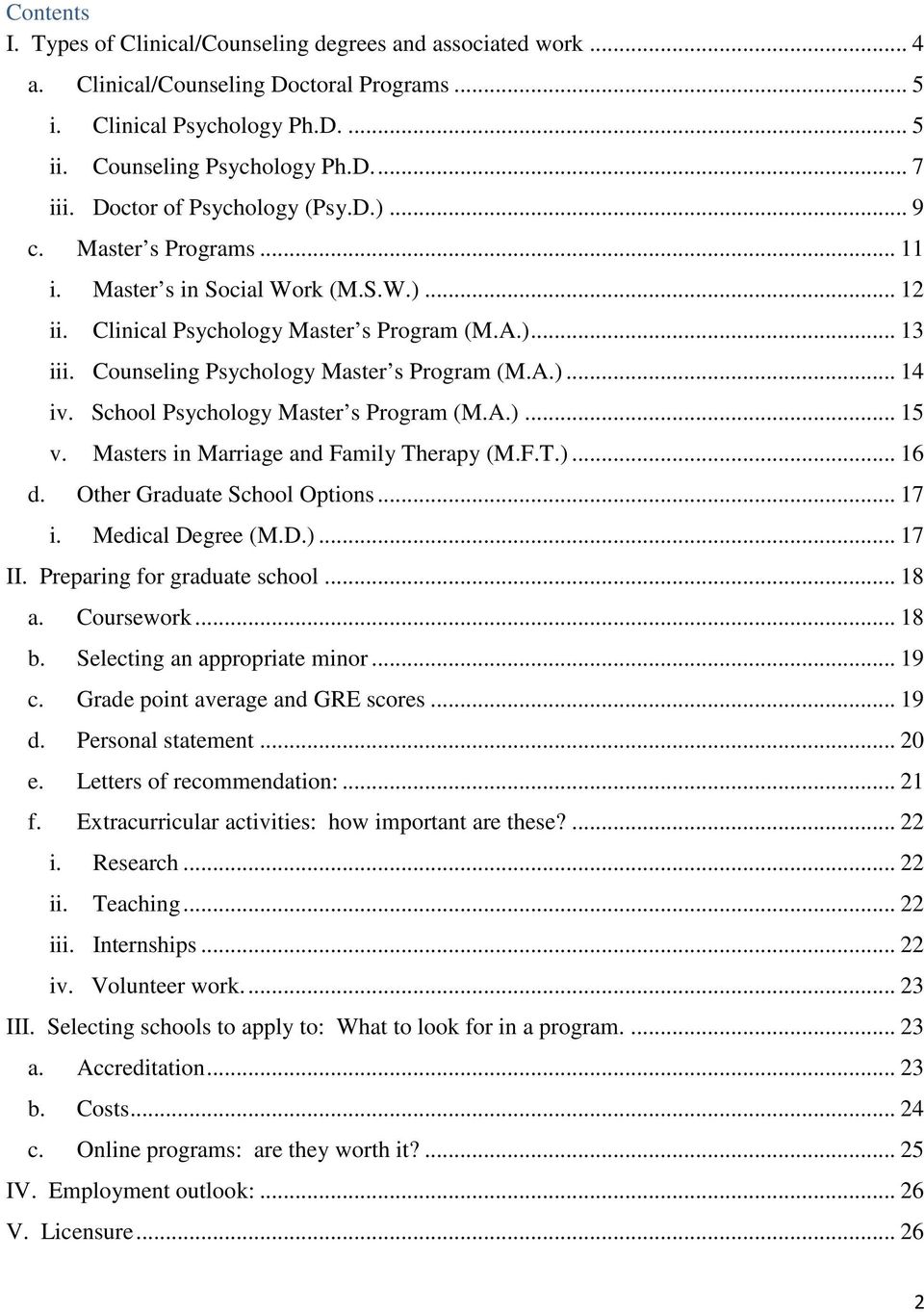
2 Contents I. Types of Clinical/Counseling degrees and associated work... 4 a. Clinical/Counseling Doctoral Programs... 5 i. Clinical Psychology Ph.D ii. Counseling Psychology Ph.D iii. Doctor of Psychology (Psy.D.)... 9 c. Master s Programs i. Master s in Social Work (M.S.W.) ii. Clinical Psychology Master s Program (M.A.) iii. Counseling Psychology Master s Program (M.A.) iv. School Psychology Master s Program (M.A.) v. Masters in Marriage and Family Therapy (M.F.T.) d. Other Graduate School Options i. Medical Degree (M.D.) II. Preparing for graduate school a. Coursework b. Selecting an appropriate minor c. Grade point average and GRE scores d. Personal statement e. Letters of recommendation: f. Extracurricular activities: how important are these? i. Research ii. Teaching iii. Internships iv. Volunteer work III. Selecting schools to apply to: What to look for in a program a. Accreditation b. Costs c. Online programs: are they worth it? IV. Employment outlook: V. Licensure
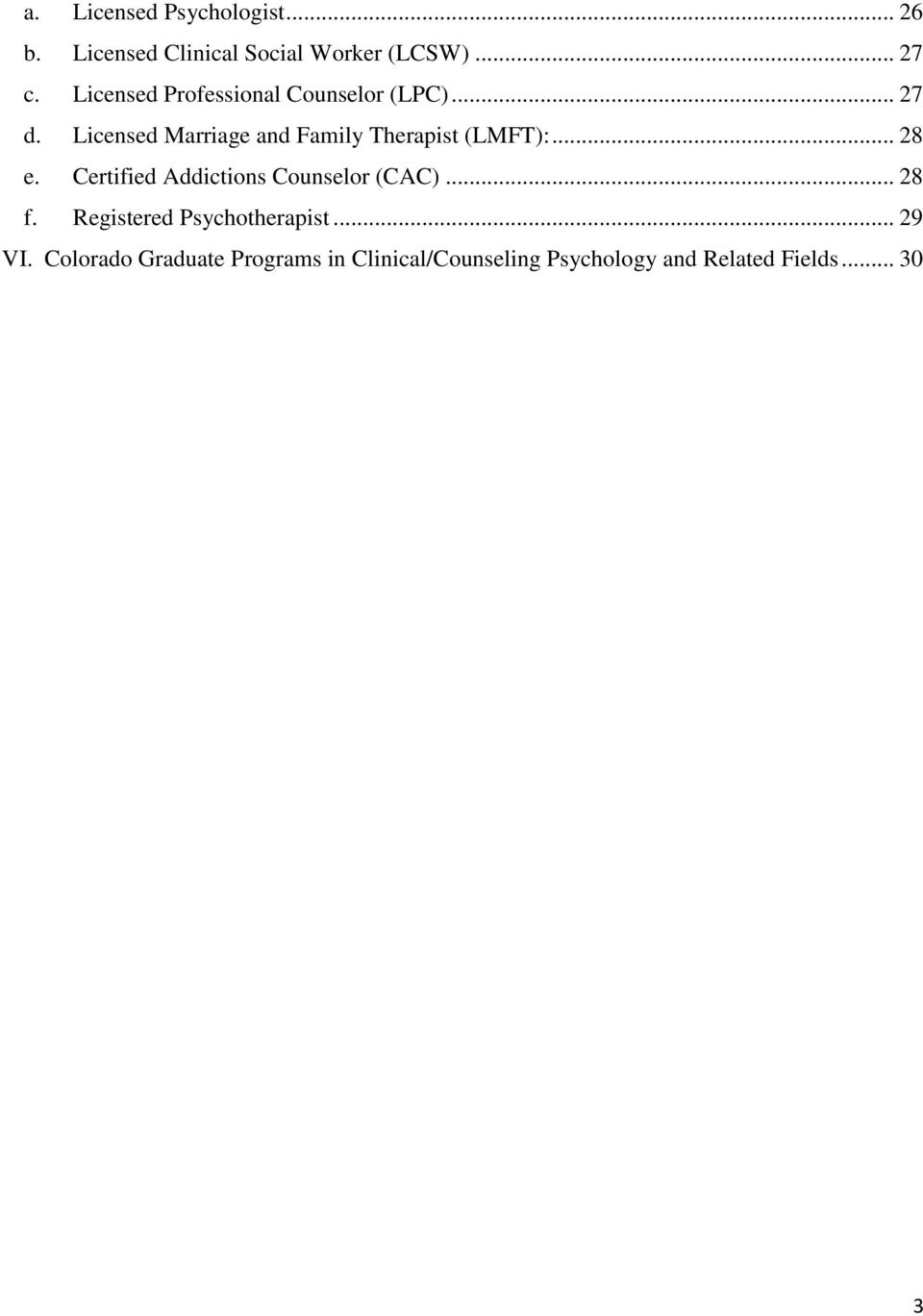
3 a. Licensed Psychologist b. Licensed Clinical Social Worker (LCSW) c. Licensed Professional Counselor (LPC) d. Licensed Marriage and Family Therapist (LMFT): e. Certified Addictions Counselor (CAC) f. Registered Psychotherapist VI. Colorado Graduate Programs in Clinical/Counseling Psychology and Related Fields
4 Advising materials for students interested in Clinical/Counseling Graduate School I. Types of Clinical/Counseling degrees and associated work If you like the helping profession and want to be able to counsel people or provide therapy, you will probably want to pursue a graduate degree. (In Colorado, it is possible to be a counselor without an advanced degree, but there are many advantages to getting a master s or doctoral degree before attempting to make a career out of providing mental health services. See licensure section for additional information.) There are many different graduate programs available, and it is essential that you understand the difference between the programs so that you pursue what s right for you. There are many factors that must be considered before deciding the type of program that you will apply to. This is a very personal and individual decision, and there is no right program except for what is the best fit for you. Primarily, you will want to be very clear about your ultimate career goals, so that you choose a graduate degree that will best prepare you for your desired line of work. Other factors to consider include the number of years, the expense, the acceptance rates, and your qualifications for the degree program to which you are applying. Ultimately, you want to apply to a program that best meets your needs and offers the level of education you want (doctorate or master s), the coursework and training essential to what you ultimately want to do (research; teaching; individual, couples, or family therapy; assessments or testing; working with children, adults, elderly, etc), as well as the theoretical orientations you want to learn (cognitive behavioral therapy, acceptance and commitment therapy, solution-focused therapy, psychoanalytic therapy, etc.). Below is an overview of the major types of graduate programs in clinical and counseling psychology. It is strongly encouraged that you go beyond this brief overview, and that you further explore the different degree options by talking to professionals with the graduate educations that you are considering. There are also some excellent guidebooks that you can reference, which will further explain the differences between programs and details about specific schools: Insider s Guide to Graduate Programs in Clinical and Counseling Psychology and Graduate Study in Psychology. 4
5 Applying to graduate school is an expensive and time-consuming process, so you want to make sure you get it right! Taking your time and applying to the right degree program for you, will likely lead to an easier and more successful application process, appropriate and rewarding graduate training, and a happy and satisfying career! a. Clinical/Counseling Doctoral Programs Doctoral programs in Clinical or Counseling Psychology offer the most substantial level of training. For clinical programs, the current trend is to apply directly to doctoral programs following your undergraduate degree. Many counseling psychology programs prefer to accept students who have already earned a master s degree. Some doctoral programs will have you work towards and earn your master s degree within the first few years of your doctoral training. The master s degree is built in to their curriculum, but is not a terminal degree. Regardless of the program you apply to, you will want to make sure it is accredited by the American Psychological Association (APA). You can see a list of APA approved sites by visiting: i. Clinical Psychology Ph.D. The Clinical Psychology Ph.D. (Doctorate of Philosophy) is the most competitive graduate psychology degree. The program follows the scientist/practitioner or Vail Model of training, meaning approximately 50% of your training will consist of learning about and conducting clinical research and approximately 50% of your training will consist of learning and practicing evidence-based talk-therapy. Even within Clinical Psychology Ph.D. programs, there will be some variability in terms of how research-focused they are. The more research-focused the program is, the more competitive the program will be, but also the more funding you are likely to receive as a graduate student. You will likely be required to take a few years worth of coursework in statistics and research design so that you can ultimately conduct your own research culminating in your dissertation. Your research is likely to be focused on treatment outcome studies or lend to the understanding of the symptoms or development of various mental health 5

6 problems. Empirically validated treatments, assessments, and diagnosing will be emphasized in a clinical psychology training program. Additionally, you will have extensive training in psychological theory and practice. Most clinical psychology Ph.D. programs are housed within a major university, and the graduate position is funded by the research grants that faculty members have secured. When applying to this type of program, you apply to work with a specific mentor who has research funding or opportunities to take on a graduate student, and whose research area matches your own interests (e.g., PTSD, depression prevention, etc.). Depending on the year and funding, a particular clinical psychology Ph.D. program may or may not accept graduate students/applications. The Clinical in Clinical Psychology indicates that you are trained to work with people with more severe symptomotology people who are likely to meet criteria for one or more mental health disorders found in the DSM (e.g. Anorexia Nervosa, Specific Phobia, Bipolar I/II Disorders, etc.) However, you are also likely to work with people who are experiencing normal psychological crises (e.g. grief, stress). Some clinical psychologists work as generalists, treating people with a variety of problems, and others focus on a specific group or disorder (e.g., children, the elderly, eating disorders, ADHD). Your training will prepare you to work with a variety of mental health problems and in a variety of settings. Training Emphasis: Intelligence and Diagnostic Assessments/Testing, Diagnosing, Research, DSM Disorders, Empirically Supported Treatments, Psychotherapy Theory and Practice How Long it Takes to Earn Your Degree: 5 years minimum, full-time Entering Class Size: 2-10 Average Acceptance Rates: The average acceptance rate into a Clinical Psychology Ph.D. program is 6% (Norcross & Sayette, 2012). However, not all Clinical Psychology Ph.D. programs are the same, and they vary on the 6

7 research/practice continuum. The more research focused programs accept fewer than 5% of applicants; whereas the more balanced and practice oriented programs accept a little more than 10% of applicants (Norcross & Sayette, 2012). Financial Aid: Though the Clinical Psychology Ph.D. has the most difficult admissions rates of all graduate programs in clinical and counseling psychology, it also has the most financial aid and funding. 89% of graduate students in a research-oriented Clinical Psychology Ph.D. program receive tuition waivers and a stipend for research or teaching assistantship. If the Clinical Psychology Ph.D. program has an equal emphasis on research and practice, this percentage drops to 54%. In other words, the more research focused the program, the harder it is to get in, but the more funding you are likely to receive (Norcross & Sayette, 2012). General Requirements for Completion of the Ph.D.: Research, Clinical Training and Practicum, Completion of a Master s Thesis as a part of the Ph.D. Program, Completion and Approval of a Dissertation (usually involving original data collection). Professional Activities with this Degree: Psychotherapy (80%), Diagnosis/Assessment (64%), Teaching (50%), Clinical Supervision (50%), Research/Writing (51%), Consultation (47%), Administration (53%) (Norcross & Sayette, 2012). Career Placement: private practice, universities or colleges, medical schools, outpatient clinics, community mental health centers, psychiatric hospitals, general hospitals, Veterans Administration, other. ii. Counseling Psychology Ph.D. The Counseling Psychology Ph.D. (Doctorate of Philosophy) shares the scientist-practitioner or Vail training model seen in the Clinical Psychology Ph.D. program. You will spend approximately 50% of your time trained as a research scientist and approximately 50% of your time learning and practicing the art of talk-therapy. Most Counseling Psychology Ph.D. 7

8 programs are housed within a major university, and the graduate position may be funded by the research grants that the faculty members have secured resulting in more financial assistance to their graduate students. When applying to this type of program, you apply to work with a specific mentor who is accepting applications and whose research area matches your own interests. Depending on the year and funding, a particular Counseling Psychology Ph.D. program may or may not accept graduate students/applications. The Counseling in Counseling Psychology indicates that you will be trained to assess, diagnose, research and treat relatively undisturbed individuals facing more normative problems. The counseling psychologist maintains a focus on individuals assets and strengths, regular life problems such as work or family problems, adjustment difficulties, troubles with life transitions, person-environment interactions, multicultural issues, educational and career development, and developmental-contextual concerns. Your training will prepare you to work with a variety of mental health problems and in a variety of settings. Training Emphasis: Vocational and Career Assessments/Testing, Research, Intelligence and Diagnostic Assessments, Diagnosing DSM Disorders, Empirically Supported Treatments, Psychotherapy Theory and Practice. How Long it Takes to Earn Your Degree: 4-5 years minimum, full-time Entering Class Size: 2-10 students Average Acceptance Rates: The average acceptance rate into Counseling Psychology Ph.D. programs is 8%. The more research focused the program is, the more difficult it will be to be accepted (Norcross & Sayette, 2012). Financial Aid: The Counseling Psychology Ph.D. has considerable variability in financial aid and funding. It is estimated that 10%-89% of graduate students receive both tuition waivers and a stipend for a 8
9 research/teaching assistantship. The more research focused the program, the more funding you are likely to receive (Norcross & Sayette, 2012). General Requirements for Completion of the Ph.D.: Research, Clinical Training and Practicum, Completion of a Master s Thesis as a part of the Ph.D. Program, Completion and Approval of a Dissertation (typically involving original data collection). Professional Activities with this Degree: Psychotherapy (75%), Diagnosis/Assessment (62%), Teaching (60%), Clinical Supervision (54%), Research/Writing (50%), Consultation (61%), Administration (56%) (Norcross & Sayette, 2012). Career Placement: private practice, universities or colleges, community mental health centers, medical schools, outpatient clinics, psychiatric hospitals, general hospitals, Veterans Administration, other. iii. Doctor of Psychology (Psy.D.) The "Doctor of Psychology" (Psy.D.) program or the Boulder Model of training developed as an alternative training model to the Ph.D. or Vail Model. This program follows the professional model of training, with a primary focus on the practice of psychology. This is the perfect option if you want to focus on clinical training, but are not interested in quantitative research or a career in academia. If you envision yourself teaching at a 4- year college or university, this is not the degree you will want to pursue, as you will not be trained for an academic position. On the other hand, if you see yourself practicing psychotherapy and you want doctoral training, this may be the perfect option for you! Psy.D. programs are sometimes housed in major universities and sometime free-standing private schools. The Psy.D. programs that are free-standing and private may be for-profit meaning that both class sizes and tuitions are likely to be high to support the expenses of the program. In either case, 9

10 PsyD programs tend to be larger than PhD programs. You are more likely to get accepted into a Psy.D. program, but you will pay for it in tuition. A Psy.D. degree will train you to practice talk-therapy with clinical populations populations with psychopathology as seen in the DSM. You are likely to work in a variety of settings including private practice, outpatient clinics, or hospitals as a licensed clinical psychologist. Though there is stigma that a Psy.D. is less of a degree than a Ph.D., the similarities between the programs far outweigh the differences, and the licensing process is the same. Psy.D. s and Ph.D s alike are psychologists following completion of their degree and attainment of licensure. You should choose the program that is the best fit for you. Training Emphasis: Testing/assessments, psychological theory and practice, being a consumer of psychological research How Long it Takes to Earn Your Degree: 3-5 years, full-time Entering Class Size: students (Norton & Sayette, 2012) Average Acceptance Rates: 41%-50% (Norcross et al., 2010) Financial Aid: Financial assistance for Psy.D. graduate students is very low. Only 1-10% of students receive full financial assistance (tuition waiver and stipend). Most students pay the heavy tuition and living expenses through personal funds or student loans. Over 30% of graduate students from Psy.D. programs have more than $120,000 in debt when they graduate from their program (Norton & Sayette, 2012). General Requirements for Completion of the Psy.D.: Clinical Training and Practicum, completion of a master s thesis as a part of the Psy.D. program, completion and approval of a dissertation. (Some Psy.D. programs require traditional research based dissertations while others require doctoral papers, which are less rigorous than traditional dissertations.) 10
11 Professional Activities with this Degree: Psychotherapy, Diagnosis/Assessment, Clinical Supervision, Consultation, Administration. Career Placement: private practice, outpatient clinics, psychiatric hospitals, general hospitals, Veterans Administration, other. b. Licensure for the Doctoral Degree Once you fulfill the obligations of your doctoral program, you will have your Ph.D. or Psy.D., but you will not yet be licensed to practice. Though licensure requirements vary from state to state, in Colorado you can only ethically only call yourself a psychologist once you a) have your doctorate degree and b) are licensed to practice. Licensure for your Ph.D. in Clinical Psychology, Ph.D. in Counseling Psychology, or Doctorate in Psychology (Psy.D.) is the same, and is at least a 2 year process beyond your doctoral training. Licensure is important so that you can provide therapy independently, accept pay through insurance, supervise, and be competitive in the job market. The requirements for licensure are as follows: i. Complete the requirements of an APA-approved doctoral-level program, including an APA approved Clinical Internship (1 year standard of clinical training and practice) ii. Pass the Examination for Professional Practice in Psychology (EPPP), a national standardized exam iii. Meet State Requirements 1. Post-doctoral Work - that you conduct a certain amount of supervised work after completing your clinical internship (in Colorado this is 1500 hours, but each state has its own requirements), 2. Take and pass the State Exam for the state in which you would like to work (mostly ethics and state laws). c. Master s Programs 11

12 If you want to become a therapist, but you don t want the many years of training (or debt) required to complete a doctoral program, a master s level graduate degree may be a good option for you. In fact, master s level therapists are becoming the main providers of therapy to individuals, and are more frequently hired by insurance companies. Master s level graduate programs take an average of two years to complete, collectively have a 50% acceptance rate, and have substantially more career opportunities than individuals without a graduate degree. The master s degrees that we will review below are terminal degrees, meaning they will prepare you to work directly in the field of mental health upon completion of your degree and licensure. Master s level therapists often have their own private practice (and charge roughly 75% of what doctoral level therapists charge). You will also frequently see master s level therapists employed in an outpatient clinic, mental health center, a general or psychiatric hospital, adoption centers, and government agencies. There are many types of master s programs in psychology and related fields, so it is important that you understand the differences and choose to apply to the type of master s programs that will best prepare you for the specific work you want to do. Also, the curriculum will vary greatly from program to program, so make sure you take a close look at the course requirements of all programs you are considering. Remember, there is no right or wrong, just what is the best fit for you. i. Master s in Social Work (M.S.W.) Of the master s degree options, the M.S.W. is the most versatile, flexible, and possibly recession-proof of all. The M.S.W. has earned tremendous respect, and allows for a wide variety of career possibilities, from adoption 12
13 specialist, guidance counselor, social services caseworker, policy analyst, agency director, immigration reform advocate, family therapist, mental health counselor and more. M.S.W. programs vary considerably, and many offer a clinical or community training focus. Clinically-focused M.S.W s will focus on serving as an advocate, therapist, and service provider for at-risk populations whose mental health has been negatively affected by the social and economic systems. It is likely that you will focus even further to work specifically with children, families, individuals, the elderly, or couples. Community-focused M.S.W. s focus on solving community problems through social change. They are likely to focus on program development, administration, social policy development, politics, and social movements. There are some big advantages to the M.S.W. degree, including: higher rates of admission (65%), few research requirements, an emphasis on practical training, and licensure eligibility across all 50 states. Training Emphasis: direct mental health services and interventions, social advocacy, social policy, social change How Long it Takes to Earn Your Degree: 2 years, full time Entering Class Size: approximately 40 students in an entering class Average Acceptance Rates: 65% (Norcross & Sayette, 2012) Financial Aid: Students pay tuition through private funds and student loans. Common Careers with this Degree: hospital care manager, school social worker, mental health center - clinician or practitioner, private practice therapist, school guidance counselor, child welfare, social services, adoption agency, etc. ii. Clinical Psychology Master s Program (M.A.) 13

14 The master s degree in clinical psychology is an excellent option for students interested in the theory and practice of psychotherapy with a more acute population. Course work and practicums will be tailored to provide interventions with individuals with mental health disturbances and/or psychiatric illness. Some basic training with assessments and research is likely to be provided, but not emphasized. Theoretical orientations taught are likely to be empirically based and will most likely include cognitive behavioral therapy. Training Emphasis: theory, practice, and consumer research pertaining to psychopathological populations (e.g. personality disorders, attention deficit disorder, PTSD, etc.) How Long it Takes to Earn Your Degree: 2 years, full time Entering Class Size: The mean entering class size is 35 students ( Average Acceptance Rates: The average acceptance rate into clinical psychology master s programs is 37% (Norcross & Sayette, 2012). Financial Aid: Students pay tuition through private funds and student loans. Career Placement: private practice, outpatient clinics, community mental health centers, government agencies, school counseling centers, hospitals iii. Counseling Psychology Master s Program (M.A.) The master s degree in counseling psychology is an excellent option for students interested in the theory and practice of psychotherapy with relatively undisturbed clients (e.g., adjustment problems), and who are okay with less emphasis on research and assessment training. This degree also has the benefits of high acceptance rates, 2 years of practical training, and licensure eligibility across all 50 states. Training Emphasis: minority/cross-cultural issues, vocational/career issues, adjustment difficulties, multiculturalism, psychotherapy theory and practice related to normal crises (e.g., bereavement, life transitions, stress) 14

15 How Long it Takes to Earn Your Degree: 2 years, full time Entering Class Size: the average school has a little over 50 students in an entering class ( Average Acceptance Rates: 63% (Norcross & Sayette, 2012) Financial Aid: Students pay tuition through private funds and student loans. Common Careers with this Degree: private practice, outpatient clinics, community mental health centers, government agencies, school counseling centers, hospitals iv. School Psychology Master s Program (M.A.) If you want to work with children and families within a school setting, a master s degree in school psychology may be a perfect fit. It is increasingly common to see grade schools and high schools employ a master s level therapist right within the school. You would have the same academic schedule as teachers, and may even have summers off! In a school psychology program you would be trained specifically to work with children in the school setting. You will learn how to provide screening and diagnostic assessments for children s learning, mental health and behavioral needs. You may provide direct mental health services to the children or connect the child and family with outside resources. A major goal will be to help children succeed emotionally, socially, and academically. A big part of your training and career will be to collaborate and communicate effectively with parents, educators, and community resources and leaders. One disadvantage of pursuing a master s degree in school psychology is that your professional work is likely to be limited to the school setting. If this is not a concern for you, then this program might be an excellent option. 15
16 Training Emphasis: behavioral screenings/assessments for youth, direct mental health services and interventions, serving as an advocate for children and their families, treatment planning and referrals How Long it Takes to Earn Your Degree: 2 years, full time Entering Class Size: approximately 40 students in an entering class ( Average Acceptance Rates: 48.9% ( Financial Aid: Students pay tuition through private funds and student loans. Common Careers with this Degree: school therapist, school mental health services coordinator, program evaluator v. Masters in Marriage and Family Therapy (M.F.T.) Marriage and Family Therapists focus their training and practice on couples and families, and the psychological and relational issues that often arise in interpersonal relationships. Most M.F.Ts assess the problems the couple may face, and then move quickly towards interventions that will solve the particular problem(s). Often, the treatment interventions are brief, solutionfocused, and specific, and draw from family systems research and theory. Marriage and family counselors are especially trained to help the distressed couple communicate their emotions and differences, reconnect, and regain closeness and intimacy. M.F.T programs are short, have relatively high acceptance rates, and have licensing reciprocity across all 50 states. This is an excellent graduate program choice for the student who is not concerned with having a broader and more comprehensive training in counseling, and who specifically wants to work with couples and relational issues. For more information, visit the American Association for Marriage and Family Therapy at Training Emphasis: couples therapy - theory and practice How Long it Takes to Earn Your Degree: 2 years, full time 16
17 Entering Class Size: approximately 40 students in an entering class Average Acceptance Rates: roughly 50% or higher Financial Aid: Students pay tuition through private funds and student loans. Common Careers with this Degree: private practice therapist; marriage and family counselor within a community mental health center, agency, or group. d. Other Graduate School Options i. Medical Degree (M.D.) Another graduate school option is to pursue a Medical Degree by applying to medical school (4 years) and then specializing in psychiatry for your residency (4 years). In your psychiatry residency, you will be trained to conduct talk-therapy as psychologists are, however you will mostly assess, diagnose, and treat patients by prescribing medications. Students often dismiss the idea of psychiatry, as admissions to medical school can seem too difficult. However, the acceptance rates may be higher than the most competitive doctoral programs in clinical and counseling psychology. In order to apply to medical school, you would need to satisfy some of the undergraduate pre-requisites (e.g., biology, chemistry, etc.). There are many advantages to a medical degree. Becoming a psychiatrist would result in higher average pay than any other graduate degree in the mental health field, allow you to prescribe psychotropic medications, and allow for more work in a hospital setting. If you like understanding and treating mental illness from a more biological perspective, this may be the right path for you. Training Emphasis: the brain and behavior, psychiatric diagnosis, psychopharmacology, therapy modalities (e.g., cognitive behavioral therapy, dialectical behavioral therapy, etc.) 17
18 II. How Long it Takes to Earn Your Degree: 4 years for the medical degree, and an additional 4 years for the psychiatry residency Average Acceptance Rates: roughly 50% ( Financial Aid: Students pay tuition through private funds and student loans, though there is often funding for the most qualified students. Common Careers with this Degree: medical doctor (psychiatrist) in private practice or a hospital setting, teaching, supervision, administration Preparing for graduate school a. Coursework In general, graduate programs in Psychology will expect applicants to demonstrate a broad education within the field. As such, our Psychology major is specifically designed to provide that breadth. Thus, simply by completing the requirements for the major, the student will have taken the first step in gaining the preferred coursework. However, our major also offers opportunities for students to select coursework to strengthen and enhance their personal interests and goals. A student interested in pursuing graduate education in the clinical/counseling field should consider completing each of the courses in our Clinical/Personality cluster. These include: PSY2150 Positive Psychology PSY3000 Theories of Personality PSY3620 Abnormal Psychology PSY4100 Introduction to Clinical/Counseling Psychology Students who are applying to Ph.D. programs should also consider strengthening their statistics/research methods background by completing courses such as: PSY3320 Advanced Psychological Research Methods PSY4450 Advanced Statistics: SPSS 18

19 PSY4150 Introduction to Psychological Assessments b. Selecting an appropriate minor A wide variety of minors can be used to supplement and enhance a student s preparation for Clinical/Counseling graduate education. Depending on the student s specific interest, minors of value may include: Biology Business Criminal Justice and Criminology Gerontology Human Services Social Work Sociology Women s Studies c. Grade point average and GRE scores Virtually all graduate programs consider GPA as an important admission criterion. In a review of 232 Clinical Psychology doctoral programs, Norcross, Ellis, and Sayette (2010) reported that, among incoming students, the average GPA was 3.6 (SD = 0.17). Most (but not all) graduate programs in Clinical/Counseling Psychology will require at least the Verbal and Quantative portions of the GRE; many will also require the Psychology specialty portion of the GRE. A review of graduate programs in Colorado revealed that, among those requiring the GRE, in every case GRE scores were accorded either high or medium weight in making admissions decisions. According to the APA (2012, p. ix), 19

20 The overall median GRE scores reported for applicants admitted to master s degree program are 512 (GRE-V [verbal]), 590 (GRE-Q [quantitative]) and 653 (GRE-Subject [psychology area test]). The overall median GRE scores reported for applicants admitted to doctoral degree programs are 572 (GRE-V), 666 (GRE-Q) and 676 (GRE-Subject). Note that these data are for applicants to all psychology graduate programs, not to Clinical/Counseling programs specifically. Norcross et al. (2010) reported that students entering Clinical doctoral programs had an average GRE-V score of 591 (SD = 49), an average GRE-Q score of 652 (SD = 52), and an average GRE-Subject score of 672 (SD = 43). Program-specific information regarding GRE standards can often be found of each program s website. d. Personal statement The personal statement is typically one of the most important components of a graduate school application. It is an intellectual autobiography that allows graduate programs the ability to get to know you and determine whether or not you are a good fit for their program. In addition, it is often used as a way to evaluate your writing ability. Unfortunately, there is not a uniform way to complete the personal statement and each program may evaluate these slightly differently. That said, here are some basic tips that often prove helpful. i. Read very carefully what each particular program expects from a personal statement. Some will be vague while others will be quite specific. ii. Articulate why you are a good fit specifically for the program to which you are applying. This means that if you are applying to multiple programs you likely will not be able to draft one general statement and turn it in to every program. Crafting a general statement as a template can 20

21 be helpful, but make sure you personalize it for each application. For example, writing that you wish to seek a degree in counseling for a program that specializes in couples and family therapy would not demonstrate that you are an applicant wishing to attain the specific kind of training the program provides. These sorts of oversights often cause applications to be removed from further consideration. iii. Read the biographies of faculty members from each program you are applying to. Be familiar with their interests and the research they have completed and are in the process of completing. This gives you a lay of the land and demonstrates that you have done your homework. For most Ph.D. programs a mentor model is used where specific faculty select students they wish to work with making this item especially important. iv. Clinical and counseling programs are interested in learning about you as a person in your statement perhaps more than other types of graduate programs since who you are is crucial to what kind of therapist you might become. However, resist the urge to over share. For example, do not write about past psychiatric history or very personal family experiences. Some good questions to ask include: are the personal stories I m sharing relevant to my ability to succeed as a graduate student? Do they demonstrate maturity? Would they raise any red flags about my character? v. Be a RUTHLESS editor. Have multiple people read each version of your statement before submitting it with a keen eye for grammar and content. Now is not the time to get timid about receiving honest feedback! It may sting initially, but it will increase your chances of acceptance in the long run. e. Letters of recommendation: Along with GPA and GRE scores, letters of recommendation are generally very important elements in graduate school admissions decisions. According to Norcross and Sayette (2012, pp ), letters of recommendation rank at or near the top of admissions criteria among both Master s and Doctoral programs in 21
22 clinical and counseling psychology. So, it is obviously critically important for you to solicit and receive the strongest letters possible. Advisors within the Psychology Department have compiled information on the process by which you can solicit these letters. This information can be accessed on the Psychology Department website: f. Extracurricular activities: how important are these? i. Research: If your goal is to gain admission into a Ph.D. program, research experience is essential. It is less essential at the Masters level, but never hurts. MSU Denver offers a number of ways to obtain research experience. Student clubs such as Research Club and the Clinical & Counseling Club routinely complete scholarly projects and present at peerreviewed conferences. There are also opportunities to work as a RA (Research Assistant) with individual faculty members. It is always best to get involved in these activities earlier in your academic career as opposed to trying to cram them all in to your final semester. For students seeking admission to a Ph.D. program, multiple research experiences will likely be mandatory. ii. Teaching: While teaching experience is not required for admission to most programs, it can be a nice to have some experience in the classroom if your goal is to be admitted to a Ph.D. program since teaching undergraduate classes is often required of Ph.D. students. Moreover, many Ph.D. programs don't spend a lot of time formally training students how to teach. The ability to get experience as a Teaching Assistant (TA) at the undergraduate level is a unique experience that MSU Denver s psychology department provides. Should you be interested in becoming a TA, reach out to professors who you have had multiple classes with and/or have a good relationship with. iii. Internships: Getting some kind of clinical experience can seem daunting when you do not yet have a degree or a license of any kind, but it is very 22
23 III. possible. Some students go through MSU Denver s internship center while others carve out a placement for themselves, often in consultation with faculty. Keep in mind that an internship through MSU Denver will award you course credit and therefore cannot be compensated monetarily. Some students find paid internships on their own although the amount of pay varies. Masters and Psy.D. programs look very closely at undergraduate clinical experience. One way to think about this is that programs often prefer demonstrated performance over potential. They want to make certain that a student is not just in love with the idea of becoming a clinician and has actually experienced some of the challenges that go along with the work. Ph.D. programs also value some clinical experience, but often value research at least as much if not more. iv. Volunteer work: Volunteer work is a nice addition to any curriculum vitae. Selecting specific opportunities that provide a chance to work with people and mandate that you practice core clinical skills in the process can be especially beneficial. One example of this over the years on MSU Denver s campus has been Project Homeless Connect, which gives students the chance to work one-on-one with homeless persons. Keep in mind that volunteer work alone is often not a sufficient replacement for a longer-term internship of some kind, but rather, a nice complement. Selecting schools to apply to: What to look for in a program. a. Accreditation The accrediting body for doctoral programs is the American Psychological Association or APA. This accreditation is essential when evaluating doctoral programs. In the last few years an increasing number of free standing or for profit institutions have been offering doctoral degrees that are not accredited by the APA. Often these programs will accurately note that they have some other kind of accreditation or are in the process of seeking APA accreditation. This can be very deceptive advertising and making sure that the school to which you are applying already has APA accreditation is essential. In addition, schools without accreditation will often say things like our graduates may be eligible to become 23
24 licensed psychologists. An APA approved program guarantees that graduates will be able to sit for licensure whereas other programs do not. The APA no longer accredits Masters programs in clinical and counseling psychology. The accrediting body for Masters programs is now the Council For Accreditation of Counseling And Related Programs or CACREP. For students seeking a Master s degree the website cacrep.org can be a wonderful resource containing, among other items, a complete database with links to every program that is accredited. CACREP also accredits some doctoral programs, but it is important to note that these programs do not allow one to sit for licensure as a psychologist. They are often designed to give the student additional training in higher-level skills such as counseling supervision. b. Costs Given the small number of applicants accepted into Ph.D. programs, many programs (but not all) provide full tuition waivers and even a small (emphasis on small) stipend for students to live on. Often the number of applicants accepted is determined by how much funding the university has in a particular year. The funding is generated through research. What this means is that while tuition may be waived, extra work is required. Ph.D. students are often required to complete research and teach undergraduate classes in addition to completing their coursework. This can make for some very long work weeks (think 60+ hours) and should be considered carefully before applying. It should be noted that not all Ph.D. programs fund their students. Some schools provide only half funding in certain years and others require students to find outside graduate assistantships doing various work on campus that are competitive and not guaranteed to all students accepted into the program. In these cases, students could end up paying full, or near full tuition should they fail to secure an assistantship. It is recommended that you clearly understand a school s approach to funding Ph.D. students prior to accepting any offer for admission. 24
25 Most Psy.D. programs are housed in private universities in schools of professional psychology. What this means in short is that internal funding for students is scarce. Moreover, given that many of these programs are in private universities it also means that the cost of tuition is quite high. All told, students are often on the hook for tens of thousands if not one hundred thousand dollars over the entire course of study which, on average, lasts between 3-5 years. The financial commitment necessary to attend such a program should be calculated and seriously weighed prior to pursuing admission. Very few scholarships or other sources of internal funding are typically available for Masters level students. Often students end up funding the degree themselves through student loans or other external monies. However, since the average course of a Masters program is 2-3 years, students end up having fewer years to fund than they would in a doctoral program. c. Online programs: are they worth it? There has been a recent proliferation of online colleges and online learning in general. While this can be an effective way to learn in some contexts, for students wishing to become counselors and work closely with living and breathing humans, it is likely not ideal. A quick rule of thumb: if it appears too good to be true, it probably is. For example, if a school promises that you can get your entire degree while completing classes at home in your underwear and go into the world and start practicing as a counselor upon completion, you should probably be skeptical. Becoming a skilled counselor requires year s worth of work with people and live supervision from mentors. Doing this online is simply impossible. If a program offers the ability to take a course or two online that is likely no problem and to be expected in the digital world we live in. However, if your desire is to take the entire program online it might be wise to reexamine whether the field of clinical and counseling psychology is the best fit for you and whether you can dedicate the time it takes necessary to get the training required of a good clinician. 25
26 Stopped here, 10/8/13 IV. Employment outlook: According to the Bureau of Labor Statistics ( the employment outlook for psychologists over the next decade ( ) is very bright. The BLS predicts a 22% growth in the number of jobs available to psychologists. Prospects are expected to be most positive for candidates holding a Doctoral degree. Additional information can be found on the APA website (see V. Licensure Regardless what type of training you pursue after graduation, it should be done with an eye towards licensure. The types of mental health licenses and certifications and the requirements to earn them vary from state to state, so if you plan to leave Colorado it will be important to check the requirements in your destination state. The following are the types of credentials necessary to practice in the mental health arena in the State of Colorado. a. Licensed Psychologist In Colorado, to become a licensed psychologist you must obtain a doctoral degree (PhD or PsyD) from a program accredited by the American Psychological Association (APA), or from a program equivalent to an APA-accredited program (this is much more challenging to prove than APA accreditation!). Included in the doctoral program will be a year-long, full-time internship and for those in PhD programs completion of the doctoral dissertation. Once you ve obtained your degree, you ll need 1500 hours of post-doctoral experience practicing psychology under supervision. Before you can earn the license, you ll need to pass both the Examination for Professional Practice in Psychology (EPPP) and the state jurisprudence exam. Psychologists are able to provide the kinds of services described for the other licenses (individual, group, couple, and family therapy in independent practice), 26
27 but are more likely to engage in additional professional duties such as assessment/testing, teaching, and supervision. b. Licensed Clinical Social Worker (LCSW) If you wish to hold the title of Licensed Clinical Social Worker (LCSW) in Colorado, you must first get a Master of Social Work or Doctorate of Social Work degree from a CSWE- (Council on Social Work Education) accredited university or college. You then will need to apply for your Licensed Social Work (LSW) title and earn your supervised clinical social work experience. You ll need to provide verification of a minimum of two years (3,360 hours) of supervised work experience in the practice of clinical social work, supervised by an LCSW. You ll also need to receive a passing score on the Clinical Level Association of Social Work Boards (ASWB) exam. In addition, as with all of the Colorado licenses, you must pass the open-book jurisprudence exam. Licensed Clinical Social Workers impact people on societal, individual, and family levels. They are able to practice independently, providing mental health services to a wide variety of people, often with a particular emphasis on underserved populations such as people contending with poverty, homelessness, child abuse, domestic violence, etc. c. Licensed Professional Counselor (LPC) To become a licensed professional counselor, you will need education at the master s or doctoral level. Your program must either be CACREP-accredited or substantively equivalent. CACREP is an independent agency that accredits master's degree programs in addiction counseling, clinical mental health counseling, marriage and family counseling, and school counseling. Once you graduate, you ll need to work under supervision for a specified period. The length of time depends on your educational level the requirement is 2,000 hours of post-master s work or 1,000 hours of post-doctoral work. If you re completing 2,000 hours it needs to be spread out over a period of at least 2 years; if you re 27
28 completing 1,000 hours, it needs to be spread out over a twelve-month period. You ll also need to take two exams. One is the National Counselor Examination administered by the NBCC (National Board for Certified Counselors), and the other is the Colorado jurisprudence exam, which is an open-book exam required of all psychotherapists in the state. Once you earn an LPC, you are able to practice independently, to perform individual and group therapy, to accept insurance reimbursement, and to provide services across a broad range of problem areas. d. Licensed Marriage and Family Therapist (LMFT): To become eligible for a Colorado marriage and family therapist license, you must have a master s or doctoral degree from a program accredited by the COAMFTE (Commission on Accreditation for Marriage and Family Therapy Education). After completing the master s degree program you must then complete at least 2000 clock hours of experience over a minimum of two years. Of the 2000 experience hours 1500 of the hours have to be face-to-face in direct contact with a client. At least 1000 of the hours have to be working with couples or families in diagnosing, assessing and intervention. For those who have completed a doctoral program, the experience requirement is slightly different: 1500 clock hours of direct contact with clients over a minimum of one year, with at least 1000 of the hours involving families and couples for the purpose of diagnosing, assessing, and treatment. As with the other professional licenses, the LMFT requires passing a nationwide exam (in this case, the MFT exam) as well as the state s jurisprudence test. As an LMFT, you can practice independently, accept insurance reimbursement, and work with individuals, couples, and families to help better the relationships within the family dynamic. e. Certified Addictions Counselor (CAC) 28
29 If you are interested in working in the area of substance-related disorders and their treatment, CAC credentialing is an important consideration. There are three different levels of certification for addictions counselors in Colorado. Like the registered psychotherapist designation, CAC I and CAC II levels require only a high school diploma or GED in terms of academic achievement. Unlike the registered psychotherapist designation, the CAC designations do require specific training in order to earn the certification. To earn a CAC I, you must complete at least 112 hours of training in such areas as addiction counseling skills, client record management, professional ethics, and pharmacology. In addition, the CAC I requires 1000 hours of clinically supervised work experience in addictions. These work and training hours can often be obtained on-the-job at a treatment center. The CAC II builds on all of the CAC I criteria, and requires an additional 126 hours of specific training and an additional 2000 hours of supervised work experience. In addition, to earn a CAC II you must pass a national examination. The top level of addictions counselor certification, CAC III, cannot be reached without at least a bachelor s degree, and requires an additional 56 hours of training and an additional 2000 hours of supervised work experience. Because the certifications in addictions counseling demand significant levels of training and experience, they are respected designations. Some professionals who are licensed in other areas (e.g., licensed psychologist, licensed clinical social worker) also earn and maintain their CAC credentials to indicate a specialization in addictions treatment. f. Registered Psychotherapist Colorado has liberal statutes regarding who may provide psychotherapy. It is not mandatory to have an advanced degree or to earn licensure. In fact, individuals with no specific training or education may call themselves therapists and provide counseling services as long as they register their credentials in a statewide database. The requirements for registered psychotherapists in Colorado include earning a high school diploma or GED, passing a statewide jurisprudence exam 29
30 (an open-book test covering the laws and rules of mental health practice in Colorado), and composing a brief statement describing therapeutic orientation and listing years of experience. While this is the quickest and least expensive way towards becoming a mental health professional, there are some obvious disadvantages. Psychotherapists who lack licensure may also lack the competence to provide effective services, are ineligible to accept third-party reimbursement (insurance payments), and will not likely be hired by mental health organizations, agencies, or hospitals. VI. Colorado Graduate Programs in Clinical/Counseling Psychology and Related Fields a. Adams State University i. MA in Counseling 1. Addiction Counseling 2. Clinical Mental Health (CACREP accredited)** 3. School Counseling (CACREP accredited) ii. Ph.D. Counselor Education (CACREP Accredited) b. Argosy University i. MA, Clinical Mental Health Counseling (CACREP accredited) ii. MA, Forensic Psychology iii. MA, Marriage & Family Therapy iv. MS, Human Services v. EdD, Counseling Psychology vi. EdD, Counselor Education & Supervision (CACREP accredited) vii. EdD, Pastoral Community Counseling viii. DMFT, Marriage and Family Therapy c. Colorado Christian University i. MA, Counseling (CACREP accredited) d. Colorado State University i. Ph.D., Counseling Psychology (APA accredited in Counseling Psychology)* 30
31 ii. M.S.W., Social Work iii. M.A., Career Counseling (CACREP accredited) iv. M.A., Student Affairs, College Counseling (CACREP accredited) v. M.A., School Counseling (CACREP accredited) e. Denver Seminary i. M.A., Clinical Mental Health Counseling (CACREP accreditation) f. Metropolitan State University of Denver i. M.S.W., Social Work g. Naropa University i. M.A. Transpersonal Counseling Psychology ii. M.A. Somatic Counseling Psychology iii. M.A. Contemplative Psychotherapy h. Regis University i. M.S. Criminology ii. M.A. Marriage and Family Therapy iii. M.A., Community Counseling (CACREP accredited) iv. M.A. Counseling v. Post-Graduate Certificates: 1. Counseling Children and Adolescents 2. Counseling Military Families 3. Marriage and Family Therapy 4. Transformative Counseling i. University of Colorado, Boulder i. Ph.D. Clinical Psychology (APA accredited in Clinical Psychology) j. University of Colorado, Denver i. M.A. Counseling 1. Clinical Mental Health 2. Community Counseling (CACREP accredited) 3. Couple and Family Counseling (CACREP accredited) 4. Multicultural Counseling 5. School Counseling (CACREP accredited) 31
32 k. University of Colorado, Colorado Springs i. Ph.D. Clinical Psychology with Geropsychology emphasis (APA accredited in Clinical Psychology) ii. M.A. Clinical Psychology 1. Psychology and the Law 2. Trauma Psychology iii. M.A. in Counseling & Human Services 1. Clinical Emphasis in Addictions 2. Clinical Mental Health Counseling 3. Community Counseling (CACREP accredited) 4. School Counseling (CACREP accredited) 5. Counseling and Leadership l. University of Denver i. Ph.D., Clinical Child (APA accreditation in Clinical Psychology) ii. Ph.D., Counseling Psychology (APA accreditation in Counseling Psychology) iii. M.A., Counseling Psychology iv. Psy.D., Clinical Psychology (APA accreditation in Clinical Psychology) v. M.A. Forensic Psychology vi. M.A. International Disaster Psychology vii. M.A. Sport and Performance Psychology viii. Ph.D. Social Work ix. M.S.W., Social Work (Accredited by the Council on Social Work Education) m. University of Northern Colorado i. M.A., Clinical Counseling: Couples and Family Therapy (CACREP accreditation) ii. M.A., Clinical Mental Health Counseling (CACREP accreditation) iii. M.A., School Counseling (CACREP accreditation) iv. Ph.D., School Psychology (APA accreditation in School Psychology) 32
33 v. Ph.D., Counseling Psychology (APA accreditation in Counseling Psychology) vi. Ph.D., Counselor Education and Supervision (APA and CACREP accreditation in Counseling Psychology vii. Ed.S., School Psychology Specialist n. University of Phoenix i. M.S. in Counseling 1. Clinical Mental health Counseling 2. Marriage, Family and Child Therapy 3. Mental Health Counseling 4. School Counseling o. University of the Rockies i. M.A. in Psychology 1. Criminology and Justice Studies 2. Health and Wellness 3. Marriage and Family Therapy 4. Mediation and Conflict Resolution 5. Mental Health Counseling 6. Sport and Performance Psychology ii. Psy.D., Clinical Specialization 1. Clinical Neuropsychology 2. Forensic/Correctional Psychology 3. Health Psychology 4. Marriage and Family Therapy 5. Sport Neuroperformance *APA accreditation applies to doctoral level programs in Clinical, Counseling, and School Psychology. The APA accreditation information provided for each institution refers only to the specific programs, not all of the programs listed for that institution. 33
34 *CACREP (Council for Accreditation of Counseling and Related Educational Programs) accreditation is recognized by the Council for Higher Education Accreditation to accredit master s degree programs in various areas of counseling. 34
35 References American Psychological Association (2012). Graduate Study in Psychology. Washington, D.C.: American Psychological Association. Norcross, J., Ellis, J. & Sayette, M. (2010). Getting in and getting money: A comparative analysis of admission standards, acceptance rates, and financial assistance across the research-practice continuum in Clinical Psychology programs. Training and Education in Professional Psychology, 4, DOI: /a Norcross, J. & Sayette, M. (2012). Insider s Guide to Graduate Programs in Clinical/Counseling Psychology. New York, NY: Guilford Press. 35
Graduate Study in Psychology and Related Fields: Focus on Applied Programs
 Graduate Study in Psychology and Related Fields: Focus on Applied Programs Kristina T. Phillips, Ph.D. Assistant Professor School of Psychological Sciences, University of Northern Colorado Areas within
Two EFFECTIVE ways to search for graduate schools:
 Behavioral Mental Health Care Career Guide P199, Dr. Patton Part 4. Selecting Schools, Applying to Graduate School, Financial Support Access links to informative articles, guidebooks, and more at http://www.indiana.edu/~psyugrad/gradschool.php
GRADUATE SCHOOL OPTIONS FOR PSYCHOLOGY MAJORS
 GRADUATE SCHOOL OPTIONS FOR PSYCHOLOGY MAJORS This section will help you learn about graduate programs in psychology, education, and social work that will prepare you for work in psychology and psychology-related
Careers in Psychology
 1/27/15 Careers in Psychology Attaining a BA in Psychology Psychology is the 5th most common major Accounting for 439,000 students in the U.S. alone Behind business, education, and nursing/pre-med - Fogg
Masters of Science in Clinical Psychology: MFT & LPCC Program Information Packet
 Masters of Science in Clinical Psychology: MFT & LPCC Program Information Packet Department of Psychology One Washington Square San Jose CA 95192-0120 psych.sjsu.edu/grad/clinical Dear Prospective Student,
So, you want to be a mental health professional?
 So, you want to be a mental health professional? Jim Graham The practice of therapy/counseling/psychotherapy falls within the scope of practice of several licensures 1 Licensure types and requirements
What Is Counseling Psychology?
 What Is Counseling Psychology? A Brief Description of the Discipline and Comparison to Other Psychology Professions Student Affiliates of Seventeen (SAS) http://www.div17.org/sas/ University at Albany
CAREER SERVICES. So You Want To Be A Therapist UCSB
 So You Want To Be A Therapist Compiled by Micael Kemp; revised by Maya Salmon Introduction Careers Requiring An M.D. Careers Requiring a Doctoral Degree Careers Requiring A Master s Degree Other Careers
Applying to Graduate School in Clinical Psychology: Planning Ahead
 Applying to Graduate School in Clinical Psychology: Planning Ahead Kristen G. Anderson, Ph.D. Assistant Research Scientist & Lecturer UCSD Dept of Psychology Overview Careers in mental health Ph.D. vs.
A Side-By-Side Comparison of the LCSW and LPC Licenses: A Technical Report for NASW/Texas. Joel L. Carr and Dana S. Jackson-Lange
 Comparing the LCSW and LPC Licenses 1 Running head: COMPARING THE LCSW AND LPC LICENSES A Side-By-Side Comparison of the LCSW and LPC Licenses: A Technical Report for NASW/Texas Joel L. Carr and Dana S.
Graduate School for Psychology and Social Behavior Majors. Presented By: The Peer Academic Advisors
 Graduate School for Psychology and Social Behavior Majors Presented By: The Peer Academic Advisors Questions to consider when deciding to go to graduate school Is graduate school really for me? Do I want
Behavioral Mental Health Care Career Guide P199, Dr. Patton Part 3. Decisions about License & Degree Program
 Behavioral Mental Health Care Career Guide P199, Dr. Patton Part 3. Decisions about License & Degree Program All licensed mental health care professionals no matter whether they are generalists or specialists
DOCTOR OF PROFESSIONAL COUNSELING OF PROFESSIONAL COUNSELING
 DOCTOR OF PROFESSIONAL COUNSELING OF PROFESSIONAL COUNSELING DOCTOR Introduction The Doctor of Professional Counseling (DPC) is a clinical doctorate designed to meet the career advancement goals of professional
CSUS DEPARTMENT OF PSYCHOLOGY ADVISING INFORMATION FOR MENTAL HEALTH AND HUMAN SERVICES PROFESSIONS OVERVIEW
 CSUS DEPARTMENT OF PSYCHOLOGY ADVISING INFORMATION FOR MENTAL HEALTH AND HUMAN SERVICES PROFESSIONS OVERVIEW Mental health and human services careers may be pursued through the fields of psychology, psychiatry,
HAWAII PACIFIC UNIVERSITY
 HAWAII PACIFIC UNIVERSITY PROGRAM OVERVIEW DEPARTMENT OF PSYCHOLOGY MASTER OF ARTS IN CLINICAL MENTAL HEALTH COUNSELING The Clinical Mental Health Counseling Master s Degree Program (CMHC-MA) is a post-baccalaureate
Master of Science in Education Counseling
 Program Director Matthew Paylo 3312 Beeghly Hall (330) 941-3264 [email protected] Program Description Master of Science in Education Counseling The counseling program prepares individuals as professional
Counseling psychologists School psychologists Industrial-organizational psychologists "Psychologist Overview"
 Psychologist Overview The Field - Specialty Areas - Preparation - Day in the Life - Earnings - Employment - Career Path Forecast - Professional Organizations The Field Psychologists study the human mind
Counselor Education CAREER COUNSELING, CLINICAL MENTAL HEALTH COUNSELING, AND SCHOOL COUNSELING
 Counselor Education CAREER COUNSELING, CLINICAL MENTAL HEALTH COUNSELING, AND SCHOOL COUNSELING Dr. Peggy Whiting, Coordinator Counselor Education Program Program Telephone: (919) 530-6182 Fax: (919) 530-5328
How To Become A Counselor At Walter Wilson College
 shaping compassionate professionals CHD Counseling and Human Development CHD 1 WALSH UNIVERSITY MASTER OF ARTS IN COUNSELING AND HUMAN DEVELOPMENT Walsh University Master s program in Counseling and Human
Counseling Psychology, M.Ed.
 Counseling Psychology, M.Ed. 1 Counseling Psychology, M.Ed. COLLEGE OF EDUCATION (http://www.temple.edu/education) About the Program The Counseling Psychology program offers a 60-credit master's degree
Choosing Adoption Therapist
 Choosing Adoption Therapist How do I find a therapist who is qualified with adoption and foster care issues? Selecting a therapist who understands adoption and foster care can be an important component
MASTER S DEGREE IN PROFESSIONAL COUNSELING 2009-2010 http://pc.ed.utah.edu/
 MASTER S DEGREE IN PROFESSIONAL COUNSELING 2009-2010 http://pc.ed.utah.edu/ UPDATED: JUNE 1, 2009 Professional mental health counselors facilitate the growth and development of individuals, families, and
DEPARTMENT OF PSYCHOLOGY Ph.D. in Clinical Psychology 90 SEMESTER HOURS
 DEPARTMENT OF PSYCHOLOGY Ph.D. in Clinical Psychology 90 SEMESTER HOURS Program Coordinator: Ellen Koch, Ph.D. 301G Science Complex Ypsilanti, MI 48197 Ph: 734-487-0189 [email protected] Objectives The
M.Ed. COUNSELING AND GUIDANCE School Counseling and Community Counseling
 College of Education M.Ed. COUNSELING AND GUIDANCE School Counseling and Community Counseling The Counseling and Guidance Program prepares qualified counselors who can work with diverse populations and
Counseling, Educational Psychology, and Foundations
 Mississippi State University 1 Counseling, Educational Psychology, and Foundations Department Head: Dr. David Morse Graduate Coordinator (COE): Dr. Charles Palmer Graduate Coordinator (EPY): Dr. Carlen
COUNSELING. What can I do with this graduate degree?
 COUNSELING What can I do with this graduate degree? MENTAL HEALTH Medication Monitoring Crisis Intervention Program Planning Counseling Therapy and Speciality Areas Include: Eating Disorders Grief Hypnotherapy
Preparing for Grad School
 Department of Psychology Preparing for Grad School University of California, Davis 2012 Advising: 141 Young Hall Which degree? Which grad school? Adapted from a piece by Associate Dean for Student Affairs,
DEGREE APPLICATION (New or Renewal program)
 Indiana Commission for Higher Education Indiana Board for Proprietary Education Out-of-State Institutions and In-State Proprietary Institutions Offering Instruction in Indiana with a Physical Presence
Stephen F. Austin State University
 Stephen F. Austin State University Department of Human Services School Counselor Education Program Information Packet Revised January 2016 1 THE DEPARTMENT OF HUMAN SERVICES Stephen F. Austin State University,
Ten Critical Things You Need to Know Before Applying to Graduate School in Psychology
 Ten Critical Things You Need to Know Before Applying to Graduate School in Psychology Ten Things You Need to Know Before You Apply 1. Areas Within Psychology and Beyond 2. Level of Training: Masters vs.
American International College PSYCHOLOGY. Doctor of Education in Educational
 American International College 1 PSYCHOLOGY Doctor of Education in Educational cognition Doctor of Education in Educational Psychology The Doctor of Education in Educational Psychology (EdD) program provides
So you re a psychology major.
 So you re a psychology major. JOBS AND GRADUATE SCHOOL FOR PSYCHOLOGY MAJORS INGE-MARIE EIGSTI, PH.D. CLINICAL DIVISION PSYCHOLOGY DEPARTMENT UCONN Helpful resources SEE THIS WEBSITE: http://clinicalpsychgradschool.org/!
2014-15 Spring 2015. Master of Arts in counseling degree programs Handbook. And Certificates of Graduate Study
 2014-15 Spring 2015 Master of Arts in counseling degree programs Handbook And Certificates of Graduate Study School of Psychology & Counseling 1000 Regent University Drive Virginia Beach, VA 23464 regent.edu/acad/schcou
2014-15 Revised September 2014
 2014-15 Revised September 2014 Master of Arts in Counseling Degree Program Handbook And Certificates of Graduate Study School of Psychology & Counseling 1000 Regent University Drive Virginia Beach, VA
No. If you intend to get a Ph.D or a Psy.D, those programs are designed to begin just after receiving an undergraduate degree.
 How do I get involved in undergraduate research? The best way to do get involved in research is to approach a professor and ask her or him if they have any research projects on which they need help. Sometimes
So you re a psychology major. JOBS FOR PSYCHOLOGY MAJORS
 So you re a psychology major. JOBS FOR PSYCHOLOGY MAJORS Presenters! Dr. Eigsti (Ph.D.) Professor of Clinical Psychology! Christina Irvine! Lauren Haisley Helpful resources! Career Paths in Psychology:
Clinical Psychology. James Smolin, Ph.D. Orange Coast College
 Clinical Psychology James Smolin, Ph.D. Orange Coast College Clinical Psychology: Outline What is Clinical Psychology? Is Clinical Psychology the right career for me? Education and Degrees Coursework Research
MASTERS DEGREES in COUNSELING AND THERAPY
 MASTERS DEGREES in COUNSELING AND THERAPY Explore your Mind, Start your Career, Benefit Others Clinical Mental Health Counseling Marriage and Family Therapy Creative Arts Therapy Concentrations Explore
A Career in School Psychology: Selecting a Master s, Specialist, or Doctoral Degree Program that Meets Your Needs
 A Career in School Psychology: Selecting a Master s, Specialist, or Doctoral Degree Program that Meets Your Needs If you are reading this fact sheet, congratulations! Selecting the right career is an important
Program Assessment Report. Unit Psychology Program name: Clinical Psychology MA Completed by David Grilly May 2007
 Program Assessment Report Unit Psychology Program name: Clinical Psychology MA Completed by David Grilly May 2007 This is a two year M.A. professional program in clinical psychology, which consists of
http://www.bls.gov/oco/ocos056.htm Psychologists
 http://www.bls.gov/oco/ocos056.htm Psychologists * Nature of the Work * Training, Other Qualifications, and Advancement * Employment * Job Outlook * Projections Data * Earnings * OES Data * Related Occupations
College of Social Justice and Human Service
 College of Social Justice and Human Service Graduate Programs The College of Social Justice and Human Service offers flexible programs leading to a range of master s, educational specialist, and doctoral
Program Overview. General Training Approach and Specialization: Both MA and Ph.D programs have four broad training objectives:
 Program Overview The M.A. and Ph.D. programs in Clinical Psychology at The University of Tulsa train students to do what psychologists actually do in today s society: ethically apply knowledge of psychological
School of Behavioral and Applied Sciences. Psychology. Graduate Programs in
 School of Behavioral and Applied Sciences Psychology Graduate Programs in Graduate Programs in Psychology Azusa Pacific University s graduate programs in psychology equip individuals to be compassionate
The Field of Counseling
 Gainful Employment Information The Field of Counseling Job Outlook Veterans Administration one of the most honorable places to practice counseling is with the VA. Over recent years, the Veteran s Administration
How To Become A Psychologist
 A Helpful Step-by-Step Guide to Assist You in Graduate School Applications So you think that you re interested in pursuing a career in Psychology? Here are some things to consider. Think about the specific
M.A. in School Counseling / 2015 2016
 M.A. in School Counseling / 2015 2016 Course of Study for the Master of Arts in School Counseling Initial License (Pre K 8 or 5 12) Candidates for the degree of Master of Arts in School Counseling are
Certificate Program in Family and Relationship Therapy. Guidebook. Revised 08/12/14
 Certificate Program in Family and Relationship Therapy Guidebook Revised 08/12/14 Program Objectives: Certificate Program in Family and Relationship Therapy The Certificate Program in Family and Relationship
How To Become A Social Worker
 Master of Social Work (08022) The Master of Social Work (MSW) degree program is fully accredited by the Council on Social Work Education (CSWE). MSW graduates are prepared to work in a wide range of practice
MASTER OF SCIENCE AND DOCTORATE IN CLINICAL PSYCHOLOGY MASTER OF SCIENCE IN COUNSELING PSYCHOLOGY (MARITAL AND FAMILY THERAPY)
 MASTER OF SCIENCE AND DOCTORATE IN CLINICAL PSYCHOLOGY MASTER OF SCIENCE IN COUNSELING PSYCHOLOGY (MARITAL AND FAMILY THERAPY) WELCOME TO CAL LUTHERAN S GRADUATE SCHOOL OF PSYCOLOGY CALIFORNIA LUTHERAN
Rehabilitation & Mental Health Counseling Program Manual 1
 Rehabilitation & Mental Health Counseling Program Manual 1 I. INTRODUCTION ILLINOIS INSTITUTE OF TECHNOLOGY DIVISION OF COUNSELING AND REHABILITATION SCIENCE MASTER OF SCIENCE IN REHABILITATION AND MENTAL
MASTER OF ARTS IN CLINICAL MENTAL HEALTH COUNSELING
 MASTER OF ARTS IN CLINICAL MENTAL HEALTH COUNSELING Department Chair & Professor: Nancy G. Calleja, Ph.D., LPC Office: 234 Reno Hall Telephone: (313) 578-0436 Email: [email protected] Assistant Professor:
Doctoral Study in Applied Developmental Psychology
 Doctoral Study in Applied Developmental Psychology Department of Psychology University of New Orleans College of Sciences New Orleans, LA With a Ph.D. in Applied Developmental Psychology from the University
Master of Arts in Psychology
 Master of Arts in Psychology Administrative Unit This program is administered by the Office of Graduate Studies and Research through the faculty of Psychology, Department of Psychology, College of Arts
MASTER S IN PROFESSIONAL COUNSELING 2007-2008
 MASTER S IN PROFESSIONAL COUNSELING 2007-2008 THE COUNSELING PROFESSION Professional mental health counselors facilitate the growth and development of individuals, families, and groups. The helping relationship
Program Change Request. New Program Proposal. Work. In Workflow. Viewing: TBD MS MS : Master of Social. Last approved: 10/29/15 11:27 am
 Program Change Request Date Submitted: 11/18/15 8:16 pm New Program Proposal Viewing: TBD MS MS : Master of Social Work Last approved: 10/29/15 11:27 am Last edit: 11/18/15 8:16 pm Changes proposed by:
OKLAHOMA STATE UNIVERSITY. School of Applied Health and Educational Psychology. Ed.S. in Education Specialist in School Psychology Program
 OKLAHOMA STATE UNIVERSITY School of Applied Health and Educational Psychology Ed.S. in Education Specialist in School Psychology Program Introduction Thank you for your interest in the School Psychology
Program Specific Information Packet. Department of Human Services and Behavioral Health (HSBH) Building 9, Room 217 (937) 512-2845 (800) 315-3000
 Sinclair Community College 444 West Third Street Dayton, Ohio 45402 Program Specific Information Packet Department of Human Services and Behavioral Health (HSBH) Building 9, Room 217 (937) 512-2845 (800)
Stephen F. Austin State University Department of Human Services. Clinical Mental Health Counselor Education Program
 Stephen F. Austin State University Department of Human Services Clinical Mental Health Counselor Education Program Information Packet Revised January 2016 THE DEPARTMENT OF HUMAN SERVICES Stephen F. Austin
How to Select a Christian Counselor
 How to Select a Christian Counselor For the Christian Who Needs Counseling: Traditionally, when a Christian needs professional counseling help, there are several obstacles that must be overcome. The most
Doctor of Philosophy (Ph.D.) in Counselor Education and Supervision Program Applicant:
 Doctor of Philosophy (Ph.D.) in Counselor Education and Supervision Program Applicant: Adams State University and the welcomes your application for admission into our 66 credit hour Doctor of Philosophy
Counselor Education COLLEGE OF EDUCATION AND HUMAN SERVICES. Master of Science in Education. 136 / Graduate Catalog 2015-2016 Chapter 2
 136 / Graduate Catalog 2015-2016 Chapter 2 Counselor Education http://epse.ehs.siu.edu/ COLLEGE OF EDUCATION AND HUMAN SERVICES Graduate Faculty: Asner-Self, Kimberly K., Associate Professor, Ed.D., George
Counseling (MA) Degrees. Program Description. Learning Outcomes. Counseling (MA)
 This program offered by College of Arts & Sciences Program Description The mission of the Webster University graduate professional counseling degree program is to provide high-quality learning experiences
262 CMR 2.00: Requirements For Licensure As a Mental Health Counselor
 262 CMR 2.00: Requirements For Licensure As a Mental Health Counselor 2.01: Preface 2.02: Definitions 2.03: Licensure Application Requirements 2.04: Education and Degree Requirements Pre-July 1, 2017 2.05:
M.A. Counseling Psychology 2015 2016 Program Guidebook
 M.A. Counseling Psychology 2015 2016 Program Guidebook NOTE: 1) This guidebook is subject to change. If it does, students will be notified via email and will be provided with the revised version. 2) Policies
Doctorate of Education (Ed.D.) in Counselor Education and Supervision. Admission to the Program
 Minnesota State University, Mankato Department of Counseling and Student Personnel Doctorate of Education (Ed.D.) in Counselor Education and Supervision ADMISSIONS INFORMATION AND FORMS The Doctorate of
Professional Programs
 Counseling (COU) Graduate Faculty: Roger Beach, Ed.D. (Chair); Jeffrey Lewis, Ph.D.; Linda Lytle, Ph.D.; Kendra Smith, Ph.D.; LaShaun Williams, Psy.D.; Cheryl Wu, Psy.D.; Frank R. Zieziula, Ph.D. Adjunct
. P S Y C H O L O G Y.
 . P S Y C H O L O G Y. MASTER OF ARTS DEGREE PROGRAMS IN PSYCHOLOGY As a special-purpose institution of higher education for urban programming, Texas Southern University embraces the concept of liberal
Shorehaven Behavioral Health, Inc Post Degree Training for Masters and PhD/PsyD Trainees
 Shorehaven Behavioral Health, Inc Post Degree Training for Masters and PhD/PsyD Trainees Wisconsin Training Rules In Wisconsin, a professional who has completed the Masters degree and procures the training
Must I Go to Graduate School?
 Before discussing such topics as "Applying to Graduate School", it might be helpful to give a brief summary of just what graduate school is. Graduate school is post-graduate education, taking an average
Psychology. Program: Major: Psychology - Counseling. College: Education and Professional Studies
 Psychology Psychology - Counseling Major Code: 3710 Degree: Master of Arts (M.A.) Department Psychology College Education & Professional Studies Program Coordinator/Advisor: Dr. Lorry Youll [email protected]
Master of Science and Master of Arts Degree in Counseling with a concentration in Clinical Mental Health Counseling
 Master of Science and Master of Arts Degree in Counseling with a concentration in Clinical Mental Health Counseling Courses and Credit Hours The list of courses and credit hours needed for the M.S. in
Virginia Tech Counselor Education Program ADVISING MANUAL
 Virginia Tech Counselor Education Program ADVISING MANUAL Revised April, 2014 1 Table of Contents VISION AND MISSION STATEMENT 5 DEGREE AUTHORIZATION 10 ADMISSION POLICIES 11 Master s Degree Admission
http://www.bls.gov/oco/ocos067.htm Counselors
 http://www.bls.gov/oco/ocos067.htm Counselors * Nature of the Work * Training, Other Qualifications, and Advancement * Employment * Job Outlook * Projections Data * Earnings * OES Data * Related Occupations
MASTER OF SCIENCE (MS) IN COUNSELING AND PSYCHOLOGICAL SERVICES. I: Steps to becoming a licensed mental health counselor
 MASTER OF SCIENCE (MS) IN COUNSELING AND PSYCHOLOGICAL SERVICES I: Steps to becoming a licensed mental health counselor Apply to the program. Admissions information can be found at salemstate.edu/graduate.
Education Standards For Education Programs Providing Post Master s Art Therapy Master s Degrees Effective Date: January 1, 2008
 Education Standards For Education Programs Providing Post Master s Art Therapy Master s Degrees Effective Date: January 1, 2008 MISSION STATEMENT The, Inc. (AATA) is an organization of professionals dedicated
Department of Psychology
 Department of Psychology If you are planning to major in Psychology or just thinking about the possibility, the Psychology Faculty would welcome the opportunity to meet you individually to talk about your
Lecture 5: Careers in Psychology
 I. INTRODUCTION A. Careers in Psychology Lecture 5: Careers in Psychology The goal of the next set of lectures is to inform you how best to prepare for achieve your career goals. No better way of starting
SOCIAL WORK, MASTER OF (M.S.W.) WITH A CONCENTRATION IN ADMINISTRATION, PLANNING AND POLICY PRACTICE
 VCU 1 SOCIAL WORK, MASTER OF (M.S.W.) WITH A CONCENTRATION IN ADMINISTRATION, PLANNING AND POLICY PRACTICE Program accreditation Council on Social Work Education Program goal The VCU School of Social Work
Community and Social Services
 Developing a path to employment for New Yorkers with disabilities Community and Social Services Mental Health and Substance Abuse Social Workers... 1 Health Educators... 4 Substance Abuse and Behavioral
PRINCIPLES AND STANDARDS FOR EDUCATION IN PSYCHOANALYSIS
 309 East 49 th Street New York, NY 10017 212-752-0450 http://www.apsa.org PRINCIPLES AND STANDARDS FOR EDUCATION IN PSYCHOANALYSIS Approved by the Board on Professional Standards of the American Psychoanalytic
PSYCHOLOGY. Master of Science in Applied Psychology
 CJ 515 Budgetary Planning in Public Agencies Examines the nature of public budgeting and financial management from the perspective of a public manager. Explores public budgeting from an analytical perspective.
The University of Alabama Rehabilitation Counselor Education. Information for Prospective Students
 The University of Alabama Rehabilitation Counselor Education Information for Prospective Students Thank you for your interest in the Rehabilitation Counselor Education (RCE) program at The University of
Chair of the Division of Psychology: Joseph A. Micucci, Ph.D., ABPP
 GRADUATE PROGRAMS IN PSYCHOLOGY M.S./M.A. IN CLINICAL AND COUNSELING PSYCHOLOGY PSY.D. IN CLINICAL PSYCHOLOGY CERTIFICATES OF ADVANCED GRADUATE STUDY Chair of the Division of Psychology: Joseph A. Micucci,
Post-Doctoral Fellowship in Clinical Psychology 2016-2017
 Post-Doctoral Fellowship in Clinical Psychology 2016-2017 Child and Family Psychological Services Inc./Integrated Behavioral Associates is a multi-disciplinary behavioral health care group dedicated to
Careers in Psychology
 Careers in Psychology Prepared by Greta Winograd, PhD Psychology Department, SUNY New Paltz A strong background in psychology is valuable for many types of occupations, and not just in the helping professions.
GETTING READY TO WORK IN PSYCHOLOGY
 GETTING READY TO WORK IN PSYCHOLOGY I f you are interested in a career as a psychologist, you have to complete graduate school in psychology. While most graduate programs in psychology are in academic
SOCIAL WORK What can I do with this major?
 SOCIAL WORK What can I do with this major? PUBLIC WELFARE Administration and Planning Program Evaluation SCHOOL SOCIAL WORK Pupil Personnel Services Student Instruction Assessment Referral Public welfare
Master of Arts in Marriage and Family Counseling
 STUDENT INFORMATION PACKET Master of Arts in Marriage and Family Counseling New Orleans Baptist Theological Seminary New Orleans, LA rev. 8-2-2013 Admission Requirements Minimum standards for entrance
DEPARTMENT OF PSYCHOLOGY
 DEPARTMENT OF PSYCHOLOGY Clinical Psychology Program 2013-2014 Overview and Purpose The Clinical Psychology Training Program at The Pennsylvania State University is one of the oldest in the country. It
Department of Human Services and Behavioral Health (H.S.B.H.) Building 9, Room 217 (937) 512-2845 (800) 315-3000
 Sinclair Community College 444 West Third Street Dayton, Ohio 45402 Applicant Information Packet Department of Human Services and Behavioral Health (H.S.B.H.) Building 9, Room 217 (937) 512-2845 (800)
hbssw MSW Program Information Helen Bader School of Social Welfare Department of Social Work
 MSW Program Information hbssw Next opportunity to begin program: Fall 2016 Priority application deadline: January 4, 2016 Helen Bader School of Social Welfare Department of Social Work Accreditation The
Career Paths in Psychology
 Career Paths in Psychology There are a number of career paths you can follow with your degree in psychology. To give you some background in psychology-related fields, below are five potential areas you
REHABILITATION COUNSELING PROGRAM GENERAL COURSE DESCRIPTION
 REHABILITATION COUNSELING PROGRAM GENERAL COURSE DESCRIPTION The Master of Science degree prepares rehabilitation counselors for a wide variety of positions in public and private agencies, and private
What graduate program is the best fit for you?
 What graduate program is the best fit for you? Ø Types of Graduate Programs o Masters Programs, Counseling Psychology Ph.D., Clinical Psychology Ph.D., Clinical Psychology Psy.D., Master s in Social Work,
U.S. Bureau of Labor Statistics
 U.S. Bureau of Labor Statistics Psychologists Summary Psychologists diagnose and evaluate mental and emotional disorders. 2012 Median Pay Entry-Level Education Quick Facts: Psychologists Work Experience