
11-13 APRIL 2011, ISTANBUL, TURKEY
|
|
|
- Bertha Matthews
- 10 years ago
- Views:
Transcription
1 11-13 APRIL 2011, ISTANBUL, TURKEY

2 REGULATORY BOARD II Honorary President Prof. Dr. Recep AKDAĞ (Minister of Health of Turkey) Symposium Chairman Prof. Dr. Nihat TOSUN (Secretary of Ministry of Health of Turkey) Dr. Yasin ERKOÇ (Deputy Secretary of Ministry of Health of Turkey) Prof. Dr. Çağatay GÜLER (Department of Public Health, Faculty of Medicine, Hacettepe University) Organization Committee Dr. Seraceddin ÇOM (General Director of Primary Health Care Services, Ministry of Health of Turkey) Mine TUNÇEL(Public Relations Coordinator, Ministry of Health of Turkey) Uzm. Dr. Bekir KESKİNKILIÇ (Vice General Director of Primary Health Care Services, Ministry of Health of Turkey) Dr. Kağan KARAKAYA (Head of Health Promotion Department, Primary Health Care Services, Ministry of Health of Turkey) Dr. Levent GÖÇMEN (Health Promotion Department, Primary Health Care Services, Ministry of Health of Turkey) Adnan TAŞDEMİR (Health Promotion Department, Primary Health Care Services, Ministry of Health of Turkey) Mete KANKILIÇ (Health Promotion Department, Primary Health Care Services, Ministry of Health of Turkey) Mustafa ERATA (Health Promotion Department, Primary Health Care Services, Ministry of Health of Turkey) Yaşar Ulaş KOÇAK (Health Promotion Department, Primary Health Care Services, Ministry of Health of Turkey) Assoc. Prof. Dr. Carl FERTMAN (School of Education, University of Pittsburgh) Dr. Deniz SEZGİN (Faculty of Communication, Ankara University) Copyright 2012 by the Ministry of Health of Turkey. All rights reserved. Translator: Nimet Mediha IŞITMAN Design of: Gülten ATLI, Umman SEZGİN Ministry of Publication No: 883 ISBN No : First Edition: June 2012, Ankara, Turkey Published in: Erek Ofset Matbaacılık Tel:
3 CONTENT Prof. Çağatay GÜLER 1 New Approaches of Health Promotion in Turkey 2 Assoc. Prof. Carl I. Fertman 5 What Are Health Promotion Programs? 6 Prof. Diane DeMuth Allensworth 9 Health Promotion Programs Designed to Reduce Health Disparities 11 Prof. İzzet Bozkurt 13 Social Marketing 15 Sandra van Dulmen, PhD 19 Provider-Patient Communication Throughout Europe; What We Know and Do Not (Yet) Know 20 Prof. Osman Hayran 23 Globalization and Health 24 Prof. Şevkat Bahar Özvarış 27 Health Promotion and Supportive Health Environments 28 Prof. Jean M. Breny 35 Implementing Health Promotion Programs 36 Prof. Edward Mamary 39 Evaluating and Improving a Health Promotion Program 40 Prof. James H Price 41 Planning Health Promotion Programs 42 Louise Villejo 45 Patient Focused Health Promotion Programs In Health Care Organizations 47 III

4 Prof. Ayla Okay 49 The Relation between Health Communication and Health Literacy 51 Assoc. Prof. Dr. İnci Çınarlı 55 Media Advocacy Risk Communication 56 Dr. Deniz Sezgin 59 Representations of Health in Media 61 Dr. Michael T. Hatcher 63 Promoting Community Health: Local Health Departments and Community Health Programs 64 Dr. Philip Groff 67 SMARTRISK: Preventing Injuries Through Smart Thinking 68 Assoc. Prof. Dr. Marlene Tappe 69 Promoting Health In Schools and Universities 70 Doç. Dr. Laura Linnan 73 Health Promotion Programs in Workplace Settings 74 IV

5 PREFACE The primary mandate of our Ministry is to ensure that the citizens live in a healthy environment, to raise citizens awareness for protecting their own health and to form the necessary infrastructure for this. With the Health Transformation Program, the works for promoting health in our country has started to spread especially in recent years. Moving from the principle that health should be protected before getting ill, awareness raising efforts are continued through information campaigns by using all visual and auditory tools for healthy living behaviors hand in hand with all our citizens of all ages. The International Symposium on Health Promotion and Communication, which was organized in collaboration with the leading countries in the field of Health Promotion, which is the global term, and Sağlığın Geliştirilmesi, which is our equivalent for the term, aims at sharing the up-to-date knowledge in this field, transferring the generated knowledge into other health promotion efforts, and contributing to the health promotion works in our country. I would like to express my appreciation to the esteemed Turkish and foreign speakers, who contributed to the preparation of this booklet covering the topics of this symposium with their knowledge and experiences. Prof. Dr. Recep AKDAĞ Minister of Health V

6 SEMPOZYUM PROGRAMI Opening Speech Group Photoshoot Tea-Coffe Break SESSION 1 Moderatör: VI PROGRAM Monday, April 11, 2011 Prof. Dr. Sabahattin AYDIN Rector of İstanbul Medipol University Dr. Gauden GALEA Health Promotion Practices in World Director, Division of Noncommunicable Diseases and Health Promotion WHO Regional Office for Europe Prof. Dr. Çağatay Güler New Developments in Health Promotion in Turkey Hacettepe University Faculty of Medicine Department of Public Health Discussion LUNCH SESSION 2 Moderatör: Prof. Dr. Serdar Bedii OMAY Rector of Mardin Artuklu University Doç. Dr. Carl FERTMAN What are Health Promotion Programs? University of Pittsburgh School of Education Dr. Diane ALENSWORTH Discussion Tea-Coffe Break Health Promotion Programs Designed to Eliminate Health Disparities Policy Centers for Disease Control and Prevention

7 SESSION 3 Moderatör: Doç. Dr. Can BİLGİLİ Faculty of Communication, Yeditepe University Prof. Dr. İzzet BOZKURT Health Promotion and Social Marketing Yeditepe University Faculty of Communication Dr. Sandra van DULMEN Health Communication across Europe Secretary of EACH Program Leader in Research in Communication in Healthcare at NIVEL (Netherlands, Institute for Health Services Research) Discussion 12 Nisan 2011 Salı SESSION 4 Moderatör: Prof. Dr. Osman Erol HAYRAN Prof. Dr. Şevkat Bahar ÖZVARIŞ Discussion Tea-Coffe Break Prof. Dr. Huriye ÇATALCA Faculty of Health Sciences, İstanbul Medipol University Globalization and Health Yeditepe University Faculty of Health Sciences Supportive Health Settings Hacettepe University Faculty of Medicine Department of Public Health VII

8 SESSION 5 Moderator: Prof. Dr. Gül ERGÖR Faculty of Medicine, Dokuz Eylül University Head of Public Health Department Prof. Dr. Jean M. BRENNY Prof. Dr. Edward MAMARY Discussion Lunch SESSION 6 Moderator: Implementation Tools, Program Staff and Budget in Health Promotion Programs Southern Connecticut State University School of Public Health Evaluating and Improving a Health Promotion Program San Jose State University Department of Health Science Prof. Dr. Hamit OKUR Rector of İstanbul Medeniyet University Prof. Dr. James H. PRICE Assessing the Needs of Health Promotion PRICE Program Participants University of Toledo College of Health Science and Human Service Department of Health and Rehabilitative Services Louise VİLLEJO Patient Focused Health Promotion Programs in Health Care Organizations Discussion Tea-Coffe Break The University of Texas Patient Education Department Anderson Cancer Center VIII

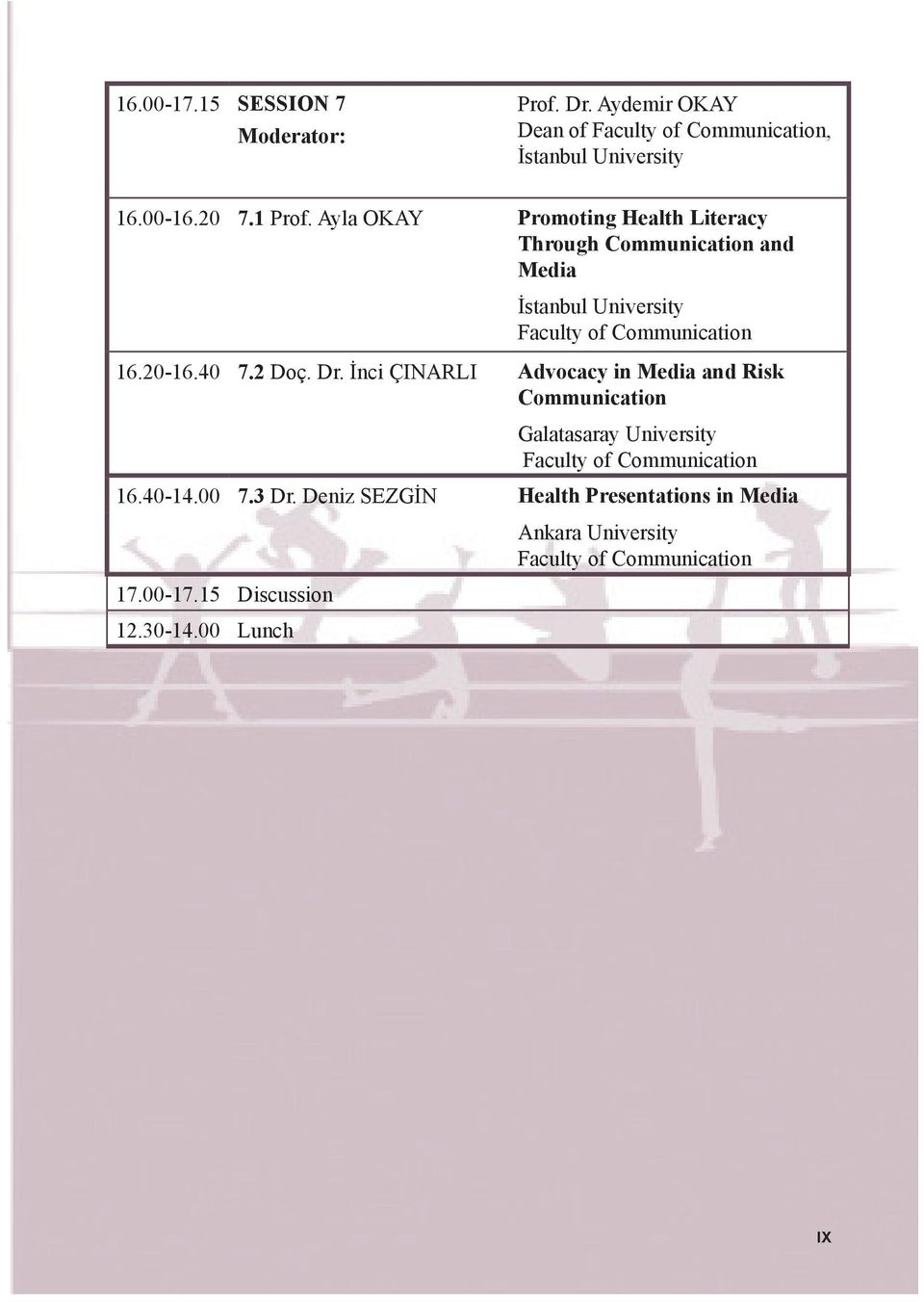
9 SESSION 7 Moderator: Prof. Dr. Aydemir OKAY Dean of Faculty of Communication, İstanbul University Prof. Ayla OKAY Promoting Health Literacy Through Communication and Media İstanbul University Faculty of Communication Doç. Dr. İnci ÇINARLI Advocacy in Media and Risk Communication Galatasaray University Faculty of Communication Dr. Deniz SEZGİN Health Presentations in Media Ankara University Faculty of Communication Discussion Lunch IX
10 Wednesday, April 13, SESSION 8 Moderator: Prof. Dr. Adnan KISA Rector of Gaziantep Zirve University Dr. Michael T. HATCHER Health Promotion in Local Health Departments and Community Health Organizations Environmental Medicine and Education Services, Branch Division of Toxicology and Environmental Medicine Agency for Toxic Substances and Disease Registry Dr. Philip GROFF Preventing Injury With Smart Thinking SMARTRISK President and CEO National Charity, Canada Discussion Tea-Coffe Break SESSION 9 Moderator: Prof. Dr. Haydar SUR Dean of Faculty of Health Sciences, İstanbul University Doç. Dr.Marlene TAPPE Promoting Health in Schools TAPPE and Universities Minnesota State University Health Science Department Doç. Dr. Laura A. LİNNAN Discussion Evaluation and Closing Chapter Lunch Health Promotion Programs in LINNAN Workplace Settings University of North Carolina Department of Health Behavior and Health Education X

11 Prof. Çağatay Güler * Born on 10 January 1951, Prof. Güler completed his primary school education in 1962; secondary school education in 1965, and high school education in Tokat Gaziosmanpaşa High School in He was graduated from Hacettepe University Faculty of Medicine in He completed his speciality in Physiology between and He completed his speciality in Public Health between and He became a Public Health Physician on He was appointed as the Chief Physician of Etimesgut Regional Hospital on He obtained the title of Associate Professor in the field of Public Health in He became a professor on He worked as the Head of Health Group in Gülşehir district of Nevşehir, and as the Health Director of Ordu province. He worked as a Deputy Director of Public Health Institute between 1993 and 2002, and Head of the Department of Public Health in Hacettepe University, Faculty of Medicine between 1993 and Prof. Güler has been working as a faculty member of Department of Public Health in Hacettepe University, Faculty of Medicine. He has authored around 250 text-books, published more than 300 articles; 10 poetry books and also a story book. *: [email protected] 1

12 New Approaches of Health Promotion in Turkey An individual makes a decision about his/her health every single day and turns it into action through his/her behaviour. Receiving knowledge is learning. Education is the reflection of learning on behaviour. Life is experiencing any kind of event. Life is the combination of experiences from birth till death. Beliefs, tendencies, attitudes and knowledge are the main factors affecting behaviour. The most important beliefs and standards for an individual establish values. Attitudes are thoughts and emotions towards something or someone. There are many individual specific factors in health education. F.M.Lewis states that Health education is a kind of combination of learning experiences designed to prepare conditions for being healthy, ensure and promote health or learning that have the same affect for a common behaviour. In developing countries objectives such as extension of median life expectancy and safety, physical power, mental health and healthy society prevail. The developed countries has gone beyond these objectives and focused on the will of achievement and productivity, physical fitness, mental efficiency, healthy environment and policies. As emphasized by W.Lawrence Green, in developed countries, the quality of life of theoretical physicist Stephan Hawking who came down with amyotrophic sclerosis is considered as higher than a strong, healthy but unemployed young individual living in a developing country and spending most of his time in cafes. According to the Second Report on the Health of Canadians, the example that can be translated into Turkish with the title of "Why Veli is in Hospital?" reflects the pillars of health promotion approach very well: Why Veli is in hospital? Because he has a bad infection in his leg. But why is his leg infected? 2
13 Because he has a cut in his leg and it is infected. But why does he have a cut in his leg? Because he was playing in a junk yard next to their apartment and fell on sharp, metal stuff. But why he was playing in the junk yard? Because his neighbourhood is not taken good care of. A lot of children play there without any supervision. But why does he live in that neighbourhood? Because his parents do not have sufficient income to live in a better neighbourhood. But why don t his parents have sufficient income to live in a better neighbourhood? Because his father is unemployed and mother is ill. But why is his dad unemployed? Because his father s education level is low and could not find a job. But why?... Ottawa Charter (1986) Health education is the process of enabling people to increase control over and improve their health. It goes beyond a very wide range of social and environmental interventions. Bunton and McDonald (2002) The primary means of health promotion occur through developing healthy public policy that addresses the prerequisites of health such as income, housing, food safety, employment and good working conditions. There is a tendency among public health officials and governments especially in liberal countries such as the USA and Canada - to reduce health promotion down to health education and social marketing focused on changing behavioural risk factor". Thus, the 3

14 most important thing for our country is whether or not to prioritize the health promotion concept. Prioritization of this requires handling of a number of approaches such economic and social ones in a holistic manner. 4

15 Assoc. Prof. Carl I. Fertman * Carl I. Fertman PhD, MBA, CHES is associate professor and executive director of the Maximizing Adolescent Potentials Program at the School of Education at the University of Pittsburgh. He teaches courses in health program planning, implementation and evaluation; health theory, health counseling, community health; and sports and drugs. His areas of expertise are substance abuse prevention, mental health education, and school and community organization collaboration. His research focuses on the effectiveness of schoolbased behavioral health programs to address the mental health and drug and alcohol needs and concerns of students. He directs the Pennsylvania Student Assistance Program Evaluation. The Pennsylvania Student Assistance Program is a collaboration of the Pennsylvania Departments of Education, Health and Public Welfare, schools, and community agencies that addresses barriers to student learning related to substance abuse and mental health problems. Dr. Fertman is a consultant to the University of Pittsburgh, Graduate School of Public Health, Center for Public Health Practice. He assisted in the implementation of the Pennsylvania and Ohio Centers for Public Health Workforce Development and the University of Pittsburgh Preparedness Center. Dr. Fertman has written extensively on the subject of school and community collaboration to improve the health status and academic outcomes for youth. Dr. Fertman has authored more than 80 professional articles. His recently authored the book Student-Athlete Success: Meeting the Challenges of College Life. Dr. Fertman co-edited with Dr. Diane Allensworth the Society for Public Health Education (SOPHE) Health Promotion Programs from Theory to Practice. *: [email protected] 5

16 What Are Health Promotion Programs? Health promotion programs can improve physical, psychological, educational, and work outcomes for individuals and help control or reduce overall health care costs by emphasizing prevention of health problems, promoting healthy lifestyles, improving patient compliance, and facilitating access to health services and care. Health promotion programs play a role in creating healthier individuals, families, schools, universities, communities, workplaces, and organizations. They contribute to an environment that promotes and supports the health of individuals and the overall public. Health promotion programs take advantage of the pivotal position of their setting (for example, schools, workplaces, health care organizations, or communities) to reach children, teenagers, adults, and families with the knowledge and skills they need to make informed decisions about their health. Health promotion programs are evidence-based using health theory and health promotion program planning models. Three international publications are milestones in the development of health promotion programs. The first is the Lalonde Report in Canada in 1974, which put lifestyle determinants of health on the health field policy agenda internationally, and showed its greater contribution to health than medical care, genetic and physical environmental determinants. The second milestone was the 1986 Ottawa Charter, which put the World Health Organization s weight behind international recognition of the broader arena in which health education was now operating under the banner of health promotion to influence the lifestyle determinants of health. The third is the 2009 Galway Consensus Conference Statement that focused on the professional competencies and key skill areas for effective health promotion program planning, implementing, and evaluating. promotion program planning, implementing, and evaluating. A major support of health promotion programs in the United States is the 6
17 Healthy People Initiative of the United States federal government that started in 1979 with the First Surgeon General's Report on Health Promotion and Disease Prevention. Its Healthy People 2020 objectives serve as a guide to the planning, implementation and evaluation of health promotion programs in the United States. Health promotion programs are the product of deliberate effort and work by many people and organizations to address a health concern in a community, school, health care organization, or workplace. And even though individuals across these sites may share broad categories of health concerns focused on diseases and human behavior, each setting is unique. Effective health promotion programs reflect the individual needs of a priority population as well as their political, social, ethnic, economic, religious, and cultural backgrounds. Today, health promotion programs use both health education and environmental actions to promote good health and quality of life for all. The United States Healthy People initiative is a model public private partnership that allows local health promotion programs to link their health promotion programming with national data and information. Health promotion programs involve stakeholders, advisory boards, champions, and advocates in program planning, implementation, and evaluation in order to ensure effective programming. 7

18 8

19 Prof. Diane DeMuth Allensworth * Diane Allensworth is Professor Emeritus at Kent State University and Immediate Past President, Society for Public Health Education. Dr. Allensworth has 30 years of experience in health and education. She began her career in school health in 1966 as a school nurse after returning from serving in the Peace Corps in Panama. She taught health education at Kent State University from 1976 to 1995 and now is a Professor Emeritus in the Department of Adult, Counseling, Health and Vocational Education. As the Director of the Health Promotion Program for Kent State University, she started the first worksite wellness program for the 3500 faculty. On loan from Kent State University, she served as the Director of Sponsored Projects for the American School Health Association from 1985 to For the next two years she was the Executive Director of the American School Health Association. In1997, Dr. Allensworth began her work at Centers for Disease Control and Prevention (CDC) serving as the Branch Chief for Program Development and Services Branch within the Division of Adolescent School Health. From , Dr. Allensworth was on loan from CDC to Health MPowers, where she served as Executive Director. (Health MPowers is an initiative to promote the adoption of health enhancing behaviors by Georgia s youth through engaging youth, school staff and families in health enhancing programs delivered at the school site). From Dr. Allensworth served as the Associate Director for Education, in the Division of Partnerships and Strategic Alliances within the National Health Marketing Center, CDC. She directed the development of Pandemic Influenza Preparedness checklists for child care, K-12 and post 9

20 secondary institutions. Currently she is a policy analyst in the Associate Director for Policy s office. *: [email protected] 10

21 Health Promotion Programs Designed to Reduce Health Disparities Effective health promotion programs are a reflection of the program participants and sites for which the programs are designed, implemented and evaluated. Every site and group of individuals is different. These differences are most often related to economic status, race and ethnicity, gender education, disability, geographic location, or sexual orientation. Although genes, behavior, and medical care play a role in how well we feel and how long we live, the social conditions in which we are born, live and work have the most significant impact on health and longevity. The causes for racial and ethnic disparities have been divided into four major categories: 1) societal factors which includes poverty, racism, economic and educational inequality, 2) environmental factors including limited education, health illiteracy, exposure to toxins, viral and/or microbial agents, poor and unsafe physical and social environment, inadequate access to nutritious food and exercise, and community norms that do not support protective behaviors, 3) individual and behavioral factors including participating in high risk behaviors such as smoking, not wearing seat belt, sedentary life style, eating poorly, and, 4) medical care factors that could include lack of access to health care, lack of quality health care, and/or lack of cultural competence of providers. Living in poverty is one of the major conditions associated with poorer health status. Because more minority individuals live in poverty, they also experience more deficits in health status as well as lack the means to pay for health care. As a consequence minority and ethnic groups suffer disproportionately from diseases and conditions that otherwise could be prevented. If health promotion programs are to be effective, then fundamental to their planning, implementation and evaluation is the need to identify and address health disparities among the individuals served by the programs. The elimination of health disparities constitutes an absolute 11
22 priority in increasing life expectancy and improving quality of life in the United States. Thus eliminating health disparities is essential in planning, implementing and evaluation health promotion programs across all settings. Four programmatic strategies to eliminate health disparities will be discussed: 1) engaging minority groups and community directly in addressing health issues, 2) improving cross-cultural staff training, 3) recruiting and mentoring diverse staff to deliver programs, and 4) addressing the root causes of health disparities. 12
23 Prof. İzzet Bozkurt * Prof. Dr. İzzet Bozkurt graduated from Ege University, Faculty of Communications, Department of Journalism and Public Relations in 1988 and worked at the Aegean Region Chamber of Industry as Public Relations Coordinator for two years. He started his academic career as a research assistant at Ege University, Department of Public Relations and Publicity in January He submitted his thesis and earned his first MA degree from Ege University, Institute of Social Sciences, Department of Mass Communication between He received his second MA degree in Marketing Communication from Roosevelt University in the United States of America by YÖK (The Council of Higher Education) scholarship between and returned to Turkey. He submitted his PhD thesis at Ege University, Institute of Social Sciences, Department of Public Relations and Publicity and was granted Assistant Professor title in He served as a faculty member in the position of Ass. Prof. at Ege University, Faculty of Communications, Department of Public Relations and Publicity until October He received the title of Associate Professor in April Between he served as the Chairperson of Public Relations and Advertising Department at Eastern Mediterranean University, Faculty of Communications. He took the title of Professor in April He currently continues his academic career as the Vice Dean of the Faculty of Communications at Yeditepe University, the chairperson of the Department of Journalism, and the Chairperson of the MA Programs Integrated Marketing Communication Management, Media, Culture and Recreation Management and Health Communication Management. He is also the co-author of the book Halkla İlişkiler, Reklam ve Ötesi (Public Relations, Advertising and Beyond) and the author of the books 13
24 Bütünleşik Pazarlama İletişimi (Integrated Marketing Communication) and İletişim Odaklı Pazarlama (Communication Based Marketing). He has many published researches and articles on marketing, marketing communication, strategic creativeness, advertising and public relations. Prof.Dr. İzzet Bozkurt continues to work on the Turkish Brand on the Path to EU. He has served as the Marketing Communication Consultant in many firms including M.A.R.K.A Communication, Çalık Holding GAP Construction, Tepe Construction, Turkish Telecom, Bahat Health Group, Kentkart Ege Electronic and Yaşar Holding. * : [email protected] 14
25 Social Marketing Social marketing, target groups, social ideas and practices in order to increase the acceptability of product planning, pricing, communication, distribution using tools such as regulation and market research programs and control the activities of these programs include the implementation. This social reveals the importance and necessity of marketing. Social Marketing of the Health Sector 1. Social marketing practices directed by the public 2. The private sector social marketing practices directed 3. Jointly conducted by the public and private sector social marketing practices Social marketing applications, especially in the last 30 years; 1. Health sector (Heart Health) 2. Community awareness, obesity prevention policies, the creation of a healthy diet, vaccination against contagious diseases, birth control, maternal and child health practices, health screenings, natural disasters, etc. 3. Campaigns against the consumption of cigarettes. 4. AIDS / HIV prevention and the spread of virus prevention and etc. seen. Problems Experienced in the Health Sector Health Services, Transport... In many parts of the world, certain areas of hospital, doctor, medication or lack of adequate health care is that everyone who wants to reach all the lack of insurance prevented. For example, there is health insurance for 20,000 people a year lose their lives in America. 15
26 Deficiencies in Meeting Needs The number of enterprises in our country, rapid population growth in the health sector to recover Patients to increase the income level of the society better cause the service to wait... o Insufficient number of health establishments, o Insufficient numbers of doctors and nurses working in hospitals, o Materials and equipment to meet the needs of poor patients. Quality of Health Care Services 1.8% of hospitalizations in America due to errors in medication side effects are seen, each additional $ due to the adverse effects of hospitalization for the emerging costs, due to adverse events per year goes to $ billion per year and consists of preventable drug error deaths due. On the other hand, some patients from unnecessary or excessive medical care is also known. This is a very high rate of emergence, social marketing related activities by the participants and their community members, social marketing, there is no adequate information is not available on the subject of thought raises. 26% YES / 74% NO Health Sector & Social Media 61 percent of Internet users in America, explores the health-related information from the Internet. According to data from Manhattan Research Center 39 percent of U.S. physicians and their patients face to face communication on issues that do not require inspection waged over the Internet. According to the Pew Internet and American Life project in the United 16
27 States, 80 percent of users use the Internet for health problems. Turkish State Planning Organization, "Information Society Statistics according to the data using the Internet to get information about health with 45.1 E-patients with chronic ill treatment inflicted 75 percent of the find from the Internet. Miguel Hernandez University in Spain's research that 90 percent of patients go to a doctor before going to the doctor as a result of the search out relevant information on the Internet. Health Sector and Social Media Positive-Negative Opinions Positive Opinions In 2009, conducted by Manhattan Research Center and published on the Internet according to the report, 39 percent of U.S. doctors interviewing patients over the internet, that does not require face-to-face interview and examination subjects utilized the advantages of online communication are indicated. Research, doctors appointments, lab results evaluation, inspection-free counseling services on the internet make matters simple, time-saving way to show they go. A doctor talking to patients who continuously controlled drug regulation is that the way to an ambulance or a patient in an emergency, via the internet a great convenience determining the most appropriate hospital. Possibility of unlimited access to information about the person's disease, and to ask not trust doctors fearing the things that the Internet can find. Negative Opinions Carried out on the internet relationships between patient and doctor "very 17
28 limited in cases of emergency and" may provide an advantage says. However, to save time on behalf of a mutual "online" to increase the dialogue could lead to the emergence of records very erroneous results. With increasing technology, the human relationship between doctor and patient size are vulnerable. Information when it can be correct addresses, the Internet, patients can obtain accurate information for existing health problems. However, every web address is a "blog" for the relatives of the patient or the patient may not be a source of a reference to the field of health. Internet research every patient who "self" and how accurate his treatments could reach a permanent solution? 18
29 Sandra van Dulmen, PhD * A.M. (Sandra) studied clinical psychology. After graduation in 1997, she started working as a researcher in different fields of health care, first at the Department of Clinical Psychology, then from , at the Department of General Practice of the University in Nijmegen, the Netherlands. She obtained her PhD degree in 1996 with the thesis titled Exploring cognitions in irritable bowel syndrome; implications for the role of the doctor. For her thesis she received the dissertation award from the Netherlands School of Primary Care Research (CaRe). From 1995 onwards she works at NIVEL (Netherlands institute for health services research, first as a researcher, since 1999 as the co-ordinator of the research program Communication in Healthcare. In 2001 she was co-founder and since then the secretary of EACH (European Association for Communication in Healthcare, She obtained numerous grants for her communication studies, varying from observational research in general practices and hospitals to intervention studies among medical students, medical specialists and nurses as well as among patients with minor ailments, type 1 or type 2 diabetes, IBS, dementia or cancer. A core feature of her work is the (video) observation and analysis of the communication in the consulting room between a patient and a health care professional. She collaborates within several international research projects and published more than 50 national and 100 international papers in peer-reviewed scientific journals. * : [email protected] 19
30 Provider-Patient Communication Throughout Europe; What We Know and Do Not (Yet) Know To guarentee high quality health care, good communication skills of the doctor are as essential as good clinical skills. After all, discovering the true nature of a patient s problem, translating this into a diagnosis and informing or advising a patient about his condition, can not take place without communicating with the patient in a clear and understandable way. For the patient, doctor s communication serves two purposes: to know and understand his health problem and to feel known and understood by the doctor. The quality of doctor-patient communication influences different sorts of outcomes, such as patient satisfaction, information recall and understanding in the short term, and medication adherence and quality of life in the longer term. These are important outcomes, because dissatisfied or non-adherent patients and unnecessary prescriptions and referrals are prone to suboptimal healthcare and high health care expenditures. With the shift from acute to chronic diseases, from instrumental interventions to lifestyle related health promotion, from cure to care, and from doctor-centred to patient-centred behaviour, the relevance and added value of good doctorpatient communication will only increase. Moreover, as societies are becoming more multicultural, insight is needed into the challenges and opportunities of intercultural communication in the consulting room. Therefore, we previously examined the influence of different European healthcare system characteristics (gatekeeping system with registered patients; GPs' employment status; payment system) on doctor-patient communication in general practices in ten European countries: Netherlands, United Kingdom, Spain, Belgium, Germany, Switzerland, Estonia, Poland, Rumania and Sweden. We studied the differences in doctorpatient communication as well as the differences in the needs and expectations of the patients. These so called Eurocommunication Studies were financed by 20
31 the EU. The total population included 5820 patients and 307 doctors. Data were collected by means of patient and doctor questionnaires, doctor registration forms, and by the observation of the communication during the patient visits which were all videotaped. The study showed that the communication patterns in the three Central-European countries Estonia, Poland and Rumania differed between each other and that they also differed from the Western-European countries. In Central-Europe, patients got less time to tell their story than in Western-Europe. Besides, consultation time was longer in non-gatekeeping countries. Affective behaviour (social talk, showing empathy, concerns, reassurances) was observed more frequently in the United Kingdom, Germany and Switzerland. In Rumania, doctors and patients talked more about psychosocial issues than in Estonia and Poland, and also more than in Sweden, Germany and the Netherlands. The importance patients attached to certain communication aspects slightly differed between the countries. There were patients who did not talk with their doctor about communication aspects that mattered to them. The study furthermore showed that healthcare system characteristics at the macro level (only) partly explained doctor-patient communication. Results will be discussed and suggestions for future reseacrh will be presented. 21
32 22
33 Prof. Osman Hayran * After graduated from Hacettepe University, Faculty of Medicine, Prof. Hayran completed his specialization in Public Health in the same university. Following the specialization, he completed his compulsory service in Health Directorate of Kocaeli province. He, then moved to Marmara University, Faculty of Medicine, Department of Public Health in 1988 and became an Associate Professor in the same year, and a professor in He served as a director of project office for Health Policies established by World Health Organization in Ankara for a while and then appointed as a Dean to establish Marmara University, Faculty of Health Education. He has worked as a Dean until 2006 and moved to Yeditepe University in Prof. Osman Hayran has been working as the Dean of Yeditepe University, Faculty of Medical Sciences, Head of Department of Public Health in Faculty of Medicine. Mainly working as a researcher in the fields of Social Medicine and Health Management, Prof. Hayran has many works published in various international scientific journals. * : [email protected] 23
34 Globalization and Health The process of globalization, which started in the last quarter of the twentieth century and advanced rapidly, is an economic phenomenon in itself; however it is closely related with the health of societies due to the changes brought about as a consequence of globalization. Within this process, the increasing movement of people, goods and services, capital and information across the international borders has enabled people to have easier access to health information and services. Especially, the rapid developments in information technology dramatically increasing the speed and ease of data flow, thereby facilitating the sharing of information and the fact that new discoveries in medicine become available to all countries in a very short period of time are the main positive effects of globalization; whereas the emergence of new health problems threatening individuals as a result of the rise in inequalities among communities and poverty are among the main negative effects. It is noteworthy that the improvements in the field of health during 1960s and 1970s were not sustained in 1980s and 1990; and in the recent years, the improvement in health indicators has slowed down and the inequalities among the countries have increased. Problems such as newly emerging communicable diseases, increase in wars and acts of violence and the spread of chronic diseases, environmental pollution, problems related to food and water safety, commercialization of healthcare services are becoming more widespread by globalization. The effects of globalization differ from one country to the other. Communicable diseases, which used to be a problem specific to the Southern countries, have started travelling to the North; whereas the non-communicable disease risk factors have started spreading from the North to the South. Eating habits of the Western world are becoming more common in the developing countries, which results in an increase in the consumption of supermarket 24
35 products rich in sugar, fat and salt and thus leads to obesity, hypertension, diabetes and cardiovascular diseases. On the other hand, the fact that although the developing countries account for the majority of the global burden of disease, sufficient expenditure is not made for research and development purposes ; that only 21 of the 1556 drugs patented between are for tropical diseases and tuberculosis and that a vaccine to fight malaria has still not been developed are examples for the inequality caused by globalization. Just like the case in any process of change and any other social phenomenon, there are those who defend and who oppose to globalization. As for public health, it is important to comprehend the dynamics behind change rather than blindly taking sides; to manage change in order to benefit from the positive aspects and avoid the negative aspects and to develop policies accordingly. References: 1. Labonte R, Schrecker T. (2007) Globalization and social determinants of health: The role of the global marketplace. Globalization and Health 3:6, doi: / Chirac P, Torreele E. (2) 25
36 26
37 Prof. Şevkat Bahar Özvarış * Dr. Şevkat Bahar Özvarış graduated from Dicle University, Faculty of Medicine in 1982 and completed her compulsory service between at Kayseri-Pınarbaşı district Central Health Center and served as the head of department and trainer at the Maternal Health Department under the General Directorate of Maternal and Child Health and Family Planning between She completed her residency training at Hacettepe University Faculty of Medicine, Department of Public Health between and worked at the department as a resident for one year. Then, she continued to work at the same department as an Assistant Professor between , received the title of Associate Professor in 1996 and Professor in Dr Bahar Özvarış received her MA degree in Program Development and Teaching from Hacettepe University, Institute of Social Sciences, Department of Educational Sciences between , and served as a fellow in the field of medical education at Harvard Faculty of Medicine in USA in She is currently a faculty member at the Hacettepe University, Faculty of Medicine, Department of Public Health and the Director of Hacettepe University Women s Health and Implementation Center (HÜKSAM). Dr. Bahar Özvarış has numerous researches and publications in the field of Public Health, Women Health/Reproductive Health, Health Improvement and Health Education and Medical Education. * : [email protected] 27
38 Health Promotion and Supportive Health Environments In many countries of the world, health education units were established by the end of 1970s. The activities mainly focused on "exchange of information" and "campaigns" about life style in the developed countries and about infectious diseases in the developing countries. However development of an integrated and sustainable policy in this fıeld was not regarded as a priority back in those times (1,2). Although health education enables individuals and groups to make decisions and assume responsibility for their health, individual responsibility may not suffice to solve serious health problems in the society. In such cases, legislative and policy changes are more effective andyield more fruitful results. For example, thefact that new cars are manufactured with seat belts and air bags in order to reduce fatalities and injuries from traffic accidents leaves no roomfor individualism. However, health related practices may reauire support such as ensuring the participation of individuals and the society, establishing cooperation through some arrangements in the structure of the society and cooperation among different sectors. Therefore a more comprehensive and integrated approach including health education, namely the "health promotion" approach, is necessary. Health education is more concerned with behaviors that can be controlled by individuals on a voluntary basis such as not smoking or auitting smoking, whereas health promotion practices are more concerned with structural, economic or legal (which may be binding in some cases) regulations to discourage behaviorsposing a threat to the health of others (f.e. smoking in public places, dangerous driving ete). Until recently, health proteetion and promotion reminded people of doctors, nurses and hospitals. Later it was realized that health relies heavily on the lifestyle of individuals. However, numerous environmental factors such as air and water 28
39 pollution and chemicals used in agriculture influencing health were discovered besides these individual factors. Furthermore the signifıcant influence of the social environment on health was gradually noticed. It was clearly demonstrated that the differences between the health status of different social groııps are determined by the knowledge, attitude and habits of the individuals as well as the living and working conditions. These developments provided suffıcient knowledge about the majority of the factors effecting health such as the human biology, hfestyle and social and physical environment. However, health was regarded as the working fıeld of solely health professionals for a long time in many societies due to the traditional attitude. The realization that other specialties and organizations outside the field of health also have an important role to play in health is relatively new. It was later emphasized that efforts to improve the health of the society by the health promotion concept and ensure "healthy lifestyles" should not only focus on the individual, but such efforts should be directed towards changing and improving the physical and social environment; because normally individuals have very limited opportunity to organize their own lifestyles. Therefore "living and working conditions" of individuals are the main determinants of individuals' health. The increase in healthy options means that very important duties are fulfilled in the organizations, institutions and societies. That is why health promotion is defined as the art of encouraging the development of social systems and their development in a healthy environment. The method identifıed for putting this principle into practice is devising and implementing approaches towards this end in cities, institutions, schools and hospitals (3). For years, World Health Organization put emphasis on maternal and child health including family planning, protecting the health of the individuals working and the elderly, malnutrition, overnutrition and the resulting problems 29
40 within the scope of its general working programs. Moreover, factors influencing health in a negative manner such as the pollution caused by industrialization and urbanization, traffic accidents and urban stress were addressed and the concept of environmental health was brought up. in the following years, WHO stressed that the scope of health protection and promotion activities extends beyond preventing and controlling diseases by way of medical technology. Health protection and promotion was considered as a concept also covering the encouragement of lifestyles, and social, economic, environmental and personal factors benefıcial for the health and was in cluded in the working programmes (2,4). Many developments have been experienced in the fıeld of health since the Alma-Ata Declaration. The understanding that many diseases are closely related to the lifestyles of individuals and the perception that the social, economic, cultural, environmental, behavioral and biologic factors influencing health positively may also exert negative effects, the increase in the scientifıc evidences on the specifıc risk factors of certain diseases, the reduction in mortality and morbidity accompanied by an increased interest in quality of life and the realization that the traditional strategies about health education have limited effectiveness resulted in the concept of "health promotion" as an integrated approach to be emphasized (5). According to the World Health Report (2002), 20 main risk factors account for almost half of the annual deaths across the world. First ten of these risk factors are responsible for 1/3 of deaths all over the world. Although majority of these risk factors are observed in the high income countries, more than half of the global burden of disease caused by these risk factors are seen in low and middle income countries (6-9). In order to promote health, it is important to know and recognize the disease causes and risk factors. According to the World Health Report, reducing risks by 30
41 25% will enable a substantial reduction in the burden of disease across the world. This way, for instance, it will be possible to prevent more than 1 million expected deaths from HIV/AIDS and 35 million years of life lost from cardiovascular diseases due to high blood pressure and cholesterol in In 2020, it is estimated that 9 million deaths caused by tobacco and 5 million deaths caused by obesity will occur. (2,6-9). The issue of evaluation and management of health risks is a new fıeld which emerged in 1970s. in 1990s, it was understood particularly in North America and Europe that such approach does not always give the expected results and that risks may differ from one group to the other. The necessity to evaluate all risks from the social, cultural and economic perspective was realized. Moreover it became clear that the risk concept varies from one society to the other and from one culture to the other and that autonomy is required for controlling the risk perceptions and the risk control of individuals. Thus the interest in lifestyle approach within the framework of health promotion and health education strategies steadily increased. This approach is based on changing and improving the knowledge and opinions of individuals about health. Within this scope, it was noticed that governments and politicians should have an öpen and close dialogue with the society about the health risks and take an active role in such activities (6-9). Throughout the World Health Assembly organized in Geneva in May 2002, country representatives presented the health risks important for their own countries and stated their determination to reduce these risks (10,11). In this framework, health promotion, as an important component of public health and preventive medicine, is a process which enables individuals to better control and improve their own health. Health promotion concept addresses the main problems necessitating the health of individuals or groups under risk to be controlled, and includes organizational, environmental and economic supports 31
42 as well as health education. This concept refers to the support actions for healthy living arranged according to education and environmental conditions. Health promotion interventions, carried out together with particularly health education and support efforts through administrative, structural, legislative arrangements and resource allocation, aim to encourage behavior patterns which prepare, enable and strengthen "healthiness" through motivation techniques and rewarding. Moreover these interventions aim to reach new regulations regarding the utilization of resources, new practices to protect health and new arrangements in the environment (1,12,13). Special strategies are needed in the determined intervention fields in order to achieve the health promotion targets. These strategies enable health related risk factors to be reduced in the short term, demand for preventive health services to increase, the development of positive health behaviors, changes in lifestyle, "increase in the self-confidence" of individuals to protect their own health and changes towards a healthy environment in the medium term; and it aims to reach a "healthier" society in the long term by reducing diseases, prolonging life and increasing the quality of life (12,13). It is important to emphasize certain issues; health is a state of complete physical, mental and social well-being and not merely the absence of disease and it is a necessity and a human right in order for people to have a socially and economically productive life. It is not ethical to approach health as solely a field of individual responsibility and try to persuade people to take responsibility for their own health by disregarding the social and environmental determinants of health. Success in health promotion may only be achieved by eliminating health disparities. The success of health promotion depends on the empowerment of individuals and the society (14). "Health for All" is not a utopia, it is an attainable goal. As indicated in the 32
43 international congresses, generally health, Primary Health Care approach and Health for All is a political process. In order to reach this goal, it is necessary to guarantee that preconditions of health such as peace, education, shelter, food, a stable ecosystem, sustainable resources, social justice and equality are ensured in all countries of the world. Public health professionals serving at different levels of healthcare should assume the role of addressing health promotion in an integrated manner as stated above and actively participating in the health promotion programs on the one hand, while eliminating health disparities and defending and fighting for the right to health in order to promote health on the other hand. References: 1. World Health Organization. Health Promotion Glossary, Division of Health Promotion, Education and Communications (HPR), Health Education and Health Promotion Unit (HEP), World Health Organization, Geneva, World Health Organization. Health Promotion Evaluation: Recommendations to Policy-Makers, Report of the World Health Organization European Working Group on Health Promotion Evaluation, WHO Regional Office for Europe, Copenhagen, World Health Organization, Grossmann R, Scala K. Health Promotion and Organizational Development, WHO Regional Office for Europe, Health Promotion Unit, Lifestyles and Health Department, IFF Health and Organizational Development, Vienna, World Health Organization. Health Promotion: Milestones on the road to a global alliance, Fact sheet N171, Revised June 1998, inf-fs/en/fact171.html (Date visited: ) 5. Rootman, I., Goodstadt, M., Potvin, L., Springett, J. What is health promotion?, A framework for health promotion evaluation. Evaluation in health promotion Principles and perspectives, Ed: Irving Rootman, M. Goodstadt, B. Hyndman, DV. McQueen, L. Potvin, J. Springett, E. Ziglio, 33
44 34 WHO Regional Publications, European Series, No. 92, Health Canada, World Health Organization, World Health Organization. Preventing Risks and Taking Action, Chapter Seven, In: The World Health Report 2002, World Health Organization, Geneva, World Health Organization. Perceiving Risks, Chapter Three, In: The World Health Report 2002, World Health Organization, Geneva, World Health Organization. Protecting the People, Chapter One, In: The World Health Report 2002, World Health Organization, Geneva, World Health Organization. Quantifying Selected Major Risks to Health, Chapter Four, In: The World Health Report 2002, World Health Organization, Geneva, World Health Organization. Handbook for the documentation of interpersonal violence prevention programmes, World Health Organization, Geneva, World Health Organization. Promoting mental health: concepts, emerging evidence, practice: summary report/a report from the World Health Organization, Department of Mental Health and Substance Abuse, World Health Organization, Geneva, Green L.W. Prevention and Health Education in Clinical, School and Community Settings, In: Maxcy-Rosenau-Last Public Health & Preventive Medicine, 14 th Ed., Robert B. Wallace(Ed.), Appleton & Lange A Simon & Schuster Company, Stamford, Connecticut, Green L.W. Prevention and Health Education, In: Maxcy-Rosenau-Last Public Health & Preventive Medicine, 14 th Ed., Robert B. Wallace(Ed.), Appleton & Lange A Simon & Schuster Company, Stamford, Connecticut, Tones, K. Health Promotion, Health Education, and the Public Health, Chapter 7.3. In: R. Detels, J. McEwen, R. Beaglehole and H. Tanaka (eds), Oxford Textbook of Public Health, Oxford Textbook of Public Health, Oxford University Press, Chapter Four, In: The World Health Report 2002, World Health Organization, Geneva, 2002.
45 Prof. Jean M. Breny * Dr. Jean M. Breny is a Professor in the Department of Public Health at Southern Connecticut State University, in New Haven, Connecticut. She has been on the faculty since 2000 and currently teaches undergraduate and graduate-level health promotion courses, including program planning and evaluation, health promotion practice, and health promotion priorities. Dr. Breny received her PhD in Public Health, with a concentration in Health Behavior/Health Education, from the University of North Carolina at Chapel Hill (2000) and her MPH in Community Health Education from San Jose State University (1994). Through her scholarship, Dr. Breny aims to eliminate health disparities through community-based participatory action research that informs public health practice and is committed to work that helps us to understand how social and cultural factors affect individual health behaviors. Dr. Breny recently completed research on the Status of African American Health in Connecticut, a project spearheaded by the NAACP, which has been presented to the Connecticut state legislature. Her current work includes a photovoice project looking at how relationship power affects African American women s ability to practice safer sex. In addition to teaching and doing research, Dr. Breny was the first Director of the Graduate Minority Student Scholars Program in Public Health at Southern Connecticut State University. The program aims to increase the number of underrepresented minorities working in public health in Connecticut. Dr. Breny currently sits on the board of AIDS Project New Haven and is an Associate Scientist at the Center for Interdisciplinary Research on AIDS at Yale University. *: [email protected] 35
46 Implementing Health Promotion Programs Effective planning results in a program design that is evidence-based, innovative, informed by promising practices from the field, and so well organized that at least on paper the project is poised for success. Once program goals and objectives have been written, desired outcomes determined and the intervention is planned, now what? The program that was so meticulously planned now needs to be implemented and this is the place where staff and stakeholders move from planning to action. There is a critical link between program design and results, namely the implementation phase of program planning. Implementation is a process that happens over time, not an event that occurs at a specific moment. It begins with the importance of designing effective action plans for guiding staff and program leaders through the program s planned goals, objectives and strategies as well as all of the behind the scenes activities they will need to do to make the program unfold as planned. Included in implementation plans are several practical implementation tools, including action plans, logic models, Gantt charts and budgets that will help planners move from program design to live action. The role of staffing and leadership; hiring, training, managing, and evaluating staff are essential in implementing programs. Actions plans and other tools allow planners to be flexible with staffing issues when unforeseen obstacles arise; challenges such as unanticipated staff turnover, organizational or community crises, unrealistic timelines, and disgruntled staff. Proper implementation strategies allow planners to meet these challenges, make changes, and continue to meet program goals and objectives. Finally, implementing a program includes budgeting and fiscal management. Some planners will find themselves responsible for making sure the program s therefore, it is critical that expenses remain within the realm of it budget, is critical that planners have skills in accounting, financial 36
47 analysis, and fundraising. This presentation will provide an overview of how to manage the implementation process. Examples of logic models and Gantt charts will be presented along with how to effectively use them. The presentation will also include examples of pitfalls that might be encountered along the way and how planners can seamlessly stay on track with their planning. Issues of hiring and training staff to work on programs will be discussed, including suggestions for interviewing program staff and hiring considerations, as well as issues around staff management. The presentation will culminate with a discussion of budgeting and fiscal management so that the resources needed through the length of the program are available. 37
48 38
49 Prof. Dr. Edward Mamary * Edward Mamary earned his DrPH degree from the University of California at Berkeley and is professor and MPH Program Director at San Jose State University in California. He worked for many years as an evaluation specialist for the San Francisco STD/HIV Prevention Training Center, one of four national centers funded by the CDC. In 2009, Dr. Mamary was a visiting scholar at the American University of Beirut, Lebanon. He has consulted on many community projects, including a local evaluation for The Partnership for Public Health - a five-year initiative funded by the California Endowment to foster ties between California communities and public health departments; separate HIV needs assessments for: Mountain Counties AIDS Consortium, Contra Costa County, San Mateo County, Santa Clara County, and Kern County; an assessment of smoking among people living with HIV for San Francisco General Hospital; building evaluation capacity for community-based HIV prevention programs in the City and County of San Francisco; and an impact evaluation for the California State Occupational Lead Safety Program. Dr. Mamary was principal investigator on a research project funded by the Universitywide AIDS Research Program, University of California. The main goal was to assess HIV risk among African American men. Since 1998, Dr. Mamary also conducts HIV primary care effectiveness reviews for the Ryan White CARE Act Program. He was past co-vice president of national Society for Public Health Education. Dr. Mamary is treasurer for the Council of Accredited MPH Programs. He is also on the National Board of Public Health Examiners. * [email protected] 39
50 Evaluating and Improving a Health Promotion Program Program evaluation is the systemic collection of information about a health promotion program in order to answer questions and make decisions about the program. Evaluation helps program staff, stakeholders, and participants think in a structured, systematic manner about the who, what, when, where, why, and how of a program. In short, program evaluation addresses the question of what was done and whether the program itself was effective and why. The types of program evaluation are formative evaluation, process evaluation, impact evaluation, and outcome evaluation. While it is important to know what type of program evaluation needs to be conducted, it is critical to first know what questions are to be answered and what decisions are to be made with the collected information. Once this is known, it is possible to focus on accurately collecting information and on understanding that collected information. Evaluation often seems like a heavy, complex activity to those who are not familiar with the real nature of evaluation. In essence, however, evaluation means answering some very basic questions and then reporting back to interested individuals and groups (that is, stakeholders) what was found. Basic tools needed to design and implement a program evaluation are described as well as how to use and disseminate an evaluation s findings. The role of evaluation is discussed in the context of the overall design of a health promotion program and the ways in which evaluation can provide continual feedback to strengthen such programs. Finally, important tasks for implementing evaluation are described. Evaluation is not the last phase in the process of creating, operating, and sustaining a health promotion program. It is one of the phases, and in the most effective health promotion programs, runs parallel to the other phases, starting at the very beginning of the process when a program is being planned and continuing in tandem as the program is implemented and sustained in order to provide continual feedback to program staff, stakeholders, and participants. 40
51 Prof. James H Price * Dr James H Price is the former Chairperson and Associate Dean for Graduate Studies and Research in the College of Health and Human Services, and is Professor Emeritus of Health Education and Public Health at the University of Toledo. He currently serves as a part-time faculty in the position of Professor of Research in Health Education. Dr. Price recently selected as the 2011 Robert D Russell Scholar in Health Education at Southern Illinois University Carbondale (SIUC). Dr Price was the former editor of the American Journal of Health Education and the Journal of School Health and was a contributing editor to the Journal of Nursing Care. He has also been on the Editorial Boards of the American Journal of Health Behavior, the Health Educator, and the Journal of Community Health. He is a prolific author having written 3 textbooks and 300 articles. During the years when he was researching, teaching and mentoring doctoral students (n=60) he was also actively involved in professional service. He has been President of the American School Health Association and consultant to the Ohio Department of Health, the Ohio Commission on Minority Health, the CDC, NIH, American Cancer Society, and the Society for Public Health Education (SOPHE). Most recently, he was a member of one of the sub-committees to establish the new Healthy People 2020 objectives for the nation. He continues to work with doctoral students and conducts his own research. * : [email protected] 41
52 Planning Health Promotion Programs The first phase in the process of creating, operating, and sustaining a health promotion program is program planning. One of the first steps in planning a health promotion program is conducting a needs assessment. A needs assessment gathers information about individuals health needs and a site s support and resources to inform the process of planning, implementing, and evaluating a program. Although there are many methods of conducting a needs assessment, following some basic principles is essential in order to secure quality information upon which a health promotion program that will increase the well - being of the individuals at a particular site can be developed. When conducting a needs assessment, it is essential to use a variety of methods to collect and analyze data from both primary and secondary sources and to conduct a capacity assessment of the site: school, workplace, health care organization, or community. Then, working with advisory board, program participants, staff, and stakeholders, establish program priorities using approaches such as PEARL and consensus building to maximize program support in the later program planning decisions as well during the program implementation and evaluation. Finally prepare a needs assessment report to the program participants, staff and stakeholders, and the setting. In the report, in plain language, identify the diverse factors that influence health behaviors as well as the behaviors and environmental conditions that promote or compromise health. Likewise, identify factors that influence learning and behavior, foster or hinder the health promotion process, and determine the extent of existing and available health promotion programs and services. Once the needs assessment is complete the focus shifts to developing a clear vision of what the program will try to accomplish that is, a mission for the program. Decisions will be made about what strategies and interventions to use in order to achieve the identified goals, as well as about ways to address 42
53 health disparities and which health theories or models to use as the program s foundation. Work will focus on developing criteria for selection of the health promotion interventions, searching for interventions that have already been conceived or tried (including evidence - based ones), and making decisions about whether to create, purchase, or adopt interventions. Furthermore, decisions will need to be made about the scope of the interventions and the support needed to execute those interventions. Some of the decisions about the support that is needed to create and implement a program will involve tending to policies and procedures at the site where the program is to be implemented. Effective policies provide infrastructure for the program; good policy decisions result in effective programs. With all of these decisions in place, the program s staff, stakeholders, and participants will be able to describe the program s mission as well as the program s goals, objectives, and interventions. The program supports (policies and procedures) will be in place and will be known. All stakeholders will have a shared understanding of the interventions and expected outcomes. 43
54 44
55 Louise Villejo * Louise A. Villejo, M.P.H., MCHES, is the executive director of the Patient Education Office at The University of Texas MD Anderson Cancer Center. She has over 30 years of experience in designing, implementing, evaluating and managing nationally recognized institution-wide patient and family education programs for over 35 disease and treatment populations. These programs include development of relevant educational programs in each clinical area, including a comprehensive array of electronic, print, audiovisual and computer-based educational resources and Patient/Family Learning Centers. She and her staff work closely with patients and caregivers, physicians, nurses, dietitians, pharmacists and others on the health care team to develop a patient-centered learning environment that provides patients with the resources they need to participate in their care. Her areas of expertise include cancer patient education program and resource development, program administration, health literacy and addressing the needs of underserved populations. Villejo has written and produced over 200 patient education booklets and videos, including materials designed for low-literate or hard-to-reach audiences. She has also trained clinical staff in patient teaching and cultural competency. She has published and presented widely in the area of patient education and addressing cultural diversity in health care and is a frequent consultant to national health care organizations and hospitals. Villejo has served on the Agency for Health Care Policy and Research, the Clinical Practice Guideline Smoking Prevention and Cessation Panel, advisory boards for the Office of the Surgeon General, the National Cancer Institute, the National Heart Lung and Blood 45
56 Institute, and REDES en Accion. * : [email protected] 46
57 Patient Focused Health Promotion Programs in Health Care Organizations In the United States, health care organizations include: for-profit, nonprofit, public, community and academic hospitals and medical care clinics that provide both routine and emergency services; home health agencies that provide in-home care designed to replace or reduce the need for more expensive hospitalization; and physician organizations, such as health maintenance organizations and preferred provider organizations. Traditionally, health care organizations have directed their efforts toward the provision of medical care, including acute care, long-term care, rehabilitation and psychiatric care, and hospitals have been viewed as the center of the medical care delivery system. However, given significant changes in the health care system in recent years, health care organizations have devoted more attention to health promotion programs. These health promotion programs reflect collaborations between practitioners in medicine and public health. And while practitioners in medicine and public health have worked together on health problems in the past and have had ample opportunities to do so, only recently have incentives, needs and supportive organizational structures come together to promote the design, implementation and evaluation of a wide range of health promotion programs in health care organizations. Opportunities for health promotion programs in health care organizations reflect a recent blending of medicine and public health and the pivotal role of medical care organizations and facilities in the health and well-being of individuals. Today, a range of health promotion programs operates in health care organizations. Health professionals involved in such programs include physicians, health educators, nurses, medical social workers and allied health professionals. These programs focus on patients, patient safety, employee health, 47
58 workplace safety and community outreach. Unique to health care organizations are health promotion programs that historically have been patient-focused and associated with patient education to help people make informed medical and health decisions and develop skills needed to participate in their health care. In today s world, individuals are more involved in their own health care decisions. This increased involvement reflects the increase in health promotion programs and in managed care that has resulted in shorter hospital stays in response to pressure for cost containment and has increased demand for outpatient and in-home services. 48
59 Prof. Dr. Ayla Okay * Dr. Ayla Okay is a faculty member at Istanbul University Faculty of Communications Department of Public Relations and Publicity. Okay graduated from Marmara University, School of Press and Media, Department of Journalism and Public Relations in 1991, she earned her MA degree in 1994 and her PhD degree in 1998 from Marmara University, Social Sciences Institute, Public Relations Program. Dr. Ayla Okay has been working at Istanbul University, Faculty of Communications since 2000; she became an associate professor in 2003 and received the title of Professor in Prof. Dr. Ayla Okay is currently the chairperson of Istanbul University, Department of Public Relations and Publicity and has both national and international publications in the field of public relations. In addition, Prof. Dr. Ayla Okay has recently carried out researches on health communications and her book in this specific field titled health communication is used as a course book in numerous universities. Ayla Okay serves as a member of the editorial board for national scientific publications of several universities as well as being a referee for the journal New Media & Society and is amongst the editorial board members of the journal International Journal of Strategic Communication. Prof. Dr. Ayla Okay works in international academic projects; she is currently playing an active role in the organization of the European Public Relations Education and Research Association s annual congress which will be held at Istanbul University in 2012 and is on the scientific board of the congress to be organized by the Association in Leeds in Prof. Dr. Ayla Okay lectures many courses at undergraduate and graduate 49
60 levels including but not limited to Public Relations, Health Communication, Corporate Identity Strategies courses at undergraduate level and Management of Public Relations Strategies, Theoretical Basis of Public Relations, Current Practices in Public Relations, Health Communication Practices courses at graduate level. Prof. Dr. Ayla Okay has conducted many seminars abroad at Leipzig University and Viana University. Prof. Dr. Ayla Okay s books on public relations and corporate identity are used as course books in many universities across Turkey. * : [email protected] 50
61 The Relation between Health Communication and Health Literacy Health literacy is related to the degree to which individuals have the capacity to obtain process and understand the basic health information and services in order to make appropriate health decisio ( hlthlit.html). Understanding how to use a drug as well as reading a prescription, and instructions given by the physician on how to use a drug or discovering the correctness of health news in the media are among the issues that can be addressed by health literacy. Health literacy of individuals is affected to a great extent by the education level, cultural structures as well as media and communication. Individuals receive information on health through various communication methods. These communication methods sometimes involve face to face communication and also different mass communication tools. Low level of health literacy causes problems for individuals to internalize health related problems they saw in the media as well as making it difficult to build relations with health care providers such as physicians, nurses, etc. Raising health literacy cannot be possible only through communication; the importance of using communication effectively cannot be underestimated at that point. The significance of health communication studies with the aim of improving health literacy increases day by day; because the possibilities for communication are too different when compared to the situation in ten years ago. Individuals can come up with health related programs on TV at anytime or search internet on issues that they want to learn; however evaluating the correctness of this information through different means is closely related to individual s health literacy level. This study will look at the concept of health literacy in depth and examine different health communication types affecting health literacy. Basically, health communication occurs at different levels. These levels have been categorised 51
62 as individual, social network, organization, society and community by Thomas (Thomas, 2006:3); whereas classified as interpersonal, group, institutional and social that occur in individual s mind by Kreps (Kreps, 2003:355). To what extent these levels will affect health literacy is the mainstay of the research. The process of interpersonal communication, transmitting health information via mass communication or attaching importance to health literacy through health communication campaigns of interest to everybody increase the efficiency of the message. Each level specified can become an important tool for raising and promoting health literacy. The most important thing in using this tool effectively lies in communication works that will give it a shape. In this respect, communication process is always involved in each step of raising health literacy. In health communication practice, health literacy level of target audience, namely the receiver of communication will shape the type of communication practice. To this end, through knowing the structure of target group and using appropriate messages, it can be possible to reach the desired behaviour or behavioural change. The study to be prepared will cover the following topics: The concept of health literacy The concept and process of communication The concept of health communication The levels of health communication The correlation of health communication levels with the health literacy Identification of target audience in health communication and appropriate communication strategies 52
63 References: 1. Kreps G.L. (2003). Trends and Directions in Health Communication Research, Medien & Kommunikationswissenschaft, 51, Thomas, K.T. (2006). Health Communication, New York: Springer Science+Business Media Inc. ( 53
64 54
65 Assoc. Prof. İnci Çınarlı * School, and completed her undergraduate studies in İstanbul University, High School of Press and Information in She started working as a Research Assistant in Galatasaray University, Faculty of Communication in She obtained her masters degree from İstanbul University, Institute of Social Sciences, Department of Public Relations, Publicity and Advertisement in 1996, and obtained her doctoral degree with the thesis titled Social Marketing as a Health Communication Method in Health Promotion, Advocacy in Media and the Effect of Public relations from Marmara University, Institute of Social Sciences, Head of Department of Communication Sciences, Public Relations Department in Obtaining the degree of Associate Professor in February 2011, Çınarlı has been giving courses at undergraduate and graduate levels in Public Relations Theories and Models, Public Relations Campaign Design, Crisis and Risk Communication and Health Communication since Çınarlı has been giving courses on Health Communication and Crisis Management in Public Relations in Kadir Has University on a part time basis since İnci Çınarlı has authored "Health Communication and Media " (published doctoral thesis) and "Strategic Communication Management " (2009) and has been the editor of Crisis of Unclear Society" (2009). Furthermore, Çınarlı has publications in the fields such as health communication, risk communication, manipulation mechanisms (propaganda, spin, disinformation) and social responsibility, and papers presented in international conferences. Having fluency in English and French, Çinarlı has been working as the Head of Department of Public Relations and Publicity in Galatasaray University, Faculty of Communication. * : [email protected] 55
66 Media Advocacy Risk Communication Within the scope of health promotion, although efforts to change individual behaviour are still valid; efforts toward creating a social change have proven to be more effective now. At that point, media advocacy, used as a method in health communication aims to involve society in health related policy making process through strategic use of media to develop social and public policy initiative. With its aim to change social, physical and political environment, media advocacy considers receivers of health messages as participatory individuals, rather than passive actors. Media advocacy known as "public health lobbying is a kind of activism and takes into action towards bringing science and policy and social justice together. Media advocacy can give strength to groups (communities) through visibility and legitimacy in media as well as giving them opportunity to tell their stories directly. It can be even effective in removing the power gap through using it as an important strategy for those with scarce sources. To this end, using celebrities, building a coalition, communication with public opinion leaders are the most common factors utilized by media advocacy. Once health risks are considered, media advocacy attaches importance to consider this issue as a public health issue rather than trying to change risky behaviours of individuals directly. Media advocacy focusing on environmental risks is done by several steps such as agenda setting (conveying people with mass media which risks should be considered mainly, and using creative epidemiology to this end), framing (drawing desirable boundaries of risk discussions) and policy developing. Media advocacy aims to reach policy makers and other decision makers through these steps. Strategies to be developed for this can be proactive as well as reactive. In order to ensure media advocacy which raises awareness of the public on 56
67 risks and shapes the public opinion, knowledge and skills about the following are required: how traditional and social media works (criteria of gatekeepers, what has the value of a news, how to prepare materials to be conveyed), how to identify risks directly, how to build understanding for the risks and how to convey information available for risks. The significance of health communication education emerges at that point. In addition to education on medicine, public health, sociology, epidemiology, anthropology and statistics, education on communication is undoubtedly necessary for implementing risk communication effectively and evaluating its consequences. In this study, media advocacy has been addressed through different examples from developed countries and Turkey; how to make use of media advocacy method in risk communication (i.e. alcohol, tobacco and cigarettes, heart diseases, sexually transmitted diseases) and which points to taken into account have been discussed. In conclusion, it is found out that media advocacy method that can build a high level of trust towards the source in terms of risk communication has many advantages over other methods and also has a key role in health promotion in 21st century. Keywords: Media advocacy, health communication, risk communication. 57
68 58
69 Dr. Deniz Sezgin * Dr. Deniz Sezgin graduated from Ankara University, Faculty of Communications, Department of Public Relations and Publicity in After her graduation, she worked at the private sector for ten years. She earned her MA and PhD degree in Public Relations and Publicity from Ankara University, Institute of Social Sciences. Her MA thesis was on Pharmaceutical Advertising Regulations in Turkey and the European Union her PhD thesis on Health Communication Paradigms and Turkey: Analysis of Health News on the Media. She worked as the Assistant Coordinator of Public Relations and International Affairs at Ankara University between She served as the Deputy Director of Ankara University Centre for Communication Research (İLAUM) between Her PhD thesis was published into a book titled Tıbbileştirilen Yaşam Bireyselleştirilen Sağlık (Medicalized Life Individualized Health) by Ayrıntı Publishing Company in Her articles and abstracts were published in peerreviewed journals. She made oral presentations and poster presentations in various symposiums and congresses. She lectures various courses at undergraduate and graduate levels including Health Communication, Health Communication Practices, Public Relations Models, Health Communications and Media. Deniz Sezgin worked as a communication expert at European Union projects and international projects; she made presentations and delivered trainings on various topics in many institutions. She has provided consultancy to student projects within the scope of the courses she lectures and the annual IAA (International Advertising Association) Annual Global Student Advertising Competition, Aydın Doğan Foundation Young Communicators Competition, 59
70 TÜHİD (Public Relations Association of Turkey) Golden Compass Public Relations Competition Young Communicators Category, Ministry of Health Inter-University Advertising Competition. Dr. Deniz Sezgin is currently a faculty member at Ankara University, Faculty of Communications, Department of Public Relations and Publicity. Among other activities and responsibilities, she is also a member of the Media Communication Commission and Tobacco Control Commission of the Ministry of Health, Executive Board of the Association of Communication Graduates of Ankara University and faculty member representative on the Executive Board of Ankara University, Faculty of Communications. * : [email protected] 60
71 Representations of Health in Media Recently, it has been observed that presentations of diseases and health related issues on the media are increasing day by day. The wide coverage of health related issues in the news, geometric increase observed in health programs on TV and health news/series published full page in newspapers, use of health and disease related themes nearly in all product promotions, health magazines becoming more widespread and increase of health related web pages on internet are highly striking. The dominant discourse of health in media has changed towards focusing on being healthy rather than disease itself and thus helped to provide medical social control through the body control. The underlying factor behind this discourse veiled by an ideological cover is the use of body control through commercial purposes. The process today might seem like focusing on public and individual health; however it is evident that the primary objective is not the interests of individuals. Promises related to healthy life are presented in the media in a way to evoke the survival impulse of individuals and this results in individuals not being able to see the underlying commercial concerns behind these presentations. This situation necessitates a more comprehensive vision towards health discourse in the media. Within the framework of this study focusing on analysing and explaining social and cultural dynamics of health discourse in media, qualitative and quantitative content analyses were made in 3008 health related news in Hürriyet newspaper and its annexes between and and the methods of presenting those news were analysed. In the study, the following four main headings were identified Descriptive Factors, Main Concepts Investigated, Life Style Suggestions and Other 61
72 Health Information and news/articles were analysed under these headings. Although analysis was made under these four headings, life style presentations were considered in health news in this study, so findings about Life Style Recommendations were presented.in the news and articles analysed, the natural processes of human life and daily life practices were mainly considered within the framework of medicine and presented as a kind of disease, in other words medicalization was tried. The natural processes of daily life were presented like an irregularity to be improved and healthy lifestyle recommendations were presented intensively through media to individuals. Another striking issue parallel to medicalization is the individualization. Following the lifestyle advices presented through media, information and developments related to health; reading and learning about the things to be done for healthy life and implementing those are completely left for the individuals. It is expected from the individuals controlled by media and who focus on being healthy and living healthy to know which health information is correct and which advise is useful, to make necessary decisions related to health themselves, to take into action in line with the advices and make the suggested consumption in such abundance of information presented to them. The challenges and problems to be brought by such a structure are clear. It should not be forgotten that this type of disinformation may cause a material and moral loss to the individuals. It should be stated at that point, there is a huge responsibility of the media. In summary, presentations by media of life style suggestions and healthy life promises result in individuals not being able to see the underlying commercial concerns. Nevertheless, a number of simple, easy and poor quality healthy life presentations in the media can make large scale health problems insignificant and overlooked. It should be borne in mind that health issues cannot be left solely to the individual s responsibility but protection and promotion of health are indispensable responsibilities of public authorities. 62
73 Dr. Michael T. Hatcher * Michael T. Hatcher, DrPH, MPH has been actively engaged in public health promotion and disease prevention at the local, state, and federal levels of public health. He has led health promotion and disease prevention planning, program and initiative development, and service delivery that resulted in measureable population-level health improvements. His experience includes health system performance measurement, health services research, and public health practice improvements. His local experience includes working at a Tennessee community mental health center conducting school based alcohol and drug prevention education and serving as a senior health educator at the San Bernardino County Department of Public Health in California. There he provided community and worksite health promotion. His state experience was serving as Assistant Division Director for Public Health Promotion at the Texas Department of Health. There he established the state child passenger safety program, co-established the Texas office of smoking or health, led development and implementation of the 1990 Texas disease prevention and health promotion objectives, and served on the Legislative Task Force on Cancer s education subcommittee. Dr. Hatcher s federal experience began at the Centers for Disease Control and Prevention where he was team leader of the National Public Health Performance Standards Program. There he assisted local and state public health systems to improve performance of the ten essential public health services. Currently he is Chief of Environmental Medicine and Education Services at the Agency for Toxic Substances and Disease Registry. There he leads promotion of clinical environmental health services adoption in primary care medical practice. * : [email protected] 63
74 Promoting Community Health: Local Health Departments and Community Health Programs Conducting community health promotion programs, in most situations, means working with or through local public health authorities to engage community organizations and institutions in efforts to improve population health. Such engagement makes possible opportunities for collaborative community decisionmaking, planning, and coordinating actions that improve health promotion policy adoption and service delivery. A key factor in community health promotion is the flexible to conduct activities in places where people naturally congregate and conduct their daily affairs. In such community places, health promotion can be tailored to meet the context of place and culture of the people living there. Health promotion intertwined with community places and cultures of people are indispensable in developing environments that reinforce health promoting behaviors. In order for local public health authorities to effectively conduct community health promotion activities, the authority needs capability to performance ten essential public health services. These services present a framework for public health practices for all public health programs. Understanding the relationship between the ten essential public health services and community health promotion is critical if local health authorities are to be successful in conducting health promotion initiatives and working with others in their jurisdiction. Central to community health promotion is the art and science of engaging community members and organizations in collaborative work. Before some individuals and organizations can participate fully in decision making and action on community health issues, they frequently need training to develop additional knowledge, leadership skills, and resources in order to exert their power. While a sense of empowerment cannot be externally imposed on a community, engendering the ability to take action, exert influence, and make decisions on 64
75 critical issues is crucial for successful health promotion engagement to occur. Community health promotion success is best when community engagement is sustained. Ongoing collaborative planning can identify specific community actions and system changes that can influence or compel widespread behavior changes and make community health improvements more likely. Community health promotion work presents many challenges including trust, respect, reciprocity, and power. Power is too often reflected in the unequal distribution of information, education, and income in communities and this underlies social inequalities of economic class, race or ethnicity, age, and gender. These may, in turn, affect whether community members feel they will have influence over decisions and whether they want to engage and participate in community-based activities. Overcoming these and other community engagement challenges must occur if collaborative health promotion initiatives employing multiple strategies and activities are to be successful within communities and result in improved health of individuals, families, and populations. 65
76 66
77 Dr. Philip Groff * For nine years, as Director of Research & Evaluation for SMARTRISK Dr. Groff was responsible for coordinating the research and evaluation activities of the organization. This included conducting primary research, overseeing the evaluation of the organization's projects and programs, and providing a liaison between SMARTRISK and the research and evaluation community in Canada and abroad. Since November 2010, he has served as President and CEO of SMARTRISK, overseeing all organizational operations. SMARTRISK is a national, charitable Canadian organization whose mission is to empower youth through education, programming and policy change to recognize and manage their risks of injury in the smartest ways possible. Philip Groff has a Ph. D. in psychology from the University of Toronto with a specialty in Human Neuropsychology and Cognition. He has been a course instructor in the History of Psychology, Thinking & Reasoning, Decision and Game Theory, Statistics and Research Methodology at the graduate and undergraduate level, in the psychology departments of the University of Toronto, York University and the Ontario Institute for Studies in Education. Previous research appointments involved work on Urban Health, and on a Conceptual Analysis of Risk Management, Safety and Injury Prevention at both the Kunin-Lunenfeld Applied Research Unit and Health and Everything. He also worked on a multi-year project on the History and Future of Canadian Health Policy and the Concept of Health with the Health Network at Canadian Policy Research Networks. * : [email protected] 67
78 SMARTRISK: Preventing Injuries Through Smart Thinking In Canada, injury is the leading cause of death from ages 1 to 44. Between the ages of 10 and 35, young Canadians are more likely to die of injury, than of all other causes of death combined. In this presentation Dr. Groff will review the state of injury in Canada with a particular emphasis on the burden of injury to young Canadians. In addition, research has shown that young people are particularly hard to reach with traditional safety messages, often phrased negatively, rules-based, and consequence focused. Throughout its twenty year history, SMARTRISK has demonstrated the ability to change young people s attitudes toward risk and injury, by developing insight into this difficult to reach audience, and crafting messages that resonate with them. Dr. Groff will review the SMARTRISK approach to social marketing for injury prevention among youth. Using specific examples of our award winning communications strategies (The Stupid Line), and evidence-based peer leadership programming (SMARTRISK No Regrets), the techniques of reaching a difficult target audience with a persuasive health promotion message will be reviewed. 68
79 Assoc. Prof. Marlene Tappe * Marlene K. Tappe, Ph.D., C.H.E.S. is an Associate Professor and Chair of the Department of Health Science at Minnesota State University, Mankato (MSU-M). Dr. Tappe graduated from MSU-M with majors in Health Science and Physical Education. She taught Health and Physical Education at Comfrey (Minnesota) Public Schools and then completed a M.S. in School Health Education and a Ph.D. in Health and Safety Studies at the University of Illinois at Urbana-Champaign. For 19 years she was on the faculty of Purdue University. During that time Dr. Tappe also worked on an Intergovernmental Personnel Agreement with the Centers for Disease Control and Prevention (CDC). Her CDC projects included co-authorship of chapter six of Physical Activity and Health: A Report of the Surgeon General and lead authorship of CDC's Guidelines for School and Community Programs to Promote Lifelong Physical Activity Among Young People. Dr. Tappe served on the Joint Committee on National Health Education Standards (1995, 1997) and currently is a member of the American Cancer Society's School Health Advisory Panel and the CDC's Health Education Curriculum Analysis Tool training cadre. Dr. Tappe s scholarship is focused on coordinated school health, health education standards and assessment, and health education advocacy. She has received awards for her work from the Secretary of the Department of Health and Human Services, the CDC, the American Cancer Society, the American Association for Health Education, Eta Sigma Gamma, the Society of State Directors of Health, Physical Education, and Recreation, and the Coalition of National Health Education Organizations. * : [email protected] 69
80 Promoting Health in Schools and Universities There are 55.5 million students in elementary, middle, and high school and 18 million college students in the United States. Schools and universities, therefore, are ideal sites for health promotion because they are efficient places for reaching almost all K-12 children and adolescents and many young adults. Students, however, are not the only audience for health promotion activities in schools and universities. Schools and universities are a worksite for 9.8 million faculty and staff and have been promoted as ideal sites for workplace health promotion because, beyond the immediate health benefits that accrue to school and university staff, these staff members can then serve as healthy role models for students. Rationale for health promotion in schools and universities extends beyond the fact that schools and universities are very efficient sites for conducting health promotion programs. Health promotion programs are needed in schools and universities not only because large numbers of young people congregate in these settings but also because children, adolescents, and young adults face a number of serious health threats. Health promotion in schools and universities is also important because children, adolescents, and young adults consolidate their health-related behaviors and attitudes as they make the transition from childhood to adulthood. Further, health promotion in schools and universities is important because young people make choices that influence both their current and future health. Additionally, health promotion in schools and universities is important because health and academic achievement are inextricable intertwined. There are a wide variety of health promotion activities in schools and universities. Health promotion in schools is based on an eight component model developed by Lloyd Kolbe and Diane Allensworth called coordinated school health. The eight components of coordinated school health include the 70
81 following interrelated disciplines and services in schools: health education; physical education; health services; nutrition services; counseling, psychological, and social services; healthy school environment; health promotion for staff; and family and community involvement. The basic components and principles of coordinated school health also apply to the promotion of health in universities. There are many tools and resources for health promotion activities in schools and universities. Tools and resources for health promotion in schools include Centers for Disease Control and Prevention (CDC) surveillance systems to monitor adolescents health behavior (e.g., Youth Risk Behavior Survey) and schools health-related programs, services, and policies (e.g., School Health Profiles). These tools and resources also include the CDC s School Health Index, the American Cancer Society s National Health Education Standards: Achieving Excellence, and the CDC s Health Education Curriculum Analysis Tool. Tools and resources for health promotion activities in universities include the ACHA- National College Health Assessment, the CAS Professional Standards for Higher Education and the Standards of Practice for Health Promotion. 71
82 72
83 Assoc. Prof. Laura Linnan * Dr. Laura Linnan is an Associate Professor, and Director of the MPH Program in the Department of Health Behavior and Health Education, UNC Gillings School of Global Public Health. She is also a Member, Lineberger Comprehensive Cancer Center, at the University of North Carolina at Chapel Hill and Director of the Carolina Collaborative for Research on Work and Health. She has been a Principal Investigator of more than 25 community-based intervention or evaluation studies funded by National Cancer Institute, National Heart Lung and Blood Institute, Centers for Disease Control and Prevention, and the American Cancer Society. Dr. Linnan received a Bachelor s degree in Health Education from Indiana State University, a Masters of Education in Public Health from University of Toledo, and a Doctorate in Health and Social Behavior from Harvard University. Prior to her position at UNC, she worked for ten years at Brown University in the Center for Behavioral and Preventive Medicine ( ), as well as the Massachusetts Department of Health (Boston), Macomb County Health Department (MA), Metropolitan Life Insurance Company (NYC) and the Office of Cancer Communications at the National Cancer Institute (Bethesda, Md). She has more than 80 peer-reviewed manuscripts and book chapters, the majority of which focus on worksite and other community-based interventions that address disparities in health. * : linnan@ .unc.edu 73
84 Health Promotion Programs in Workplace Settings Most adults over are employed, and they spend a majority of their waking hours at work. Thus the workplace is an important place to reach adults with health information, programs, and services. The workplace exerts an independent influence on the health of employees as well. Specifically, the physical and social environment at work; the pace of work; and exposures to noise, chemicals, repetitious movement, hazardous conditions, harassment, or abuse represent realities of work - related experiences that influence employee health. When work conditions promote health and include opportunities to access health - related information or services, screening tests, and resources, employees are more productive and are better positioned to achieve and maintain positive health outcomes and high quality of life. For these reasons, health promotion in the workplace represents a clear public health priority. A comprehensive workplace health promotion program includes health education programs that appeal to a variety of learning styles; a healthsupportive social and physical environment; linkages to related programs (e.g. safety, employee assistance, etc.); health screening with appropriate follow-up/ treatment; and administrative support (e.g. budget, staff, etc.). Interventions to address worker health must address the concerns of individual employees, interactions between employees and co - workers or supervisors, the physical and social environment at the work site; policies within the workplace, and the larger social context in which workplaces are embedded. We will share information about the current status of comprehensive health promotion programs in the US and clarify potential barriers to offering these programs. In addition, we will consider factors in the larger social context, such as changing workforce demographics, the changing nature of work, and a changing health care environment, that create both challenges and opportunities for 74
85 promoting worker health and safety. Finally, we offered an overview of ways in which those who are interested can pursue a wide range of career opportunities in work site health promotion. 75
Draft Sri Lanka National Health Promotion Policy
 Draft Sri Lanka National Health Promotion Policy Table of contents Executive summary...1 Forewords...2 Preamble...3 The Concept for Health Promotion development...4 Guiding Principles...4 Current Sri Lanka
Second International Conference on Health Promotion, Adelaide, South Australia, 5-9 April 1998
 Second International Conference on Health Promotion, Adelaide, South Australia, 5-9 April 1998 Adelaide Recommendations on Healthy Public Policy (WHO/HPR/HEP/95.2) The adoption of the Declaration of Alma-Ata
First Global Ministerial Conference on Healthy Lifestyles and Noncommunicable Disease Control Moscow, 28-29 April 2011 MOSCOW DECLARATION PREAMBLE
 First Global Ministerial Conference on Healthy Lifestyles and Noncommunicable Disease Control Moscow, 28-29 April 2011 MOSCOW DECLARATION PREAMBLE We, the participants in the First Global Ministerial Conference
Workers health: global plan of action
 Workers health: global plan of action Sixtieth World Health Assembly 2 SIXTIETH WORLD HEALTH ASSEMBLY SIXTIETH WORLD HEALTH ASSEMBLY WHA60.26 Agenda item 12.13 23 May 2007 Workers health: global plan of
GLOBAL HEALTH ESSENTIAL CORE COMPETENCIES
 GLOBAL HEALTH ESSENTIAL CORE COMPETENCIES All medical graduates should understand the major factors that influence the health of individuals and populations worldwide. They should have a basic understanding
Children s Health and Nursing:
 Children s Health and Nursing: A Summary of the Issues What s the issue? The foundation for healthy growth and development in later years is established to a large degree in the first six years of life.
College of Education. Rehabilitation Counseling
 * 515 MEDICAL AND PSYCHOSOCIAL ASPECTS OF DISABILITIES I. (3) This course is designed to prepare rehabilitation and mental health counselors, social works and students in related fields with a working
PREREQUISITES FOR HEALTH
 Charter The first International Conference on Health Promotion, meeting in Ottawa this 21 st day of November 1986, hereby presents this CHARTER for action to achieve Health for All by the year 2000 and
PNAE Paediatric Nursing Associations of Europe
 PNAE Paediatric Nursing Associations of Europe Paediatric Nurse Education in Europe A Position Statement by the Paediatric Nursing Associations of Europe (PNAE) Introduction The PNAE network carried out
Health Targets for Austria. Relevance Options Contexts
 Health Targets for Austria Relevance Options Contexts Editorial Information Owner, editor and publisher Federal Ministry of Health Radetzkystrasse 2, 1030 Vienna, Austria Editors in charge Dr. Pamela Rendi-Wagner,
No. prev. doc.: 8770/08 SAN 64 Subject: EMPLOYMENT, SOCIAL POLICY, HEALTH AND CONSUMER AFFAIRS COUNCIL MEETING ON 9 AND 10 JUNE 2008
 COUNCIL OF THE EUROPEAN UNION Brussels, 22 May 2008 9636/08 SAN 87 NOTE from: Committee of Permanent Representatives (Part 1) to: Council No. prev. doc.: 8770/08 SAN 64 Subject: EMPLOYMENT, SOCIAL POLICY,
Health Promotion, Prevention, Medical care, Rehabilitation under the CBR Matrix heading of "Health
 Health Promotion, Prevention, Medical care, Rehabilitation under the CBR Matrix heading of "Health Dr Deepthi N Shanbhag Assistant Professor Department of Community Health St. John s Medical College Bangalore
Oklahoma county. Community Health Status Assessment
 Oklahoma county Wellness Score 2014 Community Health Status Assessment Mental and Social Health Overall Mental Health score The World Health Organization defines mental health as a state of well-being
Nursing research. strategies to achieve excellence in the provision of knowledge-based nursing care
 Nursing research strategies to achieve excellence in the provision of knowledge-based nursing care Facts Swedish Society of Nursing is the professional organization for nurses and represents the profession
Teaching Health Policy and Politics in U.S. Schools of Public Health
 Teaching Health Policy and Politics in U.S. Schools of Public Health DEBORAH R. McFARLANE and LARRY J. GORDON INTRODUCTION MOST public health activities in the United States are funded by the public sector.
Commissioning fact sheet for clinical commissioning groups
 Commissioning fact sheet for clinical groups July 2012 This fact sheet sets out the services to be commissioned by clinical groups (CCGs) from April 2013. It also sets out the complementary services to
Canadian Nurse Practitioner Core Competency Framework
 Canadian Nurse Practitioner Core Competency Framework January 2005 Table of Contents Preface... 1 Acknowledgments... 2 Introduction... 3 Assumptions... 4 Competencies... 5 I. Health Assessment and Diagnosis...
Chapter 2 Essential Skills for Case Managers
 Chapter 2 Essential Skills for Case Managers 2.1 Essential Skill Overview If you ask ten people what case management means to them, you will most likely get ten different answers. Though case management
Healthy ageing and disease prevention: The case in South Africa and The Netherlands
 Healthy ageing and disease prevention: The case in South Africa and The Netherlands Sebastiana Kalula, 1 Ger Tielen 2 and Monica Ferreira 1 Medical advances, improved health care and prudent health behaviour
Community and Social Services
 Developing a path to employment for New Yorkers with disabilities Community and Social Services Mental Health and Substance Abuse Social Workers... 1 Health Educators... 4 Substance Abuse and Behavioral
Module 3 Models of Health and Heath Promotion
 Module 3 Models of Health and Heath Promotion Introduction You will get the opportunity to examine models underpinning health promotion. This module presents you with three different ways of looking at
Chronic Disease and Nursing:
 Chronic Disease and Nursing: A Summary of the Issues What s the issue? Chronic diseases are now the major global disease problem facing the world and a key barrier to development, to alleviating poverty,
Health Insurance Wellness Programs. What s in it for you and how they affect your insurance premiums
 Health Insurance Wellness Programs What s in it for you and how they affect your insurance premiums Introduction The Canadian approach to health care needs to change. Canadians generally have a reactive
BARACK OBAMA S PLAN FOR A HEALTHY AMERICA:
 BARACK OBAMA S PLAN FOR A HEALTHY AMERICA: Lowering health care costs and ensuring affordable, high-quality health care for all The U.S. spends $2 trillion on health care every year, and offers the best
such as loneliness and computer/ict illiteracy. (see also the staff working paper Ageing well in the information Society )
 Contribution of the European Network of Occupational Therapy in Higher Education to the Debate around the Consultation Paper Europe s Social Reality by Roger Liddle and Fréderic Lerais ENOTHE The European
Self Care in New Zealand
 Self Care in New Zealand A roadmap toward greater personal responsibility in managing health Prepared by the New Zealand Self Medication Industry Association. July 2009 What is Self Care? Self Care describes
Georgia Performance Standards. Health Education
 HIGH SCHOOL Students in high school demonstrate comprehensive health knowledge and skills. Their behaviors reflect a conceptual understanding of the issues associated with maintaining good personal health.
Prevention and Public Health Fund: Community Transformation Grants to Reduce Chronic Disease
 Prevention and Public Health Fund: Community Transformation Grants to Reduce Chronic Disease The Affordable Care Act created Community Transformation Grants aimed at helping communities implement projects
The Healthy Asia Pacific 2020 Roadmap INTRODUCTION: THE HEALTHY ASIA PACIFIC 2020 INITIATIVE
 The Healthy Asia Pacific 2020 Roadmap INTRODUCTION: THE HEALTHY ASIA PACIFIC 2020 INITIATIVE In the 2014 APEC Leader s Declaration and Joint Ministerial Statement, it is recognized that the prospect of
Friends of School Health
 Friends of School Health Testimony Expanding Funding for CDC School Health Programs Statement of Sharon Murray, MHSE, CHES Executive Director, Society of State Directors of Health, Physical Education and
The cost of physical inactivity
 The cost of physical inactivity October 2008 The cost of physical inactivity to the Australian economy is estimated to be $13.8 billion. It is estimated that 16,178 Australians die prematurely each year
Knowledge develops nursing care to the benefit of patients, citizens, professionals and community
 Knowledge develops nursing care to the benefit of patients, citizens, professionals and community Danish Nurses Organization Research Strategy 2011 Danish Nurses Organization Front page: Elephant Landscape
Psychology Careers, Jobs, and Employment Information
 www.careersinghana.com Email : [email protected] Tel: +233 245649846 Psychology Careers, Jobs, and Employment Information Psychology Career Overview One motivating factor for being a psychologist
A Position Paper. 2. To put forward a position on the credentials needed to be a school psychologist;
 School Psychology An Essential Public Service in Canada A Position Paper Draft November, 2012 Preface: This paper has been developed by a group of school psychology trainers and practitioners from across
SUBTITLE D--PROVISIONS RELATING TO TITLE IV SEC 10408 GRANTS FOR SMALL BUSINESSES TO PROVIDE COMPREHENSIVE WORKPLACE WELLNESS PROGRAMS
 SUBTITLE D--PROVISIONS RELATING TO TITLE IV SEC 10408 GRANTS FOR SMALL BUSINESSES TO PROVIDE COMPREHENSIVE WORKPLACE WELLNESS PROGRAMS The Secretary of HHS will award grants to eligible employers to provide
Kitchener Downtown Community Health Centre
 Kitchener Downtown Community Health Centre Type of Policy: [ ] Administration (A) [ ] Client Services General (CG) [ ] Board of Directors (B) [ ] Client Services Programs (CP) [ ] Financial (F) [ ] Primary
SCHOOL NURSE COMPETENCIES SELF-EVALUATION TOOL
 Page 1 of 12 SCHOOL NURSE COMPETENCIES SELF-EVALUATION TOOL School Nurse School Date Completed School Nurse Supervisor Date Reviewed The school nurse competencies presume that some core knowledge has been
HEALTH TRANSITION AND ECONOMIC GROWTH IN SRI LANKA LESSONS OF THE PAST AND EMERGING ISSUES
 HEALTH TRANSITION AND ECONOMIC GROWTH IN SRI LANKA LESSONS OF THE PAST AND EMERGING ISSUES Dr. Godfrey Gunatilleke, Sri Lanka How the Presentation is Organized An Overview of the Health Transition in Sri
HSE Transformation Programme. to enable people live healthier and more fulfilled lives. Easy Access-public confidence- staff pride
 HSE Transformation Programme. to enable people live healthier and more fulfilled lives Easy Access-public confidence- staff pride The Health Service Executive 4.1 Chronic Illness Framework July 2008 1
Care, Fairness & Housing Policy Development Panel 21 November 2005
 Agenda Item No: 6 Developing a Corporate Health & Well-being Strategy Head of Environmental Services Summary: This report proposes the development of a health & well-being strategy for the Council, which
WHO Consultation on the Zero Draft Global Mental Health Action Plan 2013-2020 International Diabetes Federation (IDF) Submission
 WHO Consultation on the Zero Draft Global Mental Health Action Plan 2013-2020 International Diabetes Federation (IDF) Submission The International Diabetes Federation (IDF), an umbrella organisation of
NURSES AND ENVIRONMENTAL HEALTH
 NURSES AND ENVIRONMENTAL HEALTH CNA POSITION The environment is an important determinant of health and has a profound impact on why some people are healthy and others are not. 1 The Canadian Nurses Association
Courses Description Bachelor Degree in Social Work
 Courses Description Bachelor Degree in Social Work Introduction to Social Work 2701101 Understanding the history of social work profession. Other topics include the philosophy, principles and ethics of
National curriculum for the Bachelor's Degree Programme in Nutrition and Health WWW.UVM.DK
 National curriculum for the Bachelor's Degree Programme in Nutrition and Health WWW.UVM.DK Table of contents Bachelor in nutrition and health... 4 The professional field of a bachelor in nutrition and
Mission Statement on Health and Human Service United Church of Christ
 The mission of the arises out of faith in God who calls the worlds into being, creates humankind in the divine image, and intends for us the blessing of wholeness and harmony with God, with creation, with
Sundsvall Statement on Supportive Environments for Health
 Sundsvall Statement on Supportive Environments for Health Third International Conference on Health Promotion, Sundsvall, Sweden, 9-15 June 1991 The Third International Conference on Health Promotion: Supportive
Course Descriptions. PBH 165 Personal Health Across the Lifespan (formally HED 165)
 Course Descriptions PBH 165 Personal Health Across the Lifespan (formally HED 165) Personal Health Across the Lifespan: Study of health principles as they apply to college and adult life, including mental
Health education as a new compulsory school subject in Finnish schools
 Health education as a new compulsory school subject in Finnish schools Lasse Kannas, Professor of Health Education, Department of Health Sciences, Faculty of Sport and Health Sciences University of Jyväskylä,
Evidence-Based Practice for Public Health Identified Knowledge Domains of Public Health
 1 Biostatistics Statistical Methods & Theory Evidence-Based Practice for Public Health Identified Knowledge Domains of Public Health General Public Health Epidemiology Risk Assessment Population-Based
Healthy People First: Opportunities and Risks in Health System Transformation in Ontario
 HL9.3 STAFF REPORT FOR ACTION Healthy People First: Opportunities and Risks in Health System Transformation in Ontario Date: January 11, 2016 To: From: Wards: Board of Health Medical Officer of Health
The Role of General Practitioners in preventing disease and promoting health in the Nordic countries
 The Role of General Practitioners in preventing disease and promoting health in the Nordic countries Nordic general practice - Policy Document Health is not only the absence of illness and disease. Health
THE TEXAS GUIDE TO SCHOOL HEALTH PROGRAMS 713. Chapter 13 HEALTH PROMOTION FOR SCHOOL STAFF. Staff Wellness Programs
 THE TEXAS GUIDE TO SCHOOL HEALTH PROGRAMS 713 Chapter 13 HEALTH PROMOTION FOR SCHOOL STAFF Staff Wellness Programs THE TEXAS GUIDE TO SCHOOL HEALTH PROGRAMS 714 THE TEXAS GUIDE TO SCHOOL HEALTH PROGRAMS
Physical activity: a major public health priority. Professor Brian Oldenburg School of Public Health & Preventive Medicine, Monash University
 Physical activity: a major public health priority Professor Brian Oldenburg School of Public Health & Preventive Medicine, Monash University What is health? Health is a state of complete physical, mental,
HIV/AIDS policy. Introduction
 HIV/AIDS policy Introduction The International Federation of Red Cross and Red Crescent Societies (International Federation) has a long tradition of working in the area of health and care. National Red
Family and Parenting Support The role of public services
 Family and Parenting Support The role of public services ESN Survey on Family and Parenting Support December 2012 The European Social Network (ESN) brings together people who design, manage and deliver
Graduate Courses in Public Health
 Graduate Courses in Public Health PH 402G Worksite Health Promotion Prerequisite: PH 390. This course will provide specific concepts and skills needed in worksite health promotion using comprehensive health
http://www.bls.gov/oco/ocos060.htm Social Workers
 http://www.bls.gov/oco/ocos060.htm Social Workers * Nature of the Work * Training, Other Qualifications, and Advancement * Employment * Job Outlook * Projections Data * Earnings * OES Data * Related Occupations
Nursing Knowledge for Your Benefit
 Nursing Knowledge for Your Benefit Policy of the Icelandic Nurses Association on Nursing and Health Care 2011-2020 About this Policy The present Policy of the Icelandic Nurses Association (INA) was developed
Self Assessment STANDARDS
 Self Assessment STANDARDS www.wellbeingcharter.org.uk This pack contains an overview of the Workplace Wellbeing Charter, including the Charter Framework, the Assessment Standards and other useful information.
Protection of the Rights of Children and Women Suffering from Drug Addiction in the Family and Society - Shelter Don Bosco, Mumbai, India -
 Protection of the Rights of Children and Women Suffering from Drug Addiction in the Family and Society - Shelter Don Bosco, Mumbai, India - Article 24 of the Convention on the Rights of the Child recognizes
South African Nursing Council (Under the provisions of the Nursing Act, 2005)
 South African Nursing Council (Under the provisions of the Nursing Act, 2005) e-mail: [email protected] web: www.sanc.co.za P.O. Box 1123, Pretoria, 0001 Republic of South Africa Tel: 012 420 1000 Fax:
Key Priority Area 1: Key Direction for Change
 Key Priority Areas Key Priority Area 1: Improving access and reducing inequity Key Direction for Change Primary health care is delivered through an integrated service system which provides more uniform
December, 2009. Salary, Education, Benefits, and Job Descriptions of Nurses, Teachers, and Social Workers: A Comparative Analysis
 December, 2009 Salary, Education, Benefits, and Job Descriptions of Nurses, Teachers, and Social Workers: A Comparative Analysis Contents Introduction 3 Problem Statement 3 Social Work within the Texas
Social Worker Overview The Field - Preparation - Day in the Life - Earnings - Employment - Career Path Forecast - Professional Organizations
 Social Worker Overview The Field - Preparation - Day in the Life - Earnings - Employment - Career Path Forecast - Professional Organizations The Field Social work is a profession for those with a strong
School of Nursing, Health, and Exercise Science. Proposed Interdisciplinary Major in Public Health Planned for Fall 2016
 School of Nursing, Health, and Exercise Science Proposed Interdisciplinary Major in Public Health Planned for Fall 2016 Updated December 2015 Public health is an interdisciplinary field that includes the
Requirements and descriptions outlined in catalog
 Course Descriptions: General Education Requirements Requirements and descriptions outlined in catalog 50 credit hours Public Health Program-Core Classes (53 credit hours) Courses already developed and
 Form Approved OMB No: 0920-0445 Expiration Date: 11/30/2008 Mental Health and Social Services State Questionnaire School Health Policies and Programs Study 2006 Attn: Beth Reed, Project Manager 126 College
... and. Uses data to help schools identify needs for prevention and intervention programs.
 Rubric for Evaluating North Carolina s School Psychologists Standard 1: School psychologists demonstrate leadership. School psychologists demonstrate leadership by promoting and enhancing the overall academic
South Australian Women s Health Policy
 South Australian Women s Health Policy 1 2 South Australian Women s Health Policy To order copies of this publication, please contact: Department of Health PO Box 287 Rundle Mall Adelaide SA 5000 Telephone:
Health Promotion. Prerequisites for health. Advocate. Enable. Ottawa Charter for Health Promotion, 1986
 Ottawa Charter for Health Promotion, 1986 Health Promotion Health promotion is the process of enabling people to increase control over, and to improve, their health. To reach a state of complete physical
Release: 1. HLTEN511B Provide nursing care for clients requiring palliative care
 Release: 1 HLTEN511B Provide nursing care for clients requiring palliative care HLTEN511B Provide nursing care for clients requiring palliative care Modification History Not Applicable Unit Descriptor
ADVANCED DIPLOMA IN COUNSELLING AND PSYCHOLOGY
 ACC School of Counselling & Psychology Pte Ltd www.acc.edu.sg Tel: (65) 6339-5411 9 Penang Road #13-22 Park Mall SC Singapore 238459 1) Introduction to the programme ADVANCED DIPLOMA IN COUNSELLING AND
2013-14 Report on Plans and Priorities Additional Information for Sub-programs and Sub-sub-programs
 2013-14 Report on Plans and Priorities Additional Information for Sub-programs and Sub-sub-programs Strategic Outcome: Protecting Canadians and empowering them to improve their health Program 1.1 Public
Nursing and Midwifery Contribution to Public Health. Improving health and wellbeing
 Nursing and Midwifery Contribution to Public Health Improving health and wellbeing June 2013 1 Nursing and Midwifery Contribution to Public Health Introduction The challenges we face in terms of population
PEPFAR Alcohol and HIV Webinar April 29, 2013 8:00am-10:00am EDT
 PEPFAR Alcohol and HIV Webinar April 29, 2013 8:00am-10:00am EDT Agenda 8:00 Overview and Introduction Dr. Nina Hasen Senior HIV Prevention Advisor 8:10 The Burden of Disease of Alcohol with Special Emphasis
Program of Study: Bachelor of Science in Counseling with an Emphasis in Addiction, Chemical Dependency, and Substance Abuse
 Program of Study: Bachelor of Science in with an Emphasis in Addiction, Dependency, and Substance Abuse Program Description The Bachelor of Science in with an Emphasis in Addiction, Dependency, and Substance
Health Education Core ESSENTIAL QUESTIONS. It is health that is real wealth, and not pieces of gold and silver. Gandhi.
 Health Education Core ESSENTIAL QUESTIONS It is health that is real wealth, and not pieces of gold and silver. Gandhi Increased Focus Classroom Real Life Connection Student Reflection Student Assessment
Public health priorities in Sweden
 Public health priorities in Sweden The Swedish National Public Health Policy and its 11 objective domains The overarching aim of Sweden s national public health policy is to create societal conditions
Title I. QUALITY, AFFORDABLE HEALTH COVERAGE FOR ALL AMERICANS
 HELP Health Reform Legislation Section by Section Summary of Initial Draft Legislation Title I. QUALITY, AFFORDABLE HEALTH COVERAGE FOR ALL AMERICANS Preventive Services: Health insurance policies will
Definition of Foundational Public Health Services
 Definition of Foundational Public Health Services FOUNDATIONAL CAPABILITIES A. Assessment (Surveillance and Epidemiology). The foundational definition of this capability includes: 1. Ability to collect
Strengthening Policies on the Harmful Use of Alcohol, Gender-Based Violence and Infectious Disease
 Strengthening Policies on the Harmful Use of Alcohol, Gender-Based Violence and Infectious Disease A joint UNDP, WHO, IOGT, & FORUT initiative Dudley Tarlton [email protected] SVRI Forum, September
The relationship between socioeconomic status and healthy behaviors: A mediational analysis. Jenn Risch Ashley Papoy.
 Running head: SOCIOECONOMIC STATUS AND HEALTHY BEHAVIORS The relationship between socioeconomic status and healthy behaviors: A mediational analysis Jenn Risch Ashley Papoy Hanover College Prior research
MODIFIED TRAINING PROGRAMME FOR TRAINERS AND TEACHERS OF OCCUPATIONAL THERAPY IN TAJIKISTAN
 MODIFIED TRAINING PROGRAMME FOR TRAINERS AND TEACHERS OF OCCUPATIONAL THERAPY IN TAJIKISTAN These materials have been prepared within the framework of the project Technical Assistance to the Sector Policy
Public Health in Canada: A Difficult History
 Public Health in Canada: A Difficult History COMMENTARY David L. Mowat, MBChB, MPH, FRCPC Deputy Chief Public Health Officer Public Health Practice and Regional Operations Public Health Agency of Canada
Literacy and Health in Canada: What We Have Learned and What Can Help in the Future? A Research Report Clear Language Edition
 Literacy and Health in Canada: What We Have Learned and What Can Help in the Future? A Research Report Clear Language Edition First Edition Produced by: Irving Rootman and Barbara Ronson October, 2003
 Upon completion of their degree in Health Sciences - Public Health, students will demonstrate their knowledge and ability to apply the following processes, concepts, and principles to promote and protect
Standards for the School Nurse [23.120]
![Standards for the School Nurse [23.120]](/thumbs/25/4559478.jpg "Standards for the School Nurse [23.120]") Standards for the School Nurse [23.120] STANDARD 1 Content Knowledge The certificated school nurse understands and practices within a framework of professional nursing and education to provide a coordinated
Standards for the School Nurse [23.120] STANDARD 1 Content Knowledge The certificated school nurse understands and practices within a framework of professional nursing and education to provide a coordinated
Conference Conclusions and Recommendations
 Lisbona, 27-28 settembre 2007 Conference Conclusions and Recommendations Introduction After these two days of intense and very productive work culminating more than one year of preparations, the Portuguese
HORIZONS. The 2013 Dallas County Community Health Needs Assessment
 HORIZONS The 2013 Dallas County Community Health Needs Assessment EXECUTIVE SUMMARY The Dallas County Community Health Needs Assessment (CHNA) was designed to ensure that the Dallas County public health
Medical Management Plan Togo
 Medical Management Plan Togo OVERVIEW Company Mission Our mission is to encourage young people to volunteer for worthwhile work in developing countries. We expect that doing this kind of voluntary work