
Substance Abuse Protracted Withdrawal. Kate Speck, PhD, MAC, LADC
|
|
|
- Marjory Douglas
- 10 years ago
- Views:
Transcription
1 Substance Abuse Protracted Withdrawal Kate Speck, PhD, MAC, LADC 1
2 Overview 1. Acute and Protracted Withdrawal 2. Withdrawal Potential 3. Recovery Reinforcers 2

3 Addiction Addiction is a primary, chronic, neurobiologic disease, with genetic, psychosocial, and environmental factors influencing its development and manifestations. 3 It is characterized by behaviors that include one or more of the following: impaired control over drug use, compulsive use, continued use despite harm, and craving.

4 Tolerance Higher or more frequent dosing to achieve the initial effects of the drug Neuroadaption to continuously administered opioids Occurrence variable, not always linked with dependence Tolerance to non-analgesic effects beneficial Analgesic tolerance rarely the cause for dose escalation Dose escalation usually indicates disease change Tolerance does not imply addiction 4
5 Dependence Chronic medical condition Tolerance Withdrawal Lack of control Narrowing of behavior Continued use despite problems Need all or most of these symptoms to be considered drug dependent

6 Physical Dependence A state of neuroadaption manifested by a drug class-specific withdrawal syndrome Produced by abrupt cessation, rapid dose reduction, decreasing bio - availability, or use of antagonist. An expected occurrence in all individuals in the presence of continuous use of especially opioids for days or weeks. 6

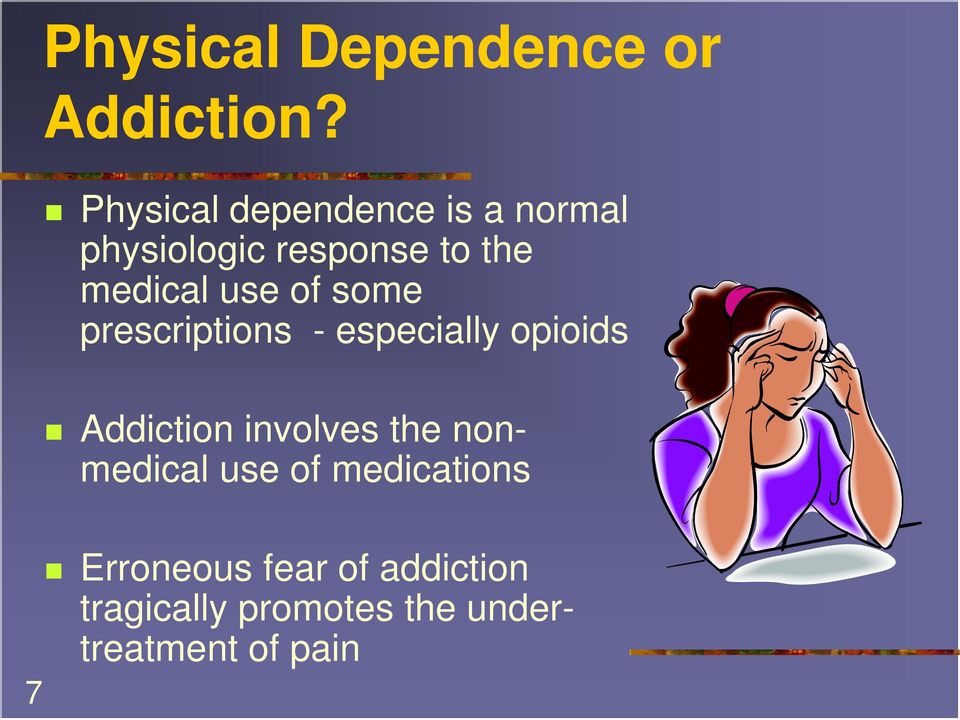
7 Physical Dependence or Addiction? Physical dependence is a normal physiologic response to the medical use of some prescriptions - especially opioids Addiction involves the nonmedical use of medications 7 Erroneous fear of addiction tragically promotes the undertreatment of pain
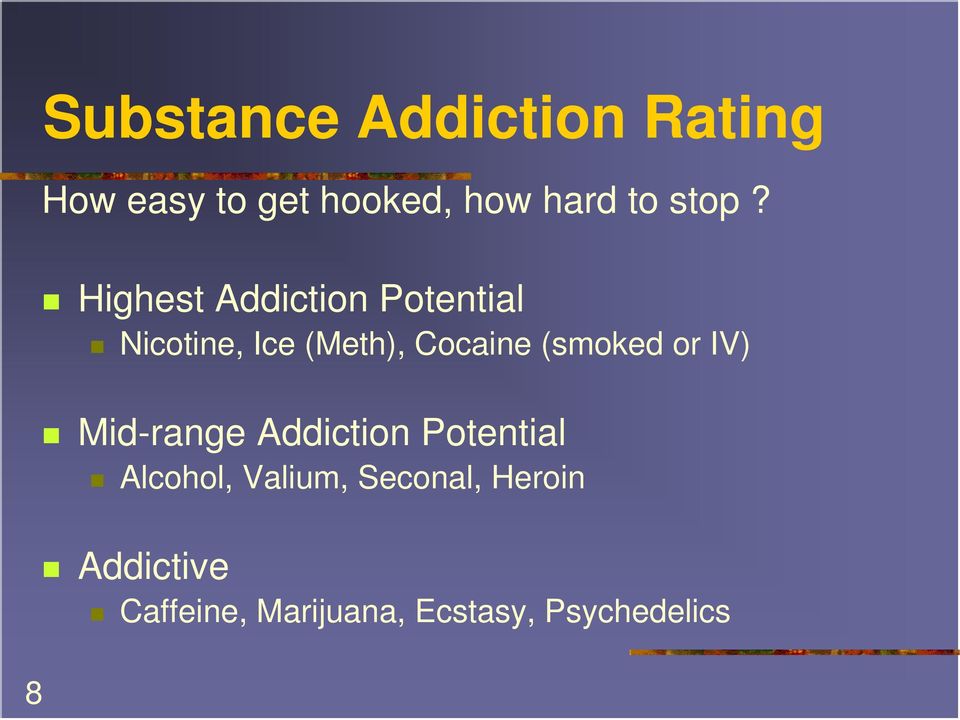
8 8 Substance Addiction Rating How easy to get hooked, how hard to stop? Highest Addiction Potential Nicotine, Ice (Meth), Cocaine (smoked or IV) Mid-range Addiction Potential Alcohol, Valium, Seconal, Heroin Addictive Caffeine, Marijuana, Ecstasy, Psychedelics
9 Acute Withdrawal ASAM - Acute withdrawal is usually referred to simply as withdrawal. Withdrawal is the onset of a predictable constellation of signs and symptoms following the abrupt discontinuation of, or rapid decrease in, dosage of a psychoactive substance. Such signs and symptoms are generally the opposite of the intoxication effects of the particular substance. For example, pupils constrict during opioid intoxication and dilate during acute withdrawal. These signs and symptoms begin within hours or days after last use of the substance and gradually resolve. The length of time symptoms last depends on the particular substance used. 9

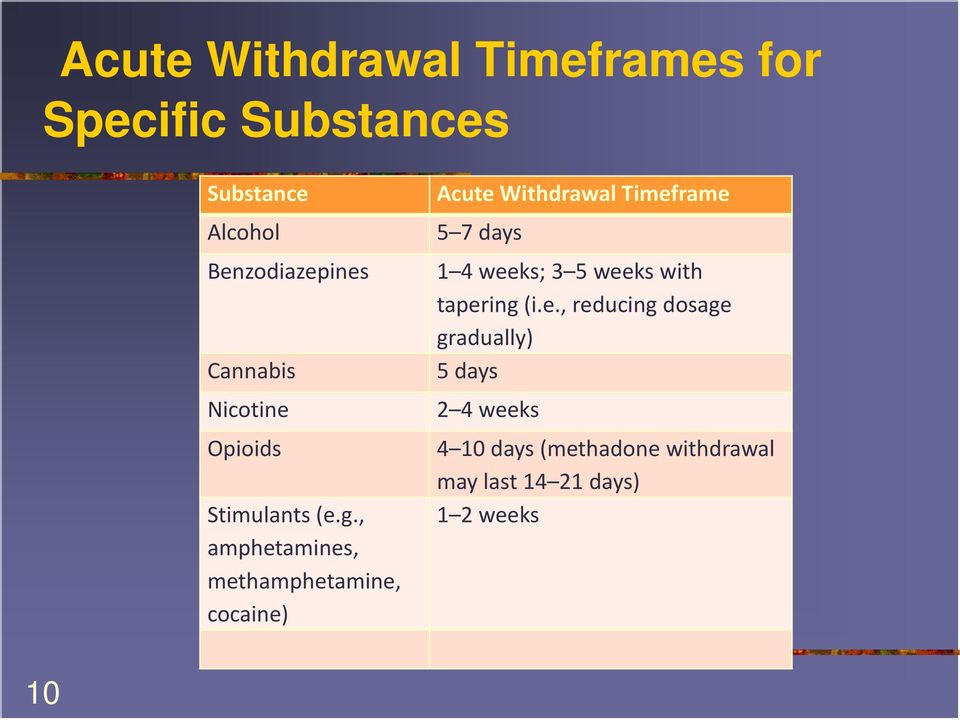
10 Acute Withdrawal Timeframes for Specific Substances Substance Alcohol Benzodiazepines Cannabis Nicotine Opioids Stimulants (e.g., amphetamines, methamphetamine, cocaine) Acute Withdrawal Timeframe 5 7 days 1 4 weeks; 3 5 weeks with tapering (i.e., reducing dosage gradually) 5 days 2 4 weeks 4 10 days (methadone withdrawal may last days) 1 2 weeks 10
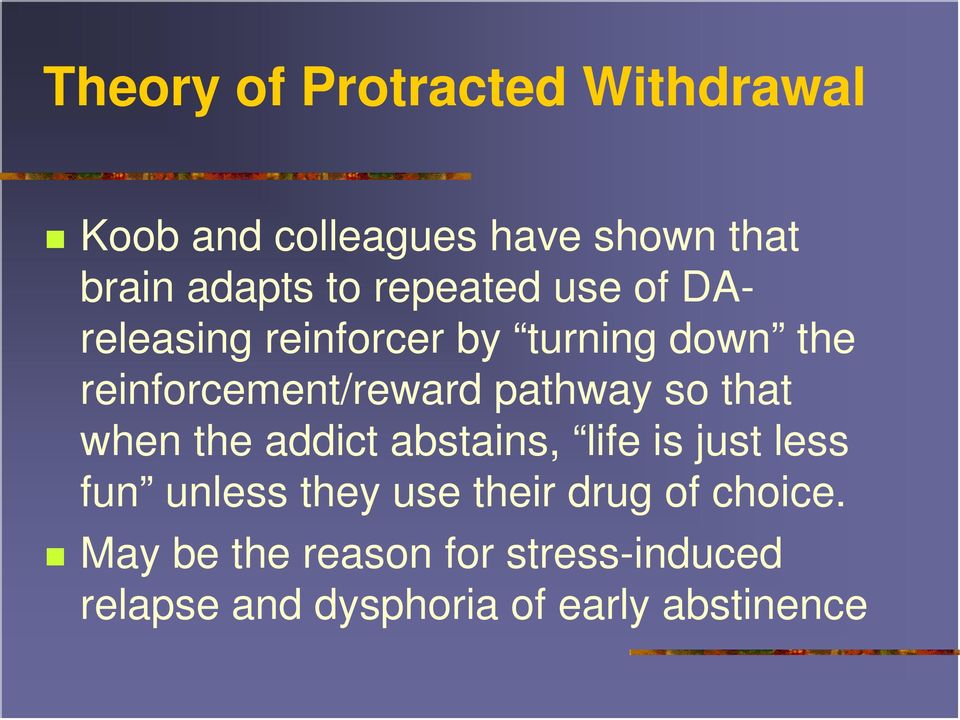
11 Theory of Protracted Withdrawal Koob and colleagues have shown that brain adapts to repeated use of DAreleasing reinforcer by turning down the reinforcement/reward pathway so that when the addict abstains, life is just less fun unless they use their drug of choice. May be the reason for stress-induced relapse and dysphoria of early abstinence
12 Protracted Withdrawal Strictly Defined: The presence of substancespecific signs and symptoms common to acute withdrawal but persisting beyond the generally expected acute withdrawal timeframes Broader Definition: includes the experiencing of the above symptoms and of non-substancespecific signs and symptoms that persist, evolve, or appear well past the expected timeframe for acute withdrawal. Each psychoactive substance class has different effects on the brain. 12

13 Other Terms. Chronic withdrawal Extended withdrawal Late withdrawal Long-term withdrawal Persistent postuse symptoms Postacute withdrawal syndrome (PAWS) Postuse syndrome Protracted abstinence Sobriety-based symptoms Subacute withdrawal 13

14 Symptoms of Protracted Withdrawal Anxiety Sleep difficulties Problems with short-term memory Persistent fatigue; irritability Difficulty focusing on tasks Difficulty concentrating and making decisions Alcohol or drug cravings Impaired executive control Anhedonia Dysphoria or depression Unexplained physical complaints Reduced interest in sex 14

15 Protracted Withdrawal Symptoms Chronic substance use causes molecular, cellular, and neurocircuitry changes to the brain that affect emotions and behavior and that persist after acute withdrawal has ended. Adaptive changes in the central nervous system may lead to affective changes that persist for many weeks or longer beyond acute withdrawal. Repeated use of a substance causes the brain to respond more readily to its effects but less readily to naturally rewarding activities such as listening to music - a state of decreased ability to experience pleasure known as anhedonia.

16 Protracted Withdrawal Abstinence syndrome Anxiety Muscle twitching Low mood Sweating Headache Derealization Rebound insomnia Especially with short-acting benzodiazepines

17 Protracted Withdrawal Symptoms A variety of other symptoms have been attributed to protracted withdrawal, including : alcohol or drug cravings, and impaired executive control impulse control, solving problems also occur in some. 17

18 Commonly Misused Rx Drugs Classified in 3 classes Opiates: pain-killers i.e. Vicodin, Oxycontin, Tylenol Codeine CNS Depressants (Sedatives/Tranquilizers): treat anxiety and sleep disorders i.e. Xanax, Ativan, Valium, Soma Stimulants: ADHD, weight loss i.e. Aderall, Ritalin, Concerta, Dexedrine, Fastin (OTC Diet Pill)

19 Alcohol withdrawal syndrome Onset: 6-24 hours after last drink Duration: 2-10 days Symptoms: Anxiety Excess perspiration Tremors Dehydration Increased heart rate, blood pressure Insomnia Nausea and vomiting Diarrhea

20 Sleep Abnormalities - Alcohol Anecdotal literature and case studies going back several decades suggest that signs and symptoms may last 2 years or longer after the last use of alcohol. A review of seven sleep studies using polysomnograph recordings of the brain while people slept found evidence that sleep abnormalities can persist for 1 to 3 years after stopping alcohol consumption. These abnormalities include difficulty falling asleep, decreased total sleep time, and sleep apnea. 20

21 Benzodiazepine withdrawal syndrome Short-acting benzodiazepines (insomnia): Onset 1-2 days after last dose Duration 2-4 weeks or longer Long-acting benzodiazepines (anxiety): Onset 2-7 days after last dose Duration 2-8 weeks or longer 21 The protracted withdrawal can be minimized in intensity and severity by a slow gradual reduction in dosage
22 Benzodiazepines.Benzodiazepine protracted withdrawal may be difficult to diagnose because of difficulty distinguishing it from symptom rebound or symptom reemergence Protracted withdrawal symptoms typically wax and wane in intensity and are new to the client (i.e., they do not indicate symptom reemergence). Clients also may have no symptoms for a time after stopping benzodiazepine use and then become extremely anxious. Psychological symptoms can mimic disorders such as agitated depression; generalized anxiety, panic, or obsessive-compulsive disorders; and schizophrenia. Fluctuating protracted withdrawal symptoms may last for months but gradually subside with prolonged abstinence. 22
23 Opioid withdrawal syndrome Symptoms: Nausea and vomiting Anxiety Insomnia Hot and cold flushes Perspiration Muscle cramps Watery discharge from eyes and nose Diarrhea
24 Stimulant withdrawal syndrome Onset: within 24 hours of last use Duration: 3-5 days Symptoms: Agitation and irritability Depression Increased sleeping and appetite Muscle aches
25 Inhalant Withdrawal Syndrome Onset: anywhere from a few hours to a few days after ceasing use Duration: anywhere from 2 days to 2 weeks
26 Withdrawal Management for Cannabis Dependence Cannabis withdrawal syndrome is poorly understood: Typically mild, yet difficulty coping with Symptoms last for 1-2 weeks Sleep difficulties and strange dreams can persist at least 45 days into abstinence (the longest duration of the studies)
27 CANNABINOIDS 10 hours after use Tremor of the tongue and extremities Insomnia Sweats Lateral gaze nystagmus (rhythmic oscillation of the eyeball on lateral gaze) Exaggerated deep tendon reflexes
28 Helping Clients Through Protracted Withdrawal Clients affected by anhedonia and other symptoms of protracted withdrawal may want to alleviate those symptoms by returning to substance use at a time when they may have a weakened ability to resist such impulses. Treatment providers can improve their clients chances for long-term recovery by educating clients about protracted withdrawal, offering support and understanding, monitoring them regularly, and intervening early with clients who seem headed for relapse. 28
29 Educate clients about protracted withdrawal and help them develop realistic attitudes toward recovery. Remind clients that recovery is a process. Help clients understand that it is normal to feel not fully recovered within the first weeks and months of abstinence. Tell them about possible protracted withdrawal symptoms and reassure them that these symptoms will not last forever and can be managed. Advise clients on how to reduce or cope with symptoms and encourage them to focus on incremental improvements. Tell clients it takes time to undo the damage from substance use but in many cases, with long-term abstinence, substance-induced brain changes reverse. Celebrate each accomplishment - learning a new coping skill - and help clients not become discouraged if symptoms recur. 29
30 Reassess During Recovery The symptoms of protracted withdrawal can be similar to those of TBI and CODs. Assess and reassess clients for suicide as recovery proceeds, including for depression and suicidal tendencies. (TIP 42, TIP 48 and TIP 50 provide more information on CODs and suicide. Discuss sleep problems - determine if possible sleep problems stem from protracted withdrawal or are the result of other causes: e poor sleep habits retained from a substance-using lifestyle, CODs, relapse to substance use, stress, or side effects of medication (including medication to treat SUDs). Educate clients about good sleep habits: adopting a regular sleep routine, exercising early in the day, minimizing caffeine intake, eating well, and avoiding late afternoon naps. Use pharmacological treatments with caution to avoid use problems. 30
31 Recovery Advice Advise clients to be active. Encourage engagment in physical and mental exercises, which improve sleep, promote positive emotional states, reduce stress and nervousness, Help clients avoid triggers, and distract clients attention from symptoms. Advise Self Care and Patience - Clients in early recovery may try to make up for lost time by overbooking and generally trying to do too much, increasing overall stress levels and possibly exacerbating symptoms Prescribe medications as needed to control symptoms past the acute withdrawal stage discuss the use of medications, such as Acamprosate, might relieve some protracted withdrawal symptoms. 31
32 Recovery Advice Include interventions that help clients strengthen executive control functions. Provide interventions such as cognitive behavioral therapy to help clients manage problems with impulse control, solve problems, and make decisions. Monitor clients for symptoms - and teach them the signs to be alert to triggers - during continuing care and after. Provide clients guidance on such issues as lapses and relapses, stress, triggers, and activities to maintain abstinence. 32
33 REFERENCES Substance Abuse Treatment Advisory, July 2010, Volume 9, Issue 1 Consensus Document, American Academy of Pain Medicine, A. Pain Society, American Society of Addiction Medicine. World Health Organization TIP 42: Substance Abuse Treatment for Persons With Co-Occurring Disorders. (2005). HHS Publication No. (SMA) TIP 48: Managing Depressive Symptoms in Substance Abuse Clients During Early Recovery. (2008). HHS Publication No. (SMA) TIP 50: Addressing Suicidal Thoughts and Behaviors in Substance Abuse Treatment. (2009). HHS Publication No. (SMA)
ADVISORY. Substance Abuse Treatment. Protracted Withdrawal. News for the Treatment Field. What is acute withdrawal?
 July 2010 Volume 9 Issue 1 News for the Treatment Field Most clients in treatment for substance use disorders (SUDs) do not immediately feel better after stopping their substance use. In a pattern unique
Introduction to Tolerance, Physical Dependence and Withdrawal
 Introduction to Tolerance, Physical Dependence and Withdrawal Carrie G Markgraf, MD, PhD Safety Assessment Merck Research Laboratories 1 Overview Definitions Addiction, psychological dependence, physical
Overall Learning Objectives
 Overall Learning Objectives Understand the difference between use, misuse and abuse of substances/drugs; Differentiate between commonly abused legal and illegal substances/drugs; Become aware of common
opiates alcohol 27 opiates and alcohol 30 April 2016 drug addiction signs 42 Ranked #1 123 Drug Rehab Centers in New Jersey 100 Top 10 380
 opiates alcohol 27 opiates and alcohol 30 April 2016 drug addiction signs 42 ed #1 123 Drug Rehab Centers in New Jersey 100 Top 10 380 effects of alcohol in the brain 100 Top 30 698 heroin addiction 100
These changes are prominent in individuals with severe disorders, but also occur at the mild or moderate level.
 Substance-Related Disorders DSM-V Many people use words like alcoholism, drug dependence and addiction as general descriptive terms without a clear understanding of their meaning. What does it really mean
PRESCRIPTION DRUG ABUSE prevention
 PRESCRIPTION DRUG ABUSE prevention Understanding Drug Addiction Many people do not understand how someone could abuse drugs even when their life seems to be falling apart. It is often assumed that those
Methamphetamine. Like heroin, meth is a drug that is illegal in some areas of the world. Meth is a highly addictive drug.
 Methamphetamine Introduction Methamphetamine is a very addictive stimulant drug. People who use it can form a strong addiction. Addiction is when a drug user can t stop taking a drug, even when he or she
ADDICTIONS. BEHAVIOURAL Internet Shopping Work Sex Gambling Food. SUBSTANCE - RELATED Alcohol Drugs Medicine Tobacco
 ADDICTIONS BEHAVIOURAL Internet Shopping Work Sex Gambling Food SUBSTANCE - RELATED Alcohol Drugs Medicine Tobacco Addiction is a chronic, relapsing disease affecting the brains's reward, motivation and
Amphetamines Addiction
 Introduction Amphetamines, which are classified as stimulants, work by using the dopamine reward system of the brain. When these drugs are used, the user s central nervous system is simulated which causes
DrugFacts: Treatment Approaches for Drug Addiction
 DrugFacts: Treatment Approaches for Drug Addiction NOTE: This is a fact sheet covering research findings on effective treatment approaches for drug abuse and addiction. If you are seeking treatment, please
OTC Abuse. Dr. Eman Said Abd-Elkhalek Lecturer of Pharmacology & Toxicology Faculty of Pharmacy Mansoura University
 OTC Abuse Dr. Eman Said Abd-Elkhalek Lecturer of Pharmacology & Toxicology Faculty of Pharmacy Mansoura University Opiates Abuse Opioids are a group of natural, partially synthetic, or synthetic drugs
Drug and Alcohol Abuse Training revised: October 2015
 Drug and Alcohol Abuse Training revised: October 2015 FMCSA is considering going to a seven panel and possibly ten panel. Hair testing may also be acceptable. What is a Drug? A substance which
Naltrexone and Alcoholism Treatment Test
 Naltrexone and Alcoholism Treatment Test Following your reading of the course material found in TIP No. 28. Please read the following statements and indicate the correct answer on the answer sheet. A score
Withdrawal Symptoms: How Long Do They Last?
 Withdrawal Symptoms: How Long Do They Last? Posted by First Step Medical Detox on November 24, 2015 When considering stopping drugs or alcohol, many addicts and alcoholics are concerned about the withdrawal
Reintegration. Recovery. Medication-Assisted Treatment for Alcohol Dependence. Reintegration. Resilience
 Reintegration Recovery Medication-Assisted Treatment for Alcohol Dependence Reintegration Resilience 02 How do you free yourself from the stress and risks of alcohol dependence? Most people cannot do it
Opioid Treatment Agreement
 Opioid Treatment Agreement 1. I understand that my provider and I will work together to find the most appropriate treatment for my chronic pain. I understand the goals of treatment are not to eliminate
Opioid overdose can occur when a patient misunderstands the directions
 Facts About Opioid Overdose How Does an Overdose Occur? Opioid overdose can occur when a patient misunderstands the directions for use, accidentally takes an extra dose, or deliberately misuses a prescription
Treatment Approaches for Drug Addiction
 Treatment Approaches for Drug Addiction NOTE: This is a fact sheet covering research findings on effective treatment approaches for drug abuse and addiction. If you are seeking treatment, please call the
What you need for Your to know Safety about longterm. opioid pain care. What you need to know about long-term opioid
 What you need to know about longterm opioid pain care. What you need to know about long-term opioid and the Safety of Others pain care. TAKING What you OPIOIDS need to know about long-term RESPONSIBLY
Teens and Prescription Drug Abuse
 Teens and Prescription Drug Abuse Information compiled by Communities That Care of Lorain County For more information, please contact Cathy Gabe 440-282-9920 [email protected] www.ctcloraincounty.org
What Parents Need to Know
 What Parents Need to Know About Prescription Drug Abuse Office of District Attorney Jonathan W. Blodgett A Message From the District Attorney Prescription drug abuse is a growing problem. According to
Prescription Drug Abuse
 Prescription Drug Abuse Introduction Most people take medicines only for the reasons their health care providers prescribe them. But millions of people around the world have used prescription drugs for
Benzodiazepines. And Sleeping Pills. Psychological Medicine
 Benzodiazepines And Sleeping Pills Psychological Medicine Introduction Benzodiazepines are a type of medication prescribed by doctors for its therapeutic actions in various conditions such as stress and
How To Treat A Drug Addiction
 1 About drugs Drugs are substances that change a person s physical or mental state. The vast majority of drugs are used to treat medical conditions, both physical and mental. Some, however, are used outside
Like cocaine, heroin is a drug that is illegal in some areas of the world. Heroin is highly addictive.
 Heroin Introduction Heroin is a powerful drug that affects the brain. People who use it can form a strong addiction. Addiction is when a drug user can t stop taking a drug, even when he or she wants to.
Iowa Governor s Office of Drug Control Policy
 Iowa Governor s Office of Drug Control Policy medicines or take them in a manner not prescribed, we increase the risk of negative effects. It is estimated that over 35 million Americans are ages 65 and
Identifying and Treating Dual-Diagnosed Substance Use and Mental Health Disorders. Presented by: Carrie Terrill, LCDC
 Identifying and Treating Dual-Diagnosed Substance Use and Mental Health Disorders Presented by: Carrie Terrill, LCDC Overview What is Dual Diagnosis? How Common is Dual Diagnosis? What are Substance Use
What Is a Withdrawal Syndrome?
 Chapter 8 What Is a Withdrawal Syndrome? T Well, I ve been 7 days without Vicodin after taking 10-18 pills per day for about 2 years. It was not fun. Sweats, bad stomach problems, depression, pain, and
Levels of Care Guide
 Levels of Care Guide What Type of Drug Rehab Is Right for You? A Guide to Understanding Levels of Care in Addiction Treatment Looking for help for yourself or a loved one? Congratulations! You are on the
What is Addiction? DSM-IV-TR Substance Abuse Criteria
 Module 2: Understanding Addiction, Recovery, and Recovery Oriented Systems of Care This module reviews the processes involved in addiction and what is involved in recovering an addiction free lifestyle.
Teen Misuse and Abuse of Alcohol and Prescription Drugs. Information for Parents
 Teen Misuse and Abuse of Alcohol and Prescription Drugs Information for Parents Terminology Misuse: Using a drug in a way in which it was not intended Example: Using a higher dose of medication than was
Drug addiction. These factors increase the likelihood of your having an addiction to a legal or an illegal drug:
 Drug addiction You may be hooked emotionally and psychologically. You may have a physical dependence, too. If you're addicted to a drug whether it's legal or illegal you have intense cravings for it. You
OVERVIEW OF COGNITIVE BEHAVIORAL THERAPY. 1 Overview of Cognitive Behavioral Therapy
 OVERVIEW OF COGNITIVE BEHAVIORAL THERAPY 1 Overview of Cognitive Behavioral Therapy TABLE OF CONTENTS Introduction 3 What is Cognitive-Behavioral Therapy? 4 CBT is an Effective Therapy 7 Addictions Treated
New York State Office of Alcoholism & Substance Abuse Services Addiction Services for Prevention, Treatment, Recovery
 New York State Office of Alcoholism & Substance Abuse Services Addiction Services for Prevention, Treatment, Recovery USING THE 48 HOUR OBSERVATION BED USING THE 48 HOUR OBSERVATION BED Detoxification
Science and Treatment Prescription Drug Addiction Treatment. Karen Miotto, M.D. David Geffen School of Medicine [email protected].
 Science and Treatment Prescription Drug Addiction Treatment Karen Miotto, M.D. David Geffen School of Medicine [email protected] Presentation Objectives Examine drugs: effects, toxicities, withdrawal
CONTROLLED SUBSTANCE CONTRACT
 CONTROLLED SUBSTANCE CONTRACT The purpose of this contract is to protect my access to controlled substances and to protect our ability to prescribe for you. The long-term use of substances such as opiates
SUBSTANCE ABUSE & DEPRESSION: WHAT YOU SHOULD KNOW
 SUBSTANCE ABUSE & DEPRESSION: WHAT YOU SHOULD KNOW TABLE OF CONTENTS What is Depression? 4 Symptoms of Depression 6 Substance Abuse as a Coping Mechanism 8 Which Occurs First? 10 Substance Abuse and the
Prescription Drug Addiction
 Prescription Drug Addiction Dr Gilbert Whitton FAChAM Clinical Director Drug & Alcohol Loddon Mallee Murray Medicare Local Deniliquin 14 th May 2014 Prescription Drug Addiction Overview History Benzodiazepines
02 DEPARTMENT OF PROFESSIONAL AND FINANCIAL REGULATION
 Effective June 13, 2010 02-313, 02-373, 02-380, 02-383, 02-396 Chapter 21 page 1 02 DEPARTMENT OF PROFESSIONAL AND FINANCIAL REGULATION 313 BOARD OF DENTAL EXAMINERS 373 BOARD OF LICENSURE IN MEDICINE
Opioid Agreement for Center for Pain Management S.C.
 Opioid Agreement for Center for Pain Management S.C. Patient Name: DOB: I am the patient named above. I have agreed to use pain medication as part of my treatment for chronic pain. I understand that these
MEDICALLY SUPERVISED OPIATE WITHDRAWAL FOR THE DEPENDENT PATIENT. An Outpatient Model
 MEDICALLY SUPERVISED OPIATE WITHDRAWAL FOR THE DEPENDENT PATIENT An Outpatient Model OBJECTIVE TO PRESENT A PROTOCOL FOR THE EVALUATION AND TREATMENT OF PATIENTS WHO ARE CHEMICALLY DEPENDENT ON OR SEVERLY
OVERVIEW WHAT IS POLyDRUG USE? Different examples of polydrug use
 Petrol, paint and other Polydrug inhalants use 237 11 Polydrug use Overview What is polydrug use? Reasons for polydrug use What are the harms of polydrug use? How to assess a person who uses several drugs
Drug Abuse and Addiction
 Drug Abuse and Addiction Introduction A drug is a chemical substance that can change how your body and mind work. People may abuse drugs to get high or change how they feel. Addiction is when a drug user
HAWAII BOARD OF MEDICAL EXAMINERS PAIN MANAGEMENT GUIDELINES
 Pursuant to section 453-1.5, Hawaii Revised Statutes, the Board of Medical Examiners ("Board") has established guidelines for physicians with respect to the care and treatment of patients with severe acute
Assessment and Management of Opioid, Benzodiazepine, and Sedative-Hypnotic Withdrawal
 Assessment and Management of Opioid, Benzodiazepine, and Sedative-Hypnotic Withdrawal Roger Cicala, M. D. Assistant Medical Director Tennessee Physician s Wellness Program Step 1 Don t 1 It is legal in
CO-OCCURRING DISORDERS. Michaelene Spence MA LADC 8/8/12
 CO-OCCURRING DISORDERS Michaelene Spence MA LADC 8/8/12 Activity Chemical Health? Mental Health? Video- What is Addiction HBO Terminology MI/CD: Mental Illness/Chemical Dependency IDDT: Integrated Dual
Medical Cannabis and Addictions. October 2015 Charlie Reznikoff
 Medical Cannabis and Addictions October 2015 Charlie Reznikoff Medical Cannabis Topics Is marijuana addictive? Is medical cannabis addictive? Will medical cannabis lead to increased adolescent use of recreational
Update and Review of Medication Assisted Treatments
 Update and Review of Medication Assisted Treatments for Opiate and Alcohol Use Disorders Richard N. Whitney, MD Medical Director Addiction Services Shepherd Hill Newark, Ohio Medication Assisted Treatment
California Society of Addiction Medicine (CSAM) Consumer Q&As
 C o n s u m e r Q & A 1 California Society of Addiction Medicine (CSAM) Consumer Q&As Q: Is addiction a disease? A: Addiction is a chronic disorder, like heart disease or diabetes. A chronic disorder is
DRUG USE. 1300 136 588 ndss.com.au AND TYPE 1 DIABETES
 DRUG USE AND TYPE 1 DIABETES 1300 136 588 ndss.com.au The National Diabetes Services Scheme (NDSS) is an initiative of the Australian Government administered by Diabetes Australia. Contents Topic Page
ADVANCED BEHAVIORAL HEALTH, INC. Clinical Level of Care Guidelines - 2015
 The Clinical Level of Care Guidelines contained on the following pages have been developed as a guide to assist care managers, physicians and providers in making medical necessity decisions about the least
CHAPTER 5 MENTAL, BEHAVIOR AND NEURODEVELOPMENT DISORDERS (F01-F99) March 2014. 2014 MVP Health Care, Inc.
 CHAPTER 5 MENTAL, BEHAVIOR AND NEURODEVELOPMENT DISORDERS (F01-F99) March 2014 2014 MVP Health Care, Inc. CHAPTER 5 CHAPTER SPECIFIC CATEGORY CODE BLOCKS F01-F09 Mental disorders due to known physiological
Addiction Medicine for FP / GP. Dr. Francisco Ward, DABPMR/PM SetonPainRehab.com [email protected]
 Addiction Medicine for FP / GP Dr. Francisco Ward, DABPMR/PM SetonPainRehab.com [email protected] S Disease of Chemical Addiction Short Definition of Addiction (ASAM): Addiction is a primary, chronic disease
What Is Medically. Supervised Detoxification? Chapter 13
 Chapter 13 What Is Medically Supervised Detoxification? T I have been a heroin addict for three years and am desperately trying to stop. As the withdrawal symptoms are very severe, the muscle cramps, shakes,
Substance Use Disorder Overview. Presented By Ecole J. Barrow-Brooks M.Ed & Darlene D. Owens MBA, LBSW, CADC, ADS
 Substance Use Disorder Overview Presented By Ecole J. Barrow-Brooks M.Ed & Darlene D. Owens MBA, LBSW, CADC, ADS 1 National Issue There continues to be a large treatment gap in the U.S. In 2013, an estimated
Brief Review of Common Mental Illnesses and Treatment
 Brief Review of Common Mental Illnesses and Treatment Presentations to the Joint Subcommittee to Study Mental Health Services in the 21st Century September 9, 2014 Jack Barber, M.D. Medical Director Virginia
Cocaine. Like heroin, cocaine is a drug that is illegal in some areas of the world. Cocaine is a commonly abused drug.
 Cocaine Introduction Cocaine is a powerful drug that stimulates the brain. People who use it can form a strong addiction. Addiction is when a drug user can t stop taking a drug, even when he or she wants
And, despite the numbers, for many people, the Facts About Drugs are not clear.
 According to the National Survey on Drug Use and Health (NSDUH), an estimated 20 million Americans aged 12 or older used an illegal drug in the past 30 days. This estimate represents 8% percent of the
Sponsored by: 2013 NAMI Maryland Conference Baltimore, Maryland; Friday, October 18 th, 2013
 Integrated System of Care Universal Dual Diagnosis Capabilities Principles of Empathy and Hope Motivational Interviewing Approach Stages of Change Model Design Solution Focused Strength Based Skill Building
Insomnia affects 1 in 3 adults every year in the U.S. and Canada.
 Insomnia What is insomnia? Having insomnia means you often have trouble falling or staying asleep or going back to sleep if you awaken. Insomnia can be either a short-term or a long-term problem. Insomnia
Assessment and Diagnosis of DSM-5 Substance-Related Disorders
 Assessment and Diagnosis of DSM-5 Substance-Related Disorders Jason H. King, PhD (listed on p. 914 of DSM-5 as a Collaborative Investigator) [email protected] or 801-404-8733 www.lecutah.com D I S C L
Co-Occurring Substance Use and Mental Health Disorders. Joy Chudzynski, PsyD UCLA Integrated Substance Abuse Programs
 Co-Occurring Substance Use and Mental Health Disorders Joy Chudzynski, PsyD UCLA Integrated Substance Abuse Programs Introduction Overview of the evolving field of Co-Occurring Disorders Addiction and
Naltrexone Shared Care Guideline for the treatment of alcohol dependence and opioid dependance
 Naltrexone Shared Care Guideline for the treatment of alcohol dependence and opioid dependance Introduction Indication/Licensing information: Naltrexone is licensed for use as an additional therapy, within
Medications Used in the Treatment of Addiction Developed by Randall Webber, MPH. Alcohol Withdrawal
 Medications Used in the Treatment of Addiction Developed by Randall Webber, MPH Alcohol Withdrawal MEDICATION Long/intermediateacting benzodiazepines (e.g., chlordiazepoxide/ Librium, diazepam/valium)
Psychotherapeutic Medications: What Every Counselor Should Know
 Psychotherapeutic Medications: What Every Counselor Should Know Multiple Choice Identify the choice that best completes the statement or answers the question. 1. Antipsychotics/Neuroleptics Antipsychotics,
the facts about NALTREXONE
 the facts about NALTREXONE for Treatment of Opioid Addiction It s not like I woke up one day when I was young and told myself, I wanna be a drug addict. I wanna ruin my life and ruin the lives of those
Mental health issues in the elderly. January 28th 2008 Presented by Éric R. Thériault [email protected]
 Mental health issues in the elderly January 28th 2008 Presented by Éric R. Thériault [email protected] Cognitive Disorders Outline Dementia (294.xx) Dementia of the Alzheimer's Type (early and late
Management of benzodiazepine misuse
 York Service Management of benzodiazepine misuse Version 2 JT July 2013 page 1 background Note: not all those who use benzodiazepines are dependent, and not all those who are dependent will benefit from
The ICD-10 Classification of Mental and Behavioural Disorders: Diagnostic criteria for research
 The ICD-10 Classification of Mental and Behavioural Disorders: Diagnostic criteria for research World Health Organization F10-F19 Mental and behavioural disorders due to psychoactive substance use F10.-
A Depression Education Toolkit
 A Depression Education Toolkit Facts about Depression in Older Adults What is Depression? Depression is a medical illness. When sadness persists or interferes with everyday life, it may be depression.
Alcohol Withdrawal Syndrome & CIWA Assessment
 Alcohol Withdrawal Syndrome & CIWA Assessment Alcohol Withdrawal Syndrome is a set of symptoms that can occur when an individual reduces or stops alcoholic consumption after long periods of use. Prolonged
Karla Ramirez, LCSW Director, Outpatient Services Laurel Ridge Treatment Center
 Karla Ramirez, LCSW Director, Outpatient Services Laurel Ridge Treatment Center 1 in 4 Americans will have an alcohol or drug problems at some point in their lives. The number of alcohol abusers and addicts
TEENS AND PRESCRIPTION DRUGS An Analysis of Recent Trends on the Emerging Drug Threat
 TEENS AND PRESCRIPTION DRUGS An Analysis of Recent Trends on the Emerging Drug Threat OFFICE OF NATIONAL DRUG CONTROL POLICY EXECUTIVE OFFICE OF THE PRESIDENT FEBRUARY 2007 TABLE OF CONTENTS Introduction
Pharmacology and Physiology (C105) Understanding Pharmacology and Physiology. The History of Drugs. The Neurobiology of Addiction.
 Understanding Pharmacology and Physiology Knowledge of Pharmacology and Physiology is Crucial SAMHSA s Counselor Competencies What is Addiction? NIDA: Why Do People Use Drugs? From Abuse to Addiction Desired
Template for Assessing a Client s Substance Use Developed by Cynthia Glidden-Tracey, Ph.D.
 Template for Assessing a Client s Substance Use Developed by Cynthia Glidden-Tracey, Ph.D. Client s Name Date and circumstances of Assessment a. Client s Reason for Seeking Assessment b. Substance Use
Feeling that you have to use the drug regularly this can be daily or even several times a day. Failing in your attempts to stop using the drug
 Drug addiction Definition Drug addiction is a dependence on an illegal drug or a medication. When you're addicted, you may not be able to control your drug use and you may continue using the drug despite
Directions for your Mental Health
 Directions for your Mental Health A Guide to Alcohol, Tobacco and Other Drugs and Your Mental Health December 2014 Page 1 Directions for your mental health Directions is an organisation based on the principles
CHARLES & SUE S SCHOOL OF HAIR DESIGN DRUG AND ALCOHOL POLICY DRUG AND ALCOHOL POLICY; SUBSTANCE ABUSE RESOURCES:
 CHARLES & SUE S SCHOOL OF HAIR DESIGN DRUG AND ALCOHOL POLICY DRUG AND ALCOHOL POLICY; SUBSTANCE ABUSE RESOURCES: At Charles & Sue s School of Hair Design, the illicit use of drugs and/or alcohol by staff
Produced and Published by The Cabin Chiang Mai, Alcohol and Drug Rehab Centre. Copyright 2013. and How is it Treated?
 and How is it Treated? 1 About this book This E-book has been produced as a guide to help explain some of the fundamental things you need to understand about addiction and its treatment, starting with
The Diagnostic and Statistical Manual of Mental Disorders, Fifth Edition (DSM-5)
 The Diagnostic and Statistical Manual of Mental Disorders, Fifth Edition (DSM-5) Cardwell C Nuckols, PhD [email protected] Cardwell C. Nuckols, PhD www.cnuckols.com SECTION I-BASICS DSM-5 Includes
Benzodiazepine Detoxification and Reduction of Long term Use
 Benzodiazepine Detoxification and Reduction of Long term Use Malcolm Lader 1 Model of general drug misuse and dependence. Tactical interventional options Social dimension Increasing breaking of social
Use of Buprenorphine in the Treatment of Opioid Addiction
 Use of Buprenorphine in the Treatment of Opioid Addiction Multiple Choice Identify the choice that best completes the statement or answers the question. 1. Executive Summary Which of the following is an
DRUGS OF ABUSE CLASSIFICATION AND EFFECTS
 Drug and Drug use DRUGS OF ABUSE CLASSIFICATION AND EFFECTS A pharmaceutical preparation or a naturally occurring substance used primarily to bring about a change in the existing process or state (physiological,
JACKSON RECOVERY CENTERS Initial Substance Abuse Assessment Form. Substance used: Method: Age started: Last used: Frequency/progression of use:
 JACKSON RECOVERY CENTERS Initial Substance Abuse Assessment Form PRESENTING PROBLEM DRUGS OF CHOICE Substance used: Method: Age started: Last used: Frequency/progression of use: Indicators of Addiction:
Identification, treatment and support for individuals with Alcohol & Drug Addiction in the Community
 Identification, treatment and support for individuals with Alcohol & Drug Addiction in the Community Dr David Jackson Clinic Medical Officer The Hobart Clinic Association Drugs In tonight s context, drugs
Michigan Guidelines for the Use of Controlled Substances for the Treatment of Pain
 Michigan Guidelines for the Use of Controlled Substances for the Treatment of Pain Section I: Preamble The Michigan Boards of Medicine and Osteopathic Medicine & Surgery recognize that principles of quality
Opioid Treatment Services, Office-Based Opioid Treatment
 Optum 1 By United Behavioral Health U.S. Behavioral Health Plan, California Doing Business as OptumHealth Behavioral Solutions of California ( OHBS-CA ) 2015 Level of Care Guidelines Opioid Treatment Services,
- UNDERSTANDING - Dual Diagnosis
 - UNDERSTANDING - Dual Diagnosis TABLE OF CONTENTS Introduction 3 The Link Between Mental Illness and Substance Abuse 4 Characteristics of an Effective Dual Diagnosis Treatment Plan 6 Dual Diagnosis Treatment
SLEEP DISTURBANCE AND PSYCHIATRIC DISORDERS
 E-Resource December, 2013 SLEEP DISTURBANCE AND PSYCHIATRIC DISORDERS Between 10-18% of adults in the general population and up to 50% of adults in the primary care setting have difficulty sleeping. Sleep
CHPN Review Course Pain Management Part 1 Hospice and Palliative Nurses Association
 CHPN Review Course Pain Management Part 1 Disclosures Bonnie Morgan has no real or perceived conflicts of interest that relate to this presentation. Copyright 2015 by the. HPNA has the exclusive rights
Guidelines for Use of Controlled Substances for the Treatment of Pain
 1.0 Purpose: Use of Controlled Substances for the Treatment of Pain The Physicians Advisory Committee for Controlled Substances of the Medical Society of Delaware supports the Federation of State Medical
BENZODIAZEPINE CONSIDERATIONS IN WORKERS COMPENSATION: IMPLICATIONS FOR WORK DISABILITY AND CLAIM COSTS By: Michael Erdil MD, FACOEM
 3 rd Quarter 2015 BENZODIAZEPINE CONSIDERATIONS IN WORKERS COMPENSATION: IMPLICATIONS FOR WORK DISABILITY AND CLAIM COSTS By: Michael Erdil MD, FACOEM Introduction Benzodiazepines, sometimes called "benzos",
OVERVIEW OF MEDICATION ASSISTED TREATMENT
 Sarah Akerman MD Assistant Professor of Psychiatry Director of Addiction Services Geisel School of Medicine/Dartmouth-Hitchcock Medical Center OVERVIEW OF MEDICATION ASSISTED TREATMENT Conflicts of Interest
Understanding Addiction: The Intersection of Biology and Psychology
 Understanding Addiction: The Intersection of Biology and Psychology Robert Heimer, Ph.D. Yale University School of Public Health Center for Interdisciplinary Research on AIDS New Haven, CT, USA November
Physical Symptoms Mood Symptoms Behavioral Symptoms
 Prescription drugs are the 3 rd most commonly abused drugs amongst teens in Nebraska, and the same statistic holds true on a national level. The rise in prescription drug abuse is becoming increasingly