
Attendance Management
|
|
|
- Oscar Woods
- 10 years ago
- Views:
Transcription
1 Attendance Management

2 P2 Table of Contents Introduction 1 Chapter 1 Entitlement To Benefits 3 Who is Liable for the Provision of Benefits? 3 Premiums Only 4 Incorporation by Reference 4 General Level of Benefits 4 Specific Benefits 4 Can Employer Involvement in the Administration of Benefits Give Rise to Liability? 5 Negligent Processing of Benefit Claims 5 Negligent Misrepresentation 6 Good Faith and Additional Damages 7 Summary 7 Chapter 2 Unionized Employees Culpable Absenteeism 8 Types of Culpable Absenteeism 8 Lateness/Leaving Early 8 Failure To Notify 9 Absence Without Leave 10 Abuse Of Leave 11 Employer Responses 12
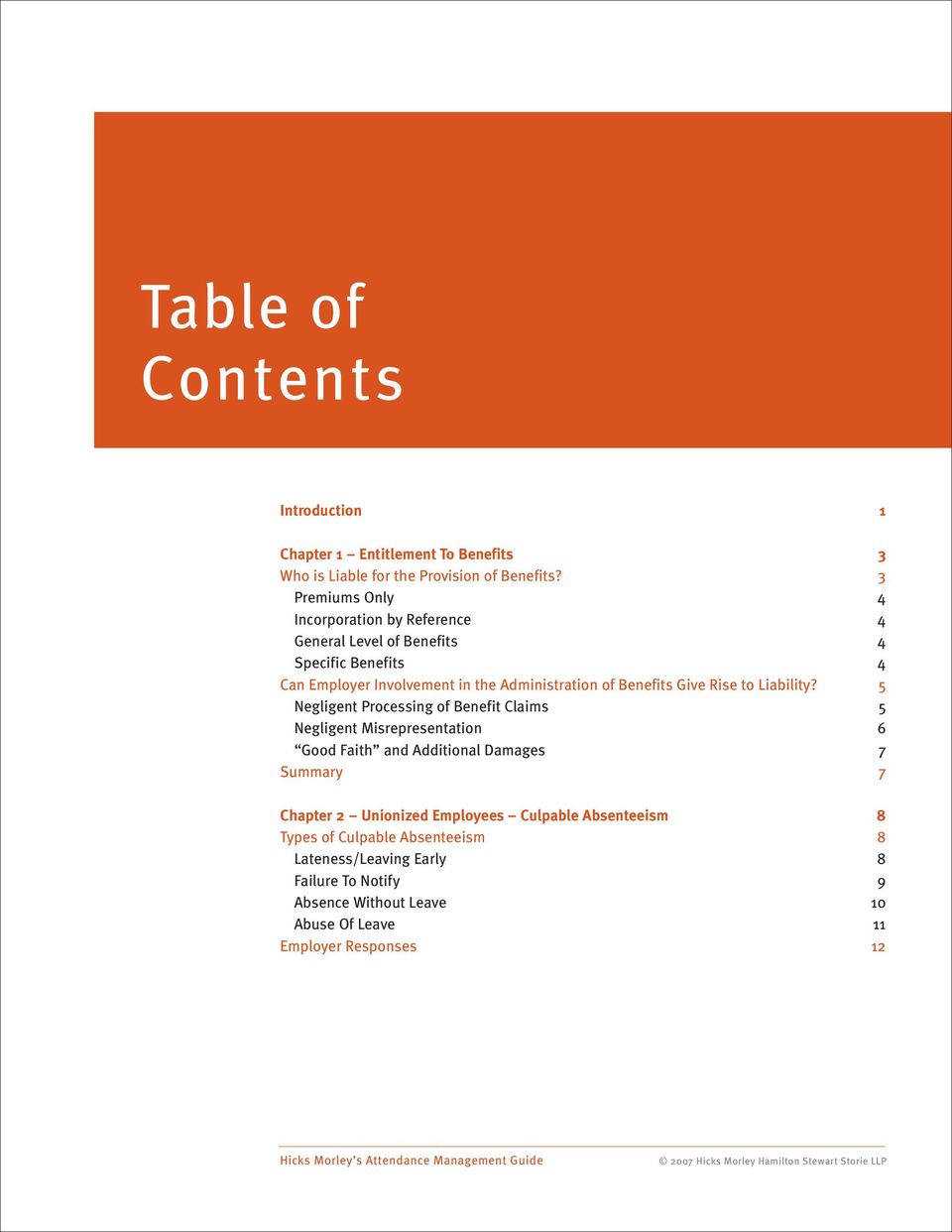
3 Chapter 3 Unionized Employees Innocent Absenteeism 13 Discharge for Innocent Absenteeism 13 Attendance Record 14 Prognosis for Future Attendance 15 Counselling 15 Benefit Status 16 Human Rights Considerations 16 Employment Standards Considerations 17 Workplace Safety and Insurance Act Considerations 17 Evidence of Recovery Following Termination 17 Statutory Termination Pay and Severance Pay 18 Summary 19 Chapter 4 Non-Unionized Employees Wrongful Dismissal 20 Terminating the Non-Unionized Employee for Absenteeism 20 Cause 20 Frustration of the Employment Contract 21 Statutory Termination Pay and Severance Pay 22 Termination By Reasonable Notice 23 Risks of Additional Liability 25 Contract Formation - Setting The Terms 27 Chapter 5 The Human Rights Code 29 The Statutory Scheme 29 Does the Code Apply At All? 30 Assuming a Disability is Present, Is There Discrimination? 32 If General Attendance Standards Can Constitute Discrimination, Does That Mean They Are Necessarily Illegal? 32 The Duty to Accommodate 33 Practical Considerations 35 Chapter 6 Emergency Leave And Family Medical Leave 38 Personal Emergency Leave 38 Who is covered? 38 The Basic Statutory Entitlement 39 Notification Requirements 39 Interaction with Collective Agreements and Employment Contracts 40 Reprisals 41 Managing Personal Emergency Leave 42 Government-Declared Emergencies 44 Family Medical Leave 45 Summary 47
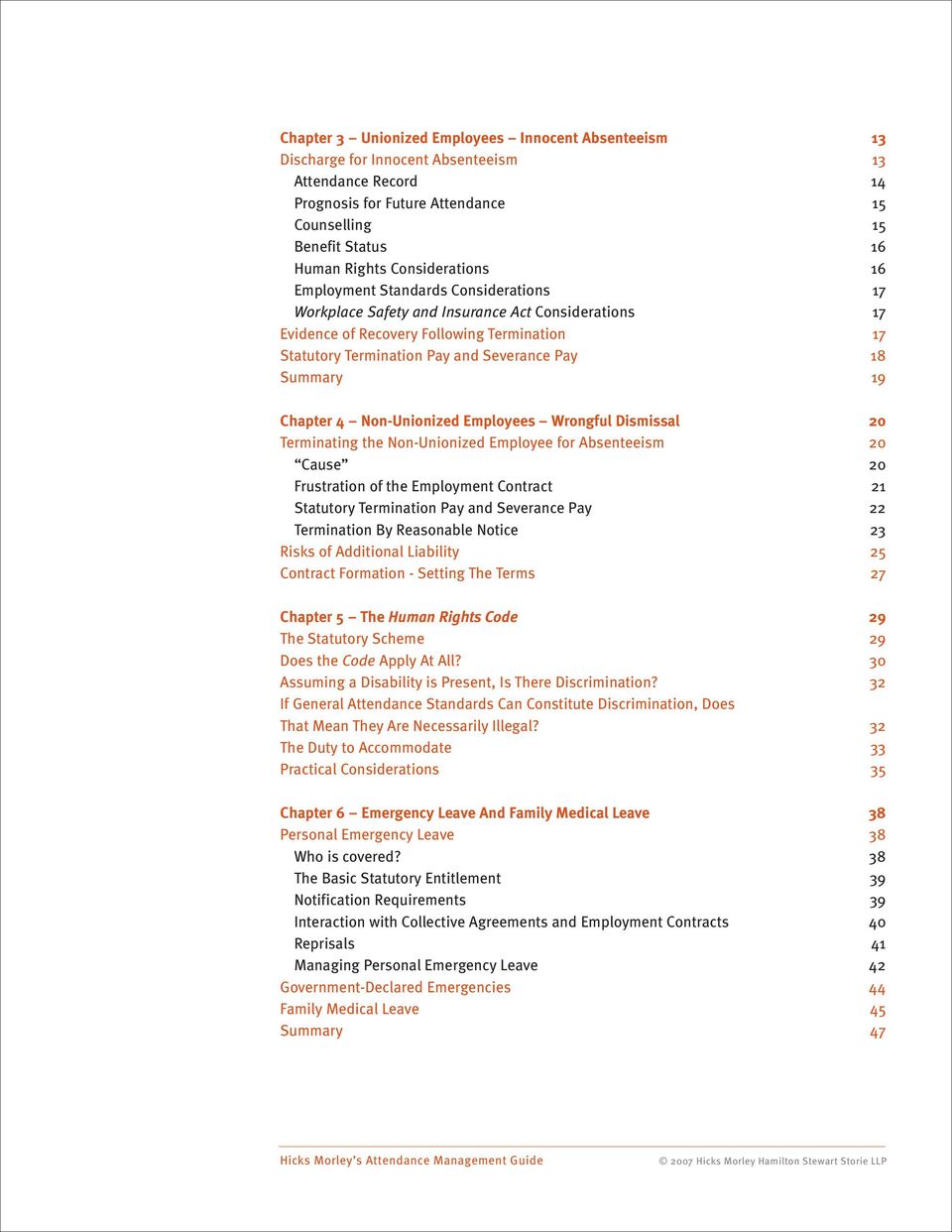
4 Chapter 7 The Employer s Right to Information 48 The Employer s Basic Right To Information 48 Non-Medical Explanations for Absence 49 Personal Emergency Leave, Family Medical Leave and Information about Family Members 49 Medical Explanations Adequacy of Medical Information 51 Challenging Medical Evidence 52 Practical Considerations 54 Surveillance 54 Human Rights and the Duty to Accommodate 56 Confidentiality Issues 57 Cost 58 Summary 58 Chapter 8 Workplace Safety and Insurance Act 59 The Management Imperative: Identifying the Costs of a Workplace Safety and Insurance Claim 59 The Legislative Framework 61 Return to Work Obligations 61 The Employer s Obligations 62 The Worker s Obligations 64 Consequences of Failure to Cooperate 64 Benefit Entitlement: Using the WSIB as an Ally 65 Medical Management and Return to Work 66 Functional Abilities Form 66 Independent Medical Examinations 67 Re-employment Obligation 68 Re-employment, Essential Duties, and Suitable Work 68 Termination Following Re-employment 69 Consequences of Failure to Re-employ 70 Summary 71 Chapter 9 Attendance Management 72 Monitoring, Accommodation and Reintegration 72 Attendance Incentives 73 Attendance Standards 74 Summary A Systems Approach 75

5 P1 Introduction is designed to serve a number of functions. First and foremost, it is designed to provide a guide to the types of attendance management issues which arise most commonly in the employment context. Second, it is structured so that the user will be able to isolate the Chapter(s) and section(s) which bear upon a specific issue in order to provide initial guidance in dealing with real life situations. Third, through the frequent use of highlighted text, the document provides at a glance access to the critical points and reminders in dozens of different areas. The Guide has been developed in Ontario and with Ontario statutes in mind. However, many of the statutory provisions referred to have counterparts in other jurisdictions. The more general principles discussed have relatively broad application throughout Canada. While sections of the Guide are intended to be useful standing alone, readers must look for and ultimately understand the highly integrated nature of the principles and rules relevant to discussions of workplace absenteeism. Culpable absenteeism cannot be properly understood and managed unless it is contrasted with innocent absenteeism. Innocent absenteeism cannot be properly managed without a keen appreciation of the Human Rights Code. The Code will also play into the handling of re-employment obligations under the Workplace Safety and Insurance Act. The emergency leave and family medical leave provisions of the Employment Standards Act, 2000 must also be considered. And none of these areas can be effectively managed unless the employer understands both its rights to information and the limitations on those rights.

6 Chapter Introduction 1 Entitlement ContinuedTo Benefits P2 has been prepared by Hicks Morley Hamilton Stewart Storie LLP. Hicks Morley is Canada s pre-eminent law firm acting exclusively in the areas of Labour, Employment, Education, Pensions, and Health & Safety law on behalf of management. The firm is committed to providing the highest level of service and expertise to its clients. Hicks Morley has approximately 90 lawyers practising in offices in Toronto, London, Waterloo, Kingston, and Ottawa. Since 2006, Hicks Morley has also been affiliated with Harris & Company, Western Canada s largest labour and employment law firm, located in Vancouver, British Columbia. Hicks Morley s practice areas include: Administrative Law Alternative Dispute Resolution Attendance Management Class Actions Collective Agreement Administration Collective Bargaining Corporate Transactions Diversity Management Education Law Employment Law Employment Litigation Employment Standards Grievance Arbitration Human Rights and Accommodation Information and Privacy Interest Arbitration Judicial Review, Charter and Appellate Litigation Labour Board Hearings Municipal Labour Relations Occupational Health and Safety Pay Equity Pension and Benefits Pension and Benefits Litigation Restructuring Strikes and Lockouts Workplace Safety and Insurance In the area of attendance management, Hicks Morley also offers attendance management consulting services to assist clients in developing proactive and effective approaches to managing claims and containing their absenteeism-related costs. provides only general information, and should not be relied upon as legal advice or opinion. This publication is copyrighted by Hicks Morley Hamilton Stewart Storie LLP and may not be photocopied or reproduced in any form, in whole or in part, without the express permission of Hicks Morley Hamilton Stewart Storie LLP.
7 P3 1 Entitlement To Benefits Many employers have established income replacement plans to protect their employees from the economic consequences of absenteeism due to illness. Where such a plan exists, any absence from work for medical reasons may give rise to a dispute over whether the absent employee is entitled to benefits. In any particular case this issue will be determined not according to general legal principles, but based on the particular language of the plan provided. This means that a careful review of your plan(s) and the documentation that describes the plan(s) to employees is important. Sick benefit plans may be generally classified as either internal or external. A purely internal plan is one in which the employer makes the assessments of entitlement and pays the benefits out of its own pocket. A purely external plan is one in which an insurance carrier administers entitlement issues and pays the benefits. While not invariably the case, short term sick plans are more frequently internal, whereas long term plans are more often external. And of course many plans involve hybrids (e.g. administrative services only plans where benefits are paid by the employer but where the plan is administered by an external consultant). An issue which often arises in the case of a plan which is administered externally (whether wholly or partially) is whether the employer or the insurer is ultimately responsible for the provision of the benefits. That is, if the insurer declines to pay a particular claim, can the employee recover from the employer? A second issue relates to the employer s involvement in the administration of benefits claims, which can also give rise to liability on the part of the employer. Who is Liable for the Provision of Benefits? The question of whether the employer is liable for premiums only or for the provision of benefits is entirely determined by the language of the agreement between the employer and the employee or union. In the collective agreement context, the employer s obligation has typically been viewed as falling into one of four general categories:

8 Chapter 1 Entitlement To Benefits P4 Premiums Only The employer expressly undertakes only to pay premiums. In such a case, the employer s obligation is limited to the payment of premiums (except as we shall later discuss). Incorporation by Reference The employer undertakes to pay premiums but the policy of insurance (with a description of the actual benefits) is actually incorporated word for word into the collective agreement. In these circumstances, arbitrators have found that the employer has undertaken to provide benefits in accordance with the policy of insurance and the employer may be found liable for an improper denial of benefits by the insurance carrier. General Level of Benefits The employer undertakes to provide a certain general level of benefits only. Here, the employer may be found to be liable to an employee for benefits where the policy of insurance that the employer purchases does not meet the minimum standards of coverage that it has undertaken to provide. In this case, the employer would be required to make up the difference between the benefits provided and the level promised. Specific Benefits The employer, rather than agreeing merely to pay premiums, actually undertakes in the collective agreement to provide certain benefits and then independently arranges for insurance to protect against the loss. Here, the employer may be found to be liable for the provision of the benefits notwithstanding some limitation in the policy of insurance which was purchased. Where the employer is obligated to pay premiums only, as in the first category listed above, the employee who has been denied benefits under the plan must pursue recourse against the insurer by way of an action in the courts. Conversely, where an employer has undertaken to provide benefits, as in the last three categories above, the employee s sole avenue of recourse would be against the employer by way of a grievance pursuant to the collective agreement. In this latter case, the employee has no recourse against the insurer in the courts. While these four categories of liability have typically been applied in unionized settings, the rationale used by arbitrators to develop them is applicable to cases involving non-unionized employees as well. Of the four situations, the first is clearly the least likely to give rise to significant unexpected liability for the employer, and is therefore to be preferred. However, many employers, either in negotiating collective agreements or even in simply describing their benefit packages in brochures to non-union employees prior to or upon hiring, unintentionally lapse into one of the other three categories, thereby assuming far more extensive liabilities.
9 Chapter 1 Entitlement To Benefits P5 In other words, while an employee may find his/her claim disallowed by the insurer (perhaps on a technicality), the employee can nevertheless recover directly from the employer since the disqualifying limitation found in the policy of insurance may not form a part of the employment agreement. All employers should review their agreements, policy manuals, benefit brochures, etc. to ensure that they have not unintentionally become a direct insurer in their own right. Can Employer Involvement in the Administration of Benefits Give Rise to Liability? Many employers will attempt to restrict their benefits obligations to paying premiums only. Having done so, they assume that they need not be concerned about any further liability under benefit plans. However, employers should be wary of concluding too quickly that they are absolved of any liability in relation to employee benefits. In the last few years, employers have been found liable on numerous occasions for negligent or otherwise improper handling of employee benefits claims. Some examples illustrate the different categories of liability which an employer may face. Negligent Processing of Benefit Claims In Tarailo et al. v. Allied Chemical Canada Ltd., a non-unionized chemical engineer resigned from his employment with Allied Chemical while suffering from an acute mental illness. Tarailo was not aware, at the time of his resignation, that he was mentally ill. Upon learning of his illness, Tarailo wrote to Allied Chemical, advised them of his illness and requested an opportunity to return to work. Allied Chemical refused. As well, Allied Chemical was delinquent in forwarding the forms to the insurer. This delay by Allied Chemical ultimately resulted in a denial of Tarailo s claim. Allied Chemical had provided all employees with a brochure which outlined the various forms of income protection which could be available to them in the event they became temporarily or permanently disabled from work. Included in this brochure was a reference to the Long Term Disability Plan. With respect to the administration of the LTD Plan, the brochure stated: All claims should be referred to the Employee Relations Department who will assist in completing the required forms. First notice of a possible claim should be filed not later than the fourth month of disability (emphasis added). The Court held that Tarailo had notified Allied Chemical within four months of becoming aware of his mental illness. The Court went on to find that Allied Chemical was then under

10 Chapter 1 Entitlement To Benefits P6 a legal obligation to assist Tarailo with his claim, especially in view of the fact that Tarailo, to the Company s knowledge, might have been incapable of looking out for his own interests. Its failure to do so made Allied Chemical directly liable for the actual LTD benefits. A similar approach was taken more recently in a case involving an employee who had been off work for a period of time due to a psychological disability which, among other things, affected her ability to concentrate and think clearly. Her claim for short-term disability benefits was approved. However, approximately three months into her leave, the employer s medical advisor determined that the employee was fit to participate in a return to work rehabilitation program. She was advised that, if she chose not to return to work, her disability benefits would be terminated. The employer advised the employee that she could appeal this decision, but the Court later found that the information provided to her about the appeal process was vague and unhelpful. The Court held that the employer was required to provide the employee with specific information about the appeal process, including detailed instructions as to the documentation being sought. The Court also found that, given the employer s knowledge of the nature of the employee s disability, it should have recognized that she might require assistance with the appeal process and should have offered her that assistance. The employer may face liability (or increased liability) if it negligently processes claim materials or even if it fails to provide appropriate assistance to employees to enable them to complete such materials. These cases both involved employees who faced unique challenges in filing their claims for disability benefits because of the effects of a psychological disability. Nevertheless, they do illustrate that, even where the employer has insurance and has not undertaken to provide benefits directly to employees, the employer may face liability (or increased liability) if it negligently processes claim materials or even if it fails to provide appropriate assistance to employees to enable them to complete such materials. Negligent Misrepresentation In addition, employers must be very careful about what they say to employees about the coverage available under disability insurance plans and the steps necessary to make a successful claim. If the employer misrepresents the terms and conditions of the plan, and the employee relies on that misrepresentation and suffers a loss as a result, the employee may be able to take legal action against the employer. These claims are becoming increasingly common, and can result in significant liabilities for employers.

11 Chapter 1 Entitlement To Benefits P7 Good Faith and Additional Damages Finally, employers need to be aware that, where an employer terminates an employee who has medical issues, the courts are increasingly willing to critically scrutinize the way in which the employer treated the employee prior to termination. Of course, this scrutiny will take place with the benefit of 20/20 hindsight. If the court finds that the employer failed to act in good faith towards the employee or otherwise treated the employee improperly or unlawfully, it can lead to a significant increase in the damages the employer will be ordered to pay. These issues are explored more fully in Chapter 4 Non-Unionized Employees Wrongful Dismissal. Summary In all cases, the employer should closely examine its policies of insurance and contracts of employment, including benefits brochures, in order to ensure that it does not act so as to create liability for itself where liability would otherwise not exist. However, even once this is done, employers must be conscious of their obligation to act reasonably, fairly and in good faith in areas of benefits administration. This task will be made all the more difficult when it is interwoven with the topic dealt with in the following chapters, namely the termination of employees for absenteeism-related matters.
12 P8 2 Unionized Employees Culpable Absenteeism At one time, labour arbitrators viewed all types of absences, whether avoidable or not, as proper grounds for discipline. However, since the 1970 s, arbitrators have divided absences into two types: innocent and culpable. This section will focus on culpable absenteeism as it has been dealt with by arbitrators. Culpable absenteeism refers to lateness or absenteeism for which the employee should be held responsible because the problems are within the employee s power to address and correct. If an absenteeism problem is culpable, disciplinary procedures may be invoked by management. However, the discipline imposed should reflect two considerations. First, the discipline must reflect the gravity of the immediate offence. Second, it may be modified or increased in light of any prior disciplinary record. The four key types of culpable absenteeism are as follows: lateness/leaving early; failure to notify; absence without leave; and abuse of leave. Types of Culpable Absenteeism Lateness/Leaving Early In the view of many arbitrators, the late-comer and the early-leaver are the lesser offenders in terms of culpable absenteeism. However, this is generally not the view of supervisors or managers. If you want to convince an arbitrator that an individual lateness problem is a serious matter, you must be able to show that the lateness involved gives rise to significant operational difficulties. The existence of clear and express rules will assist in making a case that the matter was taken seriously by management. This can be accomplished by posting notices beside a time clock or, better yet, by distributing to

13 Chapter 2 Unionized Employees Culpable Absenteeism P9 employees a list of the employer s rules which are to be observed by all employees and having each employee sign for receipt of the list (or the equivalent using electronic means). Even the best rules are of little assistance if they have not been consistently and uniformly enforced in the past. Management can often be faulted for allowing too much latitude to employees with respect to the prompt commencement of the workday. Indeed, many managers or supervisors seem to feel that a reduction in pay is a sufficient penalty for lateness. However, this ignores the fact that continual lateness can have an impact on morale in a department. In deciding disciplinary cases and determining whether a late arrival is reasonable or justifiable in a given set of circumstances, arbitrators normally consider the control the employee had over the situation which caused the lateness. If it is determined that the employee did have a certain amount of control over the situation, this will usually result in a finding that the employee may be held accountable for the lateness. Thus, lateness due to an illness or family emergency would usually not be viewed as culpable. In contrast, lateness due to car trouble or traffic problems could, in certain circumstances, be held to be a proper case for discipline. Failure To Notify A related issue is the employee s obligation to provide information and notice to his/her employer concerning an anticipated late arrival or an absence. As a general rule, even if an employee has a valid reason for his/her non-attendance, the employee must notify the employer at the earliest reasonable opportunity of the expected absence and, if requested, provide a valid reason. A failure to provide this information personally, or to provide this information at all, could entitle the employer to impose discipline even in cases where the reason for the non-attendance is legitimate. Thus, if an employee contacts a co-worker and asks the co-worker to advise management that the employee will not be on time, the failure of the co-worker to pass this information along is usually held against the absent employee. Arbitrators view the obligation to provide notice and an explanation personally as a fair trade-off given the employer s interest in being able to confirm the legitimacy of the absence and ensure that sufficient staff are available to meet its production needs. There is one important limitation on the general rule regarding an employee s obligation to provide reasonable notice of absences. Where the employee is taking emergency leave or family medical leave under the Employment Standards Act, 2000, the notification requirements set out in the Act must also be considered. The Act requires an employee to notify the employer before taking the leave or, where that is not feasible, as soon as possible after beginning the leave. Emergency leave and family medical leave are discussed further in Chapter 6 Emergency Leave And Family Medical Leave.
14 Chapter 2 Unionized Employees Culpable Absenteeism P10 Employers should establish reasonable rules and procedures concerning call-ins and take steps to ensure that employees are made aware of those rules and procedures. In applying your rules and procedures, you should remember that the employee s duty to notify is a duty of reasonableness. If there is a reasonable explanation for the failure to notify (e.g. the employee was rushed to the hospital because of a medical emergency and was unconscious at the time his/her shift was scheduled to begin), it will be difficult to justify a disciplinary response. You will therefore want to build in some flexibility to consider the facts of individual cases, and to determine whether the employee has acted reasonably in all the circumstances. Absence Without Leave Absences without leave are really a more serious variant of the arrive late/leave early situation. They can have a serious impact upon an employer s ability to manage its workforce. Often there is an element of insubordination involved (e.g. where a leave is requested and denied and the employee then absents him- or herself anyway). Accordingly, arbitrators view these incidents seriously. Many collective agreements set out specific penalties for unauthorized absences. In the case of longer unauthorized absences, these penalties often include termination or loss of the employee s seniority rights. Once an employer becomes aware of a situation which could be an absence without leave, it is imperative that management attempt to contact the employee and keep records of the attempts and their outcome. Similarly, notes should be kept of the impact upon production or any costs flowing from the absence and management s response to the absence. This type of record keeping will assist in providing an arbitrator with a balanced picture concerning the impact of the absence. If the employer can show that it acted reasonably in refusing the leave and took into account its business needs as well the personal circumstances of the employee, the employee s absence will generally be considered to be culpable. Most arbitrators will not initially be sympathetic towards the employee who has taken unauthorized leave. However, if the leave has been requested and then refused by management, the arbitrator will nonetheless review the reason for the refusal of the leave. An arbitrator will balance the needs of the employee with the business needs of the employer. If the employer can show that it acted reasonably in refusing the leave and took into account its business needs as well the personal circumstances of the employee, the employee s absence will generally be considered to be culpable. For instance, in a situation where an employee has been incarcerated for a short period of time, the arbitrator will review a number of factors in determining if discipline was

15 Chapter 2 Unionized Employees Culpable Absenteeism P11 warranted. If the employer was aware in advance that the employee was to be incarcerated, then it will be difficult for the employer to argue that the absence caught it by surprise and made it more difficult to accommodate the situation. As well, the arbitrator will review the length of service of the employee, the employee s record and other personal circumstances of the employee. If these factors are in favour of the employee, then the arbitrator may conclude that the leave was withheld unreasonably. In such a case, a response such as discharge would not usually be upheld. Other extenuating circumstances may convert what would normally be an unauthorized absence into a non-culpable absence. For example, in the case of emergency leave and family medical leave, the Employment Standards Act, 2000 allows employees to commence leave without prior notice provided notice is given as soon as possible after beginning the leave. In such a case, discipline for failure to provide advance notification is unlikely to be upheld, and could even constitute a violation of the anti-reprisal provisions of the Act (see Chapter 6 for a further discussion of emergency leave and family medical leave). Once again, the employer should review and make known its policies concerning leaves of absence and ensure that all employees are aware of the adverse consequences relating to a failure to abide by the policies. Similarly, the policies should be applied consistently. Finally, all of the personal circumstances of each individual case should be thoroughly reviewed in order to determine if the discipline is warranted and, if so, how much discipline is warranted. Abuse Of Leave This is the most serious form of culpable absenteeism. In contrast to cases of absence without leave (where the underlying basis for discipline is insubordination or irresponsibility), cases of abuse typically involve deceit or fraud by the employee upon the employer. For this reason, an arbitrator will often uphold the dismissal of even a senior employee with a long history of good performance where abuse of leave is proven. This is particularly so where the employee denies the facts when first confronted or where he/she used the leave for personal benefit (e.g. to earn money elsewhere). The abuse of leave usually arises in one of two ways: an employee is granted a sick leave, although he/she is not truly ill; or an employee uses one type of leave of absence (e.g. bereavement leave) for a purpose other than the one for which it was granted (e.g. to attend an out-of-town concert). In either situation, it is incumbent upon the employer to investigate fully each and every matter. Where there are reasonable grounds to suspect that an employee is abusing his/her leave, the employer should arrange an interview with the employee to determine the employee s side of the story. If the employee is confronted with the facts as known by the employer and denies those facts, then the employer will have stronger grounds for

16 Chapter 2 Unionized Employees Culpable Absenteeism P12 discharge of the employee. Arbitrators usually require the employee to provide an explanation at the first available opportunity. If the employee admits to the abuse of leave at the interview, then the employer is still in a position to weigh all of the facts in the employee s case in order to determine whether or not discharge is appropriate. This process of investigation is dealt with more fully in Chapter 7 The Employer s Right to Information. A reasonable suspicion of abuse should exist before any intrusive investigatory tools are used to determine the credibility of the employee s story. Some arbitrators have said in the past that surveillance is an inappropriate invasion of an employee s privacy where the employer ordered the surveillance prior to being aware of any facts which suggested abuse was taking place, or where less invasive measures were available. The use of surveillance is discussed further in Chapter 7 The Employer s Right to Information. Employer Responses As mentioned at the outset, in situations in which there is evidence of culpable absenteeism, a disciplinary approach, usually in the form of progressive discipline, may be warranted. Employers should take into account the following factors in determining whether or not progressive discipline is warranted and, if so, the extent of the discipline to be imposed: Is there a clear policy relating to culpable absenteeism? Has this policy been communicated clearly to employees? Has this policy been consistently and uniformly applied in the past? How serious is the incident in question? What is the impact of the absence on the employer s production? Are there any relevant personal factors? What is the nature of the employee s past disciplinary record? What is the past practice with respect to prior infractions of a similar nature?
17 P13 3 Unionized Employees Innocent Absenteeism Discharge for Innocent Absenteeism The phrase innocent absenteeism evolved in the 1970's based on the recognition that many absences occur involuntarily and the acceptance that a different type of treatment is warranted in these cases. It is now widely accepted that such absences ought not to be dealt with through disciplinary responses such as suspensions. Employers and arbitrators now accept that punishing an employee for becoming ill is not likely to keep the employee (or others) from doing it again. Hence, the term innocent is used to describe the absenteeism in these cases. However, even where an employee has been absent through no fault or blame of his or her own, the employer is not powerless to take steps to remedy an attendance problem. Thus, the concept and process of termination from employment because of innocent absenteeism was developed by arbitrators to balance the competing interests of employees and employers. One of the earliest statements of the law on this point reflected these competing considerations: The first basic principle is that innocent absenteeism cannot be grounds for discipline, in the sense of punishment for blameworthy conduct. It is obviously unfair to punish someone for conduct which is beyond his control and thus not his fault. However, arbitrators have agreed that, in certain very serious situations, extremely excessive absenteeism may warrant termination of the employment relationship, thus discharge in a non-punitive sense (emphasis added). Because the relationship is contractual, and the employer should have the right to the performance he is paying for, the employer should have the power to replace an employee on a job, notwithstanding the blamelessness of the latter. If an employee cannot report to work for reasons which are not his fault, he imposes losses on an employer who is also not at fault. To a certain extent, these kinds of losses due to innocent absenteeism must be borne by the employer. However, after a certain stage is reached, the accommodation of the legitimate interests of both employer and employee requires a power of justifiable termination in the former (emphasis added).

18 Chapter 3 Unionized Employees Innocent Absenteeism P14 While the arbitral case law recognizes that extremely excessive absenteeism may result in the termination of an absent employee, the difficulty for employers lies in defining extremely excessive. At what point in time does an employer have the right to terminate the services of an employee? How frequently must an employee be absent before the employer can discharge an employee? What steps must be taken before that measure of last resort is utilized? A number of basic propositions have been established by the decided cases. In order to defend a termination for innocent absenteeism successfully, an employer should be prepared to demonstrate that thought and consideration was given to the employee s situation before the termination was effected. Each of the following factors will be relevant: Attendance Record Prognosis for Future Attendance Counselling Benefit Status Human Rights Considerations Employment Standards Considerations Workplace Safety and Insurance Act Considerations Attendance Record In order to defend a termination for innocent absenteeism, the employer must first prove that the employee had an unacceptably poor attendance record. In other words, the employer will be required to call evidence with respect to the nature and duration of the employee s absences. Of greatest importance will be the level of the absenteeism. Typically, it will not be sufficient to show that the absenteeism was merely above average. Approximately 50% of employees will be absent from work in excess of the average rate of absenteeism. Cases where termination is upheld usually involve absenteeism levels which are double or triple the average of the plant or department in question. The pattern of the absences will be also relevant as that pattern may have a bearing on the employer s decision to terminate employment. An employee who has a history of intermittent and frequent absences for different (albeit legitimate) reasons may cause more operational difficulties for an employer than an employee who is absent for one extended period of time due to one remediable cause. It may therefore prove to be easier for the employer to demonstrate the appropriateness of termination in the former case. By contrast, where there is a period of extended absence as a result of a particular condition or illness, the arbitrator will initially assume that the operational difficulties associated with replacing the absent employee will be less significant. In such cases, therefore, the employer must be prepared to demonstrate why the continued employment of this person is prejudicial. One reason may be the financial implications are there financial costs (e.g.
19 Chapter 3 Unionized Employees Innocent Absenteeism P15 benefit costs) associated with the continuation of the employment status of the individual? Another reason may be planning considerations is it important to identify the permanent holder of a position before an extensive training program begins? Prognosis for Future Attendance Assuming the employer can show that the employee had an unacceptable attendance record in the past, the employee must then prove that he/she will be capable of reasonably regular attendance in the future. The employee will often attempt to do this by showing that the malady which caused the poor attendance has been remedied or brought under control. An employer may be able to respond to this type of evidence in a number of ways. For example, the employer may obtain its own medical evidence to the effect that the grievor still suffers from the condition causing the absence. Equally important may be evidence with respect to failed attempts at rehabilitation or modified work; the failure of an employee to respond to rehabilitation efforts may substantiate an employer s conclusion that regular attendance in the future is unlikely. Given that the issue of prognosis will be relevant if the termination is challenged at arbitration, it will be important for the employer to obtain as much medical information as possible before the decision to terminate is made. Some of these issues are covered in Chapter 7 The Employer s Right to Information. At the very least, the employer should, in counselling the employee, request the employee to bring all relevant medical information regarding future attendance to its attention before any decision is made. If the employee complies, a fully informed decision will be possible. If the employee refuses, the arbitrator will be less likely to hold the employer accountable for facts which were outside its knowledge. Counselling Even if a poor attendance record and unacceptable prognosis are established, arbitrators will consider whether the employee has been treated fairly in the period leading up to termination. In particular, an arbitrator will look to see if the employee has been counselled by the employer. Generally, counselling should include an inquiry by the employer into the reasons for the absence and, where appropriate, offers of assistance to improve attendance. Counselling should also involve clear communication to the employee that a failure to improve the level of absences may jeopardize his/her employment. Arbitral jurisprudence is very clear on this latter point. It is therefore important that employers ensure they have a documented series of counselling discussions in which the consequences of continued poor attendance are explained to the employee, and have given the employee an opportunity to improve. The final counselling must be very clear; the employee should understand that the consequence of a continued inability to attend regularly at work will be termination. Failure by an employer to engage in such counselling will often result in an arbitrator nullifying the termination.

20 Chapter 3 Unionized Employees Innocent Absenteeism P16 To assist supervisors in attendance management, some employers have, with the assistance of legal counsel, developed a sequence of letters which anticipate and address a variety of circumstances which frequently arise in cases of problematic absenteeism (e.g. refusal to provide medical information, failure to meet quarterly attendance objectives, etc.). Such systems are extremely useful. However, the letters must be carefully drafted and modified to suit the particular circumstances of each case. Benefit Status Yet another relevant consideration is eligibility for sickness or disability benefits in the event of termination. Some long-term disability benefit plans make entitlement conditional upon continuing employment status. In such cases, if the employee is terminated, he/she will no longer qualify for benefits. Arbitrators are usually reluctant to uphold a termination where it will disentitle the employee from receiving disability benefits. Before terminating an employee, employers should ensure that the termination will not affect the employee s entitlement to long-term disability benefits. If eligibility is affected, termination may be precluded. Benefit plan language should be reviewed carefully to determine whether it poses any impediments to termination. Human Rights Considerations To this point, we have considered medically-related absenteeism without regard to the particular cause of the absences. However, further complications and considerations arise where some or all of the absences are caused by a disability within the meaning of the Ontario Human Rights Code. This issue is dealt with at greater length in Chapter 5. Briefly stated, where this is the case, an employer must ensure not only that termination for innocent absenteeism is justified under the tests set out above, but that its conduct toward the employee is not in violation of the Code. Thus, in cases involving disability, employers must also ask the following types of questions. Has the employee been counselled with respect to the absences to determine whether any assistance can be offered which would help the employee improve his/her attendance? Has the employee been referred to the employee assistance plan? Are there any potential accommodations that would lessen the level or effect of the absences? Has the employee cooperated with his/her obligation to facilitate the accommodation process? Has the employee been accommodated to the point of undue hardship? Although the inquiry into a termination for innocent absenteeism may be more searching where a disability is involved, arbitrators have made clear that the employer s right to terminate for innocent absenteeism has not been ousted altogether by human rights considerations. Rather, if the tests discussed above have been met, and the employer has accommodated the employee to the point of undue hardship, the employer may terminate the employment relationship for innocent absenteeism.
21 Chapter 3 Unionized Employees Innocent Absenteeism P17 Employment Standards Considerations When considering termination for innocent absenteeism, employers must also consider the effect of the emergency leave and family medical leave provisions of the Employment Standards Act, The Act entitles every employee to 10 days of unpaid personal emergency leave per year, to emergency leave in the case of Government-declared emergencies, and to family medical leave in certain circumstances. Section 74 prohibits employers from dismissing or penalizing an employee for (among other things) exercising his/her statutory right to take emergency leave or family medical leave. In practice, this means that, in assessing the employee s attendance record and deciding whether grounds exist for termination for innocent absenteeism, an employer will have to proceed with caution when a significant number of the absences are legitimate emergency leave or family medical leave or where the final absence which triggered the decision to terminate was a legitimate emergency leave or family medical leave. The impact of emergency leave and family medical leave on attendance standards and attendance management efforts is discussed further in Chapter 6. Workplace Safety and Insurance Act Considerations Finally, special considerations may also arise where the employee s absence is caused by a work-related injury or illness. In such a case, the employer will have greater access to medical information to assess the prognosis for regular attendance in future. On the other hand, the employer may also have re-employment obligations under the Workplace Safety and Insurance Act, and those obligations may preclude or complicate termination of employment. Moreover, where a WSIB claim has been filed, the employee is deemed to have a disability for purposes of the Human Rights Code, thereby triggering the protections under that statute. The Workplace Safety and Insurance Act is discussed further in Chapter 8. Evidence of Recovery Following Termination The factors discussed above are at least capable of being assessed by the employer prior to reaching a decision to terminate the employee. However, the decision may yet be challenged at arbitration with the claim by an employee that rehabilitation has been achieved or that the condition is now cured, and therefore the termination should be set aside. Traditionally, there was some divergence of arbitral opinion on the admissibility of this evidence. Some arbitrators held that it was inappropriate to receive and consider this type of evidence since it was not known to the employer at the time the decision to terminate the employee was made. However, most arbitrators tended to allow the evidence, since the failure to do so could seriously prejudice the employee. These arbitrators reasoned that any prejudice caused to an employer as a result of the reinstatement of a recovered employee could be remedied by the terms of their reinstatement order (e.g. no compensation for time missed, establishment of attendance standards).
22 Chapter 3 Unionized Employees Innocent Absenteeism P18 This debate took on renewed vigour following a 1995 Supreme Court of Canada decision arising from the province of Quebec known as the Cartier case. In Cartier, the Supreme Court held that evidence of post-discharge recovery is admissible only if it sheds light on the reasonableness or appropriateness of the termination at the time it was implemented. The Supreme Court held that evidence of post-discharge recovery is admissible only if it sheds light on the reasonableness or appropriateness of the termination at the time it was implemented. Although Cartier sent a clear message that the Supreme Court viewed post-termination evidence with scepticism, the majority of arbitrators who have considered Cartier have nevertheless admitted the evidence. In doing so, they have usually taken the view that the evidence was relevant to the reasonableness of the employer s decision to terminate at the time that decision was made. Indeed, subsequent to Cartier, the Supreme Court of Canada itself adopted this approach, which suggests that, when all is said and done, the Cartier decision did little to change the law regarding post-termination evidence. Accordingly, employers are well-advised to continue to ask the union for post-termination medical information in cases which are likely to proceed to arbitration. In this way, they can re-evaluate their prospects of success at arbitration and more effectively evaluate the wisdom of making or accepting settlement proposals. In some cases, this evidence may reinforce the appropriateness of the employer s decision to terminate the employee. On the other hand, if the employee has recovered and reinstatement appears probable, the employer may wish to suggest this result in return for a waiver of claims for back-pay or the acceptance of attendance conditions for a finite period following reinstatement. These terms may be more favourable from the employer s perspective than those which might be imposed by the arbitrator if the matter proceeds to a hearing. Statutory Termination Pay and Severance Pay Once the decision has been made to terminate an employee for innocent absenteeism, the employer must also be mindful of its obligation to provide notice (or termination pay) and severance pay to the employee as required by the Employment Standards Act, For many years, employment standards legislation provided an exemption from these requirements where the employment contract had become impossible to perform or had been frustrated as the result of an illness or injury suffered by the employee. However, in 2005, the Ontario Court of Appeal held that the statutory exemption for severance pay was contrary to the equality provisions of the Canadian Charter of Rights and Freedoms. Subsequently, the Ontario Government issued Regulation 549/05, which amended
23 Chapter 3 Unionized Employees Innocent Absenteeism P19 Regulation 288/01, Termination and Severance of Employment, making clear that both statutory notice (or termination pay) and severance pay must be provided where the employment contract has become impossible to perform or has been frustrated as the result of an illness or injury suffered by the employee. Summary In addressing cases of innocent absenteeism, you will want to assess the following: Is the level of absenteeism unacceptably high particularly when viewed in terms of its pattern? Have you acquired all the information you can regarding the likelihood of improvement in the future? Have you counselled the employee about the consequences of failure to attend regularly, and kept records of having done so? Will termination interfere with any contractual right the employee may have to disability benefits? Is the absenteeism or any part of it attributable to a disability such that the Human Rights Code may apply? Is the absenteeism or any part of it attributable to emergency leave or family medical leave under the Employment Standards Act, 2000? In the case of absences due to work-related injuries or illnesses, will the termination interfere with the employer s re-employment obligations under the Workplace Safety and Insurance Act? Have you complied with your obligation under the Employment Standards Act, 2000 to provide statutory notice (or termination pay) and severance pay to the employee?
24 P20 4 Non-Unionized Employees Wrongful Dismissal There are two fundamental differences between the employment status of non-unionized employees and those covered by collective agreements. First, unionized employees typically can only be dismissed if the employer can demonstrate just cause. In contrast, the employment of non-unionized employees can be terminated either (a) for cause, (b) through frustration of contract, or (c) by providing reasonable notice of termination. Second, the terms and conditions which apply to unionized employees must be negotiated with the union. However, when dealing with non-union employees, the employer will typically have greater flexibility to determine the terms of employment, particularly at the outset of the employment relationship. The purpose of this Chapter is to explore the impact these differences can have in the context of attendance and absenteeism issues. While it may seem odd, it is easier to deal with the topic of contract termination first, followed by the topic of contract formation. These principles will be generally applicable to any employment contract, whether reduced to writing or not, and whether involving an entry-level position or that of the Chief Executive Officer. Terminating the Non-Unionized Employee for Absenteeism Cause Whether stated expressly or not, virtually every individual employment contract will be considered to permit the employer to dismiss the employee summarily (e.g. without notice) if the employer has cause to do so. The following general principle is the starting point in determining whether there is cause for an employee s dismissal: If an employee has been guilty of serious misconduct, habitual neglect of duty, incompetence or conduct incompatible with his duties, or has prejudiced the employer s business, or if he has been guilty of wilful disobedience to the employer s orders in a matter of substance, the law recognizes the employer s right summarily to dismiss the delinquent employee.
25 Chapter 4 Non-Unionized Employees Wrongful Dismissal P21 Unfortunately, there is no simple test that defines the degree of misconduct, neglect of duty, incompetence, disobedience or prejudice to the employer s business that will amount to cause. Some assistance is provided by the Supreme Court of Canada s decision in a 2001 case called McKinley v. BC Tel. In McKinley, in the course of outlining the circumstances in which dishonest conduct will justify dismissal for cause, the Court looked at whether the conduct violates an essential condition of the employment contract, breaches the faith inherent in the working relationship, or is fundamentally or directly inconsistent with the employee s obligations to his or her employer. Since McKinley, a similar approach has been applied to other categories of misconduct, including culpable absenteeism. Thus, a judge must look at the case at hand and decide in light of the particular facts and circumstances whether a dismissal is justified. Unfortunately, there is no simple test that defines the degree of misconduct, neglect of duty, incompetence, disobedience or prejudice to the employer s business that will amount to cause. Generally speaking, issues involving culpable attendance-related misconduct (e.g. abuse of leave, persistent lateness, etc.) have been dealt with by the courts (albeit somewhat inconsistently) in a fashion similar to that described in Chapter 2 Unionized Employees Culpable Absenteeism. Judges will consider: the severity of the infraction(s) at hand; any past misconduct which resulted in discipline; whether the employer has condoned similar conduct, either by the employee in question or other employees, in the past; whether policies were established or other warnings were given to underscore the employer s concerns; whether the misconduct involved simple insubordination or whether deceit was also involved; and the past work record and length of service of the employee. Since all of these factors will be considered by a judge if the matter goes to trial (or by the plaintiff s lawyer in talking settlement even if it does not go to trial), the employer is welladvised to review all of these matters before making a final decision. Frustration of the Employment Contract Innocent absenteeism does not fit comfortably into the concept of cause. However, judgemade rules concerning employment contracts provide a second legal theory to support the termination of an employee for excessive absenteeism. In any contractual relationship, if the basis for the contract has dissolved due to unforeseen events (e.g. the destruction of an
26 Chapter 4 Non-Unionized Employees Wrongful Dismissal P22 apartment building by fire), the contract will be said to have been frustrated and the parties to the contract (e.g. the landlord and tenant) are simply released from their mutual obligations (e.g. to provide rental premises/pay rent). In the context of non-union employment relationships, the employer may take the position that the very basis for the contract of hiring presumed that the employee would be capable of attending work regularly. Where circumstances prevent this from occurring, the employer can allege that the contract has been frustrated. The case law is still developing in this area. It has been held that frustration is a more credible position in the case of a key or a one-of-a-kind employee, since it is more likely to be accepted that extended absences cannot be tolerated. In addition, there is some case law indicating that, where the employer provides a long-term disability plan, the doctrine of frustration will not be available since extended absences will not be considered unforeseen. As in the unionized setting, employers must be conscious of the potential human rights implications in relying upon the doctrine of frustration in cases of extended absences. As discussed in Chapter 5, if the absenteeism is the result of a disability, the situation becomes much more complicated. Similarly, where the absenteeism is due to the usage of emergency leave or family medical leave under the Employment Standards Act, 2000, frustration arguments should be carefully considered. It will be difficult to argue that a contract is frustrated merely because an employee has exercised a statutory right to take leave of absence. On the other hand, if the emergency leave or family medical leave is only part of a larger absenteeism issue, frustration arguments may be more viable. Emergency leave and family medical leave are discussed further in Chapter 6. In addition, where the reason for the absences is a work-related injury or illness, the employer must consider both claims costs and re-employment issues under the Workplace Safety and Insurance Act in deciding whether to terminate. These issues are discussed further in Chapter 8. Statutory Termination Pay and Severance Pay In the past, a non-unionized employee who was dismissed for frustration of contract was not entitled to a severance payment at the time of termination. However, as noted above in Chapter 3, Regulation 549/05 under the Employment Standards Act, 2000, which amends Regulation 288/01, Termination and Severance of Employment, made clear that employers must now provide statutory notice (or termination pay) and severance pay to an employee whose contract of employment has become impossible to perform or has been frustrated as the result of an illness or injury suffered by the employee.
27 Chapter 4 Non-Unionized Employees Wrongful Dismissal P23 Termination By Reasonable Notice An essential difference between unionized and non-unionized employment relationships is that all non-unionized employment contracts (except those for a fixed term or where specific contractual language to the contrary exists) are presumed by law to contain a provision that allows the employer to terminate the employment relationship at any time and for any reason, provided that the employee is given reasonable notice. This, in many cases, may prove to be the most expeditious and least costly way of dealing with an employee who cannot attend work regularly. Rather than building a case for cause or frustration of contract, many employers will simply decide to provide reasonable notice of termination (or pay in lieu thereof) to the employee. Where this approach is followed, the employer should again be mindful of the termination pay and severance pay obligations under the Employment Standards Act, In paying any amount in lieu of notice, the employer should expressly state that the amount is inclusive of the requisite statutory amounts. Rather than building a case for cause or frustration of contract, many employers will simply decide to provide reasonable notice of termination (or pay in lieu thereof) to the employee. In addition, there are four key points which must be kept in mind in the event the employer decides to rely upon the reasonable notice route. The first point arises out of an Ontario Court of Appeal case called McKay v. Camco. This case addressed the once common practice of giving notice to an employee while the employee is absent due to sickness or disability and setting off any disability payments against the notice amount. In McKay v. Camco, the Ontario Court of Appeal stated that the purpose of notice is different from the purpose of disability benefits. Notice gives an employee the opportunity to seek alternative employment whereas disability payments provide income protection in the event of incapacity. While an employee is receiving disability payments, the employee is unable to search for other work; therefore, one payment cannot be set off against the other. According to this decision, notice could only properly be given once the employee had returned to a state of health which was sufficient to allow proper use to be made of the notice period. A 1997 Supreme Court of Canada decision, Sylvester v. British Columbia, cast the McKay v. Camco decision into serious question. The case arose in British Columbia, but is also binding in Ontario. In Sylvester, the Supreme Court was asked to consider whether disability benefits paid to an employee during the notice period could be deducted from damages for wrongful dismissal. On this issue, the approach in McKay v. Camco was overruled. The Supreme Court
28 Chapter 4 Non-Unionized Employees Wrongful Dismissal P24 held that, unless there is evidence that the parties intended otherwise (e.g. a contractual term to the contrary), post-termination disability benefits are deductible from pay in lieu of notice. The principle of deductibility of disability benefits was narrowed significantly by a series of appellate court level decisions which interpreted the Sylvester decision. Although these decisions have not been entirely consistent, a distinction emerged between contributory and non-contributory disability benefit plans. In essence, the courts said that, in the absence of contractual language to the contrary, where the employee has contributed over the years to the disability benefits plan, the employee is entitled to receive both disability benefits and pay in lieu of notice following termination. A very broad view was taken of what constitutes a contribution to the benefit plan e.g. employees have successfully argued that they contributed because they agreed to accept a lower salary at the time of hire because of the desirability of the benefits coverage available. In contrast, in the absence of evidence of an employee contribution to the plan, the courts have been more willing to find a mutual intention that the employer should not be required to pay both benefits and pay in lieu of notice following termination. A recent Ontario Court of Appeal decision, Alcatel Canada Inc. v. Egan, suggested yet another approach to the treatment of disability benefits during the notice period, at least where the employer is self-insuring the benefits coverage. (In Alcatel, the employer was self-insuring the benefits because it had failed to continue the employee s coverage during the notice period the Court found to be reasonable. However, in many instances the employer will simply choose to self-insure.) To the extent that there was overlap between the reasonable notice period and the period in which disability benefits were payable, the Court held that paying the disability benefits was a better approach than paying salary and deducting disability benefits from salary. The former approach more closely reflected the compensation that would have been paid to the employee had employment not been terminated. The Court apparently felt that it also better reflected the tax consequences that would have applied but for the termination (salary is taxable but disability benefits may not be) and would therefore avoid placing an undue tax burden on the employee. As will be evident from the discussion above, the question of how disability benefits should be treated during the reasonable notice period is a very complex issue and it appears the courts approach to this issue is still evolving. Until greater certainty is achieved, employers should be sure to consult with their legal counsel when considering termination of an employee who is disabled and in receipt of disability benefits. The assumption underlying the Sylvester decision and the other appellate level decisions discussed above is perhaps even more interesting than the discussion of how disability benefits should be dealt with during the notice period. While the Supreme Court did not expressly state in Sylvester that an employer can give notice of termination to an employee who is on disability leave, the conclusion is quite arguably implicit in the decision.
29 Chapter 4 Non-Unionized Employees Wrongful Dismissal P25 Interestingly, although subsequent appellate decisions have distanced themselves from Sylvester with respect to deductibility of disability benefits during the notice period, they have not called into question the fundamental proposition that an employer may terminate an employee on disability leave. These decisions may be regarded, therefore, as permitting employers to terminate employees who are absent due to disability by the giving of notice, an approach which the McKay case had effectively ruled out. This prospect gives rise to the second point to be borne in mind in terminating a disabled employee, which arises out of the Human Rights Code. While the provision of reasonable notice can be used to avoid any issue of whether there was or was not cause, it cannot be used to avoid any protection against termination the employee may have by virtue of the Code. These issues are discussed more fully in the next Chapter. The third point is that termination upon reasonable notice will not insulate an employer from the prospect of a reprisal complaint, alleging that the employee was terminated for exercising his/her right to emergency leave or family medical leave under the Employment Standards Act, 2000 (see Chapter 6). Accordingly, employers should still proceed with caution in terminating an employee upon reasonable notice where the triggering event is a poor attendance record which includes significant usage of legitimate emergency leave or family medical leave. The fourth and final point arises out of an employer s obligation to re-employ injured workers under the Workplace Safety and Insurance Act. Just as the provision of reasonable notice will not protect an employer from claims under the Code, it will not protect an employer from claims that it has failed to fulfil its re-employment obligations under the Act. The re-employment obligation is discussed further in Chapter 8. Risks of Additional Liability As outlined above, every employment contract is considered in law to allow an employer to terminate a non-union employee for cause or frustration of contract without notice or pay in lieu of notice, or for any reason upon providing reasonable notice or pay in lieu of notice. However, employers may face additional, unanticipated liabilities if a court finds they have dealt inappropriately with a sick or disabled employee either during the course of the employment relationship or at the time of termination. A number of high profile court decisions have signalled that employers will be held to very high standards in their dealings with sick or disabled employees, and may be required to pay significant damages if their conduct falls below those standards. This trend towards significant damages awards arguably began with a 1997 Supreme Court of Canada decision called Wallace v. United Grain Growers. In Wallace, the Supreme Court held that the period of reasonable notice (and, correspondingly, the extent of the
30 Chapter 4 Non-Unionized Employees Wrongful Dismissal P26 employer s liability in an action for wrongful dismissal) may be increased if the employer is callous, insensitive, harsh, or disregards the welfare of the employee in the manner in which the employment contract is terminated. Since this decision was released, a number of courts have found that dismissal of an employee while an employee is ill or on disability leave can attract additional liability under the Wallace principle. In even more serious cases, where the employer s conduct is not merely callous or insensitive, but amounts to an independent legal wrong, the damages awarded may be higher still. A striking example of this trend towards additional damages arises from the well-known case, Keays v. Honda Canada. Keays developed health issues early on in his employment with Honda, but it took quite some time to diagnose his condition. Ultimately, he was diagnosed with chronic fatigue syndrome (CFS). Following a period away from work, when he was in A number of courts have found that dismissal of an employee while an employee is ill or on disability leave can attract additional liability under the Wallace principle. receipt of first short-term and then long-term disability benefits, Keays was advised by Honda s insurer that his benefits would be discontinued due, in part, to a lack of objective evidence of total disability. He returned to work, although he was not fully recovered. He continued to be absent quite frequently after his return to work, and Honda began to escalate its efforts to manage his attendance. Eventually, and despite the fact that Keays doctor had provided evidence to Honda indicating that he had CFS and would likely be absent several days each month, Honda required Keays to provide a doctor s note after each and every absence. Due in part to the additional stress caused by this requirement, Keays was absent more frequently than his doctor had predicted. Honda then initiated a brainstorming session about alternate positions for Keays, which Keays perceived as a threat to demote him to a role which he felt would likely exacerbate his condition. Following this brainstorming session, Keays retained legal counsel and had his counsel write a conciliatory letter to Honda. Honda did not respond to the lawyer s letter and, the trial judge found, retaliated by aggressively questioning the legitimacy of Keays absences and directing him to meet with a Company doctor. Keays declined to participate in this meeting until Honda clarified the purpose of the meeting. Honda declined to provide this clarification and, ultimately, dismissed Keays for insubordination for refusing to meet with its doctor as directed. The trial judge was highly critical of Honda s treatment of Keays. Among other things, he held that Honda had adopted an overly sceptical view of Keays diagnosis of CFS, signalling to Keays that he was perceived as a malingerer who was not legitimately disabled. The requirement to provide a medical note after each absence, when Honda had medical evidence concerning Keays disability and how frequently he would be away from work, was
31 Chapter 4 Non-Unionized Employees Wrongful Dismissal P27 found to constitute harassment. The trial judge was particularly critical of Honda s refusal to respond to Keays lawyer and its retaliatory actions after receiving the lawyer s letter. As a result of these findings, the trial judge extended Keays notice period from 15 months to 24 months and, relying on a finding that Honda had breached its duty to accommodate Keays, ordered Honda to pay $500,000 in punitive damages to Keays. In a later decision, Honda was ordered to pay more than $600,000 in legal costs to Keays. The case went to the Court of Appeal. All of the judges in the Court of Appeal agreed that Honda did not have cause to terminate Keays, that Honda had engaged in bad faith conduct towards Keays warranting the generous extension of the notice period ordered at trial, and that Honda had failed to comply with the Human Rights Code and should be required to pay punitive damages to Keays. However, the majority of the Court held that the award of $500,000 was too high, and could not be justified. They held that the punitive damages award should be reduced to $100,000. Despite the reduction in the punitive damages award, the Court repeatedly referred to the importance of treating employees with disabilities in a manner which respects their dignity and equality rights and, indeed, even having been reduced to $100,000, the punitive damages award in this case remains one of the highest ever issued in a wrongful dismissal proceeding in Canada. The Honda case highlights the need to treat employees with disabilities with considerable sensitivity both during the employment relationship and at the time the relationship ends. Failure to do so may expose the employer to a risk of significant additional liabilities. Employers who decide to terminate an employee who is disabled should bear this risk in mind, review the underlying circumstances carefully, and, where necessary, adjust their severance offers accordingly. Contract Formation Setting The Terms As noted at the outset of this Chapter, one difference between unionized and non-unionized settings is that the employer can usually exercise more control over the terms of employment in the latter case. This benefit should not be overlooked in the area of attendance management. As we have seen from the foregoing sections on termination, an employer contemplating termination of an employee who is disabled faces a number of legal questions. Can the doctrine of frustration be invoked? Was the pay in lieu of notice reasonable? Are additional damages warranted in the circumstances? These questions can become very expensive to answer, and the answers themselves can be even more expensive. It is therefore preferable for the original employment contract to answer as many of these questions as possible in advance. In other words, where possible, agree upon and set out in writing what types of attendance-related misconduct will be considered cause, and what levels of absenteeism will be considered unacceptable.
32 Chapter 4 Non-Unionized Employees Wrongful Dismissal P28 In setting contractual attendance standards, you must (as ever) be mindful of human rights and other statutory issues. Indeed, some cases have suggested that disability-related absenteeism and absenteeism permitted by statute (such as emergency leave) should not be counted in determining whether absenteeism is excessive. This view has not been universally accepted by adjudicators. However, you should proceed with caution in setting contractual attendance standards which may have a disproportionately negative impact on employees with disabilities or employees exercising statutory rights to be away from work. At the very least, employers are always well-advised to introduce a provision at the time of hire which will set out the maximum notice period to be provided upon termination. Provided the notice period is at least equal to the statutory minimum standards set out in the Employment Standards Act, 2000, such provisions are generally enforceable for many years into the future and should place an outside limit on the liability associated with terminating any employee. In addition, the Sylvester decision and the appellate decisions that have followed it underline the importance of ensuring that the employment contract addresses how disability benefits will be treated during the agreed upon notice period. The contract can provide the employer with a right to deduct disability benefits not only in the case of noncontributory plans, but in the case of contributory plans as well. This approach provides another useful mechanism for limiting the employer s liability to a terminated employee.
33 P29 5 The Human Rights Code There are four main reasons why employers must be particularly mindful of the Ontario Human Rights Code in dealing with absenteeism issues. First, the applicability of the Code may not be immediately apparent to you since you may be unaware of an underlying disability which is causing the absenteeism. Second, if a complaint under the Code is made, it may result in a hearing before the Human Rights Tribunal of Ontario. Third, if the Tribunal decides against you, the remedy may well be reinstatement of the employee to their former position, coupled with an order to compensate the complainant for all lost wages over the intervening period. Finally, labour arbitrators apply the Code s provisions in arbitration cases, and the courts are increasingly willing to do so as well. For these reasons employers should proactively investigate and assess possible human rights repercussions before making any decision to dismiss any employee for attendance problems. The Statutory Scheme In order to appreciate how the Code s protections apply to absenteeism, it is first necessary to understand the basic structure of the statutory scheme. The Code prohibits discrimination in employment on the basis of a number of prohibited grounds. One of these prohibited grounds is disability. There is specific language in the Code dealing with both the categories of prohibited discrimination (ss. 5 and 11) and the statutory defences available (ss. 11 and 17). Nevertheless, as a result of developments in the case law, a common or unified approach is now applied in analyzing discrimination issues under the Code. Under this approach, if the employee is able to persuade the decisionmaker that discrimination has occurred, the employer will be held liable unless it can prove that the discrimination is justified based on the following three-part test, which is often called the BFOR test (for bona fide occupational requirement test): the employer adopted the rule or standard for a purpose rationally connected to the performance of the job;
34 Chapter 5 The Human Rights Code P30 the employer adopted the rule or standard in an honest and good faith belief that it was necessary to the fulfilment of the legitimate, work-related purpose; and the rule or standard is reasonably necessary to the accomplishment of the legitimate work-related purpose and, to show that the rule or standard is reasonably necessary, the employer must demonstrate that it is impossible to accommodate individual employees without imposing undue hardship on the employer. Does the Code Apply At All? The first question which should be asked in dealing with any case involving absenteeism is whether the Code applies at all. The significance of this observation is simple but nevertheless deserves particular emphasis if the absenteeism of the employee you are dealing with is not related to a disability, no further reference to the Code is necessary. The case can be dealt with simply according to the principles concerning innocent absenteeism (for unionized employees; see Chapter 3) or wrongful dismissal (for nonunion employees; see Chapter 4) discussed previously. It is therefore crucial to know whether or not, in addressing the absenteeism of a specific employee, you are dealing with a person whose attendance is affected by a disability. Section 10 of the Code contains a definition of the term disability which is extremely broad. The term disability includes: (a) any degree of physical disability, infirmity, malformation or disfigurement that is caused by bodily injury, birth defect or illness..., (b) a condition of mental impairment or a developmental disability, (c) a learning disability, or a dysfunction in one or more of the processes involved in understanding or using symbols or spoken language; (d) a mental disorder, or (e) an injury or disability for which benefits were claimed or received under the insurance plan established under the Workplace Safety and Insurance Act. This is a very broad definition. Initially, the Ontario Human Rights Commission took the position that any illness of any severity, including the typical colds and flu that seem to afflict most people from time to time, constituted a disability (or handicap, which was the term used in the statute at the time). That notion was discredited in 1990 by the decision of an Ontario Board of Inquiry in Ouimette v. Lily Cups Ltd. The issue has been clouded somewhat by more recent Supreme Court of Canada decisions holding that, in determining whether a particular medical condition is a disability protected by the Code, the degree of impairment on the job is less important than the social perceptions associated with the condition. These decisions suggest that, in some instances, a pattern of poor health may trigger the Code s protections. However, even these decisions recognize that normal ailments (such as colds) and personal characteristics (such as eye colour) will not usually be considered disabilities worthy of human rights protection.
35 Chapter 5 The Human Rights Code P31 While the line between a normal ailment or personal characteristic and a disability may not always be clear, employers should consider in each case whether some or all of the employee s absences are the result of an underlying condition which could be considered a disability or whether the absences are due to a series of unrelated minor ailments. The case law emphasizes that an employee who seeks accommodation of a disability has an obligation to be forthcoming in terms of providing information to the employer. Even so, the prudent employer will take steps to satisfy itself as to the presence or absence of a protected disability. Employers should be aware that there are risks inherent in adopting an overly sceptical view of an employee s disability claim and in continuing to challenge the employee s medical evidence in the absence of reasonable grounds to do so. Having said that, employers should be aware that there are risks inherent in adopting an overly sceptical view of an employee s disability claim and in continuing to challenge the employee s medical evidence in the absence of reasonable grounds to do so. In recent cases (some of which are discussed in Chapter 1 and Chapter 4), employers who have made these mistakes have found themselves subject to extensive damages awards. Moreover, there are at least two kinds of cases in which an employee may not have to provide medical evidence of a disability in order to qualify for protection under the Code. First, the effect of the definition of disability in s. 10 (reproduced above) is that an employee who claims benefits under the Workplace Safety and Insurance Act will be considered to suffer from a disability. This is so even if there is no medical evidence or there is insufficient medical evidence to support the claim, with the result that benefits are denied by the Workplace Safety and Insurance Board. The mere fact of the claim for WSIB benefits is sufficient to trigger the Code s protections. In such a case, a prudent employer will be mindful of its obligations under the Code, even if it has reason to doubt the legitimacy of the employee s claim. Second, the Code protects individuals who do not have an actual disability at present, but have had a disability in the past or are believed to have or have had a disability. A classic example where this broader protection may arise is in the context of an employee who has had a substance abuse problem (e.g. alcoholism) but who has been successfully treated. Even though the employee does not currently suffer from alcoholism (and thus no longer has a protected disability), discrimination on the basis that the individual was an alcoholic in the past or might fall off the wagon again is prohibited.
36 Chapter 5 The Human Rights Code P32 Assuming a Disability is Present, Is There Discrimination? Generally speaking, it is discriminatory to impose a specific, higher standard of attendance simply because of an employee s disability. Nevertheless, the arbitration and court cases provide numerous examples where this has occurred. Most commonly, this arises in cases where the employee s attendance has been poor for several years and a final, particularly onerous attendance obligation is imposed by the employer as part of an arrangement designed to give the employee one last chance to improve his/her attendance. For example, it is not uncommon for an employer in dealing with an employee with a substance abuse issue to insist on perfect attendance over the course of a period of months. In fact, it is not unusual for an arbitrator to impose such an elevated standard in setting terms of reinstatement for employees who have been dismissed for disability-related absenteeism! Singling out employees with disabilities for individualized, more onerous attendance obligations solely due to their disability will violate the Code. However, as discussed below, this approach may be acceptable as part of a broader accommodation process. More often, employees with disabilities encounter attendance problems simply by being made subject to generalized attendance standards which are applied relatively uniformly across the workforce. Because of their condition, they find it hard to (and increasingly are unable to) meet the required standards. They then become subject to the innocent absenteeism process and, ultimately, to dismissal. Is this unlawful discrimination? Typically, the answer to this question will be yes. Although generalized attendance standards apply to all members of the workforce, compliance with those standards presents a particular difficulty for an employee with a disability by virtue of the disability. Thus, an employer can violate the Code even by treating everyone the same, since a uniform attendance expectation may be harder for an employee with a disability to satisfy. If General Attendance Standards Can Constitute Discrimination, Does That Mean They Are Necessarily Illegal? The answer to this question is a qualified no. Certainly the Code does not prohibit the continued application of attendance standards to employees who are not disabled. For this reason alone, the establishment of attendance standards for the general workforce can be a very useful step. However, as discussed above, in order to avoid a finding of discrimination when applying generalized attendance standards to employees with disabilities, the employer will have to establish each of the three elements of the BFOR test. That is, the employer must prove: that the attendance standards were adopted for a purpose rationally connected to the performance of the job;
37 Chapter 5 The Human Rights Code P33 that the standards were adopted in an honest and good faith belief they are necessary to the fulfilment of the legitimate, work-related purpose; and that the standards are reasonably necessary to the accomplishment of the legitimate work-related purpose and, to show that the rule or standard is reasonably necessary, the employer must demonstrate that it is impossible to accommodate individual employees without imposing undue hardship on the employer. The first two of these elements are usually easy to prove. Most decision-makers will have little difficulty with the idea that there is a rational connection between requiring regular attendance and the performance of the job. Similarly, at least where there is no evidence to the contrary, most decision-makers will accept that the attendance standards were imposed honestly and in good faith. The third step of the BFOR test will attract greater scrutiny. For example, a generalized attendance standard requiring all employees to provide at least average annual attendance as a condition of continued employment might initially appear reasonable. It will quickly be seen, however, that a literal application of the rule will result in the termination of approximately 50% of the workforce in each year. In setting standards, employers are better advised to pick thresholds which would, for example, exclude the bottom 5% or 10% of the workforce over a given period. Moreover, regardless of the standard chosen, the employer will still have to demonstrate accommodation to the point of undue hardship. The Duty to Accommodate As noted above, in order to defend itself against a complaint of discrimination, the employer will be required to establish that its attendance standards were reasonably necessary. In order to meet this requirement, the employer will have to prove that it would be impossible to accommodate individual employees without imposing undue hardship on the employer. Accommodation is probably the most important component in analyzing many human rights issues, yet it remains the least clear in the law. The law with respect to accommodation is continually evolving. Since 1999, when the Supreme Court of Canada released two groundbreaking decisions dealing with the duty to accommodate, there have been significant changes in the law regarding the employer s duty to accommodate. In one of these Supreme Court decisions, British Columbia (Public Service Employee Relations Commission) v. B.C.G.S.E.U. (often referred to as the Meiorin decision because that was the name of the employee involved in the case), the Court emphasized the importance of building the concept of accommodation into general workplace standards: Employers designing workplace standards owe an obligation to be aware of both the differences between individuals, and the differences that characterize groups of
38 Chapter 5 The Human Rights Code P34 individuals. They must build conceptions of equality into workplace standards. By enacting human rights statutes and providing that they are applicable to the workplace, the legislatures have determined that the standards governing the performance of work should be designed to reflect all members of society, in so far as this is reasonably possible. What does this principle mean in the context of attendance management? Clearly, it means that, while an employer is entitled to set generalized attendance standards, it must build the notion of accommodation into these standards. Unfortunately, how this is to be done remains controversial. Some decision-makers have taken the view that, effectively, employers cannot consider absences due to disabilities protected by the Human Rights Code (which would include all absences due to disabilities for which WSIB benefits have been claimed) for purposes of an attendance management program. Instead, the employer must Each employer will need to develop a strategy for dealing with Code-protected absenteeism which balances legal risks with organizational needs and objectives. accept and accommodate such absences, unless they can demonstrate that doing so would cause severe economic or other hardship. This can be very difficult to establish, particularly for larger employers and those who have put systems in place to provide coverage for employee absences. Other decision-makers are more willing to uphold the employer s right to expect reasonable attendance at work. The Supreme Court of Canada has recently endorsed the employer s right to expect reasonable attendance, and has recognized maintaining the employment relationship where the employee is unable to attend regularly as a form of accommodation. Under this approach, the employer s duty to accommodate is viewed less as an exercise in tolerating disability-related absenteeism, and more as a process of exploring job modifications and other accommodations that will assist the employee to return to work and/or improve his/her attendance. In light of the lack of legal clarity regarding the scope of the employer s duty to accommodate, each employer will need to develop a strategy for dealing with Codeprotected absenteeism which balances legal risks with organizational needs and objectives. Regardless of what strategy is adopted, employers should always look at disability-related absenteeism on a case-by-case basis. If the absences are due, in whole or in part, to a disability protected under the Code, employers should consider what options there are for accommodation, and whether those options (or any of them) would result in undue hardship, and ensure they are in a position to prove that they have done so.
39 Chapter 5 The Human Rights Code P35 So far, we have focussed on the employer s duty to accommodate. However, it is also important to remember that the union (where there is one) and the employee seeking accommodation also have important obligations in the accommodation process. Where the employee seeking accommodation is a union member, the union has a duty to cooperate with the accommodation process. At the most basic level, this will mean that the union cannot frustrate the accommodation process by an unreasonable refusal to cooperate with the employer. However, the union is entitled to and, indeed, required to balance the interests of the employee seeking accommodation with the interests of other bargaining unit members. If the accommodation in question would have a significant negative impact on the rights of other bargaining unit members, the union may justified in refusing to cooperate with that accommodation. The union s duty to cooperate is not merely a duty to refrain from unreasonable behaviour. The Supreme Court of Canada has recognized that accommodations negotiated with the union should be given careful consideration in assessing whether the duty to accommodate has been fulfilled. In addition, the union may be required to work proactively with the employer to facilitate the accommodation process. For example, where there is a legitimate dispute about the employee s medical status or accommodation needs, the union may be expected to cooperate with the employer s request for an independent medical examination. Many unions understand this, and are prepared to advise their members to cooperate with such requests. Thus, where the nature of the relationship with the union permits, the union can be a valuable partner in the accommodation process. The employee seeking accommodation also has an important duty to cooperate with the accommodation process. This duty to cooperate includes a duty to cooperate with reasonable requests by the employer for medical information, and may in some cases include a duty to cooperate with an independent medical examination. It also includes a duty to cooperate with reasonable accommodation proposals, even if the employee would prefer some other accommodation. In a recent decision, the Supreme Court stated that [t]he obligation of the employer, the union and the employee is to come to a reasonable compromise. Ideally, the employer will be able to enlist the cooperation of both the employee and the union (if there is one) in the accommodation process. After all, an accommodation which all the workplace parties agree upon has the greatest likelihood of success. However, if cooperation is not forthcoming, the employer is not without recourse. If the accommodation process is frustrated by an unreasonable refusal to cooperate, either by the employee or by the union, the employer may be relieved of the obligation to continue with the process. Practical Considerations How, then, is an employer best to deal with human rights issues (and defend its actions) in the face of the uncertainty in the law of accommodation?
40 Chapter 5 The Human Rights Code P36 The Supreme Court has made clear that accommodation is a process, as much as an outcome. In other words, if the employer has not followed an appropriate process for assessing the prospects for accommodation, a decision-maker will not have any confidence that the right result has been reached. The one thing which is clear is that the foundation of the conclusions in all cases on absenteeism and accommodation is the interpretation of the evidence, which in turn depends to a great extent on the clarity and thoroughness with which the facts can be presented. Therefore, an essential part of dealing with human rights implications of absenteeism management is to record discussions, meetings, and phone calls and retain correspondence and other documents which provide concrete answers to a series of questions: Are the absences due to a disability? What are the limitations on the employee s performance or functions caused by the disability? What difficulties are created for the employer by those limitations or otherwise by the absences themselves? In what ways could the employee s job be modified to suit those limitations? In this regard, the employer s records should demonstrate that it has conducted a thorough review of the available alternatives. What are the implications for the employer of each or all of the possible modifications in terms of cost, productivity, timeliness, quality, employee morale, interference with the collective agreement, risk of re-injury or recurrence for the employee, health/safety risks to others? If job modification is not possible or if it would pose an unreasonable burden on the employer, what other possibilities for accommodation exist? What will be the effect on the employer of such accommodation? What will be the effect on the employee of modifying the existing job or of implementing the other possibilities? Are the employee and, where applicable, the union cooperating with the accommodation process? If accommodation is impossible or unreasonable, and the employee continues to be absent, are there alternatives to termination? What is the concrete advantage to the employer of termination as opposed to preservation of the status quo? Is this matter an isolated one or is it one of many situations requiring the employer to expend funds or suffer quality/productivity problems because of accommodation? Particularly careful consideration must be given to the question of whether and how undue hardship is to be proven. The Supreme Court has made clear that there must be actual,
41 Chapter 5 The Human Rights Code P37 tangible evidence of undue hardship; evidence which is merely impressionistic or speculative will not be sufficient to establish undue hardship. If the employer is arguing that the cost of a particular accommodation is too high, the employer should be prepared to establish, through tangible evidence, what the cost is and what impact it would have on the bottom line. If the employer is relying on safety risks, the employer should be prepared to establish, again through tangible evidence, the magnitude of the safety risk, and who will bear that risk. If the employer is relying on the reactions of other employees or the union, the employer should be prepared to establish that, even following reasonable attempts to persuade them of the benefits of a particular accommodation, the union or affected employees objected to the particular accommodation under consideration. Other similar examples can be provided. The point is that, before making any decision, the employer should thoroughly investigate the issue of undue hardship, and keep appropriate records so that it can justify its position in the event of legal proceedings. As mentioned earlier, the law on accommodating absenteeism problems related to disability is unclear and often contradictory. The best an employer can do, therefore, is to proactively explore the questions which will inevitably be asked should its decision be challenged. By asking these questions and keeping a record of the results of their inquiries, employers will be assured not only of having considered the relevant factors but of being able to prove they have done so. The relevant information, coupled with an up-todate familiarity with the newest developments in the law of accommodation, will put employers in the best possible position to make decisions which are consistent with the Code, while at the same time preserving their interests in terms of productivity and human resources management.
42 P38 6 Emergency Leave And Family Medical Leave In September, 2001, the Ontario Employment Standards Act, 2000 ( ESA, 2000 or the Act ) came into force. One of the new features of ESA, 2000 was the introduction of an entitlement to emergency leave (now referred to as personal emergency leave ) for certain employees covered by the Act. Since 2001, the emergency leave provisions have been amended periodically, most recently by the introduction of a separate emergency leave entitlement in the case of a Government-declared emergency. The Act was also amended in 2004 to create an entitlement to family medical leave. Family medical leave is available to allow employees to care for certain listed family members who are seriously ill and at significant risk of dying. Both of these categories of statutorily-protected leaves must be considered in managing employee absences. As a result, employers need to be mindful of the statutory requirements, which are discussed further below. Personal Emergency Leave Who is covered? The ESA, 2000 exempts certain small businesses from the obligation to provide personal emergency leave. Only employers who regularly employ 50 or more employees province-wide are required to provide their employees with personal emergency leave. In most cases, it will be clear whether or not the employer meets this test. However, where there is significant fluctuation in the size of the workforce over the course of a calendar year (e.g. where there is a large seasonal workforce or where the employer staffs up from time to time to complete major projects), where the employer operates from a number of different locations, or where the employer is part of a larger corporate family, it may be necessary to look more closely at whether or not emergency leave is required. A further exception applies to certain categories of professional employees (including lawyers, professional engineers, various medical practitioners, teachers and students
43 Chapter 6 Emergency Leave And Family Medical Leave P39 training for those professions). An employer is not required to provide personal emergency leave to these employees in circumstances in which the exercise of the entitlement would constitute an act of professional misconduct or a dereliction of professional duty. The Basic Statutory Entitlement Employees covered by the personal emergency leave provisions have a basic right to 10 unpaid days of leave in each calendar year. These days may be used for the following: the employee s own illness, injury or medical emergency; the death, illness, injury or medical emergency of a listed family member; an urgent matter that concerns a listed family member. The list of family members is extensive. It includes the following: the employee s spouse; the employee s parent, step-parent or foster-parent; the parent, step-parent or foster-parent of the employee s spouse; the employee s child, step-child or foster child; the child, step-child or foster child of the employee s spouse; the employee s grandparent, step-grandparent, grandchild or step-grandchild; the grandparent, step-grandparent, grandchild or step-grandchild of the employee s spouse; the employee s child s spouse; the employee s brother or sister; and a relative of the employee who is dependent on the employee for care or assistance. The Act allows the employer to deem leave for any part of a day as a full day s leave. In other words, if the employee needs to be away from work for half a day to attend to a sick child, the employer can choose to count the absence as a full day towards the maximum allotment of 10 days per year. That does not mean the employer has to count the day as a full day. In some cases, the employer may be more interested in providing the employee with an incentive to return to work for the remainder of the day. Notification Requirements The Act contains special notification requirements which apply when an employee wishes to use a personal emergency leave day. Employees are not required to request the employer s approval to take a personal emergency leave day; they are only required to advise the employer that they will be doing so. Employees are required to notify their employers before the leave begins, if possible. If advance notice is not possible, they must notify the employer as soon as possible after beginning the leave. As discussed earlier in Chapter 2, the employer can expect this notice to be provided personally although the employer should be prepared to be reasonable where circumstances legitimately prevent an employee from giving the notice him- or herself.
44 Chapter 6 Emergency Leave And Family Medical Leave P40 The Act also acknowledges the employer s right to request evidence to establish the basis for the leave. It expressly states that the employer may require an employee who takes emergency leave to provide evidence reasonable in the circumstances that the employee is entitled to the leave. The evidence which should be requested will vary from case to case, depending on the explanation put forward by the employee, and will be discussed in more detail in Chapter 7 The Employer s Right to Information. There are now several cases where decision-makers have confirmed that the employee does not have to use the words emergency leave when notifying the employer of the absence. There are now several cases where decision-makers have confirmed that the employee does not have to use the words emergency leave when notifying the employer of the absence. Rather, provided the employee can provide reasonable evidence that the absence was for a reason covered by the personal emergency leave provisions, the absence can be treated as personal emergency leave. Interaction with Collective Agreements and Employment Contracts Personal emergency leave often overlaps with other types of leave provided for under collective agreements, employment contracts, and employer policies. Examples include sick leave, bereavement leave, ill dependent days, and the like. One of the most difficult issues which has arisen since the introduction of personal emergency leave is how the statutory right to 10 unpaid days is to be integrated with existing contractual leave provisions which cover the same or a similar subject matter. The difficulty arises from two of the key concepts underlying the Act, which are often difficult to reconcile. On one hand, an employer cannot agree with its employees or their union to contract out of or waive an employment standard set out in the Act, and any contractual provision purporting to do so is void. On the other hand, if the employer agrees to provide a greater benefit to its employees that is, if one or more provisions in the employment contract or collective agreement directly relate to the same subject matter as an employment standard, and provide an employee with a greater benefit the greater benefit prevails over the Act and is enforceable against the employer. The difficulty, of course, is in determining when you are dealing with an improper contracting out and when you are dealing with a greater benefit. In the case of personal emergency leave, employers often find that the statutory entitlement overlaps with existing contractual entitlements, but is not a perfect fit. The most immediately obvious difference is that personal emergency leave is unpaid, whereas contractual leaves like sick leave and bereavement leave are often paid. This alone tends to
45 Chapter 6 Emergency Leave And Family Medical Leave P41 suggest that the existing leave provisions may provide a greater benefit. But what if there are other limitations on contractual leaves which have no counterparts in the personal emergency leave provisions like a two week waiting period for sick leave benefits or a smaller group of family members for whom bereavement leave is available? You can see that it quickly becomes very difficult to sort out how personal emergency leave is to be integrated with existing contractual leave provisions, and the greater benefit argument has failed in several decided cases. One approach to this issue which would appear to be reasonable is to treat days of leave that would qualify as personal emergency leave and are also covered by a contractual leave entitlement (e.g. paid sick leave) in accordance with the contract (e.g. the employee should be paid and required to meet any prerequisites for entitlement) but also count them towards employee s maximum allotment of 10 personal emergency leave days per year. While this is a reasonable solution, several arbitrators have rejected it and the Ministry of Labour has withdrawn its former policy that supported this approach. Of course, an even better way of dealing with the problem, where it is feasible to do so, is to amend the employment contract or collective agreement to deal specifically with the relationship between personal emergency leave and other leaves. This approach will enable you to craft the solution that best meets your organizational needs. Reprisals A further point must be emphasized about the personal emergency leave provisions of the Act: employers are prohibited from engaging in reprisals against employees for exercising their right to personal emergency leave. Specifically, the Act provides: No employer or person acting on behalf of an employer shall intimidate, dismiss or otherwise penalize an employee or threaten to do so...because the employee...is or will become eligible to take [a personal emergency] leave or takes [a personal emergency] leave... What this means in practice is that employers must be cautious when considering any employment action against an employee which is related to usage of personal emergency leave. Terminating an employee, or taking employment action against an employee, including or maintaining an employee in an attendance management program or excluding an employee from participation in a bonus plan, because of a legitimate exercise of a right to 10 unpaid days of leave in the year may be considered a reprisal. In a 2004 arbitration case commonly known as the Natrel case, Arbitrator Ken Swan held that the employer committed a reprisal by including an employee in an attendance management program as a result of exercising his or her statutory right to take personal emergency leave. Under the employer s Attendance Improvement Program, employees attendance was compared to the average absenteeism over the preceding 12 months. An
46 Chapter 6 Emergency Leave And Family Medical Leave P42 employee who exceeded that average could be placed in the Program; thereafter, the employee s attendance relative to this average would determine whether the employee was continued in or released from the Program. The Union was able to establish that there was one employee who was placed in the Program and one employee who was continued in the Program, in each case because of a single absence due to personal emergency leave. Arbitrator Swan found that this constituted a prohibited reprisal. He said: Where the use of [personal] emergency leave is the factor which pushes the employee over a threshold and into the program, or maintains the employee in the program, it is my view that there will have been a breach of Section 74. An attendance management program may well be non-disciplinary, but it is inherently coercive in nature and is designed to get employees to take steps to change their conduct. An employee ought not to be dissuaded, even by non-disciplinary pressures, to forego a statutory right to emergency leave. Subsequently, Arbitrator Paula Knopf relied upon similar reasoning in Fleetwood Canada to find that the employer committed a reprisal by disentitling employees who took personal emergency leave from eligibility for an attendance bonus which was designed to reward exemplary attendance. Like Arbitrator Swan, Arbitrator Knopf held that an attendance scheme violates the Employment Standards Act if it is designed to dissuade employees from exercising their statutory right to emergency leave. Although these cases highlight the need for caution in dealing with personal emergency leave under an attendance management program, this is not to say that there is nothing you can do to manage absences due to personal emergency leave. Some strategies are discussed further below. Managing Personal Emergency Leave Although personal emergency leave presents some special challenges, there are means at employers disposal to manage usage of personal emergency leave. Always ask employees for the reasons for the leave. In many cases, having heard the employee s reasons, there will be no reason to doubt the legitimacy of the leave. There are certainly those who have suggested that, given that the employee who takes the leave is losing a day s pay, there is a more limited risk of abuse than in the case of paid leave. When in doubt, ask for evidence. As noted above, the employer has a right to ask for evidence reasonable in the circumstances confirming that the employee is entitled to the leave. The types of information you can ask for are discussed further in Chapter 7 The Employer s Right to Information. If the employee is not able to establish a legitimate reason for the leave, you may be able to treat it as a culpable absence. However, each case must be considered on its own facts.
47 Chapter 6 Emergency Leave And Family Medical Leave P43 Where personal emergency leave is legitimate, keep track of the number of days of leave taken and the reasons provided. The first reason for this is obvious: the employee only has 10 days of personal emergency leave available for the year. The second reason may be less obvious, but is equally important. Personal emergency leave is best viewed as a variant of innocent absenteeism absenteeism that is outside the employee s ability to control. Although it is not appropriate to discipline employees for taking personal emergency leave (doing so may constitute a reprisal), you can explore the underlying causes with them and assist them to address those causes. For example, if an employee takes several personal emergency leave days due to lack of child care, you may want to speak with the employee about the importance of ensuring reliable child care and work with the employee as appropriate to develop a solution which would reduce the necessity for the absences. By building some discretion into your program, you can ensure that the only employees placed in or continued in the program are the ones who would be there quite apart from any usage of personal emergency leave. Maintain discretion with respect to which employees are placed in or continued in an attendance management program. Thus far, very few arbitrators have considered Arbitrator Swan s decision in Natrel. Before Natrel was released, many arbitrators had rejected the view that attendance management programs are inherently coercive in nature, finding instead that (assuming they are properly formulated) these programs are non-disciplinary and oriented towards assisting the employee to improve his/her attendance. As a result, Natrel may not be the last word on dealing with personal emergency leave within an attendance management program. That said, if you wish to avoid the appearance of a reprisal, one way to do so is to ensure that employees are not placed into or continued in an attendance management program purely as a result of taking personal emergency leave. By building some discretion into your program, you can ensure that the only employees placed in or continued in the program are the ones who would be there quite apart from any usage of personal emergency leave. Approach termination with caution. The most difficult cases will arise where you are at the point of considering terminating an employee for innocent absenteeism. Can you safely terminate an employee when a significant number of the employee s absences were legitimate emergency leave days? Would terminating an employee in these circumstances be a reprisal? At first blush, this appears to be a very vexing problem. Following Natrel, many employers concluded that the practical effect of personal emergency leave was to add 10 days to the plant average they use in managing absenteeism. However, on closer reflection, this issue merely highlights the problems inherent in relying on plant averages and other arbitrary
48 Chapter 6 Emergency Leave And Family Medical Leave P44 cut-offs in managing absenteeism. A preferable approach is to monitor and inquire into all absences, and to determine whether the employee can be assisted to address the underlying causes. Termination should not be considered unless the overall level of absenteeism is excessive, there is no evidence that the employee will be capable of reasonably regular attendance in future, and appropriate warnings have been given. If all of these factors can be established, the employer should be able to defend itself successfully against allegations of reprisal. As noted earlier, in most cases, you will not reach this stage until the employee s overall absenteeism rate is well in excess of the plant average and well in excess of the annual entitlement to 10 days of personal emergency leave. Consider the following example, involving the fictional employee Sue. Sue was placed in the attendance management program two years ago. In each monitoring period since she was placed in the program, she has experienced a variety of minor medical ailments. As a result of these ailments, her absenteeism level has been consistently over the plant average, though in each case by a slender margin, and she has gradually progressed through the stages of the program. By January of the current year, she has reached the final stage of the program, and is warned that if her absenteeism exceeds the quarterly plant average of 2 days between January 1 st and March 31 st, she may be subject to termination. In February, her daughter gets sick and Sue (who is a single mother) misses three days of work looking after her daughter. She takes three days of personal emergency leave to cover the absence. These three days take her over the plant average, and the question of termination arises. In such a case, you may wish to think twice about terminating not merely because of the risks associated with personal emergency leave, but because the reason for the absence is quite different than those which preceded it and arguably says little whether Sue will be able to attend work regularly in the future. A number of different examples can be presented. The point is that each case should be considered on its own merits before proceeding with termination. Where usage of personal emergency leave is a significant factor in the termination decision, it may be advisable to proceed with caution. However, where the personal emergency leave usage is just one factor in a long-standing record of very excessive absenteeism, termination may still be defensible in the circumstances. Government-Declared Emergencies In 2006, an additional category of emergency leave was added to the Act, which applies in cases where the Government has declared an emergency under the Emergency Management and Civil Protection Act. The Government may declare an emergency under the legislation in any current or potential situation that constitutes a danger of major proportions that could result in serious harm to persons or substantial damage to property and that is caused by the forces of nature, a disease or other health risk, an accident or an act whether intentional or
49 Chapter 6 Emergency Leave And Family Medical Leave P45 otherwise. Recent examples of situations that might fall within this description include the SARS epidemic and the 2003 power blackout. While Government-declared emergencies should be rare events, and should therefore have a limited impact on ongoing attendance management, it is important to be aware of the statutory requirements so that you can respond appropriately in the event that an emergency is declared. In the event of a Government-declared emergency, the Employment Standards Act, 2000 provides for an unpaid emergency leave where an employee will not be performing his or her duties because: the employee is subject to an emergency order under s of the Emergency Management and Civil Protection Act (e.g. an evacuation order, an order regulating or prohibiting travel within a specified area, or an order closing a place of business or institution); the employee is subject to a quarantine order or other order with respect to a health hazard or communicable disease; the employee is needed to provide assistance to one of the listed family members for whom personal emergency leave is available (discussed above). Unlike personal emergency leave, there is no maximum number of days of emergency leave which can be taken in relation to a Government-declared emergency. However, once the emergency is over or the absence is no longer necessary, affected employees are expected to return to work. The notification requirements for an emergency leave due to a Government-declared emergency are the same as the notification requirements for a personal emergency leave. The employee is not required to provide notice to the employer before beginning the leave. However, if the employee does not provide notice to the employer before the leave begins, he or she must do so as soon as possible after beginning the leave. As in the case of personal emergency leave, the employer can require the employee to provide evidence reasonable in the circumstances that the employee is entitled to the leave. The antireprisal provisions (discussed above) also apply to an employee who is or will become eligible to take an emergency leave, or who takes an emergency leave, in the case of a Government-declared emergency. Family Medical Leave The Employment Standards Act, 2000 also provides employees with a right to up to 8 weeks of unpaid family medical leave. This leave is available to allow the employee to care for or support a listed family member who has been certified by his or her treating physician to have a serious medical condition and a significant risk of death occurring within a period of 26 weeks or less.
50 Chapter 6 Emergency Leave And Family Medical Leave P46 The list of family members for whom a family medical leave may be taken is partly set out in the Act and partly set out in Ontario Regulation 476/06. The list includes: the employee s spouse; the employee s parent, step-parent or foster parent; the employee s child, step-child or foster child; and the child, step-child or foster child of the employee s spouse; the employee s brother, sister, step-brother or step-sister; the employee s grandparent, grandchild, step-grandparent or step-grandchild; the grandparent, grandchild, step-grandparent or step-grandchild of the employee s spouse; the employee s father-in-law, mother-in-law, brother-in-law, sister-in-law, step-father-in-law, step-mother-in-law, step-brother-in-law or step-sister-in-law; the employee s son-in-law or daughter-in-law; the son-in-law or daughter-in-law of the employee s spouse; the employee s uncle, aunt, nephew or niece; the uncle, aunt, nephew or niece of the employee s spouse; the spouse of the employee s grandchild, uncle, aunt, nephew or niece; a foster parent of the employee s spouse; or a person who considers the employee to be a like family member. The Act states that family medical leave must be taken in one-week blocks. At the time of this writing, Ministry of Labour policy contemplates that an employee may break up his or her entitlement to 8 weeks of family medical leave into as many as 8 one-week blocks. As a result, employers may be expected to permit several discrete periods of time away from work, rather than a single continuous absence. The employee who intends to take family medical leave is required to provide written notice to the employer that he or she will be taking the leave. However, as in the case of emergency leave, this notice need not be given before the employee begins the leave. If the leave begins before notice is given, notice is to be given as soon as possible after the leave begins. The employer is also entitled to request a copy of the physician s certificate verifying the need for leave. If the employer requests a copy of the certificate, the employee is required to provide a copy to the employer as soon as possible. The manner in which this requirement can be fulfilled is discussed further in Chapter 7. Again, the anti-reprisal provisions (discussed above) apply to an employee who is or will become eligible to take a family medical leave, or who takes a family medical leave. These provisions heighten the need for caution when taking steps to manage the attendance of an employee who has taken or is taking a family medical leave.
51 Chapter 6 Emergency Leave And Family Medical Leave P47 Summary Employees are entitled to 10 days of unpaid personal emergency leave per calendar year. These days may be taken for personal illness, injury or medical emergency, or for death, illness, medical emergency, and other urgent matters involving a wide range of family members. Employees are also entitled to emergency leave in the case of Government-declared emergencies. Finally, they are entitled to family medical leave to care for dying family members in certain specified circumstances. In all of these cases, employees are required to notify their employers before the leave begins, if possible. If advance notice is not possible, they must notify the employer as soon as possible after beginning the leave. The employer may request the employee to provide evidence reasonable in the circumstances that the employee is entitled to the leave. Particularly in the case of personal emergency leave, careful consideration must be given to the relationship between statutory entitlements and other contractual leave entitlements. Employers are prohibited from engaging in reprisals against employees for exercising their statutory right to emergency leave and/or family medical leave. Nevertheless, emergency leave and family medical leave can and should be managed like other kinds of absenteeism. If the leave is not legitimate, it can be treated as culpable absenteeism and managed accordingly. If it is legitimate, it should be treated as innocent absenteeism and managed accordingly.
52 P48 7 The Employer s Right To Information The Employer s Basic Right To Information From much of what has been said to this point, it will be clear that employers cannot effectively exercise their rights to manage absenteeism unless they have a considerable amount of information concerning the cause of that absenteeism. Should the absenteeism be treated as innocent or culpable? Is the absence caused by a work-related injury or illness? Is a disability involved so as to bring the Human Rights Code into play? If so, what kind of accommodation may be called for? In any event, what is the prognosis? Is the absence emergency leave or family medical leave under the Employment Standards Act, 2000 or a work-related injury covered by the Workplace Safety and Insurance Act? An employer s right to information related to an employee s attendance will tend to arise in two contexts: first, the general right to information explaining or substantiating any absence of any duration; and, second, in the case of prolonged absences or where the employee has identified ongoing medical restrictions, the right to medical information regarding the nature and extent of the employee s medical restrictions and the prognosis for the future. The two are, obviously, related. Attendance at work is one of the fundamental obligations of an employee. Accordingly, even in the absence of any specific terms contained in a contract of employment or a collective agreement, courts and arbitrators have stated that an employee has an obligation to provide information to demonstrate a satisfactory reason for any absence. The employer has a corresponding right to inquire about the reason for the absence. The employer also has a right to request further medical information at the point of return to work, to confirm the employee s fitness to return, and understand any medical restrictions and the prognosis for recovery. The rest of this Chapter will explore the practical and legal qualifications on these principles. First, we will consider non-medical explanations.
53 Chapter 7 The Employer s Right to Information P49 Non-Medical Explanations for Absence Every employer is familiar with the wide variety of situational excuses employees may provide for their non-attendance at work. In many cases, you may be prepared to accept the given explanation at face value. At other times, however (depending upon the absence, the excuse or the employee in question), you may wish to investigate and ultimately challenge the validity or truthfulness of the explanation provided. So, for example, you may doubt the account of the flat tire on the way to work. In such a case (if you wish to deal with the matter seriously), your best approach is to interview the employee with respect to those aspects of his/her account which can be proven or disproven through contacts with outside parties. For example, you might ask your employee if the car has already been fixed and, if so, by whom. Does he/she have a receipt? If it has not yet been fixed, where is the car now? How did he/she get to work? If by cab, which company? And so on. This type of interview is best conducted early in the process, before the employee has an opportunity to arrange supportive evidence. Notes should be kept of the employee s responses to questions, and preferably these should be shown to the employee and initialled by him/her as an accurate reflection of the conversation. Where your follow-up investigation reveals discrepancies, these should be taken back to the employee for explanation. These explanations may, in turn, warrant further investigation. Where the employee refuses to provide information, this should also be noted. It is recognized that this type of approach carries with it certain employee relations costs. Obviously, therefore, it is not recommended in all cases. As well, a reliable assessment will need to be made as to whether the evidence you have obtained will prove sufficient (or even be admissible) in the event of legal proceedings. However, the point to be made here is that you are not powerless in the face of a dubious explanation. Subject only to reasonable consideration for compelling privacy interests of your employees, it is generally open to you to investigate and challenge the non-medical explanations offered to you through any lawful means to whatever extent you deem appropriate. Personal Emergency Leave, Family Medical Leave and Information about Family Members As discussed in Chapter 6, employees have a statutory right to take personal emergency leave in a variety of different circumstances. They may take personal emergency leave for a personal illness, injury or medical emergency. They may also take personal emergency leave in a variety of circumstances involving listed family members. In some cases, the reason for the leave may be an illness or medical emergency involving a family member. In other cases, the reason for the leave may be an urgent non-medical event.
54 Chapter 7 The Employer s Right to Information P50 In many cases, you will have no reason to doubt the legitimacy of personal emergency leave. However, where you are sceptical of the employee s explanation, there are steps you can take to verify the legitimacy of the leave. Employees are not required to use the words emergency leave when notifying the employer of an absence for that absence to be characterized as personal emergency leave under the Employment Standards Act, However, they do have an obligation to demonstrate a legitimate reason for taking personal emergency leave, just as they have a general obligation to demonstrate a legitimate reason for taking any other leave of absence. The Employment Standards Act, 2000 recognizes this by stating that an employer may require the employee to provide evidence reasonable in the circumstances that the employee is entitled to the leave. Both the Ontario Labour Relations Board (which deals with employment standards complaints filed by non-union employees) and labour arbitrators have confirmed that an employee who fails to provide satisfactory evidence in support of a claim for emergency leave may be subject to discipline. Where you are sceptical of the employee s explanation, there are steps you can take to verify the legitimacy of the leave. Where a personal illness, injury or medical emergency is involved, the employer should follow the guidance set out below for obtaining medical verification of the reason for the absence. However, where personal emergency leave is taken because of a medical or nonmedical event involving a family member, greater discretion is required in verifying the reason for the absence. Family members are not employees, and therefore the scope of the information about them which can legitimately be requested may be somewhat narrower than in the case of your own employees. As of this writing, the Ontario Ministry of Labour takes the position that employers are very limited in the evidence they can request concerning family members. However, we think employers do have a right to request independent verification where family members are involved. At the very least, you are entitled to reasonable evidence that the leave was taken and used for a purpose authorized by the Act whether the leave was taken for reasons personal to the employee or for reasons involving a family member. For example, where the employee s family member is ill, you may request a doctor s note confirming that the family member was ill but omitting any mention of the nature of the problem. Where the employee stayed home with a sick child, you may request a similar doctor s note for the child, or a note from the school or daycare confirming that the child was absent on the day in question. In the case of bereavement, you may request
55 Chapter 7 The Employer s Right to Information P51 confirmation from the funeral home of the date and time of the funeral. Many more examples can be given. Dealing with family medical leave is somewhat more straightforward. Human Resources and Social Development Canada has developed a form which is to be filled out in order to claim Employment Insurance benefits for such a leave (called compassionate care benefits under Employment Insurance legislation). This form, called Medical Certificate for Employment Insurance Compassionate Care Benefits, requires the family member s medical practitioner to certify that the patient has a serious medical condition and a significant risk of death within the next 26 weeks. Where the employee has applied for Employment Insurance benefits, employers can request a copy of this form in order to verify the employee s entitlement to the leave. However, employers are only entitled to insist on provision of this form where the leave is requested with respect to a person who considers the employee to be like a family member. In other cases, if the employee has not applied for Employment Insurance benefits or is unable or unwilling to provide the form for other reasons, the employer must accept a certificate from the family member s medical practitioner. The critical point is that, as in any case where you have reason to suspect the legitimacy of an absence, you may request reasonable objective evidence confirming the reason why the leave was taken. However, you should be careful about delving too deeply into the personal affairs of the family member for whom the leave was taken. Medical Explanations Adequacy of Medical Information Often, the employee will offer a medical explanation for non-attendance. Most employers will have encountered the situation where, in response to a request for medical substantiation of an absence, they have been provided with a handwritten doctor s note on which is scribbled some very general information such as Mr. Smith was ill on Tuesday, May 4 and was unable to work. Once again, in some circumstances this will be satisfactory to you (e.g. if it only relates to a single day of absence, if the absence was not part of a pattern or a continuing problem, and if you have no reason to question the employee s explanation). However, such brief medical explanations are of no particular value. It is important to realize that, as with non-medical explanations for absenteeism, you are not automatically bound to accept the assertions of the employee or, for that matter, his or her doctor, when medical justification for absence is asserted. Unless the employment contract or collective agreement specifically says you are obliged to accept any certificate authored by the employee s doctor, a medical note is just one piece of evidence to be considered in assessing the situation. It may be too vague. It may be the result of incomplete or misleading information having been given to the employee s doctor. It may simply be unbelievable. The important thing to realize is that a medical note is not necessarily conclusive.
56 Chapter 7 The Employer s Right to Information P52 Where the facts raise a reasonable question concerning the adequacy or sufficiency of a certificate, the employer generally can, and usually should, request more information or clarification of the employee s medical status. The employer s immediate interest may simply be to substantiate that there was an illness that necessitated absence from work. In longer term absences or where issues of accommodation may be involved, details of the employee s medical restrictions, prognosis for recovery, and any continuing impact on ability to attend regularly will also be relevant. Where you have reasonable grounds to question the adequacy or sufficiency of the medical information presented, it is important to do so in a timely way. Many employers are content to accept vague and unhelpful notes with respect to reasonably short absences, and only become more rigorous when longer-term absences or accommodation issues are involved. While this approach may have its benefits, both in terms of conserving scarce internal resources and in terms of employee morale, it is also not without its costs. Long absences invariably start as short absences, and each doctor s note you have accepted will make it more difficult to challenge the medical basis for the employee s absence down the line. Accordingly, it is good practice to look carefully at all medical documentation you receive, regardless of the duration of the absence, and to challenge insufficient or unclear medical evidence from the outset. While the law recognizes the employer s right to question the adequacy or sufficiency of a medical note where there are reasonable grounds to do so, you should critically examine in each case whether those reasonable grounds exist. Recent decisions such as the Honda decision discussed in Chapter 4 indicate that employers who adopt an inappropriately sceptical approach to the employee s medical evidence, or who insist on clarification where there are no reasonable grounds to do so, will be subject to criticism and likely additional damages in the event of legal proceedings. Challenging Medical Evidence Assuming you conclude that the information provided by the employee about a continuing condition is insufficient, what can you do about it? Can you require additional medical information? Can you require the employee to submit to a medical examination? If so, who chooses the doctor performing the examination? The answer to these questions involves the balancing of a number of competing considerations. On one hand, an employer has a right to satisfy itself that the employee is legitimately ill or disabled, and therefore has a valid reason for being absent from work. Where the employee is at work or seeking to return to work, the employer has a legitimate interest in satisfying itself that the employee is fit for work and that his/her presence in the workplace will not put the employee, his/her co-workers, other persons at the work site, or the public at large at risk. Where the employee has identified medical restrictions affecting
57 Chapter 7 The Employer s Right to Information P53 his or her ability to perform job duties, the employer is entitled to understand those restrictions, whether the employee is expected to return to full duties, and, if so, when. On the other hand, many courts, arbitrators and others have held that a medical examination by a doctor not of the employee s own choosing gives rise to privacy concerns. As a result, a number of matters must be considered before compelling an employee to undergo a medical examination by a doctor other than his/her own doctor. There are a number of cases in which an employer may have statutory authority to request a medical examination. For example, section 36(1) of the Workplace Safety and Insurance Act permits an employer to request an employee claiming or receiving WSIB benefits to submit to a health examination by a health professional selected and paid for by the employer. This right will be discussed further in Chapter 8 Workplace Safety and Insurance Act. Particularly in unionized workplaces, it is becoming increasingly common to see collective agreement provisions which provide for independent medical examinations as a means of resolving disputes about the medical information presented. Similarly, in some industries, regulations under the Occupational Health and Safety Act may provide authority for a requirement of medical examination. Some decision-makers have also recognized that the duty to accommodate under the Human Rights Code provides statutory authority for requiring a medical examination for the purpose of determining the nature and scope of the accommodations required (discussed further below). Particularly in unionized workplaces, it is becoming increasingly common to see collective agreement provisions which provide for independent medical examinations as a means of resolving disputes about the medical information presented. Provisions of this kind can be very helpful in managing absenteeism. The details of these mechanisms vary from case to case, and can be adapted to meet organizational needs. In the absence of specific statutory or contractual provisions, arbitrators (who, thus far, have considered these issues in much greater detail than the courts) have adopted an approach to resolving disputes in the medical evidence which balances the employer s legitimate interests against the employee s privacy interests. Where the employer reasonably believes that medical information presented by the employee is insufficient or where that evidence conflicts with other sources of information available to the employer (e.g. the conclusions of the employer s benefits administrator), the employer may request the employee to provide additional medical information. Generally, the request should first be made through the employee s doctor, particularly if the issue is one of clarification of or elaboration on the initial doctor s note or report. If the employer reasonably believes that a specialist s opinion is required, the employer may request one but, at least at first, should
58 Chapter 7 The Employer s Right to Information P54 leave the choice of specialist to the employee. If the insufficiency or inconsistency remains following further inquiries of the employee s doctor, the employer may be justified in requiring a medical examination. While there is some support for the proposition that the employer may choose the doctor in such cases, the safest approach is to have the examination performed by an independent health professional who is acceptable to both the employer and the employee (and, where applicable, the union). Practical Considerations To this point we have encountered two propositions which seem to be at odds with one another. On the one hand, the employer is not bound to accept uncritically the employee s assertions (or those of the attending physician) of a medical justification for his/her absence. On the other hand, there are limits on the employer s ability to require a medical examination of its own. How can the employer manage this situation effectively? The best answer may be to bring pressure to bear on the situation indirectly by exercising control over two factors which are within management s powers, namely compensation and employment status. More specifically, if the employer is dissatisfied with the quality of medical information provided, it can indicate its intention to withhold sick benefits or, in an extreme case, to dismiss for unjustified absence, unless satisfactory medical information is provided. The employee should also be advised that any such decision may be re-visited in the future if and when supplementary medical information is made available. In this way, the employer places the employee in a position to avoid or mitigate his/her damages simply by being more forthcoming. Provided the employer s initial position on the adequacy of the information was reasonable, a judge or arbitrator will likely have little sympathy for the employee who only at the point of litigation is prepared to properly prove his/her inability to attend work. Once again this type of approach must be used in a balanced fashion, taking into account the facts of the specific case at hand. Surveillance Another possible situation involves the employee who has been totally disabled for an extended period but who is rumoured to have been participating in strenuous activities which are inconsistent with the asserted disability. A commonly unsuccessful approach is to confront the employee with the rumour. He/she will deny it, will immediately cease the suspicious activities and will ultimately receive support from his/her family physician that the activities are in any event highly therapeutic to the condition in question. In such cases, employers are best advised to be sure of their facts before approaching the employee. While there is a natural reluctance to engage the services of private investigators, this is the most effective (and often the only) way of obtaining the facts in a form which will withstand subsequent scrutiny.
59 Chapter 7 The Employer s Right to Information P55 Often, when an employer retains a private investigator, the private investigator will place the employee under surveillance and provide the employer with videotape evidence of the employee s activities. Videotapes obtained in this manner can often provide very persuasive evidence that the employee is not incapacitated, and therefore can be very valuable in justifying discipline or discharge. However, employers who rely on videotape surveillance evidence as grounds for discipline or discharge should be aware that some arbitrators have been reluctant to allow this evidence to be introduced at arbitration. A test for the admission of videotape surveillance evidence which emerged from British Columbia, where there is legislation in place which specifically prohibits electronic surveillance, has been applied by some (but not all) Ontario arbitrators. Under this test, arbitrators have required employers to meet two preconditions before videotape surveillance evidence will be accepted: Was it reasonable, in all of the circumstances, to request a surveillance? Was the surveillance conducted in a reasonable manner? In assessing the reasonableness of the surveillance, arbitrators will typically consider a number of factors, including: the level of privacy an individual can expect depends on the individual s location, conduct and actions; whether the employer has tried other less intrusive ways to collect the evidence before resorting to surveillance; surveillance should be used in such a way as to obtain the information or evidence sought, but not other unnecessary information. The reluctance of some arbitrators to accept videotape surveillance evidence is not a reason to forego its use in appropriate cases. As noted above, it is a very effective tool perhaps the most effective tool available to employers in obtaining the facts necessary to combat illegitimate absences. However, the test does highlight the need for employers to conduct themselves on the basis that they may be called upon to justify their decision to engage in surveillance. That is, the employer must not only consider the questions set out above, but must also keep records showing that it has done so. Where possible, a paper trail should be generated documenting the basis for the employer s suspicions (e.g. a report from another employee, personal observation of activities inconsistent with alleged incapacity, etc.). Where other options have been considered and rejected, the nature of those options, and the reasons they have been rejected, should be recorded. These steps will place the employer in the best position to defend its decision to resort to videotape surveillance at arbitration, if necessary. Once the employer has completed its investigation, the employee should be carefully interviewed in a way which will invite candour on his/her part but which will, at the same time, maximize the employer s ability to react to deceptive answers should they arise.
60 Chapter 7 The Employer s Right to Information P56 If the employer is able to develop a carefully thought-out process of investigation and interviews, the employee will either conceal his/her level of activity or be candid with respect to it. In the former case, the matter can be dealt with as a culpable absenteeism issue (see Chapters 2 and 4) involving abuse of sick leave and deception. Where the employee is candid, a disciplinary response may still be warranted if you are satisfied that the employee has abused sick leave to that point. At very least, the employee will have acknowledged a degree of physical capacity which will warrant a return to modified or even regular duties. Human Rights and the Duty to Accommodate So far, we have considered the issue of information from the view point of the employer s rights, namely the right to know why the employee is away (or perhaps more accurately, the right to ensure that employer tolerance of legitimate absenteeism is not being abused). However, the employer s duties particularly the duty to accommodate persons with disabilities pursuant to the Human Rights Code provide an additional justification for employers to request medical information from disabled employees. In order to assess whether accommodation is required, and, if so, what type of accommodation is required, the employer needs to be able to get information from the employee about the specific nature of the restrictions to be accommodated, their impact on the employee s ability to do the job, and the prognosis for recovery. The employee has a duty to cooperate in the employer s efforts to accommodate. This duty to cooperate involves, among other things, a duty to cooperate in providing the employer with relevant and up-to-date medical information. Some decision-makers have gone a step further, and accepted that an employee seeking accommodation can be expected to cooperate with an independent medical examination, where such an examination is reasonably necessary to move forward with the accommodation process. More precisely, the employee retains the right to choose not to undergo such an examination, but if this is the employee s choice, the employer may be excused from further efforts to accommodate the employee. Nevertheless, even where the employee has requested accommodation, the employer s legitimate interest in medical information has to be balanced against the employee s interest in privacy. As one arbitrator has observed, The employee s right to privacy must not be infringed any more than is necessary in order to establish the disability to be accommodated and the accommodation which is appropriate.
61 Chapter 7 The Employer s Right to Information P57 Confidentiality Issues As mentioned, access to medical information raises issues of employee privacy. It is therefore important to ensure that once the employee agrees in principle to provide access to medical information, written consent to release of medical information is obtained from the employee prior to making inquiries of the employee s medical practitioner. The need for written consent is enshrined in subsection 63(2) of the Occupational Health and Safety Act. In order to obtain the employee s consent to release his/her medical information, and in order to maintain an appropriate level of confidentiality, it is important that the information requested be confined to what is necessary. If the issue is whether a back disability prevents an employee from doing the job, it is not necessary to know what other medical conditions the employee is being treated for unless they would affect the employee s ability to do the job. It is not correct to assume that because the person is the Company doctor all patient medical information in his or her possession is Company information. Special considerations apply in the case of a physician or other health care professional who is on the employer s staff or who acts as a consultant to the Company, and who is available for consultation by employees. It is not correct to assume that because the person is the Company doctor all patient medical information in his or her possession is Company information. Rather, it is professional misconduct and a violation of the Personal Health Information Protection Act for any health care professional to give a patient s medical information to an employer without the patient s written consent. Unless the employee is expressly told the contrary, he/she is entitled to expect that medical information provided to the Company doctor will be held in confidence. It will therefore be necessary to build consent and disclosure protocols into the procedures followed by the doctor in his or her dealings with employees and with human resources or other management staff. Finally, because the information is confidential, it should be kept in a confidential manner and only disclosed, even where consent has been given, on a need to know basis. Once medical information is provided to the employer, the employer must be very careful what it does with the information. The Personal Health Information Protection Act imposes obligations on employers who receive personal health information from a health information custodian typically doctors, nurses and other health professionals. Once an employer has received the health information, it may use or disclose it only for the purpose for which the custodian was authorized to disclose the information, or for the
62 Chapter 7 The Employer s Right to Information P58 purpose of carrying out a statutory or legal duty. Furthermore, the employer cannot use or disclose more health information than is reasonably necessary for the purpose of the use or disclosure, unless there is a specific legal requirement to provide more (e.g. in response to a subpoena). Cost Requests for medical substantiation may involve costs to the employer. This is particularly true in cases where the employer is requesting medical information which supplements information already provided by the employee (e.g. by requesting that the employee be examined by a specialist or that an independent medical examination be performed). In such a case, the employer should be prepared to assume the costs associated with further inquiries into the employee s medical condition. In some cases, these costs will be significant. However, absenteeism itself is costly and adequate medical substantiation is a key aspect of effective absenteeism control. In many cases, the short-term costs of following up on individual cases will be more than offset by the long-term benefits to the organization of effective attendance management. Summary In considering the scope of an employer s right to request medical information, a number of key principles emerge: employees have a duty to provide information substantiating absences; employers generally have a right to inquire as to the reasons for employee absences; employers may take reasonable steps to investigate and verify/disprove asserted reasons for absences (though care should be taken in dealing with emergency leave involving family members); a medical certificate is just one piece of information to be assessed by the employer, and further inquiries may be necessary and appropriate; the duty to accommodate under human rights legislation reinforces the employee s duty to provide and the employer s right to inquire about medical information; consent to release and disclose medical information should always be obtained; confidentiality of medical information should be preserved to the greatest degree reasonably possible; and the employer may be liable for the costs of obtaining adequate medical evidence.
63 P59 8 Workplace Safety and Insurance Act The Management Imperative: Identifying the Costs of a Workplace Safety and Insurance Claim In addition to the rights and obligations described in the previous Chapters, both employers and employees (referred to in this Chapter as workers ) have special rights and obligations under the Workplace Safety and Insurance Act in cases involving work-related injuries and illnesses. These special rights and obligations are the focus of this Chapter. In addition to the special rights and obligations which are triggered in the case of work-related injuries and illnesses, there are considerable cost consequences when a Workplace Safety and Insurance Board ( WSIB ) claim results in lost time from work. It is not uncommon for the manager of a WSIB claim to have no knowledge of the costs of that claim, or the costs associated with specific actions or decisions taken in the course of managing that claim. Before turning to the specific requirements of the Act, it is important to understand the underlying cost issues. There are two types of employers covered under the Act those included in Schedule 1 and those included in Schedule 2. The Schedule 2 employer pays directly for the costs of benefits paid to injured workers. This is not the end of the analysis of costs for a Schedule 2 employer, but it is certainly simpler to assess the costs for these employers, as their costs are directly attributable to specific claims, and persist only for the lifetime of those claims. Schedule 1 employers, to state it simply, are required under the Act to pay annual insurance premiums. The premium rate is determined, in part, by the claims experience of all employers in the industry rate group. The larger the pool of benefits which must be paid to workers of that rate group, the greater the impact on the annual premium rate for the rate group. Under this scheme, employers with a good claims experience are treated the same as employers with a poor claims experience. Recognizing this, in the late 1980 s, the Workers Compensation Board (as it was called at the time) put in place a number of incentive programs as part of its increased emphasis on accident prevention and safety. One of these programs, and the one that is of greatest importance to most Schedule 1 employers, is the
64 Chapter 8 Workplace Safety and Insurance Act P60 New Experimental Experience Rating ( NEER ) program. Under NEER, an employer is subject to an annual surcharge or eligible for an annual rebate depending on its claims experience. Under NEER, each employer is given a target of expected costs for all claims with accident dates in a calendar year. The actual costs of claims for that calendar year are then tracked for a period of three years after the year of the accident. At the end of September in each of these three years, the WSIB compares the actual costs to the expected costs, and the employer is assessed a surcharge or paid a rebate depending on its performance. For example, all claims with accident dates occurring in 2006 will be tracked until September 30 in 2007, 2008, and At each of these three intervals, the rebate or surcharge for 2006 accidents will be calculated. Actual claims costs are the sum of the benefits already paid and an actuarial estimate of future benefits which will be paid for the life of a claim. If a claim is active during any stage of the three year review period, the future estimate of costs is increased. The reverse is true if the claim is inactive during any of the three periods of review. The later within the three years that a claim remains active, the higher the projected future costs. In managing an employee with a WSIB claim, a manager or supervisor should have a general understanding of how his or her actions will impact on the overall cost of the claim to the employer. One day of lost time does not have the same impact in all cases. The age of the claim, the nature of the benefits being paid on the claim and the extent of benefits that have been paid all work together to determine the impact on the employer. A claim which is more than four years old may have no direct NEER impact on the employer but should still be actively managed. As a general rule, the longer a worker is absent from work due to the workplace injury, the more likely it is that the claim will be very costly to the employer. Indeed, in such cases, it is likely that the cost of not having the employee at work will be greater than the cost of employing the worker at full wages. The reason for this is simple. For every dollar of benefits paid, the employer is also assessed under NEER for overhead and future costs. The later in a NEER window that benefits are paid, the higher the actuarial assessment of the future costs for the claim. Front line supervisors and managers need to work closely with those responsible for management of the employer s WSIB claims to identify potentially high cost claims. Where resources are limited, priorities need to be established. The cost of a claim is one important factor to consider when prioritizing efforts to return injured workers to the workplace. Of course, return to work efforts must always be considered in view of the overriding human rights obligation to accommodate employees who claim or receive WSIB benefits (and are therefore deemed to have a disability for purposes of the Human Rights Code) to the point of undue hardship.
65 Chapter 8 Workplace Safety and Insurance Act P61 The primary role for the front line supervisor is to identify work that is suitable for an injured worker, to make reasonable modifications in the work to accommodate that worker, and to ensure that a return to work plan is established and followed. The key objective, from a cost perspective, is to keep the injured worker at work and avoid lost time from work. For the reasons already given, this objective becomes more critical in the latter stages of the NEER window. The Legislative Framework There have been four major legislative changes to worker s compensation law in Ontario since With each major legislative change, the compensation scheme for injured workers has been revised. Determining the benefits the worker is entitled to, then, depends on the date on which the worker was first injured (the accident date ). There are currently four different compensation schemes, and their key features are summarized below: Before April 1, 1985 temporary disability benefits at 75% of gross earnings permanent disability pension April 1, 1985 to January 1, 1990 temporary disability benefits at 90% of net earnings permanent disability pension January 2, 1990 to December 31, 1998 temporary disability benefits at 90% of net earnings non-economic loss award for permanent impairment future loss of earnings benefits and vocational rehabilitation re-employment obligation January 1, 1998 and after loss of earnings benefits at 85% of net earnings non-economic loss award for permanent impairment return to work obligations consent from worker to release of functional abilities information re-employment obligation labour market re-entry and early and safe return to work limited entitlement for mental stress Return to Work Obligations In October, 2006, the WSIB released six draft Early and Safe Return to Work ( ESRTW ) policies that reflect a new approach to return to work, and specifically define a number of key concepts. The policies contemplate a more active role on the part of the WSIB in determining job suitability, job fitness, and compliance with the Act. While these policies remain in draft form at the time of publication, we have made some reference to their contents in the discussion below.
66 Chapter 8 Workplace Safety and Insurance Act P62 Under the current Act, the workplace parties - the employer and the worker - are expected to be self-reliant. Accordingly, section 40 places obligations on both the employer and the worker to cooperate in facilitating an early and safe return to work. Failure to comply with these obligations can result in financial penalties for both parties. The WSIB also recognizes that there are other participants who play an important role in the return to work process, including the worker s union representative, treating health professionals, and co-workers. The WSIB s draft ESRTW policies specifically identify the responsibilities of these parties, and employers may find it helpful to make reference to these responsibilities during the return to work process. For example, the treating health professional s responsibilities include discussing return to work with the worker throughout his or her recovery, as well as reassessing the use of prescription medications that may be impeding a worker s ability to return to work. The Employer s Obligations Section 40 of the Act imposes a number of obligations on the employer to work with the worker to facilitate return to work. The employer s obligations include the following: Contact the worker as soon as possible after the injury occurs. Managers and supervisors are often the people most likely to know that an accident has occurred. A clear reporting line needs to be established with employees so that it is understood that a supervisor must be informed that a work-related injury has occurred, and/or that a claim has been filed by a worker. Efforts to reduce or eliminate lost time related to work-related injuries depend upon a timely and effective reporting structure. Employees who are absent from work should be contacted by their supervisors as soon as possible to determine if the absence is related to an accident at work. If the employee denies an accident at work, this needs to be clearly and accurately recorded. It is not an uncommon problem for an employee not to report a workplace accident until after returning to work. Without a proactive approach to contact, an employer loses any opportunity to offer suitable work and minimize the expense of the claim. During the first contact following a workplace injury, it is also important to identify an employer contact person to facilitate communication during the worker s absence and at the time of return to work. Maintain communication with the worker throughout the period of the worker s recovery and impairment. Regular communication with the employee is necessary in order to determine the level of the employee s disability, to assess the functional abilities of the employee, and to determine the prognosis for recovery. Communication should be consistent and fair. Calling an employee every day when the prospects for recovery are poor, or calling an employee several times a day, may appear uncaring. On the other hand, communication every few months is ineffective in achieving a return to work. Employers should aim for a reasonable middle ground.
67 Chapter 8 Workplace Safety and Insurance Act P63 The WSIB s draft ESRTW polices require employers to ensure that they respond to any written or telephone contacts from the worker within a reasonable time, are available to meet with the worker during working hours, and attend meetings with the worker. Similar requirements are placed on the worker. Managers and supervisors have to recognize an employee s functional abilities and functional limitations. Communication with the employee about the expectations of light duties or modified work is critical. What works best is a communication plan that is worked out between the parties. Nevertheless, the employer is often disadvantaged due to the limited information it has regarding a worker s medical condition. As a result, part of the communication plan should include the exchange of information about the worker s functional abilities. As discussed further below, the Act requires workers to consent to the release of information from a health care professional relating to the worker s functional abilities. This requirement can provide the employer with a helpful tool to facilitate communication concerning return to work. Provide suitable employment that is available and consistent with the worker s functional abilities and that, where possible, restores the worker s pre-injury earnings. A worker is expected to return to work as soon as possible and an employer is expected to provide suitable work as soon as it becomes available. This is generally the most controversial part of the worker s return to work. Managers and supervisors have to recognize an employee s functional abilities and functional limitations. Communication with the employee about the expectations of light duties or modified work is critical. Moreover, pursuant to the WSIB s draft ESRTW policies, employers will be required to administer a formal ESRTW program, including written return to work plans, written return to work offers, and a formal program evaluation. Providing suitable work to a worker who is disabled in an environment where financial issues already restrict staffing is a concern for many employers. This is where an understanding of the costs of WSIB claims becomes critical. As already noted, the cost of having a worker off work and receiving benefits from the WSIB is often greater than having the worker in the workplace earning full wages. As a result, providing suitable work can be very much in an employer s financial interest. Having said that, the WSIB and the Workplace Safety and Insurance Appeals Tribunal have consistently been unimpressed by the argument that work that adds no appreciable value to the workplace is suitable work. The balance between suitable work and unnecessary work may be a difficult one to achieve, but it is one which ought to be viewed very seriously by managers and supervisors.
68 Chapter 8 Workplace Safety and Insurance Act P64 The WSIB s draft ESRTW policies provide that, in cases where the workplace parties cannot agree on whether a position that has been offered is suitable work, both the worker and the employer are required to notify the WSIB and provide all information relevant to the dispute. Once notified, the WSIB will determine whether the position offered is suitable work. In making this determination, the WSIB will consider: all relevant functional abilities information and/or health care information; all available information regarding the job description or list of tasks for the position, as well as all relevant information pertaining to the physical and cognitive demands associated with the position; the worker s ability to travel to the proposed worksite safely; and other relevant considerations, such as whether changes in the location of the work and/or in working hours or the worker s shift will negatively impact the worker (for example, where the worker is required to make alternative child care or elder care arrangements on short notice). The Worker s Obligations The Act requires the employer and the worker to work together to get the worker back to work consistent with his or her functional abilities. Thus, under section 40, a worker has a corresponding obligation to cooperate with the employer in ensuring an early and safe return to work. Among other things, the worker is required to contact the employer as soon as possible after the injury, maintain contact throughout the period of recovery and impairment, provide the employer with functional abilities information, and assist the employer to identify suitable employment consistent with the worker s functional abilities and that, where possible, restores his or her pre-injury earnings. Consequences of Failure to Cooperate A failure to comply with the duty under section 40 to cooperate in early and safe return to work has tangible consequences for both the employer and the worker. Where one of the parties feels the other is not cooperating, they can contact the WSIB. The WSIB will first mediate the dispute, and then decide whether one or both of the parties is not cooperating. Under the WSIB s draft ESRTW policies, the WSIB may levy a non-cooperation penalty against a party that has failed to meet its obligation to cooperate. Where the WSIB is considering making a finding of non-cooperation, the WSIB will first warn the workplace party of the possibility of such a finding (preferably verbally), so that there can be a discussion of what behaviours require change and whether there are any legitimate reasons for not cooperating in the return to work process. The WSIB will confirm the outcome of these discussions in writing.
69 Chapter 8 Workplace Safety and Insurance Act P65 Before making its decision, the WSIB will look at the pattern of actions and behaviours of the workplace party. For a non-cooperation penalty to be levied, the WSIB must be convinced, on a balance of probabilities, that the workplace party: had knowledge of his or her return to work obligation; had the capability to carry out that obligation; and did not carry it out. If the WSIB determines that an employer is not cooperating, the WSIB will provide a written notice of non-cooperation, which will come into effect five WSIB business days after the date on the notice. The WSIB will levy an initial penalty of 50% of the cost of the wage loss benefits to the worker. If the non-cooperation continues beyond the tenth business day following the date that the written notice of non-cooperation comes into effect, the WSIB will levy a penalty of: 100% of the cost of the wage loss benefits payable to the worker, plus 100% of the costs associated with providing Labour Market Re-entry ( LMR ) services to the worker. The penalty is considered due and owing on the date that the written notice comes into effect, and is in addition to any ongoing costs associated with the worker s WSIB claim. At this point, the WSIB may provide the worker with an LMR assessment to determine if LMR services are necessary. There may also be a finding that the employer is in breach of its reemployment obligation, the consequences of which are set out further below. The full penalty continues to be levied until the earlier of: the day following the date on which the WSIB is satisfied of the employer s renewed cooperation; the date LMR services have been completed (with no prospective wage loss), or 12 months have elapsed since the written notice came into effect. If the WSIB determines that the worker has failed to cooperate and that the worker has no legitimate reason for not cooperating, the WSIB may initially reduce the worker s wage loss benefits by 50%. If the worker s non-cooperation continues beyond the tenth business day following the date that the WSIB s written notice comes into effect, the WSIB will suspend the worker s wage loss benefits. The worker s benefits can be restored on the day following the date on which the WSIB is satisfied of the worker s renewed cooperation. Benefit Entitlement: Using the WSIB as an Ally As noted, when the WSIB determines that a worker has failed to co-operate in return to work, it may reduce or suspend a worker s benefits. In other words, the WSIB can impose financial penalties on a worker who fails to cooperate with the employer. As a result, employers should view the WSIB as a potential ally in seeking to decrease absenteeism and manage return to work issues.
70 Chapter 8 Workplace Safety and Insurance Act P66 There are a number of proactive steps an employer can take to put itself in the best position to enlist the WSIB s assistance in appropriate cases. The employer should maintain regular contact with absent workers and WSIB adjudicators. It should keep records of all discussions and correspondence concerning the claim. The employer should also document any offers of suitable work that would have enabled a worker to return to work, along with the worker s response. If the worker is not cooperating, the employer will be in a position to demonstrate that to the WSIB. If the worker is cooperating, and return to work is simply not feasible, the employer will be in a position to demonstrate that as well. In either case, this proactive approach will be of assistance to the employer in justifying any workplace safety and insurance or employment consequences which may be imposed. Medical Management and Return to Work In order to get a worker to return to work or stay at work, an employer needs to know what the worker is functionally capable of doing. It has become increasingly common for workers to arrive in the workplace with a handwritten note on a physician s prescription pad which states: Mr. Smith is unable to work for four weeks. These prescriptions almost always come with repeats. That is, four weeks spills into four months very easily. Four months quickly becomes two years. The Act now provides employers with some useful tools for obtaining additional medical information. As discussed in previous Chapters, an employer needs to establish the minimum standard of information which it is willing to accept before granting a worker time off work. Further, an employer needs to be proactive in obtaining this information. The Act now provides employers with some useful tools for obtaining additional medical information. Two of these tools the functional abilities form and the independent medical examination are discussed below. Functional Abilities Form Since January, 1998, the Act has required a worker to consent to the release of functional abilities information as a condition of receiving benefits. This consent should be obtained when a worker first submits a claim, by having the worker sign the WSIB s consent form. Any refusal by the worker to sign this form should be addressed with the WSIB immediately. The WSIB has created its own functional abilities form. This form is certainly more useful than a prescription pad note. Having said that, an employer should use discretion before
71 Chapter 8 Workplace Safety and Insurance Act P67 requesting that such a form be completed by the worker s family physician. With experience, an employer will be able to identify those physicians who are less interested in completing these forms, and those physicians who are more likely to support total disability than an active return to work program. Asking such a physician to complete this form may not assist the employer in returning the worker to work. This is where an independent medical examination (discussed in more detail below) may be useful. How should this form be sent to the physician? Normally, an employer would give the form to the worker when the accident is first reported. The worker would be instructed to take the form to his or her physician and return the form to the employer. Alternatively, and especially when the employer is not confident that the worker will return the form, it may be preferable to send the form directly to the worker s physician by courier or by mail. In either case, the employer should not forget to conduct any follow up which is necessary to ensure that the form is completed in a timely way. Independent Medical Examinations Another tool available to employers under the Act is the independent medical examination. Section 36 provides that an employer has the right to request that a worker undergo an examination by a health professional selected and paid for by the employer. A worker may object to undergoing such an examination, or to the nature and extent of the examination. An employer has 14 days after receiving notice of a worker s objection to request the WSIB to direct the worker to undergo the examination. The decision of the WSIB is not appealable to the Appeals Tribunal. As a matter of course, the employer should always communicate to the worker and to the WSIB that an independent medical examination is being arranged for the purpose of assisting the worker in returning to work. An independent medical examination can be useful for many reasons. The legitimacy of the worker s claim may be in question, the level of the worker s disability may need to be established, and the suitability of modified work may need to be confirmed. Alternatively, an independent medical examiner can be used to complete a functional abilities form. As a matter of course, the employer should always communicate to the worker and to the WSIB that an independent medical examination is being arranged for the purpose of assisting the worker in returning to work. If there is a dispute with a worker s own physician, an employer should select the independent examiner carefully to ensure that his or her medical report is given the greatest weight by the WSIB in resolving the dispute. Some factors to consider include the following. First, an employer s independent examiner may not be viewed by the WSIB as unbiased. The
72 Chapter 8 Workplace Safety and Insurance Act P68 individual selected should be as independent as possible from the employer in order to heighten his or her impartiality. Second, in some cases, the report of a specialist may be given greater weight than that of a general practitioner. Third, the independent examiner must be provided with all of the relevant information, including the history of the accident, and the physical demands of the pre-injury and post-injury jobs. Moreover, the independent examiner s medical report must clearly outline what information was provided to the examiner. This will establish, for the WSIB decision-maker, that the independent examiner has fully considered all of the relevant evidence. Fourth, and finally, the employer should always select a physician who can provide a reasoned and well presented report. Re-employment Obligation In addition to its obligation under section 40 to cooperate in the return to work process, an employer has a specific obligation to re-employ a worker who has been absent from work due to a work-related injury. Re-employment, Essential Duties, and Suitable Work Section 41 of the Act, the re-employment obligation, applies in all cases where an employee has been continuously employed by the employer for at least one year prior to the date of injury. The primary provisions of section 41 are as follows: 41. (4) When the worker is medically able to perform the essential duties of his or her pre-injury employment, the employer shall, (a) offer to re-employ the worker in the position that the worker held on the date of injury; or (b) offer to provide the worker with alternative employment of a nature and at earnings comparable to the worker s employment on the date of injury. 41. (5) When the worker is medically able to perform suitable work (although he or she is unable to perform the essential duties of his or her pre-injury employment), the employer shall offer the worker the first opportunity to accept suitable employment that may become available with the employer. 41. (6) The employer shall accommodate the work or workplace for the worker to the extent that the accommodation does not cause the employer undue hardship. As can be seen from the statutory language, the Act contemplates re-employment in either of two circumstances: where the worker is fit to perform the essential duties of the preinjury job; and where the worker is fit to perform suitable work. Where the worker s abilities are such that the essential duties of the pre-injury job can be performed, the employer must offer the worker the same job he or she held prior to the
73 Chapter 8 Workplace Safety and Insurance Act P69 injury, or a comparable alternative. This obligation continues for the lesser of a period of two years after the date of the injury, or one year after the employer receives notice from the WSIB that the worker is fit for the essential duties of the pre-injury job, or the date on which the worker reaches 65 years of age. Where the worker is not capable of performing the essential duties of the pre-injury job, the employer must offer the worker the first opportunity for suitable work that becomes available. Offering suitable work may be a complex issue where the worker is a bargaining unit member. Section 41 specifically provides that the re-employment obligation does not displace the seniority provisions of a collective agreement. Generally, if there are senior employees performing any suitable work the employer may have available, the employer will not be required to displace them in order to re-employ an injured worker. In such a case, the worker may have to wait a considerable period before suitable work becomes available. This problem has been addressed in many workplaces through collective agreement language which addresses the provision of work to employees injured as a result of a workplace accident. In each case, the employer will need to review the provisions of any applicable collective agreements to determine whether there are any limitations on its obligation to offer suitable work. As discussed in previous Chapters, the employer has a specific duty to accommodate the needs of employees with disabilities. The same principles which are applied in considering whether an employer has fulfilled its duty to accommodate under the Human Rights Code are typically applied in considering whether the employer has fulfilled its re-employment obligations under the Act. However, there is one important difference which should be noted. WSIB policy suggests that an employer must accommodate to the point of undue hardship, and that the WSIB may pay any additional costs beyond the point of undue hardship. The WSIB applies a very onerous test of undue hardship, which suggests that employers must accommodate virtually any cost, and that, even after the point of undue hardship has been reached, additional costs will be absorbed by the WSIB (which, in turn, is funded by employers). The WSIB s policy appears to go well beyond the requirements of section 41 (and, for that matter, the requirements of the Human Rights Code). However, as yet, the policy has not been challenged by an employer. Termination Following Re-employment In order to ensure that the right to re-employment is a meaningful one, subsection 41(10) provides that any termination which occurs within six months of re-employment will be carefully scrutinized to ensure that it is consistent with the Act: 41. (10) If an employer re-employs a worker in accordance with this section and then terminates the employment within six months, the employer is presumed not to have fulfilled the employer s obligations under this section. The employer may rebut the presumption by showing that the termination of the worker s employment was not related to the injury.
74 Chapter 8 Workplace Safety and Insurance Act P70 Given this language, the termination of an employee within the duration of the reemployment obligation, and in particular within six months after re-employment, is an invitation to the WSIB to find the employer in breach of the obligation. Of course, this does not mean that an employer cannot terminate an employee within this time frame; it simply indicates that additional care should be exercised in deciding whether to terminate. In order to rebut the presumption referred to in subsection 41(10), and thereby justify the termination, the employer must prove that the termination was not for reasons related to the injury. The test now applied by the WSIB as a matter of policy is that there must be sufficient evidence to dispel doubt that the reason for the termination is unrelated to the injury. In view of this test, a worker s WSIB claim history should be carefully reviewed before a decision to terminate is made. Clearly, terminating a worker for absenteeism which has occurred because of the injury will seldom rebut the presumption of a breach. However, if an appropriate paper trail exists, an employer should still be able to justify dismissal for cause, layoff or dismissal for economic reasons, or termination for other reasons unrelated to the injury. Consequences of Failure to Re-employ The consequences of failure to comply with the re-employment obligation are set out in subsection 41(13): 41. (13) If the Board decides that the employer has not fulfilled the employer s obligations to the worker, the Board may, (a) levy a penalty on the employer not exceeding the amount of the worker s net average earnings for the year preceding the injury; and (b) make payments to the worker for a maximum of one year as if the worker were entitled to payments under section 43 (loss of earnings). The practice of the WSIB in cases where it finds that the employer has not fulfilled its obligations is to impose the maximum penalty under subsection 41(13). Only where there are mitigating circumstances will the WSIB reduce the amount of the penalty. One such mitigating circumstance is when the employer and employee have voluntarily severed the employment relationship. The Workplace Safety and Insurance Appeals Tribunal has in several cases concluded that an employer and worker can voluntarily sever employment through a settlement agreement. In so doing, the parties can agree that there should be no penalty assessed against the employer. However, in negotiating such a settlement, the employer should also be aware of section 16 of the Act, which renders void any agreement that purports to limit a worker s right to benefits. Any settlement or severance agreement must be carefully constructed to ensure that it does not amount to a waiver of benefits, contrary to section 16.
75 Chapter 8 Workplace Safety and Insurance Act P71 Summary If an employee is absent from work due to a workplace safety and insurance claim, ask questions. Raise the visibility of the situation by effective communications. Create a documentary record. Impose consequences for lack of cooperation and put the WSIB in a position to do the same. Exercise your management rights reasonably. Set the stage for the involvement of health care professionals other than the worker s doctor. Enlist the WSIB adjudicators as allies. In short, manage the claim. The Act and the WSIB s draft ERSTW policies provide a supportive framework for employers to minimize the cost of WSIB claims. Employers have the right to information under the Workplace Safety and Insurance Act and the authority under the Act and the employment contract to take action. Reasonable action on the part of the employer will highlight any unreasonable response of the worker. Proper and diligent management of the claim will allow the employer to isolate any worker who is not co-operating, and ensure that appropriate consequences follow. In summary: identify the costs associated with a WSIB claim; prioritize claims management decisions based, in part, on claims costs; cooperate with the worker to achieve return to work; utilize the services of the WSIB to assist in return to work; identify the worker s physical capacity or functional abilities; consider the use of independent medical examinations; become aware of re-employment obligations; and maintain a clear and helpful documentary record.
76 P72 9 Attendance Management From the previous Chapters, you will now appreciate that eliminating your absenteeism problems by terminating the employees involved is a strategy of uncertain benefit. Whether the employee is unionized or not, whether the absenteeism is innocent or culpable, whether the employee does or does not suffer from a disability, whether or not the absenteeism is related to emergency leave or family medical leave under the Employment Standards Act, 2000, whether or not you have obligations under the Workplace Safety and Insurance Act, the dismissal of an employee for absenteeism is not a simple matter. In many cases, you will end up with the problem employee reinstated, a substantial back-pay liability and a hefty legal bill as well. This state of affairs has led many employers to conclude that absenteeism is a problem to be managed rather than eliminated. In this Chapter, we will consider three specific attendance management strategies which are often used by employers. Additional strategies for managing employees off work due to work-related injuries and illnesses are addressed in Chapter 8 Workplace Safety and Insurance Act. Monitoring, Accommodation and Reintegration Statistics on workplace absenteeism clearly demonstrate that the first weeks of absence are critical. Recovery from a disabling condition is enhanced by prompt reintegration into the workforce. By contrast, the longer a worker is away from the workplace, the more likely it is that the condition will develop chronic features. At the same time, it is undeniable that the social acceptability of absence due to illness (either personal or family-related) has increased over the past decade or so. This is reflected in some workplaces by a hands off, laissez-faire approach to attendance issues. This, in turn, tends to extend the absences and exacerbate the problem. The implications of these facts are clear the prudent employer will pursue attendance issues proactively but constructively and sensitively. An important first step can involve
77 Chapter 9 Attendance Management P73 putting in place a system which calls for regular contact with absent employees. Many employers use an attendance management letter system which makes use of a series of letters which are sent to the employee according to a flow chart (e.g. if the employee responds yes to Letter A, he/she receives Letter B ; if no then he/she receives Letter C ; if he/she fails to respond, Letter D is sent, etc.). However, even employerinitiated telephone contacts are useful in making clear to the absent employee that the employer is treating the employee s absence as a matter of concern. It is not enough simply to put in place such a contact program. Indeed, if nothing more is done, the employer will expose itself to allegations of harassment. Consequently, employers who wish to monitor absenteeism closely should couple this effort with a commitment to a program of counselling, accommodation and reintegration. You may wish to assist the employee in obtaining medical assistance or counselling. To the extent Consequently, employers who wish to monitor absenteeism closely should couple this effort with a commitment to a program of counselling, accommodation and reintegration. possible, modified duties should be made available as early as possible for whatever period of time per day or week the absent employee can manage. The employee should be provided with a letter indicating the employer s ability and readiness to provide modified work (unspecified). At the same time the employer should seek medical information from the employee s doctor(s) concerning his/her functional limitations, at all times emphasizing its desire to participate in the process of workforce re-entry. Usually, the employee will not be so totally disabled that he or she is unable to perform any work. The initial goal should therefore be simply to get the employee back to work at something, with a view to the type of work hardening process described in Chapter 8 Workplace Safety and Insurance Act. In many cases, such an approach will prevent attendance problems from reaching a chronic, self-perpetuating stage. At very least, the employer will have demonstrated a positive approach to accommodation. Attendance Incentives As mentioned in Chapter 3, punishing employees for poor attendance is no longer considered appropriate. This change in thinking is reflective of the acceptance that illness-based absenteeism is beyond the employee s control, and is not a proper subject for discipline. Having said that, it remains a fact that motivational issues can be a factor in many workplace absences. Since punishment of medically-based poor attendance is not acceptable, some employers have instead attempted to develop systems to reward better
78 Chapter 9 Attendance Management P74 than average attendance. These rewards may take many forms, ranging from simple bonuses to paid or unpaid lieu time (scheduled on a mutually agreeable basis) to preferences in scheduling practices. Such programs have proven effective in some cases in gradually reducing overall absenteeism. They do not tend, however, to assist in resolving complex or long-standing absenteeism issues. Moreover, unless they are carefully designed, they may violate the Human Rights Code or the Employment Standards Act, 2000 by excluding those members of the workforce who are disabled or who must exercise their statutory right to take emergency or family medical leave. Attendance Standards Another strategy used by some employers involves the setting of fixed attendance objectives which, if not satisfied, may result in dismissal. In some cases, these standards are applied to the entire workforce. In other cases, however, they are imposed upon specific employees who have demonstrated very poor attendance in the past. The most typical example will be an employee who suffers from a substance abuse problem who is told that one more fall off the wagon will result in dismissal. In many cases, the individual (and the union, if one is involved) will agree to such conditions as a term of reinstatement from a prior dismissal. In some cases, this type of conditional reinstatement may even be ordered by an arbitrator. These types of standards are certainly not free from difficulty. In the case of generalized standards, provision must be made to take into account the particular circumstances of individual employees. Chapter 3 Innocent Absenteeism, for example, points out the need to consider the likelihood that the employee s attendance will improve in the future. Chapter 5 The Human Rights Code indicates that where the employee suffers from a disability, the employer will be expected to have built accommodation into its attendance standards and to proceed with termination only where the employee has been accommodated to the point of undue hardship. The matter is no simpler in cases where individualized targets are set. Consider the requirement that an employee coping with a drug dependency stay clean for twelve months as a condition of continued employment. This condition would entitle the employer to terminate the employee for missing only one day of work in the relevant period despite otherwise perfect attendance, provided the absence was related to the dependency. An employee terminated under such circumstances will have a strong argument that his or her right to equal treatment under the Code has been violated since the employee has been subjected to an unreasonable standard which does not apply to other employees. The fact that the employee (and his/her union) may have agreed to the condition will not prevent a complaint under the Code. On the other hand, if the employer can establish that an
79 Chapter 9 Attendance Management P75 attendance target was part of a process of accommodation, and that it had fulfilled its duty to accommodate the employee before invoking termination (e.g. by accommodating participation in rehabilitation programs), the employer should be able to defend itself successfully in the event of a human rights complaint. Summary A Systems Approach From all of the foregoing, it will be apparent that there is no simple solution to attendance issues. At the same time, it is possible to develop an integrated system of monitoring, information gathering, communication, and standards which, if applied flexibly and with understanding of the underlying legal principles, can assist in addressing absenteeism concerns, whether of a general or an individualized nature.
DISCIPLINARY POLICY AND PROCEDURE
 DISCIPLINARY POLICY AND PROCEDURE Content Policy statement 1. Principles 2. Standards 3. Disciplinary procedure 4. Investigation
Canadian Employment Law Overview for U.S. Employers
 Canadian Employment Law Overview for U.S. Employers 110 Yonge Street Suite 1100 Toronto Ontario M5C 1T4 Tel: 416-862-1616 Toll Free: 1-866-821-7306 www.stringerllp.com Stringer LLP, all rights reserved
Evans, Philp LLP Barristers and Solicitors Breakfast Series: Attendance in the Workplace: Tips for Managing Employee Absenteeism.
 Evans, Philp LLP Barristers and Solicitors Breakfast Series: Attendance in the Workplace: Tips for Managing Employee Absenteeism November 20, 2007 Attendance in the Workplace: Tips for Managing Employee
A Manager s Guide to Reasonable Accommodation
 A Manager s Guide to Reasonable Accommodation This guide is the responsibility of the Public Service Agency Province of British Columbia TABLE OF CONTENTS INTRODUCTION...2 KEY CONCEPTS...3 A. The Concept
PROCEDURE FOR MANAGING SICKNESS ABSENCE GUIDANCE FOR MANAGERS
 PROCEDURE FOR MANAGING SICKNESS ABSENCE GUIDANCE FOR MANAGERS 2 1 Introduction PROCEDURE FOR MANAGING SICKNESS ABSENCE GUIDANCE FOR MANAGERS CONTENTS 2 Notification/Certification of Sickness Absence 3
BASIC CONCEPTS IN EMPLOYMENT LAW
 BASIC CONCEPTS IN EMPLOYMENT LAW Jeffrey A.L. Kriwetz Partner Garfinkle, Biderman LLP Suite 801 1 Adelaide Street East Toronto, Ontario M5C 2V9 416.869.1234 ext. 234 416.869.0547 (fax) jkriwetz(ii2garfinkle.com
Managing Employee Attendance in Schools
 Managing Employee Attendance in Schools SICKNESS ABSENCE POLICY AND PROCEDURE Author: Human Resources Version: Date: March 2011 Effective from File Reference: Contents Sickness Absence Policy 1. Policy
A Member s Guide to Long Term Disability LTD
 A Member s Guide to Long Term Disability LTD Elementary Teachers Federation of Ontario January 2012 Long Term Disability Whatever entitlement to benefits you have is based on the language of the Long Term
Disciplinary Policy and Procedure
 Disciplinary Policy and Procedure Policy The success of the University is dependent on its most important resource, its staff. It is therefore vital that all employees are encouraged to work to the best
Glasgow Kelvin College. Disciplinary Policy and Procedure
 Appendix 1 Glasgow Kelvin College Disciplinary Policy and Procedure Document Control Information Status: Responsibility for Document and its implementation Responsibility for document review: Current version
Managing Absence Procedure
 Managing Absence Procedure Human Resources 1 Introduction 1.1 The University is committed to maintaining the health, safety and wellbeing of its most important asset its workforce, and will seek to adopt
POLICY FOR MANAGING SICKNESS ABSENCE
 Summary POLICY FOR MANAGING SICKNESS ABSENCE This policy sets out the standards for dealing with sickness absence in a fair, sensitive and supportive way, whilst at the same time recognising the needs
ROYAL BOROUGH OF WINDSOR & MAIDENHEAD. Disciplinary Policy & Procedure
 1. Disciplinary Policy ROYAL BOROUGH OF WINDSOR & MAIDENHEAD Disciplinary Policy & Procedure 1.1. General The following rules and procedure form part of the statement of written particulars of employment
Management liability - Employment practices liability Policy wording
 Special definitions for this section Benefits Claim Defence costs The General terms and conditions and the following terms and conditions all apply to this section. Any compensation awarded to an employee
HUMAN RESOURCES POLICIES AND PROCEDURES DISCIPLINARY. Date of Policy 1993 Date policy to be reviewed 09/2014
 HUMAN RESOURCES POLICIES AND PROCEDURES DISCIPLINARY Date of Policy 1993 Date policy to be reviewed 09/2014 Policy written by SFC/HR Risk Register Ref (s) HR7 Impact Assessed EDG Date Impact assessed 10/2012
Facts & Tips about Long-term Disability (LTD)
 Facts & Tips about Long-term Disability (LTD) Revised June 2008 Please keep this document handy for reference It offers general information about LTD benefits under an insurance policy or contract. It
MANAGING SICKNESS ABSENCE POLICY
 MANAGING SICKNESS ABSENCE POLICY Policy Devised: March 2013 Adopted on: 5 th December 2013 Review date: December 2014 1. BACKGROUND 1.1 From time to time employees may suffer ill health and it is essential
DISCIPLINARY PROCEDURE
 DISCIPLINARY PROCEDURE Author: Julie Newnham Revised : August 2013 Review Date: August 2014 Students First DISCIPLINARY PROCEDURES 1 Scope and purpose 1.1 This procedure applies to all employees other
ROYAL HOLLOWAY University of London. DISCIPLINARY POLICY AND PROCEDURE (for all staff other than academic teaching staff)
 APPROVED BY COUNCIL September 2002 ROYAL HOLLOWAY University of London DISCIPLINARY POLICY AND PROCEDURE (for all staff other than academic teaching staff) Disciplinary Policy and Procedure September 2002
SEN15-P69b 24 June 2015. University Ordinances
 SEN15-P69b 24 June 2015 University Ordinances Ordinance XXXV Staff Disciplinary Policy and Procedure (Version effective from 27 November 2014) This ordinance shall apply to all staff to whom paragraph
Employment Law Guide
 Employment Law Guide Settlement Agreements (Formally known as Compromise Agreements) See the separate guide. Unfair Dismissal Length of employment Employees can only bring a claim for ordinary unfair dismissal
Human Resources ATTENDANCE MANAGEMENT POLICY AND PROCEDURE. Agreed June 2013
 Human Resources ATTENDANCE MANAGEMENT POLICY AND PROCEDURE Agreed June 2013 To be reviewed 2015 Contents Page 1. Scope and Policy 3 2. Accountability 3 3. Learner Involvement 3 4. Process 4.1 Rules for
DRAFT Sickness Absence Management Policy and Procedure
 DRAFT Sickness Absence Management Policy and Procedure 1. Scope The Council s Sickness Absence Management Policy and Procedure (SAMP) applies to all employees and forms part of the contract of employment.
Policy Name: SICKNESS ABSENCE POLICY AND PROCEDURES FOR SCHOOL BASED STAFF. Version: November 2009. Approved By: Date Approved:
 Policy Name: SICKNESS ABSENCE POLICY AND PROCEDURES FOR SCHOOL BASED STAFF Version: November 2009 Approved By: Date Approved: Review Date: November 2010 1 SICKNESS ABSENCE - POLICY AND PROCEDURES 1 Introduction
PCA - Contract Interpretation Manual (Nurses Bargaining Association) Revised 2006
 - Grievances Related Articles: 6.04, 6.05, 6.08, 6.09, 8.05, 10, 15.04, 16.02 (C), 32.06 Interpretation Guidelines:.01 - Discussion of Differences This clause sets out the work now, grieve later rule.
Policy and Procedure. Managing Attendance. Policy and Procedure
 Managing Attendance Policy and Procedure Agreed at CNG on 25 th April 2007 Managing Attendance Policy and Procedure Table of contents: TABLE OF CONTENTS Section 1 The Policy 3 Aim of the Process 3 Key
PROCEDURE FOR MANAGING SICKNESS ABSENCE
 PROCEDURE FOR MANAGING SICKNESS ABSENCE ORKNEY ISLAND S COUNCIL PROCEDURE FOR MANAGING SICKNESS ABSENCE 1 INTRODUCTION The Council s procedure on the management of sickness absence is outlined below. The
JOINT AGREEMENT ON GUIDANCE ON DISCIPLINARY PROCEDURES IN FURTHER EDUCATION COLLEGES
 JOINT AGREEMENT ON GUIDANCE ON DISCIPLINARY PROCEDURES IN FURTHER EDUCATION COLLEGES BETWEEN THE ASSOCIATION OF COLLEGES (AoC) AND ASSOCIATION FOR COLLEGE MANAGEMENT (ACM) ASSOCIATION OF TEACHERS & LECTURERS
Questions and Answers from Webinar: Know Your Rights: Employment Discrimination Against People with Alcohol/Drug Histories
 Questions and Answers from Webinar: Know Your Rights: Employment Discrimination Against People with Alcohol/Drug Histories NOTE: We answered a substantial number of the questions received; however, we
CONTENTS. What is long term sickness? Page 2. Keeping in Contact during Absence Page 2. Medical Certificates Page 2
 CONTENTS What is long term sickness? Page 2 Keeping in Contact during Absence Page 2 Medical Certificates Page 2 The Role of the Occupational Health Service Page 2 Access to Health Records Act (1990) Page
SUPPORT STAFF DISCIPLINARY AND DISMISSAL PROCEDURE
 SUPPORT STAFF DISCIPLINARY AND DISMISSAL PROCEDURE SUPPORT STAFF DISCIPLINARY AND DISMISSAL PROCEDURE 1. INTRODUCTION 1.1 The Procedure has been established to help and encourage members of staff to achieve
Disciplinary and grievance procedures Draft Acas Code of Practice
 Disciplinary and grievance procedures Draft Acas Code of Practice June 2004 This Code of Practice provides practical guidance to employers, workers and their representatives on: The statutory requirements
Executive Compensation Issues for Americans Transferring into Canadian Jurisdiction
 Executive Compensation Issues for Americans Transferring into Canadian Jurisdiction 01/11Reprinted from Metropolitan Corporate Counsel, November, 2000 by Stuart Aronovitch and Lori Price As the global
Understanding How Termination and Severance Pay will be Offset Against Disability Benefits**
 August 2013 Labour & Employment Law Section Understanding How Termination and Severance Pay will be Offset Against Disability Benefits** Hugh R. Scher and Caroline Schulz The relationship between disability
Practical guide... termination of employment
 The decision to dismiss an employee is an area of the employment relationship that requires an understanding of a wide range of legislative and other obligations of an employer. The decision is also a
Policy Group: Disputes Resolution. Disciplinary Procedure
 Policy Group: Disputes Resolution Disciplinary Procedure Issue details Title: Issue and version number: Officer/Panel Controlling Procedure: Authorisation Level: Authorisation Date: Agreed by SSCF SSDC
Absence Management Policy Market House 14 Market Street Lerwick
 Absence Management Policy Market House 14 Market Street Lerwick A charitable company limited by guarantee registered in Scotland No. 165677 Registered Office Market House, 14 Market Street, Lerwick, Shetland
Trans Canada Trail Ontario
 TABLE OF CONTENTS Section PAGE 1.0 Purpose and Scope of Policy 1 2.0 Introduction and Regulations 1 3.0 Recruitment and Selection 1 4.0 Probation 2 5.0 Hours of Work 3 6.0 Performance Appraisal 3 7.0 Employee
1. INTRODUCTION... 1 2. SCOPE... 1 3. ROLES AND RESPONSIBILITIES... 2 4. REPRESENTATION... 3 5. INVESTIGATIONS... 3 6. SUSPENSION...
 The Skinners School Staff Disciplinary (Misconduct) Policy CONTENTS PAGE NO 1. INTRODUCTION... 1 2. SCOPE... 1 3. ROLES AND RESPONSIBILITIES... 2 4. REPRESENTATION... 3 5. INVESTIGATIONS... 3 6. SUSPENSION...
POLICY AND PROCEDURE
 SICKNESS ABSENCE MANAGEMENT POLICY AND PROCEDURE 2 Version History Version Status Author Date Comments 1 Initial Draft AGH 23/04/13 Initial draft for discussion 2 Amended AGH 11/11/13 Amended following
Managing Sickness Absence Policy HR022
 Managing Sickness Absence Policy HR022 To be read in conjunction with section 14 of the NHS Terms and Conditions of Service Handbook Date Drafted: Oct 2008 Review Date: Oct 2010 Version: V1.0 Author of
DISCIPLINARY POLICY & PROCEDURE FOR SCHOOL BASED STAFF
 DISCIPLINARY POLICY & PROCEDURE FOR SCHOOL BASED STAFF Based on Leeds City Council recommendations January 2012 1 CONTENTS 1. Introduction 2. Scope of the Procedure 3. Core Principles 4. Management of
Overview of Sample Drug and Alcohol Abuse Policy
 Overview of Sample Drug and Alcohol Abuse Policy All employers should have a vital interest in maintaining a safe, healthy, and efficient working environment. Being under the influence of a drug or alcohol
CSEk 1811 ~ Civil Service Law SECTION 75. A Basic Primer. 143 Washington Avenue, Albany, New York 12210 Danny Donohue, President
 1811 ~ Civil Service Law SECTION 75 A Basic Primer Since 1910 CSEk New York's LEADING Union 143 Washington Avenue, Albany, New York 12210 Danny Donohue, President csea, Inc. I Updated January 2013 CSEA
Newcastle University disciplinary procedure
 Newcastle University disciplinary procedure Contents 1. INTRODUCTION... 1 2. RIGHT OF REPRESENTATION... 3 3. TRADE UNION REPRESENTATIVES... 3 4. SCHEDULING OF FORMAL MEETINGS AND APPEALS... 3 5. INVESTIGATION...
ATTENDANCE MANAGEMENT AND REHABILITATION POLICY. 1. Introduction
 1. Introduction Throughout this Policy, the words Translink Company and/or the Group refer to all corporate entities under the ownership of the Northern Ireland Transport Holding Company (NITHC). This
ORDER MO-1401. Appeal MA_000155_1. City of Toronto
 ORDER MO-1401 Appeal MA_000155_1 City of Toronto NATURE OF THE APPEAL: The City of Toronto (the City) received a request under the Municipal Freedom of Information and Protection of Privacy Act (the Act).
Queensland WHISTLEBLOWERS PROTECTION ACT 1994
 Queensland WHISTLEBLOWERS PROTECTION ACT 1994 Act No. 68 of 1994 Queensland WHISTLEBLOWERS PROTECTION ACT 1994 Section PART 1 PRELIMINARY TABLE OF PROVISIONS Division 1 Title and commencement Page 1 Short
DISCIPLINARY PROCEDURE 1 POLICY STATEMENT & SCOPE
 DISCIPLINARY PROCEDURE 1 POLICY STATEMENT & SCOPE 1.1 The College aims wherever possible to resolve informally matters of potentially unsatisfactory conduct, attendance or poor performance, without resorting
MANAGING ILL OR INJURED WORKERS BEST PRACTICE GUIDE
 MANAGING ILL OR INJURED WORKERS BEST PRACTICE GUIDE Australia An employee has been absent on a number of occasions. The medical certificates state that the employee is suffering from a medical condition.
Motor Accidents Compensation Amendment (Claims and Dispute Resolution) Act 2007 No 95
 New South Wales Motor Accidents Compensation Amendment (Claims and Dispute Contents Page 1 Name of Act 2 2 Commencement 2 3 Amendment of Motor Accidents Compensation Act 1999 No 41 2 4 Amendment of other
Pregnancy Accommodation Model Policy
 Pregnancy Accommodation Model Policy Introduction Pregnancy accommodation is governed by the Pregnancy Discrimination Act, the Americans with Disabilities Act, the Family and Medical Leave Act, and numerous
Disciplinary Procedures for Support Staff (covering unsatisfactory performance and misconduct)
 Disciplinary Procedures for Support Staff (covering unsatisfactory performance and misconduct) 1. Introduction It is important that all members of staff are aware of the standards required of them at work
Employment law solicitors
 Employment law solicitors At Millbank solicitors we are dedicated to providing prompt and practical employment advice to both employers and employees. Our expert lawyers appreciate and understand the ever
Downloaded from the website of the Data Protection Commissioner on 26 th July, 2011.
 Case Studies relating to privilege and solicitors Downloaded from the website of the Data Protection Commissioner on 26 th July, 2011. 6/2001 CASE STUDY 6/01 Legal firm identification of source of personal
Staff Disciplinary and Dismissal Policy and Procedure January 2011
 Staff Disciplinary and Dismissal Policy and Procedure January 2011 Staff Disciplinary and Dismissal Policy and Procedure Contents Section Page No. 1. Policy statement 2 2. Purpose and scope 2 Informal
Disciplinary and Performance Management Policy & Procedure October 2010
 Disciplinary and Performance Management Policy & Procedure October 2010 Policy control Reference Disciplinary & Performance Management Policy & Procedure Date approved 18 October 2010 Approving Bodies
NEW STATUTORY DISMISSAL, DISCIPLINARY AND GRIEVANCE PROCEDURES
 September 2004 NEW STATUTORY DISMISSAL, DISCIPLINARY AND GRIEVANCE PROCEDURES With effect from 1 October 2004, new statutory dismissal and disciplinary procedures ("DDP") and grievance procedures ("GP")
NHS WALES. Local Health Boards DISCIPLINARY PROCEDURE AND RULES
 NHS WALES Local Health Boards DISCIPLINARY PROCEDURE AND RULES 1. POLICY STATEMENT 1.1 It is the policy of Local Health Boards to promote good employment relations between them and their staff. Consequently
Claim Management Policy
 Claim Management Policy REFERENCE NUMBER Claim management policy VERSION V1.0 APPROVING COMMITTEE & DATE Clinical Executive Committee REVIEW DUE DATE May 2018 1 West Lancashire CCG is committed to ensuring
Unfair Dismissal Overview Definitions What is a dismissal? Constructive Dismissal not What is unfair dismissal? unfairly dismissed
 Unfair Dismissal Overview This module contains information on the new unfair dismissal laws and covers off the following matters: Definitions surrounding unfair dismissal The Small Business Fair Dismissal
Attendance Management Procedure and Policy
 ATTENDANCE MANAGEMENT PROCEDURE Attendance Management Procedure and Policy Attendance management procedure Date of Issue: 02 September 2015 To: All Headteachers, Chairs of Governors and Management Committees
Disciplinary Policy for Schools
 for Schools 2 July 2014 Contents 1 Introduction... 1 1.1 What is the policy about?... 1 1.2 Who does the policy apply to?... 1 1.3 Core Principles... 1 1.3.1 Misconduct... 1 1.3.2 Gross misconduct... 2
SOUTHERN EDUCATION AND LIBRARY BOARD MANAGING ATTENDANCE AT WORK. Staff in Grant Aided Schools with Fully Delegated Budgets
 SOUTHERN EDUCATION AND LIBRARY BOARD MANAGING ATTENDANCE AT WORK Staff in Grant Aided Schools with Fully Delegated Budgets POLICY STATEMENT The Southern Education and Library Board is committed to promoting
SUBMISSION OF THE LAW SOCIETY S WORKING PARTY TO THE LEGCO LEGAL AFFAIRS PANEL REGARDING THE OPERATIONS OF RECOVERY AGENTS IN HONG KONG
 LC Paper No. CB(2)517/05-06(01) SUBMISSION OF THE LAW SOCIETY S WORKING PARTY TO THE LEGCO LEGAL AFFAIRS PANEL REGARDING THE OPERATIONS OF RECOVERY AGENTS IN HONG KONG 1. This is a submission of the Recovery
Employment and Labour Law in Canada
 by JIM HASSELL & SVEN POYSA The constant change associated with employment and labour law in poses a significant challenge for employers doing business here. That challenge is compounded by the fact that
MIDWESTERN UNIVERSITY DRUG FREE WORKPLACE AND SUBSTANCE ABUSE POLICY
 MIDWESTERN UNIVERSITY DRUG FREE WORKPLACE AND SUBSTANCE ABUSE POLICY PURPOSE: POLICY: I. To establish policies and procedures whereby Midwestern University shall, in order to appropriately serve the needs
DISCIPLINE RUTLAND. limited by guarantee. Registered in England and Wales.
 DISCIPLINE POLICY FOR STAFF OCTOBER 2014 HARINGTON SCHOOL RUTLAND [email protected] www. haringtonschool.com Harington School. Registered Company Number 9031174. Company limited by guarantee.
International Students House Health and Absence Management Policy
 International Students House Health and Absence Management Policy PURPOSE International Students House accepts that employees will, on occasions, find themselves unable to attend work due to sickness.
Hazel Cottage Studio Weston-on-the-Green. Hazel Cottage Studio Weston-on-the-Green OX25 3QX OX25 3QX BRIEFING
 ! BRIEFING All Change Repeal of the Statutory Dispute Resolution Procedures in April 2009 Introduction This note examines the effect of the repeal of the statutory disciplinary and grievance procedures,
Utah Labor Commission Industrial Accidents Division. Employers Guide to. Workers Compensation
 2015 2016 Utah Labor Commission Industrial Accidents Division E m p l o y e r s G u i d e Employers Guide to Workers Compensation Utah Labor Commission Industrial Accidents Division Employers Guide to
The employee is responsible for adhering to the standards of performance and behaviour set by Nansen Highland.
 Disciplinary and dismissal procedure Introduction The disciplinary policy complies with the ACAS statutory Code of Practice on discipline and grievance. The policy aims to ensure that all employees are
Employment Law in Bermuda
 Employment Law in Bermuda Foreword This memorandum has been prepared for the assistance of those who are considering issues pertaining to employment law in Bermuda. It deals in broad terms with the requirements
MANAGING ATTENDANCE POLICY
 MANAGING ATTENDANCE POLICY POLICY Purpose 3 Responsibilities 3 Sickness Schemes 3 PROCEDURE Sickness Notification Procedure 4 4.1 General Principals 4 4.2 Reporting of Sickness Absence 4 4.3 Sickness Absence
Litigation schemes and proof of debt schemes: Managing conflicts of interest
 REGULATORY GUIDE 248 Litigation schemes and proof of debt schemes: Managing conflicts of interest April 2013 About this guide This guide sets out our approach on how a person who provides a financial service
Purpose and Objectives. Cornell s Philosophy on Discipline
 Purpose and Objectives PURPOSE This document is being provided to define effective and positive ways to correct performance and behavior through the use of the progressive discipline process. Cornell s
TO MANAGING EMPLOYEE ATTEND
 April 2008 Employee Relations Department A Guide TO MANAGING EMPLOYEE ATTENDANCE For Boards of Education A Guide TO MANAGING EMPLOYEE ATTENDANCE (Non-Teaching Staff) For Boards of Education Managing employee
SIR THOMAS RICH S Staff Sickness Absence Policy
 1 SIR THOMAS RICH S Staff Sickness Absence Policy Date reviewed: October 2014 Status: Responsibility: The School s senior management team (SMT) draws up the school s Staff Sickness Absence Policy. It is
NEWMAN UNIVERSITY DISCIPLINARY POLICY AND PROCEDURE
 1. Scope and Purpose NEWMAN UNIVERSITY DISCIPLINARY POLICY AND PROCEDURE 1.1 Newman University [hereafter referred to as the University] recognises disciplinary rules and procedures are necessary for the
Disciplinary and Grievance Policy
 United Biscuits UK Ltd Disciplinary and Grievance Policy June 2015 Contents 1. Introduction... 3 2. Disciplinary Policy... 3 2.1. Aims of Policy... 3 2.2. Responsibilities... 3 2.3. Legal Framework within
Managing Attendance Policy and Procedure
 Managing Attendance Policy and Procedure Committee responsible for review Resource Agreed date Spring 2015 Review date Spring 2017 1 CONTENTS Page Introduction 3 Types of sickness absence 4 Informal management
Psychological Wellbeing and the Avoidance and Management of Stress Policy; Alcohol and drugs policy; Dignity within the University policy.
 Sickness Absence Management Policy Version 1.0 Last amended: August 2014 SICKNESS ABSENCE MANAGEMENT POLICY 1. INTRODUCTION The University recognises and accepts its obligations in respect of employees
NOT PROTECTIVELY MARKED
 PEOPLE AND ORGANISATIONAL DEVELOPMENT HUMAN RESOURCES DISCIPLINARY POLICY AND PROCEDURE Author/Role Fiona Munro, Human Resources Date of Risk Assessment (if applicable) N/A Date of Equality Impact Assessment
AUTOMART LIMITED V. WAQA ROKOTUINASAU - ERCA NO. 9 OF 2012 JUDGMENT
 IN THE EMPLOYMENT RELATIONS COURT AT SUVA APPELLATE JURISDICTION CASE NUMBER: ERCA NO. 09 OF 2012 BETWEEN: AUTOMART LIMITED APPELLANT AND: WAQA ROKOTUINASAU RESPONDENT Appearances: Ms. Drova for the Appellant.
POLICE RECORD CHECKS IN EMPLOYMENT AND VOLUNTEERING
 POLICE RECORD CHECKS IN EMPLOYMENT AND VOLUNTEERING Know your rights A wide range of organizations are requiring employees and volunteers to provide police record checks. Privacy, human rights and employment
HOUSTON LAWYER REFERRAL SERVICE, INC. RULES OF MEMBERSHIP
 HOUSTON LAWYER REFERRAL SERVICE, INC. RULES OF MEMBERSHIP The Houston Lawyer Referral Service, Inc. (HLRS) is a non-profit corporation sponsored by the Houston Bar Association, Houston Young Lawyers Association,
Chapter 6B STATE ELIGIBILITY GUIDELINES. Last Amended: 1 July 2006. Manual of Legal Aid
 Chapter 6B STATE ELIGIBILITY GUIDELINES Last Amended: 1 July 2006 Manual of Legal Aid TABLE OF CONTENTS CHAPTER 6B - STATE ELIGIBILITY GUIDELINES GENERAL...3 PROVISION OF LEGAL ASSISTANCE...3 GENERAL GUIDELINES
Fitness For Duty For Employers:
 Fitness For Duty For Employers: Guidelines on medical inquiries, accommodation and managing injury, illness, attendance and work assignments under FMLA, ADA and workers compensation regulations. 1. Q:
AMERICAN BAR ASSOCIATION STANDARDS FOR IMPOSING LAWYER SANCTIONS
 AMERICAN BAR ASSOCIATION STANDARDS FOR IMPOSING LAWYER SANCTIONS Definitions Adopted by the Michigan Supreme Court in Grievance Administrator v Lopatin, 462 Mich 235, 238 n 1 (2000) AInjury@ is harm to
SICKNESS ABSENCE MANAGEMENT POLICY & PROCEDURES
 SICKNESS ABSENCE MANAGEMENT POLICY & PROCEDURES 1. INTRODUCTION 11. The Dublin Institute of Technology (hereinafter called the Institute ) recognises that regular attendance is an essential part of the
CITY OF LOS ANGELES SEXUAL ORIENTATION, GENDER IDENTITY, AND GENDER EXPRESSION DISCRIMINATION COMPLAINT PROCEDURE
 CITY OF LOS ANGELES SEXUAL ORIENTATION, GENDER IDENTITY, AND GENDER EXPRESSION DISCRIMINATION COMPLAINT PROCEDURE The policy of the City of Los Angeles has been, and will continue to be, to promote and
Date Amendments/Actions Next Compulsory Review Date
 CTC KINGSHURST ACADEMY STAFF DISCIPLINARY POLICY AND PROCEDURE POLICY REFERENCE: POL017S Policy History Policy Ref & Version Date Amendments/Actions Next Compulsory Review Date POL017S V1.0 1 st September
Recent changes to the Home Building Act, 1989 and Home Warranty Insurance
 Recent changes to the Home Building Act, 1989 and Home Warranty Insurance David Andrews and Colin Grace Grace Lawyers Pty Ltd a legislative scheme intended to provide significant rights to consumers in
Disciplinary Policy & Procedure. Version 2.0
 Disciplinary Policy & Procedure Version 2.0 Date of Last Update: February 2015 Version Control Note: minor updates increase version number by 0.1, major updates increase version number by 1.0. Version
BIRMINGHAM CITY UNIVERSITY ACADEMIES TRUST SICK PAY AND ABSENCE MANAGEMENT SCHEME
 BIRMINGHAM CITY UNIVERSITY ACADEMIES TRUST SICK PAY AND ABSENCE MANAGEMENT SCHEME 1. Introduction 1.1. BCUAT wants to ensure that employees who are absent from work due to ill-health or injury receive