
Capital Requirements Directive IV (CRD IV)
|
|
|
- Cecil Tate
- 10 years ago
- Views:
Transcription
1 Capital Requirements Directive IV (CRD IV) A Cicero Consulting Special Report
2 Cicero Introduction Page 3 Timelines and transitional arrangements Page 6 PART ONE GENERAL PROVISIONS Page Subject matter, scope and definitions Page Level of application of requirements Page 7 PART TWO OWN FUNDS Page 8 PART THREE MINIMUM CAPITAL REQUIREMENTS Page General requirements, valuation and reporting Page Minimum capital requirements for credit risk Page Minimum capital requirements for operational risk Page Minimum own funds requirements for market risk Page Own funds requirements for settlement risk Page Own funds requirements for credit valuation Page 38 PART FOUR LARGE EXPOSURES Page 39 PART FIVE EXPOSURES TO TRANSFERRED CREDIT RISK Page 41 PART SIX LIQUIDITY Page Definitions and Liquidity Coverage Requirement Page Liquidity reporting Page Reporting on stable funding Page 43 PART SEVEN LEVERAGE Page 44 PART EIGHT DISCLOSURE BY INSTITUTIONS Page 45 PART NINE DELEGATED AND IMPLEMENTING ACTS Page 47 ANNEX CAPITAL BUFFERS (from the Directive) Page 48 2 P a g e

3 Introduction The European Commission has at last adopted its long-awaited proposal to strengthen the European banking sector through stricter capital requirements, and better liquidity management, obliging the EU s more than banking institutions to hold more and better quality capital to prevent that markets dry up in times of crisis. The product of the Commission s efforts can be seen today in the form of a Regulation and a Directive, which should be considered together as one package. As Mario Nava, the Commission official leading the drafting process, has pointed out, the best way to achieve a Single Rulebook in the EU is through a Regulation. The Directive deals with complementary components of banking reform that need to be transposed into national law but where more flexibility is required. This includes rules on defining competent authorities, on access to deposit-taking activities, effective supervision, corporate governance in financial institutions, and a sanctions regime. The EU is the first jurisdiction implementing the international Basel III agreement, and its intentional lead on being the first to implement higher capital requirements will certainly be a point made at this year s G20 meeting in France. Mirroring Basel III, the Regulation requires banks to hold 4.5% of Minimum Tier 1 Capital in 2013, which will be gradually increased until it reaches 6% in In addition, banks will need to hold onto an additional 2.5% in the Capital Conservation Buffer, as well as to a Countercyclical Capital Buffer between 0% and 2.5%, which is to be determined at national level. European Commissioner Michel Barnier has been accused of being both too soft and too hard in implementing Basel III. European banks say the requirements are too tough and will prevent banks from lending. The European Banking Federation (EBF) said it welcomes the Single Rulebook for banks, but has concerns about the impact of the liquidity provisions on bank lending. Guido Ravoet, Chief Executive of the EBF said: It will be key that the observation periods be used fully to examine how to address this major concern and understand the true impact of the new ratios. However, although the Regulation notes that nothing prevents institutions from holding more capital, national Member States may not impose stricter rules. Avoiding regulatory arbitrage is the concern of Barnier. Some Member States including the UK, Sweden and Spain have on the other hand stated that maximum harmonisation is not the aim of the CRD, and instead they call for more flexibility in the implementation of CRD IV. This is a crucial element for the UK, which has concerns that this would potentially undermine its new Financial Policy Committee, as well as curtails one of 3 P a g e

4 the leading proposals from the Independent Commission on Banking to raise the level of capital requirements to 10% for domestic retail banking operations. This call seems to be heard to a degree. Despite the fact the Commissioner Barnier has repeatedly insisted that the EU will honour the balance and level of ambition included in Basel III, the package seems to set lower standards than Basel III. The calculation of the two capital buffers has been put into the Directive, which allows for more flexibility in transposing these requirements into national law. In previous drafts this was still a component of the Regulation. Barnier has justified this divergence by emphasising that while the Basel agreements would only apply to internationally active banks, the EU has always applied them widely to all banks and investment firms active in the EU s single market which by itself is cross-border in nature. According to the Commissioner these particular circumstances had to be taken into account. This has had two major implications for the CRD IV package. Firstly, the criteria for eligible types and definitions of high quality liquid assets under the short-term 30-day Liquidity Coverage Ratio (LCR) are looser than the criteria under Basel III given the European circumstances. Here the lobby from countries and institutions relying more than others on covered bonds demonstrates its effectiveness. The exact composition and features of the LCR and eligible assets will be determined by the European Banking Authority (EBA) after a review period ending in This would allow for other assets, such as gold, to be included. Secondly, Basel III s long-term Net Stable Funding Ratio (NSFR), which should enable a bank to withstand a one-year period of stress, is absent from the Commission s proposals. In this respect the Regulation only notes that the EBA will evaluate the precise form of a stable funding requirement, leaving it to banks to report the assets they hold to meet this requirement. The Commission will use the observation period until 2018 to prepare a legislative proposal. A political observation can be made about CRD IV: the lack of reliance on external credit assessments. Indeed, the vast majority of the Regulation prescribes how banking institutions should develop their own models to calculate their exposures in their portfolios, and this forms the basis for determining their minimum capital requirements. The role and activities of Credit Rating Agencies (CRAs), as we know, will be further addressed by legislation in autumn of this year, but today s proposals already encourage banks to carry out their own analysis of risk, rather than relying automatically on external ratings. The Regulation also introduces supervisory checks for leverage, with a view to reconsidering the introduction of a binding leverage ratio in Banks will need to report their leverage to the 4 P a g e

5 competent authorities, but no specific limits are set. Mark Hoban, the UK Financial Secretary to the Treasury considers this indebtedness rule vital. Disclosure is essential to improve transparency and therefore market discipline on potentially reckless firms, he said. Othmar Karas MEP made similar remarks last year in October, when the European Parliament unanimously adopted his report on CRD IV. We must remember that the financial and economic crisis was in its origins not a crisis of equity, but very much a liquidity crisis", underlined Karas. Then there is the question of interplay with other EU legislation, notably the European Markets Infrastructure Regulation (EMIR) dealing with over-the-counter (OTC) derivatives and trade repositories. Under Basel III, banks exposures to non-cleared derivatives are assigned a higher risk weight, and thus higher costs. In line with this and with EMIR, the CRD IV package encourages banks to move onto centralised clearing for their derivatives. Today s package will follow the timelines as agreed by the Basel Committee, with entry into force foreseen on 1 January 2013 and full implementation on 1 January This puts considerable international pressure on the European Parliament and Council of Ministers when negotiating their respective positions on the proposals, and means that the EBA will need to start working on the many draft standards and implementing measures for the European Commission. No doubt that Council and Parliament are preparing the grounds for battle after the summer break. Tim Gieles Senior Associate Cicero Brussels 5 P a g e

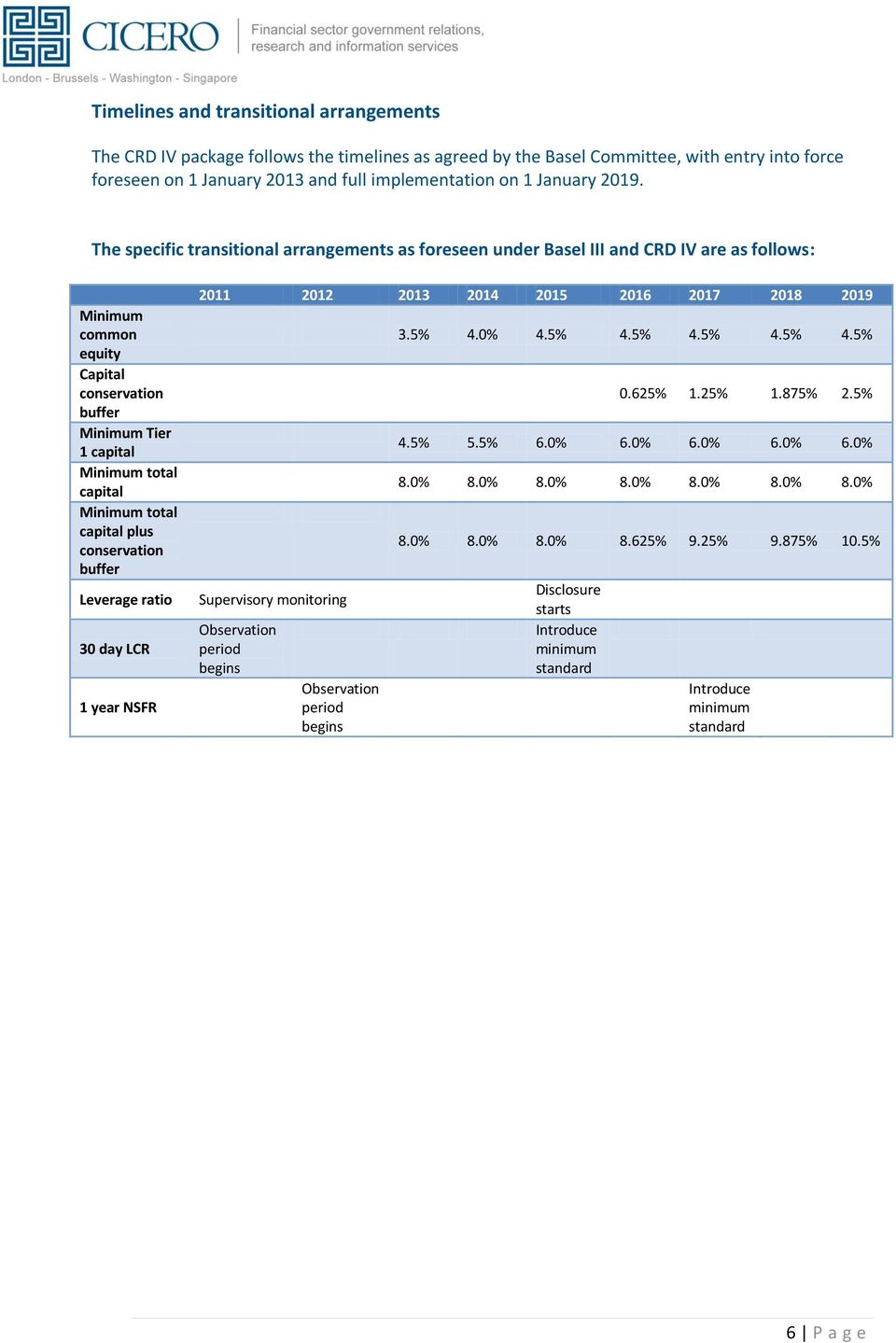
6 Timelines and transitional arrangements The CRD IV package follows the timelines as agreed by the Basel Committee, with entry into force foreseen on 1 January 2013 and full implementation on 1 January The specific transitional arrangements as foreseen under Basel III and CRD IV are as follows: Minimum common equity Capital conservation buffer Minimum Tier 1 capital Minimum total capital Minimum total capital plus conservation buffer Leverage ratio 30 day LCR 1 year NSFR Supervisory monitoring Observation period begins Observation period begins 3.5% 4.0% 4.5% 4.5% 4.5% 4.5% 4.5% 0.625% 1.25% 1.875% 2.5% 4.5% 5.5% 6.0% 6.0% 6.0% 6.0% 6.0% 8.0% 8.0% 8.0% 8.0% 8.0% 8.0% 8.0% 8.0% 8.0% 8.0% 8.625% 9.25% 9.875% 10.5% Disclosure starts Introduce minimum standard Introduce minimum standard 6 P a g e
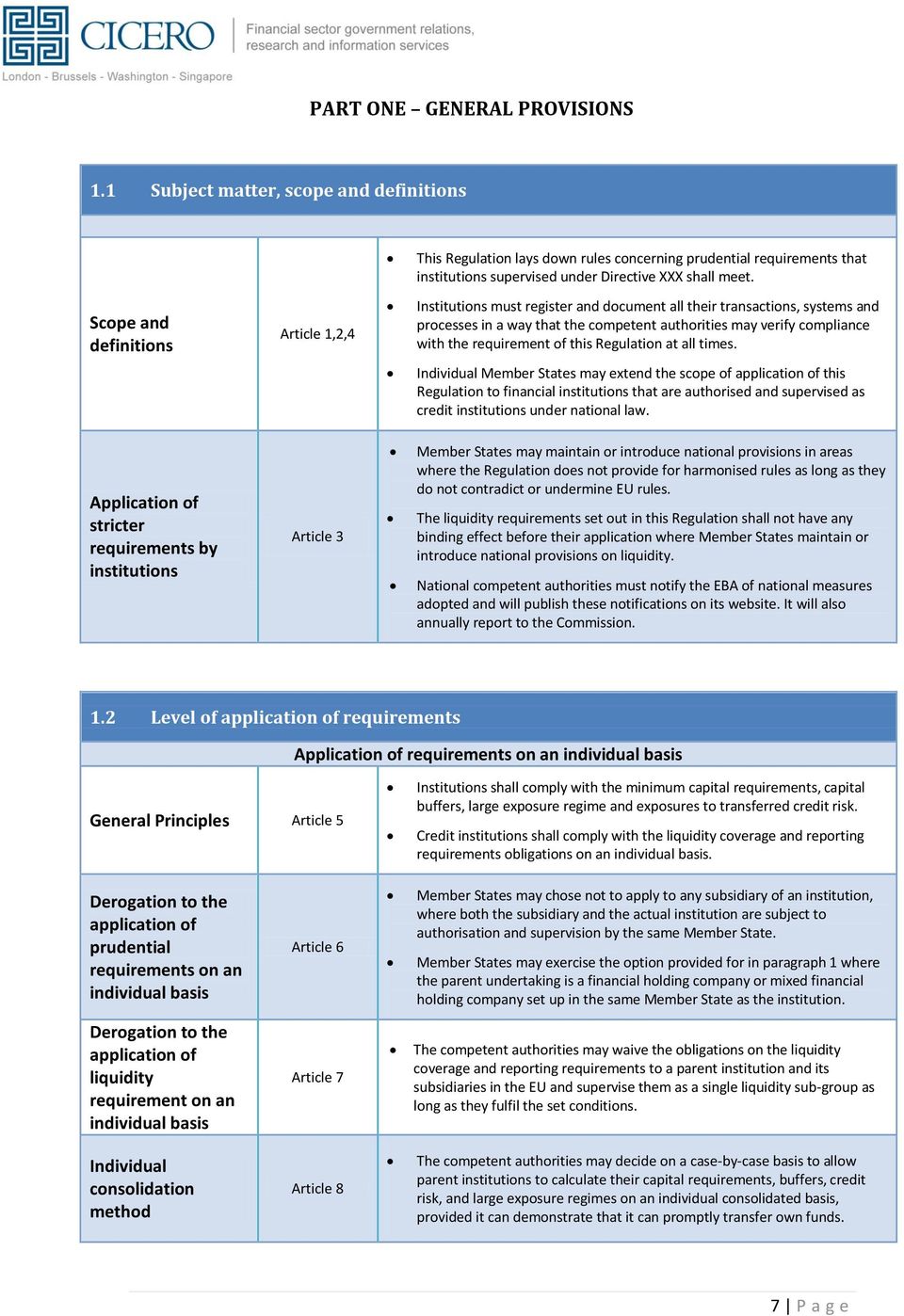
7 PART ONE GENERAL PROVISIONS 1.1 Subject matter, scope and definitions This Regulation lays down rules concerning prudential requirements that institutions supervised under Directive XXX shall meet. Scope and definitions Article 1,2,4 Institutions must register and document all their transactions, systems and processes in a way that the competent authorities may verify compliance with the requirement of this Regulation at all times. Individual Member States may extend the scope of application of this Regulation to financial institutions that are authorised and supervised as credit institutions under national law. Application of stricter requirements by institutions Article 3 Member States may maintain or introduce national provisions in areas where the Regulation does not provide for harmonised rules as long as they do not contradict or undermine EU rules. The liquidity requirements set out in this Regulation shall not have any binding effect before their application where Member States maintain or introduce national provisions on liquidity. National competent authorities must notify the EBA of national measures adopted and will publish these notifications on its website. It will also annually report to the Commission. 1.2 Level of application of requirements Application of requirements on an individual basis General Principles Article 5 Institutions shall comply with the minimum capital requirements, capital buffers, large exposure regime and exposures to transferred credit risk. Credit institutions shall comply with the liquidity coverage and reporting requirements obligations on an individual basis. Derogation to the application of prudential requirements on an individual basis Article 6 Member States may chose not to apply to any subsidiary of an institution, where both the subsidiary and the actual institution are subject to authorisation and supervision by the same Member State. Member States may exercise the option provided for in paragraph 1 where the parent undertaking is a financial holding company or mixed financial holding company set up in the same Member State as the institution. Derogation to the application of liquidity requirement on an individual basis Article 7 The competent authorities may waive the obligations on the liquidity coverage and reporting requirements to a parent institution and its subsidiaries in the EU and supervise them as a single liquidity sub-group as long as they fulfil the set conditions. Individual consolidation method Article 8 The competent authorities may decide on a case-by-case basis to allow parent institutions to calculate their capital requirements, buffers, credit risk, and large exposure regimes on an individual consolidated basis, provided it can demonstrate that it can promptly transfer own funds. 7 P a g e
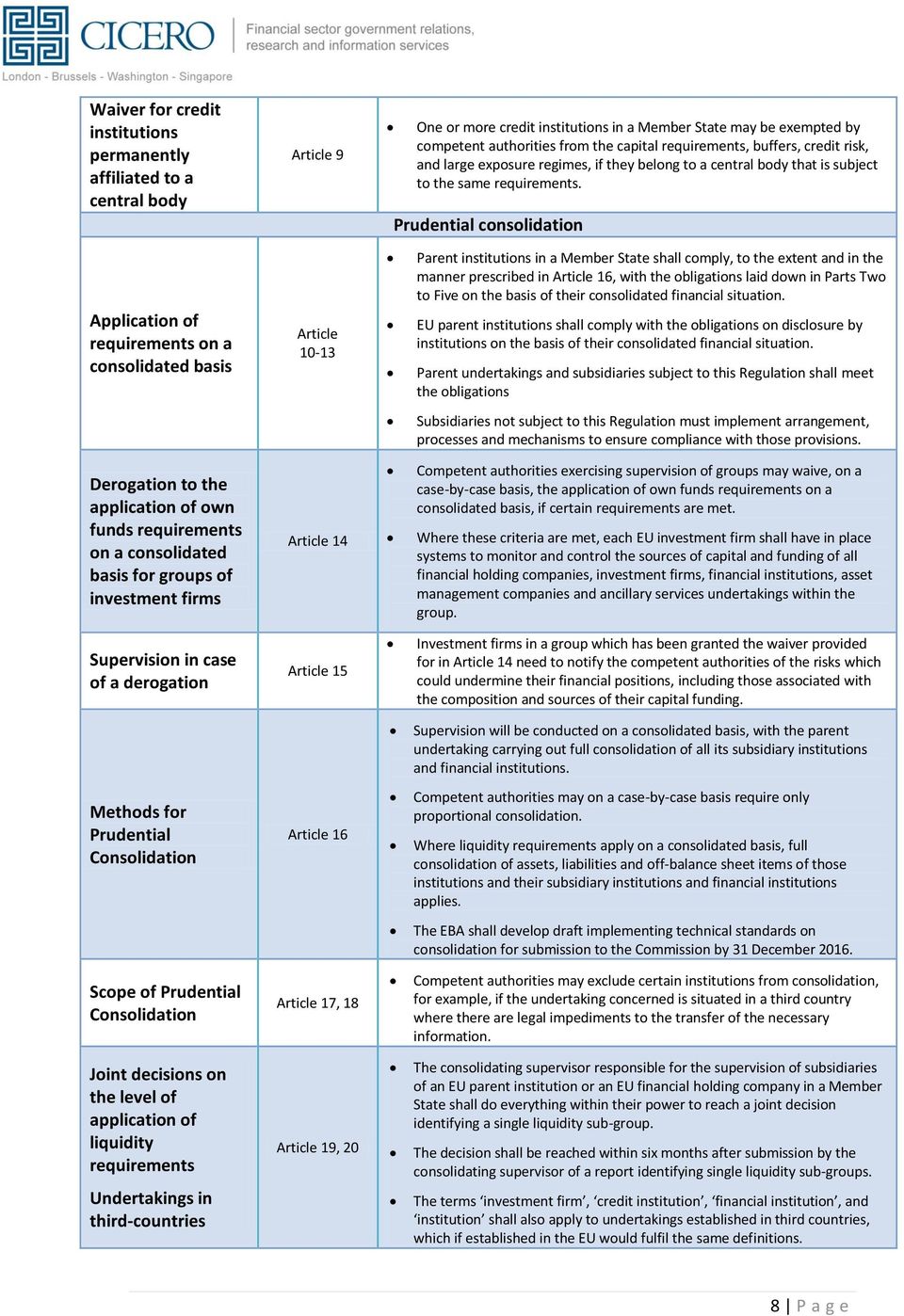
8 Waiver for credit institutions permanently affiliated to a central body Article 9 One or more credit institutions in a Member State may be exempted by competent authorities from the capital requirements, buffers, credit risk, and large exposure regimes, if they belong to a central body that is subject to the same requirements. Prudential consolidation Application of requirements on a consolidated basis Article Parent institutions in a Member State shall comply, to the extent and in the manner prescribed in Article 16, with the obligations laid down in Parts Two to Five on the basis of their consolidated financial situation. EU parent institutions shall comply with the obligations on disclosure by institutions on the basis of their consolidated financial situation. Parent undertakings and subsidiaries subject to this Regulation shall meet the obligations Subsidiaries not subject to this Regulation must implement arrangement, processes and mechanisms to ensure compliance with those provisions. Derogation to the application of own funds requirements on a consolidated basis for groups of investment firms Article 14 Competent authorities exercising supervision of groups may waive, on a case-by-case basis, the application of own funds requirements on a consolidated basis, if certain requirements are met. Where these criteria are met, each EU investment firm shall have in place systems to monitor and control the sources of capital and funding of all financial holding companies, investment firms, financial institutions, asset management companies and ancillary services undertakings within the group. Supervision in case of a derogation Article 15 Investment firms in a group which has been granted the waiver provided for in Article 14 need to notify the competent authorities of the risks which could undermine their financial positions, including those associated with the composition and sources of their capital funding. Supervision will be conducted on a consolidated basis, with the parent undertaking carrying out full consolidation of all its subsidiary institutions and financial institutions. Methods for Prudential Consolidation Article 16 Competent authorities may on a case-by-case basis require only proportional consolidation. Where liquidity requirements apply on a consolidated basis, full consolidation of assets, liabilities and off-balance sheet items of those institutions and their subsidiary institutions and financial institutions applies. The EBA shall develop draft implementing technical standards on consolidation for submission to the Commission by 31 December Scope of Prudential Consolidation Article 17, 18 Competent authorities may exclude certain institutions from consolidation, for example, if the undertaking concerned is situated in a third country where there are legal impediments to the transfer of the necessary information. Joint decisions on the level of application of liquidity requirements Undertakings in third-countries Article 19, 20 The consolidating supervisor responsible for the supervision of subsidiaries of an EU parent institution or an EU financial holding company in a Member State shall do everything within their power to reach a joint decision identifying a single liquidity sub-group. The decision shall be reached within six months after submission by the consolidating supervisor of a report identifying single liquidity sub-groups. The terms investment firm, credit institution, financial institution, and institution shall also apply to undertakings established in third countries, which if established in the EU would fulfil the same definitions. 8 P a g e
9 PART TWO OWN FUNDS 2.1 Definitions specific to own funds Additional Tier 1 capital Other capital instruments Includes Additional Tier 1 items after: - deduction of the items referred to in OF Article 8; and - application of any temporary waiver from deduction from Additional Tier 1 under OF Article 15 Capital instruments issued by relevant entities that do not qualify as Common Equity Tier 1, Additional Tier 1 or Tier 2 instruments Own funds The sum of Tier 1 capital and Tier 2 capital Significant investment Article 22 Any of the following: - Ownership of the Common Equity Tier 1 instruments of a relevant entity which exceeds 10% of the Common Equity Tier 1 instruments issued by that entity; - A participation within the meaning of the first sentence of Article 17 of Directive 78/660/EEC in an insurance undertaking, reinsurance undertaking or a financial undertaking; - Ownership of the Common Equity Tier 1 instruments issued by an entity that is not included in consolidation pursuant to Chapter 2 of Title II of Part One but is included in the same accounting consolidation as the institution for the purposes of financial reporting under the applicable accounting standards Tier 2 capital Means Tier 2 items after: - Deduction of the items referred to in OF Article 11(1); and - Application of any temporary waiver from deduction from tier 2 capital under OF Article General requirements Common Equity Tier 1 items Article 24 Common Equity Tier 1 items of institutions shall consists of the following: - instruments, provided the conditions set out in OF Article 2 are met; - under certain conditions, certain share premium accounts; - retained earnings; - accumulated other comprehensive income; - other reserves; and - funds for general banking risk The EBA will specify draft regulatory technical standards to the Commission by 1 January 2013 dealing with mutuals or cooperatives. The EBA will establish, maintain and publish a list of the forms of capital instruments in each Member State that qualify as Common Equity Tier 1 instruments. This list will also be published by 1 January Common Equity Tier 1 instruments Article Instruments shall qualify as Common Equity Tier 1 items only if they meet the conditions set by the Regulation. Capital instruments issued by mutuals, cooperative instruments, cooperative societies and similar institutions shall qualify as Common Equity 9 P a g e

10 Tier 1 instruments only if the conditions laid down in Article 26 and this Article are met. If the conditions laid down in Article 26, and Article 27 cease to be met the Common Equity Tier 1 instrument will cease to qualify as such and the share premium accounts relating to that instrument shall cease to qualify as Common Equity Tier 1 items. Prudential Filters Securitised assets Article 29 Institutions must exclude from any element of own funds any increase in its equity under the applicable accounting standard that results from securitised assets, including increases associated with future margin income that results in a gain or sale for the institution. Cash flow hedges and changes in value of own liabilities Article 30 Fair value reserves related to gains or losses on cash flow hedges of financial instruments that are not valued at fair value, including projected cash flows and gains or losses on liabilities of the institution that are valued at fair value shall not be included in any element of own funds by institutions. Additional value adjustments Article 31,32 Institutions are required to apply the provisions of Article 100 to all their assets measured at fair value when calculating the amount of their own funds and shall deduct from Common Equity Tier 1 capital the amount of any additional value adjustments necessary. Institutions must generally not make adjustments to remove from their own funds unrealized gains or losses on their assets or liabilities measured at fair value. Deductions from the Common Equity Tier 1 items Article Institutions shall make certain deductions from Common Equity Tier 1 items, including losses for the current financial year, intangible assets and deferred tax assets that rely on future profitability. Certain deductions shall be exempted or added additional risk weights. Tier 2 items Article 59 Tier 2 instruments Article 60 Tier 2 items shall consist of the following: - Instruments, including subordinated loans, where the conditions set out in OF Article 10 are met; - The share premium accounts related to the instruments referred to in point (a) that were issued from 31 December 2010; - For institutions calculating risk-weighted exposure amounts in accordance with Chapter 2 of Title II general credit risk adjustments, gross of tax effects, up to 1.25% of risk-weighted exposure amounts calculated in accordance with Chapter 2 of Title II of Part Three; and - For institutions calculating risk-weighted exposure amounts under Chapter 3 of Title II, positive amounts, gross of tax effects, resulting from the calculation. To calculate the amount of Tier 2 capital, institutions shall deduct any tax charge foreseeable at the moment of the calculation or shall suitably adjust that amount insofar as such tax charges reduce the amount up to which theses items may be applied to cover risks or losses. Instruments qualify as Tier 2 instruments if certain conditions are met, including that they are issued and fully paid up; that they are not purchased by the institution or its subsidiaries or that the purchase of the instruments is not funded directly or indirectly by the institution at issuance or thereafter. Deductions for Tier 2 holdings Article Certain items will be deducted from Tier 2 items. These include direct and indirect holdings by an institution of own Tier 2 instruments, and holdings of the Tier 2 instruments of relevant entities with which the institution has reciprocal cross holdings that the competent authority considers to have been designed to inflate artificially the own funds of the institution. 10 P a g e

11 Indirect holdings arising from index holdings Article 71 As an alternative to the look through approach, an institution may use a conservative estimate of the underlying exposure of the institution to the CET Tier 1, Additional Tier 1 and Tier 2 instruments that are included in the indices. Conditions for reducing own funds Article 72,73 This article applies where an institution takes any of the following actions: - the reduction or repurchase of CET 1 instruments issued by the institution in a manner that is permitted under applicable national law; - the call, redemption or repurchase of Additional Tier 1 instruments or Tier 2 instruments prior to the date of their contractual maturity. Temporary waiver from deduction from own funds Article 74 The competent authority may temporarily waive the provision on deduction referred to in this Title, if an institution temporarily holds ordinary shares or shares that qualify as Additional Tier 1 or Tier 2 instruments in a relevant entity for financial assistance purposes operation to save that entity. Continuing review of quality of own funds Article 75 The EBA will continuously monitor the quality of CET 1, Additional Tier 1 and Tier 2 instruments issued by institutions. The EBA will make recommendations to the Commission by 31 December 2013 on possible enhancements to facilitate greater convergence in the prudential treatment of own funds. These recommendations will take into account relevant development in international accounting standards and the work of the FSB and BCBS. 2.3 Minority interest and Additional Tier 1 and Tier 2 instruments issued by subsidiaries Minority interests that qualify for inclusion in consolidated Common Equity Tier 1 capital Articles Minority interests can comprise Common Equity Tier 1 instruments of a subsidiary where prescribed conditions are met. Additional Tier 1 and Tier 2 instruments issued by special purpose entity, and the related retained earnings and share premium accounts are included in qualifying Additional Tier 1, Tier 1 or Tier 2 capital or qualifying own funds as applicable. Qualifying Tier 1 /Tier 2 items included in consolidated capital Articles Institutions are required to determine the amount of qualifying Tier 1 capital of a subsidiary that is included in consolidated Tier 1 capital by subtracting from the qualifying Tier 1 capital of that undertaking the result of multiplying the amount referred to in the Article. Institutions are required to determine the amount of qualifying own funds of a subsidiary that is included in consolidated Tier 2 capital by subtracting from the qualifying own funds of that undertaking that are included in consolidated own funds the qualifying Tier 1 capital of that undertaking that is included in consolidated Tier 1 capital. 2.4 Qualifying holdings outside the financial sector General Treatment Article 84, 85 An institution must apply a risk weight of 1250% to a qualifying holding, the amount of which exceeds 15% of its eligible capital, in an undertaking which is not a relevant entity. An institution shall apply a risk weight of 1250% to the total amount of its 11 P a g e

12 qualifying holdings in undertakings that are not relevant entities. Member States may apply standards that are stricter than those set out in the previous two points. The EBA will develop draft regulatory technical standards to ensure a consistent application by 1 January As an alternative to applying a 1250% risk weight to the amounts in excess of the limits set out in paragraphs 1 and 2, institutions may deduct those amounts. Exceptions to the general treatment Article 86 Shares will not be included in calculating the eligible capital limits specified under general treatment if at least one of the following conditions is met: - Those shares are held temporarily during a financial reconstruction or rescue operation; - The holding of the shares is an underwriting position held for 5 working days or fewer; - Those shares are held in an institution s own name on behalf of others. Shares which are not financial fixed assets shall not be included in the calculation specified. 12 P a g e

13 PART THREE MINIMUM CAPITAL REQUIREMENTS 3.1 General requirements, valuation and reporting Minimum level of own funds Minimum capital requirements Calculation of capital ratios Calculation of total risk exposure amounts Article Institutions should at all times hold at least: - a Common Equity Tier 1 capital ratio of 4.5% - a Tier 1 capital ratio of 6%, and - a total capital ratio of 8% These capital ratios shall be calculated as a percentage of the total risk exposure amount. The total risk exposure amount is calculated as the sum of - the risk weighted exposure amount for credit risk, - the risk weighted exposure for counterparty risk, and the sum of the own funds requirements for: - the trading book business for position risk and large exposures exceeding the set limits; - foreign-exchange risk, settlement risk, and commodities risk - credit valuation adjustment risk of OTC derivatives; and - operational risk; These own funds requirements should be calculated in accordance with the methodologies provided in this Regulation. The Regulation provides an alternative calculation of the total risk exposure amount for certain non-authorized investment firms. Calculation and reporting requirements Valuation and reporting Article Assets and off-balance sheet items shall be valued in accordance with the accounting framework applicable to the institution conform the Regulation on the application of international accounting standards (Regulation EC/1606/2002) and the Directive on annual and consolidated accounts of banks and financial institutions (Directive 86/635/EEC). EBA shall develop technical standards before 1 January 2013 to ensure uniform reporting to authorities. These uniform reporting standards shall apply from 30 June Trading book Positions in the trading book must be either free of any restrictive covenants on their tradability or able to be hedged. Requirements for the Trading Book Article Institutions may include internal hedges in the calculation of capital requirement for position risk provided that they are held with trading intent. Institutions shall mark their positions to market whenever possible, including when applying trading book capital treatment. 13 P a g e

14 3.2 Minimum capital requirements for credit risk General principles Approaches to credit risk Article 102, 103 To calculate credit risk, institutions can either use the Standardised Approach, or the Internal Risk Based Approach, but without using its own estimates of loss given default (LGD) and conversion factors for the calculation of risk weighted exposures. Treatment of securitized exposures Article 104 An institution shall use the standardized approach to calculate the riskweighted exposure of securitized exposures. If an institution is given permission to do so by the competent authorities, it may use the internal assessment approach. General credit risk Institutions shall treat general credit risk adjustments either using the Standardised Approach or using the Internal Risk Based Approach. Modification of exposures due to unrealized gains/losses Article 105 The EBA shall develop technical standards by 1 January 2013 specifying the calculation of general and specific credit risk adjustments, focusing in particular on exposure values. The exposure value of an asset may be reduced or increased in accordance with unrealised gains or losses. Standardised approach Exposure value The exposure value of an asset item shall be its accounting value remaining after specific credit risk adjustments have been applied. Calculation of riskweighted exposure amounts Exemption for intragroup exposures Article The exposure value of derivatives shall be determined in accordance with Chapter 6 (Counterparty Credit Risk). Except for exposures giving rise to liabilities in the form of Common Equity Tier 1, Additional Tier 1 or Tier 2 items, institutions may subject to conditions and with permission of the competent authorities exclude certain intra-group exposures and counterparties from applying risk weights. Risk weights of exposures Securitised positions Short-term credit assessments Article , 125, 126, 128, 129 Depending on their source, form, and eventual corresponding external credit assessments, various risk weights are assigned to an institution s exposures. Risk weighted exposure amounts for securitization positions shall be determined in accordance with Chapter 5 (securitisation). Exposures to institutions and corporates with a short-term credit assessment are assigned a risk weight between 20 and 150 per cent, depending on their external credit assessment. Depending on their asset of collateralization, covered bonds are eligible for a preferential treatment Exposures in the form of covered bonds Article 124 The preferential treatment implies that these covered bonds are assigned a risk weight ranging between 10% and 100%, which is determined on the basis of the risk weight assigned to senior unsecured exposures of the issuing institution. Covered bonds issued before 31 December 2007 do not need to be collateralized and are eligible for the preferential treatment until their maturity. 14 P a g e

15 Exposures in the form of shares in collective investment undertakings Article 127 Exposures in the form of shares in collective investment undertakings (CIUs) are in principle assigned a risk weight of 100%, unless the institution applies the credit risk assessment method, the look-through approach, or the average risk weight approach. An external credit assessment may only be used to determine the risk weight of an exposure if it has been issued by an ECAI or endorsed by an ECAI. Recognition of external credit assessment institutions (ECAIs) Article 130, 131 ECAIs are all credit rating agencies that are registered or certified in accordance with Regulation (EC) No 1060/2009, and central banks whose credit ratings have been recognized by the EBA. The EBA shall ensure that the methodology of credit assessments by ECAIs is free from political and economic influences, and that access to these assessments is available to all. When certifying an ECAI, the EBA shall also determine with which of the six possible credit quality steps should be associated. The EBA shall submit draft implementing technical standards by 1 January 2014 to ensure uniform application of the certification criteria. Use of credit assessments by Export Credit Agencies Article 132 Upon request of an Export Credit Agency (ECA), the EBA shall decide to recognize its credit assessments if either of the following conditions is met: - it is a consensus risk score from ECAs participating in the OECD Arrangement on Guidelines for Officially Supported Export Credits ; or - the ECA publishes its credit assessments, subscribes to the OECD agreed methodology, and the credit assessment is associated with one of the eight minimum export insurance premiums (MEIP) established by the OECD methodology. Using ECAIs for determining risk weights. Article Subject to requirements, institutions may opt to use eligible ECAIs to determine risk weights assigned to asset and off-balance sheet items. Institutions may only use solicited credit assessments, unless the EBA has permitted unsolicited assessments as part of its recognition process. Short-term credit assessments may only be used for short-term asset and off-balance sheet items constituting exposures to institutions and corporates. Internal rating based (IRB) approach Institutions shall be permitted to calculate their risk weighted exposures using the Internal Ratings Based (IRB) Approach, but requires permission from the competent authorities for each rating system, and internal models approach to equity exposures. Conditions for permission to use the IRB Approach Article Permission will only be given if the competent authorities are confident in the integrity of the process and if: - the system provides accurate and consistent quantitative estimates of risk; - internal ratings play an essential role in the risk management strategy; - all data is collected and stored; - the internal ratings system is subject to internal checks; and - the ratings system is able to submit reporting under the IRB approach, and must have been using the IRB Approach for at least six years prior to application. An institution applying for permission to use of the IRB Approach or for the use of own estimates of Loss Given Defaults (LGDs) must demonstrate that for the previous three years it has been using rating systems that are 15 P a g e
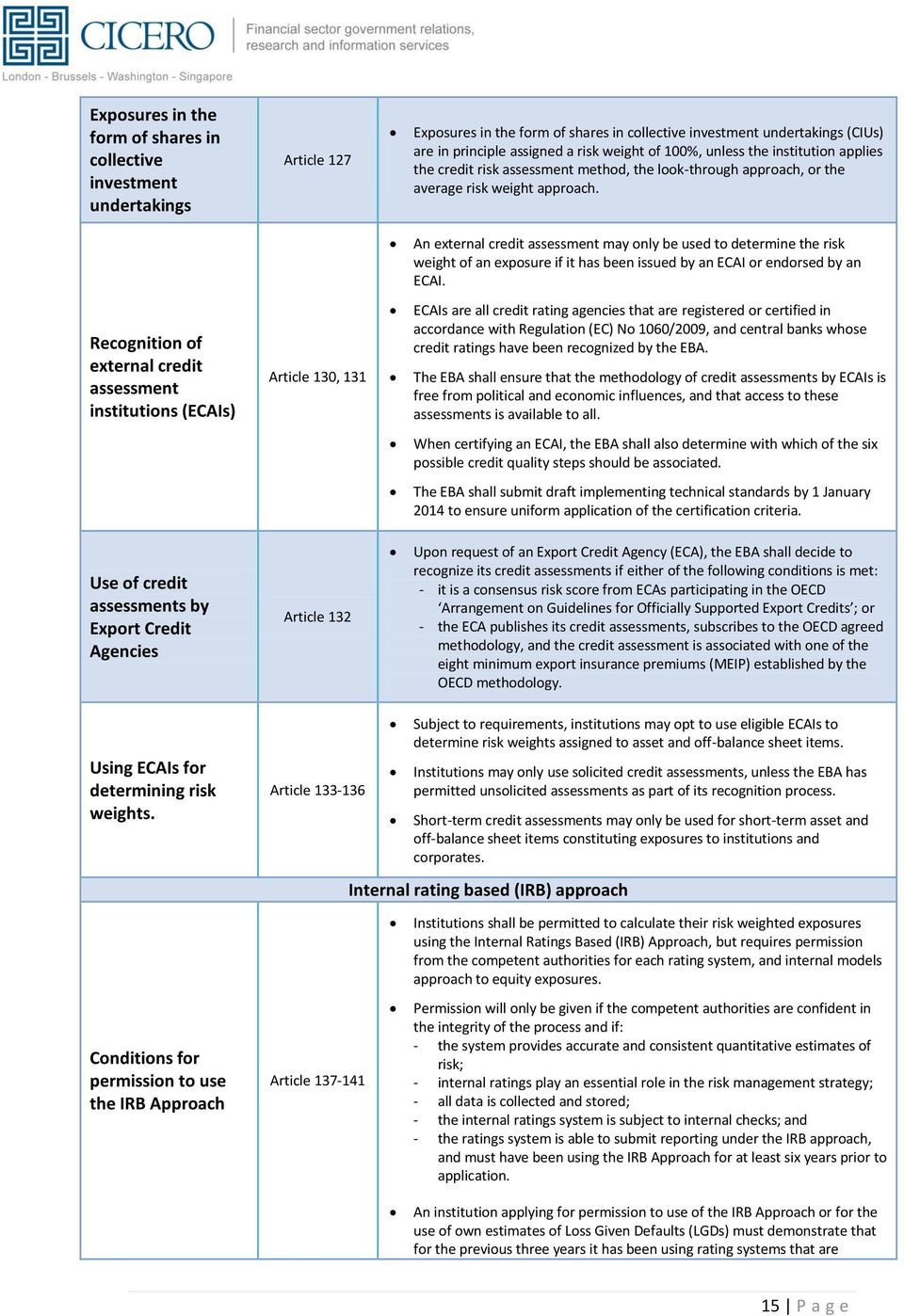
16 broadly equivalent to the minimum requirements for the IRB Approach, or has been using broadly equivalent estimates of LGDs. Exposure typology Article Treatment by type of exposure Article The implementing technical standards to assess the suitability of an institution s rating systems will be developed by the EBA by 31 December The assigning of exposures to different exposure classes will be consistent over time, and must fall within one of the following categories: - claims or contingent claims on central, regional or local governments, or on central or multilateral banks and international organisations; - claims or contingent claims on institutions; - claims or contingent claims on corporates; - retail claims or contingent retail claims; - equity claims, securitization positions, or other non credit-obligation assets. Implementation must be carried out within a reasonable amount of time, to be determined by the competent authorities. When an underlying collective investment undertaking (CIU) is itself another exposure in the form of share in another CIU then the risk weighting will look through the underlying exposure of the latter CIU. When institutions do not meet the conditions set out, then exposure amounts will be calculated using the risk-weight approach for equity, and the standardized approach set out in Chapter 2 for other forms with the exception that the risk weight shall be multiplied by a factor of 2 (to a maximum of 1250%) for exposures subject to specific risk weight for unrated exposures. For all other exposures the risk weight is multiplied by a factor of 1.1, with a 5% minimum. In calculating the risk weighted exposure amounts for credit risk the EBA will determine by 1 January 2014 which third countries also meet the EU requirements. The Commission is granted powers to adopt implementing technical standards to detail how institutions take into account the following factors in risk weighting: - financial strength; - political and legal environment; - transactions and/or asset characteristics; - strength of the sponsor and developer; and - security package. Calculation of various risk weighted exposure amounts Article The Regulation applies various formulae for the calculation of risk weighted exposure amounts for: - retail exposures; - equity exposures; - other non credit obligation assets; - dilution risk of purchased corporate and retail receivables Expected Loss Amounts Article 154, 155 The calculation of expected loss amounts shall be based on the same input figures for PD, LGD and the exposure value per exposure as those that are used to calculate the exposure amounts for various risk weighted exposures. The expected loss amount shall be subtracted from the general and specific credit risk adjustment related to these exposures. Exposures to corporates, institutions and central Article The probability of default (PD) of an exposure to corporate institutions shall be at least 0.03%. The PD of obligors in default will be 100%. Institutions can take into account unfunded credit protection in the PD (see Chapter 4). Qualifying short-term exposures are defined as: 16 P a g e

17 governments and central banks - exposures to institutions arising from settlements of foreign exchange; - self-liquidating short-term trade financing transactions, import and export letters of credit; - settlement of securities purchases; - cash settlements by wire transfer and electronic payments; The Commission can adopt implementing technical standards to specify or complete the above list. For equity exposures, the following minimum PDs shall apply: % for exchange traded equity exposures where the investment is part of a long-term customer relationship, where the returns on the investment are based on regular and periodic cash flows; - 0.4% for exchange traded equity exposures including other short positions; and % for all other equity exposures. Exposure value shall be the accounting value measures without taking into account any credit risk adjustments made. Exposure value Equity exposures Other non creditobligation assets Article For purchased assets, the difference between the amount owed and the accounting value remaining after applying credit risk adjustments is denoted discount if the amount owed is larger, and premium if is smaller. For all off balance sheet items not listed in the text the exposure value shall be: - 100% if it is a full risk item; - 50% if it is a medium risk item; - 20% if it is a medium/low risk item; - 0% if it is a low-risk item. The exposure value of equity exposures and other non-credit obligation assets will be calculated as the accounting value remaining after specific credit risk adjustments have been applied. Institutions using multiple ratings system will have to provide a rationale for this. Assignment criteria and processes will be reviewed periodically. Minimum requirements for the IRB Approach Ratings systems Article 165 The structure of ratings systems shall: - Take into account obligor and transaction risk; - Have an obligor rating scale which reflects exclusively quantifications of the risk of obligor default; - Market concentration will necessitate a range of obligor grades to avoid undue concentration; - A distinct facility rating scale is needed for own funds requirement calculations; and - Significant concentrations within one facility grade will need to be supported with substantial evidence. Structure of rating systems Assignment to grades or pools Assignment of exposures Article The structure of rating systems will need to meet certain requirements to be eligible, both for corporate, government and central bank exposures, and for retail exposures. Specific, detailed and consistent processes need to be in place to assign exposures to particular grades or pools, and review and reporting procedures need to be in place to ensure the integrity of the assignments. Each exposure (corporate, government, central bank and retail) shall be assigned to a grade or pool in accordance with the relevant criteria per exposure. Use of models Documentation Article If an institution uses statistical or similar methods to assign exposures to obligors or facilities grades or pools, it shall meet requirements to ensure that the methodology used is not distorting capital requirements, and that data is adequately tested. 17 P a g e
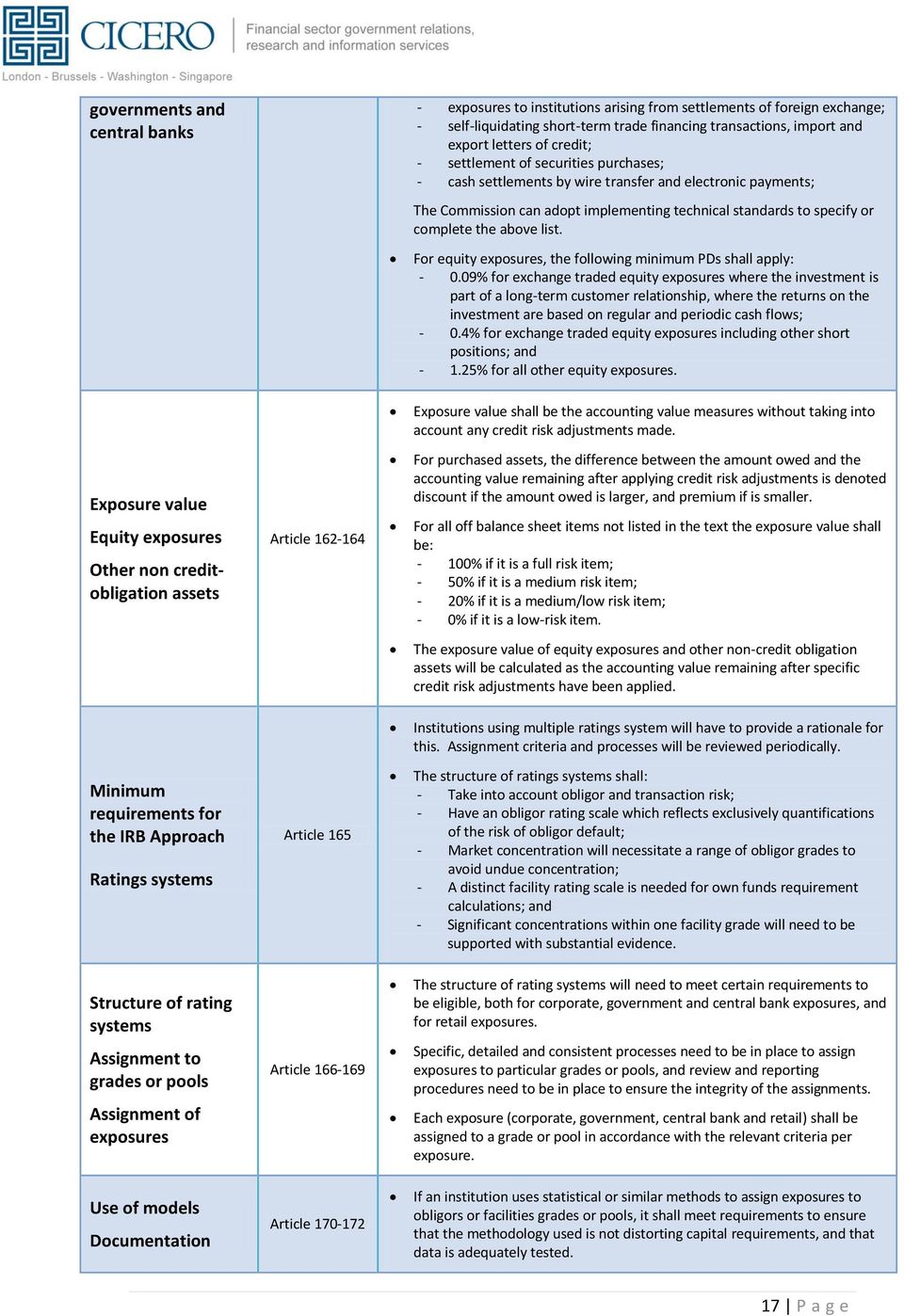
18 The design, use and methodologies shall be documented. Institutions shall collect and store data on the use of their internal rating systems. Stress testing of capital adequacy Article 173 An institution shall have in place and regularly perform sound stress testing processes for use in the assessment of its capital adequacy. Stress testing shall involve identifying possible events that could have unfavourable effects on credit exposures and the institution's ability to withstand such changes. Default of an obligor Article 174 A default shall be considered to have occurred with regard to a particular obligor when either or both of the following has taken place: - the institution considers that the obligor is unlikely to pay its credit obligations to the institution, the parent undertaking or any of its subsidiaries in full, without recourse by the institution to actions such as realising security (if held); - the obligor is past due more than 90 days on any material credit obligation to the institution, the parent undertaking or any of its subsidiaries. The exposure past due shall be above a threshold set by the competent authorities. The EBA shall develop guidelines on the definition of default. Institutions shall meet the set requirements for quantifying the risk parameters associated with rating grades or pools. Requirements for PD and LGD estimates Article This includes that own estimates of the risk parameters for PD, LGS, conversion factor and EL are complete and include all data, information and methods. Institutions shall use PD estimation techniques only with supporting analysis. Own-LGD estimates shall meet the set criteria. The EBA shall develop draft technical standards for submission to the European Commission by 31 December 2013 for estimating PDs and by 31 December 2014 on the assessment of the methodology for estimating LGDs. Requirements for own-conversion factor estimates Article 178 Institutions shall use conversion factor estimates that are appropriate for an economic downturn if those are more conservative than the long-run average. The EBA shall develop draft technical standards for submission to the European Commission by 31 December 2014 on the assessment of the methodology for estimating conversion factors. Institutions shall have clearly specified criteria for the types of guarantors they recognise for the calculation of risk weighted exposure amounts. Minimum requirements for assessing the effect of guarantees and credit derivatives Article 179 The criteria shall be plausible and intuitive, addressing the guarantor's ability and willingness to perform under the guarantee, its likely timing, the degree of correlation with the obligor's ability to repay, and the extent to which risk to the obligor remains. These minimum requirements shall also apply to single-name credit derivatives. The EBA shall develop draft technical standards for submission to the European Commission by 31 December 2014 on the conditions according to which competent authorities may grant guarantees. 18 P a g e
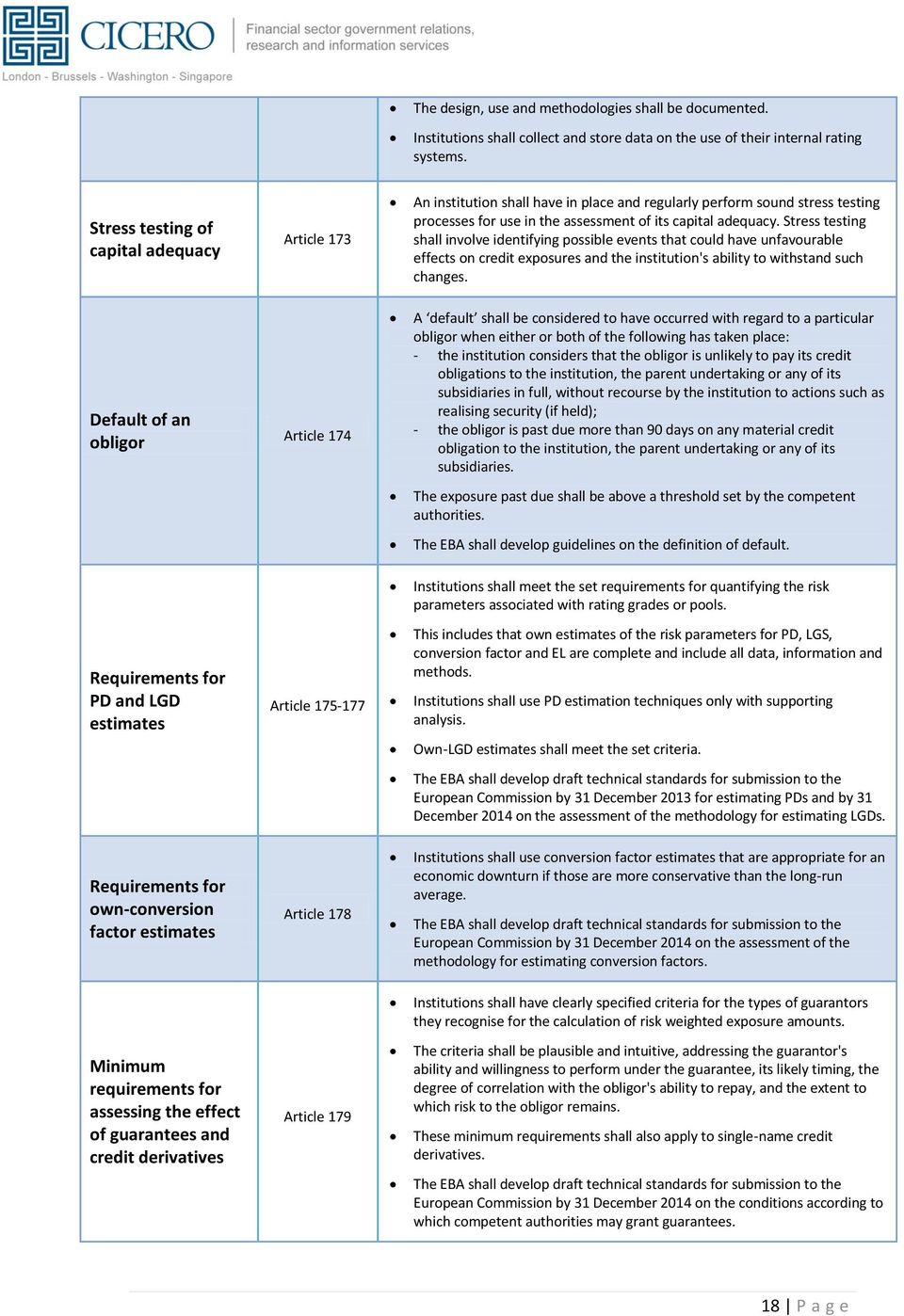
19 Minimum requirements for purchases Article 180 In quantifying the risk parameters to be associated with rating grades or pools for purchased receivables, institutions shall comply with the requirements of legal certainty, effectiveness of monitoring systems, effectiveness of work-out systems and controlling collateral, and the requirements relation to credit availability and cash. Institutions shall also have adequate internal policies and procedures. Validation of internal estimates Article 181 Institutions shall have robust systems in place to validate the accuracy and consistency of rating systems, processes, and the estimation of all relevant risk parameters. Institutions shall also use other quantitative validation tools and comparisons with relevant external data sources. The analysis shall be based on data appropriate to the portfolio, regularly updated, and cover a relevant observation period. Institutions' internal assessments of the performance of their rating systems shall be based on as long a period as possible. The methods and data used for quantitative validation shall be consistent. Calculation of risk weighted exposure amounts for equity exposures under the internal models approach Article 182 For calculating capital requirement institutions shall meet the prescribed requirements. The requirements state that estimates of potential losses shall be robust to adverse market movements. Additionally models used shall be able to capture all material risks embodied in equity returns including both the general market risk and specific risk exposure of the institution s equity portfolio, and be appropriate for the risk profile and complexity of the portfolio. The requirements also impose rigorous and comprehensive stress-testing programmes. Risk management process and controls Article 183, 184 Institutions shall establish policies, procedures and controls to ensure the integrity of the modeling process, which are fully integrated in the overall management information systems and are subject to periodic and independent review. There shall also be systems and procedures for monitoring investment limits and risk exposures of equity exposures. Units responsible for modelling shall be independent and adequately qualified. All material elements of the internal models and the modelling process and validation shall be documented. Corporate governance Article 185 All material aspects of the rating and estimation processes shall be approved by the institution s management body or designated committee. Senior management shall provide notice to the body or committee of changes that will impact the operations of ratings systems. IRB analysis of credit risk shall be an essential part of the management reporting to those parties. Credit risk control Internal audit Article 186, 187 Credit risk control units shall be independent from the personnel and management functions responsible for originating or renewing exposures. They shall also be responsible for the design or selection, implementation, oversight and performance of ratings systems. Internal audit or comparable independent auditing unit shall review at least once a year an institution s rating systems and its operations. 19 P a g e
20 Credit risk mitigation No exposure shall produce a higher risk-weighted amount or expected loss amount than an identical exposure where there is no credit risk mitigation. Cash, securities or commodities purchased, borrowed or received subject to a repurchase agreement or securities or commodities lending or borrowing transaction are treated as collateral. Principles for recognising the effect and eligibility of credit risk mitigation techniques Article Where there are multiple forms of credit risk mitigation there will be a requirement to subdivide the exposure into parts covered by each tool and the risk-weighted exposure shall be calculated separately. For funded credit protection, assets shall be sufficiently liquid and their value sufficient stable to provide certainty as to protection achieved in regard to the approach used to calculate risk-weighted exposure amounts. An institution shall have the right to liquidate or retain the assets from which the protection derives in the event of default, insolvency or bankruptcy of the obligor. For unfunded credit protection, the undertaking party shall be sufficiently reliable, and the agreement legally effective and enforceable, to provide certainty as to the credit protection achieved. Institutions shall be able to show that it has adequate risk management processes to control the risks exposed to as a result of credit mitigation techniques. Funded credit protection Eligible forms of credit risk mitigation Netting Article 191, 192, 196 Institutions may use on-balance sheet netting of mutual claims between the institution and its counterparty as eligible form of credit risk mitigation. For institutions adopting the Financial Collateral Comprehensive Method under Article 218, the effects of bilateral netting contracts covering capital market-driven transactions may be taken into account. Institutions may use the following other funded credit protection: - cash or equivalent held by a third party and pledged to the lending institution; - life insurance policies pledged to the institution; - instruments issued by third party institutions which will be repurchased by that institution on request. Eligibility of collateral under all approaches and methods Article 193 The following items may be used as eligible collateral under all approaches and methods: - cash; - debt securities issued by governments or central banks; - debt securities issued by institutions with a credit assessment by an eligible ECAI; - debt securities issued by other entities with a credit assessment by an eligible ECAI; - debt securities with a short-term credit assessment from an eligible ECAI; - equities or convertible bonds; - gold; and - securitisation positions that are not re-securitisation positions, which have an external credit assessment by an eligible ECAI. Debt securities issued that do not have a credit assessment from an eligible ECAI may be used as collateral if they fulfil the set criteria. Shares in collective investment undertakings may be used as eligible criteria if they fulfil the set conditions. 20 P a g e

21 Financial Collateral Comprehensive Model Article 194 If an institution uses the Financial Collateral Comprehensive Model then the following items can be used as collateral: - equities or convertible bonds not included on a main index but traded on an exchange; and - shares in collective investment undertakings if the set conditions are met. Under the IRB approach institutions may use real estate collateral, other physical collateral and leasing. Additional eligibility under the IRB Approach Article 195 Residential and commercial real estate occupied or let by the owner may be used as collateral where the appropriate conditions are met. Institutions may use amounts receivable linked to a commercial transaction or transaction with maturity of less than one year. Competent authorities can permit institutions to use other types of physical collateral if the appropriate conditions are met. Unfunded credit protection Article Institutions may use the following as providers of unfunded credit protection: - central governments and banks; - regional governments or local authorities; - multilateral development banks; - international organisations to which a 0% risk weight is assigned - public sector entities - other corporate entities that fulfil the appropriate criteria Other financial institutions can also be used as providers of unfunded credit protection competent authorities shall publish the list of eligible providers and fulfil the set criteria. Types of credit derivatives Article 199 The following types of credit derivatives may be recognised as eligible: - credit default swaps; - total return swaps; and - credit linked notes to the extent of their cash funding. Minimum requirements for funded credit protection Article 200, 201 For on-balance sheet netting agreements other than capital market-driven transactions the following conditions must be adhered to: - they shall be legally effective and enforceable; - the institution shall be able to determine at any time what is subject to the agreement; - the institution shall monitor and control risks associated with termination; and - the institution shall monitor exposures on a net basis. Financial collateral Article 202 For financial collateral and gold to be eligible the credit quality of the obligor and the value of the collateral shall not have a material positive correlation. Securities issued by the obligor are not eligible though the obligor s own issues of covered bonds are eligible when they are posted as collateral subject to repurchase agreement. Institutions shall calculate market value of collateral and revalue every six months. Sufficient resources should be devoted to the orderly operation of margin agreements with OTC and securities-financing counterparties. 21 P a g e
22 Minimum requirements for the recognition of collateral Article For the recognition of real estate collateral, receivables as collateral, receivables as collateral, other physical collateral, treating lease exposures as collateralised and other funded credit protection, requirements of legal certainty and risk management shall be met. Requirements common to guarantees and credit derivatives Article 208 For the credit protection deriving from a guarantee or credit derivative to be eligible, the set conditions must be met. Institutions shall satisfy competent authorities that systems are in place to manage concentration of risk resulting from use of guarantees and credit derivatives. Sovereign and other public sector counter-guarantees Article 209 Where an exposure is protected by a guarantee which is counter guaranteed by a public sector organisation, the exposure shall be treated as a guarantee provided the set conditions are satisfied. Additional requirements for guarantees and for credit derivatives Article A number of additional requirements must be met in order for a guarantee to be eligible. For credit derivatives to be eligible there are a further set of additional requirements including the specification of credit events. There are also a number of conditions that shall be met for credit protection deriving from a guarantee or credit derivative to be eligible for treatment set out in the Internal Ratings Based Approach. Credit linked notes Article 213 Investments in credit linked notes issued by the lending institution may be treated as cash collateral, provided that the CDS embedded in the credit linked note is an eligible unfunded credit protection. On-balance sheet netting Article 214 Loans and deposits subject to on-balance sheet netting are to be treated as cash collateral for those loans and deposits of the lending institution subject to on-balance sheet netting which are denominated in the same currency. Using the Supervisory or the Own Estimates volatility adjustments approaches Article 215 In calculating the fully adjusted exposure value for exposures subject to a master netting agreement, volatility adjustments shall be calculated using either the Supervisory Volatility Adjustments Approach or the Own Estimates Volatility Approach. In calculating the fully adjusted exposure value the conditions prescribed must be met. Using the Internal Models Approach for Master netting agreements Article 216 Subject to permission from competent authorities, institutions may use an internal models approach that takes into account correlation effects between security positions, subject to the master netting agreement as well as the liquidity of instruments concerned. Institutions may also use their internal models for margin lending transactions, if the transactions are covered under a bilateral master netting agreement. An institution can also use an internal models approach independently of the choice it has made between the Standardised Approach and the IRB Approach for the calculation of risk-weighted exposure amounts. 22 P a g e
23 The Financial Collateral Simple Method shall be available where risk weighted exposure amounts are calculated under the Standardised Approach. Financial Collateral Simple Method Article 217 An institution shall not use both the Financial Collateral Simple Method and the Financial Collateral Comprehensive Method. Under the Simple Method, eligible collateral is assigned a value equal to its market value. Risk weighting that would be assigned if the lender has a direct exposure to the collateral instrument, shall be assigned portions of exposure values collateralised by the market value of the collateral. Under the Financial Collateral Comprehensive Method, volatility adjustments shall be applied to the market value of collateral. If collateral is valued in a different currency to the underlying exposure, an adjustment for currency volatility shall be added. Financial Collateral Comprehensive Method (FCCM) Article 218, 219 For OTC derivatives a volatility adjustment reflecting currency shall be applied in the case of a mismatch between collateral and settlement currency. Volatility adjustments can be made using either the supervisory volatility adjustment approach or the own estimates approach. Volatility adjustments to be applied under the supervisory volatility adjustments approach shall be those set out in the relevant tables and shall be subject to the relevant conditions. Own estimates of volatility adjustments under the FCCM Article 220 Competent authorities shall permit institutions to use their own volatility estimates for calculating volatility adjustments to be applied to collateral and exposures if they comply with the set requirements. Institutions that obtain permission to use their own estimates shall not revert to the use of other methods subject to permission from competent authorities. Scaling up of volatility adjustment under the FCM Article 221 Where an institution uses its own estimates of volatility adjustments, these shall be calculated in the first instance on the basis of daily revaluation. If the frequency of revaluation is less than daily, larger volatility adjustments shall be applied. Conditions for applying a 0% volatility adjustment under the FCCM Article 222, 223 For repurchase agreements and securities lending or borrowing transactions, where an institution uses the Supervisory Adjustment Approach or the Own Estimates Approach, institutions may apply a 0% volatility adjustment. The application of a 0% volatility adjustment is subject to the set conditions. Under the Standardised Approach, the fully adjusted exposure value shall be used Valuation principles for other eligible collateral under the IRB Approach Article 224, 225 Immovable property collateral shall be valued by an independent valuer at or less than the market value. Receivables shall be valued at the amount receivable. For other physical collateral, property should be valued at market value. Calculating riskweighted exposure amounts and expected loss amounts in the case Article 226 Where risk-weighted exposure amounts and expected loss amounts are calculated under the IRB Approach, and an exposure is collateralised by both financial and other eligible collateral, loss given default (LGD) shall be calculated as prescribed. 23 P a g e
24 of mixed pools of collateral Deposits with third party institutions may be treated as a guarantee by the third party institution. Other funded credit protection Article 227 The portion of the exposure collateralised by the current surrender value of life insurance policies pledged to the lending institution shall be either: - Subject to risk weights specified where the exposure is subject to the Standardised Approach - Assigned a LGD of 40% where the exposure is subject to the IRB Approach but not subject the institution s own estimates of LGD. Valuation of unfunded credit protection Article 228 The value of unfunded credit protection shall be the mount that the protection provider has undertaken to pay in the event of default or nonpayment of the borrower or in other credit events. For credit derivatives the value of credit protection shall be reduced by either 40% or 60% - depending on whether the amount that the protection payment is higher than the exposure value. Volatility adjustments shall be applied in cases of currency mismatch, based on a 10 business day liquidation period. Partial protection and tranching Article 229 Rules set out for securitisation shall apply for institutions that transfer part of the risk of a loan into one or more tranches. Calculating riskweighted exposure amounts under the Standardised Approach Article 230 For the Standardised Approach, the value of unfunded credit protection shall be the risk weight to be assigned to an exposure, the exposure value of which is fully protected by unfunded protection. If the protected amount is less than the exposure value and the protected and unprotected parts are of equal seniority, proportional regulatory capital relief shall be afforded. Calculation riskweighted exposure amounts under the IRB Approach Article 231 Depending on whether the exposure is covered or uncovered, the PD shall be the PD of the protection provider or the PD of the borrower respectively. Maturity mismatches Article 232 A maturity mismatch occurs when the residual maturity of the credit protection is less than that of the protected exposure. Protection of less than three months residual maturity is not eligible. Maturity of credit protection Article 233 The effective maturity of the underlying shall be the longest possible remaining time before the obligor is scheduled to fulfil its obligations subject to a maximum of 5 years. If there is an option to terminate protection the maturity of the protection shall be taken to the earliest date at which that option may be exercised. Transactions subject to funded credit protection under the Simple Method, where there is a security mismatch, the collateral is not eligible. Valuation of protection Article 234 Transactions subject to funded credit protection under the Comprehensive Method, the maturity of the protection and the exposure shall be reflected in the adjusted value of the collateral. Transactions subject to unfunded credit protection, the maturity of the protection and the exposure shall be reflected in the adjusted value of the collateral. 24 P a g e
25 Basket Credit Risk Mitigation techniques 1 st -to-default credit derivatives N th -to-default credit derivatives Article 235, 236 If an institution obtains protection for multiple exposures under terms that the first default among the exposures shall trigger payment, the institution may modify the calculation of the risk-weighted exposure amount and the expected loss amount of the exposure which would produce the lowest of either: - Risk-weighted exposure amount under the Standardised Approach - Risk-weighted exposure amount under the IRB Approach plus 12.5 times the expected loss amount Protection may only be recognised for the calculation of risk-weighted exposure amounts and expected loss amounts if protection has already been obtained. Securitization The originator of a traditional securitisation may exclude securitised exposures from calculation of risk-weighted exposure amounts and expected loss amounts if one of the prescribed conditions is fulfilled. Traditional securitisation Article Significant credit risk shall be considered to have been transferred in the following cases: - Risk-weighted exposure amounts of the mezzanine securitisation positions held by the originator do not exceed 50% of all mezzanine securitisation position - Where there are no mezzanine securitisation positions Alternatively, authorities shall grant permission to institutions to consider significant credit risk as having been transferred if policies are in place to ensure that the reduction of own funds requirements which the originator achieves by the securitisation is justified by a commensurate transfer of credit risk to third parties. Competent authorities shall keep the EBA informed as to cases of credit risk transfer. Exposure value Article 241 The exposure value shall be calculated as prescribed by this article. If there are two overlapping positions in a securitisation, only the portion producing higher risk-weighted exposure shall be included. Recognition of credit risk mitigation Article 242 Where a securitisation is subject to a funded or unfunded credit protection the risk-weight applied may be modified in accordance with the requirements set out for credit mitigation techniques. Funded credit protection is limited to financial collateral. Implicit support Article 243 Institutions that have sold instruments so that is not required to hold own funds for the risks of those instruments shall not provide support to the securitisation beyond its contractual obligations. Such transactions shall be notified to competent authorities. Synthetic securitisations Article 244, 245 In calculating risk risk-weighted exposure amounts for the securitised exposures, the originator of a synthetic securitisation shall use the relevant calculation methodologies. Institutions calculating risk-weighted exposure amounts and expected loss amounts under IRB the expected loss exposure amounts shall be zero. Any maturity mismatch between credit protection by which the tranching is achieved and the securities exposures shall be taken into consideration in accordance with the prescribed steps. 25 P a g e
26 Calculating risk weights under the Standardised Approach Article 246 The risk-weighted exposure amount of a rated securitisation position shall be calculated by applying to the exposure value the risk weight quality step with which the credit assessment has been determined to be associated by EBA. Risk under originator or sponsor undertakings Article 247 For originator or sponsor institutions the risk-weighted exposure amounts calculated in respect of its securitisation positions may be limited to the risk-weighted exposure amounts which would be calculated for the secured exposures had they not been securitised subject to the presumed application of a 150% risk weighting to all high risk categories. Treatment of unrated positions Article For unrated securitisation positions institutions can apply the weightedaverage risk weight that would be applied to the securitisation exposures multiplied by concentration ratio. The composition of the pool of exposures securitised shall be known at all times. An institution may apply to securitisation positions meeting the set conditions a risk weighting greater than 100%. When the set conditions are met, to determine its exposure value a conversion factor of 50% may be applied to the nominal amount of an unrated liquidity facility. Additional own funds requirements for securitizations of revolving exposures with early amortisation Article 251 The originator institution shall calculate an additional risk-weighted exposure amount in respect of the risk that may increase following the operation of early amortisation. Institutions shall calculate a risk-weighted exposure amount in respect of the sum of the exposure values of the originator s interest and the investors interest. Recognition of credit risk mitigation on securitisation Article 252 Where credit protection is obtained on a securitisation position, the calculation of risk-weighted exposure amounts may be modified in accordance with the Standardised Approach. Reduction in riskweighted exposure amounts Article 253 As an alternative to including the position in their calculation of riskweighted exposure amounts, institutions may deduct from own funds the exposure value of the position. Calculating risk weights under the IRB Approach Hierarchy of methods Maximum exposure Article 254, 255 Institutions shall use the methods in accordance with the set hierarchy. Risk-weighted exposure amounts calculated in respect of position in a securitisation may be limited to amounts that would produce an own funds requirement equal to the sum of 8% of the risk-weighted exposure amounts, which would be the result if the securitised assets had not been securitised and were on the balance sheet of the institution plus the expected loss amounts of those exposures. Ratings Based Method Article 256 Under the RBM, the risk-weighted exposure amount shall be calculated applying to the exposure value the risk weight associated with the credit quality step with which the credit assessment has been determined to be associated with the EBA. Supervisory Formula Method Article 257 Under the SFM, the risk weight for a position shall be calculated subject to a floor of 20% for re-securitised positions and 7% for all other securitisation positions. Liquidity facilities Article 258 For determining the exposure value of an unrated securitisation position in the form of cash advance facilities, a conversion factor of 0% may be applied to the nominal amount of liquidity facility. 26 P a g e
27 Credit risk mitigation for securitisation positions under the IRB approach Article 259 Where risk-weighted amounts are calculated using the RBM the exposure value for a securitisation position in respect of which credit protection has been obtained may be modified in accordance with the set conditions. In cases of full or credit protection, or unfunded credit protection, where risk-weighted exposure amounts are calculated using the SFM the set requirements shall apply. Additional own funds requirements for securitisations of revolving exposures with early amortisation Article 260, 261 An originator institution shall be required to calculate a risk-weighted exposure amount when it sells revolving exposures into a securitisation that contains an early amortisation provision. The risk weighted exposure amount of a securitisation position to which a 1250% risk weight is assigned may be reduced by 12.5 times the amount of any specific credit adjustments made in respect of the securitised exposures. An ECAI assessment may be used to determine the risk weight of a securitised position if it has been issued or endorsed by an ECAI. Recognition of ECAIs Use of credit assessments Article ECAIs are all registered and certified CRAs and central banks issuing credit ratings that have been recognised by the EBA. Institutions shall only use a credit assessment of an ECAI if the set conditions are met. Institutions may nominate one or more ECAIs, the credit assessments of which shall be used in calculation of its risk-weighted exposure amounts. Credit assessments shall not be used selectively. Mapping Article 265 The EBA shall determine with which of the credit quality steps the relevant credit assessments of the ECAI are to be associated. Those determinations shall be objective and consistent and carried out in accordance with the set principles. Counterparty credit risk Exposure values shall determine the value of listed derivative instruments in accordance with this section. Scope and methods for calculating the exposure value Article Institutions shall determine the exposure value for derivative instruments listed on the basis of the methods set out in the relevant sections. Where permitted institutions may determine the exposure value for certain items using the Internal Model Method. When an institution purchases credit derivative protection against a nontrading book exposure it may calculate its own funds requirement in accordance with set credit mitigation methods or in accordance with IRB. Mark-to-market method Article 269 To determine the current replacement cost of all contracts with positive values, institutions shall attach the current market values to the contracts. To determine the potential for future credit exposure, institutions shall multiply the notional principal amounts or underlying values by the prescribed percentages. Original Exposure Method Article 270 For the OEM, the notional principal amount of each instrument is multiplies by the prescribed percentages to give exposure value. For interest rate contracts, an institution may choose either original or residual maturity. 27 P a g e
28 Standardised Method Article 271 Institutions may use the SM only for OTC derivatives and long settlement transactions. When applying the SM institutions shall calculate the exposure value separately for each netting set. Calculation of transactions and hedging Article Institutions shall map transactions with a (non-)linear risk profile, and calculate their (interest rate) risk positions in accordance with the set provisions. Hedging sets shall be established following the set procedure. Internal model method Article 277 Competent authorities may permit institutions to use the internal model method to calculate the exposure value for certain set transactions. Where institutions use the internal model method, it shall meet the prescribed requirements. Exposure value Article 278 Exposure value for netting sets subject to a margin agreement Article 279 Institutions shall measure exposure at the level of the netting set. The model shall satisfy the forecasting distribution for changes in the market value of the netting set attributable to joint changes in market variables, including interest rates, foreign and exchange rates. Institutions shall use the model to calculate the exposure value for the netting set at each future date given the joint changes in the market variables. For margined counterparties the model may also capture future margin requirements. An institution s EPE model shall meet the operational requirements set out in the section that deals with management of CCR policies, processes and systems. Management of CCR policies, processes and systems Article 280 Institutions shall establish and maintain a CCR management framework, which shall take account of market, liquidity and operational risks that are associated with CCR. An institution s board and senior management shall be actively involved in CCR. Daily reports on CCR shall be reviewed by a level of management with sufficient seniority and authority to enforce reductions of positions and reductions in the overall CCR exposure The CCR management system shall be used in conjunction with internal credit and trading limits. Institutions shall have a routine and rigorous programme of stress testing the results of which shall be reviewed periodically by senior management and shall be reflected in the CCR policies and limits set by senior management and the board. Organisation structures for CCR risk management Article 281 Under the IMM there shall be a control unit responsible for the design and implementation of its CCR management including the initial and on-going validation of the model. Those using the IMM shall establish and maintain a collateral management unit that carries out the required tasks and functions. Review of CCR risk management system Article 282 Institutions shall regularly conduct an independent review of its CCR management system through its internal auditing process. The review shall include both the activities of the control and collateral management units. 28 P a g e
29 Use test Article 283 Stress testing Article 284 Wrong-way risk Article 285 Institutions shall ensure that the distribution of exposures generated by the model used to calculate effective EPE is closely integrated to the day-to-day CCR management process. The output of the model shall play an essential role in the credit approval, CCR management, internal capital allocation and corporate governance of the institution. There must be evidence that the model is used to calculate the distributions of exposures upon which the EPE calculation is based that meets the minimum requirements for at least one year prior to approval by competent authorities. Institutions shall establish and maintain a risk control unit that is independent from the business trading units and reports directly to senior management. Exposures must be measured, monitored and controlled over the life of all contracts in the netting set. Institutions shall have in place sound stress testing processes for use in the assessment of capital adequacy for CCR. Stress measures shall be compared against risk appetite and considered by the institution. An institution shall have a comprehensive stress testing programme for counterpart credit risk which complies with the prescribed requirements. Institutions shall give due consideration to exposures that give rise to a significant degree of general wrong-way risk. To identify wrong-way risk institutions shall design stress testing and scenario analyses to stress risk factors that are adversely related to counterparty credit worthiness. Integrity of the modelling process and risk management system Article 286, 287 Institutions shall ensure the integrity of the modelling process by adopting the prescribed measures. Current market data shall be used to determine current exposures. EPE models can be calibrated using either historic market data or market implied data to establish parameters of the underlying stochastic processes. The EBA shall monitor the range of practices shall monitor the range of practices in this area and draw up guidelines in order to encourage convergence. In meeting the requirements for qualitative validation of models, institutions shall meet the prescribed obligations. Validation requirements for EPE models Article 288 Competent authorities shall take into account the extent to which an institution meets the set requirements when setting the level of the multiplication factor. The process for initial and on-going validation of CCR exposure model and the calculation of the risk measures generated by the models shall be documented to a level of detail that allows a third party to recreate the analysis or risk measures. CCR models should also be defined and validated in the appropriate manner, and as such shall meet the prescribed requirements. Contractual Netting Article 289 Types of contractual netting that competent authorities shall recognize as risk-reducing must include bilateral contracts for novation between an institution and its counterparty; other bilateral agreements between an 29 P a g e
30 institution and its counterparty; and contractual cross-product netting agreements for institutions that use the internal model method. Recognition of contractual crossproduct netting agreements Article 290 In addition to the conditions set for contractual netting, for cross-product agreements the net sum is the net sum of the positive and negative close out values of any included individual bilateral master agreement and of the positive and negative mark-to-market value of the individual transactions. The written and reasoned legal opinions shall address the validity and enforceability of the entire contractual cross-product netting agreement. Obligations of institutions Article 291 Institutions must ensure the legal validity of its contractual netting is under constant review procedures. The effects of netting must be factored into the institution s measurement of each counterparty s aggregate credit risk exposure and the institution shall manage its CCR on that basis. Effects of recognition of netting as riskreducing Article 292 The recognition of contractual netting as risk reducing shall have effects as prescribed. When calculating the potential future credit exposure in accordance with the prescribed formula, institutions may treat perfectly matching contracts included in the netting agreement as if they were a single contract with a notional principal equivalent to the net receipts. Items in the trading book Article 293 When calculating risk-weighted exposure amounts for items in the trading book, institutions shall comply with the following principles: - Annex II shall be considered to be amended to include point 8 of Section of Annex I to Directive 2004/39/EC; - In the case of total return swap credit derivatives and credit default swap credit derivatives, to obtain a figure for potential future credit exposure under the method set out in Section 3, the nominal amount of the instrument is shall be multiplied by either 5% or 10%, depending on the type of exposures. Own funds requirements for exposures to a CCP Article This section applies to the following transactions outstanding with a CCP: - the contracts listed in Annex II and credit derivatives; - repurchase agreements; - securities or commodities lending or borrowing transactions; - long settlement transactions; and - margin lending transactions; The institutions shall monitor all their exposures to CCPs. An institution that acts a clearing member, either for its own purposes or as a financial intermediary between a client and a CCP, shall capitalise its CCPrelated transactions with the client as specified in this section 3.3 Minimum own funds requirements for operational risk General principles governing the use of different approaches Permission and notification Article 301 Institutions qualify to the use of the Standardised Approach when they the criteria outlines in Section 3. Competent Authorities must be notified prior to using the Standardised Approach. Advanced Measurement Approaches can also be used if competent authorities permit it. Permission will also be required for material 30 P a g e
31 extensions and changes to those models. Use of different approaches Article 302 The Commission will adopt implementing technical standards to specify criteria for assessing materiality of extensions and changes to Advance Measurement Approaches. The EBA will develop draft standards by 31 December Institutions using the Standardised Approach shall not revert to the use of the Basic Indicator Approach unless otherwise permitted by competent authorities. The same is true for those using Advance Measurement Approaches; they cannot revert to use the Standardised or Basic Indicator Approach. Combined use of approaches Capital requirement Relevant indicator Article 303 Article 304, 305 Institutions may use a combination of approaches provided that the competent authorities are satisfied that the set requirements are met. Depending on the circumstances, competent authorities may impose additional conditions. The EBA shall develop technical standards in this respect by 31 December Basic Indicator Approach Under the Basic Indicator Approach, the own funds requirement for operational risk equals 15 % of the three-year average of the relevant indicator. The relevant indicator is the sum of net interest income and net noninterest income. The EBA shall develop draft implementing technical standards on the best calculation of the relevant indicator by 31 December Standardised Approach Own funds requirement Principles for business line mapping Article 306, 307 Under the Standardised Approach, institutions divide their activities into the following business lines: - Corporate finance - Trading and sales - Retail and brokerage - Commercial banking - Retail banking - Payment and settlement - Agency services - Asset management Own funds requirements for operational risk shall be calculated as the three-year average of yearly summations of the annual own funds across all business lines. When mapping business lines institutions shall develop specific policies and criteria which must be reviews and adjusted as appropriate. The EBA shall develop draft technical standards to determine the conditions of application of criteria for business line mapping by 31 December Alternative Standardised Approach Article 308 Under the ASA, retail and commercial banking business lines relative indicator shall be a normalised income indicator equal to the nominal amount of loans and advances multiplied by To use the ASA institutions must be overwhelmingly active in commercial/retail banking activities. Qualifying criteria for the Standardised Approach Article 309 In addition to the general risk management standards prescribed, institutions shall meet additional requirements including having well documented assessment and management systems for operational risk with clear responsibilities assigned. 31 P a g e
32 Additionally operational risk systems must be closely integrated into the risk management process of the institution. Advanced Measurement Approaches Qualitative and quantitative standards Article 310, 311 To be permitted to use the Advanced Measurement Approach, institutions must satisfy a number of qualitative (on risk management and measurement) and quantitative (on process, data and control mechanisms) criteria, in addition to the general risk management standards. As part of the quantitative standards, institutions shall be able to map their historical internal loss data to certain events, such as fraud, damage to assets and business disruption. Impact of insurance and other risk transfer mechanisms Article 312, 313 Subject to conditions and permission from the competent authorities, institutions may recognize the impact of insurance and other risk transfer mechanisms if these have a noticeable risk mitigating effect. 3.4 Own funds requirements for market risk General provisions Allowances for consolidated requirements Article 314 For calculating own funds requirements and exposures to clients on a consolidated basis, institutions may use positions in one institutions or undertaking to offset positions in another institution or undertaking. To do so an institution needs the permission of the competent authorities, which will only be granted if: - there is satisfactory allocation of funds within the group; and - the regulatory, legal or contractual framework in which the institutions operate is such as to guarantee mutual financial support within the group. Own funds requirements for position risk General provisions and specific instruments Article 315 The institution s own funds requirement for position risk is calculated as the sum of the own funds requirements for the general and specific risk of its positions in debt and equity instruments. Securitisation positions in the trading book shall be treated as debt instruments. The absolute value of the excess of an institution s long (short) positions over its short (long) positions in the same equity, debt and convertible issues and identical financial futures, options, warrants and covered warrants shall be its net position in each of those different instruments. Netting, futures, options, swaps and (credit) derivatives Article Unless indicated otherwise by competent authorities, no netting shall be allowed between convertible and an offsetting position in the underlying instrument. Interest-rate futures, forward-rate agreements (FRAs) and forward commitments to buy or sell debt instruments shall be treated as combinations of long and short positions. Swaps must be treated for interest-rate risk purposes on the same basis as on-balance-sheet instruments. Sensitivity models can be used by Institutions which mark to market and manage the interest-rate risk on derivative instruments to calculate the 32 P a g e
33 positions on swaps and futures. When calculating the own funds requirement for general and specific risk of the party who assumes the credit risk, the notional amount of the credit derivative contract shall be used. The transferring party of securities and the lender of securities need to include these securities in the calculation of its own funds requirement if such securities are trading book positions. Net positions in debt instruments Article 323 Net positions shall be classified according to the currency in which they are denominated and shall calculate the own funds requirement for general and specific risk in each individual currency separately. Cap on the own funds requirement Own funds requirements for (non-)securitization instruments and the correlation portfolio Article The institution may cap the own funds requirement for specific risk of a net position in a debt instrument at the maximum possible default-risk related loss. For a short position, that limit may be calculated as a change in value due to the instrument or the underlying names immediately becoming default risk free. In terms of specific risk own funds requirements for the correlation trading portfolio, the larger of the following amounts shall be determined as such I instead of calculating this as the sum of those amounts.: - The total specific risk own funds requirement that would apply just to the net long positions of the correlation trading portfolio; and - The total specific risk own funds requirement that would apply just to the net short positions of the correlation trading portfolio Calculation of general risk Article 328, 329 General risk will be either calculated based on maturity, or on the duration of the positions Net positions in equity instruments Article The institution shall separately sum all its net long positions and all its net short positions. The sum of the absolute values of the two figures shall be its overall gross position. Institutions are required to multiply their overall gross position by 8% in order to calculate their own funds requirement against specific risk. Underwriting Article 334 The procedure for underwriting of debt and equity instruments requires an institution to calculate the net positions by deducting the underwriting positions which are subscribed or sub-underwritten by third parties on the basis of formal agreements. The institution then needs to reduce the net positions by the following reduction factors: Working day 0 100% Working day 1 90% Working day 2 to 3 75% Working day 4 50% Working day 5 25% After working day 5 0% Specific risk own funds requirements for positions hedged by credit derivatives Article 335, 336 Institutions shall treat the position in the credit derivative as one leg and the hedged position that has the same nominal or notional amount as the other leg. An 80% offset will be applied when the value of two legs always move in the opposite direction and where there is an exact match in terms of the reference obligation, the maturity of both the reference obligation and the credit derivative, and the currency of the underlying exposure. 33 P a g e
34 Own funds requirements for collective investment undertakings De-minimis and weighting for foreign exchange risk Article CIUs will be subject to an own funds requirement for position risk, comprising specific and general risk of 32%. In principle no netting is permitted between the underlying investments of a CIU and other positions held by the institution. General eligibility criteria are set for using the methods for calculation the position risk for CIUs. If the institution is aware of underlying investments of the CIU on a daily basis, it may look through to those underlying investments to calculate the own funds requirements for position risk, comprising specific and general risk. Own funds requirements for foreign exchange risk Article The institution s net open foreign exchange risk position in each currency and in gold shall be calculated. Net positions may be broken down in composite currencies according to the quotas in force. If the sum of an institution s overall net foreign-exchange position and its net gold position exceeds 2% of its total own funds, the institution shall calculate an own funds requirement for foreign exchange risk. This is calculated as the sum of its overall net foreign-exchange position and its net gold position in the reporting currency, multiplied by 8%. Net future income and expenses not yet accrued but already hedged may be included as long as this is done consistently. For collective investment undertakings (CIUs) the actual foreign exchange positions shall be taken into account. An external auditor is to confirm the correctness of the calculation. The EBA shall develop draft implementing standards on the methodology of including net foreign exchange risk positions for submission to the Commission by 31 December Institutions can provide lower own funds requirement against positions in closely correlated currencies. The EBA shall publish by 1 January 2014 a list of currencies. Own funds requirements for commodities risk 34 P a g e
35 Institutions shall calculate the own funds requirement for commodities risk with one of the following three approaches. Maturity ladder approach - A separate maturity ladder must be used for every commodity and all positions in that commodity shall be assigned to the appropriate maturity bands. Physical stocks shall be assigned to the first maturity band as per Table 1 below. Table 1 Maturity ladder approach Maturity band Spread rate (in %) 0 1 month 0,50 > 1 3 months 1,0 > 3 6 months 1,50 > 6 12 months 1,50 > 1 2 years 1,50 > 2 3 years 1,50 > 3 years 1,50 Three methodologies for calculating commodities risk Article Simplified approach - The institution s own funds requirement for each commodity shall be calculated as the sum of 15% of the net position, long or short multiplied by the spot price for the commodity, and 3% of the gross position, long plus short, multiplied by the spot price for the commodity. Extended maturity ladder approach - Institutions are allowed to use the minimum spread, carry and outright rates set out in Table 2 below instead of those indicated in the maturity ladder approach. This extended ladder approach can only be used where institutions have a significant commodities business, have an appropriately diversified commodities portfolio, and are not yet in a position to use internal models for the purpose of calculating the own funds requirement for commodities risk. If institutions opt for the extended approach, they shall notify the competent authorities of this decision. Table 2 Extended maturity ladder approach Precious metals (except gold) Base metals Agricultural products (softs) Other, including energy products Spread rate (%) 1,0 1,2 1,5 1,5 Carry rate (%) 0,3 0,5 0,6 0,6 Outright rate (%) Use of internal models to calculate own funds requirements Permission to use internal models Own funds requirements Article Competent authorities shall give permission to use internal models to calculate own funds requirements in one or more of the following risk categories: - general and specific risk of equity instruments; - general and specific risk of debt instruments; - foreign-exchange risk and/or - commodities risk. Explicit permission is required for each risk category, as well as for material changes to the use of internal models and the extension of use. The EBA shall develop draft implementing technical standards for submission to the Commission by 31 December Each institution using an internal model shall meet an own funds requirement based on the normal and stressed value-at-risk- number. 35 P a g e
36 General requirements Backtesting and multiplication Article 354 The normal value-at-risk number is calculated taking into account, - a daily calculation of the value-at-risk number; - A 99 th percentile, one-tailed confidence interval; - A 10-day holding period; - An effective historical observation period of at least one year, except if a shorter period is justified by an upsurge in price volatility - At least monthly data set updates. In addition, the institution must calculate at least weekly a stressed valueat-risk based on the current portfolio. The results of the value-at-risk calculations are scaled up by multiplication factors, depending on the number of overshootings of the value-at-risk that occurred over the past 250 days. Requirements on internal models for risk measurement Article Any internal model used to calculate capital requirements for position risk, foreign exchange risk, commodities risk or the specific risk of the correlation trading portfolio includes the following requirements: - All material price risks shall be captured accurately; and - The model must capture a sufficient number of risk factors, depending on the level of activity of the institutions in the respective markets. Only in justified instances may the institution omit risk factors from its model that are incorporated into its pricing model. Any internal model used to calculate capital requirements for position risk, foreign exchange risk or commodities risk shall also incorporate risk factors for foreign currencies, gold, and commodities. Any internal models used for the purposes of calculating own funds requirements shall be conceptually sound and implemented with integrity. Internal validation Article 358 Institutions must ensure that all their internal models to calculate own funds requirements have been adequately validated by qualified independent parties. Requirements particular to specific risk modelling Internal model for incremental default and migration risk (IRC) Article 359 Specific risk internal calculation models must meet the following criteria: - the historical price variation must be explained in the portfolio; - concentration in terms of magnitude and changes of composition of the portfolio need to be encompassed; - the model must be robust to an adverse environment; - It is back-tested to assess whether specific risk is being accurately captured; - name-related basis risk needs to be captured in the model; and - event risk. If an institution applies an internal model for calculating own funds requirements for specific risk of debt instruments, it shall supplement this with an internal model to capture the default and migration risks of its trading book positions, known as the IRC model. This IRC model shall cover all positions subject to an own funds requirement for specific interest rate risk, including those subject to a 0% specific risk capital charge, but excludes securitisation positions and n-th-to-default credit derivatives. Hedges are recognized in the IRC model to capture incremental default and migration risks, and positions may be netted when long and short positions refer to the same financial instrument. Specific requirements for the internal IRC model Article The IRC model must be based on objective and up-to-date data, and needs to be consistent with the institution s other internal risk management strategies. If the IRC model used is does not fully meet all criteria, the institution must 36 P a g e
37 demonstrate to the competent authorities that the resulting own funds requirement is at least equivalent to the result of a fully compliant model. The EBA will monitor the practices regarding not fully compliant IRC models, and if necessary can issue guidelines to ensure a harmonized application. Requirements for an internal model for correlation trading Article 367 Subject to permission from the competent authorities, institutions that are allowed to use an internal model for specific risk of debt instruments would be allowed to use an internal model for the own funds requirement concerning specific risk of the correlation trading portfolio. Institutions can use this internal model to calculate a number which adequately measures all price risks at the 99,9% confidence interval over a time horizon of one year under the assumption of a constant level of risk. This number needs to be calculated at least weekly. Concerning the portfolio of all positions covered by this model, the institution shall apply weekly stress scenarios, reporting at least quarterly to competent authorities. 3.5 Calculating capital requirements for settlement risk If a transaction in debt instruments, equities, commodities or foreign currencies is settled after its due date, the institution should calculate the price difference to which it is exposed. Settlement and delivery risk Article 368 The price difference is calculated as the difference between the agreed settlement price and the market price, where the difference could involve a loss for the institution. The difference is then multiplied by the following percentage factors: 5-15 working days after settlement due date 8% % % 46 or more 100% Capital treatment for free deliveries Article 369 Free deliveries are subject to a special capital treatment. This applies if an institution has either paid for securities, commodities or foreign currencies before receiving them, or if it has delivered them before receiving payment, and more than one day has passed. Depending on the time elapsed since payment or delivery has been made, free deliveries do not incur a capital charge, they will be treated as an exposure, or be treated as an exposure risk weighted at 1250%. Waiver in case of failure of settlement or clearing system Article 370 Competent authorities may waive these capital requirements in case of a system wide failure of a clearing or settlement system. 37 P a g e
38 3.6 Minimum own funds requirements for credit valuation adjustment risk Definitions Scope Article 371, 372 Credit Valuation Adjustment or CVA means an adjustment to the midmarket valuation of the transactions portfolio with a counterparty. This title applies for calculating an institution s own funds requirements for credit derivatives and all OTC derivatives, except transactions with a CCP. Advanced method Article 373 An institution shall use the Internal Model Method in accordance with Article 352 when calculating the own funds requirements for CVA risk flowing from exposure to counterparty credit risk, if the competent authority has given permission to do so. The internal model should take into account changes in the credit spreads of counterparties, not changes in other market factors. Standardised method Article 374 Institutions that do not have permission from competent authorities to use the advanced method (using the Internal Model Method) shall use the standardised method, taking into account eligible hedges. Eligible hedges Article 375 Hedges are only eligible if they are used to mitigate CVA risk, are managed to this end, and if they are either single-name (contingent) or comparable credit default swaps, or index credit default swaps as long as the spreads are reflected in the Value-at-Risk. Eligible hedges included in the calculation of own funds for CVA risk are excluded from the calculation of own funds for market risk. 38 P a g e
39 PART FOUR LARGE EXPOSURES 4.1 Large exposure regime Scope and definitions Article For the purposes of calculating exposures, an institution includes any private or public undertaking (including branches) which has been authorized in a third country. An exposure is considered large if its value is equal to or exceeds 10% of its eligible capital. Part five shall apply to institutions to enable them to monitor and control their large exposures. An exemption is foreseen for certain non-authorized investment firms. For the purposes of Part five, exposures mean any asset or off-balancesheet item referred to in Part 3, Title 2, Chapter 2, without assigning risk weights. Calculation of the exposure value Exemptions Article Institutions will calculate both their overall exposures to individual clients, as well as the overall exposures to groups of connected clients (by summing the exposures to individual clients). The Commission shall adopt technical standards setting the conditions for the existence of connected client groups, based on technical standards set by the EBA by 1 January Exposures shall not include exposures in the ordinary course of settlement for FX transactions during the 2 days following payment, and for securities transactions during the 5 days following payment or delivery. Institutions need to have appropriate administrative and accounting procedures in place to manage and record all (changes to) large exposures. Reporting will take place at least twice a year, based on technical standards submitted by EBA to the Commission by 1 January Reporting requirements Article 383 Institutions will need to report information on the identification of the client, the exposure before any risk mitigation, and the type of (un)funded credit protection. If an institution is permitted to use the internal rating based approach, it needs to submit its 20 largest exposures on a consolidated basis. Large exposure limits Article Additional capital requirements for large exposures Article 387 Institutions shall not incur an exposure to a client or group of connected clients if the exposure value exceeds 25% of its eligible capital, after applying risk mitigation techniques cf. Articles 388 to 392. If the client or group includes one or more institutions this value shall not exceed either 25% of the institution s eligible capital or EUR 150 million, provided that the sum of all exposure values does not exceed 25% of the institution s eligible capital. Member States and competent authorities may set a lower limit than EUR 150 million, but need to inform the Commission and EBA thereof. These limits may be exceeded under certain conditions, and need to be reported to the competent authorities. There will be additional capital requirements applicable if an institution has exceeded the exposure regime. These are determined based on a percentage of eligible capital multiplied by a factor, depending on the 39 P a g e
40 Procedures length of the exposure (less or more than 10 days) There will be procedures in place to avoid that institutions will deliberately avoid the additional capital requirement for exceeding the exposure limit shorter than 10 days. Eligible credit mitigation techniques Article 388 In line with Article 293 on large exposure limits, institutions can apply certain risk mitigation techniques, whereas certain exposures are exempted from the large exposure limit requirements, notably asset items which would be assigned a 0% risk weight, and exposures arising from mortgage lending. If the exposure is guaranteed by a third party, then an institution may treat it as having been incurred by that third party, unless there is a mismatch between the maturity terms of the exposure and the guarantee. 40 P a g e
41 PART FIVE EXPOSURES TO TRANSFERRED CREDIT RISK 5.1 Scope Scope of application Article 393 The requirements for investor, sponsor and originator institutions shall apply to new securitisations issued on or after 1 January The same requirements shall, after 31 December 2014, apply to existing securitisations where new underlying exposures are added or substituted after that date. 5.2 Requirements for investor institutions Institutions will only be exposed to the credit risk of a securitization position in its trading book if the originator has informed the institution that it will retain a material net economic interest of at least 5%. Net economic interest will be maintained on an ongoing basis, measured at the origination, and this requirement may be based on a consolidated basis. Retained interest of the issuer Due diligence Additional risk weight Article This obligation does not apply if the securitized exposure is a claim guaranteed by a central or regional bank, or multilateral development bank, unless it concerns certain transactions, loans, purchased receivables or credit default swaps. Institutions will demonstrate to competent authorities that they have adequate procedures in place proportionate to the risk profile of the investment they are about to make. Failure to comply with these obligations would empower the competent authority to impose a proportionate additional risk weight of at least 250% and max. 1250% of the risk weight that would apply to the securitization positions. Institutions shall also perform their own stress tests, and have procedures in place to continuously monitor the performance of the exposures underlying their securitization positions. 5.3 Requirements for sponsor and originator institutions Criteria for credit granting Disclosure to investors Article Sponsor and originator institutions should apply the same criteria for creditgranting to exposures to be securitised, as they apply to exposures to be held on their books. Institutions must also inform investors about their commitment under Article 394 to maintain a net economic interest in the securitisation. Prospective investors must have access to all relevant data. Uniform conditions of application The EBA shall report to the Commission on measures taken by competent authorities to ensure compliance with this part. It shall also develop draft standards to facilitate the convergence of such supervision, by 1 January P a g e
42 PART SIX LIQUIDITY 6.1 Definitions and liquidity coverage requirement Liquidity Coverage Requirement (LCR) Article Institutions should hold a stock of liquid assets that they can use to cover liquidity needs in a 30 day short term liquidity stress scenario. The LCR is calculated as the quantity of high-quality liquid assets that a bank will have to hold at any point in time, which must equal the 30 calendar-day cash outflow under stress 6.2 Liquidity reporting Reporting format Article 403 EBA will develop technical standards on the frequency and formats for reporting the liquid assets by 1 January The proposal includes under the eligible liquid assets - cash; - sovereign bonds; - extremely highly, and highly liquid transferable assets. Liquid assets Requirements for holding liquid assets Article 404, 405 Liquid assets are assets: - which are not issued by the institution itself or by its parent company; - which are normally be eligible collateral for intraday liquidity needs; - whose price can be easily determined by a formula; - which are listed on a recognized exchange; and - which are actively tradable on deep and liquid sale or repo markets. To be eligible as liquid assets for holding by institutions: - they shall be appropriately diversified and at least 60% should be cash, sovereign bonds and extremely highly transferable assets; - they need to be available (both legally and practically) during 30 days; and - appropriate rules need to be in place to avoid that they are used in ongoing operations, including trading strategies. Valuation of liquid assets Article 406 Liquid assets are valued at market value, subject to haircuts. Shares in collective investment undertakings (CIUs) will be subject to haircuts based on the underlying assets. Availability constraints Article 407 The EBA shall assess the availability of extremely highly liquid assets, and if valid needs for those assets exceed their availability EBA can proportionately ease the restrictions placed on them. The EBA will develop technical standards on easing the restrictions before 1 January 2013, and provide advice to the Commission by 31 December 2014 on the haircuts applicable after alleviation. 42 P a g e
43 Liquidity outflows Article Liquidity outflows are calculated as the sum of: - percentages of the current amount outstanding for retail deposits; - percentages of current amounts outstanding for other liabilities that can be called for payout in the next 30 days; - the percentage of the maximum amount that can be drawn down in the next 30 days from low-risk credit and liquidity facilities; and - other outflows, such as liabilities arising from secured lending and capital market transactions. The EBA will develop technical standards on the specific measurement of the outflows before 1 January Qualifying requirements for the use of particular instruments or methodologies Items eligible as stable funding Article 414, 415 The EBA will evaluate the precise form of a stable funding requirement, on which it will report back to the Commission, which will propose rules to Parliament and Council. Until then, institutions will report to the competent authorities the assets they hold to meet the stable funding requirement. 43 P a g e
44 PART SEVEN LEVERAGE 7.1 Institutions shall calculate their leverage ratio whereby the total exposure measure is the sum of the exposure values of all assets and off-balance sheet items not deducted when determining Tier 1 capital. Where an institution includes its holdings in other institutions, financial institutions, insurance undertakings, reinsurance undertakings and insurance holding companies in its accounting consolidation but not in its regulatory consolidation, the assets of those entities included in the accounting consolidation should be excluded from the exposure measure in proportion to the capital of those entities that is excluded. Calculation of the leverage ratio Article 416 Assets and off-balance sheet items shall be valued in accordance with the accounting framework applicable to the institution conform the Regulation on the application of international accounting standards (Regulation EC/1606/2002) and the Directive on annual and consolidated accounts of banks and financial institutions (Directive 86/635/EEC). The exposure values of assets shall be calculated as follows: - The exposure values of an institution's assets, excluding certain types of derivatives; - Physical or financial collateral, guarantees or credit risk mitigation purchased shall not be used to reduce exposure values of an institution's assets; and - Netting of loans and deposits shall not be permitted. Leverage ratio reporting requirement Article 417 Institutions shall submit to the competent authorities all necessary information on the leverage ratio and its components. Reporting shall take place on an individual and, where they are subject to consolidation, on a consolidated basis. The EBA will develop technical standards to ensure uniform reporting before 1 January P a g e
45 PART EIGHT DISCLOSURE BY INSTITUTIONS 8.1 General principles Scope Article 418, 419 Institutions shall publicly disclose the information laid down in Section 2, subject to the provisions laid down in Article DIS 2. Permission by the competent authorities under Part three of the instruments and methodologies referred to in Title 3 shall be subject to the public disclosure by institutions of the information laid down therein. Means and frequency of disclosure Article 420, 421 Institutions shall publish the disclosures on an annual basis at a minimum. Disclosures shall be published as soon as practicable. Institutions may determine the appropriate medium, location and means of verification to comply with the disclosure requirements. To the degree feasible, all disclosures shall be provided in one medium or location. 8.2 Technical criteria on transparency and disclosure Institutions disclose their risk management objectives and categorise each separate category of risk. Risk management objectives policies Disclosure categories Article The categories include information on - the scope of the covered institutions; - on the own funds; - compliance with various risk exposures; - countercyclical capital buffers; - counterparty credit risk; Institutions disclose their information on exposures in accordance with the principles set by each exposure category. Disclosure of remuneration Article 435 Institutions shall disclose the following information regarding the remuneration policy and practices of the institution for those categories of staff whose professional activities have a material impact on its risk profile: - information concerning the decision-making process used for determining the remuneration policy; - information on link between pay and performance; - the most important design characteristics of the remuneration system, including information on the criteria used for performance measurement and risk adjustment, deferral policy and vesting criteria; 8.3 Qualifying requirements for the use of particular instruments or methodologies Use of the IRB Approach to credit risk Article 437 Institutions calculating the risk-weighted exposure amounts under the Internal Risk Based Approach shall disclose all information on this approach, including a description of the internal ratings processes separately per exposure class, including the geographical location of credit exposures both in the EU and in third-countries. 45 P a g e
46 Use of credit mitigation techniques Article 438 The institutions applying credit risk mitigation techniques shall disclose information as to the management and collateral taken under these techniques. Use of the Advanced Measurement Approaches to operational risk Article 439 The institutions using the Advanced Measurement Approaches set out in for the calculation of their own funds requirements for operational risk shall disclose a description of the use of insurances and other risk transfer mechanisms for the purpose of mitigation of this risk. Use of Internal Market Risk Models Article 440 Institutions calculating their capital requirements using Internal Market Risk Models shall disclose information on the characteristics and risk management per portfolio, the acceptance by competent authorities, and daily and stressed value-at-risk measures. 46 P a g e
47 PART NINE DELEGATED AND IMPLEMENTING ACTS 9.1 Technical adjustments Commission may adopt measures Article 441, 442 The Commission is given the authority to adopt delegated acts in various fields to ensure the smooth functioning of the Regulation The Commission may in specific circumstances adopt measures to temporarily reduce the minimum level of own funds Responding to market circumstances Article 443 The Commission may adopt a temporary increase in the minimum level of own funds, the various risk weights or any prudential requirements that make it necessary to respond to market developments. Such provisions shall be applicable for a period not exceeding six months. Liquidity Article 444 The Commission may adopt a delegated act to specify in detail the general liquidity requirements in the following circumstances: - An LCR based on those criteria would have a material detrimental impact on institutions, or - Modification is appropriate to align them with international standards Exercise of the delegation Revocation of the delegation Objections Article 445 The power to adopt delegated acts is conferred on the Commission for a period of 4 years after its entry into force. The Commission shall report on its exercise within 6 months of the end of the four-year period. At any time the European Parliament or Council may revoke the delegation of power to the Commission The European Parliament or Council may also object to a delegated act within three months from the date of notification. Urgency procedure Article 446 If a delegated act is adopted under the urgency procedure, then it enters into force without delay unless the European Parliament or the Council objected against the act within six weeks from the date of notification. European Banking Committee Article 447 The European Banking Committee shall assist the Commission. 47 P a g e
48 ANNEX - CAPITAL BUFFERS (from the Directive) 1. Capital conservation and countercyclical capital buffers Definitions Directive Article 122 Capital conservation buffer means the own funds that an institution should hold on top of the minimum level of Common Equity Tier 1 capital. Countercyclical capital buffer (rate) means the (applicable rate to calculate) the institution-specific capital buffer that comes on top of the capital conservation buffer. Capital conservation Countercyclical capital buffers Directive Article 123, 124 Institutions are required to hold a capital conservation buffer equivalent to 2.5% on top of their minimum level of Common Equity Tier 1 capital. In addition to the capital conservation buffer, there will be an institutionspecific countercyclical capital buffer, which should also consist of Common Equity Tier 1 capital. If a firm fails to comply with these requirements, it will be subject to capital conservation measures cf. Title 4 below. 2. Setting and calculating countercyclical buffers Level of countercyclical buffers ESRB recommendations Third-country rates Calculation and composition Directive Articles National authorities shall set the countercyclical rate per Member State on a quarterly basis, based on the growth in credit and the change in creditgranted-to-gdp ratio. The rate should be between 0% and 2.5%, expressed in steps of 0.25 percentage points. The ESRB may provide recommendations on how national authorities set these rates, including on third-country countercyclical buffer rates. If a third-country to which EU institutions have credit exposures has not set or published a countercyclical buffer rate, the national authority may set a rate instead which cannot exceed 2.5%. To calculate the buffer, institutions need to identify the geographic location of their credit exposures, based on technical standards to be set by the EBA by 31 December The buffer will consist of the weighted average of the applicable rates in the jurisdictions where the credit exposures are located. 3. Capital conservation measures Restriction on distributions Restrictions on variable remuneration Directive Articles If an institution would not meet the requirements of the combined conservation and countercyclical buffers after an intended distribution, restrictions on distributions will apply, until the competent authority approves the institution s capital conservation plan. The capital conservation plan can under circumstances also apply on a 48 P a g e
49 consolidated basis. If an institution does not meet the combined requirements, the payment or vesting of variable remuneration is not allowed if this would decrease the profits that would otherwise be available as Common Equity Tier 1 capital. The effects of proposed remuneration practices should be taken into account in the capital conservation plan. 49 P a g e
50 Cicero Brussels 4th Floor, Square de Meeûs 37 Brussels 1000 Belgium Tel: +32 (0) Fax: +32 (0) [email protected] Cicero London 1-2 Lower James Street London W1F 9EG United Kingdom Tel: +44 (0) Fax: +44 (0) [email protected] Cicero Washington 1455 Pennsylvania Ave NW. Suite 400 Washington DC United States of America Tel: +1 (202) Fax:+1 (202) [email protected] Cicero Singapore Level 24, 1 Raffles Place Singapore Singapore Tel: Fax: [email protected] 50 P a g e
ANNEX VIII: CREDIT RISK MITIGATION. 1. This part sets out eligible forms of credit risk mitigation for the purposes of paragraph 36 of Unit A.
 VI. CRM 1. Eligibility of Credit Risk Mitigation ANNEX VIII: CREDIT RISK MITIGATION PART 1: ELIGIBILITY 1. This part sets out eligible forms of credit risk mitigation for the purposes of paragraph 36 of
Disclosure 17 OffV (Credit Risk Mitigation Techniques)
 Disclosure 17 OffV (Credit Risk Mitigation Techniques) The Austrian Financial Market Authority (FMA) and the Oesterreichsiche Nationalbank (OeNB) have assessed UniCredit Bank Austria AG for the use of
9. For collateral to the recognised, all the requirements set out in Section III.3 of Appendix 2 must be complied with.
 SECTION III.1 - CREDIT RISK MITIGATION General Principles 1. Credit institutions utilising either the Standardised Approach or the Foundation IRB Approach to calculate their credit risk capital requirement,
Capital Adequacy: Asset Risk Charge
 Prudential Standard LPS 114 Capital Adequacy: Asset Risk Charge Objective and key requirements of this Prudential Standard This Prudential Standard requires a life company to maintain adequate capital
Part II Prudential regulatory requirements
 List of references to the Basel frameworks The questionnaire is aimed at assessing equivalence with respect to the provisions Capital Requirements Regulations () and the Capital Requirements Directive
EBA FINAL draft Regulatory Technical Standards
 EBA/RTS/2013/01 26 July 2013 EBA FINAL draft Regulatory Technical Standards [TO BE MERGED INTO ONE LEGAL TEXT WITH EBA-RTS-2013-02 AND EBA- RTS-2013-03 AS PER INDICATIONS THEREIN] on own funds [Part 1]
Main differences between the financial consolidation method and the regulatory consolidation method, considering regulatory adjustments
 Disclosure Report pursuant to the Capital Requirements Regulation as of 31 December 214 1 Scope of Application Regulatory Requirements Since 1 January 214, BCR Group has been calculating the regulatory
Division 9 Specific requirements for certain portfolios of exposures
 L. S. NO. 2 TO GAZETTE NO. 43/2006 L.N. 228 of 2006 B3157 Division 9 Specific requirements for certain portfolios of exposures 197. Purchased receivables An authorized institution shall classify its purchased
18,343 18,308 3 Accumulated other comprehensive income (and other reserves)
 The information in this report is prepared quarterly based on the ADI financial records. The financial records are not audited for the Quarters ended 30 September, 31 December and 31 March. The report
Capital Adequacy: Internal Ratings-based Approach to Credit Risk
 Prudential Standard APS 113 Capital Adequacy: Internal Ratings-based Approach to Credit Risk Objective and key requirements of this Prudential Standard This Prudential Standard is directed at ensuring
Definition of Capital
 Definition of Capital Capital serves as a buffer to absorb unexpected losses as well as to fund ongoing activities of the firm. A number of substantial changes have been made to the minimum level of capital
COMMISSION DELEGATED REGULATION (EU) /... of 10.6.2016
 EUROPEAN COMMISSION Brussels, 10.6.2016 C(2016) 3446 final COMMISSION DELEGATED REGULATION (EU) /... of 10.6.2016 supplementing Regulation (EU) No 648/2012 of the European Parliament and of the Council
Risk & Capital Management under Basel III
 www.pwc.com Risk & Capital Management under Basel III London, 15 Draft Agenda Basel III changes to capital rules - Definition of capital - Minimum capital ratios - Leverage ratio - Buffer requirements
Internal Ratings-based Approach to Credit Risk: Purchased Receivables
 Guidance Note AGN 113.4 Internal Ratings-based Approach to Credit Risk: Purchased Receivables 1. This Guidance Note sets out the method of calculating the unexpected loss (UL) regulatory capital requirement
EBA/CP/2013/41 24.10.2013. Consultation Paper
 EBA/CP/2013/41 24.10.2013 Consultation Paper Draft Implementing Technical Standards On Disclosure for the Leverage Ratio under Article 451(2) of Regulation (EU) No 575/2013 (Capital Requirements Regulation
Pillar 3 Disclosures. (OCBC Group As at 31 December 2014)
 1. INTRODUCTION The purpose of this document is to provide the information in accordance with Pillar 3 directives under Monetary Authority of Singapore ( MAS ) Notice 637 on Risk Based Capital Adequacy
Supervisory Regulation on Solvency Requirements for Credit Risk
 DE NEDERLANDSCHE BANK N.V. Supervisory Regulation on Solvency Requirements for Credit Risk Regulation of De Nederlandsche Bank N.V. dated 11 December 2006, no. Juza/2006/02447/CLR, providing for rules
S t a n d a r d 4. 4 a. M a n a g e m e n t o f c r e d i t r i s k. Regulations and guidelines
 S t a n d a r d 4. 4 a M a n a g e m e n t o f c r e d i t r i s k Regulations and guidelines THE FINANCIAL SUPERVISION AUTHORITY 4 Capital adequacy and risk management until further notice J. No. 1/120/2004
Close Brothers Group plc
 Close Brothers Group plc Pillar 3 disclosures for the year ended 31 July 2008 Close Brothers Group plc Pillar 3 disclosures for the year ended 31 July 2008 Contents 1. Overview 2. Risk management objectives
Basel Committee on Banking Supervision. Consultative Document. Basel III: The Net Stable Funding Ratio. Issued for comment by 11 April 2014
 Basel Committee on Banking Supervision Consultative Document Basel III: The Net Stable Funding Ratio Issued for comment by 11 April 2014 January 2014 This publication is available on the BIS website (www.bis.org).
Bank Capital Adequacy under Basel III
 Bank Capital Adequacy under Basel III Objectives The overall goal of this two-day workshop is to provide participants with an understanding of how capital is regulated under Basel II and III and appreciate
Policy on the Management of Country Risk by Credit Institutions
 2013 Policy on the Management of Country Risk by Credit Institutions 1 Policy on the Management of Country Risk by Credit Institutions Contents 1. Introduction and Application 2 1.1 Application of this
(Legislative acts) REGULATIONS
 24.3.2012 Official Journal of the European Union L 86/1 I (Legislative acts) REGULATIONS REGULATION (EU) No 236/2012 OF THE EUROPEAN PARLIAMENT AND OF THE COUNCIL of 14 March 2012 on short selling and
DRAFT September 2007. specified in the ADI s IRB approval, application of the FIRB approach to one or more of its SL sub-asset classes.
 Reporting Form ARF 113.0E FIRB Specialised Lending Instruction Guide This instruction guide is designed to assist in the completion of the FIRB Specialised Lending form. This form captures the credit risk-weighted
DG FISMA CONSULTATION PAPER ON FURTHER CONSIDERATIONS FOR THE IMPLEMENTATION OF THE NSFR IN THE EU
 EUROPEAN COMMISSION Directorate-General for Financial Stability, Financial Services and Capital Markets Union DG FISMA CONSULTATION PAPER ON FURTHER CONSIDERATIONS FOR THE IMPLEMENTATION OF THE NSFR IN
GE Capital Finance Australia APS 330: Public Disclosure of Prudential Information December 2013 (AUD $ million)
 December 2013 (AUD $ million) Important Notice This document has been prepared to meet the disclosure obligations under the Australian Prudential Regulation Authority (APRA) APS 330 Capital Adequacy: Public
Guidance Note Capital Requirements Directive Market Risk
 Guidance Note Capital Requirements Directive Issued : 18 December 2007 Revised: 13 March 2013 V3 Please be advised that this Guidance Note is dated and does not take into account any changes arising from
Information on Capital Structure, Liquidity and Leverage Ratios as per Basel III Framework. as at March 31, 2015 PUBLIC
 Information on Capital Structure, Liquidity and Leverage Ratios as per Basel III Framework as at Table of Contents Capital Structure Page Statement of Financial Position - Step 1 (Table 2(b)) 3 Statement
CONSULTATION PAPER P001-2006 March 2006. Proposals for the Implementation of Basel II in Singapore - Phase 2
 CONSULTATION PAPER P001-2006 March 2006 Proposals for the Implementation of Basel II in Singapore - Phase 2 PREFACE In June 2004, the Basel Committee on Banking Supervision ( BCBS ) issued its report on
SECURITIES AND FUTURES ACT (CAP. 289)
 Monetary Authority of Singapore SECURITIES AND FUTURES ACT (CAP. 289) NOTICE ON RISK BASED CAPITAL ADEQUACY REQUIREMENTS FOR HOLDERS OF CAPITAL MARKETS SERVICES LICENCES Monetary Authority of Singapore
Capital Ratio Information (Consolidated) Sumitomo Mitsui Financial Group, Inc. and Subsidiaries
 SMFG Capital Ratio Information (Consolidated) Sumitomo Mitsui Financial Group, Inc. and Subsidiaries The consolidated capital ratio is calculated using the method stipulated in Standards for Bank Holding
Guidelines on the implementation, validation and assessment of Advanced Measurement (AMA) and Internal Ratings Based (IRB) Approaches
 4 April 2006 Guidelines on the implementation, validation and assessment of Advanced Measurement (AMA) and Internal Ratings Based (IRB) Approaches Executive summary... 4 1. Introduction... 7 1.1. Why guidelines
The Mortgage Market Review and Non-bank mortgage lenders is enhanced Prudential Supervision on the way?
 JULY 2010 The Mortgage Market Review and Non-bank mortgage lenders is enhanced Prudential Supervision on the way? Introduction Since the publication of the FSA's latest Mortgage Market Review consultation
Consultation Paper: Implementation of Basel III capital adequacy requirements in New Zealand
 Consultation Paper: Implementation of Basel III capital adequacy requirements in New Zealand The Reserve Bank invites submissions on this Consultation Paper by 27 January 2012. Submissions and enquiries
Basel Committee on Banking Supervision. Basel III: the net stable funding ratio
 Basel Committee on Banking Supervision Basel III: the net stable funding ratio October 2014 This publication is available on the BIS website (www.bis.org). Bank for International Settlements 2014. All
Basel III Pillar 3 CAPITAL ADEQUACY AND RISK DISCLOSURES AS AT 30 SEPTEMBER 2014
 Basel III Pillar 3 CAPITAL ADEQUACY AND RISK DISCLOSURES AS AT 30 SEPTEMBER 2014 COMMONWEALTH BANK OF AUSTRALIA ACN 123 123 124 5 NOVEMBER 2014 1 Scope of Application The Commonwealth Bank of Australia
Basel Committee on Banking Supervision
 Basel Committee on Banking Supervision Reducing excessive variability in banks regulatory capital ratios A report to the G20 November 2014 This publication is available on the BIS website (www.bis.org).
REMARKS ON THE BASEL CAPITAL FRAMEWORK AND TRADE FINANCE, 27 FEBRUARY 2014 SESSION 4. Mr. Andrew CORNFORD Research Fellow Financial Markets Center
 REMARKS ON THE BASEL CAPITAL FRAMEWORK AND TRADE FINANCE, 27 FEBRUARY 2014 SESSION 4 Mr. Andrew CORNFORD Research Fellow Financial Markets Center 1 Webster2014.B3&TF Remarks on the Basel Capital Framework
THE IMPACT OF EMIR ON FINANCIAL COUNTERPARTIES
 March 15, 2013 THE IMPACT OF EMIR ON FINANCIAL COUNTERPARTIES To Our Clients and Friends: On 16 August 2012, The European Market Infrastructure Regulation ( EMIR ) 1 came into force with immediate and
SSAP 24 STATEMENT OF STANDARD ACCOUNTING PRACTICE 24 ACCOUNTING FOR INVESTMENTS IN SECURITIES
 SSAP 24 STATEMENT OF STANDARD ACCOUNTING PRACTICE 24 ACCOUNTING FOR INVESTMENTS IN SECURITIES (Issued April 1999) The standards, which have been set in bold italic type, should be read in the context of
Net Stable Funding Ratio
 Net Stable Funding Ratio Aims to establish a minimum acceptable amount of stable funding based on the liquidity characteristics of an institution s assets and activities over a one year horizon. The amount
(refer AGN 112.1 Standardised Approach to Credit Risk: Riskweighted
 Guidance Note AGN 112.2 Standardised Approach to Credit Risk: Risk-weighted Off-balance Sheet Credit Exposures 1. This Guidance Note and its Attachments set out the procedures and requirements for calculating
2. Banks must maintain a total capital ratio of at least 10% and a minimum Tier 1 ratio of 6%.
 Chapter I Calculation of Minimum Capital Requirements INTRODUCTION 1. This section sets out the calculation of the total minimum capital requirements that Banks must meet for exposures to credit risk,
Basel Committee on Banking Supervision
 Basel Committee on Banking Supervision Liquidity coverage ratio disclosure standards January 2014 (rev. March 2014) This publication is available on the BIS website (www.bis.org). Bank for International
Basel II, Pillar 3 Disclosure for Sun Life Financial Trust Inc.
 Basel II, Pillar 3 Disclosure for Sun Life Financial Trust Inc. Introduction Basel II is an international framework on capital that applies to deposit taking institutions in many countries, including Canada.
Capital Adequacy Calculation Workbook Level 1 general insurers
 Capital Adequacy Calculation Workbook Level 1 general insurers Instruction Guide Introduction APRA released revised capital standards for Level 1 general insurers on 31 May 2012 1. The main changes specified
BASEL III PILLAR 3 CAPITAL ADEQUACY AND RISKS DISCLOSURES AS AT 30 SEPTEMBER 2015
 BASEL III PILLAR 3 CAPITAL ADEQUACY AND RISKS DISCLOSURES AS AT 30 SEPTEMBER 2015 COMMONWEALTH BANK OF AUSTRALIA ACN 123 123 124 5 NOVEMBER 2015 This page has been intentionally left blank Introduction
Standard Chartered Bank (Thai) PCL & its Financial Business Group Pillar 3 Disclosures 30 June 2015
 Standard Chartered Bank (Thai) PCL & its Financial Business Group Registered Office: 90 North Sathorn Road, Silom Bangkok, 10500, Thailand Overview During 2013, the Bank of Thailand ( BOT ) published the
Insurance Groups under Solvency II
 Insurance Groups under Solvency II November 2013 Table of Contents 1. Introduction... 2 2. Defining an insurance group... 2 3. Cases of application of group supervision... 6 4. The scope of group supervision...
Guidelines on Investment in Shares, Interest-in-Shares and Collective Investment Schemes
 Interest-in-Shares and Collective BNM/RH/GL 001-30 Prudential Financial Policy Department PART A INTRODUCTION AND OVERVIEW... 1 1. Overview of the Guidelines... 1 2. Definitions... 1 3. Legal Enforceability
Figures 4. Tables 4. Abbreviations 5. 1 Introduction 6. 2 Definition of capital and capital buffers 12. 2.1 New definition of capital 14
 Basel III Handbook Table of Contents Figures 4 Tables 4 Abbreviations 5 1 Introduction 6 2 Definition of capital and capital buffers 12 2.1 New definition of capital 14 2.2 Components of capital 16 2.2.1
List of legislative acts
 List of legislative acts BRRd : d irective 2014/59/EU of the European Parliament and of the Council of 15 May 2014 establishing a framework for the recovery and resolution of credit institutions and investment
Capital Requirements Directive IV Framework Standardised Approach to Credit Risk in the Banking Book
 Capital Requirements Directive IV Framework Standardised Approach to Credit Risk in the Banking Book Allen & Overy Client Briefing Paper 3 January 2014 2 CRD IV Framework: Standardised Approach to Credit
Comments on the Basel Committee on Banking Supervision s Consultative Document: Supervisory framework for measuring and controlling large exposures
 June 28, 2013 Comments on the Basel Committee on Banking Supervision s Consultative Document: Supervisory framework for measuring and controlling large exposures Japanese Bankers Association We, the Japanese
COMMISSION DELEGATED REGULATION (EU) /... of 18.3.2016
 EUROPEAN COMMISSION Brussels, 18.3.2016 C(2016) 1372 final COMMISSION DELEGATED REGULATION (EU) /... of 18.3.2016 on classes of arrangements to be protected in a partial property transfer under Article
Consultation Paper. Draft Regulatory Technical Standards
 EBA/CP/2015/02 27/02/2015 Consultation Paper Draft Regulatory Technical Standards On prudential requirements for central securities depositories under Regulation (EU) No 909/2014 ( Central Securities Depositories
EUROPEAN CENTRAL BANK
 19.2.2013 Official Journal of the European Union C 47/1 III (Preparatory acts) EUROPEAN CENTRAL BANK OPINION OF THE EUROPEAN CENTRAL BANK of 24 May 2012 on a draft Commission delegated regulation supplementing
Guidelines. ADI Authorisation Guidelines. www.apra.gov.au Australian Prudential Regulation Authority. April 2008
 Guidelines ADI Authorisation Guidelines April 2008 www.apra.gov.au Australian Prudential Regulation Authority Disclaimer and copyright These guidelines are not legal advice and users are encouraged to
EBA-GL-2015-02. 23 July 2015. Guidelines. on the minimum list of qualitative and quantitative recovery plan indicators
 EBA-GL-2015-02 23 July 2015 Guidelines on the minimum list of qualitative and quantitative recovery plan indicators Contents EBA Guidelines on the minimum list of qualitative and quantitative recovery
BVI s position on the Consultative Document of the Basel Committee on Banking Supervision: Capital requirements for banks equity investments in funds
 Frankfurt am Main, 4 October 2014 BVI s position on the Consultative Document of the Basel Committee on Banking Supervision: Capital requirements for banks equity investments in funds BVI 1 gladly takes
Before turning to detailed remarks on the questions for consultation, we would like to draw EBA s attention to our key issues and concerns.
 Frankfurt am Main 16 August 2013 BVI s position on the Draft Regulatory Technical Standards on the determination of the overall exposure to a client or a group of connected clients in respect of transactions
The Internal Capital Adequacy Assessment Process (ICAAP) and the Supervisory Review and Evaluation Process (SREP)
 Supervisory Statement SS5/13 The Internal Capital Adequacy Assessment Process (ICAAP) and the Supervisory Review and Evaluation Process (SREP) December 2013 Prudential Regulation Authority 20 Moorgate
Basel Committee on Banking Supervision. Consultative Document. Net Stable Funding Ratio disclosure standards. Issued for comment by 6 March 2015
 Basel Committee on Banking Supervision Consultative Document Net Stable Funding Ratio disclosure standards Issued for comment by 6 March 2015 December 2014 This publication is available on the BIS website
Guidelines on Investment in Shares, Interest-in-Shares and Collective Investment Schemes for Islamic Banks
 Interest-in-Shares and Collective Investment Schemes for Islamic Banks BNM/RH/ GL 002-5 PART A: INTRODUCTION AND OVERVIEW...1 1. Overview of the Guidelines... 1 2. Definitions... 2 3. Legal Enforceability
PILLAR 3 DISCLOSURES 2009
 PILLAR 3 DISCLOSURES 2009 Company Registration Number: C 16343 Contents Page Introduction............................................................... 3 Risk Management Objectives and Policies.................................
BOM/BSD 18/March 2008 BANK OF MAURITIUS. Guideline on. Standardised Approach to Credit Risk
 BOM/BSD 18/March 2008 BANK OF MAURITIUS Guideline on Standardised Approach to Credit Risk March 2008 Revised December 2013 Revised December 2015 2 TABLE OF CONTENTS INTRODUCTION... 5 Purpose... 5 Authority...
Report codes for submission of reports in the XML format
 Decree No 11 of the Governor of Eesti Pank of 2 July 2014 Format for sending supervisory reports established on the basis of the Banking Regulation Report codes for submission of reports in the XML format
Capital adequacy ratios for banks - simplified explanation and
 Page 1 of 9 Capital adequacy ratios for banks - simplified explanation and example of calculation Summary Capital adequacy ratios are a measure of the amount of a bank's capital expressed as a percentage
Report Regarding Situation of Soundness in Management. as of September 30, 2015
 January 29, 2016 Daiwa Securities Group Inc. Report Regarding Situation of Soundness in Management as of September 30, 2015 In accordance with the Financial Instruments and the Exchange Act Article 5717,
Guideline. Large Exposure Limits. Category: Prudential Limits and Restrictions. No: B-2 Date: August 2003. I. Introduction
 Canada Bureau du surintendant des institutions financières Canada 255 Albert Street 255, rue Albert Ottawa, Canada Ottawa, Canada K1A 0H2 K1A 0H2 www.osfi-bsif.gc.ca Guideline Subject: Category: Prudential
Basel Committee on Banking Supervision. Capital requirements for banks equity investments in funds
 Basel Committee on Banking Supervision Capital requirements for banks equity investments in funds December 2013 This publication is available on the BIS website (www.bis.org). Bank for International Settlements
EBA final draft Regulatory Technical Standards
 EBA/RTS/2014/11 18 July 2014 EBA final draft Regulatory Technical Standards on the content of recovery plans under Article 5(10) of Directive 2014/59/EU establishing a framework for the recovery and resolution
CANADIAN TIRE BANK. BASEL PILLAR 3 DISCLOSURES December 31, 2014 (unaudited)
 (unaudited) 1. SCOPE OF APPLICATION Basis of preparation This document represents the Basel Pillar 3 disclosures for Canadian Tire Bank ( the Bank ) and is unaudited. The Basel Pillar 3 disclosures included
TITLE 5 BANKING DELAWARE ADMINISTRATIVE CODE
 TITLE 5 BANKING 900 Regulations Governing Business of Banks and Trust Companies 1 905 Loan Limitations: Credit Exposure to Derivative Transactions 1.0 Purpose This regulation sets forth the rules for calculating
For further information UBI Banca Investor Relations Tel.+ 39 0353922217 Email: [email protected] UBI Banca Press relations Tel.
 - - - For further information UBI Banca Investor Relations Tel.+ 39 0353922217 Email: [email protected] UBI Banca Press relations Tel.+ 39 0302433591 +39 3358268310 Email: [email protected]
BANK OF MAURITIUS. Guideline on Scope of Application. of Basel III and Eligible Capital
 BOM / BSD 35 / June 2014 BANK OF MAURITIUS Guideline on Scope of Application of Basel III and Eligible Capital June 2014 ii TABLE OF CONTENTS INTRODUCTION... 1 PURPOSE... 1 AUTHORITY... 1 SCOPE OF APPLICATION...
Risk Management Programme Guidelines
 Risk Management Programme Guidelines Submissions are invited on these draft Reserve Bank risk management programme guidelines for non-bank deposit takers. Submissions should be made by 29 June 2009 and
EN ANNEX VI ANNEX IX INSTRUCTIONS FOR REPORTING LARGE EXPOSURES AND CONCENTRATION RISK
 EN ANNEX VI ANNEX IX INSTRUCTIONS FOR REPORTING LARGE EXPOSURES AND CONCENTRATION RISK Table of Contents PART I: GENERAL INSTRUCTIONS... 1 1. STRUCTURE AND CONVENTIONS... 1 PART II: TEMPLATE RELATED INSTRUCTIONS...
SCHEDULE RC-R -- REGULATORY CAPITAL
 SCHEDULE RC-R -- REGULATORY CAPITAL General Instructions The extent to which banks must complete this Schedule RC-R depends on their size and, for smaller banks, their capital level. All banks that reported
Capital Adequacy: Advanced Measurement Approaches to Operational Risk
 Prudential Standard APS 115 Capital Adequacy: Advanced Measurement Approaches to Operational Risk Objective and key requirements of this Prudential Standard This Prudential Standard sets out the requirements
Regulatory Practice Letter November 2014 RPL 14-20
 Regulatory Practice Letter November 2014 RPL 14-20 BCBS Issues Final Net Stable Funding Ratio Standard Executive Summary The Basel Committee on Banking Supervision ( BCBS or Basel Committee ) issued its
Public consultation on the possibility for an investment fund to originate loans
 Public consultation on the possibility for an investment fund to originate loans The purpose of this consultation is to gather the opinions of all interested parties about the possibility for French investment
Equita SIM SpA publishes this Public Disclosure on its website www.equitasim.it
 PUBLIC DISCLOSURE OF STATUS AS AT 31/12/2012 Introduction The Bank of Italy s Regulation concerning prudential supervision for securities brokerage companies [Italian legal entity acronym = SIM] (Title
LIQUIDITY RISK MANAGEMENT GUIDELINE
 LIQUIDITY RISK MANAGEMENT GUIDELINE April 2009 Table of Contents Preamble... 3 Introduction... 4 Scope... 5 Coming into effect and updating... 6 1. Liquidity risk... 7 2. Sound and prudent liquidity risk
Basel Committee on Banking Supervision. Consultative Document. The New Basel Capital Accord. Issued for comment by 31 May 2001
 Basel Committee on Banking Supervision Consultative Document The New Basel Capital Accord Issued for comment by 31 May 2001 January 2001 Table of Contents PART 1: SCOPE OF APPLICATION... 1 A. Introduction...
Basel Committee on Banking Supervision. Second consultative document. Standards. Revisions to the Standardised Approach for credit risk
 Basel Committee on Banking Supervision Second consultative document Standards Revisions to the Standardised Approach for credit risk Issued for comment by 11 March 2016 December 2015 This publication is
Basel Committee on Banking Supervision. Net Stable Funding Ratio disclosure standards
 Basel Committee on Banking Supervision Net Stable Funding Ratio disclosure standards June 2015 This publication is available on the BIS website (www.bis.org). Bank for International Settlements 2015. All
BASEL III PILLAR 3 DISCLOSURES. March 31, 2014
 BASEL III PILLAR 3 DISCLOSURES Table of Contents 2 Table 1. Scope of application HomEquity Bank (the Bank) is a federally regulated Schedule I bank, incorporated and domiciled in Canada. The Bank s main
Final report. Guidelines on the minimum list of qualitative and quantitative recovery plan indicators EBA-GL-2015-02. 6 May 2015
 EBA-GL-2015-02 6 May 2015 Final report Guidelines on the minimum list of qualitative and quantitative recovery plan indicators 1 Contents 1. Executive Summary 3 2. Background and rationale 5 3. EBA Guidelines
Market Risk Capital Disclosures Report. For the Quarter Ended March 31, 2013
 MARKET RISK CAPITAL DISCLOSURES REPORT For the quarter ended March 31, 2013 Table of Contents Section Page 1 Morgan Stanley... 1 2 Risk-based Capital Guidelines: Market Risk... 1 3 Market Risk... 1 3.1
Consultation Paper. Draft Regulatory Technical Standards on the content of resolution plans and the assessment of resolvability EBA/CP/2014/16
 EBA/CP/2014/16 9 July 2014 Consultation Paper Draft Regulatory Technical Standards on the content of resolution plans and the assessment of resolvability Contents 1. Responding to this Consultation 3 2.
AIMA NOTE. Analysis of divergences between the EU Commission s draft regulation implementing the AIFMD and the ESMA advice
 AIMA NOTE Analysis of divergences between the EU Commission s draft regulation implementing the AIFMD and the ESMA advice April 2012 Analysis of divergences between the EU Commission s draft regulation