
Undergraduate Handbook
|
|
|
- Marilynn Davidson
- 10 years ago
- Views:
Transcription
1 UNM Undergraduate Handbook Bachelor of Science in Electrical Engineering Bachelor of Science in Computer Engineering 3+2 BS/MBA in Electrical Engineering 3+2 BS/MBA in Computer Engineering BSEE curriculum effective fall 2009 BSCompE curriculum effective fall 2009 BSEE and BSCompE curricula effective fall 2005 UNM core curriculum effective fall 1999 April 2010

2 Table of Contents Welcome from ECE's Department Chair... 2 Welcome from ECE's Undergraduate Program Director... 3 Introduction to the Electrical & Computer Engineering Department... 4 Admission to UNM and the School of Engineering... 5 Admission to the Electrical & Computer Engineering Department... 6 About the ECE Baccalaureate Programs; Career Opportunities; Your Feedback... 7 Program Objectives; Mandatory Advising; Mathematics Prerequisites... 8 Math and Science Course Sequence Flow Chart... 9 Departmental Honors; Challenge Examinations; Course Credit and Proficiency English Proficiency; Eight-Hour Rule; Technology Courses; Inapplicable Courses Grades Below C; "Three Attempts" Rule; Credit/No-Credit; CLEP Exams; CEEB Advanced Placement Scholarships; Responsibility Re Letters; Cooperative and Part-Time Study Minor Studies; Planning for Graduate Study; Application for Degree; Probation/Dismissal/Suspension Returning to ECE After Dismissal; UNM-CNM Cooperation UNM Core Curriculum Core Electives for ECE Students, The Undergraduate Program in Electrical Engineering Electrical Engineering Course Sequence Flow Chart BSEE Graduation Requirements, BSEE Curriculum, EE Track and Technical Electives, BSEE Graduation Requirements, BSEE Curriculum, EE Track and Technical Electives, The Undergraduate Program in Computer Engineering BS Curriculum in Computer Engineering, BS in Computer Engineering Graduation Requirements, BS CompE Graduation Requirements, Digital Media Track BS CompE Curriculum, Digital Media Track Computer Engineering Course Sequence Flow Chart BS Curriculum in Computer Engineering, The 3-2 BS/MBA Program BS/MBA Electrical Engineering Curriculum BS/MBA Computer Engineering Curriculum Faculty and Their Interests CompE Admission Application Form EE Admission Application Form CompE Grades Checklist EE Grades Checklist Application for Degree

3 Welcome from the Chair The Electrical & Computer Engineering Department (ECE) at the University of New Mexico welcomes you as an undergraduate student. Our faculty and staff stand ready to assist you in navigating the next exciting four years as you are trained to become an electrical or computer engineer. We are justifiably proud of our graduates who have gone on to become leaders in industry, research, and national labs, and those who have gone on to graduate schools and academic careers. Both of our programs are ABET accredited and are constantly monitored and updated for content and quality. The handbook you hold in your hands is meant as a starting informational point, but I strongly encourage you to consult regularly with your assigned academic advisor and with the ECE undergraduate office. At ECE, we pride ourselves on providing a first-rate engineering education coupled with world-class customer service. Please consider this message an open invitation to provide the ECE department and me personally with your feedback as we help you chart an exciting career. --Dr. Chaouki Abdallah Professor and ECE Department Chair ECE Department Chair Chaouki Abdallah (left) and Associate Chairs Wennie Shu and Greg Heileman 2

4 Welcome from the Undergraduate Program Director UNM's Electrical & Computer Engineering Department recognizes the need to provide students with the full range of engineering fundamentals as well as in-depth experience with particular sub-areas. Providing an effective mix of both range and depth within a four-year curriculum is a challenge that ECE addresses with a curriculum that is initially shared by both the Electrical Engineering and Computer Engineering programs, followed by completeness courses and technical electives that provide a depth of knowledge across the major sub-areas within one or the other of these programs. The department also invests significantly in keeping a myriad of undergraduate teaching labs well equipped with the newest equipment in these constantly evolving fields. And ECE faculty offer courses online, including its freshman-level Introduction to Electrical & Computer Engineering and Programming Fundamentals. Web-based courses enable working students and students in remote parts of New Mexico to conveniently and affordably begin their engineering educations at UNM. --Professor Greg Heileman ECE Associate Chair and Undergraduate Program Director 3

5 Introduction to the Electrical & Computer Engineering Department at the University of New Mexico The undergraduate degrees offered by UNM's Electrical & Computer Engineering Department (ECE) are the bachelor of science degree in Electrical Engineering, the bachelor of science degree in Computer Engineering, and the bachelor of science + master of business administration (3-2 BS/MBA) degree in EE or CompE. ECE's vision represents its longstanding commitment to providing excellent, world-class-quality undergraduate and graduate programs in a vibrant academic environment. In doing this, we serve our varied constituents: our students; local, national and international industry; the federal research laboratories; local, national, and international graduate and professional schools; the state of New Mexico; and our alumni. Both ECE's Electrical Engineering Program and its Computer Engineering Program are accredited by the Engineering Accreditation Commission (EAC) of the Accreditation Board for Engineering and Technology (the acronym ABET used in this brochure refers to the EAC of ABET). Because technologies in both the electrical engineering and computer engineering fields change rapidly, the curricula in both programs stress fundamental concepts as well as current application methods. Successful completion of the Electrical Engineering Program or the Computer Engineering Program at UNM with a baccalaureate degree is the first step in meeting the requirements for becoming a licensed professional engineer in these areas. To protect the public interest, many states require licensing for engineers who publicly represent themselves as engineers. For this reason, ABET sets numerous minimum standards for academic programs that ECE at UNM consistently meets. 4

6 Admission to UNM Students are responsible for making sure that they understand and fulfill all applicable requirements for their degree and that they comply with UNM, School of Engineering, and ECE Department regulations. The staff and faculty in ECE, the School of Engineering, and at UNM are available to help all along the way. The current issue of the UNM Catalog describes UNM's degree requirements and regulations. Students may graduate under the conditions in that issue of the catalog in effect on the date they are admitted to the School of Engineering. Entering students should especially read the sections of the UNM Catalog that pertain to UNM's general academic regulations, the regulations of the School of Engineering, the requirements of the Electrical & Computer Engineering Department, and the course descriptions, including the required prerequisites and corequisites. UNM adopted a core curriculum in fall 2003 for all undergraduate students, as described in the UNM Catalog, and a minimum grade of C (not C-) is required in all of courses applied toward a baccalaureate degree in the Electrical & Computer Engineering Department. Admission to the School of Engineering High school students intending to pursue a degree in electrical or computer engineering at UNM are encouraged to take four full years of high school English, mathematics, and science. High school chemistry and physics are important for engineering, and high school math should include at least two years of algebra, one year of geometry and one year of pre-calculus. High school courses in calculus and computer programming are recommended, and students are encouraged to take enriched, honors, or AP classes in math and the sciences. Freshmen admitted to UNM who declare engineering as a major and who meet all three of the following criteria are eligible for enrollment in the School of Engineering in a pre-major status: 1) ACT Math score 25 or higher; 2) ACT English and Science scores 19 or higher; and 3) ACT Reading score 18 or higher. These students' academic records will be maintained by the school's Engineering Student Services office. These requirements, as well as admission requirements for students who do not initially meet these criteria or who wish to transfer to the school, are outlined in the UNM Catalog. Although the UNM Catalog is updated yearly, changes to department rules and curricula occur more frequently. If there is a discrepancy between the information provided in this Undergraduate Handbook and the information in the UNM Catalog, the information in this handbook takes precedence. Because each student's situation is unique, academic advising is mandatory each semester for all students in the School of Engineering. Students may not register for classes in any semester until after being advised. Students in their first year of pre-major status are advised in the school's Engineering Student Services office. More advanced pre-major students and students admitted to ECE are advised by ECE's undergraduate academic advisor. Once a student is admitted to the Electrical & Computer Engineering Department, their academic records are maintained by ECE. This Undergraduate Handbook outlines the curricula for the degree programs offered in the Electrical & Computer Engineering Department. Students are encouraged to examine the information in this handbook carefully and to consult with ECE's undergraduate academic advisor if any questions arise. 5

7 Admission to ECE Students must be admitted to UNM and must have completed approximately one year of the appropriate freshman-year subjects before an application can be processed for admission to one of ECE's baccalaureate programs. Applicants must consult ECE's undergraduate academic advisor for evaluation of academic work before admission can be completed, and approval of the application by ECE is required. There are three minimum requirements for admission to undergraduate study in the Electrical Engineering or Computer Engineering program. 1. Completion of at least 26 semester hours applicable to the degree, with a minimum GPA of 2.20 out of a possible 4.3 and a minimum grade of C for every course. If more than 26 hours applicable to the degree have been completed, the minimum GPA of 2.20 also applies to those hours. 2. Completion of at least 18 semester hours of freshman-year technical subjects, with a minimum GPA of at least 2.50 and a minimum grade of C for every course. Courses must include Math 162, Math 163, ECE 101, ECE 131, Physics 160, 161/161L, and: for the Electrical Engineering Program: Chemistry 121 and Chemistry 123L for the Computer Engineering Program: ECE 203 and ECE 231 and additional courses selected from the following: for the Electrical Engineering Program: math, chemistry, physics for the Computer Engineering Program: basic science, physics 3. Completion of English 101 or its equivalent with a minimum grade of C. For transfer students, admission to an ECE program depends upon evaluation of the student's transcripts by the ECE Admissions Committee through the department's chair and the associate chair for Undergraduate Programs. Baccalaureate Program Goals The principal goal of the baccalaureate programs in ECE at UNM is to provide students with the fundamentals of electrical or computer engineering so that they have an excellent base for a successful engineering career. This includes building a sufficient reading knowledge and analytical capability so that the graduate can continue to expand their knowledge as their field of interest, and the scope of the electrical and computer engineering fields, changes. ECE's core courses provide a broad base so that those who complete their formal education with the bachelor's degree can continue to learn and expand their skills. Likewise, the base provides insight into fields that students may choose to study at the graduate level. This goal is met by a curriculum in which there is a progression in course work and in which fundamental knowledge of earlier years is applied in later engineering courses. Because design is the heart of engineering, design is integrated throughout the programs, starting with ECE 101, Introduction to ECE, and moving on to circuits and laboratory courses, ECE 203, ECE 213, and ECE 206L. Design continues in computer-related courses, ECE 238L and ECE 344L, in electronics, and in other courses throughout the program. The design process culminates with the Senior Design Laboratories, ECE 419 and ECE 420. The goal of the design experience is to enable the student to apply the fundamentals of electrical and computer engineering to identify, formulate and solve engineering problems. 6

8 About the Computer and Electrical Engineering Baccalaureate Programs Both computer and electrical engineering have been and continue to be dynamic fields that provide exciting and excellent career opportunities. Computer engineers and electrical engineers use mathematics, physics, and other sciences together with computers, electronic instrumentation, and other tools to create a range of systems including integrated circuits, telecommunication networks, wireless personal communication systems, diagnostic medical equipment, robotic probes, radar systems, electrical power distribution networks, hardware and software systems, operating systems, computer organization and data structures, and computer networks. These fields have changed the way we live and work. The continuous need to improve and discover new systems makes computer and electrical engineering professionals more sought after than ever before. The bachelor of science programs in computer engineering and electrical engineering in ECE at UNM provide students with the skills necessary to compete in such a rapidly changing discipline. Career Opportunities The present demand for computer and electrical engineers is strong and the employment rate for UNM graduates has been high. Demand is expected to remain strong, with continued expansion especially in the areas of microelectronics, optoelectronics, communications, and computers and digital systems. Both computer and electrical engineers are employed by large corporations as well as by small companies, in various governmental agencies and laboratories, by universities and research institutes, and as private consultants. The career work is varied and includes research, product design and development, production, sales, and management. It also provides opportunities for interaction with other engineering disciplines and people working in sciences such as chemistry, physics, and mathematics. Student Assessments of ECE at UNM All ECE students are asked twice to evaluate the department and the education they receive in it: late in the final semester of the student's program (exit assessment) and three years after graduation (graduate survey). Late in their final semester, graduating seniors fill out an exit survey that asks for the student's impressions of the quality of the program and what they felt they learned: how prepared is he/she to meet the challenges of the workplace or graduate school, or in their own startup company? Responses are discussed both by the ECE Curriculum Committee and the department chair. Graduates are contacted three years out and asked how well their education at UNM prepared them for their engineering practice and how satisfied they are with the education they received. Again, results are discussed by both the ECE Curriculum Committee and the department chair to recommend changes in the curriculum to the ECE faculty. 7

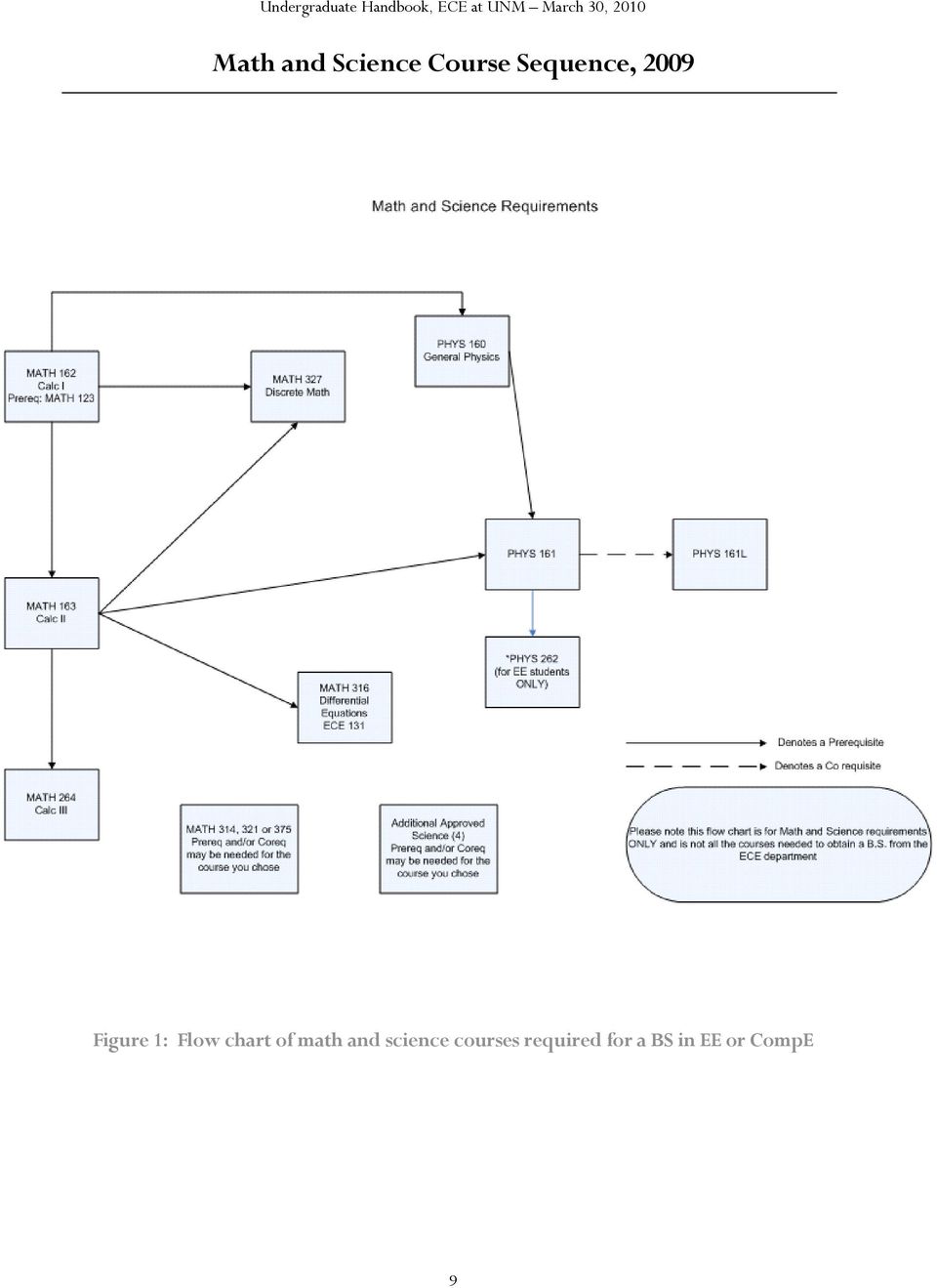
9 Program Objectives To fulfill ECE's vision and serve its constituents, the objective of the department's undergraduate program is to educate students to become resourceful practitioners of engineering who: 1. are capable of using their engineering skills in industry and national laboratories or in the pursuit of their graduate education; 2. are knowledgeable about the professional responsibilities and social context associated with being an engineer; 3. can work in teams and effectively communicate the results of their work; 4. will develop their knowledge and skills throughout their careers; and 5. function well in a diverse environment. Mandatory Academic Advising Upon admission to ECE, each student is assigned a faculty advisor whom the student must see for formal advisement twice a year once in November and once in April. The purpose of this mandatory advising is to help the student with any questions or problems they may have related to their program of study. All students in the Electrical Engineering and Computer Engineering programs are required to attend this advising session before they are allowed to register for the next term. The department places a hold on each student's records each semester, and it is not removed until the student has seen their faculty advisor. Each student receives an from their faculty advisor inviting them to sign up electronically for an advising date and time. This session is scheduled for the week prior to pre-registration for the coming semester, and it is imperative that students make and keep their appointments during the scheduled week. If a student is not able to attend during that week, it is the student's responsibility to track down their faculty advisor to schedule another time. Mathematics Placement and Prerequisites Students are given math placement exams during Lobo Orientation when they first arrive on campus to determine what level of mathematics they can register for. Placement in mathematics courses at UNM is determined by the student's ACT and SAT quantitative scores. In general, to enroll in Math 162 (calculus I) the student must have an ACT math score greater than 25 or an SAT quantitative score greater than 640. If the student has not yet completed Math 123 (trigonometry), which is a prerequisite for Math 162, he/she must take the trigonometry exam offered at the UNM Testing Division in the Office of Undergraduate Studies or else enroll concurrently in Math 123. The lowest-level math course in the ECE curriculum is Math 162. Prerequisite courses must be satisfied with a grade of C or better in accordance with UNM's core curriculum. Engineering Mathematics Sequence )---> >150--->162--->163 )--->314 )--->316 8

10 Undergraduate Handbook, ECE at UNM March 30, 2010 Math and Sciencee Course Sequence, 2009 Figure 1: Flow chart of math and science courses required for a BS in EE or CompE 9
11 Departmental Honors Students in their junior year who have a degree grade point average of or above are invited by letter to apply for departmental honors. If the student wishes to complete the two courses required for these honors ECE 493 and ECE 494 he/she should pick up the application for honors from the undergraduate academic advisor in ECE Room 115. The student completes both courses with the same professor in two consecutive terms, and the project is determined by the professor and the student. Challenge Examinations Challenge examinations may be administered to students who wish to establish credit for courses in the Electrical Engineering or Computer Engineering program. This process is subject to restrictions described in the UNM Catalog. A student may not challenge a course that he/she has taken previously at UNM, including courses with W, WP and WF grades. A course can be challenged only once. For students who were exposed to nontransferable similar material at another institution, the amount of effort required to review for a challenge examination is a major consideration. Frequently, the effort required to review for a challenge examination may be comparable to that required for taking the course. The procedure for challenging a course is: 1. An Electrical Engineering or Computer Engineering professor reviews a student's background and recommends a course challenge to the Undergraduate Program associate chair. 2. The associate chair reviews the recommendation of the professor and suggests an appropriate professor to administer the challenge examination. 3. The student obtains the necessary UNM form from the School of Engineering Dean's Office and pays the appropriate fees for the course challenge. The authorization form is then signed by the associate chair and by the associate dean] of the School of Engineering. 4. The student takes the challenge examination and receives a credit or no-credit grade from the examiner. 5. The professor sends the form to the UNM Records & Registration Office (Office of the Registrar in Enrollment Management) to be recorded officially on the student s transcript. There is no fixed format for a challenge exam. For a lecture course, a challenge may require that a student take a special comprehensive final examination. Alternatively, for example, the examiner may require that the student take the periodic examinations of a section of her/his course during an academic session and then take the final examination. The intent of the challenge is to determine whether the student knows the course material and whether the student's knowledge and experience is equivalent in all respects to the course content as described in the UNM Catalog and as reported to ABET. Challenges of laboratory courses must demonstrate proficiency in oral and written communication, in related theory, and in laboratory practice, and must satisfy any design requirements. Course Credit and Proficiency Credit for prerequisite courses does not guarantee that a student will be successful with succeeding courses. Frequently, a student must make a comprehensive review of prerequisite course material or retake courses if it has been a long time since these subjects were studied. It is assumed by instructors that students are proficient in the areas covered by prerequisite science, mathematics, computer and engineering courses. 10

12 English Proficiency A uniform graduation requirement of UNM is that students demonstrate English proficiency. Evidence of this is a grade of "C" or better in English 102. An equivalent English writing course may be transferred from a regionally accredited institution. A "C" or better in English 101 is required for admission to the Electrical & Computer Engineering Department and for study of English 102. English 102 must be completed with a grade of "C" or better before taking ECE 206L. All laboratory courses that have ECE 206L in the chain of prerequisites must necessarily have English 102 as a prerequisite. This applies to ECE 419, ECE 420, ECE 491, ECE 493 and ECE 494. A student may be dropped from any of these courses for not having the proper prerequisites or may not receive credit in the course if English 102 is not completed with a grade of "C" or better before entering one of these courses. Technical proficiency and laboratory performance alone are not sufficient for credit in the laboratory courses: students must demonstrate proficiency in oral and written communication, including formal reports. Also see the Eight-Hour Rule, which follows. Note: A student who receives an ACT score of 25 or higher (prior to October 1989), an ACT score of 29 or higher (after October 1989), an SAT score of 570 or higher (prior to April 1995), or an SAT score of 650 or higher (after April 1995) is considered to have met the English writing proficiency requirement and does not need to take English 101 or English 102. All students, however, must have at least 128 acceptable credit hours to receive a bachelor's degree from UNM; so students exempted from English 101 and English 102 may have to take additional hours to bring their total to at least 128. Eight-Hour Rule With the exception of Math 316, students are not to enroll for 300-level courses and above unless they are within eight (8) hours of completing their first- and second-year requirements and they are enrolled for the remaining first- and second-year courses. Technology Courses The basic policy of ABET, which accredits engineering programs and some technology programs, is that technology courses are not engineering courses. Although technology courses do not apply toward an engineering degree, many institutions that have technology programs offer support courses in mathematics, science, computer programming, and social sciences that may transfer and apply to the Electrical & Computer Engineering Department's course requirements. Courses taken at an institution that is a member of a regionally accredited college or university are more easily transferred. These courses must be equivalent to or better than the required courses in the Electrical Engineering and Computer Engineering programs at UNM. If an institution is not regionally accredited, students must work with the appropriate UNM departments to establish equivalency of credits. The ECE academic advisor or faculty advisor should first be consulted in either case. Inapplicable Courses Courses from engineering-like programs, as well as from engineering programs that are not accredited by ABET, are generally not applicable toward the Electrical Engineering or Computer Engineering bachelor's degrees at UNM. However, a student wishing to transfer from such programs may be permitted to take challenge exams in specific courses and hence obtain credit for the same. See preceding section on Technology Courses. 11

13 Grades of C-, D or F, and Replacing Grades Starting in fall 1993, ECE will not accept grades of D or F in any of the courses required to complete the bachelor of science degree in Electrical Engineering or Computer Engineering. Beginning in spring 2005, ECE will not accept grades of C- or lower. A student is allowed to replace twelve (12) hours of D or F grades. This action is not automatic: a form available at the UNM Records & Registration Office or in ECE Room 115 must be completed and submitted to the Records Office before such a replacement can take effect. In addition, the School of Engineering prohibits granting a bachelor of science degree in any branch of engineering if thirty (30) or more semester hours applicable to a degree program have grades of D, F, WF or NC. Three Attempts Rule Students admitted to the Electrical & Computer Engineering Department for or after the fall 2003 semester must successfully complete all coursework required for graduation in a School of Engineering degree program within three (3) attempts. This includes courses offered by other departments at UNM, such as Mathematics and Physics. An attempt includes receiving any letter grade (A through F), WP, WF, W, WNC, CR, NC, I, or Audit. For purposes of this requirement, coursework taken at other institutions is treated the same as UNM coursework. Credit/No-Credit Option An Electrical Engineering or Computer Engineering student may choose a maximum of nine (9) credit/nocredit hours from the humanities, social science, fine arts, and second language elective categories. All other courses in the ECE program must be taken for a grade. College Level Examination Program (CLEP) UNM participates in the College Level Examination Program (CLEP). To receive credit for a CLEP exam, the student must take a CLEP subject exam. To receive credit under CLEP, the exam must be taken prior to earning 26 hours of acceptable college work. Note: the ECE Department accepts credit based on an ACT score of 29 or higher or an SAT score of 650 or higher for English 101 and English 102. In this case, the number of required semester hours for the bachelor of science degree will be reduced by six (6) but must not fall below 128. High ACT or SAT scores in other subjects do not convey semester hour credits. College Entrance Examination Board (CEEB) Advanced Placement UNM participates in the Advanced Placement Program of the College Entrance Examination Board (CEEB). Credits that are applicable to the bachelor of science degree may be granted. Prospective students are encouraged to read the UNM Catalog for details. It is possible for students to obtain credit for certain mathematics, physics, chemistry, computer science, English, humanities, and social science courses. 12

14 Scholarships UNM's School of Engineering has a number of scholarships that it awards to engineering students. Students apply for scholarships in the spring semester, and the scholarships are awarded for the next academic year and run for the full year. Some scholarships are designated for specific degree programs, such as Electrical Engineering or Computer Engineering, or for minorities, women, and others. An effort is made to distribute undesignated scholarships as widely as possible, so some awards are small. Students are encouraged to make an application on a relatively simple and short form. Application forms are available from the School of Engineering Scholarships Program manager, located in the Centennial Engineering Center, Pre-Major Office, Room 2080, or on the Engineering Student Services website, Application forms are available in early spring each year. Additional scholarship notices are sent out periodically by from the academic advisor, so it is important for a student to read his or her and to read hard-copy letters that are sent from the ECE Department to their home address. Student s Responsibility to Read and Hard-Copy Letters It is your responsibility to do both. Neither the academic advisor nor the faculty advisor can take responsibility should you miss an important deadline such as when to drop classes with or without receiving a grade, paying tuition, when to apply for scholarships, and other important deadlines if you neglect to read these notices. Cooperative and Part-Time Study Programs Electrical & Computer Engineering students may participate in the Cooperative Education Program. This program alternates periods of school with periods of practical work experience in a technical job. Many companies inside and outside of New Mexico participate in this program, and it has two advantages. First, it enables students to earn money. Second, it provides first-hand engineering experience and motivation for study. Credit may be earned toward the degree by taking the co-op courses Engr 109, 110, etc., and writing a report based on work experience. The ECE co-op advisor sets guidelines for writing these reports. For information about what co-op jobs are available, see the engineering director of Cooperative Education, who is the associate dean of the School of Engineering. The School of Engineering also sponsors part-time study programs. For uniformity in meeting ABET accreditation requirements, co-op credits can be applied as one technical elective only if a student has completed three (3) engineering co-op work phases and has completed the corresponding three (3) engineering co-op evaluation phases. The engineering co-op evaluation phase entails writing a paper detailing the previous semester's work experience. If a student receives three (3) one-hour credits from three (3) engineering co-op evaluation phases, these three credits may take the place of the one (1) required technical elective in the program. Students must maintain a minimum 2.50 degree GPA and be in good standing to participate in the co-op program. 13
15 Minor Studies Since spring 1995, the School of Engineering permits undergraduates to complete and receive recognition for study in a minor. Students wishing to complete a minor: 1. must meet the combined program requirements of their major and the minor at the time of graduation; 2. are subject to all current UNM core curriculum requirements; and 3. are not permitted to count any courses specifically required by the major degree toward the minor. Students desiring to pursue a minor should see their academic advisor to get the application form. Students should be aware that pursuing a minor may extend the time of graduation. Seniors Planning for Graduate Study The Electrical & Computer Engineering Department offers programs of study toward the master of science and doctor of philosophy degrees. Consult the graduate programs sections of the UNM Catalog and contact the ECE Department's graduate coordinator for detailed information. Senior students with a GPA of 3.0 or greater who are within 10 semester hours of completing the baccalaureate degree may obtain graduate credit for a maximum of nine semester hours, provided that they meet the requirements specified in the graduate sections of the UNM Catalog. Students may receive graduate credit only for 400-level ECE courses marked by an asterisk (*). Nondegree students taking 400-level courses must obtain permission from the course instructor to obtain graduate credit. Application for Degree During the second semester of a student's junior year, or prior to enrollment in the 100th credit hour for the degree, a student is required to file the "Application for an Undergraduate Degree." This form may be obtained from the academic advisor in ECE Room 115. Failure to complete this form may delay graduation. Probation, Dismissal and Suspension The School of Engineering uses two probationary procedures: 1. A student enrolled in the School of Engineering will be placed on academic probation when the cumulative grade point average of all work taken at UNM falls below A student enrolled in the School of Engineering will be placed on Engineering School Probation under any of the following conditions: a) When in a pre-major status, a cumulative grade point average, based on work taken at UNM and applicable to a particular School of Engineering program leading to a bachelor of science degree, falls below 2.20, or below 2.00 in the most recent semester; b) When in a department degree status, a cumulative grade point average based on work taken at UNM and accepted toward a particular School of Engineering program leading to a bachelor of science degree, falls below a 2.00, or below 1.50 in the most recent semester; or c) When, in either pre-major status or department degree status, the student is making unsatisfactory progress toward a School of Engineering degree. 14

16 Students on probation are subject to suspension from UNM or dismissal from the School of Engineering if their UNM GPA is below a 2.0. See the UNM Catalog for the pertinent regulations. Students in the ECE Department may be placed on probation for noncompliance with academic regulations such as the Eight-Hour Rule (see above) and prerequisite requirements and in general taking courses that are not contributing to progress toward obtaining their degree. Repeated violations will result in dismissal from the ECE Department. Returning to the ECE Department After Dismissal Readmission to the ECE Department after dismissal from the School of Engineering is not automatic. A student is usually eligible to go back to University College or be accepted at the College of Arts & Sciences and take non- ECE courses during the semester they have been dismissed from the ECE Department. If they have a good semester and receive at least a 2.50 on the courses taken in University College or Arts & Sciences, they are eligible to reapply to the ECE Department by filling out the admissions form, which is subject to the review of the associate chair for Undergraduate Programs. There is no guarantee that a student will be readmitted after being dismissed. It is suggested that a student who has been dismissed consider a different major. For re-admission, the student may be required to complete an Academic Success Plan. This plan states which courses the student is limited to taking, with an overall GPA of 2.50 being required. Successful completion of an Academic Success Plan is an indication that an Electrical Engineering or Computer Engineering major is a good fit for the student. On successful completion of the specified courses with the requisite grades, a student can be readmitted to ECE. UNM-CNM Cooperation It is possible to take a number of courses in either Electrical Engineering or Computer Engineering at Central New Mexico Community College (CNM) and apply them to a degree at UNM. Courses taken at CNM may be used to satisfy requirements, although the grades earned are not used in calculating your GPA. 15

17 University of New Mexico Core Curriculum Effective fall 1999 for both Electrical and Computer Engineering students 37 hours of specific courses necessary to graduate from UNM; grades of C (not C-) or better are required Writing and Speaking (9 hours) English 101, 102, and 219 Already covered in the ECE degree program Mathematics (3 hours) Already covered in all School of Engineering degree programs Physical/Natural Sciences (7 hours) Already covered in all School of Engineering degree programs Social and Behavioral Sciences (6 hours) See list on next page Humanities (6 hours) See list on next page Second Language (3 hours) See list on next page This core curriculum applies to all students who entered the University of New Mexico for the fall 1999 semester or later, as freshmen or transfer students or re-entering the university after an absence of three or more sessions, including summer, except second-degree students and individual exceptions. The core curriculum does not apply to students who were enrolled in UNM prior to fall 1999 unless they were readmitted after an absence of three or more sessions. The previous humanities and social sciences requirements apply to all students who are currently enrolled in the Electrical & Computer Engineering Department. An updated list was issued in fall However, current students have the option of graduating under the newer rules that govern UNM's core curriculum. Fine Arts (3 hours) See list on next page 16

18 Core Electives for Electrical and Computer Engineering Students Effective in or after fall 1999 Social and Behavioral Sciences Two courses chosen from among the following: American Studies 182 and 185 Anthropology 101 and 130 Economics 105 and 106 Geography 102 Linguistics 101 Political Science 110 and 200 Psychology 105 Sociology 101 Engr-F Technology in Society Humanities Two courses chosen from among the following: American Studies 186 Classics 107, 204, and 205 Comparative Literature and Cultural Studies 223 and 224 English 150, 292, and 293 Foreign Languages (M Lang) 101 History 101, 102, 161, and 162 Philosophy 101, 201, and 202 Religious Studies 107 Second Language One course chosen from any of the lower division non-english-language offerings of the departments of Linguistics, Spanish & Portuguese, and Foreign Languages & Literature. Students with knowledge of a second language equivalent to four semesters of study are deemed to have satisfied this requirement. CLEP and AP credits can be used for placement, but unless the student has demonstrated knowledge equivalent to four semesters of study, an additional semester of a second language must be taken. Fine Arts One course chosen from among the following: Art History 101, 201, and 202 Dance 105 Media Arts 210 Music 139 and 140 Theater 122 Students may instead elect to take one three-credit studio course in the departments of Art & Art History, Music, Theater & Dance, or Media Arts to fulfill this requirement. 17
19 The Undergraduate Program in Electrical Engineering This handbook describes two electrical engineering curricula, one for students who entered the EE program in or after the fall 2005 semester and the other for students who entered in or after fall A few changes were made in 2007 that are incorporated into the 2005 sheet. The EE curriculum for students entering in or after the fall 2005 semester is used for most students admitted to ECE before fall The prerequisite flow chart shows the sequence in which these courses should be taken. If the recommended sequence is not followed, the student may be unprepared for some courses, which can extend the number of semesters needed to graduate. The flow chart does not show details about course prerequisites and corequisites and is not a substitute for the UNM Catalog. The EE program is divided into several areas of concentration, or tracks: Digital Systems, Electromagnetics, Microelectronics, Optics, Power/Energy Systems, Signals and Communication, and Systems and Controls. A Power and Energy track is the most recent addition, reflecting the sustainability and "green" objectives of today's engineering disciplines. A grade of C or better is required for all courses, including the UNM Core Curriculum courses, prerequisite courses, and courses required to obtain a bachelor of science degree in electrical or computer engineering. 18

20 Electrical Engineering Course Sequence Figure 2: Flow chart of Electrical Engineering Program courses 19

21 BS Electrical Engineering Graduation Requirements University of New Mexico, Effective Fall 2009 Total credit hours: 129; All grades must be C or better For more information, see the other pages in this Undergraduate Handbook, available online at General Education Component Written Communication (9 credit) Engl 101, 102 Composition I, II (6) Engl 219 Technical Writing (3) Area of Knowledge (18 credits) Core Social/Behavioral Science Elect. (3) Econ 105 or 106 Social & Beh. Science (3) Core Humanities Elective (6) Core Fine Arts Elective (3) Core Second-Language Elective (3) Mathematics & Sciences Component Mathematics (18 credits) Math 162, 163, 264 Calculus I, II, III (12) Math 316 Differential Equations (3) Math 314 Linear Algebra (3) Science (14 credits) Phys 160*, 161*, 161L*, 262* General Physics (10) Chem 121 and Chem 123L* (4) Electrical Engineering Component Required (36 credits) ECE 101 Introduction to ECE (1) ECE 131 Computer Prog. Fundamentals (3)* ECE 203 Circuit Analysis I (3)* ECE 206L Instrumentation (2) ECE 213 Circuit Analysis II (3) ECE 238L Computer Logic Design (4) ECE 314 Signals & Communication (3) ECE 321L Electronics I (4) ECE 340 Probabilistic Methods (3) ECE 344L Microprocessors (4) ECE 419 Senior Design I (3) ECE 420 Senior Design II (3) EE Completeness (19 credits) ECE 322L Electronics II (4) ECE 345 Intro to Control Systems (3) ECE 360 Electromag. Fields & Waves (3) ECE 371 Materials & Devices (3) ECE 342 Intro to Comm. Systems (3) ECE 381 Intro to Power Systems (3) Track Electives (6 credits - depth) Two courses from six tracks (6). The available tracks are: - Digital Systems - Electromagnetics - Microelectronics - Optics - Power/Energy Systems - Signals and Communications - Systems and Controls Technical Electives (6 credits - breadth) ECE technical elective (3) Approved 300-level and above courses may include ECE 231, Intermediate Programming (3) Eighteen hours of prerequisite courses must be completed prior to applying to the department. A GPA of 2.50 or better on prerequisite coursework is required for admission into the department, and a student's overall GPA must not fall below 2.0 Denotes required prerequisites that must be completed prior to applying for admission to ECE. * Ten additional hours of prerequisite course work must be chosen from these courses 20
22 University of New Mexico BS Electrical Engineering Curriculum Effective Fall 2009 (129 Hours) UNM Core Curriculum Effective Fall 1999 Math 162 Calculus I 4 ECE 101 Intro to ECE 1 Phys 160 Gen Physics 3 ECE 131 Prog Fund 3 Econ 105 or Econ 106* 3 Engl 101 Wrtg w/rdgs. in Expos 3 17 ECE 203 Circuit Anal. I 3 ECE 344L Microprocessors 4 Math 264 Calculus III 4 Phys 262 Gen Physics 3 Math 316 Diff Equations 3 17 Freshman Year Math 163 Calculus II 4 Core Humanities Elective* 3 Chem 121 Gen Chemistry 3 Chem 123L Gen Chem Lab 1 Phys 161 Gen Physics 3 Phys 161L Physics Lab 1 Engl 102 Analytical Writing 3 18 Sophomore Year ECE 206L Instrumentation 2 ECE 213 Circuit Anal. II 3 ECE 238L Comp Logic Design 4 English 219 Tech Writing 3 Math 314 Linear Algebra 3 15 ECE 314 Sig & System 3 ECE 321L Electronics I 4 ECE 340 Prob Methods 3 EE Completeness Course 3 EE Completeness Course 3 16 EE Completeness Course 3 Track Elective** 3 ECE 419 Senior Design I 3 ECE Tech Elective 3 Core Fine Arts Elective* 3 15 Junior Year EE Completeness Course 3 or 4 EE Completeness Course 3 ECE Tech Elective 3 Core Humanities* 3 Core 2nd Language Elective* 3 15 or 16 Senior Year EE Completeness Course 3 or 4 Track Elective** 3 ECE Tech Elective 3 ECE 420 Sr Design II 3 Core Soc/Beh Science* 3 15 or * See approved list of core electives in ECE Undergraduate Handbook ** Six hours (two courses) must be from a listed track. Six hours of technical electives are required. Technical electives must be approved by your faculty advisor and must be 300-, 400- or 500-level courses. - Grades must be C or better for all courses in the Electrical Engineering Program EE completeness courses offered in fall are ECE 345 (3), ECE 371 (3), and ECE 381 (3) EE completeness courses offered in spring are ECE 322L (4), ECE 341 (3), and ECE 360 (3) 21
23 Electrical Engineering Track and Technical Electives, Fall 2009 (electives effective in or after the fall 2005 semester are listed on a later page) There are six hours of track electives in the Electrical Engineering program. Students select a track (area of specialization) from the following: Signals and Communications Systems and Controls Electromagnetics Microelectronics Digital Systems Optoelectronics The courses required for each track are listed on the following pages. In addition to the two track electives, students choose three technical electives. Approved 300-level and above courses may include ECE 231, Intermediate Programming. Students may design their own tracks in consultation with their advisor as long as the two courses chosen present a coherent sequence. A custom track must be approved by the student's advisor and the associate chair of the department. Note that while all of the required courses in the Electrical Engineering Program are given every semester, most of the technical electives are only offered every other semester, so some planning is essential to ensure that you get the course you want when you want it. In the 2009 EE Program, the EE tracks with completeness entry courses are listed below: Signals and Communications: Completeness Entry Course Track: ECE 439 Introduction to Digital Signal Processing ECE 441 Introduction to Communication ECE 442 Wireless Communications Technical electives (9 credits): approved 300-level and above courses may include ECE 231, Intermediate Programming Systems and Controls: Completeness Entry Course: ECE 345 Introduction to Control Systems Track: Robotics Class ECE 446 Design of Feedback Control Systems Technical electives (9 credits): approved 300-level and above courses may include ECE 231, Intermediate Programming Electromagnetics: Completeness Entry Course, ECE 360 Electromagnetic Fields and Waves Track: ECE 469 Antennas for Wireless Communication Systems ECE 464 Laser Physics I Technical electives (9 credits): approved 300-level and above courses may include ECE 231, Intermediate Programming Microelectronics: Completeness Entry Course: ECE 322L Electronics II and ECE 371 Materials and Devices Track: ECE 474L Microelectronics Processing I ECE 487 Semiconductor Factory Design and Operations Technical electives (9 credits): approved 300-level and above courses may include ECE 231, Inter-mediate Programming Computer Systems: Completeness Entry Course, ECE 131 Computer Programming Fundamentals ECE 238L, Computer Logic Design Track: ECE 338 Intermediate Logic Design ECE 438 Design of Computers - or - ECE 231 Intermediate Programming and Engineering Problem Solving ECE 331 Data Structures and Algorithms Technical electives (9 credits): approved 300-level and above courses may include ECE 231, Inter-mediate Programming Energy/Power Systems: Completeness Entry Course: ECE 378, Introduction to Power Systems Track: ECE 482 Electric Drives and Transformers ECE 483 Power Electronics ECE 484 Photovoltaics ECE 488 Future Energies Technical electives (9 credits): approved 300-level and above courses may include ECE 231, Inter-mediate Programming Optoelectronics: Completeness Entry Course: ECE 371 Materials and Devices Track: ECE 471 Materials and Devices II ECE 475 Optoelectronics Technical electives (9 credits) Technical electives (9): approved 300-level and above courses may include ECE 231, Intermediate Programming 22
24 BS Electrical Engineering Graduation Requirements University of New Mexico, Effective 2005 and 2007 General Education Component Written Communication (9 credits) Engl 101, 102 Composition I,II (6) Engl 219 Technical Writing (3) Area of Knowledge (18 credits) Core Social/Behavioral Science Elect. (6) Core Humanities Elective (6) Core Fine Arts Elective (3) Core 2nd-Language Elective (3) Mathematics & Science Component Mathematics (18 credits) Math 162, 163, 264 Calculus I,II,III (12) Math 316 Differential Equations (3) Math 314 Linear Algebra (3) Science (14 credits) Phys 160*, 161*, 161L*, 262* General Physics (10) Chem 121L* (4) Electrical Engineering Component Required (61 credits) ECE 101 Introduction to ECE (1) ECE 131 Programming Fundamentals (3)* ECE 231 Intermediate Programming (3) ECE 203 Circuit Analysis I (3)* ECE 206L Instrumentation (2) ECE 213 Circuit Analysis II (3) ECE 238L Computer Logic Design (4) ECE 314 Signals & Systems (3) ECE 321L Electronics I (4) ECE 322L Electronics II (4) ECE 340 Probabilistic Methods in Eng. (3) ECE 344L Microprocessors (4) CE 304 Engineering Mechanics (4) CE/ME 350 Engineering Economy (3) ECE 360 Electromag. Fields & Waves (3) ECE 371L Materials & Devices (4) ECE 409 Engineering Ethics ECE 419L Senior Design I (3) ECE 420L Senior Design II (3) ECE 445 Intro. to Control Syst (3) Track Electives (6 credits) Two courses from a single track (6). The available tracks are: - Digital Systems - Electromagnetics & Optics for Communication - Microelectronics - Signals and Communications - Systems and Controls Technical Electives (6 credits) ECE technical elective (3) Remaining course may be in math, physics, CS, or mechanical, civil, chemical or nuclear engineering (3) Eighteen hours of prerequisite courses must be completed prior to applying to the department. A GPA of 2.5 or better on prerequisite coursework is required for admission into the department. A student s overall GPA must not fall below 2.0. Denotes required prerequisites that must be completed prior to applying to the Electrical Engineeering Program * Ten additional hours of prerequisite course work must be chosen from these courses. 23
25 University of New Mexico BS Electrical Engineering Curriculum Effective Fall 2005 (132 hours); UNM Core Curriculum Effective Fall 1999 Math 162 Calculus I 4 ECE 101 ECE Prob Solv 1 Phys 160 Gen Physics 3 ECE 131 Prog Fund 3 Core Social/Beh Sci Elective* 3 Engl 101 Wrtg w/rdgs in Expos 3 17 ECE 203 Circuit Anal I 3 ECE 238L Comp Logic Des 4 Math 264 Calculus II 4 CE 304 Stat/Dyn 4 Math 316 Diff Equations 3 18 Freshman Year Sophomore Year Math 163 Calculus II 4 ECE 231 Interm Program 3 Chem 121L Gen Chemistry 4 Phys 161 Gen Physics 3 Phys 161L Physics Lab 1 Engl 102 Analytical Writing 3 18 ECE 206L Lab I 2 ECE 213 Circuit Anal II 3 Math 314 Linear Algebra 3 Phys 262 Gen Physics 3 Engl 219 Tech Writing 3 14 ECE 371 Matrl/Devices 4 ECE 321L Electronics I 4 ECE 344L Microprocess 4 Core Humanities Elective* 3 ECE 314 Sig & Comm 3 18 ME/CE Engr Economy ECE 419L Sr Design I 3 Core Social/Behavioral Science Elective * 3 Track Elective** 3 ECE 445 Intro Cont Sys 3 15 Junior Year ECE 340 Prob Meth 3 ECE 322L Electronics II 4 ECE 360 ElectroFlds&Waves 3 Track Elective** 3 Core 2nd-Language Elective 3 16 Senior Year Tech Elective 3 Tech Elective 3 ECE 420L Sr Design II 3 ECE 409 Engr Ethics 1 Core Humanities Elective* 3 Core Fine Arts Elective* * See approved list of core electives in the ECE Undergraduate Handbook ** Six (6) hours (two courses) must be from a listed track. Of the six (6) hours of technical electives, one must be an ECE upper-level course and the remaining three (3) hours must be approved in writing by the ECE Department and must be a 300-, 400- or 500-level course in math (except Math 345, 441, or 461), physics, computer science, or another engineering department. - All grades must be C or better for the Electrical Engineering Program 24
26 Electrical Engineering Track and Technical Electives, Fall 2005 (electives effective in or after the fall 2009 semester are listed on a preceding page) There are five hours of track electives in the Electrical Engineering program. Students select a track (area of specialization) from one of the following five areas: Digital Systems Electromagnetics and Optics for Communications Microelectronics Signals and Communications Systems and Controls The courses required for each track are listed on this and the following pages. In addition to the two track electives, students choose two technical electives. One technical elective may be a course in another area of concentration. Not all of the possible technical electives are listed. One technical elective must be an ECE course. The other technical elective must be approved in writing by an advisor and must be from 300-, 400- and 500-level courses in math (except Math 345, 441, or 461), physics, computer science, or another engineering department. The following list includes suggested technical electives that are related to the tracks, for students wishing to specialize further. Students may design their own tracks in consultation with their advisor as long as the two courses chosen present a coherent sequence. A custom track must be approved by the student's advisor and the associate chair of the department. Note that while all of the required courses in the Electrical Engineering Program are given every semester, most of the technical electives are only offered every other semester, so some planning is essential to ensure that you get the course you want when you want it. EE Undergraduate Tracks Signals and Communications: ECE 439 Introduction to Digital Signal Processing ECE 442 Wireless Communications Systems and Controls: ME 481 Digital Control of Mechanical Systems ECE 446 Design of Feedback Control System Electromagnetics and Optics for Communications: ECE 469 Antennas for Wireless Communication Systems ECE 464 Laser Physics I Appropriate electives: Physics 302 Optics ECE 463 Advanced Optics I ECE 475 Introduction to Electro-Optics and Optoelectronics Math 466 Mathematical Methods in Science and Engineering Microelectronics: ECE 474L Microelectronics Processing I ECE 487 Semiconductor Factory Design and Operations Appropriate electives: ECE 471 Materials and Devices II ECE 486 Design for Manufacturability Digital Systems: ECE 338 Intermediate Logic Design ECE 438 Design of Computers Appropriate electives: ECE 337 Introduction to Computer Architecture and Organization ECE 433 Computer Graphics ECE 439 Introduction to Digital Signal Processing ECE 443 Hardware Design with VHDL ECE 520 VLSI Design (must meet UNM requirements to take for undergraduate credit) 25
27 The Undergraduate Program in Computer Engineering The Computer Engineering curricula for those students entering the ECE Department in or after fall 2005 and for those students entering ECE in or after fall 2009 are outlined on the following pages. The 2009 curriculum is used for most students admitted to the Computer Engineering Program in or after fall It is the student's responsibility to fulfill all degree requirements. The prerequisite flow chart shows the sequence in which these courses should be taken. If the recommended sequence is not followed, the student may be unprepared for some courses, which can extend the number of semesters needed to graduate. The flow chart does not show details about course prerequisites and corequisites and is not a substitute for the UNM Catalog. The Computer Engineering Program offers three tracks: software, hardware, or digital media. Students must take two classes from the track of their choice. The tracks and appropriate technical electives give the student a broad education in the track of their choice. Computer engineering is a profession that places the engineer in the middle of an exciting, rapidly growing field with virtually unlimited opportunities in industry, education and government. Computer engineers are involved in design and analysis of a range of systems, including microprocessors and computers, embedded devices and robotics, learning machines, high-performance networking and wireless communications, and high-performance parallel and distributed computing systems. Computer engineers also specialize in algorithm engineering, software engineering, image processing, computer vision, user interface design, knowledge management, instrumentation, visualization, virtual reality, government security, and computer simulations and graphics. The ECE Department, through its Computer Engineering Program, also participates in UNM's Interdisciplinary Film and Digital Media program in collaboration with the College of Fine Arts, the Computer Science Department, the Anderson School of Management, the Department of Communication & Journalism, and the UNM ARTS Lab (Art, Research, Technology and Science). ECE's Computer Engineering Program is involved in cutting-edge research and offers courses that give students experience with numerous new technologies that are helping to shape today's world. 26
28 Math 162 Calculus I 4 ECE 101 Intro to ECE 1 Phys 160 Gen Physics 3 ECE 131 Computer Prog Fund 3 Econ 105 or 106 social/beh sci elective* 3 Engl 101 Wrtg w/rdgs in Expos 3 17 ECE 203 Circuit Analysis I 3 ECE 238L Comp Logic Des 4 Engl 219 Tech Writing 3 Basic science w/lab 4 Math 316 Diff Equations 3 17 Undergraduate Handbook, ECE at UNM March 30, 2010 University of New Mexico BS Computer Engineering Curriculum Effective Fall 2009 (128 hours) UNM Core Curriculum, Fall 1999 Freshman Year Sophomore Year Math 163 Calculus II 4 ECE 231 Interm Program 3 Phys 161 Gen Physics II 3 Phys 161L Physics Lab 1 Engl 102 Analytical Writing 3 Core humanities elective* 3 17 ECE 206L Lab I 2 ECE 213 Circuit Anal II 3 Math 314, 321 or Math 264 Calculus III 4 ECE 330 Software Design 3 15 ECE 321L Electronics I 4! Math 327 Discrete Math 3 Core second-language elective* 3 ECE 314 Signals & Comm 3 ECE 340 Prob Meth 3 16 ECE 419 Senior Design I 3 ECE 437 Operating Systems 3 Senior elective *** 3 Senior elective *** 3 ECE track elective** 3 15 Junior Year ECE 344L Microprocessors 4 ECE 331 Data Struct & Alg 3 ECE 337 Computer Org 3 Track elective** 3 Core soc/beh sci elective 3 16 Senior Year Senior elective*** 3 ECE 420 Senior Design II 3 ECE 440 Computer Networks 3 Core humanities elective* 3 Core fine arts elective* * See approved list of core electives in the ECE Undergraduate Handbook ** ECE track electives consist of ECE 338 and 438, or ECE 335 and 435. *** Senior electives are developed in consultation with your academic advisor and can be taken from ECE, computer science, physics, or other engineeringrelated courses. No grades below a C are allowed in the Computer Engineering Program. Updated June 28,
29 University of New Mexico BS Computer Engineering Graduation Requirements Effective Fall 2009 Total credit hours: 128; All grades must be C or better in the Computer Engineering Program For more information, see the ECE Undergraduate Handbook at General Education Component Written Communication (9 credits) Engl 101, 102 Composition I,II (6) Engl 219 Technical Writing (3) Area of Knowledge (18 credits) Core Social/Behavioral Science Elect. (3) Econ 105 or 106 (3) Core Humanities Elective (6) Core Fine Arts Elective (3) Core 2nd-Language Elective (3) Mathematics & Sciences Component Mathematics (21 credits) Math 162, 163, 264 Calculus I, II, III (12) Math 316 Differential Equations (3) Math 314, 321 or 375 Linear Algebra or Numerical Computing (3) Math 327 Discrete Mathematics (3) Science (11 credits) Phys 160*, 161*, 161L*, General Physics (7) Additional approved basic sciences:* (4) (Biol 110 w/112l, 123 w/124l, 201, 202; Chem 121L, 131L; Phys 262 w/262l; or Astr 270 w/270l, 271 w/271l) Computer Engineering Component Required (54 credits) ECE 101 Introduction to ECE (1) ECE 131 Programming Fundamentals (3)* ECE 231 Intermediate Programming (3) ECE 203 Circuit Analysis I (3)* ECE 206L Instrumentation (2) ECE 213 Circuit Analysis II (3) ECE 238L Computer Logic Design (4) ECE 314 Signals & Communication (3) ECE 321L Electronics I (4) ECE 330 Software Design (3) ECE 331 Data Struct. & Algorith (3) ECE 337 Comp. Arch & Organization (3) ECE 340 Probabilistic Methods (3) ECE 344L Microprocessors (4) ECE 437 Operating Systems (3) ECE 440 Computer Networks (3) ECE 419 Senior Design I (3) ECE 420 Senior Design II (3) Track Electives Hardware Emphasis (15 credits) ECE 338 Intermed Logic Design (3) ECE 438 Design of Computers (3) -----OR Track Electives Software Emphasis (15 credits) ECE 335 Integrated Software Systems (3) ECE 435 Software Engineering (3) Technical Electives (9 credits).. Denotes required prerequisites that must be completed prior to applying. * Ten additional hours of prerequisite course work must be chosen from these courses. Eighteen hours of prerequisite courses must be completed prior to applying to the department. A GPA of 2.5 or better on prerequisite coursework is required for admission to the department. A student s overall GPA must not fall below
30 Undergraduate Handbook, ECE at UNM March 30, 2010 Computer Engineering Course Sequence, 2009 Figure 3: Flow chart of Computer Engineering Program courses 29
31 University of New Mexico BS Computer Engineering Curriculum Effective Fall 2005 (132 Hours) UNM Core Curriculum Effective Fall 1999 Freshman Year Math 162 Calculus I 4 Math 163 Calculus II 4 ECE 101 Intro to ECE 1 ECE 231 Interm Program 3 ECE 131 Progr Fund 3 Phys 161 Gen Physics II 3 Phys 160 Gen Physics I 3 Phys 161 Physics Lab 1 *Core soc/beh sci elective 3 Engl 102 Analytic Wrtg 3 Engl 101 Wrtg w/rdgs in Expos 3 *Core Humanities Elective Sophomore Year ECE 203 Circuit Anal I 3 ECE 206L Instrumentation 2 ECE 238L Comp Logic Des 4 ECE 213 Circuit Anal II 3 Math 316 Diff Equations 3 Math 314, 321, or Engl 219 Tech Writing 3 Math 264, Calculus II 4 Basic Science w/lab 4 ECE 330 Software Design Junior Year ECE 321 Electronics I 4 ECE Track elective** 3!Math 327 Discrete Math 3 ECE 331 DataStruct & Alg 3 ECE 314 Signals & Comm 3 ECE 344L Microprocessors 3 ECE 337 Computer Org 3 ECE 340 Probabilistic Meth 3 *Core 2 nd -language elective 3 ECE 409 Engr Ethics 1 *Core soc/beh sci elective Senior Year ECE 419 Senior Design I 3 ECE 420 Senior Design II 3 ECE track elective** 3 ECE 440 Computer Networks 3 ECE 437 Operating Systems 3 ***Senior elective 3 ***Senior elective 3 ***Senior elective 3 CE/ME 350 Engr Economy 3 *Core fine arts elective 3 *Core humanities elective * See approved list of core electives in the ECE Undergraduate Handbook ** ECE tracks consist of ECE 338 and 438, or ECE 335 and 435 *** Senior electives are developed in consultation with your academic advisor from courses in the ECE, computer science, physics or other engineering departments! Fall only in Math Department All grades must be C or better in the Computer Engineering Program. March 12,
32 The 3-2 BS/MBA Program Beginning with the fall 2003 semester, the ECE Department, in conjunction with UNM's Anderson School of Management, began offering the 3-2 BS/MBA degree program for ECE undergraduates interested in a master's degree in business administration. This program is suited for engineers who are less interested in a research career than in project management, management of technical development, or technical advisory services. Engineers who aspire to starting their own company or joining an entrepreneurial team may find that the 3-2 BS/MBA program can improve their chances of success. The 3-2 BS/MBA program enables School of Engineering undergraduates to receive their baccalaureate degree in engineering in four years and then complete requirements for an MBA from UNM's Anderson School of Management (ASM) during a fifth year of study. The program requires completion of some ASM courses during the undergraduate engineering program, and students earn dual credit for some required courses that count toward both the ECE and ASM degrees. ASM recommends that 3-2 program participants complete Business Calculus and Microeconomics before applying to the program. For the first three years of undergraduate study, the student pursues a normal ECE curriculum. During the junior year (90 hours), the student applies for admission to the MBA program at ASM. ASM directs that students should not take any management classes prior to their acceptance into the program, with the exception of Mgmt. 113 (Introduction to Management). In the senior year, the student begins the first year of the MBA program and also completes the requirements for a bachelor of science degree in EE or CompE. In the fifth year of study the student completes the second year of the MBA program. 31
33 3-2 BS/MBA Electrical Engineering Curriculum 134 hours B.S. plus 33 hours MBA, fall 1999 March 12, 2007 Math 162 Calculus I 4 ECE 101 ECE Prob Solv 1 Phys 160 Gen Physics 3 ECE 131 Prog Fund 3 *Core Social/Behavioral Science Elective 3 Engl 101 Wrtg w/rdgs in Expos 3 17 ECE 203 Circuit Anal I 3 ECE 238L Comp Logic Des 4 Math 264 Calculus II 4 CE 304 Stat/Dyn 4 Math 316 Diff Equations 3 18 Freshman Year Sophomore Year Math 163 Calculus II 4 ECE 231 Interm Program 3 Chem 121L Gen Chemistry 4 Phys 161 Gen Physics 3 Phys 161L Physics Lab 1 Engl 102 Analytic Wrtg 3 18 ECE 206L Lab I 2 ECE 213 Circuit Anal II 3 Math 314 Linear Algebra 3 Phys 262 Gen Physics 3 Engl 219 Tech Writing 3 14 ECE 371 Matrl/Devices 4 ECE 321L Electronics I 4 ECE 344L Microprocess 4 *Core Humanities Elective 3 ECE 314 Sig & Comm 3 18 Econ 300 Interm Micro 3 ECE 419L Sr Design I 3 Mgt 306 Organiz Beh & Diversity 3 Mgt 511 TechComm& Global 3 ECE 445 Intro Cont Sys 3 15 Junior Year ECE 340 Prob Meth 3 ECE 322L Electronics II 4 ECE 360 ElectroFlds&Waves 3 Mgt 502 Fin Acct I 3 Core 2nd-Language Elective 3 16 Senior Year ECE 441 Intro Comm Sys 3 Tech Elective** 3 ECE 420L Sr Design II 3 Mgt 508 Eth,Pol,Soc & Leg 3 *Core Humanities Elective 3 *Core Fine Arts Elective 3 18 Mgt 526 Fin Mgt 3 Mgt 522 Mkt Mgt 3 Mgt 500-Level Elective 3 Mgt 500-Level Elective 3 Mgt 500-Level Elective 3 ECE Elective 3 18 Graduate (Fifth) Year 32 Mgt 520 Oper & Prod Mgt 3 Mgt 598 Strategic Mgt 3 Mgt 500-Level Elective 3 Mgt 500-Level Elective 3 ECE Elective * See approved list of core electives ** One technical elective course must be approved in writing by the ECE Department and must be a 300-, 400- or 500-level course in math (except Math 345, 441, or 461), physics, computer science or another engineering department.
34 3-2 BS/MBA Computer Engineering Core Curriculum 134 hours B.S. plus 33 hours MBA, fall 1999 April 18, 2007 Math 162 Calculus I 4 ECE 101 ECE Prob Solv 1 Phys 160 Gen Physics 3 ECE 131 Prog Fund 3 Core social/behavioral science elective* 3 Engl 101 Wrtg w/rdgs in Expos 3 17 ECE 203 Circuit Anal I 3 ECE 238L Comp Logic Des 4 Math 316 Diff Equations 3 Engl 219 Tech Writing 3 Basic science with lab 4 17 ECE 321L Circuits I 4!Math 327 Discrete Math 3 ECE 314 Signals & Comm 4 ECE 337 Computer Org 3 Core second-language elect* 3 17 Econ 300 Interm Micro 3 ECE 419L Sr Design I 3 Mgt 306 Organizational Beh & Diversity 3 Mgt 511 Tech Comm & Global 3 ECE 437 Operating Systems 3 Tech elective** 3 18 Mgt 526 Fin Mgt 3 Mgt 522 Mkt Mgt 3 Mgt 500-level elective 3 Mgt 500-level elective 3 Mgt 500-level elective 3 ECE elective 3 18 Freshman Year Sophomore Year Junior Year Senior Year Graduate (Fifth) Year Math 163 Calculus II 4 ECE 231 Interm Program 3 Phys 161 Gen Physics 3 Phys 161L Physics Lab 1 Engl 102 Analytic Wrtg 3 Core humanities elective* 3 17 ECE 206L Lab I 2 ECE 213 Circuit Anal II 3 Math 314, 321, or Math 264, Calculus III 4 ECE 330 Software Design 3 15 ECE 340 Prob Meth 3 ECE 331 DataStruct&Alg 3 ECE 344L Microproc 4 Mgt 502 Fin Acct I 3 Core humanities elective* 3 16 Tech elective 3 Tech elective** 3 ECE 420L Senior Design II 3 ECE 440 Computer Networks 3 Mgt 508 Eth, Pol, Soc & Leg 3 *Core fine arts elective 3 18 Mgt 520 Oper & Prod Mgt 3 Mgt 598 Strategic Mgt 3 Mgt 500-level elective 3 Mgt 500-level elective 3 ECE elective * See approved list of core electives ** One technical elective course must be approved in writing by the ECE Department and may be a 300-, 400- or 500-level course in math (except Math 345, 441, or 461), physics, computer science or another engineering department.!math 327 is offered only in the fall by the UNM Math Department. 33
35 Electrical & Computer Engineering Department Faculty and their research interests Department Chairs Chaouki T. Abdallah, Professor, Department Chair; Ph.D., Georgia Tech., Control systems, adaptive control, nonlinear systems, robot control and coordination. Gregory L. Heileman, Professor, Associate Chair/Director of Undergraduate Programs; Ph.D., University of Central Florida, Parallel processing, neural networks, image processing, pattern recognition. Luke Lester, Professor, Interim Associate Chair/Director of Graduate Programs; Ph.D., Cornell, Highspeed and high-power semiconductor lasers; high-temperature electronics, microwave devices, tunable lasers, III-V semiconductor devices Wei Wennie Shu, Associate Professor, Associate Chair/Director of Graduate Programs (on sabbatical 2010); Ph.D., University of Illinois at Urbana-Champaign, Operating systems and resource scheduling, system support for parallel computing, multimedia networking. Professors Ganesh Balakrishnan, Assistant Professor; Ph.D. University of New Mexico, Optical sciences and engineering, electrical engineering, electronics and communications. Steven R. J. Brueck, UNM Distinguished Professor; IEEE Fellow; Ph.D., MIT, Laser-material interactions, electro-optic devices, laser spectroscopy. Director of UNM's Center for High Technology Materials. Vince D. Calhoun, Professor; Ph.D., University of Maryland, Image analysis and MRI research; Director, Image Analysis and MR Research at the Mind Research Network; joint appointments with Yale University Dept. of Psychiatry and UNM departments of Neuroscience and Computer Science. Thomas P. Caudell, Professor; Ph.D., University of Arizona, Neural networks, virtual reality, machine vision, robotics and genetic algorithms. Christos Christodoulou, Professor; IEEE Fellow; Ph.D., North Carolina State University, Electrical engineering, wireless communications, neural techniques in electronics, microstrip antennas, smart antennas, neural network applications in electromagnetics, frequency selective surfaces and antennas, couple infrared detectors. Rafael Fierro, Associate Professor; Ph.D., University of Texas at Arlington, Cooperative dynamic networks, heterogeneous mobile sensor networks. Charles B. Fleddermann, Professor; Schoolf of Engineering Associate Dean for Academic Affairs; Ph.D., Illinois at Urbana-Champaign, Plasma processing, physical electronics, photovoltaics. Nasir Ghani, Associate Professor; Ph.D., University of Waterloo, Optical networks, traffic engineering, network virtualization and services, simulation and stochastic modeling. 34
36 Mark A. Gilmore, Associate Professor; Ph.D., University of California at Los Angeles, Plasma physics and diagnostics, magnetic confinement fusion, microwave circuits and systems, turbulence, complex systems. Edward D. Graham, Research Professor/Lecturer; Ph.D., North Carolina State University. Semiconductor devices and circuits, noise theory, and statistical analysis and probabilistic considerations. Majeed M. Hayat, Professor; Ph.D., University of Wisconsin-Madison, Optical communication: modeling and optimization of avalanche photodiodes, design and performance analysis of ultrafast optical links; statistical communication theory: signal detection and estimation; statistical image and signal processing; nonuniformity correction algorithms for infrared focal-plane array sensors, imaging through turbulence; communication networks; congestion modeling and control; and applied probability theory and stochastic processes; photon statistics of squeezed light, interaction point processes. Stephen D. Hersee, Professor; IEEE Fellow; Ph.D., Brighton Polytechnic, England, Semiconductor materials and optoelectronics devices. Mani Hossein-Zadeh, Assistant Processor; Ph.D., University of Southern California at Los Angeles, Electro-optic devices, microwave-photonic devices and systems, optomechanical interaction in high-q optical microresonators, physics and applications of high-q optical Whispering-Gallery microresonators, photonic sensors, optofluidics and plasmonics. Ravinder K. Jain, Professor; Fellow of APS, OSA, IEEE LEOS, SPIE; joint appointment with UNM Physics & Astronomy Dept.; Ph.D., Berkeley, Quantum electronics, optoelectronics, electro-optics, experimental solid-state physics. Sudharman K. Jayaweera, Assistant Professor; Ph.D., Princeton University, Wireless communications, statistical signal/image processing, wireless sensor networks, information theory, quantum information processing, and biomedical image processing. Ramiro Jordan, Associate Professor; Founder and Special Advisor to the President, Ibero American Science & Technology Consortium; Ph.D., Kansas State, Networks, communications, natural language processing, operating systems. Sanjay Krishna, Professor; 2007 Chief Scientist Award, Defense Intelligence Agency; Ph.D., University of Michigan, Ann Arbor, Design, fabrication and characterization of mid-infrared detectors using selforganized quantum dots, studying mid-infrared detectors using low bandgap antimonides, investigating interband laser for high-speed long-haul communication using quantum wells and quantum dots as the active region. Olga Lavrova, Assistant Research Professor/Lecturer; Ph.D., University of California at Santa Barbara, Photovoltaic applications, Smart Grid and emerging-energy generation and storage technologies. Yasamin Mostofi, Assistant Professor; Ph.D., Stanford University, Decision and control in cooperation with sensor networks under communication restraints, and optimization and signal processing for mobile communication systems. Marek Osinski, Professor; Ph.D., Warsaw, Semiconductor lasers, optoelectronics, integrated and fiber optics, optical communication. 35
37 Marios S. Pattichis, Associate Professor; joint appointment, UNM Radiology Department; Ph.D., University of Texas-Austin, Digital image and video processing and communication, telemedicine, digital signal processing. Fernando Perez-Gonzales, Professor; Ph.D., Universidad de Vigo in Spain; UNM Prince of Asturias Endowed Chair - Information, Science and Technology. James Plusquellic, Associate Professor, Ph.D., University of Pittsburgh, Computer Scientist, IC trust, design for manufacturability, defect-based test, small delay fault test, model-to-hardware correlation, and process monitors. L. Howard Pollard, Assistant Professor; Ph.D., Illinois at Urbana-Champaign, Computer architecture, parallel processing, digital design, fault tolerance, microprocessors. Balu Santhanam, Associate Professor; Ph.D., Georgia Institute of Technology, Statistical signal processing, statistical communications, digital signal processing, time-frequency analysis, adaptive signal processing, and general signal processing. Edl Schamiloglu, Professor; IEEE Fellow; Ph.D., Cornell, Plasma physics, charged particle beam propagation, accelerator technology. Pradeep Sen, Assistant Professor; Ph.D., Stanford University, Real-time rendering and graphics hardware, especially global illumination algorithms on the CPU, the use of real-time technologies to aid in visualization of medical data sets, and acquisition and display of light fields, which relates to the emerging field of computational photography. Jamesina Simpson, Assistant Professor; Ph.D., Northwestern University, Applied electromagnetics. Payman Zarkesh-Ha, Assistant Professor; Ph.D. Georgia Institute of Technology, Statistical modeling of VLSI systems, analysis of signal and power integrity in high-performance and low-power VLSI systems, innovative design techniques to deal with random/systemic variations, robust and manufacturable circuit design approaches, and reconfigurable digital systems. 36
38 APPLICATION FOR ADMISSION INTO THE SCHOOL OF ENGINEERING COMPUTER ENGINEERING PROGRAM Effective Fall 2006 NAME: BANNER ID #: ADDRESS: ZIP: PHONE: UNM address ONLY Optional (for statistical purposes only): GENDER: M F SEMESTER APPLYING FOR: Summer Fall Spring Year I am currently enrolled in (School or College): My overall GPA at UNM is: Total hours of UNM D s and F s Attempted UNM hours Total UNM points Earned hours (UNM hrs + transfer hrs) To be eligible for admission into the Computer Engineering Program, you must have completed at least 18 hours from the following list of courses, which must include Math 162 and 163, with a minimum GPA of (See below regarding how the GPA is computed.) You must also have completed at least 26 hours of courses acceptable toward a degree in Computer Engineering, with a GPA of at least 2.20, including a C or better in English 101. Courses in which the grade was a D+ or lower are not acceptable toward admission to the program. No C- grades are acceptable in the Computer Engineering Program. PLEASE REPORT ALL COURSES TAKEN, INCLUDING REPEATS Math 162 (4) Required Math 163 (4) Required Physics 160 (3) Physics 161 (3) Physics 161L (1) Basic Science w/lab (4) ECE 131 (3) ECE 203 (3) Grade point average on 18 hours ENGLISH 101 (3) Required I understand that I must have a degree grade point average of 2.20, and a 2.50 on the above hours, to be admitted into the School of Engineering at the end of the semester. SIGNATURE: DATE: Bring this application and an unofficial UNM transcript to the department to which you are applying. DO NOT MAIL. If you have transfer work, also submit a copy of your Credit Evaluation or your transfer transcript. This application must be presented in person and is subject to departmental approval. COMPUTATION OF GPA FOR TECHNICAL COURSES The GPA for freshman technical courses is computed as follows: Grades for all courses on the list are used, including repeats, except where a student requests that a grade be replaced with a new one and the request is approved. Where a grade replacement has been approved, only the new grade is used. Transfer grades are evaluated (only on this form) as if they had been taken at UNM. Updated April 19,
39 APPLICATION FOR ADMISSION INTO THE UNM SCHOOL OF ENGINEERING ELECTRICAL ENGINEERING PROGRAM Effective Fall 2006 NAME: BANNER ID #: ADDRESS: ZIP: PHONE: UNM address ONLY Optional (for statistical purposes only): GENDER: M F SEMESTER APPLYING FOR: Summer Fall Spring Year I am currently enrolled in (School or College): My overall GPA at UNM is: Total hours of UNM D's and F's Attempted UNM hours Total UNM points Earned hours (UNM hrs + transfer hrs) To be eligible for admission into the Electrical Engineering Program, you must have completed at least 18 hours from the following list of courses, which must include Math 162 and 163, with a minimum GPA of (See below regarding how the GPA is computed.) You must also have completed at least 26 hours of courses acceptable toward a degree in Electrical Engineering, with a GPA of at least 2.20, including a C or better in English 101. Courses in which the grade was a D+ or lower are not acceptable toward admission to the program. No C- grades are acceptable in the Electrical Engineering Program. PLEASE REPORT ALL COURSES TAKEN, INCLUDING REPEATS Math 162 (4) Required Math 163 (4) Required Physics 160 (3) Physics 161 (3) Physics 161L (1) Chemistry 121L (4) ECE 131 (3) ECE 203 (3) Grade point average for 18 hours ENGLISH 101 (3) Required I understand that I must have a degree grade point average of 2.20, and a 2.50 on the above hours, to be admitted into the School of Engineering at the end of the semester. SIGNATURE: DATE: Bring this application and an unofficial UNM transcript to the department to which you are applying. DO NOT MAIL. If you have transfer work, also submit a copy of your Credit Evaluation or your transfer transcript. This application must be presented in person and is subject to departmental approval. COMPUTATION OF GPA FOR TECHNICAL COURSES The GPA for freshman technical courses is computed as follows: Grades for all courses on the list are used, including repeats, except where a student requests that a grade be replaced with a new one and the request is approved. Where a grade replacement has been approved, only the new grade is used. Transfer grades are evaluated (only on this form) as if they had been taken at UNM. Updated April 19,
40 ELECTRICAL & COMPUTER ENGINEERING DEPARTMENT COMPUTER ENGINEERING PROGRAM ADMITTED TO UNM FALL 1999; UNM CORE CURRICULUM FALL 2009 Grade of C or better required on all courses Hrs. Required for Graduation 128 Name Transfer Hours Used SS# Hours Exempt GEN. Hns. DEPT. Hns. COURSE HRS HRS GR PTS SEM 11 HOURS BASIC SCIENCE Physics Physics Physics 161L 1 Basic Science 3 Basic Science Lab 1 21 HOURS MATH Math Math Math Math 3 Math Math HOURS NON-ECE TECHNICAL ECE ECE COURSE HRS HRS GR PTS SEM 48 HOURS REQUIRED ECE ECE ECE ECE 206L 2 ECE ECE 238L 4 ECE ECE ECE ECE ECE ECE ECE 344L 4 ECE ECE ECE ECE HOURS ENGLISH Engl Engl Engl HOURS SENIOR TECHNICAL ELECTIVES At least 3 hrs. must be 400-level or above 6 HOURS TRACK ELECTIVES 3 3 ECE 338 & ECE 438, or ECE 335 & 435, or digital media 18 HOURS SOCIAL SCIENCE/HUMANITIES Core H 3 Core H 3 Core SBS 3 Econ 105 or 3 Econ 106 Core FA 3 Core 2 nd L. 3 March 30,
41 ELECTRICAL & COMPUTER ENGINEERING DEPARTMENT ELECTRICAL ENGINEERING PROGRAM ADMITTED TO UNM FALL 1999 or Later UNM CORE CURRICULUM FALL 2009 Grade of C or better required on all courses Name Hrs. Required for Graduation 129 SS# Transfer Hours Used GEN. Hns. DEPT. Hns. Hours Exempt COURSE HRS HRS GR PTS SEM 14 HOURS BASIC SCIENCE Chem Physics Physics Physics 161L 1 Physics HOURS MATH Math Math Math Math Math COURSE HRS HRS GR PTS SEM 37 HOURS REQUIRED ECE ECE ECE ECE ECE 206L 2 ECE ECE 238L 4 ECE ECE 321L 4 ECE ECE 344L 4 ECE 419L 4 ECE 420L 23 HOURS EE COMPLETENESS ECE 322L 4 ECE ECE ECE 371L 4 ECE ECE ECE XXX 3 TRACK: 6 HOURS TRACK ELECTVES - DEPTH Track Elec 3 Track Elec 3 6 HOURS TECHNICAL ELECTIVE - BREADTH 3 18 HOURS HUMANITIES/SOCIAL SCIENCES Core Humanities 3 Core Humanities 3 Econ 105 or Core Social & 3 Core Fine Arts 3 Core Second 3 9 HOURS ENGLISH Engl Engl Engl NOT DEGREE-SPECIFIC (9 HRS) 3 June 17,
42 41
U N D E R G R A D U A T E STUDENT HANDBOOK
 U N D E R G R A D U A T E STUDENT HANDBOOK O F F E R I N G T H E Bachelor of Science in Electrical Engineering Bachelor of Science in Computer Engineering Revised March 9, 2016 The statements set forth
COMPUTER SCIENCE AND ENGINEERING
 The University of Connecticut School of Engineering COMPUTER SCIENCE AND ENGINEERING GUIDE TO COURSE SELECTION AY 2013-2014 Revised May 23, 2013 for Computer Science and Engineering (CSE) Majors in the
Computer Engineering
 Undergraduate Program Guide Bachelor of Science in Computer Engineering 2014-2015 DEPARTMENT OF COMPUTER SCIENCE and ENGINEERING The University of Texas at Arlington 500 UTA Blvd. Engineering Research
Department of Electrical and Computer Engineering
 Department of Electrical and Computer Engineering Brian K. Johnson, Dept. Chair (214 Buchanan Engr. Lab. 83844-1023; phone 208/885-6554; www.ece.uidaho.edu). Faculty: Touraj Assefi, David H. Atkinson,
Electrical and Computer Engineering Undergraduate Advising Manual
 Electrical and Computer Engineering Undergraduate Advising Manual Department of Engineering University of Massachusetts Boston Revised: October 5, 2015 Table of Contents 1. Introduction... 3 2. Mission
ASSOCIATE OF SCIENCE DEGREES AND CERTIFICATES
 DEGREES AND CERTIFICATES For students who intend to continue their education at a four-year degree granting institution To receive the A.S. degree, students must satisfactorily complete Program requirements.
Software Engineering
 Undergraduate Program Guide Bachelor of Science in Software Engineering 2014-2015 DEPARTMENT OF COMPUTER SCIENCE and ENGINEERING The University of Texas at Arlington 500 UTA Blvd. Engineering Research
Undergraduate Degree Map for Completion in Four Years
 Page 1 of 8 Undergraduate Degree Map for Completion in Four Years College: College of Science, Engineering & Technology Department: Elec. & Computer Engineering Name of Program: ELECTRICAL ENGINEERING
Undergraduate Degree Map for Completion in Four Years
 Page 1 of 7 Undergraduate Degree Map for Completion in Four Years College: College of Science, Engineering & Technology Department: Elec. & Computer Engineering Name of Program: COMPUTER ENGINEERING Degree
ELECTRICAL ENGINEERING
 The University of Connecticut School of Engineering ELECTRICAL ENGINEERING GUIDE TO COURSE SELECTION AY 2013-2014 Revised January 31, 2014 for Electrical Engineering (EE) Majors in The School of Engineering
The University of Connecticut. School of Engineering COMPUTER SCIENCE GUIDE TO COURSE SELECTION AY 2013-2014. Revised May 23, 2013.
 The University of Connecticut School of Engineering COMPUTER SCIENCE GUIDE TO COURSE SELECTION AY 2013-2014 Revised May 23, 2013 for Computer Science (CSci) Majors in the School of Engineering Table of
Southern University College of Engineering Electronics Engineering Technology Department COURSE PRE-REQUISITES Course ID Course Title
 Southern University College of Engineering Electronics Engineering Technology Department COURSE PRE-REQUISITES Course ID Course Title Pre-Requisite(s) ENGR 120 Freshman Engineering I High School Trigonometry
Electrical Engineering
 Electrical Engineering Undergraduate Curriculum Requirements Curriculum Effective Fall 2012 This handbook is published by the Department of Electrical and Computer Engineering (ECE) to provide guidance
The Department of Bioengineering
 The Department of Bioengineering 226 Engineering Research Building Box 19138 817-272-2249 www.uta.edu/bioengineering Overview The Department of Bioengineering offers a Bachelor of Science (BS) degree in
Undergraduate Program Guide. Bachelor of Science. Computer Science 2015-2016. DEPARTMENT OF COMPUTER SCIENCE and ENGINEERING
 Undergraduate Program Guide Bachelor of Science in Computer Science 2015-2016 DEPARTMENT OF COMPUTER SCIENCE and ENGINEERING The University of Texas at Arlington 500 UTA Blvd. Engineering Research Building,
ELECTRICAL ENGINEERING
 The University of Connecticut School of Engineering ELECTRICAL ENGINEERING GUIDE TO COURSE SELECTION AY 2008-2009 Revised July 30, 2008 for Electrical Engineering (EE) Majors in The School of Engineering
The Department of Electrical Engineering
 The Department of Electrical Engineering 517 Nedderman Hall Box 19016 817-272-2671 www.uta.edu/ee 501 Nedderman Hall Student Advising Office [email protected] Accreditation Accreditation is an assurance
College of Liberal Arts. Dr. Christina Murphy, Dean Dr. Samuel L. Dameron, Associate Dean www.marshall.edu/cola [email protected]
 College of Liberal Arts Dr. Christina Murphy, Dean Dr. Samuel L. Dameron, Associate Dean www.marshall.edu/cola [email protected] MISSION OF THE COLLEGE The College of Liberal Arts is committed to excellence
DEPARTMENT OF PHYSICS 65-30 KISSENA BOULEVARD FLUSHING, NEW YORK 11367-1597 TEL.: (718) 997-3174/FAX: (718) 997-3349 E-MAIL: [email protected].
 DEPARTMENT OF 65-30 KISSENA BOULEVARD FLUSHING, NEW YORK 11367-1597 TEL.: (718) 997-3174/FAX: (718) 997-3349 E-MAIL: [email protected] August 1, 2015 Subject: Pre-Engineering Program Dear Prospective
Accelerated Bachelor of Science/Master of Science in Computer Science. Dual Degree Program
 Accelerated Bachelor of Science/Master of Science in Computer Science 1 Dual Degree Program Definitions The discussion below uses the following definitions: o BS/MS program: The complete accelerated Bachelor
General Education Guidelines for Normandale Community College Students Transferring to the University of St. Thomas
 General Education Guidelines for Normandale Community College Students Transferring to the University of St. Thomas UST General Education Requirements Normandale Community College Courses Which Fulfill
General Education Guidelines for Century College Students Transferring to the University of St. Thomas
 General Education Guidelines for Century College Students Transferring to the University of St. Thomas UST General Education Requirements Century College Courses Which Fulfill UST General Education Requirements
Admissions. Office of Admissions. Admission. When to Apply. How to Apply. Undergraduate Admission Directly from High School
 Iowa State University 2015-2016 1 Admissions Office of Admissions Director Katharine Johnson Suski Admission When to Apply Applicants for the fall semester are encouraged to apply during the fall of the
Handbook for Undergraduate Students in Electrical and Computer Engineering
 Department of Electrical and Computer Engineering Rutgers, The State University of New Jersey. 94 Brett Road. Piscataway, NJ 08854-8058 (848) 445-3262 (848) 445-3127. FAX: (732) 445-2820 Handbook for Undergraduate
Dual Degree Advising Guidelines
 Dual Degree Advising Guidelines August 21, 2013 Overview Welcome to the dual degree program at UW-Eau Claire. In the dual degree program, you will complete most of the requirements for a physics major
General Educaon Guidelines for Inver Hills Community College Students Transferring to the University of St. Thomas
 General Educaon Guidelines for Inver Hills Community College Students Transferring to the University of St. Thomas UST General Education Requirements Inver Hills Community College Courses Which Fulfill
2014-2015 PETITION/PROGRAM SHEET Degree: Bachelor of Arts Major: Criminal Justice
 14-15 PETITION/PROGRAM SHEET Degree: Bachelor of Arts Major: Criminal Justice About This Major... The Bachelor of Arts in Criminal Justice is designed to provide students interested in careers in the justice
2006 07 PETITION/PROGRAM SHEET Degree: Bachelor of Science Major: Computer Science www.mesastate.edu/schools/snsm/csms
 06 07 PETITION/PROGRAM SHEET Degree: Bachelor of Science Major: Computer Science www.mesastate.edu/schools/snsm/csms About This Major... Computer science is the study of algorithms and the issues involved
University of Toledo Catalog 2013 2014 COLLEGE OF ADULT AND LIFELONG LEARNING Rocket Hall 1300/Dean s Office Rocket Hall 1060, Main Campus
 COLLEGE OF ADULT AND LIFELONG LEARNING Rocket Hall 1300/Dean s Office Rocket Hall 1060, Main Campus Administration Dennis Lettman, Dean 419.530.3072 [email protected] Beth Gerasimiak, Senior Director
Undergraduate Curriculum Manual
 Undergraduate Curriculum Manual for the Bachelor of Science Degree in Civil Engineering University of Kansas June 2014 THE UNIVERSITY OF KANSAS DEPARTMENT OF CIVIL, ENVIRONMENTAL AND ARCHITECTURAL ENGINEERING
DEPARTMENT OF MATHEMATICS & COMPUTING
 DEPARTMENT OF MATHEMATICS & COMPUTING The Department of Mathematics and Computing provides students with opportunities to earn Bachelor of Science degrees in computer information systems or in mathematics.
Chapter 3 Admissions. Application Deadlines. Admission Standards. Standards for Freshmen. Table 3.1 Idaho College Admission Core
 The Admissions Office responds to prospective and newly admitted students. The primary functions are: To provide information about Boise State To host campus tours and other on-campus events To conduct
Requirements for Admission
 Requirements for Admission 25 Requirements for Admission Admissions Office Cope Administration Building 208 Application Filing Deadlines The deadline for Fall Semester applications is July 1. The deadline
Computer and Systems Engineering (CSE) Master of Science Programs
 Computer and Systems Engineering (CSE) Master of Science Programs The Computer and Systems Engineering (CSE) degree offered by the University of Houston (UH) is a graduate level interdisciplinary program
CIVIL ENGINEERING UNDERGRADUATE GUIDE
 CIVIL ENGINEERING UNDERGRADUATE GUIDE BACHELOR OF SCIENCE IN CIVIL ENGINEERING (BS CE) THE UNIVERSITY OF KANSAS CEAE DEPARTMENT Revised August 2015 THE UNIVERSITY OF KANSAS DEPARTMENT OF CIVIL, ENVIRONMENTAL
ELECTRICAL ENGINEERING GRADUATE STUDENT HANDBOOK
 ELECTRICAL ENGINEERING GRADUATE STUDENT HANDBOOK Master of Science Doctor of Philosophy Department of Electrical and Computer Engineering College of Engineering North Carolina A&T State University McNair
Examination Credit and Transfer Credit
 Examination Credit and Transfer Credit In order to earn a degree from the College of the University of Chicago, a student must obtain credit for at least forty-two quarter courses, distributed among general
STUDENT HANDBOOK WKU/UK JOINT BACHELOR OF SCIENCE PROGRAM IN MECHANICAL ENGINEERING AUGUST 2010
 STUDENT HANDBOOK WKU/UK JOINT BACHELOR OF SCIENCE PROGRAM IN MECHANICAL ENGINEERING DEPARTMENT OF ENGINEERING WESTERN KENTUCKY UNIVERSITY EBS 2101 BOWLING GREEN, KY 42101 WWW.WKU.EDU/ENGINEERING AUGUST
General Education Guidelines for Saint Paul College Students Transferring to the University of St. Thomas
 General Education Guidelines for Saint Paul College Students Transferring to the University of St. Thomas UST General Education Requirements Saint Paul College Courses Which Fulfill UST General Education
John Cook School of Business http://slu.edu/x13227.xml
 John Cook School of Business http://slu.edu/x13227.xml The School of Business was founded in 1910 as a distinct unit of Saint Louis University, one of the first schools in the American West to provide
* For transfer students, any ELEC course may be substituted for ELEC 1201.
 DEPARTMENT OF ELECTRICAL ENGINEERING College of Engineering and Applied Science University of Colorado Denver North Classroom 2615 Telephone: (303) 556-2872 http://www.ucdenver.edu/academics/colleges/engineering/programs/electrical-engineering/
DOCTORAL DEGREES ADMISSION REQUIREMENTS
 DOCTORAL DEGREES Ball State University offers programs leading to the doctor of philosophy degree (PhD), the doctor of education degree (EdD), the doctor of arts degree (DA), and the doctor of audiology
Transfer Degree Options. WVC Degree Requirements
 26 www.wvc.edu The Wenatchee Valley College Abilities Outcomes: Through the course of pursuing degrees and certificates from WVC, successful students will be able to: Think critically (analyze, synthesize,
2006 07 PETITION/PROGRAM SHEET Degree: Bachelor of Arts Major: Psychology www.mesastate.edu/schools/shss/sbs/psy/psy.htm
 06 07 PETITION/PROGRAM SHEET Degree: Bachelor of Arts Major: Psychology www.mesastate.edu/schools/shss/sbs/psy/psy.htm About This Major... Students may pursue the Psychology B.A. degree or the Psychology
Penn State Harrisburg Computer Science
 Penn State Harrisburg Computer Science Integrated Undergraduate-Graduate (IUG) Degree Student Handbook 201-2014 Computer Science Program School of Science, Engineering, and Technology Penn State Harrisburg
How To Pass The Cnnu Test
 Policy for CLEP and Procedures for Course Challenges Updated by the Provost -Fall 2015 General Policy for the College-Level Examination Program (CLEP) Through College-Level Examination Program (CLEP),
Chemical Engineering Undergraduate Office: FRNY 1057 49-45650
 Chemical Engineering Undergraduate Office: FRNY 1057 49-45650 Veronica Schirm Undergraduate Program Administrator Academic Advisor [email protected] Sandy Hendryx Undergraduate Office Secretary [email protected]
The University of Iowa. Department of Electrical and Computer Engineering GRADUATE MANUAL
 The University of Iowa Summer 2015 Department of Electrical and Computer Engineering GRADUATE MANUAL The primary emphasis of graduate education in Electrical and Computer Engineering is to allow the student
School of Business Administration and Economics
 School of Business Administration and Economics Accreditation Business programs are accredited by The Association to Advance Collegiate Schools of Business (AACSB International). Vision The vision of the
THE MATHEMATICS EDUCATION PROGRAM FOR STUDENTS GRADUATING IN 2017 AND LATER (also see the Math Education web site: www.mathed.soe.vt.
 THE MATHEMATICS EDUCATION PROGRAM FOR STUDENTS GRADUATING IN 2017 AND LATER (also see the Math Education web site: www.mathed.soe.vt.edu) 1. INTRODUCTION Mathematics - Education Option (Math-Ed Program).
About This Major... Bachelor of Arts: English Technical and Professional Writing 2006-2007 Program Sheet, Page 1 of 5 Posted 5/31/06
 06 07 PETITION/PROGRAM SHEET Degree: Bachelor of Arts Major: English Concentration: Technical and Professional Writing www.mesastate.edu/schools/shss/llc/english About This Major... The English Department
ACADEMIC REGULATIONS FOR MASTER'S DEGREE PROGRAMS
 Additional Requirements 1. At least six hours of electives must be completed to present a minimum total of 120 semester hours. 2. A cumulative grade point average of 2.0, including a minimum of 2.0 in
2. EXPLAIN CHANGE TO DEGREE PROGRAM AND GIVE A DETAILED RATIONALE FOR EACH INDIVIDUAL CHANGE:
 PROPOSED CHANGES TO THE BACHELOR OF SCIENCE IN ELECTRICAL AND COMPUTER ENGINEERING DEGREE PROGRAM IN THE COCKRELL SCHOOL OF ENGINEERING CHAPTER IN THE UNDERGRADUATE CATALOG 2016-2018 or LAW SCHOOL CATALOG
UNDERGRADUATE APPLICATION AND REQUIREMENTS
 www.nku.edu E-Mail: [email protected] Office of Admissions, Lucas Administrative Center 400 Nunn Drive, Highland Heights, KY 41099 UNDERGRADUATE APPLICATION AND REQUIREMENTS Northern Kentucky University
Undergraduate Admissions Policy
 Undergraduate Admissions Policy STATEMENT OF POLICY: Winston-Salem State University (WSSU) is committed to equality of educational opportunity. Admission to the university is based on merit and there is
College of Business. Role and Mission. Idaho Falls Programs. EITC/Idaho State University Program. Undergraduate Curriculum Learning Goals.
 2015-16 Idaho State University Undergraduate Catalog 1 College of Business Faculty Dean Thomas Ottaway, Ph.D. Associate Dean for Information Assurance Corey Schou, Ph.D. Associate Dean Joanne Tokle, Ph.D.
The University of Connecticut. School of Engineering COMPUTER SCIENCE GUIDE TO COURSE SELECTION AY 2015-2016. Revised July 27, 2015.
 The University of Connecticut School of Engineering COMPUTER SCIENCE GUIDE TO COURSE SELECTION AY 2015-2016 Revised July 27, 2015 for Computer Science (CSci) Majors in the School of Engineering Table of
OUTDATED. 1. A completed University of Utah admission application and processing fee.
 Policy 9-6 Rev 12 Date October 14, 2002 Subject: FACULTY REGULATIONS - Chapter VI UNDERGRADUATE ADMISSION SECTION 1. APPLICATION FOR ADMISSION All prospective undergraduate students must apply through
Rules of the program leading to Bachelor of Science in Computer Science
 University of Colorado Denver Department of Computer Science and Engineering Rules of the program leading to Bachelor of Science in Computer Science These degree requirements are in effect starting from
ADMISSION REQUIREMENTS AND PROCEDURES
 ADMISSION REQUIREMENTS AND PROCEDURES Changes to some admission requirements have occurred, edits are indicated below in red. Santa Fe University of Art and Design is an academically challenging institution
Oakton Community College Transfer Guide Bachelor of Arts in Early Childhood Education ECED Available at: NEIU Main Campus (Chicago, IL)
 Page 1 of 5 Oakton Community College Transfer Guide Bachelor of Arts in Early Childhood Education ECED Available at: NEIU Main Campus (Chicago, IL) Program Description The program in Early Childhood Education
Electrical and Computer Engineering Technology Bachelor of Science Degree (B.S.E.C.E.T.)
 2012-13 PROGRAM GUIDE See your Career Program Advisor to help you get into the right classes. Electrical and Computer Engineering Technology Bachelor of Science Degree (B.S.E.C.E.T.) Set Yourself Up for
The Department of Mathematics
 The Department of Mathematics 478 Pickard Hall Box 19408 817-272-3261 www.uta.edu/math Academic Advising: 478 Pickard Hall 817-272-3261 Bachelor's Degrees in Mathematics The Department of Mathematics offers
Credit Programs and Awards
 Credit Programs and Awards The college offers programs of instruction designed to meet a variety of educational and vocational needs of students. Students who wish to earn a baccalaureate degree may complete
The Department of Civil Engineering
 The Department of Civil Engineering 417 Nedderman Hall Box 19308 817-272-2201 www.uta.edu/engineering/ce Overview: Educational and Professional Career Paths Civil engineering is the oldest and broadest
Combined BS/MS Degree Program in the Department of Electrical Engineering at Wright State University
 Combined BS/MS Degree Program in the Department of Electrical Engineering at Wright State University Approved by: Dept Graduate Studies Committee January 20, 2011 Approved by: EE Dept Faculty February
College of Lake County Transfer Guide Bachelor of Arts in Early Childhood Education ECED Available at: NEIU Main Campus (Chicago, IL)
 Page 1 of 5 College of Lake County Transfer Guide Bachelor of Arts in Early Childhood Education ECED Available at: NEIU Main Campus (Chicago, IL) Program Description The program in Early Childhood Education
DEPARTMENT OF MATHEMATICS & COMPUTING
 DEPARTMENT OF MATHEMATICS & COMPUTING The Department of Mathematics and Computing provides students with opportunities to earn Bachelor of Science degrees in computer information systems or in mathematics.
ELECTRICAL and COMPUTER ENGINEERING
 ELECTRICAL and COMPUTER ENGINEERING Undergraduate Program Guide Bachelor of Science in Electrical Engineering Bachelor of Science in Computer Engineering Supplement to 2013-2014 GMU Catalog Last Updated:
Coastal Carolina University Catalog 2004/2005 ADMISSIONS
 ADMISSIONS 25 ADMISSION INFORMATION The Office of Admissions is committed to marketing the University and attracting students who seek to attend a comprehensive liberal arts institution. As a team, we
University of Colorado, Boulder Fall 2014 Department of Chemistry and Biochemistry Web Page: http://chem.colorado.edu
 CHEMISTRY B.A. Degree Programs BIOCHEMISTRY University of Colorado, Boulder Fall 2014 Department of Chemistry and Biochemistry Web Page: http://chem.colorado.edu Introduction. There are two ways for a
BACHELOR OF SCIENCE. Bachelor of Science. Admissions to Electrical and Computer. Engineering Technology. Admissions to Radiologic and Imaging Sciences
 BACHELOR OF SCIENCE ELECTRICAL AND COMPUTER ENGINEERING TECHNOLOGY RADIOLOGIC AND IMAGING SCIENCES Bachelor of Science The Bachelor s degree is an upper level degree that offers students an opportunity
SULLIVAN COUNTY COMMUNITY COLLEGE FALL 2006 COLLEGE CATALOG PART 5 OF 8 NURSING
 SULLIVAN COUNTY COMMUNITY COLLEGE FALL 2006 COLLEGE CATALOG PART 5 OF 8 NURSING This is the fifth of a group of documents which comprise the Sullivan County Community College official College Catalog:
R470, General Education, Common Course Numbering, Lower-Division Pre- Major Requirements, Transfer of Credits, and Credit by Examination
 R470, General Education, Common Course Numbering, Lower-Division Pre- Major Requirements, Transfer of Credits, and Credit by Examination R470-1. Purpose: To assure reciprocity and consistency in the structure
DEPARTMENT OF PHYSICAL SCIENCES
 DEPARTMENT OF PHYSICAL SCIENCES The Department of Physical Sciences offers the following undergraduate degree programs: BS in Chemistry BS in Chemistry/Engineering (offered as a dual degree program with
Transfer Degree Options. WVC Degree Requirements
 28 www.wvc.edu The Wenatchee Valley College Abilities Outcomes: Through the course of pursuing degrees and certificates from WVC, successful students will be able to: Think critically (analyze, synthesize,
Graduate Program Guidelines
 Department of Electrical and Computer Engineering Graduate Program Guidelines 2011-2012 Dr. Herbert Hess Graduate Coordinator Professor Brian K. Johnson Department Chair 1 TABLE OF CONTENTS 1. INTRODUCTION...3
PROPOSED CHANGES TO THE ELECTRICAL ENGINEERING DEGREE PROGRAM IN THE COLLEGE OF ENGINEERING SECTION IN THE UNDERGRADUATE CATALOG 2014-2016
 PROPOSED CHANGES TO THE ELECTRICAL ENGINEERING DEGREE PROGRAM IN THE COLLEGE OF ENGINEERING SECTION IN THE UNDERGRADUATE CATALOG 2014-2016 Type of Change Academic Change 1. IF THE ANSWER TO ANY OF THE
Erik Jonsson School of Engineering and Computer Science Interdisciplinary Programs
 Erik Jonsson School of Engineering and Computer Science Interdisciplinary Programs Software Engineering (B.S.S.E.) Goals of the Software Engineering Program The focus of the Software Engineering degree
Graduate Student Handbook for the following programs:
 Graduate Student Handbook for the following programs: Master of Engineering Master of Science Engineering/Engineering Science concentration in Software Engineering Global Outreach and Extended Education
IOWA STATE UNIVERSITY SUPPLEMENTARY RULES FOR GRADUATE STUDENTS IN ELECTRICAL ENGINEERING OR COMPUTER ENGINEERING
 IOWA STATE UNIVERSITY SUPPLEMENTARY RULES FOR GRADUATE STUDENTS IN ELECTRICAL ENGINEERING OR COMPUTER ENGINEERING (In addition to the rules of the Graduate College) This document together with the Graduate
Transfer Degree Requirements
 Transfer Degree Requirements Associate in Arts (AA) Associate in Arts Major Related Program (MRP) Associate in Fine Arts (AFA) Associate in Science Transfer Track 1 (AST 1) Associate in Science Transfer
THE UNIVERSITY OF NEW MEXICO DEPARTMENT OF CIVIL ENGINEERING
 THE UNIVERSITY OF NEW MEXICO DEPARTMENT OF CIVIL ENGINEERING MANUAL FOR GRADUATE STUDIES 2015-2016 TABLE OF CONTENTS 1. INTRODUCTION... 4 2. ADMISSION... 5 2.1. Entrance Requirements GPA and test scores...
DIVISION OF SCIENCES AND ENGINEERING
 2011-2012 ACADEMIC CATALOG DIVISION OF SCIENCES AND ENGINEERING DIVISION HEAD: DR. SHEREEF ABU AL-MAATI 135 AMERICAN UNIVERSITY of KUWAIT MAJOR DEGREE PROGRAMS The Division of Sciences and Engineering
Engineering Technology
 http://continuinged.uml.edu Engineering Technology Part-Time Degrees in Mechanical Engineering Technology & Electronic Engineering Technology UMass Lowell s Engineering Technology B.S. degree programs
College/University Transfer Programs
 Tidewater Community College 0-5 Catalog Transfer Education College/University Transfer Programs associate Degree Specialization Certificate Liberal Arts page Business Administration page Engineering* page
A&S/Business Dual Major
 A&S/Business Dual Major Business Programs at the University of Pittsburgh Undergraduates at the Pittsburgh campus of the University of Pittsburgh have two degree options for programs in business: Students
Electrical Engineering (BS) - General Track
 UNIVERSITY OF SOUTH ALABAMA ELECTRICAL ENGINEERING (BS) - GENERAL TRACK 1 Electrical Engineering (BS) - General Track Degree Requirements First Year MA 125 CH 131 CH 131L EH 101* EG 101 2 hrs Gen Ed MA
Graduate Studies in Physics
 Graduate Studies in Physics Application Requirements and Procedures Application for Admission to Graduate Standing 1. Complete the on-line UNR Graduate School application for admission. Information and
Erik Jonsson School of Engineering and Computer Science
 Erik Jonsson School of Engineering and Computer Science Bachelor of Science in Computer Science (B.S.C.S.) Goals for the Computer Science Program The undergraduate Computer Science program is committed
Bachelor of Commerce (Honours Business Administration) (Co-op) PROGRAM REQUIREMENTS
 Bachelor of Commerce (Honours Business Administration) (Co-op) The Business Administration Co-op Program will help students acquire valuable professional experience in the workplace while they are pursuing
Division of Electrical & Computer Engineering
 School of Electrical Engineering & Computer Science Division of Electrical & Computer Engineering GRADUATE HANDBOOK Effective Spring 2015 This handbook gathers into one place most of the academic regulations
onlyone GORILL AN ATION Pittsburg State University A GUIDE FOR TRANSFER STUDENTS
 onlyone GORILL AN ATION Pittsburg State University A GUIDE FOR TRANSFER STUDENTS ADMISSION REQUIREMENTS Are You a Transfer Student? For admission purposes, you are considered a transfer student if you