
Follow-up on the Charity Commission
|
|
|
- Dwain Harrington
- 10 years ago
- Views:
Transcription
1 Report by the Comptroller and Auditor General Charity Commission Follow-up on the Charity Commission HC 908 SESSION JANUARY 2015

2 Our vision is to help the nation spend wisely. Our public audit perspective helps Parliament hold government to account and improve public services. The National Audit Office scrutinises public spending for Parliament and is independent of government. The Comptroller and Auditor General (C&AG), Sir Amyas Morse KCB, is an Officer of the House of Commons and leads the NAO, which employs some 820 employees. The C&AG certifies the accounts of all government departments and many other public sector bodies. He has statutory authority to examine and report to Parliament on whether departments and the bodies they fund have used their resources efficiently, effectively, and with economy. Our studies evaluate the value for money of public spending, nationally and locally. Our recommendations and reports on good practice help government improve public services, and our work led to audited savings of 1.1 billion in 2013.

3 Charity Commission Follow-up on the Charity Commission Report by the Comptroller and Auditor General Ordered by the House of Commons to be printed on 21 January 2015 This report has been prepared under Section 6 of the National Audit Act 1983 for presentation to the House of Commons in accordance with Section 9 of the Act Sir Amyas Morse KCB Comptroller and Auditor General National Audit Office 19 January 2015 HC

4 This study examines how far the Charity Commission has progressed in addressing the recommendations made by the NAO and the Committee of Public Accounts about its regulatory effectiveness. National Audit Office 2015 The material featured in this document is subject to National Audit Office (NAO) copyright. The material may be copied or reproduced for non-commercial purposes only, namely reproduction for research, private study or for limited internal circulation within an organisation for the purpose of review. Copying for non-commercial purposes is subject to the material being accompanied by a sufficient acknowledgement, reproduced accurately, and not being used in a misleading context. To reproduce NAO copyright material for any other use, you must contact [email protected]. Please tell us who you are, the organisation you represent (if any) and how and why you wish to use our material. Please include your full contact details: name, address, telephone number and . Please note that the material featured in this document may not be reproduced for commercial gain without the NAO s express and direct permission and that the NAO reserves its right to pursue copyright infringement proceedings against individuals or companies who reproduce material for commercial gain without our permission. Links to external websites were valid at the time of publication of this report. The National Audit Office is not responsible for the future validity of the links /15 NAO

5 Contents Key facts 4 Summary 5 Part One Transforming the Charity Commission 12 Part Two Becoming a more proactive regulator 22 Part Three Follow-up checks and use of powers 29 Part Four Oversight of the Commission 37 Appendix One Our audit approach 44 Appendix Two Our evidence base 46 Appendix Three Recent NAO and Committee of Public Accounts recommendations 49 The National Audit Office study team consisted of: Emma Taylor, Paul Dodimead, Clare Ballantyne and Polly Meeks, under the direction of Victoria Keilthy. This report can be found on the National Audit Office website at For further information about the National Audit Office please contact: National Audit Office Press Office Buckingham Palace Road Victoria London SW1W 9SP Tel: Enquiries: Website:

6 4 Key facts Follow-up on the Charity Commission Key facts 21.1m annual budget of the Charity Commission in ,000 main registered charities in England and Wales overseen by the Charity Commission 64 statutory inquiries into charities opened by the Commission in times the Charity Commission used its information gathering powers in (200 in ) 56 times the Charity Commission used its enforcement powers in (3 in ) 1 trustee removed in (0 in ) 8 million additional funding secured for the Charity Commission s 3-year transformation programme 1,746 exchanges of information between the Charity Commission and other public bodies in (1,539 in )

7 Follow-up on the Charity Commission Summary 5 Summary 1 The Charity Commission (the Commission) regulates charities in England and Wales. It is an independent, non-ministerial department responsible for regulating more than 164,000 registered charities. Its statutory objectives include promoting public trust and confidence in charities and regulating their compliance with charity law. 2 The Commission s regulatory activities are: registering charities; protecting and recovering charitable assets where there has been mismanagement or misconduct; granting permission for charities to do certain things such as dispose of assets; providing regulatory guidance; and maintaining a public register of charities. 3 In December 2013, we published a report, The regulatory effectiveness of the Charity Commission, which concluded the Commission was not regulating charities effectively and was not delivering value for money. 4 Our report formed the basis of a hearing of the Committee of Public Accounts (the Committee). In its report on the hearing, 1 the Committee shared our conclusion that the Commission was failing to regulate charities effectively. The Committee also expressed concern about whether the Commission was capable of transforming itself and tackling its significant failings. 5 Appendix Three summarises our and the Committee s recommendations from our last reports which included: the need for the Commission to set out a clear strategy and plan for transforming itself into a proactive regulator; improve its understanding of its costs; make better use of the data it holds; and make better use of its statutory powers. 1 HC Committee of Public Accounts, The Charity Commission, Forty-second report of Session , HC 792, February 2014.

8 6 Summary Follow-up on the Charity Commission Report scope 6 Following our last report, the Committee asked the Commission to appear before it again, prior to the general election in May To aid that hearing, this report sets out the Commission s progress in transforming itself into an effective regulator of registered charities. Specifically we consider: the Commission s plans to transform itself (Part One); its actions to become a more proactive regulator through better risk assessment and use of data (Part Two); its use of its statutory powers and follow-up of regulatory issues (Part Three); and board oversight and performance indicators (Part Four). 7 We did not examine in detail the guidance the Commission produces, its advice or permissions work, or its work maintaining the public register of charities. 8 This report takes an early look at the Commission s progress. In many areas we are limited to describing the actions taken because it is too early to say whether or not they will deliver the necessary change. Our audit approach and evidence base are at Appendices One and Two. Key findings Transforming the Commission 9 The Commission has stated its intent to become a rigorous and proactive risk based regulator. The Commission has said publicly it will concentrate on promoting compliance with legal obligations and accountability of trustees to fulfil its statutory objectives. It has committed to taking robust and decisive action where necessary, making better use of data and being bold in using its statutory powers. The Commission has communicated its new approach to staff and the charity sector (the sector) (paragraphs 1.4 to 1.8). 10 The Commission has appointed a new chief executive to lead its change. Following an open competition, a new chief executive with information technology (IT) and change management expertise was appointed. The board s early engagement with the issues raised in our last report, and commitment to transforming the Commission prepared the ground for her arrival. This enabled her to act quickly and decisively when she formally joined the Commission in June 2014 (paragraphs 1.9 and 4.5).
9 Follow-up on the Charity Commission Summary 7 11 The Commission has developed a new business model that supports its aim of using risk assessment and data analysis to guide its work. The new model focuses more of the Commission s resources on regulating high-risk cases and using automated processes for low-risk transactions. The Commission recognises that devoting more resources to high-risk cases means it will spend less on supporting the sector. The model is necessarily high level and there is further detailed work to be done (paragraph 1.10 and Figure 1). 12 In September 2014, the Commission began a 3-year change programme designed to transform it into the robust regulator it wants to become. The change programme aims to establish improved systems and processes and bring about the organisational and cultural change necessary to support its aim of becoming a proactive regulator. Key aspects of good programme management are in place but it is very early days and much more remains to be done, in particular finalising the organisation design and IT requirements, and recruiting the skills needed to support the transformation. The Commission plans, in due course, to establish user groups and seek feedback on relevant elements of the programme, particularly new digital services (paragraphs 1.13 to 1.15 and Figures 3 and 4). 13 The Commission has secured 8 million of transitional funding from HM Treasury to support its change programme. The Commission s budget is 21.1 million. In October 2014, the Treasury announced a further one-off commitment of up to 8 million over 3 years. This funding is to help the Commission improve its IT systems and risk profiling, support proactive monitoring and investigations, provide more services online and fund its transformation programme. The Treasury also announced an additional 1 million to boost the Commission s annual budget in to fund immediate resource needs in the Commission s monitoring and enforcement work (paragraphs 1.16 and 1.17). 14 The Commission has made a start in understanding the cost of regulating the sector effectively, but has more to do. The Commission developed unit costs for its 30 key activities using data. It has also prepared high-level forecasts of its potential unit costs based on broad assumptions about planned productivity improvements from its new regulatory model. The Commission has not quantified the relative benefits of different activities, limiting its ability to take informed decisions about where best to direct its resources. It is important for the Commission to develop a good understanding of its unit costs to aid future funding negotiations with HM Treasury (paragraphs 1.18 to 1.20). 15 The Commission is improving its skills and capability. As well as recruiting a chief executive with change management experience, it has appointed 7 new board members with relevant experience in fraud prevention, counterterrorism, data mining and risk management. The board currently lacks a member with IT expertise. The chief executive is recruiting externally for 2 senior management posts to bring in operations and corporate services skills (paragraphs 1.11 and 4.3 to 4.5).

10 8 Summary Follow-up on the Charity Commission Becoming a more proactive regulator 16 The Commission is updating its approach to assessing regulatory risk. The Commission is piloting a new risk model that will enable it to assess every registered charity against key regulatory risks. The new model links the Commission s strategic objectives to enduring sector risks as well as new and changing risks, for example novel ways a charity could be used as a vehicle for tax avoidance (paragraphs 2.3 to 2.5). 17 The Commission is making better use of data. The Commission became a member of the fraud prevention service Cifas in April This has enabled it to access and match its own data against the National Fraud Database. The Commission has also agreed a data sharing exercise with HM Revenue & Customs (HMRC) to cross check registered charities with charities claiming gift aid. The Commission has begun a project to make wider use of data and improve its ability to detect fraud in charities (paragraphs 2.8 to 2.10). 18 The Commission is exchanging more information with other public authorities, but it typically makes twice the number of disclosures that it receives. In , the Commission made 1,152 disclosures of information to more than 50 public bodies, but received information only 594 times. In the first half of , the Commission made 3 times more disclosures to HMRC than it received. HMRC told us it expects its disclosures to the Commission to increase in the second half of the year, although it remains to be seen whether information exchange is more balanced by the year end. The Commission passes information to organisations such as HMRC relating to non-charitable spending, unauthorised investments and tax avoidance. The Commission s most effective information sharing arrangement is with the police (paragraphs 2.11 to 2.14 and Figures 5 and 6). Follow-up checks and use of powers 19 The Commission is making more effective use of its powers. The number of statutory inquiries it has opened increased from 15 in to 64 in The 64 statutory inquiries in included a class inquiry into 24 charities that had not filed their accounts. The class inquiry has led to 47 million of charitable funds being accounted for. The Commission used its information gathering powers 652 times in compared to 200 times in It used its enforcement powers 56 times in compared to 3 times in , protecting 31.3 million of charitable assets through investigations completed in , which included the recovery through litigation of 1 million for charities. The draft Protection of Charities bill proposes giving the Commission additional statutory powers (paragraphs 3.10 to 3.18, 3.21 and Figures 9, 10 and 11).
11 Follow-up on the Charity Commission Summary 9 20 The Commission has improved its follow-up checks but it does not follow-up all issues we might expect it to. The Commission created a new team in October 2013 to carry out follow-up checks on registration and operations cases, alongside its existing investigations monitoring. The new team s work led to 10 charities being removed from the register and prevented 17 suspicious registration applications from being progressed. However, in our review of a small sample of cases we found some where we might have expected the Commission to follow-up to check that trustees had acted on its instructions, but where instead the Commission closed the cases (paragraphs 3.7 to 3.9). 21 The Commission is taking longer to register charities. The number of applications to register a charity rose from 5,949 in to 6,661 in , and the average time the Commission took to register charities also increased. The target for registering medium-risk cases within 30 days has not been met in the last 18 months. The target for registering high-risk cases within 50 days has not been met in the last 4 months. Long-term staff sickness and the need for registration staff to train their colleagues following an internal reallocation of low-risk registrations have contributed to the failure to achieve internal performance targets on speed of registration. The Commission has recently established a dedicated team to process overdue applications, but it remains to be seen whether these measures will eliminate the backlog by the end of January 2015, as the Commission intends (paragraphs 3.3 to 3.6 and Figure 8). Oversight of the Charity Commission 22 The Commission s board played a more executive role following criticism of the Commission from the Committee of Public Accounts and the NAO. There is a tension between the Charities Act 2011 which permits the Commission s board to act executively, and the Corporate Governance Code which states that boards should not stray into executive activities, although the board considers it must be guided above all by the Act. The board s involvement in executive functions from late 2013 to mid 2014 can be justified by the need to tackle the serious issues facing the Commission and cover the transition to the new chief executive. However, there is a risk that the board s continuing involvement in executive matters for an extended period could limit its independence and ability to hold the executive to account effectively (paragraphs 4.7 to 4.8, 4.10 to 4.19 and Figure 13). 23 The Commission has strengthened its performance indicators but has yet to align them with its new business model. The Commission has substantially revised its performance indicators for , and has introduced a new measure of public trust and confidence in the Commission. The Commission met all its externally reported targets in It recognises it has more to do to align its performance measures with its new business model (paragraphs 4.20 to 4.23 and Figure 14).

12 10 Summary Follow-up on the Charity Commission Conclusion 24 The Commission has made good, early progress in addressing all of the recent recommendations made by the Committee of Public Accounts and the NAO. It has clearly stated its strategic intent to become a robust regulator. In support of this, it has developed a credible high-level business model and transformation programme to deliver the necessary change. It is using its statutory powers more to tackle abuse of charitable status. It is also working to improve the way it assesses regulatory risk and uses data. 25 However, much hard work and significant challenges lie ahead. Internally, the individual transformation projects need to be developed and implemented in particular the automation of low-risk work which is essential if the Commission is to become more effective within its constrained resources. The Commission needs to understand the costs of its new regulatory model to enable it to put a persuasive case to HM Treasury at future budget negotiations. It also needs to strengthen its work to check trustees have acted on its instructions. 26 Externally, the Commission needs to show stakeholders how its new regulatory approach is enabling it to regulate the sector more effectively. It also needs to persuade other bodies to share information with it more readily. The Commission needs to actively manage public and charity sector expectations as to how it will perform its services and what issues it can realistically engage with and in what ways. Recommendations 27 The Commission should: a Continue to press forward with planned changes. Specifically it should: finalise detailed plans including the organisational design and IT requirements; and secure the necessary skills and capacity to ensure effective transformation. b c d Develop a strategy to persuade more public authorities to more willingly share relevant information with the Commission. Senior management should lead engagements with key partners such as HMRC. Develop a better understanding of the costs and benefits of effective regulation. To support more effective future decision-making, and budget settlement discussions with Treasury it should determine the unit costs of activities under its new business model, and test them for sensitivity to key assumptions. It should also quantify the relative benefits of directing its resources at different activities. Continue to tackle the delays in registering charities, especially mediumand high-risk cases. It should analyse current registration processes to identify blockages and process improvements.

13 Follow-up on the Charity Commission Summary 11 e f g Continue to strengthen its work to check trustees assurances. It should build on the work of the operational functional monitoring team, and conduct a review across all its divisions of the criteria used to identify cases for follow-up to ensure cases that require further action receive attention. Finalise its performance measures to ensure they align with the new business model. It should include a measure for the effectiveness of its risk framework. In the longer term, evaluate the impact of its revised regulatory approach, which should include feedback from a broad range of charities. It should seek to determine whether it is achieving its aim of becoming a more rigorous and proactive risk-based regulator, and communicate this publicly. 28 We make 3 recommendations to the Commission s board: h i j Keep under review its level of involvement in executive decision-making. To ensure good governance the board should remain alert to the impact of its involvement in executive decision-making on its independence and ability to hold the executive to account effectively. Discuss with the Cabinet Office options for bringing someone with IT expertise on to the board. It should consider the need to co-opt or buy-in IT expertise to effectively monitor and challenge IT improvements, which are central to transforming the Commission. Complete the review of the governance framework and assessment of board effectiveness as soon as current governance arrangements have bedded in. It should act on the findings of these reviews to further strengthen its governance arrangements and help ensure effective oversight of the executive.
14 12 Part One Follow-up on the Charity Commission Part One Transforming the Charity Commission 1.1 The Charity Commission (the Commission) is the regulator of charities in England and Wales. It is an independent, non-ministerial department responsible for regulating more than 164,000 registered charities. Its statutory objectives include promoting public trust and confidence in charities and regulating their compliance with charity law. 1.2 On 4 December 2013, the Comptroller and Auditor General published a report The regulatory effectiveness of the Charity Commission. 2 The report concluded the Commission was not regulating charities effectively and was not delivering value for money. On 16 December 2013, the Committee of Public Accounts (the Committee) held a hearing on our report, 3 which found the Commission had: no coherent strategy for delivering clearly defined priorities within its broad remit; not regulated the charity sector effectively; and consistently failed to tackle its own poor performance. The Committee expressed concern about the Commission s ability to transform itself and tackle its significant failings. Planning transformation 1.3 This part considers the progress the Commission has made in: developing a new strategy, business model and transformation programme; recruiting new senior staff; and improving its understanding of its costs. 1.4 When we last reported we said the Commission needed to develop and implement a strategy and plan for becoming a more effective regulator. We said it should determine the resources it needs to regulate effectively, and, if necessary, make the case for additional funding. We found it had a broad range of responsibilities and there was a gap between what the public expects of the Commission and what it can actually do as a regulator. In its report, the Committee said the Commission needed determined and focused new leadership to transform its culture and operations. 2 Comptroller and Auditor General, The regulatory effectiveness of the Charity Commission, Session , HC 813, National Audit Office, December HC Committee of Public Accounts, The Charity Commission, Forty-second report of Session , HC 792, February 2014.
15 Follow-up on the Charity Commission Part One 13 Revised strategy 1.5 In late 2013, the Commission s board (the board) established a business plan steering committee which led early thinking in key areas including improved risk management, information technology (IT) services and use of data. Between November 2013 and June 2014, the board made several fact-finding visits to other regulators to understand their regulatory models. It also commissioned an external consultant to review options for possible organisational structures, regulatory models and strategies for proactive regulation, and to identify the necessary organisational capability and skills. The board consulted the incoming chief executive on key aspects of the work, including the scope of the consultant s review. 1.6 Set against the size of the sector, the extent of deliberate abuse of charitable status is relatively small. However, the Commission recognises that to become a more robust regulator, and ensure public trust and confidence in charities, it needs to direct more of its resources to promoting compliance with legal obligations and accountability by trustees, and consequently spend less on supporting the sector. The Commission s Statement of Regulatory Approach (the Statement) sets out its strategic direction and its interpretation of its 5 statutory objectives. 4 In February 2014, the board finalised a revised Statement. 5 It developed this with support from the senior management team and in consultation with the incoming chief executive. The revised Statement clearly declares the Commission s strategic intent to become a rigorous and proactive, risk led regulator. In it the Commission made new commitments to: exploit its data to identify risk and pursue potential abuse of charity; take decisive action where necessary and be bold in using its statutory powers; and act robustly where it doubts the veracity of information. 1.7 The Commission s Statement does not specify what it will no longer do, nor what it will do less of, for example, providing less advice tailored to individual charities. Consequently, there is a risk that the public and the sector still expect more from the Commission than it can provide. 4 The 5 statutory objectives are: public confidence; public benefit; compliance; charitable resources; and accountability. More detail is available at: 5 Charity Commission, The Charity Commission Annual report and accounts , HC 4, 10 July 2014, p. 2. Available at: Annual_Report_2013_14_Accessible.pdf

16 14 Part One Follow-up on the Charity Commission Communicating the new approach 1.8 The Commission has communicated its intention to become a more robust regulator both internally to staff, and externally through its Annual Report and speeches at public events. For example, in October 2014, the chief executive told a charity sector event that the Commission is becoming tougher, smarter, more agile, and more proactive. 6 New chief executive 1.9 In early 2014, a panel chaired by a member of the Civil Service Commission and consisting of Charity Commission board members, a Cabinet Office official and independent members launched a campaign to recruit a new chief executive for the Commission. Following an open competition, the panel announced, in April 2014, the appointment of Paula Sussex, a director from the private sector with experience in change management and information technology (IT). Although Ms Sussex formally took up post at the end of June 2014, she engaged with the emerging strategic thinking led by the board before taking up appointment. New business model 1.10 Shortly after her arrival the new chief executive developed a new high-level business model to support the Commission s goal of becoming risk and data-led. The board approved this in August The model (Figure 1) aims to focus more of the Commission s resources on regulating high-risk cases, and use automated processes for lower-risk work. To help with this, the Commission redirected 15 posts from corporate, policy and operations work to higher risk monitoring, investigations and enforcement work during Senior leadership 1.11 In our 2013 report we noted that under the Commission s old structure 11 staff reported to the chief executive, placing heavy demands on his time. In October 2014, the new chief executive reduced the senior management team to 5 to secure more focused, efficient decision-making (Figure 2 on page 16). Two posts chief operating officer and director of corporate services are currently filled on an interim basis until external recruitment is complete. The Commission recognises that the post of chief operating officer in particular requires substantial experience and skills in IT that it does not currently have The senior management team has reduced its monthly management information report from 20 pages to a 2-page dashboard summarising the status of internal performance indicators, significant risks, workload volumes and key projects. 6 Paula Sussex speaking at the Charity Finance Summit, 7 October 2014, reported in Civil Society. Available at: of_the_doubt
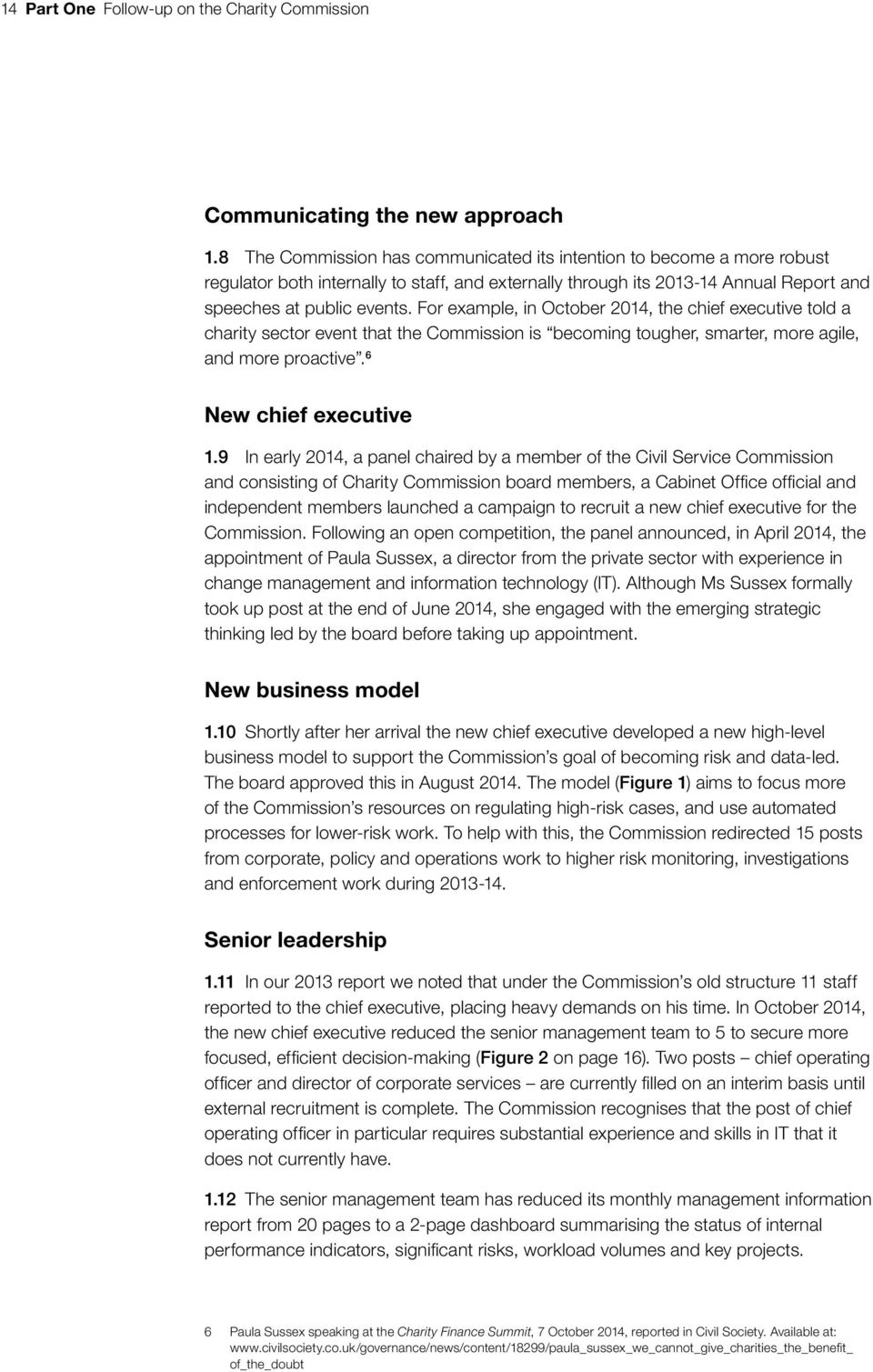
17 Follow-up on the Charity Commission Part One 15 Figure 1 The Commission s new business model A risk and data led approach Strategy and coordination Registration Casework and monitoring Communications and policy Contact management Risk and data centre Policy and standard-setting Legal services Investigation, monitoring and enforcement Business support Notes 1 The risk and data centre will produce analysis to support risk-based decision-making across all core functions. 2 All 5 core functions will assess cases against the risk framework: Registration will assess status and process cases based on risk. Casework and monitoring includes: fi rst contact, which will organise and prioritise work, and process low-risk casework and permissions; and operations which will process medium- or high-risk compliance cases and high risk or complex permissions. Investigation, monitoring and enforcement will provide risk-based formal investigations. Legal services will advise and support all other core functions. Communications and policy will manage relationships with external stakeholders and communicate the Commission s strategy. Source: Charity Commission, Transform programme, August 2014
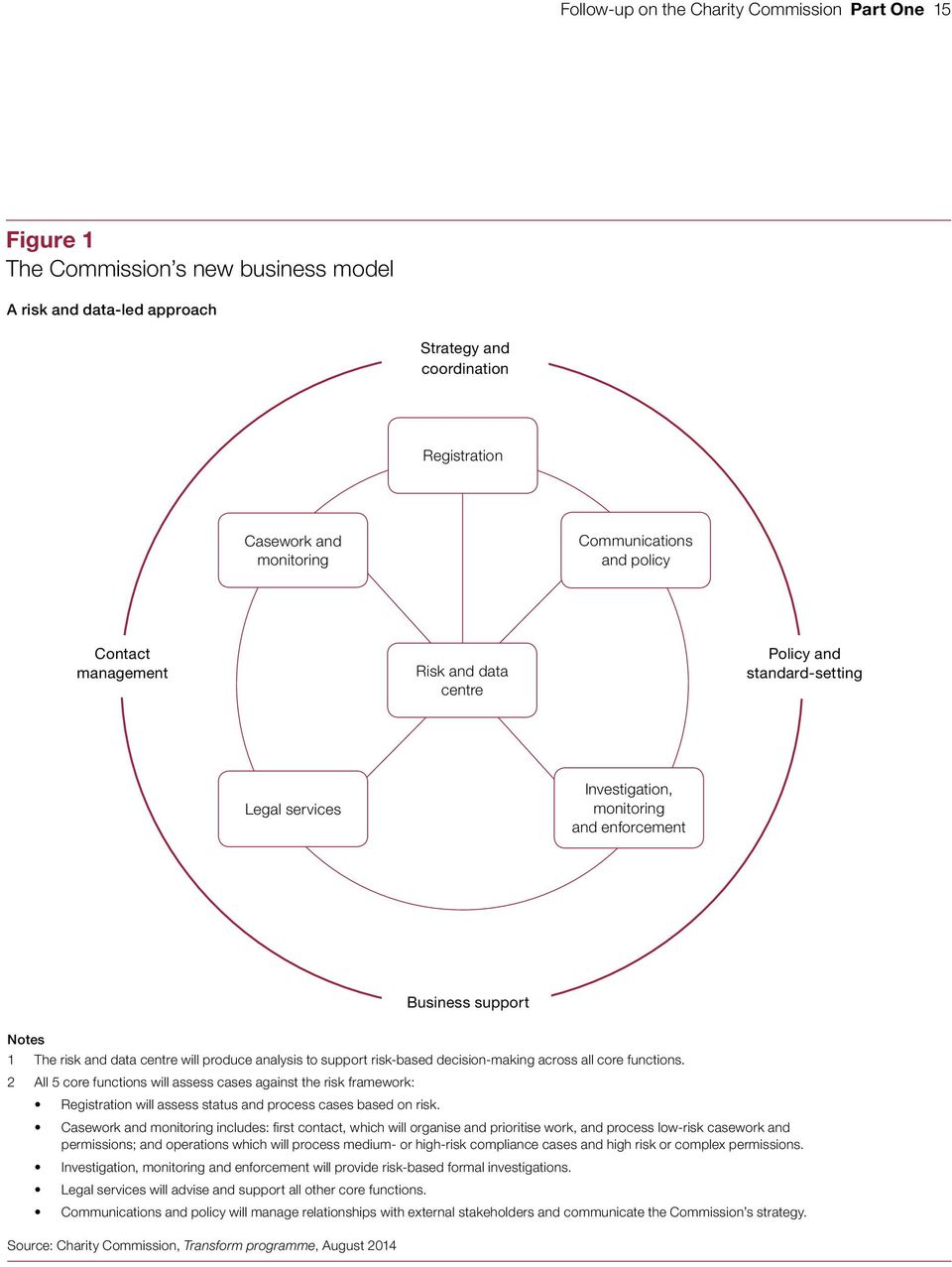
18 16 Part One Follow-up on the Charity Commission Figure 2 New senior management team structure New organisational design Chief executive Corporate services Assurance Facilities management Finance and performance reporting Governance Human resources Internal communications ICT (infrastructure and applications) Operations First contact Operations casework (Taunton, Liverpool, Wales including permissions and advice) Registration Web Investigation, monitoring and enforcement Investigations Intelligence Monitoring Operational accountancy Prevent Policy and communications Policy development and guidance Public affairs Press Research and analysis Legal services Legal advice to operational teams in operations and investigations, monitoring and enforcement Legal advice to policy Charities legislation High risk registration cases Litigation and decision review Risk and data centre Note 1 The structure is new from 1 October 2014 and is not yet fi nalised. Source: Adapted from the proposed organisation design in the Commission s Transform Programme document
19 Follow-up on the Charity Commission Part One 17 Transformation programme 1.13 In August 2014, the board approved the chief executive s proposed programme for transforming the Commission into a proactive, risk-based regulator. The programme has 3 main goals: to improve its use of data; automate services and streamline low-risk customer-facing services; and create the organisational and cultural change needed to support the transformation. These goals are supported by 9 projects (Figure 3 overleaf). The projects to automate the low-risk customer-facing services are essential to the Commission s aim of becoming more effective within a constrained budget. The Commission launched the 3-year transformation programme (the programme) in September Key elements of good programme management are being adopted, including: good alignment of the programme and its projects with the Commission s overarching strategy; a detailed programme business case including key milestones, costings and a plan to realise benefits; clear programme governance, including leadership by the chief executive, who is the programme s senior responsible owner, and the creation of a programme management office to support the programme (see Figure 4 on page 19); a programme-level log for capturing and managing programme risks and issues; individual project plans identifying: costs, milestones and interdependencies; and identifying the key skills needed to bring about effective transformation and recognising the importance of staff engagement. In implementing the programme, the Commission is following Major Projects Authority guidance. It also plans to adopt an Agile approach to project management which allows frequent testing and refinement during the programme. 7 7 Agile project management is an iterative approach to planning and guiding projects.

20 18 Part One Follow-up on the Charity Commission Figure 3 The Commission s transformation programme Programme objective Risk-based regulation Establish systems to enable better use of data to target work where it makes greatest impact and support a more proactive approach to casework Supporting projects 1 New risk framework develop and implement a new risk framework (and automate systems to support it), to assist information analysis and risk assessment and determine the appropriate regulatory approach. 2 Casework systems develop options for and implement a new investigations case management system which is able to support the new risk-led approach. 3 Data mining deliver improved understanding of data to support decision-making, provide better data on specific issues eg fraud, and improve data access to support case working. 4 Charities database improve functionality of the charities database: to improve searching; enable new data to be held to support case working; and supply the public register of charities. Improve IT services Automate services and streamline low-risk customer-facing services to release staff for high-risk work 5 Digital forms deliver an expanded and revised series of online forms to allow self-service for simple transactions and more efficient submission of charity accounts and annual returns. 6 Online registration jointly with HM Revenue & Customs deliver a single process enabling charities to register with the Commission and recognition by HMRC. 7 ixbrl accounting solution jointly with Companies House agree data sharing information standards for financial returns. Organisational change Change the organisation s structure and redeploy resources to monitor and enforce 8 Organisational and cultural change deliver front line and back-office structural change to free-up staff to do high-risk work. Reduce accommodation costs. Also deliver culture change and aim to become an employer of choice. 9 Programme management office oversee effective management and administration of the programme. Note 1 The programme management offi ce is not a separate project but a small team. 2 Inline Extensible Business Reporting Language (ixbrl) is a format used to electronically represent accounting information. Source: Charity Commission, Business Transformation Programme

21 Follow-up on the Charity Commission Part One 19 Figure 4 Transformation programme governance Charity Commission board Transform oversight programme board (a subcommittee of the Commission s board) Provides strategic oversight of the programme and holds the chief executive to account for delivery and realising benefits Chaired by the Commission s chairman Transform delivery programme board (a committee of Commission executives) Focus on ensuring the programme s projects are delivered successfully. It directs delivery, sets priorities and resolves issues Chaired by the chief executive and meets as required but at least monthly Risk and data work stream Casework stream Digital service delivery Structural reorganisation Notes 1 The transform oversight programme board held its fi rst meeting in October The transform delivery programme board held its fi rst meeting in August Source: Charity Commission, Transform Programme, August 2014
22 20 Part One Follow-up on the Charity Commission 1.15 The 3-year transformation programme has been under way for just a few months, and there is much more detailed work to be done. Risks that still need to be managed include: recruiting skilled staff to run selected projects 3 of the 9 projects do not yet have a project manager, these will either need to be staffed from other parts of the business or recruited on a temporary basis using transformation funding; agreeing the final organisational design each of the new senior management team is developing their own staffing model and principles for allocating and prioritising work for their division to align with the new business model (Figure 2); defining IT requirements before the move to new systems and ensuring the transition between systems and suppliers is well managed improving the Commission s IT is central to enabling transformation; finalising the accommodation strategy setting out how the Commission s 4 offices will work together and support each other; engaging with staff and maintaining morale during a period of significant change and uncertainty; and consulting and engaging with the sector on relevant aspects of the transformation programme. The Commission told us it intends to create user groups to test the ease of use of new digital services, and some elements of the programme may also require formal consultation such as, introducing Inline Extensible Business Reporting Language (ixbrl) to enable the electronic submission of charity accounts. Funding 1.16 The Commission s budget for is 21.1 million. In our last report we noted that the Commission s budget fell by 40% in real terms from 36.7million in to 22.2 million in In June 2014, the Commission submitted a business case to HM Treasury for additional funding. In October 2014, after refinements to the business case and negotiations with HM Treasury, 8 million of one-off extra funding over 3 years was announced for the Commission s transformation programme. 9 Of this, 6 million is for improving the Commission s IT systems; 1.2 million is for improving risk profiling and risk processes; the remaining 0.8 million is for organisational change and running the transformation programme. In addition, the Treasury also agreed a 1 million increase to the Commission s budget for , to cover immediate resource needs in investigation, monitoring and enforcement. 8 The Commission s budget in was 32.6 million in nominal terms ( 36.7million in real terms) but fell to 22.7 million in nominal terms by ( 22.2 million in real terms). The 22.7 million was based on an estimate, the actual budget in was 22.3 million in nominal terms, was used as the base year for calculating real terms values. 9 The annual budgeted spending for the 8 million is 1.2 million in , 5.8 million in and 1 million in
23 Follow-up on the Charity Commission Part One 21 Understanding the cost of effective regulation 1.18 As part of its work to better understand the cost of effectively regulating the sector, the Commission has derived unit costs for its 30 key activities, such as compliance casework. The unit costs are based on a top-down approach, which apportions costs on the basis of the number of outputs for each activity. The Commission is using the unit costings as a management tool to understand the source of its costs and to inform future decision-making. On the basis of its unit cost calculations, the Commission told us it is confident it can manage the remodelled organisation within its budget of 21.1 million. The Commission has also prepared high-level forecasts of its potential unit costs based on broad assumptions about planned productivity improvements from its new regulatory model It is important the Commission develops a good understanding of its unit costs to aid future funding negotiations with HM Treasury. However, the Commission has more work to do to fully understand how much it costs to regulate effectively. Top down costing, although simple and cheap, can be sensitive to assumptions made when apportioning overheads to activities. The Commission has not tested the sensitivity of its unit costs to changing assumptions, and the current unit costs are based on the Commission s old regulatory model. It is not clear that the unit costs will remain the same when the Commission experiences increased pressure on its resources from opening more statutory inquiries and the expected increase in demand associated with registering excepted charities (see paragraph 3.15) The Commission has not estimated the quantifiable benefits of its different activities, for example the funds it might protect through early intervention on high risk charity registrations. We recognise there are some benefits arising from the Commission s work which cannot be quantified, such as an increase in public trust and confidence. However, without work to consider the potential benefits of its different activities, the Commission cannot take informed decisions about where best to direct its resources. 10 By March 2021, the Commission will need to register some 30,000 previously excepted charities. There are about 180,000 charities excepted from registration, under section 30(2) of the Charities Act 2011, because their annual income is less than 5,000 or the organisation is a certain type (eg a scout group, church or armed forces charitable fund).
24 22 Part Two Follow-up on the Charity Commission Part Two Becoming a more proactive regulator 2.1 When we last reported we found the Charity Commission (the Commission) was reactive rather than proactive and did not make enough use of the information it holds to identify risk. Other than monitoring charity accounts, the Commission did little or no analysis of risks to the sector, and no risk assessment of individual charities. 2.2 This part considers how the Commission assesses regulatory risk and how it uses data to inform its work. Revision of the Commission s risk model 2.3 Charitable status helps registered charities raise funds, bid for contracts and access gift aid and other tax reliefs and exemptions. In the context of the size of the sector, the number of trustees that deliberately seek to abuse charitable status is relatively low, but to maintain public trust and confidence in the sector, the Commission needs to act decisively when it uncovers deliberate abuse of charitable status. The Commission regulates a large number of charities: around 164,000 registered charities and 180,000 excepted charities, as well as around 10,000 exempt charities that are overseen by a different principal regulator. 11 It therefore needs to prioritise its work, which it does so according to the risk that charitable status may be being abused. Staff currently use the risk framework first developed in 2011 to assess cases as low, medium or high risk The Commission began testing a new risk model in August It will report its findings to the board in January It is too early to draw firm conclusions on its success but it is encouraging that the model links risk assessment to the Commission s strategic objectives and outcomes. The model captures risks permanently present within the sector, as well as those that emerge or change over time such as novel ways a charity could be used as a vehicle for tax avoidance. The model also assigns to every charity one of 4 potential risk ratings (low, medium, high and very high) based on its past conduct. 11 Principal regulators promote exempt charities compliance with charity law, but have no powers of enforcement, and so must work with the Charity Commission. 12 The Charity Commission, Risk Framework: Charity Commission, June 2013, available at: publications/risk-framework-charity-commission. The risk framework was last updated in June 2013.
25 Follow-up on the Charity Commission Part Two Some challenges remain: when we reviewed the pilot, the team were still experimenting with the weightings given to the different factors used to generate each charity s risk rating. Improving the use of data 2.6 One of the Commission s early initiatives to improve its use of information was the creation of an analysis hub. The hub carried out projects that drew out valuable insight from the information the Commission already held. This, in turn prompted changes including a redesign of the online registration application and revised internal guidance. 2.7 While the analysis hub s projects delivered benefits, the projects required considerable data manipulation and analysis. They showed up the limitations of the Commission s information technology (IT) systems in supporting routine data analysis. For example, the hub s project team had to undertake a time-consuming manual reconciliation of 2 large spreadsheets to find the total number of serious incident reports. The Commission recognises the need to improve its IT systems and has established a project to address this (Figure 3). Making better use of external data 2.8 Alongside making better use of internal data, the Commission also recognises the need to make better use of external data sources. In April 2014, the Commission became a member of the fraud prevention service Cifas. 13 This has enabled it to access and match its own trustee data against the National Fraud Database which identified a number of cases now prioritised for follow-up. 2.9 In April 2014, the Commission agreed a data-sharing exercise with HM Revenue & Customs (HMRC). This will enable them to identify charities claiming gift aid which are not on the Commission s register of charities. A strategic approach to better use of data 2.10 Alongside these data-sharing exercises, the board recognised the Commission needed better tools for analysing data, and began a data mining project in May The Commission has identified new data and data analysis that would be helpful to its case officers. It has started reviewing a sample of existing cases to see whether it could achieve improved case outcomes if better data and analytical methods were available. It will use this work to improve its ability to detect fraud in charities. 13 Cifas is a not-for-profit organisation originally founded to support the financial services industry in providing pre-transaction due diligence. Its National Fraud Database contains personal data linked to cases of fraud.
26 24 Part Two Follow-up on the Charity Commission Improved information-sharing with others 2.11 The law permits the Commission to exchange information with other regulators and government agencies, where this furthers statutory purposes. In some cases closer working is formalised through a memorandum of understanding. The Commission has 13 such memoranda with other organisations, and a further 4 are in the process of being finalised In , the Commission made 1,152 disclosures of information to around 50 organisations, plus local authorities and police forces. However, it received information only 594 times (Figure 5). The volume of exchanges is growing overall: in the first half of there were 20% more exchanges of information compared with the same period in The Commission exchanges more information with HMRC than any other organisation. It shares information with HMRC relating to non-charitable spending, unauthorised investments and potential tax avoidance. When we last reported we found both organisations had failed to share certain information with the other. This had hindered some of both organisations investigations. The Commission needs a strong relationship with HMRC to support both organisations interest in combating tax avoidance and fraudulent gift aid claims. In , the Commission made 236 disclosures to HMRC and received 201 disclosures from HMRC (Figure 6 on page 26). However the balance of exchanges has deteriorated in the first 6 months of when the Commission disclosed to HMRC 3 times as much as it received. HMRC told us it is currently preparing to disclose information to the Commission relating to a large number of cases. It remains to be seen if the level of these disclosures leads to a substantial increase in the second half of During 2014, the Commission s chief executive met the permanent secretary of HMRC to discuss how their organisations will work together in the future.
27 Follow-up on the Charity Commission Part Two 25 Figure 5 Information exchanges The number of information exchanges with other organisations is increasing, but the Commission typically discloses more than twice the amount of information it receives Number of information exchanges Apr May Jun Jul Aug Sep Oct Nov Dec Jan Feb Mar Apr May Jun Jul Aug Sep Number of disclosures of information Number of receipts of information Notes 1 In the financial year , there were a total of 1,746 data exchanges. This is up from 1,539 in In the first two quarters of there were a total of 986 exchanges, compared with 825 exchanges for the same period in Source: Charity Commission
28 26 Part Two Follow-up on the Charity Commission Figure 6 Information exchanges between the Commission and HMRC In the first 6 months of , the Commission disclosed to HMRC 3 times the amount of information it received Number of information exchanges Q1 and Q2 HMRC disclosures to Charity Commission Charity Commission disclosures to HMRC Notes 1 We have not audited the underlying data systems from which this data is drawn. 2 These exchanges represent information passed through each organisation s designated contact point. Individual Information exchanges also took place directly between members of staff from both organisations. Source: Charity Commission
29 Follow-up on the Charity Commission Part Two Since 2005, the Commission has worked with the police to act on concerns that charities are at risk of or are being abused for terrorist purposes. This work aids intelligence sharing and has led the Commission to issue relevant alerts to the sector, for example highlighting the risk that a minority of charitable aid convoys to Syria may be abused for non-charitable purposes. 14 The Commission has also opened new cases following referrals from the police. These have increased from 10 in , to 30 in This makes it the Commission s most effective information sharing arrangement. Partnering with umbrella bodies 2.15 In April 2014, 15 umbrella organisations agreed to help the Commission follow-up with those charities that had failed to submit their annual return to the Commission. 15 After giving a list of 1,071 charities to the umbrella bodies, 290 (27%) charities submitted their return by August New initiatives such as allowing umbrella organisations to offer pre-registration checking services began in July These have successfully reduced the volume of calls, s and letters the Commission receives which frees up resources for use elsewhere. However in recent months the rate of decline has slowed (Figure 7 overleaf). In June 2014, the Commission cut its contact centre s opening hours from 30 hours a week to 15 hours a week (weekday mornings only). As part of its change programme, the Commission is considering how to maintain the accessibility of its online information and guidance, following the reduction in individual one-to-one advice. 14 Charity Commission, Syria and aid convoys, 21 February 2014, available at: 15 Umbrella organisations are organisations that represent the interests of the charitable sector or a part of the charitable sector to the public, the government and key stakeholders.
30 28 Part Two Follow-up on the Charity Commission Figure 7 Volume of telephone calls, s and letters The Commission has successfully reduced the volume of calls, s and letters but the rate of decline has slowed recently 14,000 12,000 10,000 8,000 6,000 4,000 2,000 0 Apr May Jun Jul Aug Sep Oct Nov Dec Jan Feb Mar Apr May Jun Jul Aug Sep Calls 6,625 7,732 7,158 7,546 5,778 6,306 7,324 6,676 4,601 7,578 6,243 5,485 4,994 4,298 3,563 3,451 2,942 2,856 s 4,301 4,149 4,056 3,624 3,110 4,046 3,980 3,780 3,154 4,348 3,975 4,053 3,352 3,843 3,744 4,006 3,293 3,504 Letters 1, Monthly 11,967 12,773 11,996 12,065 9,671 11,090 12,114 11,260 8,395 12,646 10,980 10,352 9,002 8,818 8,030 8,115 6,926 7,033 total Notes 1 The Commission s annual accounts reported the total number of calls, s and letters as 146,777. This figure shows a total of 135,309 for the same year. The Commission gave us this lower figure as it represents contacts that required First Contact staff to do substantive work. The higher figure in the annual accounts includes interactions such as phone calls where the caller listened to the recorded options and then hung up. 2 From 9 June 2014, contact centre opening hours were reduced to Monday to Friday 9am to 12 noon. Source: Charity Commission
31 Follow-up on the Charity Commission Part Three 29 Part Three Follow-up checks and use of powers 3.1 When we last reported, we found the Charity Commission (the Commission) did not routinely follow-up on trustees assurances to check they had done what they said they had. We also found the Commission was making little use of its statutory powers, could be slow to act and failed to take tough enough action in some of the most serious cases. We also pointed out gaps in the Commission s statutory powers which were hampering its ability to regulate effectively. 3.2 This part considers the pace of registration, follow-up of regulatory concerns, and the use of statutory powers, including statutory inquiries. Pace of registrations 3.3 Between November 2013 and October 2014, the responsibility for managing fast track, low-risk and discontinued registrations passed from the registration team to the First Contact team. 16 This was intended to free up the registration team s time to focus on higher-risk cases. 3.4 The transfer reduced the registration team s workload by around a third. However, the registration team did not achieve its internal performance target for medium-risk cases for the 10 months after this transfer. It has also not met its performance targets for high-risk cases for the 4 months June to September 2014 (Figure 8 overleaf). The First Contact team has largely achieved its performance targets for fast-track and low-risk registrations, with performance only failing to reach the target in the occasional month. The number of applications to register a charity rose from 5,949 in to 6,661 in and the average time the Commission took to register charities also increased. As a consequence, a backlog of registrations has built up. 16 Discontinued registrations are where the Commission has been unable to register a charity because the information provided is incomplete or inappropriate. After 30 working days, the Commission sends a reminder. If no further response is received within 10 days the case is closed.
32 30 Part Three Follow-up on the Charity Commission Figure 8 Time taken to register charities The average time taken to register charities is increasing The average time to register by risk type (days) Number of registrations days Target for dealing with high-risk registrations 30 days Target for dealing with medium-risk registrations Apr May Jun Jul Aug Sep Oct Nov Dec Jan Feb Mar Apr May Jun Jul Aug Sep Registration applications received High-risk Medium-risk Fast-track Notes 1 The Charity Commission received 6,661 applications to register in , (5,949 applications in ). 2 The way performance information is captured by the registration team in Taunton, means they are unable to distinguish between fast-track and low-risk applications. The fast-track statistics above include both. 3 The registration team s performance targets are: a fast-track registrations should be completed within 5 days; b medium-risk registration should be completed within 30 days; and c high-risk registrations should be completed within 50 days. Source: Charity Commission
33 Follow-up on the Charity Commission Part Three The Commission told us that long-term staff sickness, staff vacancies and the need for registration staff to train their First Contact colleagues in handling low-risk registration cases have all contributed to the failure to meet internal targets for the speed of processing medium- and high-risk registrations. 3.6 The Commission has recruited 2 new staff to work on high-risk registrations and is in the process of recruiting a further 2 staff which will double the number of officers working on high-risk cases, and raise the registration team s staff complement to 23. The Commission s legal team has taken on the most complex high-risk registrations. In December 2014, the Commission appointed a new temporary head of registration. It has also recently established a dedicated team to process applications that are over target time. It remains to be seen whether these additional measures will eliminate the registrations backlog by the end of January 2015, as the Commission intends. Gaps in checking trustees assurances 3.7 The Commission created the operations function monitoring team (OFMT) in October 2013 to improve the way it monitors registration and operations cases that require follow-up. 17 Since its creation, the new team has had a positive impact: It visited 70 charities where it had concerns, and this led to 10 charities being removed from the register. It reviewed suspicious registration applications which led to 17 pre-registration cases not being progressed. 18 Some charities register, raise funds and then dissolve before the 18-month deadline for submitting annual returns. OFMT worked with the Fundraising Standards Board (FRSB) to disrupt bogus fund-raising through improved information-sharing and by persuading transport authorities and some train operating companies to only allow charities to raise funds on their premises if they have submitted their annual returns and are signed up to the FRSB. 17 Following the Commission s internal restructuring in October 2014, the OFMT moved to the Investigations, Monitoring and Enforcement directorate. It is now called the Monitoring and Enforcement team. 18 In , the Commission formally refused 23 registration applications in total.
34 32 Part Three Follow-up on the Charity Commission 3.8 Although the creation of the OFMT has delivered benefits, our review of a sample of cases suggests there is more the Commission could do with regard to follow-up and checking what trustees tell it. As part of our audit we reviewed the Commission s handling of 12 registration cases, 10 operation cases and 8 statutory inquiries, selected at random. We found the Commission managed the majority of cases effectively. However, in 2 of the 10 operations cases the Commission indicated to trustees the action it expected them to take, but we saw no evidence that it had checked whether trustees had complied with its instructions before the cases were closed. These cases are summarised below: In one case a charity s auditor alerted the Commission to concerns that the trustees were incapable of discharging their responsibilities. The Commission outlined to trustees a set of actions they should take, but did not check whether they had been completed. We could not tell from the case management record what risk rating the Commission had assigned to the case. The Commission accepts that it should have followed up with the charity; it opened a new monitoring case in September 2014, which remains open. The other case was a medium-risk case involving theft of approximately 93,000 of charity funds by a trustee, which had been reported to the police. The Commission recommended to the charity that it should recruit an additional trustee and improve its financial controls. The Commission did not follow up to check these changes had been made and closed the case on the basis that little income was at risk. 3.9 We also found 2 registration cases where the charities did not have an income of 5,000, but instead an offer of funding. In such cases, the Commission s internal guidance allows case officers to use their discretion in deciding whether to register the charity but advises that it is reasonable to ask the charity to supply evidence to show there is 5,000 in the charity s bank account within a short period. We found no evidence the Commission requested this extra evidence in either case. In one of the cases the Commission accepted a photocopy of an uncashed cheque written against the trustee s personal bank account, as a formal offer of funding. Statutory inquiries 3.10 The Commission has the power to open a statutory inquiry where it has serious concerns about how a charity is being run. Opening an inquiry allows the Commission to use certain statutory powers provided specific conditions are met When we last reported, the Commission had opened fewer than 20 statutory inquiries in each of the 5 years to , although the number of inquiries had risen slowly since then. This upward trend has continued: the Commission opened 64 statutory inquiries in , and 68 in the first 6 months of (Figure 9).
35 Follow-up on the Charity Commission Part Three 33 Figure 9 Number of statutory inquiries opened The Commission has opened more statutory inquiries Number of cases opened Q1 and Q2 15 Notes 1 Until 2011, the Commission also used regulatory compliance cases (149 in ; 171 in ; 141 in ). 2 In , 24 out of the 64 statutory inquiries were double defaulter cases. For , up to and including September 2014, the 68 statutory inquiries include 34 double defaulter cases. Double defaulter cases are a class action taken against larger charities that have failed to submit annual returns for at least 2 of the past 5 years. 3 We have not audited the underlying data systems from which this data is drawn. Source: Charity Commission 3.12 Of the 64 inquiries opened in , 24 were part of a class inquiry into large charities that, despite a warning, had failed to file their annual accounts. Thirty-four of the 68 inquiries opened in the first 6 months of were also part of that class inquiry. The Commission told us that, by June 2014, 30 of the 58 charities in the class inquiry had complied with their obligations, resulting in 47 million of charitable funds being accounted for The Commission has hardened its stance where a charity does not comply with an order to provide information. In some cases, such failure is now considered evidence of misconduct or mismanagement. It has also streamlined processes by, for example, reducing the senior authorisation required for exercising certain powers In March 2014, to support the rise in the number of statutory inquiries opened, the board approved 7 new posts in the investigations and enforcement team, bringing the total number of investigators to 20.
36 34 Part Three Follow-up on the Charity Commission Information gathering powers 3.15 The Commission has powers to require individuals to provide documents and information. It can also enter premises to seize documents. In , the Commission changed its practice so that it uses information-gathering powers to obtain information in all inquiry cases. This has resulted in a steep increase in their use (Figure 10). The Commission used its information-gathering powers 652 times compared with 200 times in Figure 10 Statutory powers to gather information The Commission has increased use of its statutory powers to gather information Number of times power used Q1 and Q2 Note 1 We have not audited the underlying data systems from which this data is drawn. Source: Charity Commission data
37 Follow-up on the Charity Commission Part Three 35 Enforcement powers 3.16 When we last reported, the Commission s use of enforcement powers had started to increase in , following years of decline. This upward trend has continued (Figure 11 overleaf). The Commission used its enforcement powers 56 times in compared with 3 times in In the Commission protected 31.3 million of charitable assets through its completed investigations As part of our audit, we looked at the Commission s handling of 8 statutory inquiries and the actions it had taken in the 12 months before September We found the Commission was actively managing all 8 cases, with no evidence of long periods of inactivity or cases being allowed to drift We also found evidence that the Commission was using its powers more quickly. In 2 inquiries opened after April 2013, the Commission acted promptly to protect charity property by freezing the charities bank accounts. There were also 2 instances where the Commission appointed an interim manager within 3 weeks of the start of the process to recruit a manager. This contrasts with one of the cases we looked at for our last report where recruiting an interim manager had taken three months In May 2013, the Commission issued a policy on the recovery of misappropriated charitable funds. 20 This makes it clear trustees will be accountable for deliberate and reckless conduct that causes losses for charities. Two of the statutory inquiries we looked at referred to this policy. The 2 cases together led to the recovery of 1 million for charities following legal settlements with the trustees As a consequence of opening more statutory inquiries there is potential for legal costs to rise. The Commission told us it believes it can mitigate these rising costs, in part, as its experience in litigation increases. In principle, this should lead to the Commission being successful in more cases and hence being awarded its costs. Possible new powers 3.21 In October 2014, the government published the Draft Protection of Charities Bill. 21 This proposes to give the Commission a number of new statutory powers, such as the power to disqualify trustees, issue official warnings and direct trustees to wind up a charity. The Bill also proposes to extend the range of offences that lead to automatic disqualification for trusteeship to include money laundering, terrorism and bribery. 19 We selected 4 long-running inquiries opened before April 2013, and 4 inquiries opened after April 2013 to help identify any changes in the Commission s approach. 20 The Charity Commission, Our policy on restitution and the recovery of charitable funds misappropriated or lost to charity in breach of trust, May Cabinet Office, Draft Protection of Charities Bill, 22 October Available at: draft-protection-of-charities-bill
38 36 Part Three Follow-up on the Charity Commission Figure 11 Enforcement powers, 1996 to and to The use of enforcement powers rose in and the first two quarters of Number of times power used Q1 and Q2 New trustees appointed Trustees prevented from acting Trustees removed Interim manager appointed Note 1 We have not audited the underlying data systems from which this data is drawn. Source: Charity Commission data
39 Follow-up on the Charity Commission Part Four 37 Part Four Oversight of the Commission 4.1 In its last report, the Committee of Public Accounts (the Committee) said the board of the Charity Commission (the Commission) needed to have sufficient grip on the Commission s performance and operations to hold the executive effectively to account. 4.2 This part deals with the Commission s performance indicators and the board. Capacity of the board 4.3 The Commission s board is currently composed of 8 non-executive members. The Cabinet Office appointed the current chairman in October 2012 and 7 new non-executive members between May and July A new chairman of the audit and risk committee was appointed in November 2014, following the previous post-holder s resignation. 4.4 The board members appointed in summer 2013 bring experience in: fraud prevention, counterterrorism, data mining and risk management. These are all central to the Commission s transformation programme. There are also three lawyers on the board to meet a requirement of the Charities Act 2011 that a minimum of 2 board members should have legal qualifications. The Commission s chairman told us the board largely has the skills it needs. He is considering whether there is sufficient information technology (IT) expertise at board level given the importance of IT improvements to the transformation programme. 4.5 When we last reported, both we and the Committee noted the new board s commitment to tackling the concerns we identified in our last audit. In the course of our current audit, we found board members continue to be fully committed to transforming the Commission into a robust regulator. The board s early engagement with the issues raised in our last report prepared the ground for the chief executive s arrival. This enabled her to act quickly and decisively when she formally joined the Commission.
40 38 Part Four Follow-up on the Charity Commission Governance arrangements 4.6 The board met 7 times in 2014, compared to the minimum 6 times per year required by the Commission s governance framework. 22 The board is supported by several permanent and time-limited committees to which it delegates some of its tasks (Figure 12). During 2014, the board sought to strengthen the Commission s governance arrangements by widening the remit of the audit committee to include risk, and by creating the public interest litigation and high-risk cases committee to monitor high-profile cases. It has also created new temporary committees such as the data mining and fraud management oversight committee to oversee specific aspects of the transformation programme. Figure 12 The Commission s board committees and their roles Board committee Committee role Permanent committees Audit and risk committee meets at least 4 times a year Governance and remuneration committee meets at least twice a year Public interest litigation and high-risk cases committee meets every 2 months To review the comprehensiveness and reliability of assurances on governance, risk management and the control environment and the integrity of the Commission s annual report and financial statements. To review the effectiveness of the Commission s leadership and succession planning and make recommendations for the remuneration structure. To monitor cases where the Commission is considering or actively pursuing litigation, and other cases which are high-risk. Time limited committees Transform oversight programme board met monthly for the first 3 months and thereafter bi-monthly Data mining and fraud management oversight committee meets monthly Policy guidance committee meets as necessary Strategic oversight of the transformation programme, monitoring progress and benefit realisation. Oversight of the data mining project and fraud management work. Oversight of policy development and guidance to charities. Notes 1 At the end of 2013 the audit committee s remit was broadened to include fi nancial and operational risk, and performance management. 2 The public interest litigation committee was established in November 2013 to enable more effi cient monitoring of high profi le cases. The committee s remit was expanded in January 2014 to include high-risk cases. 3 The transform oversight programme board was established in October It took over the work of the business plan steering committee which in turn took over from the change management steering committee. 4 The data mining and fraud management oversight committee was established in October 2014 following a merger of the data mining oversight committee and the fraud management steering committee. 5 The policy guidance committee was set up in April Source: Charity Commission 22 The Commission s governance framework sets out the roles, responsibilities, and procedures for conducting its business efficiently and effectively. The framework requires the board to evaluate its own performance each year.
41 Follow-up on the Charity Commission Part Four Since the arrival of new board members in mid-2013, the board has not carried out an evaluation of its own performance. An annual evaluation is good practice and a requirement of the Commission s governance framework. The board has asked the government s internal audit service to conduct a review of the board s effectiveness before the end of The Commission s governance framework should be reviewed annually. It was last reviewed in January The board has delayed the review until late to allow the new governance arrangements to bed in. Board reporting 4.9 Board members told us that they are broadly happy with the quality of board papers, although members of the public interest litigation and high risk cases committee continue to work with senior managers to improve the presentation and clarity of papers provided to that committee. At each meeting the committee reviews the details of 30 high-profile cases, on average. The Commission aims to reduce the number of cases the committee sees as its assessment of regulatory risk matures. Holding the Commission s executive to account 4.10 The Charities Act 2011 gives the Commission s board the power to undertake executive activities. 23 Furthermore the Commission s governance framework says the board is ultimately responsible for everything the Commission does, and can act executively in exceptional and appropriate cases, at the board s discretion. Given the casework nature of some of the Commission s work, board members spend a good amount of time becoming acquainted with the details of the most difficult cases, particularly where litigation is or may be involved, so as to exercise effective oversight However, the chief executive is the Accounting Officer and is accountable to Parliament for the Commission s performance. The Corporate Governance Code says board committees should only exercise governance functions and not stray into the executive management of the department which is the role of officials. 24 In its annual governance statement the Commission says it has met the Code s requirements. Board members recognise the inherent tension between the Charities Act 2011 and the Corporate Governance Code and consider that they must be guided above all by the provisions of the Act. 23 Charities Act 2011, Schedule 1. The Act also establishes the Charity Commission as a body corporate (with distinct legal personality) of which the board are members. 24 HM Treasury, Managing Public Money, July 2013 and HM Treasury and Cabinet Office, Corporate governance in central government departments: Code of good practice, July 2011.
42 40 Part Four Follow-up on the Charity Commission Board time commitment 4.12 The Commission was the subject of serious criticism in 2013, first from the Committee of Public Accounts for its handling of the Cup Trust case, and later in 2013 when both the NAO and the Committee concluded it was not an effective regulator. 25 This was a difficult time for the Commission and the board needed to step up to provide strong leadership, particularly during the period of transition to a new chief executive in early The Charities Act 2011 does not define the number of days that the Commission s board and its chair should work. However, the Minister for Civil Society has indicated that Commission board members are normally expected to spend 12 to 18 days a year on their role. In March 2014, the Minister for Civil Society agreed a temporary increase in board time, of up to 22 days per board member for the 6 months to September This was to cover the additional commitment needed to support the Commission s response to criticism from the Committee and the NAO and drive forward the necessary organisational change. However, the Minister rejected the chairman s original request that this increased time commitment should be extended for the whole of He noted, that such an increase could be seen as a shift to something more like an executive board with hands-on day to day management responsibility Once your new Chief Executive has settled into the role, I would expect to see the board members stepping back into a more non-executive and less hands-on role In January 2015, the new Minister for Civil Society wrote to the board s chairman agreeing that for the foreseeable future each board member may continue to spend up to 22 days in each six month period on board business, if and as needed. This is to help the Commission take forward its transformation programme. The arrangement will be kept under review as the Commission s transformation proceeds Figure 13 shows the time commitment that board members were budgeted to work for and the actual time they claimed. In addition, the chair of the board told us he has worked on average 3 to 4 days a week compared to his contracted and remunerated 2 days per week. During the 6 months from October 2013 to March 2014, board members were entitled to spend up to 9 days on their role. In this period, 5 board members exceeded this time commitment. During the 6 months from April to September 2014, when board members were permitted to spend up to 22 days, 2 board members exceeded this time commitment. 25 Available at:
43 Follow-up on the Charity Commission Part Four 41 Figure 13 Board members time commitment Measure 6 months to end March months to end September 2014 Number of days budgeted for in period 9 22 Number of board members who exceeded the limit 5 2 Lowest and highest board member claim (days) Total number of days spent by the board in the period (not including the chairman) Notes 1 One of the 7 board members did not claim remuneration between October 2013 and March 2014 and one other board member did not claim remuneration between February and September 2014, but their time was recorded for governance reporting purposes. 2 The Chairman s time is not included in this table. Source: Charity Commission 4.16 We found instances where the board undertook executive activities during the period from late 2013 to mid-2014, including: directing key transformation strands, for example the data mining project; evaluating bids from, and appointing, contractors; commissioning and receiving a report from consultants on which senior managers did not have the opportunity to comment. (This led to senior staff taking the unusual step of preparing a formal response to the supplier s report); attending meetings with charity trustees on specific regulatory issues; setting-up board subgroups to consider specific regulatory cases, for example a charity s registration application; and directing Commission staff in how to manage some high-profile cases In our view the board s increased involvement during the period from late 2013 to mid-2014 can be justified by the need to tackle the serious issues facing the Commission and provide leadership in difficult times. The new chief executive told us that the support from the board when she first arrived was very welcome.
44 42 Part Four Follow-up on the Charity Commission 4.18 However, the chief executive is now established in her role and in our view there is a risk that the board s continuing close involvement in executive matters could become the norm. There may be perceived benefits of the board s greater involvement during the transformation programme. However, there is a risk that if the board is too involved in executive decisions for an extended period the important separation between executive and non-executive becomes blurred, impairing the board s independence which is critical to its role of holding the executive to account Notwithstanding the powers the board has under the Charities Act 2011, to ensure good governance we would expect the board to keep under review its level of involvement in executive decision-making. Board members told us they expect, over time, to move to a more non-executive role. Developing the Commission s performance measures 4.20 When we last reported we found the Commission s performance measures were poorly linked to its objectives Since our last report, the Commission has revised its key performance indicators. It now has 4 (rather than 3) externally reported performance indicators (Figure 14) and 20 (rather than 30) internally reported performance indicators. The performance indicators are now better linked to its statutory objectives, with 8 of the 20 internal indicators focused on outcomes. The indicators are also weighted more towards the Commission s compliance and accountability objectives, in line with its strategic focus. Given the Commission s focus on improving customer-facing services, the internal indicators now include a measure of digital uptake. However, there is no indicator yet to measure the effectiveness of its new risk framework In , the Commission met its targets for existing externally reported performance indicators (Figure 14). Following a recommendation in our last report, the Commission has now developed an external performance indicator to measure public trust and confidence in the Commission itself. The target is for year-on-year improvement, and the baseline has been set at 6.1 which is the Ipsos MORI survey result The Commission recognises it has more work to do on its indicators to ensure they align with its new business model and strategic direction. It plans to revisit its indicators once the new senior management team is more established and the new chair of the audit and risk committee has settled into post.
45 Follow-up on the Charity Commission Part Four 43 Figure 14 The Commission s externally reported performance indicators External performance indicator Target (part) New EPI 1 Deliver value-for-money efficiency savings in readiness for % of budget, in real terms, by March 2015 N/A N/A N/A N/A Reported at year end Old EPI 1 The cost of the Commission for every 1,000 of income of registered charities EPI 2 The percentage of Commission casework or other pieces of work that has been reviewed as acceptable or better EPI 3 Overall level of public trust and confidence in charity (according to independent survey) 50p or less 53p 47p 43p 35p N/A 90% N/A N/A 89% 90% To October % Next survey due in New EPI 4 Overall level of public trust and confidence in Charity Commission (according to independent survey) 6.1 N/A N/A N/A 6.1 Follow-up survey due by end of financial year Notes 1 EPI 1 has been changed from a cost-focused target to an effi ciency savings target. 2 EPI 2 was fi rst measured in EPI 3 The public were asked: Thinking about how much trust and confi dence you have in charities overall, on a scale of 0 10 where 10 means you trust them completely and 0 means you don t trust them at all, how much trust and confi dence do you have in charities? 4 EPI 4 The public who were aware of the Charity Commission were asked: On a scale of 0 10 where 10 means you trust it completely and 0 means you don t trust it at all, how much trust and confi dence do you have in the Charity Commission? Source: Charity Commission
46 44 Appendix One Follow-up on the Charity Commission Appendix One Our audit approach 1 This study examined how far the Charity Commission (the Commission) has progressed in addressing the recommendations made by the NAO and the Committee of Public Accounts (the Committee) about its regulatory effectiveness. It covers whether: the Commission has a clear strategy and effective leadership to radically transform and deliver its regulatory responsibilities within constrained resources; the Commission is proactive in carrying out its regulatory duties; the Commission is making increased, appropriate use of its statutory powers; and the Commission board is able to effectively hold management to account. 2 Our audit approach is summarised in Figure 15. Our evidence base is described in Appendix Two.
47 Follow-up on the Charity Commission Appendix One 45 Figure 15 Our audit approach The Commission s objective The Commission s objectives include increasing public trust and confidence in charities and promoting compliance by charity trustees with their legal obligations. How this will be achieved The Commission is responsible for maintaining the register of charities, protecting and recovering charitable assets where there has been mismanagement or misconduct, granting permission to charities for certain actions such as disposing of assets and making changes to governing documents, and providing regulatory guidance. Our study Our follow-up study examined how far the Charity Commission has progressed in becoming an effective regulator of registered charities. Our evaluative criteria The Commission has a clear strategy and effective leadership to support achievement of its objectives. The Commission is proactive in carrying out its regulatory duties. The Commission is making effective and prompt use of its powers. The Commission s board is holding management to account. Our evidence (see Appendix Two for details) We assessed this by: reviewing board, senior management team and committee minutes and papers; interviewing Commission staff, board members and stakeholders; and analysing Commission documents on change management, strategy, risk and resourcing. We assessed this by: interviewing Commission staff, board members and stakeholders; reviewing reports completed by the analysis hub; reviewing memoranda of understanding; and analysing Commission documents on risk. We assessed this by: analysing Commission data on statutory powers and cases opened/closed; examining a sample of investigations, operations and registration cases; and interviewing Commission staff, board members and stakeholders. We assessed this by: reviewing board and committee minutes and papers; interviewing Commission staff and board members; assessing the new performance indicators and the internal and external consultation work undertaken on these; and reviewing good practice guidance. Our conclusions The Commission has made good progress in addressing Committee of Public Accounts and NAO recommendations and towards becoming a robust regulator. It needs to: develop and implement its individual transformation projects; understand the costs of its new regulatory model; and show stakeholders that its new regulatory approach is enabling it to be a more effective regulator.
48 46 Appendix Two Follow-up on the Charity Commission Appendix Two Our evidence base 1 Our independent conclusions on whether the Charity Commission (the Commission) is progressing in becoming an effective regulator of registered charities were reached following our analysis of evidence collected between August 2014 and November We applied an analytical framework with evaluative criteria, of the characteristics we would expect to find evidence of that would indicate whether or not the Commission is becoming a more effective regulator of registered charities. Our audit approach is outlined in Appendix One. 3 We assessed whether the Commission has a clear strategy and effective leadership to radically transform and deliver its regulatory responsibilities within constrained resources. We reviewed key documents including: the Commission s revised Statement of Regulatory approach (the Statement) to check whether its approach to delivering objectives are clear and demonstrate a move to becoming a more robust, proactive regulator; the board, senior management team and supporting committee papers and minutes to understand the decisions made as part of the transformation programme; and unit costing and funding papers to determine the Commission s understanding of the cost of effective regulation. We interviewed: the chief executive, the chairman, senior managers and board members about their role in the Commission s transformation programme and to understand thecommission s new strategy and focus; stakeholders including charity sector umbrella bodies on the Commission s performance; and HM Treasury about the Commission s additional funding case.
49 Follow-up on the Charity Commission Appendix Two 47 We analysed: the revised strategy, revised business model and transformation plan, for alignment with the Commission s objectives; and the new senior management team structure, to see whether the new structure has clear chains of accountability. 4 We examined whether the Commission is proactive in carrying out its regulatory duties. We reviewed: reports produced by the analysis hub, created in January 2013, to understand the main findings and what changes were made as a result; and the revised risk framework, to establish whether it is likely to lead to better risk management. We interviewed: senior managers and board members with responsibility for data and risk, to understand how the Commission uses information to inform its risk assessments and prioritisation of resources; senior managers and HM Revenue & Customs to review the Commission s relationships with other agencies we also reviewed the updated memorandum of understanding agreed with HM Revenue & Customs; the new operations function management team, designed to follow-up on trustee assurances; and charity sector umbrella bodies on the Commission s performance. 5 We examined whether the Commission is making increased, appropriate use of its statutory powers. We analysed: Data on statutory powers used, and cases opened and closed. We compared the latest data to prior years, to understand the Commission s direction of travel. We examined: A non-representative sample of 8 statutory inquiries We reviewed contact between the Commission and agencies or specialists, evidence seen by the Commission, powers used and how momentum was maintained on the case.
50 48 Appendix Two Follow-up on the Charity Commission A non-representative sample of 12 registration cases We reviewed evidence used by Commission staff, correspondence between trustees and the Commission and whether or not specialist advice was sought. A non-representative sample of 10 operations cases We reviewed correspondence between the charity and the Commission, contact with specialists or agencies and evidence used by Commission staff. In each case our sample was not representative of the whole population but was indicative of how the Commission is applying the risk framework and complying with its own guidance. We interviewed: board members and senior managers with an interest in fraud prevention, use of powers and the consultation on extending the Commission s powers; the Cabinet Office on extending the Commission s powers; and stakeholders including charity sector umbrella bodies on the Commission s performance. We also reviewed umbrella bodies responses on the consultation to extend the Commission s powers. 6 We analysed whether the Commission s board is able to effectively hold management to account. We reviewed: board and supporting committee minutes and papers, to assess the nature of board activity and compared this against HM Treasury guidance for board behaviour; 26 the revised performance indicators against good practice guidance for performance reporting we also considered the Commission s response to internal and external reviews of the indicators; 27 and the Ipsos MORI report on the public trust and confidence indicators. We interviewed: the chairman, board members, the chief executive, senior managers and the Cabinet Office to discuss the roles of the board and of the senior management team; and senior managers on the development of the new performance indicators. 26 HM Treasury, Managing Public Money, July 2013 and HM Treasury and Cabinet Office, Corporate governance in central government departments: Code of good practice, July Comptroller and Auditor General, Performance Frameworks and Board Reporting, National Audit Office, July 2009; Comptroller and Auditor General, Performance Frameworks and Board Reporting II, National Audit Office, May 2011; and HM Treasury, Cabinet Office, National Audit Office, Audit Commission and Office for National Statistics, Choosing the right FABRIC, February 2013.
51 Follow-up on the Charity Commission Appendix Three 49 Appendix Three Recent NAO and Committee of Public Accounts recommendations 1 This is a follow-up study on the findings of our report of December 2013, The regulatory effectiveness of the Charity Commission 28 and the Committee of Public Accounts report of its hearing on 16 December The NAO s recommendations to the Commission were to: Revisit its business model and think radically about alternative ways to meet its objectives within constrained resources. Develop ways of measuring and reporting the effectiveness of its regulatory activity. This should include revising its performance measures. Make greater use of its statutory powers in line with its objective of maintaining confidence in the sector. Develop an approach to identify and deal with those few trustees who deliberately abuse charitable status. Introduce, without delay, sample checks of the information and assurances trustees provide. Be more proactive in assessing risk. Work more closely with HM Revenue & Customs. 3 Our recommendations to the Cabinet Office were to: Prioritise its planned work to help the Commission focus on its core regulatory functions by removing or reducing those activities that add little regulatory value. Assist the Commission in securing legislative changes to address gaps and deficiencies in the Commission s powers 28 Comptroller and Auditor General, The regulatory effectiveness of the Charity Commission, Session , HC 813, National Audit Office, December HC Committee of Public Accounts, The Charity Commission, Forty-second report of Session , HC 792, February 2014.
52 50 Appendix Three Follow-up on the Charity Commission 4 The Committee of Public Accounts recommendations to the Commission were to: Develop a clear strategy detailing how it will deliver its responsibilities as a regulator effectively, and set out how it will use its budget to implement that strategy. If it is being asked to do too much with too little it should clearly set out its case for additional resources to government. Use its statutory powers to regulate charities more effectively. This should include making better use of the intelligence it already holds on charities to identify risks, improving how it prioritises the use of its resources, and responding more quickly to serious concerns in individual charities. Introduce a determined and focused new leadership to radically transform the Commission s culture and operations. The board needs to have sufficient grip on the Commission s performance and operations to hold the executive effectively to account. Act decisively to finalise and put into action a robust change management plan to tackle its enduring failings effectively.
53 This report has been printed on Evolution Digital Satin and contains material sourced from responsibly managed and sustainable forests certified in accordance with the FSC (Forest Stewardship Council). The wood pulp is totally recyclable and acid-free. Our printers also have full ISO environmental accreditation, which ensures that they have effective procedures in place to manage waste and practices that may affect the environment.
54 10.00 ISBN Design and Production by NAO Communications DP Ref:
Code of Audit Practice
 Code of Audit Practice APRIL 2015 Code of Audit Practice Published pursuant to Schedule 6 Para 2 of the Local Audit and Accountability This document is available on our website at: www.nao.org.uk/ consultation-code-audit-practice
Managing ICT contracts in central government. An update
 Managing ICT contracts in central government An update Prepared by Audit Scotland June 2015 Auditor General for Scotland The Auditor General s role is to: appoint auditors to Scotland s central government
Social care for adults in England: overview
 Report by the Comptroller and Auditor General Department of Health Department of Communities and Local Government Social care for adults in England: overview Online appendices MARCH 2014 Our vision is
Care Act first-phase reforms
 Report by the Comptroller and Auditor General Department of Health Care Act first-phase reforms HC 82 SESSION 2015-16 11 JUNE 2015 Our vision is to help the nation spend wisely. Our public audit perspective
HC 677 SesSIon 2010 2011 17 December 2010. HM Revenue & Customs. Managing civil tax investigations
 Report by the Comptroller and Auditor General HC 677 SesSIon 2010 2011 17 December 2010 HM Revenue & Customs Managing civil tax investigations 4 Summary Managing civil tax investigations Summary 1 In 2009-10,
Report. by the Comptroller and Auditor General. Ministry of Defence. Army 2020
 Report by the Comptroller and Auditor General Ministry of Defence Army 2020 HC 263 SESSION 2014-15 11 JUNE 2014 Our vision is to help the nation spend wisely. Our public audit perspective helps Parliament
The BBC s approach to managing the cost of its support functions
 The BBC s approach to managing the cost of its support functions Report by the Comptroller and Auditor General presented to the BBC Trust Finance Committee, 29 March 2012 BRITISH BROADCASTING CORPORATION
Financial viability of the social housing sector: introducing the Affordable Homes Programme
 REPORT BY THE COMPTROLLER AND AUDITOR GENERAL HC 465 SESSION 2012-13 4 JULY 2012 Department for Communities and Local Government Financial viability of the social housing sector: introducing the Affordable
Regulating financial services
 Report by the Comptroller and Auditor General The Financial Conduct Authority and the Prudential Regulation Authority Regulating financial services HC 1072 SESSION 2013-14 25 MARCH 2014 Our vision is to
Sustainability and financial performance of acute hospital trusts
 Report by the Comptroller and Auditor General Department of Health Sustainability and financial performance of acute hospital trusts HC 611 SESSION 2015-16 16 DECEMBER 2015 Our vision is to help the nation
Counter-Terrorism Strategy
 1 of 13 Charity Commission s Counter-Terrorism Strategy Contents A. Introduction 2 B. Key factors relevant to our strategy for safeguarding the sector from terrorist abuse 4 C. The scale and nature of
Report. by the Comptroller and Auditor General. Department for Work & Pensions. The Work Programme
 Report by the Comptroller and Auditor General Department for Work & Pensions The Work Programme HC 266 SESSION 2014-15 2 JULY 2014 Our vision is to help the nation spend wisely. Our public audit perspective
Lead Provider Framework Draft Scope. NHS England / 13/12/13 Gateway Ref: 00897
 Lead Provider Framework Draft Scope NHS England / 13/12/13 Gateway Ref: 00897 1 Introduction The commissioning support lead provider framework is being developed in response to requests from CCGs for a
Settling large tax disputes
 REPORT BY THE COMPTROLLER AND AUDITOR GENERAL HC 188 SESSION 2012-13 14 JUNE 2012 HM Revenue & Customs Settling large tax disputes Our vision is to help the nation spend wisely. We apply the unique perspective
Student loan repayments
 Report by the Comptroller and Auditor General Department for Business, Innovation & Skills Student loan repayments HC 818 SESSION 2013-14 28 NOVEMBER 2013 Our vision is to help the nation spend wisely.
The Levy Control Framework
 Report by the Comptroller and Auditor General Department of Energy & Climate Change The Levy Control Framework HC 815 SESSION 2013-14 27 NOVEMBER 2013 4 Key facts The Levy Control Framework Key facts 2bn
Business Plan 2012/13
 Business Plan 2012/13 Contents Introduction 3 About the NFA..4 Priorities for 2012/13 4 Resources.6 Reporting Arrangements.6 Objective 1 7 To raise the profile and awareness of fraud among individuals,
The Audit Committee self-assessment checklist
 GOOD PRACTICE The Audit Committee self-assessment checklist 2nd edition January 2012 Financial Management and Reporting 2 The Audit Committee self-assessment checklist Our vision is to help the nation
Customer Service Strategy 2010-2013
 Service Strategy 2010-2013 Introduction Our vision for customer service is: Oxfordshire County Council aims to deliver excellent customer service by putting our customers at the heart of everything we
Financial services mis-selling: regulation and redress
 Report by the Comptroller and Auditor General Financial Conduct Authority and Financial Ombudsman Service Financial services mis-selling: regulation and redress HC 851 SESSION 2015-16 24 FEBRUARY 2016
Investigation into financial support for students at alternative higher education providers
 Report by the Comptroller and Auditor General Department for Business, Innovation & Skills Investigation into financial support for students at alternative higher education providers HC 861 SESSION 2014-15
Shared service centres
 Report by the Comptroller and Auditor General Cabinet Office Shared service centres HC 16 SESSION 2016-17 20 MAY 2016 4 Key facts Shared service centres Key facts 90m estimated savings made to date by
Managing debt owed to central government
 Report by the Comptroller and Auditor General Cross-government Managing debt owed to central government HC 967 SESSION 2013-14 14 FEBRUARY 2014 4 Key facts Managing debt owed to central government Key
Progress with preparations for High Speed 2
 Report by the Comptroller and Auditor General Department for Transport and HS2 Ltd Progress with preparations for High Speed 2 HC 235 SESSION 2016-17 28 JUNE 2016 Our vision is to help the nation spend
Financial services mis-selling: regulation and redress
 Report by the Comptroller and Auditor General Financial Conduct Authority and Financial Ombudsman Service Financial services mis-selling: regulation and redress HC 851 SESSION 2015-16 24 FEBRUARY 2016
Report. by the Comptroller and Auditor General. Ministry of Defence. Army 2020
 Report by the Comptroller and Auditor General Ministry of Defence Army 2020 HC 263 SESSION 2014-15 11 JUNE 2014 4 Key facts Army 2020 Key facts 82,500 trained regular Army personnel planned in December
Performance Management and Service Improvement Framework
 Performance Management and Service Improvement Framework Author Marcus Evans, Operational Director - Performance and Customer Insight Date: September 2014 Contents Page 1. Introduction 3 2. Strategic ning
House of Commons Corporate Governance Framework
 House of Commons Corporate Governance Framework What is Corporate Governance? 1. Good corporate governance is fundamental to any effective organisation and is the hallmark of any well-managed corporate
Improving access to finance for small and medium-sized enterprises
 Report by the Comptroller and Auditor General Department for Business, Innovation & Skills and HM Treasury Improving access to finance for small and medium-sized enterprises HC 734 SesSIon 2013-14 1 November
THE CERTIFICATE OF THE COMPTROLLER AND AUDITOR GENERAL TO THE HOUSE OF COMMONS
 THE CERTIFICATE OF THE COMPTROLLER AND AUDITOR GENERAL TO THE HOUSE OF COMMONS I certify that I have audited the financial statements of Defence Equipment & Support for the year ended 31 March 2015 under
Appendix 14 CORPORATE GOVERNANCE CODE AND CORPORATE GOVERNANCE REPORT
 Appendix 14 CORPORATE GOVERNANCE CODE AND CORPORATE GOVERNANCE REPORT The Code This Code sets out the principles of good corporate governance, and two levels of recommendations: code provisions; and recommended
Discussion Paper. Strengthening Local Government. Strengthening councils and communities
 Strengthening councils and communities Building a new framework for measuring performance in Local Government Strengthening Local Government Discussion Paper November 2013 Table of contents Why measure
The centre of government: an update
 Report by the Comptroller and Auditor General Cabinet Office and HM Treasury The centre of government: an update HC 1031 SESSION 2014-15 12 MARCH 2015 4 Overview The centre of government: an update Overview
REPORT BY THE COMPTROLLER AND AUDITOR GENERAL HC 795 SESSION 2012-13 18 DECEMBER 2012. HM Revenue & Customs. Customer service performance
 REPORT BY THE COMPTROLLER AND AUDITOR GENERAL HC 795 SESSION 2012-13 18 DECEMBER 2012 HM Revenue & Customs Customer service performance 4 Key facts Customer service performance Key facts 900m spent on
REPORT OF: DIRECTOR OF DEMOCRATIC AND LEGAL SERVICES 13/358 WARDS AFFECTED: ALL
 REPORT TO CABINET TO BE HELD ON 15 OCTOBER 2013 A ITEM Key Decision YES or NO Forward Plan Ref No Corporate Priority All Cabinet Portfolio Holder Cllr Jane Kenyon REPORT OF: DIRECTOR OF DEMOCRATIC AND
Comprehensive Spending Review 2007 covering the period 2008-2011
 MEASURING UP HOW GOOD ARE THE GOVERNMENT S DATA SYSTEMS FOR MONITORING PERFORMANCE AGAINST PUBLIC SERVICE AGREEMENTS? JUNE 2010 Comprehensive Spending Review 2007 covering the period 2008-2011 Review of
Emergency admissions to hospital: managing the demand
 Report by the Comptroller and Auditor General Department of Health Emergency admissions to hospital: managing the demand HC 739 SESSION 2013-14 31 OCTOBER 2013 Our vision is to help the nation spend wisely.
Improving access to finance for small and medium-sized enterprises
 Report by the Comptroller and Auditor General Department for Business, Innovation & Skills and HM Treasury Improving access to finance for small and medium-sized enterprises HC 734 SesSIon 2013-14 1 November
External Audit BV Performance Report: Delivering Change Management and Financial Sustainability
 CLACKMANNANSHIRE COUNCIL THIS PAPER RELATES TO ITEM 05 ON THE AGENDA Report to: Resources and Audit Committee Date of Meeting: 24 September 2015 Subject: External Audit BV Performance Report: Delivering
Audit and risk assurance committee handbook
 Audit and risk assurance committee handbook March 2016 Audit and risk assurance committee handbook March 2016 Crown copyright 2016 This publication is licensed under the terms of the Open Government Licence
Electricity Settlements Company Ltd Framework Document
 Electricity Settlements Company Ltd Framework Document This framework document has been drawn up by the Department of Energy and Climate Change in consultation with the Electricity Settlements Company.
UNSOLICITED PROPOSALS
 UNSOLICITED PROPOSALS GUIDE FOR SUBMISSION AND ASSESSMENT January 2012 CONTENTS 1 PREMIER S STATEMENT 3 2 INTRODUCTION 3 3 GUIDING PRINCIPLES 5 3.1 OPTIMISE OUTCOMES 5 3.2 ASSESSMENT CRITERIA 5 3.3 PROBITY
Report by the Comptroller and Auditor General
 HM Revenue & Customs 2012-13 Accounts Report by the Comptroller and Auditor General This Report is published alongside the 2012-13 Accounts of HM Revenue & Customs 2 July 2013 Issued under Section 2 of
Request for feedback on the revised Code of Governance for NHS Foundation Trusts
 Request for feedback on the revised Code of Governance for NHS Foundation Trusts Introduction 8 November 2013 One of Monitor s key objectives is to make sure that public providers are well led. To this
Australian Charities and Not-for-profits Commission: Regulatory Approach Statement
 Australian Charities and Not-for-profits Commission: Regulatory Approach Statement This statement sets out the regulatory approach of the Australian Charities and Not-for-profits Commission (ACNC). It
Aberdeen City Council
 Aberdeen City Council Audit of housing benefit Risk assessment report Prepared for Aberdeen City Council July 2015 Audit Scotland is a statutory body set up in April 2000 under the Public Finance and Accountability
Assessment of compliance with the Code of Practice for Official Statistics
 Assessment of compliance with the Code of Practice for Official Statistics Statistics from the National Travel Survey (produced by the Department for Transport) Assessment Report 58 October 2010 Crown
Assessment of compliance with the Code of Practice for Official Statistics
 Assessment of compliance with the Code of Practice for Official Statistics Statistics on National Insurance Number Allocations to Adult Overseas Nationals Entering the UK (produced by the Department for
Inland Revenue Department: Managing tax debt
 Inland Revenue Department: Managing tax debt This is an independent assurance report about a performance audit carried out under section 16 of the Public Audit Act 2001. June 2009 ISBN 978-0-478-32627-7
Commission for Ethical Standards in Public Life in Scotland
 Commission for Ethical Standards in Public Life in Scotland REPORT TO PARLIAMENT Laid before the Scottish Parliament by the Public Appointments Commissioner for Scotland in pursuance of Section 2(8) a
Research and Development funding for science and technology in the UK
 MEMORANDUM FOR THE HOUSE OF COMMONS SCIENCE AND TECHNOLOGY COMMITTEE JUNE 2013 Cross-government Research and Development funding for science and technology in the UK Our vision is to help the nation spend
Paying government suppliers on time
 Report by the Comptroller and Auditor General Cabinet Office and Department for Business, Innovation & Skills Paying government suppliers on time HC 906 SESSION 2014-15 8 JANUARY 2015 Our vision is to
REPORT BY THE COMPTROLLER AND AUDITOR GENERAL HC 541 SESSION 2013-14 18 JULY 2013. Cross-government. Charges for customer telephone lines
 REPORT BY THE COMPTROLLER AND AUDITOR GENERAL HC 541 SESSION 2013-14 18 JULY 2013 Cross-government Charges for customer telephone lines Our vision is to help the nation spend wisely. Our public audit perspective
JUNE 2010. Assurance for high risk projects
 JUNE 2010 Assurance for high risk projects Our vision is to help the nation spend wisely. We apply our unique perspective of public audit to help Parliament and government drive lasting improvement in
Action/Decision Assurance Information X. The paper provides information on: Internal Audit work External Audit work Local Counter Fraud issues
 Agenda Item 10.1 Meeting / Committee Board of Directors Meeting Date 30 October 2012 This paper is for Action/Decision Assurance Information X Title Minutes of an audit committee meeting held on 19 July
How To Be Accountable To The Health Department
 CQC Corporate Governance Framework Introduction This document describes the components of CQC s Corporate Governance Framework: what it is intended to achieve, what the components of the Framework are
Open-book accounting and supply-chain assurance
 Report by the Comptroller and Auditor General Cross-government Open-book accounting and supply-chain assurance HC 91-I SESSION 2015-16 1 JULY 2015 Our vision is to help the nation spend wisely. Our public
Performance audit report. Ministry of Education: Monitoring and supporting school boards of trustees
 Performance audit report Ministry of Education: Monitoring and supporting school boards of trustees Office of the Auditor-General Private Box 3928, Wellington 6140 Telephone: (04) 917 1500 Facsimile: (04)