
The Commonwealth of Massachusetts
|
|
|
- Ronald Bradford
- 10 years ago
- Views:
Transcription

1 The Commonwealth of Massachusetts DEPARTMENT OF PUBLIC UTILITIES D.P.U C December 11, 2012 Investigation by the Department of Public Utilities on its Own Motion into the Preparation and Response of Western Massachusetts Electric Company to the October 29, 2011 snowstorm. APPEARANCES: Matthew P. Zayotti, Esq. Keegan Werlin LLP 265 Franklin Street Boston, Massachusetts FOR: WESTERN MASSACHUSETTS ELECTRIC COMPANY Respondent Martha Coakley, Attorney General Commonwealth of Massachusetts By: Sandra Callahan Merrick James Stetson Charlynn Hull Ronald J. Ritchie Paul Stakutis Assistant Attorneys General Office of Ratepayer Advocacy One Ashburton Place Boston, Massachusetts Intervenor Rachel Graham Evans Steven I. Venezia Deputy General Counsels Department of Energy Resources 100 Cambridge Street, Suite 1020 Boston, Massachusetts FOR: DEPARTMENT OF ENERGY RESOURCES Intervenor

2 D.P.U C James O. Hall, Esq. 403 Highland Avenue Somerville, Massachusetts FOR: Local 455, International Brotherhood of Electrical Workers Intervenor Gary Epler, Esq. Chief Regulatory Counsel 6 Liberty Lane West Hampton, New Hampshire FOR: FITCHBURG GAS AND ELECTRIC LIGHT COMPANY D/B/A UNITIL Limited Participant
3 D.P.U C Page i Table of Contents I. INTRODUCTION... 1 II. PROCEDURAL HISTORY... 2 III. BACKGROUND... 4 A. Impact of Storm... 4 B. Public Comments... 8 IV. REGULATORY FRAMEWORK... 9 V. STANDARD OF REVIEW VI. SERVICE RESTORATION A. Introduction B. Weather Forecast, Event Classification, and Initial Resource Acquisition Description Positions of the Parties a. Attorney General b. Company Analysis and Findings C. Damage Assessment, Resources, and Restoration ERP Guidelines and WMECo s ERP Positions of the Parties a. Attorney General b. DOER c. Company i. Method of Restoration ii. Damage Assessment iii. Resources and Restoration iv. Emergency Response Plan Analysis and Findings a. Introduction b. Circuit-Based Restoration c. Damage Assessment d. Damage Assessment Resources e. Resources and Restoration f. Emergency Response Plan D. Emergency Response to Downed Wires Description... 56

4 D.P.U C Page ii 2. Positions of the Parties a. Attorney General b. DOER c. Company Analysis and Findings a. Introduction b. General Downed Wires c. Priority Downed Wires E. Company Linemen/Restoration Workday Policy Description Positions of the Parties a. Local b. Company Analysis and Findings a. Company Linemen b. Restoration Workday Policy F. Communication Introduction Communication With Customers a. Description b. Positions of the Parties i. Attorney General ii. DOER iii. Company c. Analysis and Findings i. Introduction ii. Communications Coordinator iii. Pre-Storm Communications iv. Communication Methods v. Call Center vi. Estimated Time of Restoration Communication with Municipal Officials a. Introduction b. Positions of the Parties i. Attorney General ii. DOER iii. Company c. Analysis and Findings Communication with LSCs a. Description b. Positions of the Parties i. Attorney General

5 D.P.U C Page iii ii. Company c. Analysis and Findings VII. PREPARATION/PLANNING A. Advance Planning and Training Description Positions of the Parties Analysis and Findings B. Maintenance Issues Vegetation Management a. Description b. Positions of the Parties i. DOER ii. Company c. Analysis and Findings Infrastructure C. At-Risk Communities DOER Proposal Analysis and Findings VIII. REPORTING IX. CONCLUSIONS REGARDING PENALTIES AND RECOVERY OF COSTS A. Summary of Penalties B. Penalties Credited Back to Company Customers Chapter 216 of the Acts of Attorney General s Motion Analysis and Findings Attorney General s Supplemental Reply Analysis and Findings C. Recovery of Storm Costs X. NEXT STEPS XI. ORDER

6 D.P.U C Page 1 I. INTRODUCTION On November 8, 2011, the Department of Public Utilities ( Department ), pursuant to G.L. c. 164, 1J, 85B, 76, and 220 C.M.R et seq., issued an order opening an investigation ( Order Opening Investigation ) into the preparation and response of three of the state s electric distribution companies, Western Massachusetts Electric Company ( WMECo or Company ), NSTAR Electric Company, and Massachusetts Electric Company and Nantucket Electric Company d/b/a National Grid (collectively, Companies ), to an October 29, 2011 snowstorm ( October Snowstorm or Storm ). The Department docketed the investigation as D.P.U The Order Opening Investigation announced that the Department would review the Companies compliance with the Department s performance standards regarding emergency preparation and restoration of service by evaluating the Companies preparation for the October Snowstorm and the Companies implementation of their emergency response plans ( ERPs ). 1 Order Opening Investigation at 1. The Department stated that its inquiry would focus on the Companies compliance with the Department s performance standards for emergency preparedness and restoration of service, including: (1) preparation for and management of the restoration efforts with respect to the October Snowstorm; (2) allocation of company resources in the affected communities; (3) communications with state, municipal and 1 An ERP documents the Company s plan to ensure that the Company is adequately and sufficiently prepared to restore service to its customers in a safe and reasonably prompt manner during an emergency event. Final Emergency Response Plan Guidelines for Electric Companies, D.P.U A at Section I (2010).

7 D.P.U C Page 2 public safety officials and with the Department; (4) dissemination of timely information to the public; and (5) identification of company practices that require improvement, if any. Order Opening Investigation at 2. The investigation into the preparation and response of WMECo to the October Snowstorm was docketed as D.P.U C. II. PROCEDURAL HISTORY On November 21, 2011, the Department issued a notice of public hearing, request for comments, and request for petitions for intervention. Subsequently, the Department held two public hearings in the Company s service territory. On December 5, 2011, the Department held a public hearing in Springfield, Massachusetts, and on December 13, 2011, the Department held a public hearing in Greenfield, Massachusetts. The Attorney General of the Commonwealth of Massachusetts ( Attorney General ) intervened pursuant to G.L. c. 12, 11E. On January 17, 2012, pursuant to a Hearing Officer ruling, the Department granted full intervenor status to the Department of Energy Resources ( DOER ) and the International Brotherhood of Electrical Workers, Local 455 ( Local 455 or the Union ). On January 17, 2012, also pursuant to a Hearing Officer ruling, the Department granted limited participant status to Fitchburg Gas and Electric Light Company d/b/a Unitil ( Unitil ). On January 13, 2012, the Department approved a notice by the Attorney General to retain an expert/consultant pursuant to G.L. c. 12, 11E(b). The Department conducted a procedural conference on January 23, On February 10, 2012, the Company submitted testimony of the following Company personnel: Robert S. Coates, vice president of customer operations; Bliss A. Young, director

8 D.P.U C Page 3 of operations; and Calvin W. Layton, senior vegetation management program coordinator. On March 9, 2012, the Attorney General submitted testimony of three expert witnesses: Michael D. Cannatta, managing consultant and subcontractor to Silverpoint Consulting LLC ( Silverpoint ); Peter J. Lanzalotta, 2 principal with Lanzalotta & Associates LLC and subcontractor to Silverpoint; and Barbara R. Alexander, consumer affairs consultant. Additionally, the Attorney General submitted testimony of Dominic J. Sarno, Mayor of Springfield, Massachusetts. On March 9, 2012, the Union submitted the testimony of Brian Kenney, business manager of Local 455; James DiBernado, WMECo lead line mechanic and president of Local 455; and William Freeman, WMECo lead line mechanic and assistant business agent with Local 455. On March 27, 2012, the Company submitted rebuttal testimony of Mr. Coates. On April 3, 2012, the Attorney General submitted surrebuttal testimony of Mr. Cannatta, Mr. Lanzalotta, and Ms. Alexander. On April 3, 2012, Local 455 submitted surrebuttal testimony of Mr. Kenney. The Department conducted evidentiary hearings from May 24 through May 26, On June 15, 2012, the Attorney General, DOER, and the Union filed initial briefs. On 2 3 Mr. Cannatta and Mr. Lanzalotta submitted joint pre-filed testimony. On June 4, 2012, the Company requested that, pursuant to 220 C.M.R. 1.10(2), the Department take official notice of a May 31, 2012, report issued by the Federal Energy Regulatory Commission ( FERC ) and the North American Electric Reliability Corporation ( NERC ) regarding the October Snowstorm. The report contains the analysis and findings of other regulatory agencies on the October Snowstorm. The

9 D.P.U C Page 4 June 29, 2012, the Company filed its initial brief. On July 10, 2012, the Attorney General, DOER, and the Union submitted reply briefs, 4 and on July 17, 2012, the Company submitted a reply brief. The record consists of 392 exhibits and 15 responses to record requests. In this Order, we first provide background information on the impact of the Storm. Second, we review the Company s service restoration process, including WMECo s actions with respect to monitoring forecasts, classifying the event according to its ERP, acquiring crews, conducting damage assessment, providing emergency response to downed wires, restoring power, and communicating with customers and municipal officials. We also address issues raised by the Union with respect to Company staffing and crew work schedules during the restoration period. Third, we evaluate the Company s compliance with advance planning and training requirements, and discuss maintenance issues. Fourth, we review the Company s compliance with reporting requirements. Fifth, we discuss penalties and recovery of costs. Finally, we outline next steps. III. BACKGROUND A. Impact of Storm WMECo is an electric distribution company that provides electric service to approximately 210,000 customers in 59 municipalities located throughout western Massachusetts (Exh. WM-RSC at 8). The October Snowstorm began on Saturday, Department received no objections to taking official notice of the report. Pursuant to 220 C.M.R. 1.10(2), the Department takes official notice of the report. 4 On November 1, 2012, the Attorney General filed a motion for leave to supplement her reply brief to request that any penalties the Department may impose in this proceeding be refunded to ratepayers pursuant to the Acts of 2012, Chapter 216, 3.

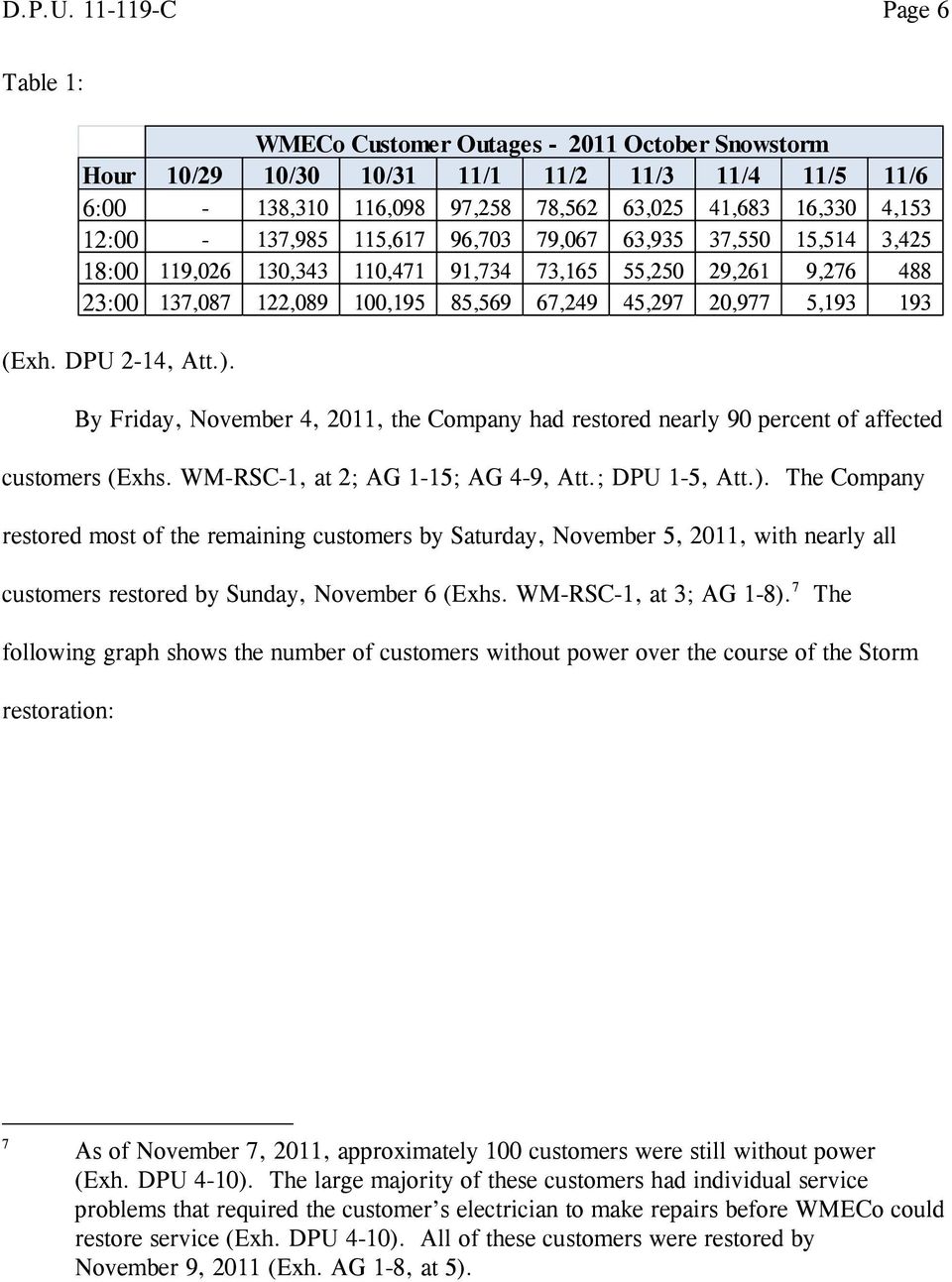
10 D.P.U C Page 5 October 29, 2011, and caused as much as 32 inches of heavy, wet snow to fall in the Company s service territory (Exh. WM-RSC-4, at 9, 10). 5 WMECo customers began experiencing service interruptions as a result of the Storm at approximately 2:00 p.m. on Saturday, October 29 (Exhs. DPU 3-27; DPU 1-8, at 3). Governor Deval Patrick declared a state of emergency on the evening of Saturday, October 29. By early the morning of Sunday, October 30, 2011, approximately 138,000 of the Company s 210,000 customers, or 65 percent of its customers, had lost electric service (Exhs. WM-RSC at 7-8; WM-RSC-1, at 2, 7; DPU 1-3, at 3; DPU 4-35). 6 Between Sunday, October 30 and Sunday, November 6, 2011, the Company restored, on average, over 18,000 customers per day (Exhs. WM-RSC at 8; DPU 1-8, Att.; DPU 2-14). Table 1, below, provides the number of WMECo customer outages for each day of the event: 5 6 Most of WMECo s service territory received between six inches and 20 inches of snow, while many higher elevation areas in the Berkshires received over 20 inches of snow (Exh. WM-RSC-4, at 9, 10). In total, 194,599 WMECo customers experienced outages over the course of the Storm and restoration period (Exh. AG 5-3).

11 D.P.U C Page 6 Table 1: WMECo Customer Outages October Snowstorm Hour 10/29 10/30 10/31 11/1 11/2 11/3 11/4 11/5 11/6 6:00-138, ,098 97,258 78,562 63,025 41,683 16,330 4,153 12:00-137, ,617 96,703 79,067 63,935 37,550 15,514 3,425 18:00 119, , ,471 91,734 73,165 55,250 29,261 9, :00 137, , ,195 85,569 67,249 45,297 20,977 5, (Exh. DPU 2-14, Att.). By Friday, November 4, 2011, the Company had restored nearly 90 percent of affected customers (Exhs. WM-RSC-1, at 2; AG 1-15; AG 4-9, Att.; DPU 1-5, Att.). The Company restored most of the remaining customers by Saturday, November 5, 2011, with nearly all customers restored by Sunday, November 6 (Exhs. WM-RSC-1, at 3; AG 1-8). 7 The following graph shows the number of customers without power over the course of the Storm restoration: 7 As of November 7, 2011, approximately 100 customers were still without power (Exh. DPU 4-10). The large majority of these customers had individual service problems that required the customer s electrician to make repairs before WMECo could restore service (Exh. DPU 4-10). All of these customers were restored by November 9, 2011 (Exh. AG 1-8, at 5).
12 D.P.U C Page 7 (Exh. DPU 1-8, Att). The Company describes the October Snowstorm as the most damaging storm in its 125-year history (Exh. WM-RSC at 7). In total, the Storm: (1) caused a peak of over 3,300 trouble spots 8 on the Company s distribution system; (2) affected 140 of the Company s 240 circuits; and (3) caused 67 circuits, or 28 percent, to be locked out (Exhs. WM-RSC at 8; WM-RSC-1, at 5; AG 1-15). 9 The Company received over 10,000 calls regarding a total of 4,100 individual incidents of downed wires (Exhs. AG 1-8; AG 3-8; AG 1-20). Further, as a 8 9 WMECo s outage management system labels every customer outage as an event, and some events may have one or more trouble spots. A trouble spot is a section of line that needs to be repaired or switched to restore customers. When an event has just one section of line to be restored, the event is the trouble spot (Exhs. DPU 1-29; DPU 4-1, Att. at 5.2). A feeder lockout is an automatic or unplanned interruption of electrical service at a feeder station that requires manual correction. A feeder lockout may result from equipment failure, downed power lines, or line faults on transmission lines which supply the feeder.

13 D.P.U C Page 8 result of Storm damage, the Company had to replace (1) 132 transformers, (2) 307 poles, 10 (3) approximately 52,319 feet of primary wire, and (4) 125,880 feet of secondary wire (Exhs. DPU 3-31, Att.; AG 5-3, Att.). Finally, ten of the Company s transmission lines sustained faults (Exh. WM-RSC-1, at 8). In comparison, the December 2008 ice storm, the second-largest storm in WMECo s history, caused approximately 47,000 of WMECo customers, or 22 percent, to lose power, resulted in half the number of trouble spots as the October Snowstorm, and resulted in a final restoration time of over a week (Exhs. WM-RSC-7, at 2; AG 5-3, Att.). The Company states that it responded to the October Snowstorm with twice as many crews and accomplished final restoration a day earlier than in the December 2008 ice storm (Exh. WM-RSC-7, at 2). B. Public Comments The Department received 14 letters from customers, legislators and public officials regarding the Company s preparation for and restoration following the October Snowstorm. The Department also heard from 26 customers, legislators, and public officials at the public hearings held in the cities of Greenfield and Springfield. Although written and oral comments covered a variety of topics, both largely focused on three issues: the overall length of restoration, tree trimming, and communication with customers and public officials. Several customers complained that they were without power for up to a week, and highlighted the difficulty such lengthy outages pose for elderly or 10 Of the 307 poles replaced during the Storm, WMECo replaced 198, and Verizon replaced 109 (Exh. DPU 4-30).
14 D.P.U C Page 9 disabled customers. Other comments mentioned monetary losses due to the length of outage, and suggested that the Company be fined for what they characterize as its poor performance. Many commenters, including the Attorney General, elected officials, and a representative from the University of Massachusetts-Amherst, expressed the opinion that some storm damage could have been avoided by better tree trimming and vegetation maintenance throughout the year. Both customers and public officials found the Company s communication lacking. Customers complained that they either were not told when to expect power to be restored, or were given inaccurate restoration estimates. Public officials noted that, at times, it was difficult to obtain information from the Company, and that estimated restoration times were conflicting and inaccurate. Other commenters were supportive of the Company and were satisfied with the restoration effort. IV. REGULATORY FRAMEWORK On November 12, 2009, Governor Patrick signed into law St. 2009, c. 133, An Act Relative to Public Utility Companies ( 2009 Act ). Among other provisions, the 2009 Act amended G.L. c. 164 by adding two new sections, 1J and 85B. Section 1J requires the Department to promulgate rules and regulations to establish standards of acceptable performance for emergency preparation and restoration of service for electric and gas companies doing business in the Commonwealth. Section 1J authorizes the Department to investigate alleged violations of the Department s standards of acceptable

15 D.P.U C Page 10 performance to determine whether a company violated such standards. 11 Finally, Section 1J states that the Department shall levy a penalty not to exceed $250,000 for each violation for each day that the violation of the department s standards persist; provided however, that the maximum penalty shall not exceed $20,000,000 for any related series of violations. Section 85B requires that electric distribution, transmission and natural gas companies submit annually an ERP for review and approval by the Department. Section 85B requires that ERPs be designed for the reasonably prompt restoration of service in the case of an emergency event and specifies information that must be included in a company s ERP. Section 85B also authorizes the Department to open an investigation to review the performance of any electric company in restoring service during an emergency event. If after investigation the Department finds that, as a result of the failure of the company to implement its ERP, the length of the service interruptions or outages was materially longer than they would have been but for the company s failure, the Department may deny the recovery of all, or any part of, the service restoration costs through distribution rates, commensurate with the degree and impact of the service interruptions or outages. G.L. c. 164, 85B(d). On February 2, 2010, the Department issued Emergency Preparation and Restoration of Service Regulations, D.P.U (2010), an Order adopting emergency regulations 220 C.M.R : Standards of Performance for Emergency Preparation and Restoration of Service for Electric Distribution and Gas Companies. After receiving comments and 11 The Department also has general authority pursuant to G.L. c. 164, 76 to investigate electric companies activities as they relate to the safety and convenience of the public or compliance with relevant statues, orders or regulations.
16 D.P.U C Page 11 holding a public hearing, the Department revised the regulations and issued an Order adopting final regulations on April 16, Order Adopting Final Regulations, D.P.U A (2010). The regulations establish (1) standards for acceptable performance for emergency preparation and restoration of service for electric and gas companies; (2) minimal requirements for EPRs based on G.L. c. 164, 85B; and (3) procedures for Department investigations, imposition of penalties and recovery of service restoration costs consistent with G.L. c. 164, 1J and 85B. On April 20, 2010, the Department issued Final Emergency Response Plan Guidelines for Electric Companies, D.P.U A (2010) ( ERP Guidelines ). The purpose of the ERP Guidelines is to establish, to the extent reasonable, uniform content and formatting requirements by which each electric company shall structure its ERP, consistent with the requirements of G.L. c. 164, 85B and 220 C.M.R et seq. ERP Guidelines at Section On August 6, 2012, after the Department commenced its investigations into the electric companies response to Tropical Storm Irene ( T.S. Irene ) and the October Snowstorm, Governor Patrick signed into law St. 2012, c. 216, An Act Relative to Emergency Service Response of Public Utility Companies (Effective Date, August 6, 2012) ( 2012 Act ). Among other provisions, the 2012 Act: (1) mandates that any penalty levied by the Department for violation of the Department s standards of acceptable performance for emergency preparation and restoration of service be credited back to the company s customers in a manner determined by the Department; (2) expands the specified information that companies must include in their ERPs per G.L. c. 164, 85B; (3) requires companies to adopt additional emergency communication protocols; (4) expands companies reporting requirements; and (5) specifies certain vegetation maintenance activities. St. 2012, c. 216.

17 D.P.U C Page 12 In our investigations of the electric companies response to T.S. Irene and the October Snowstorm, 13 the Department applies the above regulatory framework for the first time. 14 D.P.U / The Department notes, however, that this is not the first time that the Department has reviewed electric companies responses to storms or addressed public utilities obligations to provide safe and reliable service, including the responsibility to restore service in a timely manner when service to a customer has been interrupted. See Fitchburg Gas and Electric Light Company d/b/a Unitil, D.P.U A (2009) (Winter Storm 2008); Western Massachusetts Electric Company, D.P.U (1995); Hurricane Bob, D.P.U (1992); Hurricane Gloria, D.P.U (1986). V. STANDARD OF REVIEW Pursuant to G.L. c. 164, 1J, the Department established standards for the acceptable performance for emergency preparation and restoration of service for electric and gas companies. These performance standards are set forth in 220 C.M.R and include the following: The Department opened an investigation into WMECo s response to the October Snowstorm only. D.P.U C. On January 3, 2011, the Department opened an investigation into National Grid s response to a December 26, 2010 winter storm, pursuant to G.L. c. 164, 1J, 85B, 76, 1E and 1I, and the Department s emergency preparation and restoration of service regulations, 220 C.M.R National Grid, D.P.U , at 1 (2011). After discovery was complete, National Grid and the Attorney General filed an Amended Settlement Agreement, which the Department approved on September 22, Although the Department opened the investigation pursuant to our new regulations, because the proceeding terminated in a settlement, the Department did not have the opportunity to apply its new regulations to a fully litigated proceeding.

18 D.P.U C Page Emergency Preparation - Each Company shall ensure that it is adequately and sufficiently prepared to restore service to its customers in a safe and reasonably prompt manner during an emergency event. 220 C.M.R (2). 2. Restoration of Service - Each Company shall restore service to its customers in a safe and reasonably prompt manner during all service interruptions and outages, including, at a minimum, implementing all applicable components of the Company s ERP related to restoration of service. 220 C.M.R (3). 3. Reporting - Each Company shall comply with certain reporting requirements (such as submitting reports on meetings with officials, training and drill exercises, as well as periodic event reports and a final event report). 220 C.M.R (4). If the Department finds a violation of any of the standards established in 220 C.M.R , the Department shall levy a penalty not to exceed $250,000 for each violation for each day that the violation persists, for a maximum of $20,000,000 for any related series of violations. 15 G.L. c. 164, 1J; 220 C.M.R (2). In determining the amount of the penalty, the Department shall consider, among other factors, the following: (a) the gravity of the violation; (b) the appropriateness of the penalty to the size of the 15 We agree with the Company that the Department may assess a penalty when (1) there is a standard or established requirement, and (2) a company violates that standard or requirement. As noted above, the Department has promulgated performance standards in 220 C.M.R To the extent that the Company implies that the Department s performance standards may be vague, we disagree (see Company Brief at 5-7). The Department s standards, promulgated through a public rulemaking in which the Company participated, provide the Company and the Department with reasonably clear requirements and direction.

19 D.P.U C Page 14 Company; (c) the good faith of the Company in attempting to achieve compliance; and (d) the degree of control that the Company had over the circumstances that led to the violation. 220 C.M.R (2). VI. SERVICE RESTORATION A. Introduction WMECo is required, per Department regulations, to restore service to its customers in a safe and reasonably prompt manner. 220 C.M.R This section addresses the following restoration related components: (1) weather forecast, event classification and initial resource acquisition; (2) damage assessment, resources and restoration; (3) emergency response to downed wires; (4) linemen and restoration workday policy; and (5) communications. B. Weather Forecast, Event Classification, and Initial Resource Acquisition 1. Description In this section, we analyze the Company s weather forecast monitoring during the week before the Storm, how WMECo classified the event according to its ERP in response to weather forecasts, and its efforts to acquire resources as the Storm approached. Based upon its analysis of weather forecasts, the Company may activate its ERP and classify an event according to expected service outages (see Exh. DPU 4-1, Att. 5.2). The event classification levels, outlined in the Company s ERP, describe the expected number of (1) customers likely to be affected, (2) trouble spots, (3) crews, as well as the expected outage duration (Exh. DPU 4-1, Att. 3).

20 D.P.U C Page 15 The ERP provides the following with respect to event classifications: (1) a Level I event, described as a small impact event, anticipates under 4,000 customers affected, one to 20 trouble spots, a crew requirement of one to five crews, and an expected outage duration of under twelve hours; (2) a Level II event, described as a moderate impact event, anticipates under 10,000 customers affected, 21 to 50 trouble spots, a crew requirement of one to ten crews, and an expected outage duration of twelve to 24 hours; (3) a Level III event, described as a serious impact event, anticipates under 18,000 customers affected, 51 to 100 trouble spots, a crew requirement of one to 30 crews (including district and Northeast Utilities ( NU ) crews), and an expected restoration duration of 24 to 48 hours; (4) a Level IV event, described as a major impact event, anticipates over 18,000 customers affected, between 101 and 200 trouble spots, a crew requirement of 31 to 100 crews (including district, NU, and mutual aid crews), and an expected outage duration of 36 to 72 hours; and (5) a Level V event, described as a catastrophic system event, anticipates over 18,000 customers affected, over 200 trouble spots, a crew requirement of over 100 (including district, NU, and mutual aid crews), and an expected outage duration of over 72 hours (Exh. DPU 4-1, Att. 3). WMECo is a member of several mutual aid groups from which it may procure crews to assist with emergency restorations, including the New York Mutual Assistance Group ( NYMAG ), which is comprised of New York utilities and NU utilities, 16 and the Northeast 16 WMECo is a wholly-owned subsidiary of NU, which provides electric and natural gas service to more than two million customers in Massachusetts, Connecticut and New Hampshire. NU operates Connecticut Light and Power ( CL&P ) and Yankee Gas Services Company in Connecticut, and Public Service Company of New Hampshire. NU also operates other wholly-owned subsidiaries including Northeast Utilities Services

21 D.P.U C Page 16 Mutual Assistance Group ( NEMAG ), which is comprised of New England Utilities and Canadian utilities (Exh. AG 2-35). WMECo also is a signatory to the Edison Electrical Institute ( EEI ) Mutual Assistance Agreement (Exh. AG 2-35). 17 When WMECo determines that it needs additional outside assistance to accomplish restoration, it requests this assistance from its parent company, NU (Exh. AG 2-35). NU requests assistance from mutual aid groups and also directly contacts outside firms to obtain the requested resources (Exh. AG 2-35). NU allocates resources across its system based on many factors, including but not limited to location, need, type of crew, travel plans, and arrival time (Exh. AG 2-35). 2. Positions of the Parties a. Attorney General The Attorney General asserts that by Thursday, October 27, 2011, WMECo knew it might be facing an abnormal weather event, and that by Friday morning at the latest, it knew or should have known that the amount of damage would be magnified because of significant foliage on the trees (Attorney General Reply Brief at 11, citing Exhs. AG-MDC-PJL-1, at 7; WM-RSC-4; WM-RSC-5; WM-RSC-6; AG 3-23, Att. at 3). The Attorney General argues Corporation, which provides centralized administrative services to NU affiliates, including WMECo. Western Massachusetts Electric Company, D.P.U , at 1 (2011). On April 4, 2012, the Department approved the merger of NU and NSTAR Electric Company. 17 EEI is an association of investor-owned utilities. The EEI mutual assistance network is a voluntary assistance partnership of electric utilities, which leverages the strength, skills, and numbers of participating utilities to help restore power efficiently during an emergency situation (Exh. DPU 4-26, Att. at 2).
22 D.P.U C Page 17 that WMECo did not anticipate the severity of the Storm, but only reacted to it by moving from a Level II to a Level III event on Friday, October 28, 2011, and to a Level IV and finally a Level V event on the day that the Storm hit, Saturday, October 29 (Attorney General Reply Brief, citing Company Brief at 12). Regarding resource acquisition, the Attorney General contends that the Company had the choice of acquiring sufficient crews to be able to adequately scale up to handle the Level V event (Attorney General Brief at 7). She asserts that if the Company had brought crews into the service territory earlier, it would have reduced the restoration period for customers (Attorney General Brief at 2). She argues that the Company concedes that it could have brought crews into the service territory earlier which would have improved or shortened the cut-and-clear make-safe process, potentially causing in hindsight... the restoration to be slightly shorter (Attorney General Brief at 6, citing Tr. 1, at 36). The Attorney General acknowledges that WMECo may have had crews within the range of the numbers expected for a Level IV event by the evening of Friday, October 28, but argues that the Company s request for an additional 30 mutual aid crews was made at the behest of the Department to reach T.S. Irene level crew compliments (Attorney General Reply Brief at 10-11, citing Exhs. AG-MDC-PJL-1, at 19; AG 1-2). The Attorney General claims that the effect of WMECo s failure to obtain adequate crews may be most evident in its failure to complete a detailed damage assessment within 48 hours (Attorney General Brief at 6). Additionally, the Attorney General disputes the Company s claim that the Attorney General appears to agree that the Company ramped up to a Level III or Level IV event, and
23 D.P.U C Page 18 that doing so was consistent with good utility practice (Attorney General Reply Brief, citing Company Brief at 17). The Attorney General argues instead that her statement referred to mobilizing Company personnel rather than to WMECo s efforts to secure outside resources (Attorney General Reply Brief at 11, citing Exh. AG-MDC-PJL-1, at 19). The Attorney General contends that the Company failed to perform according to its ERP with respect to procuring and allocating outside tree and line crews (Attorney General Brief at 7, citing Exh. DPU 4-1, Att. 4, at 5). The Attorney General asserts that ultimately, while the Company argues that the October Snowstorm was the most damaging in its history, the Company is required nonetheless to prepare for events of a magnitude it has not previously experienced (Attorney General Brief at 2). The Attorney General contends that the Department has stated that it will not excuse poor preparation and planning for a storm on the basis that a Company has not previously experienced a winter storm of the same magnitude (Attorney General Reply Brief at 4, citing D.P.U A at 48). b. Company WMECo asserts that it appropriately planned and prepared for the Storm based on the Company s experience with prior storms (Company Reply Brief at 4). The Company argues that it closely monitored the potential for a snow event during the week of October 24, 2011 (Company Brief at 10, citing Exh. WM-RSC-1, at 1). The Company contends that it received forecasts from Telvent (a private weather forecasting service), from the National Oceanic and Atmospheric Association ( NOAA ), and that it interacted with the National Weather Service
24 D.P.U C Page 19 ( NWS ) throughout the week to try and understand the magnitude of the event (Company Brief at 10, citing Exhs. WM-RSC at 6; WM-RSC-7, at 8). WMECo asserts that the October Snowstorm was extraordinarily difficult to predict, but that the Company constantly monitored weather forecasts and took all reasonable actions to obtain and monitor forecasts (Company Brief at 8, 10, citing Exh. WM-RSC-7, at 8). The Company contends that on Thursday, October 27, weather agencies predicted several inches of snow for Saturday, October 29 (Company Brief at 8, citing FERC Report at 11). 18 The Company asserts that predicted snowfall amounts increased rapidly between Thursday, October 27 and Saturday, October 29, and that on the morning of Saturday, October 29, forecasters predicted up to 15 inches of snow in some areas (Company Brief at 8-9, citing FERC Report at 9). The Company contends that it was not until Saturday, October 29, that the forecast evolved into one that predicted significant snow accumulations in the Pioneer Valley, 19 an area in which many leaves remained on the trees (Company Brief at 10, citing Tr. 2, at ). The Company asserts that, contrary to predictions on even Saturday, October 29, over 30 inches of snow ended up falling in parts of Massachusetts (Company Brief at 9, citing Exh. WM-RSC-4, at 9; FERC Report at 13). In support of its contention that the Storm was difficult to predict, the Company points to Telvent s post-storm summary, which Additionally, the Company asserts that overnight Thursday into Friday, October 28, five inches of snow fell in the Berkshires, which did not result in significant outages (Company Brief at 10). Pioneer Valley is the Massachusetts portion of the Connecticut River Valley, also known as the Interstate 91 corridor (Company Brief at 10).
25 D.P.U C Page 20 states that weather forecast models poorly forecasted the development of the area of low pressure leading up to this storm (Company Brief at 8, citing Exh. WM-RSC-4, at 15). Additionally, the Company claims that although the Storm delivered significantly greater damage than expected, the Company properly implemented its ERP to prepare for the Storm, and successfully scaled its response to the higher levels of damage, consistent with its ERP (Company Brief at 15; Company Reply Brief at 4). The Company asserts that it discussed the storm potential and preparatory actions with its utility counterparts, including NEMAG, and that it considered its history with other storms (Company Brief at 11, citing Exh. WM-RSC-7, at 8). WMECo also asserts that on Thursday, October 27, it initiated internal calls to discuss storm planning; readiness; on-call crew resources, including local line and tree contractor crews; and storm rooms and materials (Company Brief at 16, citing Exh. AG 3-35, at 2). The Company contends that on Thursday, October 27, it put 100 percent of its own crews on call for Saturday, October 29, into Sunday (Company Brief at 16, citing Exhs. WM-RSC-1, at 1; AG 1-6). The Company argues that by Friday, October 28, it had taken rapidly escalating steps to respond to the approaching Storm, including conducting numerous conference calls with the Incident Commander 20 and supporting personnel dealing with storm readiness and procurement of additional line crews (Company Brief at 16). On Friday, October 28, the Company asserts that it classified the Storm as a Level III event under the ERP, in which 51 to 100 trouble spots 20 Two Incident Commanders provided WMECo with 24-hour coverage. Robert S. Coates, Jr., and Bliss A. Young served as Incident Commanders for WMECo during the Storm (Exh. WM-RSC at 2; Tr. 1, at 21).
26 D.P.U C Page 21 would be expected and up to 30 crews would be needed for an expected outage duration of 28 to 48 hours (Company Brief at 41-42, citing Exh. DPU 4-1, Att. 3, at 2). By Friday evening, October 28, the Company states that it had managed to secure 50 local line crews and 42 local tree crews for work on Saturday (Company Brief at 16, citing Exhs. WM-RSC at 7; WM-RSC-3). Finally, the Company argues that as the forecasts worsened, by Saturday morning, October 29, WMECo was expecting a major storm at the ERP Level III to IV magnitude (Company Brief at 12). The Company contends that in the afternoon of Saturday, October 29, the forecasts escalated further, and that the Company declared an ERP Level IV storm, in which the expected number of customers likely to be affected would exceed 18,000, expected trouble spots would be between 101 and 200, and for which 31 to 100 crews would be needed for an expected outage duration of up to three days (Company Brief at 12, 42, citing Exh. DPU 4-33; Tr. 2, at ). In response, the Company claims that it secured ten additional local transmission crews and 56 contract crews who in travel time were two to three days away (Company Brief at 17, citing Exhs. AG 1-6; WM-RSC at 7; WM-RSC-3). The Company states that it opened its Emergency Operation Center ( EOC ) located in Technology Park in Springfield on Saturday at 6:00 p.m., and that system and district command staff, municipal liaisons and associated support and logistics personnel were operational in all Company district storm rooms at that time (Company Brief at 18, citing Exhs. DPU 2-10; DPU 2-30; WM-BAY at 2).
27 D.P.U C Page 22 The Company states that on Saturday night, October 29, just before midnight, it declared a Level V storm which, under the ERP in place at the time of the Storm, assumes that more than 18,000 customers would likely be affected, that there would be more than 200 trouble spots on the Company s system, that over 100 crews would be needed, and that the expected outage duration was more than 72 hours (Company Brief at 12, 42, citing Tr. 2, at 340, 344). The Company argues that the NWS called the October Snowstorm a rare and historic October Nor easter and stated that it was the strongest fall storm on record in the Northeast (Company Brief at 8, citing FERC Report at 14). The Company contends that the only other notable October Snowstorm in New England in the last 150 years occurred in 1987 and was far less destructive (Company Brief at 8, citing FERC Report at 14). Further, in preparing for the October Snowstorm, WMECo asserts that the Company used the experience it gained from a late autumn storm that hit in November 2003, which caused approximately 20,000 customers to lose service (Company Brief at 11, citing Tr. 2, at 335, 336, 338). 21 Moreover, the Company points out that the October Snowstorm affected three times the number of customers compared to the numbers of customers affected by the December 2008 ice storm, T.S. Irene, or the June 2011 tornado (Company Brief at 13, citing Exhs. WM-RSC at 9; DPU 3-31). 21 The November 2003 storm resulted in 22,338 customer outages in the Company s service territory (Exh. DPU 2-1, Att.).
28 D.P.U C Page 23 The Company maintains that it followed good utility practice of basing pre-event damage estimates on past experience with other prior storms, and asserts that the Attorney General acknowledged that this was good utility practice (Company Reply Brief at 4, citing Exh. AG-MDC-PJL-1, at 16). Specifically, WMECo contends that the Attorney General s witness testified that [m]ost utilities base pre-event damage estimates on past experience with prior storms and similar factors listed by WMECo, and this is considered good utility practice (Company Reply Brief at 4, citing Exh. AG-MDC-PJL-1, at 16). 3. Analysis and Findings The days immediately preceding a storm event are a critical period of preparation for an electric distribution company. The actions that a company takes with respect to monitoring weather forecasts of an approaching event, predicting damage from that event, classifying the event according to its ERP, and securing resources before the event significantly determine how well prepared the company will be to respond to customer outages when a storm hits. We begin, therefore, by examining how the Company monitored weather forecasts as the Storm approached, the substance of those forecasts, whether the Company used those forecasts to reasonably classify the event consistent with its ERP, and the Company s efforts to secure crews before the Storm. The Company s Incident Command team monitored multiple weather forecasts during the week prior to the October Snowstorm, classified the event, and made an assessment of damage based on the ERP event classification (Exhs. DPU 3-23; DPU 4-29; Tr. 2, at 337, 338). In assessing its resource needs before the Storm and classifying the event, the Company
29 D.P.U C Page 24 relied on a number of factors, including the progression of weather forecasts from multiple sources, past performance of the transmission and distribution system including the past damage experienced from similar types of weather, an assessment of mitigating or aggravating conditions such as amount of leaves on the trees, ground saturation, temperature, existing accumulation of previous snow and/or ice, resource availability, and other operational conditions (Exhs. AG 3-29; DPU 4-33; Tr. 1, at 48). The Company does not presently have a storm damage predictive model, but is working with the University of Connecticut to develop a tool to potentially assist the Company to predict the consequences of major storms based upon past weather experiences in Massachusetts and Connecticut and corresponding outages (Exhs. AG-MDC-PJL-1, at 16-17; AG 3-30; Tr. 2, at 340). WMECo monitors weather forecasts through is contract weather service, Telvent, as well as the NWS, NOAA, and local weather forecasts from television (Exhs. WM-RSC at 6; WM-RSC-7, at 8; AG 3-23). By Wednesday, October 26, the Telvent and NWS forecasts indicated that a storm was developing off the New England coast that could cause a few inches of snow in high elevation areas of WMECo s service territory the following day, with possible snow on Saturday, October 29 (Exhs. WM-RSC-1, at 1; WM-RSC-3). Early Thursday, October 27, Telvent forecasts shifted the approaching October Snowstorm slightly westward, which led to predictions of two to four inches of snow on Saturday, October 29 (Exh. WM-RSC-4, at 15). Also on Thursday, October 27, the NWS predicted snow, which would begin as rain, for Saturday, October 29, with totals of one to two inches for Boston, Providence, and Hartford, and seven and a half inches in Worcester
30 D.P.U C Page 25 (Exh. WM-RSC-3). In response, on Thursday, October 27, the Company classified the approaching Storm as a Level II event, and placed 100 percent of its internal distribution line crews and support crews, a total of 42 crews 22 on call for Saturday and Sunday (Exhs. WM-RSC-1, at 17; WM-RSC-3; DPU 2-30; AG 1-6; DPU 3-23). Late on the afternoon of Thursday, October 27, Telvent forecasts brought the Storm considerably closer to the coast (Exh. WM-RSC-3). Late on the evening of Thursday, October 27, Telvent forecasted six to ten inches of snow from the approaching Storm (Exh. WM-RSC-4, at 15). On Friday morning, October 28, confidence in its storm models led Telvent to forecast seven to twelve inches of wet snow from Pennsylvania northeast into interior New England, while the NWS predicted four to eight inches of wet snow, with the highest winds on the coast, and with the Interstate 91 corridor having a 50 percent probability of eight inches of snow or more (Exhs. WM-RSC-4, at 15; WM-RSC-3; WM-RSC-1 (Rev.) at 1). By 2:00 p.m. on Friday, October 28, Telvent predicted eight to eleven inches of snow for a large portion of WMECo s service territory (Exh. WM-RSC-4, at 16). On Friday, October 28, WMECo took actions to prepare for a Level II to Level III event as defined in its ERP (Exh. DPU 2-12, at 2). By early Friday evening, October 28, WMECo secured local line and tree contract crews (50 total line crews and 42 total tree crews), and requested an additional 30 line crews Friday evening through NU mutual aid 22 These crews consisted of WMECo s 79 linemen, which formed approximately 35 two-person crews as well as nine single-person trouble crews (Exh. WM-RSC-7, at 10). According to the Company, the number of available crews can vary depending on vacation, sickness, or light duty due to medical conditions (Exh. WM-RSC-7, at 11).
31 D.P.U C Page 26 (Exhs. WM-RSC-3; DPU 1-13). On Saturday, October 29, at 6:00 a.m., Telvent issued a winter storm warning and predicted eight to 15 inches of heavy, wet snow, with increased peak winds of 38 mph (Exh. WM-RSC-3). 23 WMECo escalated its response to prepare for a Level III to IV event (Exh. DPU 2-12, at 2). On Saturday, October 29, at approximately 9:00 a.m., the Company requested another 20 crews, for a total of 50 external crews, including mutual aid crews (Exhs. AG 4-2; DPU 1-13). During the afternoon, WMECo declared a Level IV event (Tr. 2, at 337). At approximately 2:00 p.m., the Company requested 50 additional external crews, for a total of 100 external crews, including mutual aid crews (Exhs. AG 4-2; DPU 1-13). At 3:00 p.m., Telvent escalated its prediction to twelve inches to 17 inches of snow, with greater amounts for areas with higher elevation (Exh. WM-RSC-3). On the afternoon of Saturday, October 29, the Company pre-positioned in its district storm rooms 14 line crews, four tree crews, three substation crews, and 21 support staff as well as field supervision, to respond to public safety events (Exhs. DPU 2-30; AG 1-6, Att.). 24 On Saturday, October 29, at 6:00 p.m., the Company opened its Emergency Operations Center On Saturday, October 29, at 8:30 a.m., the NWS issued a winter storm warning, and predicted four to eight inches of snow in the interior, and over twelve inches in higher terrain of East Berkshires, Worcester Hills and Northwest Connecticut (Exh. WM-RSC-3). The NWS also predicted winds up to 40 m.p.h., with a 50 to 79 percent probability of over eight inches of heavy wet snow for the Interstate 91 corridor, and over 90 percent probability for Pittsfield and North central Massachusetts (Exh. WM-RSC-3). Because of hazardous conditions on Saturday night, October 29, the pre-positioned crews addressed downed wires cut, clear, and make-safe issues only (Exh. DPU 2-30).
32 D.P.U C Page 27 ( EOC ) in the City of Springfield (Exh. DPU 2-10). In addition, the Company opened district storm rooms in Hadley, Greenfield, and Pittsfield on Saturday, October 29, at 6:00 p.m., which were staffed with system and district command staff, municipal liaisons, and associated support and logistics personnel (Exh. DPU 2-30; Tr. 1, at ). The Company scheduled remaining on-call personnel and additional local contractors to report to work at 6:00 a.m. on Sunday morning, October 30 (Exh. DPU 2-30). At midnight on October 29, WMECo declared a Level V storm (Tr. 2, at ). By Sunday, October 30, WMECo s service territory received upwards of ten inches of heavy snow, with high elevations seeing 30 inches of snow or more (Exhs. WM-RSC-3; WM-RSC-4, at 12). On Sunday, October 30, the Company requested 70 additional crews, to bring the total requested external crews to 170 (Exh. AG 4-2). Further, the Company requested another 70 additional external crews later on Sunday to bring the total to 240 requested crews (Exh. AG 4-2). On Sunday, October 30, the Company deployed the following peak number of crews and personnel to perform restoration: 45 line crews; ten transmission crews; 16 substation crews; 35 tree crews; 23 damage appraisers; 31 wires-down guards; and 104 support personnel (Exh. AG 1-6). 25 Based on the above, the Department concludes that the Company took reasonable steps to monitor weather forecasts, escalate its preparation according to the event classification table in its ERP, and acquire crews in response to the event classification before the Storm in 25 We address crew availability throughout the restoration process in Section, VI.C.3.e, below.
33 D.P.U C Page 28 accordance with its ERP classification (Exhs. DPU 3-23; DPU 2-12; DPU 4-1, Att. 3). First, WMECo prudently monitored weather forecasts during the week of the Storm through multiple sources, including contract weather service Telvent, NWS, NOAA, and television (Exhs. WM-RSC at 6; WM-RSC-7, at 8; AG 3-23; Tr. 1, at 40). Those forecasts began to rapidly deteriorate beginning late on the afternoon of Thursday, October 27, through the day the Storm hit the Company s service territory, Saturday, October 29 (Exhs. WM-RSC-4, at 15-16; WM-RSC-3; WM-RSC-1 (Rev.) at 1). As forecasts began to predict worsening conditions for Saturday, October 29, the record demonstrates that WMECo progressively escalated its preparation and crew acquisition efforts in response to those forecasts (Exhs. WM-RSC-1, at 17; WM-RSC-3; DPU 2-30; AG 1-6; DPU 3-23; WM-RSC-4, at 15; WM-RSC-3; WM-RSC-1 (Rev.); at 1; DPU 2-12; AG 4-2; DPU 1-13; Tr. 1, at 37, 38). By Friday, October 28, the Company had a total crew complement of 100 crews or more, and it continued to request additional crews (Exhs. WM-RSC-3; DPU 2-13; DPU 4-1, Att. 3, at 2). On Sunday, October 30, having directed crews to report early on Sunday morning to begin restoration, WMECo deployed 106 crews, including line crews, transmission crews, tree crews, and substation crews (Exh. AG 1-6, Att.). 26 Based on the Company s ERP, this crew level slightly exceeds expected crew needs for a Level IV event, and is at the low end of expected crew needs for a Level V event (Exh. DPU 4-1, Att. 3, at 2). These crew 26 The Company also deployed 23 damage appraisers, 31 wires-down guards, and 104 support personnel (Exh. AG 1-6).
34 D.P.U C Page 29 deployments continued to increase during the restoration period, to a maximum crew deployment of approximately 500 crews (Exh. AG 1-6). The Attorney General asserts that the Company could have brought crews into the service territory earlier, which would have lessened the duration of the restoration (Attorney General Brief at 2). The Attorney General does not argue on brief specifically when she would have expected the Company to bring in additional crews to perform restoration. The Attorney General s witnesses, however, testified that one could argue that WMECo should have declared a Level V event on Friday, October 28, based on weather forecasts, but there is no evidence that had the Company done so it would have had any measurable effect on the eventual speed of restoration because of crew availability and the possible effect of poor weather on travel conditions (Exh. AG-MDC-PJL-1, at 18). Based on the Company s progressive escalation of the storm level and of crew acquisition before the Storm, we find that the Company reasonably monitored weather forecasts and elevated its preparation and crew acquisition in accordance with its ERP. With regard to how the Company determined event classification level, the Company used weather forecasts from multiple weather services, past experience with prior storms on the Company s transmission and distribution system, and situational conditions (Exhs. AG 3-29; DPU 4-33; Tr. 1, at 48). The Company s pre-storm damage assessment factored in the amount of leaves on the trees, ground saturation, temperature, the accumulation of previous snow and/or ice, and resource availability (Exhs. AG 3-29; DPU 4-33; Tr. 1, at 48). The Attorney General testified that most utilities base pre-event damage estimates on
35 D.P.U C Page 30 past experience with prior storms and similar factors listed by WMECo, and that this is considered good utility practice (Exh. AG-MDC-PJL-1, at 16). Accordingly, we find that the factors the Company used to classify the event level were reasonable. We encourage the Company, however, to continue to explore how to more systematically predict damage before a storm. The Company is working with the University of Connecticut to develop a tool to potentially assist the Company to predict the consequences of major storms (Exhs. AG-MDC-PJL-1, at 16-17; AG 3-30; Tr. 2, at 340). The Attorney General opines that this is a step in the right direction, and recommends that, as a best practice, the Company adopt a more formalized pre-event damage prediction process (Exh. AG-MDC-PJL-1, at 16-17). While we will not require the Company to use a computerized damage prediction model, we expect the Company to systematically analyze all applicable factors in its damage prediction process. In addition, the Department encourages the Company to complete and test the damage prediction model it is developing with the University of Connecticut. Finally, the Attorney General contends that the Company failed to rely on its long history with weather events to recognize the severity of the coming Storm (Attorney General Reply Brief at 12). No storm in the Company s history, however, caused the amount of damage to the Company s system and resulted in anything approaching a peak of 138,000 customers experiencing electric outages or almost 195,000 customers experiencing an outage over the course of the Storm and restoration period. This is true of both the November 2003 autumn storm, which caused approximately 22,000 outages, and the December 2008 ice storm, which
36 D.P.U C Page 31 caused approximately 47,000 outages (Exhs. WM-RSC at 7, 8; WM-RSC-1, at 5; DPU 2-1; DPU 4-35; AG 1-15; Tr. 2, at 335, 336, 338). Moreover, it is notable that portions of the Company s service territory received over 30 inches of snow, more than that predicted even on Saturday, October 29, the day the Storm hit, and that many of these municipalities experienced heavy customer outages (Exhs. WM RSC-4, at 9; WM-RSC-3; DPU 1-7). In short, we recognize that in terms of the damage caused to the Company s distribution system, the October Snowstorm was historic, and that the rapidly deteriorating forecasts in the two days before the Storm made it difficult to predict that the Company s system would be so significantly damaged. We expect that the Company will use its experience with this Storm to inform its preparation for future events. C. Damage Assessment, Resources, and Restoration 1. ERP Guidelines and WMECo s ERP The Department s ERP Guidelines require each electric distribution company to establish and describe in detail the procedures by which it will accomplish preliminary damage assessment as well as a more detailed damage assessment. Specifically, the ERP Guidelines provide that each company s ERP should describ[e] the methods for making, within 24 hours, broad-scale preliminary assessments of the nature and extent of system damage based on rapid surveys of damaged areas and other data sources, and for making, within 48 hours, more detailed estimates of system damage based on systematic field surveys. ERP Guidelines at Section V.B.2.
37 D.P.U C Page 32 The Company s ERP notes that storms can cause extensive damage to distribution lines and equipment (Exh. DPU 4-1, Att. 5.2, at 5). The Company utilizes trained NU personnel to assist permanently assigned district personnel to perform assessment patrols during emergency conditions to identify possible hazards and equipment failures (Exh. DPU 4-1, Att. 5.2, at 5). The ERP also states: [t]he preliminary damage assessment will take no longer than 24 hours to complete. Damage assessment will continue with detailed estimates of damage and be relayed back to the work center. This information will be analyzed within 48 hours or sooner and the proper resources will be committed to the effort (Exh. DPU 4-1, Att. 5.2, at 6). 2. Positions of the Parties a. Attorney General The Attorney General claims that the Company s performance during the October Snowstorm shows weakness in the Company s planning and restoration processes (Attorney General Brief at 2). Specifically, the Attorney General argues that WMECo failed to timely complete a detailed damage assessment and did not perform as required by its ERP with respect to restoration resources (Attorney General Brief at 5, 7, 8). First, the Attorney General argues that WMECo s ERP requires the Company to analyze its damage assessment information within 48 hours or sooner (Attorney General Brief at 5, citing Exh. DPU 3-1, Att.; Attorney General Reply Brief at 15, citing Exh. DPU 4-1, Att. 5, at 6). The Attorney General claims that WMECo concedes that it did not complete its detailed damage assessment within 48 hours (Attorney General Brief at 5,
38 D.P.U C Page 33 citing Tr. 3, at , 455). Specifically, the Attorney General argues that the Company was unable to complete detailed damage assessment in Hadley, Greenfield, and Springfield within 48 hours (Attorney General Brief at 6, citing Tr. 2, at 367; Attorney General Reply Brief at 15, citing Exh. DPU 3-27(e); Tr. 3, at , 455). The Attorney General argues that the Company s problems with accessing roads and its choice to utilize circuit-based restoration do not excuse the Company for failing to meet the 48-hour standard (Attorney General Reply Brief at 12, citing Company Brief at 38 n.16). The Attorney General contends that the ERP requires the Company to satisfy both the 48-hour damage assessment requirement and to efficiently restore service and there is no either/or to those requirements (Attorney General Brief at 6, citing Tr. 2, at 367; G.L. c. 164, 85B). She argues that if the Company resolved to exceed the 48-hour requirement in order to attempt to restore power more efficiently, it decided to rob Peter to pay Paul and the Department should not excuse its violation of the ERP (Attorney General Brief at 6). The Attorney General asserts that by not completing a timely damage assessment, the Company violated an ERP requirement, and that this violation lasted through November 3, 2011, or five days (Attorney General Reply Brief at 15). The Attorney General recommends the maximum allowable fine of $250,000 per day for the duration of time of the violation, for a total of $1,250,000 (Attorney General Reply Brief at 15, citing G.L. c. 164, 1J). Second, regarding resource adequacy, the Attorney General argues that WMECo did not have enough damage assessors and thus, could not provide reasonably accurate estimated
39 D.P.U C Page 34 restoration targets ( ETRs ) (Attorney General Reply Brief at 12). 27 In addition, the Attorney General asserts that WMECo s failure to establish restoration targets hindered the Company s ability to determine what resources to acquire and when (Attorney General Brief at 7-8). The Attorney General contends that the Company s designation of over three days as a restoration time for a Level V storm is not a target, but instead an open-ended estimate that does not compel the Company to strive for a particular restoration time (Attorney General Brief at 7). The Attorney General argues that it is impossible for WMECo to demonstrate that its crew decisions during the event were reasonable if it did not conduct an analysis of crew decisions until after-the-fact and cannot now articulate what its restoration target was during the October Snowstorm (Attorney General Brief at 8, citing Tr. 1, at 62). The Attorney General claims that based on the Company s vague assertion regarding its restoration targets, the Department should find that the Company s restoration was not conducted in a reasonably prompt manner as required by G.L. c. 164, 85B (Attorney General Brief at 8). Finally, the Attorney General claims that having a Department-approved ERP in place is not the same as proving that the ERP was efficiently and effectively implemented (Attorney General Reply Brief at 5). The Attorney General states that the Department has stated that implementation of an ERP in and of itself does not constitute compliance with the Department s standards (Attorney General Reply Brief at 5). Moreover, the Attorney General 27 To the extent that parties arguments regarding ETRs relate to the restoration effort more generally, including the number of damage assessors, damage assessment, and the Company s ability to escalate its response to the Storm, those arguments and issues are addressed in this section. The Company s ETRs, including communication and accuracy of the ETRs, are addressed in Section VI.F.2.c.vi, below.
40 D.P.U C Page 35 argues that the ERP itself may require changes or modifications to allow it to be more scalable to a Level V event (Attorney General Brief at 15, citing Tr. 3, at ). b. DOER DOER disputes the Company s assertion that its ERP does not require it to complete a detailed damage assessment within 48 hours, and argues that the Company s ERP clearly requires it to do so (DOER Reply Brief at 2, citing Company Reply Brief at 47). DOER argues that the Company s inability to communicate ETRs within 48 hours demonstrates that it could not escalate its response to match the severity of the event (DOER Brief at 4, 11, citing Exhs. AG 2-3; AG 2-9). Moreover, DOER claims that the Company s decision to conduct field restoration using circuit-based restoration 28 rather than event-based restoration, resulted in ETRs being developed at a more global level (DOER Brief at 5). DOER also argues that the Company did not have sufficient crews to inspect and report damage (DOER Brief at 5). DOER argues that the Company should increase the number and effectiveness of damage assessors, which would in turn improve the precision of its ETRs in major storms (DOER Brief at 5). DOER contends that one way to increase the Company s damage assessment capability is to cross-train a sufficient number of non-field personnel with specific local knowledge of the distribution systems in the towns served by WMECo, and pre-position them prior to an impending storm (DOER Brief at 5, citing Exh. DOER 1-8). 28 DOER refers to circuit-based restoration as feeder-by-feeder restoration (DOER Brief at 5). The terms are interchangeable and refer to the process in which crews are assigned to restore all customers on a given circuit or feeder rather than working individual orders, so that crew travel time is minimized (Exh. AG-MDC-PJL-1, at 26).
41 D.P.U C Page 36 DOER contends that while the Company claims it cross-trains personnel, in a storm those employees could in fact be drawn from across the NU system, including Connecticut and New Hampshire, so that someone could be assigned a town in the WMECo service territory who does not actually know the local system (DOER Brief at 6, citing Exh. DOER 1-8). Further, DOER argues that while WMECo does not pre-position employees in the field or during a storm for safety reasons, it does not explain how pre-positioning crews before a storm is less safe than traveling after a storm (DOER Brief at 6). DOER asserts that WMECo s approach to pre-positioning affects the timeliness of damage assessment, which may explain the Company s delay in reporting ETRs (DOER Brief at 6). In sum, DOER contends that the record in this investigation demonstrates that the Company was not adequately and sufficiently prepared to restore services to its customers in a safe and reasonably prompt manner during the October Snowstorm, as required by G. L. c. 164, 1J and ERP Regulations (DOER Brief at 11). c. Company i. Method of Restoration The Company states that on Saturday, October 29, it received over 10,000 wires-down calls and had 3,400 trouble spots reported on its system (Company Brief at 28, citing Exh. AG 4-9; Tr. 1, at 107; Tr. 2, at 343). Given the magnitude of the damage, WMECo concluded that circuit-based restoration was the most efficient way to restore service (Company Brief at 29).
42 D.P.U C Page 37 According to the Company, circuit-based restoration involves restoration of service in the field by circuit, as opposed to event-based restoration, which focuses on outages identified by the OMS (Company Brief at 28-29). 29 The Company maintains that when it received information on damage to a specific circuit, it assigned multiple crews and support to restore the circuit in its entirety (Company Brief at 29). The numbers of crews deployed varied depending on the size of the circuit and the magnitude of damage (Company Brief at 29). The Company argues that the Attorney General testified that [d]uring major outage restorations, the circuit-based approach is considered an industry best practice (Company Brief at 30, citing Exh. AG-MJD-PJL-1, at 26). Additionally, the Company asserts that, given the extent of damage, the Company wanted damage assessors working in concert with the crews performing restoration (Company Brief at 32). The Company states that it was an operational, strategic decision made to utilize the damage assessment people in a fashion to help the crews succeed in restoration versus just transfer information back to the OMS (Company Brief at 32, citing Tr. 2, at 368). WMECo argues that the circuit-based restoration process with damage assessors working ahead of crews was used for speed of restoration and that this effort was successful (Company Brief at 32, citing Tr. 2, at 368). 29 The OMS is an information system used by electric utilities to identify all known trouble locations and to estimate the number of customers impacted by these locations. The Company maintains that in storms of lesser magnitude, restoration proceeds through the OMS, which captures location-specific crew dispatch needs and restoration times and dates (Company Brief at 28, citing Exhs. AG 4-8; AG 1-15). In major events, with damage to so many circuits, however, the Company asserts that circuit-based restoration is the most efficient way to restore service (Company Brief at 28, 29).
43 D.P.U C Page 38 The Company asserts that there is no evidence to contradict the Company s testimony that the most efficient way to restore service was for damage assessors to do their work moving down the circuits (Company Brief at 39, citing Tr. 2, at 361). Moreover, the Company avers that the Attorney General s witness testified that [w]ith pervasive, systemwide damage, restoration should be conducted on a prioritized circuit-by-circuit basis; this approach minimizes crew travel time and results in overall faster restoration (Company Brief at 30, citing Exh. AG-MJD-PJL-1, at 26). ii. Damage Assessment The Company argues that it properly accomplished its damage assessment (Company Brief at 38-39). WMECo states that its first cut at damage assessment was complete on October 30, within a day of when the Storm hit (Company Brief at 38, citing Tr. 2, at 365). The Company argues that it complied with its ERP because damage assessment did not stop with the initial damage assessment, but continued with detailed estimates of damage (Company Brief at 38-39, citing Tr. 2, at 360, 370, , ). The Company argues that for this particular storm, the proper approach to damage assessment was to use all the damage assessment resources available and use them in the circuit-by-circuit restoration effort (Company Brief at 39). According to the Company, the ERP does not require the Company to complete all detailed estimates of damage within 48 hours. Rather, the Company asserts that the ERP requires the Company to analyze the information relayed to the work center within 48 hours
44 D.P.U C Page 39 and to commit proper resources to the effort (Company Reply Brief at 6, citing Exh. DPU 4-1, Att. 5, at 6 (emphasis added)). WMECo asserts that it committed proper resources before and after it completed its high-level damage assessment and devoted significant resources to detailed damage assessment (Company Reply Brief at 6, citing Tr. 2, at 360, 370, , ). The Company states that the initial damage assessment process started immediately after conditions were sufficiently safe to do so (Company Brief at 31, citing Tr. 2, at 360). The Company performed its transmission line damage assessment by helicopter and used 18 personnel from the Company s engineering group and 16 NU mutual aid employees to perform damage assessment (Company Brief at 31, citing Tr. 2, at 370; Tr. 3, at 474). The Company states that, in total, more than 100 personnel performed damage assessment, including Company damage assessors, Company line supervisors, service and line crews, mutual aid personnel, and contractor crew foremen (Company Brief at 31, citing Tr. 2, at 371). The Company asserts that although it strives to complete detailed damage assessment within 48 hours of initial outages, it was not possible to do so in this event because the extensive damage to the system precluded safe access to many roadways and because the Company chose to restore power using the more efficient circuit-based approach (Company Brief at 38 n.16, citing Exhs. DPU 3-27; DPU 3-29). The Company contends that detailed damage assessment was not necessary because of the manner in which resources were deployed and that [t]here was no need to assess damage that the line crew [was] already repairing (Company Brief at 39, citing Tr. 2, at 369). Moreover, the Company points to Attorney General testimony that
45 D.P.U C Page 40 [w]hen using a circuit-based restoration approach, damage assessment is done on a piecemeal basis after addressing infrastructure concerns. It is therefore not uncommon for utilities to never actually complete their full damage assessment prior to the restoration of some customers (Company Brief at 39-40, citing Exh. AG-MDC-PJL-1, at 31). WMECo disputes the Attorney General s argument that the Company did not have enough damage assessors to be able to do a detailed-enough assessment within 48 hours so that it could provide reasonably accurate ETRs (Company Reply Brief at 6, citing Attorney General Reply Brief at 12). The Company points out that there is no ERP requirement to provide ETRs within 48 hours, but asserts it would have met such a requirement because it immediately issued global ETRs based upon initial damage assessment information (Company Reply Brief at 6-7, citing Exh. DPU 3-27; Tr. 2. at ). The Company contends that, for purposes of the speed of restoration, it used the more efficient circuit-based restoration method, and that it was this method rather than a lack of damage assessors that limited the granularity of ETRs (Company Reply Brief at 7, citing Exh. WM-RSC-7, at 18; Tr. 2, at 298). Moreover, the Company argues that the Attorney General testimony noted that although circuit-based restoration is the most efficient from a speed of restoration standpoint during major events, it may be sub-optimal from a communications standpoint because it disadvantages the quality and timing of information that a utility can provide (Company Reply Brief at 7, citing Exh. AG-MDC-PJL-1, at 20-21). Finally, the Company states that due to the nature of the Storm, restoration personnel from other areas were shifted to damage assessment (Company Brief at 31). The Company
46 D.P.U C Page 41 shifted, for example, some wires-down guards to damage assessment in areas where the Company s system was de-energized in the early phase of restoration (Company Brief at 31, citing Tr. 2, at ). iii. Resources and Restoration The Company contends that it was able to restore service to approximately 90 percent of its customers by Friday evening, November 4, and that percentage increased to 99 percent on Saturday night, November 5 (Company Brief at 33, citing Exh. WM-RSC at 8). The Company argues that the Attorney General is mistaken that outages existed due to the storm for a total of twelve (12) days (Company Reply Brief at 3, citing Attorney General Reply Brief at 14). Rather, the Company contends that on Sunday, November 6, approximately 100 customers remained without service, the bulk of whom required the customer s electrician to make repairs (Company Brief at 33; Company Reply Brief at 3, citing Tr. 1, at 185). The Company claims that although it released many crews by this time, it retained 50 line crews, along with service crews, to address service restoration for the remaining 100 customers in an expedited manner (Company Brief at 33, citing Exh. DPU 4-10). The Company asserts that once those customers repairs were completed, its crews were available to reconnect them to service immediately (Company s Reply Brief at 3). The Company maintains that with fewer than 100 customers out by Sunday, November 6, most of whom required repair work done to their properties before they could be restored, the total restoration time was eight days, or 33 percent faster than asserted by the Attorney General (Company s Reply Brief at 3, citing Exh. DPU 1-8).
47 D.P.U C Page 42 Further, the Company argues that any doubts about the speed of its restoration are without merit (Company Reply Brief at 3). The Company asserts that the record does not demonstrate when crews would have been available to work had WMECo requested additional crews on Friday, October 28 (Company Brief at 22). The Company argues that it methodically examined all factors in determining crew decisions in the October Snowstorm (Company Brief at 42). WMECo disputes the Attorney General s assertion that if the Company had set restoration targets, it would have known what resources it needed during the Storm (Company Brief at 41, citing Attorney General Brief at 8-9). Rather, the Company asserts that the Storm was unprecedented, and that it was not a matter of making a restoration target and figuring out what resources were necessary to meet the target, but rather staying abreast of the changing nature of the forecast and escalating the storm classification accordingly (Company Brief at 41). Moreover, the Company contends that the Attorney General acknowledges that the Company had to procure crews from a distance (Company Brief at 22). Specifically, the Company argues that the Attorney General testified that [n]ow, we said in our testimony that, you know, there s a question of how much effect [on restoration times] that [additional resources] would have, because instead of traveling after the storm, you d be traveling during the storm. You know, you can t make a definitive answer as to what [difference] they would have [made] (Company Brief at 22, citing Tr. 3, at 588). The Company asserts that another important element in deciding whether to request more resources is cost, which is ultimately borne by customers (Company Brief at 22). The
48 D.P.U C Page 43 Company argues that it sought all possible resources when the enormity of the damage became known, regardless of cost, in order to restore electric service to customers (Company Brief at 22). The Company claims that the Attorney General acknowledges that emergency restoration costs are not trivial, and that she understands that the Company incurs costs of securing additional resources as soon as it makes a commitment for those resources (Company Brief at 22-23, citing Exhs. AG-MDC-PJL-1, at 1-2, 5; DPU 4-31). WMECo maintains that the Attorney General acknowledges that if a utility wind[s] up incurring costs for nothing it is possible that utilities could be denied recovery of those costs (Company Brief at 23, citing Exh. AG-MDC-PJL-1, at 42; Tr. 3, at 534, 561). Accordingly, the Company argues that its goal is not simply to secure crews at any cost as early as possible when an event is on the horizon; rather, it must weigh all competing interests and use its best judgment to gauge when and at what level to procure additional resources (Company Brief at 23). WMECo asserts that this is the approach it used for the October Snowstorm (Company Brief at 23). The Company notes several possible areas in which its restoration process may be enhanced in the future (Company Brief at 35). The Company notes that, with regard to damage prediction before a storm, it is working with its affiliate CL&P and the University of Connecticut to study the possibility of a computerized predictive model and to build such a model (Company Brief at 35, citing Tr. 2, at 340) Other areas of enhancement associated with communications are discussed in Section VI.F., below.
49 D.P.U C Page 44 The Company maintains that other storm-related processes will require collaboration with the state and perhaps regional stakeholders (Company Brief at 36). The Company claims that, while it would not have been feasible to implement in the time window of the Storm s onset, it is considering exploring in a statewide forum the possible use of National Guard personnel for additional wires-down assistance (Company Brief at 36, citing Exh. WM-RSC-7, at 23). Further, the Company notes that the issue of the availability of mutual aid crews is a complex issue that should be discussed among utilities, regulators, and state and local officials (Company Brief at 20, citing Exhs. AG-MDC-PJL-1, at 32-33; WM-RSC-7, at 7). WMECo asserts that there is a danger that utilities ultimately end up competing with each other for limited resources (Company Brief at 20, citing Exh. AG-MDC-PJL-1, at 32). WMECo argues it is prepared to participate as a stakeholder in such discussions (Company Brief at 36). iv. Emergency Response Plan With respect to its ERP, the Company asserts that it has developed, trained for, and implemented a robust ERP built on decades of experience (Company Brief at 14, citing Exh. WM-RSC-2, at 2). The Company contends that the ERP covers a wide range of topics, from preparedness to incident command, to training, to communications, to storm classification level (Company Brief at 14, citing Exh. WM-BAY at 2). The Company asserts that the Attorney General testified that WMECo s ERP is consistent with industry norms for emergency response plans and with the Department s ERP Guidelines (Company Brief at 14, citing Exh. AG-MDC-PJL-1, at 9; Tr. 3, at 528). The Company claims that, in accordance with WMECo s ERP, the record confirms that WMECo is in compliance with dozens of key
50 D.P.U C Page 45 provisions for planning, preparation, response, restoration and recovery, including the required communications with key stakeholders throughout the Storm event (Company Brief at 14, citing Exhs. DPU 3-1 to 3-5; DPU 3-7 to 3-26). Further, the Company states that it revises the ERP each year to include additional knowledge and experience gained in storm restoration (Company Brief at 14). The ERP also includes the Incident Command System ( ICS ) and National Incident Management System ( NIMS ) to meet integration needs of the Federal Emergency Management Agency and Massachusetts Emergency Management Agency (Company Brief at 14, citing Exh. WM-RSC at 4). The Company argues that scalability is important and that the ERP provides a structure that is scalable and flexible enough to manage successfully the infinite variables that could be encountered during emergency operations (Company Brief at 15). The Company claims that this scalability allowed WMECo to grow to ten times its size in a few days, while continuing to manage a safe, expeditious and effective restoration following a catastrophic event (Company Brief at 15, citing Exh. WM-RSC-7, at 7; Tr. 2, at 348). WMECo argues that it successfully implemented its ERP and that there is no evidence that it violated its ERP or other standards that would justify any penalties (Company Reply Brief at 14). Additionally, WMECo argues that, on the whole, even the Attorney General s witnesses agreed that WMECo adequately approached the Storm from an operational standpoint in a manner consistent with good utility practice, noting opportunities for future improvement (Company Brief at 19, citing Exh. AG-MDC-PJL-1, at 27).
51 D.P.U C Page Analysis and Findings a. Introduction In this section, we address issues regarding the Company s restoration process, including WMECo s method of restoring customers, its damage assessment process, its damage assessment resources, the overall ability of the Company to scale its response to the Storm and restore service, and finally, issues regarding the Company s ERP. b. Circuit-Based Restoration Following the Storm, beginning on Sunday, October 30, the Company restored the distribution system using a circuit-based restoration, also known as feeder-by-feeder restoration (Exh. AG 2-9). In circuit-based restoration, repair crews are assigned to restore all customers on a given circuit or feeder rather than working individual orders, which minimizes crew travel time (Exh. AG-MDC-PJL-1, at 26). With the circuit-based restoration, the Company uses a team consisting of four to five line crews assigned to a circuit to perform needed repairs, while damage assessors continue working down the circuit to assess the damage and type of needed repair work (Tr. 2, at 355). The Company performs damage assessment and restoration beginning at the substation, performing repairs on the three-phase backbone, laterals, and services, respectively (Tr. 2, at 351, 352). Additionally, the Company restores transmission lines and distribution circuits simultaneously rather than sequentially (Tr. 2, at 356, 357). Typically, the Company s OMS evaluates damage to the distribution system using an algorithm to identify trouble locations based on call patterns, and then provides an initial,
52 D.P.U C Page 47 high-level assessment of the magnitude of trouble locations (Exhs. DPU 3-25; AG 1-7). Damage assessors or line crews respond to individual events and report the exact level of damage in the area as well as the needed repair work (Exh. DPU 3-25). The damage assessor or crew also identifies nested outages in the area (Exh. DPU 3-25). 31 The Company then uses this information to define an ETR and determine needed resources to accomplish the ETR (Exh. DPU 3-25). The Company may make adjustments to meet or reduce the target as needed (Exh. DPU 3-25). In this significant event, however, the Company states that the OMS was of more limited value in analyzing damage and calculating ETRs (Exh. AG 2-9). During large outage events, there are often numerous trouble spots along a single circuit or portion of a circuit (Exh. AG 2-11). Because of the magnitude of the Storm and the widespread areas it affected, WMECo stated that it was not possible to do an individual analysis of events at the house or street level and then model that information in the OMS (Exh. AG 2-9). Rather, the Company needed to clear trees and rebuild infrastructure on a street-by-street basis rather than restoring service on an event-by-event basis (Exh. AG 2-9). Therefore, the Company used the circuit-based restoration to accomplish the majority of the restoration (Exh. AG 2-9) A nested outage is a small pocket of customers without power as a result of an issue with local equipment that is not fixed when a larger area has power restored. The Company was able to perform event-specific crew dispatch to approximately 25 percent of events during the Storm restoration (Tr. 2, at 358). WMECo was able to do more event-based dispatches as it moved to addressing smaller numbers of outages after performing circuit-based restoration on larger portions of its system (Tr. 3, at 358).
53 D.P.U C Page 48 The Attorney General s witness acknowledged that, in major outage restorations, restoring the system using a circuit-based approach is an industry best practice (Exh. AG-MDC-PJL-1, at 26). The Attorney General s witness testified that where there is pervasive, system-wide damage, restoration should be conducted on a prioritized circuit-by-circuit basis, which minimizes crew travel time and results in an overall faster customer restoration (Exh. AG-MDC-PJL-1, at 26). We agree that, in a significant event such as the October Snowstorm, depending on the type and extent of damage to a company s distribution system, the circuit-based approach may restore electric service more efficiently by allowing crews to repair nested outages simultaneously and minimizing travel time (see Exh. AG-MDC-PJL-1, at 26; Tr. 2, at ). Thus, based on the magnitude and widespread impact of the Storm in WMECo s service territory, the Department concludes that the Company reasonably chose to perform restoration using the circuit-based restoration method. c. Damage Assessment By Sunday, October 30, the Company completed the initial damage assessment for most areas (Exh. DPU 3-29). 33 The Incident Commander used the initial damage assessment 33 The Company states that it was unable to complete initial damage assessment in the City of Springfield within 24 hours because of numerous street closures and downed trees, which prevented most street travel (Exh. DPU 3-29).
54 D.P.U C Page 49 information to determine the global ETR of greater than four days and possibly up to a week, as well as additional crew needs (Exh. DPU 3-29). 34 The Company began its detailed damage assessment in all areas on the morning of Sunday, October 30 (Exh. DPU 3-29). WMECo completed its detailed damage assessment in the Hadley and Greenfield districts on Wednesday, November 2, and in the Springfield district on Thursday, November 3 (Exh. DPU 3-29). 35 The Attorney General argues that the Company did not complete its detailed damage assessment until November 3, 2011, or five days after the Storm, and recommends the maximum penalty of $250,000 per day for a total penalty of $1,250,000 for this failure (Attorney General Reply Brief at 15, citing G.L. c. 164, 1J). As discussed above, the Department has concluded that the Company reasonably chose to restore service to its customers using the circuit-based restoration method. While the circuit-based method of restoration results in an overall faster restoration, it affects the manner in which a company completes damage assessment (Exh. AG-MDC-PJL-1, at 26, 31). Specifically, the circuit-based restoration method leads to a detailed damage assessment process that is coordinated in concert with line crew restoration activities (Exh. DPU 3-29) The Company first provided a global ETR of over four days beginning on Saturday, October 29 (Exh. AG 4-27). On Sunday, October 30, it provided a global ETR of greater than four days and possibly up to a week (Exh. DPU 3-29). On Sunday, October 30, the Company s president issued a press release stating the Company s restoration target was seven days (Tr. 2, at ). Detailed damage assessment was not performed in the Pittsfield district because it received minimal damage in the Storm (see Exh. DPU 1-5, Att.).
55 D.P.U C Page 50 Moreover, as the Attorney General s witness testified, this method results in damage assessment being conducted on a piecemeal basis, and may commonly result in utilities not completing a full damage assessment prior to the restoration of some customers (Exh. AG-MDC-PJL-1, at 31). Therefore, we must balance the Company s choice of a restoration method that allowed the Company to more efficiently restore service with the effect of that restoration method on the Company s damage assessment process. The Department requires companies to include in their ERPs methods for making, within 48 hours, detailed estimates of system damage to ensure that companies attain in a reasonable timeframe the information necessary to promptly restore service to customers. ERP Guidelines at Section V.B.2. Here, the Company s choice of restoration method was employed based upon the extent of the damage caused by the Storm (Exhs. AG 2-9; DPU 3-29; Tr. 2, at ). Further, as stated above, the evidence indicates that the Company s typical method of evaluating damage would have been of limited value and likely resulted in longer restoration times (Exh. AG 2-9; Tr. 2, at ). We find that by choosing a restoration method that more efficiently restored service to customers, the Company met the Department s standard to restore service to its customers in a safe and reasonably prompt manner despite the effect in this case upon the Company s speed in completing its detailed damage assessment. Damage assessment is a tool to help determine resource needs to enable a prompt restoration. The goal is an overall more efficient restoration. Although the speed of the detailed damage assessment in this case was affected by the Company s use of a circuit-based restoration method, this restoration method more
56 D.P.U C Page 51 efficiently restored service to customers (Exhs. AG-MDC-PJL-1, at 26, 31; AG 2-9; Tr. 2, at ). We therefore find that, under these particular circumstances, the Company met the Department s standard to restore customers in a safe and reasonably prompt manner. We disagree, however, with the Company s interpretation of the Company s ERP s 48-hour provision regarding detailed damage assessments. We expect that in future restorations, when doing so is consistent with the Company s overall responsibility to restore serve in a reasonably prompt manner, the Company will complete its detailed damage assessment within 48 hours. Additionally, DOER asserts that WMECo s approach to pre-positioning crews affects the timeliness of damage assessment (DOER Brief at 6). Because of hazardous conditions on Saturday night, October 29, the pre-positioned crews addressed downed wire issues only (Exhs. DPU 2-30). The Company scheduled remaining on-call personnel and additional local contractors to report to work at 6:00 a.m. on Sunday morning, October 30 (Exh. DPU 2-30). We conclude that the Company has provided a reasonable explanation for pre-positioning crews in this Storm. d. Damage Assessment Resources The Company has 18 personnel who perform detailed engineering work on a daily basis that it considers as the primary resource for damage assessment (Exh. DPU 4-9). Following the Storm, the Company also used individuals from its substation test group, electricians, meter mechanics, retirees, and 16 NU mutual aid employees to do damage assessment (Exh. DPU 4-9). Additionally, consistent with the circuit-based method of restoring service,
57 D.P.U C Page 52 damage assessors performed assessments in advance of line crews (Tr. 2, at 355; Tr. 3, at ). In total, the Company estimates that it used more than 100 personnel to perform damage assessment during the October Snowstorm, including damage assessors, line supervisors, service and line crews, mutual aid crews, contactor crew foremen and their supervisors (Exh. DPU 4-9). Although the Company has 18 internal damage assessors, it was able to scale its contingency of damage assessors and ultimately used approximately 100 personnel to perform this function following the October Snowstorm (Exh. DPU 4-9). For purposes of its response to the October Snowstorm, the Department concludes that WMECo had an adequate number of damage assessors and prudently used those personnel consistent with the circuit-based restoration method. e. Resources and Restoration As discussed in Section VI.B.3, above, as the weather forecasts worsened in the days before the Storm, the Company escalated its preparation and secured crews to prepare for the Storm. On the afternoon of Saturday, October 29, the Company pre-positioned 14 line crews, four tree crews, three substation crews, and 21 support staff as well as field supervisors, to respond to public safety events (Exh. DPU 2-30). Beginning at 6:00 a.m. on Sunday, October 30, the Company deployed the following crews and personnel to accomplish restoration: 45 line crews; ten transmission crews; 16 substation crews; 35 tree crews; 23 damage assessors; 31 wires-down guards; and 104 support personnel (Exh. AG 1-6, Att.).
58 10/29/11 10/30/11 10/31/11 11/1/11 11/2/11 11/3/11 11/4/11 11/5/11 11/6/11 D.P.U C Page 53 The Company continued to acquire crews throughout the restoration, deploying at least 500 crews and personnel each day between November 2 and November 6 (Exh. AG 1-6, Att.). Table 2, below, shows the peak number of crews deployed during each day of the restoration: Table 2: Max available daily crews/resources, by type Date Line crews Service Crews Transmission Crews Substation Crews Tree Crews Damage Appraisers Wire Down Guard Support personnel Total (Exh. AG 1-6, Att.). The record demonstrates that the Company made steady progress restoring electric service to its customers over the restoration period (Exhs. WM-RSC at 8; DPU 1-8, Att.; DPU 2-14, Att.). Between Sunday, October 30 and Sunday, November 6, the Company restored, on average, over 18,000 customers per day (Exhs. WM-RSC at 8; DPU 1-8, Att.; DPU 2-14, Att.). By Friday, November 4, the Company had restored nearly 90 percent of affected customers, with nearly all restored by Sunday, November 6 (Exhs. WM-RSC-1, at 2, 3; DPU 1-8, Att.; AG 4-9, Att.; DPU 1-5, Att.). Although by Monday, November 7, there were approximately 100 customers still without power, the large majority of these customers
59 D.P.U C Page 54 had individual service problems that required the customer s electrician to make repairs before WMECo could restore service (Exh. DPU 4-10). These customers were restored by Wednesday, November 9, 2011 (Exh. DPU 1-8, Att.). Based on the above, we find that the Company took reasonable steps to acquire resources, that it sufficiently scaled its response to perform an effective restoration, and that by using the circuit-based restoration method, it restored service to customers in a progressive and reasonable manner. f. Emergency Response Plan Turning to the Company s ERP, the Attorney General agrees that WMECo s ERP is consistent with the industry norms for ERPs, and is consistent with the Department s ERP Guidelines (Exh. AG-MDC-PJL-1, at 9; Tr. 3, at 529). The Attorney General opined, however, that while WMECo s ERP is probably adequate for a Level V storm that is primarily confined to WMECo s service territory, it is not adequate for a region-wide Level V event (Exh. AG-MDC-PJL-1, at 9; Tr. 2, at 347). The Company disagrees with the Attorney General and argues that the ERP is built to be a strategic plan to deal with all service restoration and should be scalable and flexible (Tr. 2, at ). The Attorney General testified that the Company s ERP defines a Level V catastrophic event as one in which more than nine percent of its customers, or 18,000 customers, 36 are affected (Exh. AG-MDC-PJL-1, at 10). The Attorney General contends that there is a huge difference between an event in which ten or 15 percent of the Company s customers located 36 The Company s currently-effective 2012 ERP defines a Level V event as one affecting over 15 percent, or 32,000, of its customers. See Western Massachusetts Electric Company, D.P.U. 12-ERP-11, Emergency Response Plan, 3, at 2.
60 D.P.U C Page 55 only in the Company s service territory are affected, and a regional event of the magnitude of the October Snowstorm (Exh. AG-MDC-PJL-1, at 10). Additionally, the Attorney General s witness testified that the Company s ERP assumes support from other NU utilities in Level III events, and from New England and New York mutual assistance groups in Level IV storms (Exh. AG-MDC-PJL-1, at 10). According to the Attorney General, the Company s ERP does not anticipate limited crew availability from these resources (Exh. AG-MDC-PJL-1, at 10). The Department concludes that the Company s ERP incorporates the principles of the ICS and NIMS, which provide the ERP with flexibility and scalability across all phases of incident management (see Exh. WM-RSC at 4). During the Storm, the Company scaled its plan and obtained ten times the size of its normal day-to-day resource compliments to restore service (Exh. AG 1-6; Tr. 2, at 348). The Company s ability to significantly scale its response to perform the restoration supports the conclusion that its ERP is scalable and sufficiently flexible to respond to large events (Exh. AG 1-6; Tr. 2, at 348). We are concerned, however, about how Level V events are defined in the Company s ERP. Although the Company has revised its currently-effective ERP to define a Level V event as one affecting 15 percent of its customers, or 32,000 people, with an expected crew requirement of over 100, Level V still anticipates outages affecting a range of 15 to 100 percent of the Company s customers. See Western Massachusetts Electric Company, D.P.U. 12-ERP-11, Emergency Response Plan, Section 3, at The Company is responsible 37 The Company s ERP was effective upon its filing. 220 C.M.R (4). The Department has not yet approved the 2012 ERP.
61 D.P.U C Page 56 for preparing for and responding to events within the full range of Level V. Therefore, the Company needs to be able to differentiate its plans for responding to outages affecting 15 percent of its customers with those affecting a significantly higher percentage of its customers. We also note that the Company s ERP event classification level table states the number of overall crews WMECo expects to need during the five event classification levels, but does not designate the types of crews (e.g., tree crews, line crews) that WMECo expects to need during each event classification level (Exh. DPU 4-1, Att. 3, at 2). The Department expects to explore these and other ERP-related issues in the Department s review of the Company s 2012 ERP filing, D.P.U. 12-ERP-11. Finally, the Attorney General argues that a restoration target of over three days is not a target, but an open-ended estimate that does not compel the Company to strive for a particular restoration time, as a target should (Attorney General Brief at 7). The Company s ERP provides that the typical duration of a Level V storm is over 72 hours. ERP Guidelines at Section III. The Department may consider whether establishing a range of expected ETRs in the event classification level is appropriate in an upcoming proceeding. See Section X, below, (next steps). D. Emergency Response to Downed Wires 1. Description A critical part of an electric distribution company s storm response is its response to wires that have detached from utility poles. Electric distribution companies respond to calls
62 D.P.U C Page 57 concerning downed wires to address safety concerns that energized wires pose, and to enable municipal officials to open roads and be able to respond to emergency calls. Electric distribution companies respond both to wires-down calls from the public, as well as to priority calls from municipal officials, discussed below. Additionally, electric distribution companies respond to wires-down calls for wires not owned by the company, including wires owned by telecommunication companies (Exhs. AG 1-20; AG 3-10; DPU 1-24). The Company s process for dealing with all general downed wires trouble calls follows the same process used in dealing with outage trouble calls (Exhs. DPU 1-31; DPU 1-32). All wires-down calls are received through the Interactive Voice Response technology ( IVR ), the internet, or by customer service representative, are recorded in the Company s billing system, and are placed into the OMS for tracking and status (Exh. DPU 1-31). The IVR has the ability to handle up to 11,000 calls per hour with additional overflow capacity to a third party vendor (Exh. DPU 1-31). The IVR allows for a high volume of outage calls to be automatically processed by the Company s billing system and then placed into the OMS (Exh. DPU 1-31). The Company s system operations center ( SOC ) dispatches responses to wires-down calls based on information in the OMS (Exh. DPU 1-31). When the volume of outages reaches a level that exceeds the ability of the Company s SOC to effectively manage the calls, the Company follows its ERP and decentralizes the dispatching process to district storm rooms 38 and/or satellite work zones (Exh. DPU 1-31). Storm room personnel located in district storm rooms are equipped with laptops and are able to dispatch crews to wires-down calls identified 38 District storm rooms are also referred to as area work centers (see Exh. DPU 1-31).
63 D.P.U C Page 58 in the OMS (Exh. DPU 1-31). When the response is finished, personnel list the call as complete in the OMS (Exh. DPU 1-31). Priority calls are calls from a public/municipal official about a downed wire (Exh. AG 1-23; Tr. 2, at ). The Company gives municipal officials a special number to report priority calls (Tr. 2, at 307). The municipal official reports the downed wire call as a priority one, two, or three call (Exh. AG 1-23). A priority level one call is the highest priority call, and represents an imminent hazard, life-threatening event; a priority level two call is an event hindering the public safety operations; and a priority level three call is public safety concern (Exh. AG 3-9). All priority calls are immediately placed in the OMS and are identified as E911 emergency calls (Tr. 2, at ). When the OMS system detects a prioritized E911 call, an alarm rings in the Company s SOC (Exh. AG 1-23). The E911 coordinator is responsible for communicating the Company s estimated time of arrival to public safety officials regarding the response to priority downed wires (Exhs. DPU 2-21; AG 1-23). The responder notifies the SOC upon arrival, makes contact with the municipal incident commander and, when the situation has been made safe, calls the SOC to report what actions have been completed (Exh. AG 1-23). 2. Positions of the Parties a. Attorney General The Attorney General asserts that as part of its restoration efforts, WMECo is under an obligation to deploy wires-down guards (Attorney General Brief at 9, citing Exh. DPU 3-1,
64 D.P.U C Page 59 Section IV, at 13). The Attorney General argues that not deploying wires-down guards creates a safety issue (Attorney General Brief at 9, citing Tr. 3, at ). The Attorney General notes that WMECo diverted approximately half of its dual-trained wires-down personnel to perform damage assessment (Attorney General Brief at 9). The Attorney General claims that other companies in New Hampshire have contracted out the wires-down duties, and that WMECo could adopt similar measures to ensure it has adequate wires-down personnel (Attorney General Brief at 9). Finally, the Attorney General argues that the Company was slow to respond to certain emergency requests by the Springfield Fire Department, in which the Company s response time for many requests was up to an hour or more (Attorney General Reply Brief at 6-7, citing Exh. AG-DJS-1, at 2). b. DOER DOER argues that the Company s restoration efforts were hampered by the telecommunications companies inadequate participation and failure to respond to wires-down calls (DOER Brief at 6, citing Exh. WM-RSC-7, at 4-5; WM-RSC-2, at 8-9). DOER asserts that the non-participation of telecommunication companies contributes to the duration of storm events for customers (DOER Brief at 6, citing Exh. WM-RSC-7, at 4-5). DOER states that the Department should investigate whether electric distribution companies have sufficiently integrated the telecommunications companies into storm preparation and response effort (DOER Brief at 7) Further, as discussed in Section VII.B.1, below, DOER argues that there is room for improvement in coordinating tree trimming activities with the phone company (DOER Brief at 7).
65 D.P.U C Page 60 c. Company The Company states that on Saturday, October 29, when the October Snowstorm struck, the Company received 10,000 wires-down calls, far more than it could respond to in a short period of time (Company Brief at 28, citing Exh. AG 1-8). The Company argues that it successfully managed its response to downed wires with very few complaints of delays (Company Brief at 15, citing Exh. WM-RSC at 5). With respect to participation of telecommunication companies in wires-down responses, the Company asserts that its Joint Ownership Agreement ( JOA ) does not pertain to wires down, although WMECo has a goal of engaging telecommunication companies to assist with non-electric wires down (Company Brief at 49). Those negotiations, however, are ongoing, and the Company contends that it may need regulatory bodies to play a role in assisting it to achieve greater telecommunication company participation in wires down response and tree trimming (Company Brief at 49). 3. Analysis and Findings a. Introduction The purpose of wires-down response is to (1) make the electric utility facilities safe, (2) relieve municipal emergency responders such as fire and police from guarding unsafe utility facilities, and (3) de-energize and clear electric wires and facilities so that the municipalities can safely perform their required storm related duties and activities. The response of an electric distribution company to a downed wire is a critical part of providing a safe restoration response. As stated in the Company s ERP, [s]afety is a core value of the Company. The
66 D.P.U C Page 61 safety of our employees and the public comes before any restoration of electric service. This is demonstrated by limiting work during severe weather to cut and make safe emergencies and grounding and clearing conductors before restoration work so main roads can be opened (Exh. DPU 4-1, Att. 5, at 12). We begin by examining the Company s response to general wires-down calls reported by the public, and then review the Company s response to priority wires-down calls reported by municipalities. b. General Downed Wires The Company received a total of 10,662 wires-down calls as a result of the Storm (Exh. WM-RSC-1, at 7). The 10,662 wires-down calls were associated with approximately 4,100 individual incidents once repeat calls and the same downed wire are excluded (Exhs. AG 1-8; AG 3-8). Based on the multitude of wires-down calls, and because electrical hazard was mitigated because most feeders were locked out, 40 the Company determined that the best use of its resources was not to procure and place thousands of wires-down guards, but rather to use its resources to assess damage (Exh. WM-RSC-7, at 10). Therefore, the Company focused its resources on performing a quick assessment of downed wires calls to ensure that those posing the greatest risk were addressed by wires-down guards or by cutting and clearing the wire to make conditions safe (Exh. WM-RSC-7, at 10). WMECo states that with the numbers of wires down, and with its make-safe process working, if it had procured 40 When a feeder is locked out, there is no danger because electricity is not being conducted.
67 D.P.U C Page 62 and placed thousands of wires-down guards, the restoration process would have been substantially delayed, while achieving limited risk mitigation (Exh. WM-RSC-7, at 10). The Company had 60 personnel trained to respond to downed wires during the October Snowstorm, of which 40 were assigned to the Springfield district, nine to the Pittsfield district, eight to the Hadley district, and three to the Greensfield district (Exh. DPU 1-33). In Springfield, a large portion of the City was de-energized in the early phases of the restoration and, as a result, the Company did not assign wires-down guards to those areas, but instead used those personnel to perform damage assessment (Exh. DPU 4-8; Tr. 2, at ). The Company states that its use of wires-down personnel was consistent with its strategy of stabilizing the environment first, and then implementing restoration according to its ERP (Exh. WM-RSC-7, at 10). The Company resolved downed wires consistent with its circuit-based restoration; that is, crews resolved downed wires as they performed restoration of a particular circuit and sweeps of areas, and the Company s OMS did not track many of the individual wires-down events (Exh. AG 1-8). Public safety is a top priority in any storm restoration and should, accordingly, inform every aspect of the Company s service restoration process, including the Company s approach to downed wires. Here, the Company has demonstrated that, although there were active wires-down calls throughout the restoration period, WMECo employed a reasonable approach to addressing safety issues by using its resources to quickly assess the downed wires, as well as ensuring that those posing the greatest risk were addressed by wires-down guards or by cutting and clearing the wire to make conditions safe (Exh. WM-RSC-7, at 10). Moreover, the
68 D.P.U C Page 63 Company determined early on that the risks posed by downed wires were mitigated because many feeders were locked out (Exh. WM-RSC-7, at 10). With the risks posed by downed wires mitigated, the Company was able to resolve downed wires consistent with its circuitbased restoration method (see Exh. WM-RSC-7, at 10). In this Storm response, we find that the Company reasonably mitigated risks associated with general, non-priority downed wires and safely restored service. We emphasize that the Company ultimately bears the responsibility for safely restoring service and responding to safety issues such as downed wires. In future events, we expect that the Company will continue to consider safety, and particularly safety issues posed by downed wires, as its most important restoration duty. Accordingly, we encourage the Company to consider training additional wires-down guards, and to explore alternatives that would allow it to quickly procure additional wires-down resources. We expect that the Company will be prepared in future events to procure and deploy larger numbers of wires-down guards should safety considerations necessitate the use of such personnel. Finally, with regard to downed wires that belong to telecommunication companies, the Company estimates that upwards of 40 percent of wires-down related calls in the October Snowstorm concerned downed phone or cable wires (Exh. AG 1-20). The Company s OMS does not separately track the number of non-utility wires-down events (Exh. AG 1-20). Because these phone and cable situations are often not restored quickly, there are many repeat calls made about the same downed wires (Exh. AG 1-20). On January 31, 2012, the Company
69 D.P.U C Page 64 met with telecommunications companies 41 to coordinate wires-down issues (Exhs. AG 2-7; AG 7-8). According to the Company, the telecommunication companies asked the electric companies not to cut telecommunication wires to clear roadways (Exh. AG 7-8). As a result of this meeting, the telecommunication companies have offered to work with the electric companies on wires-down response, including the coordination of resources and information sharing of damage assessments in future events (Exh. AG 7-8). We note that not all downed wires during an emergency event are electric wires, and participation of the telecommunications companies in wires-down response benefits both telecommunications and electric companies to ensure efficient restoration. In addition, prior to an emergency event, it is imperative that all stakeholders develop a plan to address important safety and restoration concerns, including response to utility equipment that may become damaged and fall in the public way. Telecommunications companies that own equipment that may impede access to public roads must participate in a plan to repair or remove their equipment in a timely manner. Therefore, we direct the Company to file with the Department 60 days from the date of this Order a plan for greater coordination with telecommunications companies to remove downed wires and ensure safety during emergency events. Finally, if the Company requests recovery for storm costs in any future proceeding, the Company must demonstrate that it is not seeking to recover any costs from its customers that should be paid by Verizon under the JOA. See Western Massachusetts Electric Company, D.P.U , at The telecommunication companies with which the Company met are Verizon, Comcast, and Charter Communication.
70 D.P.U C Page 65 (2011); Massachusetts Electric Company/Nantucket Electric Company, D.P.U , at (2009). c. Priority Downed Wires To examine safety concerns more closely, we turn to the Company s response to priority wires-down calls from municipalities. In Service Quality, D.T.E A at (2007), the Department directed the electric companies to form a working group to develop a uniform protocol for responding to electric-related emergencies. The Department approved the working group proposal in Electric Distribution Companies Emergency Response Time Protocols, D.P.U (2010). That Order categorized an electric-related emergency called into a company by a municipality as one of three priority levels: (1) life threatening; (2) hindrance of emergency operations; and (3) non-threatening emergency hazard. D.P.U , at 1-2. The Order also established annual reporting requirements 42 to be filed in the electric companies Annual Service Quality reports, filed on or before March 1 of each year. Id. Of the 10,662 calls the Company received concerning downed wires, 143 calls were priority calls from municipal officials (Exhs. WM-RSC-1, at 8; DPU 4-27). Out of 143 priority calls, the Company received 72 priority one calls (life threatening), 37 priority 42 The Order established the following data requirements: call priority one, two, or three; street location; nature of emergency; date and time of notice received; date and time dispatched; date and time arrived; date and time of temporary repairs; date and time of permanent repairs; time between dispatched and arrival (in hours); time between arrival and temporary repairs (in hours) and comments. D.P.U , at 1-2.
71 D.P.U C Page 66 two calls (hindrance of emergency operations), and 34 priority three calls (non-threatening emergency hazard) (Exh. DPU 4-27). During normal operations, the Company places the estimated time of arrival ( ETA ) for a priority call into its OMS (Tr. 2, at ). Because of the number of simultaneous downed wire events in the Storm, however, the Company states it was unable to track most information related to downed wires calls, including ETAs as well as crew arrival time, and resolution of the downed wire calls in its OMS (Exh. AG 1-23; Tr. 2, at 312). Municipal liaisons worked with municipalities emergency officials to respond to priority wires-down events (Exhs. AG 1-8; AG 1-23). The Company states that its process for responding to downed wires calls, including priority calls, was effective, and that it received very few complaints about wires-down issues not being addressed in coordination with town efforts (Exhs. AG 1-8; AG 1-23). The record contains several examples in which the Company was slow to respond to priority calls. In one instance, the West Springfield Fire Department reported an incident with a primary wire down in front of an apartment building, during which the power lines were severely arcing and which eventually melted, resulting in balls of flaming tar being thrown toward the building (Exh. AG 4-32, Att. at 13). The West Springfield Fire Department repeatedly called WMECo to get a crew to cut power to the line, but no one arrived until the next day (Exh. AG 4-32, Att. at 13). West Springfield notes that it thought it was very close to having the apartment building burn down (Exh. AG 4-32, Att. at 13). Additionally, West Springfield Fire Department complains of an incident in which downed wires fell on a car and
72 D.P.U C Page 67 the department needed a crew to cut power, but a crew never arrived despite the department being advised that crews were on their way (Exh. AG 4-32, Att. at 13). 43 Additionally, the City of Springfield ( Springfield ) complained that the Company took an hour or more to respond to many emergency calls from the Springfield Fire Department (Exh. AG 1-16). In particular, Springfield expressed concern about a fire that began on Wednesday, November 2, after the Company restored power (Exh. AG 1-16). In this incident, the power line burned the side of the house, jumped around the driveway, and landed on a department truck (Exh. AG 1-16). The Company took over an hour to respond to this call (Exh. AG 1-16). 44 Some municipalities, however, noted positive experience with WMECo s response to municipal emergency calls. A municipal safety official in the City of Greenfield ( Greenfield ) noted that Greenfield relayed its established priorities to WMECo, and that the Company responded accordingly (Tr. B at 24). 45 According to the safety official, the estimates Greenfield received concerning the Company s response were accurate to within an hour, which the official thought was pretty remarkable (Tr. B at 24). Another Greenfield safety The West Springfield fire department states that the Company did not dispatch a crew to this incident (Exh. AG 4-32, Att. at 13). The City of Springfield also complained about a road being blocked for three days until the Company could respond and confirm that the downed wires were de-energized, as well as a sidewalk and a road being blocked by wires for several days before the wires were cleared (Exh. AG 1-16). The Company responds that these were not priority one through three calls, but rather calls about infrastructure and road access (Tr. 2, at 314). Transcript B is the transcript from the public hearing held in the City of Greenfield on December 13, 2011.
73 D.P.U C Page 68 official testified that he was most impressed with our communication with WMECo and that all the municipality s priorities were met (Tr. B at 26). A third Greenfield safety official testified that WMECo did an excellent job (Tr. B at 28). The record does not clearly demonstrate how many of the 143 priority wires-down calls had fire or police personnel guarding the wire, or when the fire and police were relieved (Exh. DPU 1-9, Att.). Although the Company indicated it did not track most data related to wires-down calls, it provided average response time for priority calls (Exh. AG 1-23; Tr. 2, at 312). Table 3, below, indicates the average number of minutes and hours for response to priority calls: Table 3: 2011 October Snowstorm Priority 1 Priority 2 Priority 3 Average Duration Minutes / Hours 1,319 / ,125 / ,509 / 41.8 Number of Priority Calls (Exhs. AG 1-23; DPU 4-27). As we stated above, public safety is a top priority in any storm restoration and should inform every aspect of the Company s service restoration process. The Company s ERP lists safety as a top priority (Exh. DPU 4-1, Att. 5.2, at 12). Further, we note that as stated in the Company s September 9, 2011, advance planning and training report, priority one, two, and three calls all raise public safety concerns, with priority one calls being the most urgent since by definition they pertain to a situation that is life threatening, and companies are
74 D.P.U C Page 69 required to respond as soon as possible with the nearest trained resource (Exh. DPU 3-1, Att. at 18). See also D.P.U , at 1 & n In this case, the Company states that priority wires-down calls were handled through Company-placed liaisons in various municipalities throughout WMECo s service territory (Exhs. AG 1-8; AG 1-23). Specifically, the Company states that these liaisons were positioned to work with municipal officials to address municipal priorities with respect to wires-down (Exhs. AG 1-8; AG 1-23). The record does not raise issues with respect to municipality classification or Company reclassification of priority wires-down calls. The evidence in the record shows that it took the Company up to approximately eight days ( hours) to respond to all priority one, two and three calls (Exh. DPU 1-9, Att.). The average time it took the Company to respond to priority one calls, those representing the most dangerous situations, was 22 hours (Exh. AG 1-23). 47 Moreover, the record shows that in at least one instance, it took the Company over 100 hours between the time the Company received the priority one call and when it dispatched a crew (Exh. DPU 1-9, Att.). Although the Company states that its liaisons worked with municipal emergency officials to respond to A priority two call pertains to a situation in which utility equipment is preventing emergency personnel from responding to an emergency situation (Exh. DPU 3-1, Att. at 18). See also D.P.U , at 1 & n.2. A priority three call pertains to a situation in which emergency personnel is on the scene in order to protect the public from the hazard created by utility equipment (Exh. DPU 3-1, Att. at 18). See also D.P.U , at 1 & n.2. In contrast, in 2010, the Company s average response times for priority wires-down calls from municipalities were: 2.2 hours for priority one calls; 3.1 hours for priority two calls; and 5.1 hours for priority three calls (Exh. AG 1-23).
75 D.P.U C Page 70 priority wires-down events, this does not explain or diminish the safety issues raised by the Company s unduly long response time to some municipal priority calls (Exhs. AG 1-8; AG 1-23; DPU 1-9, Att.). Likewise, while we recognize the heavy volume of wires-down calls the Company received in this Storm (more calls the first day of the Storm than in the previous twelve months), safety must remain an uncompromised priority. Despite our recognition that the Company s circuit-based restoration process dictated to a certain extent how it responded to priority wires-down calls, the Company s failure to respond to numerous priority wires-down calls for the duration of the restoration is unacceptable (see Exhs. WM-RSC-7, at 10; DPU 1-9, Att.; AG 1-8). Moreover, our concerns with the Company s response times to priority wires-down calls are underscored by several incidents indicating that the Company failed to respond in a timely manner and safely to priority calls from municipalities. These instances include the following: (1) complaints in which the Company took over an hour to respond to many emergency calls from the Springfield Fire Department; (2) a November 2 fire in which a power line burned the side of a house and landed on a Springfield Fire Department truck, to which the Company took over an hour to respond; (3) West Springfield Fire Department s inability to get a WMECo crew to arrive for a full day despite a line melting through a sidewalk and resulting in tar balls being thrown at an apartment building; and (4) West Springfield Fire Department s complaint about downed wires on a car in which WMECo did not arrive to cut power, despite the department being advised that crews were on their way (Exhs. AG 1-16; AG 4-32, Att. at 13). Although WMECo reports positive feedback regarding
76 D.P.U C Page 71 its response from other municipalities, those reports do not diminish the unacceptable safety issues presented by the above incidents or the unreasonably long average response times. The Company has the duty to restore service to its customers in a safe and reasonably prompt manner during all service interruptions and outages. 220 C.M.R (3). Safe service restoration certainly includes timely response to downed wires. Moreover, the Company s ERP describes safety as a core value, and as a restoration priority references cut-and-make-safe downed wires emergencies as a top priority. 48 The incidents discussed above and the Company s unreasonably long response times for resolving all municipal priority wires-down calls in a timely manner raise significant public safety concerns. We recognize that the damage to the Company s system as a result of the Storm was significant. Despite significant damage, we expect that all priority wires-down be addressed in an efficient and timely manner, and that priority one wires-down calls be made a top restoration priority. The evidence shows that it took the Company up to eight days ( hours) to complete its response to all priority calls. We find that the Company s failure to timely respond to priority wires-down calls is an unacceptable violation of the Company s duty to safely restore service, and, therefore, find that the Company did not comply with the standard to restore service in a safe and reasonably prompt manner. 220 C.M.R (3). Accordingly, after a review of the evidence and 48 Specifically, the Company s ERP provides that [s]afety is a core value of the Company. The safety of our employees and the public comes before any restoration of electric service. This is demonstrated by limiting work during severe weather to cut and make safe emergencies and grounding and clearing conductors before restoration work so main roads can be opened (Exh. DPU 4-1, Att. 5.2, at 12).
77 D.P.U C Page 72 consideration of the factors set forth in 220 C.M.R (2), the Department assesses a $2,000,000 penalty ($250,000 per day times eight days) based on the Company s failure to restore service in a safe and reasonably prompt manner. For any future emergency events, the Department directs the Company to track and report all priority wires-down calls in the format required in Electric Distribution Companies Emergency Response Time Protocol, D.P.U Further, for emergency events in which there are Company liaisons in the municipalities, it would be beneficial for the Department to have documentation outlining the coordination efforts that were undertaken between the Company s liaison and municipality during the emergency event. E. Company Linemen/Restoration Workday Policy 1. Description At the time of the Storm, the Company employed a total of 79 linemen (Exh. WM-RSC-7, at 25-26). 49 During emergency event restorations, the Company maintains a 16-hour workday/eight-hour rest period ( Restoration Workday Policy or Policy ) schedule for its linemen (Exh. WM-RSC-7, at 28-29). The Company cites safety reasons for the Policy (Exhs. WM-RSC-7, at 28-29; AG 3-34). The effect of adhering to the Restoration Workday Policy is that Company linemen are unable to qualify for double-time pay for restoration work (Exh. IBEW-BK at 4-5). Under its contract, the Company s linemen receive time-and-a-half pay for all hours worked over eight during a particular work shift, and double-time pay for work over 16 hours in a day (Exh. IBEW-WF at 4). If the latter occurs, 49 The 79 total linemen include trainees (Exh. WM-RSC-7, at 26).
78 D.P.U C Page 73 Company linemen continue to receive double-time pay for all hours worked until they have a complete break of at least eight hours (Exh. IBEW-WF at 4). The Restoration Workday Policy was a subject of collective bargaining negotiation with Local 455 (Exh. WM-RSC-7, at 28). 2. Positions of the Parties a. Local 455 The Union argues that the Company should take two actions to reduce the time that customers are without electricity during service disruptions: (1) permanently employ more skilled field craft personnel, especially line mechanics, and (2) stop limiting employees to 16-hour workdays followed by eight hours off during service restoration efforts (Union Brief at 2; Union Reply Brief at 2). The Union requests that the Department establish and oversee a process by which policies and rules can be developed and implemented jointly by WMECo and Local 455 to address Company understaffing and the Restoration Workday Policy (Union Brief at 2; Union Reply Brief at 2). The Union argues that its recommendations are consistent with the Company s assertion that it seeks to incorporate lessons learned from each storm and to improve restoration efforts in the future (Union Reply Brief at 2, 4-5). First, the Union argues that the Company s own personnel provide the most effective, fastest, and least costly resource for restoring electric service (Union Brief at 6). The Union contends that the Company acknowledges that the cost of securing mutual aid and contractor crews can be significant (Union Brief at 6). The Union asserts that these costs can range from an average of approximately $344 to $400 per hour, and begin accruing at the time a crew is secured, creating significant costs if too many crews are secured too far in advance of a storm
79 D.P.U C Page 74 (Union Brief at 6, citing Exh. DPU 4-31; Tr. 1, at ). The Union argues that there is no need to balance cost concerns associated with securing crews too far in advance of an event when the Company uses its own crews to perform the restoration (Union Brief at 7). Moreover, the Union contends that there are other benefits associated with the Company s crews performing restoration, including crew familiarity with the service territory, equipment, and work and safety rules (Union Brief at 8). Further, the Union argues that any additional Company crews could perform other tasks during normal operation, including performing storm-hardening activities and repairing or replacing aging infrastructure on the Company s system (Union Brief at 8). The Union states that it is not asking the Department to issue an order that the Company must add to its workforce or that it hire any specific number of employees (Union Brief at 5). Rather, the Union requests that the Department direct the Company to join with the Department and Union in studying whether it should augment its existing workforce, both to perform storm-hardening and other improvements to the Company s system as well as to efficiently restore electric service when needed (Union Brief at 6). Second, the Union argues that the Company s Restoration Workday Policy deprives Company employees of qualifying for double-time pay for storm restoration work and delays restoration of service to customers (Union Brief at 9-10, citing Exh. IBEW-BK at 4-5). The Union argues that line mechanics had to stop jobs during the October Snowstorm to avoid going over 16 hours of work in a day (Union Brief at 11, citing Exh. IBEW-BK at 10-12). The Union disputes the Company s claim that it had a no hard stop policy that allowed
80 D.P.U C Page 75 crews to continue performing work beyond 16 hours in a day in certain circumstances (Union Brief at 13, citing Tr. 2, at ). Additionally, the Union argues that employees of other utilities, including NSTAR Electric Company and other municipal utilities in Western Massachusetts, work 17- and 18-hour shifts with six- to seven-hour rest breaks during storm restoration work (Union Brief at 15, citing Tr. 2, at ; Tr. 3, at 483). The Union contends that the Company s Restoration Workday Policy is not driven by service or safety concerns, but by monetary concerns to ensure that workers do not earn double-time rates (Union Brief at 14, 15, 16-17, citing Exh. IBEW-BK at 4-5; Tr. 2, at 234; Tr. 3, at 483). The Union asserts that the Department should disallow the policy of allowing Company employees to perform only 16 hours of restoration work followed by eight hours of rest time (Union Brief at 16). b. Company The Company argues that the Department should deny the Union s requested relief (Company Brief at 47). The Company asserts that the Union seeks to have the Department take actions to pursue Union interests of increasing membership and pay under the guise of improving customer service (Company Reply Brief at 13). With respect to the Union s argument that the Company should hire additional linemen, the Company contends that the appropriate goal is to maintain sufficient linemen to maintain the system on a day-to-day basis (Company Brief at 45, citing Exh. WM-RSC-7, at 26; Tr. 3, at 557). The Company asserts it has enough linemen to meet its day-to-day activities (Company Brief at 45, citing Exh. WM-RSC-7, at 25-26; Company Reply Brief at 13).
81 D.P.U C Page 76 Moreover, the Company argues that it has taken steps with the Union to hire and train workers (Company Brief at 45, citing Exh. WM-RSC-7, at 26). The Company contends that the Attorney General acknowledged that there was little or no load growth on the Company s system (Company Brief at 45, citing Tr. 3, at 557). Rather, the Company argues that its system is fairly static, and that the record does not indicate that the system has reached a point where more full-time linemen are needed, with attendant long-term costs associated with hiring those employees (Company Brief at 45). Further, the Company argues that WMECo s current work schedule for its employees during restoration is reasonable, appropriate, and important for safety reasons (Company Brief at 45, citing Exh. WM-RSC-7, at 27-28). The Company contends that the Attorney General s witness testified that WMECo s schedule was consistent with widely accepted best practices in the industry and explained why an eight-hour rest period was appropriate (Company Brief at 46, citing Exh. AG-MDC-PJL-1, at 38; Tr. 3, at 548; Company Reply Brief at 13). The Company contends that it announced the restoration work schedule during collective bargaining negotiations, and that the Union subsequently ratified the contract with knowledge of that work schedule (Company Brief at 46, citing Exh. WM-RSC-7, at 27; Company Reply Brief at 13, citing Exh. WM-RSC-7, at 27; Tr. 2, at ). The Company asserts that the Union seeks to categorize its interests as part of the study and implementation of lessons learned (Company Reply Brief at 13). WMECo contends that the purpose of this investigation is to determine whether the Company complied with Department standards in restoring power following the October Snowstorm; it is not a
82 D.P.U C Page 77 proceeding to examine pay for utility line workers (Company Brief at 46-47). The Company argues that these Union interests are not appropriate for a statewide forum (Company Reply Brief at 13). 50 In sum, the Company argues that the Department should deny the Union s requested relief (Company Brief at 47). The Attorney General and DOER did not brief these issues. 3. Analysis and Findings a. Company Linemen The Electric Industry Restructuring Act of 1997 mandates a floor on the number of electric distribution company employees (Exh. WM-RSC-7, at 25). Specifically, G.L. c. 164, 1E(b) provides that: In complying with the service quality standards and employee benchmarks established pursuant to this section, a distribution, transmission, or gas company that makes a performance based rating filing after the effective date of this act shall not be allowed to engage in labor displacement or reductions below staffing levels in existence on November 1, 1997, unless such are part of a collective bargaining agreement or agreements between such company and the applicable organization or organizations representing such workers, or with the approval of the [D]epartment following an evidentiary hearing at which the burden shall be upon the company to demonstrate that such staffing reductions shall not adversely disrupt service quality standards as established by the [D]epartment herein. WMECo contends that it has sufficient employee levels necessary for its day-to-day needs, and that any suggestion that it is decreasing its number of linemen is incorrect (Exh. WM-RSC-7, at 25-26). The record demonstrates that the number of Company linemen that WMECo employed in 1997 is consistent with what it employs now (Exh. WM-RSC-7, 50 The Company states that the only matters that may benefit from statewide attention are mutual aid procurement and wires-down coordination with cable and phone companies (Company Reply Brief at 13).
83 D.P.U C Page 78 at 25-26). In 1997, the Company had 72 line mechanics; at the time of the Storm, it had 79 line mechanics (Exh. WM-RSC-7, at 25-26). 51 Based on the record, the Company s staffing levels are in compliance with G.L. c. 164, 1E(b). 52 It is the Company s responsibility to meet its service obligations. Western Massachusetts Electric Company, D.P.U , at (2011), citing Service Quality Guidelines, D.T.E B at 10 (2006) (Department updated benchmarks that utilities must meet in order to provide safe and reliable service); Service Quality Standards, D.T.E , at (Department established requirements that utilities must meet to provide safe and reliable service). Identifying the necessary number of full-time internal Company linemen, as well as other support employees, involves numerous considerations, including the Company s daily work requirements as well as significant costs with respect to hiring and training qualified linemen. 53 Although emergency event restorations may involve considerable cost, we agree that maintaining a permanent workforce sufficient enough to address an event such as the October Snowstorm would be prohibitively expensive (see Exhs. DPU 2-32; DPU 4-23). Absent extraordinary circumstances, it is the Department s policy not to intercede in management decision-making in this regard. Cambridge Electric Light Company, Both numbers include trainees (Exh. WM-RSC-7, at 26). Additionally, there is no demonstration that the Company is experiencing load growth which might lead to a need to hire additional linemen (see Exh. AG-MDC-PJL-1, at 11; Tr. 3, at 557). The total annual cost with benefits of hiring a qualified lineman is approximately $113,000 (Exh. DPU 4-23).
84 D.P.U C Page 79 D.P.U A at 183 (1988). See also Boston Edison Company, D.P.U A/ A at 11 (1986). Ultimately, it is the Company s responsibility to identify an appropriate number of linemen to employ on a full-time basis, and the Department will not in this case intercede into this management decision. b. Restoration Workday Policy The Company cites safety concerns as a reason to support its Restoration Workday Policy (Exhs. WM-RSC-7, at 28-29; AG 3-34). Based on a safety incident during Hurricane Gloria, which involved a fatigue-related fatality, as well as other isolated cases of fatigue-related events, WMECo is committed to its current restoration workday policy (Exh. AG 3-34). The Company points out that crews must travel to and from work sites, sleep, and address any personal matters within the eight-hour rest period (Exh. AG 3-33). WMECo maintains that, under certain circumstances, it will permit its crews to exceed 16 hours of work during a restoration, for example, to complete a repair at the end of a shift or to complete service restoration at the end of a multi-day restoration effort (Exhs. AG 3-33; AG 3-34). The Union asserts that it is not safety that drives the Company s Policy, but monetary concerns (Exh. IBEW-BK at 11). The Attorney General s witnesses agreed that the Company s Restoration Work Policy is a widely-accepted industry practice, although also stated that there are other reasonable workday schedules that are consistent with good utility practice (Exh. AG-MDC-PJL-1, at 38; Tr. 3, at ). While other electric distribution companies allow crews to work up to 18 hours during a restoration, the Department finds that the Company s Restoration Workday
85 D.P.U C Page 80 Policy is a widely-accepted industry practice that is supported by reasonable safety concerns (see Exhs. AG-MDC-PJL-1, at 38; AG 3-34; Tr. 3, at 540). In the absence of extraordinary circumstances, we will not interfere with the collective-bargaining process in this matter. F. Communication 1. Introduction In this section, we address the Company s communication with its customers immediately before and during the Storm. This discussion includes communication with all customers through various forms of media and the Company s call center. We also discuss the Company s communication with municipal officials and life support customers ( LSCs ). 2. Communication With Customers a. Description The Department s regulations require that the Company s ERP include a process for communicating with customers that extends beyond normal business hours and business conditions. 220 C.M.R With respect to its customer communications throughout a storm, the Company s ERP requires WMECo to: (1) assign a communications coordinator to manage communication efforts and the release of information to the media and customers; (2) provide timely information about outage severity, restoration status and projections, and appropriate safety measures; (3) communicate such information to media sources, including through public service announcements ( PSAs ); (4) coordinate with towns using municipal liaisons on a case-by-case basis; (5) follow a process to allow the Company to respond to customer calls in a timely manner; and (6) ensure unity of message through use of a
86 D.P.U C Page 81 communications group that serves as the clearinghouse for all communication activities and use of an on-call media specialist (Exh. DPU 4-1, Att. 5.5, 5.6). b. Positions of the Parties i. Attorney General The Attorney General argues that the Company s ERP sets forth the requirement that during emergency events it is important to ensure effective communications with the public by providing timely information about outage severity, restoration status, and projections and appropriate safety messages (Attorney General Brief at 9, citing Exh. DPU 4-1, Att. 5.5, at 16; Attorney General Reply Brief at 15, citing Exh. DPU 4-1, 5.5, at 16). The Attorney General asserts that the Company failed to comply with ERP directives with respect to communicating with customers in several ways (Attorney General Brief at 9-10). First, the Attorney General argues that the Company failed to properly inform customers of the expected severity of damage before the Storm hit on the evening of Saturday, October 29 (Attorney General Brief at 10, citing Tr. 1, at 36; Attorney General Reply Brief at 5, citing Exh. DPU 1-11). The Attorney General contends that weather forecasts and more dire information about the expected severity of the Storm were published in local news outlets as early as Friday, October 28 (Attorney General Brief at 10, citing Exh. AG-BRA-1, at 14). 54 She asserts, however, that the Company s communication to the public through late on 54 The Attorney General points to a Friday, October 28, 2011, article published in the Springfield Republican in which meteorologists predicted a foot of heavy, wet snow in areas north and west of I-95 Saturday, causing massive power outages and downed trees (Attorney General Brief at 10, citing Exh. AG-BRA-1, at 15).
87 D.P.U C Page 82 Saturday, October 29 was based on an estimated Level III or Level IV event, not a Level V event (Attorney General Brief at 10, citing Exh. AG-BRA-1, at 14). The Attorney General argues that the Company did not properly inform customers of the severity of the outage situation on October 28 or 29, 2011 or alert customers to the potential for a weeklong restoration of service that would be expected for a Level V event of this magnitude (Attorney General Reply Brief at 15; Attorney General Reply Brief at 7, citing Exh. DPU 1-11). The Attorney General recommends that the Company pay the maximum penalty of $250,000 per day for two days, October 28, 2011, and October 29, 2011, the period during which the Attorney General argues that the Company s news releases advised only of a forecasted winter storm and of a potentially multi-day outage (Attorney General Reply Brief at 15-16). Second, the Attorney General asserts that WMECo did not meet its ERP obligation to provide timely and accurate ETRs to its customers (Attorney General Brief at 13, citing Exh. DPU 3-1). The Attorney General contends that the Company provided only global, district-level ETRs for the first few days following the Storm (Attorney General Brief at 13, citing Tr. 3, at ). She further states that because the Company failed to meet its ERP requirement for a detailed damage assessment within 48 hours, the Company failed to provide reasonably accurate ETRs within that same time frame (Attorney General Reply Brief at 12). Further, the Attorney General argues that when the Company was able to produce town-level ETRs on Thursday, November 3, those ETRs were not generally released to the public via press releases or IVR messages (Attorney General Brief at 13, citing Tr. 3, at 498). Rather, customers could obtain them only by asking to speak to a customer service representative or by
88 D.P.U C Page 83 having a password-protected account on WMECo s website (Attorney General Brief at 13, citing Tr. 3, at 498). Third, the Attorney General claims that the Company provided inconsistent information throughout the restoration through various media outlets (Attorney General Brief at 11-12, citing Tr. 3, at 498). She contends that customers and municipal officials were confused and upset about the lack of accurate information throughout restoration (Attorney General Brief at 13, citing Exh. AG 2-15, Att.). The Attorney General cites to issues about which Springfield Mayor Sarno testified, including (1) the Springfield s EOC was not provided a detailed status of outages and restoration efforts until day six, (2) the Springfield EOC only became aware that the Company provided additional updates through social media after the Storm, (3) Springfield customers were not fully aware of outage and restoration information, (4) the Springfield EOC needed a full-time municipal liaison, and (5) Springfield officials needed a list of WMECo s LSC customers (Attorney General Reply Brief at 6, citing Exh. AG-DSJ-1). The Attorney General also cites to public hearing testimony in which residents complained that they received no information from the Company during the Storm (Attorney General Reply Brief at 6, citing Tr. B, at 34-35). Finally, the Attorney General argues that the Springfield Fire Department complained about its inability to obtain a map from WMECo that showed where the power was still out, while city officials complained that WMECo did not always provide them with timely and accurate information (Attorney General Reply Brief at 6-7, citing Exh. AG-DJS-1, at 2).
89 D.P.U C Page 84 ii. DOER DOER argues that the Company failed to provide accurate ETRs, as required by WMECo s ERP (DOER Brief at 4). DOER avers that the Company initially provided only global ETRs, and was largely unable to produce event-specific ETRs, and that the ETRs that were provided changed during restoration (DOER Brief at 4-5, citing Tr. 2, at , ). DOER argues that the Company acknowledges that it created public confusion when ETRs were posted on Facebook, apparently meant as an estimate for town officials, and did not match the ETRs communicated through other channels (DOER Brief at 4, citing Tr. 2, at 267). Further, DOER claims that if the Company had more available damage assessors, its ETR calculations would have been more precise (DOER Brief at 5). iii. Company The Company argues that, prior to the Storm, its communications with the public and local officials complied with Sections 5.5 and 5.6 of its ERP (Company Brief at 23, citing Exh. DPU 4-1). The Company maintains that its pre-storm communications contained appropriate, balanced messages and alerted customers of the impending Storm and the possibility of outages (Company Brief at 23-24, citing Exh. DPU 4-1; Tr. 1, at 43, 81-85). The Company notes that it began issuing press releases through local media outlets on Friday, October 28, and that it relied on multiple weather forecasting sources to predict the impact of the Storm (Company Brief at 24, 43-44). 55 The Company claims that, during the Storm and 55 The Company asserts that the Springfield Republican article that the Attorney General states was presumably published on-line, was never put into the record and cannot be relied upon (Company Brief at 37, citing Attorney General Brief at 10;
90 D.P.U C Page 85 restoration, it appropriately communicated with customers by releasing daily press releases, making daily phone calls to customers without power, and handling the extreme volume of calls at its call center (Company Brief at 25 26, citing Exh. DPU 1-11). The Company disputes the Attorney General s argument that the Company did not properly inform customers of the severity of the outage situation on October 28, 2011 or 29, 2011 or alert customers to the potential for a weeklong restoration of service that would be expected for a Level V event of this magnitude (Company Reply Brief at 10, citing Attorney General Reply Brief at 15; DPU 1-11). The Company maintains that it adequately communicated its best analysis of how it expected the weather forecasts to affect customers (Company Reply Brief at 10, citing Exh. DPU 1-11, at 2-5). WMECo argues that it constantly monitored the forecasts and that it prepared and communicated appropriately regarding those forecasts (Company Reply Brief at 10, citing Exh. WM-RSC-7, at 8; Tr. 3, at 531). The Company argues that as late as Wednesday, October 27, Telvent noted that [t]he latest computer models differ considerably as to just how much the region will be affected, thus confidence is quite low at this time... and that slight shifts to the right or left could make huge differences in this forecast (Company Reply Brief at 10, citing Exh. AG 3-23, at 3, 42). Exhs. WM-RSC-7, at 15; AG-BRA-1, at 15). In addition, the Company argues that it acted prudently in examining weather forecasts for its service territory and basing decisions on experience rather than basing decisions on a single quote from a newspaper relating to the Northeastern United States (Company Brief at 37, citing Attorney General Brief at 10; Exhs. WM-RSC-7, at 15; AG-BRA-1, at 15).
91 D.P.U C Page 86 Moreover, the Company argues that as late as Friday, October 28, 56 the forecasts were neither dire nor confident as to what would transpire, with the NWS putting a 50 percent probability on eight inches or more of snow in the WMECo service territory (Company Reply Brief at 10-11, citing Exh. WM-RSC-3). The Company asserts that the Attorney General s arguments with respect to its communications on Friday, October 28 and Saturday, October 29 would require nothing short of clairvoyance, and that her assertions are unreasonable and that acting on them could have caused unjustified panic (Company Reply Brief at 10). WMECo points out that there was no widespread outage situation or a Level V event declared before the Storm, nor was there until overnight on October (Company Reply Brief at 10). WMECo asserts that as the forecast predicted deteriorating conditions on Saturday, October 29, the Company advised customers to prepare for the possibility of a multi-day outage although even at that time the predicted snow totals were only between six and 13 inches (Company Reply Brief at 11, citing DPU 1-11, at 4; WM-RSC-6, at 6). Regarding the Attorney General s position that pre-storm messaging could have been more dramatic, the Company does not agree that it should have exaggerated or dramatized its message (Company Reply Brief at 11, citing Exh. WM-RSC-7, at 16-17, Tr. 3, at 504). 56 The Company s brief misstates this date as Thursday, October 28, rather than Friday, October 28 (see Company Brief at 10). The Friday, October 28, NWS weather forecast provided a 50 percent probability of eight inches or more of snow, with higher amounts in central Massachusetts (Exh. WM-RSC-3).
92 D.P.U C Page 87 WMECo disagrees with the claim by the Attorney General and DOER that the Company s ETRs were not timely or reasonably accurate (Company Brief at 27, citing Tr. 2, at ). The Company states that it used a circuit-based restoration method, which it asserts is more efficient to restore service following a major event (Company Brief at 27). WMECo acknowledges, however, that the circuit-based restoration has a tradeoff in that it limits the precision of ETRs (Company Brief at 27, citing Exhs. AG-MDC-PJL-1, at 26; WM-RSC-7, at 18; Tr. 2, at 298). The Company maintains that immediately following the Storm, it issued global ETRs to provide its best estimate of restoration time while it continued to gather detailed damage assessment information (Company Brief at 27, citing Exh. DPU 3-27; Tr. 2, at ). Further, WMECo argues that it generated and publicized district-level ETRs that proved largely accurate and useful (Company Brief at 44, citing Exhs. WM-RSC-7, at 19; DPU 2-14). WMECo asserts that its initial district-level ETRs were between 83 and 95 percent accurate by district, and were between 95 and 99 percent accurate by district after the Company made its first update (Company Brief at 27, citing Exhs. WM-RSC-7, at 19; DPU 2-14; Company Reply Brief at 7, citing Exhs. WM-RSC-7, at 19; DPU 2-14; DOER 1-1) Specifically, the Company asserts that the accuracy of initial ETRs and ETRs following the first update were as follows: (1) for the Greenfield district, 95 percent and 99 percent, respectively; (2) for the Hadley district, 86 percent and 95 percent, respectively; and (3) for the Springfield district, 83 percent and 95 percent, respectively (Company Brief at 27 n.11, citing Exhs. WM-RSC-7, at 18-19; DPU 2-14; Tr. 1, at 117, 296, 415). The Greenfield district received its first update on November 3,
93 D.P.U C Page 88 The Company claims that customers had multiple channels through which they could obtain the most specific ETRs, including accessing their customer account on WMECo s website or through the IVR, or speaking with a customer service representative (Company Brief at 27, citing Tr. 2, at 265). The Company also disagrees with the Attorney General s characterization of WMECo s customers as confused, and points out that her characterization is based on 74 complaints out of approximately 140,000 customers who lost power (Company Brief at 44). Additionally, WMECo asserts that while it gleans lessons learned to continuously improve service, hindsight application of lessons learned or opportunities for improvement should not be equated with failures or mistakes (Company Reply Brief at 5, citing Tr. at 447). The Company argues that the Attorney General heavily relies on the comments of Springfield Mayor Sarno in her brief (Company Reply Brief at 5). The Company notes, however, that it has already acted to develop the mapping tools that the City of Springfield expressed would be helpful (Company Reply Brief at 5, citing Tr. 2, at ). Moreover, the Company argues that the Attorney General fails to note that the Company received positive feedback from Springfield and other municipalities (Company Reply Brief at 5, citing Exh. AG 4-32). The Company maintains that it has identified and is taking action on several lessons learned from the October Snowstorm (Company Brief at 34). WMECo intends to expand the use of smartphone and mobile applications in order to improve customer communications while the Hadley and Springfield districts received their first updates on November 4 (Exh. AG 2-4, Att.).
94 D.P.U C Page 89 (Company Brief at 34, citing Tr. 2, at 270). WMECo also is investigating how to build a tool that would allow the Company to calculate and communicate circuit-based ETRs for future large storm events (Company Brief at 35, citing Tr. 2, at 305). The Company maintains that this tool would allow the Company to provide more specific ETRs to customers in future large events during which the Company employs circuit-based restoration (Company Brief at 35). c. Analysis and Findings i. Introduction In this section, we address whether the Company complied with its ERP to provide timely information about outage severity, restoration status and projections to customers, and to communicate such information to media sources (see Exh. DPU 4-1, Att. 5.5). As part of our analysis, we review the Company s pre-storm communication, its methods of communicating with customers during the Storm and restoration, and determine whether the Company s communication of ETRs complied with its ERP (see Exh. DPU 4-1, Att. 5.5). We further address whether WMECo responded to customer calls in a timely manner (see Exh. DPU 4-1, Att. 5.5). ii. Communications Coordinator The Company s ERP requires that a communications coordinator establish the channels of communication necessary to keep customers and news media informed of emergency response, and that this person report to the Incident Commander (Exh. DPU 4-1, Att. 4.1, 5.5). The Company s communications coordinator was located in the Company s command center throughout the Storm and restoration and reported to the Incident Commander
95 D.P.U C Page 90 (Exhs. DPU 4-1, Att. 4; DPU 2-16; AG 2-1). The communications coordinator participated in all incident command conference calls, which took place several times a day throughout restoration (Exh. AG 2-1). The communications coordinator then disseminated outage information, restoration updates, and ETRs to media, public officials, and the public (Exh. AG 2-1). The Department finds that the Company complied with the ERP s requirement to have a communications coordinator in place who was able to inform customers and news media of WMECo s emergency response throughout the course of the Storm and restoration. iii. Pre-Storm Communications The Company s ERP requires that the Company provide timely information about outage severity, restoration status and projections and appropriate safety messages... (Exh. DPU 4-1, Att. 5.5). The Department must consider whether the Company provided timely information to customers prior to the Storm regarding the outage severity and restoration status and projections in accordance with its ERP (Exh. DPU 4-1, Att. 5.5, 5.6). As described above, the Company used multiple channels to track the rapidly changing forecast of the Storm and to advise customers of safety measures to prepare for the possibility of multi-day outages associated with the anticipated heavy, wet snowfall (Exh. DPU 1-11). The Attorney General maintains that the Department should assess penalties on WMECo because the Company did not advise customers of a Level V storm event with a week-long outage duration prior to the onset of the Storm (Attorney General Reply Brief at 15-16). She bases her claim on a forecast published in the Springfield Republican, introduced for the first time on brief and not part of the record in this proceeding, forecasting
96 D.P.U C Page 91 week-long outages and massive snowfall. Even if the article were properly introduced into the record, it alone would not be sufficient for the Department to make a determination that the Company failed to provide timely information to customers prior to the Storm. Moreover, the results of the municipal surveys the Company performed reveal significant positive feedback (Exh. AG 4-32). The record evidence demonstrates that, based on the available forecast information and the Company s use of multiple sources to disseminate forecast and restoration data, the Company provided timely information to customers prior to the onset of the Storm. iv. Communication Methods During the Storm, the Company communicated with customers through several different channels, including telephone, text messages, press releases, radio, television and social media (Exhs. DPU 1-11; AG 1-2; AG 2-19). As part of the ERP s requirement to ensure effective communications with the public, the Company is required to release public service announcements (Exh. DPU 4-1, Att. 5.5). Beginning on Friday, October 28, WMECo issued daily press releases through local media to encourage customers to prepare for the storm and for the possibility of a multiday outage, to inform customers of the expected duration of outages, and other outage information (Exh. DPU 1-11). The Company also communicated with the public through local radio and television interviews beginning on Saturday, October 29 (Exh. AG 2-19). The Company posted all press releases, as well as safety advisories and restoration updates, to its website, its Facebook page, and its Twitter account (Exhs. DPU 2-2; DPU 3-32). Throughout the Storm and restoration, customers used Facebook and Twitter to
97 D.P.U C Page 92 communicate with WMECo regarding safety concerns, problems with the Company s website, and questions about restoration status (Exh. AG 2-18). The Company responded to Facebook posts and tweets on Twitter that were related to safety or outage reporting, which the Company considered priority issues that warranted immediate replies (Exh. AG 2-18; Tr. 2, at 270). Additionally, the Company s website had an interactive outage map that customers could access to learn the restoration status of their community (Exhs. DPU 4-41; AG 2-12). The outage map did not include ETRs, but ETRs were available for those customers with an account on the website or, as described above, by calls to the Company directly (Exh. AG 2-12). In response to customer complaints that the outage map was slow to load during restoration, the Company moved to an external host for its website so that the outage map could be more readily available to customers (Tr. 2, at ). The Company also made restoration information available via text message (Exh. DPU 4-41). Customers could obtain town by town updates by texting outage and their zip code to a provided number (Exh. DPU 4-41). Customers informed the Company, however, that the outage updates received through text were inconsistent with other information WMECo supplied, including the outage map on the Company s website (Exh. DPU 4-41). WMECo responded by updating its website, Facebook page, and Twitter feed to alert customers of the issue with its text messaging function, directing them to the outage map, and increasing the capacity of the outage map to alleviate the earlier-reported problems with slowness (Exh. DPU 4-41). The Company intends to improve the functionality of the text message program in the future (Exh. DPU 4-41).
98 D.P.U C Page 93 The Department must consider whether the Company provided customers timely information about outage severity and restoration status and projection during the Storm and restoration process in accordance with its ERP (Exh. DPU 4-1, Att. 5.5, 5.6). During the Storm and the restoration process, the Company used multiple methods to communicate important information to customers, including but not limited to its website, social media, and local media. The record shows, however, that customers notified WMECo that they experienced some technical problems with online and texting messages that provided outage information that conflicted with the Company s other communication outlets. Although WMECo took steps to successfully remediate the problems during the restoration phase of the Storm (Exh. DPU 4-41), in the future the Department expects the Company to have internal procedures in place to ensure that the Company delivers uniform messages through its communication outlets. The Department notes that the Company already has indicated its intention to improve the functionality of its texting capabilities (Exh. DPU 4-41). The Department finds that, on the whole, WMECo complied with its ERP requirement to use effective communication methods to provide timely information about outage severity and restoration status and projection during the Storm and restoration process in accordance with its ERP. We expect the Company to continue to evaluate existing and developing technology that would improve the ability to communicate with customers during an emergency. v. Call Center WMECo s ERP outlines a process to enable it to respond to customer calls in a timely manner (Exh. DPU 4-1, Att. 5.5). Under non-storm conditions, when customers call the
99 D.P.U C Page 94 Company they reach the IVR and are given a list of options, including self-service options or the choice to speak to a customer service representative ( CSR ) (Exh. DPU 2-3). Customers may report an outage directly to a CSR or through the IVR (Exh. DPU 2-3). During an event such as the October Snowstorm, however, the opportunity to speak to a CSR may be limited to emergency situations due to the volume of calls and the IVR may receive more calls than it is designed to handle, in which case customers are routed to an outside provider where they have the opportunity to report an outage (Exh. DPU 2-3). Customers also could obtain global or district-level ETRs through the IVR or by speaking with a CSR (Exh. DPU 2-3). Further, the Company placed daily calls from the Company s president and chief operating officer through the IVR to all customers providing safety information, the number of customers for whom power was restored, the number of crews operating in the field to restore power, and ETRs (Exh. AG 1-2, Att. at 27-43). The following chart shows total number of customers who called and asked to speak to a CSR by day, the average wait time, and percent of calls abandoned (Exh. AG 2-13). Day Total calls Average wait time (seconds) Percent abandoned October October October November November November November November November
100 D.P.U C Page 95 The Department must consider whether the Company followed the process set forth in its ERP for responding to customer calls in a timely manner (Exh. DPU 4-1, Att. 5.5). Overall, we find that WMECo s systems for responding to customer calls satisfied the requirements of its ERP. The Department notes, however, that on the first day of the Storm both the average wait time and the percentage of abandoned calls were significantly higher than on the ensuing days of the Storm and restoration (Exh. AG 2-13). The Department expects the Company to review its call center procedures and make any adjustments necessary to ensure that the call center is able to minimize both average wait time for customers and the number of abandoned calls at the beginning as well as throughout any future emergency event. vi. Estimated Time of Restoration The Company s ERP requires that the Company provide timely information about outage severity, restoration status and projections and appropriate safety messages... (Exh. DPU 4-1, Att. 5.5). During the first two days of restoration, the Company focused on public safety and was not able to calculate specific ETRs (Exh. AG 2-3). Between Saturday, October 29, and Tuesday, November 1, the Company issued global ETRs to customers and municipal officials in its service territory indicating that the Company expected restoration to take four days or more (Exhs. AG 2-4; AG-BRA-1, at 16). Because of the magnitude of the Storm, the Company undertook restoration using the circuit-based restoration method which affected the Company s ability to calculate ETRs using information provided by the OMS (Exhs. AG-MDC-PJL-1, at 26; AG 2-9; Tr. 2, at 297). Therefore, the Company calculated ETRs using information from supervisors in the field (Exh. AG 2-9).
101 D.P.U C Page 96 Beginning on Tuesday, November 1, through Friday, November 4, the Company calculated and provided to customers district-level ETRs for the Greenfield district, Hadley district, and Springfield district (Exh. AG 2-4). 58 During the restoration, the Company received feedback from some municipalities that they wanted to provide constituents with a better estimate of when individual towns or cities would be restored (Tr. 1, at 120). The Company developed a process to calculate town-level ETRs, and provided those ETRs to public officials and regulators (Exh. AG 2-3; Tr. 1, at 120). WMECo provided town-level ETRs to other customers who called its call center, and the town-level ETRs were also posted on its website and Facebook (Tr. 1, at 120; Tr. 2, at 265). The Company received feedback, however, that some customers found the town-level ETRs to be confusing because those ETRs conflicted in some instances with the district-level ETRs (Tr. 1, at 121). The Company then withdrew the town-level ETRs (Tr. 1, at 121). After Friday, November 4, the Company calculated and communicated event-specific ETRs to the customers who remained without service at that time (Exh. AG 2-3). WMECo states that 83 to 95 percent of customers were restored within the time predicted by the first released district-level ETRs, and following the first update, 59 its district-level ETRs were between 95 percent and 99 percent accurate (Exhs. WM-RSC-7, at 19; DPU 2-14; Tr. 2, at 297) Between seven and 21 municipalities are included within each Company district (Exh. DPU 1-4, Att.). The Company updated ETRs for the Greenfield district on November 3, and updated ETRs for the Hadley and Springfield districts on November 4 (Exh. AG 2-4, Att.).
102 D.P.U C Page 97 The record demonstrates that overall the Company provided reasonably timely and accurate district-level ETRs, in accordance with its ERP (Exh. DPU 4-1, Att. 5.5). In response to requests from municipal officials, the Company calculated and disseminated townlevel ETRs in addition to district-level ETRs beginning on November 1 (Exh. AG-2-3). While the district levels were reasonably accurate, WMECo acknowledged that sometimes conflicting town-level data created confusion and the Company ultimately withdrew the town-level ETRs. Given the enormity of the Storm and recognizing the trade-off in the accuracy of ETRs when conducting circuit-based restoration, the Company s initial global ETR of more than 4 days was reasonable. The Department, however, directs the Company to investigate whether there are any reasonable measures it could take to improve the accuracy of ETRs during a circuit-based restoration process. 3. Communication with Municipal Officials a. Introduction The Company s ERP requires it to coordinate with municipal officials through municipal liaisons during and after the Storm (Exh. DPU 4-1, Att. 5.6). The level of municipal liaison coverage is determined on a case-by-case basis depending on the frequency and level of information required (Exh. DPU 4-1, Att. 5.6). The Company s ERP provides that municipal liaisons may be located at the customer site, such as a town hall or emergency center, or in the respective district storm room (Exh. DPU 4-1, Att. 5.6) The Company s ERP also contains advance planning and training requirements with respect to coordinating with municipal officials, including but not limited to maintaining municipal contact lists and holding annual meetings with municipalities to review the
103 D.P.U C Page 98 b. Positions of the Parties i. Attorney General The Attorney General states that municipal liaisons are responsible for serving as a go-between between the Company and municipal officials and providing relevant restoration information (Attorney General Brief at 11, citing Tr. 1, at 114). She argues that the Company s municipal liaisons were unable to provide detailed and accurate information, such as ETRs, in light of the fact that the ETRs were neither accurate nor sufficiently localized (Attorney General Brief at 11, 12-13, citing Exhs. AG-BRA-1, at 16; DPU 3-1; Tr. 3, at ). The Attorney General also claims that municipal officials were confused and upset about the inaccuracy of information provided throughout restoration (Attorney General Brief at 13, citing Exh. AG 2-15, Att.). She asserts that municipal and public safety officials in Springfield complained about WMECo s failure to communicate with them during the October Snowstorm (Attorney General Reply Brief at 13, citing Exh. AG-DJS-1). With respect to the municipal liaison process, the Attorney General requests that the Department direct WMECo to follow through on several lessons learned following the October Snowstorm (Attorney General Brief at 15). Specifically, the Attorney General contends that the Company should train its existing and newly-hired municipal liaisons not only to be able to receive municipal input regarding the restoration process, but also to be able to communicate the Company s operational plan for restoring power to the municipality (Attorney General Company s ERP (see Exh. DPU 4-1, Att. at 6). We discuss those requirements and the Company s compliance with those requirements in Section, VII.A, below.
104 D.P.U C Page 99 Brief at 15). Further, the Attorney General argues that the Company should produce municipality-specific outage maps that will assist in identifying the location and severity of outages by municipality (Attorney General Brief at 15). She asserts that by instituting these two items, the Company would be able to more effectively communicate what areas are affected and the plan to restore service (Attorney General Brief at 15). ii. DOER DOER argues that there are multiple instances of municipal dissatisfaction with the Company s communications (DOER Brief at 7-8, citing Exh. AG 4-32, at 13-14, 19). Specifically, DOER contends that the West Springfield Fire Department telephoned for assistance and was told by CL&P that crews were en route, but later learned that WMECo never received the emergency report (DOER Brief at 7-8, citing Exh. AG 4-32, at 13-14). Further, DOER asserts that the Easthampton Chief of Police reported multiple incidents of miscommunication, insufficient staffing, and poor coordination between WMECo and the telecommunication companies (DOER Brief at 8, citing Exh. AG 4-32, at 19). DOER requests that the Department require that the Company conduct outreach and training for town officials, and address issues such as restoration process, downed wires and municipal tree management (DOER Brief at 8). iii. Company The Company asserts that, consistent with its ERP, it maintains dedicated contact lists and means of communication with municipal contact persons for emergency events (Company Brief at 26, citing Exhs. DPU 3-14; DPU 3-15; DPU 3-1). WMECo argues that it complied
105 D.P.U C Page 100 with its ERP with respect to communications with public officials, before, during and after the October Snowstorm (Company Brief at 23-24, citing Exhs. DPU 4-1; WM-RSC-7, at 22; Tr. 1, at 85). Specifically, the Company states that it alerted public officials of the impending storm and the possibility of outages, and that channels of communication were in place prior to the Storm per the ERP (Company Brief at 24, citing Exhs. DPU 3-2; DPU 3-16; DPU 3-17; DPU 3-18). Further, the WMECo municipal liaisons were in daily contact with public officials and ed daily updates to legislators, officials and other stakeholders (Company Brief at 26, citing Exh. AG 1-2). Moreover, the Company asserts that every town that requested a municipal liaison received one (Company Brief at 26, citing Tr. 2, at ). WMECo commits to incorporating lessons learned from each storm event to continually improve service (Company Brief at 34). The Company has developed several mapping tools to aid in communication with municipal officials in future major weather events (Company Brief at 35). Additionally, WMECo states that, since the Storm, it has more than doubled the number of municipal liaisons from eight to 18 to further aid communication during storm events (Company Brief at 35; Tr. 2, at ). The Company states that it has trained existing and new municipal liaisons with additional operational knowledge in an effort to allow the liaisons to more easily convey the status of restoration to both municipal officials and the public (Company Brief at 35; Tr. 2, at 300). c. Analysis and Findings The Department must determine whether the Company complied with the requirement in its ERP to coordinate with municipal officials through municipal liaisons during and after
106 D.P.U C Page 101 the Storm (Exh. DPU 4-1, Att. 5.6). 61 Prior to the Storm, the Company sent a pre-event automated message to emergency managers, police chiefs and fire chiefs in each municipality in the Company s service territory on Friday, October 28, in anticipation of a severe storm and possible outages (Exhs. WM-BAY at 7; WM-RSC-1, at 22). Further, the Company sent automated calls to municipal officials on Saturday, October 29, alerting them that the storm room was opening at 6:00 p.m. and providing municipalities with contact information for municipal liaisons (Exhs. WM-BAY at 7; WM-RSC-1, at 22). When the storm room opened, municipal liaisons began contacting municipalities and receiving priority response requests (Exh. WM-BAY at 7). During the Storm and restoration period, the Company communicated with town officials largely through the municipal liaison process (Exh. WM-BAY at 3; Tr. 2, at ). During this phase, the Company placed municipal liaisons in each of the Company s three district storm rooms (Exh. WM-RSC-1, at 22). The Company contends that it is most effective to place a municipal liaison within a district storm room, because that liaison can directly communicate municipal priorities to the district command, has situational awareness of the Company s restoration effort, and is able to provide the voice of the municipality directly into the restoration operation (Exh. DPU 4-12). Beginning on Saturday, October 29, municipal liaisons located in the district storm rooms held regular calls with each 61 This discussion does not address the communications with municipal officials related to wires-down calls, which the Department addresses in Section VI.D, above.
107 D.P.U C Page 102 of the affected municipalities, and continued communication based on the desires of the individual municipalities (Exh. WM-BAY at 7). Additionally, the Company placed municipal liaisons in the towns of Agawam, Longmeadow and Southwick (Exhs. WM-BAY at 7; DPU 4-12). Further, throughout the Storm and restoration, a municipal liaison met daily with officials from the town of Ludlow and the City of Springfield (Exh. DPU 4-12). The Company stated that this level of municipal liaison contact took place in Agawam, Longmeadow, Southwick, Ludlow and Springfield because these municipalities were among the most severely impacted (Exh. DPU 4-12). Municipal liaisons were responsible for conveying restoration information and progress reports, as well as ETRs to relevant municipal officials (Exh. WM-BAY at 5). In addition to coordinating with municipal officials, the Company ed daily restoration updates to legislators and state officials (Exhs. WM-RSC-1, at 21; AG 1-2). The Department finds that WMECo largely was able to communicate successfully with municipal officials during the Storm and restoration through the Company s placement of municipal liaisons in district storm rooms, and in the case of the most affected areas, in the municipalities themselves (Exh. WM-BAY at 7). 62 Nonetheless, the Department directs the Company to continue to train all of its municipal liaisons to ensure that they are able to effectively communicate the operation plan for restoration during an emergency event such as a widespread, sustained outage. In addition, the Department supports the Company s addition of 62 The Company s inadequate response to municipalities priority wires-down calls is addressed separately in Section VI.D.3.c, above.
108 D.P.U C Page 103 ten new municipal liaisons and directs the Company to continue to assess the staffing level for municipal liaisons to ensure that there is sufficient staff to communicate with municipal officials during emergency events. 4. Communication with LSCs a. Description Pursuant to 220 C.M.R (c), the Company s ERP requires it to maintain an active list of customers who qualify as life support customers ( LSCs ) (Exh. DPU 4-1, Att. 5.5). In addition, WMECo must contact all LSCs, through an automated dialer, before, during, and after weather events that could involve widespread outages (Exh. DPU 4-1, Att. 5.5). Finally, the Company must advise LSCs to call public agencies or officials for further assistance or to answer questions (Exh. DPU 4-1, Att. 5.5). b. Positions of the Parties i. Attorney General The Attorney General argues that WMECo s ERP requires it to contact all LSCs when weather conditions may indicate a probability of widespread or sustained power outages (Attorney General Brief at 14, citing Exh. DPU 3-1, 5.5, at 17). The Attorney General argues that WMECo failed to communicate with its LSCs during and after the Storm as required by its ERP (Attorney General Brief at 14; Attorney General Reply Brief at 10). She asserts that WMECo s notification to LSCs was limited to an automated message on Friday, October 28 and Saturday, October 29 that did not properly portray the scope of the event (Attorney General Brief at 14). Further, the Attorney General alleges that the Company did not reach out to LSCs during the lengthy restoration process or provide any specific ETR
109 D.P.U C Page 104 information directly to these customers (Attorney General Brief at 14). The Attorney General argues that the Company s failure to contact LSCs during and after the Storm is a violation of the Department s standards, which lasted from October 29, 2011, through November 6, 2011, or nine days (Attorney General Reply Brief at 15, citing Exh. WM-RSC-1, at 1-2). The Attorney General argues that the Company should be penalized $250,000 per day for nine days, or a total of $2,250,000, for the alleged violation (Attorney General Reply Brief at 15). ii. Company The Company maintains that it complied with its ERP requirement to contact LSCs before, during and after the Storm (Company Brief at 24, citing Tr. at 330; Company Reply Brief at 25, citing Tr. 2, at ). The Company argues that in order to support her request to impose penalties, the Attorney General ignores evidence that WMECo contacted LSCs during and after the Storm (Company Reply Brief at 8). The Company contends that it notified LSCs in multiple calling campaigns regarding the impending Storm and possibility of power outages before the Storm (Company Brief at 243, citing Tr. 2, at 319, 330). WMECo asserts that the Company specifically targeted LSCs for calls the two days before the Storm, on Friday, October 28 and Saturday, October 29 (Company Reply Brief at 8, citing Tr. 1, at 102). During the Storm and restoration, the Company made daily calls to all customers, including LSCs, who remained without power (Company Brief at 24, 25, citing Tr. 2, at , 330; Company Reply Brief at 8, citing Tr. 1, at 102). Further, the Company maintains that it made post-storm calls to LSCs (Company Brief at 24-25; Company Reply Brief at 8, citing Tr. 1, at 102).
110 D.P.U C Page 105 The Company maintains that even the Attorney General s witness agrees that to the extent that [WMECo] determined that [LSCs ] power was on, I agree, no further communication may have been required (Company Reply Brief at 8-9, citing Tr. 3, at 505). WMECo argues that it fully complied with the letter and intent of the ERP, and that the Attorney General is attempting to extend the Company s responsibility with respect to LSCs far beyond its ERP (Company Reply Brief at 9). WMECo argues that the fact that it chose to call non-lsc customers whose power was out during the Storm goes beyond the ERP requirements and in no way diminishes the Company s compliance with respect to contacting LSCs (Company Reply Brief at 9, citing Tr. 2, at ). Additionally, the Company disputes testimony by the Attorney General that the Company s outreach to LSCs could have been more dramatic (Company Brief at 25, citing Tr. 3, at 504). Rather, the Company maintains that the content of its pre-storm messages both to LSCs and other customers was balanced and appropriate given the facts that existed at the time of communication (Company Brief at 25). WMECo argues that it would do a disservice to customers if it issued dramatic or more alarming messages concerning oncoming storms, as storms sometimes fail to materialize (Company Brief at 25). 63 c. Analysis and Findings With respect to LSCs, the Company s ERP requires the Company to (1) maintain an active list of all LSC customers; (2) contact LSCs through an automated dialer before, during and after weather events that could have widespread outages; and (3) refer LSCs to call public 63 DOER did not brief issues related to LSCs.
111 D.P.U C Page 106 agencies or officials for further assistance or to answer questions (Exh. DPU 4-1, Att. 5.5, at 17). In this case, there is no dispute that the Company had a list of active LSC customers. Regarding contact with LSCs before the Storm, the Company initiated outbound automated call campaigns to all LSCs on Friday, October 28, and Saturday, October 29 (Exh. AG 1-4; Tr. 2, at 330). The message delivered during the automated campaigns alerted LSCs of impending bad weather, urged customers to make preparations or to move to an alternative location, and to call WMECo if customers lost power (Exh. AG 1-4). 64 The calling system made multiple attempts to reach LSCs (Tr. 2, at ). On Friday, October 28, the Company initiated calls to 3,152 LSCs, with 24 percent of those calls being unsuccessful (Exh. AG 2-21). 65 On Saturday, October 29, the Company initiated calls to 3,152 LSCs, and 23 percent of calls were unsuccessful (Exh. AG 2-21). The primary reasons for calls not reaching LSCs were because the line was busy or the call was unanswered The text of the message was as follows: This is an important message from Western Massachusetts Electric Company. Heavy wet snow is expected to hit our service territory tomorrow which may result in significant power outages on our system. Since you are a customer who is dependent on electricity for critical medical needs, we urge you to stay alert to the weather, and make preparations now to switch to a backup power source or move to an alternate location should the need arise. If you lose power, call us at (Exh. AG 1-4). On Friday, October 28, the reasons for unsuccessful calls were as follows: a block was placed on the recipient s number (20 calls); dialed number was busy (182 calls); recipient disconnected call before message delivery (39 calls); the call was rejected (34 calls); the number was unallocated, disconnected, or out of service (83 calls); undefined error (155 calls); a fax machine was detected (eight calls); network congestion (17 calls); invalid number (one call), and; no answer (246 calls) (Exh. AG 2-21).
112 D.P.U C Page 107 (Exh. AG 2-21). The Company s system made up to four attempts to reach LSCs to whom a call was unsuccessful (Tr. 2, at 319). The Department finds that the Company s inability to contact almost 25 percent of this high-risk population in each LSC pre-storm call campaign warrants modifications of the Company s ERP. Specifically, in order to mitigate the high level of unsuccessful phone call attempts to LSCs, the Department directs the Company to ask LSCs to provide alternative telephone numbers and to utilize those numbers when other calls are unsuccessful. In addition, the Department directs the Company to provide each municipality in its service territory a list of LSCs located in that municipality within 90 days of the issuance of this Order. While we recognize the privacy issues associated with disclosing customers health information, the Company could overcome these concerns either by seeking a waiver to disclose health information from LSCs or by providing to the municipalities a list of addresses where one or more LSC resides (see Exhs. AG 2-21(d); DPU 3-13, at 2; Tr. 2, at 324). There is no dispute that the Company called LSCs prior to the Storm with a message tailored to LSCs, and that the message notified LSCs of the weather event and urged them to make preparations to ensure that their medical needs would be met in the event of a power outage (Exhs. AG 1-4; DPU 4-1, Att. 5.5, at 17). 66 Regarding communications with LSCs during the Storm, the Company made daily outgoing automated calling campaigns to all customers without power, including LSCs (Tr. 1, at 102; Tr. 2, at ). The Company 66 The Company also referred LSCs who contacted the Company s calling center to public safety officials (Exh. DPU 3-13; Tr. 2, at 321).
113 D.P.U C Page 108 did not specifically perform a second calling campaign to target only LSCs because it did not want to burden these customers with multiple calls (Tr. 2, at 323). After the Storm, the Company called all customers, including LSCs, to confirm that their power was restored (Tr. 2, at ). The Company states that it met its obligations under its ERP regarding LSCs because, when the Company made an automated call to all of its customers both during and after the Storm, it included its LSCs (Tr. 1, at 102; Tr. 2, at ). The Company asserts that it went beyond what it had to do relative to communications because under its ERP it is not required to make calls to all customers during and after an ERP event (Company Reply Brief at 9, citing Tr. 2, at ). The ERP requires the Company to contact LSCs before, during and post storm events. The ERP is not clear, however, whether the required contact must be in the form of a call specifically tailored to LSCs or whether a general call to all customers that includes LSCs is adequate. Because of this ambiguity, we cannot find that the Company failed to comply with its ERP by contacting LSCs during and after the Storm as part of its general calling campaigns. Regarding, the ERP requirement that the Company refer LSCs to call public agencies/officials for assistance or [to] answer questions, it is not clear from the ERP language whether the Company is required to affirmatively advise LSCs to call public agencies for additional assistance in the Company s LSCs calling campaigns or whether providing such information to an LSC when he or she calls the Company is adequate. Because of this
114 D.P.U C Page 109 ambiguity, we cannot find that the Company failed to comply with its ERP regarding referrals to public agencies. Because LSCs are dependent upon electricity for medical needs, the Company must take specific care to ensure that its LSCs are given the information necessary to help keep them safe. Thus, we find that changes to the ERP provisions regarding (1) contacting LSCs before, during and after events; and (2) referrals to public agencies are warranted and we intend to review these issues in the Company s 2012 ERP proceeding. VII. PREPARATION/PLANNING A. Advance Planning and Training 1. Description The Company s ERP requires certain advance planning and training activities to take place during the year to prepare the Company for a storm restoration response (see Exh. DPU 4-1, Att. 6). 67 With respect to local and state official training, the Company s ERP requires it to meet annually with public officials to review emergency plans (Exh. DPU 4-1, Att. 6.1). The ERP also requires WMECo to conduct storm drills, to which local, county and state officials are invited (Exh. DPU 4-1, Att. 6.2). WMECo s ERP requires internal training and drills for emergency preparation (Exh. DPU 4-1, Att. 6.2). Internal training includes filling all ERP emergency response assignments as well as general and specialized training for personnel on storm duties which they may not normally perform on a regular basis (Exh. DPU 4-1, Att. 6.2). WMECo 67 The ERP Guidelines require all electric distribution companies to include advance planning and training requirements.
115 D.P.U C Page 110 personnel also participate in the annual training drills and exercises (Exh. DPU 4-1, Att. 6.2). Finally, the Company s ERP requires maintenance of a database with contact information for several categories, including: utility personnel assigned an event response position; mutual aid companies and contractors; LSCs; critical facilities; print and broadcast media; state and local officials, and emergency management and response personnel (Exh. DPU 4-1, Att. 6.3). 2. Positions of the Parties The Company asserts that it complied with the Department s planning standards as set forth in 220 C.M.R et seq., the ERP Guidelines, and as mandated in the Company s ERP (Company Brief at 14). WMECo asserts that the record confirms that it is in compliance with dozens of key provisions for planning, preparation, response, restoration, and recovery, including the required communication with key stakeholders throughout the process in accordance with the ERP (Company Brief at 14, citing Exhs. DPU 3-1 to 3-5; DPU 3-7 to DPU 3-26). The other parties did not brief this topic. 3. Analysis and Findings The record demonstrates that the Company complied with advance planning and training requirements. On September 9, 2011, the Company filed its annual Advance Planning and Training Report, which outlines the Company s compliance with these requirements
116 D.P.U C Page 111 (Exh. DPU 3-1, Att.). 68 The Company held required meetings throughout its service territory in March 2011, and invited emergency response personnel, administrators, elected and appointed officials, and members of state agencies (Exhs. DPU 3-1, Att. at 3-3 through 3-16; DPU 3-2). The Company held these meetings in Greenfield, Pittsfield, and Springfield (Exhs. DPU 3-1, Att. at 3-3 through 3-16; DPU 3-2). At these annual meetings, the Company discussed its emergency response plan, the incident notification procedure (which places automatic calls to designated municipal officials), E911 operation procedures, the municipal liaison contact process, and safety (Exhs. DPU 3-1, Att. at 3-17 through 3-20; DPU 3-2). Additionally, WMECo conducted mock storm and ERP training and drills for the Hadley/Greenfield, Pittsfield, and East Springfield districts, as well as an additional ERP drill (Exh. DPU 3-1, Att. at 3-32 through 3-44). Finally, the Company maintained contact lists which include, but are not limited to, contact information for all personnel assigned an emergency response position, mutual aid contractors, LSCs, municipal contacts, critical facilities, and media (Exhs. DPU 3-1, Att. at ; DPU 3-15). The Company compiled and maintained the required lists of key town officials and personnel as well as lists of state and local legislators (Exh. DPU 3-14). Therefore, the Department finds that WMECo complied with all advance planning and training requirements. 68 The Department requires this annual filing from all electric distribution companies to demonstrate that they have complied with ERP advanced planning and training requirements. ERP Guidelines at Section VII.A.
117 D.P.U C Page 112 B. Maintenance Issues 1. Vegetation Management a. Description Beginning in 2007, the Company implemented a standard maintenance trim program ( SMT ) for its distribution system, which provides for a four-year trimming cycle for all voltages (Exh. WM-CWL at 3). Between 2007 and 2011, the average number of overhead circuit miles on the Company s distribution system has been approximately 3,395 miles (Exh. AG 3-16). Since 2007, the Company has trimmed approximately 850 circuit miles per year, at an average cost of $3,306,000 per year (Exhs. WM-CWL at 3; AG 3-16). The Company s SMT specification is to remove all hazard trees 69 up to and including 16 inches diameter at breast height within eight feet of the outermost conductor (Exh. AG 5-9). Additionally, since 2008, the Company has implemented an enhanced tree trimming program ( ETT ) which targets the Company s worst performing distribution circuits (Exh. WM-CWL at 3). ETT requires the Company to inspect, evaluate, and eliminate hazardous trees within the fall zone by pruning or removal (Exh. AG 5-9). The Company has trimmed a total of 70 miles of three-phase lines using ETT (Exh. WM-CWL at 3). ETT s cost is ten times more than that of SMT, but the Company maintains that the benefits justify the investment (Exh. WM-CWL at 3). From 2008 through 2011, the Company trimmed an 69 A hazard tree is a tree which shows signs of deformation, damage, disease, or decay that makes it a greater risk of failure, and which threatens electric distribution lines (Tr. 1, at 4).
118 D.P.U C Page 113 average of 17 ETT circuit miles per year, at an average cost of $487,000 per year (Exh. AG 3-16). The Company s distribution tree trimming specifications are as follows: eight feet to the side of conductors, 15 feet above the conductors, and ten feet beneath the conductors (Exhs. AG 3-15; Tr. 1, at 143). The Company is required to obtain permission from the town tree wardens prior to performing trimming or removal work pursuant to G.L. c. 87 (Exh. AG 2-26). Additionally, G.L. c. 87 requires the town to hold a public hearing to review the Company s tree trimming requests pertaining to removing a municipally-owned tree when that tree has not been previously condemned (Exh. AG 2-26). On private property, the Company must obtain the owner s consent, by easement or otherwise, in order to do major tree trimming and/or tree removal (Exh. AG 2-26; Tr. 2, at ). Finally, the Company s transmission tree trimming cycle is four years for all voltage levels, while its side trimming cycle for all transmission voltage levels is ten years (Exh. AG 3-12). b. Positions of the Parties i. DOER DOER argues that the Company has room for improvement in coordinating tree trimming activities with the phone company (DOER Brief at 7). DOER states that the Company maintains that the telephone company does not do any routine tree-trimming or maintenance trimming and that the phone company has indicated they do not have a need for maintenance trimming (DOER Brief at 7). DOER asserts that the fact that WMECo s restoration efforts were diverted by a significant number of telecommunications wires down
119 D.P.U C Page 114 indicates that maintenance trimming is needed (DOER Brief at 7, citing Exhs. AG-MDC-PJL-1, at 23-24; AG 4-22; AG 4-23; AG 3-10). Finally, DOER disputes the Company s claim that it has no ability to enforce its contractual agreement with the telephone and cable companies (DOER Reply Brief at 2, citing Company Reply Brief at 49). DOER asserts that if the Company cannot or will not enforce these contractual provisions, it is not reasonable for electric ratepayers to cover the costs of maintaining and repairing the wires of telecommunications companies (DOER Reply Brief at 2). ii. Company The Company asserts that the Attorney General agreed that WMECo s SMT program, based on a four-year cycle, is consistent with good utility practice, particularly with respect to 2007 onwards (Company Brief at 18). The Company claims that SMT is likely effective in minimizing outages under typical weather conditions (Company Brief at 19, citing Exh. AG-MDC-PJL-1, at 45). Moreover, WMECo argues that the Attorney General recognized that its ETT program is a best practice in the industry and that it is effective in reducing outages (Company Brief at 19, citing Exh. AG-MDC-PJL-1, at 47-48). With respect to telecommunication companies, WMECo argues that it has no ability to compel them to coordinate more closely or take ownership of restoration activities (Company Brief at 49; Company Reply Brief at 12). The Company states that the JOA 70 provides that the phone company will contribute 25 percent of the cost of routine tree trimming when both 70 The JOA between WMECo and Verizon s predecessor, New England Telephone and Telegraph Company, is dated February 1993 (Exh. DPU 1-24).
120 D.P.U C Page 115 parties agree that there is a benefit from and need for tree trimming (Company Brief at 49, citing DPU 1-24; Tr. 1, at 42, 389; Company Reply Brief at 12, citing Exh. DPU 1-24, at 42; Tr. 2, at 389). The Company contends that the phone company has indicated that it does not have a need for maintenance trimming, and hence does not agree, and on that basis has not contributed to preventive maintenance tree trimming (Company Brief at 49; Company Reply Brief at 12, citing Tr. 2, at ). Further, the Company argues that under the JOA, storm-related tree trimming costs are allocated 50/50 between WMECo and the phone company (Company Reply Brief at 12, citing Tr. 1, at 150). WMECo claims it has calculated what to bill the phone company for its portion of Storm-related tree trimming costs, and the reconciliation process will occur once the phone company determines what it will bill WMECo (Company Reply Brief at 12, citing Tr. 1, at 150). c. Analysis and Findings Since 2008, the Company s average trimming cost doubled when compared to the average trimming cost of the preceding five years, 2002 through 2006 (Exh. AG 3-16). Table 4, below, shows the Company s actual distribution system tree trimming activities from 2007 through 2011:
121 D.P.U C Page 116 Table 4: OH System Trimmed Trimmed Year Miles Miles (SMT) Miles (ETT) SMT Cost ETT Cost Total Cost , $ 3,378,000 $ 3,378, , $ 3,275,000 $ 304,000 $ 3,579, , $ 3,224,000 $ 414,000 $ 3,638, , $ 3,219,000 $ 429,000 $ 3,648, , $ 3,434,000 $ 801,000 $ 4,235,000 (Exh. AG 3-16). As shown in Table 4, above, from 2007 to 2011, the Company trimmed on average more than 108 percent of its distribution tree trimming cycle through its SMT program (Exh. AG 3-16). The Attorney General s witness opines that WMECo s SMT program is consistent with good utility practice, particularly from 2007 onward (Exh. AG-MDC-PJL-1, at 45). According to the Attorney General, SMT likely is effective in minimizing outages under typical weather conditions (Exh. AG-MDC-PJL-1, at 45). We agree with the Attorney General that the Company s use of an SMT program is consistent with good utility practice. The Attorney General also testified, however, that SMT is not sufficient to prevent outages from fallen trees and limbs during major events such as the October Snowstorm because it does not include removal of limbs above the conductors, or removal of trees with the risk of falling into the lines located outside of the trim zone (Exh. AG-MDC-PJL-1, at 45-46). As noted by the Attorney General, ETT, which is a best industry practice, is the most effective way to minimize the kind of system damage caused in massive outages (Exh. AG-MDC-PJL-1, at 45-46). The cost of performing ETT is, however, approximately ten times more than that of SMT (Exh. WM-CWL at 3). The Attorney General noted that
122 D.P.U C Page 117 ETT is more expensive, and is not always popular with tree-lovers (Tr. 3, at 542). We conclude that the ETT appears to be an important component of the Company s vegetation management activities, and we encourage the Company to continue performing ETT as its budget and ability to coordinate ETT with municipalities allows. Regarding the participation of telecommunication companies in maintenance tree trimming, while those companies may or may not have need for maintenance tree trimming, electric companies are obligated to perform appropriate vegetation management on their systems to ensure reliable service to electric customers. We urge the Company to work with the telecommunication companies to establish fair and equitable responsibility of costs. Further, any costs attributable to Verizon under the JOA with respect to tree trimming will not be recoverable from Company ratepayers. See D.P.U , at 68; D.P.U , at Infrastructure Infrastructure hardening involves the improvement of the electrical systems (both transmission and distribution) prior to the occurrence of an event. Companies design and build their systems to minimize the outage impact to customers from storm events, through the use of fuses, cutouts, and automatic switching devices at appropriate locations on the network. Distribution automation technologies allow companies to monitor and control their networks remotely and may allow faster response in an emergency event. WMECo has included a formal storm-hardening program on its distribution system since 2008, as described in the Company s latest distribution rate case, D.P.U
123 D.P.U C Page 118 (Exh. DOER 2-9). The Company s storm-hardening program includes work in three areas: enhanced tree trimming 71 ; structural and electrical hardening of overhead lines; and automation 72 (Exh. DOER 2-9). Since 2008, WMECo has steadily increased the funding of its storm-hardening program based on the performance improvements obtained on hardened circuits (Exh. DOER 2-9). WMECo s expenses for distribution storm hardening will be approximately $2.32 million in 2012 (Exh. DOER 2-9). While the record indicates that WMECo has implemented some distribution automation to harden its system, both the Company and the Attorney General agree that increased distribution automation would be beneficial to the WMECo system (Exhs. AG 3-4; DOER 2-9; AG-MDC-PJL-1, at 42, 50; Tr. 2, at ). We note that increased storm hardening and distribution automation can minimize the outage impact to customers during both normal operations and storm events. Therefore, we encourage the Company to continue with its activity relating to storm hardening and appropriate distribution automation improvements. C. At-Risk Communities 1. DOER Proposal DOER recommends that the Department incorporate into ERPs the concept of at-risk communities ( ARCs ) (DOER Brief at 9). The concept would require development of metrics for WMECo to use to evaluate which communities have the most vulnerable distribution systems (DOER Brief at 9). DOER contends that the record demonstrates that The Company s tree trimming program is discussed in Section VII.B, above. This automation may include sectionalizers, reclosers, or fuses (Exh. DOER 2-8).
124 D.P.U C Page 119 certain towns within the WMECo system experienced outages of more extended duration during the October Snowstorm (DOER Brief at 9). DOER argues that the differences in system damage cannot be due only to weather, and asserts that a sufficiently robust distribution system should, in theory, be able to resist the most destructive snow storm (DOER Brief at 9). DOER argues that the Department should require the identification and development of metrics to determine which communities are most at risk (DOER Brief at 9). DOER contends that measures such as service quality and the period of time since the last tree trimming could be used to score each community (DOER Brief at 9-10). 73 DOER asserts that once final metrics are adopted and an ARC list is developed, it could be used by the utilities before the onset of major weather events to focus capital and expense budgets to improve system performance during storms and to prevent lengthy outages (DOER Brief at 10). Further, DOER argues that ARC towns with poor rankings could be provided enhanced communication to inform local officials of town rankings (DOER Brief at 10). Finally, DOER contends that these communities could be the focus of additional utility resources on several levels, which it argues should shorten restoration times and improve the accuracy of ERTs (DOER Brief at 10). 74 Other parties did not brief this issue DOER notes that service quality on a town-by-town basis could be an integral part of ARC metrics and help municipalities understand how their local systems are performing (DOER Brief at 9-10 n.3). DOER asserts that additional resources could include assigning survey crews to study the distribution system prior to a weather event to understand information not captured remotely by GIS, prepositioning crews, and coordinating restoration and mutual aid crew more effectively due to greater knowledge of the distribution system (DOER Brief at 10).
125 D.P.U C Page Analysis and Findings DOER recommends for the first time on brief that the Department require WMECo to incorporate an ARC concept in its ERP. Currently, the Department requires each company to establish and describe in detail procedures for restoring service, including, but not limited to, event evaluation, damage assessment, and restoration priorities and coordination. D.P.U A at While WMECo could, in conjunction with the procedures incorporated in its ERP, use an ARC list to determine where widespread outages and damage might occur, such a requirement may unduly constrain the Company in responding to an emergency event. The Department finds that placing heightened reliance on an ARC list, as suggested by DOER, could shift the focus of a company s restoration efforts and resources to areas that may be unaffected by a particular emergency event and away from those areas that have sustained outages and damage. Proper weather tracking, event classification and allocation of resources to the most affected areas during a particular emergency event, as required by the Company s ERP, is a more sound restoration strategy. Finally, electric companies have an ongoing obligation to design and maintain their systems to provide reliable service. Accordingly, the Department declines to require WMECo to implement DOER s proposed ARC concept. The Department notes that electric companies currently track their service quality performance as part of their obligations under the Department s Service Quality Guidelines, D.P.U C Appendix at 3 (2007). Specifically, companies track service interruption duration and frequency by circuit, and this information is available to communities in the
126 D.P.U C Page 121 annual service quality reports. In addition, the Department is opening a proceeding to review utilities service quality and our existing Service Quality Guidelines. The Department invites DOER to participate in that proceeding. VIII. REPORTING The Company s ERP requires it to file several types of reports with the Department. First, the Company is required to file an annual report demonstrating that it has complied with advance planning and training requirements (Exh. DPU 4-1, Att. 7.1). Second, prior to an expected Level III, IV, or V outage event, the Company must provide a pre-event report to the Department every eight hours describing action being taken in preparation for that event (Exh. DPU 4-1, Att. 7.2). Third, during a Level III, IV, or V event, the Company must provide two reports: (1) a report no less than every four hours, to appropriate state and local officials including such information as weather forecast, event level classification, number of customers without power, and ETRs, and; (2) a report, no less than every six hours, to appropriate state and local officials including such information as repair crew deployment (Exh. DPU 1-4, Att. 7.2; DPU 1-3, Att.). Fourth, following a Level IV or V event, the Company is required to submit a Final Outage Event Report to the Department assessing its restoration performance, within 30 days following the event (Exh. DPU 4-1, Att. 7.2). No parties raised arguments regarding the Company s compliance with these reporting requirements. The evidence demonstrates that the Company complied with ERP reporting requirements. First, the Company filed its annual the required advance planning and training
127 D.P.U C Page 122 report on September 9, 2011 (Exh. DPU 3-1, Att.). Second, the Company submitted pre-event stage reports at 11:00 a.m. on Friday, October 28, 2011, and at 2:00 p.m. on Saturday, October 29, 2011 (Exh. DPU 2-12). Both reports included weather forecast, planned conference calls, anticipated event classification level, and other readiness information (Exh. DPU 2-12). Third, during the Storm, the Company provided the required four- and six-hour reports. Specifically, the Company submitted data, including weather forecasts, EOC status, the number of customers without power, and ETRs, for each town, to the Department every four hours, beginning on Saturday, October 29, at 11:00 p.m., through Sunday, November 6, at 4:00 p.m. (Exh. DPU 1-3, Att.). The Company also submitted its six-hour reports, including such information as repair crew deployment reports, beginning on Saturday, October 29, at 11:59 p.m., through Sunday, November 6, at 6:00 p.m. (Exh. DPU 1-4, Att.). Finally, on December 6, 2011, the Company submitted the required Final Outage Event Report on the Storm (Exh. WM-RSC-1). IX. CONCLUSIONS REGARDING PENALTIES AND RECOVERY OF COSTS A. Summary of Penalties In Section VI.D.3, above, the Department (1) found that the Company violated the Department s standards of acceptable performance for restoration of service by failing to restore service to its customers in a safe and reasonably prompt manner; and (2) imposed a penalty of $2,000,000 for the Company s failure to timely respond to priority wires-down calls.
128 D.P.U C Page 123 B. Penalties Credited Back to Company Customers 1. Chapter 216 of the Acts of 2012 Chapter 216 of the Acts of 2012 took effect on August 6, 2012, after the close of the briefing period in this matter. Section 3 of Chapter 216, which amends G.L. c. 164 by adding Section 1K, states: Any penalty levied by the department against an investor-owned electric distribution, transmission or natural gas distribution company for any violation of the department s standards of acceptable performance for emergency preparation and restoration of service for electric and gas distribution companies shall be credited back to the company s customers in a manner determined by the department. Acts of 2012, Chapter 216, 3 ( Chapter 216, Section 3 ). 2. Attorney General s Motion On November 1, 2012, the Attorney General filed a Motion for Leave to Supplement Reply Briefs ( Motion ). In her Motion, the Attorney General requests leave to supplement her reply brief to argue that any penalties the Department may impose in this proceeding should be refunded to ratepayers pursuant to Chapter 216, Section 3. In support of her Motion, the Attorney General argues that leave to supplement her reply brief should be granted for the following reasons: (a) a new and express legislative mandate to the Department was enacted after the close of the briefing period; (b) Section 3 is directly applicable to this proceeding; (c) the statute s effect on this proceeding could not have been briefed during the time established for briefs; and (d) considering the effect of the new law will protect the Company s customers (Motion at 3).
129 D.P.U C Page Analysis and Findings The Department s procedural rules provide that deviation from the Department s procedural rules may be permitted for good cause shown and where to permit such deviation is not contrary to statute. 220 C.M.R. 1.01(4). The Department finds that the Attorney General has shown good cause for considering her Motion because the amendment to G.L. c. 164 was made after the conclusion of the briefing period in this matter and could not previously been addressed (Motion at 1-2). 4. Attorney General s Supplemental Reply In her Supplemental Reply, the Attorney General argues that even though Chapter 216, Section 3, was enacted after this docket was opened, the Department should apply Chapter 216, Section 3, retroactively to this case (Motion at 4). The Attorney General asserts that while statutes generally apply prospectively, those that have procedural or remedial effect, and do not affect substantive rights, operate retroactively and apply to pending cases (Motion at 5). The Attorney General contends that Section 3 is procedural in nature because it merely changes the disposition (and not the dollar amount) of the assessed monetary penalty (Motion at 5-6). Thus, she argues that any penalties imposed on the Company should be credited to the Company s customers (Motion at 6). 5. Analysis and Findings We agree with the Attorney General that Chapter 216, Section 3, applies in this case and that the penalties levied by the Department in this Order should be credited back to the Company s customers in a manner the Department determines. Our reasoning, however,
130 D.P.U C Page 125 differs from that of the Attorney General. We do not view this as a question of whether Section 3 should be applied retroactively. Rather, the issue addressed by this statute whether penalty money should go into the Commonwealth s General Fund or be credited back to ratepayers only becomes ripe after the Department issues its final order in this proceeding. That is, the Department is issuing this Order after August 6, 2012, the date that Chapter 216, Section 3, went into effect, and, thus, that statute is controlling. Unlike a situation where a statutory change impacts the rights or duties of a party in a Department case, this statutory change does not affect any of the parties and does not require them to do anything. Rather, the responsibility of properly placing the penalty money is the Department s and it is a responsibility the Department will exercise after it issues its final Order in this case. 75 Chapter 216, Section 3, requires the Department to determine the manner by which the penalty money will be credited back to ratepayers. Thus, the Department directs the Company to submit a compliance filing within 30 days of the issuance of this Order, proposing a method for crediting the penalty money to the Company s customers. C. Recovery of Storm Costs Pursuant to G.L. c. 164, 85B if the Department finds that, as a result of the failure of the Company to implement its ERP, the length of the service interruptions or outages was materially longer than it would have been but for the Company s failure, the Department may deny the recovery of all, or any part of, the service restoration costs through distribution rates, 75 To the extent there is a question regarding retroactive application of the statute, the Department agrees with the Attorney General that Chapter 216, Section 3, is remedial in nature, and therefore, should be applied retroactively.
131 D.P.U C Page 126 commensurate with the degree and impact of the service interruptions or outages. To the extent the Company seeks recovery of storm costs in a future Department proceeding, the Department will address G.L. c. 164, 85B and determine whether the Company s storm expenses were prudently incurred. D.P.U A at 195; Boston Gas Company, D.P.U , at 24 (1993). The Department will consider in that proceeding whether or not to deny any of the Company s storm-related expenses. X. NEXT STEPS The Department is committed to taking every possible action to ensure that utilities provide safe and reliable service, both during emergency events and on a daily basis. Thus, the Department is taking various actions to further address utilities emergency preparation and response and service quality. First, the Department is opening a rulemaking to implement the new emergency response and vegetation management provisions set forth in Chapter 216 of the Acts of Among other changes, the Department will be modifying its regulations to (1) expand the specified information that companies must include in their ERPs; (2) require additional communication protocols; (3) expand companies reporting requirements; and (4) specify certain vegetation maintenance activities. Second, the Department has opened a proceeding to review the Company s existing ERP, D.P.U. 12-ERP-11. In this proceeding, the Department will review the Company s ERP to ensure that it meets all statutory and regulatory requirements, is consistent with the
132 D.P.U C Page 127 Department s guidelines, and incorporates lessons learned from the Storm and other recent events. Third, the Department will be reviewing its ERP Guidelines to ensure they are consistent with recent legislation and incorporate lessons learned since the Department s review in ERP Guidelines, D.P.U A. Fourth, the Department is opening a proceeding to review utilities service quality. This proceeding will include a review of the Department s Service Quality Guidelines, D.P.U C Appendix (2007), which are used to measure the overall service quality of utility companies on a day to day basis, rather than during emergency events. Service Quality Guidelines, D.P.U C Appendix at 3 (2007). The Service Quality Guidelines establish performance benchmarks for gas and electric companies on multiple measures relating to reliability, safety, customer service, and customer satisfaction. These Guidelines also set monetary penalties for poor performance for certain measures. The Department periodically reviews service quality and the governing guidelines to determine if any changes are necessary to improve the quality of service provided to customers. Service Quality Guidelines, D.P.U , at 1-2 (2004). The Department will consider modifications to its Service Quality Guidelines to ensure that utilities are providing quality customer service and to identify areas for improvement. Finally, on October 2, 2012, the Department opened an inquiry to investigate policies that will enable Massachusetts electric distribution companies and their customers to take advantage of grid modernization opportunities. Investigation by the Department of Public
133 D.P.U C Page 128 Utilities on its own Motion into Modernization of the Electric Grid, D.P.U , at 1 (October 2, 2012). In this proceeding, the Department is conducting a broad stakeholder process to ensure that electric distribution companies adopt grid modernization technologies and practices that, among other benefits, will enhance the reliability of electricity service by helping to minimize outages and other disruptions to the electric grid.
134 D.P.U C Page 129 XI. ORDER Accordingly, after due notice, hearing, and consideration, it is ORDERED: That Western Massachusetts Electric Company shall pay a penalty of $2,000,000 to be credited back to customers; and it is FURTHER ORDERED: That Western Massachusetts Electric Company shall submit a proposal, 30 days from the date of this Order, detailing how it intends to credit the penalty money back to its customers; and it is FURTHER ORDERED: That Western Massachusetts Electric Company shall comply with all directives contained in this Order. By Order of the Department, /s/ Ann G. Berwick, Chair /s/ Jolette A. Westbrook, Commissioner /s/ David W. Cash, Commissioner
135 D.P.U C Page 130 An appeal as to matters of law from any final decision, order or ruling of the Commission may be taken to the Supreme Judicial Court by an aggrieved party in interest by the filing of a written petition praying that the Order of the Commission be modified or set aside in whole or in part. Such petition for appeal shall be filed with the Secretary of the Commission within twenty days after the date of service of the decision, order or ruling of the Commission, or within such further time as the Commission may allow upon request filed prior to the expiration of the twenty days after the date of service of said decision, order or ruling. Within ten days after such petition has been filed, the appealing party shall enter the appeal in the Supreme Judicial Court sitting in Suffolk County by filing a copy thereof with the Clerk of said Court. G.L. c. 25, 5.
220 CMR: DEPARTMENT OF PUBLIC UTILITIES
 220 CMR 19.00: STANDARDS OF PERFORMANCE FOR EMERGENCY PREPARATION AND RESTORATION OF SERVICE FOR ELECTRIC DISTRIBUTION AND GAS COMPANIES Section 19.01: Purpose and Scope 19.02: Definitions 19.03: Performance
Understanding the Electric Power Industry s Response and Restoration Process
 Understanding the Electric Power Industry s Response and Restoration Process Electricity is a crucial product many of us take for granted. We scarcely think about it, unless we don t have it. Because electricity
Connecticut October 2011 Snowstorm Power Restoration Report
 Connecticut October 2011 Snowstorm Power Restoration Report Prepared by: Witt Associates December 1, 2011 About Witt Associates: Witt Associates is a public safety and crisis management consulting firm
THE COMMONWEALTH OF MASSACHUSETTS OFFICE OF THE ATTORNEY GENERAL ONE ASHBURTON PLACE BOSTON, MASSACHUSETTS 02108
 THE COMMONWEALTH OF MASSACHUSETTS OFFICE OF THE ATTORNEY GENERAL ONE ASHBURTON PLACE BOSTON, MASSACHUSETTS 02108 MARTHA COAKLEY ATTORNEY GENERAL (617) 727-2200 (617) 727-4765 TTY www.mass.gov/ago June
COMMONWEALTH OF MASSACHUSETTS. ASSURANCE OF DISCONTINUANCE PURSUANT TO M.GX. c. 93A, S 5 I. INTRODUCTION
 COMMONWEALTH OF MASSACHUSETTS SUFFOLK, ss. SUPERIOR COURT CIVIL ACTION NO. 14-3832 COMMONWEALTH OF MASSACHUSETTS, Plaintiff, n, ^ I v. - 8 2014 TD BANK, NA., Defendant. M'GKAcl JOS&FH 30N0VAN CLERK/^y;
Control Number : 37276. Item Number : 298. Addendum StartPage: 0
 Control Number : 37276 Item Number : 298 Addendum StartPage: 0 Project No. 37276 PURSUANT TO P.U.C. SUBSTANTIVE RULE 25.53 PUBLIC UTILITY. tl RELATING TO ELECTRIC SERVICE EMERGENCY COMMISSION OF OPERATIONS
Emergency Restoration Plan (ERP) Components
 Note: Each electric utility is different. The differences may include: System Configuration Designs and Construction Standards Construction and Line Materials Operating procedures and practices Work methods
Governor s Two-Storm Panel: Distribution Infrastructure Hardening Options and Recommendations
 Governor s Two-Storm Panel: Distribution Infrastructure Hardening Options and Recommendations Dana Louth, CL&P VP - Infrastructure Hardening December 14, 2011 0 Topics for today s presentation Review of
Table of Contents ESF-12-1 034-00-13
 Table of Contents Primary Coordinating Agency... 2 Local Supporting Agencies... 2 State, Regional, and Federal Agencies and Organizations... 2 Purpose... 3 Situations and Assumptions... 4 Direction and
STATE OF NEW HAMPSHIRE PUBLIC UTILITIES COMMISSION DE 12-097 ELECTRIC AND GAS UTILITY CUSTOMERS
 STATE OF NEW HAMPSHIRE PUBLIC UTILITIES COMMISSION DE 12-097 ELECTRIC AND GAS UTILITY CUSTOMERS Investigation Into Purchase of Receivables, Customer Referral, and Electronic Interface for Electric and
A.4 SEVERE WEATHER PLAN
 Page 1 of 5 A.4 SEVERE WEATHER PLAN 1.0 Purpose 1.1 The purpose of this Severe Weather Response Plan is to minimize the impact on the University from a severe weather incident 2.0 Applicability 2.1 This
A Review of Power Outages and Restoration Following the June 2012 Derecho
 A Review of Power Outages and Restoration Following the June 2012 Derecho Infrastructure Security and Energy Restoration Office of Electricity Delivery and Energy Reliability U.S. Department of Energy
128 FERC 61,269 UNITED STATES OF AMERICA FEDERAL ENERGY REGULATORY COMMISSION ORDER APPROVING UNCONTESTED SETTLEMENT. (Issued September 21, 2009)
 128 FERC 61,269 UNITED STATES OF AMERICA FEDERAL ENERGY REGULATORY COMMISSION Before Commissioners: Jon Wellinghoff, Chairman; Suedeen G. Kelly, Marc Spitzer, and Philip D. Moeller. Energy Transfer Partners
PUBLIC UTILITIES COMMISSIO~t~ Docket No. DE 15-
 Th~NALZZ~ Exhibit STATE OF NEW HAMPSHIRE t~~eeee BEFORE THE FROM FILE PUBLIC UTILITIES COMMISSIO~t~ Liberty Utilities (Granite State Electric) Corp. dibla Liberty Utilities Calendar Year 2014 Reliability
City of Buffalo Municipal Electric Utility Energy Emergency Response
 City of Buffalo Municipal Electric Utility Energy Emergency Response Table of Contents Page 1. Goals 2 2. Types of Energy Emergencies..3 3. Utility Emergency Operating Plans.4 4. Link to General Reliability/Outage
FILED IN THE MATTER OF THE P TITION OF ) ENTERGY ARKANSAS, INC. FOR AN ) ACCOUNTING ORDER AUTHORIZING ) ESTABLISHMENT OF A REGULATORY )
 BEFORE THE r r r ARKANSAS PUBLIC SERVICE COMMI&@ FILED IN THE MATTER OF THE P TITION OF ) ENTERGY ARKANSAS, INC. FOR AN ) ACCOUNTING ORDER AUTHORIZING ) ESTABLISHMENT OF A REGULATORY ) DOCKET NO. 08 -
DIRECT PRE-FILED TESTIMONY OF THE STORM RESPONSE PANEL
 BEFORE THE LONG ISLAND POWER AUTHORITY ------------------------------------------------------------ IN THE MATTER of a Three-Year Rate Plan ------------------------------------------------------------
PERFORMANCE REVIEW OF EDCS
 FINAL REPORT PERFORMANCE REVIEW OF EDCS IN 2011 MAJOR STORMS August 9, 2012 Prepared By: Prepared For: TABLE OF CONTENTS Table of Contents 1.0 REPORT SUMMARY... 3 1.1 GLOBAL RECOMMENDATIONS... 30 2.0 INTRODUCTION...
FREEDOM RING COMMUNICATIONS, LLC d/b/a BAYRING COMMUNICATIONS
 FREEDOM RING COMMUNICATIONS, LLC d/b/a BAYRING COMMUNICATIONS Complaint of Freedom Ring Communications, LLC d/b/a BayRing Communications against Verizon, New Hampshire Re: Access Charges Procedural Order
Hurricane Irene Response Before, During and After the Storm. John D. Rea Director of Operations Support, Penelec. October 12, 2011
 Pennsylvania Public Utility Commission Special Electric Reliability Forum Hurricane Irene Response Before, During and After the Storm John D. Rea Director of Operations Support, Penelec October 12, 2011
MARCH 31, 2010 - WEDNESDAY
 MARCH 31, 2010 - WEDNESDAY GENERAL SESSIONS Buffalo Plane Crash This session will focus on the emergency manager s overview of the Buffalo New York plane crash of Continental 3407. Overview of November
Emergency Operations Plan ANNEX K - UTILITIES RESTORATION ESF #3, #12 I. MNWALK REQUIREMENTS. Item #: 1, 4, 46, 53, 54
 ANNEX K - UTILITIES RESTORATION ESF #3, #12 I. MNWALK REQUIREMENTS Item #: 1, 4, 46, 53, 54 II. PURPOSE The purpose of this annex is to describe the organization, operational concepts and responsibilities
Verizon, 911 Service and the June 29, 2012, Derecho
 Verizon, 911 Service and the June 29, 2012, Derecho August 13, 2012 Verizon, 911 Service, and the June 29, 2012 Derecho Late in the evening of Friday June 29, 2012, a severe storm hit the Mid-Atlantic
MANITOBA EMERGENCY MANAGEMENT SYSTEM Ver. 2.1
 SCHEDULE 1 MANITOBA EMERGENCY MANAGEMENT SYSTEM Ver. 2.1 1.0 INTRODUCTION 1.1 General Emergency Response Most emergencies are resolved within a comparatively short time by emergency responders attending
Office of the Solicitor Rader &Campbell U. S. Department of Labor Dallas, Texas DECISION AND ORDER
 UNITED STATES OF AMERICA OCCUPATIONAL SAFETY AND HEALTH REVIEW COMMISSION ))))))))))))))))))))))))))))))))))))))))))))), Secretary of Labor, : Complainant, : : v. : OSHRC Docket No. 01-1029 : Texas Electric
Draft 8/1/05 SYSTEM First Rev. 8/9/05 2 nd Rev. 8/30/05 EMERGENCY OPERATIONS PLAN
 Draft 8/1/05 SYSTEM First Rev. 8/9/05 2 nd Rev. 8/30/05 EMERGENCY OPERATIONS PLAN I. INTRODUCTION A. PURPOSE - The University of Hawaii System Emergency Operations Plan (EOP) provides procedures for managing
Preparing Your Organization for Disaster. - Preparedness Exercise -
 Preparing Your Organization for Disaster - Preparedness Exercise - Emergency Preparedness Solutions, LLC Be proactive and be prepared. Prepared for the Association of Gospel Rescue Missions Northeast District
STATE OF MINNESOTA OFFICE OF ADMINISTRATIVE HEARINGS FOR THE DEPARTMENT OF LABOR AND INDUSTRY
 OAH 68-1901-30510 STATE OF MINNESOTA OFFICE OF ADMINISTRATIVE HEARINGS FOR THE DEPARTMENT OF LABOR AND INDUSTRY In the Matter of S.G.O. Roofing and Construction, MN OSH Docket No. 11191, Inspection No.
The calm after the storm
 The calm after the storm Human decision support in storm outage recovery Rafael Ochoa, Amitava Sen It s a fact of life that interruptions in an electrical distribution utility happen. Although they can
Pennsylvania Summer Reliability
 A. Reliability Enhancement Programs In 2015, Pennsylvania Power Company s ( Penn Power or Company ) reliability plan incorporates projects and programs to enhance overall reliability. The plan is structured
How To File A Property Tax Appeal In Massachusetts
 The Commonwealth of Massachusetts Appellate Tax Board Understanding Real Estate Tax Appeals at the Appellate Tax Board CHAIRMAN Thomas W. Hammond, Jr. COMMISSIONERS Frank J. Scharaffa Nancy T. Egan James
Heavy Rainfall from Hurricane Connie August 1955 By Michael Kozar and Richard Grumm National Weather Service, State College, PA 16803
 Heavy Rainfall from Hurricane Connie August 1955 By Michael Kozar and Richard Grumm National Weather Service, State College, PA 16803 1. Introduction Hurricane Connie became the first hurricane of the
Workforce Solutions Business Continuity Plan May 2014
 Workforce Solutions Business Continuity Plan May 2014 Contents 1. Purpose... 3 2. Declaration of Emergency... 4 3. Critical Operations... 4 3.1 Communication... 4 3.1.1 Internal Communication During Emergencies...
BUSINESS ASSOCIATE AGREEMENT
 Note: This form is not meant to encompass all the various ways in which any particular facility may use health information and should be specifically tailored to your organization. In addition, as with
Case: 5:05-cv-00462-ART-JBT Doc #: 36 Filed: 01/12/07 Page: 1 of 9 - Page ID#: <pageid>
 Case: 5:05-cv-00462-ART-JBT Doc #: 36 Filed: 01/12/07 Page: 1 of 9 - Page ID#: CIVIL ACTION NO. 05-462-JMH DENNIS CALDWELL, ET AL., UNITED STATES DISTRICT COURT EASTERN DISTRICT OF KENTUCKY CENTRAL DIVISION
Before the House of Representatives Committee on Science, Space, and Technology
 Testimony of Katie Dykes Deputy Commissioner for Energy, Connecticut Department for Energy and Environmental Protection Chair, Regional Greenhouse Gas Initiative, Inc. Board of Directors November 18, 2015
Electric Field Operations Organization
 NSTAR Electric Transmission Function Job Summaries Electric Field Operations Organization Vice President, Electric Field Operations (Transmission) This position has primary responsibility for the planning,
Big Data Analytics Applications in Distribution Operations and Risk Assessment
 1 Big Data Analytics Applications in Distribution Operations and Risk Assessment Edwin C. (Ed) Carlsen Manager - Distribution Management Systems, Georgia Power [email protected], [email protected]
DEVAL L. PATRICK GREGORY BIALECKI SECRETARY OF HOUSING AND ECONOMIC DEVELOPMENT. Division of Insurance, Petitioner v. Darla Denise Smoot, Respondent
 COMMONWEALTH OF MASSACHUSETTS Office of Consumer Affairs and Business Regulation DIVISION OF INSURANCE One South Station Boston, MA 02110-2208 (617) 521-7794 FAX (617) 521-7475 TTY/TDD (617) 521-7490 http://www.mass.gov/doi
United States District Court
 Case:0-cv-0-JSW Document Filed0//0 Page of UNITED STATES DISTRICT COURT NORTHERN DISTRICT OF CALIFORNIA 0 Tim Galli, v. Plaintiff, Pittsburg Unified School District, et al., Defendants. / No. C 0- JSW
Division of Insurance, Petitioner v. Lisa Sue Mize, Respondent Docket No. E2009-03. Order on Petitioner's Motion for Summary Decision
 Division of Insurance, Petitioner v. Lisa Sue Mize, Respondent Docket No. E2009-03 Introduction and Procedural History Order on Petitioner's Motion for Summary Decision On February 20, 2009, the Division
Connecticut s Emergency Planning and Preparedness Initiative. Several workgroups have been formed as elements of Governor
 Connecticut s Emergency Planning and Preparedness Initiative Several workgroups have been formed as elements of Governor Malloy's Emergency Planning and Preparedness Initiative (EPPI), which has been established
The Commonwealth of Massachusetts
 SUZANNE M. BUMP, ESQ. AUDITOR The Commonwealth of Massachusetts AUDITOR OF THE COMMONWEALTH DIVISION OF LOCAL MANDATES ONE WINTER STREET, 9 TH FLOOR BOSTON, MASSACHUSETTS 02108 TEL (617) 727-0980 TEL (800)
NAIT Guidelines. Implementation Date: February 15, 2011 Replaces: July 1, 2008. Table of Contents. Section Description Page
 Recommended by Emergency Preparedness Committee: January 26, 2011 Recommended by President s Council: February 11, 2011 Approved by Executive Committee: February 14, 2011 NAIT Guidelines CS1.1 Emergency
Anna M. Lascurain Deputy Attorney General
 PETER C. HARVEY ATTORNEY GENERAL OF NEW JERSEY 124 Halsey Street Newark, New Jersey 07101 Attorney for Plaintiff Franklin Widmann, Bureau Chief New Jersey Bureau of Securities Anna M. Lascurain Deputy
PARTIAL SETTLEMENT AGREEMENT
 PARTIAL SETTLEMENT AGREEMENT WHEREAS, TransCanada Power Marketing Ltd. ( TransCanada ) filed a lawsuit in U.S. District Court for the District of Massachusetts (Central Division), Civil Action 40070-FDS
UNITED STATES DISTRICT COURT NORTHERN DISTRICT OF CALIFORNIA SAN FRANCISCO DIVISION. Plaintiff, Defendants, Nominal Defendant.
 1 1 1 1 1 1 1 1 0 UNITED STATES DISTRICT COURT NORTHERN DISTRICT OF CALIFORNIA SAN FRANCISCO DIVISION In re ORACLE CORPORATION DERIVATIVE LITIGATION SCOTT OZAKI, derivatively and on behalf of ORACLE CORPORATION,
PUBLIC SERVICE COMMISSION OF MARYLAND
 PUBLIC SERVICE COMMISSION OF MARYLAND Report Pursuant to Chapter 167, Section 2, Laws of Maryland 2011 Prepared for the Senate Finance Committee and the House Economic Matters Committee of the Maryland
Case5:09-cv-01856-JF Document30 Filed03/04/10 Page1 of 14 IN THE UNITED STATES DISTRICT COURT FOR THE NORTHERN DISTRICT OF CALIFORNIA
 Case5:09-cv-01856-JF Document30 Filed03/04/10 Page1 of 14 THOMAS E. PEREZ Assistant Attorney General Civil Rights Division STEVEN H. ROSENBAUM Chief, Housing and Civil Enforcement Section JON M. SEWARD
Antecedent Conditions:
 Antecedent Conditions: Record to Near Record Heat occurred across Northeast & North Central Colorado September 2-8. A cold front moved across Northeast Colorado the morning of the 9 th, and deeper subtropical
Title 31 MARYLAND INSURANCE ADMINISTRATION
 31.02.01.00 Title 31 MARYLAND INSURANCE ADMINISTRATION Subtitle 02 POWERS AND DUTIES HEARINGS Chapter 01 Hearings Authority: Insurance Article, 2-109 and 2-205 2-215; State Government Article, 10-206;
LAFOURCHE PARISH FIRE PROTECTION DISTRICT #3 CIVIL SERVICE BOARD RULES RULE I
 LAFOURCHE PARISH FIRE PROTECTION DISTRICT #3 CIVIL SERVICE BOARD RULES MEETING OF THE BOARD: RULE I SECTION 2: SECTION 3: SECTION 4: SECTION 5: SECTION 6: The board shall hold one regular meeting within
can%-c Ms. Sandra Squire Executive Secretary Public Service Commission of West Virginia 201 Brooks Street PO Box 812 Charleston, WV 25323 JLM : dml
 AhP4 25 9,oi;3 Pri& KAEt SEC BXa3 A FirstEnergy Company John L. Munsch Attorney 800 Cabin Hill Dr. Greensburg, PA 15601 Telephone: 724-838-6210 Fax: 234-678-2370 January 14,2013 VIA FEDEX OVERNIGHT Ms.
ESF-9 LAW ENFORCEMENT
 ESF-9 LAW ENFORCEMENT CONTENTS PAGE I. PURPOSE ESF 9.1 II. SITUATIONS AND ASSUMPTIONS ESF 9.1 A. Situations ESF 9.1 B. Assumptions ESF 9.1 III. CONCEPT OF OPERATIONS ESF 9.2 A. General ESF 9.2 B. Operational
UNITED STATES DEPARTMENT OF JUSTICE EXECUTIVE OFFICE FOR IMMIGRATION REVIEW OFFICE OF THE CHIEF ADMINISTRATIVE HEARING OFFICER
 UNITED STATES DEPARTMENT OF JUSTICE EXECUTIVE OFFICE FOR IMMIGRATION REVIEW OFFICE OF THE CHIEF ADMINISTRATIVE HEARING OFFICER JOAN A LARDY, ) MARY A. MOORE, ) KAROLINA S. GANTCHAR, ) FOR AND ON BEHALF
TREE CUTTING & TRIMMING INFORMATION As of 8-20-2009
 TREE CUTTING & TRIMMING INFORMATION As of 8-20-2009 Many people are unaware that Electric Utilities have the legal right and authority to maintain its electrical transmission and distribution facilities
UNITED STATES OF AMERICA BEFORE THE FEDERAL ENERGY REGULATORY COMMISSION. ) Constellation Energy Commodities ) Docket No. IN12-7-000 Group, Inc.
 UNITED STATES OF AMERICA BEFORE THE FEDERAL ENERGY REGULATORY COMMISSION ) Constellation Energy Commodities ) Docket No. IN12-7-000 Group, Inc. ) ) NEW ENGLAND PARTIES JOINT REQUEST FOR DISBURSEMENT On
RE: James vs. ABC Company Greentown, NJ D/A: February 20, 2011
 PO Box 7100 Hackettstown, NJ 07840 Phone: 1 800 427 3456 Fax: 908-850-8664 http://www.weatherworksinc.com June 16, 2012 Attn: John Doe Law Offices of John Doe 123 Fourth Street Smithtown, NJ 04506 RE:
OCC Staff Biographies
 Victoria P. Hackett Staff Attorney 3 Victoria Hackett joined the OCC as an attorney in 2006. Vicki s practice areas at OCC include electric, gas, and water regulation, and she appears frequently before
Weather-readiness assessment model for Utilities. Shy Muralidharan Global Product Manager Energy Solutions Schneider Electric
 Weather-readiness assessment model for Utilities Shy Muralidharan Global Product Manager Energy Solutions Schneider Electric 1 Agenda > Impact of weather on Utilities businesses > Why should you be weather
Treasure Valley Electric Plan - Community Advisory Committee
 Treasure Valley Electric Plan - Community Advisory Committee What is a transmission line and why are they necessary? A transmission line is used to conduct electricity between two points. Without high
Case 10-10619 Doc 143 Filed 02/04/11 Entered 02/04/11 11:49:09 Desc Main Document Page 1 of 8
 Document Page 1 of 8 UNITED STATES BANKRUPTCY COURT FOR THE DISTRICT OF MASSACHUSETTS ~~~~~~~~~~~~~~~~~~~~~~~~~~~~~~~~~~~~ In re ALINA GOMEZ, Chapter 13 Debtor Case No. 10-10619-JNF ~~~~~~~~~~~~~~~~~~~~~~~~~~~~~~~~~~~~
David Kline Manager, External Affairs
 Potomac Edison Storm Response David Kline Manager, External Affairs January 14, 2013 About FirstEnergy Headquartered in Akron, Ohio One of the largest investor-owned electric systems in the U.S. based
City of Minneapolis Fair Labor Standards Act Procedures for Exempt Employees (Link to Policy)
 City of Minneapolis Fair Labor Standards Act Procedures for Exempt Employees (Link to Policy) Applies to: All employees classified as exempt as defined by the Fair Labor Standards Act (FLSA). These procedures
Model Business Associate Agreement
 Model Business Associate Agreement Instructions: The Texas Health Services Authority (THSA) has developed a model BAA for use between providers (Covered Entities) and HIEs (Business Associates). The model
NASD OFFICE OF HEARING OFFICERS. : No. C9B020037 v. : : Hearing Officer - AWH KENNETH J. GILMORE : (CRD #1047301), : Hearing Panel Decision
 NASD OFFICE OF HEARING OFFICERS : DEPARTMENT OF ENFORCEMENT, : : Complainant, : Disciplinary Proceeding : No. C9B020037 v. : : Hearing Officer - AWH KENNETH J. GILMORE : (CRD #1047301), : Hearing Panel