
Random Digit National Sample: Telephone Sampling and Within-household Selection
|
|
|
- Rodger Baker
- 10 years ago
- Views:
Transcription
1 Sample Design Introduction The Princeton Affect and Time Survey, based on the American Time Use Survey (ATUS) and Day Reconstruction Method, employed a questionnaire designed to imitate key aspects of the ongoing ATUS survey, but with two primary differences. First, and most important, it incorporated a module that probed respondents feelings about the activities reported in the activity diary section of the ATUS questionnaire. Second, because the persons interviewed for the pilot had not participated in the Bureau of Labor Statistics Current Population Survey (as regular ATUS respondents have), it was necessary to collect demographic data which, in the ATUS survey, had been captured in the course of prior CPS interviewing. The ATUS Feelings Module Pilot questionnaire was administered to two samples of respondents: (1) A Random Digit National Sample of persons 16 years of age and older living in the continental United States, and (2) an over-sample of retired adults recruited from Gallup s national Panel Sample. The questionnaire and administration was identical for these sub-samples, but because of their different sources and the overlap of their target populations they will be described separately in the discussions of sampling and weighting. The questionnaire was programmed for CATI in the BLAISE software used by the Bureau of Labor Statistics for data collection on the ongoing ATUS program, in order to provide for as much consistency as possible between the data collection undertaken by Gallup for the Pilot Survey and the regular ATUS conducted by the Bureau of Labor Statistics. Gallup Interviewers used Computers For Marketing Corporation s callscheduling/sample management software, because of its familiarity to Gallup interviewers when faced with a wide variety of household contact situations. Random Digit National Sample: Telephone Sampling and Within-household Selection The Random Digit Samples used to select respondents for the ATUS Pilot survey was purchased from Survey Sampling, using their Random A method, an EPSEM (Equal Probability Selection Method) procedure which ensures that every possible telephone number including business and protected numbers in any working block with at least one directory-listed telephone number has an equal probability of selection. These numbers were screened against a national business database to eliminate business numbers from the sample to be used for residential calling. National Retired Over-sample Drawn from Gallup Panel

2 The Gallup Panel uses random digit dial (RDD) methodology to recruit its members the same type of sample as was used for the RDD segment of the ATUS Pilot, described above. No incentives are given to panel members, who reside in all 50 states. Those who elect to join the panel commit to the completion of two to three surveys per month, with the typical survey lasting 10 to 15 minutes. In order to obtain an over-sample of retired Americans, we selected and screened a random sample of Gallup Panel members who answered that they were retired in their original recruitment interview. During this recruitment interview, Gallup had collected demographic background information on these respondents, including a variety of variables that were appended to the data file forwarded to the ATUS Pilot s principal investigators, as well as information used in weighting the final dataset Calling Design & Data Collection The sampling design involved a random assignment of each sample record to a day of the week, in order to ensure that the survey data would be as representative as possible of time use patterns across all 7 days of the week. Respondents were contacted on the day of the week to which they were assigned, and asked about their experiences on the previous day. Once the time diary section of the interview was begun, respondents could request a later call to complete the remainder of survey (including the feelings module), but the balance of the survey was required to be completed within one day of the beginning of the time diary section.. Toward the end of the field period, to improve the response rate and the speed of completion of the fieldwork, the restriction of interviewing to pre-assigned days was relaxed for the remaining sample records for which the diary section was not begun (including records for which no contact had been made, or no respondent selected within the household. The entire sample of telephone numbers was divided into random sub-samples (replicates). Replicates were released sequentially as interviewers complete the calling design on previously released replicates, a device that preserves the randomness of the sample while permitting flexible completed interview targeting and the maximization of response rates. Call scheduling for the RDD sample involved an initial daytime call placed to each number, to allow the early identification and exclusion of numbers associated with businesses (which are incompletely identified by the business database matching described above). An appointment set with a respondent would pre-empt the system s automatic call scheduling, but if an interviewer did not set a specific call-back time, four additional calls would be placed, two of them between 5:00 pm and 7:00 pm, and two of them between 7:00 pm and 9:00 pm on weekdays or between 12:00pm and 9:00pm on Saturday or Sunday. These procedures are designed to improve the likelihood of an interviewer making a household contact. In order to improve the response rate, toward the end of the field period the 5-call limitation was lifted from numbers that had not been resolved, extending the calling design to at least 6 calls. By the end of data collection,

3 21% of the interviews had been completed on a sixth call or higher, and more than 60 interviews were completed only after 10 or more calls had been placed. Interviews were conducted in English and Spanish, according to the selected respondents preference Once contact was made within a sampled household, Gallup interviewers used the most recent birthday selection technique to designate a selected respondent among all household members 15 years of age or older. Selection of Behavioral Episodes from the Time Use Diary for Feelings Module Pilot The primary purpose of the ATUS Pilot survey was to test a set of questions asking about how respondents felt during activities that they reported in the time use diary. Because the time use diaries contained an entire day s worth of activities too many to ask even a short battery of questions about all of them a set of three activities were selected. The selection algorithm eliminated two types of activities from consideration: sleeping and grooming. The remainder of the day was divided into 15 minute intervals, and this time was selected with equal probability. The result of this procedure was that each activity had a probability of selection proportional to the length of time that the respondent reported having engaged in it. Within the period of time the respondent reported engaging in that activity a specific quarter-hour period was selected, and the respondent was asked to rate his/her feelings during that specific 15 minute period. For the second selection, the entire period of time spent on the activity selected first was excluded from selection not just the fifteen minute period specified for purposes of the feelings battery, but the entire block of time spent on that activity and another selection was made from the remaining activities, again with probability proportional to time that the respondent reported having spent on each of the remaining qualified activities. As with the first selection, a specific 15-minute period was selected, and the feelings module was focused on that period. Finally, a third activity was selected, in the same way without replacement and with probability proportional to time spent on the remaining activities and the feelings battery was asked for a third time, focusing on a specific 15-minute period randomly selected within the period of time spent on that activity according to the respondent s reporting in the time diary. Calculation of Response rates Gallup used their own call scheduling software and their own disposition codes, an elaborate set of 48 distinct categories that interviewers have been trained to distinguish. Gallup has mapped these dispositions to the dispositions used in the calculation of AAPOR response rates, and based on the AAPOR categorization, Gallup is able to

4 calculate response rates that correspond to the Standard Definitions document available on the AAPOR website. A detailed description of the AAPOR disposition categories can be obtained on the AAPOR web site [ ]. The AAPOR Component Rates used in the calculation of response rates and associated rates are as follows (AAPOR numerical designations are in parentheses): I = Complete interview (1.1) P = Partial interview (1.2) R = Refusal and break-off (2.10) NC = Non-contact (2.20) O = Other (2.30) UH = Unknown if household/occupied HU (3.10) UO = Unknown, other (3.20) e = Estimated proportion of cases of unknown eligibility that are eligible The table presented directly below lists the detailed Gallup disposition codes in detail and shows how they are mapped to the AAPOR code categories for purposes of calculating AAPOR Rates: Gallup AAPOR AAPOR Response Description Disposition Disposition Rate Component Code Code Category Mapping I Completed interview O Language barrier screening complete UO Language barrier screening incomplete NE 800 phone number (consumer non-target) NE Bad/Disconnected phone number NE Non-target (incorrect respondent type (bus./res.) or wrong number) NE Fax or data line O Hearing barrier screening complete UO Hearing barrier screening incomplete O Illness (respondent is ill) screening complete UO Illness (respondent is ill) screening incomplete O Death of respondent screening complete UO Death of respondent screening incomplete O Death in family, inappropriate to continue, screening complete UO Death in family, inappropriate to continue, screening incomplete NC Respondent is unavailable during study field period, screening complete UO Respondent is unavailable during study field period, screening incomplete O Respondent is incapable of completing a legitimate survey, screening complete UO Respondent is incapable of completing a legitimate survey, screening incomplete R Corporate refusal screening complete UO Corporate refusal screening incomplete
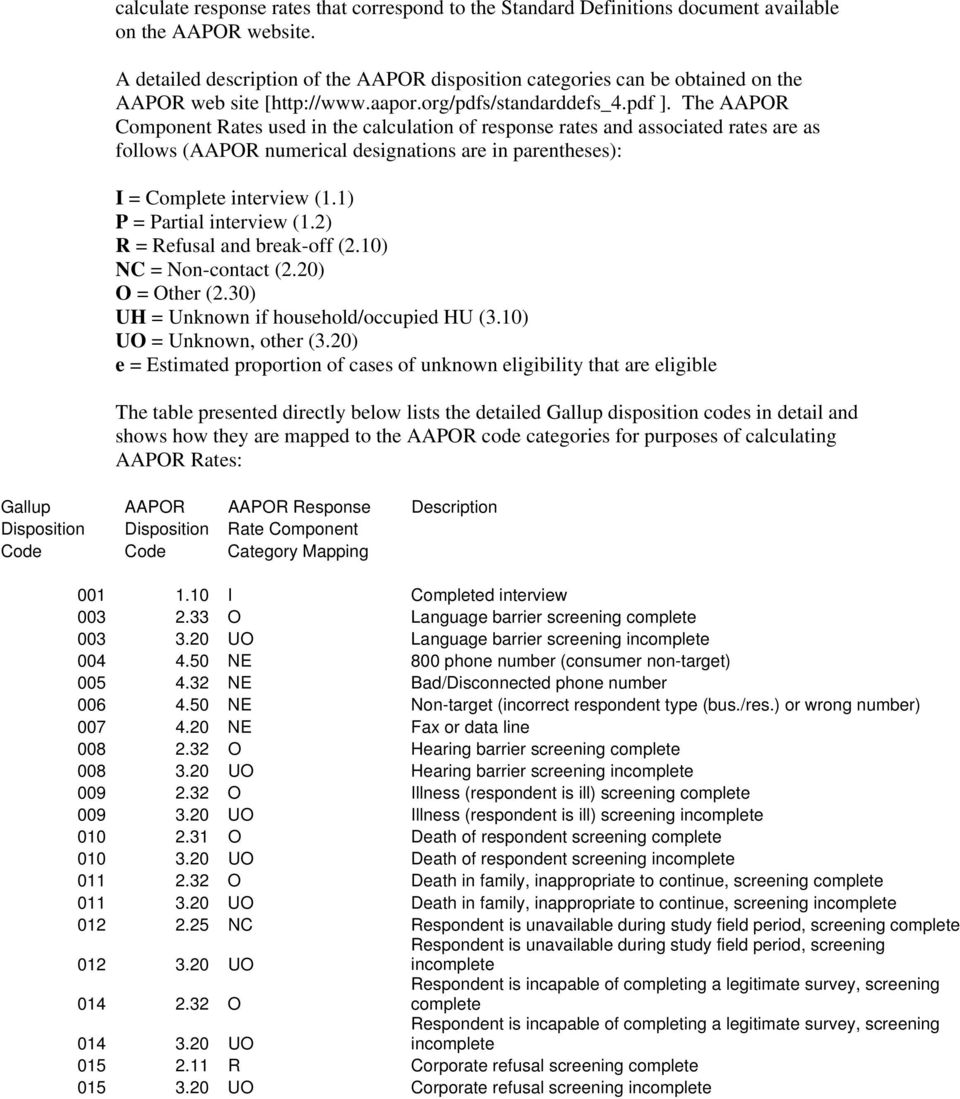
5 R Second refusal screening complete UO Second refusal screening incomplete UO Second refusal at the introduction UO Screener DK/RF NE Respondent determined quota fill NE Screen failure O Grid person selected but questionnaire change prevents continuation, screening complete UO Grid person selected but questionnaire change prevents continuation, screening incomplete O Corporate referral screening complete UO Corporate referral screening incomplete UO Answering Service - respondent contact blocked R Respondent irritated - never call again, screening complete UO Respondent irritated - never call again, screening incomplete R Respondent refused due to cell phone contact screening complete UO Respondent refused due to cell phone contact screening incomplete UH No Answer UH Busy UH Busy R Specifically timed callback screening complete UO Specifically timed callback screening incomplete R Non-specific timed callback screening complete UO Non-specific timed callback screening incomplete UO Answering Machine UO Soft-refusal at Introduction R Soft-refusal beyond introduction - suspended, screening complete UO Soft-refusal beyond introduction - suspended, screening incomplete UH Busy NE Respondent type quota fill O Language barrier screening complete UO Language barrier screening incomplete R Hard refusal screening complete UO Hard refusal screening incomplete UO Hard refusal at the introduction AAPOR Rate definitions and results for the RDD and Panel Samples The calculation of a variety of AAPOR rates, including the overall AAPOR Response Rate (RR3), are defined below. To the right of each operational definition are the calculated values for the RDD and Panel Samples; all rates are expressed as proportions. Note that the panel sample rates are calculated and reported for comparative purposes but, as they are calculated identically to those for the RDD segment of the Pilot, do not take account of the fact that the Gallup Panel respondents represent a second-generation RDD sample that they were recruited and agreed to become a part of the Gallup Panel prior to their inclusion in the ATUS retired over-sample: RDD Panel AAPOR eligibility rate (e): Proportion of Unknown Eligibility cases estimated to be eligible (O + NC + R + I) / (O + NC + R + I + NE)
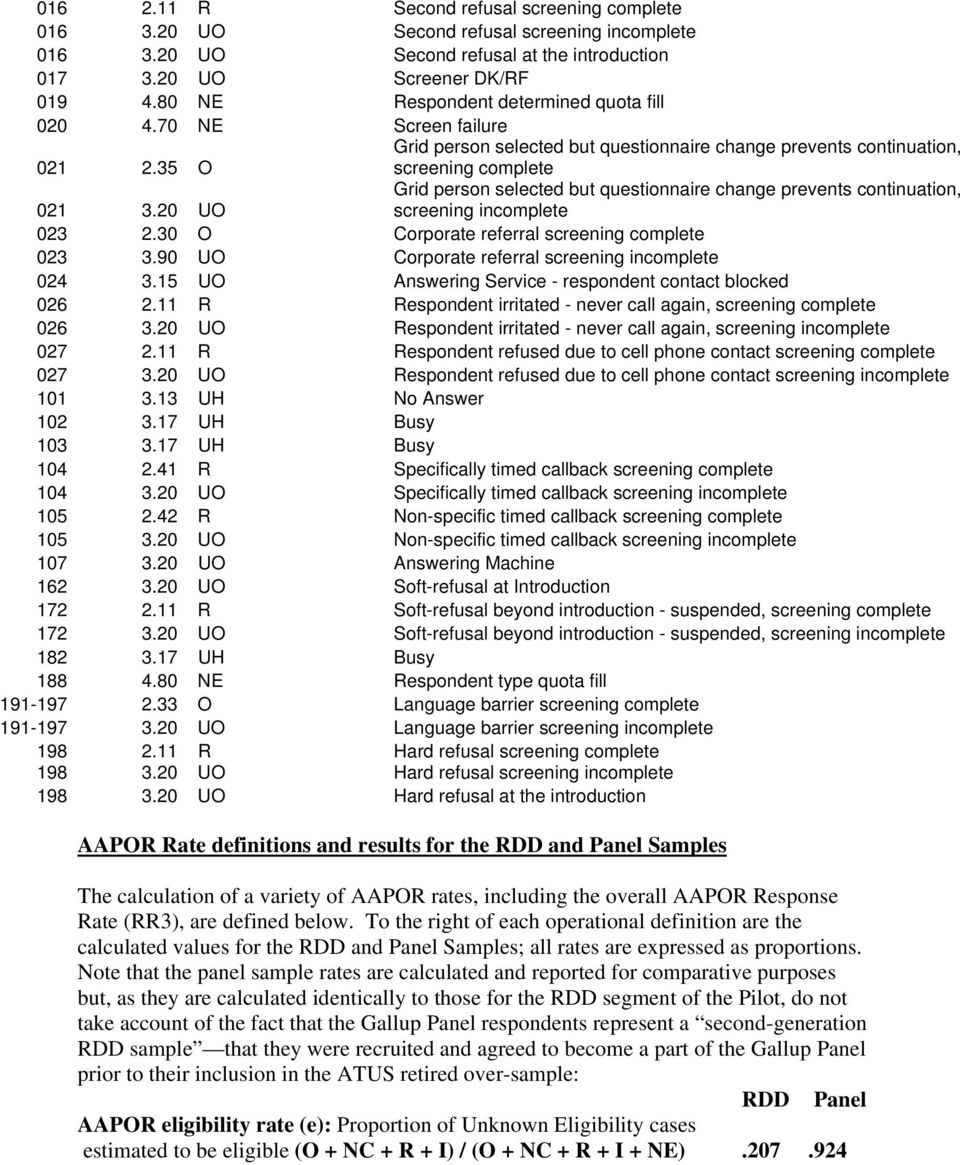
6 AAPOR contact rate: (I + R + O) / (I +R +O + NC + e(uh + UO)) AAPOR refusal rate: R / (I + R + NC + O + e(uh + UO)) AAPOR cooperation rate: I / (I + R + O) AAPOR response rate (RR3): I / (I + R + NC + O + e(uh + UO)) Gallup delivered 3,982 cases from the RDD Study and 1999 cases from the Gallup Panel Over-sample study. Although more interviews than these were actually completed, the link between the BLAISE software used for data collection (and housing the survey data) and the CFMC software used for telephone sample management and call scheduling (and housing the sample records) was not possible to establish with certainty in all cases. Cases suffering from such imperfect linkage were not delivered. Weighting adjustments Weighting factors were calculated for both the Random and Gallup Panel Retired Oversamples. Two types of factors were calculated the first to correct for probability of selection biases inherent in two-stage samples where households are first selected by generating random telephone numbers (and where households with multiple voice lines have a higher selection probability than others) and the second to correct for probability of selection biases that favor the selection of individuals in households with smaller numbers of qualified persons over individuals in larger households. These separate weighting factors are combined in a first stage weight that corrects for both types of selection bias. In addition to correcting for known sources of bias, additional post stratification weighting adjustments were calculated, and used in conjunction with the first stage weights to correct for demographic discrepancies that could have either random or systematic sources. Demographic targets were derived from the most recent Current Population Survey (CPS) for both the Retired and non-retired populations, and the completed interview samples were divided into 3 segments: RDD Non-Retired, RDD Retired, and Panel Retired. Before addressing demographic variables, each of these samples was adjusted using second-stage weights to equalize the representation of day of the week. Using the previously described weights as starting weights, additional ratio weighting factors were applied to adjust the following demographic variables, in order that the final weighted distributions of the data conformed to the relevant distributions derived from the CPS: Region (4 Census Regions) Gender Age (Non-Retired: 15-19; 20-34; 35-44; 45-54; Retired: 40-59; 60-69; 70-79; 80+)
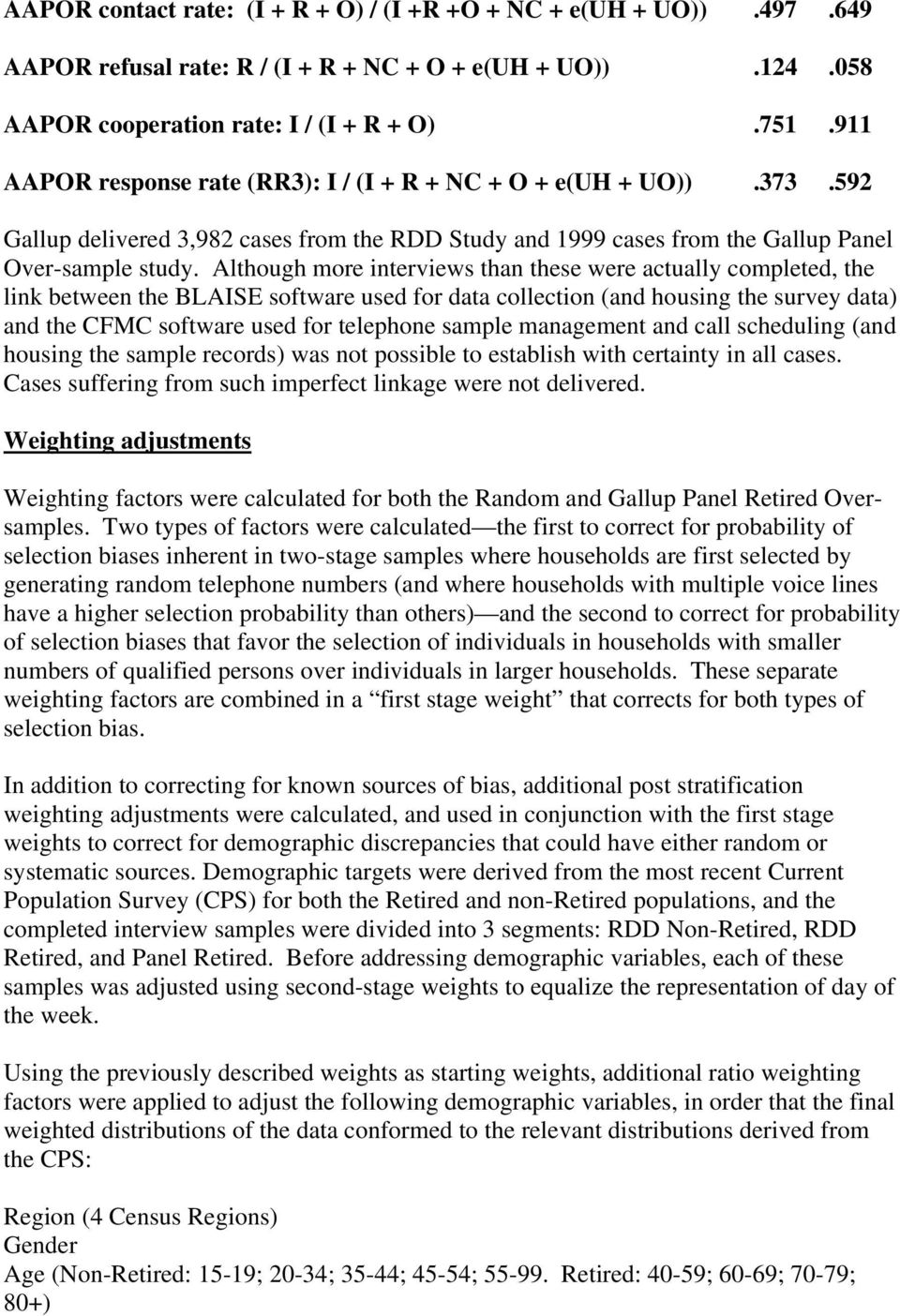
7 Race (White versus Non-White) Finally, weights were calculated to adjust the relative proportions of the three sample groups in order to allow them to be analyzed and projected to the total target populations either separately or combined. Overall, the weighting procedures are designed to maximize the projectability of the data by correcting for known biases and controlling other sources of variation that could distort the representativeness of analytic results based on the weighted data.

Americans and text messaging
 Americans and text messaging 31% of text message users prefer texting to voice calls, and young adults stand out in their use of text messaging Aaron Smith, Senior Research Specialist 9/19/2011 http://pewinternet.org/reports/2011/cell-phone-texting-2011.aspx
17% of cell phone owners do most of their online browsing on their phone, rather than a computer or other device
 JUNE 26, 2012 17% of cell phone owners do most of their online browsing on their phone, rather than a computer or other device Most do so for convenience, but for some their phone is their only option
Online Product Research
 Online Product Research 58% of Americans have researched a product or service online September 29, 2010 Jim Jansen, Senior Fellow, Pew Internet Project http://pewinternet.org/reports/2010/online-product-research.aspx
71% of online adults now use video sharing sites
 71% of online adults now use video sharing sites Kathleen Moore, Pew Internet Project 7/25/2011 http://pewinternet.org/reports/2011/video sharing sites.aspx Pew Research Center 1615 L St., NW Suite 700
Cell Phone Activities 2013
 www.pewresearch.org SEPTEMBER 16, 2013 Cell Phone Activities 2013 50% of cell owners download apps to their phones; 48% listen to music services; video calling has tripled since 2011; texting remains a
The Demographics of Social Media Users 2012
 www.pewresearch.org FEBRUARY 14, 2013 The Demographics of Social Media Users 2012 Young adults are more likely than older adults to use social media. Women, African- Americans, and Latinos show high interest
Americans and their cell phones
 Americans and their cell phones Mobile devices help people solve problems and stave off boredom, but create some new challenges and annoyances Aaron Smith, Senior Research Specialist 8/15/2011 http://pewinternet.org/reports/2011/cell-phones.aspx
Adults and Cell Phone Distractions
 Adults and Cell Phone Distractions Mary Madden, Senior Research Specialist Lee Rainie, Director June 18, 2010 http://pewinternet.org/reports/2010/cell-phone-distractions.aspx Pew Internet & American Life
E-reader Ownership Doubles in Six Months
 E-reader Ownership Doubles in Six Months Adoption rate of e-readers surges ahead of tablet computers Kristen Purcell, Associate Director for Research, Pew Internet Project June 27, 2011 Pew Research Center
35% of those ages 16 and older own tablet computers
 www.pewresearch.org OCTOBER 18, 2013 35% of those ages 16 and older own tablet computers Up from 25% last year more than half of those in households earning $75,000 or more now have tablets 24% own e-book
Older Adults and Social Media Social networking use among those ages 50 and older nearly doubled over the past year
 Older Adults and Social Media Social networking use among those ages 50 and older nearly doubled over the past year Mary Madden, Senior Research Specialist August 27, 2010 Report URL: http://pewinternet.org/reports/2010/older-adults-and-social-media.aspx
Internet, broadband, and cell phone statistics
 Internet, broadband, and cell phone statistics By: Lee Rainie, Director January 5, 2010 Overview In a national survey between November 30 and December 27, 2009, we find: 74% of American adults (ages 18
Appendix I: Methodology
 Appendix I: Methodology SSRS METHODOLOGY SSRS conducted a survey of Muslims and Jews for the Institute for Social Policy and Understanding from January 18 through January 27, 2016. The study investigated
Privacy and Data Management on Mobile Devices
 SEPTEMBER 5, 2012 Privacy and Data Management on Mobile Devices More than half of app users have uninstalled or avoided an app due to concerns about personal information Jan Lauren Boyles Research Intern,
Research Overview: Telephone versus Online Research Advantages and Pitfalls
 . 26030 Highway 74, Suite A, P.O. Box 1094 Kittredge, CO 80457 P: 303.679.6300 F: 303.679.6680 [email protected] www.praxigroup.net Research Overview: Telephone versus Online Research Advantages and
AN INDICATION OF THE EFFECT OF NONINTERVIEW ADJUSTMENT AND POST -STRATIFICATION ON ESTIMATES FROM A SAMPLE SURVEY
 AN INDICATION OF THE EFFECT OF NONINTERVIEW AND POST -STRATIFICATION ON ESTIMATES FROM A SAMPLE SURVEY Martha J. Banks, University of Chicago This paper is based on research done at the Center for Health
Social Media and Political Engagement
 OCTOBER 19, 2012 Social Media and Political Engagement 66% of social media users have employed the platforms to post their thoughts about civic and political issues, react to others postings, press friends
72% of Online Adults are Social Networking Site Users
 www.pewresearch.org AUGUST 5, 2013 72% of Online Adults are Social Networking Site Users Social networking sites remain most popular among young adults, but other age groups continue to increase their
Teens and Technology 2013
 MARCH 13, 2013 Teens and Technology 2013 Smartphone adoption among teens has increased substantially and mobile access to the internet is pervasive. One in four teens are cell-mostly internet users, who
A Comparison of Level of Effort and Benchmarking Approaches for Nonresponse Bias Analysis of an RDD Survey
 A Comparison of Level of Effort and Benchmarking Approaches for Nonresponse Bias Analysis of an RDD Survey Daifeng Han and David Cantor Westat, 1650 Research Blvd., Rockville, MD 20850 Abstract One method
Contact Author: Michael P. Battaglia, Abt Associates Inc., 55 Wheeler St., Cambridge, MA 02138
 CALLING LOCAL TELEPHONE COMPANY BUSINESS OFFICES TO DETERMINE THE RESIDENTIAL STATUS OF A WIDE CLASS OF UNRESOLVED TELEPHONE NUMBERS IN A RANDOM-DIGIT-DIALING SAMPLE Gary Shapiro, Abt Associates Inc.;
NUMBERS, FACTS AND TRENDS SHAPING THE WORLD APRIL 3, 2014 FOR FURTHER INFORMATION ON THIS REPORT: Aaron Smith, Senior Researcher
 NUMBERS, FACTS AND TRENDS SHAPING THE WORLD APRIL 3, 2014 FOR FURTHER INFORMATION ON THIS REPORT: Aaron Smith, Senior Researcher 202.419.4500 RECOMMENDED CITATION: Pew Research Center, April 2014, Older
Social Science Research Solutions (SSRS) Omnibus Survey
 Safe Small-Dollar Loans Research Project Social Science Research Solutions (SSRS) Omnibus Survey The Pew Safe Small-Dollar Loans Research Project contracted with Social Science Research Solutions (SSRS)
Teens and Mobile Apps Privacy
 AUGUST 22, 2013 Teens and Mobile Apps Privacy 58% of American teens have downloaded an app to a cell phone or tablet. More than half of teen apps users have avoided an app due to concerns about sharing
An Assessment of the Effect of Misreporting of Phone Line Information on Key Weighted RDD Estimates
 An Assessment of the Effect of Misreporting of Phone Line Information on Key Weighted RDD Estimates Ashley Bowers 1, Jeffrey Gonzalez 2 1 University of Michigan 2 Bureau of Labor Statistics Abstract Random-digit
KNOWLEDGEPANEL DESIGN SUMMARY
 KNOWLEDGEPANEL DESIGN SUMMARY This document was prepared at the effort and expense of GfK. No part of it may be circulated, copied, or reproduced for distribution without prior written consent. KnowledgePanel
INTERNATIONAL SOCIAL SURVEY PROGRAMME (ISSP) WORKING PRINCIPLES
 INTERNATIONAL SOCIAL SURVEY PROGRAMME (ISSP) WORKING PRINCIPLES (Amended April 2012) A. MEMBERSHIP, MEETINGS AND DECISION-MAKING 1. Membership 1.1 Membership of the ISSP is by invitation, following a majority
Optimizing Call Patterns for Landline and Cell Phone Surveys
 Optimizing Call Patterns for Landline and Cell Phone Surveys Becky Reimer 1, Veronica Roth 1, and Robert Montgomery 1 1 NORC at the University of Chicago, 55 East Monroe Street, Suite 3000, Chicago, IL
Western New England University Polling Institute
 WESTERN NEW ENGLAND UNIVERSITY Western New England University Polling Institute Massachusetts Statewide Telephone Survey September 20-28, 2014 Dr. Tim Vercellotti For Immediate Release TABLES Next, please
Danny R. Childers and Howard Hogan, Bureau of the,census
 MATCHING IRS RECORDS TO CENSUS RECORDS: SOME PROBLEMS AND RESULTS Danny R. Childers and Howard Hogan, Bureau of the,census A. INTRODUCTION This project has two principal aims: to investigate the feasibility
THE EFFECT OF AGE AND TYPE OF ADVERTISING MEDIA EXPOSURE ON THE LIKELIHOOD OF RETURNING A CENSUS FORM IN THE 1998 CENSUS DRESS REHEARSAL
 THE EFFECT OF AGE AND TYPE OF ADVERTISING MEDIA EXPOSURE ON THE LIKELIHOOD OF RETURNING A CENSUS FORM IN THE 1998 CENSUS DRESS REHEARSAL James Poyer, U.S. Bureau of the Census James Poyer, U.S. Bureau
The AmeriSpeak ADVANTAGE
 OVERVIEW Funded and operated by NORC at the University of Chicago, AmeriSpeak TM is a probabilitybased panel (in contrast to a non-probability panel). Randomly selected households are sampled with a known,
DOT HS 812 183 July 2015. National Telephone Survey of Reported and Unreported Motor Vehicle Crashes
 DOT HS 812 183 July 2015 National Telephone Survey of Reported and Unreported Motor Vehicle Crashes DISCLAIMER This publication is distributed by the U.S. Department of Transportation, National Highway
National Endowment for the Arts. A Technical Research Manual
 2012 SPPA PUBLIC-USE DATA FILE USER S GUIDE A Technical Research Manual Prepared by Timothy Triplett Statistical Methods Group Urban Institute September 2013 Table of Contents Introduction... 3 Section
RESEARCH. Prior Qualifications of Adult Learners in Further Education. IFF Research Ltd. Research Report RR677
 RESEARCH Prior Qualifications of Adult Learners in Further Education IFF Research Ltd Research Report RR677 Research Report No 677 Prior Qualifications of Adult Learners in Further Education IFF Research
American Time Use Survey User s Guide
 American Time Use Survey User s Guide Understanding ATUS 2003 to 2014 The American Time Use Survey (ATUS) is sponsored by the Bureau of Labor Statistics and conducted by the U.S. Census Bureau CHAPTER
Unintended Consequences: The Cost of Purging Business Numbers in RDD Surveys. Daniel Merkle, Gary Langer, Jon Cohen ABC News
 Unintended Consequences: The Cost of Purging Business Numbers in RDD Surveys Daniel Merkle, Gary Langer, Jon Cohen ABC News Linda Piekarski Survey Sampling International Robert Benford, David Lambert TNS
6% of Online Adults are reddit Users
 www.pewresearch.org JULY 3, 2013 6% of Online Adults are reddit Users Young men are especially likely to visit the front page of the internet. Maeve Duggan Research Assistant, Pew Internet Project Aaron
What It s Worth: Field of Training and Economic Status in 2009
 What It s Worth: Field of Training and Economic Status in 2009 Household Economic Studies Issued February 2012 P70-129 INTRODUCTION The relationship between educational attainment and economic outcomes
Career, Family and the Well-Being of College-Educated Women. Marianne Bertrand. Booth School of Business
 Career, Family and the Well-Being of College-Educated Women Marianne Bertrand Booth School of Business Forthcoming: American Economic Review Papers & Proceedings, May 2013 Goldin (2004) documents that
How are polls conducted? by Frank Newport, Lydia Saad, David Moore from Where America Stands, 1997 John Wiley & Sons, Inc.
 How are polls conducted? by Frank Newport, Lydia Saad, David Moore from Where America Stands, 1997 John Wiley & Sons, Inc. Public opinion polls would have less value in a democracy if the public -- the
Survey on Person-to-person Direct Marketing Calls
 RESEARCH REPORT SUBMITTED TO THE OFFICE OF THE PRIVACY COMMISSIONER FOR PERSONAL DATA Survey on Person-to-person Direct Marketing Calls Social Sciences Research Centre The University of Hong Kong August
Contacting respondents for survey research
 Contacting respondents for survey research Is email a useful method? Joanna d Ardenne and Margaret Blake November 2012 Background The question Is email a useful way of contacting potential respondents
AMERICA'S YOUNG ADULTS AT 27: LABOR MARKET ACTIVITY, EDUCATION, AND HOUSEHOLD COMPOSITION: RESULTS FROM A LONGITUDINAL SURVEY
 For release 10:00 a.m. (EDT) Wednesday, March 26, 2014 USDL-14-0491 Technical information: (202) 691-7410 [email protected] www.bls.gov/nls Media contact: (202) 691-5902 [email protected] AMERICA'S YOUNG
CITY OF MILWAUKEE POLICE SATISFACTION SURVEY
 RESEARCH BRIEF Joseph Cera, PhD Survey Center Director UW-Milwaukee Atiera Coleman, MA Project Assistant UW-Milwaukee CITY OF MILWAUKEE POLICE SATISFACTION SURVEY At the request of and in cooperation with
How To Get A Good Answer From A Tennessee Voter Survey
 Date: June 5, 2012 To: All Interested Parties From: RE: Paul DiPerna Findings from the Tennessee K-12 & School Choice Survey Overview The Tennessee K-12 & School Choice Survey project, commissioned by
Survey of Employer Perspectives on the Employment of People with Disabilities
 United States Department of Labor Office of Disability Employment Policy Survey of Employer Perspectives on the Employment of People with Disabilities Technical Report November 2008 Prepared by CESSI 6858
Generations 2010. Kathryn Zickuhr, Web Coordinator. http://pewinternet.org/reports/2010/generations-2010.aspx 12/16/2010
 s 2010 Kathryn Zickuhr, Web Coordinator 12/16/2010 http://pewinternet.org/reports/2010/s-2010.aspx Pew Research Center 1615 L St., NW Suite 700 Washington, D.C. 20036 202-419-4500 pewinternet.org Page
2003 National Survey of College Graduates Nonresponse Bias Analysis 1
 2003 National Survey of College Graduates Nonresponse Bias Analysis 1 Michael White U.S. Census Bureau, Washington, DC 20233 Abstract The National Survey of College Graduates (NSCG) is a longitudinal survey
Teens, Smartphones & Texting
 MARCH 19, 2012 Teens, Smartphones & Texting Texting volume is up while the frequency of voice calling is down. About one in four teens say they own smartphones. Amanda Lenhart Senior Research Specialist,
Disparities in Individuals Access and Use of Health IT in 2013
 ONC Data Brief No. 26 June 2015 Disparities in Individuals Access and Use of Health IT in 2013 Vaishali Patel, PhD MPH, Wesley Barker, MS, Erin Siminerio, MPH A number of national policies, initiatives
Summary of 2011 AARP Survey of Virginians 18+: State Health Insurance Exchange Prepared by Jennifer H. Sauer State Research, AARP.
 Summary of 2011 AARP Survey of Virginians 18+: State Health Insurance Exchange Prepared by Jennifer H. Sauer State Research, AARP State health insurance exchanges are a provision of the new health law
Estimating Lost Secondary Childcare in Wrongful Death Cases Using Data From the American Time Use Survey (ATUS) Mark W. Erwin, M.A., J.D.
 Estimating Lost Secondary Childcare in Wrongful Death Cases Using Data From the American Time Use Survey (ATUS) Mark W. Erwin, M.A., J.D. INTRODUCTION When a parent dies, the childcare that they would
Digital differences. Kathryn Zickuhr Research Specialist, Pew Internet. Aaron Smith Senior Research Specialist, Pew Internet
 APRIL 13, 2012 Digital differences While increased internet adoption and the rise of mobile connectivity have reduced many gaps in technology access over the past decade, for some groups digital disparities
Results Embargoed Until Tuesday, October 6 at 12:01AM. Clinton Leads Rivals among Maryland Democratic Primary Voters
 Results Embargoed Until Tuesday, October 6 at 12:01AM Press Contact Information Mileah Kromer Director, Sarah T. Hughes Field Politics Center [email protected] Chris Landers Office of Communications