
Introduction. This Handbook will be updated as required.
|
|
|
- Dustin Wright
- 10 years ago
- Views:
Transcription
1 Family and Community Support Services (FCSS) Program Handbook Children and Youth Services

2 Introduction Since 1966, the Government of Alberta, together with participating municipalities and Métis Settlements, have jointly funded preventive social services for Albertans through the Family and Community Support Services (FCSS) Program. Designed to meet the preventive social programming needs of the local community, FCSS projects and services offer a range of support for people of all ages. Over the years, a number of changes have been made to the FCSS Program to ensure that it continues to meet the needs of the community. The FCSS Program Handbook presents an outline of the FCSS Program, describing its Program plan, organization, allocation of funds and accountability processes. The Handbook is intended to assist staff, elected officials and board members in understanding the purpose of the FCSS Program, how FCSS funding is allocated and how it can be used. It will also provide a record of significant program policy decisions, including interpretations of the FCSS Regulation. This Handbook will be updated as required.

3 Table of Contents 1. PROGRAM PLAN A. Vision B. Beliefs C. Mission D. Mandate FCSS PROGRAM OPTIONS ORGANIZATION A. Relational Chart B. Program Advisory Team Mandate Background Purpose Membership Authority/Reporting Relationship C. Eligibility Review D. Available Resources ACCOUNTABILITY A. Administration Process Municipal FCSS Administration Process Métis Settlement FCSS Administration Process Provincial FCSS Administration Process B. FCSS Funding Agreement Municipalities Métis Settlements Terminating an FCSS Agreement C. Annual FCSS Program Report Report Form Guideline Project Type Level I/II Coding Level of Assurance Program Report Addendum Form D. Reconciliation Statement E. Electronic Processing of FCSS Documents F. Program Review Process G. Performance Measurements Performance Measures (Provincial) Reporting on Provincial Performance Measures FCSS Outcome Measures Initiative ALLOCATION OF FUNDS A. Funding Allocation Model History of Model Development Changes to the FCSS Funding Model Funding Calculation Example Additional Notes

4 5. ALLOCATION OF FUNDS (continued) B. Program Policies and Interpretations What is FCSS? Eligible/Non-Eligible Projects FCSS Program Advice Inventory Listing Local Surplus Policy per cent Matching Share CONSULTATION HISTORY OF FCSS FCSS ACT FCSS REGULATION

5 FCSS Program Handbook Chapter 1: Program Plan 1 Program Plan A. Vision Alberta s diverse people building strong communities through positive, caring interaction and mutual respect. B. Beliefs A community s most valuable resources are its people. Investments made in developing and supporting people pay dividends in all areas of community life. We can make valuable contributions to our communities and communities need the contributions of all of us. Voluntarism is inherently valuable in that it allows us, as citizens, to contribute directly to our community, which in turn is linked to positive outcomes for individual volunteers. Partnerships are fundamental to community building. Municipalities and Métis Settlements can support individuals, families and communities by providing well-designed preventive social programs. Each municipality and Métis Settlement has unique programming needs and is best able to determine what its own needs are. C. Mission Family and Community Support Services (FCSS) is a partnership between the Province, municipalities and Métis Settlements that develops locally driven preventive social initiatives to enhance the well-being of individuals, families, and communities. D. Mandate Provincially, the FCSS Program receives its mandate from the FCSS Act and Regulation pursuant to that Act. At the local level, a municipal or Métis Settlement Council chooses whether to establish a Program, and enters into an agreement with the Province to jointly fund the Program. September
6 FCSS Program Handbook Chapter 2: FCSS Program Options 2 FCSS Program Options The following is a list of programs and services that may be offered in a community through the FCSS Program. This list is intended as a guideline only. Assessing the needs of the community is the responsibility of the municipality or Métis Settlement. a. Services to assist communities to identify their social needs and develop responses to meet those needs, including: i. raising public awareness around community issues, ii. developing strategies for community advocacy, iii. developing comprehensive social community plans and initiatives, iv. environmental scans, service reviews, strategic planning, program planning, or v. in-kind support to community-based groups (until they are able to sustain themselves) such as provision of office space, printing, photocopying, help with preparing proposals, etc.; b. Services to promote, encourage and support volunteer work in the community, including: i. recruitment, training and placement services, ii. resources to support volunteers, iii. volunteer recognition, or iv. co-ordination of volunteer services; c. Services to inform the public of available services, including: i. information and referral services, ii. community information directories, iii. newcomer services, or iv. inter-agency co-ordination; d. Services that promote the social development of children and their families, including: i. parent-child development activities, ii. early childhood development services for children aged 0-5 (excluding child care), or iii. support services for young children aged 6-12 (excluding out-of-school care subsidies); e. Services that enrich and strengthen family life by developing skills so people can function more effectively within their own environment, including: i. mentoring programs, ii. parenting and family life education and development programs, iii. programs for single adults and single parents, iv. courses designed to enhance self-awareness and personal growth, v. individual, family and group counselling services that are educational and not treatment oriented, or vi. youth development and leadership services; September
7 FCSS Program Handbook Chapter 2: FCSS Program Options f. Services that enhance the quality of life of the retired and semi-retired, including: i. home support services, ii. education and information services, iii. co-ordination of senior services and programs, or iv. self-help socialization activities. September

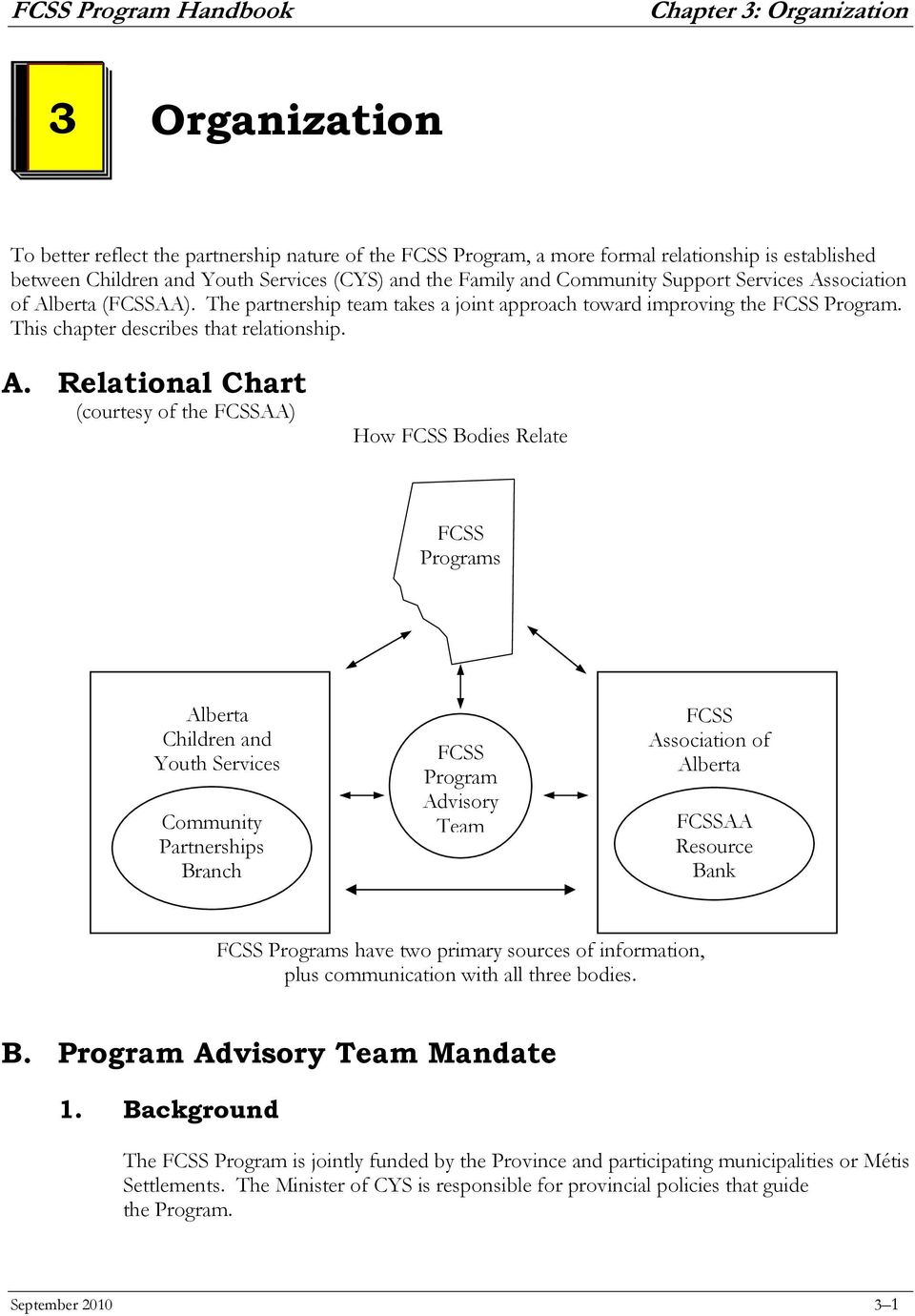
8 FCSS Program Handbook Chapter 3: Organization 3 Organization To better reflect the partnership nature of the FCSS Program, a more formal relationship is established between Children and Youth Services (CYS) and the Family and Community Support Services Association of Alberta (FCSSAA). The partnership team takes a joint approach toward improving the FCSS Program. This chapter describes that relationship. A. Relational Chart (courtesy of the FCSSAA) How FCSS Bodies Relate FCSS Programs Alberta Children and Youth Services Community Partnerships Branch FCSS Program Advisory Team FCSS Association of Alberta FCSSAA Resource Bank FCSS Programs have two primary sources of information, plus communication with all three bodies. B. Program Advisory Team Mandate 1. Background The FCSS Program is jointly funded by the Province and participating municipalities or Métis Settlements. The Minister of CYS is responsible for provincial policies that guide the Program. September
9 FCSS Program Handbook Chapter 3: Organization Staff from the Ministry meet regularly with executive members of the FCSSAA to identify issues and suggest policy changes. This joint initiative of the Ministry and the Association is known as the FCSS Program Advisory Team (PAT). 2. Purpose PAT is a vehicle for the Ministry and the FCSSAA to jointly consider program policies and processes and recommend improvements. PAT is not intended to duplicate or interfere with the relationship between the Province and individual municipalities/métis Settlements as outlined in FCSS legislation. Specific aspects of PAT s mandate include: Operating within the framework of the FCSS Act and Regulation, the budget as determined by CYS and the overall goal of the department business plan. Making recommendations for a three-year plan for FCSS, including the vision, mission, principles, goals and performance measures for the provincial Program. Providing a forum for the discussion of new Program directions. Reviewing progress made toward Program goals and reporting on performance measures. Assisting in the continued development of the FCSS Program Handbook. Recommending policies concerning administration of the Program, including: Interpreting policy concerning types of services that are eligible or not eligible for FCSS funding. This typically does not involve decisions about individual projects; rather PAT considers classes or groupings of projects or services (e.g., reviewing the policy with respect to funding food banks). Assisting in the evaluation of the effectiveness of the FCSS Regulation, FCSS funding allocation model and FCSS Program Review processes. September
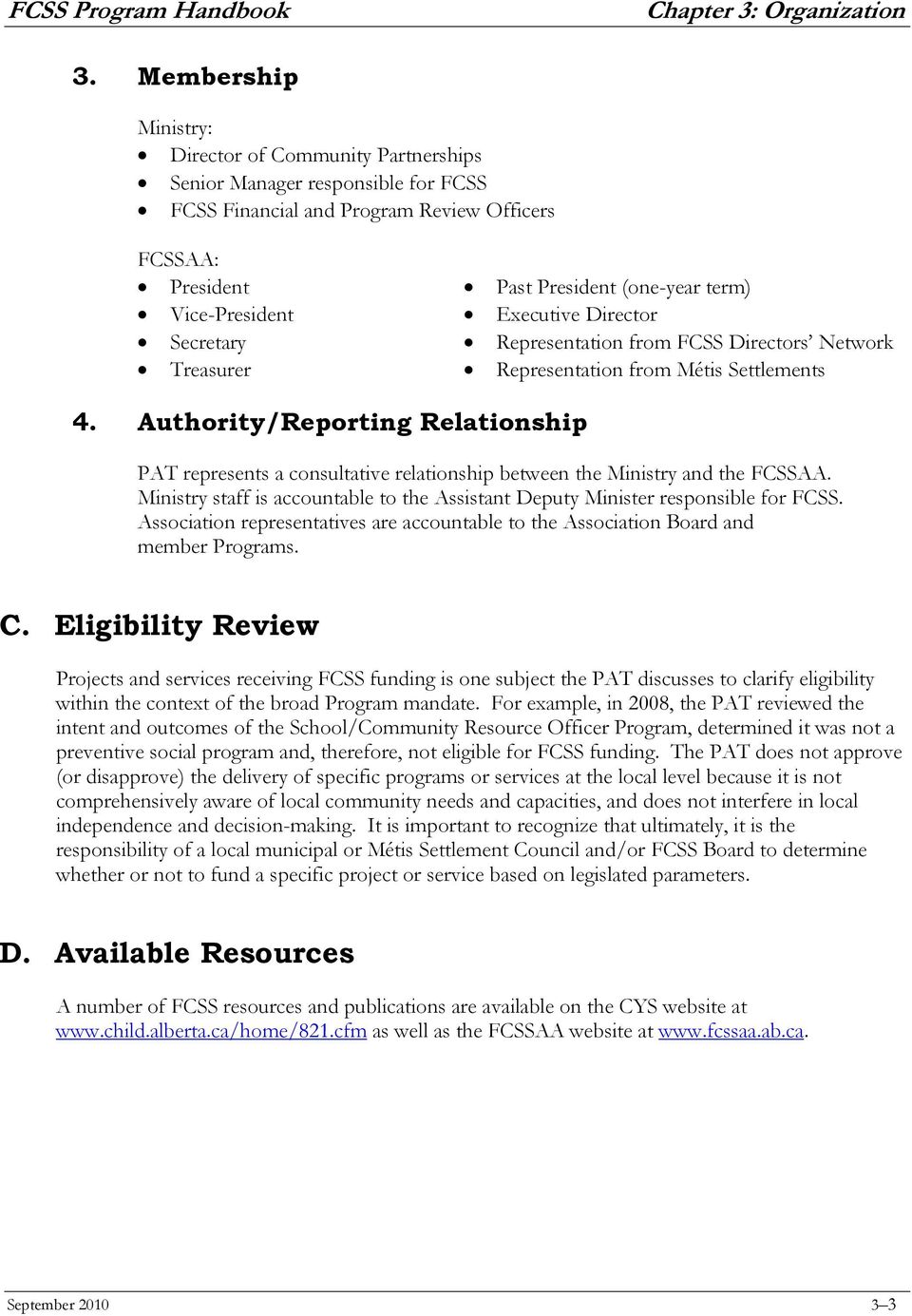
10 FCSS Program Handbook Chapter 3: Organization 3. Membership Ministry: Director of Community Partnerships Senior Manager responsible for FCSS FCSS Financial and Program Review Officers FCSSAA: President Vice-President Secretary Treasurer Past President (one-year term) Executive Director Representation from FCSS Directors Network Representation from Métis Settlements 4. Authority/Reporting Relationship PAT represents a consultative relationship between the Ministry and the FCSSAA. Ministry staff is accountable to the Assistant Deputy Minister responsible for FCSS. Association representatives are accountable to the Association Board and member Programs. C. Eligibility Review Projects and services receiving FCSS funding is one subject the PAT discusses to clarify eligibility within the context of the broad Program mandate. For example, in 2008, the PAT reviewed the intent and outcomes of the School/Community Resource Officer Program, determined it was not a preventive social program and, therefore, not eligible for FCSS funding. The PAT does not approve (or disapprove) the delivery of specific programs or services at the local level because it is not comprehensively aware of local community needs and capacities, and does not interfere in local independence and decision-making. It is important to recognize that ultimately, it is the responsibility of a local municipal or Métis Settlement Council and/or FCSS Board to determine whether or not to fund a specific project or service based on legislated parameters. D. Available Resources A number of FCSS resources and publications are available on the CYS website at as well as the FCSSAA website at September
11 FCSS Program Handbook Chapter 4: Accountability 4 Accountability A. Administration Process 1. Municipal FCSS Administration Process August October RECEIVE from the Province forthcoming year FCSS funding allocation confirmation. The municipality may either request the entire grant amount, or a portion thereof, based on the municipal budget estimate. RECEIVE from the Province: FCSS Funding Agreement (offer of funding) for the coming year. HAVE AGREEMENT SIGNED BY MUNICIPAL AUTHORITY. SEND signed agreement to CYS. Department processes payment. January January RECEIVE (municipal) first quarter payment of provincial funding for the new year. End of previous financial year: COMPILE information for Annual FCSS Program Report. ARRANGE for financial audits/review engagement reports/certificates of compliance (where applicable). April SEND reports to the Province (within 120 days after end of financial year). Questions delays (Province reviews) x If reports require clarification aif reports complete RECEIVE from the Province: Reconciliation Statement of Revenue and Expenditures. April April July October December Provincial budget is set. Revised allocations and agreements forwarded, if required. RECEIVE (municipal) second quarter payment of provincial funding. RECEIVE (municipal) third quarter payment of provincial funding. RECEIVE (municipal) fourth quarter payment of provincial funding. RECEIVE Annual FCSS Program Report from the Province. September

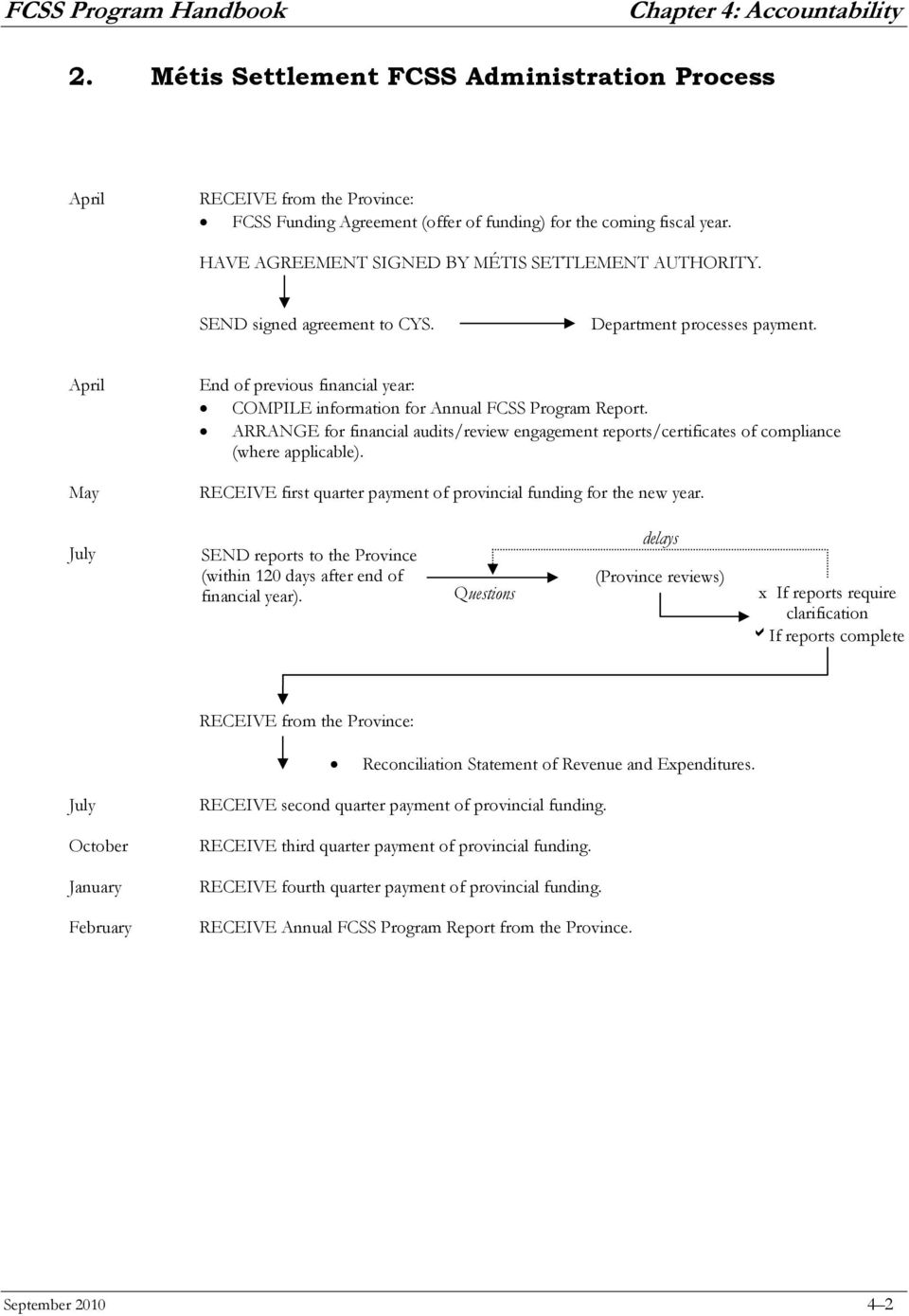
12 FCSS Program Handbook Chapter 4: Accountability 2. Métis Settlement FCSS Administration Process April RECEIVE from the Province: FCSS Funding Agreement (offer of funding) for the coming fiscal year. HAVE AGREEMENT SIGNED BY MÉTIS SETTLEMENT AUTHORITY. SEND signed agreement to CYS. Department processes payment. April May End of previous financial year: COMPILE information for Annual FCSS Program Report. ARRANGE for financial audits/review engagement reports/certificates of compliance (where applicable). RECEIVE first quarter payment of provincial funding for the new year. July SEND reports to the Province (within 120 days after end of financial year). Questions delays (Province reviews) x If reports require clarification aif reports complete RECEIVE from the Province: Reconciliation Statement of Revenue and Expenditures. July October January February RECEIVE second quarter payment of provincial funding. RECEIVE third quarter payment of provincial funding. RECEIVE fourth quarter payment of provincial funding. RECEIVE Annual FCSS Program Report from the Province. September
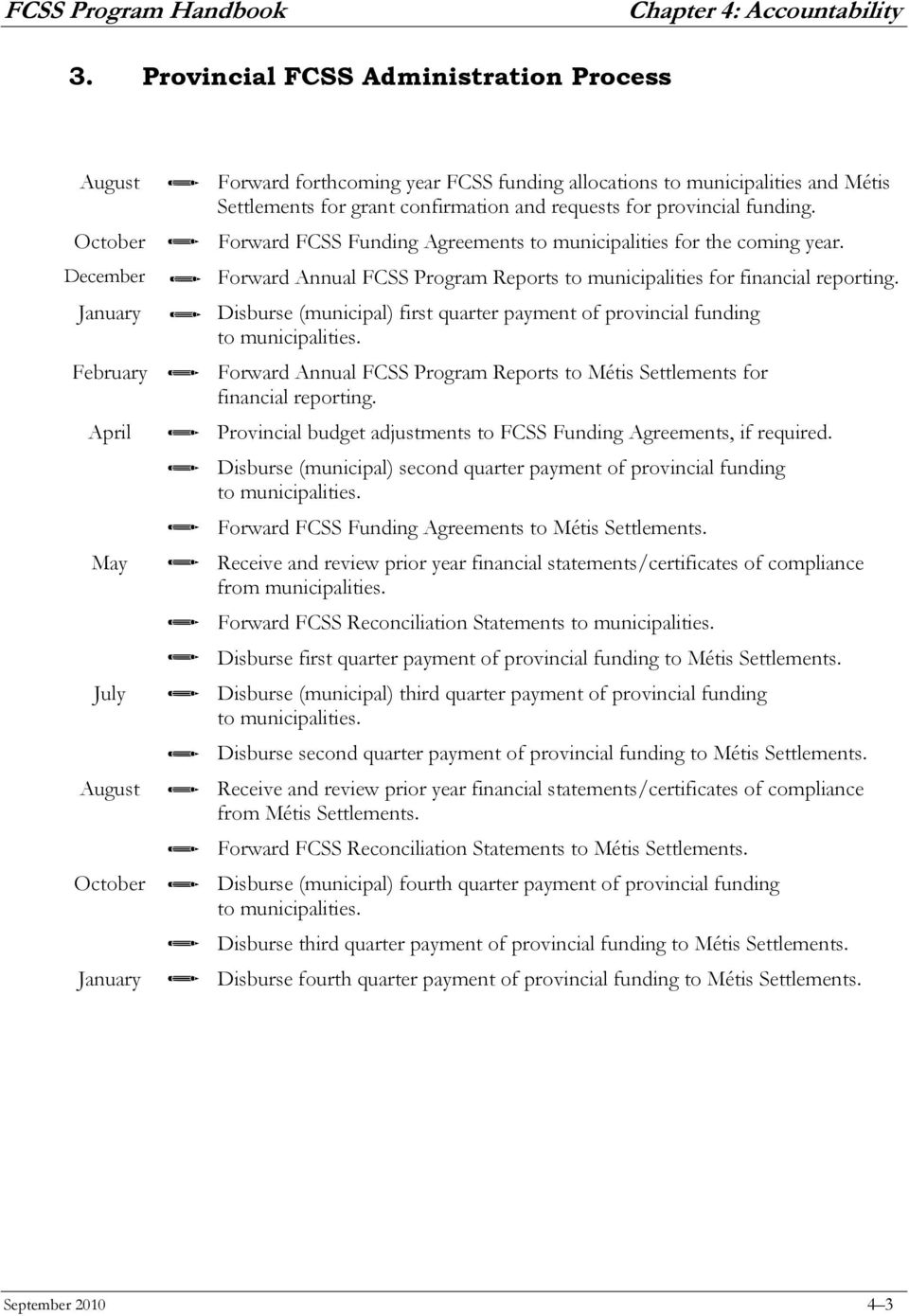
13 FCSS Program Handbook Chapter 4: Accountability 3. Provincial FCSS Administration Process August October December January February April May July August October January Forward forthcoming year FCSS funding allocations to municipalities and Métis Settlements for grant confirmation and requests for provincial funding. Forward FCSS Funding Agreements to municipalities for the coming year. Forward Annual FCSS Program Reports to municipalities for financial reporting. Disburse (municipal) first quarter payment of provincial funding to municipalities. Forward Annual FCSS Program Reports to Métis Settlements for financial reporting. Provincial budget adjustments to FCSS Funding Agreements, if required. Disburse (municipal) second quarter payment of provincial funding to municipalities. Forward FCSS Funding Agreements to Métis Settlements. Receive and review prior year financial statements/certificates of compliance from municipalities. Forward FCSS Reconciliation Statements to municipalities. Disburse first quarter payment of provincial funding to Métis Settlements. Disburse (municipal) third quarter payment of provincial funding to municipalities. Disburse second quarter payment of provincial funding to Métis Settlements. Receive and review prior year financial statements/certificates of compliance from Métis Settlements. Forward FCSS Reconciliation Statements to Métis Settlements. Disburse (municipal) fourth quarter payment of provincial funding to municipalities. Disburse third quarter payment of provincial funding to Métis Settlements. Disburse fourth quarter payment of provincial funding to Métis Settlements. September
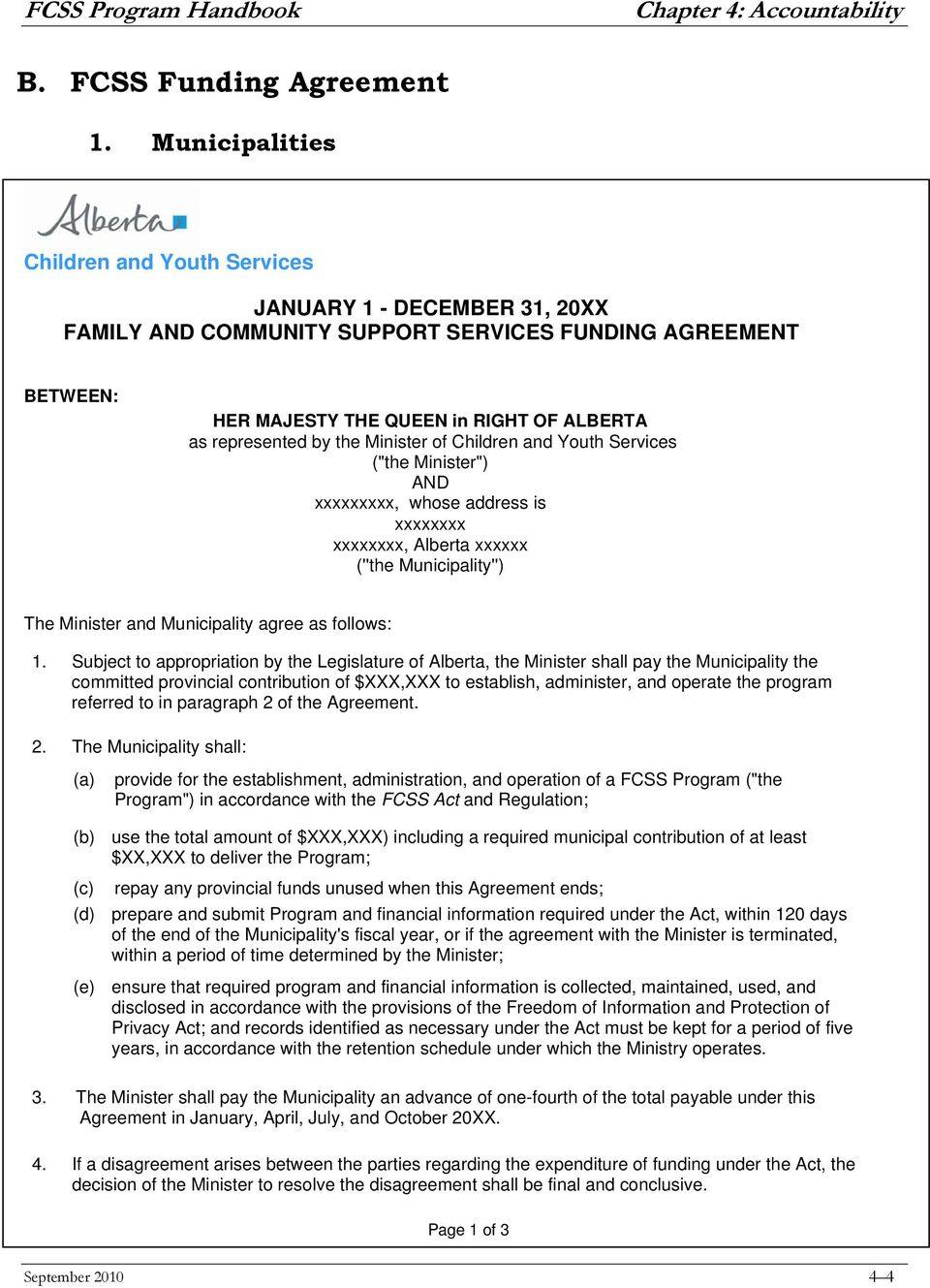
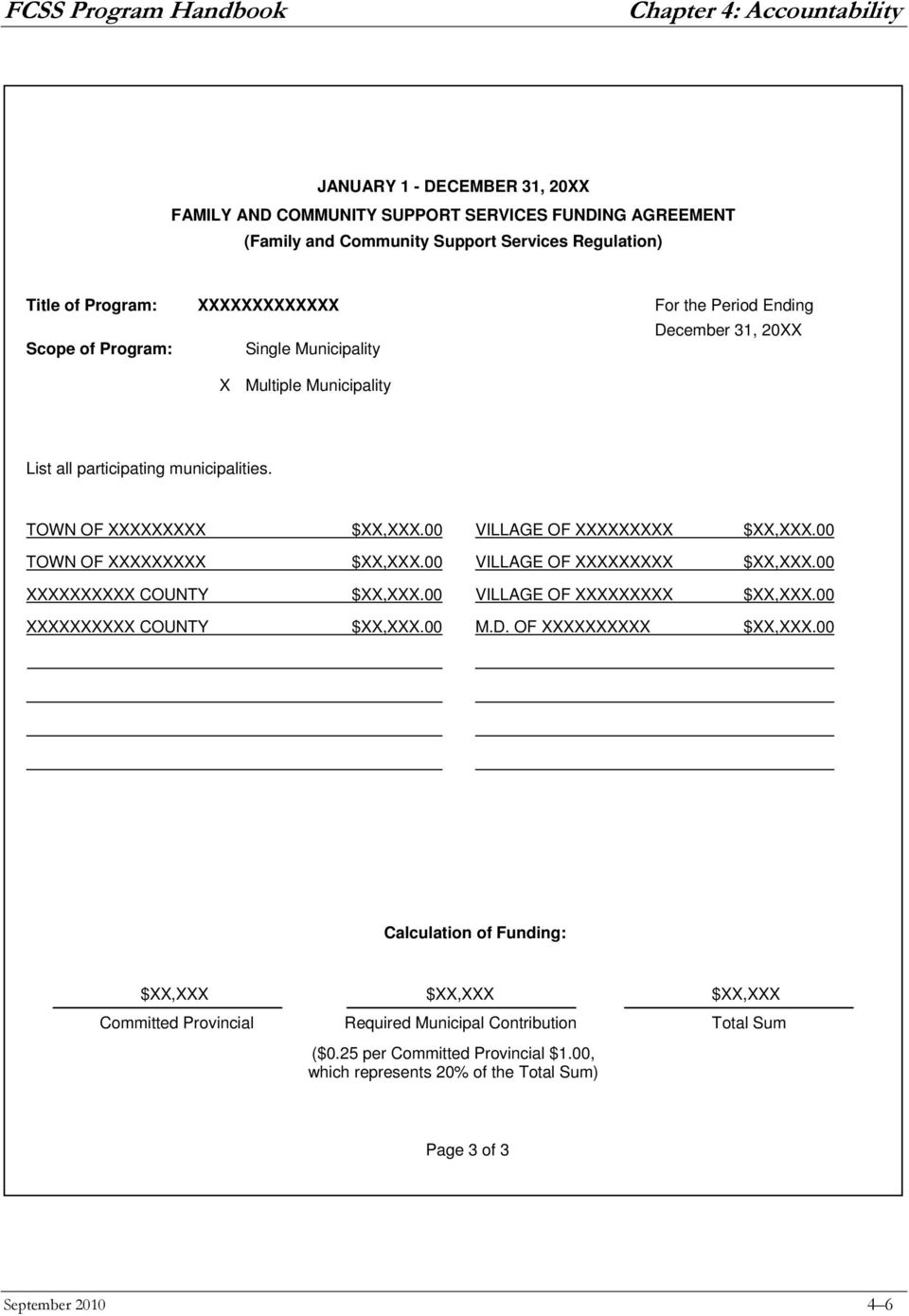
14 FCSS Program Handbook Chapter 4: Accountability B. FCSS Funding Agreement 1. Municipalities Children and Youth Services JANUARY 1 - DECEMBER 31, 20XX FAMILY AND COMMUNITY SUPPORT SERVICES FUNDING AGREEMENT BETWEEN: HER MAJESTY THE QUEEN in RIGHT OF ALBERTA as represented by the Minister of Children and Youth Services ("the Minister") AND xxxxxxxxx, whose address is xxxxxxxx xxxxxxxx, Alberta xxxxxx (''the Municipality'') The Minister and Municipality agree as follows: 1. Subject to appropriation by the Legislature of Alberta, the Minister shall pay the Municipality the committed provincial contribution of $XXX,XXX to establish, administer, and operate the program referred to in paragraph 2 of the Agreement. 2. The Municipality shall: (a) provide for the establishment, administration, and operation of a FCSS Program ("the Program") in accordance with the FCSS Act and Regulation; (b) use the total amount of $XXX,XXX) including a required municipal contribution of at least $XX,XXX to deliver the Program; (c) repay any provincial funds unused when this Agreement ends; (d) prepare and submit Program and financial information required under the Act, within 120 days of the end of the Municipality's fiscal year, or if the agreement with the Minister is terminated, within a period of time determined by the Minister; (e) ensure that required program and financial information is collected, maintained, used, and disclosed in accordance with the provisions of the Freedom of Information and Protection of Privacy Act; and records identified as necessary under the Act must be kept for a period of five years, in accordance with the retention schedule under which the Ministry operates. 3. The Minister shall pay the Municipality an advance of one-fourth of the total payable under this Agreement in January, April, July, and October 20XX. 4. If a disagreement arises between the parties regarding the expenditure of funding under the Act, the decision of the Minister to resolve the disagreement shall be final and conclusive. Page 1 of 3 September
15 FCSS Program Handbook Chapter 4: Accountability 5. (a) If in the opinion of the Minister, a Municipality's program fails to meet the requirements of the Family and Community Support Services Regulation or (b) if the financial report of the Municipality (i) (ii) (iii) has not been submitted to the Minister within 120 days of the end of the Municipality's fiscal year, does not meet the requirements of the Family and Community Support Services Regulation, or shows that the Municipality has wrongfully used funds provided to it under the Act, the Minister may withhold amounts of funding under any new agreement or require the Municipality to repay the amounts of funding that in the opinion of the Minister are equivalent to the value of the program components not met or the funds wrongfully used. 6. Where 2 or more municipalities have entered into an agreement to provide joint family and community support services programs, the Municipality represents that pursuant to the agreement with the other municipalities, it has the authority to agree to the terms of this Agreement on their behalf. 7. This Agreement commences on January 1, 20XX and ends on December 31, 20XX. 8. This Agreement may be terminated: (a) at any time by mutual agreement of the parties; (b) by either party for any reason by providing 6 months written notice to the other party. 9. If this Agreement is terminated for any reason, the Municipality's obligations under clauses 2(c), (d), and (e) and clauses 5(a) and (b) continue. The Municipality has signed this Agreement on the day of, 20XX. The Minister has signed this Agreement on the day of, 20XX. Signatures (Affix municipal corporate seal if applicable): Minister of Children and Youth Services Municipality's duly authorized signing officer(s) (Mayor, Reeve as the case may be) Page 2 of 3 September

16 FCSS Program Handbook Chapter 4: Accountability JANUARY 1 - DECEMBER 31, 20XX FAMILY AND COMMUNITY SUPPORT SERVICES FUNDING AGREEMENT (Family and Community Support Services Regulation) Title of Program: XXXXXXXXXXXXX For the Period Ending December 31, 20XX Scope of Program: Single Municipality X Multiple Municipality List all participating municipalities. TOWN OF XXXXXXXXX $XX,XXX.00 VILLAGE OF XXXXXXXXX $XX,XXX.00 TOWN OF XXXXXXXXX $XX,XXX.00 VILLAGE OF XXXXXXXXX $XX,XXX.00 XXXXXXXXXX COUNTY $XX,XXX.00 VILLAGE OF XXXXXXXXX $XX,XXX.00 XXXXXXXXXX COUNTY $XX,XXX.00 M.D. OF XXXXXXXXXX $XX,XXX.00 Calculation of Funding: $XX,XXX $XX,XXX $XX,XXX Committed Provincial Required Municipal Contribution Total Sum ($0.25 per Committed Provincial $1.00, which represents 20% of the Total Sum) Page 3 of 3 September
17 FCSS Program Handbook Chapter 4: Accountability 2. Métis Settlements September

18 FCSS Program Handbook Chapter 4: Accountability September

19 FCSS Program Handbook Chapter 4: Accountability 3. Terminating an FCSS Agreement An FCSS Agreement may be terminated at any time by mutual agreement of both parties. If a municipality wishes to terminate an Agreement between municipalities under Section 2(b) of the FCSS Act, and the effect of the termination would be to withdraw the authority for that municipality (i.e., local Unit Authority or lead municipality) to receive funding under the FCSS Regulation on behalf of another municipality, it shall provide the other municipality and the Minister of CYS with written notice six months prior to the termination date. If a municipality participating in a multi-municipal Program that is not responsible for Program administration wishes to terminate an Agreement, it shall advise the local Unit Authority (lead municipality) of this decision. The local Unit Authority is then required to provide the Minister of CYS with written notice six months prior to the termination date. Refer to numbers eight and nine of the municipal FCSS Funding Agreement or number eight of the Métis Settlement FCSS Funding Agreement. Municipalities or Métis Settlements operating individual Programs (i.e., not part of a multimunicipal agreement), wishing to terminate an Agreement are required to provide the Minister of CYS with written notice six months prior to the termination date. September

20 FCSS Program Handbook Chapter 4: Accountability C. Annual FCSS Program Report 1. Report Form September
21 FCSS Program Handbook Chapter 4: Accountability September
22 FCSS Program Handbook Chapter 4: Accountability September
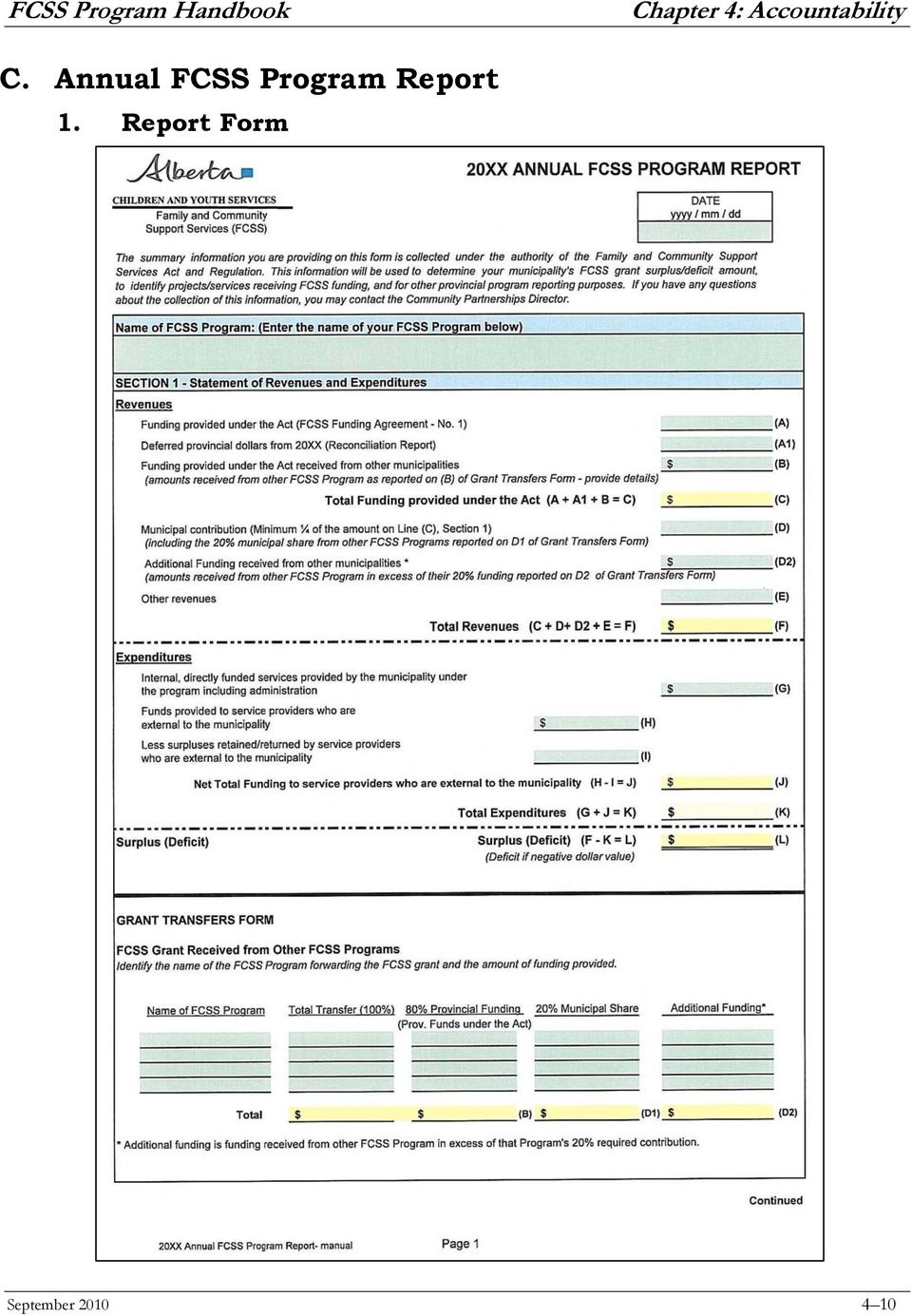
23 FCSS Program Handbook Chapter 4: Accountability 2. Guideline The FCSS Regulation requires all municipalities and Métis Settlements receiving provincial grants to submit Annual FCSS Program Reports. An Annual FCSS Program Report is forwarded each year from the Province to participating municipalities and Métis Settlements. Note: In 2010, CYS introduced an Online System for submission of a number of documents, including the Annual FCSS Program Report. For further information, see Section E on page Submission of the report must be made within 120 days of the municipal calendar year-end (due to the Province on April 30 of following year) and within 120 days of the Métis Settlement fiscal year-end (due to the Province on July 29 of current year). The form is divided into three sections: Section 1 is the Statement of Revenue and Expenditures; Section 2 is the Projects/Services Report; and, Section 3 is the Certificate of Compliance. The following is a guideline to assist in completing the form. Detailed information is also available in the FCSS Financial Report Guide which is posted on the CYS website at Name of FCSS Program - Identify the name of the local FCSS Program receiving funding from the Ministry for the delivery of preventive social services. Section 1 Statement of Revenues and Expenditures Revenues Funding provided under the Act (FCSS Agreement No. 1) is the total of the four quarterly FCSS provincial grant payments received within the reporting period, plus any calculated provincial surplus dollars from the prior reporting period. Refer to Line 1 of the FCSS Funding Agreement or Amending Agreement (if applicable) to confirm the correct figure to be included here. Deferred provincial dollars from 20XX (Reconciliation Report) is the amount of unexpended dollars a municipality retained from the previous year as a result of a provincial FCSS grant increase. An Annual FCSS Program Report Addendum is forwarded from the Province together with the Annual FCSS Program Report. Local FCSS Programs deferring all or part of the increase are required to complete this Addendum. Refer to the prior year FCSS Reconciliation of Revenue and Expenditures Report provided by the Province to confirm correct figure to be included here. Funding provided under the Act from other municipalities is the provincial (80 per cent) FCSS funding amount received from municipalities located outside its FCSS boundary (i.e., grant transfer). All grant transfer information, including the name of each municipality providing a grant and grant breakdown details, is to be reported on the Grant Transfers Form, located at the bottom of page one. September
24 FCSS Program Handbook Chapter 4: Accountability The Municipal contribution must be no less than 25 per cent of the provincial grant. This equates to an 80/20 ratio between the Province and the municipality/métis Settlement. The contribution cannot include funds collected through fees charged to clients for services provided under the municipal program. The 20 per cent matching share must be allocated from the operating budget of the municipality/métis Settlement. If grant transfers are reported, combine matching 20 per cent contributions received from outside municipalities (as recorded on Line (D1) of the Grant Transfers Form), together with your Program s municipal share and report this amount on Line D. If no grant transfers are being reported, identify only your Program s municipal matching share. Additional Funding received from other municipalities is the funding received from municipalities located outside its FCSS boundary from other FCSS Programs in excess of their 20 per cent matching share. The figure reported must correspond to the amount recorded on Line (D2) of the Grant Transfer Form, located at the bottom of page one. Other revenues include the following examples: Funds paid to the Program by other provincial, municipal, or federal departments for the reporting period. Client fees or other third party fees received in the reporting period. Proceeds from the disposal of assets and equipment. Cash donations and proceeds from general fundraising activities to the Program, including United Way, etc. Interest income from investments of current period funding and from other sources of income allocated to the Program. All revenues received for the operation of an FCSS Program are to be reported when completing the Annual FCSS Program Report. However, there are circumstances wherein an FCSS Program may receive cash donations or generate revenues from fundraising activities intended to be spent on specific non-fcss activities (i.e., outside legislated parameters). If a local FCSS Program is involved in community activities where no provincial (80 per cent) dollars are being used, do not report these expenditures and/or revenues on the Annual FCSS Program Report. Doing so may result in a false surplus calculation. Expenditures Internal, directly funded services provided by the municipality under the program including administration may only include costs identified in Section 3 of the FCSS Regulation (municipal costs) and shall not include costs identified in Section 4 (prohibited costs). Funds provided to service providers who are external to the municipality is the total amount of all FCSS grants paid to external organizations during the reporting period. September
25 FCSS Program Handbook Chapter 4: Accountability Less surpluses retained/returned by service providers who are external to the municipality is the total amount of funding the externally funded organizations did not spend. The municipality must have a process in place to determine whether grants have been fully expended in accordance with the terms of agreement between the municipality and its funded organizations. Externally funded organizations receiving operating grants from municipalities, regardless of their operating year, are required to submit calendar year-end (January 1 to December 31) financial statements for accountability/audit purposes. Financial statements must correspond to projects as described on FCSS funding applications approved by municipal Councils and/or local FCSS Boards. These statements, to be retained on file locally, support figures reported in Section 1 on Lines (H), (I) and (J) of the Annual FCSS Program Report. Calendar year statements are necessary to ensure the provincial FCSS reconciliation statement is calculated correctly. If an externally funded organization closes or terminates its agreement with the municipality, a partial year financial statement for the period of time the organization was in receipt of funding is required. Net total funding to service providers who are external to the municipality is the difference between the amount of funds advanced to external organizations and the amount of surpluses retained/returned by the organizations. Surplus/(Deficit) is the difference between the total expenditures and the total revenues. If a surplus is identified, the amount will be prorated proportionately among revenue contributors (i.e., municipality, other revenue sources and the Province). Section 2 Projects/Services Report List each project receiving funding and the amount expended. Total Program expenditures reported in Section 2, Box H must equal Section 1, Line K. The quality of reports produced within the provincial FCSS database is dependent on the accuracy and clarity of information provided on Annual FCSS Program Reports. Do not identify expenditure types (e.g., salaries, rent, utilities, etc.) as project names. Clearly identify each project receiving funding with an appropriate name. Consider the purpose, intent or outcome of the service when determining what a project name might be (e.g., Seniors Outreach versus Seniors Fun Day ). Avoid grouping unrelated projects together. Separate activities with a similar purpose may be combined and reported under a common title (e.g., community events, public awareness/education, information/referral, and/or volunteer support). September
26 FCSS Program Handbook Chapter 4: Accountability Externally funded projects/services must be identified with an asterisk (*). The appropriate project name should precede the name of the organization receiving funding (e.g., Outreach and Wellness Program (Seniors Drop-In Society)*). Expenditure totals for external projects reported in Section 2 must correspond to the figure reported in Section 1 on Line (J) (i.e., Net Total Funding to service providers who are external to the municipality). If a project fits within multiple categories, calculate and report the percentage that applies to each. For example, 75 per cent of a $5,000 Family School Liaison expenditure could be reported within the Category A - Children and Youth ($3,750) and 25 per cent reported within Category B Families ($1,250). Grant Transfers to other FCSS Programs (Category F) is used when municipalities elect to transfer all, or a potion of, their FCSS grants to neighbouring Programs located outside their boundaries for the delivery of services within their communities. FCSS Management (Category G) should only include expenses related to administration of the overall FCSS Program. Many FCSS Directors/Co-ordinators are also involved in direct program delivery. In these circumstances, the percentage of time and expenses involved in program delivery should be calculated and reported within appropriate categories (i.e., children/youth, families, adults, seniors or community development). Facilitation and support is an apt description for this type of service. Expenditures reported in this category must not include expenses, including salaries of municipal staff, for other municipal projects, work or service outside the FCSS mandate. Refer to Section 5(e) of the FCSS Regulation. Carefully consider appropriate category placement for each identified project. A number of reports produced by the Ministry are based on category information. Section 3 Certification of Compliance The FCSS Director (or designate) and the Chief Administrative Officer (or designate) both sign the Certification of Compliance attesting that all projects, services and expenditures comply with FCSS legislation; and that the 20 per cent municipal matching share is derived from the operating budget of the municipality or Métis Settlement. FCSS Director is defined as the person directly responsible for the administration of an FCSS Program within a municipality or Métis Settlement. CYS requires written confirmation from the municipality if Annual FCSS Program Report signing authority is delegated to anyone other than the local FCSS Director, Chief Administrative Officer and/or Mayor/Reeve (e.g., FCSS Board Chair). September
27 FCSS Program Handbook Chapter 4: Accountability 3. Project Type Level I/II Coding CYS receives frequent requests about the types of projects that are funded through FCSS and two levels of coding, Project Type Level I and II, have been established to assist in providing this information within the provincial FCSS database. The groupings under Project Type Level I focus on the general type of service that is being provided (e.g., counselling or information and referral). Project Type Level II is more specific than Level I and identifies projects by the common name of the activity or the context in which the service is being provided. Level I and Level II coding is only required for new projects or services. Codes for projects or services reported in the previous year that receive funding again in the current year are saved and rolled over in the provincial FCSS database. Ensure only one code for Level I and one code for Level II are assigned to each new project. A summary of prior year projects with their assigned codes is available from CYS upon request. 4. Level of Assurance a. If the provincial grant provided to the municipality/métis Settlement is $100,000 or less, the signed Annual FCSS Program Report is all the Province requires for reporting purposes. b. If the provincial grant provided to the municipality is more than $100,000 but less than $500,000, a Review Engagement Report (including supporting financial statements) specific to the FCSS Program, must accompany the signed Annual FCSS Program Report. c. If the provincial grant provided to the municipality is $500,000 or more, audited financial statements specific to the FCSS Program must accompany the signed Annual FCSS Program Report. Reporting requirements are identified in Section 6 of the FCSS Regulation. Definitions of Review Engagement and Audit are provided in the footnotes included on pages 22 and 23 of the FCSS Financial Report Guide posted on the Ministry s website at Guide_Aug_1_2006_Final1.pdf. With respect to levels of assurance b) and c), the Review Engagement and the Audit require the issuance of a full report by a public accountant. The public accountant must be a member in good standing of the Institute of Chartered Accountants of Alberta, the Certified General Accountants Association of Alberta, or the Society of Management Accountants of Alberta. September
28 FCSS Program Handbook Chapter 4: Accountability The Minister will allow a municipal employee to prepare a Review Engagement or Audit referred to in Section 6.1 and 6.2 of the FCSS Regulation providing that the following conditions are met: a. The employee has the proper professional designation. b. The employee's primary duty is performing audits. c. The employee is independent of the unit disbursing the FCSS grant funding. September
29 FCSS Program Handbook Chapter 4: Accountability 5. Program Report Addendum Form If a municipal FCSS Program receives a funding increase (i.e., amending agreement) in the current financial year resulting in a surplus, the Program may choose to apply to defer all or part of the surplus to the maximum amount of the increase by completing the Annual FCSS Program Report Addendum. Métis Settlements operate on the same fiscal year as the Province, April 1 to March 31, and therefore are not required to complete an Annual FCSS Program Report Addendum. September
30 FCSS Program Handbook Chapter 4: Accountability D. Reconciliation Statement Local Unit Authority Family and Community Support Services Reconciliation of Revenue and Expenditures REVENUES Funding provided under the Act (FCSS Funding Agreement - No. 1) Funding provided by other FCSS Programs under the Act Total funding provided under the Act [(a) + (b)] Municipal contribution or ¼ of Provincial Funding, whichever is less Additional Funding received from other municipalities Other Revenues TOTAL REVENUES [(c) + (d) + (d1) + (e)] EXPENDITURES Internal, directly funded services provided by the municipality under the program including administration Funds provided to service providers who are external to the municipality Less surpluses retained/returned by service providers who are external to the municipality Net Total Funding to service providers who are external to the municipality [(h) (i)] TOTAL EXPENDITURES [(g) + (j)] SURPLUS/DEFICIT [(f) (k)] Share of funding surplus by Municipality Share of funding surplus by other sources of revenue Share of funding surplus by the Province Share of funding surplus deferred by Municipality Revised share of funding surplus by Province 20XX CALENDAR YEAR (a) (b) (h) (i) Surplus Cost Share Factor (c) (d) (d2) (e) (f) (g) (j) (k) Reconciliation Statement The provincial reconciliation statement reflects the Statement of Revenue and Expenditures as identified in Section 1 of the Annual FCSS Program Report. Any surpluses incurred by the local FCSS Program will be prorated in proportion to the amount provided by the Province, the municipality/métis Settlement (to a minimum of 25 per cent of the provincial contribution) and other sources of revenue. September
31 FCSS Program Handbook Chapter 4: Accountability E. Electronic Processing of FCSS Documents In 2010, CYS introduced an Online System to enable municipalities and Métis Settlements to submit a number of documents electronically through a secure web browser interface to the Internet. These documents include FCSS Funding Requests, FCSS Funding Agreements, FCSS Funding Agreement Amendments and Annual FCSS Program Reports. Funding Requests, Funding Agreements and Amending Agreements are forwarded from the Ministry through this System to Chief Administrative Officers/Administrators and Annual FCSS Program Reports are forwarded to local FCSS Directors. Following are some of the benefits to using this System: Permanent File of Submissions Ability to check the status of submitted documents. Documents may be printed at any time and prior year records may be reviewed. Receive Electronic Notices An immediate from the System will provide notification once the Minister or Minister Designate of CYS has approved submitted documents. The System will also provide notification of errors or omissions. High Reliability No concerns about having documents lost/delayed in the mail. Less Cost Signing on to the System is free; no need to spend money for postage or couriers. Passwords and IDs for specific roles must be established before municipalities and Métis Settlements may access the System. The URL address for the FCSS Online System is Detailed information is available in procedural manuals posted on the Ministry s website at There are separate manuals for municipalities and Métis Settlements. For password/id related questions, send an message to [email protected]. F. Program Review Process Provincial staff conduct FCSS Program Reviews throughout the Province, with approximately 12 municipalities/métis Settlements visited each year. The purpose of these reviews is to provide ongoing program and administrative advice, support and information to participating municipalities and Métis Settlements and to ensure local Programs are operating within the legislated parameters of FCSS. G. Performance Measurements 1. Performance Measures (Provincial) One function of performance measurement is to assist FCSS partners to determine whether the Program is achieving its mission provincially, and whether municipalities and Métis Settlements are fulfilling the intentions of the FCSS Act and the Regulation. The mission and local responsibilities are restated on the following page for reference purposes. September
32 FCSS Program Handbook Chapter 4: Accountability Mission: FCSS is a partnership between the Province, municipalities and Métis Settlements that develops locally-driven preventive social initiatives to enhance the well-being of individuals, families and communities. Responsibilities of municipalities (reference Section 2 of the FCSS Regulation): The following are activities that FCSS communities must perform in order to achieve outcomes: promote and facilitate the development of stronger communities; promote public participation in planning, delivering and governing the program and services provided under the program; promote and facilitate the involvement of volunteers; promote efficient and effective use of resources; promote and facilitate co-operation and co-ordination with allied service agencies operating within the municipality. FCSS Program outcomes relate to the following statements identified in Section 2.1(1)(b) of the FCSS Regulation. Local FCSS Programs should be developed to assist communities to: help people to develop independence, strengthen coping skills and become more resistant to crisis; help people to develop an awareness of social needs; help people to develop interpersonal and group skills which enhance constructive relationships among people; help people and communities to assume responsibility for decisions and actions which affect them; provide supports that help sustain people as active participants in the community. Provincial performance measures will address each of the highlighted concepts from the mission and the responsibilities. 2. Reporting on Provincial Performance Measures The Government of Alberta and the FCSSAA have identified the need for performance measures to articulate the effectiveness of FCSS projects and services in meeting preventive social service needs, identify gaps in existing services and provide opportunities to learn and improve. A framework for the FCSS Outcome Measures Initiative is being developed which will help local FCSS Programs link their own unique outcome statements to one or more of the broad strategic directions identified in the FCSS Regulation. This work will help to identify effective performance measures. September
33 FCSS Program Handbook Chapter 4: Accountability 3. FCSS Outcome Measures Initiative The FCSS Program is included in the Ministry s Business Plan with goals, targets, performance measures and outcomes for province-wide program delivery. The measures used are strong indicators of the commitment of local FCSS staff and volunteers to reduce the need for crisis intervention in communities by providing support to children, youth and families at the earliest opportunity. In 2000, an environmental scan identified that FCSS Programs did not have the capacity to monitor outcomes of program delivery. In 2001, the FCSSAA piloted a program logic model with seven FCSS Programs and the Making a Difference (MAD) Outcome Evaluation System was initiated. The intent of the MAD initiative was to provide an opportunity for FCSS Programs to learn the practice of identifying outcomes of their services; and learn how to use the information for continuous improvement and guiding best practices. Involvement in the Initiative was encouraged but not required and over the years, the use and understanding of outcome measurement by local FCSS Programs continued to grow. Several provincial annual reports were produced. Based on findings from the 2007 FCSS Program Review and feedback from local FCSS Directors, a number of gaps and needs were identified in order to continue to build capacity and increase the number of local FCSS Programs implementing outcome measures. In March 2009, a Provincial FCSS Outcome Measures Steering Committee was established to oversee, build capacity and encourage the use of outcome measurement by all FCSS Programs. The initiative was renamed the FCSS Outcome Measures (FOM) Initiative and the Steering Committee identified some initial priorities to support local FCSS Programs in developing and implementing FOM. Identified priorities included training specific to FCSS Programs delivered by FCSS staff trained in basic outcome measures, clear and consistent language, ongoing communication, the development of outcome measures tools and templates and a peer mentoring system. In 2010, an FCSS Outcome Measures Training curriculum was developed and piloted by FCSS staff. Local FCSS Program staff have been recruited to work as FCSS Outcome Measures Trainers and are available to provide training and support to FCSS Programs. Work on FOM will continue to address priorities and will include the development of a provincial framework for FOM. Questions regarding this initiative and the use of outcome measures should be directed to Joyce Mellott, Senior Manager, FCSS Unit, CYS, toll-free by first dialing , then , or by at [email protected]. September
34 Chapter 5: Allocation of Funds 5 Allocation of Funds A. Funding Allocation Model In April 1998, (then) Family and Social Services began to implement a new model for the allocation of provincial funding to municipalities and Métis Settlements participating in the FCSS Program. The model is based on the population of each participating municipality or Métis Settlement, with a median income level adjustment for each community. The Province uses the model to calculate the FCSS grant available to each municipality or Métis Settlement for the upcoming year. 1. History of Model Development In April 1996, the administration of the FCSS Program was returned to (then) Family and Social Services from Municipal Affairs. A steering committee was established to conduct a review of the FCSS Program. The committee included representation from the Alberta Urban Municipalities Association, Alberta Association of Municipal Districts and Counties, the FCSS Association of Alberta, Métis Settlements General Council, Inter-City Forum on Social Policy and Family and Social Services. To assist the steering committee, a design team was also created to deal with the detail and analysis of FCSS issues. The design team included department and municipal FCSS officials. One task was to review the method of allocating provincial funding to participating municipalities and Métis Settlements. The committee considered many different models and determined the approach best able to address some of the funding inequities without introducing too much complexity to the system. 2. Changes to the FCSS Funding Model As a result of recommendations stemming from the 2006 FCSS Program Review, qualifying municipalities and Métis Settlements received one-time supplemental funding in February 2008 to bring all FCSS Programs to a funding level equal to the cumulative percentage increase of the provincial FCSS budget between the fiscal years 2002/2003 and 2007/2008 of 16 per cent. This increase became part of each local FCSS Program s base budget in April In order to maintain the funding level and address the cost of doing business, a two per cent increase to the FCSS grant budget was included in the funding model calculation. September
35 Chapter 5: Allocation of Funds This means that municipalities and Métis Settlements receive either a two per cent increase from the prior year funding, thereby eliminating the need for grandfathering (a process that allows a local FCSS Program to retain its current level of funding), or an amount based on the funding allocation formula (i.e., population/median income), whichever is higher. Note: This assumes that CYS receives an annual increase to its provincial FCSS Program grant allocation budget. 3. Funding Calculation The model sets out the following steps to determine the amount of provincial FCSS funding available to a participating municipality or Métis Settlement: Step One: Step Two: Step Three: Step Four: Step Five: Identify the current population of the municipality or Métis Settlement. The population figure used by the model is the one provided by the municipality or Métis Settlement to Municipal Affairs. Because these figures are updated annually each October, funding is based on the previous year s population (e.g., 2010 funding is based on 2009 population figures). Determine the median income of the municipality or Métis Settlement. The model uses the individual median income as reported by Statistics Canada and is based on Tax Filer data. Because Statistics Canada collects and reports this data based on postal codes, the data is organized to correspond as closely as possible with municipal and Métis Settlement boundaries. Determine the income index for the municipality or Métis Settlement. The income index is derived by dividing the municipality s or Métis Settlement s median income by the average median income of all participating municipalities and Métis Settlements. Determine the adjusted population of a municipality or Métis Settlement. The formula is as follows: Adjusted Population for Calculation of FCSS Funding = Population plus [(1 minus Income Index) multiplied by Weighting Factor* multiplied by Population)]. *See note on page 5-5 related to weighting factor. Determine the percentage of available FCSS funding that will go to the municipality or Métis Settlement. The formula is as follows: Percentage of Available FCSS Funding = Adjusted Population (per above) divided by the total Adjusted Population of all participating municipalities and Métis Settlements multiplied by 100. September
36 Step Six: Chapter 5: Allocation of Funds Determine the amount of funding available for distribution under the model. The entire FCSS grant budget is not distributed according to the funding formula. With the incorporation of the two per cent increase in the calculation, a portion of the budget is used. For example, in 2008/2009, $72.4 million was budgeted for grants to municipalities and Métis Settlements. Approximately $70.9 million was distributed under the model and $1.5 million was the result of the two per cent calculation. In future years, these figures will change based on current population and median income or because of changes to the overall provincial FCSS grant budget. Step Seven: Step Eight: Determine the provincial FCSS grant for the municipality or Métis Settlement. To do this, the percentage share of available funding (per step five) is multiplied by the funding available for distribution under the model (per step six). Calculate the two per cent increase from prior year funding allocations to municipalities and Métis Settlements. To address the cost of doing business and eliminate grandfathering, a two per cent increase is applied to prior year funding for all participating municipalities and Métis Settlements. This calculation is done independent of the funding formula. The results of both calculations determine the amount of funding received by the municipalities and Métis Settlements. Municipalities and Métis Settlements receive the greater amount of both calculations. An example of the calculation is provided on the following page. September
37 Chapter 5: Allocation of Funds 4. Example Step One Population of a municipality 10,000 Step Two Median Income 15,000 Step Three Median Income Average 16,646 Income Index.901 Step Four Overall Income Index 1.00 Less: Income Index of municipality.901 Difference.099 Multiply by weighting factor Multiply by actual population of municipality 10, Plus: Actual population of municipality 10,000 Adjusted population for calculation 10,247 Step Five Divided by Total Adjusted Population of all participating 2,486,893 municipalities Percentage of Adjusted Population of municipality % Step Six Multiply by Grant for Distribution $34,200,000 Step Seven Eligible Funding Amount $140, Step Eight Calculate the two per cent increase from prior year s funding and apply whichever is the greater of the two calculations. 5. Additional Notes Median Income The median is the middle number in a group of numbers. Where a median income is given as $20,000, it means that exactly one-half of the reported incomes are greater than or equal to $20,000, and the other one-half are less than or equal to that amount. The model uses individual median income produced by Statistics Canada, based on Tax Filer data. This data is updated annually, but is always two years behind. For example, in the Fall of 2009 when preparing the 2010 FCSS grants, income data from the 2007 tax year was used. The provincial median income average is the sum total of median income of all participating municipalities and Métis Settlement, divided by the total number of participating municipalities and Métis Settlements. September
38 Chapter 5: Allocation of Funds Weighting Factor The weighting factor is a mathematical constant that determines the influence of median income in the funding allocation model. The higher the weighting factor, the greater the influence of the median income. In the FCSS funding model, a weighting factor of.25 is used. This is a relatively low weighting, meaning that the population of the municipality or Métis Settlement plays a more significant role in determining its funding than does the median income. The sample calculation from the previous page demonstrates the use of the weighting factor. Provincial Funding Increases for FCSS The funding allocation model was developed to create more equity in the way funds are distributed to municipalities and Métis Settlements. In 2000, the Province and the FCSSAA undertook a review of the FCSS Funding Allocation Model. The result of the review indicated that the model was essentially sound and supported by participating municipalities and Métis Settlements, but required full funding to operate effectively. In 2002, the (then) Children s Services Ministry provided the FCSS Program with an additional $15 million. Since the 1997/1998 fiscal year, the Province has increased the annual FCSS budget by $43.8 million. In 2008/2009, the majority of the FCSS communities received increases in their FCSS grants; however, despite considerable increases in funding, there were still a number of municipalities requiring grandfathering at their current levels, thus, the minimum increase of two per cent was introduced. The following table shows the amount of provincial FCSS funding available to municipalities and Métis Settlements since 1997/1998: 1997/1998 Provincial FCSS Grant Budget $31.1 million 1998/1999 Provincial FCSS Grant Budget $36.1 million 1999/2000 Provincial FCSS Grant Budget $36.6 million 2000/2001 Provincial FCSS Grant Budget $37.6 million 2001/2002 Provincial FCSS Grant Budget $42.3 million 2002/2003 Provincial FCSS Grant Budget $57.3 million 2003/2004 Provincial FCSS Grant Budget $58.6 million 2004/2005 Provincial FCSS Grant Budget $61.1 million 2005/2006 Provincial FCSS Grant Budget $62.5 million 2006/2007 Provincial FCSS Grant Budget $64.5 million 2007/2008 Provincial FCSS Grant Budget $67.5 million 2008/2009 Provincial FCSS Grant Budget $72.0 million 2009/2010 Provincial FCSS Grant Budget $74.8 million 2010/2011 Provincial FCSS Grant Budget $74.8 million September
39 Chapter 5: Allocation of Funds B. Program Policies and Interpretations 1. What is FCSS? FCSS is a unique 80/20 funding partnership between the Government of Alberta and participating municipalities or Métis settlements. Provincially, the FCSS Program receives its mandate from the FCSS Act and Regulation. The Act describes what the Province and municipality/metis Settlement can do to provide preventive social services. The Regulation describes how services may be provided. The Regulation sets out the service requirements that a municipality or Métis Settlement must meet to be eligible for funding. At the local level, a municipality or Métis Settlement Council chooses whether to establish a Program, and enters into an agreement with the Province to jointly fund FCSS activities. Under FCSS, communities design and deliver social programs that are preventive in nature to promote and enhance well-being among individuals, families and communities. The programs depend on community resources, often involving volunteers in management and delivery. The FCSS philosophy is based on a belief that self-help contributes to a sense of integrity, self-worth and independence. The programs developed are intended to help individuals within their communities to adopt healthy lifestyles, thereby improving the quality of life and building the capacity to prevent and/or deal with crisis situations should they arise. One of the key principles of the FCSS Program is local responsibility for priority-setting and resource allocation. Within the parameters of the FCSS Act and Regulation, each municipality or Métis Settlement determines how much of the available grant allocation it will access from the Province and how this funding should be allocated to best meet the needs of their community. Part of this decision-making process will be to ensure that the required 20 per cent matching share is available and that its source is the operating budget of the municipality/métis Settlement. Final authority and responsibility for how local FCSS Programs will be administered and delivered rests with municipal/métis Settlement Councils. Eligible projects, services and expenditures must adhere to legislated requirements and it is recommended that the FCSS Act and Regulation be reviewed and referenced regularly. By collaborating and partnering, local FCSS Programs assist with such program goals as helping communities "assume responsibility for decisions and actions which affect them" and helping to "sustain people as active participants in the community." Promoting local partnerships and co-operation is not only essential to achieve objectives, it is philosophically sound. FCSS, Prevention and Community Development According to the FCSS Regulation, participating municipalities and Métis Settlements are obligated by legislation to "promote, encourage and facilitate the development of stronger communities." FCSS, by its legislated nature, is necessarily involved in community development. September
40 Chapter 5: Allocation of Funds Communities can be strengthened in at least two ways: 1. By supporting individuals - Communities are groups of people. In providing services for individuals and families to improve their well-being and build their capacity to prevent and/or deal with crisis situations, communities as a whole are strengthened. FCSS supports individuals and families by offering programs (i.e., direct service delivery), or by funding community organizations to provide the services (i.e., external granting). 2. By serving the whole community - Communities are also strengthened through community-wide initiatives that intentionally involve citizen participation and provide the opportunity for community members to assume responsibility for decisions and actions which affect them. FCSS serves the whole community by initiating and/or supporting community needs assessments, community planning processes, and developing and implementing projects to address community-wide needs. The provision of community-wide services such as community directories, information and referral services and volunteer centres are examples of FCSS involvement in community development. Levels of Prevention There are three levels of prevention: primary, secondary and tertiary. FCSS Programs focus on primary prevention (community development) and secondary prevention (community-based services). There has long been discussion about community development versus provision of community-based services for meeting needs and making change happen and which is most appropriate for an FCSS Program s focus. Each community needs to decide for itself what its core philosophy and approach will be. Many FCSS Programs are a combination of community development and communitybased services. Elements of both approaches can be present in any project or community planning process. Whether an FCSS Program wants to provide services or facilitate others to provide services, the role of FCSS is to ensure community involvement and input to make change happen. Using either a community development approach, a community-based services approach, or a combination of both, preventive social services provided by FCSS Programs will be: oriented to the future not the past; focussed on a group in the community or section of the community, rather than the individual; innovative and locally determined; carried out in co-operation with other organizations; and/or designed to encourage self help, volunteerism, and capacity building so people can help themselves. September
41 Chapter 5: Allocation of Funds FCSS Programs can often be seen doing community development by: encouraging groups of people to identify and work toward resolving community issues; publicizing issues that affect the quality of life of people in the community; adapting to changing conditions; and/or helping people to identify their needs, define their goals and determine how to make those goals reality. Working with Child and Family Services Authorities CYS offers a range of services and programs for children and families through 10 Child and Family Services Authorities (CFSAs) serving all regions of the Province. Local FCSS Programs and CFSAs work together to build strong, effective partnerships at the community level and collaborate on funding initiatives that meet the FCSS criteria. CFSAs are responsible for services related to child intervention, child protection, foster care, adoptions, children with special needs, prevention of family violence and day care support services. Services may also include the delivery and co-ordination of a variety of other services developed through partnerships and protocols with community agencies, other regional authorities and government departments. In 1999, CYS and the FCSSAA partnered to develop a series of Working Together papers. Working Together with Child and Family Services Authorities and numerous other publications are posted on the CYS website at These papers are also available through the FCSSAA Resource Bank. Further information about local CFSA offices can be found on the Ministry s website at 2. Eligible/Non-Eligible Projects Section 2 of the FCSS Regulation (Alberta Regulation 218/94) provides direction for program funding. It states that: Activities In providing for the establishment, administration and operation of a program, a municipality must do all of the following: (1) promote and facilitate the development of stronger communities; (2) promote public participation in planning, delivery and governing the program and services provided under the program; (3) promote and facilitate the involvement of volunteers; (4) promote efficient and effective use of resources; (5) promote and facilitate co-operation and co-ordination with allied service agencies operating within the municipality. September
42 Chapter 5: Allocation of Funds Outcomes Activities Section 2.1(1) states that: Services provided under a program must (a) be of preventive nature that enhances the social well-being of individuals and families through promotion or intervention strategies provided at the earliest opportunity, and (b) do one or more of the following: (i) help people to develop independence, strengthen coping skills and become more resistant to crisis; (ii) help people to develop an awareness of social needs; (iii) help people to develop interpersonal and group skills which enhance constructive relationships among people; (iv) help people and communities to assume responsibility for decisions and actions which affect them; (v) provide supports that help sustain people as active participants in the community. Section 2.1(2) states that: Services provided under a program must not (a) provide primarily for the recreation needs or leisure time pursuits of individuals, (b) offer direct assistance, including money, food, clothing or shelter, to sustain an individual or family, (c) be primarily rehabilitative in nature, or (d) duplicate services that are ordinarily provided by a government or government agency. Prohibited Costs Section 4 of the FCSS Regulation states that: Expenditures of the program shall not include (a) the purchase of land or buildings, (b) the construction or renovation of a building, (c) the purchase of motor vehicles, (d) any costs required to sustain an organization that do not relate to direct service delivery under the program, (e) municipal property taxes and levies, or (f) any payments to a member of a board or committee referred to in Section 3(b) or (j), other than reimbursement for expenses referred to in Section 3(l). September
43 Chapter 5: Allocation of Funds 3. FCSS Program Advice Inventory Listing The FCSS Program Advice Inventory Listing, developed by CYS and the FCSSAA, follows the principles and guidelines of the FCSS Act and Regulation and is intended to assist local FCSS Programs clarify the eligibility of a number of projects, services and/or expenditures. The Listing is another for FCSS by FCSS resource designed to assist in decision-making and program delivery in the community. The information is a collection of responses from CYS and the FCSSAA to questions from local FCSS Program Directors and Board members regarding funding eligibility. Many of the items included in the Listing were reviewed by the FCSS Program Advisory Team. This Listing is updated periodically by CYS. Please note that the Listing is not exhaustive and interpretations provided are subject to change. Final funding decisions remain the responsibility of each participating municipality or Métis Settlement. A table of contents is provided to assist with locating specific projects/services. This Listing is provided as a section within the FCSS Program Handbook and is also available as a stand-alone document. Copies are available on the Ministry s website at or by contacting the FCSSAA. Determining Eligibility A key consideration when determining the eligibility of a project or service is to identify its intent or purpose. For purposes of FCSS Program delivery, preventive social services are defined as enhancing the social well-being of individuals and families through promotion or intervention strategies provided at the earliest opportunity. Projects, services and initiatives that support, educate, build awareness, develop leadership skills, strengthen family life and promote volunteerism are eligible preventive social services. Refer to pages 2-1 and 2-2 for a list of programs and services that may be offered. For example, Boys and Girls Clubs include recreational components; however, the intent of the Clubs programming is not recreation; rather, it is to encourage and empower children and youth to develop healthy lifestyles, leadership skills, life skills and a sense of social responsibility. These are social programs that are preventive in nature with positive social outcomes provided through various activities. Therefore, FCSS may provide funding to Boys and Girls Clubs. Identifying the type of prevention also helps to determine its fit for funding. Crime prevention and safety or injury prevention programs (first aid courses, child car seat awareness, bicycle safety, swim programs, etc.) provide valuable services to community residents; however, they do not meet FCSS criteria in that they are not social programs that are preventive in nature. September
44 Chapter 5: Allocation of Funds When deciding whether to fund particular projects or services, local municipal or Métis Settlement Councils, or FCSS Boards, are tasked with prioritizing the level of community need the project or service will address in relation to other needs in the area, and the degree to which it is determined the project or service will meet those needs (thereby providing a basis of prevention of future needs in the community), as well as the availability of other potential funding sources. Section 2.1(2) and Section 4 of the FCSS Regulation identify ineligible services and prohibited costs. Crisis intervention and rehabilitation services are not eligible to receive funding. Capital expenses, including funding to build, renovate, maintain or operate a facility where FCSS programs and services are offered, are not eligible for FCSS funding. Section 2.1(2)(d) of the FCSS Regulation states that services provided under a program must not duplicate services that are ordinarily provided by a government or government agency. This does not mean that local FCSS Programs cannot jointly fund initiatives with government, providing FCSS Regulation criteria are met. The intent is to ensure local FCSS Programs do not start-up projects or services that are already mandated under other government jurisdictions. Many government departments/agencies find it necessary to reduce or eliminate funding of programs or services within their jurisdictions. FCSS funding should not be used to enhance or restore these services. Visit the Government of Alberta website at to learn more about the various provincial ministries and to identify where potential grants may be available (click on the Government tab and go to the appropriate Ministry website link). A summary of mandates and responsibilities for all government ministries is available at Funding requests may include both eligible and non-eligible components. Components of a service that has preventive social outcomes may be funded by FCSS, with another funding partner covering the components related to the non-eligible costs. For example, the aspect of community kitchens/community gardens that focus on developing independence, strengthening coping skills, building relationships and support networks, is eligible for FCSS funding, while the components that focus on menu planning, nutrition, budget planning, learning shopping and/or gardening skills, is not eligible for FCSS funding. If a project or service is determined to be ineligible for FCSS funding, (e.g., food bank, thrift shop, nutrition program, literacy program, school-based programs, special transportation services, etc.) funding may be provided to assist with community development activities such as public education/awareness (i.e., promotion and information, and volunteer training/development). Core expenses (e.g., rent, salaries, travel, telephone, utilities, etc.) would not be eligible for funding. In many cases, determining eligibility is not straightforward. However, if there is a social need in the community, projects and services that are preventive in nature and have identified positive social outcomes will generally be eligible for FCSS funding. September
45 Chapter 5: Allocation of Funds Eligibility Assessment Tool The Eligibility Assessment Tool is a four-stage test or guide to assist local FCSS Programs in determining if a project or funding request fits the FCSS eligibility criteria: 1. Is the project or service preventive? Does it enhance the social well-being of families and individuals? Does it have preventive social outcomes? (The answer should be yes. ) 2. Does the project or service: help people develop independence, strengthen coping skills? help people develop an awareness of social needs? help people to develop interpersonal and group skills? help people and communities to assume responsibility OR provide supports that help sustain people as active members of the community? (The answer should be yes to at least one of these questions.) 3. Is the project or service: primarily a recreation, leisure, entertainment or sporting activity or event? offering direct assistance, including money, food, clothing or shelter, to sustain an individual or family? primarily rehabilitative, therapeutic or crisis management? a duplication of services provided by any level of government? a capital expenditure such as the purchase, construction or renovation of a building or facility? (The answer must be no to all of these questions.) 4. Do the proposed expenditures of the project comply with Sections 3 and 4 of the FCSS Regulation? (The answer should be yes. ) September
46 Chapter 5: Allocation of Funds FCSS Program Advice Inventory Listing Table of Contents Page No. ABC Headstart 5-16 Adult Tutoring 5-16 Babysitting Courses 5-16 Bicycle Safety Program 5-16 Block Parent Program 5-16 Books for Babies 5-16 Building Blocks 5-16 Capital Expenses 5-16 Child Car Seat Safety Program 5-16 Child Care/Day Care (ages 0 to 5) 5-16 Child Find 5-16 Christmas Hampers 5-17 Citizens on Patrol 5-17 Clothing Depots/Thrift Shops 5-17 Collective Kitchens/Community Kitchens/Community Gardens 5-17 Community Development Activities 5-17 Community Policing 5-17 Community/School Resource Officers 5-17 Community Signs 5-18 Conference/Event Attendance 5-18 Counselling 5-18 Crime Prevention Programs/Activities 5-18 Crisis/Distress Lines 5-18 Day Care 5-19 Disaster Services/Social Services Programming 5-19 Dispute/Conflict Resolution 5-19 Drug Awareness Resistance Education (DARE) 5-19 Dry Grad Celebrations 5-19 Donations to Community Groups/Organizations 5-19 Emergency Shelters 5-19 Employment Programs/Employment Training Programs 5-19 September
47 Chapter 5: Allocation of Funds FCSS Program Advice Inventory Listing Table of Contents Page No. Family Literacy Tote Bag Program 5-19 Family School Liaison 5-20 Family Violence Prevention 5-20 Fetal Alcohol Spectrum Disorder (FASD) 5-20 Fire Safety Program 5-20 First Aid Courses 5-20 Food Banks 5-20 Healthy Families/Home Visitation Programs 5-20 Help Lines 5-20 Home Alone Program 5-21 Home Care 5-21 Home Support 5-21 Honorariums 5-21 Housing Projects 5-22 Jump Start 5-22 Justice-based Programs (Crime Prevention, Victim Services, etc.) 5-22 Lifeline/Apello/Medical Alert 5-22 Literacy for Life 5-22 Literacy Programs 5-23 Management/Administrative Expenses 5-23 Meals on Wheels 5-23 Mediation Services 5-23 Neighbourhood Watch 5-23 Nursery School Programs 5-23 Nutrition Programs 5-23 Out of Pocket Expenses 5-23 Out-of-School Care 5-24 Palliative Care Assistance 5-24 Parent Link Centres 5-24 Prevent Alcohol and Risk-Related Trauma in Youth (PARTY) Program 5-24 Playground Equipment 5-25 Playschool Programs 5-25 September
48 Chapter 5: Allocation of Funds FCSS Program Advice Inventory Listing Table of Contents Page No. Preschool Programs 5-25 Quest 5-25 Recreation/Leisure/Entertainment/Sports 5-25 Roots of Empathy 5-25 Safe and Caring Schools 5-25 Safety Programs 5-26 Santa's Anonymous 5-26 School Breakfast/Lunch Programs 5-26 School Resource Officers 5-26 Search/Rescue Programs 5-26 Seniors Residences/Lodges 5-26 Sexual Assault Centres 5-26 Short-term Emergency Housing 5-26 Sports-Related Activities 5-27 Subsidies 5-27 Suicide Prevention 5-27 Summer Fun/Playground Programs 5-27 Swim/Water/Boating Safety Programs 5-27 Transportation Services 5-27 Victim Services 5-28 Volunteer Development 5-28 Waterways Watch 5-28 Women's Shelters 5-28 Youth Conferences/Camps 5-28 Youth Emergency Shelters 5-28 Youth Justice Committees 5-28 September
49 Chapter 5: Allocation of Funds ABC Headstart Adult Tutoring Babysitting Courses Items Advice/Comments Eligible Ineligible* See Preschool Programs. Intent determines eligibility. Projects/services that focus primarily on adult literacy competency are the responsibility of Advanced Education and Technology and community adult learning councils. Encourages teens and pre-teens to develop life skills and/or social responsibility. Bicycle Safety Program See Safety Programs. Block Parent Program See Safety Programs. Books for Babies Building Blocks Capital Expenses Child Car Seat Safety Program Child Care/Day Care (ages 0 to 5) See Literacy Programs. Intent determines eligibility. See Literacy Programs. Intent determines eligibility. Capital expenditures are not eligible. Examples include, but are not limited to, the following: purchase of land; purchase, construction or renovation of a facility; purchase of motor vehicles; construction of or equipping playgrounds, water parks, swimming pools, etc. Purchase of office equipment, furnishings and supplies essential to the operation of local FCSS Programs and their funded organizations (for projects/services with preventive social outcomes) is eligible. See Safety Programs. Child care/day care services for children ages 0 to 5 that are licensed under provincial child care legislation to provide basic daily care and subsidies are not eligible. Local Child and Family Services Authorities oversee the delivery of these services. For further information, visit and/or Child Find See Safety Programs. * If a project or service is determined to be ineligible, funding may be provided to assist with community development activities such as public education/awareness (i.e., promotion and information, and volunteer training/development). Core expenses (e.g., rent, salaries, travel, telephone, utilities, etc.) would not be eligible for funding. September
50 Chapter 5: Allocation of Funds Christmas Hampers Items Advice/Comments Eligible Ineligible* The primary focus is providing for basic needs. Assistance to sustain an individual or family, including money, food, clothing or shelter, is not eligible. Refer to Section 2.1(2)(b) of the FCSS Regulation. Citizens on Patrol See Justice-based Programs. Clothing Depots/ Thrift Shops Collective Kitchens/ Community Kitchens/ Community Gardens Community Development Activities The primary focus is providing for basic needs. Assistance to sustain an individual or family, including money, food, clothing or shelter, is not eligible. Refer to Section 2.1(2)(b) of the FCSS Regulation. Intent of program determines eligibility: focus is on developing independence, strengthening coping skills, building relationships and support networks; focus is on menu planning, nutrition, budget planning, learning shopping and/or gardening skills. Community development is an integral component of FCSS. Eligible activities include, but are not limited to, the following: information and referral services; developing directories designed to inform the public of available resources; interagency co-ordination; increasing public awareness about community issues; developing strategies for community advocacy; developing comprehensive social community plans and initiatives; environmental scans; service reviews; needs assessments; strategic planning; program planning; and, in-kind support to community-based groups (until self-sustaining), such as in-kind office space, printing, photocopying, assistance with proposals, etc. Community Policing See Justice-based Programs. Community/School Resource Officers Community/School Resource Officers that focus on an enhanced level of policing fall under the mandate of Solicitor General and Public Security. Refer to section 2.1(2)(d) of the FCSS Regulation. See Justice-based Programs. * If a project or service is determined to be ineligible, funding may be provided to assist with community development activities such as public education/awareness (i.e., promotion and information, and volunteer training/development). Core expenses (e.g., rent, salaries, travel, telephone, utilities, etc.) would not be eligible for funding. September
51 Chapter 5: Allocation of Funds Items Advice/Comments Eligible Ineligible* Community Signs Conference/Event Attendance Counselling Crime Prevention Programs/Activities including, but not limited to, the following: Citizens on Patrol, Community/School Resource Officers, Community Policing, Neighbourhood Watch and Waterways Watch Crisis/Distress Lines Purpose/intent determines eligibility: signs that provide information on community activities and events and are accessible to an entire community (e.g., bulletin board located in a central square) are eligible. Collaboration with other stakeholders should occur where possible to share costs. signs that welcome residents/visitors to a community that include a listing of available businesses and organizations are not eligible. Purpose/intent determines eligibility: conference/events designed to encourage the development of healthy lifestyles, leadership skills and/or social responsibility are eligible. recognition conferences/events that do not meet FCSS criteria or that have an entertainment/ recreational focus or receive funding from another government source are not eligible. Purpose/intent determines eligibility: short-term counselling and referral services (e.g., individual, family and group counselling, bereavement counselling, support groups and referral services) are eligible. crisis, treatment or long-term counselling is not eligible. See Justice-based Programs. Intent of program determines eligibility: information/referral and/or volunteer training/development expenses are eligible. core operating costs (salaries, rent, utilities, etc.) for crisis intervention/treatment services are not eligible. * If a project or service is determined to be ineligible, funding may be provided to assist with community development activities such as public education/awareness (i.e., promotion and information, and volunteer training/development). Core expenses (e.g., rent, salaries, travel, telephone, utilities, etc.) would not be eligible for funding. September
52 Chapter 5: Allocation of Funds Items Advice/Comments Eligible Ineligible* Day Care See Child Care/Day Care (ages 0 to 5). Disaster Services/Social Services Programming Dispute/Conflict Resolution Drug Awareness Resistance Education (DARE) Dry Grad Celebrations Donations to Community Groups/Organizations Emergency Shelters, including, but not limited to, the following: Sexual Assault Centres, Short-term Emergency Housing, Women s Shelters and Youth Emergency Shelters Employment Programs/ Employment Training Programs Family Literacy Tote Bag Program Municipal Affairs is responsible for maintaining emergency management systems that enables communities to prepare for, respond to and recover from major emergencies and disasters. Municipal governments also have a responsibility in this area. See Justice-based Programs. DARE is a program developed by the RCMP; the Alberta Alcohol and Drug Abuse Commission (AADAC), part of Health Services, also administers and funds information, prevention and treatment services to assist Albertans with alcohol, drug and gambling problems. Graduation parties are designed to provide a safe entertainment/recreation activity to celebrate a significant school accomplishment. Intent does not meet the FCSS definition of prevention in that the main objective does not avert social breakdown. Section 4(d) of the FCSS Regulation states the following: Expenditures of the program shall not include any costs required to sustain an organization that do not relate to direct service delivery under the program. Emergency shelters are crisis intervention/ rehabilitative services with a primary focus of providing for basic needs (e.g., during emergency/ disaster situations). Assistance to sustain an individual or family, including money, food, clothing or shelter, is not eligible. Refer to Section 2.1(2)(b) of the FCSS Regulation. Public education/awareness (i.e., promotion and information of the service) is eligible. Employment programs are the responsibility of Employment and Immigration and the Department of Human Resources and Skills Development (Government of Canada). See Literacy Programs. Intent determines eligibility. * If a project or service is determined to be ineligible, funding may be provided to assist with community development activities such as public education/awareness (i.e., promotion and information, and volunteer training/development). Core expenses (e.g., rent, salaries, travel, telephone, utilities, etc.) would not be eligible for funding. September
53 Chapter 5: Allocation of Funds Items Advice/Comments Eligible Ineligible* Family School Liaison Family Violence Prevention Fetal Alcohol Spectrum Disorder (FASD) Provides students and their families an opportunity to discuss and address concerns about home and/or school in a counselling setting. This program is not mandated under any government department and does not duplicate an existing service. Includes eligible and ineligible components: public awareness/education; volunteer development. core operating costs (salaries, rent, utilities, etc.) for crisis intervention or rehabilitation services. Includes eligible and ineligible components: public awareness/education; volunteer development. assessment or support to individuals diagnosed with FASD. For further information, visit, Fire Safety Program See Safety Programs. First Aid Courses See Safety Programs. Food Banks See Nutrition Programs. Healthy Families/Home Visitation Programs Help Lines Healthy Families, or Home Visitation Programs, are designed to support families in providing a nurturing, stimulating and safe environment for young children ages 0 to 6. Core funding is provided by Children and Youth Services and allocated through regional Child and Family Services Authorities. Local FCSS Programs may support Healthy Families/Home Visitation Programs by providing services in-kind or additional dollars to enhance services. Intent of program determines eligibility: information/referral; volunteer training/ development. core operating costs (salaries, rent, utilities, etc.) for crisis intervention services. * If a project or service is determined to be ineligible, funding may be provided to assist with community development activities such as public education/awareness (i.e., promotion and information, and volunteer training/development). Core expenses (e.g., rent, salaries, travel, telephone, utilities, etc.) would not be eligible for funding. September
54 Chapter 5: Allocation of Funds Items Advice/Comments Eligible Ineligible* Home Alone Program Home Care Home Support Honorariums Intent of program determines eligibility: if provided as a component of a youth program, and the focus is on encouraging teens and preteens to develop life skills and/or social responsibility, it is eligible. if provided as a stand alone school-based project and the focus is primarily safety, security and/or injury prevention (i.e., main intent does not avert social breakdown), it is not eligible. Home care is a medical service funded by Health and Wellness. Alberta Health Services is responsible for the planning and delivery of numerous health supports and services including acute care; emergency services; home care; long-term care; public health; and rehabilitation services. Individuals assessed with medical conditions requiring home care services (including homemaking and care-giving practices, assistance with meal preparation and bathing) are not eligible. Home support services that are designed to assist seniors to remain in their homes longer and to encourage their participation as active community members are eligible. Eligible costs include, but are not limited to, housekeeping services and yard maintenance. Services may be provided directly, contracted with not-for-profit agencies or private contractors, or in partnership with Alberta Health Services. Services provided must be non-medical (i.e., not required as a result of medical procedures, treatments or assessments). Home support services may not be provided for short-term urgent or emergency situations. See Emergency Shelters. Includes fees and daily allowances paid to FCSS board members or board members of organizations receiving FCSS funding. Refer to Section 4(f) of the FCSS Regulation. * If a project or service is determined to be ineligible, funding may be provided to assist with community development activities such as public education/awareness (i.e., promotion and information, and volunteer training/development). Core expenses (e.g., rent, salaries, travel, telephone, utilities, etc.) would not be eligible for funding. September
55 Chapter 5: Allocation of Funds Items Advice/Comments Eligible Ineligible* Housing Projects Jump Start Justice-based Programs, including, but not limited to, the following: Citizens on Patrol, Community Policing, Community/School Resource Officers, Dispute/Conflict Resolution, Neighbourhood Watch, Waterways Watch and Youth Justice Committees Lifeline/Apello/ Medical Alert Literacy for Life Eligible components include community engagement and/or facilitation processes such as raising public awareness about affordable housing issues, needs identification, advocacy, development of affordable housing or homelessness plans/initiatives, and the development of comprehensive community plans. FCSS may also provide administrative support to community-based affordable housing groups (until they are selfsustaining), such as in-kind office space, printing, photocopying, assistance with proposals, etc. Capital expenses, including building costs or costs associated with administration of specific housing projects and financial subsidies are not eligible. See Literacy Programs. Intent determines eligibility. Justice-based programs/initiatives including crime prevention activities are mandated under other government departments (e.g., Solicitor General and Public Security and Justice and Attorney General) and are not eligible for funding. For further information regarding responsibilities and mandates of Government of Alberta ministries, visit In 2003, the Ministry and the FCSSAA partnered to develop a Working Together paper related to FCSS working with different aspects of the justice system. This paper, along with numerous other publications, is posted on the Children and Youth Services website at It is also available through the FCSSAA. Intent of program determines eligibility: focus is on providing supports that help sustain people as active participants in the community. focus is primarily safety, security and/or injury prevention (i.e., main intent does not avert social breakdown). See Literacy Programs. Intent determines eligibility. * If a project or service is determined to be ineligible, funding may be provided to assist with community development activities such as public education/awareness (i.e., promotion and information, and volunteer training/development). Core expenses (e.g., rent, salaries, travel, telephone, utilities, etc.) would not be eligible for funding. September
56 Chapter 5: Allocation of Funds Items Advice/Comments Eligible Ineligible* Literacy Programs, including, but not limited to, the following: Books for Babies, Building Blocks, Family Literacy Tote Bag Program, Jump Start and Literacy for Life Management/ Administrative Expenses Meals on Wheels Mediation Services Intent of program determines eligibility: developing or promoting parent/child relationships and/or increasing parenting skills is eligible. improving literacy skills is a responsibility of Education and is not eligible. Management and administrative expenditures representing support for FCSS programming (as reported on Annual FCSS Program Reports) are eligible. Municipal costs that are not part of an FCSS Program are ineligible. Refer to Section 5(e) of the FCSS Regulation. Includes eligible and ineligible components: support components including volunteer training, public awareness and/or purchase of containers. core operating costs (salaries, rent, utilities, purchase of food, etc.). Intent of program determines eligibility: family conflict mediation services is eligible. justice-based medication services, including neighbourhood conflict resolution is not eligible. Neighbourhood Watch See Justice-based Programs. Nursery School Programs See Preschool Programs. Nutrition Programs including, but not limited to, the following: Food Banks, School Breakfast and/or Lunch Programs Out of Pocket Expenses Assistance to sustain an individual or family, including money, food, clothing or shelter, is not eligible. Refer to Section 2.1(2)(b) of the FCSS Regulation. Includes FCSS board members and volunteers participating in FCSS-funded activities. * If a project or service is determined to be ineligible, funding may be provided to assist with community development activities such as public education/awareness (i.e., promotion and information, and volunteer training/development). Core expenses (e.g., rent, salaries, travel, telephone, utilities, etc.) would not be eligible for funding. September
57 Chapter 5: Allocation of Funds Items Advice/Comments Eligible Ineligible* Out-of-School Care Palliative Care Assistance Parent Link Centres Prevent Alcohol and Risk- Related Trauma in Youth (PARTY) Program Children and Youth Services became directly involved in out-of-school care with the announcement of the Creating Child Care Choices plan on May 9, The Alberta Child Care Accreditation Funding Program provides funding for licensed out-of-school care programs to become accredited and for the recruitment and retention of trained, qualified staff. For additional information, visit Out-of-school care subsidies are provided through regional Child and Family Services Authorities and are not eligible for funding. For further information, visit or contact the local CFSA. Administration/operating costs for out-ofschool care programs are eligible. Intent does not meet the FCSS definition of prevention in that the main objective does not avert social breakdown. Palliative care is the responsibility of Alberta Health Services (Health and Wellness). Core funding for Parent Link Centres (PLCs) is provided by Children and Youth Services and is allocated through regional Child and Family Services Authorities. For additional information, visit Local FCSS Programs may support PLCs by providing services in-kind or additional dollars to enhance services. The PARTY Program, delivered by the RCMP, Victim Services, Emergency Medical Services and a program facilitator, targets Grade 9 students and provides education to recognize risk, make informed choices and consider the consequences of their decision and behaviours related to safe driving. This program does not meet the definition of FCSS prevention in that the primary focus is safety and injury prevention. The main intent does not avert social breakdown. * If a project or service is determined to be ineligible, funding may be provided to assist with community development activities such as public education/awareness (i.e., promotion and information, and volunteer training/development). Core expenses (e.g., rent, salaries, travel, telephone, utilities, etc.) would not be eligible for funding. September
58 Chapter 5: Allocation of Funds Items Advice/Comments Eligible Ineligible* Playground Equipment Capital purchases, including playground equipment, are not eligible. Services must not provide primarily for the recreational needs or leisure time pursuits of individuals. Refer to Section 2.1(2)(a) of the FCSS Regulation. Playschool Programs See Preschool Programs. Intent determines eligibility. Preschool Programs including, but not limited to, the following: ABC Headstart, Nursery School Programs and Playschool Programs Intent of program determines eligibility: focus is on social development of preschool-aged children. focus is on education preparation to begin school. Quest Lions-Quest Canada has developed a number of programs to promote positive life skills and conflict resolution skills for students from kindergarten to Grade 12. These programs are taught by trained teachers in classroom settings and are designed to fit within various provincial curricula in language arts, health and personal life skills and social studies. School-based programs are the responsibility of Alberta Education. Recreation/Leisure/ Entertainment/Sports Services must not provide primarily for the recreational needs or leisure time pursuits of individuals. Activities, events, equipment, uniforms, etc. for recreation, leisure, entertainment, or sporting activities are not eligible for funding. Roots of Empathy Roots of Empathy is a program delivered in the classroom to reduce levels of aggression and violence among school-aged children while raising social/emotional competence and increasing empathy. This program is not mandated under any other government department and does not duplicate an existing service. Safe and Caring Schools Core services are not eligible. Alberta Education is responsible for this initiative. The Alberta School Act was amended in June 1999 to include a section on safe and caring schools. * If a project or service is determined to be ineligible, funding may be provided to assist with community development activities such as public education/awareness (i.e., promotion and information, and volunteer training/development). Core expenses (e.g., rent, salaries, travel, telephone, utilities, etc.) would not be eligible for funding. September
59 Chapter 5: Allocation of Funds Items Advice/Comments Eligible Ineligible* Safety Programs including, but not limited to, the following: Bicycle Safety, Block Parent Program, Child Car Seat Safety, Child Find, First Aid Courses, Swim/Water/ Boating Safety Santa's Anonymous School Breakfast/Lunch Programs School Resource Officers Search/Rescue Programs Seniors Residences/ Lodges These programs do not meet the definition of FCSS prevention in that their primary focus is safety, security and/or injury prevention. The main intent does not avert social breakdown. Program does not meet the definition of FCSS prevention in that the main intent does not avert social breakdown. See Nutrition Programs. See Community/School Resource Officers and Justice-based Programs. Program does not meet the definition of FCSS prevention in that the main intent does not avert social breakdown. Ground search and rescue is the responsibility of local police forces, supported by volunteer ground search and rescue groups and/or government or private sector aircraft. Municipal Affairs is responsible for maintaining an emergency management system, including a Search and Rescue Operations Plan. Seniors residences/lodges provide safe home like environments and health care to support seniors when their level of independence decreases and they are no longer able to remain in their own homes and actively participate in the community. Seniors residences/lodges do not meet the definition of FCSS prevention in that the main intent of the residences does not avert social breakdown. Assistance to sustain an individual or family, including money, food, clothing or shelter, is not eligible. Refer to Section 2.1(2)(b) of the FCSS Regulation. Sexual Assault Centres See Emergency Shelters. Short-term Emergency Housing See Emergency Shelters. * If a project or service is determined to be ineligible, funding may be provided to assist with community development activities such as public education/awareness (i.e., promotion and information, and volunteer training/development). Core expenses (e.g., rent, salaries, travel, telephone, utilities, etc.) would not be eligible for funding. September
60 Chapter 5: Allocation of Funds Items Advice/Comments Eligible Ineligible* Sports-Related Activities Subsidies Suicide Prevention Summer Fun/ Playground Programs Swim/Water/Boating Safety Programs Transportation Services See Recreation/Leisure/Entertainment/ Sports. Section 2.1(2)(b) of the FCSS Regulation states the following: Services provided under a program must not offer direct assistance, including money, food, clothing or shelter, to sustain an individual or family. Intent of program determines eligibility: community development components (public information, awareness, education, referral services, volunteer training) that support the prevention of suicide are eligible. core operating costs (salaries, rent, utilities, etc.) for crisis intervention/treatment services, including suicide intervention training and suicide prevention crisis lines are not eligible. Intent of program determines eligibility: social development of children is eligible. recreational/entertainment activities are not eligible. See Safety Programs. Local FCSS Programs may fund services that are in support of core programming, such as transporting individuals to and/or from an FCSS event or activity. Eligible components include fuel costs, minor maintenance expenses, lease costs and driver expenses. Core operating costs of a transportation service are not eligible in that the intent does not meet the FCSS definition of prevention (i.e., main objective does not avert social breakdown). Ineligible costs also include expenses that are part of a regularly scheduled service; subsidy costs; health-related travel (e.g., transporting individuals to and/or from medical appointments); leisure/entertainment/ recreation-related travel including shopping trips; vocation-related travel; capital costs (e.g., vehicle purchases, and major operating expenses including vehicle repair and purchase of vehicle parts). * If a project or service is determined to be ineligible, funding may be provided to assist with community development activities such as public education/awareness (i.e., promotion and information, and volunteer training/development). Core expenses (e.g., rent, salaries, travel, telephone, utilities, etc.) would not be eligible for funding. September
61 Chapter 5: Allocation of Funds Items Advice/Comments Eligible Ineligible* Transportation Services (continued) Under revised program guidelines of the Municipal Affairs Sustainability Initiative, capital project and conditional operating funding is available to municipalities to assist with specialized transportation services. For further information, visit ainability_initiative.cfm. Where it appears that local FCSS resources are being allocated to ineligible transportation services, Ministry staff will request expenditure clarification. Victim Services See Justice-based Programs. Volunteer Development Services designed to promote, facilitate and support volunteer work in the community including, but not limited to, recruitment, training, placement services and recognition. Waterways Watch See Justice-based Programs. Women's Shelters See Emergency Shelters. Youth Conferences/Camps Youth Emergency Shelters Intent of conference determines eligibility: conferences designed to encourage youth to develop healthy lifestyles, leadership/life skills and/or social responsibility are eligible. youth recognition events that do not meet FCSS criteria or are primarily recreational and/or sports-focused are not eligible. youth camps that are primarily recreational, nature and/or wilderness survival are not eligible. See Emergency Shelters. Youth Justice Committees See Justice-based Programs. * If a project or service is determined to be ineligible, funding may be provided to assist with community development activities such as public education/awareness (i.e., promotion and information, and volunteer training/development). Core expenses (e.g., rent, salaries, travel, telephone, utilities, etc.) would not be eligible for funding. September
62 Chapter 5: Allocation of Funds 4. Local Surplus Policy All surpluses from the provincial FCSS grant to an FCSS Program are deducted from the provincial grant allocation in the following year (i.e., the total provincial grant provided to a municipality or Métis Settlement will consist of the annual provincial allocation, minus any surplus amount identified in the prior year reconciliation statement). Since 2002, municipalities may carry over any committed but unexpended provincial funding in an amount equal to, or less than the funding increase received in the current financial year. This deferred funding requires a matching 20 per cent municipal contribution and must be expended and reported in the next or following municipal financial year. This deferred funding policy does not apply to Métis Settlements because they operate on the same fiscal year as the Province (April 1 to March 31) whereas municipalities operate on a calendar year (January 1 to December 31) per cent Matching Share Section 5(b) and 5(b.1) of the FCSS Regulation requires that a municipality or Métis Settlement receiving funds from the Minister must provide, as a matching share, no less than 20 per cent of the total budget and that these funds must be allocated from the operating budget of the municipality or Métis Settlement. Refer to these sections of the Regulation located on page 9-1 of the FCSS Program Handbook for details. To correctly calculate the required 20 per cent share for a participating municipality or Métis Settlement, divide the provincial (80 per cent) funding by four (or 25 per cent). All provincial legislation now includes expiry dates, or sunset clauses, to ensure updating on a regular basis. The last review of the FCSS Regulation was in November A Working Group of rural and urban FCSS Program representatives and provincial staff determined that major revisions to the Regulation were not necessary; however, minor adjustments were recommended. One approved revision was an amendment to section 5(c) of the FCSS Regulation to ensure that a municipality s 20 per cent matching share, in whole or in part, does not include contributions from agencies or funds collected through fees charged to clients for services. Previously, there had been instances where external organizations/agencies, or municipalities located outside a local FCSS Program s boundaries, offered to contribute a 20 per cent share in return for receiving funding for particular projects/services. The amended Regulation came into effect on June 24, Participating municipalities/métis Settlements are required to report the following revenues on the Annual FCSS Program Report: Funding provided under the Act (80 per cent); Municipal contribution (20 per cent); and Other revenues. To accurately reflect the fiscal transactions of a municipality/métis Settlement, any donation received from an outside organization/agency or individual must be shown as other revenues. These donations should not be included or identified as part of the 20 per cent municipal contribution. September
63 Chapter 6: Consultation 6 Consultation Consultation is a cornerstone of the FCSS Program. The last redesign of the Program ( ) was undertaken through extensive consultation with individual programs, municipalities and other FCSS stakeholders. Children and Youth Services has ongoing consultative relationships with local FCSS Programs, the FCSSAA and participating municipalities and Métis Settlements. The FCSS Program Advisory Team provides support by managing consultative processes to resolve program and administrative issues to help clarify FCSS policy and practice as required. The FCSSAA and the FCSS Directors Network jointly sponsor the FCSS Forum, which facilitates discussion on a wide range of FCSS topics, general social services and government issues. The Forum can be accessed at For further information or assistance, contact the current Forum Manager, David Beale, at [email protected] or Local FCSS Programs are encouraged to discuss areas of concern and/or interest with provincial FCSS staff, the FCSSAA or members of the FCSS Program Advisory Team at any time. For more information about the FCSS Program, please visit the Children and Youth Services website at (click on Programs and Services/Family and Community Support Services) or the FCSSAA website at September
64 Chapter 7: History of FCSS 7 History of FCSS July 1, 1966 The Preventive Social Services Act is passed. Features of the Act included 80/20 cost sharing of projects identified by the community, pre-approval of projects by the Minister, an emphasis on the voluntary sector and 80 per cent payments to the municipality after the municipality had expended its funds A review of the Preventive Social Services (PSS) Program is announced by the Minister of Social Services and Community Health. The result shows that the overwhelming majority of municipal groups support the continuation of a variation of the PSS Program. June 2, 1981 The Family and Community Support Services (FCSS) Act is passed. Features of the new legislation included the retention of the 80/20 cost sharing concept, removal of the right of prior approval by the Province and implementation of advance funding on a per capita basis. October 26, 1990 The Minister of Family and Social Services announces the establishment of the Ministerial Advisory Panel to conduct a comprehensive review of the FCSS Program. November 1, 1991 The Final Report of the FCSS Ministerial Review Panel is presented to the Minister of Family and Social Services. August 10, 1993 The Minister of Family and Social Services formally responds to the report of the FCSS Ministerial Review Panel accepting 36 of the 45 identified recommendations. The remaining nine recommendations are placed under review pending further consultation. April 1, 1994 The Government of Alberta transfers the FCSS Program to Municipal Affairs and offers municipalities and Métis Settlements the opportunity to receive funding unconditionally. April 1, 1996 Family and Social Services reassume responsibility for administering FCSS after the Province and municipalities decide that unconditional funding is not the best approach for this Program. A steering committee comprised of municipal and provincial representatives is formed to re-examine the FCSS Program. May 1997 Amendments to the Conditional Agreement Regulation are enacted streamlining administration of the Program and making it necessary for the 20 per cent municipal share to be derived from municipal revenues. September
65 Chapter 7: History of FCSS February 25, 1999 May 25, 1999 June 1999 November 22, 1999 February 2000 October 4, 2000 November 2000 April 1, 2002 May 1, 2002 November 2002 The first meeting of the FCSS Program Advisory Team (PAT) is held. PAT is a joint management committee comprised of the Executive of the FCSS Association of Alberta and Ministry staff. PAT was established in response to one of the recommendations following the 1998 provincial FCSS Program redesign and meet to identify issues, set priorities, and recommend improvements to the FCSS Program. The provincial government announces a new organizational structure. FCSS becomes part of the newly created Children s Services Ministry. A proposal was accepted by the Ministry to support an FCSS Association of Alberta office and Resource Bank in Edmonton. The Ministry of Children s Services receives final approval from the Government Reorganization Secretariat on the new structure. FCSS is included in the Community Support Branch under the Accountability and Program Services Division. A proposal is submitted to the Ministry of Children s Services to develop and implement a framework for continuous improvement and performance measures for FCSS. It will become known as the FCSS Making a Difference (MAD) Outcome Evaluation Project. The Town of Bruderheim is selected as the first FCSS Program Review location in response to one of the recommendations following the 1998 provincial FCSS Program redesign. FCSS Program Reviews are conducted throughout the province each year by Ministry staff and are intended to provide ongoing support to local FCSS Programs as well as ensure the legislated requirements of the Program are being met. The FCSS Funding Allocation Model Review Working Group completes a comprehensive consultation review process to determine the effectiveness of the funding model in meeting the needs of municipalities, Métis Settlements and FCSS Programs. The final report titled Finding the Balance confirms support for the fundamental basis of the allocation model and made several recommendations for improvements. The provincial FCSS budget receives an additional $15 million based on the Funding Allocation Model review recommendations completed in the year The 2002/2003 provincial FCSS budget totals $57.3 million. The Ministry of Children s Services launches a new website, including information about the FCSS Program. The original website address, later changes to A review of the Conditional Agreement Regulation is initiated. A Working Group of rural and urban FCSS Program representatives and provincial staff, determine that major revisions to the Regulation are not necessary; however, minor adjustments are recommended. Title of Conditional Agreement Regulation is changed to FCSS Regulation. September
66 Chapter 7: History of FCSS April 1, 2003 May 1, 2003 June 24, 2003 April 2005 May 22, 2007 Fall 2007 January 2008 March 12, 2008 The Ministry of Children s Services reduces the number of Child and Family Services Authorities (CFSAs) from 18 to 10. The Children s Services Business Plan includes a $2 million Community Partnership Enhancement Fund (CPEF) annual budget allocation to enhance and encourage local FCSS Programs and CFSAs to partner and work together in support of children, youth and families. The Ministry of Children s Services undergoes a departmental realignment to support the implementation of the Alberta Response Model, the current model for service delivery. FCSS is included in the Community Project Support Branch under the Community Strategies Division. The FCSS Regulation (AR 218/94) replaces the Conditional Agreement Regulation. The Minister of Children s Services requests a review of the FCSS Program to look at the Program mandate and the co-ordination of services between FCSS, CFSAs and other community-based preventive social service resources. Mr. George Rogers, MLA for Leduc-Beaumont-Devon, is appointed to lead the FCSS Review. The Ministry releases the FCSS Program Review Report. The review results in 16 recommendations, 15 of which are accepted by government. Recommendation No. 8 pertains to transportation and school-age child care issues and is placed under review pending further consultation. The FCSS Program Review Report and government s response is posted on the Ministry s website at The Ministry provides a $1 million grant to the FCSS Association of Alberta to establish an education bursary for FCSS Programs and Parent Link Centres (PLCs). The Bursary will support the professional development of leaders and aspiring leaders of senior FCSS and PLC staff. It is intended to increase management capacity within FCSS and PLCs through formal education and training as well as support and encourage succession planning in FCSS Programs and PLCs. Recommendation 11 of the FCSS Program Review Report calls for the establishment of a working group of small rural FCSS Programs to explore challenges, identify effective practices and provide suggested solutions to issues raised. The Rural Issues Working Group meets in June and August of One recommended short-term solution is to bring all FCSS Programs to a funding level equivalent to the percentage of the provincial FCSS budget increase between the fiscal years 2002/03 and 2007/08 (i.e., 16 per cent). This recommendation is approved by the Ministry and implemented in January Children s Services is renamed Children and Youth Services to better reflect the work of the Ministry. FCSS is included in the Community Partnerships Branch under the Community Strategies and Support Division. September
67 Chapter 7: History of FCSS May 9, 2008 March 2009 March 31, 2009 April 14, 2010 Children and Youth Services becomes directly involved in out-of-school care with the announcement of the Creating Child Care Choices plan. With the Ministry now funding out-of-school care subsidies, approximately $11 million is freed up for local FCSS Programs to reinvest in other priorities. A provincial Steering Committee is re-established to oversee the FCSS Outcome Measures Initiative (formerly called the Making a Difference or MAD Initiative) and encourage the use of outcome measurement as an important part of program evaluation by all FCSS Programs. Outcome statements included in Program Logic Models continue to be directly linked to specific service requirements identified in the FCSS Regulation. A number of priorities are identified including: the development of an FCSS training curriculum; FCSS trainers to provide support and guidance to FCSS Programs; and, providing ongoing communication and clear provincial direction to ensure all FCSS Programs understand the value of collecting outcome measures, what is required and why. The Community Partnership Enhancement Fund (CPEF) is discontinued. The Assistant Deputy Minister of the Community Strategies and Support Division, Children and Youth Services, approves a wording change to section 5 of the FCSS Regulation. The revised wording (i.e., section 5(c)(i)) reads as follows: A municipality that receives funds from the Minister for a program shall not apply as a part of its matching share contributions made towards the program by agencies or by other municipalities, except where the other municipality s contribution is made pursuant to an agreement under section 2(b) of the Family and Community Support Services Act. Note: The FCSS Regulation is required to be reviewed and updated by June 30, The above mentioned revision will be included in this update. September
68 Chapter 8: FCSS Act 8 FCSS Act FAMILY AND COMMUNITY SUPPORT SERVICES ACT 1 Definitions 2 Powers of municipalities 3 Agreements 4 Advances to municipalities 5 Examination of books and records 6 Audited financial statements 7 Regulations Chapter F-3 Table of Contents HER MAJESTY, by and with the advice and consent of the Legislative Assembly of Alberta, enacts as follows: Definitions 1 In this Act, (a) Minister means the Minister determined under section 16 of the Government Organization Act as the Minister responsible for this Act; (b) municipality means (i) a city, town, village, municipal district or Metis Settlement, (ii) in respect of an improvement district, the Minister responsible for the Municipal Government Act, (iii) in respect of a special area, the Minister responsible for the Special Areas Act, (iv) a school board, a hospital board or a regional health authority under the Regional Health Authorities Act in respect of a national park of Canada, or (v) the Government of Canada in respect of an Indian reserve; (c) program means a FCSS program determined in accordance with section 7(a) cf-1.1 s1;1986 cd-13.5 s12;1989 cd-21.5 s14;1992 c21 s14; 1994 cr-9.07 s25(12);1995 c24 s99(39);1998 c22 s11 September
69 Chapter 8: FCSS Act Powers of municipalities 2 A municipality may (a) provide for the establishment, administration and operation of a FCSS program within the municipality, and (b) enter into agreements with other municipalities to provide for the establishment, administration and operation of joint FCSS programs cf-1.1 s2 Agreements 3(1) Subject to subsection (4), the Minister may enter into agreements with municipalities for the establishment, administration and operation of programs. (2) Where 2 or more municipalities have entered into an agreement under section 2(b), the Minister may enter into an agreement with one municipality acting on behalf of the other municipality or municipalities for the establishment, administration and operation of a program. (3) Where, pursuant to an agreement mentioned in subsection (1) or (2), a municipality provides for the establishment, administration and operation of a program in a manner that is satisfactory to the Minister, the Minister may pay the municipality an amount not exceeding 80% of the costs of the program. (4) The Minister may only enter into an agreement with the Government of Canada in respect of an Indian reserve on the request of the Council of the Indian band cf-1.1 s3 Advances to municipalities 4 Where a municipality provides for the establishment, administration and operation of a program pursuant to an agreement made under section 3(1) or (2), the Minister may make advance payments to the municipality in respect of the cost of the program, and those advance payments shall be deducted from any money that is to be paid pursuant to section cf-1.1 s4 Examination of books and records 5 Where a municipality provides for the establishment, administration and operation of a program pursuant to an agreement made under section 3(1) or (2), the Minister may, after consultation with the municipality, direct any person to examine the books, records and other documents of the municipality that relate to the program, and for that purpose the books, records and other documents may be removed temporarily to make copies cf-1.1 s5 Audited financial statements 6(1) A municipality receiving a payment under section 3 shall prepare and submit to the Minister an audited financial statement in respect of the program and any other information that the Minister may require when so directed by the Minister. (2) Where the audited financial statement shows that there are unexpended funds from the payments made by the Minister under section 3 or 4, the Minister may (a) apply the unexpended funds to any payment made by the Minister pursuant to a further agreement with the municipality under section 3 respecting a program, or (b) require the municipality to refund the unexpended funds to the Minister cf-1.1 s6 September
70 Chapter 8: FCSS Act Regulations 7 The Lieutenant Governor in Council may make regulations (a) respecting the determination of what constitutes a program under this Act; (b) respecting the determination of the costs of the establishment, administration and operation of a program under section 3 and the manner of calculating those costs; (c) respecting payments to be made under sections 3 and 4; (d) respecting the establishment, administration and operation of programs by municipalities; (e) governing agreements made under this Act; (f) prescribing qualifications for and standards and methods of work to be maintained by municipal FCSS workers; (g) prescribing any conditions that must be met before a payment under section 3 or 4 can be made; (h) prescribing the manner and method of payments to municipalities under this Act; (i) respecting the audited financial statements required by section cf-1.1 s7 September
71 Chapter 9: FCSS Regulation 9 FCSS Regulation (Consolidated up to 199/2003) ALBERTA REGULATION 218/94 Family and Community Support Services Act FAMILY AND COMMUNITY SUPPORT SERVICES REGULATION Table of Contents Program Definitions... 1 Responsibilities of municipality... 2 Service requirements Financial Matters Municipal costs... 3 Prohibited costs... 4 Use of money... 5 Payment of $ or less... 6 Payment of more than $ and less than $ Payment of $ or more Auditor Agreements Agreements... 7 Formal payments... 8 Municipal signing officer... 9 Section 2(b) agreements Agreement terms Repeal Expiry Expiry Schedule September
72 Chapter 9: FCSS Regulation Program Definitions 1 In this Regulation, (a) Act means the Family and Community Support Services Act; (b) program means an arrangement for the delivery of family and community support services that are of a preventive nature in accordance with an agreement entered into pursuant to section 3 of the Act. AR 218/94 s1;102/97;199/2003 Responsibilities of municipality 2 In providing for the establishment, administration and operation of a program, a municipality must do all of the following: (a) promote and facilitate the development of stronger communities; (b) promote public participation in planning, delivering and governing the program and services provided under the program; (c) promote and facilitate the involvement of volunteers; (d) promote efficient and effective use of resources; (e) promote and facilitate co-operation and co-ordination with allied service agencies operating within the municipality. AR 218/94 s2;102/97;199/2003 Service requirements 2.1(1) Services provided under a program must (a) be of a preventive nature that enhances the social well-being of individuals and families through promotion or intervention strategies provided at the earliest opportunity, and (b) do one or more of the following: (i) help people to develop independence, strengthen coping skills and become more resistant to crisis; (ii) help people to develop an awareness of social needs; (iii) help people to develop interpersonal and group skills which enhance constructive relationships among people; (iv) help people and communities to assume responsibility for decisions and actions which affect them; (v) provide supports that help sustain people as active participants in the community. (2) Services provided under a program must not (a) provide primarily for the recreational needs or leisure time pursuits of individuals, (b) offer direct assistance, including money, food, clothing or shelter, to sustain an individual or family, (c) be primarily rehabilitative in nature, or (d) duplicate services that are ordinarily provided by a government or government agency. AR 102/97 s2;199/2003 September
73 Chapter 9: FCSS Regulation Financial Matters Municipal costs 3 Municipal costs of a program may only include (a) general administration and management of the municipal program, (b) operation of a board or committee for the municipal program, (c) planning and research regarding the overall program, (d) general consulting by the municipality to services within the program, (e) general consulting by the municipality to the community with regard to the program, (f) monitoring and evaluation of program services in the municipality, (g) evaluating program service delivery effectiveness, (h) advertising and promoting the program services in the community, (i) managing a specific service delivery mechanism, (j) operating a board or committee for the delivery of the service, (k) providing training for staff and volunteers for this service, (l) reimbursing volunteers for incidental expenses necessarily incurred in providing volunteer services to the program but not including loss of wages, and (m) employment of staff to deliver family and community service. AR 218/94 s3;199/2003 Prohibited costs 4 Expenditures of the program shall not include (a) the purchase of land or buildings, (b) the construction or renovation of a building, (c) the purchase of motor vehicles, (d) any costs required to sustain an organization that do not relate to direct service delivery under the program, (e) municipal property taxes and levies, or (f) any payments to a member of a board or committee referred to in section 3(b) or (j), other than reimbursement for expenses referred to in section 3(l). AR 218/94 s4;199/2003 Use of money 5 A municipality that receives funds from the Minister for a program shall (a) give priority to funding services under the program that are delivered by volunteer non-profit organizations, (b) expend no less than 20% of the total budget in the program as a matching share of the total municipal funding and funding by the Minister as provided in the program agreement, September
74 Chapter 9: FCSS Regulation (b.1) allocate from the operating budget of the municipality the 20% matching share referred to in clause (b), (c) not apply contributions from agencies towards the program, or funds collected through fees charged to clients for services provided under the program, as a part of its matching share, (d) repealed AR 102/97 s3, (e) not use payments made by the Minister under this Act to secure reimbursement for municipal costs not a part of the program, and (f) not use payments made by the Minister under this Act for any operating costs for the program not equally charged to its other municipal projects, work or service. AR 218/94 s5;102/97;199/2003 Payment of $ or less 6 The audited financial statement required under section 6 of the Act from a municipality that receives a payment under section 3 of the Act in the amount of $ or less (a) must set out the revenues and expenditures shown in the Schedule, and (b) must contain the municipality s certification (i) that the services provided under the program meet the conditions set out in section 2.1 of this Regulation, (ii) that the expenditures set out in the financial report include only costs that are eligible under section 3 of this Regulation and do not include expenditures listed in section 4 of this Regulation, (iii) that the funds provided for services under the program were expended for those services, except for the amount reported as surplus, (iv) that the municipality s contribution is not less than 20% of the total budget as provided for in section 5(b) of this Regulation, (v) that the 20% matching share has been allocated in accordance with section 5(b.1) of this Regulation, and (vi) that any funds collected through fees charged to clients for services provided under the program have not been included as part of the municipality s contribution as provided for in section 5(c) of this Regulation. AR 218/94 s6;102/97 Payment of more than $ and less than $ The audited financial statement required under section 6 of the Act from a municipality that receives a payment under section 3 of the Act in the amount of more than $ but less than $ must contain (a) the information referred to in section 6(a) and (b), and (b) a review engagement report relating to the revenues and expenditures shown in the Schedule, prepared in accordance with the standards of the Canadian Institute of Chartered Accountants for review engagement reports. AR 102/97 s4 Payment of $ or more 6.2 The audited financial statement required under section 6 of the Act from a municipality that receives a payment under section 3 of the Act in the amount of $ or more must contain (a) the information referred to in section 6(a) and (b), and September
75 Chapter 9: FCSS Regulation (b) an auditor s report relating to the revenues and expenditures shown in the Schedule, prepared in accordance with the standards of the Canadian Institute of Chartered Accountants for auditors reports. AR 102/97 s4 Auditor 6.3(1) The financial statements referred to in sections 6.1 and 6.2 may be prepared by an employee of the municipality but must be reviewed or audited, as the case may be, by an auditor who is not an employee of the municipality. (2) The auditor referred to in subsection (1) may be the same person who audits the general financial statements of the municipality. (3) Notwithstanding subsection (1), financial statements referred to in sections 6.1 and 6.2 may be reviewed or audited, as the case may be, by an employee of the municipality if the employee satisfies the conditions set by the Minister. AR 102/97 s4 Agreements Agreements Formal payments 7 An agreement referred to in section 3 of the Act shall be in a form satisfactory to the Minister. AR 218/94 s7;199/2003 8(1) Subject to section 3(3) of the Act, payment may be paid in accordance with the amount set out in the agreement. (2) Advance payments to cover costs of the program may be made in accordance with the terms of the agreement. Municipal signing officer Section 2(b) agreements 9 When a municipality as defined in section 1(b)(i) of the Act enters into an agreement the municipality shall sign the agreement, on a resolution by the municipal council authorizing the agreement. 10(1) Where a municipality enters into an agreement with another municipality under section 2(b) of the Act, the agreement must specify which municipality is authorized, on behalf of the other municipality, to enter into an agreement with the Minister. (2) If a municipality wishes to terminate an agreement between municipalities under section 2(b) of the Act, and the effect of the termination would be to withdraw the authority for a municipality to receive funding under this Regulation on behalf of another municipality, it shall provide the other municipality and the Minister with written notice 6 months prior to the termination date. Agreement terms 11 It is a term of an agreement between the Minister and municipality that (a) if in the opinion of the Minister a municipality s program fails to meet the requirements of section 2 or 2.1, or (b) if the audited financial statement of a municipality (i) has not been submitted to the Minister within 120 days of the end of the municipality s fiscal year, (ii) does not meet the requirements prescribed in section 6, 6.1 or 6.2, as the case may be, or (iii) shows that the municipality has wrongfully used funds provided to it under the Act, September
76 Chapter 9: FCSS Regulation the Minister may withhold amounts of funding under any new agreement or require the municipality to repay the amounts of funding that in the opinion of the Minister are equivalent to the value of the program components not met or the funds wrongfully used. AR 218/94 s11;102/97 Repeal 12 The Family and Community Support Services Regulation (Alta. Reg. 237/81) is repealed on April 1, AR 218/94 s12;319/94 Expiry Expiry 13 For the purpose of ensuring that this Regulation is reviewed for ongoing relevancy and necessity, with the option that it may be re-passed in its present or an amended form following a review, this Regulation expires on June 30, AR 102/97 s6;41/2002;199/2003 SCHEDULE Revenues and Expenditures Revenues Funding provided under the Act Municipal contribution Other revenues Total Revenues Expenditures Internal, directly funded services provided by the municipality under the program including administration Funds provided to service providers who are external to the municipality Less surpluses retained/returned by service providers who are external to the municipality Total Expenditures Net total funding to service providers who are external to the municipality Surplus (Deficit) AR 218/94 Sched.;102/97;199/2003 September
Sheep River Library Policy Manual: Finance Page 1
 SECTION 7: Bylaw: The Sheep River Library Board shall assume meticulous responsibility for the fiduciary management of funds while upholding all financial agreements and reporting requirements to federal,
GOVERNMENT RESPONSE TO THE CHILD INTERVENTION SYSTEM REVIEW
 GOVERNMENT RESPONSE TO THE CHILD INTERVENTION SYSTEM REVIEW October 2010 Closing the Gap Between Vision and Reality: Strengthening Accountability, Adaptability and Continuous Improvement in Alberta s Child
Immigrant Settlement Support Funding Guidelines
 Immigrant Settlement Support Funding Guidelines Department of Post-Secondary Education, Training and Labour 2015-2016 This document is available online at www.gnb.ca/population For further information
How To Complete An Assessment Questionnaire In Alberta
 Alberta Municipal Sustainability Strategy Self-Assessment Questionnaire Promoting Municipal Sustainability This page intentionally left blank INTRODUCTION Sustainable, responsive, and accountable municipal
Board Development. Roles and Responsibilities of Not-for-Profit Boards. The Governing Board of a Not-for-Profit Society
 Board Development Roles and Responsibilities of When you become a member of the board of directors of a not-for-profit society, you want to have a positive experience. In order to do the best work for
Provincial Collective Bargaining Agreement
 Provincial Collective Bargaining Agreement Effective September 1, 2010 to August 31, 2013 Between the Boards of Education and the Government of Saskatchewan and the Teachers of Saskatchewan Index Preamble...
Community Initiatives Program (CIP)
 Community Initiatives Program (CIP) Program Guidelines Funded by the Government of Alberta through the Alberta Lottery Fund in order to build strong communities and enhance the quality of life for Albertans.
The Provincial Auditor Act
 1 PROVINCIAL AUDITOR c. P-30.01 The Provincial Auditor Act being Chapter P-30.01 of the Statutes of Saskatchewan, 1983 (effective May 18, 1983) as amended by the Statutes of Saskatchewan, 1986-87-88, c.26;
RECITALS. B. MUSD has requested the BSA provide services to the Charter School, approved by MUSD Governing Board on January 6, 2001.
 AGREEMENT FOR BUSINESS SERVICES BETWEEN THE VENTURA COUNTY SCHOOLS BUSINESS SERVICES AUTHORITY AND THE GOLDEN VALLEY CHARTER SCHOOL JULY 1, 2011 JUNE 30, 2012 This Agreement for Business Services is between
Provincial Collective Bargaining Agreement
 Provincial Collective Bargaining Agreement Effective September 1, 2013 to August 31, 2017 Between the Boards of Education and the Government of Saskatchewan and the Teachers of Saskatchewan Index Preamble...
CITY OF TUCSON 2015 ELECTIONS CAMPAIGN FINANCE RECORD KEEPING MANUAL FOR CANDIDATES
 CITY OF TUCSON 2015 ELECTIONS CAMPAIGN FINANCE RECORD KEEPING MANUAL FOR CANDIDATES PREPARED BY THE OFFICE OF THE CITY CLERK 255 W. Alameda, P.O. Box 27210 Tucson, Arizona 85726-7210 (520) 791-4213 September
Firemen s Association of the State of New York Higher Education Learning Plan (HELP) FASNY HELP HANDBOOK
 Firemen s Association of the State of New York Higher Education Learning Plan (HELP) FASNY HELP HANDBOOK Pursuant to the US Department of Homeland Security s Staffing For Adequate Fire & Emergency Response
CHAPTER 16-7.2 The Education Equity and Property Tax Relief Act 1
 CHAPTER 16-7.2 The Education Equity and Property Tax Relief Act 1 SECTION 16-7.2-1 16-7.2-1 Legislative findings. (a) The general assembly recognizes the need for an equitable distribution of resources
DEFINITIONS OF IOWA SCHOOL FINANCE TERMS
 DEFINITIONS OF IOWA SCHOOL FINANCE TERMS Accounting Accrual year-end reporting required by the Department of Education on the certified annual financial report. A district may be operating on a cash accounting
Financial Statements of the. Office of the Secretary to the Governor General
 Financial Statements of the Office of the Secretary to the Governor General For the Year Ended March 31, 2014 Statement of Management Responsibility Including Internal Control Over Financial Reporting
B Y L A W S ROTARY INTERNATIONAL DISTRICT 5690, INC. ARTICLE ONE Membership and Purpose. ARTICLE TWO Officers
 Rotary International District 5690, Inc. Bylaws Adopted in Manhattan, Kansas At President Elect Training Seminar District Business Meeting, March 6, 2015 B Y L A W S ROTARY INTERNATIONAL DISTRICT 5690,
PROFESSIONAL AND INSTITUTIONAL DEVELOPMENT PROGRAM: PROGRAM GUIDELINES
 PROFESSIONAL AND INSTITUTIONAL DEVELOPMENT PROGRAM: PROGRAM GUIDELINES 0 INTRODUCTION 2 PROGRAM OBJECTIVE 2 Existing Governance Resources 3 MANAGEMENT CONTROL FRAMEWORK 3 PROPOSAL PHASE 3 Submitting Proposals
HEWLETT-PACKARD COMPANY CORPORATE GOVERNANCE GUIDELINES
 HEWLETT-PACKARD COMPANY CORPORATE GOVERNANCE GUIDELINES These Corporate Governance Guidelines have been adopted by the Board of Directors (the Board ) of Hewlett-Packard Company ( HP ). These guidelines,
AUDIT REPORT OF THE NEBRASKA COMMISSION ON MEXICAN-AMERICANS JULY 1, 1999 THROUGH JUNE 30, 2000
 AUDIT REPORT OF THE NEBRASKA COMMISSION ON MEXICAN-AMERICANS JULY 1, 1999 THROUGH JUNE 30, 2000 TABLE OF CONTENTS Page Background Information Section Background 1 Mission Statement 1 Organizational Chart
BOARD AND CEO ROLES DIFFERENT JOBS DIFFERENT TASKS
 BOARD AND CEO ROLES DIFFERENT JOBS DIFFERENT TASKS Introduction Local boards of trustees and chief executive officers play different roles and have different responsibilities in leading their districts.
Delaware Small Business Chamber By-Laws Approved 2012
 Delaware Small Business Chamber By-Laws Approved 2012 TABLE OF CONTENTS ARTICLE I - General SECTION 1 NAME...1 SECTION 2 - PURPOSE OF THE ORGANIZATION...1 SECTION 3 - AREA SERVED...1 SECTION 4 - LIMITATIONS...1
Arkansas Department of Education Rules Governing The Arkansas Financial Accounting and Reporting System, and Annual Training Requirements August 2005
 1.0 Regulatory Authority Arkansas Department of Education Rules Governing The Arkansas Financial Accounting and Reporting System, and Annual Training Requirements August 2005 1.01 These rules are promulgated
ACCOUNTING POLICIES AND PROCEDURES SAMPLE MANUAL
 (Name of Organization & logo) ACCOUNTING POLICIES AND PROCEDURES SAMPLE MANUAL (Date) Note: this sample manual is designed for nonprofit organizations with the following staff involved with accounting
BYLAWS OF ROTARY INTERNATIONAL DISTRICT 5630, INC. PREAMBLE
 BYLAWS OF ROTARY INTERNATIONAL DISTRICT 5630, INC. PREAMBLE The Rotary clubs of District 5630 of Rotary International have adopted these Bylaws. District 5630 of Rotary International, Inc., was formed
Approved: 26FEB13. Computing Research Association Bylaws. Section I: Purpose of CRA
 Approved: 26FEB13 Computing Research Association Bylaws Section I: Purpose of CRA The purpose of the Computing Research Association, hereafter the Association, is to strengthen research and advanced education
Requirements for Special Education in Accredited-Funded Private Schools
 Requirements for Special Education in Accredited-Funded Private Schools April, 2006 ALBERTA EDUCATION CATALOGUING IN PUBLICATION DATA Alberta. Alberta Education. Requirements for special education in accredited-funded
FINANCIAL CONTROLS POLICIES AND PROCEDURES FOR SMALL NONPROFIT ORGANIZATIONS
 By Cindy Cumfer NOTE: These policies and procedures are designed for small nonprofits that do not have an administrator with financial expertise. They are set up to divide the fiscal control roles between
003.02 Act means Intergovernmental Risk Management Act.
 Title 210 - NEBRASKA DEPARTMENT OF INSURANCE Chapter 85 - GROUP HEALTH, DENTAL, ACCIDENT, AND LIFE INSURANCE UNDER THE INTERGOVERNMENTAL RISK MANAGEMENT ACT 001. Authority. This rule is promulgated pursuant
MCFD CONTRACTING FINANCIAL REPORTING AND MANAGEMENT REQUIREMENTS FOR MINISTRY STAFF AND CONTRACTORS
 MCFD CONTRACTING FINANCIAL REPORTING AND MANAGEMENT REQUIREMENTS FOR MINISTRY STAFF AND CONTRACTORS Province of British Columbia 5/28/2013 2 P a g e Review and Endorsement Name Procurement and Contract
The University of Texas at Tyler Office of Sponsored Research (OSR) Time and Effort Reporting Policy
 The University of Texas at Tyler Office of Sponsored Research (OSR) Time and Effort Reporting Policy Applicability This Time and Effort Reporting Policy applies to all individuals receiving funding in
GAO. The Chief Financial Officers Act A Mandate for Federal Financial Management Reform. Accounting and Financial Management Division
 GAO United States General Accounting Office Accounting and Financial Management Division September 1991 The Chief Financial Officers Act A Mandate for Federal Financial Management Reform GAO/AFMD-12.19.4
PHILADELPHIA BOARD OF ETHICS REGULATION NO. 1 CAMPAIGN FINANCE. Table of Contents
 PHILADELPHIA BOARD OF ETHICS REGULATION NO. 1 CAMPAIGN FINANCE Table of Contents Subpart A. Scope; Definitions Subpart B. Contribution Limits Subpart C. Excess Pre-Candidacy Contributions; Excess Post-Candidacy
PROFESSIONAL AUDITING SERVICES REQUEST FOR PROPOSALS (RFP)
 PROFESSIONAL AUDITING SERVICES REQUEST FOR PROPOSALS (RFP) INTRODUCTION The Town of Westlock (hereinafter referred to as the Town ) invites qualified accounting firms to submit proposals to provide professional
Burleson Independent School District
 Burleson Independent School District PTO/Booster Club Guidelines 11/1/2014 The following guidelines are to be used for student support activity groups (Parent Teacher Organizations, Booster Clubs, etc.)
Guidelines for completing the Orscheln VISA Credit Card Business Application
 Guidelines for completing the Orscheln VISA Credit Card Business Application The guidelines listed below are designed to help you assist the business in submitting a complete business application. Following
BYLAWS OF NAMI Greater Houston A NON-PROFIT CORPORATION ORGANIZED UNDER THE LAWS OF TEXAS. ARTICLE I Organization
 BYLAWS OF NAMI Greater Houston A NON-PROFIT CORPORATION ORGANIZED UNDER THE LAWS OF TEXAS ARTICLE I Organization Section 1. Name The name of the organization is NAMI Greater Houston, which is a nonprofit
Long-Term Care Home Financial Policy:
 Ministry of Health and Long-Term Care Long-Term Care Home Financial Policy Policy: LTCH Reconciliation and Recovery Policy As Amended and Effective Original Published Date April 1, 2011 July 1, 2010 Released
The Canadian Code for Volunteer Involvement: An Audit Tool
 The Canadian Code for Volunteer Involvement: An Audit Tool Acknowledgments Volunteer Canada gratefully acknowledges the author, Liz Weaver, for her work on the original document Volunteer Management Audit:
ORGANIZATIONAL ASSESSMENT TOOL (OAT) for Full Drucker Self-Assessment Process
 ORGANIZATIONAL ASSESSMENT TOOL (OAT) for Full Drucker Self-Assessment Process Please return to: United Way of Allegheny County / Agency Relations / P.O. Box 735 / Pittsburgh, PA 15230-0735 Date the Drucker
BY-LAWS OF THE MARYLAND PUBLIC PURCHASING ASSOCIATION, INC.
 BY-LAWS OF THE MARYLAND PUBLIC PURCHASING ASSOCIATION, INC. ARTICLE I: MEMBERSHIP The membership of the Maryland Public Purchasing Association, Inc. (hereinafter Association ) shall consist of Regular,
FLORIDA HIGH SCHOOL FOR ACCELERATED LEARNING - WEST PALM BEACH CAMPUS, INC. d/b/a QUANTUM HIGH SCHOOL
 LEARNING - WEST PALM BEACH CAMPUS, INC. Financial Statements with Independent Auditors Reports Thereon June 30, 2015 CONTENTS Page Management s Discussion and Analysis 1 6 Report of Independent Auditors
Public Finance and Expenditure Management Law
 Public Finance and Expenditure Management Law Chapter one General provisions Article one. The basis This law has been enacted in consideration of Article 75, paragraph 4 of the Constitution of Afghanistan
CAMPAIGN FINANCE GUIDE
 CAMPAIGN FINANCE GUIDE Candidates for Municipal Office Office of Campaign and Political Finance Commonwealth of Massachusetts T his brochure is designed to introduce candidates for elected municipal office
Sub. H.B. 9 * 126th General Assembly (As Reported by H. Civil and Commercial Law)
 Aida S. Montano Bill Analysis Legislative Service Commission Sub. H.B. 9 * 126th General Assembly (As Reported by H. Civil and Commercial Law) Reps. Oelslager, Flowers, Buehrer, White, Trakas BILL SUMMARY
COSTS CHARGED TO HEAD START PROGRAM ADMINISTERED BY ROCKINGHAM COMMUNITY ACTION,
 Department of Health and Human Services OFFICE OF INSPECTOR GENERAL COSTS CHARGED TO HEAD START PROGRAM ADMINISTERED BY ROCKINGHAM COMMUNITY ACTION, INC. DECEMBER 2003 A-01-03-02500 Office of Inspector
BYLAWS OF UNIVERSITY OF WEST FLORIDA FOUNDATION, INC. ARTICLE I MISSION
 BYLAWS OF UNIVERSITY OF WEST FLORIDA FOUNDATION, INC. ARTICLE I MISSION The mission of the University of West Florida Foundation, Inc. (the Foundation ) is to exclusively support and enhance the University
Canadian Tire Jumpstart Charities
 Financial statements of Canadian Tire Jumpstart Charities Table of contents Independent Auditor s Report... 1-2 Statement of operations... 3 Statement of changes in fund balances... 4 Balance sheet...
Financial Information Kit
 Financial Information Kit The purpose of this kit is to provide basic information on keeping financial records to facilitate compliance by registered charities with the requirements of the Canada Revenue
TEXAS ETHICS COMMISSION
 TEXAS ETHICS COMMISSION CAMPAIGN FINANCE GUIDE FOR CANDIDATES AND OFFICEHOLDERS WHO FILE WITH LOCAL FILING AUTHORITIES This guide is for candidates for and officeholders in the following positions: county
VICTIMS OF CRIME ACT
 Province of Alberta VICTIMS OF CRIME ACT Revised Statutes of Alberta 2000 Current as of November 1, 2013 Office Consolidation Published by Alberta Queen s Printer Alberta Queen s Printer 7 th Floor, Park
CLASS FAMILY: Business Operations and Administrative Management
 OCCUPATIONAL GROUP: Business Administration CLASS FAMILY: Business Operations and Administrative Management CLASS FAMILY DESCRIPTION: This family of positions includes those which perform administrative
DIXON MONTESSORI CHARTER SCHOOL FISCAL CONTROL POLICY
 DIXON MONTESSORI CHARTER SCHOOL FISCAL CONTROL POLICY 1. Purpose The Dixon Montessori Charter School Board of Directors ( Board ) has reviewed and adopted the following policies and procedures to ensure
52.07 Implementation of agreements reached under M.G.L. c. 32B, 21 to 23
 1 2 3 4 5 6 7 8 9 10 11 12 13 14 15 16 17 18 19 20 21 22 23 24 25 26 27 28 29 30 31 32 33 34 35 36 37 38 39 40 41 42 43 44 45 46 NEW REGULATIONS 801 CMR 52.00 MUNICIPAL HEALTH INSURANCE 52.01 General provisions
FY17 Operating Budget Testimony Michael H. Reed, Esquire, Chairman Philadelphia Board of Ethics Prepared for City Council April, 2016
 FY17 Operating Budget Testimony Michael H. Reed, Esquire, Chairman Philadelphia Board of Ethics Prepared for City Council April, 2016 My name is Michael H. Reed, and I serve as the Chair of the Philadelphia
CHARTER OF THE AUDIT AND RISK MANAGEMENT COMMITTEE OF THE BOARD OF DIRECTORS OF BLACKBERRY LIMITED AS ADOPTED BY THE BOARD ON MARCH 27, 2014
 CHARTER OF THE AUDIT AND RISK MANAGEMENT COMMITTEE OF THE BOARD OF DIRECTORS OF BLACKBERRY LIMITED AS ADOPTED BY THE BOARD ON MARCH 27, 2014 1. AUTHORITY The Audit and Risk Management Committee (the "Committee")
YORK UNIVERSITY PENSION PLAN
 YORK UNIVERSITY PENSION PLAN (Amended and Restated as at January 1, 1992) Unofficial Consolidation to December 31, 2013 This is an unofficial consolidation of the York University Pension Plan including
Your Pension Benefits from The City of Atlanta and The Atlanta Board of Education
 Rev. 12/05 Your Pension Benefits from The City of Atlanta and The Atlanta Board of Education Summary Plan Description for the General Employees Pension Plan Police Officer s Pension Plan Firefighter s
HOUSE BILL 2587 AN ACT
 Senate Engrossed House Bill State of Arizona House of Representatives Fifty-second Legislature First Regular Session 2015 HOUSE BILL 2587 AN ACT AMENDING SECTIONS 35-142 AND 35-315, ARIZONA REVISED STATUTES;
Office of Grants Management. General Federal Entitlement Grant Guidance
 Office of Grants Management General Federal Entitlement Grant Guidance APPLICATION SUBMISSION Central Contacts The entitlement application submission process, which is online through the Electronic Web-
How To Manage A Corporation
 Western Climate Initiative, Inc. Accounting Policies and Procedures Adopted May 8, 2013 WESTERN CLIMATE INITIATIVE, INC ACCOUNTING POLICIES AND PROCEDURES Adopted May 8, 2013 Table of Contents I. Introduction...
BERMUDA BARRISTERS (ACCOUNTS AND RECORDS) RULES 1976 SR&O 3 / 1976
 QUO FA T A F U E R N T BERMUDA BARRISTERS (ACCOUNTS AND RECORDS) RULES 1976 SR&O 3 / 1976 [made under section 9 of the Bermuda Bar Act 1974 and brought into operation on 1 April 1976] TABLE OF CONTENTS
Comparison of new Regulations with previous Regulations
 Comparison of new Regulations with previous Regulations Section Part 1: Interpretation and Application... 1 Definitions and Calculations... 1 Citation... 1 Definitions... 1 New definitions have been added:
EVANGELICAL LUTHERAN CHURCH IN CANADA CHURCH EXTENSION AND CAPITAL FUND MANAGEMENT HANDBOOK
 EVANGELICAL LUTHERAN CHURCH IN CANADA CHURCH EXTENSION AND CAPITAL FUND MANAGEMENT HANDBOOK PREAMBLE A. ADMINISTRATION B. CAPITAL FUND I. OPERATING PRINCIPLES II. OPERATING POLICIES APPENDIX I CRITERIA
Alberta Refugee Resettlement Grant Initiative 2015-2016 Guidelines
 Alberta Refugee Resettlement Grant Initiative 2015-2016 Guidelines I. OVERVIEW Ongoing conflict in the Middle East is fueling a refugee crisis with millions of people fleeing the region to safety. Neighbouring
AUDIT SUMMARY ONLINE TECHNICAL MANUAL
 2014-2015 STATE OF NEW JERSEY DEPARTMENT OF EDUCATION DIVISION OF ADMINISTRATION &FINANCE OFFICE OF SCHOOL FINANCE AUDIT SUMMARY ONLINE TECHNICAL MANUAL TABLE OF CONTENTS PURPOSE.. 3 SUBMISSION DATES..
Constitution of the Democratic Party of Wisconsin
 Constitution of the Democratic Party of Wisconsin This constitution supersedes all previously published constitutions of the Democratic Party of Wisconsin. PREAMBLE Freedom, equity, security, peace and
By-Laws of the Advisory Council for Cable Television Area II
 By-Laws of the Advisory Council for Cable Television Area II ARTICLE I THE COUNCIL Section 1 Name This organization shall be known and designated by the name of Advisory Council for Cable Television Area
Handbook for municipal finance officers Performance management Section J
 1. Introduction The Department of Provincial and Local Government (DPLG) defined performance management as a strategic approach to management, which equips leaders, managers, employees and stakeholders
Rules Governing the North Carolina Legislative Tuition Grant Program
 Rules Governing the North Carolina Legislative Tuition Grant Program A Program of the State of North Carolina Administered by the State Education Assistance Authority 10 Alexander Drive, PO Box 13663 Research
FROM: «Contract_Start_Date» VENDOR ID NUMBER: TO: «Contract_End_Date» «Federal_Tax_ID_» FUNDING AMOUNT FOR INITIAL PERIOD: «Contract_Amount»
 STATE AGENCY (Name & Address): Office of Court Administration Community Dispute Resolution Centers Program 98 Niver Street Cohoes, New York 12047 CONTRACT NUMBER: UCS02-«Contract»-5000234 ORIGINATING AGENCY
Legislative Assembly of Alberta Expenditure Guidelines
 Legislative Assembly of Alberta Expenditure Guidelines For Members of the Legislative Assembly Contents Expenditure Guidelines Supporting Documentation 2 Expense Compliance Guide 2-6 Guidelines Regarding
School Councils. A Guide for Members. Revised 2002. Ministry of Education
 Ministry of Education School Councils A Guide for Members 2001 Revised 2002 Welcome to your school council! A s a school council member, you can help your council discover new and exciting ways to contribute
CITY FINANCE COMMITTEE[545]
![CITY FINANCE COMMITTEE[545]](/thumbs/27/10784173.jpg "CITY FINANCE COMMITTEE[545]") IAC 7/2/08 City Finance[545] Analysis, p.1 CITY FINANCE COMMITTEE[545] Rules transferred from agency number 230 to 545 under the umbrella of Management Department[541] pursuant to 1986 Iowa Acts, chapter
IAC 7/2/08 City Finance[545] Analysis, p.1 CITY FINANCE COMMITTEE[545] Rules transferred from agency number 230 to 545 under the umbrella of Management Department[541] pursuant to 1986 Iowa Acts, chapter
INTERLOCAL COOPERATIVE AGREEMENT TO CONSOLIDATE AND COORDINATE TRAINING AND SHARE RESOURCES FOR THE
 INTERLOCAL COOPERATIVE AGREEMENT TO CONSOLIDATE AND COORDINATE TRAINING AND SHARE RESOURCES FOR THE EAST METRO TRAINING GROUP THIS AGREEMENT is entered into by and between the City of Bellevue, City of
2015 Seniors Property Tax Deferral
 2015 Seniors Property Tax Deferral PROGRAM INFORMATION GUIDE, LOAN APPLICATION AND AGREEMENT The Seniors Property Tax Deferral (SPTD) program allows eligible senior homeowners to defer all or part of their
Ministry of Aboriginal Relations
 Ministry of Aboriginal Relations Financial Statements For the Year Ended March 31, 2010 MINISTRY OF ABORIGINAL RELATIONS Financial Statements For the Year Ended March 31, 2010 Contents Auditor s Report
LOBBYIST REGISTRATION FORM
 OFFICE OF THE CLERK AND RECORDER CITY CLERK DEPARTMENT 201 W. Colfax Ave. Dept 101 Denver, Colorado 80202 [email protected] LOBBYIST REGISTRATION FORM CHECK ONE: I am: New registration: INDIVIDUAL
POLICY MANUAL. Responsibility: Approved by: Last Approval Date:
 Page: 1 of 6 Section: SECTION F - Mandates Name: ATCO Audit & Risk Committee Responsibility: Approved by: Last Approval Date: Chair ATCO Audit & Risk ATCO Audit & Risk Committee February 23, Committee
Maria A. Gutierrez, Board Member, Guam Education Board. Franklin Cooper-Nurse, Chief Internal Auditor, Internal Audit Office
 JON J. P. FERNANDEZ Superintendent of Education DEPARTMENT OF EDUCATION INTERNAL AUDIT OFFICE 500 Mariner Avenue, Barrigada, Guam 96913 Telephone: (671) 300-1336 Fax: (671) 472-5001 Email: [email protected]
BRITISH COLUMBIA TRANSIT
 Audited Financial Statements of BRITISH COLUMBIA TRANSIT Years ended March 31, 2005 and 2004 AUDITOR S REPORT BC TRANSIT 41 REPORT OF MANAGEMENT Years ended March 31, 2005 and 2004 The financial statements
DEBT SETTLEMENT PLAN (Only Committees that are terminating are eligible to file this form.) (See reverse side for instructions)
 FOR OCF USE ONLY GOVERNMENT OF DISTRICT OF COLUMBIA OFFICE OF CAMPAIGN FINANCE WASHINGTON, D.C. 20009 ID# NAME OF DEBT SETTLEMENT PLAN (Only Committees that are terminating are eligible to file this form.)
TOWN OF MANCHESTER, MARYLAND. FINANCIAL STATEMENTS June 30, 2015
 FINANCIAL STATEMENTS TABLE OF CONTENTS PAGE INDEPENDENT AUDITORS REPORT... 1 MANAGEMENT S DISCUSSION AND ANALYSIS... 3 FINANCIAL STATEMENTS... 13 Government wide Financial Statements Statement of Net Position...14
Member s Right to Information: Annual Statements, Termination Statements, Notices. PBA, 1990, s. 25-30, 42, O. Reg. 909 s.
 Financial Services Commission of Ontario Commission des services financiers de l Ontario SECTION: Access to Information INDEX NO.: I150-800 TITLE: Member s Right to Information: Annual Statements, Termination
FY14 LRAC Operating Support Guidelines Tier 1 Effective Date: July 1, 2013
 LAKE REGION ARTS COU NCIL/MINNESOTA STATE LEGISLATURE FY14 LRAC Operating Support Guidelines Tier 1 Effective Date: July 1, 2013 Grant Information Amount: 10% of the FY12 Annual Expenses, up to $5,000
THE BEACON MUTUAL INSURANCE COMPANY CHARTER
 THE BEACON MUTUAL INSURANCE COMPANY CHARTER Rhode Island Public Laws 2003, Chapter 410, enacted August 6, 2003; as amended by Rhode Island Public Laws 2005, Chapter 117, Article16, Section10, enacted July
SUPERINTENDENT S EMPLOYMENT CONTRACT
 SUPERINTENDENT S EMPLOYMENT CONTRACT THIS CONTRACT is made this 16th day of January, 2007, between THE SCHOOL BOARD OF SARASOTA COUNTY, FLORIDA ( Board ) and GARY W. NORRIS ( Superintendent or Dr. Norris
STUDENT LOAN CORPORATION OF NEWFOUNDLAND AND LABRADOR ANNUAL REPORT 2006-07
 STUDENT LOAN CORPORATION OF NEWFOUNDLAND AND LABRADOR ANNUAL REPORT 2006-07 TABLE OF CONTENTS CHAIRPERSON S MESSAGE... i 1.0 OVERVIEW... 1 1.1 MANDATE... 1 1.2 VISION... 1 1.3 MISSION... 2 1.4 LINES OF
Province of Newfoundland and Labrador. Report on the Program Expenditures and Revenues of the Consolidated Revenue Fund
 Province of Newfoundland and Labrador Report on the Program Expenditures and Revenues of the Consolidated Revenue Fund FOR THE YEAR ENDED 31 MARCH 2013 Province of Newfoundland and Labrador Report on the