
Guide to Business Incentives
|
|
|
- Augustus Scott
- 10 years ago
- Views:
Transcription
1 Guide to Business Incentives

2 Contents Introduction 1 Tax Incentives 2 Corporate Income Tax Credits Property Tax Incentives Sales and Use Tax Exemptions Enterprise Zones 7 Foreign Trade Zones 9 Technology Zones 11 Defense Production Zones 12 Port of Virginia Economic & Infrastructure Development Grant 13 Recruitment & Training 14 Virginia Jobs Investment Program Virginia s Community Colleges The Workforce Investment Act Infrastructure 17 Economic Development Access Program Rail Industrial Access Program Transportation Partnership Opportunity Fund Discretionary Incentives 19 Governor s Opportunity Fund Virginia Investment Partnership Grant Major Eligible Employer Grant Virginia Economic Development Incentive Grant Clean Energy Manufacturing Incentive Grant Program Governor s Agriculture and Forestry Industries Development Fund Regional Assistance 24 Tobacco Region Opportunity Fund Virginia Coalfield Economic Development Authority Financial Assistance 26 Virginia Small Business Financing Authority Community Development Block Grants Management & Technical Support 29 Center for Innovative Technology Virginia s Small Business Development Center Network International Trade

3 Introduction Virginia s most valuable business incentive is its pro-business climate. The Commonwealth strives to maintain traditions of sound fiscal management: a growing, diversified economy, moderate and stable taxes, and a conservative, results-oriented approach to business regulation. This advantageous climate together with assets such as a strategic location, a highly productive workforce, and excellent quality of life makes Virginia the place to do business. In support of this pro-business environment, Virginia offers a range of incentives and services to encourage business growth and reduce the costs of opening or expanding a business facility within the Commonwealth. Incentives include financial assistance, infrastructure development grants, tax credits and exemptions, customized training, and technical support programs. This guide mainly focuses on state incentive programs. Local governments may offer additional business incentives to further reduce the costs of locating or expanding a business in Virginia. 1
4 Tax Incentives Corporate Income Tax Virginia s corporate income tax is six percent and no unitary tax is levied on Virginia companies worldwide profits. Corporations generally allocate their multistate income by using a corporate apportionment factor, which traditionally includes a property factor, a payroll factor, and a double-weighted sales factor. Legislation passed during the 2012 General Assembly session requires retail companies to use a modified apportionment method to determine their Virginia taxable income. Manufacturing companies may elect to use a modified apportionment factor. For taxable years beginning on or after July 1, 2014, and thereafter, qualifying manufacturing corporations may elect to use the single sales factor method to apportion Virginia taxable income. Virginia Department of Taxation Office of Customer Services P.O. Box 1115 Richmond, Virginia Corporate Income Tax Credits Major Business Facility Job Tax Credit Qualified companies locating or expanding in Virginia are eligible to receive a $1,000 income tax credit for each new full-time job created over a threshold number of jobs beginning in the first taxable year following the taxable year in which the major business facility commenced or expanded its operations. Companies locating in enterprise zones or economically distressed areas are required to meet a 25-job threshold; all other locations have a 50-job threshold. The threshold number of jobs must be created within a 12-month period. The $1,000 credit is available for all qualifying jobs in excess of the threshold and is taken in equal installments over two years ($500 per year) through Credits earned after 2014 will be taken in equal installments over three years. Non-qualifying jobs include seasonal or temporary jobs, positions in building and grounds maintenance, security, positions ancillary to the principal activities of the facility, and/or a job created when a position is shifted from an existing location within the Commonwealth to the new major business facility. Credits are available for taxable years before January 1, Unused credits may be carried over for up to 10 years. For jobs on the payroll for less than the full calendar year, the credit will be prorated. 2

5 Tax Incentives Recycling Equipment Tax Credit An income tax credit is available to manufacturers for the purchase of certified machinery and equipment used for processing recyclable materials in taxable years beginning before January 1, The credit is equal to 10 percent of the purchase price paid during the taxable year for the machinery and equipment. For purposes of determining the purchase price paid, a taxpayer may use the original total capitalized cost of such machinery and equipment, less capitalized interest. In any taxable year, the amount of credit allowed cannot exceed 40 percent of the company s Virginia income tax liability before the credit. The unused amount of the credit may be carried over for 10 years. The Virginia Department of Environmental Quality must certify that the eligible equipment is integral to the recycling process before a taxpayer may claim this credit. Worker Retraining Tax Credit Virginia employers will be eligible to receive an income tax credit equal to 30 percent of all expenditures made by the employer for eligible worker retraining. For taxable years beginning on or after January 1, 2013, if the eligible worker retraining consists of courses at a private school, the credit is equal to the cost per qualified employee, up to $200 per qualified employee annually, or $300 per qualified employee annually if the eligible worker retraining includes retraining in a STEM or STEAM discipline. The credit has a statewide spending cap of $2.5 million in any fiscal year. Eligible worker retraining consists of courses at Virginia community colleges and private schools, certified by the Department of Small Business and Supplier Diversity, or retraining programs through apprenticeship agreements approved by the Commissioner of Labor and Industry. Green Job Creation Tax Credit For taxable years beginning before January 1, 2015, a taxpayer will be allowed a credit against the Virginia personal or corporate income tax for each new green job created within the Commonwealth by the taxpayer. The amount of the annual credit for each new green job will be $500 for each annual salary that is $50,000 or more. The credit will be first allowed for the taxable year in which the job has been filled for at least one year and for each of the four succeeding taxable years, provided that the job is continuously filled during the respective taxable year. Each qualifying taxpayer may claim the credit for up to 350 green jobs. A green job means employment in industries relating to the field of renewable, alternative energies, including the manufacture and operation of products used to generate electricity and other forms of energy from alternative sources that include hydrogen and fuel cell technology, landfill gas, geothermal heating systems, solar heating systems, hydropower systems, wind systems, and biomass and biofuel systems. The amount of the credit may not exceed the total amount of Virginia income tax for the taxable year in which the green job was continuously filled. If the amount of credit allowed exceeds the taxpayer s tax liability for such taxable year, the amount that exceeds the tax liability may be carried over for credit against the income taxes of the taxpayer in the next five taxable years or until the total amount of the tax credit has been taken, whichever is sooner. If the taxpayer is eligible for the Green Job Creation Tax Credit and creates green jobs in an enterprise zone, such taxpayer may also qualify for the benefits under the Enterprise Zone Job Grant Program. The taxpayer may not, however, claim this Green Jobs Tax Credit in addition to a Major Business Facility Job Tax Credit nor a federal tax credit for investments in manufacturing facilities for clean energy technologies that would foster investment and job creation in clean energy manufacturing. 3

6 Tax Incentives Refundable Research and Development Expenses Tax Credit For taxable years beginning before January 1, 2019, businesses may claim a tax credit equal to 15 percent of the first $234,000 in Virginia qualified research and development expenses incurred during the taxable year or they may claim a tax credit equal to 20 percent of the first $234,000 in Virginia qualified research and development expenses if the qualified research was conducted in conjunction with a Virginia college or university. If the amount of the credit allowed exceeds the taxpayer s tax liability, the amount that exceeds the tax liability shall be refunded to the taxpayer. There is a statewide cap of $6 million per fiscal year. If applications for credits total less than $6 million, then the remaining balance of credits will be prorated among applicants, up to doubling the amount of their credits. Conversely, if applications for credits exceed $6 million, applicants credits will be prorated. Port Volume Increase Tax Credit Prior to January 1, 2017, a taxpayer that is an agricultural entity, manufacturing-related entity, or mineral and gas entity that uses port facilities in the Commonwealth and increases its port cargo volume at these facilities by a minimum of five percent in a single calendar year over its base year is eligible to claim a credit against its income tax liability. The amount of the credit is generally equal to $50 for each 20-foot equivalent unit (TEU), unit of roll-on/roll-off cargo, or 16 net tons of non-containerized cargo above the base year port cargo volume, or $50 for each TEU, unit of roll-on/roll-off cargo, or 16 net tons of non-containerized cargo, as applicable, transported through a port facility during a major facility s first calendar year. For purposes of calculating the credit amount, one TEU is equivalent to 16 net tons of non-containerized cargo or one unit of roll-on/roll-off cargo. The Virginia Port Authority may waive the requirement that port cargo volume be increased by a minimum of five percent over base year port cargo volume for any taxpayer that qualifies as a major facility. The maximum amount of tax credits allowed to all qualifying taxpayers pursuant to this section may not exceed $3.2 million for each calendar year. If the credit exceeds the taxpayer s tax liability for the taxable year, the excess amount may be carried forward and claimed against income taxes in the next five succeeding taxable years. If applications for credits total less than $3.2 million, then the remaining balance of credits will be prorated among applicants. Conversely, if applications for credits exceed $3.2 million, applicants credits will be prorated. 4

7 Tax Incentives International Trade Facility Tax Credit Prior to January 1, 2017, a taxpayer is allowed a credit against its income tax liability if the taxpayer is engaged in port-related activities, uses maritime port facilities located in the Commonwealth and increases the amount of cargo transported through Virginia maritime port facilities by at least five percent, and either hires new qualified full-time employees or makes a capital investment to facilitate increased qualified trade activities. The amount of the credit earned is equal to either $3,500 per new qualified full-time employee or two percent of the new capital investment made by the taxpayer. The amount of the credit allowed shall not exceed 50 percent of the tax imposed for the taxable year. Any remaining credit amount may be carried forward for the next 10 taxable years. The fund is capped on a fiscal year basis at $1.25 million and credits may be prorated if they are oversubscribed. Barge and Rail Usage Tax Credit A company that is an international trade facility, as defined under the Barge and Rail Usage Tax Credit, that transports cargo through Virginia ports by barge or rail rather than by trucks or other motor vehicles on the Commonwealth s highways, is allowed a credit against its income tax liability. The amount of the credit is $25 per 20-foot equivalent unit (TEU), or 16 tons of non -containerized cargo, or one unit of roll-on/roll-off cargo moved by barge or rail. The credit has a spending cap of $500,000 per fiscal year. Unused credits may be carried forward for five years. The credit is scheduled to expire for taxable years beginning on and after January 1, Virginia Department of Taxation Tax Credit Unit P.O. Box 715 Richmond, Virginia Property Tax Incentives Virginia does not tax property at the state level; real estate and tangible personal property are taxed at the local level. Moreover, Virginia differs from most states in that its counties and cities are separate taxing entities. A company pays either county or city taxes, depending on its location. If the company is located within the corporate limits of a town, it pays town taxes as well as county taxes. In addition, Virginia localities do not have separate school district taxes. Virginia does not tax: Intangible property; manufacturers inventory; manufacturers furniture, fixtures or corporate aircraft; certified pollution control facilities and equipment; and solar energy equipment, facilities and devices that collect, generate, transfer, or store thermal or electric energy. Localities have the option to fully or partially exempt the following property from taxation: Certified recycling equipment; rehabilitated commercial/industrial real estate for up to 15 years; manufacturers generating and co-generating equipment; certified solar energy devices; environmental restoration sites (eligible real estate in the Virginia Voluntary Remediation Program). Localities may elect to tax the following tangible personal and real property at reduced rates: Research and development tangible personal property; equipment used for biotechnology research, development and production; semiconductor manufacturing machinery and tools; computer hardware and peripherals; aircraft; clean-fuel vehicles; tangible personal property used in the provision of certain internet services; tangible personal property owned by qualifying businesses in their first two taxable years; and energy-efficient buildings. 5

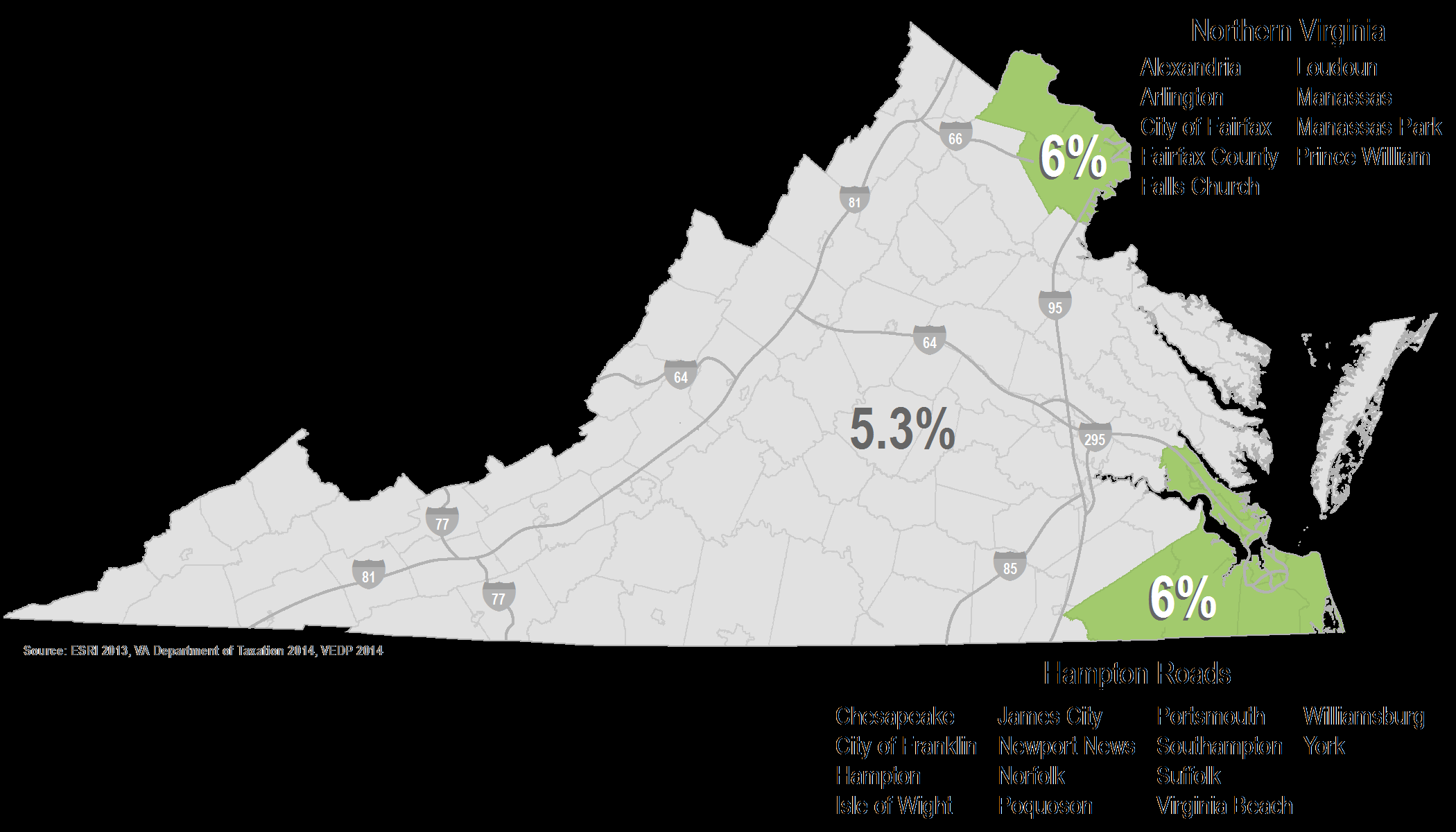
8 Tax Incentives Sales and Use Tax Exemptions Virginia s state sales and use tax rate is 4.3 percent. An additional regional sales tax is imposed in the Hampton Roads and Northern Virginia regions at a rate of 0.7 percent. The combined state and local sales and use tax rate is 5.3 percent or 6.0 percent in the Hampton Roads and Northern Virginia regions. A seller is subject to a sales tax imposed on gross receipts derived from retail sales or leases of tangible personal property, unless the retail sales or leases are specifically exempt by law. When a seller does not collect the sales tax from the purchaser, the purchaser is required to pay a use tax on the purchase, unless the use of the property is exempt. Some important exemptions include: Manufacturers purchases used directly in production including machinery, tools, spare parts, industrial fuels, and raw materials Items purchased for resale by distributors Certified pollution control equipment and facilities Custom computer software Utilities delivered through lines, pipes or mains Purchases used directly and exclusively in research and development Most film, video, and audio production-related purchases Charges for internet access, related communications services, and sales of software via the internet Purchases used directly and exclusively in activities performed in cooperation with the Virginia Commercial Space Flight Authority Semiconductor clean rooms or equipment and other tangible personal property used primarily in the integrated process of designing, developing, manufacturing, or testing a semiconductor product Computer equipment purchased or leased for the processing, storage, retrieval, or communication of data in large data centers (requires a minimum capital investment, job creation and wage level to qualify) Virginia Department of Taxation Office of Customer Services P.O. Box 1115 Richmond, Virginia

9 Enterprise Zones The Virginia Enterprise Zone Program, administered by the Virginia Department of Housing and Community Development (DHCD), assists with business development and expansion in specially targeted areas throughout the state called enterprise zones. Virginia s Enterprise Zone Program offers two state incentives to qualified businesses and zone investors located in a Virginia Enterprise Zone. In addition to state incentives, each zone community offers additional local incentives to qualified businesses. In order to access enterprise zone incentives, companies must submit applications and all required attachments to DHCD by April 1st each year. Enterprise Zone Job Creation Grants Qualified businesses in an enterprise zone are eligible for cash grants for permanent net new jobs created over a four-job threshold. Qualifying jobs must offer health benefits and meet certain wage thresholds. Positions created over the four-job threshold that pay at least 1.75 times the federal minimum wage rate* are eligible for a maximum grant of $500 per position per year for up to five years. In enterprise zone localities designated as high unemployment areas by DHCD businesses can qualify for $500 grants using a lower wage threshold of 1.5 times the federal minimum wage. Positions that pay at least twice the federal minimum wage rate are eligible for a maximum grant of $800 per position per year for up to five years. Jobs with pay rates below the federal minimum wage or without health care benefits as well as positions in retail, personal service, or food and beverage service are not eligible for grants. Grants are calculated based on the number of full months worked during a calendar year. In cases where a position is filled or is eligible for a grant for only a portion of the year, the grant is prorated based on the number of full months the position was filled and/or eligible for a grant. This applies to cases where there is a change in the wage rate, health benefits or the federal minimum wage rate. Businesses must qualify for the grants annually. A business can receive grants for a maximum of 350 jobs annually above the four-job threshold. Businesses may qualify for additional five-year grant periods with additional job creation. Business facilities located in an enterprise zone and electing to receive this grant are not eligible for the Major Business Facility Job Tax Credit for the same jobs. * The current federal minimum wage is $7.25 per hour. Enterprise Zone Real Property Investment Grant Qualified zone investors (entities and individuals) making a qualified investment in industrial, commercial or mixed-use real property located within an enterprise zone are eligible for a cash grant. The grant is equal to 20 percent of the excess above the minimum required investment up to a maximum of $100,000 for companies investing $5 million or less in qualified real property investments. For companies investing more than $5 million, the maximum grant is equal to 20 percent of the excess above the minimum required investment up to a maximum of $200,000. Total grant awards may not exceed the maximums specified above within any five-year period for a specific building or facility. Investment in rehabilitation/expansion projects must equal at least $100,000. New construction projects must invest at least $500,000 in qualified real property investments. Please note: Job Creation Grants receive funding priority. Real Property Investment Grants are subject to proration if the grants requested exceed the remaining funding. Virginia Department of Housing and Community Development 600 East Main Street, Suite 300 Richmond, Virginia Phone: Fax:


10 Enterprise Zones 8

11 Foreign Trade Zones Foreign trade zones (FTZs) allow businesses to defer paying U.S. Customs duties on imported goods held within the zones until the goods enter the United States for domestic consumption. No duties are paid if goods are re-exported. Companies also receive the benefit of not having to pay duties on broken or scrapped product. Businesses are allowed to store goods within foreign trade zones for an unlimited period of time. They are also allowed to manufacture products within zones and pay duties at the duty rate of either the foreign parts used or on the finished product, whichever is most advantageous to the company. Virginia offers six general-purpose FTZs designated by the U.S. Department of Commerce. These FTZs are Alternative Site Framework (ASF) designated. Any property within the ASF designated site of a particular FTZ can obtain status as a usage driven FTZ site. These zones are geographically dispersed around the state and include the following: 1. Suffolk FTZ #20. The Virginia Port Authority administers Virginia s first foreign trade zone. This zone operates under Alternative Site Framework, which allows greater flexibility when adding new zone operations. FTZ #20 is the most active in the state and has a service area that includes the counties of Accomack (partial), Gloucester, Isle of Wight, James City, Mathews, Northampton, Southampton, Sussex, Surry and York, and the cities of Chesapeake, Franklin, Hampton, Newport News, Norfolk, Poquoson, Portsmouth, Suffolk, Virginia Beach, and Williamsburg. Contact: Laura Godbolt Washington Dulles FTZ #137. Foreign trade zone #137 consists of approximately 271 acres at Washington Dulles International Airport and the following expansion sites: Victory International Warehouse near Washington Dulles; Ft. Collier Industrial Park in Winchester; a 90,000 square foot warehouse in Stonewall Industrial Park in Winchester; property adjacent to Winchester Airport; Wrights Run property acres zoned for light industrial and commercial; and Hazout expansion site west of Dulles Airport. The Grantee of FTZ #137 is Washington Dulles Foreign Trade Zone, Inc. Contact: Anita Kayser Culpeper FTZ #185. Located in north-central Virginia, the Culpeper foreign trade zone has three sites in its general-purpose zone, including a 78 acre site located on Route 29 and Route 666, a 104 acre site located at the Culpeper County Industrial Airpark, and a 64.6 acre site in Waynesboro. The zone also contains three subzones. Contact: Carl Sachs l 4. Tri-Cities TN/VA FTZ #204. Foreign trade zone #204 operates under the Alternate Site Framework and has a service area in Virginia covering the cities of Bristol and Norton and the counties of Lee, Scott, Washington, Buchanan, Dickenson, Russell, and Wise. The Grantee of FTZ #204 is the Tri-Cities Airport Authority. Contact: Mark Canty Richmond FTZ #207. Central Virginia s zone is located at Richmond International Airport. FTZ #207 consists of on-airport warehousing options and over 100 acres available for development on-airport. Additionally, there are off-airport sites consisting of 10 acres with general-purpose warehousing in an industrial park in Hanover County and 221 acres in a Prince George County industrial park. Additional options exist for companies that cannot use existing sites. Contact: Russ Peaden


12 Foreign Trade Zones 6. New River Valley Airport FTZ #238. The New River Valley Economic Development Alliance administers Virginia s newest foreign trade zone. FTZ #238 includes a 35 acre general-purpose zone at the New River Valley Airport in Dublin and a 200,000 square foot warehouse on a 15 acre site in Pulaski. FTZ #238 is part of the Virginia Trade Port ( Contact: Aric H. Bopp All zones provide space for storage, distribution, and light assembly operations. For additional information about Virginia s foreign trade zones, please contact the individual zones above or: U.S. Department of Commerce Foreign Trade Zone Board 1401 Constitution Avenue, NW Washington, District of Columbia


13 Technology Zones Virginia cities, counties, and towns have the ability to establish, by ordinance, one or more technology zones to attract growth in targeted industries. Qualified businesses locating or expanding operations in a zone may receive local permit and user fee waivers, local tax incentives, special zoning treatment, or exemption from ordinances. Once a local technology zone has been established, incentives may be provided for up to 10 years. Each locality designs and administers its own program. 11

14 Defense Production Zones Virginia's cities, counties, and towns have the ability to establish, by ordinance, one or more defense production zones to attract growth in national defense-related businesses. Qualified businesses include: Service providers that support national defense, including, but not limited to, logistics and technical support Designers, developers, or producers of materials, components or equipment required to meet the needs of national defense Companies deemed ancillary to or in support of the aforementioned categories Establishment of a defense production zone allows localities to create special incentives and certain regulatory flexibility for qualified businesses locating or expanding operations in a zone. These incentives may include: a reduction of user and permit fees, a reduction of any type of gross receipts tax, special zoning treatment, permit process reform, exemption from local ordinances, or other incentives adopted by ordinance. Once a defense production zone has been established, incentives may be provided for up to 20 years. Each locality designs and administers its own program. The establishment of a defense production zone shall not preclude the area from also being designated as an enterprise zone. The City of Manassas Park is currently the only locality to have established a zone. Henrico County will create individual defense production zones based around individual projects on a case-by-case basis. 12

15 Port of Virginia Economic & Infrastructure Development Grant A business entity that meets all four criteria listed below is eligible for a one-time cash grant from the Port of Virginia Economic and Infrastructure Development Fund per :2 of the Code of Virginia and subject to appropriation. 1. Locates or expands a facility within the Commonwealth. 2. Creates at least 25 new, permanent full-time positions for qualified full-time employees at a facility within Virginia from commencement of the project through the first full year of operation or during the year when the expansion occurs. 3. Is involved in maritime commerce or exports or imports manufactured goods through the Port of Virginia. 4. Is engaged in one or more of the following: the distribution, freight forwarding, freight handling, goods processing, manufacturing, warehousing, crossdocking, transloading, or wholesaling of goods exported and imported through the Port of Virginia; ship building and ship repair; dredging; marine construction; or offshore energy exploration and extraction. The amount of the grant is calculated by the following formula: new jobs: $1,000 per job new jobs: $1,500 per job new jobs: $2,000 per job new jobs: $3,000 per job To receive the grant, a qualifying company must apply to the Virginia Port Authority not later than March 31st in the year immediately following the first full year of operation or expansion within Virginia. The qualifying company must also agree to maintain the jobs at the facility within Virginia and continue to move cargo through the Port of Virginia for each of the three years following the receipt of the grant by entering into a Memorandum of Understanding with the Virginia Port Authority. In the event that the company fails to maintain the job number or cargo moving through the Port of Virginia during any of those three years, it will be required to pay all or a portion of the grant back to the Virginia Port Authority. Virginia Port Authority 600 World Trade Center Norfolk, Virginia

16 Recruitment & Training Virginia Jobs Investment Program The Virginia Jobs Investment Program (VJIP), a division of the Virginia Economic Development Partnership, provides customized recruiting and training services to companies creating new jobs or experiencing technological change. As a business development incentive supporting economic development efforts throughout Virginia since 1965, the program reduces the human resource development costs of new and expanding companies throughout the Commonwealth. VJIP offers consulting services, organizational development, and funding. Funding is provided as cash reimbursements and is performance-based, meaning that no funds are disbursed to participating companies until eligible positions have been filled for at least 90 days, and capital investments have been made. Eligibility for assistance in any of the VJIP program offerings is limited to basic sector businesses that directly or indirectly derive more than 50 percent of their revenues from out of state sources and pay at least 1.35 times the federal minimum wage ($9.79). Only full-time Virginia jobs that qualify for benefits are eligible for funding. Virginia New Jobs Program The New Jobs Program is a vital part of the Commonwealth of Virginia s economic development efforts. The program targets expansions of existing companies or new facility locations which involve competition with other states or countries. Expansions of existing companies or new company locations must create a minimum of 25 net new jobs within 12 months from the date of the first hire and make a new capital investment of at least $1 million. Workforce Retraining Program The Workforce Retraining Program provides services and funding to assist in upgrading the skills of existing workers. To be eligible for assistance a company must demonstrate it is undergoing an integration of new technology into their production processes, changing product lines in keeping with marketplace demands, or substantially changing service delivery processes requiring an assimilation of new skills and technological capabilities. Companies must have a minimum of 10 full-time employees needing to be retrained, and a new capital investment of at least $500,000 is required as the catalyst for the project. Small Business New Jobs and Retraining Program The Small Business Program supports Virginia companies that have 250 employees or less company-wide. The Small Business New Jobs Program and the Small Business Retraining Program provides services and funding to small businesses to train new workers or assist in upgrading the skills of existing workers. For the Small Business New Jobs Program, the business must create a minimum of five net new jobs and make a new capital investment of at least $100,000. For the Small Business Retraining Program, the business must be undergoing an integration of new technology into its production process, a change of product line in keeping with market place demands, or substantial change to its service delivery process that would require assimilation of new skills and technological capabilities, with at least five employees involved and a capital investment of at least $50,000. Virginia Jobs Investment Program Virginia Economic Development Partnership P.O. Box 798 Richmond, Virginia
17 Recruitment & Training Virginia s Community Colleges Virginia s community colleges are well-positioned to align education and economic development to extend workforce development courses, training, and programs into the community. The Commonwealth s 23 colleges prepare a workforce able to respond to new and expanding businesses and industries across Virginia. Colleges serve employers through open enrollment courses that allow new or incumbent employees to upgrade their skills. Colleges also offer customized training services that provide employers with tailored training programs that meet specific training needs at a significant value. The result is a workforce that is better prepared to quickly meet changing workplace demands, ensuring that employers are better able to provide direct benefit to their community and economy. Open Enrollment These short-term courses are open to the general public and give workers and job seekers an opportunity to develop and enhance workplace skills and prepare for industry recognized certifications. Often, by taking these open enrollment courses, workers are able to take on more responsibilities in their place of work, and businesses become more productive and efficient. Open enrollment classes are delivered in the classroom at the college or offered online. Customized Training Virginia s community colleges further serve employers by identifying training needs, delivering training and assessing training results. Customized training is convenient for the employer delivered at the business or at the college on a schedule to meet the business needs. By taking advantage of these responsive, cost-effective, and flexible programs, employers see improvement in productivity and company growth an immediate benefit that gives them a competitive edge. Open enrollment and customized training focuses on skill development to impact: Organizational productivity (such as team building, management, LEAN, SIX SIGMA, and coaching) Individual productivity (such as time and stress management, leadership, communication, and customer service) Technology skills (such as Microsoft Office specialist and application specialist) Job-specific skills (such as HVAC, OSHA-10, OSHA-30, and welding) Career Readiness Certificate The Career Readiness Certificate (CRC) provides employers with a standardized measurement tool to assess workplace skills of potential candidates and current employees to match the right person to the right job, reducing turnover and increasing productivity. WorkKeys simplifies hiring by streamlining the application process and reduces training time and increases skill levels of existing employees. The CRC, based on the ACT WorkKeys job skills assessment system, is available at Virginia s community colleges. To date, 68,000 CRCs have been issued in Virginia. Virginia Community College System 101 North 14th Street Richmond, Virginia
18 Recruitment & Training The Workforce Investment Act The Workforce Investment Act (WIA) provides federal funding for employment and training activities to enhance productivity and competitiveness. Through statewide and local workforce investment systems, WIA attempts to increase employment, retention, skill levels, credential attainment, and earnings. In Virginia, the WIA is administered at the state level by the Virginia Community College System. At the local level, workforce boards appointed by local elected officials oversee the program. Through the one-stop service delivery network established by WIA, available employment and training services include: For Employers: Assistance in finding qualified workers, including interview facilities Information on and referral to business start-up, retention, and expansion services Information and access to a variety of training-related resources to provide for a skilled workforce Information on labor markets, workplace accommodations, and tax credits for new hires For Individuals: Job, career, and skill self-assessment tools and assessment services Information about and access to a variety of educational and training resources to enhance skill levels and make individuals either work-ready or provide opportunities for advancement along their career pathway Information about and access to other supportive services that can help guarantee success while in educational or training programs Some of the specific training options of value to employers funded by WIA include: On-the-job training (OJT), which allows the employer to be reimbursed for up to 50 percent of the participant s wage rate to compensate for employer costs during training Customized training, which allows up to 50 percent of an employer s training costs to be covered by WIA funds for training designed to meet the needs of an employer or group of employers if there is a commitment to employ or retain individuals at the completion of training Incumbent worker training, which provides the opportunity to upgrade skills of the existing workforce The majority of WIA funding is passed directly to 15 local workforce investment areas for direct service delivery. In addition, WIA funds at the state level can assist businesses with layoff aversion strategies and to fund rapid-response services to workers affected by plant closings and other dislocations. Virginia Community College System 101 North 14th Street Richmond, Virginia

19 Infrastructure Economic Development Access Program The Virginia Department of Transportation (VDOT) administers a program that assists localities in providing adequate road access to new and expanding manufacturing and processing companies, research and development facilities, distribution centers, regional service centers, corporate headquarters, government installations, and other basic employers. The program may be used to: Improve existing secondary highway system roads and city streets to accommodate the anticipated additional and type of traffic generated by an eligible economic development site Construct a new road from a publicly maintained road to the new eligible establishment s primary entrance when no road exists Access road construction is scheduled for completion simultaneously with the start-up of plant operations. The access road is not intended to serve as a haul road during plant construction. Before VDOT can act on a particular proposal, a resolution from the local governing body requesting the allocation of access road funds must be submitted to the department through the office of VDOT s local representative. The award amount is limited by the eligible capital investment of the company and the estimated cost of the access road. The maximum award for an economic development access road is $500,000. However, the state will fund an additional $150,000 if the amount is matched on a dollar-for-dollar basis from sources other than those administered by the Commonwealth Transportation Board. The total yearly allocation for the Economic Development Access Program and the Rail Industrial Access Program is $5.5 million. For project sites meeting the Major Employment and Investment (MEI) definition in of the Code of Virginia, a provision of the Economic Development Access Program allows a locality to receive up to the maximum $500,000 unmatched and $150,000 matched allocations for a design-only project. Furthermore, for these same MEI projects, the locality may receive up to a maximum allocation of $500,000 unmatched ($1 million over two years) and $500,000 matched ($3 million over two years) for an access road construction project with allocations cumulative for no more than two years. Including the matching funds from the locality, MEI sites may receive a total of $3.8 million toward design and construction of an access road project. Director of Local Assistance Division Virginia Department of Transportation 1401 East Broad Street Richmond, Virginia

20 Infrastructure Rail Industrial Access Program The Rail Industrial Access Program provides funds to construct railroad tracks to new or substantially expanded industrial and commercial projects having a positive impact on economic development in Virginia. In accordance with program guidelines, financial assistance to any one county, city or town is limited to $450,000 in one fiscal year, and the locality may utilize the entire allocation for one project. The state program will provide a maximum of $300,000 in unmatched funds. An additional $150,000 is available if matched on a dollar-for-dollar basis. Funds may be used to construct, reconstruct, or improve part or all of the necessary tracks and related facilities on public or private property. Funds may not be used for mainline switch, right-of-way acquisition, or adjustment of utilities. Each application must be accompanied by a resolution from the local governing body requesting the allocation of the funds. Virginia Department of Rail and Public Transportation 600 East Main Street, Suite 2102 Richmond, Virginia Transportation Partnership Opportunity Fund The Virginia Department of Transportation (VDOT) administers the Transportation Partnership Opportunity Fund (TPOF or Fund) which may be used, among other purposes, to address transportation aspects of economic development opportunities. TPOF monies are awarded at the discretion of the Governor in the form of grants, revolving loans, or other financial assistance to an agency, political subdivision of the Commonwealth, or to certain private entities for activities associated with eligible transportation projects. Projects that are developed with monies from the Fund do not become private property but become or remain public property following completion. The transportation improvements have to be accomplished according to VDOT standards and specifications and have to be maintained by the appropriate public entity pursuant to relevant agreements. Economic development projects seeking TPOF funding to assist with transportation aspects must meet the minimum criteria established in the Governor s Opportunity Fund Guidelines. Virginia Department of Transportation 1401 East Broad Street Richmond, Virginia

21 Discretionary Incentives Governor s Opportunity Fund The Governor s Opportunity Fund (GOF) is designed as a deal closing fund to be employed at the Governor s discretion to secure a company location or expansion in Virginia. The GOF serves as a final resource for Virginia in the face of serious competition from other states or countries. The GOF grant is a negotiated amount determined by the Secretary of Commerce and Trade, based on the recommendation of the Virginia Economic Development Partnership (VEDP) and subject to the approval of the Governor. A GOF grant is awarded to the Virginia locality (county, city, town, or Industrial/Economic Development Authority) for the benefit of the company, with the expectation that the grant will result in a favorable decision for the Commonwealth. Grants are made at a locality s request for a project under the following conditions: Minimum project capital investment, job creation and wage requirements The locality participates with a matching dollar-for-dollar (cash or in-kind) financial commitment A performance agreement is executed between the locality and the company outlining promised job creation, capital investment, and wages Public announcement of the project is coordinated by the VEDP and the Governor s Office Monies may be used for such things as public and private utility extension or capacity development on- and off-site; public and private installation, extension, or capacity development of high-speed or broadband internet access whether on- or off-site; road, rail, or other transportation access costs beyond the funding capability of existing programs; site acquisition; grading, drainage, paving, and any other activity required to prepare a site for construction; construction or build-out of publicly or privately owned buildings; or training. Once a company decides on one potential Virginia location, the locality works with the VEDP within the guidelines of this program to seek the funds necessary to apply toward the project. The success of the GOF application is based on the project s eligibility and the locality s financial support for the project, as well as the actual project requirements and availability of funds. As with all Virginia discretionary incentives, the Commonwealth s investment must make good fiscal sense for both sides, and must carry a suitable benefit for Virginia, based on a return on investment analysis prepared for every project. Virginia Economic Development Partnership P.O. Box 798 Richmond, Virginia
22 Discretionary Incentives Virginia Investment Partnership Grant The Virginia Investment Partnership (VIP) Grant is a discretionary performance incentive designed to encourage continued capital investment by Virginia companies, resulting in added capacity, modernization, increased productivity, or the creation, development, and utilization of advanced technology. The program is targeted at manufacturers or research and development services supporting manufacturing that have operated in Virginia for at least three years and are making a capital investment of at least $25 million while at least maintaining stable employment levels. The amount of each VIP grant is determined by the Secretary of Commerce and Trade, based in part on the Virginia Economic Development Partnership s return on investment analysis and recommendation, and is subject to the approval of the Governor. VIP grants are paid in five equal annual installments beginning in the third year after the capital investment and job creation or retention is achieved, or in the second year if the company is locating in a fiscally distressed area of the state. Companies are required to execute a performance agreement outlining performance expectations prior to receipt of the grant. Public announcement of the project must be coordinated with the Virginia Economic Development Partnership and the Governor s Office. For additional information, including guidelines and application information, please contact: Virginia Economic Development Partnership P.O. Box 798 Richmond, Virginia Major Eligible Employer Grant The Major Eligible Employer Grant (MEE) is a discretionary performance incentive designed to encourage significant capital investment and job creation by Virginia manufacturers and other basic employers. The program is targeted at major employers that make a capital investment of at least $100 million and create at least 1,000 new jobs (a minimum of 400 jobs, if the average pay is at least twice the locality s prevailing average wage). The amount of each MEE grant is determined by the Secretary of Commerce and Trade, based in part on the Virginia Economic Development Partnership s return on investment analysis and recommendation, and is subject to the approval of the Governor. MEE grants are paid in five equal annual installments beginning in the sixth year after the capital investment and job creation targets are met, or in the fourth year if the company is locating in a fiscally distressed area of the Commonwealth. Companies are required to execute a performance agreement before receipt of the grant outlining performance expectations. Public announcement of the project must be coordinated with the Virginia Economic Development Partnership and the Governor s Office. For additional information, including guidelines and application information, please contact: Virginia Economic Development Partnership P.O. Box 798 Richmond, Virginia
23 Discretionary Incentives Virginia Economic Development Incentive Grant The Virginia Economic Development Incentive Grant (VEDIG) is a discretionary performance incentive, designed to assist and encourage companies to invest and create new employment opportunities by locating significant headquarters, administrative, or service sector operations in Virginia. Selected companies must meet the following eligibility requirements: A company locating in a Metropolitan Statistical Area with a population of 300,000 or more in the most recent decennial Census must: Create 400 new full-time jobs with average salaries at least 1.5 times the local prevailing average wage; or create 300 new full-time jobs with average salaries at least twice the local prevailing average wage Make a capital investment of at least $5 million or $6,500 per job, whichever is greater A company locating elsewhere in Virginia must: Create 200 new full-time jobs with average salaries at least 1.5 times the local prevailing average wage Make a capital investment of at least $6,500 per job The performance grant is determined by the Secretary of Commerce and Trade, based in part on the Virginia Economic Development Partnership s return on investment analysis and recommendation, and is subject to the approval of the Governor. VE- DIG grants are paid in five equal annual installments beginning in the third year after the capital investment and job creation are completed. Companies are required to execute a performance agreement before receipt of the grant outlining performance expectations. Public announcement of the project must be coordinated with the Virginia Economic Development Partnership and the Governor s Office. For additional information, including guidelines and application information, please contact: Virginia Economic Development Partnership P.O. Box 798 Richmond, Virginia
24 Discretionary Incentives Clean Energy Manufacturing Incentive Grant Program The Clean Energy Manufacturing Incentive Grant Program (CEMIG) may be available to eligible companies engaged in the manufacture of equipment, systems or products used to produce clean energy, or for products used for energy conservation, storage, or grid efficiency purposes. A clean energy manufacturer may be eligible to receive a Clean Energy Manufacturing Grant under the following conditions (unless waived by the Governor for a project in a distressed locality): Makes a capital investment of at least $50 million in real estate and tangible personal property Creates at least 200 new full-time jobs paying at least the prevailing average wage of the locality A wind energy supplier may be eligible to receive a Clean Energy Manufacturing Grant under the following conditions: Makes a capital investment of at least $10 million in real estate and tangible personal property Creates at least 30 new full-time jobs paying at least the prevailing average wage of the locality The amount of each Clean Energy Manufacturing Incentive Grant is determined by the Secretary of Commerce and Trade, based in part on the Virginia Economic Development Partnership s return on investment analysis and recommendation, and is subject to the approval of the Governor. CEMIG grants may be paid out over a period of up to six years and payment of the grant is likely to begin after capital investment and job creation or retention is achieved. Companies are required to execute a performance agreement before receipt of the grant outlining performance expectations. Public announcement of the project must be coordinated with the Virginia Economic Development Partnership and the Governor s Office. For additional information, including guidelines and application information, please contact: Virginia Economic Development Partnership P.O. Box 798 Richmond, Virginia
25 Discretionary Incentives Governor s Agriculture and Forestry Industries Development Fund The Governor s Agriculture and Forestry Industries Development Fund (AFID) is a tool for communities within the Commonwealth to grow their agriculture and forestry industries through strategic grants made to businesses that add value to Virginiagrown agricultural and forestal products. AFID grants are made at the discretion of the Governor with the expectation that grants awarded to a political subdivision will result in a new or expanded processing/value-added facility for Virginia grown agricultural or forestal products, and with the expectation that the grant will be critical to the success of the project. The amount of an AFID grant and the terms under which it is given are determined by the Secretary of Agriculture and Forestry and subject to the approval of the Governor. Grants are made to a political subdivision for a project under the following conditions: The business beneficiary is a facility that produces value-added agricultural or forestall products A minimum of 30 percent of the agricultural or forestry products to which the facility is adding value are produced within the Commonwealth of Virginia on an annual basis in normal production years The grant request does not exceed $250,000 or 25 percent of qualified capital expenditures (whichever is less) The applicant provides a dollar-for-dollar matching financial commitment (cash or qualified in-kind) A performance agreement is executed between the applicant and the business beneficiary to document promised job creation, capital investment and purchase of Virginia grown agricultural or forestry products Public announcement of the project is coordinated with the Governor s Office Grants may be used for a variety of purposes including public and private utility extension or capacity development on and off site; high-speed or broadband internet access extension or capacity development; road, rail, or other transportation access costs beyond the funding capability of existing programs; site acquisition, grading, drainage, paving, and any other activity required to prepare a site for construction; construction or build-out of publicly or privately owned buildings; or training. Virginia Department of Agriculture and Consumer Services Stephen Versen AFID Fund Coordinator 102 Governor Street Richmond, Virginia
26 Regional Assistance Tobacco Region Opportunity Fund The Tobacco Region Opportunity Fund (TROF) provides performance-based monetary grants to localities in Virginia s tobacco producing regions (34 counties and six cities in Southside and Southwest Virginia as defined by the Virginia Tobacco Indemnification and Community Revitalization Commission) to assist in the creation of new jobs and investments, whether through new business attraction or existing business expansion. These grants are at the Commission s discretion. The TROF grant program is intended to support the goal of the Commission to revitalize the economies of tobacco dependent regions and communities. This goal is measured by job creation, workforce participation rate, wealth, diversity of economy, and taxable assets. Eligible projects must include: A minimum private capital investment of $1 million within 36 months (amounts spent to acquire real estate will be counted as capital investment) A minimum of 10 jobs created within 36 months (the job minimum may be lowered if the jobs pay much higher than the local prevailing wage or the jobs are created in a locality with a very high unemployment rate) A performance agreement will be required for all grants. Repayment of all or part of grant funds is required if performance is not met. The Commission determines grant amounts based on local unemployment rates, prevailing wage rates, capital investment levels, industry type, and other factors chosen by the Commission. Grants are limited to three per county per fiscal year. Applications from incorporated towns count against the county limit, but independent cities do not. A local match is not required. The Virginia Tobacco Indemnification and Community Revitalization Commission 701 East Franklin Street, Suite 501 Richmond, Virginia
27 Regional Assistance Virginia Coalfield Economic Development Authority (Virginia s e-region) The Virginia Coalfield Economic Development Authority (VCEDA) works to enhance the economic base of Virginia s e-region, the seven counties and one city of far southwestern Virginia (Buchanan, Dickenson, Lee, Russell, Scott, Tazewell, and Wise counties and the City of Norton). Virginia s e-region focuses on electronic information technology, energy, education, emerging technologies, and existing industries. The Authority provides low-interest loans to qualified new or expanding businesses through its financing program. The loans may be used for real estate purchases, construction or expansion of buildings, and the purchase of machinery and equipment. To be eligible for the VCEDA loans, private businesses must be basic employers that will bring new income to the area. Priority will be given to loans requiring $10,000 or less for each new basic job created and the average minimum hourly wage should equal or exceed 1.5 times the current federal minimum wage rate at the end of one year of employment. Any project providing at least 25 jobs within 12 months of start-up will be given priority. Program funding is derived primarily from the local coal and gas road improvement tax and the natural gas severance tax. VCEDA also administers other funding programs designed to encourage economic development and diversification in Virginia s e-region, including the Coalfield Regional Opportunity Fund (CROF). Eligibility requirements vary by program. Virginia Coalfield Economic Development Authority P.O. Box 1060 Lebanon, Virginia
28 Financial Assistance Virginia Small Business Financing Authority The Virginia Small Business Financing Authority (VSBFA) provides small businesses and communities with debt financing resources for business formation and expansion. VSBFA s definition of small business is $10 million or less in annual revenues over each of the last three years; a net worth of $2 million or less; fewer than 250 employees in Virginia; or qualification as a 501(c)(3) non-profit entity. Industrial Development Bonds (IDBs). The VSBFA issues tax-exempt and taxable bonds to provide businesses and 501(c)(3) corporations with access to long-term, fixed asset financing at favorable interest rates and terms. IDBs can fund land acquisition, building construction, and capital asset (equipment) purchases. Eligible borrowers include new or expanding manufacturing companies, exempt facilities such as solid waste disposal facilities, and 501(c)(3)s. Through IDBs, creditworthy manufacturers and 501(c)(3) corporations can borrow up to 100 percent of the cost of acquiring, constructing, and equipping a facility, including site preparation. IDBs may also facilitate tax-exempt funding for leased manufacturing facilities and equipment. All projects financed with IDBs must meet federal tax code eligibility requirements. The maximum manufacturing project size is $20 million; 501(c)(3) corporations and exempt projects are not subject to this dollar limitation. At current interest rates, projects under $3 million are generally not cost-effective due to the transaction costs of bond financing. Interested companies should contact the VSBFA. Economic Development Loan Fund (EDLF). The Virginia EDLF offers permanent working capital, owner occupied commercial real estate, and equipment loans to fill the gap unmet by equity, conventional financing, and other sources (GOF, Historic Tax Credits, etc.). Project eligibility is determined by guidelines set by the federal Economic Development Administration (EDA) and the VSBFA. Eligible borrowers include local Industrial or Economic Development Authorities and businesses engaged in technology, biotechnology, tourism, engine and vehicle manufacturers for the professional motor sports industry, basic industries, manufacturing, and those businesses or entities that provide for a locality s economic and quality of life development. Businesses that derived 15 percent or more of their revenues from defense-dependent activities and can demonstrate economic hardship related to defense downsizing may also apply. Eligible projects must provide economic benefit to the community through job creation/retention (minimum $10.00 hourly wage) or by enhancing a locality s ability to attract private capital investment. The maximum loan amount is generally the lesser of 40 percent of the total project cost or $500,000 unless the project is located in a city/county defined by the EDA as economically distressed. Loans in distressed areas can be higher potentially in excess of $1 million depending on risk factors, the number of jobs created, and the region in which the project is located. Generally, loans have 10-year maturities with amortizations based on the life of the asset and the borrower s ability to repay. Rates are risk-based but can be below market. Loans are secured by assets and require personal guaranties. Businesses apply directly to the VSBFA. Loan Guaranty Program. The Loan Guaranty Program reduces bank commercial loan risk to increase the availability of small business loans. The maximum guaranty is the lesser of 75 percent of the credit amount or $750,000. The guaranty term is no longer than seven years. Eligible borrowers must be a VSBFA-defined small business and meet VSBFA credit standards. Loan purposes include lines of credit for accounts receivable and inventory and term loans for permanent working capital and fixed asset purchase. Businesses apply directly to the bank. Interested banks then contact the VSBFA if a guaranty is desired and the borrower credit-worthy. 26
29 Financial Assistance Environmental Compliance Assistance Fund (ECAF). ECAF provides existing Virginia businesses with financing for 1) equipment to comply with the Clean Air Act, 2) equipment to implement voluntary pollution prevention measures, or 3) equipment or structures to implement voluntary agriculture best management practices (BMPs). Maximum loan amounts are $100,000 and the project must meet DEQ or DCR eligibility requirements. Borrowers must be VSBFA-defined small businesses and credit-worthy by VSBFA standards. The interest rate is three percent and maximum term is 10 years. Interested parties should apply directly to the VSBFA. Small Business Microloan Program (SBMP). SBMP funds a maximum of $10,000 in loans to existing Virginia small businesses. Eligibility requirements are a minimum of two years of active operation in the Commonwealth and a minimum of 650 personal credit scores of all business owners/loan guarantors. Terms are a maximum of four years and rates are Wall Street Journal Prime plus three percent. If a business has received counseling from a Virginia Small Business Development Center, the maximum loan amount may increase to $25,000. Interested parties should apply directly to the VSBFA. Virginia Capital Access Program (VCAP). VCAP promotes business credit by mitigating risk through a form of loan portfolio insurance for participating lenders. Businesses must meet the definition of a small business with credit approval performed by the bank. The lender notifies the borrower that the loan will be VCAP enrolled and sets the fee (two to seven percent of the enrolled amount). VSBFA matches the fee and the monies are used as special loan loss reserve accounts. Maximum enrolled amounts are $500,000 and maximum term is 10 years. Interested parties should apply to a participating bank. Cash Collateral Program (CCP). The CCP is designed to help Virginia's businesses obtain the funds to start, enhance, or expand their operations, and thereby create or maintain jobs in the Commonwealth. The VSBFA's participation helps reduce a lender's credit risk by providing cash collateral on deposit at the lender bank as support for a business purpose loan. Most typically, the CCP is used in those instances when the applicant company has the demonstrated ability to cash flow the debt, but the collateral coverage is insufficient for the lender's normal underwriting standards. It is also used for SBA 504 loans when the lending bank is funding the certified development company's loan pending the sale of a debenture. The VSBFA can provide cash collateral up to 40 percent of a loan or $500,000, whichever is less, with a maximum relationship participation between the borrower and the VSBFA of $500,000. The lender sets the interest rates and terms. The VSBFA's participation is for a maximum of five years on term loans. Annual lines of credit not matured may be renewed up to two times with a maximum term of three years. Interested parties should apply to a participating lender. Loan Participation Program (LPP). The LPP provides for the purchase of part of a lender's loan. The VSBFA can purchase up to 40 percent or $500,000, whichever is less, of a term loan made by a commercial bank to an eligible Virginia business. The VSBFA's purchase participation helps reduce the lender's credit risk by reducing the amount of exposure. This program can help lenders when the legal lending limit is a restriction on their ability to lend or when their exposure to any given borrower has been reached. It allows the lender to continue to provide assistance to their customer without having to send them to competition. The participation can also help when the collateral supporting the transaction does not meet the lender's normal underwriting criteria. The lender sets the terms and interest rate. VSBFA's maximum term is 10 years. Interested parties should apply to a participating lender. Virginia Small Business Financing Authority 1220 Bank Street, 3rd Floor Richmond, Virginia
30 Financial Assistance Community Development Block Grants Community Development Block Grant funds (CDBG) are available to eligible cities, counties, and towns to support local community and economic development activities. Funds may be used for off-site development such as public facilities improvements including but not limited to construction of access roads, water and sewer line extensions, and installation of fiber network for telecommunications. Funds may also be available as loans for on-site redevelopment that supports economic development, subject to underwriting. CDBG funds are available for small business and entrepreneurship development, revitalization of a downtown and other commercial district, and projects resulting in job creation and retention. Funds are awarded to localities on a competitive basis during an annual application cycle. Funds are also awarded noncompetitively, provided certain thresholds are met. Applications for these funds may be submitted at any time from January 1 through September 30. At least 51 percent of jobs created or retained by a project using CDBG funding must be held by or made available to low and moderate-income persons. The Virginia Department of Housing and Community Development administers the non-entitlement portion of the federal CDBG program for cities and towns with populations under 50,000 and counties with populations under 200,000. The U.S. Department of Housing and Urban Development administers the CDBG entitlement program for metropolitan areas. Virginia Department of Housing and Community Development Main Street Centre 600 East Main Street, Suite 300 Richmond, Virginia
31 Management & Technical Support Center for Innovative Technology The Center for Innovative Technology (CIT) has been accelerating innovation, technology, and technology-based economic development opportunities and strategies for the Commonwealth of Virginia since CIT carries out its mission through four service lines: CIT Entrepreneur, CIT R&D, CIT Connect, and CIT Broadband. Through all these activities, CIT leverages public and private sector investments to develop Virginia s new innovation economy that is creating new, high-growth companies and sustainable job growth. CIT Entrepreneur: Access to Capital Because the availability of early-stage capital is critical for many emerging technology companies, CIT offers the CIT GAP Funds and Federal Funding Assistance Program. The CIT GAP Funds make seed-stage equity investments in Virginia-based technology, green technology, and life science companies with a high growth potential. The GAP Funds are overseen by CIT and private sector experts - the Investment Advisory Board who conduct thorough due diligence on the companies before making investments. Since its 2005 launch, CIT GAP Funds have invested in over 100 companies across Virginia, deploying more than $13 million of public funds and attracting over $200 million more in private funding. CIT's Federal Funding Assistance Program identifies and accelerates opportunities for Virginia's small technology businesses to obtain SBIR, STTR, and ATP awards and other government contracts. In FY2013, CIT helped emerging technology companies receive 414 SBIR and STTR awards totaling over $130 million. CIT R&D: Strategic Investments in Research Commercialization The CIT R&D team facilitates commercialization of research and brings together public and private sector teams to develop and deploy marketable solutions. They manage the Commonwealth Research Commercialization Fund (CRCF), which invests in research and commercialization at Virginia colleges and universities, companies, federal labs, and other research institutions in their efforts to advance technology and drive economic growth in the Commonwealth. Closely aligned with the CRCF is the Commonwealth Research and Technology Strategic Roadmap, a strategic planning tool that identifies key industry sectors with commercial promise that are worthy of institutional focus and economic development for Virginia. In the three years since the program s inception in FY2012, the CRCF made nearly 150 awards of nearly $13 million. CIT Connect: Finding and Assimilating Innovation CIT Connect helps connect small, innovative companies with federal, state, and corporate consumers of technology. Connect experts deliver unique and innovative value-add solutions such as Startup Weekends, hack-a-thons, and open competitions to enable technology consumption, adoption, and integration. CIT Connect s customers cover local, state, federal, and corporate consumers across a variety of industries with emphasis in education, health IT, security, and mobile learning technologies. CIT Broadband: New Infrastructure for the New Innovation Economy CIT Broadband is the only resource in Virginia that works comprehensively to establish broadband infrastructure, accelerating the socio-economic growth of Virginia s rural and underserved areas. CIT Broadband is an honest broker between providers and customers, a trusted resource for localities, a market analyst, and an advocate for broadband adoption and use. Center for Innovative Technology (CIT) 2214 Rock Hill Road, Suite 600 Herndon, Virginia
32 Management & Technical Support Virginia s Small Business Development Center Network The Virginia Small Business Development Center Network (SBDC) provides professional business counseling, training, and information resources to help grow and strengthen Virginia businesses. SBDC professionals assist with business planning, marketing, financial analysis, access to capital, exporting, innovation, commercialization, and business start-up issues. For established firms, emerging companies, or aspiring entrepreneurs, the SBDC is where business comes to talk business. The SBDC Network is the most extensive business development program in Virginia, with 29 local centers across the state. The Network is a partnership between the U.S. Small Business Administration, George Mason University s Mason Enterprise Center, and local sponsors including universities, community colleges, chambers of commerce, municipalities, and economic development organizations. For additional information and to find a center nearest you, please contact: Virginia SBDC Network George Mason University - Mason Enterprise Center 4031 University Drive, Suite 100 Fairfax, Virginia International Trade The Virginia Economic Development Partnership s (VEDP) Division of International Trade helps Virginia companies sell their manufactured goods and services to markets around the world. Recipient of the nation s highest award in export promotion with the President s E-Star Award, the International Trade Division annually serves 300+ Virginia companies. It maintains offices in Richmond, Norfolk, Roanoke, Fishersville, Abingdon, and Tyson s Corner and offers a global network of on-call consultants in over 50 countries. Through the Virginia Leaders in Export Trade (VALET) program and its Global Network, VEDP works with all types of companies to increase their international sales into new markets. VALET is the VEDP s marquee international trade program that helps Virginia companies gain a profitable foothold in global markets. VALET combines three essential ingredients planning, expertise, and capital to generate, on average a 44 percent increase in international sales opportunities for Virginia businesses. Companies that participate share a commitment to international success with VEDP. Capital investment by the participating company is enhanced with matching resources from VEDP to meet identified needs. International professionals provide a match of in-kind services in a concentrated team approach. Attorneys, CPAs, bankers, translators, and freight forwarders contribute skills essential for a successful international launch. Since its inception, over 200 companies representing a wide cross-section of industry have been accepted into and graduated from the VALET program. Virginia Economic Development Partnership International Trade P.O. Box 798 Richmond, Virginia
33 CONTACT 901 East Byrd Street P.O. Box 798 Richmond, Virginia Phone: Fax:
PART C: GENERAL BUSINESS CREDIT
 PART C: GENERAL BUSINESS CREDIT 15. CREDIT FOR INVESTING IN PROPERTY IN SOUTH CAROLINA South Carolina Code 12-14-60 allows a taxpayer a credit against income taxes for qualified manufacturing and productive
GUIDE TO LOCAL TAXES ON BUSINESS 2013-2014
 GUIDE TO LOCAL TAXES ON BUSINESS 2013-2014 INTRODUCTION... iii TABLES TABLE 1 Taxes on Real Estate... 1 TABLE 2 Manufacturers Taxes on Machinery and Tools... 5 TABLE 3 Nonmanufacturers Taxes on Tangible
GUIDE TO LOCAL TAXES ON BUSINESS 2014-2015
 GUIDE TO LOCAL TAXES ON BUSINESS 2014-2015 INTRODUCTION...iii TABLES TABLE 1 Taxes on Real Estate... 1 TABLE 2 Manufacturers Taxes on Machinery and Tools... 5 TABLE 3 Nonmanufacturers Taxes on Tangible
CITY OF LYNCHBURG BUSINESS INCENTIVES
 CITY OF LYNCHBURG BUSINESS INCENTIVES Background The City, through the Lynchburg Economic Development Authority (LEDA), has a program of local economic development incentives designed to enhance the City
PUBLIC SERVICE TAXATION; ELECTRIC SUPPLIERS. Be it enacted by the General Assembly of Virginia:
 PUBLIC SERVICE TAXATION; ELECTRIC SUPPLIERS Be it enacted by the General Assembly of Virginia: 1. That 58.1-2600 and 58.1-2628 of the Code of Virginia are amended and reenacted as follows: 58.1-2600. Definitions.
smartbook INCENTIVES, WORKFORCE PROGRAMS & FINANCING
 smartbook INCENTIVES, WORKFORCE PROGRAMS & FINANCING INCENTIVES, WORKFORCE PROGRAMS & FINANCING THIS DOCUMENT REVIEWED WITH: NAME DATE / / COMPANY NAME LOCATION FINANCIAL REPRESENTATIVE Upon review, your
166 tax.ohio.gov. Property Tax Tangible Personal Property. Taxpayer Taxpayers who own and use tangible personal property in business in Ohio.
 Taxpayer Taxpayers who own and use tangible personal property in business in Ohio. Tax Base The tax is applied to tangible personal property used in business in Ohio (machinery, equipment, inventories).
THE MICHIGAN BUSINESS TAX (MBT)
 Note: As of January 1, 2012, the MBT has been replaced by the Michigan Corporate Income Tax (CIT). Businesses with certificated credits may still elect to file under the MBT structure. See the Michigan
WORKFORCE DEVELOPMENT Barbara Halsey
 91 WORKFORCE DEVELOPMENT Barbara Halsey I. MISSION STATEMENT The Department of Workforce Development (WDD) provides comprehensive employment, training and support services in accordance with the Department
TAX COMPARISON 2014-2015
 TAX COMPARISON 01-015 Between Caroline City of Fredericksburg King George Stafford Prepared by of Spotsylvania Department of Economic Development & Tourism 9019 Old Battlefield Boulevard, Suite 10 Spotsylvania,
New York State Tax Incentives for High-Tech Companies
 New York State Tax Incentives for High-Tech Companies Issued July 2006 1 Table of Contents I. Relevant Terms... 2 II. Investment Tax Credit / Employment Incentive Credit... 2 III. Qualified Emerging Technology
Georgia Tax Credits. Details of the Business and Personal Credits Allowed against Georgia s Corporate and Individual Income Tax (2015 edition)
 September 22, 2015 : Details of the Business and Personal Credits Allowed against Georgia s Corporate and Individual Income Tax (2015 edition) Sherman A. Cooper Laura Wheeler Table of Contents Introduction
How To Improve The Workforce In Virginia
 Commonwealth of Virginia Workforce Investment Act Title I Programs Annual Report for July 1, 2009 June 30, 2010 Introduction: As with the rest of the nation, the recent difficult economic times have directly
LEX HELIUS: THE LAW OF SOLAR ENERGY Tax Issues
 LEX HELIUS: THE LAW OF SOLAR ENERGY Tax Issues Charles S. Lewis, III 600 University Street, Suite 3600 Seattle, WA 98101-4109 206-386-7688 [email protected] Kevin T. Pearson 900 SW Fifth Avenue, Suite
COMMONWEALTH OF VIRGINIA VIRGINIA COMMUNITY COLLEGE SYSTEM WORKFORCE INNOVATION AND OPPORTUNITY ACT
 COMMONWEALTH OF VIRGINIA VIRGINIA COMMUNITY COLLEGE SYSTEM WORKFORCE INNOVATION AND OPPORTUNITY ACT The Virginia Community College System VIRGINIA WORKFORCE LETTER (VWL) #15-03 TO: LOCAL WORKFORCE DEVELOPMENT
SALES AND USE TAX TECHNICAL BULLETINS SECTION 18
 SECTION 18 - CERTAIN GOVERNMENTAL ENTITIES - THE STATE, COUNTIES, CITIES AND OTHER POLITICAL SUBDIVISIONS 18-1 PURCHASES AND SALES BY AND DONATIONS TO GOVERNMENTAL ENTITIES A. Purchases By Governmental
THE ECONOMIC IMPACTS OF THE PORTS OF LOUISIANA AND THE MARITIME INDUSTRY
 THE ECONOMIC IMPACTS OF THE PORTS OF LOUISIANA AND THE MARITIME INDUSTRY Prepared by: TIMOTHY P. RYAN UNIVERSITY OF NEW ORLEANS February, 2001 EXECUTIVE SUMMARY The ports of Louisiana and the maritime
COMMONWEALTH OF VIRGINIA VIRGINIA COMMUNITY COLLEGE SYSTEM WORKFORCE INNOVATION AND OPPORTUNITY ACT
 COMMONWEALTH OF VIRGINIA VIRGINIA COMMUNITY COLLEGE SYSTEM WORKFORCE INNOVATION AND OPPORTUNITY ACT The Virginia Community College System VIRGINIA WORKFORCE LETTER (VWL) #14-18 TO: LOCAL WORKFORCE DEVELOPMENT
Examples of State Tax Credits and Incentive Programs for Renewable Energy Projects and Energy Efficiency Improvements
 TN TVA - Generation Partners Program i Performance-based incentive Tennessee Valley Authority (TVA) and participating power distributors of TVA power offer a production-based incentive program to Valley
APPLICATION FOR PORT VOLUME INCREASE TAX CREDIT
 FOR COUNCIL USE ONLY SOUTH CAROLINA COORDINATING COUNCIL FOR ECONOMIC DEVELOPMENT 1201 Main Street, Suite 1600 Columbia, SC 29201 Phone: (803) 734-0221 Fax: (803) 734-0385 APPLICATION FOR PORT VOLUME INCREASE
TAXING POWERS GRANTED TO VIRGINIA COUNTIES, CITIES, AND TOWNS (Incorporates changes through the 2009 General Assembly)
 Real Property ( 58.1-3200) Counties, Cities, Towns, and Special Districts TAXES ON PROPERTY Town tax is levied in addition to county tax. Towns may conduct own reassessment, but none currently do so; all
West Virginia Tax Credits
 West Virginia State Tax Department West Virginia Tax Credits TSD-110 (Rev. May 2015) The purpose of this publication is to provide a brief overview of West Virginia s current tax credits. This publication
mystatetaxoffice A Washington National Tax Services (WNTS) Publication
 www.pwc.com/salt mystatetaxoffice A Washington National Tax Services (WNTS) Publication November 30, 2012 New San Francisco gross receipts tax Authored by: Matthew Mandel, Eran Liron, Rakhal Bhalla, and
COMMONWEALTH OF VIRGINIA VIRGINIA COMMUNITY COLLEGE SYSTEM WORKFORCE INVESTMENT ACT VIRGINIA WORKFORCE LETTER (VWL) #12-03
 COMMONWEALTH OF VIRGINIA VIRGINIA COMMUNITY COLLEGE SYSTEM WORKFORCE INVESTMENT ACT VIRGINIA WORKFORCE LETTER (VWL) #12-03 TO: FROM: SUBJECT: LOCAL WORKFORCE INVESTMENT BOARDS OFFICE OF WORKFORCE DEVELOPMENT
Tax Credits Users Manual: A Descriptive Guide to Iowa s State Tax Credits
 Tax Credits Users Manual: A Descriptive Guide to Iowa s State Tax Credits Published August 2014 Table of Contents This manual does not include property tax credits. Types of Taxes Against Which Credits
Workforce Innovation and Opportunity Act Frequently Asked Questions July 22, 2014
 Workforce Innovation and Opportunity Act Frequently Asked Questions July 22, 2014 The following Frequently Asked Questions are drafted in the context of the Workforce Innovation and Opportunity Act (WIOA)
Revised SALT Alert! 2015-26: North Carolina Tax Reform Enacted
 Revised SALT Alert! 2015-26: North Carolina Tax Reform Enacted On September 18, 2015, North Carolina Governor McCrory signed the long-delayed budget bill (House Bill 97), which includes significant tax
State of Colorado Incentives
 LONGMONT, COLORADO Incentives & BUSINESS ASSISTANCE Programs State of Colorado Incentives Manufacturing Sales and Use Tax Exemption Colorado encourages manufacturers to locate their manufacturing operations
Green Building Incentives in Maryland, Virginia and the District of Columbia
 Incentives in Maryland, Virginia and the District of Columbia By Yuanshu Deng and Jared Eigerman Goulston & Storrs October 2009 The reduction of greenhouse gas emissions to mitigate climate change is becoming
Iowa Smart Planning. Legislative Guide March 2011
 Iowa Smart Planning Legislative Guide March 2011 Rebuild Iowa Office Wallace State Office Building 529 East 9 th St Des Moines, IA 50319 515-242-5004 www.rio.iowa.gov Iowa Smart Planning Legislation The
74th OREGON LEGISLATIVE ASSEMBLY--2007 Regular Session. Enrolled. House Bill 3201
 74th OREGON LEGISLATIVE ASSEMBLY--2007 Regular Session Enrolled House Bill 3201 Sponsored by Representative NELSON; Representatives BERGER, BRUUN, FLORES, GARRARD, Senator FERRIOLI (at the request of Oregon
Section 1: Georgia Sales and Use Tax Principles Presented by Ned A. Lenhart, CMI, CPA
 Page 1 of 9 Section 1: Georgia Sales and Use Tax Principles Presented by Ned A. Lenhart, CMI, CPA The objective of this section is to introduce and review some of the foundational components of Georgia
MAJOR TAX CREDITS in MANITOBA (FEDERAL and PROVINCIAL)
 Manitoba Manufacturing Investment Tax Credit The Manufacturing Investment Tax Credit program targets manufacturing plant and equipment purchased for first-time use in manufacturing or processing in Manitoba.
13 LC 34 3702 A BILL TO BE ENTITLED AN ACT
 House Bill 370 By: Representatives Braddock of the 19 th, Stephens of the 164 th, Lindsey of the 54 th, Maxwell of the 17 th, Peake of the 141 st, and others A BILL TO BE ENTITLED AN ACT 1 2 3 4 5 6 7
Virginia Small Business Financing Authority Industrial Development Bond Allocation Guidelines TABLE OF CONTENTS
 Industrial Development Bond Allocation Guidelines TABLE OF CONTENTS I. DEFINITIONS 1.1 Definitions II. III. IV. ADMINISTRATION 2.1. Virginia Small Business Financing Authority 2.2. State Allocation 2.3.
Clean State Energy Actions 2011 Update. north carolina. Energy efficiency included in North Carolina s REPS
 Energy Efficiency Building Energy Codes Utility Demand-Side-Management Utility Rate Realignment Energy Savings Targets/Energy Efficiency Resource Standards 2009 North Carolina Energy Conservation Code
An Overview of Foreign-Trade Zones
 An Overview of Foreign-Trade Zones Presented by: Cornelia Steinert Sr. Manager 2013 PointTrade Services, Inc. 1 A Foreign-Trade Zone is a restricted-access site, in or adjacent to a Customs port of entry,
STATE AND LOCAL TAX CREDITS AND INCENTIVES
 Chapter Six STATE AND LOCAL TAX CREDITS AND INCENTIVES When making the decision on where to locate production activities, firms often consider state tax credits and state and local incentives. This chapter
State, Local Tax Structure Base State, Local Tax Structure, the State of Ohio
 , Structure Base, Structure, the of Income / LLC; S-Corporation; General es $150, plus 0.26% on excess receipts over $1.0 million. All out-of-state sales are exempt NOTE: The following organizations are
Tax Rates. For personal income tax purposes, for tax years beginning after 2014, the tax rates are as follows:
 October 2014 District of Columbia Reduced Tax Rates, Single Sales Factor, Other Changes Adopted Permanent District of Columbia budget legislation makes numerous significant changes to the corporation franchise
PENNSYLVANIA PERSONAL INCOME TAX GUIDE
 CHAPTER 17: CREDITS TABLE OF CONTENTS I. RESIDENT CREDIT... 3 A. Resident Credit for Tax Paid to Another State or Country... 3 B. Amount of Credit... 3 C. PA-40 Schedules G-R, G-S and G-L... 3 D. Grantor
Local Government GIS Activities
 Local Government GIS Activities 1 of 7 Local Government GIS Activities As the mandated coordinating body for GIS activities in the Commonwealth of Virginia, VGIN works with local governments on several
How To Tax Virginia
 Virginia's General Fund Taxes About 90 percent of Virginia's general fund taxes (excluding Lottery and ABC profits) come from the following three sources: - individual income taxes; - sales and use taxes;
CHAPTER 16-7.2 The Education Equity and Property Tax Relief Act 1
 CHAPTER 16-7.2 The Education Equity and Property Tax Relief Act 1 SECTION 16-7.2-1 16-7.2-1 Legislative findings. (a) The general assembly recognizes the need for an equitable distribution of resources
ENGROSSED HOUSE By: Deutschendorf of the House. ( revenue and taxation amending 68 O.S., Section. 1352 definitions - Sales Tax Code effective
 ENGROSSED HOUSE BILL NO. 2736 By: Deutschendorf of the House and Robinson of the Senate ( revenue and taxation amending 68 O.S., Section 1352 definitions - Sales Tax Code effective date emergency ) BE
2012 GRAND RAPIDS CORPORATION INCOME TAX FORM AND INSTRUCTIONS For use by corporations doing business in the City of Grand Rapids
 Grand Rapids Income Tax Department P.O. Box 109 Grand Rapids, Michigan 49501-0109 2012 GRAND RAPIDS CORPORATION INCOME TAX FORM AND INSTRUCTIONS For use by corporations doing business in the City of Grand