
University of Charleston
|
|
|
- Frederick Davidson
- 10 years ago
- Views:
Transcription
1 University of Charleston Catalog A Life of Opportunity Begins at UC! The Mission of the University of Charleston is to educate each student for a life of productive work, enlightened living, and community involvement. Accredited by The Higher Learning Commission of the North Central Association of Colleges and Schools

2 APPROVED BY OR A MEMBER OF: Accreditation Accreditation Council for Occupational Therapy Education (ACOTE) Accreditation Council for Pharmacy Education (ACPE) Accreditation Review Commission on Education for the Physician Assistant, Inc. (ARC-PA) Provisional (Charleston) Accreditation Review Commission on Education for the Physician Assistant, Inc. (ARC-PA) (UC-MSU Beckley) American Culinary Federation Education Federation (ACFEF) (A.S.) Commission on the Accreditation of Allied Health Education Programs (CAAHEP) in cooperation with the Committee for Registered Memberships The American Council on Education American Association of Colleges for Teacher Education American Association of Colleges of Nursing The American Association of Colleges of Pharmacy (AACP) American Library Association Appalachian College Association (ACA) Association of American Colleges & Universities Association of Governing Boards (AGB) Association on Higher Education and Disability (AHEAD) Campus Compact College Entrance Examination Board Consortium of College and University Media Centers (CCUMC) Council for Higher Education Accreditation (CHEA) Council of Independent Colleges (CIC) Community-Campus Partnerships for Health (CCPH) Interior Design Educator s Council LOEX Clearinghouse for Library Instruction Medical Library Association National Association for Developmental Education (NADE) National Association of Independent Colleges and Universities (NAICU) National Collegiate Athletic Association / Division 2 (NCAA/D2) Professional Accreditation for Respiratory Care Commission on the Accreditation of Athletic Training Education (CAATE) Council for the Accreditation of Educator Preparation (CAPE) Council on Social Work Education (CSWE) Higher Learning Commission of the North Central Association of College and Schools (HLC) Joint Review Committee on Education in Diagnostic Sonography Joint Review Committee on Education in Radiologic Technology (A.S. and B.S.) National League for Nursing Accrediting Commission West Virginia State Board for Registered Professional Nurses Recording for the Blind & Dyslexic (RFB&D) Southwestern College Art Conference West Virginia Independent Colleges and Universities (WVICU) West Virginia Intercollegiate Athletic Conference (WVIAC) 2 University of Charleston Academic Catalog
3 The University of Charleston operates at the following locations: 200 MacCorkle Avenue, S.E. Charleston, WV South Kanawha Beckley, WV Viking Way Martinsburg, WV and on an ad hoc basis at other locations throughout West Virginia. Telephone (04) or (800) 995-GOUC (4682) Fax (04) The provisions within this Academic Catalog are not to be regarded as an irrevocable contract between the student and the University of Charleston. The University reserves the right to make and designate the effective date of changes in curriculum, course offerings, fees, requirements for graduation and other regulations, at any time such changes are considered to be desirable or necessary. NOTICE OF NONDISCRIMINATION POLICY The University of Charleston does not discriminate on the basis of race, color, sex, religion, handicap, age, or national or ethnic origin in the administration of its educational policies, admissions policies, scholarship and loan programs, athletic activities, or other school-administered programs. Evidence of practices inconsistent with this policy should be reported to the Dean of the Faculty.
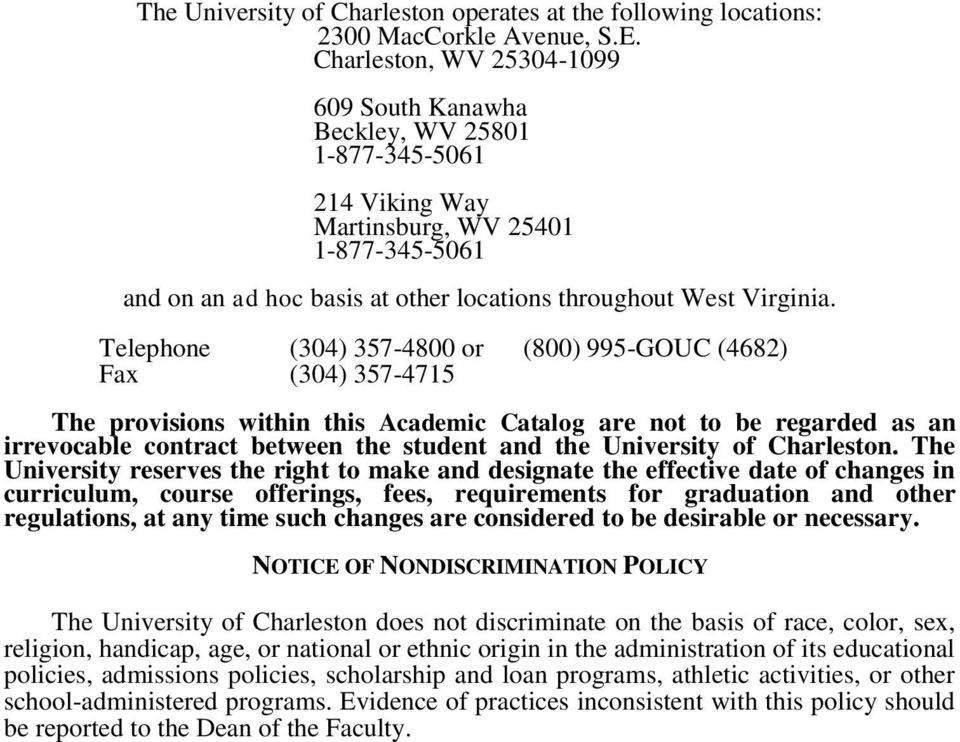
4 TABLE OF CONTENTS ACADEMIC CALENDAR... 7 MESSAGE FROM THE PRESIDENT... 9 THE UNIVERSITY OF CHARLESTON...10 THE CURRICULUM...1 LIBERAL LEARNING DEFINITIONS AND OUTCOMES...14 ASSESSMENT TO DEMONSTRATE LEARNING...16 FIRST-YEAR EXPERIENCE (FYE)...17 OFFICE OF ADMISSIONS...21 ADMISSION REQUIREMENTS ADMISSION AND ENROLLMENT PROCEDURES SUMMER ORIENTATION TUITION AND FEES REFUND POLICY UNDERGRADUATE TUITION ACADEMIC YEAR... 0 HOUSING AND BOARD COSTS ACADEMIC YEAR...1 FINANCIAL AID... ACADEMIC AWARDS GRANTS... 4 EMPLOYMENT... 5 UNIVERSITY OF CHARLESTON SCHOLARSHIPS... 5 LOANS... 5 ADDITIONAL OUTSIDE FINANCIAL AID PROGRAMS... 6 SATISFACTORY PROGRESS FOR FINANCIAL AID... 7 ADDITIONAL SPECIAL REQUIREMENTS STUDENT LENDING CODE OF CONDUCT IDENTITY THEFT PREVENTION POLICY POLICY ON SMOKING AND TOBACCO USE...42 ACADEMIC POLICIES...4 PLACEMENT... 4 MAJORS MINORS COURSES -- DEFINITIONS... 5 COURSE POLICIES PROVISIONALLY ADMITTED STUDENTS, ACADEMIC PROBATION AND ACADEMIC DISMISSAL POLICY... 6 GRADUATION EDUCATIONAL RECORDS University of Charleston Academic Catalog
5 ACADEMIC INTEGRITY ACADEMIC SUPPORT SERVICES...69 AUDIOVISUAL SERVICES CENTER FOR CAREER DEVELOPMENT ACADEMIC SUCCESS CENTER UNIVERSITY OF CHARLESTON LIBRARIES...75 OFFICE OF STUDENT LIFE...75 ATHLETICS AND RECREATION...80 SERVICE ANIMAL POLICY...81 SCHOOL OF ARTS & SCIENCES MORRIS HARVEY DIVISION...84 DEPARTMENT OF HUMANITIES ART COMMUNICATIONS CULINARY ARTS ENGLISH INTERIOR DESIGN DEPARTMENT OF NATURAL SCIENCES AND MATHEMATICS PRE-PHARMACY CONCENTRATIONS PRE-PROFESSIONAL CONCENTRATION BIOLOGY (BIOL) CHEMISTRY (CHEM) CHEMISTRY-BIOLOGY DUAL MAJOR MATHEMATICS, NATURAL SCIENCE, AND PHYSICAL SCIENCE DEPARTMENT OF SOCIAL SCIENCES CRIMINAL JUSTICE EDUCATION 11 HISTORY POLITICAL SCIENCE PSYCHOLOGY SOCIAL WORK DR. EDWIN H. WELCH COLLEAGUE PROGRAM MINOR IN APPLIED LEADERSHIP STUDIES MUSIC MINOR HERBERT JONES SCHOOL OF BUSINESS THREE YEAR DEGREE PROGRAMS ACCOUNTING BUSINESS ADMINISTRATION FINANCE BACHELOR OF SCIENCE ORGANIZATIONAL LEADERSHIP MASTER OF BUSINESS ADMINISTRATION AND LEADERSHIP EXECUTIVE MASTER OF BUSINESS ADMINISTRATION MASTER OF FORENSIC ACCOUNTING University of Charleston Academic Catalog 5

6 MASTER OF SCIENCE STRATEGIC LEADERSHIP SPORTS ADMINISTRATION DOCTOR OF EXECUTIVE LEADERSHIP BERT BRADFORD DIVISION OF HEALTH SCIENCES BACHELOR OF SCIENCE IN DIAGNOSTIC MEDICAL SONOGRAPHY PROGRAM BACCALAUREATE OF SCIENCE NURSING PROGRAM ASSOCIATE IN SCIENCE OCCUPATIONAL THERAPY ASSISTANT PROGRAM ASSOCIATE IN SCIENCE IN RADIOLOGIC TECHNOLOGY BACHELOR OF SCIENCE RADIOLOGIC SCIENCE ATHLETIC TRAINING EDUCATION PROGRAM MASTER IN PHYSICIAN ASSISTANT SCHOOL OF PHARMACY NON-COURSE EQUIVALENCY PROGRAMS COURSE LISTINGS TRUSTEES OF THE UNIVERSITY OF CHARLESTON ADMINISTRATION & STAFF FACULTY INDEX University of Charleston Academic Catalog
7 ACADEMIC CALENDAR Summer 201 Schedule 201SU Date(s) May 6 - August 11 (In-seat) May 28 - June 28 (5 weeks) In-seat July 1 - August 2 (5 weeks) In-seat May 6- August 11 (14 weeks hybrid) May 27th-July 21 (8 weeks on-line) Pharmacy May 6-August 2 Fall 201 Month Date(s) Event August 08/19-10/1 First Fall session on-line classes* 08/26 Classes Begin for in-seat classes September 09/06 Last Day to ADD a Class October 10/7-10/11 09/06 Last Day to DROP a Class without "W" grade 10/17-10/18 10/21-12/1 November 11/25 and 11/26 Midterm Assessment Fall Break Second Fall session on-line classes* 10/1 Last Day to DROP a Class without "WF" grade Follow the Thursday and Friday course schedule 11/28 Thanksgiving Day 11/27- Thanksgiving Break University of Charleston Academic Catalog 7

8 11/29 November 11/28-11/29 Thursday-Friday classes will meet on November 26 and 26 December 12/8 Winter Commencement 12/9-12/1 Finals Week Spring 2014 Month Date(s) Event January 1/6- /2 February 2/24-2/28 March /10- /14 First Spring session on-line classes* 1/1 Classes begin for in-seat classes 1/24 Last Day to ADD a Class 1/24 Last Day to DROP a Class without "W" grade /10-5/2 April/May 4/28-5/2 Midterm Assessment Spring Break Second Spring session on-line classes* /20 Last Day to DROP a Class without "WF" grade Finals Week 5/4 Commencement * Last day to Drop an On-line Class is the Friday of the FIRST week of classes * Last day to ADD an On-line Class is the rd day of the FIRST week of classes 8 University of Charleston Academic Catalog

9 MESSAGE FROM THE PRESIDENT Welcome to the University of Charleston. I am delighted that you are planning to attend UC and want you to know that we are ready, willing, and able to help you achieve your educational goals through 21st century techniques and resources. UC continues to change because the world and our students are constantly changing. You will find the University of Charleston a friendly environment in which to meet new friends, interact with faculty and prepare for a life of opportunity. Our nationally-recognized, outcomes-based curriculum allows students to experience learning in a variety of ways and to master the critical learning outcomes that are most sought after in today s job market. Our six Liberal Learning Outcomes areas are Citizenship, Communication, Creativity, Critical Thinking, Ethical Practice and Inquiry. Opportunities to demonstrate these outcomes are embedded across the curriculum. These skills serve our students and alumni across their professions and in their communities. The information included in this catalog is designed to assist you in navigating the process of earning your degree. You will find contact information, curriculum requirements and other information necessary to make this process easier. We are excited about your future and sincere about our mission to educate each student for a life of productive work, enlightened living, and community involvement. University of Charleston Academic Catalog 9
10 THE UNIVERSITY OF CHARLESTON Our Mission The mission of the University of Charleston is to educate each student for a life of productive work, enlightened living, and community involvement. Productive Work The University prepares students to contribute to society. Their work will vary tremendously, but we hope that each graduate will improve his or her world. Productive work isn't defined by only by acquisition of wealth, but also by the positive impact of the work on the graduate's community and world. Enlightened Living College graduates must possess a broad range of knowledge to thrive in modern society. Graduates should be scientifically, economically, politically, aesthetically, and culturally literate. They should have a sense of history and shared values, and a commitment to moral purpose and personal character. Community Involvement Finally, the University attempts to develop within every student a commitment to involvement in his or her community at local, state, national and global levels. The foundation of our democratic society rests on community involvement, so we want graduates to take responsibility for leadership and initiative in shaping organizations, institutions, and communities. The Mission of the University of Charleston is to educate each student for a life of productive work, enlightened living, and community involvement. The University realizes this mission by assisting each student to: Develop the skills and knowledge necessary to contribute to society and find personal fulfillment through a profession, vocation, or avocation; Develop his or her potential for informed appreciation of and creative contribution to the arts; Develop a commitment to uphold the duties of citizenship through regular service to and effective involvement in his or her community. The University s Core Ethical Values The University Community expects that members working within and students graduating from the University of Charleston will subscribe to the core values of justice, integrity, respect, equality, responsibility, and altruism. History The University of Charleston is an independent, comprehensive institution of higher education located in the capital city of West Virginia. Founded by the Methodist Episcopal Church, South in 1888 as Barboursville Seminary in the rural community of Barboursville, West Virginia, the institution became Morris Harvey College in 1901 to 10 University of Charleston Academic Catalog
11 honor a prominent donor. In 195 the College responded to a request from Charleston businessmen and moved to the state s capital city. As a result of a merger between the Methodist Episcopal Church, North and South, the College disaffiliated from the denomination and became independent in The institution grew between 195 and 1960, due in part to mergers with Kanawha Junior College and Mason College of Fine Arts and Music. On December 1, 1978, the Board of Trustees changed the name of the institution to the University of Charleston to reflect the institution s strong ties to the local community and to recognize the diversity of programs offered by the institution. In the mid-1990s the University made demonstrable student learning its central educational focus. The curriculum was redesigned to incorporate specific learning outcomes, based in the liberal arts, in all academic programs. Successful achievement of these outcomes, in the areas of Citizenship, Communication, Creativity, Critical Thinking, Ethical Practice and Inquiry, is now required of all students seeking a degree. The University of Charleston benefits greatly from its location in the state s capital city and proximity to the state s largest medical, commercial and financial centers, and to major research and manufacturing facilities, all of which provide excellent opportunities for learning experiences outside the classroom. The University, in return, serves the community as a focal point for intellectual, cultural, athletic, and civic events. These interactions between the University and community are vital to the achievement of the University s mission. In January 201 the University of Charleston expanded regionally, adding locations in Beckley and Martinsburg, WV. These new locations provided the opportunity to offer new programs and expand access. The institution s academic programs were further enriched by the development of online and hybrid courses and programs. University of Charleston Academic Catalog 11

12 ORGANIZATIONAL STRUCTURE Administrative Organization The University s senior administrative officers report to the President. They are responsible for the following functions: Regional President Oversees the operation of regional locations and the university s online programs. Executive Vice President & Provost Undergraduate and Graduate Faculty, the Academic Program, Academic Advising, Assessment, the Faculty Center, Institutional Research University Computing, and Audio/Visual Services Executive Vice President & CFO Budget and Institutional Finance, Personnel, Facilities Services, Purchasing, Accounting, Food Services, Catering, and Financial Aid. Vice President for Marketing Distance Education, Marketing and Recruitment of Adult Students and Outreach. Vice President for Admissions Recruitment of In-Seat and International Students, Student Solutions Center, Educational Partnerships, and Military Programs Vice President for Student Development Student Life, Residence Life, Academic Support, Schoenbaum Library, and Athletics Vice President for University Development Annual Fund, Development, Alumni, Fundraising, and Parent Relations Academic Organization The University of Charleston curriculum is delivered by an undergraduate and a graduate faculty. The undergraduate faculty is apportioned among three Schools: the School of Arts & Sciences; the School of Business and Leadership; and the School of Health Sciences. The graduate faculty serve in the Graduate School of Pharmacy, the Graduate School of Business, and the Physician Assistant Program. 12 University of Charleston Academic Catalog

13 THE CURRICULUM UC s outcomes-based curriculum requires each course and degree program to have clear statements about the skills or knowledge a student must demonstrate (competencies) to meet a specific learning goal (outcome). The levels of achievement expected (standard), and how each level of achievement is to be measured (assessment) must also be well-defined. The information assures that students and faculty share an understanding of the work that needs to be done and how it will be judged. This approach provides a rich educational experience. The Liberal Learning Outcomes At the core of the University s curriculum are its Liberal Learning Outcomes (LLOs). To be an educated citizen in the 21 st century and engage in enlightened living, a student must be able to communicate effectively, act ethically, respond aesthetically, and engage in creative thought in his or her professional and personal life. He or she must also be able to think critically and analytically, and be able to locate and evaluate information necessary for discipline-specific research and the pursuit of lifelong learning. To help students acquire these competencies the University of Charleston has developed a curriculum with a solid foundation in the liberal arts. Students must demonstrate achievement in six Liberal Learning Outcome areas: Citizenship, Communication, Creativity, Critical Thinking, Ethical Practice, and Inquiry. Most LLOs must be demonstrated at multiple levels before the outcome is met. Opportunities to practice skills and demonstrate competencies occur in courses and other learning experiences, within and outside the student s major field. Liberal Learning Outcomes are tightly woven into the curriculum in all academic programs. Many students complete external learning activities within their major while at the University of Charleston. Clinical and field experiences, service learning, community service projects and internships all provide insight into a profession or practical experience in the student s chosen field of productive work. These experiences, inside and out of the classroom, create an integrated educational experience and provide evidence that each student leaves the University prepared to live a life of productive work, enlightened living, and community involvement. There are a variety of ways students can demonstrate achievement of our LLOs. These are described in the Academic Policies section of this Catalog. University of Charleston Academic Catalog 1

14 LIBERAL LEARNING DEFINITIONS AND OUTCOMES 1. Citizenship the rights and responsibilities that are associated with social, political, and economic communities that an individual demonstrates as an engaged and knowledgeable member of a society. 1.1 The graduate demonstrates an understanding of social, political, and economic institutions. (Civic Literacy - foundational) 1.2 The graduate demonstrates an understanding of global awareness. (Global Literacy mid-level) 1. The graduate demonstrates an understanding of key historical patterns in human civilization and their relationship to the present. (Historical Literacy mid-level) 1.4 The graduate demonstrates active and responsible citizenship. (Civic Involvement advanced level) 2. Communication the ability to effectively send and receive messages. 2.1 The graduate writes effectively for a variety of audiences and purposes. Demonstrate at foundational level Demonstrate at mid-level Demonstrate at advanced level 2.2 The graduate speaks effectively to a variety of audiences for a variety of purposes. Demonstrate at foundational level Demonstrate at mid-level Demonstrate at advanced level 2. The graduate reads effectively.. Creativity the process of generating original ideas or making new connections among existing ideas for the advancement of human endeavor..1 The graduate is able to critique the creative product in traditional creative disciplines. Demonstrate at foundational level (1 experience).2 The graduate engages in the study or production of a body of work. Demonstrate at mid-level (2 experiences). The graduate demonstrates creative ability in the major. Demonstrate at advanced Level (1 experience) 4. Critical Thinking the process of reflection, reasoning and imagining, through which the individual willingly, systematically, and habitually examines and explores statements, problems, issues, beliefs, and social constraints. The graduate demonstrates these competencies at each level: (1) an attitude of intellectual inquiry; (2) information literacy; and () critical, analytical, and reflective thinking skills [metacognition]. 4.1 Foundational level (2 experiences) 4.2 Mid-level (4 experiences) 14 University of Charleston Academic Catalog

15 4. Advanced level (1 experience in the major and 1 experience outside the major, i.e. Senior Capstone UNIV 459.The LLO lives on the course in the major) 5. Ethical Practice the disposition to treat others with honesty, fairness, justice, integrity, and altruism within communities and areas of professional service. The graduate demonstrates these competencies at each level: (1) an understanding of their ethical beliefs and the ethical beliefs of others; (2) the ability to identify ethical conflicts; and () the ability to make ethical decisions. 5.1 Foundational level (1 experience) 5.2 Mid-level (2 experiences) 5. Advanced level (1 experience) 6. Inquiry the application of concepts and tools to create, verify and communicate new knowledge. 6.1 The graduate will understand and apply basic principles of science and mathematics. 6.1MThe graduate demonstrates understanding and competence in applying the fundamental theories and laws of mathematics. Foundational level - Mathematics (1 experience) 6.1S The graduate demonstrates understanding and competence in applying the fundamental theories and laws of science. Foundational level - Science (1 experience) 6.2 The graduate will analyze and interpret data in a variety of contexts using mathematical and scientific principles. Mid-level Application of Mathematics and Science (1 experience) 6. The graduate will create new knowledge using principles of inquiry appropriate to his/her discipline. Advanced level Research in Major/discipline (1 experience) Note: All Liberal Learning Outcomes may also be demonstrated through a Roundtable-approved Independent Learning Plan (ILP). University of Charleston Academic Catalog 15
16 ASSESSMENT TO DEMONSTRATE LEARNING The University of Charleston systematically measures students learning using a variety of assessment strategies. Results of these assessments are used to strengthen academic programs and improve learning and teaching. They provide information about the level of a student s skills or knowledge and can be used to measure growth of learning over time. Assessments include, but are not limited to, those described below. Placement Assessments Scores on ACT or SAT examinations, when available, are used to identify weaknesses in basic academic skills. Other assessments may be used for this purpose when ACT or SAT scores are not available. When weaknesses are identified, students are required to participate in skill building sessions or classes designed to increase performance in such core areas as writing, reading, or mathematics. Some academic programs, such as those in the natural sciences, also have departmental placement examinations to assure that students are placed in appropriate courses. These assessments are generally administered during freshmen and transfer orientation sessions. Program Admission Assessments Some academic programs, including Teacher Education and some Health Science programs, require passing scores on specific, standardized tests before students are admitted to the programs. In addition to these tests students must meet other admission requirements as stated by the program. A student may be admitted to the University and still be denied admission to a specific program if the admission requirements are not achieved. Students should check with program faculty about these requirements. Assessment of New Students In order to establish a baseline of learning, incoming students may be required to take assessments. These are typically administered online, during Orientation or in UNIV 101 and UNIV 20. Students who miss taking these assessments because of late admission must make an appointment to take the assessments before the third week of classes. Contact your academic advisor for more information. Senior Assessments In order to measure the effectiveness of our academic program, graduating students are required to participate in standardized examinations as a condition for graduation. Participation is tracked on the Program Evaluation (degree audit). These assessments are separate from and in addition to the Comprehensive Examinations required by each academic program. 16 University of Charleston Academic Catalog

17 FIRST-YEAR EXPERIENCE (FYE) Staci Ballard, Director New Student Orientation Students begin their academic career at the University of Charleston with Orientation. During Orientation, students begin to make friends and feel at home in a new environment. The Office of Student Life oversees all activities of the orientation process, working with faculty to integrate the curricular and co-curricular elements of the experience. The first day of New Student Orientation is also the first day of classes for first-year students. The students will meet faculty and begin the work of meeting the Liberal Learning Outcomes. Students are expected to participate in the Summer Orientation and Registration (SOAR) described elsewhere in the Academic Catalog. The two processes work in tandem to orient the student to the academic and practical sides of life at the university. The First Year Experience Courses (FYE) The first year curriculum at the University of Charleston combines academic coursework with co-curricular and residential life activities to create a rich First Year Experience (FYE). The student begins his or her liberal arts education and the work of meeting Liberal Learning Outcomes through participation in two or more FYE classes over two semesters. Students generally participate in one FYE class in the fall semester and one FYE class in the spring semester. The FYE classes examine the foundations of the Social Sciences, Humanities, and Biological Sciences and serve to build the student s communication, and critical thinking skills. They also serve to orient students to the scholarly process. Assignments in the FYE classes are designed to help students meet foundational requirements for achievement of some LLOs. For example, writing assignments successfully completed are designed to fulfill the requirements for foundational Communication (COMM 101 and COMM 102 writing portfolios.) Mentors and Major Advisors Incoming students are paired with a faculty mentor, who serves the student as an informed guide, as an advocate, and as a role model. Incoming students who have declared a major are also assigned a major advisor who provides advice on appropriate coursework or other issues associated with a particular academic discipline or major field of study. The major advisor will change if a student changes his or her major. If the student has not declared a major, the mentor serves as advisor until a choice is made. University 101 & 102 UNIV 101 and UNIV 102 are one-credit courses designed to help students master the complexities of University life, understand the academic program, and deal with personal and social issues presented by a newly independent living status. Each student meets at least one hour each week with his or her mentor, Mentoring Group, and a peer educator. University of Charleston Academic Catalog 17
18 Peer educators are student leaders selected to assist new students adjust to University life and connect with campus programs and co-curricular activities. Successful completion of all UNIV 101 and 102 activities and assignments provides students with written, spoken, and other work products that can be used to meet some portfolio requirements for completing Liberal Learning Outcomes. Co-Curricular Activities The Office of Student Life and various campus organizations offer a variety of experiences that support the academic program. Participation in some of these activities may be required for particular courses or programs of study. In some cases, significant participation may be used as evidence that a student has demonstrated one or all of the competencies for a particular Liberal Learning Outcome. A Typical First Year Schedule The first year s strong introduction to the liberal arts is accompanied by introductory coursework in the academic discipline or major field. The specific classes will vary from major to major, but a typical schedule will look like the one below. Fall Semester Credit Spring Semester Credit FYE Class or 4 FYE Class or 4 COMM 101 (Embedded) COMM 102 (Embedded) UNIV UNIV Course in Major COMM 10 (Embedded) LLO course UNIV 112 (Embedded) 1 Course in Major Course in Major Course in Major Total: 16 or 17 Total: 16 or 17 COMM 101 and 102 Freshman Writing courses are foundational-level English composition portfolios. There are three ways to demonstrate foundational writing competency. Work done in the FYE classes may be submitted as a portfolio, the course may be taken as a free-standing course, where competency is demonstrated through successfully completing assignments or a student may prepare and submit a portfolio of their writing for assessment. A fee will be charged for the last option. Refer to Policies for Credit for Prior Learning for more information. COMM 10 is an oral communication (speech) portfolio. Opportunities for demonstrating competency of COMM 10 are embedded in UNIV 102 / UNIV 20. Students may also demonstrate competency by successfully completing the COMM 10 course online or by preparing and submitting a video portfolio for assessment. A fee will be charged for the last option. Refer to Policies for Credit for Prior Learning for more information. UNIV 112 is a set of experiences delivered in UNIV 102 / UNIV 20 that acquaints students with the traditional theories of ethical decision making. 18 University of Charleston Academic Catalog

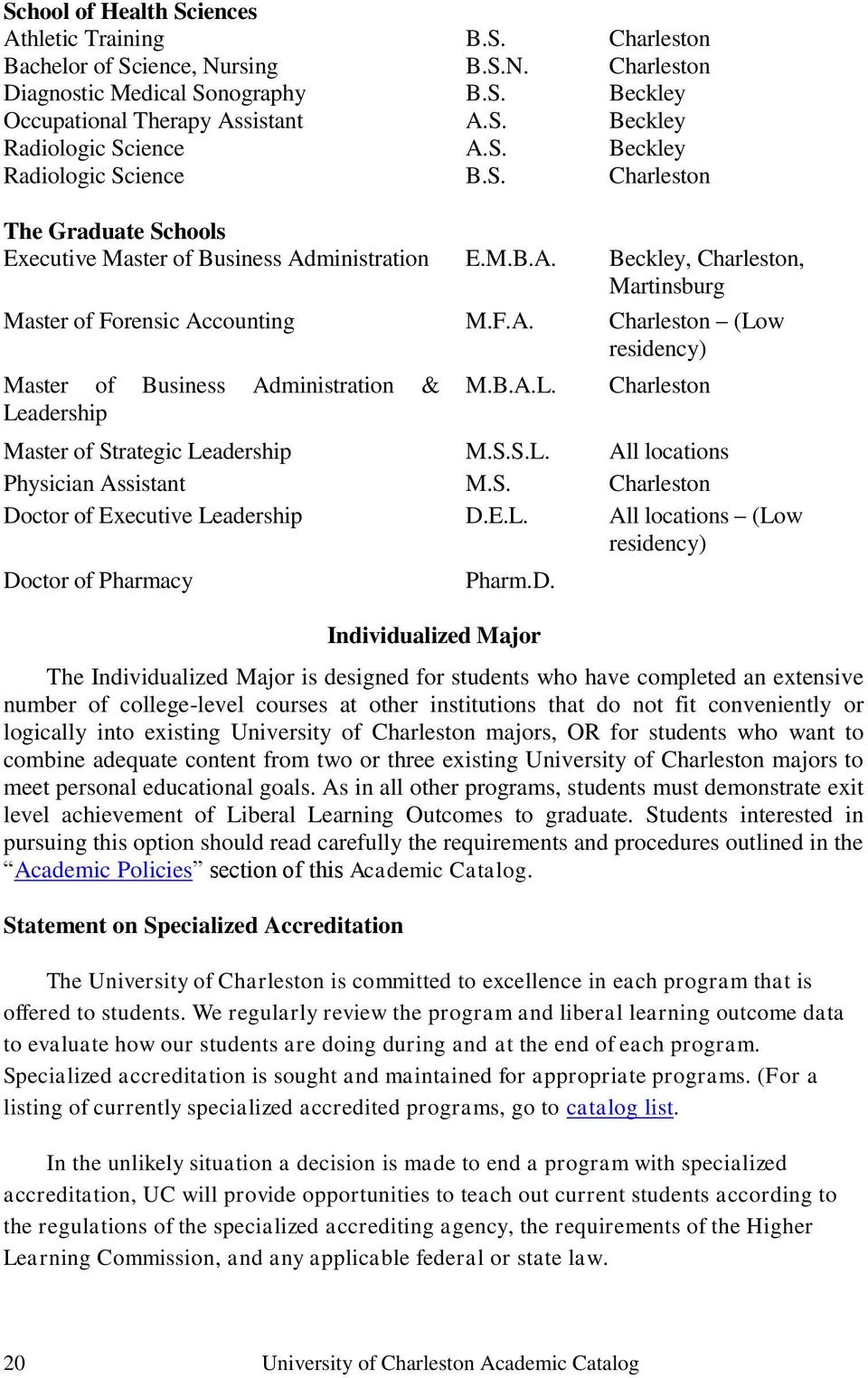
19 Degree Programs Minors, available in many of these fields, are detailed in program descriptions. Name of Major Degree Location University-Wide Program General Studies B.A./B.S. All Locations Individualized Major B.A./B.S. All Locations School of Arts & Sciences Art B.A. Charleston Graphic Design Studio Art Biology B.S. Beckley, Charleston Pre-Pharmacy Pre-Professional Chemistry B.S. Charleston Pre-Pharmacy Pre-Professional Chemistry-Biology Dual Major Communications B.A. Charleston Digital Media Production Public Relations Criminal Justice B.S. Beckley & Online Culinary Arts A.S. / B.S. Beckley Education Charleston Education Studies B.A. Elementary Certification B.A. Physical Education, Health & Wellness B.S. Certification Special Education Certification Certification English B.A. Charleston History B.A. Charleston Interior Design B.A. Charleston Political Science B.A. Charleston Pre-Law Public Policy Psychology B.A. All locations Psychology B.S. Beckley, Charleston Social Work B.S. Beckley School of Business and Leadership Accounting B.S All locations Business Administration B.S. All locations Finance B.S. All locations Organizational Leadership B.S. All locations Sport Administration B.S. Charleston University of Charleston Academic Catalog 19

20 School of Health Sciences Athletic Training B.S. Charleston Bachelor of Science, Nursing B.S.N. Charleston Diagnostic Medical Sonography B.S. Beckley Occupational Therapy Assistant A.S. Beckley Radiologic Science A.S. Beckley Radiologic Science B.S. Charleston The Graduate Schools Executive Master of Business Administration E.M.B.A. Beckley, Charleston, Martinsburg Master of Forensic Accounting M.F.A. Charleston (Low residency) Master of Business Administration & Leadership Individualized Major The Individualized Major is designed for students who have completed an extensive number of college-level courses at other institutions that do not fit conveniently or logically into existing University of Charleston majors, OR for students who want to combine adequate content from two or three existing University of Charleston majors to meet personal educational goals. As in all other programs, students must demonstrate exit level achievement of Liberal Learning Outcomes to graduate. Students interested in pursuing this option should read carefully the requirements and procedures outlined in the Academic Policies section of this Academic Catalog. Statement on Specialized Accreditation M.B.A.L. Charleston Master of Strategic Leadership M.S.S.L. All locations Physician Assistant M.S. Charleston Doctor of Executive Leadership D.E.L. All locations (Low residency) Doctor of Pharmacy Pharm.D. The University of Charleston is committed to excellence in each program that is offered to students. We regularly review the program and liberal learning outcome data to evaluate how our students are doing during and at the end of each program. Specialized accreditation is sought and maintained for appropriate programs. (For a listing of currently specialized accredited programs, go to catalog list. In the unlikely situation a decision is made to end a program with specialized accreditation, UC will provide opportunities to teach out current students according to the regulations of the specialized accrediting agency, the requirements of the Higher Learning Commission, and any applicable federal or state law. 20 University of Charleston Academic Catalog
21 OFFICE OF ADMISSIONS Joan Clark, Vice President for Admissions Admission Philosophy The University of Charleston seeks to enroll students who possess the potential and motivation to take full advantage of our unique curriculum, be successful academically, and contribute to the University community. Admission is based on academic records, evidence of leadership and community involvement, and demonstrated personal qualities of the applicant. A visit to campus, scheduled with the Office of Admissions in Charleston or Beckley, is strongly recommended for all in-seat applicants. To schedule a campus visit please contact us at (GO UC) or Standardized Tests Results of the American College Test (ACT) or the Scholastic Assessment Test (SAT) are required for certain classes of applicants and/or for certain degree programs, as described below in the Admission Requirements. Most individuals take the ACT or SAT on a national testing date. However, the University of Charleston is authorized to administer the ACT Residual Test to applicants who need test results to complete their application to the University of Charleston. Such results may be used only at the University of Charleston. ACT Residual Test results from another institution will not be recognized for admission to the University of Charleston. Special Admission Requirements Some programs, most notably Health Science and Education, have special and separate admission requirements. Applicants should consult program descriptions in this Catalog for a complete description of any special or additional requirements specific to the program or programs in which they are interested. Admission Requirements General Freshman Admission A student applying for general freshman admission may submit an application any time after the completion of six semesters of high school. Admission requirements are: Minimum 2.25 academic grade point average (on a 4 point scale); or GED score of 500 (50 if taken prior to 1/1/200); and Minimum composite ACT score of 19 and / or SAT score of 900 on the combined Reading and Mathematics sections the writing sample sections of the ACT and SAT may be used to determine placement. Notes regarding the American College Test (ACT) and the Scholastic Aptitude Test (SAT): Results of the ACT or SAT are required of those applicants who graduated from high school (or would have graduated, for those who earned a GED) within five years of the time of application. For applicants removed from high school for over five years, these tests are highly recommended. If appropriate, a Residual ACT can be offered by the Office of Admissions if requested by the applicant in a timely fashion. If such an University of Charleston Academic Catalog 21
22 applicant elects not to take the ACT or SAT, he or she may be placed in foundational courses (specifically, math and science) upon successful admission and subsequent enrollment. These tests are also required for all students seeking admission to a health sciences program, and they may be requested of others. The writing sample sections of the ACT and SAT will not be used to determine admission status, but may be used to determine placement. Applicants must submit the following documentation for consideration by Admissions staff: Completed Undergraduate Application for admission; $25 application fee; Official secondary school records documenting completion of 15 units of academic courses with grades indicating intellectual ability and promise; High school transcripts or official GED results with an average score of 5 (prior to January 1, 200) and 500 or more on the new test (after January 1, 200), if applicable; A campus visit, either in group format or as an individual, is strongly recommended; A personal essay and resume are highly recommended but not required unless the student will be competing for scholarship awards. Student essay may be about their potential for leadership and/or the importance of community involvement. A record of active participation in school or community organizations or events throughout high school is highly recommended. Applicants accepted by the University of Charleston must submit proof of graduation to the University s Office of Admissions before they will be allowed to enroll. Regional campuses may require a general assessment test prior to enrollment Home School Admission The University of Charleston makes every effort to accommodate the special circumstances of home school students during the admissions process. Minimum admission requirements include: If you are under the umbrella of a diploma-granting organization, you will need to submit evidence of the coursework completed and your level of performance; In the absence of such a document, you will need a detailed portfolio comprised of the breadth of work you have completed to help us evaluate your level of preparation for college-level work (e.g. research project, resume, reading list, community service, athletic and/or artistic endeavors and study abroad); Official transcript from an accredited university or college (if applicable); AP tests (if applicable); ACT/SAT test scores; Essay; letters of reference; and An on-campus interview 22 University of Charleston Academic Catalog
23 General Transfer Admission Applicants who have earned 12 or more college-level credits (generally, courses numbered 100 and above) at another institution, have a minimum 2.25 grade point average (on a 4.0 point scale) and are in good standing at the institution last attended must submit the following documentation for consideration by Admissions staff: Completed online or paper Undergraduate Application for Admission; $25 application fee; Official transcript from EACH university or college previously attended; Submission of the Application for Re-Admission and/or Transfer Form; (students must submit signatures from the previous institutions Dean of Student Life and Financial Aid Director); Students WHO do not submit all required transcripts by the requested date may not be able to receive financial aid until all required college transcripts are received; and Applicants who have earned fewer than 12 college level credits must also submit the documentation required of general freshman applicants. Regional campuses may require a general assessment test prior to enrollment Prospective transfer students may send their college transcripts at any time during their current college enrollment for transcript evaluation by the University of Charleston. Applicants who are accepted at the University of Charleston must submit a final official transcript to the Office of Admissions before enrollment. Transfer applicants who have been accepted for admission will have the opportunity to review the evaluation of his or her transcript after review by the Registrar. Only courses earned from a regionally accredited college of university will be considered for transfer. Only courses with earned grades of C or better will transfer unless a transfer agreement exists between the University of Charleston and another institution. No grades are recorded for courses accepted in transfer. A student s grade point average at the University of Charleston will be based only upon credits earned at the University of Charleston. Transfer Equivalency for Liberal Learning Outcomes (LLO) Courses with a direct equivalency to a University of Charleston course carrying LLO designations will automatically receive LLO credit; and Students must bring requests for non-equivalent courses to the appropriate LLO Roundtable for approval. The necessary form and a description of the process for submission of these requests are available in the Student Solutions Center. Re-Admission Students Individuals who have attended Morris Harvey College/University of Charleston as a degree-seeking student and have left the University in good academic standing may be considered for Re-Admission. Students who have left the institution while on academic probation must seek and gain permission from the Registrar for readmission; To be re-admitted to the University, the student must complete an Application for Re-Admission, available in the Office of Admissions. The student must be part University of Charleston Academic Catalog 2
24 of the Re-Admission process, be assessed, and approved by the Vice President for Student Development, the staff of the Student Solutions Center, and the Registrar. The student must be in good standing with each of these offices to gain readmission. Applicants who have attended any college or university since leaving Morris Harvey College/University of Charleston are considered transfer students, and must use the transfer admission application and process. International Student Admission International student applicants must follow the requirements for general freshman or transfer admission, depending on the desired enrollment status. English Exam Requirements International Students who do not take the ACT or SAT exams must submit a standardized English test score. The College Board s Test of English as a Foreign Language (TOEFL) and the International English Language Testing System (IELTS) exams are accepted. Other standardized English exams are accepted only upon preapproval from the Director of International & ESL programs. For approval, please submit documentation with your application to Julie Rogers, Assistant Director of International Enrollment, at [email protected]. A minimum score of 550 for the paper-based test (PBT) / 61 for the Internet-based test (IBT) on the TOEFL or the equivalent IELTS score of 6.0 is required generally. Conditional admission is available to applicants who have not achieved the minimum English proficiency standards through our bridge and intensive English as a Second Language (ESL) programs. In addition to semester-long ESL programs, our summer intensive ESL Program is found at When international students, whose primary language is not English, arrive on campus, they must take an English diagnostic exam, which includes a writing sample. The results will be used for placement purposes. Based on their scores, some students will be required to enroll in ESL courses. Once placed in this program, all required ESL courses must be passed with a grade of C or better. Other International Admissions Requirements Though American College Test (ACT) or Scholastic Assessment Test (SAT) results are required of international students whose first language is English, applicants should submit the results when they have taken either test. These results will help Admissions staff make an informed decision about acceptance. International students wishing to receive transfer credits for any college or university level work completed prior to arrival at the University of Charleston must have all credits evaluated by an international transcript evaluation service. Please contact the appropriate service for your needs. All official secondary school and college/university scholastic records submitted in support of your application should include English translations. English translations do not need to be official but they should be literal (word-for-word, not interpretive) translations. 24 University of Charleston Academic Catalog
25 The University of Charleston recommends that students seek foreign educational credential evaluations from NACES members. NACES is an association of private foreign educational credential evaluation services committed to formulating and maintaining ethical standards in the field of foreign educational evaluation. A list of these evaluation services can be found at Proof of adequate financial resources to support study in the United States is required to be provided an application for student visa. An official statement specifying these resources is required before an international student may gain entry into the United States for study. If the financial documentation is not in the applicant s name, the account holder or sponsor must submit a Letter of Support stating their relation to the applicant and verifying they are financially responsible for the entirety of the applicant s studies while enrolled at the Institution. Provisional Admission/Admission by Academic Contract Applicants whose GPA, GED, ACT, or SAT values/scores (or any combination thereof) fall below the stated minimums must submit an essay (at least one page in length, single spaced) containing the following information: Explanation of Scores; Description of Applicant s College Readiness and Preparedness; Career Goals; and Other Items the Applicant and Admissions Counselor Deem Relevant to Application. An applicant can choose to submit this essay at the time of application. However, the Office of Admissions will formally request it after receipt of all required materials necessary for review. Throughout the application process, the Office of Admissions first preference is for students to improve their GPA (during their remaining high school courses) or test scores (by retaking the ACT or SAT). Additionally, the Office of Admissions may request an interview with the applicant. Neither the essay nor the interview guarantees admission. Applicants who demonstrate the ability to be successful in a university environment may be offered Admission by Academic Contract. The contract, which must be signed by the student and parents or guardians as appropriate, will limit the student to a maximum of 14 credits of prescribed courses during his or her first semester. If the student achieves a grade point average of 2.0 or higher in the first semester, the contract arrangement will be terminated. If the student does not achieve a 2.0 grade point average, the student will be subject to the University of Charleston s probation and dismissal policies. University of Charleston Academic Catalog 25
26 Special Student / Non-Degree Admission Students who wish to pursue academic courses for purposes other than a University of Charleston degree can be admitted to the University as special students. Such students must be in good academic standing in all previously attended institutions, and are subject to all academic rules and regulations of the University of Charleston. Special students should possess the requisite academic background for college-level work. A maximum of 15 credit hours may be accumulated as a special student unless the Office of Admissions makes an exception based on individual circumstances. If a special student later applies to be a degree student he or she must complete the application process for general or transfer admission, whichever is applicable. To obtain permission to enroll as a special student or a non-degree student, applicants contact the Student Solutions Office. One of the following statuses may be granted: Audit Admission - Most courses at the University of Charleston can be audited (taken for no college credit). Enrollment requires submission of a Non-Degree Student Application. Enrollment is contingent upon class size and availability. Once a course is audited it may not be taken again for credit. Transient Student Admission - Students applying with permission from their home college to transfer course credit are encouraged to enroll. A Transient Student Form must be completed along with a Non-Degree Student Application. Enrollment is contingent upon class size and availability. High School / University Dual Enrollment - A student may choose to be enrolled in both high school and college simultaneously. After completion of the sophomore year in high school, a student is eligible to apply for special admission to the University to enroll in freshman-level coursework, provided the student is concurrently enrolled in high school. Students applying for concurrent admission must submit the following documentation for consideration by Admissions staff: o Completed Non-Degree Student Application; o $25 application fee; o Official copy of high school transcript showing evidence of a.0 grade point average (on a 4.0 scale); o Minimum composite ACT score of 19 and/or SAT I score of 900 on the recentered SAT; the writing sample sections of the ACT and SAT may be used to determine placement (PLAN or PSAT equivalents will be accepted); and o Written recommendation from his or her high school principal or guidance counselor. The student must consult his or her high school guidance counselor to select the course(s) to be taken, which must supplement and not overlap the high school program. A student may take a maximum of two courses per semester. The Office of Admissions must approve participation each semester. The University of Charleston has two semesters: the traditional fall and spring semesters, and a variable number of fiveweek summer semesters annually. Course work done at the University by a pre-college student may count toward the high school diploma if approved by the student s high school. The course work will be credited toward a University of Charleston degree for those who subsequently enroll as regular students and may be evaluated for credit toward 26 University of Charleston Academic Catalog
27 a degree at other accredited postsecondary institutions. Enrollment is contingent on class size and availability. Regular Non-Degree Includes individuals who have already earned a bachelor s degree or more but who wish to enhance job skills, seek additional academic certification or prepare for graduate school. This category also includes individuals who have not completed a degree but who wish personal or professional enrichment. Enrollment requires submission of a Non- Degree Student Application each semester. Enrollment is contingent upon class size and availability. Students will not be able to register for courses until the week prior to the beginning of classes. Admission and Enrollment Procedures Once the applicant has submitted the application and other necessary documentation to the University of Charleston, the professional staff carefully review the information and make one of four decisions: The student is granted general or contracted (provisional) admission to the University of Charleston; The admission decision is delayed and additional information is requested from the student, for example, final grades or test scores; The student is granted conditional admission until the pending documentation is received and the student gains general admission status; and The student is denied admission. If the decision is delayed, a decision will be made upon receipt of the additional information. Most admission decisions are made on a rolling basis and applicants are usually notified within 5 days of receipt of the completed credential file. Individuals seeking admission to Health Science and Education programs should refer to the specific program descriptions in this Catalog for information on special admission requirements. After an offer of admission to the University of Charleston is made, the student must remit a $100 enrollment deposit. Students must remit the deposit upon acceptance of a financial aid package and prior to pre-registering for classes, unless special arrangements have been made with the Vice President for Admissions. This deposit will be credited to the first semester s tuition. If the applicant requests campus housing, (freshmen and sophomores must live in the residence halls if their permanent address is outside a 60-mile radius), a $100 housing security deposit must also be remitted by the deposit deadline. This is refundable at the conclusion of campus residency providing the student has no unpaid University charges and no damage to rooms or common areas has occurred. Both deposits are refundable upon written request, until May 1 for fall semester enrollment. After this date, no deposits are refunded. For spring applicants, no deposit refunds will be given after December 1 st, but the deposits may be deferred for use in the following fall semester if the University received a request from the student, in writing, before the spring semester begins. University of Charleston Academic Catalog 27
28 Summer Orientation At different points in the summer, new students are invited to attend a required Summer Orientation program. During this Orientation, students will obtain their electronic access to campus resources (including an official UC account), begin to establish relationships with faculty, begin participation in the summer reading program, tour residence halls, and receive a schedule of classes for the fall semester. Students will also have the opportunity to talk with faculty in their anticipated major. The Orientation is designed to provide a solid start to students career at UC and to encourage students to begin to experience the Living/Learning Community of which they are a part. Day-long Orientations and an optional overnight stay are available. Students will receive information and be asked to identify an Orientation date in the spring. Summer Orientation for Residential and Commuting Students At different points in the summer, new students are expected to attend a Summer Orientation and Registration (SOAR) program. During this Orientation, students will obtain their electronic access to campus resources (including an official UC account), begin to establish relationships with faculty, tour residence halls, and receive a schedule of classes for the fall semester. Students will also have the opportunity to talk with faculty in their anticipated major. SOAR is designed to introduce students to the academic and social life of the university. Day-long Orientations (Express SOAR) and an optional overnight stay are available. Accepted students will receive information about SOAR dates. Orientation for Online Students Online students are required to complete an online orientation module. TUITION AND FEES For Fall 201, the undergraduate tuition rate for Charleston based students is $19,500 for up to 18 credit hours. Any hours over 18 will be billed at $400 per credit hour. For all other students and locations, the tuition rate is per credit hour based on course registration. Full-time tuition is viewed as a lump sum payment for access to University faculty, facilities and resources. There are no general or comprehensive fees. Some students have modest charges for clinical or laboratory supplies, excessive printing, standardized tests, lost or damaged items, overdue library fines, parking fee, etc. However, students should keep in mind that registering for, and then withdrawing from, courses may impact Satisfactory Progress for Financial Aid. For this reason the student, in consultation with his or her advisor and/or other appropriate University officials, should determine an appropriate credit load, based on knowledge of his or her own personal character and ability. Please see the section on Academic Policies for more information on Semester Hour Limitations. Enrollment Deposit All new students are required to pay an enrollment deposit of $100 and a housing security deposit of $100. New full-time commuting students pay only the $100 tuition deposit. Part-time students pay deposits upon acceptance of financial aid or preregistration. Enrollment deposits are credited to student accounts and are applied to 28 University of Charleston Academic Catalog
29 charges upon registration. Housing assignments will not be made until the housing security deposit is received. Deposits are non-refundable after May 1 for the fall semester, and after December 1 for the spring semester. Student Costs Specifics of tuition, fees, room and board, and other costs are shown in the following sections. The student should be aware that these charges do not include the cost of books, software, or other educational supplies needed for coursework, or the cost of travel and personal spending. A reasonable estimate for the cost of books is $1,500 for the year (two semesters). The cost of books may be higher for those enrolled in Science or Health Science programs. Tuition and Fees are payable in full prior to the beginning of each semester at a time specified by the University of Charleston. No student will be permitted to graduate, register for succeeding semesters, or receive an official transcript until all charges are paid. A student s payment record is part of the student s educational record. Promptness in meeting financial obligations is expected. Adjustment of Accounts Students withdrawing from courses will be charged according to the date on which the drop slip is filed with the Student Solutions Center. Exceptions are made when a student is hospitalized or physically incapacitated. A medical doctor s written statement is required before any adjustment is made. The Registrar will determine the date of last attendance. Students cannot receive charge adjustments until they have officially withdrawn through the Student Solutions Center. Students will be responsible for any balance due at the time of withdrawal. REFUND POLICY Deposits and Laboratory Fees Application fees, enrollment deposits, and class and laboratory fees are not refundable. Housing security deposits will be refunded at the conclusion of campus residency providing the student has no unpaid University charges and no damage to residence hall rooms or common areas has occurred. Tuition Refunds for fall and spring semesters will be made according to the following schedule. For full-time students, i.e., 12 or more credit hours, no charges will be assessed if they withdraw by the first day of scheduled classes for the term. A 10% charge will be assessed to students who withdraw on the second and third calendar day of scheduled classes. A 50% charge will be assessed to students who withdraw on the fourth, fifth, and sixth calendar day of scheduled classes. Full charges will be assessed to students who withdraw after the sixth day of scheduled classes. The tuition refund policy for full- University of Charleston Academic Catalog 29
30 time students also applies to part-time students with one change. For part-time students, day one of the term is the first day for which they have a scheduled class. For summer school sessions, no charges will be assessed to full-time or parttime students who withdraw before the first scheduled class meeting day for the course from which they wish to withdraw. If students withdraw by the end of the third calendar day of the session, students may obtain a 75% refund. Full charges will be assessed to students who withdraw after that day. Students who are pre-registered and decide not to attend the University of Charleston must contact the Student Solutions Center to have his or her name removed from course rosters. The date and time of this communication will determine the amount of tuition that will be charged. A student dismissed for disciplinary reasons will receive no refund of any charges, except for board and room, which would be proportionate to the number of days of the term remaining after the university ID is surrendered. Housing and Board Students who move out of University of Charleston housing during the first 20 days after the last day of regular registration will have room costs pro-rated on a week-byweek basis. Students vacating University housing after this time will receive no housing refund, but will receive a refund from the Meal Plan if requested by the Director of Residential Life. UNDERGRADUATE TUITION ACADEMIC YEAR Pre-registered students are billed and payment is due two weeks before the semester begins. Full payment for students who are not pre-registered is due at the time of registration, unless other arrangements have been made through the Student Solutions Center. Students unable to pay the required tuition are responsible for contacting the Student Solutions Center prior to the first day of class to have his or her name deleted from course rosters. See also Catalog sections Change of Course and Withdrawal, Refund Policy, and Financial Aid. Full-Time Tuition Academic Year New Summer/Fall 2012 students: $9,750 per semester for up to 18 credit hours. (Charleston based students only) Per credit hour charge based on course registration (All other students and locations) Students must register for 12 or more credits to be considered full-time. Part-Time Tuition Academic Year Students registered for 1-11 credits are considered part-time. Part-time tuition is based on access to resources, just as is full time tuition. Costs for part-time enrollment increase as the number of credits the student is attempting approaches the normal load for 0 University of Charleston Academic Catalog
31 a full-time student, because the use of University resources also approaches that of a fulltime student: 1-7 credits in arts, sciences, and business $ 410 per credit 1-7 credits in nursing $ 900 per credit 8-11 credits all programs $ 900 per credit Senior Citizen Rate (per course, undergraduate only) $ 160 per course Senior Citizen Rate The University of Charleston offers a special Senior Citizen Rate to persons age 60 and above enrolled as either degree-seeking or non-degree students. A person who elects this option can receive the Senior Citizen Rate for two undergraduate courses per semester. Students wishing to enroll in more than two courses per term must pay the regular undergraduate part-time tuition rate for any additional courses. Persons wishing to enroll using the Senior Citizen Rate may not register until the first week of classes. Enrollment is contingent upon class size and availability. For rates applicable to other special groups, such as military personnel, contact the Student Solutions Center. HOUSING AND BOARD COSTS ACADEMIC YEAR Housing Rates Cost Per Semester East Apartments (Graduate Student Housing Only) Efficiency Apartment Two Bedroom $, $, Four bedroom $,50.00 Married / Large Single $4,00.00 Brotherton Hall (Non-Smoking, Alcohol Free Residence Hall) Double-Double Room Middle Hall (Non-Smoking, Alcohol Free Residence Hall) Double-Double Room Apartments (four residents per apartment) Suites (four residents per suite)* *Available on a limited basis Ratrie Hall (Non-Smoking, Alcohol Free Residence Hall) Double-Double Room Super Single Room* Apartments (four residents per apartment)* $2, Meal Plan $2, Meal Plan $2, Meal Plan $2, Meal Plan $2, Meal Plan $2, Meal Plan $2, Meal Plan University of Charleston Academic Catalog 1
32 Hogan Hall UC-Beckley-(Non-Smoking, Alcohol Free Residence Hall) Double Single Cost Per Semester $ Meal Plan** $1, Meal Plan** Room rates include basic television cable service, basic telephone service, and wired and wireless Internet. *Available on a limited basis **Available for the Academic Year Only Summer Session room charges will be based on contract terms at the time of reservation Board Rates During the fall and spring semesters, three meals are offered daily except on Saturday and Sunday, when brunch and dinner are served. The cafeteria closes during vacations, including Thanksgiving, Winter Break, and Spring Break. Meals between semesters are not included in the Board Rates. Students who reside in University of Charleston housing are required to participate in a meal plan unless they live in East Apartments, though they are available for purchase by other students as well. West Virginia sales tax on meals is charged to the student and collected by the University of Charleston on behalf of the state. First Year Student options: Plan #1 19 meals per week Plan #2 14 meals per week plus $225 Eagle Card Credit* Plan # 14 meals per week Upperclassmen may also choose from the following: Plan #4 10 meals per week plus $225 Eagle Card Credit* Residents residing in an apartment may also choose from the following: Plan #5 5 meals per week plus $225 Eagle Card Credit* Plan #6 5 meals per week Residents residing in Hogan Hall, UC-Beckley, have one choice for a meal plan: Meal Plan Open for use any time until allotted amount is used Cost Per Semester $2, tax $2, tax $1, tax $1, tax $ tax $ tax $1, tax *Eagle Card Credit is accepted in the Coffee Tavern. 2 University of Charleston Academic Catalog
33 Other Costs Application fee (undergraduate) $25 Application fee (graduate) $50 Health Science Insurance $20 / semester Accident/Sickness Insurance As announced (Contact the Office of Student Life for current rates) Identification Card replacement $10 Laboratory and breakage fees See class schedule Students will be charged for any damage to University of Charleston property if the damage occurs due to misuse. Students must also pay for any test required by an academic program or the University of Charleston for graduation, and any test required by the West Virginia State Board of Education for teacher education. FINANCIAL AID Nina Morton, Director of Financial Aid The University of Charleston offers a comprehensive financial aid program. Many students miss the opportunity for financial aid during the college years simply because they do not apply. Every student is encouraged to apply in order to determine his or her eligibility for aid. The most current information regarding financial aid may be found on the University s website at: The Office of Financial Aid located in the Student Solutions Center coordinates all assistance awarded to students, including academic scholarships, grants, loans, student employment, veteran s benefits, vocational rehabilitation, and external scholarships. Institutional and federal campus-based funds may be awarded to students carrying six or more credits per semester. Audited courses will not be included for determining financial aid eligibility. Students interested in being considered for financial aid must complete the application procedure every year. Documents which must be submitted include the Free Application for Federal Student Aid (FAFSA), and a copy of the student s and/or parents previous year s tax returns. All application materials must be received by March 1 for full consideration for the following academic year. Any applications received after the March 1 deadline will be given consideration only if funds are available. West Virginia applicants must file the Free Application for Federal Student Aid (FAFSA) by April 15 for consideration for the West Virginia Higher Education Grant and the Promise Scholarship. Academic awards may have earlier deadlines. Academic Awards Academic scholarships are awarded based on high school or college grades and SAT/ACT scores. Please check for the most current University of Charleston Academic Catalog
34 information. Award renewal is based on maintenance of the required grade point average. Consult the scholarship notification letter for specific details or contact the University of Charleston s Office of Financial Aid for assistance. To be considered for an academic scholarship, students must be eligible prior to enrollment at the University as a new, full-time student, and maintain continuous, full-time enrollment or be engaged in a University of Charleston approved leave. Edwin H. Welch Presidential Scholarships A significant, premier scholarship is awarded to students after an interview with Dr. Welch. Students must have a.75 GPA and a 28 ACT or 1260 SAT score to be interviewed. Presidential Scholars must be bachelor degree candidates. Presidential Scholarships are renewable for up to four years. Students receiving Presidential Scholarships are not eligible to receive any additional University of Charleston unfunded student aid. Edwin H. Welch Colleague Scholarships A significant premier scholarship is awarded to students selected to participate in the University of Charleston s signature Edwin H. Welch Colleague Program. Selection is based on potential for outstanding leadership, involvement, and service to the community. Colleagues must maintain a cumulative grade point average (GPA) of.00, participate in workshops, seminars, on-campus involvement, off-campus service experiences, and leadership projects. Colleagues must be bachelor s degree candidates. Colleague scholarships are renewable for up to four years. Students receiving Colleague Scholarships are not eligible to receive any additional University of Charleston unfunded student aid. Involvement Scholarships Scholarships worth at least $1,000 per year are awarded to selected full-time students based on involvement potential and performance in the on-campus competition. Scholarships may be renewed for up to four years if a cumulative grade point average (GPA) of 2.50 and participation in the Involvement Program is maintained. GRANTS Pell Grants Pell Grants are available to students who apply and meet the eligibility criteria determined by the U.S. Department of Education. The federal government sets the range for these awards based on the student s financial need. Pennsylvania / Rhode Island / Vermont / Delaware / Michigan Higher Education Grants These grants are available to students in the designated states. The grant is based on the student s financial need and determined by the individual state grant agency. Please check with your state on these grants. Federal Supplemental Education Opportunity Grants These are federally funded grants for students with exceptional financial need. The grants are based on the student s financial need depending upon the student s need. Students must qualify for Pell Grant to be eligible for SEOG funds. Awards are given to the neediest students first. 4 University of Charleston Academic Catalog
35 West Virginia Higher Education Grants These grants are available to West Virginia residents. Grants are based on financial need, academic performance, and grade point average (GPA). Please refer to for the most current information on these scholarships. Resident Advisor Awards Resident Advisor Awards are available to residential upperclassmen. Resident Advisors have responsibilities for providing campus-based programming, as well as peer counseling and tutorial services. Students apply through the Office of Student Life. Promise Scholarships The Promise Scholarship is awarded to West Virginia high school seniors with a cumulative high school grade point average of at least.0 and an American College Test (ACT) composite score of at least 22 or an SAT total of at least Please check for the most current information. Employment Federal College Work Study Federal College Work Study is awarded to students as part of the financial aid package solely on the basis of financial need. A Federal College Work Study Application is included with the student s aid package. The Office of Financial Aid arranges job interviews with other University of Charleston offices. Students employed under this program may earn no more than the amount of the College Work Study award. The total number of hours the student is obligated to work for the University is calculated by dividing that award by the amount of the hourly, federal minimum wage rate. University of Charleston Scholarships Athletic Grant-in-Aid Awards These awards are made to individuals who are outstanding athletes. Award amounts are determined by the coach of each sport. Resident Advisor Awards Resident Advisor Awards are available to residential upperclassmen. Resident Advisors have responsibilities for providing campus-based programming, as well as peer counseling and tutorial services. Students apply for the RA Awards through the Office of Student Life. Loans Federal Carl Perkins National Direct Student Loans Perkins Loans are available to students who demonstrate financial need and are enrolled as undergraduates in degree programs. The borrowing is set by the federal government. Please check for the most current information. Repayment of this loan begin nine months after the student graduates or withdraws from school. During the repayment period, five percent interest will be charged on the unpaid balance of the loan principal. University of Charleston Academic Catalog 5
36 Federal Stafford Loans Federal Stafford Loans have a fixed interest rate, which is set by the federal government. Please check for the most current information. Undergraduates must be enrolled for at least six credits per semester in a degree program, EMBA students for at least eight credits per semester, and School of Pharmacy students for at least six credit hours to qualify for these loans. The federal government will pay the interest on the loan until the student begins repaying, six months after graduation or withdrawal from school. Students who do not demonstrate financial need or whose need is less than the maximum loan may borrow through the unsubsidized Federal Stafford Loan program. Interest is paid while the student is in school, or may be capitalized and paid during the normal repayment process. Nursing Student Loans Nursing Student Loans provide funding for students enrolled in nursing programs. No interest is charged while the student is in school. Five percent simple interest is charged after completion of a nine-month grace period. The student must demonstrate financial need and be enrolled in nursing classes to be eligible for this program. Federal PLUS Loans The Parent Loan for Undergraduate Students (PLUS) is a federal loan program. The interest rate is currently fixed and repayment may begin within 60 days after the loan is disbursed, or can be deferred for up to four years. Parents may borrow the total cost of education per year less other financial aid. Graduate PLUS Loans The Grad PLUS Loan is a federal loan program for graduate students. The interest rate is currently fixed and payments are deferred as long as the student is enrolled at least halftime. Students may borrow the total cost of attendance less other financial aid. Scholarships Alumni and friends of Morris Harvey College/University of Charleston often choose to endow scholarships to show support for the institution and its students. The following endowed scholarships are available. These scholarships carry varied stipulations and are awarded, usually on the basis of demonstrated financial need, at the discretion of the Office of Financial Aid. Additional Outside Financial Aid Programs Veterans Benefits Veterans Benefits are administered through the Student Solutions Center for fulltime and part-time students. Students must carry a course load of 12 credits to be eligible for full-time undergraduate student veterans benefits. Information on benefits and payment is available from the Veterans Administration Regional Office in St. Louis, MO. Telephone: or at 6 University of Charleston Academic Catalog
37 Reserve Officers Training Corps (ROTC) Two, three, and four-year scholarships are available for those students who apply and meet the ROTC eligibility requirements. Each award covers tuition, other academic expenses, and a subsistence allowance. These scholarships are offered in cooperation with the ROTC Detachment located at West Virginia State University. Satisfactory Progress for Financial Aid This policy is effective with the start of the fall 2011 term. The revision is necessary in order to be compliant with new federal regulations released in October During the transition to the revised policy, students currently enrolled at the University will have progress assessed under the current qualitative standard and revised quantitative standard at the end of spring Students will have an opportunity to use summer 2011 enrollment to become compliant with policy and will be considered for financial aid in summer unless they have exceeded the maximum number of attempted credit hours allowed for stated degree objective (summer will not be handled in the same manner in 2012 and beyond). Students who are placed on warning status at the end of spring 2011will have one enrollment period to become compliant with qualitative and quantitative measures. Students who exceed the maximum time frame are suspended from aid effective immediately. Students who are from financial aid eligibility at the end of the spring 2011 enrollment period and who appeal for an extension of eligibility for summer or fall 2011 will be reviewed under the revised appeal process. Students who have previously appealed and continue to meet terms of existing contract will be held to those terms. If terms are not met, the revised appeal policy will be followed. Students who previously used 2 levels of appeal under the former policy will go to the final level of appeal. Introduction To receive funds administered by the Financial Aid Office at the University of Charleston, students must be making measurable academic progress toward completion of an eligible degree. Federal regulations require evaluation of both qualitative and quantitative academic progress as well as completion of degree objective within 150% of normal time frame. Satisfactory Academic Progress (SAP) standards are the same for all categories of students, including those students registered with the University s Learning Support Services. Students registered with the Learning Support Services should take advantage of suggested accommodation in order to meet the SAP standards. Failure to register with Learning Support Services will not be considered an extenuating circumstance. All periods of enrollment will be included in the measurement of satisfactory academic progress. Terms in which the student enrolled but did not receive financial aid are included in the measurement. Guidelines for Academic Progress The academic year at the University of Charleston consists of fall, spring, and summer enrollment periods. Fall begins the academic year and summer concludes it. The University of Charleston Academic Catalog 7
38 measurement of academic progress is made at the end of each enrollment period and the status is effective with the next enrollment period. Students enrolling at the University of Charleston for the first time (including transfers) are considered initially to be meeting SAP. The measurement of academic progress will be made at the conclusion of the first enrollment term and will include all transfer credit that the University academic record contains. Students who have been academically suspended from the University and who are readmitted are not eligible for financial aid unless meeting the SAP policy. Students who are readmitted may follow the appeal policy if consideration for financial aid is desired. Students who receive academic forgiveness for previous course work will continue to have all attempted credit hours and all earned grades considered as part of the evaluation of academic progress for financial aid. Qualitative Standards Students must meet a qualitative standard of academic progress measured through cumulative grade point average. Students must have an overall 2.0 GPA in order to graduate from the University. The required GPA is based upon the total number of attempted credit hours (not earned credit hours): GPA Required for Undergraduate level students: 1-25 credit hours attempted 1.60 GPA credit hours attempted 1.90 GPA 59 or more credit hours attempted 2.00 GPA GPA Required for Graduate-level students: School of Business.00 GPA School of Pharmacy 2.0 GPA Quantitative Standards Students must meet a quantitative standard of academic progress measured by a percentage completion rate. Students must successfully complete 72% of all attempted credit hours (this allows students to graduate within 150% of the normal timeframe). The calculation is made as follows: earned credit hours/attempted credit hours = completion rate (result will be rounded to the closest whole number). Courses in which a student receives a grade of W, I,, F, F\X, I\F, NF, NR, and courses taken under the University s repeat regulations are included in attempted credit hours but are not included in earned credit hours. Credit hours transferred are included in this quantitative measure. Maximum Time Frame for Degree Completion Students must obtain degree objective within 150% of the normal time frame for degree completion. For example, in a baccalaureate program requiring 120 credit hours, students must obtain degrees within 180 attempted credit hours (120 X 1.50 = 180). For associate programs of 60 credit hours, students must complete within 90 attempted hours. Graduate students in master degree programs requiring 68 hours must complete within 102 attempted credit hours. Doctoral students have a maximum of 219 attempted credit hours. This maximum time frame is based upon student classification in the University s academic records. 8 University of Charleston Academic Catalog
39 Students who are pursuing a course of study with greater credit hour requirements need to notify the Financial Aid Office in order to have a review done on a case-by-case basis. This request for review will not be considered an appeal. Students who are pursuing second degrees may be considered for financial aid (this is not the same situation as dual degrees). A second undergraduate degree must be obtained within 60 attempted credit hours. A second associate degree must be obtained within 0 attempted credit hours. A second master degree must be obtained within 6 credit hours. The attempted hour limitations for a second degree,.i.e., 60 attempted credit hours, is measured from the point at which the student earned the initial degree. Financial aid eligibility is limited to no more the two associate degrees, two undergraduate degrees, two master degrees, and one Doctor. Students who wish to pursue degrees beyond these may do so without federal financial assistance. Warning Period A student who fails to meet SAP (excluding maximum time frame) at the end of the enrollment period will automatically be placed on warning, not to exceed one enrollment period. During the warning enrollment period, the student may receive federal financial aid despite the determination that the student is not meeting SAP standards. The student must meet SAP standards at the end of the warning period or will be suspended from further financial aid until such time as the student meets SAP standards (student must pay for any additional course enrollment after the warning period through personal or private funds) or the student must appeal and the appeal is granted. Probation Period Probation is the status assigned to a student who fails to meet SAP standards and who had appealed and has had eligibility for aid reinstated. A student on financial aid probation may receive financial aid for one enrollment period. At that point, the student must meet SAP standards or meet the requirements of the individual academic plan developed in conjunction with an academic advisor. Appeal Process There may be extenuating circumstances encountered by a student by a student which impact his/her ability to be successful during an enrollment period. These circumstances include personal injury or illness which occurs during an enrollment period; death of an immediate family member or legal guardian during an enrollment period; or other documented circumstances that were unexpected in nature and beyond control of the student. In these cases, cumulative grade point average or completion rate may decline resulting in the student not meeting the minimum qualitative and quantitative standards previously described. If this occurs and the student wishes to appeal the suspension from financial aid eligibility, a Satisfactory Academic progress Appeal Form must be submitted to the Financial Aid office no later than one week prior to term in which the student seeks financial aid. The Academic Progress Appeal Form will be available in the Financial Aid Office. If the student is able to meet the SAP policy within one enrollment term, the University of Charleston Academic Catalog 9
40 advisor/official form needs to state the number of credit hours and semester GPA that a student must obtain in order to be compliant at the next assessment period. If the student will require more than one enrollment period to become compliant with SAP standards, academic plan must be developed which specifies the course work and term GPA necessary to become compliant within three enrollment periods. A review will be done at the end of each enrollment period to ensure that the student is meeting the terms of the academic plan. If the student is not meeting those terms, further eligibility for aid is suspended immediately. An academic plan should not exceed three additional terms of enrollment. In some cases, a student may not complete the degree objective within 150% of the normal time frame as a result of a change in major. If this occurs and the student wishes to appeal the suspension from financial aid eligibility, a Satisfactory Academic Progress Appeal Form must be submitted no later than one week prior to the first day of the enrollment term in which the student seeks financial aid. This appeal must include an academic plan which specifically identifies remaining required course work and the projected graduation date. Extensions of the maximum timeframe will not exceed three additional enrollment periods. Extensions of the time frame will not be granted to students who have less than an overall 2.0 grade point average or less than 67% completion rate or who received academic forgiveness under the University Academic Forgiveness Policy. An appeal form must contain a copy of the University academic transcript (unofficial copy is acceptable), appropriate documentation regarding the extenuating circumstance, and a signed University academic advisor/official form. Incomplete appeal forms will not be reviewed. The appeal will be reviewed as noted below: Financial Aid Appeals Committee (comprised of the financial aid office representative, at least one academic advisor, and chaired by a senior administrator within the office). Additional Special Requirements West Virginia Grant Applicants must maintain a minimum cumulative grade point average of at least 2.0 ( C ) and earn at least twenty-four (24) credits during an academic year, or twelve (12) credits if only enrolled for one semester. Report of Graduation Rates Information about the graduation rates of a variety of student groups, and other information in compliance with the Student-Right-to-Know-Act, is available in the Student Solutions Center. Withdrawal from the University of Charleston and Financial Aid When a student withdraws from school before completing an enrollment period, the University must determine whether any of the student s financial aid must be repaid. Students earn Title IV federal student financial aid based on the length of time enrolled. If more than 60% of the enrollment period is completed, all Title IV funds are considered earned, and no funds have to be repaid. 40 University of Charleston Academic Catalog
41 If charges over and above the amount of retainable Title IV financial aid are not covered by other funds, the University will bill the student to make up for the difference. Students owing a repayment to any federally sponsored student aid program cannot receive any federally supported student financial assistance for future enrollment periods until repayment arrangements have been made with either the University of Charleston or the U.S. Department of Education. Residence of the Student A student who receives financial aid as an on-campus, resident student and who subsequently decides to move off campus will receive a reduction of twenty-five (25%) in his/her University financial aid. This reduction applies to all forms of University scholarship and grant assistance including academic, involvement/ leadership, athletic, and need-based awards. In some cases, federal student loans may also be decreased. Students who are planning to move off campus should contact the Student Solutions Center to determine the exact amounts of aid that will be reduced. STUDENT LENDING CODE OF CONDUCT The University of Charleston is committed to providing students and their families with the best information and processing alternatives available regarding student borrowing. In support of this and in an effort to rule out any perceived or actual conflict of interest between University officers, employees, or agents and education loan lenders, the University has adopted the following: The University does not participate in any revenue-sharing arrangements with any lender. The University does not permit any officer, employee or agent of the school who is employed in the financial aid office or is otherwise involved in the administration of education loans to accept any gifts of greater than nominal value from any lender, guarantor or servicer. The University does not permit any officer, employee or agent of the school who is employed in the financial aid office or is otherwise involved in the administration of education loans to accept any fee, payment or other financial benefit (including a stock purchase option) from a lender of affiliate of a lender as compensation for any type of consulting arrangement or contract to provide services to a lender or on behalf of a lender relating to education loans. The University does not permit any officer, employee or agent of the school who is employed in the financial aid office or is otherwise involved in the administration of education loans to accept anything of value from a lender, guarantor, or group of lenders and/or guarantors. The University does allow for the reasonable reimbursement of expenses associated with participation in such boards, commissions, or groups by lenders, guarantors, or groups of lenders or guarantors. The University does not assign a lender to any first-time borrower through financial aid packaging or any other means. The University recognizes that a borrower has the right to choose any lender from which to borrow to finance his/her education. The University will not refuse to University of Charleston Academic Catalog 41
42 certify or otherwise deny or delay certification of a loan based on the borrower s selection of a lender and/or guarantor. The University will not request or accept any offer of funds to be used for private education loans to students from any lender in exchange for providing the lender with a specified number or volume of Title IV loans, or a preferred lender arrangement for Title IV loans. The University will not request or accept any assistance with call center or financial aid office staffing. IDENTITY THEFT PREVENTION POLICY The risk to the University of Charleston s faculty, staff, students, and other applicable constituents from data loss and identity theft is of significant concern to the University. The University of Charleston adopts this Identity Theft Prevention Policy and enacts this program in an effort to detect, prevent, and mitigate identity theft, and to help protect its faculty, staff, students, and other applicable constituents from damages related to the loss or misuse of identifying information due to identity theft. Under this policy the program will: Identify patterns, practices, or specific activities ( Red Flags ) that could indicate the existence of identity theft with regard to new or existing covered accounts; Detect red flags that are incorporated in the program; Respond appropriately to any red flags that are detected under this program to prevent and mitigate identity theft; Ensure periodic updating of the program, including reviewing the accounts that are covered and the identified red flags that are part of this program; and Promote compliance with state and federal laws and regulations regarding identity theft protection. The program shall, as appropriate, incorporate existing anti-fraud programs and information security programs that control reasonably foreseeable risks. POLICY ON SMOKING AND TOBACCO USE The University maintains a smoke and tobacco-free environment in all of its buildings/facilities on campus and in all of its vehicles. No smoking or other use of tobacco products (including, but not limited to, pipes, cigars, snuff, or chewing tobacco) is permitted in any part of any building/facility or in vehicles owned, leased, or rented by the University. Employees and students may smoke on campus only in the designated smoking areas. These designated smoking areas are located between the Geary Student Union/Clay Tower Building and between Cox Hall/Middle Hall on the Charleston campus. The designated smoking areas on the Beckley campus are located at the right side of the building of Carter Hall, the right rear corner of the Health Science building, the left rear corner of the John W. Eye Conference Center, the left side of the rear lot by the volleyball court of Hogan Hall, the bottom left corner by the loading dock of the Learning Resource Center, the left rear corner outside of Wiseman Hall, the right rear 42 University of Charleston Academic Catalog
43 corner by the dumpster of University Hall, and the left rear corner of the Bookstore building. No one may smoke along any pathway or walkway leading to or from the designated smoking area, the campus lawn or the parking areas. Additionally, employees and students may smoke in their personal vehicles, but the smoke and tobacco products must be completely contained within the vehicle. It is not acceptable that both smoking or non-smoking employees and students are subjected to smoke that they must walk through to reach their vehicle or any other destination on campus. While the University makes the designated areas available to smokers, it in no way has any legal responsibility to do so. Employees and students who choose to use these smoking areas do so at their own risk. No special release time will be given to any employee or student who smokes. Finally, smokers and users of tobacco products must dispose of the remains in the proper containers. This helps to keep a neat and clean environment for all employees, students and visitors. Enforcement This policy applies to all employees, vendors, visitors, and students. Employees, students, or visitors violating this policy shall be subject to discipline in accordance with the progressive disciplinary policy in the Employee Handbook. Students violating this policy shall be subject to discipline in accordance with the disciplinary and social justice policies contained in the Student Handbook. Vendors or visitors violating the policy shall be notified of the policy and asked politely to refrain from smoking outside of the designated smoking areas. Smoking Cessation Opportunities The University encourages all smoking employees and students to quit smoking. The University wellness program offers a number of services for employees who want to quit. Questions Any questions regarding the smoke-free workplace policy should be directed to the Administration & Finance Office. ACADEMIC POLICIES Carol Spradling, Registrar Placement When scores on placement or ACT or SAT examinations reveal weaknesses in basic skills, students are required to participate in skill building sessions or classes designed to increase performance in core areas such as writing, reading, or mathematics. Needs of individual students will be assessed by the Director of the Academic Success Center. Students entering with an ACT reading score less than 17 or an SAT verbal score of 400 or lower may be enrolled ASC 100 College Reading. Students must have a 21 ACT or 540 SAT math score, or must have completed MATH 120 before they will be allowed to enroll in MATH 121. Students who need University of Charleston Academic Catalog 4
44 MATH 121 and who do not have ACT/SAT scores should contact the Department of Natural Science & Mathematics for advisement. Students in majors requiring MATH 116 do not need or minimum ACT/SAT score. Majors Academic majors consist of a variety of learning experiences, with at least 40 credits, 15 of which must be from upper-division ( level) courses or experiences. Students must complete at least six upper-division credits in that major at the University of Charleston, with a 2.0 grade point average. An overall grade point average of 2.0 is required in all work attempted in the major. Some programs may have a higher requirement. Students must declare a major and be assigned or choose a major advisor before completing his or her 60th academic credit. Any change in major, including a choice of major by an undecided student, requires the student to file a new Declaration of Change of Major with the Student Solutions Center, to assure that proper credit toward a degree is tracked and awarded. General Studies Degree (B.S. or B.A) with an Individualized Major The Individualized Major is designed for students who have either completed an extensive number of college-level courses at other institutions that do not fit logically into existing University of Charleston academic majors or students who want to combine content from existing University of Charleston majors to meet personal educational goals. After completing an Individualized Major form, available in the Student Solutions Center, the student makes an appointment with the Associate Dean for Curriculum to discuss his or her educational goal(s) and determine the outcomes of the individualized program. The Associate Dean for Curriculum will select an appropriate Advising Team, including a primary advisor and one or two other faculty. This Advising Team will help the student develop a coherent program of study designed to meet the agreed upon outcomes, and a plan for demonstrating Liberal Learning Outcomes. The importance of the latter will grow in proportion to the number of credits transferred from other institutions where Liberal Learning Outcomes are not integrated in or assessed through regular coursework. Assessment of advanced-level Liberal Learning Outcomes required within the major will be built into and assessed as a part of the student s comprehensive examination. The Registrar and the staff in the Faculty Center will work with the student and his\her advisor to determine the exact outcomes and assessments based on the student s program. Students pursuing this degree option must have, or must complete, a minimum of 18 credits in one discipline to assure a basic understanding of that discipline s methodology and its strengths and weaknesses. The student must also have, or must complete, credits of supporting course work from two or three other disciplines. These courses must fit logically into the program designed. The burden of proving this logical connection rests with the student. The discipline chosen will determine whether the Bachelor of Arts (B.A.) or Bachelor of Science (B.S.) degree in General Studies is awarded. 44 University of Charleston Academic Catalog
45 Minors Students may elect to complete coursework and demonstrate specified outcomes to standard in a minor field of study. A minor is a sequence of courses within an integrated curriculum that is outside of the discipline or area of study of a student s primary major. Minors require a minimum of credits in the discipline. At least six of these credits must be completed at the University of Charleston. No courses in the minor may be counted toward a major. No limit has been placed on the number of minors a student may acquire. Minors are offered in many disciplines or programs that offer a major, as well as in selected disciplines for which a major is not available. Requirements are described in the appropriate academic department or program course listings. Accumulation of credits in other disciplines or programs will not constitute completion of a minor. Concentrations A concentration is a sequence of courses within an integrated curriculum that is within the discipline or area of study of a student s primary major. At least 9 credits must be outside the core requirements of the major and the concentration must contain between 15 and 24 credits. Double Majors A student may declare a second major, which is out of the discipline or area of study of the primary major. Students need only satisfy LLO requirements once regardless of number of majors. Up to 6 credits in the primary major can be counted toward the secondary major. The secondary major must have at least 4 credits that are unique to that major. If the two majors are in two different degree classifications (A.S., B.S and B.A.) the student will receive two diplomas. If the majors are in the same degree classifications (A.S., B.S. or B.A.) only one diploma will be received. Undergraduate Degree Requirements Students must meet the graduation requirements as published in the Catalog in effect when they first enroll in order to graduate, unless they have not maintained continuous enrollment (summers exempted). Students who interrupt their studies may be expected to meet degree requirements of the Catalog in effect at the time of their return. Transfer student requirements are governed by the Catalog in effect at the time of initial enrollment. Subsequent changes in degree requirements, as published in the Catalog or amended by the faculty, may be substituted at the option of the faculty in discussion with the student. Students are expected to complete all requirements for the bachelor s degree within 10 years of original enrollment at the University and within five years for the associate degree. Within the University certain programs have specific guidelines as to the courses accepted for credit or the time in which courses can be applied for credit. Records of students not completing degree requirements within these times will be subject to review to determine graduation requirements. Departmental requirements for graduation are those in effect at the time the student declares the major except in cases in which an external accrediting agency requires otherwise. Changes in departmental requirements after declaration will apply, provided they do not require a student to enroll in more than a normal complement of credit hours in any term or do not prolong the time required to complete degree requirements. University of Charleston Academic Catalog 45
46 Department chairs and program coordinators have authority to waive or provide substitute course work for departmental requirements. The student is responsible for completing all requirements of his or her major program, including mastery of exit-level outcomes at designated standards, and for meeting all University requirements, including meeting all Liberal Learning Outcomes, before they will be allowed to graduate. Students should confer with major advisors and mentors, and refer to this Academic Catalog, to assure satisfactory progress toward graduation. Associate Degree Minimum requirements include: 60 earned academic credits; 20 resident credits, 10 of which must be earned during the year of graduation; Fulfillment of all requirements and outcomes of the academic program; Cumulative University of Charleston grade point average of 2.0; and Demonstration of achievement of exit-level standard on discipline and program outcomes. Bachelor s Degree Minimum requirements include: 120 earned academic credits; 0 upper-division credits six of which must be University of Charleston credits; 0 University of Charleston credits, 15 of which must be earned during the senior year; Fulfillment of all requirements and outcomes of the academic program; Demonstration of achievement of exit level standard on Liberal Learning Outcomes; Cumulative University of Charleston grade point average of 2.0; and Demonstration of achievement of exit-level standard on discipline and program outcomes. General Studies Degree with an Individualized Major Minimum requirements include: 120 earned academic credits; 0 upper-division credits six of which must be University of Charleston credits; 0 University of Charleston credits, 15 of which must be earned during the senior year; 18 academic credits earned in a single academic discipline; Demonstration of achievement of exit level standard on Liberal Learning Outcomes; Cumulative University of Charleston grade point average of 2.0; and Demonstration of achievement of exit-level standard of agreed upon program outcomes. Second Degree Requirements Students who have obtained a bachelor s degree from an accredited institution other than the University of Charleston may receive a second degree from the University of Charleston by completing the requirements for a major field of study different from the 46 University of Charleston Academic Catalog
47 one completed as part of the student s first bachelor s degree, but will not need to show additional competency in the LLOs. The student seeking a second degree in this case must take at least 0 credits at the University of Charleston. Students who earn their first bachelor s degree from the University of Charleston and wish to return for a second degree must also complete an additional 0 credit hours. Academic Credit Credit for Prior Learning The University of Charleston s outcomes-based philosophy encourages evaluation of prior learning for college credit. Students may be able to meet certain degree requirements by demonstrating achievement of University or program competencies. Evaluation of prior learning also assures that students begin the college experience at the most appropriate level, subject to the limitations detailed below. The Registrar, major advisors and mentors will discuss placement, course credit and options for demonstrating outcomes achievement through prior learning when schedules are arranged during orientation and advising. Prior learning may be demonstrated in the following ways: Advanced Placement (AP) Examinations; College Level Examination Program (CLEP); Credit by examination; Self-Acquired Competency (SAC); American Council on education (ACE); International Baccalaureate Degree; European Patterned Education; and Educational Experiences in the Armed Services. Advanced Placement (AP): Credit may be given to students who have scores of at least three () on the appropriate College Entrance Examination Board Advanced Placement Examinations. The University accepts the following AP tests: AP Test Name Credits Equivalent UC Course American Government POLS 101 American Literature ENGL 22 Art History of Art ART 12 Art General Portfolio (contact Art Program faculty) Art Studio: Drawing ART 100 Biology (Score of -4) 4 NSCI 120 Biology (Score of 5) 4 BIOL 10 Calculus AB 4 MATH 201 Calculus BC 4 MATH 202 Chemistry (Score of 4 or 5) 8 CHEM 101, CHEM 102 Economics Micro BUSI 201 Economics Macro BUSI 202 English Language COMM 101 English Literature COMM 102 French 6 FREN 101, FREN 102 University of Charleston Academic Catalog 47
48 German 6 GERM 101. GERM 102 Government & Politics 6 POLS 101, POLS 102 History American 6 HIST 251, HIST 252 History European 6 HIST electives Introduction to Accounting 6 ACCT 201, ACCT 202 Introduction to Management MGMT 11 Music Theory MUSC 101 Music Listening & Literature MUSC 212 Physics 8 PHSC 201, PHSC 202 Principles of Marketing MRKT 21 Psychology PSYC 101 Spanish 6 SPAN 101, SPAN 102 College Level Examination Program (CLEP): Students may be exempted from one or more introductory courses, with an award of credit for such courses, based on good CLEP performance. The Student Solutions Center and the Learning Support Office can provide information about which CLEP tests are accepted for credit. CLEP testing facilities are available at the University of Charleston-Beckley, the University of Charleston- Charleston and the University of Charleston-Martinsburg. Credit by Examination: Academic departments or programs may develop examinations to allow students to demonstrate mastery of course content. The Program Coordinator, Department Chair, Dean of the Faculty and the Registrar must approve the award of credit. The Chair of the Department shall approve content of the examination prior to administration. Completed examinations are filed in the Office of the Registrar. Credit will be awarded only to those receiving a grade of C or above on the examination. A grade of P or F is recorded on the student s transcript. Students who fail to establish credit for a course by examination will not be allowed to take a second examination for credit for the same course. Contact the academic department of interest to inquire about this option. Self-Acquired Competency (SAC): Self-Acquired Competency is used to earn academic credit for learning that occurred outside the classroom. Regularly enrolled students or applicants for admission may request SAC credit to be applied to specific courses, program requirements, or Liberal Learning Outcome(s). He or she submits a written request and a portfolio documenting mastery of the content area(s) and outcome(s) to program faculty or the appropriate faculty Liberal Learning Roundtable. The portfolio is evaluated by a faculty member (full-time or part-time) who has expertise in the field or fields being assessed, or by the faculty Roundtable with responsibility for the Liberal Learning area being addressed. The University of Charleston does not award academic credit in areas in which it does not have faculty expertise. SAC credit is used only for prior learning. Independent Learning Projects (ILPs) are used to formulate out-of-classroom alternatives for current learning. SAC requests that involve approval by any Liberal Learning Outcome Roundtable may be submitted to the Faculty Center at the end of the semester preceding the semester in which the student anticipates graduation. For example, may graduates should have requests submitted by December 10, and December graduates should submit requests by May University of Charleston Academic Catalog
49 The National Guide to Educational Credit for Training Programs: Published by the American Council on Education (ACE), this guide lists credit recommendations for educational programs and courses sponsored by non-collegiate organizations that offer courses to employees or members. These included business and industry, unions, professional and voluntary organizations, and government agencies. In most instances, the University of Charleston will accept such recommendations and award appropriate credit. International Baccalaureate Degree: Students achieving 5, 6, or 7 in an individual higher level examination may receive credit for an equivalent course at the University of Charleston. No credit will be awarded for subsidiary (lower) level subjects. Official transcripts must be issued by the International Baccalaureate North American Office. European-Patterned Education: Up to one year of credit may be awarded upon completion of the courses and the national examination for advanced high school work, the equivalent of the thirteenth year of school. If you are completing such curricula, you may be eligible to receive variable amounts of advanced standing credit (0 2) depending on your examination results, course syllabi and subjects taken. We require an officially certified copy of your externally issued exam results showing scores for each exam subject. We also require an official English translation. Advanced standing credit is most often awarded for the following programs: British GCE Advanced-level or AS-level examinations Canadian (Quebec) two-year College d enseignement General et Professionnel (CEGEP) Caribbean Advanced Proficiency Examinations (CAPE) when two units are completed Danish Studentereksamen Finnish Ylioppilastutkinto French Baccalaureate exams German Abitur exams Hong Kong HKALE Icelandic Studentsprof Menntaskoli exams Italian Maturita Lebanese Baccalaureate Netherlands Voorbereidend Wetenschappelijk Onderwijs (VWO) Norway Vitnemal Singaporean Advanced-level exams Swedish Fullständigt Slutbetyg från Gymnasieskolan Swiss Federal Maturite exams Other European Baccalaureate Other international high school programs and diplomas will be evaluated for transfer credit on a case-by- case basis. A final evaluation of credit is subject to receipt of official documents and information about the courses of study completed. Educational Experiences in the Armed Services: The University may accept military learning experiences if these experiences are consistent with recommendations made through the use of ACE (American Council on Education). ACE recommendations are provided to assist the University in assessing the applicability of military learning University of Charleston Academic Catalog 49
50 experiences to an educational program. The University may modify the recommendations in accordance with institutional policies and practices. Credit may be applied to a student's program in various ways: (1) applied to the major to replace a required course, (2) applied as an optional course within the major, () applied as a general elective, (4) applied to meet basic degree requirements, or (5) applied to waive a prerequisite. Credit granted by a postsecondary institution will depend on institutional policies and degree requirements. The learning of some service personnel may exceed the skills, competencies, and knowledge evaluated for a specific course. In these cases, the University may conduct further assessment. The University requires the prospective student to provide the AARTS or SMART transcripts as primary source documents when reviewing military training completed by a service member, verified by the services, and evaluated and endorsed by ACE. Policies for Credit for Prior Learning: Credit for any Prior Learning may be applied toward graduation, up to 90 credits: Examination: A maximum of 0 credits toward associate and 60 credits toward bachelor s degrees may be established by examination, except in clinical and mechanical programs. Credit for any Prior Learning may be applied toward graduation, but not toward residency requirements (0 UC credits). Credit earned by departmental examination will usually be restricted to lower-division (100 and 200 level courses). Self-Acquired Competency. Maximum credit awarded for Self-Acquired Competency (SAC) will be 15 credits toward an associate s degree and 0 credits toward a bachelor s degree. Application for credit for Prior Learning must be submitted prior to the completion of 96 credit credits for bachelor s degree programs and prior to the completion of 45 credits for associate degree programs. The Registrar must approve any exceptions to this regulation. Tuition and fees may be charged prior to examination or for posting of credit. All credits earned through Prior Learning options will be counted for purposes of the Financial Aid Satisfactory Progress policy. Academic Credit Travel Program Credit Several programs, most notably Business and History, provide travel courses carrying one to three credits. To register for these courses, a student must submit a petition to a special review committee consisting of the chair of the appropriate Division, the Coordinator of the appropriate program and a faculty member. The student must prepare, and submit to the committee for its approval, a written report describing the experience before credit can be granted. To be considered for credit, the travel must be a bona fide, full-time intercultural experience of intensity and depth, which exposes the student to another culture, either 50 University of Charleston Academic Catalog
51 interurban or international. In general, one credit is granted for each week of travel to a maximum of six credits. A Travel Program experience may be developed as an Independent Learning Project (ILP) to meet the Citizenship Outcome for Global Literacy. Students must work with a faculty member to develop methods for demonstrating and documenting required outcomes within the experience, and identify methods by which the experience may be assessed. The ILP must be reviewed and approved by the faculty Citizenship Roundtable, which may require alterations to the ILP. The Citizenship Roundtable will review documentation of the experience and review or conduct appropriate assessments before credit for achievement of the Citizen Outcome for Global Literacy is granted. It is possible for one Travel Program experience to meet outcomes in more than one area. For example, an experience could meet outcomes for the Business program and also meet the Citizenship Outcome for Global Literacy. Students should try to maximize such opportunities. International Exchange Program In addition to study on the Charleston campus, the University of Charleston recognizes the value of study abroad, which enriches the student s educational experience and provides intercultural, cosmopolitan, and enhanced pluralistic dimensions of knowledge. These experiences are highly desirable for performance and advancement in today s worlds of business, government, and cultural affairs. The University of Charleston welcomes qualified students from abroad and regularly enjoys the presence of a number of students from some 15 to 20 foreign countries who are enrolled on the Charleston campus. Likewise, the University has benefited from visiting scholars from such international centers as Rome, Italy; Villa Velha, Brazil; Tokyo, Japan and Baoding, China. Professors and students from the University of Charleston have studied and taught on campuses in other countries and those campuses in turn have sent scholars to the Charleston campus for both short-term and extended residence. The University seeks to promote such exchanges of both students and scholars as a valuable contribution to the learning environment. Transient Student Option Study at another institution can be beneficial to a University of Charleston student in a variety of ways, including opportunities to enroll in courses not available at the University, the opportunity to study with other faculty, and the opportunity to experience unique living/learning environments. Students with a grade point average of 2.0 or better may obtain permission to attend another institution with the intent of transferring credit back to the University of Charleston. Only credits earned at a level of C or better will be accepted for transfer back to the University. Credit for the course is reflected on the student s transcript, but grades are not recorded and may not be used to make up quality point (grade point) deficiencies at the University of Charleston. A student may not be given transient permission for the purpose of repeating a course. Transient credits will be accepted toward fulfilling degree requirements provided approval of courses and written permission are granted by the Registrar and the student s major advisor prior to the term in which the courses are to be taken. It is the student s responsibility to request that a transcript be forwarded to the University of Charleston upon completion of the course. Transient students are not eligible for financial aid. University of Charleston Academic Catalog 51
52 Military Science Courses Students who participate in the Military Science Program (Army ROTC) may count all 20 credits taken in the program as elective credit toward the minimum credits required for graduation. Students who are not participants in the Military Science Program may take Military Science courses, all of which may be applied as elective credits toward the minimum credits required for graduation. Courses in Military Science shall not be used to satisfy major or allied field requirements. Veterans Veterans enrolled at the University of Charleston may receive credit for courses taken from the Defense Activity for Non-Traditional Education Support (DANTES) and for special college-level training received while in the Armed Forces. The Registrar will determine the amount of credit allowed. Transfer Students The University of Charleston s outcomes-based curriculum provides distinct advantages to transfer students. In addition to credits that may be awarded by the Registrar for work completed at another accredited institution, students may be able to receive credit for prior learning using strategies outlined in the Academic Policies section of this Catalog. However, transfer students should be aware that they must meet the University s Liberal Learning Outcomes before a degree can be awarded. The awarding of credit for transfer courses does not necessarily equate to recognition of achievement of competencies or Liberal Learning Outcomes. FYE and UNIV 101/20 Transfer students entering with less than 14 academic credits must enroll in UNIV 101, explained in the section of this Catalog entitled First Year Experience. Students entering with 14 or more credits are exempt from UNIV 101 and UNIV 102. Instead, they are enrolled in UNIV 20 University Transition. This course is designed to help students complete some elements of the lower-level UNIV courses in an accelerated timeline. Students will be guided through this process by a faculty mentor, become acquainted with the University s outcomes-based curriculum, be assessed to determine baseline achievement levels on Liberal Learning Outcomes and develop a Master Academic Plan (MAP). Assignments in UNIV 20 are designed to meet requirements for a variety of portfolios students must complete for graduation. Master Academic Plan (MAP) Each transfer student will work with his or her mentor and/or major advisor in UNIV 101/102/20 to develop a Master Academic Plan (MAP) outlining learning goals and the strategies the student will use to meet Liberal Learning and academic program outcomes required for graduation. The MAP is revised with the support of the mentor and major advisor as necessary, and becomes part of the student s academic degree plan. Students may revise the Master Academic Plan with the approval of his or her mentor and major advisor. Fulfilling Degree Requirements as a Transfer Student Students transferring to the University of Charleston may have already met some requirements for graduation. The University of Charleston accepts for credit only courses in which the student has earned a grade of C or better. The Office of Admissions will review each incoming student s academic record and determine the program and Liberal Learning 52 University of Charleston Academic Catalog
53 Outcomes requirements the transfer student must complete at the University of Charleston. Transfer students are responsible for submitting an official transcript from all schools attended before enrollment at the University of Charleston. COURSES -- DEFINITIONS Regular Courses (1-4 credits) Most of the courses described in this Catalog are Regular courses. For each credit granted, the student participates in one hour of faculty-directed lecture/discussion/activity per week. The student is expected to spend approximately two hours per week per credit hour preparing/studying for that class. Laboratory/Studio/Production classes receive at least one credit and meet for varying lengths of time based on program requirements. Clinical Courses (1-6 credits) Clinical courses are a type of Regular courses, but they vary in the number of hours required and the nature of the work expected of students. Almost all Clinical courses are found in health science programs. Sometimes Regular courses have clinical components and in some cases Clinical courses are completely separate. A Clinical course is similar to an Internship (see below) with the exception that a group or team of students may be involved and the supervision from instructors is more frequent. The number of hours the student is required to take part in Clinical courses varies extensively and is not guided by the amounts of time prescribed in Regular courses or Internships. In some cases the Clinical course is a full-time commitment. Special Topics Courses (1-4 Credits) Special Topics courses are also similar in many ways to Regular courses, but they are offered on a one-time basis only. In this Academic Catalog, Special Topics courses do not list a specific title, i.e., HIST 50 Topics in History: The American Civil War ( credits). These courses allow faculty to teach courses in special fields of expertise from time to time and provide attractive opportunities for students to delve more deeply into academic disciplines. Special Topics courses are assigned the number 50. Independent Study (1-6 credits) Independent Study courses are offered on a tutorial basis. The content of the course may be suggested by the student to supplement work in his or her major field of study, or it might be suggested by a faculty member to give a student greater experience in the research in the major. However, the content is not the same as delivered in a Regular course. A full-time faculty member must determine if the student has a sufficient academic background to pursue an Independent Study course successfully. The student and faculty member work together to design the syllabus. The student then signs this syllabus to indicate agreement with course requirements. The student and the sponsoring faculty member should be in contact once every week or every other week for a total of 15 hours for the duration of the course to assess the progress of the study. Independent Study courses usually carry the number 299 or 499. Independent Learning Project (variable credit based on competency) Independent Learning Project allows students to demonstrate competency in a program outcome or LLO outside the formal course structure. The student must identify a faculty sponsor who helps the student formulate a plan for the ILP including activities and assessment of learning. The faculty sponsor assesses the student s final product. Forms for submission of University of Charleston Academic Catalog 5
54 Independent Learning Plans for LLOs can be found on the University website. The timeline as stated on the form for submission of LLO Independent Learning Project plans and final work product will be strictly enforced. In order to graduate on time graduating students must submit these forms to the appropriate Roundtables on the following timeline: November 1 st for spring (May) and summer (August) graduation candidates; and April 1 st for winter (December) graduation candidates. Internship (1-16 credits) Internships provide opportunities for a student to apply principles learned in Regular courses to a career-related work experience. The student, with the assistance of the supervising faculty member and the University s Center for Career Development, identifies an appropriate Internship placement site and work-site supervisor. The faculty member and student complete a Learning Contract outlining learning outcomes and competencies the student is expected to achieve, the method of assessing achievement, and the means of maintaining communication between all parties. The faculty member and the Director of the Center for Career Development communicates the terms of the Learning Contract to the work site supervisor. A copy of the Learning Contract is retained by the supervising faculty member, the student, the work site supervisor, and by the Center for Career Development. The amount of academic credit granted to the Internship should be determined by comparison with student effort in Laboratory/Studio courses. An internship usually requires a minimum of 40 hours of involvement for each academic credit. Internships usually carry the course number of 298 or 498. No student may take more than 16 credits of Internship in the 120 credits required for graduation. Directed Study (1-4 credits) Directed Studies are Regular courses which, under exceptional and limited circumstances, are taught on a basis arranged between the student and the instructor and approved by the Dean of the School. A course taken by Directed Study will only be recognized if a Change to Schedule form is completed and filed in the Student Solutions Center prior to the beginning of the course. Equivalency (College Preparation) Courses (1-) These courses, identified by numbers beginning with a 0, e.g. 095, are meant to prepare students for college-level work. Equivalency courses do not count toward the 120 credits required for graduation, but they do count as part of the academic load for purposes of financial aid and to determine academic good standing. Some students, athletes in particular, need to monitor the number of equivalency courses included in college work. For more information on these limitations, consult the faculty athletic representative or the Registrar. Special Course Designations ICON Courses Courses that include opportunities for meeting one or more Liberal Learning Outcomes are ICON courses. Originally these courses were marked in course schedules with small pictures, or icons, specific to the particular Liberal Learning Outcome(s) being addressed in the course. The courses are now marked with the number designation of the LLO addressed in the course. However, the name ICON course has been retained. Opportunities for meeting Liberal Learning Outcomes are integrated with the students 54 University of Charleston Academic Catalog
55 regular course work in ICON courses. A student must meet all the competencies for the course and the specified Liberal Learning Outcome at a level of C or better to pass an ICON course. Portfolios A collection of completed student work (papers, artwork, computer programs or media, etc.) used to demonstrate achievement of an outcome is called a Portfolio. The portfolio may be built over the course of several Regular classes as described in the syllabi. While achievement of any outcome may be assessed through a portfolio evaluation, students are required to submit evidence of achievement via a portfolio for the foundational Communication LLO in COMM 101 and COMM 102 portfolios. In many cases the work necessary for completion of foundational level Communication portfolios takes place in First-Year Experience (FYE) classes in humanities, social science and natural science. A student may also put together a portfolio documenting work and learning done outside of class. Portfolios are submitted periodically for assessment and feedback. Competency will be awarded for outcomes when assessment shows the outcome has been achieved at the required level. Course Numbering System Equivalency (college preparation) courses These courses count as part of the student s academic load, but credit cannot be used to meet graduation requirements Lower division freshman level courses Lower division sophomore level courses Upper division junior level courses Freshman may not enroll without permission of the Department Chair and Dean responsible for the course Upper division senior level courses. Freshman may not enroll without permission of the Department Chair and Dean responsible for the course. L-Courses X-Courses Course numbers followed by L denote laboratory courses Course numbers followed by X denote one- time experimental courses, which may be offered again under a permanent number once approved by the appropriate Curriculum Committee Graduate level courses Open to advanced undergraduate students with instructor permission. Courses listed in this Academic Catalog are subject to change through normal academic channels. Prerequisite Courses Students may be required to prove a certain level of competence or complete specific courses before being allowed to enroll in a specific course or participate in a learning experience. Questions concerning prerequisites should be referred to the course instructor. Students who have not met all the prerequisites may be excluded from the course or the instructor may waive the prerequisite, based on demonstrated competence or equivalent academic experience. Prerequisites are listed in the course descriptions in the Catalog. University of Charleston Academic Catalog 55
56 Co-requisite Courses Students may be required to take two courses simultaneously, such as a science lecture and an accompanying lab. Content and competencies of co-requisite courses are linked. Student Class Standing (Year in the University) Students are classified by the cumulative number of semester credit hours they have earned as recorded in the student s official records. The cumulative number of hours will include all institutional credit earned at University of Charleston and all transfer credit which has been presented by the student and accepted by the Registrar. Acceptance of transfer credit is indicated by the credit being recorded in the student s record as maintained by the institution. Students are classified as follows: o Freshmen 0-25 hours earned o Sophomores at least 26 hours but less than 61 hours earned o Juniors at least 61 hours but less than 91 hours earned o Seniors at least 91 hours earned These classifications will apply for institutional and federal financial aid as well as in any academic uses which may exist in the various catalogs and publications regarding undergraduate study. COURSE POLICIES General Course Policies The minimum enrollment for a course is eight (8) students. Courses with enrollments of less than eight students are subject to cancellation by the Department Chair, School Dean or by the Dean of the Faculty. Credit can be counted toward a degree only once for a course covering a specific body of knowledge. No credit can be given for a second course covering essentially the same body of knowledge, even though there is a difference in the course titles and/or number. Certain courses may be counted toward a major in more than one department (cross-listed). Cross-listed courses are given designations under both departments, and listed under both departments. In order to provide a wider range of courses for students, certain advanced courses are offered on a rotating basis or only if the number of students majoring in the field justifies the offering of the course. To determine which courses will be offered in a given year, the official Class Schedule must be consulted. Contact the Student Solutions Center for the current Class Schedule. Semester Credit Limitations An undergraduate student wishing to enroll in more than 19 semester credits* must have the permission of his/her advisor, a cumulative grade point average (GPA) of at least.50, and must have completed at least 45 semester credits. A student who wishes to enroll in more than 2 semester credits must petition his/her advisor s School Dean, who will seek the Dean of the Faculty approval of the request. A fee per credit will be charged over 18 credit hours. *Total credits counted toward the limitation do not include the following courses-- COMM 101, COMM 102, COMM 10, UNIV 100, UNIV 101, UNIV 102, UNIV 112, 56 University of Charleston Academic Catalog
57 UNIV 20, ACCT 50 (VITA), MGMT 55 (Free Enterprise), MUSC 24 (Concert Choir), and MUSC 27 (Band). Changes of Instructors and Class Sections The University of Charleston reserves the right to close sections of classes and to add new sections of classes as conditions warrant. In addition, the University reserves the right to change instructors from those listed in the Class Schedule whenever such a change is necessary. Changes of Courses (Add/Drop) and Class Schedule Change week courses: A student may not add a class after 5 p.m. on the 5 th school day of a fall, spring, or summer semester. A student may drop a class prior to the 10 th day of the semester without receiving a W grade. If a student drops a course between the 10 th day of the semester and the Friday after midterm grades are posted (last day to drop), a W will be recorded. If a student drops a course after the last day to drop a class a WF will be recorded. If the student wishes to add or drop a class outside these dates permission must be obtained from the class instructor and the student s advisor (or mentor). Students should be advised that dropping or adding a course may affect the student s financial aid. The form for gaining such approval may be obtained from the Student Solutions Center. COMM 101, 102, and 10, UNIV 100 and UNIV 112 are exceptions to this policy, and may be added whenever appropriate. A student may not add a class after 5 p.m. on the 5 th school day of a fall, spring, or summer semester. A student may drop a class prior to the 10 th day of the semester without receiving a W grade. If a student drops a course between the 10 th day of the semester and the Friday after midterm grades are posted (last day to drop), a W will be recorded. If a student drops a course after the last day to drop a class a WF will be recorded. If the student wishes to add or drop a class outside these dates permission must be obtained from the class instructor and the student s advisor (or mentor). Students should be advised that dropping or adding a course may affect the student s financial aid. The form for gaining such approval may be obtained from the Student Solutions Center. COMM 101, 102, and 10, UNIV 100 and UNIV 112 are exceptions to this policy, and may be added whenever appropriate. 5-week courses: A student may not add a class after 5 p.m. on the rd school day of a 5-week semester. A student may drop a class prior to the 5 th day of the semester without receiving a W grade. If a student drops a course between the 5th day of the semester and the rd day after midterm grades are posted (last day to drop), a W will be recorded. If a student drops a course after the last day to drop a class a WF will be recorded. If the student wishes to add or drop a class outside these dates permission must be obtained from the class instructor and the student s advisor (or mentor). Students should be advised that dropping or adding a course may affect the student s financial aid. The form for gaining such approval may be obtained from the Student Solutions Center. COMM 101, 102, and 10, UNIV 100 and UNIV 112 are exceptions to this policy, and may be added whenever appropriate. 8-week courses: A student may not add a class after the 5 th school day of a fall, spring, or summer semester. A student may drop a class prior to the 5 th day of the semester without receiving a W grade. If a student drops a course between the 5 th day of the semester and days after midterm grades are posted (last day to drop), a W will be recorded. If a student drops a course after the last day to drop a class a WF will be University of Charleston Academic Catalog 57
58 recorded. If the student wishes to add or drop a class outside these dates permission must be obtained from the class instructor and the student s advisor (or mentor). Students should be advised that dropping or adding a course may affect the student s financial aid. The form for gaining such approval may be obtained from the Student Solutions Center. COMM 101, 102, and 10, UNIV 100 and UNIV 112 are exceptions to this policy, and may be added whenever appropriate. Withdrawal from the University A student desiring to withdraw totally from the University of Charleston must obtain Complete Withdrawal forms from the Student Solutions Center or the University website and submit completed form to Student Solution Center. In order to complete the form the student must consult with his or her instructors, major advisor and the designated retention officer for each location and modality. Charleston: Student Solutions Center Phone Beckley, Martinsburg, and Online: Student Solutions Center Withdrawal will be granted when the completed forms with proper signatures are presented to the Student Solutions Center. If a student withdraws before the last day to drop a grade of W will be recorded on the student s record. If a student withdraws after the last day to drop a grade of WF will be posted unless the withdrawal is approved medically. Medical Withdrawal from the University A student must submit documentation from a physician stating that there is a medical reason for withdrawal and that the student is under the care of that physician. Documentation is submitted to the Registrar and reviewed by the Dean of the Faculty and the Chief Financial Officer. Withdrawal from the University may require cancellation, refund or repayment of all or part of the student s financial aid package. Military Service Men and women called to active duty in the armed services of the United States shall be granted full refund of fees, but no credit, if the call comes before the end of the first three-fourths of the semester or term. Full credit, but no refund of fees, shall be granted if the call comes thereafter; provided, that credits as described above will be granted only in those courses in which the student is maintaining a passing mark at the time of departure to military service. The term called to active duty is herein defined as being called to active duty as a result of the federal activation of a total reserve component, National Guard unit or any portion thereof which involves a particular student or an individual who is a bona fide member of the reserve component or a National Guard unit. The student s final grades, both passing and failing, for three-fourths of a semester or more, will be shown on the student s permanent record. Withdrawal from the University may require cancellation, refund or repayment of all or part of the student s financial aid package. In-seat Class Attendance Policy The faculty of the University of Charleston expects students to attend/participate in all sessions of classes for which they have registered. The University does, however, recognize several types of excused absences: 58 University of Charleston Academic Catalog
59 o Illness of a student; o Attendance at a University-approved function, e.g., a field trip; o Representing the University, as a member of a University-sponsored team or music ensemble for competition or performance; and o Personal or family emergency, e.g., severe illness or death of a parent. It is always the responsibility of the student to inform in advance an instructor if he or she is unable to attend or participate in instructional activities. In the event of an excused absence it is the responsibility of the student to make up work that is missed. A student s grade point average may be lowered unless the work missed is made up to the satisfaction of the instructor. Since all absences represent a loss in classroom activity and learning opportunity, no absence (even an excused one) will relieve the student of academic responsibility. A student with an excused absence must be permitted to make up a test or other work missed within a reasonable time, e.g., within two weeks of the excused absence. Individual instructors are permitted to determine the definition of reasonable time. The faculty member shall communicate the attendance policy in each syllabus. The instructor should communicate the policy to each class at the beginning of the semester and explain the its application to his or her particular class. Online Class Participation Policy It is suggested students access the course several times each week in order to receive assignments, submit assignments, participate in discussions, and receive instructor feedback. You are required to attend this course through active participation in the course within the first week of class to confirm your enrollment and attendance. Active participation may be fulfilled by one of the following methods: Discussion post Completion of an exam or quiz Submission of an assignment If a student fails to engage in at least one of these activities during the first week, he or she is considered non-attending. If you do not attend the course as stated above, the Registrar s Office will be notified and you may be dropped from the class roster. Grading Policies Students are graded on class attendance and participation, required readings, written reports and papers, tests, oral presentations, other faculty designated activities and assessments. The student receives a final report of his or her level of achievement on academic work at the close of each semester. In addition, the student receives a midterm grade report so that he or she can seek assistance if necessary. Grading Scheme Students may receive one of the following letter grades: A, B, C, D, F, I, P, S, W, and AU. The instructor determines the grading scale for each individual course, i.e., the University of Charleston Academic Catalog 59
60 level of performance required to earn a particular letter grade. The significance of each letter grade is as follows: A An honor grade given for ability and performance of an exceptionally high quality. B Represents performance distinctly better than average. C Represents performance of average quality. D The lowest grade for which a student earns academic credit. A grade of D may not meet the standards necessary to fulfill program outcomes. Such standards are stated in program or course outcomes descriptions. A grade of D does not indicate competency in Liberal Learning Outcomes. F Represents failure to meet the outcomes or requirements of a learning experience. FX Failure Violation of Academic Integrity Policy* I Is a temporary grade that indicates a student s work is Incomplete because of illness or other unavoidable reasons and additional time is being allowed for completion. See section Removal of an Incomplete. I/F Designates an I (Incomplete) grade that was automatically changed to I/F at the end of the allowed time for course completion. P Represents Passing. It is the grade that is assigned to represent satisfactory completion of: o Courses designated Pass/Fail; o Work for which fractional credit is allowed by the University because of interruption of courses by entrance by the student into the Armed Forces; o Work in required activity courses in physical education for which the student is not physically qualified, as evidenced by a physician s certification and in which the scholastic average maintained by the student in all other phases of the course is 2.0 or above; o Courses for which credit is established by examination; o Courses in which students elect the Pass/Fail option; o Credit for experience. W Indicates the student withdrew from the course before the last day to officially withdraw. WF Withdraw from a course after the last day to officially withdraw from a class unless the withdrawal is approved medically. AU Signifies that the student registered for the course on the Audit plan and did not desire to submit the evidence necessary for academic credit in the course. *Effective Academic Year Removal of an Incomplete ( I ) Grade To change a grade of I (Incomplete) to a regular letter grade, and receive credit for a course or other learning experience, the student must complete all coursework by the time designated below week courses: the 10 th week of the following semester 8-week courses: the 5 th week of the following session 60 University of Charleston Academic Catalog
61 Failure to complete coursework within this time frame will result in the course grade being recorded as I/F. If a student receives an incomplete grade in a prerequisite course, he or she will not be allowed enroll in the subsequent course until satisfactory completion of the prerequisite course. Quality Points and Grade Point Average Each letter grade has a numerical equivalent as indicated below. These equivalents are called quality points. Quality points are multiplied by the number of credits a student earns for each course. The results for all courses are added together and divided by the total number of credits earned by a student to calculate his or her cumulative Grade Point Average (GPA). Courses in which grades are P, W, or AU are not included when calculating GPA. A Four quality points per credit B Three quality points per credit C Two quality points per credit D One quality point per credit F I Zero quality points per credit Not included in credits attempted for GPA calculations I/F Not included in credits attempted for GPA calculations The Dean s and Provost s Lists Dean s List Every student who earns a Grade Point Average of for a full-time schedule of courses consisting of 12 or more credits is eligible for the Dean s List. These twelve credits may not include more than that are Pass/Fail. The Deans of each School will recognize these students. Provost s List Every student who earns a Grade Point Average of.75 or higher for a full-time schedule of courses consisting of 12 or more credits is eligible for the Provost s List. These twelve credits may not include more than that are Pass/Fail. The Provost will recognize these students. The Dean s and the Provost Lists are calculated within one month after the end of each 16-week semester. A student who is ineligible for inclusion at the time the lists are calculated will not be given Dean s or Provost s List status retroactively. For example, a student who completes an Incomplete, i.e., I grade, after the list is calculated and raises his or her GPA to will NOT receive Dean s List status. Omissions or errors in calculation on the part of the University of Charleston, however, will be corrected when detected. Policy on Grade Appeal The assignment of grades for academic work is an important matter that falls within the professional responsibility of each individual faculty member. Grades are determined in such a way as to reflect as accurately as possible student performance according to criteria available to the student and so as to protect the academic freedom of the faculty member and the University of Charleston Academic Catalog 61
62 student. It is recognized that there is an inherently subjective element to grading, but it does not follow from this that grading is done in an arbitrary fashion. It is possible that a student may dispute a final grade given for a course. When this occurs, the student should follow the procedure outlined below. However, it should be recognized that the faculty member issuing the grade generally has final authority and responsibility for determining that grade. In order to appeal a grade: Within two weeks of the start of the following semester, the student should provide a grade appeal in writing to the faculty member who assigned the grade and attempt to resolve the issue. If no resolution of the grade dispute is achieved after Step 1, the student should discuss the matter with the department chairperson. In this case, the function of the chairperson will be to attempt to determine the relevant facts and mediate the disagreement. If no resolution is achieved at Step 2, the student or the faculty member may refer the whole matter to the Dean of the School, whose function it will be to mediate the disagreement. The Dean will confer privately with the faculty member and with the student, and may call additional witnesses if this is deemed important. Following this process, the Dean will communicate a decision to the faculty member, who will communicate that decision to the student. This step is the final step in the appeal process. It is expected that a final decision will be made in a timely fashion, not to exceed the first six weeks of the following semester or session. All parties are requested to adhere to the time deadlines. The instructor and the student should resolve grading conflicts regarding individual assignments during a semester. Course Repeat Rule A student earning a grade of D or F in a course may repeat the course once to attempt to achieve a higher grade. Exceptions: Students may not repeat UNIV 101, UNIV 102, or UNIV 20. The original grade will remain on the student s academic record, but it will not be calculated into the cumulative grade point average (GPA). A student is discouraged from repeating a course in which he/she has already earned a C or B grade. The grade earned when the course is repeated is the grade used in determining the student s cumulative GPA. A course in which the student has earned a grade of A may not repeated. An exception to the Repeat Rule may be granted by the Registrar in consultation with the student s program coordinator. Pass/Fail Option Sophomore, junior and senior students who are not on academic probation may elect a maximum of 18 credits for Pass/Fail grading to apply to electives. Students may not elect Pass/Fail grading in courses used to meet Liberal Learning Outcomes or for courses required for the major. No more than five credits per semester may be Pass/Fail. A grade of P will not be calculated in determining Grade Point Averages; a grade of F will be calculated. Courses in the major or allied field may not be taken on a Pass/Fail basis. The 62 University of Charleston Academic Catalog
63 student must declare intentions concerning Pass/Fail before the end of the second week of a semester or before the end of the second day of a summer session by completing the Pass/Fail Request Form in the Student Solutions Center. Provisionally Admitted Students, Academic Probation and Academic Dismissal Policy A student with a cumulative Grade Point Average (GPA) of 2.00 or higher is considered to be in Good Academic Standing with the University of Charleston. When a student does not obtain a cumulative GPA of 2.0 or higher they are subject to the University s policy on Academic Probation and Dismissal. The following policy is in effect for students matriculating after January 200: Provisionally Admitted Students Students who enter the university under an academic contract are probationary students and are subject to the requirements set forth in the policy for Level I Probation. Level I Probation Students who obtain a GPA less than 2.0 must meet with their mentor and major advisor to discuss plans for better performance. If appointments are not made or kept, the student will not be allowed to register for subsequent semesters. Students who obtain a GPA less than 2.0 will be limited to a maximum of 15 credits in the following semester, one of which will be the ASC 091 Personal Academic College Success (PACS) class. Part of this class includes the creation of a contract describing how the student will improve academically. Failure to successfully complete this class will result in dismissal from the University. Level II Probation Students who obtain a term GPA less than 2.0 a second time are placed in Level II probation. They are can register for a maximum of 12 credits in the subsequent semester with the approval of the major advisor and the School Dean. Students on Level II Probation are not allowed to register online. The schedules of students who are pre-registered for more than 12 hours may be subject to administrative revision. Students may only be on Level II Probation for one semester over their time at the University. Academic Dismissal from the University A student who obtains a term GPA in any term of less than l.0 and whose cumulative GPA is less than 2.0 will be dismissed from the University. Failure to successfully complete ASC 091 during Level I Probation will result in dismissal. See above. Failure to obtain a term GPA of 2.0 or higher while on Level II Probation may result in dismissal from the University. The final decision on dismissal will be made considering the following factors: significant improvement of the term GPA and an improvement in the cumulative GPA. Students must have a minimum cumulative GPA of 2.0 (some academic programs have higher requirements) to graduate from the University of Charleston. Academic Dismissal Appeal Procedure A student who is dismissed has ten (10) working days in which to appeal via the following process: University of Charleston Academic Catalog 6
64 Student will notify the Registrar in writing ( is acceptable) of his/her intention to appeal; Registrar notifies the Provost who will convene the Student Affairs Committee; The Student Affairs Committee will review the written appeal and make a recommendation upholding or denying the appeal; and The recommendation of the Student Affairs Committee will be sent to the Provost who may accept or reject the recommendation. The Provost will notify the student of the final decision. Students who have been academically dismissed students may request to return to the University after one year. The student will need to submit to the Registrar a written description detailing what he/she has done since leaving and why they believe their record will improve if they are readmitted, including appropriate documentation. The Registrar must approve the readmission request before it is acted upon by the Office of Admissions. Examples of possible demonstration that the student will be successful if readmitted include: Successful completion of courses at another institution with grades of C or higher. The student must keep in mind that courses taken at another college may not be used as part of the D/F Rule to replace grades of D or F at the University of Charleston. Graduation Submission a letter of recommendation from their employer or commanding officer. Program Comprehensive Assessment All students who plan to receive a baccalaureate degree must successfully complete a comprehensive assessment, usually during his or her final semester at the University. The assessment may be prepared and administered by faculty in the student s major discipline or program, or it may be a nationally normed examination, such as the Graduate Record Examination or the National Teachers Examination. Details of the examination or assessment method in a particular major are available from the program chair for the major. University Exit Assessments The University of Charleston requires one or more assessments as a condition for graduation, in addition to the comprehensive assessment done by the student s major discipline or program. Graduation Application A student must complete a Graduation Application in order to receive a degree. So that students may be appropriately advised, application deadlines are scheduled prior to registration for the expected final semester. Applications are available online and should be and submitted to the Student Solutions Center. Specific deadlines will be published on the University webpage. Commencement Participation Students who have completed graduation requirements, filed a Graduation Application and are no more than eight (8) credit hours from degree completion may request to participate in the next commencement ceremony. 64 University of Charleston Academic Catalog
65 Graduation with Honors To graduate with honors a student must have completed at least 50 percent of the course work required for graduation in the student s program at the University of Charleston. The student must also have maintained a minimum.50 GPA for all work completed at the University of Charleston. The type of honor awarded will be based upon the GPA on all work taken, including that of the student s last semester, as follows: Bachelor s Degree Cum laude, ; Magna cum laude,.75 to.89; Summa cum laude,.90 to 4.0. Associate Degree With Honors,.50 to.74; With high honors,.75 to.89; With highest honors,.90 to 4.0 Educational Records Family Educational Rights and Privacy Act Policy (FERPA) Summary The University of Charleston is committed to maintaining the confidentiality of student records and abides by the Family Educational Rights and Privacy Act (FERPA). The law ensures the confidentiality of student records, permits the student access to his or her records and prohibits the release of records except by permission of the student or by a court order, while permitting the continued release of directory information without specific permission of the student. Information determined to be part of a student s educational record may be released according to the guidelines in this policy. Any other anecdotal information will not be released without the student s express written consent and/or personal involvement. Educational Records The University of Charleston designates the official records maintained in the following locations as educational records: Records Custodian: Registrar Cashier (Stud. Sol. Ctr.) Custodian: Cashier Office of Student Life Custodian: Vice President for Student Development Office of Financial Aid Custodian: Director of Financial Aid Academic Success Center Custodian: Director, Academic Success Center Disclosure of Educational Records In most cases, the University of Charleston will not disclose information from a student s educational records without the written consent of the student. Normally, disclosure of educational records will occur only when the student or other eligible person makes an express request for such disclosure. All requests for information must be made in writing unless being made by an on-site University of Charleston official. The exceptions in which a student s educational records may be disclosed without consent include: Requests from University of Charleston officials who have a legitimate educational interest in the records; University of Charleston Academic Catalog 65
66 Officials of another school in which a student seeks or intends to enroll; Requests from certain government officials; Appropriate parties in a health or safety emergency; and Requests from parents of an eligible student who is claimed as a dependent for income tax purposes. The University will assume students are independent until a written request is made and proof of dependency is shown. A student s grades will only be mailed to the home address if he or she completes the Release of Student Information form in the Student Solutions Center allowing grades to be sent to parents. Otherwise, grades are posted electronically only. The University of Charleston will maintain a record of all requests for and/or disclosures of information from a student s educational records, except for disclosure to University officials. The student may review this disclosure record in the Student Solutions Center. The University of Charleston will not disclose information over the telephone, nor will it initiate disclosure, except in cases of health or safety emergencies, serious crimes or to complete financial obligations to the University. Directory Information The University of Charleston designates the following items as Directory Information: Student name, address, and telephone number; address; Date and place of birth; Major field of study; Participation in officially recognized activities; Height and weight of athletic teams; Dates of attendance; Degrees and awards received; Most recent school attended; and Other similar information. The University may disclose any of these items without prior written consent of the student unless the student has completed and filed in the Student Solutions Center a Request to Prevent Disclosure of Directory Information form. This form must be completed annually. Procedure to Inspect Educational Records Students may inspect and review personal educational records by submitting a written request to the custodian of the records or other appropriate University employee, stating as precisely as possible the record or records he or she wishes to inspect. The records custodian or an appropriate University employee will make the needed arrangements for access as promptly as possible and notify the student of the time and place where the records may be inspected. Access must be given in five (5) working days or less from the date of receipt of the request. When a record contains information about more than one student, the student may inspect and review only the records relating to him or her. The fee for copies will be 50 cents per page and must be paid at the time copies are made. 66 University of Charleston Academic Catalog
67 The student has the right to inspect his or her educational records at least once per year. Transcripts may be reviewed by appointment in the Student Solutions Center. Correction of Educational Records Students have the right to ask that records they believe are inaccurate, misleading or in violation of privacy rights be corrected. To initiate the process for the correction of records a student must submit a written petition to the custodian of the educational record, asking that it be amended. The petition should identify the part of the record to be amended, the reasons why the student believes it is inaccurate or misleading and the remedy requested. Academic Integrity For a community of learners to thrive, all members must engage in the educational process with honesty and integrity. The University of Charleston community holds firmly to the belief that all members of the community are responsible for promoting and protecting academic integrity. Cheating, plagiarism, fabrication, or facilitating academic dishonesty will not be tolerated. It should be noted that a hearing involving academic dishonesty discussed below is an academic matter, and not a criminal or civil legal proceeding. Rather, it is a process unique to the community of scholars that comprise a university. It is designed to protect the rights of the students accused of violating integrity standards, to educate students, and to deter further violations. Faculty members may use evidence and their professional judgment to determine whether a student has violated academic integrity. The expectation is to follow the rules of preponderance of evidence rather than evidence beyond a reasonable doubt in the process described below. The University of Charleston believes that students learn and develop greater knowledge of academic integrity as part of our educational process. The Academic Integrity process is designed to facilitate a student s development of this understanding while requiring accountability for violation of the policy. The following is an outline of the levels of academic integrity infractions and sanctions: Academic Dishonesty Levels 1) Minor Infraction (Student lacks understanding) a. Examples include but are not limited to: i. Repetitive improperly formatted citations within a document ii. Improper citation i.e. omission of references when in-text citation is present. iii. Partial paraphrase, makes an attempt but lacks understanding b. Consequences i. First infraction - Training with Reference & Instruction Librarian. Failure to comply within one month of notification will result in the sanction being upgraded to a standard infraction and the student will receive an automatic FX in the course. ii. Second infraction - Failure of assignment or exam and training (See section 1-b-i.) iii. Third and all subsequent minor infractions - See section 2-b-i. University of Charleston Academic Catalog 67
68 2) Standard Academic Violations (Cheating, plagiarism, fabrication or facilitating academic dishonesty) a. Examples include but are not limited to: i. Cut and paste w/o proper citation ii. Cheating on exam iii. Receiving answers from another student iv. Giving answers to another student v. False insertion of citation vi. Third minor infraction b. Consequences i. First infraction (or third minor infraction) - Failure of course with dishonor (FX). A student can repeat the course but the grade will remain on the student s transcript and will be calculated in their GPA. Student must also complete training with the Reference & Instruction Librarian (See section1-b-i.) If training is not completed the FX will be considered egregious. (See section -b-i) ii. Second infraction - See section -b-i ) Egregious Academic Violations (Above and beyond standard academic violations) a. Examples include but are not limited to: i. Second standard academic violation ii. Stealing/copying exams or other work iii. Buying or selling papers for the purpose of cheating iv. Passing off another person s work, in its entirety, as your own (even with that person s permission) v. Impersonating another student b. Consequences i. Failure of course with dishonor (FX) and expulsion from the university Procedure If a faculty member has reason to believe that a student may have committed a violation of the Academic Integrity Policy, the faculty member will conduct an investigation to confirm or deny the violation. If the violation is confirmed then the faculty must make a reasonable effort to notify the student within two business days. The faculty member should schedule a meeting with the student within two business days of the notification. When the student meets with the faculty member, the student should be presented with the evidence of the violation, told the level of infraction and the sanction for that infraction. The faculty member should also inform the student of his/her right to appeal the decision. If the student should choose to appeal, he/she should notify the Dean of the instructor s school in writing within two business days of the meeting. If the student does not appeal within two business days, the decision will be upheld and the infraction/sanction will be recorded. Appeal Process During an appeal process, the student should continue to attend class until a decision is rendered. The Academic Integrity Review Board will oversee the appeal 68 University of Charleston Academic Catalog
69 hearings for all undergraduate and graduate students. The board will be made up of eight faculty members; two faculty from the School of Business, two from the School of Pharmacy, two from the School of Health Sciences and two from the School of Arts and Sciences. The members will be appointed by the Dean of each school. If the student notifies the Dean of his/her intent to appeal, the Dean will notify the Chair of the Academic Integrity Review Board. Within two business days of receipt of the appeal, the chair of the Academic Integrity Review Board or his/her designee will send a letter to the student to inform him/her of the date of the appeal hearing. If the violation is a minor infraction, one person from the committee will meet with the student, review the appeal and decide whether or not to uphold the faculty member s decision or to reverse the decision. The student will be notified of the decision by the chair of the Academic Integrity Board or his/her designee. If the decision is upheld, the infraction/sanction will be recorded into the student s record. If the decision is reversed, the student s record will reflect the reversal. If the violation is a standard infraction, three people from the committee will review the appeal and decide whether or not to uphold the faculty member s decision or to reverse the decision. The committee s decision will be based upon a two-thirds majority. The student will be notified of the decision by the chair of the Academic Review Board or his/her designee. If the decision is upheld, the infraction will be recorded and the student will receive an FX in the course. If the decision is reversed, the student s record will reflect the reversal. If the violation is an egregious infraction, the entire committee will review the appeal and decide whether or not to uphold the faculty member s decision or to reverse the decision. The committee s decision will be based upon a two-thirds majority. The student will be notified of the decision by the chair of the Academic Review Board or his/her designee. If the decision is upheld, the infraction will be recorded, the student will receive an FX in the course and the student will be expelled from the university. If the decision is reversed, the student s record will reflect the reversal. Note on timing: It is recognized that there may be times that, due to illness, travel, scheduled breaks, etc., the precise schedules indicated in the preceding paragraphs may not be achievable. In such cases, all participants must make good faith efforts to come as close to the schedules as possible. Hearings for alleged integrity violations that occur at the end of the spring semester present special challenges. For returning students, the schedule in the preceding paragraphs will remain in effect. Students suspected of violating academic integrity must work with faculty to attempt to resolve the integrity issue within two weeks of the last official day of the semester or wait until the beginning of the following semester to seek resolution. For a graduating senior suspected of violating academic integrity, he/she may walk at graduation if all other academic requirements have been met, but he/she will not receive a diploma until the integrity matter has been resolved ACADEMIC SUPPORT SERVICES Jennie Ferretti, Vice President for Student Development The University provides a variety of services to provide support for students and faculty as they move through their academic programs. Provision of these services reflects the institution s belief that effective learning occurs both in and out of the classroom. University of Charleston Academic Catalog 69
70 Audiovisual Services Audiovisual Services supports the learning process by assisting students, faculty and the public with the equipment and expertise necessary for making presentations or developing multi-media projects. The department also provides services to external groups holding meetings on University of Charleston campuses. In addition, the department makes AV supplies available to students, faculty and staff at low cost. Center for Career Development (CCD) Hannah Johnson, Director The Center for Career Development (CCD) assists undergraduates, graduates and alumni in recognizing their full potential through assessment, self-awareness, career coaching, and educational events focused on the development of lifelong independent career planning skills. The CCD provides instruction for developing skills necessary to succeed in college and professional life, as well as support and guidance in making positive and productive work/life decisions. Students are encouraged to begin working with the CCD to start planning their career path as early as their freshman year. Services include: Individual Career Coaching By appointment or during walk-in hours, the CCD provides assistance in many areas, including choosing a major, making career choices, devising a job search plan, resumes, interviewing, and applying to graduate school. Career Seminars & Workshops A variety of seminars and workshops are offered to students throughout the year. Topics include: writing résumés and cover letters, interview skills, job search strategies and job offer decision making, and applying to graduate school. The CCD also holds workshops on leadership, etiquette, and communication. Career Resources CCD has resources and information about various companies and opportunities so that students will be well prepared for their interviews and have a reasonably good idea whether they would be interested in a particular company. CCD also provides on-line resources for students researching and exploring various careers. This state-of-the art technology provides students access 24/7. For those students considering graduate school, the center provides information on graduate education. The center also has information on standard examinations required by many graduate schools such as the Graduate Record Exam (GRE), Graduate Management Admission Test (GMAT), Medical College Admission Test (MCAT), and Law School Admission Test (LSAT). Job Listings and Resume Referral The CCD posts full-time, part-time, summer and internship opportunities. Students and alumni can access job listings through the CCD s web-based system, Eagle Link. Students can house their resumes in Eagle Link, and employers can access students resumes either through a web resume book or by referrals by the CCD for specific positions. Career Fairs Once a year the CCD organizes and assists with an All-Major Career Fair for students to obtain information about full-time, part-time, summer, and internship opportunities. Company Presentations Information sessions are provided by recruiters so students have an opportunity to evaluate and learn more about the companies and the opportunities on a local and national level. 70 University of Charleston Academic Catalog
71 Alumni Assistance After students graduate from UC, the CCD provides assistance to alums seeking new employment or facing a change in career goals. Graduate Studies The Career Development Center (CCD) provides information on graduate education at UC or elsewhere. Career Development Internship Program Internships are structured, educational work experiences designed to enrich and complement academic study. An internship enables students to discover the links that enable application of classroom knowledge to career discovery and practical work situations. The institution encourages all students to complete an experience-based learning experience before they graduate. With the internship experience, students gain a greater understanding of how global changes in the workplace impact careers and career transition. In addition students obtain knowledge, skills, and attitudes needed to succeed in life-long career planning. Professional staff at the Center for Career Development will work with faculty and students to identify appropriate internship placement sites and work-site supervisors. The faculty member and student work together create a Learning Contract that specifies learning outcomes and competencies the student is expected to achieve, the method of assessing achievement and the means of maintaining communication between all parties. The faculty member or CCD personnel communicates the terms of the Learning Contract to the work-site supervisor. The supervising faculty member, the student, the work-site supervisor and the Center for Career Development all retain copies of the Learning Contract. The amount of academic credit granted for the Internship is determined based on the length and depth of the experience. A quality internship requires students to deliberately prepare for and then reflect upon their field experience. Such an internship markedly increases the student s professional options and opportunities at graduation. In addition to extensive experience advising college students, our staff has a rich, hands-on understanding of occupations and the ever-changing world of work. Whether you are an undergraduate, graduate or alumnus/alumna, we are passionate about helping you reach your career goals. Academic Success Center Allison Grassie, Director The Academic Success Center works to connect University of Charleston students with resources to assist in academic success. Services include peer-to-peer academic tutoring, online tutoring, standardized testing and services for students with disabilities. Peer Tutoring Discipline-specific Tutoring: Peer tutoring is available in a variety of subjects including writing, math, science, economics, accounting, nursing and radiology. Tutors can also assist with study skills and test-taking strategies. Writing Tutoring: For students who need tutoring specifically in writing, peer tutors are available to help generate, organize, and develop ideas for papers. Tutors can also explain punctuation and grammar, as well as teach students how to proofread, document secondary sources, and address a host of other writingrelated issues. Additionally, tutors are trained to assist students with the Comm University of Charleston Academic Catalog 71
72 101 and 102 portfolios. Our goal is to provide quality assistance, tools, and resources to help students become confident, independent writers. Online Tutoring All UC students now have access to the Smarthinking online tutoring tool. A link to this resource is on the Current Students page at under Online Resources. Online tutoring is provided in the following formats: Live, On-Demand Tutoring: Using an advanced queuing system, students are connected on-demand with an expert educator. Students work one-onone, in real time with a tutor, using a virtual whiteboard technology. Online Writing Lab: Students can submit a paragraph or essay for individualized critique by expert writing tutors. Students complete a form that provides the tutor with information on the writing assignment and requested areas of assistance, then receive the help that they need with the writing assignment. Students can also request a review by an ESL (English as a second language), technical writing or creative writing expert when appropriate. Upon completion, students are notified that their review is available. Students receive feedback outlining the strengths, areas in need of improvement, and specific guidance to help them improve the quality and content of their writing. Submit a Question: Students who do not need instant feedback can choose to submit an asynchronous question. Using the virtual whiteboard technology, students submit their question to a tutor and the student is notified when their comprehensive response is available. Schedule an Appointment: Students who prefer to plan ahead can schedule a 0-minute appointment with a tutor of their choice. At the scheduled time, the student and tutor connect live using the virtual whiteboard technology. Standardized Testing Services The University of Charleston offers a variety of standardized tests for UC students and the public at the Charleston, Beckley and Martinsburg campuses. Tests offered include:clep* (computer-based exams that allow students to prove mastery of college-level material in introductory subjects and earn college credit): DSST* (computer-based exams that allow students to prove mastery of college-level material in introductory subjects and earn college credit) TOEFL (Test of English as a Foreign Language) TEAS (Test of Essential Academic Skills for entrance into nursing school) AMT (American Medical Technologists certification exam) MAT (Miller Analogies Test for admission to graduate school) ACT National (for undergraduate admission) ACT Residual (for undergraduate admission) LSAT (Law School Admissions Test) PRAXIS exams: (exams measuring teacher candidates' knowledge and skills, used for licensing and certification processes.) 72 University of Charleston Academic Catalog
73 *(DANTES funding for service members available) Services for Students with Disabilities ADA Statement: It is the policy of the University of Charleston to provide reasonable accommodations for qualified individuals with documented disabilities. This University will adhere to all applicable federal, state and local laws, regulations and guidelines with respect to providing reasonable accommodations affording equal educational opportunity. It is the student s responsibility to contact the disability coordinator to request assistance. Students must provide current documentation. A disability coordinator will assist students and faculty in arranging appropriate accommodations. This is in accordance with Section 504 of the Rehabilitation Act of 197 and the Americans with Disabilities Act of The Academic Success Center in Charleston and the testing center in Beckley include low-distraction private testing rooms with video monitoring. The rooms are available for students with a documented need for an isolated environment, recorded tests or extended time for testing. Whom Do I Contact If I Need Accommodations? A Disability Coordinator for each location acts as a liaison between students and faculty, identifying appropriate accommodations for students with documented disabilities. The goal of all concerned is to help students achieve their full academic potential. Students should consult with the Disability Coordinator as early as possible in the semester to ensure their needs are met. The University, recognizing that disclosure of a disability is a personal and private decision, relies on students with disabilities to self-identify; the University makes no preadmission inquiries about disabilities. All documentation is held in the strictest confidence and not shared with other University offices without the consent of the student. Students requesting accommodations must submit current documentation of disability from an appropriate, licensed professional qualified in the appropriate specialty area. Students are responsible for the cost of diagnosis and for any costs associated with copying or supplying the information for submission to the University of Charleston. The University of Charleston uses the Guidelines for Documentation of Learning Disability in Adolescents and Adults developed by the Association on Higher Education and Disability (AHEAD) as its standard for documentation requirements. Prospective students with disabilities must meet the same admission requirements as all other applicants to the University of Charleston. The University provides no special remediation or tutoring programs for learning disabled or special needs students. Students with disabilities are encouraged to use tutoring and advising services open to all UC students. Students requesting accommodations should direct questions or submit documentation to: Charleston Campus: Academic Success Center University of Charleston University of Charleston Academic Catalog 7
74 02 Clay Tower Building 200 MacCorkle Avenue, S.E. Charleston, WV 2504 Tel: (04) Fax: (04) Martinsburg Campus: University of Charleston Student Solutions Center 214 Viking Way, Suite 216A Martinsburg, WV Tel: (04) Fax: (04) Beckley Campus: University of Charleston Testing Center Wiseman Hall 100 A Street Beckley WV Tel: (04) Fax: (04) International and English as a Second Language (ESL) Programs The Office of International Programs seeks to engage and support international students, provide opportunities for all University of Charleston students to have multicultural experiences, and promote the exchange of educational and cultural ideas. The Department of International and ESL program, which is described further in the section of this Academic Catalog entitled Office of Student Life, offers significant assistance to international students. Courses offered for students whose first language is not English are described in the Undergraduate Course Listings in the section titled English as a Second Language (ENSL). English as a Second Language students need to demonstrate achievement of a minimum standard of English proficiency in reading and listening comprehension as well as writing and speaking. Based on documentation submitted to the Admissions Office as well as a diagnostic exam given by the ESL Director, students may be placed in the ESL program or the bridge program for further development of their language skills. In order to successfully integrate into the regular curriculum, it is imperative that ESL students reach a certain standard of English language proficiency. If they fail any of the ESL courses, they will be required to retake them. Students may retake each ESL course only once. If a student does not successfully complete the ENSL bridge program, he/she will not be able to continue enrollment at the University of Charleston. Passing a required ENSL course includes attendance as well as adequate performance. 74 University of Charleston Academic Catalog
75 Completion of the ENSL program includes the following: ENSL 095 High Intermediate with a grade of C or higher unless a student tested out of this course with a score of 60% or higher. ENSL 096 Advanced English with a grade of C or higher unless a student tested out of this course with a minimum score of 85%. ENSL 097 English Conversation with a grade of C or higher unless the student was not required to take this course based on a diagnostic evaluation by the ESL Program Director. ENSL 098 Academic Reading and Writing with a grade of C or higher unless the student was not required to take this course based on a diagnostic evaluation by the ESL Program Director. UNIVERSITY OF CHARLESTON LIBRARIES Judy Altis, University Librarian The ability to efficiently locate and critically evaluate information is an indispensable skill for the 21 st century student. University of Charleston Library faculty work closely with classroom faculty to insure that students acquire the information and technology skills they will need to live, work and participate in an information society. Students must demonstrate achievement of these skills to meet the Critical Thinking Liberal Learning Outcomes necessary for graduation. The Schoenbaum Library on the Charleston campus is a state-of-the-art facility equipped with wireless networking, a technology-rich classroom and four group-study rooms equipped with whiteboards, network ports and video players. On the Beckley campus, students are served by the Robert C. Byrd Library, providing conference rooms, study carrels, over 40 computers, and wireless connectivity. Student learning is supported by an array of resources. The combined library has a strong collection of print and electronic resources. The collections include 18,000 books (88,000 Charleston, 95,000 Beckley), 192,000 e-books, and 10,28 audiovisual items (,600 Charleston, 6,728 Beckley). Over 50,000 journal titles are available either in print or electronically and are accessible from any web-enabled computer, on or off our campuses. All resources are available to students at each branch or to online students either electronically or through document delivery services. The libraries also boast a number of archival and rare book collections, as well as an outstanding collection of art and sculpture by regional, national and international artists. A skilled, professional reference staff is available to students during regular library hours. Students can also submit reference questions via to [email protected] at any time. OFFICE OF STUDENT LIFE Jennie Ferretti, Vice President for Student Development The Office of Student Life provides comprehensive support for social, emotional, leadership and intellectual growth and development of UC students. A full range of University of Charleston Academic Catalog 75
76 student services, including counseling, social and recreational events, and opportunities to participate in numerous student organizations help students adjust to undergraduate University life and become academically successful. Co-curricular involvement at the University of Charleston provides practical application for education gained in the classroom. The Office of Student Life provides comprehensive support for the social, emotional, leadership, intellectual growth and development of the student. A full range of student services, counseling, social and recreational events, and opportunities to participate in numerous student organizations help students to adjust to undergraduate University life and become academically successful. New Student and Parent Orientation The Office of Student Life plans and implements all Orientation programs. New Student Orientation is a vital part of the student s first year experience. Students learn about the campus, its services and the curriculum. Activities are scheduled to help him or her begin to make friends and feel at home in a new environment. The first day of New Student Orientation is also the first day of classes for freshman students. Students will meet faculty, have a Service Learning experience and begin the work of meeting the Liberal Learning Outcomes. Parent Orientation provides an opportunity for the student s family to learn about the University of Charleston s unique curriculum and ask questions about the institution and its programs. Professional staff of the University, including representatives from the Office of Student Life, academic support departments, financial aid professionals, faculty, coaches, and the University President present information and engage in informal dialogue with parents. Residence Life and Housing Residence hall living is an integral part of the student s collegiate experience. Close proximity to classes, activities and development of lifelong friendships are a few of the benefits of living on campus. Housing Application All students who wish to reside on campus must sign a Residence Hall Contract, which is an agreement for the entire academic year for their housing assignment and meal plan. Applications for housing and meal plans are available on the UC website at All students requesting housing must be accepted by the University of Charleston as full-time, registered students or receive written permission from the Director of Residence Life. All freshman and sophomore students are required to live in a residence hall unless their permanent home address is within a 60-mile radius of the University, or they are married, age 21 or older, or a parent/guardian caring for a dependent child. If a student meets one of the qualifying exemptions he or she must complete an on-campus housing exemption form online at In addition, all students holding Edwin H. Welch Colleague Scholarship are required to live on campus for four years unless they are married or the parent or guardian caring for a dependent child. 76 University of Charleston Academic Catalog
77 A housing application is used to match students with similar interests and values in the housing assignment process. Reciprocal roommate requests are honored when possible, if applications with such requests are returned by the deadline. Housing assignments for freshmen are made throughout the summer after immunization records and health insurance information is received in the Office of Student Life. By August, each student will receive a letter confirming his or her University of Charleston residence hall assignment and stating the date the residence halls will open for student occupancy. In addition, the letter will provide the name and telephone number of the student s roommate. Housing Cancellation/Withdrawal If the application for room assignment is accepted but the student decides not to live in the residence hall, the Director of Residence Life must be notified in writing. The Residence Hall Contract designates conditions for refunds on the room rate and the damage deposit. Vacations The residence halls are open throughout the academic year (including Thanksgiving and Spring Breaks), and closed during Winter Break. When a student leaves for the summer months all personal property must be removed from the room. Meals for Residential Students All residents must purchase a University Meal Plan. Although the residence halls are open for Thanksgiving and Spring Breaks, dining services may be closed and alternative plans for dining should be made by students. Living/Learning Communities The Office of Student Life helps coordinate Freshman Living/Learning Communities. Each student enrolled in UNIV 101 and UNIV 102 is assigned to a residence hall with other members of his or her mentoring group. These students attend the mentoring class together one hour per week and participate in educational and community service activities as a group throughout the first year. This approach helps students connect curricular experiences with co-curricular programs and learning activities. Commuters are involved in the Living/Learning Communities, along with the other members of their mentoring groups, through participation in these programs and learning activities. Student Regulations Students admitted to the University of Charleston must subscribe to the mission and core ethical values of the University. Expectations for student conduct are set forth in the Student Handbook and other official documents, including this Academic Catalog. It is the student s responsibility to study the Student Handbook and this Academic Catalog carefully, and to become fully acquainted with both the student regulations and the principles and practices regarding student honesty in academic affairs. This publication also contains information on other student services, including motor vehicle privileges, check cashing, student identification cards and insurance. The Student Handbook and the Academic Catalog are available to all students online at International and ESL Programs University of Charleston Academic Catalog 77
78 The Department of International and ESL Programs is committed to promoting the exchange of educational and cultural ideas both at the University of Charleston and the greater Charleston community. Through the development and offering of programs and services for students and faculty, the department supports the process of internationalizing the campus. New international students are supported by an international student advisor who assists them as they adapt to an American campus as well as a new culture. Additionally, an orientation is provided to international students prior to the fall and spring semesters. Upon arrival, international students take a diagnostic English examination and are placed in English as a Second Language (ESL) courses as deemed necessary for their academic success. All students on campus are welcome to join the Global Student Organization (GSO), which aims to create and promote multicultural experiences on campus and throughout the community. Annual campus-wide international activities include International Education Week in the fall and World Fest in the spring. For more information or questions about international and/or ESL programs at the University, please contact the Director of International and ESL Programs at (04) Student Government Association (SGA) Each student at the University of Charleston registered for twelve (12) or more credits is encouraged to become active in the Student Government Association, which provides an opportunity for involvement with campus issues and concerns. The SGA expresses student opinions, disseminates information to the student body, provides student leadership and represents the student body at various functions, offering students effective channels of communication throughout the University. Student Activities Board (SAB) The Student Activities Board (SAB) works with the Director of Student Activities to provide programs of an educational, cultural, and social nature such as lectures, comedy events, children s events, novelty artists, and other events to meet the needs and interests of our diverse student population. Students are encouraged to take an active role in the planning, programming, and participation in these activities. The SAB offers both residential and commuter students an assortment of quality programs that are designed to enhance the social and academic aspects of the educational experience. Greek Life Since 1776, Greek letter organizations have been an integral part of campus life at colleges and universities across the nation. Founded under the principles of scholarship, leadership, community service, and development of lifelong friendships, Greek members still practice these fundamental principles in the pursuit of collegiate excellence. The University of Charleston has one national Fraternity, Alpha Sigma Phi. There are two local sororities: Delta Phi Delta, and Theta Kappa Pi. Greek organizations hold recruitment (rush) during the fall and spring semesters, giving students have the opportunity to learn more about Greek life and its benefits. Being a Greek promises an active role in campus life, as well as inner development in leadership roles and teamwork. 78 University of Charleston Academic Catalog
79 Student Organizations The University of Charleston has a population of diverse and interesting student organizations registered with the Office of Student Life. Listed below are current student groups active on campus. Although there are numerous groups that have existed for many years and continue to interest and involve new students, any group of students may form a new organization. Establishing a new organization is a simple process; details can be found in the Office of Student Life. Currently recognized organizations include: Governing Organizations Student Government Association (SGA) House of Governors (HOG) Greek Council Fraternity) Resident Hall Association (RHA) Media Organizations The Eagle (Newspaper) Golden Eagle News / National Broadcasting Society Departmental / Professional Organizations American Chemical Society (ACS) American Society of Interior Designers (ASID) Concert Choir / University Singers (Residence Life) ENACTUS Radiology Club Sports Medicine Club Student Ambassador Association (SAA) Student Nurses Association (SNA) UC Pep Band UC Steel Drum Band Greek Organizations Delta Phi Delta (Local Sorority) Theta Kappa Pi (Local Sorority) Alpha Sigma Phi (National Programming Organizations Student Activities Board (SAB) Honorary Societies Chi Beta Phi (Science) Iota Tau Alpha (Athletic Training) National Residence Hall Honorary Order of Omega (Greek) Phi Alpha Theta (History) Pi Gamma Mu (Social Science) Psi Chi (Psychology) Sigma Tau Delta (English) Sigma Tau Theta (Nursing) Special Interest Groups Because Christ Matters (BCM) Black Student Organization (BSA) Catholic Campus Ministries (CCM) College Republicans Fellowship of Christian Athletes Global Student Organization (GSO) Muslin Student Association (MSA) pphpp (Pre-Professional Students) Sportsman s Club University of Charleston Academic Catalog 79
80 Student-Athlete Advisory Committee (SAAC) TOMS Campus Club UC Unity Young Democrats ATHLETICS AND RECREATION DR. BREN STEVENS, ATHLETIC DIRECTOR Teams and individuals at the University of Charleston have had notable successes in athletics, winning state championships and advancing to national tournaments in softball, men s and women s tennis, men s and women s basketball, men s soccer, baseball, and in golf. University teams utilize the best athletic facilities available, on and off campus. These include the University of Charleston Stadium, the University s King Gymnasium, Triana Field, and Appalachian Power Park for baseball, Watt Powell Annex Softball Field, Trace Fork and Schoenbaum Fields are utilized for soccer and outstanding public facilities for tennis and golf. Division II of the National Collegiate Athletic Association (NCAA) and the Mountain East Conference (MEC) govern intercollegiate Athletics at the University of Charleston. Men s Intercollegiate Athletics Male students compete in six intercollegiate sports: baseball, basketball, football, golf, soccer, and tennis. Male students meeting eligibility requirements of the University and the governing groups to which it belongs may participate. Women s Intercollegiate Athletics Women compete in nine intercollegiate sports at the University of Charleston: basketball, rowing, cross country, golf, soccer, softball, tennis, track, and volleyball. Women students meeting eligibility requirements of the University and the governing groups to which it belongs may participate. University of Charleston-Beckley Athletics Students will have the opportunity to participate in five different junior varsity athletic teams: men s soccer, women s soccer, volleyball, men s basketball and women s basketball. UC-B athletic teams will participate in athletic contests against other JV teams, NAIA institutions, preparatory schools as well as other NCAA II colleges. Cheerleading The University of Charleston also recruits talented individuals for its Cheerleading team. Interested students should contact the Head Cheerleading Coach for more information. Intramural Athletics The Intramural sports program provides all students, faculty, and staff opportunities to participate in favorite sports and activities while at the University of Charleston. 80 University of Charleston Academic Catalog
81 Activities for men, women, and coed teams are offered, including basketball, broom ball, flag football, softball, soccer, volleyball, and water polo. Recreation The Morrison Fitness Center has state of the art cardio machines, along with workout rooms, free weights and a large variety of Cybex strength equipment which includes selectorized and plate loaded pieces. Additional recreation facilities include two gymnasiums, an indoor swimming pool, and two handball/racquetball courts. Facilities are open for the use of students, faculty, and staff with a validated University I.D. card. SERVICE ANIMAL POLICY The University of Charleston recognizes that service animals perform a necessary service in assisting and accompanying you. We understand that your service animal is a working animal and will make every effort to educate the university community about the animal s service to you and provide the accommodations afforded a service animal. The University of Charleston expects the partner/handler to be responsible for ensuring the safety of his/her service animal. While legal access rights are afforded users of assistance animals, the partner/handler has the responsibility of ensuring that the animal behaves and responds appropriately at all times in public. The animal and the partner/handler, as a team, must adhere to the same socially accepted standards as any individual in the university community. Definitions: Animal in training: an animal undergoing training to become a service animal. An animal in training has the same rights as a fully trained animal when accompanied by a trainer and identified as such. Partner/Handler: a person with a service or therapy animal. A person with a disability is called a partner; a person without a disability is called a handler. Service Animal: any animal individually trained to do work or perform tasks for the benefit of a person with a disability. Team: a person with a disability or a handler and his/her service animal. The two work together as a team in accomplishing the tasks of everyday living. Therapy Animal: an animal that does not assist an individual with a disability in the activities of daily living. These animals are not protected by the laws for service animals. Types of Service Animals: Guide Animal: an animal carefully trained to serve as a travel tool by individuals who have severe visual impairments. Hearing Animal: an animal trained to alert a person with a significant hearing loss when a sound, e.g., knock on the door, occurs. Service Animal: an animal trained to assist a person who has a mobility or health impairment. Types of duties the animal may perform include carrying, fetching, opening doors, ringing doorbells, activating elevator buttons, steadying a person University of Charleston Academic Catalog 81
82 while walking, helping a person up after the person falls, etc. Service animals can sometimes be called assistance animals. SSIG (Sensory Signal) Animal: an animal trained to assist a person with autism. The animal alerts the partner to distracting repetitive movements common among those with autism, allowing the person to stop the movement (e.g., hand flapping). A person with autism may have problems with sensory input and need the same support services from an animal that an animal might give to a person with visual or hearing impairments. Seizure Disorder Animal: an animal trained to assist a person with a seizure disorder. The methods the animal uses to serve the person may vary, depending on the person s needs. The animal may stand guard over the person during a seizure, or the animal may go for help. A few animals have somehow learned to predict a seizure and warn the person in advance. Long-Term versus Short-Term Use The University of Charleston differentiates between individuals who are students or employees (long-term use of a service animal) versus visitors (short-term use). Shortterm visitors (1-7 days) are free to use a service animal on campus without formally registering the animal with Learning Support Services. Students desiring to use a service animal on campus should first contact Learning Support Services to register as a student in need of an accommodation. The Director of Learning Support Services will evaluate the documentation of the student s condition, determine if a disability exists, and discuss with the individual any accommodations appropriate to the functional limitations of the disability. Documentation and Requirements Documentation: The handler/partner requesting accommodations for a service animal must provide documentation from an appropriate, licensed professional of his/her need for the service animal. Some examples of professionals qualified to provide documentation are physicians, psychiatrists, and psychologists. These records will be maintained in the Learning Support Services Office. The partner/handler of the service animal must provide proof, which will be kept on file in the Learning Support Services Office, that the animal has met the following requirements: Training: The partner/handler must provide documentation that the service animal has undergone training to be a service animal. Licensing: The animal must meet City of Charleston licensing requirements and wear the tags designated by the City of Charleston if the animal resides on the University of Charleston campus. If, however, the service animal accompanies a commuter student and resides in a different locale, the animal must meet the licensing requirements of the student s resident town and wear the tags designated by that community. Health Records: The animal must have a health statement, including vaccinations against diseases common to that type of animal, from a licensed veterinarian dated within the past year. Annual updates must be provided. The animal must be well groomed, and measures should be taken at all times for flea and odor control. Consideration of others must be taken into account when providing maintenance and hygiene of service animals. 82 University of Charleston Academic Catalog
83 Control Requirements The service animal must be on a leash or other restraining device at all times. Also, the service animal must wear a collar or harness identifying it as a service animal. The partner/handler must be in full control of the service animal at all times. The care and supervision of the service animal is solely the responsibility of its partner/handler. Service Animal Etiquette The service animal must adhere to the following rules at all times: Not be allowed to sniff people, store shelves, eating tables, or personal belongings of others; Not initiate contact with someone without the direct permission of the partner/handler; Not display any behaviors or noises that are disruptive to others, such as barking, whining, growling, etc.; Not block aisles or passageways; and Be trained to not be attracted to food in common areas. times: Students/staff/faculty/administration must adhere to the following rules at all Not to pet a service animal that is working. Service animals are trained to be protective of partners/handlers, and petting the service animal distracts the animal from its responsibilities; Not feed a working service animal. The animal may have specific dietary requirements. Unusual food and/or an unexpected time may cause the animal to become ill; Not deliberately startle, tease, or taunt a service animal; Not separate or attempt to separate a service animal from its partner/handler; Not hesitate to ask a student if he/she would like assistance if the team seems confused about a direction, an entrance, location, etc.; and Not give a service animal alcoholic beverages or illegal narcotics on or off campus. To do so will result in disciplinary action through the Office of Student Life. Relief Areas Relief areas will be designated on an individual basis with the collaboration of the Director of Learning Support Services and the University grounds personnel. The areas will be included in orientation of students and animals that are new to campus. It is the partner s/handler s responsibility to be aware of the animal s need to relieve itself and act accordingly. Partners/Handlers should always carry equipment and bags sufficient to clean up the animal s feces and properly dispose of the feces. Persons who are not physically able to pick up and dispose of animal feces are responsible for making all necessary arrangements for assistance. The University is not responsible for these services. Areas of Health and Safety Service animals are prohibited from kitchens and food preparation areas and mechanical rooms/custodial closets. There are certain instances when it may be considered unsafe for animals to be present in places, such as laboratories or any other University of Charleston Academic Catalog 8
84 place where the safety of the animal and/or its partner/handler may be threatened. The laboratory professor may limit access to service animals if he/she feels that the animal s presence would compromise the research environment. Conflicting Disabilities Some people may have a disability that is precipitated by an allergic reaction to animals. Persons with asthma/allergy/medical issues who object to the presence of the animal must register their objection with the Director of Learning Support Services. The person making the objection must provide verifiable medical documentation to support his/her claim(s). Action will be taken to consider the needs of both persons to resolve the conflict as efficiently as possible. Residence Halls The guidelines for conflicting disabilities apply in the residence halls also. If there is an allergy/animal conflict within a residence hall that cannot be resolved agreeably, the Director of Residence, the Dean of Student Life, and the Director of Learning Support Services will collaborate on a solution. Note: If the first person using a service animal has been permitted into the residence hall before a second person with severe allergies to animals arrives, the first person cannot be removed to accommodate the second person. (Disability Compliance for Higher Education, July Vol. 1, No. 12, pp. 4-5). SCHOOL OF ARTS & SCIENCES MORRIS HARVEY DIVISION Dr. Barbara Wright, Dean The School of Arts and Sciences provides a solid Liberal Arts education for all students, in addition to major courses of studies in the traditional disciplines. Our mission is to provide a high quality liberal, scientific, and pre-professional education -- engaging students and faculty in an active search for learning and to prepare our graduates for a lifetime of productive work, enlightened living and community involvement. The School offers programs leading to the Bachelor of Arts or Bachelor of Science degree. Requirements for these degrees can be found in the program descriptions that follow. The School has programs in the following areas: ART BIOLOGY CHEMISTRY COMMUNICATIONS CULINARY ARTS CRIMINAL JUSTICE CULINARY ARTS EDUCATION (VARIOUS CERTIFICATIONS) ENGLISH HISTORY INTERIOR DESIGN 84 University of Charleston Academic Catalog
85 POLITICAL SCIENCE PSYCHOLOGY SOCIAL WORK Minors and career concentrations are available in many of these fields. Requirements for majors and minors are detailed in specific program descriptions. In addition to oversight of the traditional programs, the School of Arts and Sciences has primary responsibility for advising students pursuing an Individualized Major, as well as oversight of the First-Year Program and the institution s signature Edwin H. Welch Colleague Program. DEPARTMENT OF HUMANITIES Tracy Bradley, Chair The Department of Humanities seeks to engage students with a discipline and develop capacity for aesthetic response by increasing their understanding of the breadth of human creativity and communication. Students encounter within coursework the myriad ways humans have communicated over time and across all cultures using language, images, and sound. Creativity is expressed through the visual and performing arts, through the written word, and through technology. At the University of Charleston, the study of the Humanities is central to development of an understanding of one s everyday life, as well as an understanding of global culture. Majors in the Department ART COMMUNICATIONS ENGLISH INTERIOR DESIGN ART (ART) Professor Raymond Yeager, Coordinator From the Faculty University of Charleston s Art department offers talented students the opportunity to grow and mature as creative artists and thinkers in a supportive environment that prepares them for careers in the visual arts: First semester program entrance BA with concentrations in Studio Art or Graphic Design. Minors in Studio Art or Graphic Design. -Year Fast Tract BA in Art with Independent Business minor. This is an innovative and attractive program for artistically talented students who are interested in a challenging art program. This tract prepares students for careers University of Charleston Academic Catalog 85
86 in the art profession by covering the artistic as well as the business side of being an artist. All studio courses are limited to 15 or less. Student centered curriculum. 24 hour access to studio classrooms. A state-of-the-art digital art lab A drawing and painting studio equipped with easels, painting tables, student lockers and painting storage. Professional networking and contact with prominent artists through regular gallery tours and exhibitions in the Frankenberger Art Gallery. Great reputation throughout the city of Charleston and region. Annual department sponsored trips to major museums and art galleries in New York, Washington D. C., Chicago, Atlanta, and Pittsburgh. What is unique about the program? The University of Charleston Art program takes a holistic approach to the training and education of the visual artist. Being an artist requires great vision and creativity but the modern artist also needs practical business skills. Our program is unique because we offer both. The BA in Studio or Graphic Design is coupled with an Independent Business Minor. And for the motivated student we offer a unique -year fast tract BA with an Independent Business Minor. No other college offers this type of program. Mission Statement The Art program enriches aesthetic development by increasing sensitivity of perception, understanding, and knowledge of the visual arts while preparing students for a vocation or avocation in art. Students develop creative ability by experimenting with art materials and techniques while studying the principles of aesthetics. The excitement of creating and exhibiting artistic works, engaging with the local arts community, traveling to view exhibits in other locations, and preparing for the possibility of graduate work combine to create a vibrant culture for learning. Program Outcomes Upon completion of the program, the student will demonstrate the ability to: Demonstrate the ability to apply art fundamentals. Demonstrate understanding of technical knowledge, design skills, and conceptual development in one or more media of visual arts. Demonstrate the ability to use visual media for expression. Apply in written and oral form, knowledge of art history and how it has developed over time. Demonstrate the ability to reflect upon and assess the characteristics and merits of personal work and the work of others. Demonstrate preparation and presentation of work with an understanding of professional practices in the field. Admission Requirements 86 University of Charleston Academic Catalog
87 All students must gain general admission to the University of Charleston. A visit to campus to meet with Admissions personnel and Art Program faculty is strongly recommended. WHAT WILL YOU STUDY? Graphic Design (45 hours) Foundation (27 hours) Required Art courses are: Studio (45 hours) Foundation (0 hours) Required Art Courses are: ART 100 Drawing ART 100 Drawing ART 105 Design Foundations ART 105 Design Foundations ART 125 Exploration of -D Art Forms ART 125 Exploration of -D Art Forms ART 12 Art History: Ancient to Gothic ART 12 Art History: Ancient to Gothic ART 124 Art History: Renaissance to 20 th Century ART 124 Art History: Renaissance to 20 th Century ART 201 Painting ART 201 Painting ART 22 Art History: Modern Art ART 22 Art History: Modern Art ART 250 Photography ART 20 Graphic Design I ART 01 Life Drawing ART 250 Photography ART 01 Life Drawing Graphic Design Tract (12 hours) Advanced Courses (9 hours) ART 20 Graphic Design I ART 05 Studio I ART 0 Graphic Design II ART 10 Studio II ART 40 Typography ART 4XX Senior Special Topics ART 5 Illustration Senior (6 hours) Senior (6 hours) ART 410 Ideas And Practice ART 410 Ideas And Practice (senior requirement) (senior requirement) ART 457 Senior Capstone and Exhibit ART 457 Senior Capstone and Exhibit (senior requirement) (senior requirement) Additional optional requirement is: Additional optional requirement is: COMM XXX Communication elective COMM XXX Communication elective Art Minor (18 hours total) This minor is designed for students who wish to major in another discipline, but desire an arts minor or minor in art. Foundations (9 hours) ART 100 Drawing ART 105 Design Foundations ART 125 Exploration of -D Art Forms University of Charleston Academic Catalog 87
88 Studio Elective (6 hours) Choose two from the following: ART 201 Painting ART 250 Photography ART 01 Life Drawing ART 20 Graphic Design I ART 05,10 Studio I, II Art History Elective ( hours) Chose one from the following: ART 12 Art History: Ancient to Gothic ART 124 Art History: Renaissance to 20 th Century ART 22 Art History: Modern Art Graphic Design Minor (21 hours) This minor is designed for the non-art majors and will enhance students ability in any major or discipline that requires them to describe concepts and ideas visually. For example, effectively producing a traditional printed report, a Powerpoint presentation or a web site. Students will gain in-depth experience using industry-standard computer software while acquiring an understanding of graphic design principles and formats. This minor is a great complement to a major in business, marketing, finance, computer science, criminal justice, communication arts (television, journalism, etc.), natural sciences and psychology. FOUNDATIONS (12 hours) ART 100 Drawing ART 105 Design Foundations ART 250 Photography ART 20 Graphic Design I GRAPHIC DESIGN (6 hours) Choose two from the following: ART 0 Graphic Design II ART 40 Typography ART 5 Illustration ART HISTORY ELECTIVE ( hours) Choose one from the following: ART 12 Art History: Ancient to Gothic ART 124 Art History: Renaissance to 20 th Century ART 22 Art History: Modern Art -Year Fast Tract BA in Art with an Independent Business Minor To be admitted into the -year tract program, the prospective student would submit a portfolio of artwork for art faculty review and approval. Students may receive up to 9 hours of credit based on the quality of their work. Advanced Placement (AP) credit may 88 University of Charleston Academic Catalog
89 be given to students who have scores of at least three () on the appropriate College Entrance Examination Board Advanced Placement Examinations. The University of Charleston accepts the following AP tests: AP Test Name Credits Equivalent UC Course Art History of Art ART 12 Art General Portfolio (contact Art Program faculty) Art Studio: Drawing ART 100 YEAR 1 (9-41) Fall Semester Spring Semester Summer UNIV101 Orient to 1 UNIV 102 Orient to 1 University University COMM101 Fresh. Writing 1 UNIV112 Intro 1 Ethical Practice MATH116 or 121 COMM102 Fresh. Elective Writing II FYE Course -4 FYE Course -4 ART201 Painting COMM10 Oral Comm. Fund. ART250 Photo ART 1XXX -D UNIV111 Micro-processing ART12, 12, 22 Art History Total: Total: Total: YEAR 2 (9) Fall Semester Spring Semester Summer LLO Course ART XX Studio 2 LLO Course/HUMN LLO Course Elective ART Princ. Of Graphic Design I ART12, 124, 22 Art History *Business Elective *BUSI151 Intro to *Accounting course Business Elective *Principles of Econom. Course Total: 18 Total: 18 Total: YEAR (6) Fall Semester Spring Semester LLO Course UNIV 459 Senior Capstone ART 4XX Ideas and ART12, 124, 22 Art Practices History Elective Elective *Business Elective *Business Elective University of Charleston Academic Catalog 89
90 COMM Elective ART457 Senior Capstone Elective LLO Course Total: 18 Total: 18 Hours taken toward degree: Credits from portfolio review: 6 Total: * Independent Minor in Business The Independent Minor in Business is designed to encourage students from other disciplines to develop business skills. Students must complete 18 credits of Business courses, including BUSI 151 Introduction to Business, one Accounting course, and one Principles of Economics course. The remaining nine credits should be selected in consultation with Business faculty and the student s major advisor to meet individual educational objectives. Completing a Double Major Students are strongly encouraged to double major in a related field, such as Communication, Psychology, or complete the independent minor in Business. Consult with program faculty for more information. TYPICAL FIRST YEAR SCHEDULE Fall Semester Credit Spring Semester Credit UNIV UNIV FYE course or 4 FYE course or 4 ART 100 Drawing FYE course ART 105 Design ART 12 Art History: Ancient Foundations to Medieval Natural Science -4 ART 201 Painting Total: 1-15 Total: 12 or 14 Additional credits may be earned in the freshman year by completing portfolios and other requirements as described in the section of this Academic Catalog entitled First Year Experience. Additional Requirements Portfolio Reviews Student portfolio is reviewed during the fourth semester to determine if the student should be allowed to progress into upper-division work. The purpose of reviews is to determine the quality of work. There are three possible outcomes of the review: Accept. The work is considered acceptable and the student may advance in the program. Defer. Deficiencies must be corrected before the student may advance in the program. The student will develop a plan for improvement under the guidance 90 University of Charleston Academic Catalog
91 of program faculty. Probation. Deficiencies must be corrected, but the student may enroll in advanced studios while they are being addressed. The student will develop a plan for improvement under the guidance of program faculty. The student will also be required to plan and hang an exhibit of work in the Frankenberger Art Gallery during his or her senior year. As part of the course, ART 457 Senior Capstone, graduating seniors complete 20 hours of community service and write extensively about the underlying influences and motivations of their art work. In consultation with the student, the Art program faculty reserves the privilege of selecting and retaining one example of work from each senior student for the University s permanent collection. COMMUNICATIONS (COMM) Professor Christopher Leigh, Coordinator Learn to communicate effectively in digital environments Opportunities to work on the campus newspaper and the campus TV broadcast show, Golden Eagle News Opportunities to work in the University s public relations department Opportunities to participate in academic conferences regionally and nationally Explore and prepare for a variety of career interests, including broadcast and print news organizations, businesses, advertising, government, law, and graduate school Earn prestigious internships in public relations firms, media production, news stations and newspapers From the Faculty The Communications curriculum prepares students for real-world experience through classroom instruction grounded in the theories of human communication and the role of communication media in society. Students gain knowledge and skills in functional areas such as television production, public relations, graphic design, public speaking, and the technology that supports communication. The faculty helps and encourages students to find internships in their areas of interest and offers one-on-one career counseling. Students will use technology-rich classrooms and one-on-one instruction to help them master the hardware and software used in each discipline. Students find jobs with production companies, broadcast and print news organizations, public relations departments in businesses and non-profit organizations. The program prepares students for graduate programs including for law school, and for work with emerging media. Program Outcomes The Mass Communications graduate will: Use theories and principles of human communication to facilitate professional and personal effectiveness. University of Charleston Academic Catalog 91
92 Develop language, image, and presentation strategies in a broad range of critical and cultural areas. Practice the values, ethics, social responsibility, and expectations of the profession. Critique the role of media in society The Broadcast & Digital Communications and the Public Relations concentration each have additional outcomes specific to that course of study. Digital Media Production Concentration Outcomes The graduate of this concentration will: Demonstrate knowledge of the workings of electronic mass media and describe the impact of historical events, economic factors, technology, audience analysis, research, content choices, and regulation on the electronic media industry. Design and deliver effective communication and programming for multiple purposes and audiences. Use a variety of broadcast technologies and production equipment in order to work successfully in the industry. Public Relations Concentration Outcomes The graduate of this concentration will: Create and evaluate strategically planned comprehensive campaigns that meet public relations objectives. Integrate interdisciplinary principles into public relations practice. Admission Students must gain general admission to the University of Charleston. A visit to the campus to meet with Admissions personnel and program faculty is strongly encouraged. What You Will Study The communications program has two concentrations: Digital Media Production Public Relations Students may choose to concentrate on in one or both areas. Students must graduate with a total of 120 credit hours overall. The overall credit hours in Communication are broken down as follows: Core Requirements for Digital Media Production and Public Relations Majors COMM 150 Introduction to Mass Communication COMM 151 Human Communication COMM 200 Media and Society COMM 201 Public Speaking COMM 202 Principles of Media Production COMM 20 Graphic Design I COMM 61 Practicum in Communications COMM 400 Media Theory and Research 92 University of Charleston Academic Catalog
93 COMM 405 Senior Project in Communications COMM 441 Media Law and Ethics COMM 498 Internship in the Media COMM 480 Seminar in Professional Development 1 credit Total: 4 credits Broadcasting & Digital Communication This concentration prepares the student for work in Radio and Television Broadcasting, as well as Digital Filmmaking. Learning takes place both inside and outside the classroom, through coursework, work in the media, and internships. At the completion of the program the student will demonstrate the ability to communicate effectively though oral, written, and mediated communication to a variety of audiences; a knowledge of and ability to manipulate the elements of media (depending on the student s training and area of specialization) and to create effective presentations in these media; a knowledge of communication theory and the ability to apply theory in order to understand the mass media; an awareness of media, its relation to society, and the ethical practice in using media, in terms of manipulation of audience. Digital Media Production Course Requirements COMM 28 Directing for the Media COMM 0 Audio Production COMM 0 Studio Television Production OR COMM 2 Digital Cinema Production COMM 22 Writing for Electronic Media OR COMM 2 Screenwriting COMM XXX COMM Elective 6 credits Total: 18 credits Students may choose an elective from any course within the Communications program depending on the student s interests and career plans. Public Relations This concentration prepares the student to work for companies and non-profit organizations by giving students the necessary background in persuasion techniques in a variety of media. Learning takes place both inside and outside the classroom, through coursework, work in the media, and internships. At the completion of the program the student will demonstrate the ability to communicate effectively though oral, written, and mediated communication to a variety of audiences; a knowledge of and ability to publish brochures, newsletters, pamphlets, and press releases and to create effective presentations in these media; an awareness of media, its relation to society, and ethical practice in using media, in terms of manipulation of audience. Public Relations Course Requirements COMM 225 Principles of Public Relations COMM 05 Public Relations Campaigns COMM 62 Public Relations Writing BUSI 151 Introduction to Business MRKT 21 Principles of Marketing University of Charleston Academic Catalog 9
94 MRKT 401 Advertising Total: 18 credits Students may choose electives from any course within the Communications program depending on the student s interests and career plans. Typical First Year Schedule Fall Semester Credits Spring Semester Credits UNIV UNIV FYE course or 4 FYE course or 4 COCOMM 150 Intro - Mass COMM 200 Media & Society Comm COMM 151 Human Comm POLS 101 American Nat. Govt. ART 105 MATH 116 Survey of Math Total: 1 or 14 Total: 1 or 14 Additional credits may be earned in the freshman year by completing portfolios and other requirements as described in the section of this Academic Catalog entitled First Year Experience. Additional Requirements Students must meet all Liberal Learning Outcomes required for graduation from the University of Charleston. All communication majors must take an assessment examination at the end their sophomore year. This assessment includes, but is not limited to, an objective examination on principles learned in classes such as COMM 150 and COMM 200 and a practical examination on material from classes such as COMM 225 (PR students) and COMM 202 (Digital Media Production students). Students must pass this examination with a C or better. Students who fail to earn at least a grade of C must re-take the exam and earn a C or better before continuing their study as a Communications major. The University of Charleston s Comprehensive Examination requirement for COMM majors is met through completion of and a passing grade in the senior capstone course. Completing a Minor in COMM Students who wish to minor in COMM are required to take 18 credits of communications courses, including these courses: COMM 150 Introduction to Mass Communication COMM 200 Media & Society COMM 400 Media Theory & Research AND COMM XXX COMM Electives within one of the COMM concentrations 9 credits Total: 18 credits 94 University of Charleston Academic Catalog
95 Completing a Double Major Students are strongly encouraged to double major in a related field, such as Psychology, Political Science, Art, or the independent minor in Business. Consult with program faculty for more information. CULINARY ARTS (CULN) Professor Devin Godbey, Coordinator First semester program entrance The A.S. Program is accredited by the American Culinary Education Foundation Accrediting Commission Guest lecturers focused on profession s innovative techniques Participation in local and regional competitions to sharpen professional skills Various local, regional and national internship opportunities Opportunities to interact with other professional chefs Community involvement Professional Portfolio Development Opportunity to participate in ACF and other professional organization conferences From the Faculty The Culinary Arts curriculum prepares you through classroom, laboratory, and practical experiences, with an emphasis on developing culinary and baking and pastry technique. The Bachelor s program further develops your culinary skills while also providing experience in business management. A.S. Culinary Arts B.S. Culinary Arts A.S. Culinary Arts with a Concentration in Baking and Pastry B.S. Culinary Arts with a Concentration in Baking and Pastry Program Mission Statement The mission of the Culinary Arts Program at the University of Charleston is to prepare graduates with a broad array of culinary techniques, an appreciation of culinary history and cultural diversity, and the knowledge to engage in community involvement and professional growth. Program Outcomes Upon completion of the program graduates will demonstrate the ability to: Graduates of the Culinary Arts concentration Program Outcomes University of Charleston Academic Catalog 95
96 1. Demonstrate the competencies defined by the American Culinary Federation as those of an entry level chef. 2. Communicate to a variety of audiences for a variety of purposes.. Apply critical thinking skills to solve problems. 4. Apply principles of leadership and human relations skills within and outside of the work environment. Graduates of the Baking and Pastry Arts concentration Program Outcomes 1. Demonstrates the competencies defined by the American Culinary Federation as those of an entry level baker or pastry chef. 2. Communicate to a variety of audiences for a variety of purposes.. Apply critical thinking skills to solve problems. 4. Apply principles of leadership and human relations skills within and outside of the working environment. Admission Requirements All students must gain general admission to the University of Charleston. A visit to campus to meet with Admissions personnel and Culinary Arts program faculty is strongly recommended. All students must have a GPA of a 2.5 A.S. Culinary Arts Block One Credit Comments UNIV weeks SSCI weeks CULN st 8-week co-requisites Safety/Sanitation CULN 112 Culinary 1 st 8-week co-requisites Math/Purchasing CULN 106 Skills I 2 nd 8 weeks COMM weeks embedded in SSCI 105 Total 18 Block two Credit UNIV UNIV 112 Embedded in UNIV 102 COMM 10 Embedded in UNIV 102 CULN 198 Baking Theory 1 st 8 weeks and Lab CULN199 Basic Baking 2 nd 8 weeks NSCI weeks COMM 102 Embedded in NSCI 111 Total University of Charleston Academic Catalog
97 Block three Credit CULN 222 Culinary 16 weeks Nutrition CULN 02 Advanced 2 nd 8 weeks baking CULN 215 Banquets and 16 weeks Catering CULN 216 Restaurant 1 st 8 weeks management CULN 201 Skills II 16 weeks Total 15 Block Four Credit CULN 21 World Cuisine 1 st 8 weeks CULN 102 Breakfast 16 weeks Cookery CULN 210 American and 1 st 8 weeks Regional Cuisine CULN 25 Practicum 2 nd 8 weeks or TBA CULN 417 Menus, 16 weeks Bar/Bev, dining room CULN 08 Garde Manger 16 weeks Total 18 Total Hours 72 B.S. Program Culinary Arts Block One Credit Comments UNIV weeks SSCI weeks CULN st 8-week co-requisites Safety/Sanitation CULN 112 Culinary 1 st 8-week co-requisites Math/Purchasing CULN 106 Skills I 2 nd 8 weeks COMM weeks embedded in SSCI 105 Total 18 Block two Credit UNIV UNIV 112 Embedded in UNIV 102 COMM 10 Embedded in UNIV 102 CULN 198 Baking Theory 1 st 8 weeks and Lab CULN199 Basic Baking 2 nd 8 weeks NSCI weeks University of Charleston Academic Catalog 97
98 COMM 102 Embedded in NSCI 111 Total 20 Block three Credit CULN 222 Nutrition 16 weeks CULN 02 Advanced 2 nd 8 weeks baking CULN 215 Banquets and 16 weeks Catering CULN 216 Restaurant 1 st 8 weeks management CULN 201 Skills II 16 weeks Total 15 Block Four Credit CULN 21 World Cuisine 1 st 8 weeks CULN 102 Breakfast 16 weeks Cookery CULN 210 American and 1 st 8 weeks Regional Cuisine CULN 25 Practicum 2 nd 8 weeks or TBA CULN 417 Menus, 16 weeks Bar/Bev, dining room CULN 08 Garde Manger 16 weeks Total 18 Total Hours 72 Block five Credit BUSI 151 Intro to 16 weeks Business ENGL 2XX 16 weeks HIST 212/ weeks CULN 206 Food Science 1 st 8 weeks CULN 20 Healthy 2 nd 8 weeks Cooking Total 15 Block six Credit ACCT weeks MGMT weeks MKTG weeks CULN 8X Charcuterie 1 st 8 weeks CULN 05 Alternative 2 nd 8 weeks Baking Total University of Charleston Academic Catalog
99 Block seven Credit CULN 414 Escoffier 16 weeks UNIV weeks NSCI weeks MGMT weeks Total 1 Block eight CULN 99 Patisserie 1 st 8 weeks CULN 425 Practical 1 st 8 weeks Capstone CULN 5 Practicum 6 2 nd 8 weeks /TBA Total 12 Total Hours 127 A.S. Program with a Concentration in Baking and Pastry Block One Credit Comments UNIV weeks SSCI weeks CULN Weeks Safety/Sanitation CULN 112 Culinary 1 st 8-week co-requisites Math/Purchasing CULN 106 Skills I 2 nd 8 weeks COMM weeks embedded in HUMN 1XX Total 18 Block two Credit UNIV UNIV 112 Embedded in UNIV 102 COMM 10 Embedded in UNIV 102 CULN 198 Baking Theory 1 st 8 weeks and Lab CULN199 Basic Baking 2 nd 8 weeks NSCI weeks COMM 102 Embedded in NSCI 111 Total 20 Block three CULN 222 Culinary Nutrition CULN 02 Advanced baking Credit 16 weeks 2 nd 8 weeks University of Charleston Academic Catalog 99
100 CULN 215 Banquets and 16 weeks Catering CULN 216 Restaurant 1 st 8 weeks management CULN 08 Garde Manger 16 weeks Total 15 Block Four Credit CULN 04 Cake Decorating 1 st 8 weeks CULN 20 Sugar/Chocolate 1 st 8 weeks CULN 25 Practicum 2 nd 8 weeks or TBA CULN 417 Menus, Bar/Bev, 16 weeks dining room Total 12 Total Hours 66 B.S. Program with a Concentration in Baking and Pastry Block One Credit Comments UNIV weeks SSCI weeks CULN st 8-week co-requisites Safety/Sanitation CULN 112 Culinary 1 st 8-week co-requisites Math/Purchasing CULN 106 Skills I 2 nd 8 weeks COMM weeks embedded in HUMN 1XX Total 18 Block two Credit UNIV UNIV 112 Embedded in UNIV 102 COMM 10 Embedded in UNIV 102 CULN 198 Baking Theory 1 st 8 weeks and Lab CULN199 Basic Baking 2 nd 8 weeks NSCI weeks COMM 102 Embedded in NSCI 111 Total 20 Block three Credit CULN weeks Culinary Nutrition CULN 02 Advanced 2 nd 8 weeks 100 University of Charleston Academic Catalog
101 baking CULN 215 Banquets and 16 weeks Catering CULN 216 Restaurant 1 st 8 weeks management CULN 08 Garde Manger 16 weeks Total 15 Block Four Credit CULN 04 Cake Decorating 1 st 8 weeks CULN 20 Sugar/Chocolate 1 st 8 weeks CULN 25 Practicum 2 nd 8 weeks or TBA CULN 417 Menus, Bar/Bev, 16 weeks dining room Total Total 12 Total Hours 66 Block five Credit BUSI 151 Intro to 16 weeks Business ENGL 2XX 16 weeks HIST 212/ weeks CULN 206 Food Science 1 st 8 weeks CULN 20 Healthy 2 nd 8 weeks Cooking Total 15 Block six Credit ACCT weeks MGMT weeks MKTG weeks CULN 202 Artisan Bread 1 st 8 weeks CULN 05 Alternative 2 nd 8 weeks Baking Total 15 Block seven Credit CULN 414 Escoffier 16 weeks UNIV weeks NSCI weeks University of Charleston Academic Catalog 101
102 MGMT weeks Total 1 Block eight CULN 99 Patisserie 1 st 8 weeks CULN 425 Practical 1 st 8 weeks Capstone CULN 5 Practicum 6 2 nd 8 weeks /TBA Total 12 Total Hours 121 Courses containing LLO designations should be used to complete any Liberal Learning Outcomes requirements that are not integrated with courses in the major. Students must meet all Liberal Learning and program Outcomes in order to graduate. Additional Requirements Portfolio Reviews -the purpose of portfolio reviews is to determine the quality and variety of student s work. Portfolios are due upon the completion of your fourth or eighth block o Include all work completed throughout the program; (pictures, recipes, experiences, internships, etc.) o Details of portfolios will be provided by the program coordinator This review process benefits: o o o The student by assessing potential or direction for the field of Culinary or Baking and Pastry Arts The program by maintaining quality and expected student outcomes. The profession by producing the highest of quality edible product. The student is expected to: Retain all projects and work from all semesters for the length of the program. Permit the Culinary office to keep student work for accreditation visits. Join the ACF Student chapter. Purchase or obtain professional supplies needed for each design course. Develop basic skills and techniques in the foundational culinary courses with reinforcement and usage of the techniques in the mid-level and advanced courses. 102 University of Charleston Academic Catalog
103 The student must: Participate in all community involvement projects, fundraisers and any other culinary related activities. Complete all incomplete work before moving forward in the curriculum sequence. Pass all CULN courses with a C or better. Come professionally dressed in uniform and properly prepared for all culinary courses. Maintain hygienic standards for the program and professionalism. Complete an internship at an approved intern site for both A.S. and B.S. Programs ENGLISH (ENGL) Dr. Jeannie Dalporto, Coordinator Mission The mission of the English Program is to give students an overview of the major cultural trends in British, American, and World literature in order to prepare them for a life of enlightened living and productive work; to help students develop sophisticated reading, writing, critical thinking, and research skills in order to prepare them for a life of enlightened living and productive work; and to prepare students to communicate effectively in order to be successful in the community. English majors will experience the following: Opportunities to work on the campus newspaper and the campus TV broadcast show, Golden Eagle News. Learn the sophisticated reading and written communication skills increasingly sought after by businesses, graduate schools, law schools, & medical schools. Read and interpret works of literature from America, the United Kingdom, and the World. Present research at regional & national academic conferences. Program design facilitates double majors Earn prestigious internships writing & researching for media companies, not-forprofit corporations, newspapers, libraries, and other organizations. Explore and become prepared for a variety of career interests, including government, law, businesses, media, teaching, and graduate school. From the Faculty The English major gives students an overview of the major cultural trends in British, American, and World literature. Students develop sophisticated reading, writing, and research skills, preparing them for graduate study in traditional academic programs as well as professional programs like law and, when combined with the appropriate science classes, medicine. Students acquire the intellectual tools to analyze texts within University of Charleston Academic Catalog 10
104 their historical, cultural, and critical contexts, as well as to communicate effectively in writing to a variety of audiences for various purposes. Admission Requirements Students must gain general admission to the University of Charleston. A visit to the campus to meet with Admissions personnel and program faculty is strongly encouraged. Program Outcomes The English major has four outcomes. Course requirements are organized under their primary outcome, though many courses deliver more than one outcome. For example, the Survey courses under the first outcome deliver information about texts, contexts and criticism as their primary focus, but students will also perform the reading, interpretation, analysis, and evaluation required by the second outcome. Graduates with the English major will be able to: Identify a wide range of literary texts & periods, including historical and contemporary works by British, American, and World authors, works by female authors, and works by authors of color across several genres. Engage in meta-cognition & critical thinking as he or she reads, interprets, analyzes, and evaluates individual works, taking into account the relationships among the text, context, critical context, & sub-text. Conduct research (electronic and non-electronic) for the purpose of exploring, documenting, evaluating, and publishing conclusions orally and in writing. Communicate effectively to a variety of audiences and in a variety of modes. What You Will Study The major in English consists of at least 120 credit hours, including a total of 9 hours in English courses. 1. Identify a wide range of literary texts and periods including historical and contemporary works by British, American, and World authors, works by female authors, and works by authors of color across several genres. Literature Surveys One each in the British, American, and World literature clusters, plus credit hours of the student s choosing in one of the clusters. ENGL 202 British Literature: from Beowulf to 1798 OR ENGL 20 British Literature: Romantics to the Present ENGL 22 American Literature Survey I OR ENGL 224 American Literature Survey II ENGL 20 Western World Literature OR 104 University of Charleston Academic Catalog
105 ENGL 21 Non-Western World Literature Literature Survey Elective (Choose one of the above) Total: 12 credits 2. Engage in meta-cognition & critical thinking as he or she reads, interprets, analyzes, and evaluates individual texts, taking into account the relationships among the text, context, critical context, & sub-text. Literature ENGL 02 Literary Criticism Total: Literature Electives (choose 15 credit hours) ENGL 07 Appalachian Literature ENGL 12 Shakespeare ENGL 20 Multiethnic Literature ENGL 26 Literature and Gender ENGL 0 Studies in Period ENGL 5 Drama ENGL 6 Literature and Film ENGL 50 Special Topics Total: 18 credits. Conduct research (electronic and non-electronic) for the purpose of exploring, documenting, evaluating, and publishing conclusions orally and in writing. 4. Communicate effectively to a variety of audiences and in a variety of modes. ENGL 45 Advanced Writing (Choose another writing and language elective) Writing and Language electives (choose credit hours) ENGL 241 Business Writing ENGL 15 Linguistics ENGL 40 Creative Writing COMM 2 Screenwriting Total: 6 credits Students will also complete a Senior Capstone ENGL 405 Senior Capstone Total: Total for the Major: 9 Credits University of Charleston Academic Catalog 105
106 Typical First Year Schedule Fall Semester Credit Spring Semester Credit UNIV UNIV FYE course or 4 FYE Course HIST 211 World Cultures I HIST 212 World Cultures HIST251 Found Am Repub Elective II PSYC 101 Intro Psych. FYE Course or 4 Total: 1 or 14 Total: 1 or 14 Additional credits may be earned in the freshman year by completing portfolios and other requirements as described in the section of this Academic Catalog entitled First Year Experience. Additional Requirements Students must meet all liberal learning outcomes required for graduation by the University of Charleston. Also, students must pass ENGL 405 with a grade of C or better. Requirements for the Minor Interested students may choose to minor in English. The minor in English consists of 18 credits: Choose 9 credits ENGL 202 British Literature from Beowulf to 1798 OR ENGL 20 British Literature: Romantics to the Present ENGL 22 American Literature Survey I OR ENGL 224 American Literature Survey II ENGL 20 Western World Literature Survey OR ENGL 21 Non-Western World Literature Survey Choose 9 Credits ENGL 12 Shakespeare ENGL 20 Multiethnic literature ENGL 26 Literature and Gender ENGL 0 Studies in Period ENGL 5 Drama ENGL 6 Literature & Film ENGL 45 Advanced Writing ENGL 50 Special Topics Total for Minor: 18 credits 106 University of Charleston Academic Catalog
107 INTERIOR DESIGN (IDES) Professor Tracy Bradley, Coordinator Focus on professional portfolio development built on concepts Art, architecture and design trips to major firms, museums, and architectural landmarks Opportunities to interact with professionals Guest lecturers focused on profession s cutting edge Participation in exhibits and competitions sharpen professional skills Internship experiences at local, regional, and national design firms High job placement rates for graduates Community-based field experiences throughout the program First semester program entrance Preparation for graduate school in interior design and architecture From the Faculty The Interior Design curriculum emphasizes artistic literacy with a strong liberal arts foundation. Courses in communication skills, space planning, design theory, design analysis, aesthetics, history, materials, and building systems prepare students to be creative and innovative in the formulation of a design solution relevant to human needs and interior environments. Program Mission Statement The interior design program prepares the graduate: For an entry level position in the interior design profession (productive work) For a career in a creative and critical thinking environment (enlightened living) To be a participating and contributing member of the profession and society (community involvement) Program Outcomes Upon completion of the program graduates will demonstrate the ability to: Develop a body of knowledge for the practice of interior design. Propose developed design concepts using Liberal Learning and interior design knowledge base. Evaluate design needs and produce design solutions with the design methodology process. Use graphic, verbal, written, and technical communication skills. Exhibit professional attitudes and behaviors towards self-directed learning, citizenship, and ethical practice for the interior design profession. Admission Requirements All students must gain general admission to the University of Charleston. A visit to campus to meet with Admissions personnel and Interior Design program faculty is strongly recommended. University of Charleston Academic Catalog 107
108 Applicants with previous art or interior design experience should present a portfolio; however, a portfolio submission is not a requirement for admission. What You Will Study To graduate with a Bachelor of Arts degree in Interior Design, the student must complete a minimum of 120 credit hours, which consists of 8 of Interior Design, Art, Business, Psychology, and 5 Liberal learning Outcome credits. In addition to the courses taken in the freshman year, Interior Design majors are required to take the courses listed below. Students are encouraged to consider a double major or a minor in their Master Academic Plan (MAP). FRESHMAN YEAR Fall Semester Credit Spring Semester Credit UNIV UNIV FYE Course -4 FYE Course -4 ART 100 Drawing COMM 102 IDES105 Design ART 20/204/22 Art History Foundations LLO Course COMM 101 portfolio IDES101Fund. Interior Design IDES 141 Architect. Comm. I COMM 10 UNIV 112 Total: Total: Fall Semester ART 250 Photography IDES 142Architect Comm II IDES 212 Materials & Systems LLO Course/HUMN Elective IDES 22 Design Process SOPHMORE YEAR Spring Semester ART 201 Painting IDES 210 Textiles & Finishes IDES 241 Residential Studio IDES 260 CADD LLO Course or Elective Total: 15 Total: 15 JUNIOR YEAR Fall Semester Spring Semester IDES 01 Interior Design Studio I IDES 02 Inter. Des. Studio II ART 20 Graphic Design I IDES 22 Hist. Int. Architecture IDES 21 Hist. Int. Architecture PSYC or BUSI IDES 55 Environ. IDES 0 D Design Systems/Codes IDES 98 Professional Pract. I 2 LLO Course or Elective LLO Course or Elective Total: 15 Total: University of Charleston Academic Catalog
109 Fall Semester IDES 452 Interior Lighting Sys. IDES 401 Inter. Des Studio III IDES 408 Historic Preservation LLO Course or Elective SENIOR YEAR 4 Spring Semester IDES 402 Senior Design Project PSYC or BUSI UNIV 459 Senior Capstone IDES 498 Professional Practice LLO or Elective Total: 1 Total: 14 Courses containing LLO designations should be used to complete any Liberal Learning Outcomes requirements that are not integrated with courses in the major. Students must meet all Liberal Learning and program outcomes in order to graduate. Additional Requirements Portfolio Reviews Student portfolios are reviewed at the end of three semesters to determine if the student should be allowed to progress into upper-division work. Portfolios are evaluated and reviewed at the end of the sixth semester in preparation for the required internship. Portfolios are reviewed at the beginning of the eighth semester for the senior gallery exhibit. The purpose of reviews is to determine the quality of work. The review process benefits: The student by assessing potential or direction for the field of design. The program by maintaining quality and expected student outcomes. The profession by producing the highest quality design. The student is expected to: Purchase or obtain professional supplies needed for each design/art course. Retain all projects and work from all semesters for the length of the entire four-year program for purposes of evaluation and reference. Develop basic skills and techniques in beginning level studio classes with reinforcement and rapid utilization techniques in upper-level courses. Permit the Interior Design program office to keep student work for accreditation visits. Approach studio project assignments with a professional design attitude of meeting deadlines and demands. Join ASID (American Society of Interior Designers) student chapter or IIDA (International Interior Design Association). The Student must: Successfully complete a senior comprehensive examination. Participate in a senior portfolio design exhibit in the Frankenberger Art Gallery. Successfully complete a senior design problem Complete incomplete work before moving into consecutive IDES studio classes. Pass all IDES courses with a grade of C or better. Achieve all expected student outcomes of IDES courses before progressing into sequenced courses. Requirements of the Residential Design & Enhancement Minor This minor is an introduction to interior design with an emphasis on residential and small scale design. The following classes must be taken to meet requirements: University of Charleston Academic Catalog 109 2
110 The minor in consists of 18 credits of interior design courses including: IDES 101 Fundamentals of Interior Design IDES 141 Architectural Communications I IDES 142 Architectural Communications II IDES 241 Residential Studio IDES 210 Textiles and Finishes IDES 212 Materials and Systems Total: 18 credits Certificate Program in Historic Preservation Students may combine courses from the Interior Design Program and the Public Policy Program to complete an 18 credit Historic Preservation Certificate Program. Required Courses: HIST 251 Foundations of the Republic HIST 252 Contemporary America HIST 408 Historic Preservation (Also listed as IDES 408) IDES 21 Interior Architecture I IDES 22 Interior Architecture II SSCI 498 Internship* Total: 18 credits *Internship must be with the State Historic Preservation Office, the West Virginia Main Street Program, or a suitable historic site. Approval of the major advisor is required. DEPARTMENT OF NATURAL SCIENCES AND MATHEMATICS Dr. John Robinson, Chair The Department of Natural Sciences and Mathematics strives to: Help the student understand common phenomena in nature; Appreciate the impact of science on the life of the individual and society, Consider, among other factors, the laws and processes of nature in developing a wholesome philosophy of life; Achieve proficiency in the use of the scientific method; Develop problem-solving skills; and Acquire sufficient knowledge of a specific field, or some part of it, for immediate vocational or professional use or as a basis for further study. The department s curriculum provides a solid foundation through general courses in biological and physical science, and specialization through courses in each of the majors, with appropriate use of laboratory methods of instruction. The department offers many web-based courses, a mode of delivery students find convenient. Learning is viewed as a 110 University of Charleston Academic Catalog
111 partnership between student and instructor, and students are expected to participate as active learners. Majors in the Department BIOLOGY o General Biology Concentration o Pre-Professional Concentration o Traditional Pre-Pharmacy Concentration CHEMISTRY o General Chemistry Concentration o Pre-Professional Concentration o Traditional Pre-Pharmacy Concentration CHEMISTRY/BIOLOGY DUAL MAJOR Science Core Curriculum All students are required to successfully complete a core of courses that provide learning opportunities in content and skills areas, in communication, in research design and implementation, and that provide a foundation for upper division coursework in the majors. Science Core courses include: BIOL 10 Introductory Biology for Majors NSCI 220 Statistics in Science and Research BIOL/CHEM 495 Research in Science BIOL/CHEM 496 Seminar in Science BIOL/CHEM 497 Science Research Portfolio Assessment Science majors are required to attain a minimum level of C in each science course or learning experience and an overall grade point average (GPA) in all science courses taken of.0 for graduation. Competencies for all students will be assessed each semester. The major advisor will maintain records of assessment results. Demonstration of competencies is viewed as a continuous process. Once achieved, competencies must be maintained and further refined as each student progresses toward graduation. Students must meet a minimum level of C in introductory core courses (BIOL 10, NSCI 220) before they will be allowed to take upper division learning experiences. Upper division students must maintain a minimum level of C in all courses before proceeding to the capstone experience. Courses with Labs Are courses with labs will have separate sections and separate grades for the in class lecture portion and the lab. However, to get full credit, students must pass both. Students failing either the lecture portion or lab will have to repeat both. Capstone Research Experience As a final demonstration of his or her ability to do science, each student must complete a hypothesis-based or thesis-based research project and defend it successfully before the science faculty and his or her fellow students. The sequence of capstone University of Charleston Academic Catalog 111
112 learning experiences are CHEM 494 (Chemistry students only), BIOL/CHEM 495, 496, and 497. Required Research Timeline To assure that graduation occurs within the student s expected time frame, care must be taken to fulfill the requirements for completing the capstone research and seminar learning experiences (CHEM 494, BIOL/CHEM 495, 496, and 497) in the sequence outlined below. Breaking the sequence, skipping a requirement, or failing to complete events by required dates will delay graduation. Complete BIOL 10 and NSCI 220 prior to attaining 60 credits. During the spring semester of the junior year biology majors will complete a Science Literacy Portfolio. Chemistry majors will take CHEM 494 in their junior year. The research project, BIOL/CHEM 495 must be completed by the end of the fall semester. Students will not be allowed to take BIOL/CHEM 495 and 496 simultaneously. During the spring of the senior year, students will register for both BIOL/CHEM 496 (Seminar in Science) and BIOL/CHEM 497 (Science Research Portfolio). PRE-PHARMACY CONCENTRATIONS Dr. John Robinson, Coordinator The Department of Natural Science and Mathematics offers two pathways designed to facilitate admission to and success in a graduate pharmacy program. The Program The two pathways are the Scholars Program and the Traditional Pre-Pharmacy Concentration. The Pre-Pharmacy Scholar Program The Pre-Pharmacy Scholars Program is designed to reward those incoming freshmen students with exemplary records. Please refer to the University of Charleston School of Pharmacy section for admission criteria, conditions, and benefits of being in the scholars program. The Traditional Pre-Pharmacy Concentration Incoming freshmen not eligible for the scholars program will be admitted to the traditional pre-pharmacy concentration in either biology or chemistry. Students will have the option of completing the pre-requisite courses for pharmacy in 2 or years. Students may stay in the program to 4 years and graduate with a bachelor s degree in either biology or chemistry. Acceptance to the Pre-Pharmacy Program from the Traditional Pre-Pharmacy Concentration Entering freshmen in the Traditional Pre-Pharmacy Concentration may earn their way into the Scholars Program by earning a cumulative GPA of.5 and no grades of C 112 University of Charleston Academic Catalog
113 or lower, at the end of their first semester. Acceptance into the program requires a successful interview with the School of Pharmacy. Only those students who are on track to complete all pre-pharmacy requirements in 2 year will be eligible to complete. Acceptance into the Pre-Pharmacy Traditional Concentration does not guarantee admission into the School of Pharmacy. Pharmacy Program Curriculum Requirements Required Science Courses BIOL 01 & 02 Anatomy & Physiology 8 credits BIOL 10 & BIOL 215 OR BIOL 224 General Biology with Lab 8 credits BIOL 1 Microbiology for Majors 4 credits CHEM 101 & 102 General Chemistry 8 credits CHEM 201 & 202 Organic Chemistry 8 credits PHSC 201 Physics 4 credits NSCI 220 Research Statistics Total: 4 Required Math Courses* MATH 12 Pre-calculus 4 credits MATH 201 Calculus 4 credits Total: 8 credits Other Required Courses BUSI 201 OR BUSI 202 Economics NSCI, HIST 212, HIST 251, OR HIST 252 History COMM 101 & COMM 102 English Composition 6 credits PSYC 101 OR SOCI 101 Intro: Psych or Sociology Total: 66 credits *Actual math requirement is 6 credits Pre-Pharmacy Academic Schedule with Completion of Pre-requisites in 2 Years Typical First Year Schedule Fall Semester UNIV 101 FYE Course SSCI 105 OR HUMN 101 MATH 12 Pre-calculus BIOL 10 Biological Science CHEM 101 General Chemistry NSCI 220 Statistics in Research Spring Semester UNIV 102 FYE Course SSCI or HUMN MATH 201 Calculus CHEM 102 Gen. Chemistry II BIOL 224 Zoology PSYC 101 Intro to Psych \ OR BUSI 201 Microeconomics Total: 19 Total: University of Charleston Academic Catalog 11
114 Typical Second Year Fall Semester CHEM 201 Organic Chemistry I BIOL 01 Anatomy& Phys. I PHSC 201 Intro to Physics I BIOL 1 Microbiology - Majors PYSC 101 Intro to Psych. OR BUSI 201 Microeconomics Spring Semester CHEM 202 Organic Chem. II BIOL 02 Anatomy Phys. II PHSC 202 Intro to Physics II BIOL0 Medical Terminology NSCI History of Science Total: 19 Total: 18 Typical Third Year Fall Semester Spring Semester BIOL Immunology 4 BIOL 2 Genetics 4 ART 211 Art and Medicine BIOL 451 Cell and Molecular 4 ENG XXX Literature NSCI 45 Issues in Medicine CHEM 410 Biochemistry 4 BIOL 215 Botany 4 BIOL 126 Biology Portfolio 1 Total: 14 Total: 16 Typical Fourth Year Fall Semester Spring Semester BIOL 495 Research in Science BIOL 496 Seminar in Sciences 1 UNIV 459 Senior Capstone BIOL 497 Science Portfolio 1 BIOL 420 Pathophysiology BIOL 45 Virology 4 PSYC 212 Life Span BIOL X Physical Assessment PSYC 62 Abnormal Psych Total: 12 Total: 12 SSCI 105 & HUMN 101 fulfill the requirement for English Composition I and II BUSI 202 can be substituted for BUSI 201 SOCI 101 can be substituted for PSYC 101 PHSC 202 is not a requirement for pre-pharmacy but is a requirement for a biology or chemistry degree Deviations from the Curriculum The prescribed course work for admittance to the School of Pharmacy after 2 years of undergraduate work allows for no electives. There will be cases in which freshmen will need to take additional course work such as Welch Colleagues, students with choir scholarships, etc. To stay in sequence these students must take these courses in addition to the Scholar courses Students may receive credit for AP courses completed in high school. Acceptance of an AP course for credit will be determined by the registrar. Students receiving AP credit may require additional coursework to maintain full time status Changes in the requirements will be at the discretion of the School of Pharmacy University of Charleston Academic Catalog
115 Community Service Students in both pre-pharmacy programs are required to demonstrate participation in the community or campus. Below are listed organizations readily available for students, however, students may choose working with off-campus service organizations or any organized group on campus involved with community service or student government: American Chemical Society (ACS) Chi Beta Phi Science Honorary Pre-Pharmacy Club PRE-PROFESSIONAL CONCENTRATION Dr. John Robinson, Coordinator The Department of Natural Science and Mathematics offers a Pre-professional concentration designed to facilitate admissions to and success in professional programs, including but not limited to programs such as medicine, dentistry, veterinary medicine, physician assistant, physical therapy etc. Each track is individualized to meet the specific needs for each discipline. Special Features All students in the pre-professional concentration will be provided with a copy of the University of Charleston Department of Natural Science and Mathematics Pre- Professional Manual which will outline the proper way to prepare for, apply to, and succeed in professional school. Through classes, students will be groomed in the fine art of interviewing as well as having mock interviews. Pre-professional students will also receive guidance with the writing of personal statements. Students in the pre-professional concentration will have the opportunity, in the various classes, to learn how to suture, read EKGs, and learn surgical techniques during dissection. Many courses will also utilize medical case studies. MCAT/DAT/VCAT/GRE Study The Department of Natural Science and Mathematics offers formal study for preadmission tests for professional school. These sessions are presented by the faculty. The Department also encourages small group study and provides study material to such groups. These services are provided to students without charge. Concentration Available in Two Programs The Pre-Professional concentration is available in both the Biology and Chemistry Programs. The typical four year schedule for biology is outlined below. Four the typical chemistry schedule please refer to the Chemistry Program pages in the catalog. Typical First Year Biology Fall Semester Spring Semester UNIV UNIV HUMN 101 Intro to Humanities SSCI 105 Intro to Social Science MATH 12 Pre-calculus 4 MATH 201 Calculus 4 BIOL 10 Biological Science 4 BIOL 224 Zoology 4 University of Charleston Academic Catalog 115
116 NSCI 220 Statistics in Research PSYC 101 Introductory Psych Total: 15 Total: 15 Typical Second Year Biology Fall Semester Spring Semester BIOL 01 Anat & Physiology I 4 BIOL 02 Anat & Physiology I 4 CHEM 101 General Chemistry I 4 CHEM 102 General Chem II 4 PHSC 201 Introductory Physics I 4 PHSC 202 Intro Physics II 4 NSCI 45 Issues in Medicine PSYC 212 Lifespan Total: 15 Total: 15 Typical Third Year Biology Fall Semester Spring Semester CHEM 201 Organic Chemistry I 4 CHEM 202 Organic Chemistry II 4 BIOL 1 Microbiology 4 BIOL 2 Genetics 4 ART 211 Art and Medicine BIOL 215 Botany 4 PSYC 62 Abnormal Psych NSCI History of Science ENG XXX Literature PSYC 42 Social Psychology BIOL 126 Biology Portfolio Typical Fourth Year Biology Fall Semester Spring Semester BIOL 420 Pathophysiology I BIOL 421 Pathophysiology II BIOL 495 Research in Science BIOL 496 Seminar in Science 1 UNIV 459 Senior Capstone BIOL 497 Science Portfolio 1 PSYC 4 Personality BIOL 451 Cell and Molecular 4 BIOL Immunology 4 PSYC 61 Intro to Clinical Psych BIOL XXX Biochemistry Total: 16 Total: 15 Biology (BIOL) Dr. Mark Watson, Coordinator Strong emphasis on undergraduate research and experiential learning Free and Formal MCAT and PCAT reviews taught/lead by Professors in their specialties Laboratory sections are taught by Professors Three Program concentrations to meet students educational goals From the Faculty Biology Program Mission Statement The mission of the Biology Program is to educate each student in understanding the living world and fundamental life processes and to help them acquire the skills and 116 University of Charleston Academic Catalog
117 knowledge base needed to teach science, pursue graduate work, or prepare for a career in medicine, dentistry, veterinary science, physician assistant, and physical therapy or as a professional biologist. Each student is encouraged to think critically using their acquired knowledge base to make informed decisions in their future career and life enabling the student to use their skills to productively contribute to their community. Admission Requirements Students must gain general admission to the University of Charleston. A visit to campus to meet with Admissions personnel and program faculty is strongly encouraged. Biology is offered on both the Traditional Charleston Campus and UC-Beckley Program Outcomes At the conclusion of the program the student will be able to: Demonstrate the ability to understand, use, and apply the scientific method of reasoning; Understand the major concepts, principles, and theories that would be required of a practicing biologist; Have developed the necessary skills that would represent the tools of a professional biologist; Have acquired the ability to communicate ideas and present results in professional style, in both written and oral form; and Have acquired the ability to practice the skills of a biologist both ethically and professionally. What You Will Study The general Biology major is designed for students whose future goals do not foresee the need for additional chemistry, or medical related electives. This includes students who plan on careers in environmental science, graduate school in biology related areas or biological consulting fields. This program leads to a B.S. in Biology. Students who need or desire additional coursework should meet with their academic advisor to determine an adequate plan of study. For the general Biology major, the student must fulfill the Liberal Learning Outcomes (LLOs) of the University and must also take: Required Natural Science Course NSCI 220 Statistics in Research Total: Required Biology Courses BIOL 126 Writing Portfolio 1 credit BIOL 10 Intro Biology for Majors 4 credits BIOL 215 General Botany 4 credits BIOL 224 General Zoology 4 credits BIOL 01 Anatomy & Physiology Majors I 4 credits BIOL 02 Anatomy & Physiology Majors II 4 credits BIOL 1 Microbiology for Majors 4 credits BIOL 2 Genetics 4 credits BIOL 495 Research in Science University of Charleston Academic Catalog 117
118 BIOL 496 Seminar in Science 1 credit BIOL 497 Research in Science Portfolio 1 credit Total: 4 credits Biology Electives (Need 2) BIOL 21 Animal Parasitology 4 credits BIOL Immunology 4 credits BIOL 400 Ecology 4 credits BIOL 41 Systemic Botany 4 credits BIOL 420 Intro to Pathophysiology BIOL 421 Intro to Pathophysiology II BIOL 422 Embryology 4 credits BIOL 451 Cell and Molecular Biology 4 credits BIOL 45 Virology 4 credits Total: 6-8 credits Required Physics Courses PHSC 201 Introductory Physics I 4 credits PHSC 202 Introductory Physics II 4 credits Total: 8 credits Required Chemistry Courses CHEM 101 General Chemistry I CHEM 102 General Chemistry II CHEM 201 Organic Chemistry I CHEM 202 Organic Chemistry II Required Mathematics Courses MATH 12 Pre-Calculus MATH 201 Calculus I 4 credits 4 credits 4 credits 4 credits Total: 16 credits 4 credits 4 credits Total: 8 credits Please note: Lecture and Laboratory sections are split and therefore students must pass both to get credit for the class. Failure of the lecture or laboratory will result in Failure of both. *Other electives are offered and may be taken with the permission of the Program Coordinator or Department Chair. Online or Web courses will not count as elective credit toward your major or minor. Pre-requisites: Please note pre-requisites for many Science courses. You must take the prescribed pre-requisites before taking a Science course. Typical First Year Schedule Fall Semester UNIV 101 FYE Course 118 University of Charleston Academic Catalog 1 Spring Semester UNIV 102 FYE Course 1
119 MATH 12 Pre-calculus BIOL 10 Biological Science Total: MATH 201 Calculus BIOL 224 Zoology Total: Typical Second Year Schedule Fall Semester Spring Semester Chem 101 Gen. Chemistry I 4 Chem 102 Gen. Chemistry II 4 NSCI 220 Statistics NSCI History of Science Literature Creativity BIOL 215 General Botany 4 NSCI 45 Ethics Elective Typical Third Year Schedule Total: 15 Total: 14 Fall Semester Spring Semester Chem 201 Organic Chemistry I 4 CHEM 201 Organic Chemistry II 4 BIOL 1 Microbiology 4 BIOL 126 Writing Portfolio 1 BIOL 01 Anatomy I 4 BIOL 02 Anatomy II 4 Elective BIOL 2 Genetics 4 Typical Fourth Year Schedule Total: 15 Total: 1 Fall Semester Spring Semester BIOL 495 Senior Capstone BIOL 496 Seminar in Science 1 UNIV 459 University BIOL 497 Biology Portfolio 1 PHYS 201 Physics I 4 BHYS 202 Physics II 4 BIOL Elective 4 BIOL Elective 4 Creativity Non-Lit Elective Total: 17 Total: 1 Electives are chosen by the student in consultation with their advisor. For example, these can be used to satisfy the requirements for a minor. Additional credits should be earned in the freshman year by completing portfolios and other requirements as described in the section of this Academic Catalog entitled First Year Experience. Additional Requirements Students must meet all Liberal Learning Outcomes required for graduation from the University of Charleston. The University of Charleston comprehensive examination requirement for Biology majors is met through completion of the senior capstone research project and presentation. Biology Minor The Biology Minor consists of 19 credits of BIOL courses in addition to the Natural Science course NSCI 220 Statistics in Science and Research. University of Charleston Academic Catalog 119
120 Chemistry-Biology Dual-Major (BIOCHEM) This specially-designed B.S. degree plan allows interested students to obtain two majors: chemistry and biology, within a four-year timeframe. Students interested in pursuing this option should consult the section of this Academic Catalog describing the Chemistry Program for a full description of the coursework needed to complete the Dual Major. Pre-Pharmacy Scholars, Traditional Pre-Pharmacy, and Pre-Professional Programs A Pre-Pharmacy Scholars Program, a Traditional Pre-Pharmacy Concentration, and a Pre-Professional Concentration are available for students interested in pursuing advanced degrees in Pharmacy, health professions, or veterinary science. Please see the sections of this Academic Catalog describing these programs for additional details. CHEMISTRY (CHEM) Dr. Juliana Serafin, Coordinator State-of-the-art laboratory facilities and instrumentation Strong emphasis on undergraduate research and skill acquisition Hands-on learning University of Charleston Student Chapter of the American Chemical Society on campus Internship experiences From the Faculty The mission of the chemistry program is to educate each student on the nature of chemistry and biochemistry, and to prepare the student with sufficient knowledge and skills to pursue productive work in chemistry, or to attend graduate school in chemistry, or to attend professional school in the health sciences, and enable students in the use of chemistry to interpret everyday life in the pursuit of enlightened living and community involvement. Admission Requirements Students must gain general admission to the University of Charleston. A visit to campus to meet with Admissions personnel and program faculty is strongly encouraged. Program Outcomes At the conclusion of the program the graduate will demonstrate the ability to: Apply the scientific method of reasoning; Apply the major concepts, principles, and theories required of a practicing chemist; Apply the necessary synthetic and instrumental skills that would represent the tools of a professional chemist; Communicate ideas and present results in professional style, in both written and oral form; and Behave in a professional and ethical manner. What You Will Study 120 University of Charleston Academic Catalog
121 The major in chemistry consists of credits, including 50 credits of required and elective chemistry courses, 24 credits of required mathematics and physics courses, credits in natural science, and 50 credits of courses containing the Liberal Learning Outcomes. In order to graduate, a student must receive a minimum grade of C for each of the chemistry, mathematics, physics, and natural science courses. The science and mathematics curriculum for the chemistry major is as follows: Required Chemistry Courses CHEM 101 General Chemistry I CHEM 102 General Chemistry II CHEM 201 Organic Chemistry I CHEM 202 Organic Chemistry II CHEM 251 Quantitative Analysis CHEM 25L Laboratory Analysis Techniques CHEM 62 Instrumental Analysis CHEM 410 Biochemistry CHEM 412 Physical Chemistry I CHEM 41 Physical Chemistry II CHEM XXX Electives ( levels) CHEM 494 Proposal Writing in Chemistry CHEM 495 Research in Chemical Science CHEM 496 Seminar in Chemical Science Total: 4 credits 4credits 4 credits 4 credits 4 credits 4 credits 4 credits 4 credits 4 credits 6 credits 1 credit 1 credit 50 credits Required Mathematics Courses MATH 12 Pre-Calculus MATH 201 Calculus I MATH 202 Calculus II MATH 20 Calculus III 4 credits 4 credits 4 credits 4 credits Total: 16 credits Required Physics Courses PHSC 201 Physics I 4 credits PHSC 202 Physics II 4 credits Total: 8 credits Required Biology Courses BIOL 10 Introductory Biology for Majors 4 credits Total: 4 credits Required Natural Science Courses NSCI 220 Statistics in Science and Research Total: An AP score of 4 or higher may be used to fulfill the CHEM 101 and CHEM 102 requirement. The initial course in MATH and eligibility to take CHEM 101 will be determined based on SAT and/or ACT Math Scores. Typical Four Year Schedule University of Charleston Academic Catalog 121
122 Fall Semester Year 1 UNIV 101 FYE Course (HUMN or SSCI) CHEM 101 Gen. Chemistry I BIOL 10 Intro. Bio. for Majors MATH 12 Pre-calculus Spring Semester Year 1 UNIV 102 FYE Course (HUMN or SSCI) MATH 201 Calculus I NSCI 220 Statistics - Research CHEM 102 Gen. Chemistry II HIST 211 or other (LLOs) Total: 16 Total: Fall Semester Year 2 CHEM 201 Organic I CHEM 251 Quantitative MATH 202 Calculus II PHSC 201 Physics I Spring Semester Year 2 CHEM 202 Organic II CHEM 62 Instrumental MATH 20 Calculus III PHSC 202 Physics II Total: 16 Total: Fall Semester Year CHEM XXX Elective CHEM 494 NSCI 45 Issues in Medicine NSCI History of Science ENGL XXX or other (LLOs) HIST 251 or other (LLOs) Fall Semester Year 4 CHEM 412 Physical Chem I CHEM 410 Biochem UNIV 459 Senior Capstone CHEM 495 Research LLOs Class or Elective 1 Spring Semester Year CHEM XXX Elective CHEM 52L LLOs Class or Elective LLOs Class LLOs Class Total: 16 Total: Spring Semester Year 4 CHEM 41 Physical Chem II CHEM XXX Elective if needed CHEM 496 Seminar LLOs Class or Elective LLOs Class or Elective Total: 17 Total: 16 Please note that many chemistry and biology classes have a lab. Although the lab is registered for as a separate class, the credit hour totals above include the lab hours. The student must pass both the lecture and lab portion of the class in order to receive any of the credits. Additional Requirements Students must meet all Liberal Learning Outcomes required for graduation from the University of Charleston. Students should take care to fulfill prerequisites for upper division courses as noted in the course descriptions. Successful completion of American Chemical Society (ACS) examinations may be required as part of the course assessments. Chemistry majors should follow the Research Timeline described above in the section about Natural Sciences & Mathematics Department Requirements University of Charleston Academic Catalog
123 Chemistry Minor Students can earn a minor in Chemistry by completing 2 credit hours of Chemistry classes (excluding those required for other degrees). Chemistry Major for Pharmacy and Pre-Professional Tracks A Pre-Pharmacy Chemistry Track and a Pre-Professional Chemistry Track are available for students interested in pursuing advanced degrees in Pharmacy, health professions, or veterinary science. Please see the Natural Science and Mathematics Department sections of this Academic Catalog describing these programs for additional details. Chemistry-Biology Dual-Major (BIOCHEM) Program This specially-designed B.S. degree program allows interested students to obtain a dual major in chemistry and biology within a four-year timeframe, representing a very efficient and vigorous learning approach. Possessing a strong knowledge base in both chemistry and biology gives science students, particularly Pre-Pharmacy and Pre- Professional students, a competitive edge. Please section the section of this Academic Catalog describing the Chemistry- Biology Dual Major Plan for further details. CHEMISTRY-BIOLOGY DUAL MAJOR Dr. Juliana Serafin, Coordinator State-of-the-art laboratory facilities and instrumentation Strong emphasis on undergraduate research Hands-on learning University of Charleston Student Chapter of the American Chemical Society on campus Strong preparation for a multitude of professional and graduate school opportunities From the Faculty This specially-designed B.S. degree program allows interested students to obtain a dual-major in chemistry and biology within a four-year timeframe. B.S. degree holders possessing a strong knowledge base in both chemistry and biology are particularly competitive for professional schools. The mission of the chemistry-biology dual-major program is to educate each student about the nature of chemistry, biology and biochemistry, and to prepare the student with sufficient knowledge and skills to pursue productive work in chemistry, biology or biochemistry in a professional or graduate school, or in the workforce, and to pursue enlightened living and community involvement. Admission Requirements Students must gain general admission to the University of Charleston. A visit to campus to meet with Admissions personnel and program faculty is strongly encouraged. University of Charleston Academic Catalog 12
124 Program Outcomes At the conclusion of the program the graduate will demonstrate the ability to: Apply the scientific method of reasoning; Apply the major concepts, principles, and theories required of a practicing chemist and biologist; Apply the necessary synthetic and instrumental skills that would represent the tools of a professional chemist; Communicate ideas and present results in professional style, in both written and oral form; Behave in a professional and ethical manner. What You Will Study The Program consists of 40 credits of required chemistry courses, 2 credits of required and elective biology courses, 24 credits of required mathematics and physics courses, in the Natural Science Sequence, and 50 credits of Liberal Learning Outcomes. In order to graduate, a student must receive a minimum grade of C for each of the chemistry, biology, mathematics, physics, and natural science courses. The science and mathematics curriculum for this Dual-Major Program is as follows: Required Chemistry Courses CHEM 101 General Chemistry I CHEM 102 General Chemistry II CHEM 201 Organic Chemistry I CHEM 202 Organic Chemistry II CHEM 251 Quantitative Analysis CHEM 62 Instrumental Analysis CHEM 410 Biochemistry CHEM 411 Advanced Organic Chemistry 4 credits 4 credits 4 credits 4 credits 4 credits 4 credits 4 credits OR CHEM 420 Advanced Biochemistry CHEM 412 Physical Chemistry I CHEM 494 Proposal Writing in Chemistry CHEM 495 Research in Chemical Science CHEM 496 Seminar in Chemical Science 4 credits 1 credit 1 credit Total: 40 credits Required Biology Courses BIOL 10 Introductory Biology for Majors 4 credits BIOL 215 General Botany OR BIOL 224 General Zoology 4 credits BIOL 01 Anatomy & Physiology I 4 credits BIOL 02 Anatomy & Physiology II 4 credits BIOL 1 Bacteriology 4 credits BIOL 2 Genetics 4 credits BIOL XXX Electives (00- or 400-levels) 8 credits 124 University of Charleston Academic Catalog
125 Required Mathematics Courses MATH 12 Pre-Calculus MATH 201 Calculus I MATH 202 Calculus II Total: 2 credits 4 credits 4 credits 4 credits Total: 12 credits Required Physics Courses PHSC 201 Physics I 4 credits PHSC 202 Physics II 4 credits Total: 8 credits Required Natural Science Course NSCI 220 Statistics in Science and Research Total: An AP score of 4 or higher may be used to fulfill the CHEM 101 and CHEM 102 requirement. The initial course in MATH and eligibility to take CHEM 101 will be determined based on SAT and/or ACT Math Scores. Typical Four Year Schedule Fall Semester Year 1 UNIV 101 FYE Course (HUMN or SSCI) CHEM 101 Gen. Chemistry I BIOL 10 Intro. Bio. for Majors MATH 12 Pre-calculus Spring Semester Year 1 UNIV 102 FYE Course (HUMN or SSCI) MATH 201 Calculus NSCI 220 Statistics in Research CHEM 102 Gen. Chemistry II Total: 16 Total: 15 Fall Semester Year 2 CHEM 201 Organic I BIOL 01 A&P I MATH 202 Calculus II PHSC 201 Physics I Spring Semester Year 2 4 CHEM 202 Organic II 4 4 BIOL 02 A&P II 4 4 MATH 20 Calculus III 4 4 PHSC 202 Physics II 4 Total: 16 Total: 16 Fall Semester Year CHEM 251 Quantitative BIOL 224 Zoology BIOL 2 Genetics BIOL XXX Elective HIST 251 or other (LLOs) Spring Semester Year CHEM 62 Instrumental CHEM 494 Proposal BIOL 1 Microbiology NSCI 45 or NSCI HIST 252 or other (LLOs) BIOL XXX Elective Total: 18 Total: University of Charleston Academic Catalog 125
126 Fall Semester Year 4 CHEM 412 Physical Chem I CHEM 410 Biochem UNIV 459 Senior Capstone CHEM 495 Research LLOs Class or Elective 4 4 Spring Semester Year 4 CHEM 411 or CHEM 420 BIOL XXX Elective CHEM 496 Seminar LLOs Class or Elective LLOs Class or Elective Total: 17 Total: 16 4 Additional Requirements Students must meet all Liberal Learning Outcomes required for graduation from the University of Charleston. Students should take care to establish the mathematics and physics prerequisites for upper division courses as noted in course descriptions. The candidates for the Chemistry-Biology Dual-Major should follow the Research Timeline described above in the Department of Natural Sciences & Mathematics requirements. MATHEMATICS, NATURAL SCIENCE, AND PHYSICAL SCIENCE MATHEMATICS (MATH) Professor Jennifer Hoffman, Coordinator Mathematics courses are offered to help students: Understand, appreciate, and use basic mathematical concepts and natural physical laws, and their broad practical application; Acquire competence in reading and solving problems in mathematics; Achieve sufficient mastery of the field for use in teaching, industry, or further study; and Understand the relationship of the discipline of mathematics to the society of which it is a part. No major or minor is offered in Mathematics. NATURAL SCIENCES (NSCI) Dr. Beth Pauley, Coordinator Natural Sciences courses are offered to help students: Understand the scientific method and its application to the natural world Obtain a foundational understanding of biological principles, physical science, and environmental science Acquire research experience in the natural science No major or minor is offered in Natural Sciences 126 University of Charleston Academic Catalog
127 PHYSICAL SCIENCES (PHSC) Professor Ed Balthazar, Coordinator Physical Science courses are offered to help students acquire: A clear and logical understand of the basic concepts and principles of physical science; An explanation of how the concepts can be applied to the real world; and A foundation in the principles and techniques as a basis for professional or preprofessional study. No major or minor is offered in Physical Sciences. DEPARTMENT OF SOCIAL SCIENCES Dr. Martha Spiker, Chair The Department of Social Sciences presents programs that develop students as participating and contributing members of society. Students acquire knowledge that bears directly on life situations, and develop ideas, attitudes, and analytical skills that provide a sound basis for appreciation of people and society. Majors in the Department CRIMINAL JUSTICE HISTORY POLITICAL SCIENCE PSYCHOLOGY SOCIAL WORK Departmental Programs Off-Campus Internship Program During the junior or senior year a student majoring in Political Science or Psychology may elect to participate in an off-campus internship, such as the program offered by the Washington Center. This is designated as a Professional Internship Semester. The approval of the Program Coordinator is required. CRIMINAL JUSTICE Nelson R. Staples IV, Coordinator Internships and service-learning experiences with private, state, federal and local criminal justice agencies. Strong emphasis on undergraduate research Hands-on learning University of Charleston Student Chapter of the American Criminal Justice Association and Criminal Justice Honor Society, Alpha Phi Sigma Strong preparation for a multitude of professional and graduate school opportunities University of Charleston Academic Catalog 127
128 From the Faculty The mission of the Criminal Justice program is to provide students with a thorough knowledge of the discipline including the evolution and philosophies of Policing, Adjudication and Corrections, to prepare them as effective progenitors and propagators of the discipline and as leaders and practitioners of criminal justice agencies so that students can then use their skills to contribute to the community. Admission Requirements Students must gain general admission to the University of Charleston. A visit to campus to meet with Admissions personnel and program faculty is strongly encouraged. Program Outcomes At the conclusion of the program the student will be able to: Demonstrate the ability to understand, use, and apply the scientific method of reasoning; Apply the major concepts, principles, and theories that would be required of a practicing police, court or corrections professional; Communicate ideas and present results in a professional style, in both written and oral form; and Practice the skills of a criminal justice professional both ethically and professionally. Assessment Criminal Justice majors are required to attain a minimum level of C in each criminal Justice course or learning experience and an overall grade point average (GPA) in all criminal justice courses taken of.0 for graduation. Competencies for all students will be assessed each semester. The major advisor will maintain records of assessment results. Demonstration of competencies is viewed as a continuous process. Once achieved, competencies must be maintained and further refined as each student progresses toward graduation. Upper division students must maintain a minimum level of C in all courses before proceeding to the capstone experience. Curriculum - Bachelor of Science in Criminal Justice Core Requirements CJ Core - 84 hours, electives - 9 hours Course # Title Credits CRJS XXX- Introduction to Criminal Justice 101/CJPL 1XX POLS 101 American National Govt. PSYC 101 Intro to Psychology CRJS 220 Juvenile Justice CRJS 21 Criminal Procedure CRJS 240/CJPL 2X1 Introduction to Policing CRJS 250/CJPL 2X2 Introduction to Corrections 128 University of Charleston Academic Catalog
129 CRJS 254 Criminology CRJS 256/CJPL 2X5 Criminal Law POLS 15 Constitutional Law I CRJS 260/CJPL 2X Introduction to Terrorism and Homeland security CRJS XXX -262 Intro.Criminalistics/Forensic Sci. CRJS 01 Cultural diversity CRJS 28 Comparative Criminal Justice Sys. CRJS 60 Management of CJ Orgs. CRJS 401 Criminal Justice Research (Pre-req. 15) CRJS 409 Senior Seminar in Criminal Justice CRJS 410 Senior Thesis (Pre-req. 10, 401) CRJS 490 (Pre-req. 401) Criminal Justice -12 Practicum SSCI 105 BIOL 10 Biology for Majors 4 CHEM101 4 CHEM102 4 SOWK02 Social welfare and Legislation PSYC 212 Lifespans PSYC 15 Social science statistics Math 120 Intermediate Algebra Math 121 College Algebra Total: Electives 9 hours of 200 and 00 level career component electives in which you can explore courses in CRJS/Psych/Social Work and other relevant areas suited to your career or personal interests. Here is a sample list: CRJS 245 Criminal Investigations CRJS 8 Correctional Institutions CRJS 40 Patrol Practices Tech. CRJS 50 Community Corrections CRJS 2 Correctional Law PSYC 54 Abnormal Psychology Typical First Year Schedule FALL SEMESTER SPRING SEMESTER Course Title Credits Course Title Credits UNIV 101 Orientation to the Univ. 1 UNIV 102 University Experience 1 MATH 120 Intermediate Algebra UNIV 112 Ethical practice 1 HIST 211 World Cultures I BIOL 10 Biology for majors 4 CRJS 101 Intro to CJ POLS 101 Am. Nat. Gov. University of Charleston Academic Catalog 129
130 HUMN 101 SSCI 105 COMM 101 Fresh. Writing I COMM 102 Fresh. Writing II COMM 10 Oral Comm Fund Total: 16 Total: 18 Typical Second Year Schedule Fall Semester Spring Semester Course Title Credits Course Title Credit s CRJS 220 Juvenile Just. HIST 212 World Cultures II CRJS 21 Criminal Procedure CRJS 240 Intro to Policing MATH 121 College Algebra CRJS 250 Intro to corrections English Lit. Psych 54 Abnormal XXX (CJ Elective Psych PSYCH 101 1) Intro to Psych CRJS 256 Criminal Law Typical Third Year Schedule Fall Semester Total: 15 Total: University of Charleston Academic Catalog Spring Semester Course Title Credits Course Title Credits PSYC 212 Lifespans CRJS 258 Const. Law I /POLS XXX CRJS 254 Criminology CRJS 262 Criminalistics CHEM CHEM CRJS 260 Intro to Terrorism Psych 15 Soc. Science Statistics SOWK 02 Social Welfare and Legislation CRJS 01 Cultural Diversity Total: 16 Total: 17 Typical Fourth Year Schedule Fall Semester Spring Semester Course Title Credits Course Title Credits CRJS 60 Management of CJ Orgs. CRJS Elective 2 CRJS 28 Comp CJ Sys CRJS Elective UNIV 459 CRJS 401 CJ Research CRJS 409 Senior Seminar CRJS 490 CJ Practicum CRJS 410 Senior Thesis
131 Total: 15 Total: 12 * Indicates a portfolio course. Portfolios can be completed in the following courses: COMM 101 can be obtained in HUMN 110 or SSCI 105 COMM 102 can be obtained in HUMN 110, or SSCI 105 COMM 10 can be obtained in UNIV 102 UNIV 112 can be obtained in UNIV 102 Additional Requirements Each graduating major in the program must pass a comprehensive examination (CRJS 409 Major Field Test) in their final semester before expected graduation or take the GRE or LSAT. Students must receive a grade of C or better in each CRJS course to receive graduation credit. EDUCATION (EDUC) Dr. Calandra Lockhart, Chair Mission Statement The Department of Education at the University of Charleston (UC) prepares students who will be committed educators, lifelong learners, and community servants. More specifically, the education faculty provides students with the opportunity to develop the knowledge (KNOW), skills (DO), and dispositions (BE) to become an effective educator. From the Faculty Programs in the Department of Education are delivered at the Charleston and Beckley campuses. There are 2 program tracks that lead to a Bachelor s degree in the Education Department: 1. Teacher Education (certification track): Elementary Education, Wellness Education, and Special Education 2. Educational Studies (non-certification track): Elementary Studies and Wellness Studies Admission to Teacher Education Students who have gained general admission to the University of Charleston and wish to be admitted to Teacher Education take courses during the first two years at the institution that meet Liberal Learning Outcomes and satisfy Education core requirements. To be officially admitted to Teacher Education, the student must: have completed 60 hours of coursework by the end of the semester in which they apply; have a GPA of at least 2.75 in professional education courses, content area, and overall; University of Charleston Academic Catalog 11
132 have passing Praxis I (reading, writing and math) scores on file (or an ACT score of 26 or above or SAT score of 1170 or above); have submitted results of a negative tuberculosis (TB) test as a freshman (no further testing will be required); have signed state policy form acknowledging need for a submitted Background check; have submitted evidence of completing courses in CPR and First Aid; complete all freshman level portfolios -COMM 101, 102, 10, UNIV 101, UNIV 102 (UNIV 20 if a transfer student) and UNIV 112 with passing grades; complete Admission to the Education Department Process while taking EDUC 299, Theories of Learning and Teaching (offered each spring); participate in the Panel Admission Process, which includes an interview conducted by Arts and Sciences faculty and public school educators; submit portfolio prior to panel interview including: Letter of introduction Current resume Sample lesson plan and reflection Philosophy of education One field experience evaluation Professional learning experience/development artifact and reflection Technology work sample and reflection Work sample from an Arts & Sciences course and reflection Upon completion of the Panel Admission Process, students are admitted fully, provisionally admitted, or denied admission to the program. Students have one year to make up deficiencies. If deficiencies have not been taken care of, then the student will be required to go through panels for a second time. Eligibility for Student Teaching 1. To be eligible to enroll in student teaching, the teacher candidate must meet the following requirements: a. Receive full admittance into the Teacher Education program; b. Submit application approved by the Chair of the Department of Education within the six months prior to the planned student teaching experience; c. Submit application for Student Teaching Permit, including completion of a required Background Check, which is required by the West Virginia Department of Education; d. Complete a minimum of 96 semester hours of appropriate credit with an overall 2.75 cumulative grade point average; e. Complete at least ¾ of the total course requirements in one s teaching content area plus EDUC 20 Integrated Methods (Microteaching) course; f. Complete all required professional education and most teaching specialization courses with no less than a 2.75 GPA and replace all D s, F s, or I s with a grade of C or better before student teaching; f. Must have taken and passed the Principles of Learning and Teaching (PLT) test; and g. Obtain Unit (Division of Arts and Sciences) approval to student teach. 12 University of Charleston Academic Catalog
133 Note: Candidates cannot be concurrently enrolled in student teaching and have recorded deficiencies in any academic course work or be seeking retake PPST measures that were previously failed. For more information about Student Teaching requirements, see the Education Department website at Admission to Educational Studies Students who have gained general admission to the University of Charleston and wish to be admitted to Educational Studies take courses during the first two years at the institution that meet Liberal Learning Outcomes and satisfy Education core requirements. To be officially admitted to Teacher Education, the student must: have completed 60 hours of coursework by the end of the semester in which they apply; have a GPA of at least 2.5 in professional education courses, content area, and overall; have submitted results of a negative tuberculosis (TB) test as a freshman (no further testing will be required); have a signed state policy form acknowledging need for a submitted Background check; have submitted evidence of completing courses in CPR and First Aid; complete all freshman level portfolios -COMM 101, 102, 10, UNIV 101, UNIV 102 (UNIV 20 if a transfer student) and UNIV 112 with passing grades; complete Admission to the Education Department Process while taking EDUC 299, Theories of Learning and Teaching (offered each spring); participate in the Panel Admission Process, which includes an interview conducted by Arts and Sciences faculty, public school educators, and community/social/educational service professionals; submit portfolio prior to panel interview including: Letter of introduction Current resume Sample service/skills plan Sample lesson plan and reflection Philosophy of education One field experience evaluation Professional learning experience/development artifact and reflection Technology work sample and reflection Work sample from an Arts & Sciences course and reflection Upon completion of the Panel Admission Process, students are admitted fully, provisionally admitted, or denied admission to the program. Students have one year to make up deficiencies. If deficiencies have not been taken care of, then the student will be required to go through panels for a second time. Eligibility for Internship 1. To be eligible to enroll in student teaching, the teacher candidate must meet the following requirements: a. Receive full admittance into the Educational Studies program; University of Charleston Academic Catalog 1
134 b. Submit application approved by the Chair of the Education Department within the first month of the semester prior to the planned internship; c. Completion of a required Background Check; d. Complete a minimum of 96 semester hours of appropriate credit with an overall 2.5 cumulative grade point average; e. Complete at least ¾ of the total course requirements in one s teaching content area plus EDUC 20 Integrated Methods (Microteaching/Microtraining) course; f. Complete all required professional education and most Educational Studies specialization courses with no less than a 2.5 GPA and replace all D s, F s, or I s with a grade of C or better before internship; and g. Obtain Unit (Division of Arts and Sciences) approval to intern. Note: Candidates cannot be concurrently enrolled in internship while meeting course deficiencies. For more information about Internship requirements, see the Education Department website at Education Department Outcomes The Program is designed to prepare candidates to meet the West Virginia Professional Teaching Standards (WVPTS): Standard 1 - Curriculum and Planning Standard 2 - The Learner and the Learning Environment Standard Teaching Standard 4 Professional Responsibilities for Self-Renewal Standard 5 Professional Responsibilities for School and Community In order to prepare caring, competent, and high qualified educators, have formulated the following claims: Claims University of Charleston teacher education graduates will 1. understand the subject(s) in their content certification areas. 2. understand and practice research-based instructional and assessment strategies.. demonstrate fulfillment of the University s Liberal Learning Outcomes at the Advanced Level. 4. model dispositions that the Education Department has identified as appropriate for caring teachers. 5. exhibit professionalism both individually as a reflective practitioner and as a participant in a larger professional community. The Education Department also requires candidates to follow the Code of Ethics of the Education Profession which were adopted by the 1975 Representative Assembly of the National Education Association. As a future educator, it is imperative that all teacher candidates project and embrace the following Code of Ethics for Education. 14 University of Charleston Academic Catalog
135 Preamble The educator, believing in the worth and dignity of each human being, recognizes the supreme importance of the pursuit of truth, devotion to excellence, and the nurture of democratic principles. Essential to these goals is the protection of freedom to learn and to teach and the guarantee of equal educational opportunity for all. The educator accepts the responsibility to adhere to the highest ethical standards. The possible degree of ethical conduct, The Code of Ethics of the Education Profession indicates the aspiration of all educators and provides standards by which to judge conduct. The remedies specified by the NEA and/or its affiliates for the violation of any provisions of this Code shall be exclusive and no such provision shall be enforceable in any form other than one specifically designated by the NEA or its affiliates. Principle I: Commitment to the Student The educator strives to help each student realize his or her potential as a worthy and effective member of society. The educator therefore works to stimulate the spirit of inquiry, the acquisition of knowledge and understanding, and the thoughtful formulation of worthy goals. In fulfillment of the obligation to the student, the educator: 1. Shall not unreasonably restrain the student from independent action in the pursuit of learning. 2. Shall not unreasonably deny the student access to varying points of view.. Shall not deliberately suppress or distort subject matter relevant to the student's progress. 4. Shall make reasonable effort to protect the student from conditions harmful to learning or to health and safety. 5. Shall not intentionally expose the student to embarrassment or disparagement. 6. Shall not on the basis of race, color, creed, sex, national origin, marital status, political or religious beliefs, family, social or cultural background, or sexual orientation, unfairly: a. exclude any student from participation in any program; b. deny benefits to any student; c. grant any advantage to any student. 7. Shall not use professional relationships with students for private advantage. 8. Shall not disclose information about students obtained in the course of professional service, unless disclosure serves a compelling professional purpose or is required by the law. Principle II: Commitment to the Profession The education profession is vested by the public with a trust and responsibility requiring the highest ideals of professional service. In the belief that the quality of the services of the education profession directly influences the nation and its citizens, the educator shall exert every effort to raise professional standards, to promote a climate that encourages the exercise of professional judgment, to achieve conditions which attract persons worthy of the trust to careers in education, and to assist in preventing the practice of the profession by unqualified persons. In fulfillment of the obligations to the profession, the educator: University of Charleston Academic Catalog 15
136 1. Shall not in an application for a professional position deliberately make a false statement or fail to disclose a material fact related to competency and qualifications. 2. Shall not misrepresent his/her professional qualifications.. Shall not assist entry into the profession of a person known to be unqualified in respect to character, education, or other relevant attribute. 4. Shall not knowingly make a false statement concerning the qualifications of a candidate for a professional position. 5. Shall not assist a non-educator in the unauthorized practice of teaching. 6. Shall not disclose information about colleagues obtained in the course of professional service unless disclosure serves a compelling professional purpose or is required by law. 7. Shall not knowingly make false or malicious statements about a colleague. 8. Shall not accept any gratuity, gift, or favor that might impair or appear to influence professional decisions or action Reprinted with permission from the National Education Association (1995). Code of Ethics of the Education Profession, NEA Representative Assembly. Field Experience West Virginia Codes apply to Education Majors when they are completing their field experiences, during their student teaching or in the job setting: 18A--2a, 18A--6: Grounds for Revocation or Suspension of Certificates. The [State] Superintendent may, after ten (10) days notice and upon proper evidence, revoke or suspend the certificate(s) of any teacher for drunkenness, untruthfulness, immorality, or for any physical, mental or moral defect which would render him/her unfit for the proper performance of his or her duties, or for any neglect of duty or refusal to perform the same, or for using fraudulent, unapproved, or insufficient credit; or for any other cause which would have justified the withholding of a certificate when the same was issued. 18A--2a, 18A--6: Grounds for Denial of Licensure for Cause. A certificate shall not be issued to any person who is not of good moral character and physically, mentally, and emotionally qualified to perform the duties for which the certification would be granted or for any other cause which would justify the revocation or suspension of certification. WV Board of Education Policy 140: Duty of County Superintendent. It shall be the duty of any county superintendent who knows of any immorality or neglect of duty on the part of any teacher, including student teachers, to report the same, together with all the facts and evidence, to the [State] Superintendent for such action as may be proper. In the case of a student teacher, the county superintendent must also send the report to the appropriate teacher preparation institution. Failure to report such information, if willful, may be grounds for revocation of the certificate of the county superintendent. Upon initial enrollment, Education majors will be asked to sign a statement in which they document their understanding that they will be required to submit fingerprints to the county school system prior to student teaching. At graduation when certification application is submitted, teacher candidates are required to again be fingerprinted and submit for a criminal background check as a condition for employment and/or 16 University of Charleston Academic Catalog
137 certification. Employment and/or certification may be denied based of results of this background check. Part of the certification form submitted to the WVDE asks candidates about: 1) Have you ever had adverse action taken against any application, certificate, or license in any state? 2) Have you ever been disciplined, reprimanded, suspended, or discharged from any employment because of allegations of misconduct? ) Have you ever resigned, entered into a settlement agreement, or otherwise left employment as a result of alleged misconduct? 4) Is any action now pending against you for alleged misconduct in any school district, court, or before any educator licensing agency? 5) Have you ever been arrested, charged with, convicted of, or are currently under indictment for a felony?* 6) Have you ever been arrested, charged with or convicted of a misdemeanor? (For the purpose of this application, minor traffic violations should not be reported.) Charges or convictions for driving while intoxicated (DWI) or driving under the influence of alcohol or other drugs (DUI) must be reported.* If a candidate answers yes to any of the previous questions, he/she must submit a narrative with the application including dates, locations, school systems, and all/any other information that explains the circumstance(s) in detail. *For a YES response to items 5 & 6, the following must be included for all charges, including those that have been dismissed or expunged: 1) Judgment Order; OR 2) Final Order; OR Magistrate Court Documentation; AND 4) all other relevant court documentation. What You Will Study The Education major consists of at least 120 credits, including 24 credits of Professional Education Core courses, 14 credits of clinical practice component, specified credits of Liberal Learning Outcomes, and a variable (depending on certification area) number of credits in the student s chosen certification content area(s). The State of West Virginia Department of Education and the Education Department requires a minimum of 125 credits of field experience before beginning student teaching. Teacher Education Majors and Certification Areas Elementary Education (K-6) Wellness Education (Physical Education & Health) (Pre-K to Adult) Special Education (Multi-categorical special education certification in combination with a content area certification) Professional Education Core (Required for ALL certification areas) Foundations and Professional Components EDUC 100 Introduction to Education EDUC 20 Survey of Students w/exceptionalities EDUC 204 The Inclusive Classroom PSYC 212 Life Span Development EDUC 250 Technology in the Schools EDUC 299 Theories of Learning and Teaching University of Charleston Academic Catalog 17
138 EDUC 11* Assessment & Diagnosis EDUC 20* Integrated Methods Total 24 credits *No student may enroll in these courses unless admitted to the program or with special permission from the Chair of the Education Department. Clinical Practice Component EDUC 496 Seminar in the Content Areas 2 credits EDUC 497 Student Teaching in the Content Areas 12 credits Total 14 credits OR for Special Education EDUC 422 Student Teaching in Special Education 6 credits EDUC 497 Student Teaching in the Content Areas 6 credits EDUC 420 Seminar in Special Education 2 credits EDUC 496 Seminar in the Content Areas 2 credits Total 16 credits Minimum Total, Professional Education Core 8 credits Special Education (Taken in conjunction with a content certification) The Special Education program provides students in all other certification areas with the opportunity to additional certification in multi-categorical, special education. The program provides students with the knowledge and skills they need to create an educational environment that reduces barriers to learning and provides appropriate support for the learner. The student acquires techniques for presenting information in ways appropriate for diverse learning styles and needs, learns techniques for motivating and challenging diverse students, and designs alternatives for assessing student achievement. Students desiring to add the Special Education certification to their program must complete the following courses: Required Courses for Special Education Certification EDUC 0 Positive Behavioral Support EDUC 40 Collaboration in the Schools EDUC 60 High Incidence Disabilities EDUC 420 Seminar in Special Education 2 credits EDUC 496 Seminar in the Content Areas 2 credits EDUC 422 Student Teaching in Special Education 6 credits EDUC 497 Student Teaching in the Content Areas 6 credits Total 25 credits *EDUC 420 is taken in conjunction with EDUC University of Charleston Academic Catalog
139 Note: Wellness Education (PE and Health) majors adding a double major in Special Education also have a content area with 21 hours in Biological Sciences including EDUC 77 (Secondary Science Methods). Content area courses within the Elementary Education program serve as the content required for Elementary Education majors adding a double major in Special Education. Educational Studies Majors Elementary Studies (learning and development for early and middle childhood) Wellness Studies (health and fitness for early childhood to adulthood) Professional Education Core (Required for ALL certification areas) Foundations and Professional Components EDUC 100 Introduction to Education EDUC 20 Survey of Students w/exceptionalities EDUC 204 The Inclusive Classroom PSYC 212 Life Span Development EDUC 250 Technology in the Schools EDUC 299 Theories of Learning and Teaching EDUC 11* Assessment & Diagnosis EDUC 20* Integrated Methods Total 24 credits *No student may enroll in these courses unless admitted to the program or with special permission from the Chair of the Education Department. Clinical Practice Component EDUC 496 Seminar in the Content Areas 2 credits EDUC 498 Internship in Educational Studies 12 credits Total 14 credits Four Year Degree Plans The degree plans outlined on the following pages list the required courses for each certification, with a recommended plan for their accomplishment. Students should work closely with program faculty to assure they are enrolling in needed courses, as not all courses are offered every semester. Note: Classes are offered on a rotational semester basis for all education program areas. Due to circumstances beyond the Education Department s control, this rotation schedule may change for a variety of reasons, e.g., course no longer offered, low enrollment, staffing change. In addition, students/candidates who seek to complete their major program area in less than four years must accept responsibility for mentoring their own degree plan and should meet with content faculty each semester. If a student fails or drops a course or fails to take a recommended course in the rotation, it will be difficult to accomplish the goal of early program completion in 4 years. Transfer students should also be aware that courses may not always be available on their time line. University of Charleston Academic Catalog 19
140 These plans are meant as guidelines; students will review 4-year plans with their advisor twice a year to make sure they are able to complete the program during that time period. Elementary Education (K-6) 4 Year Degree Plan Fall Semester UNIV 101 Orient. to University EDUC 100 Intro. To Education MATH 116 Survey of Math HIST 211 World Cultures I HUMN 110 Unheard Voices COMM 101 Fresh. Writing I* Total Fall Semester EDUC 20 Survey of Students with Exceptionalities EDUC 250 Technology in Schools HIST 251 Found. of American Republic MATH 121 College Algebra NSCI 112 Concepts in Biology PSYC 212 Life Span Devlpment Total Fall Semester EDUC 00 Children s Literature WELL 251 Elem. Methods & Curr. WELL 252 Elem. Methods & Curr. Observation EDUC 11 Assessment & Diagnosis EDUC 78 Elem Integrated Methods NSCI 205 Issues in Phys Science Total Fall Semester NSCI 206 Earth & Space Sci EDUC 72 Fundamentals of Reading EDUC 74 Clinical Prac/Read Diag UNIV 459 Senior Capstone GEOG 0 World Geography Total FRESHMAN YEAR 1 16 SOPHOMORE YEAR 4 19 JUNIOR YEAR SENIOR YEAR 15 Spring Semester UNIV 102 Orient. to University UNIV 112 Intro. Ethical Practice SSCI 105 Issues in Social Sci. HIST 212 World Cultures II MATH 120 Intermediate Algebra COMM 102 Fresh. Writing II* COMM 10 Oral Comm. Fund* Total Spring Semester EDUC 204 Inclusive Classroom EDUC 299 Theories Teach/Learn MATH 24 Fundam of Math Inst MUSC 111 Music Skills Elem Teachers ENGL 2XX Literature ATEP 126 First Responder Total Spring Semester EDUC 20 Integrated Methods ART 41 Art Education & Instr HIST 252 Contem America WELL 410 School Health SSCI 10 WV & Appalachian Reg Total Spring Semester EDUC 497 Student Teaching in Content Areas EDUC 496 Seminar in the Content Areas Total * Indicates a portfolio course. Portfolios can be completed in the following courses: COMM 101 can be obtained in UNIV 101, NSCI 105, HUMN 110 or SSCI 105 COMM 102 can be obtained in HUMN 110, NSCI 105, or SSCI 105 COMM 10 can be obtained in UNIV 102, HUMN 110, NSCI 105, or SSCI 105 UNIV 112 can be obtained in UNIV 102 ** Any literature course that has a Creativity mid-level outcome University of Charleston Academic Catalog
141 Elementary Education/Special Education (K-6) 4 Year Degree Plan Fall Semester UNIV 101 Orient. to University EDUC 100 Intro. To Education MATH 116 Survey of Math HIST 211 World Cultures I HUMN 110 Unheard Voices COMM 101 Fresh. Writing I* Total Fall Semester EDUC 20 Survey of Students with Exceptionalities EDUC 250 Technology in Schools HIST 251 Found. of American Republic MATH 121 College Algebra NSCI 112 Concepts in Biology PSYC 212 Life Span Devlpment Total Fall Semester EDUC 00 Children s Literature WELL 251 Elem. Methods & Curr. WELL 252 Elem. Methods & Curr. Observation EDUC 11 Assessment & Diagnosis EDUC 78 Elem Integrated Methods NSCI 205 Issues in Phys Science EDUC 0 Positive Beh. Supports Total Fall Semester NSCI 206 Earth & Space Sci EDUC 72 Fundamentals of Reading EDUC 74 Clinical Prac/Read Diag UNIV 459 Senior Capstone GEOG 0 World Geography EDUC 60 High Incidence Total FRESHMAN YEAR 1 16 SOPHOMORE YEAR 4 19 JUNIOR YEAR SENIOR YEAR 18 Spring Semester UNIV 102 Orient. to University UNIV 112 Intro. Ethical Practice SSCI 105 Issues in Social Sci. HIST 212 World Cultures II MATH 120 Intermediate Algebra COMM 102 Fresh. Writing II* COMM 10 Oral Comm. Fund* Total Spring Semester EDUC 204 Inclusive Classroom EDUC 299 Theories Teach/Learn MATH 24 Fundam of Math Inst MUSC 111 Music Skills Elem Teachers ENGL 2XX Literature ATEP 126 First Responder Total Spring Semester EDUC 20 Integrated Methods ART 41 Art Education & Instr HIST 252 Contem America WELL 410 School Health SSCI 10 WV & Appalachian Reg EDUC 40 Collaboration/Schools Total Spring Semester EDUC 420 Seminar in Special Education EDUC 422 Student Teaching in Special Education EDUC 496 Seminar in the Content Areas EDUC 497 Student Teaching in Content Areas Total * Indicates a portfolio course. Portfolios can be completed in the following courses: COMM 101 can be obtained in UNIV 101, NSCI 105, HUMN 110 or SSCI 105 COMM 102 can be obtained in HUMN 110, NSCI 105, or SSCI 105 COMM 10 can be obtained in UNIV 102, HUMN 110, NSCI 105, or SSCI 105 UNIV 112 can be obtained in UNIV 102 ** Any literature course that has a Creativity mid-level outcome University of Charleston Academic Catalog 141
142 Elementary Studies and Child Development (Learning and development for early and middle childhood) 4 Year Degree Plan (Non-certification Track) Fall Semester UNIV 101 Orient. to University EDUC 100 Intro. To Education MATH 116 Survey of Math HIST 211 World Cultures I HUMN 110 Unheard Voices COMM 101 Fresh. Writing I* Total Fall Semester EDUC 20 Survey of Students with Exceptionalities EDUC 250 Technology in Schools HIST 251 Found. of American Republic MATH 121 College Algebra NSCI 112 Concepts in Biology PSYC 212 Life Span Devlpment Total Fall Semester EDUC 00 Children s Literature WELL 251 Elem. Methods & Curr. WELL 252 Elem. Methods & Curr. Observation EDUC 11 Assessment & Diagnosis EDUC 78 Elem Integrated Methods NSCI 205 Issues in Phys Science Total Fall Semester NSCI 206 Earth & Space Sci EDUC 72 Fundamentals of Reading EDUC 74 Clinical Prac/Read Diag UNIV 459 Senior Capstone GEOG 0 World Geography Total FRESHMAN YEAR 1 16 SOPHOMORE YEAR 4 19 JUNIOR YEAR SENIOR YEAR 15 Spring Semester UNIV 102 Orient. to University UNIV 112 Intro. Ethical Practice SSCI 105 Issues in Social Sci. HIST 212 World Cultures II MATH 120 Intermediate Algebra COMM 102 Fresh. Writing II* COMM 10 Oral Comm. Fund* Total Spring Semester EDUC 204 Inclusive Classroom EDUC 299 Theories Teach/Learn MATH 24 Fundam of Math Inst MUSC 111 Music Skills Elem Teachers ENGL 2XX Literature ATEP 126 First Responder Total Spring Semester EDUC 20 Integrated Methods ART 41 Art Education & Instr HIST 252 Contem America WELL 410 School Health SSCI 10 WV & Appalachian Reg Total Spring Semester EDUC 498 Internship in Educational Studies EDUC 496 Seminar in the Content Areas Total * Indicates a portfolio course. Portfolios can be completed in the following courses: COMM 101 can be obtained in UNIV 101, NSCI 105, HUMN 110 or SSCI 105 COMM 102 can be obtained in HUMN 110, NSCI 105, or SSCI 105 COMM 10 can be obtained in UNIV 102, HUMN 110, NSCI 105, or SSCI 105 UNIV 112 can be obtained in UNIV 102 ** Any literature course that has a Creativity mid-level outcome. 142 University of Charleston Academic Catalog
143 Wellness Education (Physical Education & Health) (Pre-K - Adult) 4 Year Degree Plan Fall Semester COMM 101* Freshman Writing I HUMN 110 Unheard Voices WELL 150 Racquet Sports WELL 180 History & Phil of Sport SPAD 101 Orient to Sport Admin UNIV 101 Orient to University HIST 211 Wrld Cult I EDUC 100 Intro to Educ Total Fall Semester BIOL 10 or NSCI 120 EDUC 20 Survey Stud Except EDUC 250 Technology in Schools WELL 109 Health and Wellness WELL 160 Team Sports WELL 102 Swimming PSYC 212 Life Span Devlp Total Fall Semester BIOL 251 or BIOL 01 EDUC 11 Assessment & Diagn EDUC 25 Reading in the Content NSCI 205 Issues in Phys Science WELL 251 Elem Methods & Curr WELL 252 Ele Mthds & Curr (Ob) WELL 11 Mthods of Assessment Total Fall Semester ATEP 55 Motion Analysis ATEP 70 Physiology of Exercise HIST 251 Fndations OR HIST 252 Contemporary WELL 450 Senior Research WELL 14 Adaptive Physical Act. Total FRESHMAN YEAR SOPHOMORE YEAR JUNIOR YEAR SENIOR YEAR 15 Spring Semester ATEP 126 First Responder COMM 102* Freshman Wrtg II COMM 10* Oral Comm HIST 212 World Cultures II SSCI 105 Intro to Soc Science UNIV 102 University Exper UNIV 112* Intro - Ethical Prac Total Spring Semester EDUC 204 Inclusive Classroom EDUC 299 Theories of Learn MATH 116 Survey of Math WELL 140 Dance/Rhythmic WELL 145 Rec/Leisure Act PSYC 51 Human Sexuality WELL 42 Sec Mthds & Curr Total Spring Semester BIOL 252 or BIOL 02 EDUC 20 Integrated Methods ENGL XXX Literature elective WELL 410 School Hlth SPAD 460 Sport Law HSCI 204 Nutrition Total Spring Semester EDUC 497 Student Teaching in the Content Areas EDUC 496 Seminar in the Content Areas UNIV 459 Senior Capstone Total * Indicates a portfolio course. Portfolios can be completed in the following courses: COMM 101 can be obtained in UNIV 101, NSCI 105, HUMN 110 or SSCI 105 COMM 102 can be obtained in HUMN 110, NSCI 105, or SSCI 105 COMM 10 can be obtained in UNIV 102, HUMN 110, NSCI 105, or SSCI 105 UNIV 112 can be obtained in UNIV 102 ** Any literature course that has a Creativity mid-level outcome. University of Charleston Academic Catalog 14
144 Wellness Education/Special Education (Pre-K - Adult) 4 Year Degree Plan Fall Semester COMM 101* Freshman Writing I HUMN 110 Unheard Voices WELL 150 Racquet Sports WELL 180 History & Phil of Sport SPAD 101 Orient to Sport Admin UNIV 101 Orient to University HIST 211 Wrld Cult I EDUC 100 Intro to Educ Total Fall Semester BIOL 10 or NSCI 120 EDUC 20 Survey Stud Except EDUC 250 Technology in Schools WELL 109 Health and Wellness WELL 160 Team Sports WELL 102 Swimming PSYC 212 Life Span Devlp Total Fall Semester BIOL 251 or BIOL 01 EDUC 11 Assessment & Diagn EDUC 25 Reading in the Content NSCI 205 Issues in Phys Science WELL 251 Elem Methods & Curr WELL 252 Ele Mthds & Curr (Ob) WELL 11 Mthods of Assessment EDUC 0 Positive Beh. Supports Total Fall Semester ATEP 55 Motion Analysis ATEP 70 Physiology of Exercise HIST 251 Fndations OR HIST 252 Contemporary WELL 450 Senior Research WELL 14 Adaptive Physical Act. EDUC 60 High Incidence EDUC 77 Secondary Sci. Mthds Total FRESHMAN YEAR SOPHOMORE YEAR JUNIOR YEAR SENIOR YEAR 21 Spring Semester ATEP 126 First Responder COMM 102* Freshman Wrtg II COMM 10* Oral Comm HIST 212 World Cultures II SSCI 105 Intro to Soc Science UNIV 102 University Exper UNIV 112* Intro - Ethical Prac Total Spring Semester EDUC 204 Inclusive Classroom EDUC 299 Theories of Learn MATH 116 Survey of Math WELL 140 Dance/Rhythmic WELL 145 Rec/Leisure Act PSYC 51 Human Sexuality WELL 42 Sec Mthds & Curr Total Spring Semester BIOL 252 or BIOL 02 EDUC 20 Integrated Methods ENGL XXX Literature elective WELL 410 School Hlth SPAD 460 Sport Law HSCI 204 Nutrition EDUC 40 Collaboration/Schools Total Spring Semester UNIV 459 Senior Capstone EDUC 420 Seminar in Special Education EDUC 422 Student Teaching in Special Education EDUC 496 Seminar in the Content Areas EDUC 497 Student Teaching in Content Areas Total * Indicates a portfolio course. Portfolios can be completed in the following courses: COMM 101 can be obtained in UNIV 101, NSCI 105, HUMN 110 or SSCI 105 COMM 102 can be obtained in HUMN 110, NSCI 105, or SSCI 105 COMM 10 can be obtained in UNIV 102, HUMN 110, NSCI 105, or SSCI 105 UNIV 112 can be obtained in UNIV 102 ** Any literature course that has a Creativity mid-level outcome. 144 University of Charleston Academic Catalog
145 Wellness Studies and Fitness (Health and fitness for early childhood to adulthood) 4 Year Degree Plan (Non-certification Track) Fall Semester COMM 101* Freshman Writing I HUMN 110 Unheard Voices WELL 150 Racquet Sports WELL 180 History & Phil of Sport UNIV 101 Orient to University HIST 211 Wrld Cult I EDUC 100 Intro to Educ Total Fall Semester BIOL 10 or NSCI 120 EDUC 20 Survey Stud Except EDUC 250 Technology in Schools WELL 109 Health and Wellness WELL 160 Team Sports WELL 102 Swimming PSYC 212 Life Span Devlp Total Fall Semester BIOL 251 or BIOL 01 EDUC 11 Assessment & Diagn EDUC 25 Reading in the Content NSCI 205 Issues in Phys Science WELL 251 Elem Methods & Curr WELL 252 Ele Mthds & Curr (Ob) WELL 11 Mthods of Assessment Total Fall Semester ATEP 55 Motion Analysis ATEP 70 Physiology of Exercise HIST 251 Fndations OR HIST 252 Contemporary WELL 450 Senior Research WELL 14 Adaptive Physical Act. Total FRESHMAN YEAR SOPHOMORE YEAR JUNIOR YEAR SENIOR YEAR 15 Spring Semester ATEP 126 First Responder COMM 102* Freshman Wrtg II COMM 10* Oral Comm HIST 212 World Cultures II SSCI 105 Intro to Soc Science UNIV 102 University Exper UNIV 112* Intro - Ethical Prac Total Spring Semester EDUC 204 Inclusive Classroom EDUC 299 Theories of Learn MATH 116 Survey of Math WELL 140 Dance/Rhythmic WELL 145 Rec/Leisure Act WELL 42 Sec Mthds & Curr Total Spring Semester BIOL 252 or BIOL 02 EDUC 20 Integrated Methods ENGL XXX Literature elective WELL 410 School Hlth SPAD 460 Sport Law HSCI 204 Nutrition Total Spring Semester EDUC 498 Internship in Educational Studies EDUC 496 Seminar in the Content Areas UNIV 459 Senior Capstone Total * Indicates a portfolio course. Portfolios can be completed in the following courses: COMM 101 can be obtained in UNIV 101, NSCI 105, HUMN 110 or SSCI 105 COMM 102 can be obtained in HUMN 110, NSCI 105, or SSCI 105 COMM 10 can be obtained in UNIV 102, HUMN 110, NSCI 105, or SSCI 105 UNIV 112 can be obtained in UNIV 102 ** Any literature course that has a Creativity mid-level outcome. University of Charleston Academic Catalog 145
146 Additional Requirements for Teacher Education (Certification) Programs Students should monitor their programs of study carefully due to ongoing curricular changes in many programs. Due to changes made by the West Virginia Board of Education and West Virginia Department of Education, students may be required to complete additional curricular requirements to obtain their bachelor s degree and/or teacher certification. Students must meet all Liberal Learning Outcomes required for graduation from the University of Charleston. To graduate with a degree in Teacher Education from the University of Charleston, students must be eligible for certification in West Virginia and must complete the West Virginia certification process. Attaining certification in West Virginia will automatically provide the student with credentials for teaching in all 50 states and the District of Columbia; however, graduates may need to complete additional requirements such as a teacher test specific to the state or take a particular course. The student must complete program requirements with a 2.75 Grade Point Average (GPA), including student teaching, and achieve passing scores on the Praxis II examinations (both content and pedagogy). While enrolled in specific Education courses, students are required to take Praxis I and Praxis II tests for their major. In order to prepare for the initial Reading, Writing, and Math Praxis I, students take three Praxis preparation sample tests (Reading, Writing, and Mathematics) from Learning Express link on Remediation is provided via web resources and the Learning Support Services tutoring services. During EDUC 100 (Introduction to Education), candidates take Praxis I or Praxis CASE (Core Academic Skills for Educators). During EDUC 20 (a general methods course), candidates take the Praxis II Principles of Learning and Teaching (PLT) examination. While in their specific content methods courses based on their major; candidates take their Praxis II subject content tests. Intervention is provided on an individual basis, based on scores of practice tests. Any student who has failed a Praxis test two times is required to successfully complete a Praxis Intervention Plan. Specific course work for this plan will address preparation of students for the Praxis I tests required for Admission to the Education Department (Reading, Writing and Mathematics) as well as Praxis II tests required for Graduation and Teacher Certification in West Virginia (Principles of Learning and Teaching and any required subject content tests). The Education Department Handbook is the authoritative document for specific, detailed descriptions of requirements, expectations, and conditions for admission to, participation in, and graduation from, the Education Department. Students should consult that document, as well as his or her major advisor, for complete information about the Education Department. Specific course requirements for certification areas are described in the next section. Content Directors should also be consulted about schedule offerings. Students are reminded they must also complete the Education core courses and Liberal Learning Outcomes described above. 146 University of Charleston Academic Catalog
147 Additional Requirements for Educational Studies (Non-Certification) Programs Students must meet all Liberal Learning Outcomes required for graduation from the University of Charleston. To graduate with a degree in Educational Studies from the University of Charleston, students must complete a two-part Exit-Examination. Candidates demonstrate their knowledge, understanding, and skills concerning the Education Department conceptual framework of Know, Do, and Be in context with the Liberal Learning Outcomes. They also demonstrate their knowledge and understanding of the national standards associated with their specialization (ACEI or NASPE and AAHE). During the first part of the assessment, candidates successfully complete a comprehensive; Exit-Examination meets the UC Exit-Level Assessment requirement for graduation. During the second part of the assessment, candidates complete an Interview Assessment. The candidate will be interviewed by their cooperating mentor (community/social/educational service professional), their Education Department advisor or other Education Department faculty, and a potential employer or other professional of their choosing. During the Interview Assessment, the candidate will be asked to express and demonstrate their knowledge, understanding, and experiences concerning their specialization and community advocacy as well as their goals as community educators. The student must complete program requirements with a 2.5 Grade Point Average (GPA), including internship, and achieve a passing score on the two-part Educational Studies Exit Examination mentioned above. The Education Department Handbook is the authoritative document for specific, detailed descriptions of requirements, expectations, and conditions for admission to, participation in, and graduation from, the Education Department. Students should consult that document, as well as his or her major advisor, for complete information about the Education Department. Specific course requirements for certification areas are described in the next section. Content Directors should also be consulted about schedule offerings. Students are reminded they must also complete the Education core courses and Liberal Learning Outcomes described above. HISTORY (HIST) Dr. Sarah J. Adams, Coordinator History majors acquire a breadth of historical knowledge and depth in a limited area, as well as the tools needed to prepare students for graduate study, law school, life-long learning, and community involvement as a global citizen. A geopolitical focus characterizes this program of study. The program structure encourages students to double major either within the social sciences or in other fields, including other liberal arts and business. Opportunities are available to present student research at state, regional and national meetings. Students work with experienced and engaged Ph.D. faculty who are published authors and have traveled widely and taught abroad. University of Charleston Academic Catalog 147
148 Admission Requirements Students must gain general admission to the University of Charleston. A visit to the campus to meet with Admissions personnel and program faculty is strongly encouraged. Program Outcomes At the conclusion of the course of study, the graduate will demonstrate: A breadth of historical knowledge and depth in a limited area; Communication and critical thinking skills of analysis, synthesis, and presentation; An ability to analyze historiography; An ability to analyze the interconnectedness of political, social and economic developments throughout the world; and Research skills using print and electronic resources. What You Will Study The major requires a total of 9 hours of coursework 24 hours of core requirements and 15 elective hours. Beyond these requirements, the major requires that students take a minimum of 81 hours outside the program to satisfy the 120 hour requirement for graduation. Students must also, when constructing their plan of study, meet all of the Liberal Learning Outcomes required for graduation by the University of Charleston. Core Requirements HIST 211 World Cultures I HIST 212 World Cultures II HIST 251 Foundations of the American Republic HIST 252 Contemporary America HIST 400 Senior Thesis Elective with Research Paper GEOG 0 World Geography or approved elective (00 level non-american history) MATH 116 Survey of Mathematics Total: 24 credits HIST Electives (00 level HIST courses) 15 credits Total: 9 credits Additional Requirements Each graduating major in the program must complete and pass a Comprehensive Examination or take either the GRE or the LSAT. Typical First Year Schedule Fall Semester Credit Spring Semester Credit UNIV UNIV HIST 211 World Cultures I NSCI 105 Issues in 4 Biology HUMN 101 Intro. to HUMN LLO elective HIST 251 Found. Amer. Rep. HIST 252 Contemp. 148 University of Charleston Academic Catalog
149 COMM 101 Fresh. Writing I LLO elective America COMM 102 Fresh. Writing II COM 10 Oral Comm Fund Total: 16 Total: 17 Completing the Double Major History majors are encouraged to double major both within the Social Sciences Department and with other programs in the broader university community. All double majors must complete all requirements for BOTH majors, with the exception that a single senior thesis is required. Students choosing a double major outside the department, and who choose to do a senior thesis or project outside of History must consult with program faculty on the nature of the outside project. The Program expects that a senior thesis completed as part of a double major with a Program degree will engage the discipline in a meaningful way. Possible double majors include, but are not limited to: History and Political Science History and Psychology History and Education History and English POLITICAL SCIENCE (POLS) Dr. Tera L. McCown, Coordinator Students can choose a program concentration of either Pre-Law, which emphasizes course work appropriate for those who plan to attend law school upon completion of the undergraduate studies; or Public Policy, which emphasizes the interconnectedness of political science, policymaking, and specific policy areas. This concentration is appropriate for those who want to pursue entry-level positions in the public or private sector working directly or indirectly with government. It is also appropriate for those who wish to continue their graduate studies in diverse areas, such as government, public relations and other specific fields related to public policy. Students are immersed in a comprehensive program that emphasizes the merging of traditional approaches with modern research techniques to prepare students for graduate study, law school, applied work in the discipline and life-long learning. Program structure encourages students to double major within the program or in other fields, including the liberal arts and business. Prestigious internship opportunities with local and state government agencies provide valuable field-work experience in the disciplines. Opportunities to present student research at state, regional and national meetings. Work with an experienced and engaged faculty who are published authors and have taught at both the undergraduates and graduate levels. University of Charleston Academic Catalog 149
150 From the Faculty Students who major in political science study the actors and institutions of government and examine their interactions with significant others that influence lawmaking. In addition, the process of how policy is made within this environment is emphasized. Those who choose to study political science at the University of Charleston are immersed in a comprehensive program that integrates the merging of traditional approaches with modern research techniques to prepare students for graduate study, law school, applied work in the disciplines and life-long learning. Admission Students must gain general admission to the University of Charleston. A visit to the campus to meet with Admissions personnel and program faculty is strongly encouraged. Program Outcomes At the conclusion of the program the student will possess: A sophisticated understanding of politics, government, and the public policy process; A breadth of political knowledge and depth in knowledge of the political actors involved in policy making; Research skills using print and electronic resources; Proficiency in basic policy analysis utilizing discipline-specific software; Communication and critical thinking skills of analysis, synthesis, and presentation; and Professional engagement in their chosen discipline. What You Will Study The political science major requires a total of 51 hours of coursework. The requirements focus on the actors and institutions of government and the complex relationships that exist among those who seek to influence the process. Introductory courses in policymaking and policy analysis are also included in this core. Coursework to explicitly promote critical thinking and logic are integrated throughout the curriculum. These requirements are important for all students in the major, but especially for those who intend to pursue a law degree or other graduate degree upon completion of their undergraduate education. Electives allow the student to add depth to a particular area of interest that they have in the field of policymaking. For example, students who are interested in attending law school are encouraged to take additional coursework in judicial politics, constitutional or business law. Beyond these requirements, students must take a minimum of 69 hours outside the program to satisfy the 120 hour requirement for graduation. Students must also, when constructing their plan of study, meet all of the Liberal Learning Outcomes required for graduation by the University of Charleston. These additional hours may be utilized to earn a second major, if the student so desires. Bachelor of Arts in Political Science Core Requirements Hours POLS 101 American National Government Hours POLS 102 State and Local Government Hours POLS 151 Comparative Government Hours POLS 200 Foundations of Public Policy Hours 150 University of Charleston Academic Catalog
151 POLS 00 Introduction to Policy Analysis Hours POLS 400 Senior Thesis Hours POLS 490/499 Political Science Internship Hours HIST 212 World Cultures II Hours HIST 251 Foundations of the American Republic Hours HIST 252 Contemporary America Hours MATH 116* Survey of Mathematics Hours *or higher Total: Hours Pre-Law Concentration (18 hours) POLS 20 Introduction to Political Philosophy Hours POLS 260 Judicial Processes Hours POLS 280 Debating the Issues Hours POLS 14 Constitutional Law I Hours BUSI 21 Business Law I Hours 1 POLS elective 200/00 level POLS courses selected Hours in conjunction with student s advisor Total: 118 Hours Public Policy Concentration (18 Hours) POLS 240 Legislative Branch Politics Hours POLS 272 Political Activism Hours POLS 290 Ethical Dilemmas in Policymaking Hours BUSI 151 Introduction to Business Hours 2 POLS elective 200/00 level POLS courses selected 6 Hours in conjunction with student s advisor Total: 18 Hours Typical First Year Schedule Fall Semester Credit Spring Semester Credit UNIV UNIV HUMN 101 Int. Humanities NSCI 105 Issues - Nat. Sci. 4 POLS 101 Am. Nat l. Govt. POLS 102 State/Loc. Govt. HIST 251 Found. of America HIST 252 Cont. America MATH 116 Survey of Math. COMM 101 Fresh. Writing I COMM 102 Fresh. Writ.II COMM 10 Oral Comm. Total: 16 Total: 17 Additional credits may be earned in the freshman year by completing portfolios and other requirements as described in the section of this Academic Catalog entitled First Year Experience. Additional Requirements Each graduating major in the program must complete and pass a comprehensive examination in their final semester before expected graduation. Completing a Double Major Political Science majors are encouraged to double major both within the program and with other programs in the broader university community. All double majors must University of Charleston Academic Catalog 151
152 complete all requirements for BOTH majors, with the exception that a single senior thesis is required. Students choosing a double major outside the program, and who choose to do a senior thesis or project outside of Political Science, must consult with program faculty on the nature of the outside project. The Program expects that a senior thesis completed as part of a double major with a Program degree will engage the discipline in a meaningful way. Programmatic double majors include, but are not limited to: Political Science and History Political Science and Social Science Education Political Science and English Minors in Political Science The Public Policy minor in Political Science requires that the student complete 18 credits of courses in political science and history. Required courses for the minor include: POLS 101 Intro. to American National Government POLS 200 Introduction to Public Policy HIST 252 Contemporary America And two additional hours courses in political science 6 credits Plus one of the following: POLS 240 Legislative Branch Politics POLS 250 Executive Branch Politics POLS 270 Interest group Politics Total: 18 credits The 6 credits of electives should be selected in conversation with a member of the Political Science faculty and the student s major advisor to ensure the student s educational objectives are met. The Criminal Justice Policy Minor in political science requires the student to complete 24 credits of courses from political science, criminal justice, and psychology. These include: Required Courses: CJPL 101 CJPL 242 CJPL 250 POLS 200 PSYC 54 SOCI 221 Introduction to Criminal Justice Introduction to Law Enforcement Introduction to Corrections Introduction to Public Policymaking Psychology and the Law Juvenile Delinquency Plus two additional 200/00 level course from CJPL electives including: CJPL 20 Introduction to Criminal Courts CJPL 1/14 Criminal Profiling I / II 152 University of Charleston Academic Catalog
153 CJPL 280 CJPL 1 CJPL 270 CJPL 256 PSYC 56 PSYC 62 POLS 260 PPOL 290 Drug Policy Organized Crime Interview and Interrogation Criminal Law Terrorism Abnormal Psychology Judicial Branch Politics Ethical Dilemmas in Public Policymaking The 6 credits of electives should be selected in conversation with a member of the Political Science faculty and the student s major advisor to ensure the student s educational objectives are met. PSYCHOLOGY (PSYC) Dr. Michael Bayly, Coordinator Strong program emphasis on quantitative and qualitative research methods and experimental design prepares students for successful graduate study Opportunities to present student research to state, regional, and national audiences Internships and service-learning experiences with non-profit, medical, and law enforcement agencies, including YWCA Sojourners Shelter, Family Services of the Kanawha Valley, Thomas Memorial Hospital Behavioral Medicine Division, Habitat for Humanity, and the James H. Tiger Morton Juvenile Center Program structured to encourage students who want a double major in History or Political Science From the Faculty The Psychology program helps students understand the operation of behavior and mental processes of organisms, appreciate psychology as a discipline, a science, and a profession, and acquire skills necessary for advanced study or work within the discipline. Program Outcomes At the conclusion of this course of study: Graduates will demonstrate the ability to understand, use, and apply the scientific method. Graduates will demonstrate mastery of the core fields, paradigms, and theories of psychology. Graduates will demonstrate expertise in the skills that are representative of academic and applied psychology that will culminate in the production of an undergraduate thesis project that is appropriate to their degree. Graduates will demonstrate mastery of the written and oral communication skill standards of the American Psychological Association that will culminate in the production and presentation of a professional undergraduate thesis. Graduates will demonstrate understanding and appreciation of the ethical standards in academic and applied psychology through the integration of ethics in their collective works. University of Charleston Academic Catalog 15
154 What You Will Study The Psychology major consists of two tracks, the Bachelor of Sciences (BS) and the Bachelor of Arts (BA). Overwhelmingly, students in the BS and BA tracks will complete the same sequences of courses to achieve their respective degrees. The primary distinction between the two tracks is that the BS track is intended for students who plan to pursue an advanced degree in psychology or related fields, such as social work. The BA track is primarily intended for students who plan to pursue employment immediately following completion of their undergraduate degree. Students following both tracks are required to complete a minimum of 120 credit hours, including 24 credits of Psychology courses and 12 credits of Research Methods core courses. Distinctions between the two tracks will be discussed below. Finally, it is highly recommended that all psychology majors work closely with their program advisor to plan how to best attain their educational goals. The Psychology BS Track As indicated, the BS track is intended for students who plan to continue their education beyond the bachelor s degree. Accordingly, it is structured to prepare students with the required skills in research methods, design, and analysis that most graduate programs desire in their new students. Additionally, student will develop a firm foundation in the natural sciences. The BS track culminates in an independent, datadriven human participant research project that the student will present at the UC Academic Showcase and/or at a regional psychology conference. BS Track Core Courses in Psychology PSYC 101 Introduction to Psychology PSYC 212 Life-Span Development PSYC 42 Social Psychology PSYC 7 History of Systems & Theories in Psychology PSYC 451 Experimental Psychology I PSYC ElectivesThree () courses 9 credits Total: 24 credits BS Track Core Courses in Research Methods SSCI 20 Methods for the Behavioral Sciences PSYC 15 Statistics for the Social Sciences SSCI 20 Computer Assisted Research PSYC 452 Experimental Psychology II Total: 12 credits BS Track Math and Science Requirements MATH 120 or higher Biology 10 Introduction to Biology for Majors Choose two additional courses from among: BIOL 251, BIOL 252, BIOL 01, BIOL 02, CHEM 100,CHEM 101, CHEM 102 or 4 credits 4 credits 8 credits Total: 15 or 16 credits 154 University of Charleston Academic Catalog
155 Typical First Year Schedule in the BS Track Fall Semester Spring Semester UNIV UNIV FYE course (HUMN or SSCI) FYE course (HUMN or SSCI) MATH 120 HIST 212 BIOL 10 4 PSYC 212 PSYC 101 COMM 102 COMM 101 COMM 10 Total Credits: 17 Total Credits: 16 Additional credits may be earned in the freshman year by completing portfolios and other requirements as described in the section of this Academic Catalog entitled First Year Experience. The Psychology BA Track The BA track is structured for those students who do not plan to immediately pursue advanced study in psychology or who are interested in entering the workforce upon completion of their degree. To help the BA student decide her or his future, the track includes a cultural diversity requirement in order to expose the student to a wide array of unique experiences that he or she may encounter outside the classroom. Similarly to the BS track, the BA track culminates in a senior research project that will be presented at the UC Academic Showcase and/or at a regional psychology conference. The distinction is that the BA project is intended to be more theoretical in nature and will not require the student to conduct human participant research. BA Track Core Courses in Psychology PSYC 101 Introduction to Psychology PSYC 212 Life-Span Development PSYC 42 Social Psychology PSYC 7 History of Systems & Theories in Psychology PSYC electives Four (4) courses 12 credits Total: 24 credits BS Track Core Courses in Research Methods SSCI 20 Methods for the Behavioral Sciences PSYC 15 Statistics for the Social Sciences SSCI 20 Computer Assisted Research PSYC 4XX BA track capstone course Total: 12 credits Cultural Diversity Requirements MATH 120 or higher HUMN 110 Unheard Voices Choose two additional courses from among: SPAN 101, SPAN 102, SPAN 201, FREN 101, FREN 102, FREN 201 Or choose two additional courses from among: ENGL 21, ENGL 20, GEOG 0, HIST 77, or 4 credits 6 credits University of Charleston Academic Catalog 155
156 HUMN 201, MUSC 282, RELG 60, SOCI 15 6 credits Total: 12 or 1 Typical First Year Schedule in the BA Track Fall Semester 1 Spring Semester UNIV 101 UNIV HUMN 110 FYE course (NSCI or SSCI) or 4 MATH 120 HIST 212 HIST 211 PSYC 212 PSYC 101 COMM 102 COMM 101 COMM or 17 Additional credits may be earned in the freshman year by completing portfolios and other requirements as described in the section of this Academic Catalog entitled First Year Experience. Admission Requirements Students must gain general admission to the University of Charleston. A visit to campus to meet with Admissions personnel and program faculty is strongly encouraged. Additional Requirements Students must meet all Liberal Learning Outcomes required for graduation from the University of Charleston. Psychology majors must take and pass a comprehensive examination or its equivalent prior to or during the final semester of the senior year. Completing a Double Major Because Psychology and Political Science are related disciplines, it is possible for Psychology majors to complete a second major in Political Science while staying close to the 120-credit total and four-year graduation time frame. The student would complete 27 credits of Political Science courses in conjunction with an advisor from Political Science. Because coursework at the University of Charleston embeds Liberal Learning Outcomes throughout the curriculum, students can achieve those outcomes while taking these discipline-related courses and attaining the double major. Requirements of the Minor The minor in Psychology requires that the student complete 18 credits of courses in Psychology. The minor must include: PSYC 101 Introduction to Psychology PSYC 212 Life Span Development PSYC XXX Electives 12 credits Total: 18 credits The 12 credits of electives should be selected in conversation with a member of the Psychology faculty and the student s major advisor to ensure the student s educational objectives are met. 156 University of Charleston Academic Catalog
157 SOCIAL WORK (SW) Dr. Everett Lilly, Coordinator MISSION The mission of the UC Social Work Program is to prepare competent graduates who, through the generalist practice of social work, spend their lives in productive work, enlightened living, and community involvement. The defining element of this Social Work Program is the focus on human well-being in the social context. Special attention is paid to the needs and empowerment of people who are vulnerable, oppressed, and living in poverty. This includes an emphasis on the peoples of rural Central Appalachia-their culture, institutions, and history. UC-BECKLEY SOCIAL WORK PROGRAM ADMISSION REQUIREMENTS Students may declare social work as a major during their freshman year. The first two years of coursework introduces the field of social work, its history, social work practice, and human behavior in the social environment. Application for formal entry into the social work program takes place during the spring semester of the sophomore year. Eligibility requirements for formal entry include: Completing of the majority of the liberal arts component with a cumulative grade point average of 2.0 or higher in the liberal arts. Completion of the introductory social work courses with a cumulative grade point average of 2.5 or higher. Completion of a social work major application form. An admissions interview with social work faculty. An evaluation of writing ability and integration of course content. An exhibited potential to abide by the National Association of Social Workers Code of Ethics and sensitivity to populations that have been systematically oppressed. Applicants to the Social Work Program may be admitted provisionally if they are lacking some course requirements. In such instances a plan of study is worked out with the student in which she/he may enter the program while completing the required liberal arts and/or social work courses. QUALITY INDICATORS The UC-Beckley Social Work Program fulfills a vital role in preparing competent generalist practitioners who are helping to meet the need more social workers. Our graduates hold significant professional and leadership positions in this region. They are contributing greatly to their communities through professional service to many different client groups. They are fulfilling vital leadership roles in their communities to help meet human needs and solve modern day human problems. Our social work graduates currently exceed the national average in passing the state social work license exam and the current rate is 100%. Many of our graduates go on to earn their masters degree (MSW) in social work. Finally, our graduates work in widely diverse areas such as mental health centers, children s services, youth residential facilities, corrections, hospitals, nursing homes, domestic violence facilities, and homeless shelters to name just a few. University of Charleston Academic Catalog 157
158 Our social work graduates successfully meet the following core competencies established by the Council on Social Work Education for social work: Identify as a professional social worker and conduct oneself accordingly. Apply social work ethical principles to guide professional practice. Apply critical thinking skills to inform and communicate professional judgments. Engage diversity and difference in practice. Advance human rights and social and economic justice. Engage in research-informed practice and practice- informed research. Apply knowledge of human behavior and the social environment. Engage in policy practice to advance social and economic well-being and to deliver effective social work service. Respond to contexts that shape practice. Engage, assess, intervene, and evaluate with individuals, families, groups, organizations, and communities. PROGRAM DESCRIPTION The Social Work Program is designed to prepare students to master the ten core competencies and the related practice behaviors established by the Council on Social Work Education. Mastery of the core competencies and practice behaviors prepares students for social work generalist practice. Students pursue a four year course of study leading to the BSW (bachelor of social work) degree. Social work graduates are eligible to take the state license exam for social work at the bachelors level. The course of study includes UC general education courses and both beginning and advanced level social work courses. In their senior year social work students complete a two day per week field practicum in a social agency under the supervision of a licensed social worker. Upon completion of the program students are eligible to work in a variety of settings such as mental health centers, corrections, residential programs for youth, domestic violence programs, children s services, and other professionals. Our graduates are eligible to take the state social work license examination. PROGRAM OUTCOMES The UC-Beckley Social Work Program emphasizes ten core competencies and associated practice behaviors as identified by the Council on Social Work Education. The ten core competences are listed as follows: Identify as a professional social worker and conduct oneself accordingly. Apply social work ethical principles to guide professional practice. Apply critical thinking to inform and communicate professional judgments. Engage diversity and difference in practice. Advance human rights and social and economic justice. Engage in research-informed practice and practice-informed research. Apply knowledge of human behavior in the social environment. Engage in policy practice to advance social and economic well-being and to deliver effective social work services. 158 University of Charleston Academic Catalog
159 Respond to contexts that shape practice. Engage, assess, intervene, and evaluate with individuals, families, groups, organizations, and communities. SOCIAL WORK SEQUENCE OF STUDY FRESHMAN YEAR Fall Spring UNIV 101-University Orientation 1 UNIV 102-University Exp. 1 PSYCH 101-Intro. to Psych. SOCI201-Intro.to Sociology MATH 116-Survey of Math HUM 101-Intro. to Humanities SOWK 101-Social Work Org. 1 COMM 102-Freshman Writing II SOWK Intro. of Social Work 4 COMM 10-Oral Communication Field Component COMM 101-Freshman Writing SOWK 208-Hist of Soc Welfare Policy UNIV 112-Intro to Ethical Practice 1 Total Credits: 15 Total Credits: 17 SOPHOMORE YEAR Fall Spring SOWK 204-Hum Behav in Soc SOWK 04-Soc Wk Research Methods Environment I PSYCH 4-Theories of SOWK 201-Fund of Soc Wk Research Personality SOWK 84-Soc Wk Values & SOWK Hum Behav in Soc Ethics Environment II NSCI 111-Why Science Matters 4 ENG 2XX-Literature Elective SSCE 105-Issues in Social Science SOCI 222-Marriage & Family Relationships Total Credits: 16 Total Credits: 15 JUNIOR YEAR Fall Spring SOWK 8-Appalachian Issues SOWK 00-Individual Counseling SOWK 01-Social Work Statistics SOWK 82-Music, Culture, & Society or other creativity elective (art/music) SOWK 02-Soc Welf Pol & SOWK 85-Social & Economic Justice Legislation SOWK 06-Human Diversity SOWK 50-Special Topics SOWK 50-Special Topics SOWK 400-Rural Social Work Total Credits: 15 Total Credits: 15 University of Charleston Academic Catalog 159
160 SENIOR YEAR Fall Spring SOWK 40-Group Methods SOWK 407-Comm Org Practice SOWK 404-Field Practicum I 6 SOWK 408-Field Practicum II 6 SOWK 405-Integration Seminar I SOWK 409-Integration Seminar II SOWK 406-Appl Soc Wk 2 SOWK 410-Appl Soc Wk Research II 2 Research I UNIV 459-Senior Capstone Total: 14 Total: 17 DR. EDWIN H. WELCH COLLEAGUE PROGRAM MINOR IN APPLIED LEADERSHIP STUDIES Hallie Dunlap, Director Significant Premier Scholarship Scholarship renewable each year upon successful completion of program requirements Focused leadership experiences to enhance personal development, community involvement and career preparedness Opportunities to participate in community service projects and campus activities Participation in Welch Colleague Program activities Special recognition upon graduation About the Program The Edwin H. Welch Colleague Program is an endowed program named for University of Charleston President Edwin H. Welch. High school seniors apply for the Welch Colleague Scholarship prior to attending Experience UC Days. After completing a regimen of interviews and other evaluative exercises, the Welch Colleague Committee reviews candidates and selects approximately 15 incoming freshmen as Colleagues for the upcoming fall term. All selected students receive a significant award for a four year period provided they remain in good academic standing with the program and meet other program requirements. Welch Colleagues enroll in one course per semester leading to a minor in Applied Leadership Studies. Both classroom learning and off-site internships are emphasized. Statement of Purpose The Welch Colleague Program of the University of Charleston exists to develop students into effective leaders, who function as change agents in their profession and in their community. Program Outcomes Upon completion of the program Welch Colleague Scholars will: Integrate leadership theory into the practical contexts of their college experiences, academic major, and anticipated vocation; 160 University of Charleston Academic Catalog
161 Understand the relationship of ethical responsibility and leadership; Develop a personal philosophy of leadership; and Construct models for organizational change that are theoretically sound and practically feasible, and that benefit both UC and the community. Admission Requirements All students must gain general admission to the University of Charleston. Selection of Welch Colleague Scholars is done through participation at campus open house events known as Experience UC Days. Students are selected based on the quality of essay responses and interviews. Additionally, selection is based on a core grade point average (from high school) of a.0 or higher and evidence of past leadership, involvement, and service activities. What You Will Study In addition to fulfilling requirements for an academic major and meeting all Liberal Learning Outcomes, Welch Colleague Scholars must complete 17 credits of Colleague coursework. Some of this coursework assists students in fulfilling the Liberal Learning Outcomes required for graduation from the University. The Colleague courses are intended to develop understanding of leadership concepts and theories as well as increase ability and knowledge in the areas of verbal and written communication, interdisciplinary learning and research. Required Colleague Courses: COLL 101 The Inner Life of the Leader 2 credits COLL 102 Leadership Theory and Practice 2 credits COLL 201 Moral Issues in Leadership 2 credits COLL 202 Organizational Behavior COLL 98 Philosophy of Leadership/Internship (fall) 2 credits COLL 99 Philosophy of Leadership/Internship (spring) 2 credits COLL 498 Organizational Intervention Project (fall) 2 credits COLL 499 Organizational Intervention Project ( spring) 2 credits Total: 17 credits General Program Requirements Each class of Welch Colleagues (freshman, sophomore, junior, and senior) has its own set of scholarship requirements in addition to coursework. For more details, please contact the Director of the program. Additional Requirements Full time residential student all four years Maintain a.0 GPA within Welch Colleague courses.0 cumulative GPA Complete each Welch Colleague course with a grade of B or higher Participation in at least one campus organization and written reflection on the experience each semester Leadership in one campus organization (So, Jr, Sr) Participation in annual fall/spring retreats Assist with Experience UC Days Remain free of disciplinary probation Attend all Colleague Meetings University of Charleston Academic Catalog 161
162 MUSIC MINOR Dr. Joseph Janisch, Coordinator The music minor curriculum is designed to educate students interested in studying and practicing music as an avocation. The curriculum focuses on the development of content knowledge in popular and world music history in addition to performance skills as a soloist and member of an ensemble. It is possible to complete the music minor in curriculum in six semesters. The graduate will be able to: Differentiate between stylistic periods in the history of Western art music, jazz, and rock and roll; American popular music and the traditional music of non- Western societies in Oceania, Asia, and Africa; Recognize specific musical examples; Put development of Western music and American Popular Music into historical, political, and social perspective; Know the significance and contributions of composers, and artists in the development of Western art and popular music; Know the significance and contributions of specific artists, composers, and producers in the music industry; Make connections between the development of American popular music and the development of music technology; Identify general stylistic features of the traditional music of Europe, Central and South America, and the Caribbean; Explain the place of music and the role of the musicians in non-western and western traditional cultures; Explain the political, social, economic, and cultural contexts of the music of all areas studied; Sing or play with expression and technical accuracy a large and varied repertoire of vocal literature with a level of difficulty of 4-5 on a scale of 1 to 6; Demonstrate well-developed ensemble skills; Sing (vocalists only) in Italian, Latin, German, and English, demonstrating correct pronunciation and attention to stylistic stress; and Demonstrate advanced knowledge of vocal or instrumental pedagogy including how the instruments works, and the science of acoustics as it pertains to the instrument. Requirements of the Minor The minor in Music requires that the student complete 2: 9 credits in course work; 6 credits in ensemble; and 8 credits in private instruction. The minor may include: MUSC 212 Music Appreciation MUSC 282 World Music MUSC 24 Concert Choir AND/OR MUSC 27 Band MUSC 6 American Popular Music 1 credit/semester 1 credit/semester 162 University of Charleston Academic Catalog
163 MUSC 50P MUSC 68P Applied Music (Private Lessons) MUSC XXX Ensemble Total: 1 credit 6 credits 2 HERBERT JONES SCHOOL OF BUSINESS Dr. Scott Bellamy, Dean The Herbert Jones Division of Business offers career-oriented programs that are designed to provide students a broad education, encompassing the knowledge base, analytical thought processes, ethical grounding, and technology skills necessary to meet the challenges of today s business environment. The Division offers programs leading to the Bachelor of Science degree. Requirements for the bachelor s degree can be found in the program descriptions that follow. The Division offers majors in the following areas: ACCOUNTING BUSINESS ADMINISTRATION FINANCE SPORTS ADMINISTRATION Available Minor INDEPENDENT MINOR IN BUSINESS Early Degree Completion Motivated students can complete the traditional B.S. degree in fewer than four years by following and successfully completing a carefully designed curriculum plan, prepared in consultation with their faculty advisors. MBA Scholars Program The Scholars Program is a fast-track, accelerated, academically rigorous three-year program for talented high school graduates who want to move quickly through their undergraduate program and enter directly into the University s Master of Business Administration and Leadership (MBA) program. The MBA can be completed in sixteen months after awarding of the B.S. degree. Further information on this premier program is contained in succeeding pages, and at the following website: The Cooperative Education/Internship Program All Business students are strongly encouraged to participate in at least one cooperative employment or internship work experience while at the University. Such experiences improve the marketability of graduates, often leading directly to offers of employment. Current students are enjoying placements with regional and national firms, *Career Development when searching for internships or cooperative employment as well as with government agencies. Students should consult with their advisor and the Center for sites. University of Charleston Academic Catalog 16
164 Student Faculty Forums Two to three times a semester students and faculty meet informally to discuss current topics in Business. A brief faculty presentation inspires the lively debate that characterizes the forum. The informal setting and diversity of topics encourage open dialogue about fast-breaking business issues. Student Faculty Forums Several times each semester, students and faculty meet informally to discuss current topics in business. A brief faculty presentation inspires the lively debate that characterizes the Forum. The informal setting and diversity of topics encourage open dialogue about fast-breaking business issues. The Business Administration Core Students in Accounting, Business Administration, and Finance are required to complete 42 credits of Business Administration Core courses. Business Administration Core: ACCT 201 Principles of Accounting I ACCT 202 Principles of Accounting II BUSI 151 Introduction to Business BUSI 201 Principles of Economics (Microeconomics) BUSI 202 Principles of Economics (Macroeconomics) BUSI 21 Business Law BUSI 16 Quantitative Methods for Management BUSI 17 Business Statistics BUSI 407 International Bus.: Problems & Opportunities BUSI 450 Business Policy FINA 12 Business Finance MGMT 11 Principles of Management MGMT 420 Organizational Behavior MRKT 21 Principles of Marketing Total: 42 credits Business students are required to take MATH 121 College Algebra or MATH 12 Pre-calculus. Students who plan to pursue graduate study are strongly advised to take MATH 201 Calculus and Analytic Geometry. BUSI 151 Introduction to Business, is a prerequisite for all upper-division courses, and should be taken in the freshman year. Accounting majors are encouraged to take ACCT 201 Principles of Accounting I and ACCT 202 Principles of Accounting II in the freshman year. All Business majors are expected to complete the freshman communication portfolios prior to the beginning of the sophomore year. THREE YEAR DEGREE PROGRAMS Dr. Kim Shin, Coordinator Programs in the Jones Division of Business can be completed by the motivated student in three years (six Fall or Spring semesters). The degree programs are: 164 University of Charleston Academic Catalog
165 Accounting Business Administration Finance Sports Administration Admission Requirements Students must gain general admission to the University of Charleston. A visit to campus to meet with Admissions personnel and program faculty is strongly encouraged. Program Outcomes Outcomes for all programs are the same as if the student were enrolled in a traditional, four year program. Please consult the appropriate section of this Academic Catalog for more information. What You Will Study The Three Year Degree program is extremely structured. There is little room for deviation from the planned sequence of courses. Students should meet with their advisor and program faculty every semester to assure they are meeting their academic goals. Students in Accounting, Business Administration, Finance, and Sport Administration should consult with program faculty for the courses appropriate to their Major Opportunity. These will be upper-division courses within the student s selected major. Three Year Degree Plan YEAR 1 Fall Semester UNIV 101 Orient. to University ACCT 201 Prin. Accounting I BUSI 151 Intro. to Business BUSI 201 Micro-economics MATH 121 College Algebra NSCI 1XX Issues in Biology COMM 101 Fresh. Writing I* 1 4 Spring Semester UNIV 102 Orient. to University UNIV 112 Intro Ethical Pract. ACCT 202 Prin. Accounting II BUSI 202 Macro-economics BUSI 21 Business Law I HUMN 1XX HIST 212 World Cultures II COMM 102 Fresh. Writing II* COMM 10 Oral Comm Fund* 1 1 Total: 20 Total: 2 * Indicates a portfolio course. Portfolios can be completed in the following courses: COMM 101 can be obtained in UNIV 101, NSCI 1XX, HUMN 1XX or SSCI 1XX COMM 102 can be obtained in HUMN 1XX, NSCI 1XX, or SSCI 105 COMM 10 can be obtained in UNIV 102, HUMN 1XX, NSCI 1XX or SSCI 105 UNIV 112 can be obtained in UNIV 102 University of Charleston Academic Catalog 165
166 YEAR 2 Fall Semester BUSI 16 Quantitative Methods FINA 12 Business Finance MGMT 11 Prin. of Management ENGL XX Literature Course Electives in the major 6 Spring Semester BUSI 17 Business Statistics MGMT 420 Org. Behavior MRKT 21 Prin. of Mrketing NSCI 2XX Phys. Sci. elective Electives in the major 4 Total: 18 Total: 19 YEAR Fall Semester BUSI 407 International Business BUSI 450 Business Policy Creativity Course Non- Literature Electives in the major 6 Spring Semester Electives in the major 16 Total: 18 Total: 19 Total credits all three years: 120 ACCOUNTING (ACCT) Professor Suzanne King, Coordinator Mission The Accounting Program supports the University s overall mission by helping students acquire the knowledge and analytical skills specific to the accounting discipline; and develop the critical thinking and other liberal learning outcomes that are sought by the accounting profession and business community. These enable graduates to adapt and respond in an ever-changing world, and to understand the role the accounting professional plays in serving businesses and the public. Program Highlights Emphasis on accounting and business casework and problem solving prepares students for today s business challenges. Integration of ethical practice and critical thinking throughout accounting curriculum. Opportunity for students to complete the accelerated program in fewer than four years. Opportunity for students to complete both the undergraduate Accounting program and the Master in Business Administration and Leadership or the Master in Forensic Accounting in fewer than five years 166 University of Charleston Academic Catalog
167 Accounting Program Outcomes At the conclusion of the course of study, the student will demonstrate: An understanding of a comprehensive business perspective. Knowledge of decision-making models and environments, including risk and uncertainty. An understanding of market economics. An understanding of the accounting information system and accounting cycle: the ability to identify, gather, measure, summarize, report, and analyze financial data. The ability to apply the conceptual framework of financial accounting: concepts, principles, constraints, and procedures of generally accepted accounting principles The ability to perform analyses of a variety of specified accounting contexts and circumstances, and the application of generally accepted accounting principles to them. The ability to identify, create, and utilize internal planning and control for the purpose of providing for accuracy in record keeping, safeguarding of assets, and evaluation of performance. Admission Requirements Students must gain general admission to the University of Charleston. A visit to campus to meet with Admissions personnel and program faculty is strongly encouraged. What You Will Study The Accounting major consists of 120 credits, including 21 credits of accounting courses beyond the introductory courses included in the core, 42 credits of business core courses, and completion of all Liberal Learning Outcomes and additional coursework to total 120 credits. Successful completion of this program qualifies the student for a Bachelor of Science in Business Administration with a major in Accounting. The Accounting Program will help students develop the skills and competencies necessary to be successful on professional examinations. The requirements to sit for the CPA exam differ from state to state. Under current West Virginia law, CPA applicants may sit for the exam with a baccalaureate degree and completion of specific accounting and business courses. To become a licensed CPA the candidate must not only pass the exam, but also meet the 150 hour education and the experience requirements. Those specific requirements can be found at the West Virginia Board of Accountancy - Students may sit at the West Virginia Board of Accountancy for Certified Management Accountant examination by completing requirements for the baccalaureate accounting program. Students should consult with their academic advisor. Required Accounting Courses ACCT 01 Intermediate Accounting I ACCT 02 Intermediate Accounting II ACCT 22 Cost Accounting University of Charleston Academic Catalog 167
168 ACCT 412 Advanced Accounting ACCT 448 Auditing Select one (1) from the following: ACCT 42 Federal Taxes Individual OR ACCT 424 Federal Taxes Business Select one (1) from the following: ACCT 40 Intermediate Accounting III ACCT 42 Federal Taxes Individual ACCT 424 Federal Taxes Business ACCT 460 Accounting Information Systems Total: 21 credits Typical First Year Schedule Fall Semester UNIV 101 Humn 1XX BUSI 151 Intro to Business MATH 121 College Algebra OR MATH 12 Pre-Calculus ACCT 201 Principles of Accounting I COMM 101 Freshman Writing I 1-4 Spring Semester UNIV 102 BUSI 201 or 202 Principles of Economics NSCI 1XX Biology HIST 212 World Cultures II ACCT 202 Principles of Accounting II COMM 102 Freshmen Writing II Total: Total: Additional credits may be earned in the freshman year by completing portfolios and other requirements as described in the section of this Academic Catalog entitled First Year Experience. Additional Requirements In order to be successful in the profession, all accounting majors are required to demonstrate the acquisition of a variety of outcomes and competencies. Some of the knowledge and skills are discipline specific, and others are broader Liberal Learning Outcomes. The latter Liberal Learning Outcomes are sought by the accounting profession and business community and, in a greater sense, enable the student to continue to adapt and respond to an ever-changing world. All students in the Jones School of Business must take and pass a comprehensive exam in the last semester of the senior year. Completing a Double Major Accounting majors can choose to double major in Accounting and Finance or Business Administration. Such a combination gives the student a broader range of opportunities upon graduation. This is especially attractive for majors in the accelerated 168 University of Charleston Academic Catalog
169 program or those who wish to achieve the 150 credit hour requirement for the CPA examination in a different way. BUSINESS ADMINISTRATION (BUSI) Dr. Kim Shin, Coordinator Mission The mission of the Business Administration major is to provide students the tools and attitudes needed for productive careers in their chosen professions, commitment to continuing learning, and a sense of responsibility to serve their communities. Features Regional and national internship and externship opportunities build graduates resumes Options within the major allow students an opportunity to focus on individual career objectives in Marketing or Management From the Faculty The Business Administration major prepares broadly educated, analytical thinkers with the knowledge base, ethical grounding, and technology skills necessary to meet the challenges of today s business environment. The program s design gives students the ability to focus electives on specific functional areas, permitting each student to meet his or her unique educational goals. Admission Students must gain general admission to the University of Charleston. A visit to campus to meet with Admissions personnel and program faculty is strongly encouraged. Program Outcomes In addition to the University s Liberal Learning Outcomes the student will demonstrate: Knowledge of a comprehensive business perspective; Knowledge of decision-making models; Knowledge of market economies; and Knowledge of at least one functional business area. What You Will Study The Business Administration major requires the completion of all Liberal Learning Outcomes and additional coursework to total 120 credits. Students majoring in Business Administration may choose an emphasis in Marketing or Management. Required Business Core Courses 42 credits Required Business Administration Courses Choose six courses (18 credits) from the following: University of Charleston Academic Catalog 169
170 ACCT 01 Intermediate Accounting I ACCT 02 Intermediate Accounting II BUSI 22 Business Law II BUSI 215 Business Technology BUSI 241 Business Writing BUSI 50 Special Topics BUSI 70 Issues in Capitalism BUSI 460 Business, Government, and Society FINA 61 Money and Banking FINA 1 Advanced Business Finance FINA 405 Investments FINA 414 Security and Portfolio Analysis MGMT 204 Fundamentals of Entrepreneurship MGMT 18 Organization & Operation of Small Business MGMT 19 Small Business Problems MGMT 20 Human Resource Management MGMT 50 Students in Free Enterprise (SIFE) MGMT 65 Labor Relations MGMT 445 Operations Management MRKT 22 Marketing Management MRKT 4 Sales and Sales Management MRKT 401 Advertising MRKT 402 Marketing Research Typical First Year Schedule Fall Semester UNIV 101 FYE Course BUSI 151 Intro to Business MATH 121 College Algebra OR MATH 12 Pre-Calculus COMM 101 Freshman Writing I* 1-4 Spring Semester UNIV 102 FYE Course PSYC 101 Intro to Psychology ACCT 201 Prin. of Accounting I BUSI 21 Business Law I COMM 102 Freshmen Writing II* COMM 10 Oral Comm. Port.* 1-4 Total: 1-14 Total: 17 *Additional credits may be earned in the freshman year by completing portfolios and other requirements as described in the section of this Academic Catalog entitled First Year Experience. The table above includes this option. Additional Requirements Students must meet all Liberal Learning Outcomes required for graduation from the University of Charleston. 170 University of Charleston Academic Catalog
171 All students in the Jones Division of Business must take and pass the Educational Testing Service s Major Fields Achievement Test for Business in the last semester of the senior year. Independent Minor in Business The Independent Minor in Business is designed to encourage students from other disciplines to develop business skills. Students must complete 18 credits of Business courses, including BUSI 151 Introduction to Business, one Accounting course, and one Principles of Economics course. The remaining nine credits should be selected in consultation with Business faculty and the student s major advisor to meet individual educational objectives. FINANCE (FINA) Professor Armando Alcazar, Coordinator Mission The Jones Division of Business embraces the mission of the University, which is to educate each student for a life of productive work, enlightened living and community involvement. In particular, the Division of Business is committed to providing breadth and depth in the chosen career path for each of its students and building the foundation for productive work. Features Emphasis on practitioner-based interaction with finance executives Premier internship opportunities with major national and regional finance institutions, including: o Morgan Stanley o BB&T Bank o Prudential From the Faculty The successful student in the major acquires a highly marketable skill set involving theory-based financial knowledge, strong analytical tools, and the ability to calculate and to apply critical finance-related reasoning from the strategic perspective. The curriculum helps prepare students for positions in financial institutions as analysts, managers and consultants. Admission Students must gain general admission to the University of Charleston. A visit to campus to meet with Admissions personnel and program faculty is strongly encouraged. Program Outcomes At the conclusion of this course of study, the student will demonstrate: Knowledge of a comprehensive and strategic business perspective; Knowledge of decision-making models that incorporate risk and uncertainty; Understanding of market economics; University of Charleston Academic Catalog 171
172 Understanding of financial tools, quantitative applications and accounting statement analysis in a financial context; Understanding of investment theory and security portfolio management; The ability to perform financial analyses to differing situations including comparative case studies, of public-traded corporations; The ability to conduct strategic financial decision review (capital decisions, budgeting and performance analysis); and The ability to develop financial plans based on models, tools and research. What You Will Study The Finance major consists of 120 credits, including eighteen credits of finance courses and three credits of accounting beyond the introductory courses included in the core, 42 credits of business administration core courses, and 57 credits of Liberal Learning Outcomes and electives. Required Finance Major Courses ACCT 01 Intermediate Accounting I FINA 1 Advanced Business Finance FINA 61 Money and Banking FINA 405 Investments I FINA 414 Investments II Electives Select two (2) from the following: FINA XXX Any upper level finance elective ACCT 424 Federal Taxes Business BUSI 70 Ethical Issues in Capitalism Total: 21 credits Summary Business Administration Core Courses: 42 credits Finance Courses: 18 credits Accounting Courses: Liberal Learning Outcomes & Electives 57 credits Total: 120 credits Typical First Year Schedule Fall Semester UNIV 101 FYE Course BUSI 151 Intro to Business MATH 121 College Algebra OR MATH 12 Pre-Calculus COMM 101 Freshman Writing I* 172 University of Charleston Academic Catalog 1-4 Spring Semester UNIV 102 FYE Course PSYC 101 Intro. of Psychology ACCT 201 Prin. of Accounting I BUSI 21 Business Law I COMM 102 Freshmen Writing II* COMM 10 Oral Comm. Port.* 1-4 Total: 1-14 Total:l: 17
173 *Additional credits may be earned in the freshman year by completing portfolios and other requirements as described in the section of this Academic Catalog entitled First Year Experience. The table above includes this option. Additional Requirements In order to be successful in the profession, all finance majors are required to demonstrate the acquisition of a variety of outcomes and competencies. Some of the knowledge and skills are discipline specific, and others are broader Liberal Learning Outcomes. The latter Liberal Learning Outcomes are sought by the finance profession and business community and, in a greater sense, enable the student to continue to adapt and respond to an ever-changing world. All students in the Jones School of Business must take and pass a capstone project in their major during their last semester as undergraduates. Bachelor of Science Organizational Leadership (ORGL) Dr. Scott Bellamy, Dean, School of Business Dr. John E. Barnette, Associate Dean, Leadership and Professional Development Mission Statement The ORGL develops individuals for departmental and team leadership by using a foundation of liberal education and applying personal and professional knowledge and skills in core leadership competencies for a life of service through productive work, enlightened living, and community involvement. Unique Strengths of Program for Students The adult degree completion program was created for the working adult who needs to finish a bachelor's degree to get ahead in his or her career. It was designed to be customized to fit the particular needs, academic interests and existing schedule. Students may transfer credit from accredited community colleges and post-secondary schools as well as earn additional credit for military training, certifications and other training, which can be used toward your four-year degree. From the Faculty: Brief Statement about the Program The Bachelor of Science in Organizational Leadership program was designed to take advantage of our skilled students experience. Recognizing our students are adult learners with very busy lives and a richness of real-world experience, we sought to create a learning environment that builds on such. Thus, this program constantly and consistently reinforces the value of life-long learning by specifically accommodating the unique needs of the adult learner. The ORGL program was designed to have an experiential foundation believing our students are mature learners who know how to learn, accept the responsibility for their learning experience, and demand challenge from their program. The ORGL program, which employs the cohort-learning model, not only accomplishes these goals, it provides its students with the network to learning and conversing long after the students have finished the last class. University of Charleston Academic Catalog 17
174 Admissions Requirements To qualify, students need to transfer at least 40 semester hours of college credit and be at least 25 years of age. Program Outcomes ORGL graduates will be prepared to lead teams and departments in a wide array of business and organizations in the private and public sector. More specifically: The ORGL graduate will demonstrate their self-confidence and respect by identifying issues, problems, and opportunities through reflection, assessment, and analysis that will allow him/her to research and initiate self-improvement action. The ORGL graduate will exhibit interpersonal awareness and concern for others by analyzing qualities of a successful team and evaluating their role in a team, by demonstrating ability to recognize and diagnose team problems and demonstrating the ability to implement team-building activities to create a positive team environment. The ORGL graduate will effectively access and manage resources for results by applying specified competencies of leading for results with resource acumen. More specifically the graduate will be able to; define various leadership styles and detail the importance of using styles that appropriately apply to various contexts, identify and explain the major functions of leadership and management, employ various decision-making models, read, synthesize, and interpret business related literature and reports using the language of business and its definitions correctly. The ORGL graduate will demonstrate the ability to implement effective approaches for organizational change by assessing and analyzing the strengths, opportunities, aspirations, and results of an organization s culture and persuasively recommending a potential change based on that assessment. In addition the graduate will be able to deconstruct the concept of organizational development and how it addresses the need for renewal and change in organizations The graduate will use leadership skills to create coalitions to accomplish the mission and vision of organizations by devising strategies for developing and maintaining external relationships to promote positive organizational image and utilizing cutting edge technologies, including social media, to enhance communication and connection across distances, cultures, and roles. What will you study? The ORGL in organizational leadership requires completion of the following courses along with meeting the University s Liberal Learning Outcomes requirements: First Semester ORGL 00 Introduction to Business (cross listed Business 151) ORGL 01 The Adult Learner: Principles, Applications, Concepts, and Theories ORGL 02 Principles and Issues of Management ORGL 07 Leadership 174 University of Charleston Academic Catalog
175 Second Semester ORGL 05 Principles and Issues of Human Resources ORGL 09 Collaborative Leadership ORGL 16 Ethics ORGL 40 Practicum: Developing Teams Third Semester ORGL 401 The Learning Organization ORGL 402 Organizational Behavior ORGL 408 Action Research ORGL 45 Practicum: Assessing Culture Fourth Semester ORGL 406 Organizational Development and Change ORGL 41 Human Resource Development ORGL 415 Leadership Communication ORGL 440 Practicum: Action Research Project/ Capstone Number of credits The University of Charleston ORGL is a 120-hour degree completion program targeted to working adults, ages 25 and older, which have at least 40 hours of transfer, prior learning, or equivalent credit. The ORGL major is 48 credit hours spread over 4 semesters of 12 hours credit. What is required? The ORGL in organizational leadership requires completion of 120 credit hours including the 48 core leadership credits in addition to meeting the University s Liberal Learning Outcomes requirements. MASTER OF BUSINESS ADMINISTRATION AND LEADERSHIP (MBAL) Dr. David L. Luechauer Program Description The Master of Business Administration program prepares our graduates to be dynamic, innovative and entrepreneurial business leaders with a community focus and global perspective. Our sixteen-month program is distinguished by 1) a problem-based learning (PBL) approach in the classroom, 2) extensive experiential activities outside the classroom, and ) theoretical and practical leadership training. PBL is a form of active and collaborative learning that presents students with real-world business problems, requiring you to identify what you know and what you need to know (or learn) to find solutions. Students work in faculty-guided teams to analyze complex problems, identify information needs, create and evaluate alternatives, and work effectively in the context of a team environment. University of Charleston Academic Catalog 175
176 The experiential component of the program provides students with opportunities to translate theory into practice, understand organizational realities, develop non-technical skills essential to success in organizational life, and close the knowing-doing gap created by traditional programs. Students are paired in professional mentoring relationships with one or more Charleston-area business leaders. These active relationships continue throughout the program and contribute greatly to the development of your professional life and networks of personal contacts in the business community. Students also gain experience in a foreign culture and business environment through the summer session International Practicum. The program is designed primarily for students moving directly into graduate school after completing a bachelor s degree, and the students completing the University of Charleston s MBAL Scholars Program. Students with degrees in disciplines other than business may be required to attend/complete an intensive course reviewing fundamental principles and functional business skills prior to entering the first semester. New cohorts enter each fall semester. Admission Requirements To be admitted to the program, applicants should have earned an undergraduate degree from an accredited institution, and a cumulative GPA of.0 or higher in undergraduate work. An evaluation by the program coordinator will be conducted prior to enrollment to determine if the applicant is qualified to enter directly into the sixteenmonth MBAL Program, or will be required to complete additional work or testing before admission or enrollment. Complete admission and application information is available on the program s website at: Prospective students may also request admissions information by contacting : University of Charleston Office of Admissions 200 MacCorkle Avenue SE Charleston WV [email protected] Learning Outcomes At the conclusion of the MBAL course of study, the graduate will demonstrate the ability to: Adapt and innovate to solve problems, to cope with unforeseen events, and to manage in unpredictable environments; Communicate effectively in business situations verbally, written, and in a team setting; Translate ethical values into business practice; Actively participate in a global setting; Apply analytical and creative thinking skills; 176 University of Charleston Academic Catalog
177 Synthesize leading edge concepts and practical experience to lead others and facilitate change; and Apply a full range of business theories to workplace and community situations. Academic Year Tuition and fees Tuition for the MBAL Program is $9,000 per semester. Some Graduate Assistantships may be available. The tuition for the summer International Practicum is $6,000. Refunds Should an MBAL student withdraw from the Program, the following policies and procedures pertain: Death of the student, spouse, parent or child: Should any of these events transpire during a semester, a tuition refund will be granted, prorated based on the number of classes attended in the semester of withdrawal. Tuition refunds will not be granted for other causes. If the authorized withdrawal occurs at the end of a semester, the student will not be charged for the next semester provided written notification is given to the Program Coordinator in advance of registration for the next semester. If the withdrawing student has already participated in the International Practicum, he/she will be responsible for any remaining amount due for their prior participation in the Practicum. Withdrawal Procedure: Students withdrawing from the Program for any reason must immediately provide the Program Coordinator a written, signed and dated request with rationale. The student will be officially withdrawn when the required notification has been recorded in the Student Solutions Center. The student will be notified in writing once the withdrawal is official. Contact Information Coordinator: Dr. David L. Luechauer - (04) [email protected] or [email protected] Administrative Assistant: Equities House Campus: Ms. Cheryl Fout - (04) [email protected] Program Structure Students should maintain a cumulative GPA of.0 in the Program and must have a minimum cumulative GPA of.0 for graduation. Students falling below this level at the end of a semester will be placed on academic probation and may be required to do remedial work under the supervision of faculty members. Students must achieve a cumulative GPA of.0 by the end of the semester following the one in which the probation period was established or be considered for dismissal from the Program. Should the student wish to appeal his/her dismissal, he/she must do so within fourteen calendar days from the date of receipt of the dismissal letter, unless the Program Coordinator grants a delay due to extenuating circumstances. University of Charleston Academic Catalog 177
178 EXECUTIVE MASTER OF BUSINESS ADMINISTRATION (EMBA) Professor Rick Ferris, Coordinator Dr. David Latif, Director of the Pharmaceutical and Healthcare Management Concentration Program Description The University of Charleston s fourteen-month Executive MBA Program is tailored specifically for working professionals. Students can choose between two convenient meeting schedules; one meets every other weekend on Friday evenings and all day Saturday, and the other is a hybrid format with meetings one night a week and a substantial online component. The weekly hybrid offering of the program is designed to accommodate the special scheduling needs of members of the military and working professionals that prefer this format. The EMBA program is designed to increase the analytical, decision-making and managerial business skills of student participants. Instruction involves cross-functional, cross-industry and boundary-spanning perspectives on management. Students are exposed to problems and solutions in finance, marketing, supply chain management, accounting, human resource management, operations, information systems and business law. The use of complex business cases requires students to assume the roles and responsibilities of organization leaders and managers. Students work in teams as they encounter organizational issues, problems, and opportunities in a simulated business environment. The challenges and tasks confronting students are modeled on those faced by managers on a daily basis in real-world situations. Instruction is provided via five stand-alone, twelve-week learning modules, plus a ten-day international experience to allow students to view and analyze non-us business models. All five modules are taught at the University s Equities House campus in downtown Charleston. Each of the five twelve-week modules features its own separate instructional team made up of faculty and corporate executives who promote integration of theory and practical solutions using lectures, seminars, case studies, simulations, and workshops. The members of the instructional teams serve as facilitators of managerial task performance, as instructors of foundational and functional materials, and as assessors of student competencies and development. The international experience provides students with opportunities to meet with host country business leaders, educators, US companies located overseas, and U.S. government personnel stationed in the host country. Recent itineraries have included the UK, Ireland, Italy, France, Spain, the Netherlands, Brazil, and China. A key element of the EMBA Program involves completion of capstone projects where each team acts as consultants to a local business for all fourteen months of the Program. During the fifth and final Program module, each team presents its consultancy report to boards and directors of the local business it has studied, offering recommendations for change in every affected area of management. Past reports have been viewed favorably by the affected organizations and have resulted in measurable changes in many businesses. 178 University of Charleston Academic Catalog
179 Students may choose an optional concentration in the area of Pharmaceutical and Healthcare Management (PHM) that may require a sixth module and additional cost. Admission Requirements (Visit: To be admitted to the Program, applicants should have the following: A bachelor s degree from a regionally accredited institution; A cumulative GPA of.0 in undergraduate work; At least three years of professional work experience; Two or more professional recommendations must be provided, including one from the applicant s current employer that addresses both career potential and the individual s ability to take on graduate-level work; and An interview with the Program Coordinator. Learning Outcomes At the conclusion of the EMBA program, the graduate will demonstrate: The ability to evaluate business problems by using modeling and systems analysis across business functional areas; Effective written and verbal communication skills, especially in an interpersonal, team activity environment; Principles of executive leadership and managerial development; An understanding of the impact of contemporary business trends on business decisions; Principles of strategic planning to improve long-term business viability; and An understanding of the various forms of economic systems and models used by world-class organizations. Academic Year Tuition and Fees Tuition for the five-module Program is $25,000 (includes books and the International Practicum). A payment of $5,000 is due at registration prior to the beginning of each of the five modules. The optional concentration in PHM may require a sixth module and an additional $5,000 in tuition. Refunds For the every-other-weekend delivery option each of the learning modules consists of six weekend sessions, and the weekly hybrid format consists of twelve weekly meeting in addition to required online work each week. Should an EMBA student withdraw from the Program, the following policies and procedures pertain: Death of the student, spouse, parent or child; job or position change, including job relocation: Should any of these events transpire during a module, prorated tuition for that module (1/6 for weekend and 1/12 for hybrid) will be reimbursed for each of the module lessons not yet completed. If textbooks are returned in serviceable condition, the cost of the textbooks will also be reimbursed. University of Charleston Academic Catalog 179
180 Dissatisfaction with the Program or any personal reason beyond that listed above: Should withdrawal of this nature transpire during a module, the student will not be reimbursed for the unfinished module. If withdrawal occurs at the end of a module, the student will not be charged for the next module provided written notification is given to the Program Coordinator in advance of registration for the next module. If the withdrawing student has already participated in the International Practicum, he/she will be responsible for the remaining amount due for their prior participation. Withdrawal Procedure: Students withdrawing from the Program for any reason, must immediately provide the Program Coordinator a written, signed and dated request with rationale. The student will be officially withdrawn when the required notification has been recorded in the Student Solutions Center. The student will be notified in writing once the withdrawal is official. Contact Information Coordinator: Professor Rick Ferris (04) [email protected] or [email protected] Director of the PHM concentration: Dr. David Latif - (04) [email protected] Administrative Assistant: Equities House Campus: Ms. Cheryl Fout - (04) [email protected] Program Structure The EMBA Program s five twelve-week learning modules are offered at the Equities House Campus, 900 Virginia Street East, Suite 200, Charleston, WV, The weekend meeting schedule is every other weekend (Fridays 5:0 p.m. to 9:00 p.m. and Saturdays 8:00 a.m. to 5:00 p.m.); Friday evening dinners are provided as are breakfasts and lunches on Saturday.) Students in the weekly hybrid evening program will meet at the Equities House campus one night each week over the fourteen month program, and will participate in approximately two hours of on-line activities each week. The ten-day international experience occurs in late spring or early summer for both EMBA meeting schedules. Graduation from the EMBA Program requires a minimum cumulative GPA of.0, calculated using: The final grade for each of the five modules; and The pass/fail grade on a paper relating to the international experience. Students should maintain a minimum cumulative GPA of.0 in the Program at all times. Students falling below this level at the end of a module will be placed on academic probation and may be required to do remedial work under the supervision of faculty 180 University of Charleston Academic Catalog
181 members. Students must achieve a cumulative GPA of.0 by the end of the module following the one in which the probation period was established or be considered for dismissal from the Program. Should the student wish to appeal his/her dismissal, he/she must do so within fourteen calendar days from the date of receipt of the dismissal letter, unless the Program Coordinator grants a delay due to extenuating circumstances. MASTER OF FORENSIC ACCOUNTING (MFA) Dr. Robert J. Rufus, Coordinator Program Description The MFA Program is the premier graduate degree in accounting. Forensic accounting defined as the application of accounting principles and analysis in a legal setting, is expected to be among the fastest-growing career fields in the next decade. The practice of forensic accounting is divided into two primary components: (1) litigation services; and (2) investigative services. Litigation services, which are provided in connection with actual or potential legal actions, include expert witness and consulting services. Investigative services, which generally do not involve litigation, include fraud investigation, detection, deterrence and mitigation. The MFA Program is specifically designed to accommodate the time constraints of working professionals in a variety of fields, including accounting, finance, management, criminal justice, sociology, psychology, law, and computer science. Its unique hybrid structure maximizes the joint benefits of online learning and traditional face-to-face instruction. The Program s curricular framework is founded on both theory and practical application. Primary content areas include criminology, professional research and writing, persuasive communication, legal framework, professional ethics, data analysis, and fundamentals of the various forensic accounting engagements (fraud investigations, business valuations, calculations of economic damages, etc.). Each successive module builds upon the previous modules to create a unified learning experience. Multiple educational approaches are used, including case studies, simulations, interactive lectures, guest speakers, field learning, and peer-to-peer information sharing. Most importantly, the Program s instructors bring their real-world expertise and practical knowledge to the classroom to share with the students. Admission Requirements (Visit: To be admitted to the Program, applicants should have the following: An undergraduate degree from a regionally accredited institution; A cumulative GPA of.0 or higher in undergraduate work; and Prerequisite course work of 6 semester hours in accounting, 6 semester hours in economics, and semester hours in finance University of Charleston Academic Catalog 181
182 Two or more professional recommendations must be provided, including one from the applicant s current employer that addresses both career potential and the individual s ability to take on graduate-level work. An interview with the Program Coordinator. Learning Outcomes At the conclusion of the MFA course of study, the graduate will demonstrate: Knowledge of forensic accounting theory, services, and engagements, including fraud investigations, business valuations, and calculations of economic damages; An understanding of the roles and responsibilities of the forensic accountant, including adherence to professional standards; The ability to gather and analyze quantitative and non-quantitative evidence; The ability to apply the methods and processes of various forensic accounting engagements; Effective written and oral communication skills, demonstrated through documentation and presentation of findings and conclusions, including written reports, graphical presentations, and expert witness testimony; and A mindset of professional skepticism using critical thinking and creative approaches to complex problem-solving. Academic Year Tuition and Fees Tuition for the complete Program is $6,000 per each of the five modules described in the paragraph entitled Program Structure below. Refunds Each learning module consists of twelve weeks of instruction. Should an MFA student withdraw from the Program, the following policies and procedures pertain: Death of the student, spouse, parent or child; job or position change, including job relocation: Should any of these events transpire during a module, 1/12 of the tuition for that module will be reimbursed to the student for each week of instruction not yet completed, plus full reimbursement for any subsequent modules. If textbooks are returned in serviceable condition, the student will also be reimbursed for the cost of the textbooks. Dissatisfaction with the Program or any personal reason beyond that listed above: Should withdrawal of this nature transpire during a module, the student is not reimbursed for the unfinished module. Students will be reimbursed for subsequent modules provided written notification is given to the Program Coordinator in advance of registration for the next module. If such notification is not received, the student will not be reimbursed for the next module; Withdrawal Procedure: Students withdrawing from the Program for any reason must immediately provide the Program Coordinator a written, signed and dated request with rationale. The student will be officially withdrawn when the 182 University of Charleston Academic Catalog
183 required notification has been recorded in the Student Solutions Center. The student will be notified in writing once the withdrawal is official. Contact Information Coordinator Dr. Robert J. Rufus Administrative Assistant: Equities House: Ms. Cheryl Fout - (04) [email protected] Program Structure The MFA Program is comprised of five twelve-week modules, offered over a fourteen-month period. During the entire program, students meet for a total of seven twoday sessions at the Equities House, 900 Virginia Street East, Suite 200, Charleston, WV Each two-day session is held on Friday afternoon and evening and all day Saturday. Meals including Friday dinner and Saturday breakfast and lunch are provided. Between the on-campus sessions, students complete both individual and group assignments and participate in a variety of interactive online learning experiences discussion forums, live chats, videos, etc. All examinations and presentations, as well as the capstone experience, are conducted during the on-campus sessions. Graduation from the Program requires a minimum cumulative GPA of.0, calculated using the final grade for each of the five modules. Students should maintain a minimum cumulative GPA of.0 in the Program at all times. Students falling below this level at the end of a module will be placed on academic probation and may be required to do remedial work under the supervision of faculty members. Students must achieve a cumulative GPA of.0 by the end of the module following the one in which the probation period was established or be considered for dismissal from the Program. Should the student wish to appeal his/her dismissal, he/she must do so within fourteen calendar days from the date of receipt of the dismissal letter, unless the Program Coordinator grants a delay due to extenuating circumstances. Master of Science Strategic Leadership (MSSL) Dr. Scott Bellamy, Dean, School of Business and Leadership Dr. John E. Barnette, Associate Dean, Leadership and Professional Development Mission Statement The MSSL prepares motivated adult learners for strategic leadership roles as scholarpractitioners engaged in productive work, enlightened living, and community service. Unique strengths of program for students MSSL graduates are prepared to strategically and purposefully lead others as they engage in leadership roles in a variety of organizational settings. They are fully enabled for a life of productive work, enlightened living, lifelong learning and community University of Charleston Academic Catalog 18
184 involvement and service by using the foundation of a liberal education and having earned a competency-based masters degree in strategic leadership. From the Faculty: brief statement about the program The University of Charleston s program in strategic leadership (MSSL), targeted to adults working in leadership positions, is based on the proposition that leadership relates closely to the ability of one to influence the behavior of others to affect organizational outcomes. The MSSL is designed to enhance the participant s ability to solve real problems, in real time and for real organizations. Throughout the program, participants will be asked to analyze and make recommendations about actual organizational events. Our hope is that the program s participants will approach these challenges and problems the same way they would at work. Admissions requirements A bachelor s degree from a regionally accredited college or university, with a minimum GPA of.0 for full admission or 2.5 to be considered for provisional admission. There is no GRE or GMAT score requirement. Program outcomes The program will develop your ability to lead through a combination of leadership theory and practice. You ll learn how to: Understand, sense, interpret, and act on internal and external environments Develop consensus on direction through collaborative and team skills Build organizational capacity to move in planned directions Establish alignment and commitment through systems thinking Produce results through mental agility, flexibility, and commitment to continuous improvement What will you study? Designed especially for working adults with busy lives, the program s format combines once-a-week class meetings, weekly online chats, group projects, and individual assignments. Whether you study online or in the classroom, you can complete the entire program in about 18 months. For a detailed list of courses, please see the Course Listing section of this catalog under (GSL) MSSL Course Descriptions. Number of credits The MSSL requires 6 credit hours with a cumulative GPA of.00 for graduation. SPORTS ADMINISTRATION (SPAD) Professor Michelle Wells, Coordinator Mission Our mission is to foster the growth of students and challenge them to deepen their critical thinking skills through experiential learning, to use technology in novel ways, and to generate unconventional ideas in order to become sports professionals who will impact change in their local and global communities through the use of sports. Features 184 University of Charleston Academic Catalog
185 Emphasis on business core prepares students for successful internships and leadership roles in sport businesses Use of technology to expand the learning environment in an experiential manner and develop increased awareness of the sports business industry Core business classes and concentrations in Management (leadership roles) or Communication (sports information and communication) offer opportunities for specialization University s location in region s business, financial, government, and medical center offers practical work experience opportunities From the Faculty The Sports Administration program blends liberal learning, business, and sports administration courses in a curriculum designed to prepare graduates for positions with college and school athletic programs, professional sports organizations, sports sponsorship and marketing agencies, and multipurpose facilities. Admission Requirements Students must gain general admission to the University of Charleston. A visit to campus to meet with Admissions personnel and program faculty is strongly encouraged. Program Outcomes At the conclusion of this course of study, graduates will demonstrate the following: Demonstrate the ability to think critically as a Sports Administration major and future industry professional; Perform as a member of a team in varying capacities, environments, and levels of responsibility; Exhibit problem solving ability; Demonstrate information literacy in course projects and out-of-class sports projects; Demonstrate the ability to identify, discuss, and analyze sports issues, events, and trends from a national, international, and historical perspective; and Demonstrate the ability to use multiple pieces of technology and digital media to create innovative and effective communication pieces. What You Will Study The Sports Administration major consists of a core of business classes and will also include two concentrations, management and communications, from which students will select additional courses in an effort to specialize their curriculum. The management concentration will prepare students for leadership roles in sports. The communication concentration will allow students to take classes that will prepare them for careers in sports information, journalism and sports communication. The Sports Administration Core: ACCT 201 Principles of Accounting I ACCT 202 Principles of Accounting II BUSI 151 Introduction to Business BUSI 202 Principles of Economics (Macro) University of Charleston Academic Catalog 185
186 BUSI 17 Business Statistics FINA 12 Business Finance MGMT 11 Principles of Management MGMT 420 Organizational Behavior MRKT 21 Principles of Marketing SPAD 101 Orientation to Sports Administration 2 credits SPAD 297 Practicum/Internship Seminar 1 credit SPAD 298 Practicum Experience SPAD 01 Sports Marketing SPAD 25 Sports Information/Media SPAD 5 Sports Governance & Ethics SPAD 420 Sports Sponsorship & Sales SPAD 460 Sports Law SPAD 498 Sports Admin. Internship -6 credits Total: credits Courses Required for the Management Concentration SPAD 20 Facilities Management SPAD 0 Event Management MGMT 18 Organ. & Operation Small Business Total: 9 credits Courses Required for the Communication Concentration COMM 100 Intro to Mass Communications COMM 220 Media Writing COMM 225 Introduction to Public Relations Total: 9 credits Fall Semester UNIV 101 Orient. to University NSCI 1XX Issues in Biology COMM 101 Fresh. Writing I* BUSI 151 Intro. to Business SPAD 101 Orientation to SPAD UNIV 112 Intro Ethical Practice* SPAD 297 Practicum/Intern Sem. Freshman Year Spring Semester UNIV 102 Orient. to University HUMN 1XX Intro to Human BUSI 201 Microeconomics MATH 121 College Algebra COMM 102 Fresh. Writing II* COMM 10 Oral Comm Fund* Total: 15 Total: 16 * Indicates a portfolio course. Portfolios can be completed in the following courses: COMM 101 can be obtained in UNIV 101, NSCI 105, HUMN 110, or SSCI 105 COMM 102 can be obtained in HUMN 110, NSCI 105, or SSCI 105 COMM 10 can be obtained in UNIV 102, HUMN 110, NSCI 105, or SSCI 105 UNIV 112 can be obtained in UNIV University of Charleston Academic Catalog
187 Sophomore Year Fall Semester ENGL XXX Literature Course SPAD 25 Sp Info/Media ACCT 201 Prin. of Accounting I SPAD 298 Practicum Experience SPAD 0 Event Management 1- Spring Semester Global Literacy LLO Course SPAD 20 Facility Mgmt ACCT 202 Prin. Accounting II MGMT 11 Prin. Management Elective Course Total: Total: 15 Fall Semester MRKT 21 Prin. of Marketing MGMT 420 Org. Behavior (Svc Lrg) Mid-Level Critical Thinking LLO Historical Literacy Course MGMT 18 Org & Op Small Bus Junior Year Spring Semester BUSI 17 Business Statistics SPAD 01 Sport Marketing SPAD 5 Sp Gov & Ethics Mid-Level Creativity Course FINA 12 Business Finance Total: 15 Total: 15 Fall Semester UNIV 459 Senior Capstone SPAD 420 Sport Sponsorship - Sales Physical Science Course Elective Course Elective Course Senior Year Spring Semester Elective Course Elective Course SPAD 460 Sport Law SPAD 498 Internship -6 Total: 15 Total: Additional credits may be earned in the freshman year by completing portfolios and other requirements as described in the section of this Academic Catalog entitled First Year Experience. Additional Requirements Students must meet all Liberal Learning Outcomes required for graduation from the University of Charleston. In order to receive credit toward completion of the Sport Administration requirements for graduation, a student must achieve a grade of C or higher in each Sport Administration course. Students must also complete a comprehensive examination in the final semester of the senior year. Completing a Double Major The design of the Sports Administration program encourages students to complete a second major or a minor in another field through judicious selection of elective courses. For example, a student may decide to obtain a second major in Communications or English, or may elect to obtain the Independent Minor in Business. Students should consult with program faculty to select a program and coursework that will support the Sports Administration major. University of Charleston Academic Catalog 187
188 Doctor of Executive Leadership (DEL) Dr. Scott Bellamy, Dean, School of Business Dr. John E. Barnette, Associate Dean, Leadership and Professional Development Mission Statement The D.E.L. produces the next generation of senior-level leaders who are both scholars and practitioners capable of integrating theory and practice in executive leadership roles. Unique Strengths of Program for Students D.E.L. graduates are able to generate, conserve, and transform leadership knowledge and practice while developing other aspiring leaders to become scholar-practitioners. The DEL accomplishes this purpose by creating an intellectual community that promotes critical thinking and deep reflection, facilitates both creativity and rigor, and develops the research skills necessary for executive leadership, scholarly integration and lifelong learning and community service. From the Faculty The D.E.L. is premised on the groundbreaking research done by the Carnegie Foundation on the current state of doctoral education in the United States. The purpose of the DEL is to produce the next generation of senior-level leaders who are both scholars and practitioners and are capable of integrating theory and practice in the field of leadership. Such future leaders are necessary to ethically guide institutions, organizations, and communities in an increasingly complex, dynamic, and diverse world. These scholarpractitioners will be capable of generating, conserving, and transforming leadership practice and knowledge and developing other aspiring leaders to become leadership scholar-practitioners. Admissions Requirements To apply for admission to the program, candidates must complete an application packet that includes the application for admission, official transcripts from all colleges and universities attended, a three- to five-page discussion paper describing the applicant s anticipated contribution to a doctoral leadership cohort, a resume detailing a minimum of five years of professional experience in a leadership role, and letters of academic and professional recommendation. Applicants are required to have a master s or first professional degree from a regionally accredited institution with at least a.00 GPA. Once the application is complete, the program s admissions committee interviews prospective students. Program Outcomes In order to achieve the desired program outcome of producing scholar practitioners capable of leading at the executive level the following DEL individual student learning outcomes are established: Engage in reflective practice as a scholar practitioner and executive leader Model and develop in others advanced executive leadership skills. Build organizational capacity and sustainment through executive level methods and frame works. Facilitate positive change processes at the executive level. 188 University of Charleston Academic Catalog
189 Create executive level recommendations to improve value for stakeholders and customers. Perform as scholar-practitioners by conducting doctoral level research. Conserve, transform and generate knowledge in the field of leadership with doctoral level abilities of stewardship. What will you study? The Doctor in Executive Education is a 58-credit-hour course of study that will focus on leadership in context across disciplines and boundaries in a global environment. The program sequence includes 27 leadership core credits, 12 research credits, 10 credits for pro-seminars and portfolios and 9 credits for the dissertation. For a detailed list of courses, please see the Course Listing section of this catalog under Doctor of Executive Leadership Courses. BERT BRADFORD DIVISION OF HEALTH SCIENCES Dr. Josephine A. Kahler, Dean The primary goal of the Division of Health Sciences is to prepare ethical, competent, safe and compassionate health care professionals. In addition to participation in specialized classroom and clinical instruction appropriate to a particular health science program, each student is required to take certain courses to meet Liberal Learning Outcomes. Courses outside the major are chosen to provide health care practitioners with an awareness of problems in society and foster their development as an enlightened person and a contributing member of society. Associate of Science Degrees are offered in the following: OCCUPATIONAL THERAPY ASSISTANT RADIOLOGIC TECHNOLOGY Bachelor of Science degrees are offered in the following majors: DIAGNOSTIC MEDICAL SCIENCE NURSING RADIOLOGIC SCIENCE ATHLETIC TRAINING Students in the Bert Bradford Division of Health Science programs enjoy on-campus clinical classrooms and access to a wide variety of excellent clinical settings. The Division s faculty have developed a unique core of classes designed to give students a common understanding of important health care concepts and issues and an appreciation of collegial relationships among the health care professions. Admission to all Health Science programs is competitive. Students must first be admitted to the University of Charleston and then apply to the Health Science program of interest. Each program has identified requirements and procedures for admitting students. Students who are interested in a given program should contact the program directly and follow the instructions for application. The number of students admitted to each program is limited by faculty resources and availability of clinical sites and may vary from year to year. University of Charleston Academic Catalog 189
190 The curriculum for Health Science programs is carefully structured to help students succeed in entering the profession of their choice. Students must consult closely with major advisors and program faculty to insure they are following required sequences and are taking courses that will assist them in meeting the University of Charleston s Liberal Learning Outcomes. Health Science Courses HSCI 10 Math for Medication 1 credit HSCI 201 Assessment I 2 credits HSCI 201L Assessment I Lab 1 credit HSCI 202 Assessment II 2 credits HSCI 202 Assessment II Lab 1 credit HSCI 204 Nutrition HSCI 206 Health Communication 2 credits HSCI 02 Health Ethics and Policy HSCI 04 Pathophysiology I 2 credits HSCI 05 Pathophysiology II 2 credits HSCI 07 Pharmacology I 2 credits HSCI 08 Pharmacology II 2 credits HSCI 5 Caring for Dying and Bereaved HSCI 401 Leadership and Management HSCI 402 Research I HSCI 40 Research II 2 credits Students enrolled in HSCI 201 and 202 pay a $25 laboratory fee. Full descriptions of these courses can be found in the Undergraduate Course Listings section of this Academic Catalog. Diagnostic Medical Sonography Program (DMS) Tammy Mollohan, Program Director On-site laboratories with six ultrasound machines available for students to apply didactic information in a lab setting prior to entering the clinical setting. Students are members of the Society of Diagnostic Medical Sonography (SDMS) and the American Institute of Ultrasound in Medicine (AIUM). Program director is registered through the ARDMS in abdomen, ob/gyn, adult echocardiography, and vascular technology; and is a member of the SDMS and AIUM. Clinical coordinator for junior level clinical placement is registered through the ARDMS in abdomen, ob/gyn, adult echocardiography, and vascular technology; and is a member of the SDMS. Clinical coordinator for senior level clinical placement is registered through the ARDMS in abdomen, ob/gyn, and adult echocardiography; and is a member of the SDMS, ASE, and AIUM. 190 University of Charleston Academic Catalog
191 Mission The Mission of the Diagnostic Medical Sonography Program at the University of Charleston is to prepare Sonographers for a life of productive work in a healthcare setting by providing the graduate with the cognitive, clinical, and professional skills necessary to succeed in the health care community; instill the value of lifelong learning; and to become socially responsible citizens. Diagnostic Medical Sonography Program Goals Our goals are to prepare sonographers: Who are competent, compassionate, entry-level general, cardiac, and vascular sonographers in the healthcare community; Who demonstrate a knowledge level and skill set indicative of securing credentialing at the national level in general, vascular, and cardiac sonography; Who understand and communicate effectively across disciplines; Who value lifelong learning, are dedicated professionals, and socially responsible citizens. Faculty is committed to: Support students throughout the diagnostic medical sonography program to ensure a thorough understanding of course content and in observing program policies and practices. Deliver a quality DMS program that ensures graduates succeed in the medical community through continuous assessment of graduates and employer s satisfaction of knowledge and skills obtained within the program. Foster an educational program that serves the communities of interest which includes, but is not limited to, students, graduates, faculty, sponsor administration, employers, physicians, and the public. Deliver a course of study that emphasizes the importance of participation in professional sonography organizations, which enables the graduate to assume positions as members and leaders in professional organization and communities. Focus on continuous improvement in the Diagnostic Medical Sonography curriculum, allowing students access to up to date information in the field of Sonography. Admission Requirements Admission to the DMS program is selective, and acceptance to the University of Charleston does not guarantee admission into the DMS program. Application is limited to those who have successfully completed appropriate prerequisites and meet specific GPA requirements of at least a Anatomy and physiology College algebra English and communication Humanities Social Science General Physics for Sonography Psychology University of Charleston Academic Catalog 191
192 Ethical Practice University Courses All students must complete prerequisites by the end of the spring semester to be eligible to apply for the DMS Program beginning each fall. Applications are accepted each summer semester and must be submitted by June 15 th to the DMS Program. To be eligible to enter the selection pool for the DMS program a student must: Earn a minimum 2.75 cumulative GPA; Achieve a minimum of a C or higher in all prerequisite courses, including SONO 101; Student must complete the entrance exam prior to being accepted into the DMS program. Students will be notified of the date for the entrance exam. The entrance exam given is the HOBET V and tests student in reading, mathematics, science, and English and language usage. The cost of the entrance exam is $25, and the fee is due by June 15th. Students have the option to purchase the HOBET V Study Guide ($46 plus tax) by going to the following website: Students must register on the website to order the Study Guide, please choose University of Charleston Beckley as the institution when asked. Any questions need to be directed to the DMS program. Completion of the Student Information Packet that is sent out to qualifying students during the spring semester. Background Check Notification All DMS students at University of Charleston - Beckley are required to complete background checks prior to entering the clinical setting. This information may be disclosed to the clinical facility the student will be assigned to for their clinical rotations. Students who enter the DMS Program that have a criminal record may not be able to complete the clinical component of their education, resulting in a failure to obtain a degree. Furthermore, many employers require their sonographers to sit for the ARDMS examinations and become registered in the specialty in which they practice. The ARDMS has a discipline policy in place, which all applicants must abide by in order to sit for their boards. If a person has been convicted of any crime, they will be required to complete a pre-application process ($150 fee) in order to be considered for taking the exam(s). This information can be found on the ARDMS website at: h_ardms_discipline_policies/ Policies for Progression and Graduation Eligibility for a degree in Diagnostic Medical Sonography requires completion of program-level clinical and didactic requirements, University-wide Liberal Learning Outcomes, and becoming registered through the American Registry of Diagnostic Medical Sonographers in Abdomen and/or Obstetrics and Gynecology. Those who successfully complete the requirements for a Bachelor s Degree in Diagnostic Medical Sonography are eligible to apply for graduation. 192 University of Charleston Academic Catalog
193 Students must complete the program within four years (48 months) from the first enrollment in the DMS practicum component of the DMS curriculum. Students who do not comply with this requirement must reapply for admission to the program. To be eligible for graduation a student must: Achieve a minimum grade of C in all prerequisite, DMS didactic and clinical courses; Complete a minimum of 18 academic credits; Complete a minimum of 1,700 clinical hours, supervised by a sonographer registered in the specialty in which the student is being graded; Take and pass the Sonography Principles and Instrumentation Examination (SPI) and student s choice of abdomen (AB) and/or obstetrics and gynecology (OB/GYN) registry through the ARDMS. Bachelors of Science in Diagnostic Medical Sonography Curriculum Freshman Year Fall Course Title Credits UNIV 101 Orientation to University 1 HUMN 101 Intro to Humanities MATH 121 College Algebra PSYC 101 Intro to Psychology COMM 101 Freshman Writing Spring Course Title Credits UNIV 102 The University Experience 1 SSCI 105 Issues in Social Science BIOL 251 Human Anatomy & Physiology 4 SONO 101* General Physics for Sonography 4 COMM 102 Freshman Writing II COMM 10 Oral Communication Skills UNIV 112 Ethical Practice Sophmore Year Fall Course Title Credits SONO 201* Foundations of Patient Care SONO 202 Medical Terminology for Sonographers SONO 20 Sonography Principles & Instrumentation 5 SONO 204 Intro to Diagnostic Imaging 4 SONO 204L* Intro to Diagnostic Imaging Lab 1 University of Charleston Academic Catalog 19 16
194 Spring Course Title Credits SONO 207 Abdominal Sonography SONO 208 Pelvic Sonography 2 SONO 214* Medical Ethics and Law SONO 212L General Sonography Scan Lab I 2 LLO Course (Global Literacy) Summer Course Title Credits SONO 209* OB Sonography SONO 211 Special Topics in Sonography SONO 21* Superficial Sonography SONO 215L* General Sonography Scan Lab II 2 11 Junior Year Fall Course Title Credits SONO 0* Seminar in Sonography Principles 1 and Instrumentation SONO 04 Sonographic Pathophysiology SONO 09 Clinical Practicum I General Sono 5 LLO Course (Creativity-Non Literature) Spring Course Title Credits SONO 07 Seminar in Abdominal Sonography 1 SONO 14 Clinical Practicum II General Son 5 HSCI 401 Research I LLO Course (Communication: Literature) Summer Course Title Credits SONO 08 Seminar in OB/Gyn Sonography 1 SONO 18 Clinical Practicum III General Son 5 LLO Course (Communication: Speaking) Senior Year Fall Course Title Credits SONO 401 Cardiac Sonography 194 University of Charleston Academic Catalog
195 SONO 402 Vascular Sonography SONO 40* Pediatric Echo (Ethical Practice: Midlevel) SONO 405L Cardiovascular Sonography Scan Lab I 2 Spring Course Title Credits SONO 404 Cardiovascular Pathological Imaging SONO 406L Cardiovascular Sonography Scan Lab II 2 SONO 412 Seminar in Vascular Sonography 1 SONO 422 Clinical Practicum IV Cardiovascular Sonography 6 Summer Course Title Credits SONO 414 Seminar in Cardiac Sonography 1 SONO 426* Clinical Practicum V Cardiovascular Sonography 6 UNIV 459 Senior Capstone BACCALAUREATE OF SCIENCE NURSING PROGRAM (BSN) Dr. Debra Mullins, Program Chair Mission Building upon the mission, vision, and values of the University of Charleston, the Baccalaureate of Science in Nursing Program s mission, through a combined nursing and liberal arts education, is to prepare a professional nurse generalist for nursing practice using the nursing process to assist individuals, families, and groups to optimal levels of health in a variety of settings. Graduates are qualified to apply to take the National Council Licensure Examination for Registered Nurses (NCLEX-RN) to become registered nurses. Education occurs in a liberal learning environment that develops critical thinking skills in the application of the nursing process. Emphasis is placed on the life-long development of ethical, legal, and evidence-based practice of professional nurses. Graduates learn to implement therapeutic nursing interventions using the nursing process that value and optimize health and abilities of clients. The mission of the Baccalaureate of Science Nursing Program encompasses the University of Charleston s mission to prepare each student for a life of: Productive work as registered professional nurses: Enlightened living recognizing the need for life-long development for evidencebased nursing practice; and Community involvement serving society in interactions as professional nurses. University of Charleston Academic Catalog 195
196 Features of Distinction Technology enhanced classroom facilities State-of-the-Art simulation, assessment and skills laboratory Clinical experiences in a wide variety of health care settings, including a Level I trauma and premier cardiac center Virtual clinical instruction Small clinical lab sections with 10:1 students or less teacher ratio Innovative health promotion course devoted to promoting wellness across the lifespan Extensive nursing practicum in the final semester under the supervision of faculty and clinical nurse preceptors Sigma Theta Tau International Nurse Manager Certification 100% NCLEX passage rate From the Faculty Nursing Science is the health profession focused on the protection, promotion, and optimization of health and abilities for individuals, families, and communities across the lifespan. Nursing practice is the evidenced-based provision of care by professional Registered Nurses using the nursing process in nurse-client interactions with a scope regulated through legislation and guided by professional standards and ethics. Admission Students must gain admission to the University of Charleston prior to applying for admission to the BSN Program. The clinical facilities and the number of faculty available limit the number of students enrolled in the Baccalaureate of Science Nursing Program. Applicants must be academically admissible or re-admissible. Student applications will be reviewed using a point schedule that weighs GPAs, course work, and TEAS scores when qualified applicants exceed the number of students that the program can accommodate. Admission into the BSN Program occurs by application prior to the beginning of the sophomore course sequence. Application information may be obtained from the HSCI Administrative Assistant Riggleman Hall 400-B, telephone (04) or the BSN Program Chair Riggleman Hall 406-B, telephone (04) BSN applicants must: submit a copy of a UC Program Evaluation or transcripts demonstrating a grade point average of 2.75 or > on completed freshman-level BSN Program course work; all transcripts have to be reviewed by the registrar to determine Transfer Equivalency; complete and submit a Nursing Application for Admissions; complete and submit a Test of Essential Academic Skills (TEAS), a nationally standardized nursing entrance exam that allows students to demonstrate academic competence in Reading, Math, Science, and English. Students wanting to prepare for the TEAS exam prior to testing may order a study guide from TEAS exams are scheduled by the University of Charleston Learning Commons located on the third floor of the Schoenbaum Library and may be contacted at (04) Scores below proficient level require 196 University of Charleston Academic Catalog
197 remediation and retesting. Students may schedule a retest as needed and are limited to two total TEAS Exam attempts. After official admission to the BSN program, the student must: submit a copy of a current American Heart Association Healthcare Provider CPR Card. submit a copy of a current negative PPD tuberculosis test result or chest x-ray result. submit a copy of laboratory results for mumps, rubella, Rubeola, Varicella, and Hepatitis B serum titers demonstrating immunity. If any titer shows non-immunity then also submit evidence of receiving vaccination against that specific disease. Students accepted with the initial vaccine in the series, who do not have titers indicating immunity, will be accepted conditionally. Those conditionally admitted are expected to present evidence of continuing the series of vaccines required to establish immunity on schedule and subsequently to present the evidence of a titer confirming immunity. Students who do not meet these continuing responsibilities are not eligible for clinical labs in the University s collaborating agencies and thus cannot pass the nursing classes required. submit a copy of verification of the DTaP Vaccination. submit a copy of the Test of English as a Foreign Language (TOEFL) if you are a student for whom English is a second language with a minimum score of 560. Submit a copy of a certified background check from AND: submit a copy of a current documented flu vaccination by October 1, 201. attend the annual BSN orientation to be held : August, 201. Actual date, time and location will be announced. In addition, transfer students must: take and pass the TEAS entrance exam/scoring proficient or better. submit a letter of good standing from the nursing program director. have a cumulative GPA of 2.75 or better on a 4.00 scale and a 2.75 GPA in nursing. have completed nursing courses with a C or better in nursing theory and a C or P or better in nursing labs or clinical. have completed standardized testing requirements within accepted scoring level of the UC BSN program. submit official transcripts and standardized test scores. the University or College has to be accredited by the: Higher Learning Commission the Nursing Program has to be accredited by a State Board of Registered Professional Nurses and a national nursing accrediting agency. The BSN department of nursing reserves the right to evaluate all transfer credits. Additional departmental testing may be required to determine student retention level and placement. The BSN faculty will assess competency levels for placement in the program. Completed materials should be submitted to: HSCI Administrative Assistant University of Charleston University of Charleston Academic Catalog 197
198 Riggleman Hall 400-B 200 MacCorkle Avenue, SE Charleston, WV 2504 BSN Program Student Learning Outcomes At the conclusion of this program the graduate will (currently under review): Express a personal philosophy as a basis for professional nursing practice; Incorporate knowledge from the humanities and physical, behavioral and nursing sciences in the practice of nursing; Communicate therapeutically using discipline specific language; Apply critical thinking in the practice of nursing; Use nursing process in a variety of settings with diverse populations; Participate in evaluating the quality and effectiveness of the practice of nursing; Use beginning management and leadership principles in the practice of nursing; and Function within legal, ethical, and professional standards articulated by the West Virginia Board of Nurse Examiners for Registered Professional Nurses in the most recent West Virginia Nursing Code and Legislative Rules and/or the American Nurses Association Code of Ethics for Nurses and Scope and Standards of Nursing Practice. Quantitative Program Outcome Benchmarks for the Accreditation Commission for Education in Nursing (ACEN): Five year average NCLEX-RN pass rates at the national mean of 87.89% or higher. Completion rates of 60% or higher. Employer and graduate surveys that indicate 70% or higher satisfaction. Job placement rates of graduates of 80% or higher within 6 months of graduation Quantitative Program Outcome Benchmarks for the West Virginia Board of Examiners for Registered Professional Nurses (WVBOERN) are: Five year average NCLEX-RN pass rates of 80% or higher Job placement rates of graduates of 80% or higher within 6 months of graduation. Graduation rates of 60% or higher. Attrition rates of 50% or lower. What You Will Study The Bachelor of Science in Nursing (BSN) degree program consists of 128 credits including 59 credits of Nursing Science, 14 credits of Health Science core, 19 credits of Science and Mathematics, 6 credits of Psychology, and variable credits of additional Liberal Learning Outcome opportunities based on courses the student selects. Flexibility in meeting Liberal Learning Outcomes may result in variation of total credits required to complete the program. 198 University of Charleston Academic Catalog
199 Fall Semester UNIV 101 Orientation to University MATH 116 Survey of Mathematics BIOL 127 Microbiology/Allied Hlth SSCI 105 Intro to the Social Sciences NURS 105 Intro to Prof Nursing COMM 101 Freshman Writing I Freshman Year Spring Semester UNIV 102 Orientation to Univ HUMN 101 Into to Humanities CHEM 100 Intro. Chemistry UNIV 112 Ethical Practice PSYC 212 Life-span Develop. COMM 102 Freshman Wrtg II COMM 10 Oral Comm Skills NURS 106 Intro to Nurse Found Total: 15 Total: 19 Please note: Admission into the BSN Programs occurs by application prior to the beginning of the sophomore year level course sequence. A cumulative GPA of 2.75 or greater and completion of the course work listed for the freshman year level is required for admission into the BSN Program and enrollment into the sophomore year level nursing classes. Fall Semester NURS 205 Science of Nursing NURS 206 Art of Nursing I NURS 206L Art of Nursing I Lab NURS 216 Nursing Assessment NURS 216L Nursing Assessment Lab BIOL 251 Human Anatomy & Physiology I HSCI 204 Nutrition Sophomore Year Spring Semester BIOL 252 Human Anatomy & Physiology II HSCI 07 Pharmacology I NURS 207 Art of Nursing II NURS 207L Art of Nursing II Lab HSCI 04 Pathophysiology I PSYC 101 Intro to Psychology Liberal Learning Outcomes Course** Total: 16 Total: 17 Please Note: Progression from the sophomore year level to the junior year level in the BSN Program requires completion of the course work listed for the freshman year level and sophomore year level, a cumulative GPA of 2.75 or greater, and a GPA within the major (all HSCI and NURS courses) of 2.75 or greater. University of Charleston Academic Catalog 199
200 Fall Semester HSCI 05 Pathophysiology II HSCI 08 Pharmacology II NURS 05 Childbearing Transitions NURS 05L Childbearing Transitions Lab NURS 20 Nursing in Altered Health I NURS 20L Nursing in Altered Health I Lab NURS 4 Mental Health Nursing NURS 4L Mental Health Nursing Lab Junior Year Spring Semester HSCI 02 Health Ethics & Policy NURS 21 Nursing in Altered Health II NURS 21L Nursing in Altered Health II Lab NURS 04 Pediatric Nursing NURS 04L Pediatric Nursing Lab Liberal Learning Outcomes Course** Total: 16 Total: 15 Senior Year Fall Semester NURS 404 Nursing Research NURS 422 Nursing - Altered Hlth III NURS 422L Nursing in Altered Health III Lab NURS 46 Health Promotion Across the Lifespan NURS 46L Health Promotion Across the Lifespan Lab Liberal Learning Outcomes Course** Spring Semester UNIV 459 Senior Capstone NURS 454 Ldrshp & Mgmt NURS 460 Nursing Practicum NURS 460L Nursing Practicum Lab NURS 467 Community Heath Nursing NURS 467L Community Health Nursing Lab NURS 4 NCLEX Review Total: 14 Total: 16 *MATH 121 is strongly recommended. **Student selects the course that will assist them in meeting unmet LLOs. Please note: Graduation requires the successful completion of all course work with a C, University of Charleston Liberal Learning Outcomes, University of Charleston required exit examination within the major, a cumulative GPA of 2.75 or higher. And a GPA within the major (all HSCI and NURS courses) of 2.75 or higher. Accreditation The Baccalaureate of Science in Nursing (BSN) Program is accredited by the West Virginia Board of Examiners for Registered Professional Nurses (WVBOERN) and continuing accreditation with warning, by the Accreditation Commission for Education in Nursing (ACEN). 200 University of Charleston Academic Catalog
201 Complete accreditation confirmation is available at: West Virginia Board of Examiners for Registered Professional Nurses 101 Dee Drive, Suite 102 Charleston, WV 2511 (04) Accreditation Commission for Education in Nursing (ACEN): 4 Peachtree Road, NE, Suite 850 Atlanta, GA 026 (404) Licensure Graduates are qualified to take the National Council Licensure Examination nurses (NCLEX-RN) to become registered nurses. Graduates of the BSN Program meet academic requirements to apply to take the registered nurse licensing examination. However, the West Virginia Board of Examiners for Professional Registered Nurses may deny licensure to individuals convicted of a crime. Other states may have different criteria for licensure and students are advised to seek information regarding licensure eligibility directly from Boards of Nursing in states where they anticipate licensure. Philosophy (currently under review) The philosophy of the program flows from the University of Charleston mission statement and from the faculty s belief about humanity, social systems, role, health, nursing, community, learning, students, faculty and professional nursing practice. The faculty views humans as unique with varied physical, intellectual, spiritual, and behavioral dimensions that develop progressively, interactively, and concurrently across the life span. The faculty believes that social systems are the organizational units for human interaction and relationships with others. Health is a generally desired state of human functional and structural integrity, which is individually perceived and defined in accord with cultural beliefs and values. The faculty believes nursing to be a deliberate human action designed to assist people throughout the life span with health-related self-care activities. The faculty views students as individuals with strengths, needs, and limitations. The faculty member facilitates learning by encouraging students to think independently, be creative, question and make prudent decisions related to nursing situations. Faculty serve as resource persons and role models for the student. Additional Requirements Policies for Promotion and Graduation Nursing students must achieve a minimum grade of C in the theory portion and a grade of Pass (P) in the laboratory portion of all nursing courses in order to enroll in the next nursing course in the sequence and to be eligible for graduation. If a student fails one component of a nursing course (either theory or laboratory) the student will receive the grade earned in each component. To progress to the next nursing course, both components of the course will have to be repeated with achievement of a minimum of University of Charleston Academic Catalog 201
202 C in the theory portion and a P in the laboratory portion. All nursing courses must be taken in the sequence published in the Academic Catalog. Students are cautioned that their successful performance in NURS courses is highly reliant upon content mastered in the HSCI courses. While students must earn a minimum grade of C in all HSCI courses, the faculty encourages students to earn the highest grade possible in each HSCI course, since the HSCI course content is an integral support to NURS course work, and supports the development of the knowledge and skill necessary for assuming the role of a professional nurse. Graduation requires the achievement of all course work with a C or higher. Additionally, graduation requires successful completion of the University of Charleston Liberal Learning Outcomes, a comprehensive exit examination within the major, a cumulative and major (all HSCI and NURS courses) GPA of 2.75 or higher, and a cumulative CLA Assessment. Policies Governing Repeat of a Nursing Course Must maintain an overall cumulative GPA of 2.75 before being permitted to repeat a course. May repeat a nursing course or a required pre- or co-requisite non-nursing course one time in which the grade is D, F, or W Students wishing to repeat a nursing course are strongly encouraged and may be required, at the discretion of the BSN Faculty, to audit the prior nursing courses. (Example: If repeating NURS 207/NURS 207L, then NURS 206/NURS 206L would be audited). Students may enroll in the nursing program a maximum of two times. If more students apply for re-admission into the nursing course than space allows, re-admission will be based on rank order using cumulative grade point average. If the cumulative grade point averages of the students applying for readmission are equal, then the student with the earliest initial enrollment in the first nursing course will be given priority. Students repeating a nursing course will not displace first time enrollees. Students must submit a letter requesting re-admission to the Chair, BSN Department no later than 0 days prior to the anticipated re-admission semester. Students repeating a nursing course with an associated laboratory must retake both the lab and theory. Course Fees and Costs Course fees are assessed for things such as laboratory supplies, computer software access specific to nursing students, and standardized mastery testing. Course fees will be designated in the schedule of upcoming courses and will vary by course, and by year, as costs vary from year to year and vendor to vendor. In the Freshman Year, students should anticipate initial out-of-pocket costs for immunizations, CPR card, uniforms, lab coats, stethoscopes, watches with second hands, and a lab supply kit that is purchased through the University s Bookstore. These are expenses that are the responsibility of the student. In the Senior Year, students must plan for costs of application for licensure as a registered nurse which can amount to several hundred dollars. Students must send the licensure application fees, along with the licensure application to the West Virginia Board of Examiners for Registered 202 University of Charleston Academic Catalog
203 Professional Nurses. Additionally, fees for licensure testing and fees for the costs of the required fingerprinting must accompany the application to the West Virginia Board of Examiners for Registered Professional Nurses. An additional criminal background check is required by the West Virginia Board of Examiners for Registered Professional Nurses, in conjunction with licensure. This is not to be understood as a comprehensive list, but is offered to the student for planning purposes. Insurance All nursing students are required to carry nursing liability insurance for the entire period they are enrolled in clinical nursing courses. This insurance is provided by a group policy written for the University and the student will be billed for the appropriate premium. Clinical Laboratory Throughout the program, students will be assigned to various health care and community agencies. Clinical assignments will be changed semester to semester and may vary within a given semester. Laboratory times are somewhat inflexible due to agency constraints and coordination with other schools. Additional time in agencies to prepare for laboratory is expected in upper-division nursing courses and may not be reflected in scheduled clinical hours. Students must fulfill all clinical commitments, making concurrent employment difficult as research has shown that students working in excess of 12 hours a week experience increased stress and have compromised academic outcomes. Students are expected to assume responsibility for transportation to the various agencies. Comprehensive Examination All students must pass a comprehensive examination during the final semester prior to graduation. The examination for the Baccalaureate Nursing major is a standardized test provided by a national testing service. It will be administered by the faculty congruent with the standardized testing and comprehensive assessment of nursing knowledge policy in the BSN Handbook. Criminal Background and Health Requirements Evidence of having met departmental health requirements and criminal background check congruent with the requirements of our cooperating agencies is required. The agencies have the option to make changes annually and as needed due to changing requirements from The Joint Commission s standards. UC students must meet new agency requirements as they emerge to preserve their eligibility for participation in clinical labs. Requisite Behavior Necessary for Clinical Privileges The entire educational process at UC is designed and intended to insure that the student acquires the necessary knowledge, skills, behaviors, and values requisite for professional nursing practice. Safe clinical practice is required for academic success in the nursing program. When students evidence any of the following, they will be removed from clinical practice: Inability to develop and maintain appropriate respectful, trustworthy interpersonal relationships required for building and sustaining relationships with patients, their families, peers, faculty, and collaborating providers. Lack of theoretical knowledge required for safe clinical practice. Insufficient skill or inability to practice safely in clinical practice. University of Charleston Academic Catalog 20
204 Actions evidencing values incongruent with those required for ethical practice as defined by the ANA Code of Ethics for Nurses. Actions incongruent with the WV Board of Registered Professional Nurses Code and Scope of Practice. Any action or behavior that would violate patient confidentiality or increase the risk for potential or actual patient harm. Students clinical experiences are considered a vital part of learning the practice of professional nursing, and faculty guidance is available in facilitating these learning experiences. As the student progresses through the program of study, they are expected to increase their abilities to function independently and assume responsibility for their actions. When a student s clinical decision making is deemed by faculty to constitute unsafe or unethical nursing practice, or when there is lack of adherence to established policies and procedures related to professional conduct, the student will receive a failing grade in the course and may be withdrawn from the course and/or removed from the program. Occupational Therapy Assistant Program Kay Blose, Program Director Award winning Program Director with over 25 years experience as an Occupational Therapist Award winning faculty with 10 years experience as an Occupational Therapy Assistant Active in both National and State associations Mission In concert with the mission of University of Charleston- Beckley, The Occupational Therapy Assistant Program seeks to prepare its graduates to enter the global workforce as highly educated, productive individuals, to have the knowledge and ability to embrace enlightened living, through therapeutic use of self, along with the technical skills and professional behaviors to be an involved member of the occupational therapy community.. The OTA program seeks to maintain the highest ethical standards and to ensure dynamic curriculum development by thorough and ongoing assessment programs. Occupational Therapy Assistant Program Goals Our goals to prepare Occupational Therapy Assistants: Who are competent, compassionate, and ethical entry level Occupational Therapy Assistants Who demonstrate a knowledge level and skill set indicative of securing national certification in Occupational Therapy Assisting Who understand and communicate effectively across disciplines Who value lifelong learning, are dedicated professional, and socially responsible citizens 204 University of Charleston Academic Catalog
205 Faculty is committed to: Provide a strong foundation in the skills and knowledge needed for entry-level OTA practice competencies. Provide the environment to assist in understanding occupational therapy and practice. Provide basic skills and a supportive learning environment that will encourage and motivate the student not only to complete the prescribed course of study, but also to remain lifelong learners. Provide an atmosphere that teaches respect for human life and to demonstrate how that can be translated into client/patient care. Provide an atmosphere that offers students an environment to learn new and marketable skills. Focus on continuous improvement in the Occupational Therapy Assistant curriculum, allowing students access to up to date information in the field of Occupational Therapy Admission Requirements Admission to the OTA program is selective, and acceptance to the University of Charleston does not guarantee admission into the OTA program. Application is limited to those who have successfully completed the appropriate prerequisites and meet specific GPA requirements of at least a 2.5. Anatomy and Physiology Beginning algebra English and communication Humanities Social Science Psychology University Courses All students must complete prerequisites by the end of the second summer session to be eligible for the OTA program beginning each fall. Applications are accepted each spring and must be submitted by March 15 th to the OTA program. To be eligible to enter the selection pool for the OTA program a student must: Earn a minimum 2.5 cumulative GPA Achieve a minimum of a C or higher in all prerequisite courses Complete and document a minimum of 20 volunteer hours with an OT or an OTA Provide two (2) letters of recommendation Background Check Notification A student may be admitted to the OTA program at University of Charleston-Beckley even if a felony has been committed. However, there may be instances where a student will not be permitted to test for licensure or admitted to a clinical setting depending on the guidelines of the outside Accrediting /Certifying Agency or the clinical affiliate. Each student is instructed to contact the NBCOT for pre-verification of testing and/or questions concerning felony convictions. (National Board for Certification in Occupational Therapy) ( ) University of Charleston Academic Catalog 205
206 Drug Testing Policy Mandatory drug screenings will be performed. Students will not be notified in advance of a mandatory drug screening. The costs associated with the screening are the responsibility of the student. A reasonable suspicion screening will be required based on personal, physical, or performance changes. The cost of the drug screening is the responsibility of the student. In addition to Mandatory Drug Testing and Reasonable Suspicion Drug Testing, students are subject to the drug testing policies at any clinical site they may be assigned to and are responsible for all costs related to a clinical site s drug testing. Any Occupational Therapy Assistant student who has a positive drug screen will be subject to disciplinary action and immediate dismissal from the program. Re-entry into the Occupational Therapy Assistant program will not be considered following a positive drug test. Any Occupational Therapy Assistant student who refuses to perform or to pay for a mandatory drug screen, a drug screen requested due to reasonable suspicion, or a clinical site s drug screen will be considered in direct violation of the Occupational Therapy Assistant program drug testing policy and will be subject to disciplinary action and immediate dismissal from the program. Policies for Progression and Graduation Eligibility for a degree in Occupational Therapy Assisting requires successful completion of didactic courses, level I and level II fieldwork rotations, and University wide Liberal Learning Outcomes. To be eligible for graduation a student must: Achieve a minimum C in all prerequisite and OTA didactic courses Complete a minimum of 8 combined academic and fieldwork credits Complete level I and level II fieldwork rotations as assigned, with a passing grade Associate of Science in Occupational Therapy Assistant Curriculum First Year Summer I MATH 116 Survey of Mathematics PSYC 101 Introduction to Psychology BIOL 2X Basic Medical Terminology 1 Total: 7 First Year Fall UNIV 101 University Orientation 1 BIOL 251 Human Anatomy & Physiology BIOL 251L Human Anatomy & Physiology Lab 1 COMM 101 Freshman Writing I 206 University of Charleston Academic Catalog
207 HUMN 1XX PSYC 212 Life-Span Development Total: 14 First Year Spring (15) BIOL 252 Human Anatomy. & Physiology BIOL 252L Human Anatomy. & Physiology Lab 1 COMM 102 Freshman Writing II SSCI 105 Issues in Social Science UNIV UNIV COMM 10 Total: 15 Program Requirements Second Year Fall OTA 201 Intro to Occupational Therapy OTA 202 Prin. Of Performance in OT OTA 20 Clinical Kinesiology OTA 204 OT in Adult Physical Performance I 4 OTA 205 Level I Fieldwork I 2 OTA 208 OT in Adult Psychosocial Perf & Lab Total: 18 Second Year Spring (15) OTA 206 Level I Fieldwork II 2 OTA 207 OT in Adult Physical Perf. II 4 OTA 209 Modalities/Methods for Occup. Perf & Lab OTA 210 Occupational Perf of Children OTA 215 Occupational Perf of Elderly Total: 15 Second Year Summer (14) OTA 211 Level II Fieldwork I 6 OTA 212 Level II Fieldwork II 6 OTA 216 Capstone Seminar 2 Total: 14 University of Charleston Academic Catalog 207
208 RADIOLOGIC TECHNOLOGY (RAD TECH) ASSOCIATES DEGREE Jason Wilcox, Coordinator The radiologic technology program develops competence in the knowledge and skills required for radiologic imaging. The integrated curriculum includes 18 hours of general studies credit and 55 hours of radiologic technology credits. The curriculum incorporates both didactic and clinical education components. Students have the advantage of practicing most radiographic procedures on campus in one of two energized laboratories while using fully digital processing equipment, as well as taking part in direct patient contact during the clinical components of the program. Upon meeting program completion requirements, graduates are eligible to apply for the American Registry of Radiologic Technology (ARRT) examination. Successful completion of the ARRT exam grants certification required for licensure in West Virginia and most other states. Individuals with prior felony or certain misdemeanor convictions may not be eligible for certification by the ARRT and/or licensure by state agencies. Also individuals with prior felony or certain misdemeanor convictions may not be permitted to attend clinical due to various clinical site policies. In such cases students would not be permitted to continue in the program or complete the degree. Contact the appropriate licensing agency and the program director for more information. The program is accredited by the Joint Review Committee on Education in Radiologic Technology, 20 N Wacker Drive, Suite 2850, Chicago, IL , , [email protected]. Application and Admission Admission to the program is selective. Acceptance to University of Charleston and meeting program admission requirements do not guarantee admission to the program. The program accepts one class a year for fall semester entry. It is strongly recommended that applications be received no later than March 15. Qualifying applicants who apply before that date may be given preference over other applicants, at the discretion of the University. Those who apply after that date will be considered until the class is filled. Criteria for admission are: Admission to the University Completion of ACT or SAT Completion of all prerequisite coursework with a minimum grade of C in each course Minimum GPA of 2.5 in all college-level study Applicants who have completed their prerequisites at University of Charleston and are otherwise qualified for the program are given preference over those who are transferring prerequisites from other colleges or universities. Admission as a transfer student requires a GPA of at least 2.5 on a 4.0 scale based on at least 1 credit hours (excluding courses considered developmental or remedial) from 208 University of Charleston Academic Catalog
209 an institution of higher learning, including at least hours of mathematics and 4 hours of sciences, both with a minimum grade of C. Students wishing to transfer from another recognized radiologic technology program are evaluated individually after review of college transcripts and ACT or SAT scores. The program faculty makes the final decision on admission and placement on the basis of the transcript review and program availability at the time of application. The final phase of admission requires passing a technical standards evaluation. Students must be physically able to perform the following tasks to function competently in the field of radiologic technology: Manipulate the x-ray tube in all directions Insert and remove a cassette from the bucky tray Lift 25 pounds of weight from the floor and carry to the exam table Assist a simulated patient in moving from a wheelchair and stretcher to the exam table Read a doctor s order/clinical requisition with accuracy Observe a patient s respiration from a distance of 10 feet Hear a patient s verbal request within an exam room Reasonable accommodations are made for applicants with the proper documentation of a disabling condition. Program Prerequisites Applicants are required to complete 16 semester hours of prerequisite study as listed below before being admitted into the program: HUMN 101 Introduction to Humanities COMM 101 Freshman Writing I MATH 120 Intermediate Algebra BIOL 212 Intro to Human Anat & Phys BIOL 212L Intro to Human Anat & Phys Lab 1 BIOL 0 Medical Terminology Total: 16 Program Requirements/Sequence Students must maintain a minimum GPA of 2.5 throughout the entire course of study. Program progress requires a grade of C in all required courses. Failure to meet these requirements will result in dismissal from the program. First Year Fall UNIV 20 University Transition 2 RADT 101/L Imaging Procedures I & Lab 4 RADT 107/L Intro to Radiography & Patient Care 2 RADT 108 Radiologic Clinical I 2 RADT 115 Radiographic Physics I Total: 1 University of Charleston Academic Catalog 209
210 First Year Spring RADT 10 Image Acquisition RADT 111/L Imaging Procedures II & Lab 4 RADT 118 Radiologic Clinical II 2 RADT 125 Radiographic Physics II Total: 12 Second Year Summer 1 RADT 128 Radiologic Clinical III Second Year Summer 2 RADT 18 Radiologic Clinical IV Total: 6 Second Year Fall RADT 201/L Imaging Procedures III & Lab 4 RADT 204 Radiobiology/Radiation Protection 2 RADT 205 Computers in Radiologic Sciences 1 RADT 206 Quality Assurance 1 RADT 208 Radiologic Clinical V RADT 210 Radiologic Pharm & Drug Admin 2 Total: 1 Second Year Spring RADT 217 Radiographic Pathology 2 RADT 218 Radiologic Clinical VI RADT 228 Radiologic Clinical VII 4 RADT 229 Advanced Imaging 1 RADT 20 Capstone Seminar Total: 1 Sequence total: 7 Summary General education requirements 18 Radiologic technology 55 Program total: 7 Coursework is based on a structure of 1 contact hour per credit hour for lecture courses and 8 contact hours per credit hour for clinical courses. **Please note this curriculum sequence is in the process of being reviewed by the JRCERT. Final approval for the sequence has not been made by the JRCERT. If alterations occur, they will be posted on the Radiologic Technology website. Please see a Radiologic Technology Program Advisor for details. 210 University of Charleston Academic Catalog
211 BACHELOR OF SCIENCE RADIOLOGIC SCIENCE (RADI) Mindy Smith-Amburgey, Coordinator Accredited by the Joint Review Committee on Education in Radiologic Technology Baccalaureate prepared graduates Two, activated classroom laboratories, a darkroom, and a CR digitizer on site Opportunities for advanced education and becoming multi-skilled in specialized imaging modalities Clinical rotations through a variety of health care settings, including a Level I Trauma Center, Cardiac Center, Pediatric Hospital, and Outpatient Facilities Highly selective program offers personal attention and low student/faculty ratio ASRT(R) to BSRT(R) Track offers opportunities for professional and educational advancement to practicing radiographers From the Faculty Radiologic Science is the health profession involved in the direct administration of ionizing radiation for disease diagnosis and injury assessment. Since their accidental discovery in 1895, x-rays have been recognized as an essential tool designed to assist physicians in medical diagnosis. Technological advances and the addition of new imaging modalities now place radiologic sciences among the most dynamic and highdemand fields in clinical medicine. Mission The primary mission/purpose of the Radiological Science Program is to provide challenging academic and clinical education for the development of the student as a compassionate, responsible, and multi competent radiology professional. The faculty is committed to: 1) educating students, in a liberal learning environment, for a life of productive work as a practicing radiographer, 2) guiding students on their journey to becoming life-long learners by modeling continued education, and ) demonstrating the importance of service to the greater Charleston community. Accreditation The Radiological Science Program is accredited by the Joint Review Committee on Education in Radiological Technology (JRCERT). Contact information on the JRCERT is available at: JRCERT 20 North Wacker Drive, Suite 2850 Chicago, IL (12) Licensure Radiologic Science Program graduates meet the academic and clinical requirements to be eligible to apply to take the American Registry of Radiologic Technology (ARRT) examination. Graduates who pass the ARRT examination are eligible to apply for the West Virginia state license to practice radiology. Application for licensure can be made at the West University of Charleston Academic Catalog 211
212 Virginia Medical Imaging & Radiation Therapy Technology Board in Cool Ridge, WV. Other states may have different criteria for licensure eligibility. Please Note: Applicants should investigate his or her eligibility to sit for the American Registry of Radiologic Technologist Examination [ARRT - phone (651) or website before enrolling in the Radiologic Science program, or see the RS Program Chair if they answer yes to the following questions: Have you ever been convicted of a misdemeanor, felony, or similar offense in a military court martial? Have you had any professional license, permit, registration, or certification denied, revoked, suspended, placed on probation, under consent agreement or consent order, voluntarily surrendered, or subjected to any conditions or disciplinary actions by a regulatory authority or certification board (other than ARRT)? Have you ever been suspended, dismissed, or expelled from an educational program that you attended in order to meet ARRT certification requirements? The AART supports 2 ethical rules for practicing RTs that are found on their website. Admission Students must first gain general admission to the University of Charleston prior to acceptance into the Radiologic Science Program. A visit to campus to meet with Admissions personnel and program faculty is strongly encouraged. The quota of applicants accepted and enrolled in the Radiologic Science Program is limited by the clinical facilities available. Applicants to the B.S. Radiologic Science Program must complete a minimum of 90% (0 credits) of the freshman year courses of the Radiologic Science Program (see curriculum). Students must achieve a grade of C or higher in RADI 101. Introduction to Radiologic Science and RADI 102 Radiation Physics. If a transfer student is accepted into the program, they must complete RADI 101 & RADI 102 with a C or higher. Failure to receive a C or higher in either course as a transfer or sophomore student will result in termination from the program. o Students are admitted to the Radiologic Science Program in the fall semester of the SOPHOMORE YEAR after completing the required 0-4 credits. Admission may be based on a competitive point scale if there are more applicants than open slots. o Applicants must have a cumulative grade point average of 2.7 or higher on a 4.0 academic scale. o Each applicant is required to submit a satisfactory physical examination, including selected laboratory tests, and a current CPR certification card before the sophomore year. In addition, applicants must complete and pass a criminal background check for admission to the Radiologic Science program. Students who fail to submit or meet the minimum standards of the health examination and/or criminal background check may not be admitted to the Radiologic Science Program. o The Department of Radiologic Science faculty reserves the right to evaluate all transfer credits. o Students requesting to transfer into the Radiologic Science Program from other JRCERT accredited radiography programs (collegiate or certificate) will have all transcripts evaluated and advanced placement may be awarded. 212 University of Charleston Academic Catalog
213 Additional departmental testing may be required to determine the student s retention level and placement. The Radiologic Science faculty will assess competency levels for advanced placement in the program. Contact the Department Chair for questions or more detailed information. Applications will be made available to prospective students in March and April with a completion due date of May 1 st. Applicants to the Radiologic Science clinical component are evaluated on a competitive basis utilizing a point scale, which occurs at the end of the FRESHMAN YEAR. Points will be awarded for GPA scores (minimum 2.7), college credits completed, and for hours completed at the University. Additional point consideration will be awarded for students who have completed Associate or Baccalaureate degrees. All candidates who meet the program requirements will be reviewed by the admissions committee of the Radiologic Science Program and ranked based on the point scale. o NOTE: The point scale will be implemented if at the end of the freshman year the qualified student population exceeds the number of clinical openings available. Students are encouraged to strive for high academic achievement and professionalism to help secure their acceptance into the clinical radiography component. The number of clinical openings, which are scheduled to begin the sophomore year, will vary with each class; however, the target number will be approximately 18 students. Please contact Mindy Smith-Amburgey, (04) , [email protected] - Chair of Radiologic Science Department, or the University of Charleston Office of Admissions for additional program information. Successful completion of science courses in high school and or college such as mathematics, biology, chemistry, physics, and human anatomy and physiology help academically prepare the student for the radiologic science curriculum. Applicants who read, write, and speak English as a second language must demonstrate proficiency in English skills. Additional testing of the applicant may be required before admission to the Radiologic Science Program. A personal interview with the Department of Radiologic Science Chair is recommended for all applicants to insure that applicants fully understand the program and its requirements. Students admitted to the clinical component of the Radiologic Science Program will commit to between 25 and 8 contact hours per week depending on the number of support and liberal learning courses completed prior to program entrance. Female applicants are required to review the radiography student pregnancy policy before entering the program. Applicants to the Radiologic Science Program are encouraged to review the student Radiologic Science Handbook before entering the program. Contact the Program Chair for details about receiving a copy. The Radiologic Science handbook will be reviewed in RADI 101. All health science students must complete a criminal background check prior to beginning the clinical component of the sophomore year. This is a confidential process required for compliance with Joint Commission on the Accreditation of Hospitals and Health Care Organizations. University of Charleston Academic Catalog 21
214 Each new Radiography class will begin in the fall semester of the sophomore year at the University of Charleston. Students accepted into the Radiologic Science Program will be notified by mail on or before May 0 th. Students accepted into the Radiologic Science Program will be expected to attend clinical rotations during the shifts of 8:00 a.m. to 4:00 p.m. and :00 p.m. to 11:00 p.m. Students will not be scheduled on weekends or holidays observed by clinical facilities. Students will be expected to pay any fees associated with clinical readiness obligations such as criminal background checks and lab fees. Any costs associated with uniforms, CPR certification, parking, and textbooks are the responsibility of the student. ASRT(R) to BSRT(R) Concentration This concentration is designed to allow Registered Radiographers to complete requirements for the Bachelor of Science in Radiologic Science degree. The curriculum is planned depending upon the academic background of the individual. Students must meet all liberal learning outcomes by course enrollment, transfer, portfolio, or independent learning plan. Admission to the ASRT(R) to BSRT(R) Track The applicant must: Be eligible for admission to the University Hold current American Registry in Radiologic Technology (ARRT) Have an earned GPA of 2.7 minimum (on a 4.0 scale) on previous college coursework Show evidence of current CPR certification Show evidence of meeting clinical education setting s health requirements Complete criminal background check Document practical work experience Curriculum for ASRT(R) to BSRT(R) Track Math 116 Survey of Math (or higher equivalent) HSCI 201 Comp Health Assessment I (unless work exp. Subs. NSCI 22 Statistics in Science & Research (or equivalent) RADI02 Cross Section Anatomy (unless work exp. Subs. 1 credit RADI20-2L Professional Specialization/Lab (unless specialty reg.) 2-5 credits HSCI 02 Health Ethics & Policy (unless mid-level icon met) HSCI 402 Research I RADI 40 Quality Management (Research component) 2 credits RADI L Specialization Clinical Lab (unless work specialty reg.) HSCI 401 Health Leadership & Mgmt. (unless work exp. Subs) UNIV 459 Senior Capstone Liberal Learning Outcomes Prior Credit for Associate Degree/Diploma Decision of Program Chair Up to 50 crecits Approx. 60 credits 214 University of Charleston Academic Catalog
215 Requires only Senior Capstone, Research, & Advanced Communication for LLOs. Program requirements will be reviewed individually. All other graduation requirements will be mandatory including the 0 credits of upper division coursework and resident coursework. Program Outcomes To measure Radiologic Science Program effectiveness: Students/Graduates will demonstrate competence as an entry level radiographer. Students will demonstrate effective communication skills. Students/Graduates will employ critical thinking skills in professional practice. Students will model professionalism. Quantitative Program Data Benchmarks for the Joint Review Committee on Education in Radiologic Technology Minimum quantitative outcomes are as follows: Graduates will earn degrees within four (4) years or less from date of program entrance. Five year average credentialing examination (ARRT) pass rate must be 75% or higher. Five year average job placement rate must be 75% or higher within 6 months of graduation. Program completion rate must be 60% or higher. Employer and graduate surveys will indicate 85% or higher satisfaction. What You Will Study The Bachelor of Science in Radiologic Science degree consists of 10 credits, including 69 credits of Radiologic Science, 1 of Health Science core, 15 credits of Science and Mathematics, and 9 credits of Liberal Learning Outcomes. Students will also complete approximately 1200 hours of clinical experiences. Philosophy The Radiologic Science faculty believes the practice of medical diagnostic imaging is both an art and a science; the art of human interactions and compassion, and the science of high technology used to produce diagnostic images. In recent decades the trend toward specialization has dominated the health care professions, and radiologic science is no exception. Yet, among its professionals, the current overriding perspective on its future direction is the need to become multi-skilled in order to provide patient care outside the purview of radiologic diagnosis and treatment. This recognition of the need to expand the scope of practice has encouraged us to prepare students for the real world. A baccalaureate program must reflect advanced learning beyond the technical level and the baccalaureate level radiographer must possess and perform at a higher knowledge and skill level than the technical level. In addition, a baccalaureate degree program in radiologic science must offer upper-division courses within the professional discipline such as advanced patient assessment, expanded patient education, ethical practice, leadership roles, critical-thinking and problem-solving skills, research, and promote multicredentialing in advanced imaging modalities. Our intention is to present the principles of University of Charleston Academic Catalog 215
216 radiologic science at the baccalaureate degree level in a challenging format that provides the student an opportunity for true personal and professional development. The curriculum consists of lectures, seminars, demonstrations, Internet projects, group activities, laboratories at the University, and clinical experiences at nine Charleston area hospitals and outpatient centers. Students are reminded that the program is very structured. Students should consult closely with program faculty and major advisors to insure that the pre-requisites and the University of Charleston s Liberal Learning Outcomes are met. Bachelor of Science Degree in Radiologic Science Curriculum* Fall Semester UNIV 101 MATH 116 Survey of Mathematics RADI 101 Intro to Radiologic Science HUMN 101 Intro to Humanities COMM 101 Freshman Writing I NSCI 120 Biological Science Freshman Year Spring Semester UNIV 102 RADI 102 Radiation Physics SSCI 105 Issues in Soc. Science COMM 102 Freshman Writing II COMM 10 Oral Comm. Fund. UNIV 112 Intro Ethical Practice HIST 211 or Global Awareness 1 1 Total: 16 Total: 17 Fall Semester BIOL 01/01L Human Anatomy & Physiology OR BIOL 251/251L RADI 201 Radiographic Positioning I RADI 201L Clinical Lab I RADI 202 Osteology HSCI 201/201L Assessment I Sophomore Year 4 Spring Semester BIOL 02/02L Human Anatomy & Physiology II OR BIOL 252/252L RADI 211 Radiographic Positioning II RADI 211L Clinical Lab II RADI 212 Radiographic Exposure HIST 212 or NSCI 4 Total: 16 Total: University of Charleston Academic Catalog
217 Fall Semester RADI 02 Cross Section. Anatomy RADI 01Rad. Positioning III RADI 01L Clinical Lab III RADI 11 Radiologic Pathology SSCI 20 Methods or NSCI 220 Junior Year Spring Semester RADI 04 Imaging Equipment RADI 14L Clinical Lab IV / Pharmacology HSCI 02 Health Ethics & Pol. Or NSCI 45 RADI 20-4 Professional Spec. RADI 20-4 Specialization Lab ENGL 2XX Literature Icon 6 Total: 15 Total: 21 Fall Semester HSCI 402 Research I RADI 405 Radiation Biology RADI L Spec. Lab RADI 401L Clinical Lab V RADI 210 Radiologic Processing UNIV 459 Senior Capstone Senior Year Spring Semester RADI 410 Radiologic Science Senior Seminar RADI 411L Clinical Lab VI HSCI 401 Hlth Ldrshp & Mgt RADI 498 Clinical Internship RADI 40 Rad Quality Mgt RADI 41L C.T. Post Processing CT Students Only Grand total credits for graduation 10 credits. Total clinical hours Approximately 1200 hours. *The curriculum is subject to change. Additional Requirements Total: 17 Total: Comprehensive Examination/Graduate Competencies All students who plan to receive a baccalaureate degree must pass a comprehensive examination during the final semester of the year of expected graduation. The examination for the Radiologic Science major will be prepared and administered by the Chair of the Department of Radiologic Science and the professor of Radiologic Science Senior Seminar course. A second examination will be provided for students who do not pass the first examination with an 85% or higher. Students must also complete all graduate level competencies with 85% or higher. Students will not receive a diploma University of Charleston Academic Catalog 217
218 until this requirement has been achieved. Details of the written and practical examinations are available from the department chair. Policy for Professional Specializations Students will be required for graduation eligibility to select one major area of specialization, i.e., computed tomography, CT; magnetic resonance imaging, MRI; cardiovascular radiography CV; sonography; US or Mammography. The student may select one minor, mammography, M, in additional to one of the major areas listed above. Students will be enrolled in both didactic and clinical rotations courses as part of his or her professional specialization. The Radiologic Science Department CANNOT guarantee the offering of each modality listed above in the event that a full-time RS faculty member resigns from his/her position and a faculty member with the appropriate credentials is not available to teach the special modality. The Radiologic Science faculty will make every attempt to grant students requests with regards to specialization selections. Due to limited availability of clinical facilities, the student is NOT guaranteed his or her first choice in specialized modalities. Selections may be determined by the student s overall University grade point average. Competency requirements will vary depending on the specialized area selected. Additional classes and or clinical education may be required after graduation from the Bachelor Degree Program at the University of Charleston to be job market prepared, state licensed, or eligible for certification in all specialized areas. RS Program Grading Scale: A = D = B = F = < 75 C = Policies for Progression and Graduation Radiography students must achieve a minimum grade of C in all radiologic science (RADI) courses in order to enroll in the next course in the sequence or to be eligible for graduation. In any radiologic science course (RADI) in which the student earns less than a grade of C, the entire course, lecture and laboratory must be repeated to achieve a grade of C or higher. NOTE: All students must complete the entire Radiologic Science Program within a period of four years (48 months) from the time of the first enrollment in the clinical component of the curriculum. Candidates for the Radiologic Science degree who do not complete all requirements within a four-year period will be dismissed from the program. At the conclusion of all semesters, except the semester immediately preceding graduation, radiography students with a grade point average below 2.0 will not be permitted to register for the next radiologic science course. Students with a grade point average between will be placed on academic probation. To be eligible for graduation, the Radiologic Science student will be required to develop, maintain and submit a portfolio for evaluation. Policy for Holding Students Students enrolled in the University who have completed portions of the clinical component of the Radiologic Science Program, but are currently not enrolled in 218 University of Charleston Academic Catalog
219 radiologic science courses may be readmitted to the radiography clinical component under the following conditions: The student must be academically admissible. The student must take all radiologic science courses in the sequence published in the Catalog. The student must have a minimum overall grade point average (GPA) of 2.0. The student must have completed all deficiencies with a C or higher. The student must otherwise meet all the conditions for any other student in the University. Policies Governing Repeat of Radiologic Science Courses Students requesting to repeat a radiologic science course must have a minimum overall grade point average of 2.0 before being re- admitted to a radiologic science course Students may repeat a radiologic science course one time only. Students must state in writing their request to repeat any radiologic science course to the director of the Radiologic Science Program. Students must complete the Radiologic Science Program within four years (48 months) after admission to the clinical component of the Radiologic Science Program. Students may only repeat two (2) radiologic science courses because of academic failure. After the third failure, ( D or F ) in a radiologic science course, the student is dismissed from the Radiologic Science Program. Physical Examinations/Background Check Each student entering the clinical component (sophomore year) is required to submit a satisfactory physical examination, including selected laboratory tests, criminal background check, and a current CPR certification card, before or at the time of admission to the clinical component of the Radiologic Science Program. Students who fail to meet minimum standards of the health examination/background check may not be admitted to the Radiologic Science Program. Students admitted to the program will be required to provide annual documentation of CPR re-certification, PPD, and flu vaccine and will be responsible for all associated fees. Uniforms Students must purchase uniforms as designated by the Department of Radiologic Science. Information will be sent to students accepted into the clinical component and will be presented during student orientation. Addition information and dress code policies are contained within the RS Student Handbook. Insurance For protection of the radiography student, all students enrolling in the radiologic science clinical component will be required to carry medical malpractice insurance for the entire period they are enrolled in the clinical courses. This insurance will be provided by a group policy written for the University. All arrangements are made by the administration. The student pays the allocated premium, which the University will collect. Radiography students enrolled in the clinical component of the Radiologic Science Program are strongly encouraged to carry personal health and accident insurance. The University of Charleston Academic Catalog 219
220 University offers an optional health care plan designed for students of West Virginia colleges that may be purchased through the Office of Student Life. Transportation The Radiologic Science sophomore, junior, and senior students must provide their own transportation to and from all clinical education settings (hospitals). In addition, students should expect to pay for parking at the hospitals. Other Expenses Students in the Radiologic Science Program may incur expenses related to participation in state and national conferences; however, opportunities for fund raisers may be available to help offset the costs. ATHLETIC TRAINING EDUCATION PROGRAM (ATEP) Dr. Ericka P. Zimmerman, Coordinator Accredited by the Commission on the Accreditation of Athletic Training Education (CAATE) Dynamic and hands-on academic experience integrating knowledge and skills Clinical education experiences in a variety of health care settings Graduates are eligible to sit for Board of Certification (BOC) examination to become a Certified Athletic Trainer Opportunities to earn additional credentials: Corrective Exercise Specialist (CES) and Performance Enhancement Specialist (PES) through the National Academy of Sports Medicine Nationally recognized students, with three national scholarship recipients in the past two years 100% pass rate on the BOC examination for the most recent three year aggregate 100% acceptance into the graduate field of choice and 100% job placement upon graduation for the most recent three year aggregate Athletic Training Profession Athletic Trainers are health care professionals who collaborate with physicians to optimize activity and participation of patients and clients across age and care continuums. Athletic training encompasses the prevention, emergency care, clinical diagnosis, therapeutic invention and rehabilitation of injuries and medical conditions. Employment settings include universities, high schools, military, rehabilitation centers, performance enhancement facilities, police departments, physician offices as physician extenders, hospitals, performing arts, employer based rehabilitation centers, and professional sports. Program Description The Athletic Training Education Program (ATEP) is a very dynamic and hands-on academic experience incorporating learning over time through classroom work that transcends to clinical experiences. The wide variety of clinical education experiences provides students with a broad foundation of knowledge, which can lead to increased employment and graduate school opportunities. Students can tailor their undergraduate preparation for employment settings and to 220 University of Charleston Academic Catalog
221 seek entrance into graduate school programs such as post-professional athletic training, sports psychology, exercise physiology, cardiac rehabilitation, adult fitness, physical therapy, physician assistant programs, occupational therapy, and medicine. Students have hands-on clinical experiences with athletic trainers in numerous locations - on-campus varsity athletics, other universities, high school, rehabilitation centers, hospitals, physician offices, and performance enhancement centers. Students also have opportunities for clinical experiences with other health care professionals, including physicians, surgeons, physician assistants, nurse practitioners, occupational therapists, physical therapists, and chiropractors. Faculty in our department also work clinically with UC athletes. ATEP students learn the information in the classroom from the same faculty, who can then guide the student during clinical experiences in the application and integration of knowledge and skill in a real world setting. Students are also engaged in the program from the first year at UC taking ATEP courses and completing clinical observation hours. The program is tailored to the student s interests, with individual meetings with faculty or clinical instructors every weeks to evaluate performance and set new goals for the next few weeks. Clinical education experiences allow the student to be engaged in the application of knowledge and skills in a variety of settings during their time at UC. In the last semester of the program a student is eligible to take the Boards of Certification (BOC) examination to become a Certified Athletic Trainer. Mission The mission of the Athletic Training Education Program is to educate each student on the integration of knowledge, skills, foundational behaviors, and community involvement in the Athletic Training profession. Program Outcomes At the conclusion of this program the graduate will: Apply and critically examine a body of knowledge in athletic training and related fields. Demonstrate clinical proficiency during patient/client interactions. Demonstrate inter-professional collaborative practice in healthcare. Demonstrate professional communication in verbal, written, and electronic formats. Model foundational behaviors and attitudes that reflect the expectations of the profession and the community. Accreditation The Athletic Training Education Program is accredited by the Commission on Accreditation of Athletic Training Education (CAATE). CAATE is the agency responsible for accrediting professional (entry-level) Athletic Training education programs. Their purpose is to develop, maintain, and promote the minimum education standards of quality in athletic training programs. Programs are responsible for demonstrating compliance with the standards in order to maintain recognition as a CAATE-accredited athletic training program. A student must graduate from a CAATE-accredited athletic training program to University of Charleston Academic Catalog 221
222 be eligible to sit for the Board of Certification (BOC) exam to become an Athletic Trainer. To learn more about CAATE, visit the official website at Admission Admission to the Athletic Training Education Program is competitive. The cohort admitted each year is limited by the availability of clinical sites and preceptors. Applicants submit their application materials in their entirety to the Department of Athletic Training by March 15 th. Applications can be found on the Department s website. To be considered for admission the applicant must meet the following criteria: Earn a minimum 2.75 overall GPA; Achieve a minimum of a C or higher in all Athletic Training and Health and Natural Science required courses; o ATEP 100: Orientation to Athletic Training o ATEP 11: Structural Kinesiology o ATEP 21: Prevention & Care of Injuries o ATEP 21L: Prevention & Care of Injuries Lab o BIOL 10: Biology for Majors o PSYC 101: Introduction to Psychology Complete a minimum of 60 observation hours with an Athletic Trainer obtained during the first two semesters; Completion of the Application Packet: o Candidate Information Form o Letter of Application o Resume o Undergraduate transcripts o Clinical observation hours and service point forms o Self-evaluation o Four reference evaluations o Requirements for Progression and Graduation o Proof of current CPR/AED certification (either BLS for the Healthcare Provider or CPR/AED for the Professional Rescuer) o Proof of current First Aid certification o Signed technical standards form o Immunization review and clearance for clinical practice o Photograph release form Applicants submitting completed applications by March 15th and meeting the above criteria will be scheduled for an interview with the ATEP Interview Committee. Applicants are evaluated on the completed application, letter of application, GPA, course grades, observation hours and clinical evaluations, reference evaluations, interview, and community and professional involvement. The applicant will be notified of the admission status in writing using the home address by May 0th. Applicants are then responsible for following the procedures for completing a criminal background check. Students failing to submit such evidence will not be allowed to enroll in the practicum courses or participate in the clinical education experiences. In the event the applicant is not admitted to the ATEP Program, the applicant may re-apply the following year. 222 University of Charleston Academic Catalog
223 What You Will Study The Athletic Training Education Program consists of 129 credits, distributed among 71 credits in Athletic Training, 21 credits in Health & Natural Science, and 7 credits in Liberal Learning Outcomes courses. Students must also complete a minimum of 990 clinical education hours that are supervised by a preceptor upon admission into the program, 75 service and continuing education points, and 6 medical professional interactions. Bachelor of Science Degree in Athletic Training Sample Curriculum Sequence Fall Semester UNIV 101Orientation to University ATEP 100 Orientation to AT MATH 121 College Algebra BIOL 10 Biology for Majors HUMN 101 Intro to Humanities PSYC 101 Intro to Psychology Freshman Year Spring Semester UNIV 102 University Experience ATEP 21 Prevention & Care ATEP 21L Prevention Care Lab ATEP 11 Structural Kinesiology SSCI 105 Issues in Soc. Science HIST 212, NSCI, SPAD 201* Total: 16** Total: 14** 1 1 Fall Semester ATEP 201 Practicum I ATEP 224 Upper Extremity Assessment BIOL 01 Anatomy & Physiology for Majors I HSCI 204 Nutrition Sophomore Year Spring Semester ATEP 202 Practicum II ATEP 225 Lower Extremity Assessment BIOL 02 Anatomy & Physiology for Majors II ATEP 226 Spine and Thorax Assessment Total: 15 Total: Fall Semester ATEP 01 Practicum III ATEP 1 Therapeutic Modalities ATEP 70 Exercise Physiology ATEP 55 Motion Analysis ATEP Pharmacology & Psychology Junior Year 4 4 Spring Semester ATEP 02 Practicum IV ATEP 2 Therapeutic Rehabilitation ATEP 452 Organization & Administration ENGL 12 or 26 * Total: 17 Total: University of Charleston Academic Catalog 22
224 Fall Semester ATEP 401 Practicum V ATEP 41 General Medical HSCI 402 Research I HIST 211, ART 100, ART 211* Senior Year 4 Spring Semester ATEP 402 Practicum VI ATEP 475 ATEP Senior Thesis UNIV 459 Senior Capstone Elective (PSYC 15 suggested) Total: 1 Total: 1 4 *may be substituted for other courses bearing similar icons and portfolios **portfolio courses are not listed (i.e., COMM 101, COMM 102, COMM 10, UNIV 112). Additional Information Progression Requirements Students are monitored for satisfactory progression at regular intervals for progression to graduation. To progress a student must: Maintain a minimum cumulative GPA of 2.75 on all work completed at the University of Charleston; Earn a minimum grade of C in all Athletic Training and Health & Natural Science required courses; Complete a minimum of 0 clinical education hours per year; Show progress on earning service and continuing education points as outlined in the ATEP Student Handbook; Complete 2 medical professional interactions per year; Pass the written, isolated skills, and oral/practical components of the Comprehensive Program Assessment each semester; Maintain current CPR/AED certification; Maintain documentation of yearly PPD (TB skin test) and seasonal flu vaccine; and Follow all policies, procedures, and guidelines as stated in the current copy of the ATEP Student Handbook. Graduation Requirements To be eligible for graduation a student must: Maintain a minimum cumulative GPA of 2.75 on all work completed at the University of Charleston; Complete a minimum of 120 academic credits; Earn a minimum grade of C in all Athletic Training and Health & Natural Science required courses; Complete 60 observation hours with an Athletic Trainer prior to acceptance into the ATEP; Complete a minimum of 990 clinical education hours, after admission to the program, that are directly supervised by preceptor; Complete 75 service and continuing education points as outlined in the ATEP Student Handbook; 224 University of Charleston Academic Catalog
225 Complete 6 medical professional interactions upon admission to the program; Pass the written, isolated skills, and oral/practical components of the senior comprehensive examination; and Complete the program within five years (60 months) upon beginning the practicum courses. Comprehensive Examination Students must successfully pass a written, skill, and comprehensive oral examination in the final semester of the year of expected graduation in order to graduate with a Bachelor of Science degree in Athletic Training. The minimum passing rate is 75% on each section of the examination. Each student may repeat a section of the comprehensive examination only two times. Clinical Experiences Students are required to have the following clinical education experiences: individual and team sports; sports requiring protective equipment; patients of different sexes; nonsport patient populations; and exposure to a variety of non-orthopedic conditions. Additional policies are contained within the ATEP Student Handbook. Fees Students are responsible for all required fees associated with this program. These required fees include, but are not limited to: Background Certification to be completed by August 1 st of the sophomore year for those formally admitted to the program Laboratory Fee (Due at registration for ATEP 100, 21L, 201, 202, 01, 02, 401, and 475; specific amount is posted in the course schedule each semester) Liability Insurance (Automatically assigned to the student tuition when enrolled in any practicum course ATEP 201, 202, 211, 01, 02, 11, 401, 402, and 411; specific amount is determined by the group policy negotiated yearly by administration) Medical Kit fees of ~$ is due by August 1 st of the sophomore year for those formally admitted to the program Photo ID ($5.00) Uniform/Dress Code Requirements designated polos and khaki pants and shorts (see ATEP Student Handbook for dress code requirements) Insurance For the protection of the students accepted into the ATEP, all students enrolled in practicum and clinical education rotations courses, i.e., ATEP 201, 202, 211, 01, 02, 11, 401, 402, and 411, will be required to carry medical liability insurance from the beginning of the Sophomore year until graduation. This insurance will be provided through a group policy arranged by the University of Charleston and the School of Health Sciences. The student s responsibility is to pay for the insurance premium at the beginning of each semester during registration. This fee will be added to the regular cost of tuition. The liability insurance coverage applies to all classroom and clinical education experiences delineated by the ATEP program. This insurance does not cover student activities, e.g., summer camps, transporting an injured or ill athlete, driving an institutional vehicle, or other similar activities. University of Charleston Academic Catalog 225
226 Transfer Students Students transferring into the Athletic Training Education Training Program or switching majors after the end of their Freshman year must go through the application and interview process. These individuals must contact the ATEP Program Director, as these applications are reviewed on a case by case basis. Transportation Students are expected to assume responsibility for transportation to the various clinical assignments that are off campus. Additional policies on clinical experiences are located in the ATEP Student Handbook. Uniforms Students are required to follow the uniform policy during all clinical education experiences as outlined in the ATEP Student Handbook, including a Health Science photo identification badge, a watch with a second hand, and designated shirt and pants. MASTER IN PHYSICIAN ASSISTANT (MPAS) David Payne PC-A, Program Director "This is a very exciting opportunity for those who dream of becoming a healthcare provider. We have an experienced core of educators and excellent training resources in the local medical community, a combination that will prepare our students to excel as future medical providers." -David Payne PA-C, Program Director- Physician Assistant Profession Physician Assistants (PAs) are highly trained medical professionals who practice medicine on a physician-led team. They practice in all medical and surgical specialties. PAs take histories and conduct physical exams, order and interpret tests, diagnose and treat illness, counsel on disease and preventive health, prescribe medications, and perform procedures. Physician Assistants are licensable to practice medicine and have prescription privileges in all 50 states. Even though physician assistants legally require physician supervision, most practice autonomously, consulting their supervising physician only when they feel it is necessary. PAs are provided with a great breadth and depth of medical training, thereby providing the foundation for them to excel in all areas of medicine. Program Information Our program is designed to train outstanding physician assistant clinicians, equipped to handle the challenges of practicing medicine in a multifaceted and complex health care system. Our program emphasizes a holistic approach, training students not only in the foundational domains of medical knowledge and patient care, but also to think critically, solve complex medical problems, utilize evidence to make excellent decisions at the point of care, and to communicate effectively with clinician colleagues, other healthcare professionals, and patients of different backgrounds. The following highlights some details of our program: 226 University of Charleston Academic Catalog
227 Cohort Size: 0 students annually, matriculating in January each year Pass/Fail System: The Physician Assistant profession is built on the concept of teamwork and medicine is rapidly moving in the same direction. The UC PA program reinforces this concept by utilizing a pass/fail grading structure, which facilitates a culture where students strive to elevate their classmates to provide the best care possible for patients, rather than work to outperform one another. Active and Collaborative Learning: The UC PA program strongly values utilizing innovative educational methods. As a result, a variety of approaches are employed beyond standard lecture, including case-based, problem-based, and team-based instruction. Through our Patient-Centered Care series of courses, students are challenged to develop clinical reasoning skills, think critically, enhance interpersonal and communication skills, apply evidence-based resources, and problem-solve as clinicians and as members of an interdisciplinary health care team. This is accomplished through simulated clinical experiences with standardized patients as well as state of the art simulation mannequins. Synthesized Medicine Curriculum: Instead of courses addressing content separately in clinical medicine, diagnostic skills, and pharmacotherapeutics, the UC PA program has been designed to integrate all of these components together into specialty-based modules (e.g. Cardiovascular, Pulmonology, Pediatrics) to enhance learning and retention. Reflective Practice Portfolio Project: Towards the end of the didactic component of the program, students are challenged to reflect deeply on their knowledge and skill base in order to identify their strengths and weaknesses. They are then responsible for developing specific plans to address their weaknesses. Throughout their clinical year of studies, they carry out their specific plan, and self-monitor their progress. This project helps prepare students to become well-rounded clinicians who have cultivated a consistent pattern of self-reflective practice, which proves to be a major strength for them throughout their careers. Clinical Rotations: Ten rotations including those central to developing primary care skills as well as an inpatient hospitalist and elective rotation. Mission Statement The mission of the University of Charleston Physician Assistant Program is to prepare competent physician assistants who value and provide comprehensive, patient-centered, culturally sensitive primary care, and are committed to lifelong-learning, professional growth, community health, and caring for underserved populations. Vision Statement Our vision is to foster a culture of learning by employing innovative educational strategies and a team-based approach within a supportive environment and to provide an application-based curriculum centered on critical principles of health and disease. Program Goals Our goals are to prepare physician assistants: Who practice primary care medicine Who are committed to the medically underserved University of Charleston Academic Catalog 227
228 Who actively participate as members of their community Who assume leadership roles within the profession Who support and sustain the University of Charleston Physician Assistant Program Program Outcomes Knowledge-Related Outcomes Upon completion of the University of Charleston Physician Assistant Program, graduates will: Demonstrate knowledge of biomedical sciences and an ability to integrate and apply this knowledge to the care of patients. Differentiate between the normal and the abnormal in anatomic and physiologic findings and other diagnostic test data. Understand psychological, socioeconomic, cultural, and spiritual dimensions of human health and illness. Identify the appropriate interventions for prevention of disease conditions and promotion of healthy living behaviors. Skill-Related Outcomes Upon completion of the University of Charleston Physician Assistant Program, graduates will be able to: Gather essential and accurate patient information. Competently perform physical examination, basic diagnostic, and therapeutic clinical procedures. Interpret, assess, integrate, and apply diagnostic test data and patient assessment information in the process of clinical problem-solving, reasoning, and decisionmaking. Apply the principles of evidence-based medicine to critically evaluate and resolve clinical problems. Communicate and effectively collaborate with patients and members of the health care team to provide competent comprehensive patient-centered care across the lifespan. Learn independently with a critical awareness of the scope and limits of one s knowledge, skills and attitudes. Values and Attitudes-Related Outcomes Upon completion of the University of Charleston Physician Assistant Program, graduates will: Commit to a high ethical standard sensitive and responsive to the patient s needs, culture, age, gender, and disabilities. Demonstrate respect, compassion, integrity, and accountability to patients, society, and the profession. Create and sustain sound professional relationships with patients and members of the health care team. 228 University of Charleston Academic Catalog
229 Demonstrate emotional resilience and stability, adaptability, flexibility and tolerance of ambiguity and anxiety with an awareness of the importance of maintaining one s own well-being. Accreditation The ARC-PA has granted Accreditation Provisional to the University of Charleston Physician Assistant Program. Accreditation Provisional is an accreditation status. The status indicates that the plans and resource allocation for the proposed program appear to demonstrate the program s ability to meet the ARC-PA Standards, if fully implemented as planned. Accreditation Provisional does not ensure any subsequent accreditation status. It is limited to no more than five years from matriculation of the first class. The purpose of accreditation is to establish and maintain standards of quality. The Accreditation Review Commission on Education for the Physician Assistant (ARC-PA) is the agency authorized to accredit PA Educational Programs. Only graduates of programs accredited by the ARC-PA or its predecessors are eligible to take the Physician Assistant National Certifying Examination (PANCE). Certification is required to be eligible for licensure to practice as a Physician Assistant. To learn more about PA Program accreditation, visit the official ARC-PA website. To learn more about the PANCE, visit the official National Commission on Certification of Physician Assistants (NCCPA) website. Admissions Admission is highly competitive. Applicants must submit an application through our online application portal. Qualifying applicants are then subject to an interview. Comprehensive information about the UC PA Program admissions process, including GPA and prerequisite requirements, is available at Two admission pathways have been developed for the University of Charleston PA Program: Direct Admission PA Fast Track Direct Admission Direct admission applicants must have been awarded a bachelor s degree (or higher) from an accredited institution of higher education prior to the matriculation date for which application is being made. The bachelor s degree does not have to be completed prior to submitting an application but there must be a feasible plan for degree completion prior to the program start date for which application is being made. In order for us to accurately determine United States educational equivalency, applicants who have completed coursework and/or obtained a degree from an educational institution outside the United States are required to have their educational credentials evaluated by World Education Services (WES) or Education Credential Evaluators University of Charleston Academic Catalog 229
230 (ECE). Evaluation reports should be sent directly from WES or ECE to the UC PA Program. PA Fast Track The PA Fast Track is only available to students who are currently enrolled at UC, providing an opportunity for undergraduate students to gain early admittance into the UC PA Program. Students who have completed more than 0 hours or more of college credit from other institutions are not eligible and will be required to apply for admission to the PA program through the Direct Admission process (see above). All other UC students are eligible to apply. Highly motivated students can earn a Master s degree and become eligible to practice in a total of only five years from entering UC as a freshman. Tuition and Fees The standard undergraduate tuition rate does not apply to students who matriculate into the UC PA Program. A detailed table outlining the expected total program tuition and fees is available online at It should be noted that tuition and fees can change from year to year subject to economic influences, the needs of the university, and needs of the program. Curriculum The program totals 110 credit hours. The didactic portion of the curriculum takes place on UC's Charleston campus. During this time, students are introduced to foundational medical content to prepare them to see patients. Following the didactic phase, students are then exposed to patients full time, working side-by-side with physicians, physician assistants, and other healthcare practitioners in the field during the ten required rotations. Online Application Portal We have worked diligently to design a double blinded in-house online application portal. Students can work through the entire process online completing each major component requiring analysis (Academic Strength, Health Care Experience, Social Engagement, Personal Narrative, Evidence of Propensity to Practice in Medically Underserved Areas and Populations, and References). SCHOOL OF PHARMACY (PHAR) Dr. Michelle R. Easton, Dean Program Description The program of study within University of Charleston School of Pharmacy is competency-based, with a focus on the implementation of pharmaceutical care in traditional healthcare environments, and serving the needs of rural America. The overall goal of the curriculum is to develop a competent, highly engaged, generalist practitioner who can successfully practice pharmacy at an entry-level. The curriculum emphasizes the management of disease states and the assurance of quality of care through the analysis of medical care outcomes in a highly integrated, technology driven environment. In addition, the professional pharmacy curriculum at University of Charleston entails an 20 University of Charleston Academic Catalog
231 inter-professional, competency-based framework, using integrated content and teaching, simulated patient environments, problem-based approaches when appropriate, and experiential exposure threaded throughout. The curriculum has been designed to provide knowledge, teach models of care management, allow students to demonstrate their understanding, and allow plentiful experiential opportunities for practice. Finally, the curriculum is designed to transition learners from dependent to independent learners as they progress. The School of Pharmacy is committed to the development of a well-rounded, professionally active pharmacist who is able to demonstrate both technical competence and the embodiment of other essential professional characteristics. Consequently, curricular and programmatic offerings provide instruction, hands-on opportunities, and initiatives designed to encourage the growth and development of professional stewardship, citizenry, responsibility, and active involvement in issues that impact the profession and practice of pharmacy. Students, faculty and staff work together to ensure active participation and the attainment of the community outreach, advocacy, and activism agendas determined annually by the School of Pharmacy. Mission Statement The mission of the University of Charleston School of Pharmacy is to prepare pharmacists who will provide comprehensive patient care, to advance the profession through research and advocacy, and to serve the community as leaders in rural health care. Vision Statement The vision for the University of Charleston School of Pharmacy is to: Become nationally recognized for an emphasis on rural health care and service to the Appalachian area Maintain its status as an innovative leader in the use of technology in pharmacy education and practice Advance the profession of pharmacy through leadership, education, research and advocacy Elevate the profile of the University of Charleston as a leading comprehensive university. Program Outcomes The School of Pharmacy has twelve general outcomes, which are referred to as the UC Comps. These competency statements include the liberal learning outcomes from University of Charleston that are applicable to professional pharmacy education. The UC Comps are: Communication Use of Evidence-based Explanations in the Practice of Pharmacy Problem Solving Dispensing of Pharmaceuticals Providing Pharmaceutical Care to Individual Patients Providing Pharmaceutical Care to Patient Populations Teamwork and Collaboration Ethical and Legal Judgment Personal and Professional Growth University of Charleston Academic Catalog 21
232 Systems Management Advancement of Pharmacy and Health Care Promotion of Public Health and Wellness These competencies are evaluated for each student within courses throughout the curriculum. The UC Comps provide an extension into the pharmacy program of the University liberal learning outcomes (citizenship, communication, creativity, critical thinking, ethical practice, science). Accreditation The Accreditation Council for Pharmacy Education (ACPE; accredits Doctor of Pharmacy programs offered by Colleges and Schools of Pharmacy in the United States and Puerto Rico. For a Doctor of Pharmacy program offered by a new College or School of Pharmacy, ACPE accreditation generally involves three steps: Pre-candidate status, Candidate status, and Full accreditation. Pre-candidate accreditation status denotes a developmental program, which is expected to mature in accord with stated plans and within a defined time period. Pre-candidate status is awarded to a new program of a College or School of Pharmacy that has not yet enrolled students in the professional program. Candidate accreditation status is awarded to a Doctor of Pharmacy program that has students enrolled, but has not yet had a graduating class. Full accreditation is awarded to a program that has met all ACPE standards for accreditation and has graduated its first class. ACPE conveys its decisions to the various boards of pharmacy and makes recommendations in accord with its decisions. It should be noted, however, that decisions concerning eligibility for licensure, by examination or reciprocity, reside with the respective state boards of pharmacy in accordance with their state statutes and administrative rules. Since 2010, the University of Charleston, School of Pharmacy has maintained full accreditation. Accreditation is an ongoing evaluation process for all pharmacy programs, and the University of Charleston s full accreditation status has been awarded through June 0, For more information regarding the accreditation process for pharmacy education please visit the ACPE website at Updates regarding the accreditation status of the School of Pharmacy can be found on the School of Pharmacy websitewww.ucwv.edu/pharmacy. Admission The University of Charleston School of Pharmacy seeks to identify talented, qualified, and committed individuals through a competitive admissions process. Admission to the program is based on academic ability, active participation in leadership and/or community service activities, and personal characteristics that reflect a commitment to the practice and profession of pharmacy. Prospective applicants must complete 6 credit hours of prerequisite course work (see pre-requisite requirements below). All pre-pharmacy course work must be completed prior to beginning the professional program. Applicants are strongly encouraged to complete all course work by the end of the spring semester prior to the start of the professional program. 22 University of Charleston Academic Catalog
233 To be considered for admission, the applicant must have a 2.75 minimum grade point average (any grade lower than C- for pre-requisite course work will not be accepted.) and a satisfactory Pharmacy College Admission Test (PCAT) score. PCAT tests must have been taken within 2 years of the date of application. The School of Pharmacy reviews applications through a rolling admission process beginning each September and admits students until the maximum class size is reached. Applicants are strongly encouraged to submit their application materials early in the fall semester prior to the year they plan to enroll in the pharmacy program. Students who are successful in the initial screening process are required to come to the University of Charleston for a personal interview. Students who are interested in committing to the pharmacy program early in the application cycle, may apply through the PharmCAS Early Decision program. This is a binding option for candidates who have selected the UCSOP program as their first choice for pharmacy school. The Early Decision deadline is in early September and candidates are encouraged to consult the PharmCAS website for additional information. Prospective applicants may obtain application materials and additional information on policies, procedures, and fees from the School of Pharmacy s website at or by contacting the: Office of Professional and Student Life University of Charleston School of Pharmacy 200 MacCorkle Ave, SE Charleston, West Virginia Applicants must utilize the on-line service Pharmacy College Application Service (PharmCas) and the School of Pharmacy s supplemental application Information regarding PharmCas can be obtained at Students accepted to the School of Pharmacy will be required to submit a nonrefundable tuition deposit as explained on the School of Pharmacy website. UNIVERSITY OF CHARLESTON SCHOOL OF PHARMACY PREREQUISITE COURSEWORK The pre-pharmacy course requirements have been established to ensure that students who enter the professional program will have the knowledge necessary to succeed in our program. The pre-pharmacy coursework must be completed prior to the beginning of the professional program. Potential applicants may submit their application materials to the Office of Professional and Student Affairs without completing all pre-requisite math, science and social science requirements. However, students must successfully complete all prerequisite coursework with a grade of C or higher prior to the beginning the professional program. Applicants are strongly encouraged to complete all math and science requirements by the end of the spring semester prior to beginning the first professional year. In instances when students must complete pre-pharmacy coursework in the summer University of Charleston Academic Catalog 2
234 prior to the start of their first professional year, it is strongly suggested that only social science coursework be completed during summer sessions. Pre-Requisite Course Credits Comments Math Requirements Algebra / Introductory Calculus Calculus Statistics 2 Science Requirements General Biology with lab 8 Human Anatomy & 8 See asterisk below. Physiology* Microbiology with lab 4 General Chemistry with lab 8 Organic Chemistry with lab 8 Physics with lab 4 Social Science Requirements Economics Microeconomics or Macroeconomics is acceptable. English Composition 6 History or Political Science Psychology or Sociology *Acceptance of a 00 or 400 level biology course may be eligible for substitution for anatomy and physiology laboratory only if applicants home institution does not offer anatomy laboratory and/or physiology lab courses. This is applicable only for anatomy and physiology pre-requisite requirements. Request for this consideration must be submitted in writing using the official Pre-Requisite Course Substitution form. Tuition and Fees Tuition and fees for the academic year are $29,50 for P1-P (tuition $28,000, fees $1,50), and $29,50 (tuition $28,000, fees $1,50 which includes graduation fees) for P4 students. Included within the fees is a Student Learning Technology Fee which covers the use of a laptop computer, the necessary software and other items required to create a technology-mediated learning environment. The computer provided as a part of the Student Learning Technology Fee is mandatory and no petitions to use other equipment are permitted. Also included within the fees is membership to one professional pharmacy student organization of the student s choice, membership to the West Virginia Rural Health Association, and parking fees. Students attending the School of Pharmacy are responsible for securing appropriate housing while in school and for the costs of books or other learning expenses outside of those included within tuition and fees. Further information can be found within the School of Pharmacy Student Handbook (available at 24 University of Charleston Academic Catalog
235 Transfer of Credit The School of Pharmacy will evaluate the transfer of credit on a case-by-case basis. Courses submitted must be from a program accredited by the Accreditation Council for Pharmacy Education and are subject to approval by the Office of Academic Affairs.. For more information please see the School of Pharmacy Student Handbook. Additional Information & Student Responsibilities / Student Accountability There may be policies in the School of Pharmacy s Student Handbook that differ somewhat from the policies contained in the UC Academic Catalog and/or the UC Student Handbook e.g., policies pertaining to academic integrity. In such cases, the policies contained in the School of Pharmacy s Student Handbook take precedence for School of Pharmacy students. Student Responsibilities Success in the professional program in pharmacy requires a significant commitment of time, energy, and mental focus to meet the curricular and co-curricular expectations of the program. Students enrolled in the School of Pharmacy should expect to be actively engaged with on-campus curricular requirements from 8:00a.m. to 5:00p.m with additional requirements possible. Additional time may be required to complete the experiential portion of the program (early and advanced practice experiences) and/or other programmatic requirements. Finally, students need to plan for the appropriate time outside of school necessary to meet all their responsibilities. Criminal Background Checks The School of Pharmacy requires criminal background checks on its students prior to admission and during the third professional year as a condition of participating in any experiential learning experiences. Admission to the School of Pharmacy is conditional pending the results of the background check. Failure after admission to comply with required criminal background checks will delay progression or render a student unable to complete the professional degree program. The results of the criminal background check will be shared with experiential sites and refusal by a selected site to admit a student may delay graduation. Students are responsible for the costs of the criminal background check and are required to follow the established procedures for requesting and submitting the results of a criminal background check that are provided in the School of Pharmacy Student Handbook. Immunizations Students admitted to the School of Pharmacy are required to have updated immunization records and acceptance into the program is conditional pending proof of selected immunizations. Students are responsible for the costs of the required immunizations, which can be found in the School of Pharmacy Student Handbook. Health Insurance Students in the School of Pharmacy are required to have and demonstrate proof of health insurance and acceptance into the program is conditional pending proof of insurance. Students are responsible for the costs of their own health insurance and further information can be found within the School of Pharmacy Student Handbook. University of Charleston Academic Catalog 25
236 Student Transportation Students enrolled in the School of Pharmacy will have a variety of curricular obligations off campus including service learning activities, experiential educational assignments, and community outreach, advocacy, or activism activities. For this reason students are responsible for securing access to personal transportation. Further information can be found within the School of Pharmacy Student Handbook. Required Certification Responsibilities Upon acceptance to the School of Pharmacy students are expected to participate in and maintain current certification in CPR and First Aid. Current HIPAA training certification is also required. Further information can be found within the School of Pharmacy Student Handbook. Professional Liability Insurance Students enrolled in the School of Pharmacy have professional liability coverage provided by the University for those activities that are a direct result of student learning, such as participating in experiential learning. Unless purchased by the student, students do not have professional liability coverage for work related (non-school coordinated) activities. The School of Pharmacy strongly encourages students to purchase professional liability insurance and further information can be found within the School of Pharmacy Student Handbook. Introductory (IPPE) and Advanced Pharmacy Practice Experiences (APPE) Schedule and Placement Students will begin participating in their introductory pharmacy practice experiences (IPPE) as early as their first semester of pharmacy school. To meet the IPPE requirements students will be required to visit pre-scheduled experiential sites both during and outside of regularly scheduled class times. The School of Pharmacy reserves the right to schedule IPPE s during summer sessions as necessary for completion of all requirements. Students will generally begin attending their APPE s on the first Monday in June following the end of the rd professional year and not all APPE s will be located in the Charleston, WV, area. In the event rotations are scheduled outside the geographic area, students are expected to secure their own housing unless otherwise notified. The specific schedule for the 4th year APPE s, rotation locations, and assignments will be set by the Director of Experiential Education no later than March 1st of the rd professional year. The School of Pharmacy reserves the right to modify assignments and rotations schedules based upon preceptor availability. Advancement and Graduation Requirements Advancement of a student in the doctor of pharmacy program is evaluated in two major areas: successful completion of required academic work and successful completion of programmatic work or noncredit requirements. The information that follows is only a brief outline of the School of Pharmacy policies, which can be found in detail in the School of Pharmacy student handbook and on the website 26 University of Charleston Academic Catalog
237 Student Advancement Requirements Student progress will be determined by the School of Pharmacy Academic Standards Committee. The Committee considers course grades and the timely advancement toward program requirements. In order to advance within the program a student must earn no grade below a C, maintain a minimum 2.0 grade point average cumulatively for all courses, complete any academic deficiencies and fulfill other programmatic requirements. Failure to accomplish the above requirements will result in a student being placed on academic probation. Academic dismissal from the School of Pharmacy may occur if a student fails to make satisfactory progress during a period of academic probation, has academic deficiencies that preclude continuation in the prescribed program of study, is placed on academic probation for two consecutive semesters or on academic probation more than twice while in the pharmacy program, or receives less than a 2.0 semester GPA during a period of academic probation. Students dismissed from the School of Pharmacy may seek re-entry by applying for re-admission during the normal admissions cycle. Students within the School of Pharmacy may retake courses within the professional program in which they have received a grade of C at the discretion of the Academic Standards Committee (ASC). Both the initial course grade and the repeat grade earned by the student will be used to calculate the student s cumulative grade point average (GPA). The second course attempt will be designated on the transcript with an R to indicate that the course has been repeated. As previously noted, the specific policy requirements for student advancement, academic probation, and student dismissal can be found in the School of Pharmacy Student Handbook. Student Appeals Process Academic disputes, though rare, are formally adjudicated by employing the process detailed in the School of Pharmacy Student Handbook. Academic dismissal from the School of Pharmacy is determined by the Academic Standards Committee. Appeals of decisions of the Academic Standards Committee are made to the Dean of the School of Pharmacy. Students may appeal the Dean s decisions to the University s Provost. Academic Progression Appeals Process At the end of each academic semester, the Associate Dean for Academic Affairs reviews the academic performance of all students enrolled in the School of Pharmacy, and evaluates each student s qualifications to progress in the professional program. The Associate Dean for Academic Affairs notifies each student placed on academic probation; and furthermore, makes notification of current academic deficiencies to the student and the Academic Standards Committee. Each student that is notified of academic difficulties will meet with the Academic Standards Committee for direction regarding their status within the pharmacy program. Any student in the School has the opportunity to appeal a decision made by the Academic Standards Committee. Written confirmation of a student s intent to appeal must be received by the Dean of the School of Pharmacy within five days of the student s receipt of notification of the decision. University of Charleston Academic Catalog 27
238 Student Graduation Requirements To graduate, all students will have earned a passing grade in all coursework, maintained a minimum 2.0 grade point average cumulatively for all courses as calculated by the Office of Academic Affairs within the School of Pharmacy and the successful completion of other programmatic requirements as outlined within the School of Pharmacy Student Handbook. Dean s List The School of Pharmacy has two Dean s Lists: one per semester and one for the academic year. The Semester Dean s List includes the names of pharmacy students who are pursuing the PharmD degree and have attained a semester GPA of.50 in their final grades for at least 12 semester hours. Appropriate entries regarding inclusion on the Dean s List are made on the student s permanent academic record. The Annual Dean s List is recorded on the academic transcript of graduate pharmacy students who are pursuing the PharmD degree and have achieved a semester GPA of.50 in 12 or more semester credit hours each semester of the academic year. Students who are on the Annual Dean s List receive a certificate. Students will be acknowledged for the Dean s List via a letter from the Dean as well as posted accordingly. The grade point average (GPA) used for the purposes of the Dean s List is calculated by the Office of Academic Affairs within the School of Pharmacy. School of Pharmacy Grade Point Average (GPA) The grade point average (GPA) used for the purposes of annual progression, graduation, or Dean s List is calculated by the Office of Academic Affairs within the School of Pharmacy. Cumulative GPAs are calculated by dividing the total grade points earned by the total number of semester credit hours completed. To determine academic standing, grade point averages are rounded to the second decimal place (nearest 0.01 point). For students granted the opportunity to repeat a failed course the GPA calculated within the School of Pharmacy may differ slightly from that calculated for an official transcript created by the University of Charleston s registrar. Repeated courses, taken at the University of Charleston School of Pharmacy or at a pre-approved off-site location, will be calculated into the School of Pharmacy GPA by replacing the grade of F with the earned grade and the corresponding course points. The grade of F will still be maintained on the student record but will no longer be used in the calculation of the cumulative GPA. Special Requirements Fifteen-hundred hours of internship experience are required by the West Virginia Board of Pharmacy in order for a student to be considered for licensure. Students are required to obtain an Intern License from the Board of Pharmacy in order to accrue intern hours. Any hours accrued before becoming a registered intern do not apply toward the intern hours needed to be considered for licensure. Students are not required to earn all fifteen hundred hours working and will be given credit for experiential coursework taken during their fourth professional year to determine the specific number of hours that can be applied please check the website for the West Virginia Board of Pharmacy 28 University of Charleston Academic Catalog
239 or the Board of Pharmacy in the state in which you are seeking to become licensed. The Board of Pharmacy holds final authority over the internship rules and regulations and students are advised to check the West Virginia Board of Pharmacy website for updates or changes to any requirements. Board of Pharmacy requirements vary from state-to-state and it is the student s responsibility to verify the requirements of the state in which he/she intends to become licensed. Information regarding the various states can be found via the National Association of Boards of Pharmacy website Programmatic Changes The School of Pharmacy reserves the right to makes changes as needed to the academic program, School of Pharmacy policies and other program requirements. Notification of such changes will be provided via the website and electronic communication as well as reflected in the subsequent years School of Pharmacy Student Handbook. NON-COURSE EQUIVALENCY PROGRAMS MILITARY SCIENCE PROGRAM (ROTC) Michael C. Levy, Director of Military Programs The Military Science Program is operated cooperatively with West Virginia State University. The program has two components: the Basic Course and the Advanced Course. Basic Course The Basic courses include MSCI 101, 102, 10, 201, 202, and 20 of the Reserved Officers Training Corps (ROTC) pre-commissioning and leadership development curriculum. They are designed for students who either want to try Military Science without obligation for military service, or those who want to qualify for entry into the Advanced Courses. A number of popular and challenging extracurricular activities are associated with these courses. A student can also qualify for entry in the Advanced Course by completing the summer encampment, MSCI 210 Camp Challenge. MSCI 150 is required of students enrolled in MSCI 201 and MSCI 202. Advanced Course The Advanced Course is open only to students who have completed the Basic Course, or to those who have earned placement credit for the Basic Course through various methods typically through prior military service or MSCI 210 Camp Challenge, also known as the Leadership Training Course (LTC). The Advanced Course is designed to qualify a student for a commission as an officer in the United States Army. Students must complete MSCI 10 ROTC Advanced Camp during the summer, usually between the junior and senior years. The courses must be taken in sequence unless otherwise approved by the Professor of Military Science. Students enrolled in the Advanced Course receive a stipend of $200 or more per month during the academic year, or as otherwise indicated when contracting. University of Charleston Academic Catalog 29
240 COURSE LISTINGS Courses listed in this Catalog are subject to change through normal academic channels. The appropriate departments or programs initiate new courses and changes in existing course work. The appropriate Dean or Division Chair, the Dean of the Faculty and Dean of the Faculty, the faculty Curriculum Committee, and the University faculty then approve the courses. Not all courses are taught every year. Course fees may be changed as necessary. ACCOUNTING (ACCT) ACCT 201. Principles of Accounting I A study of basic concepts, principles and procedures of accounting for business entities. Topics include the accounting cycle, basic accounting systems, preparation of financial statements and accounting for assets and liabilities. (Credit by examination available.) ACCT 202. Principles of Accounting II Continuation of the study of basic concepts, principles and procedures of accounting. Topics include partnership and corporation accounting, statement of cash flows, financial statement analysis and managerial accounting with emphasis on decision making. Prerequisite: ACCT 201. (Credit by examination available.) ACCT 01. Intermediate Accounting I A study of generally accepted accounting principles with emphasis on the application of accounting theory, standards and procedures to financial accounting problems. Topics include conceptual framework, statements of income, retained earnings, financial position and cash flows, time value of money, and current and operational assets. Prerequisite: ACCT 202 with a grade of C or better. ACCT 02. Intermediate Accounting II Continuation of the study of financial accounting theory and practice. Topics include accounting for current and long-term liabilities, long-term investments, and stockholders equity. Prerequisite: ACCT 01. ACCT 22. Cost Accounting A study of the fundamentals of cost determination in manufacturing and service establishments from an accounting perspective, with emphasis on the significance and interpretation of cost data. Prerequisite: ACCT 202. ACCT 50. Special Topics 1- Variable credit 1-; may be repeated a maximum of two semesters. Advanced study of topics not covered in regularly scheduled courses through directed study or specially scheduled lectures, depending upon the topic. Prerequisite: Consent of instructor. ACCT 40. Intermediate Accounting III Continuation of ACCT 02, with concentration on the more technical areas of financial accounting. Topics include disclosure, financial statement analysis, revenue recognition, and accounting for income taxes, pensions and leases. Prerequisite: ACCT University of Charleston Academic Catalog
241 ACCT 412. Advanced Accounting A study of advanced specialized areas of financial accounting. Topics include partnership formulation, operation and liquidation, consolidations, foreign currency translation and governmental accounting. Prerequisite: ACCT 01. ACCT 42. Federal Taxes Individual A study of income tax law as it affects individuals including taxable income, deductions, and gains and losses on capital assets. Prerequisite: ACCT 01 or consent of instructor. ACCT 424. Federal Taxes Business A study of the effects of tax laws on corporations, partnerships, estates and trusts. Prerequisite: ACCT 01 or consent of instructor. ACCT 425. Tax Research A study of the techniques of tax research with emphasis on library research of tax laws, regulations and court cases. Prerequisite: ACCT 42 or 424. ACCT 448. Auditing A study of generally accepted auditing standards and techniques of auditing financial information. Analysis and application of auditing concepts and standards will be emphasized. Topics include professional ethics, professional judgment, audit risk, internal control study and evaluation, evidence, legal liability, and audit process and procedures. Prerequisite: ACCT 02. ACCT 460. Accounting Information Systems The study of accounting information systems: their development, control and applications. Prerequisite: ACCT 01 or consent of instructor. ACCT 498. Accounting Internship 1-6 credits Application of accounting concepts and theories in the workplace. Prerequisite: Senior Accounting majors or juniors by recommendation of the major advisor. ART (ART) ART 100. Drawing Designed as an introductory course to the problems of non-verbal communication through freehand drawing. Emphasis is on objective and subjective drawing from nature and the posed model using various graphic media. Elements and principles of art are incorporated into the drawing process. ART 105. Design Foundations Designed as an exploration of the elements and principles of two- and three-dimensional design expressions offering first-year students experiences in concept development, visual problem-solving and visual communication. Offered fall semester. ART 125. Exploration of -D Art Forms I Exploration of Art Forms: Designed to explore traditional and contemporary concepts, materials, skills, and techniques of three dimensional art forms. Prerequisite: ART 105 University of Charleston Academic Catalog 241
242 ART 200. Appreciation of Visual Arts Designed as an introduction to fostering an appreciation and developing an understanding of past and present visual art forms with attention given to the language of the artist and response of the viewer. A focus on the experiences of seeing and interpreting art in aesthetic, intellectual, emotional and cultural contexts. ART 201. Painting Designed with an emphasis on traditional and contemporary painting tools, techniques, methods, media and surfaces. Emphasis is on understanding visual structural elements and creative use of color. ART 20. Art History I: Ancient to Gothic Designed as a comprehensive overview of the history of art forms and styles through painting, sculpture, architecture and other major art forms, beginning with the prehistoric era and concluding with the Middle Ages. Offered spring semester on a three-year rotation. ART 204. Art History II: Renaissance to 20 th Century A continuation of development of the art forms beginning with the 15th Century through 20 th Century. ART 211. Art and Medicine Designed for students entering the healthcare field who will be involved with patients. In this course the student will start out by learning how to draw the various organ systems of the body in health. Students will learn about common pathologic disorders of those organ systems. Students will incorporate this material and draw representations of these pathologic conditions. Said drawings would then be used to explain disease states to patients. The skills mastered in this course will also facilitate documentation by allowing the practitioner to place an original drawing in the medical record. ART 215. Graphic Design Basics Introductory course for non-art majors. This course will address concept, process, and terminology necessary to create and edit digital images and text for various types of visual work. Course will focus on the basics of design and manipulating and formatting images and text for presentation utilizing Adobe Photoshop, Adobe Illustrator, and InDesign. ART 22. Art History: Modern Art Designed as a survey of the development of painting, sculpture, photography, and architecture beginning with post-impressionism and extending through the major schools of art to present innovators and independents of world cultures. ART 20. Graphic Design This course will explore concept, process, and terminology necessary to create and edit digital images and text for various types of visual work. Course will focus on manipulating and formatting images and text for presentation. This course will also introduce the principles of multimedia design utilizing Adobe Photoshop, Adobe Illustrator, And InDesign. Prerequisite: ART 100 and/or ART University of Charleston Academic Catalog
243 ART 250. Photography Designed as a study of basic skills and techniques of photography and equipment. Emphasis on photography as an art form. Student must have own camera. ART 255. Photography Basics Introductory course for non-art majors. Designed as a study of basic skills and techniques of photography and equipment. Emphasis on photography as an art form. Creativity LLO.2; Ethical LLO 5.2. (This course is similar to ART 250 Photography but will address basic techniques and skills at a much less technical level. The goal is to improve the student s ability to take photographs and understand the use of composition and design elements in photography. The student can use any camera.) ART 01. Life Drawing This course is an introduction to rendering landscape, animals, and human figure through a variety of techniques and art-making materials. Prerequisite: ART 100, ART 201. ART 05. Studio I This course allows students to participate in advanced projects in various media with program faculty. Prerequisite: ART 100, ART 105, ART 201, prior experience in media required, or permission of instructor. ART 10. Studio II This course allows students to participate in advanced projects in various media with program faculty. Prerequisite: ART 100, ART 105, ART 201, prior experience in media required, or permission of instructor. ART 0. Graphic Design II A continuation of ART 20. This course focuses on advanced problems in the use of type, image, color, grid systems, advertising techniques, and electronic publication. Students learn advanced techniques in traditional graphic design, website design, and desktop publishing. Emphasis will be on developing concepts and preparing professional comprehensive layouts and final artwork. Prerequisite: ART 20. ART 5. Illustration This course is designed to introduce students to the art of illustration. Students will learn about various disciplines and media of illustration. Additionally, the course will explore a wide range of traditional approaches to illustration, digital imaging, and technical and conceptual development. Professional practice will be emphasized. Prerequisite: ART 100, ART 201, ART 20. ART 40. Typography An exploration of typographical structures, terminology, and methods as a tool of visual problem solving. This studio course uses both computer and hands on methods to address the language of type and its effective use. By studying the language of type through its history, and application, students will gain a strong working knowledge of this essential element to graphic design. Prerequisite: ART 20. University of Charleston Academic Catalog 24
244 ART 41. Art Education and Instruction Designed to introduce art education as a teaching profession and emphasize developing creative expression in a broad range of media for K-12. Curriculum development and assessment, aesthetic awareness and technical skills, as they relate to art concepts at various stages, will be addressed. Offered every other spring semester. ART 50. Special Topics This course is designed to offer the student a broad selection of in-depth topics or special periods in art. Some of the topics offered will focus upon building the skills needed by those pursuing a career in art and related fields. ART 410. Ideas and Practice This course allows students to pursue a long-term project while concurrently learning historical and current trends in art movements, styles, and theory. Preparatory course for Senior Thesis required for seniors. ART 457. Senior Exhibit 1-9 credits This course consists of independently planned projects in a selected area of study, subject to approval by the art faculty. The exhibition/capstone will consist of in-depth study, assigned readings and thesis and creation of a cohesive body of work. The student will keep a daily diary of her/his problems, development and growth in knowledge and awareness. Additionally, graduating seniors will be required to complete several hours of service learning that will fulfill Citizenship/Community Involvement LLO 1.4. ATHLETIC TRAINING EDUCATION PROGRAM (ATEP) ATEP 100. Orientation to Athletic Training 2 credits An introductory clinical course discussing the basic prevention, assessment, and management techniques for athletic injuries. Students will be instructed in the policies and procedures of the Department of Athletic Training through discussion of the ATEP Student Handbook. Students will rotate through a variety of clinical experiences while being exposed to hands-on clinical skills. Laboratory fee: $50. ATEP 11. Structural Kinesiology An introductory course on the structures of the body, including planes of movement, anatomical terms and directions, bony landmarks, and muscle identification. ATEP 126. First Responder: First Aid and Emergency Care The students will learn consistent and universal guidelines that enable first responder rescuers (athletic trainers) to be able to respond to and provide appropriate care, regardless of the type of emergency. Classroom and laboratory sessions will be designed to introduce the learner to the acute athletic injury care environment, as well as traumatic emergency triage, and the primary principles of first aid, spinal injury management, and emergency action plan creation and application. Laboratory fee: $75. ATEP 201. Practicum I 4 credits A clinical/practicum course designed for students in their first semester of acceptance into the ATEP. Specific psychomotor skills and proficiencies are required to be met 244 University of Charleston Academic Catalog
245 during the student s clinical education experience. Prerequisite: C or better in ATEP 21 and ATEP 21L Laboratory fee: $125. ATEP 202. Practicum II 4 credits A clinical/practicum course designed for students in their second semester of enrollment in the ATEP. Specific psychomotor skills and proficiencies are required to be met during the student s clinical education experience. Prerequisite: C or better in ATEP 224. Laboratory fee: $125. ATEP 211. Summer Practicum II 2 credits A clinical/practicum course designed for an in-depth summer experience during the first summer of admission to the ATEP. Specific psychomotor skills and clinical proficiencies are required to be met during the student s clinical education experience. ATEP 21. Prevention and Care of Athletic Injuries A general overview and basic introduction to the many facets of sports medicine/athletic training, focusing on the prevention and care of athletic injuries, and the role of the athletic trainer and the sports medicine professional, i.e., record keeping, initial injury evaluation and recognition, treatment, and legal concerns. This course is also recommended for physical education and coaching majors. ATEP 21L. Prevention and Care of Athletic Injuries Lab 1 credit This clinical-oriented course deals with the prevention, assessment, and management techniques of athletic injures. This hands-on lab must be taken concurrently with ATEP 21. Laboratory fee: $125. ATEP 224. Assessment of Upper Extremity Injuries 4 credits This course discusses the proper assessment and management of injuries to the shoulder, elbow, forearm, wrist, hand, and fingers. The student will learn how to recognize and evaluate common injuries of the physically active to these areas of the body in classroom settings. Competencies and psychomotor skills taught in the course will be reinforced through structured laboratory/practical experience. Prerequisites: C or better in ATEP 21 and 21L. ATEP 225. Assessment of Lower Extremity Injuries 4 credits This course discusses the proper assessment and management of injuries to the pelvis, hip, thigh, knee, lower leg, ankle, and foot. The student will learn how to recognize and evaluate common injuries of the physically active to these areas of the body in a classroom setting. Additionally, competencies and psychomotor skills taught in the course will be reinforced through structured laboratory/practical experiences. ATEP 226. Assessment of the Head, Spine, and Thorax 4 credits This course discusses the proper assessment and management of injuries to the head, spine, and thorax. The student will learn how to recognize and evaluate common athletic injuries to these areas of the body in classroom settings. Additionally, competencies and psychomotor skills taught in the course will be reinforced through structured laboratory/practical experience. University of Charleston Academic Catalog 245
246 Prerequisite for all 00 level ATEP courses is a C or better in all 200-level courses, as well as in BIOL 01, 02, and HSCI 204. ATEP 01. Practicum III 4 credits A clinical/practicum course designed for students in their third semester of enrollment in the ATEP. Specific psychomotor skills and proficiencies are required to be met during the student s clinical education experience. Prerequisite: C or better in ATEP 225 and ATEP 226. Laboratory fee: $125. ATEP 02. Practicum IV 4 credits A clinical/practicum course designed for students in their fourth semester of enrollment in the ATEP. Specific psychomotor skills and proficiencies are required to be met during the student s clinical education experience. Prerequisite: C or better in ATEP 1. Laboratory fee: $125. ATEP 11. Summer Practicum III 2 credits A clinical/practicum course designed for an in-depth summer experience prior to the junior year of enrollment in the ATEP. Specific psychomotor skills and clinical proficiencies are required to be met during the student s clinical education experience. ATEP 1. Therapeutic Modalities 4 credits The purpose of this class is to educate the student in the function and role of therapeutic modalities in the treatment of injuries. Actual application of course material will be reinforced through hands-on experience with a vast majority of modalities used in sports medicine today through the incorporation of laboratory experiences. ATEP 22. Developing and Implementing Strength & Fitness Programs In this course, students will learn the components of physical fitness, and how to analyze and apply the neuromuscular and physiological knowledge to determine the content and administration of pre-season, in-season, and off-season programs for a variety of athletic teams at different levels of competition. Lab experiences are incorporated and designed to reinforce the knowledge/skills taught. ATEP 2. Therapeutic Exercise & Rehabilitation Techniques 4 credits This course deals with the theory and practice of therapeutic exercise and rehabilitation techniques as they relate to the physically active. Lecture and labs will be used to demonstrate proper techniques typically administered to patients in the rehabilitative environment. Students are eligible to sit for the Corrective Exercise Specialist (CES) exam through the National Academy of Sports Medicine (NASM) upon successful completion of the course. ATEP. Pharmacology & Psychosocial Issues in Athletic Training This course is designed to educate students on the pharmacokinetics and pharmacodynamics of medications used in the physically active individual and the psychological response to injury and interventions for the physically active individual, including substance abuse, mental health, and catastrophic injuries. 246 University of Charleston Academic Catalog
247 ATEP 50. Special Topics May be repeated a maximum of two semesters. Advanced study of topics not covered in regularly scheduled course. Delivered through directed study or specially scheduled lectures, depending on the topic. Prerequisite: Consent of instructor. ATEP 55. Motion Analysis in Athletics and Healthcare This course will allow the student to study joint structure and motion as it relates to movement, strength training/conditioning, prevention and rehabilitation of injuries. The students will apply basic concepts to scenarios in the Sports Medicine/Athletic Training field. Students are eligible to sit for the Performance Enhancement Specialist (PES) exam through the National Academy of Sports Medicine (NASM) upon successful completion of the course. Prerequisites: BIOL 251 and 252 or BIOL 01 and 02. Pre or co-requisite: ATEP 70. ATEP 70. Physiology of Exercise This course will provide the student with a base of knowledge on the physiological effects of exercise on the human body and its application across a variety of activities and disciplines. Prerequisites: BIOL 251 and 252 or BIOL 01 and 02. Prerequisite for all 400 level ATEP courses is a C or better in all 00-level courses. ATEP 401. Practicum V 4 credits A clinical/practicum course designed for students in their fifth semester of enrollment in the ATEP. Specific psychomotor skills and proficiencies are required to be met during the student s clinical education experience. Prerequisite: C or better in ATEP 55 and ATEP 2. Laboratory fee: $125. ATEP 402. Practicum VI 4 credits A clinical/practicum course designed for students in their sixth semester of enrollment in the ATEP. Students will work closely with a variety of medical professionals in the community to develop psychomotor skills and proficiency in general medical knowledge and skill. Students will explore and discuss critical questions and contemporary issues related to the profession. Specific psychomotor skills and proficiencies are required to be met during the student s clinical education experience. Prerequisite: C or better in ATEP 41. Laboratory fee: $125. ATEP 411. Summer Practicum IV 2 credits A clinical/practicum course designed for an in-depth summer experience prior to the final year enrollment in the ATEP. Specific psychomotor skills and clinical proficiencies are required to be met during the student s clinical education experience. ATEP 41. General Medical Concerns of the Physically Active This course is designed to discuss the common general medical concerns that may be encountered in the Sports Medicine/Athletic Training field. Advanced evaluation techniques will be demonstrated and practiced in the assessment of common injuries and conditions to the eye, ear, nose, throat, thorax, lungs, abdomen, heart, and the integument. ATEP 40. Therapeutic Interventions: Graston Technique 1 credit This course provides students with the basic training in Graston Technique, its clinical application, physiological effects/benefits, and potential contraindications. Students will University of Charleston Academic Catalog 247
248 develop the skills and competence in the use of instruments-assisted soft tissue mobilization (IASTM) techniques. Upon completion of the course and upon graduation, students will be trained in the Graston Technique. Pre-requisites: ATEP 11, BIOL 01, BIOL 02, ATEP 1, and ATEP 2. ATEP 452. Organization & Administration in Sports Medicine This course is designed to for students related to the administration and organizational responsibilities in Athletic Training and healthcare. Topics and experiences include management theories, human resource management, financial resources management, facilities design/planning, information management, healthcare reimbursement, legal considerations, ethical practice, cultural competency, public relations, and professional development. ATEP 475. Senior Thesis This course is the culmination of the didactic and clinical education experiences from previous courses, including an exploration of the foundational behaviors within the profession. This course will also assist students in preparing for the BOC Examination Prerequisite: all 100, 200, and 00 level ATEP courses must be completed and/or consent of the Chair of the Department of Athletic Training. Laboratory Fee: $125. ATEP 498. Internship in Sports Medicine This course will be designed and arranged to meet the individual needs and objectives of each student. Internship sites may include physical therapy departments, cardiac rehabilitation centers, health spas/ fitness centers, and private sports medicine clinics to name a few. ATEP 499. Independent Study in Sports Medicine 1- Students will be individually supervised in a research or field experience. Prerequisite: Junior or senior standing and permission of the discipline coordinator. BIOLOGY (BIOL) BIOL 126. Scientific Portfolio Writing Course 1 credit This portfolio class is designed for Biology, Pre-Pharmacy, and Pre-Professional Biology majors and will serve to facilitate student writing in the field of science. The portfolio will enable students to obtain the intermediate or mid-level writing icon. This icon will be achieved over a two-year period. It will be linked by science courses typically taken by students during their freshman and sophomore years. Prerequisites: BIOL 10, BIOL 215 or BIOL 224. BIOL 127. Microbiology for Allied Health Majors 4 credits A course intended for some majors in the health sciences. It provides an introduction to the microbes of clinical interest. Structure, function, and physiology of microbes and host interactions are stressed. These aspects form the basic foundation to introduce the principles of isolation, identification, infection, pathogenesis, and virulence of microbes. Emphasis will be given to antimicrobial chemotherapy and clinically important microorganisms associated with human tissues. The laboratory will include microscopy, staining, and both physiological and serological methods of identification. Laboratory fee: $ University of Charleston Academic Catalog
249 BIOL 10. Introductory Biology for Majors 4 credits An introductory course in General Biology. It is intended for science majors. It is directed toward an understanding of the scientific method, the chemical basis of living organisms, the structure of cells (eukaryotic and prokaryotic), and the processes of life that constitute the functions of cells. Throughout the course the practical significance of material is highlighted to demonstrate the applications of basic knowledge and emphasize those components necessary for further study in the sciences. Laboratory fee: $50. BIOL 215. General Botany 4 credits A study of the structure and function of plant systems, reproduction, heredity, physiology, characteristics of the various plant groups, and ecological relationships. This learning experience is designed to foster a basic understanding of the concepts of biology as they relate to plants. Students are required to develop a basic research project and prepare a research paper on a topic relating to plants. Required of all majors and students electing to minor in Biology. Prerequisite: BIOL 10. Offered every spring semester. Laboratory fee: $50. BIOL 224. General Zoology 4 credits An introduction to the structure and function of animals, including a survey of the natural history of the important phyla. This learning experience is designed to foster a basic understanding of the concepts of biology as they relate to animals. Students are required to develop a basic research project and prepare a research paper on a topic relating to animals. Required of all Biology majors and students electing to minor in Biology. Offered every spring semester. Prerequisite: BIOL 10. Laboratory fee: $50. BIOL 251. Human Anatomy and Physiology 4 credits An in-depth study of human anatomy and physiologic processes. The course will include, but not be limited to, the integumentary, skeletal, muscular, and nervous system. These systems will be covered on a cellular, tissue, organ, and system level. This course will also include a 2 hour lab each week. The lab will include dissection of select organs as well as supplementing and enhancing the lecture material. Required of Health Science Majors. Biology majors should register for BIOL 01. Offered every fall semester. Laboratory fee: $50. BIOL 252. Human Anatomy and Physiology 4 credits A continuation of BIOL 251. The remainder of the course will include but not be limited to the endocrine, cardiopulmonary, gastrointestinal, urinary, and reproductive systems. These systems will be covered on a cellular, tissue, organ and system level. This course will include a 2 hour lab each week. The lab will include dissection of select organs as well as supplementing and enhancing the lecture material. Prerequisite: BIOL 251 or permission of the instructor. Offered every spring semester. Laboratory fee: $50. BIOL 01. Human Anatomy and Physiology for Majors 4 credits An in-depth study of human anatomy and physiologic processes. This course will include, but not be limited to the integumentary, skeletal, muscular, and nervous systems. These systems will be covered on a cellular, tissue, organ, and system level. This course will also include a hour lab each week. The lab will include dissection of select organs. The lab will supplement and enhance the lecture material. The lab will also include application of the material from lecture. Offered every fall semester. Prerequisite: BIOL 10. Laboratory fee: $50. University of Charleston Academic Catalog 249
250 BIOL 02. Human Anatomy and Physiology for Majors 4 credits A continuation of BIOL 01. The remainder of the course will include but not be limited to the endocrine, cardiopulmonary, gastrointestinal, urinary, and reproductive systems. These systems will be covered on a cellular, tissue, organ and system level. This course will include a hour lab each week. The lab will include dissection of select organs as well as dissection of a pig. The lab will also supplement and enhance the lecture material. Prerequisite: BIOL 01 or permission of the instructor. Offered every spring semester. Laboratory fee: $50. BIOL 0: Medical Terminology Medical Terminology for the Biology Major is designed for those students entering in any discipline in the healthcare field. This course will teach the students the language of medicine which will facilitate their post graduate education. The course covers medical terminology by covering the various systems of the body such as integument, cardiac, pulmonary, etc. Offered each Spring semester. Prerequisites: BIOL 01/02 or permission of instructor. BIOL 21. Animal Parasitology 4 credits This class is the study about the lifecycles of animal parasites. The course emphasizes biological, physiological, morphological and ecological principles of human and domestic animal parasites. Other parasites of biological interest will also be covered. This course will include a 2-hour lab each week. The lab will include in part the dissection of select mammals and will serve to supplement and enhance lecture material. Offered on demand. Prerequisites: BIOL 10, NSCI 220, BIOL 224. Laboratory fee: $50. BIOL 1. Microbiology for Majors 4 credits This course is a general introduction to microbiology with a focus on prokaryotic organisms. Microorganisms to be examined include bacteria, viruses, and fungi. This class will cover a wide variety of topics including physiology, genetics, diversity, pathogens, biotechnology, and ecology. The laboratory will include microscopy, staining, and both physiological and serological methods of identification and independent research projects. Prerequisites: BIOL 10 and CHEM 102. Laboratory fee: $50. BIOL 2. Genetics 4 credits A study of Mendelian genetics, the laws governing inheritance, congenital human defects, and the statistical analysis of data collected. Discussions also include molecular genetics, and population genetics. Laboratory investigations of Drosophila provide students with opportunities to test various hypotheses and may be used to generate senior research projects to satisfy the capstone learning experience in science. Offered every spring semester. Prerequisites: BIOL 10, NSCI 220, BIOL 224 or BIOL 215. Laboratory fee: $50. BIOL. Immunology 4 credits A study of the principles of immunity, pathogenicity, virulence, and toxicities. Cellular and humeral immunity and the interaction of the two will be discussed and a thorough study of antigens, antibodies, and their reactions in vitro and in vivo are considered. The laboratory will emphasize the study and analysis of these reactions, their application to diagnosis, systematics, and principles of immunity. Offered every other fall semester in 250 University of Charleston Academic Catalog
251 even numbered years. Prerequisites: BIOL 10, NSCI 220, BIOL 224, BIOL 1. Laboratory fee: $50. BIOL 61. Advanced Anatomy: The Circulatory System 2 credits Advanced Anatomy of the Circulatory System is an in depth study of the heart and blood vessels. The course will cover details of the circulatory system not included in standard undergraduate Anatomy and Physiology courses. The course is designed to be a preparatory for students entering medical school. Prerequisites: BIOL 01 and BIOL 02. BIOL 62. Advanced Anatomy: The Nervous System 2 credits Advanced Anatomy of the Nervous System is an in depth study of the brain, spinal cord, and peripheral nerves. The course will cover details of the nervous system not included in standard undergraduate Anatomy and Physiology courses. The course is designed to be preparatory for students entering medical school. Prerequisites: BIOL 01 and BIOL 02. BIOL 6. Advanced Anatomy: The Musculoskeletal Systems 2 credits Advanced Anatomy of the Musculoskeletal System is an in depth study of the muscles and their origin, insertion, innervation, blood supply, and action. The course will cover details of the nervous system not included in standard undergraduate Anatomy and Physiology courses. The course is designed to be preparatory for students entering medical school. Prerequisites: BIOL 01 and BIOL 02. BIOL 70. Physiology of Exercise This course will provide the student with a base of knowledge on the physiological effects of exercise on the human body and its application across a variety of activities and disciplines. Prerequisites: BIOL 251 and 252 or BIOL 01 and 02. BIOL 400. Ecology 4 credits A study of living organisms in their natural environment, including their biological productivity, their effects on the environment, and its effect on them. Field trips are an essential part of this course. Students should be aware that this course may be physically demanding and may require overnight work and extended periods away from campus. Offered every other fall semester in odd numbered years. Prerequisites: BIOL 10 and BIOL 215 or 224. Laboratory fee: $50. BIOL 41. Systematic Botany 4 credits A study of the development and application of current systems of vascular plant classification. Laboratory emphasis is on classical taxonomic methods of plant identification, collection, and preservation. Laboratory includes field trips to local areas. Offered on demand. Prerequisites: BIOL 10, NSCI 220, BIOL 215. Laboratory fee: $50. BIOL 420. Introductory Pathophysiology A study of the changes in normal function that occur in response to stress. The patterns of development of a diseased state will include the etiology of the disease and the ability of the human structure to maintain its homeostasis. Prerequisites: BIOL 10, BIOL 251 & 252 or BIOL 01 & BIOL 02. Offered every other fall semester in odd numbered years. University of Charleston Academic Catalog 251
252 BIOL 421. Introductory Pathophysiology II A continuation of BIOL 420. A study of the changes in normal function that occur in response to stress. The patterns of development of a diseased state will include the etiology of the disease and the ability of the human structure to maintain its homeostasis. (note BIOL 420 is not a prerequisite) Prerequisites: BIOL 10 and BIOL 251 & 252 or BIOL 01 and BIOL 02. Offered every other spring even numbered years. BIOL 422. Embryology 4 credits The morphology, developmental patterns, and mechanisms of cellular differentiation in human fertilization, implantation and embryo and fetus formation will be explored. Human reproductive systems will be reviewed and hormonal control mechanisms leading to gamete development will be discussed in depth. Laboratory exercises will examine the morphology of developing embryos and discussions of congenital malformations. Prerequisites: BIOL 10, NSCI 220, BIOL 224, BIOL 01 and BIOL 02. Laboratory fee $50. Offered every spring of odd numbered years. BIOL 425. Tropical Ecology This course is a study of living organisms in tropical environments. It is taught during semester break at biological research stations in Brazil and Costa Rica. Special emphasis is on tropical ecosystems and their unique niche in the biosphere. In addition to the science aspects of the learning experience, students will interact and work with university professors, students, and various native cultures from the respective area. Prerequisite: Consent of the instructor. BIOL 40. Limnology 4 credits A course designed for upper-level students in Biology and Natural Sciences. Limnology is the freshwater rivers, lakes, streams, and ponds. In the course students will investigate the physical, biological, and anthropogenic factors influencing aquatic systems. Students will be engaged in small group research projects applying the tools of limnology research. As part of this project students will be engaged in projects that will include field data collection, statistical analysis, and bio-assessment of water quality and a presentation of the final results. This is a field and lab work intensive course. At least one overnight field trip will be required. Prerequisites: BIOL 10, BIOL 215, BIOL 224, CHEM 102, SSCI 220. Laboratory fee: $50. BIOL 451. Cell and Molecular Biology 4 credits An upper level class devoted to the study of molecular aspects of genetics and cell biology. In addition to basic cell biology, the course will introduce molecular genetics and regulation of prokaryotic and eukaryotic gene expression. Special consideration will be given to structure and function of genes and regulatory proteins. Laboratory emphasis will include basic techniques of gene technology such as: restriction mapping, cloning, polymerase chain reaction (PCR), electrophoresis and bacterial transformation. Prerequisites: BIOL 10, BIOL 1, CHEM 102, NSCI 220. Laboratory fee: $50. Offered every Spring in even numbered years BIOL 45. Virology 4 credits The course is a general overview of the biology of viruses. Topics will include an introduction to the major classes of viruses, their distinct features, life cycles, and applicable diseases. The course will also investigate molecular aspects of viral 252 University of Charleston Academic Catalog
253 replication and host s role during virus infection. Major emphasis will be placed on animal viruses. The course will include detailed investigation of current topics in the scientific literature including discussion of case studies. Prerequisites: BIOL 10, BIOL 1, CHEM 102, COMM 10. Offered every spring odd numbered years. BIOL 495. Research in Science The independent investigation of a topic in science. Used to satisfy the departmental research requirement of all science majors. Students must complete BIOL 495 before enrolling in BIOL 496. Registration for BIOL 495 requires the signature of the individual in charge of the BIOL 495 learning experience. This research experience allows the student to receive credit for conducting their research. Students taking this course will work with a faculty research mentor and will complete a formal research paper upon completion of the project. This course, along with BIOL 496 and 497 represents the capstone learning experience for the Biology Program. Offered each Fall semester. Prerequisites: Consent of the instructor, NSCI 220, BIOL 126. BIOL 496. Seminar in Science 1 credit The presentation of a seminar concerning the student s research experience. This course is taken during the spring semester of a students senior year. Registration for BIOL 496 requires the signature of the individual in charge of the BIOL 496 learning experience and cannot be completed on-line. Students are required to demonstrate proficiency in communicating their research project orally to an audience, using electronic presentation software. During their presentation students may be questioned concerning all levels of outcomes in the Biology Program as part of a summative assessment of the student s progress. This course, along with BIOL 495 and 497 represents the capstone learning experience for Biology. Offered each Spring semester. Students are not permitted to take BIOL 496 until they have achieved a minimum grade of P in BIOL 495. BIOL 497. Science Research Portfolio 1 credit This course is the compilation of a portfolio about a students capstone experience. It is taken during the spring semester of a students senior year, concurrently with BIOL 496. This part of the capstone experience requires students to demonstrate proficiency in compiling a record of their experience in each of the sections that make up the capstone experience. Offered each Spring semester. Students are not permitted to submit their Research Portfolio unless they have successfully completed BIOL 496 with a minimum grade of P. BUSINESS ADMINISTRATION (BUSI) BUSI 151. Introduction to Business A survey of business principles, practices and procedures. A background for subsequent specialized courses in economics, management, marketing and finance. BUSI 201. Principles of Microeconomics This course presents the fundamental principles of the microeconomic theory as applied to consumers, producers, and government. This includes how market demand and supply operate to determine price and output in various competitive and non-competitive University of Charleston Academic Catalog 25
254 conditions. Related topics include elasticity, consumer choice, production and costs, economic functions of government, externalities, and public goods. BUSI 202. Principles of Macroeconomics This course is a study of macroeconomic principles as they relate to national economic goals. Topics include international trade, national income accounting, economic growth, inflation, employment, macroeconomic models of aggregate demand and supply, federal budget deficits, public debt, and an analysis of fiscal and monetary policy. BUSI 215. Business Software This course is designed to look at how students can better utilize software particularly, Excel, Power Point, and other presentation software in presentations. The course will also introduce students to various pieces of web-based software. The course is offered each fall and spring semester. BUSI 21. Business Law I History of the American legal system; introduction to the courts, dispute reconciliation, and functions of law; Constitutional law; criminal law; tort Law and products liability; warranty law; contract law, offer and acceptance, consideration, contractual capacity, legality of object, public policy, third-party rights and remedies; and agency law. BUSI 22. Business Law II Forms of business organizations, partnerships, limited liability companies and corporate governance; employment law, worker protection, immigration law, labor law, sexual harassment, employment discrimination and retaliation, and human resources; real and personal property; bailments; landlord-tenant relations; insurance law; UCC Article commercial paper and negotiable instruments, holder in due course and liability and discharge; UCC Article 9 - secured transactions; and bankruptcy. BUSI 241. Business Writing (see English 241) BUSI 06. Leadership Development (Self-Paced Course) This course aids persons involved in education, managerial, and/or parenting to assess and develop leadership skills (print-based). Prerequisite: COMM 101 and Sophomore status. BUSI 09. Interpersonal Communication (Self-Paced Course) This course is designed to help students develop an awareness of the intrapersonal impact they have on other persons. The class is experiential in nature and is supplemented by reading in the field of communication theory (print-based). Prerequisite: COMM 101 and COMM 102. BUSI 16. Quantitative Methods for Management Examination of principal tools including probability and distribution theory, queuing theory, simulation and inventory models. Includes microcomputer applications of these models. Prerequisite: MATH 121. BUSI 17. Business Statistics This course introduces the student to the foundations of statistical analysis of data. The primary areas of emphasis are: sampling theory, summation of data (central tendency, variance, skewness), natural distribution of data (normal, binomial, Poisson), and 254 University of Charleston Academic Catalog
255 statistical inferences from data (confidence intervals, hypothesis testing). The course will also examine relationships among paired data (regression, correlation) and nonparametric statistical measures. Prerequisite: MATH 121 or consent of instructor. BUSI 50. Special Topics 1- May be repeated a maximum of two semesters. Advanced study of topics not covered in regularly scheduled course. Delivered through directed study or specially scheduled lectures, depending on the topic. Prerequisite: Consent of instructor. BUSI 70. Issues in Capitalism An introduction to the philosophy of objectivism. The student will learn objectivist theory as well as contrasting theories of capitalism. BUSI 407. International Business: Problems and Opportunities Exploration of the various factors influencing the global business environment. Pitfalls to be avoided and suggestions for effective management of international and multinational enterprises will be discussed. Prerequisites: MRKT 21 and FINA 12. BUSI 450. Business Policy A senior course focusing on the integration of the various areas of business functions. Particular emphasis will be placed on decision-making, corporate policy and strategy formulation and implementation, and the relationship between the corporate and socioeconomic setting. Prerequisite: Senior status, MGMT 11, MRKT 21, FINA 12. BUSI 460. Business, Government and Society Illustration and discussion of the problems and practices of contemporary management utilizing cases in the classroom. Faculty and students share perceptions of a particular management subject, their philosophy regarding the issue, and the decisions and problems inherent thereto. Junior or Senior business majors only. BUSI 498. Business Internship 1-6 credits This course allows students an opportunity to apply the knowledge they have developed in various business courses to a real world business setting. Prerequisites: Seniors in Business Administration or Juniors by recommendation of the major advisor. CENTER FOR CAREER DEVELOPMENT (CCDV) CCDV 201. Seminar in Career Development and Professionalism 2 credits This course is designed to enable students to gain insight and tools for effective career advancement and management. Issues of appropriate occupational choices: selfassessment of interests, values and abilities; understanding the steps in career decision making, as well as ownership of employability skills needed to obtain and keep a careertrack position, will shape specific learning objectives. The culminating project of the course will require students to identify, secure, and prepare for a career-building internship. Students should take this course the semester prior to their first internship experience. Prerequisites: COMM 101 and COMM 102. CHEMISTRY (CHEM) CHEM 100. Introductory Chemistry 4 credits University of Charleston Academic Catalog 255
256 A study of certain fundamentals of inorganic chemistry and an introduction to organic chemistry. This course is open to students who have not had chemistry in high school. Three lecture hours and three lab hours per week. Co-requisite: MATH 120 or equivalent proficiency. Laboratory fee: $50. Taught fall and spring. CHEM 101. General Chemistry I 4 credits An introduction to a quantitative study of the physical and chemical behavior of matter in its several phases and a consideration of modern theories. Major topics include stoichiometry, energy relationships, electronic structure of atoms, periodic relationships, properties of gases, chemical bonding, molecular bonding and thermodynamics. Three lecture hours and three lab hours per week. Prerequisite: MATH 120 or ACT Math 21 or SAT Math 520 or CHEM-100. (Credit by Examination available) Laboratory fee $50. Taught each fall. CHEM 102. General Chemistry II 4 credits A continuation of CHEM 101 with the major topics being electrochemistry, liquids, solids, intermolecular forces, solutions, rates of chemical reactions, chemical equilibrium acids, bases, aqueous equilibrium, and introduction to organic chemistry. Three lecture hours and three lab hours per week. Prerequisite: CHEM 101. (Credit by Examination available) Laboratory Fee: $50. Taught each spring. CHEM 201. Organic Chemistry I 4 credits A careful study of the principles of organic chemistry focusing on structure and fundamental chemical properties of the common types of organic compounds. Three lecture hours and three lab hours per week. Prerequisite: CHEM 102. Laboratory fee $50. Taught each fall. CHEM 202. Organic Chemistry II 4 credits A continuation of CHEM 201, which is a pre-requisite. The emphasis is placed on reaction mechanisms and synthetic methods. Three lecture hours and three lab hours per week. Prerequisite: CHEM 201. Laboratory fee $50. Taught each spring. CHEM 251. Quantitative Analysis 4 credits The course consists of the study of wet chemical quantitative analysis techniques of real world samples. Topics include measurement, statistics, sampling, gravimetric and combustion analyses, a deeper look at acids and bases, buffers, chemical equilibria, and acid-base, compleximetric, and redox titrations. Three lecture hours and three lab hours per week. Prerequisite: CHEM 102. Laboratory fee: $ Taught each fall. CHEM 22. Inorganic Chemistry A systematic study of selected topics in inorganic chemistry including an introduction to material of a mathematical-theoretical nature. Three lecture hours per week. Prerequisites: CHEM 202, CHEM 251, and MATH 201. CHEM 25L. Laboratory Analysis Techniques 2-4 credits This laboratory course will provide students the opportunity to gain hands on experience performing both classical and instrumental chemical analyses. Experiments involving gravimetric, titrimetric, potentiometric, spectrophotometric, and chromatographic principles will be conducted. Prerequisite: CHEM 251. Co-requisite: CHEM 62. Laboratory fee $ University of Charleston Academic Catalog
257 CHEM 62. Instrumental Analysis 4 credits A study of the advantages and the limitations of the use of laboratory instrumentation for solving real world problems using chemical analysis. Included are electrochemical techniques, UV-Vis spectrophotometry, FTIR spectrophotometry, atomic spectroscopy, gas chromatography, liquid chromatography, and mass spectrometric techniques. Real world analysis issues of sampling, calibration, and quality assurance will also be discussed. Three lecture hours and three lab hours per week. Prerequisite: CHEM 102. Laboratory fee: $50. Taught each spring. CHEM 410. Biochemistry 4 credits This course provides an overview of biochemistry which stresses the organic and physical chemical basis for biological reactions, beginning with amino acids and building an understanding of protein structure. The course content expands to cover enzyme catalysis and kinetics, metabolism, carbohydrate and protein biosis and the structure and function of DNA and RNA. Four lecture hours per week. Prerequisite: CHEM 202. CHEM 411. Advanced Organic Chemistry A review of the fundamental reactions of some of the main types of aliphatic, aromatic, alicyclic, and hererocyclic compounds and the solution of a variety of problems with emphasis on structural theory and reaction mechanisms. Three lecture hours per week. Prerequisite: CHEM 202. CHEM 412. Physical Chemistry I 4 credits A study of the properties of matter, thermodynamics, thermochemistry, chemical equilibria, chemical reactions and solutions. Three lecture hours and three lab hours per week. Prerequisites: CHEM 202, PHSC 202, and MATH 201. Laboratory fee: $50. Taught each fall. CHEM 41. Physical Chemistry II 4 credits A study of chemical kinetics, quantum theory, molecular spectroscopy and its applications to atoms and molecules, and statistical mechanics. Three lecture hours and three lab hours per week. Prerequisites: CHEM 202, PHSC 202, and MATH 201. Laboratory fee: $50. Taught each spring. CHEM 415. Polymer Chemistry A consideration of the organic and physical chemistry of high polymers with respect to the structure and properties of polymer systems, the concepts of molecular weight distribution, and the flow of properties of high molecular weight molecules. Three lecture hours per week. Prerequisites: CHEM 202- and consent of the instructor. CHEM 420 Advanced Biochemistry An in-depth study of biochemistry in the following topics: Biophysical and bioinorganic chemistry, ultrafast dynamics of proteins and heme proteins and their physiological consequences, special enzymes and enzymatic regulation, metabolism of special biomolecules and related medical applications, NO (nitric oxide) biochemistry, cytochromes-mediated electron transportation, and effect of free radicals on living systems. Three lecture hours per week. Prerequisite: CHEM 410. University of Charleston Academic Catalog 257
258 CHEM 421. Qualitative Organic Analysis A study of some of the fundamental physical and chemical characteristics of the common types of organic compounds and the identification of representative compounds and mixtures. Two lecture hours and three laboratory credits per week. Prerequisites: CHEM 202. Laboratory fee $50. CHEM 442. Advanced Topics in Physical Chemistry Discussion of the concepts of quantum and statistical mechanics and the application of these concepts to the calculation of physical properties of molecular systems. Three lecture hours per week. Prerequisites: CHEM 401 and CHEM 402. CHEM 494. Proposal Writing in Chemistry 1 credit This course prepares a student to complete a research proposal in chemical science and is used to satisfy the program requirements in the chemistry major and the chemistrybiology dual major. Students should register for this course in the fall semester of their junior year. CHEM 494 must be completed before a student will be allowed to take CHEM 495. Students taking this course will consult with a faculty research advisor on the project prior to their proposals. This course, along with CHEM 495, 496, and 497, represents the capstone learning experience for the chemistry major and the chemistrybiology dual major. Prerequisite: CHEM 202 and CHEM 251. Offered spring semester. CHEM 495. Research in Chemical Science The investigation of a topic in chemical science under the supervision of a chemistry faculty member. Used to satisfy the program research requirement of the chemistry major and the chemistry-biology dual major. Students must complete CHEM 495 before enrolling in CHEM 496. Registration for CHEM 495 requires the signature of the individual in charge of the CHEM 495 learning experience and cannot be completed online. This research experience allows the student to receive credit for conducting their research. Students taking this course will work with a faculty research advisor and will complete a formal research paper upon completion of the project. The completed research papers will be published on the school s web page. This course, along with CHEM 494, and 496 represents the capstone experience for the chemistry major and the chemistrybiology dual major. Co-requisite: CHEM 494. Offered fall semester. CHEM 496. Seminar in Chemical Science 1 credit The presentation of a seminar about a student s chemical research experience. This course is taken during the spring semester of a student s senior year. Students are required to demonstrate proficiency in communicating their research project orally to an audience, using electronic presentation software. This course, along with CHEM 494, 495, and 497, represents the capstone learning experience for the chemistry major and the chemistry-biology dual major. Offered each spring semester. Students are not permitted to take CHEM 496 until they have passed CHEM 495. COLLEAGUE (COLL) COLL 101. The Inner Life of the Leader 2 credits 258 University of Charleston Academic Catalog
259 While some believe that a critical part of leadership is knowing who you are leading, many others firmly believe that to lead effectively, you must first know yourself. This course explores that idea. The Inner Life of a Leader is the first of a series of courses designed specifically for Welch Colleague students. COLL 101 will introduce students to the relationship of self-awareness to effective leadership through a variety of experiences. Guest lecturers, case studies, current event analysis, and classroom exercises provide the backdrop for a detailed examination of the relationship between self-understanding and leadership. COLL 102. Leadership Theory and Practice 2 credits Students will examine behavior science concepts and research findings related to leadership theory and implementation. Participants will study current literature and other media related to leadership and apply those ideas, theories, and opinions to course discussions, cases, individual presentations, and other activities. This course is designed to be appropriate for freshman Welch Colleague students who have exhibited leadership qualities, above average scholastic achievement, and a propensity for intellectual inquiry. COLL 201. Moral Issues in Leadership 2 credits This interdisciplinary course will explore moral issues and their relationship to effective leadership. This highly interactive course will seek to fuse theory with practice as ethics will be formally introduced within a practical paradigm for decision making. This course will consider the relationship of personal worldview to ethics, inner drives and leadership, supervisory issues, trans-ethical motivation, modern Gnosticism, power/control, conflicts in leadership, and the shadow side of leadership. COLL 202. Organizational Behavior Behavioral science concepts and research findings directed toward understanding human behavior within organizations. This behavior is considered as a function of the individual, the groups within which they interact and the structure of the larger organization within which they operate. COLL 98. Philosophy of Leadership/Internship 2 credits This course is designed to provide students with an opportunity to formulate their own philosophy of leadership. By combining learned leadership theories and personal reflection from the internship experience, students will construct a comprehensive model for effective leadership that is theoretically and practically sound. Students will meet once a week throughout each semester in a seminar format. Taught each fall. COLL 99. Philosophy of Leadership/Internship II 2 credits This course is designed to provide students with an opportunity to formulate their own philosophy of leadership. By combining learned leadership theories and personal reflection from the internship experience, students will construct a comprehensive model for effective leadership that is theoretically and practically sound. Students will meet formally two times throughout each semester in a seminar format. The successful completion of a Personal Philosophy of leadership weekly reports, and an Internship (80 hours) at a local non-profit agency will serve as the culminating experiences of this course. Taught each spring. COLL 498. Organizational Intervention Project 2 credits This capstone course will require students to apply all of their acquired knowledge and experiences into a strategic formula to help cultivate significant organizational change University of Charleston Academic Catalog 259
260 within a nonprofit entity. Students will be expected to combine theory with practice that demonstrates mastery of the Welch Colleague curriculum and provide a tangible solution to a noteworthy issue within the organization. Students will meet formally as a group two times per semester and one time per month with the Director of the Welch Colleague Program. Taught each fall. COLL 499. Organizational Intervention Project II 2 credits This capstone course will require students to apply all of their acquired knowledge and experiences into a strategic formula to help cultivate significant organizational change within a nonprofit entity. Students will be expected to combine theory with practice that demonstrates mastery of the Welch Colleague curriculum and provide a tangible solution to a noteworthy issue within the organization. Students will meet formally as a group two times per semester and one time per month with the Director of the Welch Colleague Program. Taught each spring. COMMUNICATION (COMM) COMM 101. Freshman Writing I Designed to allow students to demonstrate analytical thinking and writing. COMM 102. Freshman Writing II Continuation of COMM 101, culminating in a research paper. COMM 10. Oral Communication Fundamentals Students demonstrate proficiency in everyday communication including interpersonal communication, group problem solving, and impromptu, informative and persuasive speaking. Organization of ideas and control of mind and body are stressed in varied speaking projects. COMM 150. Introduction to Mass Communication This course provides a foundation for study in Mass Communications and covers the historical development of mass media in terms of economic, political and cultural influences. The course also provides an introduction to the mass media industry structure and regulations, as well as mass media theory. COMM 151. Human Communication Exploration of the fundamental elements, characteristics, and processes of communication, including communicating in a multicultural society, interpersonal, intrapersonal, as well as small group of contexts. COMM 200. Media and Society This course explores the mass media and their roles in contemporary society. Students examine divisive issues raised by the pervasive influence of mass media, such as the concentration of media ownership, media violence, gender and ethnic representation in advertising, and how the media affects the process of political persuasion. COMM 201. Public Speaking Students will learn theories of rhetoric and speech, including the use of language, structure, and context. Students will practice speaking in various rhetorical situations. Emphasis will 260 University of Charleston Academic Catalog
261 be given to honing student skills in informative and persuasive speaking. Prerequisite: COMM 10. COMM 202. Principles of Media Production This course is an introduction to the techniques and aesthetics of digital video production. It focuses on industry terminology and equipment operation such as cameras, lighting, audio recording and editing. Students participate in all phases of production, culminating in various projects. COMM 117. Introduction to Film The course is designed to promote understanding and appreciation of the art of cinema through exploration of film style, production methods, structure, history, genres, and the cultural impact of films. It examines both the theory and practice of filmmaking through lectures and screenings. COMM 221. Introduction to Journalism A study of the field of journalism with emphasis on the print media and its role in American society, while giving a basic introduction to the various phases of journalistic work. COMM 222. Reporting and Editing A study of the flow of news copy from collecting information to writing news stories and editing stories with regard to content and style and headlining. Prerequisite: COMM 221. COMM 225. Principles of Public Relations This course, which introduces the student to communication between an organization and its public, focuses on definition and on historical development and challenges, as well as on techniques of management in public relations. COMM 20. Graphic Design I Introduction to concept, process, and terminology necessary to create and edit digital images for various types of visual work. Course will explore manipulating and formatting images for presentation. This course will address principles of multimedia design utilizing Adobe Photoshop, Adobe Illustrator, and InDesign COMM 0. Studio Television Production This course is a continuation of COMM 202, emphasizing the techniques and aesthetics of television studio production. Students gain practical experience with television studio equipment such as audio and video consoles, lighting grids and character generators. Prerequisites: COMM 202. COMM 05. Public Relations Campaigns An exploration of techniques to identify public relations opportunities or problems and using a planning process to develop public relations objectives, strategies, and tactics designated to meet client needs. Prerequisite: COMM 225. COMM 10. Broadcast Announcing A course designed to promote announcing skills such as interview techniques, voice quality, articulation, and pronunciation. It includes preparation for opportunities in announcing employment in news, sports, commercials, and various other capacities. Prerequisites: COMM 202. University of Charleston Academic Catalog 261
262 COMM 15. Cinema History A history of the development of the cinema from the silent era to the present day. The events are presented chronologically with film screenings from various decades and movements. The course is international in scope with a focus on contributions to cinema from several countries. COMM 20. Popular Culture A study of contemporary art forms in areas such as popular music, comedians, television journalism, mass-market novels, advertising and popular art. An exploration of changing life styles and values as reflected in popular heroes and myths. COMM 22. Writing for Electronic Media A course designed to teach students copywriting skills for broadcasting in the areas of commercials, station promotions, public service announcements and narrative productions. COMM 2. Screenwriting A course in developing and writing a dramatic narrative for the screen. Students learn screenplay format and structure, and are guided through a series of exercises on story conceptualization that will culminate in the completion of a cinematic work. COMM 24. Publication Design A study of visual preparation for newspapers and magazines, as well as public relations and promotional publications. Copywriting, fitting, layout, photography utilization and advertising are considered. COMM 25. Feature Writing A study in writing feature stories for newspapers, magazines, internet and television. Prerequisite: COMM 221. COMM 26. Advanced Reporting A study of problems involved in reporting public affairs and news handling at all levels of government. The emphasis is on exploring various methods of gathering and writing stories for print and electronic journalism. Prerequisites: COMM 221 and COMM 222. COMM 28. Directing for the Media An exploration of directing techniques for television and cinema, concentrating on the translation of a script into a visual production and on the director s relationship with talent. Prerequisite: COMM 202 COMM 29. Media Development and Planning Developing original ideas for a digital film, documentary, or television program from screenplay or treatment through the various planning stages, such as research, budgeting, casting, storyboarding, and location shooting. COMM 0. Audio Production This course is an exploration in audio theory and principles, as well as a seminar in digital recording and post-production techniques for television and digital cinema. Students use discipline-specific software to edit audio productions. 262 University of Charleston Academic Catalog
263 COMM 2. Digital Cinema Production This course is an introduction to the techniques and aesthetics of narrative digital film production. It focuses on industry terminology and equipment operation such as cameras, lighting, audio recording and editing. Each student will write, produce, direct and edit an original digital film. Prerequisite: COMM 202 COMM 40. Sports Broadcasting This course is designed to provide comprehensive lecture and practical experience in all phases of sports broadcasting. Topics include writing and reporting, interview techniques, producing features and packages, play by play and color commentary and producing live sportscasts. Prerequisites: COMM 202. COMM 50. Special Topics in Mass Communications 1- This course allows students to explore a specific aspect or area of mass communication. It may be repeated on different topics with departmental approval. COMM 20. Graphic Design I Introduces the concepts and fundamental skills necessary to create and edit digital images for various publications and formats. COMM 61. Practicum in Communication 1- Students acquire professional skills through service learning in the UC community. Students participate in the bi-weekly television broadcast, Golden Eagle New, write for the write for the school newspaper, The Eagle, or assist the university s Office of Communication or another ancillary service, as appropriate for their program concentration. COMM 62. Public Relations Writing A survey of public relations writing techniques for formats such as press releases, public service announcements, memorandums, media alerts, features, newsletters, and public relations presentations. Prerequisite: COMM 225. COMM 400. Media Theory and Research A detailed examination and application of theories relevant to the practices and issues of mass communication. Prerequisite: COMM 150 and COMM 200. COMM 405. Senior Project in Communication Each student will develop and complete a significant project of professional quality. Students in the Digital Media Production track will produce an original program, while students in the Public Relations track must produce an original publication, plan an event, or produce an equivalent project. Prerequisite: senior standing as a Communication major. COMM 441. Media Law and Ethics The course provides examination of the theory and application of law and the media, with special attention to copyrights, contracts and torts, liabilities, FCC requirements and ethics. Prerequisite: COMM 150 and COMM 200. COMM 445. Media Management This course explores the role of the manager in media production, economics, advertising and regulation. University of Charleston Academic Catalog 26
264 COMM 455. Graphic Design II This course provides advanced experience for students in the creation and editing of digital images for various publications and formats. Students will learn how to design and author advanced interactive multimedia applications. Prerequisite: COMM 20. COMM 480. Seminar in Professional Development The development and evaluation of professional credentials for entry into the communication industry. This capstone seminar course focuses on cover letter and resume preparation, as well as portfolio development and interview techniques. Prerequisite: Senior standing within Communication major. COMM 498. Internship in the Media Students acquire professional experience in their chosen field. Internship arrangements between the student and instructor must be solidified prior to enrolling in this course. Prerequisite: Senior standing as a Communication major. DOCTOR OF EXECUTIVE LEADERSHIP (DEL) Leadership Core Courses 710 Leadership Theories and Perspectives Credits Participants review and critically analyze foundations of leadership theories, evaluate connections between theories, and are introduced to the concept of leadership as a discipline. Participants begin to formulate researchable questions in the field. 720 Leadership in Context Credits Explores the relationship between the concepts, assumptions, and ways of thinking for the leadership discipline and other disciplines. Participants evaluate the theoretical underpinnings of the dynamics that create organizational silos, and why people think they need them. Participants use frames and mental models to increase collaboration and design strategies for working across boundaries and breaking down silos to improve organizational effectiveness. 70 Ethics: Impact of Values on Decision Making Participants focus on ethics as a way of facing challenges as leaders in organizations. Participants address current challenges, consider the impacts of historical events, and evaluate social, cultural, and technological changes, which can generate solutions for a global society. 740 Organizational Dynamics and Communication Credits Provides a thorough grounding in the ways groups develop and learn. Participants research and discover an authentic approach to effective communication, conflict resolution and complex strategic problem solving. This discovery includes ways to manage the range of intentional and hidden dynamics that support and challenge the high performance of leaders and followers. 750 Collaboration and Constituencies Credits Examines and analyzes the significant issues, both benefits and potential challenges, related to collaboration and negotiation. These issues form the various stakeholder perspectives and accountabilities, including the political aspects of leadership. The 264 University of Charleston Academic Catalog
265 stakeholder perspectives considered include consumers, various boards, policy makers, employees, management, governments, communities, and others. 760 Leading and Developing Human Assets Credits Participants approach the process issues surrounding the leading and development of human assets from a strategic perspective. Participants examine the relationship between practices and processes of managing people in various contexts (e.g., industry, nonprofit, human services, political, and military) and the concept of human resources as a strategic choice and a source of competitive advantage for organizations. The course looks at the impact that leading and developing human assets has on the broader corporate strategies, business activities, and competitiveness in an increasingly global marketplace. 810 Complexity, Sustainability, and Systems Thinking Credits Participants focus on exploring systems thinking as a means of addressing complexity and sustainability for organizations at the micro and macro levels. Participants develop strategies for effectively growing and reinventing organizations during times of uncertainty and dynamic change. 820 Leading in a Global Environment Credits Participants examine the complex issues created by a global context including the new accountabilities, transparencies, and democracies that resonate in different parts of the world. The global environment creates cultures that challenge existing paradigms and influence decision making for leaders. Discussions combine both the theoretical framework of how to think about problems globally considering empirical evidence and the discussion of organizations real world behaviors. Participants create strategies to lead organizations through the critical transformations created by changing worldviews. 80 Executive Decision-Making Credits Participants investigate the challenges that leaders face at the executive level in the design and execution of strategy. Focal points include the art and science of decisionmaking, constrained optimization, and process analysis all of which can be used to mobilize resources toward valued goals. The executive s decision-making process during periods of uncertainty involves utilizing internal resources and knowing when to tap other resources during the decision making process (in governance, finance, law, human resources, organizational development, etc.). Research Courses 700 Research: Culture of Inquiry 2 Credits Different cultures of inquiry, all of which are intended to support the generation of new knowledge for building theories and improving applications, are assessed. Traditional and nontraditional approaches are assessed to determine which are most appropriate for researching selected leadership issues. Participants are required to research and critically analyze the strengths and weaknesses associated with these approaches to the generation of new knowledge. Participants are expected to read, understand, and evaluate research within the business, social, and behavioral sciences across methodological approaches in order to demonstrate skill in sharing new knowledge with others (e.g., training, development, publication, modeling, and teaching). University of Charleston Academic Catalog 265
266 800 Research: Responsible Conduct of Research 1 Credit Participants are expected to conduct a critical analysis of the ethical standards and guidelines for social and behavioral research. Content addresses issues related to protected subjects, potential harm, informed consent, and confidentiality, as well as the consideration of the research approval processes required in private, government and other public settings; grants; and the University of Charleston process for review. r.; concurrent with Residency 801 Research: Focus and Framing, and Deconstruction Credits This second course in the research series engages participants in focusing and framing of research questions within the discipline of leadership. Additionally, concepts related to deconstruction of leadership literature are employed to create a research prospectus applicable in academic and applied settings. 80 Research: Generating Credible and Relevant Research Data Using Quantitative and Qualitative Methods Credits Participants explore ways to combine quantitative and qualitative techniques to strengthen the validity of their research. Participants deconstruct the assumptions that form the basis of the various techniques in order to design methodological approaches for researching leadership issues which will generate credible and relevant outcomes. 804 Research: Data Analysis and Interpretation Credits Participants are equipped with the basic skills needed to perform data analysis for the purpose of research in the leadership discipline to build theory and inform action. The course includes various summary and graphical techniques for presenting findings. Participants employ parametric and nonparametric methods to analyze and interpret data. Demonstration of Readiness The completion of all 700-level and 800-level coursework with a GPA of.0, or above, the acceptance of the dissertation proposal, and the successful submission of the prescribed portfolio constitutes candidacy and readiness to begin data collection. Pro-seminar Series The Pro-seminar courses are designed to engage participants in their own professional development, to facilitate the development of group and individual experiential goals, and to provide the framework and support needed to meet these goals. Participants will reflect on their experiences as graduate students, evaluate the program, and plan for those elements, which will be important in their future as professionals and stewards of the discipline. These courses are a transition to post-graduate careers and provide a means of integrating students into a larger professional community. 900 Creating Portfolios 1 Credit Participants review, reflect on, and develop artifacts in preparation of the Proseminar series. During the course, participants begin to create portfolios for use as scholars and practitioners. (Concurrent with Residency ) 910 / 920 / 90 Pro-seminar: Generating, Conserving, and Transforming Knowledge Credits Each 266 University of Charleston Academic Catalog
267 Participants answer this question: As stewards of the discipline, how will they and others meet the expectations of generating new knowledge, conserving the discipline, and transforming knowledge to others? Participants assess existing knowledge in the leadership discipline to determine goals and directions for their professional activities, engage in experiential learning in support of their professional goals, and create and present their post-graduate personal plan as a scholar-practitioner. Dissertation level coursework 901 / 902 / 90 Dissertation / 904 Dissertation Continuation Credits Each The doctoral dissertation is designed to demonstrate the researcher s ability to conduct research as a scholar practitioner. This process begins after the approval of the dissertation proposal. The goal is to generate new knowledge within the discipline of leadership. This research project is accomplished through the collection and analysis of both primary and original data on a specific problem. The researcher s project culminates with a scholarly document and presentation that represents the three elements of stewardship: generation, conservation, and transformation of knowledge within the discipline. EDUCATION (EDUC) EDUC 100. Introduction to Education This course is an introduction to the teaching profession and is designed to familiarize prospective teachers with the work of the K-12 teacher. The content of the course provides students with a comprehensive examination of three main factors that affect the work of the teacher: (1) students and the social issues they bring with them to schools, (2) curriculum and instruction, and () organizational structures, governance and school law. Students will explore their own interests in the field of education by relating it to their personal educational experiences. Public school field experiences (20 hours) introduce students to a range of educational levels, a variety of multi-cultural and socio-economic settings, and diverse student populations. EDUC 20. Survey of Students with Exceptionalities This course provides an overview of historical perspectives and current practices in special education. Units of study include definitions, characteristics, prevalence, assessment, and placement issues for specific disabilities and giftedness. The course also emphasizes multicultural, age, and familial considerations for students with exceptionalities. Strategies for improving the learning and behavior of students with exceptionalities are introduced. The course is service-learning intensive; students spend 20 hours in public school special education settings. EDUC 204. The Inclusive Classroom The course emphasizes procedures and strategies for including students with exceptionalities in the general education classroom. Students are introduced to the concept of universal design for learning and how to create lesson plans that leave no child behind. The course emphasizes collaborating effectively with professionals and family members to meet individualized education plan goals and objectives in the general classroom. Students learn specific strategies to improve learning and behavior of students with high and low incidence disabilities as well as giftedness. As a service-learning University of Charleston Academic Catalog 267
268 intensive course, students spend 20 hours in public school and community inclusive settings. EDUC 250. Technology in the Schools Students learn computer and other technology applications for the classroom. The course emphasizes integrating multimedia and the internet to improve teaching and learning, providing assistive and adaptive technology for the inclusion of students with exceptionalities, and making ethical decisions for technology usage. EDUC 299. Theories of Learning and Teaching This course is an examination of developmental, cognitive, motivational, social, psychological, and constructivist theories of learning. Units of study adapt the principles of educational psychology to the learning-teaching concepts related to understand students and effective instruction. Pre-requisite: PSYC 212. This course is offered every spring. Only students who have been formally accepted into Teacher Education or Educational Studies or who have special permission from the Chair of the Education Department may enroll in the courses listed below: EDUC 00. Children s Literature This course focuses on exploring and evaluating a variety of authors, illustrators, and books related to children s literature. Teacher candidates will become familiar with different genres, evaluate and select appropriate literature to meet individual student needs, and recognize how children s literature can be implemented across the curriculum. Teacher candidates will develop and implement K-6 learning events to engage and motivate students to become lifelong readers. Ten hours of participation in communityrelated Reading events (such as a Read Aloud) are required. EDUC 11. Assessment and Diagnosis 2- This course examines the design, production, application, and scoring of teacher-made and standardized tests with norm-referenced and criterion-referenced measurements. Attention is given to planning assessments for units, incorporating technology for assessment and scoring, and developing authentic assessments and rubrics. The course includes fundamental descriptive statistics needed for interpreting tests scores of students with and without exceptionalities. Multicultural issues in assessment are emphasized. (Elementary Education majors take the course for credit hours. Wellness Education majors take the course for 2 credit hours.) EDUC 20. Integrated Methods This course is a detailed analysis of instructional planning, teaching methodologies and classroom management as they apply to the learner, content, and context of classrooms. Emphasis is given to integrated planning, meeting the needs of diverse students, and the use of appropriate methods, materials and evaluation instruments. An extensive field experience (microteaching) in a public school setting (20 hours of teaching and observation) is coordinated with the course. Pre-requisite or Co-requisite: EDUC 299. EDUC 25. Reading in the Content Area This course is an exploration of how students comprehend and learn with text and how teachers can assist them in these processes. Topics covered include the meaning of 268 University of Charleston Academic Catalog
269 comprehension, assessment of student reading skills, study skills, and specific teaching strategies for disciplines in middle and secondary schools. Students will be given the opportunity to explore, model and practice various strategies. A 20 hour public school field experience is required. Note: This course is required for all Wellness Education and Secondary Education majors. Pre-requisite or Co-requisite: EDUC 20 EDUC 0. Positive Behavioral Support Candidates learn to identify behavioral needs through functional behavioral assessment. Understanding why students misbehave and creating a supportive classroom environment that encourages positive behavior, enhances self-esteem, and provides clear, consistent behavioral expectations are emphasized. The course also highlights the importance of including family and others in planning behavioral interventions. During this course, candidates spend 20 hours in public school classrooms working with students who have behavioral disorders. Pre-requisites: EDUC 20 and EDUC 204. EDUC 40. Collaboration in the Schools Candidates learn strategies for encouraging collaboration among professionals, families, and students. The course provides instruction in active listening, problem solving, conflict resolution, cooperative learning, understanding multicultural perspectives, and negotiation skills. Principled living and ethical decision-making are emphasized as foundational to effective collaboration. Candidates will have the opportunity to teach students with mental impairments during this 20 hour field experience. Pre-requisites: EDUC 20 and EDUC 204. EDUC 50. Special Topics The course is offered in response to departmental needs. The content may vary depending on the education topic selected. EDUC 60. High Incidence Disabilities This course addresses the academic and behavioral needs of students with high incidence disabilities, including those with learning disabilities, attention-deficit/hyperactivity disorder, mild mental retardation, and behavioral disorders. Emphasis is placed on developing reading, oral and written language, and mathematical skills. During this course, candidates create an Eligibility/Evaluation of Services, Individualized Education Program, 504 Plan, Ideal Inclusive Environment Case Study, Assistive Technology Checklist, and Collaboration Plan as well as a Behavior Modification Plan and Social Skills Lesson Plan. Candidates will have the opportunity to teach and assess students with high incidence disabilities during this 20 hour field experience. Knowledge of disability characteristics and inclusion strategies is assumed. Pre-requisites: EDUC 20 and 204. EDUC 72. Fundamentals of Reading Instruction This course focuses on the physiological, psychological, educational, and sociological factors underlying the development of reading skills. In addition to an examination of curriculum, instructional strategies, methods, and materials used for teaching reading the course provides a background of the Saxon phonics methodology. The course is taken concurrently with EDUC 74. Pre-requisite or Co-requisite: EDUC 20. EDUC 74. Clinical Practice/Reading Diagnosis University of Charleston Academic Catalog 269
270 The course focuses on the identification of reading difficulties, diagnostic techniques, preventive and prescriptive methods and materials for reading instruction. This course is a supervised teaching field experience in a local elementary school which provides candidates with the opportunity to learn and demonstrate the understanding of diagnosis of reading skills, test administration, and interpretation and evaluative follow up. The course is taken concurrently with EDUC 72. EDUC 77. Secondary Science Methods This course focuses on curriculum, instructional methods, assessment, and materials needed for effective instruction in secondary science. This course also examines current research on science teaching in the secondary schools. The purpose of the course is to help prepare the teacher candidate to teach science in a classroom setting. A 20 hours field experience is required. Pre-requisite or Co-requisite: EDUC 20. EDUC 78. Elementary Integrated Methods 6 credits The course focuses on curriculum, instructional methods, assessment, and materials needed for effective instruction in language arts, social studies, and science. All learning experiences are connected to state and national standards and to Praxis content outcomes in each of the content areas. Teacher candidates will participate in both class sessions and on-site field experience learning. Candidates complete 20 hours or more of field experience during this course. Pre-requisite or Co-requisite: EDUC 20. EDUC 420. Seminar in Special Education 2 credits The seminar is taken simultaneously with EDUC 422; this course prepares students to develop motivational academic units that address the needs of all students in the classroom by applying the principles of universal design for learning. The unit is developed in a format that incorporates state curriculum standards and objectives. Integration of learning is emphasized by including standards from a variety of subject areas. EDUC 422. Student Teaching in Special Education 6 credits Students spend 14 weeks full-time with a public school special education teacher who has inclusion and resource room responsibilities and at least years experience. Initial experiences include classroom observations with responsibilities for planning and teaching gradually added. This course is taken concurrently with EDUC 420, Seminar in Special Education and EDUC 496, Seminar in the Content Areas. EDUC 422 is taken concurrently with EDUC 497. EDUC 496. Seminar in the Content Areas 2 credits This course is a 2-credit seminar for Teacher Education student teachers and Educational Studies interns taken in conjunction with EDUC 422 and 497. This seminar requires students to meet in extended sessions both before and after their student teaching as well as in bi-monthly sessions during the field placement. As a capstone experience, this class provides a venue for presenting action research results, showcasing professional portfolios that demonstrate their ability to meet UC Education Department outcomes, and reflecting in a collaborative manner. EDUC 497. Student Teaching in the Content Areas 6-12 credits 270 University of Charleston Academic Catalog
271 As the culminating field experience, the full-semester, full-time practicum taken in conjunction with EDUC 496 is devoted to student teaching in an accredited school. The placement begins with initial observations of the classroom and planning with an experienced ( years or more) licensed K-12 teacher to prepare the candidate for this placement. Responsibility for classroom instruction is gradually assumed until the candidate is teaching all classes full time for four weeks. Information learned from the experience will be used in the accompanying EDUC 496 course activities. Demonstration of Education Department outcomes for teacher candidates and West Virginia Department of Education standards are measured by the Student Teacher Assessment Instrument for Student Teachers (STAI). EDUC 498. Internship in Educational Studies 12 credits As the culminating field experience, the full-semester, full-time practicum taken in conjunction with EDUC 496 (Seminar in the Content Areas) is devoted to an internship at a school, community, social or educational service agency or organization. Initial activities include observations with responsibilities for planning and teaching or training gradually integrated into the experience. Responsibility for service/skills plans, lesson plans, instruction, training, and/or workshops is gradually assumed until the candidate has complete responsibility of the professional s role (according to the policies of the school, agency or company) full time for four weeks. EDUC 499. Independent Study 1-6 credits This course is an independent study of some aspect of professional education that is open only to Education majors who have completed 12 semester credits of professional education courses. Approval of the Chair of the Education Department is required. ENGLISH (engl) ENGL 202. British Literature Survey: Beowulf to 1798 A survey of British literature beginning with Beowulf and ending at the end of the eighteenth century, focusing on major authors, trends and genres, including lyric poetry, sonnets, drama, epic, essay, and fiction. The course includes female authors. Addresses English Outcomes #2, a, e, 4. ENGL 20. British Literature Survey: Romantics to 20th Century A survey of the major authors, trends, and genres of British literature of the nineteenth and twentieth century s, including the Romantic movement, the development of the novel, prose forms, and changes in poetic structures. The course includes female authors and some minority authors. Addresses English outcomes #2, a, e, 4. ENGL 22. American Literature Survey I A survey of American Literature from the colonial period to the American Renaissance in the 19 th Century, focusing on major trends and genres, including poetry, travel narratives, captivity narratives, and early fiction. The course includes female authors, African- American authors, and Native American authors. Addresses English outcomes #1,, and 4. ENGL 224. American Literature Survey II A survey of American literature from the Civil War to the 21 st Century, focusing on major trends and genres, including Realist and Naturalist novels, modern fiction, and University of Charleston Academic Catalog 271
272 experimental poetry. The course includes female authors, African-American authors, and Native American authors. Addresses English outcomes #1,, and 4. ENGL 20. Western World Literature A survey of the major works of the Western literary tradition, including literature from Greece, Rome, Latin America, and Continental Europe from ancient times to the present. The course focuses on the development of poetry, drama, epic, essay, and short fiction. Addresses English outcomes #1,2,c,e. ENGL 21. Non-Western World Literature A survey of the major literary traditions of several non-western cultures, including Africa, Asia, India, and the Middle East from ancient times to the present. The course focuses on the development of poetry, the novel, drama, epic, essay, and short fiction. Addresses English outcomes #1, 2, d, e. ENGL 241. English Business Writing Business writing, forms and reports, with emphasis on different types of business letters and principles of correspondence. Prerequisite: COMM 102. (See BUS 241). ENGL 02. Literary Criticism Critical approaches to analyzing and writing about literary and nonliterary texts and nonprint media in their historical/cultural contexts. Students will learn the major concepts and terms of literary criticism and theory and learn to analyze a wide variety of texts, including literary works (poetry, drama, novel), nonliterary texts, film, advertisement, and prints. Addresses English outcomes #1, 2, a, b, e, f, 4. ENGL 07. Appalachian Literature A concentrated study of Appalachian literature from the 17 th Century to 20 th Century, including frontier literature, mountain poetry, and nature writing. The course includes Native American stories from Appalachia and female authors. Addresses English outcomes #1, 2, and. ENGL 12. Shakespeare Provides the student with an overview of Shakespeare, his life, works, and theatre, with a particular look to the historical, literary and dramatic context. Students will examine specific plays in order to develop analytical skills applicable to Shakespearean drama. Addresses English outcomes #1,2,a, 4. ENGL 15. Linguistics An introduction to the field of Linguistics with particular attention given to the history of the English language, an analysis of how language structures meaning in society, and the structure and grammar of English. Addresses English outcomes #1,2,4; Writing Outcome #1. ENGL 20. Multi-ethnic Literature An in-depth study of the fiction and poetry of minority writers of the United States and Britain, including Asian-American, Native-American, African-American, Hispanic, Caribbean, and gay and lesbian writers. Addresses English outcomes # 1,2, b,e,f ENGL 26. Literature and Gender Focuses on women writers or images of women in literature during a specific time period or according to a particular theme, style, or genre. The course may also address the issue of gender in an interdisciplinary format that allows students to understand how gender 272 University of Charleston Academic Catalog
273 shapes our identity in larger social structures. Addresses English outcomes #1, 2, a, b, e, f, 4. ENGL 0. Studies in Period Concentrates on a major period in British and/or American literature, such as the Medieval period, the Renaissance, the Eighteenth century, the Romantic period, the Nineteenth century, and the Twentieth century. Each course will focus on one or more of the cultural, literary, and historical issues of a specific period. Addresses English outcomes #1, 2, 4. ENGL 5. Drama A survey of dramatic writing in the context of its historical development, with special attention given to recurring themes, such as tragedy, styles, and characters. A variety of British, American, World, female, and minority authors will be covered. Addresses English outcomes #1,2,a,b,c,d. ENGL 6. Literature and Film The course examines the way in which literature has been adapted to film and the ways in which audience, purpose, and language of the written text are adopted, changed, or reworked to reflect certain social, political, or economic contexts. Prerequisite: COMM 101, COMM 102. ENGL 40. Creative Writing An introduction to the elements and form of creative fiction, including plot and character development, style, tone, and point of view. Addresses English outcomes #2. ENGL 45. Advanced Writing An advanced composition course in which students will develop and practice their writing skills using a variety of rhetorical modes, including narration, description, and exposition. Students will learn that by controlling the writing process itself, they can shape their ideas and participate in various cultural conversations. Students will learn how notions of literacy are evolving in our technological age, and how they can adapt to meet these challenges by learning to write for the electronic environment. Addresses English outcomes #1, 2, 4. Addresses Language Arts outcomes #1 and Writing Outcomes #1, 2. ENGL 46. Workshop in Writing and Rhetoric Presents a survey of composition theory. Helps students to enhance their writing abilities while preparing them to serve as resource consultants in the University s Communication Resource Center (CRC) and other community venues. Students are required to tutor 0 hours a semester in the CRC. Prerequisite: ENGL 45 ENGL 50. Special Topics An in-depth study of a literary movement, writer, theme, or genre of current or special interest. ENGL 55. Internet Communication Focuses on various rhetorical strategies for writing in online environments, including web-page design, storyboarding, and digital narratives for various audiences. Addresses English outcomes #1, 2. Addresses Writing Track outcomes #1, 2. ENGL 405. Senior Capstone in English University of Charleston Academic Catalog 27
274 The Senior Capstone course is a directed study with the student s English advisor. The Capstone is designed to be a flexible experience that can include a research project, portfolio, or creative project. The evaluation of the Capstone experience includes the student s English advisor and at least one other English faculty member. The student must create a proposal of the project subject to approval by the advisor. The Capstone must be completed at the end of the student s next-to-last semester. Any revisions to the project must be completed at least one month before the end of the student s last semester. ENGL 415. Methods of Teaching Language Arts This course prepares language arts teacher candidates in the theory, research, methods, and practice of teaching middle and high school English. Teacher candidates will study the connection between thought and language, reader-response theory, and process approaches to teaching writing. Through hands-on activities, candidates will make curricular decisions, design instructional strategies, develop instructional plans, and formulate assessment plans based on sound educational practice, research, and state and national standards. ENGL 499. Independent Study An in-depth study of a period, author, or topic. Open only to English majors who have completed 12 credits of 00-level or above courses in English. Requires approval of advisor, program coordinator, and department head. Cannot be used as a substitute for required English courses. ENGLISH AS A SECOND LANGUAGE (ENSL) ENSL 095. High Intermediate English 6 credits This course is designed to help students develop their oral and written communication skills and to improve their English reading comprehension. Students discuss various topics and practice effective and accurate English communication using proper grammar. The intention is for students to develop an academic vocabulary as well as critical thinking. Students will be placed in this course based upon results from an English Placement Test, and a written essay. This course is limited to students whose first language is not English. ENSL 096. Advanced English 4 credits In this course, students practice listening, speaking, reading, and writing to become more fluent in spoken English. The course addresses improvement in oral skills needed for class discussions and presentations, and aims to give students practice in writing clear and effective college-level English. Students also develop academic vocabulary and lecture note-taking skills. Students will be placed in this course based upon results from an English Placement Test, and a written essay. This course is limited to students whose first language is not English. ENSL 097. English Conversation This course is designed to help students communicate more effectively and confidently in spoken English. The course addresses improvement in oral skills needed for class discussions and presentations. Students also have opportunities to develop their vocabulary and grammar skills as well as practice pronunciation through group exercises. This course is limited to students whose first language is not English. ENSL 098. Academic Reading and Writing 274 University of Charleston Academic Catalog
275 This course aims to give students practice in writing clear and effective college-level English through practice in generating ideas, drafting, revising, and editing. Students explore the development and structure of sentences, paragraphs, and essays while learning how to use various resources to improve their writing skills. This course is limited to students whose first language is not English. Executive MBA Program Curriculum EMBA 601. Module One: Organization and Structure 8 credits This introductory module explores various categories of corporate cultures and subcultures; how businesses are organized; personnel perception/attitudes and personalities; the various definitions of leadership and the difference between leadership and management/supervision; beginning legal aspects of business and beginning human resource applications. EMBA 602. Module Two: Foundations of Business 8 credits This module focuses on the many facets of basic business of which every executive must be aware. Emphasis will be placed on basic accounting applications; total financial responsibilities -- investors, stockholders, employees; marketing impact and corporate marketing strategies; and beginning review of effective business plan preparation. EMBA 60. Module Three: Analysis and Interpretation of Data 8 credits Students will examine decision-making tools available to executives. These include a wide range of economic considerations, e.g., exploring demand analysis, marginal analysis, decision modeling, regression and correlation formulas, business forecasting, and linear programming. EMBA 604. Module Four: Operations Management 8 credits This module will introduce operations management in real time and real world practice. Better decision making is the focus and requires an understanding of project management, forecasting, process strategy, work analysis, planning, scheduling and regression, and correlation formulas as applied to quantitative and qualitative decision making. This will include Program Evaluation and Review Technique (PERT) and Critical Path Management (CPM), leading to the successful practice of Management Operations. EMBA 605. Module Five: Strategies and Capstone Project 8 credits This module is the culmination of the program. It covers the total integration of business functions in the context of corporate strategic planning and future development; provides the student with a case development project on a selected company or corporation; and the completion of a team project based on a detailed presentation on a separate selected business with specific emphasis on business planning and expansion. Additional module for the Pharmaceutical and Healthcare Management Concentration: EMBA 614. Pharmaceutical Marketing, Pharmacoeconomics,Management Skills, and Healthcare Economics from a Policy Perspective 8 credits This module introduces students to conceptual issues related to the social, behavioral and pharmacoeconomics components of the pharmaceutical industry. It provides insights into the U.S. healthcare system and the pharmaceutical industry s role in that system. It University of Charleston Academic Catalog 275
276 provides students a working knowledge of marketing principles, techniques, planning and forecasting as they apply to pharmacy practice and operations. It describes the role of quantitative and qualitative analysis in decision-making in the pharmaceutical industry and in pharmacy practice. This module is the culmination of the program. It covers the total integration of business functions in the pharmaceutical and healthcare industry, including: economic analysis; microeconomic principles; behavior of consumers, physicians, insurers and other pharmaceutical industry players; healthcare ethics; management skills; and clinical research methods. FINANCE (FINA) FINA 101. Financial Literacy 2 credits Aimed at teaching Financial Literacy to Gen Y (ages 18-2). The course covers a wide variety of topics, including: responsible use of credit cards, banking, budgeting, credit scores, financing (cars/houses), 401Ks, IRAs, insurance, and identity theft. FINA 12. Business Finance A study of the theory and practices of financial management in the modern business firm. Special emphasis is placed on the application of time-value-of-money, valuation of securities, analysis of financial statements, weighted average cost of capital calculations and investment/budgeting decisions. Prerequisites: ACCT 202 and BUSI 201. FINA 1. Advanced Business Finance A problem-based course covering a broad spectrum of corporate financial management decisions. Emphasis is given to case study involving capital acquisition and structure. Strategic issues such as corporate reorganizations, mergers and acquisitions are explored in cases and real world research. Prerequisite: FINA 12. FINA 50. Special Topics The course will include topics devoted to the study of Finance. 276 University of Charleston Academic Catalog FINA 61. Money and Banking A study of the major concepts of money, credit, and financial institutions. Consideration is given to the structure of global financial markets, the determination of interest rates and the allocation of capital. Emphasis will be placed on understanding the role of the Federal Reserve System in interest rate strategy and monetary policy. Students will increase their understanding of several categories of financial institutions including commercial banks, thrifts, mutual funds, securities firms, investment banks, insurance companies and pension administrators. Prerequisite: BUSI 202. FINA 405. Investments A theory and problem-based study of investment methodology, investment risks, and security selection. The curriculum includes an introduction to security analysis, security valuation, and portfolio management. The course culminates with an applied study of security price behavior and simulated securities trading. Prerequisite: FINA 12. FINA 414. Security and Portfolio Analysis An advanced study of asset pricing theories, valuation models and security analysis. Topical coverage will include stocks, bonds, and derivative securities from a portfolio
277 manager s perspective. The course includes a mock development of a mutual fund utilizing pre-established performance criteria, Modern Portfolio Theory, and a virtual securities exchange. Prerequisite: FINA 12. FRENCH (FREN) FREN 101. Elementary French This is an introductory course exploring the French language with emphasis on enabling the student to read and speak with understanding. The concentration is on basic grammatical and conversational structures. FREN 102. Elementary French This course is a continuation of FREN 101 with more emphasis on speaking, reading and writing. Prerequisite: FREN 101 or one year of high school French. FREN 201. Intermediate French Grammar review and practice in language aimed at achieving a higher level of competence in reading, speaking and writing with comprehension will serve as the content for this course. Prerequisite: FREN 102 or two years of high school French. FREN 202. Intermediate French This course is a continuation of FREN 201. At the completion of this course the student should have a command of spoken and written French. Prerequisite: FREN 201 or equivalent. FREN 01. French Conversation and Composition Taught exclusively in the French language, using examples of everyday life as topics of conversation and composition. Prerequisite: FREN 202 or equivalent. FREN 02. French Conversation and Explication This course is a continuation of FREN 01. Taught exclusively in the French language, using examples of everyday life as topics of conversation and composition. Prerequisite: FREN 202 or equivalent. FREN 406, 406A, 407, 407A. Special Topics This course is an independent and intensive study of a country or countries that compose the French speaking world, grammar or literature of a particular language. May be repeated once with a different topic of study as 406A or 407A. Consent of the instructor required. GEOGRAPHY (GEOG) GEOG 201. Weather and Climate A study of the distribution of climate types and of the probable causes underlying weather and climatic conditions of the world. GEOG 202. Geography of North America This course deals mainly with a regional study of the North American continent. The principal features of climate, topography, resources and industry are interrelated through factual and cartographic studies. GEOG 0. World Geography University of Charleston Academic Catalog 277
278 A regional study of various countries with emphasis on the interrelationships of the social and physical aspects of these areas. The use of gaming simulation is an integral part in understanding the similarities, differences and problems of these areas. Offered alternate years. GEOG 05. Economic Geography A study of the relationship between the natural environment and the activities whereby man makes a living. The course also deals with the location, distribution, and the accessibility in moving goods and materials from one area to another, and the effect culture has on economic activity. (Credit by Examination available.) GEOG 0. Economic Development A study of theories of economic development and economic growth, growth models, factors in economic growth, domestic policy problems, economic growth and international trade and aid, and development planning. GERMAN (GERM) GERM 101. Elementary German This is an introductory course exploring the German language with emphasis on enabling the student to read and speak with understanding. The concentration is on basic grammatical and conversational structures. GERM 102. Elementary German This course is a continuation of GERM 101. Prerequisite: GERM 101 or one year of high school German. GERM 201. Intermediate German A review of grammar will begin this course. Content will include reading in modern German, and practice in writing and speaking. Prerequisite: GERM 102 or two years of high school German. GERM 202. Intermediate German This course is a continuation of GERM 201. Prerequisite: GERM 201 or equivalent. (GSL) MSSL Course Descriptions GSL 510: The Art and Science of Leadership: Credits Begins an in-depth analysis of the discipline of leadership as specifically related to how a leader can help ensure organizational effectiveness in an unpredictable environment. Throughout the duration of this course, we will explore the myriad concepts underlying strategic leadership. Emphasis will be placed on developing an understanding of leadership theory; particularly the development of a personal model that will be meaningful for you, now and in the future. GSL 512: The Leadership Challenge: Credits This course presents a preeminent leadership model based upon the Kouzes-Posner conceptual framework and the research that supports it. This course is about being a 278 University of Charleston Academic Catalog
279 leader. The focus is not so much on leadership in terms of theoretical constructs, but more about leadership as a relationship and a process; and about developing the understanding necessary to become a leader. GSL 504: Organization, Group and Team Leadership: Credits This course concentrates on understanding the operational challenges facing the strategic leader at the group, team, and organizational level. It builds a framework for developing trust, teamwork, clear focus, confidence, and motivation by focusing on the Be-Know- Do of leadership theory at all levels. Leadership is most important when the stakes are highest, but it must be continuously developed, nurtured patiently, and tested with uncertainty if it is to be fully realized. GSL 507: Reframing Leadership: Credits This course is the genesis of a process of reframing our leadership model into one that incorporates the context of organizations in its broadest possible conception. Leadership, strategic or otherwise, exists because of organized activity. The proliferation of complex organizations has made almost every human activity a collective one. We are born, raised, and educated in organizations. We work in them and rely on them for goods and services. We learn in schools and universities. We play sports in teams. We join clubs and associations. Many of us will grow old and die in hospitals or nursing homes. We build organizations because of what they can do for us. They produce consumer goods; bring entertainment into our homes, provide education and health care, and deliver the mail (Bolman & Deal, 1997: 7). It is imperative that leaders understand the importance of reframing their view of leadership and the organizational activities which necessitate them. GSL 506: The Human Side of Organizations: Credits This course is an in-depth study of the critical components of the strategic leadership of human capital. Essential to this concept is to identify and implement organizational practices and designs that are beneficial to both individuals and organizations in a way that actually produces long-term payoffs for organizations and the people who work in them. GSL 601: Organizational Theory: Credits This course provides an interdisciplinary application of psychological principles and methods to a wide variety of problems that develop within the context of work. It emphasizes the application of psychological facts and principles as they apply to people operating in business and industry. GSL 60: Organizational Effectiveness: Credits This course addresses the concepts and methods involved in measuring individual and organizational performance. It examines differences between efficiency and effectiveness, the role each plays in determining organizational success, and the harm that can be done by failing to deal appropriately with each performance dimension. GSL 606: Organizational Performance: Credits The perspective of Total Quality Management (TQM, the Deming Management Method) and transformational leadership have redefined managerial roles and responsibilities. University of Charleston Academic Catalog 279
280 Organizational development practitioner s roles now include strategic input and continual development of the strategic planning system to increase organizational effectiveness and customer satisfaction, driving and shaping the organization s competitiveness. Total Quality Management and transformational leadership are concerned with the behavioral skills leaders use to alter competition and to energize their organization into a strategy of competitive advantage by broadening its ability to achieve goals and by influencing and working effectively through others. GSL 610: Strategic Thinking: Credits This course concentrates on business decision-making under conditions of uncertainty. The development of mission statements, strategic goals, control mechanisms, and alternative levels of strategy will be explored. Students learn the analytical process firms use to determine the parameters of their strategic plan, the problems firms encounter in formulating their plan, and the methods firms use to insure that their strategic plan is implemented efficiently. GSL 620: Business Research Methods Credits This course provides participants with a frame of research important for use in the context of business. Organization development and change provides the backdrop to the applicability of qualitative forms of research, organization-based Action Research, and the ability to recognize good research. We emphasize the practical application of the concepts, theories and practices which students learn from their coursework by applying them in real organizational environments and situations. This course will provide the foundation for students to design and implement a research project that addresses a real organizational problems or situations in the organization where the student is employed, or in a comparable organization. GSL 625: Project Research: Application and Methods: Credits This course is the first in a series of two courses that emphasize the practical application of the concepts, theories and practices students learn from their coursework by applying them, in a capstone fashion, to real organizational environments and situations. Participants identify a need, frame the research project and begin the data gathering process that addresses a real organizational problem or situation in the organization where the student is employed, or in a comparable organization. GSL 60: Program Research Project and Presentation: Credits This is the second in a series of two courses that emphasize the practical application of the concepts, theories and practices students learn from their coursework by applying them in real organizational environments and situations. During this course, participants compile and report the results of their research and propose a plan of action that addresses a real organizational problem or situation in the organization where the student is employed, or in a comparable organization. The two courses in this series will culminate here in an extended final project report that is presented during this course. HEALTH SCIENCES (HSCI) HSCI 10. Math for Medication Administration 1 credit This course is an applied math course designed to assist students to accurately calculate drug dosages, intravenous flow rates, and related problems. 280 University of Charleston Academic Catalog
281 HSCI 201. Assessment I 2 credits This course is designed to enable health science students to assess the health status of individuals across the life cycle. Students will collect and interpret data using basic skills of communication, observation and physical examination. Co-requisite: Biology 251. Enrollment limited to radiologic science students or by permission of the Instructor. HSCI 201L. Assessment I Lab 1 credit This course is taken concurrently with HSCI 201 to provide students with opportunity to collect and interpret data using basic skills of communication, observation, physical examination, and documentation. Co-requisite: BIOL 251. Enrollment limited to baccalaureate nursing or radiologic science students, or by permission of the Instructor. HSCI 204. Nutrition Introduces students to the role of nutrition in maintaining and promoting a healthful life style. Students completing the total course will have a beginning orientation to applied diet therapy as it pertains to management of the athlete and to individuals with common nutrition-related problems. HSCI 206. Health Communication 2 credits Students focus on communication with clients while applying principles of therapeutic communication and group process. Students are introduced to multidisciplinary principles and techniques of documentation, including medical terminology. Use of technology to identify resources and enhance communication is encouraged. Course open to health science majors or by permission of the faculty. HSCI 02. Health Ethics and Policy This course is a multidisciplinary bioethics course designed to teach ethical problemsolving to future health care professionals. Current policy issues are posed as ethical dilemmas for discussion and review. Open to junior/senior health science majors or by permission of the instructor. HSCI 04. Pathophysiology I 2 credits This course provides students with an introduction to the fundamental concepts of pathophysiology. Successful completion will provide a foundation of essential information for understanding and application to multiple areas of health deviations. HSCI 05. Pathophysiology II 2 credits This course continues HSCI 04 providing the student with an introduction to the fundamentals of pathology for health professionals. Selected course modules may be utilized as determined by program requirements. Prerequisites: HSCI 04. HSCI 07. Pharmacology I 2 credits This course is designed to enable health science students to utilize and apply basic principles of pharmacology to common clinical disorders and diagnostic testing. Prerequisite: BIOL 251 or by permission of the Instructor. HSCI 08. Pharmacology II 2 credits This course is designed to enable health science students to utilize and apply basic principles of pharmacology to common clinical disorders and diagnostic testing. May be taken prior to HSCI 07. Prerequisite: BIOL 251 or by permission of the Instructor. University of Charleston Academic Catalog 281
282 HSCI 5. Caring for Dying and Bereaved This course assists students to be better prepared to deal with death and other losses they may experience as health care professionals. Students are able to describe and demonstrate appropriate ways to relate helpfully to people of different ages and cultures in times of death and other loss. Key legal and moral issues are discussed. HSCI 401. Health Leadership and Management This is an interdisciplinary health science course designed to teach leadership and management principles and process. Open to junior/senior health science majors or by permission of the instructor. HSCI 402. Research I Explores the process and methods of scientific inquiry and interpretation of research findings in health sciences. The learner should have a basic understanding of conducting library and Internet information searches prior to enrolling in this course. Open to junior/senior health science majors or by permission of the instructor. HSCI 40. Research II 2 credits Allows the student opportunity to apply knowledge gained in Research I in the form of an original research project. It involves computer methods to simulate, analyze, and evaluate experimental investigations. The learner will apply research to the practice setting. Prerequisite: Completion of HSCI 402 with grade of C or higher. HISTORY (HIST) HIST 211. World Cultures I To the 17 th Century An interdisciplinary survey of major world cultures up to the Renaissance. Emphasis will be given to social, economic, political, religious, intellectual and artistic achievement in selected areas and historical periods to help students develop a world perspective of civilizations. HIST 212. World Cultures II 17 th Century to Current An interdisciplinary survey of major world cultures from the Renaissance to modern times. Emphasis will be given to social, economic, political, religious, intellectual and artistic achievement in selected areas and historical periods to help students develop a world perspective of civilizations. HIST 251. Foundations of the American Republic American history from the discovery through Reconstruction. Emphasis is placed on the transplanting of European culture, the development of American political institutions, the rise of democratic capitalism, and the conflicts surrounding the Civil War and Reconstruction. HIST 252. Contemporary America American history from 1870 to the present. Emphasis is placed on the American response to industrialism, imperialism, and the First World War, the crisis of the 190s, World War II, the Cold War, and post-industrial America. HIST 50. Topics in History 282 University of Charleston Academic Catalog
283 This course is designed to offer the student a broad selection of in-depth topics or special periods in history. Some of the topics offered will focus upon building the skills needed by those pursuing a career in history and related fields. HIST 54. The American Civil War and Reconstruction A survey of political, social, and economic issues from the late antebellum period through Reconstruction. Emphasis is placed on the causes of the rebellion, the course and nature of the Civil War, and the problems of postwar America. HIST 59. Modern Europe A history and geography of Europe from the Renaissance to the present, with emphasis on the development of nation states, the capitalistic system, cultural achievement and international conflict and cooperation. HIST 60. From Alexander to Osama: A History of War This course traces the history of Western warfare. It begins with the Greek Phalanx and continues through the Roman Legions, the knights of the Middle Ages, the Napoleonic Era, the transition to industrialized warfare, and the rise of unconventional war. It concludes with an examination of whether or not the Western way of war will dominate the geo-political landscape for the foreseeable future. The intimate connection between societies and their armed forces will be examined throughout the course. HIST 61. History of England A survey of English history highlighting important events and focusing on major themes in the development of English institutions and society. HIST 71. History of the Middle East A history and geography of the Middle East that focuses on the development of the Islamic state, the culture of the Umayyad, Abbasid, and Ottoman periods, the impact of the West, Arab nationalism and modern crises and conflict in an interdependent world. HIST 7. History of Asia A survey of the history and geography of Asian nations with special emphasis on China. HIST 77. History of Developing Areas An interdisciplinary approach to the development of modern political, economic, and social problems in the Third World Africa, Asia, Latin America, and the Middle East. Students will study the legacy of imperialism and current global problems such as poverty, hunger, overpopulation, use and abuse of resources, debt, and the misuse of power. HIST 400. Senior Thesis A course designed to provide senior students a capstone opportunity for independent research in history. HIST 408. Historic Preservation This course briefly surveys the development of urban America, examines the concepts of architectural style and urban design, explains the development of the historic preservation movement, and focuses on contemporary problems for the conservation of the built environment. Cross-listed with IDES 408. University of Charleston Academic Catalog 28
284 HUMANITIES (HUMN) HUMN 101. Introduction to Humanities Designed to investigate human creativity in a variety of areas, including the visual, performing, and literary arts. The course provides an opportunity for each student to recognize his or her personal taste while learning to understand and enjoy works outside their own personal preferences. Through learning activities and experiences in the class, the student is encouraged to develop individual creativity. HUMN 102. Protest, Rebellion, and the Humanities This course is designed to help students explore the importance of the humanities in expressing protest and rebellion. The course looks at the place of the humanities in society, and how the humanities as a whole help us express our views about meaningful issues. Students analyze literature, poetry, film, music, and the visual arts to see how artists have expressed their criticism of society and events. HUMN 110. Unheard Voices: Native Americans, Latinos, and African-Americans in the Humanities This course is designed to help students explore the importance of the work of Native American, Latino, and African-American artists in the humanities. The course strives to analyze literature, poetry, film, music, and the visual arts to see how artists in these groups have expressed their identity and cultural experiences. HUMN 111. Human Creativity This course is designed to investigate human creativity in a variety of areas, including the visual, performing, and literary arts. The course provides an opportunity for each student to recognize his or her personal taste while learning to understand and enjoy works outside their own personal preferences. Through learning activities and experiences in the class, the student is encouraged to develop individual creativity. HUMN 112 This course is designed to study the concept of storytelling in the humanities. Students will be privy to ideas put forth in selected graphic novels (comic books). The ability to view and understand those ideas in both images as well as the written word will work to enhance student recognition and experience in reading such works. By the end of the semester, students will be able to understand the importance of varying creative formats (including visual, written, audio, etc.), audience understanding, and authorial intent as well as how those work together to enhance the reading (and writing) processes. HUMN 11 This course is designed to promote an understanding and appreciation of rock n roll music through the exploration of the music itself, but also its impact on various artistic disciplines such as, but not limited to, visual art, literature and film. HUMN 115. Human Rights and the Humanities This course is designed to help students explore ways that artists both historically and in contemporary times have responded to issues regarding human rights. We will look at artists who have produced works in response to the following situations which have involved the violation of the human rights: apartheid South Africa, the Soviet Union during the Stalinist period, Argentina in the 1970s and 1980s, Nigeria during the Biafran 284 University of Charleston Academic Catalog
285 War, Palestinian territories in the present time, the detention facility at Guantanamo Bay. Additionally, this course provides students with opportunities to work toward competencies in the outcome areas of communication and creativity in variety of activities, including small group discussions, oral presentations, essays, and daily assignments. HUMN 116. Christianity and the Humanities Christianity and the Humanities is designed to help students explore how the humanities have played an important role in the development of Christianity in European and American culture. The course is comprised of three units, which address the arts and Christianity in three time periods: Europe from 500 to 1750, colonial America, and the United States after World War II. We will study literature, architecture, film, music, and the visual arts to see how artists have expressed their religious beliefs. Additionally, this course provides students with opportunities to work toward competencies in the outcome areas of communication and creativity in variety of activities, including small group discussions, oral presentations, essays, and daily assignments. HUMN 120. Experiences of African-Americans Through the Humanities This course looks at how African-Americans, through art, music, film, and literature, have tried to make sense of the effects of slavery, segregation, and racism. The course examines some historical events that helped to define the experiences of African- Americans and which helped to influence the art that they produced. HUMN 190. Signing I An introduction to basic signs commonly used by hearing-impaired individuals. Emphasis will be placed on comprehension and communication between two or more persons using sign language. HUMN 191. Signing II Continuation of HUMN 190. Prerequisite: HUMN 190 or permission of instructor. HUMN 201. Language, Culture, & Communication In this course, students will be enlightened on the interrelationships between language, culture, and communication. Through an analysis of language development, cultural norms, and the communication process, students will learn how these factors systematically influence interactions on a global basis. This knowledge will then be applied to a two week experience in a country where students will live with local families, eat traditional meals, take lessons in the local language, and participate in a service learning project. INTERIOR DESIGN (IDES) IDES 101. Fundamentals of Interior Design Fundamental elements of interior environments are introduced along with the study of interior space, design vocabulary, elements and principles, and process of small-scale residential design. To be taken concurrently with IDES 141. Offered spring semester IDES 105. Design Foundations An exploration of the elements and principles of two- and three-dimensional design expressions offering first-year students experiences in concept development, visual problem-solving and visual communication. Offered fall semester. University of Charleston Academic Catalog 285
286 IDES 141. Architectural Communication I Introduction to the basic construction/technical aspects of an interior with emphasis on basic drafting skills, lettering, orthographic projects and execution of a complete set of working drawings with construction techniques. Co-requisite: IDES 101. Offered spring semester. IDES 142. Architectural Communication II A continuation of IDES 141, with emphasis on axonometric and perspective drawings and application of graphic presentation to small-scale residential design. Prerequisite: IDES 101, 141. Offered fall semester. IDES 210. Textiles and Finishes Exploration of technical, aesthetical and functional aspects of interior textile materials in relation to interior artifacts, addressing safety standards, codes, ecological issues, specification and estimation. Prerequisite: IDES 142. Offered spring semester. IDES 212. Materials and Systems Exploration of technical, aesthetical and functional factors of architectural interior surface and structural materials in relation to the built interior environment, focusing on safety standards, codes, ecological issues, specification and estimation. Offered fall semester. Prerequisite: IDES 141. IDES 22. Design Process for Human Behavior Study of human factors and interactions with the built environment, focusing on the complete design programming process with emphasis on social, behavioral and cultural dimensions. Prerequisites: IDES 101, 141. Offered fall semester. IDES 241. Residential Studio Design knowledge and problems that focus on issues related to residential design. Projects will include small scale spaces and products. Sophomore portfolio review is required at this time and it must be successfully completed during the semester as scheduled. Prerequisites: IDES 101, 142. Offered spring semester. IDES 260. Computer-Aided Drafting and Design Development of beginning through advanced CADD skills integrated with design skills for computer presentations of design solutions. Prerequisites: IDES 141, 142. IDES 01. Interior Design Studio I Intermediate interior design problems are solved through the design process with a focus on adaptive reuse and special populations. To be taken concurrently with IDES 55. Prerequisites: IDES 22, 260. Offered fall semester. IDES 02. Interior Design Studio II Projects of intermediate-scaled commercial spaces are addressed with emphasis on conventional and open-office design, healthcare, working and presentation drawings and contract documents. Prerequisites: IDES 01, 55. Offered spring semester. IDES 0. D Design 286 University of Charleston Academic Catalog
287 This course is an introduction to concept, process, and terminology necessary to create and D images for various types of visual work in the field of interior design. Course will explore manipulating and formatting -D design for presentation. This course will also address principles of multimedia design utilizing Adobe Suites, AutoCAD, Revit & Sketch Up. Prerequisites: IDES 260, ART 20. Offered spring semester. IDES 21. History of Interior Architecture I Presentation of the historical development of design for interiors, furnishings, and interior architecture from antiquity to early 19th century for the major European and Eastern cultures. Prerequisites: COMM 101, 102. Offered fall semester. IDES 22. History of Interior Architecture II Presentation of the historical development of design for interiors, furnishings, interior architecture and the interior design profession of the 19th and 20th centuries, specifically in America and prominent design countries. Prerequisite: COMM 10. Offered spring semester. IDES 50. Special Topics The course will include topics devoted to the study of Interior Design. IDES 55. Environmental Systems and Codes Study of built interior environmental systems with effect of laws, codes and standards for universal design solutions, which address health, safety and welfare of the public. Prerequisite: IDES 22. To be taken concurrently with IDES 01. Offered fall semester. IDES 98. Professional Practices I 2 credits Course addresses design opportunities of the culture and environment of professional studio and professional practice. Business practices, documents, procedures, and ethical issues of the design culture are addressed before the internship experience. Procure internship. Prerequisites: IDES 01, 55. Offered spring semester. IDES 401. Interior Design Studio III Integration of the complete interior design process through large-scale commercial design problems with special emphasis on spatial analysis, creativity, and sustainable design. Prerequisite: IDES 02. To be taken concurrently with IDES 452. Offered fall semester. IDES 402. Senior Design Project Individually developed special purpose project for a special population with a comprehensive approach to the design process. Business practices such as contracts, specifications, estimating and budget are addressed. Areas of expertise are represented on the student s advisory committee. Prerequisites: IDES 401, 452. Offered spring semester. IDES 408. Historic Preservation (see HIST 408) IDES 452. Interior Lighting Systems 4 credits Study of light as a design element along with its technical, functional and aesthetical factors of various light sources and systems. Energy conservation, lighting calculations, electrical layout and lighting presentations for interior spaces are addressed. Prerequisite: IDES 02. To be taken concurrently with IDES 401. Offered fall semester. University of Charleston Academic Catalog 287
288 IDES 000. Portfolio Review 0 credits Interior design faculty review student design work. The conferring of a degree in interior design is dependent upon a satisfactory review. Seniors are required to participate in senior exhibit. Review is to take place at end of the 4th, 6th and 8th semesters. IDES 498. Professional Practices II 2 credits Students will reflect on their interior design internship experience. The reflective process will be addressed along with teamwork, senior portfolio exhibit, and dossier preparation. Prerequisite: IDES 98, 401. Offered spring semester. IDES 499. Independent Study 1- A professional practicum and independent study on the art of interior design, created to produce publishable work and/or contribute to development of the Program. Prerequisite: Permission of program coordinator. LEARNING COMMUNITIES (FYE) Science Learning Community See: NSCI 105/105L. Social Science Learning Community See: SSCI 105. Humanities Learning Community See: HUMN credits LEARNING SUPPORT SERVICES (LSS) LSS 089. Reading 1 credit This course introduces effective reading skills, including vocabulary skills, dictionary skills, main ideas and supporting ideas, study strategies, skimming and scanning, reading comprehension, reading interpretation, and figurative language. The skills learned in this course can be applied to all other courses. LSS 090. English Grammar 1 credit Designed for students who need to review basic English grammar skills: simple sentences, run-ons and comma splices, parts of speech, subject/verb agreement, modifiers, and pronoun choice. LSS 091. PACS (Personal Academic College Success) 1 credit Designed to help students explore their academic deficiencies, build self-confidence, set short and long term goals, make a plan to reach these goals, implement this plan and evaluate progress. The course helps students learn the processes and tools necessary to succeed as an undergraduate. The course is open to all students, but is mandatory for those students who are on academic probation with plan. Failure to attend the regularly scheduled class by students on academic probation will result in failing and being dismissed from the University. 288 University of Charleston Academic Catalog
289 LSS 095. Study Skills 1 credit Introduces effective study skills, including listening, scheduling and organizing time, reading techniques, improving memory, test taking, and note taking. The skills learned in this course can be applied to all other courses. LSS 100. College Reading Designed for good readers who want to become better readers. Emphasis will be placed on reading rapidly while maintaining high levels of comprehension. Students will learn to pick out details and generalize complex material while reading quickly. MATHEMATICS (MATH) MATH 116. Survey of Mathematics A survey course in mathematics designed for liberal arts students and prospective elementary school teachers. Emphasis is on the nature of mathematical knowledge, its language, methodology, and its applications. Topics are selected from critical thinking skills, set theory, logic, systems of numeration, geometry, consumer mathematics, probability, and statistics. MATH 120. Intermediate Algebra This course helps prepare students for College Algebra, providing a basic background in number theory and algebra. The topics considered crucial include: the real number system, linear equations, problem solving, polynomials, exponents, rational expressions, roots and radicals. MATH 121. College Algebra This course helps prepare students for Pre-calculus and the two-semester general chemistry sequence. The topics considered crucial include polynomials, rational expressions, linear and quadratic equations, functions, linear systems, matrices and determinants, and conics. Prerequisite: MATH 120 or Math ACT score of 21 or higher (Math SAT of 545 or higher). MATH 12. Pre-calculus 4 credits This course helps prepare students for the three-semester calculus sequence. Emphasis is on the study of functions, their inverses, and their graphs. The functions investigated include polynomial, rational, exponential, logarithmic, and trigonometric. Algebraic and graphical methods will be used to solve equations and inequalities. Applications of the concepts developed are a fundamental part of this course. Prerequisite: MATH 121 or Math ACT score of 24 or higher (Math SAT of 590 or higher). MATH 201. Calculus I 4 credits An introductory course dealing with limits, derivatives, anti-derivatives, and their applications. Prerequisite: MATH 12 MATH 202. Calculus II 4 credits The differentiation and integration of elementary types of function, their application to problems in analytic geometry, physics, and related sciences. Techniques of integration, improper integrals, and infinite series are discussed. Prerequisite: MATH 201. University of Charleston Academic Catalog 289
290 MATH 20. Calculus III 4 credits This course includes the study of functions of more than one variable, partial derivatives, total differentials and the chain rules, surfaces and curves in space, directional derivatives, and double and triple integrals. Prerequisite: MATH 202. MATH 24. Fundamentals of Mathematics Instruction A laboratory approach to a professional education methods course that provides various experiences in manipulative materials and modes, motivational techniques, and methods of teaching mathematics in grades K-6. An understanding of mathematical concepts, including numeration, operations, fractions, geometry, measures, and measurements will be developed throughout the course. Prerequisites: MATH 116 and Admission to the Education Program. MBAL Program Curriculum MBAL 57. Business Problems 12 credits This course introduces students to the PBL approach to the curriculum. The course integrates concepts from functional areas of business to identify and solve a variety of business issues: marketing; accounting and finance; operations; organizational development; issues in human capital; the role of management information systems; and legal and ethical issues. Emphasis on entrepreneurial skills and attitudes: innovation; quantitative and qualitative research and design; venture capital; startups; mergers and acquisitions. MBAL 54. Professional Mentoring I 1 credit Development of mentoring relationships with business leaders using a group mentoring approach. Students will have the opportunity to: explore professional goal setting; establish business contacts; attend professional business meetings; and, explore and assess your personal strengths and leadership style. MBAL 544. Professional Mentoring II 1 credit Students establish and develop a mentoring relationship with a business leader, continuing goal setting and professional development. Possibilities for service on nonprofit boards and community task forces. MBAL 547. Business Problems II 9 credits This course builds upon the planning practices learned in MBA 57 focusing on the strategic and operational issue faced when doing business abroad. Includes: global competition; country analyses; market analysis and entry strategies; negotiations and diplomacy; ethics; cooperative ventures; trade and investments; international economic and financial environment, and various functional area issues. MBAL 55. Process Thinking and Problem Solving Students explore modern work as a process, and engage in a structure approach to solve business problems: problem identification and framing; data gathering and analysis; scenario planning; implementation strategies, including project planning and management. Students spend the second half of the semester engaged with a real-world client, developing skills to solve problems or pursue opportunities. 290 University of Charleston Academic Catalog
291 MBAL 554. Professional Practice II 6 credits Professional practice in community-based business, government, and nonprofit organizations. Integration of concepts and theories from MBA 57 and MBA 55 in solving various real business problems. MBAL 600. International Study Practicum 6 credits The four-week international experience provides an in-depth study into conducting business in a foreign country. Students are immersed in business operations, including the country s economic, social, and political environment, gaining understanding of different approaches to conducting business in a diverse world. MBAL 645. Professional Mentoring III 2 credits An extension of earlier mentoring relationships, with an emphasis on career strategy. MBAL 655. Professional Capstone Practicum I 6 credits Culminating professional practice experience in which students apply their knowledge and skills in a community-based business. Students work with the Director of Experiential Education and their faculty advisor in determining placement, the establishment of specific learning outcomes, and the development of their learning assessment measures. MBAL 657. Organizing for Change 4 credits A problem-based leadership course with emphasis on leading teams, leading organizational change, and self-leadership. The course will focus on how strategic organizational change can be effectively designed, implemented and sustained. Topics covered will include: overall model of sustainable change; participatory methods for strategic planning and large-scale systems change; transition versus change; the power of execution, motivational theory, gaining commitment to change, power-politics and coalition-building in the change process; and the dynamics of culture and change. MBAL 660. Capstone Seminar Students share with their class colleagues their integration of course work, professional practice experiences, and their research project. Students assume responsibility for establishing the course agenda and leading course activities. MFA Program Curriculum MFA 601. Module One: Foundational Concepts and Introduction to Forensic Accounting 8 credits Introduces students to the world of forensic accounting and reviews foundational investigative and research concepts. Topics include critical thinking/reasoning, social research methodologies, the staging of forensic accounting engagements, and professional responsibilities. In this module, students learn to look beyond the numbers, integrating and applying their knowledge of the various functional disciplines. Moreover, students learn to think like investigators and appreciate the value and limitations of research. Finally, students gain experience in presenting investigative/research results in a clear, concise, and professional manner. University of Charleston Academic Catalog 291
292 MFA 602. Module Two: Criminology and Legal Framework 8 credits Familiarizes students with the legal framework of forensic accounting, focusing on concepts of evidence and methods of proof. Other legal concepts include the elements of a lawsuit, the discovery process, the anatomy of civil and criminal trials, qualifications for expert witness, and attorney-client privilege. Interviewing and analysis of body language are also discussed as means of gathering qualitative evidence. Finally, this module introduces students to the foundational theories of criminal psychology. MFA 60. Module Three: Gathering and Analyzing Evidence 8 credits Introduces various approaches and methods forensic accountants use to gather and analyze quantitative evidence. Students learn to understand and appreciate the adversarial nature of financial reporting, as well as the interrelatedness of financial statements. Following a discussion of fraud theory, students apply the tools of financial statements analysis in a comprehensive fraud investigation case study. Basic statistical concepts are reviewed, along with the economic and financial concepts underlying valuation theory. The module ends with an introduction to the specialized field of computer forensics. MFA 604. Module Four: Forensic Accounting Engagements 8 credits Presents the concepts and methods of the most common forensic accounting engagements, business valuations and economic damages calculations, Students have the opportunity to practice analysis and report writing for each type of engagement, as preparation for the capstone project. MFA 605. Module Five: Litigation Services and Capstone Project 8 credits Culmination of the program, requiring integration and application of the concepts learned in all previous modules. Students are challenged to develop a case through each stage of the litigation process: establishing the initial engagement, conducting discovery, preparing a written report, and concluding with mock trial testimony. MANAGEMENT (MGMT) MGMT 11. Principles of Management The basic managerial concepts for analysis of specific situations as well as currently accepted analytical techniques of approaching the total management task. In focusing on the process of managing, the student will be dealing with concepts that have direct usefulness to persons in management positions. Prerequisite: BUSI 151. MGMT 18. Organization and Operation of Small Business For all persons interested in starting, buying or continuing a small business. Major areas of concentration will be franchising, site location, physical facilities, financing, profit planning and control, record keeping and management. Prerequisites: ACCT 201, MGMT 11, MRKT 21. MGMT 19. Seminar in Small Business Problems Student experiences working with small business problems and helping to solve them. Prerequisite: MGMT 18 or consent of instructor. MGMT 20. Human Resources Management 292 University of Charleston Academic Catalog
293 Personnel management has to do with planning, organizing and controlling the performance of various activities concerned with procuring, developing, maintaining and utilizing a labor force so that the objectives and purposes for which the company is established are attained as effectively and economically as possible, and that those of labor itself are served to the highest possible degree. Prerequisite: MGMT 11. MGMT 50. Special Topics The course will include topics devoted to the study of Management. MGMT 55. Free Enterprise An experiential course in which students develop and conduct outreach programs to teach and promote free enterprise with a focus on the triple bottom line people, profit, planet - to various publics. Students will develop greater understanding of and appreciation for the concept of freedom as it applies to the marketplace. The course provides students with unique opportunities to learn about and teach the principles of free enterprise. Students learn to work both individually and as a group to develop and complete projects designed to teach the principles of a market economy to a level of understanding and appreciation. MGMT 65. Labor Relations A survey course of the economic forces generating modern labor problems. Consideration is given to the labor force, the labor market, the development, the operations and policies of organized labor and collective bargaining. Prerequisite: ACCT 201, MGMT 11. MGMT 420. Organizational Behavior Behavioral science concepts and research findings directed toward understanding human behavior within organizations. This behavior is considered as a function of the individual, the groups within which they interact and the structure of the larger organization within which they operate. Prerequisites: MGMT 11 and junior status. MGMT 445. Operations Management Basic fundamentals of management underlying the problems of organization and operation of business enterprises. Application of those principles to specific industrial problems such as plant location and layout; quality, production and cost controls; time studies, job analysis, wage studies; industrial safety and industrial relations. Prerequisite: BUSI 16 or equivalent. MPAS - Masters In Physician Assistant Program - Didactic Curriculum MPAS 501 Professional Development I 1 credit The professional development sequence of courses spans the entire program curriculum and is intended to introduce and integrate principles of professionalism, ethics, and the business of medicine with the practice of medicine. This first semester focuses on the history of the profession, professionalism, medical ethics, and working as part of a health care delivery team. MPAS 502 Professional Development II 1 credit The professional development sequence of courses spans the entire program curriculum and is intended to introduce and integrate principles of professionalism, ethics, and the business of medicine with the practice of medicine. This second course in the series University of Charleston Academic Catalog 29
294 focuses on the health care provider s roles and responsibilities in the area of public health and the practice of preventive medicine. MPAS 50 Patient-Centered Care III - Fall 1 credit The patient-centered care (PCC) sequence of courses spans the didactic component of the curriculum and is designed to challenge students to develop clinical reasoning skills, think critically, enhance interpersonal and communication skills, apply evidence-based resources, and problem-solve as clinicians and as members of an interdisciplinary health care team. The third PCC course again utilizes simulated cases where students will evaluate standardized patients. PCC III will begin to prepare students to work in teams with students from other health professions on campus. Students will be challenged to rely on the strengths of students from other disciplines to solve complex medical cases. Emphasis will be placed on the following: comprehensive patient management, longitudinal management of established patients, admission orders, inpatient management, progress notes, discharge summaries, rehabilitative care, and palliative care and end-of-life issues. MPAS 504 Patient-Centered Care IV - Spring 1 credit The patient-centered care (PCC) sequence of courses spans the didactic component of the curriculum and is designed to challenge students to develop clinical reasoning skills, think critically, enhance interpersonal and communication skills, apply evidence-based resources, and problem-solve as clinicians and as members of an interdisciplinary health care team. The fourth PCC course will continue to prepare students to work in teams with students from other health professions on campus to solve complex medical cases. Emphasis will be placed on the following: further development of interpersonal and communication skills, utilization of an electronic health record, and development of selfreflective practices in preparation for the self-reflective portfolio component of the supervised clinical practice experience. MPAS 505 Professional Development V 1 credit The professional development sequence of courses spans the entire program curriculum and is intended to introduce and integrate principles of professionalism, ethics, and the business of medicine with the practice of medicine. This fifth course in the series is taken at the onset of the student s supervised clinical practice experiential learning. The focus during this transitional phase is the development of skills needed to become a lifelong learner through practice based learning/self-improvement and developing awareness of health care systems, health policy, and current trends/issues. There is a continued emphasis on the display and development of professionalism as it applies to clinical practice. MPAS 506 Professional Development VI 1 credit The professional development sequence of courses spans the entire program curriculum and is intended to introduce and integrate principles of professionalism, ethics, and the business of medicine with the practice of medicine. During this sixth semester of professional development the organizational and economic elements of a systems-based practice are examined focusing on cost-effective and efficient health care, case management, risk management, error prevention, patient safety, and quality improvement. 294 University of Charleston Academic Catalog
295 MPAS 507 Professional Development VII 1 credit The professional development sequence of courses spans the entire program curriculum and is intended to introduce and integrate principles of professionalism, ethics, and the business of medicine with the practice of medicine. The focus of this final course in the series will be the professional expectations and responsibilities facing the new physician assistant graduate and cultivation of the skills necessary for career development and growth. Topics will include such things as curriculum vitae/resume development, job searching, interviewing, employment contracts, credentialing, privileging, mentoring, leadership development and sustaining the profession. MPAS 550 Mechanisms of Disease 2 credits This course is an introduction to general pathology covering the basic principles of cell biology, histology, embryology, immunology, molecular genetics, infectious processes, nutrition, and environmental effects on health necessary for an understanding of human disease processes and the molecular mechanisms underlying disease development. The pathophysiology of diseases affecting specific body regions is presented in the individual organ system courses. MPAS 560 Clinical Pharmacology 2 credits This course covers fundamental pharmacology principles to provide a foundation for students to learn more about and subsequently utilize pharmacotherapeutics in the practice of patient-centered care. Topics include but are not limited to: pharmacokinetics, pharmacodynamics, drug interactions, adverse drug reactions, autonomic nervous system pharmacology, and analgesia. Emphasis will be placed on individualization of drug therapy. MPAS 570 Applied Anatomy 4 credits This course in human anatomy is intended to stress the clinical applications of topographic, radiographic and gross anatomy in the day to day practice of medicine. Recognizing normal anatomic structures, common anatomic variations, and anatomic pathology as well as the application of that knowledge toward effective diagnostic evaluation and therapeutic intervention is emphasized. MPAS 580 Medical Physiology This course covers fundamental physiologic principles that must be understood in order to fully appreciate health and disease. Alterations of normal function will be highlighted throughout. Students will also be introduced to common laboratory medicine practices used to evaluate for disruption of the normal health state. MPAS 590 History and Physical Examination Skills This course begins to develop effective interviewing skills necessary to perform a comprehensive health history as well as a problem-specific history. Students will be taught the principles of physical examination, including inspection, auscultation, percussion, and palpation. The initial focus will be on normal physical exam findings, with a latter emphasis on abnormal findings, so that students can identify normal findings and later differentiate between them. Instruction and practice in recording the comprehensive health history and physical exam will be included in this course. This University of Charleston Academic Catalog 295
296 course focuses on the history and physical examination specific to adults. History and physical exam skills specific to the pediatric and geriatric population are taught in other courses. MPAS 601 Behavioral Dynamics This foundational course will emphasize psychosocial aspects of medicine. Students will be challenged to develop interpersonal and communication skills applicable to connecting with patients and other healthcare professionals. Treatment will be discussed from a biopsychological perspective with reference to psychotherapies, psychopharmacology, and environmental intervention. Recognition and management of common psychiatric and psychosocial problems encountered in primary care will be highlighted. Indications for referral and hospitalization will be discussed. Topics covered will include, but not be limited to, anxiety disorders, mood disorders, psychosis, substance use disorders, personality disorders, eating disorders, and psychiatric emergencies and crises. MPAS 602 Clinical Medicine IA 5 credits This is one of the series of courses using an organ systems approach for study of the clinical sciences. During this course, the commonly encountered medical problems primarily affecting the hematopoietic and lymphoid organs and processes of hemostasis and medical problems primarily affecting metabolism and organs of the endocrine system are examined. The clinical presentation, epidemiology, pathology, patient assessment, diagnosis, therapeutic interventions, management, and clinical course of these conditions will be explored. An introduction to oncology is also included which focuses on the clinical aspects of cancer screening, diagnosis, staging, and therapeutic intervention. Organ specific cancers are primarily discussed in their corresponding clinical science courses. MPAS 60 Clinical Medicine IB 4 credits This is one of the foundational courses for study of the clinical sciences. This course uses a generalized approach to study infectious diseases by examining the mechanisms of disease transmission and pathogenicity, methods of diagnosis, antimicrobial pharmacotherapy, common and systemic clinical presentations, and methods for infection control and prevention. Common bacterial, viral, fungal, and parasitic pathogens are explored. Organ system specific infections are primarily discussed in their corresponding clinical science courses. Commonly encountered medical problems primarily affecting the eyes, ears, nose and throat (EENT) are examined. The clinical presentation, epidemiology, pathology, patient assessment, diagnosis, therapeutic interventions, management, and clinical course of these conditions will be explored. MPAS 604 Cardiovascular 4 credits This is one of the series of courses using an organ systems approach for study of the clinical sciences. During this course, the commonly encountered medical problems primarily affecting the cardiovascular system are examined. The clinical presentation, epidemiology, pathology, patient assessment, diagnosis, therapeutic interventions, management, and clinical course of these conditions will be explored. Students will also be challenged to learn the fundamentals of interpreting an electrocardiogram (EKG) with an emphasis on identifying common abnormal EKG patterns and differentiating these patterns from normal and normal variant EKG tracings. 296 University of Charleston Academic Catalog
297 MPAS 605 Geriatrics 2 credits This course is designed to provide the foundation to address changes that occur with aging and medical problems commonly seen in the elderly. In addition, there is focus on the impact of aging on a patient s quality of life, limitations in mobility and communication, access to health care, therapeutic interventions, and issues related to death and dying. MPAS 606 Clinical Medicine IIA 4 credits This is one of the series of courses using an organ systems approach for study of the clinical sciences. During this course, the commonly encountered medical problems primarily affecting the gastrointestinal and genitourinary system are examined. The clinical presentation, epidemiology, pathology, patient assessment, diagnosis, therapeutic interventions, management, and clinical course of these conditions will be explored. MPAS 607 Clinical Medicine IIB 4 credits This is one of the series of courses using an organ systems approach for study of the clinical sciences. During this course, the commonly encountered medical problems primarily affecting the pulmonary and neurologic system are examined. The clinical presentation, epidemiology, pathology, patient assessment, diagnosis, therapeutic interventions, management, and clinical course of these conditions will be explored. MPAS 608 Women s Health This course addresses important aspects of women s health with an emphasis on obstetrical, gynecologic, and preventive care. Content will include a thorough exploration of physiology, pathophysiology, disease states, management options, and screening guidelines for women s health issues. Obstetrics focuses on the principles of prenatal care, complications that arise in pregnancy, and management of the more common emergent problems that can occur in pregnancy. MPAS 609 Pediatrics This course examines important aspects of primary care pediatrics including assessment of the child patient, preventive health, and pediatric diseases and conditions. Specific issues of the newborn and older child will be presented in such areas as perinatal care, child development & behavior, congenital & genetic disorders, pediatric pharmacotherapy, pediatric infectious disease, and parenting. The student will also learn assessment techniques specific to the pediatric population. MPAS 610 Emergency Medicine This course is designed to prepare students to recognize, rapidly assess, and effectively manage an emergent illness or injury. Problem-based case studies and team-based activities are utilized extensively in this course to encourage the development of teamwork, collaboration, and interdisciplinary value. BLS and ACLS certification is part of this course. MPAS 611 Surgery 1 credit This course focuses on the surgical management of health care problems emphasizing the principles and practices involved in aseptic and surgical technique, wound management, University of Charleston Academic Catalog 297
298 anesthesia, and preoperative, perioperative and postoperative evaluation and management of patients. MPAS 612 Clinical Medicine III 5 credits This is one of the series of courses using an organ systems approach for study of the clinical sciences. During this course, the commonly encountered medical problems primarily affecting the musculoskeletal and dermatologic system are examined. The clinical presentation, epidemiology, pathology, patient assessment, diagnosis, therapeutic interventions, management, and clinical course of these conditions will be explored. MPAS 691 Patient-Centered Care I 2 credits The patient-centered care (PCC) sequence of courses spans the didactic component of the curriculum and is designed to challenge students to develop clinical reasoning skills, think critically, enhance interpersonal and communication skills, apply evidence-based resources, and problem-solve as clinicians and as members of an interdisciplinary health care team. The first PCC course focuses on several fundamental concepts: team approach to care, patient-centered medical home (PCMH), roles and responsibilities of various health professions, core epidemiology and biostatistics principles, evidence-based medicine, and health information literacy. Tailoring care to individual patients will also be discussed, including principles related to treating patients with chronic disease so that students may subsequently consider disease processes of organ-systems in the context of patients with underlying comorbidities. MPAS 692 Patient-Centered Care II 2 credits The patient-centered care (PCC) sequence of courses spans the didactic component of the curriculum and is designed to challenge students to develop clinical reasoning skills, think critically, enhance interpersonal and communication skills, apply evidence-based resources, and problem-solve as clinicians and as members of an interdisciplinary health care team. The second PCC course introduces students to simulated cases where they will act as clinicians to evaluate standardized patients. Cases will be acute care in nature and emphasis will be placed on the following: developing differential diagnoses, developing assessments and plans, the medical chart, medical documentation, informed consent, oral case presentation, and integration of preventive care and public health principles in the context of acute care. MPAS 69 Patient-Centered Care III 2 credits The patient-centered care (PCC) sequence of courses spans the didactic component of the curriculum and is designed to challenge students to develop clinical reasoning skills, think critically, enhance interpersonal and communication skills, apply evidence-based resources, and problem-solve as clinicians and as members of an interdisciplinary health care team. The third PCC course again utilizes simulated cases where students will evaluate standardized patients. Emphasis will be placed on the following: comprehensive patient management, longitudinal management of established patients, admission orders, inpatient management, progress notes, discharge summaries, rehabilitative care, palliative care and end-of-life issues, and utilization of an electronic health care record. MPAS 694 Patient-Centered Care IV 2 credits The patient-centered care (PCC) sequence of courses spans the didactic component of the 298 University of Charleston Academic Catalog
299 curriculum and is designed to challenge students to develop clinical reasoning skills, think critically, enhance interpersonal and communication skills, apply evidence-based resources, and problem-solve as clinicians and as members of an interdisciplinary health care team. The fourth PCC course will prepare students to work in teams with students from other health professions on campus. Case-based scenarios and cases utilizing mannequin simulators will facilitate a team approach to patient centered care. Students will be challenged to rely on the strengths of students from other disciplines to solve complex medical cases. Emphasis will also be placed on further developing interpersonal and communication skills. MPAS 699 Pre-Clinical Seminar 0 credit This pass/fail seminar is required prior to the supervised clinical practice experiential learning component of the physician assistant program. Students must satisfactorily demonstrate a comprehensive basic medical and clinical sciences knowledge base and essential technical skills before they can proceed into clinical practice rotations. (0 credit) Clinical Curriculum Supervised Clinical Practice Rotations The supervised clinical practice experience (SCPE) rotations are the culminating learning activities of the physician assistant program. SCPE consist of nine core rotations that all students must take and one elective rotation in any of the medical specialties or subspecialties, or in medical research or medical academia. During each rotation students work with a practicing clinician (referred to as the preceptor) and are actively participating in health care delivery as part of the health care team. MPAS 701 Family Medicine Rotation 4 credits This core clinical practice rotation provides an opportunity to learn, understand and gain supervised experience in practicing the principles of Family Medicine. The focus of this preceptorship is evaluation and management of commonly encountered conditions in the outpatient setting and in patients of all ages. MPAS 702 Internal Medicine Rotation 4 credits This four-week core clinical practice rotation provides an opportunity to learn, understand and gain supervised experience in practicing the principles of Internal Medicine. The focus of this preceptorship is providing longitudinal health care for chronic health problems. MPAS 70 Pediatrics Rotation 4 credits This core clinical practice rotation provides an opportunity to learn, understand and gain supervised experience in practicing the principles of Pediatrics. The focus of this preceptorship is acute and preventive health care for pediatric patients. MPAS 704 Obstetrics/Gynecology Rotation 4 credits This core clinical practice rotation provides an opportunity to learn, understand, and gain supervised experience in the principles and practice of Obstetrics and Gynecology. The University of Charleston Academic Catalog 299
300 overall focus of this preceptorship is obstetrical, gynecologic, and women s preventive care. MPAS 705 Emergency Medicine Rotation 4 credits This four-week core clinical practice rotation provides an opportunity to learn, understand and gain supervised experience in practicing the principles of Emergency Medicine. The overall focus of this preceptorship is providing emergency medical services. MPAS 706 General Surgery Rotation 4 credits This core clinical practice rotation provides an opportunity to learn, understand, and gain supervised experience in the principles and practice of General Surgery, especially in the operating room setting. The overall focus of this preceptorship is evaluation and care of patients with commonly encountered conditions requiring surgical management. MPAS 707 Psychiatry Rotation 4 credits This core clinical practice rotation provides an opportunity to learn, understand and gain supervised experience in practicing the principles of Psychiatry. The focus of this preceptorship is behavioral and psychiatric health care. MPAS 708 Hospitalist Rotation 4 credits This four-week core clinical practice rotation provides an opportunity to learn, understand and gain supervised experience in practicing the principles of Hospital Medicine. The focus of this preceptorship is providing care for patients in the inpatient setting. MPAS 709 Primary Care Rotation 4 credits This core clinical practice rotation provides an opportunity to learn, understand and gain supervised experience in practicing the principles of Primary Care Medicine. The focus of this preceptorship is evaluation and management of commonly encountered conditions in a medically underserved and/or rural setting for patients of all ages and cultural backgrounds. MPAS 710 Elective Rotation 4 credits This mandatory elective four-week rotation provides the opportunity to gain experience in a specific area of interest that may include a medical or surgical subspecialty, academic medicine, or medical research. The focus of this preceptorship is to explore the role of health care specialists. MPAS 799 Summative Seminar 0 credit The purpose of this pass/fail seminar is twofold: to comprehensively demonstrate knowledge, patient care skills, and professional competency sufficient to function as an entry-level physician assistant and to prepare graduation candidates for the physician assistant national certification examination (PANCE). (0 credit) (MRKT) MARKETING MRKT 21. Principles of Marketing 00 University of Charleston Academic Catalog
301 A study of economic processes from raw materials to consumer and marketing problems. The basic course for students interested in selling and marketing. Prerequisite: BUSI 201 or consent of instructor. MRKT 22. Marketing Management An advanced course in marketing theory and practice, concentrating on marketing management problems at the executive level, with particular attention given to the reading and evaluation of current literature in the field, and utilizing case analyses and marketing games. Prerequisite: MRKT 21. MRKT 4. Sales and Sales Management A study of the varying approaches to personal and institutional selling including support systems and servicing of customers. The processes involved in planning and administering the selling efforts for firms are discussed in detail. Prerequisite: MRKT 21. MRKT 71. E-Marketing The course introduces the fundamental relationship between the Internet and modern marketing techniques. Students will be exposed to pricing, promotion, and product development as influenced by the electronic medium of selling. Prerequisite: MRKT 21. MRKT 401. Advertising Principles of all forms and stages of advertising procedure. Study of methods and effectiveness of mail, radio, newspaper and other types of advertising. Prerequisite: MRKT 21. MRKT 402. Marketing Research The application of statistical and behavioral research techniques to the problems of marketing operations in the business firm. Includes the use of computerized statistical computations and data management. Prerequisites: MRKT 21, BUSI 17. (MSCI) MILITARY SCIENCE Offered in cooperation with WV State University MSCI 101. Introduction to Military Science 2 credits A topical survey of military science that introduces the student to the organization of the U.S. Army, contrasting and comparing it with civilian organizations; introduces the student to basic concepts of drill and ceremony; provides basic techniques to refine a student s listening, writing and speaking abilities; examines the nature of military law; explains the evolution of military heritage and standards of professional behavior; provides an overview of training management principles; and throughout the course concentrates on building student self-discipline and self-confidence. Co-requisite: MSCI 10 Military Leadership Laboratory I; participation in a physical fitness class and a weekend field training exercise is optional but highly recommended. MSCI 102. Introduction to Leadership 2 credits Continuation of MSCI 101. Students will learn to apply principles of effective leading; reinforce self- confidence through participation in physically and mentally challenging exercises with upper division ROTC students; develop communication skills to improve individual performance and group interaction; and relate organizational ethical values to the effectiveness of a leader. Co-requisite: MSCI 104 Military Science Leadership University of Charleston Academic Catalog 01
302 Laboratory II; participation in a physical fitness class and a weekend field training exercise is optional but highly encouraged. MSCI 10. Military Leadership Laboratory 1 credit Open only to, and required of students in the associated MSCI course (101, 102, 20, 204). This laboratory course is designed to offer the student an opportunity for integration and application of training management and leadership skills. Team members and leadership positions are tailored based on the student s academic alignment. Course includes exercises such as rappelling, group presentations, basic marksmanship, and drill and ceremonies. MSCI 104. Military Leadership Laboratory II Continuation of MSCI 10. MSCI 20. Military Leadership Laboratory III Continuation of MSCI 20. MSCI 204. Military Leadership Laboratory IV Continuation of MSCI University of Charleston Academic Catalog 1 credit 1 credit 1 credit MSCI 150. Basic Physical Fitness and Conditioning 1 credit Open to all students, but required of students enrolled in MSCI 201 and 202. Students participate in and learn to lead a physical fitness program. Emphasis is on the development of an individual fitness program and the role of exercise and fitness in one s life. Leadership positions are tailored based on the student s academic alignment. MSCI 151. Basic Physical Fitness and Conditioning Continuation of MSCI credit MSCI 201. Introduction to Small Unit Leadership 2 credits Students learn and apply ethics-based leadership skills that develop individual abilities and contribute to the building of effective teams. Course focuses on the development of skills in oral and written communications, planning events, coordination of group efforts, advanced first aid, land navigation, and basic military tactics. Prerequisite: MSCI 101 and 102 or permission of the Professor of Military Science. Co-requisites: MSCI 250 and 20. MSCI 202. Practicum in Military Training and Tactics 2 credits Introduction to individual and team aspects of military tactics in small unit organizations. The class compares the actions of small organizations in the process of developing strategy and tactics, while taking into account theoretical, political, economic, and physical factors. Continue development of leadership and critical skills. Prerequisites: MSCI 101 and 102 or prior military training or permission of the Professor of Military Science. Co-requisites: MSCI 251 and 204; participation in a weekend field training exercise is optional but highly encouraged. MSCI 210. Camp Challenge 0-6 credits A five-week summer camp conducted at an Army post. The student receives pay. Travel, lodging, and most meal costs are defrayed by the Army. The environment is rigorous and is similar to Army Basic Training. No military obligation is incurred. Open only to students who have not taken the sequence of MSCI 101, 102, 201, 202. Entry also requires students to pass a physical examination (paid for by ROTC). Completion of MSCI 210 qualifies a student for entry into the Advanced Course. Three different training cycles are offered during the
303 summer, but spaces are limited by the Army. Candidates can apply for a space any time during the academic year prior to the summer of intended participation. Students are eligible to compete for ROTC scholarships during the summer camp. MSCI 250. Basic Physical Fitness and Conditioning Continuation of MSCI 151. MSCI 251. Basic Physical Fitness and Conditioning Continuation of MSCI credit 1 credit MSCI 01. Leading Small Organizations I 2 credits Series of practical opportunities to lead small groups, receive personal assessments and encouragement, and lead again in situations of increasing complexity. Uses small unit defensive tactics and opportunities to plan and conduct training for lower division students both to develop skills and as vehicles for practicing leadership. Co-requisites: MSCI 0 and 50. Participation in one weekend field training exercise is required, and one or two more weekend exercises may be offered for optional participation. MSCI 02. Leading Small Organizations II 2 credits Continues methodology of MSCI 01. Course focuses on the skills necessary to analyze tasks, prepare written and oral guidance for team members to accomplish tasks, and delegate and supervise; to plan for and adapt to the unexpected in organizations under stress; and to examine the importance of ethical decision making in setting a positive climate that enhances team performance. Prerequisite: MSCI 01. Co-requisites: MSCI 51 and 04. MSCI 0. Advanced Course Leadership Laboratory I 1 credit Open only to students in the associated MSCI lecture courses (01, 02, 401, 402). Different leadership roles are designed for students at different levels of the program. The course involves leadership responsibilities for the planning, coordination, execution, and evaluation of various training and activities with Basic Course students and for the ROTC program as a whole. Students develop, practice, and refine leadership skills by serving and being evaluated in a variety of responsible positions. MSCI 04. Advanced Course Leadership Laboratory II Continuation of MSCI 0. 1 credit MSCI 10. ROTC National Advanced Leadership Course (NALC) 6 credits A six-week camp conducted at an Army post. Required of students who have completed MSCI 01 and 02. The student receives pay. Travel, lodging, and most meal costs are defrayed by the U.S. Army. The NALC environment is highly structured and demanding, stressing leadership at small unit levels under varying, challenging conditions. Individual leadership and basic skills performances are evaluated throughout the course. The leadership and skills evaluations at the course weigh heavily in the subsequent selection process that determines the type of commission and job opportunities given to the student upon graduation from ROTC and the college. MSCI 11. Nurse Summer Training program 6 credits The NSTP is open only to nursing students who completed Advanced Camp. It is a threeweek clinical elective for Army ROTC nurse cadets. This paid elective is conducted at army hospitals in the United States, Germany and Korea. Students attend NSTP during the summer with NALC. During the NSTP clinical elective, students receive hands-on experience under the direct supervision of a preceptor: an Army Nurse Corps officer who University of Charleston Academic Catalog 0
304 works with students one on one. Students will exercise leadership skills in a hospital environment by planning, organizing, decision making, implementing and being accountable for the outcome of nursing care. Students will collaborate with health care professionals on decisions related to patient care, management, unit issues and strategies used in the provision of medical care to a select population. MSCI 50. Advanced Physical Fitness Training & Conditioning I 1 credit Students will participate in and learn to plan and lead physical fitness programs. Develops the physical fitness required of an officer in the U.S. Army. Open only to, and required of students in MSCI 01. MSCI 51. Advanced Physical Fitness Training & Conditioning II 1 credit Continuation of MSCI 50. Open only to, and required of students in MSCI 02. Open only to, and required of students in MSCI 02. MSCI 401. Leadership Challenges and Goal Setting 2 credits Students plan, conduct, and evaluate activities of the ROTC cadet organization; articulate goals and put plans into action to attain them; assess organizational cohesion and develop strategies to improve it; and learn and apply various Army policies and programs in this effort. Co-requisites MSCI 40 and 450. Participation in one weekend field training exercise is required, and one or two more weekend exercises may be offered for optional participation. MSCI 402. Transition to Lieutenant 2 credits Continues the methodology of MSCI 401. Students identify and resolve ethical dilemmas and refine counseling and motivating techniques; examine aspects of tradition and law as related to leading as an officer in the Army; and prepare for a future as a successful Army lieutenant. Co-requisites: MSCI 404 and 451. Participation in weekend field training exercise is required, and one or two more weekend exercises may be offered for optional participation. MSCI 40. Advanced Course Leadership Laboratory III Continuation of MSCI 04. MSCI 404. Advanced Course Leadership Laboratory IV Continuation of MSCU credit 1 credit MSCI 450. Advanced Physical Fitness Training & Conditioning 1 credit Continuation of MSCI 51. Open only to, and required of students in MSCI 401. MSCI 451. Advanced Physical Fitness Training & Conditioning 1 credit Continuation of MSCI 450. Open only to, and required of students in MSCI 402. MSCI 490. Seminar in Military Leadership 1- The seminar will include classes, directed readings, and both oral and written presentations on such topics as logistic management, national security, military law, ethics, and analytical models for decision making. Prerequisites: junior or senior standing and permission of the Professor of Military Science. MUSIC (MUSC) (Applied Music courses are at the end of the MUSC listing.) MUSC 096. How to Read Music 1 credit 04 University of Charleston Academic Catalog
305 Basic Music theory for adults who have always wanted to learn to read music. No prerequisites. MUSC 111. Music Skills for Elementary Classroom Teachers Rudiments of music for the general teacher, including an introduction to singing simple pieces. Philosophy and methods of teaching on the preschool and elementary level.. No pre-requisite. Offered fall semester, even years. MUSC 212. Music Appreciation A survey of Western music designed to furnish the non-music major with a basis for intelligent and enjoyable listening. Representative musical works heard and examined for musical content and historical perspective. The student also is exposed to a variety of non-western music. No pre-requisite. MUSC 280. History of Rock and Roll A survey of Rock and Roll music from the 1950 s to the present. Study of the subject begins with a brief survey of American popular music in the 18th, 19th, and 20th centuries with special attention given to the direct antecedents of rock; country music, jazz, and rhythm and blues. Each style of rock music is then discussed in the context of the development of musical style and the cultural, sociological and political context in which it was written and performed. Prerequisite: COMM 101 and COMM 102. MUSC 282. World Music A survey of the traditional and popular music of non-western countries, an examination of folk music, traditions of Europe, South and North American, and popular music in the United States. All music studied is placed in the appropriate cultural, historical and sociological context. Prerequisite: ENGL 102. MUSC 10. Special Topics in Music Study of topics of interest in music. Topic to be specified. May be repeated. 1- MUSC 24. Concert Choir 1 credit The Concert Choir is the central performing ensemble of the University of Charleston. Membership is open to all university students and everyone is encouraged to join. A wide range of both sacred and secular choral literature is studied and numerous performances are scheduled during the semester. Three rehearsals each week. Participation of members in all scheduled rehearsals and performances required. An audition is required, but students should register before they audition. Offered every semester. MUSC 27. Band 1 credit Rehearses two credits per week. Admission by audition. Open to all University of Charleston students. The band program offers the student the opportunity to study literature in a variety of styles. Offered every semester. MUSC 28. University Singers 1 credit Mixed ensemble of singers performing a variety of chamber chorus repertoire. Three rehearsals each week, and many performances during the semester. Participation of members in all scheduled rehearsals and performances is required. Membership by audition. Must be a member of Concert Choir (MUSC 24). Offered every semester. MUSC 6. American Popular Music University of Charleston Academic Catalog 05
306 A survey of American popular music from 1800 to the present. The course begins with a look at the sources of American popular music in European and African folk song and then surveys the development of major popular music styles such as musical theater, Tin Pan Alley, jazz, commercial country and rock and toll. The emphasis of the class is on listening to the music and placing the various movements in the appropriate cultural and historical contexts. Prerequisite: ENGL 102 or COMM 102 portfolio. MUSC 50P- MUSC 68P Applied Music (Private Lessons) 1 credit Consists of a series of 15 lessons. To receive credit for private study, students must audition before the appropriate applied study instructor before registering. Students should consult with the Coordinator of the Music Program to determine the appropriate instructor. A fee of $90 will be added to the bill of those students who enroll in one credit of applied lessons unless the course is being taken as a requirement for the music major or minor. MUSC 50P. Applied Voice MUSC 51P. Applied Piano MUSC 52P. Applied Guitar 1-2 credits 1-2 credits 1-2 credits NATURAL SCIENCE (NSCI) NSCI 105 / NSCI 105L. Issues in Biology 4 credits This is a general course offered as part of the First Year Experience (FYE) program. The course is offered for the non-science major. It provides students with an introduction to biological principles, critical thinking skills, communication skills and ethical practice as it relates to the sciences. The course is designed to foster an understanding of biology as a process of discovery and hypothesis testing. Offered every semester. NSCI 112. Concepts of Human Biology 4 credits This is a general course offered as part of the First Year Experience (FYE) program. The course is offered for the non-science major. It provides students with an introduction to basic scientific concepts, critical thinking skills, communication skills, and ethical practice as it relates to the sciences. The course is designed to foster an understanding of natural sciences as a process of discovery and hypothesis testing. NSCI 115. Politically Incorrect Biology 4 credits This is a general course offered as part of the First Year Experience (FYE) program. The course is offered for the non-science major. By exploring differing views on subjects, such as, DNA, evolution, global warming, population, and the principle of falsification, learners will gain an appreciation for valid scientific analysis by focusing on scientific literacy. The principle goal of the course is to strengthen critical thinking skills via thorough discussions and exploration of scientific and pseudo-scientific ideas. Offered every semester. NSCI 120. Introductory Biology 4 credits Natural Science 120 is an introductory course in General Biology. It is intended for Allied Health or other non-science majors that need a foundation in the biological sciences. It is directed toward an understanding of the scientific method, the chemical basis of living organisms, the structure of cells (eukaryotic and prokaryotic), and the 06 University of Charleston Academic Catalog
307 processes of life that constitute the functions of cells. Throughout the course the practical significance of material is highlighted to demonstrate the applications of basic knowledge and emphasize those components necessary for further study in the sciences. Laboratory fee: $50. Offered every fall semester. NSCI 205. Issues in Physical Science 4 credits A survey course in physical science designed for non-science majors and for prospective elementary school teachers. Emphasis is on the understanding of the significant concepts of physical science combined with the appropriate level of mathematics. The topics chosen represent the most suitable cross section of physical science content that students will need to understand modern technical and scientific developments. Topics covered fall under the categories of motion and forces, energy, heat, waves and sound, light and optics, electricity and magnetism, atomic and nuclear physics, plus atmospheric and water cycle phenomenon. Students will also examine the relationships of science, technology, and society within each topic. Offered every semester. NSCI 206. Earth and Space Science This course surveys the earth and space sciences and is designed for non-science majors and for prospective secondary science instructors and elementary school teachers. Emphasis is on an understanding of the significant concepts and principles of astronomy, meteorology, and geology. Topics covered fall under the categories of plant earth, the land, oceans, atmosphere, plus the heavens, solar system, stars, galaxies, and the universe. Students also examine the relationships of human society within the appropriate earth science topics. Offered every fall semesters. NSCI 220. Statistics in Science and Research This course is designed specifically for science majors. The course will provide the student with a thorough background in statistics which will permit them to conduct scientific research and to understand and interpret the results of scientific research. It includes discussion of normal distributions, Binomial distributions t tests, Chi Square, correlation and regression, rank correlation, and ANOVA. Required of all science students. Emphasis is placed on hypothesis testing, statistical analysis of data, and writing in the sciences. Prerequisite: MATH 121 or Math ACT score of 24 or higher. Offered every semester. NSCI 00. Sampling and Analysis 2-6 credits An introduction to the techniques and methods of obtaining and analyzing samples. This is a modular course providing students with learning experiences in environmental, biological, and chemical sampling and analysis. A variety of sampling methods will be introduced as well as techniques for identifying and quantifying collected samples. Offered on demand. Laboratory fee $50. NSCI. History of Science This course traces the development of scientific thought from its earliest beginnings in ancient history to modern times. The use of the scientific method in the development of theories will be illustrated for a variety of topics. Topics covered include atomic theory, medicine, evolution, origin of the universe, and genetic theory. The contributions to these areas from a variety of cultures including Egypt, Greco-Roman, Islam, and China, as well as the contributions of European and American scientists. Offered every spring semester. University of Charleston Academic Catalog 07
308 NSCI 45. Issues in Medicine Issues in Medicine provides an exploration of moral, ethical, and legal problems confronting the practice of medicine and the health care environment today. Topics include, but are not limited to; patient autonomy, euthanasia, abortion, allocation of resources, and analysis of ethical perspectives used in decision-making by stakeholders. A number of ethical dilemmas will be identified and discussed, and governmental and non-governmental agencies that become involved in the resolution of the problem will be represented by students in an effort to resolve identified dilemmas. This course will also include a service-learning component to allow students to experience and learn from community service opportunities. Prerequisites: BIOL 10, NSCI 220, or consent of the instructor. NSCI 45 is offered every fall and spring semester. NSCI 499. Independent Study 1- This course is designed to be an in depth study of a topic of interest from a previous class or an area of special interest in the sciences. A study plan must be prepared prior to enrolling and a faculty supervisor must be willing to work with the student on the project. Not intended to substitute for NSCI 495. Offered on demand. NURSING (NURS) NURS 105. Introduction to Professional Nursing 1 credit This course introduces beginning nursing science students to the foundational concepts for their academic curriculum and professional careers. Concepts related to the development of the individual as a professional nurse are examined through role exploration. Students study the historical development of professional nursing, the legal and ethical concepts of nursing, and the educational preparation that leads to credentialing and licensure as a professional nurse. Students are encouraged to work independently and in small groups to achieve the desired competencies in communication, team-building, critical thinking, and research. NURS 106. Introduction to Nursing Foundations 1 credit This course introduces the foundational principles and competencies used by professional nurses related to safe and effective environment and management of care of individuals, families, and communities across the lifespan. The ANA Code of Ethics, ANA Scope and Standards Practice, ANA Nursing Social Policy Statement, and West Virginia Board of Examiners for Registered Professional Nurses Scope of Practice and Delegation are introduced. NURS 205. The Science of Nursing 2 credits Students explore society s view of nursing and begin development of a personal concept of nursing. This course also presents selected theoretical/conceptual models of nursing. A basic introduction to the nature of theory provides the basis for understanding the theory development movement in nursing. Prerequisites: Admission to the BSN program. NURS 206. The Art of Nursing I 2 credits This course introduces students to the concepts of the nursing process, self-care, communication and critical thinking as they apply to nursing practice. Students apply the nursing process to the care of clients through the life span in selected situations. Corequisite: NURS 206L and admission to the BSN program. 08 University of Charleston Academic Catalog
309 NURS 206L. The Art of Nursing I Lab 1 credit Congruent with the ANA Code of Ethics, ANA Scope and Standards of Practice, ANA Nursing s Social Policy Statement, West Virginia Board of Examiners for Registered Professional Nurses Scope of Practice and Delegation, West Virginia Title 19 Legislative Rules, and West Virginia Code and Law Chapter 0, Article 7, students taking NURS 206 apply the theory presented in that class to their professional nursing practice in the clinical labs in NURS-206l. Initial clinical laboratory assignments provided in the Skills Lab on campus help the student prepare for professional nursing practice in laboratory settings in the community. In the later weeks of this clinical lab, students take the theory they have mastered and skills they have built in the campus-based skills lab, and apply that theory and those skills to professional nursing practice in clinical settings where patient populations are relatively stable. Co-requisite: NURS 206. This lab is for Pass/Fail credit. NURS 207. Art of Nursing II 2 credits In this course, nursing students build on the concepts introduced in NUR 206 by applying nursing process in a variety of settings to the care of clients throughout the life-span. Family theories and assessment, as well as principles of teaching and learning are introduced. Prerequisites: NUR 205, NURS 206, NURS 206L. Co-requisites: NURS 207L. NURS 207L. Art of Nursing II Lab 1 credit Reliant on competencies developed in NURS 206, and congruent with the ANA Code of Ethics, ANA Scope and Standards of Practice, ANA Nursing s Social Policy Statement, West Virginia Board of Examiners for Registered Professional Nurses Scope of Practice and Delegation, West Virginia Title 19 Legislative Rules, and West Virginia Code and Law Chapter 0, Article 7, students taking NURS 207 apply the theory presented in that class to their professional nursing practice in clinical labs in NURS 207L. Initial clinical laboratory assignments provided in the Skills Lab on campus help the student prepare for professional nursing practice in laboratory settings in the community. In the early weeks of this clinical lab, students take the theory they have mastered and skills they have built and apply that theory and those skills to professional nursing practice in clinical settings where patient populations are relatively stable. Co-requisite: NURS 207. This lab is for Pass/Fail credit. NURS 216. Nursing Assessment 2 credits This course introduces foundational nursing assessment skills and competencies used by professional nurses to provide care to individuals, families, and communities across the lifespan. Students will collect, interpret, and document data using basic skills of communication, observation, and physical examination. NURS 216L. Nursing Assessment Lab 2 credits This course is taken concurrently with NURS-216 to provide students opportunity to collect and interpret data using the nursing process, basic skills of communication, observation, physical examination, and documentation. Co-requisite: BIOL 251. NURS 04. Pediatric Nursing 2 credits This course provides opportunity for students to develop a theoretical foundation for evidence based practice competence to address the individual needs of the pediatric client in the context of the family. Developmental frameworks are employed to understand the evidence based therapeutic approaches to children and youth. Prerequisites: HSCI 07, University of Charleston Academic Catalog 09
310 NURS 205, NURS 206, NURS 206L, CHEM 100, NURS 207, NURS 207L, PSY 212, BIO 251, HSCI 204, BIO 252. Co-requisite: NURS 04L. NURS 04L. Pediatric Nursing Lab 2 credits Reliant on competencies developed in all previous nursing courses, and congruent with the ANA Code of Ethics, ANA Scope and Standards of Practice, ANA Nursing s Social Policy Statement, West Virginia Board of Examiners for Registered Professional Nurses Scope of Practice and Delegation, West Virginia Title 19 Legislative Rules, and West Virginia Code and Law Chapter 0, Article 7, students taking NURS 04 apply the theory presented in that class to their professional nursing practice in clinical labs in NURS 04L. Initial clinical laboratory assignments provided in the Skills Lab on campus help the student prepare for professional nursing practice in laboratory settings in Pediatric Care in the community. In clinical lab, students take the theory they have mastered and skills they have built in the campus-based skills lab, and apply that theory and those skills to professional nursing practice in clinical settings where pediatric patient populations and their families are receiving well child care, recovering from illness, or managing chronic diseases. Co-requisite: NURS 04. This lab is for Pass/Fail credit. NURS 05. Childbearing Transitions 2 credits Students study the nursing process and its application to the care of beginning families requiring health promotion and maintenance or experiencing self-care deficits. Theories and principles of family development, family dynamics, childbearing, and care of the newborn are applied to nursing practice and in acute and community based settings. Laboratory experiences in a variety of primary and secondary maternity / newborn settings provide opportunities to care for families experiencing normal or complicated pregnancy, childbirth and / or parenting. Selected maternity complications are examined. Prerequisites: NUR 205, NURS 206, NURS 206L, NURS 207, NURS 207L, PSY 212, BIO 251, HSCI 204, BIO 252, CHEM 100. Co-requisite: NURS 05L. NURS 05L. Childbearing Transitions Lab 2 credits Reliant on competencies developed in all previous nursing courses, and congruent with the ANA Code of Ethics, ANA Scope and Standards of Practice, ANA Nursing s Social Policy Statement, West Virginia Board of Examiners for Registered Professional Nurses Scope of Practice and Delegation, West Virginia Title 19 Legislative Rules, and West Virginia Code and Law Chapter 0, Article 7, students taking NURS 05 apply the theory presented in that class to their professional nursing practice in clinical labs in NURS 05L. Clinical laboratory assignments in the Skills Lab on campus help the student prepare for professional nursing practice in laboratory settings in Maternalnewborn care in acute and community based settings. Early in the semester, students take the theory they have mastered and the skills they have built in the campus-based skills lab, and apply that theory and corresponding skills to professional nursing practice in clinical settings where patient populations are anticipating pregnancy, pregnant, giving birth, or providing a safe welcoming environment for the newborn. Co-requisite: NURS 05. This lab is for Pass/Fail credit. NURS 20. Nursing in Altered Health I 2 credits Designed to correlate with Pathophysiology by applying concepts of human responses to common alterations in health states of individual clients. Physiological, psychosocial and cultural aspects of human responses and subsequent effects of altered health on self-care 10 University of Charleston Academic Catalog
311 ability are explored. Students draw on previously learned knowledge and skills in planning and implementing nursing care. Prerequisites: HSCI 07, NUR 205, NURS 206, NURS 206L, NURS 207, NURS 207L, PSY 212, BIO 251, HSCI 204, CHEM 100, BIO 252, and HSCI 04. Co-requisites: NURS 20L, HSCI 05 and HCSI 08. NURS 20L. Nursing in Altered Health I Lab 2 credits Reliant on competencies developed in all previous nursing courses, and congruent with the ANA Code of Ethics, ANA Scope and Standards of Practice, ANA Nursing s Social Policy Statement, West Virginia Board of Examiners for Registered Professional Nurses Scope of Practice and Delegation, West Virginia Title 19 Legislative Rules, and West Virginia Code and Law Chapter 0, Article 7, students taking NURS 20 apply the theory presented in that class to their professional nursing practice in clinical labs in NURS 20L. Clinical laboratory assignments in the Skills Lab on campus help the student prepare for professional nursing practice in laboratory settings in where relatively stable populations are anticipating surgery, having surgery, or recovering from medical illness and/or surgery, help the student prepare for professional nursing practice. Early in the semester, students take the theory they have mastered and the skills they have built in the campus-based skills lab, and apply that theory and corresponding skills to professional nursing practice in clinical settings where patient populations are experiencing medical surgical treatment. Co-requisite: NURS 20. This lab is for Pass/Fail credit. NURS 21. Nursing in Altered Health II Specific altered health states are explored in depth through application of the nursing process in client care. Clients experiencing chronic as well as acute self-care deficits will be the focus of nursing care. Prerequisites: HSCI 07, NUR 205, NURS 206, NURS 206L, NURS 207, NURS 207L, PSY 212, BIO 251, HSCI 204, CHEM 100, BIO 252, HSCI 07, HSCI 04, NUR 20, NURS 20L, HSCI 05, and HSCI 08. Co-requisites: NURS 21L. NURS 21L. Nursing in Altered Health II Lab 2 credits Reliant on competencies developed in all previous nursing courses, and congruent with the ANA Code of Ethics, ANA Scope and Standards of Practice, ANA Nursing s Social Policy Statement, West Virginia Board of Examiners for Registered Professional Nurses Scope of Practice and Delegation, West Virginia Title 19 Legislative Rules, and West Virginia Code and Law Chapter 0, Article 7, students taking NURS 21 apply the theory presented in that class to their professional nursing practice in clinical labs in NURS 21L. Clinical laboratory assignments in the skills lab on campus and in clinical settings where seriously ill patient populations are anticipating surgery, having surgery, or recovering from medical illness and/or surgery, help the student prepare for professional nursing practice. Early in the semester, students take the theory they have mastered and skills they have built in the campus-based skills lab, and apply that theory and those skills to professional nursing practice in clinical settings where patients are experiencing medical surgical treatment. Co-requisite: NURS 21. This lab is for Pass/Fail credit. NURS 4. Mental Health Nursing Students apply the nursing process with clients experiencing deficits of a developmental, emotional and/or behavioral nature. Students study theories and principles of mental health and illness, and therapeutic interventions with persons at risk for or affected by University of Charleston Academic Catalog 11
312 mental illness. Prerequisites: HSCI 07, NUR 205, NURS 206, NURS 206L, NURS 207, NURS 207L, PSY 212, BIO 251, HSCI 204, CHEM 100, BIO 252, HSCI 07, HSCI 04. Co-requisite: NURS 4 Lab. NURS 4L. Mental Health Nursing Lab 1 credits Reliant on competencies developed in all previous nursing courses, and congruent with the ANA Code of Ethics, ANA Scope and Standards of Practice, ANA Nursing s Social Policy Statement, West Virginia Board of Examiners for Registered Professional Nurses Scope of Practice and Delegation, West Virginia Title 19 Legislative Rules, and West Virginia Code and Law Chapter 0, Article 7, students taking NURS 4 apply the theory presented in that class to their professional nursing practice in clinical labs in NURS 4L. Clinical laboratory assignments on campus and in community based psychiatric settings help the student serve patients across the lifespan, who experience mental illness. Early in the semester, students take the theory they have mastered and the skills they have built in the campus-based skills lab, and apply that theory and corresponding skills to professional nursing practice in clinical settings where patient populations are recovering from mental illness, or managing the effects of chronic mental illness in their lives. Co-requisite: NURS 4. This lab is for Pass/Fail credit. NURS 50. Special Topics 1- The course will include topics devoted to the study of interdisciplinary subjects within nursing. NURS 404. Nursing Research An introduction to the designs, methods, ethical principles, and statistical analysis used by nurse scientists to research health phenomena. Descriptive and inferential statistics are introduced. Data is manipulated, graphed, and analyzed using statistical software. NURS 422. Nursing in Health Alterations III 4 credits Care of clients and families with multiple and/or complex altered health states is the focus for students in this course. Clinical experiences in critical care settings are added to the acute and community settings used in previous courses. Prerequisites: HSCI 04, HSCI 07, NUR 20, NURS 20L, HSCI 05, HSCI 08, NURS 21, NURS 21L, and HSCI 02. Co-requisite: NURS 422L, NURS 46 and NURS 46L. NURS 422L. Nursing in Health Alterations III Lab 2 credits Reliant on competencies developed in all previous nursing courses, and congruent with the ANA Code of Ethics, ANA Scope and Standards of Practice, ANA Nursing s Social Policy Statement, West Virginia Board of Examiners for Registered Professional Nurses Scope of Practice and Delegation, West Virginia Title 19 Legislative Rules, and West Virginia Code and Law Chapter 0, Article 7, students taking NURS 422 apply the theory presented in that class to their professional nursing practice in clinical labs in NURS 422L. Initially, clinical laboratory assignments on campus help the student prepare for clinical practice in laboratory settings in critical care settings in the community, that serve adult patients experiencing complex multi-system illness. Early in the semester, students take the theory they have mastered and the skills they have built in the campus-based skills lab, and apply that theory and corresponding skills to professional nursing practice in clinical settings where patient populations are critically ill. Co-requisite: NURS 422. This lab is for Pass/Fail credit. 12 University of Charleston Academic Catalog
313 NURS 4. NCLEX Review 1 credit This course is designed to assist students in their preparation and readiness for NCLEX- RN testing required for licensure as a professional nurse. Students will review content identified on the NCLEX-RN Test Plan, take standardized comprehensive NCLEX-RN predictor exams and remediate content deficits. NURS 46. Health Promotion Across the Lifespan 1 credit This course is designed to assist students to increase their knowledge, awareness and understanding of concepts and issues related to health promotion across the lifespan. The intent of the course is to enhance the student s ability to provide quality care and encourage health throughout the lifespan. Through the use of service learning, students will be given the opportunity to apply theoretical and professional skills with clients in the home and in a variety of community settings. Prerequisites: HSCI 07, HSCI 04, NUR 20, NURS 20L, HSCI 05, HSCI 08, NURS 21, and NURS 21L. Co-requisite: NURS 46L, NURS 422 and NURS 422L. NURS 46L. Health Promotion Across the Lifespan Lab 1 credit Reliant on competencies developed in all previous nursing courses, and congruent with the ANA Code of Ethics, ANA Scope and Standards of Practice, ANA Nursing s Social Policy Statement, West Virginia Board of Examiners for Registered Professional Nurses Scope of Practice and Delegation, West Virginia Title 19 Legislative Rules, and West Virginia Code and Law Chapter 0, Article 7, students taking NURS 46 apply the theory presented in that class to their professional nursing practice in clinical labs in NURS 46L. Initially, clinical laboratory assignments on campus help the student prepare for clinical practice in laboratory settings in critical care settings and in those that serve patients in the community. Early in the semester, students take the theory they have mastered and the skills they have built in the campus-based skills lab, and apply that theory and corresponding skills to professional nursing practice in clinical settings where patient populations are experiencing the challenges of health promotion and maintenance. Co-requisite: NURS 46. This lab is for Pass/Fail credit. NURS 454. Leadership and Management This course will examine principles of management and leadership theory. It is designed to assist with the development/augmentation of leadership competencies that promote quality improvement and patient safety, both critical components in the promotion of quality health care. Key components of this course will assist in the acquisition of leadership competencies that will include critical thinking, communication, creativity/innovation, legal/ethical, nursing and health care systems, quality improvement and change theory in nursing leadership and management roles. The AACN and the American Nurses Association Standards of Practice will serve as the model for this course. Prerequisite: NURS 422, NURS422L, NURS 46, and NURS 46L. NURS 460. Nursing Practicum 1 credit This Capstone course in the major is designed to promote successful transition from student to graduate nurse by strengthening knowledge, use of theory, critical thinking, beginning management and leadership principles, and the use of legal, ethical, and professional nursing standards in the practice of nursing. Prerequisites: HSCI 07, HSCI 04, NUR 20, NURS 20L, HSCI 05, HSCI 08, NURS 21, NURS 21 Lab, NURS 46, NURS 46 Lab, NURS 422, and NURS 422 LAB. Co-requisites: NURS 460L, NURS 467, NURS 467L, and NURS 4. University of Charleston Academic Catalog 1
314 NURS 460L. Nursing Practicum Lab 4 credits Reliant on competencies developed in all previous nursing courses, and congruent with the ANA Code of Ethics, ANA Scope and Standards of Practice, ANA Nursing s Social Policy Statement, West Virginia Board of Examiners for Registered Professional Nurses Scope of Practice and Delegation, West Virginia Title 19 Legislative Rules, and West Virginia Code and Law Chapter 0, Article 7, student knowledge and performance is enhanced through a variety of experiences in patient care under the direction of a preceptor. Opportunities are provided for students to experience the role of staff nurse, gain confidence in using critical thinking and technical skills in the clinical environment, strengthen knowledge and use of theory in practice, foster collegial respect, enhance self-image as a nurse, and assist in role transition from student to graduate nurse. Co-requisite: NURS 460. This lab is for Pass/Fail credit. NURS 467. Community Health Nursing 2 credits This course is designed to help the student develop the knowledge and skill necessary to practice nursing in the context of the community. The focus will include learning about population based health enhancement initiatives, global health priorities and concerns, disaster nursing, characteristics of effective and ineffective communities, as well as the process of population based health behavior change. Relying on foundational knowledge from nursing, science, social, and public health resources, students study evidence based approaches to applying the nursing process at the community level. The course focus is nursing advocacy as a pathway to local, national, and global health. Prerequisites: Prerequisites: HSCI 07, HSCI 04, NUR 20, NURS 20L, HSCI 05, HSCI 08, NURS 21, NURS 21L, NURS 46, NURS 46L, NURS 422, and NURS 422L. Corequisites: NURS 460L, NURS 460, NURS 467L, and NURS 4. NURS 467L. Community Health Nursing Lab 2 credits Reliant on competencies developed in all previous nursing courses, and congruent with the ANA Code of Ethics, ANA Scope and Standards of Practice, ANA Nursing s Social Policy Statement, West Virginia Board of Examiners for Registered Professional Nurses Scope of Practice and Delegation, West Virginia Title 19 Legislative Rules, and West Virginia Code and Law Chapter 0, Article 7, students focus on nursing practice with families and communities in this lab. Students will be partnered with key community health agencies during the semester. Nursing care provided will be subject to the ANA Code of Ethics and the ANA Scope and Standards Practice. Learning activities will include a community assessment of the geopolitical community or a phenomenological community and participation in a planned intervention project providing primary, secondary and/or tertiary services to benefit the community. Co-requisite: NURS 467. This lab is for Pass/Fail credit. ORGANIZATIONAL LEADERSHIP The following courses are open only to students in the organizational leadership program (ORGL): First Semester ORGL 00 Introduction to Business Surveys business principles, practices and procedures; background for subsequent specialized courses in economics, management, marketing and finance. Explores the nature of the American free enterprise system and its business organization. Examines the role played by business in American society, as well as its purpose and practical 14 University of Charleston Academic Catalog
315 operations that must exist if businesses are to create goods and services. Highlights some of the major problems faced by managers in planning, organizing, directing, and controlling these areas. Online. ORGL 01: The Adult Learner: Principles, Applications, Concepts, and Theories Credits Introduces participants to lifelong learning, emphasizing learning and cognition theories, models, and principles applied to the workplace and other adult learning venues. Explores adult learning in different contexts to acquaint participants with the main debates in the field and with the philosophies and methodologies used by a variety of adult education projects. Contributes to competencies of leading self with character, leading in a climate of change, and leading across boundaries. Online. ORGL 02 Principles and Issues of Management Credits This course introduces a broad range of concepts, theories, and practices important for a basic understanding of management. Includes management and the management functions of planning, organizing, directing, and controlling. Topics focus on diversity within an organization and the environment in which managers must effectively operate. Also focuses on the application of management principles and realistic situations managers encounter as they attempt to achieve organizational objectives. Explore behavioral science concepts and research findings directed toward understanding human behavior within organizations; examine and study this behavior as a function of the individual, the interactive groups within the organization, and the organization itself. Online. ORGL 07 Leadership Credits Introduces a broad range of concepts, theories, and practices important for basic understanding of leadership. Topics focus on the various styles and environments in which effective leaders lead their lives and manage their relationships. Includes application of leadership principles to real situations and problems, resulting in quality, productivity, and success as organizations strive to achieve their objectives. Online. Second Semester ORGL 05 Principles and Issues of Human Resources Credits Study of organizational structure with emphasis on staffing management involved in recruitment, selection, training, wage and salary administration, and personnel assessment. Introduces employment, selection, and placement of personnel; usage levels and methods; job descriptions; training methods and programs; and employee evaluation systems. Includes procedures for management of human resources, and uses case studies and problems to demonstrate implementation of these techniques. Online. ORGL 09 Collaborative Leadership Credits Addresses the need for collaborative and team-engagement skills in twenty-first century leadership. Research and the experience of leaders and scholars show that leading teams and groups to successful realization of goals and projects cannot be accomplished alone. Collaborative leadership emphasizes engagement, capacity building, diversity, social sense-making, and communication as aspects of collaborative work with groups. Online. University of Charleston Academic Catalog 15
316 ORGL 16 Ethics Credits An inquiry into diversity, the fundamental norms of conduct in any organization, and the justifications of conduct in relation to ethical theories. Gives special attention to ethical problems in organizations and their relationships with members, employees, customers, administrators, and society. Online. ORGL 40 Practicum: Developing Teams Credits First course in a series of three emphasizing the practical application of concepts, theories, and practices from coursework in real organizational environments and situations. Provides flexible opportunities to employ various and evolving technologies. Students design and implement team and collaborative initiatives that address an organizational problem or situation for their employer or a comparable organization. Practicum work culminates in an academic paper and digital portfolio. Online. Third Semester ORGL 401 The Learning Organization Credits Addresses a broad range of concepts, theories, and practices from the disciplines of adult learning, organizational development, and human resource development. Emphasizes transformational leadership, how it develops, and the competencies and principles needed to reinvent or transform oneself into a leader. Students examine the change process from the perspective of the individual within an organization. They further examine a career model for improving professional development and explore basic assumptions about the contributions of individuals to organizations, with a goal of producing competent professionals who can think in action and apply their knowledge under changing conditions. Online. ORGL 402 Organizational Behavior Credits Addresses issues of how people live their lives at work and in organizations. An overarching theme of gaining a competitive edge through people involves understanding individuals as they function in organizations, as well as how organizations design and structure work to achieve goals. Behaviorally oriented; conceptually, combines the function of management with the psychology of leading and managing people. Emphasizes effective use of human resources through understanding diversity; human motivation and behavior patterns; conflict management and resolution; group functioning and process; the psychology of decision making; and the importance of recognizing, analyzing, and managing change. Online. ORGL 408 Action Research Credits Offers an immediate, localized, and actionable framework for investigating and analyzing organizations. Students learn how to conduct action research as scholar-practioners in many diverse fields, as well as how to critically analyze an organization s operational, financial, and statistical reports for decision making. Provides students with knowledge and practice for leading for results with resource acumen. Online. ORGL 45 Practicum: Assessing Culture Credits Second course in a series of three emphasizing the practical application of concepts, theories, and practices from coursework in real organizational environments and situations. Provides flexible opportunities to employ various and evolving technologies. 16 University of Charleston Academic Catalog
317 Students design and implement initiatives that assess an organizational culture for their employer or a comparable organization. Initiatives incorporate the use of technologies as part of their evolving leadership practice. Practicum work culminates in an academic paper and digital portfolio. Online. Fourth Semester ORGL 406 Organizational Development and Change Credits Vertically and horizontally integrates all courses in the organizational leadership curriculum. Creates synergies by presenting organizational development as a management discipline aimed at improving organizational effectiveness by increasing the use of human resources within the enterprise. Online. ORGL 41 Human Resource Development Credits Addresses current human resource development practice from the perspective of the role of change agent and organizational transformation. Incorporates a broad range of concepts, theories, and practices in human resource and organizational development. Texts present real-world change agents and their attempts to deal with problems and situations. Online. ORGL 415 Leadership Communication Credits Expands and hones students communication skills as they apply to leadership roles. Students develop skills for building relationships across disciplines, departments, cultures, and politics and for leading engagement and collaboration in local, global, and virtual realms. Contributes to using language and communication skills as a resource for leadership, supports leadership in climates of change, and prepares students to lead across boundaries toward coalition building; conveys core communication concepts by preparing students to connect and communicate effectively. Meets practical needs of written communication fluency for leaders, line managers, and consultants. Online. ORGL 440 Practicum: Action Research Project/ Capstone Credits Third and final course in a series of three emphasizing the practical application of concepts, theories, and practices from coursework in real organizational environments and situations. Provides flexible opportunities to employ various and evolving technologies. Students design and implement a research project that addresses an organizational problem or situation for their employer or a comparable organization, and write an extended report on what is learned from the project and capstone digital portfolio. Online DOCTOR OF PHARMACY Curriculum (PHAR) PHAR 501L. Professional Awareness and Preparation Seminar Lab 1 credit This one-credit hour seminar lab is designed to provide the enrolling first year professional pharmacy student with foundational information and knowledge necessary to begin the program. The Seminar is two-weeks in length and takes place in the two weeks immediately preceding the start of the fall semester. The Seminar will provide an overview of professional expectations, the top 200 drugs, pharmaceutical calculations, medical terminology and an introduction to communication (written and verbal). Participants will also participate in activities designed to facilitate productive group University of Charleston Academic Catalog 17
318 interactions. This seminar lab provides foundational information and activities to prepare entering pharmacy students for the rigor and professional expectations of pharmacy school. The culminating activity of the course is the creation of a class mission statement and participation in the School of Pharmacy White Coat Ceremony. PHAR 510. Introduction to Pharmacy Practice & Law Introduction to Pharmacy Practice orients the entering pharmacy student to the social, economic, and political environments within which pharmaceutical care is currently being delivered to the patient. The basic health care environment is examined with particular emphasis on the role of the pharmacist in the United States health care system. This includes examining the pharmacist s role in a variety of practice settings. The course will provide an introduction to legal concepts that encompass the rights and responsibilities of the pharmacist and a practical application of the concepts. PHAR 511. Drug Literature Evaluation 2 credits Drug Literature Evaluation addresses an area of rapid growth in all areas of pharmacy practice: assuring the intelligent and safe use of drugs through effective utilization of the medical literature. The staggering size and varying quality of the clinical literature require that the pharmacy student develop sophisticated methods for managing the literature and critically evaluating the data that they often represent. Drug Literature Evaluation will present the student with the knowledge and tools necessary to manage this area of practice. PHAR 512. Immunology Immunology will provide an introductory course that presents the basic elements of the immune system and of the means through which the mechanisms of immunity act in a wide range of clinical conditions, including protection against infectious agents, rejection of tumors, transplantation of tissues and organs, autoimmune and other immunopathologic conditions, and allergy. PHAR 51. Biochemistry This course will provide students with the fundamental biochemical principles underlying cellular physiology and biological processes. Biochemistry will introduce bio-molecules mainly from a structural point of view and presents metabolism as well as molecular biology (gene expression and replication) by integrating structure-function relationship of enzymes and DNA-binding proteins, respectively. PHAR 514. Pharmaceutics I (Pharmacy Calculations) 2 credits The study of the measurement units, and mathematical functions and applications that are essential to the safe, accurate practice of pharmacy. This course emphasizes pharmaceutical nomenclature, numerical expressions, measurement equivalents, calculation formulas, and problem analysis and reasoning. PHAR 515L. Pharmaceutical Science Lab 1 credit This laboratory course will provide students with an integrated practical and theoretical experience related to the pharmaceutical science disciplines. During the semester long course, student will work both individually and in designated pairs; facilitating group 18 University of Charleston Academic Catalog
319 learning and a team approach to problem solving. Co-requisites: PHAR 512, PHAR 51, PHAR 514 PHAR 520. Basic Principles of Pathophysiology 4 credits The basic biological mechanisms of disease will be presented and discussed. Importance will be placed on basic principles of cell injury and death; inflammation; and neoplasia. PHAR 522. Pharmaceutics II Pharmaceutics II is an overview of medicinal formulations and physical/chemical properties of drugs. The course covers such topics as the stability of compounded products, quality control, sterilization, biotechnology preparations, and pharmaceutical compounding. Prerequisites: PHAR 514. PHAR 52L. Pharmaceutical Compounding 1 credit The lab class covers the legal, practical and scientific basis of drug products and pharmaceutical delivery systems. It provides education in the physiochemical theories, terminology, pharmaceutical skills and the interpretation of formulation and performance of pharmaceutical products. This course will incorporate the pharmaceutics behind dosage forms while providing hands-on application for the physiochemical theories represented via dispensing and extemporaneous compounding. Pre-requisite: PHAR 512, PHAR 514 PHAR 524. Clinical Research Methods 2 credits The study of general research methods and clinical design issues to foster an appreciation and understanding for conducting research, study design and development, statistical, method selection, application and interpretation of research results. Prerequisite: PHAR 511. PHAR 525L. Introductory Practice Experience I 1 credit Introduction to Practice is intended to foster a sense of community involvement in pharmacy students. Early exposure to practice skills and experiences will make didactic instruction more relevant to civic involvement, humanistic care of patients, and social awareness of unmet medical needs. Unmet medical needs include: companionship, patient care, medication-related services and screening for medical problems. Potential practice sites include: adult care centers, home health agencies, free medical clinics and support groups. Students will be enrolled in this course in either the spring or fall semester during their first professional year. PHAR 527. Life Style Modifications and Disease Prevention This course will focus on the non-pharmacological basis of disease prevention and those modifications to improve health. This course will combine a lecture-based course focusing on the need for wellness and the promotion of healthy lifestyles with projects geared towards elevating the students understanding of how to put the concepts into pharmacy practice. Key components of the course will focus on nutrition, physical activity, smoking cessation, and health behavior modification. Students will also learn how cultural differences and social disparities may play a role in achieving the lifestyle modifications necessary for positive health outcomes. A focus on the therapeutic indications of over the counter medications is also included in the course content. University of Charleston Academic Catalog 19
320 PHAR 50. Toxicology Basic principles of toxicology and toxicogenomics will be presented in the course. Lecture topics include dose response relationships, adsorption, distribution, biotransformation and excretion of toxicants, toxicokinetics, chemical carcinogenesis, and mutagenicity. The relationship of these principles to both EPA and FDA required toxicity testing will be discussed. This course provides the foundation for understanding the complex interactions between pharmaceuticals and biological systems from a basic science prospective. (Elective) PHAR 51. Ethnopharmacology of Appalachia This course provides the study and understandings about the people of Appalachia s use of plants, fungi, animals, microorganisms, and minerals and their biological and pharmacological effects. In this class there will be an examination of remedies from the standpoint of medical efficacy, potential toxicities, and drug interactions with prescribed medications. (Elective) PHAR 52. Appalachian and Rural Considerations in the Health Care System The goal of this course is to develop understanding and knowledge regarding rural issues hthat influence the health care perceptions and accessibility of people living in the Appalachian region of the United States. The pharmacy student will explore the various avenues created to minimize barriers to health care, e.g., federally-assisted health services. The application of the course information will be a project and presentation that includes diversity and disparity concepts. (Elective) PHAR 5. Psychosocial Aspects of Medical Care This course looks underneath the structure of contemporary medical care at motivators, belief systems, and relationships. Becoming aware of these less-tangible force betterequips the pharmacist to provide optimal health care and influence the system in which (s)he practices. (Elective) PHAR 54. Introduction to Geriatric Issues in Pharmacy Practice The goal of this course is to provide the foundation for competent, compassionate care of older patients. This foundation involves attitudes, knowledge, and skills that are needed to care for the elderly. Specific course topics will focus on the social, economic, emotional, and ethical issues geriatric patients face in today s society. (Elective) PHAR 55. Introduction to Psychiatric Pharmacy Introduction to Psychiatric Pharmacy takes a global view of mental health illnesses and their treatment. The historical prospective of the treatment of the mentally ill and the growth and increased compassion that has now become a standard expectation in the treatment of mental disorders will be presented. The goal of the course is to provide introductory and foundational knowledge for competent, compassionate, and empathetic care of patients with mental illnesses. Course content covers the identification of what encompasses mental health disorders as classified by the Diagnostic Standards Manual, Fourth Edition (DSM-IV) and the general treatment of the most common mood disorders, substance abuse disorders, childhood disorders, and cognitive disorders. Students will become familiar with the changing 20 University of Charleston Academic Catalog
321 demographics of mental illness and the impact that this will have on their provision of pharmacy care, regardless of their practice environment upon graduation. (Elective) PHAR 56. Health Literacy Healthy people 2010 defines health literacy as the degree to which individuals have the capacity to obtain, process and understand basic health information and services to make appropriate health decisions. Limited health literacy has shown to have a profound negative impact on patients use of preventive medical services, knowledge about medical conditions, treatment, hospitalizations and the ability to follow basic instructions on prescription labels. This course will encompass the components and effects of health literacy on various populations including those in rural areas, pharmacy s role in health literacy, strategies for assessing a patient s health literacy, creation of self-care and chronic disease management education plans and, evaluation of commonly used educational materials. The study of health literacy will help improve the pharmacist s ability to educate patients and help ensure the best chance for compliance, appropriate decision-making and positive health outcomes. (Elective) PHAR 57. Patient Safety in Pharmacy Practice This course is designed to introduce the students to patient Safety as related to Pharmacy Practice. The student will learn definitions related to patient safety, learn how to evaluate the medication use system for error potential, discuss and develop safety strategies as related to the medication use system, learn about regulatory agencies involved in patient and medication safety, and learn about quality management resources used in evaluating medication and patient safety. Note: For elective courses additional course enrollment information (class size, year preference, etc.) May be provided at the time of registration. (Elective) PHAR 544. Veterinary Pharmacy Veterinary pharmacy provides students with a focused view of drug use in animals. Domestic animals are mainly reviewed but issues related to other animals and topics may occur. Students will focus on how pharmacies and pharmacists can assist in animal healthcare. (Elective) PHAR 545. Bad Bugs, Pathogens and Prions This course will provide students with an understanding of virulence and pathogenesis of medically important microbes commonly seen by pharmacists. Topics will include diseases caused by bacteria, fungi, viruses, rickettsia, ecto and endo parasites. Special emphasis will be given to agents covered in the Phar 710 module (Infectious Disease) and vaccine preventable microbial and viral diseases. Other topics will include emerging pandemic organisms, and prions. The course will build on material from the first year immunology course (Phar 512) as it relates to immune response to infectious diseases and complement the Phar 710 course. Pharmacy students considering a post graduate residency in infectious disease also will find this course valuable. (Elective) PHAR 546. History of Pharmacy The profession of pharmacy can trace its origins to prehistoric times. This elective course will focus on the evolution of the profession in the United States from 18 th century to present time. Upon completion, the student will be familiar with the general chronology of the profession s development. Moreover the students will understand that University of Charleston Academic Catalog 21
322 pharmacy development is part of a larger context of social, political and cultural development in the healthcare realm. Sequential development periods will be presented through readings, lectures and discussions. PHAR 547. Spanish for Pharmacist Spanish for Pharmacists is a beginner to intermediate course that focuses on mastery of oral and written communications in the Spanish language with a special emphasis on vocabulary and conversation beneficial to health care professionals. Students will explore topics relevant to real-world everyday situations. This course is an intensive exercise in learning to effectively, and directly apply linguistic, reading and writing skills in the target language. The curriculum focuses primarily on oral listening and speaking communication skills during class sessions. The application of reading and writing skills will be mostly self-directed and addressed in out-of-class assignments, activities, and projects. Prerequisite: one or more years of general high school and/or Advanced Placement Spanish. PHAR 548. Personal Financial Planning The goal of this course is to provide pharmacy students with a foundation in the various aspects of Personal Finance. Research shows that those students who take a Personal Finance course early in their lives accumulate approximately one year s salary more in net worth than those who do not take one (Garman et al., 1998). Students will learn basic financial planning skills via a process that will give them both the competence and confidence to prudently manage their savings, budgets, and debt. In addition, they will learn about the different types of insurance. Finally, a significant amount of time will be spent on the different types of investments, risk assessments, and retirement planning. Most students taking this course will likely never have purchased a house, invested money for retirement, or purchased a home. After taking this course, they will feel more competent and confident in doing these. The ultimate goal is to place students on the path to become financial independence, and to give back to their communities through philanthropy. PHAR 610. Pharmacokinetic Principles and Clinical Application Pharmacokinetics Principles presents the theoretical mathematical and functionally dependent physiologic relationships that comprise the quantitative basis for determining patient-specific and drug dosage regimens. This course emphasizes interpreting the (1) rate or time course of drug absorption and elimination, and (2) extent of in vivo distribution from data, graphs, and equations to calculate, identify, and monitor safe and therapeutically effective drug in plasma concentrations, especially for narrow therapeutic range drugs. Clinical application of these principles is also covered in this course. Prerequisite PHAR 514 PHAR 611L. Introduction to Pharmacy Skills and Interprofessional Education Lab 1 credit The purpose of this course is to orient the student pharmacist to select skills necessary for contemporary pharmacy practice. Topics will include technical aspects of dispensing, communications, medication errors, controlled substances, dispensing to pediatric and geriatric patients, basic patient assessment, third party reimbursement, and supervisory skills. There will also be an interprofessional component to the course where students 22 University of Charleston Academic Catalog
323 will work with the Physician Assistant students on case studies and other activities. Prerequisites: successful completion of all required P1 coursework PHAR 612. Basic Principles of Pharmacology I 4 credits The basic biological mechanism of therapeutic agents used to treat diseases will be presented and discussed. Importance will be placed on basic pharmacologic principles of pharmacodynamics and cellular processes that underlie understanding a rational approach to therapeutics. Prerequisites: PHAR 512, PHAR 51, PHAR 520. PHAR 614. Medicinal Chemistry Medicinal chemistry is the application of organic chemistry to biological and pharmaceutical sciences. The course encompasses drug discovery, identification and preparation of pharmaceuticals, the structure activity relationships used to define or enhance drug action, xenobiotic metabolism and the interpretations of pharmaceutical mechanisms of action at the molecular level. Pre-requisites: PHAR 512, PHAR 51, PHAR 520 PHAR 615L. Introductory Practice Experience II 1 credit Introductory Practice Experience (IPPE II) is intended to provide an overview of community practice to second year pharmacy students. Early exposure to practice will make didactic instruction more relevant by providing examples of patient care activities as well as managerial practices. Students placed in a community practice setting for the length of the semester. PHAR 525L. PHAR 619L. Sterile Products Laboratory 1 credit This course introduces the concepts and procedures associated with sterile pharmaceutical compounding. The course will begin with the general principles of aseptic technique, focusing on USP<797> guidelines for sterile compounding. Students will gain hands-on experience with various types of compounding equipment, to include needles, syringes, vials, ampoules, mini-bags, intravenous pumps and tubing. The student will become familiar with the sterile compounding of hazardous drugs, high risk products, ophthalmic, intranasal and nutrition products. In addition, there will be a focus on the assignment of appropriate expiration dates of extemporaneously compounded medications as well as clean-room design, quality assurance, and environmental monitoring. The course will culminate in a practical examination (media-fill process validation), a didactic cumulative final and the awarding of a certificate as documentation for course completion. Pre-requisites: PHAR 525L, PHAR 514, PHAR 52L PHAR 626L. Introductory Practice Experience III 1 credit Introductory Practice Experience (IPPE III) is intended to provide an overview of institutional pharmacy practice to second year pharmacy students. Early exposure to practice will make didactic instruction more relevant by providing examples of patient care activities as well as managerial practices. Students will be placed in an institutional practice setting for two weeks during the summer between P2 and P year. Prerequisites: PHAR 525L PHAR 629. Health Care Communications and Ethics University of Charleston Academic Catalog 2
324 This course is designed to help student pharmacists enhance the communication skills they need to deliver quality patient care and to function as a health care practitioner in a global society. This course includes comprehensive assignments and discussions that cover a variety of communication skills necessary for success as a healthcare practitioner to include; the interpersonal and inter-professional communication skills of listening and responding and the provision of health information orally and in writing to a variety of audiences The course will focus on the development of individual skills through application of knowledge gained through lectures and active learning opportunities. A portion of the class is devoted to the application of ethical principles as they relate to healthcare communications. PHAR 60. Pharmaceutical Biotechnology Pharmaceutical Biotechnology is intended to provide the student with a working knowledge of the preparation, stability and formulation of different protein and peptide drugs such as antisense agents, transgenic therapeutics and gene therapy. Current FDA approved biotechnology drugs such as human insulin, growth hormones and interferons will be discussed. Note: For elective courses additional course enrollment information (class size, year preference, etc.) may be provided at the time of registration. (Elective) PHAR 61. Human Cancer This course provides students with knowledge of the fundamental principles of biology of cancer, therapeutic agents, the identification, enrollment and the mechanism of clinical trials, nuclear pharmacy, and patient treatment. Discussions of the scientific literature in the field will complement didactic lectures. Discussion of aspects of cancer epidemiology, prevention, and principles of drug action in cancer management will be part of the course. Note: For elective courses additional course enrollment information (class size, year preference, etc.) may be provided at the time of registration. (Elective) PHAR 62. Advanced Topics in Pharmacogenomics This course extends and applies the concepts presented in the Human Response to Disease course. The goal is for students to develop a deeper understanding and working knowledge regarding current pharmacogenomic issues that influence the drive toward individualized medicine. In the near future, pharmacists will be required to evaluate current scientific and lay media reports on genetic variations that produce variability in expression of disease and response to treatment. The course will focus on the evaluation of scientific and lay media reports, application of this knowledge to predict variable patient outcomes, and translate the information to facilitate counseling to patients as individuals. Note: For elective courses additional course enrollment information (class size, year preference, etc.) may be provided at the time of registration. (Elective) PHAR 6. Advanced Compounding Advanced Compounding will cover a wide variety of dosage forms and the skills necessary to prepare contemporary compounded prescriptions. This course will provide advanced study into the most common dosage forms that are introduced in PHAR 52L Pharmaceuticals II laboratory and introduced dosage forms not covered in PHAR 52L Pharmaceuticals II lab. The course will explore the advanced physicochemical theory, pharmaceutical skills, interpretation of formulations, and the specialized patient counseling that is vital with compounded prescriptions. The demand for individualized patient care and customized 24 University of Charleston Academic Catalog
325 dosage forms is increasing and this course will provide the student with the skills and knowledge to better fulfill this demand. Note: For elective courses additional course enrollment information (class size, year preference, etc.) may be provided at the time of registration. (Elective) PHAR 66. Diabetes Education and the Patient Students will learn how to relate on the patient level with respect to important disease states and gain a strong understanding of the importance of patient education and how to impart knowledge about diabetes self-management to the patient. The curriculum is based on national medical care and self-care education guidelines. The course is modeled on the principles and topics outlined through the certified Diabetes Empowerment Education Program (DEEP). Topics are taught at the basic patient level of understanding including the use of techniques to help patients understand their disease and methods to selfmanage their disease. PHAR 640. Pharmacotherapy I 8 credits The goal of this course is to introduce the pharmacy student to the pharmacotherapeutic basis of disease management. This course is designed to provide a comprehensive overview of cardiovascular, musculoskeletal and renal diseases. Students should understand, integrate and apply the information and skills obtained in pathophysiology, pharmacology, medicinal chemistry, biochemistry, immunology and pharmacokinetics to develop and implement a rational drug therapy plan. Case studies will be utilized to allow students to apply their learning and enhance their patient care skills by selecting appropriate therapeutic agents. Prerequisites: Successful completion of all coursework through semester. Pre-requisites: Successful completion of all coursework through semester. Co-requisite: PHAR 641 PHAR 641. Basic Principles of Pharmacology II 4 credits A continuation of PHAR 612 this course focuses on the biological mechanisms of therapeutics used to treat diseases. Importance will be placed on basic pharmacodynamic and cellular processes that are the foundation for understanding and identifying rational approaches to drug therapy recommendations. Pre-requisite: PHAR 612 PHAR 64. Strategies for Positive Health Outcomes Strategies for Positive Health Outcomes will first, focus on individuals: patient and practitioner. Through this course the student will look underneath the structure of contemporary medical care at motivators, belief systems and relationships. In this course, the student will first draw a structural framework of realities. The fields of psychology and sociology are predominantly the basis for the contemporary paradigms of behavior as humans attempt to care for themselves. Developing the ability to see barriers and motivators underneath the actions and words of patients facilitates the pharmacist s ability to connect at the right points and provide effective pharmaceutical care. The student will also extend this focus into a study of the function and potential dysfunction of components of the health care team, and how they work together to optimize care. As the course proceeds, we will broaden our perspective to look at population-based care and concerns. PHAR 715. Pharmacy Practice Management 2 credits University of Charleston Academic Catalog 25
326 This course is designed to help change your behavior and improve your management skills and it focuses more on active involvement. Social science research has found that a powerful way to change behavior and internalize information is to turn students into teachers. People learn material better and become more competent in demonstrating and applying it if they are given an opportunity to teach it. Students in this class, therefore, will be given opportunities to become teachers of management skills. PHAR 716L. Introductory Practice Experience IV 2 credits Introductory Practice Experience (IPPE IV) is designed to provide an introduction to establishing the appropriate delivery of pharmaceutical care services to patients. Topics of discussion will focus on the role pharmacists play in pharmaceutical care, how those roles may be achieved and the process of completing comprehensive medication reviews. Following the didactic portion of the course, students will apply the knowledge learned to further develop the skills and attitudes necessary to complete comprehensive medication reviews by participating in an inter-professional experience. Upon completion of this course, students should have gained the basic knowledge, abilities and attitudes necessary for developing pharmaceutical care practices. Prerequisites: PHAR 525L, PHAR 611L, PHAR 640, PHAR 641, PHAR 629, PHAR 615L, PHAR 626L. PHAR 718.Pharmacogenomics and Medical Genetics Human response to Disease will explore how DNA variations are important in understanding the genetic basis for disease and individual responses to environmental factors, as well as for such normal variations in biological processes as development and a drug response. The course will also focus on the psychosocial response to the disease process and physiologic markers of that process. PHAR 719. Pharmacotherapy II 8 credits The goal of this course is to build upon the skills learned in PHAR 640. Specifically, this course is designed to provide a comprehensive overview of the pharmacotherapeutic management of endocrine, gastrointestinal, respiratory and neurologic/psychiatric diseases. Students should understand, integrate and apply the information and skills obtained in pathophysiology, pharmacology, medicinal chemistry, biochemistry, immunology and pharmacokinetics to develop and implement a rational drug therapy plan. Case studies will be utilized to allow students to apply their learning and enhance their patient care skills by selecting appropriate therapeutic agents. Pre-requisites: Successful completion of all coursework through semester 4. PHAR 725. Pharmaceutical Marketing 2 credits This course will provide a working knowledge of the marketing principles for pharmacy practice, to include marketing techniques, operations, human resources, quality improvements, service marketing management, prescription drug promotion and pharmaceutical marketing issues currently of interest to the industry and the practice of pharmacy. Specifically this course will allow students to apply the knowledge and skills necessary to establish and market pharmaceutical care services in the community pharmacy setting. Prerequisites: PHAR 715. PHAR 728. Pharmacy Law 26 University of Charleston Academic Catalog
327 Students will learn the federal laws governing the practice of pharmacy. The course will emphasize introductory legal concepts that encompass the rights and responsibilities of the pharmacist and their practical application. PHAR 729. Geriatric Pharmacotherapy and Pharmaceutical Care This course is designed to provide current information on pharmaceutical care for the geriatric population, including the collection and evaluation of patient-specific information, geriatric pharmacotherapy, and quality improvement activities. (Elective) PHAR 7. Adverse Drug Reaction Adverse Drug Reaction, In-depth Study elective course for P students provides a comprehensive evaluation of drug induced reactions and diseases. This course prepares the student for an optional P4 elective rotation on adverse drug reactions as well as a greater understanding of adverse reactions for patient care in clinical settings (i.e., pharmacy residency, clinics, hospital pharmacy). Topics covered include (but not limited to) adverse drug reaction definition, reporting, prediction, treatments, mechanism of action, documentation, and possible litigation. (Elective) PHAR 7. Palliative Care This course will provide knowledge and skills for the pharmacist to function as an integral member of the multidisciplinary team caring for the palliative care patient. Critical thinking and communication skills will be emphasized. Topics for this course include general principles of palliative care, pain and symptom management and the pharmacoeconomic issues that influence the delivery of pharmaceutical care in the palliative care or hospice setting. (Elective) PHAR 74. Adv. Medical Communication Advanced Medical Communications will provide students with knowledge and skills in basic medical writing, including punctuation, grammar, and writing style, and various communications styles. Students will participate in a variety of communications activities using their basic skills, including writing blogs, newspaper articles, patient education materials, presenting in small and large formats, and creating videos for patient education. Additionally, students will be introduced to career options in medical communications. (Elective) PHAR 75. Exploring Postgraduate Training The objective of this course is to introduce and prepare students for navigating the process of researching, applying and obtaining a postgraduate training opportunity. As positions are becoming more competitive it is necessary to be equipped with tools to ensure you stand out in the applicant pool. This course will explore what postgraduate training opportunities are available, how to prepare for them and how to excel once obtaining one. (Elective) PHAR 76. Adv. Topics in Pharmacotherapy The objective of this course is to challenge the pharmacy student to expand their baseline pharmacotherapy knowledge gained in the pharmacotherapy courses through the study of advanced therapeutic topics. For each therapeutic area studied, students will be expected to exhibit skills in thinking and decision making, provide effective communication both University of Charleston Academic Catalog 27
328 with other healthcare providers and patients, and enhance self-learning skills. Students should understand, integrate, and apply the information and skills obtained from pathophysiology, pharmacology, medicinal chemistry, and pharmacokinetics to develop and implement a rational drug therapy plan. Students will be responsible for attending each class session and completing application-based case scenarios and topic debates as assigned. (Elective) PHAR 740. Pharmacotherapy III 8 credits The goal of this course is to build upon the skills learned in PHAR 640 & 719. Specifically, this course is designed to provide a comprehensive overview of the pharmacotherapeutic management of self-limiting diseases (OTC/self-care), infectious diseases, hematologic/oncologic diseases and the management of conditions associated with certain special populations including pediatrics and geriatrics. Students should understand, integrate and apply the information and skills obtained in pathophysiology, pharmacology, medicinal chemistry, biochemistry, immunology and pharmacokinetics to develop and implement a rational drug therapy plan. Case studies will be utilized to allow students to apply their learning and enhance their patient care skills by selecting appropriate therapeutic agents. Prerequisites: Successful completion of all coursework through semester 5. PHAR 741. Pharmacoeconomics and Health Policy 2 credits Topics addressed in this course will include the many facets of pharmacoeconomics in pharmacy & healthcare settings, including the use of pharmaceuticals, appropriateness and quality of care, patient outcomes, patient satisfaction with care, costs of both appropriate and inappropriate medication use, healthcare policies related to health care and pharmacoepidemiological considerations. Moreover, the course will examine the respective roles and behaviors of the healthcare professionals (e.g., physicians, pharmacists, nurses, allied health) involved in patient care and the influence of healthcare-related organizations (e.g., managed care, health maintenance organizations, public and private insurance, pharmaceutical manufacturers) on health outcomes. PHAR 742.Adv Drug Literature Evaluation 2 credits This course provides the student with advanced problem solving skills in drug information and related material. Course content is divided between topic discussion and developing new skills that are applied and practiced through active learning activities. Each student will complete a Journal Club presentation as a requirement for the course. Pre-requisites: Completion of all required coursework through semester 5 of the curriculum. PHAR Advanced Pharmacy Practice Experiences and Coursse 40 credits Eight advanced pharmacy practice experiences in various practice environments that present the student with the opportunity to engage in the advanced practice of pharmacy in a structured and supervised environment. Student will receive credit for successful completion of the Immunization and MTM certifications and an Advanced Ethics Experience designed to help the student understand the relationship of ethics and ethical decision making to being a health care provider. Prerequisites: Students must have achieved fourth year professional status and successfully completed all academic and programmatic requirements of the first three professional years. 28 University of Charleston Academic Catalog
329 Ambulatory Care Experience 5 credits Students will be assigned a pharmacist preceptor for a five-week equivalent in the pharmacist s practice site. Each equivalent week of experience shall contain an average of forty hours of practice. The student will perform pharmacist functions while under the supervision of the faculty (full-time, part-time or affiliate) member. Activities as part of this course give the student experience in an ambulatory care practice setting. Internal Medicine Experience 5 credits Students will be assigned a pharmacist preceptor for a five-week equivalent in the pharmacist s practice site. Each equivalent week of experience shall contain an average of forty hours of practice. The student will perform pharmacist functions while under the supervision of the faculty (full-time, part-time or affiliate) member. Activities designed as part of this course gives the student experience in an in-patient practice setting. Community Care Experience 5 credits Students will be assigned a pharmacist preceptor for a five-week equivalent in the pharmacist s practice site. Each equivalent week of experience shall contain an average of forty hours of practice. The student will perform pharmacist functions while under the supervision of the faculty (full-time, part-time or affiliate) member. Activities designed as part of this course gives the student experience in a community clinical practice setting. Institutional Practice Experience 5 credits Students will be assigned a pharmacist preceptor for a five-week equivalent in the pharmacist s practice site. Each equivalent week of experience shall contain an average of forty hours of practice. The student will perform pharmacist functions while under the supervision of the faculty (full-time, part-time or affiliate) member. Activities designed as part of this course gives the student experience in an institutional (hospital) practice setting. Selective Experience I 5 credits Students will be assigned a pharmacist preceptor for a five-week equivalent in the pharmacist s practice site. Each equivalent week of experience shall contain an average of forty hours of practice. The student will perform pharmacist functions while under the supervision of the faculty (full-time, part-time or affiliate) member. Students will complete either a clinical or management rotation in a community or institutional setting. Placement will be determined based on the student s stated preference. Elective Care Experience I 5 credits Students will be assigned a pharmacist preceptor for a five-week equivalent in the pharmacist s practice site. Each equivalent week of experience shall contain an average of forty hours of practice. The student will perform pharmacist functions while under the supervision of the faculty (full-time, part-time or affiliate) member. Elective Care Experience II 5 credits Students will be assigned a pharmacist preceptor for a five-week equivalent in the pharmacist s practice site. Each equivalent week of experience shall contain an average University of Charleston Academic Catalog 29
330 of forty hours of practice. The student will perform pharmacist functions while under the supervision of the faculty (full-time, part-time or affiliate) member. Selective Experience II 5 credits Students will be assigned a pharmacist preceptor for a five-week equivalent in the pharmacist s practice site. Each equivalent week of experience shall contain an average of forty hours of practice. The student will perform pharmacist functions while under the supervision of the faculty (full-time, part-time or affiliate) member. Students will complete either a clinical or management rotation in a community or institutional setting. Placement will be determined based on the student s stated preference. PHAR 806. Advanced Certification I - Immunization Certification 2 credits Upon successful completion of this self-study and hands-on course, the student will receive a certificate of completion from APhA. Upon licensure and BLS certification graduates will be able to provide immunization therapy in accordance with the pharmacy regulations in their state of licensure PHAR 807. Advanced Health Ethics 1 credit Students engage in on-line dialogue focused upon ethical issues encountered during their APPE s. Written assignments culminate in the production of a scholarly paper in which the student is expected to identify a real-life ethical dilemma and apply ethical theory to make informed and responsible decisions related to this issue. Students present their paper in an on-campus venue. PHAR 812. Advanced Certification II- Medication Therapy Management Certification 1 credit Students will participate in pre-determined certification program and receive a certificate upon successful completion of the course requirements. PHILOSOPHY (PHIL) PHIL 101. Logical Reasoning This course is designed to enable students to recognize structure in reasoning, to enable students to better structure their own thoughts, and to recognize good and bad structures in the writing of others. The material covered includes an understanding of the basic informal fallacies of logic. Exercises give background skills that will be helpful in taking standardized tests such as the Graduate Record Examination and the Law School Admissions Test. PHIL 20. Introduction to Philosophy This course offers a beginning level orientation to the perennial problems and opportunities in human life and thought, and an application to specific historical dilemmas of individuals and society, and a study of representative philosophers. PHIL 50. Special Topics Selected figures, trends or problems that express current philosophical developments will serve as content for this course. Specific Topics for study will be listed in the course schedule. PHYSICAL SCIENCE (PHSC) PHSC 201. Introductory Physics 4 credits 0 University of Charleston Academic Catalog
331 This is a course intended for those students entering the Health Science or Scientific field, especially in the Pre-Professional or general science programs. This course treats most of the topics found in standard introductory physics texts. The areas of study fall under the headings of Mechanics, Thermodynamics, Vibrations and Waves. Specific topics are motion in one and two dimensions, forces, energy, momentum, collisions, rotational motion, solids/fluids, thermal processes, vibrations, sound Laboratory fee $15. Prerequisites: MATH 12. PHSC 202. Introductory Physics 4 credits This is a course intended for those students entering the Health Science field, specifically in the Pre-Professional or general science programs. This course treats most of the topics found in standard introductory physics texts. The topics that are considered to be crucial include Electricity, Magnetism, Light, Optics, Relativity, Quantum Physics, Atomic Physics, and Nuclear Physics. Prerequisite: PHSC 201. Laboratory fee $15. POLITICAL SCIENCE (POLS) POLS 101. American National Government An introduction to the forms, functions, and processes of the American national government. POLS 102. State and Local Government A study of the development of state and local government, present political organization and interrelations, with special to the government of West Virginia. POLS 151. Comparative Government A comparative study of selected European and non-western political systems with special attention to state-society relations. POLS 200. Introduction to Public Policy A study of the issues and problems currently facing Congress, the Presidency, and the Courts, including an introduction to the way public policy is determined through the use of analytical models. POLS 220. Public Administration This course considers modern bureaucracies and the public policy process. It explores the controversies on the size and accountability of these bureaucracies and examines their relationships to political executives, legislatures, judicial agencies, parties and pressure groups. Among the topics discussed are representation, merit systems, affirmative action, collective bargaining and bureaucratic reform. POLS 20. Introduction to Political Philosophy This course provides an introduction to western political thought. Among the questions to be considered in the course are: What is the relationship between politics and truth? Do the ends justify the means in politics? What are natural rights? What is the relationship between economics and politics? Particular attention will be paid to the philosophies subscribed to by the framers of the American Constitution. POLS 240. Congress and Policy Making This course focuses on the legislative function of the American national government. The structure and function of Congress will be examined, as well as various theories on how University of Charleston Academic Catalog 1
332 policy is made within this branch. The relationship of the legislative process to other branches of government will also be considered. POLS 241. Government Structures and Outcomes This seminar covers various government structures found throughout the world. To facilitate an understanding of this topic, different political structures by which a country may form its government are first considered and then the various economic systems that they may utilize to manage their resources are explored. POLS 250. Executive Branch Politics This course focuses on the executive function of the American national government. The structure and function of the Executive branch will be examined, as well as various theories on how policy is made within this branch. Also considered in this course will be the President s responsibility for foreign policy and the associated bureaucratic agencies charged with implementing the President s decisions related to this area of policymaking. The relationship of the executive branch to other branches of government will also be considered. POLS 260. Judicial Branch Politics This course focuses on the judicial branch of the American national government. The structure and function of the judiciary will be examined, as well as various theories on how policy is made within this branch. Particular attention will be given to the courts and their relation to criminal justice. The relationship of the judiciary to other branches of government will also be considered. POLS 270. Interest Group Politics This course focuses on outside actors who influence different levels of the American government. The structure and function of the interest groups are examined, as well as various theories on how policy is influenced by these actors. Particular attention is given to the lobbyists and the strategies they utilize in pursuing their preferred policies. The relationship of interest groups to other branches of government is also considered. POLS 271. Campaigns and Elections This course provides an introduction to major concepts and systems of thought useful in explaining and understanding political behavior. Theories of electoral behavior and current controversies in studying elections are considered. Decisions that candidates and their advisors must make in order to run a campaign are explored. POLS 272. Political Activism American citizens have a multitude of activities through which they can choose to be politically active. This course surveys the various activities in which one may engage to be political active and then focuses on two particular areas of interest voting and lobbying. Considered are who votes, who does not and the implications of low voter turnout for a robust democracy. Towards the other end of the spectrum is lobbying. The implications of lobbying for a representative democracy are examined. 2 University of Charleston Academic Catalog
333 POLS 280. Debating the Issues This course introduces students to the art of debate. Effectively researching and organizing ideas, presenting thoughts verbally, and listening critically are covered. Current political issues provide the topics debated within this course. POLS 290. Ethical Dilemmas in Policymaking This course introduces students to some of the ethical dilemmas policymakers face in crafting policy. Effectively researching and organizing ideas, presenting thoughts verbally, and listening critically are integrated into the coursework. Current case studies provide the topics considered within this course Admission to upper division courses contingent upon approval of Program Coordinator. POLS 00. Introduction to Policy Analysis This course introduces various approaches to creating, assessing and communicating policyrelevant knowledge. The historical evolution of policy analysis is considered to provide background for the topic. Various methodological tools for evaluating policy information are presented and utilized to evaluate policy problems, solutions, and outcomes. POLS 01. Directed Research in Public Policy This course allows students interested in pursuing research at the undergraduate level the opportunity to work with an instructor to develop a rigorous paper in an area of particular interest to the student. This course focuses on developing papers appropriate for presentation by the student in professional forums. POLS 14. Constitutional Law I This is the first of what is designed to be a two semester course in Constitutional Law. The focus will initially be on the structure, powers, and limitations of the judicial, executive, and legislative branches of the federal government. It will then examine the concept of federalism unique to the American experience. Finally, it will begin the transition to substantive due process rights which will be examined in detail in Constitutional Law II. POLS 16. Constitutional Law II This is the second in what is designed to be a two semester course in Constitutional Law. The course will examine the varied interpretations of the Equal Protections Clause of the 14 th Amendment. It will then analyze First Amendment jurisprudence as applied to freedom of expression and religious freedom. The course will then review of what may be the most debatable constitutional right of all the right to privacy. Finally, it will close with the struggles of the United States Supreme Court to balance the arguably incompatible concepts of freedom and security. Although PPOL 210 is not a mandatory prerequisite for this course, students who have not taken PPOL 210 will be at a substantial disadvantage. POLS 70. Moral Issues in Capitalism An introduction to the philosophy of objectivism. The student will learn objectivist theory as well as contrasting theories of capitalism (cross listed as BUSI 70). POLS 400. Senior Thesis University of Charleston Academic Catalog
334 A course designed to provide senior students a capstone opportunity for independent research in public policy. Prerequisite: Completion of Public Policy Program core and approval of program coordinator. POLS 490. West Virginia Internship Program 1 6 credits An off-campus internship in public or professional offices or agencies. Prerequisite: Sophomore, junior or senior standing and permission of the program coordinator. POLS 499. Legislative Internship Program 1 6 credits Students will be assigned as an intern on projects related to the legislative function of the West Virginia state government or (in appropriate areas) with specific or local governments. Prerequisite: Sophomore, junior or senior standing and permission of the program coordinator. PSYCHOLOGY (PSYC) PSYC 101. Introduction to Psychology A general introduction to psychology and its approaches to gathering and evaluating evidence about the causes and correlates of behavior. The topics surveyed will include brain and behavior, memory, perception, development across the lifespan, personality, abnormal behavior and psychotherapies. (Credit by Examination available.) PSYC 212. Life-span Development A coverage of physical, cognitive-intellectual, and social-personality development from infancy through old age as well as an introduction to research methods and different theories of developmental psychology. PSYC 15. Psychological Statistics An intensive interpretation of experimental data in quantitative terms. Topics included are description by ranking and averaging, correlation, regression, probability, inference, t-tests, analysis of variance (ANOVA), Chi square and other nonparametric methods. Prerequisite: SSCI 20. Cross-listed as SSCI 15. PSYC 42. Social Psychology A survey of the systematic study of social behavior. Interpersonal processes and behaviors related to social phenomena are emphasized by focusing upon such topics as attraction, social perception, aggression, conformity, group dynamics, persuasion, and attitude change. PSYC 4. Personality A survey of current and traditional theories of personality. Various types of personality assessment are demonstrated and evaluated. Prerequisite: PSYC 101. PSYC 50. Special Topics Presents coverage of special interest topics in psychology such as political psychology, sleep and dreaming, and industrial/organizational psychology. PSYC 51. Human Sexuality This course provides an overview of human sexuality from biological, socio-emotional, and social-cultural perspectives. Areas covered include the biological basis of sexuality, 4 University of Charleston Academic Catalog
335 sexual behavior, social issues, sexuality and the life cycle, and sexual problems. Special emphasis is given to the ethical and moral aspects of human sexuality. PSYC 52. Cognitive Psychology This course provides an overview of human cognition, including such topics as attention, perception, pattern recognition, memory, language, problem solving, creativity, and decision making. The relevance of the study of human cognition to everyday experiences will be emphasized. Students will actively investigate their own cognitive processes through classroom demonstrations, simulations, and field observations. PSYC 5. Physiological Psychology This course provides the student with an introduction to the study of brain and behavior. The role of the nervous system in movement, sensation, and perception will be covered. Research concerning brain processes involved in memory, attention, learning, and consciousness also will be included. A focus on emotion, stress, and psychopathology will provide the student with knowledge of cutting-edge topics in pathology and psychological disorders. PSYC 54. Psychology and the Law This course explores the relationship between the fields of psychology and the law from the psychological perspective. The major areas of interface between the disciplines are explored, including the values of each discipline, crime and crime investigation, competency and insanity, the trial process, jury decision-making, and suggested reforms to the legal system. Additionally, students are expected to apply their knowledge in a trial reenactment, from jury selection to the rendering of a verdict. PSYC 55. Advanced Social Psychology This course is intended as a follow-up to PSYC 42 Social Psychology. It will provide in-depth review and discussion of topics first introduced in the previous class, including attribution, attitude formation and attitude change, social influence, interpersonal relationships, social biases, and pro-social behavior. It is intended that students will cultivate the skills of a competent psychology researcher. Prerequisite: PSYC 42. PSYC 56. Terrorism This course explores the multifaceted topic of terrorism. Areas of discussion include the inherent difficulties in defining and identifying terrorism, root causes, including economic, political, religious, and psychological, of terrorism, the impact of terrorism on its victims and the terrorists, and intervention strategies. The role of the media on our perceptions and understanding of terrorism is addressed as a constant theme throughout the course. PSYC 61. Introduction to Clinical Psychology An introduction to clinical psychology and therapeutic methods, including familiarization with current testing and assessment procedures. Prerequisite: PSYC 101. PSYC 62. Abnormal Psychology A study of the diversity of psychological disorders ranging from stress-related disorders, emotional, affective, social, organic, and psychotic disorders. Coverage will include diagnosis and assessment techniques, theoretical perspectives on etiology and treatment, and consideration of individual and community-based psychotherapies. PSYC 7. History of Systems and Theories in Psychology University of Charleston Academic Catalog 5
336 A comprehensive and historical coverage of systematic and theoretical psychology. The course is designed to provide the student with a basis for critical analysis of the major systems of psychological thought and the major psychological theories. A historical tracing of major schools, notable contributors, and major theories and perspectives will be provided as well as coverage of contemporary trends. Prerequisite: PSYC 101. PSYC 451. Experimental Psychology Experimental design considerations for research studies are the focus of the course. Topic areas to be covered include: hypothesis formation, determination of independent and dependent variables, control in experimentation, and quasi-experimental designs. Each student will determine a research problem, complete a literature review and submit an APA style proposal. Prerequisites: PSYC 101, 15, SSCI 20. PSYC 452. Thesis A continuation of PSYC 451. Topic areas to be covered include ethical considerations, single subject designs, data collection, internal and external validity. Upon approval of the proposed study submitted for PSYC 451, each student will conduct the experiment, analyze the data and submit the final thesis in APA format. Prerequisite: PSYC 451. PSYC 495. Professional Semester 15 credits An off-campus internship in public or professional agencies. Prerequisite: Junior or senior standing and permission of the Program Coordinator. PSYC 498. Internship 1-4 credits This off-campus internship program is available to advanced sophomore, junior or senior psychology majors who have permission from the discipline coordinator. Students will complete a minimum of 50 supervised contact hours per credit hour with a maximum of four course credits available. The internship is intended to provide career-related work experience. Additional requirements include keeping a journal (log) of experiences and completing a research paper on a topic approved by both the on-site supervisor and the discipline coordinator. PSYC 499. Independent Study in Psychology 1-4 credits Students will be individually supervised in a research or field experience. Prerequisite: Junior or senior standing and permission of the discipline coordinator. RADIOLOGIC TECHNOLOGY (RADT) COURSES Formal admission to the radiologic technology program is a prerequisite for all RADT courses. 101 Radiographic Procedures 2 Credits Presents knowledge base necessary for performing diagnostic studies of the chest, abdomen, and upper and lower extremities. Prereq: BIOL 212, 212L; ENGL 101; MATH 112; PHIL 200. Coreq: 101L, 107, 107L, 108, 115; BIOL L Radiographic Procedures Lab I 2 Credits 6 University of Charleston Academic Catalog
337 In conjunction with 101, provides hands-on demonstration and positioning using the oncampus energized lab. Review of radiographs for pertinent anatomic structures as well as for diagnostic quality. Radiographic analysis includes positioning, technique, and problem resolution. Prereq: BIOL 212, 212L; ENGL 101; MATH 112; PHIL 200. Coreq: 101, 107, 107L, 108, 115; BIOL Radiographic Imaging 2 Credits Study of concepts and practical applications for producing quality radiographs, including contrast and density, technique variations, recorded detail, and distortion. Incorporates concepts of equipment usage including film, screens, grids, beam restrictors, and automatic exposure control. Prereq: 101, 101L, 107, 107L; 108, 115; BIOL 211, 212, 212L; ENGL 101; MATH 112; PHIL 200. Coreq: 111, 111L, 118, 125; COMM 200; ENGL Introduction to Radiology and Patient Care 1 Credit Introduction to the clinical program and the health care delivery system; covers various aspects of the hospital organization, the department of radiology, and medical ethics and law. Includes transfer techniques, proper body mechanics, and standard precautions. Prereq: BIOL 212, 212L; ENGL 101; MATH 112; PHIL 200. Coreq: 101, 101L, 107L, 108, 115; BIOL L Introduction to Radiology and Patient Care Laboratory 1 Credit Lab experience for 107. Application of knowledge acquired in 107 through practice in a lab environment. Prereq: BIOL 212, 212L; ENGL 101; MATH 112; PHIL 200. Coreq: 101, 101L, 107, 108, 115; BIOL Radiologic Clinical I 2 Credits First course in clinical series. Incorporates practical experience in a variety of hospital clinical settings. Addresses patient care principles, radiographic positioning, film critique, radiation protection, and principles of exposure using a competency-based approach. Prereq: 107, 107L; BIOL 211, 212, 212L; ENGL 101; MATH 112; PHIL 200. Coreq: 101, 101L, Radiographic Procedures II 2 Credits. Presents knowledge base necessary for performing diagnostic studies of the spine, portable/or radiography, fluoroscopy, tomography, and pediatrics. Prereq: 101, 101L, 107, 107L, 108, 115; BIOL 211, 212, 212L; ENGL 101; MATH 112, PHIL 200. Coreq: 10, 111L, 118, 125; COMM 200, ENGL L Radiographic Procedures Lab II 2 Credits, provides hands-on demonstration and positioning using the on-campus energized lab. Review of radiographs for pertinent anatomic structures as well as for diagnostic quality. Radiographic analysis includes positioning, technique, and problem resolution. 115 Radiographic Physics I Credits Examination of the beginning concepts of the physics behind the production of ionizing radiation including the fundamentalsof technical mathematics and electromagnetism. X- ray generating equipment, principles of operation, and beginning contrast and density are University of Charleston Academic Catalog 7
338 also included. Prereq: 101, 101L, 107, 107L, 108, 115; BIOL 211, 212, 212L; ENGL 101; MATH 112; PHIL 200. Coreq: 10, 111, 118, 125; COMM 200, ENGL 102. In conjunction with 111. Prereq: 107, 107L; BIOL 211, 212, 212L; ENGL 101; MATH 112; PHIL 200. Coreq: 101, 101L, 108; COMM 200, ENGL Radiologic Clinical II 2 Credits Second course in clinical series. Incorporates practical experience in a variety of hospital clinical settings. Addresses patient care principles, radiographic positioning, film critique, radiation protection and principles of exposure using a competency-based approach. Students observe and participate in radiographic examinations by applying knowledge base acquired in 101 and 108. Prereq: 101, 101L, 107, 107L, 108, 115; BIOL 211, 212, 212L; ENGL 101; MATH 112; PHIL 200. Coreq: 10, 111, 111L, 125; COMM 200; ENGL Radiologic Physics II Credits Builds on concepts learned in 115 and applies them to understanding X-ray production, interaction of photons with matter, and radiographic equipment. Prereq: 101, 101L, 107, 107L, 108, 115; BIOL 211, 212, 212L; ENGL 101; MATH 112; PHIL 200. Coreq: 10, 111, 111L, 118; COMM 200; ENGL Radiologic Clinical III Credits Third course in clinical series. Addresses patient care principles, radiographic positioning, film critique, radiation protection, and principles of exposure using a competency-based approach. Students observe and participate in radiographic examinations by applying knowledge base acquired in 101, 108, 111, and 118. Prereq: 101, 101L, 10, 107, 107L, 108, 115, 118, 125; BIOL 211, 212, 212L; COMM 200; ENGL 101, 102; MATH 112; PHIL Radiologic Clinical IV Credits Fourth course in clinical series. Addresses patient care principles, radiographic positioning, film critique, radiation protection, and principles of exposure using a competency-based approach. Students observe and participate in radiographic examinations by applying knowledge base acquired in 101, 111, 108, and 118. Prereq: 101, 101L, 10, 107, 107L, 108, 115, 118, 125, 128; BIOL 211, 212, 212L; COMM 200; ENGL 101, 102; MATH 112; PHIL Radiographic Procedures III 2 Credits Presents the knowledge base necessary for performing diagnostic studies including the skull, facial exams, interventional procedures, and trauma. Prereq: 101, 101L, 10, 107, 107L, 108, 111, 111L, 115, 125, 128, 18; BIOL 211, 212, 212L; COMM 200; ENGL 101, 102; MATH 112; PHIL 200. Coreq: 201L, 204, 205, 206, 208, 210; CIS L Radiographic Procedures Lab III 2 Credits In conjunction with 201, provides hands-on demonstration and positioning using the oncampus energized lab. Review of radiographs for pertinent anatomic structures as well as for diagnostic quality. Radiographic analysis includes positioning, technique, and problem resolution. Prereq: 101, 101L, 10, 108, 107, 107L, 108, 111, 111L, 115, 125, 8 University of Charleston Academic Catalog
339 128, 18; BIOL 211, 212, 212L; COMM 200; ENGL 101, 102; MATH 112; PHIL 200. Coreq: 201, 204, 205, 206, 208, 210: CIS Radiobiology/Radiation Protection 2 Credits Studies the effects of ionizing radiation on the body at the molecular, cellular, tissue, and organ levels. Includes genetic and somatic effects as well as degrees of acute radiation lethality. Encompasses principles of protection for both patient and personnel, including health and safety regulations in such areas as protective equipment and personnel and area monitoring. Prereq: 101, 101L, 10, 108, 107, 107L, 108, 111, 111L, 115, 125, 128, 18; BIOL 211, 212, 212L; COMM 200; ENGL 101, 102; MATH 112; PHIL 200. Coreq: 201, 201L, 205, 206, 208, 210; CIS Computers in Radiologic Sciences 1 Credit Introduces computer software related to the radiologic sciences, including HIS, RIS, and PACS systems. Prereq: 101, 101L, 10, 107, 107L, 108, 111, 111L, 115, 125, 128, 18; BIOL 211, 212, 212L; COMM 200; ENGL 101, 102; MATH 112; PHIL 200. Coreq: 201, 201L, 204, 206, 208, 210; CIS Quality Assurance 1 Credit Principles of practice for effective imaging quality control. Addresses equipment calibration, darkroom and processing, repeat rate, artifacts, and various quality standards. Prereq: 101, 101L, 10, 107, 107L, 108, 111, 111L, 115, 125, 128, 18, 201, 201L, 205; BIOL 211, 212, 212L; COMM 200; ENGL 101, 102; MATH 112; PHIL 200. Coreq: 204, 208, 210; CIS Radiologic Clinical V Credits Fifth course in clinical series. Addresses patient care principles, radiographic positioning, film critique, radiation protection, and principles of exposure using acompetency based approach. Students observe and participate in radiographic examinations by applying knowledge base acquired in 101, 111, 108, 118, 128, and 18. Prereq: 101, 101L, 10, 107, 107L, 108, 111, 111L, 115, 125, 128, 18; BIOL 211, 212, 212L; COMM 200; ENGL 101, 102; MATH 112; PHIL 200. Coreq: 201, 201L, 204, 205, 206, 210; CIS Radiologic Pharmacology and Drug Administration 2 Credits Introduces basic pharmaco-logical concepts including pharmokinetics, pharmodynamics, contrast administration, venipuncture, and overall patient care during these processes and procedures. Prereq: 101, 101L, 10, 107, 107L, 108, 111, 111L, 115, 125, 128, 18, 201, 201L, 205; BIOL 211, 212, 212L; COMM 200; ENGL 101, 102; MATH 112; PHIL 200. Coreq: 204, 206, 208; CIS Radiographic Pathology 2 Credits Focuses on disease and injury processes throughout the body s systems and their radiographic appearance. Includes principles of imaging surrounding these pathologies. Prereq: 101, 101L, 10, 107, 107L, 108, 111, 111L, 115, 125, 128, 18, 201, 201L, 204, 205, 206, 208, 210; BIOL 211, 212, 212L; CIS 115; COMM 200; ENGL 101, 102; MATH 112; PHIL 200. Coreq: 218, 228, 229, 20. University of Charleston Academic Catalog 9
340 218 Radiologic Clinical VI Credits Fifth course in clinical series. Addresses patient care principles, radiographic positioning, film critique, radiation protection, and principles of exposure using a competency based approach. Students observe and participate in radiographic examinations by applying knowledge base acquired in 101, 111, 108, 118, 128, 18, and 208. Prereq: 101, 101L, 10, 107, 107L, 108, 111, 111L, 115, 125, 128, 18, 201, 201L, 204, 205, 206, 208, 210; BIOL 211, 212, 212L; CIS 115; COMM 200; ENGL 101, 102; MATH 112; PHIL 200. Coreq: 217, 228, 229, Radiologic Clinical VII 5 Credits Final course in clinical series. Addresses patient care principles, radiographic positioning, film critique, radiation protection, and principles of exposure using a competency based approach. Students observe and participate in radiographic examinations by applying knowledge base acquired in 101, 111, 108, 118, 128, 18, 208, 218, and 229. Prereq: 101, 101L, 10, 107, 107L, 108, 111, 111L, 115, 125, 128, 18, 201, 201L, 204, 205, 206, 208, 210, 217, 218, 229, 20; BIOL 211, 212, 212L; CIS 115; COMM 200; ENGL 101, 102; MATH 112; PHIL Advanced Imaging 1 Credit Introduction to advanced imaging modalities including CT, MRI, and mammography, as well as evaluation of radiographs and digital images produced. Includes principles surrounding ultrasound, nuclear medicine, and PET imaging. Prereq: 101, 101L, 10, 107, 107L, 108, 111, 111L, 115, 125, 128, 18, 201, 201L, 204, 205, 206, 208, 210; BIOL 211, 212, 212L; CIS 115; COMM 200; ENGL 101, 102; MATH 112; PHIL 200. Coreq: 217, 218, 228, Capstone Seminar 2 Credits Generalized review of all radiologic theory taught in prior courses and extensive practice testing in final preparation for the American Registry of Radiologic Technologists registry examination. Also includes resume and interview preparation. Prereq: ; 101, 101L, 10, 107, 107L, 108, 111, 111L, 115, 128, 18, 201, 201L, 204, 205, 206, 208, 210; BIOL 211, 212, 212L; CIS 115; COMM 200; ENGL 101, 102; MATH 112; PHIL 200. Coreq: 217, 218, 228, 229. RADIOLOGIC SCIENCE (RADI) RADI 101. Introduction to Radiologic Science 2 credits The course introduces beginning Radiologic Science students to the foundational concepts for their academic curriculum and professional careers. Concepts related to the development of the individual as a health care professional are examined through career exploration and the investigation of commonalties of the health professions. Students study the historical development of Radiologic Science, legal and ethical concepts, credentialing, interdisciplinary collaboration and networking, impacting legislation and individual accountability. Students are encouraged to work independently and in small groups to achieve the desired competencies and develop first-level competencies in communication, team-building, critical thinking, and research. Students will be expected to demonstrate the ability to use word processing and to develop a power point presentation. 40 University of Charleston Academic Catalog
341 RADI 102. Radiation Physics This unit will provide the student with a knowledge of basic physics including selected topics in units of measurement, atomic physics, electricity, magnetism, x-ray production, electrical circuits and x-ray circuits. RADI 201. Radiographic Positioning I This unit is designed to acquaint the student with the basic body positions used in radiography. This includes anatomy, positioning nomenclature and anatomical landmarks. This didactic course work is integrated into the clinical setting. RADI 201L. Clinical Lab I This is the first in a series of clinical courses that will provide the student with the necessary clinical education to become competent in the medical imaging field. The student will become familiar with the basic equipment within the assigned clinic, and shall begin to master skills necessary to function in the medical imaging departments. This unit is designed to provide the student with the opportunity to achieve knowledge and skill necessary to perform standard radiographic procedures with concentration in chest, abdomen, and extremities. A five week lecture course in Radiation Safety will be included as part of RADI 201L. RADI 202. Osteology This course, Osteology (study of the bones), is designed to give the radiography student a basic knowledge of the human skeletal system with a comprehensive focus on bony prominences, depressions, function of bones, classificational development, and application to radiography. RADI 210. Radiographic Processing 1 credit This unit will provide the student with the knowledge to process radiographic film. Requirements for the processing area will be identified. Film, film holders, image receptors, intensifying screens and digital imaging will be discussed. Processing procedures and artifacts will be described. Prerequisites: RADI 201, 201L, 202. RADI 211. Radiographic Positioning II This unit is designed to provide the student with the knowledge and skill necessary to perform standard radiographic procedures with concentration in fluoroscopic exam, spine, headwork procedures, and bony thorax. Consideration will be given to the production of radiographs of optimal diagnostic quality. Radiograph evaluation will include critiquing for contrast, density, detail, and positioning. Laboratory experience will be used to complement the classroom portion of the course. The course is a continuation of RADI 201 and is available only to students who are enrolled in or have successfully completed RADI 201. RADI 211L. Clinical Lab II This is the second in a series of clinical courses that will provide the student with the necessary clinical education to become competent in the medical imaging field. All the courses in this series take place in the assigned clinical areas, and the student will continually be exposed to actual patient handling and care. The student will continue to master basic skills necessary toward becoming a competent radiographer. The student will also continue to master basic radiographic procedures on which he/she has proven University of Charleston Academic Catalog 41
342 competent. The student will have the opportunity to achieve knowledge and skill necessary to perform standard procedures with concentration in chest/abdomen, extremity, fluoroscopic, bony thorax, spine, and headwork procedures. The hours spent in the clinical lab will be divided among day and evening rotations. Prerequisites: RADI 201, 201L, 202. RADI 212. Radiographic Exposure This course discusses the construction and operation of radiographic tubes, property and production of x-rays, and factors affecting the quality of a radiograph. The class information includes production of radiation and reaction with matter. Radiographic contrast, density, and detail will be emphasized. Prerequisites: RADI 201, 201L, 202. RADI 01. Radiographic Positioning III 2 credits Advanced positioning of the patient including discussion of special procedures and the equipment used during the advanced procedures will be covered. Study of the position of major blood vessels, structures, and organs of the head, neck, thorax, abdomen, and pelvis. Venipuncture and contrast media injection lecture and lab will be emphasized. Prerequisites: RADI 211, 211L, 212. RADI 01L. Clinical Lab III 6 credits The third in a series of clinical courses that will provide the student with the opportunity to gain competence in clinical education in the art and science of radiography. The student shall continue to expand knowledge and skills in obtaining health histories for patient of all ages. The student shall perform vital signs and practice physical assessments during contrast media procedures. The student shall continue to practice patient education skills and continue developing sensitivity to patient s needs. This course will clinically integrate headwork and advanced procedure examinations. The student shall continue to demonstrate the skills required to assess patient condition and then formulate techniques and position routine radiologic examinations under direct or indirect supervision of a registered radiographer, depending on his/her level of competency. The hours spent in clinical lab will be divided among day and evening rotations. Prerequisites: RADI 211, 211L, 212. RADI 02. Cross Sectional Anatomy 1 credit This unit is designed to include regional anatomy in coronal, sagittal, and axial images, oblique sections, and three dimensional reconstruction with emphasis and applications toward medical imaging such as Computed Tomography, Magnetic Resonance Imaging, and Diagnostic Sonography. Prerequisites: RADI 211, 211L, 212. RADI 04. Imaging Equipment This course will provide the student with knowledge of equipment routinely utilized to produce diagnostic images. Much of the course focus is x-ray circuitry and fluoroscopic equipment. Also included is mobile, tomography, and digital equipment. Various recording media and techniques are discussed. Prerequisites: RADI 01, 01L, 11. RADI 11. Radiology Pathology 2 credits A study of the various diseases and recognition between bacterial and viral organisms will be covered. The student will also recognize conditions of illness involving the different systems of the body and the pathological effects of radiographs Prerequisites: RADI 211, 211L, 212. RADI 11L. Clinical Lab IV 42 University of Charleston Academic Catalog 6 credits
343 The fourth in a series of clinical courses that will provide the student with the opportunity to gain competence in clinical education in the art and science of radiography. The student shall continue to expand knowledge and skills in obtaining health histories for patient of all ages. Clinical experience will be gained under the direct and indirect supervision of accredited professionals. Students will have opportunities to perform procedures on more critically ill patients and continue to practice physical assessment skills. Students will learn to adapt routine positioning and technique procedures determined by patient condition. Pharmacology will be delivered 1 hour each week as part of RADI 14L. Clinical experience will be scheduled during both daytime and evening shift hours. Prerequisites: RADI 01, 01L, 02. RADI 20/20L. Cardio-Vascular Imaging RADI students will gain knowledge of the history, equipment, principles, imaging procedures, disease pathologies, patient care, and contrast media relative to CVIT. Lab experience will also be gained to prepare the learner for application in the clinical area. Prerequisite: consent of the instructor. RADI 21/21L. Computed Tomography Imaging RADI students who selected Computed Tomography (CT), as their choice of modality, will gain knowledge of the history, equipment, principles, imaging procedures, disease pathologies, patient care, and contrast media relative to CT. Prerequisite: consent of the instructor. RADI 22/22L. Mammography 2 credits This course is designed to provide mammography education to students enrolled in the Radiologic Science Program and/or to registered radiologic technologists who desire to continue their education in an area of advanced specialization. The course content will encompass a sequential and complete mammographic study to include: history, breast anatomy, physiology, and pathology, equipment and application of technique, breast positioning, intervention procedures, quality control, and patient relations. The clinical education component of the mammography modality is not included in this course. Radiographers who can document clinical experience may be exempt from the clinical component. Prerequisite: consent of the instructor. RADI 2/2L. Magnetic Resonance Imaging Students will gain knowledge of the history, equipment, principles, imaging procedures, disease pathologies, patient care, and contrast media relative to NM. Prerequisite: consent of the instructor. RADI 401L. Clinical Lab V 5 credits The fifth in a series of clinical courses that will provide the student with the opportunity to gain competence in clinical education in the art and science of radiography. The student shall continue to expand knowledge and skills in obtaining quality images and providing quality patient care in all areas. The student will perform venipuncture competency during this clinical course. The first phase of graduate competencies will be conducted during this unit. Prerequisites: RADI 11, 14L. RADI 40. Radiology Quality Management 2 credits A comprehensive study of equipment used in establishing a quality assurance program in diagnostic medical imaging departments will be presented. Patient quality assurance will also be covered. A laboratory session will be scheduled for the student to develop an University of Charleston Academic Catalog 4
344 overall quality assurance program for this course. Students will also complete their research projects in this course. Prerequisites: RADI 11, 14L. RADI 405. Radiation Biology / Advanced Radiation Protection 2 credits Focus on understanding the effects of ionizing radiation in the biologic systems with the public right to minimal radiation exposure. Discussion on genetic and somatic radiation effects including radiation syndromes and radiation oncology will be presented. Prerequisites: RADI 11, 14L. RADI 410. Radiologic Science Senior Seminar 2 credits The course will integrate all didactic and clinical knowledge obtained during the entire Radiologic Science Program. It will serve as an evaluation and assessment of the student s progress and readiness to write the ARRT Registry Examination following graduation. Prerequisites: RADI 401L, 405. RADI 411L. Clinical Lab VI 5 credits A final clinical rotation to evaluate competency levels of students preparing to become registered radiographers. Students will be given the opportunity to complete any remaining clinical objectives and competencies within the framework of this unit. The student may rotate through each of the five clinical education centers and be scheduled on both day and evening shifts. Prerequisites: RADI 401L, 405. RADI 420L-42L. Specialization Clinical Lab This is the clinical education component of the professional specialization courses. Students will be given an opportunity to perform examinations in their respective imaging modalities at one or more of the program s hospital affiliates. Specialties areas included: RADI 420L, CV; 421L, CT; 422L, mammo; 42L, MRI; 424L US. Prerequisites: Consent of the Department Chair. RADI 41L. Computer Tomography Post Processing 1 credit Computed Tomography post processing is an interactive approach to creating threedimensional images of the human anatomy for diagnostic purposes. An overview is given of specific cross section anatomy and image acquisition techniques such as vascular imaging of the chest, abdomen, and brain. This course is taught in the clinical setting with an interdisciplinary approach, with contributions from physicians, radiologists, and licensed radiographers in computed tomography. RADI 498 Clinical Internship 1-6 credits This course is designed and arranged to meet the individual academic needs of each upper level student. It allows students the opportunity to continue practicing the skills and knowledge previously learned in the clinical setting in each respective imaging modality and provides the opportunity for competency achievement for the ARRT modality exams. Rotations during this internship may include diagnostic imaging, CT, CV, mammography, US, therapy, or MRI. Prerequisites: Consent of the Department Chair or Clinical Coordinator required. RELIGION (RELG) RELG 201. Old Testament This course is a survey of the history, literature and theology of ancient Israel. RELG 202. New Testament Gospels 44 University of Charleston Academic Catalog
345 An analysis of the historical background and development of the life and thought of early Christianity as expressed in the Gospels presentation of the career of Jesus will serve as the basis for this course. RELG 01. Christian History and Belief Survey of the history and doctrines of the major Christian movements from the 1st to the 20 th centuries in comparison with other cultural developments will be studied as part of this course. RELG 08. American Religions This course will explore the development and comparison of religious movements within the culture of the United States of America. RELG 14. New Testament Letters This course will explore the letters of Paul including their background and contents in comparison with other letters and later developments from the New Testament. RELG 0. Liturgy An experimental, critical and creative study of representative Jewish, Christian and other rituals and their viability for contemporary life. RELG 40. Judaism This course will outline the development of Jewish life and thought in post-biblical periods including a comparison with other cultural influences. Prerequisite: RELG 201. RELG 50. Special Topics Selected figures, trends or problems that express current religious developments will be studied as part of this course. Specific Topics for study will be listed in the course schedule. RELG 60. World Religions Comparison of the historical development and theology/philosophy of the major religions of India, Southeast Asia, the Far East, the Moslem countries and the West, including Native Americans. RELG 405. Contemporary Religion Study of recent developments in religion, with emphasis on the historical and philosophical development of modern religious thought. SOCIAL SCIENCE (SSCI) SSCI 105. Issues in Social Science This is a general course offered as part of the Initial College Experience (FYE) program. This course provides students with skills and knowledge needed to successfully meet Citizenship outcomes at the foundational level. In particular, the community will focus on the social, political and economic structures of American society. Significant social problems and political issues will be addressed. The community will help students develop communication, critical thinking, and research skills necessary for college success and participatory citizenship. SSCI 108. Debating the Issues: Political Topics This course provides an introduction to the Social Sciences through consideration of various political hot topics. It also satisfies the general Social Science FYE University of Charleston Academic Catalog 45
346 requirement, and students have the opportunity to satisfy COMM 101, COMM 102, or mid-level writing requirements. SSCI 109. Genocide in the Modern World An introduction to the Social Sciences through a case study of the Western experience with genocide from Armenia to Bosnia. This course satisfies the general Social Science FYE requirement, and students have the opportunity to satisfy either COMM 101, COMM 102, or mid-level writing requirements. SSCI 110. Cross-Cultural Seminar 1 credit This course addresses the influence of culture on perception, attitudes, thought patterns, values and beliefs. It examines the challenges and conflicts that can occur when individuals must communicate and interact in cross-cultural situations. This course is offered fall semester only, and is required of all international students entering the United States for the first time. SSCI 112. Cross-Cultural Studies This course is designed to create an understanding of how concepts are viewed from different cultural perspectives while increasing cultural knowledge, international competence, and cultural sensitivity. Students will delve into the roots of cultural differences in order to understand their culture/subculture as well as learn to appreciate cultural differences on a global perspective. As an experiential-based course, students will be required to complete individuals as well as group projects. SSCI 201. Introduction to Social Sciences An introduction to social science disciplines and methods with particular emphasis given to the operation of American society. The elements of human culture, socialization processes, and social, political and economic institutions will be included. SSCI 202. Contemporary Social Problems An experiential course in applied Social Science which focuses on selected contemporary problems. Community resource people and field trips broaden and enrich the study of each problem, and a practicum or work experience in a related social agency of the student s choice is required. SSCI 20. Methods for the Behavioral Sciences An introduction to the basic techniques used by social scientists to study and analyze social phenomena. The course focuses primarily on research design, but also includes an introduction to descriptive statistics. SSCI 204. Methods for the Social Sciences A modular-based introduction to techniques and methods used in the social sciences. The first two modules focus on questions of hypothesis testing, research design and basic descriptive statistics. Module three is discipline specific dealing with the unique methodologies of History or Public Policy. SSCI 221. Information and Research Strategies The course begins with an introduction to basic library information skills and progresses in a modular format to include skills necessary for searching electronic databases, print resource, the world wide web, critically evaluating information sources and identifying ethical and legal issues in the on-line environment. SSCI 00. Women s Studies 46 University of Charleston Academic Catalog
347 An interdisciplinary introductory study of the roles, functions and consciousness of women in present day society. SSCI 10. West Virginia and the Appalachian Region Examines the geology and the social, political and economic development of West Virginia in a broad historical context. Includes the study of West Virginia government and the broader Appalachian region. Offered alternate years. SSCI 15. Statistics for the Social Sciences An intensive interpretation of experimental data in quantitative terms. Topics included are description by ranking and averaging, linear correlation, regression, probability, inference, t-tests, analysis of variance (ANOVA), Chi square and other nonparametric methods. Prerequisite: SSCI 20. Cross-listed as PSYC 15. SSCI 20. Computer Assisted Research in the Social Sciences Students are instructed in the use of the Statistical Package for the Social Sciences software (SPSS) to analyze and evaluate data from survey and experimental investigations. Prerequisites: SSCI 20, SSCI 15 or PSYC 15, permission of instructor. SSCI 0. Integrated Methods for Teaching Social Science This course is designed to prepare social studies (5-Adult) majors to develop and use content specific objectives, and to employ a variety of teaching strategies and methods, written and electronic materials and equipment in teaching social studies in middle and high school. Offered alternate years. SSCI 50. Topics in Social Sciences 1- The course will include topics devoted to the study of interdisciplinary subjects within the social sciences. SSCI 400. Seminar in Social Science A course designed to provide senior students a capstone opportunity for independent research and investigation in Public Policy, History and Experimental Psychology. Psychology students enroll in PSYC 452. Prerequisites: Completion of required courses appropriate to the major. SSCI 40A-E. Travel Program 1-6 credits An interdisciplinary program consisting of an intercultural experience of intensity and depth which exposes the student to another culture, either interurban or international. Permission by a special review committee prior to individualized travel is required unless a travel course is offered. SOCIOLOGY (SOCI) SOCI 101. Principles of Sociology An introduction to the study of humanity s relation to the environment, and to the institutions that affect human behavior. (Credit by Examination available.) Offered alternate years. SOCI 221. Juvenile Delinquency and Criminology A study of the causes of delinquency and crime. Attention is given to agencies dealing with delinquents and crime, as well as methods of rehabilitation and penal institutions. SOCI 02. Introduction to Social Work University of Charleston Academic Catalog 47
348 An introduction to the philosophy and practice of social work. Prerequisite: SOCI 101. SOCI 15. Social and Cultural Anthropology A descriptive, comparative, and generalized study of the origin and development of human life forms, with emphasis on both the diversity and similarity of social organizations, family patterns, and livelihood. Offered alternate years. SOCI 22. Marriage and Family Relationships A comparative study of marriage and the family with particular attention to the influence on the family of current social and economic conditions. Discussions of courtship, marriage, and problems of divorce will be included. SOCI 41. Race and Minority Group Relationships An analytical study of various minority racial groups in the United States with emphasis on their achievements and contributions to American civilization in the light of their cultural backgrounds. SPANISH (SPAN) SPAN 101. Elementary Spanish This is an introductory course exploring the Spanish language with emphasis on enabling the student to read and speak with understanding. The concentration is on basic grammatical and conversational structures. SPAN 102. Elementary Spanish II This course is a continuation of SPAN 101 with more emphasis on speaking, reading, and writing. Prerequisite: SPAN 101 or one year of high school Spanish. SPEECH (SPCH) SPCH 00. Introduction to Theatre This course is designed to introduce the students to the world of theatre. Through lectures, in-class discussions, viewing of films and the reading of plays, the student will become acquainted with the evolution of theatre architecture, dramatic structure and the conventions of the theatrical event. SPCH 11. Oral Interpretation A study of the principles, literature and types of public reading; selection of literature suitable for interpretation; development of skills in adapting rhythm, tone, color, and vocal and bodily responses to meaning. Prerequisite: COMM 10. SPCH 1. Play Direction A study of problems of stage directions, blocking action, movement, mood, rhythm and pantomimic dramatization. Students must participate in departmental productions. Prerequisite: SPCH 12 and permission of the instructor. SPCH 14. Play Production A study of the procedures and techniques for producing a play; selecting the script, casting, rehearsing, costuming and mounting a play. Students must participate in departmental productions. Repeatable. SPCH 50. Special Topics 48 University of Charleston Academic Catalog
349 Concentration upon specific interest area in speech communication. Repeatable. SPORT ADMINISTRATION (SPAD) SPAD 101. Orientation to Sport Administration 2 credits This course will give students an opportunity to gain an overview of sport administration through a basic introduction into the conduct and administration of sports programs at all levels. Discussion will include interscholastic, intercollegiate and professional sports programs. Co-requisite: All students registered for SPAD 101should take SPAD 297 concurrently unless they have previously taken SPAD 497. This course is offered each fall semester. SPAD 201. History of American Sports History of American Sports is a class that focuses on the development of sports in American Society from the colonial period to the present. The class will spend time examining topics such as: race, social class, gender, economics, education, and mass media and how each topic relates to the historical perspective of sports in America. Students will learn how the history of sport has led American society to its state of sports obsession today. This class is offered each fall semester. SPAD 202. International Sports International Sports will give students a global perspective on how the sports industry exists, is organized, and how sports (and what sports) are played around the world. The class will explore the role(s) politics play in sports, especially related to the Olympic Games. The class will look at colonialism s impact on the geographic distribution of sports and specific sports popularity around the world. Lastly, the class will discuss the role/view of sports in countries of the developing world. This course is offered each spring semester. SPAD 250. Sports and Society This course is a study of the role of sports in society and the impact of sports as a social institution. SPAD 297. Internship Seminar 1 credit This course will introduce students to the requirements for both their practicum experience and internship. Areas covered include expectations of students during their practicum experience(s) and internship(s), how to find and develop appropriate practicum experiences, preparation for internship interviews. All students registered for this course should take SPAD 101 concurrently. This course is offered each fall semester. SPAD 298. Practicum Experience 1- Through practicum experiences, SPAD majors receive academic credit for work experience with a sports-related organization. This is ordinarily volunteer work, although students may receive credit for paid work in the sports industry. Students may receive 1- hours of academic credit for this course depending on the number of practicum hours worked by the student. This course is repeatable once, meaning students may get credit for a maximum of three () credits for the course. At least one of the students practicum experiences must be with the University of Charleston Athletic Department. Students must work 0 practicum hours for each hour of academic credit desired. Prerequisite: SPAD 101, SPAD 297, permission of the program coordinator, and written agreement with the practicum University of Charleston Academic Catalog 49
350 supervisor. All practicum experience proposals must be pre-approved by the program coordinator. This course is offered each fall and spring semester. SPAD 01. Sport Marketing This course will review, discuss, and analyze marketing, promotions and fund-raising principles, techniques and strategies as they relate to athletics and the field of sports. Prerequisite: MRKT 21. This course is offered each spring semester. SPAD 20. Facilities Management Study of current trends of the management and marketing of sporting events and sport facilities. Basic terminology and building designs of sport facilities will also be discussed. This course is offered each spring semester. SPAD 25. Sports Information Topics include marketing, media, promotion, public relations and other activities in sport administration and media. Emphasis will be on sports reporting, writing, and media sports on radio, TV, Internet and in print media. Sports coverage will be explored on both college and professional levels. Additional emphasis will be placed on sports statistics. Prerequisites: COMM 101, COMM 102, COMM 10. This course is offered each fall semester. SPAD 0. Event Management A course designed to prepare students to plan, organize, administer, and evaluate sports events. Students will learn how to execute a sport event as a major component of the course. As part of the lab component of the class, students are required to assist with sport events in the University of Charleston Athletic Department. This course is offered each fall semester. SPAD 5 (formerly SPAD 450). Sport Governance and Ethics This course provides an overview of the major amateur and professional sports governance structures and the ethical principles that guide these organizations. Ethics applied to sport business and ethical decision-making will also be a focus of the course. An examination of the major ethical issues facing sports administrators will be included. This course is offered each spring semester. SPAD 420. Sport Sponsorship and Sales The course is designed to further examine the principle of sport marketing through specific study in sales and sponsorship in sports. Personal selling techniques, customer service, and basic principles of sport sponsorship will be integral parts of the course. Students will also draft a sponsorship proposal and perform a formal sales presentation of that proposal. Prerequisites: MRKT 21, SPAD 01. This course is offered each fall semester. SPAD 460. Sport Law This course covers various amateur sports law issues and focuses on the regulation of interscholastic, intercollegiate, and Olympic sports. This course will also cover professional sports and focuses on antitrust, labor, contracts, regulation of private associations, and player representation issues. Prerequisite: BUSI 21. This course is offered each spring semester. SPAD 497. Internship Seminar 1 credit 50 University of Charleston Academic Catalog
351 This course allows students an opportunity to explore the areas of the sport industry in which they may want to pursue a career. Students will create a resume and cover letter, participate in mock job interviews, and learn the basics of networking and business etiquette. SPAD 498. Internship in Sport Administration -6 credits Experiences relating theory to practice in a specific area of sport administration. Prerequisite: SPAD 497, permission of the program coordinator or completion of all coursework in the major must be completed. The student s internship must be preapproved by the program coordinator in order for the student to receive credit. This course is offered each fall and spring semester. UNIVERSITY COURSES (UNIV) UNIV 100. Introduction to Health and Wellness 2 credits Course embedded assessment for the outcomes in self-directed learning associated with physical and mental well-being can be demonstrated through this course. The course focuses on developing self-awareness, self-assessment, and self-care activities, which promote personal physical and mental health. This course is web-based and students are welcome to enroll any time during the semester. UNIV 101. Orientation to University 1 credit This course is designed to foster a meaningful, professional relationship between the student and for his or her faculty mentor. During the semester the student will develop and implement a meaningful Master Academic Plan (MAP) compatible with his or her life goals; discover the importance of assuming responsibility for his or her role in the educational process; receive guidance on curricular and professional choices focused that will enhance personal and professional development, and identify and learn to access University resources and support structures designed to enhance academic and professional success. UNIV 102. The University Experience 1 credit A continuation of UNIV 101, this course strengthens the mentor/student relationship while providing structured opportunities for students to complete beginning level work toward completion of selected Liberal Learning Outcomes. UNIV 111. Micro-processing This course provides instruction in basic computers skills and training in the use of the office productivity software used campus-wide. UNIV 112. Introduction to Ethical Practice 1 credit This web-based course module is designed to provide to provide an introduction to the concepts and processes important to understanding the core values of the University of Charleston and developing a personal framework for ethical living. This experience will be completed during the student s second semester at the University. UNIV 20. University Transition 2 credits A course designed specifically for sophomore and junior level transfer students. The course will introduce new students to the institution s Liberal Learning Outcomes requirements while providing the opportunities or transfer students to complete any missing, foundational requirements. Students will utilize assignments provided by the University of Charleston Academic Catalog 51
352 instructors of this and other courses to demonstrate knowledge of the institution s graduation requirements. UNIV 459. Senior Capstone This course offers students the opportunity to synthesize liberal learning outcomes, outcomes in the major field of study and co-curricular learning. The course provides for an overall (summative) assessment of students learning and experience in the University curriculum. Topics for capstone courses may include issues relating to science and society, analysis of diverse cultures and traditions, multidisciplinary approaches to a single problem, or the analysis of a single issue across national, cultural, or disciplinary lines. The Senior Capstone deals with ethical and substantive issues, problems and themes that affect the world community. Pre-requisites demonstration of achievement of mid-level requirements in Citizenship, Communication, Creativity, Critical Thinking, Ethical Practice, and Science. Included in the course will be substantial graded projects incorporating research. Prerequisites: UNIV 112, COMM 101, COMM 102, COMM 10 WELCH COLLEAGUE (COLL) - See course listings under COLLEAGUE. WELLNESS (WELL) WELL 102. Swimming for Health and Fitness 1 credit Instruction in swimming designed for the student to gain proficiency in swimming strokes, assessment of swimming performance, and pedagogy methods for successful aquatic teaching. WELL 109. Health and Wellness for Majors 2 credits This course provides knowledge base introduction to the principles and practices positively affecting students individual levels of wellness, hygiene, and physical fitness as they explore the concepts of health related self-care. The course is designed to permit students to develop a program and set goals for improving their individual health and physical fitness. WELL 140. Gymnastics/Rhythmic Movements 2 credits This activity-oriented course serves as an introduction to the fundamentals of various gymnastic, dance, and motor movements the Physical Education Teacher will be responsible for demonstrating and teaching. The course incorporates discussion, basic skill practice, terminology, rules, safety procedures, and general conditioning. Students will utilize the course experiences to become proficient with skills and knowledge pertaining to gymnastics and dance. This course will also assist in the development of the student s belief towards a life of physical activity. WELL 145. Leisure Activities 1 credit This course is designed for the students to be exposed to a variety of recreational and leisure activities. The student will demonstrate skill associated with each activity as well as demonstrate knowledge towards safety precautions, rules, and strategies for the explored recreational activities. WELL 150. Racquet Sports 1 credit This activity-oriented course serves as an introduction to the fundamentals of various racquet sports the Physical Education Teacher will be responsible for demonstrating and teaching. The course incorporates discussion, basic skill practice, terminology, rules, 52 University of Charleston Academic Catalog
353 safety procedures, and general conditioning. Students will utilize the course experiences to become proficient with skills and racquet sport rules and regulations. This course will also assist in the development of the students belief towards a life of physical activity. WELL 160. Team Sports This activity-oriented course serves as an introduction to the fundamentals of various team sports the Physical Education Teacher will be responsible for demonstrating and teaching. The course incorporates discussion, basic skill practice, terminology, rules, safety procedures, and general conditioning. Students will utilize the course experiences to become proficient with skills and team sport rules and regulations. This course will also assist in the development of the student s belief towards a life of physical activity. WELL 180. History and Philosophy of Sport 2 credits This course will provide the students opportunity to study relevant historical events that have influenced sport and physical education throughout history. This course will emphasize the application of the historical perspective to modern day Physical Education and sport trends and issues. WELL 251. Elementary Physical Education Methods 2 credits Candidates receive instruction on preschool/elementary strategies and methods in physical and health education. This course is taken concurrently with WELL 252. Candidates also have the opportunity to teach students during field experience in WELL 252. Offered fall semester of even years. WELL 252. Elementary Physical Education Field Experience 1 credit This course is a continuation of WELL 251. Elementary education majors teach students during a 10 hour field experience in a physical education school setting. Wellness education majors teach students during a 15 hour field experience in a physical education school setting. Offered fall semester of even years. Only students who have been formally accepted into Teacher Education or Educational Studies or who have special permission from the Chair of the Education Department may enroll in the courses listed below: WELL 11. Methods of Assessment and Evaluation 1 credit The utilization of quantitative methods of instruments to evaluate standards for various groups, based upon the physical education setting. Candidates design rubrics and other skills assessments as they pertain to elementary and secondary physical education. Wellness majors will assess their personal level of physical fitness by participating in the implementation of the Fitnessgram. Co-requisite: EDUC 11. WELL 14. Adapted Physical Activity This course is designed to provide the student opportunity to identify, research, and create developmental, progressive learning activities and experiences for adapted physical education classes and organized sport. Also examined within this course of study are the most recent researched techniques, equipment, facilities, and legal issues pertaining to adapted physical education and sport. University of Charleston Academic Catalog 5
354 WELL 42. Secondary Methods/Curriculum Candidates receive instruction on secondary strategies and methods in physical and health education. This course also prepares candidates to design instruction that enhances health as well as physical and motor fitness, and sport skill competency. Candidates also teach students during a 15 hour field experience in a physical education school setting. Pre-requisite or Co-requisite: EDUC 20. WELL 410. School Health A general overview of practices and issues related to school health programs including philosophy, organization, school health services, curriculum, instruction and evaluation. Pre-requisite or Co-requisite: EDUC 20. WELL 450. Senior Research Project This course encompasses the design of an experimental research study. Students will be involved with implementing various factors that will affect their individual research studies. This course also includes the analysis of statistical information that will be gathered by the student throughout the research study. 54 University of Charleston Academic Catalog
355 TRUSTEES OF THE UNIVERSITY OF CHARLESTON W. Henry Harmon, Ph.D., Chairman Honorable Irene Berger, Secretary BOARD MEMBERS Jessica Alsop Max Beard James Bunn, II Charles L. Capito, Jr. Mary Batman Converse Elmer Coppoolse Kimberly Dickerson Fonda J. Elliott Jay Goldman Carte P. Goodwin Karen Haddad William E. Hamm Nellie A. Horne Charles Jones Andrew B. Jordon Elizabeth Keightley Bernard Layne, III, Esq. R. Scott Long, Esq. Mark E. Miller Phil Morabito Ann C. Moran Wayne D. Morgan The Rev. Canon Andrew J. W. Mullins Honorable Corey L. Palumbo Charles Patton Mary J. Payne Eric Persily, M.D. David L. Ramsey Dorothy Ridings Brad Ritchie K. Richard C. Sinclair Troy Stallard Brigadier General Charles Stebbins, Ph.D. Honorable Dwane Tinsley Rabbi Victor Urecki Grace Vandecruze-Heyliger Parvez H. Wadia, Ph.D. H. Bernard Wehrle Edwin H. Welch, Ph.D., Ex-Officio Emeritus Trustees Ann Brotherton Dr. William Carter Nelle R. Chilton Mrs. W. E. Chilton III William M. Davis Dan Foster, M.D. Kent J. George Robert F. Goldsmith Patrick C. Graney, III William Boyd Grove, D.Min. R. Edison Hill Percy R. Kavasmaneck, Ph.D. Kenneth Kleeman John F. McGee J. Holmes Morrison John Neuner III Susan Poffenbarger John M. Ranson John Ray William A. Rice, Jr. Sally K. Richardson Steven M. Rubin H. Herchiel Sims, Jr. Marion Sinclair Charles R. Smith I. N. Smith Louis S. Southworth, II Richard B. Walker
356 EXECUTIVE ADMINISTRATION ADMINISTRATION & STAFF President s Office (04) Edwin H. Welch, President B.A., Western Maryland College; S.T.B., Boston University School of Theology; Ph.D., Boston University Graduate School (1989-) Laura Wellstead, Executive Assistant to the President Regional President s Office (04) Jerry Forster, Regional President B.S., University of Charleston; M.S., Marshall University; Ed.D., Vanderbilt University (2007-) Carolyn M. Shean, Executive Assistant to the Regional President Executive Vice President & Provost (04) Letha B. Zook, Executive Vice President & Provost B.S., University of Pennsylvania; M.S., New York University; Ed.D., Columbia University (2010-) Kelly Allen, Executive Assistant to the Executive Vice President and Provost Lisa Dawkins, Director, Institutional Research Donald Hodges, Director of Academic Technology Services Executive Vice President & CFO (04) Cleta M. Harless, Vice President for Administration and Finance B.A., B.S., Marshall University; M.B.A., West Virginia University (2001-) Molly George, Executive Assistant to the Vice President Vice President for Marketing (04) Susan Backofen, Vice President for Marketing B.B.A., Davenport College; M.S.A., Central Michigan University. (2012-) Vice President for Admissions (04) Joan Clark, Vice President for Admissions B.A.S., Sienna Heights College; M.S., University of Charleston; R.T.(R) (M), Port Huron Hospital (1986-) Vice President for Student Development (04) Jennie Ferretti, Vice President for Student Development B.A., J.D., University of Virginia; M.A, University of Charleston. (2004-) Vice President for Development (04) Ben Beakes, Vice President for Advancement B.A., University of Charleston. (2009-) 56 University of Charleston Academic Catalog
357 Vice President for Communication (04) Jennie Ferretti, Vice President for Communication B.A., J.D., University of Virginia. (2004-) ACADEMIC DIVISIONS Bert Bradford School of Health Sciences (04) Josephine Kahler, Ph.D., Dean, School of Health Science Mary Wells, Administrative Assistant Katie Saddler, Administrative Assistant, Diagnostic Medical Sonography Program- Beckley Drema Taylor, Administrative Assistant, Radiologic Technology and Occupational Therapy Assistant Programs-Beckley Rhonda Withrow, Administrative Assistant, Physician Assistant Program-Beckley Herbert Jones School of Business and Leadership (04) Scott Bellamy Ph.D., Dean, School of Business and Leadership Morris Harvey School of Arts & Sciences (04) Barbara D. Wright, Ph.D., Dean, Morris Harvey Division of Arts & Sciences Janet Cogar, Secretary, First Year Program and Community Music School Alexis McConihay, Administrative Assistant, Social Sciences & Humanities Department Graduate School of Business and Leadership (04) Scott Bellamy, Ph.D., Dean, School of Business and Leadership Cheryl Fout, Administrative Assistant to the Dean John Barnette, Ed.D., Associate Dean of Leadership and Professional Development David G. Cooper, Administrative Coordinator, Leadership and Professional Development, UC - Beckley School of Pharmacy (04) Michelle R. Easton, Pharm.D., Dean of the School of Pharmacy ADMINISTRATIVE OFFICES Academic Support Services (04) Donna Lewis, Associate Dean of Curriculum David Cottrell, Director of Audiovisual Services Admissions Office (04) Janet Cogar, Data Entry Coordinator Sandy Dolin, Application Coordinator Michelle Hanna, High School Liaison Jessica Johnson, Admissions Representative Scott Kinard, Associate Director of Admissions Rosamary Kincaid, Data Manager Michael C. Levy, Director of Educational Partnerships & Military Programs Dawn McCoy, Visitation Coordinator University of Charleston Academic Catalog 57
358 Mallory Miles, Assistant Director of Admissions Julie Rogers, Assistant Director of International Enrollment Seth Sharp, Admissions Representative Ashley Wheeler, Assistant Director of Transfer and MBAL Admissions Advancement (04) , Ben Beakes, Vice President for Advancement Bridgette Borst, Director of Alumni and Parent Relations Jamie DeYoung, Annual Fund Director Stephanie Martin, Director of Donor Relations Tina Wright, Director of Advancement Services Athletics (04) Bren Stevens, Ph.D., Director of Athletics Pam O Brien, Administrative Assistant Todd Diuguid, Assistant Director of Athletics Shari Reed, Senior Woman Administrator Dennis McMillen, NCAA Faculty Athletic Representative Travis Chandler, NCAA Compliance Coordinator Coaching Staff Chadd Albright, Assistant Football Coach Ryan Bailey, Assistant Women s Basketball Coach Nathan Barner, Assistant Basketball Coach Jamie Bero, Head Cheerleading Coach John Blankenship, Head Track Coach, Sports Information Director Jo Marie Bohn, Assitant Women s Tennis Coach Lee Bradley, Head Baseball Coach Matt Bradley, Assistant Men s Baseball Coach Mike Bryant, Assistant Women s Soccer Coach Travis Chandler, Compliance Director and Sports Marketing Daniel Clifton, Athletic Trainer Adam Collins, Head Women s Basketball Coach Todd Diuguid, Assistant Athletic Director and Head Coach, Women s Soccer Patti Dodson, Assistant Women s Tennis Coach Mark Downey, Head Men s Basketball Coach Kelsey Eby, UC-Beckley, Women s Volleyball Coach Christopher Grassie, Head Men s Soccer Coach Gordon ((Tate) Gregory, Assistant Football Coach David Hill, Assistant Football Coach Steve Howard, Assistant Football Coach Pedrag Ivanoic, Assistant Men s Soccer Coach Shanda Jimeson, Assistant Women s Softball Coach Jennie Johnson, Athletic Trainer Paul Johnson, Assistant Football Coach Will Johnson, Head Men s Golf Coach James Kirk, Assistant Women s Soccer Coach 58 University of Charleston Academic Catalog
359 Pat Kirkland, Head Football Coach Jason Kozak, Head Women s Volleyball Coach Lisa Lee, UC-Beckley, Women s Basketball Coach Ray Loeser, Head Softball Coach Tim Mayo, Assistant Men s Tennis Coach Daniel Mitchell, UC-Beckley, Men s Basketball Coach Jermaine Mitchell, Assistant Football Coach Sabrina Mullaney, UC-Beckley, Women s Soccer Coach Ryan Osborne, UC-Beckley, Men s Soccer Coach Audiovisual Department (04) David Cottrell, Director Brian Roller, Audiovisual Assistant Mark Totten, Audiovisual Assistant Bookstore (04) Glenn Johnson, Manager Beckley Heather Gilbert, Assistant - Beckley Tanya McComas, Assistant Beckley Veronica Lambert, Assistant Beckley Business Office (04) Steve Davis, Controller - Charleston Kristen Toben White, Assistant Controller Charleston Michael Wiggins, Staff Accountant Charleston Teresa Craig, Accounts Payable Clerk Charleston Center for Career Development (04) Hannah Johnson, Director Carlene Rose, Administrative Assistant, Communications Development Communications Office - (04) Angela Collins, Administrative Assistant Scott Castleman, Communications Director Lauren Good, Graphic Designer Carey Sadowski, Web Administrator Maury Kaplan, Interactive Marketing Specialist Ken Magee, Internet Marketing Specialist Educational Partnership and Military Programs (04) Michael C. Levy, Director Regional Enrollment (Beckley, Martinsburg and Online) Iris McGee, Director of Adult and Online Enrollment Rey Cordero, Enrollment Representative Andrew Currence, Admissions Processing Coordinator Angie Mims, Enrollment Representative Dedriell Taylor, Enrollment Representative University of Charleston Academic Catalog 59
360 Matt Turner, High School Admissions Counselor Beckley Jon Wilder, Enrollment Representative Faculty Center (04) Donna Lewis, Associate Dean of Curriculum Cheryl Moses, Administrative Assistant Financial Aid (04) Nina Morton, Director Michelle Calvert, Associate Director Charlotte Lyons, Financial Aid Associate Graduate School of Business (04) Scott Bellamy, Ph.D., Dean Cheryl Fout, Administrative Assistant to the Dean John Barnette, Ed.D., Associate Dean of Leadership and Professional Development David G. Cooper, Administrative Coordinator, Leadership and Professional Development, UC - Beckley Nora T. Myers, Director of Experiential Learning Human Resources and Payroll Office (04) Libby Tolley, Benefits and Payroll Coordinator Charleston Information Technology (04) Scott Terry, Chief Information Officer-Charleston/Beckley Kelly Allen, Executive Assistant to the CIO-Charleston Rick Browning, Online Course Specialist-Beckley Ken Craddock, System Administrator-Charleston Nikki Hughes, Service Support Technician-Charleston Chris Johnson, Operations Technician-Charleston Jamie Kipfer, Director, Instructional Technology Sam Myers, Media Specialist-Charleston Brian Roller, Audiovisual Services-Charleston Alan Rollins, Developer-Charleston Jerry M. Shean, Senior Network/Systems Administrator-Charleston/Beckley Alex Shrewsbury, Desktop Support Technician-Beckley Jeremy Sotak, Analyst/Developer-Beckley Mike Warren, Notebook Support Specialist-Charleston Mail Room (04) Judy Wolfe, Mail Room Assistant Charleston Registrar s Office (04) Charleston - (04) Beckley Carol Spradling, Registrar-Charleston Rhonda Sheppard, Associate Registrar-Beckley Schoenbaum Library (04) John Adkins, Director 60 University of Charleston Academic Catalog
361 Linda J. Adkins, Part-time Reference Librarian Jeanne Fanning, Part-time Reference Librarian Denise Ferguson, Part-time Reference Librarian Stacy Gannon, Library Assistant: Public Services Anna Hughes, Health Sciences Librarian Glenda Hughes, Library Assistant: Technical and Public Services Heather James, Serials Coordinator Donna Lewis, Library Director Emeritus & Archivist Rebecca Newman, Reference Specialist School of Pharmacy - (04) /4920 (04) PharmUC Patient Care Appointment Line (04) Michelle R. Easton, Dean Nia Anker, Administrative Assistant Jamie Bero, Director of Student Affairs Sandra Bowles, Assistant Dean for Assessment and Special Projects David G. Bowyer, Director of Experiential Education V. Marea Dodd, Administrative Assistant Mary Euler, Associate Dean of Academic Affairs Stacie Geise, Administrative Assistant Anna Hughes, Health Science Librarian Janice Kessler, Assistant to the Dean David Latif, Chair of Pharmaceutical Sciences & Administrative Sciences Joyce Neal, Administrative Assistant/Office Manager Crystal Richardson, Administrative Assistant, Pharmacy Practice Erika Riggs, Administrative Assistant/Database Analyst, Academic Affairs Shelley H. Schliesser, Drug Information Specialist, Pharmacy Practice Security (04) Michael Boothe, Patrol Officer Cameron Brooks, Patrol Officer James R. Carte, Patrol Officer Michael Elliott, Patrol Officer Brandon Miller, Patrol Officer Donald Moore, Patrol Officer Charles Osborne, Chief Jack Rinchich, PT Patrol Officer/Consultant Billy R. Williams, Patrol Officer Thomas Day, Assistant Chief (Beckley) Barry Medders, Patrol Officer (Beckley) Theodore Biere, Patrol Officer (Beckley) Student Life Office (04) Staci Ballard, Coordinator, First Year Experience Program Nicky Bell, Director of Student Leadership & Success Kimberly Bess, Student Life Coordinator-Beckley Grant Brinson, Resident Director, Middle Hall University of Charleston Academic Catalog 61
362 Danielle Cooper, Resident Director, Brotherton Hall Janet Harmon, Pastor Virginia Moore, Director of Residence Life Audrey Pitonak-Goff, Director of International and ESL Programs Jennifer Schultz, Resident Director, Ratrie Hall Meghan Sparrow, Coordinator of Student Programs Sherri Washington, Office Manager Student Solutions Center (877) Beckley Kristen Stump, Director Student Solutions Center-Beckley Frank Bowyer, Student Center Representative-Beckley Nicole Rupe, Transcript Evaluator-Beckley Cindy Stowers, Student Center Representative-Beckley Student Solutions Center (04) Charleston Carmen Gore, Receptionist-Charleston Sherri McCorey, Student Account Manager-Charleston Paula Sims, Student Record Specialist-Charleston Rita Smith, Student Account Clerk-Charleston Carol Spradling, Registrar and Director, Student Solutions Center-Charleston The mailing address for all offices is: University of Charleston 200 MacCorkle Avenue, SE Charleston, WV Telephone number: (04) Fax number: (04) Web Address: FACULTY Professors Adams, Sarah J., Professor of History B.A., Maryville College; M.A., Ph.D., The Ohio State University. (1975-) Barnette, John, Associate Dean and Professor of Leadership and Professional Development Ed.D., West Virginia University (1990) Bayly, Michael J., Professor of Psychology B.S., University of Maryland; M.A., Ph.D., University of Kansas. (1990-) Bellamy, D. Scott, Dean, School of Business and Professor of Economics and Business B.S., University of Tennessee; M.B.A., East Tennessee State University; M.A., Ph.D., University of Kentucky. (2011) Bowles, Sandra S., Professor of Nursing and Assistant Dean for Assessment & Special Projects B.S.N., University of Pittsburgh; M.N.Ed., University of Pittsburgh; Ed.D., Vanderbilt University. ( , 1982-) 62 University of Charleston Academic Catalog
363 Easton, Michelle R., Dean, School of Pharmacy and Professor of Pharmacy Practice B.S., Pharm.D., Xavier University of Louisiana, College of Pharmacy. (2005-) Halle, Judith, Professor of Leadership and Professional Development Ph.D., University of California (1996) Jackson, Kenneth C., Professor of Pharmacy Practice B.S., University of Houston; Pharm.D., Creighton University (2012-) Latif, David A., Professor and Chair of Pharmaceutical and Administrative Sciences, School of Pharmacy B.S., University of Georgia; M.B.A., Augusta State University; Ph.D., Auburn University. (2005-) Lilly, Everett, Professor of Social Work Ph.D., Brandels University Lucas, Kristy, Professor of Pharmacy Practice Pharm.D., Campbell University. (2010-) Sidor, John, Professor of Leadership and Professional Development Ph.D., University of Pittsburgh (1969) Spiker, Martha S., Professor of Psychology and Chair, Department of Social Sciences B.A., West Virginia University; M.S., Ph.D., Ohio University. (1982-) Wright, Barbara D., Dean, Morris Harvey Division of Arts & Sciences and Professor of Music B.M., Converse College; M.A., Ph.D., The University of Michigan. M.M., Duquesne University. (1994-) Associate Professors Alcazar, Armando, Associate Professor of Business B.S., University of Charleston; M.B.A., West Virginia College of Graduate Studies; Doctoral Study, Nova University. (1984-) Barnette, John, Associate Dean and Professor of Leadership and Professional Development Ed.D., West Virginia University (1990) Blose, Kathryn, Associate Professor of Occupational Therapy M.O.T., Texas Women s University (1986) Bradley, Tracy L., Associate Professor of Interior Design B.S., M.S., Mankato State University; Graduate Study, Marshall University. (1997-) Capehart, Krista, Associate Professor of Clinical Pharmacy PharmD, University of Floriade. (2011-) Cardell, Annie, Associate Professor of Psychology Ph.D., Virginia Polytechnic Institute State University (2009) Cummings-Lilly, Karen, Associate Professor of Social Work M.S.N., San Diego State University (1985) Flaherty, Dennis K., Associate Professor of Pharmaceutical and Administrative Sciences B.S., West Liberty State College; M.S., Ph.D., West Virginia University. (2006-) Janisch, Joseph H., Associate Professor of Music B.M., Ashland University; M.M., Bowling Green; D.M., The Ohio State University. (1999-) King, J. Suzanne, Associate Professor of Business University of Charleston Academic Catalog 6
364 B.S., West Virginia University; C.P.A.; MBA, West Virginia College of Graduate Studies. (1980-) Layne, Melissa A., Associate Professor of Nursing B.S.N. & M.S.N., Marshall University. (20 Linger, Rebecca, Assistant Professor of Pharmaceutical and Administrative Sciences B.S., Panjab University, B.A., B.S., San Francisco State University, Ph.D., Purdue University. (2006-) Lockhart, Calandra D., Associate Professor of Education B.S., Troy State University; M.S. & Ph.D., Auburn University. (2012-) McMillen, Dennis A., Associate Professor of Business B.S., Morris Harvey College; M.B.A., Marshall University. (1977-) Mullins, Debra, Associate Professor of Nursing A.S.N., Marshall University; B.S.N., M.S.N., West Virginia University; Ed.D., Marshall University. ( ) (2009-) Reardon, Dean B. Associate Professor of Pharmaceutical & Administrative Sciences B.S., M.S., Virginia Commonwealth University; Ph.D., University of Texas. (2007-) Robinson, John C., Assistant Professor of Biology B.A., Malone College; M.D., Medical College of Ohio. (200-) Schliesser, Shelley, Associate Professor of Pharmacy Practice B.S., Pharm.D., University of Toledo. (2006-) Staples, Nelson, Associate Professor of Political Science J.D., West Virginia University (200) Sun, Xiaoping, Associate Professor of Chemistry B.S., Peking University; M.S., Peking University; Ph.D., University of New Brunswick. (2001-) Tecihman, Anne, Associate Professor of Clinical Specialist Pharm.D, The College of New Jersey Testman, Julie, Assistant Professor of Pharmacy Practice Pharm.D, West Virginia University. (2006-) Watson, Mark B., Associate Professor of Biology B.S., M.S., Marshall University; Ph.D., University of Georgia. (2004-) Yeager, Raymond, Associate Professor of Art B.F.A., Valdosta State University; M.F.A., University of Florida. (2011-) Zimmerman, Ericka P., Chair, Department of Athletic Training & Associate Professor of Athletic Training B.A., St. Andrews Presbyterian College; M.S. Indiana State University; Ed.D., Marshall University. (2002-) Assistant Professors Adkins, John E., Assistant Professor of Library Science & Director of the Schoenbaum Library B.A., West Virginia State College; M.A., West Virginia Graduate College; M.S.L.S., University of Kentucky. (2004-) Al-Rousan, Raba, Assistant Professor of Pharmaceutical & Administrative Sciences B.S., Jordan University of Science and Technology; M.S., University of Iowa; Ph.D., Marshall 64 University of Charleston Academic Catalog
365 University. (2010-) Ballard, Staci, Assistant Professor of Communication B.A., Alderson-Broaddus College; M.A., WVU. (2007-) Barnes, Kylie N., Assistant Professor of Clinical Pharmacist Pharm.D., St. Louis College of Pharmacy, (2012-) Barnes, Tyler E.. Assistant Professor of Clinical Pharmacist Pharm.D., St. Louis College of Pharmacy, (2012-) Bennett, Richard, Assistant Professor of Physician Assistant Studies PhD., Mayo Graduate School Bowyer, David, Assistant Professor of Pharmacy Practice, Director of Experiential Education B.S., West Virginia University. (2005-) Bradley, Nashella, Assistant Professor of DMS M.S., Mountain State University (2008) Cade, Jason, Assistant Professor of Business M.B.A., Morehead State University (2006) Capehart, Krista, Assistant Professor of Pharmacy Practice Pre-Pharm, Marshall University; Pharm.D., University of Michigan. (2006-) Cicero-Jones, Briana, Assistant Professor of Business & Management B.S., Youngstown State University; M.B.A., West Virginia Wesleyan College. (2008-) Cook, Stephen J., Assistant Professor of Clinical Pharmacy Pharm.D., University of Charleston. (2012-) Dalporto, Jeannie, Assistant Professor of English B.A., M.A., Ph.D., West Virginia University. (1996-) Deel, Bradford, Assistant Professor of Political Science B.A., West Virginia State College; M.A., Marshall University; J.D., West Virginia University School of Law. (2008-) Dunlap, Hallie, Assistant Professor of Social Sciences B.A, West Virginia University; M.S. The Pennsylvania State University. (2008-) Elkins, Angie, Assistant Professor of Physicians Assistant M.S.P.A., Mountain State University (2007) Ellis, Amy F., Assistant Professor of Mathematics B.S., West Virginia University Institute of Technology; M.S., Marshall University. (2006-) Farrish, Melissa, Assistant Professor or Business Ed.D., Marshall University (2011-) Garrett, Melissa, Assistant Professor of Physicians Assistant M.S.P.A., Mountain State University (2010) Haas, David, Assistant Professor of Chemistry B.A., B.S., Miami University; M.S., Ph.D., University of Cincinnati. (2005-) Hall, Leah, Assistant Professor of Pharmacy Practice Phar.D., West Virginia University (2011) Herdman, Michelle L., Assistant Professor of Pharmaceutical and Administrative Sciences B.S., Bridgewater College; Ph.D., Marshall University. (2006-) Hoffman, Jennifer G., Assistant Professor of Mathematics University of Charleston Academic Catalog 65
366 B.S. University of Charleston; M.A. Marshall University. (1997-) Hoschar, Karen, Assistant Professor of Nursing B.S.N., West Virginia University; M.S.N., University of Phoenix. (2008-) Jimenez-Esquilin, Aida, Assistant Professor of Biology Ph.D., Colorado State University (2006) Johnson, Hannah, Assistant Professor of Communications B.A., West Virginia Wesleyan College; M.A., Marshall University. (2008-) Jones, J. Shawn, Assistant Professor of Pharmaceutical Sciences B.A., The University of Texas; M.S., University of Arkansas; Ph.D., The University of Texas. (2006-) Layne, Melissa, Assistant Professor of Nursing B.S.N., M.S.N., Marshall University. (2008-) Leigh, Christopher, Assistant Professor of Communications B.S., Western Carolina University; MFA, University of New Orleans. (2008-) Lewis, Donna, Assistant Dean of the Faculty and Assistant Professor of Library Science B.A., State University of New York at Genesco; M.L.S., State University of New York at Albany. (1991-) Martin, Michael S., Assistant Professor of Humanities and English B.A., James Madison University; M.A., University of South Carolina; Ph.D., Temple University (2009-) McCown, Tera L., Assistant Professor of Political Science B.A., M.P.A., M.A., Ph.D., West Virginia University. (2005-) McMillion, Michael, Assistant Professor of Physicians Assistant M.S.P.A., Mountain State University (200) Meadows, Amanda, Assistant Professor of Accounting B.S., M.B.A., University of Charleston. (2011) Mollohan, Tammy, Assistant Professor of Diagnostic Medical Sonogram M.S., Mountain State University (2008) Monk, Gannett, Assistant Professor of Pharmacy Practice B.S., Pharm.D., West Virginia University. (2008-) Myers, Nora, Assistant Professor of Business B.S., Virginia Tech; M.B.A., Indiana University. (200-) Napier, Duane, Assistant Professor Director of RN-BSN PhD, Walden University (2007-) Pack, Jennifer L., Assistant Professor of Physician Assistant Studies B.S., College of West Virginia; M.M.S., Alderson-Broaddus College. (2011-) Painter, Holly, Assistant Professor of Biology M.S., New York Chiropractic College (2010-) Pauley, Beth Anne, Assistant Professor of Biology B.S., M.S., Ph.D., Marshall University. (2006-) Payne David, Assistant Professor of Physician Assistant Studies B.S., Arizona State University; M.S., University of St. Francis. (2011-) Riley, Brittany L., Assistant Professor of Clinical Pharmacy Pharm.D., University of Kentucky. (2012-) Robinson, Jessica, Assistant Professor of Pharmacy Practice Pharm.D, West Virginia University. (2010-) 66 University of Charleston Academic Catalog
367 Rorrer, Janet M., Assistant Professor of Biology B.A., Western Illinois University; M.S., Georgia Southern University. (2006-) Serafin, Juliana, Assistant Professor of Chemistry B.S. West Virginia University; A.M., Ph.D. Harvard University (2008-) Shin, Kim I., Assistant Professor of Business B.A., University of Cincinnati; M.A., Ph.D., The Ohio State University. (2007-) Siddig, Aladin A., Assistant Professor of Pharmaceutical and Administrative Sciences B.S., University of Khartoum; M.S., Jackson State University; Ph.D., Mercer University. (2007-) Stewart, Melanie, Assistant Professor of DMS M.S., Mountain State University (2008) Smith-Amburgey, Mindy M., Chair, Radiologic Science & Assistant Professor of Radiologic Science B.S., RT (R)(M), ARDMS, M.B.A., University of Charleston. (2005-) Snodgrass, Brittany, Assistant Professor of Pharmacy Practice Pharm.D., University of Charleston (2012) Stevens, Bren, Assistant Professor of Business and Athletic Director B.A., Morris Harvey College; M.S., Marshall University; Ed.D., Lacrosse University. (2002-) Sviderskaya, Ilona, Assistant Professor of Mathematics B.S., M.S., Novosibirsk State University; Ph.D., University of Iowa (2011-) Turner, Dawn, Assistant Professor of Biology Ph.D., Marshall University (2009) Wan, Shaowei, Assistant Professor of Pharmacy Practice Pharm.D, University of Iowa (2010) Wells, Michelle, Assistant Professor of Sport Administration B.S., University of Florida; M.S., Ohio University. (2008-) Wilcox, Jason, Assistant Professor of Radiologic Technology M.S., Mountain State University (2009) Wildt, Jay, Assistant Professor of Natural Science A.A., University of Charleston; B.A., West Virginia University Institute of Technology; M.B.A., University of Charleston; Graduate Study, Marshall University. (2001-) Instructors Balthazar, Edward, Instructor of Mathematics and Physics Instructor of Physical Science B.S., Drexel University; M.S. Marshall University (2006-) Bannister, Debbie, Instructor of Natural Science and Science Laboratory Manager B.S., University of Charleston; M.A., University of Phoenix. (2008-) Barnett, Kristi, Instructor of Radiologic Science A.S., University of Charleston; R.T.(R)(MR); B.S., Weber State University (2008-) Brackley, Anne, Instructor of Business Administration B.S., James Madison University; M.A., Ohio University. (2010-) Cox, Douglas, Instructor of Education B.S., Salem College; M.S., Marshall University (2010-) Godbey, Devin, Instructor of Culinary Arts B.S., Mountain State University (2010) University of Charleston Academic Catalog 67
368 Halstead, Eric J., Instructor of Radiologic Science A.S., University of Charleston; R.T.(R) (Q.M.), B.S., University of Charleston.(199-) Hughes, Anna, Instructor of Library Science B.A., Shepherd College; M.A. West Virginia University; M.L.I.S., University of Pittsburgh. (2009-) Hurt, Jacqueline, Instructor of Occupational Therapy Assistant M.A., University of Southern California. (201-) Kelly, Marissa, Instructor of Radiologic Science A.S., Southern West Virginia Community College; B.A., Bluefield State College. (2011-) Massey Wesley, Instructor of Nursing B.S.N., University of Charleston; M.S.N., Marshall University. (2011) Phan, Kelvin, Instructor of Athletic Training B.S., University of Texas at Arlington; M.S.Ed., Old Dominion University. (2011-) Ramirez, Ronaldo V., Instructor of Pharmaceutical and Administrative Science B.S., M.S., West Virginia University. (2007-) Smith, Barbara, Instructor, Pharmacy Practice B.S., West Virginia University. (2010-) Treadway, Penny-Jo, Instructor, Radiologic Technology B.A., Concord University (2012) Willard, Brandon, Instructor of Music B.M., M.M., West Virginia University. (2007-) Wilson, Charles P., Instructor of Radiologic Science A.S., University of Charleston; R.T.(R) (MR), B.A., West Virginia University (1991-) Clinical Faculty Brune, Eric, Assistant Clinical Coordinator of Physicians Assistant B.S., B.A., Pennsylvania State University (2007) Clifton, Daniel, Instructor of Athletic Training B.S., Ithaca College; M.Ed., University of Virginia. (2011-) Emeritus Faculty Members of the University of Charleston Badger, Frank W., Professor of History Emeritus ( ) B.S., Clarion State College; M.A. (L.S.), George Peabody College; A.M., University of Pennsylvania; Litt. D., Beckley College. Further study at the University of Pennsylvania Blackwood, E. Neale, Professor of Mathematics Emeritus, ( ), Grand Marshal ( ) B.S., Marietta College; M.S., Ed.D., West Virginia University Blackwood, Jo. L., Associate Professor of Education (2012) B.A. University of Charleston; M.S., Ohio University; Ed.D, Virginia Tech. (2001-) Clem, Phillip D., Associate Professor of Biology (2012) B.S., Oakland City College; M.S., Ph.D., Indiana State University. (1995-) Cooksey, Stella Marie, Professor of Education and Mathematics Emeritus ( ) B.A., Morris Harvey College; M.A., Columbia University; D.PED., University of Charleston Glover, Marti-Lou, Associate Professor of Nursing Emeritus ( ) B.S.N., West Virginia University; M.S.N., West Virginia University Goddin, David J., Associate Professor of Radiologic Science Emeritus ( ) 68 University of Charleston Academic Catalog
369 Associate University Marshal, B.A., Alderson-Broaddus College; M.A., West Virginia University; R.T. (R.) Grimsley, William E. Jr., Associate Professor of Computer Information Systems Emeritus ( ) B.S., West Virginia Institute of Technology; M.S., Johns Hopkins University. Harper, R. Eugene, Professor of History Emeritus ( ) A.B., Wittenberg University; M.A., Ph.D., University of Pittsburgh; M.C.R.P., The Ohio State University Keeling, Henry C., Associate Professor of Art Emeritus ( ) B.F.A., Pratt Institute; M.A., Marshall University Kerr, Joellen A. Associate Professor of Interior Design Emeritus ( ) B.S., West Virginia University; M.S., Florida State University Meadors, Carl T., Associate Professor of Biology Emeritus ( ) B.S., Morris Harvey College; M.S., West Virginia University; Graduate Study, West Virginia University and Arizona State University Newman, Robert G., Professor of Religion Emeritus ( ) B.A., University of Florida; M.Div., Columbia Theological Seminary; Ph.D. Drew University; Postgraduate Study, Columbia University, University of Chicago Smith, Glenn E., Professor of Biology Emeritus ( ), Grand Marshal ( ) B.S., Morris Harvey College; M.S., Ph.D., The Ohio State University; Postgraduate Study, Cornell University Taylor, Anna-Neale, Associate Professor of Nursing Emeritus ( , ) B.S.N., West Virginia University, M.A., West Virginia College of Graduate Studies, M.S.N., Bellarmine College Valentine, Rosemary N., Associate Professor of Nursing Emeritus B.S.N., West Virginia University; M.S.N., University of Texas. (1976-8, ) Wilson, Lillian, Professor of English Emeritus ( ) B.S., Alderson Broaddus College; M.A., West Virginia University; Ph.D., Ohio University Yeager, Barbara D., Professor of English Emeritus ( ) B.A., Wheeling College; M.A., Marshall University; Ed.D., Virginia Polytechnic Institute and State University University of Charleston Academic Catalog 69
370 INDEX Academic Calendar , 7 Academic Credit, 50 International Exchange Program, 51 Military Science Courses, 52 Transient Student Option, 51 Travel Program Credit, 50 Veterans, 52 Academic Integrity, 67 Academic Policies, 4 Academic Integrity, 67 Academic Probation and Dismissal, 6 Class Attendance Policy, 58 Course Repeat Rule, 62 Credit for Prior Learning, 47 Dean s List, 61 Drop/Add, 57 Grade Appeal, 61 Grading Policies, 59 Graduation, 64 ICE and UNIV 101/20, 52 Individualized Major, 44 Majors, 44 Master Academic Plan (MAP), 52 Military Service, 58 Minors, 45 Pass/Fail Option, 62 Prerequisite Courses, 55 Second Degree Requirements, 46 Semester Credit Limitations, 56 Transfer Student Degree Requirements, 52 Transfer Students, 52 Undergraduate Degree Requirements, 45 Withdrawal from the University, 58 Academic Progress, 7, 9, 40 ACADEMIC STAFF, 1 Academic Support Services, 69 Accounting (ACCT), 141 ACCOUNTING COURSES, 215 ADA, 72 ADA Student Statement, 72 Add/Drop, 57 Administration & Staff, 0 Administrative Organization, 12 ADMINISTRATIVE STAFF, 1 Admission Requirements, 21 ADMISSIONS, OFFICE OF, 21 Admission Requirements, 21 Advanced Placement, 47 Advisors. See Major Advisors Art (ART), 85 ART COURSES, 216 Arts & Sciences, Morris Harvey Division of Art, 85 COMMUNICATIONS, 91 Edwin H. Welch Colleague Program, 15 English, 94 History, 122 INTERIOR DESIGN, 98 Political Science, 124 Psychology, 128 Assessment, 16 ATHLETIC TRAINING EDUCATION COURSES, 219 Athletic Training Education Program (ATEP), 195 Athletics, 5, 12, 80, 222, 2 Athletics and Recreation, 80 Audiovisual Services. See Academic Support Services Baccalaureate Degree Nursing (BSN), 170 Biology (BIOL), 108 BIOLOGY COURSES, 22 Board Costs, 1 Business Administration (BUSI), 144 BUSINESS ADMINISTRATION COURSES, 228 Business, Herbert Jones Division of, 18 year Degree Programs, 19 Accounting, 141 Business Administration, 144 Finance, 146 Sport Administration, 159 Center for Career Development (CCD). See Academic Services CHEMISTRY (CHEM), 111 CHEMISTRY COURSES, 20 CHEMISTRY-BIOLOGY DUAL-MAJOR, 114 CHEMISTRY-BIOLOGY DUAL-MAJOR PLAN, 114 Citizenship, 14 Class Standing, 56 CLEP, 48 Clinical Faculty Listing, 42 Co-Curricular Activities, 18 COLLEAGUE COURSES, 2 Colleague Program. See Edwin H. Welch Colleague Program 70 University of Charleston Academic Catalog
371 College Preparation, 54 Commencement, 64 Communication, 14 COMMUNICATION COURSES, 25 Communication Resource Center. See Academic Services COMMUNICATIONS (COMM), 91 Broadcasting & Digital Communications, 91 Public Relations, 92 Core Ethical Values, 10 Co-requisite Courses, 56 Course Listings School of Pharmacy, 292 Undergraduate, 215 Course Numbering System, 55 Course Policies Course Repeat Rule, 62 Drop/Add, 57 Pass/Fail Option, 62 Course Repeat, 62 Courses, 4, 17, 2, 8, 52, 5, 54, 55, 56, 57, 60, 61, 62, 74, 86, 87, 98, 100, 101, 10, 104, 109, 112, 11, 115, 116, 127, 129, 10, 16, 142, 144, 147, 161, 164, 165, 167, 180, 194, 210, 214, 215, 29, 240, 25 Courses -- Definitions, 5 Creativity, 14 Critical Thinking, 14 Curriculum, 1 Dean s List, 61 Degree Programs Individualized Major, 20 List, 19 Directed Study, 54 Directores Faculty, 6 Directories Administration & Staff, 0 Emeritus Faculty, 42 Trustees, 29 Directory Information, 66 Disabilities, 72 Dismissal, 4, 6 DOCTOR OF PHARMACY COURSES, 292 DOCTOR OF EXECUTIVE LEADERSHIP COURSES, 29 EDUCATION COURSES, 242 Educational Records (FERPA), 65 Edwin H. Welch Colleague Program, 15 Emeritus Faculty, 42 Emeritus Faculty Members, 42 English (EN ( GL), 94 English as a Second Language (ESL), 74 ENGLISH AS A SECOND LANGUAGE COURSES, 249 ENGLISH COURSES, 246 Ethical Practice, 15 EXECUTIVE ADMINISTRATION, 0 Executive MBA COURSES, 249 Faculty, 6 FERPA, 65 Finance (FINA), 146 FINANCE COURSES, 251 Financial Aid, ROTC, 7 Satisfactory Progress, 7 Student Lending Code Of Conduct, 41 Veterans Benefits, 6 First-Year, 17 First-Year Experience, 17 FRENCH COURSES, 251 Freshman Admission, 21 FYE, 17 General Course Policies, 56 GEOGRAPHY, 252 GEOGRAPHY COURSES, 252 GERMAN COURSES, 25 Grade Appeal, 61 Grading Policies, 59 Grants, 4, 5 Greek Life, 78 (GSL) MSSL COURSES, 25 HEALTH SCIENCES COURSES, 255 Health Sciences, Bert Bradford Division Athletic Training Education Program, 195 Health Sciences, Bert Bradford Division of, 164 Athletic Training Education Program, 195 Radiologic Science, 186 History (HIST), 122 HISTORY COURSES, 257 History of the University, 10 Home School Admission, 22 Honors, 65 Housing, 0, 76, See Residence Life HUMANITIES COURSES, 258 Humanities, Department of, 85 ICON Courses, 54 Identity Theft Prevention Policy, 42 Independent Study, 5 Index, 44 Individualized Major, 20 Inquiry, 15 Instructors Listing, 41 INTERIOR DESIGN (IDES), 98 INTERIOR DESIGN COURSES, 260 University of Charleston Academic Catalog 71
372 International and ESL Programs, 77, 6 International Exchange Program, 51 International Student Admission, 24 Internship, 54 LEARNING COMMUNITIES COURSES, 26 LEARNING SUPPORT SERVICES COURSES, 26 Liberal Learning Definitions and Outcomes, 14 Liberal Learning Outcomes, 1 Definitions, 14 Living/Learning Communities, 77 Loans, 4, 5, 6 Mailing Address, 6 Major Advisors, 17 MANAGEMENT COURSES, 267 MARKETING COURSES, 275 Master Academic Plan (MAP), 52 MASTER-FORENSIC ACCT. COURSES, 266 Masters In Physician Assistant COURSES, 268 Mathematics (MATH), 117 MATHEMATICS COURSES, 264 MBA COURSES, 265 Mentors, 17 Message from the President, 9 MILITARY SCIENCE COURSES, 276 Military Science Program (ROTC), 214 Mission, 10 MUSIC, 279 NATURAL SCIENCE COURSES, 281 Natural Sciences (NSCI), 118 NATURAL SCIENCES AND MATHEMATICS, DEPARTMENT OF, 102 Biology, 108 CHEMISTRY, 111 CHEMISTRY-BIOLOGY DUAL MAJOR, 114 Mathematics, 117 Natural Sciences, 118 Physical Science, 118 PRE-PHARMACY, 10 PRE-PROFESSIONAL, 106 New Student Orientation, 17, 76 Non-Degree Admission, 26 NURSING COURSES, 28 OFFICE OF ADMISSIONS, 21 ORGANIZATIONAL LEADERSHIP COURSES, 289 Organizational Structure, 12 Orientation, 4, 16, 17, 28, 76, 121, 14, 161, 168, 174, 181, 197, 198, 219, 2, 25 Parent Orientation, 76 Pass/Fail Option, University of Charleston Academic Catalog Pharmacy. See School of Pharmacy, See School of Pharmacy PHILOSOPHY COURSES, 04 Physical Sciences (PHSC), 118 Political Science (POLS), 124 Portfolios, 55 PRE-PHARMACY, 10 Prerequisite Courses, 55 Prior Learning, 50 Probation, 4, 9, 6, 90 Professors Listing, 6 Provisional Admission, 25 Provisionally Admitted Students, 6 Provost s List, 61 Psychology (PSYC), 128 PSYCHOLOGY COURSES, 08 Radiologic Science (RADI), 186 RADIOLOGIC SCIENCE COURSES, 14 RADIOLOGIC TECHNOLOGY COURSES, 11 REFUNDS, 29 RELIGION COURSES, 19 Residence Life, 76 Housing Application, 76 Housing Cancellation/Withdrawal, 77 Meals for Residential Students, 77 Vacations, 77 ROTC Military Science Program, 214 Scholarships, 4, 5 Academic, Colleague, 4 Involvement, 4 List, 6 Promise, 5 School of Pharmacy, 201, 205 Accreditation, 207 Admission, 207 Prerequisite Coursework, 208 Service Animal Policy, 81 SOCIAL SCIENCE COURSES, 19 Social Sciences, Department of, 118 SOCIOLOGY COURSES, 21 SPANISH COURSES, 22 SPEECH COURSES, 22 Sport Administration (SPAD), 159 SPORT ADMINISTRATION COURSES, 2 Standardized Tests, 21 Student Activities, 78 Student Activities Board (SAB), 78 Student Government, 78 Student Government Association (SGA), 78 Student Life, Office of, 75 Greek Life, 78
373 International and ESL Programs, 77 Student Activities Board, 78 Student Government Association, 78 Student Organizations, 78 Student Regulations, 77 Student Organizations, 78 Transfer Admission, 2 Transient Student, 51 Trustees, 29 Tuition and Fees, 42 Housing and Board, 1 TUITION AND FEES, 28 Tutoring, 71, 72 Undergraduate Degree Requirements, 45 University Courses, 17, 25 Veterans, 6, 52 Veterans Benefits, 6 WELLNESS COURSES, 26 Withdrawal, 58 Work Study, 5 University of Charleston Academic Catalog 7
University of Charleston 2014-15 Catalog
 University of Charleston 2014-15 Catalog A Life of Opportunity Begins at UC! http://www.ucwv.edu The Mission of the University of Charleston is to educate each student for a life of productive work, enlightened
2015-2016 Articulation Manual
 2015-2016 Articulation Manual Ringling College of Art and Design For more information please visit: www.ringling.edu Mission Ringling College of Art and Design recognizes that artists and designers play
Coastal Carolina University Catalog 2004/2005 ADMISSIONS
 ADMISSIONS 25 ADMISSION INFORMATION The Office of Admissions is committed to marketing the University and attracting students who seek to attend a comprehensive liberal arts institution. As a team, we
Admissions. Campus Visits and Admission Application
 Admissions Campus Visits and Admission Application Several opportunities are available for prospective students to gain a personal view of life on the Hannibal-LaGrange University campus. Tours, entertainment,
Admission to Keystone College
 Admission to Keystone College Keystone College accepts applicants on a rolling admissions basis; however, priority is given to applications received by May 1 for fall semester applications and December
Undergraduate Admission
 Undergraduate Admission ADMISSION PHILOSOPHY The Office of Undergraduate Admission and University Registrar supports the mission of the University of Kentucky. Consistent with the University s mission
OUTDATED. 1. A completed University of Utah admission application and processing fee.
 Policy 9-6 Rev 12 Date October 14, 2002 Subject: FACULTY REGULATIONS - Chapter VI UNDERGRADUATE ADMISSION SECTION 1. APPLICATION FOR ADMISSION All prospective undergraduate students must apply through
ADMISSION REQUIREMENTS AND PROCEDURES
 ADMISSION REQUIREMENTS AND PROCEDURES Changes to some admission requirements have occurred, edits are indicated below in red. Santa Fe University of Art and Design is an academically challenging institution
Admissions ADMISSION REQUIREMENTS
 Admissions Admission to Northwest University is granted to applicants meeting the University admissions requirements without regard to sex, race, color, age, national or ethnic origin, or physical disability.
Admission Information and Requirements
 Admission Information and Requirements Admission Contacting the Office of Admission Office of Admission Butler University 4600 Sunset Ave. Indianapolis, IN 46208-3485 Local: (317) 940-8100 Fax: (317) 940-8150
UNDERGRADUATE PROGRAM UNDERGRADUATE PROGRAM. Undergraduate Admission Traditional Programs
 UNDERGRADUATE PROGRAM Undergraduate Admission Traditional Programs 800.422.4101 Institutional Codes 574.807.7600 ACT 1178 574.807.7650 (fax) SAT 1079 [email protected] TOEFL 1079 Bethel College
POLICY FOR APPLICANTS FOR UNDERGRADUATE ADMISSION: Degree and Non-Degree 11/16/2015. Policy Statement
 OFFICIAL POLICY 12.1.6 POLICY FOR APPLICANTS FOR UNDERGRADUATE ADMISSION: Degree and Non-Degree 11/16/2015 Policy Statement Undergraduate Admissions Policy Statement: In support of the statement of institutional
Admissions. Admissions Application Procedures. Visiting Campus. English Language Competency Requirement for All Applicants
 University of Illinois at Chicago 1 Admissions Mailing Address: Office of Undergraduate Admissions (MC 018) University of Illinois at Chicago Suite 1100 Student Services Building 1200 West Harrison Street
Undergraduate Admissions Policy
 Undergraduate Admissions Policy STATEMENT OF POLICY: Winston-Salem State University (WSSU) is committed to equality of educational opportunity. Admission to the university is based on merit and there is
Chapter 3 Admissions. Application Deadlines. Admission Standards. Standards for Freshmen. Table 3.1 Idaho College Admission Core
 The Admissions Office responds to prospective and newly admitted students. The primary functions are: To provide information about Boise State To host campus tours and other on-campus events To conduct
University of Minnesota 2011 13 Catalog. Degree Completion
 University of Minnesota 2011 13 Catalog Degree Completion Bachelor of Arts Degree... 60 Degree Requirements... 60 Specific Provisions... 61 General Education Requirements... 61 Major or Area of Concentration...
Admissions. Office of Admissions. Admission. When to Apply. How to Apply. Undergraduate Admission Directly from High School
 Iowa State University 2015-2016 1 Admissions Office of Admissions Director Katharine Johnson Suski Admission When to Apply Applicants for the fall semester are encouraged to apply during the fall of the
College of Liberal Arts. Dr. Christina Murphy, Dean Dr. Samuel L. Dameron, Associate Dean www.marshall.edu/cola [email protected]
 College of Liberal Arts Dr. Christina Murphy, Dean Dr. Samuel L. Dameron, Associate Dean www.marshall.edu/cola [email protected] MISSION OF THE COLLEGE The College of Liberal Arts is committed to excellence
f the top after the booklet is made. f this side and a half inch of The InTernaTIonal Trim 1-1/2 inches of STudenT experience
 The International Student Experience Chatham University welcomes International Students! Students from all over the world find their home at Chatham University. Cultural diversity is welcomed and celebrated
ADMISSION POLICIES ENROLLMENT MANAGEMENT
 ADMISSION POLICIES ENROLLMENT MANAGEMENT The Division of Enrollment Management exists to identify, enroll, and retain motivated and qualified students who are committed to leadership, the liberal arts,
Requirements for Admission
 Requirements for Admission 25 Requirements for Admission Admissions Office Cope Administration Building 208 Application Filing Deadlines The deadline for Fall Semester applications is July 1. The deadline
ACADEMIC REGULATIONS FOR MASTER'S DEGREE PROGRAMS
 Additional Requirements 1. At least six hours of electives must be completed to present a minimum total of 120 semester hours. 2. A cumulative grade point average of 2.0, including a minimum of 2.0 in
Admissions and Placement Chapter 3
 Admissions and Placement Chapter 3 Arkansas State University Mid-South 2015-2016 Catalog Page 26 Open Admissions Policy ASU Mid-South admits students without regard to race, color, religion, gender, national
UNDERGRADUATE APPLICATION AND REQUIREMENTS
 www.nku.edu E-Mail: [email protected] Office of Admissions, Lucas Administrative Center 400 Nunn Drive, Highland Heights, KY 41099 UNDERGRADUATE APPLICATION AND REQUIREMENTS Northern Kentucky University
Admission of Freshmen or First-Time University Students
 Saint Peter's University 1 Admissions Saint Peter s University admits qualified students regardless of race, color, religion, sex, marital status, national origin, age, physical handicap, sexual orientation,
High School GPA: 3.0 on a 4.0 scale SAT: 1000 or Above ACT: 21 or Above
 APPLICATION PROCEDURES The Occupational Therapy Admissions Committee selects students for admission after they have met the general Tuskegee University requirements for admission to the Graduate Program.
Graduation Requirements
 Graduation Requirements PROGRAMS OF INSTRUCTION The Lone Star College System offers courses and programs to suit the needs of individual students. In keeping with the mission of a community college, the
Master of Library and Information Science (MLIS)
 St. Catherine University 1 Master of Library and Information Science (MLIS) Mission The Master of Library and Information Science (MLIS) program at St. Catherine educates students in the principles, practices
BARBARA R. ALLEN, Dean
 1 THE COLLEGE OF GENERAL STUDIES BARBARA R. ALLEN, Dean THE COLLEGE of GENERAL STUDIES offers a baccalaureate and associate degree in General Studies for students who desire a plan of study not found in
Link 1P4-2. Transfer and Admission Guidelines. Transfer students are degree-seeking students who have enrolled in an accredited
 Link 1P4-2 Transfer and Admission Guidelines Transfer students are degree-seeking students who have enrolled in an accredited college or university after graduating from secondary school and have not interrupted
Graduate Programs Manual Shawnee State University
 Graduate Programs Manual Shawnee State University INTRODUCTION The following is a guide to graduate programs at Shawnee State University (SSU). SSU retains the right to change its course offerings, academic
AREAS OF TEACHER CERTIFICATION
 Conceptual Framework The vision of the College of Education is a community of lifelong learners who actively reflect on the impact of their values, attitudes, beliefs, and practices. The mission of the
Honors Program Student Handbook
 Honors Program Student Handbook NAU HONORS Cowden Learning Community Room 104 P.O. Box 5689 Flagstaff, AZ 86011-5689 (928) 523-3334 www.nau.edu/honors MISSION The mission of the Honors Program at Northern
Regulation of Florida A&M University
 Regulation of Florida A&M University 2.015 Admissions. (1) General Policies. (a) Florida A&M University (FAMU) uses the common application form for undergraduate admission to any one of the state universities.
GRADUATE PROGRAM IN THEOLOGY MASTER OF ARTS IN CATHOLIC THEOLOGY
 GRADUATE PROGRAM IN THEOLOGY MASTER OF ARTS IN CATHOLIC THEOLOGY The Theology Program at Our Lady of Holy Cross College offers a Master of Arts in Catholic Theology (MACT). This degree is designed to be
Credit Programs and Awards
 Credit Programs and Awards The college offers programs of instruction designed to meet a variety of educational and vocational needs of students. Students who wish to earn a baccalaureate degree may complete
Please refer to www.ubalt.edu/gradadmission for the current address to which all application supporting materials should be mailed.
 ADMISSION Office of Graduate Admission Academic Center, Room 117 Tel: 410.837.6565, 1.877.ApplyUB (toll free) Fax: 410.837.4793 Email: [email protected] Web: www.ubalt.edu/gradadmission Office of
Laralee Davenport. Students who do not meet one or more of the above requirements may be admitted as non-degree seeking.
 Dixie State University 1 Admissions Assistant Director: Office: Laralee Davenport Phone: (435) 652-7777 FAX: (435) 879-4060 Email: Website: Hours: Level 1, Holland Centennial Commons [email protected]
MARIETTA COLLEGE. Application for Undergraduate Admission International Students. admission.marietta.edu
 Application for Undergraduate Admission International Students admission.marietta.edu Note: This application is intended for persons seeking/possessing F-1 student visa status and other visa categories.
GUIDELINES FOR CERTIFICATE PROGRAMS
 GUIDELINES FOR CERTIFICATE PROGRAMS These guidelines are intended to increase uniformity at GW in the use of the terms for certificate programs and related non-degree programs and to set guidelines for
ADMISSION APPLICATION 2016 2017
 Philadelphia College of Pharmacy Misher College of Arts and Sciences Samson College of Health Sciences Mayes College of Healthcare Business and Policy ADMISSION APPLICATION 2016 2017 Where healthcare and
Physics Graduate Program Handbook
 Carnegie Mellon University Department of Physics November 14, 2012 Version 1.1 Physics Graduate Program Handbook This document presents the rules and requirements governing the Graduate Program in the
College of Graduate Studies
 College of Graduate Studies 365 College of Graduate Studies Oney Fitzpatrick, Ph.D., Interim Dean of Graduate Studies The Graduate College 219 Wimberly Bldg. Phone 880-8229 The Dean of the College of Graduate
How To Get Into Lancaster College
 P r i o r i t y A d m i s s i o n s A P P l i c A t i o n Lynchburg College UNDERGRADUATE ADMISSION PROCEDURES Application Instructions Freshman Early Decision Applicants The Early Decision option is strongly
University of Toledo Catalog 2013 2014 COLLEGE OF ADULT AND LIFELONG LEARNING Rocket Hall 1300/Dean s Office Rocket Hall 1060, Main Campus
 COLLEGE OF ADULT AND LIFELONG LEARNING Rocket Hall 1300/Dean s Office Rocket Hall 1060, Main Campus Administration Dennis Lettman, Dean 419.530.3072 [email protected] Beth Gerasimiak, Senior Director
Part-time. Part-time Undergraduate Studies 175
 Part-time Undergraduate Studies Administrative and Program Information... 176 Part-time Admission Procedures.... 177 Non-Matriculated Students... 177 Changing Status Non-degree to Degree... 177 Financial
John Cook School of Business http://slu.edu/x13227.xml
 John Cook School of Business http://slu.edu/x13227.xml The School of Business was founded in 1910 as a distinct unit of Saint Louis University, one of the first schools in the American West to provide
Department of Computer Science Academic Policies
 Department of Computer Science Academic Policies January 2012 This manual describes the academic policies for the Master of Science Degree in Computer Science, Master of Science Degree in Computer Information
University Undergraduate Policies Academic Probation and Suspension for Undergraduate Students 1 Admissions for Undergraduates: Twin Cities 4 Campus
 University Undergraduate Policies Academic Probation and Suspension for Undergraduate Students 1 Admissions for Undergraduates: Twin Cities 4 Campus Specific Credit Requirements for an Undergraduate (Baccalaureate)
GIRNE AMERICAN UNIVERSITY TEACHING AND EXAMINATION BY LAW FOR ASSOCIATE AND BACHELOR S DEGREES
 GIRNE AMERICAN UNIVERSITY TEACHING AND EXAMINATION BY LAW FOR ASSOCIATE AND BACHELOR S DEGREES Name 1. This by law is referred to as the Girne American University Teaching and Examination By law for Associate
Glossary of College Terms
 Glossary of College Terms Academic Advisor: Member of student services who helps and advises students on what classes to take, what major to pursue, etc. He or she also assists students during the registration
ADMISSION POLICY. Documents required to start the admission process are:
 ADMISSION POLICY The UAA welcomes applications from students who choose to combine intellectual integrity with spiritual goals in their efforts to obtain a profession. The Admission Committee reviews applications
ADMISSION STANDARDS FOR UNDERGRADUATE STUDENTS
 Sam Houston State University 1 ADMISSION STANDARDS FOR UNDERGRADUATE STUDENTS State of Texas Uniform Admission Policy (p. 1) Beginning Freshmen (p. 1) Graduates of a Non-accredited High School Including
Admission to the College
 Admission to the College OFFICE OF ADMISSIONS Director: Ms. Alba N. Cancetty Assistant Director: Mr. Thomas Bracken Loew Hall, Room 224 Phone: (718) 289-5895 GENERAL ADMISSIONS INFORMATION Bronx Community
Transfer of Credit Policies and Procedures. Office of the Registrar. Oberlin College
 Transfer of Credit Policies and Procedures Office of the Registrar College General Policy Within the limits stated below, College permits credit earned at other fully accredited colleges and universities
Admissions ADMISSIONS PROCESS FOR FULL-TIME STUDY. International Admissions. Freshman Admissions. Transfer Admissions
 Admissions 2011-2012 Sacred Heart University Undergraduate Catalog Admissions ADMISSIONS PROCESS FOR FULL-TIME STUDY The Office of Undergraduate Admissions coordinates the admission of prospective students
PRE-PROFESSIONAL PROGRAMS OF STUDY
 PRE-PROFESSIONAL PROGRAMS OF STUDY Pre-Athletic Training Pre-Chiropractic Pre- Communication Sciences & Disorders Pre-Dental Hygiene Pre-Dentistry Pre-Engineering Pre-Health Information Management Pre-Law
Will apply content knowledge, decision-making skills and sound judgments inherent in the learning and teaching process.
 TEACHER INTERN PROGRAM DESIGN The Teacher Intern Program focuses on a way of thinking about teaching that includes planning and preparation, classroom management, instruction and professional responsibilities.
Chapter 13 Obtaining a Degree at SUU
 Chapter 13 Obtaining a Degree at SUU Table 13.1 lists the types of degrees and certificates offered at Southern Utah University. Please refer to the individual department listings in Chapter 16 for details
The Office of Admissions Sheeler Lawson, Director
 The Office of Admissions Sheeler Lawson, Director Programs of Study The UNCSA college division is accredited by the Commission on Colleges of the Southern Association of Colleges and Schools to award the
Doctor of Architecture and Master of Architecture
 Michael Speaks, Ph.D., is Dean of the. David Biagi, M.Arch., is Director of the School of Architecture. Ann Whiteside-Dickson, M.S., is Director of the. The strives to be a leading force in the world of
Chapter 13 Obtaining a Degree at SUU
 Chapter 13 Obtaining a Degree at SUU Table 13.1 lists the types of degrees and certificates offered at Southern Utah University. Chapter 15, Summary of Programs and Courses, lists the degrees, majors,
ORTHOPEDIC TECHNOLOGY PROGRAM
 ORTHOPEDIC TECHNOLOGY PROGRAM Admission Packet CENTRAL GEORGIA TECHNICAL COLLEGE Macon Campus 3300 Macon Tech Drive Macon, GA 31206 478-757-3403 www.centralgatech.edu Revised June 2015 Introduction Orthopaedic
How To Get Into Darton College
 ADMISSIONS Section Three A. GENERAL The Office of Admissions at Darton College is responsible for providing information to prospective students, evaluating their applications, and notifying them concerning
The Department of Bioengineering
 The Department of Bioengineering 226 Engineering Research Building Box 19138 817-272-2249 www.uta.edu/bioengineering Overview The Department of Bioengineering offers a Bachelor of Science (BS) degree in
Engage in careful, logical thinking and critical analysis.
 A. Semester System The Ohio State University operates on the Semester System. The academic year is divided into semesters. Autumn and Spring semesters typically have 14 weeks of classes followed by a week
1.01 Sam Houston State University accepts applications for admission from students without regard to race, color, religion, sex, disability, or age.
 Page 1 of 10 1. GENERAL 1.01 Sam Houston State University accepts applications for admission from students without regard to race, color, religion, sex, disability, or age. 1.02 All undergraduate admissions
Department of Computer Science Academic Policies
 Department of Computer Science Academic Policies Version 4 August 2008 This manual describes the academic policies for the Master of Science Degree in Computer Science, Master of Science Degree in Computer
Graduation and Degree Requirements
 University Policy The conferring of degrees by the University of Louisville is conditional upon completion of all requirements in the opinion of the Dean/Director and faculty, regardless of the students
College of Education
 The mission of the College of Education at TCU is to prepare exemplary leaders for diverse educational settings and related fields who are reflective, ethical, innovative and committed to all learners.
An interview may be required as the Office of University Admissions attempts to evaluate each student s ability to complete a program at NJIT.
 1 Admissions Applying for Admission Students considering applying for admission to any of the undergraduate programs at NJIT should read the detailed requirements and procedures set out on the following
Tradition. Innovation. Excellence. ST. JOSEPH S COLLEGE SJC BROOKLYN APPLICATION. Undergraduate Application for Freshmen and Transfer Students
 Tradition. Innovation. Excellence. ST. JOSEPH S COLLEGE SJC BROOKLYN APPLICATION Undergraduate Application for Freshmen and Transfer Students APPLICATION INSTRUCTIONS Dear Applicant: Welcome to St. Joseph
COLLEGE OF ARCHITECTURE AND PLANNING
 ADMISSION TO UNDERGRADUATE PROGRAMS Bachelor s Degrees in Architecture, Landscape Architecture, and Urban Planning THE FIRST-YEAR PROGRAM Ball State University s College of Architecture and Planning offers
APPLICATION. Bloomfield College UNDERGRADUATE APPLICATION FOR ADMISSION
 APPLICATION Bloomfield College UNDERGRADUATE APPLICATION FOR ADMISSION Office of Enrollment Management and Admission One Park Place, Bloomfield, New Jersey 07003 For additional information on admission
Undergraduate. Application
 Undergraduate Application University of South Carolina Upstate 800 University Way u Spartanburg, SC 29303 864-503-5246 u 1-800-277-8727 Fax: 864-503-5727 E-Mail: [email protected] www.uscupstate.edu
Admission Policies and Selective Colleges
 Admission Philosophy The Office of Undergraduate Admission and University Registrar supports the mission of the University of Kentucky. Consistent with the University s mission of research, service and
Graduate Programs in Education and Human Development
 Graduate Programs in Education and Human Development Department of Curriculum and Instruction Two master s degree options and a doctorate degree are offered in Curriculum and Instruction. The Master of
ADMISSIONS AND RELATED MATTERS
 ADMISSIONS AND RELATED MATTERS Location/Phone: USF Tampa: SVC 1036, (813) 974-3350 The Office of Admissions assists prospective students with learning about the opportunities available to them at the University.
R470, General Education, Common Course Numbering, Lower-Division Pre- Major Requirements, Transfer of Credits, and Credit by Examination
 R470, General Education, Common Course Numbering, Lower-Division Pre- Major Requirements, Transfer of Credits, and Credit by Examination R470-1. Purpose: To assure reciprocity and consistency in the structure
Transfer Dictionary Academic Advisor Academic Affairs Academic Program Admissions Advanced Placement Courses (AP) Application Applied Degree
 Transfer Dictionary Academic Advisor Academic advisors assist students in defining and reaching their academic and career goals. All degree-seeking, undergraduate students are assigned to an academic advisor.
These procedures describe the process used to grant the student appropriate academic credit by each of these methods as follows.
 OREGON INSTITUTE OF TECHNOLOGY Credit for Prior Learning Credit for prior learning by a student admitted to OIT may be granted through a number of independent processes. These include: A) Transfer Credit;
ADMISSIONS Mr. Walter Peacock Director of Admissions and Enrollment Management 1413 North Patterson Street
 ADMISSIONS Mr. Walter Peacock Director of Admissions and Enrollment Management 1413 North Patterson Street The admission policy of Valdosta State University is designed to admit those students whose academic
College of Education. Undergraduate Program Information. Teacher Education Majors. Admission to the College. Accreditation and Approvals
 Table of Contents College of Education... 2 Counselor Education and Counseling Psychology - MEd, MS, PhD... 7 Curriculum and Teaching - MEd, MS, EdS, PhD... 9 Educational Foundations, Leadership and Technology
Associate of Arts and Sciences Degree in Business Administration
 Associate of Arts and Sciences Degree in Business Administration AREA: Business Administration DEGREE: Associate of Arts and Sciences Degree LENGTH: Four semesters (two- year) program PURPOSE: There is
Admissions Information and Requirements
 Admissions Information and Requirements Admission to Prairie View A&M University is open to qualified individuals, regardless of race, color, religion, gender, national origin, or educationally unrelated
SOUTH HARDIN HIGH SCHOOL
 SOUTH HARDIN HIGH SCHOOL GRADUATION REQUIREMENTS There are minimum requirements* established by the State of Iowa and the local Board of Education. South Hardin requires a minimum* of 50 credits for graduation.
v. ADMISSION REQUIREMENTS
 v. ADMISSION REQUIREMENTS ADMISSION REQUIREMENTS /49 ADMISSION Admission requirements for undergraduate study at UT San Antonio are designed so that students admitted will have a high probability of success
ADMISSION REQUIREMENTS BY PROGRAM
 ADMISSION REQUIREMENTS BY PROGRAM MASTER OF ARTS IN COUNSELING Candidates for admission to the Master of Arts in Counseling program must meet the following criteria: 1. Have earned an undergraduate degree
HANDBOOK FOR GRADUATE NURSING STUDENTS Supplement to the Ferris State University Code of Student Community Standards
 FERRIS STATE UNIVERSITY COLLEGE OF HEALTH PROFESSIONS SCHOOL OF NURSING HANDBOOK FOR GRADUATE NURSING STUDENTS Supplement to the Ferris State University Code of Student Community Standards JULY 2012 TABLE
The UNIVERSITY. of VERMONT
 The UNIVERSITY of VERMONT Licensure Master of Arts in Teaching in Curriculum and Instruction Secondary Education Teacher Preparation Program College of Education and Social Services Department of Education
COLLEGE OF ARTS AND SCIENCES
 COLLEGE OF ARTS AND SCIENCES 77 COLLEGE OF ARTS AND SCIENCES 217 VARNER HALL (248) 370-2140 Fax: (248) 370-4280 Dean: David J. Downing Office of the Dean: William A. Macauley, associate dean; Mary A. Papazian,
MASTER OF ENGINEERING MANAGEMENT
 MASTER OF ENGINEERING MANAGEMENT APPLICATION FOR ADMISSION TO THE GRADUATE DIVISION Graduate Programs in Management Valparaiso University College of Business Administration College of Engineering (219)
How To Get Into Mica
 a guide to planning your transfer You ve been thinking about transferring MICA s transfer students are a very special population, bound to our artist community by creative interests and a common philosophy.
VALPARAISO UNIVERSITY
 VALPARAISO UNIVERSITY APPLICATION FOR ADMISSION TO THE GRADUATE SCHOOL Kretzmann Hall Room 116 1700 Chapel Drive Valparaiso, Indiana 46383-6493 Telephone: 1.219.464.5313 Toll Free: 1.800.821.7685 Fax:
Florida Gulf Coast University General Graduate Academic Policies
 I. Graduate Admission Policies Florida Gulf Coast University General Graduate Academic Policies A. Graduate Admission Requirements Applicants to graduate degree programs or post-baccalaureate professional