
GfK Group: Annual Report GfK. Growth from Knowledge
|
|
|
- Stewart Augustine Townsend
- 10 years ago
- Views:
Transcription
1 GfK Group: Annual Report 2006 Focus on the markets: Leading through knowledge GfK. Growth from Knowledge

2 Contents GfK. Growth from Knowledge Focus on the markets: leading through knowledge III Our corporate values IV Mission statement GfK Group 2006 in figures 1 Focus on the markets: leading through knowledge at a glance 4 The Supervisory Board 5 Report by the Supervisory Board 8 Letter to shareholders 12 The Management Board 14 Corporate Governance 21 GfK shares 29 GfK Special: 30 Germany Sweet dream of millions 36 Western Europe, the Middle East and Africa Like pieces of a jigsaw 42 Central and Eastern Europe A dynamic lady in a dynamic market 48 North America Data for 48 states 54 Latin America Start-up for a continent 60 Asia and the Pacific Asia: the mysterious continent Management report and financial statements of the GfK Group 66 Management report 99 Financial statements 104 Notes to the consolidated financial statements 139 Auditors report Additional information 142 Overview of years 146 Glossaries V List of GfK company abbreviations VI Index VII Financial calendar VII Acknowledgements II

3 Our corporate values Client-driven Our clients needs drive our business. We continuously seek to better understand our clients needs, improve all aspects of existing research products, offer innovative products and to be an integral part of our clients information systems. Accuracy, sound methodology, excellent client service, flexibility, timely delivery and cost effectiveness all ensure that we meet and even exceed our clients expectations. We build long-term partnerships with our clients, contributing to their success. Our people People are our main asset. Development through training, sharing ideas and sound experience is essential to our business. Our people have the freedom to explore and develop their talents and are empowered to achieve our common goals. We encourage and reward initiative, dedication and hard work. Fairness, good communication and working relationships at all levels and locations are key to our success. Innovation We recognize that investing in continuous innovation in both the process and the end product is a prerequisite to meeting clients requirements. Our aim is to be at the cutting edge with our key business activities. Clients needs, evolving markets, new technology and the expertise and ideas of our people throughout the world are what drive innovation. Global expertise local knowledge We respect and learn from local business practices and cultures and provide knowledge tailored to local needs. Our global network comprises international teams, tools and products to provide multinational clients with consistent services. As proud members of the GfK Group, we share local and international expertise to continually improve all aspects of our business. Growth Profitable growth results in greater opportunities. As individuals, teams and business units, we are aware of the impact of our decisions and actions at all levels. We use financial and nonfinancial measurements to review and improve performance on an ongoing basis. Our growth provides investors with a fair return on the financial resources they have entrusted to us. III

4 Mission statement GfK. Growth from Knowledge Companies need to make decisions. Knowledge is the basis for decision-making. Our business information services provide the essential knowledge that industry, retail, the service sector and the media need in order to make their decisions. As a knowledge provider, we aim to be at the top in all the global markets in which we operate in the interests of our clients, our employees, our company, our shareholders and the general public. GfK Group 2006 in figures 1) Change ) 2006 in % Sales in eur m , ebitda in eur m Adjusted operating income 2) in eur m Margin 3) in % Operating income in eur m Income from ongoing business activity in eur m Consolidated total income in eur m Tax ratio in % Cash flow from operating activity in eur m Earnings per share eur Dividend per share eur Total dividend in eur m No. of employees at year-end full-time 7,515 7, ) Excluding profits totaling eur 24.3 m from the sale of the holding in iha ims Health, Switzerland. 2) Adjusted operating income is calculated from operating income. The following expenses and earnings have been eliminated: Integration costs arising in connection with the acquisition of companies, amortization on hidden reserves as part of purchase price allocation, personnel expenses for share-based payments and long-term incentives, other operating income and remaining other operating expenses, in particular, currency effects resulting from the reporting date valuation. 3) Adjusted operating income in relation to sales in % IV

5 Focus on the markets: Leading through knowledge GfK GROUP Market research does not just mean transforming numbers into information and information into knowledge. Market research also includes taking a look behind the scenes in order to analyze and understand the markets and consumers. This is a mission we pursue with great passion for our clients has been a year of great progress in every respect. Not only did we move up into fourth place in the top ten list of market research organizations worldwide, but 2006 also saw us cross the magic sales threshold of one billion euros. At eur 1,112.2 million, sales were up by almost 19 % on the previous year. The margin was impressive at 13.5% and our adjusted operating income exceeded eur 150 million. With organic growth of around 5.4%, expert estimates indicate we have again outperformed the market research sector. The past year has been an ambitious one, largely dominated by the successful integration of the nop World Group acquired in mid Our vision of sustained expansion in the usa, the uk and Italy, as well as the enlargement and strengthening of our Custom Research, Media and HealthCare divisions, is becoming a reality. We have consistently followed our strategic aims, driving forward the planned internationalization of the Group, especially in the growth regions of Latin America and Asia and the Pacific. Beyond this, acquisitions in China and India have laid the foundations for dynamic organic growth for the future. The number of employees that have contributed considerably to the success of the company has also increased and at the year-end, the staff complement at GfK totaled almost 8,000 worldwide. GfK_1

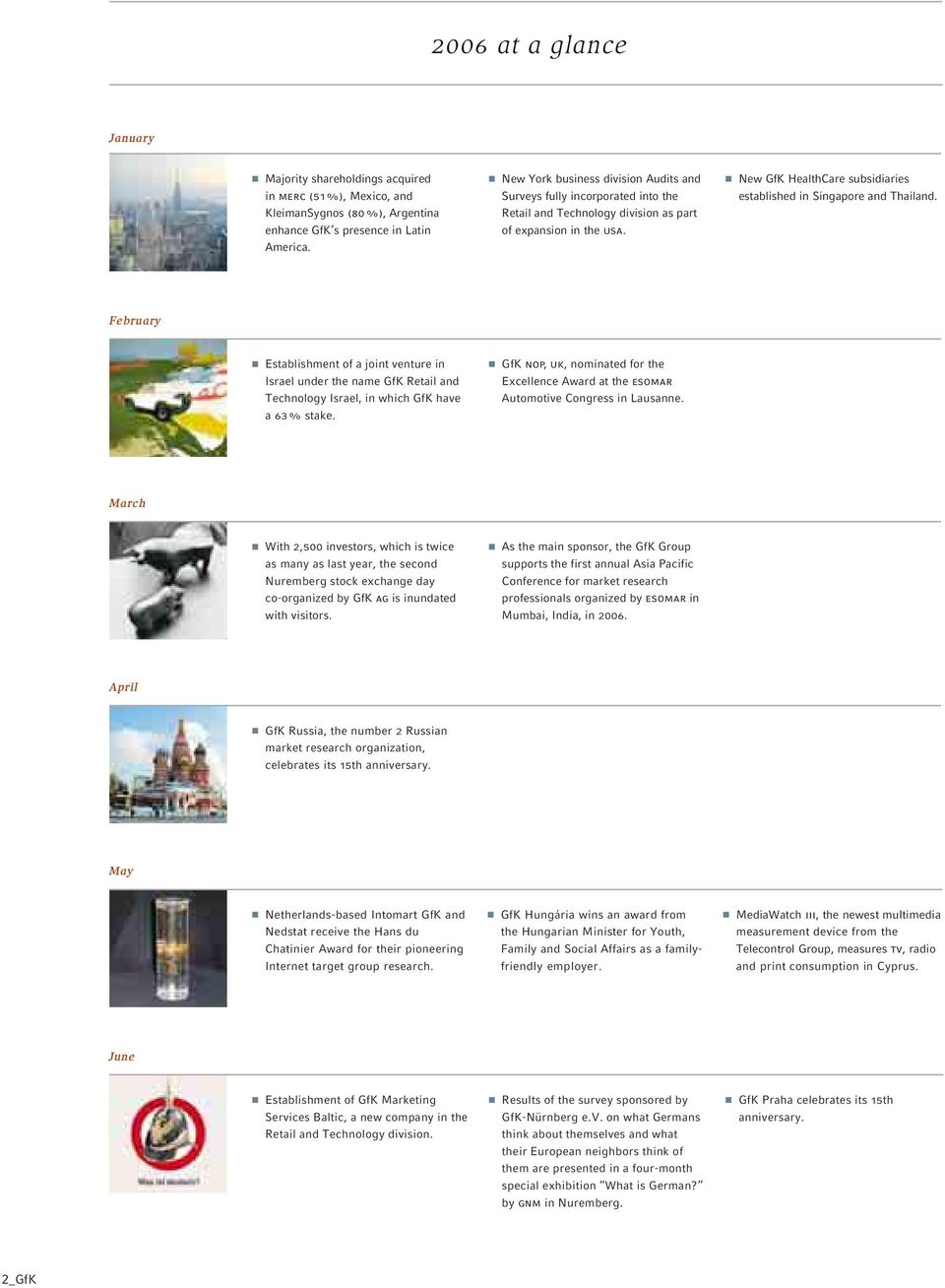
6 2006 at a glance January Majority shareholdings acquired in merc (51%), Mexico, and KleimanSygnos (80%), Argentina enhance GfK s presence in Latin America. New York business division Audits and Surveys fully incorporated into the Retail and Technology division as part of expansion in the usa. New GfK HealthCare subsidiaries established in Singapore and Thailand. February Establishment of a joint venture in Israel under the name GfK Retail and Technology Israel, in which GfK have a 63% stake. GfK nop, uk, nominated for the Excellence Award at the esomar Automotive Congress in Lausanne. March With 2,500 investors, which is twice as many as last year, the second Nuremberg stock exchange day co-organized by GfK ag is inundated with visitors. As the main sponsor, the GfK Group supports the first annual Asia Pacific Conference for market research professionals organized by esomar in Mumbai, India, in April GfK Russia, the number 2 Russian market research organization, celebrates its 15th anniversary. May Netherlands-based Intomart GfK and Nedstat receive the Hans du Chatinier Award for their pioneering Internet target group research. GfK Hungária wins an award from the Hungarian Minister for Youth, Family and Social Affairs as a familyfriendly employer. MediaWatch iii, the newest multimedia measurement device from the Telecontrol Group, measures tv, radio and print consumption in Cyprus. June Establishment of GfK Marketing Services Baltic, a new company in the Retail and Technology division. Results of the survey sponsored by GfK-Nürnberg e.v. on what Germans think about themselves and what their European neighbors think of them are presented in a four-month special exhibition What is German? by gnm in Nuremberg. GfK Praha celebrates its 15th anniversary. 2_GfK
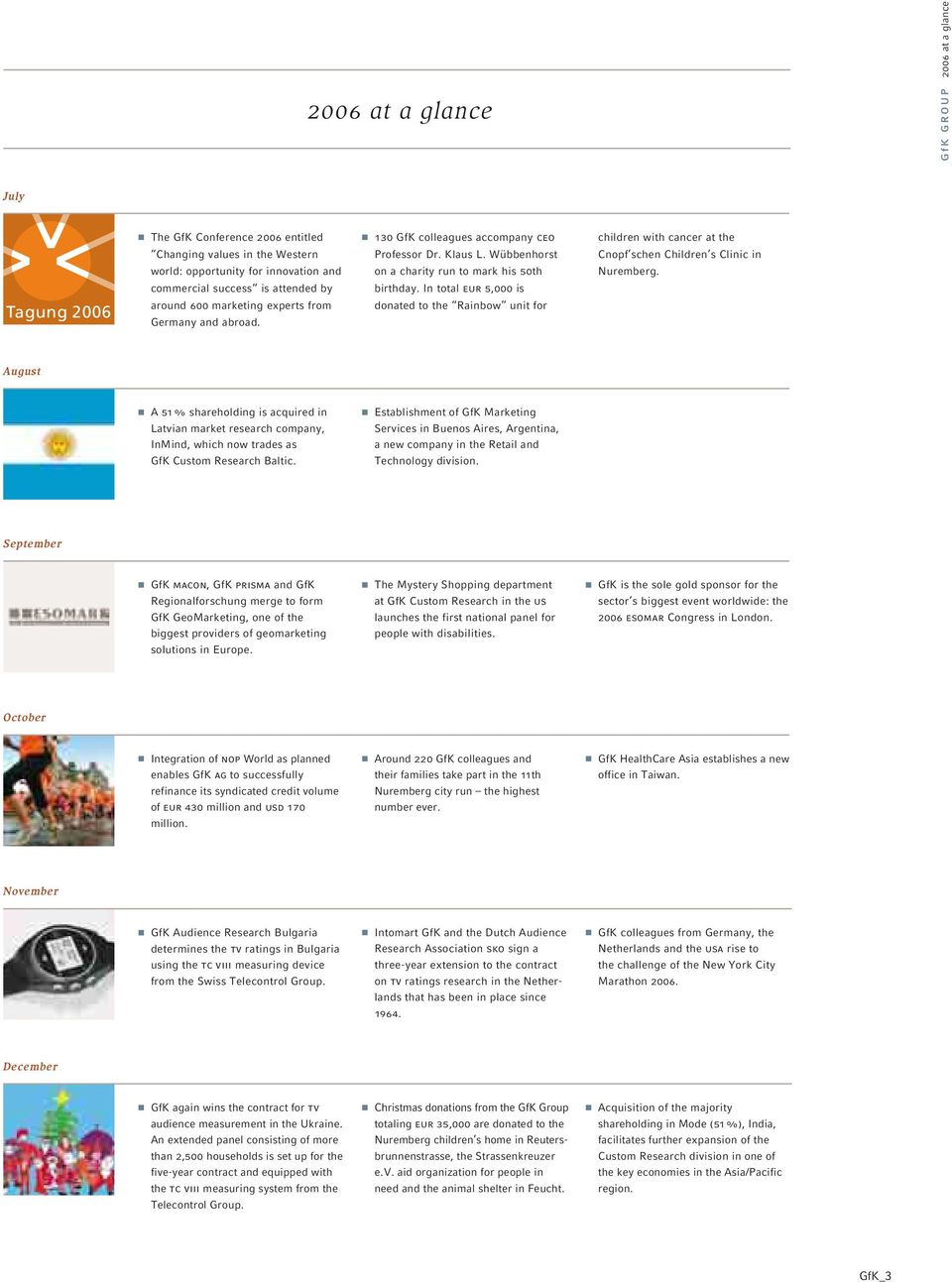
7 2006 at a glance GfK GROUP 2006 at a glance July Tagung 2006 The GfK Conference 2006 entitled Changing values in the Western world: opportunity for innovation and commercial success is attended by around 600 marketing experts from Germany and abroad. 130 GfK colleagues accompany ceo Professor Dr. Klaus L. Wübbenhorst on a charity run to mark his 50th birthday. In total eur 5,000 is donated to the Rainbow unit for children with cancer at the Cnopf schen Children s Clinic in Nuremberg. August A 51% shareholding is acquired in Latvian market research company, InMind, which now trades as GfK Custom Research Baltic. Establishment of GfK Marketing Services in Buenos Aires, Argentina, a new company in the Retail and Technology division. September GfK macon, GfK prisma and GfK Regionalforschung merge to form GfK GeoMarketing, one of the biggest providers of geomarketing solutions in Europe. The Mystery Shopping department at GfK Custom Research in the us launches the first national panel for people with disabilities. GfK is the sole gold sponsor for the sector s biggest event worldwide: the 2006 esomar Congress in London. October Integration of nop World as planned enables GfK ag to successfully refinance its syndicated credit volume of eur 430 million and usd 170 million. Around 220 GfK colleagues and their families take part in the 11th Nuremberg city run the highest number ever. GfK HealthCare Asia establishes a new office in Taiwan. November GfK Audience Research Bulgaria determines the tv ratings in Bulgaria using the tc viii measuring device from the Swiss Telecontrol Group. Intomart GfK and the Dutch Audience Research Association sko sign a three-year extension to the contract on tv ratings research in the Netherlands that has been in place since GfK colleagues from Germany, the Netherlands and the usa rise to the challenge of the New York City Marathon December GfK again wins the contract for tv audience measurement in the Ukraine. An extended panel consisting of more than 2,500 households is set up for the five-year contract and equipped with the tc viii measuring system from the Telecontrol Group. Christmas donations from the GfK Group totaling eur 35,000 are donated to the Nuremberg children s home in Reutersbrunnenstrasse, the Strassenkreuzer e.v. aid organization for people in need and the animal shelter in Feucht. Acquisition of the majority shareholding in Mode (51%), India, facilitates further expansion of the Custom Research division in one of the key economies in the Asia/Pacific region. GfK_3
8 The Supervisory Board Hajo Riesenbeck Chairman of the Supervisory Board Director of McKinsey & Company, Düsseldorf, Germany Dr. Christoph Achenbach Management spokesman for Robert Klingel GmbH & Co. kg, Pforzheim, Germany Dr. Wolfgang C. Berndt Member of the Board of Directors of the Institute For The Future, Menlo Park, California, usa Sandra Hofstetter Independent Works Council representative at GfK Aktiengesellschaft, Nuremberg, Germany Dr. Arno Mahlert Deputy Chairman of the Supervisory Board Member of the Management Board of Tchibo Holding ag, Hamburg, Germany Stefan Pfander Consultant at Wm. Wrigley Jr. Company, Chicago, usa hr Committee Hajo Riesenbeck (Chairman) Dr. Wolfgang C. Berndt Kerstin Döpfert Jürgen Schreiber Audit Committee Dr. Arno Mahlert (Chairman) Dr. Christoph Achenbach Stefan Pfander Dieter Wilbois Kerstin Döpfert Independent Works Council representative at GfK Aktiengesellschaft, Nuremberg, Germany Jürgen Schreiber Since June 29, 2006 ceo and President of Shopper Drug Mart, Toronto, Canada Werner Spinner Up to June 29, 2006 Business Consultant Dieter Wilbois Independent Works Council representative (Chairman of the Works Council and the Group Works Council) of GfK Aktiengesellschaft, Nuremberg, Germany Peter Zühlsdorff Honorary Chairman of the Supervisory Board Managing Shareholder of dih Deutsche Industrie-Holding GmbH, Frankfurt/Main, Germany 4_GfK
9 Report by the Supervisory Board GfK GROUP Report by the Supervisory Board Hajo Riesenbeck Supervisory Board Chairman Director of McKinsey & Company, Düsseldorf In financial year 2006, the Supervisory Board kept itself informed on a regular basis of the GfK Group s business development, income and financial position, its personnel situation and impending investments. It has monitored and advised on the activities of the company s Management Board and discussed all significant business events with the Management Board. The Supervisory Board met six times in financial year At these meetings, the Management Board reports and the company s prospects for development were discussed in depth. The main topics here were the strategic direction of the GfK Group, its international acquisitions activity, the annual accounts for 2005, the development of business during 2006 and the budget for financial year In addition, the Supervisory Board dealt with the approval of the annual accounts for 2006 and the budget for In financial year 2006, the Chairman of the Supervisory Board maintained constant contact with the Management Board. Following the successful acquisition of nop World in 2005, the Supervisory Board was constantly informed of the progress of integration. The Supervisory Board has dealt with the rules of the German Corporate Governance Code and on December 12, 2006, issued a declaration of compliance pursuant to Section 161 of the German Stock Corporation Act (AktG). The company complies with the mandatory regulations with the exception of one requirement and almost all of the voluntary regulations. The few deviations are indicated on page 19 of the present Annual Report in the Corporate Governance Report. GfK_5

10 Report by the Supervisory Board The Supervisory Board has two committees. The Audit Committee, which met four times in the reporting period, dealt with the company s business development, income and financial position as well as impending investments. Additional focal points were the investment policy for the company s liquid funds, issues of financing, as well as questions pertaining to the accounting system including interim reporting. The hr Committee met four times in The focal points were the remuneration of the Management Board and the extension of the contract of the ceo, Professor Dr. Klaus L. Wübbenhorst, and the Management Board member Petra Heinlein by five years in each case. The hr Committee is headed by Hajo Riesenbeck and the Audit Committee by Dr. Arno Mahlert. There were the following changes on the Supervisory Board in 2006: the term of office of five of the six shareholder representatives finished at the end of the Annual General Meeting in Hajo Riesenbeck, Dr. Christoph Achenbach, Dr. Wolfgang Berndt and Stefan Pfander stood for re-election and were confirmed by the Annual General Meeting. Werner Spinner did not stand for re-election. The Supervisory Board thanked Werner Spinner for his commitment to the GfK Group. The Annual General Meeting elected the proposed candidate, Jürgen Schreiber, to the Supervisory Board in his stead. With international experience, particularly in retail and consumer goods in Asia and North America, Jürgen Schreiber strengthens the expertise of the Supervisory Board. The annual financial statements and management report for GfK ag and the GfK Group for financial year 2006 have been audited by kpmg Deutsche Treuhand-Gesellschaft Aktiengesellschaft Wirtschaftsprüfungsgesellschaft, Nuremberg, and provided with an unqualified auditors report. All Supervisory Board members received copies of the auditors report in good time ahead of the accounts meeting. The Audit Committee of the Supervisory Board discussed these documents at its preparatory meeting, as did the full Supervisory Board in its accounts meeting. Both these meetings were attended by the auditors, who signed the annual and consolidated financial statements. They reported on the audit in general and on the key points stipulated in the audit mandate and also gave detailed responses to questions from the members of the Supervisory Board. 6_GfK

11 GfK GROUP Report by the Supervisory Board The Supervisory Board has noted the audit report and, following its own examination of the annual financial statements prepared by the Management Board, has given its approval. The financial statements are therefore adopted. The Supervisory Board has seconded the proposal of the Management Board for appropriation of profits. The Supervisory Board would like to thank the members of the Management Board, the Works Councils, all GfK ag staff and the staff of affiliated companies for their hard work and commitment, especially for the successful integration of nop World, which has created the basis for further growth. Nuremberg, March 23, 2007 Hajo Riesenbeck GfK_7
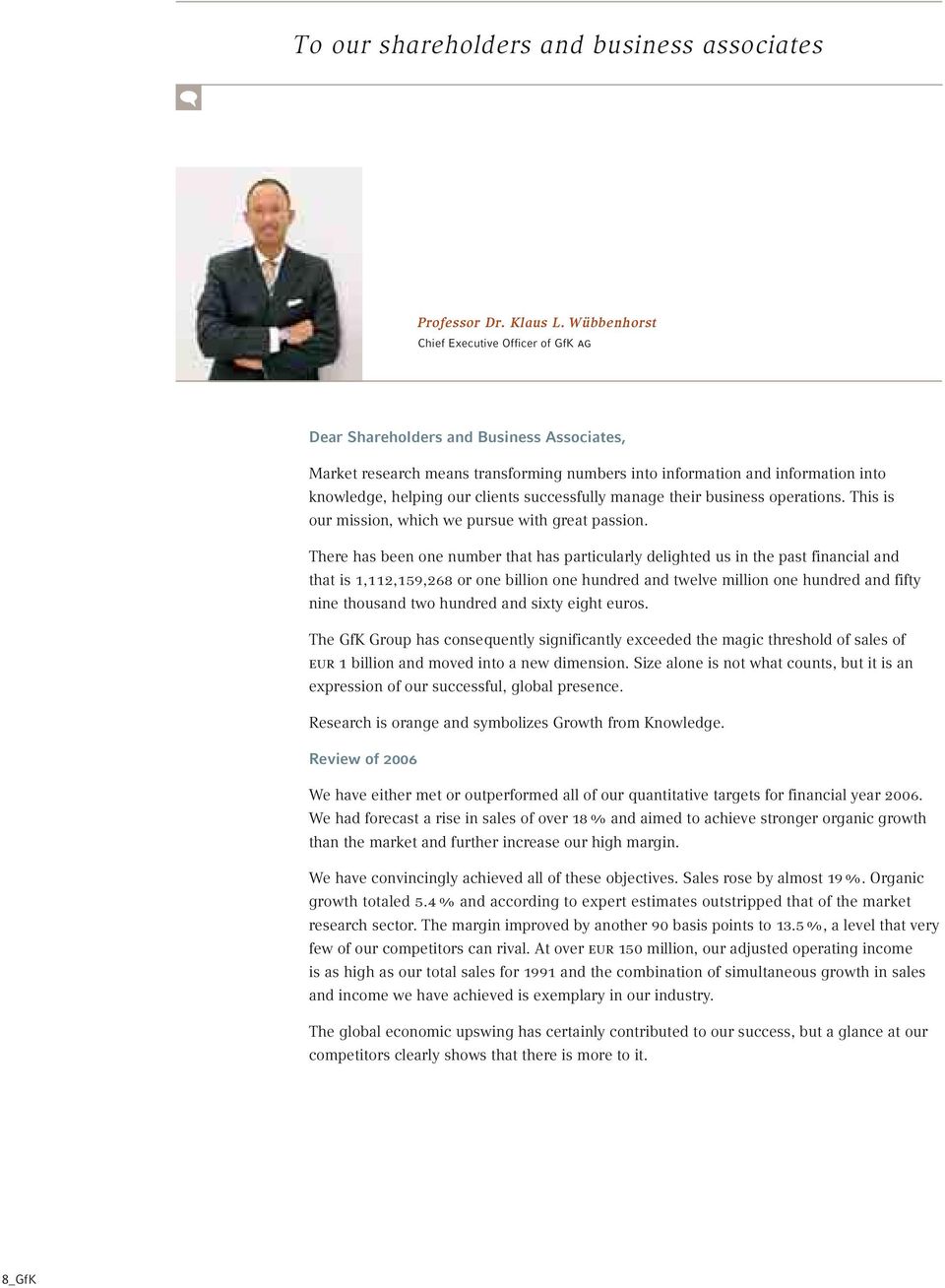
12 To our shareholders and business associates Professor Dr. Klaus L. Wübbenhorst Chief Executive Officer of GfK ag Dear Shareholders and Business Associates, Market research means transforming numbers into information and information into knowledge, helping our clients successfully manage their business operations. This is our mission, which we pursue with great passion. There has been one number that has particularly delighted us in the past financial and that is 1,112,159,268 or one billion one hundred and twelve million one hundred and fifty nine thousand two hundred and sixty eight euros. The GfK Group has consequently significantly exceeded the magic threshold of sales of eur 1 billion and moved into a new dimension. Size alone is not what counts, but it is an expression of our successful, global presence. Research is orange and symbolizes Growth from Knowledge. Review of 2006 We have either met or outperformed all of our quantitative targets for financial year We had forecast a rise in sales of over 18 % and aimed to achieve stronger organic growth than the market and further increase our high margin. We have convincingly achieved all of these objectives. Sales rose by almost 19 %. Organic growth totaled 5.4% and according to expert estimates outstripped that of the market research sector. The margin improved by another 90 basis points to 13.5%, a level that very few of our competitors can rival. At over eur 150 million, our adjusted operating income is as high as our total sales for 1991 and the combination of simultaneous growth in sales and income we have achieved is exemplary in our industry. The global economic upswing has certainly contributed to our success, but a glance at our competitors clearly shows that there is more to it. 8_GfK
13 GfK GROUP Letter to shareholders 2006 was characterized by a clear strategy and efficient operating management. The focus was the integration of the nop World Group acquired in mid Our strategic vision for this acquisition was very clear: to achieve sustained expansion in the usa, uk and Italy as well as to expand and strengthen the Custom Research, Media and HealthCare divisions. However, successful integration measures cannot start until an acquisition has been completed. It has only been 18 months since the acquisition and we can proudly report that the process of integration is complete. The companies of the nop World Group are now a firm and successful part of the GfK family. There is no more GfK on one side and nop World on the other. The integration has taken a great deal of time, energy and dedication and has involved a large number of trips and meetings. But it was worth it. The numbers speak for themselves. At the time of the acquisition, we forecast integration costs of around eur 20 million in 2005 and At eur 19.7 million, we were virtually spot on with our projections. We are very pleased with the achieved and prospective synergies, which were set to amount to up to eur 7 million in 2006 and up to eur 15 million from 2007 onwards. We have outperformed these ambitious assumptions and in 2006 synergies totaled eur 10 million. For 2007, we are expecting synergies of around twice this amount. However, this mammoth task has never distracted us from the wider strategic development of GfK as demonstrated by some excellent examples mentioned in the Annual Report. Let me just highlight a few aspects here: We pushed forward with our internationalization in growth regions in Latin America and Asia/Pacific. New additions in Mexico and Chile are rounding off our network in Latin America. Acquisitions in China and India form the basis for rapid organic growth in the future. To illustrate this dynamic growth and give an overview of the regions, we have adjusted our regional presentation for 2007 and incorporated the regional profiles in the special section of the Annual Report. GfK invests considerable sums in new methods and technologies as well as the expansion of panels and the use of online methods, consequently raising the barriers to entry for other companies. With regard to all these measures, we remain a lean organization where decision-making and entrepreneurship take precedence over formal structures and bureaucracy. And of course, any potential risks are monitored and managed by our Internal Audit department and Risk Management. GfK_9

14 Letter to shareholders As our shareholders, you too will benefit from this increase in income. The Management Board and Supervisory Board will be proposing a dividend of eur 0.36 per share at the Annual General Meeting on May 23, This will be the seventh rise in a row since we went public in There is one final point that should not be forgotten. Not only were we sales billionaires at the end of financial year 2006, by mid-2006 we were also the number four on the top ten list of market research organizations in the world. GfK the knowledge company GfK s positive performance worldwide also impacts on the number of employees and by the year-end the Group had almost 8,000 full-time employees from Azerbaijan to Yemen. In Germany, the staff complement rose to 1,628 full-time employees. The consistent internationalization is reflected, however, in the fact that there are 6,275 people working at our non-german subsidiaries. 8,000 GfK colleagues mean 8,000 experts for our clients. Six of these colleagues from different divisions and regions are featured in this Annual Report. These portraits provide an overview of the various GfK activities and are also representative of the people who make such a huge contribution to GfK s success. Constantly improving our knowledge through targeted professional development and ensuring knowledge transfer within the Group is a major challenge. This process is fostered and supported by the Management Board through a range of initiatives. The most recent is again the result of an idea from the Excellence Team, an elite school for young and talented employees at GfK. The initiative is Knowledge Exchange Solution, or kes for short. The idea behind kes is both simple and convincing: Progress through Knowledge. By pooling our global expertise, kes is a call for knowledge transfer, a requirement to make this process easier and to use impressive methods to facilitate the processing of this information. We are expecting great things from kes. We all know that everyone wants knowledge, but passing on knowledge is sometimes hard. kes also means: receive share contribute. Despite the stresses and strains of the daily competition for clients, we should not overlook the fact that we are a service provider and our success depends on employee satisfaction. We therefore carry out employee surveys on a regular basis. The latest employee satisfaction survey in Germany was very pleasing and the general satisfaction index rose for the third time in a row. Even though some small items remain which could be improved upon, the positive feedback is overwhelming. 10_GfK
15 GfK GROUP Letter to shareholders All of these aspects help build GfK s brand image and it is clear from the media that awareness of the GfK Group is increasing. Our surveys are picked up, analyzed and used as the basis for activities. Outlook 2007 Our achievements in 2006 are both an inspiration and a challenge for the new financial year. We have again set ourselves demanding, but achievable goals for We intend once more to achieve above-sector growth in sales with a rise of over 5%. We also aim to further increase our income and take advantage of opportunities to improve the margin even further. The current year will be exciting with online, outsourcing, offshoring and consolidation just some of the key words for We will closely monitor major developments in our industry and intend to both influence and help shape these changes. We hope we can count on your further support as shareholders and business associates of the company and would like to thank you for your confidence in the company to date and look forward to reporting to you on our continued success. Professor Dr. Klaus L. Wübbenhorst Chief Executive Officer GfK_11

16 12_GfK Knowledge behind the scenes: Christian Weller von Ahlefeld, Wilhelm R. Wessels, Dr. Gérard Hermet, Petra Heinlein, Professor Dr. Klaus L. Wübbenhorst (from left to right)

17 The Management Board GfK GROUP The Management Board Professor Dr. Klaus L. Wübbenhorst born February 23, 1956 in Linnich Chief Executive Officer (ceo), responsible for Strategy, Internal Audit, Method and Product Development, Corporate Communications and it Services Professional background Since 1998 Spokesman and, since 1999, ceo of GfK ag, appointed until 2012 Since 2005 President of the Chamber of Industry and Commerce for Middle Franconia in Nuremberg Member of the Management Board of GfK ag, responsible for Finances, Accounting, Financial Controlling, Personnel, Purchasing, Production and it Member of the Management Board of kba-planeta ag, Radebeul near Dresden Employee of Bertelsmann ag, Gütersloh, becoming Managing Director of Druck- und Verlagsanstalt Wiener Verlag, Himberg near Vienna Education 2005 Awarded the title of Honorary Professor by Friedrich-Alexander University in Erlangen- Nuremberg 1984 Doctorate from the Technische Hochschule, Darmstadt 1981 Graduated in Business Administration from the University/Gesamthochschule, Essen Christian Weller von Ahlefeld born June 6, 1958 in Flensburg Chief Financial Officer (cfo) and hr Director, responsible for Finances, Financial Controlling and Accounting, Personnel and Administration Professional background Since June 1, 2005 Member of the Management Board of GfK ag, appointed until cfo of the Tele-München Group Director and Head of Group Finance at Siemens ag and Manager of Siemens Financial Services division Executive Director of sbc Warburg and member of the corporate management of J. P. Morgan J. P. Morgan in New York, London and Frankfurt, becoming Vice President and member of the European Corporate Finance Executive Committee Assistant to the management of Heinrich D. Hansen in Flensburg Education 1981 Graduated in Business Administration from the Freie Universität Hamburg Petra Heinlein born October 7, 1958 in Bad Staffelstein Responsible for the Custom Research division Professional background Since 2002 Member of the Management Board of GfK ag, appointed until Integration management on behalf of GfK ag Managing Director of contest census in Frankfurt 1985 Joined GfK as project manager with GfK Marktforschung 1984 Research Assistant at the Arnold- Bergstraesser Institute, Freiburg im Breisgau Education 1984 Graduated in Political Science from the University of Bamberg Dr. Gérard Hermet born January 19, 1951 in Montpellier, France Responsible for the Retail and Technology division Wilhelm R. Wessels born October 12, 1952 in Haren Responsible for the Consumer Tracking, Media and HealthCare divisions Professional background Since 1999 Member of the Management Board of GfK ag, appointed until Chairman of the French Marketing Association (afm) Managing Director of GfK Sofema, France Managing Director of GfK France, then General Manager GfK Marketing Services, France Employed by Burke Marketing Research, Paris, France Education 1978 Doctorate from the University of Grenoble 1975 mba from the French Business School (icn) Professional background Since 1996 Member of the Management Board of GfK ag, appointed until Managing Director of GfK ag, Gesundheitsforschung/i+g Gruppe Gesundheitsund Pharma-Marktforschung Managing Director of gpi, Gesellschaft für Pharma-Informationssysteme, Nuremberg/ Frankfurt 1978 Joined GfK as a Research Associate Education 1977 Graduated in Business Administration from the University of Saarbrücken GfK_13

18 Corporate Governance The management of GfK is committed to increasing the value added of the company on a responsible, transparent and sustained basis. This is documented by the almost total compliance with the Corporate Governance principles. Where deviations still exist, the company will increase its endeavors to achieve its goal of total compliance. Declaration of compliance without material restrictions The Management Board and the Supervisory Board issued their declarations of compliance pursuant to Section 161 of the Joint Stock Corporation Act (AktG) on December 11 and December 12, 2006 respectively. The declaration of compliance is on page 18. The company complies with all the recommendations under the Code apart from one: in 2007, the Annual Report will be published after 94 days rather than within the 90 days prescribed by the Code. As of 2008, the company is set to comply with this deadline. GfK also complies with almost all of the non-binding suggestions in the Code. There are only two points where compliance is restricted. Since its stock market flotation, GfK has broadcast its accounts press conference and its Annual General Meeting on the Internet. The webcast lasts until the end of the speech by the Chairman of the Annual General Meeting. In 2007, the company will broadcast the event in full, unless objections to this are raised by shareholders or shareholder representatives. In future, it is also intended to make sure that shareholders representatives can be contacted during the Annual General Meeting. This is to ensure that shareholders can also issue instructions during the Annual General Meeting. Management and control structure As a German joint stock corporation (ag) GfK is subject to the German Stock Corporation Act and has a two tier management and control structure, comprising a Management Board consisting of five members and a Supervisory Board with nine members. Two thirds of the members of the Supervisory Board comprise representatives of the shareholders and one third representatives of the employees. In accordance with the standing rules of the Supervisory Board, the representatives are independent. Alongside their activity on the Supervisory Board, the majority of the members also held high-ranking positions in other companies during the past year. In our opinion, this did not impair their independence. The Supervisory Board advises and monitors the Management Board in its management of business operations. Consequently, expertise from trade and industry at both national and international level should be represented in the composition of the Supervisory Board. The Supervisory Board has formed two independent committees, the hr Committee and the Audit Committee. Further details on these committees are given in the Report by the Supervisory Board on page 5. The company has taken out a d&o insurance policy with an appropriate deductible for the members of the Management and Supervisory Boards. In 2006 there were no consultancy or other service and works contracts between members of the Supervisory Board and the company. 14_GfK

19 GfK GROUP Corporate Governance The Code recommends that the Chairman of the Audit Committee has particular expertise and experience in the application of accounting principles and internal financial controlling procedures. The Committee is chaired by Dr. Mahlert. He has been the cfo of Tchibo Holding ag since 2004 and as a result of this position and his long professional career has the necessary expertise and experience. Responsible risk management Systematic risk management has been in place at the company for many years and has been reviewed by the year-end auditors. The details are provided in the Risk Report on page 90 onwards. When the general Equal Treatment Act came into force in August 2006, a new requirement was added to compliance. All employees in the Group companies in Germany were informed in detail about the new requirements in a brochure. Training measures were also arranged for executives. The company took the new regulations as an opportunity to again draw the attention of employees to the already established Complaints Department, which is featured in detail in an article in the in-house magazine, gfk insite. Transparency in communications With the aim of transparent corporate communications, the company is pursuing its objective of providing the same information to all target groups at the same time. All press releases and ad hoc notifications are available via the website. Newsletters in both electronic and printed form report on the latest news from the Group and the survey results from the five business divisions provide the findings from market research. In order to further improve the service offering, the two departments Public Affairs and Communications and Investor Relations were amalgamated to form Corporate Communications. Remuneration report The remuneration of the members of the Management Board comprises four components; a fixed element, a bonus (variable remuneration), the 5 Star Incentive Program and pension commitments. The structure of the remuneration system is reviewed regularly by the Supervisory Board at the suggestion of the hr Committee. The Supervisory Board is responsible for setting the level of the individual components in line with the recommendations of the hr Committee. The remuneration is based on the remit of the respective member of the Management Board, their personal performance and that of the full Management Board. The non-performance related remuneration components comprise a fixed element and the pension commitment. The variable remuneration elements comprise variable components and stock options or a claim under the 5 Star Incentive Program. These are based on performance targets, which are measured against the key indicators from the consolidated financial statements and against benchmarks. The variable components are calculated on the basis of certain key indicators from the consolidated financial statements. The components are definitively set by the Supervisory Board. GfK_15
20 Corporate Governance The 5 Star Incentive Program has the following objectives: This program continues on the same basis as the earlier stock option program, without issuing new shares. As with the previous incentive program, the intention is to bind management staff to the long-term operational and strategic corporate goals. The term amounts to three years. There are internal and external performance criteria which have to be achieved. The remuneration is paid as a cash benefit. The decision of each individual member of the Management Board to waive part of the variable remuneration components creates an entitlement to virtual GfK shares. The number of virtual shares acquired is calculated on the amount of substituted remuneration and the GfK share price, which is based on the average price of the last 20 trading days before the year-end. For every virtual GfK share acquired, the Management Board member initially receives a further virtual share. However, the number of virtual shares granted by GfK may change. The two performance criteria governing this are the increase in operating income and the development of the GfK share price, both over a period of three years. The increase in operating income is measured against the income of the companies listed in the Dow Jones Stoxx Media Index. If these targets are not met or only partially met, the virtual shares granted by GfK lapse or reduce. If the targets are exceeded, the number of virtual shares granted by GfK increases. The program is limited in accordance with the Corporate Governance Code. Remuneration of the Management Board in 2006: In eur 000 Fixed components Variable components 5 Star Incentive Program Total remuneration Pensions: annual remuneration earned to Dec. 31, 2006 Transfer to pension provisions in the financial year Professor Dr. Klaus L. Wübbenhorst (ceo) , Christian Weller von Ahlefeld Petra Heinlein Dr. Gérard Hermet , Wilhelm R. Wessels , , ) 5, , , , , ) 5, ) , ) Invested variable components of eur thousand in 2005 and In 2005, this corresponded to 146,664 stock options. 2) Including variable amounts invested, totaling eur thousand. In the past financial year, Management Board members carried out share transactions involving a total of 201,805 shares. Apart from one sale of 10,000 shares, all other transactions related to the exercise of options with subsequent sale. As of December 31, 2006 the Management Board held a total of 379,287 shares and 330,329 options for GfK shares. 16_GfK

21 GfK GROUP Corporate Governance Structure of pension commitments: The pension contracts for members of the Management Board are uniformly structured. After three service years as a member of the Management Board (waiting period), the company grants a retirement pension, an early retirement pension, a disability pension and a widow s and orphan s pension upon fulfillment of the respective performance requirements. The fixed annual remuneration of the Management Board members agreed in the contract of employment at the time of leaving the company is deemed to be the pensionable income. The Management Board members receive a retirement pension when they leave the service of the company upon or after reaching the normal retirement age. After three years service as a member of the Management Board, the annual pension amounts to 30% of the pensionable income. The annual pension rises by 3 percentage points for each additional full year. The retirement pension is limited to a maximum of 60% of the pensionable income. The early retirement pension is granted upon leaving the company at the age of 60. If members of the Management Board leave the service of the company before their 62nd birthday due to a partial or total reduction in earning capacity, they receive a disability pension for the duration of the partial or total reduction in earning capacity. If this reduction in earning capacity still applies upon reaching the normal retirement age, the pension continues to be paid as a life-long pension. The disability pension is calculated in the same way as the retirement pension. The widow s pension amounts to 60% of the retirement or disability pension last paid; the orphan s pension amounts to 30% for full orphans and 15 % for half orphans. If the Management Board member leaves the company before the pension claim applies, the entitlement to all pension benefits remains in place. After the pension commences, the regular pension is increased by 2% each year. Remuneration of the Supervisory Board The remuneration of the Supervisory Board is regulated by the Annual General Meeting and stipulated in the articles of association of GfK ag. It is based on the remit and responsibility of the Supervisory Board member and the commercial success of GfK. Essentially this comprises the following elements: In addition to expenses, members of the Supervisory Board receive fixed remuneration of eur 9, payable at the end of the financial year. They also receive annual remuneration which is performance-based and dependent on earnings per share. A threshold value of eur 0.30 per share (in accordance with ifrs) was determined in If this value is achieved, each beneficiary receives a further eur 500. For every eur 0.10 that earnings per share exceed this value, each beneficiary receives a further eur 500. The threshold value increases by eur 0.10 every year. Three financial years are taken into consideration when calculating the earnings per share value. The current financial year and the two preceding years are used to establish an average. Performance-related remuneration may only amount to one and a half times the fixed annual remuneration. The Chairman of the Supervisory Board receives two and a half times the fixed and variable amounts mentioned above, and the Deputy Chairman receives one and a half times this amount. Remuneration increases by 25% per membership of a committee and by 50% per chair of a committee, up to a maximum of 100 % of the total of the fixed and variable remuneration. GfK compensates every Supervisory Board member for any vat applying to their remuneration and the reimbursement of expenses. Supervisory Board members who have only held their position for part of the financial year are compensated on a pro rata basis. GfK_17
22 Corporate Governance In financial year 2006, a total of 1,851 shares were sold by a former member of the Supervisory Board. Details of the individual transactions by members of the Supervisory Board and Management Board are published on the website in accordance with the Corporate Governance Code. Remuneration of the Supervisory Board in 2006: In eur 000 Fixed components Variable components Total remuneration Hajo Riesenbeck (Chairman) Dr. Arno Mahlert (Deputy Chairman) Dr. Christoph Achenbach Dr. Wolfgang C. Berndt Kerstin Döpfert Sandra Hofstetter Stefan Pfander Dieter Wilbois Werner Spinner (until June 29, 2006) Jürgen Schreiber (from June 29, 2006) The Supervisory Board members hold 3,458 shares and no stock options. Former members of the management of GfK GmbH, Nuremberg, and of the Management Board of GfK Aktiengesellschaft, Nuremberg, and their dependents received total remuneration of eur 0.9 million. There are provisions of eur 10.2 million for pension obligations to former Management Board members, their dependents and Managing Directors. The remuneration report forms part of the consolidated financial statements and the Group management report. Declaration of the Management Board and Supervisory Board pursuant to Section 161 German Stock Corporation Act (AktG) Pursuant to Section 161 of the German Stock Corporation Act (AktG), the management and supervisory boards of listed companies must declare each year, the extent to which they have complied with and will continue to comply with the recommendation of the Government Commission German Corporate Governance Code published by the German Ministry of Justice in the official section of the online Federal Gazette and which recommendations have not or will not be complied with. This declaration must be made available to shareholders at all times. The German Corporate Governance Code (the Code ) contains regulations, some of which are binding. In addition to outlining the prevailing company law, it also includes recommendations from which companies may deviate, although in this case, they are obliged to publish information on such deviations every year. The Code also proposes suggestions from which companies may deviate without the necessity for this to be disclosed. GfK ag has been publishing details of deviations from recommendations or suggestions since These are reported separately below: 18_GfK
23 GfK GROUP Corporate Governance I. Recommendations The Management Board and Supervisory Board of GfK ag declare that they have complied with and will continue to comply with the recommendations of the Government Commission German Corporate Governance Code in the version of June 12, 2006 published by the Germany Ministry of Justice on July 24, 2006 in the official section of the online Federal Gazette. Only the following recommendations have not been applied: 1) Point deals with variable remuneration components for the Management Board. With regard to stock options, there is a request for the Supervisory Board to agree a limitation option (cap) for extraordinary, unforeseeable developments. GfK s stock option program expired on December 31, 2004 and there is no cap on this program. Tranches already issued or still to be issued may be exercised up to and including December 31, The Management and Supervisory Boards agreed on a new program on December 12 and December 14, 2005 which complies with the requirements of point ) Point regulates the publication of the consolidated financial statements within 90 days and interim reports within 45 days. The company has complied with the 45-day period for publication of its quarterly results since January 1, In 2006, the Annual Report was published within 122 days. The company was unable to comply with the desired 90-day publication period and had announced this in its declaration of compliance in December The main reason for this was the acquisition of nop World on June 1, Based on sales in 2004, nop World was around half the size of GfK. nop World also previously applied us gaap accounting standards and as of the 2005 year-end, GfK switched from us gaap to ifrs. As a result, GfK announced in its quarterly report as of September 30, 2005 that it would publish its 2005 financial statements on May 2, This corresponds to a period of 122 days. GfK is seeking to considerably shorten this period in Publication of the Annual Report is scheduled for April 4, 2007, that is within a period of 94 days. For 2008, the company is aiming to comply with the 90-day period. II. Suggestions (n.b.: there is no obligation to explain any deviations from suggestions) The Management and Supervisory Boards of GfK ag declare that they have complied with and will continue to comply with the suggestions of the Government Commission German Corporate Governance Code in the version of June 12, 2006 published by the German Ministry of Justice on July 24, 2006 in the official section of the online Federal Gazette. Only the following suggestions are not applied: 1) Point 2.3.3: the Management Board should ensure the appointment of a representative to exercise voting rights for shareholders in accordance with instructions: such persons should also be contactable during the Annual General Meeting. In the past, the company has appointed a proxy to exercise the voting rights before the Annual General Meeting and will continue to do so in the future. Voting proxies shall be determined in accordance with the regulations listed in the invitation convening the Annual General Meeting. The details are published in the agenda and on the website under Voting during the Annual General Meeting is currently difficult for GfK_19
24 Corporate Governance technical reasons. As soon as a practicable solution has been found for the secure transmission of votes, the company will look at introducing such a system. 2) Point 2.3.4: pursuant to point of the Code, the company should enable shareholders to follow the Annual General Meeting using modern communication media (e.g. the Internet). Since GfK has been listed on the stock exchange, the Annual General Meeting has been broadcast on the Internet. The webcast lasts until the end of the report by the Management Board. The company has refrained and will continue to refrain from broadcasting more of the meeting in order to protect the privacy rights of the shareholders. Compliance Officer: Bernhard Wolf Tel Fax [email protected] 20_GfK
25 GfK shares GfK GROUP GfK shares The upward trend in the global economy made for a pleasing year for the stock market. All the relevant indices reported significant gains. Although the hikes in the oil price in early summer put a brake on the positive performance of shares in the international equity markets, robust company profits and the associated improvement in the labor markets, especially in the euro-zone and Asia, ensured a sustained upswing through to the yearend. The winners in economic terms in the Far East are India and China. As a result of the positive development in exports and increased investment, Germany recorded its fastest growth since the turn of the millennium. GfK shares closed 2006 with a rise of 16% on the prior year. Stock markets 2006: equity markets outperform expectations The players in the German equity market had one of their most successful stock market years. While the Dow Jones Index climbed by almost 17%, the s&p 500 Index rose by around 14 % and the Nikkei 225 Index by nearly 7%, the Deutscher Aktienindex (Dax) gained around 22% over the course of the year. Only the stock exchange in Madrid topped this figure. Closing at 6,597 points, the Dax was at its highest level since February In the last two years, it has risen by more than 50%. Optimistic forecasts by experts at the beginning of the year had put the index at around 6000 points. GfK shares: key data German securities code isin (International Stock DE Identification Number) Reuters Bloomberg Datastream First Call GFK.DE GFK GR D:GFKX GFK.DE With a rise of 29%, the MDax, the index for mid-caps, outstripped the blue chip index to reach a new all-time high of 9,405 points on the last trading day. The TecDax also outperformed expectations with a gain of 25%. Climbing 31%, the SDax was the top performer among the German indices. This positive trend was driven primarily by successful consolidation and good corporate profits, especially by major German groups, which saw earnings rise by 25% in This led to increased tax revenue and a revival in the labor market. The economic upturn was also boosted by private consumption. GfK s consumer climate survey confirmed the positive consumer sentiment and the index more than doubled from 4.0 points in January to 9.2 points in December of the prior year. Performance in the indices in the usa was moderate by comparison as a result of the rapid jumps in the oil price in early summer and subsequent fears regarding inflation and growth, which in turn triggered significant price corrections in the international stock markets. According to the experts, the risk of a recession in the United States rose considerably from 20% in the middle of the year to 27% at the end of the year. These price rises and the increase in key lending rates sought by the American Central Bank and the European Central Bank narrowed the expectations of the financial markets and ensured a correction in fixed-income markets. GfK_21
26 GfK shares The Euro stoxx 50 lost 12 % of its value by mid-june and the Dow Jones around 8% during the same period. The rollercoaster trend also briefly affected German stocks. Despite the positive stock exchange result overall, an analysis by the Deutsches Aktieninstitut shows that the number of German equity investors fell by 4.7% on the prior year. GfK shares: good financials ensure stable upward trend Despite the volatility in the stock markets, GfK s share price performance was solid in The price firmed sporadically above the SDax. At the very beginning of the stock exchange year, the share price rose swiftly. Growth peaked on the day the preliminary results for 2005 were published: with a closing price of eur 38.50, GfK shares reached a new five-year high. Investors responded to the better-than-expected financial year with strong buying activity. However, profit-taking by shareholders pushed the price to eur shortly thereafter and closer to the performance of the SDax. Highest and lowest values of GfK shares from January 2006 to February 2007 in eur Jan 06 Feb 06 Mar 06 Apr 06 May 06 Jun 06 Jul 06 Aug 06 Sept 06 Oct 06 Nov 06 Dec 06 Jan 07 Feb 07 Highest and lowest share price Monthly closing price However, as many investors value companies based on the discounted cash flow model, the price quickly returned to between eur 34 and eur 36. As a result, in the first quarter, the share price performed better than the market and the comparison indices. In May, price corrections in the German stock market on the back of rate rises by central banks and sales by investors led to a decline in the SDax. GfK shares were unable to escape this trend. 22_GfK
27 GfK GROUP GfK shares GfK share price performance from January 1, 2006 to February 28, 2007 in eur 1) January 2006 April 2006 July 2006 October 2006 January ) All values are indexed to the GfK share price GfK SDax Performance Dax 30 Performance dj Euro Stoxx Media In early summer, small caps recovered and made slight gains. The performance in GfK s share price ran counter to this trend and fell from eur in mid-may to eur at the end of July. One year on from the acquisition and shareholder scepticism regarding the successful integration of the former nop World companies was leaving its mark. The price did not begin its swift recovery until publication of the mid-year figures. With the successful integration of nop World, the confidence of market players also rose. The positive trend in sales and income development in the second quarter was very well received by the market and GfK s share price rose on the day of publication by around 12 % to eur As the year progressed, the share price strengthened above the eur 33 mark and in mid-november stood at eur In December, the share price fell slightly as a result of profit-taking. GfK shares ended the stock exchange year positively at eur (prior year: eur 28.30). At the end of February 2007, there was a significant price correction in the international equity markets which also affected GfK shares. For shareholders who acquired their shares at the time of flotation in 1999 and have since held them, there was a price gain of around 113 %. This corresponds to an annual return on capital employed of 11.4%. By comparison, an alternative investment in fixed-income securities would have achieved a return of 4.3% per year on average over the same period. GfK_23
28 GfK shares Ranking in the SDax: firmly in the top ten GfK shares have been listed in the SDax since The shares consolidated their position among the top ten and at the end of the year ranked number 7 (prior year: number 2). At the year-end, the market capitalization amounted to eur 1,165.2 million (prior year: eur million). GfK shares slipped a few places in terms of market capitalization but made it to number 55 (prior year 47) in the final Deutsche Börse rankings. The position of the shares was influenced in particular by new issues from SDax companies. The average turnover on all German stock exchanges rose from 19,383 shares in 2005 to 24,233 shares in the past year. GfK share price performance comparison in 2006 From ipo to March 2, ) GfK ag % % Dax % % SDax % % dj Euro Stoxx % 23.3% Media 1) Compared with the Initial Public Offering (ipo) of eur as of September 23, 1999 (adjusted for the capital increase from company funds) 2006 Annual General Meeting: material resolutions adopted At the Annual General Meeting in Nuremberg, shareholders in GfK ag adopted the resolutions proposed by the Supervisory and Management Boards with a majority of over 96%. With a total of 450 shareholders, shareholder representatives and guests representing over 74% of all the shares, the number of participants on June 29, 2006 was slightly down on the prior year. Many investors took advantage of the option of following the Annual General Meeting live on the Internet. The shareholders approved the extension of the share buyback program until December 28, 2007 as well as the creation of the conditional capital required to continue the 2004 stock option program. In addition, the Annual General Meeting agreed to the merger of GfK ag and the wholly-owned subsidiary gpi Kommunikationsforschung Gesellschaft für Pharma- Informations-Systeme mbh. In addition, they consented to the proposed amendment to the articles of association in line with new legal regulations. Dividend proposal: 9% more than in the prior year For 2006, the Management and Supervisory Boards will propose to the Annual General Meeting to increase the dividend to eur 0.36 per share. Compared to the prior year, this corresponds to an increase of 9%. The total distribution rose 10.3% from eur 11.6 million to eur 12.8 million. GfK has increased the dividend every year since the company went public in Over this period, the distribution per share has risen by 227%. 24_GfK
29 GfK GROUP GfK shares Key indicators for GfK shares Unit High eur Low eur Closing price eur Average daily volume traded No. 19,383 23,959 No. of no-par shares (weighted) No. 33,486,383 35,155,998 No. of no-par shares as of Dec. 31 No. 35,074,692 35,501,795 Stock market capitalization as of Dec. 31 eur (million) ,165.2 Ranking in SDax by sales by market capitalization Index weighting by market capitalization in % Dividend 1) eur Total dividend 1) eur (million) Earnings per share eur Free cash flow per share eur ) ) Proposal to the Annual General Meeting on May 23, ) Figures adjusted for the capital increase Shareholder structure: increased demand in France and Germany The composition of the shareholder base has not altered significantly compared to the prior year. The largest single shareholder in the company remains GfK-Nürnberg e.v., whose shareholding was constant at 57.3%. The holding of the Management and Supervisory Boards remained unchanged at around 1.1% of shares. Consequently, the proportion of shares in free float amounts to 41.6%. The holdings of institutional investors and private investors changed slightly at 28.2% and 13.4% respectively. There was a significant shift in institutional investors at country level and investment funds from France and Germany considerably increased their holdings. By the end of February 2007, French investors held 4.3% (prior year: 2.5%) of the shares and German investors 3.6% (prior year: 2.4%). The proportion of us American investors fell to 10.3% (prior year: 11.4%), followed by institutional investors from the uk with a lower share of 7.2% (prior year: 8.6%). Developments in the shareholder structure will continue to be closely monitored in future in order to tailor our roadshow activities and one-on-one meetings with fund and sales managers accordingly. GfK_25
30 GfK shares GfK shareholder structure as of February 28, 2007 GfK-Nürnberg e.v. 57.3% Management Board and Supervisory Board 1.1% Private investors 13.4% Institutional investors 28.2% of which usa 10.3% of which uk 7.2% of which France 4.3% of which Germany 3.6% of which other 2.8% Analysts: overwhelmingly positive recommendation for the shares GfK shares have attracted notably more attention from analysts and the number of renowned banks now monitoring and evaluating the stock stands at 16. Overall this is 60% more than at the 2005 year-end. In the prior year, analysts from Goldman Sachs International, Société Générale, Merck Finck & Co, hsbc Trinkaus & Burkhardt and Commerzbank started to cover the shares. In February 2007, they were joined by the European bank Sal. Oppenheim jr. & Cie. The valuations from all the banks covering the shares were positive with recommendations of buy or hold as an option. According to a current survey by dirk (German Investor Relations Association) the average number of active analysts covering a stock is 9.3 for SDax companies, 18.8 for MDax companies and 13.9 for TecDax companies at present. GfK shares are therefore monitored by an above-average number of banks for a small caps company. Presence: sharp increase in number of one-on-one meetings GfK believes in consistently expanding its service offering of high quality consultancy services based on market research findings to meet the needs and demands of the decision-makers of tomorrow. To convey the activities and business model of GfK clearly and comprehensively, the company considers dialog with institutional investors, private investors, analysts and financial journalists as an essential basis for professional communications and part of company policy. The focus here is on transparent information on long-term goals and strategies as well as prompt reporting on current topics in order to enable all interest groups to evaluate GfK shares appropriately. In 2006, GfK further stepped up its communication activities, particularly in terms of one-on-one meetings. In addition to the accounts press conference and the Annual General Meeting, GfK gave presentations at 10 international investor conferences, 2 dvfa analysts conferences, 26_GfK
31 GfK GROUP GfK shares 4 roadshows in the usa, France, Germany and Switzerland, 7 meetings with bank representatives (sales briefings), in 16 conference calls, in 191 one-on-one meetings with fund and sales managers as well as at the 4th Munich Stock Exchange day attended by 3,800 private investors and analysts and the 2nd Nuremberg stock exchange day, initiated by GfK and attended by 2,500 delegates. Since 2003, in its regular newsletter for private investors gfk impuls, GfK has also been reporting on the movement in the share price and business performance, expansion of the company network and the business divisions as well as on the latest surveys and stock exchange events. In addition, the Investor Relations section of GfK s website provides detailed information on Corporate Governance, the Annual General Meeting, deadlines and presentations with the option of viewing financial reports electronically and ordering printed copies. Communications: recognition and awards The communications activities of GfK won several awards in In the competition for the best German annual reports organized each year by manager magazine, GfK came in 8th place overall and 2nd in the SDax segment. The annual reports are judged on content, design, language and reporting efficiency. In the internationally acknowledged Report Watch rankings, GfK s 2005 annual report came 50th out of a total of 650 annual reports worldwide. For ten years, the competition has differentiated and independently evaluated the statutory publications of companies in 25 categories. More than 400 analysts and fund managers rated GfK s Investor Relations activities in 2006 as very good: at the Investor Relations awards, presented for the tenth time by financial magazine Capital and the Society of Investment Professionals in Germany (dvfa), GfK maintained its position among the top ten SDax companies in the overall rankings. With points, GfK achieved 10th place (prior year: 9th place with points). The statutory and image sections of the annual reports of almost 200 of the biggest German and European companies, of which 48 are listed in the SDax, were evaluated in terms of credibility, transparency, reporting and corporate governance. Clear and target-oriented capital market communications are essential to build a high level of trust. Consequently, GfK is committed to an open dialog with all investor groups and feels both obliged and motivated to consistently enhance its professional Investor Relations activities. GfK_27
32 28_GfK
33 GfK Special Providing insights into human behavior. A global alliance of highly qualified specialists with the capacity to analyze, evaluate and draw fact-based conclusions. Knowing why consumers behave in a certain way is the key to success. In an ever-shrinking world, only an exchange of knowledge which does not merely transcend borders, but also includes the cultural and country-specific mechanics in the analysis, will do. Germany Page 30 Sweet dreams of millions GfK SPECIAL Western Europe, the Middle East and Africa Page 36 Like pieces of a jigsaw Central and Eastern Europe Page 42 A dynamic lady in a dynamic market North America Page 48 Data for 48 federal states Latin America Page 54 Start-up for a continent Asia and the Pacific Page 60 Asia: the mysterious continent GfK_29
34 30_GfK Ariane Thieleking, GfK Panel Services Germany
35 Sweet dreams of millions Brands make a market. Even a supermarket. Ariane Thieleking, Senior Marketing Consultant with Panel Services at GfK in Nuremberg, was confronted with the difficult task of taking a strong brand and developing new markets for it in such a way as to achieve increased sales, not only for the hard discounters with a primary focus on retail brands, but for retailers across the board. No simple undertaking for the fast moving consumer goods segment, but certainly feasible by generating extra impulse buying. GfK SPECIAL Germany We refute this: it simply isn t true. With this confident statement, Ariane Thieleking took on the task in November 2005, convinced that there was still a great deal of potential in the realm of sweet dreams, which just needed to be identified. The inclusion of eight products from Ferrero, a confectioner with a 25% share of the chocolate products market, in the Aldi South range was making the other retailers uncomfortable, says the volatile lady from North Germany recalling the situation at the outset of her task. There was talk of market cannibalization and Aldi taking customers away from other market players. However, this turned out not to be the case. Germans go shopping on average 110 times per year. Half these purchases are accounted for by the discount stores. At first sight, this sounds good and appears to offer the ideal circumstances for generating additional sales in the fmcg sector. But four years ago, Germans were still shopping ten times more frequently than in Ariane Thieleking explains: This forced retailers to think out of the box, a fact with which the market researcher has no truck, since she spent ten years in the confectionery industry, where she was able to convince herself that simply being there creates a demand which can ultimately be converted into an impulse to buy. After matriculating from school, I wanted to do a traineeship, says Ariane, who is a passionate horsewoman. I spent two years at Bahlsen as a business trainee, mainly in the marketing department. After just a year as a trainee, Ariane, now 30, was flattered by the offer of a job in market research. She adds: But I wanted to study, so I accepted the job and at the same time, completed my studies until I graduated in business studies, although the job always took precedence. What I like about GfK is that it encouraged my development Ariane Thieleking joined the Consumer Tracking division of GfK as the sweet marketing consultant on April 1, 2004, and started work on the Bahlsen and Storck brands, of which she had prior knowledge. GfK encouraged my development, sent me to seminars and ultimately on a development course for senior consultants. That s what I like about my job, says Ariane with evident pleasure. She regards the fact that she was working on a client account where she was previously employed as a win-win situation for both parties. Ariane Thieleking launched into her work with all her energy, took over Ferrero from a GfK colleague and won Haribo as a new client. Since she regards challenge as her friend, she felt completely at home with the sales side of her task, just as she enjoys rising to the challenge of the different corporate cultures she encounters at the various GfK clients. This is what attracted me, she freely admits. When she became involved in the launch of Ferrero products, the Aldi South listing was a fact and the analyses had already been completed. This meant she was faced with dispelling the concerns other market players had, that listing with Aldi might lead to an erosion of sales. GfK_31
36 » We must be significantly more focused and get more out of our data. «And her credo? We must be more focused and get more out of our data. From where Ariane Thieleking stands, this translates as follows. There are 37 million buyers for fast moving consumer goods, which means that there are more potential consumers available in this area than in any other market segment. They buy sweets and confectionery 57 times a year. According to Ariane, This is the highest conceivable potential and what we need to do is to exploit it. GfK Panel Services Germany Established: In an earlier form GfK Panel Services Germany has been in existence since At the time, the household panel research department of GfK in Nuremberg had commenced continuous collection of purchasing data from private households. In a history dating back almost 50 years, household panel research has operated under a variety of names and with a number of different shareholders. GfK took over as sole shareholder in Employees: More than 300 permanent staff Business division: Consumer Tracking Household, individual and special panels: the ConsumerScan panel collects data on fast moving consumer goods, such as bodycare products and foods, and for this, consumers use an electronic diary to record their purchases. For consumer durables and services, an area which includes such items as electrical goods and tourism, data comes from a combination of the ConsumerScope online and mail panels. Clients: The company has a client base in Germany in excess of 500 and a market share of over 80%. Major clients include Unilever, Procter & Gamble, The Coca-Cola Company, Ferrero, the Metro Group and Karstadt/Quelle. She soothed the ruffled feathers of the other market players by consistent use of GfK consumer data to support her contentions. The fact that the Aldi Group was split into Aldi North and Aldi South helped by providing the corresponding reference markets. Comparing the two showed that the stores in which Ferrero was listed did significantly better. Aldi North, which does not carry any Ferrero products in their ranges came out decidedly the worse in comparison with Aldi South, says Ariane Thieleking. And it was not just the Aldi South Group which benefited from the listing. The entire sweets and confectionery market in the Aldi South territory came out considerably better than retailers in the comparative reference area. The average plus was markedly higher Aldi South, who had carried five actual brands in the fmcg segment before introducing Ferrero products, generated double-digit growth with the listing of these products. This increase is attributable to the fact that sweets and confectionery are an impulse buying group. In most cases, buying sweets and confectionery is unplanned, maintains Thieleking. However, Ferrero and GfK did not pioneer new territory, because Aldi had already been carrying confectionery brands like Knoppers, Merci and Toffifee for some years, with Haribo Gold Bears also present on the shelves. But eight new Ferrero products suddenly appearing certainly caused ripples throughout the industry. The average plus, that is, the sum of money spent on each purchase per customer, has risen significantly since the introduction of Ferrero products, a fact which GfK could demonstrate on the basis of data from its consumer panel of 25,000 individuals, which enables the company to verify and analyze consumer attitudes and buying habits. The panel, which is a representative random socio-demographic sample for Germany, records its daily purchases on a manual scanner. The survey can also include over 200 characteristic features and attitudes of panel members which can be used to filter down data and identify individual tastes and buying habits with a high level of precision. By generating added buying impulses and extending the range of the Aldi South discount stores, we have introduced the Ferrero brand to countless consumers and expanded the entire sweets and confectionery market. Other retailers have been able to share the benefits of this opportunity as well, says Ariane Thieleking with pride. Added to this is the fact that Ferrero buyers are also value-conscious shoppers, who spend more than the average consumer. We are engaged in developing the potential of the fast moving consumer goods segment at every level and this also has positive effects for retailers right across the board, maintains Ariane Thieleking. 32_GfK
37 GfK_33 GfK SPECIAL Germany
38 GfK s roots are firmly anchored in Germany. It was established in Nuremberg in 1934 as the first German market research company, and still today, the town has the reputation of being the cradle of market research. This is partly due to the rapid pace of development of GfK in recent years, which has ranked the company among the global consumer research market leaders and automatically put Nuremberg on the market research map. Market research was already established as a scientific discipline early on. The founding fathers of GfK formed a close relationship with the University of Nuremberg-Erlangen and the first initiatives for commercial market research sprang directly from the academic fountainhead of knowledge, making Nuremberg the spiritual home of market research. The excellent links to the seat of learning and scientific endeavor are maintained even today and in 2005, GfK endowed Germany s first Chair of Marketing Intelligence. In 2006, GfK in conjunction with the Handelsblatt publishing group, initiated the Georg-Bergler award for the marketing industry, Europe s most prestigious award for a marketing reference work. A pioneering spirit and an innovative approach have shaped GfK from its inception and in this, nothing has changed in over 70 years of existence: in 1936, the company published Germany s first ever brand survey, to be followed a year later by purchasing power statistics and then in the mid-50s came the introduction of panel research, an idea originating in the United States. In those early years, GfK already began looking beyond its regional horizon to establish an international network, which is evident today in its presence in over 70 countries. Among GfK s best known major surveys for Germany is the Consumer Climate report, first published in 1980, which is now produced for the UK, Austria, Poland, the Czech Republic, Bulgaria and Romania. One of the company s better known assignments is tv audience research. Since 1985, GfK has been measuring tv ratings, initially for the public service broadcasters, and later for agf, the tv audience research consortium. 34_GfK
39 Germany: The cradle of GfK market research GfK SPECIAL Germany GfK_35
40 36_GfK Nick North, GfK nop Media, uk
41 Like pieces of a jigsaw The major media business markets are all about audience research. After time spent working in different aspects of market research, Nick North, Joint Managing Director of GfK nop Media in London, has made audience research the focus of his life s work, championing the most effective type of research online. Now, like pieces of a jigsaw, online panel surveys have been combined with the expertise of the bbc and the market research know-how of GfK to ensure customer satisfaction. GfK SPECIAL Western Europe, the Middle East and Africa A philosopher in market research? Nick North, Joint Managing Director of GfK nop Media in London, is a born philosopher. It was not until his father, a faculty head at Oxford University, outlined the likely job prospects for philosophy that Nick, who is 42 now, began to look for a more prudent career. As a philosopher specializing in logic, he found employment with a puzzle magazine, which in turn led to a position in New York, where he started to become involved in media, rather than writing about it. A foray into the international film business, when North sold films and tv series with sponsorship support in Russia, gave rise to a well-founded interest in media research, which was being demanded by the sponsors. At the time, media research in Russia consisted of evaluating the number of letters sent in by readers, smiles North, recalling the audience surveys of the 1980s. From 1994 to 1999, Nick North worked as a freelancer in media research, setting up his own company which he then sold to a larger Finnish market research organization. In 2003, North, who has two children, moved into audience research with GfK in England and established GfK Media with Tanya Koshechkina. From the beginning, audience research using new technologies was the core of the uk business, since GfK was already working for the Wireless Group at the time and using the innovative Radiocontrol system, which is worn on the wrist, like a watch, and collects data on the listening habits of radio audiences. A year later, GfK was pitching against some of the best known market researchers in the uk for a bbc contract on the subject of Program Appreciation. At the time of the pitch, we were still relatively unknown, says North describing the position in In those days, the bbc was still using the same method to measure audiences that it had for 40 years. This made sense in the early days of a handful of radio and tv stations. Programs were given a mark from 1 to 10 in the diary and this was a practical and useful system. Bringing quality into line with quantity These days, however, the world of tv is much faster moving and quicker methods are needed to present the findings promptly. The bbc wanted a system that brought the quality more into line with the quantity, recalls North. As a public service broadcaster, the bbc is obliged to provide viewers with valuable information in order to be able to justify the tv license fee. It was then that a very early form of GfK knowledge exchange took place. One evening, chatting by the pool during an international conference in Los Angeles, North met a GfK colleague from the Netherlands, who was already doing what the bbc was looking for: online panels and tv audience satisfaction measurement. The advantages were obvious. With the traditional diary method, the station had to wait around three weeks to receive the analysis in printed form, while the online panel was very fast. You can ask viewers about the quality of a program today, GfK_37
42 » The bbc has the expertise. What GfK brings to the table is its all-round global expertise, which facilitates the next part of the puzzle involving the online panel function. «prepare the analysis tomorrow and shortly afterwards the results are with the decision-makers, summarizes North. Long debate over online status Of course there were some problems to be ironed out. After 40 years of relying on one method as the bbc had done, it was hard to change to something new, especially the online status. The bbc represents the entire nation, explains North, but at the time, only 65% of the uk population had access to the internet. There was long debate at meetings involving an exhaustive exchange of knowledge with colleagues from GfK in the Netherlands in order to clarify the points raised by the bbc before it was completely happy with the project. And the system works, beams North. People like to talk about what they watched on tv the night before. We don t have to force anyone to take part in the panel, they are happy to do so voluntarily. GfK nop Media, uk Established: GfK nop Media was established in January 2006 and is an alliance of the former nop Media and GfK Media uk. The company is part of GfK nop, which commenced operating in the uk in September Employees: 14 permanent staff members Business division: Media GfK nop Media offers information services for the classic media tv, radio and print as well as for the new digital media. The media division, which was originally part of the nop Group, specializes in readership research for regional daily and weekly publications. The company also carries out custom research surveys for trade and consumer magazines, tv stations and Ofcom, the uk media regulatory authority. Clients: GfK nop Media carried out 36,000 personal interviews for the Trinity Mirror publishing group in In the context of a large-scale survey over a period of several years commissioned by the bbc, the company surveys 15,000 individuals on acceptance of tv and radio programs. In 2006, the company obtained a contract for a similar study for the uk s leading private commercial station, itv, and it has also won a multi-year project from Digital uk to research the take-up of digital tv. Consequently, a large number of departments at the bbc now receive figures specific to their particular requirements and are able to respond promptly to the needs of their viewers. Take the news for example, says the canny North. After the program, viewers are asked about the individual items in detail, such as what they found particularly interesting and what they wanted to know more about. We collate the data, produce a snapshot analysis and send this to the bbc by lunchtime, so that the information is available as an individual report ready for the two o clock conference. Speed like this is virtually unbeatable. The example highlighted by Nick North is a perfect illustration of how the jigsaw comes together. The bbc has the expertise in-house, he explains. That s why we have to feed the data into their decision-making processes in every area of the business, from the editorial department to the strategic management echelons. Both sides spared no effort in giving as many interested groups as possible access to the data and this is where the bbc Intranet came in useful. What GfK brings to the table is its all-round global expertise, which facilitates the next and critical part of the jigsaw: the online panel function and trailblazing survey management. GfK research now also extends to the bbc website, which is evaluated each year on the basis of 300,000 interviews. A particularly exciting time The future poses many challenges for market researchers with the advent of mobile tv, total digitization and new media. This is a particularly exciting time, says Londoner North confidently. And he still has a philosophical approach to the future: We need to obtain better information without putting any greater burden on the viewers at the other end. 38_GfK
43 GfK_39 GfK SPECIAL Western Europe, the Middle East and Africa
44 Western Europe, the Middle East and Africa: Strong in both old and new markets The internationalization of the GfK Group began with a subsidiary in Austria which was established at the end of the 1960s. Branches in the Netherlands, France and Switzerland followed. Today, with a share of around 45% of the total, Europe represents the biggest research market in the world. For GfK, which now has a presence in 18 countries throughout Western Europe, it is the region generating the most sales. From the media research perspective, many of these countries count as the most innovative and internationally focused markets anywhere. In Retail and Technology, GfK is present in more than ten Middle Eastern countries, where data collection for retail research is coordinated by the Arabic subsidiary, GfK-memrb Marketing Services Dubai. In 2006, GfK Retail and Technology in Israel was added. Activities were launched in Africa in 2001 with the establishment of GfK Marketing Services South Africa in Johannesburg, which has recently extended its retail panel to a series of bordering countries to the North. Virtually the entire Maghreb region is covered by Moroccan-based GfK memrb Marketing Services Maroc, which was established in _GfK
45 GfK_41 GfK SPECIAL Western Europe, the Middle East and Africa
46 42_GfK Marijana Agic-Molnar, GfK Belgrade, Serbia
47 A dynamic lady in a dynamic market The collapse of Yugoslavia brought in its wake 15 difficult years. Marijana Agic-Molnar, Managing Director of GfK Belgrade, survived this period of bombardment, ethnic turmoil, sacrifice and sadness. During this time, she doggedly pursued her work, which meant life itself to her. At first, she worked for herself and for five years now, she has been working for GfK, looking after companies like Coca-Cola, which she is doing with increasing success. GfK SPECIAL Central and Eastern Europe How could it happen? asks the small human dynamo that is Marijana Agic-Molnar, her quizzical face reflecting the emotion behind the question. On the one hand, she still cannot quite believe that as a country, Serbia has survived the civil war, three months bombardment by nato troops and Montenegro breaking away. On the other hand, like the majority of her fellow Serbians, she has a very positive attitude. To Marijana Agic-Molnar, the first highlight of her earlier life, the life before, was when she obtained her Bachelor s degree (ba) in marketing at Belgrade University. For several years, she worked at Mark Plan, market leader in the marketing research sector in what was then Serbia. She then switched to the other side of the desk and took up a post with Coca-Cola as head of market research for Serbia and Macedonia. However, the year 1999 she describes as Serbia s most difficult for 50 years. It was very nearly the end of the vivacious Marijana Agic-Molnar s dream: I hadn t really ever thought of starting my own company, but the circumstances left me no alternative. Armed with her mission market research is my life s dream and the help of a colleague, she launched herself in the market and started acquiring clients at a time when there were no international market researchers in Serbia. Soon, the small agency s portfolio included such clients as The Coca-Cola Company, Tetra Pack, Altadis and Reemtsma. We were very small Marijana Agic-Molnar recalls, but we had a unique position, since we offered comprehensive information-based consultancy services which extended well beyond the usual statistics and data. With expertise of this kind on offer, GfK soon came to an agreement with Agic-Molnar and in January 2002, virtually at the same time as GfK Belgrade was established, she began handling the Coca Cola account. If I had to define this long standing cooperation, I think I would say that we provide factbased consultancy founded on profound mutual trust and confidence, says Marijana Agic-Molnar without a trace of sentimentality. Long Range Plan: research for the future One of the most interesting projects carried out for the Coca-Cola Company was an investigation of the Long Range Plan. The Coca-Cola Company wanted to know the direction in which the market was likely to develop. The Serbian market researcher recalls: We carried out a large-scale analysis, including that of Central and Eastern Europe, emphasizing the scale of the project with her hands and adding, In many sectors, it is possible to predict trends if Croatia, Slovenia or the Czech Republic are included in the study. We didn t simply rely on local data, but analyzed all the regional data available to us as well. The process of trend analysis was made so much more difficult because so many people had left the country during the years of civil war. Marijana Agic-Molnar says that Serbia is now Europe s most geriatric country, the birthrate is low, because the very young people who could have produced children are the ones who have left. The trends were analyzed at a workshop and a strategic plan subsequently drafted. The Long Range Plan was aimed at enabling The Coca-Cola GfK_43
48 »We rely on the GfK Knowledge Exchange System, which guarantees us access to colleagues all over the world.«company to determine its targets for the period up to Coca-Cola and its bottling partners agreed on the strategic targets, together defining the milestone stages of the Long Range Plan. What impressed Marijana Agic-Molnar most directly as a professional was the fact that The Coca-Cola Company did not just request statistics: They wanted our advice and opinion. Our brief was to express our recommendations as to what action should be taken. That s why every report to Coca-Cola concludes with our GfK recommendations. After all, they want a partner, and not a number cruncher. GfK Belgrade, Serbia Established: 1999, part of the GfK Group since January 2002 Employees: 30 permanent staff members Business divisions: Custom Research (75%), Consumer Tracking (25%) The company generates the majority of its sales in the fast moving consumer goods sector and increasingly, serving the financial services sector. Among the most important services are segmentation and usage&attitudes surveys, product and concept research and studies relating to new product development. A consumer panel consisting of 1,000 households has been set up. Clients: The Coca-Cola Company, Japan Tobacco, Philip Morris, Beiersdorf, Procter & Gamble, Unilever, Tetrapak and many others. In the meanwhile, successful national companies (Imlek, Bambi) also commission market research studies. The principal requirements are for strategic consultancy and assistance with planning strategy to transcend foreign competition. In the absence of reliable statistics in the aftermath of the turmoil of war, what was called for here was a creative approach. In addition to the national statistics, the GfK team also analyzed household panel data, GfK Euro-statistics, the GfK Shopping Monitor and as a really superb way of gathering data, interviews with economic and financial experts. From these, the major social trends were derived and for comparative purposes, data from other East European states reflecting similar social development was included in the analysis. Consumer surveys were used to further refine the overall picture of future consumer habits and trends. In summing up, Marijana explains: We have to be very creative. We ve obtained a great many ideas from the GfK team in Belgrade, which we use to support The Coca-Cola Company in its strategic planning. Marijana recalls: The Coca-Cola Company is not your everyday client. It demands constant ongoing development of methods and market analysis from market researchers. The requirements may also involve knowledge of the best methodologies in the world, because the company is positioned at the very top end of the global market. Here, we can rely on GfK s Knowledge Exchange System, which guaranties us access to colleagues all over the world. Just recently, GfK obtained a further contract to improve marketing potential, on which an international team of GfK experts worked together. This is absolutely in line with the requirements, since The Coca-Cola Company is also globally active and a variety of projects for the company are supported by GfK at international level. Exchanging ideas and opinions with GfK teams at international level A team of 30 has now arisen out of the small company founded by Marijana Agic-Molnar. GfK Belgrade owes much of its success to facts, figures, recommendations and knowledge and to the exchange with other GfK companies, particularly those in Central and Eastern Europe. According to Agic-Molnar, It also helped that we are a company with German roots. In Serbia, Germans are regarded as meticulous and reliable. How could this happen? the resolute Serbian lady wonders and here she means the fact that GfK had such confidence in her after all, I was only 28 at the time and gave her so much freedom. I had little experience and didn t know if I would be able to establish an international brand, says Marijana, who is 33 now. It was the greatest motivation for me, because only in this way could I justify the trust placed in me. 44_GfK
49 GfK_45 GfK SPECIAL Central and Eastern Europe
50 46_GfK Central and Eastern Europe: A young market on the road to maturity
51 GfK SPECIAL Central and Eastern Europe After the fall of the Iron Curtain in 1989, GfK was among the first international companies to start operating in a market which was largely unfamiliar territory to market researchers. GfK Hungária in Hungary, GfK Polonia in Warsaw, GfK Praha in the Czech Republic and GfK rus in Moscow were the first branches established in the region. In 2006, many of these pioneering GfK subsidiaries celebrated their fifteenth anniversary. They can look back over turbulent times, during which they used all their improvisational powers and enormous personal commitment to manage the transition to a free market economy and firmly establish market research as a fact of life in the new business scenario. And they can look to the future with confidence, because GfK has a strong presence in Central and Eastern Europe. With sales rising 22% to eur 64 million in 2006 and organic growth of 20.9 percentage points, once again this is the highest performer of all the regions. GfK now has a presence in 15 countries throughout Central and Eastern Europe and in 13 of these, it is among the top three in the industry. The latest branches to be established are GfK Marketing Services Baltic and GfK Custom Research Baltic in Riga, which joined the GfK network in the region in In Bulgaria, Romania and the Ukraine, contracts for tv audience research were signed or extended. GfK_47
52 48_GfK Dr. Kathi Love, Mediamark Research, usa
53 Data for 48 states A new era has dawned for magazine survey and analysis data. Kathi Love, Managing Director of New York-based Mediamark Research Inc., knows what she s talking about. According to her, mri s data material is the industry gold standard, and this is no idle boast, since mri supplies around 11,000 titles in 48 us states with data from approximately 26,000 interviews a year. I have sleepless nights over some issues, sighs the vivacious 54-year old with feeling. One of the major aspects focuses on her daily work: How can a very successful business model and a successful method of measurement be adapted to suit the changing requirements of advertising clients? All the major publishers in the usa buy their data from mri and advertising agencies also put their faith in mri analyses. The responsibility resting on Kathi Love s shoulders is accordingly high. The times they are a changin and so must the services on offer. We have five new products in the pipeline for 2007, smiles Kathi Love with satisfaction, quickly adding: the market reaction is positive. The first product on offer is directed at specific analysis. Up to now, data has referred to the past six months in the life of any magazine, but as of now, specific issue-related analysis will filter the data down to weekly level, offering customers the improved service demanded today. The second product launches mri firmly into the digital era: Magazines are no longer purely print products, remarks Kathi, unfazed. They are branded content, which can have a presence in print as on the web, a tv show, a cellphone or even as an event. The salient question here for data analysts is clear cut: how to develop a system which measures all these platforms and produces reliable data. As so often, the solution to the problem lies in a synergetic approach or working together with other partners. And so Kathi Love has collaborated with another major institute to develop a Fusion Measurement Method, which merges two different measurement procedures. There are a further two projects along similar lines, for which mri is looking for interesting partners. Media Day as an added extension The fifth new product developed by mri is called Media Day and it incorporates a national survey of American behavior and media consumption over a 24-hour period. Survey subjects are asked about the media they use at regular intervals. With missionary zeal, Kathi Love explains: Our data, which doesn t just relate to magazines, but which includes a range of very detailed information on American consumer behavior, is useful to countless analysts as well as to the pure print media and Media Day is an added extension of this field. Revival of interest in outdoor media mri s activities are not confined to national level, but are also directed at local analysis of consumer behavior, since the company has won a contract to analyze outdoor media, such as billboards and similar advertising on streets, in public places and on transport. As ever, the basis of all this analysis and investigation in the usa remains the face-to-face interview which, at 65%, and this may be typical to the States, represents the highest response rate in the world. Of course, this is a conservative method, agrees Love, but to us, it continues to deliver precision. Naturally, mri is also working with newer methods like an online panel, because anyone wishing to succeed in the business today must at least consider this platform. Our research in this area is very thorough, says the former New York Times journalist. Unfortunately, the Internet penetration rate in the usa is only between 67% and 70%, says Love, and so until we can reach every household across the continent, there are methodological difficulties in using online panels. GfK SPECIAL North America GfK_49
54 » It is clear that cross platform branded content is increasingly becoming the challenge to our industry. That s why we must use new technologies. «Mediamark Research Inc., usa Established: 1979 in New York City, joined GfK Group in 2005 Branches: Chicago and Los Angeles Employees: 99 permanent members of staff Mediamark Research Inc. (mri) surveys have long delivered the undisputed gold standard to the us print advertising business. Since its inception, the company has been engaged in readership research for the American magazine industry. The best known and most comprehensive mri product is the American Consumer survey, complemented by the TeenMark and American Kids surveys. Every year, a total of 26,000 consumer surveys are carried out. mri also develops and sells the memri software, which enables clients to make optimum use of mri data. The fastest growing business area is not the traditional survey segment, but a consultancy service for clients to advise them on how to use the data obtained. Business division: Media Clients: All the major magazine publishers in the usa, as well as national newspapers and virtually all the big advertising agencies, radio stations, cable tv stations and Internet portals, such as Time Warner, Meredith Corporation, Hearst Magazine, Conde Nast Publications, Interpublic/McCann Erickson, itv, Claritas, Gruner & Jahr and Wall Street. GfK living important values However, her life is made a little easier by the fact that mri has been integrated under the GfK umbrella. During the initial phase of becoming acquainted which preceded the integration process, Love already found it dramatically positive that GfK representatives first explained the corporate values of the company. And Kathi Love is not exaggerating when she adds: I love my job, but I m just a bit envious of the year olds working for GfK, because they have so many options. The global contacts and friendships which the jobs generate are also wonderful. There is a great deal of talk about synergies, and I am delighted to see that these important values are more alive and well at GfK than at any other company in my experience. This incentivizes the head of the 99-person team still further, as she aims to use her informal style and open door policy to make sure that work is fun and of course, this applies equally to the constant striving for the absolute best. It is also why mri is constantly looking at ways of improving methods of analyzing magazine consumption by the use of new technology. We are examining ways of using rfid (Radio Frequency Identification) to advance our surveying methods. rfid is already in use by many logistics companies and for toll-charging systems, because it has the advantage that unlike barcodes, it doesn t require direct line of sight contact with the registered object. rfid chips, which store detailed information, are equipped with transponders which transmit the information to an optical reader by radio wave. This makes the system an ideal data source for market researchers, especially as additional information can be written on the chip at reader stage. It is clear that cross platform branded content is increasingly becoming the challenge to our industry. In summarizing the personal challenges of her career, Kathi Love admits: You may well be missing out on something if you re going for a career. This is an allusion to the fact that in the early days, she had only limited time for her two children and so her husband, who had given up his career in favor of hers, had to take over. And her dream now? To travel more with her husband. However, until that time comes, there are bound to be nights when odd thoughts about the job will keep her awake till the morning. 50_GfK
55 GfK_51 GfK SPECIAL North America
56 52_GfK North America: Well established in the largest research market
57 The usa is the largest national research market in the world. GfK has made considerable progress here towards its declared aim of also becoming a force to be reckoned with on the other side of the Atlantic. In 1999, GfK Custom Research Inc. was the first GfK company to be established on us soil. It was joined soon after by GfK v2 and GfK Arbor in the following years. With the acquisition of nop World in January 2005, GfK s American operations reached a completely new dimension. The Group s market presence was significantly strengthened by the addition of a series of well-known brands and a large number of new employees, so that now, GfK is among the top ten market research institutes in the us rankings, offering its services in all business divisions apart from Consumer Tracking. The integration of the nop World Group was completed in In this context, the Custom Research and HealthCare businesses were reorganized. GfK Market Measures, GfK Strategic Marketing and GfK v2 now operate under the aegis of GfK u.s. Healthcare Companies. Custom Research companies GfK Arbor, GfK Automotive, Caribou Lake, GfK cri, GfK nop and Canadian GfK Research Dynamics have all been merged into GfK Custom Research North America. GfK SPECIAL North America GfK_53
58 54_GfK Frans Janssen, GfK Marketing Services Chile
59 Start-up for a continent Frans Janssen, General Manager of GfK in Santiago de Chile, told us that GfK s set-up in Chile is idealistic and commercial. His commercial success in Santiago since 2004 has been confirmed by the figures after the first few years of business. To understand the idealistic efforts of the Dutchman, you need to lose many European preconceptions. According to Frans Janssen, Chile is a second world country. GfK SPECIAL Latin America Janssen, who speaks several languages, is a classic example of a nomadic existence. He studied in various countries and has attended seminars and completed further management training in yet more countries. Having worked for several companies and organizations, he joined GfK Benelux in 1988, where he was responsible for the Electronics Panel. In 1991, he moved to become the market research manager at Sony. In 2000, he started developing the market for Sony in Chile. Following a sabbatical of one year, which he used for a conversion of his house, to read books, design websites, develop business plans for friends and prepare a survey for GfK Benelux, he rejoined GfK in 2004 based in Chile this time. At GfK, Janssen had pointed out the market opportunities offered by South America as early as 2001 and was finally able to start implementing his findings. Start-up with two suitcases and a laptop On Tuesday, March 23, 2004, Frans Janssen left for Santiago de Chile on a flight that eventually reached its destination on March 24 following substantial delays in transit. Originally from the Dutch city of s-hertogenbosch, Janssen accepted a clearly defined mission on behalf of GfK. His brief was to boost business in South America and especially in Chile. Janssen recalled the day: There I was with two suitcases and a laptop in my backpack intending to set up a company. He was no stranger to the place, having battled with the complexities of Latin America in a previous job and had put himself forward for this latest challenge. The start-up was relatively unconventional, as Frans Janssen remembered smiling: I had a bed and a roof over my head in one friend s house and a desk in another s. My desk was so close to the front door that I was practically the bell boy, opening the door for everyone except my own clients. Secretarial firewall for the boss On Thursday, March 26, 2004, Janssen went to his office conscientiously and started calling retailers in the entertainment industry to establish client contacts, introduce myself and present the portfolio of GfK services. Although Janssen was familiar with the local consumer electronics sector from his time with Sony Chile, he was completely unfamiliar with Chile s commercial legislation. As a result, one week later the Dutchman felt bad because I had not acquired a single client account. Some time passed before Janssen had worked his way through a mountain of paperwork and, with the help of a lawyer, completed and sent off the applications required in his capacity as the founder of a company. The phone calls he made to acquire new business still did not seem to yield anything, despite good former contacts. He admits rather dejectedly, I was constantly being referred from one person to the next, but never actually managed to get past the secretaries, who acted as a protective firewall for their bosses. Finally, information he received from a friend helped him progress. Janssen explained: To arrange any business appointment in Chile, you always need to speak first to the secretary of the person you wish to meet. So I recruited an assistant, who put all her efforts into establishing contacts with other secretaries. And it worked. GfK_55
60 »As I am Dutch, I value punctuality and discipline, two attributes in short supply in Latin America, and particularly unusual in Chile.«Established: June 2004 As his assistant took over his place, the GfK Manager moved into his own office. He described his workplace as follows: It was about 6ft by 3ft, with the huge disadvantage of having the central air-conditioning unit in the room. Janssen had a long way to go before getting over this predicament and recruiting other employees. Offices on the fifth floor of a high-rise building were not even owned by the landlord who offered him the space and who then immediately proceeded to offer an office on the 15th storey of the same building. However, he was told that the cable of the Internet service provider did not reach that far up the building. And initially, the office furniture had to be leased, because the furniture we ordered had yet to be manufactured. Job interviews were carried out in bars and restaurants, with the resourceful Janssen also approaching former contacts to finally get business going. According to Janssen, although Brazil has ten times more inhabitants than Chile, the Chilean Retail & Technology market is the biggest in Latin America. The 47 year-old remembers the first business meeting: When we had finally put together a team, I conducted the first meeting in a hotel, using my laptop and the hotel s projector. Then, my people weren t able to work anyway, because the service provider could not give us Internet access. Finally, it was established that there was internet access on the 15th storey and we could make a start. This is how well organized a second world country is. Despite all these obstacles and unexpected turns, the small company continued to expand its business by following up contacts. Initial success resulted from work with a panel in the consumer electronics sector. GfK Marketing Services Chile Employees: 30 permanent staff members Business division: Retail and Technology. Panel surveys on consumer durables Frans Janssen compares Chileans to the Japanese neither nation has a clear no in their vocabulary. Although Spanish does have a word for no, the Chileans don t use it for cultural reasons. And being Dutch, as long as I don t hear a clear no, I will not give up. I think, in Chile this is the basis of success. Idealism as the second part of the mission Chileans rely mainly on import figures, which they can obtain relatively cheaply. As a result, marketing high-quality sales figures and analysis in this country represented a significant challenge. Many meetings and frequent follow-up talks eventually saw Chilean retailers switching to GfK. Janssen summarized the second stage of his mission as follows: We needed to show the Chileans how to use quality figures and professional management to do business professionally. Today, GfK in Chile has outgrown its start-up phase. In 2005, two strong brands were acquired with the Sony and Philips accounts and the following year saw the addition of Siemens BenQ, lg and various local clients. A positive factor is that an increasing number of international companies are discovering South America as a market, and consequently requesting the relevant global data. Frans Janssen has a very clear idea of the direction he is headed. He wants to expand the representative office of GfK in Chile further and help his colleagues in Brazil and Argentina with their successful expansion. At the same time, he will stabilize operating activities. I predict that 2007 will be a successful year for Chile. Brazil is well positioned and its requirement for media analysis will increase in future. Following years of economic crisis and inflation, I am convinced that Argentina will also have a good year this year. Janssen has a minor fault: he values punctuality and discipline two attributes in short supply in Latin America. Clients: Sony, Philips, Samsung, lg, Entel/pcs, Claro, Black & Decker, DivX, Gama, Intel, Packard Bell and numerous local sda and mda producers 56_GfK
61 GfK_57 GfK SPECIAL Latin America
62 58_GfK Latin America: A dynamic region with high growth potential
63 GfK SPECIAL Latin America Along with Asia and Eastern Europe, Latin America is among the regions with the fastest growing research markets anywhere in the world. According to the experts, Latin American countries are prospering nations with stabilizing domestic economies, rising export earnings, economic and health sector reform programs and a burgeoning middle class of enthusiastic but priceconscious consumers. GfK has been active in this dynamic region since 2003, and has continued to expand its presence on an ongoing basis. With acquisitions and new companies being established in Brazil and Chile last year and the acquisition of the majority shareholding in GfK merc in Mexico and GfK Kleiman Sygnos in Argentina at the beginning of 2006, GfK has a strong presence in all the major key markets. The most recent company to be established was GfK Marketing Services Argentina in the summer of In total, GfK covers more than 20 countries in the region, where it offers its services in the business divisions of Custom Research and Retail and Technology. GfK_59
64 60_GfK Dr. Keren Priyadarshini, GfK HealthCare Asia, Singapore
65 Asia: the mysterious continent Many of us only know Singapore as a stopover point on the way to Australia or New Zealand. However, this melting pot of different cultures is a veritable El Dorado for market researchers. Nowhere do the mysteries of Asia come as close to the rest of the world as here. This is where East meets West. Accordingly, Dr. Keren Priyadarshini, Managing Director of GfK HealthCare in Singapore, is convinced the city state offers unrivaled potential. GfK SPECIAL Asia and the Pacific Market research, sure, but perhaps not as we know it! Standardized approaches are a virtual impossibility here, but the fieldwork in this hotchpotch of nationalities and ethnic groupings certainly is exciting. And so while we can find definitions which might apply to Asia in general, Singapore is a special case. In my last job, with a non-profit organization called nkf (National Kidney Foundation), which offered kidney analysis services, I worked with eleven different nationalities, recalls Keren Priyadarshini of the time before she joined GfK HealthCare in Singapore. Keren, a young woman who originally comes from Southern India, had much to learn when she first arrived in this patchwork society more than four years ago. She says, to a degree, you have to lose your individual nationality to make it in the colorful cultural mix which is Singapore. Any new arrival will first have to adapt to a certain extent and be open to the different cultural mechanics and customs. We must learn the country-specific rules When we are planning our surveys, Keren Priyadarshini explains, we have to be careful to take these differences into account. In India, I can take about half an hour to talk to a doctor, but in Korea, talking for longer than ten minutes is considered impolite. We have to learn these rules and that s the interesting aspect of working for GfK Asia. As GfK Asia is organized in compact teams with around 15 employees responsible for Asia, the work is allocated on an appropriate case for case basis. Keren Priyadarshini joined the company as Managing Director in 2005, however, as she says, around 40% of her time has been devoted to identifying new business areas. Singapore s special status not only makes the work interesting, but also involves a great deal of variety. We work for international companies, as well as handling regional and local projects, says Keren Priyadarshini of the multiple facets of this unique region. Local companies commission GfK to examine the healthcare sector and beyond this, to gather and analyze regional data as well. At the other end of the spectrum are the major internationals, interested in setting local and regional data into a global context in order to develop global strategies. Dr. Keren Priyadarshini takes all this in her stride with youthful coolness: Of all the Asiatic countries, Singapore is the most Western and so it has developed as a regional interface for the whole of Asia. It is essential for managers and budget planners to obtain global data from here, because many of the multinationals in the pharmaceutical industry have already made their global headquarters here in Singapore. In the light of this, Keren Priyadarshini concludes that: It is a major advantage that GfK is represented locally with its own company. This makes clients aware that we are not just present in Europe and America, but that our local presence here can also analyze the Asian market. It remains true to say that Westerners still find Asia difficult. The continent simply does not function like the rest of the world and so Westerners prefer to deal with Singapore, because at least here, there is a concentration of available knowledge and expertise concerning Asia which can help decode this mysterious continent. We can provide a bird s eye view for us GfK_61
66 »We have to offer more penetrating insights and be consultants rather than pure market researchers, particularly here in Asia.«and European companies, says Keren Priyadarshini of the position. We circle over Asia and can offer insights into the specific regions. Keren Priyadarshini attributes the stamina required for this to her former hobby: bodybuilding. Before joining GfK, this seemingly delicate person used to pump iron with her personal trainer. Now, she s left that behind in favor of wrestling with paperwork, facts, figures and trends which facilitate her work. The former assistant professor at India s Ahmedabad University is not only ambitious, but in love with figures, statistics and mathematical correlations. Singapore has become her personal paradise. The inhabitants of Singapore are equipped with all the latest technology and are more highly developed than any other region in Asia when it comes to projects and processes. Keren enjoys this aspect, because when I am involved in market research, I have a very narrow time window and depend on quick answers, adding: In this respect, Singapore is very business-driven and people recognize the potential opportunities associated with any particular project. GfK HealthCare Asia, Singapore Established: At the end of 2005 as part of GfK HealthCare Asia, headquartered in Hong Kong Employees: 3 permanent staff members Business division: HealthCare Qualitative and quantitative custom research in the pharmaceutical and healthcare industries. As a full service institute, the company s activities include new product development tests, product positioning, name and brand testing and advertising tracking surveys. Clients: Major clients of GfK HealthCare Asia include Pfizer, Sanofi-Aventis, Astra-Zeneca, Serono, msd, Novartis, Bristol-Myers Squibb and a series of international research organizations Of course, the same applies to market researchers and so Keren Priyadarshini s working day is structured according to the tasks in hand. Immediately after getting out of bed, s are checked and answered before the working day begins. Between nine in the morning and nine in the evening, Keren is always available to answer any queries. Customer service means everything to her. It is important for clients to receive an immediate response, even if the time difference means that they are no longer in the office or may even be sleeping, she says resolutely. The spotlight is on team work The variety adds further interest to the job and as Keren says, Today, I may be dealing with diabetes, and tomorrow, it may be high blood pressure. This means networking with Europe and the usa, even though a client may only have commissioned a regional survey. It only really becomes interesting if our global cooperation means I can also offer statistics and trends relating to other global regions. It helps that she is well-known to GfK colleagues all over the world, for example, through events like the recent Stay tuned conference in Canada. Such networking is the mainstay of the team-oriented attitude demanded and promoted by Keren s boss, Scott Davies, when he maintains: Whatever we do, we shouldn t think of ourselves as GfK HealthCare Singapore, but as part of the Group, of the global GfK team. Good enough reason for Keren Priyadarshini to spend months without ever taking a weekend off, which she often does, without giving it a thought. After all, the figures 24/7 were also a prominent feature of her previous job. She says with conviction: There are no competitive advantages any more. Anyone can do what I do. Companies have interchangeable tools and processes which they can use. But the quality of the results varies greatly: so what makes GfK different? And the young academic is not slow to come forward with the answer: We have to offer clients more than just market research. We have to offer insights which are much more penetrating and we have to be consultants, rather than simply market researchers, especially here in Asia. 62_GfK
67 GfK_63 GfK SPECIAL Asia and the Pacific
68 Even after so many years of a sustained economic boom, the Asia/Pacific region still offers enormous potential. This is an extremely competitive market, but in the market research industry in particular, where sales have recorded high growth rates since 2001, the region still offers good opportunities. China and India have become particularly noteworthy. Favored by international investors, these regional economies have considerably stabilized in recent years to become dynamic consumer markets, a development which in its turn has stimulated the demand for market research services. Both China and India recorded double-digit growth in The year 2005 also saw GfK expanding further in these two countries. Since acquiring the majority stake in Custom Research China and Mode in India, GfK has added custom research to the services offered in the region. The acquisition of a first minority interest in Japan in 1985 signaled the launch of GfK s operations in Asia and the Pacific. The company initially concentrated on establishing itself in Retail and Technology, a segment in which it now services 14 countries and is among the market leaders. In 2005, GfK launched its healthcare operations in Asia. According to expert insider opinions, Chinese pharmaceutical market sales alone are set to double by In addition to companies in Singapore, Thailand and China, a further branch was added in Taiwan in 2006 to give GfK bases in the major national markets of South East Asia. 64_GfK
69 Asia and the Pacific: An expanded presence GfK SPECIAL Asia and the Pacific GfK_65
70 Management report of the GfK Group 1. The economy Overall economic developments: robust growth Market research sector: changing for the future Economic and financial development Introduction GfK Group: sales clear the one billion mark with considerable rise in income Mandatory information under company law Business divisions: spotlight on consumers and markets worldwide Regions: international expertise in global markets Research and development GfK Methoden- und Produktentwicklung: advances in methods and technologies Custom Research: focus on online data collection Retail and Technology: StarTrack now available online Consumer Tracking: adding variety for the benefit of clients Media: all-rounder on the advance HealthCare: innovations in brand and communications research Human Resources Excellence program: review of five successful years Number of employees: growth mainly outside Germany Staff turnover: varies from region to region Total remuneration and shares of the Management Board and the Supervisory Board Organization and administration Management Board and divisional executive bodies: matrix organization Administration: centralized services within the Group Purchasing Environmental protection Marketing and corporate communications Marketing: dialog comes first Corporate Communications: Group-wide integrated corporate communications 90 66_GfK
71 Management report of the GfK Group 9. Risks Basic principles of risk management: integrated system Assessing the risk situation: individual risks Assessing the risk situation: overall risk Major events since the end of the financial year Outlook Macro-economic situation: slowdown followed by recovery in the global economy Market research sector: growth potential for the future Opportunities: taking on and exploiting challenges Research and development: consistent further development Human Resources: supporting global growth Organization and administration: driving streamlining forward Marketing and corporate communications: implementing of a global communications strategy Investment and financing: focus remains on debt reduction Development of the GfK Group: rise in sales and income Agreements and contract renewals after year-end Divisional trends: consistent optimization continues 97 MANAGEMENT REPORT GfK_67
72 Management report of the GfK Group 1. The economy 1.1 Overall economic development: robust growth The upturn in the global economy gained in scope in 2006 by comparison with the previous year with global gdp up from 4.6% to 4.7%. Despite tighter monetary policy, the slowdown in the rate of growth in the usa was lower than expected. Fears that the growing balance of payments deficit in the usa and the weakness in the housing sector would have a more pronounced effect on economic expansion in the usa were not confirmed. The economy was again very strong in South East Asia, particularly China, and the increasingly tighter monetary policy of the Tiger states led to stabilization. In contrast, the upturn in the eu started somewhat later and remained stable after unexpectedly fast growth. At 2.8%, growth was higher than forecasts at the beginning of the year had indicated. gdp growth in regions and countries important to GfK 1) In % ) ) Germany 1.6 2) 0.9 2) 2.5 2) 2.3 7) France uk Euro-zone eu eu accession countries eu usa Latin America Asia 5) China Japan World 6) Sources: 1) diw Principles of Economic Development 2006/2007. The situation of the global economy and the German economy 2005 and Principles of economic development 2005/2006 based on oecd statistics. 2) German Dept. of Statistics, Wiesbaden. If seasonal effects are excluded, this represents gdp growth of 0.8, 1.1 and 2.7% for 2004, 2005, 2006 respectively. 3) Estimate 4) Forecast 5) oecd Economic Outlook 80 database 6) The Euroframe Spring Report ) dihk The national economies in regions and countries important to GfK performed as follows: germany reported a surprising trend reversal in 2006 and at 2.7%, the upturn in the economy (calendar adjusted) reached its highest level for the last ten years apart from This was accompanied by a decline in the rate of unemployment. The impetus for growth came both from the domestic economy as well as abroad. The increase in vat at the beginning of 2007 and the football World Cup led to a special business cycle in the German economy. This was also confirmed by the results of the monthly GfK consumer climate survey. Throughout the fourth quarter of 2006, index values showed the highest level relating to the propensity to buy since November Consumer climate in Germany: significant upturn 1) Change from prior month Consumer climate indicator 3) Change from prior month in % Month Opinion trend Propensity to buy 2) January Mood increasingly positive February Still stable March April May June July August September October November December Remains stable and positive Propensity to buy increasing more common sense than enthusiasm Propensity to buy reaches new high Further increase in propensity to buy coupled with growing scepticism First clouds appear on sunny economic horizon Positive sentiment wavering Propensity to buy at record level Upswing in consumer climate continues Consumer climate highest level since November 2001 Consumer climate upturn curbed by fiscal policy / 0 1) These findings are from the comprehensive GfK consumer climate maxx survey conducted since 1980 each month on behalf of the eu Commission. In the first half of the month around 2,000 representatively selected people are asked about their perceptions of the overall economic situation, their propensity to buy and their income expectations. 2) The consumer confidence or propensity to buy indicator is based on the following question to consumers: Do you think it is advisable to make major purchases at the moment? (good time neither good time nor bad time bad time). The values shown above are deviations from the long-term average value. The historic maximum value for the whole of Germany was in April 1999, whilst the historic minimum value was 55.5 in November ) The consumer climate indicator describes private consumption. Key factors are income expectations and buying propensity. The economic outlook has a more indirect effect on the consumer climate, generally as a result of income expectations. The historic maximum value for the indicator was 27.9 in March 1999, the historic minimum value 8.7 in February _GfK
73 In member countries of the european union growth in gdp was strong on the back of the better than expected upturn in the German economy. gdp in the eu rose by a good 2.8% in In general, the trend in the economy in the new eu countries was very robust and the pace of economic growth is increasing as a result of rising demand from abroad. In the usa, the increasing trade imbalance has further curbed the pace of economic growth. One of the reasons for this is the considerable downturn in the boom in the housing sector, the longstanding engine of the us economy. After 3.6% in 2005, growth amounted to 3.3% in the past financial year and with forecast values of between 2.5% and 3.2%, economists hope the economy will have a soft landing. In latin america the economy has also slowed slightly after cumulative growth of 23% over five years. However, the signs indicate that the positive trend will continue. Growth in the global economy was again driven by the Asian countries in Since its recovery in 2004, the economy in japan has maintained a stable growth course. As a result of the good performance reported by virtually all the neighboring countries, exports enjoyed further year-on-year growth. As in the prior year, the boom in the macro-economies in the most populated countries in the world, china and india, strengthened again in 2006 despite warnings from some quarters that these markets were overheating. We do not have adequate statistics to explain the Chinese phenomenon. In 2006, China was not only the second biggest export nation in the world, knocking the usa off this spot, but now ranks ahead of Japan as holder of the largest foreign currency reserves, estimated at usd 1,000 billion. 1.2 Market research sector: changing for the future Globally, the market research sector is in the middle of a fast process of change. Previously it was the product that was the focus of attention, but now the spotlight is increasingly on the consumer. The change is dominated by an ever-increasing refinement of data based on high quality surveys. Clients require not only pure data, but also complete concrete interpretations and recommended courses of action. Market research companies are responding to these requirements by expanding capacity in favor of consultancy services and system integration. With the extension of its service offering, the sector is developing new and profitable markets. At the same time, standard market research tools are being upgraded with ever more complex and sophisticated analysis and forecasting models. Extensive trend-watching and other innovative methods for the networked evaluation of different databases provide clients with completely new perspectives. As in practically all industrial sectors, a significant process of concentration is also taking place in the market research industry. The 25 leading market research companies from the usa, the uk, Germany, France and the Netherlands already account for 62% of sector sales and 80% of global market research spend alone saw 88 takeovers in the sector, the biggest of which was the acquisition of nop World by the GfK Group, and the coming years are expected to see a further rise in the market power of leading companies. The mergers of big market research organizations are in line with the needs of a global market and the global major clients in the sector. These global market research networks are just what clients have been seeking a like-minded partner to support and take care of their international brands. MANAGEMENT REPORT With the exception of Thailand, which had to deal with a change in political leadership, the smaller countries in south east asia were again able to achieve above-average growth in In general, the market research industry benefitted considerably from the positive trend in the macro-economies. The average growth rate over the past four years amounted to 5% a year with average net growth of 3%. Experts forecast that growth of between 4% and 5% will be reported for 2006, which is outstanding compared to other industrial sectors. Knowledge is always needed and even in times when the economy is not performing well, clients do not want to dispense with the ongoing services of consumer, retail and media reach research as the basis for their corporate decision-making. Moreover, the market research sector appears to be considerably less dependent on economic cycles than other industries, especially the volatile media and advertising industry, which has improved significantly on the back of the overall economy. GfK_69
74 Economic and financial development Experts estimate that growth in the sector was 6.1% in 2006, around one percentage point higher than in the previous year. Market research sector in comparison with gdp and the advertising industry 1) (in %) As in previous years, developments in the sector varied widely in global regions and individual countries. The sector continued to expand sharply in Asia and the Pacific, Latin America and Central and Eastern Europe, in particular, while the growth rate in North America was more moderate at around 6.0%. In the European Union, sector sales rose from usd 9,429 million in 2004 to usd 9,842 million in 2005 and experts estimate sales in this region to exceed this figure in 2006, partly as a result of the sustained double digit growth rates in the new eu Member States. Market share by region Europe eu 15 eu accession countries Rest of Europe America North America Latin America Sales 2004 usd (in million) 9,971 9, ,654 7, Sales 2005 usd (in million) 10,451 9, ,263 8, Growth 2004/2005 in % 1) not specified Asia and the Pacific 2,978 3, Middle East/Africa Total 21,897 23, ) Based on sales in local currency Source: esomar Industry Report 2005, published September 2006 Again in 2005, the United States was the biggest national market research market, followed by the uk, France, Germany and Japan. Alongside the usa, as in other sectors, China is again the fastest growing of the top ten countries in terms of sales, which together account for over 80% of the global business volume of the industry. Marktet research Advertising gdp 1) Basis: 1997 values = 100% for 1997 the 1997 conversion factor for the euro to the us dollar was used: eur 1 = usd Sources: esomar for market research, Zenith Optimedia 2006/2007 for advertising and Euroframe 2007 and oecd 2005 for gdp. Top 10 national market research markets: sales and share of the sector s overall sales Real growth 2004/2005 1) in % Share of sector s overall sales 2005 in % In usd million Sales 2004 Sales 2005 usa 7,319 7, uk 2,362 2, France 1,836 2,247 3,0 9.6 Germany 2,084 2, Japan 1,294 1, Italy Canada Australia Spain China Top 10 as a whole 17,399 18, World 21,897 23,313 1) The growth rates are inflation-adjusted and based on national currencies Source: esomar Industry Report 2005, published September _GfK
75 The most important and fastest-growing market research client segment in 2005 was again the consumer goods industry with a share of 48% (2004: 46%), far ahead of media and the public sector which together had a market share of around 23%. As a leading market research organization whose global operations are driven by innovation, the GfK Group will benefit in particular from the favorable framework conditions. In 2006, GfK improved its ranking in the top 10 of the market research sector and now stands at number four. Top 10 of the market research sector Company name Sales ) Growth in % 2) 1 The Nielsen Company, Netherlands 3, Taylor Nelson Sofres, uk 1, ims Health, usa 1, GfK ag, Germany 1, GfK Group nop World Kantar Group, uk 1, Ipsos, France Information Resources, usa Synovate, uk Westat, usa Arbitron, usa ) In usd million 2) Growth in local currency Source: esomar Industry Report 2005, published September Economic and financial development 2.1. Introduction The GfK Group published its consolidated financial statements as of December 31, 2005 in accordance with the International Financial Reporting Standards (ifrs) for the first time. The financial data for the divisions and regions originate from the Management Information System. In the figures for income set out below, adjusted operating income is discussed as the key performance indicator. The management uses it to steer GfK s operational business Groupwide. Adjusted operating income is based on operating income and the calculation dispenses with the following income and expenses items (highlighted items): Reconciliation of adjusted operating income In eur million Change in % Operating income Integration costs in connection with acquisitions Amortization and impairment of additional assets identified on acquisitions Personnel expenses for share-based payments and long-term incentives Other operating income less remaining other operating expenses Adjusted operating income GfK is confident that the explanations on business performance using the adjusted operating income facilitate interpretation of the GfK Group s business development and enhance the informative value, in comparison with other major companies operating in the market research sector. Where income is mentioned below, this income is the adjusted operating income. The margin is the ratio of adjusted operating income to sales. MANAGEMENT REPORT Where statements refer in the following to the number of employees, in principle, this represents the total number of full-time posts, irrespective of whether the individual posts are part-time or full-time. The figures reported and any changes expressed as percentages in the details relating to the GfK Group s business performance are based on figures in 1,000 euros. Accordingly, rounding differences may occur. The companies mentioned in the management report are referred to by their abbreviated names. The Additional information section of the Annual Report includes a list of all companies indicated in the management report and their full names. GfK_71
76 Economic and financial development: GfK Group 2.2 GfK Group: sales clear the one billion mark with considerable rise in income Sales and income As a result of the successful integration of the nop World Group, GfK cleared the one billion mark for the first time, reporting sales of eur 1,112.2 million. With organic growth of 5.4%, the Group again significantly outperformed the industry. It was particularly pleasing that these increased sales were accompanied by an improved operating margin which was up 90 basis points on the very good level of 12.6% in the previous year (like-for-like in 2005, i.e. including nop World companies for 12 months). Integration of nop World companies successfully completed As a result of the acquisition of nop World, the GfK Group now has strong well-known brands in the usa, the UK and Italy. Integration costs amounted to eur 4 million in With integration costs of eur 15.7 million in 2005, the costs of integrating nop World totaled around eur 20 million as originally announced. The resultant synergies were not only greater in financial terms but also achieved more quickly than anticipated at the time of acquisition. At that time, it was assumed that synergies would reduce costs by up to eur 7 million in 2006 and by up to eur 15 million for 2007 and subsequent years. In 2006, cost synergies of around eur 10 million were achieved. For 2007 and subsequent years, the company is expected to almost double this amount, which will be realized through improvements in operations, efficient structures under company law and optimized financing models, which will be reflected in a lower tax ratio. Earnings 1) In eur million ) adjusted 2006 Change in % 3) Sales , Cost of sales Gross income from sales Selling and general administrative expenses Other operating income , Other operating expenses eb itda As a percentage of sales Adjusted operating income As a percentage of sales Highlighted items Operating income As a percentage of sales Income from participations ebit As a percentage of sales Financial income Financial expenses Income from ongoing business activity Tax on income from ongoing business activity Consolidated total income Attributable to equity holders of the parent Attributable to minority interests Consolidated total income ) Rounding differences may occur 2) Adjusted for income from the sale of the participation in iha ims Health, Switzerland, amounting to eur 24.3 million 3) 2006 in relation to 2005 (adjusted) income rose by 20.3% from eur million to eur million. This upturn is essentially due to the inclusion of nop World for the full 2006 financial year. In addition to increased sales, the rise in income is also attributed to a lower than average rise in operating costs. At 17.3%, this rise remained 1.4 percentage points below the growth in sales. The Group margin stands at a very good 13.5 %. When comparing this with the margin in 2005, account should be taken of the fact that the nop World companies were only consolidated for seven months in In a 12 month like-for-like comparison, the margin was 12.6% in The income in 2006, therefore, resulted in an improvement in the margin of 0.9 percentage points. The highlighted items are the costs of integrating nop World amounting to eur 4.0 million (2005: eur 15.7 million) as well as amortization and impairment of additional assets identified on acquisitions of eur 23.2 million (2005: eur 15.9 million). This relates to scheduled amortization and depreciation of eur 17.6 million and impairments of eur 5.6 million. In addition, the highlighted items include personnel expenses for share-based payments and long-term incentives of eur 2.9 million (2005: eur 2.6 million) as well as other operating income and remaining other operating expenses which netted out at eur 1.9 million (2005: eur 10.2 million). This includes a net gain from exchange rate differences of eur 1.2 million (2005: net loss of eur 5.3 million). 72_GfK
77 Compared with the prior year, operating income rose by eur 37.8 million, or 46.9%, from eur 80.7 million to eur million. The personnel cost ratio, which expresses the ratio of personnel expenses to sales, remained unchanged on the prior year at 39.8%. In absolute terms, personnel expenses amounted to eur million (prior year: eur million). Scheduled depreciation and amortization, particularly on software and fixtures and fittings, rose from eur 36.2 million in the previous year to eur 45.5 million. The rise reflects the consolidation of nop World for 12 months for the first time (prior year: seven months). The GfK Group increased ebit by 44.0% from eur 84.7 million in the prior year to eur million in This figure does not include the income from the sale of the participation in iha ims Health in Switzerland of around eur 24.3 million in the prior year. Including this income, ebit rose by eur 12.9 million, or 11.9%. income from participations fell from eur 4.0 million in the prior year to eur 3.4 million in Including the above mentioned income from the sale of the participation in iha ims Health, the income from participations would have stood at eur 28.3 million in After eur 16.8 million in 2005, net financial income, which is the balance of other financial income and expenses, stood at eur 28.4 million in This effect stems primarily from the interest expenses for financing the nop World acquisition, which were payable for the full year for the first time in Furthermore, interest expenses fell to around eur 3 million from purchase price obligations for future company acquisitions. The factors described above led overall to an increase in income from ongoing business activity by 37.6% from eur 67.9 million to eur 93.5 million in 2006, again adjusted for income from the sale of the prior year. Net of this adjustment, the increase would have been 1.4 %. The income tax ratio significantly dropped compared to the prior year from 36.3% (adjusted) to 23.8%. In 2005, the income tax ratio was positively influenced by the tax-free income from the sale of the participation in iha ims Health. Net of the adjustment, the ratio for the prior year amounted to 26.8%. The tax-efficient structure of financing for the nop World acquisition had an impact in the reporting year and GfK will continue to feel these effects for the next few years. In addition, the tax ratio also fell as a result of elimination of the tax risk in the usa relating to 1998 and 1999, as well as through utilization of a tax advantage in Italy. GfK Group: income and consolidated income in eur million In accordance with us gaap In accordance with ifrs The GfK Group therefore increased its consolidated total income by eur 28.0 million from the adjusted figure of eur 43.2 million in the prior year to eur 71.2 million in Net of this adjustment for the income from the sale of the participation, consolidated income would have increased by eur 3.7 million, or 5.5%. Asset and capital situation In accordance with us gaap: operating income In accordance with us gaap: consolidated income before minority interests Compared to the prior year, the GfK Group s total assets increased only marginally by eur 7.3 million to eur 1,496.2 million. On the assets side of the balance sheet, the rise in non-current assets of eur 23.0 million stemmed particularly from the increase in goodwill. This essentially resulted from the first-time reporting and consolidation of future shareholding acquisitions in subsidiaries on the basis of put options of the respective minority shareholder or purchase obligations on the part of GfK. As part of the first-time consolidation of the companies merc GfK in Mexico, GfK KleimanSygnos in Argentina and GfK Research Matters in Switzerland as of January 1, 2006 hidden reserves of eur 8.6 million were disclosed and capitalized in other long-term assets. These were reduced by amortization and impairment of assets identified on acquisitions from purchase price allocation of eur 22.6 million (2005: eur 14.9 million). The change in current assets comprises an increase in trade receivables of eur 18.5 million and a reduction in liquid funds of eur 31.7 million. The liquid funds were centralized in the Group by means of cash pools and used to repay external bank liabilities. MANAGEMENT REPORT GfK_73
78 Economic and financial development: GfK Group Balance sheet growth In eur million ) Change in % Share of total assets in % Assets Non-current assets 1, , Current assets Equity and liabilities Equity Non-current liabilities Current liabilities Total assets 1, , ) Prior year figures adjusted due to first-time consolidation of nop World Changes on the liabilities side of the balance sheet are dominated by the reduction in non-current financial liabilities of eur 68.3 million through the repayment of bank loans. Of the purchase price obligations for future shareholding acquisitions, which had to be included in the figures for the first time in the reporting year, in accordance with the corresponding interpretation of ias 32, eur 15.1 million reflects the change in non-current liabilities and eur 46.3 million, the rise in current liabilities. The due date of the purchase price obligations allocated to current liabilities depends on when the put options are exercised by the relevant minority shareholder, whereby the earliest possible exercise date is taken into account. The equity ratio as of December 31, 2006 was 31.2% (prior year: 28.6%). Development of equity ratio in % In accordance with us gaap Capital expenditure was fully financed out of the cash flow from operating activity amounting to eur million (prior year: eur million). After the very pleasing figure achieved for cash flow from operating activity in 2005, the level dropped in 2006 due to the increase in working capital. The reasons for this included the extended operating activities and resultant increase in receivables. Special effects, such as the fact that many clients in Germany wished to bring forward the completion of contracts to the end of December ahead of the increase in vat from January 1, 2007 also made an impact. Taking account of expenses of eur 42.6 million, free cash flow amounted to eur 67.7 million (prior year: eur 93.5 million) and was able to finance the acquisitions carried out in The remaining cash flow was used to repay bank loans. Change in free cash flow In eur million Change in % Cash flow from operating activity Capital expenditure Free cash flow before acquisitions, other investments and asset disposals Acquisitions Other financial investments Asset disposals Free cash flow after acquisitions, other investments and asset disposals net indebtedness, defined as the balance of cash, cash equivalents and short-term securities less interest-bearing liabilities and pension obligations, amounted to eur million (prior year: eur million). The reason for the increase was the first time reporting of future shareholding acquisitions in financial liabilities amounting to eur 61.4 million. Adjusted for these liabilities, net indebtedness would have fallen year-on-year by around eur 42 million In accordance with ifrs ) ) ) ) Includes equity attributable to minority interests Investment and financing In 2006, GfK investments totaled eur 56.6 million (prior year: eur million). At eur 42.6 million, the majority of investments related to the acquisition of software, fixtures and fittings and other tangible assets and eur 12.3 million referred to the acquisition of consolidated companies and other business units. Change in net indebtedness In eur million ) Change in % 2) Liquid funds Short-term securities and time deposits Liquid funds, short-term securities and time deposits Liabilities to banks Pension obligations Liabilities under finance leases Other interest-bearing liabilities > 100 Interest-bearing liabilities Net indebtedness ) Net of first-time inclusion of future purchase price obligations for share acquisitions 2) compared to _GfK
79 Gearing, which is the ratio of net indebtedness to equity, fell during the past financial year to 116.3% (prior year: 122.6%). Net of the first-time inclusion of future purchase price obligations this would have been 103.1%. While the ratio of net indebtedness to ebit and ebitda also declined, there was a slight increase in the ratio of net indebtedness to free cash flow. Gearing and ratio of net indebtedness to ebit, ebitda, free cash flow ) 2006 Gearing (net indebtedness/equity) 122.6% 103.1% 116.3% Net indebtedness/ebit Net indebtedness/ebitda Net indebtedness/free cash flow ) Net of first-time inclusion of future purchase price obligations for share acquisitions In addition, GfK makes considerable investments that are not capitalized but charged as expenses in the income statement. These are known as soft facts and mainly include non-capitalized expenses for setting up and maintaining panels, for in-house developed software as well as for staff training and professional development. These investments play a crucial role in securing the company s future success, as they help to raise market entry barriers against possible competitors. Investments in soft facts increased by 16.1% to eur 52.4 million in 2006, essentially as a result of the first-time inclusion of nop World companies for 12 months. Expenses for soft facts 1) In eur million Change in % Costs of maintaining panels (incl. recruitment) Software development costs (not eligible for capitalization) Training and continuous professional development Other Total ) Rounding differences may occur In addition to soft facts, eur 13.1 million (prior year: eur 7.5 million) was invested in in-house developed software and panel set-up costs in 2006 overall. These investments, which unlike soft facts were capitalized, also helped to further strengthen the competitive ability of the GfK Group. 2.3 Mandatory information under company law (Section 315 (4) of the German Commercial Code (hgb)) The share capital of GfK ag amounts to eur 150,846, divided into 35,501,795 no-par value shares made out to bearer. There are no restrictions in the Articles of Association relating to the voting rights or transfer of shares. GfK-Nürnberg e.v., Berlin, directly holds 57.3% of the voting rights in GfK ag. The company has not received any other notices indicating a share ownership of 10 % or more of the capital. All shares carry the same rights. Employees with an interest in the capital exercise their voting rights directly. Pursuant to Article 5.2 of the Articles of Association of GfK ag, the Supervisory Board is responsible for determining the number of and appointing full members of the Management Board and deputy Management Board members, concluding employment contracts and revoking appointments and any appointment of a member of the Management Board as ceo, as well as other members of the Management Board as deputy ceos. The Articles of Association do not contain any regulations that exceed the legal requirements under Sections 133 and 179 of the German Stock Corporation Act (AktG). The Annual General Meeting on June 29, 2006 adopted a resolution authorizing GfK ag to acquire shares in GfK ag and resell own shares held. The shares may be acquired in order to offer them to third parties as part of a merger of companies or acquisition of a company or participation and to offer shares to executive employees of GfK ag and its Group companies for purchase as part of the resolved stock option program. The same applies for calling in shares and the resale of shares on the stock market. Trading in own shares is excluded. Shares may not be offered for subscription on the basis of an offering to all shareholders preserving their subscription right and the principle of equality (Section 53a German Stock Corporation Act) or by any other means than on the stock market or through an offering to all shareholders. The buy-back of shares is limited to a maximum of 10 % of the current share capital. The new authorization applies until December 28, The acquisition is carried out through a public offer addressed to all shareholders or via the stock market. If the Management Board makes use of the authorization to call in own shares in the company, the call-in is carried out such that the share capital does not change, but the proportion of other shares in the share capital is increased pursuant to Section 8 (3) of the German Stock Corporation Act (Section 237 (3) No. 3 German Stock Corporation Act). At the same time, the Management Board is authorized to amend the number of shares to this extent in the Articles of Association. With the consent of the Supervisory Board, the Management Board is empowered to utilize the above authorizations on one or more occasions, together or separately. The subscription right of shareholders to own shares is MANAGEMENT REPORT GfK_75
80 Economic and financial development: business divisions excluded to the extent that the shares are being used as part of a merger or acquisition of companies or the stock option program or for disposal via the stock market or by other means. In the event of a disposal of shares as part of a sale offering addressed to all shareholders, the Management Board can exclude the subscription right of shareholders for fractions with the consent of the Supervisory Board. GfK ag does not have any compensation agreements in the event of a takeover offer with the members of the Management Board and the employees. 2.4 Business divisions: spotlight on consumers and markets worldwide GfK offers its clients from the consumer goods and pharmaceuticals industry, retail, media and the service sector, a comprehensive range of information and consulting services in five business divisions. These deliver the fundamental knowledge that GfK clients need to make their marketing decisions. custom research: through around 50 subsidiaries in more than 30 countries and via partnerships in another 60 countries, GfK s Custom Research division provides information services on operational and strategic marketing decisions. These services include tests and studies on product and pricing policy, on brand positioning and brand management, on traditional and modern forms of communication with consumers and users, on optimizing distribution as well as on customer loyalty issues. retail and technology: GfK s Retail and Technology division provides clients from trade and industry with regular information services based on continuous surveys and analyses of sales of technical consumer goods in the retail sector in more than 60 countries worldwide. Among the market segments in which GfK surveys and analyzes data are office communication, photographic technology and optics, electrical household appliances, information technology, telecommunications, sports equipment, tourism, consumer electronics and entertainment media. consumer tracking: GfK s Consumer Tracking division provides its clients with regular information services based on continuous surveys and analyses of the purchasing decisions and behavior patterns of consumers in 26 European countries. The information and consulting services cover nearly all fast moving consumer goods as well as numerous other consumer goods and services. media: GfK s Media division provides information services on the intensity and nature of media usage and acceptance. The services are directed at clients from media companies, agencies and the branded goods industry in more than 20 European countries and in the usa. These services relate to information about traditional media like television, radio, print, film and outdoor advertising as well as the Internet. healthcare: GfK s HealthCare division provides its clients worldwide with information and consulting services for special health markets covered by GfK s network in America, Europe and Asia. Services include analyses of product development and market communication, image cultivation and price control of medicines, market positioning, customer satisfaction and information on the sales volumes of products used in the dental and veterinary sectors and in laboratories. Breakdown of growth into sales and income in % 1) Total growth Growth from acquisitions Organic growth Currency effects Sales Income 1) Rounding differences may occur Proportion of divisional sales to total sales in % 1) Custom Research 47.0 % Retail and Technology 20.5 % HealthCare 12.0 % 1) Rounding differences may occur Proportion of divisional income to income in % 1) Custom Research 29.1 % Retail and Technology 39.3 % HealthCare 10.3 % 1) Rounding differences may occur 2) Not taken into account in chart Consumer Tracking 9.6 % Media 10.5 % Other 0.4 % Consumer Tracking 5.2 % Media 16.8 % Other 2) 0.7 % 76_GfK
81 Margin by business division in % 1) Custom Research Retail and Technology Consumer Tracking custom research: this division has the highest sales in the GfK Group and around half of Group sales, eur million, are generated by custom research services. With a rise of 25.5%, the division reported the highest growth rate of all operating business divisions. Of this, 21.4 percentage points were acquisition-related. In addition to the purchase of the nop World companies, this relates to the expansion of the network in Central and Latin America. Organic growth amounted to 4.5%. Media HealthCare Custom Research: key figures 1) In eur million Change in % Sales Income Margin in % ) Number of employees 3,401 3, ) Rounding differences may occur 2) Percentage points Like-for-like 2005 Actual ) Income in relation to sales 0ther: business divisions are supplemented by the Other division, which covers in particular GfK s central services for its subsidiaries and participations as well as their partners. The division mainly includes GfK Data Services, GfK Methoden- und Produktentwicklung as well as the departments of Group Services. Economic development: sales and income up in all business divisions In 2006, sales exceeded the one billion mark for the first time in the history of the GfK Group. All business divisions recorded growth in both sales and income. The disproportionately high rise in sales in Custom Research, Media and HealthCare is due primarily to the acquisition of the nop World companies, which were consolidated for 12 months for the first time. Custom Research: breakdown of growth in sales and income in % 1) Total growth Growth from acquisitions Organic growth Currency effects Sales Income 1) Rounding differences may occur MANAGEMENT REPORT The business division s income increased by 7.0 % from eur 40.9 million to eur 43.8 million with almost all of the growth due to acquisitions. As a result of weaker business levels in the usa in particular, organic growth declined by 3.3 percentage points. In addition, the expenses for the operative redirection in the usa, which are not included in the integration costs, also played a role. With bundled activities and a clear sector strategy coupled with a uniform market image, the aim is to further strengthen the position of GfK in this key individual market. Currency effects contributed 0.3% to growth. Custom Research achieved a margin of 8.4% in the past financial year. In a like-for-like comparison based on a full-year consolidation of nop World companies in 2005, the margin for 2005 would have amounted to around 8.8%. GfK_77
82 Economic and financial development: business divisions retail and technology: the Retail and Technology division increased its sales by 8.9% and contributed eur million to consolidated sales. The division again reported the strongest organic growth of all GfK s five business divisions at 8.4%. Consolidation and currency effects were negligible. The division s successful development is due primarily to its comprehensive network which enables GfK to gather market research data on all continents, particularly on technical consumer goods. The expansion of the network continued in financial year 2006, especially in Latin America, Africa, the Middle East and Eastern Europe. In addition, the service offering was expanded and the frequency with which reports are delivered further increased. The worldwide use of the standard production and reporting system StarTrack takes greater account of the wishes of international manufacturers of consumer durables for harmonized, global reports. Retail and Technology: key figures 1) In eur million Change in % Sales Income Margin in % ) Number of employees 1,876 2, ) Rounding differences may occur 2) Percentage points Retail and Technology: breakdown of growth in sales and income in % 1) Total growth Growth from acquisitions Organic growth Currency effects Sales Income 1) Rounding differences may occur Income increased by 9.6% to eur 59.1 million. This growth is exclusively organic in origin and results from the division s good order book situation, the launch of StarTrack on an international basis, shorter reporting times and new business approaches such as in the Entertainment sector. The margin rose again on the prior year to 25.9%. consumer tracking: sales in the division increased by 6.4% to eur million, with growth exclusively organic in origin. This reflects the positive trend in the division s core business and the use of innovative methods and technologies. At GfK Panel Services Germany, in particular, numerous highly innovative measures have been carried out, such as the increase in the online proportion of panel participants or the use of new data recording technologies. This helped successfully expand the business and attract new clients. GfK Panel Services Benelux in the Netherlands extended its ConsumerScan household panel, which now comprises a total of 6,000 households. Consumer Tracking: key figures 1) In eur million Change in % Sales Income Margin in % ) Number of employees ) Rounding differences may occur 2) Percentage points Consumer Tracking: breakdown of growth in sales and income in % 1) Total growth Growth from acquisitions Organic growth Currency effects Sales Income 1) Rounding differences may occur With an increase of 72.5%, income in the Consumer Tracking division rose to eur 7.8 million. Organic growth was also high at 71.2%. The upturn resulted primarily from the good order book situation of the two above-mentioned companies and the ongoing successful restructuring, especially the reorganization of the panel business in Switzerland. Positive currency effects contributed 1.3 percentage points to growth and the trend in the margin was pleasing, rising from 4.5% in the prior year to 7.3% in _GfK
83 media: as in the previous year, this division recorded double digit growth rates again in Sales increased by 21.7% from eur 96.2 million in 2005 to eur million. Acquisition-related growth amounted to 21.7% and refers primarily to the us American subsidiary mri. At 1.6 %, organic growth in 2006 was lower than in the prior year, especially in the fourth quarter, as a major contract was recorded for the delivery of GfK meters to measure tv reach in India in this quarter in Media: key figures 1) In eur million Change in % Sales Income Margin in % ) Number of employees ) Rounding differences may occur 2) Percentage points healthcare: GfK Group s newest division achieved particularly good growth in sales, which rose 23.9% from eur million to eur million. While acquisitions in North America and Europe led to a rise of 17.7%, organic growth amounted to a good 8.3%. The trend in Germany in particular was very pleasing, while the former nop World companies operating in the HealthCare sector in the uk and the usa also performed well. HealthCare: key figures 1) In eur million Change in % Sales Income Margin in % ) Number of employees ) Rounding differences may occur 2) Percentage points HealthCare: breakdown of growth in sales and income in % 1) Media: breakdown of growth in sales and income in % 1) Total growth Growth from acquisitions Organic growth 10.3 Currency effects Sales Income ) Rounding differences may occur Total growth Growth from acquisitions Organic growth Currency effects Sales Income ) Rounding differences may occur MANAGEMENT REPORT In addition to Intomart GfK, Netherlands, the German subsidiaries performed very well. The contract to measure tv audiences in Germany which runs from 2005 to 2011 with an extension option to 2013, was supplemented by a contract for a new measuring technology. In addition to the existing measurement of analog tv usage, the new agreement regulates all aspects of digital platforms. This represents a solid basis for future development of the business division. Income in the HealthCare division increased by 29.0%. Of this, 9.5 percentage points were attributable to the acquisition of companies, while 21.7 percentage points were organic in origin. The margin rose on the prior year by 0.4 percentage points to 11.6 %. In a like-for-like comparison (7.6%), there was a significant improvement of 4.0 percentage points. There was a disproportionately strong rise in income in the Media division, which rose 29.0% to eur 25.3 million. Of this growth, 41.8 percentage points were attributable to new consolidations. Currency effects reduced income by 2.5%. Organic growth declined by 10.3 percentage points. Essentially this was due to expenses incurred ahead of the renewal and acquisition of several major media research contracts, as well as to investments in new production and reporting software Evogenius. At 21.7%, the margin was higher than the prior years margin of 20.4%, but below the like-for-like return of 23.8%. GfK_79
84 Economic and financial development: regions other: at eur 4.6 million, sales in Other were below the prior year (eur 7.5 million). The decline was almost exclusively organic in nature, as the contract with the company, Information Resources, Germany, to gather data on retail sales figures was not renewed. This contract had already been gradually curtailed in prior years. 2.5 Regions: international expertise in global markets The GfK Group operates a network consisting of its own subsidiaries in over 70 countries throughout the world. In terms of organization, the business is divided up into six regions: germany, the home of the GfK Group Other: key figures 1) In eur million Change in % Sales Income Margin in % ) Number of employees ) Rounding differences may occur 2) Percentage points Income improved considerably in comparison to 2005 and rose by eur 4.9 million from eur 6.0 million to eur 1.1 million. Essentially, this stemmed from higher receipts for Group services for the expanded network after acquisitions. In addition, the division benefitted from the discontinuation of non-recurring expenses for restructuring and ongoing operating losses of the field service of GfK Business Solutions & Processing at GfK Data Services, Germany. western and southern europe, where the GfK network has successively expanded to 12 countries since the early 60s northern europe, where it has also been established in five countries since the early 60s central and eastern europe, where GfK founded its first subsidiaries in 1989 america, where GfK first established itself following the stock market flotation in September 1999 and has since become active in four business divisions and ten countries asia and the pacific, where it has been running activities in the Retail and Technology business division since the early 80s and is now present in 15 countries and is also active in the HealthCare business division. Material changes in the GfK network Company merc, Mexico KleimanSygnos, Argentina GfK Israel, Israel Research Matters, Switzerland mode, India Canales y Consumo, Argentina Investment activity Acquisition Acquisition Incorporation Increase in shareholding Acquisition Acquisition Share purchase/ change in % Business division Region 51 Custom Research America 80 Custom Research America 98 Retail and Technology Western and Southern Europe 33 HealthCare Western and Southern Europe 51 Custom Research Asia and the Pacific 51 Retail and Technology America 80_GfK
85 In financial year 2006, all regions saw growth in both sales and income compared to the prior year. Regional breakdown of total sales in % 1) Germany 24.2 % Central and Eastern Europe 5.8 % germany: in 2006, GfK generated sales in Germany of eur million (prior year: eur million). This is 6.3% higher than in 2005 and 24.2% of the total sales achieved by the GfK Group. Growth in sales was exclusively organic. This was the second highest growth rate of all GfK regions; all divisions contributed and were able to further consolidate their strong market position in Germany. Western and Southern Europe 26.1 % America 25.3 % Germany: key figures 1) Northern Europe 15.1 % Asia and the Pacific 3.5 % In eur million Change in % Sales ) Rounding differences may occur Income Margin in % ) Number of employees 1,587 1, Regional breakdown of income in % 1) 1) Rounding differences may occur 2) Percentage points Germany 25.6 % Central and Eastern Europe 6.0 % Germany: breakdown of growth in sales and income in % 1) Western and Southern Europe 32.2 % Margin by region in % 1) Germany Western and Southern Europe Northern Europe Central and Eastern Europe America Northern Europe 7.2 % 1) Rounding differences may occur America 24.4 % Asia and the Pacific 4.6 % Total growth Growth from acquisitions Organic growth Currency effects Sales Income 1) Rounding differences may occur With a rise of 22.3% from eur 31.5 million to eur 38.6 million, growth in income in GfK s home market was nearly four times higher than the growth in sales. At 22.3 percentage points, growth in income was purely organic. The margin improved considerably from 12.4% to 14.3%, which in addition to the sales situation, is a result of efficient cost management and further process optimization. MANAGEMENT REPORT Asia and the Pacific Like-for-like 2005 Actual ) Income in relation to sales GfK_81
86 Economic and financial development: regions western and southern europe: Western and Southern Europe remains the strongest region in terms of sales with an increase of 12.8% to eur million. Of this, 4.7 percentage points were organic in nature with 8.4% resulting from acquisitions. These refer to GfK Research Matters in Switzerland and GfK Eurisko in Italy. In contrast, currency effects reduced growth by 0.3 percentage points. Western and Southern Europe: key figures 1) In eur million Change in % Sales Income Margin in % ) Number of employees 2,070 2, ) Rounding differences may occur 2) Percentage points northern europe: the sharp rise in sales in the Northern Europe region of 31.6 % from eur million to eur million stemmed largely from the acquisition of nop World. Organic growth totaled 2.7%. Currency effects had only a marginal effect at 0.1%. Northern Europe: key figures 1) In eur million Change in % Sales Income Margin in % ) Number of employees 1, ) Rounding differences may occur 2) Percentage points Northern Europe: breakdown of growth in sales and income in % 1) Western and Southern Europe: breakdown of growth in sales and income in % 1) Total growth Growth from acquisitions Organic growth Currency effects Total growth Growth from acquisitions 15.8 Organic growth Currency effects Sales Income 1) Rounding differences may occur Sales Income 1) Rounding differences may occur Income rose over the same period by 15.9% from eur 41.8 million to eur 48.4 million, of which 9.4% was attributable to the acquisition of the above companies. Organic growth amounted to 6.6%, while at 0.1%, currency effects only negligibly impacted on income. The margin increased from 16.2% in 2005 to 16.7%. GfK increased its income in Northern Europe by 33.0% to eur 10.9 million (prior year: eur 8.2 million). This development is primarily due to the positive business performance of GfK nop uk. At 6.5%, the margin in Northern Europe edged up slightly on the prior year. However, in a like-for-like comparison with a margin for 2005 of around 3.7%, there is a considerable improvement in the return. 82_GfK
87 central and eastern europe: GfK increased sales in the Central and Eastern European region by 22.2% to eur 64.4 million and at 20.9%, organic growth was again the highest of all the regions. For years, this region has recorded exceptionally strong growth. With good order books, the subsidiaries in Russia, Poland and Turkey, in particular, achieved sales increases. Currency effects also boosted sales by 1.3%. There was no acquisition-related growth. Central and Eastern Europe: key figures 1) In eur million Change in % Sales Income Margin in % ) Number of employees 1,004 1, ) Rounding differences may occur 2) Percentage points Central and Eastern Europe: breakdown of growth in sales and income in % 1) Total growth Growth from acquisitions Organic growth Currency effects Sales Income 1) Rounding differences may occur Income increased in 2006 by a pleasing 62.9% to eur 9.0 million (prior year: eur 5.5 million). Here too, the mentioned companies made an above-average contribution to the outstanding level of organic growth of 61.2 percentage points. Currency effects improved income by a further 1.7 %. The margin also improved on the prior year, rising 3.5 percentage points to 14.0%. america: with a rise of 35.7% from eur million in 2005 to eur million in financial year 2006, GfK again achieved the highest sales growth for all the regions in America. The major portion of this, that is 35.0 percentage points, was acquisition-related. In addition to the nop World companies, the acquisition of the majority holding in merc gfk, Mexico, and in GfK KleimanSygnos in Argentina contributed to this result. In organic terms, sales rose by 3.5% and were therefore below the growth rate for the GfK Group. The moderate market growth in the usa impacted in particular on Custom Research. Currency effects reduced growth by 2.8 percentage points. America: key figures 1) In eur million Change in % Sales Income Margin in % ) Number of employees 1,258 1, ) Rounding differences may occur 2) Percentage points America: breakdown of growth in sales and income in % 1) Total growth Growth from acquisitions Organic growth 16.3 Currency effects Sales Income 1) Rounding differences may occur Income rose by 16.0% in America from eur 31.7 million to eur 36.7 million. As with sales, at 34.2 percentage points, growth in income stemmed primarily from the extended scope of consolidation compared to the prior year. Currency effects reduced growth by 1.9 percentage points. Income fell in organic terms by 16.3% due especially to the decline in sales at GfK v2, usa. In addition, GfK invested funds in the forward-looking realignment of its Custom Research business in this key region. MANAGEMENT REPORT GfK_83
88 Research and development asia and the pacific: sales in financial year 2006 increased from eur 39.4 million to eur 39.6 million. At 0.5%, the rise was small. The relatively low organic growth of 1.4 percentage points resulted on the one hand from weak business in Japan and on the other from the fact that several international contracts were carried out from Europe. Excluding Japan, organic growth amounted to a good 8.3%. Currency effects also reduced growth by 0.9 percentage points. Asia and the Pacific: key figures 1) In eur million Change in % Sales Income Margin in % ) Number of employees ) Rounding differences may occur 2) Percentage points Asia and the Pacific: breakdown of growth in sales and income in % 1) 3. Research and development The GfK Group adopts a proactive approach to meeting the growing requirements of its clients and therefore holds a leading position in terms of the quality, innovation and efficiency of its instruments and services by comparison with its competitors. Many of GfK s research and development projects are planned and executed in conjunction with the client. Much of the development work and basic research is carried out by GfK Methoden- und Produktentwicklung in Germany. 3.1 GfK Methoden- und Produktentwicklung: advances in methods and technologies GfK Methoden- und Produktentwicklung in Nuremberg is the central research and development department of GfK. It is responsible for the following: lifestyle research relating to consumer and market segmentation issues Total growth Growth from acquisitions Organic growth Currency effects Sales Income two statistics departments which offer advice, training and support to GfK companies and their clients in specialized statistical and methodical issues and also develop new instruments and improve existing ones a department responsible for defining populations and the optimization and quality improvement of sample surveys and extrapolation methods as well as data preparation and modeling for complex instruments a department which develops and implements program concepts for the survey and analysis software for new instruments. 1) Rounding differences may occur As a result of active cost management at a Japanese subsidiary in particular, the increase in income from eur 6.3 million to eur 6.9 million was disproportionately high. Organic growth stood at 8.3%. Currency effects improved income slightly by 0.2%. Consequently, the companies in Asia and the Pacific improved their return from 16.1% in 2005 to 17.4%, the highest margin of all the regions. In 2006, GfK Methoden- und Produktentwicklung (method and product development) worked on the following issues: The new instrument gfk automotive pricing tool was developed for automotive research to collect and evaluate data in pricing research: the purchase of a vehicle is characterized by the fact that there is a basic product (e.g. car with standard features and standard engine) which can be configured using a range of options (e.g. more powerful engine, higher spec features). For buyers, a range of different features, engine capacity and models often compete for a limited budget and this poses a particular challenge for market research. GfK has therefore developed a tool which combines flexible survey software with the corresponding evaluation software. The hierarchical individualized limit conjoint analysis (hilca) launched in 2005 was further improved in 2006 with a focus on rationalizing the survey and evaluation process. Programs were created enabling users to quickly and simply prepare the corresponding Internet or capi surveys and to considerably speed up and simplify the evaluation process using new software. The corresponding evaluation program was enhanced so that the results of other conjoint procedures can also be analyzed. 84_GfK
89 In the field of extrapolation, GfK developed a procedure to minimize statistical spread, while at the same time enabling compliance with flexible target values. For the sake of comparability it is standard practice to extrapolate values for certain features in particular categories. In b2b surveys, these are usually the sector and company size. This often means that additional qualitative core features, the dimensions of which are known, are not accurately reached. The new methods make it possible to reach several such target features exactly. The procedure is particularly useful when survey results are to be used to illustrate complex markets for which certain qualitative information is already available. A new procedure was developed for test market research which investigates in detail how much the success of new products depends on price. The new tool, gfk volumetric price, is based on instruments that have been used for many years in price research and test market simulation. After the concept has been presented, the trial purchase probability is investigated using a purchase simulation in conjunction with price. The test subjects can then take the product home along with the preferred rival product. After trying out both products, the repurchase probability linked to the price is investigated in conjunction with a second purchase simulation. Together with other findings standardized in line with market data, such as the buying frequency and client targets (e.g. for advertising and distribution), this data is subsequently linked so that the sales volume can be forecast for the first two years on the basis of the pricing of the offer. Purchasing behavior is investigated in an unusual form in basic research. GfK conducted an experiment on neuromarketing in conjunction with Zurich University, which analyzed the extent to which brand strength is represented by the blood flow in the brain which is measured in a magnetic resonance tomograph. The test was used to validate existing market research tools and provided an opportunity to gain further experience in this innovative field of market research. 3.2 Custom Research: focus on online data collection As the focus of data gathering increasingly turns to online research, one of the key areas of development at Custom Research in 2006 was gop, the Global Online Platform. Clients are currently increasingly interested in networking online panels. For this reason, GfK developed a new process for online panels that makes it possible to harmonize the existing technology in different countries and set up a central basis for online panels. The resultant synergies create a series of benefits for GfK s clients who are conducting more and more multi-country surveys. Studies can be carried out more quickly via the new platform, the quality management and process workflow is standard across all countries, the sample response rate optimized and the quality of online samples maximized. For the international GfK subsidiaries, the new development also offers positive aspects: the local GfK companies can operate their local online panel using gop without setting up the necessary technical infrastructure. However, the respective countries have the opportunity to carry out all the processes relating to panel maintenance and survey implementation themselves in order to take account of specific market conditions. Consequently, GfK surveys can be conducted around the world and multi-country surveys can be carried out from under one roof whilst still taking specific features of national markets into account. The gop panel portal, which can be used for all communications with members of the GfK country panels, is fully web-based. gop itself includes the whole spectrum relating to panel hosting, panel maintenance and the implementation of complex field processes from under one roof. 3.3 Retail and Technology: StarTrack now available online In its Retail and Technology division, GfK offers clients direct online access to the panel data via its production and reporting platform startrack (System To Analyze and Report on tracking data). With this new variant of client reporting, each authorized person in the client company can access the results of standardized market surveys. Moreover, with GfK s startrack explorer (gse) clients can autonomously define, call up information on the best-sold items, the whole range, sales strategies or other market analysis indicators that are important to them and compare such information in defined timeframes or track their markets in terms of volume, sales, distribution channels and segment. MANAGEMENT REPORT GfK_85
90 Human Resources With its tourism sales panel GfK offers the first concrete measurable basis for managing marketing and sales activities in the tourism industry nationwide in Germany. On average 340,000 bookings from a representative sample of around 1,200 travel agencies in Germany are evaluated each month and extrapolated to cover the whole market. Panel clients receive information on the trend in bookings and in-depth market information from high street travel agencies in Germany with the necessary level of details. For 2007, there are plans to expand the panel to other countries as well as to add an online travel panel. Online retail sales, especially for durables, have gained hugely in importance in recent years and in some merchandise groups account for over 20% in value terms and are achieving double-digit growth rates. The new distribution channel used to be predominantly perceived as the shop window of online retailers and there was no reliable market information. Through the successive expansion of international internet sales reporting with new reporting structures and a sharp increase in the retail sample it is now possible to measure actual sales activities on an individual item basis. As a result of the move away from manual data recording in sampling to electronic data delivery, it has been possible to carry out international reporting on a monthly basis. In many areas, additional weekly leader panels are offered a report based on a reduced sample aimed at highlighting trends in order to facilitate even faster reporting in merchandise groups that are constantly changing. In regional terms, the Retail and Technology division expanded strongly in 2006, especially on the african continent. From its beginnings in South Africa, Tunisia, Algeria and Morocco, the retail panel has been gradually enlarged to include Kenya, Uganda, Tanzania, Nigeria, Mozambique, the Ivory Coast and Senegal. Other African countries will join the international network in Consumer Tracking: adding variety for the benefit of clients With consumer jury, GfK Panel Services Benelux, Netherlands, successfully launched the third generation of an online panel for slow moving consumer goods. It combines instruments for panel recruitment, panel management and survey management with standard survey software as well as output interfaces to various analysis software in a consistent design. Consumer Jury is the prototype for corresponding panel activities in other countries and there are plans to use it on an international basis. Investments in 2006 referred mainly to the launch of panel evaluation software analyzeit in January The key feature of AnalyzeIT is that both the client and the GfK employees can flexibly call up and initiate reports and household panel special analyses, which are not calculated until the moment the data is called up. This facilitates a flexible and fast response to a subsequent adjustment in the evaluation parameters. With its survey technology, impulse mobile, GfK launched an individual panel to record out-of-home consumption in Germany. A successful test was carried out in 2006, whereby out-of-home consumption was reported directly by mobile phone to the panel at the time of the purchase. The test results presented to clients demonstrated that this is an extremely good process for rendering buyer structures transparent in this difficult market. Following this successful test, the initial market launch took place in February 2007 with 1,500 participants. 3.5 Media: all-rounder on the advance evogenius is a completely new universal tool for the production and analysis of media consumption data. The launch in Germany is scheduled for the end of Initially Evogenius will be used to produce and evaluate tv consumption data, but is then to be successively extended so that information on radio, print, poster, online or cross-media use can also be analyzed. This instrument brings to the market media research software that can cover all the requirements on the client s side in terms of integration, modularity, flexibility and ease of use. mediawatch iii, the smallest Personal People Meter in the world, is the successor to MediaWatch i and the Radiocontrol audiometer. The new device can record radio and tv consumption, even at the lowest amplifier level, just like the human ear. MediaWatch iii is also able to register print consumption and away from home consumption such as cinema visits thanks to a radio frequency receiver. The instrument therefore represents the first real multimedia measurement technology. The tc viii measurement device has been in use in various countries since 2005 and measures both analog and digital tv consumption. The data gathered also includes recording time-delayed tv consumption via dvd and video recorders. Special metering software is required in an external receiver to measure digital tv consumption. The measurement data is transferred to the tc viii measurement device via an interface. 86_GfK
91 The tc score measurement system is also used to record tv consumption and is intended for use in the tv panel in Germany and Austria as of October tc score is based on the principle of replacing all receivers in a household with equipment fitted with Telecontrol measurement software. Consequently, practically all conceivable applications of tvs, satellite receivers, digital set-top boxes and recording equipment such as video and dvd recorders can be metered precisely to the second. 3.6 HealthCare: innovations in brand and communications research In the HealthCare division, GfK has developed a new instrument, gfk brand id, for the prescription-only market. A gfk brand id study delivers action-oriented marketing recommendations relating to the key issues of strategic brand management: Measuring brand perception and comparing this against the intended positioning Quantifying brand strengths using brand success factors 4. Human Resources The GfK Group has a staff complement of almost 8,000 in over 70 countries and these employees make an important contribution to the success of the company. The position of Global Head of Human Resources was created at the end of 2006 in order to better meet the needs of the increasing international nature of the Group. The aim of this new position is to develop processes and instruments to optimally meet the increased requirements of the international GfK Group, for example with regard to staff recruitment, development and remuneration. Furthermore, networks are to be set up and made usable for cross-border and organizational personnel and knowledge transfer. The role of the Global Head of Human Resources is to support the local, national and regional Human Resources departments with the challenges posed by the internationalization of their hr work and to provide GfK executives worldwide with suitable tools for international hr management. 4.1 Excellence program: review of five successful years Identifying positioning features, which are suitable for the respective brand to increase its brand strength and thereby strengthen its market position against the competition. The validation using gfk brand id of individual prescription data guarantees a direct link with market success. gfk brand id facilitates the inclusion of different areas of brand research at the same time. It gathers data on spontaneous brand recall as well as brand strength and filters out the material features and success factors of a brand. Printed advertising also represents a major element of successful communication in the healthcare market. To be able to make an effective contribution for the brand, the messages must be perceived and understood by the respective target group and associated with the product. gfk ad challenger*med offers a comprehensive approach here. It identifies the form of advertising that best meets the communication targets of the client and best communicates the brand promises. The tool evaluates the efficiency of the potential advertising materials in the competitive environment and offers benchmark data to objectively evaluate survey results. To drive forward the convergence of the GfK Group and support mobility and flexibility for the top positions within the Group, the Management Board of GfK ag launched the Excellence program in 2001 to identify, promote and retain senior managers. This program includes stepping up intercultural exchange within the GfK Group as well as the cross-border and intercompany execution of strategic projects. In the past years, the various international Excellence teams have looked into the following issues: 2001/2002: Excellence i Corporate Values Drawing up the Corporate Values of the GfK Group 2002/2003: Excellence ii Corporate Management Principles Development of globally binding GfK Corporate Management Principles 2003/2004: Excellence iii Knowledge Management Updating of Knowledge Management, which forms the basis for today s kes strategy (Knowledge Exchange Solution) at GfK MANAGEMENT REPORT 2004/2005: Excellence iv Integration of New Companies Preparation of tailored integration principles for new companies within GfK 2005/2006: Excellence v GfK Brand Value Analysis of GfK s own brand, providing valuable knowledge of the status quo, the vision and associated initiatives relating to the GfK brand. GfK_87
92 Human Resources The current Excellence vi team is looking at Innovation and Ideas Management. The findings will be presented to the Management Board in October All programs completed to date have helped further expand the network that links the GfK companies worldwide. For the individual participants, the projects are also an excellent opportunity to enhance and optimize their intercultural skills and build up a global network of contacts. Number of employees by region 1) Germany 20.6 % Western and Southern Europe 27.7 % Northern Europe 12.6 % Central and Eastern Europe 14.1 % America 16.8 % Asia and the Pacific 8.2 % 4.2 Number of employees: growth mainly outside Germany As of the end of financial year 2006, the staff complement of the GfK Group totaled 7,903. This is a rise of 388 in terms of full-time posts, which represents an increase of 5.2% on the prior year. Around 20% of this rise was attributable to acquisitions. At 6,275, the number of employees in the GfK companies outside Germany rose by 347 compared to the prior year. Overall, 79% of the GfK workforce is based outside Germany. Personnel numbers rose in Western and Southern Europe as well as in Central and Eastern Europe, in particular, due to the positive business performance. As a result of restructuring in the uk, Northern Europe was the only region where the number of employees declined, with 40 fewer employees than in the prior year ( 3.9%). A rise in personnel was recorded in all business divisions, but especially in the two major divisions, Custom Research and Retail and Technology. While growth in employee numbers was higher in Custom Research especially in Central and Eastern Europe than in 2005, the rise in Retail and Technology related predominantly to Asia and the Pacific. Total 100% 7,903 full-time positions 1) Rounding differences may occur 4.3 Staff turnover: varies from region to region The staff turnover rate at the GfK Group is expressed as the ratio of employee resignations in relation to the total number of employees. At Group level, this indicator stood at 11.4%. This is slightly higher than in the prior year (10.4%). While the turnover rate in Germany remained the lowest at 2.1%, in Asia and the Pacific, the rate was at the upper end of the scale at 21.1%. 4.4 Total remuneration and shares of the Management Board and the Supervisory Board Information on the remuneration of the Management Board and Supervisory Board as well as their shareholdings is given in the tables and explanations in the remuneration report in the corporate governance report on page 15ff. An advance was paid on the bonuses for the Management Board for Number of employees by division 1) Custom Research 45.3 % Retail and Technology 25.6 % Consumer Tracking 11.4 % Media 6.3 % HealthCare 6.0 % Other 5.4 % There were no other loans and advances to members of the Management Board and Supervisory Boards. Total 100% 7,903 full-time positions 1) Rounding differences may occur 88_GfK
93 5. Organization and administration 6. Purchasing GfK s business model focuses on providing information services that specialize exclusively in market research. The company has consistently geared its organization and administration to the standards which support the global growth of GfK. An essential element of this is the decentralization of functions, which enables the companies to quickly take advantage of opportunities presented locally by the market. In addition, 128 subsidiaries operating in 70 countries were included in the consolidation. In Germany, in addition to the parent company, the network includes 15 consolidated companies and two associates. GfK ag functions both as the holding company and as an operating unit. The Group is based in Nuremberg. 5.1 Management Board and divisional executive bodies: matrix organization The company is run by a Management Board consisting of a total of five members. The Chief Executive Officer (ceo) is responsible for Strategy, Internal Audit, Product and Methodology Development, Corporate Communications and it Services. The Chief Financial Officer (cfo) and Board Member for Human Resources is responsible for Financial Services, Human Resources and Central Services. The operating business is organized on a matrix basis. In addition to responsibility for the subsidiaries, one member of the Management Board is responsible for Custom Research and one member of the Management Board for Retail and Technology. The fifth Management Board member is head of the Consumer Tracking, Media and HealthCare divisions. Each business division also has its own executive body consisting of the responsible Management Board member and selected executives. The members of these executive bodies have the task of coordinating work in the divisions efficiently. GfK manages its operations according to these business divisions. Sales margin targets (or hurdle rates) serve as the management indicator. For illustration purposes, the information is shown by business division and by region. 5.2 Administration: centralized services within the Group As an information service provider, purchasing in the traditional capital goods markets is of secondary importance. In Germany, Central Services, which form part of GfK Group Services and it Services which belong to GfK Data Services, control and monitor the purchase of work materials and standard equipment. 7. Environmental protection In line with the company s proactive approach, all GfK employees are urged to comply with environmental and recycling standards when purchasing, using and disposing of work materials and office equipment. Employees are supported in this endeavor by the GfK Environmental Officer and Central Services and it Services, which are responsible for the purchase and disposal of materials. 8. Marketing and corporate communications For companies providing market information services to clients from the consumer goods and pharmaceutical industries, retail, the media and the services sector, regular direct contact with existing and potential new clients is the most important marketing instrument. Accordingly, all GfK subsidiaries are responsible for organizing and running their own marketing activities in close consultation with Corporate Communications. The high degree of decentralization gives GfK subsidiaries the necessary flexibility to carry out client-oriented marketing appropriate to the respective market environment and local conditions. 8.1 Marketing: dialog comes first Global key account management and new business development All business divisions include cross-divisional marketing activities, which facilitate the strategic planning and consistent promotion of business operations with existing and potential new clients. The tasks focus primarily on the increasing number of clients who carry out international studies or require information from several countries or whole regions. Major clients are looked after by global key account managers and their teams. MANAGEMENT REPORT GfK s Group Services comprise the following centralized administrative departments: Corporate Communications and the Financial Services department which includes Group Accounting, Group Controlling, Treasury, Taxes, Legal Services and Transactions and Human Resources; all of these have global responsibility. The Financial Accounting and Operational Accounting departments of Financial Services as well as Central Services are responsible for most of the companies in Germany. Outside Germany, responsibility for the functions of the latter departments rests with the individual GfK companies. Conferences and other events The trade conferences and client events organized by GfK and the company s active participation in events hosted by German and international marketing and market research associations play a key role in maintaining contact with existing clients and establishing relationships with potential new clients. GfK_89
94 Risks Examples of conferences and events organized or co-organized by GfK in 2006 are: the Management Meeting of GfK Panel Services Germany in Kronberg in January with representatives from trade and commerce the Retail Summit in Prague in February organized by incoma Consult the Dubai Consumer Technology Markets Conference, the second client event initiated by GfK in Dubai and the United Arab Emirates with representatives from companies in 13 countries the first GfK client conference in Makati/Manila in May in the Philippines on trends in custom research the fifth trade conference held by GfK Austria in Vienna in June on Future Trends in cee, a debate on opportunities and developments in Central and Eastern Europe with participants from 14 countries the fifth Research Summit client conference organized in June by GfK Custom Research Worldwide in London entitled About innovative excellence deeper insights for leadership with visitors from 30 countries the Retail and Technology conference of GfK Polonia in Warsaw in July the client conference for manufacturers and retailers of consumer electronics organized by GfK in Vietnam at the end of August on Distribution of Choice: Traditional or Modern Channel the fifth GfK Food Congress held in Nijkerk in September by the Dutch GfK Panel Services Benelux as well as the first GfK Non-Food Congress held with retailers and companies in the food industry the csr Monitor organized by GfK Eurisko in October in Milan on the topic of brand image the third client conference organized by GfK Marketing Services Brazil in São Paulo in November on the potential consumer electronics markets in Latin America the fifth international cec Consumer Electronics Conference of GfK Marketing Services Germany in mid-november in Nuremberg with delegates from 21 countries the conference held in London at the end of November by GfK Marketing Services uk on consumer habits entitled Unlock your business potential. In addition to the dialog with clients, the dialog with employees is also a key global communications factor. The GfK Academies in the Custom Research and Consumer Tracking divisions offer both in-house workshops for employees as well as seminars for clients and other interested parties and these are linked to a mutual knowledge exchange. The GfK Academy Custom Research based in Brussels has alone successfully held more then 100 seminars since it was established. In October, the seminars welcomed their 2,500th participant. 8.2 Corporate Communications: Group-wide integrated corporate communications The two departments, Public Affairs and Communications and Investor Relations at GfK ag were amalgamated in August 2006 to form Corporate Communications. The restructured department is responsible for global corporate communications in the GfK Group and is structured into four areas: Corporate Public Relations, Corporate Design, Operations (trade fairs and exhibitions) and Investor Relations. The aim of the reorganization was to take account of the requirements of the various target groups as part of integrated corporate communications and to create synergies in addressing target groups. The Corporate Communications department is responsible Groupwide for external and internal communications. These comprise company and financial communications as well as communications activities relating to individual business divisions. The target groups include media representatives, financial analysts, institutions and employees. 9. Risks As the number four market research organization in the world, GfK will continue to actively make use of opportunities to expand its position in the market. However, opportunities are also associated with risks. The early identification, evaluation and professional management of risks enable GfK to leverage the opportunities presented in an entrepreneurially responsible manner. The risk management of the GfK Group is under constant further development. As in prior years, the Group s external and internal auditors confirmed the effectiveness of the system. 9.1 Basic principles of risk management: integrated system principles of risk management policy: as a basis for positive risk management, the GfK Group applies principles of risk management policy on which the risk management system in all the divisions must be based. The main principles are: Only identified risks are manageable. As a result of constantly changing circumstances and demands, identifying risks is one of the ongoing tasks that form an integral part of daily working practices. Risk management is an early warning system which enables appropriate measures to be implemented at an early stage to avert any negative impact on business growth. GfK s horizontal organizational structure and the culture of open communication also increase transparency and facilitate the identification and management of potential risks. 90_GfK
95 Risks are systematically assessed. Not all risks are of equal importance. To ensure efficient risk management, any risks identified must be assessed systematically in terms of the potential damage and the probability of the risk occurring. The potential damage is measured in terms of the estimated negative impact on the company s income over the next two years. The aim of the risk assessment is to ascertain which risks could materially jeopardize the company s success. To this end, GfK has specified standard quantitative and qualitative threshold values for all business divisions. In addition to the materiality of a risk, another criterion is whether a risk might endanger the company s existence. By applying the threshold values, it is possible to define when such a risk would be present for the GfK Group. Risk management is everyone s responsibility. It is the responsibility of every employee to avert potential damage to the company. In addition to basic knowledge of the risk management system, this requires a high level of risk awareness among employees. GfK uses targeted information material and holds workshops to raise risk awareness among its workforce. responsibilities and functions: due to the Group s decentralized structure, direct responsibility for the early identification, management and communication of risks rests locally with the operating management of the individual GfK companies. Risk management coordinators at the companies ensure that the central regulations are applied in the respective organization and they also promote risk awareness. As part of the overall responsibility for the risk management system, the Management Board has appointed a risk management committee which continually expands and updates the Group s arrangements for efficient and effective risk management. This committee is responsible for the planning and ongoing development of the system s methodology and for ensuring its effectiveness. Its key tasks include identifying risks relevant to the GfK Group and informing the Management and Supervisory Boards about the current risk situation within the GfK Group. The core of this system is the annual risk inventory carried out by the risk management coordinators, which covers developments relating to risks identified in the prior year and new risks that have emerged. Using a checklist which contains all the areas to be monitored in terms of risk, risks are assessed according to the probability of their occurrence and the extent of potential damage, so that concrete measures can be specified to manage them. If new risks emerge during the year, or if the risk situation changes significantly, ad hoc reporting ensures that the Management Board is informed immediately. In addition, a standardized reporting system, which is based on Group-wide standard criteria, guarantees that financial risks relating to current and future business trends are monitored. Based on the commercial data provided by the various business units of the company, Group Controlling produces monthly internal reports which provide information at an early stage about any possible risks to business performance. In addition, forecasts and budgets during the year provide important indicators of any imminent commercial risks. A continuously updated set of guidelines, which specifies all mandatory approval processes, also forms part of the internal controlling process. Elements of the risk management system Guidelines Reporting system Risk management handbook Risk inventory Exceptional risk reporting Other (e.g. security standards, integration concepts etc.) MANAGEMENT REPORT processes: in order to take full account of risks, the GfK Group applies an integrated risk management approach. This involves identifying and managing strategic and operating risks at the level of the various companies, at regional, divisional and Group level. GfK Group integrated risk management system Group level GfK integrated risk management system Divisional level documentation and monitoring: all principles, functions and processes of the GfK Group s risk management system are documented in a handbook, which applies throughout the Group. Every employee can access the handbook on the Intranet. The internal Audit department regularly reviews the structure and effectiveness of the risk management system. Risk management is also assessed as part of all audits carried out at subsidiaries in Germany and abroad. The findings of such audits, combined with advice from the auditors, help to improve the early warning risk management system. Company level GfK_91
96 Risks 9.2 Assessing the risk situation: individual risks macro-economic risks: for financial year 2007, GfK expects additional impetus from ongoing positive economic growth. GfK does not currently anticipate substantial risks from the macro-economic trend, which could result in significant order setbacks or a decline in sales at Group level. As a result of GfK s very broad client portfolio, bad debts are of secondary importance and have not impaired the liquidity position of the Group. sector risks: the past few decades have shown that, unlike other segments of the marketing and advertising sector, market research is relatively unaffected by economic fluctuations. In addition, as a full-service provider offering a vast range of studies and analyses and on the basis of its corporate network, the GfK Group is in a position to compensate for regional and sector-related fluctuations. The risks detailed below relating to the individual business divisions do not therefore pose any major threat to the GfK Group s business performance. The market research segment in which the custom research division provides services is characterized by the presence of large international suppliers as well as many smaller local suppliers. Market entry barriers are significantly lower on account of the much lower investment costs. Economic developments impact more quickly on the order books in this segment. GfK counters this risk with a range of high quality, up-to-date products and methods and for example, has developed online platforms to facilitate data delivery from clients via the Internet. Furthermore, cost-cutting opportunities have been consistently utilized. The building of its global key account management system is designed to meet the requirements of major international clients. The expansion of the network was also progressed in order to develop new markets and client groups through global data. The acquisition of the nop World companies and their successful integration into the GfK Group represents a major milestone in this regard. The retail and technology division s excellent market position in the countries where today it operates its own companies makes a major contribution to the overall success of the GfK Group. GfK is the leading supplier of information on the consumer electronics and durables markets worldwide. Its strength lies not only in its vast market knowledge, but also in the competence of its local management and the use of cutting-edge instruments, which enable the division to provide global clients with up-to-date services. The systematic expansion into economically relevant countries in all regions of the world and the consistent broadening of the range of services are the strategic cornerstones for further enhancing this market position. In 2006, further investment was made in expanding the network in Latin America, Africa, the Middle East and Eastern Europe. The worldwide use of the StarTrack analysis and production system was an important measure in strengthening the division s market position. The consumer tracking division continues to be characterized by fierce competition in the European markets. However, GfK again successively maintained its position in this difficult market environment. In 2005, the division s business performance was still adversely affected by the necessary realignment of retail panel research in Switzerland, but once it was put onto a new contractual basis, the retail panel made a positive contribution to the development of the division in the past financial year. In 2006, 35% of sales in media resulted from long-term contracts in continuous tv and radio ratings research with fixed order volumes. The resultant dependency on major clients represents a material risk which GfK has been successively countering for many years through close cooperation and client support. All major contracts in Media could be extended. In addition, in Germany a multi-year contract to digitally measure tv viewer behavior has been won. Moreover, future success has been secured through new technologies, such as the current development of a production platform for tv and radio research which can be used at an international level. The media division has also been strengthened in the print segment in the American market through the acquisition of Mediamark Research. The market environment for the healthcare division is relatively strongly influenced by legal regulations. This brings with it special risks but also opportunities. GfK is responding to the growing demands on the part of the client by setting up special reporting systems and the targeted training of its employees. The comprehensive international presence is another factor which is of critical importance, particularly for its top clients, the international pharmaceutical groups. Mergers and acquisitions affect all business divisions because they diminish the client base. This produces more major companies and as a result, the competition for their marketing budgets is fierce. GfK is positioned in this environment with high quality standards and innovative and differentiated technologies and methods. In addition, alongside key account management and individual client loyalty programs, the focus is increasingly on attracting new customers. GfK s dependency on major clients is however low on the whole. The proportion of top 10 clients in consolidated sales reduced in 2006 to 11 %, down from 12 % in the prior year. Moreover, there is no division which generates more than 10 % of Group sales with just one client. Consequently, the operating risks are also limited. The GfK Group s global presence ensures that no regional dependencies arise that may represent a material risk. 92_GfK
97 operating risks: competitors in some areas are continuing to use price dumping to attract clients. Although clients are very price-conscious, at the same time they are looking for tailored, integrated information solutions in conjunction with high quality, individual consultancy services. In order to meet these needs GfK uses Fact-based Consultancy which is part of its corporate strategy. Ongoing optimization of processes, cost-cutting measures and innovation secure the Group s overall competitiveness. GfK monitors the progress of major, cost-intensive innovation projects by means of a regular reporting system. At present, no material risks associated with research and development activities have been identified. personnel risks: despite the sustained upward economic trend, the staff turnover rate at GfK rose only slightly. GfK s success depends largely on the qualifications, motivation, performance and loyalty of its employees. In order to attract, integrate and retain specialists and managers long-term, GfK offers a differentiated training and continuous professional development program and works towards improving its hr policies on an ongoing basis. This process is supported by regular employee surveys. usually run for a maximum of 12 months. The offsetting effects of the underlying transaction and the currency hedge are recognized in the income statement and are therefore identifiable. As of the reporting date, December 31, 2006, existing currency hedges had a positive fair value of eur 0.3 million. The currency translation risk is due to the fact that many GfK companies are outside the euro-zone, while GfK reports its accounts in euros. In the consolidated financial statements, the balance sheets and the income statements of companies outside the euro-zone must be converted into euros. The translation-related effects from changes in exchange rates are shown under equity in the GfK consolidated financial statements. As the participations are generally of a long-term nature, GfK dispenses with hedging directly for net assets. Instead the Group tries to use natural hedges to provide cover for participations. To do this, the financing is in the currency of the respective company so that currency fluctuations are kept to a minimum. In order to eliminate volatility in the income statement relating to the reporting date valuation of currency liabilities, GfK uses hedge accounting according to ifrs pursuant to ias 39 for long-term financing. Accordingly, valuation effects are reported under equity. financial risks: in October 2006, GfK ag refinanced the syndicated credit facility agreed for the acquisition of nop World at more favorable terms. The volume comprises loans of eur 180 million and usd 170 million and runs until April 2010 as well as a revolving credit facility for eur 250 million until October As of the reporting date GfK had utilized around 78% of the syndicated credit facility. In addition, GfK ag has access to bilateral credit lines totaling around eur 61 million, of which only 4% had been used at the year-end. These financing elements as well as cash holdings of around eur 50 million secure the financing of the Group. foreign currency risk: as a global company, the GfK Group is exposed to transaction and currency translation risks. The transaction risk results from the sale and purchase of goods and services which are not paid for in the local currency of the respective business unit. Due to the fact that all GfK operating companies have sales and expenses in the local currency, the currency risk at GfK is restricted at operational level. Intra-Group guidelines also regulate that all GfK units monitor their currency risks and hedge against currency fluctuations for foreign currency projects of a certain size. As a rule, GfK provides in-house financing in the local currency of the subsidiary. The ensuing currency risks in the Group s Treasury are hedged using derivatives. Hedging transactions interest rate risk: at GfK, interest rate risks mainly arise for financial liabilities. In 2005, GfK used the favorable interest rate conditions to safeguard interest rates on a long-term basis and ensure greater accuracy when calculating financing requirements. For this reason, as of the reporting date, GfK ag had hedged the majority of its financial liabilities through interest rate swaps, which impact on the income statement like a fixed-term loan. As of December 31, 2006, the interest rate hedges had a positive fair value of eur 11.6 million. The counterparty risk in connection with the positive fair value of all derivatives is seen as low, as transactions are only conducted with renowned German and international banks with a first class credit rating. Moreover, the counterparty risk is reduced as transactions are spread across several banks. legal risks: the concept of apparent self-employment is still a matter of debate in many countries. This harbors the risk that the interviewers and other freelancers working for GfK could become liable to social security contributions. GfK avoids additional costs by adjusting the employment terms where possible to the respective state legislation. GfK is involved in civil law proceedings in a number of countries which have various causes in law. The management does not believe that these present a material risk to the GfK Group. MANAGEMENT REPORT GfK_93
98 Outlook Material risks from compensation claims or the above legal proceedings have already been recognized as liabilities. This also applies to the legal dispute explained in the Notes resulting from the takeover of nop World. risks ensuing from acquisitions: the acquisition of new companies and their integration into the Group are associated with risks. GfK prepares for such risks with extensive due diligence checks prior to any acquisition and through measures which support the acquisition process. As part of its Excellence Program, a tailored concept was also developed to optimally cover the requirements of the company when integrating newly acquired companies. The participation of colleagues from the global GfK network ensures compliance with all requirements from an operating and communications perspective. With the successful integration of nop World, the biggest acquisition to date in GfK s company history, GfK s conceptual approach to company acquisitions has proved its worth. The activities of GfK and the former nop World companies were pooled, internal reporting standards harmonized and corporate structures adjusted. it and other risks: setting up, maintaining and developing security measures to protect information systems and the data stored in them is crucial for a market research company such as GfK whose services are based on providing information about markets, consumers and brands. Precautions to secure information technology and associated applications have always been given the highest priority. From 2002 to 2004, GfK carried out additional security checks with external support at its head office in Nuremberg. In 2006, implementation started worldwide on the resultant Group-wide mandatory it security standards as well as the it Security Policy based on the British Standard This is set to be completed in The Chief Information Officer (cio) coordinates all of these measures and the Group-wide it strategy and security concepts, working alongside the it security specialists from the company headquarters in Nuremberg and the it managers in the GfK companies outside Germany. As part of its disaster recovery plan, GfK monitors other risks arising outside the it area on a continuous basis. Essential risks from compensation claims and liability issues are covered either locally or on a Group-wide basis by umbrella insurance policies. No major it or other risks have currently been identified at the GfK Group. 9.3 Assessing the risk situation: overall risk An assessment of GfK s overall risk situation shows that the risks are limited and manageable and do not materially affect the net assets, financial position and result of operations of the GfK Group. No lasting damage to business growth at the GfK Group is currently anticipated due to individual risks or the interaction or accumulation of risks. GfK has successfully mastered the challenge of integrating the former nop World companies and incorporating them in day-to-day business operations. The assessment of the risk situation relating to this major acquisition is therefore lower than in In summary, the overall risk position of the GfK Group continues to be low. At present there are no risks that could endanger the continued existence of the GfK Group. 10. Major events since the end of the financial year There were no major events at the GfK Group after the reporting date. 11. Outlook* 11.1 Macro-economic situation: slowdown followed by recovery in the global economy The macro-economic situation will remain positive in 2007 and global growth is forecast to be slightly lower than 2006 at 4.4%. Despite the economic uncertainties currently depressing the us dollar, analysts at major banks and economic research institutes are expecting a tangible recovery in the global economy from summer 2007 onwards. This is most likely to be the result of further expansion in the economies of China and India. These highly dynamic emerging states will be able to offset the anticipated economic slowdown in the usa with growth in gdp of only 2.6%. Optimistic forecasts assume that based on a robust income situation for us consumers and companies, the economy in the usa will recover after a rather poor winter. The anticipated slow stabilization of the crude oil price in the commodities market at usd 60 per barrel supports this development as does ongoing low inflation in line with the long-term trend. Experts believe that the European Central Bank still has scope for interest rate hikes in 2007, while the us Central Bank will initially take a break from its cycle of interest rate increases in order to boost consumption. A key lending rate of 5.75% is anticipated in the usa and 4% in the euro-zone. Should signs increase that the us economy is back on track and several central banks in Europe take a break from their historically gentle interest *The outlook contains forward-looking statements on future developments which relate to current estimates by the management. Words such as anticipate, assume, believe, estimate, intend, can/could, plan, forecast, should, would and other similar terms indicate such forward-looking statements. These forward-looking statements contain statements on the expected development relating to sales, income and personnel figures for Such statements are subject to certain risks and uncertainties. Examples include an economic slowdown in Europe or North America as well as changes in exchange rates and interest rates. Some uncertainties and other unknown factors, which could affect the ability to reach the targets, are described in the Risk Situation section in the Management Report. Should one or other of these unknown factors and imponderabilities arise or the assumptions underlying the statements prove to be incorrect, the actual results could materially differ from the results indicated or implied in these statements. We do not guarantee that our forward-looking statements will prove to be correct. The forward-looking statements contained herein are based on the current Group structure. These statements are made with regard to the circumstances prevailing on the date of publication of this document. We neither intend nor are obliged to regularly update forward-looking statements. 94_GfK
99 rate rise cycle, the us dollar would benefit slightly from its interest rate advantage. The us dollar, which is undervalued against the euro and other European currencies, could therefore strengthen again in the second half of the year. Europe is increasingly becoming a growth center in the global economy and will contribute its share to the overall positive development. The domestic economy will perform particularly well in this respect as an engine of growth. In conjunction with a positive but on the whole slightly weaker international environment, the generally more restrictive German financial policy could result in a marginal slowdown in economic growth of 2.3% in This will not be without impact on exports which have driven growth in Germany for many years. In contrast, further easing is generally expected in the labor market, which should lead to a rise in the number of income recipients and further strengthen private consumption Market research sector: growth potential for the future The market research sector is a growth market with above-average potential. For 2007, experts expect sector growth of between 3% and 5%. Key growth drivers for the next few years are: tougher competition in many national markets between global and locally-based companies following globalization increasing demand for market research services in the Central and Eastern European countries as well as in the emerging markets of Latin America and Asia continued growing demand from small and medium-sized companies for market information tougher competition as a result of the deregulation of markets and the associated increased demand for market and customer information demand for information on new products and service markets, especially based on innovative communications and information technology Opportunities: taking on and exploiting challenges With the anticipated consolidation among the world s major market research companies, industry insiders expect greater differentiation between traditional data gatherers and those market research companies which interpret data and use it in client-specific consultancy offers. There is much to indicate that market research companies with a high level of consultancy expertise would be among the real winners in the process of global consolidation in the sector. Growth drivers in market research The large number of new technical possibilities in data gathering and evaluation are not just rapidly increasing data volumes. Fast market research tools such as online surveys are increasingly driving growth in the whole sector. Online surveys generate a higher number of samples. Bigger, specialized panels offer the opportunity to record niche markets in detail. Modern data processing evaluates the data collected more quickly and delivers results promptly. International market research is therefore faster and more cost-efficient than ever before Research and development: consistent further development In order to continue to meet the needs of its clients in the future, the GfK Group is committed to continually further develop market research methods and services. Here the focus is on tools which use virtual reality methods to gather data, on improving panel modeling, illustrating purchase behavior more accurately as well as on new opportunities for transferring results from questionnaire data direct to markets. As well as GfK Methoden- und Produktentwicklung, all divisions are called upon to successfully fulfill these tasks. The development of innovative information systems for clients continues to be a top priority. With the help of online portals, clients can gain flexible access to GfK databases and thereby benefit more quickly from the relevant information Human Resources: supporting global growth GfK assumes that there will be moderate growth in the number of employees in 2007 with the same scope of consolidation. As before, the focus is on the integration of the acquired companies and business units. The necessary process is based on international networking of experienced managers and specialists as well as structured knowledge transfer. This is achieved by sending employees on secondments and stepping up international development programs as well as by establishing more international management bodies for business divisions. In this regard, GfK offers its employees the opportunity of participating in the growth of the company through personal further development as well as by building up international careers on the basis of broad experience. MANAGEMENT REPORT GfK_95
100 Outlook 11.6 Organization and administration: driving streamlining forward The decentralized corporate structure will be maintained in Project teams are working on streamlining the company structures. Through mergers, the number of companies in the Group has fallen. The company expects this to reduce costs and further improve efficiency Marketing and corporate communications: implementing a global communications strategy The focus in 2007 is on implementing the global communications strategy. This will improve networking and the alignment of international communications activities across all business divisions and regions. Outside Germany, the corporate communications measures will center especially on the usa, the uk and France in Investment and financing: focus remains on debt reduction Again in 2007, GfK plans to use most of its free cash flow to reduce debt in order to come closer to the target in the 5 Star Initiative of net indebtedness of around double ebitda. GfK will also continue to invest further in its own competitiveness in Examples of such investment include the measurement and evaluation technology, Evogenius, in the Media division, the launch of the StarTrack software in Asia and the set-up and expansion of additional online panels. The majority of acquisitions are planned for Asia. Credit limits and authorized capital provide the GfK Group with sufficient equity and outside capital Development of the GfK Group: increase in sales and income GfK anticipates it will be able to increase its sales in 2007 by 5% in organic terms with the companies that formed part of the scope of consolidation at the beginning of the year. This does not take exchange rate changes into account. The company expects it will again outperform average growth in the sector. The margin is set to exceed 13.5%. The integration of nop World has been successfully completed. Consequently, there will be no integration costs relating to the nop World acquisition in The impact from depreciation and amortization on disclosed hidden reserves as part of purchase price allocation will comprise two elements again in 2007: scheduled depreciation and amortization on the one hand and necessary impairments, which are not determined until the end of the current financial year, on the other. Overall, GfK expects this figure to come in at less than the level of 2006 of eur 23.2 million. personnel expenses for share-based payment systems are reported in the income statement in accordance with ifrs. The stock option program was last offered in 2004 and expires in The successor system, the 5 Star Incentive Program, is reported by GfK as two elements. The waiver amount is recognized in personnel expenses. The fluctuation amount, which essentially depends on the development in company results and share price, is shown under a separate highlighted item. The expenses for the remuneration components shares and options and 5 Star Incentive Program are again likely to amount to around eur 3 million in line with the prior year. foreign currency results will have a negligible effect on income for the GfK Group as a result of the internal corporate structures and currency hedges. income from participations in 2007 will be on a par with the level in Interest expenses will be increased by the interest on future purchase price obligations for shareholding acquisitions. Including this effect, the GfK Group is forecasting net financial expenses of eur 20 million. Although the majority of its sales volume is generated in countries with a high tax ratio, such as Italy, the usa and Germany, GfK is expecting a group tax ratio excluding one-off effects of around 30% Agreements and contract renewals after year-end 2006 After the financial year-end, GfK announced new contracts and contract renewals in Media in particular. tv ratings of 1,200 households have been measured in Romania since the beginning of the year. All national and foreign tv programs which can be received locally are measured as well as the use of video recorders, dvd players, set-top boxes and games consoles. The contract runs for four years. Intomart GfK and the Dutch Audience Research Association have extended the contract that has been in place since 1964 by three years. In addition to the usual data on ratings for all tv stations, new technology is also being tested which can record data for timedelayed or mobile tv consumption. In the Ukraine, GfK has again won the tender for tv audience measurement. The contract runs for five years. The panel was increased to over 2,500 households. 96_GfK
101 In addition, GfK increased its shareholdings in the following companies in the first months of Changes in the GfK network Company Jan Schipper Media Control GfK Reason for investment Increase in shareholding Increase in shareholding Changes in shareholding in % Division Country From 20 to 100 From 51 to 62 HealthCare Retail and Technology Netherlands Germany In the media division, GfK anticipates that sales will rise by between 4% and 5% with a margin of around 22%. These financial targets reflect the ambition in the division to build on the good performance of past years. The future development of premium hardware and software demonstrates that the division aspires to meet the needs of the global media markets at the highest level. In the healthcare division, sales are expected to increase by between 5% and 6% and the margin is expected to stand at around 12 %. The continual expansion of activities in Asia and the European network should give this business division critical depth in new countries Divisional trends: consistent optimization continues On the whole, GfK assumes that good levels of growth will be achieved in all divisions and that margins will be further improved in each division. Despite investment in new products and regional expansion, Retail and Technology will largely maintain its outstanding margin. GfK business divisions: guidance 2007 Sales growth in % ) Margin in % 2006 Margin 1) in % 2007 Sales In eur million 2006 Custom Research ~ 8.5 Retail and Technology > ~ 25.0 Consumer Tracking ~ 8.0 Media ~ 22.0 HealthCare ~ 12.0 GfK Group 2) 1,112.2 > > ) Expectation 2) Including Other GfK is not expecting sales to rise in the other division. Given the increased size of the GfK Group, the income from Other will play an increasingly subordinate role. GfK has started off well in At the end of February, the order books already covered 42.3% of the anticipated sales for 2007 as a whole, compared to 39.7% in The GfK Group is confident that it is excellently placed as a specialist market research company and regards its focus on the provision of related services as a crucial competitive advantage. The Group will therefore continue to fully exploit and extend market opportunities in the sector. Nuremberg, March 16, 2007 Professor Dr. Klaus L. Wübbenhorst MANAGEMENT REPORT In detail, GfK expects the following trends: In the custom research division, GfK expects sales to increase by between 4% and 5% with a margin of around 8.5%. After dynamic growth in Latin America, India and China, attention is now centered on expanding business operations in Asia. Furthermore, there are plans to support the highly successful Business & Technology, Automotive, Finance and Consumer sectors with even more effective global key account management. In the retail and technology division, GfK intends to increase sales by more than 6% with an anticipated margin of around 25%. Expansion is to be driven forward in Latin America, the Middle East and Africa. The focus is on digital convergence the coming together of consumer electronics and information technology. In the consumer tracking division, GfK assumes that sales will rise by between 4% and 5% with a margin of around 8%. A major operating milestone will be the launch of the new generation software, AnalyzeIT. The expansion of online panels also makes a major contribution to further optimizing processes and increasing data speed. Christian Weller von Ahlefeld Petra Heinlein Dr. Gérard Hermet Wilhelm R. Wessels GfK_97
102 98_GfK
103 Financial statements for the GfK Group Consolidated income statement 100 Consolidated balance sheet 101 Consolidated cash flow statement 102 Consolidated statement of recognized income and expense 103 Notes to the consolidated financial statements for General information 104 Consolidation principles 104 Accounting policies 104 Scope of consolidation and major acquisitions 110 Notes to the consolidated income statement 111 Notes to the consolidated balance sheet 114 Proposed appropriation of profits 121 Segment reporting 126 Pro forma statements in accordance with ifrs Total remuneration and shares of the Management Board and Supervisory Board 130 Supervisory Board 131 Management Board 132 Shareholdings of the GfK Group 134 Auditors report 139 FINANCIAL STATEMENTS GfK_99
104 Consolidated income statement in accordance with ifrs in eur 000 for the period January 1 to December 31, 2006 Note Sales 1., ,335 1,112,159 Cost of sales , ,342 Gross income from sales 299, ,817 Selling and general administrative expenses 202, ,876 Other operating income 3. 10,296 15,628 Other operating expenses 4. 26,030 23,043 Operating income 1) , ,526 Income from associates 25. 3,182 3,271 Other income from participations 25, ebit 108, ,946 Financial income 2,333 4,562 Financial expenses 7. 19,085 33,041 Income from ongoing business activity 92,200 93,467 Tax on income from ongoing business activity 8. 24,683 22,233 Consolidated total income 67,517 71,234 Attributable to equity holders of the parent 59,352 65,260 Attributable to minority interests 8,165 5,974 Consolidated total income 67,517 71,234 Basic earnings per share (eur) Diluted earnings per share (eur) ) Reconciliation to internal management indicator adjusted operating income amounting to eur 150,486 thousand (2005: eur 125,055 thousand) as indicated on page 71 of the management report FINANCIAL STATEMENTS 100_GfK GfK_100
105 Consolidated balance sheet in accordance with ifrs in eur 000 as of December 31, 2006 Assets Note Goodwill , ,655 Other intangible assets , ,928 Tangible assets ,721 79,865 Investments in associates 12., ,488 9,248 Other investments 12. 4,346 6,436 Deferred tax assets 8. 42,855 43,110 Other non-current assets and deferred items 3,581 4,528 Total non-current assets 1,097,758 1,120,770 Inventories Trade receivables , ,557 Short-term income tax assets 8,517 10,888 Securities and fixed-term deposits 5,522 2,471 Liquid funds ,599 47,862 Other current assets and deferred items ,599 42,110 Total current assets 391, ,404 Total assets 1,488,898 1,496,174 Equity and liabilities Subscribed capital 148, ,847 Capital reserve 174, ,050 Retained earnings 68, ,700 Income and expense recognized directly in equity 12,284 9,703 Equity attributable to equity holders of the parent 404, ,894 Minority interests 22,167 17,511 Total equity , ,405 Long-term provisions ,292 57,038 Long-term interest-bearing financial liabilities , ,998 Deferred tax liabilities 8. 87,719 84,971 Other long-term liabilities and deferred items 557 4,331 Non-current liabilities 701, ,338 Short-term provisions 19. 8,012 8,668 Short-term income tax liabilities 30,720 23,325 Short-term interest-bearing financial liabilities ,366 61,418 Trade payables 71,993 64,791 Liabilities on orders in progress 98, ,239 Other short-term liabilities and deferred items , ,990 Current liabilities 360, ,431 FINANCIAL STATEMENTS Total liabilities 1,062,457 1,029,769 Total equity and liabilities 1,488,898 1,496,174 GfK_101
106 Consolidated cash flow statement in accordance with ifrs in eur 000 for the period January 1 to December 31, 2006 Note Consolidated total income 67,517 71,234 Write-downs/write-ups of intangible assets ,604 30,506 Write-downs/write-ups of tangible assets ,993 19,646 Write-downs/write-ups of other investments Total write-downs/write-ups 45,028 50,163 Increase/decrease in inventories and trade receivables 36,464 22,359 Increase/decrease in trade payables and liabilities on orders in progress 25,705 1,409 Change in other assets not attributable to investing or financing activity Change in other liabilities not attributable to investing or financing activity 29,356 10,966 Total changes in working capital 18,393 32,314 Profit/loss from the disposal of non-current assets 24, Non-cash income from associates 1, Increase/decrease in long-term provisions 5,304 2,476 Other non-cash income/expenses 7,897 1,485 Net interest income 7. 16,257 27,804 Change in deferred taxes 3,420 5,398 Current income tax expense 8. 28,142 27,514 Taxes paid 32,950 32,580 a) Cash flow from operating activity , ,268 Cash outflows for investments in intangible assets 14,013 20,660 Cash outflows for investments in tangible assets 21,385 21,907 Cash outflows for acquisition of consolidated companies and other business units, net of cash acquired 643,489 12,243 Cash outflows for other investments 3,055 1,804 Cash inflows from disposal of intangible assets 54 6 Cash inflows from disposal of tangible assets 1,177 4,518 Cash inflows from disposal of consolidated companies and other business units, net of cash disposed of 1, Cash inflows from disposal of other investments 25, Interest received 1,752 3,949 b) Cash flow from investing activity ,754 47,965 Cash inflows from equity contributions 94,988 10,291 Cash outflows to shareholders of parent 9,442 11,566 Cash inflows from/outflows to minority interests 7,708 2,501 Cash inflows from loans raised 557,928 23,915 Cash outflows for repayment of loans 64,562 84,800 Interest paid 20,950 26,203 FINANCIAL STATEMENTS c) Cash flow from financing activity ,254 90,864 Changes in liquid funds 27,429 28,561 (total of a), b) and c)) Changes in liquid funds owing to exchange gains/losses, scope of consolidation and valuation 3,473 3,176 Liquid funds at the beginning of the period ,697 79,599 Liquid funds at the end of the period ,599 47, _GfK GfK_102
107 Consolidated statement of recognized income and expense in eur 000 for the period January 1 to December 31, 2006 Note Currency translation differences 24,066 35,971 Change in fair value of equity securities available-for-sale Change in fair value of cash flow hedges (effective portion) 24. 3,732 2,717 Valuation of hedges of net investments in foreign subsidiaries 24. 3,745 12,552 Actuarial gains/losses on defined benefit plans 17. 3,401 1,990 Income and expense recognized directly in equity 20,642 22,680 Consolidated total income 67,517 71,234 Total recognized income and expense 88,159 48,554 Attributable to: Equity holders of the parent 79,019 43,271 Minority interests 9,140 5,283 Total recognized income and expense 88,159 48,554 FINANCIAL STATEMENTS GfK_103
108 Notes to the consolidated financial statements for 2006 General information GfK Aktiengesellschaft (GfK ag) is a listed joint stock company under German law with its registered office on Nordwestring 101, Nuremberg, Germany. GfK ag and its subsidiaries (GfK Group) are among the world s leading market research companies. The GfK Group provides information services for its clients in the consumer goods, pharmaceuticals, retail and services industries and media, which they use in marketing decision-making. The consolidated financial statements of GfK ag include the company itself and all consolidated subsidiaries. They have been prepared in compliance with the International Financial Reporting Standards (ifrs), as they must be applied within the European Union. All International Financial Reporting Standards (ifrs) binding for 2006 and the announcements of the International Financial Reporting Interpretations Committee (ifric) have been applied where they have been adopted by the European Union. Additionally, the accounting principles set out in 315a subsection 1 of the German Commercial Code (hgb) have been considered when preparing the consolidated financial statements. The consolidated financial statements have been prepared in euros and rounded up to the nearest thousand euros. All figures are specified in thousand euros, unless otherwise indicated. The annual financial statements of the parent company, GfK ag, have been prepared in accordance with hgb and are filed with the Commercial Register at the district court of Nuremberg under hr b Section 29 of these notes describes standards, interpretations and amendments to ifrs that have been published but not yet applied. Consolidation principles The annual financial statements of GfK ag and all material subsidiaries whose financial and operating policies are controlled directly or indirectly are included in the consolidated financial statements of GfK ag. The financial statements of all companies included in the consolidated financial statements have been prepared according to uniform accounting principles. Companies in which the GfK Group has a participation of not more than 50%, but over which significant influence can be exercised, are generally accounted for at equity as associates. All other companies in the GfK Group are reported at acquisition cost. A list of shareholdings of GfK ag is attached to these notes. Capital consolidation is carried out in accordance with ifrs 3, Business Combinations, on the basis of the purchase method, whereby the acquisition costs of the participation are charged against the parent company s pro rata share in the revalued equity of the subsidiary at the acquisition date. Intangible assets which were acquired in business combinations and identified during the course of the purchase price allocation are entered on the balance sheet at fair value. Any difference arising on the assets side after this crediting and purchase price allocation is reported under non-current assets as goodwill. All transactions and balances between the companies of the GfK Group which are included in the consolidated financial statements are eliminated when preparing the consolidated financial statements. Differences arising from debt consolidation are recorded in the income statement. Intercompany results and asset movements are eliminated with impact on the income statement if they are significant. Associates that are included at equity (one-line consolidation) are included for the first time at the acquisition date. The first-time valuation is carried out analogously to the full consolidation. Any difference on the assets side arising from offsetting the carrying amount of the participation against the pro rata equity capital at initial valuation is included in the equity book value. The consolidation on transition from equity valuation to full consolidation takes place with no impact on the income statement but is carried out separately for every part-acquisition. The acquisition costs included in capital consolidation comprise the equity net book value and the acquisition costs for the majority acquisition. Profits or losses from mergers arising from the merger of two consolidated companies in the GfK Group are eliminated. Mergers therefore have no impact on the income statement of the GfK Group. Company mergers involving external minority shareholders do not cause any change in the total minority interests or the consolidated total income. If further shares are acquired in already fully consolidated companies, the purchase price of the additional acquisition is credited with the proportionate additionally acquired equity without impact on the income statement. Any difference on the assets side arising from the entry is shown as goodwill. Shares in the equity of subsidiaries attributable to minority interests are shown separately under equity. Shares in the subsidiaries results attributable to minority interests are shown as a separate item in the income statement. Accounting policies Currency translation Transactions in foreign currencies are translated into the functional currency of the reporting company at the exchange rate on the date on which they were carried out. As of the balance sheet date, monetary items are translated at the exchange rate on that date and non-monetary items are valued at the historical rate on the transaction date. Differences resulting from these conversions are, in principle, reported with an impact on the income statement. FINANCIAL STATEMENTS 104_GfK GfK_104
109 The balance sheets of foreign subsidiaries not prepared in euros are translated into euros in accordance with the functional currency concept, based on the average exchange rates on the reporting date. The annual average euro exchange rate, calculated as the mean of all month-end exchange rates, is applied to the income statements of these subsidiaries. Exceptions to this were the income statements of the prior year of the nop World companies, which were translated into euros at a rate calculated as the average of month-end exchange rates from June to December, as nop World was first consolidated as of June 1, Differences arising from the translation of asset and liability items at the exchange rate on the reporting date compared with the translation on the prior reporting date, and differences arising from translation of the annual result in the balance sheet (reporting date rate) and the consolidated income statement (average rate) are reported in equity without impact on the income statement. Exchange rate differences arising from capital consolidation are reported in income and expense recognized directly in equity. The exchange rates against the euro of the key currencies for the GfK Group are indicated in the table below. Recognition of sales Euro mean rate on balance sheet date Euro average rate during reporting period Main currencies Unit of Country currency usa 1 usd uk 1 gbp Switzerland 100 chf Singapore 1 sgd Japan 100 jpy The method of recognizing sales is determined according to ias 18 and depends on the nature of the underlying transaction: For business involving panels, the GfK Group recognizes its sales pro rata temporis according to the progress of the project. Thus, the sales for a project are distributed evenly over its duration. Each month during the term of a contract, the same sales are recognized in terms of amount. ad hoc research business is valued by the percentage of completion method. Progress on the project is determined as the ratio of the actual costs incurred to the overall anticipated costs of the project. The estimate of total cost is continuously checked during the life of the project. Changes in the estimate of total cost flow into the calculation of recognizable sales at the time at which they can be anticipated. The costs to be included in this calculation comprise all direct personnel expenses and other cost of sales as well as pro rata indirect costs. Provisions are set up for anticipated losses on orders in progress when they can be anticipated. In terms of determining sales, syndicated business is treated like panel business if it is comparable to panel business in nature because it involves repeated surveys where the cost behavior pattern is relatively evenly distributed over the term. For other syndicated business, the method of recognizing sales depends on the empirical estimate of the profitability of the respective survey: If a profit from the survey is probable, it is valued the same as an ad hoc research. If it is not yet sufficiently certain that enough purchasers will be found for a survey, the sale is recognized corresponding to the accumulated costs. If the value of the actual incoming orders is below that of the costs incurred, recognizable sales are limited to the value of incoming orders. As soon as it is certain that the value of orders exceeds the costs, there is a switch to the above method of recognizing sales. In all other business transactions, sales are only recognized once the work has been completed and invoiced. Cost of sales, selling and general administrative expenses In addition to personnel expenses, services rendered and scheduled depreciation/amortization of tangible and intangible assets, the cost of sales and selling and general administrative expenses comprise all other costs directly linked to the operational activity of the GfK Group. They also include personnel expenses from the stock option program and the Long Term Incentive Plan as well as scheduled amortization on additional assets identified on acquisitions from purchase price allocation. Impairments of non-current assets are included under other operating expenses. Research and development Research and development costs are recorded as expenses at the time they are incurred and shown under cost of sales. Development costs incurred within the GfK Group, particularly in setting up new panels, are shown under other intangible assets if the recognition criteria are met. Internally generated intangible assets are only capitalized if they have resulted from the development phase and not the research phase and if further precisely defined preconditions have been cumulatively fulfilled. These include the technical viability of project completion, the scheduled completion and use and the usefulness to the company or saleability of the intangible asset. Future economic benefits and the availability of the necessary technical, financial and other resources to complete the project should also be reported. Reliable calculation of the costs associated with the intangible asset during its development phase is also a precondition for capitalization of internally generated intangible assets. FINANCIAL STATEMENTS GfK_105
110 Accounting policies Operating income Operating income in the GfK Group comprises gross income from sales, less cost of sales, selling and general administrative expenses, and net other income comprising other operating income and other operating expenses. Financial income and expenses Financial income and expenses include interest income and expenses and other financial income. Interest is recorded as income or expense at the time it is incurred. At the GfK Group, interest expenses are not capitalized. Tax on income Tax on income from ongoing business activity comprises current and deferred taxes. Current taxes are calculated by the companies within the GfK Group according to current tax law in their country of registration. Deferred taxes are calculated according to the liability method whereby deferred tax assets and liabilities are entered on the balance sheet for temporary differences between the carrying amounts attributed in the consolidated financial statements and the tax basis of the assets and liabilities. Any effects on deferred taxes from changes in tax law are incorporated in the income statement from the date on which the tax law is passed. Deferred tax assets are only entered on the balance sheet if it is probable that they can be recognized at a future date. This is generally the case where the relevant company is sufficiently likely to achieve enough taxable profit to use the tax benefit. If deferred tax assets already recorded are not expected to be recognized within the foreseeable future as a result of new information, carrying values are adjusted. Tax on items recognized directly in equity are not included in the income statement. Earnings per share The earnings per share (eps) reported in the consolidated income statement show the proportion of consolidated total income attributable to equity holders of the parent which relates to the weighted average number of shares in the reporting period. To calculate the diluted earnings per share, the average number of shares is adjusted by the options as yet not exercised and which are in the money as of the reporting date. Stock options for employees and executives of the GfK Group Up until 2005, selected executives of the GfK Group were entitled to convert part of their variable remuneration into stock options in GfK ag. The option term is five years; options cannot be exercised until two years after issue. The GfK Group applies ifrs 2 for stock options issued after November 7, This remuneration, which is to be settled with equity instruments, is valued at the fair value on the grant date. The obligation is entered as expense in the income statement whilst the counter entry is made under capital reserve. Long Term Incentive Plan for employees and executives of the GfK Group (5 Star Incentive Program) In financial year 2006, selected executives of the GfK Group were entitled to convert part of their variable remuneration into virtual GfK shares. Virtual shares entitle the holders to cash payments at the end of the three-year performance period. GfK grants a corresponding volume of additional performance shares. The payment for the performance shares, which is also due at the end of the performance period depends on the achievement of two performance targets, the total shareholder return (tsr) on GfK shares compared with the tsr on shares of companies listed in the dj Euro Stoxx Media Index, and on the increase in operating profit at GfK over a three-year period. The amount payable at the end of the performance period is accumulated as provisions. The amount of the provisions is based on an actuarial opinion. Intangible assets Goodwill This balance sheet item contains goodwill arising from the capital consolidation of subsidiaries and that transferred from subsidiaries financial statements into the consolidated financial statements. In business combinations, goodwill represents the remaining difference in assets after the costs of acquisition of the participation are offset against the proportion of acquired revalued equity. Goodwill from the acquisition of companies which do not report in euros is recorded in the reporting currency of the acquired subsidiary. The exchange rate at the time of first consolidation is used to calculate the goodwill at initial recognition. Subsequent measurements are based on the mean rate as of the reporting date. The GfK Group checks the recoverability of its cash generating units, including goodwill, as part of an impairment test once a year or when triggering events or changed circumstances arise. For this purpose, goodwill is allocated to six cash generating units corresponding to the business divisions, matching the internal Group control. The cash generating units are Custom Research, Retail and Technology, Consumer Tracking, Media, HealthCare and Other. FINANCIAL STATEMENTS 106_GfK GfK_106
111 Recoverability of goodwill is indicated when the recoverable amount is not less than the carrying amount of the cash generating unit. The recoverable amount corresponds to the fair value less costs to sell or the value in use if higher. These are calculated by using the discounted cash flow procedure based on anticipated future cash flow from the relevant current five-year plan. The growth in cash flow after the five-year period is taken into account by reducing the discount rate by two percentage points. The discount rate is determined by carrying out a weighted average capital cost calculation, taking into account the standard industry capital structure and standard industry financing costs. The resulting discount rate is 6.87% (2005: 6.65%) on average. The discount rate takes into account the respective equity and country risks as well as tax advantages from the external financing of the cash generating unit concerned. Other intangible assets Other intangible assets are entered in the balance sheet at amortized cost and are subject to scheduled, straight line amortization. The useful life of software and other intangible assets is generally three to ten years. Interest on borrowing is not capitalized. Intangible assets with an indefinite useful life are subject to an impairment test at least once a year. Software As a rule, software developed by companies in the GfK Group is used internally for analyzing and processing marketing research data. In some cases, it is destined for external users and was written specifically to meet user requirements. Internal costs of software development are capitalized under non-current assets if the criteria according to ias 38 are met. Amortization commences on completion of the software. In addition to internally generated software, the item software also includes software acquired for internal use. Other intangible assets Miscellaneous intangible assets mainly include studies, customer relations, brands and panel set-up costs. Panel set-up costs involve capitalized development costs for setting up new panels or extending an existing panel. Capitalized panel set-up costs include: Spending on materials and services used in constructing panels Wages and salaries and other employment expenses for staff directly involved in setting up panels. Overheads necessarily incurred in panel set-up and which can reasonably and regularly be allocated to this based on cost accounting. Costs from the preparation and application phases and maintenance costs for current panels cannot be capitalized. They are included in expenses. The amortization period is measured by the contract term or the useful life. Panel set-up costs are only subject to scheduled amortization if they are directly incurred in conjunction with a specific, fixed-term current client order. Other panel set-up costs and brands are not subject to any scheduled amortization; their useful life is indefinite. These intangible assets are subjected to an impairment test at least once a year. Impairments on intangible assets are recorded if the recoverable amount falls below the amortized costs. The recoverable amount is the higher of fair value less cost of sale and utility value, which at the GfK Group is based on the expected future cash flows over a minimum scheduled three-year period and which is discounted at a specific interest rate resulting from market conditions. The rate of growth of cash flow beyond the detailed planning period is usually taken into account as a deduction of one to two percentage points on the discount rate. Tangible assets Tangible assets are valued at cost less cumulative depreciation. Interest on borrowing is not capitalized. Cumulative depreciation includes scheduled straight line depreciation up to the balance sheet date and any impairments recorded. The depreciation period corresponds to the useful life. Assets in the course of set-up are not subject to scheduled depreciation. The GfK Group normally applies the useful life periods shown in the following table: Useful life Asset in years Administration buildings 50 it equipment 3 to 5 Cars and other vehicles 5 Office equipment 3 to 5 Office furniture 10 to 13 Lease arrangements are entered on the balance sheet according to ias 17 with either a finance or an operating lease depending on the type of contract. Finance leases are characterized by the fact that risks and rewards of leased assets are generally transferred to the lessee. With a finance lease the leased item is capitalized by the lessee and a corresponding leasing liability is recorded. The leasing liability is equivalent to either the present value of the minimum lease payments or the fair value of the leased asset at the start of the lease arrangement if lower. The leasing asset is subject to scheduled straight line depreciation. The depreciation period is the lease term or the economic useful life whichever is shorter. Subject to the fulfillment of the preconditions, an impairment is recorded. FINANCIAL STATEMENTS GfK_107
112 Accounting policies The lease liability is amortized over the contractual period through lease payments. Discounts are written up by applying a constant interest rate to the remaining debt and recorded in interest expenses within other financial expenses. With operating leases, the leased assets are entered on the balance sheet of the lessor. The lessee records the regular payments as rental expenses. Financial instruments Pursuant to ias 32 and ias 39, financial instruments are contracts which result in a financial asset with one company and a financial liability or an equity instrument with another. In the GfK Group, financial instruments are entered on the balance sheet as bought or sold on the trade date, i.e. on the date on which the obligation to buy or sell a financial instrument was entered into. In the case of fixed-income financial instruments, interest rate changes may result in a change in fair value and in the case of variable rate financial instruments, in fluctuations in interest payments. In principle, short-term receivables and liabilities are not subject to interest rate risks. Financial assets are taken off the books if the contractual rights to payments arising from the financial assets expire or if the financial assets are transferred with all material risks and opportunities. Financial liabilities are taken off the books if the contractual obligations have been settled, extinguished or have expired. Borrowing costs are recorded as expenses in the period in which they were incurred. Primary financial instruments Loans issued, receivables and liabilities are valued at amortized costs where these are not linked to hedge transactions. Shares in companies which do not qualify as subsidiaries or associated companies are also shown as primary financial instruments at cost. The GfK Group only shows trading securities under short-term securities; all other securities are reported under other financial assets as available-for-sale securities. GfK does not hold any securities as held to maturity. Derivative financial instruments, hedge accounting The GfK Group concludes transactions throughout the world in various international currencies, which may involve currency risks. In addition, short-term investments, investment in securities and borrowing from banks take place in various currencies and can result in risks due to changes in exchange rates, rates of interest and market prices. More detailed information on currency and interest rate risks is provided in the risk report, which is part of the management report. The GfK Group uses currency forward transactions, combined interest rate and currency swaps as well as interest rate swaps to hedge against currency and interest rate risks. No derivative financial instruments are held for trading purposes. Derivative financial instruments are reported at cost as asset or liability at the time of the transaction and subsequently valued at fair value. Changes in the fair value of derivative financial instruments used in hedge accounting are recorded differently, depending on whether the instrument is a fair value hedge, cash flow hedge or net investment hedge. If the derivative financial instrument is used to hedge against the risk of changes in the value of assets or liabilities, it represents a fair value hedge. In this case, changes in the fair value of both the hedged item and the derivative financial instrument are taken to the income statement. With changes in the fair value of cash flow hedges used to hedge transactions against risks from fluctuations in future payment flows, the effective portions of the fair value fluctuations are initially reported under income and expense recognized directly in equity. Once the hedged transaction affects the income statement, the profits and losses accumulated in the income and expense recognized directly in equity must be released with impact on the income statement. Net investment hedges can be used to secure net investment in foreign subsidiaries. This may, for example, involve a foreign currency loan in the local currency of the acquired participation. Any exchange gains or losses resulting from the cut-off date valuation of the foreign currency loan are recorded in income and expense recognized directly in equity as is the case for cash flow hedges. The prerequisite for using any hedge accounting is that the link between the hedged item and the hedging instrument must be accurately documented. It must also be recorded how the hedging instrument used compensates the risk relating to the hedged item highly effectively and which methods are used to substantiate the effectiveness. If the hedge is considered highly effective, the exchange gains and losses from the hedging instrument are posted in the income and expense recognized directly in equity. The release with impact on the income statement of this item does not occur at the end of term of the hedging instrument but only upon sale or liquidation of the hedged item. Generally, the part of the changes in fair value not covered by the hedged item is taken to the income statement. If the prerequisites for reporting an item as a hedging instrument (hedge accounting) are not met as per the regulations in ias 39, the changes in fair value of the derivatives are immediately charged to the income statement. Fair values of forward currency transactions, combined interest rate and currency swaps and interest rate swaps are determined on the basis of market conditions as of the reporting date. Inventories Inventories are valued at the lower of cost and net realizable value. FINANCIAL STATEMENTS 108_GfK GfK_108
113 Trade receivables Trade receivables include both billed and unbilled receivables. They are stated at nominal value or, in the case of specific risks, at the lower attributable value taking into account a valuation allowance. Unbilled receivables can arise in the context of the valuation of sales. Impairment If an asset is impaired and is therefore depreciated, the cost of impairment is included in the income statement. Liquid funds The liquid funds contain cash on hand and in banks as well as liquid investments with a remaining term of less than three months. Income and expense recognized directly in equity Income and expense recognized directly in equity include changes in Group equity which have no impact on the income statement and which do not involve deposits by shareholders or distributions to shareholders. These changes result from exchange rate differences, unrecognized profits and losses from available-for-sale securities, actuarial gains and losses from provisions for pensions and unrecognized income and expenses from derivative financial instruments. Provisions In principle, provisions are set up when an obligation to a third party will probably result in an outflow of funds. In addition, the level of the obligation needs to be estimated reliably. Longterm provisions are discounted if they are interest-free or lowinterest. Provisions for pensions are valued in accordance with the projected unit credit method, in which future compensation increases are taken into account. The amount shown on the balance sheet represents the present value of the obligation adjusted by the unrecognized past-service costs after offsetting the fair value of the plan assets. The discount rate is based on the interest rate for prior-ranking fixed-income corporate bonds. Payments for defined contribution plans are stated as expenses when they occur. Actuarial gains and losses on defined benefit plans are recorded directly in income and expense recognized directly in equity in exercise of the option in ias 19. Financial liabilities Financial liabilities include interest-bearing liabilities relating to financing, particularly loans from banks and other lenders, liabilities under financial leases and other interest-bearing liabilities. They are stated at the present value if they are interest-free or low-interest. Further valuation is carried out at amortized cost using the effective interest rate method. The GfK Group reports rights to make delivery (put options or obligations) held by minority shareholders as purchase price elements contingent on future events in similar application to the regulations on business combinations in accordance with ifrs 3. The minority interests affected by this are no longer reported as minority interests but are stated under non-current or current liabilities. These obligations are valued at fair value. Earnings distributed to minority interests and the interest added to payment obligations are reported as interest expenses. Trade payables, other liabilities Trade payables and other liabilities are stated at repayment value. Interest-free or low-interest non-current liabilities are discounted and stated at present value. Liabilities on orders in progress Liabilities on orders in progress comprise payments on account and accrued amounts from the recognition of sales. Within this item, sales are accrued which have arisen from contractually agreed invoices for prepayments or payments on account, but cannot yet be recognized as sales according to the above described sales recognition methods. Consolidated cash flow statement The cash flow statement shows the changes to the balance sheet item Liquid funds resulting from cash flows from operating activity, investing activity and financing activity. The cash flow from operating activity is derived indirectly from changes to balance sheet entries. These are adjusted for the effects of currency translation and changes in the scope of consolidation. As a consequence, only a limited reconciliation is possible between the changes in the balance sheet items according to the consolidated cash flow statement and the arithmetical changes in the consolidated financial statements, the schedule of movements in non-current assets and other information in the notes to the financial statements. Estimates To a certain extent, estimates and assumptions cannot be avoided in the consolidated financial statements. They may affect assets and liabilities as well as contingencies on the balance sheet date and the income and expenses for the financial year. These estimates were made by the management, taking into account all known facts to the best of their knowledge. Nevertheless, the actual amounts may deviate from such estimates. The key estimates on future development of the GfK Group and its economic environment are shown in the Outlook section of the management report. As regards reporting on the business combination due to the acquisition of nop World as of June 1, 2005, the consolidated financial statements as of December 31, 2005 were based on preliminary figures. The required adjustment to these preliminary figures within a 12 month period as stipulated by ifrs 3 were based on the date of acquisition of June 1, The following changes resulted with regard to the consolidated financial statements as of December 31, 2005: FINANCIAL STATEMENTS GfK_109
114 Accounting policies Liabilities (current income tax liabilities, trade payables and other short-term liabilities and deferred items) were reduced by eur 9,693 thousand and receivables (trade receivables and current income tax assets) decreased by eur 326 thousand. Deferred tax assets were reduced by eur 331 thousand, deferred tax liabilities rose by eur 2,955 thousand. These changes resulted in goodwill being eur 6,197 thousand below the preliminary figure. Currency reserves under income and expense recognized directly in equity were down by eur 116 thousand. The relevant prior year figures have been adjusted in the notes to the consolidated accounts. Scope of consolidation and major acquisitions Fully consolidated companies As of December 31, 2006, the scope of consolidation in accordance with ifrs included 15 (2005: 16) German and 128 (2005: 127) foreign subsidiaries in addition to the parent company. acquisitions and put options of minority interests. These acquisitions produced goodwill of eur 14,357 thousand relating to the Custom Research and HealthCare divisions. Goodwill represents mainly the expertise of the employees of these companies, which cannot be capitalized separately as such. Previously unreported intangible assets totaling eur 9,155 thousand, which related primarily to client relationships, were disclosed as part of the acquisition procedures outlined. The assets and liabilities, which were adopted during the acquisition of these consolidated companies, are shown in the following table. Prior to the merger As of the acquisition date Non-current assets 1,175 9,821 Current assets 5,545 6,054 Liquid funds Liabilities and provisions 4,017 4,017 The table below shows the changes in fully consolidated subsidiaries between January 1, 2006 and December 31, 2006: Fully consolidated subsidiaries (No.) Additions Disposals Germany Abroad Total As of January 1, Research Matters ag, Basel, Switzerland was consolidated for the first time following an increase in the shareholding from 33% to 66%. Previously, the company which operates in the HealthCare segment was classified as an associated company. In January, GfK acquired 80% of the shares in GfK KleimanSygnos s.a. (formerly San Fior s.a.), Buenos Aires, Argentina. The company, whose activities are based in the Custom Research division, is fully consolidated. A 51% stake in merc Analistas de Mercados s.a. de c.v., Mexico- City, Mexico, was also acquired in January. The Custom Research company was fully consolidated as of January 1, 2006 for the first time. GfK Holding Mexico, s.a. de c.v., Mexico-City, Mexico, which acts as holding company, was established in December It was fully consolidated for the first time in the year under review. Telecontrol Bulgaria-Switzerland ag, Hergiswil, Switzerland, which operates in the Media division, was set up in May 2006 and has since been fully consolidated. GfK us Automotive Holding GmbH (formerly GfK Dritte Vermögensverwaltung GmbH), Nuremberg, was fully consolidated for the first time on August 31, As of the end of December, GfK acquired a majority shareholding in Consumer Touch India Pvt Ltd, Kolkata, India. Like its subsidiaries, Mode Services Pvt Ltd, Mode Modellers Pvt Ltd, Modus Analysis and Information Pvt Ltd and Rocol iro Pvt Ltd, which are all based in Kolkata, India, the company s activities focus on Custom Research. All five companies were fully consolidated for the first time as of December 31, The total purchase price for the acquisitions mentioned here was eur 24,301 thousand over the reporting period. This figure comprises eur 12,232 thousand covered by liquid funds including incidental acquisition costs. The remaining purchase price is not yet due; this relates essentially to obligations regarding future The cumulative income from these companies for the period during which they belonged to the GfK Group totaled eur 2,503 thousand. In 2006, the companies made a contribution to consolidated total sales amounting to eur 15,714 thousand. With retroactive effect as of January 1, 2006, gpi Kommunikationsforschung Gesellschaft für Pharma-Informationssysteme mbh, Nuremberg, was merged with GfK ag, Nuremberg. Also with effect as of January 1, 2006, GfK prisma Institut für Handels-, Stadt und Regionalforschung GmbH & Co. kg, Hamburg, was merged with GfK GeoMarketing GmbH (formerly GfK macon GmbH), Waghäusel. As of January 1, 2006, Roper Starch Worldwide, llc, Harrison, New York, usa, and Strateji GfK Research Services a.s., Istanbul, Turkey were deconsolidated. Both companies are being liquidated and are now of minor importance to the consolidated financial statements of the GfK Group. indicorp participações s.a., São Paulo, Brazil, was merged with GfK Indicator Ltda., São Paulo, Brazil, with effect as of April 1, GfK Media Research Services GmbH, Vienna, Austria and mmo Media-Market-Observer GmbH & Co kg, Vienna, Austria, were merged with Fessel-GfK Institut für Marktforschung Ges.m.b.H., Vienna, Austria, with effect as of July 31, As of August 31, 2006, the following mergers were carried out: nop Automotive, Inc., Farmington Hills, Michigan, usa, was merged with GfK Automotive, llc, Southfield, Michigan, usa. asw Investments, Inc., Wilmington, Delaware, usa, and asw Delaware llc, Wilmington, Delaware, usa, were merged with Mediamark Research Inc., New York, usa. Caribou Lake Software, llc, Minneapolis, usa, was merged with GfK Custom Research Inc., Minneapolis, usa, as of September 30, Companies of minor importance The GfK Group did not include 57 (2005: 56) companies in the consolidated financial statements during the reporting year because they were of minor significance for the net assets, financial position and income of the Group. External sales, total assets and annual income from these companies together totaled less than 2% of the corresponding figures in the consolidated financial statements. FINANCIAL STATEMENTS 110_GfK GfK_110
115 Associated companies The consolidated financial statements as of December 31, 2006 report on participations in 17 (2005: 22) associated companies. The following table shows the changes in associated companies between January 1, 2006 and December 31, Associed companies (No.) Additions Disposals Germany Abroad Total v.o.f. Projectbureau Politiemonitor, Hilversum, Netherlands, and Unified Fieldwork Organisation ufo v.o.f. and ufo Veld b.v., both based in Amsterdam, Netherlands, were liquidated. Following the additional acquisition of 33% of the shares in Research Matters ag, Basel, Switzerland, to total 66%, the company was fully consolidated as an affiliated company in the year under review. GfK-Media Research Middle East sa, Hergiswil, Switzerland, was reclassified as non-consolidated affiliated company following a rise in the participation quota from 49% to 67% resulting from the acquisition of additional shares. Other participations The number of other participations fell by comparison with the prior year from seven to six, since Europese Groepering voor Opinieonderzoek eeig, Brussels, Belgium, was liquidated. 3. Other operating income Other operating income of eur 15,628 thousand (2005: eur 10,296 thousand) mainly contains exchange gains of eur 11,509 thousand (2005: eur 8,184 thousand). The remaining other operating income essentially comprises the reversal of impairment at GfK Eurisko S.r.l., Milan, Italy (eur 1,036 thousand). 4. Other operating expenses Other operating expenses includes the items shown in the table below Exchange losses 13,448 10,326 Non-operating depreciation/amortization 8,319 5,676 Expenses from legal liability, fines and compensation 244 2,050 Miscellaneous 4,019 4,991 Other operating expenses 26,030 23,043 Non-operating depreciation/amortization primarily includes impairments on additional assets identified on acquisitions. 5. Personnel expenses The expense items in the income statement include the personnel expenses listed in the table below Wages and salaries 310, ,929 Social security contributions and expenses for pensions 62,287 69,341 Personnel expenses 373, ,270 Notes to the consolidated income statement The income statement was prepared according to the cost of sales method. Expenses are shown by operations. 1. Sales Sales are broken down according to type as shown in the table below Sales in respect of third parties, billed 916,360 1,089,442 Sales in respect of third parties, unbilled 17,435 18,303 Sales in respect of related parties and groups 1,794 1,609 Sales in respect of affiliated companies 992 2,090 Sales in respect of associated companies Sales 937,335 1,112,159 The breakdown of sales according to division and region is shown under 25. Segment reporting. 6. Adjusted operating income Adjusted operating income is the internal management indicator for the GfK Group and is explained in detail in the management report. It is derived from the operating income whereby the following items are excluded Operating income 80, ,526 Integration costs in connection with acquisitions 15,658 4,042 Amortization and impairment of additional assets identified on acquisitions 15,902 23,192 Personnel expenses for share-based payment and long-term incentives 2,597 2,943 Other operating income 10,296 15,628 Remaining other operating expenses 20,521 17,411 Adjusted operating income 125, ,486 FINANCIAL STATEMENTS 2. Cost of sales The cost of sales amounting to eur 752,342 thousand (2005: eur 638,321 thousand) include research and development costs totaling eur 5,993 thousand (2005: eur 5,545 thousand). GfK_111
116 Notes to the consolidated income statement Integration costs in connection with acquisitions Integration costs mainly comprise expenses which are connected both materially and time-wise with the acquisition of nop World. These include primarily settlements and bonuses as well as auditing, advisory and restructuring costs. The integration costs are split across the items in the income statement as shown in the table below Cost of sales Selling and general administrative expenses 14,024 3,648 Other operating expenses Integration costs 15,658 4, Financial expenses Financial expenses break down as shown in the table below Interest and similar expenses due to banks 16,324 24,683 Other interest expenses 1,829 7,086 Interest expenses 18,153 31,769 Other financial expenses 932 1,272 Financial expenses 19,085 33,041 The rise in interest payments to banks is mainly linked to borrowing to acquire nop World. In the prior year, interest expenses for seven months only were included, because the acquisition took place on June 1, Amortization and impairment of additional assets identified on acquisitions Amortization on disclosed hidden reserves from purchase price allocation breaks down into scheduled amortization of eur 17,560 thousand, which is included in the cost of sales, and impairments totaling eur 5,632 thousand, which are included under other operating expenses. Further details are given in Note 10 under Other intangible assets. Personnel expenses for share-based payments and long-term incentives Personnel expenses shown here include tranches 5, 6 and 7 of the stock option program for GfK Group managers (eur 2,287 thousand; 2005: eur 2,597 thousand). The total value of each tranche is notified two years to the day after the options are issued, which corresponds to the period between issue and the initial right to exercise options. The item also includes expenses for the Long-Term Incentive Plan for GfK Group employees and managers of eur 656 thousand for the first time. This is the amount allocated to the relevant provisions in addition to the premium waiver of the employees included, which is based on calculations by an expert. Details are provided in the section entitled Accounting policies. Remaining other operating expenses The derivation of remaining other operating expenses from other operating expenses is shown in the table below Other operating expenses 26,030 23,043 less: Unscheduled amortization on additional assets identified on acquisitions 4,600 5,632 Integration costs 909 Remaining other operating expenses 20,521 17, Tax on income from ongoing business activity The main elements of the Group s tax on income are shown in the table below Current tax expenses/income Taxes on income from other periods 324 3,650 Taxes based on tax losses not previously utilized Taxes based on temporary differences previously unaccounted 46 0 Other expenses relating to tax on income 28,971 31,377 Current tax expenses 28,142 27,514 Deferred tax expenses/income from the formation or conversion of temporary differences 3,676 4,243 from changes in tax rate/new taxes based on previously non-utilized tax losses based on previously unaccounted temporary differences from amortization on additional assets identified on acquisitions 6,403 8,893 Other deferred tax expenses Deferred tax expenses/income 3,459 5,281 Taxes on income from ongoing business activity 24,683 22,233 The current tax advantage from the utilization of tax loss carryforwards during financial year 2006 amounted to eur 2,149 thousand (2005: eur 2,760 thousand). The balance sheet for 2006 recorded a deferred tax claim due to non-utilized tax losses totaling eur 12,793 thousand (2005: eur 13,707 thousand). In addition, there was a deferred tax claim from deductible tax credit amounting to eur 11,263 thousand (2005: eur 9,635 thousand). The rate used to calculate deferred taxes for the German companies with registered offices in Nuremberg comprise corporation tax of 25% plus the solidarity surcharge of 5.5% on the corporation tax debt paid as well as the effective trade tax rate of %. As in the prior year, this results in a tax rate of % as of December 31, FINANCIAL STATEMENTS The deferred taxes of the remaining German companies are calculated according to the relevant municipal factor of the trade tax rate. The deferred taxes of the companies outside Germany are calculated according to the respective country-specific tax rates. 112_GfK GfK_112
117 The table below contains a reconciliation of the anticipated income tax expense and the income tax expense stated in financial year To calculate the anticipated tax expense, the tax rate of the parent company, GfK ag, valid during the financial year and which corresponds to that used for the calculation of deferred tax for the German companies with registered offices in Nuremberg, is multiplied by the pre-tax result Total tax rate % % Expected income tax 36,718 37,223 Increase/reduction in income tax debt resulting from: Difference in tax rates 10,040 9,345 Other tax-exempt income 565 5,111 Release of tax liability for tax risk relating to 1998 and ,218 Tax benefit from the revaluation of intangible assets under Italian law 0 2,525 Additional tax payments or refunds from prior years 60 1,729 Adjustment of deferred tax due to tax rate changes Tax-exempt income from the disposal of participations 3, Income from participations valued at equity, not eligible for tax Change in temporary differences not recognized as deferred tax assets Change in permanent differences 1, Consolidation of taxable income from participations 997 1,097 Non-deductible expenses 864 2,117 Deviating tax base 1,206 3,386 Other 1, Tax expenses reported 24,683 22,233 The deferred taxes result from the balance sheet items listed in the following table Goodwill 11,571 1) 9,223 Other intangible assets 2,454 5,493 Tangible assets 1,585 1,674 Financial assets 5,246 15,025 Other non-current assets and deferred items Non-current assets 21,027 31,415 Inventories 1, Receivables and other current assets 2,042 1,084 Securities and fixed-term deposits 0 0 Liquid funds 0 25 Current assets 3,591 1,878 Long-term provisions 6,125 5,844 Other long-term liabilities and deferred items 6,321 0 Non-current liabilities 12,446 5,844 Short-term provisions 3,853 5,009 Other short-term liabilities and deferred items 27,700 24,238 Current liabilities 31,553 29,247 Tax loss carryforwards and tax credits 23,342 24,056 Deferred tax assets 91,959 92,440 Goodwill 6,182 1) 8,808 Other intangible assets 82,226 1) 74,724 Tangible assets 8,900 8,717 Financial assets 6,067 1,976 Other non-current assets and deferred items 1,548 0 Non-current assets 104,923 94,225 Inventories Receivables and other current assets 26,185 27,662 Securities and fixed-term deposits 3 36 Liquid funds Current assets 26,473 27,731 Long-term provisions Other long-term liabilities and deferred items Non-current liabilities Short-term provisions Other short-term liabilities and deferred items 4,094 11,709 Current liabilities 4,941 12,298 Deferred tax liabilities 136, ,301 Net deferred tax liabilities 44,864 41,861 1) Figures for prior year adjusted for partially inappropriate allocation Deferred taxes are reported in the balance sheet as shown in the following table: Deferred tax assets 42,855 43,110 Deferred tax liabilities 87,719 84,971 Net deferred tax liabilities 44,864 41,861 FINANCIAL STATEMENTS Taxes on items posted directly to equity amounted to eur 3,436 thousand (2005: eur 967 thousand). As of December 31, 2006, the Group had domestic tax loss carryforwards amounting to eur 4,026 thousand (2005: eur 0 thousand), which can be utilized exclusively for the purposes of corporation tax. The tax loss carryforwards that can be utilized exclusively for the GfK_113
118 Notes to the consolidated income statement purposes of trade tax amounted to eur 9,173 thousand (2005: eur 2,448 thousand). Additional tax loss carryforwards of eur 292 thousand (2005: eur 2,111 thousand) can be used for corporation tax and trade tax purposes. In addition, there are foreign tax loss carryforwards totaling eur 37,669 thousand (2005: eur 43,975 thousand). The domestic loss carryforwards can be carried forward without restriction in terms of time and amount. Of the foreign loss carryforwards, the amount of eur 14,865 thousand may be carried forward without limit or for a period of more than 15 years, and the amount of eur 15,330 thousand is available for carryforward until eur 7,474 thousand can be carried forward until The estimate of their future realizability governs the recognition and valuation of deferred tax assets. This is dependent on the generation of future taxable profits during accounting periods in which tax valuation differences are reversed and tax loss carryforwards can be applied. In view of expected future performance, it is assumed probable that the relevant benefits of the recognized deferred tax assets will be realized according to the provisions of ifrs. Deferred tax assets are also stated for companies which have been or are in a loss-making situation, if there is sufficient assumption of future profits. The items for which no deferred tax assets have been stated are shown in the table below Temporary differences Tax losses as yet not utilized 5,570 6,456 5,894 6,456 Of these tax losses not classified as losses which can be used in the future, an amount of eur 4,194 thousand lapses within the next five years. The remaining eur 2,262 thousand has no time limit on its use. The GfK Group reports deferred taxes on retained profits from foreign subsidiaries where these profits are distributable and are not to remain permanently invested in the subsidiaries. Notes to the consolidated balance sheet Assets 10. Intangible assets The movement in intangible assets is shown in the table below. Acquisition and manufacturing costs Goodwill Other intangible assets Total: intangible assets Brought forward as of January ,698 99, ,109 Exchange rate changes 17,373 10,534 27,907 Change in scope of consolidation 507, , ,737 Additions 16,154 14,776 30,930 Disposals 0 1,085 1,085 Reclassifications As of December 31, , ,995 1,074,604 As of January 1, , ,995 1,074,604 Exchange rate changes 26,940 16,942 43,882 Change in scope of consolidation 59,558 8,126 67,684 Additions 15 20,842 20,857 Disposals 0 2,179 2,179 Reclassifications 0 3,940 3,940 As of December 31, , ,782 1,121,024 Cumulative amortization Brought forward as of January ,545 44,806 86,351 Exchange rate changes 1,179 1,177 2,356 Change in scope of consolidation 311 5,008 5,319 Additions 0 18,963 18,963 Disposals Impairment 0 7,641 7,641 Reclassifications As of December 31, ,035 76, , Earnings per share Earnings per share are shown in the table below: Consolidated total income attributable to equity holders of the parent 59,352 65,260 Weighted average of shares outstanding non-diluted 33,486,383 35,155,998 Weighted average of shares outstanding diluted 33,965,548 35,715,730 Earnings per share in eur Earnings per share (diluted) in eur The average number of shares is diluted by 559,732 shares from options issued, not yet exercised and options under tranches 3 to 6 exercised in 2006, which are in the money as at the reporting date. This results in a dilution effect of eur 0.03 per share. As of January 1, ,035 76, ,837 Exchange rate changes 2,457 2,621 5,078 Change in scope of consolidation Additions 0 25,552 25,552 Disposals 0 1,860 1,860 Impairment 0 5,632 5,632 Reversal of impairment Reclassifications As of December 31, , , ,441 Carrying amounts As of January 1, ,153 54, ,758 As of December 31, , , ,767 As of January 1, , , ,767 As of December 31, , , ,583 FINANCIAL STATEMENTS The additions to other intangible assets amounting to eur 20,842 thousand (2005: eur 14,776 thousand) comprise internally generated assets worth eur 14,748 thousand (2005: eur 8,151 thousand). 114_GfK GfK_114
119 Goodwill The allocation of goodwill to cash-generating units is shown in the table below eur m eur m Custom Research Retail and Technology Consumer Tracking Media HealthCare Goodwill The recoverability of panel set-up costs and brands with an unlimited useful life was reviewed as part of an impairment test. This indicated the need for the impairment adjustment indicated below. The amortization and impairment expenses charged on intangible assets are included in the following items on the income statement: Cost of sales 18,112 24,636 Selling and general administrative costs Other operating expenses 7,641 5,632 Total 26,604 31,185 An impairment test is carried out at least once a year to determine whether and to which extent existing goodwill is to be impaired. No impairment adjustment was required as a result of the impairment tests for 2005 and There were therefore no impairment expenses for either financial year. Other intangible assets The breakdown of other intangible assets is shown in the table below. Impairment expenses total eur 5,632 thousand (2005: eur 7,641 thousand). eur 3,176 thousand relate to impairment losses on brands. Impairments on surveys of eur 2,327 thousand are also included. In both cases the impairment adjustment was required, because the brands and surveys acquired as part of company acquisitions were replaced by the GfK brand and GfK products. In order to assess the recoverable value, the higher of the fair value less costs to sell and value in use is determined and compared with the carrying value. The impairment is recognized in the income statement under other operating expenses Disclosed hidden reserves from purchase price allocation Surveys 90,914 72,251 Customer relations 41,087 40,681 Brands 44,352 38,709 Panels 4,990 4,102 Contracts 3,287 2,285 Order book 1, Software 29,779 37,625 Panel set-up costs 3,003 8,593 Sundry intangible assets 6,047 7,757 Other intangible assets 225, ,928 The item Software includes software developed internally totaling eur 22,224 thousand (2005: eur 13,022 thousand). Expenses for research activities are recorded as expenses for the reporting period. Development costs which did not result in a capitalizable intangible asset are also recorded as expenses. Panel set-up costs only have a limited useful life if the panel was created for a specific, fixed-term client order. Capitalized panel set-up costs amounting to eur 2,892 thousand (2005: eur 2,571 thousand) have an unlimited useful life. Brands which have been identified and capitalized as part of the purchase price allocation, also have an unlimited useful life, as they are established brands with a high degree of brand recognition. Intangible assets of major importance are shown in the table below Goodwill 679, ,053 Software 7,430 15,382 Surveys 86,192 66,668 Customer relations 29,735 17,185 Brands 29,196 29,238 The above table shows the sum total of all intangible assets with an individual value of more than eur 5 million. The major portion of goodwill refers to nop World companies. The useful life of goodwill is indefinite and it is not subject to scheduled amortization. Software mainly involves the internally developed StarTrack analysis and production system in the Retail and Technology division with a remaining useful life of seven years. It also comprises the Evogenius software, which is being developed for the Media division and whose remaining useful life is five years. The surveys, customer relations and brands stem primarily from the purchase price allocation as part of the acquisition of nop World. The remaining useful life for the surveys is ten years. The customer relations are written down over a period of 12 to 20 years at an individually determined customer churn rate of between 7.5% and 15 %. Brands have an unlimited useful life and are not subject to scheduled amortization. The allocation of brands to the divisions is shown in the table below. FINANCIAL STATEMENTS Custom Research 26,454 22,191 Media 14,188 12,896 HealthCare 3,710 3,622 Brands 44,352 38,709 GfK_115
120 Notes to the consolidated balance sheet 11. Tangible assets The movement in tangible assets is shown in the table below. Acquisition and manufacturing costs Land and buildings and assets in course of construction Fixtures and fittings Tangible assets Brought forward as of January 1, , , ,805 Exchange rate changes 25 2,178 2,153 Changes in scope of consolidation ,236 37,051 Additions 4,737 18,216 22,953 Disposals 61 8,720 8,781 Reclassifications 1,075 1,069 6 As of December 31, , , ,175 As of January 1, , , ,175 Exchange rate changes 478 2,043 2,521 Changes in scope of consolidation 0 1,667 1,667 Additions ,638 23,190 Disposals 4,325 11,420 15,745 Reclassifications As of December 31, , , ,225 Cumulative depreciation Leasing The GfK Group leases office premises and business equipment under long-term lease agreements. As a rule, the lease installments consist of a minimum lease payment plus a contingent lease payment whose level is governed by the level of use of the leased assets. In cases in which the GfK Group bears the risks and opportunities arising from the use of the leased assets to a substantial extent, these are capitalized (finance lease). Otherwise the lease installments are carried as an expense (operating lease). Operating lease The payments listed in the table below under operating lease agreements were carried as expenses: Minimum lease payments 20,632 27,459 Contingent lease payments Less sub-lease payments received Lease payments 20,357 27,635 The future minimum lease payments under non-terminable agreements are due as of December 31, 2006 as shown in the table below. Brought forward as of January 1, , , ,781 Exchange rate changes 9 1,288 1,279 Changes in scope of consolidation ,544 25,661 Additions 1,262 16,053 17,315 Disposals 28 7,231 7,259 Impairment Reclassifications As of December 31, , , ,454 As of January 1, , , ,454 Exchange rate changes 176 1,185 1,361 Changes in scope of consolidation Additions 1,298 18,663 19,961 Disposals 93 10,917 11,010 Impairment Reversal of impairment Reclassifications As of December 31, , , ,360 Carrying amounts As of January 1, ,544 31,480 65,024 As of December 31, ,747 43,974 80,721 As of January 1, ,747 43,974 80,721 As of December 31, ,612 48,253 79,865 A land charge has been entered on a piece of land with company buildings in Nuremberg with a carrying value of eur 7,024 thousand (2005: eur 9,992 thousand) for the granting of a loan by a bank. The carrying value of the secured liability was eur 3,265 thousand (2005: eur 3,942 thousand) as of the reporting date. Payable Within one year 27,339 26,056 Between one and five years 64,936 73,400 After more than five years 35,713 39,283 Future minimum lease payments under operating leases 127, ,739 The main operating leases in the GfK Group involve leases on land and buildings, some with options to extend the lease. They have differing future expiry dates. Finance lease The carrying values of capitalized leased items as of December 31, 2006 are shown in the table below Buildings 10,693 10,379 Other leased items 1,949 2,346 Capitalized leased items 12,642 12,725 The determination of the present value and due date of future minimum lease payments as of December 31, 2006 is shown in the table below. Payable Minimum lease installment Less interest Present value minimum lease installment Within one year 2, ,182 Between one and five years 7, ,672 After more than five years 8,375 2,184 6,191 Future minimum lease installment 18,307 3,262 15,045 FINANCIAL STATEMENTS 116_GfK GfK_116
121 In the reporting year there were no contingent rents to be recognized as expenses. There were no material sub-lease arrangements under finance leases. The main finance leases held by the GfK Group are for buildings and part buildings as well as fixtures and fittings. In April 1992, GfK ag entered into a sale-and-leaseback agreement for part of the office building at Nordwestring 101, Nuremberg, which qualifies as a finance lease. The lease was concluded for 30 years with an original obligation amount of eur 13,012 thousand. The original lease period ends in March 2012 without right of cancellation, but with the option to acquire the building for eur 7,533 thousand. The finance lease liability is eur 15,045 thousand (2005: eur 15,233 thousand) of which eur 2,182 thousand (2005: eur 1,511 thousand) has a remaining term of under one year. 12. Investments Investments in associates The GfK Group s investments in associates are shown in the list of shareholdings attached to these Notes as an appendix. The table below gives a summary of financial information on the key investments in associates which have been valued at equity in the consolidated financial statements Assets 42,350 43,949 Liabilities 16,969 18,221 Sales 56,220 58,622 Total income for period 10,823 11,861 During the reporting period there were no material pro rata losses on investments in associates. As in the prior year, the equity valuation was based on financial statements with differing reporting dates for the following associated companies: Media Focus (arge), Hergiswil, Switzerland (November 30, 2006) Other investments The breakdown of other investments is shown in the table below Shares in affiliated companies 1,478 1,986 Other participations Loans to affiliated companies 1,682 2,955 Other loans Available-for-sale securities Long-term fixed deposits Other investments 4,346 6,436 Participations in affiliated, non-consolidated companies and other participations are reported at amortized cost, as no market prices exist for them and other methods of realistically estimating the fair value are not practicable. Further information on the GfK Group s shares in affiliated companies and other participations is provided in the list of shareholdings in the appendix to the Notes. 13. Trade receivables Trade receivables break down as shown in the table below Billed trade receivables 214, ,046 Unbilled trade receivables 43,649 46, , ,414 Less valuation allowances 5,422 5,857 Trade receivables 253, ,557 Impairment expenses amounted to eur 2,153 thousand (2005: eur 1,643 thousand). They are shown in the income statement under the item selling and general administrative expenses 14. Liquid funds A breakdown of liquid funds is shown in the table below. org-gfk Marketing Services (India) Private Limited, Mumbai, India (March 31, 2006) Sports Tracking Europe, b.v., Amstelveen, Netherlands (September 30, 2006) npd Intelect, l.l.c., Port Washington, New York, usa (September 30, 2006). The carrying amount for these investments and the income from associates are not materially affected by including these financial statements with differing reporting dates. For practical reasons, preparing interim financial statements would not be possible Credit with banks 72,345 41,712 Cash equivalents and fixed-term deposits with a remaining term of less than 3 months 6,640 4,749 Cash and checks 614 1,401 Liquid funds 79,599 47,862 Of the liquid funds, eur 1,054 thousand (2005: eur 2,551 thousand) are not freely available. The restriction on availability is mainly due to the fact that these liquid funds serve as rental deposits. FINANCIAL STATEMENTS GfK_117
122 Notes to the consolidated balance sheet 15. Other current assets and deferred items The other current assets and deferred items break down as shown in the table below Derivative financial instruments 6,172 11,861 Deferred items 10,806 11,655 Receivables from tax and other authorities 3,668 5,284 Other current assets 23,650 14,329 44,296 43,129 Less valuation allowance 697 1,019 Other current assets and deferred items 43,599 42,110 The increase in derivative financial instruments relates mainly to the acquisition of nop World in They are used to hedge interest rate risks and are valued according to the marking-tomarket method as of the reporting date. The derivatives reported here are mainly part of a cash flow hedge transaction. Liabilities 16. Total equity Subscribed capital The subscribed capital of GfK Aktiengesellschaft has increased as a result of stock options being exercised. In the stock option program, in 2006, the holders of option rights from tranches 2001/2006, 2002/2007, 2003/2008 and 2004/2009 were entitled to acquire new no-par shares in GfK ag in the ratio 1:1.2 against submission of the option rights. In 2006, 378,423 options were exercised for the acquisition of 454,103 no-par shares. As a result of the new shares, the subscribed capital, capital reserve and the number of no-par bearer ordinary shares issued developed as shown in the table below. Subscribed capital eur 000 Capital reserve eur 000 Number of no-par shares issued Units As of January 1, , ,402 35,047,692 Issue of new shares through conversion of options from contingent capital 1,930 8, ,103 Personnel expenses for stock options 2,287 As of December 31, , ,050 35,501,795 The 35,501,795 no-par shares are fully paid-up. Each shareholder is entitled to receive dividends on his shares in accordance with the respective profit distribution resolution. Each share grants one vote at the Annual General Meeting. Authorized capital GfK Aktiengesellschaft has authorized capital 2002 and authorized capital 2005 i. By resolution of the Annual General Meeting on June 13, 2002, the Management Board was authorized, with the consent of the Supervisory Board, to increase the capital against cash and/or contributions in kind on one or more occasions by up to a total amount of eur 21,000 thousand until June 12, 2007 (authorized capital 2002). At the Annual General Meeting on May 24, 2005, the Management Board was authorized, with the consent of the Supervisory Board, to increase the capital against cash and/or contributions in kind on one or more occasions by up to a total amount of eur 45,867 thousand until May 23, 2010, whereby the shareholders subscription rights may be excluded (authorized capital 2005 i). A part sum of eur 13,370 thousand has been utilized from the authorized capital 2005 i by the capital increase in 2005 excluding subscription rights. A sum of eur 32,497 thousand therefore remains from the authorized capital 2005 i. FINANCIAL STATEMENTS 118_GfK GfK_118
123 Contingent capital In June 1999, the shareholders passed a resolution for a contingent increase of eur 5,120 thousand in the company s subscribed capital by issuing up to 2,000,000 new no-par bearer shares. At the Extraordinary General Meeting of September 3, 1999, a resolution was passed to relate profit entitlement to the start of the financial year in which options are exercised. The aim of the contingent capital increase is to grant option rights to the senior management team of the company and its affiliated companies within the meaning of Section 15 ff. of the German Stock Corporation Act. Acquiring option rights is contingent on the achievement of a minimum target, to be agreed with each individual entitled person, for their immediate area of responsibility. The number of options available to each entitled person is based on the variable salary component advised to each entitled person in an individual letter, which can be replaced by options in the ratio of 1:2.5 by waiving a portion of the promised bonus. The actual number of options for tranches 1 to 3 results from division of this figure by a factor of 4.5. The option right can be exercised at the earliest two years after issue and only within the defined exercise windows. The exercise price for tranches 2000/2005 and 2001/2006 was the equivalent of 120 % of the average price of GfK shares in the Xetra closing auction on the five trading days prior to the issue of the option rights, or 120 % of the price of GfK shares in the Xetra closing auction on the date of issue if this was higher than the aforementioned average price. In June 2002, the shareholders consented to cancel the existing authorization to grant option rights and approved a new authorization and an increase of the contingent capital by eur 6,687 thousand. The option terms resolved apply to tranches 2002/2007, 2003/2008, 2004/2009, 2005/2010 and 2006/2011 and deviate from those of the prior tranches of the program as follows: Members of the Management Board of GfK ag may hold a maximum of 30% of the option rights being granted (previously 20%). Options may not be exercised during the 14 days before publication of quarterly, half-yearly, annual or preliminary annual figures. In addition, the company may set further periods at its discretion during which options may not be exercised. For each of the tranches to be issued, the exercise price to acquire a share is the share s average Xetra price between the respective previous accounts press conference and the Annual General Meeting or, if higher, the price of the share in the Xetra closing auction on the trading day on which the respective tranche is issued, plus a premium of 5%. Trading days are those days on which the Frankfurt Stock Exchange determines a price for the company s shares. At the start of 2006, the contingent capital for exercising options amounted to eur 10,954 thousand, equivalent to 2,577,723 no-par bearer shares. In 2006, the company s contingent capital reduced by eur 1,930 thousand through the exercise of options. By resolution of the shareholders in June 2006, the contingent capital was increased by up to eur 3,400 thousand through the issue of up to 780,000 no-par shares. The company s contingent share capital amounted to eur 12,424 thousand as of December 31, This figure corresponds to 2,903,620 no-par shares. Stock options As a result of the capital increase in 2004 out of company funds and the issue of bonus shares in the ratio 5:1, the subscription right in respect of the issued options of tranches 1 to 6 increased from one share to 1.2 shares per option. The exercise prices were adjusted accordingly. As of tranche 7, to which GfK executives were invited to subscribe after the capital increase in 2004, one option again corresponds to the right to subscribe one share. Tranche Term / / / / / / 2011 Total options Of which Management Board Exercise price Exercisable in eur from to Options exercised Shares issued 364,605 85, ) ) 53,909 64, ,300 85, ) ) 323, , , ,999 3) ) ) 332, , , ,110 3) ) ) 133, , , ,221 3) ) ) 551, , ) ) 1) Exercise of options commences after the Annual General Meeting. Options may be exercised during the following periods: from the third trading day on the Frankfurt Stock Exchange after the Annual General Meeting of GfK ag until June 30 (inclusive) and from the first day after publication of the half-yearly figures until September 30 (inclusive) and from the first day after publication of q3 figures until 14 days before the financial year ends (inclusive). 2) Exercise of options commences after the Annual General Meeting. Options may not be exercised during the 14 days before publication of quarterly, half-yearly, annual or preliminary annual figures. The company may set further periods during which options may not be exercised. 3) Including members who have since left the company. FINANCIAL STATEMENTS GfK_119
124 Notes to the consolidated balance sheet The development of the stock options issued is shown in the table below. Number of options Weighted average price in eur/share Number of options Weighted average price in eur/share Balance at start of year 1,897, ,615, Options granted 454, , Exercised 355, , Forfeited 1, , Expired 380, , Repayments Balance at year-end 1,615, ,470, Exercisable at year-end 740, , During financial year 2006, the stock options program involved personnel expenses of eur 2,287 thousand (2005: eur 2,597 thousand). The fair value of the stock options issued by GfK in the years 2000 to 2006 was calculated as of the date of granting on the basis of a Black-Scholes option pricing model, which takes account of the issue terms and conditions. The parameters considered when calculating the fair value and the overall amounts based on it are shown in the table below. Tranche Implicit volatility on issue date 39 % 39 % 51 % 34 % 26 % 22 % Risk-free investment interest 1) 4.8 % 4.7 % 2.2 % 3.2 % 2.5 % 3.9 % Term in years Fair value per option in eur Total value per program 4,854 2,902 2,654 2,809 2,289 1,730 1) Interest rate of zero coupon bonds with a maturity of 3 years The calculation of volatility is based on historical volatility data for GfK shares (weekly average prices, net of any extraordinary past prices) for the expected term of the options. The average weighted remaining term for the stock options was 3.2 years as of December 31, 2006 (2005: 3.1 years). The development in the individual items of equity is shown in the table below. Attributable to equity holders of the parent Income and expense recognized directly in equity Subscribed capital Capital reserve Retained earnings Foreign exchange translation differences Fair value of securities availablefor-sale Valuation of cash flow hedges (effective portion) Valuation of net investment hedges for foreign subsidiaries Actuarial gains/losses on defined benefit plans Total Minority interests As of January 1, ,734 92,000 19,487 8, ,840 18, ,750 Total income 59,352 23, ,732 3,745 3,388 79,019 9,140 88,159 Shares issued 15,183 79,805 94,988 94,988 Dividends to shareholders 9,442 9,442 7,708 17,150 Other changes 2, ,869 1,825 3,694 As of December 31, , ,402 68,669 15, ,706 3,745 2, ,274 22, ,441 As of January 1, , ,402 68,669 15, ,706 3,745 2, ,274 22, ,441 Total income 65,260 35, ,717 12,552 2,022 43,271 5,283 48,554 Shares issued 1,930 8,361 10,291 10,291 Dividends to shareholders 11,566 11,566 2,650 14,216 Other changes 2, ,624 7,289 4,665 As of December 31, , , ,700 20, ,423 8,807 4, ,894 17, ,405 Total equity FINANCIAL STATEMENTS 120_GfK GfK_120
125 Proposed appropriation of profits In accordance with the German Stock Corporation Act, the dividend that may be distributed is determined by the retained profit reported in the annual financial statements of GfK ag. These are prepared under the provisions of the German Commercial Code (hgb). The retained earnings and the retained profit of GfK ag reported under the provisions of the hgb are available for distribution in their entirety to shareholders. The capital reserve may not be distributed to shareholders. A proposal will be made to the Annual General Meeting to distribute a dividend of eur 12,781 thousand (eur 0.36 per no-par share) to shareholders out of the retained profit for 2006 of eur 95,951 thousand and to transfer eur 83,170 thousand to retained earnings. Discrepancies between the actual values and these estimated values are expressed as actuarial gains or losses. The GfK Group is utilizing the option under ias 19 retrospectively from financial year 2004 whereby actuarial gains and losses are not recognized in the income statement but in income and expenses recognized directly in equity. In the year under review, actuarial losses of eur 2,931 thousand (2005: eur 4,839 thousand) were reported in this way. The amount of income and expenses recognized directly in equity totaled eur 7,018 thousand (2005: eur 4,087 thousand) as of December 31, The figures do not include deferred taxes. The calculation of obligations and, in certain cases, associated plan assets, is based on the actuarial and statistical assumptions listed in the table below (weighted averages). 17. Long-term provisions The breakdown of long-term provisions is shown in the table below: Pension provisions 38,443 40,371 Other long-term provisions 15,849 16,667 Long-term provisions 54,292 57,038 Pension provisions Pension provisions within the GfK Group are based on both defined contribution plans and defined benefit plans for each company. For defined contribution plans, which are entirely funded by external resources, there are no further obligations for GfK companies other than paying contributions. Expenses for defined contribution plans also include employer contributions to statutory pension plans. Pension commitments are based on statutory or contractual arrangements or are on a voluntary basis. The basis of assessment for contributions to defined contribution plans is mainly the length of service with the company and the wage or salary level of the employee. However, the benefits can vary depending on the legal, fiscal and economic framework conditions of the country concerned. The pension expenses for defined contribution plans amounted to eur 12,561 thousand (2005: eur 12,267 thousand) in financial year The pension obligations arising from defined benefit plans are reported according to the projected unit credit method. Actuarial reports are produced annually by independent actuaries for defined benefit plans. The actuaries apply statistical and actuarial calculations to determine the assets and provisions to be carried on the balance sheet. Determining the fair value of defined benefit plans and pension assets is based on empirical and statistical estimated values such as, for example, future salary raises, mortality rates or expected long-term returns on the plan assets Discount rate 3.59 % 3.53 % Rate of salary increase 2.29 % 2.40 % Fluctuation rate 0.35 % 0.14 % Expected growth in pensions 1.07 % 1.03 % Expected long-term return on plan assets 4.21 % 4.43 % The mortality rates for the GfK companies in Germany were taken from the 2005 g guideline tables by Dr. Klaus Heubeck. The breakdown of pension provisions reported in the balance sheet is shown in the table below Present value of unfunded obligations 36,358 36,471 Present value of funded obligations 41,473 45,527 Present value of overall obligations 77,831 81,998 Fair value of plan assets 39,388 41,627 Net present value of obligations 38,443 40,371 Pension provisions 38,443 40,371 Other assets 0 0 Net amount reported on balance sheet 38,443 40,371 The movement in the present value of the defined benefit obligation (dbo) during the period under review is shown in the table below Present value of defined benefit obligation as of January 1 61,325 77,831 Changes in scope of consolidation 5,582 1,102 Current service cost 3,045 3,383 Interest cost 2,599 2,824 Participant contributions Actuarial gains and losses 5,352 3,780 Exchange rate changes 462 1,759 Benefits paid 2,373 2,484 Past service cost 1, Company mergers Plan reductions 0 27 Plan settlements 0 4,081 Present value of defined benefit obligation as of December 31 77,831 81,998 FINANCIAL STATEMENTS GfK_121
126 Notes to the consolidated balance sheet The table below shows the movement in plan assets. The funding status is shown in the table below Fair value of plan assets as of January 1 33,760 39,388 Changes in the scope of consolidation 2,360 1,006 Expected return on plan assets 1,582 1,668 Actuarial gains/losses Exchange rate changes 122 1,466 Employer contributions 1,604 2,203 Participant contributions Benefits paid 1, Company merger Plan settlements 0 2,442 Fair value of plan assets of December 31 39,388 41, Pension liabilities 77,831 81,998 Pension assets 39,388 41,627 Funding status 38,443 40,371 Empirical adjustment in liabilities % 5.35 % Empirical adjustment in assets % 5.68 % Other long-term provisions The movement in other long-term provisions in the period under review is shown in the table below. The plan assets for funded pension obligations comprise shares, fixed-rate securities and real estate. The fair value of plan assets essentially includes financial instruments amounting to eur 40,751 thousand (2005: eur 28,917 thousand). General projected return on plan assets was determined based mainly on experience from the past 10 years. The projected return on plan assets reported in the financial statements for 2006 is an average of 4.43%. The actual return on plan assets in 2006 amounted to eur 2,532 thousand. Actual income from refunds totaled eur 13 thousand in According to GfK estimates, contributions of around eur 1,121 thousand will be payable into funded pension plans over the coming year. The amounts reported in the income statement break down as shown in the table below Service cost 3,045 3,383 Interest costs 2,599 2,824 Expected return on potential plan assets 1,582 1,668 Past service cost 1, Profit/loss from curtailment or discontinuation of the pension plan Pension expenses 5,876 4,328 The pension expenses are included mainly in cost of sales, selling and general administrative expenses and in other financial expenses. Personnel Potential contractual losses Sundry Total As of January 1, ,940 7,578 1,331 15,849 Currency effects Write-ups to discounted provisions Addition 3, ,849 Utilization Release Reclassifications to short-term provisions 500 1, ,653 As of December 31, ,592 6,031 1,044 16,667 Personnel provisions comprise mainly commitments relating to employees leaving and from provisions for anniversary expenses based on contractual agreements. In addition, they comprise provisions for the Long Term Incentive Plan (eur 2,404 thousand). The provision for potential contractual losses relates to two longterm rental contracts at non-standard terms. The larger contract in terms of amount has been in place since 2002 at a company of nop World. The remaining term is 10 years. The agreed rent has been compared with current and estimated future market rates and the amount in excess has been recognized in the provision. As this is an interest-free commitment, the present value has been used. The discount was calculated at an interest rate of 7%. The nominal amount of the commitment as of the reporting date was eur 10,020 thousand (usd 13,197 thousand). In 2006, a write-up on this discounted provision amounting to eur 668 thousand was applied. If the future market price for rents does not follow the trend assumed for recognition of this provision, the provision will be adjusted accordingly. FINANCIAL STATEMENTS 122_GfK GfK_122
127 18. Long-term and short-term interest-bearing financial liabilities The breakdown of financial liabilities is shown in the table below. There is collateral amounting to eur 3,439 thousand (2005: eur 510,678 thousand) for amounts due to banks and liabilities under leases of eur 479,460 thousand (2005: eur 563,652 thousand). The collateral breakdown is as shown in the following table Amounts due to banks 548, ,415 of which with a remaining term of less than 1 year 3,984 2,366 of which with a remaining term of between 1 and 5 years 543, ,049 of which with a remaining term of over 5 years 1,424 0 Liabilities under finance leases 15,233 15,045 of which with a remaining term of less than 1 year 1,511 2,183 of which with a remaining term of between 1 and 5 years 4,547 6,671 of which with a remaining term of over 5 years 9,175 6,191 Other financial liabilities 6,055 72,956 of which with a remaining term of less than 1 year 4,871 56,869 of which with a remaining term of between 1 and 5 years ,834 of which with a remaining term of over 5 years Financial liabilities 569, ,416 of which with a remaining term of less than 1 year 10,366 61,418 of which with a remaining term of between 1 and 5 years 548, ,554 of which with a remaining term of over 5 years 10,878 6,444 Other financial liabilities contained loan liabilities totaling eur 9,869 thousand (2005: eur 5,126 thousand) as of December 31, 2006, of which eur 9,404 thousand (2005: eur 4,670 thousand) concerned related parties. As of December 31, 2006 the weighted average interest rate for amounts due to banks was 4.62% (2005: 3.93%). The financial liabilities become due in the next five years and thereafter, as shown in the table below: ) 61, , , , ,339 Subsequent years 6,444 Financial liabilities 552,416 1) Contains current account liabilities payable on demand in the context of credit lines As of December 31, 2006, the GfK Group had confirmed credit lines of eur 650,379 thousand (2005: eur 689,992 thousand), of which eur 183,020 thousand (2005: eur 137,279 thousand) have not been used. The weighted average rate of interest on the credit lines is 4.54% (2005: 3.95%) Amounts due to banks secured by mortgage 3,942 3,265 assignment of receivables transfer of investments 505,803 0 Liabilities under leases secured by transfer of movable assets transfer of inventories 25 0 Secured liabilities 510,678 3,439 As part of funding the syndicated credit line, the company achieved the release of the transferred investments (2005: eur 505,803 thousand). In addition to the collateralization of liabilities to banks, the GfK Group has undertaken to meet certain covenants as part of a syndicated credit facility. The ratio of net indebtedness in relation to modified ebitda, which is established on the basis of specific criteria, must be lower than The ratio of modified ebitda to interest expenses must be higher than 4.0. In the event of these covenants being breached, the credit margin of the banks providing the finance increases and a new agreement on the covenants to be met in future must be concluded with the creditors. Both covenants were met by the GfK Group as of December 31, Short-term provisions The movement in short-term provisions during the year under review is shown in the table below. Personnel Potential contractual losses Authorities and insurance companies Sales Sundry Total As of January 1, ,050 1,019 2, ,171 8,012 Currency effects Change in scope of consolidation Additions ,378 3,966 Utilized 1,213 1,146 1, ,258 Release Reclassifications from long-term provisions 630 1, ,653 As of December 31, ,762 1,236 1, ,658 8,668 FINANCIAL STATEMENTS GfK_123
128 Notes to the consolidated balance sheet 20. Other short-term liabilities and deferred items The breakdown of other short-term liabilities and deferred items is shown in the table below Accounts payable to employees 58,237 56,130 Liabilities from other taxes 22,450 22,673 Other operating liabilities 17,484 18,504 Outstanding invoices from suppliers 25,153 12,144 Non-operating liabilities 9,761 8,797 Interest owed 3,766 7,841 Sundry liabilities 4,082 3,901 Other short-term liabilities and deferred items 140, ,990 Short-term liabilities to employees mainly comprise liabilities for the payment of bonuses (eur 23,531 thousand) and holiday and flexitime claims (eur 14,262 thousand), liabilities arising from social security (eur 8,365 thousand) and liabilities from wages and salaries (eur 4,288 thousand). Other liabilities from operating business mainly comprise amounts owed to clients (eur 4,406 thousand), to interviewers (eur 5,332 thousand) and to households and respondents (eur 4,386 thousand). Liabilities from non-operating business mainly include rent (eur 2,913 thousand), external year-end closing costs and legal and consultancy costs (eur 3,264 thousand). Dividends totaling eur 14,067 thousand (2005: eur 17,150 thousand) were paid to shareholders of GfK ag and to minority shareholders in subsidiaries. The liquid funds in the balance sheet were down by eur 31,737 thousand (2005: up by eur 30,902 thousand). Tax on income in financial year 2006 resulted overall in a cash outflow of eur 32,580 thousand (2005: eur 32,950 thousand). Funds acquired through the purchase of subsidiaries amounted to eur 707 thousand (2005: eur 7,071 thousand). 22. Related parties Related parties are persons or groups which could be influenced by the GfK Group or could have an influence on the GfK Group. In the year under review, the following major transactions were carried out involving related parties: These were mainly loan obligations amounting to eur 7,510 thousand (2005: eur 4,130 thousand) due to GfK-nürnberg, Gesellschaft für Konsum-, Markt- und Absatzforschung e.v., Berlin, the majority owner of GfK ag. The corresponding interest expenses amounted to eur 172 thousand (2005: eur 83 thousand). Unless stated otherwise, amounts owed to and by related parties have mainly a remaining term of less than one year. Material receivables, liabilities, income and expenses with nonconsolidated affiliated companies, associated companies and with other participations of the GfK Group are specified in the notes under the respective items. 21. Notes to the consolidated cash flow statement The cash flow statement is presented at the front of these notes. It shows the changes in the GfK Group balance sheet item liquid funds in In accordance with ias 7, a distinction is made between cash flows from operating activity and from investing and financing activity. The funding sources covered in the cash flow statement comprise liquid funds. These encompass cash in hand, checks, cash equivalents and fixed-term deposits where they are available within three months. The cash flow from operating activity amounted to eur 110,268 thousand (2005: eur 128,929 thousand). It covered investments which totaled eur 56,614 thousand (2005: eur 681,942 thousand) in full. Of this, eur 12,243 thousand (2005: eur 643,489 thousand) related to the acquisition of affiliated companies and other business units. Capital expenditure amounted to eur 42,567 thousand (2005: eur 35,398 thousand). In addition, cash flow from operating activity was used for loan repayments (eur 84,800 thousand), which contributed to a negative figure for cash flow from financing activity (eur 90,864 thousand; 2005: cash inflow of eur 550,254 thousand). In the year under review, interest paid amounted to eur 26,203 thousand (2005: eur 20,950 thousand). 23. Contingent liabilities and other financial commitments The contingent liabilities and other financial commitments that are not carried as liabilities in the consolidated balance sheet are reported at nominal values and break down as shown in the following table: Commitments arising from maintenance, service and license agreements 1, guarantees and sureties 2,158 3,256 order commitments 1,816 1,587 Of these commitments, eur 2,024 thousand (2005: eur 1,177 thousand) had a remaining term of less than one year. FINANCIAL STATEMENTS 124_GfK GfK_124
129 In addition, there are the following contingent liabilities and financial commitments: bwv Holding ag, St. Gallen, Switzerland, an affiliated, nonconsolidated company in the GfK Group, sold shares in two Swiss and one Austrian joint stock company with agreement dated July 28, GfK ag has assumed a purchase price payment obligation of up to eur 5,290 thousand (chf 8,500 thousand) to cover acquisition claims arising from contractual infringements. From July 28, 2009, the guarantee drops to eur 4,667 thousand (chf 7,500 thousand) and ends by December 31, 2014 at the latest. Following the acquisition of nop World in 2005, the GfK Group was restructured in part and sub-groups with intermediate holding companies were set up. GfK ag has issued a declaration to the three managing directors of these sub-groups, which releases them from any future claims that may be enforced by third parties in connection with their positions as managing directors of these companies. It is possible that subsequent tax payments may be necessary following future tax audits at GfK Group companies. The occurrence and amount of such future liabilities cannot be estimated. The future commitments arising from lease agreements are described in the section on leases under fixed assets. 24. Financial instruments and derivatives The risk of default linked to the positive fair values of the derivatives is estimated to be low, as transactions are only concluded with renowned German and foreign banks with a first rate creditstanding. Furthermore, the default risk is reduced by spreading the transactions across several banks. The maximum default risk of the GfK Group amounts essentially to the carrying value of all financial assets. The global activities of the GfK Group and the large number of customers, which include many established major companies, reduce the concentration of the default risk. The carrying values of all financial instruments correspond to the fair values. The derivative financial instruments are valued on a marking to market basis in accordance with the market conditions as of the reporting date. In addition, the Group s own calculations are checked for plausibility by the market assessments provided by the banks. As of December 31, 2006, the GfK Group had currency hedging contracts relating to us dollars, pound sterling and the Czech koruna. The nominal volume of the currency hedging contracts amounted to eur 4,730 thousand (2005: eur 7,173 thousand), whereby all contracts have a residual term of less than one year. In addition, as of the end of the financial year, the GfK Group had a combined interest rate and currency swap with a nominal volume of eur 4,997 thousand (2005: eur 5,667 thousand). Of this amount, eur 3,709 thousand (2005: eur 4,767 thousand) have a residual term of more than one year. The fair value amounts to eur 281 thousand (2005: eur 4 thousand) as of the reporting date. As of the year-end, the GfK Group also held interest rate hedging contracts in a total nominal amount of eur 424,161 thousand (2005: eur 441,982 thousand) and a positive fair value of eur 11,566 thousand (2005: eur 6,098 thousand). As a result, an interest rate of between 2.6% and 2.7% was secured for loans in euros. The interest rate secured for loans in us dollars amounts to 4.1% (all figures before credit margin). Of this, interest rate swaps with a nominal volume of eur 414,396 thousand (2005: eur 436,097 thousand) are classified as cash flow hedges. The total interest rate swaps mature in the next five years as shown in the table below , , , , Nominal volume of interest rate swaps 428,776 The carrying amounts of the derivative financial instruments of the GfK Group are shown in the table below Assets Currency hedging contracts Interest rate hedging contracts 6,168 11,574 Liabilities Currency hedging contracts 25 6 Interest rate hedging contracts 70 8 In the case of derivatives utilized for cash flow hedging, changes in fair value are reported as income and expense recognized directly in equity. For the year under review, the amount booked under income and expenses recognized directly in equity amounted to eur 4,515 thousand before tax (2005: eur 6,202 thousand) respectively eur 2,717 thousand after tax (2005: eur 3,732 thousand). To hedge net investments in foreign subsidiaries, the GfK Group used the hedging instrument, net investment hedge. In the year under review, effective changes in value of a loan in us dollars, which was concluded as part of the acquisition of nop World, as well as existing us dollar loans for the financing of GfK arbor, llc, usa, and GfK v2, llc, usa, amounting to eur 20,859 thousand before tax (2005: eur 6,223 thousand) respectively eur 12,552 thousand after tax (2005: eur 3,745 thousand) were reported in income and expense recognized directly in equity. FINANCIAL STATEMENTS Gains or losses from derivative financial instruments which are not reported as part of hedge accounting are posted in financial income or expenses. In total, the income from these financial instruments amounted to eur 491 thousand (2005: eur 369 thousand), while expenses amounted to eur 25 thousand (2005: eur 36 thousand). GfK_125
130 Segment reporting 25. Segment reporting The primary classification of the GfK Group into segments is based on the organization of the divisions corresponding to the products and services offered. The secondary classification is by region. The GfK Group provides services in the segments Custom Research, Retail and Technology, Consumer Tracking, Media, HealthCare as well as in Other. In the Custom Research division, GfK and around 50 subsidiaries in more than 30 countries provide clients across the world with information services for their operating and strategic decisions relating to all areas of the marketing mix. In the Retail and Technology division, GfK provides its clients in the retail and industrial sectors with regular information services gained from ongoing surveys and analyses of sales of electronic and technical consumer goods in retail in over 60 countries in the world. In the Consumer Tracking division, GfK provides its clients with regular information services on consumer goods and services based on continuous surveys and analyses of consumer buying decisions and habits in 26 European countries. In the Media division, GfK provides clients in over 20 European countries and in the usa with information services based on continuous studies as well as custom research surveys on the intensity and nature of media usage and media offerings as well as media acceptance. In the HealthCare division, GfK provides its clients with information and advisory services for the special pharmaceuticals and healthcare markets in all countries in which the GfK network is present. These divisions are complemented by Other which comprises, in particular, the head office services of GfK for its subsidiaries and participations as well as its partners. In the GfK Group, the internal control and reporting are largely based on the same accounting and valuation methods as the consolidated financial statements. The Group measures the success of its segments by reference to the adjusted operating income. The adjusted operating income of a segment is determined on the basis of the operating income net of the following income and expenses: integration costs linked to company acquisitions, amortization on disclosed hidden reserves from purchase price allocation, personnel expenses from sharebased payments and long-term incentives, other operating income and the remaining other operating expenses. However, according to ias 14, operating income must be presented by segment. In the following table, the column marked Reconciliation shows the items which cannot be allocated to the individual segments. These mainly include central functions such as administrative and financial departments at the Group Head Office. Assets, liabilities, income and expenses due to the nature of which no definite allocation to segments is possible are also shown in the Reconciliation column. Intersegment sales are covered exclusively by the division of Other. Their elimination is also reported in the Reconciliation column. In principle, internal Group transactions are recorded at the same conditions as for third parties. Information on segments for financial years 2005 and 2006 is shown in the two tables below. FINANCIAL STATEMENTS 126_GfK GfK_126
131 Custom Research Retail and Technology Consumer Tracking Media Sales to third parties 416, , , , , ,715 96, ,994 Internal sales Operating income 14,481 24,965 52,504 59,161 3,823 6,126 14,519 19,358 Assets 651, , , ,423 42,381 47, , ,782 Liabilities 184, ,490 62,115 63,128 39,030 55,503 79,253 76,112 Asset additions 466,360 37,281 20,281 47,042 10,280 9,447 82,154 8,007 Scheduled amortization/depreciation 11,668 20,633 5,778 5,764 3,068 4,232 7,141 9,336 Impairment 4,194 4, Material non-cash expenses 6, , , , Income from associates ,539 3, Investments in associates 1,633 1) 129 7,179 1) 8, HealthCare Other Reconciliation Group Sales to third parties 107, ,960 7,522 4, ,335 1,112,159 Internal sales ,083 25,587 22,083 25, Operating income 4,846 10,869 9,500 1, , ,526 Assets 214, ,764 30,969 34, , ,857 1,488,898 1,496,174 Liabilities 40,447 56,005 13,378 12, , ,935 1,062,457 1,029,769 Asset additions 69,264 12, , , ,720 Scheduled amortization/depreciation 2,774 5,152 5, ,278 45,513 Impairment 3, ,319 5,676 Material non-cash expenses 1, ,223 1,437 Income from associates ,182 3,271 Investments in associates 2, ,488 9,248 1) Figures for prior year adjusted for some inaccurate allocation Segment assets include all capitalized assets which can be assigned to segments. These mainly involve tangible and intangible assets and trade receivables. The reconciliation of operating income to consolidated total income is as follows: Segment liabilities mainly comprise trade payables, liabilities on orders in progress, provisions and other liabilities. Segment assets and liabilities which cannot be assigned and the effects of consolidation are shown in the table below Segment assets 1,334,459 1,363,317 Short-term income tax assets 8,517 10,888 Securities and fixed-term deposits 5,522 2,471 Liquid funds 79,599 47,862 Other assets and deferred items 47,180 46,638 Consolidation effects 13,621 24,998 Assets according to the consolidated balance sheet (assets) 1,488,898 1,496, Segment liabilities 418, ,834 Long-term interest-bearing financial liabilities 559, ,998 Short-term income tax liabilities 30,720 23,325 Short-term interest-bearing financial liabilities 10,366 61,418 Consolidation effects 43,348 6,806 Liabilities according to the consolidated balance sheet 1,062,457 1,029, Operating income 80, ,526 Income from associates 3,182 3,271 Other income from participations 25, Financial income 2,333 4,562 Financial expenses 19,085 33,041 Tax on income from ongoing business activity 24,683 22,233 Consolidated total income 67,517 71,234 The secondary segmentation is based on the regions, on which the GfK Group s activities are focused. These include Germany, Northern Europe, Western and Southern Europe, Central and Eastern Europe, America and Asia and the Pacific. The regions of Northern Europe, Western and Southern Europe, Central and Eastern Europe comprise all European Union countries and other European countries where GfK is represented. In addition, South Africa, the United Arab Emirates and Israel are allocated to Western and Southern Europe. The segment America includes the United States of America, Canada, Brazil, Chile, Venezuela, Argentina and Mexico. The segment of Asia and the Pacific encompasses Hong Kong, Japan, Thailand, Singapore, Malaysia, Indonesia, South Korea, China, India and Australia. FINANCIAL STATEMENTS GfK_127
132 Supplementary disclosures Segment information by region for financial years 2005 and 2006 is shown in the table below. Sales to third parties Assets Additions to assets ) Germany 253, , , ,857 20,494 41,190 Northern Europe 127, , , , ,249 2,636 Western and Southern Europe 257, , , , ,848 46,301 Central and Eastern Europe 52,663 64,472 32,622 36,309 5,916 1,563 America 206, , , , ,421 21,016 Asia and the Pacific 39,391 39,551 21,607 26,722 2,738 2,014 Group 937,335 1,112,159 1,488,898 1,496, , ,720 1) The goodwill attributable to the Group holding company in Germany up until the prior year has been duly reclassified to the relevant region. During the reporting year, as in the prior year, none of the segments recorded sales with any single client exceeding 10 % of consolidated sales. 26. Pro forma statements in accordance with ifrs 3 As all acquisitions in 2006 were carried out with effect from January 1, pro forma statements according to ifrs 3 have not been necessary. 27. Pending litigation and claims for compensation Following completion of the acquisition of nop World, the seller asserted a claim against GfK ag for payment of certain settlements to nop World companies. The seller sees the basis for this claim, which amounts to less than 6% of the purchase price for the participation in nop World in 2005, in the nop World purchase agreement. No agreement was reached in the negotiations between GfK and the seller regarding the settlement amount and in August 2006, the seller then filed an action against GfK ag before the competent court in London. GfK ag has responded to this and does not consider the major points and the amount of the claim made by the seller to be justified, and has requested that the action be dismissed or offset with the claims of GfK. GfK assumes that a settlement out of court will be achieved in Should this not be the case, a decision from the court of the first instance is expected in the first quarter of Material risks arising from the circumstances described have already been recognized as liabilities. No other material disputes involving GfK ag or one of its subsidiaries were pending as of December 31, Events after the balance sheet date No events that materially affect the GfK Group occurred after the reporting date. 29. Standards, interpretations and amendments published but not yet applied The amendment to ias 1 published in August 2005 (Presentation of Financial Statements: Capital Disclosures) was adopted by the European Union in January The change provides for additional disclosures, which enable the target group of the financial statements to assess the targets, methods and processes when managing their capital. The supplements to ias 1 must be applied to financial years, which commence on or after January 1, The first-time application will result in additional disclosures in the notes. ifrs 7 (Financial Instruments: Disclosures), which was published by the iasb in August 2005, requires information about the importance of financial instruments for the net assets, financial position and results of operations and also includes new requirements with regard to qualitative and quantitative reporting on risks associated with financial instruments. The standard was adopted by the European Union in January 2006 and its application is binding for financial years starting on or after January 1, 2007, with earlier application being recommended. Since the GfK Group already publishes comprehensive information about financial instruments as part of risk reporting, no material impact on reporting is to be expected. ifric 7 (Applying the Restatement Approach under ias 29 Financial Reporting in Hyperinflationary Economies) was published in November 2005 and adopted by the European Union in May The application of ifric 7 is binding for financial years starting on or after March 1, This will have no impact on the financial statements of the GfK Group. ifric 8 (Scope of ifrs 2), which was published in January 2006 and adopted by the European Union in September 2006 stipulates additionally to ifrs 2 (Share-based Payment) that ifrs 2 also applies to agreements in relation to which the company grants share-based payments in return for no or inadequate compensation. The application of ifric 8 is binding for financial years starting on or after May 1, ifric 8 does not impact on the financial statements of the GfK Group, as no such agreements exist at present. ifric 9 (Reassessment of Embedded Derivatives) was published by the ifric in March 2006 and recognized by the European Union in September The interpretation sets out in concrete terms certain aspects of how embedded derivatives are accounted for according to ias 39 and is compulsory for financial years starting on or after June 1, There are no consequences for the financial statements of the GfK Group arising from ifric 9. FINANCIAL STATEMENTS 128_GfK GfK_128
133 ifric 10 (Interim Financial Reporting and Impairment), published in July 2006 but not yet recognized by the European Union, focuses on the interaction between the provisions of ias 34 (Interim Reporting) and the regulations on reporting impairments relating to goodwill and specific financial assets. ifric 10 stipulates that impairments, which were reported in interim financial statements and for which a prohibition of reversal exists according to ias 36 and 39 respectively, cannot be reversed in subsequent interim financial statements, year-end financial statements and consolidated financial statements. The interpretation applies to financial years starting on or after November 1, In the past, the GfK Group has not reversed such impairments in subsequent financial statements if they were first reported in interim financial statements. ifric 10 therefore supports the practice used by the GfK Group to date and no further consequences result for the accounting of GfK. With ifrs 8 (Operating Segments) segment reporting switches from the risk and reward approach of ias 14 relating to segment identification to the management approach. This is based on the information regularly made available to the chief operating decision maker for decision-making purposes. At the same time, valuation of the segments is switched from the financial accounting approach of ias 14 to the management approach. ifrs 8 was published in November Recognition by the European Union is still outstanding. Application of the standard is binding for financial years starting on or after January 1, Earlier application is permissible. The first-time application of ifrs 8 by the GfK Group in financial year 2007 will result in changes in the segment reporting. In addition to the outlined standards, interpretations and amendments, the following statements have been issued by the iasb and ifric: Amendments to ifrs 1 (First-time Adoption of International Financial Reporting Standards) and ifrs 6 (Exploration for and Evaluation of Mineral Resources) ifric 5 (Rights to Interests arising from Decommissioning, Restoration and Environmental Rehabilitation Funds) ifric 6 (Liabilities arising from Participating in a Specific Market Waste Electrical and Electronic Equipment) These accounting principles are not relevant to the financial statements of the GfK Group and are therefore not explained in detail here. 30. Supplementary disclosures Auditors service fee The expenses for the fee for the auditors of GfK Aktiengesellschaft, Nuremberg, amounted to eur 921 thousand in The fee covers auditing the financial statements of GfK ag according to the German Commercial Code (hgb), the consolidated reporting package according to ifrs and the consolidated financial statements according to ifrs. The fee also includes the audit of the financial statements of German subsidiaries according to hgb and their ifrs reporting packages. eur 520 thousand were spent on tax advice from the auditors and eur 175 thousand on other services by the auditors. ifric 11 (ifrs 2 Group and Treasury Share Transactions) deals with the issue of how group share-based remuneration should be reported, which are the effects of staff changes within a group and how share-based payment should be treated when the company issues its own shares or needs to acquire shares from a third party. ifric 11 was published in November Recognition by the European Union is still outstanding. ifric 11 must be applied for financial years starting on or after March 1, Earlier application is recommended. ifric 11 is not expected to have any impact on future financial statements of the GfK Group. ifric 12 (Service Concession Arrangements) addresses accounting for infrastructure services by private companies and was published in November Recognition by the European Union is still outstanding. The interpretation is binding for financial years starting on or after January 1, Earlier application is permissible. ifric 12 is not expected to have any impact on future financial statements of the GfK Group. Exemption of a subsidiary from the obligation to prepare financial statements Pursuant to Section 264b of the German Commercial Code (hgb), GfK Marketing Services GmbH & Co. kg, Nuremberg, is exempt from preparing, having audited and publishing financial statements and a management report according to the provisions for joint stock companies as per Section 264ff. Number of staff In the year under review, 7,784 (2005: 6,806) staff were employed on average. The annual average number of staff was determined on the basis of full-time employees. The average was calculated, using the key dates of March 31, June 30, September 30 and December 31. The allocation of staff to segments is shown in the following table Custom Research 2,834 3,510 Retail and Technology 1,813 1,933 Consumer Tracking Media HealthCare Other ,651 7,638 Managing Directors/Management Board members Trainees Full-time employees 6,806 7,784 FINANCIAL STATEMENTS GfK_129
134 Supplementary disclosures Income for the year of major subsidiaries The following table lists the income for the year of the subsidiaries in the GfK Group with the highest sales in accordance with the German Corporate Governance Code. Name and registered office of the company Income for the year fessel-gfk Institut für Marktforschung Ges.m.b.H., Vienna, Austria 4,319 GfK arbor, llc, Media, Pennsylvania, usa 3,594 GfK Asia Pte Ltd., Singapore, Singapore 2,027 GfK Automotive, llc, Southfield, Michigan, usa 5,558 gfk custom research france sarl, Rueil-Malmaison, France 1,919 GfK Custom Research Inc., Minneapolis, Minnesota, usa 449 GfK emer Ad Hoc Research, s.l., Valencia, Spain 1,405 GfK Eurisko S.r.l., Milan, Italy 3,677 GfK Marketing Services France sas, Rueil-Malmaison, France 4,277 GfK Marketing Services GmbH & Co. kg, Nuremberg, Germany 12,531 GfK Marketing Services Japan k.k., Tokyo, Japan 907 GfK Marketing Services Ltd., West Byfleet/Surrey, uk 4,387 GfK nop Limited, London, uk 15,616 GfK nop, llc, New York, New York, usa 6,703 GfK Panelservices Benelux b.v., Dongen, Netherlands 2,154 GfK u.s. Healthcare Companies lp, East Hanover, New Jersey, usa 2,234 GfK v2, llc, Blue Bell, Pennsylvania, usa 2,640 iha-gfk ag, Hergiswil, Switzerland 2,198 Intomart b.v., Hilversum, Netherlands 2,214 Mediamark Research Inc., New York, New York, usa 17,897 Total remuneration and shares of the Management Board and Supervisory Board Information about the remuneration of the Management Board and the Supervisory Board and their shareholdings is available in the remuneration report on page 15 ff. of the Corporate Governance section. An advance payment was made on the bonuses for the Management Board for There were no other loans or advances to members of the Management Board and Supervisory Board. FINANCIAL STATEMENTS 130_GfK GfK_130
135 Supervisory Board Hajo Riesenbeck Chairman Business consultant Sandra Hofstetter Independent Works Council representative at GfK Aktiengesellschaft, Nuremberg Director at McKinsey & Company, Düsseldorf President of GfK-nürnberg Gesellschaft für Konsum-, Markt- und Absatzforschung e.v., Berlin Stefan Pfander Consultant at Wm. Wrigley Jr. Company, Chicago, usa Dr. Arno Mahlert Deputy Chairman Member of the Management Board of Tchibo Holding ag, Hamburg Seats held on other supervisory boards and comparable supervisory bodies: Sweet Global Network e.v., Munich (Deputy Chairman) Tchibo Holding ag, Hamburg Barry Callebaut ag, Zurich, Switzerland Beiersdorf ag, Hamburg Seats held on other Supervisory Boards and comparable supervisory bodies: Tchibo GmbH, Hamburg Springer Science + Business Media s.a., Luxemburg (Chairman) Saarbrücker Zeitung GmbH, Saarbrücken (Deputy Chairman) Beiersdorf ag, Hamburg Jürgen Schreiber (since June 29, 2006) ceo and President at Shoppers Drug Mart, Toronto, Canada Seats held on other supervisory boards and comparable supervisory bodies: KarstadtQuelle ag, Essen Dr. Christoph Achenbach Management spokesman for Robert Klingel GmbH & Co. kg, Pforzheim Werner Spinner (until June 29, 2006) Business consultant Dr. Wolfgang C. Berndt Member of the Board of Directors of the Institute For The Future, Menlo Park, California, usa Seats held on other Supervisory Boards and comparable supervisory bodies: Cadbury Schweppes plc, London, uk Lloyds tsb Bank plc, London, uk Lloyds tsb Group plc, London, uk Telekom Austria Group ag, Vienna, Austria Seats held on other supervisory boards and comparable supervisory bodies: Dalli GmbH, Stollberg (Chairman) Grünenthal GmbH, Aachen (Chairman) csm n.v., Diemen, Netherlands Merz kgaa, Frankfurt/Main Dieter Wilbois Independent Works Council representative (Chairman of the Works Council and the Group Works Council) at GfK Aktiengesellschaft, Nuremberg FINANCIAL STATEMENTS Kerstin Döpfert Independent Works Council representative at GfK Aktiengesellschaft, Nuremberg GfK_131
136 Management Board Professor Dr. Klaus L. Wübbenhorst Chief Executive Officer (ceo) Petra Heinlein Responsible for the Custom Research division Responsible for Strategy, Internal Audit, Method and Product Development, Public Affairs and Communications and it Services Seats held on supervisory boards and comparable supervisory bodies: bu Holding GmbH & Co. kg, Nuremberg (Deputy Chairman) ergo Versicherungsgruppe ag, Düsseldorf Dr. Gérard Hermet Responsible for the Retail and Technology division Seats held on supervisory boards and comparable supervisory bodies: npd Intelect llc, New York, New York, usa Christian Weller von Ahlefeld Chief Financial Officer (cfo) Responsible for Financial Services, Central Services and Human Resources Services Seats held on supervisory boards and comparable supervisory bodies: Brauns Heitmann GmbH & Co. kg, Warburg Wilhelm R. Wessels Responsible for the Consumer Tracking, Media and HealthCare divisions Seats held on supervisory boards and comparable supervisory bodies: TriStyle Mode GmbH & Co. KG, Fürth FINANCIAL STATEMENTS 132_GfK GfK_132
137 Declaration on the German Corporate Governance Code Declaration on the German Corporate Governance Code The declaration prescribed by Section 161 of the German Stock Corporation Act has been issued by the Management Board and Supervisory Board and made permanently available to shareholders. Professor Dr. Klaus L. Wübbenhorst Release for publication The Management Board of GfK ag released the consolidated financial statements for passing on to the Supervisory Board on March 16, It is the duty of the Supervisory Board to check the consolidated financial statements and to declare whether it approves the consolidated financial statements. Christian Weller von Ahlefeld Nuremberg, March 16, 2007 Petra Heinlein Dr. Gérard Hermet Wilhelm R. Wessels FINANCIAL STATEMENTS GfK_133
138 Shareholdings of the GfK Group As of December 31, 2006 Company name and registered office Share in the capital in % Financial year Equity (eur 000) Affiliated companies (Germany) included in the consolidated financial statements (details according to hgb commercial balance sheet i) Beyen Marktforschung GmbH, Düsseldorf ) ,934 2) encodex International GmbH, Nuremberg enigma GfK Medien- und Marketingforschung GmbH, Wiesbaden GfK cee Finance GmbH, Nuremberg ) ,235 GfK GeoMarketing GmbH (formerly GfK macon GmbH), Waghäusel ) GfK Marketing Services GmbH & Co. kg, Nuremberg ) GfK Non-Food Tracking Holding GmbH, Nuremberg ,842 GfK North America Holding GmbH, Nuremberg ,412 GfK North America Investment GmbH, Nuremberg ) ,652 GfK u.s. Automotive Holding GmbH (formerly GfK Dritte Vermögensverwaltung GmbH), Nuremberg ) ,774 GfK u.s. Equity GmbH, Nuremberg ,512 GfK us Custom Research Holding GmbH, Nuremberg ,480 media control GfK international GmbH, Baden-Baden ) ,147 Media Markt Analysen GmbH & Co. KG, Frankfurt/Main Modata GmbH, Berlin ) ) Affiliated companies (abroad) included in the consolidated financial statements (details according to ifrs commercial balance sheet ii) Adimark Investigaciones de Mercado Ltda., Providencia, Santiago, Chile ) ,442 Adimark s.a., Providencia, Santiago, Chile Adware Media Solutions b.v., Hilversum, Netherlands ) afi Holdings llc, Wilmington, Delaware, usa ), 8) ,287 afi Investments ulc, London, uk ) ,660 audimedia sarl, Issy les Moulineaux, France ) ,380 Barterstore ulc, London, uk ) ,357 Collect Investigaciones de Mercado s.a., Providencia, Santiago, Chile ) Consumer Touch India Pvt Ltd, Kolkata, India ) Dealtalk Limited, London, uk ) ,974 E. Friedman Marketing Services, Inc., Harrison, New York, usa ) ,987 Eiphos Holding ag, Hergiswil, Switzerland ) ,347 Encodex Japan k.k., Osaka, Japan ) fessel-gfk Institut für Marktforschung Ges.m.b.H., Vienna, Austria ,416 Financière isl Société Anonyme, Issy les Moulineaux, France ) ,499 GfK - Centar za istrazivanje trzista d.o.o., Zagreb, Croatia ) GfK - memrb Marketing Services Limited, Nicosia, Cyprus ) GfK (u.k.) Ltd., West Byfleet/Surrey, uk ) ,409 GfK Animal Healthcare Limited, West Byfleet/Surrey, uk ,449 GfK Arastirma Hizmetleri a.s. (formerly Procon GfK Arastirma Hizmetleri a.s.), Istanbul, Turkey ,652 GfK arbor, llc, Media, Pennsylvania, usa ) ,704 GfK Asia Pte Ltd., Singapore, Singapore ) ,359 GfK Audimetrie n.v. (formerly Audimetrie n.v.), Brussels, Belgium ) ,528 GfK Automotive, llc, Southfield, Michigan, usa ) ,079 FINANCIAL STATEMENTS 1) Profit and loss transfer agreement 2) Details according to commercial balance sheet ii 3) Full indirect shareholding 4) Partially indirect shareholding 5) Details not available 6) Details as per provisional financial statements drawn up under national law 7) Newly established in ) In liquidation 134_GfK GfK_134
139 Company name and registered office Share in the capital in % Financial year Equity (eur 000) GfK Belgrade d.o.o., Belgrade, Serbia ) GfK Benelux Marketing Services b.v., Amstelveen, Netherlands ) ,107 GfK bh d.o.o., Sarajevo, Bosnia-Herzegovina ) GfK consumer and business information italy S.p.A., Milan, Italy ) ,221 gfk custom research france sarl, Rueil-Malmaison, France ,869 GfK Custom Research Inc., Minneapolis, Minnesota, usa ) ,708 GfK Danmark a/s, Frederiksberg, Denmark gfk emer Ad Hoc Research, s.l., Valencia, Spain ,413 GfK Equity Research Inc., Boston, usa ) GfK Eurisko S.r.l., Milan, Italy ) ,611 gfk gral-iteo tržne raziskave d.o.o., Ljubljana, Slovenia ) gfk holding mexico, s.a. de c.v., Mexico-City, Mexico ) ,005 GfK Holding, Inc., Wilmington, usa ) ,000 GfK Hungária Piackutató Kft., Budapest, Hungary ) ,415 GfK Immobilier Société à responsabilité limitée, Rueil-Malmaison, France ) GfK Indicator Ltda., São Paulo, Brazil ) GfK Kleiman Sygnos s.a. (formerly San Fior s.a.), Buenos Aires, Argentina GfK Malta Holding Limited, Floriana, Malta ,599 GfK Malta Services Limited, Floriana, Malta ) ,119 GfK market analysis e.p.e., Athens, Greece ) GfK Market Research (Shanghai) Co. Ltd., Shanghai, China ) GfK Marketing Services (Malaysia) Sdn. Bhd., Kuala Lumpur, Malaysia ) GfK Marketing Services (Thailand) Limited, Bangkok, Thailand ) GfK Marketing Services Australia Pty. Ltd., Sydney, Australia ) ,571 GfK Marketing Services España, s.a., Valencia, Spain ) ,005 GfK Marketing Services France sas, Rueil-Malmaison, France ) ,789 GfK Marketing Services Hong Kong Limited, Hong Kong, China ) GfK Marketing Services Indonesia, pt, Jakarta, Indonesia ) GfK Marketing Services Italia S.r.l., Milan, Italy ) ,288 GfK Marketing Services Japan k.k., Tokyo, Japan ) ,563 GfK Marketing Services Korea Limited, Seoul, Korea ) GfK Marketing Services Ltd., Hong Kong, China ) ,434 GfK Marketing Services Ltd., West Byfleet/Surrey, uk ) ,580 GfK Marketing Services South Africa (Proprietary), Sandton, South Africa ) GfK Martin Hamblin Inc., Hartford, Connecticut, usa GfK Martin Hamblin Limited, London, uk GfK Media Ltd., London, uk GfK nop Field Interviewing Services Limited, London, uk ) GfK nop Limited, London, uk ) ,555 GfK nop Mystery Shopping Services Limited, London, uk ) GfK nop Services Limited, London, uk ) GfK nop Telephone Interviewing Services Limited, London, uk ) GfK nop u.k. Holding Limited, London, uk ) ,694 GfK nop, llc, New York, New York, usa ) ,620 GfK Norge a/s, Oslo, Norway GfK Panelservices Benelux b.v., Dongen, Netherlands ) ,297 GfK Panelservices Benelux Holding b.v., Dongen, Netherlands ,389 GfK Polonia Sp. z o.o., Warsaw, Poland ) ,728 GfK portugal Marketing Services, Limitada, Lisbon, Portugal ) ,327 GfK Research Dynamics, Inc., Mississauga, Canada ,901 GfK Romania-Institut de Cercetare de Piata Srl, Bucharest, Romania ) FINANCIAL STATEMENTS 1) Profit and loss transfer agreement 2) Details according to commercial balance sheet ii 3) Full indirect shareholding 4) Partially indirect shareholding 5) Details not available 6) Details as per provisional financial statements drawn up under national law 7) Newly established in ) In liquidation GfK_135
140 Shareholdings of the GfK Group Company name and registered office Share in the capital in % Financial year Equity (eur 000) GfK Slovakia Inštitút pre prieskum trhu s r.o., Bratislava, Slovakia ) GfK Sverige Aktiebolag, Lund, Sweden ,011 GfK u.s. Healthcare Companies lp, East Hanover, New Jersey, usa ) GfK Ukraine (formerly GfK-Ukrainian Surveys & Market Research (usm)), Kiev, Ukraine ) ,586 GfK us Holdings, Inc., Wilmington, Delaware, usa ) ,793 GfK v2, llc, Blue Bell, Pennsylvania, usa ) ,375 GfK-Bulgaria, Institut für Marktforschung EGmbH, Sofia, Bulgaria ) GfK-Memrb Marketing Services fz-llc, Dubai, United Arab Emirates ) GfK-Praha, spol s r.o., Prague, Czech Republic ) ,740 GfK-rus Gesellschaft mbh, Moscow, Russia ) ,634 ifr Europe Ltd., London, uk ) ifr France s.a., Viroflay, France ) ifr Italia S.r.L., Milan, Italy ) ifr Marketing España s.a., Madrid, Spain ) ifr Monitoring Canada Inc. (formerly Beyen Corp of Canada Inc.), Niagara Falls, Canada ) ifr Monitoring usa Inc. (formerly Beyen Corporation of America, Inc.), Niagara Falls, usa ) iha Italia S.p.A., Milan, Italy ) ,147 iha-gfk ag, Hergiswil, Switzerland ,315 incoma Research, s.r.o., Prague, Czech Republic ) Informark Pty. Ltd., Braddon, Australia ) Institut de Recherche d Informations statistiques (irdis) sarl, Montigny le Bretonneux, France ) Institut de Sondage Lavialle (isl) s.a., Issy les Moulineaux, France ) ,534 Institut Français de Recherche-i.f.r. s.a., Viroflay, France ,238 Interactive Research Limited, London, uk ) intercampus-recolha, tratamento e distribuição de informação, Limitada, Lisbon, Portugal ) Intomart b.v., Hilversum, Netherlands ) ,459 Intomart GfK Belgium n.v., Brussels, Belgium ) ,241 Intomart GfK Group b.v., Hilversum, Netherlands ,357 Liechti ag, Kriegstetten, Switzerland ) ,766 m2a s.a., Saint Aubin, France Mediamark Research Inc., New York, New York, usa ) ,908 merc Analistas de Mercados s.a. de c.v., Mexico City, Mexico ) ,730 metris-métodos de recolha e investigação social, lda, Lisbon, Portugal ) mil Research Group Limited, London, uk ) Modata ag, Hergiswil, Switzerland ) Mode Modellers Pvt Ltd, Kolkata, India ) Mode Services Pvt Ltd, Kolkata, India ) Modus Analysis and Information Pvt Ltd, Kolkata, India ) National Opinion Polls Limited, London, uk ) ,588 nop World Limited, London, uk ) ,476 Numbers (Holdings) Limited, London, uk ) ,233 Numbers Data Processing Limited, London, uk ), 8) Numbers Market Research Limited, London, uk ), 8) Orange Interactive Research ab, Stockholm, Sweden ) Oz Toys Marketing Services Pty. Ltd., Sydney, Australia ) Research Matters ag, Basel, Switzerland ,574 FINANCIAL STATEMENTS 1) Profit and loss transfer agreement 2) Details according to commercial balance sheet ii 3) Full indirect shareholding 4) Partially indirect shareholding 5) Details not available 6) Details as per provisional financial statements drawn up under national law 7) Newly established in ) In liquidation 136_GfK GfK_136
141 Company name and registered office Share in the capital in % Financial year Equity (eur 000) Risposta Srl, Milan, Italy ) Rocol iro Pvt Ltd, Kolkata, India ) Roperasw Europe Limited, Leatherhead / Surrey, uk ) ,869 Significant GfK bvba, Heverlee, Belgium ) ,169 Strategic Marketing Asia, Ltd., Bala Cynwyd, Pennsylvania, usa ) Telecontrol ag, Hergiswil, Switzerland ) ,620 Telecontrol Bulgaria Switzerland ag, Hergiswil, Switzerland ), 7) Affiliated companies (Germany) not included in the consolidated financial statements (details according to hgb commercial balance sheet i) dm-plus Direktmarketing GmbH, Nuremberg ) GfK Data Services GmbH, Nuremberg GfK Fernsehforschung GmbH, Nuremberg GfK Marketing Services Verwaltungs-GmbH, Nuremberg ) GfK Marktforschung GmbH, Nuremberg GfK Panel Services Deutschland GmbH, Nuremberg Media Markt Analysen Verwaltungs-GmbH, Frankfurt/Main mil Handels- und Investitions GmbH, Nuremberg ) ) Affiliated companies (abroad) not included in the consolidated financial statements Adfinders b.v., Hoofddorp, Netherlands ) ) bdi Research Limited, London, uk ) bem Limited, London, uk ) bwv Holding ag, St. Gallen, Switzerland ) ,054 6) Canales y Consumo, sa, Buenos Aires, Argentina ) ) caticall - recolha de informação assistida por computador, lda., Lisbon, Portugal ) Corporacion Empresarial asa sa de cv, Mexico City, Mexico ) dragon eye Ltd., Hergiswil, Switzerland ) ) Eurisko nopworld rom s.r.l., Iasi, Romania ) GeoAdimark s.a., Providencia, Santiago, Chile ) ) GfK Audience Research Bulgaria ag, Sofia, Bulgaria ), 7) ) GfK Custom Research Baltic, Riga, Latvia ) GfK Custom Research Latam Holding, s.l., Valencia, Spain ) gfk Custom Research Worldwide gie, Brussels, Belgium ) ) GfK HealthCare Asia Pte Ltd., Singapore, Singapore ,615 GfK Kasachstan too, Almaty, Kazakhstan ) ) gfk latinoamerica holding, s.l., Valencia, Spain ) ) GfK Market Consulting (Beijing) Co. Ltd., Beijing, China ) GfK Marketing Service Chile Limitada, Santiago, Chile ) ) GfK Marketing Services Argentina s.a., Buenos Aires, Argentina ), 7) ) GfK Marketing Services Baltic sia, Riga, Latvia ), 7) ) GfK Marketing Services Eastern Europe Holding spol. z o. o., Warsaw, Poland ) ) GfK marketing services ltda., São Paulo, Brazil ) ) GfK Marknadsundersökning Sverige ab, Lund, Sweden ) ) GfK memrb Marketing Services Maroc, Casablanca, Morocco ) ) GfK Mystery Shopping Services Ltd., London, uk ), 7) GfK nop Field Marketing Services Limited, London, uk ) GfK npd Marketing Services Worldwide b.v., Amstelveen, Netherlands GfK Retail & Technology Ltd., Ramat Gan, Israel ), 7) GfK Stratégie et développement Groupement d intérêt Economique, Rueil-Malmaison, France ) ) FINANCIAL STATEMENTS 1) Profit and loss transfer agreement 2) Details according to commercial balance sheet ii 3) Full indirect shareholding 4) Partially indirect shareholding 5) Details not available 6) Details as per provisional financial statements drawn up under national law 7) Newly established in ) In liquidation GfK_137
142 Shareholdings of the GfK Group Company name and registered office Share in the capital in % Financial year Equity (eur 000) GfK-Media Research Middle East sa, Hergiswil, Switzerland ) ) ifr Asia Co. Ltd., Beijing, China ), 7) ) ifr Central Europe Market Research llc, Budapest, Hungary ), 7) ifr Field sarl, Viroflay, France ) ) ifr Nederland b.v., Amsterdam, Netherlands ) ) ifr Polska Sp. z o.o., Warsaw, Poland ) ) ifr u.k. Ltd., London, uk ) ) Inform Business Development Pty. Ltd., Sydney, Australia ), 8) Intomart DataCall b.v., Hilversum, Netherlands ) ) Media Control ag, Zurich, Switzerland ) Media Control Marketing Research España, s.l., Madrid, Spain ) ) Mediametrics Limited, London, uk ), 8) merc Analistas de Mercados c.a., Caracas, Venezuela ) nop Market Research Limited, London, uk ) nopw Limited, London, uk ) Procon GfK Ltd., Baku, Azerbaijan ), 8) Roper Starch Worldwide, llc, Harrison, New York, usa ) ) Server s.a., Providencia, Santiago, Chile ) ) Strateji GfK Research Services a.s., Istanbul, Turkey ), 8) Associated companies (Germany) (details according to hgb commercial balance sheet i) Ernst und GfK Grundstücksgesellschaft, Nuremberg ) Infotab Research GmbH, Munich ) ) Associated companies (abroad) agb Nielsen, medijske raziskave, d.o.o., Ljubljana, Slovenia ) ) Brand Index vof, Hilversum, Netherlands ) ) Common Technology Centre eeig, London, uk ) ) Europanel Raw Database gie, Brussels, Belgium ) ) ggc-nop Limited, London, uk ) i + g Infratest Medical Research Inc., Rhode Island, usa ) ) incoma Consult s.r.o., Prague, Czech Republic ) ) Jan Schipper Compagnie b.v., Bussum, Netherlands ) ) MarketingScan snc, Rueil-Malmaison, France ,729 2) Media Focus (arge), Hergiswil, Switzerland ) 2005/ ) npd Intelect, l.l.c., Port Washington, New York, usa ) 2005/ ,170 2) org-gfk Marketing Services (India) Private Limited, Mumbai, India ) 2005/ ) Sports Tracking Europe b.v., Amstelveen, Netherlands / ) St. Mamet Saisie Informatique (smsi) s.a.r.l., St Mamet la Salvetat, France ) ) Starch Research Services Limited, Toronto, Ontario, Canada ) ) Other participations (abroad) Bureau voor Reclame Statistiek Hoofddorp b.v., Hoofddorp, Netherlands ) iri Infoscan Ltd., Maidenhead/Berkshire, uk ) ) FINANCIAL STATEMENTS 1) Profit and loss transfer agreement 2) Details according to commercial balance sheet ii 3) Full indirect shareholding 4) Partially indirect shareholding 5) Details not available 6) Details as per provisional financial statements drawn up under national law 7) Newly established in ) In liquidation 138_GfK GfK_138
143 Auditors report We have audited the consolidated financial statements prepared by the GfK Aktiengesellschaft, Nuremberg, comprising the balance sheet, the income statement, statement of recognized income and expense, cash flow statement and the notes to the consolidated financial statements, together with the Group management report for the business year from 1 January 2006 to 31 December The preparation of the consolidated financial statements and the Group management report in accordance with ifrs, as adopted by the eu, and the additional requirements of German commercial law pursuant to 315a section 1 hgb (and supplementary provisions of the shareholder agreement/articles of incorporation) are the responsibility of the parent company s management. Our responsibility is to express an opinion on the consolidated financial statements and on the Group management report based on our audit. We conducted our audit of the consolidated financial statements in accordance with 317 hgb (Handelsgesetzbuch German Commercial Code ) and German generally accepted standards for the audit of financial statements promulgated by the Institut der Wirtschaftsprüfer (idw). Those standards require that we plan and perform the audit such that misstatements materially affecting the presentation of the net assets, financial position and results of operations in the consolidated financial statements in accordance with the applicable financial reporting framework and in the Group management report are detected with reasonable assurance. Knowledge of the business activities and the economic and legal environment of the Group and expectations as to possible misstatements are taken into account in the determination of audit procedures. The effectiveness of the accounting-related internal control system and the evidence supporting the disclosures in the consolidated financial statements and the Group management report are examined primarily on a test basis within the framework of the audit. The audit includes assessing the annual financial statements of those entities included in consolidation, the determination of entities to be included in consolidation, the accounting and consolidation principles used and significant estimates made by management, as well as evaluating the overall presentation of the consolidated financial statements and Group management report. We believe that our audit provides a reasonable basis for our opinion. Our audit has not led to any reservations. In our opinion, based on the findings of our audit, the consolidated financial statements comply with ifrs, as adopted by the eu, the additional requirements of German commercial law pursuant to 315a section 1 hgb (and supplementary provisions of the shareholder agreement/articles of incorporation) and give a true and fair view of the net assets, financial position and results of operations of the Group in accordance with these requirements. The Group management report is consistent with the consolidated financial statements and as a whole provides a suitable view of the Group s position and suitably presents the opportunities and risks of future development. Nuremberg, March 19, 2007 kpmg Deutsche Treuhand-Gesellschaft Aktiengesellschaft Wirtschaftsprüfungsgesellschaft Renner (German Public Auditor) Kiesewetter (German Public Auditor) FINANCIAL STATEMENTS GfK_139
144 FINANCIAL STATEMENTS 140_GfK GfK_140
145 Additional information Overview of years 142 Glossary of financial terminology 146 Glossary of specialist GfK terms 148 List of GfK company abbreviations Index Financial calendar Acknowledgements V VI VII VII GfK_141 ADDITIONAL INFORMATION
146 Overview of years 1) Financial reporting for 2003 and 2004 as per us gaap and for 2004 to 2006 as per ifrs us gaap Key figures income statement eur million/percent ifrs Key figures income statement eur million/percent Sales ,112.2 Sales Change in % on prior year Change in % on prior year Personnel expenses Personnel expenses Change in % on prior year Change in % on prior year Depreciation/amortization 2) Depreciation/amortization 2) Change in % on prior year Change in % on prior year Operating income Adjusted operating income Change in % on prior year Change in % on prior year ebitda ebitda 3) Change in % on prior year Change in % on prior year ebitda margin in % 3) ebitda margin in % 3) ebit Operating income Change in % on prior year Change in % on prior year Margin in % Margin in % Income from participations 3) Income from participations 3) Change in % on prior year Change in % on prior year ebit after income from participations ebit Change in % on prior year Change in % on prior year Margin in % Margin in % Result from ongoing business activity Income from ongoing business activity Change in % on prior year Change in % on prior year Consolidated total income before minority interests Consolidated total income Change in % on prior year Change in % on prior year Tax ratio in % Tax ratio in % 1) For 2004, figures are provided according to us gaap and ifrs. This year, the overview of years therefore includes 4 years only. 2) Tangible and intangible assets 3) Including income from associates and other income from participations 142_GfK
147 Overview of years 1) Financial reporting for 2003 and 2004 as per us gaap and for 2004 to 2006 as per ifrs us gaap Key indicators balance sheet eur million/percent ifrs Key indicators balance sheet eur million/percent Fixed assets , ,120.8 Non-current assets Change in % on prior year Change in % on prior year Current assets Current assets Change in % on prior year Change in % on prior year Asset structure in % Asset structure in % Investments Investments Change in % on prior year Change in % on prior year thereof in tangible assets 2) thereof in tangible assets 2) Change in % on prior year Change in % on prior year thereof in financial assets thereof in financial assets Change in % on prior year Change in % on prior year Shareholders equity Equity 3) Change in % on prior year Change in % on prior year Borrowings , ,029.8 Borrowings Change in % on prior year Change in % on prior year Total assets , ,496.2 Total assets Change in % on prior year Change in % on prior year Net indebtedness Net indebtedness Change in % on prior year , Change in % on prior year us gaap Key indicators funds statement eur million/percent Cash flow from ongoing business activity ifrs Key indicators cash flow statement Cash flow from operating activity eur million/percent Change in % on prior year Change in % on prior year Cash flow from investment activity Cash flow from investing activity Change in % on prior year Change in % on prior year Cash flow from financing activity Cash flow from financing activity Change in % on prior year , Change in % on prior year Free cash flow Free cash flow Change in % on prior year Change in % on prior year 1) For 2004, figures are provided according to us gaap and ifrs. This year, the overview of years therefore includes 4 years only. 2) Tangible and intangible assets 3) Including equity attributable to minority interests GfK_143 ADDITIONAL INFORMATION Overview of years
148 Overview of years 1) Financial reporting for 2003 and 2004 as per us gaap and for 2004 to 2006 as per ifrs us gaap Key indicators profitability ifrs Key indicators profitability Capex as a percentage of sales Capex as a percentage of sales Return on capital employed in % Return on capital employed in % Profit to sales ratio in % Profit to sales ratio in % Ratio of net indebtedness to cash flow, in years Ratio of net indebtedness to cash flow, in years Pay-out ratio in % Pay-out ratio in % us gaap Key indicators company valuation ifrs Key indicators company valuation Earnings per share in eur 2) Earnings per share in eur 2) Change in % on prior year Change in % on prior year Free cash flow per share in eur 2) Free cash flow per share in eur 2) Change in % on prior year Change in % on prior year Gearing in % Gearing in % Net indebtedness in relation to Net indebtedness in relation to ebit in % ebit in % ebitda in % ebitda in % Free cash flow in % Free cash flow in % Dividend per share in eur Dividend per share in eur Total dividend Total dividend Change in % on prior year Change in % on prior year Dividend yield in % Dividend yield in % Year-end share price in eur 2) Year-end share price in eur 2) Weighted number of shares (in thousand) 31,346 31,367 31,367 33,486 35,156 Weighted number of shares (in thousand) Number of shares as of Dec 31 31,346 31,475 31,475 35,048 35,502 Number of shares as of Dec 31 1) For 2004, figures are provided according to us gaap and ifrs. This year, the overview of years therefore includes 4 years only. 2) Adjusted for capital increase 144_GfK
149 Overview of years 1) Financial reporting for 2003 and 2004 as per us gaap, for 2004 to 2006 as per ifrs us gaap Sales by division and region eur million/percent ifrs Sales by division and region eur million/percent Division 2) Division 2) Custom Research Custom Research Change in % on prior year Change in % on prior year Retail and Technology Retail and Technology Change in % on prior year Change in % on prior year Consumer Tracking Consumer Tracking Change in % on prior year Change in % on prior year Media Media Change in % on prior year Change in % on prior year HealthCare HealthCare Change in % on prior year Change in % on prior year Regions 2) Regions 2) Germany Germany Change in % on prior year Change in % on prior year Western and Southern Europe Western and Southern Europe Change in % on prior year Change in % on prior year Northern Europe Northern Europe Change in % on prior year Change in % on prior year Central and Eastern Europe Central and Eastern Europe Change in % on prior year Change in % on prior year America America Change in % on prior year Change in % on prior year Asia and the Pacific Asia and the Pacific Change in % on prior year Change in % on prior year Number of employees at year-end 5,066 5,539 5,539 7,515 7,903 Number of employees at year-end Change in % on prior year Change in % on prior year 1) For 2004, figures are provided according to us gaap and ifrs. This year, the overview of years therefore includes 4 years only. 2) Figures from the Management Information System GfK_145 ADDITIONAL INFORMATION Overview of years
150 Glossary of financial terminology A Adjusted operating income (ifrs) Adjusted operating income does not take into account highlighted items. The management uses this financial indicator in the Group-wide management of GfK s operating business. Affiliated companies Companies which are controlled by the parent. As a rule, the parent holds the majority of the voting rights and capital of the company. Assets (ifrs) Resources that are at the disposal of the company as a result of events in the past and which should represent an economic benefit in the future. Asset structure The asset structure describes the relationship between non-current assets (ifrs) respectively fixed assets (us gaap) and current assets. It is determined by multiplying the ratio of noncurrent respectively fixed assets to current assets by 100. Associated companies Minority participations in companies on whose business or company policy a decisive, but not controlling influence is exercised. Associated companies are in principle valued at equity. B Borrowings Total assets less equity. C Cash flow Balance of funds inflow and outflow affecting payment. Consolidated total income (ifrs) Consolidated total income attributable to the equity holders plus consolidated total income attributable to minority interests; also referred to as consolidated total income before minority interests. Consolidated total income (us gaap) Consolidated total income attributable to equity holders of the parent; also referred to as consolidated total income after minority interests. Cost of sales Total of all types of operating costs which can be directly allocated to clients orders. These include in particular costs for external data procurement, costs for interviewees and interviewers. Cost of sales accounting Form of income statement which shows the income achieved in the market during the accounting period. Opposite: total cost accounting. Here the total operating income for the period is shown, whereby the sales and changes in inventories are shown against the total cost. Both forms of accounting produce the same income for the accounting period. Current assets (ifrs) The total of all short-term receivables, deferrals, funds, securities and inventories reported on the assets side of the balance sheet. Current assets (us gaap) Assets intended for short-term use in business operations. Current liabilities (ifrs) The total of all short-term provisions, liabilities and deferrals reported on the liabilities side of the balance sheet. D Deferred taxes Tax assets or liabilities reported in the balance sheet to equalize the difference between the tax debt actually assessed and the commercial tax burden based on the financial reporting in accordance with ifrs for the commercial balance sheet. The basis for determining deferred taxes is the difference between the value of the assets and liabilities reported in the balance sheet in accordance with ifrs and the local tax balance sheet. Dividend yield Dividend per share in relation to the annual closing price. ebit (ifrs) Abbreviation for earnings before interest and taxes calculated as operating income plus income from associates plus other income from participations. ebit (us gaap) Abbreviation for earnings before interest and taxes calculated as operating income plus other income less other expenses. E ebitda Earnings before interest, taxes, depreciation and amortization, calculated as ebit plus depreciation and amortization charges. Equity (ifrs) Equity comprises funds from the equity holders available to the company as capital contributions and/or deposits and retained profits as well as equity attributable to minority interests. Equity (us gaap) Equity comprises funds from the equity holders available to the company as capital contributions and/or deposits and retained profits. Equity ratio Balance sheet equity in relation to total assets. The higher the indicator, the lower the level of indebtedness. F Financial expenses (ifrs) Financial expenses that do not result directly from participating interests. These are calculated as interest expenses plus other financial expenses. Financial income (ifrs) Financial income that does not result directly from participating interests. This is calculated as interest income plus other financial income. Fixed assets (us gaap) Assets intended for ongoing use in business operations. Fixed assets comprise intangible assets, tangible assets and financial assets. Free cash flow Cash flow from ongoing business activity less capex. G Goodwill Intangible business asset that represents the value of the intangible assets of a company at the time of its acquisition that are not separately capitalizable, such as the expertise of staff. This is calculated as the purchase price of the company less re-valued equity on a pro rata basis. Gross income from sales Sales less cost of sales. H Highlighted items The costs that are not taken into account in adjusted operating income: integration costs, amortization on disclosed hidden reserves as part of purchase price allocation, share-based payments and long-term incentives, other operating income and expenses including, in particular, currency effects from the valuation on the reporting date. 146_GfK
151 Glossary of financial terminology I N P ias The International Accounting Standards (ias) were developed and published by the iasc from 1973 to Unless specific standards have been revoked, they are still valid in full today. Since the reworking of ias 1 in 2003, the old ias have been collectively referred to as ifrs. Any existing standards are developed further as ias and all new standards are known as ifrs. ifrs The International Financial Reporting Standards (ifrs) are accounting principles developed and published by the iasb. In addition to the actual ifrs, the ias that are still valid and the interpretations of the ifric and sic are grouped under the ifrs. Impairment Write-down of assets in addition to scheduled amortization/depreciation, or in place of scheduled amortization/depreciation in the case of intangible assets with an indefinite useful life. Impairment tests are used to establish whether the carrying value of assets is higher than recoverable amount for the asset. The asset is written down to the recoverable value as necessary. Income (ifrs) Adjusted operating income. Net indebtedness (ifrs) Liquid funds and securities less pension liabilities and financial liabilities. Net indebtedness (us gaap) Financial resources and securities held as current assets less pension liabilities and financial liabilities. Non-current liabilities (ifrs) Total of all long-term provisions, liabilities, deferred tax liabilities and other deferrals reported on the liabilities side of the balance sheet. Non-current assets (ifrs) Assets that benefit business operations in the long term. In addition to intangible assets, tangible assets and investments, these include deferred tax assets and other non-current receivables and deferrals. O Operating income (ifrs) Gross income from sales less selling and general administrative expenses plus other operating income less other operating expenses. Operating income (us gaap) Gross income from sales less selling and general administrative expenses. Pay-out ratio Total dividend in relation to consolidated total income. Profit to sales ratio (ifrs) Consolidated total income in relation to sales. Profit to sales ratio (us gaap) Consolidated total income before minority interests in relation to sales. Purchase price allocation Allocation of the purchase price when companies are acquired to assets and liabilities not previously reported or not in such amounts. R Ratio of net indebtedness to cash flow Net indebtedness in relation to free cash flow. Return on capital employed (ifrs) ebit in relation to average total assets. Return on capital employed (us gaap) ebit after income from participations in relation to average total assets. Return on equity Consolidated total income in relation to average shareholders equity. Income from ongoing business activity (ifrs) ebit plus financial income less financial expenses. Income from participations (us gaap) Contains the items income from participations, profits and losses on the disposal of participations and depreciation on participations. Majority participations Affiliated companies. M Margin A margin represents the relationship of an indicator (income, ebit, ebitda etc.) to sales. Minority participations Generic term for associated companies and other participations. The participation quota is below 50%. Operating profit (us gaap) Sales of the divisions and regions less operating costs according to the Management Information System. The most important internal income indicator under us gaap. Other income from participations Income from affiliated companies not included in the scope of consolidation and other participations as well as expenses and income from disposals or write-downs of book values of investments plus gains/losses from the disposal of participations. Other operating expenses Expenses in connection with ongoing business activity, excluding financial expenses, not attributable to cost of sales or selling and general administrative expenses. Examples are impairments, losses from the disposal of fixed assets and exchange losses. Other operating income Income from ongoing business activity, excluding financial income, which does not represent sales. Examples are profits on the disposal of fixed assets and exchange gains. Other participations Companies in which a participation is held but on whose business policy no decisive influence is exercised. The participation quota is below 20%. Tax ratio (ifrs) Tax on income from ongoing business activity in relation to income from ongoing business activity. Tax ratio (us gaap) Taxes on income and earnings in relation to result from ongoing business activity. T U us gaap Abbreviation for United States Generally Accepted Accounting Principles. GfK_147 ADDITIONAL INFORMATION Glossaries
152 Glossary of specialist GfK terms A Ad Challenger*Med Instrument in the HealthCare division. It is used to evaluate the effectiveness of potential advertising material in the competitive environment, offering benchmark data for objective assessment of survey results. AnalyzeIT Panel evaluation software in the Consumer Tracking division, which enables clients and GfK employees to easily access and launch reports and special surveys from the household panel. Automotive research Qualitative and quantitative analysis of vehicle markets as a basis for the successful development and launch of vehicles and accessories. B Basic research Market research is based on the findings of many different sciences, including psychology, sociology and statistics. Basic research reviews those findings and establishes by means of its own research whether and under which circumstances these findings can be applied in market research. Benchmark data Data used to compare performance features. The key figures of various companies, products or work cycles are compared in order to identify weaknesses and subsequently improve performance. Brand id Instrument in the HealthCare division. Used to measure brand perception and brand strength of prescription drugs and to identify the features which result in improved market positioning. Business-to-business research Surveys which focus on companies as the target group. The respondents are company representatives who are in a position to provide information on the basis of their post within the relevant company. C capi Computer Assisted Personal Interview. Computerbased face-to-face interview. Compared with paper & pencil surveys, handwritten notes and manual data input are dispensed with. The data is available in digital form immediately after the interview. Conjoint analysis Multivariate analysis method to determine complex patterns of consumer preferences. Consumer climate Indicator that is calculated on the basis of the findings of a monthly consumer survey carried out on behalf of the European Commission. It gives insight into the level and general trends of private consumption specific countries: Propensity to buy. Consumer electronics Also known as brown goods, which comprise products such as tv sets, dvd players, games consoles, mp3 players: Retail and Technology Consumer Jury Online panel for slow moving consumer goods in the Consumer Tracking division. It combines instruments for recruiting panel participants, for panel management and survey management with standardized survey software and also comprises output interfaces for various types of software: Panel. Consumer panel A sample of households which provide regular information on their purchases: ConsumerScan, ConsumerScope, panel. ConsumerScan Consumer panel in which the purchasing behavior of households and individuals is recorded. Covers purchases of nearly all fast moving consumer goods. Consumer Tracking, household panel, panel. ConsumerScope Mail panel, carrying out continuous surveys of purchases of consumer goods with slow moving acquisition cycles and the use of services. Consumer Tracking, Panel, consumer panel. Consumer Tracking A survey of households and individual consumers that is repeated at regular intervals; Consumer Tracking is one of GfK s business divisions. Household panel, panel tracking. Custom Research Custom Research is one of GfK s business divisions. Systematic empirical research as a basis of marketing decisions. Evogenius Instrument used to produce and analyze media usage data. Initially designed for TV research, it has since been expanded to include radio, print, posters, online and cross-media: Media. E Excellence Team As part of the Excellence program set up in 2001, GfK managers selected globally work together on a project of strategic importance to GfK for one year at a time. The current Excellence vi Team is focusing on idea and innovation management at GfK. Extrapolation Derived total result based on partial results. In order to extrapolate as precisely as possible, the partial results used must take account of all conceivable aspects and be sufficient in size. This is known as a representative sample. F 5 Star Incentive Program Part of the remuneration system for GfK Management Board members. The amount of these partial remuneration payments varies, depending on the share price trend and the key figures in the consolidated accounts. 5 Star Initiative Corporate GfK strategy for the next four years. The five cornerstones comprise the aims of fact-based consultancy, Top 3, global reach, full service and excellent financials. Face-to-face interview Oral, direct interview conducted by an interviewer. Respondents do not see the questionnaire, but are asked the relevant questions by the interviewer. Fact-based consultancy Strategic client consulting based on figures. One of the five aims of GfK s corporate strategy 5 Star Initiative. Fusion measurement method Combination of different metering techniques. Used primarily as a result of digital convergence in media research. G GfK Academy Continued professional development centers of GfK for market research fields. The GfK Academy in Nuremberg, Germany, targets international middle management staff. The GfK Academy in Brussels, Belgium, offers international workshops for GfK staff and clients in the Custom Research division. Global Key Account Management Selected GfK employees in the Custom Research division who manage global corporate client accounts. 148_GfK
153 Glossary of specialist GfK terms M P gop Global online platform. Multilingual online panel system in the Custom Research division that is based on standard software and technology, but offers individual customizing options for all networked GfK companies: Panel. H HealthCare HealthCare is one of GfK s business divisions, which supplies information services on product development, communications, image and nba for drugs and devices and services in healthcare. hilca Hierarchical individualized limit conjoint analysis. Conjoint analysis for better illustration of purchasing decisions regarding complex products. Product features required by consumers are not treated equally, but structured in a hierarchy based on target groups. I Impulse Mobile Individual panel in Germany to collect data on out-of-home consumption. Consumers report via cell phone on their consumption of coffee-to-go and fast food: Consumer Tracking, panel. Individual panel Representatively selected sample of private individuals, who report regularly on their purchases: ConsumerScan, ConsumerScope, Consumer Tracking, panel, Impulse Mobile. Internet sales reporting Procedure used in the Retail and Technology division that measures actual online purchases of specific items on the basis of significantly expanded retail samples: Sample. K kes Knowledge exchange solution. GfK initiative on global knowledge sharing between employees. L Leader panel Reduced sample, used mainly in the Retail and Technology division. Facilitates weekly reporting on rapidly changing product groups and prompt trend identification. Lifestyle research Surveys which encompass more than individual markets by aiming to divide the population into categories based on typical behavior. The categories describe behavioral types and lifestyles. Market segmentation Division of an overall market into sub-markets using different categories. Segmentation can be by product type, price classes, geographic split or psychological and socio-economic lifestyle features and value categories of consumers: Lifestyle research. Media Media is one of GfK s business divisions, which provides information services on reach, intensity and type of use of media and media offering and their acceptance: tv audience research, media research, ratings, tv panel. Media Day Nationwide survey of the New York-based GfK subsidiary, mri, on consumer behavior and media consumption by us citizens in the course of a day: Media, media research. MediaWatch An electronic metering device incorporated into a wristwatch, used to measure usage of various media. Media, media research, portable people meter, reach, reach research. Media research Systematic, empirical research used as a basis for media planning by media companies and their advertising clients: Media, tv audience research, portable people meter, reach, reach research. Multivariate analysis Method which is used to analyze the interaction of a minimum of three features (variables) at the same time. Key multivariate methods include multiple correlation and regression analysis, multidimensional scaling, factor analysis and conjoint analysis. N Neuromarketing Interdisciplinary field of research. Previously unknown patterns and processes, which control the decision of potential customers for or against a product are researched on the basis of changes in the flow of blood in the brain and put in relation to actual visible behavior. O Out-of-home consumption Out-of-home consumption comprises all food and drink consumed outside the home, e.g. in restaurants, diners, pubs and bars and from kiosks. The term out-of-home consumption also covers ready meals and other fully prepared meals that are taken home for consumption: Impulse Mobile. Panel A survey of individuals, households, companies etc. to obtain data on a single subject at regular intervals over a longer period, using the same sample and carried out using the same methods each time Consumer Tracking, ConsumerScan, ConsumerScope, household panel, tv panel, panel maintenance, tracking. Panel maintenance Instrument used to ensure the quality of panel surveys. Following the departure of panel participants or their familiarity with a survey topic, participants are removed from the panel at specific intervals and replaced by new panel members. Panel maintenance also comprises the exclusion of incentive hunters who only participate in panels to benefit from the reward system: Consumer Tracking, panel. Panel portal Website with a members section, which only registered panel participants can access. It provides information about the next surveys for online participants and the findings of previous surveys: gop, panel. Portable People Meter Metering devices which are used in reach research and worn at all times. Typical portable people meters are Radiocontrol and the Media Watch by Swiss GfK subsidiary, the Telecontrol Group: Media, media research. Propensity to buy The intention of consumers to make major acquisitions in the near future. The propensity to buy is one of the indicators used in the GfK consumer climate survey based on consumers being asked the following question: Do you think that it is wise to make major purchases at the moment? Consumer climate. R Radiocontrol Electronic meter, incorporated into a wristwatch, that measures radio listening: Media, media research, portable people meter, reach, reach research. Radio research Measuring the listening habits of radio listeners: Media, MediaWatch, portable people meter, Radiocontrol. Reach The percentage of the total population or a specific target group reached by a medium. A central concept in media planning and media research: tv panel, portable people meter, reach research, tv meter. GfK_149 ADDITIONAL INFORMATON Glossaries
154 Glossary of specialist GfK terms Reach research The continuous recording of media usage: Media, portable people meter, reach, tv meter. Retail and Technology GfK business division which provides retail information about consumer technology markets: Retail panel. Retail panel Representative sample of households, which report regularly on their purchases: ConsumerScan, ConsumerScope, Consumer Tracking, panel. Retail panel/research Regular recording of sales, product categories and products via a representative sample of retailers with different retail types and sales channels. Retail and Technology, tracking. rfid Radio frequency identification. Procedure to identify and localize objects, animals and people, using miniature chips on passports, bank notes and tickets. Can also be used in reach research and retail. S Sample The observation data and/or survey units which are selected from all of the units and included in a specific survey: Extrapolation, StarTrack. ScanIT Scanner pen used to record purchases. Information is sent to GfK via the Internet: ConsumerScan, Consumer Tracking, panel. Segmentation market segmentation. StarTrack it platform used to produce and evaluate data in the Retail and Technology division: StarTrack Explorer gse. StarTrack Explorer gse Online access to the StarTrack production and evaluation system, which clients can use to call up and compare information and track their markets in terms of volume, sales, sales channels and segment: Retail and Technology, StarTrack. tc Score Metering system used in tv audience research, which comprises a central piece of equipment and several metering modules, such as receivers, set-top boxes and dvd players. Particularly extensive data precision is achieved by surveying tv consumption and the use of additional equipment via tc Score modules: tv panel, media, media research, tv meter. T tc viii Metering system used in tv audience research to measure tv consumption and the use of additional equipment, such as set-top boxes and dvd players, via a centrally installed unit: tv panel, media, media research, tv meter. Test market Largely self-contained sub-market, in which a new product is tested in a reality-based situation, e.g. a superstore specifically equipped for this purpose or in a region that is representative of a whole country. Tracking Surveys of individuals, households and companies, repeated at regular intervals and using the same interview method each time. Unlike a panel, the data is not necessarily collected from the same sources each time, but the structure of the sample is the same in each case: Consumer Tracking. tv audience research tv audience research is used to determine audience share. media, media research, reach, tv panel, tv meter, tc viii, tc Score. tv meter An electronic instrument that measures a person s tv viewing at regular intervals, frequently on a second-by-second basis: tv audience research, tv panel, Media, reach research, tc Score, tc viii. tv panel A representative group of households whose tv viewing is continuously established via tv meters and used as the basis for determining audience share and ratings. tv audience research, media, panel, reach. V Volumetric Price An instrument developed for test market research, which examines the possible price range of new products prior to their market launch, using online surveys and capi. 150_GfK
155 List of GfK company abbreviations Canales y Consumo, Argentina Canales y Consumo, sa GfK ag, Germany GfK Aktiengesellschaft GfK Arbor, usa GfK arbor, llc GfK Asia, Singapore GfK Asia Pte Ltd. GfK Asia Philippines, Philippines GfK Asia Pte Ltd. GfK Asia Vietnam, Vietnam GfK Asia Pte Ltd. GfK Audience Research Bulgaria, Bulgaria GfK Audience Research Bulgaria ag GfK Austria, Austria fessel-gfk Institut für Marktforschung GfK Automotive, usa GfK Automotive, llc GfK Business Solutions & Processing, Germany GfK Data Services GmbH, GfK Business Solutions & Processing division GfK Custom Research Baltic, Latvia GfK Custom Research Baltic GfK Custom Research France, France GfK custom research france sarl GfK Custom Research Worldwide, Belgium GfK Custom Research Worldwide gie GfK cri, usa GfK Custom Research Inc. GfK Data Services, Germany GfK Data Services GmbH GfK emer, Spain GfK emer Ad Hoc Research, s.l. GfK Eurisko, Italy GfK Eurisko S.r.l. GfK GeoMarketing, Germany GfK GeoMarketing GmbH GfK Group Services, Germany GfK Aktiengesellschaft, GfK Group Services division GfK HealthCare Asia Singapore, Singapore GfK HealthCare Asia Pte Ltd. GfK HealthCare Asia Taiwan, Taiwan GfK HealthCare Asia Pte Ltd. GfK HealthCare Asia Thailand, Thailand GfK HealthCare Asia Pte Ltd. GfK Hungária, Hungary GfK Hungária Piackutató Kft. GfK KleimanSygnos, Argentina GfK Kleiman Sygnos s.a. GfK Marketing Services Baltic, Latvia GfK Marketing Services Baltic sia GfK Marketing Services Brazil, Brazil GfK marketing services ltda. GfK Marketing Services Chile, Chile GfK Marketing Service Chile Limitada GfK Marketing Services Deutschland, Germany GfK Marketing Services GmbH & Co. kg GfK Marketing Services France, France GfK Marketing Services France sas GfK Marketing Services Japan, Japan GfK Marketing Services Japan k.k. GfK Marketing Services uk, uk GfK Marketing Services Ltd. GfK Media Research Middle East, Switzerland GfK-Media Research Middle East sa GfK Methoden- und Produktentwicklung, Germany GfK Aktiengesellschaft, GfK Methoden- und Produktentwicklung division GfK Mode, India Consumer Touch India Pvt Ltd. Mode Services Pvt Ltd. Mode Modellers Pvt Ltd. Modus Analysis and Information Pvt Ltd. Rocol iro Pvt Ltd. GfK nop Media, uk GfK Media Ltd. GfK nop uk, uk GfK nop Limited GfK nop usa, usa GfK nop, llc GfK Panel Services Benelux, Netherlands GfK Panelservices Benelux b.v. GfK Panel Services Deutschland, Germany GfK Panel Services Deutschland GmbH GfK Polonia, Poland GfK Polonia Sp. z o.o. GfK Praha, Czech Republic GfK-Praha spol s r.o. GfK Research Matters, Switzerland Research Matters ag GfK Retail and Technology Israel, Israel GfK Retail & Technology Ltd. GfK Ukraine, Ukraine GfK Ukraine GfK us Automotive, Germany GfK us Automotive Holding GmbH GfK u.s. Healthcare Companies, usa GfK u.s. Healthcare Companies lp GfK v2, usa GfK v2, llc GfK-Memrb Marketing Services uae, United Arab Emirates GfK-Memrb Marketing Services fz-llc GfK-Nürnberg e.v., Germany GfK-nürnberg Gesellschaft für Konsum-, Markt- und Absatzforschung e.v. GfK-rus, Russia GfK-rus Gesellschaft mbh gpi Kommunikationsforschung, Germany gpi Kommunikationsforschung Gesellschaft für Pharma-Informationssysteme mbh iha-gfk, Switzerland iha-gfk ag iha ims Health, Switzerland iha ims Health GmbH incoma Consult, Czech Republic incoma Consult s.r.o. Intomart GfK, Netherlands Intomart b.v. Intomart DataCall b.v. Intomart GfK Group b.v. merc GfK, Mexico merc Analistas de Mercados c.a. merc Analistas de Mercados s.a. de c.v. mri, usa Mediamark Research Inc. Telecontrol Bulgaria-Switzerland, Switzerland Telecontrol Bulgaria-Switzerland ag Telecontrol Group, Switzerland Liechti ag Modata ag Telecontrol ag V
156 Index 104ff. Accounting and valuation methods 1 Acquisitions Adjusted operating income See Income 134ff. Affiliated companies 80, 83, 145 America 65, 80, 84, 145 Asia and the Pacific 143 Assets 106f., 114 intangible 111 Associated companies 74, 101 Balance sheet 114 Notes to the accounts 73f., 143 Total assets 74, 101, 143 Borrowings 76ff., 97 Business divisions See also Consumer Tracking, Custom Research, HealthCare, Media, Retail and Technology Cash flow 102, 143 from investment activity IV, 74, 102, 143 from operating activity 74f., 96, 143 free cash flow 102 Cash flow statement 124 notes on the consolidation accounting 104 principles 110 scope 46, 83, 145 Central and Eastern Europe Consolidated 99f. financial statements: IV, 72, 100, 142 income 32, 44, 76, 78, 145 Consumer Tracking 89, 96 Corporate Communications 14ff. Corporate Governance 106f., 115 Corporate value/goodwill 44, 76f., 145 Custom Research 112f. Deferred taxes IV, 10, 24f., 144 Dividend IV, 72f. Earnings 100, 142 from ongoing business activity per share See Shares operating See Operating income 72, 142 ebit IV, 72, 142 ebitda IV, 1, 87f., 95, 129, Employees Environmental issues 74, 101, 118, 143 Equity 74 Development 74 Ratio 93, 96 Financing 108, 125 Financial instruments 117 Financial investments 123 Financial liabilities 75 Gearing 35, 80f., 145 Germany 62, 76, 79, 145 HealthCare 72 Highlighted items 87f., 95 Human Resources 72, 96, 142 Income from participations 100, 142 Income statement 111ff. notes to the accounts 106 Income tax 74, 96, 143 Investments 90 Investor Relations 58 Latin America 116 Leasing 124 Liability 12f., 15f., 89, 130, Management Board 132 IV, 142 Margin 96 Marketing 38, 76, 79, 145 Media 75, 144 Net indebtedness 9,72 nop World 52 North America 80,82, 145 Northern Europe 71, 100, 106 Operating income See Income 76 Organic growth 89, 96 Organization and administration Profit for the year See Consolidated income 144 Profit to sales ratio 128 Pro forma statements (ifrs 3) 121 Proposed appropriation of profits 109, 121ff. Provisions 89 Purchasing 144 Ratio of net indebtedness 84, 95 Research and Development 105 costs 56, 76, 78, 145 Retail and Technology Return See margin 144 Return on capital employed 90ff. Risk report IV, 72, 96, 100 Sales 126f. Segment reporting See also Business divisions, regions 26 Shareholder structure 134ff. Shareholdings 19ff. Shares IV, 106,114 Income 25 Key indicators 23 Share price performance 75 Soft facts 4ff., 18, 131 Supervisory Board 107, 116 Tangible assets Taxes See taxes on income and earnings 40 Western Europe, the Middle East and Africa 80, 82, 145 Western and Southern Europe VI
157 Provisional key dates in the financial calendar April 4, 2007 Accounts press conference, Nuremberg April 4, 2007 Analysts conference, Frankfurt/Main May 15, 2007 Quarterly report as of March 31 1) May 23, 2007 Annual General Meeting, Nuremberg August 14, 2007 Interim report as of June 30 1) November 14, 2007 Quarterly report as of September 30 1) February 28, 2008 Provisional result for financial year ) March 31, 2008 Accounts press conference, Nuremberg March 31, 2008 Analysts conference, Frankfurt/Main May 15, 2008 Quarterly report as of March 31 1) May 21, 2008 Annual General Meeting, Fürth August 14, 2008 Interim report as of June 30 1) November 14, 2008 Quarterly report as of September 30 1) 1) Publication is scheduled for before the start of the trading session Acknowledgements The present Annual Report is available in German and English. Both versions and supplementary press information are available for download online from Interim reports and current financial information on the GfK Group are obtainable from: Corporate Communications Investor Relations Bernhard Wolf Tel. +49 (0) Fax +49 (0) For annual reports, press information and current data on the GfK Group and GfK surveys, contact: Corporate Communications Corporate Public Relations Marion Eisenblätter Tel. +49 (0) Fax +49 (0) Publisher GfK ag Nordwestring 101 D Nuremberg Editorial support services Abacus Presse & pr, Jo Clahsen, Esslingen Translation arb limited, London, Design Scheufele Kommunikationsagentur GmbH, Frankfurt/Main Photography Annette Hornischer, Frankfurt/Main Lithography 607er Druckvorlagen, Darmstadt Printing Mediahaus Biering GmbH, Munich VII
158
GfK. Growth from Knowledge
 GfK. Growth from Knowledge Understanding the consumer the key to sustained market success GfK Group: Annual Report 2005 Contents GfK. Growth from Knowledge Understanding the consumer the key to sustained
GfK Group: Annual Report 2007. GfK. Growth from Knowledge
 GfK Group: Annual Report 2007 Beyond the horizon to global opportunities GfK. Growth from Knowledge Contents GfK. Growth from Knowledge Beyond the horizon to global opportunities III Our corporate values
CORPORATE GOVERNANCE PRINCIPLES ZEAL NETWORK SE. (as adopted by the Supervisory Board and Executive Board on 19 November 2014)
 CORPORATE GOVERNANCE PRINCIPLES OF ZEAL NETWORK SE (as adopted by the Supervisory Board and Executive Board on 19 November 2014) FOREWORD ZEAL Network SE ("Company") transferred its registered office from
Interim report as at 31 March 2015
 Interim report as at 31 March 2015 Increase of unit sales, revenue and profit Dividend raises to 1.60 per share Fielmann expects continuation of positive business performance Fielmann Aktiengesellschaft
Articles of Association of. GESCO Aktiengesellschaft, headquartered in Wuppertal
 Articles of Association of GESCO Aktiengesellschaft, headquartered in Wuppertal 1 I. General Provisions (1) The name of the company is Section 1 Company Headquarters Term GESCO Aktiengesellschaft. (2)
Unaudited Financial Report
 RECRUITING SERVICES Amadeus FiRe AG Unaudited Financial Report Quarter I - 2015 Temporary Staffing. Permanent Placement Interim Management. Training www.amadeus-fire.de Unaudited Amadeus FiRe Group Financial
IDENTIFY THE CHANCES SHAPE THE FUTURE
 Status: june 2015 Complete text of Memorandum and Articles of Association of DMG MORI Aktiengesellschaft Bielefeld IDENTIFY THE CHANCES SHAPE THE FUTURE 1 (1) The Company exists under the name DMG MORI
Articles of Association of MTU Aero Engines AG. Last revised: June 2015
 Articles of Association of MTU Aero Engines AG Last revised: June 2015 First Part: General Section 1 Company name, registered office, financial year (1) The Company operates under the name of: MTU Aero
Memorandum and Articles of Association
 Aareal Bank AG Wiesbaden Memorandum and Articles of Association In accordance with the resolutions passed by the General Meeting on 20 May 2015 (version lodged with the Commercial Register of the Wiesbaden
Articles of Association. SQS Software Quality Systems AG
 Status: 10 November 2015 Articles of Association of SQS Software Quality Systems AG III. General Provisions 1 Name, Registered Office, Fiscal Year 1. The name of the company is SQS Software Quality Systems
Interim report as at 30 September 2015
 Interim report as at 30 September 2015 Fielmann improves unit sales, revenue and profit Specialists of tomorrow: 3,000 apprentices Fielmann creates 500 new jobs Fielmann Aktiengesellschaft Group interim
Ahlers AG, Herford. ISIN DE0005009708 and DE0005009732 INTERIM REPORT
 Ahlers AG, Herford ISIN DE0005009708 and DE0005009732 I N T E R I M R E P O R T for the first six months of the 2006/07 financial year (December 1, 2006 to May 31, 2007) BUSINESS DEVELOPMENT IN THE FIRST
ARTICLES OF INCORPORATION. Miba Aktiengesellschaft. I. General provisions. Section 1 Name and seat of the company
 ARTICLES OF INCORPORATION of Miba Aktiengesellschaft I. General provisions Section 1 Name and seat of the company (1) The name of the company is Miba Aktiengesellschaft (2) The company is based in Laakirchen,
Corporate Governance Report and Declaration Pursuant to Section 289a of the German Commercial Code (HGB)
 Corporate Governance Report and Declaration Pursuant to Section 289a of the German Commercial Code (HGB) Good and responsible corporate governance geared towards sustainable, long-term value creation is
HALF YEAR REPORT AS OF JUNE 30
 2 0 1 4 HALF YEAR REPORT AS OF JUNE 30 T O O U R S H A R E H O L D E R S Dear shareholders, ladies and gentlemen, The Nemetschek Group continued its successful development in the second quarter of 2014
Interim report as at 31 March 2014. Unit sales, revenue and profit increase Dividend increases to 2.90 per share Stock split ratio of two-for-one
 Interim report as at 31 March 2014 Unit sales, revenue and profit increase Dividend increases to 2.90 per share Stock split ratio of two-for-one Fielmann Aktiengesellschaft Group interim report as at 31
Interim report as at 30 June 2015
 Interim report as at 30 June 2015 Fielmann improves unit sales, revenue and profit Fielmann employs more than 1,000 trainees Fielmann expects positive business performance Fielmann Aktiengesellschaft Group
Annual General Meeting of Beiersdorf AG, Hamburg March 31, 2015
 Annual General Meeting of Beiersdorf AG, Hamburg March 31, 2015 Speech by Stefan F. Heidenreich Chairman of the Executive Board Check against delivery Page 1 / 9 Dear shareholders, ladies and gentlemen,
A R T I C L E S O F A S S O C I A T I O N X I N G AG XING AG
 A R T I C L E S O F A S S O C I A T I O N OF X I N G AG 1. Name and place of incorporation of the Company 1.1. The name of the Company is: XING AG 1.2. The place of incorporation of the Company is Hamburg.
Convenience Translation the German version is the only legally binding version. Articles of Association. Linde Aktiengesellschaft.
 Convenience Translation the German version is the only legally binding version Articles of Association Linde Aktiengesellschaft Munich 9 March 2015 Page 1 of 12 I. General Rules 1. Company Name, Principal
ARTICLES OF ASSOCIATION
 ARTICLES OF ASSOCIATION OF STRÖER MEDIA SE I. GENERAL CONDITIONS ARTICLE 1 COMPANY, REGISTERED OFFICE AND TERM (1) The Company has the name Ströer Media SE. (2) The Company s registered office is in Cologne.
Interim report as at 30 September 2014
 Interim report as at 30 September 2014 Fielmann increases unit sales, revenue and profit Result registers significant growth in the 3 rd quarter of 2014 Fielmann trains more than 2,900 opticians Fielmann
BMW Group. Corporate Governance Code. Principles of Corporate Governance.
 BMW Group Corporate Governance Code. Principles of Corporate Governance. - 2 - Contents Page Introduction 3 1. Shareholders and Annual General Meeting of BMW AG 5 1.1 Shareholders of BMW AG 5 1.2 The Annual
Consolidated Nine-month Report of Baader Bank AG as of 30 September 2012
 Consolidated Nine-month Report of Baader Bank AG as of 30 September 2012 Overview of key figures EARNINGS 1 Jan. - 30 Sept. 2012 1 Jan. - 30 Sept. 2011 Change % Net interest income thou. 4.06 4.66-13.0
Annual General Meeting. Fresenius Medical Care AG & Co. KGaA
 Annual General Meeting Fresenius Medical Care AG & Co. KGaA Speech to the shareholders by Rice Powell May 12, 2016 The spoken word shall prevail. 1 Fellow shareholders, shareholder representatives, ladies
Compensation of the Board of Directors and the Executive Board Shareholder Information Summary Document
 Compensation of the Board of Directors and the Executive Board Shareholder Information Summary Document Appendix to Agenda Item 4 of the Invitation of March 24, 2016 to the Annual General Meeting of Shareholders
Travel24.com AG. Quarterly Report Q1 2015
 Travel24.com AG Quarterly Report Q1 2015 2 Selected Key Group Data January 1 - March 31 Change In thousands of euro 2015 2014 % Revenue 4,494 7,810-42 % EBIT 806 1,231-35 % Net profit 66 518-87 % Earnings
BRITISH SKY BROADCASTING GROUP PLC MEMORANDUM ON CORPORATE GOVERNANCE
 BRITISH SKY BROADCASTING GROUP PLC MEMORANDUM ON CORPORATE GOVERNANCE INTRODUCTION British Sky Broadcasting Group plc ( the Company ) endorses the statement in the UK Corporate Governance Code ( the Corporate
Annual General Meeting of Fresenius SE on May 12, 2010. Speech of Dr. Ulf M. Schneider, Chairman of the Management Board
 Annual General Meeting of Fresenius SE on May 12, 2010 Speech of Dr. Ulf M. Schneider, Chairman of the Management Board The spoken word has precedence. Chart: Welcome Good morning, ladies and gentlemen.
German Corporate Governance Code
 (as amended on May 26, 2010) Government Commission German Corporate Governance Code 1. Foreword 1 This German Corporate Governance Code (the "Code") presents essential statutory regulations for the management
Annual General Meeting of Fresenius SE & Co. KGaA on May 13, 2011. Speech of Dr. Ulf M. Schneider, Chairman of the Management Board
 Annual General Meeting of Fresenius SE & Co. KGaA on May 13, 2011 Speech of Dr. Ulf M. Schneider, Chairman of the Management Board The spoken word has precedence. Chart: Welcome Good morning, ladies and
Articles of Association of Axel Springer SE
 Convenience Translation Articles of Association of Axel Springer SE I. General Provisions 1 Business name and registered office 1. The company has the business name Axel Springer SE. 2. It has its registered
TO OUR SHAREHOLDERS DYNAMIC FIRST HALF YEAR
 HALF YEAR REPORT AS OF JUNE 30, 2015 TO OUR SHAREHOLDERS Patrik Heider, Spokesman of the Executive Board and CFOO The Nemetschek Group maintained its dynamic development from the first quarter of 2015
Ahlers AG, Herford. ISIN DE0005009708 and DE0005009732 INTERIM REPORT
 Ahlers AG, Herford ISIN DE0005009708 and DE0005009732 on the first nine months of fiscal 2005/06 (December 1, 2005, to August 31, 2006) BUSINESS DEVELOPMENT IN THE FIRST NINE MONTHS OF FISCAL 2005/06 According
Bylaws. for the Managing Board of Siemens Aktiengesellschaft. valid from October 1, 2015
 s This edition of our Bylaws for the Managing Board, prepared for the convenience of English-speaking readers, is a translation of the German original. In the event of any conflict the German version shall
Global Investment Trends Survey May 2015. A study into global investment trends and saver intentions in 2015
 May 2015 A study into global investment trends and saver intentions in 2015 Global highlights Schroders at a glance Schroders at a glance At Schroders, asset management is our only business and our goals
CATAMARAN CORPORATION CORPORATE GOVERNANCE GUIDELINES
 CATAMARAN CORPORATION CORPORATE GOVERNANCE GUIDELINES Approved by the Board on December 12, 2012, as amended on March 6, 2013 and September 3, 2014 The following Corporate Governance Guidelines have been
Ordina does not have a one-tier board. In view of the above, a limited number of the Code s best practices do not apply.
 CORPORATE GOVERNANCE STATEMENT This is a statement regarding corporate governance as meant in article 2a of the decree on additional requirements for annual reports (Vaststellingsbesluit nadere voorschriften
Corporate Governance Report (Part of the Management Report) Responsible, transparent and value-enhancing corporate governance
 COR PORATE GOVERNANC E Corporate Governance Report Remuneration Report Structure and Business Activities Executive Bodies 131 Corporate Governance Report (Part of the Management Report) Responsible, transparent
Remuneration of the Executive and Non-executive Members of the Board
 Corporate Governance Remuneration of the Executive and Non-executive Members of the Board 77 Remuneration of the Executive and Non-executive Members of the Board Tables Summarizing the Remuneration and
SEDP MBA By Laws. ACGS Manual. ACGS Manual
 E. Responsibilities of the Board E.1 Board Duties and Responsibilities / E.1.1 Clearly defined board responsibilities and corporate governance policy Does the company disclose its corporate governance
Financial Repression: A Driving Force for Mergers and Acquisitions?
 Strategy / Investment Financial Repression: A Driving Force for Mergers and Acquisitions? International capital markets have seen a growing number of corporate mergers and acquisitions (M&A) over the past
News Release. Barry Callebaut reports results for fiscal year 2004/05: Strong volume and profit growth
 Barry Callebaut reports results for fiscal year 2004/05: Strong volume and profit growth Sales volume grew by 4.1% to 1,052,467 tonnes Strong fourth quarter for all business units As announced in July
Articles of Incorporation
 Articles of Incorporation (Trade Name) Article 1. ARTICLES OF INCORPORATION OF NIKON CORPORATION (As amended on June 29, 2016) CHAPTER I. GENERAL PROVISIONS The Company shall be called Kabushiki Kaisha
TO OUR SHAREHOLDERS PROFITABLE GROWTH COURSE INTERNATIONALIZATION FURTHER EXTENDED US MARKET IN FOCUS
 QUARTERLY STATEMENT AS OF MARCH 31, 2015 TO OUR SHAREHOLDERS Patrik Heider, Spokesman of the Executive Board and CFOO The Nemetschek Group has made a dynamic start in the 2015 financial year and continues
OPEN JOINT STOCK COMPANY AGENCY FOR HOUSING MORTGAGE LENDING. Agency for Housing Mortgage Lending OJSC INFORMATION POLICY GUIDELINES.
 OPEN JOINT STOCK COMPANY AGENCY FOR HOUSING MORTGAGE LENDING APPROVED: by decision of the Supervisory Council (minutes No 09 of 21 December 2007) Agency for Housing Mortgage Lending OJSC INFORMATION POLICY
CONSOLIDATED INTERIM FINANCIAL STATEMENTS
 CONSOLIDATED INTERIM FINANCIAL STATEMENTS AND GROUP INTERIM MANAGEMENT REPORT SECOND QUARTER OF 2008 JUNE 30, 2008 FRANCONOFURT AG FRANKFURT AM MAIN FRANCONOFURT AG, FRANKFURT AM MAIN CONSOLIDATED INTERIM
Notice of Annual Shareholders. Meeting. Meeting of Siemens AG on January 27, 2009. www.siemens.com
 Notice of Annual Shareholders Meeting Notice of Annual Shareholders Meeting of Siemens AG on January 27, 2009 www.siemens.com Siemens Aktiengesellschaft Berlin and Munich Berlin and Munich December 2008
I. General Provisions. Company Name, Registered Place of Business, Fiscal Year, Announcements
 Version February 2015 I. General Provisions 1 Company Name, Registered Place of Business, Fiscal Year, Announcements (1) The business name of the company is Infineon Technologies AG. (2) The company s
The Kroger Co. Board of Directors. Guidelines on Issues of Corporate Governance. (Rev. 5/11/15)
 The Kroger Co. Board of Directors Guidelines on Issues of Corporate Governance (Rev. 5/11/15) THE KROGER CO. BOARD OF DIRECTORS GUIDELINES ON ISSUES OF CORPORATE GOVERNANCE The Kroger Co. Board of Directors
Articles of Association of Siemens Aktiengesellschaft
 This edition of our Articles of Association, prepared for the convenience of English-speaking readers, is a translation of the German original. For purposes of interpretation the German text shall be authoritative
GrandVision reports 2.8 billion Revenue and 449 million EBITDA for 2014
 GrandVision reports 2.8 billion Revenue and 449 million EBITDA for 2014 Schiphol, the Netherlands 18 March 2015. GrandVision N.V. publishes Full Year and Quarter 2014 results. 2014 Highlights Revenue grew
Statement on corporate governance
 1 The statement on corporate governance is also available online at www.krones.com. KRONES recognises its responsibilities For KRONES, the German Corporate Governance Code is an integral part of governance.
Corporate governance report Sandvik 2006
 Corporate governance report Sandvik 2006 Effective and transparent corporate governance enhances the confidence of Sandvik s stakeholders and also heightens focus on business value and shareholders value.
Quarterly Financial Report
 3/2012 Quarterly Financial Report Sales up by over 27 % to more than 35 million EBIT improved by 20 % to 3.4 million Quarterly Financial Report 3/2012 Dear shareholders, employees, partners and friends
Overview of the key figures for the first half of the year
 Half-Year Report 2015 Q2 Revenues increase in the first half of the year by 23% EBIT increased by 1.5 million euros compared to the previous year Order book is growing Overall annual forecast remains unchanged
Unaudited Nine Months Financial Report
 RECRUITING SERVICES Amadeus FiRe AG Unaudited Nine Months Financial Report January to September 2015 Temporary Staffing. Permanent Placement Interim Management. Training www.amadeus-fire.de Unaudited Nine
How To Calculate Earnings In Euro
 3 MONTH REPORT AS AT 31 DECEMBER 2014 KEY FIGURES IFRS in KEUR 10/2014 12/2014 10/2013 12/2013 Difference in % Earnings situation Sales revenues 61,403 56,296 5,107 9% EBITDA 7,159 5,901 1,258 21% EBITDA
SBERBANK OF RUSSIA. Regulations on Sberbank Supervisory Board Committees
 SBERBANK OF RUSSIA APPROVED by Sberbank s Supervisory Board Minutes No 51, dated November 14, 2014 Regulations on Sberbank Supervisory Board Committees Moscow, 2014 Table of contents 1. General... 3 2.
9-MONTHS REPORT. Stable development of business in Q3 Lila Logistik confirms full-year forecast
 /08 9-MONTHS REPORT Stable development of business in Q3 Lila Logistik confirms full-year forecast Key figures for the first three quarters of 2008 in accordance with IFRS 01.01. 01.01. Change in Change
Key figures as of June 30, 2013 1st half
 Never standing still. Interim Report as of June 30, 2013 Contents 2 Key figures as of June 30, 2013 1st half 3 Key figures as of June 30, 2013 2nd quarter 6 Strong revenue growth 12 Consolidated interim
Articles of Association Swiss Life Holding Ltd
 Articles of Association Swiss Life Holding Ltd (Translation of the original text in German) I. Company name, object and registered office 1. Company name, legal form Under the corporate name Swiss Life
PROJECT BUSINESS DRIVES GROWTH AT RÖDL & PARTNER / SUBSTANTIAL INCREASE IN M&A-ADVISORY WORLDWIDE
 Press Release PROJECT BUSINESS DRIVES GROWTH AT RÖDL & PARTNER / SUBSTANTIAL INCREASE IN M&A-ADVISORY WORLDWIDE» Total turnover increases by almost 5% to 246.4 million euros» Profitable growth in all business
CORPORATE GOVERNANCE REPORT
 INFINEON TECHNOLOGIES ANNUAL REPORT 2014 Corporate governance Corporate Governance Report 167 CORPORATE GOVERNANCE REPORT Corporate governance practices Corporate Governance standards for effective and
Welcome to the Otto Group. Otto Group company presentation (Date of June 2015)
 Welcome to the Otto Group Agenda 1 Otto Group international, multifaceted, innovative 2 Vision and mission 3 Business segments overview 4 Sustainability at the Otto Group 5 Otto Group as employer 6 E-commerce
CHARTER OF THE BOARD OF DIRECTORS
 SUN LIFE FINANCIAL INC. CHARTER OF THE BOARD OF DIRECTORS This Charter sets out: 1. The duties and responsibilities of the Board of Directors (the Board ); 2. The position description for Directors; 3.
Convenience Translation. The German language version shall prevail in the event of any dispute or ambiguity. Rocket Internet SE Berlin
 Convenience Translation. The German language version shall prevail in the event of any dispute or ambiguity. Rocket Internet SE Berlin Securities Identification Number (WKN): A12UKK ISIN: DE000A12UKK6
FORACO INTERNATIONAL REPORTS Q3 2014
 NEWS RELEASE FORACO INTERNATIONAL REPORTS Q3 2014 Toronto, Ontario / Marseille, France Tuesday, November 4, 2014 Foraco International SA (TSX:FAR) (the Company or Foraco ), a leading global provider of
Interim Report. January - September
 Interim Report January - September LETTER TO THE SHAREHOLDERS RIB SOFTWARE AG LETTER TO THE SHAREHOLDERS Dear Shareholders, With two strategic acquisitions in the third quarter of, we have taken a further
Danisco A/S. Corporate Governance Policy
 Danisco A/S Corporate Governance Policy Introduction and conclusion Below is a detailed review of Danisco s compliance with the Committee on Corporate Governance s recommendations for corporate governance
Compensation report. 42 Letter from the Chairman of the. 43 Compensation report 71 Report of the statutory auditor. Compensation Committee
 Compensation report Contents 42 Letter from the Chairman of the Compensation Committee 43 Compensation report 71 Report of the statutory auditor on the Compensation report ABB Annual Report 2014 Compensation
Nemetschek Group Company Presentation. July 2014
 Nemetschek Group Company Presentation July 2014 Agenda Nemetschek Group: In brief Strategy Internationalization Industry mega trends Innovations Financial data Q1 2014 Nemetschek share Why invest? 2 A
30 January 1998 FOR IMMEDIATE RELEASE
 Proposed acquisition of LGT Asset Management Division and Preliminary Results for the year ended ember 1997 30 January 1998 FOR IMMEDIATE RELEASE The Board of AMVESCAP PLC has entered into an agreement
2015 Quarterly Report II
 2015 Quarterly Report II 2 Key data Eckert & Ziegler 01 06/2015 01 06/2014 Change Sales million 69.0 61.9 + 11 % Return on revenue before tax % 16 % 9 % + 87 % EBITDA million 15.6 9.7 + 61 % EBIT million
CORPORATE GOVERNANCE GUIDELINES OF THE HOME DEPOT, INC. BOARD OF DIRECTORS. (Effective February 28, 2013)
 CORPORATE GOVERNANCE GUIDELINES OF THE HOME DEPOT, INC. BOARD OF DIRECTORS (Effective February 28, 2013) 1. MISSION STATEMENT The Board of Directors (the Board ) of The Home Depot, Inc. (the Company )
ADVANCED DRAINAGE SYSTEMS, INC. CORPORATE GOVERNANCE GUIDELINES
 ADVANCED DRAINAGE SYSTEMS, INC. CORPORATE GOVERNANCE GUIDELINES These Corporate Governance Guidelines have been adopted by the Board of Directors (the Board ) of Advanced Drainage Systems, Inc. (the Company
Interim Report. Second Quarter and First Half of Fiscal 2011. www.siemens.com
 Interim Report Second Quarter and First Half of Fiscal 2011 www.siemens.com Table of contents Key figures 1 Revenue growth continuing operations 3 Q2 2011 17,717 Q2 2010 16,523 6% Table of contents New
Interim consolidated financial statements as of September 30, 2007
 1 Interim consolidated financial statements as of September 30, 2007 January 1 through September 30, 2007 MeVis Medical Solutions AG laying the foundation for further dynamic growth: Sales plus other operating
Rolls Royce s Corporate Governance ADOPTED BY RESOLUTION OF THE BOARD OF ROLLS ROYCE HOLDINGS PLC ON 16 JANUARY 2015
 Rolls Royce s Corporate Governance ADOPTED BY RESOLUTION OF THE BOARD OF ROLLS ROYCE HOLDINGS PLC ON 16 JANUARY 2015 Contents INTRODUCTION 2 THE BOARD 3 ROLE OF THE BOARD 5 TERMS OF REFERENCE OF THE NOMINATIONS
OMRON Corporate Governance Policies
 This document has been translated from the Japanese original for reference purposes only. Where there are any discrepancies between the Japanese original and the translated document, the original Japanese