
Macroprudential and Monetary Policy: Loan-Level Evidence from Reserve Requirements
|
|
|
- Sophia Harvey
- 10 years ago
- Views:
Transcription
1 Macroprudential and Monetary Policy: Loan-Level Evidence from Reserve Requirements Cecilia Dassatti Camors José-Luis Peydró August, 2013 Abstract During the first half of 2008, the Central Bank of Uruguay introduced changes in the regulation of reserve and liquidity requirements, increasing the requirements for short-term funding and funding from non-residents as well as introducing a requirement for interbank funding. The combination of theses reforms with data that follows all loans granted to non-financial firms in Uruguay allow us to identify their impact on the supply of credit. Following a difference-in-difference approach, we compare lending before and after the introduction of the policy changes among banks with different degrees of exposition to the funds targeted by the policies. The results suggest that restrictions to short-term finance from banks imply a reduction of credit availability as predicted by Diamond and Rajan (JPE, 2001) and Calomiris and Kahn (AER, 1991). I am extremely grateful to the Central Bank of Uruguay for providing the data for this study. I also thank Felipe Carozzi, Dantel Amengual, Manuel Arellano, Stephane Bonhomme, Javier Suárez, Rafael Repullo, Jorge Ponce, Fernando Barran, Juan Pedro Cantera, José Antonio Licandro, Ariel Banda, and Umberto Della Mea for helpful comments and suggestions. 1
2 1 Introduction According to Bernanke and Blinder s (1988) theory about the bank lending channel of monetary policy, imperfections in the banking sector may enable monetary policy to have an effective impact on economic activity through changes on banks lending behavior. This is a consequence of a violation of Modigliani and Miller Theorem on the banking sector: monetary policy affects economic activity because banks are not indifferent as to the composition of the liability side of their balance sheets. For example, if the funds that are not subject to reserve requirements are also not covered by deposit insurance, banks will face an adverse selection problem that will disable their ability to fully substitute one unit of insured funds with one unit of non-reservable funds, hence their lending behavior can be affected. In particular, a shock to banks insured deposit base (for example, through higher reserve requirements) cannot be frictionlessly offset with other sources of funding. Although several studies have attempted to test the bank lending channel of monetary policy, they have faced identification problems due to the aggregated data they use. One lesson we have learned from the recent financial crisis is the increasing reliance of banks on short-term funding. When this is the case, banks don t fully internalize the costs associated with this maturity transformation. Although short-term funding has the advantage of flexibility (that contributes to the ability of a bank to quickly respond to an increase in the demand for loans), it also introduces refinancing risk. This opens the case for macroprudential policies which, by focusing on the common exposures among banks, complement the microprudential dimension of financial regulation. During the last decades, the monetary authorities of Latin American economies have been very active in the use of reserve requirements with a macroprudential objetive, mainly because of their countercyclical role for smoothing the credit cycle and their ability to contain systemic risk. Despite the recent development of the economic debate on macroprudential policies, there is little empirical evidence on their impact (some exceptions will be discussed on Section 2). This paper sheds new light on how monetary policy can influence bank lending and real activity and contributes to the empirical discussion on the effectiveness and use of macroprudential tools to contain imbalances in the banking markets. 1 Following a difference-in-difference approach, we compare lending before and after the introduction of the policy changes among banks with different degrees of exposition to the funds targeted by the policies. Uruguay offers an excellent setup to study these effects for two main reasons: the policy changes introduced on reserve and liquidity requirements in 2008, and the exhaustive credit registry of all granted loans in the system. On June 2008, the monetary authority of Uruguay introduced the following changes in the regulation associated to the percentage of funds that banks must keep as reserves on the Central 1 A central bank has mainly two possible means to influence the money supply: it may change the target interest rate or it can change the reserve requirement applied to banks deposits and hence the money multiplier (when a loan is extended, new money is created in the system through commercial banks, so the total money supply is usually a multiple larger than the money originally issued by the Central Bank). 2
3 Bank: an increase in reserve requirements for short-term deposits in both foreign and domestic currencies (10 and 8 percentage points respectively), an increase in the requirements for deposits from the nonfinancial non-resident sector (5 percentage points), and the introduction of a reserve requirement for funds from foreign banks (the same rate as for funds from non-residents). 2 These changes were implemented under a context of economic prosperity, a strong domestic demand, and threats of inflationary pressures derived from the high prices of the most relevant commodities for the Uruguayan economy. We have access to the Credit Registry of the Central Bank of Uruguay, which is an exhaustive dataset of all the loans granted by each bank. This dataset is complemented with bank balance-sheet information from all the institutions that report to the Central Bank of Uruguay in its role as regulator and supervisor of the banking system. To study the effects on credit availability, we first match each loan with the relevant bank balancesheet variables and then aggregate all the different loans between a bank-firm pair in each month in order to construct a measure of total committed lending from January 2007 to December 2008 (the sample starts on January 2007 in order to be able to perform placebo tests). By focusing on firms borrowing from multiple banks, we follow a difference-in-difference approach which compares lending to the same firm before (May, 2008) and after (July, 2008) the policy change among banks with different degrees of exposition to the sources of funds targeted by the policies (Jiménez, Ongena, Peydró, Saurina, 2013). This will allow us to identify the effects of the new reserve requirements on the average supply of loans, both on the intensive and the extensive margins, and the heterogenous effects of these changes among different firm and bank characteristics. The results on the intensive margin suggest that the higher reserve and liquidity requirements had a negative impact on non-financial firms through a cut in banks loan supply. These effects are statistically and economically significant: a 10 percentage points increase in the reserve requirements for short-term deposits translates into a cut in committed lending of 1,39%, while a 10 pp increase in the requirements for funds from non-residents imply a cut in lending of 0,45% and 0,15% respectively. When we analyze the impact of the policies across different firm characteristics we find that the cut in committed lending is higher for riskier firms that hold a relationship with banks more exposed to foreign funding. Moreover, when we account for firm and bank unobserved characteristics, we find that higher risk firms that display higher levels of debt in the system experience a higher cut in lending by banks that are more exposed to short-term funding. Finally, the results of the analysis of the effects across different bank characteristics suggest that the policy changes associated to foreign funds have a stronger negative impact on the supply of loans of banks that are organized as branches of foreign institutions (rather than subsidiaries). This result is consistent with the profile of these institutions, since they usually exhibit higher levels of exposition to foreign businesses. 2 All these reserve requirements were not remunerated. 3
4 The loan-level results suggest that the increase in reserve requirements tightened the supply of bank loans. However, some firms could have mitigated the negative effects of the lending channel by resorting to loans from banks less affected by the policy changes. In order to address this, we analyze the change in committed lending by all banks to a given firm between July and May, The results from the firm-level analysis suggest that firms with a higher level of debt in the system are less able to mitigate the negative impact of the policy changes by changing banks. To summarize, the evidence presented in this paper is consistent with a scenario in which the main assumptions of the bank lending channel hold: Modigliani and Miller propositions are not satisfied for banks. Given the strong reliance of banks on short-term funding, one relevant policy question is whether the new standards on liquidity regulation proposed by Basel III will be associated with higher costs. The rest of the paper proceeds as follows: Section 2 discusses the related literature, Section 3 introduces the data and the empirical strategy, Section 4 presents the results and Section 5 concludes with a discussion on some policy implications. 2 Literature Review The Lending View of Monetary Policy In 1988, Bernanke and Blinder developed a three asset model in order to prove that monetary policy can have a real impact through effects on the supply of bank loans. This bank lending view of monetary policy, hinges upon the notion that changes in the stance of monetary policy may be followed by movements in aggregate bank lending. The adverse selection problem that lies beneath the difference between insured and uninsured financing implies that banks different degree of access to non-deposit funding has an important role on the effectiveness of this mechanism, hence, differences in the balancesheet structure of banks should translate into different reactions to the monetary policy. The two main ingredients of the lending channel of monetary policy are the failure of Modigliani- Miller s Theorem for banks and non-financial firms. On the banks side, this implies that banking institutions are not indifferent between different sources of funding. Stein (1998) developes the following argument: if the bank is not able to fully finance itself with insured deposits, this introduces an adverse selection problem. For example, if the funds that are not subject to reserve requirements are also not covered by deposit insurance, banks will face an adverse selection problem that will disable their ability to fully substitute one unit of insured funds with one unit of non-reservable funds. As a result, the lending behavior of banks can be affected through constraints on their ability to issue insured deposits. On the other side, another key ingredient for monetary policy to have an effect on the supply of loans is the failure of Modigliani-Miller s Theorem for non-financial firms, that is, some firms must be unable to frictionlessly substitute bank loans with alternative sources of funds. To be more precise, if some firms 4

5 do not have access to the capital market and depend on bank loans to finance their projects, bonds and loans are not perfect substitutes. As a result, changes in the composition of banks financing may have an effect on firms investment decisions. Although there are several studies that empirically address the implications of the lending channel of monetary policy, the debate is not fully settled. The common feature of all these studies is that they base their analysis on aggregated data, which poses problems at the moment of disentangling loan-supply from loan-demand effects. Naturally, one response was to advance one more step using disaggregated data in order to take into account the cross-sectional implications of the lending channel of monetary policy. The hypothesis beneath this approach is that some bank characteristics (such as size, liquidity and capitalization) have an impact only on the supply of loans, leaving unchanged the demand. Kashyap and Stein (1994), for instance, find results in line with the predictions of the lending view of monetary policy but, unfortunetely, this evidence also admits other interpretations. In particular, they find that a monetary contraction reduces the supply of bank loans while it increases the volume of commercial paper. However, although these results can be interpreted as evidence of the lending channel of monetary policy, they could also imply changes in the composition of loan demand: larger firms, with a better access to the capital market, could be demanding more credit. On a later study, Kashyap and Stein (1997), address the question of the transmission of monetary policy with a 20-year panel from US banks and find that the reaction to a contractionary monetary policy is stronger if banks have a less liquid balance sheet. Finally, more recent studies, such as the one performed by Kwhaja and Mian (2008), explore on new methodologies in order to achieve a better identification of the bank lending channel: they focus on firms that borrow from more than one bank in order to have different degrees of exposition to the policy change (e.g. a firm may have a loan with two different banks: one with a bank with a high exposition to the policy change and one with a bank not exposed to it, hence one would expect the loan supply of the former to decline). They apply this methodology for a four-year panel on banks from Pakistan and find that a decline on banks liquidity has a negative impact on the supply of loans both on the intensive and the extensive margins. Macroprudential Policy The recent financial crisis has called for the need to address systemic risk in financial markets. As Borio (2003) points out, in contrast to the microprudential policies that focus on individual institutions, the macroprudential approach of financial stability takes into account the interconnections and common exposures among institutions. Under this interpretation, the rationale for a macroprudential approach of financial regulation is to correct the market failures that may have a negative impact on the real sector. 5

6 The real and financial imbalances that accumulate during the so-called build-up phase of a financial crises carry with them negative implications when the process goes into reverse. A well-known example of these episodes are the banking crisis experienced in Latin America during the eighties and nineties. Goodhart and Perotti (2012) apply a historical analogy with the Great Fire of London that emphasizes in a very proper way the importance of assessing systemic risk: preventing fire propagation is more important than focusing on how to fight large fires once started. Given the propagation role of liquidity crises, the new features of financial regulation embodied into Basel III Accord aim to contribute to increase confidence on banks ability to withstand liquidity shocks. According to Blanchard (2013), the existing empirical evidence about the impact of macroprudential tools is still limited and mixed, being mainly represented by studies of the impact of dynamic provisions in Spain (Saurina, 2009; Jiménez, Ongena, Peydró, Saurina, 2013) and studies about the impact of LTV regulation (Crowe, Dell Ariccia Igan, Rabanal, 2011). This opens the case for this study since it provides empirical evidence on the impact of macroprudential tools. Credit Supply and Deposits Finally, the different nature of the funds that banks manage on the liability side of their balance-sheets plays a role on the configuration of an incentive scheme that helps discipline the behavior of the banker. In particular, as Calomiris and Kahn emphasize (1991), depositors right of early withdrawal and the eventual run on banks gives them the ability to monitor the behavior of the financial institution. The rigid nature of deposits as a source of financing (based on the threat of a run by depositors, which refrains the bank from renegotiating) is the one that helps discipline the banker and enable him to comit to pay. However, as Rajan and Diamond (2000, 2001) stress, although short-term funding may increase the vulnerability to a financial crisis, banks need this type of funding in order to provide liquidity and credit. That is, it is the illiquid nature associtated to credit to problematic borrowers (with illiquid investment projects) and banks ability to transform illiquid assets into liquid ones, what induce banks reliance on short-term funding. One testable hypothesis from these teories, and for which there is no empirical evidence, is that restrictions to short-term funding of banks (deposits) imply a decrease in the supply of credit. 3 Data and Identification Strategy Data We have access to two datasets from the Central Bank of Uruguay in its role as banking regulator and supervisor. Both datasets cover the period from January 2007 to December 2008 and are available on a monthly frequency. The first dataset is the Credit Registry of the Central Bank of Uruguay (Central de Riesgos), which is an exhaustive record of all loans granted in the system with detailed information 6

7 at the loan level. In particular, it contains information about the identity of the borrower, whether the borrower is a firm or a household, his country of residence, the economic sector to which it belongs, all the financial institutions with which he has a loan, the amount of the loan, the currency of the loan, its maturity, and the rating given by the bank to the firm. On the other hand, we also have access to a dataset with balance sheet information for all the banks operating in the system during the period We focus on loans granted to non-financial private firms, making a total of firms and 13 banks for the total sample (years 2007 and 2008). Given that we focus only on loans granted to firms, this dataset is comprehensive, since the monthly reporting threshold is of approximately USD The sample includes one public bank and 12 private commercial banks. There is another public bank in the Uruguayan banking system, but it has been excluded from the sample since its main line of business are mortgages to households (and our focus is on loans granted to private firms) and it has experienced several restructures and recapitalizations. During this period there were changes in the structure of the market. In particular, there was a fusion between two banks present in the Uruguayan banking system, and an acquisition of one bank by a foreign bank (not present in the country until that moment). Both cases were treated as if they were present from the beginning of the period (in order to avoid loosing the observations associated to the banks that disappeared). Identification Strategy Although the negative impact of the financial crisis led to a downwards revision of the projections about the performance of the developed economies, the growth figures for the emerging economies remained solid. Instead, the main concern for these economies were the inflationary pressures originated mainly by the higher prices of the commodities, context to which Uruguay was no stranger: the accumulated inflation rate for the year 2007 reached 8,50%. Under these conditions, the Uruguayan monetary authority introduced changes in the regulation of reserve requirements in order to reduce the amount of money in circulation. This paper focuses on the effects of the increase in the reserve requirements introduced in Uruguay on June These can be summarized in three main changes: an increase in the reserve requirements for short-term deposits, an increase in the reserve requirements for deposits from agents from abroad (deposits from non-residents), and the introduction of a reserve requirement for funds from foreign banks. 3 3 The changes where introduced through the following acts of the Central Bank of Uruguay: Circular 1991, Circular In particular, the requirement for short-term local currency deposits increased 8 percentage points, while that for foreign currency deposits raised 10 percentage points. As a result, the requirements for short-term deposits in local and foreign currency went up to 25% and 35% respectively. In addition, the reserve requirement for deposits from nonresidents increased 5 percentage points, reaching a level of 35%. Finally, the funds from foreign banks where included in the regulation for deposits from non-residents, so the reserve requirement for these funds went from zero to a rate of 35%. 7
8 Hence, the different degrees of exposition of banks to these three sources of funding will determine the intensity of the impact of the policy changes. One of the purposes of this paper is to study the effects of the policy changes on the average supply of loans. To do this, we match each loan with bank balance-sheet variables and aggregate all the different loans between a bank-firm pair, obtaining a measure of total committed lending for each bank-firm pair on each of the months of the total sample. Following a difference-in-difference approach, we compare lending for the same firm before (May, 2008) and after (July, 2008) the policy change among banks that are more and less affected by the changes in the reserve requirements. One key aspect of the identification strategy is the focus on firms with more than one bank relationship; by analyzing the change in committed lending for the same firm, we can check if the firm experiences a higher drop in lending with the bank that is more exposed to the policy change. In addition, we analyze whether the effects of the policy changes were different across different firm and bank characteristics. That is, we want to check if the policy changes had effects, not only on the average supply of loans, but on the risk-taking behavior of banks. Next, we analyze if the changes in the reserve requirements had some effect on credit continuation (extensive margin). For this, we define a binary variable that will take the value of 1 if a bank-firm relationship is not renewed after the policy change. To be more precise, our subsample in this case will include all the bank-firm loans included in the subsample for the intensive margin analysis plus all the bank-firm loans that terminated on the month after the policy is implemented. Finally, as an extension for future work, we ask whether some firms were able to mitigate the negative impacts of the policy changes by resorting to loans from less affected banks. The analysis at the firm level allows me to study the effects of the policy changes on firms outcomes; that is, whether firms were able to substitute banks, resort to internal sources of finance or enter into financial distress. 8
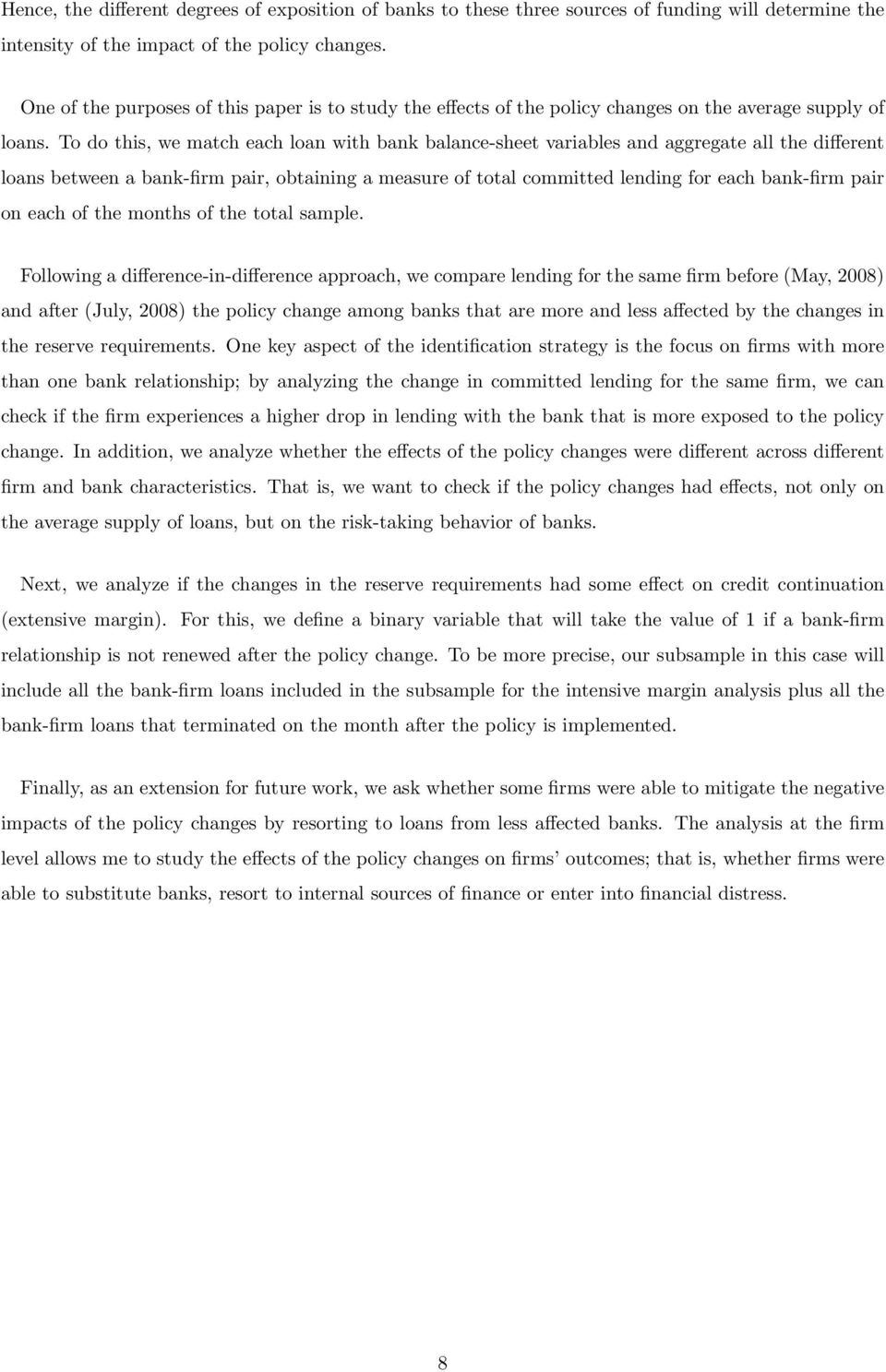
9 Models Intensive Margin - Average and Heterogenous Effects For the analysis of the effects at the loan-level, we estimate two models. The first specification we estimate (Model 1) is the following: logl bf,t+1 = δ i + α 1 controls bf,t 1 + α 2 ST F bf,t 1 + α 3 NRF bf,t 1 + α 4 F BF bf,t 1 + ε bf,t+1 (1) where logl bf,t+1 is the change in the logarithm of (strictly positive) committed credit by bank b to firm f. 4 δ i are industry dummies. The controls bf,t 1 include loan and bank characteristics (the firm s rating given by the bank, and bank balance-sheet information such as Size, Liquidity Ratio, Tier1 Ratio, Doubtful Ratio, and Dollarization Ratio). ST F bf,t 1, NRF bf,t 1, F BF bf,t 1 are the three policy variables of interest: ST F bf,t 1 stands for short-term funding, NRF bf,t 1 is the variable associated to deposits from the non-financial sector that is not located in Uruguay, and F BF bf,t 1 refers to funds from foreign banks. In Model 1, we regress the change in the log of committed credit in July 2008 with respect to May 2008 (the policy change takes effect on June 2008) on a combination of controls at the loan level, the already mentioned bank balance-sheet variables, the three policy variables of interest (short-term funding, funding from the non-resident non-financial sector, and funding from the non-resident financial sector), and industry dummies. The second model we estimate (Model 2) is based on data in deviation with respect to means at the firm level. logl bf,t+1 = α 1 controls bf,t 1 + α 2 ST F bf,t 1 + α 3 NRF bf,t 1 + α 4 F BF bf,t 1 + ε bf,t+1 (2) where all the variables are demeaned by their average across firms. 5 specification with industry dummies. We will also report results of this Both models are estimated for the sample of firms with more than one bank relationship (we also estimate the models for the sample of all bank-firm loans in order to check the external validity of the results). 6 In addition, given that the number of banks is low, clustering standard errors only at the bank level would introduce a downwards bias in their calculation, hence we decided to cluster standard errors at the bank*firm-debt level in order to have a greater number of clusters. The intuition behind 4 We winsorize the dependent variable of both specifications at the 1 st and 99 th percentile. 5 We first compute the sample average of the variables for each firm and then subtract the average from each variable in order to estimate the demeaned model using OLS (fixed effects estimation). 6 Given that the estimations are based on the sample of firms with more than one bank relationship (30% of the total sample), the results we obtain could be specific to these type of firms. In order to see the extent to which the results can be generalized to all the firms included in the sample, we estimate both models for the sample of all loans granted. 9
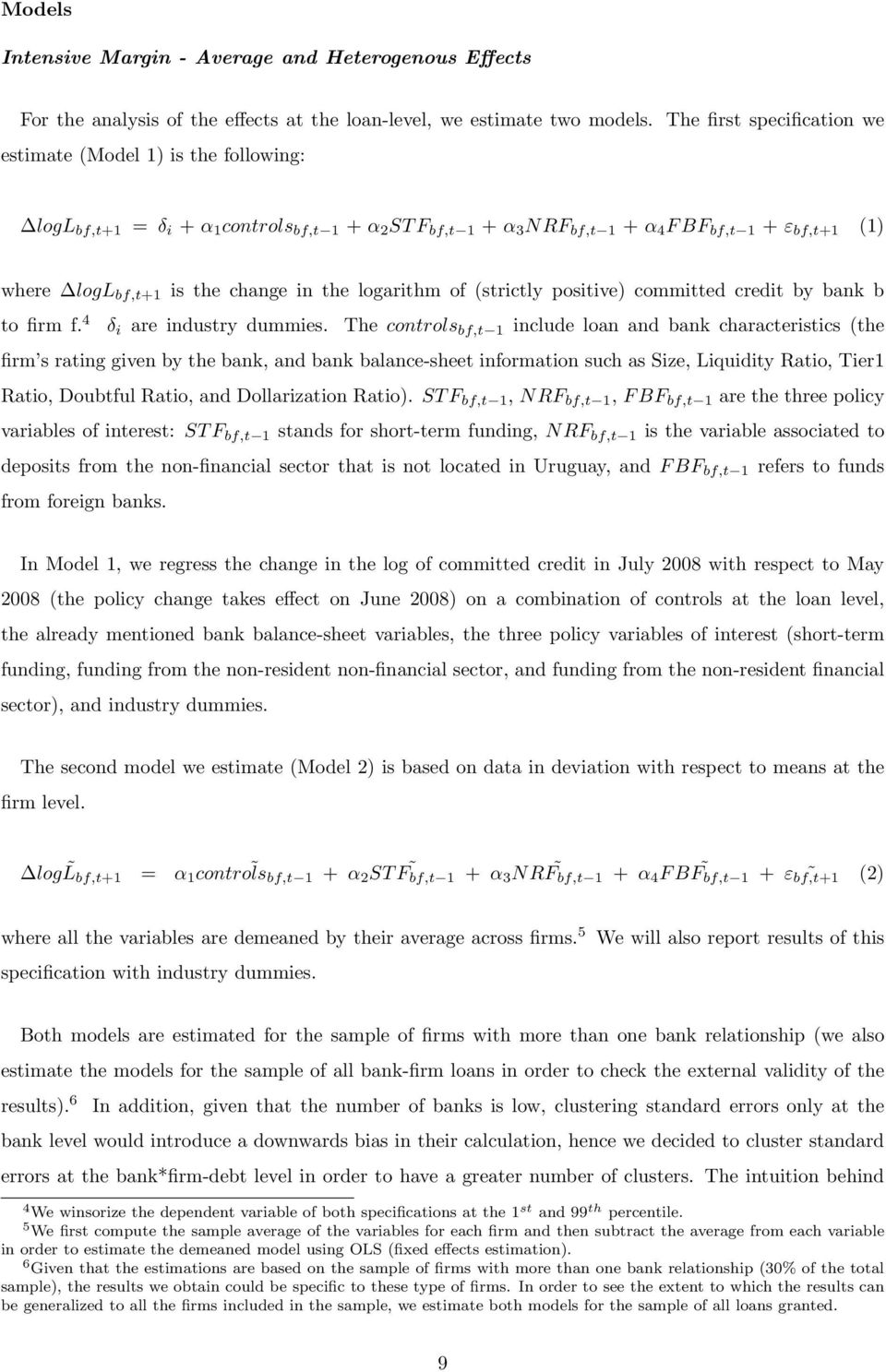
10 this decision is that it is very likely that residuals will be correlated within firms with the same debt size holding a relationship with the same bank. 7 For robustness we will perform: placebo tests for months previous to the introduction of the policies and for the months after June 2008, as well as estimations of both models with a dummy indicating whether the bank is public or private. 8 In addition, we estimate both models for a sample excluding the public bank (given its nature and the fact that it represents almost 50% of the total banking system). In addition to the analysis of the change in committed credit (average effects), we study whether these effects vary across different firm and bank characteristics. In particular, we add interactions of the policy variables with highrisk and highdebt indicators at the firm level. 9 Moreover, we add bank fixed effects and also interact the policy variables with a dummy indicating if the bank is organized as a branch of a foreign institution. Extensive Margin - Average and Heterogenous Effects: Next, we analyze if the policy changes had some effect on the likelihood that a bank-firm pair is not renewed (extensive margin). Under a linear probability model, we study the average and heterogenous effects of the policy changes on the probability that a loan that existed in period t-1 ends before period t+1, both for Model 1 and Model 2. The dependent variable in this case is: 1, if a loan granted by bank b to firm f in period s < t is ended in t LEnd t+1 = 0, otherwise Standard errors are again clustered at the bank*firm-debt level. External Validity As was already mentioned, the firms that hold a relationship with more than one bank represent 30% of the whole sample. One could ask if focusing only on these firms could compromise the external validity of the results (that is, the extent to which the results hold for the whole sample of firms). In order to address this, we will also study the average and heterogenous effects of the policies both on the intensive 7 According to the Uruguayan regulation, a borrower will be classified into different categories according to the size of his debt. The borrower is a highdebt borrower if he has a debt with the bank that represents at least 10% of the minimum capital set by the regulation for banking institutions and the debt with the total system represents at least 15% of the minimum regulatory capital. 8 The idea of the placebo tests is to check that the effect is indeed attributable to the policy changes introduced on June 2008, so we estimate the models with different time windows. If the effects on the supply of credit are attributable only to the changes on the reserve requirements of 2008, the estimated effects under the placebo tests should be insignificant. 9 Highdebt is a dummy that takes the value of one when the bank has reported the firm as a highdebt borrower and 0 if it is a lowdebt borrower. The indicator for highrisk equals 1 if the firm has a rating of 3, 4 or 5, which are the categories for compromised ability to pay, very compromised ability to pay and irrecoverable debt. 10
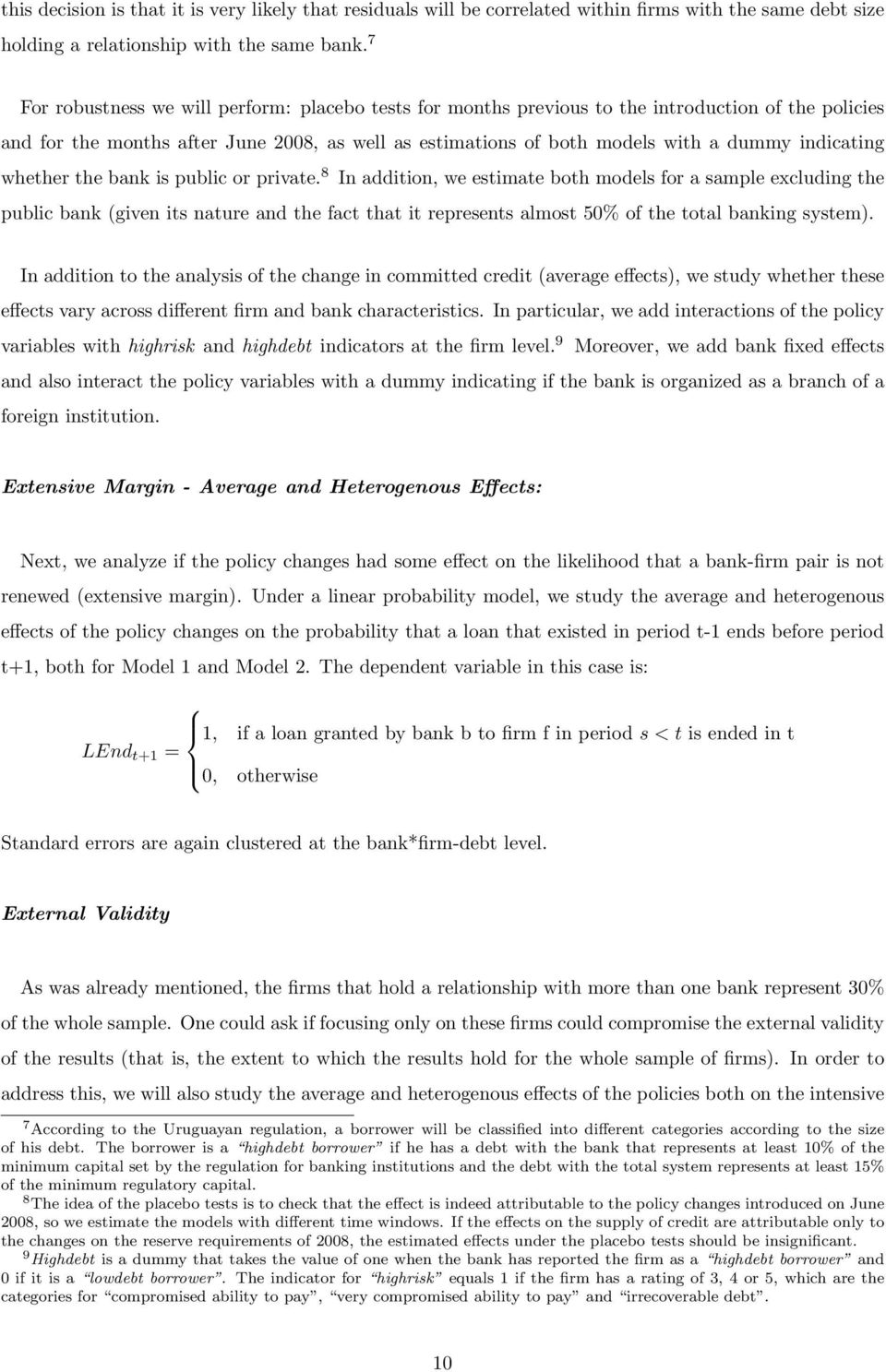
11 and extensive margins. Firm-Level Models Another question is whether some type of firms were able to mitigate the negative impacts of the policy changes by substituting the loan supply of the affected banks with loans from banks less exposed to the funds targeted by the reforms. The setup in this case is: logl f,t+1 = δ i + α 1 controls f,t 1 + α 2 ST F f,t 1 + α 3 NRF f,t 1 + α 4 F BF f,t 1 + ε f,t+1 (3) where logl f,t+1 is the change in the logarithm of (strictly positive) committed credit by all banks to firm f, δ i are industry dummies. 10 The controls f,t 1 include loan and bank characteristics (firm s rating given by the bank, bank balance-sheet information such as Size, Liquidity Ratio, Tier1 Ratio, Doubtful Ratio, Dollarization Ratio), and ST F f,t 1, NRF f,t 1, F BF f,t 1 are the three policy variables of interest. Under the firm-level analysis, all the bank variables are calculated as a weighted average where the weights are given by the portion of loans granted by the banks that were lending to a given firm just before the policy reforms took place over the total loans granted to the firm. 4 Results Tables 1 to 4 display the estimates of the loan-level specifications for the sample of firms with more than one bank relationship (intensive margin). Table 1 presents the results for the estimation of the average effects of the policy changes, while Tables 2 to 4 show the estimates for the impact of the policy changes across different firm and bank characteristics (results of the estimations adding interaction terms of the policy variables with indicators of the risk and debt size of the firms and including bank fixed effects are given respectively in Tables 2 and 3, while Table 4 shows the results of the estimations adding interaction terms of the policy changes with bank characteristics). Next, Tables 5 to 7 display the results of the estimations for the extensive margin of both the average (Table 5) and heterogenous effects (adding interaction terms of the policy variables with firm characteristics in Table 6 and including also bank fixed effects in Table 7) of the policy changes for the sample of firms with more than one bank relationship. 11 Finally, Table 8 presents the estimates for the firm-level specification. Moreover, the results of the placebo tests performed under both specifications for the months before and after the policy changes are presented in Figures 1 to We winsorize the dependent variable of both specifications at the 1 st and 99 th percentile. 11 The results of the estimations for the intensive and extensive margins under the total sample of firms are included in the Appendix. 12 Supplementary graphs of placebo tests for more other time windows are inlcuded in the Appendix. 11
12 Intensive Margin Average Effects Under Model 1 (column (1) of Table 1), the coefficients of the policy variables for short-term funding and funding from foreign banks are both negative and statistically significant for the sample with multiple bank-firm characteristics, while the coefficient for funding from the non-resident non-financial sector, on the other hand, is positive and significant. 13 The estimated effects under Model 1 suggest that the changes in the reserve requirements introduced in Uruguay during the first half of 2008 implied that banks with a higher exposition to the funds affected by the policy changes cut committed lending more than the less exposed banks. In terms of economic significance, these results mean that an increase of 10 pp in the reserve requirements for short-term deposits implies a cut in committed lending of 1,35%, while a 10 pp increase in the requirement for funds from foreign banks translates into a cut in lending of 0,11%. Meanwhile, a 10 pp increase in the reserve requirement for funding from the foreign non-financial sector implies an increase in lending of 0,29%. When we analyze the effects under Model 2 (columns (2) and (3) of Table 4), the coefficients of the three policy variables are negative and statistically significant for the sample with multiple bank-firm characteristics. 14 As for the economic significance, these results imply that a 10 pp increase in the reserve requirements for short-term deposits translates into a cut in committed lending of 1,39%, while a 10 pp increase in the requirements for funds from non-residents and from foreign banks implies a cut in lending of 0,45% and 0,15% respectively. It is important to stress the different impact among the three sources of funding. In particular, the main impact of the policy changes worked through short-term funding, which is consistent with the higher level of participation that these funds have on the liability side of the Uruguayan banking system. 15 In addition, the lower impact of the introduction of a reserve requirement for funds from foreign banks is compatible with the lower level of exposition of Uruguayan banks to this source of funding (although two institutions in particular display a high ratio of funds from foreign banks over total loans in June 2008). An unexpected result is the positive effect of the change in the reserve requirements for deposits from non-residents under the first specification. The comparison of this coefficient with that obtained under the second specification leads to conclude that accounting for firm unobserved characteristics (such as 13 The coefficients for Short-Term Funding, Funding from Non-Residents and Funding from Foreign Banks are -0,135**, 0,029* and -0,011* respectively. 14 The coefficients for Short-Term Funding, Funding from Non-Residents and Funding from Foreign Banks are -0,139*, -0,045** and -0,015** respectively. 15 Before the financial crisis of 2002, the average ratio of short-term deposits over total deposits was 30%, while one of the characteristis of the Uruguayan banking system in the period after the crisis was the increasing participation of short-term deposits, reaching almost 80% of total deposits in June

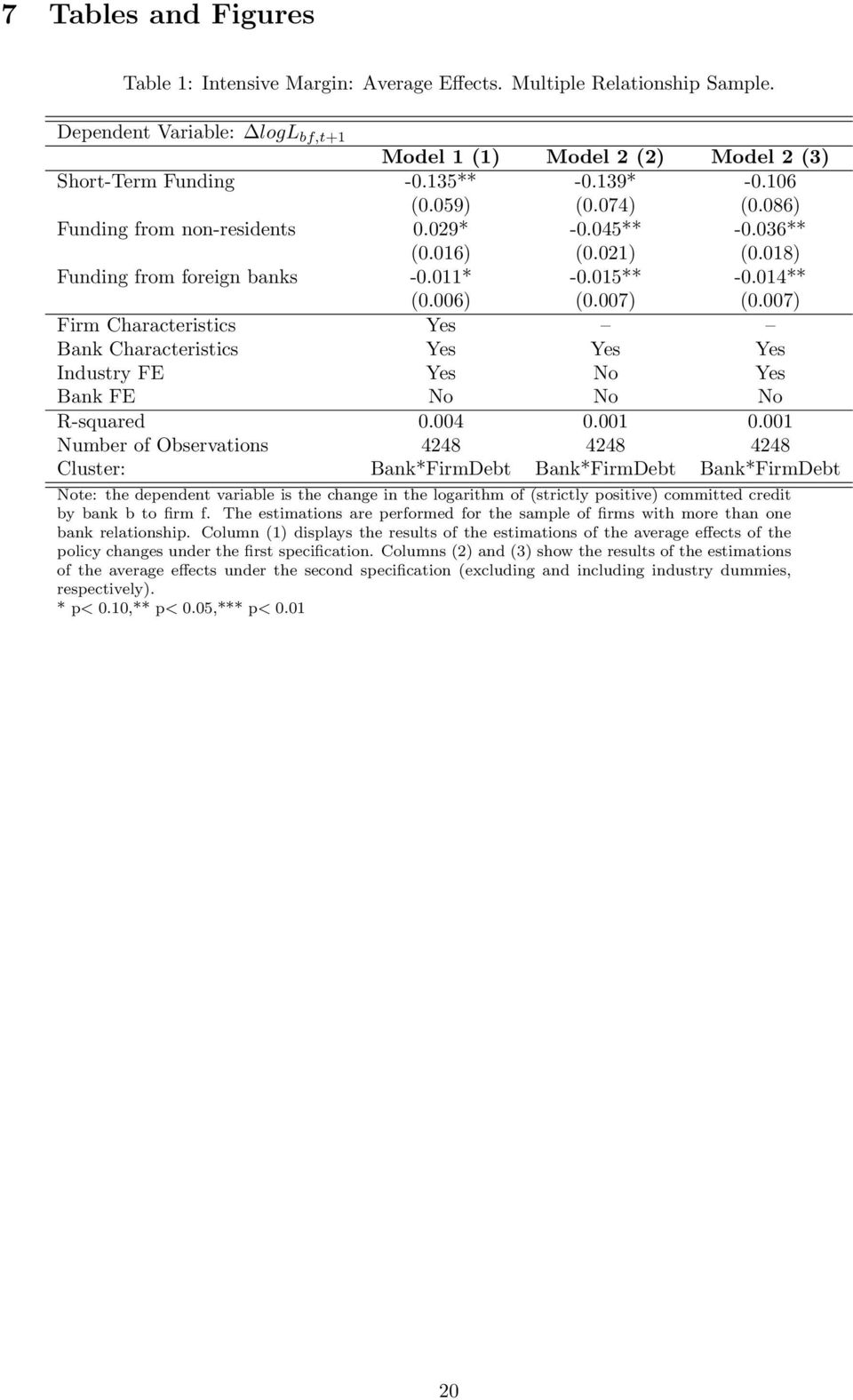
13 the degree of balance sheet dollarization or opennes to international trade) plays an important role in order to better identify the effect of the policy change on this particular source of funding. As a robustness check, we perform placebo tests for both specifications in order to check if the estimated effects are indeed attributable to the reforms introduced in the reserve requirements. Figures 1 to 12 display the estimated coefficients and its corresponding confidence intervals for the three policy changes by altering the time window for periods before and after the policy changes took place. We find that the estimated coefficients are statistically not significant under Model 2, while for Model 1 some coefficients are positive and statistically significant, meaning that the results are better for the second specification (if the effects are attributable to the policy changes, the estimated coefficients for different time windows should be insignificant). 16 In addition, we estimate the models with a dummy for public/private bank and also exluding the public bank (which represents almost 50% of the total banking system), and obtain the same results for the three policy variables. Heterogenous Effects In Tables 2 to 4 we report the results of the estimated effects across different bank and firm characteristics. The results under the first specification (column (1) of Table 2), show that higher risk firms related with banks more exposed to funds from foreign banks experienced a higher cut in lending (-0,028**). When the policy variables are interacted with the indicator for the size of the debt of the borrower, the estimates show a positive impact on firms related with banks more exposed to funding from the foreign non-financial sector (0,049**). Meanwhile, when we introduce bank fixed effects (column (1) of Table 3), the estimated coefficient for the interaction of the indicator of firms risk with funds from foreign banks is -0,028**, while the coefficient of the interaction of non-resident funding with highdebt is 0,048**. These results imply that the effect of the policy changes on the funds that come from abroad worked through a cut in lending for riskier firms and a possible reallocation of some of these funds to firms with a higher level of debt in the system. Moreover, given that the estimated coefficients under the specifications with bank fixed effects are similar, unobserved bank heterogeneity is unlikely to account for the variation in committed lending due to the policy changes. Next, we analyze the results under the second specification (columns (2) and (3) of Tables 2 and 3), in which we also add interaction terms of the policy variables with indicators for: highdebt, highrisk and highdebt*highrisk. We find a negative effect of the policy changes associated to funds from abroad, but the results from this specification suggest that the effect worked through funds from the nonfinancial sector (-0.075*). The economic and statistical significance of the effects remain the same when we add industry dummies (column (3) of Table 2). In addition, we find a positive coefficient for the 16 Out of 159 estimated coefficients, 92% of the cases are statistically not significant under Model 2, while 52% of the cases are statistically not significant under Model 1. 13

14 interaction of non-resident funding with highdebt*highrisk (0.115***) both under the specifications with and without industry dummies. Finally, when we estimate the effects with bank fixed effects we obtain a negative coefficient for the interaction of short-term funding with highdebt*highrisk (-0.508*) and a positive coefficient for the interaction with the policy variable associated with funds from non-residents (0.056**). These results imply that if we account for firm and bank unobservable characteristics, banks that are more exposed to short-term funding will cut committed lending more to riskier firms with a higher level of debt in the banking system. This could be interpreted in the following way: banks that rely more on short-term funding, experience a stronger negative impact after the increase in reserve requirements; as a consequence, the restriction on the funds available to offer as loans could lead to an improvement of the pool of borrowers of these type of institutions. An interesting result is the positive coefficient for the interaction of the policy variable for non-resident funding with highdebt*highrisk, which may be explained by the higher risk-profile of the banks more exposed to funds from non-residents. 17 Finally, we also analyze the change in committed lending across different bank characteristics. The most interesting result we obtain is reported in Table 4, where we interact the policy variables with a dummy for banks that are organized as branches of foreign banks (rather than subsidiaries). 18 We find that the policy changes associated to foreign funds from the non-financial sector affected more negatively the supply of loans of banks that are organized as branches of foreign institutions (-0.059*). This result is consistent with the profile of these institutions, since they are characterized by higher levels of exposition to foreign business. Extensive Margin Average Effects In Table 5 we analyze the average effects of the policy changes on the probability that the bank-firm relationship ends (extensive margin). That is, the question now is whether the frequency with which a bank-firm relationship is not renewed is higher for banks more exposed to the policy changes. Under the first specification (column (1) of Table 8), we find a negative coefficient for the policy variable associated to short-term funding (-0,606***) and a positive coefficient for the policy variable of non-residents funding (0,037**). These results suggest that a 1% reduction in short-term funding leads to a 61 basis points increase in the probability that a loan is not renewed. On the other hand, a 1% reduction in funds from non-residents leads to a 4 basis points decrease in the probability that a loan is not renewed. 17 One of the main characteristics of the Uruguayan banking system on the onset of the financial crisis of 2002 was the high level of participation of deposits from non-residents over total deposits (especially from Argentina), reaching almost 50% on December The negative consequences of the massive withdrawals of these funds during the crisis led to the introduction of prudential policies in order to prevent the systemic risks associated to them. 18 During the period covered by the sample, three banks were organized as branches. 14

15 When we account for firm unobservable characteristics (columns (2) and (3) of Table 5), the negative impact of the higher reserve requirements on short-term funding and on non-residents funding remain statistically and economically significant (-0.670*** and 0.036** respectively). We obtain similar results when we add industry dummies (column (3) of Table 5). Hence, the results for the second specification imply that a 1% reduction in short-term funding leads to a 67 basis points increase in the probability that a bank-firm relationship ends, while a 1% reduction in funds from non-residents implies a 4 basis points reduction in the probability that a loan is not renewed. Heterogenous Effects The results for the heterogenous effects on the extensive margin are reported in Tables 6 and 7. Although the signs of the average effects remain the same, we don t find statistically significant effects of the policies. Overall, the results for the extensive margin are somehow weak, given that the analysis is based only on the immediate or short-run effects of the policy changes. Given this time horizon, it is very unlikely that a bank-firm relationship that existed on June 2008 would stop existing on July However, since two months later our sample includes the events associated with Lehman Brother s Bankruptcy, we decided to focus only on the short-run effects of the policies. External Validity Given our focus on firms with more than one bank relationship and the fact that these represent around 30% of our sample, this could rise concerns about the external validity of the results. In order to analyze this, we estimate the models for the whole sample of bank-firm loans (Tables 9 to 14). We find that the main results hold for the whole sample. In particular, the results for the intensive margin hold both for the average effects and the heterogenous effects (although the coefficients for the average effects of the first two policy variables are not statistically significant under Model 1). The larger coefficients found for the full sample suggest that the bank lending channel may be larger for firms related with a single bank, possibly because these firms may be more subject to a hold-up problem. Meanwhile, when we study the effects of the policy changes on the extensive margin, we find similar results for the average effects but not for the heterogenous effects. Firm-Level Analysis As was previously discussed, the results at the loan-level imply that the policy changes on reserve requirements introduced in Uruguay during the first half of 2008 tightened the supply of credit from banks. An interesting question now is whether some firms were able to mitigate these effects by resorting to loans from less affected institutions. 15

16 The results from the firm-level models (Table 11) show that, while all firms face a bank lending channel, those firms with a higher level of debt in the system are the ones less able to insulate from the negative impact of the policy changes (-0.141*). This result could be explained by a higher level of bank dependence of these type of firms, which would make them more exposed to the lending channel of monetary policy. On the other hand, when we focus on the level of risk associated to firms, in contrast to what we would have expected, we find that higher risk firms experienced a positive impact from the introduction of reserve requirements on funds from foreign banks (0.124*). This is consistent with Diamond and Rajan (JPE, 2001) and Calomiris and Kahn (AER, 1991) predictions: riskier projects are financed with short-term funds. As was discussed in Section 2, projects with potentially low creditworthiness tend to be financed with short-term funding such as funds from other banks. So, given that a higher reserve requirement on these funds diminishes the amount of funds that banks have available to lend, the positive impact we find could be associated to a reallocation of these funds to the less liquid and hence riskier projects. The results at the firm-level suggest that these policy changes may have an impact on the real sector. In future work we will further analyze the effects of the higher reserve requirements on firms decisions, complementing the datasets we have with a survey with balance-sheet information for a sample of nonfinancial firms. 5 Conclusions Although the use of reserve and liquidity requirements as macroprudential tools has been very popular in Latin American economies, there s little evidence about the impact of these policies. In this paper, we study the role of reserve and liquidity requirements as macroprudential tools. In particular, we analyze the effects of the increase in the reserve requirements for different sources of funding on the average supply of credit and on the risk-taking behavior of banks. Uruguay offers an excellent setting to study these effects given the changes introduced in the regulation regarding reserve reguirements in June, 2008 and the comprehensive datasets we have access to. We use a difference-in-difference approach comparing lending before and after the introduction of the policy changes among banks with different degrees of exposition to the funds targeted by the policies. The results on the intensive margin suggest that the main assumptions of the bank lending channel of monetary policy hold: Modigliani and Miller propositions are not satisfied for banks. In particular, increases in reserve and liquidity requirements for different sources of funding (short-term funding, funds from the foreign non-financial sector and funds from foreign banks) have an impact on non-financial firms 16

17 through changes in banks lending behavior. The cut in committed lending is higher for firms with higher levels of risk and debt in the system and that are more related to banks that rely more on short-term funding. In addition, when analyzing the effect of the policies across different bank characteristics, we find that those banks organized as branches of foreign institutions were the ones more affected by the increase in reserve requirements for funds from the non-financial foreign sector. However, given the focus on the short-run effects of the policies, the impacts on the extensive margin are not as significant as those found in the intensive margin. These policies may also have real costs for corporate firms. When we analyze the effects of the higher reserve requirements at the firm level, we find that firms with a higher level of debt in the system are less able to insulate from the negative impact of the policy changes. This is a relevant conclusion for an economy like Uruguay, where the development of the capital market is in a very early stage and, as a consecuence, bank financing plays a key role in the investment decisions of firms. The results of this study entail policy implications for macroprudential regulation. Although restrictions to short-term funding by banks may contribute to prevent threats that can later translate into risk propagation among the banking system, the strong reliance of banks on these type of funds plays an important role on the lending behavior of these institutions. As a consequence, the new standards proposed by Basel III may have a cost and, as predicted by Diamond and Rajan (JPE, 2001) and Calomiris and Kahn (AER, 1991), restrictions to short-term finance from banks imply a reduction of credit availability. 17
18 6 References Bernanke, Ben and Blinder, Alan (1988), Credit, Money, and Aggregate Demand, American Economic Review, 78(2): Blanchard, Olivier, Dell Ariccia Giovanni, Mauro, Paolo (2013), Rethinking Macro Policy II: Getting Granular, IMF Staff Discussion Note. Borio, Claudio (2003), Towards a Macroprudential Framework for Financial Supervision and Regulation, Bank for International Settlements (BIS), WP N o 128. Calomiris, Charles and Kahn, Charles (1991), Role of Demandable Debt in Structuring Optimal Banking Arrangements, American Economic Review, 81(3): BCU, Regulation Acts from the Central Bank of Uruguay. Gambacorta, Leonardo, and David Marques-Ibanez (2011), The Bank Lending Channel: Lessons from the Crisis, Bank for International Settlements (BIS), WP N o 345. Goodhart, Charles, and Perotti, Enrico (2012), Preventive Macroprudential Policy, Column Vox.eu Hanson, Samuel, Kashyap, Anil, Stein, Jeremy (2011), A Macroprudential Approach to Financial Regulation, Journal of Economic Perspectives 25, Jiménez, Gabriel, Ongena, Steven, Peydró, José-Luis, Saurina (2013), Macroprudential Policy, Countercyclical Bank Capital Buffers and Credit Supply: Evidence from the Spanish Dynamic Provisioning Experiments, European Banking Center Discussion Paper N o Jiménez, Gabriel, Ongena, Steven, Peydró, José-Luis, Saurina (2012), Credit Supply and Monetary Policy: Identifying the Bank Balance-Sheet Channel with Loan Applications, American Economic Review Kashyap, Anil, and Stein, Jeremy (2000), What do a Million Observations on Banks Say About the Transmission of Monetary Policy, American Economic Review 90(3): Khwaja, Asim, and Mian, Atif (2008), Tracing the Impact of Bank Liquidity Shocks: Evidence from and Emerging Market, American Economic Review 98(4): Stein, Jeremy (1998), An Adverse Selection Model of Bank Asset and Liability Management with Im- 18

19 plications for the Transmission of Monetary Policy, RAND Journal of Economics 29(3): Rajan, Raghuram, and Diamond, Douglas (2001), Liquidity Risk, Liquidity Creation, and Financial Fragility: A Theory of Banking, Journal of Political Economy 109(2): Rajan, Raghuram, and Diamond, Douglas (2001), Banks, Short Term Debt and Financial Crises: Theory, Policy Implications and Applications, Carnegie-Rochester Conference Series on Public Policy, 54(1):

20 7 Tables and Figures Table 1: Intensive Margin: Average Effects. Multiple Relationship Sample. bf,t+1 Model 1 (1) Model 2 (2) Model 2 (3) Short-Term Funding ** * (0.059) (0.074) (0.086) Funding from non-residents 0.029* ** ** (0.016) (0.021) (0.018) Funding from foreign banks * ** ** (0.006) (0.007) (0.007) Firm Characteristics Yes Bank Characteristics Yes Yes Yes Industry FE Yes No Yes Bank FE No No No R-squared Number of Observations Cluster: Bank*FirmDebt Bank*FirmDebt Bank*FirmDebt Note: the dependent variable is the change in the logarithm of (strictly positive) committed credit by bank b to firm f. The estimations are performed for the sample of firms with more than one bank relationship. Column (1) displays the results of the estimations of the average effects of the policy changes under the first specification. Columns (2) and (3) show the results of the estimations of the average effects under the second specification (excluding and including industry dummies, respectively). * p< 0.10,** p< 0.05,*** p<
21 Table 2: Intensive Margin: Heterogenous Effects (firm characteristics). Multiple Relationship Sample. Dependent Variable: loglbf,t+1 Model 1 (1) Model 2 (2) Model 2 (3) Short-Term Funding (0.196) (0.447) (0.441) Funding from non-residents (0.017) (0.031) (0.030) Funding from foreign banks (0.016) (0.025) (0.025) Short-term funding * highrisk (0.057) (0.555) (0.556) Fun. non-residents * highrisk * * (0.003) (0.042) (0.042) Fun. foreign banks * highrisk *** (0.005) (0.033) (0.033) Short-term funding * highdebt (0.233) (0.668) (0.671) Fun. non-residents * highdebt 0.049** ** ** (0.018) (0.039) (0.038) Fun. foreign banks * highdebt (0.023) (0.040) (0.041) Short-term funding * highdebt*highrisk (0.575) (0.582) Fun. non-residents * highdebt*highrisk 0.115*** 0.115*** (0.038) (0.038) Fun. foreign banks * highdebt*highrisk (0.046) (0.046) Firm Characteristics Yes Industry Dummies Yes No Bank Characteristics Yes Yes Yes Bank Fe No No No R-squared Number of Observations Cluster: Bank*FirmDebt Bank*FirmDebt Bank*FirmDebt Note: the dependent variable is the change in the logarithm of (strictly positive) committed credit by bank b to firm f. The estimations are performed for the sample of firms with more than one bank relationship. Column (1) displays the results of the estimations under the first specification including interaction terms of the policy variables with indicators of firms risk level (highrisk) and debt size (highdebt). Columns (2) and (3) show the results under the second specification including also interaction terms of the policy variables with highrisk*highdebt (excluding and including industry dummies, respectively). * p< 0.10,** p< 0.05,*** p<
22 Table 3: Intensive Margin: Heterogenous Effects (firm characteristics). Bank FE.. Multiple Relationship Sample. Dependent Variable: loglbf,t+1 Model 1 (1) Model 2 (2) Model 2 (3) Short-term funding*highrisk (0.060) (0.337) (0.340) Fun. non-residents*highrisk (0.003) (0.031) (0.031) Fun. foreign banks*highrisk *** (0.005) (0.026) (0.025) Short-term funding*highdebt (0.233) (0.407) (0.433) Fun. non-residents*highdebt 0.048** (0.018) (0.023) (0.024) Fun. foreign banks*highdebt (0.023) (0.030) (0.030) Short-term funding * highdebt*highrisk * (0.280) (0.310) Fun. non-residents * highdebt*highrisk 0.056** (0.022) (0.023) Fun. foreign banks * highdebt*highrisk (0.036) (0.036) Firm Characteristics Yes Bank Characteristics No No No Industry FE Yes No No Bank FE Yes Yes Yes R-squared Number of Observations Cluster: Bank*FirmDebt Bank*FirmDebt Bank*FirmDebt Note: the dependent variable is the change in the logarithm of (strictly positive) committed credit by bank b to firm f. The estimations are performed for the sample of firms with more than one bank relationship. Column (1) displays the results of the estimations under the first specification including interaction terms of the policy variables with indicators of firms risk level (highrisk) and debt size (highdebt) and also including bank fixed effects. Columns (2) and (3) show the results under the second specification including also interaction terms of the policy variables with highrisk*highdebt and bank fixed effects (excluding and including industry dummies, respectively). * p< 0.10,** p< 0.05,*** p<
23 Table 4: Intensive Margin: Heterogenous Effects (bank characteristics). Multiple Relationship Sample. Dependent Variable: loglbf,t+1 Model 2 (1) Model 2 (2) Short-Term Funding * (0.085) (0.108) Funding from non-residents 0.017*** 0.019*** (0.005) (0.006) Funding from foreign banks (0.008) (0.008) Short-Term Funding*Branch (0.210) (0.238) Funding from non-residents*branch * (0.034) (0.035) Funding from foreign banks*branch (0.017) (0.017) Firm Characteristics Bank Characteristics Yes Yes Industry FE No No Bank FE No No R-squared Number of Observations Cluster: Bank*FirmDebt Bank*FirmDebt Note: the dependent variable is the change in the logarithm of (strictly positive) committed credit by bank b to firm f. The estimations are performed for the sample of firms with more than one bank relationship. Column (1) displays the results of the estimations under the first specification including interaction terms of the policy variables with an indicator for whether the bank is organized as a branch. Column (2) shows the results under the second specification including interaction terms of the policy variables with an indicator for whether the bank is organized as a branch. * p< 0.10,** p< 0.05,*** p<
24 Table 5: Extensive Margin: Average Effects. Multiple Relationship Sample. Dependent Variable: LEndbf,t+1 Model 1 (1) Model 2 (2) Model 2 (3) Short-Term Funding *** *** *** (0.145) (0.177) (0.181) Funding from non-residents 0.037** 0.036** 0.038** (0.015) (0.015) (0.015) Funding from foreign banks (0.010) (0.011) (0.011) Firm Characteristics Yes Bank Characteristics Yes Yes Yes Industry FE Yes No Yes Bank FE No No No R-squared Number of Observations Cluster: Bank*FirmDebt Bank*FirmDebt Bank*FirmDebt Note: the dependent variable takes the value of 1 if a loan that existed in period t 1 ends before period t + 1 and 0 otherwise. The estimations are performed following a linear probability model for the sample of firms with more than one bank relationship. Column (1) displays the results of the estimations under the first specification, while Columns (2) and (3) show the results under the second specification (excluding and including industry dummies, respectively). * p< 0.10,** p< 0.05,*** p<
25 Table 6: Extensive Margin: Heterogenous Effects (firm characteristics). Multiple Relationship Sample. Dependent Variable: LEndbf,t+1 Model 1 (1) Model 2 (2) Model 2 (3) Short-Term Funding (0.249) (0.317) (0.316) Funding from non-residents ** 0.051** (0.017) (0.024) (0.024) Funding from foreign banks (0.012) (0.021) (0.022) Short-term funding * highrisk (0.223) (0.211) (0.211) Fun. non-residents * highrisk (0.012) (0.011) (0.011) Fun. foreign banks * highrisk (0.010) (0.017) (0.017) Short-term funding * highdebt (0.175) (0.280) (0.281) Fun. non-residents * highdebt (0.014) (0.025) (0.025) Fun. foreign banks * highdebt (0.011) (0.020) (0.020) Firm Characteristics Yes Bank Characteristics Yes Yes Yes Industry FE Yes No Yes Bank FE No No No R-squared Number of Observations Cluster: Bank*FirmDebt Bank*FirmDebt Bank*FirmDebt Note: the dependent variable takes the value of 1 if a loan that existed in period t 1 ends before period t + 1 and 0 otherwise. The estimations are performed following a linear probability model for the sample of firms with more than one bank relationship. Column (1) displays the results of the estimations under the first specification including interaction terms of the policy variables with indicators of firms risk level (highrisk) and debt size (highdebt). Columns (2) and (3) show the results under the second specification including also interaction terms of the policy variables with highrisk*highdebt (excluding and including industry dummies, respectively). * p< 0.10,** p< 0.05,*** p<
26 Table 7: Extensive Margin: Heterogenous Effects (firm characteristics). Bank FE. Multiple Relationship Sample. Dependent Variable: LEndbf,t+1 Model 1 (1) Model 2 (2) Model 2 (2) Short-term funding*highrisk (0.213) (0.157) (0.157) Fun. non-residents*highrisk (0.011) (0.008) (0.008) Fun. foreign banks*highrisk (0.010) (0.015) (0.015) Short-term funding*highdebt * (0.136) (0.242) (0.252) Fun. non-residents*highdebt (0.011) (0.018) (0.019) Fun. foreign banks*highdebt (0.009) (0.023) (0.022) Firm Characteristics Yes Bank Characteristics No No No Industry FE No No No Bank FE Yes Yes Yes R-squared Number of Observations Cluster: Bank Bank Bank Note: the dependent variable takes the value of 1 if a loan that existed in period t 1 ends before period t + 1 and 0 otherwise. The estimations are performed following a linear probability model for the sample of firms with more than one bank relationship. Column (1) displays the results of the estimations under the first specification including interaction terms of the policy variables with indicators of firms risk level (highrisk) and debt size (highdebt) and also including bank fixed effects. Columns (2) and (3) show the results under the second specification including also interaction terms of the policy variables with highrisk*highdebt and bank fixed effects. * p< 0.10,** p< 0.05,*** p<
27 Table 8: Firm-Level Analysis Dependent Variable: loglf,t+1 Firm-Level Model (1) Firm-Level Model (2) Firm-Level Model (3) Short-Term Funding (0.574) (0.637) (0.963) Funding from non-residents (0.153) (0.092) (0.202) Funding from foreign banks * ** (0.040) (0.063) (0.053) Short-Term Funding*Highdebt Funding from non-residents*highdebt * (0.082) Funding from foreign banks*highdebt (0.078) Short-Term Funding*Highrisk (0.876) Funding from non-residents*highrisk (0.072) Funding from foreign banks*highrisk 0.124** (0.049) Bank Characteristics Yes Yes Yes Industry Dummies Yes Yes Yes R-squared Number of Observations Cluster: Bank*FirmDebt Bank*FirmDebt Bank*FirmDebt Note: the dependent variable is the change in the logarith of (strictly positive) committed cedit by all banks to firm f. The estimations are performed for the sample of firms with more than one bank relationship. Column (1) displays the results of the estimations including industry dummies and banks characteristics, while Columns (2) and (3) include interaction terms of the policy variables with highdebt and highrisk indicators, respectively. Under the firm-level specification, all the bank variables are calculated as a weighted average where the weights are given by the portion of loans granted by the banks that were lending to a given firm just before the policy reforms took place over the total loans granted to the firm. * p< 0.10,** p< 0.05,*** p<
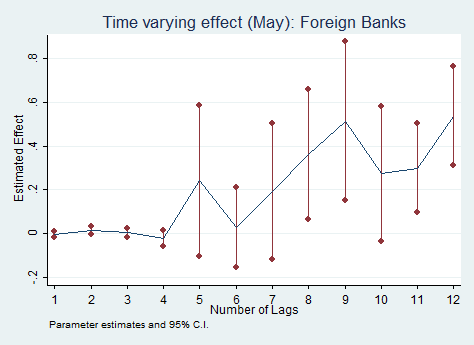
28 Figure 1: Placebo Tests - Model 1. Period July-December, Note: each graph displays the estimated coefficient and its corresponding confidence interval. The horizontal axis displays the different time windows used in the regressions under Model 1 for the months after the policy changes were introduced (e.g. change in the log of committed lending between August and July 2008). Figure 2: Placebo Tests - Model 1. Period May2008-May2007. Note: each graph displays the estimated coefficient and its corresponding confidence interval. The horizontal axis displays the different time windows used in the regressions under Model 1 for the months before the policy changes were introduced (e.g. change in the log of committed lending between May and April 2008). 28
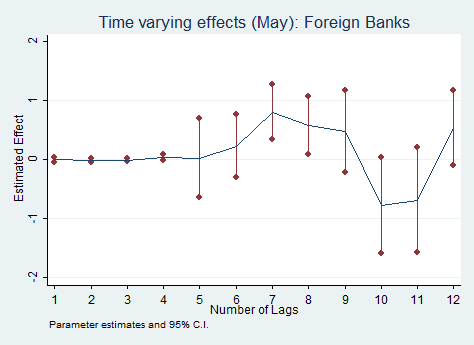
29 Figure 3: Placebo Tests - Model 2. Period July-December, Note: each graph displays the estimated coefficient and its corresponding confidence interval. The horizontal axis displays the different time windows used in the regressions under Model 2 for the months after the policy changes were introduced (e.g. change in the log of committed lending between August and July 2008). Figure 4: Placebo Tests - Model 2. Period May2008-May2007. Note: each graph displays the estimated coefficient and its corresponding confidence interval. The horizontal axis displays the different time windows used in the regressions under Model 2 for the months before the policy changes were introduced (e.g. change in the log of committed lending between May and April 2008). 29
30 8 Appendix Table 1: Definitions of dependent and independent variables. Loan-Level Analysis Variable Definition Dependent Variables (bank-firm) logljul08 Change in the logarithm of (striclty positive) commmitted credit granted by bank b to firm f between July and May, Lend =1 if the bank-firm relationship ends during the period July-May, 2008, =0 otherwise. Policy Variables Short-Term Funding Logarithm of short-term funds of bank b at May, Funds from Non-Residents Logarithm of funds from non-resident non-financial sector of bank b at May, Funds from Foreign Banks Logarithm of funds from foreign banks of bank b at May, Other variables Ln(Total Assets) Logarithm of total assets of bank b at May, Tier1 Ratio Ratio of Tier I Capital of bank b at May, Dollarization Ratio Foreign Currency Deposits over Total Deposits of bank b at May, Liquidity Ratio Liquidi Assets 30d/Total Assets Doubtful Ratio Ratio of non-performing loans over total loans of bank b at May, Provisions Ratio Ratio of Provisions over total loans of bank b at May, Public Bank =1 if bank b is public, =0 otherwise. highdebt =1 if firm f is classified as a highdebt borrower, =0 otherwise. highrisk =1 if firm f has a rating of 3, 4 or 5, =0 otherwise. Firm-Level Analysis Variable Definition Dependent Variables (bank-firm) logljul08 Change in the logarithm of (striclty positive) commmitted credit granted by all banks to firm f between July and May,
31 Table 2: Summary Statistics: Dependent Variables Variable Mean Std. Dev. Min. Max. logljul LEndjul Table 3: Summary Statistics: Independent Variables Variable Mean Std. Dev. Min. Max. Loan-Level Characteristics Ln(Loan Amount) Collateralized Loan Only one bank More than one bank Ln(1+number of months) Currency Local Currency Foreign Currency Maturity Maturity < 1 year Maturity 1-3 years Maturity > 3 years Performing/Non-Performing Performing Non-performing ( days) Non-performing ( days) Non-performing (180 days-2 years) Written-off Rating Bad Rating Good Rating Industry Primary Sector Industry Commerce Continued on next page... 31
32 ... table 11 continued Variable Mean Std. Dev. Min. Max. Construction Services Others Bank-Level Characteristics Ln(Total Assets) Liquidity Ratio Tier1 Ratio ROA Doubtful Ratio Provisions Ratio Leverage Ratio Loan to Assets Ratio Dollarization Ratio Ln(Short-Term Deposits) Ln(Non-Resident Deposits) Ln(Funds from Foreign Banks)
33 Figure 1: Short-Term Funding Note: each column corresponds to a bank. Figure 2: Deposits from Non-Residents Note: each column corresponds to a bank. 33
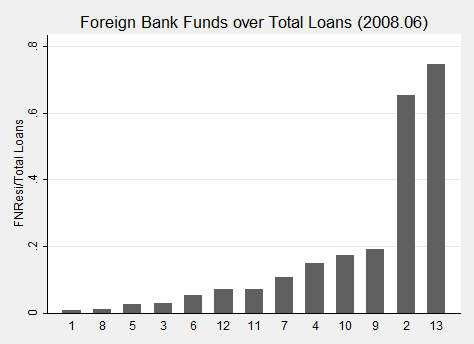
34 Figure 3: Funds from Foreign Banks Note: each column corresponds to a bank. 34
35 Table 1: Intensive Margin: Average Effects. Total Sample. Dependent Variable: loglbf,t+1 Model 1 (1) Model 2 (2) Model 2 (3) Short-Term Funding (0.039) (0.084) (0.084) Funding from non-residents ** ** (0.012) (0.014) (0.014) Funding from foreign banks ** *** *** (0.003) (0.007) (0.007) Firm Characteristics Yes Bank Characteristics Yes Yes Yes Industry FE No No Yes Bank FE No No No R-squared Number of Observations Cluster: Bank*FirmDebt Bank*FirmDebt Bank*FirmDebt Note: the dependent variable is the change in the logarithm of (strictly positive) committed credit by bank b to firm f. The estimations are performed for the whole sample of firms. Column (1) displays the results of the estimations of the average effects of the policy changes under the first specification. Columns (2) and (3) show the results of the estimations of the average effects under the second specification (excluding and including industry dummies, respectively). * p< 0.10,** p< 0.05,*** p<
36 Table 2: Intensive Margin: Heterogenous Effects (firm characteristics). Total Sample. Dependent Variable: loglbf,t+1 Model 1 (1) Model 2 (2) Model 2 (3) Short-Term Funding 0.236* (0.132) (0.410) (0.406) Funding from non-residents * 0.052* (0.014) (0.026) (0.026) Funding from foreign banks ** (0.013) (0.027) (0.028) Short-term funding * highrisk (0.058) (0.474) (0.479) Fun. non-residents * highrisk ** ** ** (0.003) (0.039) (0.040) Fun. foreign banks * highrisk * (0.005) (0.029) (0.029) Short-term funding * highdebt ** (0.145) (0.446) (0.457) Fun. non-residents * highdebt 0.048*** ** ** (0.014) (0.029) (0.029) Fun. foreign banks * highdebt 0.033** (0.015) (0.051) (0.051) Short-term funding * highdebt*highrisk (0.431) (0.431) Fun. non-residents * highdebt*highrisk 0.103** 0.102** (0.039) (0.039) Fun. foreign banks * highdebt*highrisk (0.050) (0.049) Firm Characteristics Yes Bank Characteristics Yes Yes Yes Industry FE No No Yes Bank FE No No No R-squared Number of Observations Cluster: Bank*FirmDebt Bank*FirmDebt Bank*FirmDebt Note: the dependent variable is the change in the logarithm of (strictly positive) committed credit by bank b to firm f. The estimations are performed for the whole sample of firms. Column (1) displays the results of the estimations under the first specification including interaction terms of the policy variables with indicators of firms risk level (highrisk) and debt size (highdebt). Columns (2) and (3) show the results under the second specification including also interaction terms of the policy variables with highrisk*highdebt (excluding and including industry dummies, respectively). * p< 0.10,** p< 0.05,*** p<
37 Table 3: Intensive Margin: Heterogenous Effects (firm characteristics). Bank FE. Total Sample. Dependent Variable: loglbf,t+1 Model 1 (1) Model 2 (2) Model 2 (3) Short-term funding*highrisk (0.059) (0.353) (0.369) Fun. non-residents*highrisk ** (0.003) (0.028) (0.030) Fun. foreign banks*highrisk * (0.005) (0.025) (0.024) Short-term funding*highdebt ** (0.146) (0.260) (0.257) Fun. non-residents*highdebt 0.048*** (0.015) (0.015) (0.015) Fun. foreign banks*highdebt 0.032** (0.015) (0.031) (0.031) Short-term funding * highdebt*highrisk (0.299) (0.309) Fun. non-residents * highdebt*highrisk (0.025) (0.026) Fun. foreign banks * highdebt*highrisk (0.031) (0.030) Firm Characteristics Yes Bank Characteristics No No No Industry FE No No Yes Bank FE Yes Yes Yes R-squared Number of Observations Cluster: Bank*FirmDebt Bank*FirmDebt Bank*FirmDebt Note: the dependent variable is the change in the logarithm of (strictly positive) committed credit by bank b to firm f. The estimations are performed for the whole sample of firms. Column (1) displays the results of the estimations under the first specification including interaction terms of the policy variables with indicators of firms risk level (highrisk) and debt size (highdebt) and also including bank fixed effects. Columns (2) and (3) show the results under the second specification including also interaction terms of the policy variables with highrisk*highdebt and bank fixed effects (excluding and including industry dummies, respectively). * p< 0.10,** p< 0.05,*** p<
38 Table 4: Extensive Margin: Average Effects. Total Sample. Dependent Variable: LEndt+1 Model 1 (1) Model 2 (2) Model 2 (3) Short-Term Funding *** * * (0.160) (0.243) (0.241) Funding from non-residents 0.028* (0.017) (0.017) (0.016) Funding from foreign banks (0.013) (0.010) (0.012) Firm Characteristics Yes Bank Characteristics Yes Yes Yes Industry FE Yes No Yes Bank FE No No No R-squared Number of Observations Cluster: Bank*FirmDebt Bank*FirmDebt Bank*FirmDebt Note: the dependent variable takes the value of 1 if a loan that existed in period t 1 ends before period t + 1 and 0 otherwise. The estimations are performed following a linear probability model for the whole sample of firms. Column (1) displays the results of the estimations under the first specification, while Columns (2) and (3) show the results under the second specification (excluding and including industry dummies, respectively). * p< 0.10,** p< 0.05,*** p<
39 Table 5: Extensive Margin: Hetereogenous Effects. Total Sample Dependent Variable: LEndt+1 Model 1 (1) Model 2 (2) Model 2 (2) Short-Term Funding (0.280) (0.314) (0.316) Funding from non-residents * 0.044* (0.017) (0.024) (0.024) Funding from foreign banks * (0.009) (0.022) (0.023) Short-term funding * highrisk * (0.242) (0.236) (0.236) Fun. non-residents * highrisk (0.013) (0.009) (0.009) Fun. foreign banks * highrisk (0.015) (0.016) (0.016) Short-term funding * highdebt (0.206) (0.346) (0.343) Fun. non-residents * highdebt (0.012) (0.030) (0.030) Fun. foreign banks * highdebt (0.013) (0.019) (0.019) Firm Characteristics Yes Bank Characteristics Yes Yes Yes Industry FE Yes No Yes Bank FE No No No R-squared Number of Observations Cluster: Bank*FirmDebt Bank*FirmDebt Bank*FirmDebt Note: the dependent variable takes the value of 1 if a loan that existed in period t 1 ends before period t + 1 and 0 otherwise. The estimations are performed following a linear probability model for the whole sample of firms. Column (1) displays the results of the estimations under the first specification including interaction terms of the policy variables with indicators of firms risk level (highrisk) and debt size (highdebt). Columns (2) and (3) show the results under the second specification including also interaction terms of the policy variables with highrisk*highdebt (excluding and including industry dummies, respectively). * p< 0.10,** p< 0.05,*** p<
40 Table 6: Extensive Margin: Heterogenous Effects (firm characteristics). Bank FE. Total Sample Dependent Variable: LEndt+1 Model 1 (1) Model 2 (2) Model 2 (3) Short-term funding*highrisk (0.251) (0.164) (0.162) Fun. non-residents*highrisk (0.013) (0.006) (0.006) Fun. foreign banks*highrisk (0.015) (0.012) (0.012) Short-term funding*highdebt (0.179) (0.336) (0.339) Fun. non-residents*highdebt (0.011) (0.020) (0.020) Fun. foreign banks*highdebt (0.011) (0.023) (0.023) Firm Characteristics Yes Bank Characteristics No No No Industry FE No No No Bank FE Yes Yes Yes R-squared Number of Observations Cluster: Bank*FirmDebt Bank*FirmDebt Bank*FirmDebt Note: the dependent variable takes the value of 1 if a loan that existed in period t 1 ends before period t + 1 and 0 otherwise. The estimations are performed following a linear probability model for the whole sample of firms. Column (1) displays the results of the estimations under the first specification including interaction terms of the policy variables with indicators of firms risk level (highrisk) and debt size (highdebt) and also including bank fixed effects. Columns (2) and (3) show the results under the second specification including also interaction terms of the policy variables with highrisk*highdebt and bank fixed effects. * p< 0.10,** p< 0.05,*** p<

41 Figure 1: Placebo Tests - Model 1: Months previous to the Policy Change. (Period April2008-April2007). Note: each graph displays the estimated coefficient and its corresponding confidence interval. The horizontal axis displays the different time windows used in the regressions under Model 1 for the months before the policy changes were introduced (e.g. change in the log of committed lending between April and March 2008). Figure 2: Placebo Tests - Model 1: Months previous to the Policy Change. (Period March2008-March2007). Note: each graph displays the estimated coefficient and its corresponding confidence interval. The horizontal axis displays the different time windows used in the regressions under Model 1 for the months before the policy changes were introduced (e.g. change in the log of committed lending between March and February 2008). 41

42 Figure 3: Placebo Tests - Model 1: Months previous to the Policy Change. (Period February2008-February2007). Note: each graph displays the estimated coefficient and its corresponding confidence interval. The horizontal axis displays the different time windows used in the regressions under Model 1 for the months before the policy changes were introduced (e.g. change in the log of committed lending between February and January 2008). Figure 4: Placebo Tests - Model 1: Months previous to the Policy Change. (Period January2008-January2007). Note: each graph displays the estimated coefficient and its corresponding confidence interval. The horizontal axis displays the different time windows used in the regressions under Model 1 for the months before the policy changes were introduced (e.g. change in the log of committed lending between January 2008 and December 2007). Figure 5: Placebo Tests - Model 2: Months previous to the Policy Change. (Period April2008-April2007). Note: each graph displays the estimated coefficient and its corresponding confidence interval. The horizontal axis displays the different time windows used in the regressions under Model 2 for the months before the policy changes were introduced (e.g. change in the log of committed lending between April and March 2008). 42

43 Figure 6: Placebo Tests - Model 2: Months previous to the Policy Change. (Period March2008-March2007). Note: each graph displays the estimated coefficient and its corresponding confidence interval. The horizontal axis displays the different time windows used in the regressions under Model 2 for the months before the policy changes were introduced (e.g. change in the log of committed lending between March and February 2008). Figure 7: Placebo Tests - Model 2: Months previous to the Policy Change. (Period February2008-February2007). Note: each graph displays the estimated coefficient and its corresponding confidence interval. The horizontal axis displays the different time windows used in the regressions under Model 2 for the months before the policy changes were introduced (e.g. change in the log of committed lending between February and January 2008). Figure 8: Placebo Tests - Model 2: Months previous to the Policy Change. (Period January2008-January2007). Note: each graph displays the estimated coefficient and its corresponding confidence interval. The horizontal axis displays the different time windows used in the regressions under Model 2 for the months before the policy changes were introduced (e.g. change in the log of committed lending between January 2008 and December 2007). 43
DOES COMMERCIAL BANK LENDING INCITE GROWTH? THE IMPACT OF COMMERCIAL LENDING ON REAL SECTOR GROWTH IN NIGERIA
 DOES COMMERCIAL BANK LENDING INCITE GROWTH? THE IMPACT OF COMMERCIAL LENDING ON REAL SECTOR GROWTH IN NIGERIA Paul Ojeaga Bergamo University, Italy [email protected] Omosefe Odejimi Igbinedion University
Chart 9.1 Non-performing loans ratio and structure of non-performing loans (right) 25% 80 06/08 03/11 03/09 12/07 12/08 06/09 09/09 12/09 09/08 06/11
 Financial Stability Report 21 H1 9. MONITORING BANKING SECTOR RISKS 9.1 CREDIT RISK (88) Loan portfolio quality improved and banks were more active in writingoff the loss loans from their balance sheets.
Funds Transfer Pricing A gateway to enhanced business performance
 Funds Transfer Pricing A gateway to enhanced business performance Jean-Philippe Peters Partner Governance, Risk & Compliance Deloitte Luxembourg Arnaud Duchesne Senior Manager Governance, Risk & Compliance
The global financial crisis which began in the
 What is responsible for the easing of credit standards before the crisis: monetary policy or the savings glut? Adrian Penalver Monetary and Financial Analysis Directorate This letter presents the findings
Economic Commentaries
 n Economic Commentaries In its Financial Stability Report 214:1, the Riksbank recommended that a requirement for the Liquidity Coverage Ratio (LCR) in Swedish kronor be introduced. The background to this
Flight to Where? Evidence from Bank Investments During the Financial Crisis
 Flight to Where? Evidence from Bank Investments During the Financial Crisis Thomas Hildebrand, Jorg Rocholl and Alexander Schulz Discussion by Neeltje van Horen De Nederlandsche Bank GLOBAL RESEARCH FORUM
Macroprudential Policies in Korea
 1 IMF-Riksbank Conference Stockholm, November 13~14, 2014 Macroprudential Policies in Korea Tae Soo Kang Disclaimer This presentation represents the views of the author and not necessarily those of the
Basel II, Pillar 3 Disclosure for Sun Life Financial Trust Inc.
 Basel II, Pillar 3 Disclosure for Sun Life Financial Trust Inc. Introduction Basel II is an international framework on capital that applies to deposit taking institutions in many countries, including Canada.
Approaches to Stress Testing Credit Risk: Experience gained on Spanish FSAP
 Approaches to Stress Testing Credit Risk: Experience gained on Spanish FSAP Messrs. Jesús Saurina and Carlo Trucharte Bank of Spain Paper presented at the Expert Forum on Advanced Techniques on Stress
Credit Supply versus Demand: Bank and Firm Balance-Sheet Channels in Good and Crisis Times
 Credit Supply versus Demand: Bank and Firm Balance-Sheet Channels in Good and Crisis Times Gabriel Jiménez Banco de España PO Box 28014, Alcalá 48, Madrid, Spain Telephone: +34 91 3385710, Fax: +34 91
A Global Lending Channel Unplugged? Does U.S. Monetary Policy Affect Cross border and Affiliate Lending by Global U.S. Banks?
 A Global Lending Channel Unplugged? Does U.S. Monetary Policy Affect Cross border and Affiliate Lending by Global U.S. Banks? Judit Temesvary * Hamilton College and Cornell University 490 Uris Hall, Cornell
BOARD OF GOVERNORS FEDERAL RESERVE SYSTEM
 BOARD OF GOVERNORS OF THE FEDERAL RESERVE SYSTEM WASHINGTON, D.C. 20551 DIVISION OF BANKING SUPERVISION AND REGULATION DIVISION OF CONSUMER AND COMMUNITY AFFAIRS SR 12-17 CA 12-14 December 17, 2012 TO
An outlook on the Spanish economy Official Monetary and Financial Institutions Forum (OMFIF), London
 09.02.2016 An outlook on the Spanish economy Official Monetary and Financial Institutions Forum (OMFIF), London Luis M. Linde Governor I would like to thank OMFIF and Mr. David Marsh for the invitation
Specifics of national debt management and its consequences for the Ukrainian economy
 Anatoliy Yepifanov (Ukraine), Vyacheslav Plastun (Ukraine) Specifics of national debt management and its consequences for the Ukrainian economy Abstract This article is about the specifics of the national
Understanding Financial Consolidation
 Keynote Address Roger W. Ferguson, Jr. Understanding Financial Consolidation I t is my pleasure to speak with you today, and I thank Bill McDonough and the Federal Reserve Bank of New York for inviting
STRESS TESTING GUIDELINE
 STRESS TESTING GUIDELINE JUIN 2012 Table of Contents Preamble... 2 Introduction... 3 Scope... 5 Coming into effect and updating... 6 1. Stress testing... 7 A. Concept... 7 B. Approaches underlying stress
General guidelines for the completion of the bank lending survey questionnaire
 General guidelines for the completion of the bank lending survey questionnaire This document includes the general guidelines for the completion of the questionnaire and the terminology used in the survey.
Prof Kevin Davis Melbourne Centre for Financial Studies. Managing Liquidity Risks. Session 5.1. Training Program ~ 8 12 December 2008 SHANGHAI, CHINA
 Enhancing Risk Management and Governance in the Region s Banking System to Implement Basel II and to Meet Contemporary Risks and Challenges Arising from the Global Banking System Training Program ~ 8 12
Regulation and Bankers Incentives
 Regulation and Bankers Incentives Fabiana Gómez University of Bristol Jorge Ponce Banco Central del Uruguay May 7, 2015 Preliminary and incomplete Abstract We formally analyze and compare the effects of
Small Bank Comparative Advantages in Alleviating Financial Constraints and Providing Liquidity Insurance over Time
 Small Bank Comparative Advantages in Alleviating Financial Constraints and Providing Liquidity Insurance over Time Allen N. Berger University of South Carolina Wharton Financial Institutions Center European
LIQUIDITY RISK MANAGEMENT GUIDELINE
 LIQUIDITY RISK MANAGEMENT GUIDELINE April 2009 Table of Contents Preamble... 3 Introduction... 4 Scope... 5 Coming into effect and updating... 6 1. Liquidity risk... 7 2. Sound and prudent liquidity risk
Clearing and settlement of exchange traded derivatives
 Clearing and settlement of exchange traded derivatives by John W. McPartland, consultant, Financial Markets Group Derivatives are a class of financial instruments that derive their value from some underlying
Regulatory Practice Letter November 2014 RPL 14-20
 Regulatory Practice Letter November 2014 RPL 14-20 BCBS Issues Final Net Stable Funding Ratio Standard Executive Summary The Basel Committee on Banking Supervision ( BCBS or Basel Committee ) issued its
Why a Floating Exchange Rate Regime Makes Sense for Canada
 Remarks by Gordon Thiessen Governor of the Bank of Canada to the Chambre de commerce du Montréal métropolitain Montreal, Quebec 4 December 2000 Why a Floating Exchange Rate Regime Makes Sense for Canada
Bank of Ghana Monetary Policy Report. Financial Stability Report
 BANK OF GHANA E S T. 1 9 5 7 Bank of Ghana Monetary Policy Report Financial Stability Report Volume 5: No.1/2013 February 2013 5.0 Introduction Conditions in global financial markets have improved significantly
EAD Calibration for Corporate Credit Lines
 FEDERAL RESERVE BANK OF SAN FRANCISCO WORKING PAPER SERIES EAD Calibration for Corporate Credit Lines Gabriel Jiménez Banco de España Jose A. Lopez Federal Reserve Bank of San Francisco Jesús Saurina Banco
Discussion of Capital Injection, Monetary Policy, and Financial Accelerators
 Discussion of Capital Injection, Monetary Policy, and Financial Accelerators Karl Walentin Sveriges Riksbank 1. Background This paper is part of the large literature that takes as its starting point the
28.10.2013. The recovery of the Spanish economy XVI Congreso Nacional de la Empresa Familiar/Instituto de la Empresa Familiar Luis M.
 28.10.2013 The recovery of the Spanish economy XVI Congreso Nacional de la Empresa Familiar/Instituto de la Empresa Familiar Luis M. Linde Governor Let me begin by thanking you for inviting me to take
Staff Working Paper No. 572 Capital requirements, risk shifting and the mortgage market Arzu Uluc and Tomasz Wieladek
 Staff Working Paper No. 572 Capital requirements, risk shifting and the mortgage market Arzu Uluc and Tomasz Wieladek December 2015 Staff Working Papers describe research in progress by the author(s) and
Paper F9. Financial Management. Fundamentals Pilot Paper Skills module. The Association of Chartered Certified Accountants
 Fundamentals Pilot Paper Skills module Financial Management Time allowed Reading and planning: Writing: 15 minutes 3 hours ALL FOUR questions are compulsory and MUST be attempted. Do NOT open this paper
8. Eurodollars: Parallel Settlement
 8. Eurodollars: Parallel Settlement Eurodollars are dollar balances held by banks or bank branches outside the country, which banks hold no reserves at the Fed and consequently have no direct access to
How To Understand The Difference Between A Ccfm And An Mpm
 s which are Both Macroprudential and Capital Flow Management s: IMF Approach 1 The G20 Finance Ministers and Governors, at their February 9-10, 2015 meeting in Istanbul, asked the IMF and OECD, with input
Accounting and Reporting Policy FRS 102. Staff Education Note 14 Credit unions - Illustrative financial statements
 Accounting and Reporting Policy FRS 102 Staff Education Note 14 Credit unions - Illustrative financial statements Disclaimer This Education Note has been prepared by FRC staff for the convenience of users
SURVEY ON HOW COMMERCIAL BANKS DETERMINE LENDING INTEREST RATES IN ZAMBIA
 BANK Of ZAMBIA SURVEY ON HOW COMMERCIAL BANKS DETERMINE LENDING INTEREST RATES IN ZAMBIA September 10 1 1.0 Introduction 1.1 As Government has indicated its intention to shift monetary policy away from
Determinants of Stock Market Performance in Pakistan
 Determinants of Stock Market Performance in Pakistan Mehwish Zafar Sr. Lecturer Bahria University, Karachi campus Abstract Stock market performance, economic and political condition of a country is interrelated
* * * BIS central bankers speeches 1
 Luis M Linde: Situation of and challenges facing the European and Spanish banking industry following the start-up of the Single Supervisory Mechanism (SSM) Opening address by Mr Luis M Linde, Governor
Working Paper Series. Identifying Balance-Sheet. Loan Applications and Granted. by Gabriel Jiménez, Steven Ongena, José-Luis Peydró and Jesús Saurina
 Working Paper Series No 1179 / APRIL 2010 Credit Supply Identifying Balance-Sheet Channels with Loan Applications and Granted Loans by Gabriel Jiménez, Steven Ongena, José-Luis Peydró and Jesús Saurina
THE IMPACT OF MACROECONOMIC FACTORS ON NON-PERFORMING LOANS IN THE REPUBLIC OF MOLDOVA
 Abstract THE IMPACT OF MACROECONOMIC FACTORS ON NON-PERFORMING LOANS IN THE REPUBLIC OF MOLDOVA Dorina CLICHICI 44 Tatiana COLESNICOVA 45 The purpose of this research is to estimate the impact of several
FRBSF ECONOMIC LETTER
 FRBSF ECONOMIC LETTER 214-23 August 4, 214 Long Road to Normal for Bank Business Lending BY SIMON KWAN Following the 27 9 financial crisis, bank lending to plummeted. Five years later, the dollar amount
How Do Small Businesses Finance their Growth Opportunities? The Case of Recovery from the Lost Decade in Japan
 How Do Small Businesses Finance their Growth Opportunities? The Case of Recovery from the Lost Decade in Japan Daisuke Tsuruta National Graduate Institute for Policy Studies and CRD Association January
Presentation of the Gross External Debt Position
 4 Presentation of the Gross External Debt Position Introduction 4. This chapter provides a table for the presentation of the gross external debt position and related memorandum tables. Data compiled using
Final Assessment 1 of Spain's eligibility for an EFSF/ESM loan to recapitalize certain financial institutions
 Final Assessment 1 of Spain's eligibility for an EFSF/ESM loan to recapitalize certain financial institutions Background On 25 June 2012, the Spanish Government applied for external financial assistance
Switzerland 2013 Article for Consultation Preliminary Conclusions Bern, March 18, 2013
 Switzerland 2013 Article for Consultation Preliminary Conclusions Bern, March 18, 2013 With the exchange rate floor in place for over a year, the Swiss economy remains stable, though inflation remains
Exchange Rates and Foreign Direct Investment
 Exchange Rates and Foreign Direct Investment Written for the Princeton Encyclopedia of the World Economy (Princeton University Press) By Linda S. Goldberg 1 Vice President, Federal Reserve Bank of New
HAS FINANCE BECOME TOO EXPENSIVE? AN ESTIMATION OF THE UNIT COST OF FINANCIAL INTERMEDIATION IN EUROPE 1951-2007
 HAS FINANCE BECOME TOO EXPENSIVE? AN ESTIMATION OF THE UNIT COST OF FINANCIAL INTERMEDIATION IN EUROPE 1951-2007 IPP Policy Briefs n 10 June 2014 Guillaume Bazot www.ipp.eu Summary Finance played an increasing
Interagency Guidance on Funds Transfer Pricing Related to Funding and Contingent Liquidity Risks. March 1, 2016
 Board of Governors of the Federal Reserve System Federal Deposit Insurance Corporation Office of the Comptroller of the Currency Interagency Guidance on Funds Transfer Pricing Related to Funding and Contingent
CHILE FINANCIAL SECTOR ASSESSMENT PROGRAM
 FINANCIAL SECTOR ASSESSMENT PROGRAM CHILE TECHNICAL NOTE: THE BANKING SECTOR RISK EXPOSURES AND INDUSTRY PRACTICES CONDUCIVE TO EFFECTIVE RISK BASED SUPERVISION NOVEMBER 2004 INTERNATIONAL MONETARY FUND
Resolution No. 391/2008 of the Polish Financial Supervision Authority. of 17 December 2008
 Resolution No. 391/2008 of the Polish Financial Supervision Authority of 17 December 2008 on issue of Recommendation S (II) concerning good practices related to mortgage-secured credit exposures Pursuant
Dumfries Mutual Insurance Company Financial Statements For the year ended December 31, 2010
 Dumfries Mutual Insurance Company Financial Statements For the year ended December 31, 2010 Contents Independent Auditors' Report 2 Financial Statements Balance Sheet 3 Statement of Operations and Unappropriated
The Bank of Canada s Analytic Framework for Assessing the Vulnerability of the Household Sector
 The Bank of Canada s Analytic Framework for Assessing the Vulnerability of the Household Sector Ramdane Djoudad INTRODUCTION Changes in household debt-service costs as a share of income i.e., the debt-service
CANADA. Time Series Data on International Reserves/Foreign Currency Liquidity
 CANADA Time Series Data on International Reserves/Foreign Currency Liquidity 1 2 3 (Information to be disclosed by the monetary authorities and other central government, excluding social security) In Millions
Financial Stability Report 2015/2016
 Financial Stability Report 2015/2016 Press Conference Presentation Miroslav Singer Governor Prague, 14 June 2016 Structure of presentation I. Overall assessment of risks and setting of countercyclical
Risk Management Programme Guidelines
 Risk Management Programme Guidelines Submissions are invited on these draft Reserve Bank risk management programme guidelines for non-bank deposit takers. Submissions should be made by 29 June 2009 and
Memorandum of Understanding on Maintenance of Financial Stability
 Unofficial translation Memorandum of Understanding on Maintenance of Financial Stability Purpose and organization of participating institutions activity 1. The Government of the Republic of Moldova (Government),
EASY FOREX TRADING LTD DISCLOSURE AND MARKET DISCIPLINE IN ACCORDANCE WITH CAPITAL ADEQUACY AND THE REQUIREMENTS ON RISK MANAGEMENT
 EASY FOREX TRADING LTD DISCLOSURE AND MARKET DISCIPLINE IN ACCORDANCE WITH CAPITAL ADEQUACY AND THE REQUIREMENTS ON RISK MANAGEMENT 31 st December 2012 Introduction For the purposes of Directive DI144-2007-05
Lecture 2: The nature of financial intermediation:
 Lecture 2: The nature of financial intermediation: The issue of why financial intermediaries exist is a puzzle for the complete markets paradigm of Arrow and Debreu. As we describe in this lecture, the
Basel Committee on Banking Supervision. Frequently Asked Questions on Basel III s January 2013 Liquidity Coverage Ratio framework
 Basel Committee on Banking Supervision Frequently Asked Questions on Basel III s January 2013 Liquidity Coverage Ratio framework April 2014 This publication is available on the BIS website (www.bis.org).
Markets, Investments, and Financial Management FIFTEENTH EDITION
 INTRODUCTION TO FINANCE Markets, Investments, and Financial Management FIFTEENTH EDITION Ronald W. Melicher Professor of Finance University of Colorado at Boulder Edgar A. Norton Professor of Finance Illinois
Statement by. Janet L. Yellen. Chair. Board of Governors of the Federal Reserve System. before the. Committee on Financial Services
 For release at 8:30 a.m. EST February 10, 2016 Statement by Janet L. Yellen Chair Board of Governors of the Federal Reserve System before the Committee on Financial Services U.S. House of Representatives
The Determinants and the Value of Cash Holdings: Evidence. from French firms
 The Determinants and the Value of Cash Holdings: Evidence from French firms Khaoula SADDOUR Cahier de recherche n 2006-6 Abstract: This paper investigates the determinants of the cash holdings of French
Basel Committee on Banking Supervision. Consultative Document. Basel III: The Net Stable Funding Ratio. Issued for comment by 11 April 2014
 Basel Committee on Banking Supervision Consultative Document Basel III: The Net Stable Funding Ratio Issued for comment by 11 April 2014 January 2014 This publication is available on the BIS website (www.bis.org).
FSB launches peer review on deposit insurance systems and invites feedback from stakeholders
 Press release Press enquiries: Basel +41 61 280 8037 [email protected] Ref no: 26/2011 1 July 2011 FSB launches peer review on deposit insurance systems and invites feedback from stakeholders The Financial
RISK FACTORS AND RISK MANAGEMENT
 Bangkok Bank Public Company Limited 044 RISK FACTORS AND RISK MANAGEMENT Bangkok Bank recognizes that effective risk management is fundamental to good banking practice. Accordingly, the Bank has established
the actions of the party who is insured. These actions cannot be fully observed or verified by the insurance (hidden action).
 Moral Hazard Definition: Moral hazard is a situation in which one agent decides on how much risk to take, while another agent bears (parts of) the negative consequences of risky choices. Typical case:
Foreign Currency Exposure and Hedging in Australia
 Foreign Currency Exposure and Hedging in Australia Anthony Rush, Dena Sadeghian and Michelle Wright* The 213 Australian Bureau of Statistics (ABS) Foreign Currency Exposure survey confirms that Australian
SLOVENIA. International Reserves/Foreign Currency Liquidity
 SLOVENIA International Reserves/Foreign Currency Liquidity 1 2 3 (Information to be disclosed by the monetary authorities and other central government, excluding social security) Current Data: In Millions
The Business Impact of Basel III
 The Business Impact of Basel III Risk Insights The proposed Basel III regulation will raise capital requirements for banks, thus strengthening the stability of the global financial system. The new rules
18 ECB STYLISED FACTS OF MONEY AND CREDIT OVER THE BUSINESS CYCLE
 Box 1 STYLISED FACTS OF MONEY AND CREDIT OVER THE BUSINESS CYCLE Over the past three decades, the growth rates of MFI loans to the private sector and the narrow monetary aggregate M1 have displayed relatively
FINANCIAL STABILITY ISSUES FOR SMALL STATES. Mirko Mallia Assistant Executive Financial Stability Surveillance, Assessment and Data
 FINANCIAL STABILITY ISSUES FOR SMALL STATES Mirko Mallia Assistant Executive Financial Stability Surveillance, Assessment and Data Disclaimer: Any views expressed are only the author s s own and do not
The Effects of Funding Costs and Risk on Banks Lending Rates
 The Effects of Funding Costs and Risk on Banks Lending Rates Daniel Fabbro and Mark Hack* After falling for over a decade, the major banks net interest margins appear to have stabilised in a relatively
New Monetary Policy Challenges
 New Monetary Policy Challenges 63 Journal of Central Banking Theory and Practice, 2013, 1, pp. 63-67 Received: 5 December 2012; accepted: 4 January 2013 UDC: 336.74 Alexey V. Ulyukaev * New Monetary Policy
Global Factors in Capital Flows and Credit Growth by Valentina Bruno, American University Hyun Song Shin, Princeton University Griswold Center for
 Global Factors in Capital Flows and Credit Growth by Valentina Bruno, American University Hyun Song Shin, Princeton University Griswold Center for Economic Policy Studies Working Paper No. 237, June 2013
NOVEMBER 2010 (REVISED)
 CENTRAL BANK OF CYPRUS BANKING SUPERVISION AND REGULATION DIVISION DIRECTIVE TO BANKS ON THE COMPUTATION OF PRUDENTIAL LIQUIDITY IN ALL CURRENCIES NOVEMBER 2010 (REVISED) DIRECTIVE TO BANKS ON THE COMPUTATION
GREECE. Time Series Data on International Reserves/Foreign Currency Liquidity
 GREECE Time Series Data on International Reserves/Foreign Currency Liquidity 1 2 3 (Information to be disclosed by the monetary authorities and other central government, excluding social security) In Millions
Quarterly Credit Conditions Survey Report
 Quarterly Credit Conditions Survey Report Contents March 2014 Quarter Prepared by the Monetary Analysis & Programming Department Research & Economic Programming Division List of Tables and Charts 2 Background
CHAPTER 11. AN OVEVIEW OF THE BANK OF ENGLAND QUARTERLY MODEL OF THE (BEQM)
 1 CHAPTER 11. AN OVEVIEW OF THE BANK OF ENGLAND QUARTERLY MODEL OF THE (BEQM) This model is the main tool in the suite of models employed by the staff and the Monetary Policy Committee (MPC) in the construction
FORECASTING DEPOSIT GROWTH: Forecasting BIF and SAIF Assessable and Insured Deposits
 Technical Paper Series Congressional Budget Office Washington, DC FORECASTING DEPOSIT GROWTH: Forecasting BIF and SAIF Assessable and Insured Deposits Albert D. Metz Microeconomic and Financial Studies
Working Paper No. 549. Excess Capital and Liquidity Management
 Working Paper No. 549 Excess Capital and Liquidity Management by Jan Toporowski Economics Department, School of Oriental and African Studies, University of London and the Research Centre for the History