
How To Understand A Reverse Mortgage
|
|
|
- Ezra Ward
- 5 years ago
- Views:
Transcription
1 Introduction to Home Equity Conversion Mortgages (HECM) HO 111 COPYRIGHT REPRINT PERMISSION Copyright 2010NeighborhoodReinvestmentCorporation d/b/aneighborworks America. Allrightsreserved.Requestsforpermissiontoreproduce thesecoursematerialsshouldbedirectedinwritingto: CopyrightReprintPermission TrainingDivision NeighborWorks America 1325GStreet,Suite800,Washington,DC,20005 Fax:
2 HO111:IntroductiontoHECM TableofContents TABLE OF CONTENTS TAB 1 COURSE OVERVIEW Course Description Course Objective Core Competencies and Learning Objectives TAB 2 WHAT IS A REVERSE MORTGAGE? WHAT IS A HECM? What is a reverse mortgage? What is a HECM? TAB 3 WHO IS YOUR CLIENT? CLIENT GOALS AND ELIGIBILITY Why Use a HECM? Eligible Homeowners Ownership types Eligible Properties TAB 4 HOW MUCH CAN THEY GET? HECM Loan Amounts and Calculations TAB 5 HOW MUCH DOES IT COST? PART 1 Upfront Costs Set-Asides TAB 6 HOW DO THEY GET THE MONEY? Payment Plans TAB 7 HOW DOES IT HAPPEN? LOAN PROCESS Before Closing After Closing Refinance NeighborWorksTrainingInstitute Page1

3 HO111:IntroductiontoHECM TableofContents TAB 8 HOW MUCH DOES IT COST? PART 2: ONGOING COSTS Annual MIP Interest TALC TAB 9 HOW MUCH DOES IT COST? PART 3: COMPARING LOANS AND WEIGHING COSTS Total Annual Loan Cost Other ways of looking at costs TAB 10 HOW DOES THE LOAN AFFECT THE BORROWER WHILE THEY HAVE IT? Tax consequences Effect on public benefits Benefits 101 BenefitsCheckUp TAB 11 TAB 12 WHAT DO THEY HAVE TO DO ONCE THEY HAVE THE LOAN? Residency Property charges Maintenance HOW MUCH WILL THEY OWE? WHAT WILL BE LEFT OVER? Factors determining loan growth Factors determining payoff amounts More TALC Effect on heirs TAB 13 HOW AND WHEN DO THEY PAY IT BACK? Prepayment Repayment process and timelines TAB 14 LOAN AGREEMENT NeighborWorksTrainingInstitute Page2
4 HO111:IntroductiontoHECM TableofContents TAB 15 HOW DO YOU BECOME A HECM COUNSELOR? Exam Roster FHA Connection TAB 16 WHAT HAPPENS IN HECM COUNSELING? Counseling principles HECM Counseling Protocol Who must be counseled? Counseling checklist Assessing comprehension Counseling certificates TAB 17 WHAT ELSE COULD THEY DO? OPTIONS AND ALTERNATIVES Other home equity conversion options Deferred payment loans Property tax deferral Other housing options BenefitsCheckUp TAB 18 WHAT CAN GO WRONG? Advertising and sales practices Lender fraud Cross-selling of investments, annuities, etc. Exploitation by others Non-owner spouse issues Property charge default Loss of equity, loss of wealth TAB 19 CASE STUDIES TAB 20 ACTIVITY WORKSHEETS AND INSTRUCTIONS NeighborWorksTrainingInstitute Page3

5 HO111:IntroductiontoHECM TableofContents TAB 21 APPENDIX 1 Sample Pre-Counseling Documents & Client Packet TAB 22 APPENDIX 2 Glossary of Terminology TAB 23 APPENDIX 3 TALC Tutorial TAB 24 APPENDIX 4 Introduction to Powers of Attorney, Life Estates and Trusts TAB 25 APPENDIX 5 Power Point Presentation Note: The CD distributed in this class includes the following important resources: Rev. 1, HUD Home Equity Conversion Mortgage Handbook , Chapter 13, HUD Administration of Insured Home Mortgages Handbook, HECM chapter , Rev. 5, HUD Housing Counseling Program Handbook HECM Counseling Protocol Overview of HECM Mortgagee Letters IBIS RMA Manual NeighborWorksTrainingInstitute Page4
6 HO111IntroductiontoHECM Agenda DAY ONE Activity Welcome, introductions, housekeeping AGENDA What is a reverse mortgage? What is a HECM? Product overview Break Why use a HECM? Borrower & Property eligibility Lunch How much can they get? Loan amounts Break How much does it cost? Upfront costs How do they get the money? Payment plans HOMEWORK: Principal Limit Growth exercise NeighborWorksTrainingInstitute Page5

7 HO111IntroductiontoHECM Agenda DAY TWO Activity Review homework, questions, leftovers from Day One How does it happen? Loan process before and after closing How much does it cost? Compounding costs Break How much does it cost? Comparing loans and weighing costs Lunch How will it affect them while they have the loan? Loan consequences Break What do they have to do while they have the loan? Responsibilities How much will they owe and how much will be left? When and how does the loan get paid off? HOMEWORK: HECM Loan Agreement NeighborWorksTrainingInstitute Page6
8 HO111IntroductiontoHECM Agenda DAY THREE Activity Review homework How do you become a counselor? The HECM exam and the HECM roster What happens in counseling? Break Who must be counseled? What is a Power of Attorney? What else could they do? Alternatives to a HECM What topics are covered in counseling? Lunch How can you tell if the client understands? Comprehension check and certificate issues What can go wrong? Counselors and consumer protection Break Case Studies Wrap-up, questions Course evaluations NeighborWorksTrainingInstitute Page7

9 TAB 1 COURSE OVERVIEW

10 HO111IntroductiontoHECM TAB1:CourseOverview COURSE OVERVIEW COURSE TITLE: Introduction to Home Equity Conversion Mortgages (HECM) LENGTH OF COURSE: 3 days 1.1 COURSE DESCRIPTION: This course will build a foundation for understanding reverse mortgages, specifically FHA-insured Home Equity Conversion Mortgages, and will prepare participants to take the HUD HECM Exam and provide high-quality counseling to older homeowners. 1.2 COURSE OBJECTIVE: Participants will understand the features, costs, and consequences of Home Equity Conversion Mortgages (HECM) and will be able to counsel older clients following the required HUD protocol for HECM counseling. 1.3 CORE COMPETENCIES AND LEARNING OBJECTIVES: Audience: This course is targeted to housing counselors, senior service providers and other practitioners who need a solid foundation in reverse mortgage fundamentals in order to prepare for HECM counseling and/or to manage those who counsel. No previous reverse mortgage experience is required. Basic knowledge of loan concepts is helpful. Competency 1: Describe basic features of reverse mortgages in general and HECMs in particular. Learning Objective 1a: Participants will define the terms reverse mortgage and HECM and differentiate between them. Learning Objective 1b: Participants will describe the purpose and effect of a reverse mortgage and contrast it with a forward mortgage. Learning Objective 1c: Participants will correctly identify answers to 15 questions about basic reverse mortgage and HECM concepts. Competency 2: Describe client and property eligibility Learning Objective 2a: Participants will list reasons people seek reverse mortgages. Learning Objective 2b: Participant will detail HECM borrower eligibility requirements. NeighborWorksTrainingInstitute Page9
11 HO111IntroductiontoHECM TAB1:CourseOverview Learning Objective 2c: Participant will define home ownership types including joint tenancy, life estate, and living trust. Learning Objective 2d: Participant will list HECM property eligibility requirements, including describing eligible property types and FHA minimum property standards. Competency 3: Describe factors that determine HECM principal limits Learning Objective 3a: Participants will explain why home value, age and cost affect HECM loan amounts. Learning Objective 3b: Participants will define the HECM Standard and HECM Saver products and describe the appropriate uses of each. Learning Objective 3c: Participants will practice calculating HECM Principal Limits for HECM Standard and HECM Saver Learning Objective 3d: Participants will use Ibis to enter client data and explore the effect of age on principal limit Competency 4: Counsel clients on HECM fees and set-asides Learning Objective 4a: Participants will list the upfront costs to a HECM and explain the maximum charges allowed. Learning Objective 4b: Participants will describe the three costs for which credit may be set-aside for future purposes. Competency 5: Counsel clients on the ways to access HECM loan funds and the advantages and disadvantages of the different plans. Learning Objective 5a: Participants will be able to list the advantages and disadvantages of each payment option. Learning Objective 5b: Participants will use Ibis to create individualized loan estimates based on client payment plan choices. Learning Objective 5c: Participants will be able to explain how creditline growth affects the amount of loan funds available to the borrower. Competency 6: Inform clients about the process of obtaining a HECM loan and how they will interact with the servicer after loan closing. Learning Objective 6a: Participants will outline the steps involved in obtaining a HECM Learning Objective 6b: Participants will describe the standard ways in which borrowers access loan funds for each payment plan NeighborWorksTrainingInstitute Page10
12 HO111IntroductiontoHECM TAB1:CourseOverview Learning Objective 6c: Participants will define the role of the servicer after closing Learning Objective 6d: Participants will describe the situations in which a HECM to HECM refinance may be feasible. NeighborWorksTrainingInstitute Page11

13 HO111IntroductiontoHECM TAB1:CourseOverview Competency 7: Describe accruing costs on a reverse mortgage, explain compound interest Learning Objective 7a: Participants will describe the purpose and amount of the annual mortgage insurance premium Learning Objective 7b: Participants will describe interest rate options for HECM borrowers. Learning Objective 7c: Participants will define and distinguish between initial, expected, and compounding rates. Competency 8: Compare loan offers using Total Annual Loan Cost approach Learning Objective 8a: Participants will explain the use of TALC disclosures to compare loan offers and analyze cost changes over time and across payment plans Learning Objective 8b: Participants will use Ibis to generate TALC disclosures for different payment plans Competency 9: Counsel clients on the potential consequences of the HECM loan Learning Objective 9a: Participants will explain the effects of potential HECM loan proceeds on public benefits and on income taxes. Learning Objective 9b: Participants will describe basic public benefits including Medicare, Medicaid, Social Security, SSI, Food Assistance Learning Objective 9c: Participants will specify how borrowers can manage HECM funds so as to remain eligible for public benefits. Competency 10: Counsel clients about the rights and responsibilities of a HECM borrower Learning Objective 10a: Participants will describe the major homeowner rights and responsibilities retained by the HECM borrower Learning Objective 10b: Participants will itemize the steps in the property charge loss mitigation process, and explain the potential consequences if the property charges are not paid. Competency 11: Use amortization schedules to illustrate loan balance growth and loss of equity Learning Objective 11a: Participants will list the factors determining the growth of the loan balance NeighborWorksTrainingInstitute Page12
14 HO111IntroductiontoHECM TAB1:CourseOverview Learning Objective 11b: Participants will use Ibis to generate amortization schedules for varying payment plans, including modifying assumptions about home value appreciation and interest rates. Learning Objective 11c: Participants will explain how the non-recourse feature limits repayment amounts. Competency 12: Counsel clients on due and payable events and options for repayment Learning Objective 12a: Participants will describe how partial prepayment affects loan balance and borrowing power. Learning Objective 12b: Participants will list major events that will cause the HECM to become due and payable. Learning Objective 12c: Participants will enumerate the three basic options for loan repayment and describe the standard timeframes for repayment. Competency 13: Counsel clients on the features of the HECM loan agreement. Learning Objective 13a: Participants will complete and review a homework assignment on the HECM Loan Agreement. Competency 14: Understand the process of qualifying to provide HECM counseling Learning Objective 14a: Participants will list four requirements for counselors who wish to provide HECM counseling Learning Objective 14b: Participants will list three required steps to prepare to provide HECM counseling Learning Objective 14c: Participants will locate information about how to prepare for the HECM exam, apply for the HECM Counselor Roster, and obtain access to FHA Connection. Competency 15: Understand the purpose and content of the HECM Counseling Protocol Learning Objective 15a: Participants will list 5 parts of the HECM counseling process Learning Objective 15b: Participants will name the required participants in a HECM counseling session Learning Objective 15c: Participants will name 10 topics which must be covered in a HECM session Learning Objective 15d: Participants will practice assessing client comprehension and managing clients who do not meet the required standard NeighborWorksTrainingInstitute Page13
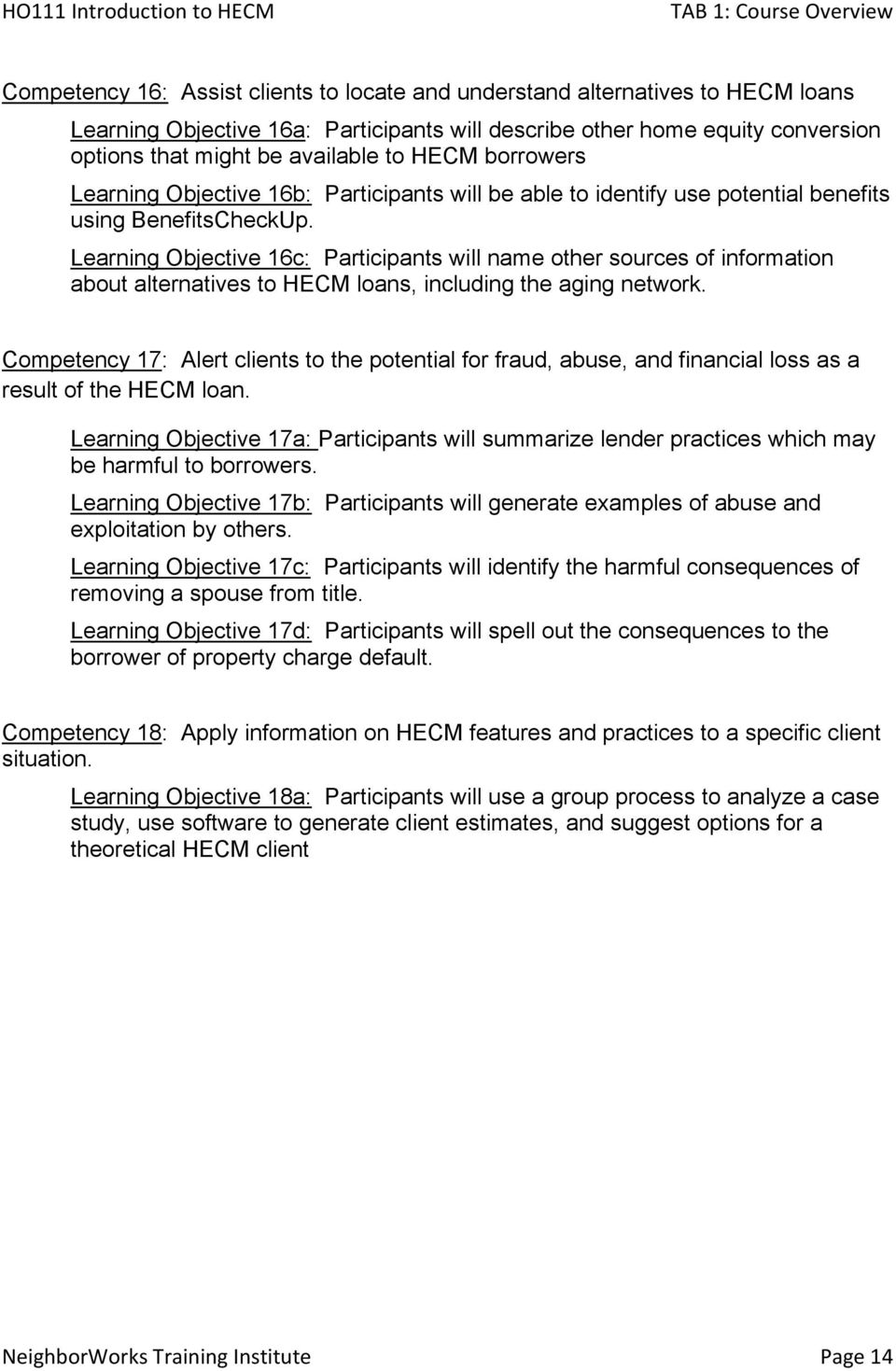
15 HO111IntroductiontoHECM TAB1:CourseOverview Competency 16: Assist clients to locate and understand alternatives to HECM loans Learning Objective 16a: Participants will describe other home equity conversion options that might be available to HECM borrowers Learning Objective 16b: Participants will be able to identify use potential benefits using BenefitsCheckUp. Learning Objective 16c: Participants will name other sources of information about alternatives to HECM loans, including the aging network. Competency 17: Alert clients to the potential for fraud, abuse, and financial loss as a result of the HECM loan. Learning Objective 17a: Participants will summarize lender practices which may be harmful to borrowers. Learning Objective 17b: Participants will generate examples of abuse and exploitation by others. Learning Objective 17c: Participants will identify the harmful consequences of removing a spouse from title. Learning Objective 17d: Participants will spell out the consequences to the borrower of property charge default. Competency 18: Apply information on HECM features and practices to a specific client situation. Learning Objective 18a: Participants will use a group process to analyze a case study, use software to generate client estimates, and suggest options for a theoretical HECM client NeighborWorksTrainingInstitute Page14
16 TAB 2 WHAT IS A REVERSE MORTGAGE? WHAT IS A HECM?

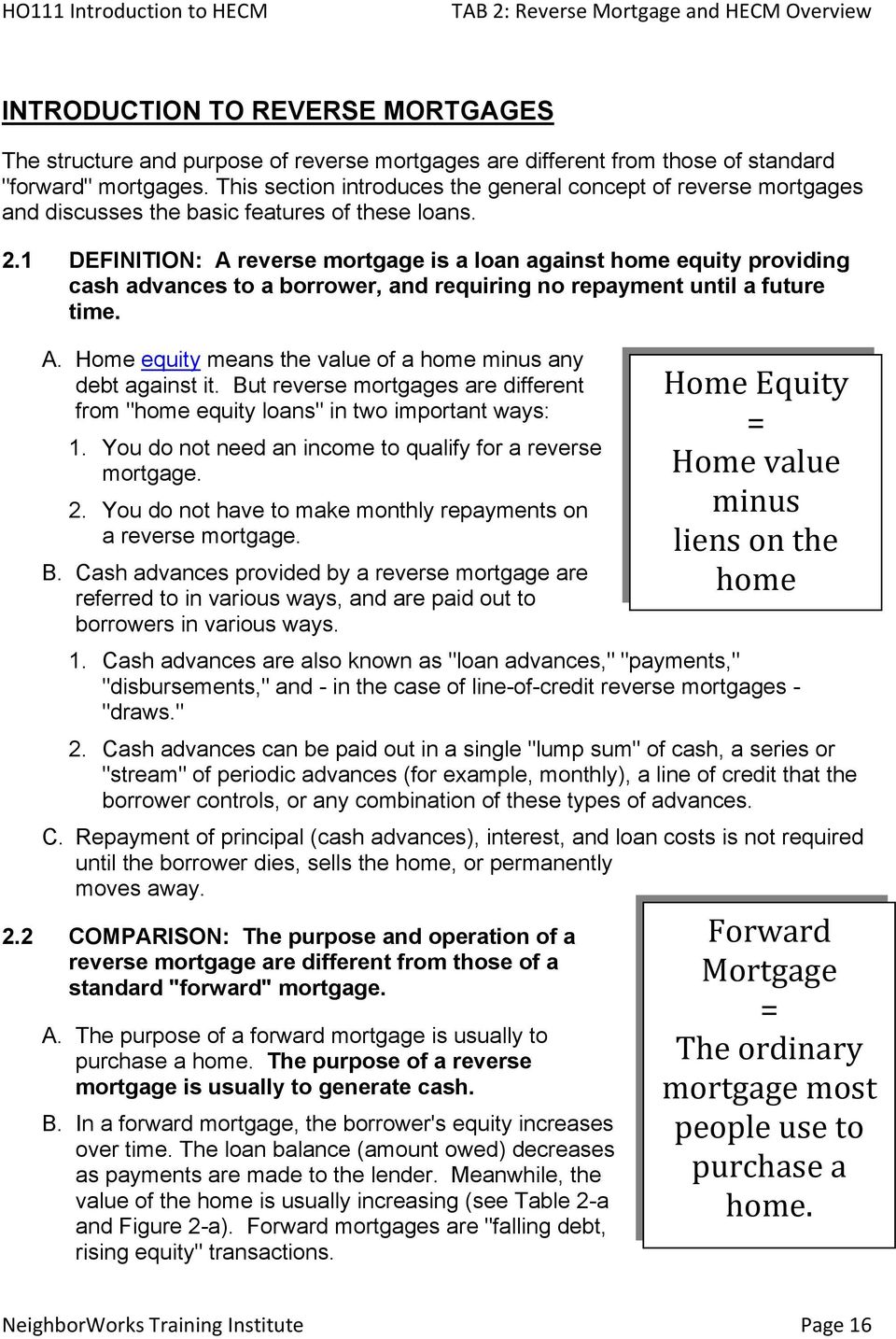
17 HO111IntroductiontoHECM TAB2:ReverseMortgageandHECMOverview INTRODUCTION TO REVERSE MORTGAGES The structure and purpose of reverse mortgages are different from those of standard "forward" mortgages. This section introduces the general concept of reverse mortgages and discusses the basic features of these loans. 2.1 DEFINITION: A reverse mortgage is a loan against home equity providing cash advances to a borrower, and requiring no repayment until a future time. A. Home equity means the value of a home minus any debt against it. But reverse mortgages are different from "home equity loans" in two important ways: 1. You do not need an income to qualify for a reverse mortgage. 2. You do not have to make monthly repayments on a reverse mortgage. B. Cash advances provided by a reverse mortgage are referred to in various ways, and are paid out to borrowers in various ways. 1. Cash advances are also known as "loan advances," "payments," "disbursements," and - in the case of line-of-credit reverse mortgages - "draws." 2. Cash advances can be paid out in a single "lump sum" of cash, a series or "stream" of periodic advances (for example, monthly), a line of credit that the borrower controls, or any combination of these types of advances. C. Repayment of principal (cash advances), interest, and loan costs is not required until the borrower dies, sells the home, or permanently moves away. 2.2 COMPARISON: The purpose and operation of a reverse mortgage are different from those of a standard "forward" mortgage. A. The purpose of a forward mortgage is usually to purchase a home. The purpose of a reverse mortgage is usually to generate cash. B. In a forward mortgage, the borrower's equity increases over time. The loan balance (amount owed) decreases as payments are made to the lender. Meanwhile, the value of the home is usually increasing (see Table 2-a and Figure 2-a). Forward mortgages are "falling debt, rising equity" transactions. NeighborWorksTrainingInstitute Page16
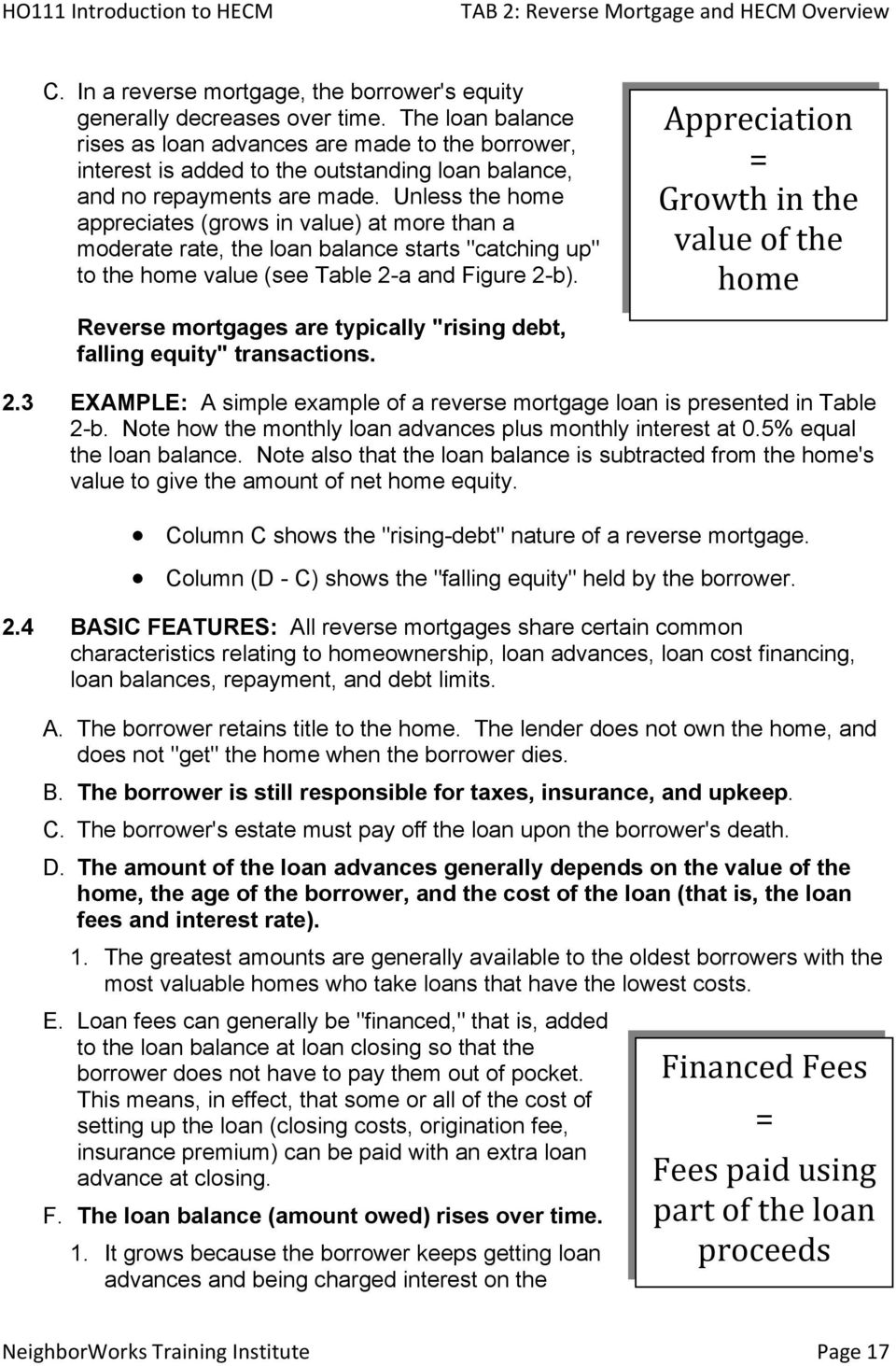
18 HO111IntroductiontoHECM TAB2:ReverseMortgageandHECMOverview C. In a reverse mortgage, the borrower's equity generally decreases over time. The loan balance rises as loan advances are made to the borrower, interest is added to the outstanding loan balance, and no repayments are made. Unless the home appreciates (grows in value) at more than a moderate rate, the loan balance starts "catching up" to the home value (see Table 2-a and Figure 2-b). Reverse mortgages are typically "rising debt, falling equity" transactions. 2.3 EXAMPLE: A simple example of a reverse mortgage loan is presented in Table 2-b. Note how the monthly loan advances plus monthly interest at 0.5% equal the loan balance. Note also that the loan balance is subtracted from the home's value to give the amount of net home equity. Column C shows the "rising-debt" nature of a reverse mortgage. Column (D - C) shows the "falling equity" held by the borrower. 2.4 BASIC FEATURES: All reverse mortgages share certain common characteristics relating to homeownership, loan advances, loan cost financing, loan balances, repayment, and debt limits. A. The borrower retains title to the home. The lender does not own the home, and does not "get" the home when the borrower dies. B. The borrower is still responsible for taxes, insurance, and upkeep. C. The borrower's estate must pay off the loan upon the borrower's death. D. The amount of the loan advances generally depends on the value of the home, the age of the borrower, and the cost of the loan (that is, the loan fees and interest rate). 1. The greatest amounts are generally available to the oldest borrowers with the most valuable homes who take loans that have the lowest costs. E. Loan fees can generally be "financed," that is, added to the loan balance at loan closing so that the borrower does not have to pay them out of pocket. This means, in effect, that some or all of the cost of setting up the loan (closing costs, origination fee, insurance premium) can be paid with an extra loan advance at closing. F. The loan balance (amount owed) rises over time. 1. It grows because the borrower keeps getting loan advances and being charged interest on the NeighborWorksTrainingInstitute Page17
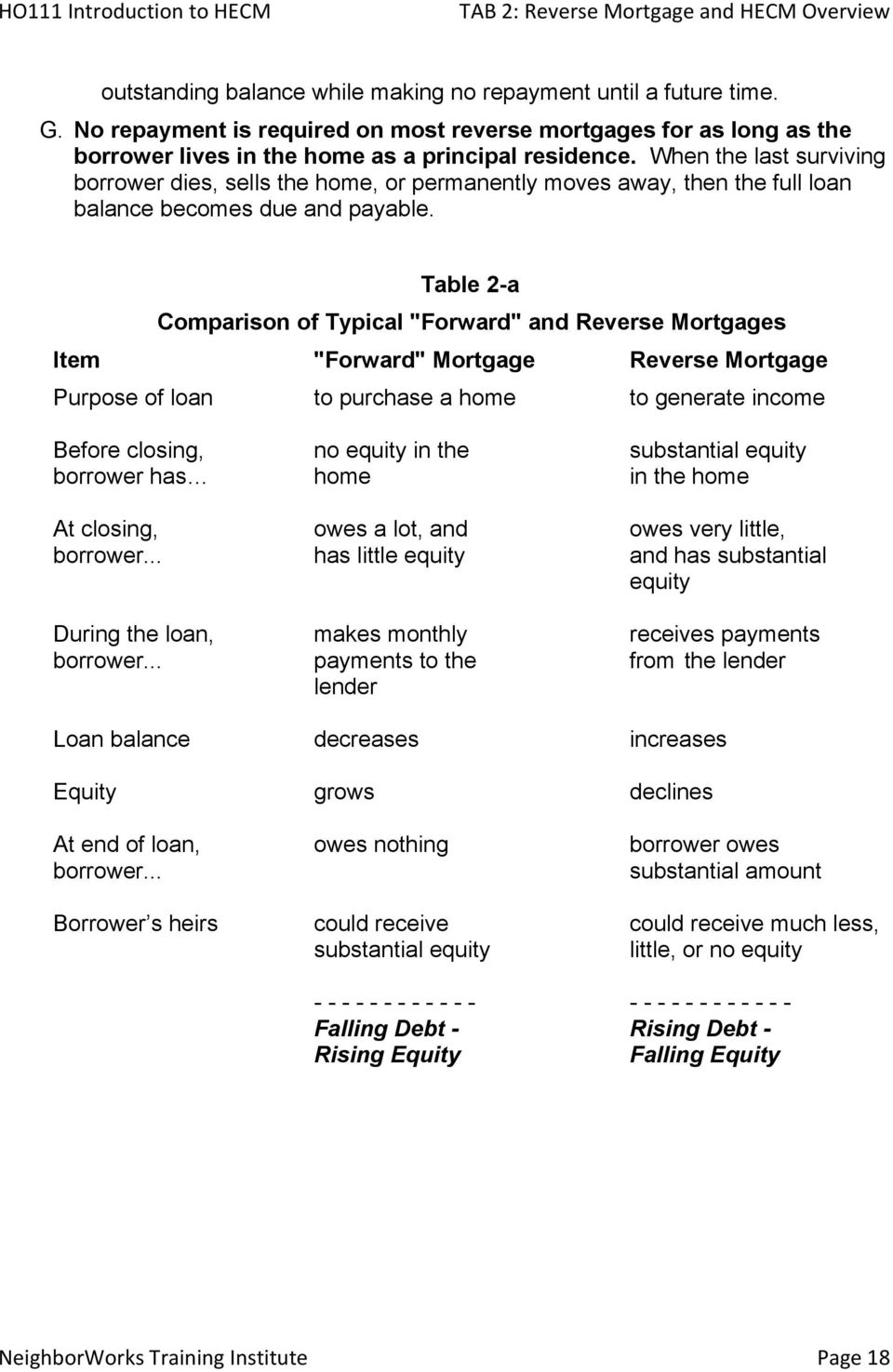
19 HO111IntroductiontoHECM TAB2:ReverseMortgageandHECMOverview outstanding balance while making no repayment until a future time. G. No repayment is required on most reverse mortgages for as long as the borrower lives in the home as a principal residence. When the last surviving borrower dies, sells the home, or permanently moves away, then the full loan balance becomes due and payable. Table 2-a Comparison of Typical "Forward" and Reverse Mortgages Item "Forward" Mortgage Reverse Mortgage Purpose of loan to purchase a home to generate income Before closing, no equity in the substantial equity borrower has home in the home At closing, owes a lot, and owes very little, borrower... has little equity and has substantial equity During the loan, makes monthly receives payments borrower... payments to the from the lender lender Loan balance decreases increases Equity grows declines At end of loan, owes nothing borrower owes borrower... substantial amount Borrower s heirs could receive could receive much less, substantial equity little, or no equity Falling Debt - Rising Debt - Rising Equity Falling Equity NeighborWorksTrainingInstitute Page18
20 HO111IntroductiontoHECM TAB2:ReverseMortgageandHECMOverview Table 2-b Simplified* Reverse Mortgage Example Assumptions: End of Year Monthly Loan Advance $1000 Monthly Interest Rate 0.5% (6% per year) Original Home Value $200,000 Appreciation Rate 4% per year A B C D (D - C) Cumulative Principal Advances Cumulative Interest + (0.5%/mo.) Loan Balance Home Value Net Equity 1 12, , , , ,000 1,559 25, , , ,000 3,532 39, , , ,000 6,368 54, , , ,000 10,118 70, , , ,000 14,840 86, , , ,000 20, , , , ,000 27, , , , ,000 35, , , , ,000 44, , , ,349 * Illustrative example only; does not include closing costs and fees. NeighborWorksTrainingInstitute Page19

21 HO111IntroductiontoHECM TAB2:ReverseMortgageandHECMOverview Figure 2-a: Forward Mortgage $ Home Value Home Equity Loan Balance time $ Figure 2-b: Reverse Mortgage Home Value Home Equity Loan Balance time NeighborWorksTrainingInstitute Page20
22 HO111IntroductiontoHECM TAB2:ReverseMortgageandHECMOverview H. There is a "non-recourse" limit on the borrower's repayment obligation. This important consumer safeguard means that the total amount owed by the borrower can never exceed the value of the home at the time the loan becomes due and payable. In seeking repayment, the lender does not have recourse to anything other than the home's value. 1. Even if the loan balance grows to be greater than the home's future value, the borrower's repayment obligation is limited by the value of the home. 2. The non-recourse feature protects the borrower and the borrower's estate and heirs from "deficiency judgments," that is, from being required to pay back more than the home's value. 2.5 REVERSE MORTGAGE INSURANCE A. The purpose of reverse mortgage insurance is to permit borrowers to remain in their homes for as long as they choose, to protect borrowers with a nonrecourse loan limit (see 2.4.G), and to protect lenders from the risk that some loan balances may exceed home values. 1. As shown in Figure 2-b, a reverse mortgage loan balance could grow to exceed the value of a home. 2. But the non-recourse feature of these loans (see 2.4.G) limits the borrower's liability to the value of the home. 3. Without reverse mortgage insurance (or some other method of "pooling" or spreading out the risk), lenders would face the loss of expected interest and, in some cases, principal. B. The risk of loss is managed by reverse mortgage insurance (and other riskpooling methods) in two basic ways: controlling the risk of loan losses by controlling the amount of the loan advances, and charging a premium on all loans to create a reserve fund for covering loan losses. 1. Loss risk is controlled by relating the amount of the loan advances to the life expectancy (age) of the borrower, the value of the home, and the cost of the loan: a. the longer the life expectancy (that is, the lower the age), the smaller the loan advances; b. the greater the home value, the greater the loan advances; and NeighborWorksTrainingInstitute Page21
23 HO111IntroductiontoHECM TAB2:ReverseMortgageandHECMOverview c. the greater the loan costs, the smaller the loan advances. 2. A loan loss reserve is created by charging a premium on all loans sufficient at a minimum to cover expected losses. The type of premium or risk-pooling charge can be structured in various ways. 2.6 BASIC TYPES OF REVERSE MORTGAGES: There are three basic types of reverse mortgages. A. Single-purpose reverse mortgages are offered by some state and local government agencies. Each loan can only be used for a single purpose. For example, some are limited to home repairs, others to paying property taxes. These plans generally have maximum income eligibility requirements, but the cost is usually very low or moderate. B. Federally-insured reverse mortgages are known as Home Equity Conversion Mortgages (HECMs). This course focuses on the HECM product. C. Proprietary reverse mortgages are developed, owned, and insured by private companies. They may be more costly than the federally-insured HECM. Proprietary reverse mortgages have historically targeted owners of homes whose high values made the HECM loan more limiting. For this reason, they are sometimes referred to as jumbo reverse mortgages. At present (10/2011), there are very few proprietary products on the market. NeighborWorksTrainingInstitute Page22
24 HO111IntroductiontoHECM TAB2:ReverseMortgageandHECMOverview HECM PROGRAM OVERVIEW PROGRAM SUMMARY: The summary on the next four pages highlights the main features of the HECM program for consumers. This document can be used in the counseling process to review these major points with clients. ELIGIBLE HOMEOWNERS (see HECM Handbook: 4-3, 4-4, 4-5, and 4-6) Age 62 and over (all owners) Occupy home as principal residence (live in home 6 months of year); at least one owner must be residing in the home at the time of closing Own the home existing mortgage must be paid off before or at closing, or must be subordinated to the HECM HECM must be first mortgage, but can be used to pay off existing liens on the property ELIGIBLE PROPERTIES (see HECM Handbook: 3-4, 3-5, and 3-6) Home must be a single-family, 1- to 4-unit, owner-occupied dwelling Condominium developments must be FHA approved. Manufactured homes are eligible if they meet FHA standards, including: Borrower owns land beneath the home, and Home is permanently affixed to a foundation Home was built after June 15, 1976 (and has sticker to so indicate) Planned unit developments may be eligible Mobile homes are not eligible Cooperatives are not eligible (authorized by Congress in 2008 but implementing regulations have not yet been issued). Home must meet FHA minimum property standards HECM loan may be used to make required repairs if the cost is within program limits NeighborWorksTrainingInstitute Page23
25 HO111IntroductiontoHECM TAB2:ReverseMortgageandHECMOverview PAYMENT OPTIONS: Approved borrowers can choose from 5 payment options: TENURE: Borrower receives monthly payments from the lender for as long as the home is occupied as the principal residence. TERM: Borrower receives monthly payments from the lender for a period of months selected by the borrower. LINE OF CREDIT: Borrowers can draw up to a pre-established limit at times and in amounts they choose until the creditline is exhausted. The amount of cash available grows larger each month until then. MODIFIED TERM: Borrower may combine a line of credit with monthly payments for fixed number of months (term option). MODIFIED TENURE: Borrower may combine a line of credit with monthly payments for as long as one borrower remains in the home (tenure option). Borrowers may also change between these payment options during the loan term as long as there are still unused loan proceeds remaining. The maximum charge for each change is $20. REPAYMENT: A HECM does not have to be repaid until the last surviving borrower dies, sells the home, or permanently moves from the home. Borrowers may partially or fully repay the loan balance at any time without any penalty. COSTS: Except as noted, all costs can be financed, that is, added to the loan balance (amount owed). Property Appraisal: Generally an advance payment of about $350, but may be refunded to borrower and added to loan balance at loan closing Credit Report: Generally an advance payment of about $25 for a simplified credit report, but may be refunded to borrower and added to the loan balance at closing. Standard Local Closing Costs: Title search and insurance, surveys, required inspections, recording fees, mortgage-related taxes, etc. Hazard or Flood Insurance Premiums: Replacement value coverage is required; may require advance premium to be paid at closing if coverage is increased. Origination Fee: May vary by lender. Maximum origination fee is 2% of home value up to $200,000 plus 1% of any amount over $200,000. Lenders are permitted to use a minimum origination fee of $2500 and may not charge more than $6000 regardless of home value. (Mortgagee Letter 08-34) NeighborWorksTrainingInstitute Page24
26 HO111IntroductiontoHECM TAB2:ReverseMortgageandHECMOverview Mortgage Insurance Premium: For HECM Standard, the upfront payment equals 2 (two) percent of the Maximum Claim Amount, paid or financed at closing, plus an annual premium of 1.25% percent, or 125 basis points, charged on the rising loan balance. (Annual MIP was 0.5% from the inception of the program until October 2010, when it was increased to 1.25%.) For HECM Saver, the upfront premium is 0.01% (one-one hundredth of a percent.) of the Maximum Claim Amount, paid or financed at closing. The annual premium is the same as for HECM Standard. Servicing Fee: flat monthly charge, if not included in interest rate; cannot exceed $30 per month for HECMs with annually adjustable interest or fixed rate, and $35 per month for HECMs with monthly adjustable interest. Interest is charged on all payments made to the borrower and on all loan costs that have been added to the loan balance, including previous interest. Thus the interest on a HECM is compounding. Interest rates may be either fixed or adjustable. Annually adjustable interest rates cannot vary by more than 2 percentage points per year, or 5 points over the life of the loan. Lenders may also offer a monthly-adjustable rate with only a lifetime cap established by the lender. Interest rate adjustments do not affect the amount of a monthly advance, but they do change the rate at which a creditline grows larger. They also affect how quickly the HECM loan balance grows. FEDERAL GUARANTEES In the event of lender default, the loan will be assigned to HUD, which will continue to make payments to the borrower based on the original terms of the loan. A HECM is a "non-recourse" loan, which means that a borrower can never owe more than the value of the property at the time the loan is repaid. BORROWER OBLIGATIONS Continue to maintain, insure, and pay taxes on the property. Unless borrowers choose to pay and provide evidence of paying property taxes and insurance, lenders are authorized to make these payments from HECM proceeds. NeighborWorksTrainingInstitute Page25
27 HO111IntroductiontoHECM TAB2:ReverseMortgageandHECMOverview Lenders are also authorized to use the loan to pay for property repairs if they are needed to maintain HUD property standards. If there are insufficient HECM proceeds remaining, the lender may call the loan in default and the loan could become due and payable. Continue to occupy the property as primary residence (where at least one borrower spends the majority of the year). Borrower may reside elsewhere for a maximum of 12 consecutive months, due to physical or mental illness. At this point, if a determination is made that it is unlikely that the borrower would return, the home would no longer be considered owner-occupied and the loan could become due and payable. LENDER PARTICIPATION Any FHA-approved lender may originate HECM loans. Lenders offering HECM loans are listed on HUD s website at See also the National Reverse Mortgage Lenders Association s consumer website for a list of their members ( Lenders earn an origination fee and either earn servicing fees or sell servicing rights to other companies. Investors purchase HECM loans, and several companies offer loan servicing systems or services. Fannie Mae, which was the primary investor for HECM loans from the inception of the program, ceased to purchase any new HECM loans in October Lenders are protected by FHA insurance against loan losses that occur because the non-recourse feature limits how much a borrower must repay. HECM loans may be assigned to HUD when the total loan balance equals 98% of the Maximum Claim Amount. FHA HECM insurance benefits may equal up to that amount. NeighborWorksTrainingInstitute Page26
28 HO111IntroductiontoHECM TAB2:ReverseMortgageandHECMOverview SELF-TEST #1 1) A reverse mortgage is a) a loan against equity in a home b) a loan providing cash advances to a borrower c) a loan requiring no repayment until a future time d) a, b, and c above 2) A reverse mortgage is different from a home equity loan because a) you need an income to qualify for a reverse mortgage b) you need little home equity to get a reverse mortgage c) you do not have to make monthly repayments on a reverse mortgage 3) A reverse mortgage must be repaid a) by the 10th of every month b) when the borrower dies, sells or permanently moves away c) when the loan balance equals the value of the home d) when the borrower uses up all available loan funds 4) The purpose of a reverse mortgage is most often a) to buy a home b) to sell a home c) to generate cash 5) Reverse mortgages are typically loans with a) rising debt and falling equity b) falling debt and rising equity c) rising debt and rising equity 6) When a reverse mortgage becomes due and payable a) the lender gets the house b) the federal government gets the house c) the area agency on aging gets the house d) none of the above NeighborWorksTrainingInstitute Page27
29 HO111IntroductiontoHECM TAB2:ReverseMortgageandHECMOverview 7) The non-recourse limit on a reverse mortgage means a) the lender cannot seek repayment from anything other than the home s value b) the borrower s estate and heirs are protected against deficiency judgments c) the borrower cannot owe more than the value of the home d) all of the above 8) The purpose of reverse mortgage insurance is a) to protect lenders against loan losses b) to protect borrowers with a non-recourse limit c) to let borrowers remain in their homes as long as they choose d) a, b, and c above 9) The risk of loan losses in reverse mortgage lending is controlled by a) controlling the amount of the loan advances b) limiting loan advances to 28% of income c) charging a premium on all loans to create a reserve fund d) a and/or c above 10) To qualify for a HECM loan a) at least one owner must be aged 65 or over b) a mobile home or cooperative must be FHA-approved c) a home must be debt free prior to loan application d) none of the above 11) To qualify for a HECM loan a) the home must be completely paid off b) the home must have been originally financed with an FHA forward mortgage c) the borrower must live in the home as a principal residence d) the borrower must be low-income NeighborWorksTrainingInstitute Page28
30 HO111IntroductiontoHECM TAB2:ReverseMortgageandHECMOverview 12) When a HECM loan is repaid, the borrower must pay back a) only the funds they received b) the funds received plus simple interest c) the funds received plus loan fees such as mortgage insurance and servicing fees d) the funds received plus loan fees and interest compounded on the entire balance 13) The payment options in the HECM program include a) a fixed monthly advance for as long as a borrower lives in the home b) a fixed monthly advance for a period chosen by the borrower c) a creditline that lets the borrower select the timing and amount of the advances d) a combination of monthly advances and creditline e) all of the above 14) The HECM loan may be used to pay for a) repairs needed to meet FHA minimum property standards b) standard closing costs c) 2% mortgage insurance premium d) the origination fee e) all of the above 15) When the adjustable interest rate on a reverse mortgage goes up a) the monthly payments to the borrower go down b) the rate at which the creditline grows goes up c) the loan balance grows faster d) b and c above NeighborWorksTrainingInstitute Page29
31 TAB 3 WHO IS YOUR CLIENT? CLIENT GOALS AND ELIGIBILITY ISSUES
32 HO111IntroductiontoHECM TAB3:WhoisYourClient? ClientGoalsandEligibilityIssues 3.1 CASE STUDY INTRODUCTION Meet Jim & Patsy Henderson Let s meet a couple that sometimes runs out of money before they run out of month. We ll be following them throughout the rest of our discussion of HECM loans. Florida couple, Patsy (age 73) and Jim (age 72) Henderson are both retired and bringing in Social Security plus his small pension, about $2200/month total. Their 401-K and savings are gone. Their home is in need of some repair, especially the roof. Their property insurance is relatively high ($2400 per year). Last year it almost got cancelled because they had trouble coming up with the money. Taxes are $1200 per year. They believe their home should appraise for about $100,000. They owe $20,000 on a home equity line of credit (HELOC) they set up a few years ago to pay off other debt. Their HELOC payment ranges from $200 to $250 each month. The Henderson s think they d be fine if they didn t have the mortgage payments to make, and if they could have some cash to pay for the roof repairs and other emergencies. NeighborWorksTrainingInstitute Page31
33 HO111IntroductiontoHECM TAB3:WhoisYourClient? ClientGoalsandEligibilityIssues 3.2 WHY USE A HECM? Now that you ve met Jim and Patsy, what have you learned about them? What needs do they have and what goals are they trying to meet? What are some other reasons why homeowners might use a HECM? NeighborWorksTrainingInstitute Page32
34 HO111IntroductiontoHECM TAB3:WhoisYourClient? ClientGoalsandEligibilityIssues 3.3 REASONS FOR USING REVERSE MORTGAGES Homeowners may use reverse mortgage funds for any purpose they choose. Some of the more common goals may include: Paying off an existing mortgage Paying off other debt Increasing available funds for normal monthly expenses Establishing a source of funds for future major needs Home repair or improvement Lifestyle improvements ( live better and enjoy life ) In-home care to avoid institutionalization Helping family members Travel A special use of a HECM is to purchase a home, using the HECM loan plus a large borrower down payment. This will be discussed further in TAB ELIGIBLE HOMEOWNERS PROTOCOL To be eligible for a HECM loan all borrowers must: A. Be age 62 or over B. Own the home C. Occupy the home as a principal residence. 1. This is defined as the home where the borrower typically spends the majority of the calendar year. 2. If there are two owners, one may be out of the home for medical reasons, but at least one owner must be residing in the home at the time of closing. D. Not have delinquent Federal debt. 1. Outstanding Federal debt is acceptable if the borrower has a payment agreement and is making payments as agreed. E. All pre-existing liens against the home must be paid off or subordinated. 1. The borrower may use HECM or other funds, but may not take out additional debt in connection with getting the HECM. 2. Some existing liens may be subordinated to the HECM. This means that the HECM would take priority over repayment of the subordinated lien NeighborWorksTrainingInstitute Page33
35 HO111IntroductiontoHECM TAB3:WhoisYourClient? ClientGoalsandEligibilityIssues F. There are no other income or credit criteria required by HUD at the present time. However, HUD is considering some additional requirements and does permit lenders to impose additional underwriting requirements if they choose. 1. As of October 28, 2011, HUD directed counselors that they must inform clients that: a. Financial and credit capacity assessment guidelines may differ from lender to lender just as lenders may offer different pricing options and different product options, and: b. Some lenders may implement underwriting requirements for HECM applicants and some may not. c. These new lender guidelines and those under development by FHA are intended to ensure that applicants can responsibly meet the obligations of a HECM loan. To achieve this end, counselors should continue to reinforce the borrower s obligations to pay all required property charges and any other requirements of the loan transaction. 2. The area of underwriting will probably be changing over the next year or two at least. Counselors need to pay attention to HUD guidance as it evolves. 3.5 OWNERSHIP TYPES A property may be owned in a variety of ways, including: A. Sole ownership B. Joint tenancy C. Life Estate: This is a divided form of ownership in which one person owns the right to live in the home, while one or more others own the right to sell the property and to take full possession when the life-estate holder dies or leaves (the remainder interest ). 1. A HECM can be done on a property where the borrower has only a lifeestate interest, as long as the owners of the remainder interest agree and sign the mortgage NeighborWorksTrainingInstitute Page34
36 HO111IntroductiontoHECM TAB3:WhoisYourClient? ClientGoalsandEligibilityIssues D. Living Trust: A living trust is a legal entity created during a person s lifetime, to hold the ownership of money and real property, often for estate planning purposes. 1. Property held in a living trust may be eligible if the beneficiaries are eligible HECM borrowers. 3.6 ELIGIBLE PROPERTIES A. The home must be a single-family, owner-occupied dwelling. B. For the purposes of HECM eligibility, the definition of a single-family residence includes 2-4 unit properties as long as at least one unit is occupied by the owners. PROTOCOL C. If the home is a condominium, the condominium project as a whole must be FHA approved. 1. Spot approvals, where a single unit is approved, are no longer permitted. D. Manufactured homes are eligible if: 1. They meet FHA standards, including: a. Borrower owns land beneath the home, and b. Home is permanently affixed to a foundation approved for its location c. Home was built after June 15, 1976 and bears the sticker to so indicate. The sticker is usually on the door facing and near the heating unit of the home. 2. The lender is willing to do the loan. Beginning in 2011, some lenders have chosen not to do HECMs on manufactured homes at all. NeighborWorksTrainingInstitute Page35
37 HO111IntroductiontoHECM TAB3:WhoisYourClient? ClientGoalsandEligibilityIssues E. Homes in planned unit developments (PUDs) may be eligible. F. Mobile homes are not eligible. G. Cooperatives were authorized by Congress in 2008, but the implementing regulations have not been issued. Therefore, a HECM cannot be placed on a cooperative property at present. H. Also, the home must meet FHA minimum property standards. 1. No major health or safety hazards 2. All basic systems work 3. No conditions that will cause deterioration 4. The HECM may be used to make required repairs if the cost is within program limits. a. If repairs are less than 15% of home value (up to a cap called the Maximum Claim Amount), repairs may be completed after closing using loan funds b. 150% of the estimated cost will be set aside for the repairs I. The home must be located in an area zoned for residential use. J. Lenders and their underwriters may impose additional requirements. Question: Based on the information you know so far, are the Hendersons and their property likely to be eligible? Are there any further questions you need to ask? NeighborWorksTrainingInstitute Page36
38 TAB 4 HOW MUCH CAN THEY GET? CALCULATING LOAN AMOUNTS
39 HO111IntroductiontoHECM TAB4:HowMuchCanTheyGet? 4.1 HECM LOAN AMOUNTS HECM loans are made against the entire value of the property, not just the equity that the borrower has in the home. In this way, they are different from home equity lines of credit (HELOCs). However, many borrowers are surprised to learn that they cannot access the entire value of their home and that there is no standard loan-to-value ratio (LTV) for all borrowers. If borrowers were permitted to receive the whole value of the home, the accruing interest and fees would quickly cause the loan balance to exceed the home s value. Instead, each borrower s loan amount, or Principal Limit, depends on a Principal Limit Factor (PLF) applied to home value. The Principal Limit Factor is essentially a percentage of home value. NeighborWorksTrainingInstitute Page38
40 HO111IntroductiontoHECM TAB4:HowMuchCanTheyGet? The following factors all play a part in determining the borrower s Principal Limit: the value of the home, up to a cap the age of the youngest borrower the cost of the loan (expected interest rate) the HECM product chosen (Standard vs. Saver) A. Home value: The first factor to be considered is the value of the home, as determined by a HUD-approved appraiser. This is the market value of the property at the time the loan is originated. This value is subject to a limit. 1. Mortgage Limits (also called Lending Limits): There is a cap, or limit, on the amount of home value that can be used to calculate loan advances. a. Prior to 11/2008, the mortgage limit was based on rules established in section 203(b) of the National Housing Act, so was known as a 203(b) limit. These limits varied by location. b. After 11/2008, a single national limit was set across the country, based on section 305(a)(2) of the Federal Housing Home Loan Mortgage Corporation Act. This limit is also known as the Freddie Mac conforming limit. This limit was at $417,000 in 11/2008. c. In 2/2009, the limit for HECM loans was temporarily increased to 150% of the Freddie Mac conforming limit. This change raised the national mortgage limit for HECMs to $625,500. This new limit will be in effect until 12/31/2011 unless it is extended. These limits do not mean that homes of greater value are ineligible for HECM insurance. Instead, they limit the amount of home value that can be used to determine the loan advances. For example, the value that can be used for a $625,500 home and a $1,000,000 home are the same. In other words, any additional value, beyond the national mortgage limit, is simply ignored when the principal limit is calculated. Lesser NeighborWorksTrainingInstitute Page39
41 HO111IntroductiontoHECM TAB4:HowMuchCanTheyGet? 2. The "Maximum Claim Amount" is the home value up to the mortgage limit. Another way to say it is that the Maximum Claim Amount is the lesser of a home's appraised value or the national mortgage limit. It is this figure that is used to calculate the loan amount. It is called the Maximum Claim Amount (MCA) because it is the maximum amount that HUD will pay on a lender's claim for reverse mortgage insurance benefits. 3. The Maximum Claim Amount multiplied by the Principal Limit Factor equals the Principal Limit. What is the MCA for the following home values? Appraised value $200,000 Appraised value $500,000 Appraised value $750,000 B. Age: The borrower s age is important because age determines life expectancy, and life expectancy is seen as the best predictor of how long it will be until the borrower repays the loan. 1. The longer the loan remains outstanding, the more interest will accrue, and the greater the chance that the loan balance will equal or exceed the value of the home. 2. Therefore, the younger the borrower, the less they can borrow, as a percentage of home value. Conversely, the older the borrower, the more they can borrow. 3. When there is more than one borrower, the age of the youngest borrower is used to determine the loan amount. 4. Although men and women have different life expectancies, the loan amounts were based on the female life expectancy tables, since typically women live longer. 5. There is no allowance made for health or disability, only age. NeighborWorksTrainingInstitute Page40
42 HO111IntroductiontoHECM TAB4:HowMuchCanTheyGet? C. Cost The Expected Rate: The rate that is used to calculate the loan amount available to the borrower (the Principal Limit) is called the expected average mortgage interest rate or simply the expected rate. 1. This rate is meant to be a predictor of the rates that will be charged over the life of the loan. It is never actually used to calculate accrued interest once the loan has closed. 2. The higher the expected rate, the lower the loan amount. If a loan is going to grow quickly, it needs to start out smaller in order to stay within the home s value. 3. For the purposes of calculating the principal limit, the expected rate for all HECMs has a floor of 5.0%, regardless of whether the loan has a fixed or adjustable rate. a. This means that expected rates of 5.0% or below will generate the same principal limits b. Two loans with different expected interest rates will generate identical principal limits, as long as both rates are below 5.0%. 4.2 HECM STANDARD vs. HECM SAVER A fourth factor now affects HECM loan amounts: the choice between the HECM Standard loan product and the HECM Saver. A. The same Loan-to-Value (LTV) concept used in forward mortgage lending applies to how much banks will lend on reverse mortgages. B. Because HUD insures the loans, they set the Principal Limit Factors (= Loan-to-Value ratios) that determine the total loan amount in order to manage risk. C. In October 2010, HUD released a new variation on the HECM loan called the HECM Saver. The original HECM is now called the HECM Standard. D. HECM Saver manages risk in a slightly different way it uses significantly lower Principal Limit Factors (Loan-to-Value ratios) in exchange for a much lower upfront Mortgage Insurance Premium. NEWS:The expectedrate floorwas5.5% until2010.itwas changedwhen newprincipal LimitFactortables wereissuedin MortgageeLetter NeighborWorksTrainingInstitute Page41
43 HO111IntroductiontoHECM TAB4:HowMuchCanTheyGet? E. The following chart shows a sample of HECM Standard Principal Limit factors. It may help to think of the Principal Limit Factors as percentages:.50 = 50%,.483 = 48.3%, etc. That s really all they are. Age HECM Standard Principal Limit Factors Expected Interest Rate 4.50% 5.00% 5.50% 6.00% 6.50% Figure the principal limit for a HECM Standard loan (Yes, you can do it! Without a calculator!): Find the Principal Limit Factor in the table above, and multiply it by the home value. Jim is 72, the house appraises for $100,000 and he is considering a loan with an interest rate of 5.5%. What is the Principal Limit for the HECM Standard loan? Another client is 62 with a $100,000 house and is looking at a loan at 6.0%. What is the Principal Limit for a HECM Standard loan? What do you notice about the PLFs for 4.5% vs. 5%? NeighborWorksTrainingInstitute Page42
44 HO111IntroductiontoHECM TAB4:HowMuchCanTheyGet? The reason they are the same is because the current floor on the rate at the time of this writing is 5%. The lower the rate, the higher the principal limit factor, which results in a larger loan amount. Setting a floor below which further rate reductions do not affect the PLF is another way for HUD to manage risk. 4.3 HECM SAVER PRINCIPAL LIMIT FACTORS As noted above, the HECM Saver greatly reduces the upfront Mortgage Insurance Premium on HECM loans in exchange for a lower Principal Limit. In creating this product, HUD simply created a new Principal Limit Factor table. By lowering the loan amounts, HUD reduced the risk, and eliminated the need for the upfront MIP. Let s look at how much lower the factors are on the HECM Saver PLF table: HECM Saver Principal Limit Factors Age Expected Interest Rate 4.50% 5.00% 5.50% 6.00% 6.50% Let s look again at our 72 year old borrower, Jim, with a house valued at $100,000: What is the Principal Limit on the HECM Saver at 5.5% interest? What was the Principal Limit on the HECM Standard? What is the Principal Limit on the HECM Saver for our 62 year old at 6.0% interest? What was the Principal Limit on the HECM Standard? Notice the Expected Rate Floor is 5% on the Saver as well as the Standard product. Principal Limit Factor tables may be adjusted again in the future, based on economic and market conditions. The floor may also change. NeighborWorksTrainingInstitute Page43
45 HO111IntroductiontoHECM TAB4:HowMuchCanTheyGet? HECM STANDARD VS. HECM SAVER SUMMARY HECM Standard Initial MIP 2% Example: $2000 on a $100,000 home HECM Saver 0.01% (one one-hundredth of a percent) Example: $10 on a $100,000 home Annual MIP 1.25% 1.25% Principal Limits Higher for all ages and interest rates compared to HECM Saver Lower for all ages and interest rates compared to HECM Standard Sample PLF and loan amount: Age 62 Age 75 5% expected rate, $100,000 home value, Could borrow 61.9 % or $61,900 5% expected rate, $100,000 home value Could borrow 69.3% or $69,300 5% expected rate, $100,000 home value, Could borrow 52.3 % or $52,300 5% expected rate, $100,000 home value Could borrow 56.2% or $56,200 Fixed interest rates currently offered by lenders % May be slightly higher than Standard Lump sum required on fixed Margins on adjustable rate Sample appropriate user Very likely % (varies by lender and across time Borrower who would like to pay off existing mortgage and get funds for future needs. Plans to stay in home until death. Very likely May be slightly higher than Standard Borrowers who don t need as much of the home s equity, especially if they plan to keep the loan for a relatively short period of time. NeighborWorksTrainingInstitute Page44
46 HO111IntroductiontoHECM TAB4:HowMuchCanTheyGet? 4.4 CASE STUDY Using the loan comparison illustration at the end of this Tab, find the following: 1. Maximum Claim Amount (how much home value can be used) 2. Principal Limit on the HECM 1 3. Principal Limit on the HECM 2 4. Principal Limit on the HECM 3 Now, for extra credit, figure out: (remember, the home value is $100,000) 5. The Principal Limit Factors for: HECM 1 HECM 2 HECM 3 NeighborWorksTrainingInstitute Page45
47 HO111IntroductiontoHECM TAB4:HowMuchCanTheyGet? NeighborWorksTrainingInstitute Page46
48
49 TAB 5 HOW MUCH DOES IT COST? UPFRONT FEES AND SET-ASIDES
50 HO111IntroductiontoHECM TAB5:HowMuchDoesItCost? UpfrontFeesandSetAsides 5.1 LOAN COSTS HECMs, like any other mortgage, typically involve both upfront and recurring costs. A. Upfront costs may include: 1. Origination Fee 2. Mortgage Insurance Premium (MIP) 3. Third Party Costs B. The borrower may pay these costs by using a loan advance (i.e., part of their principal limit) so the costs are financed and become part of the loan balance. 1. This makes it easier for the borrower to afford the loan, but also adds to the final loan balance, since interest is charged on these amounts. C. Recurring costs may include: 1. Servicing Fees 2. Annual Mortgage Insurance 3. Interest PROTOCOL D. These costs are also financed, and become part of the growing loan balance. As a result, the interest and mortgage insurance costs are compounded interest is charged on the interest. We will discuss these compounding costs later, in Tab UPFRONT COSTS A. Origination Fee 1. The origination fee compensates the lender for the activities involved in setting up the loan. 2. Although origination fees in the forward mortgage world are typically 1% or less, the origination fee for HECMs is permitted by HUD to be as much as: 2% of the first 200,000 of Maximum Claim Amount plus 1% of additional home value BUT not more than $6000 total a. Lenders may always charge at least $2,500 on lower value homes b. Lenders may offer to waive or reduce origination fees. NeighborWorksTrainingInstitute Page49
51 HO111IntroductiontoHECM TAB5:HowMuchDoesItCost? UpfrontFeesandSetAsides Practice calculating Origination Fee charges. Remember: Origination fee allowed ranges from $2,500 - $6,000. Home value $100,000 2% x the first $200,000 of value 1% x the remaining value + Allowed origination fee = Home value $300,000 2% x the first $200,000 of value 1% x the remaining value + Allowed origination fee = Home value $700,000 2% x the first $200,000 of value 1% x the remaining value + Allowed origination fee B. Mortgage Insurance Premium (MIP) 1. Mortgage insurance on HECM loans is paid to FHA, not to a private insurer, so it is referred to as MIP rather than PMI (private mortgage insurance). The premium comes in two parts a. Upfront premium: a one-time charge based on home value (MCA) b. Annual premium: an annual charge based on the loan balance 2. The upfront mortgage insurance premium is paid by the lender to HUD, typically using an advance from the borrower s loan funds. The money becomes part of FHA s mortgage insurance fund. a. This fund is used to pay claims to lenders if the borrower s loan balance exceeds their home value at the time the loan is paid off. b. When the loan balance reached 98% of the Maximum Claim Amount, the lender may assign the loan to HUD and be paid the full loan balance from the mortgage insurance fund. c. This protection makes the HECM product more attractive to lenders, who know they have minimal risk of loss, regardless of what happens to the borrower s home value. NeighborWorksTrainingInstitute Page50
52 HO111IntroductiontoHECM TAB5:HowMuchDoesItCost? UpfrontFeesandSetAsides d. FHA mortgage insurance also protects the borrower since it guarantees that: i. The borrower never has to repay more than the value of the house. ii. The borrower s heirs do not have to use other funds to repay amounts that exceed the value of the home. This is called the non-recourse provision of the loan. iii. If the lender is unable to make loan advances to the borrower for any reason, HUD will take over and make the payments as agreed. e. The annual mortgage insurance premium will be discussed further in TAB Upfront mortgage insurance premiums a. must be charged on all HECM loans PROTOCOL b. are not negotiable, though the lender could offer to offset the MIP by charging less for some other fee c. are based on home value, not loan amount d. are never refundable, regardless of the duration of the loan 4. Thus, MIP can represent a major part of the cost of a HECM, especially if a borrower plans to keep the loan a relatively short time or is borrowing a relatively small amount of money. a. This is why HUD created the HECM Saver product, and gave it only a minimal upfront MIP. b. The low MIP on the Saver makes it more appealing to borrowers who need the loan for a short term or a small amount of money. 5. The upfront Mortgage Insurance Premium on a HECM loan is: a. 2% of the Maximum Claim Amount on the HECM Standard b. 0.01% of the Maximum Claim Amount on the HECM Saver. NeighborWorksTrainingInstitute Page51
53 HO111IntroductiontoHECM TAB5:HowMuchDoesItCost? UpfrontFeesandSetAsides Practice calculating Upfront Mortgage Insurance charges. Home Value $100,000 MIP on HECM Standard = MIP on HECM Saver = Home Value $300,000 MIP on HECM Standard = MIP on HECM Saver = Home Value $700,000 MIP on HECM Standard = MIP on HECM Saver = C. Third Party Costs: Third party costs are those paid to someone else besides the lender. The lender pays these charges and then passes them on to the borrower at closing. These costs can vary considerably from state to state, especially with regard to recording fees and taxes/stamps: 1. Appraisal al 2. Credit report 3. Attorney fees 4. Title search and title insurance 5. Required inspections a. Foundation inspections may be required on manufactured homes b. Well/septic inspections may be required if there are signs of problems c. Wood-destroying insect inspections may be required in some parts of the country. 6. Recording fees 7. Document preparation 8. Courier fees 9. State taxes and stamps 10. Counseling fees! NeighborWorksTrainingInstitute Page52
54 HO111IntroductiontoHECM TAB5:HowMuchDoesItCost? UpfrontFeesandSetAsides 5.4 SET-ASIDES Set-asides are not costs, because they don t immediately become part of the loan balance. Instead, they represent money reserved for a future purpose. The amounts will be added to the loan balance only when the funds are disbursed or earned by the servicer. Set-asides can be created for several purposes, described below. A. Servicing Fees: 1. The servicing fee compensates the loan servicer for ongoing activities that include: a. Making both scheduled and unscheduled payments to borrowers b. Accepting prepayments from borrowers c. Making mortgage insurance premium payments to HUD d. Keeping accurate records of mortgage balances e. Sending out regular statements of mortgage activity to borrowers f. Paying property taxes and insurance if requested by borrowers g. Ensuring that borrowers are in compliance with the loan agreement 2. Most consumers are perplexed by the monthly servicing fee. Most wonder why it is charged on reverse mortgages when it is not charged on forward mortgages. In fact, it is charged on forward mortgages, but it is included in the interest rate, so it is never explicitly identified and quantified. 3. Monthly servicing fees may not exceed $30 for fixed rate HECMs and HECMs with annually adjusting interest, 4. Monthly servicing fees may not exceed $35 for HECMs with monthly adjusting interest. 5. Lenders may choose to waive the servicing fee entirely ($0 service fee), and this has become commonplace since April In that case, the servicing costs are included in the interest rate as is commonly done with forward mortgages. NeighborWorksTrainingInstitute Page53
55 HO111IntroductiontoHECM TAB5:HowMuchDoesItCost? UpfrontFeesandSetAsides 6. Service Fee Set-Aside (SFSA): If a servicing fee is charged, the lender sets aside from the borrower s principal limit the "present value" of the total monthly servicing fees from closing until the borrower would reach age 100, taking into account the growth of the principal limit. a. This reduces the funds available to the borrower at closing, typically by $ b. This amount is credit, not debt, so it is NOT added to the loan balance at closing. Instead, it is "set aside," or held in reserve so that it cannot be spent in other ways. c. The loan servicer deducts its monthly fee from this credit amount and adds it to the loan balance each month during the life of the loan. d. Since very few borrowers live to age 100, the total amount set aside by the HECM program typically overstates the actual total amount likely to be charged on most HECMs during the life of the loan. e. If the loan is paid off early, the remaining amount in the SFSA is like the line of credit simply money that was never borrowed and thus never has to be repaid. There is no refund of the SFSA because it was never charged to the borrower in the first place. B. Required Repairs 1. If the home does not meet HUD's Minimum Property Standards, the borrower must complete required repairs. 2. If the cost of the repairs is estimated to be less than 15% of the Maximum Claim Amount, the borrower may complete the work after closing. In these cases, the lender attaches a "repair rider" to the Loan Agreement, certifying that the work will be completed as required. 3. A repair set-aside of 150% of the estimated cost of the repairs is created, and this credit is not available for any other purpose until the repairs are complete and approved. a. Once repairs have been inspected, the money is disbursed to pay the contractors b. Any remaining amount is returned to the borrower s available credit. 4. Loans with a full lump-sum distribution at closing may not allow for a repair set-aside since there is no remaining credit. In this case the borrower must pay for required repairs before the loan can close. C. Taxes and Insurance 1. At closing, the borrower may choose to be responsible for paying property taxes and insurance or may request that the lender make these payments from the remaining credit. 2. Borrowers who have struggled in the past to save up for taxes or insurance may want to make the lender responsible for this. NeighborWorksTrainingInstitute Page54
56 HO111IntroductiontoHECM TAB5:HowMuchDoesItCost? UpfrontFeesandSetAsides 3. If desired, a property charge set-aside may be created to reserve loan credit to cover these charges. 4. Such set-asides may become a required feature of HECM loans in the future, for borrowers who are at risk of tax or insurance default. NeighborWorksTrainingInstitute Page55
57 TAB 6 HOW DO THEY GET THE MONEY? PAYMENT PLANS
58 HO111IntroductiontoHECM TAB6:HowDoTheyGettheMoney? PaymentPlans 6.1 PAYMENT PLANS The HECM program was designed to allow maximum flexibility to meet a variety of financial needs. This tab section describes the ways in which borrowers can choose to access their loan funds, and the impact that this choice may have on the amount of credit available. The borrower may select any one of five payment plans, or patterns of loan advances: tenure, term, line of credit, modified tenure or modified term. PROTOCOL These options, and their combinations, give the borrower great flexibility in accessing their loan funds. In every case, interest is charged only on the amount that the borrower has actually received at a particular point in time. Therefore, different payment plans can result in significantly different costs to the borrower over time. Payment plans can be thought of as simply different ways of slicing the pie of available credit: Do I want small slices on a regular basis, letting someone else figure out how large the slices should be? Do I want to decide for myself when to get a slice and how large the slices are? Do I want it all at once? A. The tenure option provides equal monthly payments to the borrower for as long as the borrower lives in the home as a principal residence. 1. This plan provides the long-term security and convenience of a monthly income supplement that lasts until the borrower dies, sells, or moves. (Although the loan balance is scheduled to equal the principal limit when the youngest borrower reaches age 100, payments continue for as long as the borrower lives in the home as a principal residence, no matter how long that is.) inthehome NeighborWorksTrainingInstitute Page57
59 HO111IntroductiontoHECM TAB6:HowDoTheyGettheMoney? PaymentPlans 2. Remember that tenure payments are not for life ; they are for as long as the borrower lives in the home. Payments would stop if the borrower moves elsewhere. 3. The payments are a fixed amount; they do not change from month to month and are not adjusted to account for inflation. In the future, they will probably buy less than today because of inflation. 4. Tenure payments are not affected by interest rate changes during the life of the loan. Payment amounts are calculated using the expected rate that was in effect at the time of loan origination. 5. Tenure payments are very convenient for the borrower, because the payments are disbursed automatically on the first of each month, and can be direct deposited to the homeowner s bank account, so that no action needs to be taken to get the money. B. The term option provides equal monthly payments to the borrower for a fixed period of time chosen by the borrower at closing. 1. This plan can provide larger monthly payments than the tenure plan. Because the borrower is electing a smaller number of payments, each payment will be larger, compared to a tenure plan. The shorter the term, the larger the payments will be. 2. The borrower may either select a period of time over which to receive the funds (e.g., 7 years), or an amount of money they wish to receive (e.g., $1000/month for as long as possible.). If the latter, then the lender calculates how long the term will be before the available funds run out. 3. Either way, the payments stop on a specific date, based on the chosen term, and no further loan advances are available once the term runs out. Repayment is not required for as long as the borrower lives in the home as a principal residence. 4. Like tenure payments, term payments are fixed amounts and thus are vulnerable to erosion by inflation. 5. Term payments are not affected by interest rate adjustments. 6. Like tenure payments, term payments are disbursed automatically, making them convenient for the borrower. NeighborWorksTrainingInstitute Page58
60 HO111IntroductiontoHECM TAB6:HowDoTheyGettheMoney? PaymentPlans C. With the line of credit (or creditline) option, the borrower selects the timing and amount of the loan advances, until the line of credit is exhausted. 1. The HECM line of credit functions very much like a standard home equity line of credit (HELOC) or, in many ways, like a credit card. 2. Interest is charged on only the amount that is actually borrowed (i.e., drawn as a loan advance.) 3. Borrowers can request loan advances at will, as often as they like. 4. Creditline draws may be in any amount, up to the maximum available. Some lenders may have a minimum draw, such as $100, to prevent the servicing cost of many small draws. 5. This plan may be attractive to persons who do not have a monthly income shortfall, but who do have difficulty paying for larger, irregular, or unexpected expenses. a. Some borrowers use the line of credit for predictable but major expenses, such as property taxes. b. Others might use the line of credit for less predictable needs, such as to replace a heating system, repair a roof, or pay for a major car repair or medical bill. c. Some borrowers set up the line of credit just in case because they want to have the security of knowing they have funds available for unknown future needs. i. If a borrower obtains a reverse mortgage just in case, and then does not use the line of credit very much, the cost of setting up and insuring the loan could be expensive relative to the amount of cash received by the borrower. ii. On the other hand, many borrowers feel that the peace of mind they are purchasing is worth the financial cost. NeighborWorksTrainingInstitute Page59
61 HO111IntroductiontoHECM TAB6:HowDoTheyGettheMoney? PaymentPlans 6. Many borrowers like the control and flexibility offered by the line of credit. Others may not like the responsibility of managing the funds, and may prefer the certainty of a monthly payment plan. 7. The amount of credit available to the borrower in a HECM line of credit grows larger every month until all remaining funds have been withdrawn by the borrower. This is called creditline growth. a. The creditline growth rate is exactly the same as the rate at which the loan balance is growing (the compounding rate, see Tab 8). b. Creditline growth is NOT interest paid to the borrower. Instead, it is an increase in the borrowing capacity under the loan, similar to a credit-limit increase on a credit card. c. The result of creditline growth is that the borrower who does not use all the funds right away will end up with access to a larger amount of their home s value than if they had taken the funds all at once. d. Credit remaining at the time of the borrower s death is simply money that was never borrowed and does not have to be repaid. e. Remaining credit does NOT represent money that the heirs can use to pay off the loan or for other expenses after the borrower s death. This is similar to a credit card, which also cannot be used after the cardholder s death. 8. A lump sum is a special use of the line of credit. At any time in the life of a HECM loan, a borrower can withdraw all available credit in a single loan advance. a. Often the term lump sum is used to refer to an initial draw of all available funds immediately after closing. Interest is then charged on the entire principal limit from the very beginning of the loan. i. At the present time, lenders who offer a fixed interest rate HECM loan product typically set the loan up nominally as a line of credit, but will require the borrower to withdraw all funds immediately after closing. PROTOCOL NeighborWorksTrainingInstitute Page60
62 HO111IntroductiontoHECM TAB6:HowDoTheyGettheMoney? PaymentPlans ii. This is done because fully-drawn loans are preferred by investors, and lenders can earn a higher profit when they sell these loans. iii. Lenders frequently arrange interest rates and closing costs to make the full-draw option the most attractive to borrowers. Some lenders even conceal from borrowers the fact that other payment options exist. b. An initial lump sum advance can be used to pay off an existing mortgage or other lien. This strategy can be used to stop a lender from foreclosing on a delinquent forward mortgage or home equity loan. c. Lump sum advances can also be used for other purposes, such as to purchase an annuity or other investment, to buy a second home, to pay off credit cards, or simply to have money readily available for future uses. There are no restrictions on the use of the loan funds. PROTOCOL Some borrowers just prefer to have their money in their own bank account rather than having to request a draw from the servicer. i. One particular use of a lump sum is to purchase a home, using the HECM for Purchase option. ii. Using this option, the borrower makes a substantial down payment or required monetary investment, effectively establishing instant equity in the property. Then the HECM is used to pay the remainder of the sales price. iii. Loan calculations for the HECM for Purchase are identical to the ordinary HECM. Both Standard and Saver products can be used for this purpose. iv. See Mortgagee Letter for more details. d. When a borrower withdraws all currently available funds in a lump sum, the HECM line of credit is exhausted, and the borrower can no longer obtain additional cash advances from it. Therefore, borrowers who take out all of the available loan proceeds in an initial lump sum after closing will lose the benefit of creditline growth. e. An initial lump sum advance first becomes available to HECM borrowers 4 days after closing, after their federal 3-day right of rescission (cancellation) ends. NeighborWorksTrainingInstitute Page61
63 HO111IntroductiontoHECM TAB6:HowDoTheyGettheMoney? PaymentPlans Whydoesthelineofcreditgrow? ThestrangestoryofLucyLumpsumandConnieCreditline Oncethereweretwosisterswhowerethesameageandhadhousesofexactlythesamevalue, $200,000.TheybothgotHECMloansonthesameday,fromthesamelender,atthesame interestrate. Lucywantedallofhermoneyatonetime,soshetookalumpsumdrawfromherHECM.She received$100,000,whichexhaustedalltheavailablecredit.fromthenon,shecouldgetno moremoney.after5years,lucyhadaloanbalanceof$153,000,whichincluded$10,000in closingcostsand$43,000ininterestandmortgageinsurance.after10years,herbalanceis $215,000,whichismorethanherhomewasworthatclosing. Hersister,ConnieCreditline,chosetotakeloanadvancesonlywhensheneededthemoney, about$5000peryear.after5years,shehadborrowedonly$25,000ofher$100,000available funds.herbalanceof$42,000included$10,000inclosingcosts,and$7,000ininterestand mortgageinsurance.ifsheborrowedtherestofherinitial$100,000,shewouldhaveabalance of$42,000+$75,000=$117,000.shewouldbeunabletocatchuptolucy sbalanceevenif shewantedto!infact,shewouldneedanother$36,000ofavailablecredittoequalthe amountofdebtthatlucyhas.evenworse,after10years,herbalancewouldbeonly$88,000, andshecouldonlyborrowanother$50,000,soherhighestpossiblebalancewouldbe $138,000,notevenclosetothevalueofherhomeatclosing.Shewouldneed$77,000more availablecredittocatchuptolucy. Itdoesn tseemfairthatoneborrowerwouldbeabletoconsumeherentirehomevalue,while another,atthesamepointintime,wouldhavevalueleftthatcouldnotbetapped.sohud makesitpossibleforconnietoborrowenoughtoendupwiththeverysamebalanceasher sister,lucy.theydothisbycausingthecreditlinetogrowcontinuously,attheverysamerate thattheloanbalancegrows theinterestrateplustheannualmortgageinsurance.thatway, atanygiventime,connie(oranyborrowerwhotakeslessthanthemaximumdraw)canalways equalthebalanceofaborrowerwhotakesallthefundsatclosing.ifthereislessinterest charged,thenlessmoneygoestothelender,andmoregoestotheborrower,butthepotential balanceisthesameatanygivenpointintime.it stheborrower schoice.theydon thaveto borrowthatmuch,buttheycan. ThewaythatthisactuallyworksisthattheentireprincipallimitforanyHECMloanstarts growingfromdayone,andcontinuesgrowinguntiltheloanispaidoff.rememberthatthe principallimitisdefinedasthemaximumpossibleloanbalanceatanygiventimeinthelifeof theloan.forpeoplewhotakethelumpsum,allthegrowthgetsusedupbytheaccruing interestandmortgageinsurance.fortheborrowerswhogetmonthlypayments,theestimated growthisfactoredinwhenthepaymentsarecalculated,andtherealgrowthishiddenbehind theunchangingmonthlypayments.onlyforthecreditlineborrowersdoesthegrowthclearly showupinadditionalborrowingpower. NeighborWorksTrainingInstitute Page62
64 HO111IntroductiontoHECM TAB6:HowDoTheyGettheMoney? PaymentPlans D. The modified tenure and modified term options combine either monthly payment plan described above with a line of credit. 1. Adding a line of credit to a tenure or term plan reduces the monthly payment, because part of the available principal limit is being reserved in the creditline and thus cannot be used to create monthly payments. 2. The borrower decides how much of the available credit should be reserved in the line of credit, or can specify a desired monthly payment and put the remainder in a line of credit. 3. Consumers thinking about a monthly payment plan should consider the added flexibility that a modified plan provides. a. The line of credit creates a readily-available cash reserve for emergency or occasional expenses. This can be especially valuable for borrowers who have no savings or other liquid assets at their disposal in case of a sudden and urgent need for funds such as a furnace repair. b. Borrowers who have limited income may choose to use a modified plan in order to have monthly cash flow combined with available credit that can be used to pay taxes or do home repairs. 6.2 FUTURE CHANGES IN PAYMENT PLANS The HECM program permits the borrower to change from one payment plan to another at any time for a small fee (now limited to $20), as long as funds remain available. A. The borrower may also change the term of a payment plan, suspend payments, or request an unscheduled lump sum payment at any time 1. A lump sum may be as large as the difference between the principal limit (less any setasides) and the current loan balance (This is called the "net principal limit ). NeighborWorksTrainingInstitute Page63
65 HO111IntroductiontoHECM TAB6:HowDoTheyGettheMoney? PaymentPlans Matching Payment Plans with Client Plans Client 1 Name: (Your mother or father s name) What is your birth month? Payment Plan based on your birth month: Client Plan that goes with this Payment Plan Name of participant who had this Client Plan Client 2 Name (Your other parent s name): What is the last digit of your date of birth? Client Plan based on your date of birth Payment Plan that goes with this Client Plan: Name of participant who had this Payment Plan NeighborWorksTrainingInstitute Page64
66 HO111IntroductiontoHECM TAB6:HowDoTheyGettheMoney? PaymentPlans Uses of Payment Plans Why might someone choose these payment plans? Tenure: Fixed monthly payment for the duration of the loan Term: Fixed payment for a specified period of time Line of Credit (aka creditline or LOC): Payments as chosen by the borrower. Lump Sum: All at once Modified Tenure or Term: Line of credit plus smaller monthly payment NeighborWorksTrainingInstitute Page65
67 HO111IntroductiontoHECM TAB6:HowDoTheyGettheMoney? PaymentPlans 6.3 HOMEWORK: PRINCIPAL LIMIT GROWTH EXERCISE Look again at Jim and Patsy s loan estimates on the next pages after this exercise. Locate the HECM Principal Limit (PL) on HECM 1 from the Henderson estimate. Let s assume that the lender has waived the service fee for this loan so there will be no service fee set-aside. The Hendersons decide to finance in the upfront costs and take a lump sum for the remaining funds. Four days after closing, the $20,000 current mortgage will be paid off with a loan advance from the HECM, and the Hendersons will receive the remaining available loan proceeds. Adding up the total amount borrowed (upfront costs, mortgage payoff and the lump sum), you can see the Hendersons loan balance is the full principal limit of $67,700. Now look at the illustration on the following page, which is an amortization schedule showing year-by-year changes in the loan balance. The loan balance of $67,700, which is also the principal limit, is growing at the compounding rate (interest plus mortgage insurance) and all of the growth is debt (interest and MIP charges). Using the estimates sheet and the amortization schedule for HECM 1, answer the following questions: What is the Principal Limit (PL) at the start of the loan? What is the compounding rate assumed by this table? What is the PL at the end of year one? What was the PL growth in the first year? What was the total PL growth by year ten? Extra Credit: If instead of taking a lump sum, the Hendersons had chosen a line of credit, what would their Principal Limit have been at the end of year 10? NeighborWorksTrainingInstitute Page66
68 HO111IntroductiontoHECM TAB6:HowDoTheyGettheMoney? PaymentPlans Now look at the HECM 2 amortization schedule. The service fee is waived, and the $67,700 principal limit has been divided in two. The loan balance consists of $27,000 with $20,000 being borrowed to refinance their mortgage and $7,000 being borrowed to cover closing costs and fees. The rest of the principal limit has been placed in a line of credit, which is now $40,700. The compounding rate applies to both the credit side and the debt side. Using the estimates sheet and the HECM 2 amortization schedule, answer the following questions: What is the Principal Limit (PL) at the start of the loan? How much of the PL is outstanding debt at the start of the loan? How much of the PL is available credit at the start of the loan? What is the compounding rate assumed by this table? How much growth (interest + MIP) did the debt have in year 1? How much growth did the line of credit have in year 1? What was the total PL growth after one year? The Creditline amount in year 10 + the Loan Balance in year 10 = What is the Principal Limit in year 10? What is the Loan Balance in year 10 on the HECM 1 schedule? What is the PL in year 10 on both amortization schedules? Extra credit: What is the loan balance in year 20? At year 20, how much has it cost Jim and Patsy to pay off their $20,000 home equity loan using a HECM? What is the available credit in year 20 on the HECM 2 schedule? What is the net equity in year 20 on the HECM 2 schedule? If Jim and Patsy were paying off the loan in year 20, what might they want to do? Why? NeighborWorksTrainingInstitute Page67
69 HO111IntroductiontoHECM TAB6:HowDoTheyGettheMoney? PaymentPlans NeighborWorksTrainingInstitute Page68
70 HO111IntroductiontoHECM TAB6:HowDoTheyGettheMoney? PaymentPlans NeighborWorksTrainingInstitute Page69
71 HO111IntroductiontoHECM TAB6:HowDoTheyGettheMoney? PaymentPlans NeighborWorksTrainingInstitute Page70
72 HO111IntroductiontoHECM TAB6:HowDoTheyGettheMoney? PaymentPlans NeighborWorksTrainingInstitute Page71
73 HO111IntroductiontoHECM TAB6:HowDoTheyGettheMoney? PaymentPlans So you can see that the principal limit of $67,700 is growing at the same rate in both cases, only the growth is all loan balance growth (debt) for the lump sum loan and is divided between line of credit growth and loan balance growth for the creditline loan. The original principal limit is the present value of the potential loan amount and is the same for both loans. If you apply the growth rate of 4.125% to both loans, the future value will always be the same for both. However, the growth could be all debt for one person and part debt, part credit for another. Two people with the same starting principal limit and interest rate will have the opportunity to owe the same amount of money at any point in time. How they borrow it, and whether they borrow it, is their choice -- remember the tale of Lucy Lumpsum and Connie Creditline! NeighborWorksTrainingInstitute Page72
74 TAB 7 HOW DOES IT HAPPEN? LOAN PROCESS
75 HO111IntroductiontoHECM TAB7:HowDoesItHappen? LoanProcess 7.1 BEFORE COUNSELING Reverse mortgage counseling is meant to ensure that a potential borrower has an opportunity to learn about the reverse mortgage from a neutral source -- before the borrower has made any commitments or spent any money. Therefore, some restrictions are placed on what a lender is permitted to do prior to counseling. Lenders may vary in terms of their internal policies, and some may do as little as possible before counseling, while others do as much as they are allowed to do. A. Initial Contact: Borrowers hear about reverse mortgages through a variety of sources: television advertising, a letter or postcard in the mail, an unsolicited phone call, articles in the news media, websites, or through a friend or family member. 1. If interested, the homeowner makes contact with a lender via a phone call or internet information request. 2. A lender, or in some cases a lead management company, responds to the request by providing brochures, a DVD, or other materials, usually followed up with a phone call (or several). 3. Once the potential borrower has been determined to be interested and to be a viable lead, some lenders will go beyond general loan information to provide personalized loan estimates and disclosures. Some lenders choose to wait until after counseling to provide these documents. a. If the loan officer is in the client s local area, a home visit is common, with an extended conversation regarding the borrower s needs and goals. b. If the loan officer is working out of a call center, this stage may consist of multiple, sometimes lengthy, phone calls. c. Some lenders also send the borrower a loan application at this point and ask them to sign and return it, with personal documents such as a copy of the borrower s Social Security card and driver s license. While this is not prohibited, it frequently does make it harder for a borrower to consider shopping around for another lender. d. The goal at this stage is to forge a relationship with the potential borrower, and, if possible, create a sense of loyalty to this loan officer prior to counseling. B. Referral to Counseling: Before the lender can do anything that results in a charge to the consumer, such as ordering an appraisal, the lender must refer the borrower for counseling. 1. The lender may not collect any fees from the borrower prior to counseling. 2. Lenders are required to give the borrower a list of counseling agencies, which must include the intermediaries (large national and regional organizations NeighborWorksTrainingInstitute Page74
76 HO111IntroductiontoHECM TAB7:HowDoesItHappen? LoanProcess which may have a number of individual counseling agencies under their umbrella) designated by HUD. These currently include but are not limited to such organizations as the NFCC (National Foundation for Credit Counseling), MMI (Money Management International), and the NCOA (National Council on Aging). 3. Lenders must also provide names of at least five agencies which are in the borrower s home state or a neighboring state, at least one of which is to be within 50 miles of the borrower s residence so that they can seek face-to-face counseling if desired. 4. Lenders are not supposed to steer borrowers toward or away from particular agencies, but they are also not required to give the borrower a complete list of agencies in the borrower s state or local area. a. It is allowable, and common practice, for the lender to do some legwork such as finding out how long the wait will be, or whether particular agencies charge a fee or not. 5. Lenders are not permitted to make the appointment for the borrower. a. This includes the lender dialing the phone and then handing it to the borrower, the lender leaving the counselor a message to call the borrower, etc. 6. Lenders are also not permitted to contact the counseling agency for the purpose of finding out whether an appointment has been scheduled or completed, whether a certificate has been issued, etc. a. When agencies receive such calls, the appropriate response is to refer the caller back to their client for that information, neither confirming nor denying that an appointment has been scheduled or completed. 7. The borrower selects an agency from the lender s list, and contacts a counseling agency for an appointment. The counseling request is to be made by the borrower or their legal representative, not by other third parties. NeighborWorksTrainingInstitute Page75
77 HO111IntroductiontoHECM TAB7:HowDoesItHappen? LoanProcess 7.2 COUNSELING The following is a brief outline of the counseling process. Details are provided in TAB 16 and in the HECM Counseling Protocol. A. Intake: The counseling agency collects basic information from the borrower and schedules an appointment. B. Pre-counseling information gathering: Some agencies mail a budget questionnaire or other application form to the borrower for completion prior to the appointment. C. Counseling session: This may be in person, by telephone, or potentially using interactive online methods such as webinars or Skype, but must be individual. Group educational sessions in themselves are not sufficient to qualify as counseling. There may be a single contact or in some cases two or more contacts. D. Counseling certificate: After completion of counseling, the client receives at least two copies of the official HUD Certificate of HECM Counseling. One of these must go to the lender if the borrower has chosen to proceed with the loan. 7.3 BETWEEN COUNSELING AND CLOSING A. On receipt of the certificate from the homeowner, the lender gets the borrower to sign a loan application, if not already done, and then orders an FHA case number and an appraisal. 1. The application package may include loan estimates, sample mortgage, note, and loan agreement documents, a Good Faith Estimate of closing costs, a TALC disclosure and other disclosures. a. Signing the loan application is not a commitment! (Though lenders obviously hope clients will feel that it is.) b. Borrowers can still choose to go to another lender, or choose a different loan product. c. It is common to find out during the counseling session that borrowers have already signed a loan application for a fixed rate product, without understanding what that meant. 2. The FHA case number links a particular borrower to a particular lender. a. If the borrower chooses to go to a different lender, the case number and certificate will need to be transferred. b. For this reason, it may be a good idea for the client to retain the certificate until they have made a final choice of lender. (Holding on to the certificate is also good for the client s bargaining power.) NeighborWorksTrainingInstitute Page76
78 HO111IntroductiontoHECM TAB7:HowDoesItHappen? LoanProcess c. Recent changes do allow a new lender to transfer the case number without the active cooperation of the original lender. 3. The appraisal must be ordered through a third-party appraisal management company, and the lender is not permitted to hand-pick an appraiser or to have extensive communication with the appraiser. a. This is an attempt to prevent formerly commonplace practices in which the lender would tell the appraiser what value was needed in order to make the loan go through, and the appraiser, in order to receive further work from the lender, would write the appraisal to match the stated need. i. Inflated appraisals have been a significant method for fraud in the HECM program. b. If the appraisal is too low, the borrower must wait 4 months before obtaining another appraisal. Again, this is to help prevent appraisalshopping for a particular value. B. The FHA-approved appraiser will determine the fair market value of the home, and will also determine whether or not the house meets FHA minimum standards for health and safety, location/zoning, property type, etc. 1. As discussed earlier, the appraiser is responsible for identifying any repairs that would be required to meet FHA standards. a. FHA standards require the home to be free of health or safety hazards, and to have all basic systems (windows, doors, roof, heating, plumbing, electricity) intact and functioning. b. Cosmetic problems, such as defective interior paint or carpeting, are not typically a problem, unless they cause a safety hazard. 2. If there are required repairs, the borrower will be asked to get estimates for the cost of the repairs. a. Again, this process should be independent of the lender, to prevent possible collusion between dishonest lenders and contractors. There have been a number of cases of fraud involving contractors who took all the loan money and did not complete the work. C. In addition to checking property eligibility via the appraisal, the lender will check on borrower eligibility. 1. This includes verifying the borrower s age, ownership and occupancy status. 2. The client s credit report will be pulled to check for existing mortgages or other liens (such as tax liens, judgment liens or contractors liens) on the property and for any delinquent federal debt. a. Delinquent federal debt (e.g., income taxes, student loans, small business loans, etc.) must be paid or a satisfactory repayment plan put in place in NeighborWorksTrainingInstitute Page77
79 HO111IntroductiontoHECM TAB7:HowDoesItHappen? LoanProcess order for a HECM to be insured by FHA. Reverse mortgage funds can be used to pay the delinquent debt. b. Until late 2011, there were no other credit or income requirements mandated by FHA. i. However, when the number of HECMs in technical default (mostly due to non-payment of taxes and insurance) came to light in , the client s credit history and income became an issue. ii. As FHA began the long process of officially revising regulations, HUD made it clear in late 2011 that lenders and their underwriters were free to impose financial capacity and credit requirements. iii. Beginning in the fall of 2011, lenders started establishing minimum cash flow, asset, and/or credit criteria for HECM borrowers. At least for the time being, these vary from lender to lender. iv. A new borrower financial assessment is under discussion, as a tool to help the underwriter decide which borrowers are most likely to live up to the covenants of the mortgage. There may be an additional cost associated with this activity. 3. The lender will also carry out other activities such as: a. ordering the title search b. procuring title insurance c. verifying homeowner s (hazard) insurance i. Borrower must have replacement value coverage d. verifying property tax payment status (must be current or made current using reverse mortgage funds or otherwise) e. arranging services from an attorney or other closing agent, and other third party providers. 4. The lender s underwriting department reviews the loan for compliance with HUD regulations and additional investor requirements. a. Underwriters may impose requirements that go beyond FHA s minimum standards. For example: i. Some lenders will not do HECMs on manufactured housing ii. Some will not do HECMs on properties in foreclosure NeighborWorksTrainingInstitute Page78
80 HO111IntroductiontoHECM TAB7:HowDoesItHappen? LoanProcess 7.5 CLOSING iii. Some will impose a minimum seasoning requirement, meaning that the homeowner must have lived in the home for a particular period of time, such as six months or a year. Once the lender s underwriting department has reviewed and approved the loan, a closing date will be set. A. At closing, the borrowers sign documents including the: 1. First Mortgage (or Deed of Trust) and First Note a. These documents establish the borrower s pledge of the property as collateral for the loan, and the borrower s promise to pay. 2. Second Mortgage (or Deed of Trust) and Second Note a. These documents establish that FHA holds second position. b. This guarantees that, if the lender fails or assigns the loan to HUD, HUD will have legal right to take over the HECM and enforce the terms of the mortgage, with no possible intervening liens. 3. Loan Agreement a. This document sets out the terms of the loan, and the agreements, or covenants, that the borrower is making with the lender. 4. Truth-in Lending Disclosure (TIL) a. Required by federal law, the TIL discloses the true cost of the credit being extended. There are different disclosures for open-ended and closedended loans (i.e., in the HECM world, adjustable and fixed-rate HECMs). 5. HUD-1 Settlement Statement a. This document itemizes the costs being charged to the borrower at closing. NeighborWorksTrainingInstitute Page79
81 HO111IntroductiontoHECM TAB7:HowDoesItHappen? LoanProcess 7.6 AFTER CLOSING A. Borrowers are granted a 3-day right of rescission after closing, meaning they have three business days to cancel the agreement. 1. This cancellation must be in writing and be post-marked no later than midnight of the third business day after closing. 2. Business days include Saturday as long as Saturday is not a holiday. 3. After the right of rescission period, loan funds are disbursed to pay 3 rd party costs, existing liens, and unpaid first-year property taxes and insurance. 4. Any remaining credit is now available to be used by the borrower. B. Two liens are recorded against the borrower s property. 1. As previously noted, the lender will be the first lien holder and HUD will be in second position. 2. Each lien may be recorded for up to 150% of the Maximum Claim Amount. C. The loan goes to HUD for endorsement of insurance, which can take a few weeks. D. The loan will almost certainly be sold to an investor or group of investors. 1. In the past, all HECMs were sold to Fannie Mae as the sole investor. 2. More recently, HECMs are being securitized ( bundled with other loans and sold in shares). E. The responsibility for managing the loan day-to-day is contracted to a servicer. In some cases this could be the same lender that originated the loan, but more often it is a third party. 1. The borrower is notified of the loan sale and who the servicer is but often doesn t read or understand the notification. Many borrowers think the loan originator is handling the transactions. 2. The servicer interacts with the borrower in a number of ways, including: a. Disbursing funds to the borrower after closing, via monthly payments or creditline draws b. Sending mortgage insurance premiums to HUD each month c. Issuing notifications of interest rate changes i. Notifications must be sent prior to each change, so they are issued monthly in the case of the monthly adjustable HECM. In that case they NeighborWorksTrainingInstitute Page80
82 HO111IntroductiontoHECM TAB7:HowDoesItHappen? LoanProcess are typically combined with the statement of balance and remaining credit, described below. d. Issuing statements of the mortgage balance and remaining credit i. Creditline borrowers are to receive a statement after every draw, informing them of the amount of remaining credit. ii. All borrowers must get at least an annual statement of their balance. Some borrowers may receive them as often as every month. e. Processing payment plan change requests. f. Monitoring borrower residency and obtaining at least annual certification from the borrower. g. Monitoring payment of property taxes and insurance and notifying the borrower if there is a problem. h. Issuing due-and-payable requests when appropriate. i. Working with the borrower or estate to get the loan paid off. 7.7 PAYMENT PROCESS It is important for the borrower to understand the normal process by which loan funds are to be disbursed. Some borrowers have been defrauded by loan officers or brokers who persuaded them to sign over proceeds, supposedly to be disbursed by the loan officer. A. If the borrower has chosen to take any available credit as a lump sum draw, the funds are disbursed after the expiration of the rescission period. B. Borrowers who choose the creditline option may request funds at any time after the rescission period, in any amount up to the remaining credit limit. PROTOCOL 1. With this option, the borrower is in charge of the 7.A.6 creditline it is up to them to make the money last as long as it needs to. 2. The borrower is not required to explain why they want the money, and they cannot be turned down, as long as there are funds in the creditline. 3. The servicer has 5 business days from receipt of each request to forward the funds by live check or electronic funds transfer (direct deposit.) C. Monthly payments (tenure or term) are disbursed automatically on the first business day of each month. 1. The payments are made by the servicer from the remaining credit. The servicer is in charge of the credit, in the sense of determining the amount that NeighborWorksTrainingInstitute Page81
83 HO111IntroductiontoHECM TAB7:HowDoesItHappen? LoanProcess 2. However, remember that the borrower can always change payment plans! 3. A borrower may request an unscheduled draw from the remaining credit at any time. This would require a recalculation of monthly payments and would lower the monthly payment amount. D. At any point, as long as there is remaining credit, the borrower can change payment plans. 1. The servicer is allowed to charge a fee of no more than $20 to change the plan. E. If a payment is made late, the servicer must pay a penalty of 10% of the payment amount to the borrower, plus interest. This fee is capped at $ This penalty may not be added to the borrower s loan balance. 7.8 WHAT IF THE MONEY RUNS OUT? Reverse mortgages provide a limited amount of funds to the borrower; therefore, it is possible for the borrower to reach that limit. A. Each advance from the HECM causes the loan balance to grow, and the net principal limit to shrink. 1. Net Principal Limit = Principal Limit ( Setasides if any) Loan Balance 2. The net principal limit is the part of the loan that is still available to the borrower. B. Once the loan balance is equal to the Principal Limit, borrowers have no access to additional funds -- regardless of what happens to the value of the home or the age of the borrower. When it s gone, it s gone! This would happen if: 1. The borrower receives a full lump sum draw at closing. At this point, all the available credit has been used and the net principal limit = $0 from the beginning. 2. The borrower uses all the remaining funds in the line of credit at any time in the life of the loan. Net C. What does this mean for the borrower? Could it be that since there are no more funds to borrow, the deal is up and the client must move out? NeighborWorksTrainingInstitute Page82
84 HO111IntroductiontoHECM TAB7:HowDoesItHappen? LoanProcess 1. NO! 2. As long as the homeowner keeps up with maintaining the house and fulfilling their financial obligations, they may keep the loan and continue to live there. D. There are some cases when the loan balance can actually exceed the principal limit and the borrower can still receive payments the monthly payment plans. 1. Tenure in the HECM world means as long as the borrower lives in the house, so these payments will continue even if the loan balance equals the principal limit. a. Tenure payments are calculated with the assumption that the borrower will receive payments until age 100. The calculation also assumes that the available credit, from which the monthly payments are drawn, is growing at the expected interest rate plus the annual MIP throughout the life of the loan. (This could be called the expected compounding rate.) b. In reality, though, the actual amount of credit available at any particular time is determined by the actual compounding rate (current interest rate plus annual MIP) on the loan. If the actual interest rate on the loan remains lower than the expected rate, the available credit does not grow as quickly as predicted, and the loan balance might actually equal the principal limit before the borrower reaches age 100. c. However, the borrower will still continue to receive monthly payments indefinitely, even after the principal limit has been reached. d. Even if the borrower lives beyond age 100, payments continue. e. With a modified tenure plan, the borrower might exhaust the creditline but the tenure advances keep on going. 2. A term plan is calculated for a specific period of time, and the lender is committed to providing the number of payments offered. a. As with the tenure payment, it is possible that the actual available credit might not be growing as quickly as is assumed by the payment calculation, so that the credit would run out before the planned number of payments. b. However, the borrower will still receive the number of payments specified by their plan. c. The same is true of a modified term plan. NeighborWorksTrainingInstitute Page83
85 HO111IntroductiontoHECM TAB7:HowDoesItHappen? LoanProcess Whatif...? Theborrowerlives beyondtheirlife expectancy Theborroweris receivingatenure paymentandlives tobemorethan100 yearsold Homevalue decreases Homevalue increases Theycontinuetoreceiveloan advancesaslongastheloanbalance hasnotreachedtheprincipallimit. Tenurepaymentscontinue indefinitely Monthlypaymentsstaythesame Creditlineavailableisstillgrowing basedoncompoundingrate AdditionalfundsdoNOTbecome available,unlessthehecmis refinanced. 7.9 WHAT ABOUT A REFINANCE? Some borrowers believe that if they use up all the available funds from their HECM, they will be able to go back and refinance for more money. A. It is true that a HECM can be refinanced with another HECM, and in some cases, additional funds may become available. This could happen if: 1. Home prices increase at a rate higher than the rate assumed by HUD in the loan calculations (currently 4% per year). 2. Expected interest rates for the refinance loan are lower than on the original loan. 3. The home s value was higher than the national HECM mortgage limit at the time of the original loan, and then the limits are increased so that the borrower has access to more of the full home value. B. It is possible to refinance a HECM even if additional funds will not become available. This might make sense if: 1. A spouse that was too young at the time of the original HECM wants to be added back to the deed and be on the HECM loan after turning A borrower gets married and wants to get a new HECM with both spouses on the mortgage. NeighborWorksTrainingInstitute Page84
86 HO111IntroductiontoHECM TAB7:HowDoesItHappen? LoanProcess C. In any of these circumstances, refinancing the loan means getting a brand new loan to replace the current one. It is not possible to add a borrower or access higher home value without getting a new loan. 1. Clearly, there is no guarantee that a refinance to include a younger spouse would work, since the younger spouse would be eligible for a smaller amount of money, and the loan balance would have grown since the original loan closing. Interest rates may also increase and home values may decline. a. Couples who hope to do this need to be careful not to allow their loan balance to get too large before the refinance is attempted. They may even choose to prepay on the loan until the younger spouse is Since it is a new loan, the homeowner will most likely be charged a new origination fee and will most definitely be charged again for third party costs 3. Mortgage insurance on the new loan will be based on the difference between the old Maximum Claim Amount and the new Maximum Claim Amount. In other words, the borrower gets credit for any upfront MIP that was paid on the original loan. D. The borrower may be required to have a new counseling session and get a new certificate. Under some circumstances, the borrower may choose to waive repeat counseling. All three of the following must be true: 1. The lender has provided the borrower with a copy of the official anti-churning disclosure (a form showing both the benefit and the cost of the refinance), AND 2. The ratio of the increase in the principal limit to the cost of the refinance must be greater than 5:1. (In other words, the benefit of the loan must be 5 times the cost.) AND 3. The time elapsed between the closing of the original loan and the application for the new loan is less than 5 years. E. Sometimes borrowers will come for counseling even though they meet all of the above criteria. 1. This could be at the request of either the borrower or the lender. 2. Repeat counseling protects the borrower by making sure they are aware of any changes in the program and what the costs of the refinance are relative to the benefits, and protects the lender by showing that the borrower was adequately informed. 3. More counseling can only be a good thing! NeighborWorksTrainingInstitute Page85
87 TAB 8 HOW MUCH DOES IT COST? PART 2 COMPOUNDING COSTS
88 HO111IntroductiontoHECM TAB8:HowMuchDoesItCost?Part2 CompoundingCosts 8.1 ONGOING AND COMPOUNDING COSTS There are two kinds of costs that continue through the life of the loan: A. Servicing fees: a fixed amount added to the loan every month, discussed in TAB 5. B. Compounding charges: a percentage of the loan balance, added to the balance each month. These costs then become part of the principal balance, and the next month s charges are calculated based on the new, larger balance. Thus these costs are said to be capitalized or compounding. These compounding charges are the primary way that a reverse mortgage uses up the borrower s home equity over time. They are: 1. Annual Mortgage Insurance Premium 2. Interest 8.2 ANNUAL MORTGAGE INSURANCE PREMIUM In addition to the upfront MIP discussed in Tab 5, HUD also requires an annual mortgage insurance premium. A. The annual premium is 1.25% of the outstanding mortgage balance. 1. The premium is calculated monthly (1/12th of 1.25%) and added to the mortgage balance each month, where it becomes part of the loan principal. 2. The premium was 0.5% until October You may still find references to 0.5% annual premiums in some HUD documents and the HECM counseling protocol. 3. Because it is a percentage of the balance, rather than a percentage of the whole home value, it is proportional to the amount borrowed. This way, homeowners who borrow a larger amount pay more, compensating for the greater risk to the FHA insurance fund. balance 4. HECM Standard and HECM Saver loans both carry the same annual MIP rate of 1.25%. The cost advantage of the Saver is in the upfront MIP only. NeighborWorksTrainingInstitute Page87
89 HO111IntroductiontoHECM TAB8:HowMuchDoesItCost?Part2 CompoundingCosts 8.3 INTEREST Interest is charged on the entire loan balance as it rises, including previous interest and mortgage insurance charges as well as loan advances to the borrower. A. Interest is calculated daily and is added to the loan balance monthly. The monthly interest charge is 1/12 of the applicable annual rate. B. Interest rate choices: HECM borrowers can choose between two types of interest rates: Adjustable Fixed 1. The choice of interest rate may have significant short- and long-term consequences for the borrower. 2. HUD guidelines state that HECM Standard and HECM Saver share the same interest rate options (i.e., fixed or adjustable). This does NOT mean that the interest rates offered by a lender on these two products must be identical, nor does it mean that a particular lender must offer both options. a. Interest rates and the availability of particular products are driven by marketplace factors, including investor demand. Lenders may vary in the rates they offer, though the range tends to be fairly small. b. Currently, the majority of HECM Saver loans are adjustable rate loans. 3. In the present marketplace, rates on the HECM Saver tend to be slightly higher than rates on the HECM Standard product. C. Adjustable rates are made up of two parts: the index and the margin. 1. The index is a standard rate, not controlled by the lender, which the lender must consult whenever a rate change is scheduled. When the index goes up, the rate charged on the loan goes up; when the index goes down, the rate charged on the loan goes down. a. Lenders are permitted by HUD to offer HECM adjustable rate loans indexed to either: i. US Treasury rates (Constant Maturity Treasury, CMT) ii. LIBOR (London Interbank Offered Rate). NEWS: Inrecentyears, lendershavebeen offeringadjustable ratehecmloans indexedonlytothe LIBOR. NeighborWorksTrainingInstitute Page88
90 HO111IntroductiontoHECM TAB8:HowMuchDoesItCost?Part2 CompoundingCosts 2. The margin is an amount that the lender adds to the index. The margin is specified in the loan documents and remains the same throughout the life of the loan. a. Investors, who purchase HECM loans on the secondary market, control the margins to a large degree. NEWS: Marginsonadjustablerate HECMloanscanvaryfrom lendertolenderandfrom weektoweek. b. Historically, margins on HECM loans were controlled by a single investor, Fannie Mae, and remained stable for long periods of time. This is no longer the case, and margins can now fluctuate quite frequently. c. Margins on monthly-adjustable HECM loans have varied from 0.5% to 3.5% in the last few years, with margins generally rising as index rates have fallen to historic lows. D. Adjustable rate loans also vary in the frequency of interest rate changes. Theoretically, the borrower may select either a monthly-adjustable or an annually-adjustable interest rate. According to HUD HECM Program Handbook , all lenders must offer an annually-adjustable rate, and they may offer a monthly-adjustable rate. In practice, at this time, all lenders offer monthly adjustable rates and none offer annually-adjustable rates. 1. The borrower must select the type of rate prior to closing, and may not change this choice during the life of the loan. 2. Monthly-adjustable interest rates are nearly always the lowest available rates, but they will change more often and potentially more dramatically over the life of the loan. a. There is typically a 10% cap on the changes to the interest rate over the life of the loan, but this is not required by FHA. b. There is no periodic (i.e., monthly) cap on changes in the monthlyadjustable interest rate, only the lifetime cap. c. This means that a monthly-adjustable rate could theoretically change as much as 10% in a single month. However, this is very unlikely since the underlying index rate would not typically change so quickly and so dramatically. NeighborWorksTrainingInstitute Page89
91 HO111IntroductiontoHECM TAB8:HowMuchDoesItCost?Part2 CompoundingCosts 3. Annually-adjustable interest rates, when they were available, were typically somewhat higher than monthly-adjustable rates, but they offered some protection against rapid and severe changes in rates. a. Annually-adjustable rates change just once a year. Over the life of the loan, the annually-adjustable rate may change no more than 5% (based on HUD HECM Handbook : 8-A-2). b. At each yearly adjustment, the rate may rise or fall no more than 2%. c. Therefore, a borrower who anticipated sharp increases in interest rates in the coming years, and who was concerned about preserving equity for the future, might prefer an annually-adjustable rate. d. Because annually-adjustable rates were typically higher, they offered lower principal limits. Therefore, borrowers who wanted to maximize the funds available immediately after closing would typically select the monthly-adjustable option. e. Annually-adjustable rates are less desirable for investors, because there may be as much as a year s lag between a rise in market interest rates and the lender s opportunity to raise the rate the borrower is charged. 4. Fixed rates on HECM loans have become available in the last few years, and have come to dominate the HECM marketplace since early 2009, representing about 2/3 of loans currently being originated (October 2011). All lenders now offer them, but they are typically offered with limitations that make them inappropriate for some borrowers. NEWS: Inpractice,borrowers seekingafixedrate HECMonlyhaveaccess toalumpsumdraw. a. Fixed rates on HECM loans, like fixed rates on forward mortgages, offer certainty about the interest costs of the loan over time, because the rate will remain the same until the loan is paid off. b. This certainty comes at a cost fixed rates are typically somewhat higher than adjustable rates. c. HUD permits fixed-rate HECMs to be structured as either open-end or closed-end credit. In practice, they are all closed-end loans (at the present time, October 2011). i. A closed-end loan is one where borrowers are not allowed to borrow and repay and borrow again. NeighborWorksTrainingInstitute Page90
92 HO111IntroductiontoHECM TAB8:HowMuchDoesItCost?Part2 CompoundingCosts ii. Ordinary home mortgages are typically closed-end loans. iii. A closed-end loan also typically has a fixed loan amount, which is borrowed as a lump sum at the outset of the mortgage. Borrowers getting fixed rate HECMs are required to borrow all available funds in a lump sum at closing. d. Older borrowers typically strongly prefer having a fixed interest rate, based on their experiences with forward mortgages. It can be important to help them understand that the consequences of interest rate changes are very different for HECM loans, since no monthly payment is required. PROTOCOL 8.4 INITIAL INTEREST RATE The rate that is actually used to calculate interest as it accrues through the life of the loan is referred to at the start of the loan as the initial rate. At later points in the life of the loan, it is referred to as the current rate or the note rate. A. The initial rate is based on a short-term index (1- month or 1-year), not the long-term, 10-year index used for the expected rate. 1. If the lender elects to use the LIBOR index, the initial rate is based on the 1-month LIBOR rate. Lenders are also permitted to use the 1-year LIBOR rate, but this has not been widely offered. NeighborWorksTrainingInstitute Page91
93 HO111IntroductiontoHECM TAB8:HowMuchDoesItCost?Part2 CompoundingCosts 2. If the lender offers a Treasury-based adjustable-rate HECM, the index used for the initial rate is the US Treasury Securities rate adjusted to a constant maturity of one year, also known as the 1-year Constant Maturity Treasury, or 1-year CMT. Lenders are also permitted by HUD to use the 1-month CMT, but this option has never been widely used. Remember, lenders are not currently offering loans based on the CMT. 8.5 EXPECTED AVERAGE INTEREST RATE We discussed the expected average interest rate, or simply, expected rate, in TAB 3 when we looked at how principal limits are calculated. As noted there, the expected rate represents the lender s best estimate of what the interest rate will average over the life of the loan. A. The expected rate for a fixed rate loan is the same fixed rate that will be charged on the loan balance B. The expected rate on an adjustable rate loan includes the same margin that is used for the current rate, but a different index. 1. Current rates use a short-term index, because the rate will only be in effect for a short time. 2. Expected rates use a long-term index, because they attempt to predict interest rates over the long-term. 3. Lenders may use either a CMT-based index, the 10 year CMT, or a LIBORbased index, the 10 year LIBOR swap rate. a. For a given loan, the short term index (LIBOR or CMT) must match the long-term index (LIBOR or CMT). C. The expected rate is used for several purposes: 1. To determine principal limits 2. To calculate the service fee set-aside 3. To calculate monthly tenure or term payment amounts D. The expected rate floor (discussed in chapter 4) applies ONLY to the calculation of principal limits, not to the other two purposes. E. The expected rate never changes throughout the life of the loan. If monthly payments ever need to be recalculated, the lender will go back to the original expected rate from the time of loan closing. NeighborWorksTrainingInstitute Page92
94 HO111IntroductiontoHECM TAB8:HowMuchDoesItCost?Part2 CompoundingCosts 8.7 COMPOUNDING RATE: The balance on a HECM loan grows at a rate that is made up of the two compounding charges just discussed. Annual mortgage insurance premium Interest A. The sum of these two charges is called the compounding rate. B. Because this is the total rate at which the loan is growing, it is sometimes called the Total Loan Rate. At the beginning of the loan, it is called the Initial Total Loan Rate. C. Both the loan balance and the creditline grow at this same rate. 8.8 CASE STUDY COMPARISON SHEET EXERCISE Refer to Jim and Patsy Henderson s comparison sheet on the following page to fill in the blanks below. The HECM 1 and HECM 2 are tied to the index. Both products adjust. The index on these adjustable rate loans is %. The margin on the Saver is %. The margin on the Standard adjustable rate product is %. The initial loan interest rate on the Standard adjustable is %. The compounding rate on the Standard adjustable is %. The fixed rate is %. NeighborWorksTrainingInstitute Page93
95 HO111IntroductiontoHECM TAB8:HowMuchDoesItCost?Part2 CompoundingCosts NeighborWorksTrainingInstitute Page94
96 HO111IntroductiontoHECM TAB8:HowMuchDoesItCost?Part2 CompoundingCosts. INTEREST RATE SUMMARY Annually- Adjustable Monthly- Adjustable Fixed Expected Rate (used only to determine loan amounts) Index (10-year Treasury rate or 10 year LIBOR swap rate) plus margin Index (10-year Treasury rate or 10 year LIBOR swap rate) plus margin Set by lender; no prescribed index. Typically higher than adjustable rate HECMs. Margin Higher Lower n/a Net Principal Limit (maximum loan proceeds available to borrower at closing) Smaller Larger Typically the same as, or larger than, adjustable rate HECMs Adjustment Frequency Once per year Once per month No adjustments Initial Rate/Note Rate/Current Rate (interest rate charged on the loan balance) Index (1-year CMT or 1- year LIBOR) plus margin Index (1-year CMT, 1- month CMT or 1- month LIBOR) plus margin Same as expected rate Interest Rate Cap 2 points per year; 5 point over the life of the loan No periodic cap; no lifetime cap mandated by HUD. Cap of 10 points over the life of the loan used by most lenders Same as expected rate Compounding Rate (total periodic rate charged on loan balance) Note rate plus 1.25% for annual mortgage insurance premium (MIP) Note rate plus 1.25% for annual mortgage insurance premium (MIP) Note rate plus 1.25% for annual mortgage insurance premium (MIP) Creditline Growth Rate Same as compounding rate Same as compounding rate Not available Monthly creditline growth is Larger Smaller Not available NeighborWorksTrainingInstitute Page95
97 TAB 9 HOW MUCH DOES IT COST? PART 3 COMPARING LOANS AND WEIGHING COSTS
98 HO111IntroductiontoHECM TAB9:HowMuchDoesItCost?Part3 ComparingLoansandWeighingCosts 9.1 COMPARING LOANS AND WEIGHING COSTS The Truth In Lending Act of 1968 requires, among other things, that lenders disclose the cost of credit to consumers and have a standard way to compare loans. A. To meet this requirement, the Annual Percentage Rate (APR) for traditional mortgages represents a single rate that includes origination fees and other costs in addition to interest. In other words, if the lender could only charge interest, and not any upfront fees, what would the rate have to be in order to produce equivalent total costs over the life of the loan? B. Creating this single rate was meant to help consumers to compare loans with different cost structures-- higher fees and lower interest rates vs. lower fees and higher interest rates, for instance. C. The Total Annual Loan Cost (TALC) rate is the reverse mortgage equivalent of the APR an attempt to create a single rate that includes all loan costs and would allow borrowers to compare one loan offer to another. 1. Example: Jim Henderson, our 72 year old borrower, has several offers to compare. How can he tell which is the best deal? Lender 1 TALC Lender 2 TALC Different upfront costs 5% interest $6000 upfront costs 7.09% 5% interest $3500 upfront costs 6.79% Different interest rates 5% interest $6000 upfront costs 7.09% 5.5% interest $6000 upfront costs 7.75% Different costs AND different interest rates 5% interest $6000 upfront costs 7.09% 5.5% interest $3500 upfront costs 7.41% NeighborWorksTrainingInstitute Page97
99 HO111IntroductiontoHECM TAB9:HowMuchDoesItCost?Part3 ComparingLoansandWeighingCosts D. However, reverse mortgages differ in important ways from forward mortgages. So the TALC disclosure had to be designed to take all this into account. E. Some of the most important differences are: 1. No fixed loan term 2. No fixed loan amount 3. Varying payment plans 4. Rising loan balance 5. Non-recourse limit on repayment 9.2 LOAN TERM: Forward mortgages commonly have a fixed term of 15 or 30 years. In contrast, HECM loans have no fixed term. A. The APR for a forward mortgage assumes that the borrower keeps the loan for the full term. B. What term should be used for the HECM? In the table above, the term was assumed to be the borrower s life expectancy. 1. Jim Henderson, our 72 year old borrower, has a life expectancy of 14 years. 2. What if he and Patsy sold their Florida house in just 2 years and paid off the HECM? Would the annual cost be the same? Would they choose the same loan offer? Lender 1 TALC Lender 2 TALC 14 years 5% interest $6000 upfront costs 7.09% 5.5% interest $3500 upfront costs 7.41% 2 years 5% interest $6000 upfront costs 11.49% 5.5% interest $3500 upfront costs 10.14% 3. This tells us that, for a borrower who only plans to keep the loan a short time, it may be more important to look for low upfront costs, even at the expense of a higher interest rate. NeighborWorksTrainingInstitute Page98
100 HO111IntroductiontoHECM TAB9:HowMuchDoesItCost?Part3 ComparingLoansandWeighingCosts 9.3 LOAN AMOUNTS AND PAYMENT PLANS: HECM loans have a principal limit, but borrowers are not required to use the whole amount. Furthermore, there are different payment plans, or patterns of loan advances. A. The APR calculation on an ordinary purchase mortgage assumes a fixed loan amount which is borrowed all at once, at the beginning of the loan. B. What loan amount should be assumed for a HECM? 1. The example above assumes that Jim and Patsy are taking a lump sum draw of all available funds at closing. 2. What if Jim and Patsy paid off their $20,000 existing debt, and then drew on the remainder in monthly tenure payments for the next 2 years instead of taking the remainder as a lump sum? Lender 1 TALC Lender 2 TALC 2 years, lump sum 5% interest $6000 upfront costs 11.49% 5.5% interest $3500 upfront costs 10.14% 2 years, tenure 3.2% interest 5% expected rate $6000 upfront costs 16.06% 3.7% interest 5.5% expected rate $3500 upfront costs 12.09% 3. The total annual loan cost is higher for the tenure loan, even though the interest rate is lower, because TALC is based on the ratio of costs to benefits. With the tenure loan, the Hendersons have not received as much cash, so their benefit is lower, relative to the costs of the loan. a. In the lump sum example, they have received $55,600 after closing costs. b. In the tenure example, they have received $26,060 after closing costs. 4. If the most important thing to Jim and Patsy was the annual percentage cost of the loan, would it be better to do a lump sum or tenure? a. Is there another way to look at costs? What about the actual dollar amount of the costs? i. The cost of the lump sum loan for two years is $14,877 ii. The cost of the tenure loan for two years is $6,266 NeighborWorksTrainingInstitute Page99
101 HO111IntroductiontoHECM TAB9:HowMuchDoesItCost?Part3 ComparingLoansandWeighingCosts 9.4 HOME VALUE APPRECIATION AND NON-RECOURSE HECM loans have a non-recourse limit, meaning that the borrower never has to repay more than the value of the house. A. APR on a normal, forward mortgage assumes that the borrower will pay off the entire loan balance, no matter what their home is worth. B. But for a HECM, this might not be true -- if the borrower keeps the home a long time, and the value of the house does not increase, the borrower will not have to pay back the whole loan amount. 1. What if Jim and Patsy stayed in their home for 20 years, taking monthly tenure payments? Let s say their home grows in value at 4% a year (HUD s standard assumption) and then compare that with home appreciation of 0% a year. Lender 1 TALC Lender 2 TALC 20 years, tenure 4% appreciation 3.2% interest 5% expected rate $6000 upfront costs 5.05% 3.7% interest 5.5% expected rate $3500 upfront costs 5.36% 20 years, tenure 0% appreciation 3.2% interest 5% expected rate $6000 upfront costs 0.92% 3.7% interest 5.5% expected rate $3500 upfront costs 1.12% 2. The rates are so much lower with 0% appreciation because after 20 years, Jim and Patsy s loan balance will be greater than their home value. Instead of paying back the full loan balance at that point, they will only pay back what they are able to sell the house for, less costs of sale. As a result, their average cost will be lower than the nominal interest rate on the loan. NeighborWorksTrainingInstitute Page100
102 HO111IntroductiontoHECM TAB9:HowMuchDoesItCost?Part3 ComparingLoansandWeighingCosts 3. Let s see how that works in a simplified way (NOT the official TALC formula!): a. Even assuming interest rates stay low, they will owe $164,000 on the lower cost loan after 20 years. b. If their house only sells for its original value of $100,000, they will be paying back only $93,000 of the $164,000 debt (assuming 7% cost of sale). c. Over the 20 years, they have received $82,000 of benefit through the tenure payments and their initial draw. d. The actual dollar cost of the loan for them is only $93,000-$82,000= $11,000, or an average of $550 per year. e. What interest rate would cause a loan balance to grow from $82,000 to only $93,000 over 20 years? f. A very low rate! i. A HECM can be VERY cheap if you keep it a long time and your house does not increase in value. g. On the other hand, if Jim and Patsy live in their home for 20 years, would they rather have a low TALC rate because their home did not appreciate, or a higher TALC rate because it did? [Assuming a constant interest rate at the initial rate of 3.2%] i. 0% appreciation, 0.92% TALC, $0 left for their heirs ii. 4% appreciation, 5.05% TALC, $40,000 left for their heirs iii. 8% appreciation, 5.05% TALC, $270,000 left for their heirs NeighborWorksTrainingInstitute Page101
103 HO111IntroductiontoHECM TAB9:HowMuchDoesItCost?Part3 ComparingLoansandWeighingCosts 9.5 TALC Summary Putting all these factors together results in the TALC disclosure form that we see today. Jim and Patsy s TALC disclosure for the tenure loan at 5% interest and $6000 closing costs looks like this: Total Annual Loan Cost Rate Assumed Annual Appreciation 2-year loan term Disclosure Periods 7-year loan term 14-year loan term 20-year loan term 0% 16.06% 7.04% 3.89% 0.92% 4% 16.06% 7.04% 5.46% 5.05% 8% 16.06% 7.04% 5.46% 5.05% A. TALC disclosures project the future total annual cost of the loan 1. Assuming a constant interest rate (initial rate) 2. Taking the payment plan into account a. TALC for tenure, term, and lump sum use actual amount of funds disbursed b. TALC for creditline assumes 50% draw at closing and none thereafter. 3. At different points in time: a. 2 years after closing, b. [50% of borrower s life expectancy] c. at the borrower's life expectancy, d. at 40% beyond that life expectancy 4. At different appreciation rates: a. 0% b. 4% c. 8% NeighborWorksTrainingInstitute Page102
104 HO111IntroductiontoHECM TAB9:HowMuchDoesItCost?Part3 ComparingLoansandWeighingCosts B. TALC rates show several notable patterns. 1. Rates are greatest in the early part of the loan, and then decline over time because: a. The upfront costs become a smaller part of the growing loan balance b. For some payment plans, the amount received by the borrower continues to increase. c. The loan balance may be limited by the non-recourse limit. 2. Rates are highest when the loan term is shortest 3. Rates vary with payment plans, and vary the most over time with tenure advances 4. Rates drop most dramatically with 0% appreciation. C. The effect of the non-recourse feature (lower TALC with less appreciation) may be the most difficult part to explain to your clients. D. For the purpose of counseling, you may want to focus on three critically important cost patterns: 1. Reverse mortgages can be very expensive, on a percentage basis, if they are repaid within a few years. 2. The overall annual average cost goes down over time. 3. The cost can be quite moderate or even inexpensive if the borrower lives in the home beyond life expectancy and the home has little or no appreciation. 9.6 Another way of looking at loan costs: TALC rates provide a standardized way for borrowers to compare different loan offers, using percentages that reflect cost relative to the benefit of the loan. However, in practical terms, borrowers are more likely to be comparing different options from the same lender. Should they take a lump sum loan with a fixed interest rate? Or would an adjustable rate loan, where they could choose a different payment plan, be a better choice? The answer partly depends on the borrower s goals and needs: Do they want the most cash they can get right now? Do they want the most cash over time? Do they only want a smaller amount for a specific purpose? Do they plan to stay in the home a long time? Do they have any plans to make payments on the loan? NeighborWorksTrainingInstitute Page103
105 HO111IntroductiontoHECM TAB9:HowMuchDoesItCost?Part3 ComparingLoansandWeighingCosts Do they care about leaving the property (or some part of the value of the property) to their heirs? Do they have other resources that will help meet their future needs if they use up the home value now? A. Another issue is that percentage rates are not very easy for many people to understand. Another way to look at the relative costs and benefits of different options is to ask three simple questions: 1. How much will I get? 2. How much will it cost me? 3. How much will be left over? B. All of these questions can be answered using an amortization schedule for each potential option that the borrower is considering. 1. Select interest rate, servicing fee, and closing cost options based on market conditions or using an estimate that the client already has. 2. Enter any upfront draw that the borrower wants or needs. 3. Set up a payment plan to match a borrower scenario. For instance, I want $500 per month for the next 5 years until I reach my full retirement age. I want the rest of the money available in case of major expenses. There are several different ways the borrower could accomplish this goal. a. Term plan with payments of $500/month, plus LOC b. Line of credit with draws of $500/month c. Fixed rate loan with a lump sum draw 4. Create an amortization schedule for each of these options a. Consider whether you want to adjust assumptions about interest rate and appreciation rate. b. Print the schedules c. Highlight Year 5 on each schedule d. How much did they get? Add up how much the borrower has received by that point. Don t forget to include monthly payments, credit line draws, and any initial draws that were used to pay off a mortgage, do repairs, etc. e. How much did it cost? Subtract the number you just calculated from the Loan Balance in Year 5 f. How much is left over? Read the number in the far right column, under Net Equity. NeighborWorksTrainingInstitute Page104
106 TAB 10 HOW DOES HECM AFFECT THE BORROWER WHILE THEY HAVE IT? LOAN CONSEQUENCES
107 HO111IntroductiontoHECM TAB10:HowDoesItAffectTheBorrower WhileTheyHaveIt?LoanConsequences 10.1 BENEFITS OF THE HECM Homeowners may experience several important benefits, depending on what their situation is and how they use the loan. A. No mortgage payment B. Better cash flow C. Ability to afford things they otherwise could not 10.2 OTHER FINANCIAL IMPLICATIONS On the other hand, homeowners may experience other consequences of the HECM that may or may not be so positive for them. Part of the counselor s job is to alert the homeowner to these potential consequences. According to the law establishing the HECM program, counselors must advise prospective borrowers that a reverse mortgage "may have tax consequences, affect eligibility for assistance under Federal and State programs, and have an impact on the estate and heirs of the homeowner." A. Tax Consequences: 1. HUD-approved reverse mortgage counselors do not provide legal or tax advice unless they are trained in those fields. However, they may cite information on the general nature of these financial implications that has been published by other sources. 2. Source: IRS.gov, Publication 936, 2010 edition, Home Mortgage Interest Deduction: Because reverse PROTOCOL mortgages are considered loan advances and not income, the amount you receive is not taxable. Any interest (including original issue discount) accrued on a reverse mortgage is not deductible until you actually pay it, which is usually when you pay off the loan in full. Your deduction may be limited because a reverse mortgage loan generally is subject to the limit on Home Equity Debt. 3. Source: IRS.gov, Publication 575, 2010 edition: Pension and Annuity Income In general, you can recover the cost of your pension or annuity tax free over the period you are to receive the payments. The amount of each payment that is more than the part that represents your cost is taxable. a. In other words, if a borrower uses a reverse mortgage to buy an annuity that yields monthly payments, part of every payment is taxable. There is a formula to divide each payment into taxable and nontaxable portions. NeighborWorksTrainingInstitute Page106
108 HO111IntroductiontoHECM TAB10:HowDoesItAffectTheBorrower WhileTheyHaveIt?LoanConsequences b. Income from other types of investments made with reverse mortgage proceeds would be similarly subject to taxation based on rules for those types of income. B. Public Benefits: Most reverse mortgage borrowers either do receive or expect to receive important public benefits such as Social Security and Medicare. Others may receive or may be eligible for a variety of other benefits such as Supplemental Security Income (SSI) or Medicaid. It is vital for borrowers to understand how the reverse mortgage may affect these benefits. 1. Social Security: Social Security is a guaranteed stream of retirement income, funded by payroll taxes. Most people who have worked in paid employment are eligible, though there are exceptions such as Federal workers, railroad retirees, and some other public employees such as teachers in some states. (These workers receive their retirement income from another source such as a Federal, State, or Railroad retirement plan.) a. Benefit amounts are based on the worker s earnings over the period they paid into the system. A person must have at least 10 years of total work income in order to qualify for the minimum benefit under their own work record. b. A spouse who did not work may receive benefits based on their working spouse s contributions. c. A widowed spouse may choose between her own benefit and that of the deceased spouse. d. Social Security benefits are NOT affected by reverse mortgage loan advances. 2. Medicare: Medicare is the federal health insurance program for people who are either over 65 or disabled under Social Security guidelines. It is funded by payroll taxes and other federal funding. a. Medicare benefits are NOT affected by reverse mortgage loan advances. 3. Means-tested benefits: These are public benefits that are only available to people who qualify based on their income and assets. They are typically aimed at low-income people a. Means-tested benefits MAY be affected by reverse mortgage loan advances. b. Reverse mortgage loan advances are NOT considered income. care c. However, loan advances that are retained in a borrower s bank account may be counted as assets (also referred to as liquid resources or reserve ). NeighborWorksTrainingInstitute Page107
109 HO111IntroductiontoHECM TAB10:HowDoesItAffectTheBorrower WhileTheyHaveIt?LoanConsequences i. As a result, low-income borrowers who receive public benefits may be at risk of losing valuable assistance that they depend on. ii. The risk is especially high for fixed-rate loans that require a full initial lump sum draw BENEFITS 101: Reverse mortgage counselors are not expected to be prepared to do detailed benefits counseling. However, it is important to be familiar with some of the major means-tested benefits that borrowers may be receiving so that you can alert them to possible problems and refer them to experts for more details about how the reverse mortgage may affect them. A. Medicaid: Medicaid SSI Food Stamps (Food and Nutrition Services) Medicare Savings (QMB, SLMB, etc) Medicare Part D Low Income Subsidy Some Veterans Administration benefits Prescription assistance programs Payment plans for medical bills 1. Medical insurance for very low-income seniors and disabled individuals 2. For those with Medicare, Medicaid serves as supplemental coverage, paying for Medicare deductibles and copayments, and usually offering some additional services. 3. Combination of Federal and state funding 4. Benefits and eligibility guidelines vary state-tostate a. Income limits may match SSI limits or may be indexed to the Federal Poverty Level or other guideline. b. Some states are much more generous than others. c. Some individuals with extremely high medical costs may qualify even if their income is higher than the standard limit. aid verylow NeighborWorksTrainingInstitute Page108
110 HO111IntroductiontoHECM TAB10:HowDoesItAffectTheBorrower WhileTheyHaveIt?LoanConsequences d. Individuals may qualify for Medicaid in a nursing home even though their income is too high for Medicaid in a private residence setting. i. Most middle-class people who need long-term nursing home care rely on Medicaid (not Medicare) as a payment source. ii. Medicaid planning can be especially critical for clients who are in frail health and seeking the reverse mortgage to pay for care. 5. Typical Medicaid asset limits in 2011 are $2000 for an individual or $3000 for a couple, but limits vary state-by-state. a. Some states have very generous asset limits, or even no asset limits at all. b. Others allow very minimal assets for Medicaid recipients. c. The value of the house does not count in most cases (very high value homes may be an exception.) 6. Medicaid is an extremely valuable benefit for many seniors, as it not only pays for the large amounts of medical costs that are not covered by Medicare (copays, coinsurance, and deductibles), but sometimes also for dental care, home care services, glasses, transportation to doctors appointments, etc. Clients who have Medicaid also pay much less for prescription drugs. a. Getting a lump sum draw from a reverse mortgage, unless it is immediately spent, is very likely to cause the loss of Medicaid, except in those states with high asset limits. b. Medicaid recipients must account for all the money that comes in and goes out of their bank accounts. B. Supplemental Security Income (SSI): 1. Not the same as Social Security! 2. Federally-funded with state supplements in some states 3. Eligibility and benefit amount varies state-to-state due to state subsidies 4. SSI is for people who are elderly or disabled AND have extremely low income a. Income limit is below the Federal Poverty Level 5. SSI is designed to bring people up to a very minimal income level by supplementing their other income from Social Security, work, etc. a. For example, a senior with a $500/month Social Security income may receive an additional $200 or so. 6. People with very low Social Security payments can get both SS AND SSI 7. People who never worked and aren t eligible for Social Security at all sometimes get SSI only asset limits are $2000 for an individual or $3000 for a couple. NeighborWorksTrainingInstitute Page109
111 HO111IntroductiontoHECM TAB10:HowDoesItAffectTheBorrower WhileTheyHaveIt?LoanConsequences 9. SSI recipients who are later found to have received benefits during a time when they had assets beyond the limit, may be forced to return those benefits through a reduction in their Social Security check. C. Food and Nutrition Assistance ( Food Stamps, SNAP ) 1. Monthly voucher or electronic benefit card to buy food 2. Available to low income people of all ages 3. Benefit determined by income, assets, AND expenses, including housing payment a. Income and asset limits vary by state 4. When a reverse mortgage pays off an existing mortgage, the borrower may lose food stamps even if they get no cash out! a. This is because the food stamp formula takes into account the applicant s housing costs. If they have no monthly payment to make, the calculation will change, potentially making them eligible for a much lower amount or perhaps not eligible at all. D. Medicare Subsidy Programs (Medicare Savings, QMB, SLMB, etc.) 1. Sometimes called Partial Medicaid 2. May pay for Medicare Part B premiums and sometimes deductibles 3. Designed for low-income people whose income and/or assets are a little too high for full Medicaid a. Multiple levels for eligibility and benefits depending on income and assets. 4. Medicare Part B premium is currently about $100/month for most seniors, and higher for younger seniors. a. These programs can make a big difference for a senior whose income is only $1000/month! 5. Many borrowers are not aware of this program and may not be taking advantage of it even though they are eligible. E. Medicare Part D Extra Help (aka Low Income Subsidy or LIS) 1. Medicare Part D = prescription drug coverage a. Optional coverage, requiring a monthly premium 2. Extra Help / LIS reduces premiums, deductibles and copayments 3. Designed for Medicare recipients whose income/assets meet criteria 4. Both income and asset limits are higher than for Medicaid so more clients qualify. 5. Eliminates donut hole coverage limit (when coverage for prescription drugs runs out in the middle of the year). NeighborWorksTrainingInstitute Page110
112 HO111IntroductiontoHECM TAB10:HowDoesItAffectTheBorrower WhileTheyHaveIt?LoanConsequences a. Critical for low income people who take lots of meds (many seniors) 6. Very easy to apply for online at No income documentation is required HOW CAN COUNSELORS HELP BORROWERS PROTECT THEIR BENEFITS? A. Know what the asset limits are for major benefits in your state! 1. Many clients do not know or remember because they never dreamed they would have more than the limit. 2. Suggest talking to case workers at the agency where they applied for the benefit, to be sure what the rules are. B. Caution borrowers not to take loan advances that are larger than they plan to spend in a month. 1. Typically, if funds are spent within 30 days, they will not be countable. 2. Client may have to produce receipts to show what happened to the money. 3. Giving money away (e.g. to family) is generally not considered an acceptable use! 4. Caseworkers can advise clients about acceptable ways to spend excess funds if needed. C. Caution borrowers about fixed-rate loans requiring a lump sum draw!!! D. In general, money in the creditline does not count as an asset! 1. Borrowers need to verify this with the agency that administers their specific benefits. 2. Remind borrowers getting adjustable rate loans that they can pay back excess funds into the reverse mortgage at any time, and then access those funds through creditline draws in the future LEARNING MORE ABOUT BENEFITS A. BenefitsCheckUp (BCU) is an online tool, sponsored by the National Council on Aging 1. Screens for benefits eligibility for major Federal and state benefits 2. Uses a guided interview format to ask relevant questions regarding income, assets, household size, etc. 3. Does not include all important benefits, but does include the major ones PROTOCOL All offered mandatory NeighborWorksTrainingInstitute Page111
113 HO111IntroductiontoHECM TAB10:HowDoesItAffectTheBorrower WhileTheyHaveIt?LoanConsequences 4. Use of BCU is now mandatory for a. all clients whose income is below 200% of the Federal Poverty Level, b. all clients who are disabled regardless of income. 5. Can be accessed through Ibis and also through some Client Management Systems 6. More on this in TAB 17 B. Eldercare Locator: or is a source of information about the regional Area Agencies on Aging and local aging service providers that can help with information about benefits the borrower may be able to access IMPACT ON THE ESTATE AND HEIRS OF THE HOMEOWNER This topic will be covered in TABs 12 and 13 when the repayment process is discussed. NeighborWorksTrainingInstitute Page112
114 TAB 11 WHAT DO THEY HAVE TO DO, ONCE THEY HAVE THE LOAN? BORROWER RESPONSIBILITIES
115 HO111IntroductiontoHECM TAB11:WhatDoTheyHavetoDoOnceTheyHavetheLoan? BorrowerResponsibilities 11.1 BORROWER RIGHTS AND RESPONSIBILITIES HECM borrowers remain the owners of their homes; therefore they retain both the rights and responsibilities of any homeowner. A. They can sell the home at any time, subject to paying off the lien. B. They can change the home: add on to it, remodel it, paint it purple, etc. C. They can have others living with them if they choose. D. They must retain ownership in order to keep the loan. E. They must keep the home as their primary residence. F. They must fulfill standard homeowner obligations, including: 1. Property taxes a. Must be paid on time b. Property tax deferral loans are not usually permitted in conjunction with HECMs. c. Property tax relief programs that do not involve a lien are not a problem. 2. Homeowners /hazard insurance a. Covers repair or rebuilding in case of fire or other catastrophe b. Replacement value coverage is required c. Flood insurance may be required if the home is in a flood zone. 3. Other required property charges such as Homeowners Association dues, condo fees, ground rents, etc. 4. Maintenance and repair of the home Jim and Patsy Henderson What are some of the things that the Hendersons are currently responsible for as homeowners with a forward mortgage? Does the HECM require anything really different? NeighborWorksTrainingInstitute Page114
116 HO111IntroductiontoHECM TAB11:WhatDoTheyHavetoDoOnceTheyHavetheLoan? BorrowerResponsibilities 11.2 RESIDENCY OBLIGATIONS A. HECM borrowers must live in the home as their primary or principal residence in order to keep the HECM loan. 1. Principal residence means a. Where the borrower typically spends the majority of the calendar year b. Where the borrower maintains their permanent place of abode c. Functionally, the borrower could be away for up to 6 months of the year and still claim the home as their primary residence i. Longer absences may be possible if approved on a case-by-case basis by the servicer. d. Borrowers are advised to notify the servicer if they plan to be away more than 2 months. i. Servicers must verify residency at least annually, and if borrowers do not respond promptly to these requests, the servicer might assume that the property had been abandoned. ii. Shutting off utilities may also be seen as a sign that the borrower has vacated or abandoned the property. e. If there are two borrowers, the loan stays in place indefinitely, as long as at least one borrower maintains the home as their principal residence. f. If the last surviving borrower cannot live in the home due to health conditions, they are permitted to be away from the home for as much as 12 consecutive months before the loan would be called due and payable. g. There is no restriction on other people living in the home. For instance, there is no problem with having one of the borrower s children living in the home, or having a health care worker or other staff person living in the home. h. The borrower is NOT permitted to rent the entire property to someone else and live somewhere else. i. Short-term rentals (e.g., of a home at the beach during the tourist season) may be permitted. Borrowers should check with the servicer if they plan to do this. Borrowers must retain the right to return to the home at any time. ii. The borrower may be permitted to rent a room or small apartment within the home to someone else, as long as most of the home is NeighborWorksTrainingInstitute Page115
117 HO111IntroductiontoHECM TAB11:WhatDoTheyHavetoDoOnceTheyHavetheLoan? BorrowerResponsibilities 11.3 OWNERSHIP available for the borrower s own use. Again, check with the lender/servicer. A. The borrower must retain the ownership of the home in order to keep the HECM. 1. The home may be transferred to a living trust, as long as the borrower remains a lifetime beneficiary of the trust and retains the right to live in the home. 2. The borrower may add other owners, as long as the HECM borrower retains at least a life estate interest. a. Additional owners, added to the deed after closing, are NOT borrowers on the HECM loan, and have no right to loan proceeds. The loan will come due whenever the original borrower dies, sells, or moves out of the home. i. This means that a younger spouse or newly-acquired spouse may NOT be added to the loan after origination, even if they are added to the title. ii. Adding a spouse to the loan requires refinancing into a new HECM, subject to prevailing interest rates, closing costs, eligibility guidelines, etc PAYMENT OF PROPERTY CHARGES A. At closing, HECM borrowers can elect to: 1. Pay the taxes and insurance themselves and furnish proof of payment to the servicer. 2. Have the servicer withhold part of each monthly tenure or term payment to cover taxes and insurance, and have the lender take responsibility for making those payments when they are due. 3. Have the lender draw funds from the line of credit each year for payment of taxes and insurance, as long as funds are available. a. Borrowers may also choose to establish a set-aside specifically for property charges, from which the servicer will draw funds. This separates these funds from the remainder of the line of credit, making it less likely that the borrower will spend the money on something else. i. Borrowers seldom choose this option because it ties up loan funds. NeighborWorksTrainingInstitute Page116
118 HO111IntroductiontoHECM TAB11:WhatDoTheyHavetoDoOnceTheyHavetheLoan? BorrowerResponsibilities B. Failure to pay taxes or insurance can cause the loan to be accelerated called due and payable. The servicer must go through a series of steps before foreclosure could happen: 1. Servicer becomes aware of nonpayment 2. Servicer notifies owner of default and requests that they pay the required property charges 3. If no payment by borrower, servicer may use loan funds if any are available a. If needed, monthly payments may be adjusted to accommodate an unscheduled draw of funds b. If a line of credit is available, servicer may draw from there 4. If no loan funds are available, servicer pays the charge out of its own funds and then seeks repayment from the borrower through a loss mitigation process. a. Servicer attempts to set up a payment plan that is affordable for the borrower b. If borrower fails to abide by the plan, servicer may refer them to a counseling agency for assistance with seeking other resources c. If servicer is unable to resolve the situation after multiple and earnest attempts, servicer requests due-and-payable status from HUD d. If HUD approves the request, servicer notifies the borrower and begins foreclosure process. e. Borrower can still cure the default at this point if they can pay back the funds advanced by the lender MAINTENANCE HECM borrowers are required to keep the home in at least the condition it was in at the time of loan origination. A. Initial required repairs must be completed within the time specified in the loan agreement, usually 6 months but not more than 12 months B. Servicer has the right to inspect the home. C. If the borrower fails to maintain the property, the lender may notify the borrower of the deficient condition, indicating the necessary repairs. D. If the borrower does not begin repairs within 60 days of notification, the lender may seek permission from HUD to declare the loan due and payable. NeighborWorksTrainingInstitute Page117
119 TAB 12 HOW MUCH WILL THEY OWE AND WHAT WILL BE LEFT OVER?
120 HO111IntroductiontoHECM TAB12:HowMuchWillTheyOwe? WhatWillBeLeftOver? 12.1 FACTORS DETERMINING THE LOAN BALANCE Several different factors go into determining what the borrower s loan balance will be in the future. Loan amount how much do they borrow? Payment plan and pattern of loan advances how do they borrow it? Interest rate and other costs how fast is it growing? Loan term how long do they keep it? A. Loan Amount: Obviously, the more borrowers choose to take in loan advances, the larger the balance will become in the future. Borrowers who take the maximum draws will have the largest balances. B. Payment Plan: Each payment plan has a characteristic pattern of growth in the loan balance. 1. Tenure plans will cause the loan to grow most slowly, since the monthly amounts are relatively small. a. The increase will be very steady because the monthly payments are the same throughout the life of the loan. b. The loan will grow both because of the interest charges and because of the ongoing monthly payments. 2. Term plans will cause the loan to grow steadily during the selected loan term. a. The loan balance will grow faster than for a tenure plan, because the loan advances are larger. b. When the term is over, the growth will level off, since there are no additional loan advances being made. 3. Creditline plans will be the least predictable since the borrower has full control over when and how they take loan advances. a. Whenever the borrower takes a draw, the balance will jump by that amount, and then will grow steadily based on the compounding rate until the next draw. b. When all creditline funds have been used, the loan balance will continue to grow at the compounding rate. 4. Lump sum plans are most predictable, since all funds are drawn at the beginning of the loan. After that, the loan grows only because of the compounding interest and mortgage insurance (and service fees, if applicable). a. Can you see why investors would prefer lump sum loans and pay the lender more for them? NeighborWorksTrainingInstitute Page119
121 HO111IntroductiontoHECM TAB12:HowMuchWillTheyOwe? WhatWillBeLeftOver? C. Interest and Other Costs: The rate of interest determines the slope of the loan growth curve. Higher rates mean that the balance increases more steeply. 1. Adjustable rate loans will have slopes that vary with the changes in the index rate on the loan. When rates are higher, the loan will grow more steeply, and when rates are lower, the rate of increase will be less. 2. Fixed rate loans will have steady growth, which will normally be higher than the adjustable rates that are available at loan origination. The increase is very predictable, since the loan amount is known and the rate is fixed. a. Can you see why investors would prefer this? D. Loan Term: Clearly, the longer the borrower keeps a reverse mortgage, the higher the nominal balance on the loan will become. Interest continues to accrue on the loan until it is paid off HOW MUCH WILL HAVE TO BE REPAID The loan balance is not necessarily the same amount that will actually have to be repaid by the homeowner. The actual repayment amount is determined by all the factors discussed above, plus one more home value appreciation (or lack thereof). Why? Remember that the borrower can never be asked to repay more than what the home is worth when sold. So once they reach the crossover point, where the loan balance is greater than the home value, their repayment obligation starts to be capped. NeighborWorksTrainingInstitute Page120
122 HO111IntroductiontoHECM TAB12:HowMuchWillTheyOwe? WhatWillBeLeftOver? A. Because of the FHA mortgage insurance, the lender will get repaid in full, but the borrower (or their estate) is only liable for the value of the home. B. Therefore, as discussed previously in relation to TALC, the amount repaid by the borrower may be significantly less than the loan balance. 1. This becomes more and more likely the longer the loan term extends. 2. It becomes dramatically more likely if the home does not appreciate in value. NeighborWorksTrainingInstitute Page121
123 HO111IntroductiontoHECM TAB13:WhenandHowDoestheLoanGetPaidOff? TAB 13 WHEN AND HOW DOES THE LOAN GET PAID OFF? NeighborWorksTrainingInstitute Page122
124 HO111IntroductiontoHECM TAB13:WhenandHowDoestheLoanGetPaidOff? 13.1 PREPAYING THE LOAN Let s suppose that our friends the Hendersons are concerned about depleting the equity in their home too quickly. They could slow the loss down, or even reverse it, by making payments on the outstanding loan balance. They could also potentially pay down their HECM loan balance and be able to borrow back these funds should they need to in the future. A. A HECM borrower may prepay all or part of the outstanding balance at any time without penalty. B. Repayment in full will terminate the loan agreement. C. The borrower may choose to make a partial prepayment for a variety of reasons: 1. to preserve more of the equity in the property, or even work toward paying the loan off, 2. to increase monthly payments, if a payment plan with monthly payments was selected (adjustable rate loans only), or 3. to create or increase the line of credit that will be available for use later (adjustable rate loans only). D. Prepayments lower the debt dollar for dollar E. Prepayments also increase the line of credit dollar for dollar if the loan is structured as open-end credit (adjustable rate loans). F. Younger borrowers who are still working may choose to use the reverse mortgage as if it were a conventional home equity line of credit, borrowing as needed and then making payments to restore the available credit. G. Prepayments on closed-end credit loans (fixed rate loans) will reduce the loan balance but will not add to available credit. H. Payments are applied first to the part of the debt attributable to mortgage insurance, then to servicing fees, then to accrued interest, and finally to the remaining principal DUE AND PAYABLE EVENTS Apart from voluntary prepayments, or default events, there are several standard events that would cause the HECM to be due and payable. A HECM loan must be repaid when: A. The last surviving borrower dies B. The last surviving borrower moves out of the home permanently 1. If the borrower has not been in the home for at least 6 months, they are presumed to have changed their principal residence. (Exceptions may be possible, case-by-case.) 2. A borrower may be absent for as much as 12 months if the absence is due to illness, hospitalization, etc. NeighborWorksTrainingInstitute Page123
125 HO111IntroductiontoHECM TAB13:WhenandHowDoestheLoanGetPaidOff? C. The last surviving borrower sells the home or conveys title. 1. Even if the borrower continues to live in the home, the loan would be due and payable if the borrower no longer owned the house (e.g., if they deeded it to their son or daughter). 2. Borrowers can convey title after closing as long as they retain at least a life estate interest in the property (Mortgagee Letter 97-15) 13.3 REPAYMENT OPTIONS When a HECM is due and payable, there are basically three options for repayment: A. Sell the home and repay the loan balance in full. 1. The home must be sold for at least the loan balance or 95% of appraised value, whichever is less. a. If the loan balance is less than the appraised value of the home, the borrower will repay the full loan balance and retain any remaining equity. b. If the loan balance exceeds the appraised value of the home, the borrower or heirs may sell the house for 95% of appraised value. 2. Net proceeds of the sale are applied to the loan balance. 3. Any remaining balance is paid by FHA mortgage insurance (up to MCA). B. Keep the house and repay the loan balance in full using other means, such as another mortgage, insurance proceeds, or other assets. 1. Again, if the balance exceeds the home value, the heirs can settle the loan by repaying at least 95% of appraised value. a. This represents a recent (2011) clarification of HUD policy on repayment. Between 2008 and 2011, heirs were required to pay back the entire loan balance in order to keep the home. C. Provide the lender with clear and marketable title to the home through a deedin-lieu of foreclosure signing the home over to the lender. 1. This option would only make sense if the loan balance exceeds the home value, since deeding the house to the lender would mean the loss of any remaining equity TIMING OF REPAYMENT When the loan becomes due and payable, the borrower or their heirs are expected to repay the loan in a timely way. A. The lender must provide at least 30 days for the heirs or the borrower to decide on their repayment process (sale, other repayment, or deed-in-lieu). B. The lender is then permitted to provide up to 6 months for the heirs or the estate to pay off the loan. NeighborWorksTrainingInstitute Page124
126 HO111IntroductiontoHECM TAB13:WhenandHowDoestheLoanGetPaidOff? 1. Two additional 90-day extensions may be requested from HUD, IF the borrower or estate can demonstrate that they are actively marketing the property. 2. Extension requests must be made before the initial 6 month, or previously extended, timeframe has expired. a. The request must promptly confirm the intention of the heirs or the estate to either sell the property to a third party or to keep the home and pay the loan balance of the loan in full. 3. If the borrower or estate takes no action to pay off the loan within the above timeframes, the lender must initiate foreclosure EFFECT ON BORROWER S ESTATE AND HEIRS Clearly, the reverse mortgage usually has a major impact on the net wealth that borrowers may leave to their heirs. A. Part of the value of home equity has been spent by the borrower during their lifetime. B. Part of the value has been consumed by interest charges and mortgage insurance. C. Instead of building equity and the value of their estate by paying off a mortgage, HECM borrowers are reducing their equity, and thereby reducing the net asset they can leave behind. D. Borrowers often gloss over this effect by saying, The kids don t want the house anyway, but this misses the point that a major part of whatever wealth the parents might have left (i.e., the value of the house, rather than the house itself), has been used up by the reverse mortgage. E. Borrowers vary greatly in their attitudes about leaving something to their heirs. 1. Some are deeply saddened by the loss of their lifetime goal of leaving their children better off than they were themselves. 2. Others feel that their children have received a great deal already and do not need, or do not deserve, to inherit anything else. F. Heirs attitudes also vary greatly. 1. Some encourage Mom and Dad to do whatever they need to do with their assets. 2. Others are strongly opposed to the reverse mortgage which they see as stealing their inheritance. G. The counselor s job is not to make judgments or to apply our own values to the situation, but simply to make sure the borrower is aware of the likely consequences of the reverse mortgage for their heirs. NeighborWorksTrainingInstitute Page125
127 TAB 14 HECM LOAN AGREEMENT
128 HO111IntroductiontoHECM TAB14:HECMLoanAgreement HOME EQUITY CONVERSION MORTGAGE LOAN AGREEMENT THIS AGREEMENT is made this day of, 20, among ("Borrower"), ("Lender") and the Secretary of Housing and Urban Development ("Secretary"). Article 1 - Definitions 1.1. Expected Average Mortgage Interest Rate means the amount indicated on the attached payment plan (Exhibit 1). It is a constant interest rate used to calculate monthly payments to the Borrower throughout the life of the loan Loan Advances means all funds advanced from or charged to Borrower's account under conditions set forth in this Loan Agreement, whether or not actually paid to Borrower Loan Documents means the Note, Second Note, Security Instrument and Second Security Instrument Maximum Claim Amount means the lesser of the appraised value of the property, as determined by the appraisal used in underwriting the loan, or the sales price of the property being purchased for the sole purpose of being the principal residence, or the national mortgage limit for a one family residence under section 305(a)(2) of the Federal Home Loan Mortgage Corporation Act (as adjusted where applicable under section 214 of the National Housing Act) as of the date of loan closing. Closing costs must not be taken into account in determining appraised value Note means the promissory note signed by Borrower together with this Loan Agreement and given to Lender to evidence Borrower's promise to repay, with interest, Loan Advances by Lender or Lender's assignees Principal or Principal Balance means the sum of all Loan Advances made as of a particular date, including interest and mortgage insurance premiums Principal Limit means the amount indicated on the attached payment plan (Exhibit 1) when this Loan Agreement is executed, and increases each month for the life of the loan at a rate equal to one-twelfth of the sum of the mortgage interest rate and 1.25 percent. The Principal Limit is calculated by multiplying the Maximum Claim Amount by a factor supplied by the Secretary, which is based on the age of the youngest Borrower and the Expected Average Mortgage Interest Rate Principal Residence means the dwelling where the Borrower shall maintain his or her permanent place of abode, and typically spends the majority of the calendar year. A person may have only one principal residence at any one time. The Property shall be considered to be the Principal Residence of any Borrower who is temporarily or permanently in a health care institution as long as the Property is the Principal Residence of at least one other Borrower who is not in a health care institution Property means Borrower's property identified in the Security Instrument. NeighborWorksTrainingInstitute Page127
129 HO111IntroductiontoHECM TAB14:HECMLoanAgreement Second Note means the promissory note signed by Borrower together with this Loan Agreement and given to the Secretary to evidence Borrower's promise to repay, with interest, Loan Advances by the Secretary secured by the Second Security Instrument Second Security Instrument means the mortgage, deed of trust, security deed or other security instrument which is signed by Borrower together with this Loan Agreement and which secures the Second Note Security Instrument means the mortgage, deed of trust, security deed or other security instrument which is signed by Borrower together with this Loan Agreement and which secures the Note. Article 2 - Loan Advances 2.1. General. Lender agrees to make Loan Advances under the conditions set forth in this Loan Agreement in consideration of the Note and Security Instrument given by Borrower on the same date as this Loan Agreement Initial Advances Loan Advances shall be used by Lender to pay, or reimburse Borrower for, closing costs listed in the Schedule of Closing Costs (Exhibit 2) attached to and made a part of this Loan Agreement, except that Loan Advances will only be used to pay origination fees in an amount not to exceed the greater of $2,500 or 2% of the maximum claim amount of the mortgage, up to a maximum claim amount of $200,000, plus one percent of any portion of the maximum claim amount this is greater than $200,000, nor shall the Lender charge the Borrower an origination fee in excess of $6, Loan Advances shall be used by Lender to discharge the liens on the Property listed in the Schedule of Liens/HECM for Purchase Disbursements to Seller (Exhibit 2) attached to and made a part of this Loan Agreement Lender shall pay an initial Loan Advance to Borrower in the amount indicated on the attached payment plan (Exhibit 1) Initial advances required by this Section 2.2. shall be made as soon as such advances are permitted by the applicable provisions of 12 CFR Part 226 (Truth in Lending) governing Borrower's right of rescission, but not before that time Set Asides Amounts set aside from the Principal Limit shall be considered Loan Advances to the extent actually disbursed or earned by Lender. NeighborWorksTrainingInstitute Page128
130 HO111IntroductiontoHECM TAB14:HECMLoanAgreement Lender shall initially set aside from the Principal Limit the amount indicated on the attached payment plan (Exhibit 1) for repairs to be made in accordance with a Repair Rider attached to and made a part of this Loan Agreement (Exhibit 3) Lender shall initially set aside from the Principal Limit the amount indicated on the attached payment plan (Exhibit 1) to be applied to payments due for first year property charges consisting of taxes, hazard insurance, ground rents and assessments Lender shall initially set aside from the Principal Limit the amount indicated on the attached payment plan (Exhibit 1) to be applied to payment due for a fixed monthly charge for servicing activities of Lender or its servicer. Such servicing activities are necessary to protect Lender's interest in the Property. A servicing fee set aside, if any, is not available to the Borrower for any purpose, except to pay for loan servicing Charges and Fees. Borrower shall pay to Lender reasonable and customary charges and fees as permitted under 24 CFR (a). Such amounts shall be considered Loan Advances when actually disbursed by Lender Monthly Payments Loan Advances paid directly to Borrower shall be made in equal monthly payments if requested by Borrower Monthly payments shall be calculated for either the term payment plan or the tenure payment plan, as requested by Borrower Monthly payments under the term payment plan are made only during a term chosen by Borrower and shall be calculated so that the sum of (i) or (ii) added to (iii), (iv), (v) and (vi) shall be equal to or less than the Principal Limit at the end of the term: (i) Initial Advances under Section 2.2., plus any initial servicing fee set aside under Subsection , or (ii) The Principal Balance at the time of a change in payments under Sections 2.8. and 2.9. plus any remaining servicing fee set aside under Subsection , and (iii) The portion of the Principal Limit set aside as a line of credit under Section 2.7., including any set asides for repairs (Subsection ) and first year property charges (Subsection ), and (iv) All monthly payments due through the payment term, including funds withheld for payment of property charges under Section 2.10., and NeighborWorksTrainingInstitute Page129
131 HO111IntroductiontoHECM TAB14:HECMLoanAgreement (v) All mortgage insurance premiums, or monthly charges due to the Secretary in lieu of mortgage insurance premiums, which are due through the payment term (Subsection 2.13.), and (vi) All interest through the payment term. The Expected Average Mortgage Interest Rate shall be used for this purpose Monthly payments under the tenure payment plan shall be calculated as in Subsection as if there were a payment term with the number of months in the term equal to the sum of 100 minus the age of the youngest Borrower multiplied by 12, but payments shall continue until the loan becomes due and payable as provided in the Loan Documents Monthly payments shall be paid to Borrower on the first business day of a month If Borrower has requested monthly payments, payments shall be indicated on the attached payment plan (Exhibit 1). The payment plan may be changed by Borrower as provided in Sections 2.8. and Line of Credit without Monthly Payments Borrower can request Loan Advances under a line of credit payment plan in amounts and at times determined by Borrower, if the Principal Balance of the loan after the Loan Advance is made is less than or equal to the applicable Principal Limit, excluding any portion of the Principal Limit set aside under Sections or The line of credit amount increases at the same rate as the total Principal Limit under Section Line of credit payments shall be paid to Borrower within five business days after Lender has received a written request for payment by Borrower Lender may specify a form for line of credit payment requests Lender shall provide Borrower with a statement of the account every time a line of credit payment is made. The statement shall include the current interest rate, the previous Principal Balance, the amount of the current Loan Advance, the current Principal Balance after the Loan Advance, and the current Principal Limit Line of Credit with Monthly Payments Borrower may receive monthly payments under either a term or tenure payment plan combined with a line of credit, as indicated on the attached payment plan (Exhibit 1) Subsections , and apply to a line of credit combined with term or tenure payments. NeighborWorksTrainingInstitute Page130
132 HO111IntroductiontoHECM TAB14:HECMLoanAgreement If Borrower combines a line of credit with a term or tenure payment plan, the Principal Limit is divided into: (a) an amount for the line of credit payments, including repair and property charge set asides, (b) an amount for monthly payments which shall be calculated under Subsection or and (c) an amount for a servicing fee set aside, if required by Lender under Subsection Amounts designated for line of credit payments and monthly payments increase independently at the same rate as the total Principal Limit increases under Section 1.7. Borrower can request Loan Advances in amounts and at times determined by Borrower, if the requested amount is less than or equal to the difference between (a) the Principal Limit applicable to the line of credit set aside and (b) the portion of the outstanding Principal Balance attributable to draws on the line of credit, including accrued interest and mortgage insurance premium or monthly charge due to the Secretary, but excluding any portion of the Principal Limit set aside under Subsections and A Borrower receiving monthly payments in combination with a line of credit may prepay the outstanding mortgage balance in accordance with the terms of the Note Change in Payments Generally Whenever the Principal Balance of the loan is less than the Principal Limit, Borrower may change from any payment plan allowable under this Loan Agreement to another If Borrower requests that monthly payments be made after a change in payment plan, Lender shall recalculate future monthly payments in accordance with Subsections or Lender may charge a fee not to exceed twenty dollars, whenever payments are recalculated and in any other circumstances in which Borrower is required to sign a form acknowledging a change in payment plan as provided in Subsection Loan Advances under a new payment plan shall be paid to Borrower in the same manner and within the time period required under Sections 2.5., 2.6. or Changes in the payment plan must be acknowledged by Borrower by signing a form containing the same information as the attached payment plan (Exhibit 1). Lender shall provide a copy of the completed form to Borrower Change in Payments Due to Initial Repairs If initial repairs after closing, made in accordance with the Repair Rider, are completed without using all of the repair set aside, Lender shall inform Borrower of the completion and the amount then available to the Borrower to be drawn under a line of credit. NeighborWorksTrainingInstitute Page131
133 HO111IntroductiontoHECM TAB14:HECMLoanAgreement If initial repairs after closing, made in accordance with the Repair Rider, cannot be fully funded from the repair set aside, any additional Loan Advances needed to complete repairs shall be made in the manner provided under Section If initial repairs are not completed when required by the Repair Rider, Borrower shall not request and Lender shall not make any further payments, except as needed to pay for repairs required by the Repair Rider and mandatory Loan Advances under Section 4.5. In order to complete the required repairs, Loan Advances shall be made first from the repair set aside, and then in the manner provided under Section Payment of Property Charges Borrower has elected to require Lender to use Loan Advances to pay property charges consisting of taxes, hazard insurance premiums, ground rents and special assessments if indicated on the attached payment plan (Exhibit 1). Borrower may change this election by notifying Lender and at that time Lender shall pay to Borrower any amounts withheld from the Loan Advances to pay property charges If Borrower has made the election under Subsection and Borrower is receiving monthly payments, Lender shall withhold amounts from each monthly payment and use the amounts withheld to make timely payments of property charges. The amounts withheld shall be calculated as provided in Subsection Amounts withheld from monthly payments shall not be treated as Loan Advances and shall not bear interest except to the extent actually disbursed by Lender Lender shall withhold from each monthly payment an amount to pay (a) taxes and special assessments levied or to be levied against the Property, (b) leasehold payments or ground rents on the Property, and (c) premiums for fire, flood and other hazard insurance required by the Security Instrument. Each monthly withholding for items (a), (b) and (c) shall equal one-twelfth of the annual amounts, as reasonably estimated by Lender. The full annual amount for each item shall be paid by Lender before an item would become delinquent. Lender shall add the amounts for items (a), (b) and (c) to the Principal Balance when paid. If at any time the withholding for item (a), (b), or (c) exceeds the amount of actual property charges, Lender shall pay the excess withholding to Borrower and add it to the Principal Balance. If the total of the withholding for item (a), (b), or (c) is insufficient to pay the item when due, the amount necessary to make up the deficiency on or before the date the item becomes due shall be paid as a Loan Advance in the manner provided under Section If Borrower has made the election under Subsection and Borrower is not receiving monthly payments, Lender shall make Loan Advances under the line of credit payment plan as needed to make timely payments of property charges, provided that no such Loan Advance shall exceed the amount permitted by Section If Borrower fails to pay the property charges in a timely manner, and has not elected to have Lender make the payments, Lender shall pay the property charges as a Loan NeighborWorksTrainingInstitute Page132
134 HO111IntroductiontoHECM TAB14:HECMLoanAgreement Advance as required under Section If a pattern of missed payments occurs, Lender may establish procedures to pay the property charges from Borrower's funds as if Borrower elected to have Lender pay the property charges Lender shall immediately notify any Borrower who has made the election under Subsection whenever Lender determines that amounts available from monthly payments or line of credit payments will be insufficient to pay property charges Insurance and Condemnation Proceeds. If insurance or condemnation proceeds are paid to Lender, the Principal Balance shall be reduced by the amount of the proceeds not applied to restoration or repair of the damaged Property and the available loan funds shall be recalculated. At the same time, the Principal Limit also shall be reduced by the amount of the proceeds applied to reduce the Principal Balance Interest Interest shall be calculated as provided in the Loan Documents Interest shall accrue daily and be added to the Principal Balance as a Loan Advance at the end of each month Mortgage Insurance Premium (MIP); Monthly Charge Monthly MIP shall be calculated as provided in 24 CFR Part 206. If the Security Instrument is held by the Secretary or if the Secretary makes Loan Advances secured by the Second Security Instrument, a monthly charge shall be due to the Secretary and shall be calculated in the same manner as MIP The full amount of monthly MIP or monthly charge, including any portion of the MIP retained by a Lender under 24 C.F.R , shall be considered to be a Loan Advance to Borrower on the later of the first day of the month or the day Lender pays the MIP to the Secretary, if any MIP is due to the Secretary. In the event that the Note becomes due and payable or the Note is prepaid in full after the first day of the month, Lender may add the accrued MIP to the Principal Balance or the Secretary may add the accrued monthly charge to the Principal Balance Manner of Payment: For purposes of this Section "Borrower" shall not include any person who signed this Loan Agreement but who has a Principal Residence different from the Property. Only a Borrower has a right to receive Loan Advances. Borrowers shall choose to receive Loan Advances by either electronic funds transfer to a bank account designated by all Borrowers or by check mailed to an address designated by all Borrowers, except where all Borrowers agree that payment should be made directly to a third party for the benefit of the Borrowers. Borrowers may change the manner of payment by notifying Lender Protection of Property. NeighborWorksTrainingInstitute Page133
135 HO111IntroductiontoHECM TAB14:HECMLoanAgreement If Borrower vacates or abandons the Property, or if Borrower is in default under the Security Instrument, then Lender may make reasonable expenditures to protect and preserve the Property and these expenditures will be considered Loan Advances as required under Section If Borrower fails to pay governmental or municipal charges, fines or impositions that are not included in Section or if there is a legal proceeding that may significantly affect Lender's rights in the Property (such as a proceeding in bankruptcy, for condemnation or to enforce laws or regulations), then Lender may do and pay whatever is necessary to protect the value of the Property and Lender's rights in the Property. These expenditures will be considered Loan Advances as required under Section Unscheduled Payments. Loan Advances made pursuant to Sections 2.4., , , , , and shall be made from a line of credit under Section 2.6. or 2.7. to the extent possible. If no line of credit sufficient to make the Loan Advances exists, any future monthly payments must be recalculated in accordance with Subsection or to create a line of credit sufficient to make the Loan Advances. Article 3 - Late Charge 3.1. Amount Due. Lender shall pay a late charge to Borrower for any late payment. If Lender does not mail or electronically transfer a scheduled monthly payment to Borrower on the first business day of the month or mail or electronically transfer a line of credit payment to Borrower within 5 business days of the date Lender received the request, the late charge shall be 10 percent of the entire amount that should have been paid to the Borrower for that month or as a result of that request. For each additional day that Lender fails to make payment, Lender shall pay interest on the late payment at the interest rate stated in the Loan Documents. If the Loan Documents provide for an adjustable interest rate, the rate in effect when the late charge first accrues shall be used. In no event shall the total late charge and interest exceed five hundred dollars. Any late charge shall be paid from Lender's funds and shall not be added to the unpaid Principal Balance Waiver. The Secretary may waive a late charge where the Secretary determines that the late payment resulted from circumstances beyond Lender's control and that no act or omission of Lender contributed to the late payment. At the time Lender requests a waiver, Lender shall inform Borrower that a waiver of late charge has been requested from the Secretary and that the late charge will be sent to Borrower if the waiver is denied. If the Secretary denies the waiver, Lender shall pay to Borrower the late charge and interest that accrued from the date the payment was late until the date the waiver was requested. NeighborWorksTrainingInstitute Page134
136 HO111IntroductiontoHECM TAB14:HECMLoanAgreement Article 4 - Termination of Lender's Obligation to Make Loan Advances 4.1. Loan Due and Payable. Lender shall have no obligation to make Loan Advances if Lender has notified Borrower that immediate payment in full to Lender is required under one or more of the Loan Documents unless and until the notice is rescinded by Lender Loan Advances by Secretary. If the Security Instrument has been assigned to the Secretary or the Secretary notifies Lender and Borrower that Loan Advances are secured by the Second Security Instrument, Lender shall have no further obligation to make Loan Advances under this Loan Agreement, unless the Secretary accepts later reimbursement by the Lender for all Loan Advances made, earned or disbursed by the Secretary. The Secretary may establish procedures for handling requests for payments and changes in payment plans during the interval between Lender's notification of intent to assign the Security Instrument to the Secretary and completion of the assignment. Borrower shall be informed of such procedures by Lender and/or the Secretary, and Borrower shall comply with such procedures Lien Status Jeopardized. Lender shall have no obligation to make further Loan Advances if the Lender or the Secretary determines that the lien status of the Security Instrument or the Second Security Instrument is jeopardized under State laws as described in Paragraph 12(a) of the Security Instrument or Second Security Instrument and the lien status is not extended in accordance with Paragraph 12(a) Bankruptcy. Lender shall have no obligation to make further Loan Advances on or following the date that a petition for bankruptcy of Borrower is filed Mandatory Loan Advances. Notwithstanding anything in Sections 4.1. through 4.4., all Loan Advances under Sections 2.10 (property charges), (interest), (MIP or monthly charge), (protection of Property) or (servicing fee) shall be considered mandatory Loan Advances by Lender Prepayment in Full. Lender shall not make Loan Advances if Borrower has paid the Note in full (or the Second Note, if the Secretary has assumed the Lender's rights and obligations under Article 5). Article 5 - HUD Obligation If the Lender has no further obligation to make payments to Borrower because of Section 4.2., the Secretary shall assume the rights and obligations of Lender under this Loan Agreement, except the Secretary shall not assume any obligation of paying flood, fire and other hazard insurance from Loan Advances. If the Secretary makes Loan Advances to Borrower under the Second Security Instrument, the portion of the Principal Limit available for Loan Advances shall be the difference between the current Principal Limit and the combined Principal Balances on the Security Instrument less accrued interest and the Second Security Instrument. NeighborWorksTrainingInstitute Page135
137 HO111IntroductiontoHECM TAB14:HECMLoanAgreement Article 6 - Miscellaneous 6.1. Forbearance Not a Waiver. Any forbearance by Lender in exercising any right or remedy shall not be a waiver of or preclude the exercise of any right or remedy Successors and Assigns Bounds; Joint and Several Liability; Co-Signers. The covenants and agreements of this Loan Agreement shall bind and benefit the successors and assigns of Lender. An assignment made in accordance with the regulations of the Secretary shall fully relieve the Lender of its obligations under this Loan Agreement. Borrower may not assign any rights or obligations under this Loan Agreement. Borrower's covenants and agreements shall be joint and several Notices. Any notice to Borrower provided for in this Loan Agreement shall be given by delivering it or by mailing it by first class mail unless applicable law requires use of another method. The notice shall be directed to the property address shown in the Security Instrument or any other address all Borrowers jointly designate. Any notice to Lender shall be given by first class mail to Lender's address stated herein or any address Lender designates by notice to Borrower. Any notice to the Secretary shall be given by first class mail to the HUD National Servicing Center or any other place designated by the Secretary. Any notice provided for in this Loan Agreement shall be deemed to have been given to Borrower, Lender or the Secretary when given as provided in this Section Governing Law; Severability. This Loan Agreement shall be governed by Federal law and the law of the jurisdiction in which the Property is located. The Lender in this Loan Agreement must comply with the Fair Housing Act, 42 U.S.C , which prohibits discrimination on the basis of race, color, religion, sex, handicap familial status, or national origin. In the event that any provision or clause of this Loan Agreement conflicts with applicable law, such conflict shall not affect other provisions of this Loan Agreement which can be given effect without the conflicting provision. To this end the provisions of this Loan Agreement are declared to be severable Copies. Lender, Borrower and the Secretary shall each receive one original executed copy of this Loan Agreement when signed by the Secretary When Agreement Becomes Binding. This Loan Agreement shall bind Lender and Borrower when both Lender and Borrower have signed. This Loan Agreement shall bind the Secretary only when the lender signs on behalf of the Secretary of Housing and Urban Development and a Mortgage Insurance Certificate is issued for the Security Instrument. NeighborWorksTrainingInstitute Page136
138 TAB 15 HECM COUNSELING, PART 1 HOW DOES SOMEONE BECOME A COUNSELOR?
139 HO111IntroductiontoHECM TAB15:HECMCounseling,Part1 HowDoesSomeoneBecomeaCounselor? 15.1 WHO CAN DO HECM COUNSELING? A.Superman B.Einstein C.Wonder Counselor In reality, a counselor must do ALL of the following: D.ReverseMan A. Work for a HUD-approved Housing Counseling Agency or Intermediary B. Complete a HUD-approved reverse mortgage-related training at least every two years 1. There are no specific requirements as to content or number of hours at the present time, although such requirements may be imposed in future. C. Pass the HUD HECM exam ( THE exam ) every three years D. Apply for and be accepted on HUD s HECM Counselor Roster, ( the roster ) E. Obtain an FHA Connection User ID and password F. Abide by the HECM Counseling Protocol 15.2 THE HECM EXAM A. Exam Information Source: The place to go for exam preparation is This site includes: 1. Exam topics and content specifications 2. Study materials 3. Study tips 4. Practice exam 5. Instructions on how to register and pay for the exam. NeighborWorksTrainingInstitute Page138
140 HO111IntroductiontoHECM TAB15:HECMCounseling,Part1 HowDoesSomeoneBecomeaCounselor? B. Exam Basics: 1. The exam is taken on a computer at a proctored testing site, not from your home or office. 2. The exam is closed-book. No notes or other materials may be taken into the testing area. 3. There are 100 questions in multiple choice and true/false formats. 4. Examinees are allowed two hours to finish. 5. Passing score is at least 80 (as of October 2011) and the score will be provided immediately after completion of the exam. 6. The exam may be retaken if needed, but the testing fee (currently $100) must be paid for each sitting. 7. The exam is meant to test the knowledge of an entry-level counselor who is ready to begin counseling. C. Recommended Study Materials: All questions on the exam are sourced from one of several references 1. The HECM Counseling Protocol (which is Appendix 4 of HUD Housing Counseling Handbook ) 2. HUD HECM Program Handbook HUD Administration of Single Family Mortgages Handbook (chapter 13 deals with HECMs) 4. HUD Housing Counseling Program Handbook (chapter 4 is specifically about HECM counseling). 5. HUD HECM Mortgagee Letters. These are program updates and may revise or revoke parts of the other standard sources, so don t neglect them! 6. This manual (HO111) D. Study and Testing Tips: 1. Do not rely on this class alone! This class is the foundation, not the whole building! a. You cannot pass the exam without studying the Protocol thoroughly b. If possible, sit in on one or more actual counseling sessions with experienced counselors. c. Give yourself time to study and absorb the information. 2. When taking the test, remind yourself that the correct answer should be consistently right in all situations, unless the question specifically says usually, typically, etc. or asks you to select the best or most likely choice. NeighborWorksTrainingInstitute Page139
141 HO111IntroductiontoHECM TAB15:HECMCounseling,Part1 HowDoesSomeoneBecomeaCounselor? a. You should not have to strain to create a scenario where the answer could be right. If you find yourself saying, It could be right if. then it s probably not. b. On a multiple choice test, the wrong answers are called distractors. Can you guess why? i. Distractors are often partly right, or occasionally but not always right. ii. Distractors are meant to sound plausible to someone who doesn t really know the right answer, but not to be confusing for someone who really does. 3. Read the whole question and each option carefully before choosing your answer. a. Pay attention to every word chances are they are in there for a reason. b. Especially watch out for qualifiers like not, never, always, etc. It s easy to miss these words, and they are usually important. 4. Then read through the question and the possible answers again. 5. Ask yourself with each option: a. What is the question getting at? b. Is this answer true all of the time? c. Is there a part of the answer that is definitely NOT right? 6. If you re not sure, mark the question and come back to it later. Successive questions may prompt you, jog your memory or give you a clue. (Then don t forget to go back to your marked questions!) 7. If you still aren t sure, eliminate the obvious wrong answer(s) and guess! An unanswered question is always wrong, but a guess has a chance of being right. E. If you pass, be proud of yourself! F. If you don t pass, leave the test center and go write down, immediately, every topic you can remember that you had trouble with. G. Then go study those topics! Use the exam as a learning experience, not a reason to beat yourself up. Even Einstein had subjects he had to work at. NeighborWorksTrainingInstitute Page140
142 HO111IntroductiontoHECM TAB15:HECMCounseling,Part1 HowDoesSomeoneBecomeaCounselor? 15.3 GETTING ON THE ROSTER You studied and studied and you passed the exam! You ve been congratulated and celebrated and you re ready for the next hurdle: applying for and getting accepted to the HECM Counselor Roster. A. Here s what you need to start: 1. A computer with internet access 2. A scanner that can make PDF files 3. Your agency s 5-digit HCS number (usually starts with 8) 4. A certificate from any HUD-approved reverse-mortgage-related training such as this one Detailsabouttheroster,including instructions,linkstothe application,andfaqscanbe foundat sfh/hcc/hecm 5. You will not need proof of passing the exam, because that verification will be done by HUD. B. Register for the HECM Counselor Roster by following these steps: 1. Wait a few days after passing the exam! The exam results can take a little while to get to HUD. 2. Go to: 3. On the main page, click on Roster Application 4. Fill out the application page 5. Click submit to create a printable form. 6. Leave your browser open! 7. Print, sign and then scan the signed application 8. Scan up to three training certificates 9. Save the scanned files to your desktop or to a file location you can locate again! 10. Return to your roster application page in your browser. Look for the Browse button next to the information about each training event. 11. Locate the application and the training certificate(s) and submit 12. If all goes well, you will get a Success message and will have cause for your second round of celebration. NeighborWorksTrainingInstitute Page141
143 HO111IntroductiontoHECM TAB15:HECMCounseling,Part1 HowDoesSomeoneBecomeaCounselor? 15.4 GETTING SET UP WITH FHA CONNECTION FHA Connection (FHAC) is the online system used by lenders to process FHA loans and by counselors to create HECM counseling certificates. A. HECM certificates must be created only in FHAC. B. Every counselor must obtain a unique User ID and password to use FHAC. C. If your agency is new to HECM counseling, another staff member must first register as an Application Coordinator (AC). 1. The role of the AC is to verify or validate your employment with the agency (and to remove you if you ever leave your job). 2. The AC is typically a supervisor or someone else in management 3. The AC can also register as a counselor a. If the AC is also a counselor, there needs to be another AC to validate the AC/counselor. 4. HUD recommends that each agency have at least two ACs. D. The Application Coordinator and/or Counselor follow these steps: 1. Go to 2. On the right side of the page click on Register a New User 3. Scroll to the bottom of the page and click on FHA HECM Housing Counseling 4. AC checks the second box if registering as a Coordinator only and both boxes if he/she is also a roster-qualified counselor. 5. Counselor checks first box only, to register as a member of the Roster 6. Complete the application 7. Write down the password exactly as typed and remember where you store it! 8. Success message means you ll get a verification from [email protected]. 9. FHAC User ID will be mailed to the agency address, as listed in HUD s Housing Counseling System (HCS). (Be patient, it may take a couple of weeks!) 10. Each individual counselor applies for an FHAC User ID in the same way 11. The AC signs on to FHAC to validate each counselor a. Click on Single Family FHA b. Click on Single Family Origination c. Click on HECM Counseling Functions d. Click on HECM Counselor Roster NeighborWorksTrainingInstitute Page142
144 HO111IntroductiontoHECM TAB15:HECMCounseling,Part1 HowDoesSomeoneBecomeaCounselor? e. Fill in counselor s last name and Validated by Agency: No, then click Send f. Click on counselor name g. At the bottom of next screen click box under Counselor Validation h. Get a Success message (can take 48 hours to be official) ToverifythatyouragencyislistedasaHUDapproved HousingCounselingAgencyandyouarelistedasanHECM Rosterqualifiedcounselorgoto: NeighborWorksTrainingInstitute Page143
145 TAB 16 HECM COUNSELING, PART 2 WHAT DOES A COUNSELOR DO?
146 HO111IntroductiontoHECM TAB16:HECMCounseling,Part2 WhatDoesaCounselorDo? 16.1 COUNSELING PRINCIPLES Just as there are responsibilities associated with homeowners, there are requirements that counseling agencies and counselors must adhere to. A. The key to a sound counseling process is understanding the client's overall situation and needs. 1. What problem is the client trying to solve? What desire do they want to fulfill? 2. What has led the client to explore HECMs as a possible solution? B. Counselors should avoid: 1. Making ANY direct, specific recommendations or any referrals to any specific lenders or products 2. Giving ANY "advice" that might be interpreted as influencing the homeowner's decisions. 3. Applying their own value system or preferences to the homeowner's situation or needs. 4. Providing any opinion about the suitability of any loan for the client. a. The counselor may certainly help the borrower evaluate the appropriateness of a HECM for their particular needs, but should not render a judgment or attempt to influence a decision. C. Counselors should stress that: 1. The decision to apply for a loan is the client's decision 2. The decision about the client's eligibility for a HECM is the lender s, based on HUD s guidelines. 3. The issuance of a HECM counseling certificate certifies that the client has received counseling and has a basic understanding about the loan and other options. a. It does NOT mean that the counselor is recommending a reverse mortgage. b. It does NOT mean that the counselor believes the client fully understands all details about the reverse mortgage. c. It does NOT mean that the client must apply for a reverse mortgage. D. Counselors should always protect the confidentiality of the homeowner. 1. Unless they have explicitly received permission, counselors should NOT share personal information about competent clients with anyone, including family members and lenders. 2. If possible, get a written release before speaking to any third parties. This protects you from possible misunderstandings and miscommunications. NeighborWorksTrainingInstitute Page145
147 HO111IntroductiontoHECM TAB16:HECMCounseling,Part2 WhatDoesaCounselorDo? 16.2 COUNSELING PRACTICES: HUD HECM COUNSELING PROTOCOL The HECM Counseling Protocol, which was published by HUD in July 2010, and became effective on September 11, 2010, is a mandatory set of requirements for all reverse mortgage counseling offered by HUD housing counseling agencies. The Protocol is part of HUD s Housing Counseling Program Handbook, , rev. 5. Chapter 4 of 7610 also contains information about HECM counseling procedures, some of which is not in the protocol itself. All counselors should read the protocol carefully, with special attention to Chapter 3 on the HECM Counseling Session. The current, official version of the protocol exists online, at: ACCEPTABLE FORMS OF COUNSELING A. Must be one-on-one 1. HECM counseling is to be tailored to the client s unique financial situation and needs. 2. Group education sessions can be useful for delivering general information, but they are NOT sufficient to issue a certificate. 3. Face to face counseling is preferred and encouraged by HUD. 4. All agencies must have the capacity to provide face-to-face counseling to borrowers who request it. 5. Telephone counseling is acceptable if the client prefers it and if the agency has included phone counseling in their HUD Housing Counseling Plan a. In general, local housing counseling agencies are expected to serve a local area, which is defined in their plan. Telephone counseling may be provided to clients within that local area without special permission. b. Agencies may provide nationwide telephone counseling only if this is specified in the Housing Counseling Plan and approved by HUD. 6. Web-based modalities such as Skype calls or webinars may be acceptable as long as the session is interactive and individualized. a. The geographic scope of this type of counseling would presumably be similar to phone counseling. NeighborWorksTrainingInstitute Page146
148 HO111IntroductiontoHECM TAB16:HECMCounseling,Part2 WhatDoesaCounselorDo? 16.4 COUNSELING FEES: Agencies are permitted to charge a counseling fee for HECM counseling, as long as the service is not also being paid for by HUD funding. A. Fees may be handled in several ways: 1. The client may pay the fee upfront. a. HUD says that clients below 200% of the Federal Poverty Level should not be charged a fee upfront. 2. The fee may be paid for at closing using loan funds (i.e., financed with other loan costs). 3. The fee should be waived if the client provides evidence of financial hardship. a. Clients must not be turned away for inability to pay. b. Certificates may not be withheld for nonpayment. B. The amount of the fee is at the discretion of the counseling agency. 1. The fee should be set to cover, but not exceed, the agency s cost to provide the counseling. C. Counseling fees may not be paid by the lender, either directly or indirectly COUNSELING PROCESS OVERVIEW All counselors must follow the guidelines established by the protocol including: A. Following procedures for intake. (Protocol 3.1.a) 1. Collect demographics and client objectives. 2. Disclose fees and provide an overview of the counseling process to come. 3. Discuss special needs. 4. Invite participation by family members or other support people. B. Providing pre-counseling materials to all clients before counseling (with rare exceptions for emergencies) (Protocol 4.1.h) 1. Preparing for Your Counseling Session (Attachment A-1) 2. NCOA s booklet Use Your Home to Stay at Home 3. Printouts of loan estimates, amortization schedule and TALC 4. Agency Disclosure 5. Fee Policy Disclosure C. Using mandatory web-based tools (Financial Interview Tool and BenefitsCheckUp) to assess the client s financial circumstances and screen for possible public benefit eligibility. (Protocol 7.B.12) NeighborWorksTrainingInstitute Page147
149 HO111IntroductiontoHECM TAB16:HECMCounseling,Part2 WhatDoesaCounselorDo? D. Covering a comprehensive list of topics in every counseling session. (Protocol 3.1.b) E. Assessing whether the client has grasped the fundamental facts about the reverse mortgage. (Protocol B.10) F. Completing follow-up steps. (Protocol 6.2.a-e) G. Fulfilling documentation and file requirements (Protocol 7.A.3) Counseling Process StageI Intake Provideoverview,gatherclientinformation andobjectives,disclosefeeinformation, discussspecialneeds/participants Setappointment Providepacket StageII CounselingSession Confirmdata,needsandgoals,features, borrowerobligations,costs,financial/tax implications,alternatives,fraudandabuse Provideadditionalhandouts Issuecertificate StageIII Followup Completefile (SeeAttachmentA3) Verbalfollowup,writtenfollowup NeighborWorksTrainingInstitute Page148
150 HO111IntroductiontoHECM TAB16:HECMCounseling,Part2 WhatDoesaCounselorDo? 16.6 STAGE 1 CLIENT INTAKE AND PREPARATION Stage 1 in the counseling process is the initial client screening and gathering of basic client information. Intake may be completed by a trained assistant or the counselor, and must include the following topics: A. Client Information 1. Client name(s), address, date(s) of birth 2. Names of other owners if any 3. Estimated home value, location, type 4. Existing debt on home 5. Any unpaid federal debt B. Client Objectives 1. Determine the client s main reason(s) for investigating reverse mortgages 2. Discuss the client s personal and financial goals C. Disclosures 1. Counselors/agencies must disclose the fee structure for the counseling session at intake. (Protocol 7.A.2). 2. Counselors must determine if paying the HECM fees will cause the client financial hardship. 3. Agencies must disclose any financial or other relationships with lenders, and must inform clients that they are not required to receive any other services from the agency as a condition of receiving HECM counseling. D. Client Needs and Preferences: Counselor and client (or legal representative) discuss: 1. Hearing, mobility or language problems 2. Legal capacity a. Will the client be represented by a legal representative with power of attorney or guardianship? 3. Preference for telephone or face-to-face counseling. (Note that some states, such as North Carolina, require face-to-face counseling.) 4. Others who need to be included in counseling (e.g., a non-owner spouse or non-resident owner who plans to quit-claim.) E. Family/Advocate Participation 1. The counselor must encourage participation by family and/or professional advisors (see Participants in Reverse Mortgage Counseling Sessions in Protocol 7.A.4). NeighborWorksTrainingInstitute Page149
151 HO111IntroductiontoHECM TAB16:HECMCounseling,Part2 WhatDoesaCounselorDo? F. Pre-Counseling Materials 1. Counselor mails, faxes or s required handouts and disclosures noted above. 2. Counselor prepares individualized loan estimates using Ibis Reverse Mortgage Analyst software or equivalent. a. Loan printouts should be customized to the client s situation and needs b. Use of a standard set of sample comparisons is NOT sufficient. c. Required printouts include: i. Loan estimates comparing different loan options ii. Amortization schedule showing the long-term consequences of one or more payment plans that are relevant to the borrower s individual needs iii. Total Annual Loan Cost (TALC) disclosure d. Copies of the provided printouts must be retained either in electronic or paper form in the client s file. e. If the counselor can verify that the client has received precounseling information, and if the counselor is able to obtain copies of the lender s estimates prior to counseling, the counselor MAY but is not required to proceed with counseling without sending the pre-counseling materials. Many lenders are now providing copies of the HUD preparing for your counseling session document, and most provide loan estimates prior to counseling WHO MUST BE INCLUDED IN THE COUNSELING SESSION? A counseling session may consist of you and one or two other people or up to as many as 10 or 15, if the client wants to include extended family! It is up to the client if they want to include extra people, but some people HAVE TO be there. A. Must be included 1. All owners listed on the property deed, even an owner who is not eligible for the loan and will be removed from title. 2. Non-owner spouses. a. Any spouse who will not be on the HECM mortgage must receive counseling. PROTOCOL b. Until 2011, non-owner spouses were strongly encouraged to attend counseling but not strictly required. ML changed this rule. 3. Trust beneficiaries who are to be borrowers. NeighborWorksTrainingInstitute Page150
152 HO111IntroductiontoHECM TAB16:HECMCounseling,Part2 WhatDoesaCounselorDo? 4. The client s legal representative if the client is not legally competent. This could be a person holding Power-of-Attorney or a guardian or conservator. 5. A borrower may not waive counseling for any reason, even if that borrower is highly knowledgeable (or thinks they are). d. The one exception to this rule is in the case of some borrowers who are refinancing an existing HECM. B. Should be included: FHA recommends it and the lender may require it 1. Owners of remainder interest, as in the case of life estate C. May be included 1. Client s children, other family members or friends 2. Person who holds Power of Attorney for client with legal capacity 3. Client s financial advisor (if he/she has no financial interest in the transaction) 4. Client s attorney 5. Contingent beneficiaries of a trust D. NEVER included: The loan officer or broker 16.8 STAGE 2 ASSESSING THE CLIENT S FINANCIAL NEEDS AND GOALS It is important for the counselor to have a good grasp of the financial situation that brings the borrower to considering a reverse mortgage. An overview of income, assets, debts, and expenses can orient the counselor to the client s priorities and can help the counselor to think about possible alternatives to a reverse mortgage. Some agencies address these issues through a detailed monthly budget, and this is permissible but is not a HUD requirement. HUD has provided a web-based tool called the Financial Interview Tool (FIT) to facilitate a discussion with the client about their present and potential future financial needs as well as, more broadly, factors that may influence the borrower s ability to continue to live in the home and keep up their responsibilities. This structured interview process is a requirement for all clients, without exception. PROTOCOL NeighborWorksTrainingInstitute Page151
153 HO111IntroductiontoHECM TAB16:HECMCounseling,Part2 WhatDoesaCounselorDo? WhatisPowerofAttorney? Supposeyouwereconcernedthatyoumightbecomeunabletohandleyourownaffairsduetoan illnessoraccident.youmustbeabletounderstandwhatyouaredoinginordertograntavalid powerofattorney,sowhileyoustillcan,youcouldsetupageneralpowerofattorneyandappoint someoneelsetoactonyourbehalf.you dbecalledthe grantor andthepersonyouappoint wouldbecalledyour AttorneyinFact (AIF)oryour agent.apowerofattorneycangiveyour AIFtherighttohandleawiderangeoffinancialdecisionsforyou,suchaspayingbills,selling property,borrowingmoney,etc.apoacanbewrittentoendataspecifiedtime,ortocontinue untilyourescindit,oruntilyoudie. YourAIFislegallyresponsibletoactinyourbestinterestandcannotoverruleyourwishesunless youarenolongercompetent.youcanstillrevokethepoaaslongasyouarelegallycompetent. AGeneralPOAdocumentthatisnotaffectedbysubsequentincapacityiscalledaDurableGeneral PowerofAttorney.ThiskindofPOAcanbeusedtoexecuteareversemortgage.Lendersalso oftenrequireproofofcompetencyatthetimethepoawassetupandproofofpresentincapacityif thehomeownerisnotparticipatingincounseling.hudrequirescounselingagenciestoreceive POAdocumentspriortocounselingandtokeepacopyonfile. WhatisaGuardianorConservator? SupposeyounevergetaroundtograntingthatPOAtosomeoneandonedayyouarehitbyatruck andbecomeincapacitated.howwillyourfinancialaffairsbemanagedandbywhom?sinceyouno longerarecapableofeitherhandlingyourownaffairsorappointingsomeonetodoso,alegal proceedingmusttakeplacetoassignaguardianorconservatorforyou.(differentstatesuse differentterms,butit sbasicallythesamething.) Youmayormaynotagree,orevenrealizetheextentofyourincapacity,soyoumaycontestthe actionandyoumaychooseorbeassignedlegalcounseltorepresentyourinterests.ifthecourt rulesthatyouareinneedofaguardian,youmaybeassignedoneguardian/conservatorforyour personalaffairssuchashealthcareandhousingdecisions( guardianoftheperson )andonefor yourfinancialaffairs( guardianoftheestate ).Theguardianmayoverruleyourwishesifheorshe believesitisinyourbestinterest. Ifyou,asacounselor,findyourselfinacounselingsituationwhereyourclientseemscompletely unabletograspthefundamentalsofareversemortgage,andthispersonhasnotgrantedpoarights toanother,youmaynotbeabletoissueacounselingcertificate.inthatcase,itmaybenecessary foraguardianshiptobeestablishedbeforetheloanprocesscouldproceed. NeighborWorksTrainingInstitute Page152
154 HO111IntroductiontoHECM TAB16:HECMCounseling,Part2 WhatDoesaCounselorDo? 16.9 STAGE 2 ELEMENTS OF THE COUNSELING SESSION: SAMPLE CHECKLIST An efficient way to cover all the topics required by the HECM Counseling Protocol is to use a checklist or a PowerPoint that guides you through and reminds you what to cover. What follows is a sample checklist with the required assessment questions embedded. Use this checklist or make your own. Topics do not have to be covered in any particular order, but you will want to come up with an order that makes sense to you and that clients can easily understand. This checklist is worded as you might speak to the client. Goals and alternatives (FIT= Financial Interview Tool, BCU= BenefitsCheckUp) Your goals or reasons for getting a reverse mortgage (FIT) Your financial circumstances (FIT) Alternatives to a reverse mortgage (BCU, other discussion) including selling your current house and using the proceeds and a HECM to purchase another Any other kinds of help you might get even if you do get the reverse mortgage (BCU) Referrals to any other agencies (BCU) What you might do if you don t get the reverse mortgage HECM basics HECM is a loan You still own the house (title retention) No monthly payment requirement Residence requirement Traditionally no credit or income requirements (may be revised in late 2011) Question: If you get the reverse mortgage, will you have to make a monthly payment to the lender? Property eligibility Possible required repairs to be eligible Growth of loan balance Loss of equity over time Open-ended term (can stay as long as you want, no time limit on loan) Loan calculation, costs and set-asides for the Standard and the Saver How the loan is calculated Effect of age Effect of interest rate NeighborWorksTrainingInstitute Page153
155 HO111IntroductiontoHECM TAB16:HECMCounseling,Part2 WhatDoesaCounselorDo? Effect of choosing Standard vs. Saver product Estimated loan costs o Mortgage insurance premium o Origination fee o 3rd party costs Service fee set-aside Repair set-aside Estate planning services NOT a required cost Payment plans Tenure (definition, pros and cons) Term (definition, pros and cons) Line of Credit (definition, pros and cons) o Creditline growth Lump sum (definition, pros and cons) Combination plans (definition, pros and cons) Changing plans How you get the money, including warning about signing over money to others Interest rate options, fixed vs. adjustable and effect on choice of payment plan What if you use up all the money? Question: Which payment plan do you think would best meet your needs? What other choices do you have (if any)? Question: What if you use up all the money? Will you have to move out? Refinancing a HECM Using the HECM to purchase an annuity or invest (if relevant) Warning about being pressured by lenders or others to purchase investment products Borrower obligations Question: If you get the reverse mortgage, who will own the house? Can sell at any time Must pay o Taxes o Homeowner s insurance o Maintenance of the property o Homeowner dues or condo fees if applicable NeighborWorksTrainingInstitute Page154
156 HO111IntroductiontoHECM TAB16:HECMCounseling,Part2 WhatDoesaCounselorDo? Consequences of default (possible foreclosure) Question: What homeowner responsibilities will you still have if you get the reverse mortgage? What could happen if you don t keep those up? Consequences Effect on means-tested public benefits (SSI, Medicaid) No effect on non-means-tested benefits (Soc. Sec., Medicare) Tax consequences Effect on heirs Effect on your future financial needs if you use all the money now Loan repayment Question: Does the money you get from a reverse mortgage ever have to be paid back? Freedom to prepay without penalty o Open-end vs. closed-end credit, effect of prepayments When does HECM have to be repaid (die, sell, move) How long you can be away from the home o 12 month exception for health reasons Question: When does the reverse mortgage have to be paid back? Requirement to repay in one payment when due and payable Others cannot assume the loan or make partial payments after the loan comes due Whose responsibility it is to sell the house/pay off the loan Repayment options: Sell, use other funds to repay, deed property to lender. What if a family member wants to keep the house Timeframe for repayment Remaining equity stays with borrower/heirs Question: How does a reverse mortgage change the amount of money you would have left to leave to your heirs? (Does it increase or decrease their inheritance?) Question: How does a reverse mortgage change the amount of money you would have left to take with you if you move somewhere else? What if loan exceeds home value (non-recourse) Question: What if the amount you owe under a reverse mortgage gets to be greater than your home is worth at that time? NeighborWorksTrainingInstitute Page155
157 HO111IntroductiontoHECM TAB16:HECMCounseling,Part2 WhatDoesaCounselorDo? Next Steps Choosing a lender Warnings about predatory lending practices and mortgage fraud Reminders about borrower responsibilities after closing Instructions about certificate Loan process, what to expect Loan timelines Follow-up from counselor o Contents of follow-up packet (certificate, FIT/BCU report, other info) for phone counseling NeighborWorksTrainingInstitute Page156
158 HO111IntroductiontoHECM TAB16:HECMCounseling,Part2 WhatDoesaCounselorDo? 16.8 ASSESSING CLIENT COMPREHENSION Potential reverse mortgage borrowers vary widely in their pre-counseling knowledge, and in their ability to grasp both the basic concepts of a reverse mortgage and the way the loan will affect their lives. Some are very sophisticated consumers who have done their research and know exactly what they want. Others may be less knowledgeable and know nothing more than what they have heard a celebrity spokesman say on TV. Furthermore, clients vary in their ability to take in the information that counselors present to them. Being over 62 does not automatically make you senile, but neither does it necessarily make you wise. Until release of HUD s HECM Counseling Protocol in September 2010, counselors had no clear directive about what should be done if a client didn t seem to grasp the basic facts about reverse mortgages. Should the counselor issue a certificate to a client who showed clear signs of inattention or memory loss, just because all the required topics had been covered? Was a counselor even permitted to withhold a certificate if he or she was uncomfortable with the client s apparent level of comprehension? Should the counselor refrain from finishing the session in order to have an excuse for not issuing a certificate? A. To address these concerns about client understanding, HUD included in the HECM Counseling Protocol a set of 10 review questions that are required to be asked in every counseling session. 1. The client(s) must answer 5 out of 10 questions correctly in order to receive a certificate. a. The counselor must disclose to the client that questions will be asked during the counseling session b. These questions are to be asked conversationally, in the spirit of a review, throughout the session. i. The counselor should modify the tone and delivery of the questions to suit the specific needs and financial sophistication of the client. c. The counselor is not supposed to wait until the end of the session and then present all of the questions at once. d. The questions should not be presented as a test that the client must pass. 2. When counseling a couple, one homeowner will often tend to dominate, especially if one has done more of the research or has had more experience handling money. a. The counselor should try to include both homeowners, alternating questions or specifically directing some questions to the less-involved client. NeighborWorksTrainingInstitute Page157
159 HO111IntroductiontoHECM TAB16:HECMCounseling,Part2 WhatDoesaCounselorDo? 3. If the client has a family member or other support person present, the counselor may need to specifically advise the support person to allow the homeowner to answer for him/herself. a. At times it may be necessary to ask the support person to leave the room in order to assess the homeowner s own comprehension. B. Where do I find the 10 questions? 1. The official list of questions appears in 7.B.10 of the HECM Counseling Protocol. The list is also reproduced at the end of this TAB. 2. The questions are also embedded in the Counseling Checklist above. Using a checklist or PowerPoint with the questions embedded is a great way to make sure you remember to ask them at a logical time. 3. Note that there are some specialized questions for clients who are refinancing from one HECM to another, and for clients who are using a HECM for Purchase. You should use the questions that are most relevant to your client s situation. C. What if the client doesn t get 5 out of 10 correct? 1. When the client gives partially correct or incorrect answers, the counselor may give prompts, or review and rephrase, and then ask the question again. 2. What happens if you ve reviewed, nudged, illustrated, prompted and offered fill-in-the-blank questions, and the client still is not able answer enough questions adequately? a. Your job now is to make detailed notes about the struggle the client had in answering the questions, to support your decision to withhold or delay the issue of the certificate. b. Next, you must offer alternatives to the client, which might include: i. Scheduling an additional session after the client has had more time to review the materials provided ii. Setting the second appointment at a different time of day or during more favorable circumstances, if for instance the client is more alert in the morning. iii. Offering a face-to-face meeting with the same or a different counselor if it seems that the client did not hear or attend well on the telephone. iv. Suggesting the client bring another person who might be able to assist 3. If the client still does not answer 5/10 questions adequately, another session may be offered. 4. The client may not receive a certificate until he/she has successfully answered 5/10 questions. NeighborWorksTrainingInstitute Page158
160 HO111IntroductiontoHECM TAB16:HECMCounseling,Part2 WhatDoesaCounselorDo? 5. If it is clear that the client will not be able to succeed despite repeated attempts, it may be necessary for a family member or other support person to obtain power of attorney or guardianship. D. Other possible reasons to withhold a certificate, at least temporarily 1. The client appears to be under pressure to get the loan from a lender, financial advisor, or a family member. 2. The client may be a victim of fraud or exploitation at the hands of a family member, the client s Attorney-in-Fact, the loan officer, or someone else. 3. In these difficult circumstances, the counselor must use his or her best judgment in deciding if the certificate should be delayed or withheld pending more information, or if some other course of action should be pursued. a. FHA Connection provides a box to check if you feel the client is under undue pressure from others, as well as one to indicate that you are temporarily withholding the certificate until the client has a better understanding. b. Serious concerns about financial or any other type of fraud or abuse should be reported to Adult Protective Services in the county where your client resides. This agency, usually part of the Department of Social Services or equivalent, is tasked with protecting disabled adults from abuse, neglect, and exploitation. c. Counselors may also report serious concerns about lender fraud to the regional HUD Homeownership Center or the HUD Office of the Inspector General. Go to to find out more about reporting ISSUING THE COUNSELING CERTIFICATE Assuming the client is able to answer the comprehension questions, and there are no concerns about fraud or exploitation, the counselor will complete the session by issuing a counseling certificate. A. Certificates may only be issued through FHA Connection (FHAC) 1. Each counselor must have a User ID and password for FHAC. The certificates you create for your clients must be created under your profile. Counselors may not share log-in information. 2. Each certificate is numbered and there may be only one certificate per client/counseling episode. a. If there are errors on the certificate, the counselor may correct them without creating a new certificate. b. If two owners have counseling on different days and/or from different counselors, each will be issued a separate certificate. NeighborWorksTrainingInstitute Page159
161 HO111IntroductiontoHECM TAB16:HECMCounseling,Part2 WhatDoesaCounselorDo? 3. The counselor signs the certificate to verify that he or she has covered all the required topics. This does not certify that the client understands every detail about the loan, nor does it mean that the client will be eligible for the loan. 4. All homeowners, as well as non-owner spouses or any other party required to be counseled, will sign the certificate. a. In 2011, the certificate was updated to include a space for the Attorney-in- Fact (AIF) or other legal representative to sign as well. b. The borrower and AIF signatures certify that they have received counseling and they understand the basic facts about the loan including i. Financial implications of reverse mortgages ii. Alternatives to the reverse mortgage iii. Advantages and disadvantages of the HECM and each type of payment plan iv. Costs of the HECM v. When the HECM will become due and payable 5. Signing the certificate does NOT obligate the client to get the loan! Some clients need to be reassured of this before they will feel comfortable signing. 6. The certificate belongs to the client, and it is up to them what they do with it. a. The client should be advised that they can and should keep the certificate until and unless they definitely decide to proceed. i. If the client wants to negotiate terms, or compare lenders, this can be most effective if they keep the certificate in their possession until they have completed negotiations. ii. Lenders are sometimes aggressive about trying to get the client to mail or fax the certificate to them immediately after counseling. Counselors can help by reminding clients that the lender is looking out for the lender s best interests in this regard, and that they need not give in to this pressure if they are not comfortably proceeding at this time. iii. Encourage clients to take as much time as they need to decide about whether to proceed as the certificate is valid for any application completed within 180 days. iv. If the certificate expires before the client applies for the loan, counseling must be repeated and a new certificate issued. It is not allowable for the counselor to simply issue a new certificate with a new date! NeighborWorksTrainingInstitute Page160
162 HO111IntroductiontoHECM TAB16:HECMCounseling,Part2 WhatDoesaCounselorDo? 7. Faxing the Certificate: Frequently, clients will begin the counseling session with a statement something like this: Mr. Smallweed of Chancery Street Lending told me to have you fax (or ) a certificate to him right away. a. HUD has provided guidance about how to handle these requests. i. The Protocol states that faxing the certificate is allowed only when the request is made after the counseling. This puts off the decision until the client has had the opportunity to think further about what he/she wants, rather than simply acceding to the wishes of the loan originator. ii. Your response as a counselor should be to tell your clients that you will spend all the time needed to cover the topics required to help the client make an informed decision and will discuss certificate issues at the end of the session. iii. You will find that, at the conclusion of the counseling session, some clients decide to hold off on having you fax the certificate, while some will still want you to go ahead and do it right after the session. b. If, after counseling, the client does request, either verbally or in writing, that you send the certificate, you should comply with this request. i. Only the client or his/her legal representative may request that the certificate be faxed to a lender. ii. Counselors should document the request and the date, time and the number to which the certificate was faxed. c. Phone counseling and faxing certificates i. The lender must have a certificate with both the counselor and client signature before proceeding with the loan process. ii. If you provide telephone counseling and the client asks you to fax a certificate, you must comply, although the certificate will have only your signature. iii. The certificate is not considered complete until it is merged with one signed by the borrower(s). iv. The lender may ask the borrower(s) to sign the certificate the counselor faxed or may wait to receive an original from the client. In any case, an original must eventually become part of the loan application package to be eligible for HUD endorsement. NeighborWorksTrainingInstitute Page161
163 HO111IntroductiontoHECM TAB16:HECMCounseling,Part2 WhatDoesaCounselorDo? STAGE 3 FOLLOW-UP Once counseling is complete you must attend to the client file. A. HUD allows either electronic or paper files B. There must be a separate file for each client. C. Files must be kept confidential, and must be stored securely, accessible only to those so authorized. D. There are 20 items HUD lists in Protocol 7.A.3 as required in the file. Paperwork Filenumber Agencydisclosure form Listofparticipants CopyofPOAif applicable Copyofanyother relevantclient documents. Copyofloan estimates CopyofFITand/or BCUreports Notationsofallother handoutsprovided Whatdid youdo? ActivityLoglistingall contactswithoron behalfofclient Listofalternativesyou identifiedand referralsyoumade Recordofhowclient didonassessmentof comprehension Statementofwhether theclientislikelyto beabletouseahecm Copyofcounseling certificate Afterward Feescharged HUDgrantactivityif applicable Timingandresultsof followup Outcome:Didthe clientgettheloan? Dateandreasonthat counselingwas terminated NeighborWorksTrainingInstitute Page162
164 HO111IntroductiontoHECM TAB16:HECMCounseling,Part2 WhatDoesaCounselorDo? E. Next, you must follow-up with the client within 60 days and document your activity. This follow-up is to be done by a counselor, and may not be contracted out by the counseling agency. 1. If you make verbal contact: a. Review salient information b. Remind clients who closed on the loan about their homeowner obligations. c. Request information about whether they obtained the loan or not or if they have more questions. d. Emphasize in every contact or attempted contact that the client may call you or the agency at any time with questions or concerns. 2. If you ve made no verbal contact after several attempts: a. Send a follow-up letter. b. Your agency may choose to include a survey and an SASE. c. A survey alone does not fulfill follow-up requirements. d. If the client responds to the follow-up letter, record results and close the file. 3. If you still get no response: a. Send an Outcome Letter 3 6 months after the session. b. The letter should remind client to keep up with homeowner obligations c. Also remind borrower to be cautious of anyone trying to sell them annuities or any other product not in the client s best interest. 4. Record your results and close the file, documenting when the case was terminated and why. NeighborWorksTrainingInstitute Page163
165 HO111IntroductiontoHECM TAB16:HECMCounseling,Part2 WhatDoesaCounselorDo? AssessmentQuestions (Noteclientanswersifincorrect) Whenyouhaveareversemortgageonyourhome,whoownsthehouse (whosenameisonthetitle/deed)? Whatresponsibilitiesdoyoucontinuetohaveasahomeownerafteryougetareversemortgage? Prompt:Remember,youstillhavetopayyour Whichpaymentplanwouldbestmeetyourneeds?Whatisanotherpaymentplanthatyoucould choose(ifany)? Howmuchdoyouhavetopaytothebankeverymonthifyougetareversemortgage? Doesthemoneyyougetfromareversemortgageeverhavetobepaidback? Whendoesithavetobepaidback? Iftheclientsays, WhenIdie askfollowup Whathappensifyouuseupallthemoneyyougetfromthereversemortgage?Canyougetany more?doyouhavetomove? Whathappensiftheamountyouowegetstobemorethanyourhomevalue? Howdoesgettingareversemortgagechangewhatyouwillbeabletoleavetoyourchildrenorother heirs? Howdoesitchangewhatyouwouldhaveleftifyouhadtosellyourhouseandgolivesomewhere else? NeighborWorksTrainingInstitute Page164
166 TAB 17 WHAT ELSE COULD THEY DO? OTHER OPTIONS AND ALTERNATIVES
167 HO111IntroductiontoHECM TAB17:WhatElseCouldTheyDo? OptionsandAlternatives 17.1 OTHER HOME EQUITY CONVERSION OPTIONS Prospective borrowers should consider the full range of home equity conversion options available to them. This section briefly reviews the basic types of home equity conversion plans. In theory, there are two basic forms of home equity conversion: A. Sale Plans 1. Sale leaseback Sell your home and rent it back from the buyer. It has always been difficult to find buyers for sale leasebacks, and federal tax law changes have made it much more difficult. 2. Remainder interest sell the right to ownership of your home upon your death. Sales of remainder interests generally involve some element of charitable donation, which is of little benefit to most persons who need these plans the most. B. Loan Plans: Consumers have strongly preferred loan plans to sale plans. 1. In practice HECMs are clearly the dominant, and nearly the exclusive, form of home equity conversion in the United States. 2. There are other types of reverse mortgages besides HECMs a. Single-Purpose Reverse Mortgages: These are specialized loans that are offered for a particular purpose i. Most common purpose is home repair or property tax deferral. ii. They are typically offered by governmental sponsors such as city or county programs iii. They are typically much less expensive, but also much less flexible than the HECM reverse mortgage. b. Proprietary Reverse Mortgages: These private loans are not federally insured or guaranteed, and they do not follow exactly the same rules as HECMs. Instead, they are designed and marketed by particular financial institutions such as banks, mortgage companies, and credit unions. i. In the past, these loans have been primarily designed to appeal to owners of higher-value homes; thus they are sometimes referred to as jumbo reverse mortgages. ii. Though there was a proliferation of proprietary loans in , they largely disappeared by early 2009 as higher HUD lending limits reduced the demand for these products, and credit markets dried up due to economic conditions. iii. As of October 2011, there are one or two proprietary products available nationwide, aimed at very high value homes. NeighborWorksTrainingInstitute Page166
168 HO111IntroductiontoHECM TAB17:WhatElseCouldTheyDo? OptionsandAlternatives iv. Credit unions are beginning to explore creating their own reverse mortgage products. One example is found in the North Carolina State Employees Credit Union, which initiated a proprietary reverse mortgage product in August These products are available only to people who are eligible to be members of the credit union DEFERRED PAYMENT LOANS (DPLs) These single-purpose reverse mortgages are usually offered for the specific purpose of home repair and rehabilitation. A. Frequently, they are funded with federal community development grants, but may have other sources as well. B. City and county housing or community development departments may administer such programs, as may nonprofit community development organizations. C. The state Housing Finance Agency may also be a source of information about the availability of such programs in a given area. Counselors should be prepared to help borrowers locate such programs in their local area. D. Rules for these loans may vary depending on the funding source, but the following are some common features: 1. Typically, these programs are designed to assist low-income homeowners to make health- and safety-related repairs, or bring homes up to minimum standards. 2. Other specific DPLs may be designed for home weatherization or accessibility modifications such as ramps and wheelchair-accessible bathrooms. 3. Programs almost always have income criteria, and some also have age criteria (i.e., some target older homeowners). 4. Since these are loans, homeowners usually must have some equity in the home in order to qualify. 5. Upfront costs are very low, interest rates are also low, and interest accumulation may be deferred until a later date. 6. Sometimes the loans are fully or partially forgivable if the home is owneroccupied for a certain period of time. 7. In some cases, the borrower s heirs may assume the loan and continue deferring payment as long as a family member is living in the home. E. For low-income borrowers who need only home repairs, and who meet eligibility criteria, these programs can be a much less expensive alternative than a HECM. F. In some cases, DPLs can be combined with a HECM, if the rules allow the lending agency to subordinate its lien. NeighborWorksTrainingInstitute Page167
169 HO111IntroductiontoHECM TAB17:WhatElseCouldTheyDo? OptionsandAlternatives 17.3 PROPERTY TAX DEFERRAL (PTD) This type of program is designed to help low-income homeowners who are having difficulty paying property taxes A. These programs vary from state to state and sometimes from one locality to another within a state. B. Each area s program may have a different name, but property tax relief programs in general are sometimes known as Circuit Breaker or Homestead Exemption programs. Programs may have eligibility rules related to age, disability, income, or a combination of these factors. C. Some jurisdictions offer property tax exemptions to qualified homeowners 1. Exemption programs permanently reduce property taxes by not assessing tax on the full value of the home, rather than deferring tax payment to a later date. 2. In other states, property tax relief is offered by means of a tax credit or tax rebate. WhereHomeownersCanFind Information Localtaxauthority AreaAgencyonAging D. Property tax relief programs can also be structured as a deferred loan, essentially a single-purpose reverse mortgage. 1. In this case, all or part of the property tax is deferred until a later date, or until the homeowner dies, sells, or permanently moves from the home. 2. Interest may begin accruing immediately, or may be deferred until a later point. 3. Generally, PTD loans may NOT be combined with a HECM loan, because they cannot be subordinated to the HECM liens OTHER SPECIALIZED REVERSE MORTGAGES Other loans may be offered by state housing finance agencies, such as those in Connecticut and Montana, or by nonprofit agencies (one such program exists in Arizona). A. These loans typically have much lower costs than HECM, because they are not federally-insured. However, they are also much less flexible and may be available only for certain purposes or to limited groups of homeowners. B. For example, some of these loans are strictly for payment of long-term care expenses. NeighborWorksTrainingInstitute Page168
170 HO111IntroductiontoHECM TAB17:WhatElseCouldTheyDo? OptionsandAlternatives 17.5 OTHER HOUSING OPTIONS HECM borrowers are seeking to meet some need using the money from the reverse mortgage. HECM counselors need to understand what that need or problem is and help the borrower discover possible alternative solutions. In some cases, the need may be better served by seeking a different housing situation, rather than keeping the home and getting a HECM. A. Selling and Moving 1. HECM counseling clients should be encouraged to at least consider selling their homes and moving. 2. The process of exploring other living arrangements can help clients determine how much they value remaining in their present homes. 3. In some cases, a move is a less expensive and/or more suitable way for a homeowner to access home equity. 4. Considering the financial and other aspects of specific alternatives can also help them evaluate the cost of a reverse mortgage. Clients may not be aware of the range of other housing options that are available. 5. Apart from the obvious choices of buying a less expensive home or moving in with family, some options may include: a. Subsidized or affordable senior apartments: i. These are restricted to people who are over a certain age (usually 55 or 62) and below a certain income level. ii. They offer rents that may be based on a percentage of the client s income, or may be fixed but lower than market rates. iii. Sometimes additional services, such as service coordination, transportation, on-site meals, or recreational programming are provided. b. Retirement communities: i. These private communities, often aimed at higher-income retirees who want a lot of amenities, are typically quite expensive. ii. On the other hand, they offer services such as meals; housekeeping services; transportation to medical appointments and shopping; social activities; and facilities such as exercise rooms, craft studios, tennis, golf, and other sports facilities, etc. iii. They can allow individuals to keep their independence while being freed from responsibilities that are becoming burdensome. iv. Some communities, known as continuing care or life care communities, may offer several types of housing with different levels of assistance, all the way up to nursing home care. These communities NeighborWorksTrainingInstitute Page169
171 HO111IntroductiontoHECM TAB17:WhatElseCouldTheyDo? OptionsandAlternatives usually require a substantial monetary investment upon entry as well as a significant monthly fee. c. Home-sharing arrangements: i. Clients may be able to find another senior to share a home with, either through informal networking or, in some communities, through an agency that screens and matches potential home-sharers OTHER SOCIAL SERVICE OPTIONS: As discussed previously in TAB 9, there are a variety of means-tested benefits that clients may be eligible for and may want to explore, possibly as an alternative to a reverse mortgage or, more likely, as a supplement. A. To facilitate the process of identifying the resources that are applicable for a particular client, HUD has mandated the use of BenefitsCheckUp (BCU), an online benefit screening tool developed by the National Council on Aging (NCOA). B. BCU will provide contact information based on the client s specific location, basic program descriptions and eligibility guidelines, and a list of documentation the client may need at the time of application WHO'S WHO IN THE AGING NETWORK? The "Aging Network" is the system of public and private, nonprofit agencies and organizations responsible for implementing the Older Americans Act (OAA). Enacted in 1965, the OAA sets forth objectives for improving and maintaining the quality of life for older Americans. A. The Administration on Aging (AoA) is located within the U. S. Department of Health and Human Services. It serves as a: 1. clearinghouse for information 2. source for technical assistance, and 3. a catalyst for more effective use of resources for older adults. B. State Units on Aging (SUAs) are the designated state agencies serving older adults. They coordinate related state activities and administer federal funds at the state level. C. Area Agencies on Aging: Each state has established planning and service areas known as "area agencies on aging," "AAAs," or "Triple A's." AAAs coordinate the delivery of a variety of services, including: information and referral, outreach, transportation, in-home care, legal and protective services, counseling, socialization, recreation and education -- to meet the needs of the older population. NeighborWorksTrainingInstitute Page170
172 HO111IntroductiontoHECM TAB17:WhatElseCouldTheyDo? OptionsandAlternatives Federal funds support the provision of services in local communities via the aging network as follows: A. Federal funds from the Older Americans Act are transmitted to State Units on Aging (SUAs), which channel them to the Area Agencies on Aging (AAAs). B. Most AAAs are not in the direct service business. They contract this work out to local agencies that provide such services to the older population. 1. The local agency may be a county Department of Aging, or a nonprofit Council on Aging, or may have other names. 2. In some rural areas, the services are provided directly by the AAA. C. Four areas benefit most broadly from federal funding: 1. Information and Referral (I&R, also called Information and Assistance or I&A): These programs exist to help older adults and their caregivers find specific information on the programs that are available to older adults. a. Many I&R programs also publish a directory of resources or maintain a website with information about community resources for older adults. These services may or may not be located in an AAA office, but the AAA office will know where to find them. The I&R number can often be found under Senior Citizens in the blue (government) pages of the telephone book. b. Recent federal initiatives are moving toward providing information and referral services through an Aging and Disability Resource Center (ADRC). These agencies are supposed to provide a one-stop shop where both seniors and disabled citizens may receive not only information but assistance with access to a variety of services. ADRCs sometimes overlap with the traditional AAA and local aging agencies, and sometimes don t. Some localities may have both. 2. Senior Centers: These sites are the focal points for many federally-funded community-based services for older adults. Senior centers may offer programs such as: a. exercise programs, b. health screenings and health education c. social activities d. recreational opportunities such as craft classes, dance classes, computer education, trips, etc. e. counseling services, f. hot meals, g. other activities. NeighborWorksTrainingInstitute Page171
173 HO111IntroductiontoHECM TAB17:WhatElseCouldTheyDo? OptionsandAlternatives 3. Nutrition Services: A significant portion of Older Americans Act funding is targeted to provide hot noontime meals in senior centers, churches and other convenient locations. Home-delivered meals ( Meals on Wheels ) may also be available. 4. Family Caregiver Support: In recent years, funding has been provided specifically to support family members who are caring for older adults. Benefits that may be available under this program include: a. Enhanced information and referral and assistance with accessing benefit programs b. Caregiver support, counseling, and training c. Caregiver respite services providing an aide or volunteer to take care of the older adult so the caregiver can rest or get some time away. d. Other miscellaneous services designed to make the caregiver s job easier. A. At the community level, a wide variety of additional services and programs may be offered by state or local public agencies or nonprofit groups. Some of the most common are: 1. Home repair and adaptation services: These programs provide subsidized minor home repairs, build wheelchair ramps, and help make homes safe for older adults. 2. In-home care, homemaker, and chore services: Many communities have some public assistance available for those who need help with tasks like housekeeping, grocery shopping, or personal care. 3. Adult day care: These group care programs can be an alternative to expensive one-on-one home care for adults who need constant supervision because of memory loss or other illness. 4. Transportation assistance: Cities and counties where public transit is available may offer special transportation options for seniors and disabled adults under their ADA programs. Volunteer groups also often provide transportation services. B. Volunteer coordination programs: Volunteers may be available to help older adults with yard work, house painting, roof repairs, grocery shopping, transportation, social contact, and other needs. Some communities have nonprofit agencies that specialize in matching volunteers with those who need assistance. In addition, churches and civic groups may assist their members or those in their immediate neighborhood. NeighborWorksTrainingInstitute Page172
174 HO111IntroductiontoHECM TAB17:WhatElseCouldTheyDo? OptionsandAlternatives 17.7 MEETING WITH AREA AGENCIES ON AGING HECM counselors who are not already familiar with the aging network are strongly encouraged to meet and become familiar with the local organizations that serve this population. This is particularly important if a counselor is new to the world of aging services, or is utilizing this training manual without the benefit of formal training or relevant work experience. HECM counselors need to be able to refer a homeowner to the appropriate agency or agencies to serve what might be a variety of needs. NeighborWorksTrainingInstitute Page173
175 TAB 18 WHAT CAN GO WRONG? COUNSELORS AND CONSUMER PROTECTION NeighborWorksTrainingInstitute Page174
176 HO111IntroductiontoHECM TAB18:WhatCanGoWrong? CounselorsandConsumerProtection While most clients enter into a reverse mortgage with high hopes of the financial security, freedom from worry, and more comfortable living advertised by celebrity reverse mortgage spokespeople, there is also a dark side. It is unfortunate but quite predictable that the availability of large sums of money opens up potentials for fraud, abuse, and exploitation. Although serious cases of fraud and exploitation are (hopefully) rare, the more mundane cases of deceptive advertising and aggressive sales tactics without regard to consequences for the borrower are extremely common. Quite apart from actions taken by lenders and others, reverse mortgage borrowers are also at risk of loss due to their own poor decision-making and failure to plan for the long term. The nature of the product means that assets of consumers, their families, and their communities are being liquidated, with results that will only become clear years or even decades later. As counselors, part of our responsibility to try to call all these risks to the potential borrower s attention, however briefly, so that the risks can be considered in the decision-making process. Clients will still make their own decisions, some of which we may not agree with, but at least we will have raised the questions in their minds DANGER ZONES In your role as a counselor, you might be the first line of defense for your clients against shady or illegal practices. What kind of activities should you watch out for on behalf of your clients? 1. Deceptive advertising 2. Loan officer or broker pressure tactics 3. Loan officer or broker fraud 4. Illegal cross-selling of financial or insurance products. 5. Financial abuse or exploitation by family members or friends. NeighborWorksTrainingInstitute Page175
177 HO111IntroductiontoHECM TAB18:WhatCanGoWrong? CounselorsandConsumerProtection 18.2 LENDER PRACTICES Many loan officers are honest and dedicated people, who have a true interest in working with older adults. Inevitably, however, the reverse mortgage business is about money, and not all practitioners are equally concerned about the consequences of their actions for their clients. A. Aggressive Marketing/Sales Tactics: Frequently, marketing and sales practices may take advantage of the vulnerabilities of potential borrowers, especially lowincome and less-educated homeowners.some of the more common practices, which may be unethical but are not strictly illegal, are: 1. Cold calling, unsolicited mail 2. Marketing messages implying that the HECM is a government benefit and that the solicitation is from a HUD employee or organization 3. Persistent, harassing, pushy follow-ups after an initial contact has been made 4. Telling the homeowner that there is a deadline to apply (this tactic is often used when a HUD policy change - lowering benefits or increasing costs - is expected) 5. Telling the homeowner to stop paying their mortgage so they can pay for an appraisal 6. Telling the homeowner that the fixed rate loan or the lump sum draw is the only option, when it is not B. Fraud: There are other practices, less commonly seen, that are illegal. 1. Persuading the borrower to sign over their loan proceeds to the loan officer who promises to disburse the funds as requested 2. Conspiring with appraisers to falsify their report 3. Conspiring with fraudulent home repair companies to get borrowers to sign over their proceeds for work that is never completed 4. Inducing the borrower to pay a foreclosure rescue company in order to get a reverse mortgage C. Cross-Selling 1. Reverse mortgage proceeds may be used for any purpose the homeowner chooses. The borrower is free to invest the loan funds in an annuity or some other investment vehicle or to buy long-term care insurance, among other things. 2. While none of these activities is prohibited, lenders are prohibited from requiring the purchase of such products as a condition of loan eligibility. 3. Starting in 2008, lenders and brokers are also specifically prohibited from personally participating in the sale of such products in connection with loan origination. NeighborWorksTrainingInstitute Page176
178 HO111IntroductiontoHECM TAB18:WhatCanGoWrong? CounselorsandConsumerProtection 4. During use of the Financial Interview Tool (FIT), you will have an opportunity to ask the client if anyone is attempting to persuade them to use the loan proceeds for investing or buying insurance products. This is a good time to discuss cross-selling, potential fraud and unethical practices. a. If your client states that he is considering the purchase of an annuity or other investment, you are required to tell him that only he can determine the best use of the proceeds and encourage him to resist pressure from others, including insurance agents and financial advisors. b. You are also required to provide the client a printout of Using a Reverse Mortgage to Buy an Annuity found in Attachment 7.C.9 of the protocol. c. If the client informs you that a reverse mortgage loan officer agent is trying to cross-sell any product as a condition of getting the HECM, you are required to provide the client with the HUD Office of the Inspector General s Hotline Number ( ) to report the violation ABUSE OR EXPLOITATION BY OTHERS: Besides the possibility of unlawful or unethical lender or broker activity, there is also the potential for abuse, financial and otherwise, from family members and acquaintances. Some possible types of abuses: A. Using a Power of Attorney to obtain a reverse mortgage without the homeowner s knowledge B. Using an eligible homeowner s reverse mortgage for someone else s benefit. For example, Mary Jones talks her mother into getting a reverse mortgage and using the money to pay off Mary s delinquent mortgage or her credit cards or other debts. 1. This is not strictly illegal, but can verge on exploitation, depending on the circumstances. 2. Ask questions that help you determine whether the client is feeling coerced or pressured. 3. If the person who will benefit from the funds is present for counseling, you may need to ask this person to leave the room or step away from the phone for a while, as you question the homeowner. 4. In some cases it may be advisable to schedule another call or meeting when the other person is not present so that the homeowner may speak freely. 5. A variation on this theme is when Mary Jones quit-claims her home to her mother, so that her mother can get a reverse mortgage and pay off Mary s debt on the home. a. Lenders may try to prevent this by examining recent changes of title. NeighborWorksTrainingInstitute Page177
179 HO111IntroductiontoHECM TAB18:WhatCanGoWrong? CounselorsandConsumerProtection b. Underwriters may also impose a seasoning requirement, under which the older adult must have owned the home for a minimum period such as 6 months or a year, before the HECM can be obtained. C. Theft or misuse of loan proceeds by family members or others 1. This can range from mild abuse such as family members pressuring the homeowner for loans, to outright theft where the family member impersonates the homeowner when requesting a creditline draw or steals the homeowner s funds in other ways. 2. As previously mentioned, if you suspect that family members or others are abusing or exploiting the homeowner, you may choose to withhold the certificate temporarily so that you can collect more information. 3. You must report serious suspicions of abuse or exploitation to Adult Protective Services (APS) in the county where your client resides. a. APS is typically housed in the Department of Social Services b. The mandate of APS is to protect disabled and vulnerable individuals from abuse, neglect, and exploitation by caregivers or others. c. Reports may usually be made anonymously. d. APS must accept reports and at least attempt to determine if abuse is taking place. e. Unfortunately, APS programs are frequently underfunded and understaffed, so they may be reluctant to substantiate a case unless there is very obvious evidence that the older adult is disabled and that harm to the older adult has already occurred. They may not be willing or able to act to prevent harm that appears about to happen NON-OWNER SPOUSE ISSUES It is not unusual for agencies to receive counseling requests for co-owners (most often spouses) where one owner has decided to file a quitclaim deed, thus giving up their ownership in the home and their right to any loan proceeds from the HECM. A. Owners agree to give up their interest in the property for various reasons, the most common being that the owner is too young to qualify for the loan. 1. If ineligibility is not the reason, the younger owner may be quitclaiming in order to take advantage of the higher loan amount offered to the older owner. a. One type of questionable lender behavior is when a younger spouse is urged by the lender to quitclaim in order to increase the loan amount. 2. There are also cases where a spouse or partner has never been on title and won t be added to the title, such as a case where the property was owned by a spouse before a second marriage and will pass to the owner s children rather than the second wife/husband. NeighborWorksTrainingInstitute Page178
180 HO111IntroductiontoHECM TAB18:WhatCanGoWrong? CounselorsandConsumerProtection B. Though these choices are not illegal, you can easily see what hardship might ensue if you put yourself in the place of the non-borrower spouse. 1. Your spouse dies before you do 2. Your spouse permanently leaves the home due to illness (e.g., nursing home placement) 3. Your spouse permanently leaves the home for other reasons (e.g., marriage break-up). C. These situations place the non-borrower spouse in a very difficult position. 1. In addition to the pain of losing a spouse or having to place the spouse in a care facility, the non-borrower spouse now must either find the resources to pay off the loan, or sell the house. 2. If the borrowing spouse has not died but has simply left, the non-borrowing spouse has no ownership rights to the home and cannot refinance or sell the home. 3. As a counselor, your job is not to stop these situations, but to make sure your clients are aware of the consequences of coming off (or staying off) the deed. 4. The couple may decide to move forward anyway either because they feel forced to as a way to survive a foreclosure or other financial problem or because there are other homes, assets or family to rely on. 5. Sometimes a client will tell you that a lender informed them there is no problem because the younger person can be added to the deed when they reach the age of 62. a. While it may be true that the person may be added to the deed at a later point, it is not necessarily true that this solves the problem. b. Adding the person to the deed does not mean this person is a borrower. The repayment rules would still apply if the spouse leaves the home permanently. i. The only way to ensure that the now-eligible owner can stay in the home indefinitely is for the loan to be refinanced in both names. ii. As mentioned in the counseling tab, there is no guarantee that a refinance would generate enough cash to pay off the existing reverse mortgage. iii. Borrowers who plan to do this must be very careful not to borrow too much money. NeighborWorksTrainingInstitute Page179
181 HO111IntroductiontoHECM TAB18:WhatCanGoWrong? CounselorsandConsumerProtection 18.5 PROPERTY CHARGE DEFAULT It is very easy for client and counselor alike to focus on the immediate benefits to the borrower who obtains a chunk of cash from a loan: foreclosure prevention, lower monthly expenses or an income supplement, stress relief, more leisure and so on. Many borrowers believe that once the initial stress is gone, they will have no problem keeping up the commitments required by the HECM. Unfortunately, for about 6% of HECM borrowers, that has not proved to be the case. There may be as many as 30,000 to 40,000 HECM borrowers who are currently in technical default because they have not paid required property charges such as taxes, insurance, HOA fees, condo fees, etc. Taxes and insurance are by far the greatest problems. About a third of borrowers in default are having trouble with taxes only, a third with insurance only, and a third with both. A. Reasons for default: 1. HECM funds did not completely cover a deficit in the client s monthly budget. 2. Income decreases from loss of partner, unemployment, disability, or other economic woes 3. Expenses increase due to inflation, health needs, or other crisis 4. HECM funds were exhausted to help a family member 5. Funds were quickly used to do extensive home improvement or to pay for other discretionary purchases. 6. Homeowner didn t understand obligations or thought the lender would pay the taxes. 7. Homeowner was living above their means before the reverse mortgage and continues to do so after the loan is in place. B. Default management: 1. As discussed earlier, if a borrower misses a tax payment or insurance payment, lenders will advance the money to cover these costs and then contact the borrower for repayment. 2. HUD has stipulated in ML that servicers must work with borrowers by attempting to establish a repayment plan with them and by referring them for housing counseling assistance. NeighborWorksTrainingInstitute Page180
182 HO111IntroductiontoHECM TAB18:WhatCanGoWrong? CounselorsandConsumerProtection 3. If your agency is contacted by a HECM borrower in default, and you have not been trained to conduct Property Charge Loss Mitigation (PCLM) counseling, refer the client to one of the HUD-approved national intermediaries: a. National Council on Aging (800) b. CredAbility (888) c. Money Management International (866) d. National Foundation for Credit Counseling (866) e. NeighborWorks America (888) LOSS OF WEALTH At the best of times, a reverse mortgage is a loan that eats home equity. In almost every case, the borrower exits a reverse mortgage with less net worth than when they started, even if home values rise at a normal pace. When home values plummet and stay low for years, even if interest rates are as low as they are today, the likelihood that home equity will be completely consumed by a HECM loan by the time of maturity is very high. For decades in America, owning a home has been the dream of many and paying off the mortgage has been a long-anticipated goal and a matter of great pride. Especially in low-wealth communities, homes have been the chief source of wealth passed to succeeding generations. Some advocates in these communities feel that reverse mortgages are a form of exploitation, designed to take advantage of low-income and perhaps less financially-sophisticated homeowners, and resulting in stripping wealth from communities which are already disadvantaged by social and economic forces. Reverse mortgages have been referred to as the next subprime loans. As a counselor, it is not your job to make a decision for any given client or group of clients about whether a reverse mortgage is a good choice for their family or community, but it is worth keeping in mind that the losses sustained as a result of poorly-considered borrowing may extend beyond the immediate victims.. NeighborWorksTrainingInstitute Page181
183 TAB 19 CASE STUDIES
184 HO111IntroductiontoHECM TAB19:CaseStudies CASE STUDIES The following case studies describe hypothetical situations for homeowners who may be reverse mortgage candidates. The first section (A) describes each situation; the following section (B) raises some of the issues and options that might be discussed in the counseling process. Don t read Section B until your group has completely discussed the case! A. CASE STUDY DESCRIPTIONS 1. Mrs. Jones: Mrs. Jones is 83 years old. She lives alone in her own home in a small town on an annual income of only $8,000. She is proud of her home, and has always expected to leave it to her four children when she dies. It is now worth about $100,000. But it is also beginning to show signs of wear. The front and back steps are crumbling, and leaks in the roof have forced her to keep pans and towels at the stair landing. Both are safety hazards, as they increase the potential of falls. She also needs some plumbing and electrical work. Mrs. Jones' income provides just enough cash to meet her regular expenses. She has about $6,000 in savings -- not enough to cover the repairs, which are estimated to cost almost $9,000. She doesn't like the idea of asking her children for help. None of them lives anywhere near. Mrs. Jones is also concerned about the future. Each year, she finds it increasingly difficult to pay her property taxes, which now exceed $1, Mr. Anderson: Mr. Anderson is 78, and has always been able to afford what he really needed. He's worked hard, been frugal, and planned well. As a single person all his life, he takes some pride in being able to take care of himself financially. Recently, however, Mr. Anderson's independence has been threatened. A minor stroke has made it difficult for him to perform some routine tasks. He gets along quite well with the help of some housekeeping and home chore services. But the cost is depleting his $20,000 in savings at a much faster rate ($500 per month) than he had planned and he finds his monthly Social Security check of $1280 doesn t go as far as it used to. Also, life would be a lot easier if he made some modifications to his home ($8,000) to accommodate his condition. Mr. Anderson is beginning to wonder how he will cope as his savings dwindle. Should he sell and move? His home is now worth nearly $200,000. He wants to remain in his home for as long as he can. But he will need at some point to increase his income to pay for the services that are now a necessary part of his life. NeighborWorksTrainingInstitute Page183
185 HO111IntroductiontoHECM TAB19:CaseStudies 3. Mr. & Mrs. Smith: Mr. and Mrs. Smith (aged 79 and 75) are not struggling financially, but they would like to increase their monthly income by about $500 so they can splurge a little more on eating out, travel, etc. They also want to reserve some of their home equity in a line of credit since they do not have any other major liquid assets to tap in case of large expenses. Their home, which is completely paid off, has just been appraised at $250,000. What are the Smith's basic payment options? How much could they get with each option? What might happen if Mrs. Smith dies before they make a decision? 4. Mrs. Tyson: Mrs. Tyson is an 80-year-old widow with a monthly income of about $700, some of which is SSI. She has several chronic, but not life-threatening, health problems. Medicaid covers the costs. Her home is worth about $100,000, and she has $1,750 in savings. Mrs. Tyson has heard about reverse mortgages and likes the idea. She intends to take one out as soon as she completes her counseling session. She believes that she can get over $900 a month for five years, which is what she intends to do. At that rate, she estimates, she'll be able to save up enough to fix the plumbing ($6,000) and the roof ($4,000) and make a $10,000 donation to a favorite charity in less than a year. After that, she'll start using some of the money (about $300 to $400 per month) for regular living expenses, and bank the rest for her heirs (or for any emergency that might occur). 5. Mr. & Mrs. Cooper: The Coopers (aged 62 and 65) are thinking about retiring. Their retirement income would be enough to meet their needs, but all their assets are tied up in producing that income. They would like a reverse mortgage to generate a monthly draw of at least $1,500 for as long as either lives in their home. Their home is valued at $300,000, and they have a $100,000 mortgage. NeighborWorksTrainingInstitute Page184
186 HO111IntroductiontoHECM TAB19:CaseStudies 6. Mrs. Gonzalez: Mrs. Gonzalez is 75 and lives alone in a home appraised at $1,000,000. She has an existing forward mortgage balance of $150,000, and is looking for additional funds to take life a little easier. She d like to give $5,000 per year for 4 years to a grandchild who is on her way to college. She wants to have some elective surgery done to repair a long-standing injury to her shoulder so she can pick up her younger grandchildren with more ease. She s also thinking about traveling a bit more around the U.S. Mrs. Gonzalez has heard about reverse mortgages, and come to the counseling agency confused. Someone told her only to consider HUD s reverse mortgage, but someone else said she should also consider a "proprietary" reverse mortgage available in her area. What should she do? 7. Mrs. Wilson: Mrs. Wilson, age 75, owns her home jointly with her daughter, Barbara, age 40. Barbara has been disabled since childhood and uses a wheelchair to get around. A few years ago, Mrs. Wilson had the home remodeled to make it wheelchairaccessible, using a deferred payment loan that she got through a county agency. This loan resulted in a lien of $30,000 on the home, but she does not have to make any payments as long as she or Barbara lives in the home. Mrs. Wilson has $700 in income from Social Security, and Barbara has $675 in Social Security Disability and SSI. Both have Medicaid to cover their medical expenses and receive food stamps to supplement their grocery budget. Their home is appraised at $90,000, and they have a mortgage of $40,000 in addition to the county lien. Mrs. Wilson would like to get a reverse mortgage because she has to struggle each month to meet the mortgage payment of $550. Would a reverse mortgage meet Mrs. Wilson s needs? If she got a reverse mortgage, what effects might it have on Barbara s situation in the future? How might a reverse mortgage affect their public benefits? Who should be present for counseling? NeighborWorksTrainingInstitute Page185
187 HO111IntroductiontoHECM TAB19:CaseStudies 8. Mrs. Pollin: Mrs. Pollin is 66 and lives in a four-bedroom single-family ranch home that she purchased in The most recent appraisal completed two years ago when she last refinanced valued the home at $149,000. She currently has a mortgage on the home with a principal balance of $43,000. Her monthly payments on that loan (including taxes and insurance) are about $ per month. She receives $ per month Social Security (which she has received since age 62), and she cleans homes, earning about $300 per month, which helps to pay her living expenses. She was able to keep up on her mortgage payments until about two months ago when she fell and broke her hip. Since then she has been unable to work at her housecleaning job. She is seeking a reverse mortgage to pay off her forward mortgage. She has come to you for counseling. What are her options? What other resources might be available to Mrs. Pollin? NeighborWorksTrainingInstitute Page186
188 HO111IntroductiontoHECM TAB19:CaseStudies STOP! NeighborWorksTrainingInstitute Page187
189 HO111IntroductiontoHECM TAB19:CaseStudies CASE STUDY DISCUSSIONS: Don t read this until you complete your group work! 1. Mrs. Jones: Is Mrs. Jones eligible for Supplemental Security Income (SSI), Medicaid, fuel assistance, or other public benefit programs? What are Mrs. Jones' specific alternatives for repairing her home and paying her property taxes? Is she eligible for a home repair grant or deferred payment loan from a government program or a non-profit agency? Does her state or local government have a property tax relief or deferral (loan) program? How do the costs of these loan programs compare with the costs of a HECM? Does Mrs. Jones simply want to meet her home repair and property tax needs, or does she also want to prepare for other possible future costs, or cost increases in general? Is she interested in a monthly income supplement, a line of credit, or some combination? Would the public sector providers of a deferred payment loan for home repairs or property tax deferral agree to subordinate their loans to a HECM? If not, would she prefer to get the additional money and flexibility that a HECM would provide? What choices would Mrs. Jones have if she decided to take out a HECM? Assuming an initial draw of $9,000 for the repairs, what would her initial line of credit be if she did not want monthly loan advances? What would it be if she did decide to take monthly loan advances on a tenure basis? What combinations of creditline plus monthly advances could she get? 2. Mr. Anderson: Is Mr. Anderson eligible for Supplemental Security Income (SSI), Medicaid, fuel assistance, or other public benefit programs? In particular, is he eligible for any program providing in-home services on a no-cost or reduced-cost basis? If he continues to spend his resources at the current rate, when will his savings be gone? At what point might he become eligible for SSI, Medicaid, or other programs? Is there a local home-sharing program? Would Mr. Anderson be interested in sharing his home with someone who would provide housekeeping and home chore services? Has Mr. Anderson investigated the assisted living facilities in his community? Has he found out how much they cost, and how much he could get for his home if he sells and moves? What choices would Mr. Anderson have if he decided to take out a HECM? Could he get $8,000 upfront for home modifications plus a monthly loan advance of $500 to cover his in-home service needs? Would he prefer a line of credit that he could use to meet changing needs and costs? NeighborWorksTrainingInstitute Page188
190 HO111IntroductiontoHECM TAB19:CaseStudies 3. Mr. and Mrs. Smith: Since we are told that they are not struggling financially, it seems that this couple is most likely not eligible for any public benefit program at this time. Given their ages and home value, it appears that the HECM will be able to provide the payouts that they are seeking. If Mrs. Smith dies prior to closing, Mr. Smith will be eligible for a larger HECM payout, since she is the younger of the two. On the other hand, he may lose part or all of his wife's pension and Social Security, so he may need a larger draw each month to meet regular expenses. Reduced income may make him eligible for some public assistance programs. Another possibility is that Mr. Smith may receive life insurance benefits that could be invested, making the HECM unnecessary. Since the death of a spouse is a major cause of stress and anxiety, he may decide not to make any major decisions until he has adjusted to his new situation. He may conclude that he doesn t really want to live alone in their large home and may decide to buy a smaller place or move to a retirement community. 4. Mrs. Tyson: If Mrs. Tyson saves all or some of her monthly loan advances, she will most likely lose her SSI income and Medicaid benefits, as the limit on allowable liquid assets is $2,000. If she is eligible for SSI and Medicaid, she may well be eligible for a home repair grant or a deferred payment loan. Mrs. Tyson needs to understand that the funds remaining in a HECM creditline are likely to grow at a larger rate than she could safely earn by banking the advances somewhere. In addition, HECM loan advances deposited in a separate account are added to her loan balance and will accrue interest, but no interest is charged on funds left un-drawn in a HECM creditline. Assuming an initial draw of $10,000 to cover her repairs, what are her basic options for monthly advances (tenure and term) and/or a line of credit? NeighborWorksTrainingInstitute Page189
191 HO111IntroductiontoHECM TAB19:CaseStudies 5. Mr. and Mrs. Cooper: The combination of the Coopers' (relatively young) ages, existing mortgage debt, and home value means that a HECM cannot generate the monthly draw they desire. The HECM may ease their financial situation by taking away the need to make a large mortgage payment, but it will not yield the additional cash draw that they want. They may want to consider other alternatives, such as selling and downsizing, postponing retirement, or switching to part time work. Alternatively, perhaps working with a budget counselor would help them find ways to reduce their monthly expenses and live within their means. 6. Mrs. Gonzalez: Mrs. Gonzalez should have her counselor provide printouts showing both HECM and proprietary reverse mortgage options, if such loans are indeed available in her area. She needs to understand the cost and benefit differences between HECM and proprietary loans. At the present time, there are few proprietary loans available, and it is unlikely that any available proprietary loan will provide more funds than the HECM. 7. Mrs. Wilson: Mrs. Wilson is eligible for a HECM, but at age 40, her daughter Barbara is too young. Therefore, in order to get a HECM, they will have to remove Barbara s name from the deed or change the ownership so that Mrs. Wilson has lifetime rights and Barbara has a remainder interest. However, if they do this and go ahead with a HECM, the loan will be due and payable upon Mrs. Wilson s death. Barbara will then be faced with either selling the house or finding some other way to pay off the HECM. This is likely to be especially problematic in view of Barbara s disability and minimal income. It is extremely important that Barbara participate in the counseling session so that she is aware of these consequences. The pre-existing deferred payment loan is another issue to consider. Such loans may be subordinated to the HECM, if the DPL lender agrees. If so, the HECM loan can be calculated as if the DPL lien were not there. This would allow Mrs. Wilson to have enough equity to pay off her first mortgage. If they do decide to proceed with the HECM, other issues to consider include the fact that both of them have Medicaid and food stamps. Their food stamp benefit may be reduced, not by the HECM funds directly, but by the fact that they will no longer have the expense of a mortgage payment. They should consult with their food stamp eligibility worker to understand what the consequences will be. The main benefit of the HECM for them will be that they no longer have the mortgage payment, thus freeing up income for them to live on. NeighborWorksTrainingInstitute Page190
192 HO111IntroductiontoHECM TAB19:CaseStudies 8. Mrs. Pollin One of the first considerations is to look at Mrs. Pollin s forward mortgage situation. At $ per month, her current housing payments exceed her Social Security income. She has been receiving Social Security for four years, and received the forward mortgage two years ago, making it very likely that her mortgage payments were unaffordable to her even at the time she received the loan. This may be a predatory lending situation. As a counselor, you may consider making a referral to your local legal services office for evaluation and further advice. With respect to the HECM, can Mrs. Pollin get a HECM that will allow her to pay off her forward mortgage? How much money will be left over? How could she choose to receive those funds? If Mrs. Pollin continues to be unable to work, it is likely that she may be eligible for SSI, Medicaid, Food Assistance, and other benefits. She should consider carefully before taking a lump sum loan that could jeopardize eligibility for such valuable assistance. Another concern here is that with her limited Social Security benefits, her inability to continue her housecleaning job, and the relatively small amount of funds left over after her forward mortgage has been paid off, Mrs. Pollin might not be able to afford the upkeep on the home for very long. At the present time, as lenders are imposing underwriting guidelines, Mrs. Pollin may not be approved for a HECM. As a counselor, you should discuss with Mrs. Pollin the option of selling her home, taking the equity and downsizing. Another possibility would be for her to remain in her home and get a roommate, or participate in a local home-sharing program that may provide her with both supplemental income and assistance with home maintenance. NeighborWorksTrainingInstitute Page191
193 TAB 20 DIRECTIONS FOR IBIS AND OTHER ACTIVITIES NeighborWorksTrainingInstitute Page192
194 HO111IntroductiontoHECM TAB20:DirectionsforIbis andotheractivities TAB 4 Exercise: Intro to Ibis, basic loan calculation and effect of age 1. Click New Client 2. Use your own zip code, click Find It 3. Home value = $200,000, Current Debt = $0 4. Enter your own name, so you can come back to this later 5. Enter date of birth: 1/1/ Click Save Client 7. Write down the Principal Limit on a Fixed Rate loan 8. Click Client Info in top menu 9. Change DOB to 1/1/ Save Client 11. Write down Principal Limit TAB 6 Exercise: Ibis Calculation of Payment Plans 1. Go to the computer, with the worksheet from page 62 (used in last activity). 2. Create a new client record (make up the information) for Client 1 a. Name (use your mother or father s name) b. Zip code c. Home value d. Current debt e. Date of birth 3. Generate loan estimate and set up the chosen payment plan. If it s a monthly or modified plan, write down the monthly amount and creditline amount, if any, for HECM 1. If a creditline or lump sum plan, write down the maximum amount the borrower could get, for HECM 1 4. Return to your table. NeighborWorksTrainingInstitute Page193
195 HO111IntroductiontoHECM TAB20:DirectionsforIbis andotheractivities TAB 9 Exercise: Changing interest rates, creating TALC disclosures 1. Get Client that you entered previously 2. Give all three loans the same monthly adjustable interest rate by changing the margins and selecting rate types 3. $0 service fee on HECM 2 and 3 4. $0 origination fee on HECM 3 5. Set up a tenure plan 6. Print TALCs for HECM 1 and HECM 3 7. Change to a lump sum draw 8. Print TALC for HECM 3 9. Return to tables with printouts TAB 10 Exercise: Benefits 101 internet research project 1. Go to a computer 2. Find out what the income and asset limits are for Medicaid in your state and at least one neighboring state. (If you already know, choose two different states that you aren t familiar with.) 3. Write it down and return to your table 4. Find someone from a different part of the country and compare notes. NeighborWorksTrainingInstitute Page194
196 HO111IntroductiontoHECM TAB20:DirectionsforIbis andotheractivities TAB 11 Exercise: Generating and adjusting amortization schedules 1. Go to the computer and Get a client you entered previously 2. Go to Estimates page 3. Select HECM 3 and use HECM Settings to make sure it s a fixed rate loan 4. Save and Continue 5. No draws 6. Click Schedule 9. Make sure Appreciation is at 4% 10. Click Print from top menu 11. Generate and print the amortization schedule (print first page only) 12. Go to Scenarios page, then click Schedule 13. Change Appreciation to 0% 14. Print the schedule as above. 15. Go to Estimates page 16. Select HECM Change to a Tenure plan. 18. Save and Continue 19. Click Schedule 20. Leave appreciation at 0% 21. Adjust interest to Expected Rate 22. Print an amortization schedule. 23. Take your schedules to your table and complete questions TAB 16 Exercise: FIT/BCU practice 1. Go to a computer, get into FIT/BCU from Ibis 2. Enter a made-up client 3. Use your own zip code 4. Make them low income (less than $900/month) and low assets (less than $2000) 5. Complete FIT and then BCU 6. Do not print, but jot down notes about what you find NeighborWorksTrainingInstitute Page195
197 HO111IntroductiontoHECM TAB20:DirectionsforIbis andotheractivities TAB 16 exercise: Alternatives 1. At your table, generate as many different alternatives and programs as possible, relating to your topic 2. What do you know in your local area? 3. What can you find online? 4. What can you learn from our experts in the room? 5. Summarize on flipchart TAB 16 exercise: Comprehension questions 1. Find a partner 2. Take the sheet of questions from page 163 of your manual 3. Sit with your partner and ask the 10 questions. (Partner should get some wrong or partially right, just for realism!) 4. Practice re-wording, prompting, etc 5. Group discussion Part 2: Assume the client did not get 5/10 6. Get back with your partner 7. Practice breaking the news, and then switch roles and do it again. 8. Discuss how it felt to be told you could not get a certificate yet 9. What wording would you use? TAB 19: Case Study exercise 1. Does the HECM appear to meet the client s needs or goals? 2. Use Ibis to look at payment options and amounts 3. What other options can you think of? 4. What referrals might you make? 5. Choose a team member to report to the whole group NeighborWorksTrainingInstitute Page196
198 TAB 21 APPENDIX 1 SAMPLE DOCUMENTS SAMPLE CLIENT PACKET
199 HO111IntroductiontoHECM TAB21:SampleDocuments Preparing for Your Counseling Session The decision to get a reverse mortgage is an important one. The Department of Housing and Urban Development (HUD) and the Federal Housing Administration (FHA) want to ensure that you are able to make an informed decision and that you are able to choose a course of action that will meet your needs. For this reason, housing counseling for HUD s Home Equity Conversion Mortgage (HECM) is required. The purpose of this overview is to provide introductory information on counseling and the HECM program, to help you prepare for your counseling session. After your counseling session, you will have a better understanding of the features of a reverse mortgage; the impact a reverse mortgage will have on your particular circumstances, and whether services or programs other than a reverse mortgage might better meet your needs. What You Can Expect from Your Reverse Mortgage Counselor: Understanding what to expect from reverse mortgage counselors is an important first step in setting your expectations for your counseling session. Remember, only you can decide if a reverse mortgage is right for your situation. The counselor provides information to assist you in making that decision. The counselor is responsible for helping you understand reverse mortgages and the appropriateness of a reverse mortgage to meet your particular need(s) as well as alternatives to a reverse mortgage. Reverse mortgage counselors will discuss your financial and other needs for remaining in your home, the features of a reverse mortgage and how it works, your responsibilities with a reverse mortgage, the impact of a reverse mortgage on you and your heirs, and the availability of other assistance you may need. The job of the counselor is to provide education so that you can make your own informed decision (not to direct you to a specific solution, a specific product, or a specific lender). Counselors will help you understand your options and their impacts. Reverse mortgage counselors are required to follow specific practices, which are designed to ensure you receive a quality counseling service and are protected against fraud and abuse. HUD requires that HECM counselors do the following: o Send you required materials (i.e., this packet) prior to you counseling session, o Follow established protocols when conducting the counseling session, and o Follow up with you after the session has concluded. NeighborWorksTrainingInstitute Page198
200 HO111IntroductiontoHECM TAB21:SampleDocuments What You Can Expect During the Counseling Process Step 1. Schedule an appointment. The counseling process begins when you schedule your appointment for a counseling session. You must schedule an appointment directly with the counseling agency. Your lender cannot initiate or participate in the counseling session. This session is conducted in person or over the telephone; however, HUD advises that, if possible, you meet with your counselor face-to-face to gain greater benefit from your session. Step 2. The Counselor will contact you and send you information, including this handout. The agency sends you a packet of information so that you can prepare for your session. If the agency you have chosen charges a fee, you will have discussed the charge and the payment procedure before getting this packet; if you cannot afford to pay this fee, you should discuss your inability to pay with the agency at the outset of your session to understand your options. Step 3. The counselor will collect from you: Your name, contact and other key information, including your interest in obtaining a reverse mortgage, for the counseling session. Step 4. Counseling session: The counselor will discuss with you your needs and circumstances and provide information about reverse mortgages and other alternative types and sources of assistance that might be available to you. During the session, you will work with the counselor to develop an assessment of your current financial situation using the Financial Interview Tool (FIT), which will assist you in determining the best course of action. You should be prepared to discuss your income, debts and expenses. You will also be offered the opportunity to obtain a BenefitsCheckUp (BCU) which may provide information on funds and services in your area for which you may qualify. Step 5. Certificate of Completion: Once you complete your session and you and your counselor are comfortable that you understand the essentials of a reverse mortgage, the counselor will issue a certificate which verifies for a lender that you have successfully completed counseling. Step 6. Follow up: Your counselor will follow up with you to learn if you need further assistance and to understand the outcome of your counseling session. You may also call your counselor to seek further assistance after your session. How a Reverse Mortgage Works Before you begin your counseling session, it is helpful if you understand a few basics about a reverse mortgage. Reverse mortgages enable home owners age 62 or older to convert their home s equity into available cash a lender advances you money (the loan) based upon the equity in your home. The amount of money you are eligible to receive generally depends upon the amount of equity in your home, your age at the time you get the loan, the interest rate on your loan, and which product you choose. NeighborWorksTrainingInstitute Page199
201 HO111IntroductiontoHECM TAB21:SampleDocuments With a reverse mortgage, you remain the owner of your home. You must continue to pay property taxes and homeowner s insurance. You are also responsible for maintaining your home in good condition. You will not have to repay your loan balance for as long as you live in your home. You can choose to pay off the loan through the sale of the property or prepayment of the loan at any time without penalty. Your estate may retain ownership of the property and must pay off the loan in full, or the property can be sold to an unrelated party for the lesser of the unpaid mortgage balance or 95% of the appraised value. NeighborWorksTrainingInstitute Page200
202 HO111IntroductiontoHECM TAB21:SampleDocuments NeighborWorksTrainingInstitute Page201
203 HO111IntroductiontoHECM TAB21:SampleDocuments NeighborWorksTrainingInstitute Page202
204 HO111IntroductiontoHECM TAB21:SampleDocuments NeighborWorksTrainingInstitute Page203
205 HO111IntroductiontoHECM TAB21:SampleDocuments NeighborWorksTrainingInstitute Page204
206 HO111IntroductiontoHECM TAB21:SampleDocuments NeighborWorksTrainingInstitute Page205
207 HO111IntroductiontoHECM TAB21:SampleDocuments NeighborWorksTrainingInstitute Page206
208 TAB 22 APPENDIX 2 GLOSSARY OF TERMINOLOGY
209 HO111IntroductiontoHECM TAB22:Glossary GLOSSARY Adjustable-rate mortgage (ARM) A mortgage in which the interest rate changes periodically, according to corresponding fluctuations in an index. All ARMs are tied to indexes. Amortization schedule A table which shows how much of each payment will be applied toward principal and how much toward interest over the life of the loan. An amortization schedule for a HECM loan will show no payments but will show the accrual of finance charges such as interest and fees. Annual Percentage Rate (APR) Appreciation Closing This is not the note rate on your loan. It is intended to reflect the true annual cost of borrowing, expressed as a percentage. In addition to interest, it includes other costs such as mortgage insurance and origination fees. If the lender could only charge a single rate, without upfront costs, this rate would be what he would have to charge to result in the total cost of the loan over the loan term. An increase or rise in the value of property, goods, etc. This has different meanings in different states. In some states a real estate transaction is not consider "closed" until the documents are recorded at the local property records office (e.g., Register of Deeds). In others, the "closing" is a meeting where all of the documents are signed and money changes hands. Closing costs Closing costs are separated into what are called "non-recurring closing costs" and "pre-paid items." Non-recurring closing costs are any items that are paid just once as a result of buying the property or obtaining a loan. "Pre-paids" are items that recur over time, such as property taxes and homeowners insurance. An installment of those charges (typically first-year charges) is paid at closing. NeighborWorksTrainingInstitute Page208
210 HO111IntroductiontoHECM TAB22:Glossary Collateral Equity Security pledged for the payment of a loan. In a home loan, the property is the collateral. The borrower risks losing the property if the loan is not repaid according to the terms of the mortgage or deed of trust. A homeowner's financial interest in a property. Equity is the difference between the fair market value of the property and the amount still owed on its mortgage and other liens. FHA mortgage A mortgage that is insured by the Federal Housing Administration (FHA), a division of the U.S. Department of Housing and Urban Development (HUD). Home Equity Conversion Mortgage (HECM) A type of reverse mortgage that is insured by the federal government. What makes this type of mortgage unique is that instead of making payments to a lender, the lender makes payments to the borrower. It enables older homeowners to convert the equity they have in their homes into a line of credit or as sums of cash all at once or in regular payments. Home Equity Line of Credit (HELOC) A mortgage loan, often in second position, that allows the borrower to obtain cash drawn against the equity of his home, up to a predetermined amount. HUD-1 Settlement Statement Index A document that provides an itemized listing of the funds that were paid at closing. A number that represents the change in price or value of money referenced to a period in time, for example, the 10-year CMT rate. Another familiar index is the Prime rate. The indices approved for use by HUD in the HECM program are the Constant Maturity Treasury (CMT) and the London Interbank Offered Rate (LIBOR). NeighborWorksTrainingInstitute Page209
211 HO111IntroductiontoHECM TAB22:Glossary Lien A legal claim against a property that must be paid off when the property is sold. A mortgage or deed of trust is considered a lien. Loan Servicing After you obtain a loan, the company you make the payments to (or in reverse mortgage terms, receive loan advances from) is "servicing" your loan. They process payments, send statements, manage escrow or set-asides, provide collection efforts on delinquent loans, ensure that insurance and property taxes are paid on the property, handle pay-offs, and provide a variety of other services. HECM servicers also verify residency and handle payment plan changes. Loan-to-Value (LTV) Margin Mortgage Mortgagee The percentage relationship between the amount of the loan, and the appraised value or sales price (whichever is lower). The lender s mark-up or profit added to the index on an adjustable rate mortgage. If the index represents the cost of money to the lender, the margin represents the profit that they earn by lending it. The margin remains the same over the life of the loan. A legal document that pledges a property to the lender as security for payment of a debt. Instead of mortgages, some states use Deeds of Trust or First Trust Deeds. The lender in a mortgage agreement. Mortgage Insurance (MI) Insurance that covers the lender against some of the losses that could be incurred on a home loan. Mortgage Insurance Premium (MIP) The amount paid by a mortgagor for mortgage insurance, either to a government agency such as the Federal Housing Administration (FHA) or to a private mortgage insurance (PMI) company. NeighborWorksTrainingInstitute Page210
212 HO111IntroductiontoHECM TAB22:Glossary Mortgagor The borrower in a mortgage agreement Non-recourse A loan feature in which the borrower s liability is limited to the value of the collateral. If the collateral is not enough to satisfy the loan, the borrower is not responsible for any deficiency, and no deficiency judgment can be placed against them. The lender may not attempt to seize or collect repayment from other assets of the borrower or the borrower s heirs. Most forward mortgages are NOT non-recourse. The non-recourse feature of the HECM is that the borrower may never be asked to pay back more than the value of the home at loan payoff, even though the loan balance may have grown to exceed the home value. Origination Fee On a forward government-insured loan the loan origination fee is typically one percent of the loan amount, but additional points may be charged which are called "discount points." This one-time fee is charged to cover the cost of originating and processing a loan. Truth-in-Lending (TIL) A federal law that requires lenders to fully disclose, in writing, the terms and conditions of a mortgage, including the annual percentage rate (APR) and other charges. NeighborWorksTrainingInstitute Page211
213 TAB 23 APPENDIX 3 TOTAL ANNUAL LOAN COST (TALC) TUTORIAL
214 HO111IntroductiontoHECM TAB23:TALCTutorial TOTAL ANNUAL LOAN COST (TALC) TUTORIAL* Table 1: Which Loan Costs the Least? LOAN Fees Interest Other #1 Origination = 2% MIP = 2% + 0.5% on loan balance Servicing = $35/mo #2 Origination = 2% Servicing $30/mo #3 Origination = 2% Servicing = $30/mo #4 No origination fee Servicing = $30/mo #5 No origination fee Servicing = $30/mo 1-yr Treasury + 1.5% adjusted monthly Lifetime cap = 1-yr Treasury % 1-mo CD + 3.4% 6-mo LIBOR + 5% lifetime cap = 6-mo LIBOR + 11% 6-mo LIBOR + 5% Lifetime cap = 6-mo LIBOR + 11% 6-mo LIBOR + 5% Lifetime cap = 6-mo LIBOR + 11% Usual and customary 3 rd -party closing costs Usual and customary 3 rd -party closing costs Usual and customary 3 rd -party closing costs 3 rd -party closing costs capped at $3,500; must take 75% initial advance No 3 rd -party closing costs; must take 100% initial advance NeighborWorksTrainingInstitute Page213
215 HO111IntroductiontoHECM TAB23:TALCTutorial Each of the five reverse mortgage loans described in Table 1 has been offered in the United States. But even though this table tells you all about the costs of these loans, you cannot tell which one costs the least. The categories of cost are different from one loan to another, which makes them almost impossible to compare. Moreover, you don't know how much money a borrower could get from one loan versus another. In "forward" mortgages, the dollar amount of major cost items is directly related to the amount of the proceeds a borrower gets from the loan. In a reverse mortgage this is not always true. *Copyright NCHEC, Reprinted with permission. So now let's simplify the matter by comparing one HECM loan to another. That way the cost categories would be the same, and that should make the loans much easier to compare. Table 2: Which HECM Costs Less? LOAN A LOAN B Age Status single single Home Value $150K $150K MCA $150K $150K Interest 8% 8% MIP $3,000 $3,000 Closing $3,500 $3,500 Servicing $30 $30 So which costs less: the Loan A or Loan B? The categories of cost are the same, and both loans are HECMs. In fact, all of the itemized costs are exactly the same. But there is virtually no likelihood that these two loans will cost the same. NeighborWorksTrainingInstitute Page214
216 HO111IntroductiontoHECM TAB23:TALCTutorial In the left hand column you can see that three boxes are blank. This means that three cost factors are missing. Can you guess what they are? Let's take a closer look at these "identical" loans. Table 3: Two HECMs at Closing Loan A Loan B Payment Plan LUMP SUM MONTHLY TENURE Net Cash to Borrower Total Financed Costs $70,298 $562 $6,500 $6,500 Loan Balance $76,798 $7,062 Here we are outside the bank when Borrower A and Borrower B emerge from their HECM closings with their "identical" loans. The first thing we learn is that Borrower A took the entire loan as an immediate lump sum of cash at closing, and Borrower B took it as a monthly advance only. Borrower A has come away from the deal with $70,298, and when we ask how much it cost her to get it, she tells us $6500, which is the total of all the upfront costs back on Table 2. Now we ask Borrower B how much she paid for her loan, and she tells us the same thing: $6500. But when we ask how much money she got out of the deal, she tells us $562 - so far. So who would you say has gotten the better deal - so far? Both have paid $6500 for the loan, but A now has $70,298 and B has $562. So far, you would have to say that Borrower A has gotten more for the same amount of money - a lot more. But let's not jump to conclusions. Let's wait a while, and see how things develop. What will these "identical" loans look like two years later? NeighborWorksTrainingInstitute Page215
217 HO111IntroductiontoHECM TAB23:TALCTutorial Table 4: Two HECMs After Two Years Loan A Loan B Payment Plan LUMPSUM MONTHLY TENURE Net Cash to Borrower $70,298 $562/mo. ($13,488) Total Costs $21,464 $9,751 Balance $91,762 $23,239 Two years later, Borrower A still has gotten only the lump sum she started out with. But now her loans costs total $21,464 - this includes the upfront costs, the monthly servicing fees, and the interest that has been charged on her large lump sum and on her other costs and fees. But the total amount of cash she has gotten is still more than three times greater than her total loan costs. By contrast, Borrower B has now gotten $13,488 ($562 per month for 24 months). But that isn't even anywhere close to two times as much as her total loan costs. So Borrower A has still gotten more bang for her buck. For every dollar in costs she has gotten $3.28 in benefits, while for every dollar in costs Borrower B has gotten only $1.38 in benefits. Borrower B may be starting the long process of catching up to the deal that Borrower A got, but she has a long way to go. Borrower A - so far - has still gotten more for her money. But how would you express that numerically? Take a look at the next table. NeighborWorksTrainingInstitute Page216
218 HO111IntroductiontoHECM TAB23:TALCTutorial Table 5: TALC after Two Years Loan A Loan B Payment Plan LUMP SUM MONTHLY TENURE Net Cash to Borrower $70,298 (PV) $562/mo (PMT) Balance (FV) $91,762 $23,239 TALC Rate 13.43% 49.5% Do you have a simple financial calculator? If you do, you can try this at home. For Borrower A, punch in $70,298 as the "present value" (how much she got at closing). Then punch in $91,762 as the "future value" (how much she owes after two years). Then punch in 24 months (two years). Now punch the "interest" button to find out what single rate of interest it would take to make $70,298 grow to become $91,762 after two years. The answer (after you've multiplied by 12 to change the monthly rate to an annual one) is 13.4% per year. In other words, if the lender could not charge loan costs in different ways (interest, origination, insurance, closing costs, servicing fees, etc.) but had to roll all of the costs into the interest rate, what would that rate have to be to generate the same future amount owed as you would get by charging the separate costs? That's the Total Annual Loan Cost (TALC) rate. Put another way, if you were charged 13.4% interest on $70,298 for two years, you would owe $91,762. NeighborWorksTrainingInstitute Page217
219 HO111IntroductiontoHECM TAB23:TALCTutorial Now let's try it for Borrower B to find out how much more her loan advances have cost her - so far. Punch in $562 as the "payment Punch in $23,239 as the "future value Punch in 24 months (making sure to set the calculator for "beginning of the month" which is when the loan advances are made) Then punch the interest button. Now multiply by 12. The TALC rate in this case is a whopping 49.5% - confirming our suspicion that Borrower B has paid a lot more for what she's gotten - so far. Why is Borrower B's rate so high? Because her total costs so far ($9,751) are still a very large part of what she owes ($23,239). In fact, these costs are over 40% of her total debt. By contrast, Borrower A's total costs are less than 25% of what she owes - and she had all of her money since the very first day of the loan. It s taken Borrower B two full years to get her money. So far, we have seen that the real cost of these loans depends on the type of loan advances you select, that is, how much money you get, and when you get it. Now let's take a look at another factor you are probably starting see: time. TALC Rates Over Time Loan A Loan B Payment Plan LUMP SUM MONTHLY TENURE TALC Rate after 2 years 13.4% 49.5% 12 years 10.0% 10.8% 17 years 8.3% 9.0% 22 years 7.3% 6.5% NeighborWorksTrainingInstitute Page218
220 HO111IntroductiontoHECM TAB23:TALCTutorial The TALC rate comes down over time for two reasons: First, as the upfront loan costs get spread out over more and more years, they become a smaller part of the total amount owed. Second, as the loan balance rises over time, the likelihood increases that it will catch up to - and then be limited by - the home's value. Remember, reverse mortgages are non-recourse loans - so you can never owe more than the future value of the home. When a rising loan balance catches up to that value, the borrower cannot owe more than that value. For example, Borrower B has taken monthly advances for as long as she lives in her home ("tenure" advances). Assume that her home value never increases after closing. When her rising loan balance catches up to that non-rising home value, her debt is then capped by the home's value. If that value remains fixed, she will continue getting monthly advances every month, but her loan balance will not increase. And that will drive the TALC rate down at a faster rate. The non-recourse limit accelerates the decrease in the TALC rate. Even when a home's value grows, the loan balance may still catch up to it and when it does, be limited by its future value. Especially since future value will most likely grow at a slower rate than the loan balance otherwise would have (without the non-recourse limit). If a home's value decreases, on the other hand, a borrower could have a declining debt despite continuing to receive loan advances every month. So changes in a home's value are a key factor in determining the loan's total annual average cost. The following table shows the effect of home appreciation on the TALC rate. The smaller the appreciation rate, the lower the rate will tend to be over time - because the rising loan balance will catch up to - and then be limited by - the home's value sooner. The larger the appreciation rate, the greater the TALC rate will tend to be over time - because the rising loan balance will not catch up to the home's value as soon - if ever. And if it does, a higher appreciation rate will place less of a cap on the growing loan balance than a smaller rate would. NeighborWorksTrainingInstitute Page219
221 HO111IntroductiontoHECM TAB23:TALCTutorial TALCs on 3 HECMs Home Appreciation Rate = LUMP SUM CREDITLINE (50% at closing) TENURE 2 years years years years years years years years years The table also shows the impact of loan advances on the TALC rate. TALC rates on lump sum loans don't vary as much as they do on monthly advance loans Creditline loans generally fall somewhere in between, depending on how the borrower uses the creditline. o If it's used more like a lump sum, the actual TALC rates will be more like lump sum TALCs. o If it's used more like a monthly advance, the actual TALCs will be more like monthly advance TALCs. In the official TALC disclosure, however, lenders are instructed to assume that the borrower will withdraw 50% of the available creditline at closing, and none thereafter. This is the assumption used to project the TALC rates in table above. So now we return to our original question. Can you name the three non-cost factors that affect the total annual average cost of a reverse mortgage? As we've seen, they are NeighborWorksTrainingInstitute Page220
222 HO111IntroductiontoHECM TAB23:TALCTutorial the pattern of loan advances ("Payments"), how long the borrower lives in the home ("Term"), and what happens to the home's value during that time ("Appreciation"). Curiously, these key cost factors are not controlled by the lender. To the extent that anyone can know at closing how these factors will play out over time, the borrower may have a better sense of each than the lender. But then, the lender who originates the loan generally is not affected financially by its total annual average annual cost rate. The lender's earnings on the loan typically equal the origination fee and some portion of the servicing fee. So lenders generally get paid the same no matter what the loan ends up costing the borrower. NeighborWorksTrainingInstitute Page221
223 TAB 24 APPENDIX 4 POWERS OF ATTORNEY, LIFE ESTATES, AND TRUSTS
224 HO111IntroductiontoHECM TAB24:PowersofAttorney, TrustsandLifeEstates INTRODUCTION TO POWERS OF ATTORNEY, TRUSTS AND LIFE ESTATES POWERS OF ATTORNEY AND REVERSE MORTGAGES INTRODUCTION A power of attorney is a legal document that an individual voluntarily prepares, stating that he/she grants to a second person the right to carry out certain actions on the individual s behalf and confers authority to perform certain specified acts or kinds of acts on behalf of an individual. A. A power of attorney can ONLY be granted when the individual is mentally competent and able to understand what he/she is doing. B. The person who is granted the power of attorney is called an agent or attorney-in-fact. C. A power of attorney is power to not power over the agent or attorney in fact must act at the direction of the individual granting the power of attorney and in the individual s best interest, to the best of their ability. D. The power of attorney can be revoked by an individual at any time. E. The authority of the agent or the attorney in fact automatically ends when the person granting the power of attorney dies. TYPES OF POWERS OF ATTORNEY A power of attorney can be granted for general or limited purposes: A. General: Example - Husband grants his wife a power of attorney giving her the right to act for him whenever necessary, because he is out of town a lot. In the event some financial decision came up that required both spouses signatures, one spouse could carry it out on behalf of the other. It is general in the sense that it explicitly includes the right to do a wide variety of things, including buying and selling real estate, disposing of assets, etc. B. Special or limited: Example - An individual needs to move to a new location and does not have the ability to remain and complete the sales transaction of his home. Instead, he gives his sister a power of attorney to attend the closing and sign all the papers on his behalf as the seller. It is special or limited in that it only grants permission to do this one thing, and it expires as soon as that event has been completed. Another type of limited power of attorney is the ability to act on someone s behalf only with respect to health-related decisions. NeighborWorksTrainingInstitute Page223
225 HO111IntroductiontoHECM TAB24:PowersofAttorney, TrustsandLifeEstates C. Durable power of attorney: Example: An individual is concerned about who will take care of her affairs, pay her bills, etc, if she has a stroke and is unable to do these things for herself. She grants her daughter a durable power of attorney, just in case. The word durable means that the power survives even if the individual becomes incompetent. It can either be written so it goes into effect immediately, or it can be written as a springing power of attorney, so that it only becomes effective if the individual is judged incompetent. Usually, the document states how incompetency is to be determined (e.g., two doctors agree that the individual is unable to manage his/her affairs.) This is the only kind of power of attorney that gives the agent the right to overrule the person who granted it. This power over only becomes effective if the person who granted the power of attorney is no longer competent. Even then, the agent has a fiduciary responsibility to always act in the individual s best interests. POWER OF ATTORNEY vs. GUARDIANSHIP/CONSERVATORSHIP A power of attorney is different than guardianship or conservatorship in several ways. A. Unlike a guardianship or conservatorship, a power of attorney does not require any court action or judicial involvement. It is simply an agreement prepared between individuals (typically, but not always, notarized). It can be revoked by the grantor at any time. B. A guardianship or conservatorship is granted by a court after a hearing, and it can only be revoked by another court action. C. As noted above, a power of attorney must be voluntarily granted by an individual, when that individual is mentally competent. A guardianship or conservatorship granted because a person is found legally incompetent to act on his/her own behalf and needs someone to manage his/her affairs. D. A guardianship or conservatorship puts someone else in charge of an individual s affairs. The guardian or conservator may overrule the individual s wishes. On the other hand, a power of attorney only gives an agent or attorneyin-fact the ability to act on behalf of an individual. It does not prevent an individual from continuing to make his or her own independent decisions (unless the individual has been found mentally incompetent see Durable Power of Attorney description above). This is one reason why many reverse mortgage lenders may prefer the actual borrower to receive counseling even if they have granted power of attorney to an agent. NeighborWorksTrainingInstitute Page224
226 HO111IntroductiontoHECM TAB24:PowersofAttorney, TrustsandLifeEstates HOW A POWER OF ATTORNEY RELATES TO HECMS Fairly frequently, the person who initially contacts the counselor is not the homeowner; instead it is a son or daughter who says, I have a power of attorney for my mother, and I want to get her a reverse mortgage. This raises a variety of legal/ethical issues. A. If the borrower is legally competent and the loan application is being executed by an agent or attorney-in-fact, then the reverse mortgage counseling may be conducted with the agent. However, every effort should be made to include the borrower in the counseling session. Not only does the borrower need to understand what is being done in their name, but the lender may very well require counseling even if HUD does not. B. If a borrower lacks legal competency and the loan application is being executed by a person holding a durable power of attorney, the reverse mortgage counseling must be conducted with the agent/attorney-in-fact. HECMs FOR PROPERTIES HELD IN TRUST A trust is a legal entity created by a grantor for the benefit of designated beneficiaries. A. A trust is created when the owner of a property conveys the property into a trust for his/her own benefit or for the benefit of third parties (the beneficiaries). The property is then owned by the trust, rather than by the individual. B. The trustee, which may be a person or an entity such as a bank, controls the trust and holds a fiduciary responsibility to manage the assets in the trust for the economic benefit of all the beneficiaries. C. In some cases, the grantor, the trustee, and the beneficiary may all be the same person(s). 1. Contingent beneficiaries are those who receive no benefit from and have no control over the trust until some event, such as the death of the grantor, takes place. 2. Property held in the name of a living trust is eligible for a HECM. A living trust is created during the lifetime of a person (as opposed to a testamentary trust which is created upon a person s death). D. Conditions for origination in the name of a trust 1. All beneficiaries of the trust must be eligible HECM borrowers (over age 62 and meet occupancy requirements) at the time of origination of the loan and until the loan is paid off. Contingent beneficiaries DO NOT have to be eligible HECM borrowers. All beneficiaries of the trust (other than contingent beneficiaries) must attend HECM counseling prior to loan origination. 2. The trustee (usually, but not necessarily, a bank) and each borrower/beneficiary must sign the mortgage to create a valid HECM. The NeighborWorksTrainingInstitute Page225
227 HO111IntroductiontoHECM TAB24:PowersofAttorney, TrustsandLifeEstates borrower/beneficiary must sign the Note and Loan Agreement. The lender may also require the signature of the trustee on the Loan Agreement. The trustee is not required to attend counseling. The lender must be satisfied that the trust is valid and enforceable, and that it provides the lender with a mechanism to be notified of any change in occupancy or change in beneficiaries. E. Transfer of the property into and from a trust 1. A borrower with a HECM may transfer a home into a trust without causing the HECM to become due and payable so long as the lender is notified and the lender determines that the trust meets all of the requirements that would have applied if the trust was in place at the time of the HECM closing. 2. If the trust is terminated during the duration of the HECM or the property is transferred out of the trust at some point, the loan will not become due and payable so long as one or more of the original borrowers/former beneficiaries who signed the Note and Loan Agreement continue to live in the property as their principal residence and remain on title. LIFE ESTATES A life estate is the right to use or occupy real property for one's life. A. For instance, Mrs. Jones has put her home in her daughter s name, but retains a life estate. This means that she can live in and use the home as long as she wants to. When she dies, the life estate disappears, and her daughter will automatically have full ownership of the property. Her daughter s future interest in the property is called a reversionary or remainder interest. Life estates may be used as an estate planning tool, to ensure that the property passes to a certain person without going through probate. Another example might be in the case of a second marriage, to guarantee the new spouse the lifetime use of the property, while making sure it reverts to the children of the first marriage. For instance, Mr. Smith, who has three children, marries again after the death of his first wife. He wants to be sure that his second wife does not become homeless after his death, but he wants his three children to inherit the home eventually. He does this by granting his new wife a life estate in the property and leaving the remainder or reversionary interest to his kids. This allows her to live there as long as she wants, while his kids will get the house after she dies. NeighborWorksTrainingInstitute Page226
228 HO111IntroductiontoHECM TAB24:PowersofAttorney, TrustsandLifeEstates B. A HECM can be done on a property in which the borrower only holds a life estate (see Mortgagee Letter 97-15). The person or persons who have the future interest in the property will also have to execute the mortgage (but not the note or loan agreement). This means that the person who has the future interest can veto the reverse mortgage. In the example above, after Mr. Smith s death, if his children choose not to cooperate, his second wife will be unable to get a HECM. C. LIFE ESTATE AFTER A HECM HAS BEEN EXECUTED A borrower who had a fee simple title to the property when the HECM was executed can later convey his/her interest in the property (transfer the property into someone else s name), as long as he/she retains a life estate (see ML 97-15). NeighborWorksTrainingInstitute Page227
229 TAB 24 APPENDIX 4 POWER POINT PRESENTATION
Reverse Mortgage Information Guide
 Reverse Mortgage Information Guide Table of Contents FHA Reverse Mortgages 3 Common Misconceptions about Reverse Mortgages 4 How the Program Works 4 Benefits of a HECM loan 4 HECM vs. Traditional Mortgage
Your Reverse Mortgage Guide. Reaping The Rewards Of A Lifetime Investment In Homeownership
 Your Reverse Mortgage Guide Reaping The Rewards Of A Lifetime Investment In Homeownership Contents Make The Most Of Retirement!...3 Program Overview...3 4 What Is A Reverse Mortgage? Why Get A Reverse
Section D. Reverse Mortgage Loan Features and Costs Overview
 Section D. Reverse Mortgage Loan Features and Costs Overview Contents This section contains the following topics: Topic See Page 1. Types of Reverse Mortgage Products 5-D-2 2. Reverse Mortgage Loan Limits
housing information www.housing-information.org Reverse Mortgages A project of Consumer Action
 housing information www.housing-information.org Reverse Mortgages A project of Consumer Action One of the major benefits of buying a home is the opportunity to build equity, or ownership, in the property.
Reverse. Mortgage. Presentation
 Reverse Mortgage Presentation Copyright 2004, 2005, 2006 by National Reverse Mortgage Education Center All rights reserved Overview Enables homeowners age 62 and older to turn a portion of their home s
Reverse Mortgage Information
 Reverse Mortgage Information A reverse mortgage is a special type of loan used by older Americans to convert the equity in their homes into cash. The money from a reverse mortgage can provide seniors with
Converting Home Equity into Income: A Reverse Mortgage Review
 Converting Home Equity into Income: A Reverse Mortgage Review Are you interested in the possibility of converting equity in your home into cash without having to move or assume debt that has to be currently
Guide to Reverse Mortgages
 Guide to Reverse Mortgages Prepared by Steve Juetten, CFP Juetten Personal Financial Planning, LLC. www.finpath.com 425-373-9393 Disclaimer: the information in this report was prepared from reliable sources;
The following information is provided to you by U.S. Department of Housing and Urban Development.
 The following information is provided to you by U.S. Department of Housing and Urban Development. Attachment C: Resources for Clients C.1 Important Information about Reverse Mortgage Counselors C.2 Reverse
U.S. Government Guaranteed HECM Reverse Mortgage Information Guide
 To learn more please call our Reverse Mortgage Department at 302-283-4687 or toll free at 1-888-WSFSBANK (1-888-973-7226), or visit www.wsfsbank.com/reversemortgages. U.S. Government Guaranteed HECM Reverse
Reverse Mortgage Glossary of Terms
 Reverse Mortgage Glossary of Terms Acceleration Clause Adjustable Rate Annuity Appraisal Appreciation Available Principle Limit Change of Circumstance Closing Condemnation Correspondent Cost to Cure Credit
L.K. Benson & Company Lyle Benson, CPA/PFS, CFP 1107 Kenilworth Dr, Suite 302 Baltimore, MD 21204 410-494-6680 [email protected] www.lkbenson.
 L.K. Benson & Company Lyle Benson, CPA/PFS, CFP 1107 Kenilworth Dr, Suite 302 Baltimore, MD 21204 410-494-6680 [email protected] www.lkbenson.com Reverse Mortgages Page 1 of 6, see disclaimer on final
Nationwide Mortgage Licensing System #222955
 Nationwide Mortgage Licensing System #222955 Senior Concerns Is your mortgage paid off? Is your Social Security and/or pension sufficient? Rising costs of living: gas, health care, food, utilities, medications,
Reverse Mortgage Presented by Ian MacGillivray, NMLS #638502 American Capital Corporation, NMLS #264422 Phone: 505-690-1089 Website:
 Reverse Mortgage American Capital Corporation, Phone: 505-690-1089 Website: http://mortgagepartners-santafe.com Contents I. What Is a Reverse Mortgage? II. Benefits and Typical Uses III. Is the Home at
Reverse Mortgage Education
 Reverse Mortgage Education Preface As people are continually living longer, they must plan financially to make sure their money outlives them, instead of outliving their money. As pension plans get cut
Enhance Your Financial Security. With a Home Equity Conversion Mortgage
 Enhance Your Financial Security With a Home Equity Conversion Mortgage 1 Call for Additional Information 925-258-0386 1 Unlock Your Home s Equity We understand that you want to transition easily into the
REVERSE MORTGAGES EXPLAINED
 REVERSE MORTGAGES EXPLAINED Thank you for considering a reverse mortgage loan. As you may know, a reverse mortgage loan is a very special type of loan that permits borrowers to convert some of the equity
USA Reverse. Learn the Facts about Reverse Mortgages. Danny Glover - Human Rights Activist
 Learn the Facts about Reverse Mortgages Danny Glover - Human Rights Activist Single-purpose Reverse Mortgages Single-purpose reverse mortgages are the least expensive option. They re offered by some state
Converting Home Equity into Income: AReverseMortgageReview
 Converting Home Equity into Income: AReverseMortgageReview Are you interested in the possibility of converting equity in your home into cash without having to move or assume debt that has to be currently
Table of Contents. Enjoy your retirement years 1. Loan App: Checklist 7
 Table of Contents Enjoy your retirement years 1 Program Overview Why get a HECM? 1 HECM vs. Traditional Mortgages 1 HECM Benefits 1 Loan App: Checklist 7 Contact Information 8 Q and A 2 HECM SAVER Overview
Introduction to Reverse Mortgages...
 Introduction to Reverse Mortgages... A reverse mortgage is a loan that allows you to access a portion of the available equity in your home. The proceeds from the loan may be *tax-free and you choose how
What You Should Know About Reverse Mortgages
 What You Should Know About Reverse Mortgages The FHA s Program Reverse mortgages are becoming popular in America. HUD's Federal Housing Administration (FHA) created one of the first. The Home Equity Conversion
There are no asset or income limitations on borrowers receiving HUD's reverse mortgages.
 DEPARTMENT OF HUD REVERSE MORTGAGE INFORMATION Homeowners 62 and older who have paid off their mortgages or have only small mortgage balances remaining are eligible to participate in HUD's reverse mortgage
Seniors Reverse Mortgage Fact File and Answers to Frequently Asked Questions
 Seniors Reverse Mortgage Fact File and Answers to Frequently Asked Questions A public information service from Access Reverse Mortgage 1-888-340-0305 2014 Access Reverse Mortgage Corp.. All rights reserved.
Just the FAQs: Answers to Common Questions About Reverse Mortgages. From the National Reverse Mortgage Lenders Association
 Just the FAQs: Answers to Common Questions About Reverse Mortgages From the National Reverse Mortgage Lenders Association Published by THE NATIONAL REVERSE MORTGAGE LENDERS ASSOCIATION The National Reverse
Table of Contents. Enjoy your retirement years 1. Program Overview Why get a HECM? 1 HECM vs. Traditional Mortgages 1 HECM Benefits 1.
 Table of Contents Enjoy your retirement years 1 Program Overview Why get a HECM? 1 HECM vs. Traditional Mortgages 1 HECM Benefits 1 Q and A 2 JUMBO Reverse Overview What is a Jumbo Reverse? 3 HECM Loan
Senior Concerns. Will you outlive your money?
 NMLS #64997 Senior Concerns Is your mortgage paid off? Is your Social Security and/or pension sufficient? Rising costs of living: gas, health care, food, utilities, medications, etc. Fixed income with
FHA Reverse Mortgages for People 62 Years and Older
 FHA Reverse Mortgages for People 62 Years and Older If you are age 62 or older you may want to participate in FHA's Home Equity Conversion Mortgage (HECM), better known as the Reverse Mortgage, program.
1-800-290-3521 Extension 415 A Connecticut Company. Providing Our Clients With Excellent Opportunities... Outstanding Results
 Reverse Mortgage Basics What is a reverse mortgage? The reverse mortgage is a safe and easy way for seniors to turn their home s equity into an additional source of income to meet any financial need. It
Is A Reverse Mortgage Right for You?
 Is A Reverse Mortgage Right for You? NewRetirement s Guide to Reverse Mortgages www.newretirement.com (877) 394-1305 Table of Contents What is a Reverse Mortgage? Are You Eligible For a Reverse Mortgage?
The New Tool For Retirement Income Planning. Presented by: Becky Bell, Regional VP, Mortgage Banking
 The New Tool For Retirement Income Planning Presented by: Becky Bell, Regional VP, Mortgage Banking Why Consider a Reverse Mortgage? Allows Clients to Take a Dormant Asset (Home Equity) and Put it to Work
A Guide to Reverse Mortgages
 A Guide to Reverse Mortgages You may have heard about reverse mortgages on television or from a friend and are not quite sure what they are, or you may already know what a reverse mortgage is and are not
Turn the equity in your home into an income you can t outlive
 Turn the equity in your home into an income you can t outlive What Is a Reverse Mortgage? A reverse mortgage is a loan designed for senior homeowners age 62 or older, that allows them to convert some of
Reverse Mortgage Is it right for you?
 Reverse Mortgage Is it right for you? Reverse Mortgages are being hyped as a tremendous tool for retirement income. This type of mortgage uses part of the equity in a home as collateral. A Reverse Mortgage,
How To Get A Reverse Mortgage
 Reverse Mortgage Credit Union Mortgage Association 9693-A Main Street Fairfax, VA 22031 Toll Free: (800) 231-8855 Ext. 128 Local: (703) 425-1204 Ext. 128 www.cumortgage.net Summary What is a Reverse Mortgage?
Table of Contents Reverse Mortgage O verview... Reverse Mortgage K ey Questions... 5 Reverse Mortgage Pros and Cons... 7 Reverse Mortgage Borr
 1 Table of Contents Reverse Mortgage Overview... Reverse Mortgage Key Questions... Reverse Mortgage Pros and Cons... Reverse Mortgage Borrower Qualification... Reverse Mortgage Key Items... Reverse Mortgage
THE NATIONAL REVERSE MORTGAGE LENDERS ASSOCIATION
 THE NATIONAL REVERSE MORTGAGE LENDERS ASSOCIATION The National Reverse Mortgage Lenders Association is a nonprofit trade association, based in Washington, DC, whose mission is to support the continued
CONSUMER ALERT REVERSE MORTGAGES
 CONSUMER ALERT MIKE COX ATTORNEY GENERAL The Attorney General provides Consumer Alerts to inform the public of unfair, misleading, or deceptive business practices, and to provide information and guidance
Nontraditional Mortgages Fixed Rate Products
 Nontraditional Mortgages Fixed Rate Products Overview MortgageEducation.com All Rights Reserved - 1 - I. Introduction II. Buydown Mortgage A. Buydown Mortgage Features 1. Temporary Buydown 2. Permanent
Maggie O'Connell Reverse Mortgage Store 800-489-0986
 The Essentials: Reverse Mortgages For many homeowners age 62 and over, a reverse mortgage could be an important tool for financial flexibility. It can provide a way to access part of your home equity to
Reverse Mortgages. Federal Trade Commission ftc.gov
 Reverse Mortgages Federal Trade Commission ftc.gov If you re 62 or older and looking for money to finance a home improvement, pay off your current mortgage, supplement your retirement income, or pay for
Enhance Your Financial Security. With a Home Equity Conversion Mortgage
 Enhance Your Financial Security With a Home Equity Conversion Mortgage 1 Call for Additional Information 888.732.1005 1 Unlock Your Home s Equity We understand that you want to transition easily into the
Reverse Mortgage Loans Borrowing Against Your Home
 Reverse Mortgage Loans Borrowing Against Your Home AARP does not endorse any reverse mortgage lender or product, but wants you to have the information you need to make an informed decision about these
The Facts. About Reverse Mortgages. without the hype
 The Facts About Reverse Mortgages without the hype A reverse mortgage... Will it help me? Is it a good fit for my needs? Will I own my home? Do I qualify? Am I protected? These may be some of the thoughts
Complete Guide to Reverse Mortgages
 Complete Guide to Reverse Mortgages Contents I. What Is a Reverse Mortgage? 2 Reasons for taking out a reverse mortgage 2 Differences between reverse and traditional mortgages 2 II. Where to Get Reverse
Conventional Financing
 Chapter 6 Conventional Financing 1 Chapter Objectives Identify the characteristics of a conventional loan. Define amortization. Identify different types of conventional loans. Discuss the use of private
U.S. DEPARTMENT OF HOUSING AND URBAN DEVELOPMENT
 U.S. DEPARTMENT OF HOUSING AND URBAN DEVELOPMENT WASHINGTON, DC 20410-8000 ASSISTANT SECRETARY FOR HOUSING- FEDERAL HOUSING COMMISSIONER DATE: September 3, 2013 TO: ALL FHA-APPROVED MORTGAGEES MORTGAGEE
Reverse Mortgage Loans Borrowing Against Your Home
 Reverse Mortgage Loans Borrowing Against Your Home AARP does not endorse any reverse mortgage lender or product, but wants you to have the information you need to make an informed decision about these
Reverse Mortgage. Work With a Local Expert
 Reverse Mortgage Work With a Local Expert I offer a variety of reverse mortgages (HECM FHA, Jumbo, Purchase and Fixed Rate) designed to eliminate current mortgage payments and give borrowers easier access
The Facts About Reverse Mortgages. without the hype
 The Facts About Reverse Mortgages without the hype A reverse mortgage... Will it help me? Is it a good fit for my needs? Will I own my home? Do I qualify? Am I protected? These may be some of the thoughts
Just the FAQs: Answers to Common Questions About Reverse Mortgages. From the National Reverse Mortgage Lenders Association
 Just the FAQs: Answers to Common Questions About Reverse Mortgages From the National Reverse Mortgage Lenders Association THE NATIONAL REVERSE MORTGAGE LENDERS ASSOCIATION The National Reverse Mortgage
Just the FAQs: Answers to Common Questions About Reverse Mortgages. From the National Reverse Mortgage Lenders Association
 Just the FAQs: Answers to Common Questions About Reverse Mortgages From the National Reverse Mortgage Lenders Association Published by THE NATIONAL REVERSE MORTGAGE LENDERS ASSOCIATION The National Reverse
<Servicer Logo> Questions and Answers About Reverse Mortgages. If you have questions or need our help, call <8XX-XXX-XXXX>.
 Questions and Answers , If you have questions or need our help, call . What is a reverse mortgage? A reverse mortgage is a loan
WELCOME. To the Wonderful World Of Reverse Mortgages
 WELCOME To the Wonderful World Of Reverse Mortgages Reverse Mortgage Loans Borrowing Against Your Home Basic Questions: 1. Do you really need a reverse mortgage? -- Why are you interested in these loans?
Just the FAQs: Answers to Common Questions About Reverse Mortgages. From the National Reverse Mortgage Lenders Association
 Just the FAQs: Answers to Common Questions About Reverse Mortgages From the National Reverse Mortgage Lenders Association THE NATIONAL REVERSE MORTGAGE LENDERS ASSOCIATION The National Reverse Mortgage
Reverse Mortgages: Explained
 Reverse Mortgages: Explained When To Recommend and When To Be Avoided Presented by Karl Parize Broker # 01364278 History of Reverse Mortgages During the 1970s, several private banks offered Reverse Mortgage
Reverse Mortgages: A Guide for Consumers. A New Report from THE AMERICAN ADVISORY COUNCIL
 Reverse Mortgages: A Guide for Consumers A New Report from THE AMERICAN ADVISORY COUNCIL This publication is designed to provide accurate and authoritative information regarding the subject matter covered.
REVERSE MORTGAGE GUIDE
 REVERSE MORTGAGE GUIDE Retire comfortably with a Reverse Mortgage CRAIG MINTON - AMERICAN NATIONWIDE MORTGAGE - 757-254-1331 Introduction Hello my name is Craig Minton, Regional Manager and Reverse Mortgage
A GUIDE TO. reverse mortgages. Live the retirement you dreamed
 A GUIDE TO reverse mortgages Live the retirement you dreamed Guide Content 14What Is A Reverse Mortgage? 24How Do I Qualify? 34 What Can A Reverse Mortgage Be Used For? 44How Much Money Could I Qualify
Home Made Money. A Consumer s Guide to Reverse Mortgages
 Home Made Money A Consumer s Guide to Reverse Mortgages AARP does not endorse any reverse mortgage lender or product, but wants you to have the information you need to make an informed decision about these
Reverse Mortgage Counseling Checklist
 Reverse Mortgage Counseling Checklist Have these items available for your counseling session... - Loan Comparison Page The calculator loan results is an estimate of available reverse mortgage programs
Counseling Kit Overview
 Counseling Kit Overview For More Information: Contact your Reverse Mortgage Advisor This Counseling Kit has been assembled to assist you in preparing for your required HUD counseling session. The Counseling
Home Equity Conversion Mortgage Basics
 Home Equity Conversion Mortgage Basics Kelly Zitlow NMLS#164330 Vice President, CMPS 480.398.4908 [email protected] www.kellyzitlow.com Cherry Creek Mortgage Co., Inc. NMLS#3001 AZ BK#0904024 17015
Assumable mortgage: A mortgage that can be transferred from a seller to a buyer. The buyer then takes over payment of an existing loan.
 MORTGAGE GLOSSARY Adjustable Rate Mortgage (ARM): A mortgage loan with payments usually lower than a fixed rate initially, but is subject to changes in interest rates. There are a variety of ARMs that
Home Equity Conversion Mortgage (HECM) for Home Purchase
 Home Equity Conversion Mortgage (HECM) for Home Purchase A Guide to HECM s Home Equity Conversion Mortgage (HECM) for Home Purchase A Home Equity Conversion Mortgage for Purchase can be life-changing for
If you re 62 or older and looking for money
 March 2011 Reverse Mortgages: Get the Facts Before Cashing in on Your Home s Equity If you re 62 or older and looking for money to finance a home improvement, pay off your current mortgage, supplement
Just the FAQs: Answers to Common Questions About Reverse Mortgages. From the National Reverse Mortgage Lenders Association
 Just the FAQs: Answers to Common Questions About Reverse Mortgages From the National Reverse Mortgage Lenders Association Just the FAQs: Answers to Common Questions About Reverse Mortgages From the National
Is a Reverse Mortgage. the right answer for you or a loved one? Get the facts.
 Is a Reverse Mortgage the right answer for you or a loved one? Get the facts. H ome is a special place. Whether it s been in your family for generations or you ve lived there only for a short time, you
How To Compare Reverse Mortgages
 Model Specifications for Analyzing and Comparing Reverse Mortgages To help consumers and their advisors make informed decisions about reverse mortgages, AARP has developed these model specifications for
YOUR ROAD MAP TO A REVERSE MORTGAGE
 BORROW WITH CONFIDENCE: YOUR ROAD MAP TO A REVERSE MORTGAGE National Reverse Mortgage Lenders Association Any new journey is much easier when you have a good map. The members of the National Reverse Mortgage
U.S. Department of the Treasury Information Guide Regarding Reverse Mortgage
 U.S. Department of the Treasury Information Guide Regarding Reverse Mortgage Federal Housing Administration U.S. Department of Housing and Urban Development Basics about Reverse Mortgages What is a reverse
info sheet Selecting a Reverse Mortgage
 info sheet Selecting a Reverse Mortgage Many older people are house-rich and cash-poor. They own a home, free and clear, that may be worth hundreds of thousands of dollars. Yet they have little income
How To Get A Home Equity Conversion Mortgage For Purchase
 An Introduction to Home Equity Conversion Mortgage (HECM) for Purchase Loan Home Buying in Reverse What is a HECM for Purchase Loan? A Home Equity Conversion Mortgage (HECM) for Purchase is an innovative
FHA HECM OVERVIEW & SUBMISSION PROCESS May 25, 2011 Presen Pr t esen e t d By
 FHA HECM OVERVIEW & SUBMISSION PROCESS May 25, 2011 Presented By HECM (Home Equity Reverse Mortgage) DEFINITION: A loan against home equity providing cash advances to the borrower No repayment until a
Is a Reverse Mortgage. the right answer for you or a loved one? Get the facts.
 Is a Reverse Mortgage the right answer for you or a loved one? Get the facts. H ome is a special place. Whether it s been in your family for generations or you ve lived there only for a short time, you
Reverse mortgages are one of the largest
 Reverse Mortgages Think Before You Leap By Vicki Kasomenakis, MS, CSA, CPA, CFP Reverse mortgages are one of the largest growth areas in the mortgage industry. These mortgages allow older homeowners to
U.S. DEPARTMENT OF HOUSING AND URBAN DEVELOPMENT WASHINGTON, DC 20410-8000. November 10, 2014 Mortgagee Letter 2014-21 All Approved Mortgagees
 U.S. DEPARTMENT OF HOUSING AND URBAN DEVELOPMENT WASHINGTON, DC 20410-8000 ASSISTANT SECRETARY FOR HOUSING- FEDERAL HOUSING COMMISSIONER November 10, 2014 Mortgagee Letter 2014-21 To: All Approved Mortgagees
Chapter 16: Squeezing the Last Drop Additional Material
 Chapter 16: Squeezing the Last Drop Additional Material In my original manuscript, I had a more extensive discussion on reverse mortgages. Here s the full version. What about reverse mortgages? These are
SHOPPING FOR A MORTGAGE
 SHOPPING FOR A MORTGAGE The Traditional Fixed-Rate Mortgage Key characteristics: Level payments, fixed interest rate, fixed term. This mortgage is the one which most of us know, and it is still the loan
If you re 62 or older and looking for money
 April 2009 Reverse Mortgages: Get the Facts Before Cashing in on Your Home s Equity If you re 62 or older and looking for money to finance a home improvement, pay off your current mortgage, supplement
Reverse Mortgages. Chapter 20 SYNOPSIS. Doni Dolfinger Paulette Wisch, CML Universal Lending Corporation. 20-1. What Is a Reverse Mortgage?
 Chapter 20 Reverse Mortgages Doni Dolfinger Paulette Wisch, CML Universal Lending Corporation NOTE: The Federal Housing Administration has delayed implementation of upcoming changes to the HECM (reverse
KEY HECM MORTGAGEE LETTERS, SUMMARIZED FOR COUNSELORS
 KEY HECM MORTGAGEE LETTERS, SUMMARIZED FOR COUNSELORS The following are summaries and excerpts of important Mortgagee Letters. For full, official text, refer to the HUD website at: http://portal.hud.gov/hudportal/hud?src=/program_offices/housing/sfh/hecm/hecmml
How HECMs Work. Prepared by Genworth. Reverse Mortgages: A Financial Planning Tool
 How HECMs Work Prepared by Genworth Reverse Mortgages: A Financial Planning Tool What is a HECM? A Home Equity Conversion Mortgage (HECM) is a FHA-insured non-recourse loan that allows homeowners, age
Mortgage Terms Glossary
 Mortgage Terms Glossary Adjustable-Rate Mortgage (ARM) A mortgage where the interest rate is not fixed, but changes during the life of the loan in line with movements in an index rate. You may also see
House Rich and Cash Poor: Ways to Unlock Your Home s Value
 House Rich and Cash Poor: Ways to Unlock Your Home s Value Avenidas Housing Conference, March 10, 2012 Barbara Krimsky Binder, CFP, BKB Financial Advisors Does This Describe Your Situation? - You bought
FINAL BILL REPORT EHB 1311
 FINAL BILL REPORT C 149 L 09 Synopsis as Enacted Brief Description: Regulating reverse mortgage lending practices. Sponsors: Representatives Kirby, Bailey, Morrell, Sullivan, Kenney, Simpson and Nelson;