
Whole-Genome Gene Expression Direct Hybridization Assay Guide
|
|
|
- Coral Phillips
- 10 years ago
- Views:
Transcription
1 Whole-Genome Gene Expression Direct Hybridization Assay Guide For Research Use Only 1, , ,000 ILLUMINA PROPRIETARY Catalog # BD Part # Rev. A

2

3 Notice This document and its contents are proprietary to Illumina, Inc. and its affiliates ("Illumina"), and are intended solely for the contractual use of its customer in connection with the use of the product(s) described herein and for no other purpose. This document and its contents shall not be used or distributed for any other purpose and/or otherwise communicated, disclosed, or reproduced in any way whatsoever without the prior written consent of Illumina. Illumina does not convey any license under its patent, trademark, copyright, or common-law rights nor similar rights of any third parties by this document. The instructions in this document must be strictly and explicitly followed by qualified and properly trained personnel in order to ensure the proper and safe use of the product(s) described herein. All of the contents of this document must be fully read and understood prior to using such product(s). FAILURE TO COMPLETELY READ AND EXPLICITLY FOLLOW ALL OF THE INSTRUCTIONS CONTAINED HEREIN MAY RESULT IN DAMAGE TO THE PRODUCT(S), INJURY TO PERSONS, INCLUDING TO USERS OR OTHERS, AND DAMAGE TO OTHER PROPERTY. ILLUMINA DOES NOT ASSUME ANY LIABILITY ARISING OUT OF THE IMPROPER USE OF THE PRODUCT(S) DESCRIBED HEREIN (INCLUDING PARTS THEREOF OR SOFTWARE) OR ANY USE OF SUCH PRODUCT(S) OUTSIDE THE SCOPE OF THE EXPRESS WRITTEN LICENSES OR PERMISSIONS GRANTED BY ILLUMINA IN CONNECTION WITH CUSTOMER'S ACQUISITION OF SUCH PRODUCT(S). FOR RESEARCH USE ONLY Illumina, Inc. All rights reserved. Illumina, illuminadx, Solexa, Making Sense Out of Life, Oligator, Sentrix, GoldenGate, GoldenGate Indexing, DASL, BeadArray, Array of Arrays, Infinium, BeadXpress, VeraCode, IntelliHyb, iselect, CSPro, GenomeStudio, Genetic Energy, HiSeq, and HiScan are registered trademarks or trademarks of Illumina, Inc. All other brands and names contained herein are the property of their respective owners. Whole-Genome Gene Expression Direct Hybridization Assay Guide iii
4

5 Revision History Catalog # Part #, Revision Letter Catalog # BD Part # Rev. A Date June 2010 Part # Rev. A November 2007 Part # Rev. A November 2006 Whole-Genome Gene Expression Direct Hybridization Assay Guide v

6

7 Table of Contents Notice iii Revision History v Table of Contents vii List of Tables ix List of Figures xi Chapter 1 Overview Introduction Direct Hybridization Assay Direct Hybridization Assay Workflow BeadChips HiScan, iscan, BeadArray Reader, AutoLoader and AutoLoader GenomeStudio Integrated Informatics Platform Illumina Lab Protocols Technical Assistance Chapter 2 Standard Operating Procedures Introduction Acronyms Lab Setup Lab Maintenance Safety Precautions Best Practices Standard Lab Procedures Initializing the BeadArray Reader (Daily) Tracking Tools Illumina-Supplied Equipment and Consumables User-Supplied Equipment, Materials, and Reagents Chapter 3 Direct Hybridization Assay Protocols Introduction Sample Labeling (Optional) Quantitate RNA (Optional) Hybridize BeadChip Whole-Genome Gene Expression Direct Hybridization Assay Guide vii

8 viii Table of Contents Wash BeadChip Detect Signal Image BeadChip on the iscan System Image BeadChip on the BeadArray Reader GenomeStudio Integrated Informatics Platform Appendix A System Controls Introduction Controls for the Biological Specimen (Housekeeping Controls) Controls for Sample Labeling (RNA Spike) Array Hybridization Controls Signal Generation Controls (Biotin Control) Negative Controls Appendix B Troubleshooting Index Catalog # BD Part # Rev. A
9 List of Tables Table 1 AutoLoader and AutoLoader2 Features Table 2 Illumina General Contact Information Table 3 Illumina Customer Support Telephone Numbers Table 4 Direct Hybridization Assay Acronyms Table 5 Illumina BeadArray Reader Indicators Table 6 Sample Sheet Guidelines Table 7 Illumina-Supplied Equipment for Direct Hybridization Assay Table 8 Direct Hybridization Assay Consumables Table 9 User-Supplied Equipment Table 10 User-Supplied Materials Table 11 User-Supplied Reagents Table 12 [Optional] User-Supplied Labeling Control Reagents Table 13 Concentrations of Standard Ribosomal RNA Table 14 Volumes for RiboGreen Reagents Table 15 crna Masses Used Table 16 RNase-free Water Hyb Volumes Table 17 Hyb Mix Volumes Table 18 Sample Loading Table 19 System Controls Table 20 Troubleshooting Issues Whole-Genome Gene Expression Direct Hybridization Assay Guide ix
10 x List of Tables Catalog # BD Part # Rev. A

11 List of Figures Chapter 1 Overview Figure 1 Direct Hybridization Assay Workflow Figure 2 Hybridize Strand to BeadChip Figure 3 Wash BeadChip Figure 4 Bind Probes to BeadChip Figure 5 Imaging BeadChip Chapter 2 Standard Operating Procedures Figure 6 Illumina BeadArray Reader Figure 7 BeadScan Welcome Screen Figure 8 Lab Tracking Form Figure 9 Sample Sheet Example Chapter 3 Direct Hybridization Assay Protocols Figure 10 Dilution of Ribosomal RNA Standard Figure 11 Serial Dilutions of Ribosomal RNA Figure 12 Standard QRNA Plate with RiboGreen Figure 13 Sample QRNA Plate with RiboGreen Figure 14 Load the Illumina QRNA Protocol in SoftMax Pro Figure 15 Select the Standard RNA Screen Figure 16 Read the Standard QRNA Plate Figure 17 View Standard Curve Figure 18 Read the Sample QRNA Plate Figure 19 BeadChip Hyb Chamber Components Figure 20 Hyb Chamber and Gasket Figure 21 Place Gasket into Hyb Chamber Figure 22 BeadChip Hyb Chamber with Gasket in Place Figure 23 Dispense HCB into BeadChip Hyb Chamber Reservoir Figure 24 Seal the Hyb Chamber Figure 25 Place BeadChips into Hyb Chamber Inserts Figure 26 BeadChips in BeadChip Hyb Chamber Figure 27 Secure Lid Figure 28 Adding High-Temp Buffer to Hybex Waterbath Insert Figure 29 BeadChips Submerged Face Up in Beaker Figure 30 Removing the Coverseal Figure 31 Placing BeadChip into Diluted Wash E1BC Buffer Figure 32 Transfer Wash Rack to Waterbath Insert Figure 33 Static Incubation in High-Temp Wash Buffer Whole-Genome Gene Expression Direct Hybridization Assay Guide xi

12 xii List of Figures Figure 34 Washing BeadChip in Diluted Wash E1BC Buffer Figure 35 Washing Dish/BeadChip on Orbital Shaker Figure 36 BeadChip Wash Tray on Rocker Mixer Figure 37 Placing BeadChip into BeadChip Wash Tray Figure 38 Wash Tray Lid Figure 39 Slide Rack with BeadChip in Centrifuge Figure 40 Initialize iscan Reader Figure 41 Welcome Window Figure 42 Scan BeadChip Barcodes Figure 43 Deselect BeadChip Sections Figure 44 Review Window with Failed Stripes Figure 45 Monitor the Scan Figure 46 BeadScan Welcome Window Figure 47 Select BeadChip Docking Fixture Figure 48 Enter Data Repository and Decode Data Paths Figure 49 Place BeadChips into Illumina BeadArray Reader Tray Figure 50 BeadArray Reader Tilt Process Figure 51 BeadArray Reader Align Process Figure 52 BeadArray Reader Scan Process Figure 53 Scan Completed and Scan Completed with Warnings Screens Figure 54 Exit the BeadArray Reader Software Appendix A System Controls Figure 55 Cy3-Labeled Hyb Control Diagram Figure 56 Low Stringency Hyb Control Diagram Figure 57 Signal Generation Control Diagram Figure 58 Negative Control Diagram Appendix B Troubleshooting Catalog # BD Part # Rev. A

13 Chapter 1 Overview Topics 2 Introduction 2 Direct Hybridization Assay 3 Direct Hybridization Assay Workflow 5 BeadChips 6 HiScan, iscan, BeadArray Reader, AutoLoader and AutoLoader2 7 GenomeStudio Integrated Informatics Platform 7 Illumina Lab Protocols 8 Technical Assistance Whole-Genome Gene Expression Direct Hybridization Assay Guide 1
14 2 CHAPTER 1 Overview Introduction The Illumina Whole-Genome Gene Expression Direct Hybridization Assay system (Direct Hybridization Assay) integrates Illumina s proprietary BeadArray technology, a precise microarray scanning system (the Illumina HiScan or iscan System or the Illumina BeadArray Reader), hybridization equipment and accessories, and standard, off-the-shelf sample labeling protocols. BeadArray technology involves the preparation of quantitatively pooled bead libraries, and the self-assembly of those beads into precision microfabricated substrates to deliver a true high-density microarray platform. Gene Expression profiling assays performed on Illumina bead-based arrays offer numerous advantages over other array platforms, including high sensitivity, high reproducibility, and low sample input requirements. The Direct Hybridization Assay system offers: Choice of array platforms based on research species and sample throughput needs Consistent reproducibility from array to array Hybridization-based quality control of every feature in every array prior to shipment Compatibility with industry-standard sample labeling Reduced volume requirements, resulting in lower cost per sample Direct Hybridization Assay The Direct Hybridization Assay system uses a standard Eberwine protocol assay, in which gene-specific probes are used to detect labeled crnas. Each bead in the array contains a 50-mer, sequence-specific oligo probe synthesized in-house using Illumina s proprietary oligo manufacturing technology. Probe design incorporates a number of selection criteria including: Sequence context evaluation identifying regions of a transcript compatible with probe design, based on items such as splice-isoformspecific regions, sequence complexity, and uniqueness. Self-complementarity for hairpin structure prediction Melting temperature (Tm) Distance from the 3' end of the transcript A series of controls is incorporated into the assay, accomplishing these important tasks: Assessment of success of the major steps in the experiment Information on background and noise levels Catalog # BD Part # Rev. A

15 Direct Hybridization Assay Workflow 3 In the Illumina recommended sample labeling protocol, total RNA is converted to double-stranded cdna, followed by an amplification step [in vitro transcription (or IVT)] to generate labeled crna. This process can be carried out using standard third-party labeling kits (see Illumina-Supplied Equipment and Consumables on page 20). Direct Hybridization Assay Workflow The following sections describe the overall Direct Hybridization Assay workflow for Six-, Eight-, or Twelve-sample BeadChips. Detailed descriptions of each step are described later in this manual. Figure 1 illustrates the Illumina Whole-Genome Gene Expression Direct Hybridization Assay workflow. Day 1 or Earlier Sample Labeling Hands-on: 1 2 days Reagents Labeling Kit Output crna Day 1 Hyb BeadChip Hands-on: ~1 hour Incubation: hours Reagents HCB HYB Output BeadChip Day 2 Wash BeadChip Hands-on: ~30 min Reagents Block E1 E1BC EtOH HTW Output BeadChip Quantitate RNA Hands-on: ~30 min Fluorometer: 5 min Reagents RiboGreen RNA Kit Output Quantitated RNA Detect Signal Hands-on: ~30 min Reagents Block E1 E1BC SA-Cy3 Output BeadChip Optional Cold Storage Option Overnight Incubation Fill in the lab tracking form and the sample sheet as you perform the assay Image BeadChip Hands-on: ~15 min iscan System Scan Time 24 min/beadchip BeadArray Reader Scan Time 50 min 1.25 hours/beadchip Output Image and Data Files Figure 1 Direct Hybridization Assay Workflow Whole-Genome Gene Expression Direct Hybridization Assay Guide

16 4 CHAPTER 1 Overview Hybridize Labelled Strand The labelled RNA strand is hybridized to the bead on the BeadChip containing the complementary gene-specific sequence. Probe A Probe B Probe C Figure 2 Hybridize Strand to BeadChip See: Hybridize BeadChip on page 39 Wash BeadChip BeadChips are removed from the overnight hybridization and then washed. Figure 3 Wash BeadChip See: Wash BeadChip on page 48 Catalog # BD Part # Rev. A

17 BeadChips 5 Detect Signal Analytical probes are bound to the hybridized to the BeadChip, which allows for differential detection of signals when the BeadChips are scanned. (crna) Figure 4 Bind Probes to BeadChip See: Detect Signal on page 56 Image BeadChip The Illumina HiScan or iscan System or BeadArray Reader measures fluorescence intensity at each addressed bead location. The intensity of the signal corresponds to the quantity of the respective transcript in the original sample. Figure 5 Imaging BeadChip See: Image BeadChip on the iscan System on page 59 or Image BeadChip on the BeadArray Reader on page 67 BeadChips The BeadChip platform offers the following whole-genome formats: Six-sample Eight-sample Twelve-sample Each array in the matrix holds tens of thousands of different oligonucleotide probe sequences. These are attached to 3-micron beads that are assembled into the microwells of the BeadChip substrate. Because the microwells outnumber probe sequences, multiple copies of each bead type are present in the array. This built-in redundancy improves robustness and measurement precision. The BeadChip manufacturing process includes hybridization-based quality control of each array feature, allowing consistent production of highquality, reproducible arrays. Whole-Genome Gene Expression Direct Hybridization Assay Guide

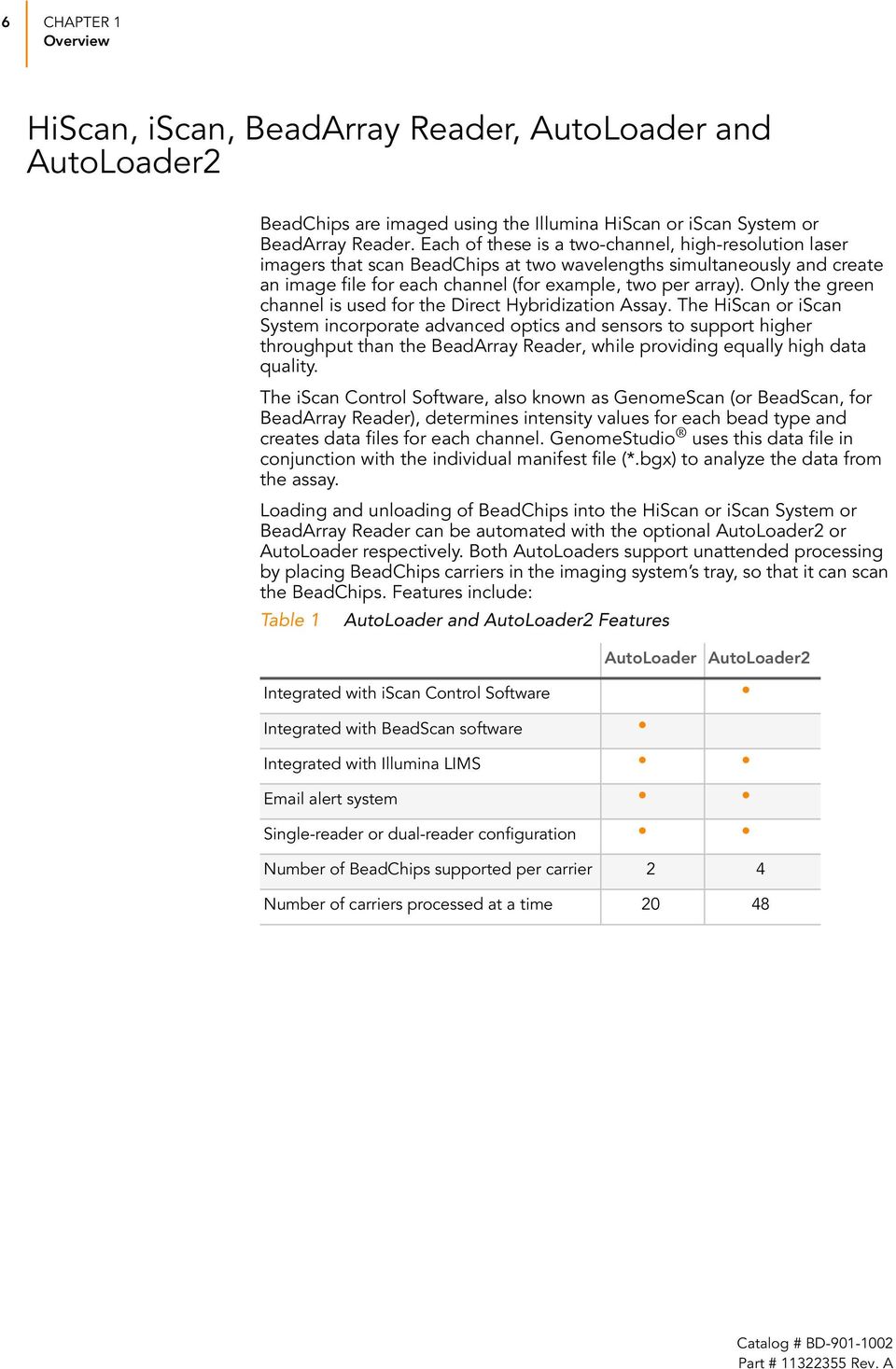
18 6 CHAPTER 1 Overview HiScan, iscan, BeadArray Reader, AutoLoader and AutoLoader2 BeadChips are imaged using the Illumina HiScan or iscan System or BeadArray Reader. Each of these is a two-channel, high-resolution laser imagers that scan BeadChips at two wavelengths simultaneously and create an image file for each channel (for example, two per array). Only the green channel is used for the Direct Hybridization Assay. The HiScan or iscan System incorporate advanced optics and sensors to support higher throughput than the BeadArray Reader, while providing equally high data quality. The iscan Control Software, also known as GenomeScan (or BeadScan, for BeadArray Reader), determines intensity values for each bead type and creates data files for each channel. GenomeStudio uses this data file in conjunction with the individual manifest file (*.bgx) to analyze the data from the assay. Loading and unloading of BeadChips into the HiScan or iscan System or BeadArray Reader can be automated with the optional AutoLoader2 or AutoLoader respectively. Both AutoLoaders support unattended processing by placing BeadChips carriers in the imaging system s tray, so that it can scan the BeadChips. Features include: Table 1 AutoLoader and AutoLoader2 Features AutoLoader AutoLoader2 Integrated with iscan Control Software Integrated with BeadScan software Integrated with Illumina LIMS alert system Single-reader or dual-reader configuration Number of BeadChips supported per carrier 2 4 Number of carriers processed at a time Catalog # BD Part # Rev. A
19 GenomeStudio Integrated Informatics Platform 7 GenomeStudio Integrated Informatics Platform GenomeStudio, Illumina s new integrated data analysis software platform, provides a common environment for analyzing data obtained from microarray and sequencing technologies. Within this common environment, or framework, the GenomeStudio software modules allow you to perform application-specific analyses. The GenomeStudio Gene Expression Module is an application for analyzing gene expression data from scanned microarray images collected from systems such as the Illumina iscan System or BeadArray Reader. Experiment performance is based on built-in controls that accompany each experiment. GenomeStudio Gene Expression Module expression results can be exported and analyzed by most standard gene expression analysis programs. You can perform these analyses on individual arrays or on groups of arrays treated as replicates. Data analysis features of the GenomeStudio Gene Expression Module include: Choice of assay analysis within a single application Data tables for information management and manipulation Plotting and graphing tools Whole-genome display of sample data in the IGV (Illumina Genome Viewer) Data visualization of one or more samples in the ICB (Illumina Chromosome Browser) Data normalization Custom report file formats Gene expression and differential expression analysis Outlier removal for negative controls Ability to combine/merge methylation or genotyping data into a gene expression project Data imputation for missing probes on an array Assay-specific controls dashboards For feature descriptions and instructions on using the GenomeStudio platform to visualize and analyze mirna data, see the GenomeStudio Framework User Guide and the GenomeStudio Gene Expression Module User Guide. Illumina Lab Protocols Illumina lab protocols are designed to promote efficiency and minimize the risk of contamination. Chapter 2, Standard Operating Procedures, describes the standard operating procedures and tools for an Illumina assay lab and explains how to set up and maintain the lab area. For instructions on how to perform the Direct Hybridization Assay protocol, see Chapter 3, Direct Hybridization Assay Protocols. Whole-Genome Gene Expression Direct Hybridization Assay Guide
20 8 CHAPTER 1 Overview Technical Assistance For technical assistance, contact Illumina Customer Support. Table 2 Illumina General Contact Information Illumina Website [email protected] Table 3 Region Illumina Customer Support Telephone Numbers Contact Number North America toll-free ILMN ( ) United Kingdom toll-free Germany toll-free Netherlands toll-free France toll-free Other European time zones Other regions and locations ILMN ( ) MSDSs Material safety data sheets (MSDSs) are available on the Illumina website at Product Documentation If you require additional product documentation, you can obtain PDFs from the Illumina website. Go to documentation.ilmn. When you click on a link, you will be asked to log in to icom. After you log in, you can view or save the PDF. To register for an icom account, please visit Catalog # BD Part # Rev. A

21 Chapter 2 Standard Operating Procedures Topics 10 Introduction 10 Acronyms 12 Lab Maintenance 13 Safety Precautions 13 Best Practices 14 Standard Lab Procedures 15 Initializing the BeadArray Reader (Daily) 17 Tracking Tools 20 Illumina-Supplied Equipment and Consumables 23 User-Supplied Equipment, Materials, and Reagents Whole-Genome Gene Expression Direct Hybridization Assay Guide 9
22 10 CHAPTER 2 Standard Operating Procedures Introduction This chapter explains standard operating procedures and precautions for operating an Illumina assay lab. You will also find lists of standard equipment, materials, and reagents. The assay protocols described in the rest of this guide assume that you are familiar with the contents of this chapter, have implemented all the recommendations, and have obtained all of the requisite materials. Acronyms A number of acronyms and abbreviations are used in this protocol. Refer to the alphabetical list below for definitions. Table 4 Direct Hybridization Assay Acronyms Acronym Definition ATP Block E1 C CAP cdna crna CTP DNase dntp EB GTP HCB HTW HYB Hyb IVT MAGE-ML Adenosine Triphosphate Block Buffer Celsius Coverseal Alignment Plate Complementary Deoxyribonucleic Acid Complementary Ribonucleic Acid Cytidine Triphosphate Deoxyribonuclease Deoxynucleotide Triphosphate Elution Buffer Guanosine Triphosphate Humidity Control Buffer High Temperature Wash Buffer Hybridization Buffer Hybridize or Hybridization In Vitro Transcription MicroArray and Gene Expression Markup Language Catalog # BD Part # Rev. A
23 Acronyms 11 Table 4 Direct Hybridization Assay Acronyms (Continued) Acronym Definition ml mm ng NIST nm PBS PCR pm rcf RNA RNase SA-Cy3 T7(dT) 24 TE UTP UV Wash E1BC μl Milliliters Millimolar Nanograms National Institute of Standards and Technology Nanometers Phosphate Buffered Saline Polymerase Chain Reaction Picomolar Relative Centrifugal Force Ribonucleic Acid Ribonuclease (an enzyme that degrades RNA) Cy3-Streptavidin Poly-dT Primer with T7 Promoter Element Tris-EDTA (Ethylenediaminetetraacetic Acid) Uridine Triphosphate Ultraviolet Wash Buffer Microliter(s) Whole-Genome Gene Expression Direct Hybridization Assay Guide
24 12 CHAPTER 2 Standard Operating Procedures Lab Setup The following standard lab setup procedures should be performed for Direct Hybridization Assay labs. Prevent Product Contamination Unless sufficient caution is exercised, products may contaminate reagents, instrumentation, and samples, causing inaccurate and unreliable results. Product contamination can shut down lab processes and significantly delay resumption of normal operations. CAUTION It is imperative to establish procedures for preventing product contamination before working in the lab. FIFO It is important to keep a first in, first out or FIFO system for reagents. Rotating the stock of the remaining reagents will help to avoid accidentally using expired reagents. Lab Maintenance The following standard lab maintenance procedures should be performed for Direct Hybridization Assay labs. Daily and Weekly Cleaning CAUTION To prevent sample or reagent degradation, ensure all sodium hypochlorite (bleach) vapors have fully dissipated before starting any processes. Hot spots are areas in the lab that pose the highest risk of contamination Clean these items daily with a solution of 0.5% sodium hypochlorite (10% bleach). Typical hot spots include: Bench space Door handles Refrigerator/freezer door handles Computer mouse Keyboards Centrifuges Vortexers Thermal cyclers Once a week, thoroughly clean the entire lab area, including all of the bench tops and instruments that are not cleaned daily. Mop the floors with a 0.5% sodium hypochlorite (10% bleach) solution as well. Provide training for personnel responsible for cleaning the lab areas so that they know how to prevent product contamination. Catalog # BD Part # Rev. A
25 Safety Precautions 13 Safety Precautions CAUTION The protocols described in this guide should be performed by qualified laboratory personnel only. Exercise caution when handling biological samples to avoid crosscontamination. WARNING This protocol involves the use of an aliphatic amide that is a probable reproductive toxin. Personal injury can occur through inhalation, ingestion, skin contact, and eye contact. Dispose of containers and any unused contents in accordance with the governmental safety standards for your region. For more information, see the MSDS for this kit, which is available at References Please visit to see the latest material data safety sheets. CAUTION Please refer to governmental and facility safety standards applicable to your site. Best Practices To optimize your data and minimize errors and waste, read and follow these best practices whenever performing the Direct Hybridization Assay protocols. Items Falling to the Floor Treat anything falling to the floor in the lab area as if it were contaminated. Disposable items falling to the ground, such as empty tubes, pipette tips, gloves, or lab coat hangers should be thrown away at the end of the day or at the completion of the assay. During the assay, never touch any items that have fallen to the ground. Non-disposable items falling to the ground, such as pipettes or important sample containers, should be immediately and thoroughly cleaned with a 0.5% sodium hypochlorite (10% bleach) solution to remove product contamination. Use a 0.5% sodium hypochlorite (10% bleach) solution to clean any lab surface that has contacted the contaminated item. Individuals handling anything that has fallen to the floor, disposable or not, must throw away their lab gloves and put on a new pair. Whole-Genome Gene Expression Direct Hybridization Assay Guide
26 14 CHAPTER 2 Standard Operating Procedures Reagent Reuse Pipette Carefully BeadChip Handling RNase-Free Techniques Never reuse excess reagents. Discard according to your facility requirements. Perform all pipette dispenses carefully and slowly to avoid creating turbulence within the plate wells and Flow-Through Chambers. Avoid touching the BeadChip anywhere other than at the barcode end or on the edges. Take the following precautions while working with RNA: Wear gloves throughout experiments to prevent contamination from the RNase found on most human hands. Use a solution of 0.1% SDS and 0.1N NaOH to decontaminate surfaces that are potentially contaminated with RNase. Change gloves after touching skin (e.g., your face or hair), door knobs, common surfaces, or other surfaces that have not been decontaminated. Use a dedicated set of pipettes for RNA work. Use freshly opened aerosol filter tips and tubes that are tested and guaranteed to be RNase-free. Use RNase-free chemicals and reagents, and DEPC-treated water. Designate a low-traffic area of the lab that is away or shielded from air vents or open windows. Do not leave RNase-free containers open when engaged in conversation. Standard Lab Procedures Running the Direct Hybridization Assay protocols requires that you perform some basic setup and familiarize yourself with standard procedures. This section discusses the following topics: Balancing the Centrifuge Cleaning and Calibrating Pipettes Balancing the Centrifuge Cleaning and Calibrating Pipettes Whenever you centrifuge plates or BeadChips, place a balance plate or rack with BeadChips opposite each plate or BeadChip rack being centrifuged. The weights should be as similar as possible. Ensure that pipettes are properly calibrated, clean, and decontaminated. Where possible, use a multi-channel pipette to dispense reagents.\ To prevent evaporation and spills, which could lead to assay variability and cross-contamination, ensure that all 96 caps are securely seated in the wells. When you remove a cap mat, do so carefully and slowly, to avoid splashing the contents. Set the cap mat aside, upside down, in a safe location for use later in the protocol. When you place the cap mat back on the plate, be sure to match it to its original plate and orient it correctly. Catalog # BD Part # Rev. A
27 Initializing the BeadArray Reader (Daily) 15 Initializing the BeadArray Reader (Daily) If you have an iscan System, you do not need to use this procedure. Follow the steps in this section to start and initialize the Illumina BeadArray Reader (Figure 6) at the start of each day. Tray in closed position Top button closes tray Bottom button opens tray Scanning indicators Attention (attn!) indicator Loaded indicator Ready indicator Figure 6 Illumina BeadArray Reader Power indicator Table 5 Indicator Illumina BeadArray Reader Indicators Description Scanning lights Attention Loaded Ready Power Flash blue in sequence when the BeadArray Reader is scanning. Turns solid amber to indicate a hardware problem. Check the BeadArray Reader PC for an error message. You may need to cycle the power on the BeadArray Reader. Not currently used. Flashes green during startup. Turns solid green when the BeadArray Reader is ready for use and when it is busy. Turns solid green when the BeadArray Reader is on. Whole-Genome Gene Expression Direct Hybridization Assay Guide
28 16 CHAPTER 2 Standard Operating Procedures Starting the BeadArray Reader 1. Locate the power switch on the lower-left side of the BeadArray Reader back panel and turn it to the ON position. 2. Wait for the ready indicator to stop flashing. 3. To open the BeadArray Reader, double-click the BeadScan icon on the BeadArray Reader PC desktop. 4. The BeadScan Welcome screen (Figure 7) prompts you for your user name. Figure 7 BeadScan Welcome Screen 5. Enter your user name, and click Scan. The system initializes after approximately 30 seconds. If this is the first use of the day, let the BeadArray Reader warm up for 1 2 hours. This allows the lasers to stabilize. Catalog # BD Part # Rev. A
29 Tracking Tools 17 Tracking Tools Illumina provides the following tools for sample tracking and guidance in the lab: Experienced User Cards guide you through the protocols. Lab Tracking Form map RNA samples to BeadChips and record the barcode of each reagent and plate used in the protocol. Sample Sheet Template are used to record information about your samples for later use in data analysis. Lab Tracking Form Create a copy of the lab tracking form for each run (Figure 8). Use it to track information such as operator ID, start and stop times, reagent lot numbers and barcodes, and to record which samples are placed on which arrays. This form can be filled out and saved online or printed and filled in by hand. NOTE Lab Tracking Forms can be downloaded via Whole-Genome Gene Expression Direct Hybridization Assay Lab Tracking Form Whole-Genome Gene Expression Direct Hybridization Assay Lab Tracking Form Whole-Genome Gene Expression Direct Hybridization Assay Lab Tracking Form Project: Batch: Image Date: 1 Sample Labeling Date/Time: Operator: 2 3 Quantitate RNA (Optional) Date/Time: Operator: Hyb BeadChip Date/Time: Operator: Pre-heat HCB and HYB (58 C, 10 m) Start: Stop: Pre-heat crna (65 C, 5 m) Start: Stop: Labeling Kit: Sample RNA Plate: Sample QRNA Plate: HCB Reagent: HYB Reagent: BeadChip: 5 6 Detect Signal Date/Time: Block E1 Reagent: Operator: SA-Cy3 Reagent: SA-Cy3 Wash (RT, 10 m) Wash E1BC Reagent: Start: Stop: E1BC Wash (RT, 5 m) Start: Stop: Centrifuge (RT, 4 m) Start: Stop: Image BeadChip Date/Time: iscan System ID: or Operator: BeadArray Reader ID: Imaging Start: Stop: Twelve Sample BeadChip Date/Time: Operator: Indicate sample placements below: A B C D E F G H I Vortex crna J Centrifuge crna (250 xg) K 4 Hyb Oven (58 C, h): Start: Stop: Wash BeadChip Date/Time: Block E1 Reagent: Operator: EtOH Lot #: HTW Wash (55 C, 10 m) HTW Reagent: Start: Stop: Wash E1BC Reagent: E1BC Wash (RT, 5 m) L Barcode A B C Start: Stop: D EtOH Wash (RT, 10 m) E Start: Stop: E1BC Wash (RT, 2 m) Start: Stop: Block E1 Wash (RT, 10 m) Start: Stop: F G H I J K L Barcode Page 1 of 3 Part # Rev. A Page 2 of 3 Part # Rev. A Page 3 of 3 Part # Rev. A Figure 8 Lab Tracking Form Whole-Genome Gene Expression Direct Hybridization Assay Guide
30 18 CHAPTER 2 Standard Operating Procedures Sample Sheet To effectively track your samples and assay, Illumina recommends that you create a sample sheet. The sample sheet will later be used by the GenomeStudio application for data analysis. For instructions on data analysis, see the GenomeStudio Gene Expression User Guide. Create your sample sheet according to the guidelines provided in Table 6. Table 6 Sample Sheet Guidelines Column Heading Sample_Name Sample_Well Sample_Plate Sample_Group Pool_ID Sentrix_ID Sentrix_Position Description Name of the sample. Used only for display in the table. If not user-specified, the GenomeStudio application will assign a default sample name, concatenating the sample plate and sample well names. Example: S12345 The well containing the specific sample in the 96-well RNA plate. Example: A01 User-specified name for the plate containing RNA samples. Used only for display in the table. Example: XS SUR User-specified name of the sample group. Same as Sample_Name, but without the "rep extension, so that all replicates are grouped together in GenomeStudio. If not user-specified, the GenomeStudio application will create one group and assign a default group name. Example: Group 1 Name of the DAP. Example: XS DAP BeadChip ID number. Example: The BeadChip section to which the sample is hybridized. Example: A1 Optional (O) or Required (R) O O O O O R R Notes Your sample sheet header may contain whatever information you choose. Your sample sheet may contain any number of columns you choose. Your sample sheet must be in a comma-delimited (.csv) file format. Save the sample sheet under any name you wish; for example, the user-defined experiment name. Catalog # BD Part # Rev. A
31 Tracking Tools 19 Figure 9 provides an example of the Sample Sheet format. The electronic sample sheet template can be downloaded via Figure 9 Sample Sheet Example Whole-Genome Gene Expression Direct Hybridization Assay Guide
32 20 CHAPTER 2 Standard Operating Procedures Illumina-Supplied Equipment and Consumables Equipment To perform the Illumina Whole-Genome Gene Expression Direct Hybridization Assay, you need either a HiScan, iscan or BeadArray Reader System and either the Universal Starter Kit or the Gene Expression (IVT) Product Option Kit. For details on current configuration and kit options, consult your Illumina account representative or the latest Illumina product guide (available at Table 7 Illumina-Supplied Equipment for Direct Hybridization Assay Item Illumina Catalog # HiScan System or iscan System AutoLoader2 (optional) Universal Starter Kit or Gene Expression (IVT) Product Option Kit SY SY Single-Scanner, SY Dual-Scanner, SY SE (110V) SE (220V) SE (110V) SE (220V) Catalog # BD Part # Rev. A
33 Illumina-Supplied Equipment and Consumables 21 Consumables This section describes the consumables in the Direct Hybridization Assay kits. For exact details on current configuration and kit options, consult your Illumina account representative or the latest Illumina product catalog. For ordering information, see the appropriate data sheet at Table 8 Direct Hybridization Assay Consumables Item Contents Illumina Catalog # HumanWG-6 v3.0 Expression BeadChip Kit HumanHT-12 v3 Expression BeadChip Kit HumanHT-12 v4 Expression BeadChip Kit HumanRef-8 v3.0 Expression BeadChip Kit HumanWG-6 v3.0 BeadChips 6 microarrays per BeadChip Wash E1 BC Buffer (20 ml (4 5 ml)) BeadChip Tweezer (1) Wash Trays (14) Wash Tray Lids (7) High-Temperature Wash Buffer (325 ml) Blocking E1 Buffer (40 ml) Hybridization E1 Buffer (1.7 ml) Humidity Control Buffer (2.8 ml) HumanHT-12 v3 BeadChips Wash E1 BC Buffer (20 ml (4 5 ml)) BeadChip Tweezer (1) Wash Trays (14) Wash Tray Lids (7) High-Temperature Wash Buffer (325 ml) Blocking E1 Buffer (40 ml) Hybridization E1 Buffer (1.7 ml) Humidity Control Buffer (2.8 ml) HumanHT-12 v4 BeadChips Wash E1 BC Buffer (20 ml (4 5 ml)) BeadChip Tweezer (1) Wash Trays (14) Wash Tray Lids (7) High-Temperature Wash Buffer (325 ml) Blocking E1 Buffer (40 ml) Hybridization E1 Buffer (1.7 ml) Humidity Control Buffer (2.8 ml) HumanRef-8 v3.0 BeadChips 8 microarrays per BeadChip Wash E1 BC Buffer (20 ml (4 5 ml)) BeadChip Tweezer (1) Wash Trays (14) Wash Tray Lids (7) High-Temperature Wash Buffer (325 ml) Blocking E1 Buffer (40 ml) Hybridization E1 Buffer (1.7 ml) Humidity Control Buffer (2.8 ml) BD Samples 2 BeadChips BD Samples 6 BeadChips BD Samples 2 BeadChips BD Samples 6 BeadChips BD Samples 2 BeadChips BD Samples 6 BeadChips BD Samples 2 BeadChips BD Samples 6 BeadChips Whole-Genome Gene Expression Direct Hybridization Assay Guide
34 22 CHAPTER 2 Standard Operating Procedures Table 8 Direct Hybridization Assay Consumables (Continued) Item Contents Illumina Catalog # MouseWG-6 v2.0 Expression BeadChip Kit MouseRef-8 v2.0 Expression BeadChip Kit RatRef-12 Expression BeadChip Kit MouseWG-6 v2.0 BeadChips, each containing > 45,000 probes per array based on RefSeq Release 22 and supplemented with MEEBO and RIKEN FANTOM2 content 6 microarrays per BeadChip Wash E1 BC Buffer (20 ml (4 5 ml)) BeadChip Tweezer (1) Wash Trays (14) Wash Tray Lids (7) High-Temperature Wash Buffer (325 ml) Blocking E1 Buffer (40 ml) Hybridization E1 Buffer (1.7 ml) Humidity Control Buffer (2.8 ml) MouseRef-8 v2.0 BeadChips, each containing > 25,000 probes per array based on RefSeq Release 22 and supplemented with MEEBO and RIKEN FANTOM2 content 8 microarrays per BeadChip Wash E1 BC Buffer (20 ml (4 5 ml)) BeadChip Tweezer (1) Wash Trays (14) Wash Tray Lids (7) High-Temperature Wash Buffer (325 ml) Blocking E1 Buffer (40 ml) Hybridization E1 Buffer (1.7 ml) Humidity Control Buffer (2.8 ml) RatRef-12 BeadChips, each containing > 22,000 probes per array targeting all known genes and known alternative splice variants. 12 microarrays per BeadChip Wash E1 BC Buffer (20 ml (4 5 ml)) BeadChip Tweezer (1) Wash Trays (14) Wash Tray Lids (7) High-Temperature Wash Buffer (325 ml) Blocking E1 Buffer (40 ml) Hybridization E1 Buffer (1.7 ml) Humidity Control Buffer (2.8 ml) BD Samples 2 BeadChips BD Samples 6 BeadChips BD Samples 2 BeadChips BD Samples 6 BeadChips BD Samples 2 BeadChips BD Samples 6 BeadChips Catalog # BD Part # Rev. A
35 User-Supplied Equipment, Materials, and Reagents 23 User-Supplied Equipment, Materials, and Reagents The equipment, materials, and reagents listed in this section are all required for the Direct Hybridization Assay. Table 9 User-Supplied Equipment Item 8-channel precision pipettes (5 μl to 200 μl) 96-well thermal cycler with heated lid Aerosol filter pipette tips Clean paper towels Lab coats Microtiter plate centrifuges (two, capable of 20 3,000 xg, 2º to 8ºC) Note: Ensure this is 20 3,000 xg, not 20 3,000 rpm Protective gloves Safety glasses Serological pipettes (50 ml) Spectrofluorometer (Optional) Stopwatch/timer Tachometer/stroboscope, combination optical Tube racks for vacuum desiccators (must fit internal dimensions of the vacuum desiccator) Tube vortexer Vacuum centrifuge Vacuum desiccator (1 per 8 BeadChips processed simultaneously) Suggested Vendor General lab supplier General lab supplier General lab supplier General lab supplier General lab supplier General lab supplier General lab supplier General lab supplier General lab supplier Molecular Devices, Gemini XS or XPS General lab supplier Cole-Parmer, catalog # A , VWR International, catalog # General lab supplier General lab supplier VWR International, catalog # Vacuum tubing VWR International, catalog # Whole-Genome Gene Expression Direct Hybridization Assay Guide
36 24 CHAPTER 2 Standard Operating Procedures Table 10 User-Supplied Materials Item Suggested Vendor 96-well black, flat-bottom Fluotrac 200 plates Greiner, catalog # Absorbent pads Aluminum foil General lab supplier General lab supplier Canned air (such as Aerosol Whoosh-Duster) VWR International, catalog # Centrifuge alignment frame Millipore, catalog # MACF096S4 Centrifuge tubes (50 ml) Corning, catalog # Filter plates Millipore, catalog # MAHV-N45 10/50 Gel-loading pipette tips VWR International, catalog # Non-sterile solution basins (55 ml) Labcor Products, Inc., catalog # VWA, catalog # OmniTrays Nunc, catalog # Protective gloves Sterile plastic containers (100 ml capacity) General lab supplier General lab supplier Sterile reservoirs (quarter reservoir) Beckman Coulter, Inc., catalog # Tweezers General lab supplier Table 11 User-Supplied Reagents Item Suggested Vendor 100% Ethanol General lab supplier Cy3-Streptavidin Fisher Scientific, catalog # CyDye Fluors (GE Healthcare) VWR International, catalog # [Optional] Quant-iT RiboGreen RNA quantitation kit Invitrogen, catalog # R Catalog # BD Part # Rev. A
37 User-Supplied Equipment, Materials, and Reagents 25 Table 11 User-Supplied Reagents (Continued) Item RNase-free water Sample Labeling RNA prep kit - one of the following: 1. Ambion Illumina TotalPrep RNA Amplification Kit 2. Ambion Illumina TotalPrep-96 RNA Amplification Kit 3. Epicentre TargetAmp Nano-g Biotin-aRNA Labeling Kit for the Illumina System 4. NuGEN Ovation amplification kits [Optional] Single-Use cdna Synthesis Kit Suggested Vendor General lab supplier 1. Ambion, catalog # IL1791, 2. Ambion, catalog # , 3. Epicentre, catalog # TAN07924, Illumina, catalog # GT Table 12 [Optional] User-Supplied Labeling Control Reagents Item Suggested Vendor 1% agarose gel General lab supplier MEGAscript T3 Kit Ambion, catalog # Notl enzyme [Optional] QIAprep Spin Miniprep Kit 50 minipreps 250 minipreps [Optional] QIAquick PCR Purification Kit 50 PCR Reactions 250 PCR Reactions or phenol: chloroform extraction ethanol precipitation RNeasy Mini Kit 50 mini spin columns 250 mini spin columns New England BioLabs, Inc., catalog # R0189S QIAGEN, catalog # QIAGEN, catalog # QIAGEN, catalog # QIAGEN, catalog # General lab supplier QIAGEN, catalog # QIAGEN, catalog # Whole-Genome Gene Expression Direct Hybridization Assay Guide
38 26 CHAPTER 2 Standard Operating Procedures Catalog # BD Part # Rev. A
39 Direct Hybridization Assay Protocols Topics 28 Introduction 29 Sample Labeling (Optional) 30 Quantitate RNA (Optional) 39 Hybridize BeadChip 48 Wash BeadChip 56 Detect Signal 59 Image BeadChip on the iscan System 67 Image BeadChip on the BeadArray Reader 75 GenomeStudio Integrated Informatics Platform Whole-Genome Gene Expression Direct Hybridization Assay Guide 27
40 28 CHAPTER 3 Direct Hybridization Assay Protocols Introduction This chapter provides detailed laboratory protocols for processing up to 12 BeadChips with the Illumina Whole-Genome Gene Expression Direct Hybridization Assay system. Perform each protocol in the order shown. The instructions in this chapter assume that you have already familiarized yourself with Chapter 2, Standard Operating Procedures and have set up the lab area appropriately. Catalog # BD Part # Rev. A
41 Sample Labeling (Optional) 29 Sample Labeling (Optional) The Illumina recommended sample labeling procedure starts with unlabeled total RNA extracted from a eukaryotic sample and produces an amplified pool of biotin-labeled crna corresponding to the polyadenylated (mrna) fraction. The labeled crna is then hybridized to the array. The most consistent results are achieved by hybridizing equivalent amounts of crna on each array. An appropriate volume of crna from each sample is aliquoted into hybridization tubes. NOTE It is important to determine the exact concentration of unlabeled total RNA input before beginning the protocol. Labeling Kits Process Overview To perform the sample labeling procedure, use an appropriate labeling kit such as one of the following and follow the instructions in the kit: Ambion Illumina TotalPrep RNA Amplification Kit Ambion Illumina TotalPrep-96 RNA Amplification Kit Epicentre TargetAmp Nano-g Biotin-aRNA Labeling Kit for the Illumina System NuGEN Ovation amplification kits that have been shown to work with Illumina Gene Expression BeadArray technology. See the NuGEN website ( for the modified protocol. When following the sample labeling kit instructions, the process consists of these major steps: Reverse Transcription to Synthesize First Strand cdna - Convert the mrna fraction to single-stranded cdna using a T7 Oligo(dT) Primer to synthesize cdna containing a T7 promoter sequence. Second-Strand Synthesis - Convert the single-stranded cdna to produce double-stranded DNA (dsdna) template for transcription. cdna Purification - Remove RNA and other residual components that would inhibit in vitro transcription. In Vitro Transcription (IVT) - Amplify and label multiple copies of biotinylated crna from the double-stranded cdna templates. crna Purification - Remove unincorporated NTPs, salts, and other residuals to prepare for analysis with Illumina's Direct Hybridization assay. Quantification (optional) - Quantitate small RNA volumes. See Quantitate RNA (Optional) on page 30. Whole-Genome Gene Expression Direct Hybridization Assay Guide
42 30 CHAPTER 3 Direct Hybridization Assay Protocols Quantitate RNA (Optional) This process uses the RiboGreen RNA quantitation kit to quantitate RNA samples for the Direct Hybridization Assay. You can quantitate up to six plates, each containing up to 96 samples. If you already know the concentration, proceed to Hybridize BeadChip on page 39. Illumina recommends the Quant-iT RiboGreen RNA Assay Kit to quantitate RNA samples. The RiboGreen assay can quantitate small RNA volumes, and measures RNA directly. Other techniques may pick up contamination such as small molecules and proteins. Illumina recommends using a fluorometer because fluorometry provides RNA-specific quantification. Spectrophotometry might also measure DNA and yield values that are too high. CAUTION RiboGreen is susceptible to chemical contaminants. For more information, see the Invitrogen website ( Estimated Time Consumables Hands-on time: ~30 minutes Fluorometer read time: ~5 minutes per plate Item Quantity Storage Supplied By Quant-iT RiboGreen RNA Assay Kit, containing RiboGreen quantitation reagent, 20X TE, and Ribosomal RNA Standard 1 2 to 8 C User RNA sample plate Up to 96 samples -80 C User 96-well 0.65 ml microtiter plate 1 per 96 samples See Fluotrac well flat-bottom plate 1 per Std RNA plate 1 per Sample RNA plate manufacturer s instructions User User 100 ml or 250 ml Nalgene bottle 1 per RiboGreen kit User Preparation Thaw all reagents to room temperature and then vortex to mix. Place a QRNA barcode label on each Fluotrac 200 plate. Position the labels on the skirt of the plate on the right, where the manufacturer's name appears. Hand-label the microtiter plate Standard RNA. Hand-label one of the Fluotrac plates Standard QRNA. Hand-label the other Fluotrac plate Sample QRNA. This plate will contain the quantitated RNA. In the Sample Sheet, enter the Sample_Name (optional) and Sample_Plate for each Sample_Well. Catalog # BD Part # Rev. A
43 Quantitate RNA (Optional) 31 Steps This process involves the following procedures: Make Standard RNA Plate Dilute RiboGreen Create Standard QRNA Plate with Diluted RiboGreen Prepare Sample QRNA Plate with RiboGreen and RNA Read QRNA Plate Make Standard RNA Plate In this process, you create a Standard RNA plate with serial dilutions of standard ribosomal RNA in the wells of column 1 (Figure 10). 1. Add 10 μl 1X TE (supplied in RiboGreen kit at 20X) to B1 H1 in the plate labelled Standard RNA. 2. Add 20 μl ribosomal RNA to well A1. rrna 1X TE 20 µl 10 µl 10 µl 10 µl 10 µl 10 µl 10 µl 10 µl A B C D E F G H Figure 10 Microtiter Plate Dilution of Ribosomal RNA Standard 3. Transfer 10 μl from well A1 to well B1. Pipette up and down several times. 4. Change tips. Transfer 10 μl from well B1 to well C1. Pipette up and down several times. 5. Repeat for wells C1, D1, E1, F1, and G1, changing tips each time. Do not transfer from well G1 to H1. Table 13 Concentrations of Standard Ribosomal RNA Row-Column Concentration (ng/μl) Final Volume in Well (μl) A B C Whole-Genome Gene Expression Direct Hybridization Assay Guide
44 32 CHAPTER 3 Direct Hybridization Assay Protocols Table 13 Concentrations of Standard Ribosomal RNA Row-Column Concentration (ng/μl) Final Volume in Well (μl) D E F G H Standard RNA Plate with Serial Dilutions of Ribosomal RNA 100 ng/µl 10µl 50 ng/µl 25 ng/µl 12.5 ng/µl 6.25 ng/µl ng/µl ng/µl 0 ng/µl 10µl 10µl 10µl 10µl 10µl 20µl 10µl Figure 11 Serial Dilutions of Ribosomal RNA 6. Cover the Standard RNA plate with an adhesive seal. 7. Proceed to Dilute RiboGreen. Dilute RiboGreen The diluted RiboGreen will be added to both the Standard QRNA and Sample QRNA plates, to make the RNA fluoresce when read with the fluorometer. 1. Prepare a 1:200 dilution of RiboGreen into 1X TE, using the kit supplies and a sealed 100 ml or 250 ml Nalgene bottle wrapped in aluminum foil. Use 115 μl RiboGreen and 23 ml 1X TE for 1 plate, 215 μl Ribogreen and 43 ml 1X TE for 2 plates, and so on up to 6 plates. Refer to Table 14 to identify the volumes needed to produce diluted reagent for multiple 96-well QRNA plates. For fewer than 96 RNA samples, scale down the volumes. Catalog # BD Part # Rev. A
45 Quantitate RNA (Optional) 33 Table 14 Volumes for RiboGreen Reagents # QRNA Plates RiboGreen Volume (μl) 1X TE Volume (ml) Cap the foil-wrapped bottle and vortex to mix. Create Standard QRNA Plate with Diluted RiboGreen In this process you transfer the serial dilutions from the Standard RNA plate into the Standard QRNA Fluotrac plate and add diluted RiboGreen. 1. Pour the RiboGreen/1X TE dilution into a clean reagent reservoir. 2. Using a multichannel pipette, transfer 195 μl RiboGreen/1X TE dilution into each well of columns 1 and 2 of the Fluotrac plate labelled Standard QRNA (Figure 12). 3. Add 2 μl of each standard ribosomal RNA dilution from the Standard RNA plate to columns 1 and 2 of the Standard QRNA Fluotrac plate. Standard QRNA Plate with RiboGreen = 195 µl RiboGreen / 1X TE Dilution + 2 µl Ribosomal QRNA Serial Dilutions Figure 12 Standard QRNA Plate with RiboGreen 4. Immediately cover the plate with an adhesive aluminum seal. 5. Proceed to Prepare Sample QRNA Plate with RiboGreen and RNA. Whole-Genome Gene Expression Direct Hybridization Assay Guide
46 34 CHAPTER 3 Direct Hybridization Assay Protocols Prepare Sample QRNA Plate with RiboGreen and RNA In this process, you create a new Sample QRNA plate that contains RNA sample and RiboGreen. 1. Using a multichannel pipette, transfer 195 μl RiboGreen/1X TE dilution into each well of columns 1 and 2 of the Fluotrac plate labelled Sample QRNA (Figure 13). 2. Add 2 μl of RNA sample to all 96 wells of the Sample QRNA plate. Only the first two columns will also contain RiboGreen/1X TE dilution. Sample QRNA Plate with RiboGreen = 195 µl RiboGreen / 1X TE Dilution = 2 µl Sample RNA Figure 13 Sample QRNA Plate with RiboGreen NOTE For fewer than 96 RNA samples, add the diluted RiboGreen reagent into the number of wells needed. 3. Immediately cover the plate with an adhesive aluminum seal. 4. Proceed to Read QRNA Plate. Read QRNA Plate In this process, you use the Gemini XS or XPS Spectrofluorometer to read the Standard QRNA and Sample QRNA plates. The spectrofluorometer creates a standard curve from the known concentrations in the Standard QRNA plate, which you use to determine the concentration of RNA in the Sample QRNA plates. 1. Turn on the fluorometer. At the PC, open the SoftMax Pro program. 2. Load the Illumina QRNA.ppr file from the installation CD that came with your system. 3. Select Assays Illumina Illumina QRNA (Figure 14). Catalog # BD Part # Rev. A
47 Quantitate RNA (Optional) 35 Figure 14 Load the Illumina QRNA Protocol in SoftMax Pro 4. Place the Standard QRNA Fluotrac Plate into the fluorometer loading rack with well A1 in the upper left corner. 5. Click the blue arrow next to Standard RNA (Figure 15). Figure 15 Select the Standard RNA Screen Whole-Genome Gene Expression Direct Hybridization Assay Guide
48 36 CHAPTER 3 Direct Hybridization Assay Protocols 6. Click Read in the SoftMax Pro interface (Figure 16) to begin reading the Standard QRNA Plate. Figure 16 Read the Standard QRNA Plate 7. When the software finishes reading the data, remove the plate from the drawer. 8. Click the blue arrow next to Standard Curve to view the standard curve graph (Figure 17). 9. If the standard curve is acceptable, continue with the sample plate. Otherwise, click Standard Curve again. Catalog # BD Part # Rev. A
49 Quantitate RNA (Optional) 37 Figure 17 View Standard Curve 10. Place the first Sample QRNA plate in the fluorometer with well A1 in the upper left corner. Whole-Genome Gene Expression Direct Hybridization Assay Guide
50 38 CHAPTER 3 Direct Hybridization Assay Protocols 11. Click the blue arrow next to QRNA#1 and click Read (Figure 18). Figure 18 Read the Sample QRNA Plate 12. When the software finishes reading the plate, remove the plate from the drawer. 13. Repeat steps 10 through 12 to quantitate all Sample QRNA plates. 14. Once all plates have been read, click File Save to save the output data file (*.pda). 15. When you have saved the *.pda file, click File Import/Export Export and export the file as a *.txt file. You can open the *.txt file in Microsoft Excel for data analysis. 16. Do one of the following: Proceed to Hybridize BeadChip on page 39. If you do not plan to use the Sample QRNA plates immediately in the protocol, store the quantitated RNA at 2º to 8ºC for up to one month. Catalog # BD Part # Rev. A
51 Hybridize BeadChip 39 Hybridize BeadChip In this process, you normalize the crna and dispense it to BeadChips. Place the RNA-loaded BeadChips into the Hyb Chamber inserts, then place the inserts into the Hyb Chambers. Incubate the Hyb Chambers in the Illumina Hybridization Oven for hours at 58 C. Estimated Time Consumables and Equipment Hands-on time: ~1 hour Incubation time: hours Item Quantity Storage Supplied By HCB 1 tube per 4 BeadChips -15º to -25ºC Illumina HYB 1 tube per 12 BeadChips -15º to -25ºC Illumina Hyb Chamber 1 per 4 BeadChips Room temperature Illumina Hyb Chamber gaskets Hyb Chamber inserts 1 per Hyb Chamber Room temperature 4 per Hyb Chamber Room temperature Illumina Illumina Preparation Calibrate the Illumina Hybridization Oven with the Full-Scale Plus digital thermometer supplied with your system. Preheat the Illumina Hybridization Oven to 58 C. Allow 30 minutes for it to equilibrate. NOTE For more information about the Illumina Hybridization Oven, see the Hybridization Oven System Guide provided with the instrument. Place the HYB and HCB tubes in the 58 C oven for 10 minutes to dissolve any salts that may have precipitated in storage. If any salts remain undissolved, incubate at 58 C for another 10 minutes. Cool to room temperature and mix thoroughly before using. Remove the BeadChips from cold storage. Leave them on the benchtop in their packages for at least 10 minutes at room temperature. In the Sentrix_ID column of the Sample Sheet, enter the BeadChip ID for each BeadChip section. For more information, see Sample Sheet on page 21. Whole-Genome Gene Expression Direct Hybridization Assay Guide
52 40 CHAPTER 3 Direct Hybridization Assay Protocols Steps This process involves the following procedures: Prepare RNA for Hybridization Assemble the Hyb Chambers Prepare BeadChips for Hybridization Load Sample Hybridize BeadChips Prepare High-Temp Wash Buffer Prepare RNA for Hybridization 1. Preheat the crna sample tube at 65 C for 5 minutes. 2. Vortex the crna sample tube, then pulse centrifuge the tube at 250 xg. 3. Allow the crna sample tube to cool to room temperature, then proceed as soon as the tube has cooled. 4. Using a single-channel precision pipette, add the appropriate volume from each crna sample tube into each hybridization tube. Table 15 crna Masses Used BeadChip Type 6-Sample 8-Sample crna Mass 1.5 μg 750 ng 12-Sample 750 ng 5. Using a single-channel precision pipette, add the appropriate volume of RNase-free water into each crna sample tube. Table 16 RNase-free Water Hyb Volumes BeadChip Type 6-Sample 8-Sample 12-Sample crna Volume 10 μl 5 μl 5 μl Catalog # BD Part # Rev. A
53 Hybridize BeadChip Using a single-channel precision pipette, add the appropriate volume of HYB into each crna sample tube. WARNING This protocol involves the use of an aliphatic amide that is a probable reproductive toxin. Personal injury can occur through inhalation, ingestion, skin contact, and eye contact. Dispose of containers and any unused contents in accordance with the governmental safety standards for your region. For more information, see the MSDS for this kit, which is available at Table 17 Hyb Mix Volumes BeadChip Type 6-Sample 8-Sample 12-Sample Hyb Mix Volume 20 μl 10 μl 10 μl Assemble the Hyb Chambers 1. Place the following items on the bench top (Figure 19): BeadChip Hyb Chamber (1 per 4 BeadChips) BeadChip Hyb Chamber gasket (1 per Hyb Chamber) BeadChip Hyb Chamber inserts (4 per Hyb Chamber) Whole-Genome Gene Expression Direct Hybridization Assay Guide
54 42 CHAPTER 3 Direct Hybridization Assay Protocols Hyb Chamber Hyb Chamber Gasket Hyb Chamber Inserts Figure 19 BeadChip Hyb Chamber Components 2. Place the Hyb Chamber Gasket into the Hyb Chamber as follows: a. Match the wider edge of the Hyb Chamber gasket to the barcoderidge side of the Hyb Chamber (Figure 20). Reservoirs Narrower Edge Barcode Ridges Wider Edge Figure 20 Hyb Chamber and Gasket b. Lay the gasket into the Hyb Chamber (Figure 21), and then press it down all around. Catalog # BD Part # Rev. A
55 Hybridize BeadChip 43 Figure 21 Place Gasket into Hyb Chamber c. Make sure the Hyb Chamber gasket is properly seated (Figure 22). Figure 22 BeadChip Hyb Chamber with Gasket in Place 3. Add 200 μl HCB into the eight humidifying buffer reservoirs in the Hyb Chamber (Figure 23). If you are hybridizing fewer than four BeadChips, only fill the reservoirs of sections that will contain BeadChips. Whole-Genome Gene Expression Direct Hybridization Assay Guide
56 44 CHAPTER 3 Direct Hybridization Assay Protocols Figure 23 Dispense HCB into BeadChip Hyb Chamber Reservoir 4. Close and lock the BeadChip Hyb Chamber lid (Figure 24). a. Seat the lid securely on the bottom plate. b. Snap two clamps shut, diagonally across from each other. c. Snap the other two clamps. Figure 24 Seal the Hyb Chamber 5. Leave the closed Hyb Chamber on the bench at room temperature until the BeadChips are loaded with the DNA sample. Catalog # BD Part # Rev. A
57 Hybridize BeadChip 45 Prepare BeadChips for Hybridization CAUTION Do not unpackage BeadChips until you are ready to begin hybridization. 1. Remove all the BeadChips from their packages. 2. Place each BeadChip in a Hyb Chamber Insert, orienting the barcode end so that it matches the barcode symbol on the Hyb Chamber Insert (Figure 25). Figure 25 Place BeadChips into Hyb Chamber Inserts Load Sample 1. Using a single-channel precision pipette, add the appropriate volume of DNA sample onto the center of each inlet port. Table 18 Sample Loading BeadChip Type 6-Sample 8-Sample 12-Sample DNA Sample 30 μl 15 μl 15 μl NOTE Load samples by placing pipette tips directly onto the array surface. To avoid wicking, hold the pipette straight up. 2. Visually inspect all sections. Ensure sample covers all of the sections of the stripe. Record any sections that are not covered. Some residual sample may still remain in the inlet port. This is normal. Whole-Genome Gene Expression Direct Hybridization Assay Guide
58 46 CHAPTER 3 Direct Hybridization Assay Protocols 3. Open the Hyb Chamber. 4. Load 4 Hyb Chamber Inserts containing sample-laden BeadChips into each Hyb Chamber (Figure 26). CAUTION When handling the BeadChip, avoid contacting the beadstripe area and sample inlets. Figure 26 BeadChips in BeadChip Hyb Chamber 5. Position the barcode end over the ridges indicated on the Hyb Chamber and ensure the inserts are securely seated. Hybridize BeadChips 1. Close and lock the BeadChip Hyb Chamber lid (Figure 27). a. Seat the lid securely on the bottom plate. b. Snap two clamps shut, diagonally across from each other. c. Snap the other two clamps. d. Check to ensure that the Hyb Chamber is completely closed, as any gap in the seal will result in evaporation during hybridization and will compromise analytical data. Figure 27 Secure Lid CAUTION For optimal performance, keep the Hyb Chamber steady and level when lifting or moving. Avoid shaking the Hyb Chamber, and keep the Hyb Chamber parallel to the lab bench while you transfer it to the Illumina Hybridization Oven. Catalog # BD Part # Rev. A
59 Hybridize BeadChip Place the Hyb Chamber into the 58 C Illumina Hybridization Oven so that the clamps face the left and right sides of the oven. The Illumina logo on top of the Hyb Chamber should face you. 3. (Optional) Start the rocker at speed 5. Turn on the switch just above the power switch. 4. Close the Illumina Hybridization Oven door. 5. Incubate the BeadChips for at least 14 hours but no more than 20 hours at 58 C. 6. Update the lab tracking form with the start and stop times. Prepare High-Temp Wash Buffer 1. In preparation for the next day s washes, prepare 1X High-Temp Wash buffer from the 10X stock by adding 50 ml 10x High-Temp Wash buffer to 450 ml RNAse-free water. 2. Place the Hybex Waterbath insert into the Hybex Heating Base. 3. Add 500 ml prepared 1X High-Temp Wash buffer to the Hybex Waterbath insert (Figure 28). Waterbath Insert Figure 28 Adding High-Temp Buffer to Hybex Waterbath Insert 4. Set the Hybex Heating Base temperature to 55 C (Figure 28). 5. Close the Hybex Heating Base lid and leave the High Temp Wash buffer to warm overnight. 6. Proceed to Wash BeadChip on page 53 the next day. Whole-Genome Gene Expression Direct Hybridization Assay Guide
60 48 CHAPTER 3 Direct Hybridization Assay Protocols Wash BeadChip In this process, prepare for the wash steps by removing the BeadChips from the overnight hybridization. Remove the BeadChip coverseals and then wash the BeadChips. Estimated Time Consumables Hands-on: 1 hour Incubation: 1 hour with various incubations Item Quantity Storage Supplied By 100% EtOH Bottle Room temperature User Block E1 Buffer Bottle -2º to -8ºC Illumina High Temperature Wash Buffer Bottle Room temperature Illumina Wash E1BC Buffer Bottle Room temperature Illumina Preparation Add 6 ml E1BC buffer to 2 L RNase-free water to make the Wash E1BC solution. Place 1 L of diluted Wash E1BC buffer in a Pyrex No beaker. NOTE A Pyrex No beaker comes with the purchase of a Gene Expression (IVT) Product Option Kit or Universal Starter Kit. If you have not purchased one recently, please contact Illumina Customer Service to obtain a beaker. Pour 250 ml of Wash E1BC buffer into a glass wash tray. Pour 250 ml of 100% EtOH into a separate glass wash tray. Steps This process involves the following procedures: Seal Removal High Temp Wash First Room-Temp Wash Ethanol Wash Second Room-Temp Wash Block Catalog # BD Part # Rev. A
61 Wash BeadChip 49 Seal Removal 1. Remove the Hyb Chamber from the oven and place it on the lab bench. Disassemble the chamber. NOTE Up to three chambers can be processed simultaneously. If you are processing multiple chambers, remove them from the oven and process the BeadChips one at a time and place them in a large wash bowl without removing the coverseal. Process all BeadChips in the first chamber as described in steps 2 5 below, then remove second chamber from the oven, process all of its BeadChips, and so on until all chambers are processed. 2. Using powder-free gloved hands, remove all BeadChips from the Hyb Chamber and submerge them face up at the bottom of the beaker (Figure 29). Figure 29 BeadChips Submerged Face Up in Beaker 3. Using powder-free gloved hands, remove the coverseal from the first BeadChip under the buffer. This may require significant force, due to the strength of the adhesive. Ensure that the entire BeadChip remains submerged during removal (Figure 30). Whole-Genome Gene Expression Direct Hybridization Assay Guide
62 50 CHAPTER 3 Direct Hybridization Assay Protocols Figure 30 Removing the Coverseal 4. Using tweezers or powder-free gloved hands, transfer the BeadChip to the slide rack submerged in the staining dish containing 250 ml Wash E1BC solution (Figure 31). This is the staging area to hold the BeadChips until all coverseals have been removed under the buffer. Figure 31 Placing BeadChip into Diluted Wash E1BC Buffer 5. Repeat steps 3 and 4 for all BeadChips from the same Hyb Chamber. NOTE Ensure the BeadChip is completely submerged in the diluted Wash E1BC buffer. When processing multiple BeadChips, submerge each BeadChip in the Wash E1BC buffer before removing the next BeadChip from its Hyb Chamber Insert. Catalog # BD Part # Rev. A
63 Wash BeadChip 51 High Temp Wash 1. Using the slide rack handle, transfer the rack into the Hybex Waterbath insert containing High-Temp Wash buffer (Figure 32) that was prepared the previous day (see Prepare High-Temp Wash Buffer on page 47). 2. Close the Hybex lid. Slide rack handle attached Transfer to Hybex Waterbath insert Figure 32 Transfer Wash Rack to Waterbath Insert 3. Incubate static for 10 minutes (Figure 33). Figure 33 Static Incubation in High-Temp Wash Buffer Whole-Genome Gene Expression Direct Hybridization Assay Guide
64 52 CHAPTER 3 Direct Hybridization Assay Protocols First Room-Temp Wash 1. After the 10-minute incubation in High-Temp Wash buffer is complete, immediately transfer the slide rack back into a staining dish containing 250 ml fresh Wash E1BC buffer (Figure 34). Slide rack handle attached Figure 34 Washing BeadChip in Diluted Wash E1BC Buffer NOTE When processing multiple BeadChips, submerge each in the Wash E1BC buffer before removing the next BeadChip from its Hyb Chamber. 2. Using the slide rack handle, plunge the rack in and out of the solution 5 10 times. 3. Set the orbital shaker to medium-low. 4. Place the staining dish on the orbital shaker and shake at room temperature for 5 minutes (Figure 35). Shake at as high a speed as possible without allowing the solution to splash out of the staining dish. Catalog # BD Part # Rev. A
65 Wash BeadChip 53 Figure 35 Washing Dish/BeadChip on Orbital Shaker Ethanol Wash 1. Transfer the rack to a new staining dish containing 250 ml fresh 100% Ethanol. 2. Using the slide rack handle, plunge the rack in and out of the solution 5 10 times. 3. Place the staining dish on the orbital shaker and shake at room temperature for 10 minutes. Second Room-Temp Wash 1. Transfer the rack to the same staining dish containing 250 ml Wash E1BC buffer. 2. Using the slide rack handle, plunge the rack in and out of the solution 5 10 times. 3. Place the staining dish on the orbital shaker and shake at room temperature for 2 minutes. Whole-Genome Gene Expression Direct Hybridization Assay Guide
66 54 CHAPTER 3 Direct Hybridization Assay Protocols Block 1. Place the BeadChip wash tray on the rocker mixer (Figure 36). BeadChip Wash Tray Figure 36 BeadChip Wash Tray on Rocker Mixer 2. Add 4 ml Block E1 buffer to the Wash Tray. 3. Using tweezers, transfer the BeadChip face up into the BeadChip wash tray (Figure 37). The barcode should be at the well end. Use the well at the end of the wash tray to grip the BeadChip. BeadChip Tweezer well Well end of tray Figure 37 Placing BeadChip into BeadChip Wash Tray 4. Pick the wash tray up and gently tilt it manually to ensure the BeadChip is completely covered with buffer. 5. Place the wash tray back onto the rocker platform and rock at medium speed for 10 minutes. Catalog # BD Part # Rev. A
67 Wash BeadChip Clean the Hyb Chambers: a. Remove the rubber gaskets from the Hyb Chambers. b. Rinse all Hyb Chamber components with DI water. c. Thoroughly rinse the eight humidifying buffer reservoirs. 7. Discard unused reagents in accordance with facility standards. 8. Proceed to Detect Signal on page 56. Whole-Genome Gene Expression Direct Hybridization Assay Guide
68 56 CHAPTER 3 Direct Hybridization Assay Protocols Detect Signal In this process, Cy3-SA is introduced to bind to the analytical probes that have been hybridized to the BeadChip. This allows for differential detection of signals when the BeadChips are scanned. Estimated Time Consumables Hands-on: ~30 minutes Item Quantity Storage Supplied By Block E1 Buffer Bottle -2º to -8ºC Illumina Cy3-Streptavidin Bottle -15º to -25ºC User Wash E1BC Buffer Bottle Room temperature Illumina Preparation Remove the Cy3-Streptavidin from cold storage. Leave it on the benchtop for at least 10 minutes at room temperature. Prepare 2 ml Block E1 buffer with a 1:1,000 dilution of Cy3-Streptavidin (stock of 1 mg/ml) for each BeadChip in a glass wash tray. NOTE If multiple BeadChips are being processed, prepare the Block E1 buffer + Cy3-Streptavidin solution in bulk and distribute it across multiple BeadChips. After SA-Cy3 has been thawed, do not refreeze. Store thawed SA-Cy3 in the dark at 2 to 8 C for up to one month. Add 2 ml Block E1 buffer + streptavidin-cy3 into a new BeadChip wash tray. Steps Prepare BeadChip 1. Using tweezers, grasp the BeadChip at the barcode end via the well in the blocker wash tray. 2. Transfer the BeadChip to the wash tray containing Cy3-Streptavidin. Place it flat with the barcode near the tweezer well. 3. Pick the wash tray up and gently tilt it manually to ensure the BeadChip is completely covered with buffer. 4. Cover the wash tray with the flat lid provided (Figure 38). Catalog # BD Part # Rev. A
69 Detect Signal 57 Wash Tray lid Figure 38 Wash Tray Lid 5. Place the tray on the rocker mixer (Figure 36). 6. Rock the BeadChip on medium for 10 minutes. Third Room-Temp Wash 1. Add 250 ml Wash E1BC into a clean staining dish with a slide rack. 2. Using tweezers, grasp the BeadChip at the barcode end and remove it from the wash tray. 3. Transfer the BeadChip into the slide rack submerged in the staining dish. Immediately submerge the BeadChip into the Wash E1BC. 4. Using the slide rack handle, plunge the rack in and out of the solution 5 times. 5. Set the orbital shaker to medium-low. 6. Ensure the BeadChip is completely submerged in the Wash E1BC. 7. Place the staining dish on the orbital shaker and shake at room temperature for 5 minutes. Dry BeadChips It is important to centrifuge the BeadChips immediately after removal from the wash to prevent surface evaporation. NOTE Different table top centrifuges may require different drying speeds. Illumina recommends optimizing the centrifuge for drying rpm using blank glass microscope slides dipped in water. The correct drying speed should yield dry, unbroken glass slides in 4 6 minutes. 1. Set the centrifuge to 1,400 rpm at room temperature for 4 minutes. 2. Place clean paper towels on the centrifuge microtiter plate holders to absorb excess solution. Whole-Genome Gene Expression Direct Hybridization Assay Guide
70 58 CHAPTER 3 Direct Hybridization Assay Protocols 3. Fill the staining dish balance slide rack with an equivalent number of standard glass microscope slides. 4. Using powder-free gloved hands, quickly pull the slide holder out of the Wash E1BC. 5. Transfer the rack of BeadChips from the staining dish to the centrifuge (Figure 39), close the door, and press Start. 6. Transfer the rack of BeadChips from the staining dish to the centrifuge. Centrifuge at 1,400 rpm at room temperature for 4 minutes. Slide rack with BeadChip Figure 39 Slide Rack with BeadChip in Centrifuge 7. Once the BeadChips are dry, store them in a dark, ozone-free environment until ready to scan. CAUTION Scanning of the BeadChips should start within one hour of the final room temperature wash. 8. Discard unused reagents in accordance with facility standards. 9. Proceed to Image BeadChip on the iscan System on page 59 or Image BeadChip on the BeadArray Reader on page 67. Catalog # BD Part # Rev. A
71 Image BeadChip on the iscan System 59 Image BeadChip on the iscan System The iscan Reader uses a laser to excite the fluor of the single-base extension product on the beads of the BeadChip sections. Light emissions from these fluors are then recorded in high-resolution images of the BeadChip sections. Data from these images are analyzed to determine SNP genotypes using Illumina s GenomeStudio Gene Expression Module. Estimated Time Preparation Scan time: 24 minutes per BeadChip On the lab tracking form, record the following for each BeadChip: Scanner ID Scan date NOTE To record information about your assay such as operator information, start and stop times, and barcodes, use the lab tracking form. This form can be filled out and saved online, or printed and filled in by hand. Go to to download the lab tracking form. For more information about the iscan System, iscan Control Software, or AutoLoader2, see the iscan and AutoLoader2 System Guide. For scanning instructions using the HiScan System, see the HiScan System User Guide. Steps Overview The iscan Control Software leads you through the BeadChip scanning process, which is as follows: 1. Turn on the iscan Reader, boot up the iscan PC, and start the iscan Control Software application. 2. Let the iscan Reader warm up for at least 5 minutes before beginning a scan. It is fine to use the iscan Control Software during this time. CAUTION Turn on the iscan Reader before launching the iscan Control Software. If the software is launched when the instrument is turned off, an error message will alert you that the hardware is missing. 3. Load the BeadChips to be scanned, and copy their decode data into the Input Path. 4. Load the BeadChips to be scanned, and copy their decode data into the Input Path. 5. Check the scan settings and input/output paths, making modifications if necessary. Whole-Genome Gene Expression Direct Hybridization Assay Guide
72 60 CHAPTER 3 Direct Hybridization Assay Protocols 6. If you wish, remove BeadChip sections or entire BeadChips from the scan. 7. Start the scan and monitor its progress. 8. Review the scan metrics. Starting Up the iscan System 1. For each BeadChip, download the decode content from icom or copy the contents of the DVD provided with the BeadChip (if purchased) into the Decode folder. The folder name should be the BeadChip barcode (for example, ). If there is no decode folder, follow the instructions in Setting Up Input and Output Paths on page Double-click the iscan Control Software icon on the desktop. The Welcome window appears (Figure 40). The iscan Control Software automatically connects to the iscan Reader and initializes it. When the reader is initialized, the red dot in the status bar turns green, and the status changes to Initialized. Figure 40 Initialize iscan Reader 3. Set the LIMS dropdown list to None and enter your Windows user name (Figure 41). Catalog # BD Part # Rev. A
73 Image BeadChip on the iscan System 61 Figure 41 Welcome Window 4. Click Start. The iscan Reader tray opens. Loading BeadChips and Starting the Scan 1. Load the BeadChips into their carrier and place the carrier into the iscan Reader tray. Click Next. The tray closes and the iscan Reader begins scanning the barcodes (Figure 42). Whole-Genome Gene Expression Direct Hybridization Assay Guide
74 62 CHAPTER 3 Direct Hybridization Assay Protocols Figure 42 Scan BeadChip Barcodes When the iscan Reader has read all of the barcodes, the Setup window displays the barcode, description, and scan setting for each BeadChip in the position corresponding to its location in the tray. You can click any barcode to view an image of the corresponding BeadChip. 2. The Type column should say BeadChip 8x1 and the Scan Setting should say Direct Hyb. 3. If the Scan Setting field beside each BeadChip does not say "Direct Hyb", click Settings. The Scan Settings File window appears. 4. Select Direct Hyb and click Open. 5. If you want to change the image format (*.jpg or *.tif), click the Menu button and select Tools Options. The Options dialog box appears. JPEG files let you review the image of the scanned array sections, but you cannot extract bead intensity data. TIFF files let you review the scanned images and extract bead intensity data. The file size is much larger than *.jpg. 6. Click the Scan Settings tab. 7. Select Direct Hyb in the left pane. The scan settings appear in the right pane. 8. Click the down arrow beside Image Format, and select Tiff. Click OK. 9. Make sure that the input and output paths are correct. 10. If you do not want to scan certain sections of a BeadChip, click the barcode to display an image of the corresponding BeadChip in the Setup window. Click any BeadChip section to remove it from the scan (Figure 43). The section is longer highlighted blue. Catalog # BD Part # Rev. A
75 Image BeadChip on the iscan System 63 Sections that will not be scanned Figure 43 Deselect BeadChip Sections 11. If you want to remove an entire BeadChip from the scan, delete the barcode from the Setup window. 12. To begin scanning the BeadChips, click Scan. Scanning should take 24 minutes per BeadChip. As the scan progresses, status icons and messages are displayed in the bottom left corner of window. For more information about what happens during the scan, see During the Scan on page At the end of the scan, a Review window appears (Figure 44). The Scan Metrics table at the top shows the intensity values, registration, and focus metrics for each stripe on the BeadChip. Whole-Genome Gene Expression Direct Hybridization Assay Guide
76 64 CHAPTER 3 Direct Hybridization Assay Protocols Figure 44 Review Window with Failed Stripes You can also review scan metrics for any BeadChip in the Output Path folder. Scan metrics are in a document titled Barcode_qc.txt, where Barcode represents the barcode number for a single BeadChip. The focus metric ranges between 0 and 1. High focus scores indicate a sharp, well defined image, leading to high bead intensity values. 14. If any stripes failed registration, cclick Rescan to automatically rescan all failed areas on the BeadChips in the carrier. 15. When you finish reviewing the data, click Done to return to the Start window. If you click Done on the Review window without rescanning failed sections, the *.idat files will be saved for those sections but not accessible. The entire sample section will have to be rescanned to generate *.idat files. When you return to the Start window, images from the scan are no longer available to be viewed in the iscan Control Software. Use another program such as Illumina s GenomeStudio to view images from the scan. Setting Up Input and Output Paths This step should only occur once, when you install the iscan Control Software on the iscan PC. After that, all scans use these paths. 1. Create a folder on the iscan PC D: drive to contain the decode (*.dmap) and Sentrix descriptor (*.sdf) file that were downloaded from icom or came on each BeadChip DVD (for example, D:\Decode). The iscan Control Software refers to this folder as the Input Path. 2. Create another folder on the iscan PC D:_drive where you want the iscan Control Software to store the image data from the scan (for example, D:\ImageData). Catalog # BD Part # Rev. A
77 Image BeadChip on the iscan System 65 During the scan, the iscan Control Software automatically creates subfolders named with each BeadChip s barcode number. The folder will be populated with image files (*.jpg or *.tif), scan metrics (*.txt), and intensity data files (*.idat) for each BeadChip. If the images are in *.tif format, the output path will also contain bead location files (*.locs). During the Scan Calibration The iscan System begins with a calibration step, which may take several minutes to complete. The BeadChips are automatically tilted and aligned to ensure that they are in the optimal position for the scan. Tilt The iscan Reader autofocus feature records the Z-position (height) of three corners of the BeadChip to determine its current tilt, and adjusts the BeadChip until it is flat. Align The iscan Reader identifies the X-Y position (lateral location) of the fiducials (focus points) on the BeadChip edges, and adjusts the optics. If there are defective or dirty sections at any of the three alignment corners, the software attempts to use alternate sections until satisfactory calibration is achieved. If no alternate sections are available, calibration fails and an error message is displayed. Hard Drive Space Before beginning a scan, the iscan Control Software checks the hard drive to ensure sufficient space is available. If sufficient disk space is not available, an error message is displayed, and the arrays will not be scanned. Monitoring the Scan After calibration, the iscan Reader begins scanning. You can view the progress of the scan in the Scan window (Figure 45). Whole-Genome Gene Expression Direct Hybridization Assay Guide
78 66 CHAPTER 3 Direct Hybridization Assay Protocols Figure 45 Monitor the Scan Status and Controls As each BeadChip section is scanned, its status is indicated by a color: Light Blue Section has not yet been scanned. Orange Section is in the process of being scanned or registered. Green Scan and registration of section was successful. Red Scan and registration of section failed. While a scan is in progress, you can click the Pause or Cancel buttons to pause or stop the scan at any time. If you pause, the button changes to Resume. Click Resume to start scanning the next unscanned section. Registration and Intensity Extraction After images are scanned, they are registered and intensities are extracted for every bead type. Registration identifies beads by correlating their locations on the scanned image with information in the bead map (*.dmap) file. Registration and extraction are critical to obtaining results from your experiments. Intensity extraction is the process by which intensity values are determined for every bead on the image. Statistics are generated for every bead type based on the intensities of the replicate beads for that type. Extracted information is saved in intensity data (*.idat) files. These files are saved on the iscan Reader hard drive or network under the Array ID (barcode identifier), in the Output Path folder. Intensity data (*.idat) files are only created for sections that have 100% of their stripes register successfully. These files are not created when scanning individual stripes within a sample section on a BeadChip. Catalog # BD Part # Rev. A
79 Image BeadChip on the BeadArray Reader 67 Image BeadChip on the BeadArray Reader The Illumina BeadArray Reader uses a laser to excite the fluor of the hybridized single-stranded product on the beads of the BeadChip sections. Light emissions from these fluors are then recorded in high-resolution images of the BeadChip sections. Data from these images are analyzed using Illumina s GenomeStudio Gene Expression Module. Estimated Time Preparation Warmup time: 1 2 hours for the BeadArray Reader (first use of the day only) Scan time: 50 minutes per 8x1 BeadChip 1.25 hours per 12x1 and 6x2 BeadChip If this is the first time the BeadArray Reader is being used today, follow the steps described in Initializing the BeadArray Reader (Daily) on page 15. On the lab tracking form, record the following for each BeadChip: Scanner ID Scan date NOTE To record information about your assay such as operator information, start and stop times, and barcodes, use the lab tracking form. This form can be filled out and saved online, or printed and filled in by hand. Go to to download the lab tracking form. Steps 1. Open the BeadScan software. 2. Log in and click Scan to display the Welcome window (Figure 46). Whole-Genome Gene Expression Direct Hybridization Assay Guide
80 68 CHAPTER 3 Direct Hybridization Assay Protocols Figure 46 BeadScan Welcome Window 3. From the Docking Fixture dropdown list, select BeadChip (Figure 47). Figure 47 Select BeadChip Docking Fixture 4. Check the Data Repository path and the Decode Map path in the Settings area. The Data Repository indicates where the BeadArray Reader stores the images created during the scan. The default path is C:\ImageData. The Decode Map Path points to the location where you will copy the files from the BeadChip CD. The default path is C:\DecodeData. 5. If either path in the previous step is not correct, follow these steps: a. Click Edit to open the Options dialog box (Figure 48). Catalog # BD Part # Rev. A
81 Image BeadChip on the BeadArray Reader 69 Figure 48 Enter Data Repository and Decode Data Paths b. Click Browse to navigate to and select the Data Repository path and the Decode Map path. c. Select or clear the Save Compressed Images check box. Compressed images use the *.jpg format. Uncompressed images use the *.tiff format and may be 75 MB or more. d. After changing settings, click either Save for This Scan or Save for All Scans. 6. For each BeadChip, download the decode content from icom or copy the contents of the DVD provided with the BeadChip (if purchased) into the Decode folder. The folder name should be the BeadChip barcode (for example, ). 7. For each BeadChip: a. Place the BeadChip into the BeadArray Reader tray. b. Using the hand-held barcode scanner, scan the BeadChip barcode. The barcode appears on the screen in the position corresponding to the BeadChip position in the tray. The Sentrix Type column should say BeadChip 8x1 and the Scan Settings should say Direct Hyb. c. If either the Sentrix Type or Scan Settings are not correct, click Browse (...) to open the Select Scan Settings dialog box. d. Select Direct Hyb and click Select. 8. Make sure that the BeadChips are properly seated in the BeadArray Reader tray (Figure 49). Whole-Genome Gene Expression Direct Hybridization Assay Guide
82 70 CHAPTER 3 Direct Hybridization Assay Protocols Figure 49 Place BeadChips into Illumina BeadArray Reader Tray 9. Click Scan. Catalog # BD Part # Rev. A
83 Image BeadChip on the BeadArray Reader 71 Scanning Process BeadScan begins the BeadArray Reader scanning processes: 1. Tilt The BeadArray Reader Autofocus feature records the Z-position (height) of three corners of the BeadChip to determine its current tilt, and adjusts the BeadChip until it is flat (Figure 50). First Corner Autofocus Laser Status Bar Describes Activity and Status Figure 50 BeadArray Reader Tilt Process 2. Align The BeadArray Reader identifies the X-Y position (lateral location) of the fiducials (focus points) on the BeadChip edges, and then adjusts the optics (Figure 51). Whole-Genome Gene Expression Direct Hybridization Assay Guide
84 72 CHAPTER 3 Direct Hybridization Assay Protocols Fiducial + Indicates that Fiducial was Successfully Located Status Bar Describes Activity and Status Figure 51 BeadArray Reader Align Process 3. Once the Tilt and Align processes are complete, the Scan process begins (Figure 52). Hover over any of the green dots in the closeup image to see the relative intensity and the XY position. 1 The red value should be at or close to zero, because this is a one-color assay. 1. The 0/0 position is at the upper left corner of the BeadChip, with X increasing rightward and Y increasing downward. Catalog # BD Part # Rev. A
85 Image BeadChip on the BeadArray Reader 73 Section Being Scanned (Outlined in Red) Section Already Scanned (Outlined in Green) Extraction Results Summary Intensity Data for Spot Underneath Mouse Pointer Section Being Scanned (Closeup) Section Being Scanned (Whole BeadChip) Figure 52 BeadArray Reader Scan Process As the BeadArray Reader scans, the front panel blue Scanning indicator lights flash in sequence (see Figure 6 on page 15). When the BeadArray Reader finishes scanning, a green message screen appears if the scan was successful, or a red message if any warnings exist. These screens (Figure 53) are designed to be visible from across the lab. Figure 53 Scan Completed and Scan Completed with Warnings Screens If Scan is Successful 1. Click OK on the Scan Completed message to view the next screen. 2. Click Done in the Review pane. Whole-Genome Gene Expression Direct Hybridization Assay Guide
86 74 CHAPTER 3 Direct Hybridization Assay Protocols 3. When the application returns to the Welcome screen, click Open Tray. The BeadArray Reader tray, loaded with the scanned BeadChips, will eject. 4. Remove the BeadChips from the tray. 5. Do one of the following: If you have more BeadChips to scan, repeat the scanning process. If this is the last use of the day: a. Wipe the BeadArray Reader tray with a lint-free, absorbent towel. Pay particular attention to the tray edges where reagent may have wicked out. b. Close the tray. c. Turn the power switch at the back of the scanner to the OFF position. d. Shut down the BeadArray Reader BeadScan software. To exit, right-click near the Illumina logo and click Exit (Figure 54). Figure 54 Exit the BeadArray Reader Software If Scan is not Successful Re-scan the array. For more information, refer to the Illumina BeadArray Reader User Guide. If the scanner was unable to locate the alignment fiducials (focus points), you might need to clean the edges of the BeadChip before re-scanning. Catalog # BD Part # Rev. A
87 GenomeStudio Integrated Informatics Platform 75 GenomeStudio Integrated Informatics Platform The GenomeStudio Gene Expression Module, included with your Illumina Whole-Genome Gene Expression Direct Hybridization Assay, is an application for analyzing gene expression data from scanned microarray images collected from systems, such as the Illumina HiScan or iscan System or BeadArray Reader. For feature descriptions and instructions on using the GenomeStudio platform to visualize and analyze gene expression data, see the GenomeStudio Framework User Guide and the GenomeStudio Gene Expression Module User Guide. Whole-Genome Gene Expression Direct Hybridization Assay Guide
88 76 CHAPTER 3 Direct Hybridization Assay Protocols Catalog # BD Part # Rev. A
89 Appendix A System Controls Topics 78 Introduction 78 Controls for the Biological Specimen (Housekeeping Controls) 79 Controls for Sample Labeling (RNA Spike) 79 Array Hybridization Controls 80 Signal Generation Controls (Biotin Control) 81 Negative Controls Whole-Genome Gene Expression Direct Hybridization Assay Guide 77
90 78 APPENDIX A System Controls Introduction This appendix describes system controls for the Illumina Whole-Genome Gene Expression Direct Hybridization Assay system. Control categories are built into the Direct Hybridization Assay system. These controls cover every aspect of an array experiment, from the biological specimen to sample labeling, hybridization, and signal generation. The GenomeStudio application automatically tracks the performance of these controls and generates a report for each array in the matrix. Table 19 lists the control categories and their associated probe quantities. NOTE While the control categories are consistent across all bead sets, the number of probes for each category may vary from the values listed in Table 19 in some bead sets. Table 19 System Controls Control Category Number of Probes Housekeeping 14 Labeling (RNA Spike) (optional) 92 Cy3 Hyb 6 Low Stringency Hyb 4 Biotin 2 Negative 800 (twelve-sample) 800 (eight-sample) 1600 (six-sample) Controls for the Biological Specimen (Housekeeping Controls) The intactness of the biological specimen can be monitored by housekeeping gene controls. These controls consist of two probes per housekeeping gene that should be expressed in any cellular sample. These genes will vary with different gene expression products, according to species. Catalog # BD Part # Rev. A
91 Controls for Sample Labeling (RNA Spike) 79 Controls for Sample Labeling (RNA Spike) The Ambion ERCC RNA Spike-In Control Mixes provide a set of external RNA controls that enable performance assessment of a variety of technology platforms used for gene expression experiments. These control mixes are pre-formulated sets of 92 polyadenylated transcripts from the ERCC plasmid reference library. For more information, see Ambion s ERCC RNA Spike-In Control Mixes protocol. Array Hybridization Controls The array hybridization controls test the hybridization of single-stranded assay products to the array beads. The controls consist of 50-mer oligos labeled with Cy3 dye included in the Hyb reagent. Cy3-Labeled Hyb Controls The probes in this control category correspond to Cy3-labeled oligonucleotides present in the HYB. Following successful hybridization, they produce a signal independent of both the cellular RNA quality and success of the sample prep reactions. Target oligonucleotides for the Cy3 Hyb controls are present at concentrations of low, medium, or high, yielding gradient hybridization responses. Bead Figure 55 Cy3-Labeled Hyb Control Diagram Whole-Genome Gene Expression Direct Hybridization Assay Guide
92 80 APPENDIX A System Controls Low Stringency Hyb Controls The probes in this control category correspond to the medium- and highconcentration Cy3 Hyb control targets. In this case, each probe has two mismatch bases distributed in its sequence. If stringency is adequate, these controls yield very low signal. If stringency is too low, they yield signal approaching that of their perfect match counterparts in the Cy3 Hyb control category. Bead X X Figure 56 Low Stringency Hyb Control Diagram Signal Generation Controls (Biotin Control) This category consists of two probes with complementary biotin-tagged oligonucleotides present in the HYB. Successful secondary staining is indicated by a positive hybridization signal from these probes. Bead bio Figure 57 Signal Generation Control Diagram Catalog # BD Part # Rev. A
93 Negative Controls 81 Negative Controls This category consists of probes of random sequence selected to have no corresponding targets in the genomes. The mean signal of these probes defines the system background. This is a comprehensive measurement of background, representing the imaging system background as well as any signal resulting from non-specific binding of dye or cross-hybridization. The GenomeStudio application uses the signals and signal standard deviation of these probes to establish gene expression detection limits. Bead Figure 58 Negative Control Diagram Whole-Genome Gene Expression Direct Hybridization Assay Guide
94 82 APPENDIX A System Controls Catalog # BD Part # Rev. A
95 Appendix B Troubleshooting Whole-Genome Gene Expression Direct Hybridization Assay Guide 83
96 84 APPENDIX B Troubleshooting This section provides solutions to issues that may arise during the Illumina Whole-Genome Gene Expression Direct Hybridization Assay protocol. Table 20 Troubleshooting Issues Symptom Probable Cause Resolution Poor yield in sample labeling Lost sample in overnight hybridization (Hyb) Poor sample labeling replicate reproducibility (assay data) Scan errors Poor quality images BeadChip Hyb chamber will not close Poor quality input RNA Old labeling reagents Error in setting up reactions Volume loss in in-vitro transcription reaction tube Forgot to add reservoirs Forgot to add BeadChip Hyb Chamber gasket during BeadChip Hyb Chamber assembly Temperature differences Reaction time differences Hybridization mix differences Hyb Chamber was placed on floor High temperature wash step omitted BeadChip improperly set in BeadArray Reader Docking Fixture Docking Fixture improperly set in BeadArray Reader Scratches on images due to contact between any surface and gloves or tweezers during processing BeadChip Hyb Chamber insert is in the incorrect orientation Check RNA quality on Bioanalyzer or by other means. Test kit with control reagents; use new kit. Carefully examine reaction setup; calibrate pipettes. Ensure complete seal. Repeat experiment including HCB. Repeat experiment using the BeadChip Hyb Chamber gasket. Maintain constant reaction temperatures from replicate to replicate. Maintain constant reaction times from replicate to replicate. Ensure pipettes are calibrated. Always place chamber on the rocking platform. Repeat experiment including high temperatue wash. Remove BeadChips from Docking Fixture, and then reset. Remove Docking Fixture, and then reset. Due to outlier removal, this will not affect data quality unless severe. Place the BeadChip Hyb Chamber insert such that the etched barcode symbol matches the etched barcode on the BeadChip Hyb Chamber. Catalog # BD Part # Rev. A
97 Index A amplification contamination 14 array ID 66 assay equipment 23 autofocus 71 AutoLoader 6, 59 AutoLoader2 6, 59 B balance centrifuge 14 barcode_qc.txt file 64 barcodes lab tracking form 17 scan BeadChips 69 bead location files (*.locs) 64 BeadArray Reader 5, 6, 75 image BeadChips 67 indicators 15 initialize 15 warmup time 16 BeadChips barcodes 69 decode map path 64 remove from scan 63 remove sections from scan 62 best practices 13 bleaching procedures 12 Block E1 buffer 48, 54, 56 C calibrate BeadArray Reader 71 iscan System 65 pipettes 14 cancel scan 66 cdna 3 centrifuge, balance 14 cleaning procedures 12 compressed images 69 configuration 20 consumables 21 contamination PCR product 14 crna 3 customer support 8 Cy3-Streptavidin 56 D data analysis 7, 75 data repository path 69 decode map files (*.dmap) 64 decode map path 64, 69 differential analysis 7, 75 DNA amplification contamination 14 track 17 documentation 8 E equipment, user-supplied 23 EtOH 48 experienced user cards 17 F failed stripes 64 fiducials 71 Fluotrac 30 focus score 64 formamide warning 13 G gene analysis 7, 75 GenomeScan 6 GenomeStudio 7, 75 H hard drive space 65 HCB 39, 43 help, technical 8 Whole-Genome Gene Expression Direct Hybridization Assay Guide 85
98 86 Index High Temperature Wash Buffer (HTW) 10, 48 HiScan 2, 5, 6, 59, 75 HYB 39, 41 I Illumina product guide 20 image BeadChips on BeadArray Reader 67 image BeadChips on iscan System 59 image files compression 69 data repository folder 64 initialize BeadArray Reader 15 input path 64 intensity 66 intensity data files (*.idat) 64, 66 Invitrogen 30 iscan and AutoLoader2 System Guide 59 iscan Control Software 59 iscan System 4, 5, 6, 59, 75 calibrate 65 image BeadChips 59 initialize 60 scan time 59 status and software controls 66 J JPG images, compressed 69 K kit options 20 L lab tracking form 17 LIMS 60 location files (*.locs) 64 M MSDS for formamide 13 N Nalgene 30, 32 O output path 64 P pause scan 66 PCR product contamination 14 thermal cycler 23 pipettes clean and calibrate 14 dispense technique 14 protocols experienced user cards 17 Q quantitate RNA 30 R reagents 21 dispense technique 14 reuse 14 registration 66 rescan BeadChips 64 Review window 64 RiboGreen RNA quantitation kit 30 RNA ribosomal RNA 30 RNase-Free techniques 14 S safety contamination 13 formamide 13 government standards 13 Sample QRNA 30, 34 sample sheet 17 scan metrics 63, 64 scanner. See BeadArray Reader or iscan System scans, unsuccessful 74 SDS 14 sections, BeadChip, remove from scan 62 Sentrix descriptor files (*.sdf) 64 signal intensity 5 Standard QRNA 30, 34 Standard RNA 30, 31 statistics 66 stripes, failed 64 T technical assistance 8 thermal cycler 23 Catalog # BD Part # Rev. A
99 Index 87 TIFF images, uncompressed 69 tilt and align process 65 track sample DNA 17 tracking tools 17 W Wash E1BC Buffer 48, 50, 52, 53, 56 workflow 3 U Universal Starter Kit 20 Whole-Genome Gene Expression Direct Hybridization Assay Guide
100 88 Index Catalog # BD Part # Rev. A
101
102 Illumina, Inc Towne Centre Drive San Diego, CA ILMN (4566) (outside North America)
iscan System Quick Reference Guide
 iscan System Quick Reference Guide FOR RESEARCH USE ONLY iscan System Overview 3 Starting the iscan System 6 Imaging Data on BeadChips 7 Shutting Down the iscan System 14 Technical Assistance ILLUMINA
qpcr Quantification Protocol Guide
 qpcr Quantification Protocol Guide FOR RESEARCH USE ONLY Topics 3 Introduction 5 User-Supplied Consumables and Equipment 7 Select Template 8 Dilute qpcr Template 9 Dilute Libraries 10 Prepare Reaction
Illumina. LIMS Project Manager Guide. For Reasearch Use Only. ILLUMINA PROPRIETARY Catalog # SW-900-1003 Part # 15000396 Rev. C
 Illumina LIMS Project Manager Guide For Reasearch Use Only ILLUMINA PROPRIETARY Catalog # SW-900-1003 Part # 15000396 Rev. C Notice This document and its contents are proprietary to Illumina, Inc. and
Sequencing Library qpcr Quantification Guide
 Sequencing Library qpcr Quantification Guide FOR RESEARCH USE ONLY Introduction 3 Quantification Workflow 4 Best Practices 5 Consumables and Equipment 6 Select Control Template 8 Dilute qpcr Control Template
Application Guide... 2
 Protocol for GenomePlex Whole Genome Amplification from Formalin-Fixed Parrafin-Embedded (FFPE) tissue Application Guide... 2 I. Description... 2 II. Product Components... 2 III. Materials to be Supplied
TruSeq Custom Amplicon v1.5
 Data Sheet: Targeted Resequencing TruSeq Custom Amplicon v1.5 A new and improved amplicon sequencing solution for interrogating custom regions of interest. Highlights Figure 1: TruSeq Custom Amplicon Workflow
User Manual. CelluLyser Lysis and cdna Synthesis Kit. Version 1.4 Oct 2012 From cells to cdna in one tube
 User Manual CelluLyser Lysis and cdna Synthesis Kit Version 1.4 Oct 2012 From cells to cdna in one tube CelluLyser Lysis and cdna Synthesis Kit Table of contents Introduction 4 Contents 5 Storage 5 Additionally
Thermo Scientific DyNAmo cdna Synthesis Kit for qrt-pcr Technical Manual
 Thermo Scientific DyNAmo cdna Synthesis Kit for qrt-pcr Technical Manual F- 470S 20 cdna synthesis reactions (20 µl each) F- 470L 100 cdna synthesis reactions (20 µl each) Table of contents 1. Description...
RealLine HCV PCR Qualitative - Uni-Format
 Instructions for use PCR KIT FOR EXTRACTION OF RNA AND REAL TIME PCR DETECTION KIT FOR HEPATITIS C VIRUS RNA Research Use Only Qualitative Uni Format VBD0798 48 tests valid from: December 2013 Rev11122013
ab185916 Hi-Fi cdna Synthesis Kit
 ab185916 Hi-Fi cdna Synthesis Kit Instructions for Use For cdna synthesis from various RNA samples This product is for research use only and is not intended for diagnostic use. Version 1 Last Updated 1
Preparing Samples for Sequencing Genomic DNA
 Preparing Samples for Sequencing Genomic DNA FOR RESEARCH ONLY Topics 3 Introduction 5 Kit Contents and Equipment Checklist 7 Fragment the Genomic DNA 11 Perform End Repair 12 Add A Bases to the 3' End
TaqMan Fast Advanced Master Mix. Protocol
 TaqMan Fast Advanced Master Mix Protocol For Research Use Only. Not intended for any animal or human therapeutic or diagnostic use. Information in this document is subject to change without notice. APPLIED
UltraClean PCR Clean-Up Kit
 UltraClean PCR Clean-Up Kit Catalog No. Quantity 12500-50 50 Preps 12500-100 100 Preps 12500-250 250 Preps Instruction Manual Please recycle Version: 02212013 1 Table of Contents Introduction... 3 Protocol
NimbleGen DNA Methylation Microarrays and Services
 NimbleGen DNA Methylation Microarrays and Services Sample Preparation Instructions Outline This protocol describes the process for preparing samples for NimbleGen DNA Methylation microarrays using the
Genomic DNA Extraction Kit INSTRUCTION MANUAL
 Genomic DNA Extraction Kit INSTRUCTION MANUAL Table of Contents Introduction 3 Kit Components 3 Storage Conditions 4 Recommended Equipment and Reagents 4 Introduction to the Protocol 4 General Overview
Illumina Sequencing Technology
 Illumina Sequencing Technology Highest data accuracy, simple workflow, and a broad range of applications. Introduction Figure 1: Illumina Flow Cell Illumina sequencing technology leverages clonal array
ExpressArt Bacterial H-TR cdna synthesis kit. With extreme selectivity against rrnas
 ExpressArt Bacterial H-TR cdna synthesis kit With extreme selectivity against rrnas suitable for 2 to 4 µg total RNA Catalogue No. 8004-A30 (30 rxns) Reagents Materials are provided for 30 cdna synthesis
Guide to using the Bio Rad CFX96 Real Time PCR Machine
 Guide to using the Bio Rad CFX96 Real Time PCR Machine Kyle Dobbs and Peter Hansen Table of Contents Overview..3 Setup Reaction Guidelines 4 Starting up the Software 5 Setup Protocol on Software 6 Setup
Path-ID Multiplex One-Step RT-PCR Kit
 USER GUIDE Path-ID Multiplex One-Step RT-PCR Kit TaqMan probe-based multiplex one-step real-time RT-PCR detection of RNA targets Catalog Numbers 4428206, 4428207, 4440022 Publication Part Number 4440907
Decode File Client User Guide
 Contents Decode File Client User Guide Contents... 1 Notice... 2 Getting Started... 3 Workflow Overview... 3 Preliminary Steps... 3 Using the Decode File Client in Access by Account Mode... 3 Using the
How to Run the PacBio RS II Instrument. 1. Run Instrument. 1.1 How to Run the RS II Instrument
 How to Run the PacBio RS II Instrument 100 338 600 01 1. Run Instrument 1.1 How to Run the RS II Instrument Welcome to Pacific Biosciences' How to Run the PacBio RS II Instrument training module. This
FOR REFERENCE PURPOSES
 BIOO LIFE SCIENCE PRODUCTS FOR REFERENCE PURPOSES This manual is for Reference Purposes Only. DO NOT use this protocol to run your assays. Periodically, optimizations and revisions are made to the kit
TruSeq DNA Methylation Library Preparation Guide
 TruSeq DNA Methylation Library Preparation Guide Kit Contents 3 Consumables and Equipment 4 Preparation 5 Quality Control of Bisulfite-Converted DNA 6 TruSeq DNA Methylation Kit Protocol 7 Sequencing the
RNA Extraction and Quantification, Reverse Transcription, and Real-time PCR (q-pcr)
 RNA Extraction and Quantification, Reverse Transcription, and Real-time Preparation of Samples Cells: o Remove media and wash cells 2X with cold PBS. (2 ml for 6 well plate or 3 ml for 6cm plate) Keep
HiPer RT-PCR Teaching Kit
 HiPer RT-PCR Teaching Kit Product Code: HTBM024 Number of experiments that can be performed: 5 Duration of Experiment: Protocol: 4 hours Agarose Gel Electrophoresis: 45 minutes Storage Instructions: The
HBV Quantitative Real Time PCR Kit
 Revision No.: ZJ0002 Issue Date: Aug 7 th, 2008 HBV Quantitative Real Time PCR Kit Cat. No.: HD-0002-01 For Use with LightCycler 1.0/LightCycler2.0/LightCycler480 (Roche) Real Time PCR Systems (Pls ignore
RealStar HBV PCR Kit 1.0 11/2012
 RealStar HBV PCR Kit 1.0 11/2012 RealStar HBV PCR Kit 1.0 For research use only! (RUO) Product No.: 201003 96 rxns INS-201000-GB-02 Store at -25 C... -15 C November 2012 altona Diagnostics GmbH Mörkenstraße
ncounter Gene Expression Assay Manual Total RNA and Cell Lysate Protocols
 ncounter Gene Expression Assay Manual Total RNA and Cell Lysate Protocols v.20090807 For research use only. Not for use in diagnostic procedures. Limited License Subject to the terms and conditions of
Inc. Wuhan. Quantity Pre-coated, ready to use 96-well strip plate 1 Plate sealer for 96 wells 4 Standard (liquid) 2
 Uscn Life Science Inc. Wuhan Website: www.uscnk.com Phone: +86 27 84259552 Fax: +86 27 84259551 E-mail: [email protected] ELISA Kit for Human Prostaglandin E1(PG-E1) Instruction manual Cat. No.: E0904Hu
RevertAid Premium First Strand cdna Synthesis Kit
 RevertAid Premium First Strand cdna Synthesis Kit #K1651, #K1652 CERTIFICATE OF ANALYSIS #K1651 Lot QUALITY CONTROL RT-PCR using 100 fg of control GAPDH RNA and GAPDH control primers generated a prominent
How To Use An Enzymatics Spark Dna Sample Prep Kit For Ion Torrent
 SPARK DNA Sample Prep Kit Ion Torrent (SPK0002-V08) Frequently Asked Questions Under what circumstances would I use SPARK DNA Sample Prep Kit for Ion Torrent? Enzymatics SPARK DNA Sample Prep Kit for Ion
Qubit dsdna HS Assay Kits
 Qubit dsdna HS Assay Kits For use with the Qubit 2.0 Fluorometer Table 1. Contents and storage information. Material Amount Concentration Storage Stability Qubit dsdna HS Reagent (Component A) 250 µl or
PreciseTM Whitepaper
 Precise TM Whitepaper Introduction LIMITATIONS OF EXISTING RNA-SEQ METHODS Correctly designed gene expression studies require large numbers of samples, accurate results and low analysis costs. Analysis
Introduction To Real Time Quantitative PCR (qpcr)
 Introduction To Real Time Quantitative PCR (qpcr) SABiosciences, A QIAGEN Company www.sabiosciences.com The Seminar Topics The advantages of qpcr versus conventional PCR Work flow & applications Factors
CompleteⅡ 1st strand cdna Synthesis Kit
 Instruction Manual CompleteⅡ 1st strand cdna Synthesis Kit Catalog # GM30401, GM30402 Green Mountain Biosystems. LLC Web: www.greenmountainbio.com Tel: 800-942-1160 Sales: Sales@ greenmountainbio.com Support:
Human Free Testosterone(F-TESTO) ELISA Kit
 Human Free Testosterone(F-TESTO) ELISA Kit Catalog Number. MBS700040 For the quantitative determination of human free testosterone(f-testo) concentrations in serum, plasma. This package insert must be
AxyPrep TM Mag PCR Clean-up Protocol
 AxyPrep TM Mag PCR Clean-up Protocol Intro The AxyPrep Mag PCR Clean-up kit utilizes a unique paramagnetic bead technology for rapid, high-throughput purification of PCR amplicons. Using this kit, PCR
RT31-020 20 rxns. RT31-100 100 rxns TRANSCRIPTME Enzyme Mix (1) 40 µl 2 x 50 µl 5 x 40 µl
 Components RT31-020 20 rxns RT31-050 50 rxns RT31-100 100 rxns TRANSCRIPTME Enzyme Mix (1) 40 µl 2 x 50 µl 5 x 40 µl 2x RT Master Mix (2) 200 µl 2 x 250 µl 5 x 200 µl RNase H (E. coli) 20 µl 2 x 25 µl
Consistent Assay Performance Across Universal Arrays and Scanners
 Technical Note: Illumina Systems and Software Consistent Assay Performance Across Universal Arrays and Scanners There are multiple Universal Array and scanner options for running Illumina DASL and GoldenGate
Human Luteinizing Hormone (LH) Custom Kit
 Human Luteinizing Hormone (LH) Custom Kit 18089-v2-2015Jan 1 MSD Toxicology Assays Human Luteinizing Hormone (LH) Custom Kit This package insert must be read in its entirety before using this product.
Canine creatine kinase MB isoenzyme (CK-MB)ELISA Kit
 Canine creatine kinase MB isoenzyme (CK-MB)ELISA Kit Catalog No. CSB-E15852c (96T) This immunoassay kit allows for the in vitro quantitative determination of canine CK-MB concentrations in serum and plasma.
GenomeStudio Data Analysis Software
 GenomeStudio Analysis Software Illumina has created a comprehensive suite of data analysis tools to support a wide range of genetic analysis assays. This single software package provides data visualization
High-Capacity cdna Reverse Transcription Kits For 200 and 1000 Reactions
 High-Capacity cdna Reverse Transcription Kits For 200 and 1000 Reactions Protocol Copyright 2006,. All rights reserved. For Research Use Only. Not for use in diagnostic procedures. Information in this
INSTRUCTION Probemaker
 INSTRUCTION Probemaker Instructions for Duolink In Situ Probemaker PLUS (Art. no. 92009-0020) and Duolink In Situ Probemaker MINUS (Art. no. 92010-0020) Table of content 1. Introduction 4 2. Applications
Creatine Kinase (CK) Enzymatic Assay Kit Manual Catalog #: 3460-07
 Creatine Kinase (CK) Enzymatic Assay Kit Manual Catalog #: 3460-07 TABLE OF CONTENTS GENERAL INFORMATION... 2 Product Description... 2 Procedure Overview... 2 Kit Contents, Storage and Shelf Life... 3
First Strand cdna Synthesis
 380PR 01 G-Biosciences 1-800-628-7730 1-314-991-6034 [email protected] A Geno Technology, Inc. (USA) brand name First Strand cdna Synthesis (Cat. # 786 812) think proteins! think G-Biosciences
Absolute Quantifi cation of Gene Expression using SYBR Green in the Eco Real-Time PCR System
 Absolute Quantifi cation of Gene Expression using SYBR Green in the Eco System Introduction Gene expression is the process by which genetic information is converted into a functional product. This process
SmartFlare RNA Detection Probes: Principles, protocols and troubleshooting
 Technical Guide SmartFlare RNA Detection Probes: Principles, protocols and troubleshooting Principles of SmartFlare technology RNA detection traditionally requires transfection, laborious sample prep,
DNA Analyst Training Laboratory Training Manual Protocol 2.02 Clean Technique
 DNA Analyst Training Laboratory Training Manual Protocol 2.02 Clean Technique This laboratory protocol (or part thereof) has been provided as an example of a laboratory SOP, courtesy of the Illinois State
HBV PCR detection Kit USER MANUAL
 For professional use only HBV PCR detection Kit (PREP-NA DNA/RNA Extraction Kit included) USER MANUAL "DNA-Technology, Research & Production" LLC Russia, 142281, Moscow Region, Protvino, 2 Zheleznodorozhnaya
Protocol 001298v001 Page 1 of 1 AGENCOURT RNACLEAN XP IN VITRO PRODUCED RNA AND CDNA PURIFICATION
 Page 1 of 1 AGENCOURT RNACLEAN XP IN VITRO PRODUCED RNA AND CDNA PURIFICATION Please refer to http://www.agencourt.com/technical for updated protocols and refer to MSDS instructions when handling or shipping
Essentials of Real Time PCR. About Sequence Detection Chemistries
 Essentials of Real Time PCR About Real-Time PCR Assays Real-time Polymerase Chain Reaction (PCR) is the ability to monitor the progress of the PCR as it occurs (i.e., in real time). Data is therefore collected
Paired-End Sample Preparation Guide
 Paired-End Sample Preparation Guide FOR RESEARCH USE ONLY Introduction 3 Sample Prep Workflow 4 Best Practices 5 DNA Input Recommendations 7 Kit Contents 9 Consumables and Equipment 11 Fragment DNA 13
Applied Biosystems KRAS Mutation Analysis Reagents. Protocol
 Applied Biosystems KRAS Mutation Analysis Reagents Protocol For Research Use Use Only. Not intended for any animal or human therapeutic or diagnostic use. Information in this document is subject to change
PCR and Sequencing Reaction Clean-Up Kit (Magnetic Bead System) 50 preps Product #60200
 3430 Schmon Parkway Thorold, ON, Canada L2V 4Y6 Phone: 866-667-4362 (905) 227-8848 Fax: (905) 227-1061 Email: [email protected] PCR and Sequencing Reaction Clean-Up Kit (Magnetic Bead System)
Wizard DNA Clean-Up System INSTRUCTIONS FOR USE OF PRODUCT A7280.
 Technical Bulletin Wizard DNA Clean-Up System INSTRUCTIONS FOR USE OF PRODUCT A7280. PRINTED IN USA. Revised 4/06 AF9TB141 0406TB141 Wizard DNA Clean-Up System All technical literature is available on
UltraClean Soil DNA Isolation Kit
 PAGE 1 UltraClean Soil DNA Isolation Kit Catalog # 12800-50 50 preps New improved PCR inhibitor removal solution (IRS) included Instruction Manual (New Alternative Protocol maximizes yields) Introduction
Agencourt RNAdvance Blood Kit for Free Circulating DNA and mirna/rna Isolation from 200-300μL of Plasma and Serum
 SUPPLEMENTAL PROTOCOL WHITE PAPER Agencourt RNAdvance Blood Kit for Free Circulating DNA and mirna/rna Isolation from 200-300μL of Plasma and Serum Bee Na Lee, Ph.D., Beckman Coulter Life Sciences Process
VACUETTE RNAgard Blood Tubes BioMaxi Blood RNA Purification Kit. For the collection, preservation and purification of RNA from whole blood
 RNAgard Blood System VACUETTE RNAgard Blood Tubes BioMaxi Blood RNA Purification Kit For the collection, preservation and purification of RNA from whole blood Instructions For Use Protocol blood collection,
Mir-X mirna First-Strand Synthesis Kit User Manual
 User Manual Mir-X mirna First-Strand Synthesis Kit User Manual United States/Canada 800.662.2566 Asia Pacific +1.650.919.7300 Europe +33.(0)1.3904.6880 Japan +81.(0)77.543.6116 Clontech Laboratories, Inc.
Transformation Protocol
 To make Glycerol Stocks of Plasmids ** To be done in the hood and use RNase/DNase free tips** 1. In a 10 ml sterile tube add 3 ml autoclaved LB broth and 1.5 ul antibiotic (@ 100 ug/ul) or 3 ul antibiotic
UltraClean Forensic DNA Isolation Kit (Single Prep Format)
 UltraClean Forensic DNA Isolation Kit (Single Prep Format) Catalog No. Quantity 14000-10 10 preps 14000-S 1 prep Instruction Manual Please recycle Version: 10302012 1 Table of Contents Introduction...
All-in-One First-Strand cdna Synthesis Kit
 All-in-One First-Strand cdna Synthesis Kit For reliable first-strand cdna synthesis from all RNA sources Cat. No. AORT-0020 (20 synthesis reactions) Cat. No. AORT-0050 (50 synthesis reactions) User Manual
Protocol. Introduction to TaqMan and SYBR Green Chemistries for Real-Time PCR
 Protocol Introduction to TaqMan and SYBR Green Chemistries for Real-Time PCR Copyright 2008, 2010 Applied Biosystems. All rights reserved. Ambion and Applied Biosystems products are for Research Use Only.
Agilent High Sensitivity DNA Kit Guide
 Agilent High Sensitivity DNA Kit Guide Agilent High Sensitivity DNA Agilent Technologies Notices Agilent Technologies, Inc. 2009, 2013 No part of this manual may be reproduced in any form or by any means
Real-time quantitative RT -PCR (Taqman)
 Real-time quantitative RT -PCR (Taqman) Author: SC, Patti Lab, 3/03 This is performed as a 2-step reaction: 1. cdna synthesis from DNase 1-treated total RNA 2. PCR 1. cdna synthesis (Advantage RT-for-PCR
Aurora Forensic Sample Clean-up Protocol
 Aurora Forensic Sample Clean-up Protocol 106-0008-BA-D 2015 Boreal Genomics, Inc. All rights reserved. All trademarks are property of their owners. http://www.borealgenomics.com [email protected]
How To Get Rid Of Small Dna Fragments
 AxyPrep TM Mag FragmentSelect-I Protocol (Fragment Size Selection for Illumina Genome Analyzer and Life Technologies SoLiD) Introduction The AxyPrep Mag FragmentSelect-I purification kit utilizes a unique
ab185915 Protein Sumoylation Assay Ultra Kit
 ab185915 Protein Sumoylation Assay Ultra Kit Instructions for Use For the measuring in vivo protein sumoylation in various samples This product is for research use only and is not intended for diagnostic
Rat Creatine Kinase MB isoenzyme,ck-mb ELISA Kit
 Rat Creatine Kinase MB isoenzyme,ck-mb ELISA Kit Catalog No: E0479r 96 Tests Operating instructions www.eiaab.com FOR RESEARCH USE ONLY; NOT FOR THERAPEUTIC OR DIAGNOSTIC APPLICATIONS! PLEASE READ THROUGH
PowerFecal DNA Isolation Kit
 PowerFecal DNA Isolation Kit Catalog No. Quantity 12830-50 50 Preps Instruction Manual Inhibitor Removal Technology (IRT) is a registered trademark of MO BIO Laboratories, Inc. and is covered by the following
Rat creatine kinase MM isoenzyme (CK-MM) ELISA Kit
 Rat creatine kinase MM isoenzyme (CK-MM) ELISA Kit Catalog Number. CSB-E14405r For the quantitative determination of rat creatine kinase MM isoenzyme (CK-MM) concentrations in serum, plasma and tissue
TIANquick Mini Purification Kit
 TIANquick Mini Purification Kit For purification of PCR products, 100 bp to 20 kb www.tiangen.com TIANquick Mini Purification Kit (Spin column) Cat no. DP203 Kit Contents Contents Buffer BL Buffer PB Buffer
Global MicroRNA Amplification Kit
 Global MicroRNA Amplification Kit Store kit at -20 C on receipt (ver. 3-060901) A limited-use label license covers this product. By use of this product, you accept the terms and conditions outlined in
Megaplex Pools For microrna Expression Analysis
 Megaplex Pools For microrna Expression Analysis Protocol Copyright 2008, 2010 Applied Biosystems. All rights reserved. For Research Use Only. Not for use in diagnostic procedures. Information in this document
empcr Amplification Method Manual - Lib-A
 GS Junior Titanium Series May 2010 (Rev. April 2011) For life science research only. Not for use in diagnostic procedures. 1. WORKFLOW The emulsion-based clonal amplification (empcr amplification) of a
Southern Blot Analysis (from Baker lab, university of Florida)
 Southern Blot Analysis (from Baker lab, university of Florida) DNA Prep Prepare DNA via your favorite method. You may find a protocol under Mini Yeast Genomic Prep. Restriction Digest 1.Digest DNA with
MMLV High Performance Reverse Transcriptase
 MMLV High Performance Reverse Transcriptase Cat. Nos. RT80110K and RT80125K Connect with Epicentre on our blog (epicentral.blogspot.com), Facebook (facebook.com/epicentrebio), and Twitter (@EpicentreBio).
Genomic DNA Clean & Concentrator Catalog Nos. D4010 & D4011
 Page 0 INSTRUCTION MANUAL Catalog Nos. D4010 & D4011 Highlights Quick (5 minute) spin column recovery of large-sized DNA (e.g., genomic, mitochondrial, plasmid (BAC/PAC), viral, phage, (wga)dna, etc.)
Procedure for RNA isolation from human muscle or fat
 Procedure for RNA isolation from human muscle or fat Reagents, all Rnase free: 20% SDS DEPC-H2O Rnase ZAP 75% EtOH Trizol Chloroform Isopropanol 0.8M NaCitrate/1.2M NaCl TE buffer, ph 7.0 1. Homogenizer-probe
GenomeStudio Data Analysis Software
 GenomeStudio Data Analysis Software Illumina has created a comprehensive suite of data analysis tools to support a wide range of genetic analysis assays. This single software package provides data visualization
SOLIDscript Solid Phase cdna Synthesis Kit Instruction Manual
 Toll Free: 866-252-7771 752A Lincoln Blvd. Phone: 732-469-7771 Fax: 732-469-7782 Middlesex, NJ 08846 Web: www.purebiotechllc.com SOLIDscript Solid Phase cdna Synthesis Kit Instruction Manual Product: SOLIDscript
Archived. Gloves should be changed frequently during the analysis.
 Introduction Gloves and laboratory coats Small tools Specific clean-up and housekeeping procedures are used to help protect evidence samples from conditions and agents that might serve to destroy, deteriorate,
MystiCq microrna cdna Synthesis Mix Catalog Number MIRRT Storage Temperature 20 C
 microrna cdna Synthesis Mix Catalog Number MIRRT Storage Temperature 20 C Product Description The microrna cdna Synthesis Mix has been designed to easily convert micrornas into cdna templates for qpcr
Classic Immunoprecipitation
 292PR 01 G-Biosciences 1-800-628-7730 1-314-991-6034 [email protected] A Geno Technology, Inc. (USA) brand name Classic Immunoprecipitation Utilizes Protein A/G Agarose for Antibody Binding (Cat.
50 g 650 L. *Average yields will vary depending upon a number of factors including type of phage, growth conditions used and developmental stage.
 3430 Schmon Parkway Thorold, ON, Canada L2V 4Y6 Phone: 866-667-4362 (905) 227-8848 Fax: (905) 227-1061 Email: [email protected] Phage DNA Isolation Kit Product # 46800, 46850 Product Insert
DyNAmo cdna Synthesis Kit for qrt-pcr
 DyNAmo cdna Synthesis Kit for qrt-pcr Instruction manual F- 470S Sufficient for 20 cdna synthesis reactions (20 µl each) F- 470L Sufficient for 100 cdna synthesis reactions (20 µl each) Description...
Plexor Systems Instrument Setup and Data Analysis for the Applied Biosystems 7300 and 7500 Real-Time PCR Systems
 Technical Manual Plexor Systems Instrument Setup and Data Analysis for the Applied Biosystems 7300 and 7500 Real-Time PCR Systems INSTRUCTIONS FOR USE OF PRODUCTS A4011, A4021, A4031, A4041, A4051 AND
All-in-One mirna qrt-pcr Reagent Kits For quantitative detection of mature mirna
 All-in-One mirna qrt-pcr Reagent Kits For quantitative detection of mature mirna All-in-One TM mirna First-Strand cdna Synthesis Kit AMRT-0020 (20 RT reactions), AMRT-0060 (60 RT reactions) Used in combination
Kevin Bogart and Justen Andrews. Extraction of Total RNA from Drosophila. CGB Technical Report 2006-10 doi:10.2506/cgbtr-200610
 Kevin Bogart and Justen Andrews Extraction of Total RNA from Drosophila CGB Technical Report 2006-10 doi:10.2506/cgbtr-200610 Bogart K and Andrews J. 2006. Extraction of Total RNA from Drosophila. CGB
Contents. XI. Materials and Equipment Needed But Not Provided 5. DNA Extraction from Small Amount of Tissue 10
 Contents I. Overview 1 II. Kit Components 1 III. Storage 2 IV. Intended Use 2 V. Safety Warnings and Precautions 2 VI. Warranty and Liability 2 VII. Technical Assistance 3 VIII. Quality Management 3 IX.
Blood Collection and Processing SOP
 Brisbane Breast Bank Blood Collection and Processing SOP Breast Pathology Laboratory University of Queensland Centre for Clinical Research Blood Collection We collect 30ml of blood from patients who have
LABORATORY ORDERING INFORMATION (valid June 2011)
 LABORATORY ORDERING INFORMATION (valid June 2011) GENERAL You can search past orders in the orders ( pinks ) database - search by supplier, item description, catalog number, even name of person who did
Rat creatine kinase MM isoenzyme (CK-MM) ELISA Kit
 Rat creatine kinase MM isoenzyme (CK-MM) ELISA Kit Catalog Number. CSB-E14405r For the quantitative determination of rat creatine kinase MM isoenzyme (CK-MM) concentrations in serum, plasma, tissue homogenates.
Beckman Coulter DTX 880 Multimode Detector Bergen County Technical Schools Stem Cell Lab
 Beckman Coulter DTX 880 Multimode Detector Bergen County Technical Schools Stem Cell Lab Room 213 Beckman Coulter DTX 880 Multimode Detector Information The Beckman Coulter DTX 880 Multimode Detector is
MagExtractor -Genome-
 Instruction manual MagExtractor-Genome-0810 F0981K MagExtractor -Genome- NPK-101 100 preparations Store at 4 C Contents [1] Introduction [2] Components [3] Materials required [4] Protocol 1. Purification
Whole genome Bisulfite Sequencing for Methylation Analysis Preparing Samples for the Illumina Sequencing Platform
 Whole genome Bisulfite Sequencing for Methylation Analysis Preparing Samples for the Illumina Sequencing Platform Introduction, 2 Sample Prep Workflow, 3 Best Practices, 4 DNA Input Recommendations, 6
Taq98 Hot Start 2X Master Mix
 Taq98 Hot Start 2X Master Mix Optimized for 98C Denaturation Lucigen Corporation 2905 Parmenter St, Middleton, WI 53562 USA Toll Free: (888) 575-9695 (608) 831-9011 FAX: (608) 831-9012 [email protected]
Arcturus PicoPure RNA Isolation Kit. User Guide
 Arcturus PicoPure RNA Isolation Kit User Guide For Research Use Only. Not intended for any animal or human therapeutic or diagnostic use. Information in this document is subject to change without notice.