
Danish Multiple Sclerosis center Annual report 2010
|
|
|
- Amy Strickland
- 10 years ago
- Views:
Transcription
1 DepArtMeNt of Neurology the NeuroScIeNce centre copenhagen university HoSpItAl rigshospitalet copenhagen, DeNMArk Danish Multiple Sclerosis center Annual report 2010 DANISH MultIple ScleroSIS center ANNuAl report
2 DMSC staff seminar DANISH MultIple ScleroSIS center ANNuAl report 2010

3 Table of contents Annual Report A short review of 2010 in the Danish Multiple Sclerosis Center Missions and aims About the Danish Multiple Sclerosis Center Organization diagram Research activities 2010 Clinical research Neuroimaging Neurogenetics Neuroimmunology Neuropathology Routine analyses in Neuroimmunology Laboratory Scientific publications Peer reviewed original papers 2009 Peer reviewed original papers 2010 Prizes Honorary offices Scientific collaboration National International Pharmaceutical companies on clinical trials Acknowledgements DANISH Multiple sclerosis CENTER annual report
4 Publisher: Danish Multiple Sclerosis Center Authors: Per Soelberg Sørensen Morten Blinkenberg Finn Sellebjerg Annette Oturai Helle Bach Søndergaard Poul Erik H. Jensen Photos: Morten Blinkenberg Concept, design, graphic production and print: Stibo Zone Njalsgade 19 D DK-2300 København S Tlf.: DANISH Multiple sclerosis CENTER annual report 2010

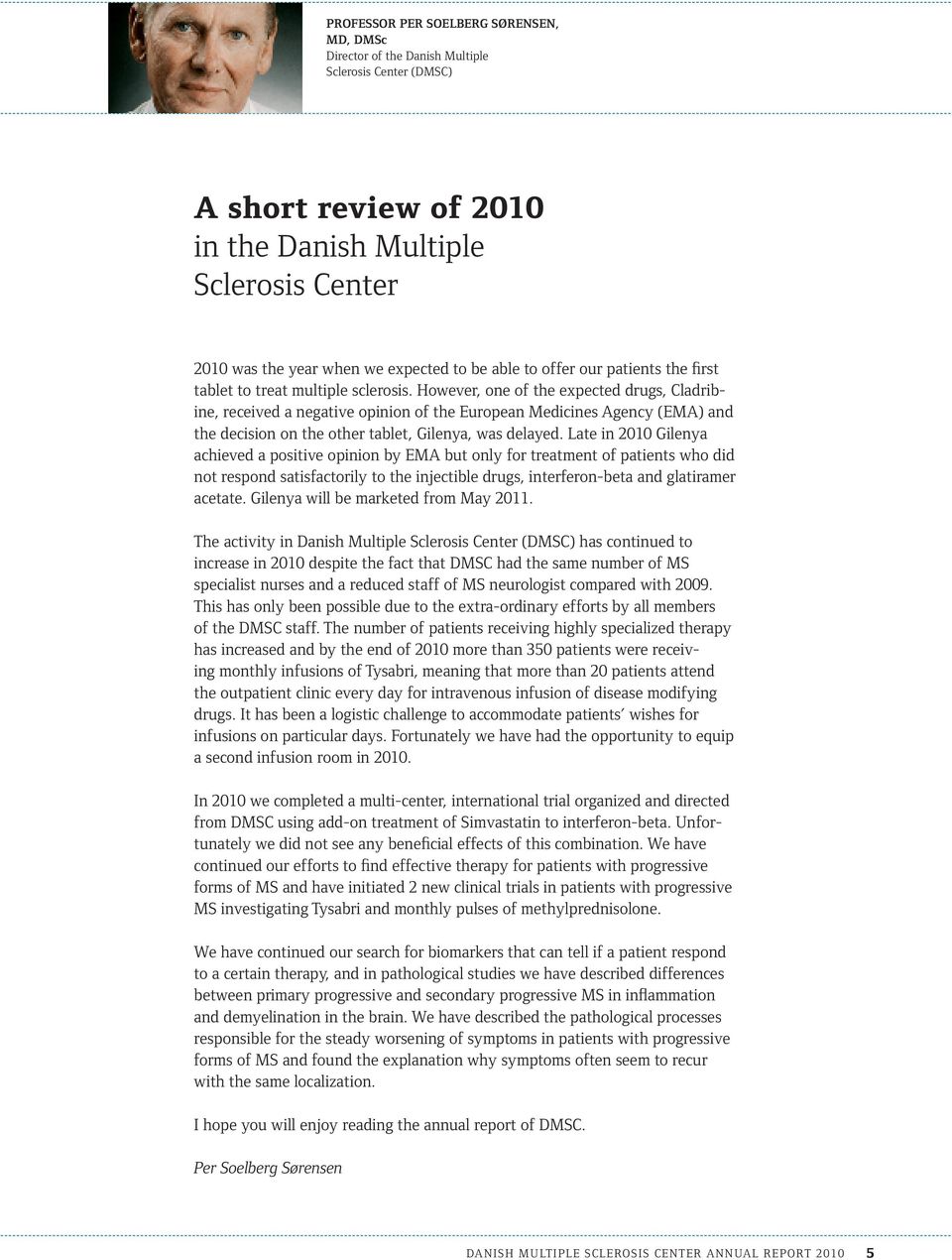
5 Professor Per Soelberg Sørensen, MD, DMSc Director of the Danish Multiple Sclerosis Center (DMSC) A short review of 2010 in the Danish Multiple Sclerosis Center 2010 was the year when we expected to be able to offer our patients the first tablet to treat multiple sclerosis. However, one of the expected drugs, Cladribine, received a negative opinion of the European Medicines Agency (EMA) and the decision on the other tablet, Gilenya, was delayed. Late in 2010 Gilenya achieved a positive opinion by EMA but only for treatment of patients who did not respond satisfactorily to the injectible drugs, interferon-beta and glatiramer acetate. Gilenya will be marketed from May The activity in Danish Multiple Sclerosis Center (DMSC) has continued to increase in 2010 despite the fact that DMSC had the same number of MS specialist nurses and a reduced staff of MS neurologist compared with This has only been possible due to the extra-ordinary efforts by all members of the DMSC staff. The number of patients receiving highly specialized therapy has increased and by the end of 2010 more than 350 patients were receiving monthly infusions of Tysabri, meaning that more than 20 patients attend the outpatient clinic every day for intravenous infusion of disease modifying drugs. It has been a logistic challenge to accommodate patients wishes for infusions on particular days. Fortunately we have had the opportunity to equip a second infusion room in In 2010 we completed a multi-center, international trial organized and directed from DMSC using add-on treatment of Simvastatin to interferon-beta. Unfortunately we did not see any beneficial effects of this combination. We have continued our efforts to find effective therapy for patients with progressive forms of MS and have initiated 2 new clinical trials in patients with progressive MS investigating Tysabri and monthly pulses of methylprednisolone. We have continued our search for biomarkers that can tell if a patient respond to a certain therapy, and in pathological studies we have described differences between primary progressive and secondary progressive MS in inflammation and demyelination in the brain. We have described the pathological processes responsible for the steady worsening of symptoms in patients with progressive forms of MS and found the explanation why symptoms often seem to recur with the same localization. I hope you will enjoy reading the annual report of DMSC. Per Soelberg Sørensen DANISH Multiple sclerosis CENTER annual report
6 DMSC missions and aims The mission of Rigs hospitalet is to be the leading hospital in Denmark for patients in need of highly specialized treatment The missions of the Danish Multiple Sclerosis Center (DMSC) are: The aims of the DMSC are: to be the leading multiple sclerosis (MS) center in Denmark to be at the forefront of highly specialized management of MS to carry out research and development in MS at an advanced international level to collaborate scientifically and exchange knowledge in MS research to educate staff to a highly specialized level in their relevant fields to contribute with professional advice on MS to the healthcare community to meet people with MS at their terms with openness and respect to provide the optimal interdisciplinary patient care to all MS patients in the region and to patients from other regions in need of highly specialized therapy to carryout high quality research in MS with focus on clinical research, new therapies, MS genetics, neuroimmunology and MS pathology to teach undergraduate students and PhDstudents and stimulate their interest in MS research to educate post docs, MS physicians, nurses, secretaries and other professionals to a high level of knowledge of MS in their relevant expert fields to lead the national research in Denmark in partnership with other Danish researchers and to establish a broad international collaboration with MS research groups in Europe and from overseas. 6 DANISH Multiple sclerosis CENTER annual report 2010

7 DANISH Multiple sclerosis CENTER annual report

8 About The Danish Multiple Sclerosis Center 8 DANISH Multiple sclerosis CENTER annual report 2010
9 DANISH Multiple sclerosis CENTER annual report
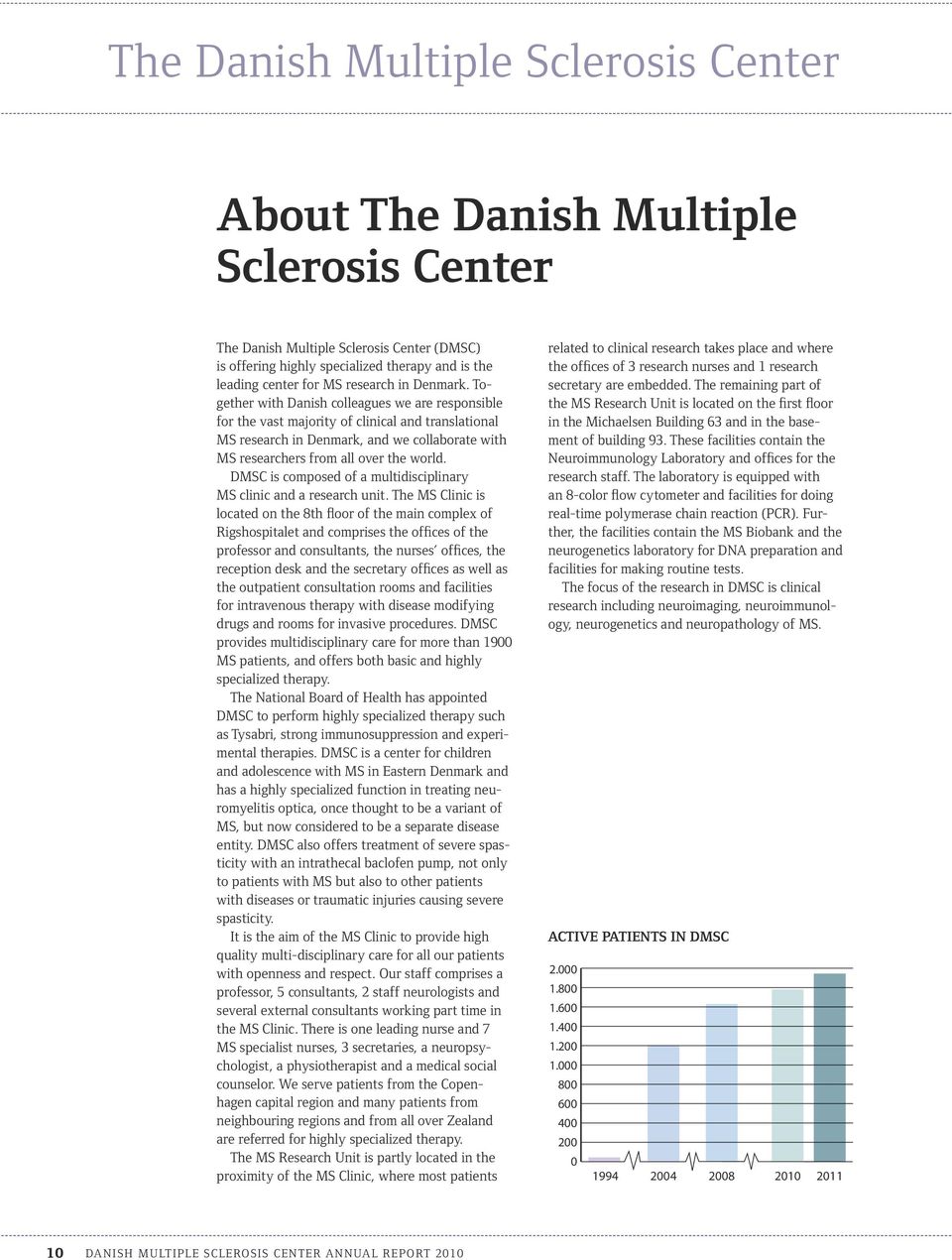
10 The Danish Multiple Sclerosis Center About The Danish Multiple Sclerosis Center The Danish Multiple Sclerosis Center (DMSC) is offering highly specialized therapy and is the leading center for MS research in Denmark. Together with Danish colleagues we are responsible for the vast majority of clinical and translational MS research in Denmark, and we collaborate with MS researchers from all over the world. DMSC is composed of a multidisciplinary MS clinic and a research unit. The MS Clinic is located on the 8th floor of the main complex of Rigshospitalet and comprises the offices of the professor and consultants, the nurses offices, the reception desk and the secretary offices as well as the outpatient consultation rooms and facilities for intravenous therapy with disease modifying drugs and rooms for invasive procedures. DMSC provides multidisciplinary care for more than 1900 MS patients, and offers both basic and highly specialized therapy. The National Board of Health has appointed DMSC to perform highly specialized therapy such as Tysabri, strong immunosuppression and experimental therapies. DMSC is a center for children and adolescence with MS in Eastern Denmark and has a highly specialized function in treating neuromyelitis optica, once thought to be a variant of MS, but now considered to be a separate disease entity. DMSC also offers treatment of severe spasticity with an intrathecal baclofen pump, not only to patients with MS but also to other patients with diseases or traumatic injuries causing severe spasticity. It is the aim of the MS Clinic to provide high quality multi-disciplinary care for all our patients with openness and respect. Our staff comprises a professor, 5 consultants, 2 staff neurologists and several external consultants working part time in the MS Clinic. There is one leading nurse and 7 MS specialist nurses, 3 secretaries, a neuropsychologist, a physiotherapist and a medical social counselor. We serve patients from the Copenhagen capital region and many patients from neighbouring regions and from all over Zealand are referred for highly specialized therapy. The MS Research Unit is partly located in the proximity of the MS Clinic, where most patients related to clinical research takes place and where the offices of 3 research nurses and 1 research secretary are embedded. The remaining part of the MS Research Unit is located on the first floor in the Michaelsen Building 63 and in the basement of building 93. These facilities contain the Neuroimmunology Laboratory and offices for the research staff. The laboratory is equipped with an 8-color flow cytometer and facilities for doing real-time polymerase chain reaction (PCR). Further, the facilities contain the MS Biobank and the neurogenetics laboratory for DNA preparation and facilities for making routine tests. The focus of the research in DMSC is clinical research including neuroimaging, neuroimmunology, neurogenetics and neuropathology of MS. ACtive patients in DMSC DANISH Multiple sclerosis CENTER annual report 2010
11 DANISH Multiple sclerosis CENTER annual report

12 Organization Director: Professor Per Soelberg Sørensen MS clinic MS Research Unit Neurologists Professor Per Soelberg Sørensen Consultant Morten Blinkenberg Consultant Finn Sellebjerg Consultant Annette Oturai Consultant Karen Schreiber Consultant Ana Voldsgaard Staff neurologist Melinda Magyari Staff neurologist Henrik Mathiesen PhD student Stephan Bramow PhD student Lars Börnsen PhD student Jeppe Romme Christensen PhD student Rikke Ratzer Junior physician Morten Møller MS nurses Leading nurse Anne Hansen Dorte Stauning Rasmussen Anette Husted Pedersen Lene Almind Julie Yoon S. Moberg Louise Nathalie Christiansen Maj Daae Christensen Sidsel Nielsen Secretaries Annette Larsen Malene Møllesøe Helle Vilhelmsen Neuropsychologist Agnete Jønsson Physiotherapist Lis Albrechtsen Medical social counselor Keld Nissen Clinical research Professor Per Soelberg Sørensen Consultant Karen Schreiber Staff neurologist Ana Voldsgaard Staff neurologist Melinda Magyari Neuropsycologist Agnete Jønsson Research nurses Vibeke Jespersen Joan Pietraszek Sidsel Nielsen Research secretary Annette Larsen Neuroimaging research Consultant Morten Blinkenberg Staff neurologist Henrik Mathiesen Genetic research Consultant Annette Oturai Senior research fellow Helle Bach Søndergaard Neuroimmunology research Ass. professor Finn Sellebjerg Senior research fellow Helle Bach Søndergaard PhD students Lars Börnsen Jeppe Romme Christensen Rikke Ratzer Julie Maria Hejgaard Dan Hesse Junior research fellow Marianne Hansen Neuropathology research Professor Per Soelberg Sørensen Ph.d. student Stephan Bramow Neuroimmunology Laboratory Laborarory leader Poul Erik Hyldgaard Jensen Laboratory technicians Leading Laboratory technician Joy Mendel-Hartvig Marie Koefoed Anne Mette Hedegaard Nielsen Michael Jensen Vibeke Fuglholt 12 DANISH Multiple sclerosis CENTER annual report 2010

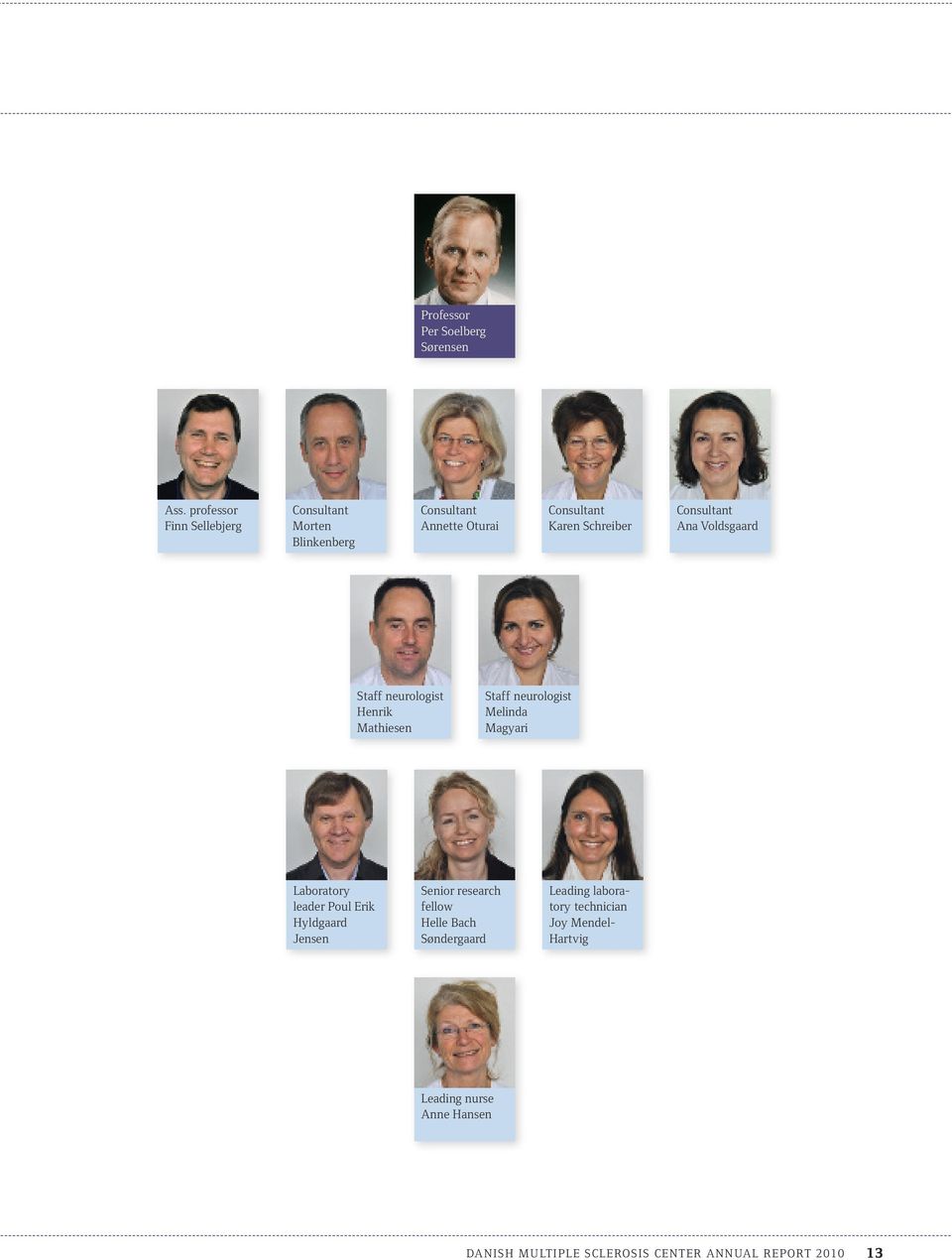
13 Professor Per Soelberg Sørensen Ass. professor Finn Sellebjerg Consultant Morten Blinkenberg Consultant Annette Oturai Consultant Karen Schreiber Consultant Ana Voldsgaard Staff neurologist Henrik Mathiesen Staff neurologist Melinda Magyari Laboratory leader Poul Erik Hyldgaard Jensen Senior research fellow Helle Bach Søndergaard Leading laboratory technician Joy Mendel- Hartvig Leading nurse Anne Hansen DANISH Multiple sclerosis CENTER annual report
14 Research activities 2010 Clinical research Clinical research Neuroimaging Neurogenetics Neuroimmunology Neuropathology Routine analyses in Neuroimmunology Laboratory 14 DANISH Multiple sclerosis CENTER annual report 2010
15 DANISH Multiple sclerosis CENTER annual report

16 Research activities 2010 Clinical research Clinical research group: Per Soelberg Sørensen, Morten Blinkenberg, Finn Sellebjerg, Annette Oturai, Ana Voldsgaard, Karen Schreiber, Henrik Mathiesen, Melinda Magyari, Lars Börnsen, Jeppe Romme Christensen, Rikke Ratzer, Julie Maria Hejgaard, Agnete Jønsson, Vibeke Jespersen, Joan Pietraszek, Sidsel Walther Nielsen, Anne Hansen, Annette Larsen. Therapeutic trials In 2010 we completed the SIMCOMBIN study, which is a Nordic multi-center study directed from DMSC and conducted in 42 MS Centers in Denmark, Norway, Sweden and Finland. The study investigated simvastatin as add-on therapy to interferon-beta in de novo treated patients with relapsing-remitting MS. More than 300 patients participated in the trial. Unfortunately the results showed that there was no benefit of add-on of simvastatin to interferon-beta. We have recently conducted another combination trial, which is a multi-center European trial exploring the effect of Minocycline as add-on therapy to interferon-beta in de novo treated patients. The trial was completed in April 2011, and the results will be available in the summer of We are currently performing several single-center studies in patients with progressive MS in order to try to find treatment options for this phase of the disease that currently lags effective therapy. In this regard we study the effect of erythropoietin (EPO) on disability in patients with progressive MS and the aim is to include 56 patients and to finalize inclusion in We have performed a small safety study with eggs of the pig whipworm (Trichuris suis). This small trial has been completed, and the data are currently under examination. If the result is positive we will embark a phase II trial with inclusion of 80 patients. In patients with progressive MS, we are testing the effect of erythropoietin (EPO) on permanent MS symptoms, and we are conducting an exploratory trial of natalizumab (Tysabri) in patients with 16 DANISH Multiple sclerosis CENTER annual report 2010
17 progressive MS and are planning a similar trial investigating the effect of monthly cycles of methylprednisolone tablets. Other clinical research trials In 2010 we initiated a study exploring the role of vitamin D on clinical disease activity in MS. Vitamin D seems to yield some protection against encountering MS and may also influence the disease activity in established MS. MS is increasing particularly in women. Whereas the incidence of MS has been almost unchanged in men, it has doubled in women since In collaboration with the Danish MS Register we embarked on an extensive analysis of possible factors that might have contributed to the increase of MS in women. We will explore demographic factors, such as changes in working conditions, merital status, childbirth, smoking habits and vitamin D intake. DMSC is among the leading centers in the world regarding studies of antibodies against biological agents. We have extensively studied the effect of neutralizing antibodies against interferon-beta, most recently in a EU supported European study of neutralizing antibodies against interferon-beta (NABINMS study). We have introduced a new assay for detecting neutralizing antibodies based on a luciferase reporter gene under control of interferon-beta. Recently we have implemented an analysis of antibodies against natalizumab (Tysabri) and have conducted and international study of the frequency of occurrence of antibodies against natalizumab together with MS centers in Sweden, Norway and Germany. We were able to show that fewer patients developed persistent antibodies against natalizumab compared with the observation in clinical studies. We have also shown that the propensity to develop antibodies against interferon-beta does not carry an excess risk of developing antibodies against natalizumab. We are currently doing a study of interferonalpha in patients who have developed neutralizing antibodies against interferon-beta to see whether these patients have maintained a full biological response to interferon-alpha and therefore might be treated with interferon-alpha. DANISH Multiple sclerosis CENTER annual report

18 Research activities 2010 Neuroimaging Neuroimaging research group: Morten Blinkenberg, Henrik Mathiesen, Per Soelberg Sørensen PET During the last decades, functional imaging have improved our understanding of the neurodegenerative processes in MS. Former positron emission tomography (PET) studies, carried out in Danish Multiple Sclerosis Center (DMSC), have shown that cerebral activation in MS patients, is severely reduced as a consequence of disease progression. A PET study focusing on the early relapsing remitting phase of the disease and the corresponding changes in cerebral activation has recently been performed in DMSC. The study shows, that reductions in PET are associated with reduced magnetic resonance spectroscopy (MRS) measures of N-acetyl-aspartate (NAA) normalized to Creatine (NAA/Cr), reflecting neuronal dysfunction or loss in MS. In this way there seem to be a relationship between these two different measures of cerebral neuronal integrity in MS, which have implication for the further use of MRS in MS. MRI In collaboration with Danish Research Centre for Magnetic Resonance, we have previously shown, that MRS measurements of NAA/Cr correlate with cognitive dysfunction in MS. This cohort has now been re-evaluated and analyzed for longitudinal changes in MRS. Preliminary data show, that MRS decrease in the early stage of MS, predicts disease progression after 5 years. MRS may therefore be used as a clinical marker, to determine disease course in MS. Another study focuses on the pathophysiological mechanisms underlying changes in cerebral activation in MS patients. Resting-state fmri is a new approach to assess functional brain connectivity by measuring the synchronous fluctuation in the blood-oxygenlevel dependent signal between remote brain regions at rest. PhD-student, Anne-Marie Dogonowski, uses this method to study, whether changes in functional connectivity of the motor network, reflect disease severity in patients with MS. Preliminary results show, increased coupling between premotor cortex and the motor network, which might reflect an adaptive mechanism to maintain motor function with increasing clinical disability. These data highlight the potential of resting-state fmri to study disease-related functional reorganization of distinct brain networks in multiple sclerosis and encourage further research in this field. 18 DANISH Multiple sclerosis CENTER annual report 2010

19 Neurogenetics Neurogenetics research group: Annette Bang Oturai, Helle Bach Søndergaard, Finn Sellebjerg, Julie Maria Hejgaard The ultimate cause of multiple sclerosis (MS) is still unknown. Probably a combination of hereditary and environmental factors trigger a defect in the immune system that will lead to MS. The frequency of MS varies geographically and between ethnic groups, with the greatest risk in white northern Europeans living in temperate regions. From family studies we have known for many years that genes plays a role, and that MS susceptibility is influenced by genetic variations within the major histocompatibility complex (MHC). We have previously performed linkage studies investigating Danish and Nordic sib pair families, and later participated in the ultimate MS linkage study investigating >700 European MS families revealing MHC as the only genome-wide linkage signal in MS with a lod score of 11,7, dominated by the DR2 (DRB1*15:01-DQB1*06:02) haplotype. We have collected DNA for more than 15 years, and today we have DNA from more than 1,800 Danish MS patients and 1,200 controls, all kept in the»danish Multiple Sclerosis Biobank«in our department at Rigshospitalet. In order to increase the sample size for genetic testing, we have participated in the»nordic MS Genetic Network«since 1994, and today the Nordic material consists of more than 6,000 MS cases and 6,000 controls. Local research is focused on the candidate gene approaches and the genetic influence on the differences in treatment response. We are part of the IMSGC (International Multiple Sclerosis Genetic Consortium) and the Wellcome Trust Case Control Consortium (WTCCC), where 23 research groups from 15 countries are performing the largest set of MS genome-wide association study (GWAS), genotyping 11,000 cases and 11,000 controls using 500,000 SNP chip. Primary results have elucidated associations to more than 100 gene variations (SNPs). Following this collaboration we are joining the Immunochip Consortium, where 1,000 Danish cases and 1,000 Danish controls participate in a large scale genetic analysis, investigating best genes/regions/snps in MS as well as 9 other autoimmune diseases, together with other international MS groups, looking for shared autoimmune genes. The risk of MS has been increasing over the last 50 years, especially among women older than 40. On this background we have initiated a PhD project looking at aspects of gender differences, including different treatment responses. Furthermore, we have initiated a large-scale vitamin D PhD project, investigating gene variations within the vitamin D pathway, and the importance of vitamin D in clinical and immunological disease activity. In addition, we have collected more than 800 questionnaires from MS patients dealing in detail with lifestyle and environmental exposure, giving the possibility to study gene-environmental interaction. DANISH Multiple sclerosis CENTER annual report

20 Research activities 2010 Neuroimmunology Neuroimmunology research group: Finn Sellebjerg, Helle Bach Søndergaard, Poul Erik Hyldgaard Jensen, Jeppe Romme Christensen, Lars Börnsen, Rikke Ratzer, Per Soelberg Sørensen Immunological studies It is becoming increasingly clear that relapsing-remitting MS is caused by repeated attacks of inflammatory demyelination and axonal damage. These attacks are initiated by inflammatory cells that are activated within the immune systems, recirculate in blood, and access the brain and spinal cord by crossing the different blood-brain barrier systems. Based on animal experiments, MS has been thought to be mainly a T cell-driven disease. Clinical trials do, however, show that in addition to treatment with natalizumab, that blocks the migration of all mononuclear cells into the CNS, B cell depletion is also efficacioius in relapsing-remitting MS. More recent studies have suggested that even in progressive MS, which has been thought to be caused mainly by neurodegenerative processes, inflammation may be crucial in the pathogenesis. We study the mechanism of immune activation in MS, addressing the reactivity of subsets of T cells and B cells to autoantigens expressed in the brain and spinal cord, and address how these and other leukocytes contribute to the activation of T cells. We also study the effect of immunomodulatory treatment on these processes, and focus specifically on the mechanism of action of interferon-beta since recent studies from our laboratory have suggested that endogenous production of this cytokine may have a protective role in MS. In other studies we use flow cytometry to study the phenotype of individual, circulating lymphocytes by measuring the binding of fluorochrome-coupled, monoclonal antibodies to distinct molecules. By combining the analysis of different molecules expressed on the cell surface, these cells can be divided into a large number of functionally relevant subtypes, which can be quantitated both in relative and absolute terms. We are currently studying an array of activation and differentiation markers on T cell subsets, B cells, NK cells, monocytes and dendritic cells to explore the activation status of these cell types in patients with relapsingremitting, primary and secondary progressive MS. These studies will provide novel insights into immune activation in subtypes of MS. Molecular biology Activation of immune responses depends on interactions between different immune cells and coordinated, tightly regulated expression of a vast number of molecules within single cells. Gene expression is controlled by the activity of transcription factors that are either constitutively expressed in active forms, expressed in forms that require activation by other signals, or are inducible on cellular activation. The transcription factors direct the expression of messenger RNA (mrna) from the genes encoded by the DNA sequence, and after export from the nucleus the mrna provides a template for protein synthesis on ribosomes in the cytosol. Within the last decade it has become apparent that endogenous, small RNA molecules termed microrna (mirna) have a key role in regulating the translation of protein from mrna in the cytosol. MiRNA can either induce the degradation of mrna, or can inhibit the translation of mrna into protein by binding to the 3 untranslated region of mrna molecules. Furthermore, the accessibility of a genomic region can be regulated by epigenetic modifications of the DNA strand. Recent studies have identified mirna molecules that are differentially expressed in MS patients and healthy controls, and it has been suggested that pathogenic immune activation in MS may, indeed, reflect changes in mirna expression. We have studied mirna expression in MS, and have found that even patients with MS in clinical remission show clear changes in the expression of mirna compared to healthy control subjects. Furthermore, we have identified mirna molecules that are specifically regulated by treatment with interferon-beta. We are now studying the extent to which mirna expression changes in pregnant women with MS, as pregnancy is known to dampen disease activity in relapsing-remitting MS. These studies are complemented by mrna expression studies in subtypes of mononuclear cells, isolated by immunomagnetic technology, from patients 20 DANISH Multiple sclerosis CENTER annual report 2010

21 with relapsing-remitting, primary and secondary progressive MS. Taken together our studies provide novel insights into the molecular mechanisms of the pathogenic immune responses in MS. As mirna can now be therapeutically introduced into specific human cells, the identification of mirnas that can modulate pathogenic immune responses have a strong potential for the treatment of MS in the future. Biomarker studies The term biomarker is used for gene products or proteins that can be measured in blood or other body fluids, and reflects a pathogenetically or therapeutically relevant in vivo process. Immunological and molecular biology studies provide the platform for the development of biomarkers, but the validation of these also requires access to collections of well characterized samples from MS patients, who are followed prospectively. Such biomarker studies can provide insights into the pathogenesis of MS and our understanding of the therapeutic effects of immunomodulatory and immunosuppressive treatments. The development of biomarkers that can serve as surrogate outcomes in clinical trials is an important aim of the ongoing biomarker research at our center. We have studied the immunological effects of treatment with natalizumab, interferon-beta and glatiramer acetate. The studies have resulted in the validation of biomarkers that may reflect the therapeutic effect of treatment better than the currently used biomarkers, and are now being studied in clinical trials of patients with primary and secondary progressive MS. We continue to study the mechanisms and effects of antibodies to biopharmaceutical therapies interferon-beta and natalizumab in MS. Most recently we have shown that although antibody responses to glatiramer acetate develop during therapy, they do not appear to influence the response to therapy. Finally, we have identified immune activation markers that are upregulated in a subgroup of patients treated with interferon-beta. This response is associated with increased disease activity during interferon-therapy. We are now exploring how this response is induced and how it may increase the pathogenic processes in MS. With the introduction of a number of new MS therapeutics in the coming years, a better understanding of the different therapies is urgently needed. Indeed, some patients may do well on a safe first-line therapy with moderate efficacy, others require more efficacious therapies which are usually associated with an increased risk of severe side effects. We will continue to study how genetic markers and other biomarkers can be used to tailor individual MS therapy. DANISH Multiple sclerosis CENTER annual report
22 Research activities 2010 Neuropathology Neuropathology research group: Per Soelberg Sørensen, Stephan Bramow, (Henning Laursen, Laboratory of Neuropathology) In 2010 we published a scientific work showing that whereas demyelination was less profound in brains of primary progressive patients compared to secondary progressive patients, demyelination in the spinal cord was similar. We also demonstrated that remyelinated areas had increased vulnerability and recurrent demyelination in the remyelinated areas were more frequent than appearance of new demyelinating plaques. This could explain why patients often develop recurrence of symptoms in new relapses. We also showed that diffuse new inflammation correlated with active focal demyelination emphasizing the necessity of an action on both sides of the blood-brain-barrier for new treatments of progressive MS. 22 DANISH Multiple sclerosis CENTER annual report 2010
23 Routine analyses in Neuroimmunology Laboratory Neuroimmunology Laboratory research group: Poul Erik H. Jensen, laboratory technicians: Joy Mendel-Hartvig, Michael Kolbjørn Jensen, Vibeke Fuglholt, Rikke Larsen. Diagnostic evaluation The presence in CSF of oligoclonal IgG-bands is of interest in the diagnosis of Multiple Sclerosis (MS). In 2010 we have analyzed 813 patient samples, using isoelectric focusing of CSF and corresponding plasma samples for the characterization of IgG bands. In the autoimmune disease Myasthenia gravis (MG), autoantibodies against the acetylcholine receptor (AChR) may cause a diminished binding of ACh on muscular surfaces and thereby a reduced impulse transmission to the postsynaptic membrane of the neuromuscular endplate occurs. For diagnostic and therapeutic purposes, we measure the concentrations of these autoantibodies from patient serum samples, using a radioimmunoassay kit, and in 2010 we analyzed 1324 patient samples. Measurement of neutralizing antibodies Subgroups of MS patients, treated with Interferonbeta or Tysabri, generate neutralizing antibodies, which diminish the therapeutic effects. Interferonbeta molecules bind to leucocytes and a specific up-regulation of MxA mrna in the cells occur. Neutralizing antibodies may abolish this effect, and therefore we measure the neutralization of Interferon-beta by antibodies in new cell-culture assay based on luciferase-induced expression, and further by the MxA mrna-expression as a biological response to treatment with Interferon-beta. In 2010 we have analyzed 1029 patient samples for neutralizing antibodies, and 151 patient samples for MxA mrna expression. Furthermore, we have screened 165 patient samples for Interferon-beta binding antibodies using an ELISA-assay. The action of Tysabri differs from Interferonbeta, since it blocks mononuclear cell binding to endothelial cells (alpha-4 integrin antagonist). In this way Tysabri inhibits mononuclear cells from entering the central nervous system. The generation of neutralizing antibodies to Tysabri in MS patients blocks the biological effects of Tysabri. In 2010 we analyzed 572 blood samples for the presence of antibodies to Tysabri by ELISA. DANISH Multiple sclerosis CENTER annual report
24 Scientific publications, prizes, collaboration, acknowledgements Scientific publications Prizes Honorary offices Scientific collaboration Acknowledgements 24 DANISH Multiple sclerosis CENTER annual report 2010
25 DANISH Multiple sclerosis CENTER annual report
26 Scientific publications Publications 2009 Peer reviewed original papers Kemppinen A, Suvela M, Tienari PJ, Elovaara I, Koivisto K, Pirttilä T, Reunanen M, Baumann P, Hillert J, Lundmark F, Oturai A, Ryder L, Harbo H, Celius EG, Palotie A, Daly M, Peltonen L, Saarela J. MYO9B polymorphisms in multiple sclerosis. Eur J Hum Genet 2009;17(6): Khademi M, Börnsen L, Rafatnia F, Andersson M, Brundin L, Piehl F, Sellebjerg F, Olsson T. The effects of natalizumab on inflammatory mediators in multiple sclerosis: prospects for treatment-sensitive biomarkers. Eur J Neurol 2009;16: Sellebjerg F, Börnsen L, Khademi M, Krakauer M, Olsson T, Frederiksen JL, Sorensen PS. B cell chemokine CXCL13 in cerebrospinal fluid in active MS. Neurology 2009;73: Sellebjerg F, Börnsen L, Khademi M, Krakauer M, Olsson T, Frederiksen JL, Sørensen PS. Increased cerebrospinal fluid concentrations of the chemokine CXCL13 in active MS. Neurology 2009;73(23): Hesse D, Sellebjerg F, Sorensen PS. Absence of MxA induction by interferon beta in patients with MS reflects complete loss of bioactivity. Neurology 2009;73(5): Sellebjerg F, Krakauer M, Hesse D, Ryder LP, Alsing I, Jensen PE, Koch-Henriksen N, Svejgaard A, Soelberg Sørensen P. Identification of new sensitive biomarkers for the in vivo response to interferon-beta treatment in multiple sclerosis using DNA-array evaluation. Eur J Neurol 2009;16(12): Enevold C, Oturai AB, Sørensen PS, Ryder LP, Koch- Henriksen N, Bendtzen K. Multiple sclerosis and polymorphisms of innate pattern recognition receptors TLR1-10, NOD1-2, DDX58, and IFIH1. J Neuroimmunol 2009;212(1-2): Sorensen PS, Mellgren SI, Svenningsson A, Elovaara I, Frederiksen JL, Beiske AG, Myhr KM, Søgaard LV, Olsen IC, Sandberg-Wollheim M. NORdic trial of oral Methylprednisolone as add-on therapy to Interferon beta-1a for treatment of relapsing-remitting Multiple Sclerosis (NORMIMS study): a randomised, placebocontrolled trial. Lancet Neurol 2009: Oturai AB, Koch-Henriksen N, Petersen T, Jensen PE, Sellebjerg F, Sorensen PS. Efficacy of natalizumab in multiple sclerosis patients with high disease activity: a Danish nationwide study. Eur J Neurol 2009;16(3): Frischer JM, Bramow S, Dal-Bianco A, Lucchinetti CF, Rauschka H, Schmidbauer M, Laursen H, Sorensen PS, Lassmann H. The relation between inflammation and neurodegeneration in multiple sclerosis brains. Brain 2009;132(Pt5): Koch-Henriksen N, Sorensen PS, Bendtzen K, Flachs EM. The clinical effect of neutralizing antibodies against interferon-beta is independent of the type of interferon-beta used for patients with relapsing-remitting multiple sclerosis. Mult Scler 2009;15(5): Hedegaard CJ, Chen N, Sellebjerg F, Sørensen PS, Leslie RG, Bendtzen K, Nielsen CH. Autoantibodies to myelin basic protein (MBP) in healthy individuals and in patients with multiple sclerosis: a role in regulating cytokine responses to MBP. Immunology 2009;128(1 Suppl):e Nielsen TR, Rostgaard K, Askling J, Steffensen R, Oturai A, Jersild C, Koch-Henriksen N, Sørensen PS, Hjalgrim H. Effects of infectious mononucleosis and HLA-DRB1*15 in multiple sclerosis. Mult Scler 2009;15(4): O Connor P, Comi G, Montalban X, Antel J, Radue EW, de Vera A, Pohlmann H, Kappos L; FTY720 D2201 Study Group. Oral fingolimod (FTY720) in multiple sclerosis: two-year results of a phase II extension study. Neurology 2009;72(1):73-9. Hesse D, Frederiksen JL, Koch-Henriksen N, Schreiber K, Stenager E, Heltberg A, Ravnborg M, Bendtzen K, Sellebjerg F, Sorensen PS. Methylprednisolone does not restore biological response in multiple sclerosis patients with neutralizing antibodies against interferon-beta. Eur J Neurol 2009;16(1):43-7. Ravnborg M, Bendtzen K, Christensen O, Jensen PE, Hesse D, Tovey MG, Sørensen PS. Treatment with azathioprine and cyclic methylprednisolone has little or no effect on bioactivity in anti-interferon beta antibody-positive patients with multiple sclerosis. Mult Scler 2009;15(3): Giovannoni G, Barbarash O, Casset-Semanaz F, King J, Metz L, Pardo G, Simsarian J, Sørensen PS, Stubinski B; Rebif New Formulation Study Group. Safety and immunogenicity of a new formulation of interferon beta-1a (Rebif New Formulation) in a Phase IIIb study in patients with relapsing multiple sclerosis: 96-week results. Mult Scler 2009;15(2): Jagodic M, Colacios C, Nohra R, Dejean AS, Beyeen AD, Khademi M, Casemayou A, Lamouroux L, Duthoit C, Papapietro O, Sjöholm L, Bernard I, Lagrange D, Dahlman I, Lundmark F, Oturai AB, Soendergaard 26 DANISH Multiple sclerosis CENTER annual report 2010
27 HB, Kemppinen A, Saarela J, Tienari PJ, Harbo HF, Spurkland A, Ramagopalan SV, Sadovnick DA, Ebers GC, Seddighzadeh M, Klareskog L, Alfredsson L, Padyukov L, Hillert J, Clanet M, Edan G, Fontaine B, Fournié GJ, Kockum I, Saoudi A, Olsson T. A role for VAV1 in experimental autoimmune encephalomyelitis and multiple sclerosis. Sci Transl Med 2009;1(10):10ra21. Other publications Waldemar G, Boysen GM, Høgenhaven H, Knudsen GM, Sørensen PS, Vissing J. Neurologi. I: Schaffalitzky de Muckadell OB; Haunsø S, Vilstrup H (red.). Medicinsk Kompendium 17. Udgave, Nyt Nordisk Forlag Arnold Busck, København 2009; pp Sorensen PS. How effective is natalizumab as second-line treatment for multiple sclerosis in daily clinical praxis? Eur J Neurol 2009;16(3): Sorensen PS. Management of patients with neutralizing antibodies against interferon-beta: stop Interferon-beta therapy or wait for the antibodies to go away? Eur J Neurol 2009;16(1):1-2. Publications of clinical trials in which we have been investigators: Comi G, Martinelli V, Rodegher M, Moiola L, Bajenaru O, Carra A, Elovaara I, Fazekas F, Hartung HP, Hillert J, King J, Komoly S, Lubetzki C, Montalban X, Myhr KM, Ravnborg M, Rieckmann P, Wynn D, Young C, Filippi M; PreCISe study group. Effect of glatiramer acetate on conversion to clinically definite multiple sclerosis in patients with clinically isolated syndrome (PreCISe study): a randomised, double-blind, placebo-controlled trial. Lancet Oct 31;374(9700): Publications 2010 Peer reviewed original papers Kemppinen A, Suvela M, Tienari PJ, Elovaara I, Koivisto K, Pirttilä T, Reunanen M, Baumann P, Hillert J, Lundmark F, Oturai A, Ryder L1, Harbo H, Celius EG, Palotie A, Daly M, Peltonen L, Saarela J. MYO9B polymorphisms in multiple sclerosis. Eur J Hum Genet 2009;17(6): Bramow S, Frischer JM, Lassmann H, Koch-Henriksen N, Lucchinetti CF, Sørensen PS, Laursen H. Demyelination versus remyelination in progressive multiple sclerosis. Brain Oct;133(10): Polman CH, Bertolotto A, Deisenhammer F, Giovannoni G, Hartung HP, Hemmer B, Killestein J, McFarland HF, Oger J, Pachner AR, Petkau J, Reder AT, Reingold SC, Schellekens H, Sørensen PS. Recommendations for clinical use of data on neutralising antibodies to interferon-beta therapy in multiple sclerosis. Lancet Neurol Jul;9(7): Enevold C, Oturai AB, Sørensen PS, Ryder LP, Koch- Henriksen N, Bendtzen K. Polymorphisms of innate pattern recognition receptors, response to interferonbeta and development of neutralizing antibodies in multiple sclerosis patients. Mult Scler Aug;16(8): International Multiple Sclerosis Genetics Conssortium (IMSGC). IL12A, MPHOSPH9/CDK2AP1 and RGS1 are novel multiple sclerosis susceptibility loci. Genes Immun Jul;11(5): Ravnborg M, Sørensen PS, Andersson M, Celius EG, Jongen PJ, Elovaara I, Bartholomé E, Constantinescu CS, Beer K, Garde E, Sperling B. Methylprednisolone in combination with interferon beta-1a for relapsing-remitting multiple sclerosis (MECOMBIN study): a multicentre, doubleblind, randomised, placebo-controlled, parallel-group trial. Lancet Neurol Jul;9(7): Epub 2010 Jun 9. Erratum in: Lancet Neurol Aug;9(8):759. Sellner J, Boggild M, Clanet M, Hintzen RQ, Illes Z, Montalban X, Du Pasquier RA, Polman CH, Sorensen PS, Hemmer B. EFNS guidelines on diagnosis and management of neuromyelitis optica. Eur J Neurol Aug;17(8): Hesse D, Krakauer M, Lund H, Søndergaard HB, Langkilde A, Ryder LP, Sorensen PS, Sellebjerg F. Breakthrough disease during interferon-[beta] therapy in MS: No signs of impaired biologic response. Neurology May 4;74(18): Koch-Henriksen N, Sørensen PS. The changing demographic pattern of multiple sclerosis epidemiology. Lancet Neurol May;9(5): Review. DANISH Multiple sclerosis CENTER annual report
28 Scientific publications 2010 Radue EW, Stuart WH, Calabresi PA, Confavreux C, Galetta SL, Rudick RA, Lublin FD, Weinstock-Guttman B, Wynn DR, Fisher E, Papadopoulou A, Lynn F, Panzara MA, Sandrock AW; SENTINEL Investigators. Natalizumab plus interferon beta-1a reduces lesion formation in relapsing multiple sclerosis. J Neurol Sci May 15;292(1-2): Giovannoni G, Comi G, Cook S, Rammohan K, Rieckmann P, Soelberg Sørensen P, Vermersch P, Chang P, Hamlett A, Musch B, Greenberg SJ; CLARITY Study Group. A placebo-controlled trial of oral cladribine for relapsing multiple sclerosis. N Engl J Med Feb 4;362(5): Comi G, O Connor P, Montalban X, Antel J, Radue EW, Karlsson G, Pohlmann H, Aradhye S, Kappos L; FTY720D2201 Study Group. Phase II study of oral fingolimod (FTY720) in multiple sclerosis: 3-year results. Mult Scler Feb;16(2): Ockinger J, Stridh P, Beyeen AD, Lundmark F, Seddighzadeh M, Oturai A, Sørensen PS, Lorentzen AR, Celius EG, Leppä V, Koivisto K, Tienari PJ, Alfredsson L, Padyukov L, Hillert J, Kockum I, Jagodic M, Olsson T. Genetic variants of CC chemokine genes in experimental autoimmune encephalomyelitis, multiple sclerosis and rheumatoid arthritis. Genes Immun Mar;11(2): Jakkula E, Leppä V, Sulonen AM, Varilo T, Kallio S, Kemppinen A, Purcell S, Koivisto K, Tienari P, Sumelahti ML, Elovaara I, Pirttilä T, Reunanen M, Aromaa A, Oturai AB, Søndergaard HB, Harbo HF, Mero IL, Gabriel SB, Mirel DB, Hauser SL, Kappos L, Polman C, De Jager PL, Hafler DA, Daly MJ, Palotie A, Saarela J, Peltonen L. Genome-wide association study in a high-risk isolate for multiple sclerosis reveals associated variants in STAT3 gene. Am J Hum Genet Feb 12;86(2): Mero I-L, ÅR Lorentzen, Ban M, Smestad C, Celius EG, Aarseth J, Myhr K-M, Link J, Hillert J, Olsson T, Kockum I, Masterman T, Oturai AB, Søndergaard HB, Sellebjerg F, Saarela J, Kemppinen A, Elovaara I, Spurkland A, Dudbridge F, Lie BA, Harbo HF. A rare variant of the TYK2 gene is confirmed to be associated with multiple sclerosis. Eur J Hum Genet 2010;18: Nohra R, Beyeen AD, Guo JP, Khademi M, Sundqvist E, Hedreul MT, Sellebjerg F, Smestad C, Oturai AB, Harbo HF, Wallström E, Hillert J, Alfredsson L, Kockum I, Jagodic M, Lorentzen J, Olsson T. RGMA and IL21R show association with experimental inflammation and multiple sclerosis. Genes Immun. 2010;11(4): Ghezzi A, Banwell B, Boyko A, Amato MP, Anlar B, Blinkenberg M, Boon M, Filippi M, Jozwiak S, Ketelslegers I, Kornek B, Lim M, Lindstrom E, Nadj C, Neuteboom R, Rocca MA, Rostasy K, Tardieu M, Wassmer E,Catsman-Berrevoets C, Hintzen R. The management of multiple sclerosis in children: a European view. Mult Scler Oct;16(10): Other publications Paulson OB, Gjerris F, Sorensen PS (eds.). Klinisk Neurologi og neurokirurgi, 5. udgave. FADL s Forlag, København 2010, ISBN Sorensen PS, Paulson OB, Gjerris F (eds.). Nervesystemets sygdomme, 3. udgave. Gads forlag, København 2010, ISBN Publications of clinical trials in which we have been investigators: Radue EW, Stuart WH, Calabresi PA, Confavreux C, Galetta SL, Rudick RA, Lublin FD, Weinstock-Guttman B, Wynn DR, Fisher E, Papadopoulou A, Lynn F, Panzara MA, Sandrock AW; SENTINEL Investigators. Natalizumab plus interferon beta-1a reduces lesion formation in relapsing multiple sclerosis. J Neurol Sci May 15;292(1-2): Comi G, O Connor P, Montalban X, Antel J, Radue EW, Karlsson G, Pohlmann H, Aradhye S, Kappos L; FTY720D2201 Study Group. Phase II study of oral fingolimod (FTY720) in multiple sclerosis: 3-year results. Mult Scler Feb;16(2): DANISH Multiple sclerosis CENTER annual report 2010
29 Prizes and honorary offices Prizes Annette Oturai»Roseliv-Prize« DDK donated for many years of scientific work within multiple sclerosis (2009/2010) Honorary offices A: National Finn Sellebjerg Chairman of the Danish Society for Research in Multiple Sclerosis (DAREMUS) Chairman and board member of The Research Committeé of the Danish Multiple Sclerosis Society Annette Oturai Board member of the Danish Society for Research in Multiple Sclerosis (DAREMUS) Board member of the Torben Fogh and Erik Trier foundation Per Soelberg Sørensen Board member of the Gangsted Foundation, Morten Blinkenberg Board member of The Research Committeé of the Danish Multiple Sclerosis Society B: International finn Sellebjerg Member of the European Federation of Neurological Societies»Scientist Panel on MS and Demyelinating Diseases«. Member of the European Council for Treatment and Research in Multiple Sclerosis council. Per Soelberg Sørensen Treasurer, European Committee for Treatment and Research in Multiple Sclerosis (ECTRIMS), Member of the editorial board, Multiple Sclerosis Journal, Member of the editorial board, European Journal of Neurology, Chairman, Teaching Course Committee, European Committee for Treatment and Research in Multiple Sclerosis (ECTRIMS), DANISH Multiple sclerosis CENTER annual report
30 Scientific collaboration Scientific collaboration National The Danish Multiple Sclerosis Register, Copenhagen University Hospital, Rigshospitalet, Copenhagen, (Nils Koch-Henriksen, MD) Department of Clinical Immunology, Copenhagen University Hospital, Rigshospitalet, (Peter Garred, Jacob Larsen MD, Lars Ryder, Klaus Rieneck, MD, Hans O. Madsen, MD) Institute for Inflammatory Research, Copenhagen University Hospital, Rigshospitalet, (Christian Enevold- Johansen MD, Professor Klaus Bendtzen) Department of Epidemiology Research, Statens Serum Institut, Copenhagen, (Trine Rasmussen Nielsen, MD, Henrik Hjalgrim, MD, professor Mads Melbye, Peter Michael Bager, ph.d.) Department of Human Genetics, Aarhus University, Denmark (Bjørn Andersen Nexø) Laboratory of Neuropathology, Copenhagen University Hospital Rigshospitalet, Copenhagen, (Henning Laursen, MD) Danish Research Center for Magnetic Resonance, Hvidovre Hospital, (Professor Olaf Paulsen, Professor Hartwig Siebner, Ellen Garde, MD, Henrik Lund, MS) Faculty of Life Sciences, University of Copenhagen, Denmark (Professor Christian M.O. Kapel, Professor Allan Roepstorff, Professor Stig Milan Thamsborg) Cell Therapy Unit, The Blood bank, Department of Clinical Immunology, Rigshospitalet (Anne Fischer-Nielsen, MD, Roberto Oliveri, MD) International Nordic MS Genetic Network: Collaboration between the Nordic countries: Sweden (Huddinge, Lund, Gothenburg, Stockholm), Norway (Oslo, Bergen), Finland (Helsinki) and Denmark (Copenhagen) Institute of Immunology, Rikshospitalet, University Hospital, Oslo, Norway (Anne Spurkland, MD, Hanne F. Harbo, MD, professor Frode Vartdal) Department of Neurology, Ullevål University Hospital, Oslo, Norway (Elisabeth G Celius, MD) Department of Neurology, Haukeland Hospital, Bergen, Norway (Professor Kjell-Morten Myhr) Department of Neurology, Huddinge University Hospital, Karolinska Institute, Huddinge, Sweden (Professor Jan Hillert, Eva Åkesson, MD, Helena Modin, MD, Associate Professor Anna Fogdell-Hahn) Department of Clinical Neuroscience and Centrum for Molecular Medicine Karolinska Insitutet at Karolinska University Hospial, Solna Stockholm, Sweden (Professor Tomas Olsson, associate Professor Ingrid Kockum) Department of Neurology, Lund University Hospital, Lund, Sweden (Professor Magnhild Sandberg-Wollheim) Department of Neurology, Gothenburg University Hospital, Gothenburg, Sweden (Professor Oluf Andersen, Professor Jan Lycke) Sankt Joseph Hospital and Ruhr University, Bochum, Germany (Professor Ralf Gold) Department of Neurology, Turku and University of Turku (Associate Professor Juha-Pekka Erälinna) Department of Neurology, Hôpital Henri Mondor, Créteil, France. University of Helsinki, Finland (Professor Markus Färkkilä) Institute for Molecular Medicine Finland, University of Helsinki, Finland (Janna Saarela) University of Cambridge, Neurology Unit, Addenbrooke s Hospital, Cambridge, United Kingdom (Stephen Sawcer, MD, Professor Alastair Compston) International Multiple Sclerosis Genetic Consortium (IMSG): MS Genetic collaboration between 15 countries from Europe, USA, Canada and Australia Immunochip Consortium: Autoimmune diseases genetic collaboration between 15 countries from Europe, USA, Canada and Australia Department of Immunopathology, Brain Research Center, Medical University of Vienna, Vienna, Austria. (Professor Hans Lassmann and Josa Frischer, MD) Department of Neurology, Mayo Clinic, Rochester, Minnesota, USA (Professor Claudia F. Lucchinetti) VU Medical Centre, Amsterdam, The Netherlands (Professor Chris Polman) 30 DANISH Multiple sclerosis CENTER annual report 2010
31 Utrecht University, utrecht, the Netherlands (professor Hub Schellekens) Heinrich-Heine-University, Düsseldorf, Germany (professor Hans-peter Hartung) Ospedale Universitario San Luigi, torino, Italy (professor Auturio Bertolotto) Innsbruck Medical University, Innsbruck, Austria (professor Florian Deisenhammer) General Charles University, prague, czech republic (professor eva Havrdova) Hospital Universitari Vall d Hebron, Barcelona, Spain (professor Xavier Montalban) Queen Square, london, the united Kingdom (professor Gavin Giovannoni) Collaboration with pharmaceutical companies on clinical trials Novartis, Denmark Merck Serono Nordic, Denmark, Norway and Sweden Biogen idec, Denmark and usa teva/aventis, Israel and Denmark Sanofi-aventis, Denmark Bayer Schering, Germany Genmab, Denmark Genzymes, Holland Glaxo Smith-Kline ovamed, Germany Swedish orphan, Sweden Acknowledgements Danish Multiple Sclerosis Research Center has received generous support from a number of public and private research funds: Danish Medical research council Danish MS Society Warwara larsen Foundation rigshospitalets Scientific Board eu Sixth Framework programme Brdr. røjne Holding Jeppe Juel Memorial legacy rofar Foundation roche Denmark the Danish Strategic research council the Johnsen Memorial Foundation the lounkær Foundation Biogen idec Sanofi-aventis Merck Serono ejner Jonasson og Hustrus mindelegat Fondsbørsvekselerer Henry Hansen og Hustrus legat DANISH MultIple ScleroSIS center ANNuAl report
32
Danish Multiple Sclerosis Center Annual Report 2011
 Department of Neurology THE Neuroscience Centre Copenhagen University Hospital Rigshospitalet Copenhagen, Denmark www.ms-research.dk Danish Multiple Sclerosis Center Annual Report 2011 DMSC staff seminar
A short review of 2008 in the Danish Multiple Sclerosis Research Center... Facilities, organization and staff...
 TABLE OF CONTENTS A short review of 2008 in the Danish Multiple Sclerosis Research Center... Facilities, organization and staff... Research activities 2008 Clinical research... Neuroimmunology... Routine
Novel therapeutic approaches in multiple sclerosis Neuroprotective and remyelinating agents, the future of clinical trials in MS?
 Novel therapeutic approaches in multiple sclerosis Neuroprotective and remyelinating agents, the future of clinical trials in MS? Marie Trad, M.D., Lynne Hughes, Cathy VanBelle, Amy Del Medico 3rd International
Medication Policy Manual. Topic: Betaseron, Extavia, interferon beta-1b Date of Origin: June 18, 2004
 Medication Policy Manual Policy No: dru108 Topic: Betaseron, Extavia, interferon beta-1b Date of Origin: June 18, 2004 Committee Approval Date: December 12, 2014 Next Review Date: December 2015 Effective
TABLE OF CONTENTS INTRODUCTION
 INTRODUCTION It is a pleasure to present the annual report from Copenhagen Multiple Sclerosis Centre, Department of Neurology, Neuroscience Centre, Copenhagen University Hospital, Rigshospitalet. Copenhagen
Danish Multiple Sclerosis Center Annual Report 2013
 Department of Neurology THE Neuroscience Centre Copenhagen University Hospital Rigshospitalet Copenhagen, Denmark www.ms-research.dk Danish Multiple Sclerosis Center Annual Report 2013 DMSC missions and
Medication Policy Manual. Topic: Aubagio, teriflunomide Date of Origin: November 9, 2012
 Medication Policy Manual Policy No: dru283 Topic: Aubagio, teriflunomide Date of Origin: November 9, 2012 Committee Approval Date: December 11, 2015 Next Review Date: December 2016 Effective Date: January
Medication Policy Manual. Topic: Aubagio, teriflunomide Date of Origin: November 9, 2012
 Medication Policy Manual Policy No: dru283 Topic: Aubagio, teriflunomide Date of Origin: November 9, 2012 Committee Approval Date: December 12, 2014 Next Review Date: December 2015 Effective Date: January
How To Use A Drug In Multiple Sclerosis
 Revised (2009) guidelines for prescribing in multiple sclerosis INTRODUCTION In January 2001, the (ABN) first published guidelines for the use of licensed disease modifying treatments (ß-interferon and
Natalizumab (Tysabri)
 Natalizumab (Tysabri) Spirella Building, Letchworth, SG6 4ET 01462 476700 www.mstrust.org.uk reg charity no. 1088353 Natalizumab (Tysabri) Date of issue: July 2010 Review date: July 2011 Contents Section
Clinical Trials of Disease Modifying Treatments
 MS CENTER CLINICAL RESEARCH The UCSF MS Center is an internationally recognized leader in multiple sclerosis clinical research. We conduct clinical trials involving the use of experimental treatments,
Treatments for MS: Immunotherapy. Gilenya (fingolimod) Glatiramer acetate (Copaxone )
 Treatments for MS: Immunotherapy There are currently several disease-modifying therapies approved for people with MS in Australia. These therapies, called immunotherapies, work to reduce disease activity
Chapter 10. Summary & Future perspectives
 Summary & Future perspectives 123 Multiple sclerosis is a chronic disorder of the central nervous system, characterized by inflammation and axonal degeneration. All current therapies modulate the peripheral
We hope that you will enjoy reading the annual report for the year 2004. On behalf of the Danish Multiple Sclerosis Research Centre
 INTRODUCTION It is a pleasure to present the annual report from The Danish Multiple Sclerosis Research Centre, Department of Neurology, Neuroscience Center Copenhagen University Hospital, Rigshospitalet.
Disclosures. Consultant and Speaker for Biogen Idec, TEVA Neuroscience, EMD Serrono, Mallinckrodt, Novartis, Genzyme, Accorda Therapeutics
 Mitzi Joi Williams, MD Neurologist MS Center of Atlanta, Atlanta, GA Disclosures Consultant and Speaker for Biogen Idec, TEVA Neuroscience, EMD Serrono, Mallinckrodt, Novartis, Genzyme, Accorda Therapeutics
Media Release. Basel, 8 October 2015
 Media Release Basel, 8 October 2015 Roche s ocrelizumab first investigational medicine to show positive pivotal study results in both relapsing and primary progressive forms of multiple sclerosis Ocrelizumab
New Treatment Options for MS Patients: Understanding risks versus benefits
 New Treatment Options for MS Patients: Understanding risks versus benefits By Michael A. Meyer, MD Department of Neurology, Sisters Hospital, Buffalo, NY Objectives: 1. to understand fundamentals of MS
FastTest. You ve read the book... ... now test yourself
 FastTest You ve read the book...... now test yourself To ensure you have learned the key points that will improve your patient care, read the authors questions below. The answers will refer you back to
Multiple Sclerosis (MS) Aprile Royal, Novartis Pharma Canada Inc. September 21, 2011 Toronto, ON
 Multiple Sclerosis (MS) Aprile Royal, Novartis Pharma Canada Inc. September 21, 2011 Toronto, ON First-line DMTs Reduce Relapse Frequency by ~30% vs. Placebo Frequency of relapse with various DMTs, based
Compositional Changes of B and T Cell Subtypes during Fingolimod Treatment in Multiple Sclerosis Patients: A 12-Month Follow-Up Study
 Compositional Changes of B and T Cell Subtypes during Fingolimod Treatment in Multiple Sclerosis Patients: A 12-Month Follow-Up Study Nele Claes 1 *; Tessa Dhaeze 1 *; Judith Fraussen PhD 1 ; Bieke Broux
Which injectable medication should I take for relapsing-remitting multiple sclerosis?
 Which injectable medication should I take for relapsing-remitting multiple sclerosis? A decision aid to discuss options with your doctor This decision aid is for you if you: Have multiple sclerosis Have
ß-interferon and. ABN Guidelines for 2007 Treatment of Multiple Sclerosis with. Glatiramer Acetate
 ABN Guidelines for 2007 Treatment of Multiple Sclerosis with ß-interferon and Glatiramer Acetate Published by the Association of British Neurologists Ormond House, 27 Boswell Street, London WC1N 3JZ Contents
Version History. Previous Versions. Drugs for MS.Drug facts box fingolimod Version 1.0 Author
 Version History Policy Title Drugs for MS.Drug facts box fingolimod Version 1.0 Author West Midlands Commissioning Support Unit Publication Date Jan 2013 Review Date Supersedes/New (Further fields as required
Disease Modifying Therapies for MS
 Disease Modifying Therapies for MS The term disease-modifying therapy (DMT) means a drug that can modify or change the course of a disease. In other words a DMT should be able to reduce the number of attacks
Committee Approval Date: December 12, 2014 Next Review Date: December 2015
 Medication Policy Manual Policy No: dru299 Topic: Tecfidera, dimethyl fumarate Date of Origin: May 16, 2013 Committee Approval Date: December 12, 2014 Next Review Date: December 2015 Effective Date: January
13 September 2016 - London, UK
 INTERNATIONAL WORKSHOP PRELIMINARY PROGRAMME MS Academia: Multiple sclerosis advanced course 13 September 2016 - London, UK MS Academia - Multiple sclerosis advanced course Overview Multiple sclerosis
PROPOSED REVISIONS TO THE CRITERIA. multiple sclerosis (RRMS)] Chapter 6 6 It is recognised that use is in only exceptional circumstances in RRMS.
![PROPOSED REVISIONS TO THE CRITERIA. multiple sclerosis (RRMS)] Chapter 6 6 It is recognised that use is in only exceptional circumstances in RRMS.](/thumbs/33/16408576.jpg "PROPOSED REVISIONS TO THE CRITERIA. multiple sclerosis (RRMS)] Chapter 6 6 It is recognised that use is in only exceptional circumstances in RRMS.") Specialist Working Group for Neurology Proposed changes to the Criteria for the clinical use of intravenous immunoglobulin in Australia, Second Edition ITEM Condition Name Multiple Sclerosis (MS) Multiple
Specialist Working Group for Neurology Proposed changes to the Criteria for the clinical use of intravenous immunoglobulin in Australia, Second Edition ITEM Condition Name Multiple Sclerosis (MS) Multiple
Understanding How Existing and Emerging MS Therapies Work
 Understanding How Existing and Emerging MS Therapies Work This is a promising and hopeful time in the field of multiple sclerosis (MS). Many new and different therapies are nearing the final stages of
Accuracy in Space and Time: Diagnosing Multiple Sclerosis. 2012 Genzyme Corporation, a Sanofi company.
 Accuracy in Space and Time: Diagnosing Multiple Sclerosis 2012 Genzyme Corporation, a Sanofi company. Brought All rights to reserved. you by www.msatrium.com, MS.US.PO876.1012 your gateway to MS knowledge.
Progress in MS: Current and Emerging Therapies
 Progress in MS: Current and Emerging Therapies Presented by: Dr. Kathryn Giles, MD MSc FRCPC The MS Society gratefully acknowledges the grant received from Biogen Idec Canada, which makes possible the
Multiple Sclerosis: What You Need To Know. For Professionals
 Multiple Sclerosis: What You Need To Know For Professionals What will I learn today? The Basics: What is MS? Living with MS: A Family Affair We Can Help: The National MS Society What MS Is: MS is thought
Version History. Previous Versions. Policy Title. Drugs for MS.Drug facts box Glatiramer Acetate Version 1.0 Author
 Version History Policy Title Drugs for MS.Drug facts box Glatiramer Acetate Version 1.0 Author West Midlands Commissioning Support Unit Publication Date Jan 2013 Review Date Supersedes/New (Further fields
Autoimmunity and immunemediated. FOCiS. Lecture outline
 1 Autoimmunity and immunemediated inflammatory diseases Abul K. Abbas, MD UCSF FOCiS 2 Lecture outline Pathogenesis of autoimmunity: why selftolerance fails Genetics of autoimmune diseases Therapeutic
The Norwegian Multiple Sclerosis Registry and Biobank
 Acta Neurol Scand 2015: 132 (Suppl. 199): 24 28 DOI: 10.1111/ane.12427 2015 John Wiley & Sons A/S. Published by John Wiley & Sons Ltd ACTA NEUROLOGICA SCANDINAVICA Review Article The Norwegian Multiple
Disease Modifying Therapies for MS
 Disease Modifying Therapies for MS The term disease-modifying therapy means a drug that can modify or change the course of a disease. In other words a DMT should be able to reduce the number of attacks
GENENTECH S OCRELIZUMAB FIRST INVESTIGATIONAL MEDICINE TO SHOW EFFICACY IN PEOPLE WITH PRIMARY PROGRESSIVE MULTIPLE SCLEROSIS IN LARGE PHASE III STUDY
 NEWS RELEASE Media Contact: Tara Iannuccillo (650) 467-6800 Investor Contacts: Stefan Foser Karl Mahler (650) 467-2016 011 41 61 687 8503 GENENTECH S OCRELIZUMAB FIRST INVESTIGATIONAL MEDICINE TO SHOW
How to S.E.A.R.C.H. SM for the Right MS Therapy For You!
 How to S.E.A.R.C.H. SM for the Right MS Therapy For You! The Changing Landscape The first treatment for relapsing-remitting multiple sclerosis (RRMS) was approved by the United States Food and Drug Administration
14. E. Vilella #, G. Bengtsson-Olivecrona*, T. Stigbrand*, and P. E. H. Jensen*, Biochemistry and Biophysics, University of Umeå, Umeå, Sweden.
 February 204 PUBLICATIONS. Poul Erik Hyldgaard Jensen. P. E. H. Jensen and L. Sottrup-Jensen, Dept. of Molecular Biology and Plant Physiology, Aarhus University, Aarhus, Denmark. Primary Structure of Human
EMA and Progressive Multifocal Leukoencephalopathy.
 EMA and Progressive Multifocal Leukoencephalopathy. ENCePP Plenary, London 23 November 2011 Presented by: Henry Fitt Head of Coordination & Networking, Pharmacovigilance & Risk Management An agency of
Ulf Kallweit, MD; Ilijas Jelcic, MD; Nathalie Braun, MD, PhD; Heike Fischer, MD; Björn Zörner,
 Sustained efficacy of Natalizumab in the treatment of relapsing-remitting multiple sclerosis independent of disease activity and disability at baseline: real-life data from a Swiss cohort Ulf Kallweit,
Multiple Sclerosis Update. Bridget A. Bagert, MD, MPH Director, Ochsner Multiple Sclerosis Center
 Multiple Sclerosis Update Bridget A. Bagert, MD, MPH Director, Ochsner Multiple Sclerosis Center None Disclosures First of All. Why is my talk in the Neurodegenerative hour? I respectfully object! Case
Two-Year Phase III Data Presented at AAN 61st Annual Meeting Show Positive Outcome of Cladribine Tablets in Patients with Multiple Sclerosis
 Your contact News Release Barbara Fry Phone +1 905 919 0163 April 29/30, 2009 Two-Year Phase III Data Presented at AAN 61st Annual Meeting Show Positive Outcome of Cladribine Tablets in Patients with Multiple
The Nuts and Bolts of Multiple Sclerosis. Rebecca Milholland, M.D., Ph.D. Center for Neurosciences
 The Nuts and Bolts of Multiple Sclerosis Rebecca Milholland, M.D., Ph.D. Center for Neurosciences Objectives Discuss which patients are at risk for Multiple Sclerosis Discuss the diagnostic criteria for
Clinically isolated syndrome (CIS)
 Clinically isolated syndrome (CIS) Spirella Building, Letchworth, SG6 4ET 01462 476700 www.mstrust.org.uk reg charity no. 1088353 We hope you find the information in this factsheet helpful. If you would
A neurologist would assess your eligibility and suitability for the DMTs.
 Choices Disease Modifying Treatments Disease modifying treatments (DMTs) are medications which modify the disease course. They target inflammation and are designed to reduce the damage caused by relapses.
The role of focal white matter lesions on magnetic resonance
 ORIGINAL ARTICLE Treatment Effect on Brain Atrophy Correlates with Treatment Effect on Disability in Multiple Sclerosis Maria Pia Sormani, PhD, 1 Douglas L. Arnold, MD, 2 and Nicola De Stefano, MD 3 Objective:
fingolimod, 0.5mg, hard capsules (Gilenya ) SMC No. (992/14) Novartis Pharmaceuticals UK
 fingolimod, 0.5mg, hard capsules (Gilenya ) SMC No. (992/14) Novartis Pharmaceuticals UK 08 August 2014 The Scottish Medicines Consortium (SMC) has completed its assessment of the above product and advises
Programa Cooperación Farma-Biotech Neurociencias NT-KO-003
 Programa Cooperación Farma-Biotech Neurociencias NT-KO-003 A new oral treatment for Multiple Sclerosis based on a novel mechanism of action Barcelona, 15 de febrero 2011 Programa Cooperación Farma-Biotech
FORM 6-K. SECURITIES AND EXCHANGE COMMISSION Washington, D.C. 20549. Report of Foreign Private Issuer
 FORM 6-K SECURITIES AND EXCHANGE COMMISSION Washington, D.C. 20549 Report of Foreign Private Issuer Pursuant to Rule 13a-16 or 15d-16 under the Securities Exchange Act of 1934 For the month of August 2011
A Genetic Analysis of Rheumatoid Arthritis
 A Genetic Analysis of Rheumatoid Arthritis Introduction to Rheumatoid Arthritis: Classification and Diagnosis Rheumatoid arthritis is a chronic inflammatory disorder that affects mainly synovial joints.
AUBMC Multiple Sclerosis Center
 AUBMC Multiple Sclerosis Center 1 AUBMC Multiple Sclerosis Center The vision of the American University of Beirut Medical Center (AUBMC) is to be the leading academic medical center in Lebanon and the
Medication Policy Manual. Topic: Gilenya, fingolimod Date of Origin: November 22, 2010
 Medication Policy Manual Policy No: dru229 Topic: Gilenya, fingolimod Date of Origin: November 22, 2010 Committee Approval Date: December 11, 2015 Next Review Date: December 2016 Effective Date: January
Gene Therapy. The use of DNA as a drug. Edited by Gavin Brooks. BPharm, PhD, MRPharmS (PP) Pharmaceutical Press
 Gene Therapy The use of DNA as a drug Edited by Gavin Brooks BPharm, PhD, MRPharmS (PP) Pharmaceutical Press Contents Preface xiii Acknowledgements xv About the editor xvi Contributors xvii An introduction
NATIONAL INSTITUTE FOR HEALTH AND CARE EXCELLENCE. Proposed Health Technology Appraisal
 NATIONAL INSTITUTE FOR HEALTH AND CARE EXCELLENCE Proposed Health Technology Appraisal Daclizumab for treating relapsing-remitting multiple Draft scope (pre-referral) Draft remit/appraisal objective To
Current and future options of MS treatment Prof. Dr. Karl Vass, AKH Wien
 Current and future options of MS treatment Prof. Dr. Karl Vass, AKH Wien European Health Forum, Gastein 6 th October 2010 Multiple Sclerosis is the most common neurological disorder in young Caucasian
ALLIANCE FOR LUPUS RESEARCH AND PFIZER S CENTERS FOR THERAPEUTIC INNOVATION CHALLENGE GRANT PROGRAM PROGRAM GUIDELINES
 ALLIANCE FOR LUPUS RESEARCH AND PFIZER S CENTERS FOR THERAPEUTIC INNOVATION CHALLENGE GRANT PROGRAM PROGRAM GUIDELINES DESCRIPTION OF GRANT MECHANISM The Alliance for Lupus Research (ALR) is an independent,
Autoimmunity. Autoimmunity. Genetic Contributions to Autoimmunity. Targets of Autoimmunity
 Autoimmunity Factors predisposing an individual to autoimmune disease Mechanisms of initiation of autoimmunity Pathogenesis of particular autoimmune disease Animal models of autoimmune disease Treatment
Natalizumab (Tysabri) and PMLthe current figures. Paul-Ehrlich-Institut Brigitte Keller Stanislawski Paul-Ehrlich-Str. 51-59 63225 Langen GERMANY
 Natalizumab (Tysabri) and PMLthe current figures Paul-Ehrlich-Institut Brigitte Keller Stanislawski Paul-Ehrlich-Str. 51-59 63225 Langen GERMANY Humanised MAB Natalizumab Specific binding to a4-integrin
Managing Relapsing Remitting MS Risks & benefits of emerging therapies. Dr Mike Boggild The Walton Centre
 Managing Relapsing Remitting MS Risks & benefits of emerging therapies Dr Mike Boggild The Walton Centre MS: Facts and figures Affects 1 in 800 in the UK Commonest cause of acquired neurological disability
Update: MRI in Multiple sclerosis
 Nyt indenfor MS ved MR Update: MRI in Multiple sclerosis Hartwig Roman Siebner Danish Research Centre for Magnetic Resonance (DRCMR) Copenhagen University Hospital Hvidovre Dansk Radiologisk Selskabs 10.
Clinical Department of Neurology, Innsbruck Medical University, Austria 1
 CHAPTER 6 LEVEL S OF SERUM IGM ANTIBODY AGAINST NATIVE REFOLDED MOG PREDICT RESPONSIVENESS TO CORTICOSTEROIDS FOR TRE ATMENT OF ACUTE MULTIPLE SCLEROSIS REL APSES Michael Khalil 1, Bettina Kuenz, Andreas
MULTIPLE SCLEROSIS. Megan Snyder INTRODUCTION TO EPIDEMOLOGY
 MULTIPLE SCLEROSIS Megan Snyder INTRODUCTION TO EPIDEMOLOGY Snyder 1 Personal Connection to Multiple Sclerosis Multiple sclerosis (MS) is an extremely painful disease of which not enough is understood.
Roche (SIX: RO, ROG; OTCQX: RHHBY) announced today that new data from three Phase III studies of the
 Media Release Basel, 12 April 2016 Roche to present new data at AAN showing superior efficacy of investigational medicine ocrelizumab versus comparators on disease activity and progression in two forms
Medication Policy Manual. Topic: Plegridy, peginterferon beta-1a Date of Origin: December 12, 2014
 Medication Policy Manual Policy No: dru376 Topic: Plegridy, peginterferon beta-1a Date of Origin: December 12, 2014 Committee Approval Date: December 11, 2015 Next Review Date: December 2016 Effective
Multiple Sclerosis Therapeutics to 2019 - Treatment Diversification, Increasing Efficacy, and Pipeline Innovation Combine to Drive Growth
 Brochure More information from http://www.researchandmarkets.com/reports/2640803/ Multiple Sclerosis Therapeutics to 2019 - Treatment Diversification, Increasing Efficacy, and Pipeline Innovation Combine
Roche s marketing applications for review of OCREVUS (ocrelizumab) in two forms of multiple sclerosis accepted by EMA and FDA
 Media Release Basel, 28 June 2016 Roche s marketing applications for review of OCREVUS (ocrelizumab) in two forms of multiple sclerosis accepted by EMA and FDA OCREVUS is the first investigational medicine
Original Policy Date
 MP 5.01.20 Tysabri (natalizumab) Medical Policy Section Prescription Drug Issue 12:2013 Original Policy Date 12:2013 Last Review Status/Date Local Policy/12:2013 Return to Medical Policy Index Disclaimer
Laquinimod Polman, C. et al. Neurology 2005;64:987-991
 Laquinimod Polman, C. et al. Neurology 2005;64:987-991 Multicenter, double-blind, randomized trial, patients with RR MS received 0.1 mg or 0.3 mg laquinimod or placebo as three daily tablets for 24 weeks
The Prospect of Stem Cell Therapy in Multiple Sclerosis. Multiple sclerosis is a multifocal inflammatory disease of the central
 The Prospect of Stem Cell Therapy in Multiple Sclerosis Multiple sclerosis is a multifocal inflammatory disease of the central nervous system that generally affects young individuals, causing paralysis
Treatment guidelines for relapsing MS and the two step approach for disease modifying therapy
 Treatment guidelines for relapsing MS and the two step approach for disease modifying therapy Klaus Schmierer, PhD FRCP Blizard Institute, Barts and The London School of Medicine & Dentistry Barts Health
PROCEEDINGS TREATING RELAPSING-REMITTING MULTIPLE SCLEROSIS II: STRATEGIES FOR PATIENTS NOT RESPONDING TO PRIMARY TREATMENTS *
 TREATING RELAPSING-REMITTING MULTIPLE SCLEROSIS II: STRATEGIES FOR PATIENTS NOT RESPONDING TO PRIMARY TREATMENTS * Jeffrey L. Bennett, MD, PhD ABSTRACT Many patients with multiple sclerosis (MS) will eventually
New research in primary and secondary progressive multiple sclerosis. Dr Claire McCarthy MRCP PhD Neurology SpR Addenbrooke s Hospital
 New research in primary and secondary progressive multiple sclerosis Huntingdon MS Society Annual Meeting Sat 22nd March 2014 Dr Claire McCarthy MRCP PhD Neurology SpR Addenbrooke s Hospital 1 Overview
Treatment in Relapsing MS: Choosing Among the Options. Donald Negroski, MD
 Treatment in Relapsing MS: Choosing Among the Options Donald Negroski, MD Disclosures Research Grants Educational activities and lectures Consulting or other services including Continuing Medical Education
Review Date: March 2012. Issue Status: Approved Issue No: 2 Issue Date: March 2010
 Title: Multiple Sclerosis guidelines for the use of beta-interferon, glatiramer acetate, natalizumab, mitoxantrone and other disease Authors Name: Dr P Talbot Contact Name: Dr Paul Talbot Contact Phone
News on modifying diseases therapies. Michel CLANET CHU Toulouse France ECTRIMS
 News on modifying diseases therapies Michel CLANET CHU Toulouse France ECTRIMS Current treatment strategies Future oral treatments Future non oral treatments Drug safety and risks CIS at risk of MS Active
06/06/2012. The Impact of Multiple Sclerosis in the Pacific Northwest. James Bowen, MD. Swedish Neuroscience Institute
 The Impact of Multiple Sclerosis in the Pacific Northwest James Bowen, MD Multiple Sclerosis Center Multiple Sclerosis Center Swedish Neuroscience Institute 1 2 Motor Symptoms of MS Weakness Spasticity
CNS DEMYLINATING DISORDERS
 CNS DEMYLINATING DISORDERS Multiple sclerosis A Dutch saint named Lidwina, who died in 1433, may have been one of the first known MS patients. After she fell while ice skating, she developed symptoms such
AUBAGIO (teriflunomide) oral tablet
 AUBAGIO (teriflunomide) oral tablet Coverage for services, procedures, medical devices and drugs are dependent upon benefit eligibility as outlined in the member's specific benefit plan. This Pharmacy
Multiple sclerosis: current treatment algorithms Jordi Río, Manuel Comabella and Xavier Montalban
 Multiple sclerosis: current treatment algorithms Jordi Río, Manuel Comabella and Xavier Montalban Unitat de Neuroimmunologia Clínica, Centre d esclerosi múltiple de Catalunya (CEM-Cat), Hospital Universitari
MS Learn Online Feature Presentation Understanding MS Research Robert Lisak, MD. Tom>> And I'm Tom Kimball. Welcome to MS Learn Online.
 Tracey>> Hi I'm Tracey Kimball MS Learn Online Feature Presentation Understanding MS Research Robert Lisak, MD Tom>> And I'm Tom Kimball. Welcome to MS Learn Online. Tracey>> There's so much to learn when
Growth in revenue from MS drugs has been driven largely by price increases over the last several years.
 March 4, 2013 Ben Weintraub, PhD Are Injectable MS Drugs Finished? Market Ready for Tecfidera Companies: Biogen (BIIB) Sanofi (SNY) Teva (TEVA) Novartis (NVS) Merck Serono Bayer Schering Products: Tecfidera
England XXXX 2013 Reference: NHS ENGLAND XXX/X/X
 Clinical Commissioning Policy: Policy: Disease Modifying Therapies for Disease Patients Modifying with Multiple Therapies Sclerosis for Patients (MS) with Multiple Sclerosis (MS) May 2014 May Reference:
Eastern Health MS Service. Tysabri Therapy. Information for People with MS and their Families
 Eastern Health MS Service Tysabri Therapy Information for People with MS and their Families The Eastern Health MS Service has developed this information for you as a guide through what will happen to you
Rational basis for early treatment in MS. Bonaventura Casanova Estruch Unitat d Esclerosi Múltiple Hospital Universitari la Fe València
 Rational basis for early treatment in MS Bonaventura Casanova Estruch Unitat d Esclerosi Múltiple Hospital Universitari la Fe València Bonaventura Casanova Department of Neurology University Hospital La
What is Multiple Sclerosis? Gener al information
 What is Multiple Sclerosis? Gener al information Kim, diagnosed in 1986 What is MS? Multiple sclerosis (or MS) is a chronic, often disabling disease that attacks the central nervous system (brain and spinal
2.1 Who first described NMO?
 History & Discovery 54 2 History & Discovery 2.1 Who first described NMO? 2.2 What is the difference between NMO and Multiple Sclerosis? 2.3 How common is NMO? 2.4 Who is affected by NMO? 2.1 Who first
Multiple Sclerosis in Practice. An Expert Commentary With Jeffrey Cohen, MD, PhD A Clinical Context Report
 Multiple Sclerosis in Practice An Expert Commentary With Jeffrey Cohen, MD, PhD A Clinical Context Report Clinical Context: Multiple Sclerosis in Practice Expert Commentary Jointly Sponsored by: and Clinical
Multiple Sclerosis. Matt Hulvey BL A - 615
 Multiple Sclerosis Matt Hulvey BL A - 615 Multiple Sclerosis Multiple Sclerosis (MS) is an idiopathic inflammatory disease of the central nervous system (CNS) MS is characterized by demyelination (lesions)