
MENTAL RETARDATION PAST AND PRESENT
|
|
|
- Rudolph Briggs
- 10 years ago
- Views:
Transcription
1 MENTAL RETARDATION PAST AND PRESENT
2 President's Committee on Mental Retardation* Joseph A. Califano, Jr. Chairman Mrs. N. Lorraine Beebe Vice Chairman David M. Barrett Geraldine M. Clark, Ph.D. James D. Clements, M.D. Henry V. Cobb, Ph.D. Jeanne C. Collier Bill J. Doggett, M.Ed. Jean Katherine Elder, Ph.D. Arnold G. Gangnes, AIA Michael R. Gardner John P. Greene Morley Hudson Cecil B. Jacobson, M.D. James N. Juliana Phillip U. Martinez, M.D. Frank J. Menolascino, M.D. Dolores T. Norley Cherrie Sevick Will Beth Stephens, Ph.D. Margaret V. Tedone Margaret B. Ulle Ex Officio The Attorney General The Secretary of Labor The Secretary of Housing and Urban Development The Administrator, Community Services Administration The Director, ACTION

3 Mental Retardation: Past and Present President's Committee on Mental Retardation January 1977 Washington, D.C

4 The University of South Dakota under HEW Contract No furnished assistance in the preparation of this publication. Dr. Henry V. Cobb, series coordinator Library of Congress Catalogue No For sale by Superintendent of Documents, U.S. Government Printing Office, Washington, D.C Mary Z. Gray, editor
5 Letter of Transmittal PRESIDENT'S COMMITTEE ON MENTAL RETARDATION WASHINGTON, D.C The President The White House Washington, D.C. My dear Mr. President: I have the honor to transmit to you the tenth annual report of the President's Committee on Mental Retardation. Mental Retardation: Past and Present traces the history of America's treatment of retarded persons from the humanitarian movement of the 1850's to the present. The book documents the dark years of neglect and isolation, as well as the shining years of the Kennedy Administration when mental retardation first gained national recognition and support. Encompassed within the broad scope of this report are the current efforts of the public and private sector concerning education, services, research, terminology, testing procedures, legal rights, economics and many other facets of the complex problem known as mental retardation. Although this volume can stand alone as a unique reference guide to mental retardation, it also provides background and rationale for the recommendations presented in its companion volume, Report to the President, Mental Retardation: Century of Decision. Both books are part of the four-volume "Century of Decision" series published by the President's Committee on Mental Retardation in celebration of the nation's Bicentennial Year and the tenth birthday of PCMR. Other volumes in the series are Mental Retardation: The Known and the Unknown and Mental Retardation: Trends in State Services. As this nation starts its third century, Mr. President, we are confident that, under your leadership, citizens who are mentally retarded will have a share in that ever expanding American dream.

6 Acknowledgments We are indebted to the following individuals who have contributed their knowledge and experience and time to insure the accuracy and usefulness of this volume:

7 PCMR staff ably assisted the Committee in every step of the entire "Century of Decision" series, under the supervision of Allen R. Menefee, with Ruth Seymann handling logistics. Blanche Coll, on detail from SRS, conducted the research for much of the historical section. Every member of the President's Committee was instrumental in the production of this book, with Dr. Elizabeth M. Boggs in particular making a unique contribution. The major credit, however, belongs to Dr. Henry Cobb, the principal author, whose mastery of every aspect of the subject made this complex project a reality. Fred J. Krause Executive Director PCMR
8

9

10
11 Chapter 1 Inheritance of a Hundred Years As the fires of World War II burned out, a smouldering volcano of outraged parenthood erupted, and the mountainsides of public opinion moved. It was the emotional explosion of thousands upon thousands of frustrated and heartsick parents of retarded children across the Nation--and in England and France and Denmark and Holland and Australia and Japan. The people is the grand canyon of humanity and many many miles across. The people is Pandora's box, humpty, dumpty, a clock of doom and an avalanche when it turns loose. The people rest on land and weather, on time and changing winds. The people have come far and can look back and say, "We will go farther yet." The people is a plucked goose and a shorn sheep of legalized fraud And the people is one of those mountain slopes holding a volcano of retribution, Slow in all things, slow in its gathered wrath, slow in its onward heave, Slow in its asking: "Where are we now? What time is it?"' Carl Sandburg: The People, Yes. * These people had heard too long the old familiar answers: "Your child is defective, put him away and forget him."... "Your child is feebleminded, there is no place for him in the school."... "Your child is a vegetable he will never be anything else."... "Your daughter must be sterilized if she stays in the community."... "There's no room in the institution; your son will be put on the waiting list. How long? Perhaps in two years there will be space."... The rejections, the indictments, the closed doors and closed faces, the guilt, the doubt, the despair, the anger, the recrimination of husband to wife and wife to husband. There must be a better way. And here and there voices that said Yes there are better ways we do know better now. Retarded children can be helped. Persons who are retarded, who are defective, slow in mind, deformed and misshapen, spastic, epileptic, are still human beings. They can learn and live and laugh and realize the worth of life, even within the limits of disability. Education is possible, and is their right. Productive work is possible and they deserve an opportunity. But the world had been deeply indoctrinated with an image which made a mentally limited child a product and a progenitor of evil heredity and social degeneracy, a subhuman or non-human contaminant of the human race. This demonic image had persisted in popular thought, in statutory codes, in the regulations of educational systems, in the practices of courts, in the judgment of most of the professionals and in the dehumanizing environments of mass-care institutions. The image, growing over a half century, persisted through the period of depression and war in the 1930's and 1940's even though the knowledge was then available to expose the false basis of that image. In historical perspective, it is now possible to see the enormous injustice that a false understanding of mental disability perpetrated on disabled persons and their families, and also some of the reasons why that misconception developed and what it led to in terms of social policy and the application of the wrong remedies, the effects of which still persist today.
12 There have been many reviews of that history, beginning with that of Walter Fernald in 1924, who himself had been one of the principal architects of the "menace of the moron" thirty years earlier. The writings of Davies, Deutsch, Haskell, Sloan, Wolfensberger, and many others have contributed to our better understanding of the strange ideological deviation which for half a century attributed to mentally retarded people the primary responsibility for all social ills, and characterized them as people from whom society must at all cost protect itself. (The final "all cost" protection was achieved in the gas chambers of Nazi Germany.) The record is in the archives of State and Federal Governments, in the reports of the superintendents of institutions, in the Proceedings of the National Conference on Charities and Corrections, in the issues of the Journal of Psycho-asthenics and its successor the American Journal of Mental Deficiency, and in the gathering flood of books, pamphlets, articles and speeches by the growing army of the concerned. We can trace the process by which the first humanitarian efforts of 1850 to educate the "poor idiot" and make him socially competent were transformed by 1915 into deliberate programs to "identify, segregate, and sterilize every feebleminded person as a menace to social decency and racial purity: to the end that they shall not reproduce their kind." This language was typical of the statutory provisions for the control of feeblemindedness in many States well into the 1950's, elements of which still persist in some statutes today. We shall touch in this chapter only on the principal steps in that process of policy development, to show some of the influences that converged to bring it about. The industrial revolution, for all its benefits in increasing wealth and productivity through free enterprise and technological development, nevertheless produced social side effects of appalling magnitude. Factory and commerce led to the growth of the cities with concentrations of poverty, disease, crime and human misery in their slums. The exploitation of labor, especially of women and children, stultified the lives of those who could not rise out of their entrapping poverty. Meager security was undermined by the ruthless swing of the business cycle. Families were caught in a bind between having children who would provide more hands to augment family income, but who also increased the mouths to be fed. In America the floodgates of immigration were open to provide a steady supply of cheap labor welcomed at first, but eventually clogging the cities and saturating the countryside from coast to coast. The "melting pot of humanity" in fact melted only in spots, sustaining a mixture of competing nationalities and ethnic minorities at varying degrees of disadvantage in the economic "pecking-order." The Civil War, which, among other issues, was an expansion of industrialism requiring a free labor market, transformed a black slave population into a new marginal minority which eventually became explosive in its frustrations. In nineteenth century Europe and America, the mode of dealing with these festering social problems was by mixed efforts of control and philanthropy, but mainly by harsh repression. Revolts of the victims against the machines or against their owners were vigorously suppressed. The efforts of labor to organize and press its needs by arbitration or strike were met by repressive efforts to smash the unions or lock them out. Some reforms were instigated in the prisons, almshouses, and other institutions of the poor. The writings of Zola in France and Dickens in England brought some enlightenment.

13 Democratic society in the industrial countries identified worthiness with work and authority and property. Education, seen as a growing public responsibility and in the public good, was not yet either universal or mandatory, with little access by children of the working classes and the poor. In the factories and on the farms children were of more value as meager wage earners than as scholars. Education was still a middle-class privilege. Modern philosophy from Descartes to John Locke and their successors emphasized the centrality of thinking mind as the measure of human worth. Translated into practical historical terms, industrial society put a high premium on intellectual traits for those who had upward mobility. Intelligence of a high order is essential for the scientific, technological and managerial development of a complex social order. Even the conditions of survival in industrial society, through work, require a degree of intelligence unnecessary in simpler cultures. Differences in "smartness" determined differences in success, so that intelligence became increasingly a recognized condition of upward mobility and economic and social security, and hence rose to the top of the scale of human values. Correspondingly, limitations of intelligence became stigmatic and degrading. "Feeblemindedness" and other terms of unacceptably low levels of intelligence came to epitomize inability to compete effectively for the good things of life. A burden on those who could and did succeed, it stood out starkly as the most dreaded of all disabilities, worse by far than crippled limbs, unseeing eyes or unhearing ears. More than that, the "idiot," the "imbecile," the "moron" became not only an "unfortunate" victim to be pitied and helped, but also a monstrous purveyor of evil to be searched out, segregated, degraded, mutilated and even, in the extreme time and place, ruthlessly destroyed. Why? Humanitarian Beginnings In 1846, Dr. Samuel Gridley Howe of Boston, stimulated by work done in Europe and by his own efforts in teaching the blind, and the deaf-blind, persuaded the Massachusetts Legislature to appoint him as head of a commission to "inquire into the conditions of the idiots in this commonwealth, to ascertain their number, and whether anything can be done for their relief." Howe thereupon undertook the first systematic survey of a mentally defective population. He discovered a total of 755 "idiots" in 182 towns with a combined population of 392,586. From this, Howe concluded that on the same ratio of 2 per thousand there was a total of 33,000 in the U.S. but he admits that "many, perhaps most, of the idiotic children escaped the notice of the commission." Of those identified, Howe and his associate personally interviewed a total of 574 cases on a complex and, for that day, quite scientific schedule. The amount of detailed information he obtained was astonishing. The cases ranged in age from 6 months to 103 years, and in severity from "the lowest class of mere organisms, to 'simpletons'... the highest class of idiots." Most came from backgrounds of poverty; 225 were from indigent families; 220 were town or State paupers; only 84 had economically secure support. "The great end of all this inquiry was to ascertain the capacity of idiots for improvement." Dr. Howe concluded that of the 200 under age 25, 196 could be helped, as well as about 80 percent of the 372 over age 25. "These are the proper subjects of education; they can be taught to do some kinds of labor, to acquire some kinds of knowledge, to attend to their own persons and take care of themselves." He did not minimize the difficulties and the time required for their improvement. "They must have schools, teachers, and apparatus peculiarly adapted to their capacities and powers."

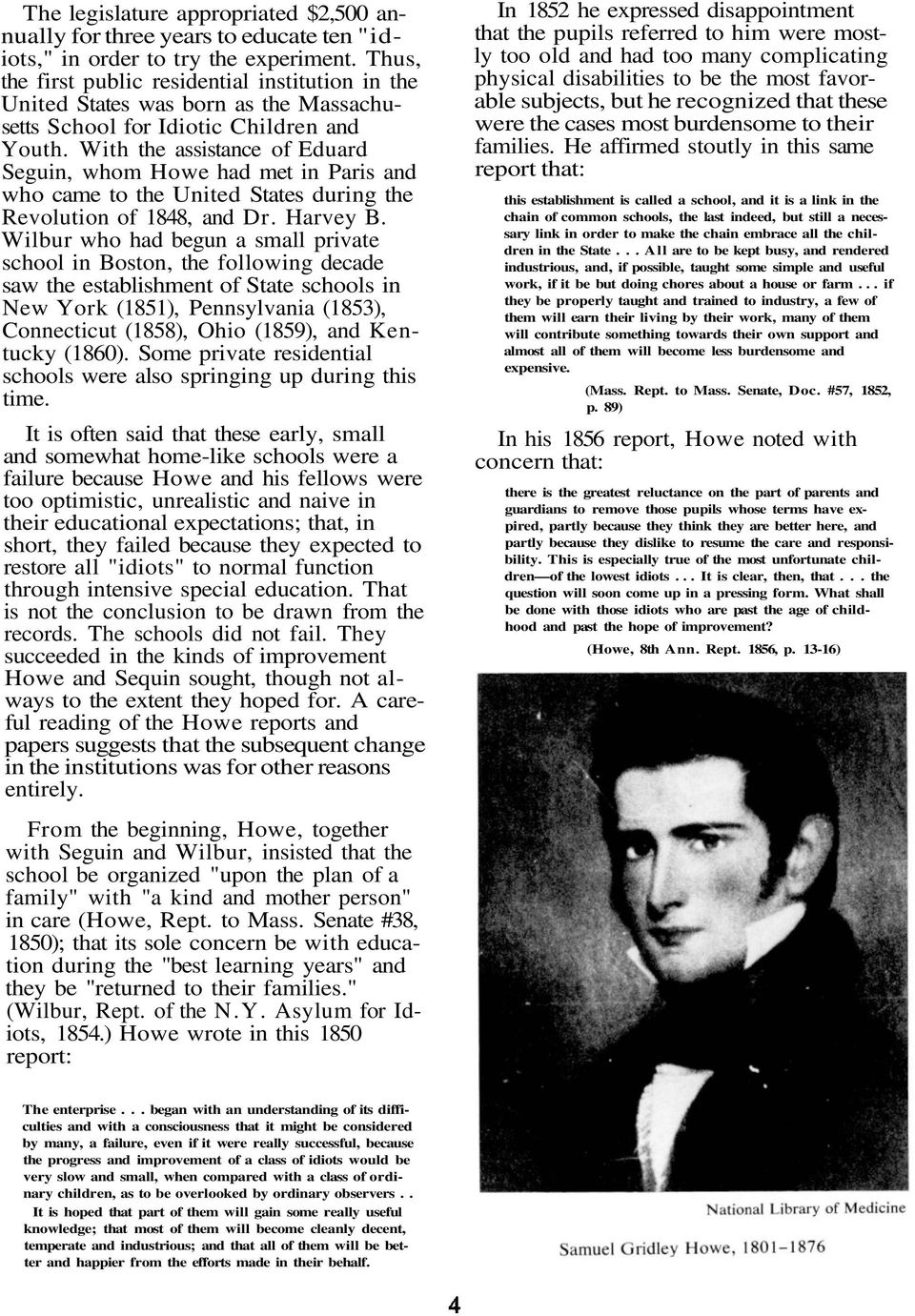
14 The legislature appropriated $2,500 annually for three years to educate ten "idiots," in order to try the experiment. Thus, the first public residential institution in the United States was born as the Massachusetts School for Idiotic Children and Youth. With the assistance of Eduard Seguin, whom Howe had met in Paris and who came to the United States during the Revolution of 1848, and Dr. Harvey B. Wilbur who had begun a small private school in Boston, the following decade saw the establishment of State schools in New York (1851), Pennsylvania (1853), Connecticut (1858), Ohio (1859), and Kentucky (1860). Some private residential schools were also springing up during this time. It is often said that these early, small and somewhat home-like schools were a failure because Howe and his fellows were too optimistic, unrealistic and naive in their educational expectations; that, in short, they failed because they expected to restore all "idiots" to normal function through intensive special education. That is not the conclusion to be drawn from the records. The schools did not fail. They succeeded in the kinds of improvement Howe and Sequin sought, though not always to the extent they hoped for. A careful reading of the Howe reports and papers suggests that the subsequent change in the institutions was for other reasons entirely. From the beginning, Howe, together with Seguin and Wilbur, insisted that the school be organized "upon the plan of a family" with "a kind and mother person" in care (Howe, Rept. to Mass. Senate #38, 1850); that its sole concern be with education during the "best learning years" and they be "returned to their families." (Wilbur, Rept. of the N.Y. Asylum for Idiots, 1854.) Howe wrote in this 1850 report: In 1852 he expressed disappointment that the pupils referred to him were mostly too old and had too many complicating physical disabilities to be the most favorable subjects, but he recognized that these were the cases most burdensome to their families. He affirmed stoutly in this same report that: this establishment is called a school, and it is a link in the chain of common schools, the last indeed, but still a necessary link in order to make the chain embrace all the children in the State... All are to be kept busy, and rendered industrious, and, if possible, taught some simple and useful work, if it be but doing chores about a house or farm... if they be properly taught and trained to industry, a few of them will earn their living by their work, many of them will contribute something towards their own support and almost all of them will become less burdensome and expensive. (Mass. Rept. to Mass. Senate, Doc. #57, 1852, p. 89) In his 1856 report, Howe noted with concern that: there is the greatest reluctance on the part of parents and guardians to remove those pupils whose terms have expired, partly because they think they are better here, and partly because they dislike to resume the care and responsibility. This is especially true of the most unfortunate children of the lowest idiots... It is clear, then, that... the question will soon come up in a pressing form. What shall be done with those idiots who are past the age of childhood and past the hope of improvement? (Howe, 8th Ann. Rept. 1856, p ) The enterprise... began with an understanding of its difficulties and with a consciousness that it might be considered by many, a failure, even if it were really successful, because the progress and improvement of a class of idiots would be very slow and small, when compared with a class of ordinary children, as to be overlooked by ordinary observers.. It is hoped that part of them will gain some really useful knowledge; that most of them will become cleanly decent, temperate and industrious; and that all of them will be better and happier from the efforts made in their behalf.
15 But in the following year, when a bill to provide scholarships for 15 idiotic children from poor families was vetoed, Howe wrote heatedly to the Governor: True it has not changed the nature of any born idiot and given him common sense, and no honest and wise persons have pretended this could be done. But... it has shown that idiots form no exception to the law that every form of organized life is capable of being changed for better or worse by surrounding influences... It has rescued some children of merely feeble minds from the imbecility into which they had fallen... given speech to some who were dumb... many trained to habits of industry. In the same letter to the Governor, Howe noted that "idiotic children are found mostly among the poor and humble... nutrition tells upon brain as well as upon muscle," then launched into a theme which became an increasing preoccupation until his retirement in 1874 the dangers of institutions: In almost all public, charitable and penal institutions with which I am familiar, serious evils arise from violation of the principle that we should separate not congregate... Being called upon lately to give advice about the establishment of institutions for the Blind and Deaf Mutes in a new State, I have counselled a course different from the one I, myself, followed many years ago. It is to dispense with any great costly building, having common dormitories, dining room, chapel and the like. To make no great preparation for any great common household at all; but to build a simple building, with all the conveniences for conducting classes, and make provision for boarding the pupils in private families. In a word to reduce the Institution... to its simplest possible form. This is perfectly feasible in many small towns and villages. (Howe: A letter to the Gov. of Mass. upon his veto of a bill providing for an increase in State beneficiaries at the School for Idiotic Children, Boston, Tickner and Fields, 1857) This anti-institutional view became an increasingly strong conviction for the remainder of his life. In 1866, in a famous speech at the laying of the cornerstone of a new institution for the blind at Batavia, New York, Howe questioned whether the enterprise might not be a mistake:... Society, moved by pity for some special form of suffering, hastens to build up establishments which sometimes increase the very evil which it wished to lessen... Our people have rather a passion for public institutions, and when their attention is attracted to any suffering class, they make haste to organize one for its benefit... All great establishments in the nature of boarding schools, where the sexes must be separated; where there must be boarding in common, and sleeping in congregate dormitories; where there must be routine and formality, and restraint, and repression of individuality, where the chores and refining influences of the true family relation cannot be had, all such institutions are unnatural, undesirable, and very liable to abuse. We should have as few of them as possible, and those few should be kept as small as possible. The human family is the unit of society. (Howe: Ceremonies on laying the cornerstone of the N.Y. State Inst. for the Blind, at Batavia, Sept. 6, 1866) In his final report to the Trustees of the Massachusetts School for Idiotic Children in 1874, as he retired, Howe, reiterated the theme: Now the danger of misdirection in this pious and benevolent work is, that two false principles may be incorporated with the projected institutions which will be as rotten piles in the foundations and make the future establishments deplorably defective and mischievous. These are. first, close congregation; and, second, the life-long association of a large number of idiots; whereas, the true, sound principles are: separation of idiots from each other; and then diffusion among the normal population... For these and other reasons it is unwise to organize establishments for teaching and training idiotic children, upon such principles as will tend to make them become asylums for life... Even idiots have rights which should be carefully considered! At any rate let us try for something which shall not imply segregating the wards in classes, removing them from our sight and knowledge, ridding ourselves of our responsibility as neighbors, and leaving the wards closely packed in establishments where the spirit of pauperism is surely engendered, and the morbid peculiarities of each are intensified by constant and close association of others of his class. (Howe: Rept. of Supt. Oct. 1, 1874)

16 His was the last voice to speak in this vein for more than half a century. From Residential School to Custodial Institution Even while Howe was inveighing against the evils of continuing custodial asylum for the pupils of the institutional schools, it was, in fact occurring. The great bulk of admissions were from indigent families whose ability to provide even subsistence was extremely limited. All agreed that only a small proportion trained in the institutions would be fully self-supporting on release; and there were no other supplemental supports available. The common fate of the person who was mentally defective was pauperism and assignment to the County Alms House where conditions were appallingly inhumane. In Kentucky, there was a law providing an annual subsidy of $75 for support to the parents or caretakers of an idiot as a buffer against pauperism. Wilbur, in his Annual Report for 1868, noted that when an institution was established in Kentucky (1860) it was expressly for the "teachable" class. "While the other class, including those who were unteachable or too old for instruction, still remained the beneficiaries of the State, under the same conditions as before." Wilbur notes that the annual cost to the State of this subsidy program was about $25,000. Dr. Stewart, Superintendent of the Kentucky institution, noted in 1884 that the cost of subsidies had risen to $80,000 and he did "not think it a good plan." (Natl. Conf. of Charities and Corrections Proc. 1884, p. 367.) The law was rescinded in 1924, to the expressed satisfaction of the proponents of life-care institutions. The chief spokesman for institutional life-time custodial care was Dr. I. N. Kerlin, Superintendent of the Pennsylvania Training School for Feeble Minded Children (Elwyn). In his annual report of 1875, Kerlin attacked Wilbur at Syracuse and Howe at Boston for disguising the true extent of custodial care they were actually offering. He repudiated Howe's "principle of diffusion" of the idiotic throughout the community on the ground that they are in reality "aliens in their own homes, because unlike any other child or member of the family; foreign to the community, because insubordinate to its rules and habits; children always even when men in stature, of necessity they come to be repelled from home and society." He summarily dismissed Dr. Howe's suggestion of "idiots' rights" (I. N. Kerlin, Annual Rept. Pa. School for Feebleminded, 1875, pp ). Ironically, the year after Dr. Howe's death, in 1876, his successor requested "provision for the custody or protracted care of such children as have no homes to which they can be safely returned after receiving all the training of which they are susceptible... but it would require very considerable additions to our means." (30th Ann. Rept. Mass. School of Idiotic and Feebleminded Youth, 1877, p. 16.) Wilbur's report for 1874 shows a total of six State, one municipal (N.Y.) and two private institutions with a total of 1,282 residents, ranging from five (private school in Boston) to 357 (Columbus, Ohio). The public institutions were now moving rapidly to a dual function of training and custody, with no voice speaking anywhere for meeting the needs of mentally impaired people within the community. The attitude, however, was still essentially benign and humanitarian, the institutional objectives being to provide a better environment and opportunity for improvement to impaired persons and relief to the family and community. It becomes evident, though, that the costs of institutional expansion were meeting with resistance from legislatures and public officials. It took more than a spirit of philanthropy to open the public purse. New stimulation, however, was not long in coming.

17 In 1876, a year following Howe's death, a group of the superintendents of State institutions, under the leadership of Dr. Seguin organized the American Association of Superintendents of State Schools for the Feebleminded, the progenitor of the American Association on Mental Deficiency. The proceedings of their annual meetings provide some of the early reference material on their discussions and viewpoints. However, they found a wider forum in the annual meetings of another fledgling organization, the National Conference of Charities and Corrections. In most States the administrative control of State-run correctional institutions, mental hospitals, homes for dependent children and institutions for the idiotic and feebleminded was lodged in a single Board of Charities and Corrections. The representatives of these boards, or of the separate functions where no single board existed, organized in 1874 to provide an annual forum for their debates. Here the superintendents found a means of gaining a hearing outside of their own numbers for the expression of issues which rapidly became quite heated. Hence, the Proceedings of the N.C.C.C. constitute the major source for the most important papers delivered by the leaders in the field for a period of 40 years. In 1884 Kerlin delivered a paper to the 11th Conference of Charities and Corrections on "Provision for Idiotic and Feebleminded Children" which was hailed by Fernald, 20 years later, as a "prophetic report... as authoritative today as when it was written... a classic." (National Conference of Charities and Corrections Proceedings, 1904, p. 380.) Kerlin noted that the Federal census of 1880 showed an increase in number of feebleminded of 209 percent over that of 1870, but stated that the total of 76,895 was still an underestimation by "20 or 30 percentum," and that of the total only 2,429 or a little over 3 percent were institutionalized. Of the 3,500 known cases in Pennsylvania he noted that only about one third were in families with the means to pay any substantial amount for care; the balance were in impoverished homes or in county poor houses. Following a description of the ascending gradations of feeblemindedness (1. Idiocy, 2. Idio-imbeciles, 3. Imbeciles, 4. Juvenile insanity) Kerlin then launched into a "practical consideration" of the higher grade and of "juvenile insanity." He noted the close connection of these groups with the impoverished and pauperized families in which crime, prostitution, alcoholism, and other evils abound. Then followed a notable piece of rhetoric. There is no field of political economy which can be worked to better advantage for the diminution of crime, pauperism, and insanity than that of idiocy. The early recognition of some of its special, upper, and more dangerous forms should be followed by their withdrawal from their unwholesome environments and their permanent sequestration before they are pronounced criminals, and have, by the tuition of the slums, acquired a precocity that deceives even experts. Only a small percentage should ever be returned to the community. (I. N. Kerlin: Provision for Feebleminded and Idiotic Children, Natl. Conf. of Charities and Corrections. Proc. 1884, pp )

18 Kerlin added another significant sentence: "American institutions having been already in existence 30 years, it may be asserted that the experimental period is passed, and that, when States shall proceed to legislate for these defectives, it will be done on a permanent basis." Thus, with a sweeping brush, Kerlin transformed the institution from a school from which the "improvable" may return better fitted for social living and an "asylum" for the profoundly impaired who have no community home, into instruments of permanent segregation of the unfit from the community to which they are a menace. This was one of the earliest expressions of "social Darwinism" to appear in the literature of mental deficiency. In a later paper, Kerlin expounded further on a type of defective "in which the congenital deficiency of the moral sense evidences itself: (I. N. Kerlin: The Moral Imbecile, National Conference of Charities and Corrections, Proc ) Kerlin called this type the "moral imbecile," characterized by only mild intellectual deficiency, but by uncontrolled and vicious behavior originating in childhood. His description corresponds to what we have more recently called "emotionally disturbed" or "sociopathic" children. In fairness to Kerlin, it should be noted that he described this group as a minority of institutional cases, "the black residue of 25 percent." But it was a small step to generalize from the danger of this limited group to the potential danger of all feebleminded. This step was, in fact, taken quite easily in the discussion which followed Kerlin's paper. A Dr. Walk of Philadelphia: "... I think it is time for every American State... to put its idiotic populations under custodial care, not for a day or a week, but permanent care... but if you are going to shut up all the idiotic and feebleminded where they can do no harm, you must do it in some cheap way...." But Kerlin had a ready answer to the problem of cost: As a further practical suggestion, I wish to add that any general State institution for the care of the feebleminded should embrace a department for the care of the moral imbeciles. They can be indentured to work. They can... be drawn into sympathetic contact with helpless idiocy and be made to work towards its nourishment. They need not be taught to read and write; for the school, as ordinarily kept, contributes to their deterioration... I trust that there are... many in this Conference who may see in these suggestions a line to be followed which will lead to the relief of many of our institutions, to a better understanding of this worst form of moral perversion, and to a partial arrest of the apparently increasing degradation of our race. (loc. cit.) Thus were the ingredients assembled for the dehumanization of individuals who are mentally retarded and for their mass care in custodial institutions: The institution was an established model. Its educational mission was not subordinate to custody. Its clientele was firmly linked to poverty, crime, insanity, prostitution, alcoholism, and immorality in general. The mildly retarded group included a class of dangerous "moral imbeciles" who should be permanently sequestered. Mildly retarded people should be indentured to work, to earn their own support and to support by their labor those more helpless. The cost of institutional care can be drastically reduced by use of this labor. An image was emerging of an "alien" in the family of man, dangerous and threatening to social decency. Some features of the emerging image were still obscure. Rapidly they were to be highlighted.
19 The Demonology of the Defective Four scientific developments, which became popularized in distorted form, helped to fill in the final image of the feebleminded individual as a depraved menace to society: Darwinism, sociological research, Mendelian genetics and psychometry. The evolutionary theories of Charles Darwin emphasized biological adaptation of species to procreate efficiency, available food supply, and to natural hazard. The "survival of the fittest" recognized that those species and their mutations which were best adapted to the conditions of the environment tended to perpetuate themselves, while poorly adapted species tended to disappear. Popularization confused "fitness" with "worthiness" which, in the case of middleclass man in industrial society, became identified with intelligence, industriousness and conformity to a specific moral code of decency. The very high mortality of those who were severely and profoundly impaired "idiotic" provided confirmation of the law as a natural phenomenon, while the linkage of feeblemindedness with poverty and its associated evils made it clear that mentally impaired people were "unfit" to survive in a world in which competition was the first law of nature. The popular understanding of Darwin as a bastion of social decency is expressed by the Governor of Massachusetts in 1883: When the State shall have sufficiently educated every bright child... it will be time enough to undertake the education of the idiotic and feebleminded. I submit that this attempt to reverse the irrevocable decree as to the survival of the fittest is not even kindness to the poor creatures who are at this school... none of the pupils have become selfsupporting... a well cared-for idiot is a happy creature. An idiot awakened to his condition is a miserable one. (Gov. Butler, Address to Mass. Legislature, 1883) Galton in 1901, seeing threatening implications in Darwinian theory with respect To the human race (Possible Improvement of the Human Breed, 1901), proposed that by eliminating the unfit, man could actively assist nature in promoting the survival of the highest quality of human being. Thus the negative eugenics movement, based on "social Darwinism" was launched. In 1877, Dugdale, a prison inspector, published his famous study of the Jukes family. (Dugdale, R.L. The Jukes, New York, Putnam, 1877.) This was a sociological description of the frequency of social degeneracy in a consanguinous family group, with some commentary on the economic costs of society. Dugdale ascribed the misfortune of the Jukes to the unfavorable environments in which they grew up. The treatise was seized upon, however, as evidence of the hereditary nature of degenerative tendencies and such family histories were proliferated during the next several decades. Meanwhile, a myth began to form which ascribed to feebleminded individuals an abnormally strong and utterly ungovernable sexual drive. Even Howe had been alarmed at the "manifestation of the amative feelings" among "idiots" and concluded that "the most lamentable and certain, though less frequent cause of congenital idiocy, is the lasciviousness of some female idiots, whose illegitimate offspring are almost always, like themselves, idiotic and lustful." There is little doubt that the destitute, marginally incompetent woman was victimized by a raw and brutal society "tossed from poorhouse to jail and from jail to poorhouse in which the last trace of womanhood in them is destroyed." (Mrs. C. R. Lowell, 6th Conf. of Charities & Corrections Proc ) This led in New York to the establishment of a separate institution for feebleminded women at Newark, and to the general practice of the rigid and absolute separation of the sexes at all institutions.

20 "The isolation from contact or close knowledge of the opposite sex is wholesome in the fact that there are no conditions to excite sexual instincts, which in the defective are usually abnormal." (D. W. Winspear, 22nd Natl. Conf. of Charities and Corr. Proc ) Fernald, the acknowledged leader for 30 years in the field of mental deficiency, had this to say in 1893: "The tendency to lead dissolute lives is especially noticeable among the females;" and in 1904: "It is well known that feebleminded women and girls are very liable to become sources of unspeakable debauchery and licentiousness which pollutes the whole life of young boys and youth in the community;" and again in 1912: "feebleminded women are almost invariably immoral, and if at large usually become carriers of venereal disease and give birth to children who are as defective as themselves. The feebleminded woman who marries is twice as prolific as the normal woman." (J. of Psycho-asthenics XVII, 1912, pp ) Gregor Mendel, whose quiet studies of heredity had lain dormant for decades, was rediscovered in 1900 and provided a new and potent weapon in the indictment of those who are deficient. It had long been suspected that feeblemindedness was inherited. Now science gave the suspicion an authority which was quickly seized upon. The Mendelian laws lent themselves to the belief that feeblemindedness and intelligence constituted distinct and unitary characters as did blue and brown eyes, hence would breed as recessive and dominant characteristics. Normal people may be the carriers of the unsuspected hereditary taint, and the feebleminded people themselves would inevitably transmit the taint to their offspring. Now the true import of the Jukes family became clear not environment but heredity was the cause; and other family histories were rapidly brought forward as further appalling exhibits. In 1912 Goddard published the most famous of all in the story of the Kallikak family. (H. H. Goddard, The Kallikaks, N.Y., MacMillan, 1912), which was taken as indisputable proof of the genetic origin of feeblemindedness. The cause of at least 80 percent of feeblemindedness was asserted to be hereditary. And feeblemindedness was said to be the overriding cause of the degeneracy of lower class humanity and the potential undermining of the human race. One final scientific discovery was added to the evidence of the menace from which society must be protected. In 1905 Binet and Simon developed a technique for distinguishing among children in the schools of Paris those who could succeed in standard school work and those who could not. The Binet test, based on a sampling of verbal and intellectual performance characteristics of children of successive ages, developed an age-scale by which the degree of retardation or advancement could be measured against a norm. Thus the science of psychometrics was born. Binet would have been appalled at the uses to which it was put in the United States. It was seized upon and popularized by Dr. H. H. Goddard, the director of research at the Training School at Vineland, N.J., and by Kuhlman, Terman, and others who refined, perfected, and applied this new and powerful instrument. Originally yielding a measure of "mental age," Goddard was able to reclassify deficient persons in terms of the maximum mental age attained: the idiot not more than a 2-year mentality, the imbecile between 2 and 4 years, and the moron 7 to 12 years. Stern (Stern, W., The Psychological Methods of Testing Intelligence, New York, Warwick, 1904) and Terman (Terman, L. M., The Measurement of Intelligence, N.Y., Houghton Mifflin, 1916), in the United States, by taking the ratio of mental age to chronological age, with 16 as a constant at intellectual maturity, invented the intelligence quotient or "I.Q."

21 Thousands of studies of the I.Q. led to the conclusion that it is a constant characteristic of the individual, determined by heredity from the combined I.Q.s of the parents, unalterable by environmental influence or training and infallible (subject to statistical errors of measurement) in identifying the categories of intellectual endowment in children, from idiot to genius along a normal bell-shaped curve of frequency distribution. Binet himself wrote: "Some modern philosophers seem to have given their moral support to these deplorable verdicts by asserting that the intelligence of an individual is a fixed quantity which cannot be augmented. We must protest and react against this brutal pessimism, we shall try to demonstrate that it has no foundation," (Trans. from Les Idees Moderne sur les Enfants, 141, Paris, Flammerion, 1911). Goddard not only validated Binet's instrument on several hundred mentally deficient children previously categorized by other clinical names, but applied it also in a large sampling of school children. In 1913 he shocked the world by revealing that no less than 3 percent of all school children are feebleminded, that beyond the well-known cases of idiot and imbecile is a much larger class of feebleminded of mild degree but of definite incapacity (for which Goddard coined the term "moron"). No amount of education, it was believed, would alter the constitutionally endowed I.Q., and this mistaken notion confirmed the menace to society of mentally deficient people, especially of the moron whose feeble intelligence may have been masked by his apparently normal appearance (H. H. Goddard: "The Improvability of the Feebleminded," J. of Psychasthenics 17: 131, 1913). Now, indeed, the full indictment could be stated; and it was, most eloquently, by Fernald: The social and economic burdens of uncomplicated feeblemindedness are only too well known. The feebleminded are a parasitic, predatory class, never capable of self-support or of managing their own affairs. The great majority ultimately become public charges in some form. They cause unutterable sorrow at home and are a menace and danger to the community... Every feebleminded person, especially the highgrade imbecile, is a potential criminal... At least 25 percent of the inmates of our penal institutions are mentally defective... It has been truly said that feeblemindedness is the mother of crime, pauperism and degeneracy... The recognized field of mental defect has been gradually extended and widened... It is most important that the physician should recognize the socalled "borderline" cases, where the intellectual defect is slight, and is overshadowed by the moral and criminal tendencies.... The most important point is that feeblemindedness is highly hereditary... No feebleminded person should be allowed to marry or become a parent... The normal members of a definitely tainted family may transmit defect to their own children. Certain families should become extinct. Parenthood is not for all. Campaign of Control (W. E. Fernald, "The Burden of Feeblemindedness," J. of Psychasthenics, XVIII, 1912, pp ) With the depravity of feeblemindedness now firmly established as a shameful blight in familial germ plasm and as the major source of society's ills, two problems were now paramount: how to prevent feeblemindedness from occurring and how to control those in whom it did occur.
22 Although Fernald and others continued to insist that the psychological measurement of I.Q. was insufficient to diagnose true mental deficiency, in practice this became increasingly the sole criterion. The increasing application of the Binet test in the schools, led to wild popular (and even professional) estimates of the prevalence of mental defect. The eugenics movement, although containing a core of responsible and scientifically cautious advocates, became a bandwagon for the alarmists and a major vehicle for the widespread popular dissemination of grossly distorted myths concerning the "menace of the moron." The urgency of educating the public on as wide a basis as possible was recognized by Fernald: Education in the broadest sense must be our chief weapon. We must educate the lawmaker, we must educate the judges, the doctors, the teachers. We must educate the children who go to the high school, and college, and normal school, and the medical school. We can thus leaven the population and they will spread the information to the rest of the public who are capable of being educated. We may deal with the other half of the community by our segregation and our sterilization propositions, or by other means (Editor's emphasis).... The States in the Union which are successfully handling this matter are the States where an intelligent campaign of education has been carried on for more than a generation. (In discussion of Fernald's paper, "the Burden of Feeblemindedness," Natl. Conf. of Charities and Corr. Proc. XVII, 1912, p. 109) It is difficult to believe that Fernald literally intended that one half of the population would sanction the segregation and sterilization of the other half! No doubt that was not intended, but there is no doubting the enormous and successful campaign of indoctrination on the negative and dehumanized image of the mentally deficient population carried on under the professional leadership of Fernald and his associates. Of all the alternatives available to meet the "menace of the moron," segregation seemed best designed to fill both the need of prevention and the need of societal protection. The most drastic of all methods extermination was now and then hinted at, but aside from moral revulsion, the obvious massiveness of the problem, if one includes all the presumed carriers of hereditary taint, rather precluded that solution. Involuntary sterilization appeared to be more promising than restrictive marriage laws in preventing procreation, but both measures were adopted in many States in the first two decades of the century. Neither was really effective and only sporadically enforced. Since the use of congregate segregation in State institutions had already become well established and had, indeed shifted from solely educational to predominantly custodial purposes, it furnished a strong foundation for a program of control. Already the arguments for small, homelike establishments had been long forgotten. Kerlin in 1890 had shaken off the fetters of size: The feebleminded and idiotic can be wisely and cheaply cared for, under a large community organization The larger the better the classification (Author's emphasis): for classification can be more readily, wisely and pleasingly made in proportion to the increase in buildings and inmates. Hence, let us fix no limitations to the growth of an institution of this class. (I. N. Kerlin: 38th Ann. Rept. Pa. Trng. Sch., 1890, p. 19) How could the State afford such massive custodial accommodation? The answer had already been found, first in the use of Kerlin's dangerous but physically capable "moral imbecile," and, by extension, in all those of "weak mind and will" but of "strong body and physical appetite," whose labor would support not only themselves but also those less fortunate who were unable to work. Kerlin became positively rhapsodic over the prospect of "... 'villages of the simple,' made up of the warped, twisted, and incorrigible, happily contributing to their own and the support of those more lowly cities of refuge in truth; havens in which all shall live comfortedly, because no longer misunderstood or taxed with exactions beyond their mental and moral capacity. They shall 'go out no more' and 'they shall neither marry nor be given in marriage,' in those havens dedicated to incompetency." (I. N. Kerlin: Pa. Trng. Sch. 38th Ann. Rept. 1890, p. 21.)
23 A superintendent of the Ohio institution in the mid-1880's made an often quoted boast to his legislature: "Give me the land (1000 acres will suffice) and allow me to gather the idiotic and imbecile population now under public care together, and I agree that the institution shall be made self-sustaining, and I will pay back to the State the price of the land." (A. G. Byers, Disc. on care of the feebleminded, Natl. Conf. on Charities and Corr. Proc. 1890, p. 441). The final model was the Colony developed at the Waverly site of the Massachusetts institution by Fernald in There, on several square miles of farm acreage, groups of retarded people lived, worked, and supported the institution to a large degree, producing not only all the food required, but also fabricating in shops the clothing, furniture, and other furnishings needed for the institution. The purposes of the Colony system, as devised by Fernald, was really two-fold. Certainly it was a means of cost-cutting in a situation where the number of residents were mounting much faster than supporting State funds. But Fernald had never completely abandoned the hope of educating and restoring to community life some of the most responsible of the feebleminded. Years later, Fernald made the first of a long series of followup studies of institutional paroles and found his hopes were far better vindicated than his fear. The publication of his findings and subsequent retraction of many of his earlier views attested to the character of this leading figure of his time in the field of retardation. The model initiated by Fernald was followed in many States, but not always with his dual purpose. Large farm areas attached to the central State institution used the labor of an increasing population of mildly retarded young men, committed at puberty; in all too many cases their commitment became a life-long indentured servitude. If the complaint was made that they were worked too hard, the reply had been supplied earlier by Dr. Bernstein, Superintendent of the Rome State School in New York: You cannot work those boys too hard. If they work them as hard as they can they will not practice the vices to which the gentleman alludes... they work so that when they come in at night they go to bed and sleep. Then they get up next morning and go to work again, and I am very sure that the farmers who work them the hardest are keeping them the best in line in good behavior. (Bernstein, in disc. of Fernald: "The Burden of Feeblemindedness," J. Psycho-asthenics, XVII, 1912, p. 105)
24 Wolfensberger has shown that the claims of cost reduction made by many of the superintendents, based on economics of scale and resident work, were in fact exaggerated (W. Wolfensberger: The origin in nature of our institutional models, in Changing Patterns in Residential Services for the Mentally Retarded, PCMR, 1968, pp. 118 ff). Nevertheless, per capita annual cost was kept remarkably low. Converted into 1967 dollar values, the mean average cost from 1887 to 1903 was $781 or $2.14 per day; from 1909 to 1949 the mean annual average was $666 or $1.82 per day. It was only following World War II in 1946 that the cost curve began a significant rise which reached a level of $2,676 in 1966, or $7.33 per day. The nature and reasons for that rise will be discussed later in the report. Economies were effected by reducing services and amenities to a minimum, increasing numbers to a maximum and using the unpaid labor of residents with unconscionable intensity. However, the attempt to completely segregate the population of mentally retarded persons was an utter failure and at an appalling cost in dehumanization, exploitation, and degradation. A cardinal element in Fernald's proposals had always been the identification and registration of all feebleminded cases as a necessary means of control. This was a two-edged embarrassment. Until psychometric testing was invented, no reliable case-finding method existed. But when intelligence testing did become available it led to such staggering numbers of presumed feebleminded that the task of building a registry (especially of those beyond school age), became staggering, and the institutionalization of such a mass of people utterly impossible. Although the severely defective person could readily be identified and early placed in custody, the mildly retarded one presented a different picture. Judges and other authorities were reluctant to order indefinite institutional sequestration or sterilization of individuals whose only "crime" was a low I.Q. which might at some time make him a social problem. In spite of the intensive campaign led by the institutional superintendents and supported by the eugenics movement, the proportion of identifiable retarded people in public and private institutions never went beyond about 10 percent. Even so, the institutional population did continue to expand and at a rate higher than the expansion of facilities to house them. The result was chronic overcrowding and the eventual development of long waiting lists. In 1912, E. R. Johnstone, Superintendent of the Training School at Vineland, put forward a plan which seems to have represented a trend of thought answering to the problem of total control at manageable cost. His proposal recognized the fact that special classes were beginning to emerge in the public school systems of the larger cities. This movement by 1912 had gained a substantial foothold. Johnstone's "Plan for the Care of the Feebleminded" for the State of New Jersey was this: 1. All feebleminded children under the age of 12 (or until they become dangerous sexually or otherwise) excepting idiots, should be sent to the Special Classes in the public schools. The parents will thus bear the expense of housing,
25 feeding, and clothing their own children for these years. The only public expense will be that of the school, and if the training is largely physical and manual, much good will be accomplished. 2. Cities with a sufficient number of feebleminded children between the ages of 12 and 20 will establish municipal residential institutions which should be under the control of the educational authorities. Children from the Special Classes would be committed to the institution at the proper age. Here the expense must be borne by the municipality, the parents contributing what they are able, and the State assisting as it does in county care of the insane. Johnstone notes that the number to care for at this age will have decreased, "for the death rate is not negligible." The Training School for children at Vineland would be able to care for the children of this group (12-20 years) from the smaller communities under this general plan. 3. Those who are 21 years old and over "and the number have still further decreased," can be cared for by the State at its central custodial institutions at Vineland (women) and Skillman (men), and the transfers should be made directly from the institutions for children to the State the parents contributing what they are able as they now do. 4. "All idiotic cases those whose personal habits are unclean and who need special care should be cared for in the above institutions, or better still in the almshouses." (E.R. Johnstone: A Plan for the Care of the Feebleminded, The Training School, Vineland, N.J., pp ) This proposal, while never adopted, illustrates the extent to which the concept of control was developed at the peak of the period of indictment. The paradox is that the plan to segregate all mentally deficient people from society in massive isolation came nearest to fulfillment only when the justification for it was undermined. This is shown most clearly by the growth curve of institutional populations from 1850 to 1975 (see Figure 1). During the educational period of Howe, Seguin, and Wilbur, growth was slow even though facilities were often crowded. Wilbur estimated a total of 1,282 residents in all institutions in 1874, which would represent a ratio of.03 per thousand of the U.S. population. By 1900, with the custodial character of institutions fully established, the number had risen to only 7,000 or a rate of.09 per thousand of general population, and following the peak of the eugenic campaign in 1925, approximately 40,000 or.34 per thousand. By that time, the fallacies of the negative eugenic movement had been well exposed, the promise of special education and adaptations to community life had become persuasive to the leaders of the field, as represented in the White House Conferences of 1919 and But it was in the period of 1925 to 1950 that institutional populations grew at the greatest rate ever, rising to 128,000 in 1950 or a rate of.83 per thousand population. After 1950 they continued to rise, reaching a final peak of 190,000 in public institutions in 1969, or a rate of very nearly 1 per thousand population. Since that time, the deinstitutionalization movement, accompanied by growth of community services, has brought about a reduction for the first time since the institutional movement began. In 1975, institutional population was estimated to be between 165,000 and 170,000 with the rate reverting to a level of.78 per thousand of population, or less than that of Why did the great influx occur in the 1925 to 1950 period? One reason which has persisted to the present is that medical science has had spectacular success in saving and prolonging life, reducing infant mortality and prenatal loss, resulting in an increased survival of moderately to profoundly retarded residents. Johnstone's comfortable 1912 notation that the burden of care progressively lessens with age "because the death rate is not negligible," was not nearly so true in 1930, '40, '50, and '60.
26 Secondly, the pattern of institutional care had become a well-established social institution, with substantial investment in buildings and land, making it easier to enlarge and overcrowd existing facilities than to develop wholly new techniques and resources for local home and community management. Thirdly, the ideology of the demonic, fearsome defective had been well ingrained into the American consciousness and could not easily be forgotten, even though knowledge had progressed far beyond that stage; cultural lag is a powerful factor in determining social behavior. But most important of all, the great depression of the 1930's, followed by world war in the 1940's, created a situation of greater hardship in the family and a diversion of public resources, first, to providing basic social and economic security to the population at large, and second, to the astronomical costs of global war. Why did institutionalization still continue to rise during the period of recovery and growing affluence of the 1950's and 1960's? Partly for the same reasons: cultural ideological lag and the persistence of an established and vested institutional mechanism. Although public pressure was causing some improvement in the quality of residential care in the institutions, the movement toward new community resources was slow in developing. The parent movement, together with professional advancement, drew attention to the abominable conditions of the institutions and generated slow and often superficial reforms which made it somewhat less painful to place one's child in an institutional setting. An overriding need in the parent was to ensure the permanent security of a substantially handicapped child. With community resources as yet non-existent, the institution was the only resource available for the child unable to care for himself. Massive attack on the problem was necessary in order to bring about a significant change. Education for 'Exceptional Children' Special education for the mentally deficient was born from contrary roots of compassion and intolerance. We have noted that the first institutions for "idiotic children" in the mid-nineteenth century were schools, designed for human beings with limited and undeveloped capabilities who might, by careful teaching, be made more self-sufficient. But that effort was subverted by the conversion of the institutions to purposes other than education. Special education was born again at the century's end, not wholly out of compassion for the "backward" child, but also out of impatience with his presence in the public school classroom where compulsory education required him to be. Another half-century had passed before the motive of compassion once again predominated and led swiftly to the claim of educational opportunity as a right. The early pioneers, Seguin, Howe, Johnstone, Wilbur, and others, were convinced that the dependencies of the "idiotic" could be reduced and their competencies increased by careful, patient teaching.
27 They were influenced by traditions of thought stemming from John Locke and Rousseau through Condillac and the "Saint Simon" school and by the early efforts of Itard, followed by Bellehomme, Falbret, and Seguin in France, Guggenbuhl in Switzerland and Saegert in Germany. The emphasis was on the "Natural" learning of active encounter and experience guided by warm and sympathetic teachers, leading into the "physiological" method of sensory-motor stimulation developed by Seguin. This tradition was the forerunner of the Montessori schools, and the later functional educational theories of John Dewey. In the end the tradition led to the special education methods of During the period of the rise of public education in the United States, however, the principal emphasis was on formal intellectual learning which made the "Three R's" central and all-pervasive. Ability to read, write and compute were, of course, of great practical importance for success in the developing industrial-commercial society, and the presence of upward mobility in social status was matched by upward mobility in educational attainment. The colleges and universities, with their intellectual roots in the classics and their social roots in the higher professions and privileged status, furnished the model for the purposes and methods of grammar and high school education. School learning was "book" learning, with emphasis on linguistic and formal conceptualization. It reflected the evolution of middle-class values and did not by any means reach all children. As the institutions for mentally deficient children and adults developed and acquired an increasingly custodial character, their educational role changed. In most public institutions little effort was made to train severely and profoundly deficient residents even in the rudimentary functions of toileting and feeding. "School" gradually departed from the functional methods of Seguin and Howe and was increasingly modeled on the formal academic training of the public schools, with little practical benefit to the subject. As larger numbers of mildly retarded persons became more institutionalized and were used to provide institutional labor, training became less academic and more utilitarian in terms of work performance. "School" learning even became looked upon as a dangerous practice (see the interesting interchange between Dr. Bernstein, Supt. of the Rome, N.Y. State School and Dr. Fernald, Supt. of Waverly, Mass.: J. of Psychasthenics. Vol. 18, p Dr. Bernstein: "The patients who give us the most trouble are the ones who have been taught to read and write...." Dr. Fernald: "I think these patients would be much more troublesome if they did not learn to read and write...").
28 In any event, the educational objectives and methods which had initiated work with retarded persons were virtually lost as the negative image gave rise to increasingly repressive practices. Even by 1949, while the statutes of most States specified that the school program was to be included in the function of the institution, it was clearly secondary to their custodial and protective responsibility, and in most instances was not under the direction of the State educational authorities. (Elise H. Martens, "Some Legislation for Education of Exceptional Children," U.S.O.E. Bulletin No. 2, 1949, U.S. Government Printing Office, Washington, D.C.) During the "dark age" of the indictment of retarded people, a bright spot which kept the fires of inquiry burning was the private Training School at Vineland. Under the superintendency of E. R. Johnstone, Vineland maintained a strong and devoted belief in the ability of retarded persons to learn, and in the responsibility to learn all that can be known about them. Before 1900, Vineland was assiduously training teachers for retarded children. Goddard, who succeeded in lighting the bonfire of the negative eugenics movement, was nevertheless an outstanding director of research. The work of his successor, E. A. Doll, in developing the Vineland Social Maturity Scale was a landmark effort. And for many years the Bulletin of the Training School was the vehicle for the most progressive reporting of theory and practice in the field. In the meantime, public education was having its difficulties, especially as the social problems of the cities grew with expanded populations and their concentration in polyglot slums. The rise of compulsory education, which was designed in part to keep children off the streets with the passage of child-labor laws, added to the difficulties. Discipline became increasingly difficult, authoritarian control and routinized curriculum increased, and "problem children" multiplied. As a result, special classes came into existence in the cities, largely for "unruly, disciplinary or truant boys." New York City opened such classes in 1874 and Cleveland a year or two later; others followed. Providence, Rhode Island developed a school for behavior cases in 1894 but two years later opened an extension for "backward children." This marks the beginning of special education for retarded students in the public schools of the United States (J. E. W. Wallin, Education of Mentally Handicapped Children, N.Y. Harper, 1955). Germany had led a movement in Europe initiated by Stotzner in 1864 and resulting in 500 classes enrolling 12,000 children in (Maenel, B. Auxiliary Education The Training of Backward Children, New York, Doubleday, 1909) Within ten years a dozen cities followed suit, with some establishing two types of special class, one for the intellectually limited, the other for the emotionally or behaviorally maladjusted. In most cases, however, there was a mix of the two and many of them became no more than a dumping ground for children whose teachers found them for any reasons difficult to handle. Not uncommonly, the teachers of these special classes and schools were qualified more as disciplinarians than as special educators. At the same time, and especially in smaller communities and in the one and two room rural schools, slow learning and retarded children were frequently retained in regular classrooms, learning little, but tolerated so long as they were docile.
29 By 1922, 133 cities in 23 States were reported by the U.S. Office of Education to have enrollments of 23,252 pupils in special education classes of all types. By 1936 this had increased to 99,621 pupils in 643 cities in 43 States. State laws providing for special education of retarded children began with New Jersey in 1911 and extended to 14 States by 1930, and nearly all States in some form by The State laws varied widely. Most of them initially made provisions for special classes only on a permissive basis and without special subsidy. Although New Jersey's law was mandatory, from the beginning implementation was extremely fragmentary. Some States financed excess costs in one form or another; some did not. Some required specialized teacher training; some did not. Some provided State supervision; some did not. Practices within cities and from school to school were extremely diverse. The number or proportion of pupils, as well as the reasons for placement, varied between wide extremes. One characteristic that was nearly universal to 1940 was the right of the school to exclude a child who was judged "ineducable." This meant, in practical terms, judged incapable of making discernible progress in the formal academic curriculum. As intelligence testing became popular, children were admitted to special classes only if they had I.Q.s of at least 50 or 55. The maximum I.Q. was sometimes 75, sometimes 85, depending on whether a distinction was made between "slow-learners" or "backward" children and the "feebleminded." In only a few instances New York City, for example more severely retarded children (later classified "trainable") were admitted to special categorical classes. This practice was terminated in 1929 and the lower limit set at 50. Knowledge and human interest in the educational development of retarded children was slowly recovering from the devastating demonology of the period. This fact is evidenced in the reports of the White House Conference on Child Health and Protection of A special section on education of the handicapped and gifted included an extensive report on the mentally deficient. E. A. Doll of the Training School at Vineland made a substantial contribution to the section. (Committee on Special Classes Section III F, Special Education of the Handicapped and Gifted, 1930 White House Conference on Child Health and Protection, pp. 439-ff.) This report recognized the rapid increase in classes for retarded children between 1910 and 1920 with a subsequent falling off between 1922 and The decline was ascribed mainly to the lack of clear definition of purposes in terms of "social and educational objectives and pedagogical methods," and to the composition of classes using ony the I.Q. as criterion with "no attention paid to questions of nationality, social status, race, special ability or other diagnostic factors." The Conference made the following recommendations: 1. State laws should be further developed, guided by fundamental, educational, and economic principles with a separation of regulation from legislation. 2. Clear distinction should be made of "educable" mentally retarded children from those of the lowest grades, those from inadequate and vicious surroundings, defective delinquents and orphans, neglected and dependent types, all of whom were said to need institutional treatment. 3. Provision should be made for the approximately 2 percent of children definitely feebleminded (i.e., I.Q. below 70), and for five percent of borderline subnormals (i.e., I.Q. 70 to 85), with a definitive policy on the part of a community for the handling of the low-grade feebleminded (i.e., I.Q. below 50). "It seems now to depend too often upon whim or political influence" (p. 480) In addition, the conference recommended that provision for the subnormal and borderline subnormal should extend into Junior and Senior High School locations, with emphasis on vocational courses, supported by a Vocational Guidance Bureau and with follow-up supervision in industry.
30 4. Nomenclature used should be that of Special Classes, deemphasizing labels in terms of type of defect. 5. Lack of constructive publicity has been detrimental to the success of special education programs; consequently, the positive results of special education in the "reconstruction" of children should be emphasized and supported by the U.S. Office of Education. 6. Careful investigation and intensive research is needed in almost every phase of special education, since the work is still at a very tentative stage. The precariousness of the special education program in 1930 was made especially clear in a vigorous and critical appraisal by E. A. Doll of the operation of programs in New Jersey, despite the relative progressiveness of the laws of that State (E.A. Doll, State Educational Service, Report of the Division of Education Bulletin No. 7, 1930, U.S. Government Printing Office, Washington, D.C.) By 1940 the pattern of eligibility for special education of the retarded was becoming fairly uniform among the States, most commonly requiring a mental age of not less than 5 years and I.Q. not less than 50 (Delaware was an exception, having a minimum of 35). The minimal mental age reflected the continuing academic emphasis of the programs and a disinclination to provide for children with less than mild retardation. The importance of early training was not yet recognized, nor was the training in perceptual motor skills and special adaptation emphasized (U.S. Office of Education Bulletin No. 6, 1940, U.S. Government Printing Office, Washington, D.C). There is evidence, however, that programs were extended in many instances into prevocational training for older pupils (usually with an age limit of 16 or 18). In 1938, the U.S. Commissioner of Education called the first meeting of State directors of special education to discuss common interests and policies. In addition to a general assertion that special education for exceptional children should be an integral part of any adequate educational program, the conference espoused several progressive principles: Special education should meet the particular needs of each exceptional child, with the aim of self-fulfillment. Regular classes should be as flexible as possible in adjusting to individual needs, and "opportunity should be afforded for all types of exceptional children to participate with children in regular classes in those activities in which they can work with normal children without detriment to either group." The conference held that each State should establish standards of admission to each type of special class, although identification and assignment should be based on competent psychological, educational, social, and medical study of the child. (O.E. Bull. No. 6, 1940) Elise Martens, for many years Chief of the Section on Exceptional Children and Youth in the U.S. Office of Education, was influential in promoting the educational interests of exceptional children on a broad scale and with a sense of the Federal responsibility in the field. In her 1949 report ("Legislation for Education of Exceptional Children," U.S. O.E. Bulletin No. 2, 1949), she pointed out that educational provision for blind and deaf children were far in advance of those of other exceptional groups, with the physically handicapped next in order. She pointed out that while some form of legislation for special education in local school districts existed in 41 States, only 34 provide any form of State financial participation, without much "State authorization is likely to prove ineffective." Only 16 States prior to 1949 provided State support for classes for mentally handicapped children, but four more extended such aid by statute in that year. Already in 1949 parents' demands for equal education opportunity for their retarded children were being felt by the local school boards and in State legislatures. (E. H. Martens: "State Legislatures and Exceptional Children in 1949," Exceptional Children, March 1950, pp ; Eu-
31 gene Doll: "Trends and Problems in the Education of the Mentally Retarded," AJMD 72, 2. Sept ) "Nothing succeeds like success," it is said, but in the case of the mentally retarded, it has taken decades for the evidence of success to soak into public consciousness. Thus, with the "feebleminded" seen as useless, incompetent, potentially dangerous and totally parasitic beings, few noticed that in reality retarded individuals were capable of substantial degrees of adaptation to social life. This fact was especially true of mildly retarded persons. Despite identification as retarded children, or years spent in institutions or in special classes, this tendency to disappear from the record as adults went unnoticed until special inquiries were made as to what happened to them. To a degree, moderately and severely retarded persons also seemed to "disappear," but they tended to be more often the victim of self-fulfilling prophecies: since they are doomed to dependent incompetency, they are kept in a state of dependency which ensures that they will remain incompetent or become even more so. Follow-up studies of retarded adults released from institutions or graduated from special classes have supported the general conclusion that a high proportion of retarded adults can become satisfactorily employed, socially integrated, and maritally successful. Failures are related to poor family conditions, depressed environments, lack of adequate training, and absence of supervisory supports. (See H. V. Cobb: Forecast of Fulfillment, N.Y. Teachers College Press, 1972, for detailed review.) The most outstanding of these studies were those by R. J. Kennedy and by Bailer and Charles, both of which compared the records of adults, who as children had been identified as mentally retarded, with control groups over periods of 30 years. In both cases, the retarded adults were far closer to the achievement levels of the "normal" than they had been in their school years. There were a number of studies of the adjustment of mentally retarded persons to military service and war-time industrial employment during World War II. Some failed, but a surprisingly high proportion made good adjustments. (See Cobb, op. cit., p. 23) In general, the studies of war-time adaptive behavior indicated that mildly mentally retarded persons could function with a high probability of success under conditions of structured routine which the armed services could provide and in appropriate jobs in industry. The manpower demands of wartime appear to have provided an impressive and opportune demonstration of the employability of retarded persons under these conditions. By 1950, then, a century after Samuel Gridley Howe opened his school for "idiotic children" in Boston, what was the status of mentally retarded people? In the interval, a grossly distorted image had been created, and dehumanizing social practices devised accordingly. But knowledge and experience had stripped that myth of its credibility. However, myths die slowly, and prejudicial images persist. In 1950, the parents and their retarded children were still stigmatized. Public institutions were intolerable, but still with long waiting lists. Special classes in the schools, where they existed, were ill-conceived, poorly taught, and sharply restrictive. Private schools were for the wealthy. Doctors spoke of incurability and recommended placing the child in an institution. Psychologists measured I.Q. and gave little help. Social workers knew little of the problems of retardation in the family.
32 Yet, there was slow progress. Even in 1930, there had been the awakening of new views of mental handicap. Social reform was awakening industrial society to seek new solutions to many human problems. Knowledge was advancing to provide new approaches. Depression and war in the 1930's and 1940's absorbed the national mind and the national effort but there was an undercurrent that grew to make the half-century mark the opening of a new era of decision in mental retardation. A part of this undercurrent was reflected in the growing concern of government. The stage was set in part by a series of national conferences sponsored by the White House beginning in 1909, and centering on the problems and interests of children. We now turn to that series.
33
34
35 Chapter 2 The White House Looks at Children and Youth In the characteristically American view of life, children are a fulcrum in the value scale that moves the nation. This fact has been critical in determining the recovery of the image of the mentally retarded child from the stereotype of horror into which it had sunk at the beginning of the century. One central core in the concern for children has been the series of White House Conferences which have been called each decade by successive Presidents from Theodore Roosevelt in 1909 to Richard Nixon in Because the role of the retarded child is reflected in the social role of all children, we will trace this series of conferences. Much of the governmental involvement in the well-being of its citizens has stemmed from these conferences Conference on the Care of Dependent Children Called by President Theodore Roosevelt, the conference included representatives of charitable organizations, directors of orphanages, probation officers, State boards of charities and corrections, university presidents, children's aid societies, sociologists, the Russell Sage foundation, and notables such as Judge Ben Lindsey, Theodore Dreiser, Jacob Riis, and Booker T. Washington. (Conference on Care of Dependent Children. Proceedings. Senate Doc. 720, 60th Congress, Vol. 13, 1909: U.S. Government Printing Office, Washington, D.C. Alexander Johnson, formerly superintendent of Fort Wayne State School for Feebleminded in Indiana, and Emily Williamson, Secretary of the Board of Managers of the New Jersey State Institution for Feebleminded Women and Girls, were the only ones directly associated with mental retardation. The National Conference of Charities and Corrections, with which the State Boards were affiliated, had long been the major forum in which mental deficiency had been discussed. The theme of the conference was that "Home life is the highest and finest product of civilization. Children should not be deprived of it except for urgent and compelling reasons." The discussions centered on the dependent rather than the defective or handicapped child. Considering the intensity with which the campaign to institutionalize all mentally deficient children and adults was being conducted at that time, it is surprising that the issue was not raised at this conference. However, some of the recommendations were the forerunners of those later applied to retarded children, contrary to the then current point of view. Prevention: every effort should be made to eradicate the causes of dependency such as disease and accident; systems of compensation and insurance should be substituted for relief, and children should be cared for in their own homes as far as possible. Cottage plan: large institutions should be avoided, utilizing a cottage plan with small familial type units as far as possible.
36 Educational work: education of dependent children cared for in institutions and agencies should be supervised by State education authorities. Enactment of a pending bill to establish a Federal Children's Bureau is earnestly recommended and highly desirable. Its functions would be to collect and disseminate information affecting the welfare of children. The conference led directly to a movement for mothers' pensions, the forerunner of Aid to Dependent Children; and was instrumental in establishing the Children's Bureau, which occurred by Act of Congress in The Children's Bureau Conference This conference was called with the sanction of President Wilson in May and June 1919, at the conclusion of the presidentially proclaimed "Children's Year," which was from April 6, 1918 to April 6, (Standards of Child Welfare. Report of the Children's Bureau Conference May-June 1919: U.S. Government Printing Office, Washington, D.C. The theme of the conference centered on the necessity for more public effort in behalf of children, and the expenditure of that effort in the light of the individual characteristics of each child and his family. One of the special committees was concerned with Protective Standards for Children with Special Needs. Walter E. Fernald wrote the chapter of the report of this committee with respect to "A State Program for the Care of the Mentally Defective." (op. cit. pp ) This report was notable in that it marked a corrective reversal of many of the extreme views expressed by Fernald 10 to 20 years earlier. He was impressed with the high prevalence of feeblemindedness in the community as indicated by mental tests 2 to 3 percent the largest proportion being of the "moron" class. Most States were "doing something" for their defectives but in no case were more than 10 percent being helped. Heredity was still regarded as the chief cause, and reproduction the chief danger. Feeblemindedness was still regarded as a notable but not the only cause of crime, delinquency, and other social miseries. Since the institutional segregation of all feebleminded now seemed to be out of the question, and it was now recognized that there were "good morons" and "bad morons," it could be determined which ones should be institutionalized and which should be cared for in other ways. Fernald's own follow-up studies of persons discharged from Waverly had now convinced him that the majority of mildly retarded persons can make a good community adjustment, especially with good early training and proper guidance, and if they are prevented from becoming parents. Each State should assume the responsibility for thorough study of the school and general population for the purposes of securing data concerning the extent of Feeblemindedness and Subnormality, and should make adequate provision for such mentally defective children as require institutional care, and provide special schools or classes with qualified teachers and adequate equipment for such defective children as may properly be cared for outside of institutions. Custodial care in institutions for feebleminded children should not be resorted to until after due consideration of the possibility of adjustment within the community. (p. 443)
37 Specific recommendations for carrying out a model State program along these lines included: 1. Screening and identification of all feebleminded and subnormal cases in the population, using established clinics in the towns and traveling clinics in the rural areas. Emphasis should be on the identification of children in the early years since "those defectives managed and cared for at the earliest age are the least troublesome later." 2. Provision should be made for the permanent supervision of all feebleminded persons either in institutions or in their own homes. The legal status of the defective should be determined by his terminal mental age, not his chronological age. (This assumed that mental age above 12 was within normal "adult" limits; those below that level would retain permanent minor status, and therefore legal incompetence. Editor's note.) 3. Provision for the care and supervision would be under a "State Commission for the Feebleminded: headed by a psychiatrist, with direct supervision carried out by a local commission. The registered defective would be regularly visited and supervised by a local visitor who would maintain records and family histories, recommend status as to need for institutional commitment, provide literature, advice and counsel to parents, especially in regard to the dangers of faulty heredity. The feebleminded not in the institution would be under permanent parole in custody of parent or guardian. 4. In general the child would remain in the custody of parents, with special education provided for those unable to function in the normal classes. "It should be recognized that the defective child is entitled, even more than the normal child to education according to his needs and capacity." 5. Defective delinquents should be placed in corrective institutions apart from normal delinquents "where the discipline is more rigid and permanence more certain." 6. Adult defectives in the community would be subject to certain restrictions, the chief one of which prohibits parenthood, by sterilization if necessary. 7. The program proposed requires teamwork on the part of all professional groups. There would be highly centralized formulation of plans, methods and authority, but much of the real work would be done in the local community. The key to the program lay in the maintenance of a complete and permanent register of the defective, with life-long observation in the community as an alternative to institutional residence, and with special education classes an alternative to either institutional training or fruitless attendance in the regular schoolroom The White House Conference on Child Health and Protection Called by President Hoover, the 1930 conference was notable for its comprehensive concern for mentally and physically handicapped persons. In relation to mental retardation, it stands like the Greek God, Janus, with faces looking in both directions, one to the past, the other to the future. (The White House Conference of 1930 on Child Health and Protection. Addresses and abstracts of Committee Reports, N.Y. Century Co ) Terminology had further evolved. The generic term was mental deficiency, based on I.Q. of 85 or less. This includes an estimated 15 percent of the total population, 13 percent being intellectually subnormal but usually capable of social adequacy, 2 percent definitely feebleminded at borderline, moron, imbecile, or idiot levels and lacking in social adequacy unless given therapeutic treatment and training in the higher grades.
38 It was noted that concentrations of feebleminded children are found in homes for dependent children, county poor farms, impoverished families, and in general at lower socio-economic levels. There was persistent evidence that mentally deficient persons are found in higher proportions in penal and correctional institutions, but this finding was attributed more to their social vulnerability and poor social environment than to constitutional anti-social tendencies. Social control was the central management concept, as expressed in five recommended program elements: 1. Diagnosis: based on I.Q. measurement, supplemented by comprehensive medical, psychological, psychiatric assessment. All subnormals should be identified, but only the definitely feebleminded should be registered under State authority for long term control. 2. Therapeutic prevention involving (a) Special classes and modified curricula, under State and local authority, culminating in a vocational adjustment program promoted on a nationwide scale by a designated Federal agency. The public school should be the largest such agency in the therapeutic program. (b) Institutional care and training for those who cannot be adequately managed except under institutional conditions; but the emphasis of institutional training should be toward the development of desirable social behavior. (c) Colonization and parole. Small, carefully located colonies under control of institutions will provide productive agricultural, domestic or industrial work under controlled conditions. If the "colonists" attain appropriate social adequacy, they may be paroled, but should only in rare cases be completely discharged from all supervision. 3. Supervision of paroled and non-institutional cases. "... only by guarding and directing the deficient person throughout his entire life, can the training, in many instances, be made effective." (p. 312) This includes vocational adjustment and follow-up, supervision of home conditions, with informational and educational assistance to parents and guardians. 4. Selective prevention of reproduction. Mentally deficient persons whose social adequacy is precarious should not run the risk of reproduction. The reasons now are two-fold: the risk of transmission of deficiency by inheritance, and the risk of inadequacy in child-rearing. Methods of prevention are threefold: segregation, contraception, and selective sterilization. The latter has been established as constitutional, is easily accomplished by vasectomy or salpingectomy; "hence there are no surgical, legal, or humanitarian obstacles to the extensive practice of selective sterilization.: (p. 314n) Contraceptive methods are uncertain and universal segregation impractical. 5. Research. There is an urgent need to expand knowledge of the causes, means of prevention and methods of treatment of this massive social problem. Special attention should be given to the respective proportions of primary (largely hereditary) and secondary (acquired pre- and perinatally) deficiency including the effects of malnutrition and other associated phenomena. [At that time, the only ameliorative measures for secondary deficiency, other than education and training, were the use of thyroid products in cretinism and medical treatment of childhood syphilis.] The report concluded: "The hopeful fact is that a large proportion of mentally subnormal persons can be diverted into channels of social usefulness; they can be made social assets rather than social liabilities. Responsibility rests upon the normal citizens of the community; progress will be made only by facing the facts and acting in the light of the knowledge thus acquired."
39 1940. White House Conference on Children in a Democracy The main thrust of the 1940 conference was a concern with the development of adequate child welfare services at local and county level as an adjunct to general welfare services in the community. (Children in a Democracy, General Report Adopted by the White House Conference on Children in a Democracy, Jan. 19, U.S. Government Printing Office, Washington, D.C. A second emphasis was on children in minority groups with the recognition that minority children, especially Negroes (the term then used) are disadvantaged educationally and health-wise and that corrective efforts must be made in the light of these disadvantages. The general view was that children with special problems should be cared for so far as possible within the contexts of regular child welfare, with special programs adapted to their particular needs. An example was taken from public school programs where, it was noted, much of the advance in pedagogic technique is derived from the study of ways of educating the "backward, deficient, difficult child the school's problem child." A striking point was then made that "in their field, as in the field of public health, the disadvantaged group and the low income group tend to become one large group of children which overlaps the all-children perspective of welfare planning." Among the major problems to be met was that of children in institutions who could receive care more suitable to their needs in their own communities; they were kept in institutions because service was not available to rehabilitate their homes. During the depression years, institutions had become so crowded and their facilities so meager that they could do little training or treatment. Thousands of mentally deficient children on the waiting lists of institutions were without other needed social services, supervision, or care. The report, which in general did not go into detail on the subject of mental deficiency, contains this notable passage: Successive studies have brought out the fact that earlier emphasis upon identifying and labelling mental deficiency, upon setting up rigid classifications (especially those of numerical intelligence quotients), upon isolating and institutionalizing persons so classified, was being pushed beyond limits that were scientifically sound or socially useful... appropriate education and suitable employment in the community are frequently the best treatment for persons with such limitations. (p. 273) Recommendations included: (1) early discovery and diagnosis with assistance to parents in understanding the problems faced by their children; (2) modified school curricula in regular or special classes appropriate to learning capacity, under a statewide plan; (3) sufficient availability of institutional care to those requiring it; "facilities for the nation as a whole are still woefully inadequate," with about 40,000 in residence and long waiting lists requiring years of delay in admission; (4) research on epidemiology, diagnosis, educational and treatment techniques, and integrating of all elements of diagnosis, care and treatment within a well articulated system.
40 1950. The Mid-century White House Conference The 1950 conference was concerned almost wholly with the development of personality. There was no direct concern with mental deficiency as such, but two points were made which represented significant advances in 1950 thinking that bear heavily on viewpoints relating to deficiency. (Personality in the Making. Report of the Fact-Finding Committee for the Mid-century White House Conference; U.S. Government Printing Office, Washington, D.C ) In discussing the contribution of intellectual endowment to personality development, it was noted that intelligence itself could no longer be seen as a fixed characteristic. Citing the research done since 1930, especially the work of Skeels and others at the University of Iowa, the evidence suggests that intellectual functioning "changes with changes in the experience and especially in the emotional state of the person" (p. 46). Hence intelligence tests were not so all-encompassing nor so definitive as had been thought. "Intellectual ability, accordingly, is viewed differently now than in Psychologists have learned enough about the conditions under which adults and children make a success of living to know that intellect as such is not as all-important as it was once thought to be." (p.47) A second point, based on studies of juvenile delinquency (from Slawson 1926, and N.Y. Crime Commission Studies 1929, to Glueck and Glueck 1950), demonstrated that low intelligence has little to do with delinquency. Juveniles who get into trouble with the law are most frequently from low economic background, many with lower mentality, have little parental guidance, are restless and aggressive. Sociological explanations and psychological explanations blend into each other to support the view that there is no single cause for delinquency nor is any single factor such as low intelligence, poverty, or broken home, sufficient in itself to produce delinquency. "There are identifiable social and economic factors poverty, discrimination on the basis of color, class and creed, cultural differentiation, and so on that favor the development of delinquent behavior in boys and girls who are too energetic to be easily set aside and lacking in strength of character to find a socially approved way out of their dilemma." (p. 414) From the period of 1910 to 1950, a complete reversal had now been made in the nature of the relationship between social miseries on the one hand and low intelligence on the other. Earlier, all social ills of poverty, crime, insanity, had been laid at the door of mental deficiency. Now the complex of social miseries may, in conjunction with individual personality factors, contribute to lower intellectual function or delinquency or both Golden Anniversary White House Conference on Children and Youth Called by President Eisenhower, the 1960 conference had as the theme "to promote opportunities for children and youth to realize their full potential for a creative life in freedom and dignity." (Golden Anniversary Conference on Children and Youth. Summary of Program and Report. U.S. Government Printing Office, Washington, D.C., Recommendations: Composite Report of Forum Findings. Golden Anniversary Conference of Children and Youth; U.S. Government Printing Office, Washington, D.C., 1960.)
41 Mental retardation received attention in this conference as never before. The inclusion was due largely to the extensive participation of the National Association for Retarded Children, which was then a lusty 10-year-old organization. NARC focused a major effort on the conference. Dr. Elizabeth Boggs, President of NARC at that time, organized and chaired the forum dealing with the mentally handicapped; Dr. Gunnar Dybwad, Executive Director of NARC, played an active role in the conference organization, and Dr. Boggs was responsible for the preparation of the background paper on mental retardation published by NARC under the title Decade of Decision. Through active efforts, members of ARC groups were appointed to nearly every State committee preparing for the conference and more than 200 were among the 7,600 official delegates. In addition, the American Association on Mental Deficiency was revitalized with broadened membership and program, and universities and colleges were becoming active in research and training, especially in special education of mentally retarded children. An awakening of professional interest in the retarded child was occurring, along with the beginnings of reform in residential institutions and the development of community resources for diagnosis, evaluation, and training. Of the 670 recommendations proposed by the 18 forums, 43 were directly put forward by the Forum on the Mentally Handicapped. A great many more proposed by other forums were of direct or indirect concern to the advocates of mentally retarded people. A major recommendation supported by the conference as a whole called for "a substantially increased portion of the total national resources to be shifted to the public agencies specifically dedicated to the maximum development of human potentialities." (p. 412) Other recommendations concentrated on the need for an array of ameliorative and supportive services based on long-term planning and the pooling of all resources of the State, including government, voluntary agencies, and individuals. Among other conference points: The role of the family is primary and crucial. Separation from the family should be the last resort for a child, but the family must be given the supports necessary for handling its problems including medical, financial, legal, and informational aid, home assistance, and respite care. Families need assistance in providing for guardianship and in total life planning.
42 Upgrading of special education is needed, with increased Federal funds for training and research and specific application to developing classes for the "trainable level." Institutions need to be integrated into total service patterns, reduced in size, upgraded in quality, redirected in goals toward maximum development of the resident with return to community when possible. Institutional admissions are best if voluntary, on the basis of careful evaluation and planning. Additional required service elements include day-care centers, vocational training centers, sheltered workshops, diagnostic services, special classes for educable and trainable, vocational planning, guidance and placement, transportation to treatment centers and schools. The conference called for allocation of a much greater portion of national resources to the maximum development of human potential through increased appropriations and taxation by equitable means. Specifically, strengthening of the U.S. Office of Education was recommended, with emphasis on programs of special education for the handicapped; special project grants for maternal and infant care, maternal and child health services, and research and demonstration projects in all areas. The 1960 conference reflected the strong impact that had been made during the preceding decade by the rise of the parent movement and the reassessment of retardation on the basis of rapidly developing knowledge. The total problem was being brought to the forefront of public consciousness. The recommendations of 1960 on mental retardation were in many respects reminiscent of those of 1930, although with some very important differences. The two decades of depression and war had prevented the forward-looking recommendations of 1930 from finding expression in public action. The efforts primarily of the aroused parent movement in the 1950's had prepared the ground for a new expression in modernized form of the needs which had been building up cumulative pressure. In turn, the 1960 conference set the stage for what was to become a massive national effort to combat retardation, led by the Kennedy Administration in the immediately following years (A) The White House Conference on Children Distinct from its predecessors, the 1970 conference was divided into two; one on children, held in Washington in December 1970, the other on youth, held at Estes Park, Colorado in April The strategy of the conference was to treat special problems under general problems and to extend basic principles to cover all children. For this reason, mental retardation was not given specific treatment in 1970, but was included in the general Forum on Handicapped Children. (White House Conference on Children Report to the President, U.S. Government Printing Office, Washington, D.C., 1970.)
43 The forum on the handicapped made the following declaration of principle: "We believe that all children in the nation have a right to comprehensive health care and that the handicapped child has often been denied this right because of difficulties in meeting his special needs." The following primary recommendations were based on this declaration: 1. That a comprehensive health care system be developed that will ensure not only basic health needs of all children, but also diagnostic treatment and educational services for all handicapped children without restrictive means test, residence requirements, or other arbitrary barriers. 2. The immediate and full appropriation of authorized funds for those programs which focus on manpower, training, and the provision of services for the handicapped. 3. Legislation to provide high quality programs mandatory for all handicapped children through age three. Additional recommendations of secondary priority included: Development of advocacy systems. Manpower expansion through use of paraprofessionals and trained volunteers, with allocation of public funds for their training. Increased funding for research into handicapping conditions, especially on the application of research findings to prevention, education, and rehabilitation. A coordinated national information service on the handicapped should be funded. Increased funding for new and existing programs for the handicapped. All Federal, State, and local funding for health and related services should be unified and coordinated. Establishment of a national health insurance program, with universal coverage through attachment to the labor force, comprehensive benefits, adequate financing through social security, supplemented by contributions from general revenue. Guaranteed minimum income to all families. All public structures accessible to the handicapped. Integration of the handicapped with the normal from their earliest years. Indexing of all services for the handicapped at State and local levels. (pp ) As an innovation of this conference, the 1,912 delegates cast votes on issues presented by the forums which the delegates felt were of overriding concern to all. Of the 16 issues that were voted of overriding concern the first seven are of special interest to the mental retardation field: 1. Comprehensive family oriented child development programs including health services, day care, and early childhood education. 2. The development of programs to eliminate racism, which cripples all children. 3. Reordering of national priorities beginning with the guaranteed basic family income adequate for the needs of children. 4. Improved national systems of child justice so that law responds in timely, positive ways to needs of children. 5. A Federally financed national health care program which ensures comprehensive care for all children. 6. A system of early identification of children with special needs which delivers prompt and appropriate treatment. 7. Establishment of a child advocacy agency financed by the Federal Government and other sources, with full ethnic, cultural, racial, and sexual representation. (pp ) (B) The White House Conference on Youth The Conference on Youth developed out of and strongly reflected the insurgency of youth which had characterized the 1960's. As a consequence it was basically a national conference of youth, with two-thirds of the delegates between ages 14 and 24, carefully representative of the demographic diversity of the general population. The 500 adults were carefully selected to represent the adult power structure of American society. (White House Conference on Youth Report to the President: U.S. Government Printing Office, Washington, D.C., 1971.) The conference was in a real sense a challenge of earnest and thoughtful youth to the prime movers of the American scene. The Preamble of the Report asserts: Out of the rage of love for the unimplemented principles we here assert, we challenge the government and power structures to respond swiftly, actively, and constructively to our proposals. We are motivated not by hatred, but by disappointment over, and love for, the unfulfilled potential of this Nation. (p. 16)
44 Although the conference concerned itself primarily with monumental issues of a social, political, and cultural nature, many of the 550 recommendations had a bearing on mental retardation. Some of these were by direct reference, but most by inclusion under general principles of "right" claimed for all persons in our society. The principal themes running through the conference, as listed by the chairman in the introduction (pp. 7-11), were (1) Youth involvement, or the right of all persons to exercise a choice in the decisions that affect their lives; (2) Community Control/Participation or the vesting of control of socially significant programs in representative local bodies, even though sources of equitable funding may need to be Federally managed; (3) Equality/Pluralism, or the diversity of individual and group differences within the common society; (4) Libertarianism, interpreted as the "freedom of all human beings consciously to choose their own way of life when their choices do not limit or harm the rights of others"; (5) Humanization in relation to technological advancements, employment and economic security and in the general "equality of life" for all persons; (6) Humanitarianism, or genuine and active concern with human plight, whether as victim of injustice or victim of misfortune. Education was quite naturally a major concern. The task force on education, within a frame of recommendations for greater flexibility, humanity, equity and rationality, included a section on the "exceptional student" (physically, emotionally and mentally handicapped, learning disabled, gifted). The recommendations emphasized selfactualization as the central value; early detection, integration into regular school life; public understanding; continuing research of causes, treatment and prevention; full funding and true implementation of authorized programs; advocacy programs; reversal of the tendency to make special education peripheral and makeshift and maladapted to individual need. (pp ) Poverty and ethnic disadvantage loomed large in the consensus, tied in heavily with racism, discrimination and other antidemocratic practices. There were attacks on the discriminatory use of IQ and other testing procedures. In particular it was pointed out that classes for the mentally retarded and slow learning children are disproportionately filled with children of minority and poverty backgrounds because of the "inability of the testing procedure to relate to them.... The administration of IQ tests or their equivalents should not be used as a measure of a child's potential and abilities." (p. 197, see also 226, 235) The task force on poverty recommended that abortion be left to a decision reached between doctor and patient, that voluntary sterilization be made available to those who wish it. But the task force voted to condemn legislation or acts which promote involuntary sterilization because "we believe that it is a step toward genocide of poor people" (p. 200). A minority report recommended laws prohibiting abortion on the basis of right to life. The conference recommendations reflected the interests and viewpoints of its delegates, and the prime issues by no means reflected national policy. Nevertheless, the recommendations say something about the temper of the time. In this sense, the series of White House Conferences on children reflect the changing attitudinal milieu in which the problems of mental retardation and those afflicted have been treated in this century.
45
46
47 Chapter 3 Parents and Volunteers Given: The continuing occurrence of mental retardation,... the increased number of severely mentally retarded children resulting from the higher post-war birth rate and the achievements of medical science,... the paucity of resources,... the surviving incubus of the demonic image of mentally deficient persons,... the professional indifference and widespread ignorance of retardation,... the parents' constant frustration and fear and bafflement,... the accumulated pressure of 20 years in which growing knowledge and understanding had been blocked by depression and war and post-war confusion,... the deepseated commitment to the rights of all people to a decent human existence,... the belief that public education is a right of all children. With the same "givens" shared in every State and community, not only in America, but across the world, in the 1940's there occurred a coming-together of parents, a mutual discovery of common need, a determination to find solutions to problems. Some voices came from sources that had been speaking for many years in professional societies, in conferences, through the magazines, speaking of the need for educational and other modern professional services to improve the lot of mentally deficient individuals. But these voices, such as Wallace Wallin, Edgar A. Doll, E. R. Johnstone, Neil E. Dayton, Richard Hungerford, Elsie Martens, S. P. Davies, and others had said very little publicly that spoke to the personal problems of the parents of retarded children. It was the parents who really bore the great burden. As early as 1933, a group of five mothers in Cuyahoga County, Ohio found one another and got together in an "indignation meeting" because their children had been excluded from public school. Out of this protest came the forming of a special class sponsored by the parents themselves to serve excluded children. Similar units started in other parts of Ohio and elsewhere during the '30s and '40s, but they were small, scattered, and generally unknown to one another. At the same time, a few groups of parents organized around the common interest of having placed their children in a State institution, but not wishing to abandon them, wanted to make the institutional life as happy and constructive as possible. These parents' groups were formed in the State of Washington in 1936, and in New York in One of the barriers to the formation of such groups was their feeling of isolation, and the tendency to keep the problem hidden as a guilty secret. To bring their problem out into the open, even to admit the reality to themselves, was extremely difficult, especially for parents who prized intelligence as the most valuable of human attributes. This sentiment was particularly true for middle-class parents whose dreams for their children were cast in the clear-cut mold of professional or business "success" with its early manifestation in good school
48 records and advancement through higher education. The contrast between the dream and the reality of a retarded child was deeply wounding to parental feeling. It was, therefore, an act of courage for parents to bring their problem into the open and to challenge both the traditional image of mental defect and the rejection and discrimination practiced by society against them. But the act was a healing one as well. The sharing of common problems, needs, and experiences helped in coming to terms with the issue, in seeing it in more objective light, in moving from the nursing of "wounded parenthood" to concern for the well-being and development of the child, and hence to a broadening of effort to deal with the total problem of mental retardation everywhere. The effect of parent organization was to provide, first, a source of mutual aid and comfort; second, a second basis for direct action in obtaining better opportunity and treatment for their own children; and, third, a catalytic agent to bring about broad social change in management of a serious and widely pervasive human problem. Conditions were ripe for action on a broad scale at the end of World War II. By 1949, organized groups had sprung up in a dozen or more States. Professional people were becoming aware of them; especially among members of the International Council for Exceptional Children, the organization of special educators; and the American Association on Mental Deficiency, the organization of all professionals in the field. Lloyd N. Yepsen, Secretary of the American Association on Mental Deficiency, and Director of the Division of Classification and Education in the New Jersey State Department of Institutions and Agencies, wrote a manual on organizing parent groups, based on the experiences in New Jersey beginning in It was widely distributed. He also wrote a "Facts and Fancies in Mental Deficiencies," a rebuttal of many of the prejudicial misconceptions which parents had to face. In 1947, Alan Sampson, a parent who had been active in the Children's Benevolent League of the State of Washington, spoke before the annual conference of AAMD and in 1949, R. T. Lindh of Minnesota and Mrs. L. W. Riggs of Ohio described the work of their parent groups. Two of the regular program sessions were focused on parent activity at the May 1950 meeting of AAMD in Columbus. A dozen parents converged on the scene, met, and talked. They were encouraged by Mildred Thomson, Director of the Mental Deficiency Section of the Minnesota Department of Public Welfare, and Richard Hungerford, head of the program for Children with Retarded Mental Development (CRMD) in the New York City public schools. Miss Thomson and Mr. Hungerford were respectively the outgoing and incoming president of AAMD. Following extensive discussion of the need for a national organization of parents, Miss Thomson invited interested groups to meet in Minneapolis for an organization conference. Thus, in September 1950, the National Association of Parents and Friends of Mentally Retarded Children was organized, with 44 delegates representing 23 organizations in 13 States. The name was shortened in 1951 to National Association for Retarded Children (NARC), which it remained until 1973 when it was changed to National Association for Retarded Citizens.
49 NARC was incorporated in the State of Tennessee in By 1960, it had grown to a total of 681 State and local units, embracing a total membership of 62,000. By 1975, the total membership was above 218,000 in more than 1700 State and local units covering all types of communities from metropolitan to remote and sparsely settled countryside communities (See figure 2). As striking as the growth of the organization was, its impact on the course of events in mental retardation was even greater. It served as a social catalyst at local, State, and national levels to galvanize political change, modify public attitudes, and stimulate professional attention in a manner virtually without parallel among voluntary service organizations. Working in collaboration with the professionals of AAMD and CEC (Council for Exceptional Children), NARC is primarily an organization of people with a personal (familial or professional) interest in retarded persons. It has focused primarily on public information, public action, surveillance of the quality of service, and advocacy for the rights and interests of retarded children and adults. (AAMD is primarily an organization of professionals of all the disciplines in mental retardation. CEC is a professional organization of special educators, taking the lead in developing educational services for all exceptional children.) NARC's initial statement of purposes formulated at its first organizing convention and embodied in the corporate charter, has retained its essential substance for a quarter century: To promote the general welfare of the mentally retarded of all ages everywhere... To further the advancement of all ameliorative and preventive study, research, and therapy... To develop a better understanding of the problem by the public, and to cooperate with all public, private, and religious agencies... To further the training and education of personnel to work in the field... To encourage the formation of parent groups (Association for Retarded Citizens), to advise and aid parents in the solution of their problems, and to coordinate their efforts and activities. To serve as a clearing house for gathering and disseminating information... (and to foster the development of integrated programs in their behalf). The dynamics of the movement lay in the personal interest of its members, but that interest was infectious and from the beginning NARC attracted a wide range of active members from the various segments of community life. The parents involved were most likely to have children in the moderate to profound range rather than those mildly retarded who are far more numerous in the total population. Their children were the ones most commonly excluded from school, the ones whom the parents were most frequently advised to institutionalize and forget, the ones more often from middle-class homes and with complicating physical disorders or cosmetic problems. The organization spoke conscientiously and worked diligently for the interests of all retarded persons everywhere, at mild as well as at severe levels. Commonly, however, the primary concerns of local groups were directed to the procuring of services for those more substantially disabled who need schooling, sheltered workshops, day care centers, and preschool centers. These services were not willingly supplied by the normal social agencies. The membership has remained predominantly middle class. A recent survey of NARC membership characteristics (Mental Retardation News, March 1975) showed that minorities, the very wealthy, and the very poor are not significantly represented. Nearly 75 percent of the local member units exist in
50 communities of less than 50,000 population. As the relationship of the prevalence of retardation to poverty and minority status has become increasingly clear, this unbalanced representation has been of growing concern to the organization. NARC's impact can best be seen in terms of public information and attitude, legislation and public policy, extent and quality of developmental and supporting service and research. Impact on the Image The preceding decades had taken their toll in creating an image of the mentally retarded individual as a destructive menace with a child's mind in a grown body. NARC attacked that image at its most vulnerable point the child. NARC capitalized on the advancement of genetics to play down the role of heredity and to play up the role of injury to the innocent child, who deserves our love and benefits from our help. "Retarded children CAN be helped" was the slogan under the logo of the child half in the shadows, adopted in The tone was set in 1950 at Minneapolis at the first NARC convention when Governor Youngdahl of Minnesota delivered a classic and deeply moving address on the theme of the retarded child. The human being is an individual whose value cannot be measured adequately in terms of materialism, usefulness to the State, physical fitness or mental capacity. The retarded child has the same rights that children everywhere have. He has the same right to happiness, the same right to play, the right to companionship, the right to be respected, the right to develop to the fullest extent within his capacities, and the right to love and affection. He has the rights for one simple reason... he is a child, and we cannot discriminate against this child, deny to this child the rights of other children because of the one thing neither he nor his family can help... because he is retarded. In 1954 with the contributed help of a major public relations firm, NARC launched into a national campaign of information and appeal for the "child in the shadows" who can and must be helped. All media were utilized radio, television, films, newspapers, magazines, books. All, including the NARC publication, Children Limited (changed to Mental Retardation News in 1969), concentrated on creating a favorable climate in which the retarded child could indeed be helped. Books and articles told the personal story of parents and their retarded children, the stories of heartache and hope, of search and discovery, of love and acceptance. Two of these were particularly influential: The Child Who Never Grew by Pearl S. Buck, and Angel Unaware by Dale Evans. Thousands of anonymous parents, seeing these famous and capable people sharing their own discouragements, could feel more confidence in their own worth, despite their child's misfortune. Dale Evans contributed all royalties (totaling over $20,000) to NARC, providing a critically important fiscal boost from 1953 on for many years. Later the personal stories told by Mrs. Rose Kennedy of her daughter Rosemary, and by Mrs. Hubert Humphrey about her granddaughter Vicki, sustained the contention that any family is vulnerable. Through these and other stories, the retarded child became a human baby, lovable and helpless, needing a warm and welcoming world to help him grow. It was an appealing image to replace the deeply derogatory one of former years. And it succeeded in moving society to action in ways which professional knowledge and discourse could never have moved it. Yet NARC by no means neglected professional knowledge and its advancement and dissemination into public understanding. The development of the image of the retarded child who can appear in any family was extremely effective in opening the doors to the total problem. It was, perhaps, a necessary stage in the recovery of retarded individuals to full human status.
51 There was an equally effective campaign to provide information. NARC nationally and through its State and local units developed informative materials on all phases of retardation again concentrating mainly on the child. Information was supplied to parents on how to understand and manage the problem and where to seek help (Three r's for the Retarded, by Dorothy Moss and Naomi Chamberlain). Information was offered to a wide variety of professional people, teachers, doctors, lawyers, social workers. Perhaps more important than all external informational activity was the self-education of the members, particularly the leadership of NARC, in the whole problem of mental retardation. They, in fact, became the experts during the 1950's, putting together the essentials of existing knowledge. Technical sources were scattered and fragmentary. Much that was in standard textbooks was wrong, based on outworn premises. In a period when professionals were idle, the amateurs took the leadership in exposing the state of the art. During those years the formulators of legislation and the purveyors of service turned to NARC for information and advice. Most of the NARC leaders were highly educated people whose intense motivation led them into a new field of expertise. Consequently, new viewpoints emerged, based on current knowledge relating to the complex of conditions grouped under the term mental retardation. One of the constant problems, which is still reflected in confused laws and inappropriate forms of service agency organization, has been the distinction between mental illness and mental retardation. Headway is being made, but the confusion is deep-seated in the public mind and in some professional circles; mental illness being the disorder of personality and its functions, mental retardation being the limitation of intelligence and its functions. Another difficulty has been to clarify the treatment model for mental retardation. Traditionally, mental retardation has been regarded as primarily a medical, and specifically a psychiatric medical, problem. NARC has consistently held that mental retardation is a condition not a disease, that it arises in part from medically relevant causes, but also from social and cultural causes. As a condition of impaired development, the child is unable to assimilate experience into effective intellectual and adaptive behavior at the normal rate. The retardation tends to increase with age unless countered by active measures of stimulation and amelioration. Thus NARC has called for programs enhancing developmental potential at every age and regardless of the severity of the condition. This has become known as the "developmental model," emphasizing not "cure" or "hopelessness," but growth. NARC further promoted the concept of the total person whose impairment impinges on all aspects of his life and experience. Consequently, the retarded individual needs the coordinated help of a number of agencies and the skills of a wide variety of professional specialists during the course of his life. This concept laid the foundations for the extraordinary developments which began with the 1960 White House Conference. It also led to the comprehensive approach of the Panel appointed by President Kennedy and strongly influenced the legislation and services which followed thereafter.
52 Programmatic Developments of the 1950's Dr. Elizabeth M. Boggs outlined in concise form the programmatic efforts of NARC from 1950 to 1960 in Decade of Decision, prepared for the 1960 White House Conference on Children and Youth. Following the themes established for the conference, these efforts "to promote the welfare of the mentally retarded" were couched in terms of the accomplishments and the unfinished tasks in the areas of family, religion, health, education, welfare, recreation, law and government, work and guidance. In all of these, significant progress had been made, but the unfinished tasks were monumental. Some of the highlights of these efforts will be touched on here. The central concerns of parents in the early 1950's were diagnostic evaluation, special education, and adequate facilities for residential care. At that time waiting lists often were equal to a third of the capacity of the institutions, with minimal turnover. In 1950 no comprehensive diagnostic and evaluation clinics with specialized interest in the retarded child existed. By 1955, however, there were 33. And by 1969, 70 had been established, many on the initiative of the ARCs in local communities, through the support of the Maternal and Child Health program of the U.S. Children's Bureau. In States and the District of Columbia had laws providing for special education of mentally retarded children of "educable" (i.e., IQ 50 75) level. Ten years later all States with the exception of Arizona and Alaska had such laws. In 1949 a very few States tolerated under general regulation the existence of classes for children below IQ 50 but no State specifically sanctioned them. By 1959, 37 States provided for such classes either by mandatory or permissive specific legislation or by administrative regulation under broadly construed eligibility provisions of special education statutes. In practice, the establishment of special education classes for retarded children especially for substantially handicapped children was fraught with difficulty. Such classes were expensive, difficult to manage, and required teacher training which did not exist. In addition, school boards and officials were not convinced of their value. By 1950 the practice of admitting "educable" children to the public school system was well established in large cities, but not in smaller districts, and in many cases were conducted more for the relief of harassed regular teachers than for the benefit of the child. "Educability" was defined in terms of ability to make some progress in standard 3-R academic education, although it was identified commonly by psychometric (often group administered) intelligence tests indicating IQ 50 or more. The ARCs protested that learning opportunity is a universal right and that their children if not rated "educable" were at least "trainable" in the sense that they could be taught the necessary non-intellectual skills of daily living and life-adjust-
53 ment, and "maybe" could eventually learn to read anyway. Thus the term "trainable child" was invented. The coining of the term was, perhaps, a necessary device to open the door to educational opportunity, but it created a falsely dichotomous classification which obscured the continuities and complex differences in individual learning capabilities. And it still omitted consideration of even more severely retarded children from educational opportunity. NARC called them the "dependent" retarded but the professional literature was more likely to assign them the hopeless label "custodial." Resistance to "trainable" classes was great. Local associations in communities across the land had to demonstrate their feasibility. With or without public school sanction, parents organized classes for their children in church basements, vacant buildings, abandoned country one-room schoolhouses, anywhere. Support was solicited from the community and from charitable and service organizations. Teachers were recruited wherever they could be found. One influential professional who advised and encouraged NARC in this educational effort in the early 1950's was Prof. Samuel A. Kirk, of the University of Illinois. His book (with Merle Karnes and Winifred Kirk), The Trainable Child in the Community School, pointed common directions for both parents and special educators. Gradually, educational opportunity for moderately retarded children became more familiar and accepted, at least on the fringes of the public school system. So children with IQ in the range were gradually included; but, below that, exclusion still prevailed. It was not until the 1970's that court action and public law upheld the right of every child to public educational opportunity consistent with his needs and abilities, no matter how severely disabled but full realization of this right still lags. For the past five years, NARC has given priority attention to the extension of learning opportunity to severely and profoundly retarded children. In 1958 NARC commissioned Dr. Ignacy Goldberg to make a study of special education for "trainable" children. His journeys across the country to every kind of community, visiting with the parents, teachers, pupils and educational authorities, were a great stimulus to growth and a revelation of the intensity with which the ARC groups were pursuing educational opportunity for their children. This educational movement produced several results: a changing image of the retarded child in the community; stimulation of new educational methods and approaches that influenced not only the teaching of "educable" retarded children but of children in the regular elementary classes as well; a break in the lock-step rigidity of academic tradition by the necessity of individualizing and of going to the root processes of learning. In many ways these educational methods represented a return after a hundred years to the approach of Seguin and Howe, modernized in the light of new theories of learning. In addition, the growth of the number of classes created a demand for teachers, and teachers with a new kind of training. This need led to the first piece of Federal legislation specific to mental retardation, PL , enacted in 1958 and implemented in FY 1960, providing support for the university programs for leaders and teachers in special education for the mentally retarded. The intense involvement of the parent groups in the establishment, their support and operation of classes, set the stage for a critical policy debate of long duration within NARC. Many of the ARC units operated schools and classes, and later shel-
54 tered workshops and day-care centers in order to demonstrate that it could be done successfully, and because no one else would do it. In some cases, the operations were picked up by the public schools or other agencies. In many cases, however, the operation of services became the basis of existence for the ARC unit. The result was a chronic "constitutional crisis" which led to a policy decision at the 1965 NARC Convention. It was stated that while it is legitimate and necessary for units to lead the way by demonstrating and initiating services, the organization's primary role is to "obtain not to provide" services. In the course of time, the children who were in special classes moved through adolescence and approached the end of their schooling. Then the question arose: "What next?" All too commonly the next step turned out to be a step backward into idleness and lonely isolation at home, or admission to a State institution. The need for vocational training and occupation moved into the forefront. Circumstances eased the way. One was the fact that the Industrial Rehabilitation Act of 1920 had been amended in 1943 to establish the Office of Vocational Rehabilitation. OVR offers services to mentally as well as to physically handicapped persons. Another fortunate circumstance was that NARC's first Executive Director, Dr. Salvatore DiMichael, had formerly been employed by OVR and in 1950 had edited an OVR publication Vocational Rehabilitation of the Mentally Retarded which documented the first successful rehabilitation efforts with retarded persons and pointed the way to improvement in procedures. As a consequence, NARC and its member units entered vigorously into the development of vocational training and sheltered employment of retarded persons. This step involved procuring the services of the State vocational rehabilitation agencies for individual retarded clients, developing training centers and sheltered workshops, and working diligently with OVR and with Congress to improve both the laws and the regulations. There were many problems, most of which related to the past history of rehabilitation of those who were physically handicapped. These regulations and procedures were not directly transferable to retarded people. In 1954 amendments to the Rehabilitation Act became law, with substantial adaptations to the needs of retarded persons. The 1965 amendments further provided for construction and staffing funds for workshops. A great many retarded people in the workshops were not accepted as clients by the State rehabilitation agencies in the early years on the grounds of a narrow definition of "feasibility." They were discharged at the end of too short a training period because of not responding to training. NARC's continued efforts to change the rehabilitation program eventually paid off, but even in 1975 service is far from sufficient. NARC itself has entered extensively into another aspect of vocational preparation, in an "on-the-job" training program. It began in 1968 with a small contract from the Department of Labor, and has grown steadily into a significant effort operating in several States under the Comprehensive Employment and Training Act of By 1975, support funds of nearly $2 million annually are enabling approximately 5,000 retarded persons per year to enter the labor market. NARC approached the residential institution during the 1950's with some ambivalence. The applications for admission to public institutions were rising rapidly, far
55 outstripping capacity. In 1950 there were approximately 128,000 in residence. By 1960 this number had risen to 160,000 with long waiting lists. The great increase was in young, severely and profoundly retarded children. The institutions were still operating on the old model, massive, overcrowded, understaffed, with meager programs of education and training. Seventeen new institutions were created during the decade, with ony lip service paid in most instances to new concepts of care. Parents felt guilty when compelled to apply for admission of their children, and there was a subtle status-war within the association between "institutional" parents and "home" parents. NARC leadership sought to support the rights of parents to make responsible choices based on individual needs, and to represent the residential facility as an integral part of a complete service system. Admission to public institutions was most commonly by court commitment which implied incompetency, and which frequently interposed State guardianship between child and parent. The process was often accompanied by the indignity of means tests and procedures that resembled those of a criminal trial. A study by NARC showed wide discrepancies among the States in fees charged to parents or relatives (although in most States, residential schooling for blind and deaf pupils was without cost to the family). Local units of NARC commonly had "institutional committees" which served largely as a channel for contributions of amenities not provided by the State and for volunteer service. This practice encouraged the institutions to open their doors more readily to parental visitation and "abandonment" decreased. On the other hand, many institutions did make serious attempts within the limits of restrictive budgets to improve the quality or at least the cleanliness and attractiveness of the environment and to improve the program. The annual cost to the State governments for operation of the institutions was in excess of $200,000,000 by In the latter half of the 1950's under the instigation of NARC's National Residential Care Committee, State counterpart committees began to invite legislators to visit the institutions with them. Many did so, and what they saw was sufficiently shocking to begin a slow legislative process of institutional reform and improvement. It was to be a long process, however, and could amount to little more than patchwork until two fundamental steps could be taken: the development of residential alternatives in the community in order to reduce the institutional population, and firm standards of residential service based on a reversal of the custodial concept. NARC worked steadily to improve the humane quality of institutions, to transform their mission from custody to training, to alter the laws that govern admission, cost to families and release. In the early 1970's it joined with others in suits to halt the prevailing practice of unpaid labor by residents, and sought to bring about a steady reduction in the need for central, all-purpose institutions.
56 The first phase of the effort was directed toward improving State management practices and State financial support to achieve more humane conditions. Spearheaded by AAMD, the second phase involved establishing professionally accepted standards for residential institutions, both public and private. This move led eventually to the establishment of an Accreditation Council on Facilities for the Mentally Retarded as a "categorical council" of the Joint Commission on Accreditation of Hospitals. NARC is a participating member of the AC/FMR. Its standards for residential facilities were invoked both by Judge Johnson in Wyatt v. Stickney, a landmark decision on the rights of retarded persons in institutions, and by HEW, in its regulations on intermediate care facilities for retarded persons. The third line of effort was directed toward Federal action supporting institutional improvements through demonstration grants, and limited participation for eligible persons in institutions that qualify for Medicaid assistance under the Social Security Act. A fourth effort was directed toward the use of new concepts and models for smaller, locally based, service-oriented residential institutions or "regional centers." During the 1970's NARC has participated in class action suits to force, under court order, developmental, humane treatment and conditions in existing institutions. NARC has also initiated living arrangements supported by community services, sometimes promoting State legislation to bring about this move. The class action suits in which NARC has joined with others either as litigant or in the role of amicus curiae, have involved countless hours of preparation and testimony. Dr. Philip Roos, NARC Executive Director since 1969, has frequently appeared as an expert witness, especially in the Wyatt case and the Willowbrook case. In other instances, State ARCs have brought the action, supported by NARC leadership, professionals, the Center for Law and the Handicapped, the Harvard Center for Law and Education, the American Civil Liberties Union, and leading professionals in the field of mental retardation. The most notable of these cases was the Pennsylvania ARC action against the Commonwealth of Pennsylvania on the "right to education." Knowledge for Prevention From its inception, NARC has promoted research on prevention and amelioration of mental retardation. The first Research Committee, appointed in 1950, began a careful but tentative exploration of ways to promote this effort. At the convention of 1952 the committee proposed the establishment of a Scientific Research Advisory Board, composed of eminent scientists across the wide spectrum of disciplines related to the problems of retardation, both biomedical and behavioral. Such a Board would guide the research efforts of the Association along lines that would be scientifically sound and effective. The fortunate appointment of Mrs. Lenore Davidson of Connecticut as Chairman of the Research Committee led to the door of Dr. Grover F. Powers of Yale University, "dean" of American pediatrics. As one of the founders and trustees (along with Mrs. Davidson) of the Southbury Training School in Connecticut, Dr. Powers had long been interested in mental retardation. He entered into the planning for the Advisory Board wholeheartedly and accepted the Chairmanship only after NARC had established a national office and hired an executive director.
57 Insisting that the foundation be laid slowly and carefully, Dr. Powers enlisted the counsel of Leonard Mayo, at that time Director of the Association for the Aid of Crippled Children. A 2-day conference of scientists explored the level of scientific interest and found it to be positive and encouraging. At the 1953 convention Dr. Powers proposed a plan encompassing: (1) a comprehensive survey of all research in mental retardation currently being carried on or planned for the near future, (2) the recruitment and support of researchers in mental retardation; (3) the initiation and support of research projects approved by the Scientific Research Advisory Board (SRAB); (4) support of symposia and seminars in mental retardation; and (5) the establishment of an Institute of Teratology (congenital malformations). In January 1954, the first NARC headquarters office was opened in New York, with Dr. Salvatore DiMichael as executive director. NARC's president was Gil Hanke, its treasurer was Lee Marino. Dr. Powers then began recruiting scientists for membership on the SRAB. He brought together a group of superbly talented and devoted scientists who for the next 15 years provided leadership of unique distinction and devotion in the promotion of research in mental retardation. This contribution of NARC to research was of a quite different order from that of any other national organization devoted to a human malady. It did not collect huge sums of money and dispense them in the founding of institutes or the support of large grants. It did not enter directly into research efforts of its own until much later, when the conditions of the field had changed. Altogether, NARC contributed directly to research only a little more than $1 1/2 million over a 20-year period. Yet the impact of the study was significant, since it set the stage for increased Federal support of research in mental retardation whose cumulative total now reached hundreds of millions. How was this done? The first stage was the planned survey of existing research. Dr. Richard Masland, a neurologist from Bowman Gray School of Medicine, conducted the survey with grants from the Association for the Aid of Crippled Children, the National Institute of Mental Health, the National Institute of Neurological Diseases and Blindness, plus some of NARC's own funds. Dr. Masland went beyond surveying the literature. He traveled throughout the United States and Europe, visiting centers of biomedical research to discover for himself what the scientists were doing in any and all fields that were relevant to mental retardation, whether the scientists knew it or not. Subsequently, to cover the field of psychological factors in mental retardation, Dr. Masland added to his team Drs. Seymour Sarason, a Yale psychologist, and Thomas Gladwin, an anthropologist from the Human Resources Research Office of the George Washington University. The result was a report of great significance and long-lasting effect, published initially through several professional channels but eventually for wide public distribution by Basic Books under the title Mental Subnormality. It pointed to two fundamental conclusions: (a) the search for the biological causes of mental retardation involves fundamental research in almost every branch of medicine; (b) finding the origins of mild retardation as well as some more severe conditions requires the study of cultural, emotional and educational deprivation and ultimately leads into the causes of poverty and social discrimination.
58 In his report to the 1956 convention, Dr. Masland discussed the implications of the survey for future action by NARC and its Research Advisory Board. He noted that much medical research is of direct relevance to retardation but the scientists are rarely keyed into this problem specifically. He noted also that, for long-range research programing, support of the scientist himself may be more productive than support of short-range limited projects. He recommended, therefore, that SRAB consider a program of long-term commitments to talented research people as an alternative to short-term commitment to projects; and that in order to bring the problems of mental retardation to the attention of the medical community, NARC continue its campaign to establish well-staffed diagnostic units as part of State and community medical centers. He proposed further that new residential facilities be located in close proximity to educational and research enters (an echo of Seguin who argued the same thing in 1857). NARC's policy was deeply influenced by these recommendations. It did, in fact, continue its campaign to establish diagnostic centers in conjunction with research centers. This campaign bore fruit in the establishment of such centers during the 1950's under the Maternal and Child Health program of the Children's Bureau and was reflected in the recommendations of the President's Panel of 1962 for the establishment of mental retardation research centers and university affiliated training centers in mental retardation, which subsequently came into being. The policy of supporting individuals with scientific promise became the cornerstone of the SRAB policy under the chairmanship of Dr. Powers and his successor, Dr. Abner Wolf. Appointments were made for 2 to 10 years for a series of NARC Senior Investigators and Distinguished Scholars. Two of the later were "named" awards, the Grover F. Powers Distinguished Professorship, held by Dr. Harry H. Gordon of Albert Einstein College of Medicine ( ) and the Gunnar Dybwad Distinguished Scholar, held by Dr. Edward F. Zigler of the Yale University Department of Psychology ( ). In addition, special grants were made to encourage and support research people to initiate programs which might then secure continuing support from other agencies. The objective of this program was to give the small funds available to NARC's research program a multiplier effect. The support-of-persons policy was later adopted by the National Institutes of Health in its Career Research Awards program. The seed-money awards paid off in launching significant programs which drew support from other agencies with more substantial resources. NARC was effective in establishing research support programs within the Government. NARC's Board of Directors and the SRAB were convinced that the amount of money directly available to NARC for research would always be limited. The nature of the organization, built on local efforts and reflected in a fund-raising policy that left the bulk of funds for local and State operations, precluded any parallel to such research-oriented fund-raising as that of the National Cancer Society, National Foundation, Heart Association and others of the kind. Hence, NARC must serve more as a stimulus to research support than as a direct provider. The result was concentration on developing Federal sources of support through judiciously planned legislation. This effort had its initial success in 1956, when Congressman John Fogarty (D.-R.I.) earmarked $500,000 in NINDB and $250,000 in NIMH funds for mental retardation research. Fogarty also secured initial funding earmarked for MR-related research under the Cooperative Research in Education Act.
59 NARC also supported the efforts of Dr. Robert E. Cooke, Chairman of the Department of Pediatrics at the Johns Hopkins Medical School and one of NARC's first Distinguished Scientists, to secure the passage of legislation establishing the National Institute of Child Health and Human Development. This Act, one of the first signed by President Kennedy, has had an identifiable MR program since its launching under Dr. Robert Aldrich, its first director. Among other efforts of the early periods, NARC cooperated with the United Cerebral Palsy Association to launch the first massive longitudinal study of perinatal development beginning in the late 1950's. Supported by NINDB (now NINDS), the cooperative project involved 14 medical centers across the country, amassing enormous amounts of data on 56,000 pregnant women. The study followed the offspring to the age of seven, and has yielded a rich mine of information on the correlates of deviant development. As a consequence of the Kennedy legislation (PL ) as implemented under President Johnson and with support from the Kennedy Foundation, 12 Mental Retardation Research Centers were established at outstanding universities, while University Affiliated Facilities for training, service and research were constructed at 19 centers. Although Federal appropriations for these programs have waxed and waned over the years, the increase in the volume and quality of research relating to mental retardation has been extraordinary, considering its low estate in After nearly two decades of supporting and stimulating basic biomedical and behavioral research, NARC, in 1971, called a temporary moratorium on new grants in order to reappraise its research role. The outcome of the review was to reaffirm that NARC funds for direct research grants would always be severely limited; that agencies of the Federal Government had been and must continue to be the source of support for major and especially basic research; that the principle of supporting persons, not only projects, had been recognized by the National Institutes of Health in their Career Research awards, and that NARC members were expressing high priority for applying research efforts to program development and service related problems. A new Research Advisory Committee was organized to work with a staff Director of Research, the first time such a position had been authorized. This program was launched in 1972, with a substantially new research thrust directed at the outset toward the following priority areas: Residential models: Research to develop the best models for alternative programs for residential care. Home training techniques: Development of field-tested ways of assisting parents and others within the home to utilize the most effective training techniques for their mentally retarded children. Prevention behavioral aspects: Support of basic and applied research in behavioral fields related to the social, familial, cultural causes of retardation and the techniques of prevention or alleviation. Prevention biomedical aspects: Support of basic and applied biomedical research aimed at prevention of retardation from biological and organic causes. Organizational dynamics: Exploration of the dynamics of the voluntary movement, aimed at encouraging and facilitating involvement of citizens in bringing about social change to the benefit of mentally retarded citizens and reducing the occurrence of mental retardation. These objectives were to be periodically reevaluated through membership surveys and other criteria. Organizational Development to the Mid- 1970's NARC began its life as a grass-roots organization and has essentially remained so. Its dynamic thrust has come from the personally motivated concern of its members, the parents of mentally retarded children. Increasingly, the membership has broadened to include other than parents civic-
60 minded citizens of all kinds, professional workers in the field, and, above all, young people who developed a quasi-independent organization, Youth-NARC, with divisional status in NARC, and over 20,000 members in all States. Organizationally, NARC is made up of three levels: the local member unit constituting the broad base, the State member unit, and the national organization. It is divided into six regions for administrative purposes. Under broad national policies, local and State units operate with a great deal of autonomy. The ultimate governing authority is the representative delegate body with proportional voting power at the annual national convention. The Board of Directors sets the policy. It is composed of national officers, regional vice-presidents, president of Youth-NARC and regionally representative directors. An executive director heads NARC's administrative staff, with regional representatives managing regional offices, and a Governmental Affairs Staff with offices in Washington, D.C. Overall, the regular national staff now consists of 68 persons, with an additional 41 serving on special grant projects. Four men have served the organization as Executive Director in its 25-year history: Dr. Salvatore DiMichael from 1954 to 1957; Dr. Gunnar Dybwad from 1957 to 1964; Mr. Luther Stringham from 1964 to 1969, and Dr. Philip Roos from 1969 to the present. The headquarters of the organization was established in New York City in 1954 and moved to Arlington, Texas in Basic financial support of NARC is maintained through a combination of annual fund-raising activities carried out by the member units and United Funds, contributions, and special events. State and national budgets are derived by sharing formulas which leave the major portion of funds in the local community. In varying degrees and for varying purposes, supplemental funds at all levels are derived from grant, contract and other miscellaneous sources. Working With Government The ARCs have worked with public bodies at every level, municipal, school district, county, State, Federal, even international. From the middle of the nineteenth century, mental retardation has been increasingly recognized as a public problem as well as an intensely personal one. NARC has always held the cardinal principle that the retarded person has legal and moral rights as a human being. The challenge has come from delineating those rights and protecting them. Whether the mentally retarded person is a "demon in disguise" or an "angel unaware" or just a human being with problems, his interests are a social responsibility and the solution of his problems are in the public interest. Yet, as we have seen, the public has not always known what its responsibilities are, or what the best solutions might be to problems which are terribly costly to society. So NARC's intensive programs of public information and public enlightenment have been targeted on bringing about change through popular interest and political action citizens petitioning their government for representation and for the redress of grievances. Local and State units were free to act autonomously at local and State levels, so long as they adhered to nationally determined policies of a general nature. As a consequence, there has been considerable variation in the intensity and direction of political action and in the outcomes in terms of laws, regulations and the resultant patterns of service delivery for the retarded population. This is, of course, consistent with the pluralism that characterized American society, and has both the advantages and disadvantages of that system.
61 At the time NARC was organized, a number of Federal agencies and programs already in existence were furnishing initial points of contact and cooperation. These included the Children's Bureau, established in 1912; the Office of Education, established in 1920 with a Section on Exceptional Children and Youth which had been active since the mid-1930's; the Social Security Administration, established in 1935; the Office of Vocational Rehabilitation, administering legislation first enacted in 1920; the National Institute of Mental Health, created in 1946 by the National Mental Health Act, and enabled (uniquely among the National Institutes of the U.S. Public Health Service) to provide supports for training and service as well as for research. The NARC Legal and Legislative Committee (later divided into "Legal Advocacy" and "Governmental Affairs") initially focused on the urgent need to revise State statutes relating to education and institutional management. In 1953, however, conferences with Arthur Hill and Romaine Mackie in the U.S. Office of Education (USOE) and collaboration with the Association for the Aid of Crippled Children, began the 20- year campaign that led to substantive Federal legislation supporting State programs for the education of retarded children. It was also in 1953 at the instigation of NARC that President Eisenhower proclaimed National Retarded Children's Week, now an annual event. The advent of Dr. DiMichael as Executive Director in 1954, with his background in the Federal service, gave real impetus to NARC's Federal legislative program. Rep. Fogarty of Rhode Island was drawn into the orbit of NARC's interest by a close friend in the leadership of the Rhode Island ARC. Fogarty was in a strategic position as Chairman of the Subcommittee on Health, Education, and Welfare, and Labor of the House Appropriations Committee. His interest was aroused and sustained until his death in 1967, by close contact with Dr. DiMichael and later Dr. Gunnar Dybwad, the succeeding NARC Executive Director, and with the volunteer leadership of NARC, notably Presidents Vincent Fitzpatrick and Elizabeth Boggs. Together with his counterpart in the Senate, Lister Hill of Alabama, Fogarty made it possible for the legislative objectives of NARC to be fully reflected during the late 1950's and the critical years of the early 1960's through infusions of appropriations into existing "generic" programs. The basic NARC document which provided a foundational guide to Congressman Fogarty and Senator Hill was presented to them in January 1956, entitled: Proposals on a Federal Program of Ac-
62 tion in for America's Mentally Retarded Children and Adults. For the first time a fully comprehensive attack on the problem was outlined, with clear delineation of the necessity for a coordinated effort of many Federal agencies and programs. The central emphasis was on the need for services at community level, spelled out in a ten-point program: 1) community diagnostic-treatment clinics with parent counseling; 2) home counselors to assist parents in home management; 3) special nursery classes, and classes with normal children where possible; 4) special education and vocational training for educable children and adults; 5) special education with social training for those considered trainable; 6) sheltered workshops for adults with terminal employment where necessary; 7) community day-care centers for the more severely retarded; 8) vocational rehabilitation placement in regular employment; 9) dynamic, community-minded institutions; 10) research and professional training of personnel. As NARC grew and matured, its influence in Washington grew and developed likewise. The legislative outcomes of this influence will be summarized in following chapters. The next major involvement of NARC on this national level was the preparation for the Golden Anniversary White House Conference on Children and Youth of NARC played a key role in making the issues of mental retardation prominent in the deliberations and outcomes of that conference. The President of NARC, Dr. Elizabeth M. Boggs, was appointed by President Eisenhower to the President's National Committee in The working sections on retardation were organized and conducted with her guidance. In virtually all States ARC members were represented on the State planning committees and in the conference delegations. The preparatory report on the nature and role of NARC as a national organization was written by Dr. Boggs. This was NARC's landmark document, Decade of Decision. Most important of all, the goals and program strategies outlined by the conference in the field of mental retardation laid the foundation for the national program espoused by the Kennedy administration 2 years later. The election of John F. Kennedy to the White House in 1960 was, of course, a major turning point in the history of mental retardation and in the role played by NARC in that history. For some years, the Joseph P. Kennedy, Jr. Foundation had contributed substantially to care and treatment of retarded children and adults under Catholic auspices, and more recently to research into causes. The Kennedy family's personal interest in the problem was not widely known or publicized until 1962, when Eunice Kennedy Shriver published an article in the Saturday Evening Post on the life of her retarded sister Rosemary. Early in President Kennedy's administration, Mrs. Shriver introduced a proposal to her brother to appoint a special study group to consider a national approach to the prevention and management of mental retardation. The announcement of the appointment of this presidential blue ribbon panel was timed to coincide with the 1961 NARC convention, meeting in San Francisco. As described by Dorothy Garst Murray, the announcement came on an 11 p.m. radio broadcast reporting the President's news conference held that day. To a group assembled in the Executive Direc-
63 tor's suite, comprising NARC officers, the Research Committee and Scientific Research Advisory Board and the Residential Care Committee, the words of the President came as a dramatic and, to many, an unanticipated development: I have announced my intention to appoint a panel of outstanding scientists, doctors and others to prescribe a program of actions in the field of mental retardation.... We, as a nation, have far too long postponed an intensive search for solutions to the problems of the mentally retarded. That failure should be corrected.... Eleven months later, the Panel presented its report: National Action To Combat Mental Retardation. Its contents will be considered in a following chapter. NARC was consulted in the selection of the 27-member group chaired by Leonard Mayo, with George Tarjan as vice-chairman, and including Elizabeth Boggs, and persons from many fields with whom NARC had worked actively over the years. Mrs. Shriver was appointed consultant and was greatly instrumental in the Panel's efficiency. NARC and AAMD worked constantly with the Panel's staff. It was, however, following the publication of the Panel's report that NARC's involvement reached its climax. The Panel itself was dissolved when its assignment was completed. Then followed the period of promulgation, assimilation, and implementation, in all of which NARC played key roles. At the White House, a successor to the Panel was established early in 1963 with the appointment of Dr. Stafford L. Warren, Vice-Chancellor Emeritus of the Health Sciences at the University of California at Los Angeles, as Special Assistant to the President on Mental Retardation. Throughout 1963 much of the attention of the NARC staff was centered in this special White House office. Dr. Dybwad served as a special consultant to Dr. Warren on a half-time basis; Thomas Murphy, NARC's Director of Public Information, served a three-month assignment there. As President Kennedy translated the recommendations of the Panel into legislative recommendations to the Congress, NARC's role was further magnified. In conjunction with the Warren office, NARC participated in organizing a White House Conference of representatives of State governments held at Airlie House, Virginia, in September of The Advertising Council began a threeyear national campaign to provide public information on mental retardation. It was supported jointly by HEW, the Kennedy Foundation and NARC. An advisory council was formed to assist Dr. Warren in maintaining ties with former members of the President's Panel, AAMD, NARC, the Kennedy Foundation and other individuals and groups. A move to implement the neglected issue of "mental retardation and the law," dealt with in a special report of a task force of the Panel, led to a major study by the National Law Center of George Washington University under an NIMH grant. The NARC convention of 1963, held in Washington, D.C., was a singularly signifi-
64 cant occasion. The first bill implementing the Kennedy program to combat mental retardation, PL *, was signed into law in a ceremony at the White House in the presence of many parents and leaders of national, State and local associations gathered for the convention. At the convention luncheon following, President Kennedy addressed the gathering and presented NARC's Distinguished Service Award to Dr. Richard Masland. It was he who had authored NARC's original research study and subsequently, as Director of the National Institute of Neurological Diseases and Blindness, had fostered the collaborative perinatal project. The President spoke feelingly about the whole issue of retardation and its impact on family life. It was a high point in NARC's history, soon to be followed by the bleak tragedy of assassination. As President Johnson took up the reins of office, the continuation of Dr. Warren as Special Assistant to the President was of great importance, allowing for continuity and further advancement of the national programs. Once again, NARC was heavily involved, especially in implementing legislation during the first Johnson administration. Stafford Warren's office was terminated in In 1966 President Johnson established the President's Committee on Mental Retardation. Following the enactment of PL with its provisions for State planning, a major portion of NARC effort was given to involving the State and local NARC's in the planning process. NARC distributed planning guidelines to its member units and provided technical assistance through regional staff. NARC's analyses of Federal activities became more sophisticated when Robert M. Gettings joined its staff in He devoted his full time to legislation for three years before joining the staff of the President's Committee in In the spring of 1969 a Washington office was opened to monitor Federal activity. Following the Kennedy and Johnson years, NARC has continued to play an intensive and effective role in government relations. This has taken three principal directions: (1) in the further evolution of Federal legislation impacting on the retarded, both enabling and appropriational, including "generic" legislation such as the Social Security Act, housing legislation and education bills; (2) in interaction with those responsible for the administration of Federal programs; (3) in assistance to State ARCs in the development of State legislative programs.
65 Changing Viewpoints and Policies As mental retardation programs were increasingly developed under public and private auspices, NARC's need to provide services diminished, and the need to expand and safeguard the quality of services increased. In 1957, John Fettinger, NARC Treasurer, was appointed to chair a special committee to study the relationships, fiscal and programmatic, between local and national levels of the organization. The outcome was a report of far-reaching consequence, known as the "Fettinger Report." It emphasized that the strength of NARC was the strength of a national movement, manifested in strong State units and strong local units; that local autonomy must be limited by national policy, that local preoccupation with service enterprises can be fatally damaging to more inclusive and long-range goals, that fiscal responsibility to the organization must be based on freedom from overburdening service operations. The balance of local autonomy and national direction can be maintained, the report asserted, only if a fundamental policy is maintained. That policy: to obtain services, not to provide them. In order to obtain services, units must frequently conduct pilot and demonstration projects, but the goal should be that public and private agencies assume longrange responsibility to provide and operate these services. This "obtain not provide" issue was hotly debated over a period of seven years before it was finally adopted as official NARC policy in Another major development in NARC policy represented a change in the projected image of the retarded person as an essentially helpless child-like being who elicited pity, to that of an impaired person with the basic human and civil rights of all citizens. The need for change in the image became strikingly evident as units increasingly promoted programs for retarded adults and insisted that child-related programs of education and training be developmentally directed toward adult functioning. This change coincided with a worldwide movement of parent organizations from an emphasis on charity to an emphasis on rights, culminating in a "Declaration of Rights" for the mentally handicapped by the International League of Societies for the Mentally Handicapped in The declaration became the basis for a statement of rights for mentally retarded persons adopted by the General Assembly of the United Nations in As early as 1963 discussion began to develop concerning the name of NARC which emphasized the child image. Many alternatives were proposed, but it was not until 1973 that the name was officially changed to National Association for Retarded Citizens. The move was precipitated by two adults who, having grown to adulthood in an institution for the retarded, made an eloquent plea not to be called children but to be recognized as citizens of the community. To reflect the change of name and public image, NARC also changed its logo to reflect both adult and child in a positive way.
66 The rising wave of class action suits brought in defense of the constitutional rights of retarded persons during the 1970's was a direct correlate of the change in the name, the projected image and the emphasis on rights. A third and closely related evolving policy issue is related to minority, impoverished and other disadvantaged groups. NARC became increasingly conscious of its own makeup as a middle-class organization. Its own demographic make-up often limited the genuine expression of its charter purpose "to promote the well-being of all retarded everywhere." There is increasing concern within NARC and its units to be fully representative of all sectors of the population and the needs of the disadvantaged in society a concern leading to serious efforts at implementation. Youth Involvement The insurgency of youth in the 1960's was an expression not only of revolt against traditional values but also of eagerness to participate in human service. In this climate, Youth-NARC was born. From small beginnings involving largely the personal interests of brothers and sisters of retarded children, it grew in a period of eight years to an organization of more than 20,000 young people who saw in the needs of retarded persons an opportunity for immediate service and, in many instances, a career. Extending its organization into virtually all States, Youth-NARC is involved in a host of local service activities for retarded youth, in State legislative activity, fundraising through such activities as Hike- Bikes. It has sponsored efforts of national concern, such as a planning conference on lead poisoning, and has held its own national conventions with attendance reaching nearly a thousand youths. During 1974 Youth-NARC focused on: 1) communications through an association newsletter, a new brochure, Youth Wanted, and a monthly Cabinet Newsletter to keep its own leaders informed; 2) leadership development; and 3) effective interaction through programs and audio-visual aids designed to assist local members' interaction with the normal community. The leadership of Youth-NARC has been outstanding, typified by young people such as 1971 President Kenneth Robinson, a Black student who was chosen as America's Outstanding Teenaged Boy by the Outstanding Americans Foundation, held membership on the Senior NARC Board of Directors, and served a threeyear term on the President's Committee on Mental Retardation. The International Scene The organization of parents and volunteers which occurred in the United States was paralleled by similar movements in other countries. The movements varied considerably. On the whole, however, there was great similarity with the development in the United States and the issues which generated organization were very much alike. This parallel development was not primarily "missionary" outreach from one country to another, but a spontaneous growth of similar manifestations of conditions. Some countries had advanced further and sooner than the United States in developing services either under State authority, as in Denmark and Sweden; under religious authority as in Ireland, Spain, and the Catholic countries generally; under private and State authority as in France, England and the United States, or under a mixture of all three, as in the Netherlands.
67 Relations between NARC and the parent-inspired movements in other countries owe much to many people, but principally to two women who carried on an unbelievable volume of correspondence with parents and other concerned people all over the world. They are Mrs. Dorothy Moss and Dr. Rosemary Dybwad. Mrs. Moss was the second Secretary of NARC. As early as 1953 she became an informal clearing house for the exchange of information and experience among people from all parts of the world. Appointed chairman of NARC's first International Relations Committee in 1954, her first action was to publish a 20-page bulletin Let's Get Acquainted, reporting the activities in mental retardation in 22 countries. The Committee also compiled a list of all the known schools for retarded and multiply-handicapped children throughout the world. As in the United States, the first cry of the parents was for schooling for their handicapped children (consider the task of compiling such a list of schools today, a quarter century later!). Dorothy Moss, in collaboration with Naomi Chamberlain published The Three R's for the Retarded, a small book offering practical help to parents struggling with the day-to-day problems of care and training for their retarded children. It found its way in quantities throughout the United States, Canada, Australia, New Zealand, England, Scotland, Ireland and was translated into Portuguese, Spanish, Dutch, and Italian. By 1957 NARC was in active contact with associations in 40 countries, and in 1959 with 60, of which 20 had national organizations. It was at this time that Dr. Rosemary Dybwad entered the international scene. A professionally trained sociologist, and wife of Gunnar Dybwad, NARC's indefatigable second Executive Director, Rosemary worked for four years as an unpaid member of the NARC staff in charge of International Relations. She was assisted by Mrs. Anne Fenn, who also staffed the membership department of NARC. She built an immense library of international material, and in 1959 began a series of International Newsletters as a means of intercommunications, supplementing the tours of the many visitors from abroad. These international activities laid a foundation for NARC to participate in the inevitable coalescence of national organizations into international bodies. A foundation was also laid by which the Kennedy Panel, when it was deliberating the recommendations, was given rich background information for the briefing of missions to England, the Netherlands, Denmark, Sweden, and the Soviet Union, to discover from those countries the methods of dealing with the problems of mental retardation developed elsewhere. NARC worked to inject discussions of mental retardation into international conferences on medical problems, into the deliberations of the World Federation on Mental Health and other professional groups. In 1961 the European League of Societies for the Mentally Handicapped was formed at a congress held in London, with more than 400 representatives from parent associations in a dozen or more countries. In 1962 a conference was held in Copenhagen representing scientific and professional interests in mental retardation, attended by leading individuals from all parts of the world, including a number of NARC representatives.
68 Out of those two meetings developed two world-scale international organizations in the field of mental retardation: The International League of Societies for the Mentally Handicapped (ILSMH), representing the parent and volunteer national associations; and the International Association for the Scientific Study of Mental Deficiency (IASSMD), the international counterpart of AAMD in the United States. At the Copenhagen conference the Council of the European League expanded its scope to become international. Michael Kreider, Executive Director of the Michigan ARC, was an invited guest at that conference. NARC was invited to become a member. In October 1963, Dr. Henry V. Cobb, Senior Vice President of NARC, represented NARC at the Second International Congress of the League in Brussels. NARC was accepted into membership at that time and Dr. Cobb was elected to the Council, later serving as president of the League from 1966 to The International League has served as the principal channel for NARC's participation in world affairs. Congresses have subsequently been held in Paris, Jerusalem, Montreal, and in 1975, Dublin. In addition, symposiums have been held on sheltered employment, residential institutions, legislative aspects of mental retardation, education of the moderately and severely retarded, and guardianship. In 1971 NARC hosted a symposium of the League in Philadelphia on the Role of Volunteers. NARC has participated strongly in all of these efforts. Rosemary Dybwad continues to edit her International Newsletter, but now under the auspices of the League. She has been a member of the League's Council since An outstanding accomplishment of the League, with the assistance of NARC's representatives, was a report of the 1967 Stockholm Symposium on legislative aspects. This report emphasized the rights of mentally retarded persons as citizens of their respective countries. The next year, the theme of the congress in Jerusalem was "From Charity to Rights." The outcome was the adoption of a Declaration of General and Special Rights of the Mentally Handicapped. Subsequently, this declaration was endorsed by the NARC board which was instrumental, along with PCMR, in gaining support of the United States Government in the adoption of the Declaration of Rights by the United Nations General Assembly in The International League and the International Association, while pursuing somewhat different objectives (similar to the respective differences between NARC and AAMD) have cooperated through a Joint Commission on International Aspects of Mental Retardation. One function of this joint effort has been to secure recognition by the World Health Organization and the inclusion of definite programs in mental retardation in the work of that UN body. The League has also been instrumental in developing active mental retardation projects in the Rehabilitation Section of the Economic and Social Council of the UN, in UNESCO, ILO and UNICEF. Thus NARC has had a channel of participation reaching into the highest international circles. NARC's other major channel of international participation has been through the Rosemary Dybwad International Awards. This annual set of awards was established in 1964 on the occasion of the resignation of Gunnar Dybwad as NARC Executive Director, honoring the tremendous work done by Rosemary in the international field. Each year a number of awards, in amounts of up to $2,000, are made to enable Americans to undertake mental retardation projects abroad and to bring persons from other countries to the United States to carry out projects here. One of the awards is named in memory of Anne
69 Fenn who contributed greatly to the development of NARC's international activity. These awards are highly sought after and have proven most fruitful in both directions over the ten-year period since their inception. From the 1970's Into the Future Recognizing that to stand still is to move backward in a changing world, and that to be merely reactive to the world's changes is to lose the capacity for initiative, NARC embarked in 1974 on a Five- Year-Futures program of planning. The plan was directed to organizational development on the one hand, and programmatic objectives on the other. Based on the projected self-image of a strong and effective volunteer organization dedicated to the benefit of all retarded persons, NARC has stated goals for itself to be achieved by 1978 in membership growth; stability in fiscal management; strengthening leadership at all levels; involvement in local, State and national affairs; increased visibility and public impact on all matters relating to mental retardation. The programmatic goals and achievement strategies which NARC has projected are of concern to all others seeking the common objective of the improvement of life for retarded citizens. We therefore include the 1974 statement of service goals as adopted by the organization. NARC FIVE-YEAR PLAN Document B Service Goals and Achievement Strategies Introduction: The outlined goals and their achievement strategies... imply greater or continued use of public and private resources in both rural and urban areas and in national and international fields with appropriate youth, ethnic and socio-economic involvement.... They include education, advocacy, community services, research, training, employment and legislation, all funded at increasingly adequate levels. All goals listed are considered to be high priority and can hopefully be accomplished withing the next 5 years. However, limited resources are likely to necessitate giving greater emphasis to some areas than to others. The priority rating for each goal was obtained by having key volunteers and staff independently rate the relative importance of every goal on a seven-point scale and then averaging these ratings. The goals are divided into two categories organizational and service and are ranked within each category. NARC Goals: 1. Achieve an increasingly adequate, consistent level of funding of all services needed by retarded persons and their families. A. Increase Federal, State, and local governmental funding through legislation, appropriations and regulations. B. Inform all levels of the Association of the availability of funds from governmental and non-governmental sources. C. Continue training programs designed to increase the expertise of volunteers and staff. 2. Reduce the incidence of mental retardation resulting from specific, identifiable conditions such as malnutrition, infections, environmental toxins, genetic conditions, and environmental deprivation. A. Continue and expand public information and public education programs, with special emphasis on specific target groups (e.g., physicians, educators, legislators, and representatives of poverty areas). B. Encourage legislation, regulations and appropriations to effectively implement broad-based prevention programs. C. Encourage the support of the private sector in effectively implementing broad-based prevention thrusts.
70 D. Foster the development of prevention-oriented action programs involving ARCs and other appropriate groups. 3. Achieve an array of developmental institutional and community-based residential services for all mentally retarded persons, insuring possibility of choice among a series of desirable alternatives. A. Develop and/or demonstrate and disseminate new models of residential services (e.g., human engineered environments capitalizing on space technology). B. Promote a systematic evaluation of residential services by appropriate bodies, including ARCs and the Accreditation Council for Facilities for the Mentally Retarded. C. Encourage consumer representation in the planning of residential service systems. D. Encourage legislation, regulations and appropriations to foster developmental residential services. E. Promote the improvement of existing residential services, including institutional programs, and encourage the development of the full continuum of alternative residential models. 4. Increase the quantity and quality of research impacting upon prevention and amelioration. A. Encourage legislation, regulations and appropriations to continue and expand mental retardation research efforts. B. Escalate public and private financial support of the NARC research program. C. Encourage and implement research within the established NARC research priority areas. D. Increase awareness of association members, professionals and the general public regarding the need for mental retardation research and disseminate current findings. 5. Insure the legal rights of all mentally retarded persons in every State, working with appropriate individuals, and public and private bodies. A. Continue active support of the National Center for Law and the Handicapped and other efforts to insure the legal rights of mentally retarded citizens. B. Encourage and support legislation, regulations and appropriations designed to insure legal rights. C. Actively participate in selected litigation impacting on the legal rights of mentally retarded persons. D. Disseminate information to State and local ARCs concerning major developments in the area of legal rights. 6. Establish effective advocacy systems throughout the country in cooperation with interested groups and individuals to serve all mentally retarded persons and to support, monitor and evaluate all services impacting on such persons. A. Develop programs to assist ARCs in evaluating and monitoring mental retardation services. B. Continue to develop strategies for establishing a nationwide citizens advocacy network. C. Assist ARC and Youth ARC units in increasing their effectiveness as advocates for mentally retarded persons. D. Monitor on an ongoing basis legislative activities and their implementation as they impact upon mentally retarded citizens. E. Identify and/or develop and disseminate effective models of protective services. 7. Achieve appropriate educational, pre-school and continuing education services for mentally retarded persons of all ages. A. Make educators and their organizations aware of the need for and feasibility of providing educational opportunities for all mentally retarded persons. B. Identify and/or develop and disseminate models and techniques for educating and training severely and profoundly mentally retarded persons. C. Help to shape the training, preparation and certification of teachers of mentally retarded students. D. Enhance the development of pre-school and continuing education programs for all mentally retarded persons. E. Help to shape the training and practice of persons responsible for evaluating and diagnosing mentally retarded students. F. Insure effective mandatory education laws in each State based upon the zero-reject concept and insure the implementation of these laws. G. Train parents to articulate home training activities with the educational system. H. Encourage universities and other appropriate organizations to develop evaluative tools and procedures to assess educational services. 8. Foster and/or develop demonstration models of comprehensive community services for mentally retarded persons within any specified area, including sparsely populated rural areas. A. Identify and/or develop and disseminate effective models of comprehensive community services for mentally retarded individuals. B. Encourage legislation, regulations and appropriations aimed at furthering the development of comprehensive community services. C. Promote the systematic evaluation and accreditation of comprehensive community services by appropriate bodies, including the Accreditation Council for Facilities for the Mentally Retarded. D. Encourage the participation of consumer representatives in the planning and monitoring of communitybased service systems.
71 Significantly increase the number of mentally retarded rsons employed and improve their level of employment, i expand vocational and pre-vocational training. A. Continue and expand cooperative efforts with other relevant national organizations (e.g., the President's Committee on Employment of the Handicapped) in order to further vocational training and employment opportunities for mentally retarded persons. B. Seek continuation and expansion of NARC's Onthe-Job Training Project. C. Encourage legislation, regulations and appropriations aimed at increasing vocational training and employment opportunities for mentally retarded citizens. D. Increase NARC's impact on major national concerns which have potential for employing increased numbers of mentally retarded persons. 10. Improve the understanding and acceptance of, and commitment to, the cause of mental retardation by the general public and by specific target groups (e.g., physicians, judges, attorneys, legislators, and public school administrators). A. Develop and implement a broad media program on a year-round basis to promote and increase public awareness through television, radio, the press, publications, etc. B. Encourage the support and understanding of specific target groups through such strategies as features in their trade journals, speaking engagements at meetings, fraternal gatherings and conventions, and publication of pamphlets focused on mental retardation as it relates to their particular areas of interest. E. Strive to shape the direction of public school programs so as to increase their relevance to the vocational goals of mentally retarded persons. F. Continue and expand efforts to increase work opportunities for mentally retarded persons in non-competitive settings (e.g., sheltered workshops and work activity centers). G. Increase the capabilities of State and local ARCs to develop increased training and work opportunities for mentally retarded persons.
72
73 Chapter 4 Change Makers and Developers Of all the movers and shakers in the field of mental retardation, three nongovernmental organizations in addition to NARC stand out above all others: the American Association on Mental Deficiency, the Council for Exceptional Children and the Joseph P. Kennedy, Jr., Foundation. Others of distinction have made notable contributions: the United Cerebral Palsy Association, the Epilepsy Foundation of America, the National Association for Mental Health, the National Association of Private Residential Facilities for the Mentally Retarded, the National Association of Superintendents of Public Residential Facilities for the Mentally Retarded, the National Association of Coordinators of State Programs for the Mentally Retarded, the National Rehabilitation Association, the American Medical Association, the National Foundation, the American Academy on Mental Retardation, the American Academy of Pediatrics, the National Committee on Research in Neurological Disorders, the American Psychological Association, the American Alliance for Health, Physical Education and Recreation, the Jaycees, AFL-CIO, the Junior Leagues, Civitan and many others. Some of these are primarily concerned with related or overlapping disabilities, some are professional societies, some are spin-off organizations with special interests, some are service and philanthropic bodies, who espoused mental retardation as a cause; some are devoted to research, some to professional development, some to service; some are concerned because their membership includes those with family problems of mental retardation. Without them, in their various roles, the history of effort to resolve the problems of mental retardation in the United States would have been greatly impoverished. The cooperative interrelationships among the four organizations given special attention in this report, NARC, AAMD, CEC, and the Kennedy Foundation, have been especially noteworthy. The American Association on Mental Deficiency* The year 1976 is significant to the nearly 12,000 members of AAMD because it marks the centennial of this, the oldest American association of professional practitioners in the mental retardation field. It was founded on June 6, 1876, at Media, Pennsylvania, by six superintendents of institutions for the retarded, who elected Dr. Eduard Sequin their first president. We have encountered these men in the early history of institutions in Chapter 1. They included, in addition to Sequin, Hervey B. Wilbur, of Syracuse; his brother, T. C. Wilbur, who had gone to Illinois to found the school at Jacksonville; Dr. G. A. Doren, of Columbus, Ohio; H. M. Knight, of Lakeville, Connecticut; and I. N. Kerlin, of Media, Pennsylvania, who convened the original meeting and was the sustaining force of the organization for a quarter century. Samuel Gridley Howe, from Massachusetts was not among them, having died only a few months earlier, nor was his successor present. The organization was named the Association of Medical Officers of American Institutions for Idiots and Feeble-Minded Persons. Among the purposes of the new organization was:... the discussion of all questions relating to the causes, conditions, and statistics of idiocy, and to the management, training, and education of idiots and feebleminded persons...
74 Haskell (1944, p. 111) notes that among the stated purposes also was support to the development of new similar institutions through the country, which leads to the suspicion that Howe, had he lived, might not have lent his enthusiastic support. The group planned an annual meeting which would serve as a forum for discussion of issues of major concern, and for publication of the Proceedings. From 1876 to 1896, the annual Proceedings constitute a chief source of our knowledge of the institutional movement of the nineteenth century. They record the growing preoccupation with custodial management, the evolution of concepts of training, and the emergence of the increasingly negative attitude toward the mentally deficient person. In 1896 the Journal of Psycho-asthenics was launched, replacing the Proceedings and providing a more frequent and more scientific vehicle for the growing professional interest in mental retardation. The Journal was discontinued in 1918, replaced once again by the annual Proceedings until 1940 when the American Journal of Mental Deficiency (AJMD) was established as the official organ of the organization. In 1962 a second official journal, Mental Retardation, was launched as a vehicle for expression of opinions, reports on developments in the field relating to services, applied research, and general matters of interest; AJMD was restricted to reports of original research, theoretical papers, and critical review articles. Although an occasional Monograph Supplement had been published by AJMD from time to time, this practice was discontinued in the 1960's but resumed in 1973 as the AAMD Monograph Series. In the meantime, the association itself underwent change. In the early 1900's, expansion of programs both within State institutions and in public and private schools and clinics brought in a wider range of professional disciplines, especially educators and psychologists. Membership, originally limited to medical officers, was broadened, although institutional superintendents remained preponderant. The research interest stimulated by the new genetics, psychometrics and criminology began to generate a host of issues paralleling those of management. In 1906 the name was changed to the American Association for the Study of the Feebleminded. The objectives were restated to include:... the study of all subjects pertaining to mental disease, deterioration, or defect known as feebleminded, including the instruction, care, treatment and promotion of the best interests of the feebleminded... The Association had grown slowly in its early years, numbering only 132 in It was a compact group of men who took their professional mission with a great sense of public responsibility for objectives that were by no means popular in the medical profession. Their writings which, in the early years, had been filled with a religious humanitarianism, now were devoted to institutional expansion and to delineating the social menace of feeblemindedness. The objectives of the Association became centered on the problem of preventing the proliferation of mental (and moral) defect or neutralizing its social dangers by segregation and control-oriented training, which was then interpreted (by sometimes curiously strained reasoning) to be in the best interest of the retarded person himself. By 1924, however, the atmosphere had begun to change. The exaggerations of the negative eugenics movement were being modified, mildly retarded persons were being assimilated into adult society, the values of public special education were emerging, and the problems of defective delinquency were being seen in more enlightened sociological terms. The Association began to express its purposes along broader lines, with less exclusive emphasis on institutional segregation and more emphasis on diversified forms of individual welfare. The Proceedings of 1924 stated the general purpose of the Association in these terms:... to study and investigate all subjects pertaining to the cause, prevention, instruction, care and general welfare of the mentally deficient...
75 Specific stated objectives were: To determine more exactly the causes of mental deficiency (broad genetic explanations were no longer sufficient). Early recognition (the importance of early treatment and amelioration was emerging). Directing training in country schools (urban special classes were becoming common; the rural schools provided nothing). Establishing special classes in towns and cities (a movement which had burgeoned, then slackened in the 1920's). Proper after-care (individuals paroled or discharged from institutions or emerging from public schools, were in danger of delinquency, unemployment and other difficulties if not given support which then was virtually non-existent). Instruction of parents (the problems of home management were being recognized, along with the possibilities of improving home resources). Special training of teachers (special classes were often given to the least qualified teachers as a penalty for incompetence). Supervision in the community (it was recognized that despite the growth of institutional care, the vast majority of retarded people were remaining in the community and vulnerable to the problems of marginal adaptation). Parole for all suitable institutionally trained mentally defective persons (a return to the objective of rehabilitation, but this was counteracted in considerable measure by the economic dependence of institutions on resident labor of the most capable). A mental examination of persons accused of crime and all inmates of penal institutions (this reflected the beginnings of modern penology and concepts of legal responsibility; unfortunately, the answer to identification as delinquent defective was still segregation, not habilitation). Special provisions for defective delinquents (this led to new forms of security institutionalization, and involved perpetuation of a distinction between "good" morons and "bad" morons). This report in the 1924 Proceedings of the Association reflected notable advancement in the professional viewpoints of those most closely associated with the mentally retarded population. Although seen as still a problem in the domain of medicine, it was recognized that the solutions depended on the talents of many professions. The report noted that "these objectives require cooperation on the part of psychologists, psychiatrists, teachers, social workers, parole officers, prison officials, physicians and all intelligent citizens." In 1933 at the annual meeting in Boston, the name of the organization was changed to its present one, the American Association on Mental Deficiency (AAMD), its membership was enlarged and more diversified. When the AJMD was launched in 1940, the membership stood at 664. Growth from that time was on a rising curve, to 1,659 in 1950, 5,017 in 1960, and leveling off by 1975 at nearly 12,000. Fifteen divisions and subdivisions were then recognized, and geographically 10 regional divisions had been developed as well as 22 incorporated State and local chapters. Although institutional administrators are now in the minority, they continue to play a strong role in the affairs of the organization in terms of its total objectives. For their more specialized housekeeping concerns they have now formed two spin-off organizations, the National Association of Superintendents of Public Residential Facilities for the Mentally Retarded and the National Association of Private Residential Facilities for the Mentally Retarded. With the rising tide of the 1940's, 50's, and 60's, many individuals played influential roles in the history of the organization.* Two may be given special mention here. One was Dr. Neil E. Dayton, who, in addition to a term as president and as editor of AJMD, served for more than 20 years as Secretary and Treasurer. His office at Mansfield State School in Connecticut was, in truth, the national headquarters of the Association over a long period of years. Growth of membership and expansion of activity led to the establishment of a national office in Washington, D.C. in the early 1960's.
76 Another outstanding leader was Dr. Herschel W. Nisonger of Ohio State University, who secured funding for the "technical projects" of the Association for which a staff was assembled in Columbus in One outcome of these projects was a movement to improve the quality of residential institutions through the development of peer-approved standards of professional quality and humane treatment. Through periodic revisions of its Constitution, AAMD has evolved a refined statement of purposes which represents the essential elements of a modern professional approach to the field of mental retardation: Provide a professional organization facilitating cooperation among those engaged in services, training and research in the area of mental retardation; Support the highest standard of services, training and research in the area of mental retardation; Encourage research and dissemination of new knowledge in the field of mental retardation; Encourage continuous development of workers and personnel and increased student interest in the field of mental retardation; Promote the welfare of those who are mentally retarded, the individuals who work with them, and the concern for the field in general; Review and influence public policies as they concern the mentally retarded and those who work on their behalf; Promote and ascertain preventative measures which can be initiated in behalf of the mentally retarded. Since locating its headquarters in Washington in 1963, AAMD has been in close contact with governmental developments in mental retardation and related matters. With its comprehensive interest in all aspects of mental retardation, AAMD has been in the center of a national effort to coordinate the interests and activities of all groups, both national and international, having a relationship to the field, through affiliations, organizational memberships, cooperative projects, representations and other working relationships. In recent years AAMD has been deeply involved in a number of specific areas of vital concern to everyone in the field. 1. Terminology and Classification. Actually, this interest has been present throughout the history of the organization, but the modern effort goes back to 1919 when the Association appointed a Committee on Classification and Uniform Statistics. In collaboration with the National Committee for Mental Hygiene, a manual was published in 1921 on a statistical system for use in residential and community facilities for the mentally retarded. Subsequent editions were issued in 1933 and Rapid developments in the conceptualization of mental retardation led to the need for extensive modifications. In 1957, an AAMD Committee on Nomenclature developed an etiological classification to serve as a basis for national reporting. Based on this system, a Manual on Terminology and Classification in Mental Retardation was published in 1959, revised in 1961, and again in A crucial problem attacked by the Committee concerned the definition of mental retardation itself and a determination of the criteria by which it is identified and degrees of disability designated. Over the course of many years, mental retardation, under a variety of names, has been defined in terms of organic impairment, arrested development, social inadequacy, level of IQ, and various other manifestations. The AAMD studies since 1957 have put forward the following definitions: 1959(Heber) "Mental retardation refers to subaverage general intellectual functioning which originates during the developmental period and is associated with impairment in one or more of the following: (1) maturation, (2) learning, and (3) social adjustment." Subaverage functioning was defined statistically as greater than one standard deviation below the population mean. Degrees of defect were identified in terms of successive standard deviations as Borderline, Mild, Moderate, Severe and Profound.
77 1961 (Heber) "Mental retardation refers to subaverage general intellectual functioning which originates during the developmental period and is associated with impairment in adaptive behavior." "Adaptive behavior" was stated to subsume maturation, learning and social adaptation as behavioral components of differing importance at different age levels. Designation of degrees of impairment was unchanged from (Grossman) "Mental retardation refers to significantly subaverage general intellectual functioning existing concurrently with deficits in adaptive behavior, and manifested during the developmental period." The term "significantly" is designated as a deficit of more than two standard deviations below population mean, which results in the exclusion of the borderline classifications from the denotation of mental retardation. As a result of continuing controversies surrounding the problems of definition, identification and classification, the Committee is continuing the study of these matters. Theoretical and practical implications of the controversy are discussed in Chapter Standards for the delivery of services in facilities serving mentally retarded persons. In response to growing awareness of the appalling state into which institutions and other facilities had fallen, particularly as the result of overcrowding and understaffing of public institutions, AAMD undertook the development of standards for institutional evaluation. The first effort resulted in publication in 1952 of a report of a special committee on standards for institutions. This report fell largely "on stony ground" and yielded little productive effect. Seven years later, a new major effort was launched to enunciate minimal, generally attainable standards which could be used as a realistic basis for evaluation and accreditation by AAMD. With a substantial grant from the National Institute of Mental Health, this effort was undertaken by the Project in Technical Planning in Mental Retardation under the direction of Herschel W. Nisonger. It resulted in a manual published by AAMD in This was followed by a national survey of institutions, using the manual as a guide. The principal targets of the standards related to conditions of health and sanitation, building design features affecting health and safety, numbers and qualification of staff, and educational and rehabilitation services. Over a period of 3 years ( ), 134 State institutions for the mentally retarded (three-fourths of such institutions, housing 90 percent of residents of public institutions) were evaluated. Since there was no enforcement authority to back up the standards and no great incentives to comply, States were slow to provide necessary funds and institutional administrations were limited in what they could do to bring their institutions up to standard. As a first attempt, however, the AAMD Standards served to illuminate how shockingly most institutions fell below the minimum standards of decency for human habitation. In 1969, the Accreditation Council for Facilities for the Mentally Retarded (AC/FMR) was formed by the Joint Commission for Accreditation of Hospitals, through efforts of AAMD in collaboration with NARC, CEC, UCPA, the American Psychiatric Association, and the American Medical Association. The Council was composed initially of representatives of the five initiative national organizations, professional and volunteer, including
78 AAMD.* Standards for Residential Facilities for the Mentally Retarded were adopted in 1971, Standards for Community Agencies in These have been reflected in regulations and court orders at Federal and State levels controlling the use of public funds in such service settings, and the incentives to achieve accreditation have been greatly strengthened. 3. Litigation in Defense of the Constitutional Rights of the Retarded. AAMD has played a prominent role in the wave of litigation that has developed during the past five years to obtain the judgment of the courts in redress of abuses of the rights of mentally retarded citizens. The Association has appeared as plaintiff, amicus curiae, expert witness or adviser to the court in major landmark cases involving institutional treatment, education, commitment, freedom from peonage, sterilization, and related issues. A list of expert witnesses is maintained for use in litigation available to either plaintiff or defendant. A list of individuals to make program evaluations (discovery) relating to litigation is available on request. These services have been extensively used, and numerous members of AAMD have testified on their own behalf in many cases. AAMD is represented on the Advisory Committee to the Center for Law and the Handicapped, and on the Board of Trustees of the Mental Health Law Project, and has a working relationship with the Center for Law and Social Policy. 4. Social Issues and Public Policy. With the assistance of its Committee on Legislation and Social Issues, AAMD has developed a series of position and policy statements representing the Association's stand on pertinent concerns. Policies approved by the AAMD Council through May 1975 include: Protecting the lives of citizens who are mentally retarded. The basic and extended rights of mentally retarded persons. Guidelines for work by residents in public and private institutions for the mentally retarded. Sterilization of persons who are mentally retarded. The right to habilitation for persons who are mentally retarded. The use of physical, psychological and psycho-pharmacological procedures to affect behaviors of mentally retarded persons. Guardianship for mentally retarded persons. Human rights review and protection boards. A statement on research involving mentally retarded people and a set of guidelines on "informed consent" are pending. Action on the basis of these position and policy statements is being taken in litigation, legislative development, collaboration and cooperation with other bodies with similar concerns and through the continual reexamination of AAMD's own goals, mission and name in order to serve retarded people better. 5. AAMD has played a leading role internationally in the organization and development of the International Association for the Scientific Study of Mental Deficiency (IASSMD). The principal activity of this organization has been the holding of a triennial international congress bringing together scientific and professional leaders in the field from all parts of the world for the exchange of knowledge and discussion of issues. Following a preliminary congress held in Copenhagen in 1964, the International Association was formed and subsequently conducted congresses in Montpelier (1967), Warsaw (1970), The Hague (1973). The 1976 congress will be held in Washington, D.C., with AAMD as host.
79 6. In looking toward the future, AAMD discerns a number of trends which will be the focal points of issues and developments in which the Association will play an active role. Among those trends which it finds cause for concern are: The increasing cost of programs. The denial of services to many who need them. The transfer of many chronic institutional problems, abuses and misuses to community programs as "deinstitutionalization" takes place without adequate foundations being laid in both the serving programs and in the individuals served. Hopeful but possibly controversial trends are seen in: The addition of large numbers of professional people to programs for the mentally retarded. Better integration of retarded people into general service delivery systems. Drastic changes in both institutional and community programs, with integration of the retarded into programs for people with differing "labels." Conflicts among values such as: confidentiality of records vs program evaluation on documented individual progress; diagnostic data for individual program planning vs invidious effects of labeling and classification; roster information for estimates of need and case following privacy of the person; mainstreaming and use of generic services for "normalization" vs recognition and attention to special needs; and protective intervention vs freedom of choice and decision. Federalization of "income maintenance" for the disabled and handicapped, of whom the retarded constitute a substantial portion. Less categorical funding. More accountability in service systems. Changes in parental and community attitudes to allow a more normal life for retarded people. Extensive monitoring of program systems by lay advocates. Earlier detection and elimination in many cases of the symptoms of mental retardation. Legal resolution of the question of euthanasia. Clarification of the appropriate constituents of professional practice, careful monitoring of professional practice with a blurring and final elimination of the "curtain of sanctity" which now protects the incompetent and unethical practitioner. David Rosen, in his Presidential Address to the AAMD Convention of 1974, concluded with these remarks:... We have come a long way in 98 years from that period which saw our founders establish the Association of Medical Officers of Institutions for Idiotic and Feebleminded Persons. And while we are not yet approaching perfection, institutional waiting lists have been dramatically reduced or eliminated, the community placement movement is progressing, and public education is becoming responsive. It is more difficult to be pronounced 'mentally retarded' and more a certainty that 'rights' will be guaranteed.... We are... truly part of an era in transition moving... towards goals that once were only dreams. The Council for Exceptional Children* Origin and Development The Council for Exceptional Children (CEC) is an association of professional personnel and other persons whose principal purpose is to advance the education of all exceptional children and youth both gifted and handicapped in the United States and Canada. Through a constellation of interests under which the needs of all exceptional children can be considered, CEC has, since its inception, maintained a common concern for all types of children with special needs. Therein lies its unique contribution. The International Council for Exceptional Children was established August 10, 1922, approximately 25 years after the National Education Association's first Department of Special Education was organized and four years after its demise. The word "international" was later dropped. The Council's founding group consisted of a few faculty members and some advanced students enrolled in Teachers College, Columbia University. Major credit for its organization and early development, however, belongs to the first president, Miss Elizabeth Farrell. Teaching in Public School Number One, New York City, Miss Farrell was convinced that certain of her boys were chronic truants because
80 they found the regular curriculum too difficult to handle. While New York City at that time provided special classes for mildly retarded children there was no provision in the public schools for children below that level who were considered hopeless and uneducable. She proceeded to organize classes for mentally retarded youngsters who had an intelligence quotient less than 50, and to establish trade classes for older retarded persons (Geer and Jordan). This was not, of course, the first development of this kind. Public classes for "imbeciles," for moderately retarded, "trainable" children had become common in some European countries, notably Germany and the Netherlands, and in the United States such classes had been established in certain schools in New Jersey, Delaware, Missouri, Ohio, California, and Minnesota. It was significant and precedent-setting that the first president of CEC was a teacher with vision. Many of CEC's officers and leaders in key positions down through the years, as well as the great bulk of the members, have been practicing teachers of exceptional children. In turn, many of the innovations in services for mentally retarded persons as well as in the total field of special education have occurred because of the pioneering efforts of people associated with the Council. From the beginning, continuing to the present day, the standards of professional training, the professional role of the special education teacher, the status of the exceptional child and the development of curricular methods in special education have reflected strong and positive influence emanating from CEC as a body and from individuals within the membership. The early growth of CEC was slow, with local groups, called chapters, organizing in the cities where special education was active in the public schools. The strength of the organization lay in its membership of classroom teachers, hence growth was a reflection of the development of the programs of the public schools, and especially of the requirements of special qualifications of teachers. The cross-stimulation between practicing teachers and teacher educators in the universities and teachers colleges was also a vital factor in stimulating the professional consciousness of the special education teacher. From the beginning, CEC emphasized the common cause of all children whose difference from the norm of educational development was such as to make the standard school curricula inappropriate or difficult of access. Thus the interests of CEC embraced the intellectually gifted, also. By 1938 there were 58 chapters and a membership of 3,500. Their frequent meetings from the grass roots helped to develop concepts and to generate means for serving the total needs of the special child. CEC contributed to this movement through expanded organizational services. A national convention has been held annually starting in Constitutions were written and revised. Governing bodies were provided. In 1934 an official journal,
81 Exceptional Children, was started. In 1936 dues were requested of each member to cover developing costs. In 1946 the Delegate Assembly was formed to provide representation for chapters. In 1950, with 6,000 members in 141 chapters and two State federations, a headquarters staff office was established at the NEA Center in Washington, D.C. During the '50's and '60's several divisions representing particular interests were organized, such as The Council of Administrators of Special Education, The Teacher Education Division, and The Association for the Gifted. In 1965 the Student CEC was authorized by an amendment to the CEC constitution. By 1963 CEC was heavily involved in promoting Federal legislation affecting handicapped and gifted children. It participated in the establishment of the Elementary and Secondary Education Act of In 1966 it led the successful fight to establish the Bureau for the Education of the Handicapped. It was instrumental in the passage of more than 15 other laws relating to the education of handicapped and gifted children by In that year, the State-Federal Information Clearinghouse and the Governmental Relations Unit were formed. The latter worked ceaselessly to bring into being the Right to Education Act (P.L ), signed into law in The Information Center was organized as a constituent part of the Educational Resources Information Center (ERIC) system in In 1969 membership totaled 36,000, including 624 chapters and 40 State and provincial federations. CEC offices moved from NEA headquarters to Arlington, Virginia, with more than 80 fulltime staff members. In 1974 the national headquarters was moved to Reston, Virginia. In 1975 the membership totaled 67,000, of whom one-third, or 22,000, were student members, with 906 chapters, 49 State and provincial federations and four branches. There have developed 11 internal special interest divisions: The Association for the Gifted The Council of Administrators of Special Education The Council for Children with Behavioral Disorders The Council for Educational Diagnostic Services The Division for Children with Learning Disabilities The Division of Mental Retardation The Division of Early Childhood Education The Division of the Physically Handicapped, Homebound, Hospitalized The Division for the Visually Handicapped, Partially Seeing, and Blind The Teacher Education Division The Division for Children with Communication Disorders Basic Philosophy Past CEC President Ray Graham (1959) stated a cardinal principle of the organization: "Our name indicates that we are a council FOR exceptional children. The preposition 'for' is most important. We go much deeper than being a council for professional workers and organizations. In the final analysis we should be judged by what we do for children who have exceptionalities, problems, gifts, handicaps, differences, deviations, unusual needs, disabilities and possibilities." This posture has remained consistent through the years. Illustrative of the basic commitments and responsibilities of the organization to
82 exceptional children are the many resolutions and policy statements approved in official action by Delegate Assemblies. The following excerpts serve as examples (CEC, 1971): 1. The purpose of special education is to enlarge the variety of educational programs for all children so that the individualization of programs may be furthered as a way of fulfilling the fundamental purposes of education for all children, whatever their needs. 2. The excuse, exclusion or expulsion of children from all or part of school activities should not be permitted except under extraordinary conditions with due acknowledgement of the children's legal rights. 3. Special education placement should be arranged for exceptional children whenever feasible to protect the stability of their home, school, and community relationships and to enhance their self-concepts. 4. Regulatory systems that enforce the rigid categorization of pupils as a way of allocating them to specialized programs are indefensible. Financial aids for special education should be tied to specialized programs rather than to finding and placing children in those categories and programs. 5. As a means of strengthening special education programs, the parents of exceptional children and organized community groups should be given a responsible voice in educational policy formation and planning activities. 6. Colleges and universities have an obligation to develop and coordinate their resources in support of programs for exceptional children. 7. The local school districts should be responsible for conducting annual reviews of all children who are legal residents of the district to assure that the education of each child is proceeding adequately. 8. State and provincial governments should provide financial support to develop and encourage comprehensive educational services to assure adequate educational opportunities to every child at no direct cost to his family. How the Council Carries Out Its Mission The CEC Headquarters has the primary responsibility for carrying out the Council's daily organizational and administrative responsibilities. Over 100 staff members work with the CEC President, the Executive Committee, and the Board of Governors, and the Delegate Assembly is achieving the purposes of CEC and assisting in the implementation of approved policies, programs, and activities. These staff members are under the direct supervision of the Executive Director who works closely with the CEC President and the governing bodies of the Council. CEC membership includes multi-interest groups of such people as teachers, university students, teacher educators, psychologists, administrators, consultants, therapists, researchers, social workers, paraprofessionals, physicians, and parents from all over the U.S. and Canada. The organization of the national office must therefore serve the diversity of the membership through broad-scale program operations: These constitute five units: 1. Membership/Subscription Within CEC Headquarters is the Membership/Subscription Unit which gives direct and special attention to membership/ subscription processing and all of the services related thereto. 9. The Federal Government should provide a strong source of professional leadership with emphasis on the assessment of needs, planning of programs, financial assistance, and dissemination of information that will contribute toward upgrading the instruction of exceptional children and youth. 10. The Council believes that the opportunity for all children to receive an education is a public responsibility, but that program operation of such services may be conducted in varied settings and through a variety of public and private agencies in the widest continuum from specialized schools to fully integrated schools. 11. The Council believes that provisions should be made for services which prevent and ameliorate conditions negatively affecting the development and education of children and youth, from preschool programs beginning at birth and continuing through adult education. 12. The council believes that all governmental agencies should develop human relations training programs involving both regular and special educators in the unique needs of minority group children.
83 2. Unit Development This unit maintains official records of the 910 local chapters and 53 State federations, and serves as resource to all officers in any matter related to the organization and operation of a particular group. Chapters and federations are charged with responsibility for improving the education of exceptional children, for the professional growth of their own members, and for the advancement of the profession itself. They fulfill the Council's purpose and program at local, State and provincial levels, as well as initiate activities that need national or international attention. Through their representatives on the Delegate Assembly and Board of Governors, chapters and federations formulate Council policy and determine the course for united action as a professional organization. From CEC's earliest times, State and local units have conducted their own professional programs and engage in related projects and activities which have had a direct and effective impact on programs and legislation for the handicapped and gifted all across the country. 3. Information Services and Publications The convergence of several major developments in education in 1966 led the CEC to compete for and win a grant from the USOE Bureau of Research to establish and operate an ERIC Clearinghouse on Handicapped and Gifted Children. This clearinghouse serves as a comprehensive information center identifying and collecting all significant literature and materials of value to educators of gifted and handicapped children. As such it constitutes a specialized member of the Network of ERIC Clearinghouses, serving the purposes and objectives of the ERIC program in the field of special education. The CEC Information Center identifies and acquires English language literature on the education of handicapped and gifted children. Much of this literature is unavailable from commercial sources. The Center also accesses the ERIC file in other fields such as Early Childhood Education, Education of the Disadvantaged, Media and Technology and others. The Council's publications are an important means of dispersing information. In addition to the CEC Information Center products, CEC publishes Exceptional Children, a general journal for the association, which focuses on research programs, and issues and trends in special education. The monthly periodical, Insight, provides legislative and other information useful to administrators in planning programs. Education and Training of the Mentally Retarded is a quarterly journal which is the official journal of the CEC Division on Mental Retardation. Its articles relate specifically to the field of mental retardation. Another journal is CEC's practical quarterly periodical for the classroom teacher, TEACHING Exceptional Children is distributed to all the membership and is also available on a separate subscription basis. Since its inception in 1968, TEC has provided special educators with award winning articles and ideas useable in their day to day classroom activities. Materials for the journal are submitted by practitioners in the field who have found a plan, an idea, or a method which works for them and which they wish to share with others. A subdivision of the Information Unit is the Product Planning and Development Unit which has the task of keeping on top and even ahead of trends in special education and of developing materials commensurate with those trends. To do this, a grapevine technique has been developed where a cross section of people in the field of special education are kept in contact either by telephone or by letter in order to identify significant areas emerging in special education, or areas that are of most concern to special educators. These meetings of intensified presentations and questioning are known as Invisible Colleges. The philosophy behind the Invisible College is that there exist in all major fields certain individuals who generate the invisible seeds of ideas which become broadened and more visible as they are passed into the general milieu of society, in this case, special education. From such conferences various products emerge, for example, a book which develops in detail the mainstreaming concept, while a related product is a cassette album of the presentations. Other examples are Not All Little Wagons are Red the exceptional child's early years and its accompanying cassette album, and Let's Try Doing Something Else Kind of Thing behavioral principles and the exceptional child, and its accompanying sound/filmstrip on Precision Teaching. In the future CEC will continue to be an advocate for the consumer and a more aggressive marketer of knowledge. In a work, it will map the field of current information and also indicate where there are large gaps of information. It will attempt to raise the consciousness and assist all those responsible for developing programs to service their needs. 4. Conventions In addition to the annual international convention, CEC has conducted regional conferences to serve specific needs of members within a geographical area, and special conferences developed on topical interests of members. Examples of the latter type are the "Special Conference on Cultural Diversity and the Exceptional Child," "Early Childhood Education," "Educational Technology," "Teaching Exceptional Children in Sparsely Populated Areas," "Legislation," and "Delivery of Services to All Children." The Annual Convention, in addition to conducting the business of the Council, involves the following elements: a. The professional Program consisting of 600 section meetings, mini-sessions, and business meetings. b. Local Exemplary Teacher Classroom and Exhibitor Classroom demonstrations. c. Personnel Recruitment Service for the U.S. and Canada. d. Convention Exhibit Show e. Film and Multi Media Theater. f. Research Theater on current research programs in special education. CEC has collaborated with other professional organizations in conducting conferences and conventions, e.g., the Council for Developmental Disabilities, the American Vocational Association and the American Alliance of Health, Physical Education and Recreation. An additional dimension of the Convention's program has been a substantial interest in the handicapped and gifted living outside the mainland of the U.S. In 1971 CEC held a Pan Pacific Conference involving all the countries of the Pacific Basin. In 1978 the Council is planning a World Congress.
84 5. Governmental Relations Activities of the Governmental Relations Unit can be subsumed under four general programs: a. Collection, analysis and dissemination of information on current bills and established laws for special educators, legislators and others. b. Preparation of materials and conduct of workshops on methods of influencing governmental decisionmakers and improving and changing laws on education of exceptional children. c. Development, support and promotion of specific legislation for the handicapped and gifted. d. Identification and compilation of relevant civil liberties data and exploration of legal issues involving exceptional children with the aim of guaranteeing to every exceptional child through legal means the education he needs. In 1974 CEC took a major step forward in building a nationwide base for political activity through the creation of a Political Action Network (PAN). This consists of Political Action Network Coordinators in each State appointed by the CEC Federation to work with the Governmental Relations Unit of CEC in a variety of activities. Extensive effort was expended by the PAN coordinators to obtain passage of the Mathias Amendment (P.L ) requiring the States to develop and implement plans assuring public educational opportunity to all handicapped children, and to attain the appropriations necessary to make the intent of that amendment a reality. Emergence of the use of courts as an avenue for policy change has found CEC much involved. In the PARC vs. Commonwealth of Pennsylvania case, the Council participated prominently as an amicus curiae. In other "right to education" and "right to treatment" cases, CEC has played the role of expert witness, and stands ready and has the mechanism to do so whenever it is in the best interests of the handicapped. In light of CEC's responsibility to provide information associated with litigation efforts, the Governmental Relations Unit has published such documents as A Continuing Summary of Pending and Completed Litigation Regarding the Education of Handicapped Children; Legal Change for the Handicapped through Litigation; and A Due Process Primer. The Unit has worked long and hard to establish effective relations with the U.S. Congress and its administering agencies. Over the years Governmental Relations of CEC has been involved in the initiation and passage of virtually every major piece of legislation affecting exceptional children. This includes concern focused on handicapped and gifted children from birth through their acquisition of career education skills. Special Projects In addition to the continuing functions of its organizational units, the Council for Exceptional Children has also served its constituency by the development and implementation of various special projects. 1. Head Start ( ) The CEC Head Start Information Project was funded by the HEW Office of Child Development for the purposes of 1) developing information and training materials, 2) conducting training for Head Start staff and 3) mobilizing professional and voluntary resources. The project was designed to implement the requirement that ten percent of children enrolled in Head Start must be handicapped children. The Project's accomplishments during FY 1974 included the delivery of two-day training to 1,310 Head Start staff; development and distribution of a comprehensive set of child development publications; and the securing of Head Start volunteer services. The Project has recently completed the final phase of a new "Teaching Series" focusing upon individualizing instruction. Other training packets focused on nutrition and parent involvement. The products are designed to become a regular part of the Council's publications program. 2. Professional Standards ( ) For many years CEC has involved itself in the issues of professional standards for training, certification and conduct of special education personnel. In 1972 the Bureau of Education for the Handicapped funded a three-year project designed to develop new standards and guidelines for personnel in the field of special education, stimulated in response to changes and developments in the field, both in teacher education, and in accreditation and certification. A unique feature of the project, designed to ensure broadbased participation in the development of guidelines for accreditation and certification was the creation of a "project liaison directory" of professional educators who share the project materials with their colleagues and provide the project staff with feedback. Well over 600 members volunteered. It is estimated that through this device over 8,000 CEC members have been directly involved in this effort to develop new guidelines for the profession, to disseminate the information, and to promote the use of a replicable model for standards development and implementation. In relation to Congress and the many governmental agencies, CEC is recognized as the only organization that represents ALL exceptional children gifted and handicapped and has operated under the premise that all children have a right to education designed to meet their needs. The Governmental Relations Unit maintains an extensive data base and active State and Federal Information Clearinghouse on Exceptional Children. In addition to collecting, storing and disseminating statutory laws, rules, regulations, litigation, and attorney general's opinions, SFICEC has produced two model State laws in harmony with the most recent directives of the courts and the legislation of Congress.
85 3. Program for the Analysis of Deinstitutionalization Resources ( ) Under the research authority of the Vocational Rehabilitation Act, CEC has contracted to study a number of key elements in the process of deinstitutionalization. Deinstitutionalization encompasses three interrelated processes: (a) prevention of admission by finding and developing alternative community methods of care and training; (b) return to the community of all residents who have been prepared through programs of habilitation and training to function adequately in appropriate local settings; and (c) establishment and maintenance of a residential environment both architecturally and in total quality which protects human and civil rights and which contributes to the expeditious return of the individual to normal community living, whenever possible. The C E C project involves the analysis of educational resources required for the successful implementation of these processes. Student CEC Students have been an integral part of the Council from its very foundation in However it was not until 1965 that they had their own national election of officers and board of governors. In 1975 the students numbered 22,070, approximately one third of the total CEC membership. The student member is a full-fledged member of CEC, not an auxiliary group. Division on Mental Retardation The Division on Mental Retardation operates as one of eleven special interest Divisions within CEC. The purposes of the Division on Mental Retardation are (1) to advance the education and welfare of the mentally retarded, (2) to promote research in the education of the mentally retarded, (3) to ensure competency of educators in this field, (4) to develop public understanding of mental retardation, and (5) to support the development of legislation needed to help accomplish these goals. The Division was founded in 1963 during the annual Council for Exceptional Children's convention in Philadelphia. For two years, it operated in a division designate status and became a full-fledged Division in On its tenth anniversary, in 1975, the Division on Mental Retardation reached the 10,000 membership mark, which included approximately 3,500 student members, and it has countinued to grow. In November 1975, The Division on Mental Retardation appointed an Executive Director, responsible for (1) promotion of Active interrelationships with other professional organizations serving the mentally retarded; (2) the delineation of problems affecting training of personnel in the field; and (3) cooperative working relations with all agencies seeking solutions to the problems of mental retardation. The Division on Mental Retardation's primary service to all members is its quarterly journal Education and Training of the Mentally Retarded, supplemented by a Monograph Series on timely issues. These publications are distributed to the membership, and to approximately 1,500 libraries and other agencies which subscribe to the Division's journal. The Division is involved in the conduct of workshops at local, State and national levels, designed to provide orientation and short-term training, retraining and updating on specific educational topics. Future growth and development of the Division on Mental Retardation is anticipated as professional educators address the emerging problems of early education, the education of severely and profoundly retarded persons, the inclusion of retarded individuals in regular educational settings (mainstreaming) and the continuation of education of the retarded beyond the usual school-age years.
86 During its years of operation, the Division has consistently sought to effect and improve working relationships with Committees and other Divisions within the parent Council for Exceptional Children, and organizations such as NARC, PCMR and AAMD. Where the Council Will Lead CEC's sphere of influence goes far afield. It has developed strong and active links with many other relevant governmental and nongovernmental, public and private organizations and agencies to avoid duplication or lack of services, and promote coordination. The Council is expanding and broadening its definition of children, and will be establishing the rights of the handicapped and gifted whether they are legally "children" or not. Affirmative action for employment of the handicapped is one example. Negotiating for those individuals who have been denied air travel is another. The Joseph P. Kennedy, Jr. Foundation* Established in 1946 by Joseph P. and Rose Kennedy, in memory of their oldest son, the Joseph P. Kennedy, Jr. Foundation has had a profound impact on the search for solutions to the problems of mental retardation. Eunice Kennedy Shriver has stated the broad-gauge objective for which the Foundation was established: "to seek the prevention of mental retardation by identifying its causes and to improve the means by which society deals with its citizens who are already retarded." (Shriver, 1975) The Foundation, with Mrs. Shriver as its Executive Vice President and driving force, has directed its resources and its prestige toward generating public and professional concern, stimulating research and manpower development, enlisting outstanding talent, and generating quality programs. "The guiding strategy of the Foundation," Mrs. Shriver states, "has been to use its funds and its influence in those areas in which a 'multiplier effect' could be readily achieved: to develop models to capitalize on innovation; to provide seed money to capitalize on flexibility; and to promote public awareness to capitalize on the Foundation's ability to capture the attention of the American public." (loc. cit.). The wide range and succession of Kennedy Foundation activities may be viewed in terms of seven means by which the influence and resources of the Foundation have had significant effect in stimulating the best talents in the country to seek and find solutions to the problems of mental retardation. Governmental Action The Kennedy Foundation was instrumental in initiating the appointment by President Kennedy of the Panel on Mental Retardation to study the field and present recommendations for action. The result was the landmark National Action to Combat Mental Retardation (see Chapters 3, 5, 6, passim), which provided the perspectives and objectives which have guided developments for more than a decade. Even before the Panel report had been delivered, the Kennedy Foundation had been influential in the creation of the National Institute of Child Health and Human Development, which has served as a major instrumentality for mental retardation research. The interest of the Foundation added stimulus to the formulation and passage of legislation implementing Panel recommendations, especially the Mental Retardation Facilities Construction Act of 1963 (P.L ). Subsequently, the Foundation provided substantial funds to supplement federal appropriations for construction of Mental Retardation Research Centers and University Affiliated Facilities under that Act.
87 Further initiatives were instrumental in establishment of the President's Committee on Mental Retardation, in the planning of the Headstart program and in bringing about major changes in Civil Service regulations, resulting in the employment of many thousands of mentally retarded men and women in government service. Centers for Training and Service The Kennedy Foundation gave generous support to promote mental retardation research and clinical treatment. This support began with the Kennedy Centers in Brighton, Massachusetts, and Santa Monica, California. Funds to match government grants under P.L for University Mental Retardation Research Centers were provided by the Foundation at Harvard, Johns Hopkins, Yeshiva, Stanford, Chicago, Colorado, Wisconsin, and Peabody. The Foundation also provided funds for institutes, schools and centers for diagnosis, treatment and education of retarded children and adults in Massachusetts, Illinois, California, Wisconsin, and Washington, D.C. Stimulation and Recognition of Individual Achievement Their emphasis has been on attracting outstanding professionals to the mental retardation field, and making it into a desirable specialty. The Kennedy Foundation International Awards were established not as an end in themselves, but as a means of giving world recognition to mental retardation as a human problem deserving high quality professional and volunteer talent. Created in 1962, the Awards program has become widely acknowledged as a recognition of outstanding merit. Presentations have been made to individuals and organizations for significant scientific research on mental retardation in the biological or behavioral sciences; for direct service by individuals or groups who have developed outstanding programs in the identification, care, rehabilitation or education of mentally retarded individuals; and for leadership, to civic leaders, public officials, authors or other persons whose activities on behalf of the mentally retarded have awakened public conscience or led to increased individual and community effort. In past years the Awards program has been augmented by an International Symposium on Mental Retardation, highlighting major developments in the field. In addition to the formal awards for meritorious achievement, the Foundation has also supported the training of promising research scientists and students. Public Information The first major phase of a sustained campaign to promote public understanding was in 1965, when the Kennedy Foundation together with the NARC and the Department of Health, Education, and Welfare jointly supported a massive public information program in mental retardation conducted by the National Advertising Council. Over a three-year period, more than $30 million worth of advertising space and time was contributed by local and national communications media, two million booklets on mental retardation were ordered through the advertisements, while business, industry and other channels distributed several million leaflets. Surveys before and after the campaign showed a greatly increased public awareness of mental retardation attributable to the wave of information carried for the first time on a mass basis by the country's media. Following the Advertising Council campaign, the Foundation has continued its public awareness activities in a variety of ways, through personalized articles in leading magazines, documentary films, and in conjunction with its other programs involving public impact.
88 Among the Kennedy Foundation's major efforts to promote public health measures to effect prevention of mental retardation was its informational program concerning rubella and measles immunizations. They generated great interest, working with committees of the National Foundation and the National Communicable Diseases Centers, in the preparation of public information materials, including magazine and newspaper articles by Senator Edward Kennedy and Mrs. Joseph P. Kennedy. This effort was influential in the sponsorship of mass immunization clinics by State and local health departments, as a consequence of which thousands of children are saved from irreparable damage every year. Community Organizations The Kennedy Foundation found in the voluntary organizations of America a vast resource that can be enlisted in the battle against mental retardation and for the wellbeing of the mentally retarded. Among these are Civitan, Kiwanis, Rotary, Caritas, and other service organizations. The Foundation's efforts in this direction began with the Jaycees, young, and civic-minded citizens responsive to the challenge of mental retardation. An investment of small grants by the Kennedy Foundation between 1963 and 1967 totalling $55,000 brought a multiplier effect on a large scale. Since 1963, Jaycees have donated over 6 1/2 million hours in operating or sponsoring in conjunction with local ARC groups, thousands of mental retardation projects day camps, physical fitness programs, special education classes, teacher scholarships, "Honey Sunday" and other fund raising ventures, volunteer programs in institutions, measles and rubella vaccination clinics, the purchase of facilities and special playground equipment and massive public information campaigns to awaken interest in mentally retarded citizens. Through Mentally Retarded Persons Themselves The Kennedy Foundation has launched several model programs with the objective of enabling mentally retarded citizens to become more self-sufficient through vocational rehabilitation and physical fitness. In 1964 the Foundation became aware that many retarded adults in sheltered workshops were performing menial, repetitive tasks at substandard wages. Aided by a three-year grant from the Office of Vocational Rehabilitation of HEW, a model, non-profit corporation, Flame of Hope, was established to demonstrate the capabilities of retarded people in producing acceptable, competitive products. Participating workshops received instructions and raw materials from Flame of Hope. Within the demonstration period, more than $5 million worth of candles, perfumes and other products were produced by mentally retarded workers and sold in the open market. Following the successful demonstration, ownership of the Flame of Hope corporation was turned over to the participating workshops in 1971, becoming the first company in the world to be owned by mentally retarded persons, producing and marketing their own products. Concerned with the physical fitness of mentally retarded citizens, the Kennedy Foundation made grants to physical education teachers to learn more about the physical development and needs of retarded children and young adults. In conjunction with the American Alliance for Health, Physical Education and Recreation (AAHPER), a national testing and award program was initiated. Surveys showed an extreme neglect of the needs of the mentally retarded for physical development, motor coordination and recreational expression. The Foundation's response to this was the organization of the Special Olympics program to serve as a model for greatly expanded sports and
89 recreational programs in schools, communities and institutions throughout the world. The first International Special Olympic Games were held at Soldier Field, Chicago, in the summer of 1968, with more than a thousand children from all parts of the United States, Canada and France participating in track and field and swimming events. From that year the program has for the handicapped (IRUC), expanded opportunities for mentally retarded individuals. The third model program developed by the Kennedy Foundation involving the participation of retarded people themselves is the "Families Play to Grow" project. Developed in 1974, this program is based on the recognition that families, parents and siblings, frequently do not engage in grown and developed to a year-around sports and physical development activity involving hundreds of thousands of mentally retarded children and youth in every State and a growing number of foreign countries. It has enlisted the largest volunteer participation in a community activity ever achieved, with over 150,000 citizens participating in carrying out the Special Olympics Program in Communities are now opening their recreational facilities to mentally retarded participants, while schools and institutions have developed greatly expanded physical education and sports programs aimed not only at the popular special competitive events leading up to the International Special Olympic Games, but also and more importantly to the improved physical fitness and capability of the retarded citizens. The seeding funds of the Kennedy Foundation have fallen on fertile ground. In the Special Olympics program the Kennedy Foundation had the cooperation and support of many sports and physical education organizations including AAHPER. The latter has, through its own center for information and research utilization in physical education and recreation sports and recreational activities with the retarded child. With the provision of materials and the enlistment of teachers and aids, Play to Grow activities involving parents and brothers and sisters have been developed in more than a thousand homes, community groups, public and private schools and institutions, day care centers and camps. Medical Ethics A more recent concern of the Kennedy Foundation is medical ethics. With the recognition of the retarded individual as first of all a human being, with all that humanity implies in terms of the inviolability of the person and his individual rights, serious questions arise with respect to the ethical nature of the ways in which he may be treated. Many issues today revolve around value judgments on which there is as yet no consensual agreement. Some of these are related to decisions affecting the survival of severely mentally retarded individuals, or the treatment accorded the retarded person who does survive. Some issues relate to the conflict of values in the interactions between the individual retarded person and other persons, or the community.
90 The entry of the Kennedy Foundation into this field was marked by a symposium on Medical Ethics, "Choices on Our Conscience," in Washington, D.C. in This centered on the issues raised by the withholding of life-preserving medical treatments from an infant with Down's syndrome, requiring intestinal surgery. The symposium dramatized the conflicts of value and interest involved and especially the question of who rightfully makes decisions in such cases. From that beginning, the Foundation has proceeded to develop channels in which the deep issues of life and death affecting not only retarded but all people, can be deeply studied and discussed. To this end the Foundation has awarded fellowships in medical ethics to qualified professional people in medicine, law, theology, the neurosciences and nursing for study and teaching of medical ethics. Two major centers for such studies have been provided with supporting funds the Joseph and Rose Kennedy Institute for the Study of Human Reproduction and Bioethics at Georgetown University, and the Kennedy Interfaculty Program in Medical Ethics at Harvard. In addition, the Foundation has sponsored intensive short-term seminars and has produced a number of films on such crucial questions as "The Right to Survive," "The Right to Let Die," and "The Right to Reproduce." These films have been widely viewed and are used in the curricula of many undergraduate and graduate courses in medicine, theology, nursing, sociology, law and ethics. The Future In considering the future, the Kennedy Foundation sees these issues: 1. Research into causes and application of the knowledge to prevent retardation continues to require support. 2. The physical fitness programs for the retarded have moved along swiftly, but there is no one yet prepared to sustain the Special Olympics as a focal activity, while the Families Play to Grow program is still in a developmental stage.
91 3. The push into the realms of ethics has only begun and its dimensions are still not fully defined. Major effort will be devoted to this channel. 4. The sociological issues relating to mental retardation are far from being solved. The Foundation has made a beginning in relation to the problem of the families of mentally retarded individuals, by support of studies at Marywood College and Stone Ridge School. On a broader basis, a threeyear grant was awarded to Johns Hopkins University School of Medicine not only for a comprehensive Center for Teen-Age Mothers and their Infants, but also as a demonstration program which, the Foundation hopes, will stimulate the means for nationwide access of pregnant adolescents to appropriate clinical services. References AAMD: Grossman, H.J., ed. Manual on Terminology and Classification in Mental Retardation, 1973 Revision. Washington, D.C.: American Association on Mental Deficiency, Heber, R. A Manual on Terminology and Classification in Mental Retardation. Monograph Supplement to American Journal of Mental Deficiency, A Manual on Terminology and Classification in Mental Retardation, 2nd ed. Monograph Supplement to American Journal of Mental Deficiency, CEC: The Council for Exceptional Children. Basic commitments and responsibilities to exceptional children and policy statement on governmental affairs. Washington, D.C.: Author, The Council for Exceptional Children handbook, 1962, as found in H. Wooden, The first fifty years. Mimeographed, in press: CEC. Geer, W., and Jordan, J. Education for all children? Mimeographed. Graham, R. Blueprints for CEC action. Exceptional Children, 1959, 26, 15. Reynolds, M., and Jenkins, O.L. A note on the future of special education. Mimeographed. The Council for Exceptional Children, Kennedy Foundation: Shriver, Eunice Kennedy. Joseph P. Kennedy, Jr. Foundation: An Investment in People. Manuscript prepared for Kugel, R., and Shearer, A. (eds.), Changing Patterns in Residential Services for the Mentally Retarded, 2nd ed. Washington, D.C.: PCMR.
92
93 Chapter 5 The Growth of Federal Programs The combined efforts of the volunteer movement, the professionals and private foundations would have had little effect in bringing mental retardation into public focus had they not caused government at all levels to become involved. By 1960, some local governments had already responded to pressure to provide some educational opportunity. State governments were seeking more enlightened ways of handling mental retardation segregation and institutional practices, but far greater political power was needed to make any real progress in humanizing treatment and finding means to prevent such disability. Without the entry of the Federal Government, progress would have remained meager, slow and uneven. Prior to the influx of funds from the Kennedy legislation, the mentally retarded were benefiting by more than 125 million dollars annually from Federal sources, of which 75 to 80 percent was through social security, public assistance and medical assistance programs. A first visible Federal step was taken in the mid-'50s, as a result of Congressional interest and Congressman John E. Fogarty's influence on appropriations. The Kennedy Administration turned Federal attention sharply toward developments leading to comprehensive categorical programs of service and research. (Braddock, 1973) The root elements of the Federal involvement in mental retardation were: a growing provision of a minimum basis of social security for all citizens. a growth of federally developed programs to safeguard health, livelihood and education. a steady development of legal safeguards for the protection of constitutional rights, especially of disadvantaged people. These roots are fundamental to the issues of mental retardation and tie that specific problem closely to the whole range of issues involving health, social security, general and individual welfare, education and civil rights. Reliance on Federal responsibility has become an integral part of the American scene; thus making possible the inclusion of mental retardation in the array of governmental concerns. Certain landmarks of executive action, legislation, and judicial decision have brought us to the present situation from which recommendations can be made. The landmark of landmarks is, of course, the Constitution of the United States, especially in its Bill of Rights, its guarantees of due process, equal protection of the laws and freedom from cruel and unusual punishment. The 13th Amendment also is of importance in protecting retarded persons from peonage and involuntary servitude. Although the Federal share of the cost of mental retardation research, training and service programs has never amounted to more than a minor fraction of the total national cost (Conley, 1973), the Federal power to regulate the services it funds to support research and to safeguard individual rights has been vital to the advancement of humane solutions to mental retardation problems. Executive Landmarks 1909 White House Conference on the Care of Dependent Children This, the first conference of its kind, led to the creation of the Children's Bureau, and set the precedent for the White House itself to serve as a national forum for dis-
94 cussion, debate and recommendations as to the nation's course on matters of common concern (See Chapter 2). Its greatest significance, however, lay in the fact that the Federal Government, represented by the President, recognized that the well-being of children is of vital concern to the nation. White House conferences on children and youth convened again in 1919, 1930, 1940, 1950, 1960, and An influential White House Conference on Education was convened in 1955, and served to move the country nearer to a consensus on the Federal role. In 1963 President Kennedy convened a White House Conference on Mental Retardation to convey the emerging Federal program on mental retardation to representatives of State government (see below). In 1974, there was included in the Rehabilitation Act amendments a provision authorizing the President to call a White House Conference on the Handicapped within three years, specifying 16 target areas. The pattern of Congressional initiative had been set in a previous White House Conference, on Aging. Thus, the White House Conference has now become a means of joint action between the legislative and the executive branches, or of joint action between the Federal Government and the States, in both cases involving broad citizen representation The President's Committee on Employment of the (Physically) Handicapped The Committee was established by Executive Order of President Eisenhower to promote employment of disabled veterans of World War II and the Korean War. This action was precedent-setting for mental retardation. Eisenhower's interest in rehabilitation also led to the 1954 amendments to the Rehabilitation Act. In 1949 PCEH was made statutory by an act of Congress (P.L ), without changing its mission or its White House connections. The Committee was established to inform and advise the President on a matter of continuing humanitarian concern. It differs in this respect from the more common type of ad hoc "blue ribbon" commission with a presidential directive to study and report on a specific matter of national importance. It differs also from the array of Advisory Councils, Study Panels, Review Committees consisting of experts to assist a Federal agency to carry out congressionally authorized and funded programs. A President's Committee, on the PCEH model, becomes the national funnel through which the country can present its views on relevant matters to the President, and a return channel by which the executive can make known his recommendations to the country. It is a means of direct contact between the President and the people. In 1962, President Kennedy directed that the word "Physically" be dropped from the Committee's title. Congress confirmed the action and it became the President's Committee on Employment of the Handicapped, with a broad mandate to study, report and recommend on all aspects of employment for all disabled people. The PCEH mission, therefore, involved mentally retarded people directly, regarding employment The President's Panel on Mental Retardation This panel of experts was the first ever called together by a President on the subject of mental retardation (See Chapter 6). The immediate outcomes of the Panel's report National Action to Combat Mental Retardation will be described in terms of the landmark legislation later in this chapter. Following the Panel report, the President established in the White House the office of Special Assistant to the President on Mental Retardation. Dr. Stafford Warren, who was appointed to the office, convened the White House Conference on Mental Retardation and provided the operational focus for the implementation of the Panel's recommendations.
95 1966 The President's Committee on Mental Retardation Following President Kennedy's death, his legislative program on mental retardation was initially carried forward by President Johnson. Dr. Warren left the White House staff in By that time President Johnson was forging his own program for the "Great Society," which included much education legislation, and in the health field concentrated on heart disease, cancer, and stroke. There was a hiatus in Federal activity in categorical mental retardation action, a growing pressure on the budget, regression of funding for programs authorized by the Congress. Great effort was expended in "comprehensive State planning." in response to one component of the Kennedy legislation, but new funding was required to support community based programs in order to make the planning fruitful. There was a growing feeling that promises to the retarded were in danger of going by the board. In Congress there were new faces, new issues, and new national priorities were setting new directions. The war in Vietnam was still expanding; domestic unrest, among youth, among minorities, among poor was mounting. On March 1, 1966, President Johnson sent a message on health to the Congress in which he announced that he would create by Executive Order a President's Committee on Mental Retardation as a continuing body, under the chairmanship of the Secretary of HEW (See Chapter 7). PCMR's origin has been attributed to the efforts of Eunice Kennedy Shriver and Sargent Shriver, Vice President Hubert Humphrey and of Wilbur Cohen, then undersecretary of HEW (Boggs, 1972, p ) and it had long been urged by NARC. It was, indeed, a landmark executive action, although it had precedent in the President's Committee on Employment of the Handicapped and other presidential advisory bodies. It created a vital link between the White House and the administrative departments, on the one hand, and between the Federal Government and the governmental, professional and volunteer activity in mental retardation, on the other. Legislative Landmarks Major legislative landmarks leading to Federal recognition of mental retardation, extend from the Act establishing a Department of Education in 1866 to the Developmental Disabilities Acts of 1970 and The Office of Education On December 8, 1866 a bill was introduced into the 39th Congress entitled "An act to establish a Department of Education." It was signed into law by President Andrew Johnson on March 28, The tradition of local support and local control of public education is deeply rooted in the American scene. Consequently, Federal activity in this area was always marked with controversy. The Act which established the Office of Education was carefully drawn,to preserve the educational territoriality of the local district under State regulation. The Federal office, located in the Interior Department was strictly limited to an informational and advisory role. Early in the 1920's, a Section on Exceptional Children and Youth was developed which documented activities in the education of handicapped children. The Section played a strong role in the 1930 White House Conference, under the leadership of Elise Martens, who later wrote the influential and much used Guide to Curricular Adjustment for the Mentally Disabled.
96 The first major break toward Federal aid to general education came as the result of the pressures of "extraterritorial" and therefore non-taxable, Federal activities adjacent to local school districts. As an alternative to construction and operation of Federal schools for children living on taxexempt Federal lands, P.L. 815 and 874 of 1950 allowed the Federal Government to provide construction and operating funds to local school districts to educate the children of Federal employees in these "impacted" areas. These laws became one of the vehicles by which other Federal sources of funding to public education were tapped. (I.M. Labovitz, 1963) A "special education" clause was later added to the "impacted aid" statute, which provided additional reimbursement to a local district serving handicapped pupils resident on Federal property. In 1953, the Office of Education made a study of personnel needs in special education with a grant from the Association for Crippled Children and under the leadership of Arthur Hill and Romaine Mackie. Hill also wrote a widely distributed pamphlet, "The Trainable Child in the Community School." The two educational leaders worked closely with NARC and CEC in fostering the growth of special education for retarded children in the States. In 1954, Congress combined the Public Health Service Office of Education and the Federal Social Security Agency under the umbrella Department of Health, Education, and Welfare with cabinet rank. The Cooperative Research in Education Act (P.L enacted in 1954) brought substantial funds to educational research. It had special impact on mental retardation for a few brief years, beginning in 1957, peaking at 1.1 million in 1958, declining swiftly thereafter and phasing out with a final 18,000 in It was not until 1958 that the National Defense Education Act established precedent for Federal Aid to Education in manpower training. Title VII of that act also authorized Educational Media Research through which mental retardation projects were funded in modest amounts from 1959 to Also in 1958 a bill was passed (P.L ) for training educators of mentally retarded children. This was the first categorical legislation specifically devoted to mental retardation. Later incorporated in successor legislation extending to other handicaps, the bill has provided substantial training for mental retardation personnel, reaching an obligated level of $10.9 million (out of a total of $37.7 million) in Authorization of funds for research and demonstration projects in education of the handicapped were also included in Title III of P.L , to be reviewed later. At the time President Kennedy signed P.L in 1963, he announced the establishment of a new Division for Handicapped Children and Youth in the U.S. Office of Education. Dr. Samuel A. Kirk was chosen to organize the Division. For the first time, the programs for the handicapped were elevated to a respectable position in the OE administrative hierarchy. Eighteen months later, the Division was disbanded in the reorganization following the enactment of ESEA of 1965, but immense strides had been made under Dr. Kirk's leadership. Yearly battles were fought thereafter to maintain the place in the sun enjoyed during the Division's existence. In 1965 the Elementary and Secondary Education Act (ESEA P.L ) provided in Title I for assistance to educationally disadvantaged children in local school district. Congress extended this term to in-
97 clude the handicapped in all socio-economic groups. Federal aid to education was now an established national policy, represented by a massive flow of dollars into the States. Another amendment (P.L ) authorized assistance to handicapped children in State operated and "State supported" private day and residential schools with 53 to 59 percent of obligated funds going initially to mentally retarded pupils, mostly in State institutions. Title III of ESEA provided for research and demonstration grants for innovative projects in education, of which 5 to 14 percent went to projects for the handicapped between 1966 and Further amendments of ESEA in 1966 and 1967 added to these gains and created, after a hectic controversy between Administration and Congressional points of view, a Bureau for Education of the Handicapped within the Office of Education. Dr. James Gallagher became its first head as Deputy Commissioner of Education. The next major stage in Office of Education programs for the handicapped was signalled by the passage of the Education of the Handicapped Act (Title VI of ESEA Amendments, P.L ) in This comprehensive bill has had great impact on the development of education for the mentally retarded, defined in the Regulations to include the educable (mild) and trainable (moderately) handicapped. Part B provided grants-in-aid to State agencies "to assist in the initiation, expansion, and improvement of programs for the education of the handicapped" from preschool through secondary levels. Part C provided for regional resource centers (Sect. 621), picked up the provisions of the Early Childhood Education projects (Sect. 623) and provided for special Education Instructional Materials Centers (Sect. 624); Part F provided Instructional Media for the Handicapped. Part D continued the support of special education manpower development. The Education Amendments of 1974 (P.L ) contained important provisions for the handicapped. The most significant are in response to the "right to education" mandate. (See Judicial Landmarks, below, especially the Maryland decision). States are required to establish a goal of providing full educational opportunity for all, with a detailed plan and timetable for achievement. Funding authority was sharply increased to assist the States in meeting these obligations. This legislation was further elaborated and amended in P.L (1975) with emphasis on individualized education programs, adaptation to "native language," coverage of all cases in need, regardless of severity, and provision for all handicapped children currently unserved or inappropriately served. Requirements were spelled out for planning, uniform records and reporting, evaluation and procedural safeguards The Children's Bureau A bill to create a Federal bureau responsive to the needs of children was introduced in 1909 with the strong support of the first White House Conference on Children in that year. It was enacted in 1912 and the Children's Bureau was established as a constituent agency of the Department of Labor with a mandate "to investigate and report upon all matters pertaining to the welfare of children." The Children's Bureau was the first agency capable of looking seriously at the plight of children with mental or physical impairments. It immediately undertook a series of mental retardation studies; in the District of Columbia (1912), and in two counties in Delaware (1917, 1919).
98 In 1919 the Children's Bureau called the second White House Conference on Children, at which the problems of mentally retarded children were reviewed (See Chapter 2). With Bureau assistance, a "mental clinic" was established in Boston in In 1935 the Social Security Act gave the Children's Bureau additional funds and responsibility for maternal and child health, crippled children and child welfare. It was authorized to make systematic "formula" grants-in-aid to States to develop services, especially in rural areas. In 1953 the Children's Bureau was incorporated into the newly created Department of Health, Education, and Welfare and subsequently became part of its Welfare Administration. Since the States were doing very little with their grant funds for the mentally retarded, the Bureau, under the leadership of Dr. Martha Eliot, began what was to become a major program under its existing authority to promote and support specialized diagnostic and evaluation clinics for the mentally retarded. Assisted by NARC's drive for comprehensive programming and the incentive of Rep. John Fogarty, who inserted an additional million dollars into the FY 1957 HEW budget to support the Children's Bureau clinics, by 1970 the program was supporting 120 such clinics over the country and, by 1975, 160 in all but two States. After construction of University Affiliated Facilities was authorized under the Kennedy program in 1963, the Children's Bureau obtained additional funding (Soc. Sec. Amends Title V, now Sect. 511) to support "training of personnel for care of crippled children, especially mentally retarded children." Dr. Arthur Lesser protected the integrity of the Children's Bureau program through critical years, but in 1968 the Bureau was administratively dismantled, the maternal and child health and crippled children's programs going to the new Health Services and Mental Health Administration, child welfare services going to the Community Services Administration, itself a component in the new Social and Rehabilitation Services (SRS); CB itself, deprived of its fund-granting powers, was eventually (1970) assigned to the Office of Child Development (OCD), with only its original mission of investigation and report remaining. The Director of OCD remains officially the chief of the Children's Bureau, a statutory position with a few remaining responsibilities. OCD joined the Office of Human Development in 1973 under HEW Assistant Secretary Stanley B. Thomas, Jr. who administers such advocacy agencies as the President's Committee on Mental Retardation, Office for Handicapped Individuals, Developmental Disabilities Office, and others, including the Rehabilitation Services Administration, transferred from SRS in The Office of Child Development has maintained strong interests in mental retardation under Dr. Edward Zigler and Dr. John Meier The Industrial Rehabilitation Act This Act, established primarily as a means of retraining disabled veterans of World War I, was to become, through the amendments of 1943, a vehicle for the vocational habilitation of mentally retarded persons. Actually, little was done along this line until the post-war period when federally funded demonstrations in training, counseling and placement of retarded clients led to DiMichael's milestone report, Vocational Rehabilitation of the Mentally Retarded in In 1953, Mary Switzer, Director of the Office of Vocational Rehabilitation, urged strengthening of support of services to the retarded, leading to further amendments of the Act in From that year the number of retarded persons receiving vocational training steadily increased. But the retarded did not gain proportionate stature within the program until the 1965 amendments provided Federal aid for construction and staffing of workshops. Subsequent amendments of 1968 and 1974 liberalized eligibility restrictions and
99 emphasized the more substantially disabled. It was necessary during this period for Federal and State levels to understand the differences in vocational training of retarded persons as compared with the retraining of those physically impaired. New behavioral techniques needed to be developed for retarded trainees The Social Security Act One of the principal products of the New Deal under President Franklin Roosevelt was the Social Security Act of The four kinds of provisions of this Act were: grants to the States to support special health and welfare programs, such as maternal and child health, child welfare and aid to crippled children; public assistance in the form of cash income support programs targeted at the poor; those for income maintenance for unemployed workers; and a social insurance system based on employer-employee contributions to provide retirement income, to survivors in case of death, or for disability (OASDI). The disability provisions in both Social Security and public assistance programs were added in Mentally retarded people have benefitted heavily and directly from three of these four types of provisions, although they are nowhere categorically designated. The Federal programs designed to assure cash public assistance to needy children and the elderly, initially operated through aid to the State welfare systems. The States have had great latitude in program structure and operate with widely varying standards. As a consequence there were more than 250 such programs (President's Commission on Income Maintenance Programs, 1969). Prior to 1974, they involved federal funding to States under Old Age Assistance (OAA, Title I), Aid to Families with Dependent Children (AFDC, Title IV A), Aid to the Blind (AB, Title X), Aid to the Permanently and Totally Disabled (APTD, Title XIV) and Aid to the Aged, Blind and Disabled (Title XVI) for States preferring to operate under a single entitlement. Of these provisions, APTD was added in In a monumental restucturing, beginning in January 1974, aid to the aged, blind, and disabled was "Federalized." Braddock (1973) has tabulated estimated public assistance funds to mentally retarded persons in these various programs from 1955 (approximately $65 million) to 1973 (approximately $442 million) for a total of $3.2 billion in that period. Although these programs are not categorical in relation to mental retardation, MR is one of the causes of disability. For persons receiving disability assistance the diagnosis is known. Sampling studies in 1970 showed mental retardation as a primary cause of disability in one out of six APTD cases. For AFDC recipient populations, estimates must be based on general MR prevalence rates since AFDC records do not identify individuals with respect to mental retardation (Braddock, 1973). In 1972, P.L amended Title XVI of the Social Security Act to provide Supplemental Security Income (SSI) for the aged, blind and disabled. This provided for direct Federal payments to qualifying low income individuals, and replaced former OAA, AB, and APTD State operated programs. SSI was designed primarily with the aged in mind, but retarded and otherwise disabled people are eligible and have applied in great numbers. Initial regulations proved extraordinarily complicated for establishing eligibility, and the benefits were not always sufficiently flexible to meet the needs of disabled people living in the community. However, in most States, the Federal criteria provide
100 for a greatly expanded eligible population of disabled adults as well as children, a new category. The revisions eliminated the restrictive lien provisions previously imposed by some States and excluded parental liability for disabled adults. Consequently, the enrollment of retarded adults greatly increased. With SSI came eligibility for Medicaid and social services. At the end of 1973, 1,275,000 persons were receiving APTD support with average monthly payments of $ By July 1, 1975, 1,788,323 disabled individuals were receiving SSI payments averaging $ per month. The Social Security Act Amendments of 1962 increased incentives to the States to provide for a wide range of social services without cost to recipients or applicants for public assistance, to those previously receiving assistance payments and to those likely to become applicants for or recipients of financial assistance. These amendments authorized open-ended matching formula grants to single State agencies with 75 percent Federal reimbursement for most services. The State and Local Fiscal Assistance Act of 1972 placed a Federal ceiling of $2.5 billion and State ceilings prorated by population on Federal reimbursement to State Social Service expenditures. A further restriction (later lifted) required that 90% of costs go to "actual" recipients. A stipulation in Title III, however, allowed an exception for mentally retarded persons who were "present, in that such persons, former and potential" welfare recipients could be counted as "actual." (Section 1130, Braddock, pp. 113, 114). Braddock estimates that total social service obligations to mentally retarded children and adults progressed from nearly $2 million in 1963 to nearly $114 million in SSA amendments in 1974 established a new Title XX which consolidated under a single authority the previous authorizations under Titles IV A and VI which were repealed. The enactment required States to accept these goals for the recipients: self-sufficiency, self-care, reduction of inappropriate institutional care and services to individuals who are appropriately placed in institutions. Fee schedules for services scaled to income are required if the State uses Federal funds to serve persons whose income exceeds 80 percent of the State median income. A wide range of possible services is specified within these limits, with the States setting priorities by target group and by type of service. The extent to which mentally retarded clients will benefit depends largely on the effectiveness of advocacy in the State planning process. The Federal concern is limited to receiving an acceptable State plan as a condition for Federal financial participation; the State plan no longer is required to detail the actual services to be offered. The State services are determined by an intra-state planning process culminating with a plan approved by the Governor. The new program went into effect on October 1, A preliminary review indicates that services specifically targeted on eligible retarded persons were included in the 1976 State plans of 18 States; in an additional 13 States, services to the "developmentally disabled" were specified within the Title XX plan and would presumably include the retarded. This leaves the extent of participation by the retarded undocumented in 19 States. However, all States are required to provide some services to SSI recipients, among whom are many thousands of mentally retarded persons. In 1965 the Social Security Act was amended to include Title XIX, providing explicit Federal sharing in the cost of medical care for public assistance recipients and the medically indigent (Medicaid). However, otherwise eligible persons in public institutions, other than "medical institutions," remained ineligible for both
101 federally aided public and medical assistance. Effective January 1, 1972 the Intermediate Care Facilities program, previously under the cash allowance public assistance system, was transferred to a vendor payment system under Title XIX. Implementation and structure of this program has rested with the States. In 1971, P.L identified public mental retardation institutions that met certain standards as eligible for Intermediate Care Facility status and thus brought their residents within the orbit of Medicaid. The eligibility depended, however, on their receiving "active treatment" of a "health or rehabilitative" nature. Statutes required conformity with the life safety code; and regulations required compliance of the institutions with further specific qualitative standards of service in order to qualify. These special "ICF/MR standards" were derived from the standards for residential institutions developed by the Accreditation Council for Facilities for the Mentally Retarded. The social insurance provisions of the Social Security Act of course, covered mentally retarded persons generically insofar as they entered the labor force in covered occupations. It is impossible to estimate the number of retarded workers who qualified for retirement payments without disability because of the tendency of a high proportion of the mildly retarded to "disappear" into the general working population and in effect cease to be identifiably retarded. Nor is it possible to retrieve the number or amounts paid in the case of retarded minor dependents of deceased workers. These are "generic" benefits. In 1957 an important amendment to the Social Security Act authorized benefit payments to "adult disabled children." A childhood disability beneficiary is an adult with a continuing disability ("inability to engage in any substantial gainful activity") acquired before age 22 (raised from age 18 in SSA Amend. 1972) who is awarded dependent's benefits as a disabled son or daughter of an insured worker who has retired, dies or is disabled. This provision was strongly promoted by NARC in its early governmental activity and has proven greatly beneficial to retarded individuals unable to enter the work force. Depending on what classification system is used, it is estimated that 70 percent (250,000) of the recipients of these "adult disabled child" benefits have had a primary diagnosis of mental retardation, and have received benefits increasing from $22 million in 1958 to $288 million in The Social Security Act in all its ramifying and evolving provisions has thus contributed by far the greatest volume of Federal dollars to mentally retarded children and adults, accounting overall for two-thirds to four-fifths of all such funds in any year since 1955 (Braddock, pp ). These programs, although nowhere specifying mental retardation categorically, have been the most stable source of support to mentally retarded individuals Public Health Service Act Although the Federal Government had been significantly involved in health matters ever since the original act of 1798 authorizing marine hospitals for the care of merchant seamen, the congressional action of 1944 effectively consolidated and revised virtually all Federal activities of a public health nature and gave a great boost to modern medicine. Subsequent Congresses expanded, revised and developed the USPHS and finally, in 1966, reorganized it fairly extensively. The Public Health Service is the Federal agency charged by law to "promote and assure the highest level of health attainable for every individual and family in America" and to develop cooperative relations in health projects with other nations.
102 The functions of the PHS include, in addition to direct care of merchant seamen and foreign quarantine services, stimulation and assistance to States and communities for development of health resources including laboratories and immunization programs; development of education for the health professions; assistance in the improvement of delivery of health services to all Americans; the conduct and support of research in medicine and related sciences and the dissemination of scientific information; provision of national leadership for prevention and control of communicable diseases; provision of grants for construction of public and non-profit hospitals and other health-related facilities. Relevant to both prevention and treatment of mental retardation was the development of the National Institutes of Health. The institutes conduct and support research in the health-related sciences. There are now a dozen or more components, such as the National Library of Medicine and ten categorical research institutes and supporting centers. The National Mental Health Act of 1946 established the National Institute of Mental Health (NIMH) which, uniquely among the Institutes, was authorized to support training and service as well as research. NIMH also administers Title II of P.L for construction and staffing of community mental health centers, and supports research in the behavioral sciences. An early NIMH contribution was a training grant to George Peabody College in Nashville, Tennessee, to develop a doctoral program in psychology emphasizing mental retardation. In 1956 Congressman Fogarty succeeded in earmarking $250,000 to NIMH for mental retardation research, along with $500,000 to the National Institute for Neurological Diseases and Blindness (NINDB). The NIMH portion supported the behavioral component of the survey of mental retardation research sponsored by NARC and conducted by Masland, Sarason and Gladwin. In the major reorganization of 1966 and 1967, NIMH was separated from the other institutes and became a part of the Health Services and Mental Health Administration, and was later incorporated into the Alcohol, Drug Abuse and Mental Health Administration, with mental retardation activity reduced to a small volume of research grants. In 1950 the National Institute of Neurological Diseases and Blindness had been created. (Eventually it became the National Institute for Neurological and Communicative Disorders and Stroke). Major support for NARC's Masland survey came from this source, again through earmarking of MR funds by Rep. Fogarty. Dr. Masland himself later became Director of the institute. He gave direction to the collaborative perinatal research project in 1959, involving a massive followup of some 56,000 pregnant women and their children over a seven or eight year span. The National Institute of Child Health and Human Development (NICHD) came into existence in 1962 with the express intent of Congress that it concern itself with both normal growth and developmental deviance, in both biomedical and behavioral interests. Under Dr. Robert Aldrich, its development encompassed five extramural programs, of which mental retardation was one. This has been a major source of support for the Mental Retardation Research Centers constructed as a result of the Kennedy legislation of 1963 (Title I Part A, P.L ).
103 One byproduct of the Kennedy legislation was the creation in late 1963 of a small Mental Retardation Branch in the Division of Chronic Diseases of the Bureau of State Services of PHS. Far down at the bottom of the bureaucratic ladder, it was at the time the only unit of the Federal Government devoted exclusively to mental retardation. Designed for a minor purpose originally, it took on the management of grants for State planning, acquired some demonstration grant money, and eventually assumed responsibility for the construction programs for UAF and community facilities. To this was added in 1966 responsibility for the Hospital In-Service Training (HIST) and Hospital Improvement Program (HIP) (originated in 1964 by NIMH) which greatly assisted in the upgrading of public institutions for the retarded. This increase of responsibilities brought the Branch to a growth stage sufficient to warrant increase of status and it became the Division of Mental Retardation within the Bureau of State Services in Later in that same year the Division was moved out of PHS into the newly organized Rehabilitation Services Administration under the umbrella of Social and Rehabilitation Services. Unfortunately, in this transfer it lost its funds for research, demonstration and training grants, which it had expected to carry with it into its new home. Its history, however, was still not complete. In 1971 it was renamed the Division of Developmental Disabilities, still within RSA. Now in 1975 it has acquired a new home and more mature stature as the Developmental Disabilities Office within the Office of Human Development and reports directly to the Assistant Secretary. Such is the developmental story of a fledgling bureaucratic agency in search of a home. A related chapter in the developments of the Public Health Service Act is the story of the Hill-Burton Act of This act was designed to facilitate community hospital construction in relation to the USPHS mission of stimulating health service delivery. It was based on a State formula allocation requiring a local or grantee match with rather specific stipulations designed to upgrade standards of construction. The authority of the Act was broadened several times. In 1954 a wide variety of medical facilities including centers for diagnosis and rehabilitation were made eligible. This authority was utilized in mental retardation construction between 1958 and 1971 to the extent of about 32 million dollars or slightly more than 1% of the total Hill-Burton funds expended in those years. The Hill-Burton Act was replaced in 1975 by P.L , the National Health Planning and Resources Development Act. The Public Health Service was completely reorganized in the Comprehensive Health Planning and Public Health Services Act of 1966 and the Partnership for Health Amendments of 1967 and again in 1974 and '75. One effect of these amendments was to move government health programs sharply away from categorical diseases, especially in the funding of public health services to the States, replacing nine previous categories with one all-purpose grant. Health-related mental retardation programs were then subject to the priorities of State health planners, and funds were withdrawn that were intended for mental retardation projects under the Division of Mental Retardation. Boggs (1972, p. 172) quotes the report of the House Subcommittee on Health and Public Welfare indicating its concern that the gains for mental retardation not be lost in this redirection of PHS.
104 1963 Substantive Legislation in Mental Retardation Legislation on the subject of mental retardation has never merited the designation of an enduring, all-encompassing, substantive Act, such as Social Security or Elementary and Secondary Education. There are two reasons for this lack: one, mental retardation has been regarded as a categorical problem without a recognized State system, since in most States MR services were subsumed under mental health or some other comparable system; and, two, by its complex nature it interpenetrates virtually the entire structure of government, therefore being recognized under a range of primary Acts of Congress. (It was not until the early '70s that a "coordinator" of programs for the retarded was officially identified in each State.) Consequently, mental retardation legislation tends to be fragmented and its administration dispersed. This situation presents difficulties, both in developing a coherent and comprehensive legislative program with balanced funding, and in maintaining a coordinated administrative structure to carry out programs assigned to diverse agencies. The problem is further complicated by the necessity of reaching the end product, the retarded person, or the preventive action, through State and local processes. Most Federal programs, with a few exceptions, such as Federal income tax and Social Security insurance, involve State initiatives, administrative agencies and matching funds. The entanglements of bureaucracy at multiple levels and through labyrinthine channels frequently ends in futility, commonly generates frustration and is widely viewed as inordinately inefficient and wasteful with no one held accountable except the impersonal systems themselves. To achieve a coherent program in mental retardation there is need for an approach 1) based on comprehensive national planning with specified goals, 2) represented in coherent legislation targeting the principal means to achieve the goals, 3) requiring coordinated planning by the States as participants in federally funded programs, and 4) involving mechanisms for coordination of the Federal administrative effort. An initial phase of such an approach was the appointment of the President's Panel on Mental Retardation in 1961, which produced National Action to Combat Mental Retardation in 1962 (See Chapter 6). On February 5, 1963, President Kennedy sent his special message to Congress outlining proposed legislative programs on mental illness and mental retardation, the first (and only) time a President has delivered a message to the Congress specifically on these subjects. With his message the President recommended two Acts: one which became P.L , amending the Social Security Act to augment MCH-CC authority, and to add an authority for project grants to the States to begin comprehensive mental retardation planning at the State level; the other, which became P.L , providing construction funds for research centers, university affiliated facilities (UAFs) and community service facilities and mental health centers, along with an expansion of aid for training personnel in special education. P.L , the Maternal and Child Health and Mental Retardation Planning Amendments, as enacted by Congress, was signed into law in October It provided $2.2 million, fully appropriated for State planning, but required that the planning be comprehensive on a coordinated interagency basis. For four years this portion of the bill was carried out by the Mental Retardation Branch in the Public Health Service. The plans produced were highly varied, reflecting the political, social and organizational differences of the 53 jurisdictions in which they were developed. Boggs (1971, p. 118) notes that the
105 plans contained a number of instructive, ingenious and innovative ideas, especially as to the mode of organizing services for the retarded within a State and its communities. The omnibus Medicare bill of 1965 included an amendment authorizing funds to strengthen coordinating mechanisms at State level and to assist in implementing the State plans as formulated. P.L also authorized grants for maternal and child health projects applicable to high-risk mothers, especially in poverty areas. This resulted in a substantial increase in the amount and proportion of MCH funds listed as obligated to mental retardation, an increase sustained through 1973 even when specific earmarking had been discontinued. The overall change was from $1 million (2% of MCH) in 1963 to $34 million in 1973 (23% of MCH) (Braddock, p. 83). This development was targeted at a major aspect of prevention of mental retardation from environmental causes associated with poverty. It is almost impossible to evaluate the reduction of mental retardation attributable to these efforts; however, infant mortality was reduced differentially in the target census tracts. The second relevant bill signed by President Kennedy before his death was P.L , the Mental Retardation Facilities Construction Act of As the bill came through, it combined three separate pieces of legislation: Title I contained the original mental retardation facilities construction provisions recommended in the Panel's National Action. This was a new construction Act, technically within the scope of "health," but providing for facilities construction of a different nature than the Hill-Burton Act could reasonably accommodate. Part A authorized the construction of comprehensive mental retardation reearch centers in the biomedical and behavioral sciences. Twelve of these were eventually constructed, with the Kennedy Foundation providing substantial non-federal construction funds for several. A total of $26 million of Federal money was spent on this construction between 1965 and 1967 under NICHD. Supporting funds were much harder to come by, however. Core support has come from NICHD, which was given administrative responsibility for the program. However, extramural research funding in mental retardation has suffered from the same retrenchments experienced by most publicly supported research institutions since the late 1960s. Also, priorities have shifted from categorical subjects to the broader, "human development" field. Part B of Title I authorized the construction of university affiliated clinical facilities for mentally retarded persons, (UAFs), designed to include exemplary service features, training of personnel, and later, applied research. This program funded with $41.5 million out of a total authorization of $82.5 million from 1965 to 1972, resulted in new facilities associated with 19 universities. An additional 15 to 20 centers recognized as UAFs have developed without the benefit of Federal construction funds. Operating support to most of the original facilities came in part from Maternal and Child Health. Beginning in 1972, the Division of Developmental Disabilities has had $4.25 million a year to assist both constructed and "unconstructed" facilities. Drastically limited funds have severely hampered the program's envisioned development. Part C authorized construction funds for community facilities for the mentally retarded. This money was made available in the form of allotments to the States using the Hill-Burton Act as a model. Between 1965 and 1970 a total of $90 million was obligated for this construction from the $147.5 million authorized.
106 Authorization for staffing funds for the community centers was delayed, unfortunately, but came about in the addition of Part D to the original Title I in the Mental Retardation Amendments of That authority, expired in 1970 (later superceded by the formula grants of the DD Act, Part D) resulted in a total obligation of only $40 million from 1969 to Title II of P.L provided for development of community mental health centers, which have quite a different intent from retardation centers. In a few States, mental health centers aspired to serve retarded people but with generally minor results. Part III was an education bill which for convenience was attached to the "health"- oriented mental retardation Act. It was designed to extend the old Public Law providing for the training of special education personnel, and combine it with a previous bill on education of the deaf. It also authorized modest funds for demonstration projects in special education which were so oversubscribed that major increases were authorized in A new Division of Education of the Handicapped was given a brief 18-month life in 1964, under the direction of Dr. Samuel Kirk, later (1966) revived as the Bureau of Education for the Handicapped under Dr. Edward Martin. The training programs achieved a steady State funding of about $10 million annually from 1969 through 1973, and the demonstration projects about $1.5 million in the same period. The impetus of the Kennedy Administration's initiative in the field of mental retardation was carried through in the first two years of the Johnson Administration, linked to his concept of the "Great Society." Revision of the Vocational Rehabilitation Act was finally achieved in 1965 after four years of effort. The amendments of P.L broadened the scope of sheltered workshops and their operation, providing for construction, training stipends and initial staffing. It broke new ground in authorizing construction of community residences for retarded adults in the rehabilitation program. However, subsequent funding for this purpose was extremely restricted. Other important advances came in the Elementary and Secondary Education Act of 1965 (P.L ); in the CHAMPUS program providing MR service costs to dependents of active duty military personnel; and in the 1965 revision of the Immigration Law to allow admission of mentally retarded persons for permanent residence under certain limited conditions. On October 30, 1970, President Nixon signed into law the Developmental Disabilities Services and Facilities Construction Act of 1970 (P.L ) which amended P.L and gave significant new directions to mental retardation programming. The full story of this piece of legislation, with all its controversies, delays and delicate maneuverings is recounted by Elizabeth M. Boggs, one of its principal architects (Boggs, 1972, pp ). Dr. Boggs served as the chairman of the subsequent National Advisory Council on Services and Facilities for the Developmentally Disabled and was involved with others between 1973 and '75 in the efforts to carry forward necessary further amendments to the Act. A further revision of the Act was effected by P.L , signed in October Conceived as a major amendment to PL (1963), the 1970 Act was generated by an ad hoc coalition representing the National Association for Retarded Children, the American Association on Mental Deficiency, the National Association of Coordinators of State Programs for the Mentally Retarded, the Council for Exceptional Children, the National Associ-
107 ation of State Mental Health Program Directors and United Cerebral Palsy, Inc. The group was later joined by a representative of the Association of University Affiliated Facilities. The coalition wanted a less categorical approach than had been reflected in previous legislation. They also decided to make full use of the major thrusts of the 1963 legislation, and to make a clear distinction between the target conditions of this legislation and those of mental health legislation. The primary goal they said, should be the provision of the most humanizing service possible to persons with substantial disability and multiple needs. It was assumed that all States were already conducting a number of services in this field, but that all needed a flexible application of Federal support for their further advancement and coordination. The main intent was "to assist the States to develop and implement a comprehensive and continuing State plan to meet the present and future needs of persons with developmental disabilities." The term "developmental disability" was carefully selected to designate the target conditions. The rationale was twofold: it avoided categorical fractioning of service organizations and funding among similar and overlapping disabilities, and it could be defined in such a way as clearly to distinguish the field from that of mental health. The intent was to tie the concept closely to traditionally identified mental retardation but to make it less dependent on narrow diagnostic criteria. Considerable controversy attended both the term and its definition. The final Developmental Disabilities Act contained two titles: Title I was a formula grant program designed to assist the States in providing a range of services in terms of lifetime needs of the developmentally disabled. The main thrusts were planning toward delivery of services, coordination of existing Federal programs, and manpower development under a multidisciplinary umbrella. The following provisions were included under the title: Defines developmental disability as a disability attributable to mental retardation, cerebral palsy, epilepsy or other neurologically handicapping condition found to be related to mental retardation or requiring treatment similar to that for mentally retarded individuals. Sets criteria for disability as a condition originating before the age of 18, continuing or expected to continue indefinitely, and constituting a substantial handicap. Requires each State to submit a plan to the Department of Health, Education, and Welfare in order to be eligible for its formula grant allocation. Mandates that the State plans include description of other Federal-State programs in the provision of services for the developmentally disabled. These programs were listed as: vocational rehabilitation public assistance social services crippled children's services education for the handicapped medical assistance maternal and child health comprehensive health planning mental health and others Services for the developmentally disabled are defined to include: diagnosis evaluation treatment personal care day care domiciliary care special living arrangements training education sheltered employment recreation counseling protective and other social or socio-legal service information follow-along transportation Requires that the State Councils include representatives of each of the principal State agencies and of local agencies and non-governmental organizations and groups concerned with services for the developmentally disabled and representatives of consumers (at least one-third must be consumers). Authorizes the Secretary of HEW to set aside up to 10% of the amount appropriated for projects of national significance. Establishes a National Advisory Council of 20 members. Authorizes progressive funding from $60 million in FY 1971 to $130 million in FY 1973.
108 Title II of the Act extended the 1963 construction authority for UAFs (never funded after 1968) and provided for operating support. The Division of Developmental Disabilities (formerly Division of Mental Retardation) was made responsible for administering this new operational support program for University Affiliated Facilities. The implementation of this Act required considerable revision in procedures at Federal and State levels. Regulations governing Title I were not published until Appropriations fell drastically below authorizations for grants to States; no funds were appropriated for UAF construction, and UAF support funds were substantially below amounts authorized. The DDS Act of 1970 left many problems unresolved and gaps which required attention. The delicate balance of competing interests and points of view which had been so skillfully compromised in 1970, became a renewed source of difficulty in the development of amending legislation. Although bills passed both House and Senate in 1974, irreconcilable differences led to failure of a Conference Committee to compromise the issues before the adjournment of Congress. As a consequence, new bills were introduced into the two Houses in 1975 and finally enacted as P.L with the title Developmentally Disabled Assistance and Bill of Rights Act. Title I of P.L extended and revised the provisons of the 1970 Developmental Disabilities Service and Facilities Construction Act by: Defining UAF, granting authority for UAFs to establish satellite centers, authorizing funds for administration and operation and for developing satellite centers; authorizing renovation or modernization of UAF structures, or for construction, renovation or modernization of satellite centers, and authorizing funds for such construction and renovation. Increasing authorized funds for State allotments for DD planning, construction, program development, deinstitutionalization of inappropriately placed persons, and other purposes specified in the original Act. Authorizing special projects grants and funds for their support. Broadening and refining the definition of "developmental disability" to include autism, and "any other condition of a person... closely related to mental retardation or requires treatment and services similar..." Providing for the development of a comprehensive system for the evaluation of services provided to developmentally disabled individuals, in terms of data obtained from individualized rehabilitation plans or other comparable individual data. Title II had been one of the controversial issues holding up enactment of the new legislation because in the Senate version it contained verbatim, detailed standards for institutions and community services. As enacted, it was reduced to a few pages, specifying the basic rights of persons with developmental disabilities to appropriate treatment, services and habilitation "designed to maximize the developmental potential of the person" and "provided in the setting that is least restrictive of the person's personal liberty." Conditions were identified for protecting these rights and requiring satisfactory assurances of such protection by any State receiving allotments under the Act. Title III directs the Secretary of HEW to conduct several studies, among them a further study of the definition of "developmental disability" for the purposes of determining what conditions should be included under the Act. Judicial Landmarks The judicial system of the United States rests on three principal grounds: 1) the Constitution of the United States and the constitutions of the States; 2) legislation enacted by the Congress of the United States and the legislatures of the several States; 3) common law, or the accumulation of legal precedents not otherwise fully determined by Constitutional or legislative Acts. The court systems within States hear cases resting on the constitution and statutory laws of the State, and may be appealed to the State Supreme Court. If there is then an issue of Federal constitutionality, appeal may be made to the Supreme Court of the United States.
109 On the other hand, if the case originates as one involving Federal law or constitutionality it may be tried in the Federal District Court, taken to the Circuit Court of Appeals and thence to the United States Supreme Court. A case tried only in State courts has no direct application in any other State, but may be cited as a precedent in trials elsewhere; a case tried in Federal court on constitutional grounds or grounds of Federal law would have application in all States. A case may be brought as an individual action, applying only to the individual person seeking relief; the judgment holds only for that person, but may be cited as precedent in other cases. A case may be brought as a class action suit in behalf of all persons who may be subject to the same circumstances from which the plaintiff is seeking relief; in this case the judgment is applicable to all persons of that class. Recently the Supreme Court has placed more restriction on the filing of a class action suit, requiring that all members of the class in whose behalf the suit is brought be individually named in the suit. The major judicial landmark cases are, of course, those class action suits which have resulted in decisions by the United States Supreme Court on matters of broad social concern. Such decisions are binding on all subordinate jurisdictions with respect to the specific principles of law established. These are frequently controversial and lead to lengthy processes of compliance or, in some cases, overturn by statute or constitutional amendment. Not infrequently, the court is itself divided, with a dissenting opinion filed by a justice in the minority. Sometimes, the action of the court opens up broad new perspectives by its interpretation of the Constitution. Chief Justice Hughes made the famous statement that "The Constitution is what the Supreme Court says it is." The point is that the law is a living thing, not a static settled-once-and-for-all affair. It grows and changes with the growth and changes of society. But it has an overall endurance and consistency making possible the existence of a democratic social order "ruled by laws not men." Against such considerations, we can see the emergence of new perspectives with respect to mentally retarded persons and their status under the law in the United States. Mentally retarded individuals have commonly enjoyed only limited constitutional or statutory rights and have frequently been excluded by law or custom from functions normally exercised by citizens. They have been subjected to a variety of controls restricting their liberties and subjecting them to conditions intolerable to other citizens. Especially during the early decades of this century such measures were embodied in State laws and in institutional practices. Only recently have fundamental issues been raised concerning the legal and constitutional rights of retarded persons and suits brought to test the legality of the regulations, restrictions and other conditions to which they have been subjected. These suits have tested specific issues, but in the testing of them, very broad principles have been established: the principle that every living person has all the rights guaranteed to him by the Constitution; that the specific characteristics of the person, his race, color, sex, physical condition or mentality do not of themselves diminish his constitutional right; that under the Constitution he enjoys equal protection of the laws, and that any diminution of his rights must be through a "due process" procedure which establishes the legality and necessity of the restriction.
110 During the past quarter century, the appeals of citizens to the courts for relief from alleged infringements on constitutional rights have been a prominent part of the American scene. The "civil rights movement" is usually associated with the effort of racial or ethnic groups to attain equality of citizenship. It has extended to women and their claim to redress of systematic and unconstitutional discrimination. It is the same principle that has led to a series of class action suits and landmark decisions with regard to handicapped people in general and mentally ill or mentally retarded in particular. The first case cited set the stage for the series of actions brought in behalf of mentally retarded persons in the 1970s Brown vs. Board of Education of Topeka, 347 U.S. 483 (Kans. 1954) This is the famous landmark case that required desegregation of public schools, overturning the "separate but equal" policy which had held sway since The stream of litigation stemming from this ruling of the Supreme Court has been voluminous. Here the issue of equal opportunity for education is given a strict constitutional interpretation Pennsylvania Association for Retarded Children vs. Commonwealth of Pennsylvania, 334 F. Supp (E.D. Pa. 1971) and 343 F. Supp. 279 (E.D. Pa. 1972) This landmark case inspired a large number of similar class action law suits subsequently filed, and leading to congressional action (P.L , Education Amendments of 1974) requiring all States to develop plans for providing public education to every handicapped child regardless of degree of defect. The principles established on a consent order in Federal District Court were: 1. The public school officials are required to provide to every mentally retarded child "access to a free program of education and training." 2. Notice, opportunity for a hearing and periodic reevaluation are required regarding any change in educational status. 3. Labeling a child "mentally retarded" imposes a serious stigma upon that child, and, therefore, full due process procedural protections are necessary before such a label may be imposed. 4. "All mentally retarded persons are capable of benefitting from a program of education and training... the greatest number of retarded persons, given such education and training, are capable of achieving self-sufficiency and the remaining few, with such education and training, are capable of achieving some degree of self-care... the earlier such education and training begins, the more thoroughly and the more efficiently a mentally retarded person will benefit from it and whether begun early or not... a mentally retarded person can benefit at any point in his life and develop from a program of education." 1972 Wyatt vs. Stickney 334 F. Supp (M.D. Ala. 1971) and 344 F. Supp. 387 (M.D. Ala. 1972) It was this case that established the right to developmental and ameliorative treatment of mentally retarded persons in the least restrictive environment. The ruling in Federal District Court and affirmed by 5th Circuit Court established that: the constitutional right to treatment necessitates the following: (1) An individualized treatment program; (2) A humane physical and psychological environment; (3) An adequate and qualified staff; (4) Programs provided in the least restrictive manner possible Jackson vs. Indiana 406 U.S. 715 (1972) This case involved due process in commitment proceedings. It has broad implications with regard to the retarded person involved in criminal procedures. Prior to this case, the plea of "innocent by reason of insanity," following the so-called "M'Naghten Rule" for determining criminal responsibility, was applied to retarded persons. Under this procedure, an accused person judged not to be criminally responsible, could be committed to a mental hospital "until recovered." In the case of a
111 retarded person this could mean a life sentence without a legal determination that he had committed the act of which he was accused. The principles established by the U.S. Supreme Court in the Jackson case were: It is a denial of equal protection and due process to confine a handicapped person indefinitely until he should become competent. A state must, within a reasonable time after a person has been declared incompetent to stand trial, either release him or seek to have him civilly committed. The court said that, at the least, due process requires that the nature and duration of commitment bear some reasonable relation to the purpose for which the individual is committed Souder vs. Brennan 362 F. Supp. 808 (D.D.C. 1973) This case established the right to be free from institutional peonage and involuntary servitude. Decision in the District Court of the District of Columbia established that: The Department of Labor must enforce provisions of Fair Labor Standards Act (FLSA) of 1966 and provide guidelines and policy directives as to patient-laborers in State institutions. Superintendents of State institutions must keep required records of patient-laborers and inform them of their rights under this decision Urban League vs. Washington Metropolitan Area Transit Authority (D.D.C. filed April 14, 1972) This case, enforcing the right of free access to buildings and transportation systems, has far reaching implications for retarded as well as physically handicapped. This is a leading case in which the Court granted partial summary judgment declaring that defendants had a legal obligation to design a subway system for use by handicapped persons. The injunction, issued later, enjoined WMATA from commercially operating the subway system until it was made accessible to physically handicapped persons Wyatt vs. Aderholt 368 F. Supp (M.D. Ala. 1973) This decision upholds the right of the retarded person to procreate and declares the Alabama "compulsory sterilization" law unconstitutional. In effect it reverses a Supreme Court decision of 1927 which affirmed involuntary sterilization for eugenic reasons. The principles established in Federal court were these: Sterlization must be in the "best interest" of the individual and may not be done for "institutional convenience"; No one under 21 may be sterilized except as a "medical necessity"; Written consent must be obtained and the person must be competent; where the person is incompetent, approval must be obtained from a) the director of the institution, b) a review committee, and c) a court of competent jurisdiction; Residents must be provided counsel in proceedings concerning sterilization; No coercion to encourage sterilization shall be permitted. These are only a few of the more outstanding civil rights cases brought in behalf of retarded persons in the past five years. Altogether more than a hundred such suits have been brought. The net effect has been to cause State officials and legislatures to reexamine their statutes and their procedures regarding retarded persons with respect to the constitutional protection of civil rights. (PCMR, 1974) Coordination of Federal Mental Retardation Programs One of the major problems of the Executive Branch of the United States Government is that of retaining some semblance of unified and consistent purpose. At the top level, of course, the responsibility rests with the President and his Cabinet, supported by the White House staff. At the next level, coordination is achieved in part by the Office of Management and Budget and currently, for the Nation's internal affairs, the Domestic Council, with the Vice-President as Chairman. At the operational level, functions which cut across those of other departments are integrated by either ad hoc or continuing coordinating bodies made up of the Secretaries or their designees. Such complex departments as Defense or Health, Education, and Welfare, develop internal coordinating mechanisms. The government's interest in mental retardation, and in handicapped persons generally, falls mainly within HEW, across a wide range of its administrative divisions. Mental retardation is also the concern of other Departments, such as Labor, Justice, Housing and Urban Development, Trans-
112 portation, Interior, State and Defense, as well as such executive agencies as the President's Committee on Employment of the Handicapped, ACTION, Veterans' Administration, and Civil Service Commission; in short, across virtually the whole structure of the Federal Government. As the Federal involvement in the problems of handicapped persons has grown, so has the need to maintain lines of communication and methods of coordination. The first attempt to coordinate mental retardation programs occurred in 1955 when, as a result of pressure from parents and increasing Congressional interest, the Secretary of HEW appointed an internal Committee on Mental Retardation "with the view to providing additional national focus, expansion and improvement of service, programs and activities of its operating agencies in this field." (Boggs, 1971, p. 110). The first chairman of the committee was the late Dr. Joseph Douglass who subsequently served as Executive Director of the President's Committee on Mental Retardation. The name of the departmental committee in 1963 changed to the Secretary's Committee on Mental Retardation (SCMR). Chairman Luther Stringham assisted in the follow-through of President Kennedy's Panel report. He had served as liaison between the Panel and HEW administration. SCMR played a strategic role in assisting Wilbur Cohen, who was appointed HEW Assistant Secretary for Legislation by President Kennedy, in the drafting of bills embodying Panel recommendations. (In 1965 Mr. Cohen became Undersecretary and in 1968, Secretary of HEW in the Johnson Administration). When Luther Stringham was appointed Executive Director of NARC later in 1963, Wallace Babington became Executive Director of the Secretary's Committee. In 1972 Secretary Richardson changed the committee to the Office of Mental Retardation Coordination in the Office of the Secretary with expansion of staff and function. OMRC was charged with the following administrative functions: Coordinating and evaluating HEW mental retardation activities; Serving as a focal point for consideration of departmentwide policies, programs, procedures, activities, and matters related to mental retardation; Serving in an advisory capacity to the Secretary; and Serving as liaison for HEW with the President's Committee on Mental Retardation. In 1974 consistent with the prevailing non-categorical trend, OMRC was dropped when Congressional action created the Office for the Handicapped (OH) under the Rehabilitation Amendments of Finally, in the Rehabilitation Amendments of 1974, a simple name change to the Office for Handicapped Individuals (OHI) was made. The responsibility of OHI is to serve as a center for planning, coordination and information for all handicapped persons under the Office of Human Development. Since its establishment by executive order, the President's Committee on Mental Retardation has also served as a coordinating agency of government, but within the total context of the Executive Branch. This was implicit in the initial charge to the Committee given by President Johnson in 1966; but in 1971, when the Committee met with President Nixon, it was emphasized that the Committee's function included the coordination of the efforts of "all executive departments and agencies" who were directed by the President to "evaluate their programs medical, legal, education, social service and environmental with a view to providing maximum support to the President's Committee on Mental Retardation, and... report to... the Chairman of that Committee." In a new Executive Order (11776) on March 28, 1974, President Nixon continued PCMR and specified among its responsibilities that of coordinating activities of Federal, State and local government, private foundations, and other private organizations.
113 Among its recent coordinating efforts, PCMR has brought together representatives of all relevant HEW agencies in order to develop a plan to design and implement deinstitutionalization. The plan should result in: a) reduction of the institutional population by one-third and b) in the development of alternative services in the community. The task of coordinating widely distributed government and private program responsibilities so that they converge to the maximum benefit of individuals is formidable. Such coordination cannot be done by force but it requires authority. It cannot override all the competing demands placed upon governmental manpower and funds, but it must be able to draw forth the right efforts and resources from those best able to deliver them. No small task, and 1975 finds it far from complete. References Boggs, Elizabeth M. "Federal Legislation," in Mental Retardation, ed. Joseph Wortis. Vol. III. Grune & Stratton, "Federal Legislation " in Mental Retardation, ed Joseph Wortis. Vol. IV. Grune & Stratton, Braddock, D.C. Mental Retardation Funds, An Analysis of Federal Policy. Unpublished doctoral dissertation, University of Texas, Austin, Available in hardcover from University Microfilms, Ann Arbor, Michigan. Conley, Ronald W. The Economics of Mental Retardation. Baltimore and London: The Johns Hopkins University Press, Labovitz, I. M. Aid for Federally Affected Public Schools. Syracuse University Press, Martin, E. W. "Breakthrough for the Handicapped: Legislative History," Exceptional Children, 1968, Vol. 34, pp President's Commission on Income Maintenance Programs. Washington, D.C: Government Printing Office, President's Committee on Mental Retardation. Compendium of Law Suits Establishing the Rights of Mentally Retarded Citizens. Washington, D.C: DHEW Pub. (OHD) , 1974.
114
115 Chapter 6 Progress of a Plan In 1962 the special Panel on Mental Retardation appointed by President Kennedy published its report, A Proposed Program for National Action to Combat Mental Retardation. This report, with three supporting documents by the task forces on Education and Rehabilitation, Behavioral and Social Research, and Law, constituted a major milestone in the history of mental retardation in the United States. There had been some precedent for this kind of governmentally supported inquiry and planning in other countries, notably in Denmark and Sweden. For the United States it meant the full support of the Chief Executive in the formulation of a unified plan of action on a major type of human disability, utilizing the experience of a dozen years of voluntary and professional effort. The plan of action represented an extraordinarily effective piece of work by 27 committee members of diverse backgrounds and rich resources under the chairmanship of Leonard W. Mayo, with the assistance of a highly competent staff. Eunice Kennedy Shriver served as liaison between the Panel and the White House and contributed also to the Committee's deliberations. Although the Panel was given 18 months for its task, it completed its work in two days less than the year they had set for themselves in response to the President's charge. The value of the report as a guide to action rested on five indispensable elements: 1. A clear understanding of the goals: to eradicate mental retardation to the fullest extent possible. to enable mentally retarded persons to live under conditions of maximum personal and social benefit. 2. Unanimity on basic guiding principles: "The key to prevention and correction of mental retardation is in adequate understanding of its causes;" therefore, there is need for intensive research not only in the biomedical but also in the behavioral and social sciences. "Society's special responsibility to persons with extraordinary needs including the retarded is (a) to foster the development of their maximum capacity and thus bring them as close to the mainstream of independence, and 'normalcy' as possible; and (b) to provide some accommodation or adjustment in our society for those disabilities which cannot be overcome." The improvement of specific services for the mentally retarded cannot be detached from the necessary improvement of basic services to all people; hence the effort must be in coordination not in competition with other national needs. Planning must be "not just for next month or next year, but for the next decade," because of the complexity of the problem and limited manpower and funds. 3. Knowledge of the state of the art. The composition of the Panel itself, its staff support, the assistance given by professional bodies, ensured the highest quality of expert knowledge. Furthermore, the Panel held hearings throughout the country and sent missions of inquiry to other countries more advanced in mental retardation. 4. Awareness and careful explication of mental retardation. Its causes are multiple and imprecisely understood, frequently unknown. Its treatment and social accommodation touch virtually every facet of social organization and service. Consequently, planning must be comprehensive and must reduce complexity to reasonable order. 5. Explicit recommendations dealing with practical measures, directed toward clearly envisioned goals. Because the Panel report was based on these considerations, some of its initial and basic phases were swiftly implemented. Even before the document was in print, but following its presentation to President Kennedy, intensive activity began in the Department of Health, Education, and Welfare to prepare the first and most necessary legislative recommendations, and plans were launched for widespread promulgation throughout the country.
116 The chronology of the Proposed Program for National Action through its initial stages of implementation involved the following highlights: October 1961 President's Panel appointed. October 1962 Panel report submitted in A Proposed Program for National Action to Combat Mental Retardation. December 1962 Dr. Stafford Warren appointed Special Assistant to the President on Mental Retardation. February 1963 Presidential Message to Congress on Mental Health and Mental Retardation. February 1963 Four bills introduced in both Houses of Congress representing first phase implementation of major recommendations. June 1963 Initiation of approach to Advertising Council for national campaign on mental retardation (carried out , with support of NARC, Kennedy Foundation and HEW funds). September 1963 White House Conference on MR at Airlie House, with representatives of State governments and leaders in the field. October 1963 P.L and signed into law. The history of subsequent Federal legislation to implement the Panel's recommendations during the administrations of Presidents Johnson and Nixon is detailed in Chapter 5. In the decade following publication of the report, there were substantial developments in education, rehabilitation and employment, institutional upgrading, day-care, maternal and child health care, immunization, diagnostic screening and evaluation and many other elements of service. Research in mental retardation and related areas yielded a number of publications in both biomedical and behavioral fields. Manpower development occurred in many areas necessary to the fulfillment of the plan of action. The Panel presented its 112 recommendations under eight headings. We shall review the recommendations of each section in turn, noting the principal elements of achievement and short-fall, and indicating the extent to which incomplete results or failures remain worthy of continuing efforts. The introduction to the report summarizes the main recommendations as follows: Research in the causes of retardation and in methods of care, rehabilitation, and learning. Preventive health measures including (a) a greatly strengthened program of maternal and infant care directed first at the centers of population where prematurity and the rate of "damaged" children are high; (b) protection against such known hazards to pregnancy as radiation and harmful drugs; and (c) extended diagnostic and screening services. Strengthened educational programs generally, and extended and enriched programs of special education in public and private schools closely coordinated with vocational guidance, vocational rehabilitation, and specific training and preparation for employment; education for the adult mentally retarded, and workshops geared to their needs. More comprehensive and improved clinical and social services. Improved methods and facilities for care, with emphasis on the home and the development of a wide range of local community facilities. A new legal, as well as social, concept of the retarded, including protection of their civil rights; life guardianship provisions when needed; an enlightened attitude on the part of the law and the courts; and clarification of the theory of responsibility in criminal acts. Helping overcome the serious problems of manpower as they affect the field of science and every type of service, through extended support, and increased opportunities for students to observe and learn the nature of mental retardation. Programs of education and information to increase public awareness of the problem of mental retardation. In addition to a strong emphasis on research and prevention, the report recommended that services constitute a comprehensive, community-centered continuum with a fixed point of referral; and that with Federal assistance, the States and local communities bear the principal responsibility for financing and improving facilities for mentally retarded persons.
117 Research and Scientific Manpower This section of the Panel Report is based on the following assumptions: (1) that mental retardation is not one, but many disorders, of which only a very few are sufficiently understood to yield meaningful diagnosis; (2) that mental retardation, more than most phenomena, calls for knowledge from almost every branch of science: i.e., an extraordinary breadth of research; (3) that deep understanding of mental retardation is dependent on penetrating the most elusive secrets of the biological, social and behavioral world, hence must involve basic research of a high order; (4) usefulness of new knowledge will depend on recording, retrieval and communication of great masses of information and theory from one discipline to another and between the areas of basic inquiry and the areas of practical application; (5) the resolution of basic knowledge into practical applications is slow and complex, hence requires time, patience and the intervening use of careful, cautious and tentative practices; (6) the nature and demands of effective research, including the communication and use of its findings, is such as to require significant Federal leadership and support. 1. Federal Leadership in Research After commending the establishment of the National Institute of Child Health and Human Development* and the upgrading of the Institute of General Medical Sciences with its developing interest in mental retardation, the report recommends review and upgrading in salary levels and personal satisfactions of scientific personnel. This recommendation has been partially met, with reduction of the gap between governmental and non-governmental salaries and improved retirement benefits. 2. Expansion of Research Noting the recent developments of biomedical research into causes of organic impairment with major areas still untapped and the low state of inquiry into social, economic and environmental causative factors, the Panel made four recommendations for the expansion of research in the field: (a) Development of at least ten research centers on mental retardation at universities and institutions for the retarded; (b) development of ethical standards for the protection of mentally retarded subjects; (c) review by the Secretary of HEW of the requirements for research facilities and development of plans to meet them; (d) testing of research findings in service agencies before application. In general, these recommendations have been carried forward. After careful study of DHEW, a total of 12 research centers in mental retardation (MRRC's) were established under P.L , Title I, Part A, with federally obligated construction funds of $27 million and with core support through NICHD reaching approximately $6 million annually. The question of ethical safeguards on the use of human subjects, including retarded persons, has been intensively reviewed and debated. Standards have been promulgated by HEW, by AAMD, NARC and other bodies. The most recent standards approved by the Secretary of HEW include policy with respect to use of the unborn as well as children and adults. The issues run deep, and the dual needs of effective research and the protection of individual rights are complex. The testing of research findings in service settings before application has not been systematically developed, especially in the behavioral research area. There have been some errors, excesses, and premature applications.
118 In general, the Federal expansion of research in mental retardation proceeded vigorously through the 1960's, but support has shown a tendency to level off and to decline since 1970, both absolutely and in relation to inflation and to total Federal spending. The accomplishments in biomedical and behavioral research have been impressive. Applications are beginning to show significant results, but the needs to know more are still monumental. 3. Increased Statistical Information The Panel recommended that the Federal Government develop a comprehensive, continuing program for the collection and analysis of population statistics on incidence, prevalence and personal and socioeconomic characteristics of the mentally retarded. Sporadic and fragmentary efforts have been made in this direction but they have been (a) lost in the continual reorganization of mental retardation within HEW, and (b) confounded with the quite different process of individual identification and tracking of retarded persons. The latter issue has raised intensive debate regarding rights of privacy which should not in any way be allowed to intrude into legitimate and necessary statistical data collection. The failure to implement this Panel recommendation means that there is no comprehensive national data base on mental retardation to serve as a guide to assess the present and plot the future effort. 4. Research on Learning Processes and Education The Panel recommended (a) establishment of a National Institute of Learning, (b) augmented research budgets for exceptional children in the U.S. Office of Education. A National Institute of Education (not "Learning" specifically) was established in August 1972 (P.L ) and charged with basic educational research and demonstrations. This institute was very differently constituted from the basic research operations the Panel had discussed; it was never substantially supported, it did not restore the previously phased out Cooperative Research in Education of P.L , and there is no evidence that NIE research has been "directed to the needs of the mentally retarded." A number of programs under P.L and have provided research funding in education of the handicapped, but it has been far less than needed. Here, as in the biomedical fields, to yield significant results, research must be supported with long-range vision. 5. Scientific Communication The Panel recommended organization by DHEW of a number of highly specialized international conferences on research problems underlying mental retardation. Thirteen specific topics in biomedical and sixteen in behavioral and social research were suggested. A few such conferences have been held, notably under NICHD auspices, and there has been participation in conferences, congresses and conventions held under other auspices. On the whole, Federal initiative in this area has not be conspicuous. 6. Manpower and Training Nine specific recommendations were made to assist in overcoming severe shortages of trained scientists and specialists in fields relevant to mental retardation. These included (a) higher education construction and student support; (b) increased capacity of the medical schools; (c) increased number of post-doctoral fellowships, research and career professorships and other awards in fields relevant to mental retardation; (d) exploration of use of nonmedical personnel in medical care; (e) emphasis on medical research training in medical education comparable to Ph. D. training; (f) research specialists in education of the mentally retarded; (g) research training support in basic behavioral and social sciences for careers in mental retardation; (h) opportunities for crossdisciplinary research training; (i) increased research in process of scientific creativity.
119 The period of the 1960's saw a continuing upsurge in the training of scientific personnel, higher education construction and student support. This was swiftly reversed in the late sixties and early seventies as the production of specialists in many scientific and scholarly fields appeared to be outstripping demand; the war-baby population wave crested in the colleges and receded; and the entire pattern of post-secondary education entered a period of reevaluation and change. Medical school construction was heavily supported for three years, then grants were replaced by loans, and expansion of medical education slowed. Doctoral and post-doctoral training programs in the basic medical and social sciences (supported by NIH, NIMH, NDEA and NSF) have been severly curtailed. Research funds in the sciences are being redirected from basic research to target problems and applications. The overall production of scientific manpower in the 1970's has been confused and uncertain, with policies determined in part by social changes. The rapid growth of technology in medical and other fields has greatly stimulated the training of "paraprofessionals" and technical personnel. The most significant Federal response to the manpower recommendations of the Panel was in the creation of University Affiliated Facilities in mental retardation (UAFs). The concept of UAFs was recommended in the chapter on Organization of Services and embodied in P.L Section B of Title I, with a mission to develop personnel training programs at any and all levels, on an inter-disciplinary basis, and to conduct research and provide exemplary service as an adjunct to such training. Through 1971, more than $38 million in construction funding was provided to 20 centers; an additional 10 or 12 UAFs have developed without construction funds. Inadequate financial support has come from Maternal and Child Health, Developmental Disabilities and Bureau of Education for the Handicapped grant funds. The UAFs have provided some training in medical, behavioral and educational research, but the end-product emphasis in both training and research has been service delivery. There has been some training of education research specialists under the Education Professions Development Act, but the emphasis in that case also is on training for service. Although psychologists have had a continuing interest in the study of creativity, the subject has had little research funding. In summary, significant advancements were made during the 1960's in providing facilities construction and student support for multidisciplinary research in mental retardation. There have been inadequate and diminishing funds for operations, students, and research, and little effective development of centralized research and statistical information in mental retardation. Prevention The basic assumption on which the Panel recommended preventive measures was that "the inherent high cost of mental retardation that is currently borne by individuals, families and society warrants maximum effort for prevention." Additional assumptions were (1) the full utilization of present knowledge on a broad front could reduce the incidence by half; (2) such application would at the same time reduce the incidence and impact of other health and social disabilities; (3) isolated attack on individual biological causes will prevent only a small fraction of cases; (4) substantial prevention requires dealing with fundamental social, cultural and economic factors with which virtually all specific causes of retardation are interwoven.
120 1. Biological and Medical Preventive Measures Six recommendations were directed toward biological causes of retardation: (a) concentration of all Federal, State and local health agencies on high-risk populations in which the prevalence of mental retardation is heavily concentrated; (b) collaboration by groups of States on development of regional genetic counseling services and diagnostic laboratories for complex diagnostic procedures; (c) evaluation and assessment by FDA, NIH and the pharmaceutical industry of the effects of pharmaceuticals on fetus, infant and young child; (d) PHS expand its program for radiological health protection, with emphasis on assistance to States in X-ray control; (e) hospital accreditation include adoption of all known procedures to prevent prenatal, neonatal defect and brain damage; (f) PHS expand accident prevention research and prevention programs. The first legislation in the Kennedy program amended Sec. 508 of Title V, SSA, to provide increased funds for maternity and infant care (MIC) to reduce infant mortality and morbidity. Subsequently, funding increased from $4.7 million in 1964 to $47.2 million in Project funds allocated to States placed emphasis on high-risk populations. Genetics counseling has developed rapidly, but seldom on a regional basis. Approximately 300 genetic counseling services are in operation, but are unevenly distributed and far from uniform in quality. New technologies have made possible centralized systems of complex diagnostic analysis which have added enormously to costs but have not yet settled into fully appropriate procedures. NIH has supported joint investigations by FDA and industry to establish guidelines and pre-clinical rules for testing drugs including effects on pregnant women, the fetus and infants. FDA has also advanced performance standards in radiation control; all States in 1973 with the exception of Wyoming had comprehensive radiation control laws. Prevention procedures are included in the accreditation standards of the Joint Commission on Accreditation of Hospitals. Accident prevention has concentrated on highway traffic safety. The Division of Accident Prevention of the Public Health Service, which had a broad-range program, including the general field of childhood safety, was placed under the Consumer Product Safety Commission. 2. Preventive Measures to Correct Adverse Environmental Conditions The four recommendations under this heading include: (a) Community programs to modify conditions of deprivation in opportunity to learn and other environmental factors adverse to intellectual development; (b) provision of appropriate emotional support and stimulation for infants in hospital and residential facilities, with such provision included in criteria for accreditation; (c) concerted effort through a variety of named means to offset effects of deprivation on children and youth; (d) a domestic Peace Corps to be organized to provide stimulus to volunteer groups. The Economic Opportunity Act of 1964 was a major attempt to improve the general economic conditions which produce deprivation of learning opportunity and other environmental depressants. This involved community action programs of wide variety in low socioeconomic areas, and included VISTA, a form of "domestic peace corps" which provided for voluntary work in programs for retarded and developmentally disabled persons.
121 Project Headstart had an impact on the learning experience of pre-school children, and specified after 1972 that 10% of children enrolled must be handicapped. The Parent-Child Centers were a downward extension of Headstart; and Project Homestart was begun in 1973, in 16 communities. The BEH Early Education Program, started in 1969, consists of model demonstration pre-school programs for handicapped children. From 1969 to 1973 the number of projects increased from 24 to 100, funding from $0.9 to $12 million, but the percentage of retarded involved decreased from 19.6% to 9%. The Joint Commission on Accreditation of Hospitals' Residential Standards (1971) requires emotional support and infant stimulation procedures. Child health services in general have increased in terms of State maternal and child health clinics, as well as 56 MIC projects throughout the country, while Medicaid increases medical services available to low-income and institutional residents including children. The Child Welfare program has fluctuated. The number of recipients increased more than 50% between 1963 and 1969, but dropped back to slightly more than the 1963 number in 1973, while funding increased from $21 million to an approximately steady $46 million from 1968 on. In summary, the efforts to prevent mental retardation have touched on some of the root problems embedded in health care, developmental stimulation and quality of life in risk populations. But the massive problem requires sustained effort to eliminate the sources of deprivation associated not only with mental retardation but with other medical and social ills as well. Clinical and Social Services For those who are retarded, developmental and supportive services must be provided. The assumptions in this section focus on a life for the handicapped person as near as possible to that of a nonhandicapped person. It is also assumed that the generally available service systems are the most effective and economic service for retarded people; that "special" services should be resorted to only when necessary; that barriers to normative services should be broken down and those services made sufficiently flexible to accommodate handicapped persons. A general principle is invoked by the Panel as a basis for service delivery: the continuum of care "describes the selection, blending and use, in proper sequence and relationship, of the medical, educational and social services required by a retarded person to minimize his disability at every point in his lifespan." Social responsibility involves assuring that an individual receives the services he needs when he needs them. The recommendations on clinical and social services fall under the following heads: 1. Detection, Evaluation and Medical Care The key to effective amelioration is in early identification, evaluation and continuous child health supervision. This, the report states, requires (a) examination and screening tests for early detection of abnormalities as part of regular and routine service of child health clinics; (b) every person suspected of mental retardation should have the benefit of expert comprehensive diagnosis and evaluation; this requires the Children's Bureau, and Public Health Service, State health departments and school systems to improve and extend clinical services for the retarded; (c) all present restrictions barring retarded children with physical handicaps from State crippled children's programs should be lifted, and their physical and emotional needs attended to; additional earmarked funds should be made available by raising the statutory limits on maternal and child health and crippled children sections of Title V.
122 Response to these recommendations is seen in the increase of routine screening tests, with 90% of infants now being screened for PKU, for example; in increased number of MIC projects; mass screening for visual, auditory and dental defects; in screening and detection provisions of Medicaid, Title XIX of the Social Security Act; in intensive conferences and publications on early screening, especially of children at developmental risk. The further development of MCH clinics in the University Affiliated Facilities has provided exemplary diagnostic and evaluation service, but the example still falls far short of the reality of need. Public Welfare amendments and P.L required State planning to include evaluation services. The number of retarded children receiving crippled children's services doubled from 1963 to The physical needs of retarded persons are receiving more attention, not only under public programs but also by private physicians; attention to their emotional needs has lagged badly and is only beginning to be incorporated in individual program planning. Mental health facilities continue to play a very small role in service provision to retarded people. 2. The Role of the Family No specific recommendations were made in this area, but the Panel noted the importance of professional sensitivity to family crises in regard to a retarded child; the need for outside support and homemaker assistance. Also noted were the importance of social insurance programs of Social Security, especially in the extension to the "adult disabled child," and the importance of other aspects of public assistance, unemployment insurance and social services. In viewing this section of the report, the still unresolved issues embedded in Federal and State welfare programs leave retarded individuals and their families at continued high risk. The resolution of those issues is critical to the entire problem of retardation in terms of the deprived social environment in which 85% of its prevalence is found. 3. Cooperative Planning for the Mentally Retarded Child and Adult The key to a meaningful continuum of care lies in access for each individual to services where and when needed. The Panel expressed this in the recommendation that there should be available in every community a "fixed point of referral and information" which provides a life consultation service for the retarded. This recommendation has been a key concept in the development of State and community planning for mental retardation services. It has been variously interpreted and in varying degrees implemented in delivery of services. It is universally recognized, however, that in every community defined broadly as the familiar social environment of everyday life there must be a recognized place where a person knows he can go for help. This concept has begun to permeate the community approach to common problems. Sometimes it is a neighborhood center, sometimes an organized health clinic, sometimes a "hot-line," a telephone number. Whatever the form, it is a point of entry into the service system of the community. It is likely that the form conceived by the Panel is now too limited in structure, too unadaptable to all the kinds of communities in which people live, too reflective of middle-class ways of seeking assistance. Certainly, the concept is central, and just as certainly it remains unrealized for many communities; too many people still do not know where to go, whom to talk with, when a child seems not to be getting along the way he should. 4. Recreational Opportunities "Pilot studies of recreational programs and resources for the retarded should be conducted and the results used as a basis for planning recreational and leisure time provisions for retarded children and adults." No really concerted effort has been made to attack this problem, but many community recreation programs now include retarded people in their sports programs.
123 The Youth-ARC's have been especially influential in initiating recreational activities. Activity centers for those unable to participate or excluded from community activities are increasing. The Kennedy Foundation is especially active in this field with the "Special Olympics" and the "Families Play to Grow" programs. Federal and State resources are active in this area only where the Developmental Disabilities Councils have given priority to activity centers. As a rule, recreational activities have developed far more under HIP institutional efforts than in the open community. 5. Religion The Panel made no recommendations here but noted the role of religion as a legitimate and meaningful part of the retarded person's life. Initiative in this matter is left to the various religious organizations which have, in fact, developed extensive programs adapted to the needs of retarded persons in the community or in institutional settings. Education, Vocational Rehabilitation, and Training The Panel conceives of education, rehabilitation, training and employment services as a natural continuum. Educational opportunity means not only "to be in school," but also to learn how to adapt to adult life in society. "The true goal of education and rehabilitation of the handicapped is to help every individual to make the most of his potential for participation in all the affairs of our society, including work, no matter how great or small his potential may be." 1. Education In 1962 about 250,000 or 20% of the nation's school-age retarded children were enrolled in public school special education programs, double the number in 1948 but only a beginning toward the necessary goal. The Panel made the following recommendations: (a) U.S. Office of Education should exercise national leadership in developing educational services for retarded children; (b) special education services must be extended and improved to provide appropriate opportunities for all retarded children by means of enriched preschool opportunities, State and local community leadership, special education instructional materials centers in State departments or universities, specialized classroom services for all mentally retarded children, and educational diagnosis and evaluation providing early detection and appropriate placement; (c) manpower training programs to provide an additional 55,000 special education teachers; (d) methods developed for more effective training and use of personnel teaching retarded pupils; (e) national standards of teacher qualification and reciprocal certification agreements. Since 1957 the USOE has assumed increasing leadership in all aspects of education of handicapped individuals, including those who are mentally retarded. A long series of enactments from P.L in 1957 to of 1974 have authorized programs and provided funds to improve and expand educational services to all mentally retarded children. Especially important are the Elementary and Secondary Education Act of 1965 (P.L ) which provided for culturally deprived children (Title I) and educational innovation (Title III); ESEA Amendments of 1965 (P.L ) which extended benefits of Title I to institutional children; the Vocational Education Act Amendments of 1968 (P.L ) requiring that 10% of Voc. Ed. funds be used for the handicapped; the Education Professions Development Act (EPDA) of 1969 (P.L ) which provided training; the Education of the Handicapped Act of 1970 (P.L ) which provided State for-
124 mula grants for the handicapped, regional resource centers, early childhood project grants, special education instructional materials centers, and instructional media for the handicapped. The Economic Opportunity Act Amendments of 1972 (P.L ) established policies requiring that handicapped children constitute 10% of those served in Head Start. Finally, in response to "right to education" litigation, the Education Amendments of 1974 (P.L ), and 1975 (P.L ), in addition to authorizing expanded assistance to the States for special education, required the States "to establish a goal of providing full educational opportunities for all handicapped and to submit by August, 1974, a detailed plan and timetable for achieving that goal." The Amendments also required the States "to take positive steps to insure that every child's educational interests are safeguarded through individualized program planning, procedural safeguards and adaptation to cultural and language differences." Despite the impressive Congressional action taken in both authorization and appropriation of funds, the goal of adequate educational opportunity for all retarded children is a long way from complete fulfillment. BEH, which has achieved a respectable stature in the Office of Education, estimated in 1973 that 60% of retarded children were still in need of services. Many of the authorized developments, e.g., regional resource centers, preschool stimulation projects, are only in initial phases. New concepts of instruction, new models of organization and administration of programs, new systems of personnel training are all in the making. Some efforts have failed and require thorough rethinking. One of these is in the identification, evaluation, and placement of mildly retarded children, where minority culture, language differences, and effects of deprivation make traditional assessment procedures inadequate. There is a renewed move towards experimental "mainstreaming," or retaining handicapped children in regular settings, but with resource personnel to provide for special needs. The recommendations of the Panel have been substantially carried forward, but special education is still on the frontier. 2. Vocational Rehabilitation and Training Eleven recommendations were made by the Panel in this area. The two basic ones call for (a) increased Federal-State matched funds to produce increased numbers of rehabilitated individuals including the mentally retarded, and (b) strengthened counseling systems in schools and employment offices to provide prevocational counseling and evaluation, job placement assistance and post placement counseling. In order to implement the necessary vocational service system, the Panel also recommended: (c) a Federal program to support construction, equipping, and initial staffing of sheltered workshops and other rehabilitation facilities; (d) extension of sheltered work opportunities beyond the traditional workshop settings; (e) exploration of methods of providing recreational and therapeutic activity centers to serve severely handicapped adults; (f) coordination of education and vocational rehabilitation services, through use of national, State and local committees; (g) augmentation of staffs of State and private rehabilitation agencies with specialists in mental retardation; (h) increase the pool of skilled manpower in rehabilitation of the mentally retarded in counseling, workshop operation and research; (i) energetic and effective employment assistance using all available resources for training and placement; (j) Labor Department review of its services for the mentally retarded to assure appropriate attention to priority needs.
125 From 1963 through 1973 Federal rehabilitation appropriations have steadily increased, rising almost tenfold ($69 million to $610 million). The number rehabilitated has tripled (110,000 to 326,000). The number of MR rehabilitated increased eightfold (5,909 to 45,640), while their percentage increased threefold (5.4% to 14%). The MR portion of Federal funds increased twenty-three fold ($3.7 million to $85.4 million). Grant funds for improvement and expansion of MR rehabilitation facilities increased in 1967 and 1968 to $450,000 then declined to a steady $100,000 annually. Construction, equipping and initial staffing of sheltered workshops was provided in the Vocational Rehabilitation Act Amendments of 1965 (Section 12) and has been increasingly funded from $122,000 in 1966 to $1.7 million in The Small Business Administration has also permitted low interest loans to sheltered workshops. Under these programs there have been innovative work-training centers other than the traditional small industrial shop, e.g., horticultural projects. NARC, under grants from the Department of Labor, has conducted a rapidly expanding on-the-job training program which trains several thousand workers annually. Progress is evident in the development of vocational counseling in the schools, the addition of MR experts on State rehabilitation staffs, and the development of improved services to retarded persons by Federal employment offices. There is concern for the slow transition of vocational rehabilitation agencies from policies and practices appropriate to physical handicaps to those appropriate to mental retardation. Changing regulations on eligibility, length of evaluation, length of training, and follow-up after placement have all shifted from emphasizing rapidity of "closure" to effectiveness of service. While coordination of education and vocational training has improved, there are still large gaps. Three University Rehabilitation Research and Training Centers, in Oregon, Wisconsin and Texas train manpower in vocational rehabilitation, with emphasis on mental retardation. Employment opportunity for retarded adults has increased, led by the example of the Federal Government which, in 1975 reported a total of 7,500 retarded Federal employees between 1963 and Projects in Industry, under RSA, began in 1970 to provide funding for training projects in private industry. There are still important problems to be resolved, including negative employer attitudes when applicants are identified as retarded, the issue of minimum-wage/wagesubsidy for below-standard workers, the availability of jobs during periods of unemployment, the proper follow-up of clients after placement, the development of fully appropriate types of activity centers for the non-working adult. Vocational Education programs have failed to meet substantially the needs of the retarded, despite provisions of the Vocational Education Amendments of 1968 to apply 10% of Federal and State matching funds to give special education students "ready access" to the program. The problem is due largely to a failure of the States to conform and of the Federal agency to require accountability. Residential Care The Panel noted with great concern the continued increase in the number of retarded persons in large State institutions, the crowded conditions, long waiting lists, inferior standards of care and treatment and the insufficiency of trained and competent staff.
126 Assumptions underlying this section were: (1) the predominance of the large, isolated, custodial institutions as the treatment of choice for the mentally retarded is an accident of history; (2) the challenge to State institutions is how to accelerate the change from large isolated facilities to smaller units close to the homes of "patients" and to the health, education, and social resources of the community; (3) institutional settings are only one facet in the continuum of care, which should embrace a variety of alternative residential possibilities responsive to individual need; (4) only certain retarded individuals can benefit from the comprehensive 24-hour care which an institution provides; (5) there is no place for institutional care that is merely custodial its reason for existence must lie in the treatment and services it provides. 1. The Role of Residential Care The principal recommendation (a) is that institutional care should be restricted to those whose specific needs can be best met by this type of service. Institutions are but one facet in a continuum of care. The (b) objectives for residential care are commended to the attention of boards of private institutions, appropriate authorities of the States and the Council of State Governments. Institutions should: be basically therapeutic in character and emphasis, and closely linked to appropriate medical, educational and welfare programs of the community; have some unique quality or potential that can be developed for the benefit of the entire field and not merely custodial; provide diagnosis and evaluation before admission, followed by prompt treatment; develop institutional outreach to assist both patient and family before admissions and to facilitate visits after admission; provide flexible admission, release and out-patient policies; eliminate or ameliorate as many symptoms as possible in order to achieve independent, semi-independent or sheltered extramural life in accordance with potential; provide regular and frequent evaluation so that no child or adult will remain in residential care longer than necessary; insure that if and when the child or adult is ready to return to community, adequate supportive resources and services will be available, including a variety of community residential options; provide continuity of service responsibility in transfer from institution to community; conduct clinical and institutional research as a part of the program when size and resources justify it; view the future of residential care in the context of State and regional needs; establish universal application of the Interstate Compact. The past dozen years have seen the beginnings of significant changes in the character and occupancy of residential institutions for retarded persons. Recommendation (a) has led to the objective stated by President Nixon to PCMR, to reduce the occupancy of institutions by onethird. The Developmental Disabilities program is aimed principally toward the development of community resources to support retarded persons leaving the institutions, or electing not to enter. The popularity of the "deinstitutionalization" movement has, however, led in some cases to a hasty discharge of institutional residents into an unprepared community. The general effectiveness of community program development is reflected in the fact that beginning in 1967 institutional populations have shown a decreasing trend for the first time in a hundred years.
127 The objectives stated in recommendation (b) have to do with the quality of institutional services. Improvements have come about from a number of sources: (1) by the enlightened actions of State boards and legislatures; (2) by consumer pressure extending from advisory boards of parents and relatives to class actions based on constitutional rights; (3) Hospital Improvement Programs/Hospital In-Service Training grant funds for upgrading institutional program and staff; (4) by accreditation standards promulgated by the Joint Commission on Accreditation of Hospitals (AC/FMR, Residential Standards, 1971); (5) by the requirements of Title XX of the Social Security Act for eligibility of residents to receive Medicaid support. 2. The Pattern of the Future The Panel noted that the keystone to the development of effective services for retarded persons is comprehensive planning that takes into account State and local requirements as well as professional and voluntary community resources. The States are responsible for that planning, said the report. The Panel made three fundamental recommendations on the subject: Upon presentation of a plan meeting criteria established by the Secretary of Health, Education, and Welfare, it is recommended that project grants be provided to the State institutions to upgrade the quality of residential services by (1) augmenting and strengthening programs of residential care through demonstrations and pilot projects and other means designed to establish permanent improvement and change in institutional programs; (2) support of in-service training and education; and (3) support of research projects in institutional settings. The Secretary of Health, Education, and Welfare should review the requirements for construction of essential facilities for the mentally retarded under public and non-profit auspices, including facilities which are not necessarily under direct medical supervision. Local communities, in cooperation with Federal and State agencies, should undertake the development of community services for the retarded. These services should be developed in coordination with the State comprehensive plan for the retarded, and plans for them should be integrated with those for the construction and improvement of services in residential facilities. The passage of P.L in 1963 set in motion the comprehensive State planning process which was the key to the three recommendations. All States submitted and refined plans over a two-year period. The remainder of recommendation (a) was provided through appropriations for Hospital Improvement Programs (HIP) and Hospital In-Service Training (HIST) which, for institutions for the retarded began at $3.3 million in 1964, peaked at $9.1 million in 1969, reduced to $4.5 million in 1973, for a ten-year total of $72.5 million. P.L authorized mental retardation facilities construction, for which $90.3 million was appropriated and allotted to the States from 1965 to Staffing support was delayed and meager, greatly impeding the growth and functioning of community services. The Developmental Disabilities Act of 1971 authorized facilities construction funds for which no appropriation was made, but included partially appropriated formula grants to the States for improvement of services to mentally retarded and other developmentally disabled persons. Also in DD authorization and appropriated funds were amounts for service projects in institutions or communities within the planning design of the State and under the advisement of a State Developmental Disabilities Council.
128 The DDSA also provided at long last for initial staffing of community mental retardation facilities, but the appropriations were meager and phased out in only three years. The development of Medicaid (SSA Title XX) and the Supplemental Security Income (SSI) program have provided a system of direct support of persons which stimulates the growth of facilities through the purchase of service by the individual in need. The Panel further commented on the size of institutions (all new construction should be kept small not over 500 beds) and on private institutions which have a role to play in the continuum of care. No specific recommendations were made in reference to these topics; but it may be noted that while some States have heeded the warnings as to institutional size, others have continued to build thousand-bed monuments to inhumanity. In summary, the recommendations of the Panel on residential care put significant processes in motion which will have a continuing benefit for retarded persons if the momentum of development and change can be maintained. In the course of a dozen years, the movement from huge custodial institutions to flexible, developmental community programs could only be partial. The concepts of community service themselves have been evolving during this period, as have the perspectives on varieties of residential facilities. The institutional population has only just begun to recede, and despite qualitative improvements, most institutional programs remain grossly below standard. Nor have community services reached the stage of development where the final process of transition is even in sight. The Law and the Mentally Retarded The Panel's discussion of the role of law in a retarded person's life reflects the historical background in which law had been exercised primarily in the control of retarded invididuals and only secondarily in their protection. When the main body of relevant statutory law was designed during the early part of the century, Constitutional and civil rights of retarded persons had been largely disregarded. Retarded persons in the criminal courts had been handled under the "rules of insanity" with regard to criminal responsibility or ability to stand trial. Establishment of mental deficiency was sufficient to yield life-long custodial commitment without considering questions of fact or law attending the case. Further, the Panel's report notes, the law tended to be rigid, recognizing no gradations in the conditions and behavioral characteristics of retarded persons. The recommendations of the Panel consequently are directed toward ensuring that legal intervention is a last rather than a first resort, that the protection of the individual is of primary consideration, that the procedures of the courts be modernized with respect to the new knowledge regarding mental retardation and that the constitutional and statutory rights of retarded citizens be defended. The Panel had no intimation that America was entering upon a period of intense civil rights litigation and legislation activity when the retarded persons themselves or their advocates would enter the courts to reverse the unlawful controls previously exercised upon them. 1. The Mentally Retarded Under Civil Law The Panel recommended that: each State should establish a protective service for the retarded in an appropriate State agency; guardianship of the person and guardianship of property should be differentiated and provided separately, as need might indicate; forms of limited guardianship should be developed to safeguard limited incapacities, plenary guardianship being reserved for the more severely and comprehensively disabled; the courts should have the means of competent professional clinical evaluation, involving medicine, psychology, education and social work;
129 the need for continuation of guardianship should be periodically reviewed, especially as the ward reaches majority age; and that guardians of preference be family members, or that family members participate in naming of guardians or successors; no special legal action should be required when parent or guardian enters a child into a residential facility; judicial hearing should be required in all cases of involuntary commitment; there should be judicial review every two years of the need for continued institutional care for all retarded adults, and especially at the time of reaching majority age. In the past decade there has been extensive discussion on all the elements of these recommendations. Only one or two States have established a formal State protective agency. Guardianship laws have not been extensively modified to recognize degrees and gradations of need; Louisiana, New York and California have provided for limited guardianship. Generally, however, guardianship of persons and of property are distinguished by law. There has been a movement, initiated in Nebraska, to develop programs of "citizen advocacy" providing retarded individuals with non-legal personal assistance in obtaining appropriate services, satisfying their needs and protecting their interests; at present writing some form of personal advocacy has been launched in eleven States. Most court systems provide for some kind of clinical evaluation available to the court, but there is great variation in scope and professional qualifications among jurisdictions. Some States require periodic reports by guardians, though judicial review is seldom required. In most States parents or other close relatives are the preferred personal guardians. Contrary to the Panel recommendation, current thinking favors a hearing on all cases of institutional placement to determine whether such placement is, in fact, the best alternative even when placement is initiated by parents. Most jurisdictions have due process safeguards over involuntary commitment. Only a few States (e.g., New York and Massachusetts) require periodic review. In general, under civil law, there has been only slow and uneven movement toward adequate protective services and procedures for mentally retarded citizens. In particular, the statutes governing competency are confused, unclear, contradictory and constitutionally questionable.* 2. The Mentally Retarded Under Criminal Law The possibility of doing justice, and thus fulfilling the function of the law, turns upon at least two conditions (a) correct appreciation of facts situations, acts, circumstances and their meaning; and (b) a suitable range of disposition possibilities. Failing the first, justice is truly blind; failing the second, it is impotent. Justice is blind if it does not inquire into the significance of mental retardation as a "circumstance," and impotent if it has no dispositional variants suited to the difference it finds, (p. 153) On this foundation, the Panel made five recommendations: (a) confessions to crime by mentally retarded persons should be accepted only with the greatest caution if at all; (b) procedures resulting in automatic commitment to a mental institution by a retarded defendant found to be incompetent should be reviewed; (c) regardless of competency findings, questions on the facts or the law should be heard, rather than a defense based only on mental disease or defect precluding responsibility; (d) rules of criminal responsibility should be designed, interpreted and administered to reflect contemporary knowledge of the nature and effects of mental retardation; (e) new approaches to treatment of mentally retarded criminal defendants whether not criminally responsible or convicted. Most of these matters have been subjects of discussion and conferences, especially at the PCMR-sponsored National Conference on the Mentally Retarded Citizen and the Law held at Ohio State University in May A substantive report of this conference has been published.** Some court precedents have been set and some are now in process of trial or appeal, but it must be said that full consideration of the retarded person in the criminal justice system is still in a backward state.
130 3. Continuing Reform The Panel recommends that the whole body of law that relates to the condition of mental retardation (whether specifically or by implication) should be reviewed from time to time in each jurisdiction. This is an extremely bland recommendation in the light of events in the legal field that have transpired during the past ten years. Studies of the State laws relating to mental retardation by Richard Allen and others* reveal the appallingly archaic, confused, inconsistent condition of the statutes. A wave of litigation, both individual and class action suits, has already caused a series of Federal and State reforms which mark the beginning of extensive review of legislative regulations and judicial procedures relating to the retarded. These cases, numbering more than 130 since 1970, have established principles of legal rights relating to equal educational opportunity, educational classification, labeling and placement, community services and right to treatment in the least restrictive environment, peonage and involuntary servitude, restrictive zoning ordinances, access to buildings and transportation systems, commitment practices and access to medical services.** This is an "age of litigation" in which appeal to the courts is becoming common practice. The courts are being utilized by retarded citizens and their advocates in the absence of statutory law implementing the Constitutional guarantees of due process and equal protection of the laws. The Panel's recommendations on law and the mentally retarded have not been substantially carried out, as evidenced by the frequent necessity to sue for justice. Public Awareness Among those who work closely with the problems of mental retardation, it is common knowledge that (a) the general public is ill-informed on the nature of mental retardation and the existing programs and resources relating to it and (b) those responsible for preventing or ameliorating mental retardation do not adequately inform the public of what they are doing. Public awareness and understanding, therefore, require special efforts by agencies in strategic positions to take on this task. The Panel made the following recommendations: (a) an expanded program of information and education on mental retardation is essential for the general public and pertinent professional organizations; (b) information on mental retardation should be distributed in a variety of forms to national and local groups; (c) films for lay audiences should be prepared on the general story of mental retardation and needs of the retarded, on special education, vocational training and recreation; (d) filmstrips depicting the highlights of the Panel's recommendations should be produced; (e) the Planning and Coordinating Committee (of the Panel) should develop and conduct a national program of public education and interpretation. An immediate follow-up was launched by (a) NARC through all of its State and local units; (b) the Office of the Special Assistant to the President on Mental Retardation under Dr. Stafford Warren; and (c) the Advertising Council in a three-year campaign supported by NARC, the Kennedy Foundation, and HEW.
131 In the MR Planning Amendments of 1964 and 1965 provision was made to develop public awareness programs within each State plan, but it is only in the last two or three years that such programs have begun to be implemented effectively in a substantial number of States. Since its establishment in 1966, the President's Committee on Mental Retardation has placed public information and public education in the forefront of its activities. PCMR has distributed over six million of its own and others' publications, and has promoted every relevant subject in the mental retardation field through national TV, radio and print ad campaigns. Newspaper and magazine articles and speeches also play a major role in the Committee's information program. OMRC (now Office for Handicapped Individuals) produces and distributes a variety of informative materials to a large mailing list. NARC has a well developed public information program, with collections of publications, films, tapes, etc., and annual public awareness campaigns using radio and TV spots, poster child, celebrity sponsors, and other means of reaching the public. The commercial television and film industry has found mental retardation a good vehicle for program material, both story and documentary. In many instances, NARC or PCMR or other expert source is involved in consultation. In general, the recommendations of the Panel on public information are being fully carried out. However, the recommendations were general and of a fairly simple nature. The problem is by no means simple or quickly accomplished. There are deeply persisting stereotypes of mental retardation, negative attitudes of long standing, outworn and distorted information which are difficult to modify and eradicate. Special interests, competing for dollars and for public attention complicate the situation. The task of informing the public is never completed because every two or three years there is a new public to inform. Organization of Services Planning and Coordination The Panel saw clearly the need to articulate the entire "plan of action" into a cohesive, flexible, dynamic and effective attack on the total problem. To this end it made 18 recommendations with regard to organization, planning and coordination under four headings. 1. State Planning and Organization of Services The basic recommendation is (a) the Secretary of Health, Education, and Welfare should be authorized to make grants to the States for comprehensive planning in mental retardation. This was the substance of P.L and Planning Amendments of 1964 and This law resulted in comprehensive plans being submitted by 53 jurisdictions, on an appropriation of $2.2 million. Ancillary to the planning authority, the Panel recommended that (b) the governor of each State and his staff review the array of major services outlined in this report, identify the branch of State government which is, or should be discharging each responsibility and its performance noted; and assess the extent to which each function should be strengthened; (c) each State should establish an interdepartmental mechanism for joint planning and coordination; (d) within each division of State government having a responsible concern, an appropriately designated administrative agent should be established for development and coordination of services to the retarded. The States variously carried out these recommendations in the process of planning and subsequent development. A wide variety of plans and modes of organization emerged, with a common characteristic of moving toward a coordination of human services programs. With the passage of the DDS Act of 1970, State councils are now formed to deal with developmental disabilities.
132 2. Organization of Local and Area Services The Panel discussed at length the importance of developing and coordinating a balanced array of service elements to constitute the "continuum of care," utilizing area centers, dispersal of services to provide universal access, with centralized local, regional or State-local coordination. The Panel recommended that (a) grantmaking bodies, public and private, foster cooperation and give priority to support of promising joint enterprises. This was especially directed to the cooperation of service facilities and academic institutions in development of research, training and service delivery. Attention was also directed to the use of interstate and regional cooperative arrangements such as the Southern Regional Education Board and Western Interstate Commission on Higher Education. In order to promote exemplary development of research and service delivery of the highest quality the Panel recommended that (b) programs of interdisciplinary training centered on models of service should be developed with Federal, State and private support; and (c) when pilot demonstrations have proved successful, the tested models of management, coordinated with training and research, should be created in each of the region served by DHEW. The answer to the above recommendations was in the development of University Affiliated Facilities under construction authority of Part B of Title I in P.L , with supporting funds in part from Maternal and Child Health and later in part from Developmental Disabilities, supplemented by local funds and combinations of support from many other grant sources. The UAF program has been an extremely important development, and one which holds high promise for the interdisciplinary approach to the diversified needs for trained manpower, applications of new knowledge to service delivery and the demonstration of exemplary constellations of service delivery. The program still has not reached maximum effectiveness, and lacks funds, compounded by the financial problems of the universities themselves, the retrenchment of former training and research programs and the uneven distribution of the UAF programs throughout the country. 3. The Federal Role in Comprehensive Planning for the Retarded Under the Constitutional mandate "to promote the general welfare," the Federal Government must take the initiative and exercise leadership in a partnership with the States, local governments and voluntary nongovernmental organizations on major matters of general concern. One such general concern is mental retardation, which is in some measure bound up with most Federal departments, but most intimately with Health, Education, and Welfare. That Department must, therefore, assume major responsibility for leadership and action at the Federal level. The Panel report includes eleven recommendations on the Federal role: Federal agencies, especially departments of State, Defense, Justice and Labor should identify activities affecting the retarded and seek consultation, as required, from DHEW. The only compilation of Federal programs for the retarded covering all departments was made by PCMR in 1972, as a result of a presidential directive. Cooperation from the departments has usually rested on the initiative of others, with PCMR as the principal coordinator. DHEW should assess its capabilities to stimulate and support relevant components of a comprehensive national program related to mental retardation. HEW has had a committee on mental retardation since 1954, which formed the nucleus of a statutory Office for Handicapped Individuals established in The committee served as the coordinating
133 agency within HEW and has had impact on many facets of HEW's MR programs. It was especially active immediately following the publication of the Panel report in preparing initial legislation. An ad hoc advisory group representative of recipient colleges and universities should assist in identifying any selfdefeating features of Federal training assistance programs, and to suggest measures which might contribute to improving the supply and utilization of manpower in mental retardation. In 1963 a representative group assisted the Office of Education in setting up procedures for its manpower training program. More recently the Association of UAFs has been concerned with the problems of manpower training programs and has formed a task force to chart a future development of university affiliated facilities. The Department should improve its resources for collecting, coordinating and distributing quantitative data on the mentally retarded and their specific program needs. This badly needed statistical resource has been lacking although often discussed as a central responsibility. Two factors have contributed to the failure to establish such a data base: the frequent reorganization within the department involving transfers of function and responsibility e.g., the MR Biometrics program and the confusion of a statistical information service with an individualized roster of retarded persons. The roster has become highly controversial as a threat to the rights of privacy, confidentiality and freedom of choice. The statistical information service, shorn of individual identifying elements, is badly needed and represents a major failure in the Federal effort. The Department should give special attention to the use of professional and citizen advisory groups in relation to its program on mental retardation. Many citizen advisory groups have been used in relation to component agency programs, such as the National Advisory Council to the Division of Developmental Disabilities. Peer review panels are used in the evaluation of grant applications and advisory groups in the formulation of regulations. Inclusion of consumer representatives has been an increasing feature of advisory bodies. The President's Committee on Mental Retardation is a citizen advisory body to the President, and includes ex officio the heads of most heavily involved executive departments. The Department should consistently reinforce the principle and practice of comprehensive planning and coordination at the regional, State and local levels. This principle was exemplified by the MR Planning Legislation of 1963, and the Developmental Disabilities Act of The Department should extend and develop the principle of joint review and programing, and when feasible joint financing of grants-in-aid by the several DHEW agencies when this approach will result in a more comprehensive and unified program. There have been some scattered attempts in this area. The Departments increasing emphasis on comprehensive departmental planning should be reflected at the regional level. The functions of the Department have been (a) increasingly regionalized, (b) requiring increasingly precise planning in terms of annual objectives and timetables, reflected at regional levels; but decentralization has also produced problems in cases where national consistency is essential. It is recommended that the Secretary invite each governor to designate several officers in each State with direct major responsibility for programs for the retarded to represent the State in periodic meetings with the Departmental Committee. Only one such invitation was issued, leading to the White House Conference on Mental Retardation in The Department should extend and improve its efforts to interpret its own and the Nation's activities on behalf of the retarded The current Office for Handicapped Individuals (originally the Departmental Committee) interprets and reports on DHEW's activities on behalf of retarded and other handicapped persons. PCMR also performs this function in relation to the Federal Government as a whole. The Department should improve the coordination of the international aspect of programs for the retarded.
134 The Maternal and Child Health program and Vocational Rehabilitation have for many years conducted mental retardation programs abroad under P.L Since 1965 an improved international effort (especially through PCMR), concerning retarded persons, has involved conferences, seminars, symposia, and collaborative projects in Latin America, Canada, the Pacific basin, and Europe. To summarize the outcome of the recommendations of the Proposed Program for National Action to Combat Mental Retardation is to recognize that a movement of extraordinary proportions has taken place in the 13 years since the Panel submitted its report to President Kennedy. It is by no means a perfect score, but compared to many other blue-ribbon committees and the fate of their recommendations, it is an outstanding record. As a matter of interest rather than of scientific accuracy, a tabulation was made of each recommendation in each section of the report and rated on a scale of accomplishment (See Table 1). The judgments are in part subjective, but as a broad generalization, the ratings show significant achievement on about 62% of the recommendations, little or no achievement on about 38%. The best record is shown in Public Awareness, the poorest in Law (the chief developments in law were not anticipated in the recommendations).
135 The tabulations do not distinguish the recommendations by priority or importance, but it is possible to say that with a few notable exceptions the most urgent recommendations were marked by very substantial outcomes. It is especially important to note those recommendations on which initial steps were taken, only to have a reduction or termination before the recommendation was significantly fulfilled.
136
137 Chapter 7 PCMR and Its Role By the mid 1960's, mental retardation, like Cinderella, had come out of hiding. And she was being courted, not only because of the glamour acquired by acceptance in high places, but also because she suddenly had a dowry. Because of President Kennedy's leadership, funds and activities in the mental retardation field increased so rapidly in a relatively short time that some overview of the governmental and private efforts became a necessity. The needed perspective could not come from government sources alone; neither could it come from the private sector alone. Clearly, a combination of the two would be the most effective means for mobilizing and coordinating the wide variety of interests and moneys now starting to flow into mental retardation. To meld the forces into a representative alliance of government and private citizens that would act as the "watchman at the gates," President Lyndon B. Johnson established the President's Committee on Mental Retardation in The President signed Executive Order in a White House ceremony on May 11 of that year. The Secretary of Health, Education, and Welfare is named as Chairman, and the Secretary of Labor and the Director of the Office of Economic Opportunity are listed as ex-officio members. The main body of the Committee includes 21 citizen members, appointed by the President for staggered three-year terms. The Executive Order sets forth this mandate: The Committee shall provide such advice and assistance in the area of mental retardation as the President may from time to time request, including assistance with respect to: evaluation of the adequacy of the national effort to combat mental retardation; coordination of activities of Federal agencies in the mental retardation field; provision of adequate liaison between such Federal activities and related activities of State and local governments, foundations, and other private organizations; and development of such information, designed for dissemination to the general public, as will tend to reduce the incidence of mental retardation and ameliorate its effects. The Committee shall mobilize support for mental retardation activities by meeting with, and providing information for, appropriate professional organizations and groups broadly representative of the general public. The Committee shall make such reports or recommendations to the President concerning mental retardation as he may require or the Committee may deem appropriate. Such reports shall be made at least once annually. The Department of Health, Education, and Welfare is designated as the agency "which principally shall provide the Committee with necessary administrative services and facilities." The post of Executive Director was also established in the Order. The first to hold that position was David B. Ray, Jr., former Superintendent of the Arkansas Children's Colony, Public Relations Director of the Kennedy Foundation and consultant to the White House Office of the Special Assistant to the President on Mental Retardation. A little over a month after the Executive Order was issued, the President's Committee on Mental Retardation (PCMR) held its first meeting. In a very real sense, that meeting set the tone for the years to follow. "You are now committed," said HEW Secretary John W. Gardner, the first PCMR Chairman, following the swearing in of the original Committee members on June 22, 1966.
138 Chairman Gardner challenged the members to "look at the whole field and try to see the relative priorities" and to help design the strategy for progress in the mental retardation field. "A committee of this sort," he said, "is a very effective bridge between the governmental world and the non-governmental. You are a means of pulling together the great range of resources with which we now conduct our public business. This is a role you can play very effectively because you are looking in both directions and are not caught in the machinery of administration." He spelled out other functions of the Committee to criticize, stimulate, raise questions, bring in information from the grassroots, always providing the perspective that every large undertaking needs At that first meeting, members defined the broad goals that PCMR has held since that time: prevention of both environmentally and biomedically caused mental retardation; early recognition and treatment of the condition; and education, rehabilitation and training, with increased public awareness as the key to realization of the goals. In fact, public awareness has been the fabric on which PCMR has woven its strategy throughout the years. Even before President Johnson appointed the first members, there was a mailing address of President's Committee on Mental Retardation to distribute The Mentally Retarded Their New Hope. The booklet was offered in a saturation campaign of radio, television and print ads conducted by the Advertising Council, and sponsored by the Joseph P. Kennedy, Jr. Foundation, HEW, and NARC. Approximately 2 million were distributed in a two-year period. With the mandate from the Executive Order clearly defined, the Committee began to design its strategy soon after the initial meeting. A steering committee was named, with Dr. Robert A: Aldrich, Director of the National Institute of Child Health and Human Development, as Chairman. Speakers from the top levels of Government and professional and voluntary organizations briefed Committee members on their respective spheres of action in the field of mental retardation and indicated further needs. Forums At the same time that the Committee was being briefed by national leaders, it began laying plans to ascertain the state of the nation in mental retardation from the grassroots the State and local planners and programmers. A whirlwind series of meetings, forums and site visits got underway in 1967 that was to take members to New Orleans in January, Omaha in February, Seattle in June and Boston in November. In March of 1968, they went to Austin, Texas. Each of the forums heard. from participants representing a wide geographical area. Following the first year of traveling throughout this country, a joint U.S.-Canadian conference on manpower needs in mental retardation programs was held in Banff, Alberta, Canada. PCMR published the proceedings in a booklet titled Manpower and Mental Retardation: An Exploration of the Issues. The First Caribbean Mental Retardation Conference was another joint venture, with the meeting held in Jamaica. The report was titled Mental Retardation in the Caribbean Needs, Resources, Approaches. Reaching out on a wider scope, the First Pacific Forum on Mental Retardation was held in Honolulu in September 1971, under PCMR's auspices, with assistance from several cosponsors. Participants came from Australia, New Zealand, Japan, Hong Kong and from throughout the South Pacific. Its report was published in 1972.
139 After an interlude of a few years, the forums resumed in 1973 in Kansas City, Missouri, followed in 1974 by forums in Philadelphia, Denver and San Francisco. Atlanta was next on the agenda, in the fall of 1975, followed by one in Providence, Rhode Island early in The forums serve not only as information channels to the Committee, but also as a means of communication within States, regions and local agencies. Although PCMR is the catalyst, coordinating agencies are usually HEW Regional Offices and the State or local Association for Retarded Citizens. So communication is established on all levels and across governmental and private lines as well. The testimony presented at these forums on progress and problems in the mental retardation field has formed the base on which PCMR has built many of its recommendations to the President in the Committee's annual reports. The forums, however, have been but one of the strategies used by the Committee to meet the terms of its Executive mandate to combat mental retardation on all fronts. Conferences PCMR has sponsored, cosponsored and participated in countless conferences that touch on every one of the broad range of subjects that make up the complex entity known as mental retardation, usually spearheaded by a Committee task group and assigned staff member. PCMR members from the start have taken an active role in initiating Committee involvement. Most of them already had a vital interest and relevant background in the field of mental retardation. Assigned by choice to task groups dealing with specific aspects of the problem, the members have utilized to the full the talents of professional and support staff in promoting, arranging, advocating, developing and otherwise moving on the assigned tasks: Prevention, Public Information, Community Services, Citizenship and the Rights of Retarded Persons, and International Affairs. The array of tasks has changed from year to year in detail, but the main issues have had a continuity that has given the Committee an increasingly solid feeling of coming to grips with substantial issues presenting a continuing challenge. In conjunction with each major conference, the Committee publishes a report on the proceedings, to increase the awareness of both professional and general audiences.* In addition, PCMR prepares TV and radio messages, films and magazine articles, intensifying the message and broadening the impact. Committee members and staff also frequently appear as speakers on targeted subjects. The PCMR conference on problems of education of children in the inner city, held in 1969, broke new ground in this area. The subsequent report, The Six-Hour Retarded Child, has been widely used not only in this country but in many other countries as well, for its insight on the educational needs of the environmentally deprived child, functioning poorly in the hours of school but adapting well within his own familiar world. Because of the interest generated by the inner-city education conference, PCMR held a follow-up meeting two years later on placement of children in special education programs for the mentally retarded, which dealt with mislabeling. A Very Special Child was published as a result of this conference.
140 The Report of the International Symposium on Volunteers was PCMR's publication on a cosponsored conference with the International League of Societies for the Mentally Handicapped, held in In the same year, the Committee joined in the support of a New England Seminar on retarded youth and the law enforcement process. The Naive Offender was the publication that resulted. This conference was an early indication of PCMR's interest in the legal rights of retarded persons. The Committee has since held numerous meetings and several major conferences on the subject, involving people on all levels of law enforcement and judicial process. These explorations led to the first national conference on the mentally retarded citizen and the law, held at Ohio State University in From that conference have come two publications, Silent Minority, which has had wide acceptance and use by the general public, and a book, The Mentally Retarded Citizen and the Law, containing professional papers, published commercially in 1976 by the Free Press, a division of Macmillan Publishing Co., Inc., New York. Major Concerns The human and legal rights of retarded people were the theme of PCMR's first film, "A Little Slow." Also, April 1974 was proclaimed Legal Rights for Retarded Citizens Month by Governors of approximately 20 States, to the accompaniment of a widespread publicity campaign conducted by the Committee. Another major and continuing concern is institutional living for mentally retarded children and adults. One of the Committee's most influential documents on the subject was Changing Patterns in Residential Services for the Mentally Retarded, a monograph that describes the best and the worst in residential settings, and spells out the principle of normalization, or living a life as close to normal as possible for retarded persons. It was published in A new edition reflecting changes in institutional programs during the past five years has been published under PCMR's auspices. The Committee has worked closely with superintendents of public and private residential facilities over the years in a concerted effort to improve living conditions and training for retarded persons. Among the publications PCMR has issued as a result of this cooperation are Residential Services for the Mentally Retarded: An Action Policy Proposal, in 1970; Residential Programming: Position Statements by the National Association of Superintendents of Public Residential Facilities for the Mentally Retarded, and Current Trends and Status of Public Residential Services for the Mentally Retarded, both in The main thrust of deinstitutionalization, however, is not just to improve the institutions or just to move retarded people out but to provide quality alternatives to institutions. Toward this end, the Committee has been deeply involved in promoting community living for retarded persons. In addition to radio, TV and print messages over a number of years, PCMR has held countless meetings on the subject and has published such booklets as People Live in Houses and New Neighbors, both issued in PCMR also has assisted in conferences and publications on architecture for group living arrangements. A recent Committee booklet is New Environments for Retarded People. Deinstitutionalization is now one of the top priorities of the Department of Health, Education, and Welfare. The best means of avoiding institutionalization is treatment in infancy and early childhood for high-risk babies, and training for both child and parents. Conse-
141 quently, the President's Committee has consistently emphasized early detection and treatment of the condition. A national conference on screening was held in 1972, followed by the definitive monograph, Screening and Assessment of Children at Developmental Risk. In 1974, PCMR cosponsored a conference on early intervention with high-risk infants and children. A summary, highlighting the parents' role, was recently published by the Committee, titled What Are We Waiting For? Papers presented at the conference, edited by the National Institute of Child Health and Human Development, will be published commercially in book form, under the title Intervention Strategies for High Risk Infants and Young Children. Other publications of the Committee related to the subject of community living and community acceptance include: These, Too Must Be Equal, on employment of retarded people, published jointly with the President's Committee on Employment of the Handicapped; Transportation and the Mentally Retarded; Activity Centers for Retarded Adults; Delivery of Services to Mentally Retarded Children and Adults in Five States and Citizen Advocacy. On this subject, as well as every other sphere of PCMR activity, there is close and continuing contact with relevant governmental and private agencies. The Committee in 1975 contracted for a Gallup Poll on attitudes of the general public toward retarded people, especially in reference to their living and working in the community. The results showed far more acceptance and understanding than was indicated by a similar poll conducted in A summary of studies of public attitudes toward retarded people was published by PCMR in 1972, but there are evidences, in addition to the Gallup poll, of further changes taking place, especially with the accelerated movement toward new residential living alternatives for retarded people in the community. In the field of biomedical prevention of retardation, PCMR has long advocated improved prenatal care and maternal and child care, along with preconception genetic counseling for high-risk couples, family planning especially for women under 18 and over 35 and prenatal detection of disorders through amniocentesis. A predominance of the Committee's public service announcements on radio and TV and in print have been designed to educate the public to the best conditions for producing healthy children. One pamphlet in PCMR's Professional Papers series is Malnutrition, Learning and Intelligence, by Herbert G. Birch, pointing out the effects of malnutrition on a child's learning ability. PCMR was instrumental in establishing the Indian Education for Health Committee, designed to serve retarded children and adults on reservations more effectively through a closer liaison between the Department of the Interior's Bureau of Indian Affairs and HEW's Indian Health Service. The Secretary of the Interior, Rogers C.B. Morton, and the Secretary of HEW, Elliot L. Richardson, jointly announced formation of the Committee in August Studies The Committee has commissioned a number of studies in the mental retardation field, foremost of which is a major work titled The Economics of Mental Retardation, by Ronald Conley, a landmark book published by the Johns Hopkins University Press, Baltimore, in Another study, not published, but widely circulated, was a master technical plan for a national mental retardation information and resource center, prepared for the Committee in The findings and recommendations were a contributing factor in the establishment of Closer Look, a national mental retardation information and referral service, funded by the Bureau of Education for the Handicapped.
142 PCMR also supported the publication in 1971 of the International Directory of Mental Retardation Resources. A new edition is now being planned. Besides taking part in many international conferences in this and other hemispheres, PCMR has established contact with mental retardation professionals in practically every country in the world, in an on-going exchange of ideas and information. In 1975 the Committee sponsored the Second Pan American Congress on Mental Retardation, held in Panama. Beginning early in the life of the Committee, experts in every aspect of mental retardation have been brought in to inform members and staff of the latest developments in their respective fields. Often these briefings are in the form of small conferences or retreats. Selected papers have been published over the years as professional papers. Among these is Experimental Studies of Memory in the Mentally Retarded, by John Belmont. Reports The major annual publication of the President's Committee is its report to the President and to the nation, as required in the Executive Order. Starting in 1967, there have now been nine annual reports, presented to three Presidents. Each one presents, in varying forms, current information and major trends in the mental retardation field, frequently recommending action when the Committee feels it is needed. In response to many inquiries on the nature of the Committee, a booklet was prepared to explain the Committee's role: PCMR Is For People. There is also a periodic PCMR Message, reporting on news of Committee action and newsworthy events in the field. To keep public information people up to date on the subject, PCMR publishes PI-MR, which is also a newsletter. For the professional and general public, news clippings on mental retardation are culled and issued four times a year. The most widely distributed PCMR pamphlet is Hello World!, designed to give the general public information about mentally retarded people, causes of the condition, and means of prevention. Almost 3 million have been distributed since its first printing in Fulfilling another section of its Executive Order, "coordination of activities of Federal agencies in the mental retardation field," the Committee conducted an exhaustive review of Federal departments and agencies in This survey stimulated action by some agencies, while uncovering the potential of others. The findings of the review were published in Federal Programs for the Retarded, A Review and Evaluation. New Executive Order Reinforcing these efforts, President Richard Nixon issued a new Executive Order (Executive Order 11776) on March 28, 1974, broadening the Committee's membership and responsibilities. Although the functions of the Committee remain basically unchanged, the section on cooperation by other agencies is made stronger: Sec. 4. Cooperation by other agencies. To assist the Committee in providing advice to the President, Federal departments and agencies requested to do so by the Committee shall designate liaison officers with the Committee. Such officers shall, on request by the Committee, and to the extent permitted by law, provide it with information on department and agency programs which do contribute to or which could contribute to achievement of the President's goals in the field of mental retardation. In addition to the original number of 21 citizen members, and the former ex-officio members, the new Order adds the Attor-
143 ney General, the Secretary of Housing and Urban Development, the Director of ACTION, and the Director of Community Services Administration who replaces the Director of the Office of Economic Opportunity. In October 1975, President Gerald Ford, in a meeting with the Committee at the White House, strongly reaffirmed the national commitment in the field of mental retardation, in an official statement released by the White House. At the request of the Committee, the President also issued a proclamation for Immunization Action Week, calling for renewed efforts to immunize every American child against diseases for which vaccines are available. The principal efforts of members and staff in 1974 and 1975 have been directed toward producing a major report to the President and to the nation, in a series of publications titled Century of Decision. The series reviews the past and current state of the mental retardation field, and looks to the future up to the year This book is part of that series. The Committee has served three Presidents: Lyndon B. Johnson, Richard M. Nixon, and Gerald R. Ford. Six Secretaries of HEW have been its Chairmen: John W. Gardner, Wilbur J. Cohen, Robert H. Finch, Elliot L. Richardson, Caspar W. Weinberger, and David Mathews. Three Committee members have served as Vice Chairmen: Robert A. Aldrich, Clair W. Burgener, and N. Lorraine Beebe. And there have been three Executive Directors: David B. Ray, Jr., Joseph H. Douglass, and Fred J. Krause, who is currently in that post. Members The Committee numbers among its past and present members, pediatricians, psychologists, educators,- community leaders, economists, geneticists, obstetricians, researchers in biomedical and the behavioral sciences, specialists in consumer affairs, psychiatrists, businessmen, journalists, management consultants, State program administrators, labor leaders, lawyers, Presidential assistants, State legislators, youth leaders, and prominent national figures. An average of over one-third of the members are parents or grandparents of children who are mentally retarded. From the beginning, there has existed within the Committee the dynamic tension created by strongly held, and often opposing points of view. These differences have contributed much to the vitality of the group. Sometimes discussions result in compromise, sometimes in a stalemate, but never in stagnation. In considering biomedical prevention, for example, the Committee in its everchanging complement of members has repeatedly been faced with the decision of whether to combat congenital disorders broadly and include mental retardation as one of the symptoms, or to concentrate solely on mental retardation, while noting its overlap with other handicaps, such as cerebral palsy and epilepsy. Those who promote an approach that embraces handicaps in a broad sense, hold that mental retardation is not an isolated disorder, originating from a single cause. Rather, it is a complex syndrome of disorders manifested in innumerable ways, and stemming from hundreds of causes, many not yet identified. Cures for congenital retardation, say these protagonists, will come from research in reproductive biology, nutrition, teratology, metabolism, genetics, virology, and other broad investigations in the biomedical sciences.
144 While agreeing with the scientific reality of these arguments, many others have advocated retaining a unique but not exclusive identification with mental retardation. They point out that whenever the all-inclusive term handicap is used as the base line, mental retardation tends to become submerged and often shortchanged in the competition for funds and programs. It is so much easier, they argue, to show results in orthopedic handicaps, when a leg can be straightened or braced, for example, than it is to show a rise in IQ or improved social behavior. As one of the participants at the Philadelphia Forum expressed this situation as it applies to services: "We talk about umbrella agencies, but it always rains on the retarded. That umbrella just doesn't seem to be big enough." In the field of prevention, the Committee also must consider two very different sources of causal agents the environment and the genes. In the poverty-ridden segment of the population, which produces the highest incidence of retardation, "children inherit the circumstances not the chemistry, not the genes, but the circumstances which cause mental retardation," as former PCMR member Dr. George Tarjan has stated. "The circumstances include poor prenatal, perinatal and post-natal care, unwanted pregnancies, often illegitimate pregnancies, no books, isolation during infancy, unavailable mothers, no intellectual stimulation." There are equally convincing positions on many sides of the question of institutions: Abolish them all and concentrate exclusively on community living; retain the institutions as "training grounds"; phase out the large institutions gradually while preparing group homes; preserve institutions on a scaled-down model, recognizing the rights of retarded people to choose even if they choose institutional living. How does such a group reconcile these differences? How to concentrate on employment of retarded people while at the same time focusing on the vastly different subject of prevention of biological and environmental retardation? How to retain the identity with mental retardation while recognizing its inseparable relationship to all developmental disorders? How to meld a group into a cohesive entity when membership is drawn from widely divergent experience, training and interests, and when it changes one-third of its membership every year? Such breadth of scope as the Committee must encompass, and such diversity of membership has proven to be the strength of the Committee. There is a built-in guarantee that whenever one interest tends to become predominant, there will be strong voices raised in behalf of another and equally important consideration. So there is constant and vigorous exchange, and increasing challenge to the benefit of those children yet to be born, as well as to those already coping with the condition of mental retardation.
145
146
147 Chapter 8 The Change of an Image As we review the past from the vantage point of 1975, it may be informative to compare articles of belief which guided practice in the early part of the century with those of the latter part of this century. These viewpoints were not, of course, universal at either date. Some enlightened individuals of 1912 spoke the language of 1975, and we still hear expressions of view harking back to 1912.
148
149
150 The contrast in these representative viewpoints between 1912 and 1975 has been dramatically illustrated in the developments described in the preceding chapters. In the past quarter century, practice has been rapidly catching up with modern knowledge, and knowledge itself has been expanding rapidly. Activity and changing patterns have progressed simultaneously on so many fronts that it is difficult to assess the totality. In the chapters to follow we will attempt to delineate the current situation with respect to the understanding of mental retardation as a disabling condition; the resources of government that have been brought to bear on the focal issues; the action in the various States to provide a more effective continuum of developmental, supportive and protective services; the role of higher education in training, research and service functions; and the economic factors which underlie the costs and benefits of the total effort to prevent and ameliorate mental retardation at the present time. This review sets the stage for delineating the issues that should be met and resolved in the last quarter of this "century of decision" for mental retardation.
151
152
153 Chapter 9 What Is Mental Retardation? Mental retardation presents itself in so many forms, degrees, and conditions, from so many known and unknown causes, with so many questions unanswered, that it is difficult to say clearly: these are the people who are retarded and this is what they can do, and this what we can do for them, and this is how we can eliminate the problem. To reach into the problem we have to know what it is. To reach the people who have the problem we have to know who they are, how to understand them and how to help them. Who Are They? Mental retardation refers to significantly subaverage general intellectual functioning existing concurrently with deficits in adaptive behavior, and manifested during the developmental period. This is the formal definition published by the American Association on Mental Deficiency in 1973 and widely accepted today. It identifies mental retardation with subnormality in two behavioral dimensions intelligence and social adaptation occurring before age 18. The definition is a culmination of long debate and revision, and may well be modified in the future. The severely retarded person has an obvious incapacity to exercise the expected controls of reason and of personal management necessary for normal living in any human culture. Left to himself, anyone so impaired cannot easily survive. The great majority of severely retarded individuals also have physicial characteristics which suggest a central nervous system defect as the basis of the developmentally retarded behavior. In many cases no detectable physical pathology accompanies the deficiency of intelligence and adaptation. The limited ability to learn, to reason and to use "common sense" is often unexplainable. Can undetected physical pathology be assumed? Further questions arise when we discover that milder degrees of intellectual and adaptive deficit are commonly associated with particular families who have serious social and economic problems. Do poor living conditions produce mental retardation, or is it the reverse? Or does each condition compound the other? Still further, members of certain minority groups tend to be highly represented among those identified as having intellectual and adaptive problems, especially in the school-age years. Is such overrepresentation of certain groups a product of racial inferiority or of racial and ethnic discrimination and disadvantage? For a long time, mental retardation (or its earlier terms idiocy, feeblemindedness and the like), was thought to have much in common with insanity, epilepsy, pauperism and social depravity, all of which were lumped together. And so, a concept of mental deficiency in terms of social deviance developed. Then, as knowledge advanced, retardation was identified with congenital brain defect or damage, and assigned to heredity. This approach led to redefining mental deficiency in medical terms as an organic defect producing inadequate behavior. Mild forms of intellectual "weakness" became associated with forms of immoral behavior and social disturbance (the "moral imbecile"), and ascribed to more subtle defects of inherited character. Legal definitions in terms of social behavior began to appear. During the 19th and early 20th century what we now call "mild" retardation was not recognized except as associated with disturbed or delinquent behavior. There was no simple way of diagnosing the more
154 mild or incipient forms of mental retardation until the development of psychometrics around Then the "IQ" rapidly became a universal means, not only of identifying mental deficiency, but also of measuring its severity. Goddard, in 1910, in applying the new techniques of Binet and Simon in the public schools, discovered there were ten times as many feebleminded as anyone had suspected, and promptly coined the term "moron" to cover them! Thus a psychometric definition of retardation came into being. The intelligence test actually measured behavioral performance on tasks assumed to be characteristic of the growth of children's ability at successive ages, but it was interpreted as a measure of capacity for intellectual growth and therefore as a predictor of future mental status. It was assumed to represent an inherent and usually inherited condition of the brain with a fixed developmental potential. Persistent debate over the nature and composition of intelligence finally led to an operational definition that it is "whatever an intelligence test measures." Since intelligence measurements are scalar, and degrees on the scale were found to correlate rather well with other clinical and social evidences of mental proficiency, low IQ became virtually the sole basis for a diagnosis of mental retardation and for its classification at levels of severity from "borderline" to "idiot." This measurement was especially important in schools for which, in fact, the first tests were devised by Binet and Simon. IQ tests became the standard means of determining school eligibility and classification. Intelligence tests also were used extensively as sole evidence for determining legal competency and institutional commitment, as well as the subclassifications of institutional populations. The leading authorities, Tredgold, Goddard, Porteus, Penrose, Doll, Clarke and Clarke, all rejected a strictly psychometric definition, but it nevertheless became standard practice in diagnosis and classification. In the meantime, research in twins, siblings and unrelated children had shown that general intelligence (i.e., measured IQ) is strongly inherited as a polygenic characteristic, following a normal Gaussian curve of frequency distribution in the general population. A slight negative skew was attributable to brain damage or genetic mutation. This deviation led to a theory of mental retardation which divided it into two major groups on the basis of presumed causation. One group consisted of the more severely deficient type with brain damage or gross genetic anomaly characterized by various physical abnormalities and IQ generally of 55 or less. The other group consisted of the lower portion of the negative tail on the normal curve of distribution of polygenic intelligence with IQ between 50 or 55 and 70 or 80 and not otherwise abnormal (Kanner, 1957, Zigler, 1967). This theory could explain the association of milder forms of low intelligence with low socio-economic status and its concomitants. In other words, the less competent tend to sink to the bottom of the social scale in a competitive society. The issue of cultural bias was raised immediately, however, with respect to racial and ethnic groups who scored consistently lower on the standard tests. Evidence began to accumulate which generated a variety of additional controversial issues. The "constancy of the IQ" was questioned on both statistical and experimental grounds. The pioneering work of Skeels, Skodak, Wellman, and others, in the 1930's (e.g., Skeels, et al., 1938) had indicated that measured intelligence as well as other observable behavior could be substantially modified by drastic changes in the social environment of young children.
155 The quality of the infant's nurture was found to have enduring effects of intellectual functioning, especially in the absence of detectable brain pathology. Follow-up studies of persons released from institutional care and of those who had been identified in school as retarded showed high rates of social adaptation, upward mobility and even substantial increases in measured intelligence in adult years (Cobb, 1972). Epidemiological studies have consistently shown a "disappearance" of mildly retarded persons in the adult years. Explanations for these findings could be offered without abandoning previous assumptions: Improvement in low IQ scores over several repetitions simply exemplifies the statistical regression toward the mean, inherent in errors of measurement: those who improve with stimulation and environmental change were never "really" retarded, but exhibit "pseudo-retardation" which masks true capacity. Eventually, evidence converged to show that measured intelligence is modifiable within limits, that it is not in any case a measure of fixed capacity, but of the continuity of a developing intellectual and social competence in which "nature" and "nurture" are inseparable components and individual "growth curves" may take a variety of forms and may be influenced by many factors. A gradual trend developed toward the definition of mental retardation in functional rather than in structural terms and not tied either to specific cause or to unchangeable status. There were those, however, who continued to find a dual view of retardation more credible than a single continuum. The Stanford-Binet and similar measures of intelligence came to be recognized as primarily predictive of school performance of an academic or abstract nature requiring language skills, and less predictive of other non-verbal types of behavior. Consequently, the need developed to measure other dimensions of behavior. The Army "Beta" test of World War I anticipated this development. New tests, such as the Wechsler series, combined linguistic with non-linguistic performance or quantitative elements and yielded a "profile" of distinguishable mental traits. Factor analysis of measures of intellectual behavior had demonstrated that "intelligence" is not a single trait but a composite of many distinguishable functions. The measurement of adaptive behavior presented even greater difficulty. Such measures as the Vineland Social Maturity Scale were extensively used but had only a limited validity. The Gesell Infant Development Scale, the Gunzburg Progress Assessment Chart, and subsequently, the AAMD Adaptive Behavior Scale all attempted to measure the non-intellectual dimensions of developmental adaptation but they lacked the precision and reliability of the intelligence measures. Consequently, there has been a continuing reliance, especially in the schools, on measures of IQ alone as the criterion for mental retardation. This practice is defended by some authorities as legitimate in the absence of better measures of adaptive behavior (Conley, 1973.) In the meantime the issue of cultural bias became an increasingly serious problem. All measures of either intelligence or of adaptive behavior reflect social learning, hence tend to be culture-bound. Their validity, therefore, is dependent on the cultural population on which the norms have been standardized. No one has succeeded in developing a universally applicable "culture-free" test of behavior. Attempts to devise "culture-fair" tests which employ comparable but culturally different elements have as yet failed to yield valid bases of comparison. Recent studies by Mercer (1973 and 1974) and others have shown the extent to which cultural bias affects the frequency with which members of minority cultures are labeled "retarded" and assigned to
156 special education classes. This is especially true when only measures of IQ are used; representatives of lower socio-economic and of Black, Mexican-American, Puerto Rican, Indian and other ethnic groups are identified as retarded far out of proportion to their numbers in comparison with middle-class Anglo children. Social evaluations of such children show that a high proportion are not significantly impaired in their adaptation in non-school environments. This discovery has led to a coining of the term "Six-Hour Retarded Child," meaning a child who is "retarded" during the hours in school, but otherwise functions adequately (PCMR: The Six-Hour Retarded Child, 1970). Mercer has called such persons who are identified in one or two contexts but not in others the "situationally retarded," in contrast to the "comprehensively retarded," who are identified as such in all the contexts in which they are evaluated. "Situational retardation" occurs by far most frequently in school settings, and next most frequently in medical settings, and much less frequently in ratings by families or neighbors or in settings officially responsible for the comprehensively retarded. "We conclude," Mercer says, "... that the situational retardate is primarily the product of the labeling process in formal organizations in the community, especially the Public Schools" (Mercer, 1973). The work of Mercer and others has led to litigation and legislative action, especially in California, limiting the use of IQ tests as the sole criterion for labeling and special class placement, on the ground that such practices systematically penalize minority groups and violate their rights to equal educational opportunity (Mercer, 1974). The present tendency is to accept the 1973 AAMD formulation by Grossman which requires both an IQ of less than 70 and substantial failure on a measure of adaptive behavior. The requirement of age of onset prior to 18 is more open to question and not always regarded as critical. The Grossman formulation differed from the AAMD definition of Heber (1961) principally in requiring a criterion of more than two standard deviations below the mean, rather than more than one s.d., as Heber had proposed. This was an extremely important difference because it excluded the "borderline" category which accounted for about 13% of the school age population! Mental retardation, by any of the proposed criteria, occurs with varying degrees of severity. Many attempts were made in the past to classify differences of severity, usually on the basis of social adaptation or academic learning criteria. Social adaptation criteria distinguished borderline feebleminded, moron, imbecile and idiot. Academic Criteria distinguished slow learner, educable, trainable (with no term suggesting learning capability for the still lower category). Heber (1958) proposed using neutral terms to indicate standard deviation units on the continuum of the IQ and any other scales employed. This is continued in the Grossman (1973) AAMD system to categorize levels of intellectual functioning, thus: Mercer has identified still another variable of a significant sociological nature. A majority of children who rated low on
157 both IQ and adaptive measures by the Grossman criteria, and therefore technically "retarded," came from homes that did not conform to the prevailing cultural pattern of the community (socio-culturally nonmodal). This group appeared to be identified as retarded more because of cultural difference than because of inadequate developmental adaptation. Further evidence showed that members of this group who were identified as retarded children tended more than the socio-cultural modal group to "disappear" as identifiably retarded on leaving school. Mental retardation, as an inclusive concept, is currently defined in behavioral terms involving these essential components: intellectual functioning, adaptive behavior and age of onset. The causes of retardation are irrelevant to the definition, whether they be organic, genetic, or environmental. What is indicated is that at a given time a person is unable to conform to the intellectual and adaptive expectations which society sets for an individual in relation to his peers. In this sense, mental retardation is a reflection of social perception aided by a variety of clinical and nonclinical techniques of identification. Within this broad functional definition, the deficits indicated in a diagnosis of mental retardation may or may not be permanent and irreversible. They may or may not be responsive to intervention. They may persist only so long as the person remains in a culturally ambiguous situation, or at the other extreme, they may be of life-long duration. Or perhaps only their consequences may be ameliorated in greater or lesser degree, not the condition itself. Consequently, it is difficult to estimate how frequently mental retardation occurs and how many retarded people there are. How Big Is the Problem? The incidence of a disorder refers to the frequency of occurrence within a given period of time. For example, the incidence of smallpox in the United States might be expressed as the number of cases in a specific year per 100,000 population; the incidence of Down's syndrome might be expressed as the average number of cases per year per 1,000 live births. The purpose of determining incidence is to yield information as to the magnitude of the problem with a view to its prevention and to measure the success of preventive programs. The prevalence of a disorder refers to the number of cases existing at a specified time in a specified population and is usually expressed as a percentage of that population or as a whole number. Thus, the prevalence of diabetes mellitus in the United States might be expressed either as the percent or as a whole number of the total population known or estimated to have the disease in a designated year. The prevalence of people crippled from poliomyelitis can be expressed as a gradually decreasing figure as the result of the greatly reduced incidence of the disease following the discovery of the vaccines. This shows that prevalence is derived from incidence, but modified by the extent to which cases disappear by death, recovery or inaccessibility. The value of prevalence rates is in determining the magnitude of the need for care, treatment, protection or other services. Incidence By definition mental retardation can be diagnosed only after birth when appropriate behavioral indices have developed sufficiently for measurement. During gestation the identification of certain conditions usually or invariably associated with mental retardation may be detected and potential retardation inferred. From the examination of spontaneously aborted fetuses, it is estimated that probably 30 to 50 percent are developmentally abnormal and that if they had survived many would have been mentally deficient; but this information gives us only an incidence of fetal mortality and morbidity, with an estimate of some types of develop-
158 mental deviation, not an incidence of mental retardation itself. The mortality rates of the potentially or actually retarded vary with severity of defect, which means that many developmentally impaired infants die before retardation has been, or even can be, determined. Anencephaly, for example, is complete failure of brain cortex to develop; the infant may be born living and exhibit a few responses typical of the neonate, but survival is brief. Is such a case to be counted as an instance of incipient mental retardation or only of anencephaly in particular or birth defect in general? Since mental retardation manifests itself at different ages and under different conditions, there is no single time e.g., at birth or at one year of age when it can be determined of every child that he is or ever will be identified as mentally retarded. Mildly mentally retarded persons are most frequently identified, if at all, during school years, and frequently disappear as recognizably retarded after leaving school. The methods of identifying retardation are still highly varied; consequently, surveys of incidence or prevalence are frequently not comparable. The degree of subnormality employed as criterion for identification as retarded greatly affects the count of incidence. For example, the 1961 AAMD definition used a criterion of standard deviation greater than one (S.B. IQ<85). The 1973 version uses a more restricted criterion of more than two standard deviations (S.B. IQ<68). This change in criterion reduces the incidence of mild mental retardation automatically by 80%! A similar problem is created by the use of multiple dimensions rather than a single dimension. If only IQ is employed, say at two standard deviations (IQ<68 or 70), a global incidence of about 3% of schoolage population will be found (cf. Conley 1973). But if a second dimension of impaired adaptive behavior is also required, then some with IQ below 70 will not be classified mentally retarded, and some with low adaptive scores, but IQ above 70, will not be classified as retarded. This reduces the obtained prevalence rate to more nearly 1%. If, following Mercer, a still further determination is made on the basis of "socio-cultural modality" the rate may be still further reduced in some heterogeneous communities. Taking many such considerations into account, Tarjan and others (1973) estimate that approximately 3 percent of annual births may be expected to "acquire" mental retardation at some time in their lives, of which 1.5% would be profoundly, 3.5% severely, 6.0% moderately and 89% mildly retarded. Currently, however, in view of the problems of arriving at truly meaningful estimates of the incidence of mental retardation on a global basis, emphasis for purposes of prevention is placed on the incidence from specific known causes. Unfortunately, these comprise only a small proportion of the total identified as retarded (Penrose, 1963; Holmes et al, 1965). The following are examples. One of the earliest success stories in the reduction of the incidence of mental retardation was in the case of endemic cretinism. This condition occurred rather frequently in certain localities, notably some of the Swiss alpine valleys. The problem was attacked in the second half of the 19th century. The first step was to identify the condition with the occurrence of goiter, an enlargement of the thyroid gland. The next step was to relate this condition to the people's diet, and finally to the absence of trace iodine in the soil and water supply. Iodine was found to be necessary to the functioning of the thyroid gland in its production of the hormone thyroxin, the absence of which can cause cretinism.
159 The addition of iodine to table salt resulted in reducing mental retardation caused by endemic cretinism to near zero. It also led to the preventive and therapeutic use of extract of thyroxin in the treatment of myxoedema or hypothyroidism from other causes (Kanner, 1957). The incidence of Down's syndrome is well-documented. It has been identified with a specific chromosomal abnormality which oceurs most frequently as an unpredictable non-disjunction of autosome 21, but infrequently also as the Mendelian transmission of a translocated portion of autosome 21. The former type is definitely related to maternal age, occurring at about.33 per thousand live births to mothers under age 29 but rising sharply after age 35 to a rate of about 25 per thousand to women over age 45. Overall, the incidence of Down's syndrome is 1 in 600 to 700 live births, with over half occurring to women over 35 (Begab, 1974). The overall incidence of gross chromosomal malformation of children born to women over 35 is 1 to 2 percent (Lubs and Ruddle, 1970; Begab, 1974). The existence of the condition is detectable by amniocentesis (analysis of a sample of amniotic fluid) during pregnancy. This knowledge creates the possibility of reducing the incidence of Down's syndrome substantially by: a) limiting pregnancy after age 35; b) detecting the transmissable karyotype of translocation in either the male or female and limiting reproduction; c) identifying the condition early in gestation and terminating pregnancy. A third example of incidence is more problematic, but nevertheless significant. From prevalence studies, it is known that mild retardation is more frequently found in families of low socio-economic status, especially in families in which the mother is mildly retarded. Heber and others have determined that the incidence of retardation in such families can be reduced by early intervention in providing stimulation to the child and home assistance to the mother. These examples are sufficient to illustrate the values of pursuing the study of incidence to identifiable causes or correlative conditions as a means of identifying preventive measures (see Stein and Susser, 1974; Begab, 1974). Further discussion of currently known preventive measures appear in later chapters on prevention. Prevalence The principal problems of obtaining reliable prevalence estimates relate to definitions, criteria and administrative procedures on the one hand, and to the absence of uniform and centralized data collection, on the other. The former problems are gradually becoming resolved. The latter requires vigorous and sustained efforts by Federal and State governments to establish an effective data bank. Prevalence is a product of cumulative incidence modified by loss. Loss may be the result of death or cure or unaccounted disappearance. Whereas measures of incidence are important to the problem of prevention, measures of prevalence are important to the provision of service resources. As prevention requires differential classification by identifiable cause, so service provision requires differential classification by types of need. Overall estimates of prevalence of mental retardation have been made by two methods: by empirical surveys and by selection of a cut-off point on a Gaussian curve for the distribution of intelligence scores. The latter has led to a widely used estimate of 3%, ambiguously referring to either incidence or prevalence. This would correspond to an IQ level of approximately 70 and is, in fact, an average general prevalence found in some surveys of children (Conley, 1973; Birch et al, 1970). However, it possible to select a 9% cutoff at about IQ 80 or 16% at IQ 85, the 1961 AAMD criterion. All surveys, however, show that mental retardation does not represent a simple portion of the lower tail on a general Gaussian curve. It is far
160 from being normally distributed, varying widely by age, by socio-economic and ethnic factors. The use of an IQ cut-off alone also assumes a one-dimensional definition of mental retardation, contrary to the AAMD formula and other leading authorities (Tarjan, 1973; Mercer, 1973). Tarjan (1973, p. 370) points put that the estimate of 3% prevalence, or 6 million persons in the United States, makes four dubious assumptions: "a) the diagnosis of mental retardation is based essentially on an IQ below 70; b) mental retardation is identified in infancy; c) the diagnosis does not change; and d) the mortality of retarded individuals is similar to that of the general population." The first assumption ignores the adaptive behavior component; the second holds only for a small portion, nearly always organically and severely impaired; the third holds only as a generality for those of IQ below 55, and the fourth holds only for the mildly retarded. As a statement of potential incidence, Tarjan (1973) is probably quite conservative in estimating that 3% of all infants who survive birth will at some time in their lives be identified as mentally retarded in some context most probably in the public schools. Epidemiological surveys conducted in various parts of the United States and abroad show comparable prevalence rates for the more seriously retarded i.e., moderate, severe and profound levels on the AAMD classifications or IQ below 50. Fifteen such studies converge on an average rate of approximately.46% or 4.6 cases per thousand population (Stein and Susser, 1974). These surveys generally covered ages roughly 10 to 20, obscuring the high mortality rate in early childhood. When the surveys are divided between general and rural populations, the three rural studies average at more than double the general rate, or 9.84 per thousand, while the remaining twelve cluster quite closely around 3.6. Penrose (1963) suggests that prevalence of malformation predictive of profound retardation at birth might be as much as 1 percent, Conley (1973) suggests 1.5 to 1.7 percent, including severe and moderate levels. The rate among prematurely born infants is much higher than among fullterm babies. The rate among lower-class nonwhites is higher than among middleclass whites, but the differences are not so striking as is the case in mild retardation levels. Higher rates of prematurity, higher health risk and inferior maternal and child health care could account for the difference at the more severe levels. In any case, the presumption of actual prevalence of the severe forms of defect predictive of mental retardation would be highest at birth, declining rapidly by mortality to a relatively low rate of.2% in adult life. Prevalence rates of the severely retarded have been affected by a number of tendencies in the past 20 years. On the one hand, modern medicine has made enormous strides in its ability to preserve life. Infant mortality rates have fallen markedly; survival of prematures at progressively younger ages has become possible, with correspondingly increased risk of developmental damage; recovery from infectious diseases by use of antibiotics has become commonplace. Consequently, along with other infants and young children, severely and profoundly retarded children now have a better chance of prolonged survival. On the other hand, improved health care, especially for mothers at risk, immunization, protection from radiation exposure, improved obstetrics, control of Rh isoimmunization and other measures have prevented the occurrence of some abnormalities and reduced the complications which formerly added to the incidence
161 and prevalence of retardation. New hazards appear, however, in environmental toxic substances, strains of microorganisms more resistant to antibiotics, new addictive and nonaddictive drugs, new sources of radiation, environmental stress, all of which are potential producers of biological damage and mental retardation (Begab, 1974). On balance, it is possible that incidence of severe retardation is falling while prevalence is continuing to rise. The high birth rate of the post World War II period produced a record number of severely retarded children who are surviving longer than ever before. The future, envisioning more control of the causes with a lower birth rate more limited to optimal conditions of reproduction may in time yield lower prevalence rates of the moderate, severely and profound retarded. Currently, a very conservative estimate of their number in the United States is approximately 500,000 (Tarjan, et al, 1973) but may actually be nearer a.3% level or 660,000 surviving beyond the first year of life. The prevalence of mild retardation is quite a different matter. Where the severely retarded show a declining prevalence by age, based wholly on mortality, the mildly retarded show a sharply peaked prevalence in the school years (6-19) and a rapid falling off in the adult years. This phenomenon cannot be a product of mortality, because the mildly retarded have shown longevity very nearly that of the general population. There are two possible alternatives, both of which may be the case. Large numbers remain retarded but cease to be the objects of attention; or they in fact cease to be retarded. In any case, no survey has yet found prevalence rates of mild retardation remotely approaching a constant across ages, such as would be expected on the assumption of unchanged relative mental status. Tarjan suggests that the rate of 3% traditionally projected as a constant across all ages, actually holds only for the school-age, with rated prevalence in selected age groups of.25% in the 0-5 group, 3.0% from 9-16,.4% from 20 to 24, sinking to.2% in the population over 25; the overall prevalence being approximately 1% (Tarjan, et al, 1973, p. 370). This would yield a total of approximately 2.2 million retarded persons in the United States, as against 6.6 million if an overall 3% is assumed. In studies of the Riverside, California, population, Mercer (1974) showed that the prevalence and social distribution of mild mental retardation differed markedly according to the definition and methods of identification employed. She compared the application of a "social system" definition ("mental retardate" is an achieved status, and mental retardation is the role associated with the status) with a "clinical" definition (mental retardation is an individual pathology with characteristic symptoms which can be identified by standard diagnostic procedures). It was found that the use of a onedimensional clinical definition (IQ less than 69) yielded an overall rate of 2.14% retarded, with Blacks showing a rate 10 times and Mexican-Americans 34 times the rate of Anglos. When a two-dimensional definition is used (IQ less than 69 plus deficient adaptive score) the overall rate shrank to.9% which is the "clinical" rate predicted by Tarjan. The distribution now showed Blacks approximately at the same rate as Anglos, but Mexican-Americans still 15 times greater. When pluralistic, culturally adjusted norms were used for both IQ and adaptive behavior, the overall rate reduced still further to.54% but the total shrinkage in this case was accounted for in the Mexican-American group where sociocultural nonmodality (a cultural pattern distinctly different from the predominant mode) and bilingual background were most prominent. Furthermore, when higher criteria for IQ and adaptive behavior were used, the disadvantage to both Blacks and Mexican-Americans, as compared with Anglos, was markedly increased. The social distribution of mild mental retardation has been found by all investigators to be inversely related to socio-
162 economic status. It is, according to Conley (1973) 13 times more prevalent among poor than among middle and upper income groups and found most frequently among rural, isolated or ghetto populations. Controversy persists concerning the contribution of constitutional and social learning factors to this distribution, but it is a question of the relative wieght rather than an exclusive alternative. No one doubts the multiple effects of environmental deprivation on both physical and psychological development. Nor is there much doubt that social learning enables the great majority of those with mild intellectual limitations to assume normal social roles in adult life. It is evident that what might appear to be a manifestation of the normal distribution of polygenic general intelligence is really a complex product in which the genetic component is only one among many factors yielding varying degrees and rates of retarded behavior, among varying populations at varying ages. There is little point, then, in arguing who is "really" retarded. There is great point in determining who is in need of developmental and supportive assistance in achieving a reasonably adequate adult life, in determining the relationships between identifiable characteristics and the kinds of services that will be profitable, and in employing terminology that will aid rather than obscure these relationships. A critical issue is the degree to which cultural pluralism is reflected in the educational process. The classification suggested by Mercer (1973) involves a four-dimensional matrix in which potentially handicapping conditions, including mental retardation defined in either "clinical" or "social system" terms, may be identified: a) The dimension of intellectual functioning, measurable on a continuous scale represented by IQ. On this scale, following the 1973 AAMD standard, an IQ of 69 or less is regarded as potentially handicapping and is one clinically defining characteristic of mental retardation. Mercer terms the person with only this dimension of disability as quasi-retarded. Ordinarily this will be reflected in learning difficulties in the school setting and justifies individually prescriptive educational assistance. b) The dimension of adaptive behavior, measurable on a developmental scale of behavioral controls accommodating the person to his environment. On this dimension a person falling substantially below age norms (perhaps in the lowest 3% of a normative distribution) is regarded as potentially handicapped. This constitutes a second clinically defining characteristic of mental retardation of the 1973 AAMD standard. Mercer terms the person who has only this dimension of disability as behaviorally maladjusted, but she identifies the person with disability in both a) and b) as clinically mentally retarded, requiring services in both school and non-school settings. c) The dimension of physical constitution, describable in terms of the health or pathology of the various organ systems of the body. While not a defining characteristic of mental retardation, physical impairment may be in itself potentially handicapping and may be the cause of or magnify the handicapping limitations of a) and b). The probability of organic impairments being present increases with the severity of mental retardation, from 3% at mild retardation levels to 78% at moderate levels and 95% at severe and profound levels (Conley, 1973, pp. 46-7). Individuals characterized by only c) may be termed generically as physically impaired, and in combination with a) and b) as organic mentally retarded. The term "multiply handi-
163 capped" is commonly used, but this would apply equally to persons with more than one substantial physical impairment. d) Sociocultural modality is a fourth dimension which is distinguishable from the other three. It refers to the extent to which sociocultural variables of family background conform or do not conform to the modal culture in which the individual is assessed. When the family background is substantially non-modal, in this sense, the individual may be potentially handicapped in relation to the prevailing cultural expectations because of lack of opportunity for the appropriate learning. Such a person may be termed culturally disadvantaged. Mercer found that non-modality yielded effects which, to the dominant culture, appeared as low IQ, low adaptive behavior, or both when measured by the norms of the dominant culture. Utilizing a pluralistic model of mental retardation, sensitive to socio-cultural differences, Mercer found a substantial reduction in the prevalence of mental retardation in the Mexican-American as compared to the Anglo population of Riverside. Throughout the investigation, the Anglo sample yielded a constant rate of 4.4 per thousand identified as mentally retarded (i.e. no Anglos in this sample were judged either quasi-retarded or non-modal culturally). The Mexican- American population yielded the following succession of rates per 1,000: a) One dimensional only standard IQ norms, b) Two dimensional standard IQ + standard adaptive behavior norms, 60.0 c) Partial pluralistic two dimensional standard IQ, pluralistic adaptive behavior norms, 30.4 d) Pluralistic two dimensional pluralistic norms for both IQ and adaptive behavior, 15.3 (Mercer, 1973, pp ) The residual differences between the rate of 4.4 for Anglos and the 15.3 rate for culturally adapted assessment of Mexican- Americans may be attributable to the pervasive effects of their bilingual status. Granted that Mercer's research is based on a single local population sampling and is a first approach to a "social systems" definition of mental retardation, it suggests the need for much more highly refined procedures in the definition and epidemiology of mental retardation as a basis for the adequate and appropriate delivery of developmental and supportive services where they are needed. There is complete agreement that it is impossible, at our present state of knowledge, to determine accurately either the incidence or the prevalence of mental retardation. There is far less agreement on what we can do to remedy this situation. Among the most urgent issues in classification: 1. Definition. The formulation adopted by the American Association on Mental Deficiency involving two-dimensional deficit in the level of behavioral performance unquestionally is responsive to many problems arising from older definitions. But a number of issues remain: a) The two dimensions are not independent, but are, in fact, highly correlated, the degree of correlation being related to severity of deficit, suggesting the distinction of intellectual and adaptive measures has not been sufficiently refined. In practice, more reliance is frequently placed on IQ measures than on measures of adaptation or other bases of clinical judgment. b) The cultural contamination of standardized tests as currently used makes their findings suspect. Mercer and others require a corrective for cultural insensitivity of the instruments employed. c) The use of a global IQ measure which may be adequate for epidemiological purposes obscures the complexity of intellectual functioning and the variability of individual profiles which is the basis of service provision. Global IQ measures are rapidly losing favor among professional providers of service but are maintained for administrative convenience and ease of determination. d) Differences in the conditions associated with mild retardation as compared to the more severe forms in terms of organicity, comprehensiveness of impairment, resistance to modification, relatedness to cultural norms, etc., suggest to some that the two types are sufficiently different as to require separate classification, probably based on organic (or presumed organic) versus psychosocial etiology. 2. Services. Since the instruments for the measurement of intelligence and adaptive behavior are scalar, with continuous variation on both sides of central norms, the relationship between a specific level of deficit and the need for specific types of service and treatment may be highly artificial. This appears to be the central ques-
164 tion underlying the controversy over the criterion level in the AAMD definition which now excludes persons with IQs from 70 to 85 who formerly were included. The fact that relatively few scoring above 69 IQ manifest significant deficits in adaptive behavior may miss the point. Adaptive behavior may be quite specific and situational, especially where culture modality may also be in question. The real issue is to determine individual need, which cannot be derived from the IQ or adaptive behavior. This issue has been exacerbated by legislation which requires categorical classification as a condition of eligibility for service. 3. Labeling. Titles are necessary for any scientific system of classification, and may be useful for certain administrative purposes; but their use in human service systems is a different matter. The attachment of a label to a species of plant or a type of rock makes no difference to the plant or the rock. The label assigned to classify a human being does make a difference. To label a person mentally retarded has consequences of a psychological nature if the person is cognizant of it and can assign a meaning to it; it has consequences of a social nature insofar as other persons assign meaning and respond in terms of that meaning. This is especially the case with the label of "mentally retarded" because all terms associated with deficiency of intelligence are, in our culture, highly charged with negative values. There have been many attempts to use systems of intellect classification as a means of adapting school and other programs to individual differences without making those differences appear invidious. These have not been entirely successful because value systems, even for children, tend to filter through the most subtle of euphemistic terminology. This is a difficult issue to resolve. Success is possible only if: a) classification for epidemiological purposes is entirely separated from need-evaluation for purposes of social grouping and prescriptive treatment, b) all treatment is person-centered rather than system-centered, c) cultural value systems are recognized and respected, and d) eligibility for categorical assistance is based, not on global statistical criteria, but on the individual's need. 4. Recording, Registering and Information Control (corollary to labeling). Obviously, the best data base for the epidemiologist would be a computerized data bank including all information on every case. This has, in effect, been advocated since Samuel Howe's first attempt to catalogue the "idiotic" population of Massachusetts in 1848, long before modern systems of information storage and retrieval were dreamed of. However, rights of privacy and confidentiality have become a critical issue. The problem is one of reconciling the needs of the service delivery system and the individual recipient, so that he will neither be "lost" as an anonymous number nor stigmatized for having his needs recognized. 5. "Negativism." The nature of retardation lends itself to definition and assessment in the negative terms of deficit from desirable norms. The individual person, however, is not made up of deficits but of asset characteristics, however meager or distorted some of them may be. All treatment rests on the positive capacity of the person to respond, whether physiologically or psychologically. The issue of negatively versus positively defined traits and classifications is a basic one between the purposes of epidemiology and the purposes of service assistance. Who are the people who are mentally retarded? They are individuals whose assets for effective living in their cultural and physical environments are insufficient without assistance. The screen by which they are brought into view to be identified
165 and counted is composed of a mesh of intellectual and adaptive behavior norms. But the screen is a somewhat crude and abrasive instrument and requires to be refined and softened by concern for the individuals it exposes. How many mentally retarded people are there? The loss of potential for normal development and even survival affects a high proportion of those who are conceived, and probably 3% of those who survive birth. In addition to those hundreds of thousands who are not wellborn, there are millions who are not wellnurtured by the world in which they live. How we sort out these millions, how many will be called "mentally retarded" will depend on our definitions and our perceptions of need. The roots of these needs are not yet under control, nor have we sufficiently provided for their assuagement. Penrose, L.: Biology of Mental Deficiency, N,Y.: Grune and Stratton, 1963, P President's Committee on Mental Retardation: The Six-Hour Retarded Child, A Report on the Problems of Education of Children in the Inner City, Washington, D.C: U.S. Government Printing Office, President's Committee on Mental Retardation: Mental Retardation: The Known and the Unknown, Century of Decision Series, DHEW Publication No. (OHD) , Washington, D.C: U.S. Government Printing Office, Skeels, H.M., Updegraff, R., Wellman, B.L.: "A Study of Environmental Stimulation, An Orphanage Preschool Project," Studies in Child Welfare, Iowa University, Published by the University, Iowa City, Iowa: 1938, 15:4. Stein, Z., and Susser, M.: "The Epidemiology of Mental Retardation," Chapter 31 in American Handbook of Psychiatry, Second Edition, Volume Two, N.Y.: Basic Books Tarjan, G., Wright, S.W., Eyman, R.K., and Keernan, C.V.: "Natural History of Mental Retardation: Some Aspects of Epidemiology," American Journal of Mental Deficiency, 1973, 77:4, Zigler, E.: "Familial Mental Retardation: A Continuing Dilemma," Science, 1967, 155, From Pictorial Completion Test II, reprinted from the Journal of Applied Psychology, September REFERENCES Begab, M.J.: "The Major Dilemma of Mental Retardation: Shall We Prevent It? (Some Social Implications of Research in Mental Retardation)," American Journal of Mental Deficiency, 1974, 78:5, Birch H., Richardson, S., Baird, Sir Dugald, Harobin, G., Illsley, R.: Mental Subnormality in the Community, Baltimore: The Williams and Wilkins Co., Cobb, H.V.: The Forecast of Fulfillment: A Review of Research on Predictive Assessment of the Adult Retarded for Social and Vocational Adjustment, Teachers College, Columbia University, N.Y. and London: Teachers College Press, Conley, R.W.: The Economics of Mental Retardation, Baltimore and London: The Johns Hopkins University Press, Heber, R.: A Manual on Terminology and Classification in Mental Retardation, A Monograph Supplement to the American Journal of Mental Deficiency, Second Edition, Heber, R., Garber, H., Harrington, S., Hoffman, D., Falender, C: Rehabilitation of Families at Risk for Mental Retardation, Rehabilitation Research and Training Center in Mental Retardation, Progress Report, University of Wisconsin, Madison, December Holmes, L., Moser, H., Halldorson, S., Mack, C, Pant, F., Matzilevich B. (Eds.): Mental Retardation: An Atlas of Diseases with Associated Physical Abnormalities, N.Y.: MacMillan, Kanner, Leo: The History of the Care and Study of the Mentally Retarded, Springfield 111,: Charles C. Thomas, Lubs, H.A., and Ruddle, F.H.: "Chromosomal Abnormalities in the Human Population: Estimated Rates Based on New Haven Newborns Study," Science 1970, 169, 495. Mercer, J.: Labeling the Mentally Retarded, Berkeley: The University of California Press, Mercer, J.: "Psychological Assessment and the Rights of Children," Harvard Educational Review, February 1974, 44:1, 328 ff.
166
167 Chapter 10 Federal Resources in 1975 This chapter indicates in broad terms where Federal resources exist in terms of authority and funds applicable to mental retardation, and appraises the adequacy, utilization and impact of those resources. Because of the increasing trend away from categorical legislation and funding since 1970, and the interpenetration of mental retardation with many other human conditions, it is as difficult to state a precise dollar value of the total Federal resources involved as it is to define the precise range of activities which impact on retardation. There is an enormous gap between authorized funding for enacted legislation and actually appropriated funds for implementation. Also, the Executive Branch has a good deal to say as to the actual flow and disbursement of funds. And the Executive agencies themselves issue regulations and administer funds. As a result, any catalogue of Federal resources applied to mental retardation is bound to be misleading, containing a mixture of on-going active programs and real expenditures, initial start-up exploratory efforts, token commitments, unfunded authorizations, shelved projects of out-going administrators and hoped-for projects and programs of incoming ones. Conley (1973) has estimated that the cost of all resources devoted to the mentally retarded population in 1970 was probably in the range of 20 to 30 billion dollars. This figure included all commonly required resources involved in the well-being of any group of people of equal numbers. A more useful concept is the value of special programs designed specifically to meet the problem of mental retardation, which Conley estimated to have been approximately $4.9 billion in This does not include the economic burden borne by families outside of the service systems. Of all the costs of direct services to the retarded, including both residential care and community care, Conley estimated the distribution in 1970 to have been 12.2% Federal, 79.3% State and local, 5.9% from client fees and 2.6% from insurance and philanthropy. The Federal share had increased from 9.6% in In addition, Federal sources provided substantial research, training and construction expenditures. Since 1970 total cost and investment in mental retardation have increased substantially at all levels, Federal, State, and local; public and private. Prior to 1955 no Federal funds had been specifically earmarked for mental retardation. With the growth in Federal involvement, the expenditures for mental retardation by DHEW increased from $129 million in 1963 to $735 million in 1972, or nearly sixfold. This figure represented only four tenths of one percent increase in share of the Department's total annual outlays, however. Within the Federal budget as a whole, mental retardation occupies a proportionately minor position, although the funding level now approaches $2 billion. Those dollars have been significant in stimulating and supporting the far greater outlays by State, local and private efforts. There is considerable overlap in the agencies responsible for some aspects of mental retardation, and many gaps in coordination. Similarly, where the legislative language has been unclear on authority to deal with certain phases of mental retardation, there are broad gaps in resources. Some efforts have been made to provide for such contingencies; for example, the Developmental Disabilities Act was designed in part to provide flexibly applicable resources to the States in order to fill gaps in program development not otherwise provided for.
168 In recent years Federal legislative authority and the appropriation of funds have covered inclusive needs rather than narrow categorical concerns. The legislative language or statements of congressional intent may identify the range of specifics intended and will generally set boundaries of applicability. We therefore see much more legislation directed toward "developmentally disabled" or "handicapped" persons than specifically toward "mentally retarded" persons. This tendency is most apparent on the broadest levels of "generic" services, such as income maintenance, social services, education and health services. The net effect has been to multiply the resources, but to make it more difficult to evaluate their impact on the specific problem. Consolidation of agencies, programs and budgets has managerial advantages and in the long run may result in economy and efficiency. The advocates of particular interests, such as mental retardation, however, are concerned that increasing anonymity within broad-gauged legislation will blunt the sharp edge of attack on the problem, and that the ebb and flow of politically and socially popular causes will undermine the sustained resolution of the problem. The target elements in mental retardation may be divided broadly into two groups: a) those dealing with broad basic strategic elements such as basic research, applied research and development, preventive strategies, planning and coordination, information and data analysis, manpower and personnel training, and facilities improvement and construction; and b) those relating to individual services and supports including income maintenance, residence, personal and social services, health, developmental and educational services, work training and employment, legal and protective services, and social integration. Health, Education, and Welfare Office of Human Development The Assistant Secretary for Human Development has been assigned responsibility for a number of significant programs related to mental retardation: The President's Committee on Mental Retardation (PCMR). PCMR exists by Executive Order and reports to the President through its chairman, who is the Secretary of DHEW; but for housekeeping purposes it is assigned to the Assistant Secretary for Human Development. The committee's major functions are: (1) to advise the President on the adequacy of the effort to combat mental retardation, (2) to provide liaison among Federal, State and local governmental and private organizations, (3) to inform the public and enlist their support. Presidential goals set for the committee are: (1) to reduce the occurrence of mental retardation by one-half before the end of the century, (2) to return to the community one-third of the retarded persons residing in institutions, and (3) to assure retarded individuals full status as citizens under the law. In carrying out its mandate, the Committee acts as a focal point for the circulation of information, the coordination of activity and the stimulation of effort. (See Chapter 7). The Office for Handicapped Individuals (OHI) implements Section 405 of the Rehabilitation Act of 1973 and is charged with the interagency coordination, projection and program development of all efforts within DHEW concerning handicapped individuals. It evolved from a Departmental Committee on Mental Retardation originally established in 1955, but with broadened scope of responsibility and with a special charge to serve as a central clearinghouse for information and resources available to all handicapped populations.
169 The Office of Child Development (OCD) was established in 1969 to serve as a point of coordination for all Federal programs serving the interests of children and their families, and to act as advocates for such services. In 1973 it became a part of the Office of Human Development which focuses on groups of Americans with special needs. OCD harbors two agencies of special concern to mental retardation. One is the Children's Bureau with special responsibility for children at risk. The Bureau funds research and demonstration activities for (1) children with physical and mental handicaps, and (2) institutionalized children who are being returned to community and home settings important constituents in the achievement of the Presidential goals for mentally retarded persons. These functions need to be fully coordinated with all other efforts to provide alternatives to institutional residence and supporting service for those who are mentally retarded. The other OCD program of concern to the retarded is Headstart, which since 1972 has been required to make 10% of its enrollment available to handicapped children. A number of experimental and demonstration projects, some in collaboration with the Bureau of Education for the Handicapped, are exploring the most effective approaches and techniques of integrating handicapped and non-handicapped children in these pre-school developmental programs. Again, a crucial issue is in the coordination of these programs with others in early intervention and developmental stimulation of children at risk of mental retardation. The necessity of collaborative research and field testing cannot be minimized. Vocational Rehabilitation programs have been in operation since 1923 but made available to mentally retarded persons since However, the number of mentally retarded who have been "rehabilitated" increased very slowly, comprising only 3% of the total in 1960, but accelerating to 11.8% (30,000) in 1970 and 12.9% (46,000) in In relation to the number of mildly and moderately retarded in the general population emerging from the schools, this means that only a small fraction are currently receiving VR services. The VR staff, however, has been considerably strengthened in its competency to handle the special needs of mentally retarded and mentally ill persons in comparison with those orthopedically and sensorially handicapped. Statutory authority of 1973 emphasizes "serving first those with the most severe handicaps," especially "those who have been under-served in the past." (There was no additional funding provided for this responsibility, and the emphasis is modified by restriction to those who have "potential for full employment.") The stipulation on serving severely handicapped is not strongly reflected in practice for severely retarded clients. Though a large proportion of mildly retarded people make their way unaided into the employment market, for many who are marginally employable, personal-social factors limit their vocational adaptability and make them vulnerable to labor market fluctuations. In addition, it should be noted that the 1973 revision of the AAMD definition of mental retardation excludes the "borderline" groups originally covered. VR operates through seven programs: 1. Grants to States for Basic Support Program. This requires a 20% State matching share. Of a total $609 million appropriated in 1974, $82 million was obligated for mentally retarded individuals. 2. Innovations and Expansion Grants. At 90% of costs for not more than 3 years, these allow expansion to new clientele but focus on those on Public Assistance.
170 3. Facility Improvement Grants. This allows for upgrading existing rehabilitation facilities on a 90% matching basis. In 1974, $600,000 of $2.9 million appropriated was used for mental retardation facilities, or 20.7%. 4. Training Services Project Grants. These are 90% grants for special projects to improve the services provided in approved vocational rehabilitation facilities. In 1974, approximately 10% of the $5.3 million appropriated was awarded to MR facilities. 5. Initial Staffing Grants. Phase-out grants over a period of 4 years 3 months start at 75% and reduce to 30% in the final year, in order to facilitate the start-up of new facilities. MR facilities received $40,000 of $550,000 appropriated in 1974, approximately 7%. 6. Technical Assistance to Rehabilitation Facilities provides teams of experts to meet special problems encountered in the development and operation of facilities. Most frequently requested are consultations in administration, program, production, contract procurement and fiscal management. Twenty percent, or $40,000, of this budget in 1974 was directed to mental retardation facilities. 7. Rehabilitation Research and Training Centers. Authorized by the VR Act of 1961 as a mechanism to provide multi-disciplinary research in the dissemination of new knowledge and exemplary methods, there are now 19 Research and Training Centers based in universities with proven capabilities of supporting quality programs. Twelve of these concentrate on medical rehabilitation, three in general vocational rehabilitation, one in deafness, and three specialize in rehabilitation of the mentally retarded. Of the total 1974 appropriation of $14 million for this program, a bit less than $1.5 million was allocated to the three MR Centers at the universities of Oregon, Wisconsin, and Texas Tech, slightly more than 10% (See chapter 12). Overall, mental retardation was reflected in 12.9% of the total 1974 vocational rehabilitation services budget of $648 million, precisely in proportion to the number of retarded client case closures reported. Problems and issues facing the VR programs for the retarded appear to fall into three areas: coordination of effort with other agencies working with retarded clients, especially the retarded adult. Gains have been made in the transition between special education and vocational training and placement, but links with other community services need strengthening, especially provision of resources to support the movement of retarded individuals from institutions to community; advancement of research-based technical knowledge and skill in developing and utilizing productive capabilities of more severely retarded clients. This is a mandate, but there is a lag in methods of assessing and programming for persons who are substantially retarded. The issue raises concern whether VR is the proper agency for such services, since the requirements of "potential for full employment" contradicts the intent of Congress that severely handicapped clients be served. In fact, many moderately, and virtually all severely or profoundly retarded persons are excluded from services of vocational rehabilitation; resolving the problems of full integration of those receiving rehabilitation services into the mainstream of society.
171 A recent study was done for the Secretary of HEW on congressional mandate concerning "The Role of Sheltered Workshops in the Rehabilitation of the Severely Handicapped," (Greenleigh Associates, Inc., July, 1975, Contractor's Executive Summary, and Secretary of HEW's Summary report to Congress). It indicates that not more than 10% of workshop clients out of 410,000 served annually are placed in competitive industry; that while rehabilitation, in the sense of the reduction of individual problems, is relatively high, the outcomes in terms of either external competitive or internal sheltered productivity is quite low. The study also indicates problems relating to the business management of workshops, the wage levels and types of job training provided, and the identification of realistic labor markets for workers of limited productivity. Half of the workshop clients had a primary diagnosis of mental retardation, according to the study. A number of action steps to improve the outlook have been proposed by RSA and the HEW Secretary. There are additional problems related to identification of eligible clients and their labeling in terms of standard definitions and clinical judgments. A recent study by the Urban Institute indicates that 50% of clients rejected for services by VR were capable of living independently if given appropriate support. Those who can function relatively independently find that being identified as retarded is an added handicap to employment. There are problems also in the availability of fall-back services for those who encounter subsequent problems, especially for those with severe limitations. The Developmental Disabilities Office was designed to provide comprehensive planning and coordination of service delivery systems in the States to meet the needs of mentally retarded, epileptic, or other seriously neurologically handicapped individuals. The 1975 amendments also include "autism" and other developmental problems associated with mental retardation within the scope of developmental disabilities. The program was conceived to reduce the number and broaden the coverage of categorical programs, to improve the planning capacity at State and local levels, to utilize all resources provided to aid developmentally disabled persons and to provide supplemental funds to "fill the gaps" in comprehensive service delivery systems, with emphasis on the more severely disabled who have been underserved. The legislative authority of DDO is P.L , the Developmental Disabilities Services and Facilities Construction Act of 1970, as amended by P.L of Major objectives of the program are (1) the improvement and expansion of supportive community services, (2) improvement in the quality of residential care for the developmentally disabled, and (3) provision of community-based alternatives to institutional forms of care, with a target objective of moving one-third of the peak institutionalized population into community-based residential alternatives by FY The Division carries out its assigned responsibilities through State grants and support of University Affiliated Facilities (UAF). 1. State grants are authorized on a formula basis for comprehensive planning, administration, services and construction for the developmentally disabled. The purpose of these grants is to provide for the planned integration of services with maximum flexibility and local determination by the States. An agency coordinating council and a State Advisory Council with strong consumer representation are required. The objective is to provide Federal support for a range of diversified serv-
172 ices in terms of the life-time needs of severely developmentally disabled persons. Co-mingling of funds with those of other State programs is provided for. Such funding makes it easier to develop comprehensive services through integrating specialized and generic services of State agencies representing such diverse areas as health, welfare, education, rehabilitation and residential services, without imposing a set pattern on any State. State plans are required which must show the integration of all relevant programs, maintenance and stimulation of effort, new program developments and expansions and the specific planned uses of DD funds in "filling the gaps" and stimulating new resources for the total comprehensive program. The 1975 amendments require extensive reporting and exacting accountability on the "progress of persons with developmental disabilities" based on individual program planning. Although the legislative authority provided for funds that would escalate from $60 to $130 million, appropriations for the first three years were limited to $11.2 million in They expanded to $30.9 million in Continuing resolutions sustained operations while amending legislation was held up in Congress. For FY 1975 State Planning and Advisory Councils allocated 73.7% ($21.2 million) of the formula grant funds for services, 26.2% ($7.4 million) for administration and 1% ($243,000) for construction which was limited to four States. Services supported through the States on the basis of intermingled funding covered the full range of evaluational, treatment, training, living arrangements, employment, counseling, protection and informational functions. 2. Special Projects. Developmental Disabilities legislation provides for the Secretary to withhold a portion of the appropriations under Title I (State Grants) for allocation to projects of national significance in demonstrating new techniques for advancing the purposes of the law. In FY 1974, 5.2% of the appropriation was so used, and in FY 1975, 9%. The Developmentally Disabled Assistance and Bill of Rights Act of 1975 changed the previous arrangements to specify authorizations for special grants increasing in amount from $18 million in FY 76 to $25 million in FY 78. No less than 25% of the funds appropriated under these authorizations are to be used for projects of national significance, as determined by the Secretary in consultation with the National Advisory Council on Services and Facilities for the Developmentally Disabled. 3. Title II of the Developmental Disabilities Service and Facilities Construction Act of 1970 authorized amended continuation of the construction authority granted under Part B of for university affiliated and community facilities. Renovation of existing university affiliated facilities and construction of satellite facilities is authorized in the 1975 amendments, with authorized funding limited to $3 million annually from 1976 to Demonstration and training grants were authorized under funds limited to $15 million in FY 1971 and escalating to $20 million in FY Actual appropriations were steady at about $4.25 million per year. These funds have been used for administrative costs of University Affiliated Facilities which now number more than 40, with a mission of providing interdisciplinary training at all levels for personnel in mental retardation and developmental disabilities, applied research and exemplary services. The DD Amendments in P.L of 1975 define and develop the UAF concept and authorize expanded supports for construction and operation, including the development of satellite centers.
173 A more detailed account of the UAF operations is given in Chapter 12. The role of the UAFs appears to be critical in the stabilization and development of programs for mentally retarded and developmentally disabled persons, through manpower development, research applications and exemplary multi-disciplinary service delivery. Social and Rehabilitation Services (SRS) Established in 1967, SRS was designed to consolidate all income support programs for needy Americans with the social and rehabilitation programs, including services for the mentally retarded. Subsequently, the Rehabilitation Services Administration (RSA), along with Developmental Disabilities, was shifted by Congress to the Office of Human Development. Aged, Blind and Disabled assistance programs were shifted by Congress to the Social Security Administration as a new "Supplemental Security Income" (SSI) program. Currently, three major components of SRS have responsibility for providing income maintenance, medical services and social services for economically, physically and mentally handicapped persons. The Assistance Payments Administration has primary responsibility for grants to States for public assistance (welfare) programs under the Social Security Act Title IV Part A, Aid to Families with Dependent Children (AFDC) and Emergency Welfare Assistance. The incidence of mental retardation in families eligible under this authority is higher than normal expectation, amounting to approximately 5%, according to an agency estimate based on 1970 data. Funds obligated for mentally retarded persons in 1975 under the Assistance Payments Administration were approximately $523,000. There is real concern that assistance payments are not really reaching the retarded child in many of these families, that the highly vulnerable position of children within the environment of poverty is not being effectively mitigated by the assistance programs as currently administered. Public Services Administration formerly had responsibilities for the Social Services Programs and Child Welfare Services under Titles J, IV A, IV B, X, XIV, and XVI of the Social Security Act. The 1974 Social Security Act amendments provided a new Title XX which authorized grants to States for services to eligible persons based on need, replacing the previous provisions under the former titles as of October 1, Individual eligibility is based on the extent of need determined by available income and resources and includes mentally retarded individuals who meet eligibility requirements. All but one State in their required plans under Title XX include a wide range of community-based services which assist MR individuals to achieve goals of self-support, selfsufficiency and protection, and to prevent unnecessary institutionalization by providing appropriate community care and service alternatives. Services in this program may include: 1) Day Care services which help the child or adult to remain in his own home in lieu of institutionalization. 2) Short term foster family care following periods of crisis, and long term foster care to provide benefits of family and community living in lieu of institutionalization. 3) Services on institutional placement where needed and services to move individuals out of institutions were feasible. 4) Protective services, including homemaker services, chore services, transportation and health support services, which will reduce the danger of neglect, exploitation and abuse, and assist where feasible, the individual to attain or retain maximum capacity for self-care and independence.
174 5) Counseling services to expectant mothers, which will help reduce the incidence of mental retardation. The total available Federal funds for social services is $2.5 billion annually, providing desperately needed supplement to State resources. The States have qualified for $2.4 billion in FY 76. Child welfare services (Title IV B of the Social Security Act) under PSA are designed to protect children from social hazard and promote normal development. These services are available to retarded children from all socio-economic levels, not only for low-income people. Medical Services Administration (MSA) under SRS, operates the Medicaid program under Title XIX of the Social Security Act, providing Federal matching payments for State health care of eligible low-income persons. All jurisdictions except Arizona now participate in the Medicaid program with various optional arrangements in relation to the SSI program. All mentally retarded persons who qualify under the income limits of the State program are eligible for Medicaid. Mental retardation facilities (ICF/MRs) must meet specially designed standards by March 1977, in order to participate in Federal funding. Thirty-five States had responded to the new Title XIX authority by the planning deadline of March Under Medicaid plans, States must provide seven of twenty services including such things as inpatient hospital care, outpatient care, physician's services, skilled nursing facility services for individuals 21 years and older; early and periodic screening, diagnosis and treatment services for children under 21; lab and X-ray services and home health services. Under ICF/MR eligibility, health and rehabilitation services are covered for individuals under active care and treatment. The estimated funds obligated to mentally retarded individuals under this program for FY 1976 is $480 million. This legislation has caused a flurry of activity in many States to improve institutional services. There are concerns, however. For example, the standards (derived from the Residential Institutions portion of the Accreditation Standards for Facilities for the Mentally Retarded, promulgated by the Joint Commission for Accreditation of Hospitals) are designed primarily for large public institutions, and they have a medical orientation. Because of the physical facilities required, it is difficult for existing and particularly the older residential establishments to meet the standards. In addition, some elements of the standards are already obsolete. AC/FMR standards are designed to be flexible but, embodied in official regulation, are now being rigidly administered. Another problem is that some States, in order to qualify for Federal Title XIX support, have been pouring funds into upgrading institutions and neglecting community service facilities. As a consequence, the effects of Title XIX, laudable in principle, may in fact run counter to the government's avowed policy of "deinstitutionalization." Social Security Administration (SSA) Mentally retarded individuals may receive benefits under the social security insurance programs. The Old-Age, Survivors and Disability Insurance (OASDI) programs under Title II are a contributory form of social insurance, financed by a tax on earnings that is paid by workers, their employers, and the self-employed. Benefits are provided for retired and disabled workers and their dependents and for the dependents of deceased workers. Retarded persons may be covered under any of these categories without being so identified, hence their number is not known.
175 Since 1956 an adult who has been permanently and totally disabled since childhood is eligible to receive benefits on the account of a retired, deceased or disabled parent. Mental deficiency is stated to be a factor in more than 72 percent of such adult-child disabled beneficiaries. In 1974 approximately 230,400 mentally retarded adults received more than $298 million in such benefits. Medicare benefits (Title XVIII) also derive from the contributory insurance program and, since 1973 extend to disability beneficiaries under 65 years of age who have been receiving disability benefits for 24 consecutive months. The Supplemental Security Income program (SSI) makes monthly cash payments to people in financial need who are 65 or older or blind or disabled. Administered by the Social Security Administration, SSI is financed with funds appropriated from general revenues. Mentally retarded persons who have little or no income and resources may receive monthly payments under this program, which went into effect on January 1, For the first time the age limit for eligibility of disabled persons was eliminated and children became eligible. Payments to eligible individuals or couples are intended to supplement whatever income they may have from other sources, including social security insurance benefits. The program provides a nationally uniform income floor which was $ a month for an individual and $ per month for a couple beginning July 1, The basic Federal payment levels are designed to increase with rise in the cost of living. Many States supplement the Federal benefit level, so that monthly payments to some beneficiaries may be as high as $300. Medicaid benefits are also available from the State to all persons eligible for SSI benefits. Disabled persons who receive supplemental security income payments, and who might benefit from vocational rehabilitation services, are referred to the State rehabilitation agency. The cost of rehabilitation services will be paid for by the Federal Government. However, a recent survey and report by the Secretary of HEW to Congress concerning the role of sheltered workshops in the rehabilitation of severely handicapped clients indicated the need to revise the systems of wage supplements provided to individuals of low productivity, including provision to allow them to retain benefits from SSI and OASDI regardless of income earned in a sheltered workshop. In July 1975, over 4.1 million persons were receiving supplemental security income payments and approximately 30,000 new applications were being received each month. Total Federal and State supplementary spending for payments amounted to $5.5 billion in FY Social Security Administration estimates that there were over 400,000 mentally retarded persons receiving SSI payments by July Office of Education Bureau of Education for the Handicapped (BEH) Since the efforts within the U.S. Office of Education to provide effectively for the handicapped acquired Bureau status in 1968, the growth of that program has reflected its recognized importance on the national educational scene. The series of legislative acts described in Chapter 5, from P.L , of 1954 to P.L of 1975 has established a substantial authorization, if sufficient funds are appropriated, to guarantee adequate educational opportunity for all handicapped children, both in the public schools and in residential institutions. The authorizations extend from early childhood to late adolescent education of mentally retarded and other handicapped children of all degrees of ability. They provide support for resources, research and personnel training. Fulfillment of the authorizations depends upon actual appropriations.
176 The BEH program is currently organized into four major divisions Personnel Preparation, Assistance to States, Media Services, and Innovation and Development. Under these divisions the Bureau provides extensive service, training and research. In order to facilitate the planning and operation of the Bureau, forward funding is incorporated into the 1976 and 1977 budget requests. The Division of Assistance to States includes the Aid to States Branch and the Special Services Branch, the latter for programs for severely handicapped individuals. Under Title VI, Part B, of ESEA, funds are provided to the States for planning, initiation, expansion and improvement of special education and related services for handicapped children at preschool, elementary and secondary levels; and may be used for early identification and assessment of children under age three. State plans must now include a goal for providing full educational opportunities for all handicapped children regardless of extent of disability, and procedures to assure this goal, giving priority to those who are not currently being served. The State plan must also provide for procedural safeguards concerning the identification, evaluation and educational placement of the children. Part B, which was amended in 1974 to emphasize the right of all handicapped children to educational opportunity, and the right to safeguards in identification and placement, was given greatly expanded authorization of funds (up to $630 million). The intent was to stimulate the States to develop resources and programs in these neglected areas, rather than to provide continuing support. The 1975 amendments strengthened the mandate upon the States to serve the unserved, with the severely handicapped given first priority. They also guaranteed the quality and appropriateness of all educational services provided to handicapped children and youth, and increased the authorization of funds for this purpose from $100 million in 1975 to $3 billion in Model and pilot programs for severely retarded children in institutions and in the community have expanded in recent years and will continue to do so as more children remain in the community despite severe handicaps. This effort is supported by special model and demonstration projects under the Special Services Branch. For FY 1974, 428, or 46 % of the projects were for children with substantial mental retardation, 262, or 28 % for multiply handicapped, and the remainder for emotionally disturbed children. The Branch estimates at least 230,000 such children are not now receiving services. A related program for Deaf-Blind children is also a responsibility of the Special Services Branch. Many of these children are mentally retarded in some degree, one estimate placing the proportion at 50 to 85%. The Division of Media Services serves handicapped children through recruitment and information, media and captioned film programs and Regional Resource Centers. The National Center on Educational Media and Materials for the Handicapped, together with a BEH-supported specialty center, develops learning materials for mentally retarded pupils.
177 The Regional Resource Centers (RRCs) have been established in 13 locations covering the United States. The centers provide technical assistance to the States in the appraisal of handicapped children, diagnosis of learning disorders, and prescription of educational programs for handicapped children. Special emphasis is given to developing services for the unserved, the underserved and the difficultto-serve children of poor inner city and rural populations. The annual operating budget of $7.2 million in 1974 and 1975 allows the RRC program to serve 104,000 children, about 40 percent of whom are mentally retarded. In addition, funds under Title II administered by the Office of Libraries and Learning Resources have supported projects to provide learning resources for mentally retarded children. Title III of ESEA mandates 15 percent of its innovative projects program to special education. Such projects, which are designed to develop programs rather than to provide direct service, will become increasingly crucial as school systems develop programs for the previously unserved severely handicapped, and as they experiment with new procedures for integrating mentally retarded children in the classroom. The Vocational Education Act amendments of 1968 specify the inclusion of handicapped persons in the program and require that 10 percent of Federal funding apply to their vocational training. From 1970 to 1973 the number of handicapped people served rose from 115,300 to 228,086. The proportion of mildly retarded individuals in these programs is not actually known. In most local programs, mentally retarded adults served are included without designation in the regular groups. The Division of Personnel Preparation supports traineeships, cooperative participation in University Affiliated Facilities and special projects. Traineeships in mental retardation were first established in 1958 under P.L , expanded in 1963 under P.L and amended in subsequent years. Traineeships are provided through higher education institutions and State education agencies to provide for the training of (1) classroom supervisors, consultants and administrators for State and local special education programs; (2) personnel for the higher education programs; (3) paraprofessionals for special education programs; and (4) regular educators to work with handicapped children. Covering all disabilities, funds obligated to mental retardation have grown from approximately $1 million in 1960 to a high of $10.4 million in 1970 and have declined slightly since that time. The number of trainees reached its peak in 1969 with 6,366, the participating educational institutions increasing steadily from 16 in 1960 to 225 in 1974.
178 In cooperation with the Developmental Disabilities Office, BEH has provided support moneys to special education components of 16 University Affiliated Facilities in interdisciplinary training programs. This takes the form of supporting a special educator on the UAF faculty (not a member of any department of the university) specifically to train personnel for education of the handicapped. Funds allocated total about $500,000 annually. Special projects of the Division of Personnel Preparation support modifications of existing personnel training programs. Currently there are about 50 such projects totaling $5.8 million, of which one-third are concerned with mental retardation. Under Innovation and Development, the Research Program of BEH promotes and supports research and related activities to improve the education of handicapped children. Support is available for research, dissemination, demonstration, curriculum and media projects. Recent emphasis has been on "non-categorical" projects for educating handicapped children. BEH is now initiating research on such extensive studies as the effects of teacher behavior on pupils, methods of matching learning characteristics of retarded children with teaching methods and environments, new methods and materials for severely and profoundly retarded children, the integration of handicapped children into regular education programs, and techniques for integrating community services available to retarded and other handicapped children. All of these issues reflect long-range investigative objectives of the Bureau; most of them are embodied in currently supported research programs and will be continued into the future. Fiscal year 1976 funding is expected to be approximately $11 million. Public Health Service (PHS) The Public Health Service has the primary Federal responsibility for health programs, a number of which relate to mental retardation. The programs to be described are organized under the Health Services Administration, are the Center for Disease Control; the National Institutes of Health; and the Alcohol, Drug Abuse, and Mental Health Administration. While these four PHS agencies have some interests in areas of common concern to mental retardation, e.g., immunization and phenylketonuria, each has its own particular focus, from basic research to the delivery of services. The Bureau of Community Health Services (BCHS) and the Indian Health Service (IHS) are the two components of the Health Services Administration that have concerns in mental retardation. Within BCHS, basic services designed to assist States with formula grants for maternal and child health and crippled children's programs are managed by the Program Office for Maternal and Child Health (MCH). The programs of MCH encompass the years from preconception through adolesence, including maternity nursing services, family planning services, prenatal and pospartum care in maternity clinics, nursing, dental services, early identification of special problems, and wellchild conferences. By improving nutrition, preventing illness and disease, and promoting corrective measures, these programs reduce many of the hazards that may produce or aggravate mental retardation. Crippled Children's Services provides early case finding, diagnosis, and corrective care for over half a million children a year, covering many children with multiple handicaps who are also mentally retarded. Crippled Children's funds, which had been earmarked by Congress between 1963 and 1975, continue to support 20 projects providing cytogenetic and biochemical laboratory services and genetic counseling at selected medical centers.
179 Since the mid-1950's MCH has supported diagnostic and evaluation clinics especially directed toward mental retardation and associated conditions. Currently, 166 clinics are supported by MCH funds in all but two States, many of them now operating as the core service facility in UAFs. Ten clinics are specially designed to work with multiply handicapped children and as models for the type of staffing and services needed to meet the total requirements of such children in a single setting. Preventive services are a basic concern of MCH. The Maternal and Infant Care (MIC) program is crucial to reaching into neighborhoods with the highest incidence of mental retardation. It currently supports 56 projects in localities with higher rates of infant and maternal mortality than the United States as a whole. Newborn screening for phenylketonuria (PKU), and screening for other inborn errors of metabolism reach over 90 % of the live newborn infants. Screening for lead poisoning, utilization of anti-rh immune globulin in risk cases, and immunization against rubella are other preventive programs of MCH. Collaborative studies of outcome of dietary treatment of PKU infants are being conducted by 18 medical centers with MCH support. These studies are accumulating data on "safe" levels of management, the impact of late detection, etc. Approximately $130 million of MCH funding was provided to 20 UAFs from to support training stipends, core facilities, and the model clinics serving mothers and young children. Many of these UAF programs utilized previously established diagnostic centers supported by MCH. A significant portion of MCH-CC (Crippled Children) service-directed research funds have been directed to problems relating to both biologic and socio-economic factors which increase the risk of handicapping conditions in the critical prenatal, perinatal and postnatal periods. MCH grants to States and obligated to mental retardation amounted collectively to $1 million in FY 1957 and increased in the following 16 years with the addition of new programs to $34.2 million in FY 1973 or 23.3% of MCH funds for these purposes. The MIC program, although noncategorical for mental retardation, increased from $4.6 million in FY 1964 to $47.2 million in FY Reductions in FY 1974 and threatened in FY 1976, have made serious inroads on all of these programs, amounting to projected loss of 35% from peak funding. This is already having serious effects on the momentum of attack on urgent problems in the prevention and treatment of mental retardation. The Indian Health Service (IHS) does not have categorical programs in mental retardation, but its strong public health emphasis, especially on services for mothers, infants, and children, has important implications for the reduction of retardation and associated developmental disabilities. The Service operates 51 hospitals with out-patient, pre- and post-natal care and counseling. Located on the major Indian reservations, the IHS encounters great difficulties in maintaining adequate personnel, especially since the PHS service option as an alternative to military service for doctors has ceased to be a factor. The training of Indian physicians is making some headway, from 4 American Indians in medical schools in 1970, to 140 in This number is increasing each year; but the number in actual practice is still negligible. There is greater progress in the training of nurses, counselors, and other health-related professions with emphasis on the training and use of paraprofessionals. IHS has been considering offering professional training more appropriate to the Indian cultures.
180 A serious unresolved problem is the delivery of services to widely scattered populations on vast land areas. Mobile units and traveling teams have not solved the problem. Some Indian people on the reservations rank high among American communities in maternal and infant mortality and morbidity, including high rates of birth defects as well as high rates in all categories of human problems related to poverty. The Center for Disease Control, through its Bureau of State Services, is responsible, among other assignments, for lead-based paint poisoning prevention and for immunization programs. These are relatively new but potent efforts in the prevention of mental retardation. During 1974, 41 lead project communities found a 4% frequency of elevated blood levels, 3,800 requiring treatment. Other surveys by MCH have shown elevated levels in children not in dilapidated housing or with a history of pica. These findings suggest the importance of airborne lead in areas with high concentrations of leaded gasolines. In the southwest, in areas where adobe clays are used in housing or other lead-bearing clays are used in cooking-pots, lead hazard is also high. The rubella immunization program, initiated in 1969, has administered over 48 million doses of rubella vaccine to susceptible populations. This effort has resulted in a reduction of reported cases from 56,552 in 1970 to 11,917 in It is estimated that as many as 3,000,000 cases of rubella and 30,000 cases of congenital rubella syndrome have already been prevented. Since the licensure of rubella live virus vaccine in mid-1969, there has been a steady rise in the trend line of the proportion of vaccinated children in the 1-4 age group. But in 1974 the line had reached only 60%, leaving 5,000,000 children untreated. Unvaccinated females of child-bearing age who have not acquired natural immunity should be vaccinated if: 1) it has been determined that they are not pregnant; 2) and they agree not to become pregnant within 60 days of receiving the vaccine. (Approximately 15% of post-pubertal women have not acquired natural immunization.) Two of the National Institutes of Health, the National Institute of Neurological and Communicative Disorders and Stroke (NINCDS) and the National Institute of Child Health and Human Development (NICHD), manage programs of great significance to mental retardation. The NINCDS conducts, coordinates, and funds, directly or by contract grants, research on prevention, diagnosis, and treatment of neurological, sensory, and communicative disorders. The Institute also funds basic research and research training programs for the related scientific disciplines. Two hundred or more such disorders afflict 20% of the U.S. population. It is estimated that from 1.0 to 1.7% of children born alive in the U.S. have malformations predictive of profound retardation. Most of them die young. About 3% of surviving children will at some time in their lives be identified as mentally retarded (See chapter 9). Mental retardation and many of these diseases are caused by or associated with a number of biological, psychological, and social factors. A substantial percentage of moderately to profoundly retarded persons show neurological impairment resulting from biological factors. The remainder, constituting the great majority, are more mildly retarded, without demonstrable damage to the brain but in most instances have histories associated with poverty, malnutrition, and generally unfavorable developmental environments.
181 NINCDS is involved both intramurally and extramurally in studies involving the following areas of biologically caused mental retardation: Inborn errors of metabolism which damage the brain, are genetically determined, and which if untreated, often produce mental retardation and/or fatal diseases. In some, such as PKU, the underlying enzymatic defects have been discovered, making possible early case detection, intrauterine monitoring of high risk pregnancies, and the genetic counseling of parents. Treatment by diet or enzyme replacement has actually prevented or reduced mental retardation and mortality in relation to some of these disorders, but many more such diseases await further research to arrive at similar results. Down's syndrome (Mongolism) which involves disorders of the brain and other systems of the body. The discovery of the underlying chromosomal abnormality opened the way for appropriate marital counseling and testing needed to reduce the incidence; but continuing research is required in order to understand and prevent the underlying chromosomal deviations. Kernicterus, and Rh incompatibility which damages the brain of the infant. Immunizing Rh negative mothers with Rh immune globulin during the first 72 hours after birth of the first child protects future children from kernicterus. Hydrocephalus and commonly associated spina bifida. There may be brain damage as well as paralysis of the lower limbs without prompt surgery. A surgical shunt operation, which provides a drain for accumulating cerebrospinal fluids prevents intracranial pressure. Because mental retardation is a consequence of many factors and often is determinable only over an extended period of time, longitudinal studies are crucial. Recognizing this need, NINCDS has supported and conducted numerous prospective and retrospective longitudinal studies. These have pointed to several factors that retard intellectual development and have led to the detection of a variety of indicators of future retardation, and to the development of tests to measure these indicators. There is a need to continue such longrange studies, especially in relation to low birth-weight, nutrition and impoverished environments. Longitudinal studies, however, are expensive and difficult. They are particularly vulnerable to changes in research policies and funding. Protection of this type of research is of great importance. NINCDS plans to continue and to increase its research focused on neurological diseases and their psycho-sociological correlates. Although the mission is broad and basic it involves many of the root problems of mental retardation. The National Institute of Child Health and Human Development was authorized by Congress in 1962, and has been assigned primary responsibility within the NIH for mental retardation research and training. Its broad mission is to contribute to the good health of all citizens through efforts to understand the many biological and behavioral factors related to human development, from conception through all the stages of life, and to promote optimal development. The establishment of the NICHD was hailed by the Kennedy Panel on Mental Retardation in 1962 as a focal instrument in carrying out its recommendations on research and scientific manpower. The 12 mental retardation centers which were established under P.L are supported in large part by NICHD. This conjunction of the Institute, the centers and the UAFs with which ten of the research centers are administratively allied, has created a unique and powerful approach to the prevention and amelioration of mental retardation. The collaborative effort: 1) recognizes the fact that fundamental research expressed in preventive and ameliorative practice is essential to progress, and 2) points up the necessity to utilize the best interdisciplinary talents, especially those bridging the gap between the biological
182 and behavioral fields. These concepts are fundamental to the organization and operation of NICHD and the key to its productive history of the past dozen years. Further aspects of research by the centers are discussed in Chapter 12. NICHD responsibilities in this field are implemented primarily through its Mental Retardation and Developmental Disabilities Branch, a part of the Institute's Center for Research for Mothers and Children (CRMC). The Institute fosters a close working relationship among the different programs located in the Center the Pregnancy and Infancy Branch, the Growth and Development Branch, and the Mental Retardation and Developmental Disabilities Branch. The Mental Retardation Branch also serves as the focal point at NIH for liaison with other agencies with interests in mental retardation. In addition to the mental retardation research centers, the Branch supports individual research projects. NICHD's Mental Retardation and Developmental Disabilities Branch focuses its research support on basic and clinical studies which contribute to techniques for prevention and amelioration of mental retardation. The institute has maintained strong interest in genetic problems. One aspect of this relates to the single gene disorder, of which errors of metabolism in general and PKU in particular are examples; while another aspect relates to chromosomal abnormalities of which Down's syndrome is the most notable. Reducing the incidence of these genetic deviations is a primary objective, together with the application of all effective methods of alleviation. Advances in genetics, cytogenetics, and obstetrics have now made intrauterine diagnosis feasible. A number of genetically determined disorders may now be identified by early fetal diagnosis, presenting the choice, with counseling, of termination or continuation of pregnancy. Maternal age is associated with Down's syndrome and other developmental abnormalities. Studies are attempting to determine the nature of the correlation of Down's syndrome incidence with advanced maternal age (35 and over). NICHD initiated a national health education campaign to reduce the incidence of Down's syndrome, involving a series of pamphlets and holding a science writers' conference on the subject. The complex subject of nutrition and its effects on intellectual growth is another major concern of the Institute. It is increasingly clear that the effective reduction of the behavioral and intellectual effects of long term malnutrition requires combined socio-economic, educational and public health intervention, as well as innovative research approaches. The National Institute of Mental Health (NIMH), now one of the constituent institutes of the Alcohol, Drug Abuse, and Mental Health Administration, has supported research on mental retardation for over a quarter of a century. Although in the 1960's major responsibility for mental retardation was shifted to other Federal agencies, primarily NICHD and SRS, NIMH has continued to support selected studies in the area. Some of these projects deal directly with mental retardation; others have indirect or potential significance. Studies related to the prevention of mental retardation have focused especially on environmentally induced mental retardation among children and youth.
183 Other studies focus on the complex interrelatedness between mental retardation and emotional development. Early detection and accurate classification of retardation have been found to be key factors in successful treatment and rehabilitation. NIMH is supporting research to assess the capabilities of low-iq children in order to differentiate better among them, and to determine the component factors which limit learning behavior, especially in relation to the objectives of educational programs. Longitudinal studies of the epidemiology of impaired competence are currently of special concern, especially in relation to socio-cultural factors, the effects of classification and labelling, and other social-psychological problems in the management of deviant children. Another area of NIMH support is the training of mental health personnel in effective techniques for rehabilitating mentally retarded individuals. The Institute's research program in mental retardation, while not currently extensive, covers important and relevant investigations. Especially in basic research efforts, ranging from studies of the effects of environment on behavior to analysis of nervous system tissue, knowledge is accumulating that will result in a more thorough understanding of the phenomenon of mental retardation, and of ways to prevent it. NIMH devotes approximately $1 million annually to research efforts with implications for mental retardation. Department of Agriculture (USDA) The USDA has no programs that are categorically directed toward retarded people. Nevertheless, at least three major operations provide direct or indirect benefits to mentally retarded persons or have an effect on the incidence of retardation. Other USDA programs aimed at relieving rural poverty affect those conditions in which socio-cultural retardation is likely to occur. The programs having most direct and identifiable effects are these: Agricultural Research Service. A variety of research programs with implications for mental retardation are carried on in the Human Nutrition Research Division. These have concentrated on protein deficient diets, trace elements in children and pregnant women, effects of the diet of pregnant women on developmental characteristics of children. The Consumer and Food Economics Division has studied differential phenylalanine content of fruits and vegetables in relation to diets of phenylketonuric children, and vitamin deficiencies in pregnant women. Cooperative State Research Service has assisted in nutritional and other research studies at State Agricultural Experiment Stations. Extension Service. As the educational arm of USDA, Extension Service provides educational assistance for adults and youth through the 52 land grant universities and the 3,150 counties. Programs reach people through individual or group contacts, mass media, publications, direct mail, exhibits, etc. Extension Service home economics and 4-H youth development programs are designed to serve the needs of families (adult and youth) at all income levels. Programs are adapted to meet different needs among the population, such as the different approaches required for mentally or physically handicapped individuals. Although specific data are needed to report accurately the extent to which Extension Service programs serve retarded young people, it is believed to be extensive.
184 Extension Service homemakers have volunteered time and effort to work with individuals in communities and in special schools for retarded children and youth. Financial assistance has been provided for equipment, furnishings, recreational equipment, and space. For example, Extension Service home economists in Rhode Island ARC over a six-months period conducted 20 classes on nutrition education, meal planning, etc. In one Georgia Community 16 Extension Service homemakers volunteer 100 hours per individual per year to work with mentally retarded individuals in a special school. 4-H projects are part of 120 special education classrooms, 20 day activity centers, 12 institutions and 12 organized 4-H clubs in Minnesota. New Jersey Teenage 4-H'ers have served as big brothers and sisters to 36 neurologically impaired children at a State Senior Camp over the past two years. In Utah 20 4-H Clubs are active at the State Training School for the Mentally Retarded. Projects involving young people include gardening, raising animals, cooking, sewing, rock collecting, arts, nature study and home improvement. Texas has conducted 4-H programs for the mentally handicapped in personal grooming, recreation, care of pets, safety, shopping and creative arts and crafts. The examples represent a potential that could be greatly expanded, especially valuable in stimulating increased normal interaction of retarded youth in integrated community activities of young people. Food and Nutrition Service. A substantial number of retarded persons have received Food Assistance through USDA's Family Food Assistance Programs (Food Stamps and Food Distribution) which serve needy households. Child Nutrition Programs (School Lunch, School Breakfast, Special Food Service, equipment assistance, and Special Milk) have fed children in schools, day-care and special educational settings across the country. The 1975 Amendments to the Child Nutrition Programs specifically extended these services to institutions for the mentally retarded. The Special Supplemental Food Program for Women, Infants and Children (WIC) of the Food and Nutrition Service began operations in January It is intended to provide suitable nutrition to pregnant and lactating women and their infants and children up to five years of age who might otherwise not receive it. Eligible participants must live in approved project areas, be eligible for free or reduced cost health care, and have been determined by a qualified staff member of a local health department to be at nutritional risk. The benefit received is a prescription food package containing nutrients lacking in the applicants' diets. With the assumption that nutritional deficiency may contribute to mental retardation, the program is viewed as potentially significant for the prevention of retardation. The 1976 budget is $250 million. The program is authorized to serve 830,000 mothers and children and currently has 600,000 enrolled. Present legislation will continue the program through September 1978.
185 The Department of Agriculture Food Assistance programs are an excellent example of the flexible use of generic public programs to serve the needs of special populations such as those who are mentally retarded on an equitable basis. The total Department effort in food and nutrition, housing and education which affects retarded people has increased rapidly since Such efforts must continue and expand to meet the need. Department of Commerce Three divisions of the Department of Commerce are involved in programs which affect retarded citizens. The Social and Economic Statistics Administration publishes a broad range of economic, social and demographic data. The Bureau of the Census has published data on persons receiving care in homes and schools for the mentally handicapped, on the number and characteristics of mentally retarded persons, and classifications of families with mentally retarded members by selected demographic characteristics. However, much information concerning mentally retarded citizens is lacking. The Economic Development Administration, Facilities Construction, has provided public works grants for a rehabilitation center in McMinville, Oregon, and for the National Children's Center in Washington, D.C. EDA is one among a number of potential sources of construction funding whose efforts should be coordinated with HUD in national and State planning for service development to meet the needs of retarded citizens. The National Bureau of Standards has developed analytic techniques for the detection of lead in paint and the control of the lead paint hazard in housing. NBS has also established a Fire Research Center which is conducting programs of basic and applied research in the biological, psychological and physiological factors of fire affecting human victims; initiated a program of Life Safety Systems funded by DHEW: and provided consultation on fire safety on projects involving disabled and mentally retarded people. There is great need to coordinate these studies with the program developments of HUD and other agencies in the provision of housing that meets appropriate standards of health and safety. Department of Defense The Defense Department's principal involvement in mental retardation is in providing general medical care to service personnel dependents among them, a number of retarded children. Overseas schools for dependents usually include special education programs for mildly retarded children. Military members stationed overseas whose dependents are more moderately or severely retarded are encouraged to place them in appropriate care in the United States, rather than taking them overseas with them. Those on duty in the United States are expected to use available community resources for their retarded children. However, since most service members cannot qualify as residents for State services, the Civilian Health and Medical Program of the Uniformed Services (CHAMPUS) helps those on active duty defray the costs of such services. CHAMPUS assists in paying for diagnosis; inpatient, outpatient, and home treatment; training, rehabilitation, and special education services. Institutional or out-ofhome care costs are defrayed in public or private non-profit facilities except when a State purchases care for its citizens from a proprietary facility, or the covered costs are limited to inpatient treatment in a proprietary hospital, nursing home or similar facility.
186 The financial aid is on a sliding scale based on salary, with a deductible of from $25 up to $250. The Government then shares in the cost of a particular case up to $350 a month, with the member paying the remainder. CHAMPUS is now attempting to limit eligibility to only more severely disabled dependents, and to establish quality control over the services financed. Conditions generally classified as learning problems are being excluded. Among volunteer programs operated in conjunction with the Defense Department, though not Government-sponsored, is Children Have a Potential (CHAP). CHAP was started by interested individuals to help military families locate appropriate local services for handicapped dependents. Similar programs are underway in the Army and Navy. On practically all military installations there is a Health Benefits Counselor or CHAMPUS Advisor at the medical center who can provide information on CHAMPUS, CHAP or other services available for retarded dependents. Department of Housing and Urban Development The primary requisite for a decent and constructive life for a retarded person is a satisfactory place to live. The Department of Housing and Urban Development (HUD) has an important role to play in the current movement to find alternatives to either the family home or congregate institutional residence, especially for adult retarded citizens. The programs of HUD do not include categorical provisions for retarded people, but within the present authorization, especially in the 1974 Housing and Community Development Act (P.L ) are important potentials for such services. They are now in a preliminary stage of development. An Assistant to the Assistant Secretary for Consumer Affairs and Regulatory Functions is responsible for monitoring Programs for the Elderly and Handicapped. (HUD has instituted a specific policy for hiring handicapped persons, including those who are mentally retarded. Numbers actually hired under this program are not known.) The Block Grant Program authorizes grants to metropolitan cities and urban counties for meeting community needs in planning, housing and development. Plans must estimate the needs of elderly and handicapped persons, including provision of the necessary activities for mentally retarded persons that normally are included in a comprehensive service delivery system. Section 232 of the Housing Act provides for mortgage insurance for the "development, construction, renovation or replacement" of facilities for those who need long-term nursing care and for those "who, while not needing nursing care and treatment nevertheless are unable to live fully independently and who are in need of minimum but continuous care provided by licensed or trained personnel." This would include group homes for moderately to severely retarded persons. Under the 701 Program of the Housing Act, "Grants may be made to States, large cities, urban counties, metropolitan clearinghouses, Councils of Government, Indian Tribal Councils... for planning assistance that cannot otherwise be met." Grants would include the planning, not the construction of a wide range of services and facilities appropriate to mentally retarded citizens. The Community Design Research Program and the Office of Equal Opportunity and Special User Research Program are coordinating their efforts pertaining to housing problems of elderly and handicapped persons. The possible scope of relevant research is wide enough to cover the numerous residential options desirable for those who are retarded in varying degrees.
187 The New Communities Administration provides mortgage guarantees for the creation of new communities which meet stipulations insuring balanced environments, including conditions which facilitate the free movement and self-sufficiency of those who are elderly and handicapped. Section 231 of the original Housing Act provides assistance in the form of insured market-rate loans to non-profit, profit-motivated or public agencies for the construction or rehabilitation of rental housing for the elderly and handicapped. Section 202 of the Housing Act of 1959, as amended by the Housing and Community Development Act of 1974, provides direct, long-term loans (40 years) to private, non-profit sponsors for the construction or rehabilitation of rental housing for the elderly or handicapped. To date, attention has focused primarily on housing for the elderly, and secondarily, for the physically handicapped. Discussions on having a fair allotment of housing for mentally retarded and developmentally disabled persons have led to the suggestion that HUD set aside a certain percentage of all housing built for the elderly to be accessible to handicapped or mentally retarded persons. This suggestion was put aside for fear the handicapped would be isolated with the elderly in inappropriate settings. HUD has been encouraged to recognize the full age and disability range of people with mental or physical disabilities and their need for social integration. Currently HUD is considering earmarking a specific allotment of funds within Section 202 to be set aside for application to handicapped persons including those mentally retarded and developmentally disabled. HUD has now added a representative of the developmentally disabled group, which includes mentally retarded persons, to the panel which reviews applications for 202 funds. Current information indicates that as of December 1975, construction under this section for occupancy by mentally retarded persons has been limited to some group homes in Michigan. Section 8 is an example of the failure of coordination between government departments which results in nullifying legislative intent. Section 8 of the 1974 Housing Act provides a rent subsidy or "housing assistance payments" for low income groups, including handicapped individuals. Many low income retarded adults are recipients of Supplemental Security Income (SSI) administered by the Social Security Administration of HEW. The regulations governing eligibility for SSI payments and for HUD's Section 8 housing assistance both involve consideration of "unearned income" and have the net effect of cancelling each other out! That is, SSI assistance is unearned income so far as Section 8 is concerned, and housing assistance is unearned income so far as SSI regulations are concerned, each making the individual in need ineligible for the other. This "Catch-22" dilemma is well understood by both HUD and HEW but as of present writing (February 1976) a solution has not yet been found. Legislative proposals have been advanced to resolve it. In the meantime, Section 8 housing assistance is not available to many low income mentally retarded adults. Department of the Interior The Bureau of Indian Affairs is the main component of the Department of the Interior that administers and allocates resources of direct benefit to mentally retarded persons. These are divided between the Social Services and the Office of Education Programs. The former includes arrangements for the protection and care of dependent, neglected and handicapped children, planning for adoption and securing appropriate institutional care when these services are not available from established child welfare agencies.
188 During FY 1974, the Bureau provided for institutional care for a monthly average of 379 retarded Indian persons at a cost of $1.5 million ($11 per diem). The Division of Social Services has cooperated with the Office of Education Programs and the Indian Health Service in establishing evaluation criteria and test instruments appropriate to reservation Indian children. The Educational Services of BIA are funded in general on the basis of a pupilteacher ratio of Since adequate special education services for retarded children require a much lower pupil-teacher ratio, they are more expensive, and there is no categorical funding available. Hence, special education classes can be conducted only at the expense of general education classes. The result is that virtually no special education classes have been established on the basis of BIA funding alone. However, the Bureau receives a small fund from BEH in the Office of Education for pilot programs ($240,000 from Title VI in FY 74 and $970,000 from P.L in FY 75). It also receives Title I funds from the U.S. Office of Education. About 7% of these funds ($1.3 million in FY 1974, $1.5 million in FY 75) were used in special education for handicapped and mentally retarded children. There is urgent need to include realistic ratio provisions in BIA Educational Services to achieve equal educational opportunity. The cultural factors indigenous to the Native American communities must also be carefully considered in the development of special education programs. The Department of the Interior also provides indirectly for mentally retarded citizens by emphasizing the use of its programs by handicapped persons, under statutory provisions regulated by the Civil Service Commission. 1. Law Enforcement Assistance Administration assists States and localities by making grants for the improvement of their criminal justice systems. The National Institute of Law Enforcement and Criminal Justice makes grants for research and demonstration projects relating to improvements in the criminal justice system. Both of these activities are potentially of great importance to mentally retarded citizens to assist in correcting the abuses and inadequacies now current in the handling of mentally retarded persons who become involved in the criminal justice process. 2. The Bureau of Prisons supervises Federal correction institutions and community treatment facilities and has, therefore, responsibility for mentally retarded persons who may be charged with or convicted of Federal criminal offenses and placed in the custody of the Attorney General. There is need to develop national policies on: (1) adequate protection and treatment of those who have been charged but not convicted, either because of incompetency to stand trial or because charges have been dismissed; (2) alternative treatment that will be habilitative rather than merely punitive for those convicted; and (3) diversionary programs to keep mentally retarded persons, at risk for crime and delinquency, out of the criminal justice system and into more constructive paths. 3. On September 1, 1974, the Civil Rights Division created the Office of Special Litigation to operate its litigation program to protect the constitutional rights of children and mentally and physically handicapped persons of all ages, including mentally retarded persons. The Office as of December 1975 is litigating in 17 cases concerning these classes of persons, nine of which concern the constitutional rights of mentally retarded persons. Department of Justice Three organizational units of the Department of Justice involve programs affecting retarded citizens.
189 The Office has filed suit against two State facilities for the mentally retarded based on the Attorney General's authority to sue for relief of "serious and widespread" deprivation of rights. In United States v. Soloman, et al. (D. Md.), the Office alleges that officials at Rosewood Center at Owings Mills, Maryland have failed to recruit and train adequate staff, to provide a safe residential environment and to provide a realistic habilitative program designed to meet the individual needs of Rosewood residents. United States v. Kellner, et al, (D. Mont.) alleges failure to provide care, treatment, training and education to residents in Boulder River School and Hospital at Boulder, Montana. The United States, represented by the Office, intervened in North Carolina Association for Retarded Children v. North Carolina (E.D. N.C.), involving four State institutions and the right of all mentally retarded persons of school age to free public education. In Halderman and the United States v. Pennhurst, et al, (E.D. Pa.), the United States charges that Pennhurst State School in Spring City, Pennsylvania fails to provide its 1,450 mentally retarded residents with adequate care and treatment programs, decent living conditions and sufficiently trained staff to insure their constitutional right to be free from harm. The Office intervened in Horacek v. Exon, (D. Neb.) involving Beatrice State Home in Nebraska and negotiated a consent decree which currently awaits signature by the judge. The Office of Special Litigation in its cases has acted to assist the court in the evaluation of particular institutions via presentation of expert testimony, data analysis and factual evidence pertaining to the issues of the case. The United States was a litigating amicus curiae in Wyatt v. Stickney, 344 F. Supp. 373 and 387 (M.D. Ala. 1972), affd sub nom, Wyatt v. Aderholt, 503 F. 2nd 1305 (5th Cir. 1974) in which the Fifth Circuit Court of Appeals unanimously confirmed the constitutional right to treatment. As litigating amicus curiae in N. Y.S.A.R.C. and Parisi v. Carey (E.D.N.Y., 1975) the United States secured relief for the mentally retarded residents of Willowbrook Developmental Center via consent decree. Willowbrook is the largest facility for mentally retarded persons in the country. The Office of Special Litigation represents the United States in all litigation to protect the civil rights of mentally retarded persons. Department of Labor Two major divisions of the Department of Labor are actively involved in programs affecting mentally retarded citizens. Since the Department is charged with administering and enforcing statutes designed to promote the welfare of wage earners in the United States, only those retarded persons who acquire a wage earning status come under the Department's concern. 1. The Employment Standards Administration (ESA) is involved with mentally retarded workers through the Wage and Hour Division, Branch of Handicapped Worker Problems and Child Labor Branch, and through the Handicapped Workers' Task Force, responsible for administering Section 503 of the Rehabilitation Act of 1973.
190 The subminimum wage certification programs of ESA are designed to protect employment opportunities for handicapped workers by permitting them to be employed at wages lower than the minimums applicable under the Fair Labor Standards Act, but commensurate with those paid nonhandicapped workers on the basis of productivity. (The following figures are estimates since no exact counts are kept on specific disabilities of handicapped workers.) Approximately 60,000 mentally retarded workers were employed by sheltered workshops certificated in fiscal 1975 and about 1,250 employed under certificate in competitive employment; about 2,500 temporary certificates were issued through State DVRs to on-the-job trainees. The vast majority of over 8,700 mentally and physically handicapped students certificated for school-work programs were mentally retarded. About 250 mentally retarded persons were certificated under a special program for training workshop clients in industry. Approximately 30,000 sick, aged, mentally ill and mentally retarded patients working in hospitals and institutions are certificated, with the mentally retarded probably constituting the largest group. A Work Experience and Career Exploration Program (WECEP) is conducted by ESA in cooperation with the education departments in several States. Designed for potential dropouts, it includes some handicapped youngsters. The Office of Employment Standards for Handicapped Workers is responsible for ensuring that government contractors and subcontractors make reasonable accommodation to the physical and mental limitations of workers, in all employment practices. It is also responsible for Section 503 requiring equal opportunity in the employment of the handicapped. Despite these provisions, it remains extremely difficult for retarded individuals identified and trained as such to obtain appropriate employment in the general community. It is difficult for workers certified under special training and work programs to change status. Employers are reluctant to include individuals labelled mentally retarded within their "quotas" of handicapped persons, and when they do include them for purpose of compliance with equal opportunity laws, they are reluctant to "normalize" their status and replace them with newly hired handicapped persons. A recent study of the role of sheltered workshops in the rehabilitation of severely handicapped persons undertaken by Greenleigh Associates for DHEW, shows how few individuals with more than mild retardation are employed. Mildly retarded persons seem far more likely to obtain steady employment if they are not identified, labelled and trained under categorical programs than if they are. Traditionally, and still today, the great majority of mildly retarded adults simply disappear into the work force. They constitute, however, a marginal fringe most vulnerable to layoffs and other social and economic hazards. Paradoxically, identification and training could alleviate these problems.
191 2. Manpower Administration formulates and executes the nation's manpower policies, national programs, and systems; administers the manpower special revenue sharing program among the States and prime sponsors (cities and counties of 100,000 population or more) in local programs of work training, work experience, and public service employment, with special emphasis on the needs of the disadvantaged, unemployed, and underemployed; administers apprenticeship, employment security, residential institutional training and related programs. Mentally retarded persons who meet the criteria of employment status and disadvantage fall within the Manpower Administration's mission. The Office of Manpower Development Programs (OMDP) includes handicapped persons in all of its programs without categorical identification. In fiscal year 1974, 2.8 percent (1,613) of those served in the Neighborhood Youth Corps out-of-school program were handicapped; as were 12.8 percent (5,286) of the participants in Operation Mainstream, which provided work and training opportunities for low income adults in rural areas and small communities. Approximately 8,850 (17.6 percent) handicapped persons were enrolled in the MDTA training programs for underemployed workers, 1,113 (4.4%) and 4,674 (11.4%) respectively in JOBS and JOBS Optional programs functioning in private business. Ten percent of those in the Public Service careers program were handicapped, while 3,990 individuals with handicaps were included in the Public Employment Program. The Comprehensive Employment and Training Act (CETA) is also administered by OMDP. Under this Act, the Secretary of Labor makes block grants to about 500 State and local units of government, the prime sponsors under the Act. Various programs related to identified manpower needs by the prime sponsors are then developed. These may include institutional training, on-the-job training, Operation Mainstream, Neighborhood Youth, public service careers, Job Corps and the Concentrated Employment Program. The goal of CETA programs is to encourage and develop the employment potential of disadvantaged, unemployed and underemployed individuals to enable them to become self-sufficient, contributing participants in the economy. It constitutes, therefore, a promising resource to mentally retarded individuals. Handicapped people have not been well represented in CETA programs, however. As of September 30, 1975, of the new participants in Title I, which includes work experience and on-the-job training, only 5.7% were handicapped. Of those in Titles II and IV, public service employment, only 2.7% and 2.4%, respectively, were handicapped. Mentally retarded participants would be a fraction of all the handicapped persons served. It seems apparent that the promise of CETA for retarded individuals has not been realized. The WIN program, which provides manpower and social services, including training and job placement to recipients of AFDC, does not require participation by those who are mentally or physically incapacitated, but nearly 33,000 did so voluntarily 8.6 percent of the total. Numbers of mentally retarded in these programs are not available.
192 A contract was signed in 1974 with the National Association for Retarded Citizens to provide through subcontracts in 32 States for on-the-job training for 1,867 mentally retarded workers. Several R and D projects are funded by the Office of Policy, Evaluation, and Research dealing with employment related problems of mentally retarded citizens. Typical of these is a grant to the State of Wisconsin to test the operation of a sheltered workshop within the State's Civil Service System. Synectics Corporation is preparing a handbook to aid job placement and counseling personnel in making appropriate jobs available to persons having only basic or minimal skills. Project Volunteer Power has completed a three-year effort to demonstate ways in which local volunteers can aid physically handicapped, mentally retarded and mentally restored persons in finding employment. The Employment Service (USES) of Manpower Administration assists States in maintaining 2,400 local employment offices. Their services include job placement, counseling and special services to youth, women, older workers and handicapped persons. Statistics for fiscal year 1974 show a total of 819,087 new and renewal applications of handicapped job-seekers of whom 34,600 or 4.2% were mentally retarded. The total placement of all applicants was 26%; but for mentally retarded applicants, 36% or approximately 12,500 were placed. Services of USES are enhanced by use of computerized Job Bank, Job Matching and Job Development Systems. Cooperative working relationships are maintained between USES and vocational rehabilitation agencies. New guidelines were issued in fiscal year The Employment Service staff serving the handicapped have worked closely with the new Office of Compliance for the Rehabilitated Handicapped in ESA, to provide technical assistance in the problems of serving and employing handicapped job seekers. In December 1974, a new interviewing guide on mental retardation was published, which puts less emphasis on medical aspects of retardation and more on job-related training and independent living skills. There is also an expanded section on aptitude testing. Despite these efforts to upgrade the quality of service to the mentally retarded, a significant decline has occurred in the number of applicants served and the proportion placed in As compared to 1974, the total number of handicapped applicants increased to 906,000, while the number of retarded applicants decreased to 24,000. The number of retarded persons placed dropped from 36 to 28% or from 12,500 to 6,800 individuals; while the proportion of all applicants placed dropped from 25 to 20%. The placement declines can be attributed to the economy, but the drop in the number and proportion of mentally retarded applicants, in the face of upgraded procedures, is not accounted for. It is possible that many individuals formerly identified as mentally retarded are no longer so labelled.
193 Department of Transportation Mass transportation between residence and work or service facilities is frequently one of the most difficult problems for the retarded person, in rural as well as urban areas. The problems of bringing client to service or service to client are formidable. The Urban Mass Transportation Administration (UMTA) administers several major programs which can assist in meeting the transportation needs of the handicapped, including the retarded. UMTA's planning assistance program makes available financial resources which may be used to study needs and suggest appropriate solutions. The capital assistance program can provide funds to assist in the acquisition of suitable vehicles and facilities. The demonstration program provides financial assistance for projects, limited in number, to employ or test new services, methods, and techniques. The Federal share for planning and capital assistance projects is 80%. For demonstration projects, the Federal share varies depending on the nature of the demonstration. The Federal-Aid Highway Act of 1973 contained provisions which allowed UMTA, for the first time to make grants to private nonprofit organizations for the purchase of equipment to meet the transportation needs of handicapped and elderly persons in areas where regular services are unavailable, inappropriate, or insufficient. In November 1974, Section 5 of the Urban Mass Transportation Act of 1964 was amended to provide funds for urbanized areas to be used for transit capital and operating assistance projects. Under this program, funds are apportioned by formula to all urbanized areas and programmed at local discretion for eligible capital and operating assistance in an annual program of projects. Section 5 funds can be used to cover 80% of capital project costs and up to 50% of operating project expenses. The problems of transportation for the retarded in rural areas present greater difficulty under present statutory authority. In addition to the provisions of UMTA, the Department of Transportation is currently authorized to undertake activities in relation to the needs of the retarded under programs for improvement of transportation safety and for research and development. The following units are in some degree involved: Office of Environmental Affairs. This office is concerned with reducing adverse social environmental effects of transportation and increasing beneficial effects. Reduction of lead emission into the air is an objective with bearing on the incidence of mental defect. Office of Personnel and Training. The Office of Personnel and Training has developed an employment program aimed at creating and increasing an awareness of the abilities of handicapped citizens to perform in a variety of positions with the Department. The program currently operates on two fronts: (1) encouraging supervisors and managers to consider otherwise qualified handicapped applicants (especially the mentally retarded), and (2) finding and assisting in the selection and appointment of handicapped applicants for appropriate positions in all components of the Department. While the Department states that a number of mentally retarded persons have been employed successfully, no detailed information is available. Technology Sharing Office. This office plans, coordinates and implements a program of technical assistance to State and local governments in the areas of transportation systems planning and technology. In 1974 the Office issued a document focusing on the role and promise of demand responsive bus systems. These systems could constitute an effective means of meeting the extremely critical transportation needs involved in service delivery to mentally retarded individuals. The Office is currently drafting a document addressing the
194 special needs of persons with limited mobility living in rural environments. Office of Highway Safety. Among the efforts to promote highway safety, the Office developed a program directed toward providing uniform application of control devices which have simple, clear meanings; the use of symbol signs, for example, should be more understandable to the mentally retarded. For the mentally retarded, most of whom do not drive, this has significance only if combined with measures to improve pedestrian safety especially for those with limited mobility. This will aid mentally retarded persons provided their special needs are carefully studied and implementing technology developed. The Transit and Traffic Engineering Branch directs its efforts to the improvement of urban and rural transportation services and facilities. It provides funds to local and State applicants for demonstration programs of rural highway public transportation and encourages applicants to consider the special needs of handicapped persons including those who are mentally retarded. Imaginative planning for transportation services to the sparsely settled rural areas, the Great Plains, and the Indian reservations, for example, could combine new technologies of communication with new systems of transportation to bring services and people together. This achievement would overcome the chief obstacle to service provision for retarded citizens and others in isolated areas. The Office of Driver and Pedestrian Programs has initiated efforts which could be of value to the retarded through provision of guidelines and assistance to States for traffic safety activities. Projects which respond to the needs of mentally retarded individuals include curriculum guides with instructor workshops leading to mentally retarded students becoming licensed drivers; modifying kindergarten through grade 12 traffic safety education materials to meet the special needs of those who are mentally handicapped; audio-vidual aids in traffic safety education for mentally retarded children; construction of a driving range for mentally retarded students. The full possibilities of this area of service are only at initial stages of development. The Office of Driver and Pedestrian Education and Licensing. The charge to research, develop, test and evaluate safety program curricula and training techniques is of concern to administrators of programs for mentally retarded students. Audio techniques are being developed for disseminating driver knowledge and license testing for functionally illiterate populations. There is also need for a welldesigned study of the skills and judgment required for driving, and the development of training techniques to teach these skills to mentally limited persons. Executive Agencies of Government In addition to the foregoing Departments of the Executive Branch of the Federal Government, a number of independent Executive agencies conduct programs that affect the problem of mental retardation and the needs of mentally retarded citizens. ACTION ACTION was established in 1971 as the Federal advocate of voluntary citizen activity at home and abroad. Among its programs are the Peace Corps, Volunteers in Service to America (VISTA), the Foster Grandparent Program (FGP), the Retired Senior Volunteer Program (RSVP), the
195 Senior Companion Program (SCP) and University Year for Action (UYA). They are divided between the Office of International Operations and the Office of Domestic and Anti-Poverty Operations. Domestic programs relating to mental retardation are all in the latter organizations. The Foster Grandparent Program not only brings needed love and individual attention to children, but also provides lowincome older Americans with meaningful activity and satisfaction in their retirement years. Each Foster Grandparent receives a modest stipend and devotes two hours a day to each of two children assigned to them. They serve in schools, day care programs, correctional settings, pediatric wards of hospitals, institutions for the mentally retarded, and other childcaring facilities. Of the approximately 13,000 Foster Grandparents currently serving, approximately 58%, more than 7,500 serve in 203 mental retardation settings, caring for 15,000 retarded children. Although by statute this service is limited to children (to age 21), regulations make it possible to continue service begun in childhood to ages beyond 21 for retarded individuals. Recent regulations recognize the importance of this program for mentally retarded persons. Sponsoring agencies are now required to provide such services to children with special or exceptional needs, such as mentally retarded children. The Senior Companion Program provides opportunities for low-income older Americans to serve adults with special needs, with particular attention to other older persons living in their own homes, nursing homes and institutions. It is designed to mitigate the need for more restrictive types of residential settings for those needing some degree of care. By December 31, 1974, there were 800 volunteers in this program, with an estimated 5% serving mentally retarded people. The volunteers receive a small stipend for their service. As a supplement to the Foster Grandparent program which has proven of great value to retarded children, it is hoped that the Senior Companion program can be greatly expanded to serve adult retarded persons of all ages. The Retired Senior Volunteer Program has no income qualification and no remuneration, but is limited to citizens aged 60 and over. They are provided out-of-pocket expenses such as transportation (or a hot meal where feasible) and serve a minimum of five hours a week. In 1974, over 120,000 RSVP volunteers served in a wide variety of settings, as diverse as the interests and experiences of the volunteers themselves. Although accurate data is lacking, it is estimated that 3% or about 3,600 are serving in mental retardation settings. VISTA volunteers provide full-time service to local communities, attacking poverty-related problems identified by the community. They serve for one year and are maintained at subsistence level through an allowance provided by ACTION. The sponsoring organization provides transportation and other necessary emoluments. Of a total of 4,300 VISTA volunteers, 400 are providing services and assistance to retarded citizens in 39 projects. University Year for ACTION is a servicelearning program for full-time student volunteers involved in anti-poverty activities in local communities. Projects are sponsored by colleges and universities which allow credit to the student. Approximately 1,900 UYA volunteers are now serving, of whom about 87 are involved in 31 projects serving mentally retarded children or adults.
196 Youth Challenge Program is designed to test the full range of part-time volunteer service models for young people, 14 to 21, serving poverty communities. As of this report, 25 projects had been initiated, with an indication that a number of project sponsors will provide services to mentally retarded citizens. Extensive liaison between voluntary citizen organizations, such as NARC and its State and local units, and the programs of ACTION could greatly expand the common objective of each in serving mentally retarded citizens. Civil Service Commission The U.S. Civil Service Commission as part of the government's selective placement responsibilities has established a program to provide full employment opportunity for mentally retarded persons in Federal agencies. The program encourages agencies to determine which jobs could be performed by retarded individuals, and then helps rehabilitation agencies to recruit and place applicants. In 1963 the Commission established a special appointing authority permitting a retarded person to be appointed to a position without the usual competitive examination, a rehabilitation counselor's certification being sufficient. In the succeeding ten years over 7,500 such appointments were made, with more than 50% still employed by the government. In 1968 the Commission established the Worker- Trainee Examination designed for people with limited work experience. No written test is required; and appointments are made at entry level. Many retarded persons have been appointed from this examination, with placement assistance from vocational rehabilitation counselors who determine eligibility under the Federal selective placement program for mentally retarded persons. While these steps have had positive results in opening government employment opportunity to mentally retarded persons, there are limitations. In complying with Federal regulations regarding affirmative action in employment of the handicapped, some agencies have hired very few retarded persons. Special certification for employment may open the way to a job but it also can stigmatize the employee and restrict opportunities for advancement or merit. Agencies in many cases have made an honest effort to give the citizen of limited endowment a chance to earn a living. But on the whole, there has been much window-dressing and more complacency than is consistent with avowed objectives. National Aeronautics and Space Administration Through the Biomedical Applications Program of the Technology Utilization Office NASA makes its aerospace technology, techniques and management methods available to solve problems related to the delivery of health care and medical research. Two Biomedical Application teams work directly with institutions responsible for the care and training of the mentally retarded. The Research Triangle Institute Team has developed a new method of attaching electrodes for EEG examinations of disturbed and severely retarded children. This employs a cap made from a stretchable polymer, with specially contrived electrodes attached and held firmly against the skin. The Southwest Research Institute Team devised a nocturnal activity monitor which will record the activity of gross bodily movements of retarded individuals during sleep. It is being used in developing improved routines for rest/activity cycles in group living situations at various institutions for the retarded. The Southwest Team has also developed a rate monitor for self-injurious behavior. This is a device for the instrumentation of behavior modification techniques to suppress self-injurious behavior such as head pounding in severely retarded individuals.
197 Such projects indicate the almost unlimited and unexploited possibility of applying modern technology especially through miniaturization techniques in information management, communications, biofeedback, and many other applications to compensate for intellectual limitation in mentally retarded citizens. NASA also has an affirmative action program to hire mentally retarded persons within the general category of handicapped persons. National Science Foundation The NSF Directorates of Research and Research Applications support many projects of importance to mental retardation. Conservatively estimated, about $4 million was awarded by The Foundation for such activities in Some examples in various programs follow: The Psychobiology Program includes basic studies of perception, memory and problem-solving and other human cognitive processes. Studies of psychological development involving genetic and environmental influences are being pursued, with complementary information from studies of animals and humans. The Social Psychology Program includes a field investigation of reactions toward stigmatized persons, physically or mentally handicapped. The Linguistics Program includes studies of the specific language capacities of mentally retarded persons (e.g., a longitudinal study of the speech of Down's syndrome children), and the sources of language deficits, be they linguistic (codes used) cognitive, socio-culture, or physical. The speech of disadvantaged groups has been studied to determine more about the social structure of language and the role of the socio-cultural environment. The indication is that what are often taken to be language deficits, indicating cognitive deficiency, are better explained as cultural differences. Other projects with deaf and visually handicapped persons have implications also for mental retardation. The Neurobiology Program conducts a great deal of research relevant to mental retardation. One of current interest involves the hazards of methyl mercury pollution, a toxic substance that penetrates both the blood-brain barrier and the placental barrier with severe neurological consequences. There are on-going studies of the biochemistry of epilepsy and seizure-propensity, and nutrition and nutritional deprivation and their impact on the brain and behavior. Adequate funds for research are fundamental to NSF's continued contribution to this problem. It is especially important to carry through long-range investigation and longitudinal studies and to recognize mental retardation and other forms of developmental disability as an area of national concern. President's Committee on Employment of the Handicapped The President's Committee on Employment of the Handicapped (See chapter 5) has been actively promoting employment of retarded persons as an integral part of its efforts since Within PCEH there is a standing committee on the Mentally Handicapped. The goals and objectives of this Committee focus on the needs of retarded people as related to employment. The Committee has practiced an affirmative policy on employment of the retarded within its limited resources. Model policies have been developed and shared with all levels of government State, county and local, and are steadily being adopted.
198 Included among activities of PCEH are: mass media promotion, such as magazine articles, radio and television public service spot announcements, conferences on employment of the retarded, speeches before groups of all kinds, exhibits and demonstration projects. PCEH publications are distributed widely. Among these are Guide to Job Placement of the Mentally Retarded, Jobs and Mentally Retarded People, How to Get a Job (written for retarded persons) and How the Retarded are Trained for You. These publications are reinforced through a monthly Newsletter and frequent Special Reports. PCEH, in cooperaton with the U.S. Employment Service, has encouraged the development of a special edition of the Dictionary of Occupational Titles to include jobs which retarded persons can perform. A manpower grant has been approved and the project is well underway. The Committee is currently regionalizing its field staff. The first region to have a regional PCEH representative is Federal Region IV (Atlanta). The major objective of the experiment will be to strengthen volunteer involvement at all levels of activities to promote employment of handicapped people. The employment of retarded people will be a top priority. Continuing cooperation with NARC units is necessary for success of the experiment. Postal Service The U.S. Postal Service has a long and noteworthy record of hiring mentally retarded persons in positions for which they qualify. These positions are made available under a special program which requires certification of employability by a State vocational rehabilitation official. The procedures are essentially those outlined and authorized by the Civil Service Commission and are in conformity with the Rehabilitation Act of In fact, the Postal Service provided procedures for hiring retarded persons in February 1964, and had by 1975 hired 2,058 mentally retarded employees. Recent union agreements now divide the work force into two groups: regular (career) employees and supplemental (casual) employees. The retarded employee who is not already in career status, and the retarded applicant for employment are termed casual employees under the following conditions: the union agreement provides that handicapped individuals can qualify for a special employment register made up of persons certified by their State vocational rehabilitation agencies as being suitable for Postal Service employment. A Postal Service hiring authority may select a retarded person from such a register. The retarded person is allowed two 90-day tours of duty plus an additional 21 days for the Christmas holidays, as is the case with any other casual employee. If his work is satisfactory and a position is available, the Postal Service hiring authority may then select him for a career employee status after 180 days of casual status employment. (Veterans have priority.) If job opportunities are limited, the readiness to hire retarded persons rests significantly with postmasters and other hiring authorities. Small Business Administration SBA's basic mission, as mandated by the Congress in the Small Business Act of 1953, "is to aid, counsel, assist, and protect" the nation's small businesses. Such assistance includes 19 kinds of financial loans, management and technical assistance, the procurement of government contracts, and legislative advocacy to assure small business of fair treatment in government programs and policies.
199 Within that structure, assistance to the mentally retarded is incorporated in the program for the physically handicapped, which was instituted in November In that program, small businesses owned by handicapped persons, whether new or existing, are eligible for a maximum of $350,000, up to a 15-year term, and at an interest rate appropriate to the market rate under the SBA "guaranty" program, which means that a bank would be a participant together with SBA. The same rules apply to public or private non-profit organizations employing the handicapped, such as sheltered workshops, providing the funds are used only in the production or provision of goods and services. Previous to November 1973, such organizations were not eligible for such loans. A "direct" loan, i.e., entirely government funds, may be obtained at 3% interest, but is limited to $100,000. Such loans can be applied for in any one of 100 field offices throughout the United States. Since November 1973, the Agency has made 156 such business loans in the program for the physically handicapped in the amount of $13 million through June Of this total, nearly $7 million has been approved during the past fiscal year. It is not known whether any such loans involving the mentally retarded have been implemented. Veterans Administration The mission of the VA is characterized in the simple but elegant phrase of Abraham Lincoln "to care for him who shall have borne the battle and for his widow, and his orphan." Education and training for mentally retarded dependents of veterans who died or became totally disabled as a result of a service-connected disability are provided under the general provisions of the War Orphans and Widows' Educational Assistance Act, Chapter 35, Title 38. The Veterans Health Care Expansion Act of 1973 also liberalized the eligibility for medical care benefits to wives and children of such veterans through CHAMPVA, a program similar to CHAM PUS in which cost-sharing health care services are made available through private providers. A second provision of this law permits outpatient mental health services to the family of any hospitalized veteran where necessary or appropriate to the effective treatment of the veteran. Mentally retarded dependents will be able to benefit from these expanded services. The VA health care system is the largest employer of health care professionals, technicians, and other health-related personnel. Currently more than 170,000 are employed in all types of positions, including a proportion of physically and mentally handicapped individuals. Special Civil Service Commission procedures for selecting and employing the mentally handicapped are utilized in VA as are those for the severely physically disabled. No specific number of mentally retarded employees of the VA is available.
200 Services to mentally retarded individuals are carried through the Department of Veterans Benefits and the Department of Medicine and Surgery. VA has no programs specifically for the mentally retarded. Those Services with organizational responsibilities within DVB and DM & S are knowledgeable about the needs of the mentally retarded and individually develop plans based on a comprehensive assessment of psychological characteristics, environmental factors, existing intellectual abilities, training potential, interest and motivation. Conclusion It is apparent that in governmental administration as vast and complex as that of the United States, mental retardation is subject to the common effects of "bureaucratic sprawl." There is duplication of effort, despite strong congressional intent and administrative policy. More frequently, however, the division of authority fragments integral programs, with the components going in mutually incompatible directions. The proliferation of administrative levels often places final authority at a great distance from the program objectives. Top level initiatives can get so diluted as they pass through different administrative levels that they produce but a trickle of impact by the time they reach the consumer. Each successive level frequently adds administrative detail until regulations received by direct service agencies are unmanageable. All of these tendencies, inherent in bureaucratic organization, produce waste, inefficiency and ineffectiveness. The answer is not entirely in decentralization to State and local decisions; centralization of authority, general policy and fiscal control is one of the necessary conditions of equity. Of prime importance is continued vigilance in maintaining simplicity and coherence of structure, clarity in lines of communication, both vertical and horizontal, and full accountability in terms of end products. The role of the Federal Government in the alleviation of mental retardation is so new and has developed at such a rapid pace that currently programs are at relatively immature stages of development. They tend, therefore, to lack stability and the means of fully effective evaluation. In general, programs are vulnerable to premature curtailment or elimination without sufficient trial or effective evaluation. Between 80 and 90% of the jurisdictional authority and fiscal responsibility for mental retardation lies with the States and its local subdivisions, yet these are fundamentally dependent on the resources of the Federal Government, which serves as the catalyzer, equalizer and ultimate guardian of the needs of American citizens. Failure at the interface means failure and frustration at the human level where the problems really exist. The next chapter will review what is happening in the States to make use of the resources at the Federal level of government.
201
202
203 Chapter 11 Action in the States Everyone is aware that something is happening in the States of considerable import; but what precisely is going on, is difficult to define. For many years fairly uniform data was collected by the Federal Government on the population of public institutions for the retarded; but with agency reorganizations and the slippage of budgets and personnel, that practice has been discontinued. The change occurred at the very time when Federal activity in mental retardation had moved into high gear and the response of the States was developing rapidly following the planning period of 1964 to In this chapter we rely most heavily on a report by Robert M. Gettings, Executive Director of the National Association of Coordinators of State Programs for the Mentally Retarded. (Mental Retardation: Trends in State Services, U.S. Government Printing Office, Washington, D.C ) Gettings conducted a survey at the request of PCMR through structured interviews with designated State mental retardation coordinators in the 50 States and the District of Columbia. While its findings are in large part factual, they are also in part impressionistic and evaluative, as Gettings is careful to point out. This survey material will be supplemented from other sources of information, including the regional forums conducted by PCMR in various parts of the country where many voices have been heard, and the recent survey of current trends in public residential institutions by R. C. Scheerenberger, President of The National Association of Superintendents of Public Residential Facilities. (Scheerenberger, R. C. Current Trends and Status of Public Residential Services for the Mentally Retarded: 1974, National Association of Superintendents of Public Institutions for the Mentally Retarded, 1975.) Organization of State Services It has been recognized since the mid- 1950's that State governments must play a central role in any nationwide attack on mental retardation. This recognition has been coupled with an awareness of the complex organizational problems involved in developing, in any State, a comprehensive, integrated statewide delivery system which addresses itself to the varied service needs of mentally retarded children and adults with differing degrees and types of handicaps. This system obviously requires not only delineating role responsibilities within each department serving retarded people, but also an effective mechanism to plan and coordinate State services as a whole. The dual requirement was emphasized in the recommendations of President Kennedy's Panel on Mental Retardation in 1962, and reflected in the statewide planning legislation enacted by Congress in 1963 (P.L ). The planning that ensued from 1964 to 1967 together with numerous forces external to the field have resulted in a wide diversity of organizational structures and coordinating methods. The structures as they evolved were described, State by State, in the report of a previous survey by Gettings and Ziegler in (Gettings, R. M. and W. A. Ziegler, Organization of State Services for the Mentally Retarded: A Source Book, National Association of Coordinators of State Programs for the Mentally Retarded, Inc ) The purpose of the 1975 survey was to determine overall trends in State organization and some of the characteristics of the changes which are still taking place.
204 Many factors, of far greater potency than mental retardation, have led to the reorganization of State governments over the past 15 years. Overall, State government expenditures in the areas of public welfare, education and related human services have increased at a greater rate than those of the Federal Government. (Statistical Abstract of the United States, 1974, 95th Edn., U.S. Dept. of Commerce, Bureau of the Census, U.S. Govt. Printing Office, 1974.) Mental retardation has been one of the issues in which organizational focus has been lacking. The rising demand for community services and the concurrent uncertainties over the appropriate role of institutions have contributed to the overall diversity in organizational structures. Gettings' survey showed that of the 51 jurisdictions reporting, 43 States and the District of Columbia have undergone at least one major reorganization of State mental retardation services in the past 15 years. Twenty-nine States have made major realignments in the past five years and others are still in process. Major trends in State government, however, are apparent, including: Consolidation of administrative authority. This is reflected in the establishment of administrative units to plan, coordinate and manage statewide mental retardation service programs. Thirty-seven States have created or strengthened separate units on mental retardation since 1960, which indicates significant progress, even though these units differ widely in authority and effectiveness. Establishment of Human Service Agencies. The most pronounced trend is the creation of umbrella State human services agencies. This has occurred in 28 States and the District of Columbia. Twenty-two of these States include in these agencies responsibility for planning, coordination and administration of day and residential services for the retarded. In the remaining States, responsibility is spread among separate health, mental health, welfare or independent agencies. (See Table 2)
205 Decentralization of administration of operating agencies. The counterpart of centralized overall State planning and coordinating authority for day and institutional services, is decentralization of operational authority in sub-state regions. Thirty-six States have established or are in process of establishing such operational sub-divisions. These sub-units are generally either regional or county oriented, rather than being attached to municipal units of government. Acceptance of the "developmental disabilities" concept. This trend is represented by name changes in 13 States and by the expansion in most jurisdictions of agency responsibility to encompass cerebral palsy, epilepsy and related neurological disabilities. Gettings senses that many States are simply complying with the letter rather than with the spirit and philosophy of the Federal Developmental Disabilities Act of 1970 (P.L ). Other testimony reveals a rather widespread dissatisfaction with the effects of the DD Act on Federal funding patterns, but a tendency to agree with its intent. Advocates for mentally retarded clients are concerned that the broadening of scope may result in the loss of identity and visibility of retardation. While responsibility for planning, coordination and administration of mental retardation services is increasingly identified with a designated office, the agencies responsible for related services remain highly diversified. Special education services in the public schools are under the State educational authority, and there is a trend toward extension of this authority also to education in State institutions. Vocational Rehabilitation often comes under human services, but is still most frequently attached to education agencies, occasionally to departments of labor, welfare, vocational education boards. In four States the rehabilitation program functions as an independent executive agency. Welfare, social service and Medicaid are consolidated in 46 States, in 28 under an umbrella human service agency. In the remaining four States the health department runs the medical assistance program. Health and Mental Health, including maternal and child health, crippled children, comprehensive health and mental health are increasingly moving under the human services umbrella, but 18 States still maintain separate mental health departments. Many organizational structures are still in a "shake-down" phase, and many are still in transition from one structure to another. The coordinators interviewed by Gettings tended to be critical, with 21 expressing dissatisfaction with the present organization, 20 speaking positively overall, and 10 with mixed views or no opinion. Those under the umbrella type of organization found advantages in improved coordination, and quicker access to Federal funding; but disadvantage in more layers of bureaucracy, and various internal sources of confusion in a big multipurpose agency. The chief difference in satisfaction appeared to rest on the degree of distance from operating facilities and programs. Dissatisfaction appeared to be most deeprooted in situations where day-to-day administrative responsibility had been delegated to generalists in regional offices, leaving the central office program officials with only policy-making and program coordination authority. More satisfaction appeared when there was a clear line of reporting authority covering both staff and line responsibilities among the central office, regional offices and local service agencies.
206 Views from the other end of the organizational continuum were not obtained, but in regional forums dissatisfaction was frequently expressed both with bureaucratic "remoteness" and inaccessibility and with overcontrol from "upstairs." The degree to which State coordinators felt that their interagency coordination was effective was encouraging in view of past discouragement. Currently, 29 felt that, on balance, relationships among agencies were relatively effective, especially in terms of informal working relationships at top levels and through an effective interagency coordinating committee or council. The activities of the State DD Advisory Council were less frequently cited in this regard, and only three attributed effective coordination to the umbrella human services agency itself. Nineteen coordinators felt that interagency coordination was rather ineffective in their States. It is surprising to find that such factors as the expanding authority of the Governor's office and the growing power of State budget and planning offices did not loom large in the minds of State directors as forces shaping changes in retardation services. Each was cited only six times as a general organizational trend affecting services to the mentally retarded, while the consolidated human services agency was cited eleven times. Thiry-two directors gave answers more related to program trends than to organizational trends. Yet in response to questions concerning management techniques, there was unease with management-by-objective, programplanning-budgeting and zero-based budgeting, which are, indeed, a reflection of the expanding authority of State budget and Planning offices. A growing number of States are, however, attempting to implement client-based management information systems, using computerized client data. These include Arizona, California, Connecticut, Florida, Illinois, Louisiana, Rhode Island, Texas and Vermont. Regional and Local Service Patterns Few States are small enough or simple enough in their operations to handle the administration of human services out of their hip pockets in the State capital. Education has, of course, been decentralized traditionally with control in the local or county school board; only recently has consolidation taken place. Public assistance and other welfare agencies have long operated out of county, area or district offices. Increasingly, however, for many other human service functions, the complexity of management has led to dividing States into regions or sections with delegated responsibility for services and management. Regionalization has occurred as an outgrowth of the mental health and mental retardation planning activities of the 1960's as well as from a growing awareness of the need to bring decision making in complex human service agencies closer to the people being served. Forty-three States have developed some form of sub-state system for delivering mental retardation services. Of these, 36 rely on a regional system and seven on a county-based system; some of the latter (New York, Ohio, Pennsylvania and Minnesota) have superimposed a regional structure on a county system. In general, States have found that the most effective organization is one which does not place responsibility in an established political subdivision, such as municipal or county government, where the press of other demands is likely to submerge the programs for the retarded. The governmental subdivisions are frequently called upon to provide tax-based funds, but operational responsibility is delegated from the State agency to the regional op-
207 eration. This enables the State to maintain reasonable equity across its total jurisdiction and to provide service catchment areas of optimal size, in terms of both cost effectiveness and the best use of scarce resources. The forms of regional delivery systems, though varied, tend to take one of four basic forms: 1) The discrete regional service center, which provides a comprehensive array of direct MR/DD services in a catchment area designed to make services easily accessible and sufficiently staffed. These centers, which usually place strong emphasis on alternatives to traditional institutionalization, employ an interdisciplinary approach and provide for diversified, individualized program planning and follow-along. Ten States have now adopted this system. Alabama, Connecticut, Idaho, Illinois and Missouri utilize State-operated facilities. California, Kentucky, North Dakota, Rhode Island and Vermont use nonprofit corporations or specially formed board under contract with the State. In Alabama, Connecticut, Illinois, regional centers operate residential services. Centers in other States provide only non-residential direct services, although they often have authority and funds to purchase residential services for their clients. In Illinois, Kentucky and Vermont, the centers also serve the mentally ill. 2) Arizona, Florida, Louisiana, South Carolina and Tennessee utilize existing institutions as the administrative focus for the regional service system. This arrangement has the advantages of providing concentrations of professional and technical resources and of breaking down the traditional barriers between institutional and community programs. 3) At least twelve States (Alaska, Georgia, Iowa, Maine, Massachusetts, Minnesota, Nebraska, New Jersey, New York, North Carolina, Ohio and Pennsylvania) use a regional, district or multicounty administrator/coordinator whose office does not provide direct services but, with varying degrees of authority, directs, coordinates or facilitates the development of services within the catchment area. The relationship of the regional MR/DD administrator to other human service programs varies. In Nebraska and New Jersey, the administrator reports directly and exclusively to the central office of the State mental retardation agency. In Minnesota, Mississippi, New York, Ohio and Pennsylvania, mental retardation and mental health are combined at the regional and central office levels. In Arkansas, Georgia, Iowa and North Carolina, the regional MR/DD administrator is part of a regional office of a State human services agency and may either report directly to his counterpart at State level or through the chief regional administrator. 4) In Delaware, and tentatively in South Dakota and Iowa, a regional human services center has been tried, which brings together a full spectrum of services required to meet the responsibilities of the umbrella State agency. These and other combinations of regionalized service delivery illustrate the present state of flux which characterizes direct service systems. Only seven States have had a regional system for ten years or more, ten have been started in the past two years. The average time for such a system for 36 States is a little more than five years.
208 Virtually every State director of mental retardation services reported marked growth and development in the past few years. South Carolina, for example, moved in eight years from practically no community-based services to a 1975 total of 55 day-care programs, 38 adult activity centers, 12 community homes and 60 familycare homes; with plans to open 14 more day-care programs, 10 adult activities centers, 75 community-homes and 4 new summer training programs in the next fiscal year. Since 1970 the community services budget in Maine has grown from $70,000 to $5 million ($3 million State, $2 million local matching) in The California Developmental Disabilities Program was reorganized under the State Department of Health in 1973, and now combines in a concerted program in 20 regions the functions of the residential institutions, community services and counseling and advocacy services with a total budget of $197 million. There is a headquarters staff of 55, and over 9,000 field staff, working in 60 offices and settings. In over 30,000 clients were served. But California still feels the pressure of monumental problems and challenges in fully developing this massive system. In 1975 the Health Department split responsibility for institutions and for the regional centers into two separate units. The Role of Private Organizations Since the early 1950's NARC, United Cerebral Palsy Inc. and, later, the Epilepsy Foundation of America have been influential in providing services to retarded or cerebral palsied citizens and in helping to shape public policy. What is their role now as the States begin to evolve extensive patterns of publicly supported services? In the days when virtually no services were available, associations for retarded citizens, in particular, provided direct service. In 1965, NARC's official policy was to "obtain not provide" services and to encourage State and local units in that direction. The policy remained controversial with many ARC State and local units involved in service operations. Gettings' survey explored the views of the State coordinators with respect to the efforts of volunteer organizations and their effectiveness. Twenty-two coordinators said that ARC groups in their States had either adopted or were moving toward the "obtain not provide" policy. Thirteen reported that ARC units in their States were moving in the opposite direction, i.e., toward the primary role of service agencies. Seven indicated that the associations were continuing the long-standing role of a provider agency. In relation to their role as pressure groups on State legislatures and in the local or regional community, 26 coordinators felt the ARCs were an important force in shaping public policies, 13 felt they were largely ineffective in this area. A few State coordinators felt that the UCP and Epilepsy groups were playing a growing role, but most failed to mention them. The Gettings survey was, of course, only one sampling of opinion and represents individual reactions. The local strength and type of role played by the voluntary organizations vary considerably. Other evidence available to PCMR confirms this impression, but also supports an observation that the voluntary groups constitute, on the whole, a substantial force in the evolution of services for developmentally disabled clients in most States and communities.
209 There was a surprisingly scanty response from the State coordinators on the role of private vendors in the provision of direct service to the retarded, either in terms of purchase of service contracts by State agencies or on an individual proprietary basis. In view of the reported indiscriminate use of nursing homes in an effort to reduce institutional populations, and the increasing search for foster homes, boarding homes and other types of domiciliary care homes, it was surprising that only seven coordinators detected such a movement. A few expressed concern about the quality of these services and the degree of supervision. There is either a lack of knowledge on the part of State directors of services, or else the development of privately operated facilities has not been of sufficient concern to the developers of comprehensive community service supports to the retarded. It may be that this development is, as Gettings suggests, concentrated in a relatively small number of States and that it has been slowed by the unfavorable public notice of scandalous conditions prevailing in some proprietary establishments. Trends in State Service Budgets The Gettings survey concentrated attention on recent and projected budgetary trends in the area of day and residential services to the mentally retarded, in contrast to services provided through generic education, health, rehabilitation and social services. Twenty respondents reported that the area of community services has been the fastest growing segment of their budget in the past few years. Twelve reported the institutional budgets to be faster growing, while four said the State's special education program had grown faster than either of the others. It is not clear whether these comparative growth rates were in dollars or in percentages; but it is clear that in all three areas there is significant growth as a whole. In virtually all States the dollar outlay for institutional care is still considerably greater than that for community services. The growing volume of service to retarded persons channelled through generic agencies is also evident. In the absence of comprehensive, comparative data, examples showing expenditure trends in day and residential services must substitute for more definitive information. In Arkansas, the State community service budget rose from $500,000 to $2.1 million between 1971 and In ten years, the total MR/DD budget increased from $1 million to $17 million, or 1700%. Total expenditures in California for prevention and service in developmental disabilities is expected to top $335 million in 1975, a 20% increase in two years. In Connecticut the budget of the Office of Mental Retardation has increased 43% in three years. In Louisiana the number of State residential facilities has grown from two to eight in the past ten years, while the budget of the state MR division has increased from $10 to $37 million. In the past five years in Georgia the budget for day training centers for mentally retarded citizens has grown from $50,000 in 1970 to $24 million in Idaho doubled its State budget for mentally retarded citizens, from $3 million to $6 million in five years. In 1969 Nebraska adopted its new regional plan with a budget of $600,000 which provided services for 85 clients that first year. In 1975, 3000 clients are served on a budget of $14 million. The Ohio division of Mental Retardation and Developmental Disabilities presently serves five times as many persons in community as in residential settings, a reversal from In that period the budget has increased 400%, with 70% of the total supporting institutions, down from 90% seven years ago. In two years, the Pennsylvania Office of Mental Retardation budget for the Family Resources Services program has grown from $800,000 to $4 million, while support for the State's group homes program has zoomed from $2 to $13 million. While the population of the Ladd State School in Rhode Island has been reduced from 1200 to 840 in eight years, the school's budget has increased from $5 to $15 million. This means an increase in per diem cost from $11.40 to $42.30!
210 The South Carolina budget for the Department of Mental Retardation has grown from $9.5 million in the biennium to $26.8 million in the current biennium, with an additional $8 million in Federal funds. The budget for Developmental Disabilities in South Dakota, not including institutional support, has grown from $60,000 in 1971 to over $1 million in Not every State can report these rates of fiscal growth, nor are budgetary increases synonymous with quality improvement or the absence of problems and frustrations. The unmistakable fact is, however, that States have been showing real progress in the development and expansion of services to mentally retarded individuals over the past ten years. This growth has been greatly stimulated by Federal programs and matching Federal dollars. However, in terms of overall outlay, the costs of such direct service borne by the States and their subdivisions exceed by many times the contribution of Federal agencies. Program Trends in the States National policies and trends are not always reflected uniformly in what happens on the local scene. In recent years, national attention has focused on a number of goals for special education, rehabilitation, residential services, community services, and health and preventive services as they relate to mentally retarded people. In general there has been an assumption that these projections reflected the thinking of people in most parts of the country. Yet, PCMR has frequently heard comments in its Regional Forums to the effect that decisions are made by small groups of ivory-tower "experts" who are not really in touch with the active scene of human need and service delivery. What is the real situation? What are the trends in the States in these major areas of service and concern for individuals with mental retardation? Here again, because of the lack of adequate information processes, it is impossible to obtain and to summarize all the facts. Here are some of the findings from the Gettings survey and from other sources: Education All States, with exceptions of Ohio and Mississippi, now have mandatory special education laws, 34 of which have been passed or revised in the past two years. (Mississippi and Ohio, despite the absence of mandatory legislation are not without significant educational programs. Ohio, in particular, has made impressive strides in extending services to moderately retarded children over the past eight years through a network of county mental retardation service boards.) But the statutes differ in their coverage of handicapped children, the ages and qualifications for eligibility, the quantity and quality of schools, and the extent and speed with which laws are being implemented. In terms of coverage, 37 States require educational services for all retarded children regardless of degree of their handicap. In six States education is mandatory only for those classified as "educable" or "trainable" (Georgia and New York exclude only the profoundly retarded). The Council for Exceptional Children has reported that the mandatory laws of six States have exclusionary language with regard to certain categories of children with retardation. The Council for Exceptional Children, Digest of State and Federal Laws, 3rd Edition 1975.) Eligibility age ranges show no lower limit in nine States, ages 2 to 3 in nine States, 4 to 5 in fourteen, 6 to 7 in thirteen, while six States did not respond. As to the upper age limit on eligibility, there is more uniformity, with 32 States setting age 21 as the upper limit. Three have none, three specify age 18, three at 20, four allow retention to 23 or 25, and six made no response.
211 There is some evidence of a trend in recent years to widen the age range at both lower and upper limits, with variations in what is permissive and what is mandatory in the various statutes. In general there is greater recognition of the value of early education below the traditional "school age" than of continuing education beyond traditional "school age." The question of "mainstreaming" evoked a wide variation of response from the State coordinators, and other sources suggest that this is an area of concern both controversial and lacking in clarity. What is generally meant by "mainstreaming" is the placement of exceptional children in regular classes with special assistance geared to individual needs through the use of resource persons. Since special education does not usually come under the direct jurisdiction of mental retardation coordinators, many of Gettings' respondents did not feel competent to give expert testimony in this area. However, 22 stated that very few school districts in their States were mainstreaming retarded children, 11 indicated mainstreaming to some extent and 9 reported considerable use. Several felt that it was being applied inappropriately, especially in reported cases of wholesale placement of children with substantial educational and adaptive handicaps in regular classrooms. Other evidence suggests that the principle is understood quite differently from place to place and that school administrators are generally conservative in initiating programs which require considerable recasting of established practices. On the other hand, the growth of specialized resource personnel in the public school as a whole has interested many administrators in exploring more extensive integration of children with academic limitations in normal classroom situations. The concept of "zero-reject," or the policy of providing public educational services even to severely and profoundly retarded children has now achieved some status as a constitutional and statutory right. Of Gettings' respondents, 35 reported that it was the public schools' responsibility to serve severely and profoundly retarded children or to see that such services were provided. However, of the 35, 22 saw scant progress towards actual programming for such children, while ten said they had observed what they regarded as "reasonable" progress with regard to severely retarded children. Most progress appears to have been made in California, Illinois, Minnesota, Pennsylvania, Texas and Washington. In any case, this development is too new to have made a strong impact on the practices of most States. There is a distinct trend toward shifting the responsibility for the education of children in institutional settings from the institutional administration to the State educational authority. Twenty coordinators reported that this change had occurred in their States, while 25 replied that responsibility still remained with the institution. Six did not respond. Rehabilitation Relationships between State divisions of vocational rehabilitation and other agencies serving retarded individuals vary greatly. Mentally retarded persons initially became eligible for rehabilitation services by Federal statute in Liberalizing amendments governing eligibility and training were enacted by Congress in 1954, 1965 and This legislation led to more mentally retarded clients being served by the DVRs, but they remained a low minority in the total reported as "rehabilitated" in comparison with their estimated prevalence. In 1973, Congress rewrote the Vocational Rehabilitation Act, placing stronger emphasis and priority on persons with more severe disability. Gettings surveyed the State coordinators with respect to the impact of the 1973 amendments on the goals and activities of rehabilitation agencies.
212 Responses were sharply divided between those who saw evidence of changes and those who did not. In the former group, seven reported a continuation of strong cooperative relations with the rehabilitation agencies. An additional 15 coordinators also saw noticeable changes in the agency as they related to more severely retarded individuals. On the other hand, the remaining 27 coordinators who responded perceived little or no change in the policies and priorities of the vocational rehabilitation agency in their State. These respondents were divided between those who reported past cooperative efforts but no new initiatives from DVR, and those who bluntly stated they had never received much assistance from the rehabilitation agency and did not see the situation changing. In general, over half of the respondents (22 of 40) who gave a definitive answer said that mentally retarded clients were not being offered equitable access to vocational rehabilitation services. Responses to the question regarding the 1973 amendments seemed colored by long-standing differences in interagency relationships; these differences are illustrated by the wide variations among States in federally reported case closures involving mentally retarded clients. Gettings notes, however, that "Congress has placed vocational rehabilitation agencies in the difficult (some would say impossible) situation of improving services to the severely retarded while maintaining services to existing clients all of this without any substantial increases in Federal appropriations and during a period of serious inflation," and, we add, of high unemployment. On the positive side were indications of new developments in California, Louisiana, Illinois, Nebraska, New Jersey, South Carolina and South Dakota in the provision of State rehabilitation services to mentally retarded clients. Residential Services The issue of residential services for mentally retarded persons has been at the core of recent developments. Two terms signify the transition from old types of residential service to new and more desirable ones: "normalization" and "deinstitutionalization." Both terms have been subject to such a variety of interpretations and misinterpretations that one hesitates to use them without qualification, but they derive from a past heritage of treatment that is now recognized to be dehumanizing, degrading and totally obsolete. PCMR is working under a Presidential goal to reduce the institutional population by one-third, and is committed to changes that will be conducive to a more normalized life experience than was afforded by the traditional institution. In one sense, "deinstitutionalization" means more than a simple change of residence, it means avoiding the institutional route by early care and treatment, providing alternative living arrangements, or changing the life style and environment of an institutionally molded patient. Scheerenberger has reported that total institutional populations began to decline for the first time in 1969 and show an estimated 8.9% decrease from the peak by In addition, most States have been active in improving the quality of institutional services, utilizing both State and Federal funds (HIST, HIP, Medicaid, ESEA, and VR). Gettings reports that 33 State respondents indicated that their highest priority goal was reduction in institutional popula-
213 tion. Six stated their top priority as improvement of conditions in existing institutions. Five cited the need for improved screening, referrals and reduction of waiting lists, while six reported the need for additional institutional beds. The remaining States mentioned need for technological improvements, improved physical structures, humanization, expansion in regional systems, and reorientation of the institutional role. It is quite apparent that consumer interest is not a one-way rush to avoid or leave the institutions. There is probably consensus on the need to improve the quality of older institutions and reduce their size, but strong interest still persists in the security of the residential institution. The number of institutions continues to increase, despite an overall reduction in total residential population, but newly constructed facilities are now being wedded to comprehensive community-based service systems. In Gettings' survey, 30 respondents reported an overall decrease in daily average population over the past five years, four reported an increase and nine indicated no change. A comparative analysis of the 1975 institutional population estimates and 1970 statistics reported by HEW gave Gettings a slightly different picture. Twenty-six States decreased their populations by 10% or more, nine states increased by 10% or more while fifteen remained relatively static (i.e., within plus or minus 10%). The total decrease was shown to be 9.8% over the five-year period. When Gettings' findings are expressed in terms of rate per thousand in the general population, still different results are forthcoming (see Table 3). With correction for population changes from 1970 to 1974, the rate of institutionalization drops from.92 per thousand to.79, a reduction of 14.1%.
214
215 Interestingly, States showing the greatest decrease were consistently in the northern tier from Maine to Washington, while those showing the sharpest increase were in the southern tier, from Maryland south and across to New Mexico. A number of factors have influenced these population trends. Gettings points out that in the past ten years the number of State facilities has increased 80%, from 135 in 1964, to 246 in 1974, which means a sharp drop in the average size of institutions. Many States had substantial waiting lists. For example, South Carolina reduced its waiting list in four years from 1,385 to 140, while increasing its residential population by 642, or only half as much. States differed widely in the institutional rate per thousand population. Aside from Nevada, which is now in process of opening two small, specialized institutions for the retarded, West Virginia had the lowest rate of.27 per thousand and showed virtually no change over the past five years. North Dakota, with the highest rate of 2.41 per thousand in 1970, showed a remarkable decrease to 1.50 in Georgia, which had the highest percentage increase in both number and rate in the five year period, was still below the average rate of.79 per thousand in 1975, rising from.40 to.78. The State with the largest percentage decrease, Nebraska with 43.1 percent, dropped in rate per thousand from 1.17 to.67. Eight States dropped their rate from above 1.0 to below 1.0 in five years (Michigan, Minnesota, Montana, Nebraska, New Hampshire, Oregon, Vermont and Washington), while four increased from below 1.0 to above 1.0 (Louisiana, Mississippi, New Jersey and Texas). No conclusions can be drawn from these population trends regarding the quality of services in the State institutions or the real movement of the States toward the ultimate goals of moving residents to less restrictive community environments. The data show that most States are in a transitional phase. Roles are changing, with much more permeable institutional walls. Nonresidents are increasingly served in the institution and residents are served in the community. Training functions, both for the facility's residents and its own staff, have greatly increased and expanded to the training of other groups to work in community settings. Relationships with universities in terms of training, research and service activities are increased. According to Scheerenberger, superintendents estimate that 53% of present residents, including all levels of disability, could be returned to the community if appropriate community programs were available. Gettings, on the basis of his survey of State coordinators, sees three currently developing models of public residential institutions: 1.) the newer institutions, situated in urbanized areas, balancing residential and community-based functions and serving as one among many services offered to the public. The regional centers in Connecticut and around Chicago are examples. 2.) Older residential facilities converted to a specialty facility within an integrated service delivery system, either on a State or sub-state regional basis; the emphasis is on short-term specialized services from which the resident returns to an alternative community setting. California institutions fit this model. 3.) Older facilities being converted to the administrative hub of a regional or area-wide service delivery system with strong emphasis on outreach activities. Florida, Tennessee, Louisiana, South Carolina and Texas are moving in this direction. Community Services Since many State coordinators reported that community services had been the fastest growing area of their States' budgets in recent years, the question naturally
216 arises as to the composition of these services. Gettings reports adult activities as the most frequently cited for the fastest growing type of service, followed by day training, group homes and sheltered workshops, with recreation, preschool programs and family home service trailing further behind. The regional offices, State institutions and Associations for Retarded Citizens are the principal resources for information and referral, in that order. Five States reported the use of a "Hot-Line" telephone service as a growing means of providing information. Some States were able to report the effects of new mandatory special education laws on day training programs for severely retarded children outside of the school system. The effect has so far been to shift emphasis to pre-school or post-school age retarded individuals, but the new school programs for severely retarded children are still too new and unsettled to have had a definitive effect in many jurisdictions. Thirty-five States reported the lack of adequate transportation systems to be one of the principal barriers in the operation of community programs. Various devices have been employed to meet this problem: reimbursement to parents, five-day live-in centers in rural areas, a special budget for busing in urbanized areas. However, no State has found the complete solution to this problem. Health and Preventive Services States are nearly evenly divided in the reported adequacy of diagnostic and evaluation resources, 22 reporting them adequate, 24 inadequate. Georgia, Louisiana, and New Mexico are making good use of mobile clinics or traveling diagnostic teams. Early intervention and case finding does not show up strongly in State reports. Only ten mentioned the Early Periodic Screening, Diagnosis and Treatment Program (EPSDT) under Medicaid; few had any well defined programs. California has a statute now in the process of being implemented requiring that every child receive a comprehensive physical and mental assessment before entering public school. Only nine States mentioned preschool classes and five, infant stimulation programs; Connecticut is experimenting with pilot programs in three different settings. Most respondents stated that there was little or no activity in early intervention programs. State sponsored prevention programs were reported to be funded only in California and Pennsylvania, with $1 million and $2 million respectively. Federal Assistance The growth of federally obligated funds in mental retardation has been described in the preceding chapter. A large part of such funds has been expended through the States in a wide range of programs, with a recent tendency toward the consolidation of formerly separate categorical funds. There has also been an increasing effort to decentralize Federal decisionmaking by expanding the role of regional offices with the intent also of allowing States within the region to adapt the use of funds to their own unique conditions. Despite the growth of Federal involvement in the support of State operated programs for the mentally retarded, the States themselves continue to bear the main burden. A survey conducted by the National Association of Coordinators of State Programs for the Mentally Retarded in 1972 showed total State expenditures for day and residential services alone to have grown from $375 million in 1963 to over $1.4 billion in 1972.
217 Conley, using a different grouping of budget elements showed 1970 expenditures for residential and community care services to be $388 million from Federal and $2.5 billion from State and local sources. (Conley, R., The Economics of Mental Retardation, op. cit.) The Federal income maintenance and health insurance programs contributed an amount approximately equal to funds obligated by the Federal government for personal services to the developmentally disabled. When asked to indicate the three most important sources of Federal assistance, the State coordinators overwhelmingly agreed that welfare related programs (Medicaid, social services and public assistance) were by far the most important, with 31 ranking social services (Title XX, Social Security Act) and 29 ranking Medicaid (Title XIX, Social Security Act) as either first or second. SSI (Title XVI, Social Security Act) was considerably downgraded, as was vocational rehabilitation. Title I of the Elementary and Secondary Education Act and Developmental Disabilities were given moderate ranking, usually appearing in third place. Asked their views on the major obstacles to obtaining and properly utilizing Federal assistance funds, State coordinators voiced sharp criticisms. Fourteen cited lack of clear Federal policies, 12 pointed to discontinuities in Federal funding policies. Ten mentioned the uncertainties surrounding annual appropriations, and one said the mountains of Federal "red tape" were a significant obstacle. Twelve coordinators indicated that most problems involving Federal funding can be traced back to the responsible State agency, while eight others pointed to the lack of consistency in policy among Federal regional offices. In general, it seemed clear that State program directors now spend a major portion of their time dealing with problems surrounding various Federal programs. They revealed a high level of frustration generated by the interaction between Federal and State governments, which is growing at a rapid rate as the number and complexity of Federal resources expand. Legal Rights There has been a virtual explosion of litigation and legislation in the past few years aimed at assuring the legal and human rights of mentally retarded citizens. No States have been unaffected by this wave. When asked for an opinion on the most important developments in the area of legal rights of the retarded in their States, most coordinators cited recent court cases (9 responses), new State laws (12 responses), and changes in administrative policies (16 responses). The following were among the examples cited: California has established an administrative appeals process for residents in State institutions. The Michigan and New York legislatures recently adopted revised mental health codes which spell out the rights of mentally ill and mentally retarded clients and offer them additional due process safeguards. Similar "patient rights" legislation has been adopted in Colorado, Indiana, Kentucky, Nevada, Ohio and Virginia among other States. At least seven additional States {Alabama, Illinois, Nebraska, New Hampshire, South Carolina, Texas and Vermont) had legislative study groups working on revisions to the State's mental retardation codes at the time of the interview.
218 Three States have developed legal advocacy units for agency clients. Georgia, for example, has established a statewide advocacy unit within the Division of Mental Health and issued a booklet spelling out patient rights. The Rhode Island Division of Mental Retardation has contracted with the Rhode Island Legal Aid Society to provide a full-time attorney to represent clients, while the State of New Jersey has set up a cabinet-level advocacy office (with a section specializing in mental health and mental retardation). Citizen advocacy services, only partially concerned with legal rights, have become well developed in regions of Nebraska, Texas, and Pennsylvania. Nineteen States have instituted new guardianship or protective services programs in recent years. Thirty States reported no recent changes in State guardianship laws or programs; however, in at least three of the latter States, efforts were underway to develop new guardianship statutes. A total of 13 State coordinators felt that the States' current protective services/ guardianship system was meeting the needs of retarded citizens in their States. Twenty-four respondents said the current system was not functioning well and needed to be changed. Significantly, 10 of the 19 States which have recently instituted new guardianship plans rated their current system "adequate" while four others said it was too early to judge.
219
220
221 Chapter 12 The Role of Higher Education From the beginning of the present era of attack on mental retardation, it was clear that the higher education system of America had a vital role to play. Without the advancement of knowledge through highly diversified and intensive research, no significant inroads on the prevention of retardation would be possible. But there were few scientists to do research and few trained professionals to provide the services necessary to improve the lives of retarded children and adults. In the 1950's colleges and universities were giving only incidental attention either to the preventive or to the ameliorative sides of mental retardation. Textbooks in psychology dismissed it with a few paragraphs under "Abnormal psychology," describing the general gradations and the hopelessness of the condition. Pediatricians, in their training, learned that the defective are condemned to helplessness and that the kindest treatment was to urge the parents to place the child in institutional care, dismiss it from their lives and turn to the future production of healthy children. Nevertheless, Masland, Sarason and Gladwin (1958) after an extensive survey, found that work was going on in scattered places among geneticists, biochemists, and neuropathologists which would have side implications for some of the causes of retardation. Psychologists had been occupied for some time with the analysis and measurement of intelligence in such operations as the Iowa Child Welfare Research Station, under the leadership of Stoddard and Lewin, the Yale Institute of Human Relations and the work of Arnold Gesell, the Berkeley Child Development Center with Nancy Bayley's pioneering studies, Terman's projects on intelligence at Stanford among others. All these had been developing new insights into the nature/nurture concepts of intellectual development and adaptive behavior that were milestones for mental retardation research. A few schools of education were beginning to train special education teachers, and concern was developing in a few schools of social work and public health nursing. It was evident to Masland and his associates, and to NARC and the governmental agencies that sponsored their historic survey, that strong stimulus would be necessary to bring the problems and challenges of mental retardation sharply into academic focus. In the 1950's the National Institute of Neurological Disease and Blindness and the National Institute of Mental Health provided increasing support for research and training in areas at least tangential to the problem. Also the Children's Bureau, MCH Division, undertook the support of diagnostic and evaluation clinics, many of which were located at universities. In the 1950's also, NARC launched its research program concentrating on the "support of persons" not projects. These Distinguished Scientist and NARC scholar awards did much to increase the visibility and provide spin-off developments in academic interest in mental retardation. Among others, these awards led to the great development of the Johns Hopkins University Department of Pediatrics under Cooke, the mental retardation research program at Yale under Zigler, and the invention of the bacterial inhibition assay test for PKU by Guthrie at Buffalo. The Office of Education acquired authority for Cooperative Research Grants, many of which were in the area of mental retardation; and, in 1957, for supporting the training of special education teachers. The pioneering work in special education, teaching and research on mental retardation by Kirk at Illinois, Cruikshank at Syracuse, De Prospa at City College of New York, and subsequently Dunn and
222 Hobbs at Peabody were potent currents in a rising tide. The Division of Vocational Rehabilitation expanded its authority to support R and D grants for the study and development of vocational rehabilitation of retarded persons. The files of the American Journal of Mental Deficiency show an increase in quantity and improvement in quality of studies coming from University settings. The constant cry of the advocates for mentally retarded persons was for more and better research, more and better training of needed manpower, more and better experts to guide the development of services to the mentally retarded children, youth and adults of American families. It was not, therefore, surprising that the President's Panel in its report of 1962 recommended strong measures to stimulate the development of research and the training of expert manpower in the universities. The result was that Congress authorized and the executive departments and agencies implemented programs of planning, construction, development and support which greatly stimulated research and training in mental retardation in institutions of higher education. The legislation tied the involvement of the universities to the construction and development of community facilities and the delivery of services to retarded persons; it anticipated the outcome of research in improved techiques of prevention and treatment. These developments led to the construction at University sites of 12 Mental Retardation Research Centers; 20 constructed (and an additional number of supported) service facilities affiliated with universities for interdisciplinary training and for demonstration of the required continuum of services; 20 Rehabilitation Research and Training Centers, of which three were designated for mental retardation; and greatly expanded programs of university training and project development under the Bureau for Education of the Handicapped, Office of Education. In addition, Federal training and research funds made it possible for individual departments and schools of many colleges and universities, not under major mental retardation programs, to develop research and training programs which greatly expanded the role of higher education in the field of mental retardation. It was an opportune time for these developments to occur. Higher education was in a period of euphoric expansion such as it had never before known. The expansion had its roots in a variety of cirumstances: a) educational benefits to veterans of World War II and the Korean War attracted serious and mature students; b) it became a matter of national interest to develop American technical capability to counter the growth of Soviet technology; c) the population wave from the high birth rate of the post-war period crested in the colleges in the late 1960's; d) the academic degree became increasingly a symbol of upward economic mobility, drawing unprecedent numbers of high school graduates into the colleges, so that college education took on more and more the nature of a natural right, to be subsidized at public expense. The effect of this expansion on higher education was revolutionary. All institutions, public and private, were caught in the spiral of rising expectations. Already big universities became megaversities, or multiversities with networks of multiple campuses. Every former normal school became a State college, every junior college aspired to become a four-year municipal college, and every college set its sights on university status with a full array of professional schools and Ph.D. programs. Budgets expanded, the State appropriations for higher education began to rival the appropriations for public welfare. Faculty in most fields was in a seller's market, commanding greatly increased salaries, reduced teaching loads, and retirement security moving, in effect, from the traditional academic posture of intellectual
223 aloofness to the bargaining postion of the marketplace. Administrations, as well, had undergone profound change, responsible for balancing multiple interests which, in providing the funds, required an influence on governance and operations. Federal and State programs needed the knowledge and talent which only the universities could provide and poured billions into the higher education budgets in direct proportion to the size and prestige of the universities, but at the price of shaping their curricula and research productivity and reaching deeply into managerial policy. The threat of losing Federal funds became a powerful leverage on university operations. Even Harvard, despite its assertions of independence, and its endowments into the hundreds of millions, derives half of its operating budget from governmental sources. Changes in student culture have been as profound as the changes in other features of higher education. Gone is the tolerance of.students to indifferent teaching and doctrinaire authority. The underlying evolution of value systems is of greater longrange consequence than the volatile and sporadic militancy which accompanied the changes. Higher education was eventually forced to heed the warning of difficulties ahead. Fiscal overextension of "soft" funds, with even the distinction between "hard" and "soft" money becoming tenuous; academic overproduction and satiation of manpower needs in most specialties; changes in Federal operations, programs and priorities; decline in students both from the passing of the war-baby wave and from the exploding myth of the economic value of a degree these were the warnings and the changes, accompanied in the 1970's by upheavals in government and a drastic downswing in the economy, and upswing in inflation. Revenue has now fallen off, but inflation continues; government programs are curtailed, phased out, suspended; research funds are more restricted, less accessible and more product-directed; training grants have nearly disappeared from all but a few fields. Government, footing the bill, is calling the tune and requires an accountability on its own terms not always sweet to the academic ear. All of which is background to the role of higher education in the field of mental retardation. The changes have thrown the universities into some disarray and have brought about searching questions regarding the purposes of higher education and its role in society. These issues are reflected, among others in the massive reports of the Carnegie Commission on Higher Education (1973), the Assembly on University Goals and Governance (1971) and the Newman Report (1971). Among the considerations bearing on the mental retardation programs which developed in the universities in the late 1960's are: The professions, especially medicine, law, research science, psychology and social work, are showing some trends away from a monolithic and isolated professionalism to more flexible, pluralistic and socially responsive concepts of training and practice. The American university, its associated colleges, community colleges and technical schools are beginning to reach out to new constituencies distributed in more varied types of communities and seeking a variety of new services from post-secondary education. The insularity of higher education from the actualities of community life is breaking down with an increase in the mix of academic and field experience at all levels of training and in virtually all fields of learning. The demands for "accountability," while frequently confused, nevertheless are placing constraints on the traditional autonomy of higher education. The focus and definition of "academic freedom" has undergone some shift from the right of the professor to state his knowledge and belief without fear of threat to his employment, to the broader grounds of the defense of socially responsible action as a citizen. While the colleges and universities are once more drawing less than a majority of graduates directly from high school, they are experiencing a wider age range of diversified students seeking occupational change, advancement, specialized training, secondary occupation, or continuing education. The evolution of society, despite its political and economic ebb and flow, is toward moving toward careers in providing services rather than producing goods. Among the service occupations are all those which relate to the health and well being of the general population, including those
224 whose disabilities make them more vulnerable to the pressures and demands of social life. Maintaining adequately distributed manpower for both established and emerging service occupations is becoming a matter of public interest to which government must be responsive in order to avoid more economic imbalance and mass unemployment. From these and other considerations, it is possible to view the present functioning and current issues facing the participation of higher education in the field of mental retardation. University Affiliated Facilities (UAF) The central concept of a "university affiliated facility" was stated in the 1962 Report of the President's Panel in terms of the need for "programs of interdisciplinary training centered on models of service" (PPMR, 1962, p. 175). The Panel emphasized that professional training should reflect the interdisciplinary teamwork required in the delivery of service as a "continuum of care." It suggested that the critical time for such training is when the trainee begins to apply his knowledge, e.g., internship, residency, practicum and field work training. Furthermore, the settings in which this teamwork training occurs should exemplify the most advanced models of practice and management. Hence the university-based program should serve also as a means of demonstrating adequate management practices as well as new concepts of providing services. It was emphasized, however, that care should be taken to relate the university programs to the initiatives of community and State in identifying needs, working out appropriate solutions and sharing in the costs of service. Some elements of this concept were not new. Medical education had its historic roots in the intimate relation of the apprentice student to the established doctor through his daily rounds, and with long nights spent in reading and study. With the Flexnerian model of medical education, the teaching hospital became an adjunct to the scientific laboratory. In education, the laboratory school had at one time been a popular means of combining classroom theory with practice and still exists in some universities. The traditional period of supervised practice teaching has been supplemented in more advanced colleges by increasing contact with the active scene of learning during every stage of preparation. Similarly in the professions of social work, clinical psychology, nursing, physical and occupational therapy, the practicum, field work and clinical internship phases have been integral to training. The evolving UAF concept was not a new device for giving professionals access to practical material. It came to involve three unique elements beyond the traditional matching of clinical to didactic learning. 1) it required explicit interdisciplinary interaction in the process of diagnosis and evaluation, the development of individual program plans and followthrough in treatment (person-centered facilitation of development, rather than disease-centered treatment). 2) No single professional discipline was singled out as having primary jurisdiction or ultimate responsibility for case management, nor was the training in one discipline regarded as more critical than in others ("continuum of care" implies a multidimensional process in terms of the manifold characteristics of the person at any given time and as a changing pattern with varying emphases over time.) Every case is unique, evolving, requiring a carefully designed plan in which the roles of providers are determined by the person's needs rather than by protocol. The objectives of training go beyond the university setting to the grass roots community in which full service provision will be a long time reaching fulfillment. Hence, the concept included a centrally important aspect of outreach, of assistance to the community. This means a close working relation of the university training
225 centers, their staffs, their students and their graduates, with the service delivery planners and providers in community, State and region. The general concept of a "university affiliated facility," therefore, includes four essential ingredients: 1) training involving multidisciplinary experience; 2) demonstration of service delivery of a multidisciplinary, exemplary nature; 3) applied research in the context of service delivery; and 4) community outreach, assistance and affiliation with external service delivery. The central thrust of the concept was in the training of manpower along lines consistent with progressive service concepts. This total concept of the UAF was not, in fact, spelled out in the initial legislation which gave it life. Part B Title I of P.L authorized project grants for construction of university affiliated facilities which were to be "clinical facilities providing clinical training of physicians and other specialized personnel," and "a full range of inpatient and outpatient services for mentally retarded..." which would "aid in demonstrating provision of specialized services for the diagnosis and treatment, education, training or care of the mentally retarded." The construction authority was put into the hands of the Division of Hospital and Medical Facilities (Hill-Burton) of PHS, which in September 1964, published the regulations defining eligibility and construction requirements. In 1967, after several construction grants had been approved, the authority was transferred to the Division of Mental Retardation shortly before that agency was moved from the Public Health Service into the newly reorganized Rehabilitation Services Administration, eventually becoming the Division of Developmental Disabilities under the Office of Human Development. This political history, with the transfer of administrative authority from Public Health to Human Development, explains in part some of the confusion of trends apparent in the UAFs and some of the issues which the program now faces. The great majority of UAF construction projects were developed in conjunction with university medical centers which already had established on-campus MCHsupported multidisciplinary Diagnostic and Evaluation Centers under required medical direction. This was not only consistent with the language of P.L but also subsequently made the UAFs eligible for Maternal and Child Health grants (under Title V of the Social Security Act, for training personnel for health care and related services for mothers and children) as a principal source of support. There were two consequences of this eligibility: a) it perpetuated the concept of mental retardation as primarily a pediatric problem with the implication that the total training program should be under medical direction, and b) it limited the UAFs to giving priority in fact, almost exclusive concern to young children with moderate to severe disability. The language of Section 516, Title V, of the Social Security Amendments of 1967, did not specifically authorize support for UAFs, but it was the intent of Congress, with the understanding of Maternal and Child Health, that the new authority would lend significant support to the new UAF programs. Thus, the bulk of the funds appropriated under this authority have been allocated to the larger "constructed" UAFs with the minimum required array of 11 participating disciplines. The funds from this source may be substantially reduced in the general budget cuts in Federal health programs contemplated by the Administration. The Developmental Disabilities Services and Construction Act of 1970 (designed as an amendment to P.L ) provided the first authorization for administrative and operating grants to institutions of
226 higher learning for demonstration facilities and interdisciplinary training programs for personnel to provide quality services to the developmentally disabled. This enactment deleted from P.L the reference to "inpatient" and outpatient services." It substituted "interdisciplinary training" for "clinical training" and in other ways made the implications less strictly medical. The DD Act thereby: a) broadened those served from the mentally retarded to those with "substantial" developmental disability; b) it reduced emphasis on the medical model and expanded emphasis on the equality of professional service components required in interdisciplinary operation; c) it related the role of the UAF to the evolution of the total program for the developmentally disabled in the States; d) it extended the applicable service population from children and their mothers only, to persons with developmental disabilities of all ages; e) DD funding capability was restricted to the support of administrative and operational costs of the UAF, disallowing support for teaching faculty salaries, trainee stipends or service functions. It thereby provided regulatory control of the total program while giving direct support to only a fraction of the costs. Although the Act continued the UAF construction authority, no funds for this purpose were budgeted or appropriated. The law itself and especially the legislative history, including committee reports, urged that existing UAFs be given preference for funding under the new law, and that the authorization should not be used to expand the number of UAFs. A significant consequence of the DD Act was that it opened a funding umbrella broad enough to cover a wide range of operations with the designation of "university affiliated facility." Section 122 provides for grants to institutions of higher education "to cover costs of administering and operating demonstration facilities and interdisciplinary training programs for personnel needed to render specialized services to persons with developmental disabilities." The language emphasizes "new kinds of training" and gives priority to programs which include the participation of a junior college, thus providing for training the lower as well as the higher echelons of service personnel. This change greatly increased the diversity of "UAFs," with a marked difference between the "constructed," medically oriented programs and those which came in under the new dispensation. The latter were, of course, subject to the same DD funding limitation as the former, but they were less frequently qualified for funding under MCH regulation and were forced to develop programs with quite different "mixes" of objectives and support. To a much greater extent, the new UAFs tended to be tied more closely to cooperating and participating departments and tended less to take on the character of free-standing institutes with more tenuous ties to disciplinary departments. A third major source of core support for UAFs appeared when the Bureau of Education for the Handicapped began in 1967 to provide specified staff support in addition to project grants to selected UAF programs. The funds for staffing are allocated from the BEH general budget rather than by specific legislative language and are limited to the support of one special education staff position, including ancillary supports, to provide the special education ingredient in the interdisciplinary training structure. The role of this person is specifically limited to providing direct training in educational procedures to students and faculty from other disciplines, coordinating the participation of special education students within the total interdisciplinary training programs, and serving as liaison with the Department of Special Education which must be responsible for generic training of students in that discipline. Approximately 17 UAFs are supported in this fashion, or less than half of the recognized UAF operations.
227 BEH project grants are awarded on the basis of quality, qualification and appropriateness to the program, usually reflecting the strength of the special education component in the total UAF operation. Some of the newer "non-constructed" UAFs could qualify for BEH support, but not the support of MCH, by reason of having stronger educational and weaker health-related components. In summary, core support of UAFs derives from three Federal sources, Maternal and Child Health, Developmental Disabilities, and Bureau of Education for the Handicapped, in descending order of magnitude, and in various combinations supplemented by supports from State, university and community sources. In virtually all cases, special project funds from a number of Federal sources, including MCH, DD, and BEH, round out the budgetary patterns of the programs. What, then, is a UAF? Taken literally, a "university affiliated facility" could be any operation attached to but not a part of the central organization of an institution of higher education. The actions of Congress had provided, however, authorizations for a particular sort of facility addressed to manpower development and training in a setting that would exemplify interdisciplinary services to individuals with developmental disabilities. Under this Federal stimulus such diverse programs had developed that it became an issue, exacerbated by limitations and sources of funds, as to the proper criteria that should identify qualification for Federal support under the designation of UAF. An obivous source of confusion was that no official definition of a UAF existed in any statute, although several statutes had authorized grants for construction, administration, component operation and project development with the understanding that they all related to what had come to be known as a University Affiliated Facility. Yet each statutory authority involved its own criteria for qualification. The focal authority has shifted from Public Health, to Social Services, to Human Development. There were other university-related programs in the same field (MRRCs, RRTcs, BEH training programs, and others) which were obscurely interrelated. The facilities supported by construction funds and presumed to be the prototypes of the UAF concept and therefore most highly qualified for funds, found a host of strange bedfellows clamoring for the same limited monetary favors. The Association of University Affiliated Facilities (AUAF) was designed as a means of working out problems of common concern and developing objectives of common interest. The association also identified criteria for eligibility, which was accomplished with considerable latitude for variations in origin, funding sources and program. Finally, in the Developmentally Disabled Assistance and Bill of Rights Act of 1975 (P.L ) the following statutory definition was promulgated. The term 'university affiliated facility' means a public or non-profit faculty which is associated with, or is an integral part of, a college or university and which aids in demonstrating the provision of specialized services for the diagnosis and treatment of persons with developmental disabilities and which provides education and training (including interdisciplinary training) of personnel needed to render services to persons with developmental disabilities, (sec. 102(10)) Under this broad definition, administrative regulation may make some finer distinctions on grant qualification, but it is clear that the UAF concept is now suffi-
228 ciently flexible to include a wider range of operations than have as yet used the label or joined the AUAF. An estimated 300 facilities in the United States would meet the conditions of such a definition. To indicate the present diversity, some of the facilities are single, comprehensive "under-one-roof' operations, others form a complex of facilities constituting a community delivery system. Only 20 of the total number have been "constructed" with Federal funds as UAFs, but others function no differently and are similarly funded. Many do not receive core funding from the three Federal sources previously referred to; many are supported by State appropriations or university budgets. One variable of considerable bearing on the way a UAF operates is the nature of its affiliation with a university. From a sampling of organized UAFs, it was possible to distinguish four principal types of operation: 1. Those established as an integral part of a medical complex in a university. In a few of these, for example, the University of North Carolina or Yeshiva University, the Director of the facility reports to the Dean of the School of Medicine; more frequently, for example, at University of Colorado, or University of Washington, to the Vice President for Health Affairs; but some are attached to a particular medical department, for example, Georgetown to pediatrics, UCLA to psychiatry, while the director at Johns Hopkins reports both to the chairman of pediatrics and to a Board of Trustees for the J.F.K. Institute. 2. Those attached to central university administration maintain the same ties with the departments of medicine as to non-medical departments. In such cases, the director, as at the University of Wisconsin, may report directly to the chief administrator (Chancellor, or President), or to a subordinate central administrator, illustrated by the University of Michigan where the director reports to the Associate Vice-President for Intra-University Programs. In a few cases, attachment is through the Dean of the School of Education to central administration. 3. Some facilities have been established in a residential institution or hospital with affiliation with one or more universities or colleges. The principal example of this is the Eunice K. Shriver Center, located at Fernald State School, principally affiliated with the Department of Neurology at Massachusetts General Hospital and secondarily with Harvard, Boston University, Brandeis and a dozen other colleges and universities in the area. Another example is the UAF at Children's Hospital, Los Angeles, affiliated principally with the University of Southern California and secondarily with sixteen other colleges and universities. 4. A number of UAFs are actually multiple units. These involve separate but related facilities at two or more sites. The most complex is Kansas, with three distinct units; the Director of the overall Center reports to an Administrative Board. This is comprised of the Vice-Chancellor for Research and Graduate Studies, representing the KU at Lawrence component, the Executive Vice-Chancellor of the Kansas University Medical Center, representing the Kansas City, Kansas, medical component, and the Superintendent of Parsons State Hospital and Training Center, representing the residential institutional component. In Georgia, the principal unit is at the Georgia Rehabilitation Center in Atlanta, the Director of which reports to the Assistant Director of the State Department of Mental Health; while academic program units are located in Athens at the University of Georgia, with a program coordinator under the Assistant Dean of the College of Education. Both Oregon and Indiana have two centers, one at the University, the other at the Medical Center in another city. The two components at Indiana are coordinated by their directors, through a steering committee to the Vice President for Research and Advanced Studies. The two components at the University of Oregon remain, apparently, independent of one another; the one, involving a medically related approach, reporting to the Dean of Medicine in Portland; the other involving a more educational and rehabilitational approach, being a component of the Center for Human Development under the School of Education in Eugene. In the academic world a table of institutional organization tends to reflect the relative status and the budgetary and administrative leverage of operating units. Traditionally in the American university, the Schools of Medicine and Law usually occupy relatively autonomous positions of more political power than other divisions. The UAF was designed to cut across disciplinary boundaries to provide a common ground in which the interaction among equally competent professionals would provide the training milieu for individuals preparing to participate professionally in the care, treatment and rehabilitative development of mentally retarded persons. Inevitably this concept has resulted in a variety of arrangements of convenience, concession and compromise, as well as of amicable cooperation in the organization of something so essentially novel to uni-
229 versity traditions. Faculty and staff in the UAF must represent not only disciplines needed in the service delivery complex but also be officially responsible for granting degrees to students in the program. The location of UAFs in medical centers reflects the persistent tendency to regard mental retardation as essentially a disease, even though 90% of the treatment is non-medical. In the reports of some of the medically administered UAF programs, the interdisciplinary staff is often divided into the "medical" and "para-medical" categories. Speech and hearing, psychology and sometimes social work as well as nursing, P.T., O.T. and dentistry are included in paramedical. Education usually escapes this rubric. In facilities more directly attached to central university administration, the disciplines are more often represented in their own right and are on an equal footing. Most of the directors of medically administered UAFs insist that full parity is practiced. In fact, a number of UAFs attached to a medical center have non-medical administrators but retain medical directors of programs. There is always the danger that unrecognized influences of professional value-systems will prevail, however. The architecture of UAFs shows the changing perspectives of UAF development. The early structures reflect the strong medical orientation of the original legislation. The design is frequently exciting, the decor appealing to the children who will constitute 95 percent of the users, but the organization and utilization of space and the general environment is more like an outpatient clinic in a general hospital than a developmental milieu for a continuum of care. "Exemplary" service varies greatly in the concepts being exemplified. These concepts have evolved over a dozen years, and will doubtless continue to evolve. Premature obsolescence, however, must constantly be guarded against, especially when large amounts of money are being spent on highly durable structures. Some facilities designed to demonstrate exemplary service seem less concerned with the environment of those being served than with the interests of staff and administration. All of the UAFs provide a program in which students can gain experience and skill in working with developmentally disabled persons in conjunction with members of other disciplines. Most UAFs offer a broad range of experience, but differ widely in the emphasis placed on the training levels, procedures, and student time. The graduate level professional trainee, who spends not less than five months in the facility, is regarded as the heart of the program. These may be at pre-masters, pre-md, pre-doctoral, or post-doctoral levels, or may be a rotation in internship or a portion of a residency program. In all these cases, the student is expected to have sufficient backround in a generic discipline to be able to function with some degree of competency. His advancement in such generic competency is the responsibility of the department from which his degree is to be or has been awarded. The center program generally concentrates on two principal features of training: becoming acquainted with the roles and functions of other disciplines involved in the treatment program, and acquiring skill by direct experience in participating as a member of such interdisciplinary service operations. The first of these is usually handled through a course of orientation seminars conducted by the joint faculty; the second by working under a preceptor at advancing levels or responsibility in the service facility.
230 The length of time spent in the program, in terms of clock hours, is generally a function of the level of training: the least by pre-masters students, the most by postdoctoral; although this will vary by discipline and the terminal degree that is characteristic, the field work normally expected, and the nature of practicum, rotations or resident practice traditionally required. Although practices vary, most UAFs offer undergraduates at baccalaureate or associate levels formal courses, observation/demonstration sessions, or other relevant orientation to the interdisciplinary service delivery process. In-service training is often provided to personnel of area facilities. Some UAFs conduct all service training in-house; others utilize a number of service settings. The number of clients varies widely. At one extreme, the J.F.K. Institute at Johns Hopkins University, with a large inpatient and outpatient capability, treated 3,767 patients from January 1 through December 31, Among "constructed" UAFs, the J.F.K. Center at the University of Colorado sees approximately 700 children a year. (The Johns Hopkins Institute has a budget four and a half times greater than the Center at Colorado). Among the newer and smaller centers, such as Temple or South Dakota, the intensive case load might be less than 100 annually, supplemented in part by extensive outreach or other program features. These variations reflect differences in the philosophy of training, in the pressures to provide service and in the geographic and demographic characteristics of the area. The role of research and development is likewise variously conceived and practiced in the UAFs. In some, the UAF is intimately related to the activity of a Mental Retardation Research Center, with close interaction (e.g., Wisconsin, UCLA). At others, there may be an MRRC on the same campus, and under a common administrative authority, but the interaction is minimal. In some, there is no appreciable research of any kind. At still others (e.g., Utah) the responsibility for developing materials and applying them in widely scattered and resource-poor areas of the region is a vital element. The potential role of the UAFs in training manpower to serve developmentally disabled persons is essential to the development of adequate service delivery. The Association of University Affiliated Facilities regards the need to develop this role as sufficiently serious to have appointed a blue-ribbon Task Group under the chairmanship of Dr. George Tarjan to develop a plan on the future of UAFs for the next decade. With a supporting grant to finance the project, the Committee will report in PCMR believes that the UAF concept is of the utmost importance in reaching the objectives for the next 25 years, provided the following issues can be resolved. They reflect the problems most frequently noted by respondents to an enquiry directed to UAF directors as well as issues arising in conferences, interviews, and direct observations. 1. Identity. The question "what is a UAF?" asks for more than a formal definition. It asks: what is the most effective plan for utilizing the resources of higher education in training people from a wide range of disciplines to work interactively at many levels of skill in the delivery of needed services to developmentally disabled persons? a) How can the existing investment in governmentally supported construction of facilities provide maximum yield? b) Is additional construction on similar or on entirely different models desirable? c) How can the geographic and population distribution of UAFs be best effected? d) How can the resources and the redirected objectives of educational institutions be best utilized in the development of new interdisciplinary service professions? 2. Funding. A complex plan of multiple funding from Federal sources to sustain and develop the UAF concept was planned in 1965 but was never coherently authorized or sufficiently funded, either for those facilities constructed with Federal funds with a 20-year commitment for use as a
231 personnel training facility, or for others involved in the same type of operation. Funding for support was presumed to be a joint affair, with several Federal sources involved, together with State and university contributions and revenue from purchases of service sources or fees where that might be allowable under Federal regulation. Support was obtained for some health-based facilities in unevenly distributed amounts from MCH, increasing in total from $3.9 million in 1967 to $14.3 million in Fiscal 76 maintained the same level of funding. In the meantime, Developmental Disabilities entered the picture in 1972 with $4.25 million which has remained nearly constant since, and which provided core administrative support. BEH has provided a modicum of core support for the involvement of special education. Meanwhile, States and universities have experienced increasingly stringent financial pressures from declining economy and unstable enrollments; inflation has continued, and the core funding has shrunk in value. Meaningful comparisons of UAF budgets are difficult because of the differences in size and composition of operations. Virtually all report consequences such as the following: a) Reductions in faculty, staff, support personnel and traineeships. b) Insufficient State appropriations reducing ability to provide matching for Federal funds and also preventing sufficient independence from Federal funds to make establishment of a fee system permissible. c) Inflationary shrinkage forcing reliance on special projects not necessarily in conformity with best program design. This also fragments UAF operations and leads to loss of goal vision as a result of fiscal opportunism. "Seed" money grants are counterproductive when they yield the wrong crop and there are no buyers of the follow-up. 3. Program. The UAFs have been characterized from the beginning by high enthusiasm, with visions of new and exciting configurations in the training of professional service personnel, new and vitalized relationships between university and community, a breaking down of the barriers of insularity between the disciplines, especially between the medical and non-medical enclaves. Partly because of the heterogeneous way the UAFs came into existence, partly because of the fiscal problems noted above, partly because of the conservatism of existing academic structures, there is a danger of retrenchment into programmatic compromises which threaten the original vision. If that vision was wrong, it should be proven so and abandoned. If it had the merit claimed for it, then any threatening retrogressive tendencies should be halted and new advances made. Most of the difficulties cited by respondents related to their inability to move forward in such matters as: a) Working through affiliations with community and junior colleges, and community-based clinics to train personnel for interdisciplinary work in poverty areas, among minority groups, and with outreach into rural poverty areas. b) Follow-up monitoring of handicapped persons served in the UAF and the training of personnel to perform such follow-up service. c) Production and distribution of educational materials for use in the in-service training of personnel away from the UAF center. d) Addition of new disciplines to UAF, law, internal medicine, clinical pharmacy, public administration. e) Research and demonstration programs. f) New professions and service occupations development: development specialist, human environment specialist, personal advocate. g) Development of new audio-visual, communications, direction signaling guidance systems technology for adaptive behavior support. 4. Federal regulatory coordination and consistency. Aside from the complaints about funds, the most frequent comments referred to the conflicting expectations and regulations of supporting Federal agencies. Each of the funding agencies, whether Federal or State, places its own conditions on the granting of funds, in terms which extend beyond the immediate use of the funds themselves, to the milieu in which they are used. Thus each exerts a leverage on the structure and operation of the total facility. Naturally, there can be only two outcomes to this situation, either the facility foregoes some support funds or it hedges on the conflicting regulations. Neither of these is satisfactory. The general demand is for a coordinated, consistent policy within HEW with consistent monitoring of essential regulations and sufficient funding to stabilize the base operation. Supplemental funding can then be dependent on specific program components and would be competitive from all available resources. A related problem frequently mentioned is that while funding decisions of most Federal agencies supporting UAF core operations are made in Washington, those of the Division of Developmental Disabilities were administratively decentralized to the regions. This super-imposed regional contingency on the interagency contingency. Recently the policy of DD is being changed with the Washington office having the responsibility to approve any regional decisions on the creation of new UAFs or changes in funding patterns. 5. Training. UAFs have treated the concept of "interdisciplinary" training in various ways. Some have defined it in the operational terms of specific programmed and measured achievements; others have assumed it occurs when members of various disciplines work in juxtaposition with one another. On the whole, most UAFs seem to have worked out a procedure by which joint contribution with mutual understanding is made to the solution of problems represented by a service case. A second problem, however, is that of depth of effect in training. Usually, the criterion is one of contact hours under some arrangement for supervision and evaluation. Depth of learning is a function of many components and by no means easy to measure. This is not unique to the UAF and its particular training objectives, but may be more difficult in the absence of clear criteria of competency. Associated with this is the question of how many and which disciplines are necessary to constitute effective "interdisciplinary" training. MCH prescribes 13 disciplines which must be present as a basis of eligibility for support funds. Variations in objectives and conditions might require a degree of flexibility. 6. Relations with the university. Universities are undergoing change, but they are essentially conservative in the protection of the established collegial prerogatives of departmental autonomy in curriculum, teaching, student evaluation, recommendations for tenure and advancement and voice in academic governance. Non-academic units are wel-
232 corned if they enhance the opportunities for departments to pursue their own interests, tolerated if they neither add nor detract, but vigorously opposed if they constitute a competitive threat to the faculties' prerogatives or interests. The UAF has been somewhat ambiguous in this regard. Many departments have welcomed a setting which provides a clinical or field experience for their students at undergraduate or graduate level and appreciate the importance of interdisciplinary interaction. Problems, when they arise, are apt to emerge at one of three points: in the control of the student's curriculum, in the faculty status of staff members of the facility, in the influence exercised by the facility in competing for university funds and in influencing university policies. UAFs draw their students from many sources. At the most advanced levels of training residency, post-doctoral they are generally drawn from the national scene by competitive application; at lower levels, they are likely to be candidates for degrees in programs at the UAF home university or at other affiliated colleges or universities with whom formal or informal agreements have been made. To be eligible for MCH support, teaching faculty in the UAF must be accepted as members of the appropriate departmental faculties in the affiliate university. This involves qualification, selection, and tenure eligibility, rank and promotion and comparative salary levels. These issues affect the recruitment and retention of quality staff. Jointly funded appointments have been tried but are not frequent, and usually lead to problems. Most UAFs employ their own teaching and clinical staff and fully fund them, with an arrangement for courtesy faculty appointments without tenure in the department housing the discipline. This gives legitimacy to the credits for training received in the facility, and a degree of professional recognition to the staff person. Frequently these values are nominal and do not resolve underlying problems. The issues of intrusion of the UAF into the decision and policymaking process of the university are more complicated and subtle. At the present time the majority of UAFs are housed within the medical sciences division of the university, but usually not attached to the medical school per se or to a specific department within it. The politics of most university medical centers are such that an institute or specialized program is more readily administered under the top official than by an academic dean or department head. But this may serve to isolate the operation from departments and students of importance to its purposes, and may give it a somewhat alien status. Only UAFs which have a close attachment within the medical school appear to have had much success in establishing a rotation of undergraduate medical students in the program. UAFs attached to the central administration of the general university appear to have the most degrees of freedom in developing an inclusive interdisciplinary structure, but with the added problems of academic distance from the component schools and departments. In any case, the problem is one both of university administration and of internal politics and is highly dependent on the adroitness of the Director of the UAF and the political climate of the particular setting. 7. Operations The UAF is a uniquely complex organization, combining the diversity of the academic world with the practical urgencies of the community and its problems, focused on the population with developmental diabilities. Problems referred to by respondents included: a) The constant flux of relationships with teaching departments of the university and other affiliated institutions. b) The multiple commitments of staff to teaching, clinical practice, research and consultation. c) The problems of case selection and limitation by type for best teaching purposes, versus the service needs presented by the community. The conflict of expectations: is the UAF primarily a teaching facility or primarily a service center? d) The need for continued change and evolution of the UAF to provide leadership to a rapidly evolving service delivery complex in the community. e) The responsibilities of UAF follow-up into the home and community. Many appeared to limit case contact to the client's visits to the center; others regarded follow-up as integral to continuum-of-care service. Most found their resources strained to do both. f) Critical space needs for some UAFs, especially those not federally constructed. But some of the constructed centers are having second thoughts concerning the kinds of space and quality of environment needed for evolving programs. Some are already locked in by architectural rigidity. g) The continual, growing volume of time-consuming paper work in grant applications, reports, records, and information output. 8. State, local and regional coordination. The UAF, although involved in the higher education system, is also a part of the total community process of dealing with the problems of developmental disability. It therefore interacts with all other phases of that effort in the widening circles of its environment. a) The local community is likely to provide the bulk of service clientele to the UAF, but the character and milieu of the community service system generates unique problems of relationship for each UAF. b) The State system of services, especially in the nature and interaction of community-responsible and institutional-responsible elements, is of special concern to the UAF. State systems are highly variable, with highly variable relationships between the public higher education authorities and the State administrative departments. Of particular importance to the UAFs are relationships with State DD agencies and advisory councils.
233 c) As mentioned earlier, the UAFs have had special problems arising from the regional responsibility of the DD funding process, in contrast to the nationally centralized funding from other agencies. This may now be modified in a more satisfactory way. Special problems arise in relation to the degree of agreement and coordination between the regional DD office and the UAF because of DD's leverage through its funding of administrative costs. Part of the problem reflects the personnel market which the UAF seeks to serve. In some cases, it may intend to train only the highest level professional personnel for the national market which makes regional considerations appear irrelevant. In other cases, the UAF seeks to supply the manpower needs of the service delivery system of the region or simply of the State, in which case it must be guided in its program development by the particular needs of that narrower geographic boundary. 9. National coherence. The UAFs feel themselves to be a heterogenous group of operations and organizations, bound by somewhat tenuous common objectives and by representing in each case the conjunction of advanced academic training and service delivery of an interdisciplinary nature. Are they, or should they be, parts of a nationally organized network of such operations? Should they be designed, collectively, to meet the total national manpower need in the areas of concern? Should they be regionalized, to speak to the special character of regional environments? Should they be distributed in some more rational pattern across the country than they now are? Should they serve the States or the regions on a center-satellite basis to include the training resources of a broad range of colleges, universities and service settings? Should the diversity of UAFs be encouraged and enhanced, or should there be more emphasis on uniformities of objective and operation? These questions revert back to the first issue with which we began: What is the mission of a UAF and what should be the role of the system of UAFs in national policy relating to mental retardation? The passage of P.L in October 1975, moved national UAF policy forward on three major counts: a) "University affiliated facility" was formally defined; b) grant authority was extended to the feasibility study and development and operation of satellite centers, either by a UAF singly or by two or more jointly; funding is authorized for this purpose. This has the effect of laying a foundation for a broader extension of the UAF into the community service system and a wider utilization of the higher education resources in States and regions for this purpose. At this writing, appropriations have not been made to implement this authority, but it provides necessary training of personnel at all levels, c) Authority for additional construction and renovation for both UAFs and satellites is extended for three years at a modest level of $3 million per year. education in the field of disability and to the community processes which constitute the scene of life for the disabled and the locus of primary service delivery. It is to be hoped that the Task Force may find in the recommendations of the President's Committee as a whole a frame of reference that will be useful in its own deliberations. Mental Retardation Research Centers Part A of P.L authorized the construction of research centers in mental retardation, to be established in university or other settings having demonstrated research capability in the disciplines pertinent to mental retardation. On the basis of appropriate funds of $27 million, matched by $17.5 million from other sources, a total of 12 such centers was established, the first, at George Peabody College, in One of them, at Wyler Children's Hospital of the University of Chicago Medical School, involved a grant of only $59,300 for movable equipment to complete a total project already begun independently. At the other extreme, the University of Washington was allocated $6.6 million on a $10.5 million construction project which in effect created both a University Affiliated Facility and a Mental Retardation Research Center wholly on the basis of Part A funding. All of the MRRCs, with the exception of Peabody and Chicago, were established in institutions which also have constructed UAFs. As previously noted, however, there is a wide range in the interactive relationships between these two types of centers at the various locations. The complete list of Research Centers is given in Table 4. The work of the Long Range Task Force on the future of the UAF program for the next decade is of the greatest importance. In its review and recommendations with regard to the role of higher education in the training of personnel for service to the developmentally disabled, the Task Force will, of necessity, relate that role to other roles of higher
234 Constructions of the Centers was the joint responsibility of the Division of Research Resources and Facilities, NIH, and NICHD. Continuing support responsibility was given to NICHD and its Mental Retardation Branch, one of three components in the Child Health Program of the Institute, as a mission oriented task: "to develop and support research aimed at the prevention of mental retardation and, when this is not possible, to effect its amelioration." (NICHD, 1973, p. 2). The support format includes three elements specific to the programs, the center grant, program project grants and training grants, in addition to regular research grants, contracts, fellowships and career awards in the standard NIH pattern. Although major financial support was thus provided by plan from NICHD, it was assumed that the centers would successfully seek support from other sources and would not be wholly federally dependent. Nevertheless, the program was developed as a massive national effort on the principle, exemplified by the National Institutes of Health, as well as by the National Science Foundation, the National Aeronautics and Space Administration, the National Environmental Protection Agency and the Department of Defense, that a successful attack on problems of broad national importance requires strong Federal initiative and sustained Federal support. The projection embodied in the MRRC planning was for an initial period of 20 years of vigorous effort on many fronts. The center core grant provides support for administrative costs, common equipment and supplies and allows for support of new program development personnel and other start-up costs for initiating new programs. This form of support was considered so vital to the stability of the total program that NICHD succeeded in having it earmarked in budgetary appropriations, beginning at $2.0 million in 1969 and rising to $5.6 million in FY By borrowing from the regular research grants funds, the core support was increased to $6.5 million in In 1974, this borrowing at the expense of other program elements was discontinued, which required a 15% reduction in center core awards.
235 The program project grant is designed to implement and stimulate the collaborative research programs of the centers. They are predicated on the complex nature of mental retardation, its causes and means of prevention. These grants are competitive but designed for continuation over a period of years with a number of constituent related projects sufficient to make significant effort possible; merit review and priority rating for funding is stringent and requires the highest standards of research capability. Unfortunately, the funds available have been insufficient to make awards for more than a fraction of applications with high meritorious ratings. A combination of policy regulations within NICHD made it impossible for the MR Branch to develop the program project grant to the extent it had proposed to do. In FY 73 the 12 MRRCs held a total of 11 program project grants, 4 held none, with 7 approved meritorious projects unfunded. The centers themselves are so designed as to be program project oriented, and are therefore hampered by the barriers to the funding of this approach. The regular research grant is made to an individual scientist, under NIH procedures for merit review by scientific boards organized by discipline. Table 5 gives the distribution of NICHD funds to the MRRCs by type of mechanism for FY 73, 74, 75 and 76 projections.
236 Although not alone among federally supported programs to suffer reduction of funds, the cuts occur at a critical period in the development of the program. Research of any merit on as complex a set of problems as mental retardation requires time and continuity. Mental retardation, as a developmental disorder must be studied in the context of developing human lives, i.e., longitudinally over periods of years. Because long-term longitudinal studies are difficult and expensive and require the long-term commitment of scientific personnel, they have become extremely unpopular among funding sources. Yet, given a 20-year mission target, what better opportunity could present itself for the kind of project design that would really test critical hypotheses over time and the course of human development? Development of the MRRCs, from the initial passage of the legislation enabling construction, to the occupation of the last of the constructed facilities, took nearly ten years. The start-up phase of program development utilizing such a facility requires three to five years, involving recruitment of scientific staff, application and awarding of major research funds and the first stages of the projects themselves. Twenty years is a short time to come up with answers to such complex problems. In the first years of the MRRC program much was accomplished, supported by a reasonable growth in resources as the centers gained momentum. The leveling off and decline of supporting funds, especially in the restriction of the number and funding level of program projects from 1973 on, coupled, of course, with continuing inflationary costs, has enforced a critical reexamination of the programs. If funding levels cannot be provided commensurate with the legitimate requirements of high quality research, then hard decisions will be necessary in order to prevent quality from deteriorating in the effort to maintain a desirable quantity and coverage of research. The diverse development of the various research centers has resulted in supported grants and contracts covering virtually every area of mental retardation research concern. In terms of mission relevance, its range includes three levels: 1) basic research, the implications of which extend far wider than the special problems of mental retardation, yet are fundamental to their solution; a wide range of programs in such areas as brain development and function, the biology of reproduction, cytogenetic processes, learning process, has been supported, frequently in collaboration with scientists in affiliated departments and laboratories; 2) the attack on problems spe-
237 cifically and immediately relevant to the known and suspected causes and conditions of mental retardation; this is the main thrust of the program project grants, bringing together a cluster of related projects involving a variety of disciplines, directed toward a single program target; 3) the clinical and social techniques of prevention and amelioration, which affect the individual, his family and his community; this thrust has been particulary facilitated by association of MRRC and UAF in the same university in 10 of the 12 centers and sometimes in the same building, where translation of fundamental research findings into the means of human betterment can be brought about. In terms of focus, also, the centers vary widely, but cover the full spectrum of relevant aspects of retardation. It has been emphasized ever since the pioneer survey, Mental Subnormality by Masland, Sarason and Gladwin in 1958, and the recommendations of the President's Panel in 1962, that research in mental retardation cannot be limited to either the biomedical or the behavioral aspects but must embrace both. The research problems of greatest importance require the close interrelation of a number of scientific disciplines, not only within the biological or within the behavioral, but between these two hemispheric sectors of the full problem. Hence, in its support of mental retardation research, NICHD has, from the beginning, recognized the full multidisciplinary nature of the problem and the fallacy of developing separate programs and sources of support for the two hemispheres. Yet it is difficult for universities, even the most advanced, to muster top quality research resources and skills equally in all fields. Each will have its specific area of greatest strength and should have the opportunity to develop interdisciplinary organization around its strongest assets. As a consequence, three prototype centers have evolved: (1) broadly based programs involving medical schools, other graduate schools and basic biological and behavioral departments; these would include UCLA, Einstein, Fernald, Kansas, Washington, Boston, North Carolina, and Wisconsin; (2) more narrowly focused programs in the biomedical sciences, with the behavioral in a more ancillary position, exemplified by Cincinnati, Colorado and Chicago; (3) more narrowly focussed programs in the behavioral sciences with secondary involvement of biological fields, typified by Peabody. Overall, the biomedical emphasis has been somewhat preponderant in a 60 to 40 ratio of distribution of space, manpower and other resources. The quality of research reflects the quality of talents in the research scientists. Money, space and other resources help to obtain the best talent, but do not guarantee it. The overall quality of the MRRCs has been a consequence in no small measure of the role played by the Mental Retardation Research Committee as a stable, continuing, scientific review body established by the NICHD MR program in conjunction with the center grant mechanism of core support. A representative sampling of research reports is given in a special issue of Am. J. Ment. Def. 77, 5, March 1973, and in NICHD, The First Decade, a report prepared for the National Advisory Child Health and Human Development Council, March 26, The Search for Causes Many of the centers are concerned with the exploration of genetic and biochemical aspects of the problem. Work at Fernald, Boston, UCLA, Cincinnati and Chicago is illustrative of ongoing work conducted also at other centers. At Fernald and Boston there is basic research on the structure and functions of brain RNA, together with clinical and genealogical observations of retarded persons and their families, with related metabolic studies. At Boston techniques of amniocentesis have been devel-
238 oped to identify genetic defects predictive of mental retardation early in pregnancy. At UCLA specific quantitative studies of populations at high risk for genetically determined metabolic abnormalities are being carried out by new methods of mass spectrometry. Analytic studies of data derived from national screening for PKU are nearing completion at UCLA. The work at Cincinnati on agents producing congenitalmalformations, begun many years ago, is continuing to yield new information. At Chicago investigators have found abnormal metabolism of certain carbohydrate substances related to syndromes involving severe mental retardation. Studies at Washington, UCLA, Cincinnati and elsewhere on the effects of lead, mercury and other toxic enviromental agents are exploring the biological and behavioral effects of subclinical levels of these substances found in the blood of persons living in high-pollution environments. The search for biological causes of retardation has led many researchers into the still very cloudy area of nutritional deficiency. Scientists at Colorado have identified a possible mechanism underlying the effect of poor nutrition on formation of amino acids and myelin in the developing brain. Other investigators at Wisconsin have concentrated on the effects of high phenylalanine on brain development. Studies of nutrition and low birth weight are also being done at UCLA and Yeshiva. Human cytogenetic research has direct application to diagnosis, genetic counseling and prevention, and is of concern in the Research Centers. It is firmly established that Down's syndrome, the most frequent form of viable chromosomal anomaly, involves a specific chromosomal deviation, but determinants are still unknown. Studies are ongoing at a number of the centers to attempt to isolate these factors. The great majority of mentally retarded persons do not exhibit the features of biological damage but rather of mild levels of mental impairment. The causes appear to be associated with social and economic disadvantage and with recurrent low intelligence in the extended families to which they belong. The relative bearing of polygenic determiners of intelligence and of environmental depressants on normal intellectual development is being debated. A landmark study at Wisconsin is attempting to determine whether systematic intervention, before the age of six months, involving both mother and child living in poverty can alter the probability of retardation in the child. Positive findings over a six-year period strongly indicate cultural stimulation to mother and child under these conditions, can, indeed, prevent retardation from occurring. The continuation of this investigation and the pursuit of similarly targeted projects is of paramount importance in the development of strategies to reduce the incidence of culturally induced retardation. Ongoing early intervention studies are part of the programs at Peabody College and Chapel Hill, North Carolina. At Kansas a project has been developed in a public housing project for Blacks, attempting to change parent-child interaction styles, promote new teaching strategies in ghetto schools and induce stronger motivation and achievement among disadvantaged adolescents. North Carolina has initiated a program project on language development in children selected before birth from low-income families; involving a cluster of six projects, the program will attempt to identify which abilities are crucial to later success and to develop techniques to strengthen these abilities. Kansas has concentrated heavily on communication factors in children, demonstrating among other findings, the selective sensitivities of newborns to auditory stimulation.
239 Early identification of mental retardation or conditions which may lead to it are a priority consideration at a number of centers. Some e.g., Boston have been concerned with techniques of diagnosis prenatally. These techniques make it possible to detect a number of chromosomal disorders, errors of metabolism and kernicterus, as well as gross deformity such as anencephaly. Other centers e.g., UCLA, North Carolina have been concerned with perinatal screening methods that can be applied routinely to every live birth. Techniques of Amelioration When prevention of retardation is not possible because of lack of knowledge of causes or techniques of timely intervention, then the problem focuses on ameliorating the condition as much as possible. A major research emphasis of the MRRCs is on the development of the knowledge and techniques necessary to maximize the child's assets for growth and miinimize the practical effect of development deficits. North Carolina has approached the problem of ameliorative intervention through a program emphasizing special rewards, incentives and positive learning opportunities. UCLA, working with children with manifest neurological and physiological deficits has explored the means of minimizing the effects of early injury and deprivation. George Peabody College and others have found parent training to be one of the most effective channels in helping mildly retarded children escape their retardation. The Universities of Washington and Kansas, as well as Peabody, have concentrated on new teaching strategies. Yeshiva has conducted special studies to discover the neurological basis for sensory integration. Washington has worked especially with the Down's syndrome child to increase language development, motor skill and self-help. Fernald has developed an automated technique to teach severely retarded children simple reading skills, not hitherto believed posssible. Research Utilization The NIH organization of federally sponsored research as a whole is concentrated on basic or fundamental research and has assumed that other sources would supply backing for translation of findings into clinical and other applications. The dichotomy between scientist and engineer or scientist and clinician has been traditional in the academic world and frequently in the industrial/professional world as well. Such a division is less practical in the field of mental retardation in which fundamental research is mission-oriented and the arena of practice is desperately seeking foundations of knowledge. This was recognized in part in the establishment of all but two of the MRRCs in universities also harboring University Affiliated Facilities for training of service-oriented personnel. The hope was that through collaborative and communicative processes the findings of the scientists would be translated into field-testable procedures in the training programs and exemplary service models and hence disseminated to the service community as a whole. To a degree, this has been successful, but only where the UAFs and MRRCs have formed a truly collaborative alliance as at the Universities of Washington, UCLA, Wisconsin and Kansas. Elsewhere, the MRRC has developed its own programs of application, field testing and dissemination, as at North Carolina, with little communication with the UAF, or at Peabody College which has no UAF but is closely linked to the application-oriented programs of special education training. As a total research enterprise, the MRRC program has supported grants and contracts which cover virtually every area of mental retardation research concern, biological and behavioral. We still lack much of the knowledge of biological and
240 behavioral phenomena needed to provide practical solutions, however. We must not be misled by such spectacular discoveries as the anti-polio vaccines and penicillin. Mental retardation is not a disease entity traceable to an infectious organism which may be brought under control. Only that small but significant segment of retardation resulting from measles, rubella, congenital syphilis and similar infections has responded to immunological and antibiotic techniques and, in turn, immunological reactions themselves have become a new source of neurological damage, signifying the still unplumbed depths of human biochemistry and physiology. The issues that face the MRRCs in particular and the mental retardation research functions of universities in general revolve around financial support, and mission orientation. The research role of universities over the past quarter century has become increasingly dependent on Federal support. Even in medical schools, the contributions from State or private contributory sources have been largely for buildings, not for research. The graduate schools, both in and out of the medical centers became increasingly dependent on training grants and research grants for the conduct of research programs during the 1950's and 1960's. Among criteria for the retention, promotion and tenure of faculty, efficiency in procuring grants became second only to the list of published works. Several factors have resulted in severely reduced Federal supports to research in the universities: a) Training grants rapidly began to disappear, beginning about 1969, as the supply of Ph.D. level manpower in most fields began to meet the level of demand. NSF and NDEA fellowships and traineeships phased out; most of the NIH traineeship programs either phased out or reduced to minimum levels or were channeled to areas still in short supply or representing an area of new critical national need. b) Research funds became more and more difficult to obtain because appropriated funds were reduced and competition increased. More and more constraints appeared on the types and targets of research projects likely to receive priority ratings. c) The prevailing disposition of Congress and of many of the granting agencies shifted away from individualized, scientist-related grants to mission-oriented and problem targeted grants within designated areas of national significance. The attempt of universities to replace lost Federal support with increased State and private supports has been largely unsuccessful. Subsidy by industry came under some suspicion of subversion of academic objectivity; State legislators, harrassed by mounting costs of higher education and reacting to campus disruption, were not prone to pick up the tab for research which often appeared more esoteric than practical. Even in medicine, pressures mounted to concentrate more on health service delivery and less on the production of research products and personnel. Because mental retardation research was targeted or at least mission-directed, it received relatively favorable growth in support over a period of years. Scientists were often reluctant to yield to the constraints of program-targeted projects, but have generally shown a change of attitude, if only because the money was there. One of the problems with missionoriented programs is that they are subject to the ebb and flow of public and official concern. It was in order to safeguard against this danger that the MRRCs were developed on a 20-year format of agreement with the universities. The universities, of course, assumed Federal commitment to support the operations over that period of time. But no government subject to periodic reconstitution by election is irrevocably bound by the commitments of its predecessors. Hence, changing administrations bring changes in priorities. The MRRC program is largely but by no means wholly supported by NICHD. Within the Institute, the MR program is one of three constituting the Child Health Program, and has developed to equitable status within that group of programs. The MR program, differing somewhat from other NIH operations, has emphasized mis-
241 sion-orientation, a balance of biomedical and behavioral research, collaborative studies constituting targeted program projects, and a responsibility for the translation of fundamental research into field testable applications for prompt insertion into the arenas of practical prevention and amelioration. Current issues are developing which are a cause for concern in relation to all these elements: a) The mission orientation of the MRRCs has been conceived as relevant to prevention and amelioration of mental retardation, and therefore covering all investigations which are demonstrably in such a direction. But there is a current tendency to limit supported research to certain critical aspects of the developmental process e.g., the perinatal period of interaction between mothers and infants, in terms of low birth weight, nutrition, etc. at the expense of a broadgauge attack on the multiple critical areas that generate or exacerbate mental retardation. b) NICHD's MR program has considered biomedical and behavioral problems as inseparable and complementary; but there is a possibility that the Institute will conceive its mission to be wholly biomedical with linkages to behavioral processes sought through collaboration with other agencies (e.g., NIMH) responsible for behavioral phenomena. c) The mechanisms by which research grants are reviewed for priority rating appear to militate against the program project in relation to the regular individual grant; a current regulation restricts the awarding of program projects to no more than 25% of available research funds, whereas 80% of the operations of MRRCs tend to be of a program project nature. Loss of this type of resource would seriously cripple the development and mission effectiveness of the MRRCs. d) The distinctions between pure and applied, between fundamental or basic and clinical research, are to a degree artificial. The MRRCs have conceived these types of research to be continuous not dichotomous. A tendency to limit Federal funding of MRRCs in such a way as to prevent or seriously impair the transition from discovery of basic process to application in prevention would be a serious setback to the objectives of the MRRCs as now constituted and to their developing linkage with the UAFs. It would appear that in such eventuality the margin of MRRC and UAF operations would be a necessary step. e) Of even greater significance to the role of universities in mental retardation, is the maintenance of the integrity of programs which have been based on a time-effective commitment and mutual agreement of at least a 20-year period. The changes of personnel and perspectives in both the higher educational institutions and in the Federal agencies produce temptations to divert effort to new missions. When this occurs at the expense of missions which have not yet run their course, the result is not only economically and scientifically wasteful, but a gross breach of faith. When resources are in limited supply, the multiplication of specialized research entities which divert resources from missions already in place serves no useful purpose. Modification of presently existing programs is to be expected as time and successive discoveries bring new problems and prospects into view that is how scientific inquiry progresses. But discontinuity of effort can be fatal. The problems of mental retardation and associated disabilities will not be solved without continued, intense, broadly based and highly skilled research effort in the universities of the world. The United States has developed the research capabilities of its major universities to a level where now, for the first time, a united attack on the fundamental problems of mental retardation is really possible. To lose momentum just as the summit is in view would be tragic. University Rehabilitation Research and Training Centers A third product of the President's Panel recommendations of 1962 involving higher education was the development of three University Rehabilitation Research and Training Centers devoted specifically to the rehabilitation of mentally retarded persons. The panel expressed urgency for new knowledge and trained professional and para-professional personnel to provide dynamic leadership in assisting mentally retarded persons to reach their fullest levels of social, emotional, educational, and vocational competencies. The authorization for the establishment of Research and Training Centers at universities had been embodied in Section 4 (a) (1) of the Vocational Rehabilitation Act of Appropriation for the first two centers, with emphasis on medical rehabilitation, occurred in 1962 with grants to New York University and the University of Minnesota. From this beginning, a total of 19 RRTCs have been developed. All are operative under the Rehabilitation Services Administration with supporting grants ranging from $250,000 to over $1 million annually. Twelve centers specializ-
242 ing in medical rehabilitation are affiliated with university medical schools. Three specialize in vocational rehabilitation, three in mental retardation rehabilitation, and one in deafness rehabilitation. The latter seven are attached to non-medical units of universities. The three Mental Retardation Centers were established on the basis of appropriated funds in 1965, at the Universities of Oregon, Wisconsin, and Texas Tech. Each of the RRT centers is located at a University with sufficient resources in the appropriate departments to support multidisciplinary research and training in a variety of rehabilitation-related specialities; but the university must also be in a setting that encompasses sufficient service delivery facilities to provide the clientele and practicum resources appropriate to the programs. While each Center has its own unique concentration of interest they have fundamental responsibilities in common, as mission-directed operations. The goal sought is the development of new knowledge and its reflection in expertly trained people, that will help mentally retarded persons to develop and utilize their potential abilities, to gain personal independence, vocational employment and social acceptance in the home and community. Research emphasis is therefore of an applied and clinical nature, encompassing the psycho-social-educational-vocationalbehavioral aspects of preparing persons for life. Training responsibilities emphasize the wide dissemination and application of research findings and new knowledge through long- and short-term instruction of professional, para-professional and other personnel working in the wide variety of rehabilitation-related areas. More specifically, the training functions may concentrate on: expanding and strengthening training in rehabilitation fields with personnel shortages; training of researchers as well as service personnel; incorporating rehabilitation education into all rehabilitation-related university undergraduate and graduate curricula; improving the effectiveness of service delivery by conducting a variety of inservice and continuing education programs to enhance the knowledge and skill of students, professional and volunteer workers, consumers, parents and any others involved in the rehabilitative process. Public information and education is also an important responsibility. It is evident that there are areas of interconnection and overlap in the objectives and program conceptualization of the RRTCs, the UAFs, and to some degree the MRRCs. At Wisconsin, all three are housed in the same physical setting, the Waisman Center, and interact closely in the overall development of that University's mental retardation programs. At Oregon, the main focus of the UAF is at the Medical Center in Portland; on the Eugene campus, the RRT Center is one of a group of operations included in a Center on Human Development which also embraces the Eugene UAF and a number of educational projects. Of the medical schools with Medical Rehabilitation Centers, only the University of Washington and the University of Colorado also have Mental Retardation Research Centers. This suggests a recurrent problem of relating government supported programs concentrating on more "basic" research to those concentrating in applied research in the same general field. University of Wisconsin The University of Wisconsin Rehabilitation Center was inaugurated in 1964 as the Interdisciplinary Mental Retardation Training Center. In April 1965, it was broadened to become the Regional Reha-
243 bilitation Research and Training Center in Mental Retardation, and in 1974 moved into the new facilities of the Harry A. Waisman Center on Mental Retardation and Human Development, where the administration of all of its operational programs is now located, in conjunction with the UAF and MRRC programs of the Center. Retaining the Center's categorical focus on the development of mentally retarded persons, its core personnel are administratively organized under the Department of Studies in Human Disabilities, which houses all of the university's programs in rehabilitation and special education and contains the university's major concentration of personnel whose professional interests are in the behavioral aspects of human disability. The center's program participants, however, include personnel from a broad spectrum of professional disciplines, including psychology, social work, communicative disorders, rehabilitation counseling, educational psychology, psychiatry, pediatrics, neurology and genetics. The major research focus of the Wisconsin program has been on (a) problems requiring interdisciplinary collaboration in long-term longitudinal research studies, (b) applied behavioral analysis and modification and (c) variables related to the education-rehabilitation needs of the mildly retarded adolescent. Some relevant examples: The "Milwaukee Project" (a) has engaged the full resources of the UAF, MRRC and RRTC units of the Center. This has been, as we noted earlier, a landmark research project, now in its seventh year, which has found strong evidence to support the hypothesis that mild "cultural-familial" retardation is a result of the conditions of poverty, and related to the low intellectual functioning of the mother. After six and a half years of carefully designed experimental research, the Milwaukee Family Rehabilitation Project has demonstrated that the status of families at risk can be markedly improved through techniques of total family rehabilitation and that the cultural familial retardation of children occurring with high frequency in inner-city families with retarded mothers can be prevented by appropriately designed intervention. The Laboratory of Applied Behavior Analysis and Modification (b) the second research focus of the Wisconsin RRTC, concentrates on technologies to rehabilitate mentally retarded adults with unusually difficult rehabilitation problems of a behavioral nature. The laboratory is designed in five research and development sections and related supportive services involving: instrumentation and environmental design; remediation of behavioral deficits; development of workrelated behaviors; techniques of behavioral change; and utilization of laboratory findings in applied settings. The third research focus (c) is carried out in the Laboratory of Client, Family, School and Community Variables Related to the Education-Rehabilitation Needs of the Mildly Retarded. This project has been recently inaugurated as a longitudinal study of programming processes and practices for the mildly retarded adolescent at the critical phase of education and training leading to the securing of employment. The main focus is on the current lack of knowledge about educationally retarded adolescents who, upon leaving school, have not received or been exposed to services related to training and vocational opportunities.
244 The training program of the Wisconsin Rehabilitation Research and Training Center involves on campus, short-term interdisciplinary training for professionals; a field institute program assisting State rehabilitation agencies in the development of one-to-three-day institutes on a statewide basis within the region served by the Center; and an interdisciplinary leadership training program for full-time graduate students in any of the rehabilitative disciplines. The first two programs are conducted in collaboration with the RRTC in mental retardation at the University of Oregon. A new venture in outreach training is a general orientation course, "Introduction and Orientation to Mental Retardation," conducted over a four-month period on statewide educational televison. University of Oregon The University of Oregon Rehabilitation and Research Center in Mental Retardation is currently in its tenth year of operation. The outreach of the Center's program is primarily to the rehabilitation and social service agencies of HEW Regions VIII, IX, and X. The programs of the Oregon center are ordered to four major goals: to implement multidisciplinary programs of research focusing on the major community adjustment problems in the life span of mentally retarded individuals. to contribute to the education of advanced graduate students and service providers who work in the area of mental retardation. to provide rehabilitation services to mentally retarded clients as part of, and in support of, Center research and training programs. to provide consultative research and training services to rehabilitation agencies in the Western United States. The research program has been both multidisciplinary and programmatic in nature, and has completed 61 research projects. During the first years of operation, a number of basic experimental research programs were developed, centering on the learning characteristics of retarded people and on application of behavior modification principles to the vocational training needs of severely retarded adults. These were followed by a shift in research emphasis to deal with a broader spectrum of the problem of community adjustment. Current research programs emphasize various aspects of the evaluation of rehabilitation services to mentally retarded people: The identification and measurement of social and prevocational competencies that are critical to post high school community adjustment of mildly retarded young adults. This project has led to the development of the Socio/ and Prevocational Information Battery (SPIB), a set of nine tests designed to assess knowledge of skills and competencies regarded as important for the community adjustment of mildly retarded people. The SPIB has been developed to the stage of broad utilization in both individual and program evaluation. A nationwide survey of community residential facilities for developmentally disabled people. This is a counterpart aspect of the national goal of reducing significantly the proportion of retarded individuals residing in comprehensive institutions. The present project was scheduled for completion in July The development and implementation of a planning and evaluation strategy that can be used by State developmental disabilities councils throughout the country. This phase in collaboration with the Oregon DD Council was completed in July In the current phase, center staff members are responding to requests for assistance from State DD Councils throughout the country in collaboration with the Development Disabilities Technical Assistance System (DDTAS) of the University of North Carolina. A new grant to the Oregon RRT Center will initiate a substantial research and demonstration on the analysis, dissemination, utilization and adoption of deinstitutionalization resources. The Oregon RRTC training program consists of both long- and short-term elements. The long-term program is directed towards university graduate education through regular course offerings and a doctoral fellowship program intended to attract students in training for any of the helping professions in the field of mental retardation.
245 The short-term program constitutes the main training thrust of the Oregon Center in terms of numbers involved and direct effect on rehabilitation practices. Its main purpose is to disseminate new research findings to agency practitioners in the field, through either off-campus field workshops or on-campus seminars and institutes. The field workshops program provides inservice training at the request of State agencies for the benefit of personnel employed by public or private agencies at State or local level, at a site selected by the collaborating State agency. Forty-six such short-term workshops have been conducted in 18 States, many sponsored jointly by the RRTCs at Oregon and Wisconsin. Campus seminars have consisted of three to five days of intensive training, bringing to the Oregon campus participants from the 12 western states. The 43 campus seminars have served a total of 1,056 trainees, representing the range of helping disciplines, the largest group being rehabilitation counselors. Texas Tech University Texas Tech University at Lubbock was established in 1971 as the RRTC site to serve the area comprising HEW Region VI. It has developed to an active center with a staff of 18 full- and part-time personnel and a combined annual budget of $284,000. The center works in coordination with the academic staffs in psychology, special education, engineering, business administration, speech and home economics as well as with public and private agencies serving mentally retarded persons in the region. Research activity is developing in four primary areas of priority: Development of an empirically-based curriculum in mental retardation with emphasis on substantive content and methods. The first phase of the project has been to define and analyze the need; the second will be to develop materials and methods to meet the needs and to test them in the field. Rehabilitation of the multiply handicapped. Emphasis here is with deaf retarded and the blind retarded individuals. A completed project has demonstrated that retarded persons who are also blind can be trained to participate in productive work. A national survey is now in progress of the prevalence of deafness among the retarded population. Returns indicate that between 2.5 and 3.2% of retarded persons in residential facilities are classified as deaf, and 5.4 to 6.3% as hearing-impaired. An analysis of expressed needs is being made as a basis for positive program development. Vocational evaluation. This project involves the development of an automated vocational assessment battery designed to provide information concerning presently existing individual work skills of retarded clients in rapidly prepared and concise reports to vocational counselors. It attempts to match a description of skills to specific job requirements and develop an efficient, conveyor-belt form of presentation of tasks with automated scoring and reporting. Another project explores the physical work capacities of the client in terms of energy expenditure a significant factor in determining suitability of certain types of work. Community adjustment and training. The Texas RRT Center has launched three related projects: development and evaluation of a halfway house to prepare retarded persons for community living; exploration of the nature and effectiveness of group homes as environments assisting retarded persons to maintain jobs in the community and develop toward greater independence; analysis of patterns of adjustment and factors which underlie success and failure in moving from institution to community. The training program at Texas Tech has concentrated on deinstitutionalization. Five training conferences were held for approximately 160 individuals employed by rehabilitation and mental retardation agencies in the five-state region. These conferences were centered on the themes: Extended Living (group homes) Interdisciplinary Programing for the Multiply Handicapped Developing Social Skills in the Developmentally Handicapped Protective Services for the Developmentally Handicapped Structured and Unstructured Employment of the Mentally Retarded
246 Texas Tech has recently been awarded a multiagency grant for the training of voluntary agency personnel as a means of facilitating services to the developmentally disabled by insuring the most effective and efficient deployment of appropriate federal-state programs. This will be accomplished by developing a nationwide cadre of trained volunteers and staff within NARC, UCP, EFA, state DD Councils and other DD consumer groups who have demonstrated expertise in understanding, implementing and monitoring major federal programs which benefit developmentally disabled persons. Contributions of Rehabilitation Research and Training Centers other than those specifically designated for mental retardation have been frequent, illustrating the recurrent thesis that mental retardation is interconnected with every other category of disability. Projects of significance to the field of mental retardation rehabilitation have been conducted at New York University R and T Center in Deafness in cooperation with Yeshiva University involving deaf mentally retarded children; at Temple and Northwestern Universities in a collaborative study by RT Centers in Medical Rehabilitation on systems of service delivery; and at George Washington University R and T Center in Medical Rehabilitation in a developmental stimulation training program at Forest Haven, a D.C. facility for the mentally retarded. Special Education Research and Training The most extensive involvement of higher education in the field of mental retardation is in special education. Although special education programs of training, research and technical assistance cover the spectrum of exceptionalities, including the gifted, the largest single component has been mental retardation, accounting for the training of approximately one-third of all special education personnel and for a large share of the research development. In recent years, special education has been less categorical in its general approach, while increasingly recognizing the need for carefully prescriptive management of teaching and learning in relation to individual disability characteristics and needs. More than 300 higher educational institutions in the United States are involved in special education personnel traning programs, most of them including mental retardation. These programs are, as noted in Chapter 10, heavily supported by Federal funds from the Bureau of Education for the Handicapped, and in most instances work in close association with the corresponding divisions of State departments of public instruction. The profession of special education has grown enormously over the past quarter century with increasing recognition of the right of handicapped persons to educational development and the responsibility of the public schools to provide it. The recognition that the teaching of disabled children requires special training and talent grew with the increasing demand that special education be taken seriously as a worthwhile and necessary enterprise. Such recognition has gradually extended from providing educational opportunity to the least handicapped to those more severely disabled. At the present time, by court judgment and by statute, it is becoming well established that all children have a right to publicly supported education regardless of the severity of disability. There has also been an increasing expansion downward to the early childhood years, and upward into the adult years. The growth of public awareness of these needs, reflected in State program development and appropriations, together with expanded Federal involvement and support, has placed increasing pressures on colleges and universities to provide the required professional leadership, personnel training and new knowledge and resources to meet the demand.
247 Although personnel in the general field of education has more than met the demand in recent years, special education personnel is still in short supply. The Bureau of Education for the Handicapped estimates that at present only 50% of handicapped children and youth are being served, with a large share of them served inadequately. The Bureau estimated in 1974 that an additional 260,000 teachers would be required to provide full service, with current output (about 20,000 new teachers per year) sufficient only to maintain present program levels. The extent of development of the "mainstreaming" program may cause revision in the composition and volume of personnel needs. The expansion of program in the public schools will depend on the complex of factors which govern program change and fiscal operations in the public domain usually conservative and currently under heavy financial burden. Nevertheless, there are signs of growth which indicate that there will be overall positive response to Federal and State incentives now being provided. New developments in Schools of Education across the country have profound implications for special education. Increasing emphasis is being put on student career development, so that entry into education is based more on personal and social considerations than heretofore. Some, but not enough, schools offer earlier and more extensive field experience, which assists in making career decisions more realistic. Entry into a special education major is increasingly based on the student's initial and favorable contact experience with handicapped children. This experience will become more important as universities train personnel to work educationally with severely and profoundly retarded children. A second trend in teacher education is in the development of competency-based norms for qualification and certification in specialties. This means less haphazard methods of assigning teachers to specialized programs where unique competencies are required. A third trend is toward field-based team experience in which, for example, the student in special education of the mentally retarded develops competency in conjunction with other persons training for other interactive roles in the school and community educational setting. This makes for a training that better integrates the special educator with the educator of the nonhandicapped, and is a foundation for the integration of handicapped children into normal social and learning situations. A fourth tendency in teacher education is toward the implementation of individualized instruction to which lip-service has been paid for many years. It would appear that some movement, at least, is being made to shape learning experience to the learner. This has been recognized as essential in special education, where individual variants in learning need and capability are critical. It may well be that the success of special education in this regard has been influential in breaking through the lockstep barriers of prevailing educational practice in general. BEH's increasing leadership and support is being felt in university and college special education programs. BEH policy is to work with State departments of public instruction and higher educational institutions as a catalyst in increasing the effectiveness of direct programs being conducted by State and local educational agencies. Fifty-six State and territorial education agencies have a working arrangement with BEH in developing quality programs for handicapped children; and the more than 300 training and research institutions in special education are linked with both BEH and the State agencies to form a national network for the production of quality personnel, program resources and more effective practices.
248 The primary role of the colleges and universities is in meeting manpower needs through the training of quality personnel for professional leadership in higher education, classroom supervision, consultation and administration, as well as paraprofessional assistance in State and local programs, and the training of regular educators to work with handicapped children. Since Public Law was passed in 1958, approximately 32,000 Federal traineeships have been awarded to individual students preparing to work with mentally retarded children. The traineeships have been awarded both through participating colleges and universities and through State agencies, with support funds accompanying the student stipends to assist the training institution in program development. State agencies in recent years have used their allocations largely for inservice upgrading training of special educators. Emphasis in the training programs currently focuses on three principal objectives: 1) to provide professional leadership and teaching personnel adequately trained in sufficient numbers to provide proper educational services for all handicapped children and youth by 1980; 2) to increase the availability and quality of personnel and programs of early childhood education as a means of minimizing educational retardation; 3) to develop personnel training and educational programming for the severely handicapped. These three goals are listed in order of their current advancement. The numbers of career teachers and administrators in special education has increased substantially, and, although a considerable gap remains to realization of the full goal, the movement has acquired a momentum that can carry it forward if sustained at Federal, State and institutional levels. The concern with early childhood education is relatively recent and still is not generally accepted as the responsibility of public education systems. Recent research findings on the effects of early intervention, especially in disadvantaged populations, has increased pressure on educational authorities to assume early childhood education as their legitimate concern. Head Start, which has been controversial in terms of its operations and its effects, nevertheless opened the door to serious consideration of early programming. Experimental "Home-Start" programs, providing assistance to mothers in creating a more stimulating learning environment in the home show great promise of effectiveness. However, both the programming and personnel preparation for work with very young children are still in early developmental stages. Recent developments in the courts upholding the right of the handicapped to educational opportunity, have been followed by Federal legislation (P.L , Education Amendments of 1974, Title VI B, and P.L , Education for All Handicapped Children Act of 1975) underscoring the responsibility of the States to protect the educational rights of the handicapped not now being served, and by legislation in a number of States instituting a "zero-reject" policy of educational opportunity. This means, among other consequences, that public agencies must now take seriously the problem of teaching severely and profoundly mentally retarded individuals whose learning capabilities have hitherto been largely ignored except in a few State residential institutions. The educational movement, designed to reduce the degree of dependency of severely handicapped children is also linked to the deinstitutionalization movement in an effort to retain these children in the community. The problem, from the educator's standpoint, is two-fold: how can effective learning be brought about and who is sufficiently skilled to do it?
249 During the past decade techniques of training lumped under the general rubric "behavior modification" have become rather widely used in institutional settings and have found their way also into departments of special education. The fairly sophisticated and complex techniques of operant and classical conditioning were developed in experimental psychology as a behavioristic approach to learning. Popularized by B. F. Skinner, many of the techniques were applied to the shaping of deviant behavior patterns in severely retarded persons. Mingled with theoretical elements and operational techniques from a variety of sources, "behavior modification" has become a catch-all term for almost any teaching technique which employs "reinforcement" by rewards or punishment in a systematic way. Practices vary from rigidly controlled, automated and depersonalized use of electronic teaching mechanisms, to highly personalized, flexible interaction of teacher and child in which the social milieu provides the principal cues and reinforements. Unconscious eclecticism, combining elements of Piagetian developmental concepts with Skinnerian behaviorism, plus common sense, characterizes a great deal of the "behavior modification" currently being taught and practiced in special education departments and in the training programs for the severely and profoundly retarded. This is not to disparage the theory of operant conditioning and its practice in "behavior shaping" under appropriate conditions. It is to point out that there is currently a great deal of naive enthusiasm for procedures not clearly defined nor well understood and a groping for the solution to problems that have been quite foreign in the past to the professional educator. What is called for is a broadening of the kind of experience exemplified in the best of the University Affiliated Facilities, of interdisciplinary collaboration of psychologists, special educators, social workers, occupational and physical therapists and others needed to help severely handicapped children to develop. Nor can the necessary research background in learning process, personality development, sensory-motorcognitive functioning and all the correlative processes be ignored. Unless basic and applied research is continued and adequately supported, it will hardly be possible to meet projected educational goals. The newly augmented emphasis on educational opportunity for the severely mentally disabled person reveals the great gaps in knowledge and technique lying behind the need to train teachers and other workers to do an effective job in this area. It has been amply demonstrated that even the most profoundly retarded human being can learn. Knowledge of how learning occurs, and the skills to channel that learning is a task for higher education, in which the interdisciplinary methods of the UAFs have shown the most promising approach. The Bureau of Education for the Handicapped has, as indicated earlier in this chapter, participated in the UAF operations, providing supports in seventeen or more institutions to provide the linkage for training between the service facility and the department of special education. There is hope that this program can be expanded and linked with the traineeship program to provide broader experience than is now possible in many special education departments. Obviously, the universities have broad and urgent research exploration facing them in relation to the learning and educative processes. Much, indeed, is currently going on, not only in the MRRCs, UFAs and RRTCs, but also in schools of education and other disciplines relating to these problems. Of special importance to the educator is increasing knowledge of the sensory modalities and their complex inter-
250 action in cognitive development; social stimulation and its role in early cognition and communication; developmental staging and the modifiers, inhibitors and accelerators of stage-to-stage advancement; the clarification of the "critical period" concept in bio-cognitive development. Many more problems of an essentially fundamental nature remain to be explored and illuminated. As in all research having urgent practical objectives, there is a need to translate new basic knowledge into the means of forging new tools to improve the lives of retarded persons. There is also a need to test promising leads over a period of time, in order to protect against mass application of unverified techniques and also to determine the implications of the individual developmental schedules of retarded persons. We actually know very little about the developmental differences between a Down's syndrome individual and a person with the normal chromosomal complement. Persons with Down's syndrome have obvious delays in language and motor development, apparent learning plateaus at certain stages, an earlier than usual onset of physical aging (they now have a better chance of surviving to later age), and occasionally observed late spurts in cognitive capability. We lack the longitudinal studies that would guide the educative process, although studies at the University of Washington suggest that much of what we assumed to be maturational delay in the Down's individual was a result of environmental factors and subject to acceleration by stimulation. BEH has actively supported research in the educative process, with concentration on the improvement of educational practice. By 1974 over 500 BEH-supported projects relating to mental retardation were in the ERIC information system. At the same time, reflecting the advancement of knowledge, validated curriculum materials developed largely in the universities and designed for mentally retarded groups have been developed and are available in the areas of social learning, arithmetic, science, physical education, and self-help skills. A major development fostered by BEH as an outgrowth of the research program is the development of Area Learning Resources Centers and of Regional Resource Centers. These two methods for disseminating curricular information and providing technical assistance to State and local school systems have now been merged into a total of 13 Regional Resource Centers covering all State and territorial jurisdictions. The RRCs concentrate their service-tosystems effort on appraisal of handicapped children, diagnosis of learning disorders and prescription of educational programs for handicapped children. The intent is to develop data-coded information systems that will assist the classroom teacher as well as other direct service personnel to respond effectively to individually diagnosed educational need. The RRCs are concentrating their efforts on development of resources and services for the unserved, underserved and difficult to serve segments of the handicapped population, for example, the inner-city and rural poor populations, including a high percentage of ethnic minority individuals, the very young and the severely and multiply handicapped. Some RRCs are attached to higher education institutions, others to State educational agencies. Table 6 identifies the RRCs as currently constituted.
251 We have concentrated in this chapter on activity stemming from Federal programs, the UAFs, the MRRCs, the RRTCs and the special education supports by BEH. While these various centers undoubtedly represent institutions in the forefront of the field, they by no means constitute an exclusive club of mental retardation advocates. In many universities particular departments have made outstanding contributions either in research or training various departments in medical schools, departments of psychology, schools of social work, departments of speech pathology and audiology in all the disciplines, in short, touching on the concerns of mental retardation. In present perspective, the need to sustain this active interest and to expand and develop it is a first priority. The contributions of higher education are absolutely indispensable to progress in the field. A second priority, however, is to bring the departments, schools and institutes where interest in retardation exists into closer touch with one another to provide the perspectives of interdisciplinary interaction. Closely allied is the development of closer interrelationship between the academic centers of research and training and the arena of service delivery where the true object of concern is the disabled person in need. A fourth, and final priority requires close relationships among all concerned agencies public and private, Federal, State and local, academic and professional to concentrate on the really central problems of mental retardation. These problems include the isolation and control of biomedical causes; the relief of environmental conditions which breed cultural familial retardation in pockets of poverty and developmental disadvantage; the coordination and development of service delivery systems which integrate the mentally retarded person into the life of the community to ameliorate his disadvantage and to augment his independence and selfsufficiency as a human being.
252 References UAFs Masland, R., Sarason, S., and Gladwin, T. Mental Subnormality. New York: Basic Books, President's Panel on Mental Retardation. A Proposed Program for National Action to Combat Mental Retardation, MRRCs This section relies heavily on NICHD: Mental Retardation, The First Decade, a report presented to the National Advisory Health and Human Development Council, March 26, 1973; NICHD: Mental Retardation, A Program Perspective, presented to the same Council, June 24, 1974; testimony presented to the House Committee on Appropriations, by J. J. Gallagher, and personal sources. RRTCs The principal source of information for this section is a series of four articles by Joseph Fenton: "Research and Training Centers in Mental Retardation, Parts I, II, III, IV" in Programs for the Handicapped, Office for Handicapped Individuals, Washington, DHEW Publ. OHD , 74-6 to 75-4; Nov to June 1975; and Fenton, J. "Contributions of University Rehabilitation Research and Training Centers to the Rehabilitation of Mentally Retarded Citizens," Education and Training of the Mentally Retarded, CEC/MR 10-1, Feb. 1975; also Research Directory of the Rehabilitation Research and Training Centers, Fiscal Year 1974, DHEW, 1974.
253
254
255 Chapter 13 The Economics of Mental Retardation In current economic values, each severely or profoundly retarded child who survives birth represents a potential economic liability of nearly a million dollars in combined costs of lifetime care and loss of normal lifetime productivity.* There are other liabilities which cannot be expressed in monetary terms the diminished attributes of human experience, the pain of wounded and disappointed parenthood, the stress of family life, the constant burden of care, anxiety, perhaps guilt or shame, the perpetual frustration. Severely and profoundly retarded people represent the extremes of economic and human cost, but with a current prevalence in the United States of approximately 300,000, the aggregate is a staggering economic and human burden. The human waste is less for those of moderate to mild impairment, but there are many more of them, so again the aggregate loss is impressive. The economic problem of mental retardation centers on the methods by which society attempts to reduce the liabilities in both monetary and humanistic terms, and the means by which the cost is distributed among the constituents of social organization. The problem of human waste resulting from disabilities was not treated as a matter of major concern by economists until the time of the Great Depression of the 1930's. That era saw the beginning of a new American ideology, elements of which included setting the rights of survival, income, health and other basic needs over classical property rights, with government as the setter of community goals and the arbiter and provider of individual and community needs. The Social Security Act of 1935 assured minimum income not only for economically deprived children and old people two groups regarded as economically most dependent but also for a handicapped group, the blind. These provisions later extended to all types of disability affecting economic security. A protective approach was thus reflected in the Social Security Act amendments which created the Aid to the Permanently and Totally Disabled program and the "adult disabled child" provision of Social Security Insurance. A rehabilitative approach found expression in the Vocational Rehabilitation Act and its numerous amendments. A developmental approach took the form of subsidized special education in the Education for the Handicapped Program. These approaches all represented distinct economic strategies on a public scale for dealing with mental retardation as one form of personal, social and economic disability. Mental Retardation in the Economic Process Economic behavior involves mechanisms that are familiar features of everyday life: productive work, the marketplace, money and price. Economics is concerned with the manner in which goods and services are created, provided and used. Goods and services are the embodiments of value that are traded in the economy. The locus of distribution where transactions take place is the marketplace. The common carrier of value in the transactions of the marketplace is money. The mechanism which regulates the moneyvalues of exchange is price. Entry into the marketplace requires the possession of money (or its equivalent in credit) or the ability to work, which is a primary commodity of value having its price in the marketplace.
256 Mentally retarded and other disabled persons are likely to be deficient in ability to work and are therefore dependent on the work and wealth of others for the goods and services they require to live and to satisfy other human needs. The marketplace in modern industrial society is a vast matrix in which commodities of virtually unlimited variety are bought and sold through such complex labyrinthine processes that only the invention of electronic computers has kept it within the bounds of human management. Despite the colossal magnitude of the Gross World Product, there are many who cannot find a market for their labor. Those who are mentally retarded are at degrees of disadvantage in being able to contribute a significant productivity to the economy and at great disadvantage in obtaining the necessities of life or the means of improving their condition. To the degree that the normal economic means are lacking, retarded persons depend upon the external community, not only for the immediate necessities of life but also for the means of reducing their dependency. Both tangible materials and useful acts are bought and sold in the marketplace; we call them goods and services, respectively. Some goods and services are bought as commodities simply to be consumed for the satisfaction they give and are used up in the process. Clothes are worn until they are worn out or no longer desirable. They may be handed on to satisfy more marginal desires, eventually become rags, and finally are carried away by the refuse collector. Other commodities have the effect of reproducing or increasing their value in being consumed. Life-sustaining goods and services renew the energies by which we work. Machine tools and technological devices increase human productivity; so do the services of education and training. We purchase commodities as protection against anticipated losses which would be greater than the cost of protection. We build dams to prevent disastrous floods; but we may also use the dams reproductively in generating hydroelectric power. Investments in reproductive or protective commodities are regarded as economically desirable if the outcomes produce or conserve more value than their cost. In the field of mental retardation, custodial care represents non-reproductive expense. The goods and services are used up, with the end product of keeping people alive and in minimally good health, perhaps with some further consummatory satisfactions included. It may also satisfy the family's desire to have a retarded member in a place of security, or a community desire to have the deviant person out of sight and out of mind. Consummatory satisfactions are not to be despised. They constitute a great part of the joy of living and the quality of life. Some of the greatest values are those which are intrinsic with no end beyond themselves. One of the errors of the past was in the belief that mentally retarded people were incapable of esthetic enjoyment, hence money spent on pleasant surroundings, comfortable furnishings, on music, art and the means of recreation were thought to be pure waste. We now know differently, and the question becomes one of priorities, not absolutes. Developmental, rehabilitative and supportive services and the foods required for them have reproductive value in increasing the self-sufficiency and productivity of otherwise dependent and non-productive people. Here, again, present knowledge requires the revision of old assumptions. Retarded people do not have constant, unchangeable levels of ability. Learning is possible even in the most severe cases, al-
257 though the limits of learning vary greatly just as they do in the general population. Babies with congenital impairments do not remain babies; they develop and grow and respond to stimulation. Development and learning yield consequences in increased competency, which diminishes dependency costs and increases productive potential. Supporting services and prosthetic contrivances assist in making potential productivity actual. Hence, educational, rehabilitative and supportive services for retarded people are not wasted. The economic savings and economic increments are real. The questions to be considered involve the relationship of investment to outcome in terms of the most effective and efficient means of obtaining the most desired ends. Investment in research into the causes of retardation and into programs of prevention have the effect of reducing occurrence and thereby the economic and human waste incurred by every case of human disability. Compared to the savings in the eradication of endemic cretinism, the cost of the research that led to the discovery that it results from the absence of trace iodine in the human diet, plus the cost of producing iodized salt is infinitesimal. The savings, if they could be calculated, would be in the order of millions to one. The question is one of priorities, organization and public understanding of the nature of this kind of investment. In general, then, the economics of mental retardation involves the question of the extent and the manner in which the limited economic resources of disabled individuals and their families are supplemented by public expenditures and investments in consumable goods and services, developmental and rehabilitative programs with supporting services, and programs of research and prevention. The issues involve the definition of outcome values in both humanistic and economic terms, the determination of the most cost-effective and efficient means of attaining those values, and an analysis of the marketplace for such goods and services in relation to the general economy. Mental Retardation in the Service Market As public protective and rehabilitative programs have grown in the American economy over the past 25 years, mentally retarded individuals have secured increased benefits. It is estimated that in 1976 nearly two billion dollars will be spent by the U.S. Department of Health, Education and Welfare on mental retardation services and income maintenance, with eight to ten times as much expended by the States. The call for public money to support expanding demand for human services is now confronted, as are all social programs, with the limitations on such moneys and the increasing price of services. Economic forces far greater than these service programs are having a pronounced effect. To realize how much mental retardation services are at the mercy of larger economic forces one need think only of energy shortages, shifting centers of economic power in world markets, inflation, reduced national production levels with high unemployment, cries from industries and cities for economic rescue, and confusing calls for tax and welfare reform. Today the provision of human services to meet the needs of mentally retarded persons is subject to prevailing conditions of scarcity. This scarcity is not only absolute there not being enough to go around to meet all needs but it is relative as well. Some needs lose out in competition with others, such as national defense over social welfare. Within social welfare there may be a tendency to favor social programs that represent an investment possibility such as rehabilitation, where a dollar spent today may realize many dollars of subse-
258 quent productivity. There may be a parallel tendency to limit programs for those who cannot themselves become productive. The decisions in such matters are not purely economic, but reflect the ethics of social equity. The market principle of economics rests on the expectation of some balanced representation of consumer and supplier in the marketplace. It is there that money is traded for goods and services. Buyers and sellers are expected to be able to negotiate on fairly even terms. In the human services marketplace there are at least four special problems for mentally retarded consumers. First, the market is not so visible as for most other commodities. One does not go to purchase a social service as one does bread, clothing, housing, or the services of a lawyer. The transaction is more indirect and may look to the ultimate consumer more like an arrangement provided for him than something that he directly buys and pays for. The purchaser may actually be the government and the consumer may be more in the role of supplicant for whatever is available through the funding process. Second, the market balance is weighted on the side of the supplier. The handicapped consumer is at a disadvantage in expressing his demands. The social agency or the professional expert decides what is good for the consumer and provides it according to some established guidelines. Third, there are different consumer voices in the field of mental retardation. The retarded individual rarely appears in person in the marketplace. He is often represented by his family members who have needs of their own for services because of his condition. Their needs are not likely to coincide fully with his and may evert be counter to his. There are also public consumers who are seeking the reduction or elimination of the problem of mental retardation. They may seek services to deal with broad community problems irrespective of the effect on the needs of specific individuals. Fourth, there is a serious confusion of role among consumers and suppliers. A voice for the consumer, such as an association for retarded citizens, may become so dissatisfied with its inability to obtain the services it seeks that it may decide to produce them itself. It then becomes a supplier as well as a consumer. In some cases, the government, as funding agent, contracts with such an advocate organization to act as its supply agent. The supplier may also have a need for some community benefit, which casts him also in the consumer role. All of this muddies up the operation of the human services market. Despite such market conditions, the position of the consumer has been strengthened in recent years by help from a neutral corner, the courts. On Constitutional grounds the courts have found in a variety of cases that consumers, i.e., handicapped individuals, are entitled to public education, treatment when in institutions, care under least restrictive alternatives, access to facilities, and the exercise of other rights. The consequences have frequently been financially and administratively awkward for public suppliers. There have been delays and obstacles in the fulfillment of court decisions. By according consumer rights to numbers of persons previously denied service, such as mentally retarded children excluded from public schools, court action has, in effect, created a new volume of purchase credits on the supplying agency and thereby swelled demand. There has not been an immediate, responding increase in the supply of schools and special education teachers. Market adjustments between supply and demand are ordinarily accomplished through changes in price, but in this case, the intervening role of government with its complex legislative and taxing proc-
259 esses, is more concerned with procedures than with price. It is difficult enough for public services to secure additional money for increased demand, but a substantial increase in demand can be inflationary and can increase significantly the amount of funds needed. In one instance, a court has held public officials in contempt of its judgment. The court argued that if resources are limited and consumers are entitled to equal benefits, then the level of the benefit must be reduced for all. Retarded children entitled to public school education should not have to wait for it until more public revenues are generated and all "normal" children provided for. Problems of Accountability and Justification The market process for services is highly significant for mentally retarded individuals as we enter the last quarter of this century. In an atmosphere generated by a sagging economy, an increase in demand is not likely to get a favorable hearing; on the contrary, there is the threat of retrenchment in social programs and budget. Retarded persons who have earned new rights in the marketplace may exercise them at the expense of rights previously enjoyed by others. Economic resources must always be evaluated in terms of the alternative uses to which they may be put. In situations of demand for services not governed by broad equity principles, such as public schooling, questions must be asked and answered as to whether a dollar spent on a program for retarded persons is more beneficial than one spent in some other way. It is therefore not surprising that the interest in the economics of mental retardation has been focused on costs rather than services. Critical questions raised today concern efficiency and effectiveness of services in relation to other uses of resources. A new management revolution has recently taken place in the American economy. Under the general rubric of systems theory a new approach to economic management has emerged, facilitated by the technology associated with high speed electronic data processing machines and computers. The successful American space program is the most vivid witness to this revolution. The systems approach has come somewhat late to the field of human services, where it has encountered some special problems. Of first importance, the essential information required is not available. It can come only from a diverse body of consumers and direct service suppliers who represent every social, cultural, regional and economic group in American society. The means to acquire uniform and reliable information from such diverse sources has not yet been devised. This situation is complicated by the reluctance of many consumers to trust the facts of their lives to the memories of these machines for use in still undeveloped systems. A related problem is that the agencies who supply human services cherish sovereign privileges. They cannot be easily enticed into centralized systems of information reporting and control. A further problem is the absence of well-developed and accepted means of measuring benefits in the human services field. Without these, there are no ascertainable "products" by which to judge either qualitatively or quantitatively the value of service outcomes. Correlative to this problem is the lack of specific cost-
260 benefit accounting. While cost accounting methods are in general well developed, they must be applied to comparable items, and comparability is still lacking in the field of human services for mentally retarded persons. Program evaluation requirements of federally subsidized services have only recently begun to reflect service outcomes rather than service structures and operational mechanics. The problem of resistance to accountability is difficult to overcome without the use of coercive sanctions by funding sources. While accountability is currently supported in principle, its application to the responsible person or agency often generates evasion or protracted negotiation. The vulnerable party wants to be certain that any measures of accountability which might find him short are justifiable and not based on arbitrary bureaucratic dicta. An important factor in this mistrust is the lack of uniform, consistent and reasonable standards among government agencies themselves. Finally there is the problem of the cost of measurement itself. It will continue to give way to estimates and myths so long as it cannot be accomplished with economy and efficiency. Mental retardation, therefore, is an expensive disability which requires effective, efficient and economical remedial measures. It is, however, in the difficult bind of all human services. It must compete with other demands upon public funds in a period of sagging or slowly recovering economy. Therefore, it must justify its demand for support in terms of the urgency of needs and the efficacy of measures to meet them. It is caught between a dearth of information which must come eventually from unsophisticated sources, and an available, sophisticated technology that can be applied usefully only to valid, reliable information, acquired under common definitions, and processed inexpensively. A study of the cost economics of mental retardation under these conditions is understandably difficult. Studies in the Economics of Mental Retardation Despite the difficulties, studies of the economic nature of mental retardation have been attempted, providing potentially useful findings and a firm experience on which to base further efforts. The first attempt at economic measurement in the mental disability field was by Rashi Fein (1958), an economist, whose monograph formed part of a series undertaken by the Joint Commission on Mental Illness and Health. Later, the National Institute of Mental Health expanded on Fein's approach, one collaborator being Ronald W. Conley, an NIMH economist. In 1967, as a response to a priority set by President Johnson, Dr. Robert A. Aldrich, vice-chairman of the President's Committee on Mental Retardation, in collaboration with William Gorham, Assistant Secretary of the Department of Health, Education, and Welfare, and with members of the President's Committee, initiated a study of the economics of mental retardation. Dr. Conley was selected to undertake the project, and was loaned by the National Institute of Mental Health for this purpose. Dr. Conley's work culminated in the 1973 publication of The Economics of Mental Retardation. This remains the major examination of the subject. In related effort, the University of Michigan Institute for the Study of Mental Retardation and Related Disabilities (ISMRRD), under contract from the Bureau of Education for the Handicapped, prepared a report on benefit-cost analysis for mental retardation programs. This twoyear effort produced a useful publication (Cohen, et al., 1971). Dr. Conley was one of the contributors. Conley, in his own major work, after estimating the social and economic costs of retardation, analyzed benefits of services in relation to costs and the relative efficiency of such services. He then projected future beneficial service policies.
261 Methodological Problems Lack of precise data forced Conley to resort to estimates. While these were thoughtfully developed and as fully supported as available information would allow, he acknowledged their subjectivity and liability to error. He also acknowledged that some human values are extremely difficult if not impossible to express in economic and quantitative terms. In a later paper, Conley (1975) asserts that despite "the amazing absence of relevant data," careful and systematic study of available cost/benefit information will reduce the range of subjectivity in decisionmaking and improve the quality of decisions. The possibility of precise cost/benefit analysis depends ultimately on solving the following methodological problems: Precise definitions of mental retardation and its subclassifications are needed with valid criteria to deterrnine incidence and prevalence. Reliable field information must be based on common language identifying service delivery and clients served. Units of service must be defined and methods developed for quantifying the benefits of service. Uniform accounting procedures must be developed. In the future the economics of mental retardation will rely heavily on the ability to show results. In the field of retardation such results must be shown either in the decreased incidence of retardation or in the improved functioning of those who are retarded. "The grand allocation decisions are political. Analysis can help by providing critically needed information." (Grosse, 1971) Some Pertinent Findings Despite the difficulties, Conley derived epidemiological, benefit/cost and efficiency findings of potential value. Some major findings: With regard to prevention, the total, undiscounted amount of money in 1970 dollars to be saved for each case in which severe mental retardation was prevented (in this case meaning the moderately, severely and profoundly retarded), is almost $900,000. (Conley, 1973, p. 322) Non-whites (many of whom live below the poverty level) are six to seven times more likely to have IQs below 70 than whites. Children of the poor are 13 times more likely to have IQs below 70 than those of more affluent groups. There is a high prevalence of mental retardation in urban ghettos and isolated rural areas, (ibid, pp ) There are seven mildly retarded persons for every one who is moderately, severely or profoundly retarded, (ibid, p. 48) Custodial lifetime care costs in institutions for the mentally retarded are almost $400,000 in 1970 dollars, (ibid, p. 322) Small community-based facilities offering various degrees of sheltered living would be less costly than large institutions in many cases, (ibid, p. 372) But these comparisons depend on the categories of residents and the complex of services provided within or outside of the facility. (1975, p. 13) Mental retardation accounted for a loss of $4.1 billion in 1970 in national productivity through loss of employment and earnings. When loss of homemaking and other unpaid work is added to this, plus the excess costs of services and the decrease in well-being, the total was estimated at $7 billion. (1973, p. 239) Almost the same proportion of mildly retarded adults were employed at the time of Conley's study as males in the general population. Their average earnings were estimated at 86% of the general average. For females the proportion employed was lower, but the relative earnings level was similar. A substantial proportion of moderately retarded were employed also but at much lower wages, (ibid, pp ) Lifetime educational costs of mildly retarded persons are far below their estimated lifetime productivity. For moderately retarded persons the comparisons are less favorable, but it is probable that the data underestimated their earning potential, (ibid, p. 322) Lifetime earnings of retarded workers are high for adult males in the general population. For women and more severely retarded workers they are much less, (ibid, p. 322) Based on 1970 values, $1 spent on the successful vocational rehabilitation of a retarded male may return more than $14 in future earnings. In no case does it bring in less than the dollar invested, (ibid, p. 322) At the time of his study, Conley estimated there were 400,000 idle adult retarded persons, including a high proportion of moderately impaired, who could be gainfully employed if appropriate services were made available, (ibid, p. 371) These findings point to policies that would be more economical than those which prevail today. They highlight the potential productivity of the large majority of retarded persons, and the benefits to be realized by investments in
262 educational and vocational training efforts on their behalf. They establish the fact that substantial numbers of retarded individuals who have the skills, already fit into the national economy and produce at levels only modestly below those of the general population. They point up the areas of greater risk, among non-whites, among residents of urban ghettos and isolated rural areas, and with those who have associated disorders or handicaps. They clearly indicate the economic values of prevention, and show that institutionalization avoided through prevention, saves in a lifetime a substantial amount of resources that could be applied elsewhere in the economy. The Economics of Community vs. Institutional Services The current movement to decrease the number of retarded persons in institutions and to increase the number residing in the community "deinstitutionalization" has been promoted on both humanitarian and economic grounds. While there is little disagreement that the traditional institutional patterns of custodial care have been dehumanizing, there is disagreement on the question of economy and the comparative quality of community services presently available. Recent studies show some interesting trends. As reported by Gettings (1975, see Chapter 11 above), the rate of institutionalization has decreased in the last five years by 14%, from.92 per thousand population to.79 per thousand. But this is not a clear-cut reduction. In many States which previously had low rates, new institutions have been built and the rate has increased. This is especially true in the southern States; In others, typically the northern plains States, the excessively high former rates have dropped markedly as alternatives to institutional care have been increased. Virtually no established institutions have been forthrightly abolished; virtually all institutions are reducing numbers of residents, increasing staffing, providing increased services, evolving new roles which interact with community programs, and showing rapidly rising increases in per diem costs of care. The number of comprehensive institutions is probably still increasing, but they are smaller in size and altered in many characteristics. Information is far from complete. Similarly, the counterpart to institutions community housing and services is undergoing rapid change. In most States, retarded children appear to be living more frequently or for a longer time in the parental home, or in alternative homes; adolescents and adults are more frequently residing in group homes in conjunction with vocational training and sheltered forms of work; older retarded people are being accommodated more frequently than formerly in nursing and rest homes. The information, however, is sparse and difficult to assess, especially in terms of the actual availability and access of services in the community. A recent Delphi-type of study, probing the opinion of experts regarding the future of residential services for the retarded (Roos, 1975), reveals rather strong consensus on human values which should be reflected in residential services, but shows less agreement on what is likely to occur. Little light was shed on the economics of anticipated changes, but there was a consensus that the shift from custodial and medical to developmental and rehabilitational models would continue and become the norm. There was general agreement that institutions will not disappear but will become smaller (150
263 maximum), with living units of 20 or less, and with a full spectrum of services, shared in large degree with community agencies. Institutions will concentrate more on severely and profoundly retarded residents, and will increase short-term care. Institutional settings will be more homelike and will be more concerned with human values. Profoundly retarded and multiply handicapped people, however, are likely to be treated in somewhat less "normal" ways, utilizing concepts of human engineering and sophisticated technology in programs designed to foster the residents' development and control over their environment. Experts anticipated the possibility of legal and fiscal considerations exercising greater influence on services than on programs although they did not regard it as desirable. They foresaw, however, the enforcement of accreditation standards on both public and proprietary facilities in the near future, which will raise the costs for services. The panel anticipated that while government funding will be neither stable nor predictable, government subsidies will provide full coverage for residential services for retarded persons requiring such services. National health insurance, they predict, will provide consumers with purchasing power to select among services and influence their own development. Although the Roos study was limited in items covered and in its respondents, it indicates that future decisions determining residential services will rest on complex factors involving the primacy of humanistic benefits within constraints of economic and organizational considerations. This trend has already been reflected in recent Federal and State legislation, in which humanitarian objectives centered in individual development have been accompanied by requirements for fiscal accountability, quality control and cost-sharing. A recent study prepared for the Department of Health, Education, and Welfare, covering investigations in three States, drew the following conclusions: a. "The cost of services to developmentally disabled persons in State hospitals [sic] do not differ significantly from the adjusted, true costs of services in community settings provided both groups are provided with a full array of needed services [at acceptable quality, one should add], b. "The service utilization patterns in community settings are different and less than utilization patterns of services in State hospitals. c. "The major, actual cost savings for services provided to developmentally disabled persons who actively require nurturance and assistance are rooted in the natural home environment. The costs of liberal home support and special professional services to those living at home will not deplete these savings." [However, this conclusion is qualified by the expectation that the retarded person will not receive "residential living reimbursement" which would include, for example, Supplemental Security Income (SSI). Receipt of such income may lead to negligible savings.] (Mayeda, et al., 1975) It is possible that if one receives "residential living reimbursement," there are no significant differences in costs for quality programs, whether the person lives in an institution, community residence, or at home. There are two important economic considerations in these findings. First, if there are social and personal advantages to the retarded individual to live in the community rather than in an institution, and there is no significant difference in costs, then there is no economic barrier to the goal of deinstitutionalization. However, benefits and costs may be quite different with respect to the residence and service require-
264 ments of different categories of retarded persons. This throws the problem back to a differential analysis of population variables. Second, to the layman economics means money. Money comes from various sources with various strings attached. The provision of money, or funding, is the basis of many social and clinical decisions in our society. The choice of where a retarded person lives may be a consequence of the patterns of funding to the intermediate suppliers or consumers, rather than a reflection of true consumer needs. The Funding Game Funding has become the economic game of all human services programs. Families seek funds for which their retarded members are eligible. When Supplemental Security Income was set up for indigent, aged and handicapped persons, there was an unanticipated volume of applications for handicapped persons, although attention was focused primarily on meeting the needs of the aged in this program (Levin, 1975). Demand for funds in open-ended assistance programs has been the basis for criticism and attack on that type of program. So far, handicapped persons, including mentally retarded, have not been under that sort of attack, but they and their advocates have had to play the game according to the conventions of contemporary society. The burgeoning costs of public programs has led to changing policies and the changing locus of responsibility. Voluntary and local agencies long ago gave over major funding responsibility for human service programs to the States and the Federal Government. The States found ways to shift much of the burden to the Federal treasury. The impact has led to new Federal funding approaches, designed to control the demand on the Federal Government, including the policy of Federal funding with limited control, called revenue sharing. The juggling for funding advantage can be expected to continue into the future. When public resources are under constraint, as in the present period of combined inflation and unemployment, the struggle waxes competitive as programs seek advantage over one another in access to limited financing. The latest approach has been the provision of the 1974 Social Service Amendments to the Social Security Act which distribute fixed limit Federal funds to States and have the effect of forcing competition for funds among programs within each State. Some of the economic consequences of the funding game are counterproductive and wasteful. Funds may not go where they are most needed. They may not meet the needs of individual retarded persons. They may not compensate for the heavier needs of poor people, minority group members or the multiply handicapped. They may lead to marked differences in services and service quality among the States, or among rural, suburban, urban and metropolitan areas. They may be wastefully applied. Lacking the critique of thorough benefit/cost analysis, funding may work in unprofitable or contradictory directions. One significant consequence of central source funding is its impact on the market for services. In a straightforward transaction an eligible person applies for a benefit that is financed, supplied, and tested for its effectiveness; but this is not the way the present mental retardation economy works. In a market dominated by providers, central source funding makes the balance of needs (demand) and resources (supply) difficult to realize. The tendency is for the consumer/provider to drift toward the most accessible sources of funding. The easy dollar then dominates the diagnosis and the provision of service. The consequences may be totally unproductive.
265 To sum up the economic picture in mental retardation, we find: scarcity of needed services and resources; human services dominated by suppliers and characterized by confusion; preoccupation with costs arising from the dominant position of suppliers who have a vested interest in maintaining their established positions as providers; unproductive funding not based on consumer needs; lack of analysis of costs and benefits on which rational policy could be based. New Operations in the Service Market A more fundamental problem appears to be the market itself, for which two possible correctives appear promising: increased strength of consumer entitlement and demand, and the encouragement of some competition among suppliers. A "caretaker knows best" psychology dominates today's services market. It can be counteracted by providing consumers with expert technical assistance from sources independent of the suppliers. The availability of "service brokers," or sufficiently informed personal consumer advocates, can strengthen the right of the consumer to choose whatever is available while maintaining the right of the supplier to withhold what in his judgment is not appropriate. Reliance on the contract principle with clearly stipulated obligations of consumer and supplier can be increased. There can be prompt redress for failure to fulfill these contracts through appeal by the consumer for benefits promised but not delivered. A contract can also protect resources which may be wasted by consumers who do not fulfill their plans. Service delivery thus becomes a process of regulated negotiation between the consumers or their representatives and the suppliers. There is an expensive process in the human services market called eligibility determination. It is linked to funding, usually through elaborate regulations. It is designed to curtail cheating and limit sponging on public funds; but it may force misrepresentation and inappropriate choice. There is a need to clarify and simplify consumer entitlements to benefits and the bookkeeping procedures needed to verify such entitlements. A moderate amount of competition can be stimulated among suppliers. While competition has not been stressed in the foregoing analysis, it does represent one of the major features of the open market. Competition involves a political principle that goes beyond the present analysis. Should human services be considered a public utility, or "social utility" as Kahn (1967) calls it, available to everyone? And if so, should anyone be charged except through tax obligation? Although taxes usually cover such services as police and fire they may also be linked to the extent of usage, as with some utilities, with additional payment required. Taxation may also underwrite social programs for which fees may or may not be charged on the basis of ability to pay. At present there is a movement toward universal provision of essential human services based on this last pattern. There is still dialogue, however, over the extent to which such services should be available to all at no charge, regardless of means, and in regard to the liability of parties of secondary interest, such as relatives of retarded adults. Among the values of competition are assurance that the consumer has a real choice, and encouragement to provide high quality benefits. Certain hazards go with these advantages: enticing consumers with promises of benefits that cannot be delivered, and marketing of lower quality benefits to cut costs. Competitive services, however, require quality control and vigilance by consumer advocates. There is a considerable amount of competition already in human services but it does not al-
266 ways provide options. Choice for a given consumer may be restricted by his means. There are enterprises almost exclusively in the proprietary section, such as community-based nursing homes, where competition from public counterparts might be beneficial to consumer interests. The rising effort to protect consumer interest in the field of human services has generated a rapidly growing movement toward licensure and accreditation of provider agencies. This trend is likely to continue and become standard, but there is a danger that if procedures become too complex there will be a backlash against such controls, and a danger that standards will become too rigid to allow necessary variability and innovations in services. Benefit/Cost Analysis Attempts to improve cost management are increasing, if not snowballing, springing up in many programs with little or no consideration of how to interface them. One system which has already been introduced in six States, the Individualized Data Base (UCLA, 1975), attempts to develop not only current but also longitudinal data about retarded individuals which can serve case planning, administrative and scientific purposes. It includes measures of costs, and has already provided useful data. Other recent or ongoing studies seek to relate consumer characteristics and developmental changes to costs, patterns of community living to consumer characteristics and community involvement, and utilization of community group homes to costs. Conley (1975) points out that these are expensive surveys with unique foci but that within a few years much more information on costs in relation to services and outcomes will be available. Along with the funding game goes an information game. Ad hoc information systems are conceived and designed for special purposes, often to provide operational data that will ensure the program's continued funding. There is at the present time no synchronizing agent to require some degree of consistency and interface among separate information systems. Without effective coordination, information development will remain costly, fragmentary and incomplete, forcing continued reliance on estimates, extensions and extrapolations of data with their attendant errors. National leadership in human services information development would help avoid such problems. The need is no longer a technological one but simply a problem of interprogram collaboration in data acquisition, storage, analysis and utilization. The economics of mental retardation has a paradoxical quality. We have at hand the means to respond to the demand for beneficial services and to measure and improve services. Investment in these approaches contributes to the prevention and amelioration of mental retardation, in many instances converting a source of human waste and expense into one of economic gain. Yet institutions which operate without a countervailing influence from consumers are resistant to change. An economics of scarcity encourages their conservatism with respect to innovations even though innovations would improve the market and result in cost control. These conflicts can be resolved favorably by effective national leadership, and in an atmosphere of hope in which scarcity is not the last word.
267 References Cohen, Julius S.; Butter, Irene; Deline, Stanley; Nutter, Ronald E., eds. Benefit-Cost Analysis for Mental Retardation Programs: Theoretical Considerations and a Model for Application. Ann Arbor: The University of Michigan, Conley, Ronald W. The Economics of Mental Retardation. Baltimore: The Johns Hopkins University Press, Conley, Ronald W. "Evaluating Alternative Service Delivery Systems." Paper given at Symposium on Environmental Design for the Developmentally Disabled, Ohio Department of Mental Health and Mental Retardation, Columbus, Ohio, April 15, Mimeographed. Fein, Rashi. Economics of Mental Illness. New York: Basic Books, Inc., Gettings, Robert M. Mental Retardation: Trends in State Services, President's Committee on Mental Retardation, U.S. Government Printing Office, Washington, D.C Grosse, Robert N. "Some Problems of Choice in Mental Retardation Planning." In Cohen et al., eds. Kahn, Alfred J. "Social Services as Social Utilities." In Urban Development, Proceedings of the XIIIth International Conference of Social Work. New York: Columbia University Press, Levin, Stanley. Presentation to a meeting of public and voluntary national agencies concerned with Supplemental Security Benefits for aged and handicapped persons. Baltimore, June 12, PCMR staff notes. Mayeda, Tadashi; Wai, Francine; Nihira, Lily; and Edwards, Robert. "The Cost of Long Term Developmental Disabilities Care." Pomona, California: University of California Los Angeles Neuropsychiatry Institute Research Group at Pacific State Hospital, Draft of unpublished manuscript prepared for Office of the Assistant Secretary for Planning and Evaluation, U.S. Department of Health, Education, and Welfare. Unnumbered pages under "I. Introduction and Summary." President's Committee on Mental Retardation. The Six-Hour Retarded Child. Washington, D.C.: U.S. Government Printing Office, Roos, Susan. The Future of Residential Services for the Mentally Retarded in the United States: a Delphi Study University of California at Los Angeles. The Individualized Data Base is a program of the UCLA Neuropsychiatry Institute Research Group at Pacific State Hospital, Pomona, California.
268
269 Chapter 14 The Shape of the Challenge The foregoing review of the past and present of the mental retardation field in the United States brings us to a critical point of appraisal. Where do we go from here? So much has happened in the past 25 years to reverse social policies, to change public attitudes, to open the way to reducing the occurrence of mental retardation and to improve the quality of life for mentally retarded persons that we are tempted to think the problem is essentially solved, that we can coast in on the momentum of these achievements. Nothing could be further from the truth. In truth, we have made only a beginning. Social policies have been only partially turned around, and could swing back again to repressive, restrictive dehumanizing methods of control. Public attitudes, beginning to become more acceptive, could once again reflect fear instead of faith, intolerance rather than acceptance of human differences. The anticipated reduction of incidence and prevalence of retardation could yield to new sources of biological or psychological damage; accessible knowledge could remain sterile and unused and the opening frontiers could close. The quality of life which has begun to improve for retarded persons could once again deteriorate, perhaps in new forms of dehumanization brought about by faulty application of new technological resources. What has happened in the past quarter century has, more than anything else, revealed the full complexity of the problem of mental retardation and has only begun to yield solutions. We can be fairly sure of one crucial fact: we know the direction in which we must move if the principal elements in the complex problems are to be resolved in humanizing terms. We know what the goals are and some of the conditions necessary to achieve them. We have begun to devise social strategies along such lines. But we are a long way from fully developing the social policies and programs that will bring these goals within our grasp. Proliferating programs must be reduced to manageable order, transitions from established to unfamiliar procedures must be accomplished; and above all, public understanding must become far deeper than it is today. We are in a position expressed a century ago by Walt Whitman as he reflected upon the shaping of America: The main shapes arise! Shapes of Democracy total, result of centuries, Shapes ever projecting other shapes. Shapes bracing the earth and braced with the whole earth. We see the main shapes of the solutions to mental retardation arising in a context of "democracy total," but the shapes are the shapes of challenge to bring those solutions to ripe fulfillment, "bracing the earth and braced with the whole earth." In the volume entitled A Report to the President, Mental Retardation: Century of Decision, the President's Committee on Mental Retardation projected the main issues into the next quarter century, with recommendations for their resolution in terms of long-range goals and intervening objectives. The considerations underlying the current issues have been more extensively detailed in the preceding chapters of this volume. Past and present unite to generate the forces leading to the future.
270 Will the Incidence and Prevalence of Mental Retardation Be Substantially Reduced in the Next Quarter Century? Progress toward the goal of substantial prevention depends on increasing the knowledge of causes and conditions of risk, eliminating known causes and avoiding known risks. The unknown is still far greater than the known, requiring continued investment in basic, targeted and applied research. We know that the risk factors center in human reproduction and nurturance. Avoiding or minimizing these risks depends on a combination of public policy and individual responsibility. Public policy impinges in terms of three massive and interacting lines of effort: 1) Public health services universally accessible, including genetic and reproductive counseling, maternal and child health programs, immunizations, nutrition control and control of environmental contamination. 2) Public social services involving the environment of child rearing and psychological nurturance and ultimately the whole environment of poverty, deprivation and disadvantage. 3) Public educational services including early infant and child stimulation, maternal assistance, appropriate conditions of learning, individual assessment and programing, and systematic information at all levels concerning the hazards to normal development and how they can be minimized. All three of these public lines of effort are significant, not only to prevention of retardation, but to the enhancement of life for disabled people. The most important public policy decisions in these areas will affect both prevention and amelioration of retardation. Individual responsibility is the necessary correlate to public policy in the prevention of mental retardation. In a democratic society, collective public policy sets a framework within which individual decisions can be made responsibly. This is based on the principle of informed choice, in which public services provide the widest and most effective sources of information possible and reinforce the choices made by individuals in relation to the risks of childbearing and nurturance. Given the best available genetic information, for example, prospective parents must weigh the hazards and choose to have or not to have children. Given maximum information concerning the condition of the fetus, it is the parents' decsion whether to terminate pregnancy or continue to full term. Given the best information and assistance possible, parents or parental surrogates are responsible for creating the nurturance which will promote the best development possible with the least hazard to the child. The challenge in the arena of prevention, then, lies in the continued support of research to expand knowledge and its application; the implementation of public policies to promote the best conditions of conception, gestation, birth, childhood nurturance and learning; and in the stimulation of informed, responsible decisions by individuals in safeguarding the lives, health and development of children.
271 Will the Mentally Retarded Person Be Accepted as a First-Class Citizen of the Community Regardless of the Nature and Degree of Disability? The goal of community acceptance, envisioned by some of the pioneers in the field, was reversed during the late nineteenth and early twentieth centuries, but has now emerged once again as the guiding concept directing governmental, judicial, professional and community policies. In large measure it remains a concept, far from actualization. Only a small minority of the American people fully recognize and understand the full implications of such acceptance. It is often a thin veneer of conventional phraseology in the philanthropic and service-minded sectors of the community, easily dissipated when put to the test of effective community action. The established methods by which, for a century, the community managed its retarded citizens and which depersonalized, dehumanized and disenfranchized them, have diminished but not disappeared during the past quarter century of more enlightened public policies. The extent to which such efforts to control mental retardation have violated the principles of the Constitution and the professed moral ideals of the American people have been dramatized by recent judgments of the courts, sought through class action suits as a last resort. But the challenge runs deeper than court decisions; the real issue is in public attitudes and the social behavior of people in everyday life. This aspect of public relations divides into three phases: public information, public acceptance and public accommodation. Public Information with regard to mental retardation involves the dissemination of up-to-date knowledge concerning the nature, causes and resultant conditions of mental retardation; the positive as well as the limiting characteristics of mentally retarded people, including their variability; the real prospects of their social, vocational and moral growth and development, and their capacity for degrees of responsible independence. Public Acceptance involves attempts to change negative, rejecting attitudes into positive, accepting, realistic, tolerant and supportive ones. Stereotyped concepts, prejudicial judgments, negative expectations have tended to accompany the discriminatory social attitudes toward mentally retarded people in society. The cure for these attitudes lies ultimately in direct personal contact under favorable conditions, far more than through persuasion. The American tradition of volunteer service may offer the greatest promise to meet this difficult challenge. Public Accommodation involves "making room" for those whose disabilities prevent them from acting in fully conventional ways. Tolerance is not enough; accommodation requires an active process of adjustment and adaptation, so that the retarded person may develop as far as possible toward the conventional norm within the open community. The community must then provide modified conditions to bridge the gap between the individual's capability and the fulfillment of normal needs. This accommodation applies not just to a few social settings to which it may be assumed that retarded people "belong," but is designed to facilitate maximum mobility and functioning within the community as a whole. There are, of course, limits to the flexibility with which social structures can accommodate to broad individual differences. Special services and facilities are required when these limits are reached. No one, including those who are disabled, has access to all possible opportunities in a community. Selection of where one goes and what one does is a counterpart of individual difference and group membership, involving custom, preference and choice. The goal sought for retarded people is the elimination of these boundaries to freedom of choice that are arbitrary and discriminatory or the result of thoughtless rigidity in the operations of the community.
272 Will Resources Be Available and Utilized To Provide the Services Needed by Mentally Retarded Citizens To Provide for Their Maximum Development, Functioning and Protection? The principal issues in humane service delivery center around the content and organization of service delivery systems, the balance between generic and specialized services, the sources of revenue to provide adequate services to all who need them, the regulatory mechanisms, and the methods of accountability that will ensure the most efficient and effective benefit to the consumer in need. Standards for the delivery of residential services to mentally retarded people have been well defined by the Accreditation Council on Facilities for the Mentally Retarded (AC/FMR), a division of the Joint Commission for the Accreditation of Hospitals and by the Program Analysis of Service Systems (PASS) of the Canadian National Institute on Mental Retardation. The AC/FMR effort constitutes an evolving body of standards applying to both residential (institutional) and general community services. The presumption in these standards is that all services must form a well articulated system, not merely an aggregate of service entities; and that they be consumer centered, emphasizing the necessity for responsiveness to individual need, availability in appropriate variety and quantity, accessible to all in need, individualized and personalized in application, and accountable in terms of desired outcomes in the lives of the recipients. At the present time, service delivery tends to be fragmented and uncoordinated. There is a continuing dichotomy between services provided in residential institutions and those in community settings. Recent attempts to draw the two systems closer together have shown some progress, but leave much to be desired. The much-discussed "deinstitutionalization" movement has had the twin objectives of avoiding placing individuals in institutions and discharging as many as possible of those already there. Stated in these terms, the movement has become confused and controversial, with opponents and proponents assuming doctrinaire, adversary positions in which the real issues tend to disappear. The real issue centers around the developmental and functional goals of retarded citizens and the conditions under which the necessary services can best be provided. No one attempts to defend the old style custodial institutions..the question is, then, whether the benefits of modernized, comprehensive institutions compare with the benefits of community-based systems of service delivery. Given the objectives sought, the question of cost effectiveness also arises. In either case, the costs of modern, humane and constructive provisions are high. Under mounting pressures from a variety of sources, traditional institutions have made strenuous efforts to reduce populations and to improve standards. As the Report of the States indicates in Chapter 11, some States are increasing institutional populations, mainly by building new ones on a smaller scale, serving a more limited geographical area and with more involvement of community generic services. In other States, large numbers of residents are being returned to the community to obtain a complex of services while residing in a variety of living settings. Two observations need to be made with regard to what is obviously a difficult period of transition. One is that the cost of institutional residential service is rising astronomically and entails high cost capital investments in a new physical plant. The other observation is that few, if any, communities have as yet developed a flexible comprehensive service system capable of meeting the need. Thedevelopment of such services is also costly.
273 Tragically, at the present time, overhasty reduction of institutional populations has resulted in a large number of retarded persons, especially adults, being underserved or experiencing a traumatic disruption of life in being returned to community settings and families unable and unprepared to provide for them. The present transition is complicated by the threatened displacement of institutional labor forces, by the economic interests of small communities in which the older institutions have been traditionally placed, by the contradictory policies of government in relation to institutional services, and by the serious concerns of parents and relatives of retarded people, both for their most favorable developmental opportunity and for their life-time security under conditions of continuing disability. In general, at the present time the adequacy of service delivery to retarded individuals is inversely related to age and to degree of disability. The young mildly retarded child is, on the whole, best served, although many problems still persist. The adult, especially the older adult with severe and profound disability is, on the whole, the least adequately served. Those of intermediate age (the adolescent and young adult) and those of intermediate disability (the moderately retarded or "trainable") are receiving considerable but still insufficient attention. Retarded individuals are generally best served in cities of 100,000 to 750,000 population. They are most poorly served in sparsely populated rural areas and in the inner-city. There is a broad inequity in the availability and accessibility, as well as the quality, of service delivery within the total population of retarded and developmentally disabled persons in the United States. "Mainstreaming" is the contemporary term for the effort to integrate exceptional individuals into the service systems commonly available to the "normal" members of the community. The greatest effort is being made in the public school systems, but it is also extending to other areas. Developing appropriate accommodations, both socially and programmatically, for the exceptional person within integrated groups requires supplementary individualized assistance. "Mainstreaming" does not of itself provide equal opportunity. The critical consideration is whether the particular needs of the individual can be met and reinforced within a heterogeneous social grouping. Where individual attention is normal procedure, as in medical services, it is wholly a matter of professional accommodation to the special case; in group interaction, such as in a public school classroom, it involves also the social accommodation of the group. Service provision is costly and subject to economic inflation and the competition of needs. The expansion of services to meet existing and newly emergent needs encounters limitation of available resources and the clamor of diverse interests. The realization of the major objectives in preventing mental retardation and providing adequately for retarded individuals will require substantial expansion in public as well as private financial resources. This will be difficult in the current period of economic stringency and must be extended over time.
274 A period in which massive forward movement is not possible may be well used for planning pilot projects and prototype programs at relatively small immediate cost. Extremely careful decisions must be made in the balance of Federal and State funding. Equity in providing services nationwide requires Federal sources of funding. Reversion of fiscal responsibility entirely to the States would yield gross inequities reflecting the variation in State economic resources and political climates. Federal incentive funds and matching formulae have proven to be the best, though far from perfect, guarantees of equity. Similarly, the responsibility for regulatory management must be shared. As indicated in the reports from the States, Federal regulations are becoming increasingly complex and unresponsive to local need. Yet unless Federal policies are seriously enforced, funds can hardly be used equitably. Federal regulations need to be simplified to basic essentials designed to guarantee that funds will be utilized in accordance with law and congressional intent. The details of regulation and management, however, are the responsibility of State and local authorities. Successively higher and more remote sources of authority should confine themselves to successively broader and more general principles of regulation. This appears the only way to avoid stifling effects of bureaucratic centralism and yet to maintain nationally just policies and reasonable equity of support. More important in the end than fiscal accountability, however, is service accountability. A service delivery system must be held accountable for the effects of services on those who receive them. It means in effect that retarded individuals become less retarded as a result of what is done for them. In the recent past they were becoming more retarded as a result of what was done to them. Accountability in terms of humane service outcomes can leave wide scope for program flexibility, novelty of effort, ingenuity of invention. It can be stifled by requirements of checklist conformity to non-essentials. We ask three final questions: Can mental retardation be significantly diminished as a human problem? Can the mentally retarded person be accepted as a citizen member of the community? Can humane services be so effectively delivered that the retarded person actualizes his full potential for human living? These questions are the shape of the challenge, the shape of "democracy total" in the century of decision. The need for accountability has become almost a cliche in the past several years. But there can be no evasion of responsibility in the use of public funds for a public purpose. One problem involved in defining and implementing policies of accountability is in the determination that funds have been used actually for the purposes assigned, not diverted to other ends, not wasted in inefficient management and not absorbed by the intervening levels of administrative distribution while only a trickle reaches the assigned destination.
275 Glossary of Acronyms AAHPER American Alliance for Health, Physical Education, and Recreation AAMD American Association on Mental Deficiency AC/FMR Accreditation Council for Facilities for the Mentally Retarded AFDC Aid to Families with Dependent Children AJMD American Journal of Mental Deficiency APTD Aid to the Permanently and Totally Disabled ARC Association for Retarded Citizens AUAF Association of University Affiliated Facilities BCHS Bureau of Community Health Services BEH Bureau of Education for the Handicapped CEC Council for Exceptional Children CETA Comprehensive Employment and Training Act CHAMPUS Civilian Health and Medical Program of the Uniformed Services DD Developmental Disabilities DDO Development Disabilities Office DDSA Developmental Disabilities Service Act DDTAS Developmental Disabilities Technical Assistance System DHEW Department of Health, Education, and Welfare EPSDT Early Periodic Screening, Diagnosis and Treatment Program ERIC Educational Resources Information Center ESA Employment Standards Administration ESEA Elementary and Secondary Education Act FDA Food and Drug Administration FGP Foster Grandparent Program HEW Health, Education, and Welfare (Dept. of) HIP Hospital Improvement Program HIST Hospital Inservice Training HUD Department of Housing and Urban Development IASSMD International Association for the Scientific Study of Mental Deficiency ICF/MR IHS ILO ILSMH IQ IRUC ISMRRD MCH MCHCC MIC MRRC MSA NARC NASA NCCC NICHD NIH NIMH NINCDS NINDB NFS OAA OASDI OCD OHI OMDP OMRC OVR PAN PARC PASS Intermediate Care Facility for the Mentally Retarded Indian Health Service International Labor Organization International League of Societies for the Mentally Handicapped Intelligence quotient Information and Research Utilization Center Institute for the Study of Mental Retardation and Related Disabilities Maternal and Child Health Maternal Child Health Crippled Children Maternity and Infant Care Mental Retardation Research Centers Medical Services Administration National Association for Retarded Children also National Association for Retarded Citizens National Aeronautics and Space Administration National Conference of Charities and Corrections National Institute of Child Health and Human Development National Institutes of Health National Institute of Mental Health National Institute of Neurological and Communicative Disorders and Stroke National Institute of Neurological Diseases and Blindness (now NINCDS) National Science Foundation Old Age Assistance Old-Age, Survivors and Disability Insurance Office of Child Development Office for Handicapped Individuals Office of Manpower Development Programs Office of Mental Retardation Coordination Office of Vocational Rehabilitation Political Action Network Pennsylvania Association for Retarded Citizens Program Analysis of Service Systems
276 PCEH PCMR PHS PKU RRC RRTC RSA RSVP SCMR SCP SPIB SRAB SRS President's Committee on Employment of the Handicapped President's Committee on Mental Retardation Public Health Service Phenylketonuria Regional Resource Center Rehabilitation Research and Training Centers Rehabilitation Services Administration Retired Senior Volunteer Program Secretary's Committee on Mental Retardation Senior Companion Program Social and Prevocational Information Battery Scientific Research Advisory Board Social and Rehabilitation Services SSA SSI UAF UCP UCPA UMTA UN USES USOE USPHS USPS UYA VA VISTA VR WECEP Social Security Insurance Supplemental Security Income University Affiliated Facilities United Cerebral Palsy United Cerebral Palsy Association Urban Mass Transportation Administration United Nations U.S. Employment Service U.S. Office of Education U.S. Public Health Service U.S. Postal Service University Year for Action Veterans Administration Volunteers in Service to America Vocational Rehabilitation Work Experience and Career Exploration Program
277
278
279
280
281
282
283
284
285
286
287 PCMR Staff* Consultants* Fred J. Krause Executive Director William H. Wilsnack Acting Deputy Executive Director Helen C. Caldwell Gwendolyn R. Coleman Jacqueline L. Mordecai Ruth H. Seymann Catherine S. Shelton Fay L. Whitcup Allen R. Menefee Assistant Director, Program A. D. Buchmueller Gwendolyn B. Games Sharon K. Hundley Mattie A. Smith Pierrette A. Spiegler Raymond Nathan Assistant Director, Communications Nancy O. Borders Martin Bouhan Mary Z. Gray Beverly M. Keith Larry Lane Marcia Burgdorf, J.D. Rosemary Dybwad, Ph.D. Gene Glass, Ph.D. Vincent Gray Dennis Haggerty, LL.B. Edward L. Johnstone Michael Kindred, J.D. Arthur Lesser, M.D. George Tarjan, M.D.
The Common Denominator of Success by Albert E.N. Gray
 The Common Denominator of Success by Albert E.N. Gray The common denominator of success --- the secret of success of every man who has ever been successful --- lies in the fact that he formed the habit
Every day stories. Kate has 4 children. All of her children have been removed from her care. Alex the youngest child was removed from her care when
 Every day stories. Kate has 4 children. All of her children have been removed from her care. Alex the youngest child was removed from her care when he was 9 days old. 2 children live with their paternal
Q150 Digital Books Section Details
 Office of Economic and Statistical Research discover more about historical Queensland Q150 Digital Books Section Details Name: Queensland Past and Present: 100 Years of Statistics, 1896 1996 Section name:
Domestic Violence. (b) Assaulting, attacking, beating, molesting, or wounding a named individual.
 Domestic Violence Domestic Violence is one of the 12 factors of the best interests test set forth at MCLA 722.23. The best interest factors were modified in 1993 to include domestic violence as factor
Introduced by Representative Gardner AN ACT
 State of Arizona House of Representatives Forty-third Legislature Second Regular Session REFERENCE TITLE: psychiatric security review board Introduced by Representative Gardner AN ACT Amending sections
CRIMINAL LAW AND VICTIMS RIGHTS
 Chapter Five CRIMINAL LAW AND VICTIMS RIGHTS In a criminal case, a prosecuting attorney (working for the city, state, or federal government) decides if charges should be brought against the perpetrator.
Principles in Collision: Labor Union rights v. Employee civil Rights
 Principles in Collision: Labor Union rights v. Employee civil Rights Barry Winograd Arbitrator and mediator in Oakland, California Member of the National Academy of Arbitrators Adjunct faculty of the law
History of Psychiatric Hospitals
 History of Psychiatric Hospitals Patricia D Antonio, PhD, RN, FAAN The history of psychiatric hospitals was once tied tightly to that of all American hospitals. Those who supported the creation of the
Open Adoption: It s Your Choice
 Open Adoption: It s Your Choice If you re pregnant and thinking about placing your child for adoption (making an adoption plan for your child), you may want to consider open adoption. Ask yourself Read
THE BASICS Getting a Divorce in New York State
 THE BASICS Getting a Divorce in New York State Either the wife or the husband can ask a Court for a divorce. In this booklet, we say that the wife is the person who will go to Court to request a divorce
Dismantle the Cradle to Prison Pipeline
 A Message to the 81 st Texas Legislature Dismantle the Cradle to Prison Pipeline There is a growing epidemic that threatens the health and prosperity of all Texans. Because of the Cradle to Prison Pipeline
Suspects with developmental disabilities & the criminal justice system. The Developmentally Disabled Offenders Program
 Suspects with developmental disabilities & the criminal justice system The Developmentally Disabled Offenders Program Intellectual Disabilities In 80% of people diagnosed with Intellectual Disabilities,
Liberty City LGBT Democratic Club
 Liberty City LGBT Democratic Club 2015 Judicial Primary Election Questionnaire Please return to [email protected] by March 9, 2015 Name: Judge Michael Fanning Campaign Address: Friends of Mike
DRUG AND ALCOHOL ADDICTION. BY: Kristen Mehl AGE: 17 GRADE: 12. SCHOOL NAME: St. Clair High School
 DRUG AND ALCOHOL ADDICTION BY: Kristen Mehl AGE: 17 GRADE: 12 SCHOOL NAME: St. Clair High School DRUG AND ALCOHOL ADDICTION Drug and alcohol addiction is a rising problem among all ages, including our
THE BASICS Custody and Visitation in New York State
 THE BASICS Custody and Visitation in New York State This booklet answers common questions about custody and visitation when the parents cannot agree about who is responsible for taking care of the children.
A response to. Review of Criminal Damages and Criminal Injuries Compensation Schemes. Department of Justice. 13 March 2015
 A response to Review of Criminal Damages and Criminal Injuries Compensation Schemes Department of Justice 13 March 2015 Women s Aid Federation Northern Ireland 129 University Street BELFAST BT7 1HP Tel:
12 Step Worksheet Questions
 12 Step Worksheet Questions STEP 1 We admitted we were powerless over alcohol that our lives had become unmanageable. The first time I took a drink I knew it wasn't for me. Every time I drank I got drunk
FLORIDA STATE UNIVERSITY POLICE DEPARTMENT Chief David L. Perry
 FLORIDA STATE UNIVERSITY POLICE DEPARTMENT Chief David L. Perry 830 West Jefferson Street 850-644-1234 VICTIMS' RIGHTS BROCHURE YOUR RIGHTS AS A VICTIM OR WITNESS: ------- We realize that for many persons,
Abuse and Neglect. What is our role! Objectives
 Abuse and Neglect What is our role! Objectives Be aware of what incidents are required to be reported under Texas Law Know to whom these reports should be given Know how to report abuse, neglect or exploitation
Protecting Vulnerable Adults from Abuse and Neglect: a U.S. Experience. Page Ulrey January 15, 2015
 Protecting Vulnerable Adults from Abuse and Neglect: a U.S. Experience Page Ulrey January 15, 2015 Question. Report. Collaborate. My Position Senior Deputy Prosecuting Attorney Elder Abuse Project King
What is DOMESTIC VIOLENCE?
 What is DOMESTIC VIOLENCE? Domestic violence is a pattern of control used by one person to exert power over another. Verbal abuse, threats, physical, and sexual abuse are the methods used to maintain power
McCulloch v. Maryland 1819
 McCulloch v. Maryland 1819 Appellant: James William McCulloch Appellee: State of Maryland Appellant s Claim: That a Maryland state tax imposed on the Bank of the United States was unconstitutional interference
BASIC IMMIGRATION LAW
 BASIC IMMIGRATION LAW Introduction Under immigration law, anyone not having a right of abode in the UK is subject to immigration control and can only live, work and settle in the UK by permission (Section
Domestic Violence: Can the Legal System Help Protect Me?
 Domestic Violence: Can the Legal System Help Protect Me? What is domestic violence? Domestic violence is a pattern of physically and/or emotionally abusive behavior used to control another person with
My name is Michelle Tupper. I am an attorney with Dickstein Shapiro and a board
 Testimony of E. Michelle Tupper Board Member, DC Lawyers for Youth Dickstein Shapiro LLP Department of Corrections Oversight Hearing before the D.C. Council October 29, 2007 Members of the Council, good
CHALLENGES AND OPPORTUNITIES OF ORGANIZATIONAL BEHAVIOR
 CHALLENGES AND OPPORTUNITIES OF ORGANIZATIONAL BEHAVIOR 1. The creation of Q global village 2. Workforce diversity 3. Improving quality and productivity 4. Improving People skills 5. Management control
PROSECUTORS, KNOW YOUR CRIMINAL DEFENSE LAWYER *
 PROSECUTORS, KNOW YOUR CRIMINAL DEFENSE LAWYER * George E. Tragos ** Prosecutors for the most part are dedicated and honest public servants. They certainly don't do what they do for the money. They do
Council of Europe campaign to stop sexual violence against children
 www.coe.int/oneinfive 28 April 2012 Council of Europe campaign to stop sexual violence against children 1. Getting the picture: Sexual violence is a complex, sensitive and alarmingly widespread problem
A Sample Radio Interview
 A Sample Radio Interview By Erik R, 7/5/00 The following is a sample interview that has been put together to help show how to provide a positive approach to answering questions about Narcotics Anonymous.
MINNESOTA S EXPERIENCE IN REVISING ITS JUVENILE CODE AND PROSECUTOR INPUT IN THE PROCESS September 1997
 MINNESOTA S EXPERIENCE IN REVISING ITS JUVENILE CODE AND PROSECUTOR INPUT IN THE PROCESS September 1997 In 1991, Minnesota began a major effort to substantially revise the laws governing our juvenile justice
Self-Help Guide for a Prosecutorial Discretion Request
 Self-Help Guide for a Prosecutorial Discretion Request In June 2011, Immigration and Customs Enforcement ( ICE ) announced it would not use its resources to deport people it considers low priority and
A PHILANTHROPIC PARTNERSHIP FOR BLACK COMMUNITIES. Criminal Justice BLACK FACTS
 A PHILANTHROPIC PARTNERSHIP FOR BLACK COMMUNITIES Criminal Justice BLACK FACTS Criminal Justice: UnEqual Opportunity BLACK MEN HAVE AN INCARCERATION RATE NEARLY 7 TIMES HIGHER THAN THEIR WHITE MALE COUNTERPARTS.
a threat made in school
 a threat made in school ADAM S BACKGROUND LEADING UP TO THE CRIME Adam, 15, is the youngest of four children. His parents are divorced. He lives with his mother, has regular contact with his father, and
The After Action Review
 The After Action Review (AAR) is a post-shift team discussion that incorporates and integrates both technical information and human factors. The AAR... Is the primary tool for incorporating the action
AB 109 is DANGEROUS. Governor Brown signed AB 109 the Criminal Justice Realignment Bill into law on April 5, 2011.
 AB 109 is DANGEROUS Governor Brown signed AB 109 the Criminal Justice Realignment Bill into law on April 5, 2011. Governor Brown stated in his signing message on AB 109 - "For too long, the state s prison
East Haven Police Department
 East Haven Police Department Type of Directive: Policies & Procedures No. 410.2 Subject/Title: Issue Date: Preliminary Criminal Investigations July 29, 2014 Effective Date: References/Attachments: N/A
MANDATED REPORTING OF CHILD NEGLECT OR PHYSICAL OR SEXUAL ABUSE
 No. _414 I. PURPOSE MANDATED REPORTING OF CHILD NEGLECT OR PHYSICAL OR SEXUAL ABUSE The purpose of this policy is to make clear the statutory requirements of school personnel to report suspected child
Child Abuse, Child Neglect. What Parents Should Know If They Are Investigated
 Child Abuse, Child Neglect What Parents Should Know If They Are Investigated Written by South Carolina Appleseed Legal Justice Center with editing and assistance from the Children s Law Center and the
HOW TO FIND A LAWYER IN FLORIDA Office of the Staff Judge Advocate, MacDill Air Force Base, Florida (813) 828-4422
 HOW TO FIND A LAWYER IN FLORIDA Office of the Staff Judge Advocate, MacDill Air Force Base, Florida (813) 828-4422 WHEN SHOULD I SEE A LAWYER? You've been hurt in a car accident. It's time to draw up a
Title 17-A: MAINE CRIMINAL CODE
 Title 17-A: MAINE CRIMINAL CODE Chapter 2: CRIMINAL LIABILITY; ELEMENTS OF CRIMES Table of Contents Part 1. GENERAL PRINCIPLES... Section 31. VOLUNTARY CONDUCT (REPEALED)... 3 Section 32. ELEMENTS OF CRIMES
EU COOPERATION. The Madrid bombings have provided additional impetus for action. In an 18-page declaration on counter terrorism on
 TESTIMONY BY AMBASSADOR J. COFER BLACK COORDINATOR FOR COUNTERTERRORISM DEPARTMENT OF STATE BEFORE THE SENATE FOREIGN RELATIONS SUBCOMMITTEE ON EUROPE MARCH 31, 2004 Thank you Mr. Chairman and members
Appreciating the Complex World of Bachelors
 Appreciating the Complex World of Bachelors "Lifelong bachelors" (heterosexual men who are at least 40 years old and have never married) have long been the subject of public scrutiny. Usually this attention
Inheritance: Laws of Inheritance & Unfair Gifts
 Inheritance: Laws of Inheritance & Unfair Gifts A woman gifted her house to her niece only two weeks before her death, thus depriving her heirs, two sisters and a brother, from their shares of inheritance.
Questions and Answers Regarding the Canonical Process for the Resolution of Allegations of Sexual Abuse of Minors by Priests and Deacons
 Questions and Answers Regarding the Canonical Process for the Resolution of Allegations of Sexual Abuse of Minors by Priests and Deacons Q: Does the Church have its own laws against the sexual abuse of
LINA AND HER NURSE. SUNDAY-SCHOOL UNI0 N, 200 MULBERRY-STREET, N. Y.
 LINA AND HER NURSE. SUNDAY-SCHOOL UNI0 N, 200 MULBERRY-STREET, N. Y. LINA AND HER NURSE. SUNDAY-SCHOOL UNION, 200 MULBERRY-STREET, NEW YORK. LINA AND HER NURSE. L INA lived away in that land of the East
L ARCHE ONTARIO REGION MANUAL FOR HELPING PEOPLE WITH INTELLECTUAL DISABILITIES CHOOSE AN ATTORNEY FOR PERSONAL CARE
 L ARCHE ONTARIO REGION MANUAL FOR HELPING PEOPLE WITH INTELLECTUAL DISABILITIES CHOOSE AN ATTORNEY FOR PERSONAL CARE This booklet s purpose is to provide information. It is not legal advice, and should
What Is the Narcotics Anonymous Program?
 Who Is an Addict? Most of us do not have to think twice about this question. We know! Our whole life and thinking was centered in drugs in one form or another the getting and using and finding ways and
honor of appearing before you today. My name is Susie Trotochaud from the state of Georgia. I
 Testimony of Susie Trotochaud of Georgia Before the Labor, Health and Human Services, Education and Related Agencies Appropriations Subcommittee of the U.S. House of Representatives Committee on Appropriations
Proposition 5. Nonviolent Offenders. Sentencing, Parole and Rehabilitation. Statute.
 Proposition 5 Nonviolent Offenders. Sentencing, Parole and Rehabilitation. Statute. SUMMARY This measure (1) expands drug treatment diversion programs for criminal offenders, (2) modifies parole supervision
Stages in a Capital Case from http://deathpenaltyinfo.msu.edu/
 Stages in a Capital Case from http://deathpenaltyinfo.msu.edu/ Note that not every case goes through all of the steps outlined here. Some states have different procedures. I. Pre-Trial Crimes that would
WHAT HAPPENS NEXT? A guide to the NORTH DAKOTA CHILD PROTECTION SERVICES. This guide is made available by
 WHAT HAPPENS NEXT? A guide to the NORTH DAKOTA CHILD PROTECTION SERVICES This guide is made available by NORTH DAKOTA CHILD PROTECTION SERVICES CHILDREN AND FAMILY SERVICES North Dakota Department of Human
court. However, without your testimony the defendant might go unpunished.
 Office of State Attorney Michael J. Satz VICTIM RIGHTS BROCHURE YOUR RIGHTS AS A VICTIM OR WITNESS: CRIMINAL JUSTICE PROCESS The stages of the criminal justice system are as follows: We realize that for
White Paper. Benefits and Challenges for Today s Online B- to- B Research Methodology. By Pete Cape, Director, Global Knowledge Management.
 White Paper Benefits and Challenges for Today s Online B- to- B Research Methodology By Pete Cape, Director, Global Knowledge Management March 2015 Survey Sampling International, 2015 ABOUT THE AUTHOR
2 Case Number 001: Petition of Complaint Research Research Report
 2 Case Number 001: Petition of Complaint Research Research Report Contents 1 Petition of complaint research 2 Process and content of research 3 Judgment on the complaint 4 Recommendation to the other party
What Happens Next? A PARENTS' A PARENTS GUIDE TO NEW YORK STATE CHILD PROTECTIVE SYSTEM
 What Happens Next? A PARENTS' A PARENTS GUIDE TO NEW YORK STATE CHILD PROTECTIVE SYSTEM Revised: April 2012 Adapted by Prevent Child Abuse New York, Inc. from a piece of the same name by Margo Hittleman,
CRIMES AGAINST ELDERLY ONLINE
 CRIMES AGAINST ELDERLY ONLINE PRESENTED BY: DPS Law Enforcement Academy Santa Fe, New Mexico Date: 1 GOALS Students will learn the purpose of the Resident Abuse and Neglect Act. Students will learn how
CAREERS IN COUNSELLING: OPTIONS AVAILABLE TO THE BEGINNER. ALAO, A. A. Department of Guidance and Counselling University of lbadan, Ibadan.
 CAREERS IN COUNSELLING: OPTIONS AVAILABLE TO THE BEGINNER by ALAO, A. A. Department of Guidance and Counselling University of lbadan, Ibadan. ABSTRACT As one of the services rendered in counselling is
Title 15 CRIMINAL PROCEDURE -Chapter 23 ALABAMA CRIME VICTIMS Article 3 Crime Victims' Rights
 Section 15-23-60 Definitions. As used in this article, the following words shall have the following meanings: (1) ACCUSED. A person who has been arrested for committing a criminal offense and who is held
Role of Foster Parents in Family Court
 Role of Foster Parents in Family Court This information packet has been written for foster parents, those individuals licensed by the Department of Social Services (DSS) to provide temporary care for children
What Everyone Needs to Know About Elder Abuse 1 Rebecca C. Morgan Stetson University College of Law
 What Everyone Needs to Know About Elder Abuse 1 Rebecca C. Morgan Stetson University College of Law I. WHAT IS ELDER ABUSE? A. Although abuse, neglect and exploitation are separate problems with separate
On behalf of the Matrimonial Law Section of the New York County Lawyers
 14 Vesey Street New York, NY 10007-2992 (212) 267-6646 www.nycla.org WRITTEN TESTIMONY PRESENTED BY THE NEW YORK COUNTY LAWYERS ASSOCIATION MATRIMONIAL LAW SECTION AT THE PUBLIC HEARING ON NO-FAULT DIVORCE
CHAPTER 16: ADULTERY: THE BIBLICAL DEFINITION
 CHAPTER 16: ADULTERY: THE BIBLICAL DEFINITION In presenting any subject for discussion, it is essential that pertinent words be accurately defined. It has been said that if one is allowed to define or
INVOLUNTARY TREATMENT ACROSS FLORIDA S PSYCHIATRIC INSTITUTIONS
 INVOLUNTARY TREATMENT ACROSS FLORIDA S PSYCHIATRIC INSTITUTIONS Juan Ohms, M.D. Janetta Cureton,M.D. Joseph W. Poitier, M.D Director of Training Program UM/JMH Forensic Psychiatry Fellowship Program Florida
WHAT YOU SHOULD KNOW ABOUT THE ARRAY OF LEGAL DOCUMENTS AND PROCEDURES AVAILABLE TO ASSIST THE ELDERLY AND YOURSELF:
 WHAT YOU SHOULD KNOW ABOUT THE ARRAY OF LEGAL DOCUMENTS AND PROCEDURES AVAILABLE TO ASSIST THE ELDERLY AND YOURSELF: HIGHLIGHTS OF BASIC ESTATE PLANNING DOCUMENTS This entire article is used with thanks
AN INTRODUCTION TO SOCIOLOGICAL THEORIES
 An Introduction to Sociological Theories 1 1 AN INTRODUCTION TO SOCIOLOGICAL THEORIES Introduction Humans are social beings. Whether we like it or not, nearly everything we do in our lives takes place
New York State Senate Judiciary Committee. Hearing on Spousal Maintenance Calculations September 24, 2013
 New York State Senate Judiciary Committee Hearing on Spousal Maintenance Calculations September 24, 2013 Written Testimony of the New York Legal Assistance Group (NYLAG) Good afternoon and thank you for
Rights for Individuals in Mental Health Facilities
 HANDBOOK Rights for Individuals in Mental Health Facilities Admitted Under the Lanterman-Petris-Short Act C A L I F O R N I A D E P A R T M E N T O F Mental Health How to Reach Your Patients Rights Advocate
WIFE IMPORTING VIOLENCE IN ATTACHMENT RELATIONSHIPS 1
 WIFE IMPORTING VIOLENCE IN ATTACHMENT RELATIONSHIPS 1 More than a thousand women sought support at Roks' women s shelters during 2008 and 2009, after being exposed to violence in their attachment relationship,
The Mental Health Approved Home Program Mental Health & Addiction Services Saskatoon Health Region
 The Mental Health Approved Home Program Mental Health & Addiction Services Saskatoon Health Region The History of Approved Homes Saskatchewan became a province in 1905 and for the first 10 years seriously
HITTING BACK AT DOMESTIC VIOLENCE
 HITTING BACK AT DOMESTIC VIOLENCE INTRODUCTION Every man, woman, and child has the right to live their lives without the fear of abuse. Domestic violence is defined as physical abuse committed by a spouse,
Test Your Knowledge About Trafficking
 est Your Knowledge About rafficking Running ime: 1 hour Materials: Flipchart and flipchart stand/chalkboard, markers/chalk; Handout A: rafficking Awareness Survey; Handout B: rafficking Awareness Answers
To: The Assembly Judiciary Committee Date: February 4, 2015 Re: Support for AB 10, Funding Indigent Defense
 To: The Assembly Judiciary Committee Date: February 4, 2015 Re: Support for AB 10, Funding Indigent Defense Dear Chairman Hansen and Members of the Assembly Judiciary Committee: The ACLU of Nevada supports
CRIMINAL LAW & YOUR RIGHTS MARCH 2008
 CRIMINAL LAW & YOUR RIGHTS MARCH 2008 1 What are your rights? As a human being and as a citizen you automatically have certain rights. These rights are not a gift from anyone, including the state. In fact,
Free Will. Freedom: To possess freedom of choice is to possess the ability to do otherwise.
 Free Will Freedom: To possess freedom of choice is to possess the ability to do otherwise. Furthermore, if one is NOT able to do otherwise (i.e., if one is not free), then one is not responsible for their
As used in this chapter, the following words shall, unless the context clearly requires otherwise, have the following
 Page 1 Massachusetts General Laws Annotated Currentness Part IV. Crimes, Punishments and Proceedings in Criminal Cases (Ch. 263-280) Title II. Proceedings in Criminal Cases (Ch. 275-280) Chapter 278A.
Legal Issues for People with HIV
 Legal Issues for People with HIV Duke Legal Project Box 90360 Durham, NC 27708-0360 (919) 613-7169 (888) 600-7274 Duke Legal Project is a clinical legal education program of Duke Law School. Legal Representation
Information for Crime Victims and Witnesses
 Office of the Attorney General Information for Crime Victims and Witnesses MARCH 2009 LAWRENCE WASDEN Attorney General Criminal Law Division Special Prosecutions Unit Telephone: (208) 332-3096 Fax: (208)
INDIAN LAW AND ORDER COMMISSION
 INDIAN LAW AND ORDER COMMISSION February 16, 2012 Palm Springs, California Testimony of Lyndon Ray Wood, Lieutenant Riverside County Sheriff s Department Tribal Liaison Unit 4095 Lemon Street Riverside,
EFFECTIVENESS OF TREATMENT FOR VIOLENT JUVENILE DELINQUENTS
 EFFECTIVENESS OF TREATMENT FOR VIOLENT JUVENILE DELINQUENTS THE PROBLEM Traditionally, the philosophy of juvenile courts has emphasized treatment and rehabilitation of young offenders. In recent years,
The Promotion of Social Inclusion
 The Promotion of Social Inclusion The Charity Commission The Charity Commission is the independent regulator of charities in England and Wales. Its aim is to provide the best possible regulation of charities
Assisting Immigrant Victims of Domestic Violence
 Assisting Immigrant Victims of Domestic Violence ADVOCATE S GUIDE This project was supported by Grant No. 1997-WT-VX-K006 awarded by the Office on Violence Against Women, U.S. Department of Justice. Points
WHY MLM COMPANIES FAIL. By: D. Jack Smith. MLM Attorney. conventions, seminars and other gatherings of MLM executives and
 WHY MLM COMPANIES FAIL By: D. Jack Smith MLM Attorney One of the most frequently asked questions at executive symposia, conventions, seminars and other gatherings of MLM executives and distributors is:
Consent to Medical Treatment for Minor Children: Overview of North Carolina Law. Jill D. Moore, JD, MPH UNC School of Government April 2015
 Consent to Medical Treatment for Minor Children: Overview of North Carolina Law Jill D. Moore, JD, MPH UNC School of Government April 2015 Who may give consent for a minor to receive medical treatment?
A BRIEF INTRODUCTION INTO DIVORCE LAW: THE BASICS OF OHIO DIVORCE LAW By BETH SILVERMAN, J.D.
 A BRIEF INTRODUCTION INTO DIVORCE LAW: THE BASICS OF OHIO DIVORCE LAW By BETH SILVERMAN, J.D. How can a marriage be terminated in Ohio? There are two primary ways to terminate a marriage: Dissolution or
What Should be Done to Youth Offenders? according to the level of his or crime, the aim of the juvenile justice system is to apply
 1 What Should be Done to Youth Offenders? While the main purpose of the adult criminal justice system is to punish the criminal according to the level of his or crime, the aim of the juvenile justice system
BELIZE CERTIFIED INSTITUTIONS (CHILDREN S REFORMATION) ACT CHAPTER 121 REVISED EDITION 2000 SHOWING THE LAW AS AT 31ST DECEMBER, 2000
 BELIZE CERTIFIED INSTITUTIONS (CHILDREN S REFORMATION) ACT CHAPTER 121 REVISED EDITION 2000 SHOWING THE LAW AS AT 31ST DECEMBER, 2000 This is a revised edition of the law, prepared by the Law Revision
Whereas I was Blind, Now I See. John 9: 1-11; 25
 Whereas I was Blind, Now I See John 9: 1-11; 25 We all know that great hymn well: Amazing grace, how sweet the sound, that saved a wretch like me; I once was lost, but now I m found; was blind, but now
INDEPENDENT SCHOOL DISTRICT #877 POLICY. Buffalo-Hanover-Montrose
 INDEPENDENT SCHOOL DISTRICT #877 POLICY Buffalo-Hanover-Montrose INDEX TITLE Employee/Personnel SERIES NO. 400 Mandated Reporting of Child Neglect or POLICY TITLE Physical or Sexual Abuse CODE NO. 414.
TIVERTON PSYCHOLOGICAL SERVICES 2128 MAIN ROAD TIVERTON, RI 02878 www.tivertonpsych.com Phone: 401-624-9972; Fax: 401-624-1452
 TIVERTON PSYCHOLOGICAL SERVICES 2128 MAIN ROAD TIVERTON, RI 02878 www.tivertonpsych.com Phone: 401-624-9972; Fax: 401-624-1452 Dorothy B. Brown, Ph.D. Anne Davidge, Ph.D. Dennis J. Rog, Ed.D. Licensed
INTRODUCTION. This Information Booklet is for people who are thinking about adopting a child from overseas. This is known as Intercountry Adoption.
 INTRODUCTION This Information Booklet is for people who are thinking about adopting a child from overseas. This is known as Intercountry Adoption. 1 We trust that you find the information useful. Further
Criminal Law Review Conference - 3 December 2015. Lord Justice Treacy. Keynote address
 Criminal Law Review Conference - 3 December 2015 Lord Justice Treacy Keynote address I am pleased to be here today as I think this a good opportunity for me as Chairman, to outline four broad themes which
MANDATED REPORTING OF CHILD NEGLECT OR PHYSICAL OR SEXUAL ABUSE
 POLICY #414 MANDATED REPORTING OF CHILD NEGLECT OR PHYSICAL OR SEXUAL ABUSE I. PURPOSE The purpose of this policy is to make clear the statutory requirements of school personnel to report suspected child
WHAT IS PTSD? A HANDOUT FROM THE NATIONAL CENTER FOR PTSD BY JESSICA HAMBLEN, PHD
 WHAT IS PTSD? A HANDOUT FROM THE NATIONAL CENTER FOR PTSD BY JESSICA HAMBLEN, PHD Posttraumatic Stress Disorder (PTSD) is an anxiety disorder that can occur following the experience or witnessing of a
SAFETY IN THE WORKPLACE By Sharon A. Stewart. January 28, 2005. The Occupational Safety and Health Act (OSHA) includes a General Duty Clause
 SAFETY IN THE WORKPLACE By Sharon A. Stewart January 28, 2005 The Occupational Safety and Health Act (OSHA) includes a General Duty Clause requiring employers to "furnish a place of employment which is