
2015 Global Study on IT Security Spending & Investments
|
|
|
- Aubrey Flynn
- 10 years ago
- Views:
Transcription
1 2015 Study on IT Security Spending & Investments Independently conducted by Ponemon Institute LLC Publication Date: May 2015 Sponsored by Part 1. Introduction Security risks are pervasive and becoming more difficult to prevent or minimize. Without the support of senior management, much needed investments in people, processes and technologies are not made. The findings of the research reveal the difficulty IT security practitioners face in achieving a stronger security posture because of inadequate budgets and the lack of C-level and boards of directors involvement in decisions related to IT security investments. This suggests the importance of IT security practitioners becoming more integral to their companies IT spending and investment process. Ponemon Institute is pleased to present the 2015 Study on IT Security Spending & Investments. The purpose of this study is to understand how companies are investing in technologies, qualified personnel and governance practices to strengthen their security posture within the limitations of their budget. We surveyed 1,825 IT management and IT security practitioners in the following global regions: North America, Europe, Middle East, Africa (EMEA), Asia, Pacific, Japan (APJ) and Latin America (LATAM) in a total of 42 countries. All respondents are involved to some degree in securing or overseeing the security of their organizations information systems or IT infrastructure. They are also familiar with their organization s budget process and/or spending on IT security activities. According to participants in this research, boards of directors and C-level executives are not often briefed and often not given necessary information to help them make informed budgeting decisions. As shown in Figure 1, 51 percent of respondents do not agree (34 percent) or are unsure (17 percent) that C-level executives are briefed on security priorities and what investments in technology and personnel need to be made.
2 Figure 1. Do you agree C-level executives and boards of director are fully briefed about security priorities and required investments? Security spending is not on the board s agenda. Despite the increase in well-publicized security breaches, IT security investments are not getting the board s attention and support. Without support from C-level executives and boards it is understandable that 50 percent of respondents say budgets will be flat or decreasing in the next two years. 64 percent of respondents do not agree (41 percent) or are unsure (23 percent) their boards of directors are made fully aware of security priorities and required investments. The study reveals the following problems with today s approach to security spending and investments: The CEO and boards of directors are rarely believed to be most responsible for ensuring IT security objectives are achieved. Very few participants say their CEO or boards of directors are held most responsible for ensuring IT security objectives are met (6 percent and 3 percent of respondents, respectively). As a consequence of this lack of accountability, only 24 percent of respondents strongly agree that their organization sees security as one of the top two strategic priorities across the enterprise. Who owns the IT security budget? It is not the CISO. Only 19 percent of respondents say the IT security leader has control over how resources are allocated. Instead it is the CIO/CTO and business leaders who own the budget. This suggests the importance of security leaders learning how to influence these individuals if they are going to change how budgets are allocated. The budgeting process is too complex. The majority of respondents say the annual budget process is too complex (53 percent of respondents). This might lead to poor investment decisions such as purchasing technologies that do not lead to a stronger security posture or delayed investment in much needed resources. Many organizations are stuck in a middle stage of maturity. Necessary funding and proper planning are critical to move to a more mature security posture. Only 43 percent of respondents say their organizations IT security budgets are adequate and most security programs are only partially deployed. Companies are disappointed in technology purchases. According to the research, a lack of qualified personnel is undermining the effectiveness of technology solutions and the overall security posture of organizations. This is mainly because they don t have the necessary in-house expertise and vendor support. Such buyer s remorse may discourage companies from considering state-of-the art technologies. Compliance with regulations is difficult without adequate resources. The majority of respondents (58 percent of respondents) do not have sufficient resources to achieve compliance with security standards and laws. Non-compliance puts organizations at risk for legal action and fines.

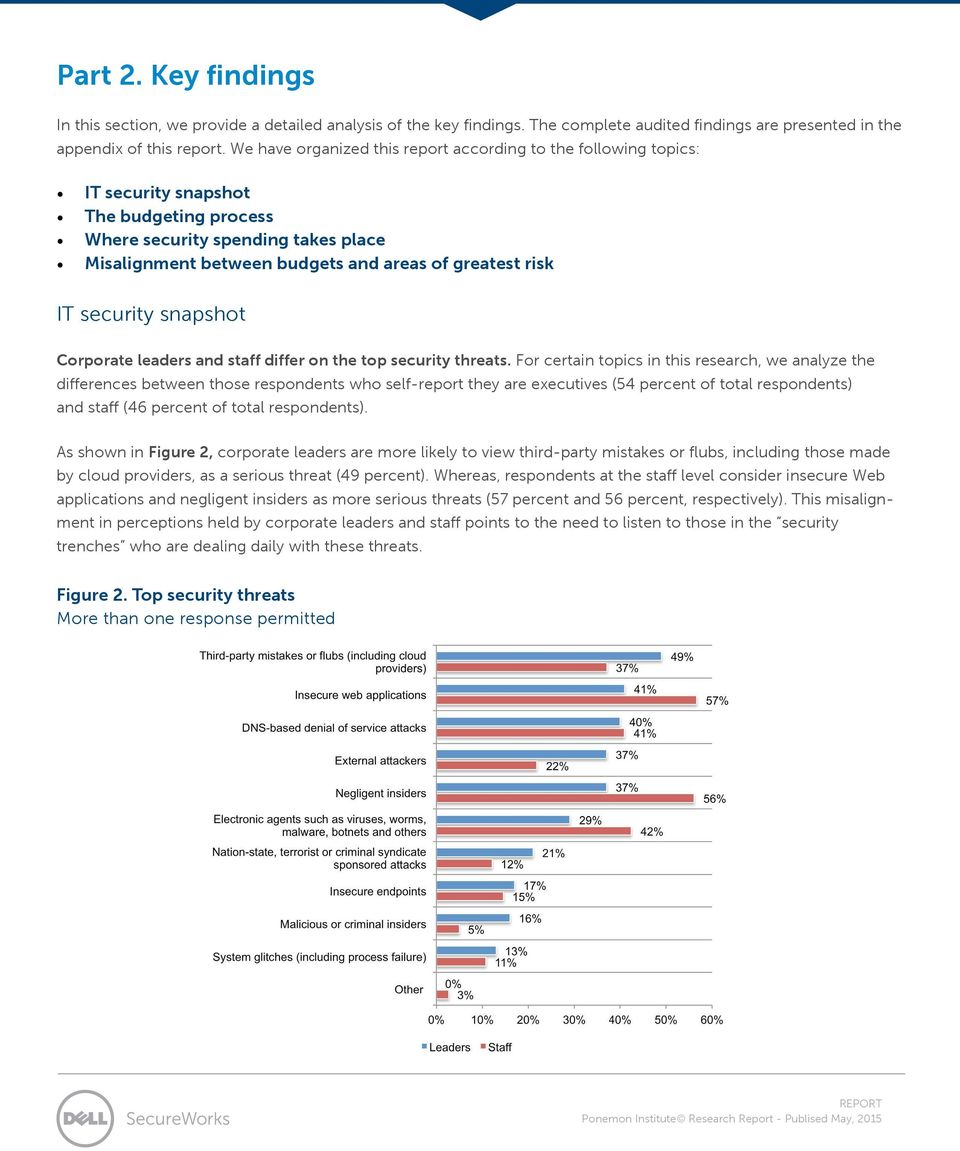
3 Part 2. Key findings In this section, we provide a detailed analysis of the key findings. The complete audited findings are presented in the appendix of this report. We have organized this report according to the following topics: IT security snapshot The budgeting process Where security spending takes place Misalignment between budgets and areas of greatest risk IT security snapshot Corporate leaders and staff differ on the top security threats. For certain topics in this research, we analyze the differences between those respondents who self-report they are executives (54 percent of total respondents) and staff (46 percent of total respondents). As shown in Figure 2, corporate leaders are more likely to view third-party mistakes or flubs, including those made by cloud providers, as a serious threat (49 percent). Whereas, respondents at the staff level consider insecure Web applications and negligent insiders as more serious threats (57 percent and 56 percent, respectively). This misalignment in perceptions held by corporate leaders and staff points to the need to listen to those in the security trenches who are dealing daily with these threats. Figure 2. Top security threats More than one response permitted
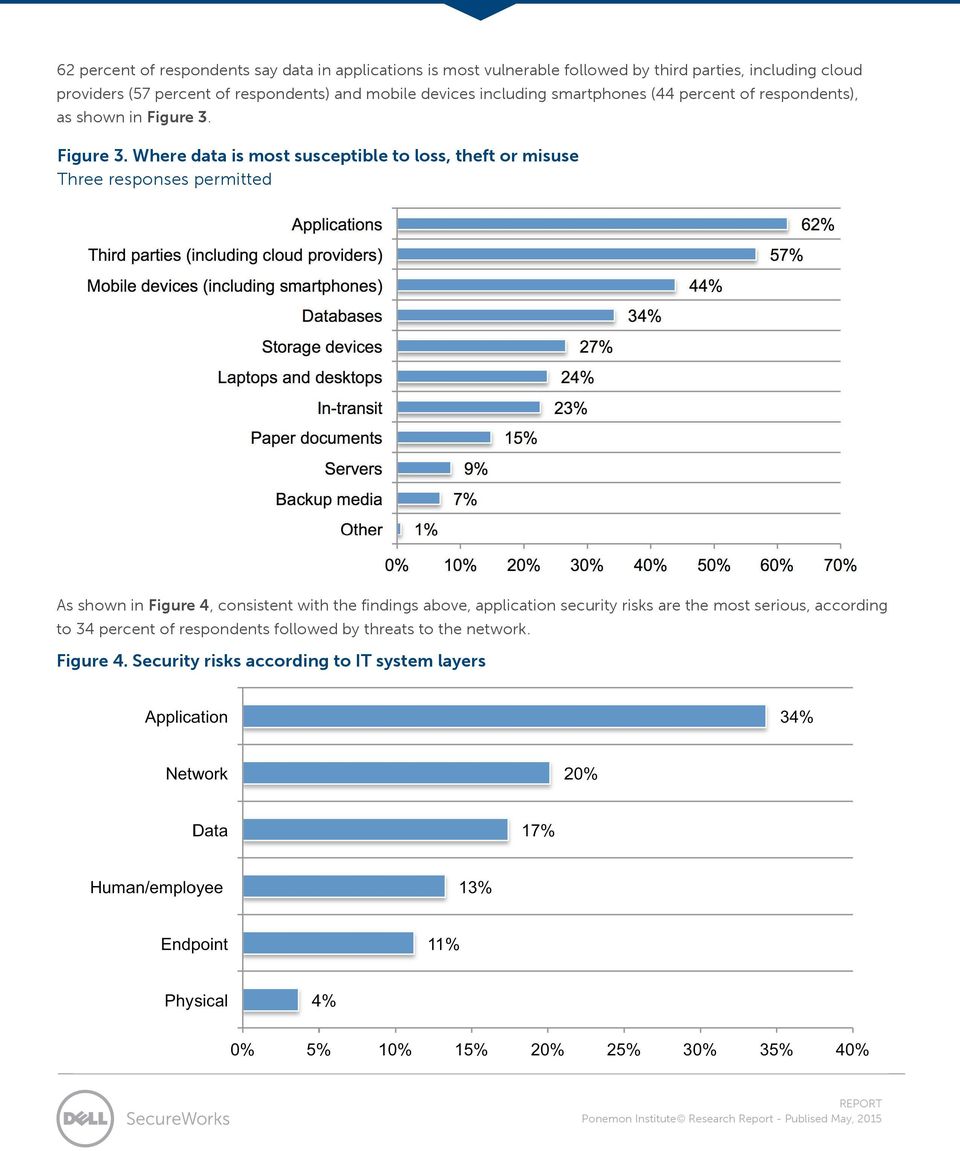
4 62 percent of respondents say data in applications is most vulnerable followed by third parties, including cloud providers (57 percent of respondents) and mobile devices including smartphones (44 percent of respondents), as shown in Figure 3. Figure 3. Where data is most susceptible to loss, theft or misuse Three responses permitted As shown in Figure 4, consistent with the findings above, application security risks are the most serious, according to 34 percent of respondents followed by threats to the network. Figure 4. Security risks according to IT system layers
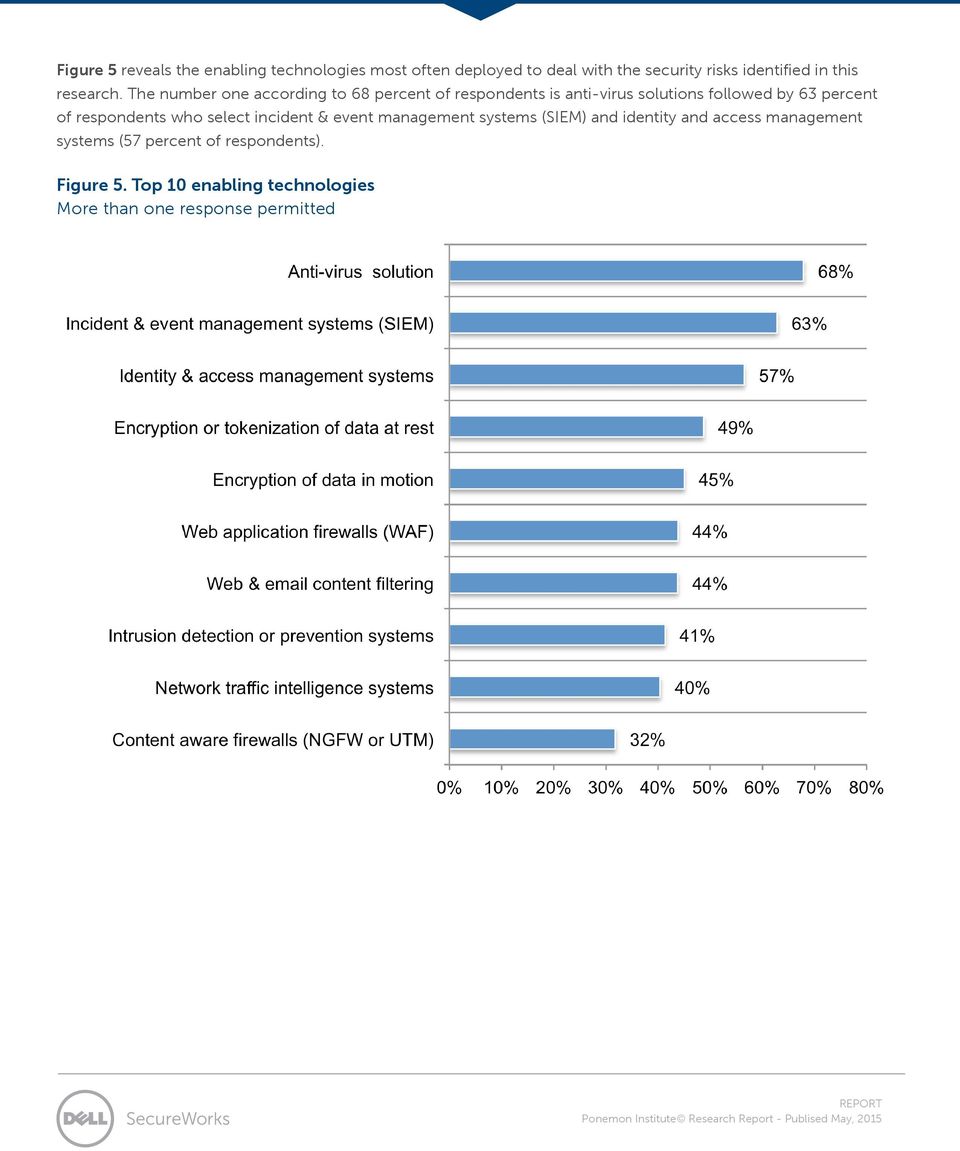
5 Figure 5 reveals the enabling technologies most often deployed to deal with the security risks identified in this research. The number one according to 68 percent of respondents is anti-virus solutions followed by 63 percent of respondents who select incident & event management systems (SIEM) and identity and access management systems (57 percent of respondents). Figure 5. Top 10 enabling technologies More than one response permitted
6 Corporate leaders and staff differ on what the top security objectives are in their organizations. As shown in Figure 6, it is interesting that staff respondents see the minimization of downtime as the primary security objective (83 percent of staff respondents). However, corporate leaders believe it is more important to pursue improvement of the organizations security posture (72 percent of corporate leader respondents). Despite the risk of insider negligence, only 8 percent of both groups believe providing cybersecurity training for all employees should be a top security objective. Figure 6. Top security objectives or missions

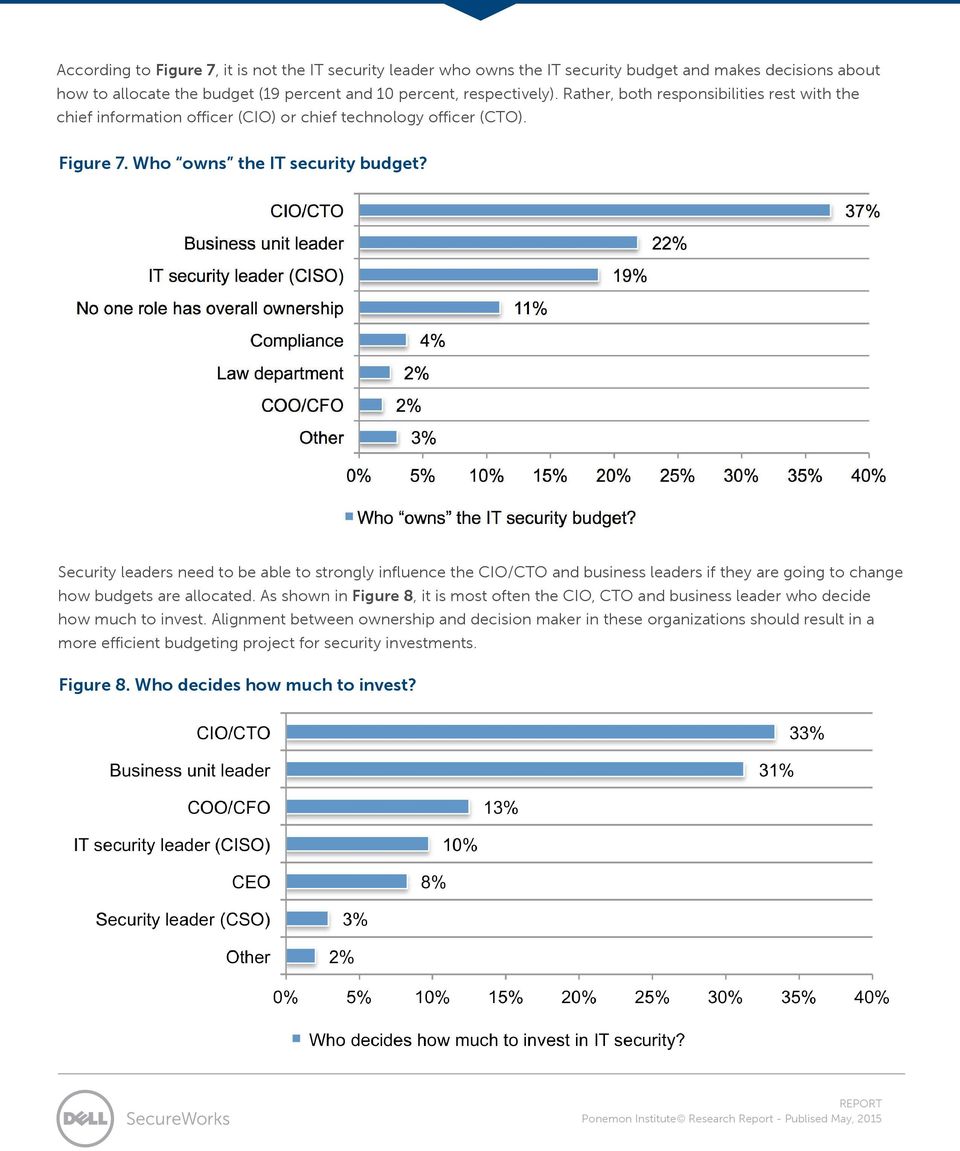
7 According to Figure 7, it is not the IT security leader who owns the IT security budget and makes decisions about how to allocate the budget (19 percent and 10 percent, respectively). Rather, both responsibilities rest with the chief information officer (CIO) or chief technology officer (CTO). Figure 7. Who owns the IT security budget? Security leaders need to be able to strongly influence the CIO/CTO and business leaders if they are going to change how budgets are allocated. As shown in Figure 8, it is most often the CIO, CTO and business leader who decide how much to invest. Alignment between ownership and decision maker in these organizations should result in a more efficient budgeting project for security investments. Figure 8. Who decides how much to invest?
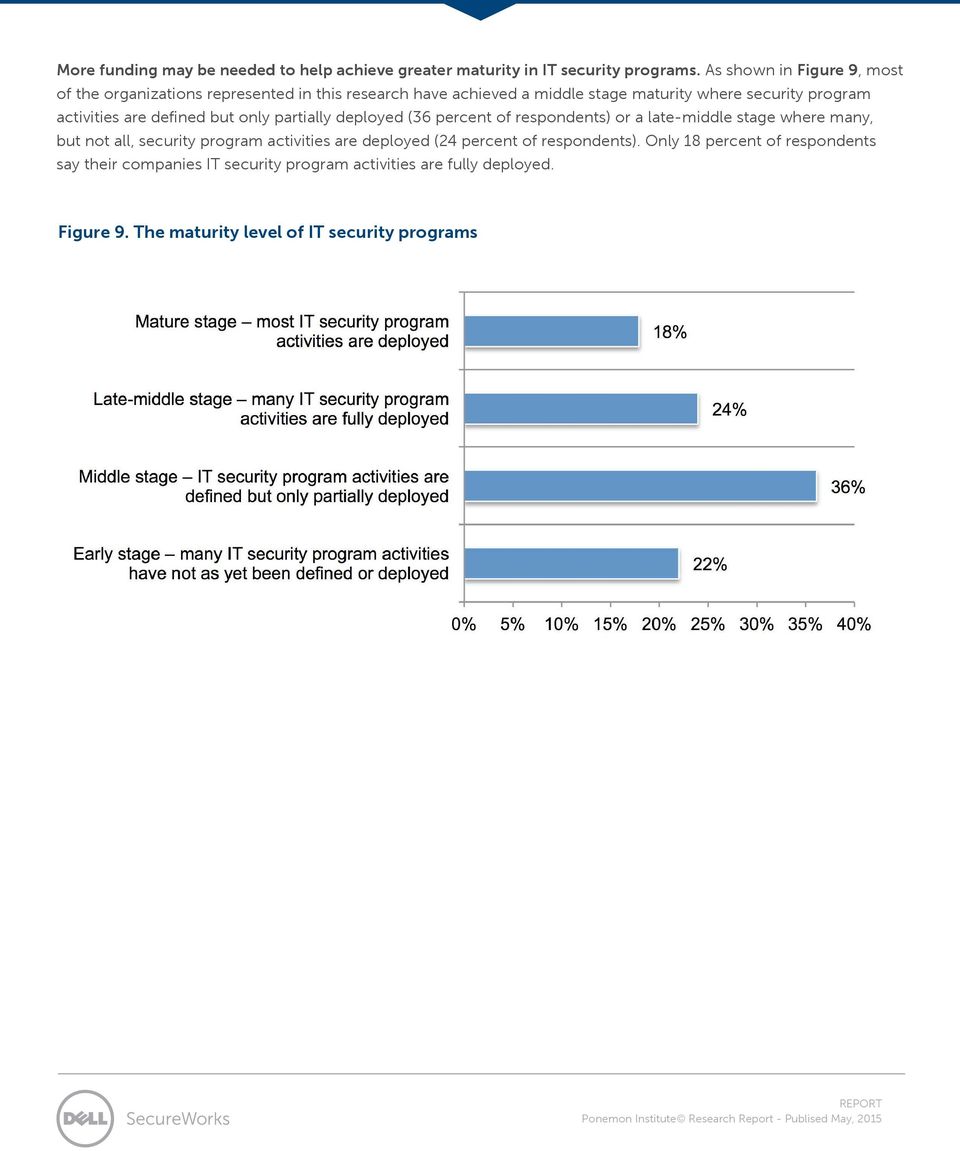
8 More funding may be needed to help achieve greater maturity in IT security programs. As shown in Figure 9, most of the organizations represented in this research have achieved a middle stage maturity where security program activities are defined but only partially deployed (36 percent of respondents) or a late-middle stage where many, but not all, security program activities are deployed (24 percent of respondents). Only 18 percent of respondents say their companies IT security program activities are fully deployed. Figure 9. The maturity level of IT security programs
9 The budgeting process Spending on IT security improves for some but not all. As shown in Figure 10, security budgets have increased in the past two years and are expected to continue to rise for half of the companies represented in this study. 46 percent of respondents say the IT security budget increased significantly (15 percent of respondents) or increased (31 percent of respondents) in the past two years. In the next two years, 19 percent of respondents say the budget will increase significantly and 31 percent of respondents say it will increase, according to Figure 10. However, the same percentage of respondents (50 percent) say their budgets are flat (46 percent) or will actually decrease in a few organizations. Figure 10. Has your organization increased spending in the past two years and will it increase spending in the next two years?

10 Most organizations have a top down approach to budgeting, as shown in Figure percent of respondents say the leadership is responsible for the budget. Only 29 percent of respondents say the budget is determined from the staff level or bottom up. This is another indication that IT security and those lower in the company are not as influential in the budgeting process as they should be. Figure 11. What best describes your organization s approach to annual budgeting for IT security activities How organizations allocate IT security and innovations in enabling technologies. The average total revenue of organizations represented in this research is $1.2 billion. As shown in Table 1, on average companies spend $111.7 million annually on IT operations and investment. This includes licensing and maintenance fees, labor costs, investments in enabling technologies and overhead. On average, 8.2 percent of the IT budget is allocated to IT security or $9.14 million annually and 9.2 is the percentage of the IT security budget for activities related to innovations in enabling technologies and control processes (approximately $840,000). Table 1. Current year budget for IT operations, IT security & innovative Extrapolated value enabling technologies IT operations & investment (licensing & maintenance fees, labor costs, investments $111,700,000 in enabling technologies and overhead) Investments in IT security $9,140,000 Investments in innovative enabling technologies $840,000 Total $121,680,000

11 The budget is not often determined by conducting an assessment of security risks. As shown above and in Figure 12, senior management determines IT security budgets and spending. Only 32 percent of respondents say they actually conduct an assessment of their organization s security risks. Security leaders must become part of the leadership fabric in order to ensure proper budgets based on assessment of security risks facing the company. Figure 12. What best describes your organization s approach to determining the IT security budget?

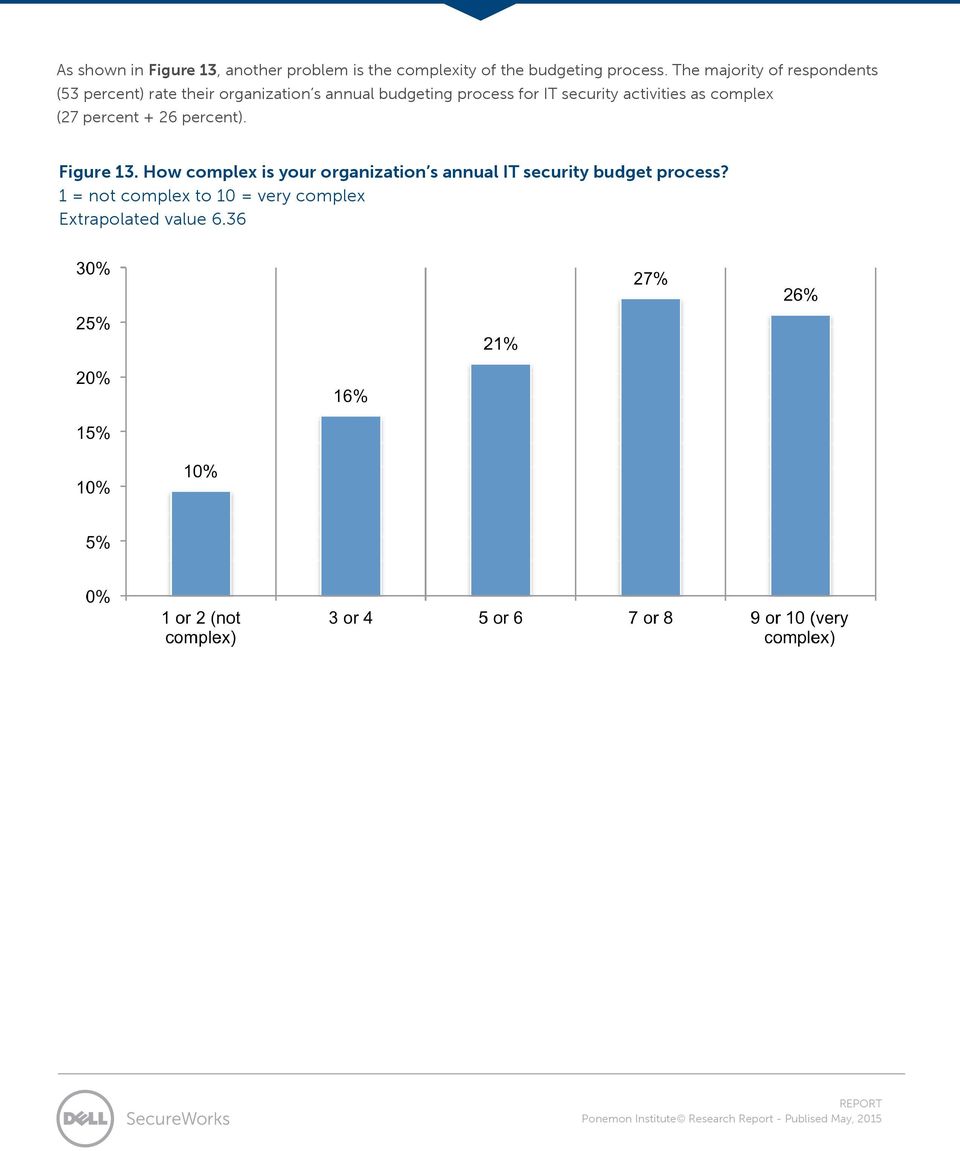
12 As shown in Figure 13, another problem is the complexity of the budgeting process. The majority of respondents (53 percent) rate their organization s annual budgeting process for IT security activities as complex (27 percent + 26 percent). Figure 13. How complex is your organization s annual IT security budget process? 1 = not complex to 10 = very complex Extrapolated value 6.36
13 Do metrics support investment in technologies that address an organization s security risks? As shown in Figure 14, return on investment (ROI) and total cost of ownership (TCO) are most frequently used to evaluate the effectiveness of a specific technology. However, metrics that would reveal how effective technologies are in preventing, detecting and containing security incidents are not often used. Figure 14. Metrics used to evaluate enabling technologies More than one response permitted

14 Where security spending takes place The most valuable resource to an organization is its IT security staff. As shown in Figure 15, based on the allocation of resources, most of the budget is used for staffing purposes (32 percent of respondents) followed by technologies and their maintenance (25 percent of respondents). Figure 15. How organizations allocate budgeted IT security resources for people, processes and technologies

15 Most respondents believe their budget is adequate. 57 percent of respondents say their budgets are more than adequate (9 percent of respondents) or adequate (48 percent of respondents) to achieve a strong security posture, as shown in Figure 16. Forty-three percent say their budgets are less than adequate. Figure 16. How adequate is the IT security budget to achieving a strong security posture?

16 The IT security budget is not on the board s agenda. Only 21 percent of respondents say the IT security budget is on the board s agenda. According to Figure 17, it is because the organization prefers to leave security governance to senior management (86 percent of respondents). However, 64 percent of respondents say lack of directors expertise and knowledge about cybersecurity keeps the issues off the board s agenda. 36 percent of respondents believe IT security is not a priority issue. Figure 17. Why the IT security budget is not on the board s agenda More than one response permitted

17 Misalignment between budgets and areas of greatest risk Does ROI determine technology investments? As shown in Figure 18, 84 percent of respondents say their organizations are investing in intrusion detection or prevention systems. However, only 41 percent say it is a top performing technology in terms of the economic benefits it provides. Similarly, 72 percent of respondents say their organizations are purchasing identity & access management systems but a lower percentage (57 percent) say it is economically beneficial. Technologies that are both earmarked for purchases and economically beneficial are SIEM and the encryption technologies. Figure 18. The relationship between security investments & ROI More than one response permitted

18 Companies admit they have been disappointed with some of their technology purchases. In the past 2 years, respondents say on average 37 percent of all investments in enabling security technologies fell below their expectations. According to Figure 19, the root cause of most dissatisfaction is due to the human factor. Forty-four percent say it is a lack of in-house expertise followed by 32 percent of respondents who say vendor support issues. Another 32 percent say it was higher than expected installation costs. Much lower were system performance issues (degradation) and higher than expected maintenance costs, both 4 percent of respondents. Figure 19. Why companies regret some of their investments in enabling technologies Two responses permitted

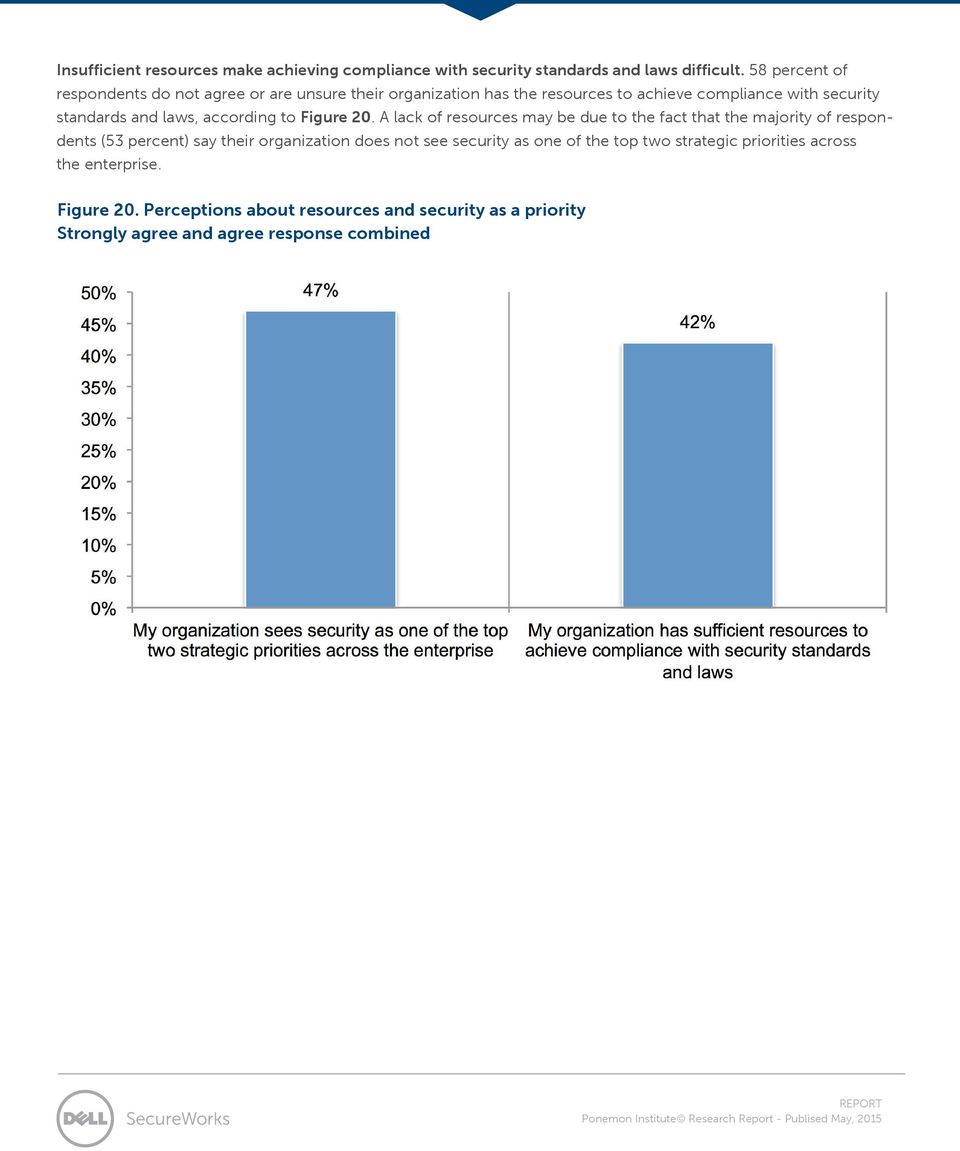
19 Insufficient resources make achieving compliance with security standards and laws difficult. 58 percent of respondents do not agree or are unsure their organization has the resources to achieve compliance with security standards and laws, according to Figure 20. A lack of resources may be due to the fact that the majority of respondents (53 percent) say their organization does not see security as one of the top two strategic priorities across the enterprise. Figure 20. Perceptions about resources and security as a priority Strongly agree and agree response combined
20 Part 3. Conclusion Security risks are pervasive and increasingly difficult to prevent and minimize. Having the necessary resources to build and sustain a strong security posture is critical. However, as the findings reveal, the challenge many IT and IT security practitioners face is having an adequate budget to accomplish this objective. Following are observations based on the results of this research: Respondents have a lack of confidence in their organizations ability to achieve compliance with regulations and security standards because of a lack of sufficient resources, such as experienced personnel and technologies. IT security is not a priority. CEOs and boards of directors are not viewed as having responsibility for IT security and they are rarely briefed about security threats and unaware of the issues. An organization s preference to leave security governance to senior management and a lack of directors expertise and knowledge about cybersecurity are seen as reasons for not having the IT security budget on their agenda. As a consequence, the importance of a strong security posture is not given the C-level attention it deserves. An inadequate budget and lack of support from their organizations leadership makes it difficult to acquire stateof-the-art technologies. 50 percent of respondents say their budgets are flat or actually declining in the next two years. Insider risks are ignored. Only 8 percent of respondents say cybersecurity training for all employees is an IT security objective. Part 4. Methods The sampling frame is composed of 57,028 IT management and IT security practitioners in the following global regions: North America, EMEA, APJ and LATAM. All respondents are familiar with their organization s budget process and/or spending on IT security activities. As shown in Table 2, 2,132 respondents completed the survey. Screening removed 307 surveys. The final sample was 1,825 surveys (or a 3.2 percent response rate). Table 2. Sample response Total sampling frame 57,028 Total returns 2,132 Rejected or screened surveys 307 Final sample 1,825 Response Rate 3.2%

21 Pie Chart 1 reports the current position or organizational level of the respondents. More than half of respondents (51 percent) reported their current position as supervisory or above. Pie Chart 1. Current position or organizational level Pie Chart 2 identifies the primary role the respondent has within the organization. 33 percent of respondents identified IT security operations as their primary role. Another 32 percent indicated their primary role is in IT management. Pie Chart 2. Primary role within the organization
22 Pie Chart 3 reports the primary industry classification of respondents organizations. This chart identifies financial services (16 percent) as the largest segment, followed by industrial (10 percent), public sector (9 percent) and retail (9 percent). Pie Chart 3. Primary industry focus According to Pie Chart 4, more than half of the respondents (52 percent) are from organizations with a global headcount of more than 5,000 employees. Pie Chart 4. Worldwide headcount of the organization
23 Part 5. Caveats There are inherent limitations to survey research that need to be carefully considered before drawing inferences from findings. The following items are specific limitations that are germane to most web-based surveys. Non-response bias: The current findings are based on a sample of survey returns. We sent surveys to a representative sample of individuals, resulting in a large number of usable returned responses. Despite non-response tests, it is always possible that individuals who did not participate are substantially different in terms of underlying beliefs from those who completed the instrument. Sampling frame bias: The accuracy is based on contact information and the degree to which the list is representative of individuals who are IT or IT security practitioners in various organizations in the following global regions: North America, Europe, Middle East, Africa, Asia, Pacific, Japan and Latin America. We also acknowledge that the results may be biased by external events such as media coverage. We also acknowledge bias caused by compensating subjects to complete this research within a specified time period. Self-reported results: The quality of survey research is based on the integrity of confidential responses received from subjects. While certain checks and balances can be incorporated into the survey process, there is always the possibility that a subject did not provide accurate responses.
24 Appendix: Detailed Survey Results The following tables provide the frequency or percentage frequency of responses to all survey questions contained in this study. All survey responses were captured in February Survey response Total sampling frame Total returns 2132 Rejected or screened surveys 307 Final sample 1825 Response rate 3.2% Sample weighting 1.00 Part 1. Screening S1. Does your job involve securing or overseeing the security of your organization s information systems or IT infrastructure? Please mark yes even if your job is only partially involved in the security function. Yes 100% No 0% S2. How familiar are you with your organization s budget process and/or spending on IT security activities? Very familiar 33% Somewhat familiar 46% Not familiar 21% No knowledge 0% Part 2. Attributions Q1a. My organization has sufficient resources to achieve compliance with security standards and laws. Strongly agree 19% Agree 23% Unsure 24% Disagree 22% Strongly disagree 12%
25 Q1b. My organization sees security as one of the top two strategic priorities across the enterprise. Strongly agree 24% Agree 23% Unsure 28% Disagree 22% Strongly disagree 3% Q1c. My organization effectively manages security risks to information assets, enterprise systems and IT infrastructure. Strongly agree 29% Agree 32% Unsure 20% Disagree 13% Strongly disagree 6% Q1d. My organization uses state-of-the-art technologies to minimize security risks. Strongly agree 19% Agree 29% Unsure 18% Disagree 24% Strongly disagree 11% Q1e. My organization recognizes that technology is sufficient to achieve a strong security posture. Strongly agree 19% Agree 19% Unsure 29% Disagree 24% Strongly disagree 10%
26 Following are governance activities relating to the annual IT budgeting process. Q2a. In my organization, C-level executives are briefed and made fully aware of security priorities and required investments. Strongly agree 19% Agree 31% Unsure 17% Disagree 29% Strongly disagree 5% Q2b. In my organization, members of the board of directors are briefed and made fully aware of security priorities and required investments. Strongly agree 15% Agree 21% Unsure 23% Disagree 31% Strongly disagree 10% Q2c. In my organization, the budgeting process provides advance notice when actual spending levels are likely to exceed budgeted amounts. Strongly agree 17% Agree 28% Unsure 22% Disagree 24% Strongly disagree 8% Q2d. In my organization, the budgeting process is evaluated by the organization s finance and accounting functions (and/or internal audit) for accuracy and consistency. Strongly agree 27% Agree 31% Unsure 22% Disagree 14% Strongly disagree 5%
27 Part 3. Background Questions Q3. What best describes the maturity level of your organization s IT security program or activities? Early stage many IT security program activities have not as yet been defined 22% or deployed Middle stage IT security program activities are defined but only partially 36% deployed Late-middle stage many IT security program activities are fully deployed 24% Mature stage most IT security program activities are deployed 18% Q4. What are the top security objectives or missions within your organization? Check only the top three choices. Minimize downtime 73% Prevent and detect cyber attacks, including APTs 64% Improve the organization s security posture 62% Comply with regulatory and legal mandates 50% Secure the national critical infrastructure (including the smart grid) 20% None of the above 11% Improve the organization s relationship with business partners 11% Provide cybersecurity training for all employees 8% Other (please specify) 1% Total 300% Q5. What are the top security threats that affect your organization? Check only the top three choices. Insecure web applications 48% Negligent insiders 46% Third-party mistakes or flubs (including cloud providers) 44% DNS-based denial of service attacks 40% Electronic agents such as viruses, worms, malware, botnets and others 35% External attackers 30% Nation-state, terrorist or criminal syndicate sponsored attacks 17% Insecure endpoints 16% System glitches (including process failure) 12% Malicious or criminal insiders 11% Other (please specify) 1% Total 300%
28 Q6. In your organization, where is data (information assets) most susceptible to loss, theft, misuse or other security compromise? Please select the top three choices. Applications 62% Third parties (including cloud providers) 57% Mobile devices (including smartphones) 44% Databases 34% Storage devices 27% Laptops and desktops 24% In-transit 23% Paper documents 15% Servers 9% Backup media 7% Other (please specify) 1% Total 300% Q7. Who are most responsible for ensuring IT security objectives are achieved within your organization? Please select the top three choices. CIO/CTO 75% IT security leader (CISO) 51% Security leader (CSO) 43% Business unit leader 43% Law department 25% Compliance 17% Facilities or data center management 16% No one role has overall responsibility 8% Operations leader 7% CEO 6% COO/CFO 4% Board of Directors 3% Other (please specify) 1% Total 300%
29 Part 4. Budget Questions: Q8a. Who within your organization owns the IT security budget? CIO/CTO 37% Business unit leader 22% IT security leader (CISO) 19% No one role has overall ownership 11% Compliance 4% Law department 2% COO/CFO 2% Facilities or data center management 1% CEO 1% Security leader (CSO) 1% Operations leader 0% Other (please specify) 0% Q8b. Who within your organization decides how much to invest in IT security? CIO/CTO 33% Business unit leader 31% COO/CFO 13% IT security leader (CISO) 10% CEO 8% Security leader (CSO) 3% Facilities or data center management 1% Compliance 1% Law department 0% Operations leader 0% No one role 0% Other (please specify) 0% Q9. What best describes your organization s approach to annual budgeting for IT security activities? Top down 46% Bottom up 29% Hybrid (combination of approaches) 25% Zero-based 1% Total 101%
30 Q10. What best describes your organization s approach to determining the IT security budget? Please select the one best choice. Senior management determines the budget 39% The budget is based on an assessment of our organization s security risks 32% The budget is based on what the organization feels is the right amount 15% The budget is a set percentage of the total IT budget 12% Other 1% Q11. Using the following 10-point scale, please rate the complexity of the annual budgeting process for IT security activities within your organization? 1 or 2 (not complex) 10% 3 or 4 16% 5 or 6 21% 7 or 8 27% 9 or 10 (very complex) 26% Extrapolated value 6.36 Q12. Approximately, what range best defines your organization s current year budget for IT operations and investment? Please include licensing and maintenance fees, labor costs, investments in enabling technologies and overhead in your estimate. < $1 million 2% $1 to 5 million 2% $6 to $10 million 10% $11 to $50 million 20% $51 to $100 million 24% $101 to $250 million 27% $251 to $500 million 11% > $500 million 5% Extrapolated value (US$ millions) 138.7
31 Q13. Approximately, what percentage of the current year s IT budget will go to IT security activities? < 1% 9% 1% to 2% 25% 3% to 5% 31% 6% to 10% 10% 11% to 15% 8% 16% to 20% 6% 21% to 30% 5% 31% to 40% 5% 41% to 50% 2% > 50% 0% Extrapolated value 8.2% Extrapolated budget (US$ millions) Q14. Approximately, what percentage of the current year IT security budget will go to activities relating to innovations in enabling technologies and control processes? < 1% 16% 1% to 2% 20% 3% to 5% 14% 6% to 10% 10% 11% to 15% 20% 16% to 20% 11% 21% to 30% 4% 31% to 40% 2% 41% to 50% 2% > 50% 0% Extrapolated value 9.2% Extrapolated budget (US$ millions) 1.04
32 Q15a. Approximately, what is the total revenue of your company (US$ millions) < $50 million 3% $50 to $100 million 14% $101 to $250 million 23% $251 to $500 million 23% $501 to $1 billion 19% $1 to $5 million 12% $5 to $10 billion 5% > $10 billions 2% Extrapolated value (US$ millions) 1,247 Percentage of IT security budget to total annual revenue 0.91% Q16. The following table lists 6 common budget categories. Please allocate all 100 points to describe how your organization currently spends its budgeted resources for IT security. In-house personnel 32 Technologies, maintenance 25 Managed or outsourced services 19 Overhead 9 Technologies, support 9 Technologies, licensing 5 Total 100 Q17a. The following table lists IT system layers. Please allocate all 100 points to describe how your organization views the distribution of security risk according to each layer. Application 34 Network 20 Data 17 Human/employee 13 Endpoint 11 Physical 4 Total 100
33 Q17b. The following table lists IT system layers. First, please allocate all 100 points to describe how your organization currently spends budgeted resources according to each layer. Network 35 Data 23 Application 14 Endpoint 11 Human/employee 8 Physical 8 Total 100 Q18. How has your organization s IT security budget or spending levels changed over the past two years? Significant increase (> 20%) 15% Increase 31% No change 45% Decrease 8% Significant increase (< 20%) 1% Q19. In your opinion, how will your organization s IT security budget or spending levels change over the next two years? Significant increase (> 20%) 19% Increase 31% No change 46% Decrease 4% Significant increase (< 20%) 1% Q20. What best describes the adequacy of the IT security budget to achieve a strong security posture within your organization? More than adequate 9% Adequate 48% Less than adequate 43%
34 Q21a. Is IT security budget on the board of director s agenda? Yes 21% No 79% Q21b. If no, why is this the case? Please check all that apply. Security governance is best handled by the company s management 86% Lack of directors expertise and knowledge about cyber security 64% IT security is not considered a priority issue 36% Lack of resources 26% Other (please specify) 1% Cannot determine 11% Q22. Following are 23 enabling security technologies deployed by many organizations. Please indicate if the stated technology is earmarked in your organization s current IT security budget. Percentage Yes response. Intrusion detection or prevention systems 84% Anti-virus solution 80% Identity & access management systems 72% Incident & event management systems (SIEM) 53% Web & content filtering 52% Encryption of data in motion 52% Encryption or tokenization of data at rest 51% Web application firewalls (WAF) 43% Public key infrastructure (PKI) 42% Key management solutions 41% Data loss prevention systems 40% Virtual private network (VPN) 39% Mobile device management 35% Sandbox or isolation solutions 30% User activity monitoring systems 25% Hardware security modules (HSM) 23% Database activity monitoring (DAM) 20% Content aware firewalls (NGFW or UTM) 18% Access governance systems 17% Network traffic intelligence systems 16% Perimeter or location surveillance systems 15% Automated code review or debugger 15% Database scanning 11%
35 Q23. What metrics are used to evaluate the economic benefits of enabling security technologies deployed by your organization? Please select all that apply Return on investment (ROI) 65% Total cost of ownership (TCO) 63% Decrease in false positive rates 53% Increase in detection rates 36% Increase speed in containment 31% Increase in prevention rates 30% None of the above 27% Increase speed in remediation 27% Increase speed in detection 24% Other (please specify) 1% Q24. From the list below, please select the top 7-performing technologies in terms of economic benefit or ROI to your organization. Please leave blank if a given technology is not budgeted or used by your organization. Anti-virus solution 68% Incident & event management systems (SIEM) 63% Identity & access management systems 57% Encryption or tokenization of data at rest 49% Encryption of data in motion 45% Web application firewalls (WAF) 44% Web & content filtering 44% Intrusion detection or prevention systems 41% Network traffic intelligence systems 40% Content aware firewalls (NGFW or UTM) 32% Key management solutions 30% Data loss prevention systems 29% Mobile device management 28% Sandbox or isolation solutions 24% Database scanning 21% Public key infrastructure (PKI) 19% Automated code review or debugger 17% Virtual private network (VPN) 16% User activity monitoring systems 13% Perimeter or location surveillance systems 9% Hardware security modules (HSM) 5% Database activity monitoring (DAM) 5% Access governance systems 5% Total 700%
36 Q25a. In the past two years, what percentage of all investments in enabling security technologies fell below your expectations (i.e., regrets)? None [Skip to Part 5] 1% < 1% 0% 1% to 2% 2% 3% to 5% 2% 6% to 10% 4% 11% to 15% 2% 16% to 20% 7% 21% to 30% 15% 31% to 40% 13% 41% to 50% 22% > 50% 31% Extrapolated value 37% Q25b. What were the main reasons for your disappointment or regret? Please select your top two choices. Personnel issues (lack of in-house expertise) 44% Higher than expected installation costs 32% Vendor support issues 32% System complexity issues 31% System effectiveness issues (high false positive) 26% Interoperability issues 20% Higher than expected licensing cost 5% System performance issues (degradation) 4% Higher than expected maintenance cost 4% Other (please explain) 1% Total 200%
37 Part 5. Your Role & Organization Characteristics D1. What organizational level best describes your current position? Senior Executive 1% Vice President 1% Director 16% Manager 19% Supervisor 16% Technician 39% Staff 4% Contractor 2% Other 1% D2. What best describes your primary role in the organization? IT security operations (SecOps) 33% IT management 32% Security architecture 7% Risk management 6% Data center operations 5% Application development 4% Application security 4% Quality assurance 4% Compliance/audit 3% Finance & accounting 2% Other 2%
38 D3. What industry best describes your organization s industry focus? Financial services 16% Industrial 10% Public sector 9% Retail 9% Health & pharmaceutical 7% Technology & software 7% Energy & utilities 6% Services 6% Consumer products 5% Hospitality 5% Communications 4% Transportation 4% Entertainment & media 2% Agriculture & food services 2% Professional services 2% Education & research 2% Internet & ISPs 1% Defense & aerospace 1% Other 1% D4. What is the worldwide headcount of your organization? Less than 1,000 people 8% 1,001 to 5,000 people 40% 5,001 to 25,000 people 37% 25,001 to 75,000 people 9% More than 75,000 people 6%
39 Ponemon Institute Advancing Responsible Information Management Ponemon Institute is dedicated to independent research and education that advances responsible information and privacy management practices within business and government. Our mission is to conduct high quality, empirical studies on critical issues affecting the management and security of sensitive information about people and organizations. As a member of the Council of American Survey Research Organizations (CASRO),we uphold strict data confidentiality, privacy and ethical research standards. We do not collect any personally identifiable information from individuals (or company identifiable information in our business research). Furthermore, we have strict quality standards to ensure that subjects are not asked extraneous, irrelevant or improper questions.
Risk & Innovation in Cybersecurity Investments. Sponsored by Lockheed Martin
 Risk & Innovation in Cybersecurity Investments Sponsored by Lockheed Martin Independently conducted by Ponemon Institute LLC Publication Date: April 2015 Ponemon Institute Research Report Part 1. Introduction
The Importance of Cyber Threat Intelligence to a Strong Security Posture
 The Importance of Cyber Threat Intelligence to a Strong Security Posture Sponsored by Webroot Independently conducted by Ponemon Institute LLC Publication Date: March 2015 Ponemon Institute Research Report
Is Your Company Ready for a Big Data Breach?
 Is Your Company Ready for a Big Data Breach? The Second Annual Study on Data Breach Preparedness Sponsored by Experian Data Breach Resolution Independently conducted by Ponemon Institute LLC Publication
The State of Data Security Intelligence. Sponsored by Informatica. Independently conducted by Ponemon Institute LLC Publication Date: April 2015
 The State of Data Security Intelligence Sponsored by Informatica Independently conducted by Ponemon Institute LLC Publication Date: April 2015 Ponemon Institute Research Report The State of Data Security
The Cost of Web Application Attacks
 The Cost of Web Application Attacks Sponsored by Akamai Technologies Independently conducted by Ponemon Institute LLC Publication Date: May 2015 Ponemon Institute Research Report Part 1. Introduction The
The Cost of Insecure Mobile Devices in the Workplace Sponsored by AT&T
 The Cost of Insecure Mobile Devices in the Workplace! Sponsored by AT&T Independently conducted by Ponemon Institute LLC Publication Date: March 2014 Part 1. Introduction The Cost of Insecure Mobile Devices
Data Security in Development & Testing
 Data Security in Development & Testing Sponsored by Micro Focus Independently conducted by Ponemon Institute LLC Publication Date: July 31, 2009 Ponemon Institute Research Report Data Security in Development
The State of Mobile Application Insecurity
 The State of Mobile Application Insecurity Sponsored by IBM Independently conducted by Ponemon Institute LLC Publication Date: February 2015 Ponemon Institute Research Report Part 1. Introduction The State
The Unintentional Insider Risk in United States and German Organizations
 The Unintentional Insider Risk in United States and German Organizations Sponsored by Raytheon Websense Independently conducted by Ponemon Institute LLC Publication Date: July 2015 2 Part 1. Introduction
Managing Cyber Security as a Business Risk: Cyber Insurance in the Digital Age
 Managing Cyber Security as a Business Risk: Cyber Insurance in the Digital Age Sponsored by Experian Data Breach Resolution Independently conducted by Ponemon Institute LLC Publication Date: August 2013
Cloud Security: Getting It Right
 Cloud Security: Getting It Right Sponsored by Armor Independently conducted by Ponemon Institute LLC Publication Date: October 2015 Ponemon Institute Research Report Cloud Security: Getting It Right Ponemon
Understanding Security Complexity in 21 st Century IT Environments:
 Understanding Security Complexity in 21 st Century IT Environments: A study of IT practitioners in the US, UK, France, Japan & Germany Sponsored by Check Point Software Technologies Independently conducted
Is Your Company Ready for a Big Data Breach? Sponsored by Experian Data Breach Resolution
 Is Your Company Ready for a Big Data Breach? Sponsored by Experian Data Breach Resolution Independently conducted by Ponemon Institute LLC Publication Date: April 2013 Ponemon Institute Research Report
A Study of Retail Banks & DDoS Attacks
 A Study of Retail Banks & DDoS Attacks Sponsored by Corero Network Security Independently conducted by Ponemon Institute LLC Publication Date: December 2012 Ponemon Institute Research Report A Study of
Perceptions About Network Security Survey of IT & IT security practitioners in the U.S.
 Perceptions About Network Security Survey of IT & IT security practitioners in the U.S. Sponsored by Juniper Networks Independently conducted by Ponemon Institute LLC Publication Date: June 2011 Ponemon
Aftermath of a Data Breach Study
 Aftermath of a Data Breach Study Sponsored by Experian Data Breach Resolution Independently conducted by Ponemon Institute LLC Publication Date: January 2012 Ponemon Institute Research Report Aftermath
Cyber Security on the Offense: A Study of IT Security Experts
 Cyber Security on the Offense: A Study of IT Security Experts Co-authored with Radware Independently conducted by Ponemon Institute LLC Publication Date: November 2012 Ponemon Institute Research Report
The Security of Cloud Infrastructure Survey of U.S. IT and Compliance Practitioners
 The Security of Cloud Infrastructure Survey of U.S. IT and Compliance Practitioners Sponsored by Vormetric Independently conducted by Ponemon Institute LLC Publication Date: November 2011 Ponemon Institute
Defining the Gap: The Cybersecurity Governance Study
 Defining the Gap: The Cybersecurity Governance Study Sponsored by Fidelis Cybersecurity Independently conducted by Ponemon Institute LLC Publication Date: June 2015 Ponemon Institute Research Report Defining
Data Breach: The Cloud Multiplier Effect
 Data Breach: The Cloud Multiplier Effect Sponsored by Netskope Independently conducted by Ponemon Institute LLC Publication Date: June 2014 Ponemon Institute Research Report Part 1. Introduction Data Breach:
The Impact of Cybercrime on Business
 The Impact of Cybercrime on Business Studies of IT practitioners in the United States, United Kingdom, Germany, Hong Kong and Brazil Sponsored by Check Point Software Technologies Independently conducted
Achieving Security in Workplace File Sharing. Sponsored by Axway Independently conducted by Ponemon Institute LLC Publication Date: January 2014
 Achieving Security in Workplace File Sharing Sponsored by Axway Independently conducted by Ponemon Institute LLC Publication Date: January 2014 Ponemon Institute Research Report Part 1. Introduction Achieving
Security of Paper Records & Document Shredding. Sponsored by Cintas. Independently conducted by Ponemon Institute LLC Publication Date: January 2014
 Security of Paper Records & Document Shredding Sponsored by Cintas Independently conducted by Ponemon Institute LLC Publication Date: January 2014 Ponemon Institute Research Report Part 1. Introduction
The SQL Injection Threat Study
 The SQL Injection Threat Study Sponsored by DB Networks Independently conducted by Ponemon Institute LLC Publication Date: April 2014 1 The SQL Injection Threat Study Presented by Ponemon Institute, April
Efficacy of Emerging Network Security Technologies
 Efficacy of Emerging Network Security Technologies Sponsored by Juniper Networks Independently conducted by Ponemon Institute LLC Publication Date: February 2013 Ponemon Institute Research Report Part
Security of Cloud Computing Users Study
 Security of Cloud Computing Users Study Sponsored by CA Technologies Independently conducted by Ponemon Institute, LLC Publication Date: March 2013 Security of Cloud Computing Users Study March 2013 Part
Global Insights on Document Security
 Global Insights on Document Security Sponsored by Adobe Independently conducted by Ponemon Institute LLC Publication Date: June 2014 Ponemon Institute Research Report Global Insights on Document Security
Third Annual Study: Is Your Company Ready for a Big Data Breach?
 Third Annual Study: Is Your Company Ready for a Big Data Breach? Sponsored by Experian Data Breach Resolution Independently conducted by Ponemon Institute LLC Publication Date: October 2015 Ponemon Institute
2012 Application Security Gap Study: A Survey of IT Security & Developers
 2012 Application Gap Study: A Survey of IT & s Research sponsored by Innovation Independently Conducted by Ponemon Institute LLC March 2012 1 2012 Application Gap Study: A Survey of IT & s March 2012 Part
The State of Data Centric Security
 The State of Data Centric Security Sponsored by Informatica Independently conducted by Ponemon Institute LLC Publication Date: June 2014 Ponemon Institute Research Report State of Data Centric Security
Reputation Impact of a Data Breach U.S. Study of Executives & Managers
 Reputation Impact of a Data Breach U.S. Study of Executives & Managers Sponsored by Experian Data Breach Resolution Independently conducted by Ponemon Institute LLC Publication Date: November 2011 Ponemon
Understaffed and at Risk: Today s IT Security Department. Sponsored by HP Enterprise Security
 Understaffed and at Risk: Today s IT Security Department Sponsored by HP Enterprise Security Independently conducted by Ponemon Institute LLC Publication Date: February 2014 Ponemon Institute Research
The Security Impact of Mobile Device Use by Employees
 The Security Impact of Mobile Device Use by Employees Sponsored by Accellion Independently conducted by Ponemon Institute LLC Publication Date: December 2014 Ponemon Institute Research Report The Security
2015 Global Megatrends in Cybersecurity
 2015 Global Megatrends in Cybersecurity Sponsored by Raytheon Independently conducted by Ponemon Institute LLC Publication Date: February 2015 Ponemon Institute Research Report 2015 Global Megatrends in
State of Web Application Security U.S. Survey of IT & IT security practitioners
 State of Web Application Security U.S. Survey of IT & IT security practitioners Sponsored by Cenzic & Barracuda Networks Independently conducted by Ponemon Institute LLC Publication Date: March 2011 Ponemon
Exposing the Cybersecurity Cracks: A Global Perspective
 Exposing the Cybersecurity Cracks: A Global Perspective Part I: Deficient, Disconnected & in the Dark Sponsored by Websense, Inc. Independently conducted by Ponemon Institute LLC Publication Date: April
Challenges of Cloud Information
 The Challenges of Cloud Information Governance: A Global Data Security Study Sponsored by SafeNet Independently conducted by Ponemon Institute LLC Publication Date: October 2014 Ponemon Institute Research
Corporate Data: A Protected Asset or a Ticking Time Bomb?
 Corporate Data: A Protected Asset or a Ticking Time Bomb? Sponsored by Varonis Independently conducted by Ponemon Institute LLC Publication Date: December 2014 Ponemon Institute Research Report Corporate
The State of USB Drive Security
 The State of USB Drive Security U.S. survey of IT and IT security practitioners Sponsored by Kingston Independently conducted by Ponemon Institute LLC Publication Date: July 2011 Ponemon Institute Research
The Importance of Senior Executive Involvement in Breach Response
 The Importance of Senior Executive Involvement in Breach Response Sponsored by HP Enterprise Security Services Independently conducted by Ponemon Institute LLC Publication Date: October 2014 The Importance
Security of Cloud Computing Providers Study
 Security of Cloud Computing Providers Study Sponsored by CA Technologies Independently conducted by Ponemon Institute LLC Publication Date: April 2011 Ponemon Institute Research Report I. Executive Summary
State of SMB Cyber Security Readiness: UK Study
 State of SMB Cyber Security Readiness: UK Study Sponsored by Faronics Independently conducted by Ponemon Institute LLC Publication Date: November 2012 Ponemon Institute Research Report Part 1. Introduction
Breaking Bad: The Risk of Insecure File Sharing
 Breaking Bad: The Risk of Insecure File Sharing Sponsored by Intralinks Independently conducted by Ponemon Institute LLC Publication Date: October 2014 Ponemon Institute Research Report Breaking Bad: The
Big Data Analytics in Cyber Defense
 Big Data Analytics in Cyber Defense Sponsored by Teradata Independently conducted by Ponemon Institute LLC Publication Date: February 2013 Ponemon Institute Research Report Big Data Analytics in Cyber
The Post Breach Boom. Sponsored by Solera Networks. Independently conducted by Ponemon Institute LLC Publication Date: February 2013
 The Post Breach Boom Sponsored by Solera Networks Independently conducted by Ponemon Institute LLC Publication Date: February 2013 Ponemon Institute Research Report Part 1. Introduction The Post Breach
The 2013 ecommerce Cyber Crime Report: Safeguarding Brand And Revenue This Holiday Season
 The 2013 ecommerce Cyber Crime Report: Safeguarding Brand And Revenue This Holiday Season Sponsored by RSA Security Independently conducted by Ponemon Institute, LLC Publication Date: October 2013 Ponemon
Threat Intelligence & Incident Response: A Study of U.S. & EMEA Organizations
 Threat Intelligence & Incident Response: A Study of U.S. & EMEA Organizations Sponsored by AccessData Independently conducted by Ponemon Institute LLC Publication Date: February 2014 Ponemon Institute
2014 State of Endpoint Risk. Sponsored by Lumension. Independently conducted by Ponemon Institute LLC Publication Date: December 2013
 2014 State of Endpoint Risk Sponsored by Lumension Independently conducted by Ponemon Institute LLC Publication Date: December 2013 Ponemon Institute Research Report 2014 State of Endpoint Risk Ponemon
The Role of Governance, Risk Management & Compliance in Organizations
 The Role of Governance, Risk Management & Compliance in Organizations Study of GRC practitioners Sponsored by RSA, The Security Division of EMC Independently conducted by Ponemon Institute LLC Publication
Privileged User Abuse & The Insider Threat
 Privileged User Abuse & The Insider Threat Commissioned by Raytheon Company Independently conducted by Ponemon Institute LLC Publication Date: May 2014 1 Privileged User Abuse & The Insider Threat Ponemon
Global Survey on Social Media Risks Survey of IT & IT Security Practitioners
 0 Global Survey on Social Media Risks Survey of IT & IT Security Practitioners Sponsored by Websense Independently conducted by Ponemon Institute LLC Publication Date: September 2011 1 Global Survey on
Exposing the Cybersecurity Cracks: A Global Perspective
 Exposing the Cybersecurity Cracks: A Global Perspective Part 2: Roadblocks, Refresh and Raising the Human Security IQ Sponsored by Websense Independently conducted by Ponemon Institute LLC Publication
Leading Practices in Behavioral Advertising & Consumer Privacy Study of Internet Marketers and Advertisers
 Leading Practices in Behavioral Advertising & Consumer Privacy Study of Internet Marketers and Advertisers Independently Conducted by Ponemon Institute LLC February 2012 Leading Practices in Behavioral
National Survey on Data Center Outages
 National Survey on Data Center Outages Independently conducted by Ponemon Institute LLC Publication Date: 30 September 2010 Part 1. Executive Summary National Survey on Data Center Outages Ponemon Institute,
Sponsored by Zimbra. The Open Source Collaboration Study: Viewpoints on Security & Privacy in the US & EMEA
 The Open Source Collaboration Study: Viewpoints on Security & Privacy in the US & EMEA Sponsored by Zimbra Independently conducted by Ponemon Institute LLC Publication Date: November 2014 Ponemon Institute
Cyber Threat Intelligence: Has to Be a Better Way
 Exchanging Cyber Threat Intelligence: There Has to Be a Better Way Sponsored by IID Independently conducted by Ponemon Institute LLC Publication Date: April 2014 Ponemon Institute Research Report Exchanging
IBM QRadar Security Intelligence: Evidence of Value
 IBM QRadar Security Intelligence: Evidence of Value Independently conducted by Ponemon Institute LLC February 2014 Ponemon Institute Research Report Background IBM QRadar: Evidence of Value Ponemon Institute:
Survey on the Governance of Unstructured Data. Independently Conducted and Published by Ponemon Institute LLC. Sponsored by Varonis Systems, Inc.
 Survey on the Governance of Unstructured Data Independently Conducted and Published by Ponemon Institute LLC Sponsored by Varonis Systems, Inc. June 30, 2008 Please Do Not Quote Without Express Permission.
The economics of IT risk and reputation
 Global Technology Services Research Report Risk Management The economics of IT risk and reputation What business continuity and IT security really mean to your organization Findings from the IBM Global
The End Endorsed Devices pose a Large Security Risk to Your Organization
 2013 State of the Endpoint Sponsored by Lumension Independently conducted by Ponemon Institute LLC Publication Date: December 2012 Ponemon Institute Research Report 2013 State of the Endpoint Ponemon Institute:
The TCO of Software vs. Hardware-based Full Disk Encryption Summary
 The TCO of vs. -based Full Disk Encryption Summary Sponsored by WinMagic Independently conducted by Ponemon Institute LLC Publication Date: April 2013 Industry Co-Sponsors Ponemon Institute Research Report
2015 State of the Endpoint Report: User-Centric Risk
 2015 State of the Endpoint Report: User-Centric Risk Sponsored by Lumension Independently conducted by Ponemon Institute LLC Publication Date: January 2015 Ponemon Institute Research Report 2015 State
How Single Sign-On Is Changing Healthcare A Study of IT Practitioners in Acute Care Hospitals in the United States
 How Single Sign-On Is Changing Healthcare A Study of IT Practitioners in Acute Care Hospitals in the United States Sponsored by Imprivata Independently conducted by Ponemon Institute LLC Publication Date:
LiveThreat Intelligence Impact Report 2013
 LiveThreat Intelligence Impact Report 2013 Sponsored by Independently conducted by Ponemon Institute LLC Publication Date: July 2013 Ponemon Institute Research Report Contents Part 1. Introduction 3 Executive
State of Web Application Security
 State of Web Application Security Executive Summary Sponsored by Cenzic & Barracuda Networks Independently conducted by Ponemon Institute LLC Publication Date: February 2011 Ponemon Institute Research
Enhancing Cybersecurity with Big Data: Challenges & Opportunities
 Enhancing Cybersecurity with Big Data: Challenges & Opportunities Independently Conducted by Ponemon Institute LLC Sponsored by Microsoft Corporation November 2014 CONTENTS 2 3 6 9 10 Introduction The
Data Loss Risks During Downsizing As Employees Exit, so does Corporate Data
 Data Loss Risks During Downsizing As Employees Exit, so does Corporate Data Independently conducted by Ponemon Institute LLC Publication Date: February 23, 2009 Sponsored by Symantec Corporation Ponemon
The Billion Dollar Lost Laptop Problem Benchmark study of U.S. organizations
 The Billion Dollar Lost Laptop Problem Benchmark study of U.S. organizations Independently conducted by Ponemon Institute LLC Publication Date: 30 September 2010 Ponemon Institute Research Report Part
Fourth Annual Benchmark Study on Patient Privacy & Data Security
 Fourth Annual Benchmark Study on Patient Privacy & Data Security Sponsored by ID Experts Independently conducted by Ponemon Institute LLC Publication Date: March 2014 Ponemon Institute Research Report
Final Document. Sponsored by. Symantec. 2011 Cost of Data Breach Study: Germany
 Final Document Sponsored by Symantec 2011 Cost of Data Breach Study: Germany Benchmark Research Conducted by Ponemon Institute LLC Report: March 2012 Ponemon Institute : Please do not share without express
First Annual Cost of Cyber Crime Study Benchmark Study of U.S. Companies
 First Annual Cost of Cyber Crime Study Benchmark Study of U.S. Companies Sponsored by ArcSight Independently conducted by Ponemon Institute LLC Publication Date: July 2010 Ponemon Institute Research Report
Privacy and Security in a Connected Life: A Study of European Consumers
 Privacy and Security in a Connected Life: A Study of European Consumers Sponsored by Trend Micro Independently conducted by Ponemon Institute LLC Publication Date: March 2015 Ponemon Institute Research