
Crime Victims Fund Report: Past, Present, and Future
|
|
|
- Anastasia Higgins
- 10 years ago
- Views:
Transcription
1 Crime Victims Fund Report: Past, Present, and Future

2 This report was prepared by the National Association of VOCA Assistance Administrators under grant number 2002 VF GX 0002 awarded by the Office for Victims of Crime, Office of Justice Programs, U.S. Department of Justice. The opinions, findings, and conclusions expressed in this document are those of the author and do not necessarily represent the official position of the U.S. Department of Justice.

3 Crime Victims Fund Report: Past, Present, and Future Steve Derene National Association of VOCA Assistance Administrators March 2005

4 Contents Executive Summary v Foreword vii The Crime Victims Fund Overview of Crime Victims Fund Services Managing the Fund: Trends and Issues Notes iii

5 Executive Summary The Crime Victims Fund (the Fund) was enacted in 1984 as the centerpiece of the Victims of Crime Act (VOCA) to support state victim assistance and victim compensation programs and services to victims of federal crimes. Since its inception, $6.7 billion has been deposited into the Fund, nearly all of which comes from the collection of federal criminal fines. This report examines the trends of Fund revenues to assess the current and projected condition of the Fund, identify structural issues with the manner in which the Fund is used, and make suggestions to address those issues. The report provides historical information on amounts deposited into the Fund through various sources, how those deposits have been used, changes that have had an overall impact on Fund resources, and trends in revenues and expenditures that could result in severe reductions in current funding levels. Although originally intended to support services and assistance to victims of all types of crime through state victim assistance and victim compensation programs, the Fund has been expanded to support other programs, including the Children s Justice Act, victim/witness coordinators in U.S. Attorneys Offices, victim assistance specialists in the Federal Bureau of Investigation, victim assistance training and technical assistance, and replenishment of the Antiterrorism Emergency Reserve. Since Fiscal Year (FY) 1996, after a period of relative stability from FY 1985 to FY 1995, annual Fund deposits have experienced wide fluctuations a pattern of steep increases, followed by several years of declining deposits, followed by another jump in deposits. Average annual deposits since FY 1996 have been $582 million, compared with average annual deposits of $136 million between FY 1985 and FY Between FY 1996 and FY 2004, $2.3 billion, or 45 percent, of deposits came from only 12 corporate defendants that paid fines of $100 million or more. Without those 12 cases, the average annual deposits into the Fund since FY 1996 would have been $324 million. Because of how the Fund is allocated each year, the impact of fluctuations in annual obligations from the Fund is felt most directly on victim assistance formula grants and, to a lesser degree, on Office for Victims of Crime discretionary grants. Since FY 2000, Congress has imposed an annual cap on the amounts that can be obligated from the Fund to protect against wide fluctuations in receipts into the Fund and to ensure that a stable level of funding will remain available for these programs in future years. Even though Congress has increased the cap each year, the increase has not always been enough to maintain funding for victim assistance formula grants. State victim assistance formula grants were reduced by $9.3 million in FY 2001 and by $30 million in FY As a result of a few unusually large deposits, the number of VOCA victim assistance subgrants awarded by state VOCA assistance agencies has doubled. The subgrants support a wide range of direct services to victims of all types of crimes. The v

6 ability to maintain those services and meet the needs of additional populations of victims could be jeopardized unless deposits into the Fund can be sustained at the levels experienced in recent years. To address this problem, the following three-pronged approach is recommended to sustain adequate and needed support for victim services through the Fund: Restructure fund allocations. To address the structural inequity of state victim assistance grants absorbing the negative impact of insufficient funding, the allocation formula should be restructured so that a minimum amount of funds are made available for state victim assistance grants each year. This amount should be set at the average allocated for state victim assistance grants during the previous 3 years plus 5 percent. Additional deposits. Deposits into the Fund should be increased through continued efforts to improve the collection of criminal debts and by dedicating certain restitution payments. In addition, a set percentage (e.g., 10 percent) equal to all proceeds from False Claims Act revenues (other than restitution or amounts paid to whistleblowers) should be transferred annually into the Crime Victims Fund. Supplemental deposits. If increased debt collection and new revenue sources are still inadequate to meet annual Fund obligations, additional amounts necessary to make up for the deficiency should be transferred into the Fund from the proceeds of nonhealth care-related False Claims Act cases and from federal civil or administrative fines and other monetary penalties for violations of the law. vi Crime Victims Fund Report: Past, Present, and Future

7 Foreword The Crime Victims Fund (the Fund) was one of the first major sources of funding to support national efforts to assist crime victims, and it serves as a tremendous resource to facilitate victim service programs across the Nation. The growth and expansion of the Fund over the past two decades has been phenomenal and likely has far surpassed any expectations of members of the President s Task Force on Victims of Crime when they recommended more than 20 years ago that Congress enact legislation to provide federal funding, reasonably matched by local revenues, to assist in the operation of federal, state, local, and private nonprofit victim/witness assistance agencies that make comprehensive assistance available to all victims of crime. The reliance on the Fund by federal, tribal, state, and local governments as a source of stable funding to support their compensation and victim service programs cannot be underestimated. Each year, numerous tribes, every state and U.S. territory, and thousands of nonprofit community-based organizations rely on money deposited in the Fund to augment state, local, and private donations to fund vital services for nearly 4 million people victimized by crime throughout the United States. More than half of the victims served in any given year are victims of domestic violence, including many children who witness violence at home. Victims rely on a wide range of services and assistance, such as help with medical care and mental health counseling, support during criminal justice proceedings, and emergency financial assistance. During Fiscal Years 2001 and 2002, roughly 42 percent of the benefits paid to victims by state victim compensation programs covered medical and dental expenses. The Office for Victims of Crime funded the National Association of VOCA Assistance Administrators to develop this report to highlight the Fund s contribution to the Federal Government s efforts to assist victims; document the efforts of U.S. Attorneys and other federal criminal justice professionals to hold offenders accountable for their actions by vigorously prosecuting criminal acts and collecting fines, penalties, and bond forfeitures to deposit into the Fund; and examine the challenges in administering the Fund and explore future challenges in meeting victims needs. It is fitting that this report was crafted in time for the 20th anniversary of the passage of the Victims of Crime Act of 1984, as amended (42 U.S.C et seq.), and the 25th anniversary of the first observance of National Crime Victims Rights Week. I hope this report will offer policymakers, program administrators, and philanthropic organizations insight into this unique and dynamic funding source for supporting services and assistance to victims of crime. Steve Derene Executive Director National Association of VOCA Assistance Administrators vii

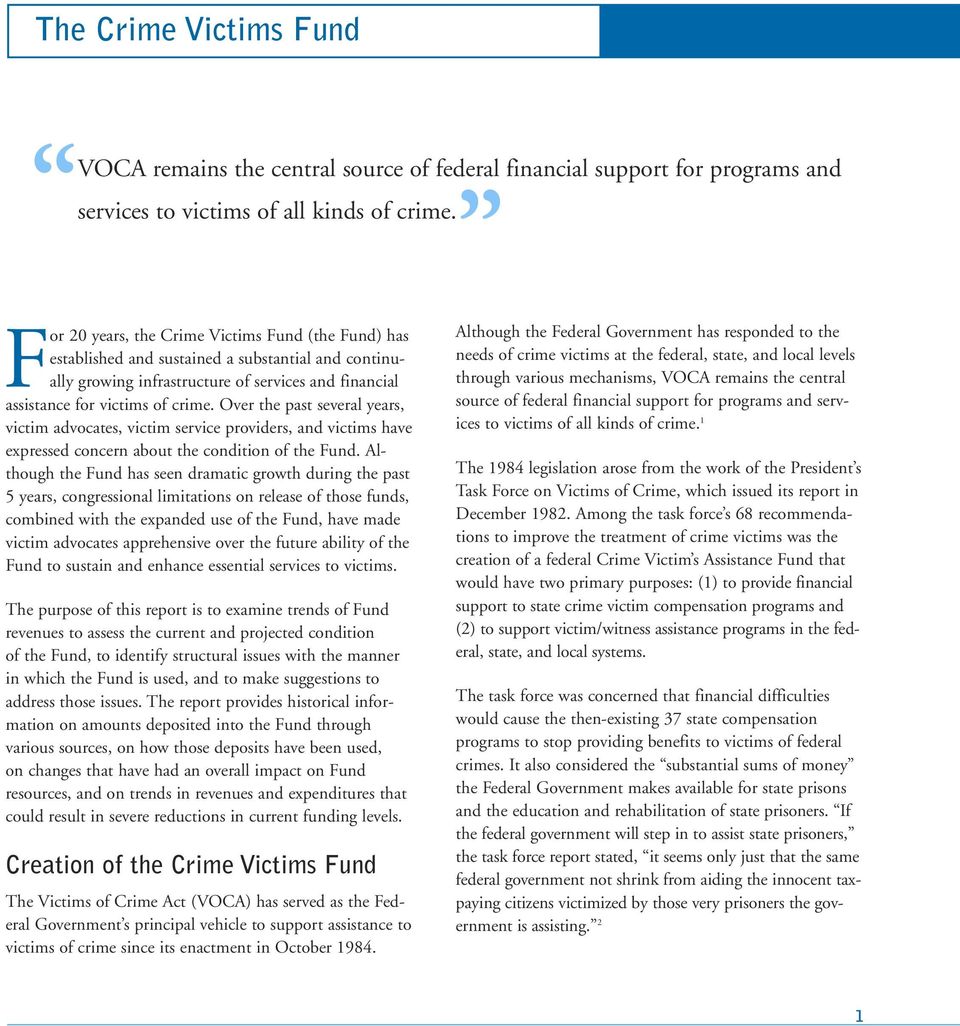
8 The Crime Victims Fund VOCA remains the central source of federal financial support for programs and services to victims of all kinds of crime. For 20 years, the Crime Victims Fund (the Fund) has established and sustained a substantial and continually growing infrastructure of services and financial assistance for victims of crime. Over the past several years, victim advocates, victim service providers, and victims have expressed concern about the condition of the Fund. Although the Fund has seen dramatic growth during the past 5 years, congressional limitations on release of those funds, combined with the expanded use of the Fund, have made victim advocates apprehensive over the future ability of the Fund to sustain and enhance essential services to victims. The purpose of this report is to examine trends of Fund revenues to assess the current and projected condition of the Fund, to identify structural issues with the manner in which the Fund is used, and to make suggestions to address those issues. The report provides historical information on amounts deposited into the Fund through various sources, on how those deposits have been used, on changes that have had an overall impact on Fund resources, and on trends in revenues and expenditures that could result in severe reductions in current funding levels. Creation of the Crime Victims Fund The Victims of Crime Act (VOCA) has served as the Federal Government s principal vehicle to support assistance to victims of crime since its enactment in October Although the Federal Government has responded to the needs of crime victims at the federal, state, and local levels through various mechanisms, VOCA remains the central source of federal financial support for programs and services to victims of all kinds of crime. 1 The 1984 legislation arose from the work of the President s Task Force on Victims of Crime, which issued its report in December Among the task force s 68 recommendations to improve the treatment of crime victims was the creation of a federal Crime Victim s Assistance Fund that would have two primary purposes: (1) to provide financial support to state crime victim compensation programs and (2) to support victim/witness assistance programs in the federal, state, and local systems. The task force was concerned that financial difficulties would cause the then-existing 37 state compensation programs to stop providing benefits to victims of federal crimes. It also considered the substantial sums of money the Federal Government makes available for state prisons and the education and rehabilitation of state prisoners. If the federal government will step in to assist state prisoners, the task force report stated, it seems only just that the same federal government not shrink from aiding the innocent taxpaying citizens victimized by those very prisoners the government is assisting. 2 1
9 Recognizing the difficult federal fiscal environment, the task force sought funding sources that did not depend on taxgenerated revenues. It recommended creating the Crime Victim s Assistance Fund that would consist of criminal fines, penalties, and forfeitures that were then being deposited into the Federal Government s general treasury. Not only is it appropriate that these monies collected as a result of criminal activity be used to help victims, the task force said, but this method of funding also ensures a program that is both administratively efficient and self-sufficient, requiring no funding from tax revenues. 3 Unlike many other federal reports and studies, the task force s final report did not just sit on a desk. Within 22 months, the task force s core recommendations for federal support of state victim compensation and victim assistance programs, with some modification, became law. VOCA created the Fund as a separate account in the U.S. Treasury with deposits coming from federal criminal fines (with some exceptions); the proceeds of forfeited appearance bonds, bail bonds, and collateral; special forfeitures of the collateral profits of crime proceeds retained in an escrow account for more than 5 years; and newly created penalty assessments on federal misdemeanor and felony convictions. 4 Not more than 50 percent of annual Fund deposits were made available for state victim compensation grants, with each state receiving 35 percent of the state-funded benefits (excluding amounts for property damage) paid during the preceding fiscal year. The remaining amount of each year s Fund deposits was made available for state assistance grants, with up to 5 percent deducted to serve victims of federal crimes. The formula allocating Fund deposits would be frequently modified in succeeding years with additional programs relying on the Fund for their support. The following programs now depend on Fund deposits for all or part of their financial support: Children s Justice Act grants to improve the investigation and prosecution of child abuse cases, including tribal child abuse cases. Federal set-asides to support: Victim/witness coordinators in U.S. Attorneys Offices (USAO). Victim assistance specialists in Federal Bureau of Investigation (FBI) field offices. Federal Victim Notification System. Discretionary grants by OVC to support national-scope training and technical assistance and services for victims of federal crimes. Formula grants to state victim compensation programs. Formula grants to state victim assistance programs that provide direct victim services. Antiterrorism Emergency Reserve for supplemental grants to assist victims of terrorism and mass violence, including OVC s International Terrorism Victims Compensation Program. Fund Revenues Summary of Fund Deposits Mindful of federal budgetary pressures, Congress originally imposed a limit of $100 million on the amount that could be deposited into the Fund; this limit was gradually increased and then eliminated beginning with deposits made in FY From FY 1985 to FY 2004, a total of $6.7 billion has been deposited into the Fund. Overall, annual deposits have increased nearly sixteenfold from a low in FY 1986 of $62 million to a high in FY 1999 of $985 million. Fund deposits have been marked by two distinct patterns. From FY 1985 to FY 1995, the Fund grew times with an average annual increase of 22 percent and only a few, relatively mild fluctuations from year to year. Since FY 1996, however, annual Fund deposits have taken a roller-coaster ride of steep increases followed by declines. In FY 1996, Daiwa Bank Ltd. of Japan pled Crime Victims Fund Deposits (in $) FY Deposits* FY Deposits* ,312, ,907, ,506, ,941, ,446, ,891, ,599, ,038, ,540, ,185, ,226, ,954, ,968, ,437, ,608, ,466, ,733, ,341, ,090, ,695,013 Source: Compiled from Office of Justice Programs data. *Statutory limit on deposits into the Fund was $100 million in 1985; $110 million in ; $125 million in ; $150 million in ; and removed from 1993 on. 2 Crime Victims Fund Report: Past, Present, and Future

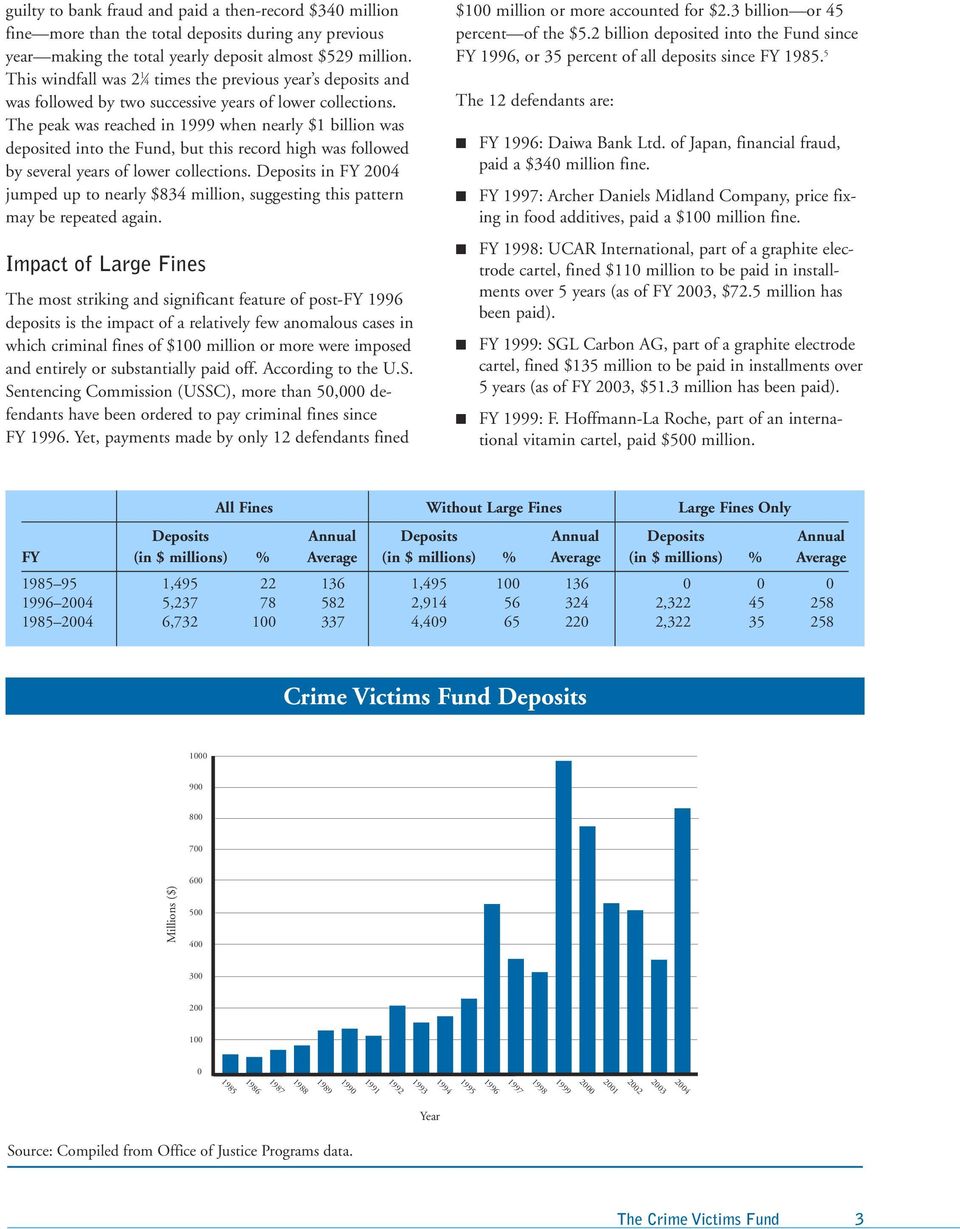
10 guilty to bank fraud and paid a then-record $340 million fine more than the total deposits during any previous year making the total yearly deposit almost $529 million. This windfall was times the previous year s deposits and was followed by two successive years of lower collections. The peak was reached in 1999 when nearly $1 billion was deposited into the Fund, but this record high was followed by several years of lower collections. Deposits in FY 2004 jumped up to nearly $834 million, suggesting this pattern may be repeated again. Impact of Large Fines The most striking and significant feature of post-fy 1996 deposits is the impact of a relatively few anomalous cases in which criminal fines of $100 million or more were imposed and entirely or substantially paid off. According to the U.S. Sentencing Commission (USSC), more than 50,000 defendants have been ordered to pay criminal fines since FY Yet, payments made by only 12 defendants fined $100 million or more accounted for $2.3 billion or 45 percent of the $5.2 billion deposited into the Fund since FY 1996, or 35 percent of all deposits since FY The 12 defendants are: FY 1996: Daiwa Bank Ltd. of Japan, financial fraud, paid a $340 million fine. FY 1997: Archer Daniels Midland Company, price fixing in food additives, paid a $100 million fine. FY 1998: UCAR International, part of a graphite electrode cartel, fined $110 million to be paid in installments over 5 years (as of FY 2003, $72.5 million has been paid). FY 1999: SGL Carbon AG, part of a graphite electrode cartel, fined $135 million to be paid in installments over 5 years (as of FY 2003, $51.3 million has been paid). FY 1999: F. Hoffmann-La Roche, part of an international vitamin cartel, paid $500 million. All Fines Without Large Fines Large Fines Only Deposits Annual Deposits Annual Deposits Annual FY (in $ millions) % Average (in $ millions) % Average (in $ millions) % Average , , , , , , , , Crime Victims Fund Deposits Millions ($) Year Source: Compiled from Office of Justice Programs data. The Crime Victims Fund 3
11 FY 1999: BASF AG, part of an international vitamin cartel, fined $225 million (paid in FY 2000). FY 2000: NMC Healthcare, health care fraud, fined $101 million (paid in FY 2000 and FY 2001). FY 2001: Mitsubishi Corporation, part of a graphite electrode cartel, paid $134 million. FY 2002: TAP Pharmaceutical, health care fraud, paid a $290 million fine. FY 2004: Credit Lyonnaise, bank/insurance fraud, paid a $100 million fine. FY 2004: Abbott Laboratories CG Nutritionals, Medicaid/Medicare fraud, paid a $180 million fine into the Fund. 6 FY 2004: Pfizer s Warner-Lambert Division, Medicaid fraud, paid a $240 million fine. The infrequency of paid criminal fines of this size is underscored by the fact that 5 of the 12 fines stemmed from just two investigations. Three defendants were involved in an international price-fixing cartel of graphite electrodes (used in making steel), and two were involved in an international vitamin price-fixing conspiracy. Together with other defendants in these cases (whose individual fines were less than $100 million), the two series of related cases alone accounted for deposits totaling nearly $1.3 billion, or 20 percent of all Fund deposits since FY Another important factor is that the sentence in each case was the result of a negotiated agreement. 7 Although the negotiated amount of the criminal fine was less than might have otherwise been imposed, the defendants agreement meant that the large fines would actually be paid. It is, however, impossible to accurately forecast the extent to which federal investigators and prosecutors will be able to consistently uncover and convict violations of a magnitude that will result in such large deposits into the Fund. The U.S. Department of Justice s (DOJ s) Inspector General, for instance, recently reported that the FBI used 20 percent fewer agents on white-collar crime investigations in FY 2003 than in FY 2000 because it had to focus on terrorism matters. 8 This shift in investigative resources may indicate that fewer opportunities will exist to pursue cases that generate large Fund deposits. Deposits made from FY 1996 to FY 2004 represent 78 percent of all deposits into the Fund from its inception $5.2 billion of the total $6.7 billion in deposits. Average annual deposits jumped from $136 million for FY 1985 to FY 1995 to $582 million for FY 1996 to FY Had it not been for the payments from the 12 anomalous cases, however, Fund deposits during this later period would have averaged $324 million. Although this average was still considerably larger than the pre-fy 1996 period, Crime Victims Fund Large Case Deposits Large Fines w/o Large Fines FY Average w/large Fines =$582 million Millions ($) FY Average w/o Large Fines =$324 million FY Average =$136 million Year Source: Compiled from Office of Justice Programs data. 4 Crime Victims Fund Report: Past, Present, and Future

12 Source Special Assessments Bond Forfeitures FY 2000 FY 2001 FY ,848, ,411, ,046, ,055, ,597, ,419, a Special Forfeitures/Collateral Profits b Private Donations n/a n/a n/a Criminal Fines 726,564, ,655, ,477, Total 737,470, ,665, ,946, b Crime Victims Fund Revenue Sources (in $) Source: Fines, assessments, and bond forfeitures compiled from EOUSA Financial Litigation Unit data. aalso commonly known as Notoriety for Profit or Son of Sam law. Authority to receive private donations became effective in FY the financial support provided by these few cases became the foundation on which VOCA funding for victim services proliferated. For example, the number of VOCA subgrants awarded by state VOCA assistance administrators more than doubled from 2,678 in FY 1996 to 5,629 in FY 2002 during this period. Sources of Deposits Nearly all of the deposits into the Fund are reported to and tracked by the Financial Litigation Units (FLUs) in the U.S. Attorneys Offices (USAO). As expected, criminal fines are the most significant source of revenue for the Fund. 9 Special assessments. Special assessments were newly created as part of the original VOCA legislation to supplement the revenues going into the Fund from criminal fines and forfeitures. The current amounts of special assessments are: $5 on individuals convicted of a Class C misdemeanor. $10 on individuals convicted of a Class B misdemeanor. $25 on individuals convicted of a Class A misdemeanor. $25 on defendants other than individuals convicted of a Class C misdemeanor. $50 on defendants other than individuals convicted of a Class B misdemeanor. $125 on defendants other than individuals convicted of a Class A misdemeanor. $100 on individuals convicted of a felony. $400 on defendants other than individuals convicted of a felony. 10 Special Assessments Collected Amount FY Collected (in $) Percentage of Fund Total ,848, ,411, ,046, Source: Compiled from EOUSA Financial Litigation Unit data. Collecting special assessments has always been problematic because it involves numerous cases but a relatively small dollar amount in each case. For example, in FY 1987, special assessments represented 58 percent of cases collected by USAO but only 4 percent of the revenues. 11 Special assessments represent a minimal amount in terms of the total amount deposited into the Fund annually. Bond forfeitures. Amounts posted as bond or as collateral to assure appearance in court are forfeited for failure to appear and are deposited into the Fund. As with special assessments, the amount collected represents a small percentage of total Fund deposits. The table on page 6 shows recent amounts collected by U.S. Attorneys. Special forfeitures of collateral profits of crime Son of Sam law. Under VOCA, a new provision was created that allowed federal prosecutors to ask the court to order an offender convicted of a violent crime to forfeit any or all of the proceeds received from the sale of the literary rights to his or her story about the crime. The proceeds are kept The Crime Victims Fund 5

13 Bond Forfeitures Collected Amount FY Collected (in $) Percentage of Fund Total ,055, ,597, ,419, Source: Compiled from EOUSA Financial Litigation Unit data. in escrow in the Fund for 5 years, during which time the proceeds can be used to satisfy a judgment obtained by a victim of the crime (or, if ordered by a court, a victim of any other crime for which the defendant has been convicted) or to pay a fine or the costs of the defendant s legal representation (but not more than 20 percent of the proceeds). 12 After the 5-year period, the court may direct that any or all of the remaining proceeds be released from escrow and placed in the Fund. According to the United States Attorneys Manual, this federal provision and similar so-called Son of Sam state laws have, since 1991 when the U.S. Supreme Court struck down a similar New York law, 13 fallen into disuse because there is little doubt, if any, that they are inconsistent with the First Amendment. 14 No amounts are known to have been deposited into the Fund as a result of the federal Son of Sam provision. Private donations. The only source of revenue added in recent years is the authority for gifts, bequests, and donations from private entities and individuals to be deposited into the Fund. This was established as part of the USA PATRIOT Act, 15 but to date, this authority has not been used. Although the new statute authorized donations to be deposited into the Fund, it did not contain the necessary authority to accept donations. 16 However, two small donations totaling $212, accepted under the Attorney General s authority, have been deposited into the Fund. Criminal fines. The largest single source of deposits into the Fund is the collection of criminal fines. The VOCA statute directs that all fines collected from persons convicted of offenses against the United States shall be deposited into the Fund. 17 The only exceptions are fines available for use by the Secretary of the Treasury for certain expenses in connection with the Endangered Species Act 18 and the Lacey Act Amendments of and fines paid into the railroad unemployment insurance account, 20 the Postal Service Fund, 21 the navigable waters revolving fund under the Federal Water Pollution Control Act, 22 and county public school funds. 23 Under federal statutes, any defendant found guilty of an offense may be sentenced to pay a fine. 24 The statutes distinguish between fines for individuals and fines for organizations. Fines against individuals may be the largest of (1) the amount specified in the underlying statute; (2) up to twice the pecuniary gain from the offense or pecuniary loss to someone other than the defendant; (3) for a felony or misdemeanor resulting in death, not more than $250,000; (4) for a Class A misdemeanor not resulting in death, not more than $100,000; or (5) for a Class B or Class C misdemeanor or an infraction, not more than $5, Fines against organizations may not be more than (1) the amount specified in the underlying statute; (2) up to twice the pecuniary gain or loss; (3) for a felony or misdemeanor resulting in death, not more than $500,000; (4) for a Class A misdemeanor not resulting in death, up to $200,000; or (5) for a Class B or Class C misdemeanor or an infraction, up to $10, The table on page 7 shows the annual number and total amount of fines imposed since From FY 1994 to FY 2001, criminal fines totaling more than $54.6 billion were imposed on 67,327 defendants. However, a big difference exists between imposing a criminal fine and depositing it into the Fund. Criminal debt collection. The total amount of outstanding criminal debt (i.e., criminal fines, restitution, and special assessments) has multiplied 105 times from $260 million in FY 1985 to $29.8 billion in FY Seventythree percent of the outstanding criminal debt is owed to third parties as restitution whereas slightly more than 25 percent is owed to the United States, mostly for criminal fines and special assessments. 28 The most challenging step before a criminal fine can be deposited into the Fund, though, is the actual collection of amounts ordered to be paid. The Federal Government realized when it started the Fund that the effectiveness of its efforts to collect criminal fines would be the major determinant of how much would be available to support victim compensation and victim assistance services Crime Victims Fund Report: Past, Present, and Future

14 Criminal Debt Balance Year * 1988* 1987* 1986* 1985* Billions ($) Source: Compiled from EOUSA Financial Litigation Unit data. *Balances for are less than $1 billion. FY Number and Total Dollar Amount of Federal Criminal Fines Imposed Number Total* (in $) , ,267, ,782 29,087,451, ,000 14,101,657, ,033 9,268,652, , ,433, ,908 77,170, , ,612, ,342 1,502,110, Total 67,327 54,602,356, Source: Compiled from U.S. Sentencing Commission datafiles from Federal Justice Statistics Resource Center, *Total amount of fine calculated by multiplying the frequency of fines by the mean amount of fines and may include the amount of court-ordered costs of supervision. Congress and federal agencies have been struggling for a long time with problems associated with the collection, receipt, accounting, monitoring, and tracking of outstanding criminal debt. In one of many attempts to improve criminal debt collection, Congress, shortly after VOCA was enacted, directed that the first $2.2 million collected above the then-existing ceiling on Fund deposits be made available to the courts to cover the administrative costs of receiving fines and restitution and the collection of unpaid fines and restitution. 30 When the VOCA allocation formula was revised in 1992, it increased the allotment for the courts to $6.2 million from FY 1992 to FY 1995 and $3 million thereafter. 31 Those funds were intended by Congress to be used to establish a single national center to process fines, restitution, and assessments. In 2001, the General Accounting Office (GAO) summarized the situation: The collection of outstanding criminal debt has been a long-standing problem, with many of the problems that GAO has been reporting on since October 1985 still remaining.... In 1990, the Administrative Office of The Crime Victims Fund 7

15 the United States Courts began developing a centralized entity, called the National Fine Center, to record, track, and report on federal criminal debt. The National Fine Center was expected to automate and centralize criminal debt processing for the 94 districts throughout the country and provide a management information system to replace the existing fragmented approach for receiving payments and to alleviate long-standing weaknesses in accounting for, collecting, and reporting on criminal monetary penalties imposed on federal criminals. However, an independent consulting firm concluded that the task of developing a National Fine Center, involving several agencies in two branches of government, proved to be more complex than expected and that the needs of the districts could not be met through a centralized approach. Thus, with the consent of the Congress, the centralized approach was terminated. As a result, the criminal debt collection process continues to be fragmented, involving both judicial and executive branch entities in 94 districts throughout the country. 32 A total of $25.2 million from the Fund was transferred to the Administrative Office of the United States Courts to fund the National Fine Center (NFC), $21 million of which was returned to the Fund when the project was terminated. 33 The GAO report notes four factors that contribute to the growth in uncollectible criminal debts: (1) the nature of the debt (which makes writing off truly uncollectible criminal debts extremely difficult) 34 ; (2) the Mandatory Victim Restitution Act (MVRA) of 1996 (which requires that full restitution be ordered regardless of the defendant s ability to pay and gives responsibility to collect restitution to the U.S. Attorneys Financial Litigation Units); (3) terms and payment schedules set by judges; and (4) state legislation (that, in certain instances, limits some collection tools). 35 the MVRA, they may do so when imposing criminal fines. Judges may thus be reluctant to impose a large criminal fine on top of the required full restitution. Furthermore, when both a large restitution order and a criminal fine are ordered, full payment of the restitution order statutorily takes precedence over the criminal fine, which also has an impact on the amount of fines ultimately collected. The U.S. Department of Justice continues to make efforts to improve collections. In addition to the FLUs efforts, DOJ has initiated programs to encourage debt payments, such as the following: Inmate Financial Responsibility Program. Operated by DOJ s Federal Bureau of Prisons (BOP), the Inmates Financial Responsibility Program (IFRP) was started in 1985 to encourage inmates in federal correctional facilities to pay off their financial obligations. The program operates in all 96 BOP institutions. Although payments made by inmates are in nominal amounts, with minimum payments of $25 per quarter, the program has generated a total of $45.5 million from FY 1996 to FY Crime Victims Fund Awards. The day-to-day job of collecting the bulk of the criminal debts that are deposited into the Fund rests with the attorneys, investigators, and staff of the FLUs in each U.S. Attorney s Office as well as those who work for the U.S. Probation Offices and BOP. Without their aggressive efforts and commitment, the resources that enable the Federal Government to support programs and services for crime victims would be greatly diminished. Their work often requires great diligence, perseverance, and attention to detail. Attorneys and investigators must identify and track down assets that may have been transferred or intentionally hidden. It can be arduous work that is not frequently recognized or appreciated outside DOJ. To acknowledge the special efforts that have enhanced the Fund, OVC has established the Crime Victims Fund Awards, which are presented every April during National Crime Victims Rights Week. Although judges cannot take into consideration a defendant s ability to pay when ordering full restitution under 8 Crime Victims Fund Report: Past, Present, and Future

16 Overview of Crime Victims Fund Services The number of individuals receiving victim services funded by VOCA victim assistance grants has increased from 1.8 million in FY 1995 to 3.6 million in FY The Fund now provides financial support for eight programs. The programs, and the method of calculating how much of the Fund they receive, are briefly described below. Children s Justice Act The Children s Justice Act (CJA) was enacted in 1986 to improve investigation and prosecution of child abuse cases at the state and local levels. Under the current VOCA allocation, CJA grants are allocated the first $10 million distributed from the Fund, plus 50 percent of the previous year s deposits over $324 million (the amount deposited in FY 1998), with a maximum of $20 million. Of the amount available each year, 85 percent is transferred to the U.S. Department of Health and Human Services (HHS) for grants to states to develop and operate programs to improve the handling of child abuse and neglect cases, particularly cases of child sexual abuse and exploitation, in a manner that limits additional trauma to child victims. 37 Fifteen percent of each year s CJA allocation is retained by OVC for grants to Indian tribes for similar purposes. Amounts not obligated by HHS by the end of the fiscal year are reallocated for state victim assistance grants. USAO Victim/Witness Coordinators Every U.S. Attorney s Office has victim/witness coordinators whose duties include consulting with victims, providing victims with notices and information, advising victims of violent crime of their right to make an oral statement at sentencing and presenting information to the court, ensuring victims and witnesses have a secure waiting area during court proceedings, and informing victims about their right to restitution orders. Children s Justice Act (in $) FY Amount FY Amount ,812, ,000, ,228, ,000, ,230, ,000, ,783, ,000, ,140, ,000, ,000, ,000, ,000, ,000, ,000, ,000, ,000, ,000,000 Source: Compiled from Office of Justice Programs data. 9

17 When Congress terminated the NFC in 1997, it designated that $12 million of unobligated NFC funds transferred back to the Fund be used to support 93 victim/ witness coordinators for FYs 1998 and Then, as part of the FY 2000 budget process, congressional appropriators created a new statutory provision authorizing such sums as may be necessary shall be available for the United States Attorneys Offices to improve services for the benefit of crime victims in the federal criminal justice system. 39 Congress thus made permanent the use of the Fund to support the 93 victim/witness coordinators and expanded it to cover the cost of 77 victim witness work years from pre-1998 allocations. Congress stated that it expects that appropriate sums will be made available under this provision in succeeding fiscal years to continue this program at the current level. 40 USAO Victim/Witness Coordinators (in $) FY Amount 1998/ ,000, ,390, ,390, ,134, ,316, ,613,963 Source: Compiled from Office of Justice Programs data. FBI Victim Assistance Specialists FBI victim assistance specialists are assigned to divisions and field offices to help victims involved in the investigation of federal crimes. Among their duties are notifying victims of important case developments and proceedings and providing victims with information and referrals to local services, including state crime victim compensation programs, counseling, shelters, and support groups. 41 Congress continued to set aside Fund monies for federal personnel in FY 2001 by further expanding it to support victim services provided by the FBI. In its explanation, congressional appropriators indicated the set-aside would support 112 victim assistance specialists at a cost of $7.4 million and specified that [t]hese services are to be limited to victim assistance as described in the Victims of Crime Act and shall not cover non-victim witness activities such as witness protection or non-victim witness management services, paralegal duties or community outreach. 42 Sharp drops occurred in FY 2002 and FY 2004 in the setaside needed for FBI victim assistance specialists because significant funds remained unspent from previous years. FBI Victim Assistance Specialists (in $) FY Amount ,400, ,947, ,410, ,871,656 Source: Compiled from Office of Justice Programs data. Federal Victim Notification System Victims of federal offenses receive notifications, primarily through USAO, the FBI, and BOP, for the release or detention status of an offender, pending judicial proceedings or the offender s placement in a pretrial diversion program, the filing of charges against a suspected offender, the scheduling of court proceedings, the outcome of proceedings, and the imposed sentence, including restitution information. Under the federal victim notification system (VNS), victims who are registered in the program may call a toll-free phone number for information on a defendant s status and current court information. Initial funding of $8 million for the federal VNS came from amounts transferred back into the Fund from the defunct NFC. In FY 2002, Congress once again expanded the federal set-asides to include support for VNS. It directed that the remaining $1.5 million from the NFC funds be supplemented with $3.5 million from the Fund to support the $5 million annual estimated cost of VNS. 43 The funds are used to maintain the system and expand its use and availability to other federal agencies. After amounts for CJA grants and the federal set-asides are determined, funds available for OVC discretionary grants and victim compensation and victim assistance formula grants are based on a percentage of the amount remaining under the annual limit of total Fund obligations. 10 Crime Victims Fund Report: Past, Present, and Future

18 Federal Victim Notification System (in $) FY Amount ,000, ,000, ,141, ,141,843 Source: Compiled from Office of Justice Programs data. OVC Discretionary Grants OVC receives 5 percent of the amounts remaining after amounts are allocated for CJA and the federal set-asides. 44 At least half of the allocation must be used to support national training and technical assistance efforts, and no more than half can support services to victims of federal crime by eligible assistance programs. 45 Under the statutes, OVC s Director may use the funds for demonstration projects, program evaluation, compliance efforts, training and technical assistance services to eligible crime victim assistance programs, fellowships and clinical internships, and to carry out programs of training and special workshops for the presentation and dissemination of information resulting from demonstrations, surveys, and special projects. In carrying out this mission, OVC provides financial support for various victim assistance and training and technical assistance initiatives, including Services to American Indians and Alaska Natives. OVC provides grants to federally and nonfederally recognized tribes to provide direct victim services, ongoing training and technical assistance, and collaboration with state VOCA assistance administrators. Among the OVC Discretionary Grants (in $) FY Amount FY Amount ,066, ,965, ,466, ,965, ,537, ,104, ,575, ,170, ,607, ,541, ,436,154 Source: Compiled from Office of Justice Programs data. activities are biennial Indian Nations conferences, an American Indian/Alaska Native Victim Assistance Academy, outreach to American Indian victims and survivors of drunk-driving crashes, and adaptation of a specialized sexual assault advocate/counselor curriculum for American Indian communities. Collaboration between faith-based and victim assistance communities. The projects are intended to improve the response of faith-based practitioners to crime victims by supporting services, networking with secular services, and training members of the faith community to be responsive to victims needs. Specific projects include collaboration in urban communities, protocols for community-based grief centers, professional education, and law enforcement chaplaincy programs. A special effort is being made to assist grassroots community-based victim efforts through the Helping Outreach Programs to Expand project. Public education and awareness. OVC s efforts to generate greater awareness about victims needs and rights among victims, survivors, and the general public include support for National Crime Victims Rights Week and various community awareness projects, a nationwide public awareness and education campaign, the OVC Resource Center that serves as the primary source of victim information, and the Oral History Project to begin recording interviews with key contributors to the victims rights movement. Victims rights initiative. OVC has focused efforts on helping victims secure compliance with their legal rights in the federal and state criminal justice systems through its support of the National Crime Victim Law Institute and other legal clinics that assist victims in enforcing their rights. Other activities under OVC sponsorship include providing educational materials and training state legislators on victims rights legislation, developing a judicial training curriculum, and supporting a nationwide Victims Rights Education Project to develop public educational materials describing core victims rights and how to assert them. Training, education, and technical assistance. To continually improve the quality and professionalization of the victim services field, OVC uses its discretionary funds to provide a wide range of training opportunities for victim service providers. This includes the National Victim Assistance Academy, a Professional Development Institute, a Web-based basic victim advocacy course, the National Youth Education Project, and the Web-based Victims of Crime With Disabilities Resource Guide. OVC also provides technical assistance to state VOCA assistance administrators and state crime victim compensation managers. Overview of Crime Victims Fund Services 11
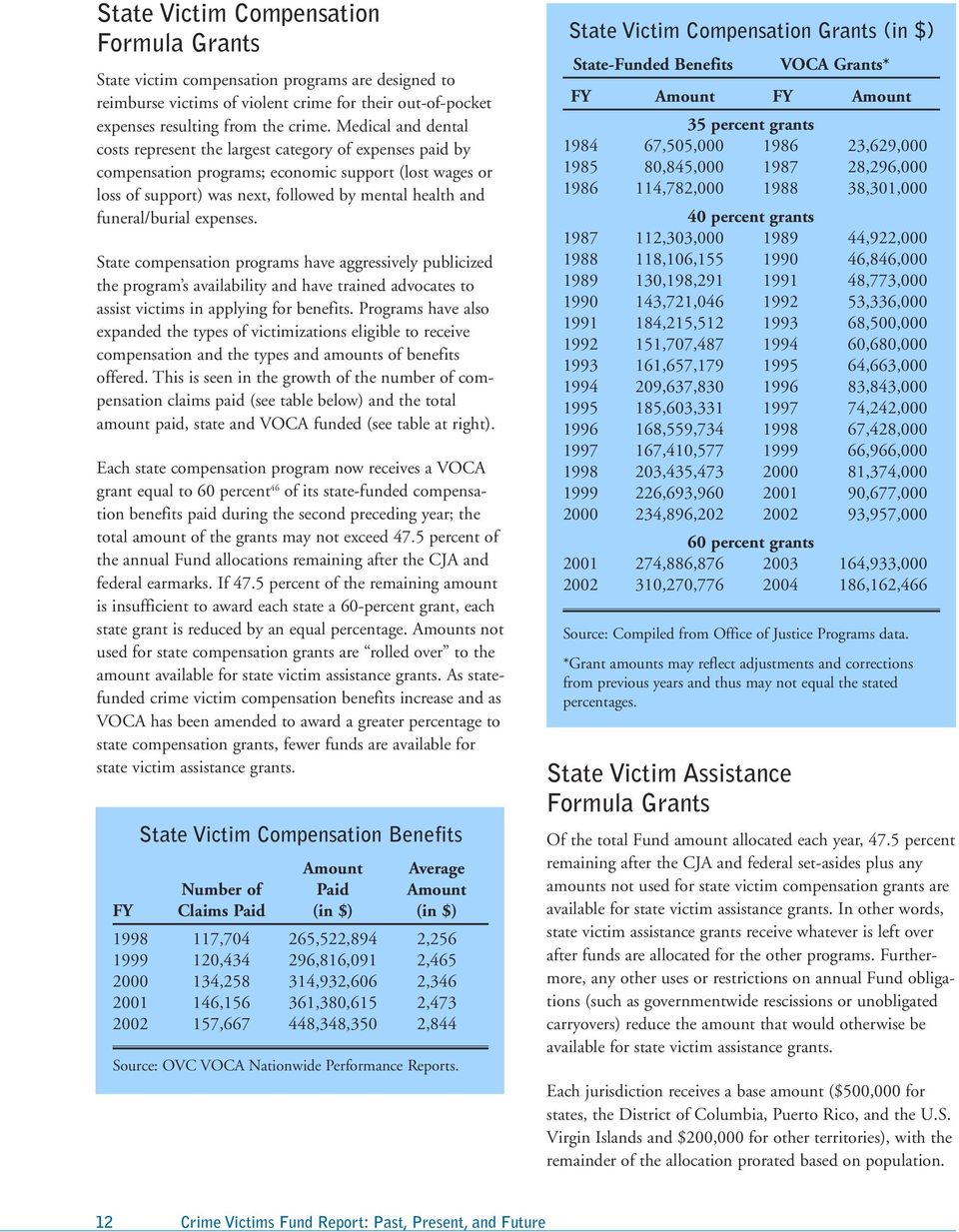
19 State Victim Compensation Formula Grants State victim compensation programs are designed to reimburse victims of violent crime for their out-of-pocket expenses resulting from the crime. Medical and dental costs represent the largest category of expenses paid by compensation programs; economic support (lost wages or loss of support) was next, followed by mental health and funeral/burial expenses. State compensation programs have aggressively publicized the program s availability and have trained advocates to assist victims in applying for benefits. Programs have also expanded the types of victimizations eligible to receive compensation and the types and amounts of benefits offered. This is seen in the growth of the number of compensation claims paid (see table below) and the total amount paid, state and VOCA funded (see table at right). Each state compensation program now receives a VOCA grant equal to 60 percent 46 of its state-funded compensation benefits paid during the second preceding year; the total amount of the grants may not exceed 47.5 percent of the annual Fund allocations remaining after the CJA and federal earmarks. If 47.5 percent of the remaining amount is insufficient to award each state a 60-percent grant, each state grant is reduced by an equal percentage. Amounts not used for state compensation grants are rolled over to the amount available for state victim assistance grants. As statefunded crime victim compensation benefits increase and as VOCA has been amended to award a greater percentage to state compensation grants, fewer funds are available for state victim assistance grants. State Victim Compensation Benefits Number of Amount Paid Average Amount FY Claims Paid (in $) (in $) , ,522,894 2, , ,816,091 2, , ,932,606 2, , ,380,615 2, , ,348,350 2,844 Source: OVC VOCA Nationwide Performance Reports. State Victim Compensation Grants (in $) State-Funded Benefits VOCA Grants* FY Amount FY Amount 35 percent grants ,505, ,629, ,845, ,296, ,782, ,301, percent grants ,303, ,922, ,106, ,846, ,198, ,773, ,721, ,336, ,215, ,500, ,707, ,680, ,657, ,663, ,637, ,843, ,603, ,242, ,559, ,428, ,410, ,966, ,435, ,374, ,693, ,677, ,896, ,957, percent grants ,886, ,933, ,270, ,162,466 Source: Compiled from Office of Justice Programs data. *Grant amounts may reflect adjustments and corrections from previous years and thus may not equal the stated percentages. State Victim Assistance Formula Grants Of the total Fund amount allocated each year, 47.5 percent remaining after the CJA and federal set-asides plus any amounts not used for state victim compensation grants are available for state victim assistance grants. In other words, state victim assistance grants receive whatever is left over after funds are allocated for the other programs. Furthermore, any other uses or restrictions on annual Fund obligations (such as governmentwide rescissions or unobligated carryovers) reduce the amount that would otherwise be available for state victim assistance grants. Each jurisdiction receives a base amount ($500,000 for states, the District of Columbia, Puerto Rico, and the U.S. Virgin Islands and $200,000 for other territories), with the remainder of the allocation prorated based on population. 12 Crime Victims Fund Report: Past, Present, and Future
20 Fund amounts allocated for state compensation grants but not obligated because of the limit on individual state grants (i.e., 60 percent of state-funded benefits) are added to the allocation for state victim assistance grants. As total Fund allocations increased, rollovers have become an important component of state victim assistance grants. Whereas rollovers accounted for an average of 7 percent of each year s VOCA victim assistance grants from FY 1985 to FY 1996, they have averaged 36 percent of annual state victim assistance grants since FY However, as the total amounts of state-funded compensation benefits have continued to increase and as the VOCA compensation grant percentage has risen to 60 percent, less is available to augment the base state VOCA victim assistance allocation. VOCA assistance administrative agencies in each state award subgrants to support direct crime victim service providers. The number of agencies supported by VOCA subgrants has increased as the amount of state grants has grown. In FY 1986, the first year of VOCA victim assistance grants, states awarded a total of 1,422 subgrants. By FY 2002, that figure had grown to 5,629 subgrants. Although a wide disparity in the amount of individual subgrant awards remains, the average VOCA subgrant has increased from $29,000 in FY 1986 to $62,700 in FY State Victim Assistance Grants (in $) FY Amount FY Amount ,270, ,333, ,772, ,048, ,886, ,555, ,492, ,136, ,818, ,167, ,062, ,864, ,734, ,027, ,500, ,027, ,428, ,994, ,760,998 Source: Compiled from Office of Justice Programs data. Similarly, the number of individuals receiving victim services funded by VOCA victim assistance grants has increased from 1.8 million in FY 1995 to 3.6 million in FY By far, the largest victim population that receives services are victims of domestic violence (52 percent), followed by victims of child abuse (12 percent) and adult victims of sexual assault (6 percent). The types of services provided typically are crisis counseling, information and referral, support and advocacy during the criminal justice process, and followup assistance. Compensation Rollover to Assistance Grants Victim Assistance Rollover Compensation 400 Millions ($) Year Source: Compiled from Office of Justice Programs data. Overview of Crime Victims Fund Services 13

21 FY Number of Subgrants Awarded Number of Awards , , , , , , , ,629 Source: OVC VOCA Nationwide Performance Reports and Reports to Congress. Under the VOCA statute and federal guidelines, 48 states are required to use at least 10 percent of each annual grant to support services for victims of spousal abuse, sexual assault, child abuse, and previously underserved victims of violent crimes. Although most states are committed to sustaining this existing base of subgrantees to provide core services, additional funds are used to address unmet victim service needs. A survey conducted by the National Association of VOCA Assistance Administrators asked administrators to identify how they would use additional funds if available. 49 The most prevalent responses were services for (1) elderly victims, (2) victims residing in rural areas, (3) victims with limited English proficiency, (4) victims with disabilities, (5) minority populations, and (6) victims of property or financial crimes. Replenishment of the Antiterrorism Emergency Reserve In FY 1995, OVC was authorized to reserve $20 million of Fund deposits as a rainy day fund to supplement state compensation and assistance formula grants in years when Fund deposits decreased. 50 In FY 1996, Congress increased the reserve to $50 million and expanded its use to include supplemental compensation and assistance grants to assist victims of terrorism and mass violence. 51 In FY 2000, Congress again increased the reserve maximum to $100 million and further expanded its use to fund a new program to be operated by OVC to compensate victims of international terrorism. 52 The Emergency Reserve was restructured in FY 2001 by eliminating its use as a rainy day fund for state formula grants and limiting its use to funding OVC s antiterrorism/mass violence supplemental grants and international victims of terrorism compensation programs. 53 The maximum size of the new Antiterrorism Emergency Reserve was set at $50 million, which could be replenished with up to 5 percent of the balance, if any, in the Fund remaining after the other VOCA programs were funded. 54 Unless Congress, in its annual appropriations bill, specifically provides otherwise, any amounts used to replenish the Emergency Reserve are in addition to the annual limit on Fund obligations and thus do not reduce that year s funding for the other VOCA-supported programs. 14 Crime Victims Fund Report: Past, Present, and Future
22 Managing the Fund: Trends and Issues The Fund and the programs it supports have proved to be major contributors in fulfilling the Nation s commitment to meeting the needs of victims of crime. When Fund deposits reached nearly $1 billion in FY 1999, Congress imposed a $500 million cap on the total amount that could be obligated from the Fund for FY Congress said its rationale was to protect against wide fluctuations in receipts into the Fund, and to ensure that a stable level of funding will remain available for these programs in future years. 55 Unallocated amounts remain in the Fund for use in future years. When Fund deposits exceed the annual cap, the balance in the Fund grows. Beginning in FY 2002, however, Fund deposits were less than the cap, and thus the Fund balance began to be drawn down. With FY 2003 deposits of $361.3 million and an FY 2004 cap of $625 million ($621.3 million after rescission), the Fund balance at the end of FY 2004 dropped to $422 million. Even though Congress has increased the annual cap by 3 to 9 percent each year, the increase has not always been enough to maintain funding for victim assistance grants. Because the amounts available for victim assistance grants (and, to a lesser degree, OVC discretionary grants) are calculated last, the lion s share of insufficient caps is felt mainly by that program area. The table on page 16 shows that despite an increase in the overall VOCA cap, victim assistance grants suffered two annual reductions in the past 5years: In FY 2001, the Fund cap rose by $37.5 million, an 8-percent increase, while the amount available for victim assistance grants declined by $9.3 million, a 3-percent cut. Congress failed to consider the increase in CJA grants, the creation of a new set-aside for the FBI, and an increase in victim compensation grants. In FY 2003, the Fund cap increased by $50 million, a 9-percent increase, yet victim assistance grants declined by $30 million, an 8-percent reduction. The cap failed to incorporate the increase in victim compensation grants from 40 to 60 percent of statepaid benefits plus a 15-percent increase in the amount of benefits paid. Impact of Funding Projections on Victim Assistance and Compensation Programs Because of the Fund s allocation formulas, the impact of fluctuations both increases and decreases falls most heavily on victim assistance formula grants. Following the first major spike in deposits resulting from the FY 1996 $340 million Daiwa Bank fine, OVC began working closely with states to help them make the best uses of what, 15
23 Revenues Carryover Deposits Crime Victims Fund Cash Flow (in $ millions) FY 1999 FY 2000 FY 2001 FY 2002 FY 2003 FY FY 2000 FY 2001 FY 2002 FY 2003 FY 2004 FY 2005 Amount Available , , , , ,255.8 Cap c a Fund Balance Allocations FY 2000 FY 2001 FY 2002 FY 2003 FY 2004 Carryover/Reserve Children s Justice Act U.S. Attorneys Offices Victim/ Witness Coordinators FBI Victim Assistance Specialists Victim Notification System OVC Discretionary Grants State Victim Compensation Grants State Victim Assistance Grants b d 0 d Source: Compiled from Office of Justice Programs data areflects prior year recoveries, unobligated carryforward balances, and other adjustments. bunobligated amounts allocated in previous years; FY 2001 includes amount of Emergency Reserve allocated under the cap. coriginal cap of $625 million was reduced due to congressional rescission. ddoes not include $68.1 million from Pub. L for the Antiterrorism Emergency Reserve used to respond to the terrorist attacks of September 11, at the time, appeared to be a one-time windfall. OVC conducted regional roundtables with VOCA assistance administrators to help them develop effective strategies to use the funds. Strategies included expending the one-time influx of FY 1997 funds over a few years to ensure continuity in victim programs; funding automated victim notification systems and other one-time technological enhancements; and expanding services to assist underserved populations such as victims of gang violence, victims with disabilities, and victims living in rural areas. 56 The state victim assistance grant allocation for FY 1997 (based on the FY 1996 Fund deposits) represented an unforeseen tripling of each state s grant. Yet, the unanticipated funds were used effectively by state VOCA assistance administrators for additional victim services. The number of subgrants supporting local direct victim services during this period increased dramatically more than doubling between FY 1996 and FY Most state VOCA victim assistance administrators now attempt to stabilize the amount they make available each year to support local services. 57 Even with the relatively large amount of VOCA assistance funding, crime victims needs still remain unmet. Despite the statistical reduction in crime rates in recent years, 58 substantial populations of crime victims are without adequate assistance services. One indicator of this is a comparison of the requests for funding by local service providers and the availability of VOCA victim assistance funds. During the states funding cycle, 34 of the 56 VOCA assistance jurisdictions reported receiving 3,161 applications for VOCA victim assistance support, of which 2,530 received some, if not all, of the requested amount. The total amount requested was nearly $230 million, of which only some $185 million was available to be awarded. 59 For the 16 Crime Victims Fund Report: Past, Present, and Future
24 applicants in this sample, this represents a funding shortfall grants assuming three different levels of future Fund of $45 million, or 20 percent of all requests. deposits. The first projection is for revenue levels of $300 million, which is close to recent average annual deposits, not including the rare, large fines that exceed $100 million. Number and Amount of Subgrant The $500 million projection takes into account those large Applications and Awards fines. The $400 million projection is a midpoint or average Number Amount (in $) level between the extremes of including the large fines and Applications Received 3, ,775,069 not including them. The scenarios are not predictions but Subgrants Awarded 2, ,774,093 simply a demonstration of the mathematics of the current Difference ,000,976 allocation formula to illustrate the impact that various levels of deposits may have on state victim assistance and victim Source: 2003 NAVAA survey; 34 states responded. compensation formula grants in the coming years. They are based on the following assumptions: According to a national advocacy organization, Domestic violence, sexual assault and stalking programs are facing devastating funding shortfalls anywhere from 15 to 75% because of previous federal budget cuts, state budgetary crises and reduced donations from individuals. Many programs have been forced to reduce staff and cut back on victim services some programs have been forced to close their doors. 60 Although programs are striving to simply maintain their service levels, the need for services for additional victim populations victims of identity theft and other economic crimes, human trafficking, and stalking, for example continue to be recognized. As noted, without the infusion of deposits from a handful of extremely large criminal cases, deposits into the Fund would not have kept pace with annual allocations. Recent average annual deposits would have been $324 million without the large fines; if that rate continues, the Fund balance will decline and, within several years, be entirely depleted. At that point, there will be a significant impact on state victim assistance services and, to a lesser degree, state victim compensation programs. The following scenarios illustrate the funding implications for state victim compensation and victim assistance formula The FY 2005 congressional cap will be $650 million and will continue to increase by $25 million a year for as long as sufficient amounts are in the Fund, after which the total allocations will be based on however much is available. No new set-asides, earmarks, or other changes to Fund allocations will be made. The amounts for current federal set-asides will increase at a 4-percent annual rate. The Fund balance will not be used to replenish the Antiterrorism Emergency Reserve. Projections of future state compensation payouts assume a one-time drop in total state-funded benefits and then 7-percent annual increases in total compensation (state and VOCA funded). 61 Under scenario 1, beginning in FY 2005, Fund deposits will equal $300 million a year. It is assumed the cap will increase by $25 million in FY 2006 but drop to $531 million in FY Funding at that level would result in victim compensation and victim assistance grants of $226 million each. This represents compensation grants of 59 percent of state-funded benefits. Because this is below the 60-percent statutory level, each state s compensation grant would have to be prorated based on its state-funded benefits, according Scenario 1: Crime Victims Fund Projections Assuming Annual Deposits of $300 Million (in $ millions) FY 2005 FY 2006 FY 2007 FY 2008 FY 2009 Amount Available 1, Cap Fund Balance Compensation Victim Assistance Managing the Fund: Trends and Issues 17
25 Scenario 2: Crime Victims Fund Projections Assuming Annual Deposits of $400 Million (in $ millions) FY 2005 FY 2006 FY 2007 FY 2008 FY 2009 Amount Available 1,256 1, Cap Fund Balance Compensation Victim Assistance to the VOCA statute. 62 Although victim assistance grants will increase in FYs 2005 and 2006, those grants will drop to $226 million in FY 2007, or 59 percent of the projected FY 2005 grants. Assuming Fund deposits continue to be $300 million annually, by FY 2009, compensation grants would be 28 percent and assistance grants would be reduced to only 31 percent of the FY 2005 grants. Under scenario 2, with Fund deposits maintained at $400 million a year, the Fund balance would be entirely depleted by FY 2008, at which point state victim compensation and victim assistance grants would be $173 million each; this represents compensation grants of 43.8 percent of state-funded benefits and victim assistance grants of 45 percent of the FY 2005 level. With annual Fund deposits of $500 million, as illustrated in scenario 3, the Fund balance would be completely drawn down by FY 2009, at which time state victim compensation and victim assistance grants would be $208 million each. At that level, the compensation grants would represent 51 percent of state-funded benefits and victim assistance grants would drop to 54 percent of the FY 2005 amount. The following table shows the state compensation grant percentages under the three scenarios: Projections of State Compensation Grant Percentages (in $ millions) FY 2007 FY 2008 FY Although state victim assistance grants may increase slightly for 2 or 3 years, they will begin to experience sharp declines as illustrated on page 19. The scenarios demonstrate that if annual deposits remain within a range of $300 million to $500 million a year, then sometime between FY 2007 and FY 2009, the accumulated Fund balance will have been entirely drawn down. At that point, the total amount available in the Fund will greatly diminish and state compensation and assistance grants will begin to suffer sharp reductions in annual funding. Bearing in mind that Fund deposits since FY 1996 would have averaged $324 million without just 12 large fines, the scenarios underscore the uncertain ability of the Fund to sustain the current funding level for state victim compensation and assistance grants. It is again important to note that the above calculations are not predictions, but rather projections of potential funding patterns based on the current VOCA allocation formula. Although it is possible even likely that some extremely large fines will sporadically be deposited into the Fund in the future, their principle impact would be to briefly extend the time before the Fund balance is depleted. For example, the $520 million deposited from three cases in FY 2004 extended by less than 1 year the time when the Fund balance would be depleted under the above scenarios. Unless large deposits occur on a reliably consistent basis, the Fund s ability to sustain the current level of funding for victim services, let alone its ability to meet the evergrowing needs of crime victims, is problematic. As a result, attention must be given to two related, critical aspects of this problem: (1) restructuring the method of allocating annual Fund distributions to eliminate adverse, inequitable effects on state victim assistance formula grants and (2) supplementing Fund revenues as needed to avoid a severe diminution in the Federal Government s ability to provide ongoing financial support to state compensation and assistance efforts. 18 Crime Victims Fund Report: Past, Present, and Future
26 Scenario 3: Crime Victims Fund Projections Assuming Annual Deposits of $500 Million (in $ millions) FY 2005 FY 2006 FY 2007 FY 2008 FY 2009 Amount Available 1,256 1, Cap Fund Balance Compensation Victim Assistance Recommendations The Fund and the programs it supports have proved to be major contributors in fulfilling the Nation s commitment to meeting the needs of victims of crime. It has indeed become the Federal Government s premier program for victims of all types of crime, in all areas of our Nation. Crime victimization can be an all-encompassing event, affecting a person s physical, emotional, financial, spiritual, social, and legal conditions. Although many unmet needs remain, VOCA has developed a substantial infrastructure of public agencies and private, nonprofit organizations dedicated to providing comprehensive, high-quality services. 63 As the Fund has grown, so have the demands on the programs that provide victim services to reach out to additional populations of crime victims, provide new and additional types of services, and extend services to otherwise unserved and underserved regions of the country. As originally conceived, the Fund was intended to support state compensation and assistance programs. With CJA, it was extended to support criminal justice system changes in the handling of child abuse cases. More recently, victim assistance personnel in USAO and the FBI have been added to the Fund s responsibilities. The additional setasides were possible because at the time it seemed that large ongoing balances in the Fund would be available. This is no longer the case. Under the current VOCA allocation formula, the additional uses of the Fund are given precedence over the Fund s original purpose to support state compensation and assistance programs. If current trends continue, the Fund s ability to maintain support for state compensation and victim assistance programs is clearly in jeopardy. To adequately address this challenge, it is necessary to adjust the statutory method of allocating the Fund and to supplement the sources of deposits into the Fund in other Crime Victims Fund Projections for Victim Assistance Grants Millions ($) Scenario 3 $500 Scenario 2 $400 Scenario 1 $ Year Sources: Scenarios 1, 2, and 3 on pages 17, 18, and 19. Managing the Fund: Trends and Issues 19
27 words, to address both the expenditure and the revenue sides of the VOCA equation. A three-pronged approach is recommended to address the impending challenge of sustaining support for victim services through the Fund: To address the structural inequity of state victim assistance grants that absorb the negative impact of insufficient funding, the allocation formula should be modified so that a minimum amount of funds are made available for state victim assistance grants each year. The amount should be set at the average allocated for state victim assistance grants during the previous 3 years plus 5 percent. Deposits into the Fund should be increased through continued efforts to improve the collection of criminal debts and by dedicating certain restitution payments. If increased debt collection and new revenue sources are still not enough to meet annual Fund obligations, amounts from other revenues derived from violations of federal law should be transferred into the Fund to make up for the deficiency. Restructure Fund Allocations On the expenditure side, the basic problem is that nearly all of the adverse consequences of insufficient funding levels fall on the state victim assistance formula grants. As funding for the other VOCA program areas has been added or increased, amounts available for state victim assistance grants are reduced. Other demands placed on the Fund, such as governmentwide rescissions or unobligated carryovers, are taken entirely from victim assistance grants rather than equitably spread out among all VOCA program areas. Several proposals have been introduced in Congress as alternatives to the use of annual congressional caps to stabilize funding without singling out state victim assistance grants (and hence the approximately 4,300 direct service programs that depend on the grants) to absorb insufficient funding levels. In the 107th Congress, a managed formula was enacted to establish a minimal base level of funding for state victim assistance grants while avoiding the potential of wide fluctuations, a provision that was repealed 1 month later. 64 A somewhat similar approach was proposed in the 108th Congress that would have established the average of the previous 3 years as the base for state victim assistance grants. 65 The proposal addressed the potential problem of inadequate Fund amounts by prorating any shortfall among OVC discretionary grants, victim compensation grants, and victim assistance grants. Both proposals sought a method to directly determine annual funding for state victim assistance grants, rather than depend on the amount left over after all the other Fund obligations were established. Any proposal to establish a minimum level for state victim assistance grants should consider the normal increases in costs of providing services and the ongoing need to provide critical services to additional crime victim populations. Thus, the proposal incorporates a modest 5-percent annual increase in the base level for victim assistance grants (and for OVC discretionary grants as well). A 5-percent annual increase is less than the average increase in the programs since FY 2000 when the congressional caps were imposed. Improve Criminal Debt Collections Efforts to collect unpaid criminal debts can be improved. A recent GAO report identifies the progress the U.S. Department of Justice is making and additional steps that can be taken. 66 If the recommendations contained in this and previous GAO reports recommendations with which DOJ generally agrees are fully implemented and if sufficient resources are dedicated to this purpose, the amount of deposits into the Fund will undoubtedly be enhanced. However, whatever improvements may be made in the current criminal fine collection system, they are unlikely to produce sufficient additional revenues to offset the impending shortfall in Fund deposits. For example, a 10-percent increase in collections would produce an additional $35 million to $50 million. In contrast, by FY 2009, anywhere from $184 million to $470 million in additional Fund deposits may be needed to maintain 60-percent state compensation grants and keep state victim assistance grants at their FY 2003 level. Restitution Although restitution payments to victims must remain a priority, several suggestions could enhance Fund deposits without diminishing individual restitution. Unlike criminal fines, which are meant to punish and deter criminal acts, restitution is intended to make victims whole. Expanded community restitution. In drug cases in which no victims are identifiable, courts may now order the payment of community restitution. 67 It recognizes that even if no identifiable individuals are harmed, the community in which the drug trafficking occurs has been harmed. The concept should be extended to other types of criminal 20 Crime Victims Fund Report: Past, Present, and Future
28 activities (e.g., mass violence, bomb threats) in which no victims are identifiable but a substantial adverse impact has been made on the community. In those cases, courts should be authorized to order community restitution payments into the Fund. Unclaimed restitution. Restitution payments for victims who cannot be located should also be deposited into the Fund. If any of those victims are later located, payments can be taken from the Fund. Multiple victim cases. Under U.S. sentencing guidelines, restitution need not be ordered to the extent the court finds, from facts on the record, that (1) the number of identifiable victims is so large as to make restitution impracticable; or (2) determining complex issues of fact related to the cause or amount of the victim s losses would complicate or prolong the sentencing process to a degree that the need to provide restitution to any victim is outweighed by the burden on the sentencing process. 68 Rather than decline to order restitution in the event of too many victims, courts should be authorized to require that restitution payments be made into the Fund. This would be consistent with the policy established under the MVRA that allows victims to assign their interest in restitution payments to the Fund. 69 Transfer Revenues Derived From Law Violations One of the original principles for the creation of the Fund, as articulated by the 1982 President s Task Force on Victims of Crime Final Report, was that criminals, not taxpayers, should pay to support crime victim programs. 70 The idea has served the victim service field well since VOCA was enacted. It is time to extend this premise to some noncriminal penalties for violations of the law, an approach that would be consistent with the principle that the bad guys should pay for victim services. Many providers, for example, offer assistance to clients who are involved in proceedings beyond the strict statutory definition of criminal conduct. Victim service providers may work with clients in certain civil proceedings (e.g., protective orders, supervision and visitation proceedings), administrative proceedings (e.g., probation and parole proceedings), and juvenile justice proceedings. Providers assist victims of many nonviolent offenses such as identity theft and financial exploitation. Just as some victim services expand assistance to victims involved in noncriminal situations, so should revenues derived from noncriminal case proceedings be used to support victim services. Revenues from the following would be appropriate to supplement traditional Fund revenues to the extent needed to meet annual Fund obligations. False Claims Act. The False Claims Act 71 imposes civil liability on anyone who submits a false or fraudulent claim for a Federal Government payment. A person violating the False Claims Act is subject to treble damages plus civil penalties of up to $11,000 for each claim. Under the whistleblower or qui tam provisions, an individual can bring an action on behalf of the Government and can share in the damages. In successful actions, the whistleblower may be awarded anywhere from 15 to 25 percent of the proceeds plus reasonable expenses. 72 DOJ reported that in FY 2002, $1.2 billion was recovered in False Claims actions; the amount increased to $2.1 billion in FY Since the Act was amended in 1986 to encourage whistleblower actions, more than $12 billion has been recovered. 73 Pursuant to the Health Insurance Portability and Accountability Act of 1996, amounts equal to penalties and damages (other than funds awarded to whistleblowers, restitution, or otherwise authorized by law) obtained under the False Claims Act related to health care items and services are transferred to a special account in the Federal Hospital Insurance Trust Fund 74 to be used for activities designed to combat health care fraud and abuse. Of the $2.1 billion recovered in FY 2003, more than 80 percent $1.7 billion of the recoveries stemmed from health care fraud cases; in FY 2002, $980 million of the $1.2 billion recovered was related to health care fraud. Penalties and treble damages awarded under the False Claims Act are meant to punish and deter and thus are intended to serve a purpose similar to criminal fines. Transferring a certain percentage (e.g., 10 percent) of all annual collections from False Claims Act cases would be an appropriate addition to the Crime Victims Fund. If additional amounts are necessary to meet the annual obligations of the Fund, then nonhealth care-related recoveries (other than whistleblower awards and restitution) from the False Claims Act into the Fund could be used to supplement current deposits. Civil fines and monetary penalties. Many violations of federal law are treated as civil rather than criminal offenses. Just like criminal fines, the purpose of the sanctions is to enforce federal law and punish violations. At Managing the Fund: Trends and Issues 21
29 least 80 federal agencies have authority to seek civil penalties. 75 Amounts for a violation may range from $100 to millions of dollars. As described by GAO, Civil monetary penalties are one method by which agencies enforce federal laws and regulations, with penalty assessments and collections totaling hundreds of millions of dollars per year. Dozens of federal agencies are currently authorized to levy such penalties for violations involving such issues as public health and safety, environmental protection, securities transactions, and international trade. 76 The Securities and Exchange Commission, for example, reported collections of civil penalties totaling $43 million in FY 2000, $44 million in FY 2001, and $101 million in FY The Bureau of Industry and Security in the U.S. Department of Commerce collected $1.3 million in FY 2000, $2.5 million in FY 2001, and $5.3 million in FY Although some civil penalties are dedicated for specific uses, 79 consideration should be given to depositing some civil fines, forfeitures, and other monetary penalties for violations of law into the Fund. Conclusion Assistance to crime victims has been provided, beginning at the community level, for 30 years and has evolved into a partnership of nonprofit organizations, local and state governments, and the Federal Government. Funding for victim services comes from various sources, and it is incumbent on all sectors to contribute to the financial viability of the essential ones. Some suggestions made in this report for the Federal Government may be applicable to other levels of government. Since 1984, the Fund has served as a foundation for the Federal Government s support of crime victim services primarily through state compensation and assistance programs and as a model that some states followed in developing their own victim funding mechanisms. As the original limit on Fund deposits continued to increase and then was removed in FY 1993, programs dependent on the Fund were able to expand at a moderate pace. Beginning in FY 1996, a handful of unusually large criminal cases fueled a dramatic explosion in the annual Fund deposits that, in turn, triggered a significant growth in the programs. Since FY 2000, Congress has imposed a cap on annual Fund obligations, created set-asides to support specific federal victim assistance programs, and changed the formula by which the Fund is distributed. Although the intent of the caps has been to stabilize VOCA funding, and the caps have prolonged the availability of the funds, the rate at which Congress has increased the annual cap on Fund obligations has not always kept pace with the ever-increasing need to serve victims. Indeed, support for state VOCA victim assistance programs has actually been reduced twice in recent years. As the balance in the Fund continues to diminish, the Fund s ability to provide adequate support for the programs dependent on it will be seriously eroded. Additional sources of revenue for the Fund must be sought out, particularly those that are derived from sanctions for violations of law. Without additional revenues into the Fund, benefits provided by state victim compensation programs and direct services provided through state VOCA victim assistance programs will suffer severe reductions in essential federal financial support. 22 Crime Victims Fund Report: Past, Present, and Future
30 Notes 1. The Victim Witness Protection Act, enacted in 1982, established rights for victims of crime involved in the federal criminal justice system but did not provide any additional resources to support services to victims. Other major sources of federal financial assistance for victim services are intended to address specific types of victimizations, such as the Violence Against Women Act and the Family Violence Prevention and Services Act, or specific types of services, such as the Byrne Formula Grant Program and the Juvenile Justice and Delinquency Prevention Act. 2. President s Task Force on Victims of Crime, December 1982, President s Task Force on Victims of Crime Final Report, Washington, DC: U.S. Government Printing Office, Ibid., Pub. L ; title II, 1402, October 12, 1984, 98 Stat A criminal fine of $160 million against Infineon Technologies for price fixing was agreed to in September 2004 but not paid during FY CG Nutritionals paid a total criminal fine of $200 million, of which $20 million was deposited into the Postal Service Fund. 7. Only Mitsubishi Corporation went to trial, but following the conviction, it entered into a sentencing agreement with the Federal Government. 8. Office of the Inspector General, September 2004, The Internal Effects of the Federal Bureau of Investigation s Reprioritization, Washington, DC: U.S. Department of Justice, Minimal amounts are deposited by other entities such as the U.S. Department of Defense U.S.C Office for Victims of Crime, April 1988, Report to Congress, Washington, DC: U.S. Department of Justice, U.S.C Simon and Schuster, Inc. v. Members of New York State Crime Victims Board, 502 U.S. 105, 123 (1991). 14. United States Attorneys Manual, Title 9, Criminal Resource Manual, 1104 Summary of Special Forfeiture Statute, usam/title9/crm01104.htm, and 1105 The First Amendment Problems of Son of Sam Laws, usao/eousa/foia_reading_room/usam/title9/crm01105.htm. Accessed February 1, Pub. L A similar provision was included in the Senate Judiciary Committee s substitute amendment (S. 2423) of the original legislation but not included in the final enacted version. 16. H.R. 3036, introduced in the 108th Congress, would authorize the Director of the Office for Victims of Crime to accept donations for deposit into the Fund. 23
31 U.S.C (b)(1) U.S.C. 1540(d) provides that the Secretary of the Treasury may pay from sums received as penalties, fines, or forfeited property for rewards and incidental expenses for temporary care of endangered fish, wildlife, or plants U.S.C. 3375(d) provides that the Secretary of the Treasury may pay from sums received as penalties, fines, or forfeited property for rewards and incidental expenses for temporary care of illegally taken fish, wildlife, or plants U.S.C. 359 contains criminal penalties for making false or fraudulent reports and for requiring employees to make the employer s contribution into the railroad unemployment insurance account. All fines and penalties for violations are to be credited to the account U.S.C. 404(a)(8) allows the U.S. Postal Service to use half of penalties and forfeitures for violations of postal laws for rewards. The other half goes into the Postal Service Fund, which is used to operate the U.S. Postal Service U.S.C provides that certain persons in charge of a vessel or offshore facility who fail to notify proper authorities about the discharge of an oil or other hazardous substance may be subject to a criminal fine and imprisonment under the Federal Criminal Code (Title 18) U.S.C U.S.C. 3571(a) U.S.C. 3571(b)(1)-(7) U.S.C. 3571(c)(1)-(7). 27. The FY 1985 amount was reported in General Accounting Office, June 1994, Restitution, Fines, and Forfeitures: Issues for Further Review and Oversight, Washington, DC: General Accounting Office, appendix I. FYs 2002 and 2003 data were compiled by the EOUSA Financial Litigation Unit. 28. Executive Office of United States Attorneys, United States Attorneys Annual Statistical Report, Fiscal Year 2003, tables 12A and 12B, reports/asr2003/03_stat_report.pdf. Accessed February 1, See, for example, note 2 above, President s Task Force on Victims of Crime, President s Task Force on Victims of Crime Final Report, 45, and Congressional Record, 1984, 98th Congress, letter from Attorney General William French Smith dated March 6, 1984, Pub. L Pub. L General Accounting Office, July 2001, Criminal Debt: Oversight and Actions Needed to Address Deficiencies in Collection Processes, Washington, DC: General Accounting Office, 9 (footnotes omitted), Accessed February 1, Office for Victims of Crime, October 1997, Report to Congress, Washington, DC: U.S. Department of Justice, Most criminal debts remain in force for 20 years plus the period of incarceration and can be written off only when the statute of limitations expires, the offender dies, or the court cancels or remits the debt. 18 U.S.C See note 32 above, General Accounting Office, Criminal Debt, Federal Bureau of Prisons. This amount includes restitution as well as special assessments and criminal fines U.S.C. 5106c. 38. House Report Pub. L House Report The House Report indicated that the FY 2000 cost for the 93 coordinators would be $6,383,000 and $7,552,000 for the pre victim/witness work years. Congress reiterated this intent in the FY 2001 appropriations by stating, In addition, the conference agreement assumes that funding will continue to be provided to the U.S. Attorneys to support the current number of victim witness coordinators in fiscal year 2001, as was provided from the Fund in fiscal year House Report Federal Bureau of Investigation, Office for Victim Assistance, FBI Resources for Victims of Crime, www. fbi.gov/hq/cid/victimassist/fbiresources/resources.htm. Accessed February 1, Crime Victims Fund Report: Past, Present, and Future
32 42. House Report Senate Report , The allocations have changed frequently over the years. Originally, up to 5 percent of the amount available for state victim assistance grants was deducted for services to victims of federal crimes either through grants or reimbursement to other federal agencies (Pub. L ). In 1986, the amount was lowered to 1 percent of all Fund deposits and was broadened to enable the use of not more than half of these funds for training and technical assistance and not less than half for services to federal victims (Pub. L ). In 1988, the allocation was increased to 5 percent (Pub. L ) but reduced to 3 percent in 1994 (Pub. L ). In 2001, the allocation was again increased to 5 percent (Pub. L ). 45. This, too, has changed. The first formulation required that no less than half had to be used for training and technical assistance and no more than half for services to federal victims (Pub. L ). This may have been inadvertent because within a few months Congress reversed it (Pub. L ). In 2001, it was restored to the original formulation (Pub. L ). 46. Compensation grants were originally based on 35 percent of the previous year s state-funded payouts (Pub. L ). This was increased to 40 percent in 1988 (Pub. L ) and 60 percent in 2001, effective in FY 2003 (Pub. L ). Preceding year refers to the year before the year in which Fund deposits are made, not the year of the distribution. Thus, state compensation grants distributed in FY 2003 are based on state-funded benefits paid during FY Office for Victims of Crime, VOCA Nationwide Performance Reports, Accessed February 1, Victims of Crime Act, 42 U.S.C (a)(2)(A) and (B), and Victims of Crime Act Victim Assistance Grant Program, 62 Federal Register 77, April 22, 1997, The survey was conducted in 2003; 41 state VOCA assistance administrators responded. 50. Pub. L Pub. L Pub. L Pub. L Pub. L The use of the reserve as a rainy day fund was eliminated because, with the imposition of congressional caps, the unobligated Fund balances carried forward for use in future years essentially served the same function. To the extent necessary and available, Fund balances are drawn on to make up for any shortfalls between the annual deposits and the congressional cap. For example, the cap for FY 2003 was set at $600 million, but the previous year s deposits were only $519 million. Thus, $81 million from the Fund balance was drawn on to meet Fund obligations. 55. House Report The cap was roughly half $500 million of the amount in the Fund. 56. See note 33 above, Office for Victims of Crime, Report to Congress, Survey conducted by the National Association of VOCA Assistance Administrators (NAVAA) in Responses were received from 41 of the 56 state VOCA administrators, although not every question was answered by each respondent. 58. See, for example, Bureau of Justice Statistics, Criminal Victimization, Accessed February 1, A number of states may only fund continuation projects and may instruct subgrantees on the amount they may request. Thus, they would not show any differences in the number and amount applied for and awarded. Those are not included here. These figures are only a rough indication of unmet needs; some grant applicants may have been denied funding for reasons other than a lack of enough money. 60. StopFamilyViolence.org, Full Funding to Stop Violence Against Women!, org/sfvo/sfvo_budgets.html. Accessed February 1, See, also, for example, the Massachusetts Coalition Against Sexual Assault and Domestic Violence, Jane Doe Inc. s Save Massachusetts Rape Crisis Centers Campaign, 2003, which reported that the state s Fiscal Year 2004 Budget eliminates 75% of public funding for rape crisis centers Notes 25
33 and sexual assault services in Massachusetts. The Conference Committee budget cuts these funds from approximately $2.5 million to $800, This assumption is based on a significant reduction in benefits paid by California and an increase by Texas in FY The two states typically account for one-third to nearly one-half of all compensation benefits paid. The 7 percent annual increase is less than the historic annual average increase, but it reflects the financial problems many states now face U.S.C (a)(2). 63. See, for example, Newmark, Lisa C., Judy Bonderman, Barbara Smith, and E. Blaine Liner, 2003, The National Evaluation of State Victims of Crime Act Compensation and Assistance Programs: Trends and Strategies for the Future, Washington, DC: Urban Institute. 64. Pub. L , eff. October 26, 2001; repealed Pub. L , eff. November 28, Senate Bills 22 and 805 would establish a 3-year average minimum amount for OVC discretionary grants and state victim assistance grants; if amounts were not available to meet this funding level, then OVC discretionary grants, state compensation grants, and state victim assistance grants would be reduced accordingly. 66. General Accounting Office, March Criminal Debt: Actions Still Needed to Address Deficiencies in Justice s Collection Processes, Washington, DC: General Accounting Office, Accessed February 1, U.S.C. 3663(c). Sixty-five percent of any amounts distributed are to be paid to the state VOCA victim assistance agency and 35 percent to the state agency designated to administer federal substance abuse block grant funds. There does not appear to be a significant amount of community restitution ordered or paid. 68. U.S. Sentencing Commission, 2003, Federal Sentencing Guideline Manual, 5E1.1(b)(2) U.S.C. 3664(g)(2). 70. See note 2 above, President s Task Force on Victims of Crime, President s Task Force on Victims of Crime Final Report, U.S.C U.S.C. 3730(d)(1). 73. U.S. Department of Justice, December 16, 2003, Justice Department Recovers Over $1 Billion in FY 2002, press release, and November 10, 2003, Justice Dept. Civil Fraud Recoveries Total $2.1 Billion for FY 2003; False Claims Act Recoveries Exceed $12 Billion Since 1986, press releases, Washington, DC: U.S. Department of Justice. 74. Pub. L , title II, 201(k)(2)(C)(iv), eff. August 21, General Accounting Office, March 2003, Civil Penalties: Agencies Unable to Fully Adjust Penalties for Inflation Under Current Law, Washington, DC: General Accounting Office. 76. Ibid., Securities and Exchange Commission, Annual Reports, Bureau of Industry and Security, Bureau of Industry and Security Annual Report Fiscal Year 2002, Washington, DC: U.S. Department of Commerce, /AnnualReport/chapter3p.pdf. Accessed February 1, For example, a $34 million civil penalty against Colonial Pipeline Company, the largest civil penalty a company has paid in U.S. Environmental Protection Agency history, will go into the United States Oil Spill Liability Trust Fund, which underwrites nationwide oil spill cleanup activities. See resources/decrees/civil/cwa/colonialcd.pdf, accessed February 1, Section 308(a) of the Sarbanes-Oxley Act ( Fair Fund provision) authorizes the Securities and Exchange Commission to add civil penalties collected in enforcement cases to disgorgement funds for the benefit of victims of securities law violations. 26 Crime Victims Fund Report: Past, Present, and Future
Federal revenues deposited into the Crime Victims Fund come from the following sources:
 Page 1 of 3 OVC HOME MORE OVC FACT SHEETS LIBRARY & MULTIMEDIA Site Search Crime Victims Fund Text size: A A The Crime Victims Fund (the Fund), established by the Victims of Crime Act of 1984 (VOCA), is
Violence Against Women Formula Grants
 User Guide Violence Against Women Formula Grants STOP Violence Against Women Formula Grants Number: 16.588 Agency: Department of Justice Office: Violence Against Women Office Program Information Authorization
court. However, without your testimony the defendant might go unpunished.
 Office of State Attorney Michael J. Satz VICTIM RIGHTS BROCHURE YOUR RIGHTS AS A VICTIM OR WITNESS: CRIMINAL JUSTICE PROCESS The stages of the criminal justice system are as follows: We realize that for
Proposition 5. Nonviolent Offenders. Sentencing, Parole and Rehabilitation. Statute.
 Proposition 5 Nonviolent Offenders. Sentencing, Parole and Rehabilitation. Statute. SUMMARY This measure (1) expands drug treatment diversion programs for criminal offenders, (2) modifies parole supervision
California Victim Compensation Program. Information for First-Responders
 California Victim Compensation Program Information for First-Responders 2009 California Victim Compensation Program (VCP) Created in 1965 to lessen the financial impact of crime on qualifying victims Paid
FLORIDA STATE UNIVERSITY POLICE DEPARTMENT Chief David L. Perry
 FLORIDA STATE UNIVERSITY POLICE DEPARTMENT Chief David L. Perry 830 West Jefferson Street 850-644-1234 VICTIMS' RIGHTS BROCHURE YOUR RIGHTS AS A VICTIM OR WITNESS: ------- We realize that for many persons,
Advocates Role in the Criminal Justice System ~~~~~ Presented by: Sandi Matheson
 Advocates Role in the Criminal Justice System ~~~~~ Presented by: Sandi Matheson Advocates Role in the Criminal Justice System OBJECTIVES: Upon completion of this module participant will be able to: Understand
Criminal Justice 101. The Criminal Justice System in Colorado and the Impact on Individuals with Mental Illness. April 2009
 Criminal Justice 101 The Criminal Justice System in Colorado and the Impact on Individuals with Mental Illness April 2009 Acronyms DOC = Department of Corrections DYC = Division of Youth Corrections DCJ
CRIMINAL LAW AND VICTIMS RIGHTS
 Chapter Five CRIMINAL LAW AND VICTIMS RIGHTS In a criminal case, a prosecuting attorney (working for the city, state, or federal government) decides if charges should be brought against the perpetrator.
Using Administrative Records to Report Federal Criminal Case Processing Statistics
 Using Administrative Records to Report Federal Criminal Case Processing Statistics John Scalia, Jr. Statistician Bureau of Justice Statistics U.S. Department of Justice Federal criminal case processing
Purpose of the Victim/Witness Unit
 Purpose of the Victim/Witness Unit The Victim/Witness Assistance Division of the Lake County State s Attorney s Office was formed to serve the needs of people like you. The division is meant to ensure
Responsibilities. Arnold Schwarzenegger. Governor, State of California. Helping California Crime Victims Since 1965
 Your Restitution Responsibilities a Brochure for Adult and Juvenile Offenders Arnold Schwarzenegger Governor, State of California Helping California Crime Victims Since 1965 800.777.9229 www.victimcompensation.ca.gov
Office of the State s Attorney Union County, Illinois. 2013 Annual Report. Tyler R. Edmonds, State s Attorney
 Office of the State s Attorney Union County, Illinois Tyler R. Edmonds, State s Attorney The qualities of a good prosecutor are as elusive and impossible to define as those which mark a gentleman. And
2014 ANNUAL REPORT DISTRICT ATTORNEY WASHINGTON COUNTY
 2014 ANNUAL REPORT DISTRICT ATTORNEY WASHINGTON COUNTY 2014 Annual Report presented in April 2015 FUNCTIONS AND RESPONSIBILITIES The primary function of the Office of the District Attorney is to prosecute
1. All bureaus should ensure that every grantee meets high performance standards.
 Regarding the Office on Victims of Crime (OVC), the Office on Violence Against Women (OVW), and the Community Oriented Policing Services (COPS) Office Multi-agency Recommendations 1. All bureaus should
PROPOSAL. Expansion of Drug Treatment Diversion Programs. December 18, 2007
 December 18, 2007 Hon. Edmund G. Brown Jr. Attorney General 1300 I Street, 17 th Floor Sacramento, California 95814 Attention: Ms. Krystal Paris Initiative Coordinator Dear Attorney General Brown: Pursuant
West Virginia S.A.F.E. Training and Collaboration Toolkit Serving Sexual Violence Victims with Disabilities
 West Virginia Crime Victims Compensation Fund This module offers information on what expenses are eligible for compensation through the West Virginia Crime Victims Compensation Fund, the basic process
U.S. Government Receivables and Debt Collection Activities of Federal Agencies
 FISCAL YEAR 2013 REPORT TO THE CONGRESS U.S. Government Receivables and Debt Collection Activities of Federal Agencies Department of the Treasury July 2014 department of the treasury washington, dc office
Victim Services Programs. Core Service Definitions
 Victim Services Programs Core Service Definitions EFFECTIVE MAY 2012 1 P a g e Core Services Overview The Criminal Justice Coordinating Council (CJCC) strives to be a responsible and exemplary steward
REPORTING REQUIREMENTS
 REPORTING REQUIREMENTS REPORTING REQUIREMENTS Consistent with state law, you must report known or suspected abuse, neglect, and/or exploitation of children and certain adults. Different rules apply to
THE ROLE OF COMMUNITY CORRECTIONS IN VICTIM SERVICES
 PROMISING VICTIM RELATED PRACTICES IN PROBATION AND PAROLE THE ROLE OF COMMUNITY CORRECTIONS IN VICTIM SERVICES According to the U.S. Bureau of Justice Statistics, 18.7 million people were victimized by
General District Courts
 General District Courts To Understand Your Visit to Court You Should Know: It is the courts wish that you know your rights and duties. We want every person who comes here to receive fair treatment in accordance
This chapter shall be known and may be cited as the Alyce Griffin Clarke Drug Court Act.
 9-23-1. Short title This chapter shall be known and may be cited as the Alyce Griffin Clarke Drug Court Act. HISTORY: SOURCES: Laws, 2003, ch. 515, 1, eff from and after July 1, 2003. 9-23-3. Legislative
DISTRICT ATTORNEY Michael A. Ramos
 381 DEPARTMENT MISSION STATEMENT DISTRICT ATTORNEY Michael A. Ramos The s Office represents the interests of the people in the criminal justice system, as mandated by California State law. The s Office
JUVENILE DRUG TREATMENT COURT STANDARDS
 JUVENILE DRUG TREATMENT COURT STANDARDS SUPREME COURT OF VIRGINIA Adopted December 15, 2005 (REVISED 10/07) PREFACE * As most juvenile justice practitioners know only too well, the populations and caseloads
The Rights of Crime Victims in Texas
 The Rights of Crime Victims in Texas 1 Housekeeping Please turn off cell phones and pagers or place in a silent mode. Questions can be answered in presentations or during break. 2 Constitutional Rights
Your Criminal Justice System
 Your Criminal Justice System Helpful Information for the Victims and Witnesses of Crime Provided by Kansas Attorney General Derek Schmidt Victims Services Division 120 SW 10th Ave, 2nd Floor Topeka, KS
U.S. Government Receivables and Debt Collection Activities of Federal Agencies
 FISCAL YEAR 2011 REPORT TO THE CONGRESS U.S. Government Receivables and Debt Collection Activities of Federal Agencies Department of the Treasury June 2012 department of the treasury washington, dc office
Maryland Courts, Criminal Justice, and Civil Matters
 Maryland Courts, Criminal Justice, and Civil Matters Presentation to the New Members of the Maryland General Assembly Department of Legislative Services Office of Policy Analysis Annapolis, Maryland December
STUDENT STUDY GUIDE CHAPTER FIVE
 Multiple Choice Questions STUDENT STUDY GUIDE CHAPTER FIVE 1. Orators were able to win cases for their clients as a result of their a. knowledge of the law b. skill in speaking and debating c. familiarity
Title 5: ADMINISTRATIVE PROCEDURES AND SERVICES
 Title 5: ADMINISTRATIVE PROCEDURES AND SERVICES Chapter 316-A: VICTIMS' COMPENSATION FUND Table of Contents Part 9. CRIMINAL JUSTICE PLANNING AND ASSISTANCE... Section 3360. DEFINITIONS... 3 Section 3360-A.
Information about the Criminal Justice System**
 1 Victim s Guide to the Nebraska Criminal Justice System Information about the Criminal Justice System** ** Please note that the information contained in this booklet is only in relationship to felony
Title 15 CRIMINAL PROCEDURE -Chapter 23 ALABAMA CRIME VICTIMS Article 3 Crime Victims' Rights
 Section 15-23-60 Definitions. As used in this article, the following words shall have the following meanings: (1) ACCUSED. A person who has been arrested for committing a criminal offense and who is held
Crime Victims Compensation Board K.S.A. 74-7301 to 74-7337
 October 2013 Kansas Association for the Medically Underserved (KAMU) Presented By: Jeff Wagaman, Executive Director Division of Crime Victim s Compensation Crime Victims Compensation Board K.S.A. 74-7301
A Summary of Virginia s Crime Victim and Witness Rights Act
 A Summary of Virginia s Crime Victim and Witness Rights Act Your Rights and Responsibilities Department of Criminal Justice Services Victims Services Section December 2008 www.dcjs.virginia.gov Table of
Know Your Rights: A Guide for Victims and Witnesses of Crime
 Know Your Rights: A Guide for Victims and Witnesses of Crime Your Rights Under 42 United States Code 10607, victims have these rights: 1. The right to be informed of the place where they may receive medical
VICTIM COMPENSATION APPLICATION
 OFFICE OF THE ATTORNEY GENERAL Crime Prevention & Victim Services Crime Victim Compensation Division Post Office Box 220 Jackson, Mississippi 39205-0220 1-800-829-6766 or 601-359-6766 601-576-4445 (FAX)
INFORMATION ABOUT LAWS RELATED TO ELDER ABUSE
 INFORMATION ABOUT LAWS RELATED TO ELDER ABUSE (Laws current as of 12/31/06) Prepared by Lori Stiegel and Ellen Klem of the American Bar Association Commission on Law and Aging 1 for the National Center
JUVENILE JUSTICE SYSTEM
 JUVENILE JUSTICE SYSTEM A delinquency petition is a court document alleging that a juvenile, between ages 10-16, has violated a law which would be a criminal offense if committed by an adult. Disposition
COLORADO REVISED STATUTES
 COLORADO REVISED STATUTES *** This document reflects changes current through all laws passed at the First Regular Session of the Sixty-Ninth General Assembly of the State of Colorado (2013) *** TITLE 25.
Criminal Justice System Commonly Used Terms & Definitions
 Criminal Justice System Commonly Used Terms & Definitions A B C D E F G H I J K L M N O P Q R S T U V W X Y Z Accused: Acquittal: Adjudication: Admissible Evidence: Affidavit: Alford Doctrine: Appeal:
At A Glance. Contact. Two Year State Budget: $122 million - General Fund
 Background PUBLIC DEFENSE BOARD Agency Profile Agency Purpose The Board of Public Defense is a judicial branch agency whose purpose is to provide quality criminal defense services to indigent defendants
LOUISIANA COMMISSION ON LAW ENFORCEMENT AND ADMINISTRATION OF CRIMINAL JUSTICE STRATEGIC PLAN
 LOUISIANA COMMISSION ON LAW ENFORCEMENT AND ADMINISTRATION OF CRIMINAL JUSTICE STRATEGIC PLAN FY 2011-2012 THROUGH FY 2015-2016 LOUISIANA COMMISSION ON LAW ENFORCEMENT (LCLE) VISION: To provide visionary
MISSISSIPPI LEGISLATURE REGULAR SESSION 2003 COMMITTEE SUBSTITUTE FOR SENATE BILL NO. 2605
 MISSISSIPPI LEGISLATURE REGULAR SESSION 2003 By: Senator(s) Hyde-Smith, King, Walden, Chaney, Williamson, Dearing, Posey, Frazier, Turner, Walls To: Judiciary; Appropriations COMMITTEE SUBSTITUTE FOR SENATE
Table of Contents 2016-17 Biennial Budget Attorney General
 Table of Contents 2016-17 Biennial Budget Attorney General Agency Profile Attorney General... 1 Administrative Law Section... 2 State Services Section... 3 Public Services Section... 4 Regulatory Law Section...
VICTIM IMPACT STATEMENT
 Dear On or about, you, your minor child, relative, insured was/ were the victim of a criminal offense. The above named defendant has been convicted in connection with this offense. According to Section
(1) Sex offenders who have been convicted of: * * * an attempt to commit any offense listed in this subdivision. (a)(1). * * *
 House Proposal of Amendment S. 292 An act relating to term probation, the right to bail, medical care of inmates, and a reduction in the number of nonviolent prisoners, probationers, and detainees. The
Tarrant County College Police Department
 Tarrant County College Police Department VICTIM ASSISTANCE An Assistance Program for Victims and Family Survivors of Violent Crimes Tarrant County College The Tarrant County College District Police Department
CRIME VICTIM ASSISTANCE STANDARDS
 V I C T I M S E R V I C E S D I V I S I O N Texas Department of Criminal Justice Victim Services Division CRIME VICTIM ASSISTANCE STANDARDS Developed and distributed by the The Texas Crime Victim Clearinghouse
Franklin County State's Attorney Victim Services
 Franklin County State's Attorney Victim Services FREQUENTLY ASKED QUESTIONS What type of services and information can I get through Victim Services Program? A Victim Advocate will be assigned to assist
PLEASE NOTE. For more information concerning the history of this Act, please see the Table of Public Acts.
 PLEASE NOTE This document, prepared by the Legislative Counsel Office, is an office consolidation of this Act, current to May 30, 2012. It is intended for information and reference purposes only. This
Defendants charged with serious violent and sexual offences (including murder)
 Bail Amendment Bill Q+A Defendants charged with serious violent and sexual offences (including murder) How is the Government changing bail rules for defendants charged murder? The Government thinks that
SHORT TITLE: Criminal procedure; creating the Oklahoma Drug Court Act; codification; emergency.
 SHORT TITLE: Criminal procedure; creating the Oklahoma Drug Court Act; codification; emergency. STATE OF OKLAHOMA 2nd Session of the 45th Legislature (1996) SENATE BILL NO. 1153 By: Hobson AS INTRODUCED
Prosecutors in State Courts, 2007 - Statistical Tables
 U.S. Department of Justice Office of Justice Programs Bureau of Justice Statistics 2007 National Census of State Court Prosecutors December 2011, NCJ 234211 Prosecutors in State Courts, 2007 - Statistical
Pursuit of Liability on Bank Resolution
 Pursuit of Liability on Bank Resolution Presentation to the Deposit Insurance Corporation of Japan 8 th Roundtable: Legal Issues on Bank Resolution Fred W. Gibson, Acting Inspector General FDIC March 26,
Victim Witness Assistance Program
 Victim Witness Assistance Program of Santa Clara County Kasey Halcón Director Case Study Law enforcement responds to a domestic disturbance. The officer enters the home and a woman is crying on the couch,
SDVCJ Grant Program Consultation Framing Paper
 Consultation Question 1: Should the Office on Violence Against Women (OVW) and the Bureau of Justice Assistance (BJA), in the absence of a FY 2016 Congressional appropriation, set aside funds from OVW
OLMSTED COUNTY ATTORNEY DOMESTIC ABUSE PROSECUTION POLICY POLICY STATEMENT:
 OLMSTED COUNTY ATTORNEY DOMESTIC ABUSE PROSECUTION POLICY POLICY STATEMENT: It is the policy of the Olmsted County Attorney to pursue all domestic abuse allegations with zealous, yet discretionary prosecution
State Spending for Corrections: Long-Term Trends and Recent Criminal Justice Policy Reforms
 State Spending for Corrections: Long-Term Trends and Recent Criminal Justice Policy Reforms September 11, 2013 Overview State spending for corrections has risen steadily over the last three decades, outpacing
2013 Appropriation Act Language
 1 2013 Appropriation Act Language Item 72. D of the 2013 Appropriation Act allows for delinquent fees to be adjusted to reflect the costs of collections (up to 17% initially and up to 25% after 180 days)
002 Applicant - Applicant shall mean any victim or other eligible party who has properly applied for compensation under the Act.
 - CRIME VICTIM'S REPARATIONS COMMITTEE CHAPTER 1 - DEFINITIONS 001 Act - Act shall mean the Nebraska Crime Victim's Reparation Act, Sections 81-1801 to 81-1842, R.R.S. 1996, as amended. 002 Applicant -
Senate File 2383 - Enrolled
 Senate File 2383 - Enrolled Senate File 2383 AN ACT RELATING TO THE COLLECTION OF DEBT OBLIGATIONS OWED THE STATE AND CITIES AND ESTABLISHING A STATE DEBT COORDINATOR, PROVIDING A FEE, AND INCLUDING EFFECTIVE
This solicitation was released on or about January 7, 2016. Eligibility
 U.S. Department of Justice Office on Violence Against Women (OVW) OVW Fiscal Year 2016 Improving Criminal Justice Responses to Sexual Assault, Domestic Violence, Dating Violence, and Stalking Grant Program
ANNUAL REPORT ALLEGAN COUNTY PROSECUTING ATTORNEY
 ALLEGAN COUNTY PROSECUTING ATTORNEY FREDERICK ANDERSON Allegan County Building 113 Chestnut Street Allegan, Michigan 49010 Telephone: (269) 673-0280 Fax: (269) 673-0599 E-mail: [email protected]
HELP AVAILABLE TO VICTIMS OF CRIME IN PENNSYLVANIA
 HELP AVAILABLE TO VICTIMS OF CRIME IN PENNSYLVANIA Police Department Telephone Number Police Incident Number Contact Person Agency This form was created by the Office of Victims Services in the Pennsylvania
SORNA Substantial Implementation Review State of Delaware
 SORNA Substantial Implementation Review State of Delaware The U.S. Department of Justice, Office of Justice Program, Office of Sex Offender Sentencing, Monitoring, Apprehending, Registering, and Tracking
Adult Plea Negotiation Guidelines
 From the office of the Rice County Attorney: Adult Plea Negotiation Guidelines Revision June, 2004 1. These guidelines apply to any adult felony defendant case prosecuted by this office, which is not disposed
The rights of crime victims in Maryland. The role and responsibilities of Law Enforcement
 The rights of crime victims in Maryland The role and responsibilities of Law Enforcement Prepared by the Governor s Office of Crime Control & Prevention and the Maryland State Board of Victim Services
Commodity Futures Trading Commission Commodity Whistleblower Incentives and Protection
 Commodity Futures Trading Commission Commodity Whistleblower Incentives and Protection (7 U.S.C. 26) i 26. Commodity whistleblower incentives and protection (a) Definitions. In this section: (1) Covered
Adult Criminal Justice Case Processing in Washington, DC
 Adult Criminal Justice Case Processing in Washington, DC P. Mitchell Downey John Roman, Ph.D. Akiva Liberman, Ph.D. February 2012 1 Criminal Justice Case Processing in Washington, DC P. Mitchell Downey
Deficit Reduction Act of 2005 6032 Employee Education About False Claims Recovery
 DMH S&P No. 1 Revision No. N/A Effective Date: 01/01/07 COMPLIANCE STANDARD: Deficit Reduction Act of 2005 6032 Employee Education About False Claims Recovery BACKGROUND AND PURPOSE As stated in its Directive
Criminal Justice System Glossary of Terms
 Criminal Justice System Glossary of Terms Terms included in this glossary of terms are adapted from the Victims Rights Education Toolkit. The justice system uses specific terms to represent processes,
SENATE BILL 1486 AN ACT
 Senate Engrossed State of Arizona Senate Forty-fifth Legislature First Regular Session 0 SENATE BILL AN ACT AMENDING SECTION -, ARIZONA REVISED STATUTES, AS AMENDED BY LAWS 00, CHAPTER, SECTION ; AMENDING
Chapter 938 of the Wisconsin statutes is entitled the Juvenile Justice Code.
 Juvenile Justice in Wisconsin by Christina Carmichael Fiscal Analyst Wisconsin Chapter 938 of the Wisconsin statutes is entitled the Juvenile Justice Code. Statute 938.1 of the chapter states that it is
Addressing Government Investigations. Marcos Daniel Jimenez Partner
 Addressing Government Investigations Marcos Daniel Jimenez Partner November 14, 2014 Agenda Statistics Key Players Fraud and Abuse Laws Potential Consequences Mitigation Strategies 2 Key Health Care Fraud
MINNESOTA S EXPERIENCE IN REVISING ITS JUVENILE CODE AND PROSECUTOR INPUT IN THE PROCESS September 1997
 MINNESOTA S EXPERIENCE IN REVISING ITS JUVENILE CODE AND PROSECUTOR INPUT IN THE PROCESS September 1997 In 1991, Minnesota began a major effort to substantially revise the laws governing our juvenile justice
California s Alternative Sentencing Law for Veterans and Members of the U.S. Military
 California s Alternative Sentencing Law for Veterans and Members of the U.S. Military You re a veteran, or maybe you re still in the military. But now you re looking at time in county jail or state prison.
What you don t know can hurt you.
 What you don t know can hurt you. Why you need a defense lawyer if you are charged with a misdemeanor. A misdemeanor conviction is SERIOUS A misdemeanor is not a minor crime. If you are convicted of a
Audit Report. District Attorney Victim Witness Assistance Center Checking Account. September 2015. Angela M. Darragh, CPA, CISA, CFE Audit Director
 Audit Report AUDIT DEPARTMENT District Attorney Victim Witness Assistance Center Checking Account September 2015 Angela M. Darragh, CPA, CISA, CFE Audit Director AUDIT COMMITTEE: Commissioner Steve Sisolak
DISTRICT ATTORNEY Michael A. Ramos
 250 District Attorney DISTRICT ATTORNEY Michael A. Ramos DEPARTMENT MISSION STATEMENT The San Bernardino County District Attorney s Office represents the interests of the people in the criminal justice
Sec. 17. EFFECTIVE UPON ENACTMENT. This Act, being deemed of immediate importance, takes effect upon enactment. CHAPTER 1146
 525 LAWS OF THE EIGHTY-THIRD G.A., 2010 SESSION CH. 1146 Sec. 16. Section 423.50, Code 2009, is amended by adding the following new subsection: NEW SUBSECTION. 5. The department shall adopt a standardized
Morgan County Prosecuting Attorney Debra MH McLaughlin
 Morgan County Prosecuting Attorney Debra MH McLaughlin Directions: From Fairfax Street Entrance, Enter Main Door, turn Right through door, up the narrow staircase. Office is at top of steps. (Old Circuit
Copyright (c) 1995 National Association of Criminal Defense Lawyers, Inc. The Champion. January/February, 1995. 19 Champion 45
 Page 1 Copyright (c) 1995 National Association of Criminal Defense Lawyers, Inc. The Champion January/February, 1995 19 Champion 45 LEGISLATION: THE VIOLENT CRIME CONTROL AND LAW ENFORCEMENT ACT OF 1994:
Senate Bill 50 (S-1) would amend the Code of Criminal Procedure to add the felonies proposed by Senate Bill 49 (S-1) to the sentencing guidelines.
 ELDER & VULNERABLE ADULTS S.B. 49 (S-1) & 50 (S-1): ANALYSIS AS REPORTED FROM COMMITTEE Senate Bill 49 (Substitute S-1 as reported) Senate Bill 50 (Substitute S-1 as reported) Sponsor: Senator Virgil Smith
Removal of Youth in the Adult Criminal Justice System: A State Trends Update. Rebecca Gasca on behalf of Campaign for Youth Justice
 Removal of Youth in the Adult Criminal Justice System: A State Trends Update Rebecca Gasca on behalf of Campaign for Youth Justice Juvenile Court founded in 1899 to create a separate justice system for
Glossary of Court-related Terms
 Glossary of Court-related Terms Acquittal Adjudication Appeal Arraignment Arrest Bail Bailiff Beyond a reasonable doubt Burden of proof Capital offense Certification Charge Circumstantial evidence Citation
FEDE DOMESTIC VIOLENCE STATUTES AND ELEMENTS FOR FEDERAL PROSECUTION
 FEDE DERAL DOMESTIC VIOLENCE STATUTES AND ELEMENTS FOR FEDERAL PROSECUTION OFFICE OF THE UNITED STATES ATTORNEY DISTRICT OF MAINE SEPTEMBER 2010 INDEX Introduction.. The Violence Against Women Act.. Firearm
The Intersystem Assessment on Prostitution in Chicago. Executive Summary
 The Intersystem Assessment on Prostitution in Chicago October 2006 Executive Summary Prepared by Emily Muskovitz Sweet Program Director, Mayor s Office on Domestic Violence City of Chicago Mayor s Office