
HEALTHCARE MODELS ACROSS THE GLOBE A COMPARATIVE ANALYSIS
|
|
|
- Colin Stephens
- 10 years ago
- Views:
Transcription
1 HEALTHCARE MODELS ACROSS THE GLOBE A COMPARATIVE ANALYSIS Sibu Saha, MD, MBA Professor of Surgery University of Kentucky Alley-Sheridan Fellow Harvard University

2 EDUCATIONAL GOALS Identify major healthcare systems around the globe Compare and contrast major systems of healthcare List issues of U.S. healthcare List possible solutions to the problem of U.S. healthcare

3 IS HEALTH CARE A RIGHT? YES?

4 THE UNIVERSAL DECLARATION OF HUMAN RIGHTS The General Assembly of the United Nations adopted and proclaimed these principles in 1948 Article 25 Everyone has the right to a standard of living adequate for the health and well-being of himself and of his family, including food, clothing, housing and medical care and necessary social services, and the right to security in the event of unemployment, sickness, disability, widowhood, old age or other lack of livelihood in circumstances beyond his control.

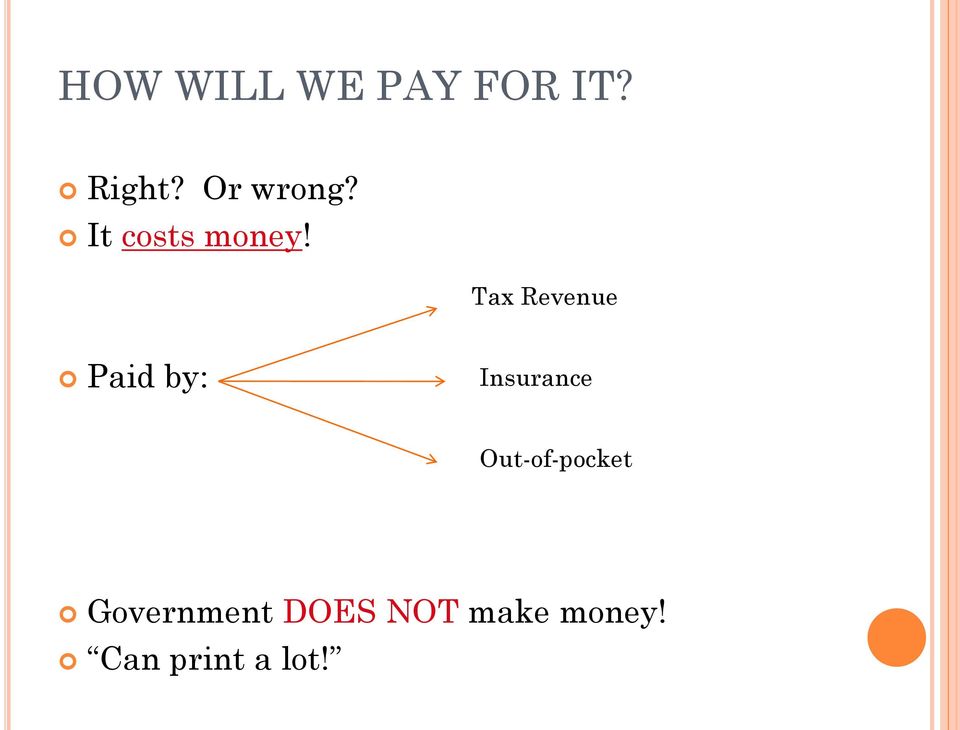
5 HOW WILL WE PAY FOR IT? Right? Or wrong? It costs money! Tax Revenue Paid by: Insurance Out-of-pocket Government DOES NOT make money! Can print a lot!
6 DIFFERENT HEALTHCARE MODELS Each nation s health care system is a reflection of its: History Politics Economy National values They all vary to some degree However, they all share common principles There are four basic health care models around the world

7 1. THE BISMARCK MODEL Germany, Japan, France, Belgium, Switzerland, Japan, and Latin America Named for Prussian chancellor Otto von Bismarck, inventor of the welfare state Characteristics: Providers and payers are private Private insurance plans financed jointly by employers and employees through payroll deduction The plans cover everyone and do not make a profit Tight regulation of medical services and fees (cost control)

8 2. THE BEVERIDGE MODEL Named after William Beveridge inspired Britain s NHS Great Britain, Italy, Spain, Cuba, and the U.S. Department of Veteran Affairs Characteristics: Healthcare is provided and financed by the government, through tax payments There are no medical bills Medical treatment is a public service Providers can be government employees Lows costs b/c the government controls costs as the sole payer This is probably what Americans have in mind when they think of socialized medicine

9 3. THE NATIONAL HEALTH INSURANCE MODEL Canada, Taiwan, South Korea Characteristics: Providers are private Payer is a government-run insurance program that every citizen pays into; has considerable market power to negotiate lower prices National insurance collects monthly premiums and pays medical bills Plans tend to be cheaper and much simpler administratively than American-style insurance Can control costs by: (1) limiting the medical services they will pay for or (2) making patients wait to be treated

10 4. THE OUT-OF-POCKET MODEL Rural regions of Africa, India, China, and South America no-system countries Characteristics: Only the rich get medical care; the poor stay sick or die Most medical care is paid for by the patient, out-of-pocket No insurance or government plan

11 COMMON PRINCIPLES OF ALL MODELS Coverage Coverage for every resident (old or young, rich or poor) Moral principle of all developed countries except for US Every country rations care not everything is covered! Quality Other developed countries produce better quality results than U.S. Cost All other systems are cheaper than in the US Foreign employers pay far less for health coverage than US companies Effect? Choice Many countries offer greater choice than most Americans have
12 BUSINESS MODEL FOR US HEALTHCARE Too expensive! Mediocre outcomes Inadequate & inequitable access Profit seeking Wasteful? Harmful? Bottomless expectations of patients and physicians We are not getting our money s worth!
13 UNITED STATES HEALTH SYSTEM COVERAGE Richest country in the world Many Americans do not get the care they need Ranked last of 23 developed nations in providing universal care (Commonwealth Fund) 45 million (15% of population) have no health insurance Millions are underinsured Not curing people with curable diseases? Risk of financial ruin due to medical bills Medical bankruptcy is a unique American problem 60% of bankruptcies are a result of medical bills Approximately 700,000 Americans/year
14 MEASURING QUALITY IOM uses the following measures: Safe Effective Efficient Timely Patient-centered Equitable
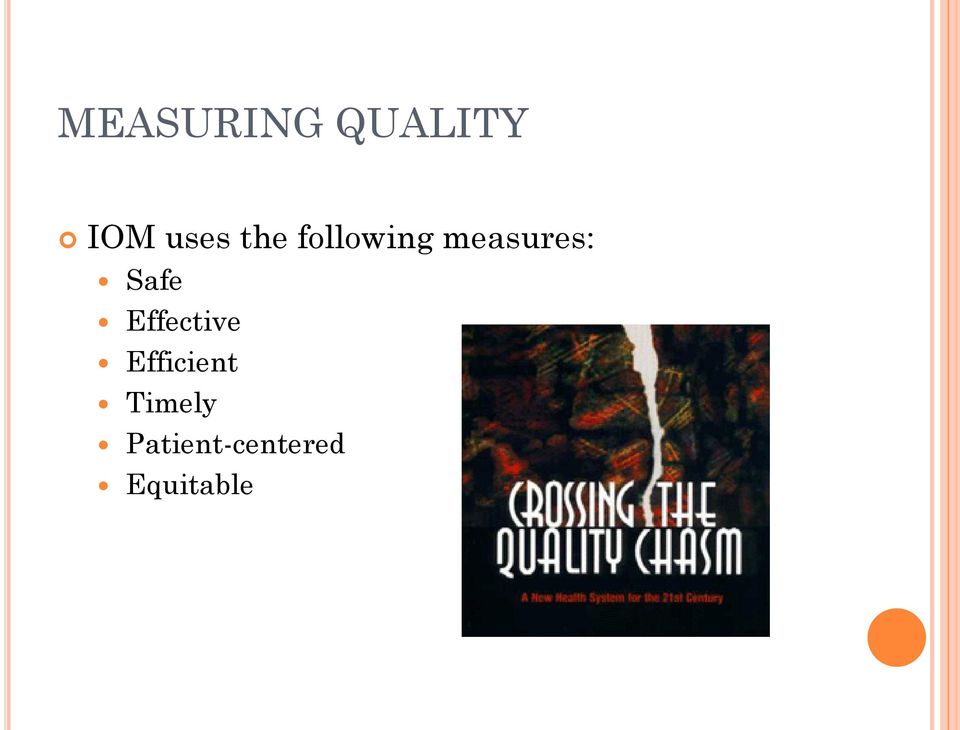
15 U.S. HEALTHCARE SYSTEM QUALITY Spend the most on healthcare Some of the poorest health outcomes US lags other rich countries in treating curable diseases Ranked last in infant mortality rate

16 AMERICA S CHECKUP The quality of care varies widely among sex, race, age, and region
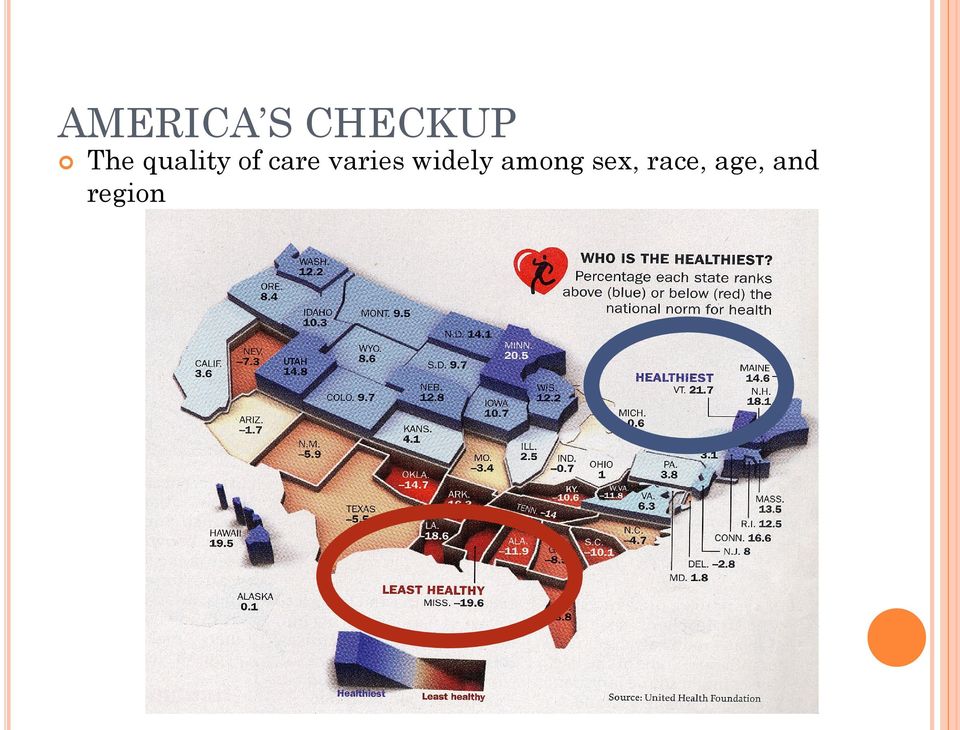
17 US QUALITY RANKINGS Ranked 37 th in list of 192 countries (WHO) Ranks 66 th out of 100 on a scorecard assessing efficiency, equality, and access (Commonwealth Fund Commission) Outlier in health spending and information technology (OECD) Estimated 44 to 98,000 deaths/year from medical errors (IOM, 1999)

18 COMMONWEALTH FUND COMMISSION Ranks last compared with 5 other nations on measures of quality, access, efficiency, equity and outcomes Germany Britain Australia Canada New Zealand All provide better care for less money

19 EMERGENCY MEDICAL TREATMENT AND ACTIVE LABOR ACT (EMTALA) Understaffed Overwhelmed Long wait Overcrowded Specialists refuse to take ER call Frequent diversion of ambulance the emergency services are in need of life support. Healthcare access for all in the U.S.

20 UNITED STATES HEALTH SYSTEM COST Largest spender on health care health care 16% of GDP 2.3 trillion in 2007 What does it get us? Why so high? Providers make more money High malpractice insurance THE WAY WE MANAGE HEALTH INSURANCE AND THE COMPLEXITY OF OUR HEALTH SYSTEM Only country that relies on profit-making health insurance companies!!! Private insurance industry has the world s highest administrative costs of any health care payer in the world We have the most fragmented health care system in the world

21 THIS IS OUR REAL THREAT! - Growing cost of federal spending on entitlement
22 COST COMPARISON: OECD COUNTRIES 1990 TO 2005 USA: % % OECD: % %
23 The Honorable David M. Walker, Comptroller General of the USA SAVING OUR FUTURE REQUIRES TOUGH CHOICES TODAY Our single largest domestic policy challenge is healthcare The truth is, our nation s healthcare system is in critical condition. It s plagued by growing gaps in coverage, soaring costs, and below average outcomes for an industrialized nation on basic measures like error rates, infant mortality and life expectancy.
24 GREAT BRITAIN Insured 100% of population insured Spending 7.5% of GDP Funding Single payer system funded by general revenues (National Health System); operates on huge deficit Private Insurance 10% of Britons have private health insurance Similar to coverage by NHS, but gives patients access to higher quality of care and reduce waiting times Physician Compensations Most providers are government employees
25 GREAT BRITAIN Physician Choice Patients have very little provider choice Copayment/Deductibles No deductibles Almost no copayments (prescription drugs) Waiting Times Huge problem Benefits Covered Offers comprehensive coverage Terminally ill patients may be denied treatment
26 CANADA Insured Single payer system 100% insured Each province must make insurance: Funding Universal (available to all) Comprehensive (covers all necessary hospital visits) Portable (individuals remain covered when moving to another province) Accessible (no financial barriers, such as deductible or copayments) Federal government uses revenue to provide a block grant to the provinces (finances 16% of healthcare) The remainder is funded by provincial taxes (personal and corporate income taxes) Spending 9% of GDP Private Insurance At one time all private insurance was prohibited; changed in 2005 Many private clinics now offer services on the black market
27 CANADA Physician Compensation Physicians work in private practice Paid on a fee-for-service basis These fees are set by a centralized agency; makes wages fairly low Physician Choice Referrals are required for all specialist services except the ED Copayment/Deductibles Generally no copayments or deductibles Some provinces do charge insurance premiums Waiting Times Long waiting lists Many travel to the U.S. for healthcare
28 FRANCE Insured About 99% of population covered Cost 3 rd most expensive health care system 11% of GDP Funding 13.55% payroll tax (employers pay 12.8%, individuals pay 0.75%) 5.25% general social contribution tax on income Taxes on tobacco, alcohol and pharmaceutical company revenues Private Insurance more than 92% of French residents have complementary private insurance These funds are loosely regulated (less than U.S.); the only requirement is renewability These benefits are not equally distributed (creates a two-tiered system)
29 FRANCE Physician Compensation Providers paid by national health insurance system based on a centrally planned fee schedule fees are based on an upfront treatment lump sum (similar to DRGs in US) However, doctors can charge whatever they want The patient or the private insurance makes up the difference Medical school is free Legal system is fairly tort averse Physician Choice Fair amount of choice in the doctors they choose Copayment/Deductible 10% to 40% copayments Waiting Times Very little waiting lists/times Technology Government does not reimburse new technologies very generously Little incentive to make capital investments in medical technology
30 GERMANY Insured 99.6% of population sickness funds Those with higher incomes can buy private insurance The federal gov. decides the global budget and which procedures to include in the benefit package Funding Sickness funds are financed through a payroll tax (avg. 15% of income) The tax is split between the employer and employee Private insurance 9% of Germans have supplemental insurance; covers items not paid for by the sickness funds Only middle- and upper-class can opt out of sickness funds Physician Compensation Reimbursement set through negotiation with the sickness funds Providers have little negotiating power Very low compensation Significant reimbursement caps and budget restrictions
31 GERMANY Copayment/Deductibles Almost no copayments or deductibles Technology Low technology compared to U.S. Waiting Times WHO reported that waiting lists and explicit rationing decisions are virtually unknown Benefits Covered There is an extensive benefit package which even includes sick pay (70% to 90% of pay) for up to 78 weeks
32 JAPAN Insured Universal health insurance based around a mandatory, employment-based insurance The Employee Health Insurance Program requires that all companies with 700 or more employees to provide workers with health insurance Small business workers join a government-run small business national health insurance plan The self-employed and the retired are covered by Citizens Insurance Program administered by municipal governments Costs Not as high as U.S.; average household spends $2300 per year on out-of-pocket costs Japans have a healthy lifestyle lower incidence of disease Funding 8.5% (large business) or an 8.2% (small business) payroll tax Payroll taxes are split almost evenly between employer and employee Those who are self-employed or retired must pay a self-employment tax Private Insurance Very rare for Japanese to use this; less than 1%
33 JAPAN Physician Compensation Hospital physicians are salaried Non-hospital physicians are paid on a fee-for-service basis Hospitals and clinics are privately owned but the government sets the fee schedule Physician Choice No restrictions on physician or hospital choice No referral requirements Copayment/Deductibles Copayments are 10% to 30% Capped at $677 per month for the average family Technology High levels of technology; comparable to U.S. Waiting Times Significant problem at the best hospitals b/c they cannot charge higher prices
34
35 Comparison of Global Healthcare by Rand Corporation
36 UNIVERSAL LAWS OF HEALTHCARE SYSTEMS No matter how good the healthcare in a particular country people will complain about it No matter how much money is spent on healthcare, the doctors and hospitals will argue that it is not enough The last reform always failed - Tsung-mei Cheng, an American economist
37 5 MYTHS ABOUT HEALTH CARE AROUND THE WORLD 1. It s all socialized medicine out there Many countries provide universal coverage using private providers, hospitals and insurance plans 2. Overseas, care is rationed through limited choices or long lines some truth. 3. Foreign health systems are inefficient, bloated bureaucracies 4. Cost control stifles innovation False. This pressure to control cost can generate innovation 5. Health insurance companies have to be cruel Insurance plans in other countries accept all applicants Cannot deny on the presence of a preexisting condition Cannot cancel as long as you pay your premium
38 U.S. HEALTHCARE: COST DRIVERS Drugs and devices Defensive medicine Demands Patient related Physician related---? Fee for service! Administrative costs Market driven healthcare
39 COST MANAGEMENT Evidence based medicine Use of protocol and guidelines Reduction of administrative costs Managing demand Management of chronic diseases Promotion of healthier living Tort Reform Use of HIT Uniformity of Healthcare
40 What is good about our system? US is responsible for more than 53% of Drug Research Dollars Best Medical Education and Training in the World Eight of the top 10 medical Advances in the past 20 years was developed in the US Nobel Prizes in Medicine have been awarded to more Americans than to researchers in all other countries combined Eight of the 10 top-selling drugs are made in the US We have the highest breast, colon, and prostate cancer survival rates in the world
41 Life is not about waiting for the storms to pass it s about learning to dance in the rain! -Vivian Greene Thank You
Health & Government Module 5 i2p Expedition India
 Health & Government Module 5 i2p Expedition India National Emblem of India : Emblem i2p Expedition India India 2011 1 Take Home Points The United Nations has declared access to basic health care a human
Swe den Structure, delive ry, administration He althcare Financing Me chanisms and Health Expenditures Quality of Bene fits, C hoice, Access
 Sweden Single payer, universal healthcare system, with 21 county councils as the primary payer (reimburser) Administration of healthcare plan is decentralized in the hands of the county councils Central
Single Payer Systems: Equity in Access to Care
 Single Payer Systems: Equity in Access to Care Lynn A. Blewett University of Minnesota, School of Public Health The True Workings of Single Payer Systems: Lessons or Warnings for U.S. Reform Journal of
Improved Medicare for All
 Improved Medicare for All Quality, Guaranteed National Health Insurance by HEALTHCARE-NOW! Single-Payer Healthcare or Improved Medicare for All! The United States is the only country in the developed world
Improved Medicare for All
 Take Action: Get Involved! The most important action you can take is to sign up for Healthcare-NOW! s email list, so you can stay connected with the movement and get updates on organizing efforts near
Comparative Health Care Systems. Folland et al Chapters 22
 Comparative Health Care Systems. Folland et al Chapters 22 Chris Auld Economics 317 March 23, 2012 Health Care Systems. There are many different forms of health care delivery in place in different countries.
Health Care Systems: An International Comparison. Strategic Policy and Research Intergovernmental Affairs May 2001
 Health Care Systems: An International Comparison Strategic Policy and Research Intergovernmental Affairs May 21 1 Most industrialized countries have established hybrid systems in which the public sector,
Comparison of Healthcare Systems in Selected Economies Part I
 APPENDIX D COMPARISON WITH OVERSEAS ECONOMIES HEALTHCARE FINANCING ARRANGEMENTS Table D.1 Comparison of Healthcare Systems in Selected Economies Part I Predominant funding source Hong Kong Australia Canada
Econ 149: Health Economics Problem Set IV (Extra credit) Answer Key
 Econ 149: Health Economics Problem Set IV (Extra credit) Answer Key 1. Your utility function is given by U = ln(4c), where C is consumption. You make $30,000 per year and enjoy jumping out of perfectly
BARACK OBAMA S PLAN FOR A HEALTHY AMERICA:
 BARACK OBAMA S PLAN FOR A HEALTHY AMERICA: Lowering health care costs and ensuring affordable, high-quality health care for all The U.S. spends $2 trillion on health care every year, and offers the best
Health Care Challenges for the 21 st Century
 Health Care Challenges for the 21 st Century Between 1992 and 2002, overall health care spending rose from $827 billion to about $1.6 trillion; it is projected to nearly double to $3.1 trillion in the
2019 Healthcare That Works for All
 2019 Healthcare That Works for All This paper is one of a series describing what a decade of successful change in healthcare could look like in 2019. Each paper focuses on one aspect of healthcare. To
Waiting times and other barriers to health care access
 Dr. Frank Niehaus Wissenschaftliches Institut der PKV (Scientific Research Institute of the Association of German Private Health Insurers) Waiting times and other barriers to health care access 31.8 %
A CONSUMERS GUIDE TO INDIVIDUAL HEALTH INSURANCE IN ARIZONA
 A CONSUMERS GUIDE TO INDIVIDUAL HEALTH INSURANCE IN ARIZONA Published by the Arizona Department of Insurance Janet Napolitano, Governor Charles R. Cohen, Director of Insurance August 2003 1 Table of Contents
- 2 - Chart 2. Annual percent change in hourly compensation costs in manufacturing and exchange rates, 2010-2011
 For release 10:00 a.m. (EST) Wednesday, December 19, 2012 USDL-12-2460 Technical Information: (202) 691-5654 [email protected] www.bls.gov/ilc Media Contact: (202) 691-5902 [email protected] INTERNATIONAL
Health Systems: Type, Coverage and Financing Mechanisms
 Health Systems: Type, Coverage and Mechanisms Austria Belgium Bulgaria (2007) Czech Republic Denmark (2007) Estonia (2008). Supplementary private health Complementary voluntary and private health Public
PHYSICIANS. 202.420.7896 888 16 th St. NW, Suite 800, Washington DC 20006 www.npalliance.org
 N A T I O N A L PHYSICIANS A L L I A N C E My name is Dr. Valerie Arkoosh. I am an Anesthesiologist at the University of Pennsylvania School of Medicine and the President of the National Physicians Alliance.
How To Get Health Care In The United States
 The Commonwealth Fund 2013 International Health Policy Survey in Eleven Countries Robin Osborn and Cathy Schoen The Commonwealth Fund November 2013 The Commonwealth Fund 2013 International Health Policy
Bismarck, Beveridge and The Blues
 Bismarck, Beveridge and The Blues The Paul H. Nitze School of Advanced International Studies Bologna, Italy October 14, 2010 Lloyd B. Minor, M.D. Provost and Senior Vice President for Academic Affairs
Reflecting changes from 2010 health reform laws. Health Insurance Buyer s Guide Five Steps to Buying Your Own Health Insurance
 Health Insurance Buyer s Guide Five Steps to Buying Your Own Health Insurance Reflecting changes from 2010 health reform laws Individual and Family Health Insurance Introduction When you purchase a health
Senate Bill No. 2 CHAPTER 673
 Senate Bill No. 2 CHAPTER 673 An act to amend Section 6254 of the Government Code, to add Article 3.11 (commencing with Section 1357.20) to Chapter 2.2 of Division 2 of the Health and Safety Code, to add
Social insurance, private insurance and social protection. The example of health care systems in some OECD countries
 Social insurance, private insurance and social protection. The example of health care systems in some OECD countries References OECD publications on Health care Swiss Re publications Sigma No 6/2007 on
INTERNATIONAL COMPARISONS OF HOURLY COMPENSATION COSTS
 For release 10:00 a.m. (EST) Tuesday, March 8, 2011 USDL-11-0303 Technical Information: (202) 691-5654 [email protected] www.bls.gov/ilc Media Contact: (202) 691-5902 [email protected] INTERNATIONAL COMPARISONS
How To Understand Medical Service Regulation In Japanese
 Overview of Medical Service Regime in Japan 75 years or older 10% copayment (Those with income comparable to current workforce have a copayment of 30%) 70 to 74 years old 20% copayment* (Those with income
What can China learn from Hungarian healthcare reform?
 Student Research Projects/Outputs No.031 What can China learn from Hungarian healthcare reform? Stephanie XU MBA 2009 China Europe International Business School 699, Hong Feng Road Pudong, Shanghai People
The American Healthcare System
 The American Healthcare System By David M. Cutler Otto Eckstein Professor of Applied Economics at Harvard University and Member of the Institute of Medicine America is the largest, most diverse society
NAHU. The Three Myths of a Single-Payer Healthcare Delivery System
 NAHU The Three Myths of a Single-Payer Healthcare Delivery System A Single-Payer System Could Be Closer Than You Think This year, an unprecedented number of universal coverage initiatives were debated
A Journey to Improve Canada s Healthcare System
 A Journey to Improve Canada s Healthcare System The Quest Can a public/private hospital system coexist and thrive and improve Canada s system? The Journey Visited Australia and New Zealand to find out
Health Care in Crisis
 Health Care in Crisis The Economic Imperative for Health Care Reform James Kvaal and Ben Furnas February 19, 2009 1 Center for American Progress Health Care in Crisis U.S. spends twice as much per capita
Health Care in America: Who Do We Really Care About?
 PREPARED TEXT Presented to The Dominican Friars Health Care Ministry of New York Of Saint Catherine of Siena Church and Priory Third Annual Lecture in Catholic Health Care Ethics October 20, 2008 Sr. Carol
HR-676 (also known as single-payer)
 HR-676 (also known as single-payer) If HR-676 were to become law, Steamfitters Local 475 would most likely pay substantially less money for our welfare coverage. We are currently paying $9.73 per hour.
Short-Term Disability Insurance
 Short-Term Disability Insurance Developed for the class 1 Employees of Research Triangle Institute Protecting Your Family Securing Your Future As long as you've got your health. If you're physically healthy,
Health Care in Rural America
 Health Care in Rural America Health care in rural communities has many aspects access to physicians, dentists, nurses, and mental health services; the financial circumstances of rural hospitals; federal
SWECARE FOUNDATION. Uniting the Swedish health care sector for increased international competitiveness
 SWECARE FOUNDATION Uniting the Swedish health care sector for increased international competitiveness SWEDEN IN BRIEF Population: approx. 9 800 000 (2015) GDP/capita: approx. EUR 43 300 (2015) Unemployment
THE HEALTH CARE SYSTEMS OF GERMANY AND SWITZERLAND. Merely slouching towards Regulated Competition
 WWS 597 Reinhardt THE HEALTH CARE SYSTEMS OF GERMANY AND SWITZERLAND Merely slouching towards Regulated Competition SOCIAL INSURANCE WITH PRIVATE PURCHASING THE FINANCING OF HEALTH CARE OWNERSHIP OF PROVIDERS
LONG-TERM DISABILITY. Table of Contents. Page i SUMMARY PLAN DESCRIPTION
 For this plan year, the plan includes the following provisions, subject to change or discontinuation with or without notice at any time. This Summary Plan Description presents an overview of your Benefits.
Key Features of the Affordable Care Act, By Year
 Page 1 of 10 Key Features of the Affordable Care Act, By Year On March 23, 2010, President Obama signed the Affordable Care Act. The law puts in place comprehensive health insurance reforms that will roll
China. Old Age, Disability, and Survivors. China. Exchange rate: US$1.00 = 6.78 yuan. Regulatory Framework. Coverage. Qualifying Conditions
 China Exchange rate: US$1.00 = 6.78 yuan. Old Age, Disability, and Survivors First law: 1951. Current laws: 1953 (regulations); 1978, 1995, 1997, 1999, and 2005 (directives); and 2009 (guideline on rural
Private and Public Health Insurance in Germany Current Status, Future Priorities and Strategic Targets
 Private and Public Health Insurance in Germany Current Status, Future Priorities and Strategic Targets Dr. Marc-Pierre Möll Head of Unit Government and Parliament Association of Private Health Insurance,
Voluntary Short-Term Disability Insurance
 Voluntary Short-Term Disability Insurance 817763 a 06/12 Developed for the Employees of Marion County - Oregon Protecting Your Family Securing Your Future As long as you've got your health. If you're physically
Introduction... Distinctive Features of the Benefits Environment... Key Changes in Recent Years...
 Table of Contents Introduction... Distinctive Features of the Benefits Environment... Key Changes in Recent Years... 2 3 4 Statutory/Mandatory Programs... 5... 5 Retirement Benefits... 6 Death Benefits...
Medigap Insurance 54110-0306
 Medigap Insurance Overview A summary of the insurance policies to supplement and fill gaps in Medicare coverage. How to be a smart shopper for Medigap insurance Medigap policies Medigap and Medicare prescription
Senate-Passed Bill (Patient Protection and Affordable Care Act H.R. 3590)**
 Prevention and Screening Services Cost-sharing Eliminates cost sharing requirements for requirements for all preventive services (including prevention and colorectal cancer screening) that have a screening
Health Insurance A GUIDE TO UNDERSTANDING, GETTING AND USING HEALTH INSURANCE. The. HL-14-001 Rev. 08/2015
 A GUIDE TO UNDERSTANDING, GETTING AND USING HEALTH INSURANCE The of Health Insurance wahealthplanfinder.org 1-855-WAFINDER 1-855-923-4633 HL-14-001 Rev. 08/2015 THE ABC S OF HEALTH INSURANCE: WHY IS HEALTH
Short-Term Disability Insurance
 Short-Term Disability Insurance 817763 a 06/12 Developed for the Employees of Lake County Board of County Commissioners Protecting Your Family Securing Your Future As long as you've got your health. If
On the Front Line: Primary Care Doctors Experiences in Eleven Countries
 On the Front Line: Primary Care Doctors Experiences in Eleven Countries Findings from the Commonwealth Fund 12 International Health Policy Survey of Primary Care Physicians and Health Affairs article,
Skilled Nursing Facility Coinsurance Part A Deductible Part B. Part B Excess (100%) Foreign Travel Emergency. Foreign Travel Emergency
 Montana OLD SURETY LIFE INSURANCE COMPANY 2014 ( effective 01/01/2014 ) Outline of Medicare Supplement Coverage Benefit Plans A and F Only are being offered by the company at this time. These charts show
Timeline: Key Feature Implementations of the Affordable Care Act
 Timeline: Key Feature Implementations of the Affordable Care Act The Affordable Care Act, signed on March 23, 2010, puts in place health insurance reforms that will roll out incrementally over the next
Why Does U.S. Health Care Cost So Much? (Part IV: A Primer on Medicare)
 December 12, 2008, 6:30 AM Why Does U.S. Health Care Cost So Much? (Part IV: A Primer on Medicare) By UWE E. REINHARDT Uwe E. Reinhardt is an economist at Princeton. Medicare, the federal health-insurance
North Carolina Institute for Early Childhood Professional Development HEALTH INSURANCE: INFORMATION AND TIPS FOR CHILD CARE EMPLOYEES AND EMPLOYERS
 North Carolina Institute for Early Childhood Professional Development HEALTH INSURANCE: INFORMATION AND TIPS FOR CHILD CARE EMPLOYEES AND EMPLOYERS Often times in the early care and education field we
IIB. ECONOMIC ISSUES IN THE PRESIDENTIAL CAMPAIGN
 Econ 1905: Government Fall, 2007 IIB. ECONOMIC ISSUES IN THE PRESIDENTIAL CAMPAIGN Topics I have identified include health care, international trade ( the global economy ), agricultural policy, and taxes,
PUBLIC VS. PRIVATE HEALTH CARE IN CANADA. Norma Kozhaya, Ph.D Economist, Montreal economic Institute CPBI, Winnipeg June 15, 2007
 PUBLIC VS. PRIVATE HEALTH CARE IN CANADA Norma Kozhaya, Ph.D Economist, Montreal economic Institute CPBI, Winnipeg June 15, 2007 Possible private contribution Possible private contribution in the health
The facts about rising health care costs Underlying medical costs drive growth
 Quality health plans & benefits Healthier living Financial well-being Intelligent solutions The facts about rising health care costs Underlying medical costs drive growth October 2012 00.03.966.1-L11 A
Stable and Secure Health Care for America: The Benefits of Health Insurance Reform: Table of Contents
 Stable and Secure Health Care for America: The Benefits of Health Insurance Reform: Table of Contents HEALTH INSURANCE CONSUMER PROTECTIONS... 1 STABLE AND SECURE HEALTH CARE FOR AMERICA... 2 HEALTH INSURANCE
PUBLIC & PRIVATE HEALTH CARE IN CANADA
 PUBLIC & PRIVATE HEALTH CARE IN CANADA by Norma Kozhaya, Ph.D. Economist, Montreal Economic Institute before the Canadian Pension & Benefits Institute Winnipeg - June 15, 2007 Possible private contribution
60M/55F subject to a minimum participation of 1 year.
 Prepared by TransGlobe Life. I SUMMARY Social Security Eligibility Retirement Age Contributions Retirement Labour Insurance Programme (LI) applies to companies with 5 or more staff above age 15 and under
The Evolution and Future of Social Security in Africa: An Actuarial Perspective
 w w w. I C A 2 0 1 4. o r g The Evolution and Future of Social Security in Africa: An Actuarial Perspective Presented by Members of the Actuarial Society of South Africa Social Security Committee Fatima
Health Care Systems: Efficiency and Policy Settings
 Health Care Systems: Efficiency and Policy Settings Summary in English People in OECD countries are healthier than ever before, as shown by longer life expectancy and lower mortality for diseases such
A CONSUMER'S GUIDE TO CANCER INSURANCE. from YOUR North Carolina Department of Insurance CONSUMER'SGUIDE
 A CONSUMER'S GUIDE TO from YOUR North Carolina Department of Insurance CONSUMER'SGUIDE IMPORTANT INFORMATION WHAT IS? Cancer insurance provides benefits only if you are diagnosed with cancer, as defined
LABORPARTY. Financing Just Health Care Labor Party Briefing Paper. Revised February 2002. Key Components of Just Health Care Financing
 LABORPARTY Financing Just Health Care Labor Party Briefing Paper Revised February 2002 The Labor Party proposes a national health insurance program for the United States that would provide universal coverage
How to be a smart shopper for Medigap Insurance
 info sheet Medicare is the basic federal health insurance for older persons and for younger people with disabilities. Because Medicare has gaps in coverage, many people also buy a Medigap policy to supplement
Long-Term Disability Insurance
 Long-Term Disability Insurance Developed for the class 1 Employees of Research Triangle Institute Protecting Your Family Securing Your Future As long as you've got your health. If you're physically healthy,