
The Technology, Media and Telecommunications Review
|
|
|
- Kelley Wright
- 10 years ago
- Views:
Transcription
1 The Technology, Media and Telecommunications Review Third Edition Editor John P Janka Law Business Research
2 The Technology, Media and Telecommunications Review third edition Reproduced with permission from Law Business Research Ltd. This article was first published in The Technology, Media and Telecommunications Review, 3rd edition (published in October 2012 editor John P Janka). For further information please [email protected] 2

3 The Technology, Media and Telecommunications Review Third Edition Editor John P Janka Law Business Research Ltd

4 The Law Reviews The Mergers and Acquisitions Review The Restructuring Review The Private Competition Enforcement Review The Dispute Resolution Review The Employment Law Review The Public Competition Enforcement Review The Banking Regulation Review The International Arbitration Review The Merger Control Review The Technology, Media and Telecommunications Review The Inward Investment and International Taxation Review The Corporate Governance Review The Corporate Immigration Review The International Investigations Review The Projects and Construction Review The International Capital Markets Review The Real Estate Law Review The Private Equity Review The Energy Regulation and Markets Review The intellectual property Review The asset management review THE PRIVATE WEALTH AND PRIVATE CLIENT REVIEW

5 Publisher Gideon Roberton business development manager Adam Sargent marketing managers Nick Barette, Katherine Jablonowska, Alexandra Wan publishing assistant Lucy Brewer editorial assistant Lydia Gerges production manager Adam Myers production editor Joanne Morley subeditor Caroline Rawson editor-in-chief Callum Campbell managing director Richard Davey Published in the United Kingdom by Law Business Research Ltd, London 87 Lancaster Road, London, W11 1QQ, UK 2012 Law Business Research Ltd Copyright in individual chapters vests with the contributors No photocopying: copyright licences do not apply. The information provided in this publication is general and may not apply in a specific situation. Legal advice should always be sought before taking any legal action based on the information provided. The publishers accept no responsibility for any acts or omissions contained herein. Although the information provided is accurate as of October 2012, be advised that this is a developing area. Enquiries concerning reproduction should be sent to Law Business Research, at the address above. Enquiries concerning editorial content should be directed to the Publisher [email protected] ISBN Printed in Great Britain by Encompass Print Solutions, Derbyshire Tel:

6 acknowledgements The publisher acknowledges and thanks the following law firms for their learned assistance throughout the preparation of this book: ABOU JAOUDE & ASSOCIATES LAW FIRM BAKER & MCKENZIE.WONG & LEOW Bing Hodneland Advokatselskap DA Castro, Barros, Sobral, Gomes Advogados CLEARY GOTTLIEB STEEN & HAMILTON LLP Deschamps y Asociados SC ELVINGER, HOSS & PRUSSEN ENS (EDWARD NATHAN SONNENBERGS) JONES DAY LATHAM & WATKINS LATHAM & WATKINS LLP LATHAM & WATKINS GAIKOKUHO JOINT ENTERPRISE McCarthy Tétrault LLP Mehmet GÜn & Partners MINTER ELLISON ROSCHIER ADVOKATBYRÅ AB ROSCHIER, ATTORNEYS LTD SAID AL SHAHRY & PARTNERS seth Dua & Associates i

7 Acknowledgements SHALAKANY LAW OFFICE Shay & Partners SNR DENTON & CO Uría Menéndez URÍA MENÉNDEZ PROENÇA DE CARVALHO WENGER PLATTNER YOON & YANG LLC ii

8 contents Editor s Preface List of Abbreviations...vii John P Janka... ix Chapter 1 Australia... 1 Anthony Lloyd, Paul Kallenbach and Paul Schoff Chapter 2 Brazil André Gomes de Oliveira, Renato Parreira Stetner and Tiago Franco da Silva Gomes Chapter 3 Canada Hank Intven and Grant Buchanan Chapter 4 Egypt Aly El Shalakany and Omar Sherif Chapter 5 European Union Maurits J F M Dolmans, Francesco Maria Salerno and Malik Dhanani Chapter 6 Finland Mikko Manner, Anna Haapanen and Vilhelm Schröder Chapter 7 France Myria Saarinen and Jean-Luc Juhan Chapter 8 Germany Laura Johanna Reinlein and Gabriele Wunsch Chapter 9 Hong Kong Simon Berry and Viola Jing Chapter 10 India Atul Dua, Rahul Goel and Anu Monga iii
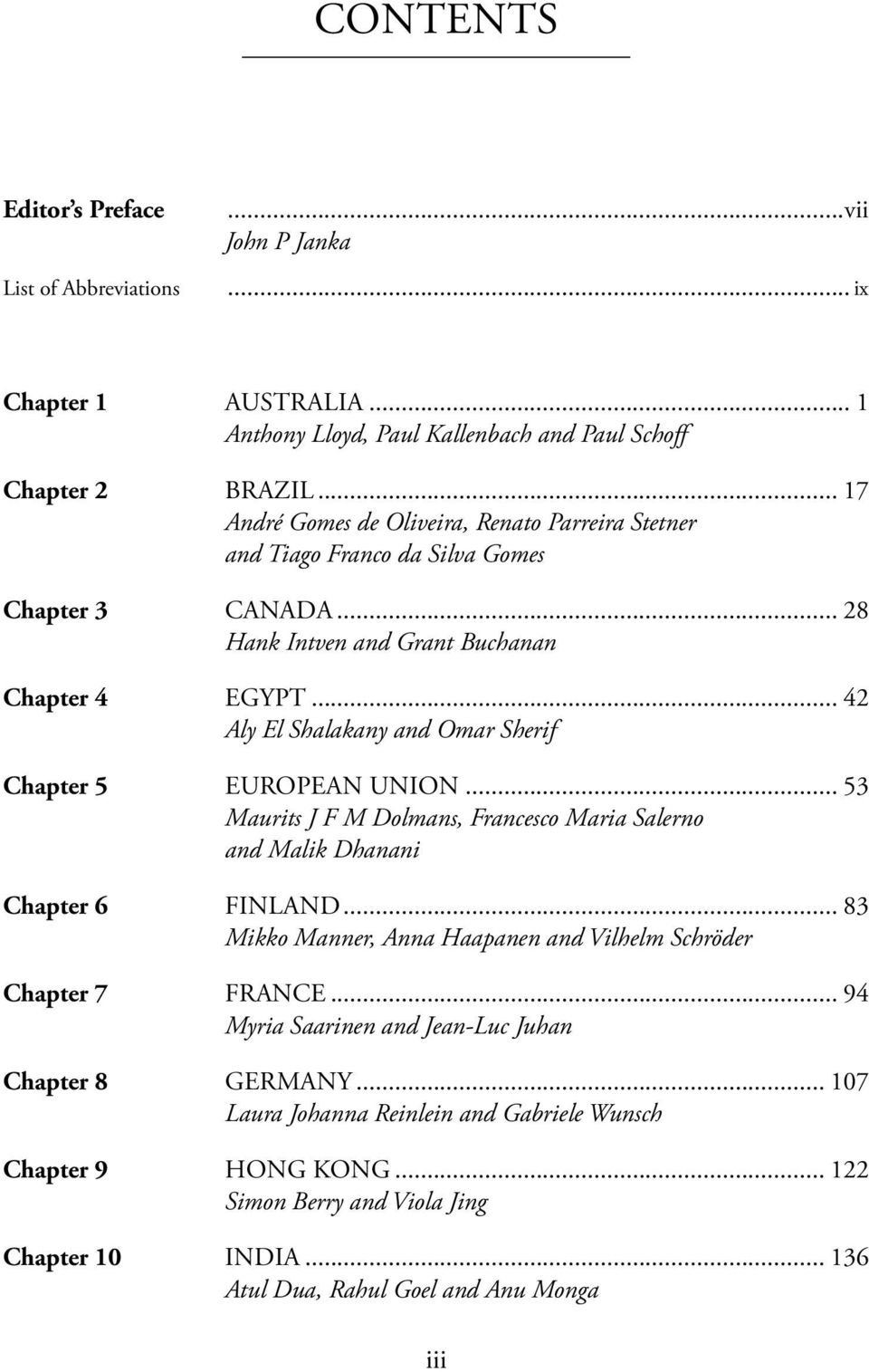
9 Contents Chapter 11 italy Stefano Macchi di Cellere Chapter 12 Japan Hiroki Kobayashi, Richard Fleming, Saori Kawakami and Chiyo Toda Chapter 13 Korea Wonil Kim and Kwang-Wook Lee Chapter 14 Lebanon Souraya Machnouk, Rania Khoury and Ziad Maatouk Chapter 15 Luxembourg Franz Fayot and Linda Funck Chapter 16 Mexico Jaime Deschamps Chapter 17 Norway Olav Torvund, Jon Wessel-Aas and Magnus Ødegaard Chapter 18 Oman Syed Ali Naveed Arshad and Stephen T Sayer Chapter 19 Portugal Joana Torres Ereio, Joana Mota and Raquel Maurício Chapter 20 Singapore Ken Chia and Koh See Khiang Chapter 21 South Africa Zaid Gardner Chapter 22 Spain Pablo González-Espejo and Leticia López-Lapuente Chapter 23 Sweden Erik Ficks and Björn Johansson Chapter 24 Switzerland Michael Isler iv

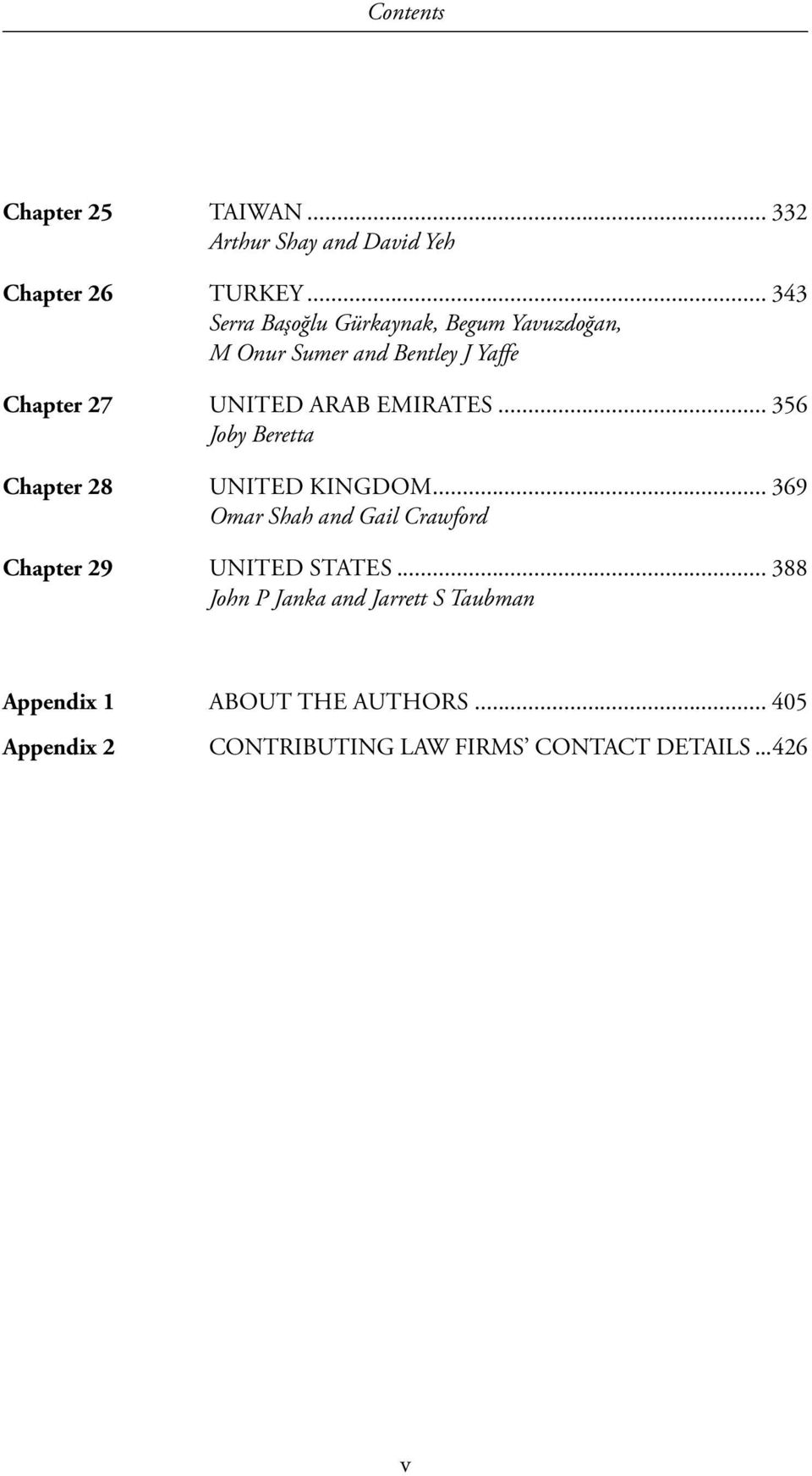
10 Contents Chapter 25 Taiwan Arthur Shay and David Yeh Chapter 26 Turkey Serra Başoğlu Gürkaynak, Begum Yavuzdoğan, M Onur Sumer and Bentley J Yaffe Chapter 27 United Arab Emirates Joby Beretta Chapter 28 United Kingdom Omar Shah and Gail Crawford Chapter 29 United States John P Janka and Jarrett S Taubman Appendix 1 about the authors Appendix 2 Contributing Law Firms contact details v
11 editor s preface The digital revolution continues to alter both local culture and the world in ways that few could have imagined when the seeds of the Internet were sown more than 40 years ago. The Internet allows ideas, news and other information to flow more freely than ever before, making it increasingly difficult for nations to control this flow at their geographical borders. Moreover, the Internet is forcing changes in many long-standing business models. It now serves for many as the preferred means of communication and media delivery, displacing or supplementing other means, such as traditional copper phone service, print media, subscription TV services and broadcast networks, in the process. The Internet now also serves as a new marketplace for goods and services, as well as a primary research tool for many. New technologies place into our hands more computing power than was used by astronauts when the Internet was in its infancy. The proliferation of these mobile devices smartphones and tablet computers leads many to employ texting, and blogging instead of communicating by the spoken word. We expect to have constant access to the networks that we use in this manner to stay in contact with our social circles and the rest of the world. And our most intimate thoughts are often now memorialised for the long term, in ways that can be potentially used by third parties for purposes we have not truly anticipated. The legal frameworks in many jurisdictions are now straining under these disruptive changes. The old adage that technology outpaces the law is more true today than ever. No doubt, the hands-off approach to the Internet that many lawmakers and regulators once took has facilitated many of these developments. At the same time, policymakers are now struggling with new types of concerns, as broadband Internet access service becomes more and more essential to our lives. Is the marketplace responding to the needs of consumers? Are broadband networks being deployed everywhere that they are needed? Are the capabilities of those networks adequate? If not, how should government ensure that none of its citizens is left behind? Is it appropriate for government to invest in broadband infrastructure in a manner similar to its historical investment in roads, vii

12 Editor s Preface bridges, and other critical infrastructure? Is it fair to liken broadband service to a utility, or does the state of competition make that an unfair analogy? Can government provide the best overall solution, or should it just fill in any infrastructure gaps not closed by commercial providers? Should government establish ground rules upfront, or should it intervene when it perceives that abuses of market power exist? How does government avoid skewing the competitive marketplace by (inadvertently or otherwise) preferring one type of technology over another and thus effectively picking the winners and losers who otherwise might emerge in the marketplace, and challenge the incumbents? Who are the new gatekeepers in the Internet broadband distribution chain, and is it enough to focus on regulating the network operators when others further up the chain, such as application service and equipment providers, have more influence than ever before on what information we access and how we access it? This expectation of instant and continuous mobile connectivity, and the development of bandwidth-intensive apps, create an increasing demand on the limited radio frequency spectrum asset. While digital technologies allow more efficient use of spectrum than ever before, the laws of physics still render some spectrum bands more valuable than others for mobile communications. The demand for wireless spectrum outstrips the supply in many markets, and regulators are increasingly being forced to refarm spectrum bands that were designated for other purposes before the mobile broadband revolution was a glimmer in anyone s eye. This third edition of The Technology, Media and Telecommunications Review provides an overview of the evolving legal constructs that govern these types of issues in 29 jurisdictions around the world. Although the authors cannot fully address each of these topics in the following articles, we hope this book provides a helpful framework for starting your analysis. John P Janka Latham & Watkins LLP Washington, DC September 2012 viii

13 list of abbreviations 3G 4G ADSL ARPU BIAP BWA CATV CDMA CMTS DAB DDoS DoS DSL DTH DTTV DVB DVB-H DVB-T ECN ECS EDGE FAC FBO FCL FTNS FTTC FTTH FTTN Third-generation (technology) Fourth-generation (technology) Asymmetric digital subscriber line Average revenue per user Broadband Internet access provider Broadband wireless access Cable TV Code division multiple access Cellular mobile telephone system Digital audio broadcasting Distributed denial-of-service Denial-of-service Digital subscriber line Direct-to-home Digital terrestrial TV Digital video broadcast Digital video broadcast handheld Digital video broadcast terrestrial Electronic communications network Electronic communications service Enhanced data rates for GSM evolution Full allocated historical cost Facilities-based operator Fixed carrier licence Fixed telecommunications network services Fibre to the curb Fibre to the home Fibre to the node ix
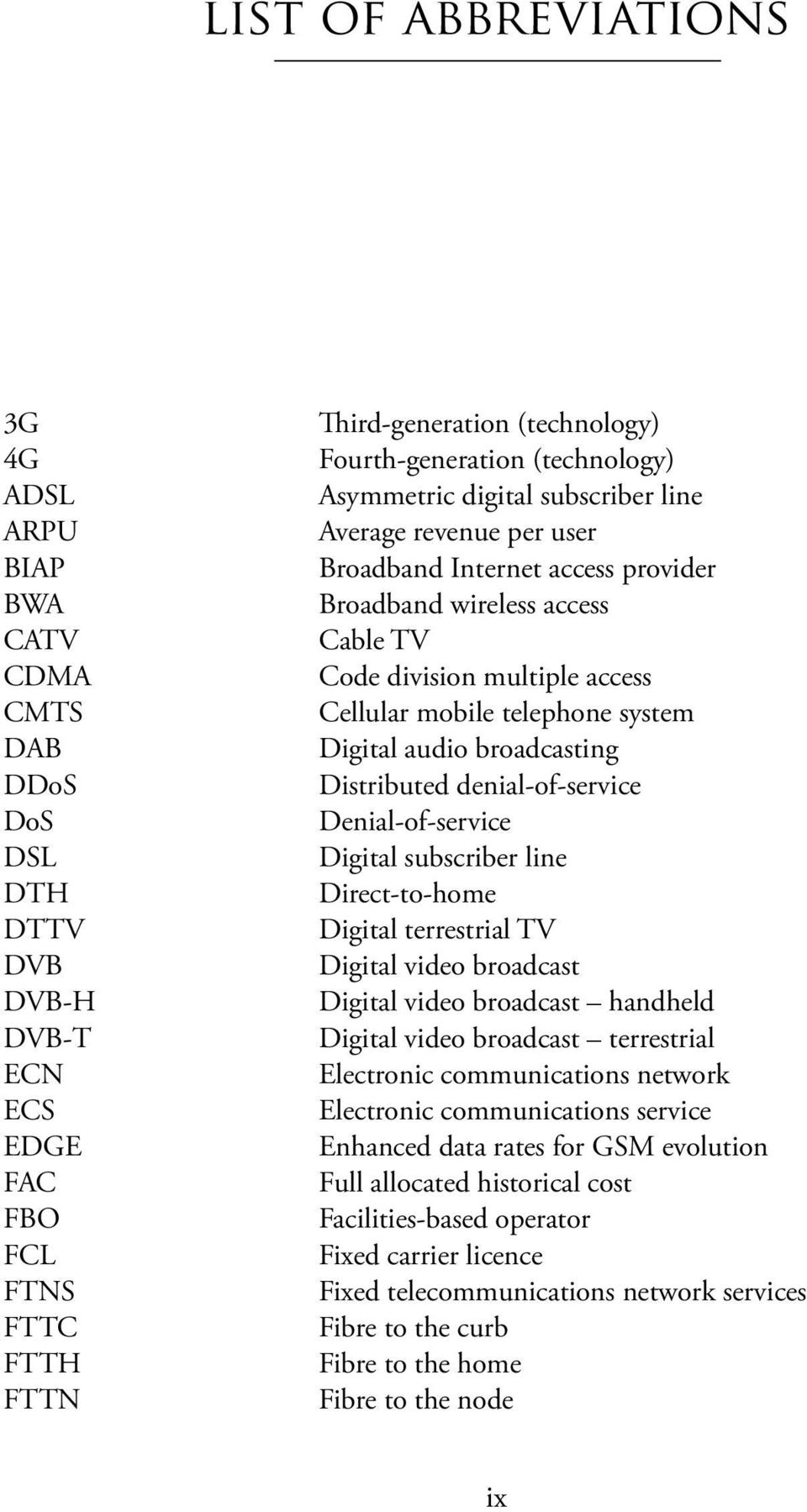
14 List of Abbreviations FTTx FWA Gb/s GB/s GSM HDTV HITS HSPA IaaS IAC ICP ICT IPTV ISP kb/s kb/s LAN LRIC LTE Mb/s MB/s MMDS MMS MSO MVNO MWA NFC NGA NIC NRA OTT PaaS PNETS PSTN RF SaaS SBO SMS STD PCOs UAS UASL UCL UHF UMTS USO Fibre to the x Fixed wireless access Gigabits per second Gigabytes per second Global system for mobile communications High-definition TV Headend in the sky High-speed packet access Infrastructure as a service Internet access provider Internet content provider Information and communications technology Internet protocol TV Internet service provider Kilobits per second Kilobytes per second Local area network Long-run incremental cost Long Term Evolution (a next-generation 3G and 4G technology for both GSM and CDMA cellular carriers) Megabits per second Megabytes per second Multichannel multipoint distribution service Multimedia messaging service Multi-system operators Mobile virtual network operator Mobile wireless access Near field communication Next-generation access Network information centre National regulatory authority Over-the-top (providers) Platform as a service Public non-exclusive telecommunications service Public switched telephone network Radio frequency Software as a service Services-based operator Short message service Subscriber trunk dialling public call offices Unified access services Unified access services licence Unified carrier licence Ultra-high frequency Universal mobile telecommunications service Universal service obligation x
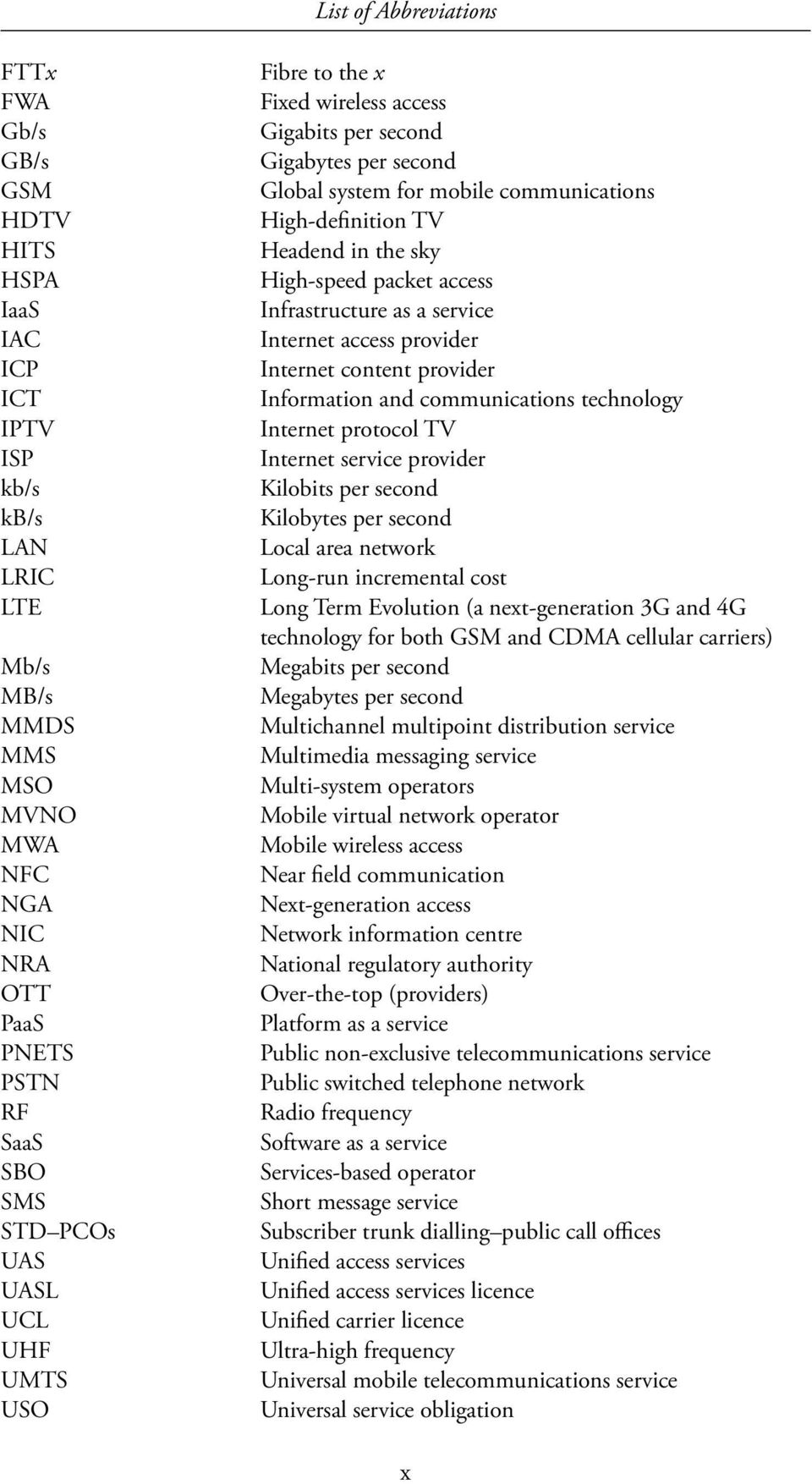
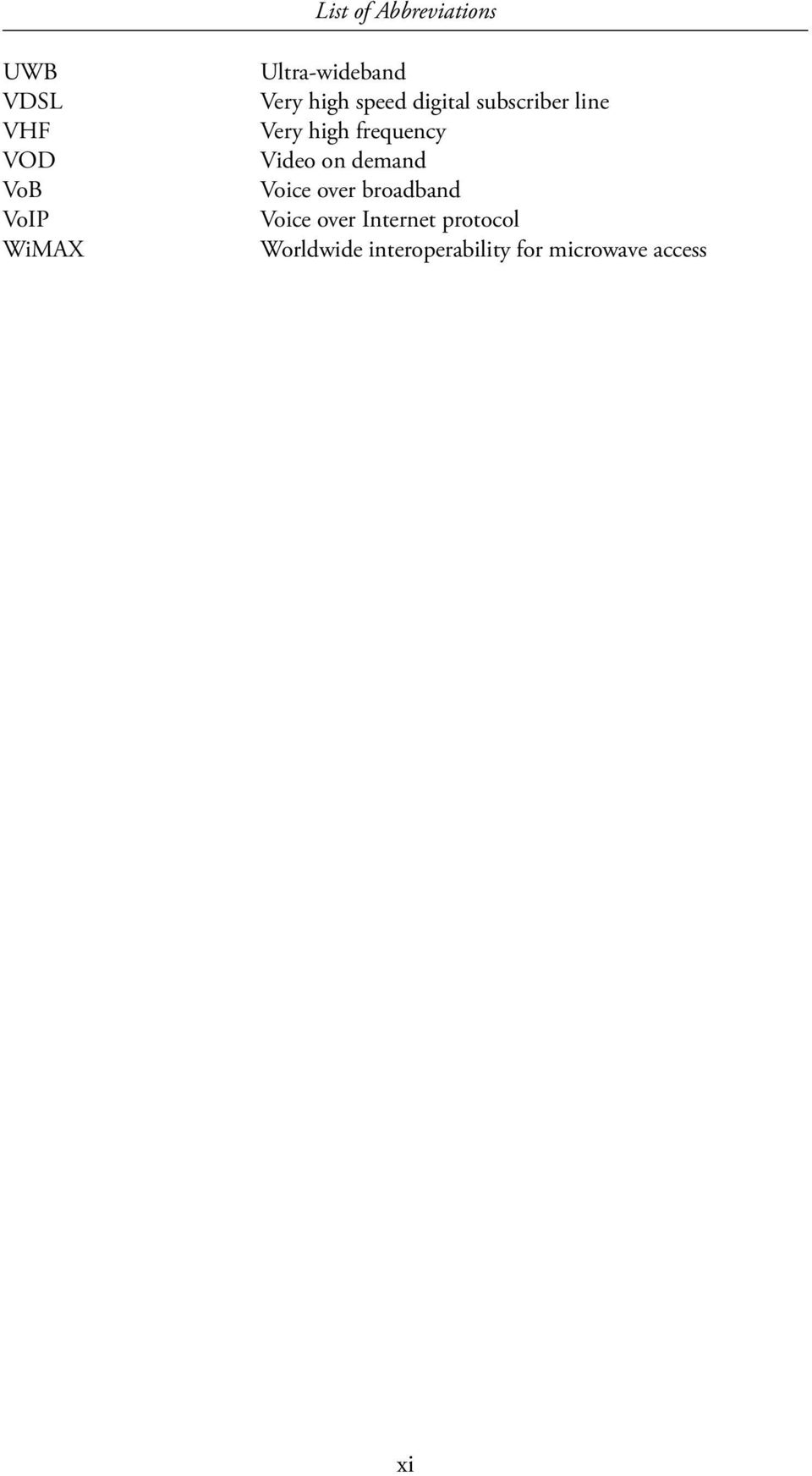
15 List of Abbreviations UWB VDSL VHF VOD VoB VoIP WiMAX Ultra-wideband Very high speed digital subscriber line Very high frequency Video on demand Voice over broadband Voice over Internet protocol Worldwide interoperability for microwave access xi
16 Chapter 24 Switzerland Michael Isler 1 I Overview Fast-moving convergence of technologies and contents of electronic communications is setting the pace for the evolution of the regulatory landscape in Switzerland. Less than two years ago, the Swiss government still denied a need to adapt the legislative framework accordingly. However, in a supplementary analysis published in March 2012, the Swiss government ( the Federal Council ) concluded that the current regulatory instruments were insufficient to cope with emerging technological trends. In particular, the insufficient access regulation is likely to be converted into a technology-neutral and more interventionist framework. This will not prevent the incumbent telecommunications service provider (Swisscom) from continuing to successfully mark a dominant presence in future-proof technologies and services. Its stake in the wired access network, revitalised by the current rush for FTTH deployment, is just one example of this. The municipal utility companies have been more or less forced into cooperation with Swisscom, and the coaxial cable network operators remain remarkably passive in that field. The most obvious effect of convergence in the electronic media, apart from the quadruple play (fixed and mobile voice services, Internet connection and IPTV) meanwhile offered by all major carriers, is the legislative project to replace the current public funding system of national and regional radio and television programme services with a ubiquitous levy on households and enterprises. At present, the scheme is based on charges applied on traditional receivers. 1 Michael Isler is a senior associate at Wenger Plattner. 318

17 Switzerland II REGULATION i The regulators The regulatory authority for the Swiss telecommunications market is the Communications Commission ( ComCom ), as established by virtue of Articles 56 et seq. of the Swiss Federal Telecommunications Act ( the TCA ). 2 The most prominent powers of ComCom include the granting of licences for the use of mobile radio frequencies, 3 the award of the universal service licences, 4 and the decision on disputes among operators regarding access conditions to their network infrastructure. 5 Detailed implementing regulations are laid down in the Ordinance on Telecommunications Services ( the OTS ). 6 The Federal Office of Communications ( OFCOM ) is seconded to ComCom. OFCOM maintains the register of telecommunications service providers, 7 manages the radio frequency spectrum 8 and assumes some ancillary tasks delegated to it by ComCom. Further, OFCOM is the surveillance authority on telecommunications installations and supports ComCom in its fact-finding and decision-making processes. At the juncture of telecommunications and antitrust regulation, the Competition Commission ( ComCo ) comes into play, acting on the basis of the Swiss Federal Act on Cartels and other Restraints on Competition ( the CartA ). 9 As a general rule, there is no hierarchy between the two regulatory regimes, but if the dominant position of a service provider is contested in the context of an access dispute, ComCom must seek ComCo s opinion. 10 Further, intervention by ComCo requires a coercive behaviour by a dominant competitor, which is absent in cases where disputes on commercial interconnection terms may be brought before ComCom. 11 Such repartition of competences may result in a total absence of regulatory intervention where interconnection needs between operators networks are mutual and none of the involved parties is interested in adjudication, as has been the case in the field of mobile termination fees. The CartA is currently in the process of being substantially revised, especially with respect to the institutional setup. Broadcasting, processing, transmission and reception of radio and television programme services are governed by the Swiss Federal Act on Radio and Television ( the RTVA ) 12 and the corresponding ordinance ( the RTVO ) (available in English). 3 Article 24a of the TCA. 4 Article 14 of the TCA. 5 Article 11a of the TCA. 6 (available in English). 7 Article 4 of the TCA. 8 Article 25 of the TCA. 9 (available in English). 10 Article 11a of the TCA. 11 Federal Court of Justice, 11 April 2011, 137 II 199, p. 213, cons. 5.4 et seq. (Federal Department of Economic Affairs v. Swisscom) (available in English) (available in English). 319

18 ii Regulated activities Switzerland The provision of telecommunications services requires prior notification to OFCOM. 14 Enterprise and other non-public communications services are not qualified as telecommunications services. 15 Article 3 of the OTS exempts certain providers from the notification duty, among foreign operators entrusting termination of their connections in Switzerland to other notified providers. On the other hand, MVNOs are considered as telecommunications service providers even if they do not operate their own core network infrastructure. 16 The use of the radiocommunications frequency spectrum 17 (see Section IV.iv, infra) and the provision of universal service 18 (see Section III.ii, infra) are further subject to a licence granted by ComCom in a public tender process. Broadcasting of Swiss radio or television programme services requires a notification to OFCOM. 19 The broadcasting of radio or television programmes by wireless terrestrial means is subject to a licence awarded by the Federal Department of the Environment, Transport, Energy and Communications ( DETEC ), 20 which is subject to an annual fee. 21 As a general rule, licences are publicly tendered, but the authority enjoys a great margin of discretion in the selection of candidates. iii Ownership and market access restrictions The Swiss telecommunications market is open to domestic and foreign providers alike, and the entry threshold is rather low. Apart from the notification to OFCOM pursuant to Article 4 of the TCA, the service providers must have sufficient technical capabilities and comply with the regulatory framework. 22 Last, the granting of a radiocommunications licence must not eliminate or seriously impair competition. 23 Natural or legal persons holding a licence for the broadcasting of Swiss radio and television programmes must be incorporated in Switzerland, and applicants under full or partial foreign ownership may in principle be excluded; further, the maximum number of licences that may be acquired by the same entity or group is limited to two radio and two television licences Article 4 of the TCA. 15 Article 2 of the OTS. 16 OFCOM: Guide to the Registration Form for Providing Telecommunications Services, p. 4, available in English at html?lang=en. 17 Articles 22 et seq. of the TCA. 18 Articles 14 et seq. of the TCA. 19 Article 3 of the RTVA. 20 See Article 45 of the RTVA. 21 Article 22 of the RTVA. 22 For details, see Articles 6 and 47 of the TCA. 23 Article 23 of the TCA. 24 Article 44 of the RTVA. 320

19 iv Switzerland Transfers of control and assignments Merger control in Switzerland is governed by Articles 9 et seq. of the CartA. Planned concentrations of undertakings must be pre-notified to ComCo if certain financial thresholds are met. 25 They will be scrutinised if a preliminary assessment, to be completed within one month, 26 reveals that they create or strengthen a dominant position. 27 In principle, the in-depth investigation must be completed within four months. 28 Transfer of licences for universal service 29 and the use of radiocommunications frequency spectrum 30 require ComCom s prior consent. This also applies to the economic transfer of the licence, which occurs when a company has acquired control of a licensee in accordance with the CartA 31. Pursuant to Article 48 of the RTVA, licences for radio or television programme services are transferable only with prior approval by the licensing authority (DETEC). This also applies if more than 20 per cent of the capital or voting rights in the licensee are being transferred (economic transfer). DETEC may refuse approval within three months of receipt of notification. III TELECOMMUNICATIONS and INTERNET ACCESS i Internet and Internet protocol regulation Telecommunications services are defined as wired or wireless sending or receiving of information for third parties by means of electrical, magnetic, optical or other electromagnetic signals. 32 Given said technology-neutral conception, the regulatory regime in Switzerland has proven capable of absorbing the emergence of IP-based voice and data services irrespective of the contents of the transmission and the access or transport networks used. VoIP services featuring freedom of connection (freedom of connection being defined as the guaranteed transmission of speech between two connection points in the network) and allowing for transmission of speech in real time are qualified as public telephone services and are subject to a variety of additional functional and quality requirements. 33 Some technical shortcomings of VoIP services as against traditional telephony have been tackled by the regulator in a rather pragmatic manner. As an example, if correct routing of emergency calls and the identification of subscriber s location is technically not possible for every location, it is to be guaranteed only for 25 Article 9 of the CartA. 26 Article 32 of the CartA. 27 Article 10 of the CartA. 28 Article 33 of the CartA. 29 Articles 14 et seq. of the TCA. 30 Articles 22 et seq. of the TCA. 31 Articles 19a and 24d of the TCA. 32 Article 3 of the TCA. 33 Articles 26a et seq. of the OTS. 321

20 Switzerland calls stemming from the main location of the subscriber as specified in the subscription contract. 34 Further, the chapter of the TCA dealing with addressing resources 35 also applies to the allocation and management of second level domain names under the national country code top-level domain (.ch). The corresponding domain names are managed by the private foundation Switch, which accomplishes its tasks under the surveillance of OFCOM by virtue of an administrative agreement valid until 31 March 2015 and Article 28 of the TCA as implemented by Articles 14 et seq. of the Ordinance on Addressing Resources in the Telecommunications Sector. 36 The Swiss Confederation also submitted an application with ICANN for the attribution of a new generic top-level domain (.swiss). ii Universal service By virtue of Article 14 of the TCA, ComCom periodically grants one or more universal service licences in order to ensure a nationwide universal service. The present universal licence was awarded to Swisscom in June 2007 and expires at the end of The current scope encompasses a public telephone service, wired broadband Internet connectivity, access to emergency services, public telephones in sufficient numbers and access to the Swiss directories of subscribers. 37 The obligation imposed on the carrier to provide nationwide wired broadband Internet access is unique in Europe and reaches 98 per cent of the Swiss population. As of March 2012, the prescribed minimum throughput increased to 1,000/100kb/s compared with 600/100kb/s originally foreseen. The price level in Switzerland though is still remarkably high compared with neighbouring countries. 38 For the first time, Switzerland assumes the peak position within the OECD when it comes to wired broadband penetration, which got to 40 per cent by the end of 2011 based on preliminary data. When looking at actually available bandwidths, however, there is still room for improvement. Wireless broadband subscriptions are currently increasing in double-digit iterations each year, resulting in a penetration rate of 53 per cent by the end of 2011, which is, however, still mediocre compared with other OECD countries. All mobile carriers have adopted plans to invest in the expansion of their network capacities through HSPA+ and LTE over the next couple of years in order to cope with the growing demand for mobile broadband. The deployment of high-speed broadband optical-fibre networks is on the investment agenda of private undertakings, municipalities and utility companies alike. 34 Article 30 of the OTS. 35 Articles 28 et seq. of the TCA (not available in English). 37 Article 16 of the TCA. 38 See the conclusions of the Federal Price Supervisor in its comparative price analysis for internet access in Switzerland and neighbouring countries of 27 October 2011, admin.ch/themen/00019/00024/index.html?lang=de (not available in English). 322

21 Switzerland At present, the share of FTTH subscriptions is still marginal. Initially utility companies advocated for a single-fibre model, while Swisscom aimed at joining forces and strongly preferred the implementation of a multi-fibre solution. In order to facilitate a coordinated deployment of FTTH and avoid investments in redundant infrastructure, a round table was called upon in 2008 on the initiative of ComCom. Its main achievement was the adoption of a multi-fibre FTTH model as standard in October The round table was dissolved in January 2012 saying it had achieved its goals. Swisscom made the most of its competitive advantage given its already existing optical-fibre backbone and FTTN network and conquered all major cities, either as sole supplier or in cooperation with local power utility companies. Other forms of deployment, such as by coaxial cable operators refurbishing their own cable ducts, are confined to rural areas except for one exception (Lausanne). Whenever semi-governmental entities are involved in FTTH deployment, the projects are usually subsidised by the local government. The contract terms of several FTTH joint ventures between municipal power utility companies and Swisscom had been notified to ComCo, which initiated a preliminary investigation in accordance with Article 26 of the CartA. ComCo identified three main provisions that, in its opinion, were potentially impairing competition: 39 a the resale of layer 1 connectivity (i.e., access to the physical network infrastructure by competitors) was exclusively reserved to the power utility companies; b the resale of layer 1 connectivity by the power utilities was subject to a minimum threshold price in order to protect the investments made by Swisscom; and c a transfer payment was due if the usage degree by either of the contracting parties exceeded a certain percentage not commensurate with the originally agreed repartition of investments. As a reaction to ComCo s preliminary assessment, the involved parties amended the agreements in line with the regulators recommendations. Another regional cooperation model involving Swisscom that envisaged the formation of a joint venture company was converted into a contractual cooperation due to numerous objections by ComCo. 40 iii Restrictions on the provision of service Retail markets Telecommunications service providers are in principle free to determine their retail prices. An exception is made for the holder of the universal service licence (see Section III.ii, supra), which prescribes, inter alia, a ceiling on the charges for establishing and running a wired telephone and Internet connection and the price of national calls to 39 COMCO: Glasfaser St Gallen, Zürich, Bern, Luzern, Basel, 5 September 2011, Recht und Politik des Wettbewerbs (RPW), 2012/2, pp , index.html?lang=de (not available in English). 40 COMCO: FTTH Freiburg, 16 February 2012, Recht und Politik des Wettbewerbs (RPW), 2012/2, pp , (not available in English). 323
22 Switzerland fixed-network connections. 41 The maximum price for a broadband Internet connection (including a voice channel) was lowered from 69 to 55 Swiss francs per month in March In addition, value-added services are subject to the price ceilings set out in Article 39 of the OTS. Further, certain transparency rules are laid down in Articles 10 et seq. of the OTS and Articles 11a et seq. of the Ordinance on the Publication of Prices, 42 including a requirement to alert mobile phone users upon establishment of an internetwork call if the prices charged are higher than the intra-network call rates. In case of international roaming, subscribers must be informed free of charge of the costs of the most frequently used roaming services. In cases of abusive prices applied by dominant undertakings beyond the scope of application of Article 7 of the CartA, the Federal Price Supervisor may intervene on the basis of the Swiss Federal Price Supervision Act. 43 Contrary to the must-carry obligations imposed upon cable operators as per Article 59 of the RTVA for electronic media programme services (see Section V.i, infra) telecommunications service providers are not obliged to treat transported packet data on a non-discriminatory basis. Arguably, network neutrality must be ensured within the scope of the universal service licence. 44 The recently published supplementary report on the telecommunications market (see Section VII, infra) seizes the discussion and proposes to evaluate the introduction of transparency and non-discrimination duties on carriers. Wholesale markets On the level of the wholesale market, access services and corresponding pricing is exhaustively governed by Articles 11 et seq. of the TCA and Articles 51 et seq. of the OTS. Pursuant to Article 11 of the TCA, telecommunications service providers having a dominant position are required to provide access to other providers for the following facilities and services: a b c fully unbundled local loop (copper line only); fast bitstream access to the local loop (restricted to four years from the time of effective availability of a nationwide offering meeting the legal requirements in order to afford competitors time to establish a fully unbundled access); interconnection, consisting of the following minimum service portfolio: origination; termination and transit of calls; identification of the calling and the connected line and suppression thereof; access to value-added services provided by 08xx and 09xx numbering; and physical connection between operators network infrastructure as necessary for the connection of services; 41 Article 22 of the OTS (not available in English) (not available in English). 44 Simon Schlauri and Michael Vlcek, Netzneutralität Eine Analyse mit Schwerpunkt auf dem geltenden Schweizer Kartell- und Telekommunikationsrecht, sic!, 2010, pp , p
23 Switzerland d e f rebilling for fixed network local loops; leased lines; and cable ducts. Network access must be granted by dominant providers at cost-based prices in a transparent and non-discriminatory manner. If the involved service providers cannot agree on conditions of access within three months, ComCom renders a decision on one party s application (Article 11a of the TCA). The concept of ex post regulation has led to lengthy proceedings in all areas of access services, the incumbent provider thereby frequently contesting its (apparent) dominant position. An important milestone was achieved in spring 2012 when the Federal Administrative Court confirmed ComCom s obligation imposed upon Swisscom to offer nationwide technology-neutral basic access to leased lines encompassing all available bandwidths. 45 Swisscom wanted to restrict its offer to copper lines with a maximum bandwidth of 2Mb/s. The recent technological developments have brought dynamics into the methods of price calculation for access services. Pursuant to Article 54 of the OTS, the calculation of such prices is based on the replacement costs for a new network on the basis of the most recent available functionally equivalent technology (modern equivalent assets doctrine). 46 ComCom, in a decision handed down on 7 December 2011, purported to determine interconnection and access prices on the basis of replacement costs for NGN and optical-fibre technology starting from This new approach would have had a mitigating effect on access pricing given the price erosion on new technologies. Since, however, the Federal Council announced a revision of Article 54 of the OTS in the meantime that may become effective during the course of 2013, ComCom in July 2012 abolished its plans. iv Security The Federal Council s strategy for an information society adopted in 1998 and updated twice (2006 and 2012) 47 identifies three priorities of governmental policy in the field of ICT security: promotion of security literacy, protection from cybercrime, and increase of integrity and resilience of critical ICT infrastructure. Personal data of natural persons and legal entities are protected by virtue of the Federal Act on Data Protection 48 and the telecommunications secrecy enshrined in Article 43 of the TCA. The telecommunications secrecy provides that no person entrusted with providing tasks pertaining to telecommunications services may disclose information relating to subscribers communications or give anyone else the opportunity to do so. The range of addressees of the telecommunications secrecy is very broad and does not 45 Federal Administrative Court, 28 February 2012, A-2969/2010 (Swisscom v. Colt Telecom Services) and 22 March 2012, A-2970/2010 (Swisscom v. Sunrise Communications). 46 Endorsed by Federal Administrative Court, 8 April 2011, A-300/2010 (Sunrise Communications v. Swisscom) (available in English) (available in English). 325
24 Switzerland only encompass telecommunications service providers as such, but all stakeholders that are active in the delivery of telecommunications services, including any auxiliaries. The telecommunications secrecy not only forbids disclosure of communications content (including peripheral data) to third parties, but also the interception of such content by the addressees of the telecommunications secrecy themselves, subject to the following limitative exemptions: a lawful interception; b filtering of malicious content causing damage to the telecommunications network (viruses, etc.) and unsolicited mass advertising; 49 and c processing of peripheral data for billing and debt collection purposes. The prerequisites and means of lawful interception of voice and data communications are set out in the Federal Act on the Surveillance of Postal and Telecommunications Traffic ( the SPTT ) 50 and the corresponding ordinance ( the SPTTO ). 51 The latter was revised for the first time in 10 years, with effect 1 January 2012, in order to take account of new technological developments and to comply with the prerequisites of the Budapest Convention, 52 thereby partially anticipating the incumbent revision process of the SPTT itself. Prior to the revision of the SPTTO, the surveillance of Internet traffic lacked sufficient legal basis. The first proposal of the SPTTO amendment embraced any kind of Internet application providers (e.g., instant messaging service platforms) and encountered harsh criticism. In the version as eventually adopted, the obligation to provide the technical means for lawful interception is imposed on Internet access providers only. 53 Internet access providers do, however, need to envisage the surveillance of the following internet applications: synchronic (e.g., instant messaging) and asynchronous (e.g., ) electronic communications, and telecommunications services based on digital media. 54 The transitional period for IAPs to procure the necessary technical installations expires on 31 December Mere Internet application providers (such as Skype or social media platforms) on the other hand are completely exempt from the SPTTO s scope of application. 56 Rules aiming at the protection of children and consumers are scattered over the OTS and UCA. Pursuant to Article 41 of the OTS, telecommunications service 49 Article 45a of the TCA and Article 83 of the OTS in conjunction with Article 3 of the Swiss Federal Act against Unfair Competition, the UCA : (not available in English) (not available in English) (not available in English). 52 Council of Europe Convention on Cybercrime of 23 November 2001, which entered into force in Switzerland on 1 January Article 26 of the SPTTO. 54 Article 24 of the SPTTO. 55 Article 36b of the SPTTO. 56 Exhaustive coverage of all revision points is provided in Simon Schlauri, Fernmeldeüberwachung à discretion?, sic!, 2012, pp
25 Switzerland providers are bound to bar access of minors under the age of 16 to erotic or pornographic value-added services. Article 3 of the UCA combats unfair mass advertisement (spam) roughly in the same way as Article 13 of the European Directive on Privacy and Electronic Communications. 57 Complementary thereto, Article 83 of the OTS obliges telecommunications service providers to bar unfair mass advertising, as far as the state of technology permits. As of 1 April 2012, Article 3 of the UCA also provides for imprint and other transparency obligations in e-commerce and sanctions cold calls. IV SPECTRUM POLICY i Development The radio frequency spectrum is managed by OFCOM and subject to an annual frequency allocation plan to be approved by the Federal Council. 58 The frequency allocation plan also sets out the national frequency spectrum strategy, which endorses the principle of moving further away from the command and control principle towards market-controlled instruments of frequency allocation, more flexibility and neutrality in terms of technology and services, paired with the possibility of acquiring frequencies on the secondary market without regulatory intervention. ii Flexible spectrum use The demand for greater flexibility in spectrum use is recognised by the regulator as the driving force in frequency spectrum management, however not at the price of interference with adjacent frequency bands. Inband interference on the other hand may be tolerated, particularly where coexistence of different systems can be achieved by technical means. The current spectrum use policy and envisaged strategies are laid down in the national frequency allocation plan. 59 iii Broadband and next-generation mobile spectrum use In the field of mobile radio communication, Switzerland is committed to adhering to the frequency bands to be harmonised at a European level. Given the trend of HDTV reception via cable and satellite, the relevance of terrestrial broadcasting of digital television is decreasing rapidly, leading to the possibility of freeing up the corresponding frequency band ( Mhz) for mobile radio in the nearer future ( Digital Dividend 2, as resolved by the World Radiocommunication Conference 2012). For spectrum efficiency reasons, digital audio broadcasting will further coexist with DAB and DAB+ in the same frequency band. Hence, Switzerland may be inclined to open parts of the frequency band reserved for broadcasting to other services (including public mobile radio), provided that European harmonisation goes in the same direction. 57 Directive 2002/58/EC, as amended. 58 Article 25 of the TCA, html?lang=en (available in English). 59 See footnote 58, supra. 327
26 iv Spectrum auctions and fees Switzerland As a rule, radiocommunications licences are granted on the basis of a public invitation to tender. 60 In November 2010, ComCom resolved to auction at the same time the free mobile radio frequencies (2.6GHz) and those that were to become available by 2014 (GSM) and 2017 (UMTS) respectively, including the former broadcasting frequencies in the 800MHz band constituting the Digital Dividend. This band will be used for the deployment of the LTE standard, although the terms of the frequency spectrum licences do not prescribe the transmission technology to be used. The auction was postponed once and eventually took place in February 2012 between the three existing mobile carriers Swisscom, Sunrise Communications and Orange Switzerland, resulting in proceeds amounting to million Swiss francs. Sunrise Communications bears almost half of the price without having acquired a particularly advantageous frequency spectrum to justify the high cost. Immediately after the auction, ComCom changed the rules and offered the licensees the option to pay the auction price in several instalments, subject to an interest rate of 3 per cent. This behaviour sheds a dubious light on the regulator otherwise emphasising at every occasion that the service providers needed planning reliability. As eventually none of the bidders filed a complaint with the Federal Administrative Court, the awards became final and binding in July V MEDIA i Restrictions on the provision of service The mere transmission of radio and television programmes by means of telecommunications techniques is regulated in accordance with the provisions of the TCA. The respective radio frequency licences are awarded without charging a fee. 61 All other regulatory aspects are governed by the RTVA. Media oversight is split between OFCOM and the Independent Complaints Authority ( the ICA ). OFCOM makes sure that the general legal requirements and licence terms are being complied with, 62 and complaints pertaining to programme content are handled by the ICA. 63 The complaint procedure before the ICA is compulsorily preceded by a report to the ombudsman service established pursuant to Article 91 of the RTVA. The national broadcaster (Swiss Broadcasting Corporation) finally enjoys special treatment in many respects. 64 Content, advertising and sponsoring of radio and television programmes must comply with the following main requirements: 60 Article 24 of the TCA. 61 Article 39 of the TCA. 62 Article 86 of the RTVA. 63 Article 94 of the RTVA. 64 Articles 23 et seq. of the RTVA. 328
27 Switzerland a respect of fundamental rights and fairness; 65 b protection of young people through choice of transmission time or other measures; 66 c identifiability of advertising; 67 and d bans on advertising and limitations on interstitials and sponsoring. 68 Further, minimum quota for Swiss or other European works apply to broadcasters of national and regional-language television programmes. 69 Must-carry rules apply on cable operators reaching at least 100 households with respect to the radio and television programmes of the following groups of broadcasters: 70 a Swiss Broadcasting Corporation (SRG SSR); b Swiss broadcasters vested with a performance mandate according to Chapter 3 of the RTVA; c foreign broadcasters transmitting programmes in a Swiss national language and fulfilling certain content-related criteria, as laid-down in Article 52 of the RTVO and its annex; and d any broadcaster operating in a niche and serving a specific public interest, subject to prior application to OFCOM and sufficient capacity. ii Digital switchover The transition from analogue to digital transmission led to the cut-off of numerous television programmes through the analogue cable networks. The trend was noticeable since 2006 and received a new boost upon the emergence of HDTV requiring additional transmission capacity. In March 2012, the Federal Court of Justice (FCJ) dismissed a complaint by UPC Cablecom against OFCOM s ruling to transmit the youth channel Joiz under the must-carry rules pursuant to Article 60 of the RTVA for a period of three years. As a consequence thereof, the carrier was enjoined to reinsert the programme into its analogue portfolio. 71 The technical convergence of Internet and broadcasting further led to an initiative to revise the RTVA. Under the current public funding scheme, each owner of a receiver is obliged to notify the fee collection agency thereof and to pay a reception fee. 72 The increasing availability of multifunctional devices has stretched the categories of receivers under the legacy system to an extent hardly compatible with the rule of law, and widespread deficiencies in enforcement further undermine compliance by the 65 Article 4 of the RTVA. 66 Article 5 of the RTVA. 67 Article 9 of the RTVA. 68 Articles 9 to 13 of the RTVA. 69 Article 7 of the RTVA, as further specified in Article 5 of the RTVO. 70 Articles 59 et seq. of the RTVA. 71 Federal Court of Justice, 22 March 2012, 2C_790/2011 (UPC Cablecom v. Joiz). 72 Article 68 of the RTVA. 329
28 Switzerland general public. According to the proposal, fees shall be charged per household and per undertaking, irrespective of ownership of a receiver. iii Internet-delivered video content The simultaneous and unmodified retransmission of television programmes requires prior permission by the collecting society Suissimage in accordance with Article 22 of the Federal Copyright Act ( the FCA ). 73 The retransmission of electronic media programmes over cable in general or over IP-based networks on mobile devices or PCs in particular is subject to official charges laid down in judicially enforceable collective tariffs approved by the Federal Commission on the Exploitation of Copyrights and Neighbouring Rights. The leasing or sale of set-top boxes, including virtual video recorders, featuring a copying and storage function, is also subject to a collective tariff. The collecting societies and broadcasters are increasingly worried about the ever more extended replay TV functions, which, in their opinion, are stretching far beyond what is covered by the private use exemption pursuant to Article 19 of the FCA. Mere downloading and streaming of video content for private use without the right owners authorisation is not illegal under Swiss copyright law. The Federal Council in a report issued in November 2011 rejected the necessity for legislative action in that respect. 74 VI THE YEAR IN REVIEW The past 12 months were earmarked by the eagerly awaited judgment of the Federal Court of Justice concerning Google s Street View service. 75 The FCJ mitigated the overly strict ruling of the Federal Data Protection and Information Commissioner, which was confirmed by the Federal Administrative Court in first instance, and tolerated a small percentage of permissible flaws in Google s blurring software. Strict depersonalisation is mandatory, though, in the neighbourhood of sensitive institutions such as prisons or hospitals. It appears that the court struck the right balance given that both parties expressed their reserved satisfaction with the outcome. In the telecommunications sector, France Télécom successfully closed the sale of Orange Switzerland. After having prohibited the merger with Sunrise Communications in 2010, ComCo eventually tacitly approved the target s acquisition by Apax Partners LLP in February 2012 following a preliminary assessment. Orange Switzerland is now a wholly owned subsidiary of Matterhorn Mobile, a corporation domiciled in Luxembourg and controlled by Apax managed funds; the brand Orange continues to be used. More recently, Swisscom announced its plan to acquire a majority stake in Telecom Liechtenstein, the national operator of the Principality of Liechtenstein. The completion of the mobile radio spectrum auction (see Section IV.iv, supra) and ComCo s 73 (not available in English). 74 Bericht des Bundesrates zur unerlaubten Werknutzung über das Internet, fileadmin/user_upload/urheberrecht/d/bericht_savary_d.pdf (not available in English). 75 Federal Court of Justice, 31 May 2012, 1C_230/2011 (Google v. FDPIC ). 330
29 Switzerland intervention in the current optical-fibre deployment activities (see Section III.ii, supra) are also of note. Last, the mobile operators have rediscovered the competitive edge of a dedicated mobile network infrastructure, and talks on possible network sharing between Orange Switzerland and Sunrise Communications ended last year. More anecdotally, the Swiss Broadcasting Corporation and (print) media publishing houses are trapped in a fierce battle regarding the extent that the national broadcaster is permitted to tailor its online news portal. Since it was impossible to achieve a settlement, the Federal Council handed down a ruling on 14 September 2012 greatly favouring the publishing houses. VII CONCLUSIONS and OUTLOOK In the aftermath of the Swiss Federal Council s publication of a report on the evaluation of the Swiss telecommunications market on 17 September 2010, 76 a supplementary report 77 was published on 28 March 2012 on parliamentary initiative. While in the initial conclusion despite identified shortcomings a need for a revision of the regulatory framework had been denied, the approach was reversed only 18 months later. On a motion of the Federal Council, OFCOM is currently in the process of preparing a partial revision of the TCA. It is expected that the legislative proposal will, inter alia, promote a technology-neutral unbundling of the access networks (currently this is confined to the copper line) and aim to expedite the effect of regulatory interventions in interconnection disputes (currently dominant competitors are subject to ex post regulation only). Having said this, legislation in the sector is unpredictable in Switzerland, with the TCA and the RTVA to name a few being subject to a revision process. Moreover, the asset valuation method for access service pricing is under review and will most likely spark a new wave of interconnection disputes. Whatever the outcome of all these legislative projects, their impact on the competitive landscape in the telecommunications market is likely to be marginal. The prohibition of the Sunrise/Orange merger by ComCo in April 2010 prevented the formation of a strong challenger of the incumbent provider. Also, the successful occupation of new market opportunities by Swisscom, such as through its optical-fibre rollout initiative, may reinforce Swisscom s leading position in the wired access market of the future. It seems that the competitors have dealt well with the situation, most of them still generating sustainable profits despite a modest market share. An upside of the relatively comfortable situation in the absence of fierce price competition is the emphasis on network quality and performance, particularly in the mobile sector. In the electronic media domain, regional radio channels are doing well, but Switzerland is and will remain too small for a private national television programme next to the national broadcaster to survive under the current regulatory landscape. Hence, competition is mainly stimulated by foreign channels, which absorb an astonishing 37 per cent of all TV advertising revenue through dedicated Swiss commercial blocks (available in English). 77 See footnote 76, supra. 331
30 Appendix 1 about the authors Michael Isler Wenger Plattner Michael Isler is a senior associate with Wenger Plattner, practising in the firm s Basel and Zurich offices in the fields of ICT, intellectual property and unfair competition law. He was educated at the Universities of Zurich and Louvain and also holds a doctoral degree from the University of Lucerne. Prior to joining Wenger Plattner, Dr Isler worked as inhouse counsel for a multinational telecommunications infrastructure supplier and service provider, where he negotiated several network outsourcing deals, and acquired his expertise in the technical and regulatory aspects characterising the sector. Apart from continuing transactional work of the same type, Dr Isler frequently advises on data protection, licensing, trademark and advertising matters with a particular focus on regulated markets. WENGER PLATTNER Aeschenvorstadt Basel Switzerland Tel: Fax: [email protected] 405
Appendix A: Basic network architecture
 Appendix A: Basic network architecture TELECOMMUNICATIONS LOCAL ACCESS NETWORKS Traditionally, telecommunications networks are classified as either fixed or mobile, based on the degree of mobility afforded
Licensing Options for Internet Service Providers June 23, 2001 Updated September 25, 2002
 Licensing Options for Internet Service Providers June 23, 2001 Updated September 25, 2002 Some countries require Internet Service Providers ( ISPs ) to obtain government- issued licenses before commencing
The Technology, Media and Telecommunications Review
 The Technology, Media and Telecommunications Review Fourth Edition Editor John P Janka Law Business Research The Technology, Media and Telecommunications Review Reproduced with permission from Law Business
6774178922-55 3209361971-85. ARD and ZDF Comments on the Draft RSPG Opinion on the Radio Spectrum Policy Programme
 ARD-Verbindungsbüro Brüssel ZDF-Europabüro 6774178922-55 3209361971-85 ARD and ZDF Comments on the Draft RSPG Opinion on the Radio Spectrum Policy Programme Introduction ARD and ZDF welcome the opportunity
The Technology, Media and Telecommunications Review
 The Technology, Media and Telecommunications Review Fourth Edition Editor John P Janka Law Business Research The Technology, Media and Telecommunications Review Reproduced with permission from Law Business
OVERVIEW OF THE TELECOMMUNICATIONS INDUSTRY
 Certain facts, statistics and data presented in this section and elsewhere in this document have been derived, in part, from various government or official sources. Whilst the Directors have taken all
Huawei Answer to ARCEP s public consultation on the challenges tied to new frequency bands for electronic communication services access networks
 Huawei Answer to ARCEP s public consultation on the challenges tied to new frequency bands for electronic communication services access networks July 2007-26 September 2007 Question no. 1: What is your
4G: Fourth generation mobile phone standards and technology. Provides faster mobile data speeds than the 3G standards that it succeeds.
 Department for Culture, Media & Sport 1 Annex B: Glossary 2G: Second generation of mobile telephony systems. Uses digital transmission to support voice, low-speed data communications, and short messaging
COMMISSION OF THE EUROPEAN COMMUNITIES
 EN EN EN COMMISSION OF THE EUROPEAN COMMUNITIES Brussels, 11/XII/2006 C (2006) 6364 final COMMISSION DECISION of 11/XII/2006 List of standards and/or specifications for electronic communications networks,
The Technology, media and Telecommunications Review
 The Technology, media and Telecommunications Review Second Edition Editor John P Janka Law Business Research The Technology, Media and Telecommunications Review second edition Reproduced with permission
Telecommunications Regulation. SOUTH AFRICA Bowman Gilfillan
 Telecommunications Regulation SOUTH AFRICA Bowman Gilfillan CONTACT INFORMATION Daniel Pretorius Bowman Gilfillan 165 West Street, Sandton P.O. Box 785812 Johannesburg, 2146 +27116699381 [email protected]
CONSULTATION. National Numbering Plan Review. A short Consultation issued by the Telecommunications Regulatory Authority 28 August 2007
 National Numbering Plan Review A short Consultation issued by the Telecommunications Regulatory Authority 28 August 2007 The address for responses to this document is: The General Director, Telecommunications
OECD Policy Guidance on Convergence and Next Generation Networks
 2 OECD POLICY GUIDANCE ON CONVERGENCE AND NEXT GENERATION NETWORKS OECD Policy Guidance on Convergence and Next Generation Networks Introduction The digitalisation of content, the emergence of IP, and
Spectrum for WiMAX in Europe
 INTERCONNECT COMMUNICATIONS A Telcordia Technologies Company Spectrum for WiMAX in Europe The Search for a Home for the Next Generation of Wireless Broadband Image Pavel Losevsky / istockphoto.com Image
APPLICATION OF THE NEW EU REGULATORY FRAMEWORK TO IP TELEPHONY
 Electronic Communications Committee (ECC) within the European Conference of Postal and Telecommunications Administrations (CEPT) APPLICATION OF THE NEW EU REGULATORY FRAMEWORK TO IP TELEPHONY Paris, March
Unbundling in Europe: Recent Trends
 Unbundling in Europe: Recent Trends Sophie BISMUT IDATE, Montpellier O ver the past few years, a radical change has come about in the role of the copper local loop that connects subscribers to their operator's
Lex Mundi Telecommunications Regulation Multi-Jurisdictional Survey
 Lex Mundi Telecommunications Regulation Multi-Jurisdictional Survey CONTACT INFORMATION António Lobo Xavier Morais Leitão Galvão Teles Soares Silva Rua Castilho, 165 1070-050 Lisboa Portugal (+351) 226
Ofcom and Internet Technology
 Ofcom UKIF UK Network Operators Forum Ofcom and Internet Technology Dr Steve Unger Director of Telecoms Technology Ofcom 25 th May 2005 Ofcom 1 Ofcom and our approach to regulation Various duties under
Telephone Service: A Natural Monopoly?
 Box 6-2 continued By June 2003, this had grown to 88 percent. A recent study indicates that the introduction of satellite TV led to substantial gains for consumers. However, ongoing antitrust oversight
Appendix 1: Satellite broadband service providers
 Appendixes Appendix 1: Satellite broadband service providers In 2005 06, satellite broadband services were provided by the following companies: Australian Private Networks (ACTIV8me) Be Communications
www.pemra.gov.pk Pakistan Electronic Media Regulatory Authority Consultation paper
 No. 10-4(217)Tech-2010/1 www.pemra.gov.pk Pakistan Electronic Media Regulatory Authority Consultation paper On Regulating the Carriage & Placement Fee for the carriage of Satellite TV Channels on Distribution
Submission by the Asia Pacific Carriers Coalition
 Submission by the Asia Pacific Carriers Coalition In Response to Consultation Paper issued by TRAI on Relaxing Restrictive Provision of Internet Telephony (IPT) (Consultation Paper No. 11/08 issued on
Latvia. Chapter 26. Girts Lejins and Toms Sulmanis COMMUNICATIONS POLICY TELECOMS REGULATION
 Chapter 26 Latvia Girts Lejins and Toms Sulmanis Leji,nś, Torgāns & Vonsovićs COMMUNICATIONS POLICY 1 Policy How would you summarise government and regulatory policy for the telecoms and media sector?
Panel: How broadband policy can contribute to deploy secured and universal broadband access. Presentation:
 Panel: How broadband policy can contribute to deploy secured and universal broadband access Presentation: Initiatives to deploy broadband access in Europe Erik BOHLIN Chalmers University of Technology,
The Technology, Media and Telecommunications Review
 The Technology, Media and Telecommunications Review Fourth Edition Editor John P Janka Law Business Research The Technology, Media and Telecommunications Review Reproduced with permission from Law Business
Communications Market Act
 NB: Unofficial translation, legally binding texts are those in Finnish and Swedish Ministry of Transport and Communications, Finland Communications Market Act (393/2003; amendments up to 363/2011 included)
Regulatory Guide for the Mobile Virtual Network Operators (MVNO) operating on the Romanian electronic communications market
 Regulatory Guide for the Mobile Virtual Network Operators (MVNO) operating on the Romanian electronic communications market (May 2012) 1. Introduction 1.1 This document is aimed at presenting the general
Review of the Telecommunications Service Obligations (TSO) for Local Residential Telephone Service. Summary Document
 Review of the Telecommunications Service Obligations (TSO) for Local Residential Telephone Service Summary Document ISBN 978-0-478-41367-0 (Online) Crown Copyright First published: July 2013 Resources
The part of the network that connects customers to the exchange, sometimes called the local loop or the last mile.
 Glossary of broadband terms 3G: Refers to the third generation of mobile phone technology following on from 2G. 3G allows for faster access to the internet and allows services including video calls and
How To Regulate Voice Over Internet Protocol (Voip) In The Uk
 Introduction This note is intended to provide informal guidance for companies who are using Voice over Internet Protocol (VoIP) technology to deliver communications services to customers. The guidance
The European Commission s Approach to Voice over IP: Frequently Asked Questions
 MEMO/05/46 Brussels, 11 February 2005 The European Commission s Approach to Voice over IP: Frequently Asked Questions How does VoIP work? The technology called Voice over Internet Protocol (VoIP) allows
SERVICE PROVIDER ACCESS IN MOBILE NETWORKS. March 2003
 Electronic Communications Committee (ECC) within the European Conference of Postal and Telecommunications Administrations (CEPT) SERVICE PROVIDER ACCESS IN MOBILE NETWORKS March 2003 Page 2 EXECUTIVE SUMMARY
CHAPTER 13 TELECOMMUNICATIONS. commercial mobile services means public telecommunications services supplied through mobile wireless means;
 CHAPTER 13 TELECOMMUNICATIONS Article 13.1: Definitions For the purposes of this Chapter: commercial mobile services means public telecommunications services supplied through mobile wireless means; cost-oriented
Official Journal of the European Communities DIRECTIVE 98/10/EC OF THE EUROPEAN PARLIAMENT AND OF THE COUNCIL. of 26 February 1998
 L 101/24 EN Official Journal of the European Communities 1.4.98 DIRECTIVE 98/10/EC OF THE EUROPEAN PARLIAMENT AND OF THE COUNCIL of 26 February 1998 on the application of open network provision (ONP) to
Telecommunications Regulation. PAKISTAN Rizvi, Isa, Afridi & Angell
 Telecommunications Regulation PAKISTAN Rizvi, Isa, Afridi & Angell CONTACT INFORMATION Ahsan Zahir Rizvi Rizvi, Isa, Afridi & Angell D-67 Block 4, Clifton Karachi Pakistan 009221-5865198 [email protected]
OPEN SKIES POLICY - MARKET ACCESS PRINCIPLES FOR SATELLITE COMMUNICATIONS
 OPEN SKIES POLICY - MARKET ACCESS PRINCIPLES FOR SATELLITE COMMUNICATIONS Executive Summary The need for Open Skies approach for satellite services stems from the reach and nature of satellite signals,
COMMUNICATIONS OUTLOOK 1999
 OCDE OECD ORGANISATION DE COOPÉRATION ET ORGANISATION FOR ECONOMIC DE DÉVELOPPEMENT ÉCONOMIQUES CO-OPERATION AND DEVELOPMENT COMMUNICATIONS OUTLOOK 1999 BROADCASTING: Regulatory Issues Country: Korea Date
European Commission Consultation document on Voice over IP
 STELLUNGNAHME European Commission Consultation document on Voice over IP This paper provides the eco comment on the European Commission consultation document. eco is the association of German internet
The European Electronic Communications Regulation and Markets 11 th Report Frequently Asked Questions
 MEMO/06/84 Brussels, 20 February 2006 The European Electronic Communications Regulation and Markets 11 th Report Frequently Asked Questions What is the EU regulatory framework for electronic communications?
EU policy and regulation of technical platform services to digital television. Agenda. 1. From analogue to digital television
 EU policy and regulation of technical platform services to digital television Presentation delivered to APEK Ljubljana, October 24, 2011 Kristina Irion, Central European University (Budapest) Agenda 1.
DSL White Paper. A new Nexans DSL Application Centre to help Telecom operators deploy Triple Play. March 2006 PRESS CONTACTS
 DSL White Paper A new Nexans DSL Application Centre to help Telecom operators deploy Triple Play March 2006 PRESS CONTACTS Céline Révillon [email protected] Tel. : + 33 1 56 69 84 12 Pascale Strubel
RESTREINT EU/EU RESTRICTED
 Transatlantic Trade and Investment Partnership (TTIP) Chapter [ ] Consolidated Proposed Electronic Communications / Telecommunications Text 1 [EU: Article 40: Scope and Definitions] [US: Article X.1: Scope
THE SOCIO-ECONOMIC IMPACT OF ULTRA HIGH BANDWIDTH OF THE INTERNET NETWORK BY 2020
 THE SOCIO-ECONOMIC IMPACT OF ULTRA HIGH BANDWIDTH OF THE INTERNET NETWORK BY 2020 Professor T Alukaidey University of Hertfordshire, United Kingdom Ecommerce, 1 London, UK Overview Technological Background
Mobile TV: The time to act is now
 SPEECH/07/154 Viviane Reding Member of the European Commission responsible for Information Society and Media Mobile TV: The time to act is now Mobile TV Conference, International CeBIT Summit Hannover,
Liechtenstein. Heinz Frommelt. Sele Frommelt & Partners Attorneys at Law Ltd
 Sele Frommelt & Partners Attorneys at Law Ltd Heinz Frommelt Sele Frommelt & Partners Attorneys at Law Ltd Legislation and jurisdiction 1 What is the relevant legislation and who enforces it? is a member
ACCESS CHARGE A fee charged subscribers or other telephone companies by a local exchange carrier for the use of its local exchange networks.
 Glossary of Telecommunications Terms (Source: Federal Communications Commission) ACCESS CHARGE A fee charged subscribers or other telephone companies by a local exchange carrier for the use of its local
Table 2.10. Quality of service
 Australia Table 2.10. Quality of service Fixed and mobile voice services: does the government publish or require operators to publish data on QoS? All service providers are required to provide services
Radio and Television Act
 Radio and Television Act SFS No. 2010:696 Ministry/authority: Ministry of Culture Issued: 17 June 2010 Enters into force: 1 August 2010 General provisions Chapter 1 Content and scope of the Act Content
Telecommunications Regulation. DOMINICAN REPUBLIC Pellerano & Herrera
 Telecommunications Regulation DOMINICAN REPUBLIC Pellerano & Herrera CONTACT INFORMATION Luis Rafael Pellerano Pellerano & Herrera 10 John F. Kennedy Avenue 809-735-2205 [email protected] 1. What is
Meeting the challenge of voice services
 Meeting the challenge of voice services Executive Summary Making the most of convergence to bridge the gap between IT networks and traditional telephony. This white paper is aimed at IT support companies
BERMUDA REGULATORY AUTHORITY (MARKET DEFINITION AND SIGNIFICANT MARKET POWER) GENERAL DETERMINATION 2013 BR 47 / 2013
 QUO FA T A F U E R N T BERMUDA REGULATORY AUTHORITY (MARKET DEFINITION AND SIGNIFICANT BR 47 / 2013 The Regulatory Authority, in exercise of the power conferred by section 62 of the Regulatory Authority
Vodafone response to the public consultation by BEREC on the draft Broadband Promotion Report
 Vodafone response to the public consultation by BEREC on the draft Broadband Promotion Report Vodafone welcomes the public consultation by BEREC on the draft Broadband Promotion Report. As mentioned by
ANTICIPATED ACQUISITION BY BT GROUP PLC OF EE LIMITED. Summary of hearing with UKB Group on 14 August 2015
 ANTICIPATED ACQUISITION BY BT GROUP PLC OF EE LIMITED Summary of hearing with UKB Group on 14 August 2015 Overview of UKB s concerns 1. UKB Group (UKB) told the CMA that it was comprised of UK Broadband
VoIP Regulation Klaus Nieminen Helsinki University of Technology [email protected]
 VoIP Regulation Klaus Nieminen Helsinki University of Technology [email protected] Abstract Voice over IP (VoIP) is currently the uppermost telecommunication regulatory question globally. The purpose
Hong Kong - Telecoms, Mobile, Broadband and Forecasts
 Brochure More information from http://www.researchandmarkets.com/reports/1226790/ Hong Kong - Telecoms, Mobile, Broadband and Forecasts Description: This report covers the sophisticated Hong Kong telecommunications
REACH LTD. SUBMISSION IN RESPONSE TO IDA S PUBLIC CONSULTATION POLICY FRAMEWORK FOR IP TELEPHONY AND ELECTRONIC NUMBERING IN SINGAPORE
 REACH LTD. SUBMISSION IN RESPONSE TO IDA S PUBLIC CONSULTATION POLICY FRAMEWORK FOR IP TELEPHONY AND ELECTRONIC NUMBERING IN SINGAPORE 21 October 2004 Contact Details: Mr. Dermot Keilthy Director, Regulatory
DOC NO: INFOSOC 52/14 DATE ISSUED: June 2014. Resolution on the open and neutral Internet
 DOC NO: INFOSOC 52/14 DATE ISSUED: June 2014 Resolution on the open and neutral Internet Introduction This resolution builds on the TACD net neutrality resolution of April 2010 1, which called for policies
Review of the Public Non-Exclusive Telecommunications Service and Services-Based Operator Licensing Regimes
 Review of the Public Non-Exclusive Telecommunications Service and Services-Based Operator Licensing Regimes A Consultation Paper by the Telecommunications Authority 11 March 2009 INTRODUCTION Public telecommunications
RSPG public consultation related to the draft opinion on EU spectrum policy implications of the digital dividend.
 RSPG public consultation related to the draft opinion on EU spectrum policy implications of the digital dividend Vodafone comments Vodafone welcomes the opportunity to comment on the draft RSPG Opinion
The Radio and Television Act
 The Radio and Television Act (1996:844) Including amendments up to and including SFS 2006:797 Radio and TV Act (1996:844) Including amendments up to and including SFS 2006:797 These consolidated texts
Flat Rate versus Per Minute Charges for Telephone Service: The Relationship between Internet Access and Telephone Tariffs.
 Flat Rate versus Per Minute Charges for Telephone Service: The Relationship between Internet Access and Telephone Tariffs December 4, 2001 The vast majority of residential Internet users and many business
Regulation of New Technologies: IP Telephony and Next Generation Networks
 Regulation of New Technologies: IP Telephony and Next Generation Networks By Lawrence S M KWAN Seminar on Next Generation Networks and Telecommunication Regulations WuXi, China 25 26 August 2004 1 Outline
GERMANY INTRODUCTION REGULATORY ENVIRONMENT. Main regulatory developments
 GERMANY INTRODUCTION Fixed broadband and mobile broadband penetration rates continued to increase during 2008. The number of cable broadband connections has grown considerably, mainly driven by a high
Designation of Universal Service Provider
 Designation of Universal Service Provider Public Consultation C07/15 9 th September 2015 Gibraltar Regulatory Authority Communications Division 2 nd floor Eurotowers 4 1 Europort Road Gibraltar Telephone
Home Model Legislation Telecommunications and Information. Cable and Video Competition Act
 Search GO LOGIN LOGOUT HOME JOIN ALEC CONTACT ABOUT MEMBERS EVENTS & MEETINGS MODEL LEGISLATION TASK FORCES ALEC INITIATIVES PUBLICATIONS NEWS Model Legislation Civil Justice Commerce, Insurance, and Economic
Next Generation Access Glossary. 21CN: BT s upgrade of their core network (the backbone of the network).
 Next Generation Access Glossary 21CN: BT s upgrade of their core network (the backbone of the network). Access network: The part of the network that connects directly to customers from the local telephone
Variation of 900 MHz, 1800 MHz and 2100 MHz Mobile Licences A consultation
 Variation of 900 MHz, 1800 MHz and 2100 MHz Mobile Licences A consultation Consultation Publication date: 01/02/13 Closing Date for Responses: 29/03/13 Contents Section Annex Page 1 Executive Summary
Regulatory Issues - Review of the Cullen International Economic System
 MASTERING EUROPEAN AUDIOVISUAL REGULATION A two-day training course Organised by Cullen International The training will provide attendees with: key market data on the audiovisual sector a historical perspective
Europe's Way to the High Speed Internet: Why Effective Network Competition is the Freeway to the Future
 SPEECH/08/355 Viviane Reding Member of the European Commission responsible for Information Society and Media Europe's Way to the High Speed Internet: Why Effective Network Competition is the Freeway to
COMMUNIQUÉ ON PRINCIPLES FOR INTERNET POLICY-MAKING OECD HIGH LEVEL MEETING ON THE INTERNET ECONOMY,
 COMMUNIQUÉ ON PRINCIPLES FOR INTERNET POLICY-MAKING OECD HIGH LEVEL MEETING ON THE INTERNET ECONOMY, 28-29 JUNE 2011 The Seoul Declaration on the Future of the Internet Economy adopted at the 2008 OECD
New licensing framework. for the. Republic of Namibia
 New licensing framework for the Republic of Namibia 2008 Draft for discussion purposes only Version 3.4 24 July 2008 2008 Namibia Ministry of ICT / Palladium Strategy Consultants (Pty) Ltd Page 1 of 9
Case No COMP/M.4417 - TELECOM ITALIA / AOL GERMAN ACCESS BUSINESS. REGULATION (EC) No 139/2004 MERGER PROCEDURE
 EN Case No COMP/M.4417 - TELECOM ITALIA / AOL GERMAN ACCESS BUSINESS Only the English text is available and authentic. REGULATION (EC) No 139/2004 MERGER PROCEDURE Article 6(1)(b) NON-OPPOSITION Date:
The Development and Regulatory Issues of Broadcast-type Mobile Television Service ( Mobile TV Service )
 TUCAC Paper No. 2/2014 The Development and Regulatory Issues of Broadcast-type Mobile Television Service ( Mobile TV Service ) Telecommunications Users and Consumers Advisory Committee 15 May 2014 Overseas
BEREC s Broadband Promotion Report
 BEREC s Broadband Promotion Report BEUC response Public consultation Contact: Monika Stajnarova [email protected] Ref.: X/2011/005-23/01/12 Summary In order for the consumers to fully enjoy the advantages
Report TELECOMMUNICATIONS INDUSTRY REPORT. electronic marketplaces for international business. Letizia Gallacci emarket Services, ICE, Italy
 emarket Services makes it easier for you to use electronic marketplaces for international business TELECOMMUNICATIONS INDUSTRY REPORT Report Letizia Gallacci emarket Services, ICE, Italy www.emarketservices.com
&RPSHWLWLRQDQGGHUHJXODWLRQLQ )LQODQGDQGLQ(8
 &RPSHWLWLRQDQGGHUHJXODWLRQLQ )LQODQGDQGLQ(8 The liberalization of European telecom markets The Finnish market situation New regulatory demands in promoting competition 7KH(87HOHFRPPXQLFDWLRQV PDUNHW 150
ADTRAN Overview Brochure
 C O R P O R A T E O V E R V I E W 1 ADTRAN has been improving telecommunications with smart solutions and innovation for more than 25 years. In the world of broadband, ADTRAN is the reliable business
Regulatory Framework for Broadcasting in India
 Regulatory Framework for Broadcasting in India System of Regulations in India As per the Constitution, legislative & executive power over 'Posts and telegraphs; telephones, wireless, broadcasting, and