
World Wide Industry Report (Sample) Industry
|
|
|
- Valentine Powell
- 10 years ago
- Views:
Transcription
1 World Wide Industry Report (Sample) Industry February 2015
2 World Wide Industry Benchmark Report for Contact Centers in the (Sample) Industry Bruce Belfiore Senior Research Executive John Chatterley Senior Research Manager David Raia Jeff Grossman Helen Thomas Senior Research Technical Producer Copy Editor Analyst Current as of: February 19, 2015
3 Copyright 2015 BenchmarkPortal, LLC. Please send detailed questions to: This report may not be copied, scanned or reproduced without the written permission of BenchmarkPortal, LLC. Additional copies may be purchased by ing or by calling ++(800) , extension 1 or extension 5.. Revision: 2/19/2015 i Copyright 2015, BenchmarkPortal, LLC..
4 Table of Contents Acknowledgements CHAPTER 1: INTRODUCTION 1 CHAPTER 2: METHODOLOGY 4 CHAPTER 3: CHAPTER 4: HIGHLIGHTS AND INTERPRETATION OF THE WORLDWIDE(SAMPLE) INDUSTRY KEY PERFORMANCE INDICATORS (KPIS) 7 DETAILED BENCHMARK RESULTS FOR THE AMERICAS, EMEA, AND ASIA PACIFIC GEOGRAPHICAL REGIONS 23 CHAPTER 5: FREQUENTLY ASKED QUESTIONS 35 APPENDIX A: GLOSSARY OF TERMS FOR CONTACT CENTERS 39 APPENDIX B: TONCHEV PERFORMANCE INDEX 57 APPENDIX C: PRINCIPAL INVESTIGATORS 63 APPENDIX D: PARTIAL LIST OF BENCHMARK PARTICIPANTS 67 APPENDIX E: COMMUNITY RESOURCES & PRODUCT LISTING 75 iv ii Copyright 2015, BenchmarkPortal, LLC.

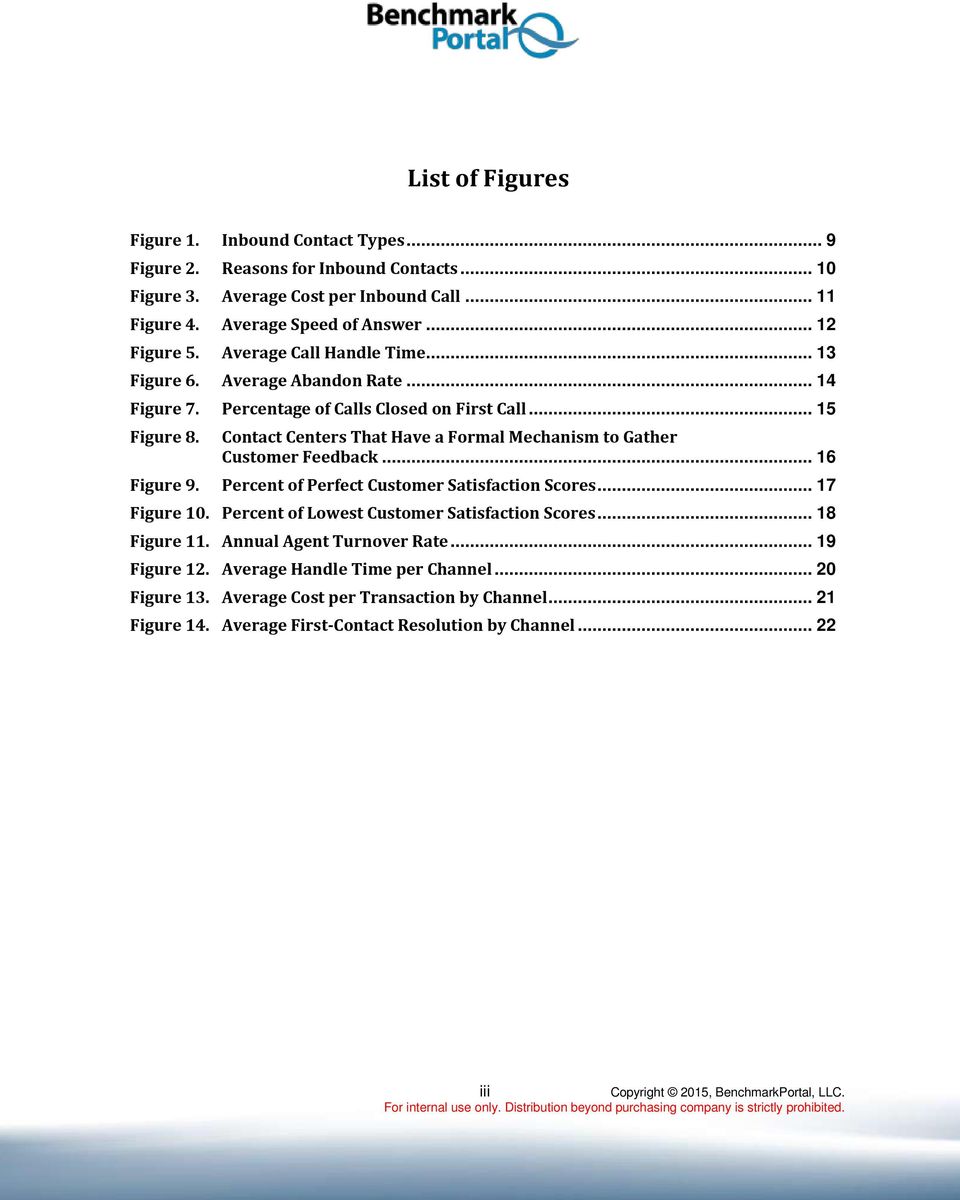
5 List of Figures Figure 1. Inbound Contact Types... 9 Figure 2. Reasons for Inbound Contacts Figure 3. Average Cost per Inbound Call Figure 4. Average Speed of Answer Figure 5. Average Call Handle Time Figure 6. Average Abandon Rate Figure 7. Percentage of Calls Closed on First Call Figure 8. Contact Centers That Have a Formal Mechanism to Gather Customer Feedback Figure 9. Percent of Perfect Customer Satisfaction Scores Figure 10. Percent of Lowest Customer Satisfaction Scores Figure 11. Annual Agent Turnover Rate Figure 12. Average Handle Time per Channel Figure 13. Average Cost per Transaction by Channel Figure 14. Average First-Contact Resolution by Channel iii Copyright 2015, BenchmarkPortal, LLC..
6 Acknowledgements We wish to extend our thanks to the many contact center managers who have kept our database current and growing over the years. We would also like to acknowledge the contribution of colleagues who have provided both inspiration and perspiration to make this effort useful to managers all over the world. In particular, we note the founding contributions of our former partners, Dr. Jon Anton and David Machin, and the constant support of Professor Richard Feinberg of Purdue University. Bruce L. Belfiore, Senior Research Executive John Chatterley, Senior Research Manager iv Copyright 2015, BenchmarkPortal, LLC.
7 Chapter 1: Introduction 1 Copyright 2015, BenchmarkPortal, LLC..

8 Chapter 1: Introduction Every enterprise, in every sector, can benefit from comparing itself to other similar operations. This promotes a process of creative soul-searching regarding comparative strengths and weaknesses, which in turn leads to identification and adoption of best practice improvements. We have repeatedly seen the truly transformative power of systematic benchmarking. ~ Bruce Belfiore, BenchmarkPortal Benchmarking has proven to be an important management tool, especially since the late 1970 s. Comparing operating metrics and methodologies with other enterprises in the same industry has provided managers with useful insights that, in turn, result in a virtuous process of discovery, action and improvement that leads, in turn, to superior performance. Superior performance in customer contact is more important today than ever. As products become commoditized, it is the service aspect which determines loyalty and repeat sales in more and more industries. Knowing your competitive position on the customer service you provide is key. Contact centers are ideal operations for benchmarking for several reasons: They all have systems (such as Automatic Call Distributors, or ACDs) that automatically capture reams of data on key performance metrics. Unlike industries where gathering apples-to-apples data is a long and laborious process, gathering data for contact centers is easier - - and can now be largely automated. Senior managers look to contact centers to prove their value to the organization on a regular basis. Benchmarking the contact center provides management the performance-based information needed to make decisions on staffing, technology acquisition, and other budget-related matters Contact centers are one of the enterprise s keys to the customer experience, satisfaction and, ultimately, loyalty. The center s relative performance on quality metrics can reveal volumes about its competitive position against its industry. In addition, we have found that a rigorous methodology, which is based on balancing quality and costs, and which maps negative gaps in key metrics to specific processes and 2 Copyright 2015, BenchmarkPortal, LLC.
9 Chapter 1: Introduction technologies in the contact center, can reveal much about what is going well - - and what is going poorly - - in a contact center. This, in turn, allows management to study and take actions that will build competitive strength for the center over time. BenchmarkPortal has developed a balanced scorecard process which is explained in Appendix B (The Tonchev Performance Index) and which lies at the heart of benchmark reports which are provided to individual centers that input their data into the BenchmarkPortal database. Our industry reports have evolved over time, and continue to do so. We have recently launched our Multi-Channel Benchmark Survey, which includes more data from the , chat, white mail and social media channels. It will take time to develop enough data to provide these metrics on an industry-specific basis. In the meantime, we include here metrics that are gathered from all industries. We hope that you find this report useful and a stimulant for improvement. If comparing your metrics to your industry causes you to take just one important action to improve your operations, we will feel we have done our job. If it causes you to consider benchmarking a valuable management tool in your continuous improvement toolbox, we will be even more pleased. Please feel free to contact us with any questions or requests for further assistance. Contact centers are our passion, and we are happy to share our insights with you. 3 Copyright 2015, BenchmarkPortal, LLC.

10 Chapter 2: Methodology 4 Copyright 2015, BenchmarkPortal, LLC.

11 Chapter 2: Methodology The BenchmarkPortal database, founded at Purdue University in 1995, is the world s first, largest and most respected database of contact center metrics. Data is gathered on a continuous basis using one of three means: Participants can go to the BenchmarkPortal website and input their metrics into the survey found there; Participants can download the benchmarking survey from the BenchmarkPortal Website. They can print and complete the survey by hand and then fax it to us for insertion into our database; or Participants can subscribe to ibenchmark, our automated process that receives the majority of metrics directly from the participants systems and enters them into our database. Data that does not come directly from systems (such as budget and agent turnover) is input manually once or twice a year via a survey portal. Data that are submitted by survey participants are subject to three levels of rigorous quality checking, to ensure that our database remains accurate. The first level involves static parameters, which are set by our statistical experts. The second level of quality assurance involves a series of cross-check formulae, which utilize data provided to validate key pieces of data. For example, if the sum of the average talk time plus the average after call work time multiplied by the average number of calls per agent per hour yields a number over 60 minutes, the anomaly will result in a red flag for our database department. We will then reach out and work with the participant to identify the proper metric from their management reports. The third level of scrutiny is provided directly by our Research team members, who review each survey report for coherence. This commitment to quality distinguishes BenchmarkPortal s database from other industry sources which simply take in metrics as entered by participants. While this level of scrutiny requires considerable effort, we are committed to providing the best data possible to our industry. We note that, as more centers adopt the patented ibenchmark automated benchmarking, the less impact there will be from human error. Automating the entry of data and provision of reports, utilizing our patent-protected system, ensures that the correct data are being entered at the source for the majority of metrics. All individual metrics are held as confidential and are never revealed with the name of the participant to third parties. Only aggregated data are published in our Industry Reports, such as the one you are reading now. 5 Copyright 2015, BenchmarkPortal, LLC.
12 Chapter 2: Methodology The data sets are all tagged by industry sector, as well as by other characteristics, such as country of origin. This allows us to create reports that are drawn entirely from one industry sector. In addition, we can create our World-Wide Industry Reports by gathering data sets by geographical region. Custom reports can be generated by using parameters agreed with the client. The data sets are selected and downloaded from the database. The report generator accesses the data and calculates the industry average. It also segregates the top quartile (25%) of the data sets and shows the average for these top-performing centers under the Best of Industry column. To determine which centers to include in the Best of Industry calculation, we do the following: We separate the performance metrics into two categories: efficiency metrics that correspond to costs (these are metrics such as cost per call, talk time, after-call work time, etc.) and effectiveness metrics, which correspond to quality (caller satisfaction, first contact resolution, etc.). In this way we place balanced emphasis on the elements that reflect quality of customer service and elements that indicate careful use of company resources. The two groupings of metrics are put through separate expert formulas to calculate two coefficients: the cost index (indicating efficiency) and the quality index (indicating relative effectiveness). The two indices are added together for each center, and the centers are stack ranked by their combined scores. The top quartile of the centers is selected out. The averages for each metric are calculated from this upper quartile of centers and presented as "Best of Industry Averages". Note that use of this methodology means that not every Best of Industry average will be better than the overall industry average. Centers that perform better overall may be less strong (compared with the industry) for specific metrics. Thank you for acquiring this report. Please let us know if you have any questions or comments. If you would like to consider benchmarking your own metrics through an individualized report, please feel free to contact us for a chat.. 6 Copyright 2015, BenchmarkPortal, LLC.

13 Chapter 3: Highlights and Interpretation of the Worldwide (Sample) Industry Key Performance Indicators (KPIs) 7 Copyright 2015, BenchmarkPortal, LLC.
14 Chapter 3: Highlights and Interpretation of the (Sample) Industry Key Performance Indicators (KPIs) In this chapter, we graphically highlight benchmark comparisons of the averaged responses that call center managers from three global regions The Americas, EMEA (Europe, Middle East, Africa), and Asia Pacific** - offered to selected questions related to their call centers. The metrics are grouped according to the following categories: Section One: Section Two: Section Three: Section Four: Section Five: Section Six: Contact Center Classification Contact Center Costs Contact Center Performance Customer Satisfaction Human Resource Management Multi-Channel Metrics 8 Copyright 2015, BenchmarkPortal, LLC.

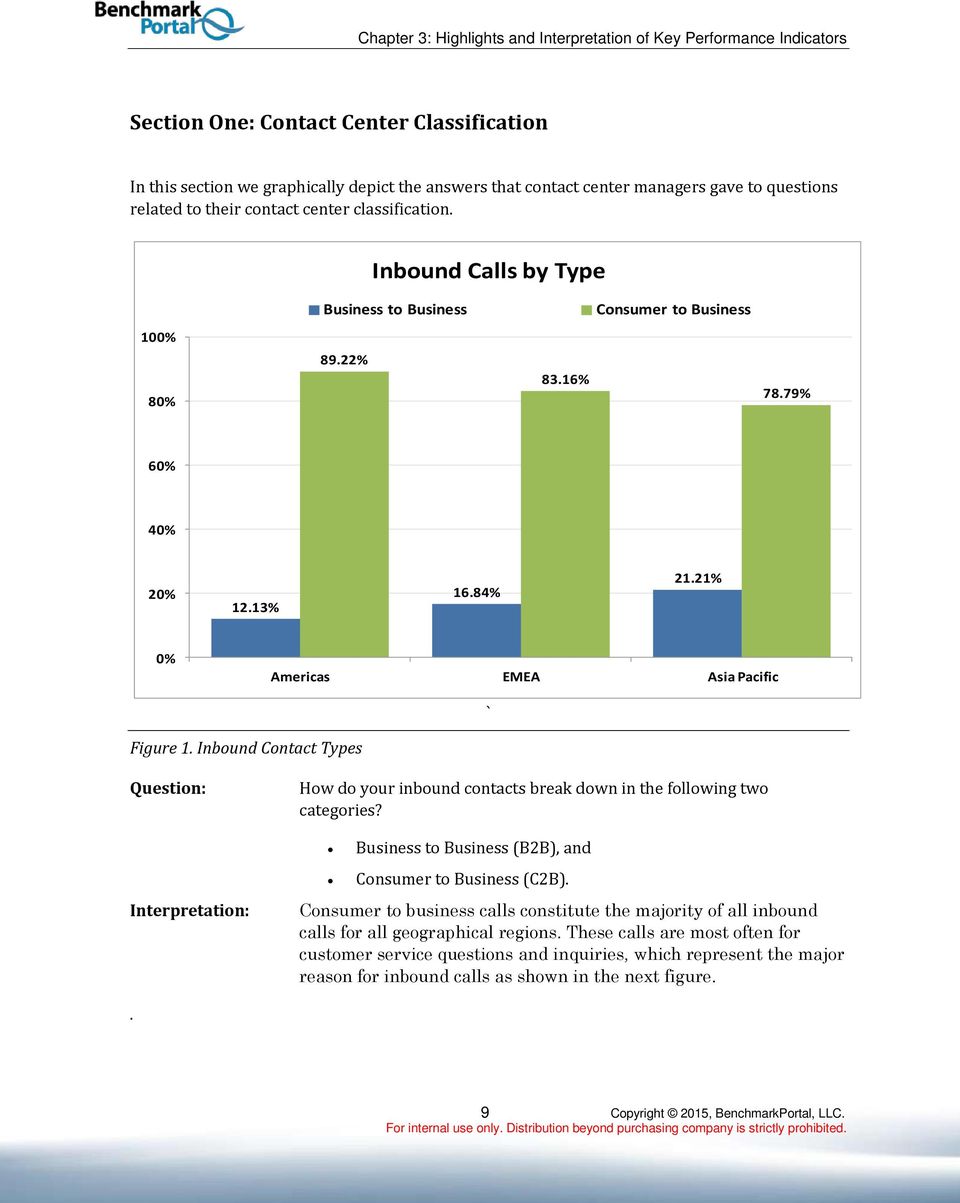
15 Chapter 3: Highlights and Interpretation of Key Performance Indicators Section One: Contact Center Classification In this section we graphically depict the answers that contact center managers gave to questions related to their contact center classification. Inbound Calls by Type Business to Business Consumer to Business 100% 80% 89.22% 83.16% 78.79% 60% 40% 20% 12.13% 16.84% 21.21% 0% Americas EMEA Asia Pacific ` Figure 1. Inbound Contact Types Question: Interpretation: How do your inbound contacts break down in the following two categories? Business to Business (B2B), and Consumer to Business (C2B). Consumer to business calls constitute the majority of all inbound calls for all geographical regions. These calls are most often for customer service questions and inquiries, which represent the major reason for inbound calls as shown in the next figure.. 9 Copyright 2015, BenchmarkPortal, LLC..
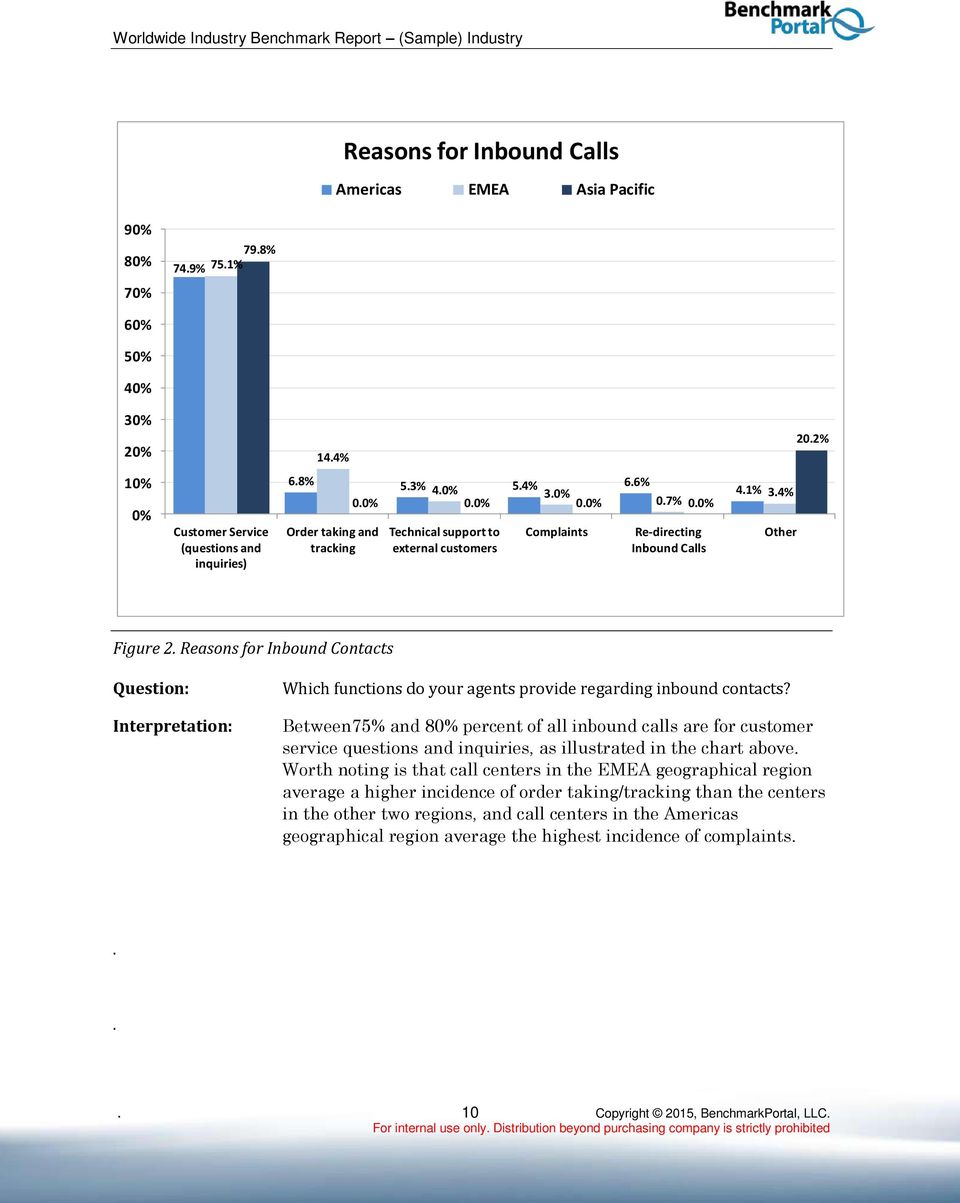
16 Worldwide Industry Benchmark Report (Sample) Industry Reasons for Inbound Calls Americas EMEA Asia Pacific 90% 80% 70% 79.8% 74.9% 75.1% 60% 50% 40% 30% 20% 14.4% 20.2% 10% 0% Customer Service (questions and inquiries) 6.8% 5.3% 5.4% 6.6% 4.0% 3.0% 0.0% 0.0% 0.0% 0.7% 0.0% Order taking and tracking Technical support to external customers Complaints Re-directing Inbound Calls 4.1% 3.4% Other Figure 2. Reasons for Inbound Contacts Question: Interpretation: Which functions do your agents provide regarding inbound contacts? Between75% and 80% percent of all inbound calls are for customer service questions and inquiries, as illustrated in the chart above. Worth noting is that call centers in the EMEA geographical region average a higher incidence of order taking/tracking than the centers in the other two regions, and call centers in the Americas geographical region average the highest incidence of complaints Copyright 2015, BenchmarkPortal, LLC.
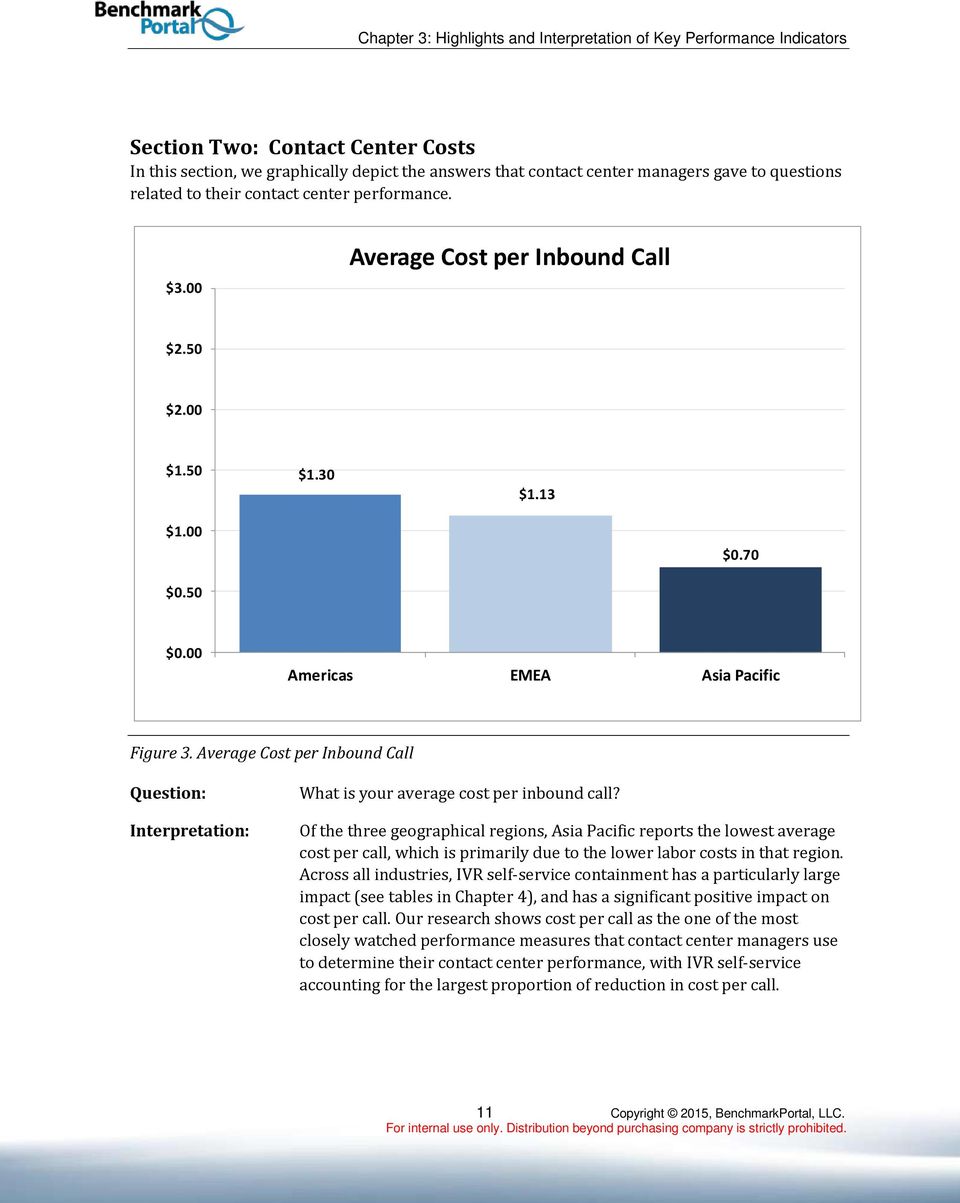
17 Chapter 3: Highlights and Interpretation of Key Performance Indicators Section Two: Contact Center Costs In this section, we graphically depict the answers that contact center managers gave to questions related to their contact center performance. $3.00 Average Cost per Inbound Call $2.50 $2.00 $1.50 $1.30 $1.13 $1.00 $0.70 $0.50 $0.00 Americas EMEA Asia Pacific Figure 3. Average Cost per Inbound Call Question: Interpretation: What is your average cost per inbound call? Of the three geographical regions, Asia Pacific reports the lowest average cost per call, which is primarily due to the lower labor costs in that region. Across all industries, IVR self-service containment has a particularly large impact (see tables in Chapter 4), and has a significant positive impact on cost per call. Our research shows cost per call as the one of the most closely watched performance measures that contact center managers use to determine their contact center performance, with IVR self-service accounting for the largest proportion of reduction in cost per call. 11 Copyright 2015, BenchmarkPortal, LLC..
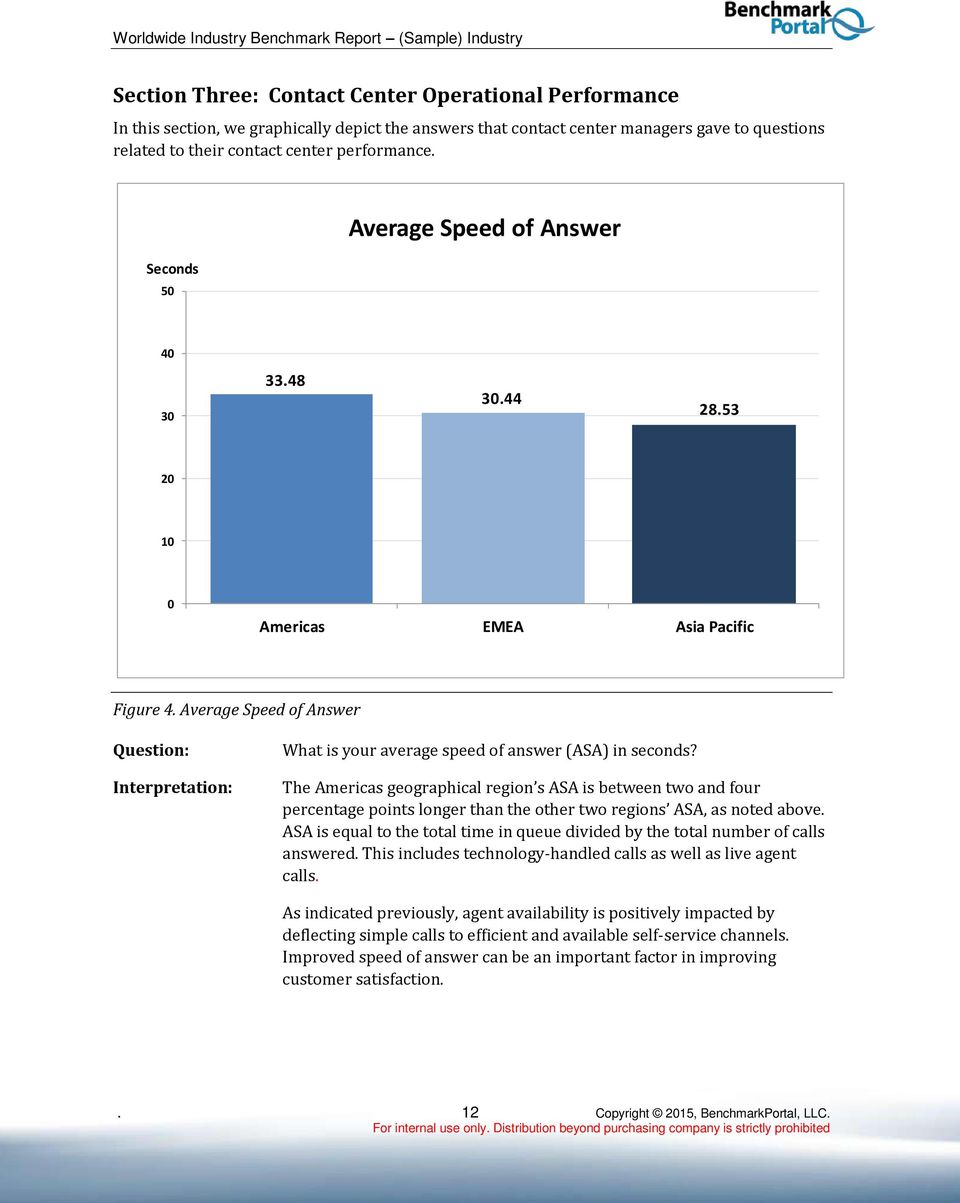
18 Worldwide Industry Benchmark Report (Sample) Industry Section Three: Contact Center Operational Performance In this section, we graphically depict the answers that contact center managers gave to questions related to their contact center performance. Seconds 50 Average Speed of Answer Americas EMEA Asia Pacific Figure 4. Average Speed of Answer Question: Interpretation: What is your average speed of answer (ASA) in seconds? The Americas geographical region s ASA is between two and four percentage points longer than the other two regions ASA, as noted above. ASA is equal to the total time in queue divided by the total number of calls answered. This includes technology-handled calls as well as live agent calls. As indicated previously, agent availability is positively impacted by deflecting simple calls to efficient and available self-service channels. Improved speed of answer can be an important factor in improving customer satisfaction.. 12 Copyright 2015, BenchmarkPortal, LLC.
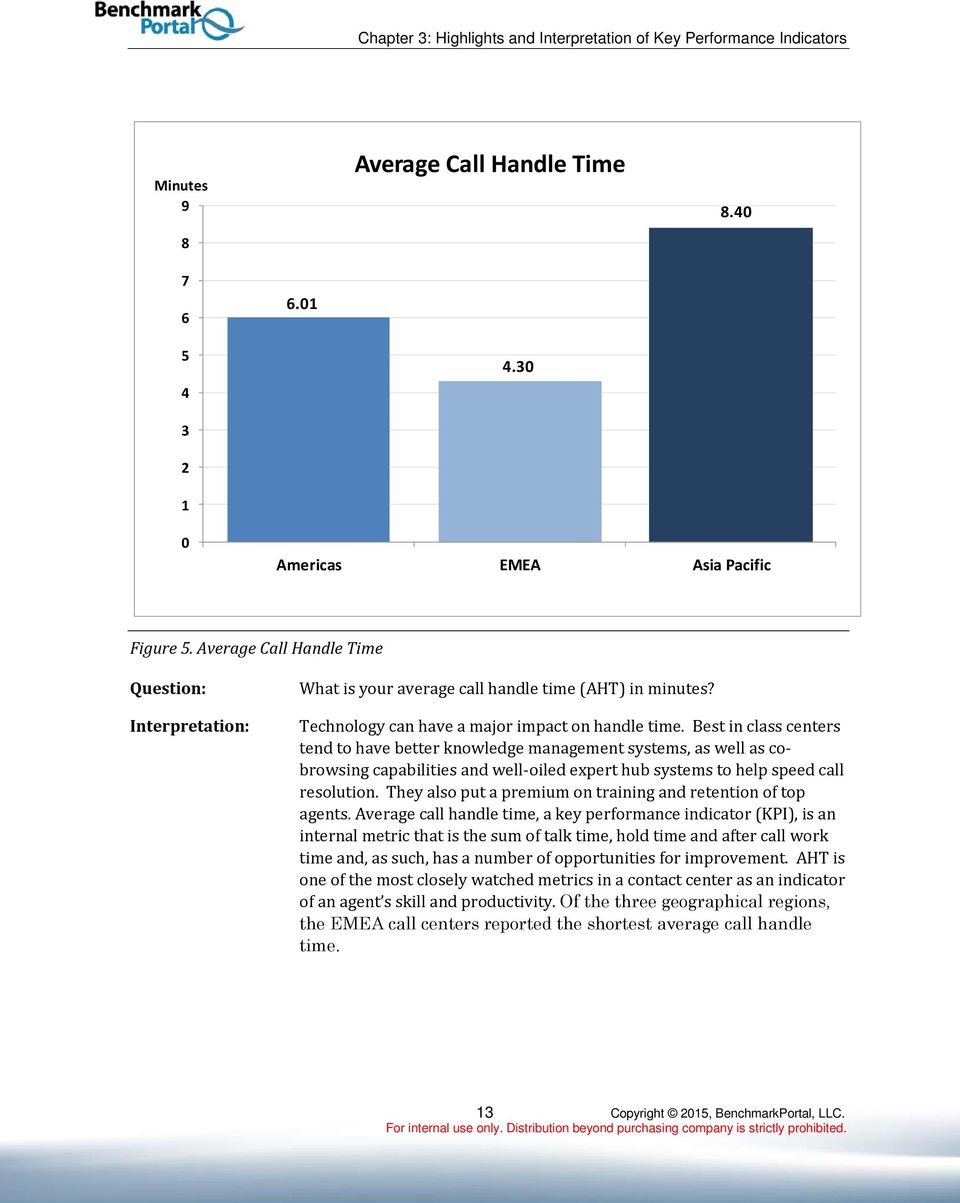
19 Chapter 3: Highlights and Interpretation of Key Performance Indicators Minutes 9 8 Average Call Handle Time Americas EMEA Asia Pacific Figure 5. Average Call Handle Time Question: Interpretation: What is your average call handle time (AHT) in minutes? Technology can have a major impact on handle time. Best in class centers tend to have better knowledge management systems, as well as cobrowsing capabilities and well-oiled expert hub systems to help speed call resolution. They also put a premium on training and retention of top agents. Average call handle time, a key performance indicator (KPI), is an internal metric that is the sum of talk time, hold time and after call work time and, as such, has a number of opportunities for improvement. AHT is one of the most closely watched metrics in a contact center as an indicator of an agent s skill and productivity. Of the three geographical regions, the EMEA call centers reported the shortest average call handle time. 13 Copyright 2015, BenchmarkPortal, LLC..
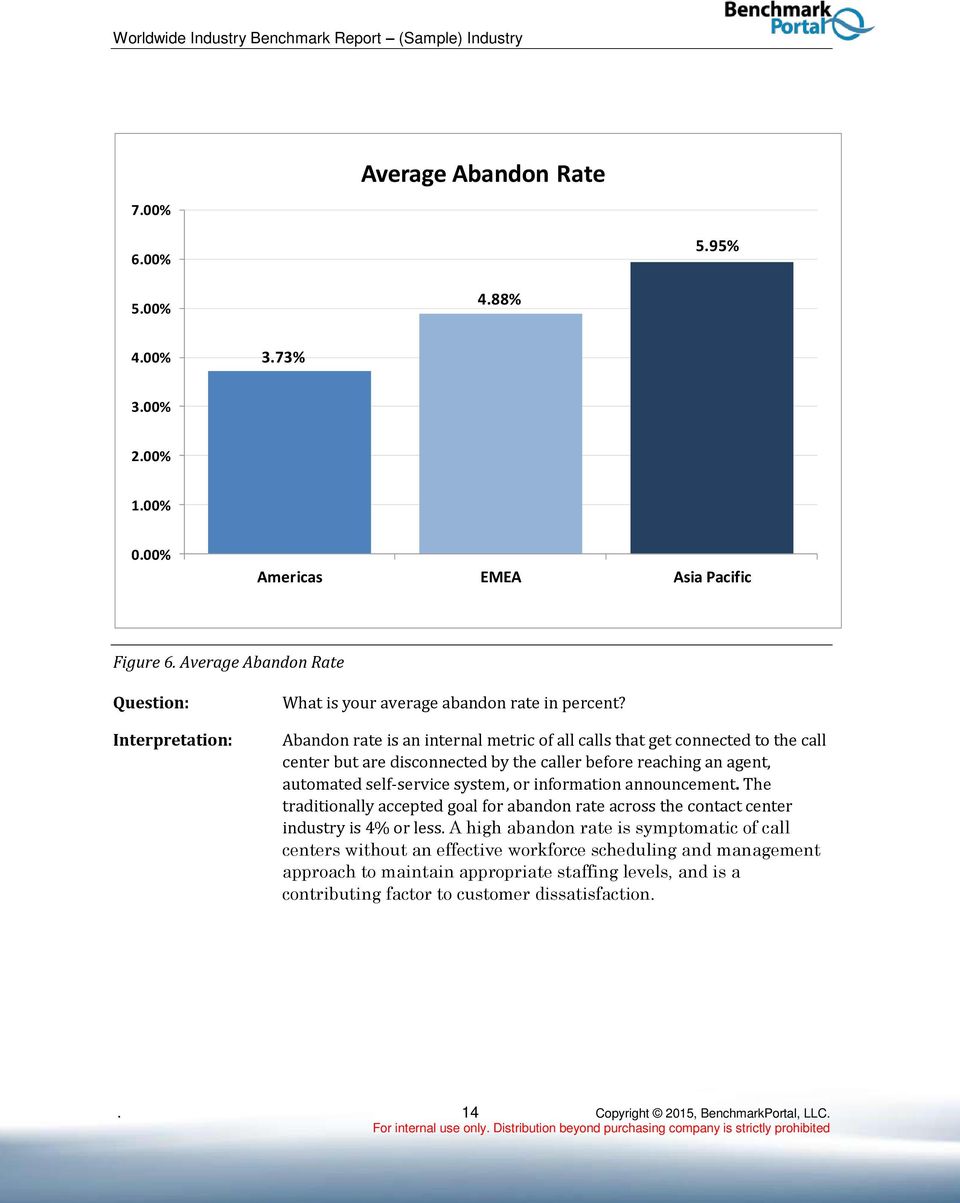
20 Worldwide Industry Benchmark Report (Sample) Industry 7.00% Average Abandon Rate 6.00% 5.95% 5.00% 4.88% 4.00% 3.73% 3.00% 2.00% 1.00% 0.00% Americas EMEA Asia Pacific Figure 6. Average Abandon Rate Question: Interpretation: What is your average abandon rate in percent? Abandon rate is an internal metric of all calls that get connected to the call center but are disconnected by the caller before reaching an agent, automated self-service system, or information announcement. The traditionally accepted goal for abandon rate across the contact center industry is 4% or less. A high abandon rate is symptomatic of call centers without an effective workforce scheduling and management approach to maintain appropriate staffing levels, and is a contributing factor to customer dissatisfaction.. 14 Copyright 2015, BenchmarkPortal, LLC.
21 Chapter 3: Highlights and Interpretation of Key Performance Indicators Calls Closed on First Call 100% 80% 88.28% 83.76% 81.12% 60% 40% 20% 0% Americas EMEA Asia Pacific Figure 7. Percentage of Calls Closed on First Call Question: Interpretation: What is your percentage of calls closed on first call? The Americas geographical region s percentage of calls closed on the first call is 4 ½ percentage points better the EMEA region s first call resolution rate, and exceeds the Asia Pacific s first call resolution rate by 7 percentage points. The traditionally accepted All Industry best practice objective is to achieve and maintain an average of 85% or higher for calls closed on first call. Our research indicates a very high correlation between calls closed on first call and caller satisfaction. 15 Copyright 2015, BenchmarkPortal, LLC..
22 Worldwide Industry Benchmark Report (Sample) Industry Section Four: Customer Satisfaction In this section, we graphically depict the answers that contact center managers gave to questions related to customer satisfaction. 100% Percent of Call Centers With a Formal Mechanism to Gather Customer Feedback on their Performance 80% 81.61% 71.05% 60% 51.25% 40% 20% 0% Americas EMEA Asia Pacific Figure 8. Contact Centers That Have a Formal Mechanism to Gather Customer Feedback Question: Interpretation: Does your contact center have a formal mechanism for gathering customer feedback on contact center performance? The inverse of the percentages above is the percentage of call centers that answered NO to this question; notice that three outof-every seven of the call centers in the EMEA geographical region lack a formal mechanism for gathering customer satisfaction, compared to one out-of-every five centers in the Americas Region and nearly one-half of the centers in the Asia Pacific region. Internal key performance indicators can only tell management part of the story of how well they are serving their customers. In today s competitive world, customer satisfaction is a more significant market differentiator and competitive advantage than product features or price.. 16 Copyright 2015, BenchmarkPortal, LLC.
23 Chapter 3: Highlights and Interpretation of Key Performance Indicators 100% Percent of Callers giving a Perfect Score for Customer Satisfaction within the past 90 days 80% 60% 61.96% 47.91% 58.75% 40% 20% 0% Americas EMEA Asia Pacific Figure 9. Percent of Perfect Customer Satisfaction Scores Question: Interpretation: On average, in the past 90 days, what percentage of your customers gave you a perfect score on the question, Overall, how satisfied were you with the service you received during your call to our center? The best metric to be used for measuring the true level of customer satisfaction is the percentage of customers/callers who give a perfect score, meaning that they awarded a 5 on a scale of 1 to 5, provided that a valid statistical sample is taken. Of the call centers that have a formal mechanism for gathering customer satisfaction, the Americas geographical region fared highest among the three geographical regions, with three out-of-every five callers awarding them a perfect score for customer satisfaction delivered within the past 90 days. 17 Copyright 2015, BenchmarkPortal, LLC..
24 Worldwide Industry Benchmark Report (Sample) Industry 10% Percentage of Callers that gave the Lowest Score for Customer Satisfaction within the past 90 days 8.30% 8% 6% 5.96% 4.34% 4% 2% 0% Americas EMEA Asia Pacific Figure 10. Percent of Lowest Customer Satisfaction Scores Question: Interpretation: On average, in the past 90 days, what percentage of your customers gave you the lowest score on the question, "Overall, how satisfied were you with the service you received during your contact with our center? Tracking lowest scores is the flip side of collecting perfect customer satisfaction scores and perhaps a better barometer of customer sentiment. This metric is essential to the quality monitoring process of a contact center since dissatisfied customers tend to be more vocal in their ratings. This may be a more valid metric since it tends to represent customer complaints and defection. A review of associated verbatim comments can provide some relevant facts for improvement programs. The next step is to classify the dissatisfied contacts by category/agent, and feed the results into the agent coaching and training process to remedy the root causes.. 18 Copyright 2015, BenchmarkPortal, LLC.
25 Chapter 3: Highlights and Interpretation of Key Performance Indicators Section Five: Human Resource Management In this section, we graphically depict the answers that contact center managers gave to questions related to human resource management. 35% 30% Annual Turnover of Agent Staff 32.23% 25% 20% 19.88% 15% 13.75% 10% 5% 0% Americas EMEA Asia Pacific Figure 11. Annual Agent Turnover Rate Question: Interpretation: What is the annual turnover percentage of your full-time agents? Turnover is the number of agents who left in the course of a year as a percentage of the total number of agents working during that same period, and is a major cost and quality factor. Best in industry performers tend to be good places to work as well. Using exit interviews to determine the causes of voluntary turnover, and thereby gaining insight into controllable factors that can result in reduced turnover, is a best practice process that all contact centers should use. Aside from the obvious cost impacts of agent turnover, the notion that a happy agent has happy customers is generally appropriate. 19 Copyright 2015, BenchmarkPortal, LLC..
26 Worldwide Industry Benchmark Report (Sample) Industry Section Six: Multi-Channel Metrics In this section, the following charts graphically depict key performance metrics (KPIs) for alternate contact channels in a multi-channel contact centers Handle Time (in Minutes) by Channel Web Chat FAX/White Mail Social Media Outbound Phone Inbound Phone Americas Inbound Phone EMA Inbound Phone Asia Figure 12. Average Handle Time per Channel Question: Interpretation: What is your average handle time per channel in percent? The figure above shows the distribution of the average agent s time allocated to support the array of contact channel alternatives available in the contact center industry worldwide. In this view of average handle time across multiple channels, we can begin to see the impact of the various channels on resource requirements. Clearly, Web Chat interactions require less of an agent s costly support time and positively impact the cost per contact. Naturally, self-service channels have an even greater impact on the reduction of agent time and cost. Interestingly, the greatest drain on a contact center s time is in the handling FAX/White Mail, with E- mail running a close second.. 20 Copyright 2015, BenchmarkPortal, LLC.
27 Chapter 3: Highlights and Interpretation of Key Performance Indicators $12.00 Cost Per Transaction $10.00 $8.00 $7.95 $7.74 $6.58 $6.00 $4.00 $4.28 $2.44 $2.00 $1.30 $1.13 $0.70 $- Web Chat FAX/White Mail Social Media Outbound Phone Inbound Phone Americas Inbound Phone EMA Inbound Phone Asia Figure 13. Average Cost per Transaction by Channel Question: Interpretation: What is your Average Cost per Transaction by Channel? As channel of choice, the phone is not only the most used but the least costly of channels in terms of cost per transaction. The cost per contact (green) shows that the average cost per alternate contact channel for all industry contact centers worldwide. The blue columns depict the average cost per inbound call across the three geographical industry categories worldwide. 21 Copyright 2015, BenchmarkPortal, LLC..
28 Worldwide Industry Benchmark Report (Sample) Industry 100% First-Contact Resolution 80% 80.74% 88.28% 83.76% 81.12% 67.21% 60% 40% 20% 0% Web Chat Voice Americas Voice EMEA Voice Asia Figure 14. Average First-Contact Resolution by Channel Question: Interpretation: What is your average first-contact resolution percentage by Channel? Our research shows first-contact resolution percentage as one of the most closely watched performance measures that contact center managers use to determine their contact center performance. FCR statistics are gathered by surveys and/or are self-reported by the contact handling agents using a statistically valid sample. The green bars shows the average FCR for E- mail and Web Chat contact channels worldwide, and the blue bars depict the FCR average for the voice channels worldwide.. 22 Copyright 2015, BenchmarkPortal, LLC.
29 Chapter 4: Detailed Benchmark Results for the Americas, EMEA, and Asia Pacific Geographical Regions 23 Copyright 2015, BenchmarkPortal, LLC.
30 Classification Questions - Americas (Sample) - Americas Best of (Sample) - Americas Calls Offered * * * * * * * * * * Calls Handled Annually * * * * * * * * * * Annual Call Volume Handled by Agents * * * * * * * * * * Annual Call Volume Handled by IVR * * * * * * * * * * Business to Business * * * * * * * * * * Business to Consumer * * * * * * * * * * Full Time Agents * * * * * * * * * * Part Time Agents * * * * * * * * * * Full Time Equivalents (FTE's) * * * * * * * * * * Labor Union (Yes) * * * * * * * * * * Labor Union (No) * * * * * * * * * * Call Type (Question & Inquiries) * * * * * * * * * * Call Type (Order Taking / Tracking) * * * * * * * * * * Call Type (Technical Support) * * * * * * * * * * Call Type (Complaints) * * * * * * * * * * Call Type (Re-directing Inbound Calls) * * * * * * * * * * Call Type (Other) * * * * * * * * * * 0.00% 0.00% Financial (Sample) - Americas Best of (Sample) - Americas Annual Budget * * * * * * * * * * Agents Base Salary * * * * * * * * * * Average Hourly Wage Front Line Agents * * * * * * * * * * Average Starting Hourly Wage Front Line Agents * * * * * * * * * * Average Cost Per Call * * * * * * * * * * 24 Copyright 2015, BenchmarkPortal, LLC.
31 Chapter 4: Detailed Benchmark Results Agent Time Per Channel (Sample) - Americas Best of (Sample) - Americas Inbound Phone * * * * * * * * * * Outbound Phone * * * * * * * * * * * * * * * * * * * * Web Chat * * * * * * * * * * Other * * * * * * * * * * 0.00% 0.00% Voice Channel Performance Metrics (Sample) - Americas Best of (Sample) - Americas Average Speed of Answer in Seconds * * * * * * * * * * Average Talk Time in Minutes * * * * * * * * * * Average After Call Work Time in Minutes * * * * * * * * * * Average Queue Time in Seconds * * * * * * * * * * Average Caller Hold Time in Seconds * * * * * * * * * * Average Abandoned Rate in Percent * * * * * * * * * * Calls Resolved on First Call In Percent (FCR) * * * * * * * * * * Agent Occupancy in Percent * * * * * * * * * * Adherence to Schedule in Percent * * * * * * * * * * Average Attendance in Percent * * * * * * * * * * Average Calls Transferred in Percent * * * * * * * * * * Average Auxiliary (AUX) Time in Percent * * * * * * * * * * Average Utilization in Percent * * * * * * * * * * Calls Per Agent Per Hour * * * * * * * * * * 25 Copyright 2015, BenchmarkPortal, LLC..
32 Worldwide Industry Benchmark Report (Sample) Industry Human Resources Metrics (Sample) - Americas Best of (Sample) - Americas Span of Control (Agent:Supervisor Ratio) * * * * * * * * * * Annual Turnover * * * * * * * * * * Promotional Turnover * * * * * * * * * * All Other Turnover * * * * * * * * * * Number of Shifts (Full Time) * * * * * * * * * * Number of Shifts (Part Time) * * * * * * * * * * Shift Length in Minutes (Full Time) * * * * * * * * * * Shift Length in Minutes (Part Time) * * * * * * * * * * Formal Method Collect Agent Satisfaction (Yes) * * * * * * * * * * Formal Method Collect Agent Satisfaction (No) * * * * * * * * * * Top Box Agent Satisfaction * * * * * * * * * * Bottom Box Agent Satisfaction * * * * * * * * * * Caller Satisfaction Metrics (Sample) - Americas Best of (Sample) - Americas Formal Method Collect Caller Satisfaction (Yes) * * * * * * * * * * Formal Method Collect Caller Satisfaction (No) * * * * * * * * * * Top Box Caller Satisfaction * * * * * * * * * * Bottom Box Caller Satisfaction * * * * * * * * * *. 26 Copyright 2015, BenchmarkPortal, LLC.
33 Chapter 4: Detailed Benchmark Results Classification Questions - EMEA (Sample) - EMEA Best of (Sample) - EMEA Calls Offered * * * * * * * * * * Calls Handled Annually * * * * * * * * * * Annual Call Volume Handled by Agents * * * * * * * * * * Annual Call Volume Handled by IVR * * * * * * * * * * Business to Business * * * * * * * * * * Business to Consumer * * * * * * * * * * Full Time Agents * * * * * * * * * * Part Time Agents * * * * * * * * * * Full Time Equivalents (FTE's) * * * * * * * * * * Labor Union (Yes) * * * * * * * * * * Labor Union (No) * * * * * * * * * * Call Type (Question & Inquiries) * * * * * * * * * * Call Type (Order Taking / Tracking) * * * * * * * * * * Call Type (Technical Support) * * * * * * * * * * Call Type (Complaints) * * * * * * * * * * Call Type (Re-directing Inbound Calls) * * * * * * * * * * Call Type (Other) * * * * * * * * * * Financial (Sample) - EMEA Best of (Sample) - EMEA Annual Budget * * * * * * * * * * Agents Base Salary * * * * * * * * * * Average Hourly Wage Front Line Agents * * * * * * * * * * Average Starting Hourly Wage Front Line Agents * * * * * * * * * * Average Cost Per Call * * * * * * * * * * 27 Copyright 2015, BenchmarkPortal, LLC..
34 Worldwide Industry Benchmark Report (Sample) Industry Agent Time Per Channel (Sample) - EMEA Best of (Sample) - EMEA Inbound Phone * * * * * * * * * * Outbound Phone * * * * * * * * * * * * * * * * * * * * Web Chat * * * * * * * * * * Other * * * * * * * * * * Voice Channel Performance Metrics (Sample) - EMEA Best of (Sample) - EMEA Average Speed of Answer in Seconds * * * * * Average Talk Time in Minutes * * * * * 2.93 Average After Call Work Time in Minutes * * * * * 0.25 Average Queue Time in Seconds * * * * * Average Caller Hold Time in Seconds * * * * * Average Abandoned Rate in Percent * * * * * 6.55% Calls Resolved on First Call In Percent (FCR) * * * * * 84.50% Agent Occupancy in Percent * * * * * 79.48% Adherence to Schedule in Percent * * * * * 93.00% Average Attendance in Percent * * * * * 97.35% Average Calls Transferred in Percent * * * * * 3.17% Average Auxiliary (AUX) Time in Percent * * * * * 10.51% Average Utilization in Percent * * * * * 68.16% Calls Per Agent Per Hour * * * * * Copyright 2015, BenchmarkPortal, LLC.
35 Chapter 4: Detailed Benchmark Results Human Resources Metrics (Sample) - EMEA Best of (Sample) - EMEA Span of Control (Agent:Supervisor Ratio) * * * * * * * * * * Annual Turnover * * * * * * * * * * Promotional Turnover * * * * * * * * * * All Other Turnover * * * * * * * * * * Number of Shifts (Full Time) * * * * * * * * * * Number of Shifts (Part Time) * * * * * * * * * * Shift Length in Minutes (Full Time) * * * * * * * * * * Shift Length in Minutes (Part Time) * * * * * * * * * * Formal Method Collect Agent Satisfaction (Yes) * * * * * * * * * * Formal Method Collect Agent Satisfaction (No) * * * * * * * * * * Top Box Agent Satisfaction * * * * * * * * * * Bottom Box Agent Satisfaction * * * * * * * * * * Caller Satisfaction Metrics (Sample) - EMEA Best of (Sample) - EMEA Formal Method Collect Caller Satisfaction (Yes) * * * * * * * * * * Formal Method Collect Caller Satisfaction (No) * * * * * * * * * * Top Box Caller Satisfaction * * * * * * * * * * Bottom Box Caller Satisfaction * * * * * * * * * * 29 Copyright 2015, BenchmarkPortal, LLC..
36 Worldwide Industry Benchmark Report (Sample) Industry Classification Questions - Asia Pacific (Sample) - Asia Pacific Best of (Sample) - Asia Pacific Calls Offered * * * * * * * * * * Calls Handled Annually * * * * * * * * * * Annual Call Volume Handled by Agents * * * * * * * * * * Annual Call Volume Handled by IVR * * * * * * * * * * Business to Business * * * * * * * * * * Business to Consumer * * * * * * * * * * Full Time Agents * * * * * * * * * * Part Time Agents * * * * * * * * * * Full Time Equivalents (FTE's) * * * * * * * * * * Labor Union (Yes) * * * * * * * * * * Labor Union (No) * * * * * * * * * * Call Type (Question & Inquiries) * * * * * * * * * * Call Type (Order Taking / Tracking) * * * * * * * * * * Call Type (Technical Support) * * * * * * * * * * Call Type (Complaints) * * * * * * * * * * Call Type (Re-directing Inbound Calls) * * * * * * * * * * Call Type (Other) * * * * * * * * * * 0.00% 0.00% Financial (Sample) - Asia Pacific Best of (Sample) - Asia Pacific Annual Budget * * * * * * * * * * Agents Base Salary * * * * * * * * * * Average Hourly Wage Front Line Agents * * * * * * * * * * Average Starting Hourly Wage Front Line Agents * * * * * * * * * * Average Cost Per Call * * * * * * * * * *. 30 Copyright 2015, BenchmarkPortal, LLC.
37 Chapter 4: Detailed Benchmark Results Agent Time Per Channel (Sample) - Asia Pacific Best of (Sample) - Asia Pacific Inbound Phone * * * * * * * * * * Outbound Phone * * * * * * * * * * * * * * * * * * * * Web Chat * * * * * * * * * * Other * * * * * * * * * * Voice Channel Performance Metrics (Sample) - Asia Pacific Best of (Sample) - Asia Pacific Average Speed of Answer in Seconds * * * * * * * * * * Average Talk Time in Minutes * * * * * * * * * * Average After Call Work Time in Minutes * * * * * * * * * * Average Queue Time in Seconds * * * * * * * * * * Average Caller Hold Time in Seconds * * * * * * * * * * Average Abandoned Rate in Percent * * * * * * * * * * Calls Resolved on First Call In Percent (FCR) * * * * * * * * * * Agent Occupancy in Percent * * * * * * * * * * Adherence to Schedule in Percent * * * * * * * * * * Average Attendance in Percent * * * * * * * * * * Average Calls Transferred in Percent * * * * * * * * * * Average Auxiliary (AUX) Time in Percent * * * * * * * * * * Average Utilization in Percent * * * * * * * * * * Calls Per Agent Per Hour * * * * * * * * * * 31 Copyright 2015, BenchmarkPortal, LLC..
38 Worldwide Industry Benchmark Report (Sample) Industry Human Resources Metrics (Sample) - Asia Pacific Best of (Sample) - Asia Pacific Span of Control (Agent:Supervisor Ratio) * * * * * * * * * * Annual Turnover * * * * * * * * * * Promotional Turnover * * * * * * * * * * All Other Turnover * * * * * * * * * * Number of Shifts (Full Time) * * * * * * * * * * Number of Shifts (Part Time) * * * * * * * * * * Shift Length in Minutes (Full Time) * * * * * * * * * * Shift Length in Minutes (Part Time) * * * * * * * * * * Formal Method Collect Agent Satisfaction (Yes) * * * * * * * * * * Formal Method Collect Agent Satisfaction (No) * * * * * * * * * * Top Box Agent Satisfaction * * * * * * * * * * Bottom Box Agent Satisfaction * * * * * * * * * * Caller Satisfaction Metrics (Sample) - Asia Pacific Best of (Sample) - Asia Pacific Formal Method Collect Caller Satisfaction (Yes) * * * * * * * * * * Formal Method Collect Caller Satisfaction (No) * * * * * * * * * * Top Box Caller Satisfaction * * * * * * * * * * Bottom Box Caller Satisfaction * * * * * * * * * *. 32 Copyright 2015, BenchmarkPortal, LLC.
39 Chapter 4: Detailed Benchmark Results Multi-Channel Metrics Outbound Call Metrics Average Upper Quartile Average Annual Volume (Outbound) * * * * * * * * * * Average Talk Time in (Minutes) * * * * * * * * * * Average After Call Work Time (Minutes) * * * * * * * * * * Average Cost Per Call (US Dollars) * * * * * * * * * * Metrics Average Upper Quartile Average Annual Volume ( ) * * * * * * * * * * Average Speed of Answer (Hours) * * * * * * * * * * Average Handle Time (Minutes) * * * * * * * * * * Average First Contact Resolution - FCR (Percent) * * * * * * * * * * Average Cost Per (US Dollars) * * * * * * * * * * Web Chat Metrics Average Upper Quartile Average Annual Volume (Web Chat) * * * * * * * * * * Average Speed of Answer (Seconds) * * * * * * * * * * Average Handle Time (Minutes) * * * * * * * * * * Average First Contact Resolution (Percent) * * * * * * * * * * Average Cost Per Web Chat (US Dollars) * * * * * * * * * * 33 Copyright 2015, BenchmarkPortal, LLC..
40 Worldwide Industry Benchmark Report (Sample) Industry Social Media Metrics Average Upper Quartile Average Annual Volume (Social Media) * * * * * * * * * * Average Speed of Answer (Hours) * * * * * * * * * * Average Handle Time (Minutes) * * * * * * * * * * Average Cost Per Social Media (US Dollars) * * * * * * * * * * Fax All Industry Average Upper Quartile Average Annual Volume (Fax) * * * * * * * * * * Average Handle Time (Minutes) * * * * * * * * * * Average Cost Per Fax (US Dollars) * * * * * * * * * * Postal Mail Average Upper Quartile Average Annual Volume (Postal Mail) * * * * * * * * * * Average Handle Time (Minutes) * * * * * * * * * * Average Cost Per Postal Mail (US Dollars) * * * * * * * * * * Other Average Upper Quartile Average Annual Volume (Other) * * * * * * * * * * Average Handle Time (Minutes) * * * * * * * * * * Average Cost Per (US Dollars) * * * * * * * * * *. 34 Copyright 2015, BenchmarkPortal, LLC.
41 Chapter 5: Frequently Asked Questions 35 Copyright 2015, BenchmarkPortal, LLC.
42 This FAQ contains common questions asked by Contact Center Professionals who have purchased our Industry Reports Question How are your Industry Reports produced? What Industries are reported on within an Industry Report? What kind of Key Performance Indicators (KPIs) are measured within your Industry Reports? What geographical regions do the Industry Reports cover? I m looking for a report that can breakdown the performance of Contact Centers within specific geographical regions. Do you have any reports that will suit my needs? How current is the data contained in your Industry Reports? Answer Benchmark members are constantly providing us data via surveys. When a Contact Center Professional participates in our flagship survey, the In-Depth RealityCheck (IDRC), their data is scrubbed, validated, cataloged in their industry, and then housed in our databases. We then take the data and run the averages that appear in the Industry Reports. Each standard Industry Report covers a single Industry. Please refer to our website at and click on Industry Reports at the top for a complete list of the industries offered. We report metrics for the following Contact Center areas: general classification (i.e. size, business orientation), Contact Center costs (operational), Contact Center performance measures, customer satisfaction, human resources, and alternate contact channel KPIs. You may download a sample Industry Report at the following Web address: store_files/industryreportsample.zip Our standard Industry Reports cover North America only (USA & Canada). Our World Wide Industry Reports cover The Americas, Europe/ Middle-East/Africa (EMEA), and Asia Pacific geographical regions. Custom reports for other geographical regions can be produced on a custom basis. Our World Wide Industry Reports cover the Americas, Europe/ Middle-East/Africa, and Asia Pacific geographical regions. Chapter 5 of the report depicts the KPIs broken out separately for each geographical region. Custom reports for other geographical regions can be produced on a custom basis. The reports are updated every 6 months. Question Answer 36 Copyright 2015, BenchmarkPortal, LLC.
43 Worldwide Industry Benchmark Report - (Sample) Industry How do I know when the report I have has been published? Can I get a list of the Contact Centers that participated in your Industry Report(s)? I would like to order an Industry Report, what is the earliest I can get it after placing an order? Where can I purchase additional Industry Reports? What format does the report come in? Can I get the report in an electronic format (ecopy)? I have recently purchased an Industry Report and would like additional copies for my colleagues. How would I obtain these copies? What if I am looking for a custom cut within an Industry (i.e. Contact Centers in the Consumer Products Industry that handle a majority customer service questions)? Can an Industry Report be produced that can suit my needs? I have a list of companies I would like Industry data on. Can you produce a custom Industry Report? In Chapters 3 & 4 of the report, how do you define Best of Industry? The publication date of the report is on the inside title page of the report. Our confidentiality policy prevents us from disclosing the identity/contact information for any one participant who participates in Benchmarking with us. A copy of the confidentiality agreement can be found at the following Web address: Reports that are current (updated within the past 6 months) are shipped within 2 business days ARO. Reports that require updating will be shipped in 3 5 business days ARO. Additional reports can be purchased via our Web site at (then click on Industry Benchmark Reports under the heading Performance Benchmark Reports). Industry Reports are delivered electronically in Adobe PDF format using a download link(s) and password(s) sent to the purchaser by . Additional copies of Industry Reports may be purchased for $100 each. To do so, please contact [email protected] We can do custom cuts within major industry sectors (e.g. Financial Services, (Sample), Telecom, etc.). Custom Industry Reports take time to produce, so it will take longer to produce, typically days ARO. Prices of custom reports are quoted on an individual basis. For a fee of $50, we will scan the database to determine the percentage of companies you listed that are included in our database that we could roll-up into a custom Industry Report. However, as per our confidentiality statement we cannot and will not disclose the name of any single company or group of companies included in a specific report. If an order is subsequently placed, the $50 search fee will be deducted from the purchase price. See Chapter 2 Methodology. 37 Copyright 2015, BenchmarkPortal, LLC..
44 Chapter 5: Frequently Asked Questions Question In looking at my report I noticed the Best of Industry average was lower than the Industry average for a certain metric when it is advantageous to have the Best of Industry average for this metric as low as attainable. How is this possible? Answer See Chapter 2 Methodology. Also see more on the Tonchev Performance Index in Appendix B.. 38 Copyright 2015, BenchmarkPortal, LLC.
45 Appendix A: Glossary of Terms for Contact Centers 39 Copyright 2015, BenchmarkPortal, LLC.
46 A Abandon Rate: This is the percentage of calls that get connected to the ACD, but get disconnected by the caller before reaching an Agent, or before completing a process within the IVR. The abandon rate is the percentage of calls that are abandoned compared to calls received. ACD: See Automatic Call Distributor. Adherence to Schedule: A measure of whether Agents are on the job as scheduled. This percentage represents how closely an Agent adheres to his/her detailed work schedule as provided by the workforce management system. 100% adherence means that the Agent was exactly where they were supposed to be at the time projected in their schedule. The scheduled time allows for meetings with the supervisor, education, plus answering customer phone calls and supporting other channels. The question, how often do Agents deviate from their schedule is answered by this metric. After Call Work Time: Call-related work that is done when an Agent is not on a call. This is the cumulative amount of time Agents spend on performing follow-up work after the Agent has disconnected from the caller, divided by the total number of calls handled by Agents. The data for after call work time is taken from the system. Agent: A general term for someone who handles telephone calls and/or other channel transactions in a Contact center. Other common names for the same job include, but are not limited to: operator, associate, sales associate, collections specialist, customer service representative (CSR), or customer care representative. Agent Development: A process designed to address the Agent s individual needs, and to help them build their work skills and achieve their career objectives. This may include, but not be limited to, work behaviors expected, taught, measured and tracked; continuous education offered and encouraged; and career planning. Agent Occupancy: The percentage of total paid hours of an Agent s shift during which the Agent is logged in to the ACD or other technology and is available to handle inbound phone, outbound phone, , chat and other productive work (white mail or back office work), divided by the total scheduled hours at work. Agent Turnover: The number of Agents who left their Agent job (voluntarily or involuntarily) during the previous 12-month period, divided by the total number of Agents working, expressed as a percentage. Track those who were hired during the period, minus those who left their job during the same period. The average number of Agents working is calculated by taking the beginning-of-the-year Agent head count plus the end-of-year Agent head-count and dividing that number by two. Do not include attrition during training. Annual Turnover Where: P A R P % 100 A = the total number of Agents working during the specified period; R = the number of new-hires during the specified period; and P = the number of Agents that left the center during the specified period. 40 Copyright 2015, BenchmarkPortal, LLC.
47 Worldwide Industry Benchmark Report (Sample) Industry Agent Utilization Rate (a.k.a. Utilization): (NOTE: this definition was expanded in November, 2012, to account for the shift towards multi-channel operations. Dedicated inbound call centers are not affected by this change; only multi-channel centers are affected.). Utilization is the percentage of the Agents' shift engaged in productive work. For centers which are completely or almostcompletely engaged in taking inbound calls, this will mean the percentage of logged-in time during which the Agent is in active telephone mode (involving talk time, hold time and after-call work time). For multi-channel centers, utilization will also capture productive time engaged in e- mail, chat, outbound and other productive work (responding to postal mail or performing productive administrative/"back-office" work). Managers of multi-channel centers must work to gather accurate information on productive time from appropriate systems ( , chat, outbound systems, etc.), and be ready to make those reports available for review. NOTE! FOR SINGLE-FUNCTION, DEDICATED AGENT CENTERS, PLEASE USE THE FOLLOWING FORMULA: (e.g., Agents that handle only inbound calls or only or outbound calls) AVERAGE SINGLE FUNCTION UTILIZATION PER DAY = (Avg. Contact Time in Min. + After Contact Time in Min) X (Avg Contacts per Shift) Logged-in Time-in-Minutes per Shift NOTE! FOR BLENDED MULTI-CHANNEL CENTERS, PLEASE USE THIS FORMULA: Inbound calls: (Avg. Contact Time + Avg. After Contact Work Time) X (Avg Contacts per Shift) PLUS Outbound calls: (Avg. Contact Time + Avg. After Contact Time) X (Avg Contacts per Shift) PLUS s: (Avg. Contact Time + Avg. After Contact Time) X (Avg Contacts per Shift) PLUS Web Chats: (Avg. Contact Time + Avg. After Contact Time) X (Avg Contacts per Shift) PLUS Social Media: (Avg. Contact Time + Avg. After Contact Time) X (Avg Contacts per Shift) PLUS Postal Mail/Back Ofc work: (Postal Mail/Back Ofc Work Time) X (Avg Transactions per Shift) = Total Utilized Minutes per Shift AVERAGE MULTI-CHANNEL/FUNCTION UTILIZATION PER DAY = Total Utilized Minutes per Shift Logged-in Time-in-Minutes per shift Alternate Points of Contact: Refers to contact channels other than phone that a customer can use to communicate with a contact center, such as , web chat, fax, social media, and postal mail. (See also Contact Channel.) Analytics and Reporting Process: A process designed to provide a means to collect, store, and analyze contact center performance data, and customer inquiry data. The products of this process are actionable reports for Agents, Supervisors, Mangers, and other departments. As financial margins in small centers are often narrow, these centers are more prone to bleed red when not managed efficiently. Automatic Call Distributor (ACD): A device used to manage and distribute incoming calls to a specific group of terminals (Agents). 41 Copyright 2015, BenchmarkPortal, LLC..
48 Appendix A: Glossary of Terms for Contact Centers Automatic Dialer (aka, Autodialer): A device used to generate outbound calls based on a call list, and distribute answered outbound calls to a specific group of terminals (Agents) for completion. Automatic Number Identification (ANI): ANI is a service of telecommunications carriers, which identifies the telephone number of the calling party. It is commonly used for billing, call routing and database synchronization. There are several specific technologies that fit under the umbrella of ANI, including caller ID. Auto Response: An auto-response system automatically returns a prewritten message to anyone who submits to a particular address, whether an individual or a Web site. Autoresponse systems are widely used by Web sites for the purpose of responding to visitor comments and suggestions in a preliminary way. You may see an auto-responder in cases where you purchase something online, receiving a "thank you for your order" , etc. Auxiliary (AUX) Time in Percent: This is the average amount of time per shift, in percent, that an Agent is logged into an AUX state. Auxiliary time may include, but is not limited to, work in non-call channels, times for training, meetings, assigned off-line work, s, or other jobrelated tasks. After Call Work Time and Outbound dialing activity is work related, therefore it is not considered Auxiliary Time and therefore it is inappropriate for AUX-codes to be used as such. Average Attendance in Percent: Actual number of shifts worked divided by the planned number of shifts multiplied by 100. This is a percentage representing how often Agents are NOT absent from work due to an unplanned absence (not to include excused absences, i.e., vacation, authorized leave, FMLA, jury duty, etc.). This is calculated by dividing the total number of unexcused absences by the total number of planned shifts, then subtracting the resulting number from 100. Average Cost per Call/Contact: See Cost per Call/Contact. Average Dials per Hour per Agent. This is the sum of all outbound calls manually or automatically dialed and connected to an Agent divided by the total of the Agent hours devoted to outbound calls. Average Handle Time: See Handle Time. Average Hold Time: The time during which an Agent placed a call on hold during the body of a call. This is the cumulative total of all hold time, divided by the number of calls placed on hold, for the period that is measured (please use annual metrics). Average Occupancy in Percent: See Occupancy. Average Paid Shift Length in Hours: The average length of an Agent shift, including lunch and breaks, e.g., 8 hours, 10 hours, etc. Average Response Time: This is an average of the amount of time, rounded to hours, that elapse while a contact center to respond to a non-voice inbound customer contact ( , Web Chat, FAX, White Mail, etc.).. 42 Copyright 2015, BenchmarkPortal, LLC.
49 Worldwide Industry Benchmark Report (Sample) Industry Average Sale Value per Call: This number is determined by taking the total sales in dollars and dividing it by the total number of calls handled that result in a sale during the same period of time. Average Sale Value per Contact: This number is determined by taking the total sales in dollars and dividing it by the total number of contacts by channel or total contacts handled that result in a sale during the same period of time. Average Speed of Answer (ASA): This is the cumulative total length of time of calls that are in queue or that are ringing before being answered by an Agent, divided by the total numbers of calls answered. This includes both IVR-handled calls and calls handled by an Agent. Average Talk Time: This is the sum total of Agents time-in-talk mode, divided by the total number of calls handled by Agents. Average Time between Calls (a.k.a. Idle Time): This is the average number of minutes during which the Agent is logged into the system in a ready state, waiting for the next call. In other words, it is the average idle time in minutes an Agent spends in waiting mode between calls. Average Time between Contacts (a.k.a. Idle Time): This is the average number of minutes during which the Agent is logged into a system in a ready state, waiting for the next contact. In other words, it is the average idle time in minutes an Agent spends in waiting mode between contacts. Average Time in Queue: This is the cumulative total length of time of calls spend in queue before being answered by an Agent. It is the time-in-wait time incurred by a call directed to a split/skill, which includes the time of wait during transfers. This is the average wait time that a caller endures waiting for an Agent to answer the telephone after being placed in the queue by the ACD. This differs from average speed of answer, because this calculation includes only calls that actually had a wait time. This metric is also known as Average Time of Delay. Most ACD systems provide this number. Average Time to Abandonment: This is the average amount of time a customer will wait in queue before abandoning. Average Total Live Connects per Agent per Hour: This is the sum of Live Outbound Call Connects divided by total Agent hours. This includes all live conversations to numbers dialed. Average Total Right Party Connects (RPC) per Agent per Hour: This is the sum of all Right Party (Decision-Maker) Outbound Call Connects divided by total of all Agent hours. (Typically, the correct party connection is able to lead to a resolution.) B Base Salary per Year: This is the gross annual base earnings (or guaranteed earnings before incentive pay) of an Agent. (Based on 2080 annual paid hours for a full time employee). Benchmarking: A structured, analytical methodology that is designed to establish a reference point for performance measures. The outcomes of this process enable managers to identify, 43 Copyright 2015, BenchmarkPortal, LLC..
50 Appendix A: Glossary of Terms for Contact Centers assess, and deploy those proven practices that are highly likely to enable them to gain and maintain a competitive advantage. Best Practice: Best practice is used to describe the best performing metric in a category, or a proven process or technology that results in optimal performance as measured through benchmarking. Blended Agents: The term Blended Agents refers to Agents that are scheduled to split their workload between handling inbound calls and making outbound calls. Blended Agents can also refer to Agents who spend a portion of their work schedule engaged in non-telephone activities such as handling s, chat sessions, back-office work, and so forth. Bonus or Incentive Compensation: Annual compensation that is over and above the base wage. This is measured, per Agent, by dollar or percentage above the hourly wage. Bottom Box Agent Satisfaction: The percentage of lowest possible scores received on the question: Overall, how satisfied are you with your position? (a lowest score of 1 out of 5, or the bottom of whatever scale you use.) Bottom Box Customer Satisfaction: The percentage of lowest possible scores received on the question: Overall, how satisfied were you with the service you received during your contact to our center? (A lowest score of 1 out of 5, or the bottom of whatever scale you use.) Budget: The annual contact center budget is the total annual dollar amount attributed to and allocated for all expenses associated with the operation of the contact center for which the contact center manager is accountable. The annual budget should include all fully loaded direct and indirect costs for budgetary line items such as: labor, benefits, and incentives for Agents, management, training, and support personnel; HR costs (e.g., recruiting, screening, training); telephony expenses (toll, trunks, equipment); technology purchases/installation (hardware, and software); technology maintenance (hardware and software) network; furniture, fixtures, decorations, etc.; utilities (gas, water, power, UPS backup); maintenance (repair, janitorial, upkeep); supplies; overhead expenses and charge-backs for shared corporate costs (e.g., legal, risk management, payroll administration, IT support, security, accounting, groundskeeping, real estate, floor space, common areas, etc.) as applicable.) Burdened Cost per Agent: The annualized average cost of an Agent, including salary, commissions, bonus, and benefits. Business to Business: This is the percentage of contacts exchanged with other businesses as opposed to end-users (individual customer). C Calculated Cost per Call in Dollars: The Annual Budget divided by Annual Calls Handled (total of IVR-handled and Agent-handled calls). In blended outbound activity, include the percent of the Annual Budget dedicated to outbound call-occupied time, divided by live outbound calls handled.. 44 Copyright 2015, BenchmarkPortal, LLC.
51 Worldwide Industry Benchmark Report (Sample) Industry Calculated Cost per Call Minute in Dollars: The quotient of Annual Budget divided by Annual Calls Handled (both technology-handled and Agent-handled calls), divided by Average Call Handle Time (the sum of Talk Time + Hold Time + After Call Work Time). Annual Budget Live calls handled Live call time per call Cost per minute $800,000 / 200,000 = $4 cost per call / 5 minutes $4 / 5 = $0.80 Calculated Cost per Contact in Dollars: The Annual Budget divided by Annual Contacts Handled by channel and Total. Calculated Cost per Contact Minute in Dollars: The quotient of Annual Budget divided by Annual Contacts Handled (both technology-handled and Agent-handled calls), divided by Average Contact Handle Time. Annual Budget Live contacts handled Live handle time per contact Cost per minute $800,000 / 200,000 = $4 cost per call / 5 minutes $4 / 5 = $0.80 Calculated Cost per Contact in Dollars: The Annual Budget divided by total Annual Contacts from all channels (Agent handled and automated) that are handled by the contact center or location. Calculated Cost per Full-Time Equivalent (FTE) in Dollars: The value derived from dividing the annual budget by the total number of FTE s. (Annual Budget / Total FTE s) Calculated Self-Service in Percent: The value given from total number of annual calls handled by the IVR divided by the sum of all IVR-handled calls and Agent-handled calls, expressed as a percent. ((Annual IVR-Handled Calls) / (Annual IV-R Handled Calls + Annual Agent-Handled Calls) X 100) Contact Center Performance Evaluation: This is a process designed to provide a visible means to manage the contact center and report its accomplishments to upper management. Properly implemented, it defines those key performance indicators (KPIs) that are optimal to manage the contact center, determines the frequency with which to collect and analyze performance KPIs, and provides an understanding and guidance of how to manage the center if KPIs fall below goals. Contact Quality Monitoring: A process designed to observe and evaluate from 5 to 10 contacts per month for each Agent, and to record the evaluations on a monitoring form to be discussed by the Supervisor and the Agent during the coaching process. Call Recording: A technology that enables contact centers to capture and record most customer/agent telephone interactions. See Call Quality Monitoring Process. Call Routing Process: (See also ACD) This is a process designed to ensure that each call is routed to the next available Agent with the proper skills and training to handle the call in the most 45 Copyright 2015, BenchmarkPortal, LLC..
52 Appendix A: Glossary of Terms for Contact Centers effective and efficient manner possible. Call routing often includes identifying high-value callers and routing them to a shorter queue. Caller Satisfaction: This is a state of mind that a customer has regarding his or her most recent voice interaction with a call center. It is typically measured by asking the question: Overall, how satisfied were you with the telephone interaction you just had? Caller Satisfaction Collection Process: An established, routine process of gathering customer feedback regarding a recent call center contact experience. This process includes after-call IVR surveys, follow-up outbound (live Agent) calls, follow-up surveys, and the like. Caller Satisfaction Outbound Process: A standard (1 to 5) rating process of gathering customer feedback regarding a recent contact center-initiated call experience. This process includes aftercall IVR surveys, follow-up outbound (live Agent) calls, follow-up surveys, and the like. Caller Self-Service Process: This is a process designed to a) to have the caller input into the IVR information about themselves and the reason for their call in order to minimize live-agent time, and b) to migrate low-value calls to the IVR, where the caller s question can be answered by the IVR without the caller talking to an-agent. Customer Satisfaction (Customer Experience Survey-CES): This is a state of mind that a customer has regarding his or her most recent interaction with a contact center regardless of channel. It is typically measured by asking the question: Overall, how satisfied were you with the experience you just had? Customer Service Recovery: This process is designed ensure that follow-up to disgruntled customers is properly executed, that their issues are understood and, where possible and reasonable, their issues are acted upon and resolved with a win-win solution. This process is different from that of Service Improvement in that it, Service Recovery, is designed to win back disgruntled or lost customers. Calls Blocked in Percent: The total number of calls that did not connect with the ACD divided by the total number of calls offered plus blocked calls multiplied by 100. These are calls that never make it to the ACD. Examples of blocked calls are: busy signals, number not in service messages, etc. This number is commonly furnished by the telecommunications provider. Calls Handled: These are the total number of unique inbound calls received in a given year by the center that are completed by an Agent, plus those completed by the IVR. The numeric value for calls handled must be equal to or less than calls offered, and should be approximate to the numeric value of calls offered less those abandoned. (This number is often provided by your ACD.) Contacts Handled: These are the total number of unique contacts received in a given year by the center that are completed by an Agent, plus those completed by the IVR. The numeric value for contacts handled must be equal to or less than contacts offered, and should be approximate to the numeric value of contacts offered less those abandoned. (This number is often provided by your channel reporting systems.). 46 Copyright 2015, BenchmarkPortal, LLC.
53 Worldwide Industry Benchmark Report (Sample) Industry Calls Handled by Agent-Inbound: These are the total number of unique inbound calls received in a given year by the center that are completed by an Agent. The sum of this value, when added to the sum of calls handled by the IVR, should equal the value for calls handled by the center. (This number is often provided by your ACD.) Calls Handled by Agent-Outbound: These are the total number of outbound calls connected during a given period of time by the center that are completed by an Agent. Calls Handled by IVR: These are the total number of unique inbound calls received in a given year by the center that are completed by the IVR. The sum of this value, when added to the sum of calls handled by Agents, should equal the value for calls handled by the center. (This number is often provided by your ACD.) Calls Offered: This is the total number of inbound calls received at the ACD in a given year by the center. (This number is provided by your ACD.) Calls per Hour: The total number of calls handled per Agent per shift divided by the total number hours worked; i.e., 48 live calls per shift / 6 hours occupied per shift = 8 calls per hour Calls Resolved on First Call: This is the total numbers of calls that were completely resolved during the course of the first inbound call initiated by the customer (and that therefore do not require a call back to resolve the issue) divided by total numbers of calls handled by Agents expressed as a percent. Also known as first call resolution (FCR) and first time final. Calls Transferred in Percent: The total number of calls transferred by Agents (due to their inability to properly or completely handle the call for whatever reason), divided by the total number of unique calls handled by Agents. This would not include voluntary transfers to other departments after resolution occurs for the initial call reason. Campaign: See Outbound Call Campaign Campaign List: Outbound call dialing list(s) used in connection with Automatic (Predictive) Outbound Dialers. These lists are fed into the automatic dialer throughout the calling day until all calls have been completed or until an answering machine response protocol has been employed. Uncompleted campaigns are carried over to the next day(s). Chat Session: See Web Chat. Computer-Telephony Integration (CTI): This refers to the technology that enables the coordination and integration of computers with telephone systems. Functions of CTI include: Calling Line Information Display, Screen Population (on call answer), On Screen Dial, Preview and Predictive Dial, and On Screen Call Control. For outbound calling such as telemarketing, CTI predials the callers, matches the number of a called party with a customer record and displays it for reference by the Agent when talking to the customer. Connects: See Live Connect Percent. Consumer to Business: This is the percentage of calls exchanged with people working for businesses as opposed to calls from individuals contacts in their private capacity. 47 Copyright 2015, BenchmarkPortal, LLC..
54 Appendix A: Glossary of Terms for Contact Centers Contact Channel: See Customer Access Channels. Contacts per Hour: The total number of customer contacts from all channels handled per Agent per shift, divided by the total hours worked- i.e., 48 live contacts per shift / 6 hours occupied per shift = 8 contacts per hour Contacts Resolved on First Contact: This is the total numbers of customer contacts from all channels that were completely resolved during the course of the first contact initiated by the customer (and therefore do not require a follow-up contact to resolve the issue) divided by total numbers of contacts from all channels handled by Agents expressed as a percent (Also known as First Contact Resolution (FCR) or First Time Final). Cost per Call: This is the sum of all costs for running the contact center for the period divided by the number of calls handled in the contact center for the same period. This includes all calls for all reasons whether handled by an Agent or technology, such as IVR. You can also just calculate the cost per call for Agent-handled calls. The number of calls received will be captured by the ACD. The total cost of the center can be obtained from your accounting department. Cost per Contact: a) Across all channels: This is the sum of all costs for running the contact center for the specified period, divided by the number of contacts handled in the contact center for the same period for all contact channels, including phone (live Agent and IVR), , web-chat. b) By channel: This is the sum of all costs for running the contact center for the specified period divided by the number of contacts handled in the contact center for the same period for each contact channel, factored by its percentage of total contacts for all channels for the period, as follows: 1. Cost per Agent Handled phone contact = (Budget / # Agent Handled phone contacts) x (# Agent Handled phone contacts / total sum of all contacts) 2. Cost per IVR Self-Service contact = (Budget / # IVR Self-Service contacts) x (# IVR Self-Service contacts / total sum of all contacts) 3. Cost per contact = (Budget / # contacts) x (# contacts / total sum of all contacts) 4. Cost per Web Chat contact = (Budget / # Web Chat contacts) x (# Web Chat contacts / total sum of all contacts) Cross-Sell: A cross-sell occurs when an Agent recognizes that the customer might be able to use a product from the same company, but in a totally different product line. For instance, an Agent at a banking contact center who is opening a savings account for a customer might recognize the advantage for the customer to purchase a CD from the bank at a higher interest rate. CTI: See Computer-Telephony Integration. Customer Access Channels: Customer access channels are the multiple ways that customers can reach out and contact a company. A few of the obvious access channels are telephone, , fax, normal mail, kiosk, and face-to-face. Customer Centric: Placing the wants and needs of the customer as the central focus of all business practices within the firm. Seeing your business through the eyes of the customer.. 48 Copyright 2015, BenchmarkPortal, LLC.
55 Worldwide Industry Benchmark Report (Sample) Industry Customer Lifetime Value: The imputed dollar revenues or profits (depending on formula) generated by the customer for as long as the customer remains with the firm. Customer Relationship Management (CRM): This process is designed to ensure that the Agent taking a contact is aware of all aspects of the customer s information, including such things as purchasing history, previous contacts, credit rating, channel preferences, value to the company, and many more. The CRM process allows the Agent to use this customer information to better serve the customer s needs during the contact handling experience. Customer Retention: The process of keeping a customer as opposed to losing the customer to the competition. A percentage of this figure would be the tenure of the average customer with the firm as computed by the sum of the time of all customers with the firm divided by the number of customers. Customer Satisfaction: This is a state of mind that a customer has about a company in which their expectations have been met or exceeded over the lifetime of the product. This leads to company loyalty and product repurchase. Customer Share: The percent of those who purchase the item of interest from a given firm. This is computed as the number of customers who purchase the item from a given firm divided by the number of customers who purchase the item from all firms combined. Customer Value Segment: Customer value segmentation strives to segment customers based on their financial value to the company. This value is usually based on a combination of the total amount of money that a customer spends with the company, and the profitability of that revenue stream. The best example would be the frequent flyer programs that the airlines have. United, for instance, has the following value segments with its frequent flyer program: a) regular frequent flyer, b) premium frequent flyer, and c) 1K frequent flyer. D Dedicated Outbound Agent: This describes the differentiated skill of an Agent who is assigned and occupied full time to an outbound team or department in the Contact Center. Such Agents typically will not switch to inbound calls or other activity during the day. This is in contrast with Blended Agent activity. Dial Attempts: A volume measure of all dials made to a predetermined customer list. The attempt includes the ring, no answer, voice mail, and/or connects. It becomes the baseline of outbound activity typically used for occupancy confirmation. DNIS: Dialed Number Identification Service. A carrier service for 800/888 and 900 numbers that forwards the number dialed by the caller to the called party. E Effectiveness Index: The index is calculated by statistically combining into an index those metrics that are indicative of effective performance. This is considered to be a quality metric and impacts customer-focused processes. 49 Copyright 2015, BenchmarkPortal, LLC..
56 Appendix A: Glossary of Terms for Contact Centers Efficiency Index: The index is calculated by statistically combining into an index those metrics that are indicative of efficient performance. This is considered to be a productivity metric and focuses on the cost investment of time or money in operating the business. Auto Response: See Auto Response. External Metrics: These are usually characterized as soft numbers as they are the collected attitudes, opinions, and emotions of customers or other interested parties. The data may be collected by survey, focus group, or interview methods. This represents the customer perspective. F Full-time Agents: A full-time Agent is one who works 40 hours or more per week, or for whatever comparable equivalent is used. In some cases, full-time Agents are counted at 36 hour per week. As this is an operational metric, the specific hours worked is less important than the number of Agents working in the capacity of a full-time Agent. Full-time Equivalent (FTE): This is an operations and workforce metric that aggregates the amount of all labor used in terms of a full-time workforce. It is derived by adding the cumulative sum of labor hours for both full-time and part-time employees for a specified period and dividing its sum by 40. Total FTE s = (total average hours of full-time Agents + total average hours of part-time Agents)/40 Agent Type Agent Head- Count Average Hrs Worked /Wk / Agent Total Hours Weekly Full-Time Equivalent Hours Total FTE s Full-time Part-time Totals H Handle Time: Inbound Call: The sum of talk time, hold time, and after-call work time. IVR: The average amount of time a caller spends in the IVR before the caller either hangs up or is forwarded to the Agent queue. Outbound Call: The sum of talk time and after-call work time. This is the total time, including after work time to process an transaction.. 50 Copyright 2015, BenchmarkPortal, LLC.
57 Worldwide Industry Benchmark Report (Sample) Industry FAX: This is the total time, including after work time to process a facsimile transaction. Web Chat: This is the total time, including after work time to process a web chat transaction. White Mail: This is the total time, including after work time to process a White Mail transaction. Social Media: This is the total time, including after work time to process a social media transaction. Help Desk: The term typically applied to a contact center that primarily handles contacts from employees about technical problems with their computer, monitor, printer, and the like. Hold Time: The cumulative sum total of all hold time, divided by the number of calls placed on hold for the period measured. This measurement may also be derived from percent of calls held. Hours per Shift (a.k.a. Shift Hours): See Average Paid Shift Length in Hours. I Idle Time: (See also Average Time between Contacts.) This is the average number of minutes during which the Agent is logged into a system in a ready state waiting for the next contact, or in other words, the average idle time in minutes an Agent is in waiting mode between contacts. Information Access: An internal process designed to make all information needed by the Agent easily accessible on the Agent s desktop for quick and accurate answers to customer s questions. In theory, the Information Access process defines those access points used by Agents to tap into the knowledge base management system (KBMS) of the company. Internal Metrics: These are generated by computers internal to contact center technology (PBS, ACD, or VRU) or by departments such as Accounting, Finance, or Human Resources. Internal metrics are commonly perceived as hard numbers. Examples include average handle time, queue time, and abandon rate. These metrics generally do not reflect the view the customer has of your company. IVR (Interactive Voice Response): Technology that both routes calls and allows a customer to interact with the data systems by responding to a menu of options. Responses are typically entered by pressing the keys on the telephone keypad; however, voice recognition is becoming more commonly integrated into the process. IVR Containment: See Percent IVR Containment. IVR Opt Out: Measured in percent, this is the number of callers who, during their call to your center, initially attempt to find solutions via the IVR, but then elect to speak with an Agent. This is not the same as those who choose to speak to an Agent as an initial menu option. K Key Performance Indicator (a.k.a. KPI): A set of quantifiable measures that a contact center uses to gauge or compare performance in terms of meeting their operational and strategic goals. Common KPI metrics include cost per call, average speed of answer, hold time, occupancy, and utilization. 51 Copyright 2015, BenchmarkPortal, LLC..
58 Appendix A: Glossary of Terms for Contact Centers L Labor Union: A legally recognized professional body organized for the purpose of supporting the needs of its members through the collective bargaining of wages, benefits, and working conditions. List Penetration: (See also Campaign List.) A telemarketing metric that measures the percentage of the daily calling list (or campaign ) that result in a completed live call. Live Connect Percent: This is the percentage of calls made where a person answers divided by the total calls attempted. Within the live connects, you can measure Right-Party (Decision Maker) Connect. Live connects do not to include hang-ups, voice-recorders, call intercepts, busy tones, etc.). M Minutes of Telephone Usage: This is the annual number of minutes of telephone usage by the call center for calls. This does not include the phone usage for executive, administrative, and support personnel. This number is often provided by your telecommunications service provider (the phone company). Moment of Truth: MOT is a critical interaction between the customer and the product or service or employee that determines whether the customer will continue to purchase from the vendor. Multi-Channel Center: In a multi-channel contact center, an Agent handles incoming and outgoing calls, , live chats, and other tasks such as letters, Faxes etc. as needed. Need is determined by contact center traffic levels as they occur randomly throughout the shift. This differs from a blended contact center in that the traffic flow is not forecasted, regulated, or managed on a business-rules driven, scheduled basis. O Occupancy: This is the total staffed time logged in to the ACD (including ready/available, engaged on call, in ACW, or other active states) or other technology and is available to handle inbound phone, outbound phone, , chat and other productive work (white mail or back office work), divided by the total scheduled (paid) hours at work. Order Taking and Tracking: This is a specific function of customer service and it means that this contact center specializes in taking and tracking orders. Outbound Call Campaign: For outbound call centers, a campaign is a specific operation to call a pre-selected list of individuals for a specific purpose. (See Outbound Call Types below.) Outbound Call Types: In benchmarking you can compare to others by call function in three distinct service call types: (1) Sales / Leads / Telemarketing; (2) Collections; (3) Surveys /Research / Follow-up Contacts. Outbound Performance Metrics: These are all the measurements that indicate the performance of an outbound telephone Agent or contact center. Examples include Sales per Agent per Shift or measures related to results, revenue, or resolution.. 52 Copyright 2015, BenchmarkPortal, LLC.
59 Worldwide Industry Benchmark Report (Sample) Industry Outsourcing: The process of contracting through a third-party, teleservices company to manage the contact-handling experience for a company that: a) doesn t have the core competency to handle various or multiple contacts from its customers, and/or b) has too many contacts to handle for its existing base of trained Agents. The third-party teleservices company typically specializes in contact handling as their only core competency. P Part-time Agents: A Part-time Agent is one who works a schedule of less than 36 hours per week or whatever equivalent part-time cap is used by your center. As this is an operational metric, the specific hours worked is less important than the number of Agents working in the capacity of a part-time Agent, e.g.,. if an Agent works 30 hours part-time compared to 40 hours full-time, they are.75 equivalent. PBX: A telephone switching device owned by a private company vs. one owned by a common carrier. Peer Group: Peer Group most often refers to the contact centers that have the same profile of activities as your company. For instance, a peer group might be all contact centers handling mostly inbound contacts that are mostly business-to-business in a contact center of over 100 Agents for a company with annual revenues of over one billion dollars. Peer group does not necessarily connote competitors. Penetration Level: See List Penetration. Percent Abandoned: See Abandon Rate. Percent Agent Utilization: See Agent Utilization Rate. Percent Attendance: See Average Attendance in Percent. Percent Blocked Calls: See Calls Blocked. Percent Contacts Handled on the First Contact (a.k.a. First Time Final): See Contacts Resolved on First Contact. Percent IVR Containment (aka, Percentage of IVR Self-Service): This is the percentage of calls that were completely resolved within the IVR and were not forwarded to an Agent. Percentage Live Connects to Total Attempts: This is the total number of calls answered by an person divided by the total number of calls attempted. This is not the same as Right-Party Connects. Percentage of Calls Placed in Queue: See Average Time in Queue. Percentage of Calls Transferred: See Calls Transferred in Percent. Power Dialer: A power dialer is more than simply an automatic dialer. It not only helps connect and manage the call; it can personalize calls to existing customers by bringing up related customer history and personal preferences. This can help to convey the feeling that each customer is receiving preferential treatment. 53 Copyright 2015, BenchmarkPortal, LLC..
60 Appendix A: Glossary of Terms for Contact Centers Predictive Dialer: A type of autodialer. A predictive dialer dials ahead of Agents becoming available or when the predictive dialer matches a forecast number of available Agents with a forecast number of available called parties. These processes provide large increases in dial rates and Agent productivity. Preview Dialer: A preview dialer automatically presents an Agent with contact information prior to dialing the number. The Agent has complete control over the dialing process and can inform the preview dialer if and when the call is to be placed. If the Agent does not wish to proceed with the call, the preview dialer can present another contact for the Agent to review. Preview dialing is an effective automated dialing technique when the Agent requires more control over the call process and may prioritize which contacts are to be made. Also, if the Agent requires additional time prior to the call to read through notes or call history, this technique is useful because it lets the Agent manage contact preview time. Public Business (or Branch) exchange : See PBX. Q Queue Time: See Average Time in Queue. R Real-Time Expert Hub: A process designed to enhance the probability that each contact is completed on the first contact. A Real-Time Expert Hub is often staffed by subject matter experts (SME). Right-Party Connects (RPC): This is the percentage of calls made where the intended party answers, divided by the total calls attempted. This is not to be confused with Live Connect which measures anyone providing a response to an outbound call connection Rejection: The customer s state of mind such that disengagement from the current relationship has already been decided and has been or soon will be implemented. Negative word of mouth is likely to occur. S Semi-automatic Dialer: An Agent-controlled dialer. All actions (dialing, playing audio message, recording, and the like) are initiated by an Agent, normally with the press of a key. It is a productivity tool for telemarketing Agents. Service Improvement: A process designed to use customer feedback from the contact-handling experience to improve how future contacts are handled. Properly implemented, it involves conducting customer feedback surveys, documenting complaints, fixing the customer s problem, and the process that caused the problems of the customer. Service Level: This is a broad-based term that is used to measure productivity; however, its use is not exclusive to the productivity of contact handling. In contact centers it commonly defines X amounts of output in Y amounts of time. For example, 80 percent of calls answered in 20 seconds. Shifts per Year: On average, a full-time Agent works approximately 250 shifts per year for an 8- hour shift, or 200 shifts per year for a 10-hour shift. However, the number of shifts worked by. 54 Copyright 2015, BenchmarkPortal, LLC.
61 Worldwide Industry Benchmark Report (Sample) Industry part-time Agents may actually be more or less than this, depending upon the average length of shifts and numbers of shifts worked per year. This may also be interpreted as the average number of times that an Agent reports to work. Single Channel Center: Contact Centers that support a single contact channel and/or Customer function only. (e.g., Inbound Telephone calls, Outbound Calls, , etc.). Skills-based Routing: A technology enabling the routing of contacts to Agents assigned a particular skill or set of skills. A common component of most ACD systems. Smart Autodialer: A Smart Autodialer is an autodialer capable of personalizing messages and collecting touchtone or speech feedback. A speech engine is usually included for converting text to speech and recognizing speech over the phone. Span of Control (Agents to Supervisor Ratio): This is the total number of Agents, including leads (if used,) assigned to the control of each supervisor, expressed as a ratio. Speech Recognition: A technology designed to use interpreted human speech that enables people to interact with a computerized (telephone) system. Staffing Model: The Workforce Management method employed by contact center management to determine the optimal number of Agents to schedule per shift by using a third-party workforce management system or an in-house scheduling system. Blended staffing models are used to assign time spent on inbound vs. outbound contact activity and occupancy. Subject Matter Expert (SME): This is a designation specific to an organization, business unit, process, or item this is assigned to someone who demonstrates exceptional levels of expertise, knowledge, and abilities in the performance of a particular job-skill, task, or function related to the topic: a person that has an extended sense or in-depth knowledge of a particular subject. T Talk Time: See Average Talk Time. Telephone Grade of Service (80% of calls answered in xx seconds): This is a productivity measure of the average time in seconds it requires for a center to answer 80% of its calls offered. This differs from standard service level measurements that set a goal in time to which the center shall attempt to handle a prescribed volume of calls within. Use the following formula to calculate this value: Let X = your service level time; let Y = your service level percentage; S = the time in which 80% of calls are answered. S = (X.80)/Y). For example, if you answer 93% of your calls in 20 seconds, the results are as follows: S = (20.80)/.93 = seconds.) Top Box Agent Satisfaction: The percentage of perfect scores received on the question, Overall, how satisfied are you with your position? (A highest score of 5 out of 5, or the top of whatever scale you use.) 55 Copyright 2015, BenchmarkPortal, LLC..
62 Appendix A: Glossary of Terms for Contact Centers Top Box Customer Satisfaction: The percentage of perfect scores received on the question, Overall, how satisfied were you with the service you received during your contact with our center? (A highest score of 5 out of 5, or the top of whatever scale you use.) Total Calls Offered: See Calls Offered. Touch-point: Touch-point is a buzzword for customer access channels. (See also Alternate Points of Contact, Customer Access Channels.) U Up-Sell: To sell a higher value product to an existing customer. For example, to lease a more expensive copier to an existing customer. (Also see Cross Sell). Utilization: See Agent Utilization Rate. V Value-based Routing: A programmable form of Skills Based Routing targeted at Customer Value where customers are ranked in revenue or sensitivity value and their contacts are handled by designated Agents. Value Creating Gap: This represents a performance gap where your contact center is doing better than your peer group. Value Destroying Gap: This represents a performance gap where your contact center is doing worse than your peer group. Voice Response Unit (VRU): See IVR. W Web Chat: An interactive keyboard messaging exchange between a customer / client / individual and a customer support representative (CSR) conducted over the company s Internet web site. Web Chat Session: This is the total elapsed time from the beginning to the conclusion of an interactive Web Chat exchange, expressed in minutes. Workforce Management: Related to Workforce Optimization, a process often used for contact forecasting and Agent scheduling using historical contact data. Other functions of workforce management may include skills-based scheduling, schedule adherence, time-off administrations, performance management tools and reporting Workforce Optimization: A process designed to ensure that all Contact Center personnel with the right skills are in the right seats at the right times to maximize the contact center s productivity with the fewest possible resources. Wrap-Up Time (a.k.a. Wrap time): See: After Contact Work Time.. 56 Copyright 2015, BenchmarkPortal, LLC.
63 Appendix B: Tonchev Performance Index 57 Copyright 2015, BenchmarkPortal, LLC.
64 1. Introduction Indexes have been widely used to measure the market performance of companies active in diverse industry sectors. However, as the business processes become more complex and interdependent there is an emerging need for a structural analytical methodology that thoroughly examines all the aspects of the company s performance. In response to this challenge, the Tonchev Performance Index (TPI) was developed to match the performance requirements of the Contact Center Industry. The index s objectives, structure, calculation and characteristics are briefly described in this paper to facilitate its understanding and utilization. 2. Objectives The Tonchev Performance Index (TPI) has the following six objectives: 1. Business Performance Measurement: to quickly and quantitatively describe a company s Contact Center as compared with its industry peers. 2. Effectiveness and Efficiency Balance: to take into consideration the balance needed between effectiveness (quality) and efficiency (productivity). 3. Industry and Operations Sensitivity: to evaluate the Contact Center s performance based on both industry and business criteria. 4. Mathematical Normalization: to normalize all key performance indicators so that metrics are expressed in identical and comparative units. 5. Simplified Calculation: to be easily comprehended, calculated and believed 6. Adjustment Allowances: to allow adjustments and updates without major re-design. 3. Index Structure Considering the above-mentioned objectives, the TPI index has a multi-level division of its composite metrics. The first division is by types of Contact Centers. Here, there are three possibilities: inbound, outbound, and both. For each of these three categories, there is a further split into equal amounts of effectiveness and efficiency key performance indicators. The idea behind this separation is to achieve a balanced model that realistically measures a Contact Centers performance. Finally, the last metrical division is by industry types. (Please, see the two figures below.) 58 Copyright 2015, BenchmarkPortal, LLC.
65 Worldwide Industry Benchmark Report - (Sample) Industry I nbound Effectiveness : Efficiency I ndustries Metrics Outbound Effectiveness : Efficiency I ndustries Both Effectiveness : Efficiency I ndustries A Balanced Model ( example) Effectiveness Metrics: % of Calls Resulting in Complaints 80% of All Calls Answered in Sec. Average Abandoned Calls in % Average Time in Queue in Sec. Calls closed on First Call in % Calls blocked in % Average Time Before Abandoning in Sec. % Handled by Self-Service Average Sale Value in $ Average TRS Cubical Workspace in Sq Feet % of Call Up-Sell/Cross-Sell Opportunities Average Data Entry Error Rate per 1K calls % of Highest Score for Customer Satisfaction New-hire Training in Hours = Efficiency Metrics: Inbound Tel. Usage in Min Average Speed of Answer in Sec. Average Talk Time in Min. Average After Call Work in Min. TSR Occupancy in % Adherence to Schedule in % Average Attendance in % Average Inb. Calls per 8h Shift per TSR Annual Turnover of Inb. Full-Time TSRs in % Annual Turnover of Inb. Part-Time TSRs in % Cost per Call in $ Cost to Bring a New TSR $ % of TSRs Participating in Labor Unions % of Work Space/Total Avail. Space 4. Index Calculation The main TPI index s formula is: 59 Copyright 2015, BenchmarkPortal, LLC.
66 Appendix B: Tonchev Performance Index TBPI (Q P) Q k P Q = Effectiveness Metrics P = Efficiency Metrics k = Out-of-Balance Penalty Factor Q n i 1 C q, i KPI q, i KPI KPI q, q, industry _ average industry _ average _ for _ for _ i _ i P m i 1 C p, i KPI p, i KPI KPI p, p, industry _ average industry _ average _ for _ for _ i _ i KPI = Key Performance Indicator n = Total Number of Effectiveness KPIs m = Total Number of Efficiency KPIs n = m (Balanced Model) KPIq,i = Effectiveness KPI KPIp,i = Efficiency KPI Cq,i = Gap Direction Coefficient Cp,i = Gap Direction Coefficient 5. Graphical Presentation of the TPI index The Tonchev Performance Index is graphically represented by The Leaf Diagram (See the figure below). This diagram is a type of matrix with two axis: effectiveness and efficiency. Diagonally, across the center of the matrix, there is a yellow line that shows the balance between the two 60 Copyright 2015, BenchmarkPortal, LLC.
67 Worldwide Industry Benchmark Report - (Sample) Industry parameters. Additionally, there are Line 0 and Target Line. The first line shows the combination of points with TPI index equal to zero, whereas the second line points the desired performance. The slope of these lines determines how much a particular company is penalized for not being able to balance quality with productivity. The closer a given point is to the upper right side of the balance line, the higher the TPI index and therefore the better the performance. 61 Copyright 2015, BenchmarkPortal, LLC.
68 Appendix B: Tonchev Performance Index 6. Advantages and Limitations of the TPI Index The TPI index differs substantially from the conventional performance indexes. Its main advantages and limitations can be summarized as follows: Advantages: Balance between effectiveness and efficiency - Equal attention is paid on both goals. Therefore, if there is an imbalance between effectiveness and efficiency, the company s performance is penalized, and the index is lower. Transparent Results The index value tells exactly the company s deviation from the industry average. Depending on the performance, this value can be positive, neutral, or negative. Normalization All metrics included in the index calculation have the same units, namely they are all in percent, (%). Adjustability When necessary, the index allows updates and corrections. Comparability Since the company performance is measured by percentage deviation from the industry average, the index compares apples with apples. Dynamics Except for the penalty factor, the index does not rely on static coefficients. Instead, it is based on dynamic industry data. Limitations: Database Requirement The index requires a large database. Pair Principle Since the index s effectiveness-efficiency balance must exist, the addition of new effectiveness metrics always has to correspond with the inclusion of equal amounts of efficiency metrics. Penalty Factor Even though the penalty factor has a logical justification its value can be biased. 7. Conclusion The TPI index is a performance benchmark tool that gives a numerical value of the Contact Centers performance. It is a balanced index that can be used for comparisons of different types of Contact Centers with various business operations. The strength of the TPI index is its simplicity and dynamic nature. It can help organizations to identify their weak areas and show the path leading to improved financial and market results. In conclusion, just as the finish time determines the performance of the long-distance runner, the TPI index is a single aggregate value that measures a Contact Center s competitive performance. 62 Copyright 2015, BenchmarkPortal, LLC.
69 Appendix C: Principal Investigators 63 Copyright 2015, BenchmarkPortal, LLC.
70 Bruce Belfiore is CEO of BenchmarkPortal and Senior Research Executive at the Center for Customer-Driven Quality, founded at Purdue University. BenchmarkPortal provides best practices information to the customer contact industry worldwide. A dual national, Bruce has divided his career between North America and Europe, and has fulfilled work assignments in Asia and Africa as well. He has worked in the finance sector with international commercial and investment banks. Bruce worked with the Bain & Co. management consulting group in Italy and formed a specialty unit advising clients in the field of corporate finance. While in Europe, Bruce was also a speaker and writer on business topics in English and Italian. Bruce first became involved in the contact center sector over a decade ago and joined BenchmarkPortal, Inc. in Bruce is the author of the books Benchmarking for Profits!, a manual for best practices contact center benchmarking, as well as its sequel, Benchmarking at its Best for Contact Centers. He is currently working on another book, Shareholder Value and Customer Contact with Dr. Jon Anton of Purdue University. He is involved with the certification of Contact Centers of Excellence under the Center of Customer-Driven Quality (Purdue Research Park, Purdue University), administered by BenchmarkPortal. He is also Dean of the College of Contact Center Excellence, which provides advanced curricula to contact center managers and supervisors. Bruce is Co.-inventor of a patent for a symbolic language system, Simbly, with important contact center applications. Simbly, which uses nested symbols to encapsulate and standardize frequently used text chunks has been shown in research to lower data entry time by 17 to 20%, and offers advantages to operations that must deal with more than one language. Bruce holds an A.B. degree from Harvard College, a J.D degree from Harvard Law School, and an MBA degree from Harvard Business School, where he also attended the HBS Entrepreneur s Tool Kit program in He has published numerous articles and has been a featured speaker in both English and Italian on a variety of business topics. Bruce can be reached at [email protected]. 64 Copyright 2015, BenchmarkPortal, LLC.
71 Worldwide Industry Benchmark Report - (Sample) Industry John Chatterley is a Senior Consultant and Director of Research and Analysis for BenchmarkPortal, specializing contact center performance research, analysis, technical writing, and content editing. John has published numerous customized benchmarking reports, research reports, One-Minute Survey reports, and White Papers. Mr. Chatterley is editor/writer/analyst of BenchmarkPortal s annual series of 42 detailed industry reports covering the spectrum of contact center industry sectors, and Chief editor/analyst of BenchmarkPortal s series of One-Minute Surveys. He authored a comprehensive White Paper study entitled Improving Contact Center Performance through Optimized Site Selection. Mr. Chatterley has been and continues to be retained for his contact center expertise with numerous contact centers and consulting firms, both domestically and internationally. He is a faculty member with the College of Contact Center Excellence. Mr. Chatterley co-authored numerous books with Dr. Jon Anton, including: 1. Coaching Call Center Agents, 2. Defining Customer Care, 3. Automated Self-Service Using Speech Recognition, 4. Listening to the Voice of the Customer, 5. Contact Center Management by the Numbers 6. Offshore Outsourcing Opportunities, 7. Selecting a Teleservices Partner, and is currently working on several others. John s professional career spans more than 20 years of experience in contact center management and consulting. Mr. Chatterley designed, implemented, staffed and managed three 500+ seat contact center sites in Arizona, Nevada, and California, and has extensive contact center operational management experience. He possesses first-hand experience at all levels of a contact center including front-line technical support agent, supervisor, team lead, analyst, designer, contact center manager, and operations director. John is a Purdue Certified Contact Center Auditor, Certified AT&T Call Center College Instructor, BenchmarkPortal Certified Benchmarking Instructor and Analyst. John s professional education was in Electrical Engineering & Computer Science at Southern Utah University, and subsequently at the University of Utah. John can be reached at [email protected] 65 Copyright 2015, BenchmarkPortal, LLC.
72 Appendix C: Principal Investigators David Raia is highly regarded in the industry as a Contact Center Operations Improvement Specialist. He began his consulting career in 1995 and has spent the past 15 years successfully driving a variety of complex Contact Center Optimization engagements across Federal Government and Fortune 500 companies in the United States and Canada. He has successfully delivered People, Process and Technology Improvement projects for Contact Center functions that include: Sales and Service, Credit and Collections, Campaign Management and CRM Strategies and Tactics. He and his project teams have met or exceeded Business Case commitments in each completed engagement. His areas of expertise include Virtual Consolidations, Market Segmentation, Contact Management, Quality Assurance, Agent and Supervisor Training, Reporting and Performance Management and related workforce optimization. Mr. Raia has been a featured speaker on many of these topics at a variety of national Contact Center and Management Seminars. David enjoyed a successful thirty-year career in the telecommunications industry; holding a variety of line and staff managerial positions in Sales, Service, Strategic Planning and Finance. In his last assignment, he was the General Manager for a 1,500 seat multichannel and multifunctional National Sales and Service Assistance Center. He was responsible for introducing a leading edge Expert Systems Knowledge and Contact Management platform to his organization that, with modifications, is still operating effectively today. He joined a major Contact Center CRM consultancy in 1995 and spent 15 years primarily managing varied and complex Contact Center engagements across the United States and Canada. His areas of expertise include Contact Center: Assessments, Operations, Organizational Design, Strategies and Tactics, Business Case Development, Measurements and Metrics, Migration Planning and Project/Program Management. He has been a featured speaker on many of these topics at a variety of national Contact Center and Management Seminars. He is currently Skill Group lead for eloyalty s Contact Center Professional Services Consultants and Thought Leader for the firm s Contact Center Optimization Proficiency. David can be reached at [email protected] 66 Copyright 2015, BenchmarkPortal, LLC.
73 Appendix D: Partial List of Benchmark Participants 67 Copyright 2015, BenchmarkPortal, LLC.
74 Appendix D: Partial List of Benchmark Participants Catalog-Wholesale/Retail flowers ALJ Blair Corporation Bob Barker Company Bodybuilding.com Buyseasons Inc. Central Power Systems Chico's Eddie Bauer Gopher Sport Home Décor Products, Inc. Horace Mann Integrated Merchandising Systems - Group II Logicom Bilgi Teknoloji Dagitim Ltd Sti Manpower EU MidwayUSA Miles Kimball MSC Industrial Supply Musictoday Network Direct Inc PRC - Philip Morris R&B, INC Rent A Center Silhouette Optical Sleeman Breweries Ltd/CAC Southern Fulfillment Services Sysco Business Services The Bradford Exchange Ultradent Products Victoria s Secret VWR International Wine Country Gift Chemicals / Pharma Ecolab Monsanto Mylan Pharmaceuticals, Inc. Novo Nordisk Inc. SABIC Scherzinger Pest Control Computer Hardware Caleris Cornerstone Medical Care DB Sync Testing Dell HCL Technologies HP IBM Motorola Solutions RMZ Siemens Government Technologies VeriFone, Inc. Computer Software asknet AG Beeline BidSync CCC Information Services DealerTrack ExpressDigital ezybus Intuit MakeMusic, Inc. McKesson Automation Systems McKesson Pharmacy Systems Midwest Real Estate Data Mitchell International Ovid PLATO Edmentum RealPage, Inc. Sterling Commerce Symantec.com TaxSlayer The SAVO Group Thomson West TREND Wolters Kluwer Health Consumer Products- Consumables Alaven Consumer Healthcare E J Gallo Winery Giant Eagle Inc. Herbalife Internacional Herbalife USA illy Caffe, N.A. Inc. Jostens Labatt Breweries of Canada Mannatech Meda Consumer Healthcare Nestle Purina PetCare Nutri-Health Supplements Sleeman Breweries Ltd Starbucks Coffee Company Thorntons Oil Wawa Inc. Winn-Dixie Consumer Products Durables a c s Acushnet Company Advance Auto Parts Alta Resources Blinds.com Braun Corporation Cemcol Columbia Sportswear Euro-Pro Event Photography Group EXEO Consulting John Deere Kohler Co. Multi Pure International Corp Nebs Business Products (Canada) Newell Rubbermaid Oreck Shaw Industries Inc Snap-On Incorporated The great courses The RoomPlace Vistaprint Consumer Products- Electronics Jawbone Motorola Solutions OSRAM Sylvania Panasonic Research In Motion Samsung Snap-on Diagnostics 68 Copyright 2015, BenchmarkPortal, LLC.
75 Worldwide Industry Benchmark Report - (Sample) Industry Sony of Canada Ltd Wasla outsourcing WDC Consumer Products-Non Durable British Petroleum Edward Don & Company L'Oreal USA Payless ShoeSource Sephora Unilever Consumer Products-Other AASA Affinion Group Bass Pro Shops Defender Direct Emery Waterhouse Entertainment Publications Giant Eagle, Inc Neill Corporation NEW Customer Service Companies Nutri-Health Supplements Staples, Inc. Water Pik, Inc Education Academic Partnerships Academy of General Dentistry Athabasca University DiGi Georgia Perimeter College Normandale Community College Northern Virginia Community College Plante-Moran, LLP Rasmussen College Whitney International University Systems Financial Services-Annuities Allianz Life (Sample) E F G call center FATCO Fremont Investment & Loan HomeBanc Mortgage Corporation Horace Mann Lincoln Financial Group Mortgage Lenders Network Portico Benefit Services RES-Direct Standard Bank TIAA-Cref USAA SMS Life, Health & Annuity Service USAA Specialized Members Services Western National Life ZC Sterling- Lincoln Center Financial Services - Banking New Mexico Educators Federal Credit Union NYCB Orient Express Bank Pacific Capital Bancorp Pentagon Federal Credit Union Purdue Federal Credit Union RCU Member Loans Regions Bank Regions Financial Corporation Royal Credit Union Scotiabank Seacoast National Bank State Department FCU Synovus TD Bank Financial Group Teachers Credit Union The Bank of New York The Mauritius Commercial Bank Limited The Washington Trust Company U.S. Bank Umpqua Bank Vantage Credit Union Webster Bank Wells Fargo Zion Bank Financial Services - Brokerage Albridge Solutions Cambridge Investment Research Figliola Consulting Genworth GuideStone Merrill Lynch MetLife TD Ameritrade USAA SMS Brokerage & Mutual Funds Svc. Wells Fargo - Wealth Management Group Financial Services-Credit Card Alliance Data Alliance Data Systems Charming Shoppe Contact Centre Coach Desjardins Fidelity National Information Services - STP GE Capital Horace Mann Merchante-Solutions National Bank of Canada Pitney Bowes, Inc. RCI Leasing Vantiv-Financial WEX Inc Wright Express Financial Services - Other ARC Corp. Barri Financial Group Canon Financial Services 69 Copyright 2015, BenchmarkPortal, LLC.
76 Appendix D: Partial List of Benchmark Participants Corporate Reimbursement Services Inc CRS Corporate Reimbursement Services Inc. Delage Landen Fairheads Benefit Services Fidelis Recovery Solutions FiServ VB CST Ford Motor Credit GE Capital Hunter Warfield ING JP Morgan Retirement Plan MassMutual Financial Group Mutual & Federal National Bank of Canada NT Services Ltd. Proctor Financial Inc. Provident Credit Union Runzheimer International Securian Financial Service Triad Financial Corp Unifica Freight- Rail/Trucking/Shipping Aditya Birla Minacs BNSF Railway Company DHL International Pte Ltd Integrated Merchandising Systems - Group II Pasha Denali Alaskan FCU Government - Federal BH Services Inc. Department of Defense (DFAS) Department of Veterans Affairs Financial Mgmt Serv. - US Dpt. of Treas. Federal Reserve FOD Economie Pearson Govt. Solutions Security Assistance Corp Peninsula Inc. United States Coast Guard US Department of Labor USPS Veterans Administration Vangent Inc Government, Local Austin City of Austin City of Berkeley City of Chesapeake City of Edmonton City of Fort Wayne Durham One Call Halton Region NYC HHC New York City Health and Hospitals RTA Government- State/Provincial Department of Veteran Affairs - Health Resource Center Michigan Department of Treasury North Carolina Department of State Treasurer OCSS (Office of Child Support Services) Ontario Lottery & Gaming Corporation OPS State of Ohio Dept of Taxation Texas Department of Licensing and Registration Vic Roads VWCEdcor Government-Service Providers Anthem 4 - Med B CBC Empire Medicare Services Fidelity National Home Warranty Oak Hill Technology, Inc. Ontario Ministry of Government Services Oxford Properties Group Sentinel Offender Services Tri-County Metropolitan United Government Services- WI Government: Service Providers, Health Care American Medical Association Amerigroup Colorado HCPF Health Net Federal Services Maximus-(multiple locations) Health Care-Medical Equipment Abbott Labs Bio Rad Laboratories Broan-Nutone LLC Coughlin & co Dental Fix Rx Hear USA KCI Medtronic MLSNI Parata Systems LLC Roche-Multiple locations Ultradent Products Health Care- Provider/Hospitals Advocate Health Care Allina Hospitals - SB CCHMC Fairview Health Services Gamma Dynacare Medical Laboratories Great-West Healthcare Hennepin County Medical Center I. U. Heath Physicians LabCorp-Multiple locations Lombardia Mayo Medical Laboratories McKesson 70 Copyright 2015, BenchmarkPortal, LLC.
77 Worldwide Industry Benchmark Report - (Sample) Industry Medical University of So Car. Methodist Health System MultiCare Health System Oakwood Healthcare response marketing Rural Metro Corp Santa Clara Family Health University of Michigan Health System WakeMed WellSpan Health West Monroe Health Care-Support Services Acclaris ADP American Medical Response Ascension Health BenchmarkPortal Blue Cross Blue Shield of IL BlueCross BlueShield of FL Bright Horizons Brother International-OmniJoin Cardiovascular Consultants Clarient a GE Healthcare Company Crothall Healthcare at BIDMC CustomerElation Department of Veterans Affairs ECardio Diagnostics EPBS Intermedix LabCorp-Multiple locations LCA Vision LifeCare Inc. LifeScan Maximus-Multiple locations Mayo Medical Laboratories McKesson-Multiple locations MedAssets Onlife Health Optum Health PAREXEL Pharmacy Solutions Abbott Philippine Psychiatric Association Quest Diagnostics Quest Diagnostics RC Restat Scan Health Plan SXC Health Solutions United BioSource Corporation University of Michigan Viracor-IBT Virtua Health Immediate Response Services AAA (Multiple locations) ACP Services, LLC. Auto Club Enterprises MedicAlert Foundation Intl (Sample) - Health AFLAC AMA (Sample) Agency Amalgamated Life Assurant Employee Benefits Blue Cross Blue Shield- (Various locations) Caresource Cigna Combined (Sample) Companies/ an AON CO. Community Health Group Community Health Plan of WA CoreSource, Inc Corvesta Services, Inc. Deloitte Delta Dental-Multiple locations EyeMed VisionCare-Multiple locations Hallmark Services Corporation Inland Empire Health Plan LifeSecure (Sample) Company Mayo Medical Center Medica MESSA Michigan Education Special Servicess Assoc. - MESSA Molina Healthcare of Washington Neighborhood Health Plan New Directions Behavioral Health Northeast Delta Dental POMCO Group Samaritan Health Plans Sento Corporation South Central Preferred Southland Benefit Solutions The Regence Group Tufts Health Plan United Concordia Companies United HealthCare USHEALTH Group (Sample) - Life AAA Member Services Abc consultants ACE Allianz Life - C.S. American National AXA Equitable Bankers Life and Casualty, a Conseco Company CNO Financial Group Farmer's New World (Sample) Company Forethought Life (Sample) Guarantee Trust Life (Sample) Company Horace Mann Lincoln Financial Group Metlife Mutual of America Mutual of Omaha New York Life-Multiple locations New York Life Mutual NYLAARP PPS Principal Life (Sample) Securian Financial Group Sun Life Financial Symetra The Foresters 71 Copyright 2015, BenchmarkPortal, LLC.
78 Appendix D: Partial List of Benchmark Participants (Sample) - Other 1dental Aflac AIG United Guaranty American Family Ameritas Group ARAG Banesco Seguros Corvesta Services EMPLOYERS Hagerty (Sample) HSG CodeBlue LLC Hyatt Legal Plans, Inc. MetLife-Multiple locations Industrielle Alliance Motion Picture & TV Fund NTUC Income PFP Services Proctor Financial Inc. Revolv Safe Auto (Sample) Company Travelex (Sample) services ZC Sterling Raleigh (Sample) - Property & Casualty AAA-Multiple locations Allied Solutions Allstate American Family (Sample) Amica (Sample) Church Mutual (Sample) Company GE Fleet Services Grange (Sample) Company Hagerty (Sample) Horace Mann Liberty Mutual Claim Contact Center Mang/NBT (Sample) Agency QBE Multiple locations SafeCo (Sample) Sterling National Corporation The Hartford Travelers (Sample) Company Veterinary Pet (Sample). Level 1 Tech Support-Help Desk Media Temple American University Applied Systems Apriva ARC Corp - CHD Blue Cross and Blue Shield of Minnesota Bright Horizons Brother International-Software Support Canon Canada Inc. Canon U.S.A. Inc. Cars.com C-net Datamatic Delta Dental of MI, OH and IN Ecolab - Aqua Balance Support Center Farmers (Sample)-Services FARO Technologies, Inc. Federal Reserve Bank of St. Louis InsideSales.com McKesson-Help Desk McKesson Pharmacy Systems Snap-on-Technical Support Motorola Solutions Northwestern Mutual O1 Communications OE Connection, LLC OneSource Oxford Properties-Support Plato Edmentum Pontoon (formerly Adecco Solutions, Inc.) Portico Benefit Services-Help Desk Quality Sourcing Samsung IT United Guaranty USCG Operations Systems Center Vantiv-Merchants Vivint Manufacturing Industrial/Construction ADI Atlantic Power, Inc. Briggs & Stratton Corp Emaar MGF Land Limited Ferris Industries GAF Kennametal Mid-West Engine Warehouse OTIS Elevator Company Pella Corporation Power Source Canada Preferred Power SEDCO, Inc. Snapper The Timken Co Zurn Wilkins Manufacturing - Light AOPA CFE Datamatic Datamax Corporation Dee Zee, Inc FARO Technologies, Inc. Johnson Controls Inc. Moen Inc Netafim USA Rain Bird Remington Arms Company Sauder Woodworking Techsonic Industries Tyco Safety Products Uniforms To You Vita-Mix Corporation. Manufacturing- Transportation Bombardier Aerospace Chevron Fiat Prestolite Volkswagen of America Media - Infomercial/Direct 72 Copyright 2015, BenchmarkPortal, LLC.
79 Worldwide Industry Benchmark Report - (Sample) Industry Marketing Alliance Teleservices, Inc Costco MX eharmony.com ShopNBC Teligence Communications Inc. Media-Publishing/ Newspaper/Magazine AutoTrader.com - Consumer Division Concordia Publishing House ETS Harlequin Distribution Center John Harland The Arizona Republic The Teaching Company Media- TV/ISP/ Cable/Dish/Radio AG Young & Associates, Inc Arbitron BenchmarkPortal CBC Comcast HOT Look Communications Inc. SelectSource Shaw Cable Systems The RM Factory Not for Profit ABC Academy of General Dentistry AOPA Bobby Dodd Institute Inc BloodCenter of WI Family Life Corporation MedicAlert Foundation Intl NurseAdvice New Mexico The Arc of the Virginia The Relationship Mktg Factory Other 3M Company Adecco NA Answer 1 Communications AnswerNet Associates BloodCenter of Wisconsin Carondelet Health CBN CDS Global City of Regina Convergys Co-Operations Customer Research, Inc Cyber City ebay Ecolab Inc. Fantasy Entertainment Foundation CCC Hallmark Business Connections Hammersmith Mudd Advertising Neill Corporation Nestle USA Pfizer QIAGEN Quiznos Sub RDI Marketing Services, Inc. RealPage Inc Redcats USA Sonda Procwork Trialcard West Corporation Professional Services aca research Adecco Solutions, Inc. Affinion Group Aon Hewitt ASQ Asseco Callmax Dominicana CDW CSC Deloitte Consulting Grandtech Technology Hear USA LegalZoom Orrick Herrington PWC Reliance Industries Securitas Securitas USA Thriving Business Solutions Unicom Teleservices Telecom - Cellular/Wireless ACC AT&T WiFi Services CCCL Globe Telecom-Innove Communications Harte-Hanks (Samsung STA) I-Contacts Corporation Maksen Samsung STA SingTel STC Sykes U.S. Cellular Verizon VIPnet Warid Telecom Telecom - Service/Landline Access Integrated Networks Algotech Beijing 95teleweb.com Belize Telemedia Limited Birch Communications BroadStar Broadview Networks BullsEye Telecom Cablevision MX Cooperative Response Center, Inc. Farlep Focus Services Fusion Contact Centers, LLC Group O IPA 73 Copyright 2015, BenchmarkPortal, LLC.
80 Appendix D: Partial List of Benchmark Participants MCCI MTS Allstream Nevada Power Nextel Communications Argentina S.A. Senture, LLC Shieff services Socket TBayTel Tunisia Telecom Telecom - Technology Assistt Azerfon LLC CJSC Comfortel CSG Systems Digitrust Group LLC Encompass Teleservices FIS HCL Iowa Telecom NII Holdings - Argentina PeopleNet Perfect Presentation Co PLDT PT Infomedia Siemens Enterprise Communications TechTeam Toll Operators 91 Express Lanes ACS for E-ZPass New York ACS-Fastrak E-470 Public Highway Authority Egis Projects Canada Inc. ITR Concession Company Transroute International VE Systems Xerox-Multiple State Toll Road locations Travel & Hospitality Accor North America ACS - Red Lion Hotels Airbnb AvisBudget Group Best Western Intl. British Columbia Ferrys Carlson Hotels - Omaha Cendant Coasts Hotel and Resorts Delaware North Companies Delta Hotels Diamond Resorts International Diamond Resorts International HERTZ Hyatt Hyatt Hotels and Resorts InnLink Central Reservation Services JetsGo P&O Ferries Ltd Promociones Marriott RCI Starwood Hotels & Resorts Starwood Vacation Ownership Transat Travel Focus vegas.com Viator Utilities - Energy Reseller Chilquinta Energia S.A Compania Nacional de Fuerza y Luz Dayton Power and Light Direct Energy-TX Electrabel Manpower OGE Petrobras ProCore Solutions Reliant Energy Telus Multiple locations Union Energy Utilities - Investor Owned AGL Resources Inc. American Electric Power Aqua America, Inc. CenterPoint Energy E. On US Florida Power and Light Company Louisville Gas and Electric and Kentucky Utilities Minnesota Power San Antonio Water System Transat Vectren Utilities - Municipal Blue Stakes of Utah Citizens Energy Group Citizens Gas City of Atlanta Greenville Utilities Indianapolis Power & Light Company 74 Copyright 2015, BenchmarkPortal, LLC.
81 Appendix E: Community Resources & Product Listing from BenchmarkPortal 75 Copyright 2015, BenchmarkPortal, LLC.
82 BenchmarkPortal s Mission BenchmarkPortal's mission is to provide contact center professionals with the information and training they need to make their centers more effective and more efficient. To fulfill this mission, we conduct original research on the contact center sector and offer a menu of products and services, which have proven useful to managers around the world. Contact Center Certification The Center of Excellence recognition is one of the most prestigious awards in the customer service and support industry. The certification process is management's best path to a world class customer contact operation. A contact center that has been certified as a Center of Excellence by BenchmarkPortal has met and/or surpassed rigorous standards of efficiency and effectiveness. This certification is unique in that its achievement is ascertained strictly by the numbers. This means that the BenchmarkPortal team audits and verifies the center s key performance indicators and compares that data to data from other peer organizations. This is different from other types of contact center certifications that typically focus on less resultsoriented measures, such as process handling methods and procedures. Contact Center Benchmarking Benchmarking is now recognized as an essential function for a properly managed customer contact center. The competitive insights and aids to decision-making that are offered through benchmarking are so compelling that managers cannot do without it and still consider themselves in line with professional standards. In 1995, BenchmarkPortal's founders conducted the first scientific, industry-wide benchmark study at Purdue University, under a grant from IBM. Now custodian of the world's largest and most respected database of contact center metrics, BenchmarkPortal uses this data to provide Contact Center managers with individualized reports. These reports provide managers the information to: Compare their performance against an appropriate peer group of Contact Centers Make optimal, fact-based decisions regarding capital investment, personnel, procedures, etc. Formulate recommendations on how to improve their contact center Determine if they qualify for BenchmarkPortal's Contact Center of Excellence Certification 76 Copyright 2015, BenchmarkPortal, LLC.
83 Worldwide Industry Benchmark Report - (Sample) Industry Through our reports, as well as our leading edge research, we aim to contribute to the continual improvement processes of individual customer Contact Centers, and ultimately to improve the performance of this vital sector as a whole, worldwide. Contact Center Training BenchmarkPortal manages The College of Contact Center Excellence (originally developed by us for AT&T) to offer training and certification for Managers, Supervisors, and Agents. The College of Contact Center Excellence offers one of the most highly sought after Contact Center Training Certification programs in the world, led by the industry's top-rated instructors, with over 150 years combined experience. These courses will equip you with the skill set that you need to improve your Contact Center's performance. You will be able to return to your business and drive effective change for your contact center. Contact Center Campus Week BenchmarkPortal s College of Contact Center Excellence will conduct its Contact Center Campus Week this November in Las Vegas. This annual, unique Contact Center industry event presents an opportunity for attendees to get on the fast track to upgrade customer service and to drive their Contact Centers performance to the top. Industry experts, along with BenchmarkPortal s premier team of instructors, will lead and guide classes and group discussions that explore Contact Center challenges and emerging trends in the industry. The two-day symposium - unlike any other - features talks and discussions to inspire innovative thinking and engage participants in exploring compelling avenues for advancing the Contact Center industry Contact Center Assessments and Customized Consulting BenchmarkPortal will help your contact center balance customer expectations and financial objectives by identifying the metrics that will drive success. Our assessment process will make performance gaps more obvious and will help pinpoint the initiative that commits a minimum of resources to achieve the best performance results. Note that BenchmarkPortal also offers customized consulting on a range of contact center issues (IVR optimization, WFM, consolidation, multi-center organization, center reengineering, HR issues, training improvement, technology selection, outsourcer selection, etc.) Industry Reports, White Papers, Research Reports We have turned many of our best practice research initiatives into Industry Reports, White Papers and Books. BenchmarkPortal's Industry reports are America's richest source of Contact Center information. As the economy and business goals change, our reports can provide critical information that will ultimately affect your bottom line. 77 Copyright 2015, BenchmarkPortal, LLC.
84 Appendix E: Community Resources and Product Listing from BenchmarkPortal ibenchmark ibenchmark automates the process of benchmarking, transforming a valuable but time-consuming, manual process into an automated, user-friendly service that allows managers to monitor performance on a monthly basis. Monitoring your Contact Center performance on a monthly basis will allow you to make decisions and select improvement initiatives that will have measurable impacts on the financial and operational performance of the contact center. ibenchmark thus represents a major step forward for Contact Center decision-makers. Top 100 Contact Centers Contest BenchmarkPortal sponsors this Annual Contact Center Benchmarking Study, which features the "Top 100 Contact Centers" Contest for centers located in North America. Thanks to your participation, our benchmarking surveys and reports have become the recognized data source for forward-looking managers around the world. CallTalk Online Radio Show A fun and exciting on-line program for education and learning, for the customer service industry. Broadcast monthly, directly over the Internet to your desktop, CallTalk covers informative and educational topics that impact today's Contact Center. CallTalk airs without the participation of vendors so that topics will be free from their influence and guided by the needs of its listeners. 78 Copyright 2015, BenchmarkPortal, LLC.
Also used as a reference and resource for ROI Analyses and Onsite Assessments of performance, including process findings and recommendations.
 GLOSSARY OF TERMS FOR CONTACT CENTERS To be used in conjunction with Single Channel or Multi-Channel 18-KPI Contact Center RealityCheck surveys and/or 41- KPI In-Depth RealityCheck TM surveys. Also used
RIGHTNOW MULTI-CHANNEL CONTACT CENTER BENCHMARK REPORT
 RIGHTNOW MULTI-CHANNEL CONTACT CENTER BENCHMARK REPORT Improving the Customer Experience While Reducing Operating Costs 1 2009 RightNow Technologies. All rights reserved. RightNow and RightNow logo are
Sample Slide Deck for IDRC Readout
 Sample Slide Deck for IDRC Readout Report ID: 6122 1 Our Experts SC Photo Bruce Belfiore Senior Research Executive & Chief Executive Officer BenchmarkPortal SC Name Here Certified Auditor Senior Consultant
E Source Multichannel Metrics Survey 2012
 E Source Multichannel s Survey 2012 Instructions Fill in only the fields highlighted in blue; the yellow fields will automatically populate with the calculated s. In the "Number" column please use numerals;
Call Center Metrics: Glossary of Terms
 Call Center Metrics: Glossary of Terms A. abandoned call. A call or other type of contact that has been offered into a communications network or telephone system but is terminated by the person originating
Call Center Glossary. Call Center Resources
 Call Center Resources Call Center Glossary after-call work (ACW) The work that an agent completes after a call ends. It can include entering activity codes, completing forms or sending an outbound communication.
Work Smarter, Not Harder
 Work Smarter, Not Harder Contact Center Performance Optimization for Collections and Telemarketing Contact Centers Executive Summary All contact centers face a common and continual challenge how to best
Central Florida Expressway Authority
 Central Florida Expressway Authority Back Office Customer Call Center Review May 2015 risks and controls in ways that this report did not and cannot anticipate. Table of Contents Section Page(s) Executive
10 Steps to a Multichannel Strategy and an Exceptional Customer Experience
 10 Steps to a Multichannel Strategy and an Exceptional Customer Experience Jesús Hoyos CRM industry analyst and advisor Brad Herrington Principal Solutions Architect Interactive Intelligence, Inc. Contents
Contents. Specialty Answering Service. All rights reserved.
 [Type text] Contents 1 Introduction... 3 2 Service Metrics... 5 2.1 Accessibility Metrics... 5 2.1.1 Blockage... 5 2.1.2 Hours of Operation... 5 2.1.3 Abandoned Calls... 5 2.2 Speed of Service... 6 2.2.1
Five steps to improving the customer service experience
 Five steps to improving the customer service experience Metrics, tips, and tools for utilizing customer feedback An Ovum White Paper Sponsored by Publication Date: January 2012 INTRODUCTION As the use
Small Businesses Need Contact Centers to Deliver Great Service
 Small Businesses Need Contact Centers to Deliver Great Service March 2014 Sponsored by: - 1 - DMG Consulting LLC Table of Contents Cloud-Based Contact Center Solutions are Ideal for Small Businesses...
Contact Center Solutions
 OVERVIEW MITEL Contact Center Solutions Strengthen Customer Relationships While Protecting the Bottom Line Your contact center is the primary interface to your organization, for your most valuable asset
OPEN STANDARDS BENCHMARKING MEASURE LIST
 ABOUT APQC's The APQC Open Standards Benchmarking measure list concisely lists all of the measures currently available through APQC's benchmarking portal for its members. These measures are organized by
A New Look at the Call Center Top Twenty
 A New Look at the Call Center Top Twenty The evolution of a simple call center into a multi-channel contact center doesn t just happen overnight. You many need to add or upgrade technologies, and certainly
Cisco WebView Reporting
 Data Sheet Cisco WebView Reporting Improving customer service in a resource-efficient manner is critical to the success of any contact center. To produce such operational excellence in their facilities,
Upstream Works Overview
 Upstream Works Software June 2009 Introduction Upstream Works solutions connect customer experience to every aspect of your contact center performance. We provide a complete suite of agent and management
How-to Guide: Top Ways to Improve Contact Center Performance
 Top Ways to Improve Contact Center Performance HOW ADVANCED TECHNOLOGY IS HELPING CONTACT CENTERS ACHIEVE KEY PERFORMANCE INDICATORS Executive Summary Recent studies have demonstrated a positive relationship
GUIDE TO PURCHASING A PHONE SYSTEM FOR YOUR CALL CENTER
 GUIDE TO PURCHASING A PHONE SYSTEM FOR YOUR CALL CENTER A STEP-BY-STEP PRIMER TO HELP YOU SELECT THE RIGHT SOLUTION FOR YOUR SMALL TO MIDSIZE BUSINESS GUIDE TO PURCHASING THE RIGHT PHONE SYSTEM FOR YOUR
Contact Center Solutions
 1098_5394-Contact_Centre_Solutions_newlook:Layout 1 1/11/10 10:53 AM Page 1 OVERVIEW MITEL Contact Center Solutions Strengthen Customer Relationships While Protecting the Bottom Line Your contact center
WHITE PAPER. SATMAP Delivers Immediate, Measurable Customer Service Performance Improvements WWW.SATMAPINC.COM. July 2015, SATMAP Inc., V. 2.
 SATMAP Delivers Immediate, Measurable Customer Service Performance Improvements WWW.SATMAPINC.COM July 2015, SATMAP Inc., V. 2.0 SATMAP Delivers Immediate, Measurable Customer Service Performance Improvements
Sample Human Resource Metrics
 Sample Human Resource Metrics Template for Compiling a Unified Database and Building Force.com Formula Fields Disclaimer / Credits This document contains a sample set of HR Metrics that is publicly available
Contact Center Solutions
 OVERVIEW MITEL Contact Center Solutions Strengthen Customer Relationships While Protecting the Bottom Line Your contact center is the primary interface to your organization for your most valuable asset
Welcome! Thank you for your interest in the 2010 ICMI Global Call Center of the Year Award, and best of luck!
 Welcome! Welcome! This is the application for the 2010 ICMI Global Call Center of the Year Award. This coveted award will be presented to the one large call center AND the one small-medium call center
The Evolving Role of Process Automation and the Customer Service Experience
 The Evolving Role of Process Automation and the Customer Service Experience Kyle Lyons Managing Director Ponvia Technology Gina Clarkin Product Manager Interactive Intelligence Table of Contents Executive
Satisfaction with Contact Centers Drives Customer Loyalty
 Satisfaction with Contact Centers Drives Customer Loyalty By Sheri Teodoru CFI Group Partner and CEO Across American industry, company contact centers have become critical channels for building customer
Unleashing the Enormous Power of Help Desk KPI s. Help Desk Best Practices Series January 20, 2009
 Unleashing the Enormous Power of Help Desk KPI s Help Desk Best Practices Series January 20, 2009 The Premise Behind Help Desk KPI s We ve all heard the expression If you re not measuring it, you re not
IP CONTACT CENTERS: INTRO TO IPCC TECHNOLOGIES, CONCEPTS, AND TERMINOLOGY
 IP CONTACT CENTERS: INTRO TO IPCC TECHNOLOGIES, CONCEPTS, AND TERMINOLOGY SESSION 1 Agenda What Is a Contact Center? Contact Center Concepts and Terminology Call Handling Strategy The Future of Contact
AnswerNow Guides Why Live Service Matters!
 Consider this: a 2% increase in customer retention has the same effect as cutting costs by 10%. That means that simply by keeping a small number of your customers from jumping ship, you can save money
CONTACT CENTER SOLUTIONS
 BROCHURE CONTACT CENTER SOLUTIONS STRENGTHEN CUSTOMER RELATIONSHIPS WHILE PROTECTING THE BOTTOM LINE. Your contact center is the primary interface to your organization, for your most valuable asset your
Value of Interactive Intelligence. Proposal for Company XYZ. Tool and Model independently developed by: Version: Model v2.24, Report v2.
 Value of Interactive Intelligence Proposal for Company XYZ Tool and Model independently developed by: Version: Model v2.24, Report v2.3 Disclaimer: NOTICE - THIS INFORMATION IS PROVIDED TO YOU AS A TOOL
Company XYZ. Peer Group Desktop Support Benchmark. Company XYZ
 Company XYZ Peer Group Desktop Support Benchmark Company XYZ Report Contents Project Overview and Objectives Page 2 Industry Background Page 37 Performance Benchmarking Summary Page 51 Best Practices Process
Contact Center Workforce Management Market Report Reprint Reprinted for:
 Contact Center Workforce Management Market Report Reprint Reprinted for: - 1 - DMG Consulting LLC Table of Contents 1. Introduction 1 2. WFM Market Challenges 1 3. Meeting the Challenge of Intra-Day Management
State Network Consumer Assistance Small Group Consultation Call Center
 State Network Consumer Assistance Small Group Consultation Call Center Support for this presentation was provided through a grant from the Robert Wood Johnson Foundation s State Health Reform Assistance
The Total Economic Impact Of Virtual Hold s Virtual Queuing Solutions
 Prepared for Virtual Hold Technology June 2006 The Total Economic Impact Of Virtual Hold s Virtual Queuing Solutions Project Director: Dan Merriman TABLE OF CONTENTS Executive Summary...4 Purpose...4 Methodology...4
OpenScape Contact Center Agile & Enterprise. Customer Service Made Simple.
 OpenScape Contact Center Agile & Enterprise Customer Service Made Simple. Serving your Customers, Building your Business. It could be your greatest asset, or your biggest weakness. Is your contact center
Let Your Call Center Customer Service Representatives be a Judge!
 Let Your Call Center Customer Service Representatives be a Judge! Written and Researched By Mike Desmarais, President of SQM Group Page 1 INTRODUCTION One of the best places to start improving both customer
The Right Way to Do Contact Center Reporting
 The Right Way to Do Contact Center Reporting 2012 Sponsored By: - i - DMG Consulting LLC Table of Contents Introduction... 1 Contact Center Reporting Requirements... 2 Top Contact Center Key Performance
Overview of Web Request Routing Through Unified ICM
 Example Web Collaboration Scripts, page 1 Example E-mail Scripts, page 7 Universal Queue Scripts, page 11 Example Unified CCE Scripts, page 14 Additional Example Outbound Option Scripts, page 19 Estimated
WAYS. Your Contact Center. to Boost Productivity. Tips for making your call center agents more efficient and your customers happier.
 13 WAYS to Boost Productivity IN Your Contact Center Tips for making your call center agents more efficient and your customers happier. 13 Ways to Boost Productivity in Your Contact Center All too often,
About Talkdesk. 10 KPIs That Affect Customer Satisfaction With Call Center Service 2
 10 KPIs That Affect Customer Satisfaction With Call Center Service 2 About Talkdesk Talkdesk is easy-to-use, cloud-based call center software that helps growing businesses provide excellent customer service
Five Secrets to Contact Center E-learning and Coaching Success
 Five Secrets to Contact Center E-learning and Coaching Success A Guide to Best Practices An Ovum White Paper sponsored by Publication Date: August 2010 INTRODUCTION Training tools are valuable to contact
NEC Contact Centres (Genesys)
 Customisable and scalable solutions with enhanced functionality NEC Contact Centres (Genesys) On-premise or Cloud Solutions NEC Australia nec.com.au NEC supports more than 10,000 Genesys-based agent seats
Call centre definitions
 Call centre definitions Abandoned calls Cross selling Logged on time Speed of answer Absence CTI Lost calls Status ACD DDI LWT Talk time Adherence Erlang Message Unavailable AHT FRE Offered calls Utilisation
2006 Speech Analytics Market Report
 Real-Time Coaching Builds World- Class Contact Centers 2006 Speech Analytics Market Report Contact Center Manager s KPI Survival Contact Guide Center Manager s KPI Survival Guide Donna Fluss, Principal
The Three Waves of Customer Care
 White Paper The Three Waves of Customer Care What You Will Learn This white paper, intended for business decision makers, describes the three major waves of innovation experienced in the customer care
CRM in the Contact Center and the Emergence of the Unified Agent Desktop
 CRM in the Contact Center and the Emergence of the Unified Agent Desktop An excerpt from Datamonitor s recent report, DMTC2207 SUMMARY Publication Date: September 2008 Contact centers face ever-increasing
Making WFM Work: Best Practices and ROI Model
 The Power of Real-Time Delivery: Using Agent Idle Time to Improve Service Making WFM Work: Best Practices and ROI Model Sponsored By: 2011 DMG Consulting LLC - 1 - April 2011 Executive Summary The contact
Performance Matrix Exhibit 1
 Background A White Paper Optimizing your Call Center through Simulation By Bill Hall, Call Center Services and Dr. Jon Anton, Purdue University The challenge for today's call centers is providing value-added
Call Center First Call Resolution Guide. Sponsored by
 i Call Center First Call Resolution Guide Sponsored by Table of Contents Executive Summary...1 Strategic Role of Contact Center Performance Management...1 CCPM Defined...1 Defining and Calculating First
Customer Contact Center Benchmarking Results Executive Summary
 Customer Contact Center Benchmarking Results Executive Summary XYC Company SAP Value Engineering Agenda. Executive Summary. Company Baseline, Metrics and Performance Drivers. Best Practices 4. Participant
Evaluation Guide. Call Center Operations and SLA Monitoring Performance Blueprint
 Evaluation Guide Call Center Operations and SLA Monitoring Performance Blueprint Achieving real-time efficiencies and enhanced customer satisfaction in call center operations Corporate frontlines are experiencing
Improving contact center productivity and customer satisfaction with a proven portal solution.
 Portal solutions for contact centers Executive brief January 2006 Improving contact center productivity and customer satisfaction with a proven portal solution. Page 2 Contents 2 Executive summary 3 Contact
Creating Service Desk Metrics
 Creating Service Desk Metrics Table of Contents 1 ITIL, PINK ELEPHANT AND ZENDESK... 3 2 IMPORTANCE OF MONITORING, MEASURING AND REPORTING... 3 2.1 BALANCED MANAGEMENT INFORMATION CATEGORIES... 3 2.2 CSFS,
Human Capital Financial Statements
 Presents: Human Capital Financial Statements April 19, 2011 About Human Capital Management Institute The Human Capital Management Institute (HCMI) was founded on the belief that organizations can and must,
Mitel MiContact Center Enterprise & Business
 Mitel MiContact Center Enterprise & Business For The MiVoice Business Platform Strengthen customer relationships while protecting the bottom line Your contact center is the primary interface to your organization,
LEAN & MEAN: COST REDUCTIONS STRATEGIES FOR THESE UNCERTAIN ECONOMIC TIMES by Maggie Klenke and Penny Reynolds The Call Center School
 LEAN & MEAN: COST REDUCTIONS STRATEGIES FOR THESE UNCERTAIN ECONOMIC TIMES by Maggie Klenke and Penny Reynolds The Call Center School While some businesses have been thriving lately, most have been feeling
The US Contact Center Decision-Makers Guide 2014
 The US Contact Center Decision-Makers Guide 2014 EXECUTIVE SUMMARY produced for the membership of ABOUT THE REPORT The "US Contact Center Decision-Makers' Guide (2014-7 th edition)" is the major annual
MiCloud Contact Center
 MiCloud Contact Center Integrated Tools for Managing and Reporting Contact Center Performance MiCloud Contact Center provides companies the sophisticated yet easy-to-use tools they need to manage, measure
Building and Measuring Business Value:
 Business White Paper Building and Measuring Business Value: Customer Satisfaction Surveys April 2008 Table of Contents 3 Introduction 3 The Need for Insight 3 The Right Measurement Tool 4 Survey Dimensions
Improve Contact Center Performance with Real-Time Metrics
 Improve Contact Center Performance with Real-Time Metrics May 10, 2013 Sponsored by: - 1 - DMG Consulting LLC Table of Contents Introduction... 1 Lack of Real-Time Data and Guidance Impedes Contact Center
The Following Is A Sample From Call Center Basics! Some Call Center Basic Terminology!
 The Following Is A Sample From Call Center Basics! Some Call Center Basic Terminology! Before we can discuss call center basics and operation, we need to understand the lingo or the terms used in the call
Contact Center Math:
 Operations Summit 2012 Contact Center Math: Managing g by the Numbers Presented by: Session Overview In today s session, you will learn to: Establish a balanced set of performance objectives that align
Enabling Chat -- Key Success Factors in Chat Implementation
 Enabling Chat -- Key Success Factors in Chat Implementation 0 WHY SWITCH TO CHAT SUPPORT? Benefits of Chat Support Additional method of support for customers Concurrent sessions improve productivity Reduced
A Screen Share is Worth a Thousand Chats Donald Hasson Director of ITSM Product Management
 A Screen Share is Worth a Thousand Chats Donald Hasson Director of ITSM Product Management 2016 BOMGAR CORPORATION ALL RIGHTS RESERVED WORLDWIDE 1 I need help. The little button disappeared. The red one
EMPLOYER OF CHOICE RECOGNITION PROGRAM
 EMPLOYER OF CHOICE RECOGNITION PROGRAM WHAT IT MEANS TO BECOME AN EMPLOYER OF CHOICE In today's highly competitive employment world, employers of all kinds are eager to differentiate themselves from other
How to make effective Outbound Contact Center. Taweewut Waicharoen April 9,09
 How to make effective Outbound Contact Center Taweewut Waicharoen April 9,09 Agenda Overview of Outbound Contact Center Telemarketing and Collection business practices Virtual Agents KPI in Contact Center
How to choose the best CRM implementation partner for your call center
 WHITE PAPER How to choose the best CRM implementation partner for your call center Top benefits and technology considerations for selecting the CRM that matches your needs INTRODUCTION In the era of multi-channel
Getting it Right: Seven Steps to Right Channeling Customer Interactions
 Getting it Right: Seven Steps to Right Channeling Customer Interactions A Joint Whitepaper from IntelliResponse and Oracle In seven simple steps, ebusiness, Customer Experience and Contact Center professionals
Using a Multichannel Strategy to Deliver an Exceptional Customer Experience
 Using a Multichannel Strategy to Deliver an Exceptional Customer Experience 10 things to consider when building a multichannel strategy to improve the customer experience Jesús Hoyos CRM industry analyst,
BUILDING CREDIBLE BUSINESS CASES FOR CONTACT CENTER PROJECTS: HOW TO USE PROCESS-DRIVEN ANALYSIS TO PRODUCE ROI PROJECTIONS THAT GET PROJECTS FUNDED
 BUILDING CREDIBLE BUSINESS CASES FOR CONTACT CENTER PROJECTS: HOW TO USE PROCESS-DRIVEN ANALYSIS TO PRODUCE ROI PROJECTIONS THAT GET PROJECTS FUNDED By Brian Hinton Senior Consultant Strategic Contact,
WHAT ARE THE RIGHT KPIs FOR YOUR COMPANY?
 WHAT ARE THE RIGHT KPIs FOR YOUR COMPANY? Veda Ferlazzo Clark Zedare Consulting www.zedare.com [email protected] 617-429-3808 This paper presents 100 KPIs examples for consideration and highlights the
Attachment 2 Performance Metrics
 Attachment 2 Performance Metrics The following metrics are the metrics that the Contractor is required to meet to satisfy the Contract. In addition, the Contractor will be required to provide regular reports
INCREASE REVENUES AND CONTROL OPERATING COSTS WITH OUTBOUND DIALING, CAMPAIGNING, AND SCRIPTING
 brochure MITEL MiCONTACT CENTER OUTBOUND INCREASE REVENUES AND CONTROL OPERATING COSTS WITH OUTBOUND DIALING, CAMPAIGNING, AND SCRIPTING Does your business need to streamline your outbound contact center
Building a Multi-Channel Contact Center
 WHITE PAPER Building a Multi-Channel Contact Center Building a Multi-Channel Contact Center PAGE 1 Table of Contents Traditional Call Centers Evolve... The Multi-Channel Contact Center... More Focus on
NICE BACK OFFICE SOLUTIONS. Improve the Efficiency and Effectiveness of Your Back Office Operations. www.nice.com. Insight from Interactions
 NICE BACK OFFICE SOLUTIONS Improve the Efficiency and Effectiveness of Your Back Office Operations Insight from Interactions www.nice.com INTRODUCTION In today s competitive marketplace, your company has
Metric of the Month: First Contact Resolution
 Metric of the Month: First Contact Resolution By Jeff Rumburg Every month, the Industry Insider will highlight one key performance indicator (KPI) for the service desk or desktop support. We will define
Metric of the Month: The Service Desk Balanced Scorecard
 INDUSTRY INSIDER 1 Metric of the Month: The Service Desk Balanced Scorecard By Jeff Rumburg Every month, in the Industry Insider, I highlight one key performance indicator (KPI) for the service desk or
CALL CENTER ESSENTIALS
 CALL CENTER ESSENTIALS PERFORMANCE MANAGEMENT BEST PRACTICES PART 1 CALL CENTER BEST PRACTICES PART 1 This session explores key performance indicators, how they differ from supporting metrics, and how to
True Stories of Customer Service ROI: The real-world benefits of Zendesk
 True Stories of Customer Service ROI: The real-world benefits of Zendesk Introduction Any manager whose business thrives when customers are happy immediately understands the value of excellent customer
How To Measure Call Centre Customer Satisfaction
 Building Client Satisfaction Through Your What is our about? It s about comparing service quality performance from the voice of the client/employee point of view and key operational measures Clients must
NICE MULTI-CHANNEL INTERACTION ANALYTICS
 NICE MULTI-CHANNEL INTERACTION ANALYTICS Revealing Customer Intent in Contact Center Communications CUSTOMER INTERACTIONS: The LIVE Voice of the Customer Every day, customer service departments handle
Managing Risks in an Increasingly Automated Customer Contact Center
 Managing Risks in an Increasingly Automated Customer Contact Center By Thomas Phelps IV, Michael Thomas and Leonard Kiing Managing Risks in an Increasingly Automated Customer Contact Center EXECUTIVE
Workforce Management Software. How to Determine the Software You Need and Justify the Investment
 W H I T E P A P E R Workforce Management Software How to Determine the Software You Need and Justify the Investment C O N T E N T S Executive Summary..................................... 1 Why use workforce