
Reach out. 3rd edition
|
|
|
- Gregory Skinner
- 10 years ago
- Views:
Transcription
1 Reach out. National Programme Student Materials to Support the Delivery of Training for Psychological Wellbeing Practitioners Delivering Low Intensity Interventions David Richards and Mark Whyte 3rd edition David Richards and Mark Whyte 2011, 3rd edition 1

2 This publication was commissioned by the National IAPT Programme to support training courses for practitioners delivering LI interventions. It is therefore recommended for use by those courses to facilitate consistent and high quality standards across England. For further copies of this publication call or visit resources. First published in the UK by Rethink Mental Illness 2008 Reprinted by Rethink Mental Illness July 2008 Reprinted by Rethink Mental Illness August 2009, 2nd edition Reprinted by Rethink Mental Illness August 2011, 3rd edition Rethink Mental Illness Welcome Team Registered Charity Number David Richards and Mark Whyte 2011, 3rd edition The right of David Richards and Mark Whyte to be identified as the authors of this work has been asserted by them in accordance with the Copyright, Designs and Patent Act, All rights reserved. This book has been produced on the condition that it shall not, by way of trade or otherwise, be lent, sold, hired out or otherwise circulated in any form binding or cover other than that in which it is published and without a similar condition including this condition being imposed on the subsequent reader. Providing the source is fully acknowledged, all materials in this work may be freely copied, but for teaching and clinical purposes only. Contents Preface 4 Foreword 6 A note on terminology 6 Introduction 7 The low-intensity clinical method 7 Information gathering 9 Questioning skills 10 Collecting routine outcome measures 12 I1 I Example interview schedule: 13 initial information gathering Summarising the information gathered 15 Information gathering in subsequent sessions 16 I 2 Example interview schedule: 17 subsequent contacts I 3 Telephone interviews 19 Information giving 22 Shared decision-making 24 Low-intensity treatment 26 interventions C 1 CC 7: Clinical procedures 27 Values, policy, culture 49 and diversity Supervision for 51 low-intensity working C8: C Clinical procedure 53 Suggested reading 54 Appendix 57 N.B. See note in preface 2 David Richards and Mark Whyte 2011, 3rd edition

3 David Richards is Professor of Mental Health Services Research at the University of Exeter s Mood Disorders Centre ( He is one of the prime movers in national and international efforts to improve access to treatment for those suffering from common emotional distress. He led the development of the Improving Access to Psychological Therapies (IAPT) curriculum for psychological wellbeing practitioners on behalf of the IAPT Workforce Team at the Department of Health. David is a vocal advocate of improving social inclusion by educating people from within their own communities to deliver low-intensity mental health care. He works closely with Rethink and other mental health advocacy organisations as well as running a multi-centre research team funded by the Medical Research Council and the National Institute for Health Research which is examining new models of delivering treatment including stepped care, guided self-help and collaborative care. The results of this research programme have been fundamental to the clinical and educational methods pioneered by the IAPT demonstration site in Doncaster and now implemented nationally. Mark Whyte was a Lecturer in Mental Health at the University of York until his retirement in He has extensive experience of the design, development and delivery of mental health education programmes. He is committed to expanding access to psychological therapies for people experiencing common mental health problems and equipping practitioners with the knowledge and skills to deliver patient-centred evidence-based treatments. He taught on the Graduate Primary Care Mental Health Worker programme and the Short-term CBT course at York and, with David, played a key role in the development of the clinical model, and associated training, at the IAPT National Demonstration site in Doncaster and several IAPT wave one sites nationally. Acknowledgements The IAPT programme has been a huge collaborative effort with important contributions from very many people too numerous to mention. However, we cannot let the occasion pass without acknowledging Professor Lord Richard Layard and Professor David Clark for their joint vision and tenacity in ensuring IAPT has come to fruition and James Seward in directing the programme. We would also like to thank Roslyn Hope and Graham Turpin for commissioning these materials. The materials themselves are the culmination of more than 20 years of effort in developing education programmes for people from non mental health backgrounds including practice nurses, employees of banks, NHS Direct nurse advisors and most recently graduate primary care mental health workers. Sharing the journey, there have been far too many people to list individually save a few: Karina Lovell and Bob McDonald who have both been vital spirits and John Rose who has been a firm fellow traveller. Most importantly of all, however, we must place in the public record the contribution of Isaac Marks. More than 30 years ago, and against vociferous professional objection, Isaac originally implemented the notion of training people from diverse professional and non-professional backgrounds in the application of evidenced based psychological therapies. None of the last 20 years would have been possible without his courageous leadership and we would like to thank him for his inspiring vision. We would also like to thank the team at Rethink Mental Illness for their help in producing these materials, not least Chloe Kyle, Lauren Bourque and Natasha Coleman. Thanks are also due to Della Bailey, Abi Coe, Clare Walker, Sarah Khalid and Gemma Cheney for allowing us to film their work and to Dominic Ennis and Paul Scott for their skilled camera work. We would also like to thank all those who assisted as actors. David Richards, Exeter and Mark Whyte, York, August 2011 David Richards and Mark Whyte 2011, 3rd edition 3

4 Reach Out: Preface to the third edition During 2008 and 2009, the first IAPT low-intensity training courses were commissioned and began to train their first workers. The first edition of these Reach Out materials was quickly snapped up. During the IAPT national team, clinical services and education providers all learnt a lot through the roll out of IAPT to 35 new sites. In over 100 mental health provider organisations came on stream and a number of new courses began. In 2011, the next three years of IAPT roll out began and many hundreds of new psychological wellbeing practitioners (PWPs) began to be trained. The opportunity arose to revise and reprint these materials in time for the next cohort of trainees. Feedback on previous editions from educators and students has been extremely positive about the quality and content of the materials. Many people also made very helpful suggestions as to ways in which they could be amended. As a consequence we have edited the materials to take account of these suggestions. The name Psychological Wellbeing Practitioner is now fully established and is retained in this edition. Previously, we had found that students were downloading the educators manual to access the module details and competency assessment guidelines and rating sheets. Educators were also using competency assessment rating sheets in their feedback on student clinical simulation role plays. Therefore, the student manual retains an appendix with module details and all the assessment materials. Each module description is also accompanied by a list of the suggested reading and resources specifically related to the learning needs of the module, as some students found it difficult to distinguish which references they should use from the amalgamated list at the back of the student guide. The reference section of the teachers guide has been replaced by more recent work, specifically the job descriptions for both trainee and qualified Psychological Wellbeing Practitioners. Following feedback from the first round of courses, the competency assessment for module 4 (A7) was rewritten to give a better balance of percentage marks across the various competency domains and this has been retained. The Oxford Guide to Low Intensity CBT Interventions, edited by James Bennett-Levy, David Richards, Paul Farrand and colleagues; a multi-author, international textbook for practitioners delivering low-intensity interventions has now been published and is correctly referenced. We recommend it as the course textbook for PWP courses. We would also like to draw readers attention to the work on the Ten Essential Shared Capabilities: A framework for the whole of the mental health workforce. This was developed and published in 2004, with people who use mental health services and their carers, to identify what would make a real difference to them in their experience of care. This was in response to their enduring call to be listened to, empowered and valued for their experience of dealing with their own distress. Respecting Diversity, Challenging Inequality, Promoting Recovery, Promoting Safety and Positive Risk Taking are some of the Shared Capabilities, as is Making a Difference, which highlights the importance of evidence and values based practice. All professional bodies, employers and training courses were asked to implement the 10ESC, which has happened to a variable degree. For further reading consult: Stickley & Bassett, (2008). Learning about Mental Health Practice, Wiley. IAPT has published a considerable amount of additional guidance on its website. Foremost among these are The National Plan, Curricula for High and Low intensity Therapy Training, Commissioning for the Whole Community, The IAPT Equality Impact Assessment, Special Interest Group Good Practice Guides and The Supervision Good Practice Guide. These important documents can all be accessed on Finally, we would like to thank Roslyn Hope and Graham Turpin for their continued support and our appreciation goes to all the people who made suggestions for improvement. We hope we have addressed people s ideas and that this edition of the materials represents an enhancement to the previous editions. David Richards, Exeter and Mark Whyte, York August David Richards and Mark Whyte 2011, 3rd edition

5 David Richards and Mark Whyte 2011, 3rd edition 5

6 Foreword by Ann Bowling, Patient Advisor to the IAPT programme As one of the Patient Advisors to Improving Access to Psychological Therapies (IAPT), I have been continuously involved with its planning, implementation and growth. My initial input was with the pilot project in Doncaster and then subsequently expanded to include the national picture. The appointment and training of the Case Managers, now known as Psychological Wellbeing Practitioners, is obviously of paramount importance. They require a broad base of low-intensity clinical knowledge to add to their existing life skills and previous experience to enhance their professionalism and confidence. They will be faced with an extremely wide variety of challenges as they offer relevant advice and interventions to their patients, and it is imperative that the training they receive fully reflects this need. The evidence of this that I have so far witnessed has been both impressive and inspiring. The material being made available here bears full testament to all that has been available to them along the steep learning curve. I am particularly happy that this is a collaboration between Rethink and a number of universities. I firmly believe that academia, advocacy organisations and the patients themselves should always have an equal voice when deciding the way current and future needs are met. I write this as someone who has personal experience of the dark world of depression and whose own care and interventions, although superb, were plagued by interminable waiting lists so difficult to cope with when you already feel that your life has been placed on hold. So much to lose and such an awful waste of precious time. Imagine then how delighted and impressed I am by the wonderful service that is now available to more and more of those who are unfortunate to find themselves in similar circumstances. With the quality of training described and illustrated here, there is every reason to believe that the achievement and success of a far brighter mental health future will very soon be evident nationwide. A note on terminology Choosing the correct term to describe people receiving mental health care is a contested area. The term patient has been criticised by some as a label, and one which implies a passive relationship with health care providers. As a consequence, psychological therapists often use the term client, whereas specialist mental health services and advocacy groups prefer the term service user. However, when interviewed, most people experiencing depression and anxiety do in fact prefer the term patient. This term is consistent with people s experiences of seeking help for physical health complaints from primary care. The use of the term patient helps to normalise the experience of mental distress and de-stigmatise mental health problems. Further, many people with these conditions may consult health services infrequently and do not regard themselves as regular service users. We have therefore chosen to use the term patient in these materials. However, educators and workers alike should always remember that those suffering from mental health difficulties are firstly always people, and only very secondly are they patients. 6 David Richards and Mark Whyte 2011, 3rd edition

7 Introduction The low-intensity clinical method Low-intensity clinical work requires skilled information gathering, information giving and shared decision-making. It also requires reporting and supervision by another suitably qualified mental health worker. Any clinical encounter between patients and workers requires gathering information in a patientcentred manner that is, in a way which fits with the beliefs and prior knowledge of patients and arriving at a shared decision between patient and worker in as collaborative a manner as possible. This three-phase organisation of clinical encounters runs throughout the low-intensity course. Information gathering, information giving and shared decision-making require a mix of common and specific factors skills. Common factors describes the interpersonal communication techniques which are present in any effective interview between a patient and a mental health worker. In contrast, specific factors refers to the technique-specific component of treatment associated with a particular clinical intervention such as cognitive restructuring, behavioural activation or exposure. The term low intensity is a catch-all phrase which describes several dimensions of treatment. Lowintensity treatment is more convenient to patients in that it can be seen as a lower dose of treatment techniques, often represents less support from a mental health worker in terms of duration or frequency of contact, and is often delivered in non-traditional ways such as by telephone or using the internet. In treatment, psychological wellbeing practitioners and their patients will behave much the same as in high-intensity therapy. However, low-intensity work is qualitatively different to highintensity therapy, requiring different competences (Holford, 2008; Pilling and Roth, 2007). The low-intensity psychological therapies in these materials are based on cognitive behavioural therapy (CBT). Research shows that CBT is more effective when delivered in a low-intensity format compared to other types of treatment (Gellatly et al, 2007; Hirai and Clum, 2006). David Richards and Mark Whyte 2011, 3rd edition 7

8 Introduction How to use these materials Many of you will be undertaking the approved course of study recommended by the Department of Health s Improving Access to Psychological Therapies (IAPT) workforce team. Your teachers will be taking you through the course with clearly defined learning outcomes and assessments. Course teachers will have access to an educator support pack with similar DVD and written materials. You should tailor your practice to fit in with the exercises undertaken in the classroom. The clinical method of low-intensity working runs throughout the whole course and is structured as follows: Information gathering Information giving Shared decision making Low-intensity treatment interventions Values, policy, culture and diversity Supervision for low-intensity working As a student psychological wellbeing practitioner you should use the accompanying materials to develop common and specific factors skills. The materials are presented as written sheets and DVD film clips. Both of these are structured to enable you to develop your skills in information gathering, information giving and shared decision-making. F Film clips Film clips show psychological wellbeing practitioners using common factors (communication) skills and specific factors (clinical) skills to gather information, give information and come to shared decisions with patients. Other clips show how psychological wellbeing practitioners support patients to use low-intensity treatments. We suggest that you should base your practice on what you see in the film clips and associated written material. You should watch the clips and practise the competences they demonstrate, using the written materials and your further reading to structure your practice. It is important to remember that the film clips are merely examples and are not intended to represent all the wide possible varieties of clinical encounters. As you become more skilled and practised you will be able to apply the common and specific skills in a wider variety of clinical situations. Much of the material is practical and skills based rather than theoretical. The film clips in particular allow you to observe the required competences in detail. The written materials are brief, and you should supplement them by additional reading from the references section at the end of this booklet. 8 David Richards and Mark Whyte 2011, 3rd edition

9 Information gathering The method of gathering information used in this course is known as patientcentred interviewing. It is designed to identify the patient s symptom profile in a way which acknowledges the patient as a unique individual. Patient-centred interviewing accepts that a patient is an expert by experience and uses the patient s own knowledge and experience of distress to guide the assessment. The process of patient-centred interviewing enables practitioner and patient to share power, negotiate the best treatment programme, work in an alliance and personalise effective intervention strategies. This type of interview increases the chances of building a good therapeutic alliance. Properly established, developed and maintained, such an alliance will reap dividends in terms of effective helping. Common factors As a psychological wellbeing practitioner you should quickly establish the expectation that you and the patient can work together in a trusting and warm relationship; make very explicit your intentions to negotiate what the contacts between you and the patient are intended to achieve; motivate the patient to feel committed; and generate hope so that patients believe that they can be helped through contact with you. Key common factors skills are listed opposite. You should consult the Suggested reading list for full descriptions of these competences. Key common factors skills Clear introduction Establishment of relevant expertise Positive, non-judgemental attitude Non-verbal competences: Eye contact. Facial expression. Posture. Seating arrangements. Verbal competences: Paraphrasing. Reflection. Empathy. Summarising. Factually accurate and realistic reassurance. F Film clips The following film clips illustrate examples of common factors competences: Gathering information 1 Gathering information 2 Gathering information 3 Cognitive restructuring Behavioural activation 2 David Richards and Mark Whyte 2011, 3rd edition 9

10 Questioning skills Effective questioning is critical both for finding out where the patient s problems lie and for putting some structure to their difficulties. Asking questions is a skilled therapeutic behaviour which will enhance your therapeutic relationship. Funnelling You should always ask questions in a clear, single and non-leading way. You should also use a technique called funnelling, represented in Figure 1. Funnelling is the essential technique for eliciting information in a patient-centred manner and you should use it many times throughout an interview. Funnelling places the patient s account at the centre of the interview, in contrast with an interrogational style where questions are asked in a predetermined format and order. Funnelling has the unique ability to provide both structure and patientcentredness to any interview. Open questions Closed questions You are likely to use several specific open questions but at some point you must ask some closed questions to clinch details. Closed questions such as How often do these panic attacks happen? or How often do you wake during the night? result in specific answers to questioning around the problem selected by the patient. When used appropriately, closed questions are good for developing the therapeutic alliance by demonstrating that you have expertise in the area of difficulty being described by the patient. However, you must be careful not to use too many closed questions early in the interview, as this restricts the patient-centredness of the interaction. Funnelling starts with a general open question which opens up the interview to the patient, for example: What problems are you experiencing that have led you to seek help? or What is your main difficulty at the moment? Next, you should ask specific open questions in order to find out more about the topic introduced by the patient, for example: Can you tell me a bit more about your low mood? In this way you encourage patients to talk in more detail about topics which they themselves have chosen. In response to general open questions, patients may outline a range of distressing symptoms and the impact these have. You should treat each area of information as a separate funnel. Once you have clarified and clinched detail in one area, you can return to another specific open question to repeat the funnelling process in another identified area. Figure 1: Funnelling General open questions Specific open questions Closed questions Accurate problem identification Feedback Reflection Clarification Summarising 10 David Richards and Mark Whyte 2011, 3rd edition

11 Questioning skills The content of questions Listed below are the specific questions which you should use to get a full picture of a patient s difficulties during an initial appointment. These questions are also listed in the example initial interview schedule in the next section. Remember that questions should always be asked within the funnelling procedure and should be asked flexibly, not in the rigid order presented below. 4 Ws What is the problem? Where does the problem happen? With whom is the problem better or worse? When does the problem happen? What regularly triggers the problem off? What are the: Autonomic phenomena? Behavioural phenomena? Cognitive phenomena? What impact does the problem have on work, domestic activity, social leisure, private leisure and intimate and family relationships? Is the patient at any risk of suicide, harm or neglect to themselves or others or at risk from others? Other important issues When did the problem start? What has made the problem better or worse since it started? Has the patient had any previous episodes, and how have they been treated? Is the patient receiving any current treatment for these problems? What is the extent of any drug and alcohol use? Why has the patient sought help now? What does the patient want from seeking help? Is there any other important information that has not been covered? F Film clips The following film clips illustrate examples of patient-centred question competences including funnelling and the use of the specific questions listed above: Gathering information 1 Gathering information 2 Employment David Richards and Mark Whyte 2011, 3rd edition 11

12 Collecting routine outcome measures A key part of your responsibilities as a psychological wellbeing practitioner is to collect standard measures such as the PHQ9, GAD7, Work and Social Adjustment Scale or one of the family of CORE measures. These are used to assess a patient s progress along a number of health and social dimensions. Collecting routine measures is central to the evaluation of the Improving Access to Psychological Therapies initiative. The NHS Information Standards Board has specified an IAPT Information Standard which can be accessed through A number of these measures should be used in every contact session, whilst several others should be used at the first and last contacts and sporadically in between. I would like to ask you some standard questions from a questionnaire. I will ask you about a series of common symptoms of [subject of measure]. Could you tell me if you have been feeling these symptoms during [frequency written on top of measure for example in the PHQ9 and GAD7 the frequency is the last two weeks]: [describe variable choices - for example in the PHQ9 and GAD7 the choices are: Not at all; Several days; More than half the days; or Nearly every day]. Administering the measures Administering each of these measures is done in a similar way, whichever measure is being used and in whatever session. If possible, patients should have a copy of the measure in front of them to help them answer the questions. For sessional measures, tell the patient you will be running through this questionnaire each time you talk to each other. This is in order to give you both a measure of the patient s progress over the time that you will be helping them. For other measures, let patients know the frequency of administration. The following form of words is helpful: Run through the questions in order. Quickly add up the score. Give the patient feedback on what the score means. For example, the PHQ9 measures how severe their depression is. Always give this feedback to the patient. Be honest with the scoring and ask, How does this fit for you? in terms of the way the patient is currently feeling. In the first interview, scores on most measures are likely to be high. Remind the patient that this is a baseline to measure their progress against. Make sure you hand out spare copies of measures to the patient to help with any subsequent contacts, particularly if these are likely to be on the telephone. F Film clips The following film clips illustrate examples of psychological wellbeing practitioners administering measures: Gathering information 3 Supervision 1 12 David Richards and Mark Whyte 2011, 3rd edition

13 I1 Introduction to example interview schedule Initial information gathering Each interview in a low-intensity programme takes the form of three sections: information gathering, information giving and shared decision-making. The following interview schedule I1 is used to gather information at the first contact between a psychological wellbeing practitioner and a patient. The objectives of the interview are to find out the main difficulties being experienced by a patient, assess the patient s level of risk, determine the patient s attitudes to his/her difficulties, and come to a shared understanding of their problem. The interview process You will use a well-tried question schedule, but it is important that this is used in a non-dogmatic, patient-centred and flexible manner. The key skill is to ensure that information is gathered using a funnelling technique (see Figure 1 in Questioning Skills) whereby general open questions are followed by specific open and then closed questions. This process of funnelling will be used many times in an information gathering interview as patients divulge information about their problems. In contrast, checklist-driven interviews are the antithesis of patient-centredness. Completing the interview Following successful information gathering, you will generally complete the interview by agreeing a problem statement, identifying some patientcentred goals and giving information about treatment options. These options depend on what problem the patient has identified and on what resources are available locally. They may include recovery programmes for depression and/ or anxiety; medication support; exercise; stepups to cognitive behaviour therapy; computerised cognitive behaviour therapy; support groups; and signposting to other services including employment programmes. Shared decision-making Although shared decisions can be made at the initial contact, many patients will prefer to read written information about these choices before making a decision. In that case, the main focus of your next contact becomes supporting patients to decide which approach to treatment suits them best through a process of collaborative, informed, shared decision-making. Along the right hand border of the schedule are empathy dots. Many therapists and workers use these as memory joggers to remind them to use statements of empathy at regular times in the interview. David Richards and Mark Whyte 2011, 3rd edition 13

14 I1 Example interview schedule Empathy dots 4 Ws What is the problem? Where does the problem occur? With whom is the problem better or worse? When does the problem happen? Triggers (antecedents) Specific examples of situations and other stimuli that trigger the problem in the here and now Past examples of triggers Autonomic (physiological) aspects of the problem Behavioural aspects of the problem Cognitive aspects of the problem Impact (consequence) of the problem Work, home management, social leisure, private leisure, family life and intimate relationships Assessment of risk Intent: suicidal thoughts Plans: specific action plans Actions: current / past; access to the means Prevention: social network, services Risk to others Neglect of self or others Routine outcome measures IAPT minimum data set including at least PHQ9 and GAD7 Other important issues Onset and maintenance Modifying factors Why does the patient want help now Patient expectations and goals Past episodes and treatments Drugs and alcohol Current medication and attitude to this Other treatment being provided Anything else that has not been covered in the assessment that is relevant from both perspectives 14 David Richards and Mark Whyte 2011, 3rd edition

15 Summarising the information gathered The information gathering process provides you and the patient with a patientcentred structure to their distressing symptoms. As you complete the information gathering aspect of an initial contact interview, you need to move on to the information giving and shared decision-making aspects of the contact. To do this you need a bridge. Stating the problem and setting goals provides this bridge. Problem statements A problem statement has three functions: It draws a line underneath the information gathering section of the interview and allows you to move the interview on. It allows you to model shared decision-making and shift the culture of the interview from one of fact-finding by you to one of collaboration between you and the patient. It provides a reference point for future contacts between you and the patient and can be checked in subsequent sessions to determine whether the problems identified in the initial session are still current. The process of drawing up one or more problem statements should be collaborative, using information gathered in the previous information gathering section of the interview. There are three elements to a problem statement: Trigger what provokes the problem, including the context of situations, time and other people if appropriate. Problem a description of the problem including autonomic, behavioural and cognitive elements. Impact the consequences of the problem for the patient. The problem statement should be written in the patient s own words. For example, Figure 2 Behaviour Trigger Autonomic I avoid leaving home alone due to physical symptoms such as breathlessness and a racing heart and thoughts that I might collapse leading me to become increasingly housebound. Cognitions Impact This statement neatly summaries the patient s problem (behavioural avoidance, physical anxiety and catastrophic thoughts) in terms of contextual triggers (when leaving home alone) and the impact it is having (become housebound). Importantly, it is written in the first person and in the patient s own words. Another example might be: Figure 3 Autonomic My main problem is a lack of interest every day in undertaking previously enjoyed activities, lethargy, sleep problems, reduced activity and thoughts that I am a failure, with the consequence that I am finding it difficult to work, socialise and keep on top of my housework. Cognitions Behaviour Impact Trigger David Richards and Mark Whyte 2011, 3rd edition 15

16 This summary includes, in the patient s own words, his or her problem in terms of autonomic symptoms (poor sleep and lethargy), behavioural symptoms (reduced activity), thoughts (a failure). This patient feels down all the time so there are no specific contextual triggers other than every day, and the impact is difficulty in working, socialising and doing housework. Setting goals Goals are medium-term aspirations, not short-term achievements, and are derived from the problem statement. Towards the end of the information gathering you should have asked what the patient would like from seeking help. Very often people will say things like, to be happy again or to feel better. Collaborative goal-setting is a process by which you can ask a patient to identify indicators of feeling better; these are often things that the person is not doing at the moment. For example, in the first problem statement above, a good goal will be focused around avoidance and becoming increasingly housebound: To be able to visit my sister using the bus three times a week, travelling alone and without fear of collapse. The goal is specific, includes an indicator of the problem being reduced, has some important context (alone, without fear of collapse) and incorporates frequency. It is achievable, specific and written in the patient s own words. A goal associated with the second problem above might be: To be able to cook a meal for myself daily. Another one could be: To remain at work all day and do my job without thinking that I am a failure. In these cases you will have helped the patient translate a vague desire to feel better into something explicit, realistic, concrete and achievable. Behavioural goals are usually the most effective, because they are easy to demonstrate or measure: go for a meal once a week with friends is a much clearer goal than do normal things again. Information gathering in subsequent sessions Each time you speak to a patient, your contact should build on the previous one, continuing the conversation between you and the patient. Continuation sessions are generally short unless the patient s state has deteriorated markedly. After you have introduced yourself you should: Feed back the problem statement you have previously agreed. Ascertain from the patient that this is still an accurate reflection of their difficulties. If not, clarify and adjust the summary with the patient. Assess risk this is an essential part of ALL interviews and can be approached in the following way: Last time we talked, I mentioned that sometimes when people are depressed they can feel so despondent that they feel like taking their own lives. You said that [insert summary of last risk assessment]. Can you tell me if there has been any change in this? Gather information and review the patient s understanding of any information materials that were given out in the previous sessions. Gather information and review the patient s understanding of the agreed treatment programme, including medication. Gather information and review the progress of any therapeutic activities which had been planned at the last contact session, including reviewing any diaries or worksheets. This process is also detailed in the example initial I2 Example interview schedule: subsequent contacts in the next section. F Film clips The following film clip illustrates an example of a psychological wellbeing practitioner developing a collaborative problem statement with a patient: Problem statement. F Film clips The following film clips illustrate examples of psychological wellbeing practitioners gathering information in subsequent clinical sessions: Behavioural activation 2 Telephone working 16 David Richards and Mark Whyte 2011, 3rd edition

17 I2 Introduction to example interview schedule: subsequent contacts Each interview in a low-intensity programme takes the form of three sections: information gathering, information giving and shared decision-making. Each lowintensity contact should build on the previous one, continuing the conversation between you and the patient. The following interview schedule I2 is a structure used to implement low-intensity treatment including medication support and low-intensity psychological therapy. The objectives of the interview are: To ensure that the shared understanding between you and the patient is maintained. To ensure the patient s level of risk is managed. To provide information to the patient on their mental health problem and the treatment choices available to them. To determine the patient s attitudes to the various treatment choices. To come to a shared decision about how to progress with a therapeutic plan. Along the right-hand border of the schedule are empathy dots. Many therapists and workers use these as memory joggers to remind them to use verbal empathic statements at regular times in the interview. Following successful information gathering, information giving and shared decision-making, you will generally spend most of the interview supporting patients to use an evidence-based low-intensity treatment. Options vary locally and may include: Recovery programmes for depression and / or anxiety. Medication support. Exercise. Step-ups to cognitive behaviour therapy. Computerised cognitive behaviour therapy. Support groups. Signposting to other services including employment programmes. Most options require patients to complete worksheets and diaries. These are completed towards the end of sessions and usually include actively scheduled activities. Alternatively, you and your patient may decide that signposting to other services is all that is required. Whatever the option(s) chosen, the level of subsequent support you provide should be decided collaboratively with patients, and confirmed or changed via supervision. David Richards and Mark Whyte 2011, 3rd edition 17
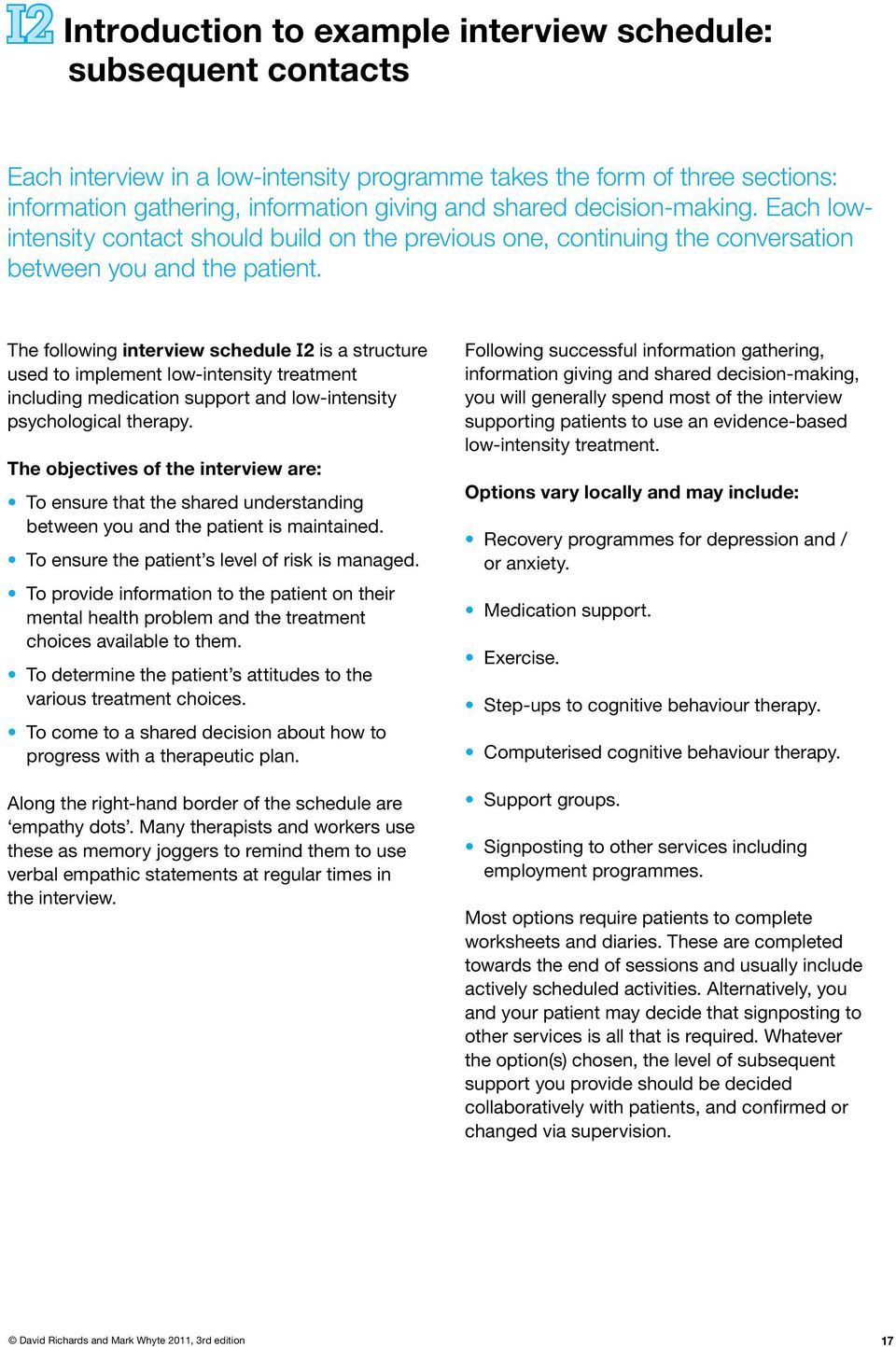
18 I2 Example interview schedule: subsequent contacts Empathy dots Information gathering Feedback of previous problem summary statement Checking that problem statement is an accurate reflection of patient s difficulties Further funneled information gathering if necessary Clarification and adjustment of problem statement Assessment of risk Feedback of previous risk assessment Checking that risk assessment is still accurate If any change re-assess: intent: suicidal thoughts plans: specific action plans actions: current / past; access to the means prevention: social network, services risk to others neglect of self or others Routine outcome measures IAPT sessional minimum data set including at least PHQ9 and GAD7 Information review Understanding of information given previously: mental health condition information medication information low-intensity psychological therapies information Medication review Concordance behaviour Benefit assessment Unwanted effects assessment Attitude to medication concordance Low-intensity psychological therapy review Understanding of options discussed Review of treatment exercise implementation Review of diaries and worksheets Shared decision-making Choices discussed Options selected Treatment continued revised or initiated Diaries and worksheets organised Ending Session summarised Next steps agreed and understood 18 David Richards and Mark Whyte 2011, 3rd edition

19 I3 Telephone interviews The telephone can be a valuable tool for delivering psychological and pharmacological interventions in low-intensity working within a stepped care framework. The NICE Guideline on Depression states that The provision of telephone support... informed by clear treatment protocols, should be considered for all patients, in particular for the monitoring of anitdepressant medication regimes (NICE 2007 p.32). Advantages of telephone intervention Using the telephone to deliver low-intensity interventions is flexible in that patients can be rung at times which suit them and not just between the hours of 9am-5pm. Telephone contacts can save patients time and money, as they don t have to travel to appointments or arrange child care during faceto-face appointments. Telephone working is not dependent on location and patients can be rung at home or elsewhere (at work for example in a lunch break) as most people now have mobile phones. For IAPT services it is also efficient in saving travelling time for staff. With the use of hands-free headsets, you can also enter data on to IT systems such as PC-MIS whilst talking to your patients. Another advantage of the telephone is that some patients, particularly those with depression, may not attend face-to-face appointments precisely because their symptoms (low mood, lack of energy, etc.) make it difficult for them to keep appointments. Assertively maintaining contact with patients dramatically improves treatment concordance and adherence to therapeutic activities. This is far better than merely recording such people as Did not attend or even discharging them. In general, you are recommended to conduct the initial assessment interview face-to-face and then follow up with telephone support. For any patients who are uncomfortable with telephone working, or where there may be good clinical reasons for seeing them in person, you should offer face-toface interviews instead. The experience of the IAPT National Demonstration Site in Doncaster suggests that only a small minority of patients are unwilling to receive support via the telephone. David Richards and Mark Whyte 2011, 3rd edition The evidence for telephone working Many mental health workers express initial reservations about using the phone for lowintensity psychological interventions (Richards et al, 2006). However, there is evidence that it is generally popular with patients (Car & Sheikh, 2003) who have few such reservations (Richards et al, 2006). A recent report demonstrated high levels of satisfaction with a telephone helpline service for people with breast cancer (Dean & Scanlon, 2007). Furthermore, there is strong evidence that telephone support and telehealth care improves outcomes and patient satisfaction in patients taking antidepressant medication (Hunkeler et al, 2000 and Simon et al, 2004) when care is organised through collaborative care (Gilbody et al, 2007). Preparing for telephone work At the initial face-to-face interview you can prepare patients for telephone working. Any self-help and information materials can be given to patients in this interview, as can copies of measures such as the PHQ9 and GAD7. This ensures that patients have the right information in front of them when subsequently talking to you on the phone. In the face-to-face interview you should also discuss how to maintain confidentiality on the phone. It s important to check who might answer the patient s phone at home, and whether any such persons are aware that the patient is receiving help; what you should say to avoid getting into difficult situations; and if it is acceptable for you to leave a message on an answering machine. 19

20 I3 Telephone interviews How does telephone working differ from face-to-face contact? The main and obvious difference is that neither party can see each other and therefore you need to compensate for the lack of non-verbal communication. You need to pay particular attention to the patient s tone of voice and try to pick up on the emotions being experienced. Where you would use nods and smiles in a faceto-face interview, make sure to use verbal prompts. The verbal skills of paraphrasing, summarising, reflecting and clarifying and of being empathic important in all interviews become even more crucial in telephone working. Patients may need time to respond to questions and information, so you should be willing to tolerate short silences. The structure of telephone interviews It is very important to stress that telephone interviews follow an identical structure to faceto-face interviews. At each contact you will be gathering information, giving information and coming to a shared decision with the patient regarding the next steps or action to be taken. You should begin the call exactly as they would a faceto-face appointment by introducing yourself fully in terms of your name and organisation. Given that you do not have the advantage of facial recognition, it is vital to check that you are speaking to the right person. Although most telephone contacts will be scheduled such like face-to-face appointments, it is usually a good idea just to check to see if it is still convenient to speak, together with agreeing the duration and agenda for the interview. At the beginning of the conversation, it is important to check that the patient has any materials required in front of them. Base the format for the call around the protocols of the chosen clinical approaches used (e.g. medication support, behavioural activation, problem solving, etc.). Information giving should be done in bite size chunks, and it is useful to get the patient to summarise their understanding of any information given. End the telephone interview by recapping on any agreed action and asking the patient to feedback their understanding and inviting them to ask any questions. It is usually a good idea to ask the patient to write down any agreed actions. Then agree the arrangements for the next telephone contact and any additional materials which are required to be posted out. How can you develop your telephone skills? You can develop and practise your skill in telephone interviews by undertaking role-play scenarios in which you and the patient (role-played by an educator or other student) sit back-to-back so that you can learn how to compensate for the absence of visual cues. Educators will need to develop scenarios and briefs for both the worker and the person role-playing the patient so that both parties know what has happened in previous interviews. 20 David Richards and Mark Whyte 2011, 3rd edition

21 I3 How to conduct a telephone interview Before the phone call: Any self-help and information materials can be given to patients face-to-face so that patients have these in front of them when subsequently talking to the worker on the phone. Discuss issues around confidentiality with the patient. Checking who might answer the patient s phone at home is important; whether any such persons are aware that the patient is receiving help; and what the worker should say to avoid getting into difficult situations. Check whether it is acceptable to the patient to leave a message on an answering machine. General points while on the phone Workers need to compensate for the lack of non-verbal communication. They need to pay particular attention to the patient s tone of voice and try to pick up on the emotions being experienced. Make sure to use verbal prompts. The verbal skills of paraphrasing, summarising, reflecting and clarifying and of being empathic become even more crucial in telephone working. Patients may need time to respond to questions and information, so workers should be willing to tolerate short silences. The structure of telephone interviews Checklist 1. Workers must check that they are speaking to the right person. 2. Workers should begin the call exactly like a face-to-face appointment: by introducing themselves fully in terms of name and organisation. 3. Check to see if it is still convenient to speak. 4. Agree the duration and agenda for the interview. 5. Check that the patient has all of the materials required in front of them. 6. Base the format of the call on the protocols of the chosen clinical approach (medication support, problem solving, etc.). 7. Give information in bite-sized chunks and ask the patient to summarise their understanding of any information given. 8. End the interview by recapping on any agreed action, asking the patient to feed back their understanding and inviting them to ask any questions. 9. It is usually a good idea to ask the patient to write down any agreed actions. 10. Arrangements should then be agreed for the next telephone contact and any additional materials which are required posted out. David Richards and Mark Whyte 2011, 3rd edition 21
22 Information giving Working as a psychological wellbeing practitioner often requires you to give patients information. Any information you give is based on the understanding that whilst people are the best managers of their own mental health, they often lack accurate information and regular support. Unlike some other non-directive approaches to mental health care, low-intensity working requires workers to participate in an active dialogue with patients. Information giving is part of that dialogue. Information is best given in a way which fits with the beliefs and prior knowledge of patients. Some patients may already know a great deal about their difficulties and methods of overcoming them, but they may be unable to implement therapeutic strategies without support. It is your job to discover what patients already know and to tailor the information you give them according to this knowledge. As with information gathering, the level of information giving will vary from session to session. It is likely that in the early contact sessions you will give more information than in later stages. Nonetheless, information giving may be required at all stages to help patients take decisions about their treatment. For example, where a patient is considering stopping taking antidepressants before the prescribed term is up, you will need to give information on how antidepressants work, including the rate of relapse, to help the patient make an informed decision. Low-intensity psychological therapy information is also likely to be given in more detail during the early contact sessions. Most information giving should be supported by written materials or other forms of material where literacy or language is a barrier to understanding. Five types of information you should give: What you as a psychological wellbeing practitioner will do. Details of the patient s emotional or diagnostic condition. Details of pharmacological treatments. Details of psychological treatments. Other options available to the patient. What you will do Following is an example of an information leaflet of the sort which you could give to patients to explain what your role is and how you will discharge it. The main points are that you should explain what you can do, how often you will do it and how you will do it. As ever, in information giving, verbal information should be supplemented by written materials. Information about mental health You should ensure that you give patients evidence based and accurate information about their mental health difficulties. There are many good sources for this: many service user and consumer advocacy organisations produce very helpful summaries of mental health problems and their treatment, written in an accessible manner. The key is to ensure that the information you provide is appropriate to the shared definition of the difficulties that you and the patient have agreed. Pharmacological treatments Medication is recommended for some mental health difficulties. There are many sources of information about medication for patients in general use; most mental health service user and advocacy organisations such as Rethink, MIND and the Mental Health Foundation provide clear leaflets and booklets. For detailed information, psychological wellbeing practitioners should consult the British National Formulary ( and Steven Bazire s authoritative 22 David Richards and Mark Whyte 2011, 3rd edition
23 Information giving Help from your mental health worker As part of this service, your mental health worker, who has had special training in helping people with anxiety and depression, will support you during the next few months. S/he will do this in several different ways: Contact you by telephone at regular intervals and at a time arranged between you and her / him. Explain about your symptoms and give you information, including leaflets and booklets to read and details of where to get other information. Plan an individual programme of psychological support and self-help activities with you to help you overcome many of your symptoms. Work closely with your GP and anyone else involved in your care and treatment. Regularly review your progress through discussion with you and using standard questionnaires. Help you make the best use of any medication that your GP has prescribed by giving you information on the medicine, including information on any possible side effects. Review the progress of your treatment regularly and discuss further options which are available from the service at this point. These may include further treatment, monitoring appointments or an information package to prevent relapse. Please do not be afraid to ask your mental health worker any questions about your care. S/he will try to answer your queries as best s/he can and if necessary will seek advice from colleagues and supervisors. book (referenced in the sources section of this learning outcome) and the associated web based materials at the Choice and Medication website ( accessible directly through many NHS Trust websites. Psychological treatments These learning support materials contain a number of short descriptions of effective psychological treatments including behavioural activation, cognitive restructuring, exposure and problem solving. Many clinical services have developed information leaflets or use readily available information such as the Northumberland leaflets (available from or materials from self-help books. You should ensure that any information you present is accurate, easy to read and backed up by written material. Other options available There are many community-based resources available to patients, including services run by voluntary and statutory sector organisations such as the Citizens Advice Bureau and Pathways to Work. Computerised cognitive behavioural therapy (CCBT) programmes are also available. You should ensure that you present accurate information about appropriate choices available in your area for patients with mental health problems and tailor this information to the particular identified needs of individual patients you are working with. The process of information giving is also detailed in the example initial interview schedule for subsequent contacts in the next section. F Film Clips The following film clips illustrate examples of psychological wellbeing practitioners giving information to patients: Gathering information 1, Gathering information 2, Medication, Exposure. David Richards and Mark Whyte 2011, 3rd edition 23
24 Shared decision-making Shared decision-making is the process by which patients are brought to enact informed decisions about their therapeutic programme. Shared decision-making means that you must help patients come to informed decisions, make choices and decide how to implement their own treatment. Even taking medication requires patients to take action with the aim of producing a positive therapeutic outcome. Psychological therapies place an even greater burden on patients and require much positive activity from them. Non-collaborative prescription of therapeutic activity telling the patient what to do is inappropriate for low-intensity treatment. Both parties have a stake in the outcome of the decisions made. The process of negotiation naturally follows on from information gathering and information giving. You should present choices, help patients weigh up the pros and cons of the various options, and come to a shared decision about which strategy to implement. In all stages of this process, the key is to collaborate and come to a truly informed and shared decision. Making decisions about further contact Both you and patients have limits to your availability. Patients may have employment and childcare commitments. You may be limited to certain working hours. You need to negotiate how often you will contact the patient, when this will happen, how this will happen (face-to-face or on the phone), where it will happen and if anyone else will be involved in further contacts. The content of shared decision making will be focused on: How contacts between you and patients will be managed. How the patient will proceed with any pharmacological treatment. How the patient will proceed with any psychological treatment. How the patient will proceed with any other options available to them. Each of these areas requires you to negotiate: What you and the patient will do. How you will do it. Where you will do it. When you will do it. If anyone else will be involved. The next stages in any pharmacological treatment Once you are satisfied that a patient has all the information required to make a decision about medication, you should clarify what they have decided to do in an explicit and detailed manner. Time, dose and frequency of any medication should be noted and agreed. You should give information on medication to assist them in their decision making. At all times you should respect decisions made by patients. If the patient s informed decision is not to take medication, or to stop taking it, you should suggest that the patient makes an appointment to see their GP to discuss this further. Where appropriate, you should ensure that medication remains on the agenda for future discussions in subsequent contacts. 24 David Richards and Mark Whyte 2011, 3rd edition
25 Shared decision-making The next stages in any psychological treatment In many cases, you will be taking an active role in supporting patients to use low-intensity psychological treatments. It is very important to ensure that the patient understands why that treatment is appropriate, and how it is supposed to work, before deciding to start that treatment. You will ensure this understanding by giving accurate information and discussing the matter to arrive at an informed shared decision. Appropriate choices should be presented and discussed. Many patients will look to you, as the expert mental health worker, to give them some guidance. In doing so, you must always act responsibly and in the patient s best interest. As a psychological wellbeing practitioner, you have experience and training in the methods that work for certain problems. Whilst it is impossible to predict completely how any individual will respond to a particular treatment, you should direct patients to those options which are evidence based and promise the greatest chance of recovery. Once the patient makes a choice, you should support their decision by undertaking the practical steps in the implementation of their chosen strategy. These steps are given in the support materials in this pack (see Low-intensity treatments, pp26-48). You should improve your knowledge of these strategies by reading from the reference materials. Most low-intensity psychological treatments require patients to undertake exercises in their own time. You will review the progress of these activities at the beginning of each subsequent contact session. Therefore, you should be very explicit in agreeing what patients will do, how they will do it, where they will do it, when they will do it and if anyone else will be involved. F Film Clips The following film clips illustrate examples of psychological wellbeing practitioners coming to shared decisions with patients: Gathering information 1 Gathering information 2 Medication Exposure David Richards and Mark Whyte 2011, 3rd edition 25
26 Low-intensity treatment interventions Psychological wellbeing practitioners should support patients to implement a range of low-intensity treatments. These are the specific factors of low-intensity working, as opposed to the common factors of alliance building, interpersonal communication and patient-centred questioning. In the next few pages you will find short explanatory notes on: Clinical procedure Page number C1 Behavioural activation 27 C2 Cognitive restructuring 32 C3 Medication support 36 C4 Exposure therapy 38 C5 Problem solving 41 C6 Managing panic 43 C7 Sleep hygiene 47 This list is not exhaustive but represents the core clinical interventions you will use with patients. You should read from the Suggested reading to further your knowledge. You should also watch the DVD film clips of these interventions. There are also other film clips in the CD-ROMs attached to the Myles and Rushforth (2007) resource book. F Film Clips The following film clips illustrate examples of psychological wellbeing practitioners using a range of low-intensity interventions in clinical sessions: Gathering information 1 Behavioural activation 1 Behavioural activation 2 Cognitive restructuring Exposure Medication 26 David Richards and Mark Whyte 2011, 3rd edition
27 C1 Behavioural activation Behavioural activation is an effective treatment for depression, in either low or high-intensity formats. It is effective because it targets the role of avoidance in depression. It is focused on activities to help patients re-establish daily routines, increase pleasurable activities and address important necessary issues. How does behavioural activation work? When people are depressed they feel physically unwell, have negative thoughts and change the way they behave. People who are depressed reduce the frequency and type of their usual behaviours. They commonly stop going out with others, reduce interactions with friends, work colleagues and family, and make little effort to do things they may have previously enjoyed. By avoiding effort, people experience relief from burdensome activity, which leads to more avoiding of effort. Avoidance is, therefore, negatively reinforced, i.e. the frequency of avoidance increases. As people avoid, they also reduce their opportunity for social and personal activities which bring them pleasure and achievement. They experience less positive reinforcement for these activities and thus these activities reduce further. Depression is, therefore, a vicious circle of negatively reinforced avoidance and reduced opportunity for positive reinforcement. Both these forces lead to reductions in usual activity for people who are depressed. Some of the things people avoid are just routine activities such as cleaning the house, doing the ironing, washing up. Other routines are disrupted such as the time they go to bed or get up, when they eat and how they cook for themselves. These are the important life routines that make people comfortable in their surroundings. Other activities that get disrupted are things people do for pleasure such as seeing friends, enjoying a day out with families or playing games with children. These are the things that often make people feel well. A third area where people avoid activities is in important necessary things such as paying bills or confronting difficult situations at work. These are activities which are important and if neglected may lead to an adverse consequence. The stages of behavioural activation The following protocol for BA is drawn from a clinical trial of depression management in the UK (Richards et al, 2008). It was developed from the clinical methods described by Martell et al (2001) and Hopko et al (2003). Further explanation is given in Chapter 12 of Callaghan et al (2008) and in Bennett-Levy et al (2010). Step 1: Explaining behavioural activation Psychological wellbeing practitioners should give patients a full and comprehensive rationale for behavioural activation, including reference to the interaction of physiological, behavioural and cognitive emotional symptoms, the role of avoidance in maintaining low mood and the idea of routine, pleasurable and necessary activities. Sometimes it is a good idea to supplement this explanation by filling in a Behavioural activation diary to provide an accurate baseline to evaluate change. David Richards and Mark Whyte 2011, 3rd edition 27
28 C1 Behavioural activation Step 2: Identifying routine, pleasurable and necessary activities Patients should identify routine, pleasurable and necessary activities things that they would like to do but have usually stopped doing since they became depressed. The worksheet Behavioural activation 1 is used to gather this information. Step 3: Making a hierarchy of routine, pleasurable and necessary activities Using the worksheet Behavioural activation 2, patients should organise the activities in Behavioural activation 1 into a hierarchy of difficulty most difficult, medium difficulty, easiest. Patients should include some of each type of routine, pleasurable and necessary activity in each section of Behavioural activation 2. Step 4: Planning some routine, pleasurable and necessary activities Psychological wellbeing practitioners should help patients to schedule some avoided activities into their week, using a blank diary (Behavioural activation diary) to specify a mixture of routine, pleasurable and necessary activities. These should be initially identified from near the bottom of their list in Behavioural activation 2. Activities should be detailed precisely: what, where, when, and who with. Small and regular activities are better in the early stages. Step 5: Implementing behavioural activation exercises Patients should undertake the planned activities written down in the diary. The principle of grading activities and using a mixture of routine, pleasurable and necessary actions should be followed. Patients should record in the same diary if they accomplished the planned activity. Step 6: Reviewing progress Psychological wellbeing practitioners should review Behavioural activation diaries during subsequent clinical contacts, so enabling patients to reflect on their programme, receive feedback on progress and problem-solve any difficulties experienced in implementation. Psychological wellbeing practitioners should be flexible as patients may make sporadic progress and activities may not go as planned. Shared decisions between psychological wellbeing practitioners and patients should be based on this review and further exercises planned. 28 David Richards and Mark Whyte 2011, 3rd edition
29 C1 Behavioural activation 1 List some routine activities here: e.g. washing up, cleaning the house List some pleasurable activities here: e.g. going out with friends or family List some necessary activities here: e.g. paying bills, dealing with difficult situations David Richards and Mark Whyte 2011, 3rd edition 29
30 C1 Behavioural activation 2 Put your lists in order of difficulty, mixing up the different routine, pleasurable and necessary activities The most difficult Medium difficulty The easiest David Richards and Mark Whyte 2011, 3rd edition
31 C1 Behavioural activation diary Morning Afternoon Evening What Where When Who What Where When Who What Where When Who What Where When Who What Where When Who Monday Tuesday Wednesday Thursday Friday Saturday Sunday David Richards and Mark Whyte 2011, 3rd edition 31
32 C2 Cognitive restructuring A major component of any emotional state is the thinking that accompanies the physical and behavioural symptoms. Most thoughts are automatic and many of these are unhelpful. Key features are that these thoughts are automatic, seem believable and real at the time they appear, and are the kind of thoughts that would upset anybody. These thoughts act powerfully to maintain mood states. Cognitive restructuring is a way of changing unhelpful thoughts by identifying, examining and challenging them. The stages of cognitive restructuring Cognitive restructuring comes in three stages. Firstly, people need to identify their thoughts, particularly the exact content of their unhelpful thoughts. The key thoughts are those most congruent with someone s emotional state, so called hot thoughts. Secondly, people examine their thoughts more objectively. This often requires people to collect evidence as to how accurate their thoughts really are and come up with alternative evidence against their thoughts. The final stage is to reconsider thoughts in the light of the new evidence that has been collected for and against. The thoughts are then reappraised, reevaluated and alternative thoughts derived. Implementing cognitive restructuring Psychological wellbeing practitioners can use cognitive restructuring as a low-intensity intervention by supporting patients in the use of diaries and worksheets. Some examples are given in this section of materials. The main tool is the thought record. Stage 1: Identification of thoughts In order to identify their thoughts, patients should record a situation in which they felt in a certain emotional state and try to identify the emotion they felt at the time. They rate this emotion on a scale usually from 0-100%. Patients then try and capture the exact thoughts that were in their mind when they felt this emotion and write these down in the thought record. In particular, the hot thought is the one that needs to be worked on. Psychological wellbeing practitioners can help patients identify the hot thought i.e. the one which is most congruent with the emotion. The final aspect of stage 1 is for patients to rate their strength of belief in the thought, again from 0-100%. 32 David Richards and Mark Whyte 2011, 3rd edition
33 C2 Cognitive restructuring Stage 2: Looking for the evidence Once the thoughts have been collected, patients should choose one to work on, ideally the hottest thought and one with a belief rating of at least 60%. The Evidence recording sheet is used to examine the evidence for and against the thought. Psychological wellbeing practitioners should help patients to write down the thought on top of the table, including the percentage belief rating. In the Evidence recording sheet, one column is labelled evidence for and one is labelled evidence against. Next, almost like the prosecution and defence counsel in a court, evidence for and against the truth of the thought is written down. People often find this quite difficult, particularly coming up with evidence that the thought is not true. Here are some questions which can be used by patients to help: If I were speaking to a friend with this thought, what would I say for and against it? How would someone else think about this? If I rate the belief in my thought as 75%, then there is 25% of the thought I do not believe to be true. What makes up that 25%? If I was not depressed, would I believe this thought? Is there another way of looking at this situation? Stage 3: Reconsidering thoughts Once the Evidence recording sheet has been collected, patients need to reconsider their thoughts in light of the evidence. The idea is to come up with revised thoughts and consider if this changes their emotional feelings. In the fourth column of the Thought diary patients write down new thoughts and rate how much they believe them on a scale of 0-100%. In the final column they rate their feelings again using the same 0-100% scale. Psychological wellbeing practitioners should help patients to notice that by changing their thoughts, their mood also changes. This is the way cognitive restructuring works to change the way people feel. Points to remember Unhelpful thinking takes time to change. Often people need to challenge their thoughts several times before change takes place. It can be useful for patients to ask a friend they trust to help them look for evidence for and against unhelpful thoughts. Cognitive restructuring should be practised with other thoughts using Evidence recording sheets to judge them. As people become more expert in this they can be advised to try and catch the thoughts and judge them as they actually occur. David Richards and Mark Whyte 2011, 3rd edition 33
34 C2 Thought diary Situation Feeling Rate how bad it was (0-100%) Thought Rate how much you believe this thought (0 100%) Revised thought Rate how much you believe this thought (0 100%) Feeling How bad was it (0-100 %?) 34 David Richards and Mark Whyte 2011, 3rd edition
35 C2 Evidence recording sheet My thought My % belief Evidence for Evidence against David Richards and Mark Whyte 2011, 3rd edition 35
36 C3 Medication support The goal of medication support by psychological wellbeing practitioners is to assist patients in making the best decision on medication use (mainly antidepressants) by: gathering information on patients attitudes to medication, medication use, clinical outcomes, medication effects and side effects. giving information regarding appropriate use of medication. negotiating shared decisions on patients medication usage. Psychological wellbeing practitioners provide information and support patients decision-making. They do not make independent decisions about prescribing (e.g. stopping medication, change in dosage). Mostly, psychological wellbeing practitioners support the patient in their decision to follow (or not) the medication recommendation made by the GP, providing information so that this decision is made in an informed manner. The only instance in which a psychological wellbeing practitioner should make a different direct recommendation to a patient on medication is if they identify possibly dangerous side effects. In these instances, workers must: advise the patient to temporarily discontinue medication. inform the GP of the possibility of dangerous side effects being present. strongly advise the patient to make an urgent appointment with their GP. discuss this with their supervisor as soon as possible. Where a patient decides not to follow the prescription made by the GP, psychological wellbeing practitioners should ensure that the patient s decision is fully informed by information on the effects and side effects of medication. The pros and cons of their decision and alternative strategies should also be explored. Further discussions between the patient and the GP should be encouraged and non-pharmacological psychosocial support offered by the worker. Where a psychological wellbeing practitioner is aware that a GP s prescription does not follow prescribing guidelines, this should be discussed with the worker s supervisor and a joint plan devised to assist the GP and the patient to make effective use of medication. Antidepressant medication Antidepressants are prescribed by GPs to many patients with depression. Modern antidepressants from the Selective Serotonin Reuptake Inhibitor (SSRI) and Selective Noradrenalin Reuptake Inhibitor (SNRI) classes are now more widely used than earlier antidepressants such as the tricyclics. However, older tricyclic antidepressants are still prescribed where clinically indicated. Patients may stop taking antidepressants completely or take less than the prescribed dose for a range of stated reasons. Here are some possibilities: ineffective / not-helpful. no longer necessary. side effects. concerned about safety. concerned about addiction. believes not appropriate just a crutch. family oppose it, others will find out. forgot to renew prescription. 36 David Richards and Mark Whyte 2011, 3rd edition
37 C3 Medication support Many patients take antidepressants in a less than optimum manner because they have beliefs about addiction or mode of action. For example, it is necessary to take antidepressants for a number of weeks at a therapeutic dose before beneficial effects are observed. Unfortunately, unwanted and unpleasant side effects often appear before these beneficial effects, causing many patients to reconsider or stop taking their antidepressants. Other patients may take antidepressants sporadically when they are feeling particularly low, in the belief that they have an immediate effect. Finally, antidepressants should be taken for six months following remission of symptoms. Many patients stop taking their medication before this period has elapsed, increasing their chances of relapse. Psychological wellbeing practitioners should, always, therefore: Gather information on the true reasons for medication non-concordance. Give accurate information about antidepressants. Assist patients to arrive at a shared decision about what to do next. There are many examples of information materials for patients in general use. Most mental health patient and advocacy organisations such as Rethink, MIND and the Mental Health Foundation provide clear leaflets and booklets. For detailed information, psychological wellbeing practitioners should consult the British National Formulary ( and Steven Bazire s authoritative book (referenced in Suggested reading) and the associated web based materials at the Choice and Medication website ( choiceandmedication.org/cms), accessible directly through many NHS Trust websites. David Richards and Mark Whyte 2011, 3rd edition 37
38 C4 Exposure therapy People will often try to avoid situations or objects they fear, and this avoidance does indeed successfully relieve anxiety. However, the more people avoid, the more they will continue to use it as a coping strategy. This leads to long-term difficulties as people find it more and more difficult to face their fears. Exposure is the planned therapeutic confrontation to a feared situation, object or memory. It is a highly effective treatment for many anxiety disorders where behavioural avoidance is a key maintaining factor. Specific phobias, agoraphobia, social phobia, obsessive compulsive disorder and post-traumatic stress disorder all respond well to exposure treatment. How does exposure therapy work? Exposure therapy works through a process known as habituation. This is the natural reduction in arousal that occurs when people allow themselves to remain in the presence of a feared situation or object for a prolonged period of time. Over time, anxiety reduces gradually whilst the person remains in contact with the feared stimulus. This is very different from avoidance. In avoidance, arousal reduces sharply but only when the person escapes from the feared situation or object. The problem with escape and avoidance is that the fear remains. The next time a person comes across their feared stimulus, their arousal levels will be the same as before. In exposure, habituation means that subsequent exposure sessions provoke less anxiety than previously. The graph below represents the difference. Escaping from the situation Staying in the situation 100 % level of anxiety minutes 30 minutes 60 minutes 90 minutes 120 minutes Time Avoidance Exposure 38 David Richards and Mark Whyte 2011, 3rd edition
39 C4 Exposure therapy There are four conditions necessary for effective exposure treatment: Grading Overcoming fear is best achieved by a gradual confrontation with feared stimuli the objects or situations which are avoided. This does not mean that exposure sessions should be shortened as a form of grading. The nature of the stimuli should be graded, for example by using photographs rather than real objects in the early stages of treatment. Prolonged Exposure must be prolonged if it is to be effective. There has to be sufficient time for arousal levels to reduce in the presence of the feared object or situation. Typically exposure sessions should last for between one to two hours or until anxiety has reduced by at least 50%. Repeated Additional exposure is necessary to cement improvement. The optimum number of repetitions should be balanced by the physical demands of feeling regularly fearful. Four or five prolonged repetitions weekly are usually manageable. Implementing exposure The first step is for psychological wellbeing practitioners to help patients compose a list of fearful objects or situations, ranking them in a hierarchy from the least anxiety provoking to the most feared one. Patients then start exposure with activities from the lower part of the list and practice these until they experience habituation. They then use the list to structure further exposure, picking objects or situations which are more fearful. Patients should always remember to remain in the presence of their feared situation or object until they experience a reduction in arousal. Diary records are essential both to schedule activities and for psychological wellbeing practitioners to review progress. An example diary sheet is given next. The rating scales are helpful for patients and psychological wellbeing practitioners to monitor arousal levels and check for habituation. Psychological wellbeing practitioners should encourage and support patients during exposure and help them problem solve any difficulties experienced during their exposure exercises. Without distraction To experience a reduction in anxiety, people must feel some fear at first in order to experience and thus learn that fear reduces naturally in the presence of the feared object or situation. David Richards and Mark Whyte 2011, 3rd edition 39
40 C4 Exposure exercise rating sheet Fill in the details of the exercises you undertake, making sure you use the rating scale below before you start the exercise, at the beginning of the exercise and at the end of it. Please add any comments you want to discuss with your mental health worker or anyone who is supporting you. Date and Time Duration Exercise Before exercise Rating Start of exercise End of exercise Comments No Anxiety Mild Anxiety Moderate Anxiety Severe Anxiety Panic 40 David Richards and Mark Whyte 2011, 3rd edition
41 C5 Problem solving Problem solving is an evidence-based low-intensity intervention which patients can use when their problems appear initially too big to solve. It is a practical approach which works by helping patients take a step back from their problems and consider what solutions might actually exist. It takes a systematic and step by step approach to what might seem overwhelming difficulties. Implementing problem solving Problem solving can be divided into seven steps. Use the following worksheet C5. Stage 1: Identify the problem Psychological wellbeing practitioners can help patients to identify the problem as clearly and precisely as possible. Each problem should be broken down into its constituent parts, for example, a financial problem can be broken down into the components of debt, income and expenditure. Stage 2: Identify the solution As many potential solutions as possible need to be identified. At this stage, nothing is rejected, no matter how apparently ridiculous solutions may seem. Staged solutions can be generated to different components of the problem identified in stage 1. Stage 3: Analyse strengths and weaknesses Each potential solution is subjected to an analysis of its strengths and weaknesses, to assess the main advantages and disadvantages of each solution. Advantages and disadvantages can refer to likelihood of success, possibility of implementation, resources needed, etc. Stage 4: Select a solution A solution is chosen based on the analysis in stage 3. Attention to resources available to implement the solution is important here since choosing a solution which has no chance of implementation will only lead to failure. Stage 5: Plan implementation Many solutions require careful planning. Steps should be outlined and resources listed. The steps should be specific, linked and realistic. Psychological wellbeing practitioners should use the Four Ws what, where, when, with whom to help patients plan the implementation plan. Stage 6: Implementation Patients implement the plan identified in stage 5. Record of implementation should be recorded in a simple diary. Stage 7: Review The advantage of problem solving is that alternative options always exist. Psychological wellbeing practitioners should gather information on the progress of the plan, preferably by reviewing the diary. If the solution has worked, continued implementation or moving onto another problem is indicated. If not, another solution should be chosen. David Richards and Mark Whyte 2011, 3rd edition 41
42 C5 Problem solving Problem identification (write your problem here) Solution identification (write down as many different solutions as possible use additional sheets if necessary) Strengths and weaknesses analysis (write down the advantages and disadvantages of each solution here use additional sheets if necessary) Solution selection (choose one solution) Implementation plan (write down the steps you will take to apply your chosen solution use additional sheets if necessary) Implementation (keep a separate diary of how you do) Review (write down how the plan went) 42 David Richards and Mark Whyte 2011, 3rd edition
43 C6 Managing panic What is panic disorder? Panic disorder is a common presenting problem in primary care with a prevalence rate of approximately 7 per 1000 population. It is important to distinguish between panic attacks and panic disorder. Panic attacks are very common and can be distressing. The DSM IV criteria (APA 1994) for a panic attack are: A discrete period of intense fear or discomfort, in which four (or more) of the following symptoms developed abruptly and reached a peak within 10 minutes: Palpitations, pounding heart, or accelerated heart rate. Sweating. Trembling or shaking. Sensations of shortness of breath or smothering. Feeling of choking. Chest pain or discomfort. Nausea or abdominal distress. Feeling dizzy, unsteady, lightheaded or faint. Derealisation (feelings of unreality) or depersonalisation (being detached from oneself). Fear of losing control or going crazy. Fear of dying. Parathesias (numbness or tingling sensations). Chills or hot flushes. Panic disorder occurs when people have recurrent or unexpected panic attacks and they become concerned about having further attacks, and the consequences of these and what the panic attacks mean. There is significant behaviour change usually comprising avoidance or attempts to prevent attacks happening. Panic disorder is defined relative to the presence or absence of agoraphobia. Panic disorder with agoraphobia occurs when patients associate their panic attacks with particular situations or places. These situations are avoided or endured with marked distress. Sometimes patients can enter these situations only in the presence of someone else supporting them. In other cases, patients do not associate their panic attacks with particular situations and say that their attacks come out of the blue. This is panic disorder without agoraphobia. What are the key features of panic disorder and what maintains the problem? Essentially, patients with panic disorder view the normal symptoms of acute anxiety in a catastrophic manner. The distressing symptoms which occur in panic are misinterpreted as indications of an impending physical or mental disaster. Typical feared consequences might include I ll collapse, I m going mad, I ll have a heart attack. These frightening thoughts generate anxiety, of course, and tend to make the physical symptoms worse, thus fuelling the vicious cycle of panic. A number of behaviours serve to maintain the problem once it is established. Patients often become hypervigilant for any bodily cues which might indicate to them an impending panic attack. Such hypervigilance often involves the misinterpretation of normal bodily symptoms and fuels the anxiety further. Patients often engage in a range of safety behaviours designed to prevent their feared consequence. Avoidance of situations leads to short-term reductions in anxiety, making it more likely that patients will continue to avoid. In the longer term this means that trigger situations become ever more frightening and patients never learn that their feared consequence doesn t occur. Other subtle forms of avoidance might involve carrying certain objects (e.g. water or medication) or having to be with certain people to enter particular situations. Again, these safety behaviours serve to maintain the problem. David Richards and Mark Whyte 2011, 3rd edition 43
44 C6 Managing panic Steps in the low-intensity treatment of panic disorder 1. Assessment and information gathering Psychological wellbeing practitioners need to gather detailed and individualised information about the symptoms of the patient s panic attacks and what they did. Clinically, a good technique is to ask the patient to recall a recent incident of panic as patients tend to have good recollection of what was a very frightening event. Questions should elicit: What physical and mental symptoms the patient experienced. What they thought was happening and their interpretation of the symptoms. How they felt. What they did probe for safety behaviours. The patient should be asked whether this incident was typical of what they experience during a panic attack. Further information and monitoring data can be gleaned through the use of a Panic diary (see sample at the end of this section). The first five columns can be used initially to ascertain the situation, the intensity of the panic, the physical symptoms they experienced, what they thought was happening and what they then did. 2. Information giving Patients need to learn about the nature of anxiety symptoms and the fight-flight response. This can be achieved by a variety of means- verbal explanation or by giving reading materials and selfhelp leaflets (see Suggested reading for details). Once they can begin to re-conceptualise the symptoms as those of anxiety rather than anything more sinister then their sense of panic should reduce. Often, psycho-education alone can have a major impact in panic patients. There are also some very brief exercises which patients can be encouraged to undertake to illustrate that hypervigilance and focusing on their bodies can be unhelpful. For example, asking patients to focus on their breathing or their pulse for a few minutes can make them more anxious and illustrate the link between focusing on their bodily symptoms and anxiety. Workers need to give patients information about the range of possible treatment interventions in order to promote choice and engagement in treatment. Each of the treatment options should be accompanied by clear rationales. 44 David Richards and Mark Whyte 2011, 3rd edition
45 C6 Managing panic 3. Low-intensity treatment options If patients are avoiding situations or are using safety behaviours in order to cope when entering particular situations they can be given a rationale for graded exposure to help them overcome their avoidance. (see C4, Exposure). Typically, exposure would work by facing the feared situations until habituation occurs and this can be graded by developing a hierarchy of feared situations and then gradually working up this hierarchy whilst eliminating safety behaviours. Cognitive restructuring (see C2) can also be used to help patients respond to their catastrophic thoughts about what their symptoms mean. As they learn more about normal anxiety mechanisms it should be possible to help them reattribute different explanations to their symptoms. As they learn how to do this, the final column of the Panic diary can be used to identify alternative (noncatastrophic) explanations of what is happening that patients can use to challenge their frightening thoughts when experiencing panic. Patients can also use behavioural experiments to test out their predictions of what might happen if they face the feared situation. This can be a powerful form of experiential learning. Sometimes, symptom induction experiments can be used to create the symptoms typically experienced in a panic attack and for patients to learn that their feared consequence doesn t occur (see Wells 1997 Chapter 5 for some tips on these). Some self-help materials on the treatment of panic advocate teaching patients breathing control or relaxation techniques. Caution needs to be exercised here. Whilst it may be useful for a patient to understand that hyperventilation makes their symptoms worse and that healthy breathing might be helpful, it is important that workers do not reinforce the idea that the patient s anxiety symptoms are dangerous and that patients need to use relaxation techniques or breathing control in order to overcome their problem. To do so runs the risk of workers inadvertently encouraging patients to adopt more safety behaviours. David Richards and Mark Whyte 2011, 3rd edition 45
46 C6 Panic diary Date and situation Where, when, with whom Intensity of panic Rate from Physical symptoms List Feared consequences What did I think the symptoms meant? Rate your belief in these thoughts from 0 100% Behaviour What did I do? Alternative explanation for symptoms 46 David Richards and Mark Whyte 2011, 3rd edition
47 C7 Sleep hygiene Sleep hygiene involves the practice of following guidelines to promote more restful and effective sleep, to increase daytime alertness and to overcome problems with sleeping at night. Sleep problems are a common feature of anxiety and depression and providing patients with information about sleep hygiene is an important part of the role of psychological wellbeing practitioners. Steps involved in promoting sleep hygiene Step 1: Establish the nature of the patient s sleep difficulties Gather information about the nature of the patient s concerns about sleep. These may include any of the following: Getting off to sleep. Staying asleep. Waking too early. Fitful sleep. Not feeling refreshed after sleep. Worrying about sleep Elicit the detail of the patient s patterns of sleep. When do they go to bed? How long do they sleep for? What do they do prior to bed? What do they do if they wake up? Do they sleep or nap during the day? What is their level of daytime activity and exercise? Asking patients to keep a sleep diary can provide useful baseline information and help establish patterns. People may be worrying about their sleep but actually getting enough. Step 2: Provide information about normal sleep and the nature of sleep problems There are no set rules about how much sleep people need it varies from person to person. Whilst seven to eight hours sleep may be typical, some people need more and some less. Sleep patterns vary with age, with older people often needing less sleep than younger adults. Sleep is affected by the amount of physical activity people engage in. Sleep problems may be caused by a number of factors: Medical problems such as pain or arthritis. Emotional problems such as stress, anxiety and depression. Certain medicines. Bladder problems, often affected by ageing Drug and alcohol use. Environmental factors such as a noisy, light or uncomfortable bedroom. In anxiety and stress people often report difficulty in getting off to sleep. Sleep is often fitful and people wake feeling un-refreshed. In depression, early-morning waking is often a problem as well as difficulty getting off to sleep. People who are depressed are often less active during the day but, because they lack energy, they may be tempted to sleep during the day, which makes it difficult to sleep well at night (see section C1 Behavioural activation). David Richards and Mark Whyte 2011, 3rd edition 47
48 C7 Sleep hygiene Step 3: Provide information on sleep hygiene and encouraging patients to establish regular sleep routines Psychological wellbeing practitioners should try to problem solve sleep difficulties with patients, having ascertained the nature of their difficulties. The following tips are generally regarded as good advice on sleep hygiene: Try to establish a pattern of going to bed at the same time and arising at a set time each day. Avoid sleeping during the day but, if naps are taken, ensure that they are short. Exercise during the day, preferably outdoors, promotes sleep. If people have become inactive, gradually building up activity levels will help. Limit the use of stimulants such as nicotine and caffeine in the evening prior to bed. Avoid excessive alcohol as its soporific effects tend to be short lived. Try to ensure that the bedroom is quiet, cool and dark and that the mattress is comfy. Limit stimulating activities in the hour or so before bedtime. Avoid going to bed too hungry or too full. Try to do things which feel relaxing prior to bed, e.g. having a bath, taking a milky drink, listening to relaxing music. Try to avoid worrying about getting enough sleep encourage patients to think of other things such as relaxing or pleasurable activities. Trying to command ourselves to go to sleep is counter-productive. If people haven t got off to sleep after half an hour or so, encourage them to get up, go to a different room and participate in a quiet activity until they feel sleepy and then return to bed. Step 4: Monitor the effects of the above Continuing to use sleep diaries can provide useful feedback on progress. Discuss any problems and try to establish any triggers for good or bad nights. Sources of useful information Newcastle, North Tyneside and Northumberland Mental Health NHS Trust Sleep problems: a self-help guide. Newcastle: NTW NHS Trust. University of Maryland Sleep Disorders Centre 48 David Richards and Mark Whyte 2011, 3rd edition
49 Values, policy, culture and diversity UK society is now a very diverse one: the people living in this country represent a range of cultures which hold a wide range of personal, family, social and spiritual values. You will be working with people from these very diverse communities served by your local facilities. Providing mental health care to people from widely diverse social groups requires knowledge, sensitivity and skill. These aspects of the IAPT course are assessed in a practical clinical planning scenario where you will be required to demonstrate skills in preparing for the care of people with a variety of needs from a variety of diverse groups. This will be accompanied by a 1,000-word write-up of the plan. There is also an exam, and you will need to successfully complete three practice outcomes to show how you have effectively engaged people from a range of social and cultural groups in low-intensity treatments. Where appropriate, you will also need to display competence in the use of face-to-face and telephone translation services for people whose first language is not English. You must be able to demonstrate knowledge of, commitment to and practical skills in implementing a non-discriminatory, recovery-orientated values base to mental health care. To do this you should have a comprehensive knowledge of the diversity and social inclusion agenda. You should be able to display how your work reflects a commitment to an inclusive, recovery-orientated set of values which respects diversity and multi-culturalism. As well as respecting differences in race and culture, you should demonstrate respect for and the value of individual differences in age, sexuality, disability, gender and spirituality. You should be able to demonstrate understanding of how different groups in society construct and interpret their experiences of mental health. You should demonstrate how this understanding will impact on your information gathering, information giving and shared decision-making when planning treatments for service users with different identities and characteristics. One specific example of sensitivity towards diversity is in the use of translation services for people whose command of spoken and written English requires their use. Translation services are generally provided through PCT and mental health provider arrangements. You must be able to demonstrate how you will assess the need for, access and use translation services. Physical and sensory difficulties may also make it difficult for some patients to access and use mental health services. You should take into account any physical and sensory difficulties people may experience in accessing services, and how you make provision in your work to ameliorate these. This will include you showing how you are aware of the difficulties people with different physical and sensory abilities may experience in daily life, how this may impact on their mental health and how it may form a barrier to accessing mental health care. An important aspect of any mental health work is the issue of power in professional / patient relationships. You will need to demonstrate an understanding of the literature on power in professional / patient relationships and show how you take steps in your clinical practice to reduce any potential for negative impact this may have. You should be able to critically analyse the nature of professional / patient relationships, taking into account how such concepts might facilitate or impede a patient s ability to engage with and implement a low-intensity treatment programme. David Richards and Mark Whyte 2011, 3rd edition 49
50 Values, policy, culture and diversity To sum up, these aspects of your work require you to understand and take action to address diversity and equal opportunities in your clinical practice. You should demonstrate how you implement a commitment to equal opportunities for all, and how you will work to encourage all people s active participation in care and treatment. Overall, you should demonstrate this in the way in which you approach your work, your planning of treatment and your clinical practice. You should use the principles of patient-centred practice to show how you promote people s active engagement when information gathering, information giving and especially shared decision-making at all stages of their low-intensity clinical practice. Most of the supporting material in this area is written material. The Myles and Rushforth (2007) book has useful background and some video materials. F Film clips The following film clips illustrate psychological wellbeing practitioners seeking confirmation of patients cultural norms to aid in treatment planning: Treatment planning 1 Treatment planning 2 50 David Richards and Mark Whyte 2011, 3rd edition
51 Supervision for low-intensity working Low-intensity treatment is based on procedures developed in clinical trials to establish the effectiveness of the different types of treatment. One of the most important functions of supervision is to ensure that you, as a psychological wellbeing practitioner, deliver treatments which follow as closely as possible the evidence-based procedures. Low-intensity supervision is organised to account for the high case loads that you will carry. All supervision requires discussion between you and your supervisor about patients clinical presentations, safety and progress, and about the process and techniques you are using. Supervision also assists you in developing your skills by identifying your learning needs. Clinical case management supervision is normally carried out weekly. This type of supervision is essential, since in high-volume working environments it is easy for cases to slip through the net and never be discussed. Supervision is best facilitated by automated IT-based case management systems such as PC-MIS ( Clinical case management supervision is undertaken at regular (usually weekly), timetabled intervals, rather than at your request. Discussions in clinical case management supervision always include your presentations of patients at predetermined stages in their care pathway and/or who have particular clinical characteristics. This type of supervision has been shown to be linked to better patient outcomes in a collaborative care system (Bower et al, 2006). Your supervisor(s) should be familiar with lowintensity work, ideally having delivered low-intensity treatments themselves. Currently, psychological wellbeing practitioners tend to be supervised by CBT therapists from high-intensity steps. However, more experienced psychological wellbeing practitioners with specific training in supervision should be able to take on a supervisor role. Clinical case management supervision is carefully structured to enable efficient support and shared decision making by you and your supervisor(s). A large number of cases will usually be discussed in any one supervision session. Selecting your cases for supervision You will usually start supervision with an overall discussion of your full case load numbers, to enable your supervisor to assess your ability to manage your case load. Following this first stage, the following principles should guide the selection of cases: Any new patients on your case load. All patients on your case load should be discussed regularly, and certainly no less than at four-weekly intervals. Any of your patients with risk levels above a predetermined threshold. All of your patients whose scores on clinical measures are above a predetermined threshold. All of your patients whose appointments are overdue or whom you have not contacted recently. Any patient for whom you wish further support or advice. David Richards and Mark Whyte 2011, 3rd edition 51
52 Supervision for low-intensity working Presenting cases You should be able to present demographic, clinical, process and outcome information succinctly and accurately. Preparation is key, as is good note-keeping. As well as automatically detecting patients who require supervisory review, IT-mediated supervision systems make the process of rapid review of notes, outcome measures, risk and clinical activity far more efficient. In clinical case management supervision, you would normally present the following information for all new cases. This is information you will have gathered during your first contact appointment with patients: Gender. Age. Main problem statement. Level of risk. Onset and duration of current problem. Previous episodes. Past treatment. Current scores on clinical measures. Any co-morbidity issues. Any cultural, language or disability considerations. Employment status. Current treatment from GP or other workers. Low-intensity treatment plan. Low-intensity action already initiated. In addition, where supervision is concerned with patients being reviewed at pre-determined intervals (for example every four weeks), where risk level causes concern or where outcome measures remain high, it is helpful if you also present an episode treatment summary which includes: Intervention summary. Number of contacts. Duration of contacts. Patient progress report including patients engagement with and response to low-intensity treatment. Risk management plan. Scores on sessional clinical outcome measures. Alternative low-intensity treatments available and suggestions for alternative treatments where necessary, for example stepping up to high-intensity treatment. Where patients appointments are overdue, if patients have not attended scheduled contacts (including telephone appointments) or have dropped out of treatment, the following information is also useful: Number of attempts made to contact the patient including telephone calls, time of calls, letters and other contact attempts Following each discussion of an individual patient, supervisors need to record their agreed action. It is generally better to have the supervisor enter the agreed plan, then sign and date the record. Certain IT-mediated supervision systems such as PC-MIS can automatically stamp the date and a supervisor s signature onto the record. You should ensure this is done and follow the advice recorded. Assessment You will be assessed on your ability to organise and present clinical information and how you reflect on your supervisor s advice and guidance. F Film clips The following film clips illustrate how psychological wellbeing practitioners present information and use supervision: Supervision 1 Supervision 2 Supervision 3 52 David Richards and Mark Whyte 2011, 3rd edition
53 C8 Checklist for low-intensity supervision Number of patients on case load Number of patients requiring supervision 1. All Patients requiring supervision Gender, age Main problem statement Level of risk Onset and duration of current problem Previous episodes, past treatment Current scores on clinical measures (at least PHQ9, GAD7) Co-morbidity issues Cultural, language or disability considerations Employment status Treatment from GP or other workers Low-intensity treatment plan Low-intensity action already initiated 2. Patients for scheduled review, risk review or where outcome measures remain high Summary of case as above in section 1 Reason for supervision (scheduled review point, high scores, risk level) Intervention summary Number and duration of contacts Patient engagement with low-intensity treatment Patient response to low-intensity treatment Scores on sessional clinical outcome measures Low-intensity treatment plan Alternative treatment plan including stepping up to high-intensity treatment 3. Patients overdue, not attended or dropped out Summary of case as above in section 1 Reason for supervision Summary of progress before non-contact Number of attempts made to contact the patient Number and methods of contact attempted Time of any telephone calls David Richards and Mark Whyte 2011, 3rd edition 53
54 Suggested reading and resources Abbott, P. & Wallace, C., eds., The sociology of the caring professions. London: Falmer Press. Adam, S., Emmerson, C., Frayne, C. & Goodman, A., Early quantitative evidence on the impact of the Pathways to Work pilots: a report of research carried out by the Institute of Fiscal Studies on behalf of the Department for Work and Pensions. Department of Work and Pensions Research Report No 354. American Psychiatric Association, The diagnostic and statistical manual of mental disorders (DSM) IV, 4th ed. Washington DC.: American Psychiatric Association. Appleby, L., The national health service framework for mental health five years on. London: Department of Health Publications. Bazire, S., Psychotropic drug directory 2003/2004: the professionals pocket handbook and aide memoire. Salisbury: Fivepin Publishing. Bennett-Levy, J., Richards, D.A. & Farrand, P., et al., eds., The Oxford Guide to Low Intensity CBT Interventions. Oxford: Oxford University Press. Bhugra, D. & Bahl, V., Ethnicity: an agenda for mental health. London: Royal College of Psychiatrists/Gaskell. Black, C., Working for a healthier tomorrow. London: TSO. Available at gov.uk/documents/working-for-a-healthier-tomorrowtagged.pdf BMA & RPS. British national formulary. London: British Medical Association and Royal Pharmaceutical Society of Great Britain. Bower, P. & Gilbody, S., Managing common mental health disorders in primary care: conceptual models and evidence base. British Medical Journal, 330, p Cahill, J., Barkham, M., Hardy, G. et al., A review and critical analysis of studies assessing the nature and quality of therapist/patient interactions in treatment of patients with mental health problems Car, J. & Sheikh, A., Telephone consultations. British Medical Journal, 326, p CCAWI website, Ten%20Essential%20Shared%20Capabilities.pdf Centre for Reviews and Dissemination. Database of Abstracts of Reviews of Effects (DARE). york.ac.uk/inst/crd/crddatabases.htm#dare Chambless, D. & Hollon, S., Defining empirically supported therapies. Journal of Consulting and Clinical Psychology, 66, p7-18. Clark, D.M., Layard, R., Smithies, R., Richards, D.A., Suckling, R., and Wright, B., Improving access to psychological therapy: initial evaluation of two UK demonstration sites. Behaviour Research and Therapy 47, Cobb, A., Managing for mental health: the Mind employers resource pack. London: Mind. Cochrane Collaboration. Copeland, M., Wellness recovery action plan (WRAP). Liverpool: Sefton Recovery Group. CSIP, Primary care services for depression: a guide to best practice, appendix 4: asking about risk. Hyde: Care Services Improvement Partnership. Dean, A. & Scanlon, K., Telephone helpline to support people with breast cancer. Nursing Times 103:42, p Department of Health, National service framework for mental health: Modern standards and service models. London: Department of Health. Department of Health, The NHS plan: a plan for investment, a plan for reform. London, Department of Health. Department of Health, A sign of the times: Modernising mental health services for people who are deaf. London: HMSO. Department of Health, Delivering race equality in mental health care: a summary. London: Department of Health. Department of Health, Positive steps: supporting race equality in mental healthcare. London: Department of Health. Egan, G., The skilled helper: a systematic approach to effective helping, 7th ed. California: Brooks / Cole. Egger, M., Smith, G. & Altman, D Systematic reviews in health care: meta-analysis in context. London: BMJ Publications. Ekers, D, Richards, D and Gilbody S. (2008). A Meta Analysis of Randomized Trials of Behavioural Treatment of Depression. /Psychological Medicine/, 38: Ethnicity online: Useful web resources and good practice guidelines at Gask, L., Lester, H., Kendrick, A. & Peveler, R., eds., Handbook of primary care mental health. London: Gaskell Publishing (in press). Gellatly, J., et al., What makes self-help interventions effective in the management of depressive symptoms? Meta-analysis and meta-regression. Psychological Medicine, 37, p David Richards and Mark Whyte 2011, 3rd edition
55 Gilbert, P., Overcoming depression. London: Constable Robinson. Gilbody, S. & Bower, P., et al., Collaborative care for depression in primary care: making sense of a complex intervention: systematic review and metaregression. British Journal of Psychiatry, 189, p Goldberg, D. & Huxley, P., Common mental disorders: a biosocial model. London: Routledge. Gray, P., Mental health in the workplace: tackling the effects of stress. London: The Mental Health Foundation. Greenberger, D. & Padesky, C., Mind over mood: changing how you feel by changing the way you think. New York: The Guilford Press. Heron, J., Helping the client: a creative practical guide, 5th ed.. London: Sage. Hirai, M. & Clum, G., A meta-analytic study of self-help interventions for anxiety problems. Behavior Therapy, 37 (2), p HM Government Office for Disability Issues at Holford, E., Improving access to psychological therapy: the Doncaster demonstration site organisational model commentary. Clinical Psychology Forum, 181, p Hopko D., Lejuez C., Ruggiaro K.& Eifert G., Contemporary behavioural activation treatments for depression: procedures, principles and progress. Clinical Psychology Review, 23, p Hunkeler, E., Katon, W., Tang, L. et al., Long term outcomes from the IMPACT randomised trial for depressed elderly patients in primary care. British Medical Journal, 332, p Hunkeler, E., Meresman, J., et al., Efficacy of nurse telehealth care and peer support in augmenting treatment of depression in primary care. Archives of Family Medicine, 9, p IAPT minimum data set. improving-access-to-psychological-therapies-keyperformance-indicators-and-technical-guidance-2009/ IAPT website, Katon, W., Von Korff, M., et al., Stepped collaborative care for primary care patients with persistent symptoms of depression: a randomized trial. Archives of General Psychiatry, 56, p Kennerley, H., Overcoming anxiety. London: Constable Robinson. Khan, K., ter Riet, G., Glanville, J., Sowden, A. et al., eds., Undertaking systematic reviews of research on effectiveness: CRD s guidance for those carrying out or commissioning reviews. Report 4, 2nd ed.. York: Centre for Reviews and Dissemination, University of York. Available from reviews_book.htm Kroenke, K., Spitzer R. & Williams, J., The PHQ9: validity of a brief depression severity measure. Journal of General Internal Medicine, 16, p Layard, R., The depression report. London: London School of Economics. Lester, H. & Glasby, J., Mental health policy and practice. Basingstoke: Palgrave Macmillan. Lovell, K. & Richards, D., A recovery programme for depression. London: Rethink. Martell C., Addis M. & Jacobson N., Depression in Context. Strategies for Guided Action. Norton: New York. Mead, N. & Bower, P., Patient-centredness: a conceptual framework and review of the empirical literature. Social Science and Medicine, 51:7, p Mead, N. & Bower, P., Patient-centred consultations and outcomes in primary care: a review of the literature. Patient Education and Counseling, 48, p MIND Factsheet on Lesbians, gay men, bisexuals and mental health at groups_and_communities/lesbians_gay_men_and_ bisexuals_and_mental_health Myles, P. & Rushforth, D., A complete guide to primary care mental health. London: Robinson. National Center for Cultural Competence (US) at www11.georgetown.edu/research/gucchd/nccc/index.html National Institute for Clinical Excellence, Posttraumatic stress disorder (PTSD): the management of PTSD in adults and children in primary and secondary care. London: National Institute for Clinical Excellence. National Institute for Clinical Excellence, Obsessive-compulsive disorder: core interventions in the treatment of obsessive-compulsive disorder and body dysmorphic disorder. London: National Institute for Clinical Excellence. Generalised anxiety disorder and panic disorder (with or without agoraphobia) in adults Management in primary, secondary and community care. London: National Institute for Clinical Excellence. National Institute for Clinical Excellence, Depression in Adults (update), Depression: the treatment and management of depression in adults. London: National Institute for Clinical Excellence. National Institute for Mental Health in England and Department of Health, Inside/Outside: improving mental health services for black and minority ethnic communities in England. London: HMSO. David Richards and Mark Whyte 2011, 3rd edition 55
56 Newell, R. & Gournay, K., Mental health nursing: an evidence-based approach. Oxford: Elsevier Health Services. NIMHE National Workforce Programme, Medicines management: everybody s business. A guide for service users, carers and health and social care practitioners. York: NIMHE. Norcoss, J., Psychotherapy relationships that work: therapist contributions and responsiveness to patients. Oxford: Oxford University Press. Norfolk, T., Birdi, K. & Walsh, D., The role of empathy in establishing rapport in the consultation: a new model. Medical Education, 41, p O Hagan, K., Cultural competence in the caring professions. London: Jessica Kingsley. Pilgrim, D. & Rogers, A., Sociology of mental health, 3rd ed. Maidenhead: The Open University Press. Prior, P., Gender and mental health. Basingstoke: Macmillan. Pullen, I. & Loudon, J., Improving standards in clinical record-keeping. Advances in Psychiatric Treatment, 12, p Raistrick, H. & Richards, D., Designing primary care mental health services. Hyde: Care Services Improvement Partnership. Repper, J. & Perkins, R., Social inclusion and recovery. London: Bailliere Tindall. Rethink, A report on the work of the recovery learning sites and other recovery-orientated activities and its incorporation into The Rethink Plan London: Rethink. Rethink webpage on recovery at Richards, D.A. and Borglin, G. (2011). Implementation of Psychological Therapies for Anxiety and Depression in Routine Practice: Two Year Prospective Cohort Study. Journal of Affective Disorders /j.jad Richards, D. et al., Collaborative care for depression in UK primary care: a randomized controlled trial. Psychological Medicine, 38, p Richards, D., Lankshear, A., Fletcher, J., Rogers, A. et al., Developing a UK protocol for collaborative care: a qualitative study. General Hospital Psychiatry, 28, p Richards, D. & Suckling, R., Improving access to psychological therapy: The Doncaster demonstration site organisational model. Clinical Psychology Forum, 181, p9-16. Richards, D.A. and Suckling, R., Improving Access to Psychological Therapies (IAPT): Phase IV Prospective Cohort Study. British Journal of Clinical Psychology, 48, Rogers, A. & Pilgrim, D., Mental health and inequality. Basingstoke: Palgrave Macmillan. Roth, A. & Pilling, S., The competences required to deliver effective cognitive and behavioural therapy for people with depression and with anxiety disorders. London: Department of Health. Royal National Institute for Blind at Ryan, T. & Pritchard, J., eds., Good practice in adult mental health. London: Jessica Kingsley. Sainsbury Centre for Mental Health, On our own terms: users and survivors of mental health services working together for support and change. London: SCMH. Salkovskis, P., Empirically grounded clinical interventions: cognitive behavioural therapy progresses through a multi-dimensional approach to clinical science. Behavioural and Cognitive Psychotherapy, 30, p3 9. Silverman, J., Kurtz, S. & Draper, J., Skills for communicating with patients, 2nd ed. Oxford: Radcliffe Publishing. Simon, G., Collaborative care for depression. BMJ, 332, p Simon, G., Ludman, E., Tutty, S., Operskalski, B. et al., 2004 Telephone psychotherapy and telephone care management for primary care patients starting antidepressant medication: a randomized controlled trial. Journal of the American Medical Association, 292, p Spitzer, R., Kroenke, K., Williams, J., et al., A brief measure for assessing generalized anxiety disorder: the GAD-7. Archives of Internal Medicine, 166, p Stokes, G., Mental health problems in older people in Bailey, D. (ed.). At the core of mental health: key issues for practitioners, managers and mental health trainers. Brighton: Pavilion Publishing Ltd, pp Thornicroft, G., Shunned: discrimination against people with mental illness. Oxford: Oxford University Press. Von Korff, M. & Goldberg, D., Improving outcomes in depression. BMJ, 323, p Westbrook, D., Kennerley, H. & Kirk, J., An introduction to cognitive behaviour therapy: skills and applications. Michigan: Sage. Williams, C., Overcoming anxiety: a five areas approach. London: Arnold. Williams, C.J., Overcoming Depression and low mood: A Five Areas Approach Second Edition. London: Hodder Arnold World Health Organization, ICD-10 Classification of mental and behavioural disorders: clinical descriptions and diagnostic guidelines. Geneva: World Health Organization. 56 David Richards and Mark Whyte 2011, 3rd edition
57 Appendix. David Richards and Mark Whyte 2011, 3rd edition 57
58 Recognition, Module 1: engagement and assessment of patients with common mental health problems Aims of module Module 1 Psychological wellbeing practitioners delivering low intensity interventions assess and support people with common mental health problems in the self-management of their recovery. To do so, they must be able to undertake a patient-centred interview which identifies both the person s main difficulties and areas where the person wishes to see change and / or recovery, and which makes an accurate assessment of the risk the person poses to self or others. Psychological wellbeing practitioners need to be able to engage patients and establish a therapeutic alliance while gathering information to begin assisting the patient to choose and plan a collaborative treatment programme. They must have knowledge of mental health disorders and the evidence-based therapeutic options available, and be able to communicate this knowledge in a clear and unambiguous way so that people can make informed treatment choices. This module will, therefore, equip workers with a good understanding of the incidence, prevalence and presentation of common mental health problems, and of evidencebased treatment choices. Skills teaching will develop workers core common factors competences of active listening, engagement, alliance building, patient-centred information gathering, information giving and shared decision making. Learning outcomes 1. Demonstrate knowledge, understanding and critical awareness of concepts of mental health and mental illness, diagnostic category systems in mental health and a range of social, medical and psychological explanatory models. 2. Demonstrate knowledge of and competence in using common factors to engage patients, gather information, build therapeutic alliances, manage the emotional content of sessions and grasp the patient s perspective or world view. 3. Demonstrate knowledge of and competence in patient-centred information gathering to arrive at a succinct and collaborative definition of the patient s main mental health difficulties and the impact these have on their daily living. 4. Demonstrate knowledge of and competence in recognising patterns of symptoms consistent with diagnostic categories of mental disorder from a patient-centred interview. 5. Demonstrate knowledge of and competence in recognition and accurate assessment of the risk posed by patients to themselves or others. 6. Demonstrate knowledge of and competence in the use of standardised symptom assessment tools and other psychometric instruments to aid problem recognition and definition and subsequent decision making. 7. Demonstrate knowledge of and competence in giving evidence-based information about treatment choices and in making shared decisions with patients. 8. Demonstrate understanding of the patient s attitude to a range of mental health treatments, including prescribed medication and evidencebased psychological treatments. 9. Demonstrate competence in accurate recording of interviews and questionnaire assessments using paper and electronic record-keeping systems. 58 David Richards and Mark Whyte 2011, 3rd edition
59 Recognition Learning and teaching strategies Knowledge Lectures Seminars Discussion groups Guided reading Independent study Skills Clinical simulation in small supervised groups Supervised practice through direct patient contact Assessment strategies A standardised role-play scenario where workers are required to demonstrate skills in engagement, information gathering, information giving and shared decision making. This will be filmed and assessed by teaching staff using a standardised assessment measure. Module 1 Workers must also provide a 1,000-word reflective commentary on their performance. Both parts must be passed. An exam to assess module knowledge against the learning outcomes. Successful completion of the following practice outcomes: 1. Formulating and recording mental health care assessments appropriate to the identified needs of patients. 2. Demonstrating the common factors competences necessary to develop individualised therapeutic alliances that enable patients (and where appropriate their carers) to be purposefully involved in a partnership of care. Knowledge assessments are at undergraduate and / or postgraduate level and assessed using percentage criteria. Skills based competency assessments are independent of academic level and must be achieved according to a pass / fail criterion. Duration 11 weeks, 15 days in total, running parallel with module 2: Five days intensive skills practice undertaken in a one-week intensive workshop. One day per week for 10 weeks, half the time to be spent in class in theoretical teaching and clinical simulation, the other half in the workplace undertaking supervised practice. David Richards and Mark Whyte 2011, 3rd edition 59
60 Recognition Further reading Module 1 American Psychiatric Association, The diagnostic and statistical manual of mental disorders (DSM) IV. 4th ed. Washington DC.: American Psychiatric Association. Appleby, L., The national service framework for mental health five years on. London: Department of Health Publications. Bazire, S., Psychotropic drug directory 2003/2004: the professionals pocket handbook and aide memoire. Salisbury: Fivepin Publishing. Bennett-Levy, J., Richards, D.A. & Farrand, P., et al., eds., The Oxford Guide to Low Intensity CBT Interventions. Oxford: Oxford University Press. BMA & RPS British National Formulary. London: British Medical Association and Royal Pharmaceutical Society of Great Britain. Care Services Improvement Partnership, Primary care services for depression a guide to best practice, appendix 4: asking about risk. Hyde: Care Services Improvement Partnership. Department of Health, National service framework for mental health: modern standards and service models. London: Department of Health. Department of Health, The NHS Plan: A plan for investment, a plan for reform. London: Department of Health. Egan, G., The skilled helper: a systematic approach to effective helping. 7th ed. California: Brooks / Cole. Goldberg, D. & Huxley, P., Common mental disorders: a biosocial model. London: Routledge. Gray, P. & Mellor-Clark, J. (eds.), 2007, CORE: A Decade of Development. CORE IMS: Rugby. Heron, J., Helping the client: a creative practical guide. 5th ed. London: Sage. IAPT minimum data set. improving-access-to-psychological-therapies-keyperformance-indicators-and-technical-guidance-2009/ Kennerley, H., Overcoming anxiety. London: Constable Robinson. Kroenke, K., Spitzer, R. & Williams, J., The PHQ 9: validity of a brief depression severity measure. Journal of General Internal Medicine, 16, p Layard, R., The depression report. London: London School of Economics. Lovell, K. & Richards, D., A recovery programme for depression. London: Rethink. Mead, N. & Bower, P., Patient-centredness: a conceptual framework and review of the empirical literature. Social Science and Medicine, 51, p Mead, N. & Bower, P., Patient-centred consultations and outcomes in primary care: a review of the literature. Patient Education and Counseling, 48, p Myles, P. & Rushforth, D., A complete guide to primary care mental health. London: Robinson. Generalised anxiety disorder and panic disorder (with or without agoraphobia) in adults Management in primary, secondary and community care. London: National Institute for Clinical Excellence. National Institute for Clinical Excellence, Depression in Adults (update), Depression: the treatment and management of depression in adults. London: National Institute for Clinical Excellence. Newell, R. & Gournay, K., Mental health nursing: an evidence-based approach. Oxford: Elsevier Health Services. Pilgrim, D. & Rogers, A., Sociology of mental health. 3rd ed. Maidenhead: The Open University Press. Pullen, I. & Loudon, J., Improving standards in clinical record-keeping. Advances in Psychiatric Treatment, 12, p Raistrick, H. & Richards, D., Designing primary care mental health services. Hyde: Care Services Improvement Partnership. Silverman, J., Kurtz, S. & Draper, J., Skills for communicating with patients. 2nd ed. Oxford: Radcliffe Publishing. Spitzer, R. et al., A brief measure for assessing generalized anxiety disorder: the GAD-7. Archives of Internal Medicine, 166, p Westbrook, D., Kennerley, H. & Kirk, J., An introduction to cognitive behaviour therapy: skills and applications. Michigan: Sage. Williams, C., Overcoming anxiety: a five areas approach. London: Arnold. Williams, C.J., Overcoming Depression and low mood: A Five Areas Approach Second Edition. London: Hodder Arnold World Health Organization, ICD-10 Classification of mental and behavioural disorders: clinical descriptions and diagnostic guidelines. Geneva: World Health Organization. 60 David Richards and Mark Whyte 2011, 3rd edition
61 A1 Patient-centred assessment How to use this assessment sheet This assessment sheet is divided into four sections: 1. Introduction 2. Interpersonal skills 3. Information gathering 4. Information giving and shared decision making Each section includes a number of competences which are specific and central to these four aspects of an initial patient-centred interview. Each component of the assessment sheet is divided into three columns. Assessors should rate each competence according to observations made of the student s interview. The right-hand column represents an aspect of the interview which was not conducted sufficiently well to be regarded as competent. The middle column should be ticked when students displayed the behaviours necessary but could have done more. The left-hand column is reserved for students who are fully competent in the relevant skill. Guidelines are given in each cell of the assessment sheet to assist assessors in making an objective judgement of competence. The four sections are weighted: 10% for the introduction section, 30% for interpersonal skills, 40% for information gathering and 20% for information giving and shared decision making. Each section is rated from 0 10 and multiplied by the relevant weighting to give a final score. The assessment is marked as an overall pass / fail exercise. The middle two sections MUST be passed independently students cannot fail the interpersonal skills section and make up marks on the other three sections. The same applies to the information gathering section. A missing risk assessment leads to an automatic fail. The section ratings given should reflect the amalgamated ticks given in each cell, the majority of which would need to be in the left-hand or middle columns to constitute a pass. As competence ratings are dependent on multiple criteria, the overall percentage ratings are indicative only and used to give students feedback rather than indicate concrete competence performance differences between students. It is best to use this assessment sheet on filmed clinical simulation interviews using actors with clear instructions on how to role play patients. This allows the scenarios being assessed to be consistent between students. Filming also allows double blind marking, external examiner scrutiny and an audit trail. Finally, filming allows students to observe their interview in order to write a reflective commentary on their own performance. The reflective commentary is subject to the examination regulations of the awarding body and is assessed accordingly. Module 1 David Richards and Mark Whyte 2011, 3rd edition 61
62 A1 Patient-centred assessment Participant Number: Date: Introduction to the Session WEIGHTING 10% Clear evidence demonstrated Some evidence demonstrated Not demonstrated (The worker fully demonstrated the criteria) (The worker demonstrates part of the skill or limited skill) (Not demonstrated) Module 1 Introduces self by name (Clearly states own full name) (States first name only) (Does not introduce or just uses role e.g. I am a case manager ) Elicits patient s full name (Finds out patient s full name / preferred name) (Finds out part of name e.g. first name) (Fails to discover name or ascertains later during interview) Role of the worker made clear ( I am a mental health worker, my job is. ) (Vague, e.g. I work here ) (Does not state role) Describes purpose/ agenda of interview (Purpose stated e.g. I will be asking you to tell me what your main difficulties are, then we will look at what we can do about this ) (Vague statements e.g. I am going to interview you ) (No purpose stated) Defines time scale for the interview (Explicitly states time) e.g. we have 25 minutes ) (Vague statement about time scale e.g. we only have a short time ) (Time not mentioned) David Richards and Mark Whyte 2011, 3rd edition
63 A1 Patient-centred assessment Interpersonal skills WEIGHTING 30% Clear evidence demonstrated Some evidence demonstrated Not demonstrated Displays empathy by verbal communication skills e.g. (More than one occasion) (One occasion only) (Not demonstrated) I realise that this is very distressing for you Displays engagement by non verbal cues e.g. eye contact, posture, nods, facial expression Acknowledges the problem by reflection e.g. (Displays all / most of the time) (More than one occasion) (Displays some / part of the time) (One occasion) (Not demonstrated) (Not demonstrated) Module 1 so you felt that you were having a heart attack or so you felt really anxious Acknowledges the problem by summarising e.g. (Two or more occasions) (One occasion only) (Not at all) you have told me your difficulties are... is that correct? Uses patient centred interviewing and clear information gathering Uses a funnelling process to elicit patient centred problem identification by: (Full elements of process demonstrated appropriately) (Some evidence / not all appropriate use, e.g. general open questions leading too quickly to closed questions without intervening stage) (Not demonstrated, e.g. mainly closed questioning or interrogative style) General open questions Specific open questions Closed questions Summarising and clarification David Richards and Mark Whyte 2011, 3rd edition 63
64 A1 Patient-centred assessment Information gathering WEIGHTING 40% Clear evidence demonstrated Some evidence demonstrated Not demonstrated Uses four W s to structure questions: (At least first three evident) (Two evident) (Zero or one evident) What is the problem Where does the problem occur Module 1 With whom is the problem better or worse When does the problem happen Elicits autonomic aspects of the problem e.g. physiological aspects of problem (Asks specific questions and follows answers up to gain thorough understanding) (Asks vaguely and fails to follow cues / or asks specifically but fails to obtain thorough info) (Does not obtain information) Elicits behavioural aspects of the problem e.g. what is the patient doing or not doing (Asks specific questions and follows answers up to gain thorough understanding) (Asks vaguely and fails to follow cues / or asks specifically but fails to obtain thorough info) (Does not obtain information) Elicits cognitive aspects of the problem e.g. what is the patient thinking as internal mental scripts or images (Asks specific questions and follows through answers to gain thorough understanding) (Asks vaguely and fails to follow cues / or asks specifically but fails to obtain thorough info) (Does not obtain information) Enquires about triggers e.g. current trigger specific examples of past trigger (Specifically asks about triggers) (Vague in enquiry or does not follow up cues) (No enquiry made) NOT THE PRESUMED HISTORICAL CAUSE 64 David Richards and Mark Whyte 2011, 3rd edition
65 A1 Patient-centred assessment Information gathering (continued) WEIGHTING 40% Includes assessment of risk Intent: suicidal thoughts (Comprehensive risk assessment appropriate to risk level articulated by patient) (Risk investigated but limited in depth) (No risk assessment undertaken) Plans: specific action plans Actions: current / past; access to the means AUTOMATIC FAIL Prevention: social network, services Determines the impact of the problem on lifestyle (Clearly enquires including domestic, work, social leisure, private leisure and family) (Vaguely or incompletely enquires) (No enquiry made) Module 1 Use of routine outcome measures (Uses at least one clinical outcome measure from the minimum dataset and feeds back result) (Uses a Likert scale or other means to assess problem severity or does not feed back result) (Does not use any measures) Asks about other important issues such as modifying factors, onset and maintenance, why do they want help now, patient expectations and goals, past episodes and treatments, drugs and alcohol, current medication and attitude to this, other treatment, anything else that has not been covered in the assessment that is relevant from both perspectives (Clearly enquires including follow up of important leads from patient) (Vaguely or incompletely enquires) (No enquiry made) David Richards and Mark Whyte 2011, 3rd edition 65
66 A1 Patient-centred assessment Information giving and shared decision making WEIGHTING 20% Clear evidence demonstrated Some evidence demonstrated Not demonstrated Summarises and defines problem Using the framework: Four W s ABC Triggers Impact (All used with appropriate language in patient s words) (Some demonstrated and / or in appropriate language) (Vague / absent / poorly demonstrated) Module 1 and in patient s own words Seeks patient s affirmation of problem statement (Gives opportunity to revise statement) (Presents statement but limited opportunity to revise) (Does not seek patient s view) Agreed ending, which should include the information giving and the presentation of options for the appropriate step. For example, the Recovery Programme for Depression and / or Anxiety; medication support, exercise, CBT, CCBT, support groups, signposting to other services. - Session summarised - Next steps agreed collaboratively with patient (Brief ending with no collaborative action plan) (None described) At the very least, this should include an agreement on next steps in terms of next contact arrangements David Richards and Mark Whyte 2011, 3rd edition
67 A2 Markers guidelines for reflective commentary on patient-centred assessment (% aspect weightings given in brackets) Students should receive a copy of the film clip of their clinical simulation assessment in order to prepare a commentary on their performance. This commentary forms part of the academic assessment for the module. Suggested marking schedules are given below. Knowledge and understanding (25%) Students should display knowledge and understanding of theories and concepts (relevant to the engagement and assessment of patients with common mental health problems), suitably integrated into their commentary. Structure and organisation (10%) The commentary should be logically and systematically structured. It should be legible, error-free and presented in accordance with institution s guidelines. Module 1 Application of theory to practice (25%) Discussion of the student s practice performance should be substantiated with reference to particular skills and techniques, with a rationale for their use. Critical reflection (30%) The commentary should be balanced, detailing what went well, what was learnt from the film clip, what would be done differently next time, and why. The critical reflection should be supported by reference to key concepts and theories. Use of source material (10%) The commentary should be informed by reference to relevant source material, suitably acknowledged utilising the institution s accepted system of referencing. David Richards and Mark Whyte 2011, 3rd edition 67
68 Recovery, Module 2: evidence-based low-intensity treatment for common mental health disorders Aims of module Psychological wellbeing practitioners delivering low intensity interventions aid clinical improvement through the provision of information and support for evidence-based low-intensity psychological treatments and regularly used pharmacological treatments of common mental health problems. Lowintensity psychological treatments place a greater emphasis on patient self-management and are designed to be less burdensome to people undertaking them than traditional psychological treatments. Examples include guided self-help and computerised cognitive behavioural therapy (CCBT). Support is specifically designed to enable patients to optimise their use of self-management recovery information and pharmacological treatments and may be delivered through face-to-face, telephone, or other contact methods. Workers must also be able to manage any change in risk status. This module will, therefore, equip workers with a good understanding of the process of therapeutic support and the management of patients individually or in groups, and also support families, friends and carers. Skills teaching will develop workers general and disorder-defined specific factors competences in the delivery of CBT-based low-intensity treatment and in the support of medication concordance. Module 2 Learning outcomes 1. Critically evaluate a range of evidence-based interventions and strategies to assist patients to manage their emotional distress and disturbance. 2. Demonstrate knowledge of and competence in developing and maintaining a therapeutic alliance with patients during their treatment programme, including dealing with issues and events that threaten the alliance. 3. Demonstrate competence in planning a collaborative low-intensity psychological and / or pharmacological treatment programme for common mental health problems, including managing the ending of contact. 4. Demonstrate in-depth understanding of, and competence in the use of, low-intensity, evidencebased psychological interventions for common mental health problems. 5. Demonstrate knowledge of and competence in low-intensity basic, intervention-specific, problem-specific and meta-cbt competences such as behavioural activation, exposure, CBTbased guided self-help, problem solving and the individualisation of CBT approaches. 6. Critically evaluate the role of case-management and stepped-care approaches to managing common mental health problems in primary care, including ongoing risk management appropriate to service protocols. 7. Demonstrate knowledge of and competence in supporting people with medication, in particular antidepressant medication, to help them optimise their use of pharmacological treatment and minimise any adverse effects. 8. Demonstrate competency in delivering lowintensity interventions using a range of methods including face-to-face, telephone and electronic communication. 68 David Richards and Mark Whyte 2011, 3rd edition
69 Recovery Learning and teaching strategies Knowledge Lectures Seminars Discussion groups Guided reading Independent study Skills Clinical simulation in small supervised groups Supervised practice through direct patient contact Assessment strategies A standardised role-play scenario where workers are required to demonstrate skills in planning and implementing a low-intensity treatment programme. This will be videotaped and assessed by teaching staff using a standardised assessment measure. Workers must also provide a 1,000-word reflective commentary on their performance. Both parts must be passed. An exam to assess module knowledge against the learning outcomes. Module 2 Successful completion of the following practice outcomes: 1. The identification and management of patients emotional distress and disturbance through the use of interpersonal skills and evidence-based interventions. 2. Demonstrating the techniques necessary to develop and maintain individualised therapeutic alliances that enable patients (and where appropriate their carers) to be purposefully involved in a partnership of care. 3. High-quality case recording and systematic evaluation of the processes and outcomes of mental health interventions, adapting care on the basis of this evaluation. Knowledge assessments are at undergraduate and / or postgraduate level and assessed using percentage criteria. Skills based competency assessments are independent of academic level and must be achieved according to a pass / fail criterion. Duration 10 days in total over 10 weeks, running parallel with module 1: One day per week for 10 weeks, half the time to be spent in class in theoretical teaching and clinical simulation, the other half in the workplace undertaking supervised practice. David Richards and Mark Whyte 2011, 3rd edition 69
70 Further reading Module 2 Bazire, S., Psychotropic drug directory 2003/2004: the professionals pocket handbook and aide memoire. Salisbury: Fivepin Publishing. Bennett-Levy, J., Richards, D.A. & Farrand, P., et al., eds., The Oxford Guide to Low Intensity CBT Interventions. Oxford: Oxford University Press. BMA and RPS. British National Formulary London: British Medical Association and Royal Pharmaceutical Society of Great Britain. Bower, P. & Gilbody, S., Managing common mental health disorders in primary care: conceptual models and evidence base. British Medical Journal, 330, p Cahill, J. et al., A review and critical analysis of studies assessing the nature and quality of therapist/patient interactions in treatment of patients with mental health problems. Final report to the National Co-ordinating Centre for Research Methodology. Available at: Car, J. & Sheikh, A., Telephone consultations. British Medical Journal, 326, p Centre for Reviews and Dissemination. Database of abstracts of reviews of effects (DARE). crddatabases.htm#dare Chambless, D. L. and Hollon, S. D Defining Empirically Supported Therapies. Journal of Consulting and Clinical Psychology, 66, Egger, M., Smith, G. & Altman, D., Systematic reviews in health care: meta analysis in context. London: BMJ Publications. Ekers, D, Richards, D and Gilbody S. (2008). A Meta Analysis of Randomized Trials of Behavioural Treatment of Depression. / Psychological Medicine/, 38: Gask, L., Lester, H., Kendrick, A. & Peveler, R. eds., Handbook of primary care mental health. London: Gaskell Publishing (in press). Gilbert, P., Overcoming depression. London: Constable Robinson. Gilbody, S. et al., Collaborative care for depression in primary care: making sense of a complex intervention: systematic review and meta-regression. British Journal of Psychiatry, 189, p Greenberger, D. & Padesky, C., Mind over mood: changing how you feel by changing the way you think. New York: The Guilford Press. Hopko D., Lejuez C., Ruggiaro K.& Eifert G., Contemporary behavioural activation treatments for depression: procedures, principles and progress. Clinical Psychology Review, 23, p Hunkeler, E. et al., Efficacy of nurse telehealth care and peer support in augmenting treatment of depression in primary care. Archives of Family Medicine, 9, p Hunkeler, E. et al., Long term outcomes from the IMPACT randomised trial for depressed elderly patients in primary care. British Medical Journal, 332, p Katon, W. et al., Stepped collaborative care for primary care patients with persistent symptoms of depression: a randomized trial. Archives of General Psychiatry, 56, p Khan, K. et. al. eds., Undertaking systematic reviews of research on effectiveness: CRD s guidance for those carrying out or commissioning reviews. Report 4 (2nd ed.), Centre for Reviews and Dissemination, University of York. Available from ac.uk/inst/crd/report4.htm. Lovell, K. & Richards, D., A recovery programme for depression. London: Rethink. Martell C., Addis M. & Jacobson N., Depression in Context. Strategies for Guided Action. Norton: New York. Myles, P. & Rushforth, D., A complete guide to primary care mental health. London: Robinson. Generalised anxiety disorder and panic disorder (with or without agoraphobia) in adults Management in primary, secondary and community care. London: National Institute for Clinical Excellence. National Institute for Clinical Excellence, Depression in Adults (update), Depression: the treatment and management of depression in adults. London: National Institute for Clinical Excellence. NIMHE National Workforce Programme, Medicines management: everybody s business. a guide for service users, carers and health and social care practitioners. York: NIMHE. Norcoss, J., Psychotherapy relationships that work: therapist contributions and responsiveness to patients. Oxford: Oxford University Press. Norfolk, T., Birdi, K. & Walsh, D., The role of empathy in establishing rapport in the consultation: a new model. Medical Education, 41, p Pilgrim, D. & Rogers, A., Sociology of mental health. 3rd edition. Maidenhead: The Open University Press. Richards, D. et al., Developing a UK protocol for collaborative care: a qualitative study. General Hospital Psychiatry, 28, p Richards, D., Behavioural activation. In Callaghan et. al. (eds.) Mental health nursing skills in practice. Oxford: Oxford University Press. Ch.12. Richards, D. et al., Collaborative care for depression in UK primary care: a randomized controlled trial. Psychological Medicine, 38, p Richards, D. & Suckling, R., Improving access to psychological therapy: the Doncaster demonstration site organisational model. Clinical Psychology Forum, 181, p Richards, D.A. and Suckling, R., Improving Access to Psychological Therapies (IAPT): Phase IV Prospective Cohort Study. British Journal of Clinical Psychology, 48, Roth, A. & Pilling, S., The competences required to deliver effective cognitive and behavioural therapy for people with depression and with anxiety disorders. London: Department of Health. Salkovskis, P., Empirically grounded clinical interventions: cognitive behavioural therapy progresses through a multidimensional approach to clinical science. Behavioural and Cognitive Psychotherapy, 30, p.3 9. Silverman, J., Kurtz, S. & Draper, J., Skills for communicating with patients. 2nd ed. Oxford: Radcliffe Publishing. Simon, G. et. al., Telephone psychotherapy and telephone care management for primary care patients starting antidepressant treatment: a randomised controlled trial. Journal of the American Medical Association, 292, p Simon, G., Collaborative care for depression. BMJ, 332, p The Cochrane Collaboration. Von Korff, M. & Goldberg, D., Improving outcomes in depression. BMJ, 323, p Westbrook, D., Kennerley, H. & Kirk, J., An introduction to cognitive behaviour therapy: skills and applications. Michigan: Sage. Williams, C., 2003.Overcoming anxiety: a five areas approach. London: Arnold. Williams, C.J., Overcoming Depression and low mood: A Five Areas Approach Second Edition. London: Hodder Arnold. 70 David Richards and Mark Whyte 2011, 3rd edition
71 A3 Clinical simulation assessment How to use this assessment sheet This assessment sheet is divided into six sections: 1. Introduction 2. Interpersonal skills 3. Information gathering 4. Information giving 5. Shared decision making 6. Ending Each section includes a number of competences which are specific and central to these six aspects of a patient-centred interview, which is focussed on planning and implementing a low-intensity treatment programme. Each component of the rating sheet is divided into three columns. Assessors should rate each competence according to observations made of the student s interview. The right-hand column represents an aspect of the interview which was not conducted sufficiently well to be regarded as competent. The middle column should be ticked when students display the behaviours necessary but could have done more. The left-hand column is reserved for students who are fully competent in the relevant skill. Guidelines are given in each cell of the rating sheet to assist assessors to make an objective judgement of competence. The six sections are weighted: 10% for the introduction section, 20% for interpersonal skills, 20% for information gathering, 20% for information giving, 20% for shared decision making and 10% for the ending. Each section is rated from 0 10 and multiplied by the relevant weighting to give a final score. The assessment is marked as an overall pass / fail exercise. The middle four sections MUST be passed independently students cannot fail ANY of the sections on interpersonal skills, information gathering, information giving or shared decision making. A missing risk assessment leads to an automatic fail. The section ratings given should reflect the amalgamated ticks given in each cell, the majority of which would need to be in the lefthand or middle columns to constitute a pass. As competence ratings are dependent on multiple criteria, the overall percentage ratings are indicative only and used to give students feedback rather than indicate concrete competence performance differences between students. It is best to use this assessment sheet on filmed clinical simulation interviews using actors with clear instructions on how to role play patients. This allows the scenarios being assessed to be consistent between students. Filming also allows double blind marking, external examiner scrutiny and an audit trail. Finally, filming allows students to observe their interview in order to write a reflective commentary on their own performance. The reflective commentary is subject to the examination regulations of the awarding body and is assessed accordingly. Module 2 David Richards and Mark Whyte 2011, 3rd edition 71
72 A3 Clinical simulation assessment Participant Number: Date: Introduction to the Session WEIGHTING 10% Clear evidence demonstrated Some evidence demonstrated Not demonstrated (The worker fully demonstrated the criteria) (The worker demonstrates part of the skill or limited skill) (Not demonstrated) Introduces self by name (Clearly states own full name) (States first name only) (Does not introduce self or just uses role e.g. I am a mental health worker ) Module 2 Checks patient s full name (Ensures the worker is speaking to the right person by checking patient s full name) (Uses patient s name without checking to whom they are speaking) (Fails to use or check name or ascertains later during interview) Role of the worker reiterated ( As we discussed last time, I am a mental health worker, my job is. ) (Vague, e.g. as you know, I work here ) (Does not state role) Describes purpose / agenda of interview (Purpose stated e.g. I will be reviewing what you told me the last time we met and then we will look in more detail at what you can do to help you overcome your difficulties ) (Vague statements e.g. I am going to interview you again today ) (No purpose stated) Defines time scale for the interview (Explicitly states time e.g. we have 25 minutes ) (Vague statement about time scale e.g. we have some time today ) (Time not mentioned) David Richards and Mark Whyte 2011, 3rd edition
73 A3 Clinical simulation assessment Interpersonal skills WEIGHTING 20% Clear evidence demonstrated Some evidence demonstrated Not demonstrated Displays empathy by verbal communication skills e.g. (More than one occasion) (One occasion only) (Not demonstrated) I realise that this is very distressing for you Displays engagement by non verbal cues e.g. eye contact, posture, nods, facial expression (Displays all / most of the time) Displays some / part of the time) (Not demonstrated) Acknowledges the problem by reflection, e.g. (More than one occasion) (One occasion) (Not demonstrated) So you felt you were having a heart attack or So you felt really anxious Acknowledges the information given by summarising, e.g. You have told me your problem has remained constant with its main focus as... is that correct? (Two or more occasions) (One occasion only) (Not at all) Module 2 Uses patient centred interviewing and clear information gathering Uses a funnelling process to elicit patient centred information by: General open questions Specific open questions Closed questions Summarising and clarification (Full elements of process demonstrated appropriately) (Some evidence / not all appropriate use, e.g. imposition of worker understanding without check-back with patient) (Not demonstrated, e.g. dismissal of patient perspective) David Richards and Mark Whyte 2011, 3rd edition 73
74 A3 Clinical simulation assessment Information gathering WEIGHTING 20% Clear evidence demonstrated Some evidence demonstrated Not demonstrated a) Reminds patient about the main problem statement agreed at the last contact and (Both evident in depth) (One evident or both superficially) (None evident) b) ascertains whether there has been any change since the last contact Includes assessment of risk, related to information gathered at the last contact and any new information (Comprehensive risk assessment appropriate to risk level articulated by patient) (Risk investigated but limited in depth) (No risk assessment undertaken) Module 2 Intent: suicidal thoughts Plans: specific action plans Actions: current / past; access to the means AUTOMATIC FAIL Prevention: social network, services Use of routine outcome measures (Uses at least one clinical outcome measure from the minimum dataset and feeds back result related to this and previous scores) (Uses a Likert scale or other means to assess problem severity or does not feed back result) (Does not use any measures) Reviews patient s use of other treatments, including the effects and unwanted effects of medication (Clearly enquires including follow up of important leads from patient) (Vaguely or incompletely enquires) (No enquiry made) Reviews patient s use of psychological treatment agreed at previous contact (Clearly enquires of use, including depth of understanding, attitudes to treatment, activities undertaken and diaries completed) (Vaguely or incompletely enquires; does not use material completed by patient between contacts such as diaries) (No enquiry made) David Richards and Mark Whyte 2011, 3rd edition
75 A3 Clinical simulation assessment Information giving WEIGHTING 20% Clear evidence demonstrated Some evidence demonstrated Not demonstrated Discussion of intervention options with methods of delivery where appropriate (More than one option discussed or rationale for previous intervention reiterated and understanding checked with patient) (Only one option discussed or previously selected intervention re-introduced without checking understanding) (No discussion of options or previously selected intervention) Use of educational material (Material provided in an accessible format appropriate to the patient s needs Material used includes information on the patient s mental health problems and the choice of interventions available (Little breadth or depth to material presented and small amount of interaction around the information) (No material presented or material not discussed at all) Module 2 Material may include psychological information and / or information on medication All material is discussed interactively with the patient) David Richards and Mark Whyte 2011, 3rd edition 75
76 A3 Clinical simulation assessment Shared decision making WEIGHTING 20% Clear evidence demonstrated Some evidence demonstrated Not demonstrated Action plans (Collaborative action plan arrived at. The patient s understanding and attitude towards the plan is checked) (Action plan agreed but no understanding or attitude checked) (Either no action plan or plan imposed by worker without collaboration) Method of implementation and recording of action plan: e.g. diaries or record sheets (Diaries or record sheets discussed interactively with patient. Plan includes a schedule of intersessional activity by patient and / or worker) (Diaries or record sheets given to patient without planning any scheduled activity) (No diaries or record sheets used) Module Ending WEIGHTING 10% Clear evidence demonstrated Some evidence demonstrated Not demonstrated Summary of session (Worker summarises the whole session and seeks agreement from patient) (Brief summary and / or no agreement from patient sought) (No summary) Next steps agreed (Collaborative agreement of next step with feedback from patient to check understanding) (Next steps agreed with no check of understanding) (No next steps or very vague decision for the future) David Richards and Mark Whyte 2011, 3rd edition
77 A4 Markers guidelines for reflective commentary on clinical simulation assessment (% aspect weightings given in brackets) Students should receive a copy of the film clip of their clinical simulation assessment in order to prepare a commentary on their performance. This commentary forms part of the academic assessment for the module. Suggested marking schedules are given below. Knowledge and understanding (25%) Students should display knowledge and understanding of theories and concepts (relevant to evidence-based low-intensity treatment for common mental health disorders), suitably integrated into their commentary. Structure and organisation (10%) The commentary should be logically and systematically structured. It should be legible, error-free and presented in accordance with institution s guidelines. Application of theory to practice (25%) Discussion of the student s practice performance should be substantiated with reference to particular skills and techniques, with a rationale for their use. Module 2 Critical reflection (30%) The commentary should be balanced, detailing what went well, what was learnt from the film clip, what would be done differently next time, and why. The critical reflection should be supported by reference to key concepts and theories. Use of source material (10%) The commentary should be informed by reference to relevant source material, suitably acknowledged utilising the institution s accepted system of referencing. David Richards and Mark Whyte 2011, 3rd edition 77
78 Respect, Module 3: values, policy, culture and diversity Aims of module Psychological wellbeing practitioners delivering low intensity interventions must operate at all times from an inclusive values base which promotes recovery and recognises and respects diversity. Diversity encompasses the range of cultural norms, including personal, family, social and spiritual values, held by the diverse communities served by the service within which the worker is operating. Workers must respect and value individual differences in age, sexuality, disability, gender, spirituality, race and culture. Workers must also take into account any physical and sensory difficulties people may experience in accessing services and make provision in their work to mitigate these. They must be able to respond to people s needs sensitively with regard to all aspects of diversity, and must demonstrate a commitment to equal opportunities for all and encourage people s active participation in every aspect of care and treatment. Workers must also demonstrate an understanding and awareness of the power issues in professional / patient relationships and take steps in their clinical practice to reduce any potential for negative impact these may have. This module will, therefore, expose workers to the concepts of diversity, inclusion and multiculturalism and equip them with the necessary knowledge, attitudes and competences to operate in an inclusive values-driven service. Learning outcomes Module 3 1. Demonstrate knowledge of, commitment to and action based on a non-discriminatory, recoveryoriented values base to mental health care. 2. Demonstrate respect for individual differences in age, sexuality, disability, gender, spirituality, race and culture, and show that these differences are valued. 3. Demonstrate knowledge of and competence in responding to people s needs sensitively with regard to all aspects of diversity, including the use of translation services. 4. Take into account any physical and sensory difficulties patients may experience in accessing services and if required refer to appropriate services. 5. Demonstrate knowledge of and a commitment to equal opportunities for all and encourage people s active participation in every aspect of care and treatment. 6. Demonstrate awareness and understanding of the power issues in professional / patient relationships. 78 David Richards and Mark Whyte 2011, 3rd edition
79 Respect Learning and teaching strategies Knowledge Lectures Seminars Discussion groups Guided reading Independent study Skills Clinical simulation in small supervised groups Supervised practice through direct patient contact Assessment strategies A practical clinical planning scenario where workers are required to demonstrate skills in preparing for the care of people with a variety of needs from a variety of diverse groups, and produce a 1,000-word write-up of the plan. An exam to assess module knowledge against the learning outcomes. Successful completion of the following practice outcomes: 1. The effective engagement of people from a range of social and cultural groups in low-intensity treatments. 2. Demonstrating the ability to engage with groups representing diverse cultural communities in order to improve the worker s knowledge and understanding of different cultural values. 3. Where appropriate, displaying competence in the use of face-to-face and telephone translation services for people whose first language is not English. Module 3 Knowledge assessments are at undergraduate and / or postgraduate level and assessed using percentage criteria. Skills based competency assessments are independent of academic level and must be achieved according to a pass / fail criterion. Duration 10 days in total over 10 weeks, running parallel with module 4: One day per week for 10 weeks, half the time to be spent in class in theoretical teaching and clinical simulation, the other half in the workplace undertaking supervised practice. David Richards and Mark Whyte 2011, 3rd edition 79
80 Respect Further reading Module 3 Abbott, P. & Wallace, C. eds., The sociology of the caring professions. London: Falmer Press. Bennett-Levy, J., Richards, D.A. & Farrand, P., et al., eds., The Oxford Guide to Low Intensity CBT Interventions. Oxford: Oxford University Press. Bhugra, D. & Bahl, V., Ethnicity: an agenda for mental health. London: Royal College of Psychiatrists/Gaskell. Cahill, J. et al., A review and critical analysis of studies assessing the nature and quality of therapist/ patient interactions in treatment of patients with mental health problems CCAWI website, Ten%20Essential%20Shared%20Capabilities.pdf Copeland, M., Wellness recovery action plan (WRAP). Liverpool: Sefton Recovery Group. Department of Health, A sign of the times: modernising mental health services for people who are deaf. London: HMSO. Department of Health, Delivering race equality in mental health care: a summary. London: Department of Health. Department of Health, Positive steps: supporting race equality in mental healthcare. London: Department of Health. Ethnicity Online. Useful web resources and good practice guidelines at resources.htm HM Government Office for Disability Issues at IAPT website, Lester, H. & Glasby, J., Mental health policy and practice. Basingstoke: Palgrave Macmillan, Chapters 2, 3, 8 & 9. MIND Factsheet on Lesbians, gay men, bisexuals and mental health at groups_and_communities/lesbians_gay_men_and_ bisexuals_and_mental_health Mead, N. & Bower, P., Patient-centredness: a conceptual framework and review of the empirical literature. Social Science and Medicine 51(7), p Mead, N. & Bower, P., Patient-centred consultations and outcomes in primary care: a review of the literature. Patient Education and Counseling, 48, p Myles, P. & Rushforth, D., A complete guide to primary care mental health. London: Robinson. Myles, P. & Rushforth, D., A complete guide to primary care mental health. London: Robinson. National Center for Cultural Competence (US) at www11.georgetown.edu/research/gucchd/nccc/index.html National Institute for Mental Health in England & Department of Health, Inside/Outside-improving mental health services for black and minority ethnic communities in England. London: HMSO. Norcoss, J., Psychotherapy relationships that work: therapist contributions and responsiveness to patients. Oxford: Oxford University Press. O Hagan, K., Cultural competence in the caring professions. London: Jessica Kingsley. Pilgrim, D. & Rogers, A., A sociology of mental health and illness. Buckingham: Open University Press. Prior, P., Gender and mental health. Basingstoke: Macmillan. Repper, J. & Perkins, R., Social inclusion and recovery. London: Bailliere Tindall. Rethink webpage on recovery at Rethink, A report on the work of the recovery learning sites and other recovery-orientated activities and its incorporation into The Rethink Plan London: Rethink. Rogers, A. & Pilgrim, D., Mental health and inequality. Basingstoke: Palgrave Macmillan. Royal National Institute for the Blind at Ryan, T. & Pritchard, J. eds., Good practice in adult mental health. London: Jessica Kingsley. Silverman, J., Kurtz, S. & Draper, J., Skills for communicating with patients. 2nd edition. Oxford: Radcliffe Publishing. Stokes, G., Mental health problems in older people. In Bailey, D. (ed.) At the core of mental health: key issues for practitioners, managers and mental health trainers. Brighton: Pavilion Publishing Ltd, p Thornicroft, G., Shunned: discrimination against people with mental illness. Oxford: OUP. 80 David Richards and Mark Whyte 2011, 3rd edition
81 A5 Clinical planning with a patient from a diverse social and cultural background Clinical component The student is required to identify a patient on their case load who represents some form of diversity in terms of the range of cultural norms including personal, family, social and spiritual values held by the communities within which the student is operating. This could, for example, be a patient from a black or minority ethnic community, a patient with a disability, or an older person. The student is required to document how they ensured that the initial assessment was sensitive to the patient s needs. The student should demonstrate that they have negotiated a collaborative treatment plan with the patient (and, where appropriate, involved any carers or supporters of the patient) and identify how the treatment plan has been adapted to take account of the patient s background and needs. This work should be presented to the student s teachers and peers in the form of a clinical case presentation. Comments Marks Awarded Knowledge and understanding (55%) E.g. respect, competence and commitment to meeting people s needs sensitively with regard to all aspects of non-discriminatory, recovery orientated values and equal opportunities. /55 Structure, organisation and timing (10%) E.g. beginning, middle, end. Intro, objectives covered / not covered, timing. /10 Use of audio-visual aids (10%) E.g. use, clarity and number of slides, use and clarity of handouts. /10 Module 3 Delivery (15%) E.g. balance of slide and audience facing behaviours, supplementation of slide information with verbal information, clarity and calmness of delivery with just occasional faltering, response to questions. /15 Use of source material (10%) E.g. breadth and depth of sources, inclusion of sources in the slides and handouts and as a bibliography. /10 TOTAL /100 David Richards and Mark Whyte 2011, 3rd edition 81
82 A6 Markers guidelines for reflective commentary on the clinical planning exercise with a patient from a diverse social and cultural background Academic component The worker is required to complete a 1000 word reflective commentary on their conduct of the initial assessment and subsequent treatment plan. Institutions might wish to produce their own marking grid for this assignment utilising their own in-house criteria. The following provides a possible template for the assignment with indicative percentages of the marks in various categories. Knowledge and understanding (25%) The student should demonstrate good understanding of the principles of patient-centred assessment and collaborative treatment planning. They should display knowledge of how to ensure that assessment and treatment planning are sensitive to a range of patient needs. Structure and organisation (10%) The commentary should be logically and systematically structured. It should be well written and error-free and presented in accordance with the institution s guidelines. Application of theory to practice (25%) Discussion of the student s practice performance should be supported by reference to the literature on the skills involved in patient-centred assessment and collaborative treatment planning and with rationales for how these might be adapted to meet a range of diverse patient needs. Module 3 Critical reflection (30%) The commentary should be analytical in nature and should document what went well and why and identify any areas for improvement saying how and why these might be achieved. The analysis should make reference to key concepts and theories. Use of source material (10%) The commentary should be supported by a good depth and breadth of source material, referenced in accordance with the institution s guidelines on referencing. 82 David Richards and Mark Whyte 2011, 3rd edition
83 Notes Module 3 David Richards and Mark Whyte 2011, 3rd edition 83
84 Reflection, Module 4: working within an employment, social and healthcare context Aims of module Psychological wellbeing practitioners delivering low intensity interventions are expected to operate in a stepped-care, high-volume environment carrying as many as 45 active cases at any one time, with workers completing treatment of between 175 and 250 patients per year. Workers must be able to manage case loads, operate safely and to high standards and use supervision to aid their clinical decision making. Psychological wellbeing practitioners need to recognise their own limitations and direct people to resources appropriate to their needs, including step-up therapy; and they must focus on social inclusion including return to work or other meaningful activity as well as clinical improvement. To do so they must have knowledge of a wide range of social and health resources available through statutory and community agencies. They must have a clear understanding of what constitutes high-intensity psychological treatment and how this differs from low-intensity work. This module will, therefore, equip workers with an understanding of the complexity of people s health, social and occupational needs and the services which can support people to recovery. It will develop workers decision-making abilities and enable them to use supervision and to recognise when and where it is appropriate to seek further advice or for the patient to access a signposted or step-up service. Skills teaching will develop workers clinical management, liaison and decision-making competences in the delivery of support to patients, particularly where they require intervention or advice outside the core low-intensity evidence-based individual or group interventions taught in module 2. Learning outcomes Module 4 1. Demonstrate competence in managing a case load of people with common mental health problems efficiently and safely. 2. Demonstrate knowledge of and competence in using supervision to assist the worker s delivery of low-intensity psychological and / or pharmacological treatment programmes for common mental health problems. 3. Appreciate and critically evaluate a range of employment, occupational and well-being strategies to help patients manage their emotional distress and disturbance. 4. Demonstrate knowledge of and competence in gathering patient-centred information on employment needs, well-being and social inclusion. 5. Demonstrate an appreciation of the worker s own level of competence and an understanding of how to work within a team and with other agencies with additional specific roles which cannot be fulfilled by the worker alone. 6. Demonstrate a clear understanding of what constitutes high-intensity psychological treatment and how this differs from low-intensity work. 7. Demonstrate knowledge of and competence in liaison with and signposting to other agencies delivering employment, occupational and other advice and services. 8. Critically appraise how the complex systems of community, statutory and voluntary sector provision of services work together. 84 David Richards and Mark Whyte 2011, 3rd edition
85 Reflection Learning and teaching strategies Knowledge Lectures Seminars Discussion groups Guided reading Independent study Skills Clinical simulation in small supervised groups Supervised practice through direct patient contact Assessment strategies A standardised role-play scenario where workers are required to demonstrate skills in preparing for and using supervision. This will be videotaped and assessed by teaching staff using a standardised assessment measure. Workers must also provide a 1,500-word reflective commentary on their performance. Both parts must be passed. An exam to assess module knowledge against the learning outcomes. Successful completion of the following practice outcomes: 1. The effective management of a case load to ensure prompt and efficient access to care for patients on the worker s case load, including referral to step-up and signposted services. 2. Demonstrating the ability to use regular scheduled supervision to the benefit of effective case management and personal development. 3. Integration of worklessness and employment initiatives into daily clinical practice to the benefit of all patients. Module 4 Duration 10 days in total over 10 weeks, running parallel with module 3: One day per week for 10 weeks, half the time to be spent in class in theoretical teaching and clinical simulation, the other half in the workplace undertaking supervised practice. David Richards and Mark Whyte 2011, 3rd edition 85
86 Reflection Further reading Module 4 Adam, S., Emmerson, C., Frayne, C. & Goodman, A., Early quantitative evidence on the impact of the Pathways to Work pilots: A report of research carried out by the Institute of Fiscal Studies on behalf of the Department for Work and Pensions. Department of Work and Pensions Research Report No Bennett-Levy, J., Richards, D.A. & Farrand, P., et al., eds., The Oxford Guide to Low Intensity CBT Interventions. Oxford: Oxford University Press. Black, C., Working for a healthier tomorrow. London: TSO. Available at gov.uk/documents/working-for-a-healthier-tomorrowtagged.pdf Bower, P. & Gilbody, S., Managing common mental health disorders in primary care: conceptual models and evidence base. BMJ, 330, p Clark, D.M., Layard, R., Smithies, R., Richards, D.A., Suckling, R., and Wright, B., Improving access to psychological therapy: initial evaluation of two UK demonstration sites. Behaviour Research and Therapy 47, Cobb, A., Managing for mental health: the Mind employers resource pack. London: Mind. Gask, L., Lester, H., Kendrick, A. & Peveler, R., eds., Handbook of primary care mental health. London: Gaskell Publishing. Gilbody, S. et al., Collaborative care for depression in primary care: Making sense of a complex intervention: systematic review and meta-regression. British Journal of Psychiatry, 189, p Gray, P., Mental health in the workplace: tackling the effects of stress. London: The Mental Health Foundation. Layard, R., The depression report. London: London School of Economics. Lester, H. & Glasby, J., Mental health policy and practice. Basingstoke: Palgrave Macmillan. Ch. 2, 3, 8 & 9. Myles, P. & Rushforth, D., A complete guide to primary care mental health. London: Robinson. National Institute for Clinical Excellence, Posttraumatic stress disorder (PTSD): the management of PTSD in adults and children in primary and secondary care. London: National Institute for Clinical Excellence. National Institute for Clinical Excellence, 2006 Obsessive-compulsive disorder: core interventions in the treatment of obsessive-compulsive disorder and body dysmorphic disorder. London: National Institute for Clinical Excellence. Generalised anxiety disorder and panic disorder (with or without agoraphobia) in adults Management in primary, secondary and community care. London: National Institute for Clinical Excellence. National Institute for Clinical Excellence, Depression in Adults (update), Depression: the treatment and management of depression in adults. London: National Institute for Clinical Excellence. Pilgrim, D. & Rogers, A., Sociology of mental health. 3rd edition. Maidenhead: The Open University Press. Raistrick, H. & Richards, D., Designing primary care mental health services. Hyde: Care Services Improvement Partnership. Richards, D. & Suckling, R., Improving access to psychological therapy: the Doncaster demonstration site organisational model. Clinical Psychology Forum, 181, p Repper, J. & Perkins, R., Social inclusion and recovery. London: Bailliere Tindall. Richards, D.A. and Suckling, R., Improving Access to Psychological Therapies (IAPT): Phase IV Prospective Cohort Study. British Journal of Clinical Psychology, doi: / X Roth, A. & Pilling, S., The competences required to deliver effective cognitive and behavioural therapy for people with depression and with anxiety disorders. London: Department of Health. Sainsbury Centre for Mental Health, On our own terms: users and survivors of mental health services working together for support and change. London: SCMH. Westbrook, D., Kennerley, H. & Kirk, J., An introduction to cognitive behaviour therapy: skills and applications. Michigan: Sage. 86 David Richards and Mark Whyte 2011, 3rd edition
87 A7 Supervision simulation assessment How to plan the clinical case management supervision assessment Students should be given a portfolio of at least 20 cases from which they will select for supervision. These cases should meet the following criteria for supervision and should be pre-determined by educators and examiners, but not communicated to students. The remaining cases would be routine ones which do not require immediate supervision. Cases should be a mix of patient scenarios which describe the following situations: Some new patients: at least three scenarios Each scenario should provide sufficient information so that students can extract a succinct problem summary statement from information in the scenario including: gender, age, main problem, triggers, autonomic, behavioural and cognitive symptoms, impact, level of risk, onset and duration of current problem, previous episodes, past treatment, current scores on clinical measures, any co-morbidity issues, any cultural, language or disability considerations, employment status, current treatment from GP or other workers, low-intensity treatment plan, low-intensity action already initiated. The information should be presented clearly but not necessarily in the right order. At least one of these patients should be unsuitable for low-intensity treatment. Some patients at certain predetermined intervals in treatment, no less than fourweekly: one to three scenarios Information should be presented as above but with additional material on: intervention summary; number of contacts; duration of contacts; patient progress including patients engagement with and response to low-intensity treatment; risk management plan, scores on sessional clinical outcome measures. Some patients with risk levels above a predetermined threshold: one to three scenarios A number of scenarios should be presented where patients are at higher risk: for example, someone with frequent thoughts of suicide but no plans; someone who is an active suicide risk; someone who may be at risk of neglecting their children. These scenarios should include all the information presented in first two scenario categories with the addition of information on what the psychological wellbeing practitioner did to manage the patient s risk during their last contact with this patient. Some patients with high scores on clinical measures above a predetermined threshold ordinarily a score of 15 or more on the PHQ9 or GAD7: one to three scenarios Scenarios should include information covered in first two scenario categories where clinical outcome measures are above 15 on one or other of the PHQ9 and GAD7. Some patients who are overdue for appointments: one to two scenarios Scenarios should include all the information in first two scenario categories plus information on the number of attempts the psychological wellbeing practitioner has made to contact the patient including telephone calls, time of calls, letters and other contact attempts. Some patients where it is clear the student/ psychological wellbeing practitioner should be seeking self-determined advice: one to two scenarios At least one scenario should be presented which is within the competency of the psychological wellbeing practitioner but where there is comorbidity requiring advice from supervisors. Module 4 David Richards and Mark Whyte 2011, 3rd edition 87
88 A7 Supervision simulation assessment Clinical case management supervision assessment: How to use this rating sheet This rating sheet is divided into five sections: 1. Selection of cases for supervision 2 Introduction to the supervision session 3. Information giving 4. Discussion of clinical options 5. Shared decision making Each section includes a number of competences which are specific and central to these five aspects of clinical case management supervision. Each component of the rating sheet is divided into three columns. Assessors should rate each competence according to observations made of the student s performance. The right-hand column represents an aspect of the performance which was not conducted sufficiently well to be regarded as competent. The middle column should be ticked when students displayed the behaviours necessary but could have done more. The left-hand column is reserved for students who are fully competent in the relevant skill. Guidelines are given in each cell of the rating sheet to assist assessors make an objective judgement of competence. Each section is rated from 0 10 and multiplied by the relevant weighting to give a final score. The assessment is marked as an overall pass / fail exercise. The information giving section MUST be passed independently students cannot fail the information giving section and make up marks on the other four sections. The section ratings given should reflect the amalgamated ticks given in each cell, the majority of which would need to be in the left-hand or middle columns to constitute a pass. Because competence ratings are dependent on multiple criteria, the overall percentage ratings are indicative only and used to give students feedback rather than indicate concrete competence performance differences between students. It is best to use this assessment sheet on filmed supervision simulation interviews using actors, clinical or teaching staff with clear instructions on how to role play supervisors. This allows the scenarios being assessed to be consistent between students. Filming also allows double blind marking, external examiner scrutiny and an audit trail. Finally, filming allows students to observe their own supervision session in order to write a reflective commentary on their own performance. The reflective commentary is subject to the examination regulations of the awarding body and is assessed accordingly. Module 4 The four sections are weighted: 5% for the selection of cases for supervision section, 5% for the introduction to the supervision session section; 20% for the information giving section, 40% for the discussion of clinical options section, 30% for the shared decision making section. 88 David Richards and Mark Whyte 2011, 3rd edition
89 A7 Supervision simulation assessment Participant Number: Date: Selection of cases for supervision WEIGHTING 5% Clear evidence demonstrated Some evidence demonstrated Insufficient evidence demonstrated (The student fully demonstrated the criteria) (The student demonstrates part of the skill or limited skill) (The student demonstrated insufficient skill) Student has selected the correct cases identified for supervision from the case load in the simulation exercise (All cases correctly identified) (No more than 20% of cases missing from the student s selection) (More than 20% of cases missing from the student s selection) Module David Richards and Mark Whyte 2011, 3rd edition 89
90 A7 Supervision simulation assessment Participant Number: Date: Introduction to supervision session WEIGHTING 5% Clear evidence demonstrated Some evidence demonstrated Insufficient evidence demonstrated Student presents the total number of cases on his / her active case load to the supervisor (Presents this information) (Does not present this information) Student presents the number of cases for supervision to the supervisor (Presents this information) (Does not present this information) Student organises the cases for supervision using supervision case categories and states the numbers in each category (Presents a category summary for all cases presented) (Incompletely presents categories of cases) (Does not present case categories) Module David Richards and Mark Whyte 2011, 3rd edition
91 A7 Supervision simulation assessment Information giving skills WEIGHTING 20% Clear evidence demonstrated Some evidence demonstrated Insufficient evidence demonstrated Information presented for ALL cases (Information presented for all cases) (Information missing from no more than 20% of cases) (Information missing from more than 20% of cases) Gender Age Main problem statement Level of risk Onset and duration of current problem Previous episodes, past treatment Current scores on clinical measures Co-morbidity issues Cultural, language or disability considerations Employment status Treatment from GP or other workers Low-intensity treatment plan Low-intensity action already initiated Module 4 David Richards and Mark Whyte 2011, 3rd edition 91
92 A7 Supervision simulation assessment Information giving skills (continued) WEIGHTING 20% Additional information presented in cases for: scheduled review risk review where outcome measures remain high where student specifically requests supervision Clear evidence demonstrated (Information presented for all cases) Some evidence demonstrated (Information missing from no more than 20% of cases) Insufficient evidence demonstrated (Information missing from more than 20% of cases) Reason for supervision Intervention summary Number and duration of contacts Patient engagement with low-intensity treatment Patient response to low-intensity treatment Continuation scores on sessional clinical outcome measures Low-intensity treatment plan Additional information presented in cases: overdue not attended dropped out Clear evidence demonstrated Some evidence demonstrated Insufficient evidence demonstrated Module 4 Reason for supervision (Information presented for all cases) (Information missing from no more than 20% of cases) (Information missing from more than 20% of cases) Summary of progress before non-contact Number of contact attempts made Number and methods of contact attempted David Richards and Mark Whyte 2011, 3rd edition
93 A7 Supervision simulation assessment Discussion of cases WEIGHTING 40% Clear evidence demonstrated Some evidence demonstrated Insufficient evidence demonstrated Student demonstrates ability to listen to supervisor (Displays all / most of the time) (Displays some / part of the time) (Not demonstrated) Student demonstrates ability to reflect upon and clarify supervisor s comments (Displays all / most of the time) (Displays some / part of the time) (Not demonstrated) Student demonstrates ability to make suggestions in supervision (Displays all / most of the time) (Displays some / part of the time) (Not demonstrated) Module David Richards and Mark Whyte 2011, 3rd edition 93
94 A7 Supervision simulation assessment Shared decision making WEIGHTING 30% Clear evidence demonstrated Some evidence demonstrated Insufficient evidence demonstrated Student demonstrates ability to accurately summarise supervision discussions for each patient (Clear summary of discussions for all cases) (Clear summary of discussions missing from no more than 20% of cases) (Clear summary of discussions missing from more than 20% of cases) Student demonstrates ability to formulate a clear action plan for each patient based on the supervision discussion and summary (Clear action plan made for all cases) (Clear action plan missing from no more than 20% of cases) (Clear action plan missing from more than 20% of cases) Student demonstrates an ability to move onto each subsequent case after previous action plan agreed (Displays all / most of the time) (Displays some / part of the time) (Not demonstrated) Module David Richards and Mark Whyte 2011, 3rd edition
95 A8 Markers guidelines for reflective commentary on supervision simulation assessment (% aspect weightings given in brackets) Students should receive a copy of the film clip of their supervision simulation assessment in order to prepare a commentary on their performance. This commentary forms part of the academic assessment for the module. Suggested marking schedules are given below. Knowledge and understanding (25%) Students should display knowledge and understanding of theories and concepts (relevant to giving information and shared decision making in supervision), suitably integrated into their commentary. Structure and organisation (10%) The commentary should be logically and systematically structured. It should be legible, error-free and presented in accordance with institution s guidelines. Application of theory to practice (25%) Discussion of the student s practice performance should be substantiated with reference to particular skills and techniques, with a rationale for their use. Critical reflection (30%) The commentary should be balanced, detailing what went well, what was learnt from the video, what would be done differently next time, and why. The critical reflection should be supported by reference to key concepts and theories. Use of source material (10%) The commentary should be informed by reference to relevant source material, suitably acknowledged utilising the institution s accepted system of referencing. Module 4 David Richards and Mark Whyte 2011, 3rd edition 95
96 Notes Module 4 96 David Richards and Mark Whyte 2011, 3rd edition
97 Notes Module 4 David Richards and Mark Whyte 2011, 3rd edition 97
98 Notes Module 4 98 David Richards and Mark Whyte 2011, 3rd edition
99 Join us Living with mental illness can be isolating for all affected. As a member of Rethink Mental Illness you won t be alone. Join a network of thousands of people and help us challenge attitudes and change lives. Sign up today or call Support us We need your help to keep our vital work going. To find out how you can campaign with us, volunteer or donate or call or go to Information and resources We have a wealth of information on living with mental illness and support for friends and family. For factsheets, publications and more visit David Richards and Mark Whyte 2011, 3rd edition 99
100 Printed on 100% recycled paper Registered in England Number Registered Charity Number Registered Office 89 Albert Embankment, London SE1 7TP Rethink Mental Illness is the operating name of National Schizophrenia Fellowship, a company limited by guarantee David Richards and Mark Whyte 2009, 2nd edition RET David Richards and Mark Whyte 2011, 3rd edition
NATIONAL CURRICULUM FOR THE EDUCATION OF PSYCHOLOGICAL WELLBEING PRACTITIONERS (PWPS) (Second edition, updated and revised, March 2011 1 )
 NATIONAL CURRICULUM FOR THE EDUCATION OF PSYCHOLOGICAL WELLBEING PRACTITIONERS (PWPS) (Second edition, updated and revised, March 2011 1 ) Introduction The Improving Access to Psychological Therapies (IAPT)
Reach Out. 2nd edition
 Reach Out National Programme Educator Materials to Support the Delivery of Training for Psychological Wellbeing Practitioners Delivering Low Intensity Interventions David Richards and Mark Whyte 2nd edition
Reach Out. 1st edition
 Reach Out National Programme Supervisor Materials to Support the Delivery of Training for Psychological Wellbeing Practitioners Delivering Low Intensity Interventions David Richards, Marie Chellingsworth,
East Lancashire Community Rehabilitation Team (CRT) Service User Information
 East Lancashire Community Rehabilitation Team (CRT) Service User Information 2 This Information Pack has been designed to help you understand who the Community Rehabilitation Team are and how we may be
WHICH talking therapy for depression?
 WHICH talking therapy for depression? A guide to understanding the different psychological therapies you may be offered to treat your depression 1 Contents Introduction 3 Cognitive Behavioural Therapy
CEDAR. Clinical Education Development and Research. Goal Setting. in Low Intensity CBT (Physical Health Series) Paul Farrand & Joanne Woodford
 CEDAR Clinical Education Development and Research Goal Setting in Low Intensity CBT (Physical Health Series) Paul Farrand & Joanne Woodford 1 Acknowledgement: This booklet is based on the material included
Cognitive and behavioural therapy (CBT) for people with depression and anxiety What skills can service users expect their therapists to have?
 Cognitive and behavioural therapy (CBT) for people with depression and anxiety What skills can service users expect their therapists to have? Cognitive and behavioural therapy (CBT) for people with depression
Family Focused Therapy for Bipolar Disorder (Clinical Case Series) Participant Information Sheet
 Family Focused Therapy for Bipolar Disorder (Clinical Case Series) Participant Information Sheet Study Title: Family Focused Therapy for Bipolar Disorder: A Clinical Case Series) We would like to invite
IAPT OUTLINE SERVICE SPECIFICATION
 IAPT OUTLINE SERVICE SPECIFICATION Improving Access to Psychological Therapies Programme (IAPT) The IAPT Programme is a Department of Health initiative to improve access to psychological therapies. It
Psychological Wellbeing Practitioners
 Psychological Wellbeing Practitioners Playing a key role in maintaining the nation s wellbeing Best Practice Guide 1 Forewords The publication of this good practice guide is a fantastic opportunity to
Psychological Wellbeing Practitioner - Best Practice Guide
 Psychological Wellbeing Practitioner - Best Practice Guide 1 Introduction The Improving Access to Psychological Therapies (IAPT) programme was established in 2008 to enable people with common mental health
Borderline personality disorder
 Understanding NICE guidance Information for people who use NHS services Borderline personality disorder NICE clinical guidelines advise the NHS on caring for people with specific conditions or diseases
Assessments and the Care Act
 factsheet Assessments and the Care Act Getting help in England from April 2015 carersuk.org factsheet This factsheet contains information about the new system of care and support that will come into place
mpv`elildf`^i=qob^qjbkqp=ñçê= ^åñáéíó=~åç=aééêéëëáçå h~íó=dê~òéäêççâ `äáåáå~ä=ié~çi=dêééåïáåü=qáãé=qç=q~äâ `çåëìäí~åí=`äáåáå~ä=mëóåüçäçöáëí
 mpv`elildf`^i=qob^qjbkqp=ñçê= ^åñáéíó=~åç=aééêéëëáçå h~íó=dê~òéäêççâ `äáåáå~ä=ié~çi=dêééåïáåü=qáãé=qç=q~äâ `çåëìäí~åí=`äáåáå~ä=mëóåüçäçöáëí Plan of the presentation Summary of NICE recommended psychological
Understanding Bipolar Disorder
 Barnet, Enfield and Haringey Mental Health NHS Trust Understanding Bipolar Disorder Information for patients and carers Page What is bipolar disorder? Bipolar disorder is a serious mental illness involving
Macmillan Cancer Support Volunteering Policy
 Macmillan Cancer Support Volunteering Policy Introduction Thousands of volunteers dedicate time and energy to improve the lives of people affected by cancer. Macmillan was started by a volunteer and volunteers
Learning Disabilities Nursing: Field Specific Competencies
 Learning Disabilities Nursing: Field Specific Competencies Page 7 Learning Disabilities Nursing: Field Specific Competencies Competency (Learning disabilities) and application Domain and ESC Suitable items
Communication Skills. Breege Smithers Practice Educator
 Communication Skills Breege Smithers Practice Educator Aim of Session To develop an understanding of the processes and skills that are involved in effective communication with patients and clients. Objectives
Symptoms of mania can include: 3
 Bipolar Disorder This factsheet gives information on bipolar disorder. It explains the symptoms of bipolar disorder, treatments and ways to manage symptoms. It also covers what treatment the National Institute
Our Vision Optimising sustainable psychological health and emotional wellbeing for young people.
 Our Mission To provide free psychological services to young people and their families. Our Vision Optimising sustainable psychological health and emotional wellbeing for young people. 1 Helping Students,
CPD sample profile. 1.1 Full name: Counselling Psychologist early career 1.2 Profession: Counselling Psychologist 1.3 Registration number: PYLxxxxx
 CPD sample profile 1.1 Full name: Counselling Psychologist early career 1.2 Profession: Counselling Psychologist 1.3 Registration number: PYLxxxxx 2. Summary of recent work experience/practice. I have
Mid Essex. Specialist Psychosis Service
 Mid Essex Specialist Psychosis Service What is psychosis? Why have you been referred to us? Psychosis is general term used to describe a number of symptoms. Some of the symptoms of psychosis include: False
SPECIALIST ARTICLE A BRIEF GUIDE TO PSYCHOLOGICAL THERAPIES
 SPECIALIST ARTICLE A BRIEF GUIDE TO PSYCHOLOGICAL THERAPIES Psychological therapies are increasingly viewed as an important part of both mental and physical healthcare, and there is a growing demand for
Making sense of cognitive behaviour therapy (CBT)
 Making sense of cognitive behaviour therapy (CBT) Making sense of cognitive behaviour therapy What is cognitive behaviour therapy? 4 How does negative thinking start? 6 What type of problems can CBT help
WHAT DOES THE PSYCHOLOGICAL THERAPIES HEAT TARGET MEAN TO YOU?
 WHAT DOES THE PSYCHOLOGICAL THERAPIES HEAT TARGET MEAN TO YOU? NHS Boards are now half way through the first year of implementation of the HEAT target Deliver faster access to mental health services by
Standards for pre-registration nursing education
 Standards for pre-registration nursing education Contents Standards for pre-registration nursing education... 1 Contents... 2 Section 1: Introduction... 4 Background and context... 4 Standards for competence...
Making the components of inpatient care fit
 Making the components of inpatient care fit Named nurse roles and responsibillities booklet RDaSH Adult Mental Health Services Contents 1 Introduction 3 2 Admission 3 3 Risk Assessment / Risk Management
Citizen Leadership happens when citizens have power, influence and responsibility to make decisions
 Citizen Leadership happens when citizens have power, influence and responsibility to make decisions Principles and Standards of Citizen Leadership By the Changing Lives User and Carer Forum including What
Mental Health Needs Assessment Personality Disorder Prevalence and models of care
 Mental Health Needs Assessment Personality Disorder Prevalence and models of care Introduction and definitions Personality disorders are a complex group of conditions identified through how an individual
prepared in making referrals through Choose and Book, which doesn t create any additional work for me.
 Health Management Limited has been appointed as the supplier to deliver Fit for Work (previously Health and Work Service) in England and Wales. The following is a personal account of a service user s journey.
TRAINEE CLINICAL PSYCHOLOGIST GENERIC JOB DESCRIPTION
 TRAINEE CLINICAL PSYCHOLOGIST GENERIC JOB DESCRIPTION This is a generic job description provided as a guide to applicants for clinical psychology training. Actual Trainee Clinical Psychologist job descriptions
Supporting Children with Mental Health Issues and their Families MARIE HARRINGTON ASWTL CUH
 Supporting Children with Mental Health Issues and their Families MARIE HARRINGTON ASWTL CUH The number one health issue for young people is their mental health Mental Health has been defined as a state
What are Cognitive and/or Behavioural Psychotherapies?
 What are Cognitive and/or Behavioural Psychotherapies? Paper prepared for a UKCP/BACP mapping psychotherapy exercise Katy Grazebrook, Anne Garland and the Board of BABCP July 2005 Overview Cognitive and
England. Your project and its outcomes. Acknowledgements This booklet has been prepared for the Big Lottery Fund by Charities Evaluation Services.
 England Your project and its outcomes Sally Cupitt with Jean Ellis Charities Evaluation Services Acknowledgements This booklet has been prepared for the Big Lottery Fund by Charities Evaluation Services.
SOMERSET DUAL DIAGNOSIS PROTOCOL OCTOBER 2011
 SOMERSET DUAL DIAGNOSIS PROTOCOL OCTOBER 2011 This document is intended to be used with the Somerset Dual Diagnosis Operational Working guide. This document provides principles governing joint working
COLLABORATIVE CARE PLANNING
 COLLABORATIVE CARE PLANNING Nothing about me without me Judy Dean Head of Professional Nursing Rachel Wakefield Trust AHP Lead November 2011 1. Introduction Collaborative care planning is at the heart
Antisocial personality disorder
 Understanding NICE guidance Information for people who use NHS services Antisocial personality disorder NICE clinical guidelines advise the NHS on caring for people with specific conditions or diseases
November 2014 March 2015
 November 2014 March 2015 April 2015 1 Executive Summary & Acknowledgements Background Aims Objectives National context Local context - Trafford School Nurse Service Methodology Project Outline Firs Primary
Minnesota Co-occurring Mental Health & Substance Disorders Competencies:
 Minnesota Co-occurring Mental Health & Substance Disorders Competencies: This document was developed by the Minnesota Department of Human Services over the course of a series of public input meetings held
POSTGRADUATE DIPLOMA IN COGNITIVE BEHAVIOURAL THERAPY
 Department for Continuing Education with Oxford Cognitive Therapy Centre Inspiring Excellence in CBT Training, Therapy & Research POSTGRADUATE DIPLOMA IN COGNITIVE BEHAVIOURAL THERAPY A ONE-YEAR PART-TIME
Enhanced dementia practice for social workers and other professionals
 Guidance for trainers Enhanced dementia practice for social workers and other professionals Online resource http://workforcesolutions.sssc.uk.com/enhanced-dementia-practice Understanding dementia Personal
!"#$%&##'()$*"&))& ''''+!,'-%)&./&0$1)&'+21.0
 INTERNATIONAL BUSINESS SKILLS COURSEWARE '!"#$%&##'()$*"&))& ''''+!,'-%)&./&0$1)&'+21.0!""#$%&'$%()*!++,"&-'&,.(,/(01+&.$++( 2#-"'&'&,.$#+ I hear and I Forget I see and I Remember I do and I Understand
PERFORMANCE DEVELOPMENT PROGRAM
 PERFORMANCE DEVELOPMENT PROGRAM Document Number SOP2009-056 File No. 08/470-02 (D009/8429) Date issued 16 September 2009 Author Branch Director Workforce Unit Branch contact Strategic Projects Coordinator
TEST OF COMPETENCE PART 1 - NURSING TEST. Please do NOT book your online Test of Competence until you have studied and reviewed the following modules.
 CBT STUDY GUIDE TEST OF COMPETENCE PART 1 - NURSING TEST Please do NOT book your online Test of Competence until you have studied and reviewed the following modules. This Guide is to be used in conjunction
BABCP. Standards of Conduct, Performance and Ethics. www.babcp.com. British Association for Behavioural & Cognitive Psychotherapies
 BABCP www.babcp.com Standards of Conduct, Performance and Ethics British Association for Behavioural & Cognitive Psychotherapies 2 YOUR DUTIES AS A MEMBER OF BABCP The standards of conduct, performance
CDC 502 Support policies, procedures and practice to safeguard children and ensure their inclusion and well-being
 Child Care Occupational Standard MQF Level 5 CDC 501 Establish and develop working relationships CDC 502 Support policies, procedures and practice to safeguard children and ensure their inclusion and well-being
About the consultation
 Hearing Aid Council and Health Professions Council consultation on standards of proficiency and the threshold level of qualification for entry to the Hearing Aid Audiologists/Dispensers part of the Register.
EDI Level 3 NVQ in Customer Service
 EDI Level 3 NVQ in Customer Service Candidate Pack Effective from: 1 August 2006 Accreditation Number: 100/6105/8 Subject code : N2263 ASNC1235 Vision Statement Our vision is to contribute to the achievements
HLTEN502B Apply effective communication skills in nursing practice
 HLTEN502B Apply effective communication skills in nursing practice Release: 1 HLTEN502B Apply effective communication skills in nursing practice Modification History Not Applicable Unit Descriptor Descriptor
Improving the Performance of Doctors. Complaints Investigations and Remediation
 Improving the Performance of Doctors Complaints Investigations and Remediation SHARING INFORMATION WITH PATIENTS AND CARERS HAPIA GOOD PRACTICE GUIDE 2014 HEALTHWATCH AND PUBLIC INVOLVEMENT ASSOCIATION
NMC Standards of Competence required by all Nurses to work in the UK
 NMC Standards of Competence required by all Nurses to work in the UK NMC Standards of Competence Required by all Nurses to work in the UK The Nursing and Midwifery Council (NMC) is the nursing and midwifery
SOUTH WALES DOCTORAL PROGRAMME IN CLINICAL PSYCHOLOGY JOB DESCRIPTION
 SOUTH WALES DOCTORAL PROGRAMME IN CLINICAL PSYCHOLOGY JOB DESCRIPTION JOB DETAILS Job Title: Job Code: Sessions: Department / Directorate: Base: Trainee Clinical Psychologist PTT1 Full time 3 year fixed
Exposure and Habituation for Specific Phobias
 CEDAR Clinical Education Development and Research Exposure and Habituation for Specific Phobias Marie Chellingsworth & Dr Paul Farrand in Low Intensity CBT Marie Chellingsworth & Paul Farrand Acknowledgement:
`çããçå=jéåí~ä= aáëçêçéêëw=^åñáéíó=~åç= aééêéëëáçå. aêk=`=f=lâçåü~ jéçáå~ä=aáêéåíçê lñäé~ë=kep=cçìåç~íáçå=qêìëí=
 `çããçå=jéåí~ä= aáëçêçéêëw=^åñáéíó=~åç= aééêéëëáçå aêk=`=f=lâçåü~ jéçáå~ä=aáêéåíçê lñäé~ë=kep=cçìåç~íáçå=qêìëí= Overview: Common Mental What are they? Disorders Why are they important? How do they affect
Standards of proficiency. Operating department practitioners
 Standards of proficiency Operating department practitioners Contents Foreword 1 Introduction 3 Standards of proficiency 7 Foreword We are pleased to present the Health and Care Professions Council s standards
Understanding Psychological Assessment and Informed Consent
 Understanding Psychological Assessment and Informed Consent You have taken the first step to feel more successful and empowered in your life by choosing to participate in a Psychological Assessment. Thank
Michael S. McLane, Psy.D. Licensed Psychologist. Informed Consent to Treatment / Evaluation of a Minor Child. who was born on and who resides at
 Michael S. McLane, Psy.D. Licensed Psychologist 12830 Hillcrest Road Suite D233 Dallas, TX 75230 Ph: (972) 620-1225 Fax: (972) 620-4393 Informed Consent to Treatment / Evaluation of a Minor Child I am
School-Based Health Education Standards:
 School-Based Health Education Standards: Accessing Valid Health Information (A.V.I.) Interpersonal Communication (I.C.) California Healthy Kids Resource Center (C.H.K.R.C.) Hello. This is the third module
Guide to Wellness Action Plans (WAPs)
 Guide to Wellness Action Plans (WAPs) Guide to Wellness Action Plans (WAPs) Developing a Wellness Action Plan (WAP) can help employees to actively support their own mental health by reflecting on the causes
The Workplace Supervisor, Coach and Mentor
 WESTERN AUSTRALIA The Workplace Supervisor, Coach and Mentor A resource for Disability Service supervisors and coordinators to support staff involved in accredited training. Acknowledgements This guide
Asthma, anxiety & depression
 Anxiety and are common in people with asthma. The good news is that there are effective treatments both for asthma and for anxiety and. With careful management, the symptoms of anxiety and can be treated
Standards of proficiency. Occupational therapists
 Standards of proficiency Occupational therapists Contents Foreword 1 Introduction 3 Standards of proficiency 7 Foreword We are pleased to present the Health and Care Professions Council s standards of
The Human Side of Client Relations Management
 The Human Side of Client Relations Management How to build, deepen, extend and sustain strong client relationships This highly experiential programme focuses on what it takes to establish powerful business
The Future of Community Nursing - Chapter 10
 Transition to Community Nursing Practice Contents Section A - Thinking about working in the community Chapter 1 - What is community nursing Chapter 2 - Making the transition Section B - Working in the
Newly Qualified Social Worker (NQSW) Fixed Term Post
 Newly Qualified Social Worker (NQSW) Fixed Term Post ROLE PROFILE Role Title: Service: Accountable to: Grade: JE Code: Social Worker (NQ) Children and Families Team Manager F JE1043 Purpose of Role To
Alcohol Identification and Brief Advice
 Alcohol Identification and Brief Advice Alcohol Identification and Brief Advice (IBA) is an evidence based brief intervention directed at people drinking at increasing and higher risk levels who are not
The SAOR Model for Screening and Initial Assessment
 The SAOR Model for Screening and Initial Assessment The key components of the SAOR model are outlined below: Support Ask & Assess Offer Assistance Refer The support aspect of the intervention is guided
INTERVIEW TIPS PREPARING FOR INTERVIEWS
 INTERVIEW TIPS PREPARING FOR INTERVIEWS These pre-interview essentials could make the difference between your next career step or a career full stop! Make sure you know the exact address and time of the
SIS30310 : Certificate III in Fitness. Notebook
 SIS30310 : Certificate III in Fitness Notebook SISFFIT301A Provide fitness orientation and health screening 1 SISFFIT301A :Provide fitness orientation and health screening Client orientation, induction
Standards of proficiency. Arts therapists
 Standards of proficiency Arts therapists Contents Foreword 1 Introduction 3 Standards of proficiency 7 Foreword We are pleased to present the Health and Care Professions Council s standards of proficiency
Costing statement: Depression: the treatment and management of depression in adults. (update) and
 Costing statement: Depression: the treatment and management of depression in adults (update) and Depression in adults with a chronic physical health problem: treatment and management Summary It has not
Competencies for entry to the register: Adult Nursing
 for entry to the register: Adult Nursing Domain 1: Professional values All nurses must act first and foremost to care for and safeguard the public. They must practise autonomously and be responsible and
The Role of the Psychologist Working with People with Intellectual Disability
 The Role of the Psychologist Working with People with Intellectual Disability A Brothers of Charity Guidelines Document for Psychologists working in the Southern Services (Rosemary O Connell, Seamas Feehan,
Professor David Edwards Clinical Psychologist Practice Number 086 001 8603618. General information for clients 2012 Updated 20 January 2012
 Professor David Edwards Clinical Psychologist Practice Number 086 001 8603618 Postal Address: P. O. Box 333, Grahamstown, 6140 Cell: 083 304 2238 Fax: 086 647 0956 e-mail: [email protected] General information
The Code. Professional standards of practice and behaviour for nurses and midwives
 The Code Professional standards of practice and behaviour for nurses and midwives Introduction The Code contains the professional standards that registered nurses and midwives must uphold. UK nurses and
getting there Models for Self- Directed Support broker support Getting There Discussion paper
 Models for Self- Directed Support broker support Getting There Discussion paper getting there Outside the Box November 2012 Introduction Introduction what this section covers: About Getting There Summary
A Guide to Cognitive- Behavioural Therapy (CBT)
 A Guide to Cognitive- Behavioural Therapy (CBT) Cognitive-behavioural Therapy (CBT) aims to help you to change the way that you think, feel and behave. It is used as a treatment for various mental health
Suite Overview...2. Glossary...8. Functional Map.11. List of Standards..15. Youth Work Standards 16. Signposting to other Standards...
 LSI YW00 Youth Work National Occupational Standards Introduction Youth Work National Occupational Standards Introduction Contents: Suite Overview...2 Glossary......8 Functional Map.11 List of Standards..15
AN ELECTRONIC NEWSLETTER FOR PROFESSIONALS WHO WORK WITH CHILDREN AND YOUNG PEOPLE ACROSS CENTRAL BEDFORDSHIRE
 AN ELECTRONIC NEWSLETTER FOR PROFESSIONALS WHO WORK WITH CHILDREN AND YOUNG PEOPLE ACROSS CENTRAL BEDFORDSHIRE Issue 1: January February 2012 Dear reader, Welcome to the first edition of Young Carers News,
Supporting the return to work of employees with depression or anxiety
 Supporting the return to work of employees with depression or anxiety Advice for employers Around one million Australian adults live with depression. Over two million have an anxiety disorder. On average,
The Guide to Managing Long-Term Sickness. Civilians in Defence
 The Guide to Managing Long-Term Sickness Civilians in Defence Contents Introduction 3 Section 1 Initial Planning Fit for Work: focusing on planning a successful return to work and full capability Why plan
Self assessment tool. The Leadership Framework. Leadership Academy
 The Leadership Framework Self assessment tool Leadership in the health and care services is about delivering high quality services to patients by: demonstrating personal qualities working with others managing
Verbal Communication II
 Verbal Communication II Course Health Science Unit II Communication Essential Question How does the communication process affect health care delivery? TEKS 130.204 (c) 2A, 2B, 3B, 3C Prior Student Learning
IMPROVING YOUR EXPERIENCE
 Comments trom the Aberdeen City Joint Futures Brain Injury Group The Aberdeen City Joint Futures Brain Injury Group is made up of representatives from health (acute services, rehabilitation and community),
National end of life qualifications and Six Steps Programme. Core unit mapping tool for learning providers
 National end of life qualifications and Six Steps Programme Core unit mapping tool for learning providers National end of life qualifications and Six Steps Programme - Core unit mapping tool for learning
Employee Assistance Programmes Manager s Guide
 March 2012 Employee Assistance Programmes Manager s Guide Support and assistance when you need it Vhi Corporate Solutions Employee Assistance Programme Confidential Professional Help Support Communicate
in young people Management of depression in primary care Key recommendations: 1 Management
 Management of depression in young people in primary care Key recommendations: 1 Management A young person with mild or moderate depression should typically be managed within primary care services A strength-based
Depression, anxiety and long term conditions. Linda Gask Professor of Primary Care Psychiatry University of Manchester
 Depression, anxiety and long term conditions Linda Gask Professor of Primary Care Psychiatry University of Manchester Depression and LTCs People with LTCs are twice as likely than other adults to suffer
Mental Health Nursing: Field Specific Competencies
 Mental Health Nursing: Field Specific Competencies Page 6 Mental Health Nursing: Field Specific Competencies Competency (Mental Health Nurses) and application Domain Suitable items for Multi-choice 1.1
Supporting relatives and informal carers top tips for mental health workers
 Supporting relatives and informal carers top tips for mental health workers These top tip cards have been produced in partnership by NHS Education for Scotland and Support in Mind Scotland. NHS Education
Question Specifications for the Cognitive Test Protocol
 Question Specifications for the Cognitive Test Protocol Core Questions These are the 6 disability questions to be tested in the interview. All of the other questions in the cognitive test protocol are
Children s nursing: Field specific competencies
 Children s nursing: Field specific competencies Page 8 Children's nursing: Field specific competencies Competency (Children's Nurses) and application Domain Suitable items for Multi-choice Exam: Nursing
The Counselling and Wellness Centre at MDABC
 The Counselling and Wellness Centre at MDABC Winter 2016 Program Guide Learn to improve your MOOD and live a more BALANCED LIFE. The non-profit Counselling and Wellness Centre at MDABC offers private counselling
Clinical/Counselling Psychology Service
 Clinical/Counselling Psychology Service Exceptional healthcare, personally delivered What are Clinical/Counselling Psychologists? Clinical/Counselling Psychologists begin their training by studying normal