
Guide to Accreditation. for Doctorate Programs in Clinical Laboratory Science
|
|
|
- Jemimah Rodgers
- 10 years ago
- Views:
Transcription
1 Guide to Accreditation for Doctorate Programs in Clinical Laboratory Science

2 The Guide to Accreditation for Doctorate Programs in Clinical Laboratory Science is published by the National Accrediting Agency for Clinical Laboratory Sciences 5600 N. River Road, Suite 720 Rosemont, Illinois Phone Fax Web Page Copyright 10/2011 NAACLS ii

3 Dear Colleague: Thank you for your interest in the programmatic accreditation process provided by the National Accrediting Agency for Clinical Laboratory Sciences (NAACLS). NAACLS is proud to offer accreditation for its newest recognized program, the doctorate in clinical laboratory science (DCLS). In addition, NAACLS also accredits programs in clinical laboratory scientist/medical technologist (CLS/MT), clinical laboratory technician/medical laboratory technician (CLT/MLT), histotechnologist (HTL), histotechnician (HT), diagnostic molecular scientist (DMS), cytogenetic technologist (CG), and pathologists assistant (Path A) educational programs. NAACLS also independently approves phlebotomist (PBT) and clinical assistant (CA) educational programs. NAACLS is recognized by the Council for Higher Education Accreditation (CHEA). Recognition by CHEA affirms that standards and processes of accrediting organizations are consistent with quality improvement, and accountability expectations that CHEA has established. NAACLS also confirms the Code of Good Practice of the Association of Specialized and Professional Accreditors. It is assumed that NAACLS volunteers also support the Code. The Guide to Accreditation for the DCLS is designed to familiarize and assist you with the programmatic accreditation process. Section I contains an overview and description of the accreditation process. Section II contains the Standards and description of documentation required. Section III contains Fact Sheets. Follow the steps listed in the guide, and submit your materials to NAACLS. If you have questions, contact us at or [email protected]. We look forward to working with you and helping you make accreditation an achievable goal for your program. Sincerely, The NAACLS Staff and Doctoral Review Committee iii

4 TABLE OF CONTENTS SECTION I OVERVIEW OF ACCREDITATION Preamble (NAACLS)... 2 NAACLS Philosophy of Accreditation... 3 Accreditation Overview... 4 Definition & Benefits of Accreditation... 4 Basic Eligibility Criteria for Becoming Accredited... 5 The Initial & Continuing Accreditation Process Initial Accreditation... 9 Continual Accreditation The 10-Year Review The Site Visit Process Review by the DRC Accreditation Categories NAACLS' Due Process Procedure SECTION II STANDARDS & DOCUMENTATION Preamble Standards & Required Documentation SECTION III - APPENDIX Sponsoring Program Fact Sheet Faculty Fact Sheet Clinical Facility Fact Sheet iv

5 SECTION I Overview of Accreditation 1

6 PREAMBLE The National Accrediting Agency for Clinical Laboratory Sciences (NAACLS) The National Accrediting Agency for Clinical Laboratory Sciences (NAACLS) is a nonprofit organization that independently accredits doctorate in clinical laboratory science (DCLS), clinical laboratory scientist/medical technologist (CLS/MT), clinical laboratory technician/medical laboratory technician (CLT/MLT), histotechnologist (HTL), histotechnician (HT), diagnostic molecular scientist (DMS), cytogenetic technologist (CG), and pathologists' assistant (Path A) educational programs. NAACLS also independently approves phlebotomist (PBT) and clinical assistant (CA) educational programs. NAACLS is comprised of three review committees, the Board of Directors and the executive office staff. The Review Committee for Accredited Programs (RCAP) reviews CLS/MT, CLT/MLT, HTL, HT, DMS, CG and Path A programs for accreditation. The Doctoral Review Committee (DRC) reviews DCLS programs for accreditation. The Programs Approval Review Committee (PARC) reviews PBT and CA programs for approval. The Board of Directors functions as the governing unit of NAACLS and grants final accreditation and approval awards. The executive office staff facilitates both the accreditation and approval processes. NAACLS is an autonomous, nonprofit organization established in 1973 as the successor to the American Society for Clinical Pathology (ASCP) Board of Schools. ASCP and the American Society for Clinical Laboratory Science (ASCLS) are sponsoring organizations of NAACLS. The American Association of Pathologists' Assistants (AAPA), the National Society for Histotechnology (NSH) and the Association of Genetic Technologists (AGT) are participating organizations. NAACLS is recognized by the Council for Higher Education Accreditation (CHEA). Primary aspects of the NAACLS programmatic accreditation process are: (1) the self-study process; (2) the site visit process; (3) evaluation by a review committee, and (4) evaluation by the NAACLS Board of Directors. Evaluation is based on Standards, which are the minimum criteria used when determining programmatic accreditation. 2

7 This diagram depicts NAACLS and the organizations that collaborate in the accreditation and/or approval of clinical laboratory science education programs: Council of Higher Education Accreditation National Accrediting Agency for Clinical Laboratory Sciences Sponsoring & Participating Organizations American Society for Clinical Laboratory Science American Society for Clinical Pathology National Society for Histotechnology Association of Genetic Technologists American Association of Pathologists Assistants Standing Committees Bylaws Committee Executive Committee Finance and Insurance Committee Nominations Committee Quality Assurance Committee Board of Directors RCAP DRC PARC Chief Executive Officer Administrative Services Section Financial Services Section Publications Services Section Program Services Section NAACLS conducts various functions of programmatic accreditation including: (1) drafting and reviewing Standards for the operation of specialized programs; (2) selecting and training knowledgeable volunteers to review Self-Study Reports and serve as site visitors; (3) selecting representatives to serve on the review committees and the Board of Directors, and (4) granting accreditation awards based on a program's self-study and site visit processes. The review committees are comprised of educators and practitioners representing their respective disciplines. Members are appointed by the Board of Directors for staggered terms to assure continuity on the committee. The chairman and vice chairman are elected annually by committee members. NAACLS PHILOSOPHY OF ACCREDITATION Accreditation in the United States is a voluntary process whereby educational programs and institutions request review by their peers. In the NAACLS process of accreditation, there are several steps and parties of review: 1. The Self-Study process, which culminates in the Self-Study Report, 3

8 2. The Paper Review process, which includes both the review and its response, 3. The Site Visit process, which includes the visit itself, the Site Visit Report, and its response, 4. The review by the Program Review Committee (DRC for the DCLS), and 5. The review by the NAACLS Board of Directors. All of these parties are dedicated to a common goal, quality enhancement of laboratory education. Only through full and open communication and cooperative efforts can this goal be achieved. Although the Guide to Accreditation is written for the newly proposed DCLS degree, the NAACLS Board of Directors recognize some institutions may prefer to meet the prerequisites and standards through a curriculum which leads to a different degree (such as the PhD). As long as the standard requirements and minimum criteria for accreditation (DCLS) are achieved, NAACLS remains flexible as to the type of doctoral degree which might be conferred. ACCREDITATION OVERVIEW Definition and Benefits of Accreditation Accreditation is a process of external peer review in which an agency grants public recognition to a program of study or an institution that meets established qualifications and educational standards. Accreditation of a specialized program is known as programmatic or specialized accreditation. Participation in the accreditation process is voluntary since there is no legal requirement for specialized programs and institutions to participate. However, there are factors that make accreditation valuable. The benefits include, but are not limited to, the following. Accreditation: 1. Identifies for the public specialized programs and institutions that meet nationally established standards of educational quality. 2. Stimulates improvement of educational programs by involving faculty and staff in ongoing self-evaluation, research and planning. 3. Promotes a better understanding of the goals of professional education. 4. Provides reasonable assurance that practitioners meet minimum educational standards upon entry into the profession. 5. Assists specialized programs in achieving their objectives. 4

9 Accreditation of NAACLS programs is a collaborative process involving several organizations and agencies. Basic Eligibility Criteria for Becoming an Accredited Program NAACLS applies the following basic eligibility criteria when it considers an applicant program for initial accreditation: 1. The sponsoring institution and affiliates, clinical and/or academic, if any, must be accredited by recognized regional and/or national agencies. 2. Academic institutions sponsoring clinical laboratory science education programs must be empowered by a state authority to grant the appropriate degree. 3. The institution must be legally authorized under applicable state law to provide postsecondary education. Review of Programs THE INITIAL & CONTINUING ACCREDITATION PROCESS Programs that seek DCLS accreditation by NAACLS are evaluated by the DRC and subsequently by the NAACLS Board of Directors. The diagram on page 3 illustrates this process. DRC Evaluation The Doctoral Review Committee (DRC) evaluates programs seeking accreditation for the Doctorate in Clinical Laboratory Science and forwards its accreditation recommendations to the NAACLS Board of Directors. DRC members serve as consultants, readers of self-study and site visit materials for programs. NAACLS notifies the sponsoring institution of the DRC's recommendation to the Board of Directors. The DRC formally meets prior to the NAACLS Board of Directors meetings bi-annually in the fall and spring. NAACLS Board of Directors' Evaluation 5

10 The NAACLS Board of Directors evaluates the review committees' accreditation recommendations for accuracy, objectivity and consistency. The board may approve a recommendation, amend it or return it to the committee for re-evaluation. NAACLS notifies the sponsoring institution of the board's accreditation action. The board meets in the spring and fall annually after the review committees' meetings. DCLS Standards Standards are the minimum national standards used for the development and evaluation of accredited or approved educational programs. They are developed through a process that requires input from and review by peer groups, sponsoring and participating organizations, affiliating organizations, other interested professional groups, as well as the public. The Standards described herein are the minimum criteria and characteristics of an acceptable DCLS program. The Self Study Document The first step in the evaluation of a program is the program's own self-evaluation. This is accomplished by the Program Director with the cooperation of the program faculty and administration. While the program s self-evaluation should follow the NAACLS Standards, other documents, such as the programmatic and institutional mission statements, provide additional information describing the functions of the program. The result of this self-evaluation is the Self Study, which is a document that demonstrates the program compliance with the Standards. Consultation with the DRC is available and encouraged. The Paper Review Process A reviewer is charged with the paper review of the Self Study documents, ensuring that the Self Study adequately demonstrates the program's compliance with the Standards. The paper reviewer is evaluating the Self Study, rather than the program, thus assuring that good practice processes are documented. In addition, the paper reviewer is the earliest outside source to review the adequacy of compliance. The program receives the Paper Review Report and is directed to develop a Paper Review Response. The Response attempts to clarify issues identified in the Paper Review, and perhaps to develop new policies and procedures to address the concerns noted. The Site Visit Process Site visits are fact-finding journeys. The objective of a site visit is to verify and supplement information presented in the Self Study and the Response to the Paper Review. The Site Visit Report is the product of the Site Visit, and is a summary of 6
11 information that the program has provided for the site visitors, keyed to the NAACLS Standards. The program receives the Site Visit Report and is directed to develop a Site Visit Report Response. The Response should attempt to clarify issues identified in the Site Visit, and perhaps to develop new policies and procedures to address the concerns noted. The site visit process is described in greater detail at the end of this section. The Review by the Doctoral Review Committee (DRC) Based on the Paper Review Report, the Program s Response to the Paper Review Report, the Site Visit Report, and the Program's Response to the Site Visit Report, the DRC makes determinations as to the compliance, marginal compliance or noncompliance of a program with the Standards and recommends accreditation actions to the NAACLS Board of Directors. The Review by the NAACLS Board of Directors The NAACLS Board of Directors review is based on the recommendations of the DRC with responsibility for consistent application of the Standards to ensure that decisions are not arbitrary, capricious or otherwise inconsistent with the Standards. The Board performs all accreditation actions of awarding, withholding and withdrawing. The Initial Accreditation Process Institutional administrators applying for initial accreditation must do the following:: 1. Request from NAACLS information regarding the accreditation process. Review of a program is undertaken only when authorized by the sponsoring institution's chief executive officer. The chief executive officer must submit a letter to NAACLS stating the intent to apply for accreditation. After receipt of the letter, the institution is sent the Guide to Accreditation (Fact Sheets will be included in the appendix), an Application for Initial Accreditation, and a Program Official Approval Form. Copies of the materials may be made, as necessary. 2. Submit the Application for Initial Accreditation to NAACLS and pay the initial application fee. A NAACLS DRC member will be assigned as a consultative resource for the program and a consultative program visit will be scheduled. 3. Applicant program submits a Preliminary Report. The Preliminary Report is a general overview of the program and not a Self-Study Report. The program director must submit three copies of the Preliminary Report to NAACLS. It should include: Institutional Profile which includes o Mission o Structure and Governance o Relationship of the program to the institution 7
12 o Regional accreditation status o Demographics Proposed Program Profile which includes o Profile of Program Director o Program mission statement and goals o Summary of financial and instructional resources o Curriculum o Faculty fact sheets o Overview of admissions process o Overview of program evaluation process o Preliminary expectations of graduate competencies o Affiliated institutions 4. The Preliminary Report is reviewed and, if the committee is reasonably assured that the program will meet the Standards, the NAACLS Board of Directors grants Candidate Status. Additional documentation and clarification may be requested before a program is allowed to proceed. 5. Initiation of Self Study Document. Following the preliminary report, NAACLS will assign a Self-Study Report due date and a site visit date. The Self-Study Report due date is within the 12-month period after the graduation of the third student. The site visit date is within six months of the Self-Study Report due date. The program is considered a candidate for accreditation until these activities are completed, reviewed, and receive full approval. 6. Candidate status: During the candidacy period, the program continues with the continual review and the filing of annual status reports. 7. Self Study Document submission, Paper Review and Response. Once NAACLS receives the self study document, it is reviewed by the DRC and a site visit team is approved. The program director responds to the paper review. 8. Site Visit & Report. The site visit team submits a written report following the site visit (see site visit section). 9. Review, Evaluation and Approval. The DRC and NAACLS staff will review all materials and make recommendations before the NAACLS Board of Directors considers awarding accreditation. The sequence of initial accreditation steps, responsible parties, and time frame are described in further detail in the following table: 8
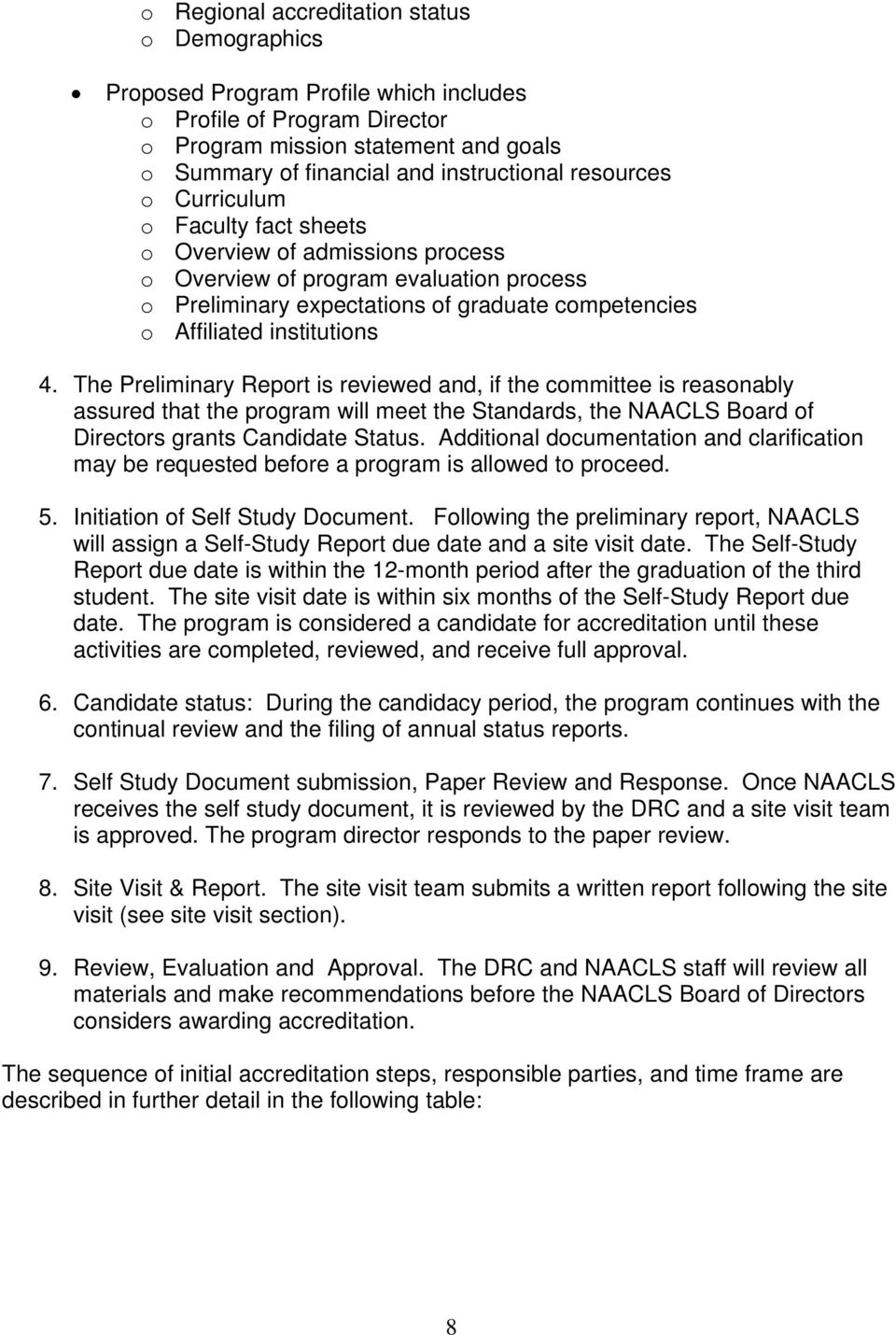
13 SEQUENCE OF STEPS IN THE INITIAL ACCREDITATION PROCESS STEP ACTION RESPONSIBLE PARTY 1. Letter of Intent Submit letter of intent. CEO/President or other high ranking administrator of Sponsoring Institution 2. Submit Application and Initial Application Fee Sponsoring Institution submits: Application for Initial Accreditation Form (see appendix) Application fee Program Profile: Program mission statement, goals and preliminary expectations of graduate competencies Proposed Program Director TIME FRAME FOR THE PROGRAM Starting point As soon as the program has obtained all signatures required for the application EVALUATION CRITERIA 3. Consultative Site Visit List of affiliated institutions NAACLS DRC member assigned as consultative resource for program and consultative program visit scheduled 2 members of DRC meet with program officials to review and discuss program plans and goals. Assure that program officials are on track with meeting NAACLS Standards for Clinical Doctorate programs Memorandum issued by site visit team describing the visit and program strengths and weaknesses. NAACLS Site Visit Team Leader 1 month from receipt of application Consultative visit conducted within 6 months of receipt of preliminary report Within 30 days of completed visit STEP ACTION RESPONSIBLE PARTY TIME FRAME FOR THE PROGRAM EVALUATION CRITERIA 9

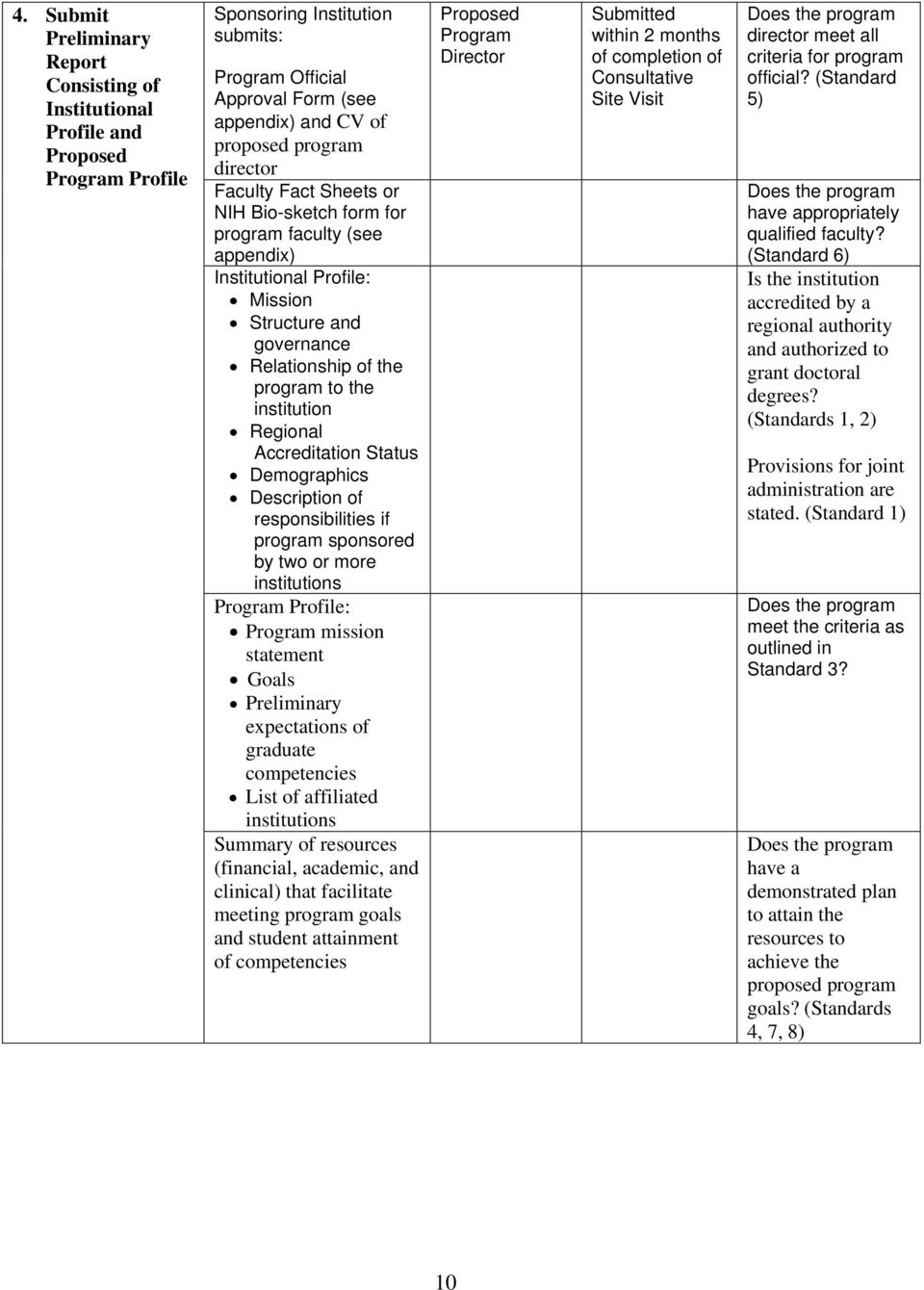
14 4. Submit Preliminary Report Consisting of Institutional Profile and Proposed Program Profile Sponsoring Institution submits: Program Official Approval Form (see appendix) and CV of proposed program director Faculty Fact Sheets or NIH Bio-sketch form for program faculty (see appendix) Institutional Profile: Mission Structure and governance Relationship of the program to the institution Regional Accreditation Status Demographics Description of responsibilities if program sponsored by two or more institutions Program Profile: Program mission statement Goals Preliminary expectations of graduate competencies List of affiliated institutions Summary of resources (financial, academic, and clinical) that facilitate meeting program goals and student attainment of competencies Proposed Program Director Submitted within 2 months of completion of Consultative Site Visit Does the program director meet all criteria for program official? (Standard 5) Does the program have appropriately qualified faculty? (Standard 6) Is the institution accredited by a regional authority and authorized to grant doctoral degrees? (Standards 1, 2) Provisions for joint administration are stated. (Standard 1) Does the program meet the criteria as outlined in Standard 3? Does the program have a demonstrated plan to attain the resources to achieve the proposed program goals? (Standards 4, 7, 8) 10
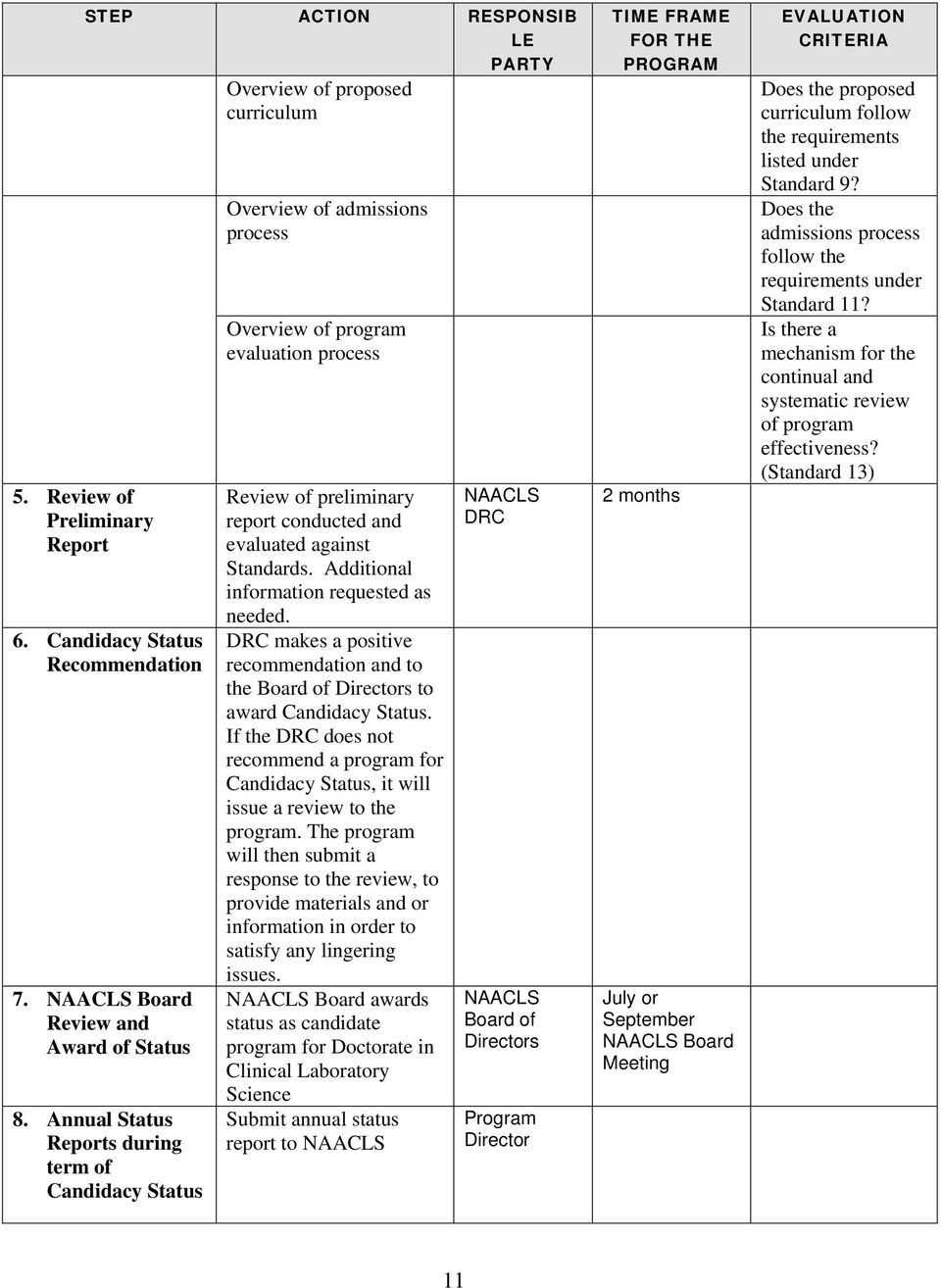
15 STEP ACTION RESPONSIB LE PARTY Overview of proposed curriculum 5. Review of Preliminary Report 6. Candidacy Status Recommendation 7. NAACLS Board Review and Award of Status 8. Annual Status Reports during term of Candidacy Status Overview of admissions process Overview of program evaluation process Review of preliminary report conducted and evaluated against Standards. Additional information requested as needed. DRC makes a positive recommendation and to the Board of Directors to award Candidacy Status. If the DRC does not recommend a program for Candidacy Status, it will issue a review to the program. The program will then submit a response to the review, to provide materials and or information in order to satisfy any lingering issues. NAACLS Board awards status as candidate program for Doctorate in Clinical Laboratory Science Submit annual status report to NAACLS NAACLS DRC NAACLS Board of Directors Program Director TIME FRAME FOR THE PROGRAM 2 months July or September NAACLS Board Meeting EVALUATION CRITERIA Does the proposed curriculum follow the requirements listed under Standard 9? Does the admissions process follow the requirements under Standard 11? Is there a mechanism for the continual and systematic review of program effectiveness? (Standard 13) 11
16 Review of annual status report NAACLS DRC July Meeting of the NAACLS DRC STEP ACTION RESPONSIB LE PARTY 9. Self Study Submitted to NAACLS 10. Self-Study Review Submit Self Study to NAACLS Self Study is evaluated and reviewer submits written report (Paper Review). Program Director NAACLS TIME FRAME FOR THE PROGRAM Due within 12 months of the graduation of the third student Paper Review forwarded to program within 2 months EVALUATION CRITERIA If the program has not graduated its third student within a six-year period, a consultative site visit will be initiated to review progress. 11. Response to Paper Review Site Visit Team approved by program director Response to Paper Review is submitted with supporting documentation. 12. Site Visit Site Visit Team submits a written report following the site visit. 13. Response to the Site Visit Report 14. Review and Evaluation Response to the Site Visit Report is submitted with supporting documentation. All documentation (Paper Review, Site Visit Report and responses) reviewed by NAACLS Doctoral Review Committee Recommendation for accreditation submitted to NAACLS Board of Directors NAACLS Board of Program Director NAACLS Program Director NAACLS DRC BOD Within one month of receipt of Paper Review Site Visit Report forwarded to program within 45 days following the site visit. Within one month of receipt of Site Visit Report 12

17 Directors Awards Accreditation Continual Accreditation & The Continuous Review Process Continual accreditation is a new concept whereby a program remains accredited as long as it conducts continuous review and on-going assessment of itself. Continuous review is one of the unique and primary aspects of the DCLS accreditation process. It begins after the granting of candidate status and involves a continuous programmatic self-review and reporting of internal policies, functions, resources and external relationships to allow ongoing improvement of the program while maintaining candidate status or full accreditation. The program director posts the review information on the NAACLS website along with annual status reports to demonstrate the program's compliance with the Standards. A formal full review for program re-accreditation is not conducted for 10 years which then includes a full self study document and site visit. CONTINUAL ACCREDITATION Continuous Review Annual Status Reports 10-YR FULL RE-ACCREDITATION Self-Study document Site visit Review by DRC Review & Approval by NAACLS Board of Directors The Continuous Review process enables the institution to: 1. Evaluate the program and identify issues in real time and before they significantly negatively impact program performance. 2. Take remedial action if one or more aspects of the program drift away from meeting the Standards. 3. Enhance positive aspects of the program. The program director is responsible for supervising the Continual Review process and maintaining the documentation on the NAACLS website. The Continual Review process is most efficient when everyone associated with the program participates, including administrators, faculty, students, graduates, employers of graduates and representatives of institutional affiliates. Personnel from other disciplines or programs (such as basic science faculty) are frequently helpful. A Continuous Review is an annotated abstract of the information provided in the online program information. The information is reviewed annually by a member of the doctoral review committee. The committee member conducts an initial review of the posted material to identify missing or outdated information and/or documents. The program is notified and requested to update the information within 45 days. This review is 13

18 conducted at least three months prior to the next scheduled doctoral review committee meeting. Following the program response to the review, the reviewer completes the Continuous Review form which summarizes the programs current compliance with the Standards. Focus is on the documented systemic review and assessment of outcomes measures. The doctoral review committee reviews the Continuous Review form at its annual meeting and provides the program a written evaluation of the current compliance to standards and any areas of concern. The evaluation is provided to the program within 30 days of the meeting. The program has 90 days to respond to the Continuous Review report. Instructions for Preparing & Conducting the Continuous Review The continuing review process begins immediately following the awarding of candidacy or accreditation. Programs will continually review and update documentation of compliance with the Standards via an interactive web site hosted by NAACLS. Of particular importance is the information related to program evaluation processes. At the end of each year, an annual status report will be submitted by the program to NACCLS for DRC review. The program director will conduct the continuous evaluation process as documented in their plans for systemic evaluation and assessment of outcomes measures. At a minimum, the program will conduct an annual assessment and evaluation culminating in an annual status report. The documentation will include a summary of any changes to the program profile, any activities or revisions that impact the DCLS Standards, data from outcomes assessment, and other related information. The 10-Year Review Every ten years an accredited program must undergo a full accreditation review that includes preparing a 10-year self study document and site visit. A full review is performed by the DRC and the NAACLS Board of Directors. The 10-year Self-Study document should be a summarized evaluation of the program over the duration of the previous accreditation period. The Site Visit Process A site visit will occur when a program is seeking initial accreditation and in the year preceeding the 10 th year of the program s accreditation. During the site visit, NAACLS' volunteer site visitors meet with faculty and administrators, review materials and verify the program is in compliance with the Standards. Several aspects of a program's 14

19 operation can only be assessed on site. For example, the resources at the site may be minimal, but excellent adaptations in the use of the resources are made. Also, interviews enable the site visitors to obtain viewpoints from all participants in the program. Arranging Site Visits Approximately 18 months prior to the end of the program s current accreditation, NAACLS will request site visit dates. Once these dates are received, NAACLS will begin to recruit site visitors. NAACLS assigns site visitors to programs undergoing accreditation review, based upon proximity to the program being visited, experience as a site visitor and training either through a NAACLS workshop, orientation teleconference and/or videotape. After NAACLS identifies a site visit team, the program director is notified and asked to approve the proposed team. If conflicts are identified, the program director must contact NAACLS immediately. NAACLS will then attempt to recruit a substitute team member. Once the site visit team is approved, the program director must contact the team members to make arrangements for the site visit. The program director must also send the site visitors the: 1. The most recent two Continual Program Review Annual Reports before the site visit date. 2. Response to the last two Continual Program Review Annual Reports. Prior to the site visit, NAACLS sends the program invoices for a site visit preparation fee and for 80 percent of the estimated site visit expenses. Invoices must be paid prior to the site visit. All programs are assessed a standard non refundable fee. Additional persons or observers may not accompany the site visit team without prior approval from the program director, site visitors, and NAACLS. Observers must not act as an impediment to the process. Role of the Team Coordinator and Setting the Itinerary The team coordinator is the primary contact with the program regarding the site visit itinerary as well as lodging and ground transportation arrangements. It is also the team coordinator who keeps team member(s) informed about arrangements. The program director and team coordinator prepare the itinerary for the site visit and confirm appointments with those who need to be interviewed. The itinerary should include: 1. Time for the preliminary interview. 15

20 2. Persons to be interviewed. 3. Time and place that each interview will occur. 4. Time that facilities will be visited. (If applicable) 5. Time for the team to work on the Site Visit Report. 6. Time for the exit interview. The team coordinator should also consult with team member(s) and the program director regarding any additional issues to be clarified during the site visit. The team usually meets the evening before the site visit to develop strategies and assign individual responsibilities. The team may request that the program director provide additional documentation at this time. Conducting the Site Visit The site visit team: 1. Verifies that information and documents contained on the NAACLS program information website are accurate. 2. Verifies that any concerns that have been raised in prior Annual Continual Review assessments have been adequately addressed by the program. 3. Addresses aspects of the program that can only be determined on site. 4. Completes the Site Visit Report. Site visitors are professional, objective and friendly; they are peers, voluntarily performing a service to the program. With program personnel, they discuss areas of strength and areas of concern regarding the program. The site visitors should stress that the team is serving in a fact-finding capacity with the intent to assist program personnel in a positive and constructive manner. Site visitors should review the steps and responsibilities in the NAACLS accreditation process with program personnel, as listed in the Volunteer Manual. Information concerning clinical affiliates is critical for the site visit team and should be made available to the site visitors at the Program s sponsoring institution. It is suggested that appropriate contact persons from each clinical affiliate be available for interview at the sponsoring institution during the site visit. If interviews cannot be conducted in this manner, arrangements should be made for telephone conversations. Interviews of student and of recent graduates should be arranged. If students at the clinical facilities cannot be at the sponsoring institution, teleconferences should be arranged. All interested individuals, including administrators, faculty and students may attend the exit interview. During the exit interview, the site visit team reports its findings. All aspects of the program that will be included in the Site Visit Report must be discussed at the exit interview. Program personnel should find no surprises when they receive the 16

21 written report. If the team observes an apparent deficiency in relation to the Standards, it should state this in clear and concise terms, giving the rationale for the assessment. The team should allow the program the opportunity to respond to apparent deficiencies. The site visit team does not have the authority to speak on behalf of nor bind NAACLS regarding a program s compliance with the Standards, nor can they predict accreditation actions. These responsibilities rest solely with the NAACLS Board of Directors, which has the sole and exclusive right to determine whether or not accreditation is to be granted or continued. Aborting a Site Visit An institution undergoing a site visit or the site visitors themselves may elect to abort a visit under special circumstances. If the program officials or site visitors feel that an objective review is not possible, they may contact the NAACLS President or CEO by phone. They must do so prior to the exit interview or the visit will be considered complete and the review processes will continue. The NAACLS official will ask for the request and justification to be written and faxed or ed immediately to the office. Upon receipt of the request and with agreement of the NAACLS official, the program and visitors will be notified that the visit must be stopped. The institution s CEO is required in writing to request another visit. After the Site Visit NAACLS receives the Site Visit Report and sends it to the program director. The program director is encouraged to share this report with the administration and faculty. The program director must submit to NAACLS a response to the Site Visit Report. Should there be a need to submit additional information, correct factual errors, address any comments or negative responses found in the body of the report and/or in the Areas of Concern, these materials should also be submitted with the response. Types of Site Visits Consultative A two-member team comprised of members of the NAACLS DRC meets with program faculty during the early stages of program development and provides assistance to the program in developing the preliminary report. The intent of this visit is to provide program officials insight into the expectations of the NAACLS review committee and what is considered compliance with the Standards. This must occur early enough that program officials do not develop materials that might require substantial revision to meet the Standards. As the profession gains experience with the development of clinical doctorate programs the need for this type of visit will diminish, but it is an important joint effort during the early phases of doctoral program development. Accreditation Reviews A two member team is assigned to visit a program. This team includes members of the DRC or their designee. 17
22 Annual Review of Programs The DRC is responsible for annual review of all programs. If during the process of annual review the program is thought to make significant changes from its initial Self Study, the DRC will schedule a consultative site visit. If a program is brought to the attention of a review committee or the Board of Directors because the possibility of noncompliance with the Standards exists, the Board of Directors may determine that a site visit is needed. The team composition is at the discretion of the Board of Directors. Review by the Doctoral Review Committee The Doctoral Review Committee meets twice per year to discuss Continual Program Reviews and any Recommendations for Accreditation. For each program, the committee will review the Continual Review(s) and responses, any Site Visit Reports and responses, and any supplementary materials that have been received by the NAACLS office with enough time to distribute to the Committee. The Continual Program Review process reviews all posted documentation to determine compliance with the Standards. Particular attention is given to the program s systematic review and evaluation of outcome measures. If the review committee feels the program is not in compliance with the Standards a written statement is given to the program which has 90 days to respond. Responses are reviewed at the next review committee meeting. If the review committee feels that the program is still not in compliance with the Standards, a recommendation to change the program s accreditation status to Administrative Probationary Accreditation will be made to the NAACLS Board of Directors. Following program site visits the Program Review Committee reviews the program to determine compliance with the Standards. Based on the compliance with the Standards, the Committee then recommends an accreditation action. 18
23 ACCREDITATION CATEGORIES When determining accreditation recommendations, the review committee states that a program is in compliance, non-compliance or marginal compliance with the Standards. These definitions are provided to clarify the accreditation categories: Compliance This indicates that a program meets the requirements of the Standards. Marginal Compliance This indicates that a program partially meets the requirements of the cited Standard(s) or that compliance with the cited Standard(s) is planned or in progress but plans have not been completed. A citation of marginal compliance is accompanied by a rationale and recommendation for compliance with the cited Standard(s) in the accreditation recommendation letter to the program and in the board award. Non-Compliance This indicates that a program fails to meet the cited Standard(s). A citation of noncompliance is accompanied by a rationale and recommendation for compliance with the cited Standard(s) in the accreditation recommendation letter to the program and in the board award. NAACLS notifies the sponsoring institution's chief executive officer, program director and medical advisor/medical director (if applicable) of its accreditation recommendation and board award. The number of citations of marginal compliance and non-compliance determine the award recommended. Accreditation for Ten Years The maximum length of accreditation for ten years may be awarded to a program that has: 1. No marginal or non-compliance citations in the current review cycle. 2. No full citations and up to two marginal citations in the previous review cycle. 3. No period of inactivity or probationary status during the last period of accreditation. Accreditation for ten years will not be awarded to programs seeking initial accreditation. Accreditation for Five Years Five years may be awarded to a program with no full citations of non-compliance that do not otherwise qualify for the award of accreditation for ten years. 19
24 For initial programs, a Progress Report documenting compliance with the Program Evaluation Standards is required annually from the initial accreditation date. Accreditation for Less Than Five Years Two years may be awarded to a program with one to four full citations of noncompliance and any number of citations of marginal compliance. Accreditation may be extended for the balance of the full five years if the Progress Report demonstrates compliance with the cited Standard(s). If any citations of marginal or non-compliance are present, a Progress Report documenting the program's compliance with the cited Standard(s) is required. If the award recommended is less than five years, accreditation may be extended for the balance of the full five years if the Progress Report demonstrates compliance with the cited Standard(s). For initial programs, a Progress Report documenting compliance with the Program Evaluation Standards is required annually from the initial accreditation date. Failure to submit a Progress Report within the specified time period will result in the program receiving Administrative Probationary Accreditation. Probationary Accreditation In probationary accreditation, the number of citations indicates a program has deficiencies that may jeopardize an acceptable educational experience for students. This status may extend for a period of six months to one year, and will be awarded to a program with: 1. Five or more full citations of non-compliance, or 2. A Progress Report found to be unsatisfactory. A Progress Report documenting compliance with the cited Standard(s) is required and accreditation may be extended for the balance of the full five years if the Progress Report demonstrates compliance. If Probationary Accreditation is recommended for the program, the program director is sent an outline of NAACLS' Due Process Procedure. The chief executive officer of the institution should notify students enrolled in the program and those seeking admission that the program's accreditation is probationary. If the program director wishes NAACLS to reconsider the recommendation for Administrative Probationary Accreditation, the program director must request this in writing within 30 days. A program's failure to comply with the Standard(s) within the Probationary Accreditation period results in an action of Withdrawing Accreditation. Section 1.01 Withholding Accreditation This award applies only to initial applicants. Accreditation may be withheld from a program if it does not meet the Standard(s) and deficiencies noted may not be easily correctable. 20
25 If NAACLS recommends Withholding Accreditation status for a program, it identifies all aspects of the program that are not in compliance with Standard(s) and sends guidance to the program regarding all possible means of meeting the requirements. The institution may withdraw the application for accreditation before the NAACLS Board of Directors acts upon this recommendation. If NAACLS recommends Withholding Accreditation status, it notifies the chief executive officer and program officials of its Due Process Procedure. If the officials choose to exercise the options under the Due Process Procedure, they must do so in writing. If not, they may reapply for accreditation one year after NAACLS action. During that time, the program director and chief executive officer should correct deficiencies in the program and document compliance with the Standard(s). Withdrawing Accreditation This may be awarded to a program when: 1. The program fails to comply with the Standard(s) within the specified period of Probationary Accreditation or Administrative Probationary Accreditation. 2. All other possibilities have been exhausted. NAACLS offers the program the option to follow NAACLS' Due Process Procedure. The program may reapply one year after the effective date of the board award. When accreditation is withheld or withdrawn from a program, students enrolled in the program at the time of this award are permitted to complete the program and are then considered graduates of a NAACLS accredited program. NAACLS must award a program Probationary Accreditation or Administrative Probationary Accreditation before it can withdraw accreditation from the program. Voluntary Withdrawal of Accreditation NAACLS recognizes and accepts this action at the sponsoring institution's request. The program's name is removed from the list of accredited programs. Reapplication for Accreditation If a program withdraws or is denied accreditation, it may not reapply until a period of one year has elapsed. Administrative Probationary Accreditation This may be awarded to a program that does not comply with the following administrative requirements for maintaining accreditation: 1. Submission of all required continual review information, an Application for Continuing Accreditation, or a required Progress Report by the established due date. 21
26 2. Payment of all accreditation fees. 3. Notification to NAACLS of relevant administrative and operational changes within 30 days. This includes changes in program official names, addresses or telephone numbers; affiliates, status (i.e., inactivity, closure) or location; and institution name. 4. Completing an Annual update of program information on the DRC website. 5. In accordance with federal and state requirements, verifying compliance with these Standards upon request from NAACLS. 6. Agreeing to a reasonable site visit date before the end of the period for which accreditation was last awarded. Before a program is placed on Administrative Probationary Accreditation, NAACLS informs the program director by certified mail of the relevant requirements, policies and procedures that will be followed. Administrative Probationary Accreditation is not subject to appeal. During a period of Administrative Probationary Accreditation, programs are recognized as being accredited. If NAACLS awards Administrative Probationary Accreditation to the program, its notification letter states that the program is in non-compliance with requirements for maintaining accreditation and lists the requirements in question. A program's failure to comply with requirements for maintaining accreditation results in Withdrawing Accreditation status. The chief executive officer of the institution should notify students enrolled in the program and those seeking admission that the program's accreditation is probationary. A program that has been placed on Administrative Probationary Accreditation cannot receive seven years of accreditation at the next review. Review by the Board of Directors The Board of Directors receives the recommendations of the Program Review Committees and reviews them for consistency in the application of Standards, the consistency of the years awarded and the consistency of process. The Board then acts on accreditation and approval actions, including granting, continuing and withdrawing accreditation and approval. 22
27 NAACLS' DUE PROCESS PROCEDURE Continual Reviews Continual Review Responses Site-Visit Report Site-Visit Report Response Request for Reconsideration from the Program Reconsideration Process Change of Motion DRC Vote Reconsideration Subcommittee Doctoral Review Committee Recommendation Purpose and Criteria The Due Process Procedure provides an opportunity to reexamine a NAACLS action of accreditation. There are two levels of due process: first to the review committee (Reconsideration), second to the Board of Directors (Appeal). The process may not be used to postpone implementing the accreditation action. The program's request to the review committee to reconsider the accreditation recommendation must include a concise statement citing the cause for reconsideration and the basis for the request with relation to the materials available during the respective review cycle. New Motion Original Motion Reconsideration Process Programs are given an Board of Directors opportunity to request Reconsideration after they have received notification of the review committee's recommendation. In order to take advantage of this due process option, within 30 days from receipt of the review committee's notification, the program must provide in writing to NAACLS a request for Reconsideration of the committee's recommendation. The request must be based on the non-application or mis-application of Standards and/or inconsistency with established procedures. 23
28 The program must have completed all previous steps in the accreditation process. These include responding to the Paper Review and Site Visit Report by either concurring with the findings or addressing each negative finding or concern. All missing or additional documentation must be submitted in these responses. No new materials will be evaluated in the reconsideration process. The reconsideration request will be reviewed by a subcommittee of the Doctoral Review Committee which will either uphold the original recommendation or present another motion to the entire committee for a vote. Depending upon the outcome of the vote, a new recommendation may be forwarded to the Board of Directors. A program may petition the Board of Directors for appeal only if the review committee's recommendation appears arbitrary, capricious or inconsistent with the Standards and NAACLS' procedures. Appeal Process Board of Directors Action Program Notified of Action Program Appeals the Action President Appoints Appeals Task Force Appeals Task Force Makes Recommendation Board of Directors Action on Appeal Program Notified of Action on Appeal Appeals Process Programs have the opportunity to appeal decisions of the Board of Directors related to their accreditation status. Within 30 days from receipt of the board letter stating the action, the program must notify the executive director of an intent to appeal. The letter of intent must indicate a specific misapplication of Standards (or non-application) or an inconsistency with established procedures. The program should have completed all previous steps in the accreditation process including responding to the Paper Review and Site Visit Report by either concurring with findings or addressing any negative findings or concerns in the reports. The president of the Board of Directors establishes an ad hoc task force of at least three individuals to review the appeal. The task force is appointed by the president from a pool of persons having previously served on the Board of Directors or review committees but who played no role in the decision which is under appeal. The Appeals Task Force conducts a thorough review of all existing documentation and recommends an accreditation award to the Board of Directors. The board makes the final decision related to the appeal. A program may appeal a specific accreditation action only once. 24
29 SECTION II Standards and Documentation Required for the Doctorate in Clinical Laboratory Science 25
30 Preamble Standards, within the accreditation process, are intended to assure high quality and foster excellence in education for laboratory professionals. They also provide tangible benefits for prospective students, consumers of laboratory services and the professions. These Standards are developed and administered by a committee comprised of peers with experience in doctoral education. The Standards constitute the minimum requirements to which an accredited program is held accountable and provide the basis on which NAACLS will confer or deny program accreditation. The clinical doctorate is the culmination of advanced generalist practice and requires an entry level degree (either a baccalaureate or masters degree), plus national certification as a laboratory generalist. It is important to note that for the purpose of historical and coherent identity of the discipline, the term laboratory as in clinical laboratory scientist or laboratory professional is continued, recognizing that with the emergence of new technologies, the laboratory is permitted to extend into many different environments including the community itself ( i.e., point of care). The Values represented in the Standards are intended to: Maintain flexibility and adaptability while stimulating and promoting high standards that lead to excellence in education. Recognize the diversity of institutions, programs and communities. Focus on purpose and outcomes, as well as structures and methods. Support multiple educational models, while assuring that Standards are met and competencies are achieved. Recognize the institutional rights and responsibilities of the faculty to explore fundamental and innovative educational concepts, scholarship, research, methods, and technologies that exceed the minimum criteria. NAACLS supports innovative delivery modes, including distance learning modalities. The institutions that pursue them must demonstrate adequate faculty support, adequate faculty/student and student/student interaction, successful integration of supervised and evaluated practice experiences, continuity of support to sustain the degree program, and a commitment to evaluate the outcome. 26
31 STANDARDS FOR ACCREDITATION AND REQUIRED DOCUMENTATION I. SPONSORSHIP 1. Institutional Affiliation The sponsoring institution must be accredited by a recognized regional agency with accrediting authority. In programs in which the education is provided by two or more institutions, responsibilities of the sponsoring institution(s) and of each affiliate for program administration, instruction, and supervision must be described in writing and signed by both parties. All provisions of the agreement must be active with written documentation of the following items: A. Joint and individual responsibilities of each institution; B. Student health, safety and professional liability coverage; C. Provision for renewal of the affiliation agreement; and D. Termination clause providing for program completion of enrolled students. 2. Acceptable Institutions Educational programs must be established in regionally accredited colleges or universities authorized to grant doctoral degrees. There must be access to a teaching hospital with diagnostic diversity and health care expertise. 3. Sponsoring Institution s Responsibilities Accreditation is granted to the institution(s) that assumes primary responsibility for curriculum planning and selection of course content, coordinates classroom teaching and clinical education, as well as supervising student research efforts, appoints faculty to the program, receives and processes applications for admission, and grants the doctorate documenting completion of the program. A. The program must have adopted a statement of mission or purpose that: 1) supports the purpose of the institution(s) sponsoring the program and 2) provides for a doctoral program and the conduct of research and service activities. B. The program must adhere to high ethical standards in its teaching, scholarship, service, relation to the public and to other programs as well as to regulatory and accrediting agencies. C. The sponsoring institution(s) must be responsible for providing assurance that the activities assigned to students in any clinical setting support doctoral level studies. 27
32 D. There must be documented ongoing communication between the sponsoring institution(s) and any affiliates for exchange of information and coordination of the program. II. RESOURCES 4. General Resources Faculty, funds and facilities must support the number of students admitted into the program and all program components. The program must demonstrate that the faculty cohort possesses the depth and diversity of expertise and experience necessary to structure, deliver and assess the effectiveness of the program. 5. Program Administration A. The program must have a qualified program director. The program director must be a full time appointee of the institution and designated as the individual having primary authority and responsibility for administration of the program. B. Responsibilities The program director must be responsible for the organization, administration, periodic review, planning, development, evaluation and general effectiveness of the program. The program director must have input into budget preparation and must be responsible for maintaining NAACLS accreditation of the program. C. Qualifications The program director must be a clinical laboratory scientist/medical technologist who holds nationally recognized generalist certification, a doctoral degree from an accredited institution, and approval from NAACLS. The program director must have knowledge of education methods and administration as well as current accreditation and certification/licensure procedures. D. Faculty Appointment 6. Faculty The program director must have a continuing faculty appointment(s) at the sponsoring institution(s). The program must have qualified faculty (e.g., clinical laboratory scientists/medical technologists, other laboratory professionals at the doctoral level, administrators, managers and physicians). A. Responsibilities 28
33 The faculty must participate in teaching courses, supervising clinical learning experiences and research, evaluating student achievement, developing curriculum, formulating policy and procedures, and evaluating program effectiveness. B. Qualifications All faculty members designated by the program must demonstrate adequate knowledge and proficiency in their content areas and demonstrate the ability to teach effectively at the appropriate level. The faculty members must include currently certified laboratory scientists. C. Professional Development The program must assure and document ongoing professional development of the program faculty to assure that the faculty members are continually able to fulfill their instructional responsibilities. D. Faculty Appointments The faculty must possess the academic and experiential qualifications and background, identified in documented descriptions of roles and responsibilities that are necessary to meet program objectives and the mission of the institution. 7. Financial Resources Financial resources for continued operation of the educational program must be ensured by an adequate, institutionally approved budget of institutional funds. Clerical and support staff must be provided to the program, consistent with institutional practice, to meet programmatic and administrative requirements, including support for any portion of the program offered by distance education. 8. Physical Resources A. Facilities Classrooms, laboratories, administrative offices and other facilities must be adequate and equipped for safety and consistent with the program s educational objectives. 29
34 B. Instructional Resources Adequate instructional resources must be available to facilitate each student s attainment of doctoral level competencies as defined in the program s goals. III. CURRICULUM 9. Curricular Requirements Graduate level course work that includes an appropriate mix of didactic and clinical education must be assured. Typical graduate programs will include the equivalent of 3 years of full-time graduate study with credit load governed by institutional full-time requirements, e.g., full-time may be defined as 9-12 graduate credit hours per semester with the option of 7 credit hours in summer. A research project, or final treatise or capstone project must be included in requirements for completion. Opportunities for students to teach and counsel must be assured. A. Curricular Structure The curriculum design must reflect the mission and philosophy of both the clinical laboratory science program and the institution, and must provide the basis for program planning, implementation, and evaluation. The design must identify educational goals and describe the content, scope and sequencing of coursework. B. Instructional Areas The curriculum must include: 1) Advanced knowledge in scientific areas that impact on patient care and/or may not have been included in previous CLS/MT curriculum (i.e., epidemiology, pharmacology and pathophysiology). 2) Health care knowledge necessary to provide and coordinate patient care as impacted upon by laboratory testing. Integral components must include, but are not limited to, development and application of clinical decision making, development and application of critical paths/test algorithms, utilization review, patient and provider safety, quality systems, and medical error prevention. 3) Patient assessment and participation in clinical experiences to include clinical rounds. 4) Collecting, managing, securing and applying information from patient records. 5) Interpersonal and communication skills necessary to function in direct patient care with diverse communities of patients and family members and with other health care practitioners (physicians, nurses, nurse practitioners, physician assistants, etc.) as an independent provider of health care. 30
35 6) Capstone experience, applied research, or translational research as required by the degree. Integral components will include research design, statistics, grant writing, protection of human subjects, and research ethics. 7) Knowledge in development, interpretation and application of health care policy and legislation to include reimbursement policies, medical liability exposure, licensure, ethics, tort, patient privacy protection, etc. 8) Knowledge in health care services delivery and access through skills developed in resources management, outcomes analysis, analysis of costs relative to benefits, etc. C. Learning Experiences The learning experiences needed in the curriculum to develop and support doctoral level competencies must be properly sequenced and include instructional materials, classroom presentations, discussion, demonstrations, laboratory sessions, supervised practice and experience. Student experiences must be educational and balanced so that all doctoral level competencies can be achieved. D. Evaluations Written criteria for passing, failing, and progression in the program must be provided and these must be given to each student at the time of entry into the program. Evaluation systems must be related to the objectives and competencies described in the curriculum for both didactic and applied components. They must be employed frequently enough to provide students and faculty with timely indications of the student s academic standing and progress and to serve as a reliable indicator of the effectiveness of instruction and course design. IV. STUDENTS 10. Program Description/Publications Students accepted into the program must be provided with a clear description of the program and its content and current publications which must include: A. program mission statement; B. program goals and competencies; C. admission criteria, both academic and non-academic; D. rules and regulations, and; E. a listing of affiliated facilities (if applicable). Documentation of all progression, retention, residency, graduation, and credentialing requirements must be published and made known to applicants. If applicable, this must include a statement about potential impact of a felony conviction on a student s eligibility for clinical rotations, employment or credentialing. 11. Admissions 31
36 For each student admitted, the program must document and retain evidence in the student s file regarding the basis upon which the student was judged to be qualified for admission. Incoming students must meet the following: A. Certification as a CLS or MT from a NAACLS accredited CLS/MT program (or otherwise have achieved the competencies of such a professional in an alternate manner approved by NAACLS) and; B. A bachelor s degree or higher from a regionally accredited institution. Admission of students must be made in accordance with the clearly defined and published practices of the institution. Specific academic standards and essential functions required for admission to the program must be clearly defined, published and provided to prospective students and made available to the public. V. OPERATIONAL POLICIES 12. Fair Practices A. Programmatic announcements must accurately reflect the program offered and include NAACLS name, address and phone number. B. Student recruitment and admission must be non-discriminatory in accordance with existing governmental regulations and the regulations of any other accrediting agencies applicable to the institution. C. Faculty recruitment and employment practices must be non-discriminatory in accordance with existing governmental regulations and the regulations of any other accrediting agencies applicable to the institution. D. The program must culminate in a doctoral degree. E. A written record of any formal student complaints and their resolution must be maintained. VI. PROGRAM EVALUATION 13. Systematic Review There must be an assessment program for continually and systematically reviewing the effectiveness of the program. 14. Outcome Measures A review of outcomes measures (e.g., treatise, theses, dissertations, capstone or research projects, surveys of graduates, surveys of employers) from the last three active years must be documented, analyzed and used in the program evaluation. VII. MAINTAINING ACCREDITATION 15. Program/Sponsoring Institution Responsibilities 32
37 Programs are required to comply with administrative requirements for maintaining accreditation, including: A. Submitting the Self-Study Report, an Application for Continuing Accreditation, or any required Progress Report as determined by NAACLS; B. Paying accreditation fees, as determined by NAACLS; C. Informing NAACLS of relevant administrative and operational changes within 30 days. This includes changes in program official names, mailing addresses, addresses or telephone numbers; clinical affiliates; program status (e.g., inactivity, closure) or geographic location or institution name; D. Completing reports required by NAACLS and returning them by the established deadlines; E. Verifying compliance with these Standards upon request. 33
38 Doctorate in Clinical Laboratory Science (DCLS) Documentation Required for Standards Narrative Documentation Site Visitor Role I. SPONSORSHIP Standard 1 Describe the relationship between the sponsoring institution and affiliates. Submit a completed copy of the Sponsoring Institution Program Fact Sheet. Verify the accreditation status of the sponsoring institution and affiliates (e.g., copies of award letters, certificates). Standard 2 Standard 3 Standard 3A Describe how the resources of the sponsoring institution and its affiliates facilitate student instruction. Describe the access of students to a teaching hospital. Describe the diagnostic diversity of the teaching hospital. Describe the responsibilities assumed by the sponsoring institution. Describe how the program s mission statement is in accordance with the institutional mission statement. Information to submit for each clinical affiliate (if applicable): Clinical Facility Fact Sheet Signed, current Affiliation Agreement Indicate the types of relevant doctoral degrees offered by the sponsoring institution. Submit a copy of the certificate issued upon graduation or completion of the program, or the appropriate page from the college catalog indicating that the institution grants a degree. Submit the program s mission statement and the institution s mission statement. Review signed current affiliation agreements for all affiliated institutions and ensure that all provisions of the agreement are active. Verify the eligibility of the sponsoring institution to offer doctoral degrees. Verify the diagnostic diversity of the teaching hospital. Verify that the sponsoring institution assumes the required responsibilities. Verify that the program s mission statement supports the institution s and provides for a doctoral program and the conduct of research and service activities.
39 Doctorate in Clinical Laboratory Science (DCLS) Documentation Required for Standards Narrative Documentation Site Visitor Role Standard 3B Standard 3C Standard 3D Describe the stakeholders of the program. Describe how the sponsoring institution assures that assigned activities in the clinical setting support doctoral level education. Describe how the program communicates with affiliates for exchange of information and coordination. Submit the procedure for input into the program and due consideration from all communities of interest. No Documentation Required Submit documentation of ongoing communication between representatives of the sponsoring institution and an affiliate. Verify that the program has a mechanism for reviewing input from all communities of interest. Verify that the sponsoring institution assures that assigned activities in the clinical setting support doctoral level education. Verify that there is documented ongoing communication between representatives of the sponsoring institution and the affiliates. II. RESOURCES Standard 4 Describe how personnel resources (e.g., instructors, staff), financial resources and capital resources support the number of students admitted. Describe the diversity of expertise of the program s faculty. Indicate: 1. The number of students admitted per year. 2. Admission date(s). 3. Instructor to student ratios for lecture, student laboratory (if applicable) and clinical laboratory (if applicable). Submit a statement of the program s financial resources. Verify that the resources budgeted support the number of students admitted. Verify that the faculty cohort possesses the depth and diversity of expertise and experience necessary to structure, deliver and assess the effectiveness of the program. 35
40 Doctorate in Clinical Laboratory Science (DCLS) Documentation Required for Standards Narrative Documentation Site Visitor Role Standard 5A No Narrative Required Submit a completed Faculty Fact Sheet for the program director. Note: The Faculty Fact Sheet is located in the appendix of this Guide. Verify that the program director is a full-time appointee of the sponsoring institution primarily responsible for the administration of the program. Submit documentation that the program director is a full-time appointee of the sponsoring institution primarily responsible for the administration of the program. Standard 5B No Narrative Required Submit a position description which describes the responsibilities of the program director. Verify that the program director is responsible for the required aspects of the program. Standard 5C No Narrative Required Submit the curriculum vita for the program director. Indicate the date that NAACLS approved the program director. Verify that the program director meets the qualifications listed in Standard 5C. Standard 5D No Narrative Required Indicate how knowledge of education, administration and current accreditation/certification procedures was obtained. Document the faculty appointment for the program director at the sponsoring institution. Verify faculty appointment for the program director at the sponsoring institution. 36
41 Doctorate in Clinical Laboratory Science (DCLS) Documentation Required for Standards Narrative Documentation Site Visitor Role Standard 6 Standard 6A No Narrative Required Describe the responsibilities of the program faculty. List the major clinical/didactic faculty. No Documentation Required Verify that the listed major faculty includes currently certified clinical laboratory scientists. Verify that faculty is responsible for the required aspects of the program. Standard 6B Describe how faculty members are evaluated relative to appropriate qualifications. Submit current bio-sketch for all major clinical and didactic faculty. Verify that faculty members have adequate knowledge and proficiency in their content areas. Standard 6C Standard 6D Describe the roles and responsibilities of faculty in relation to the program objectives and the mission of the sponsoring institution. Submit current bio-sketch for all major clinical and didactic faculty. No Documentation Required Verify that major clinical/didactic faculty members have the ability to teach effectively at the appropriate level. Verify that the program assures and documents the ongoing professional development of clinical and didactic faculty. Verify that the faculty possesses the qualifications and backgrounds to meet their roles and responsibilities. 37
42 Doctorate in Clinical Laboratory Science (DCLS) Documentation Required for Standards Narrative Documentation Site Visitor Role Standard 7 Describe how the financial resources are adequate to assure the continued operation of the program. Describe how the resources of the program, including any support staff, support any options for distance education. Submit a statement of the program s financial resources. Submit documentation of the assurance of any clerical and support staff. Verify that the financial resources for the continued operation of the educational program are assured by an adequate budget. Verify that any distance education options offered are adequately supported. Standard 8A Describe the program s academic and clinical facilities (e.g., classrooms, laboratories, administrative offices) and safety features. No Documentation Required Verify that the program s physical facilities (e.g., classrooms, laboratories, administrative offices) are adequate. Standard 8B Describe the resources, including clinical, reference and demonstration materials. Verify that the laboratories are equipped for safety. Verify that instructional resources include appropriate clinical, reference and demonstration materials. 38
43 Doctorate in Clinical Laboratory Science (DCLS) Documentation Required for Standards Narrative Documentation Site Visitor Role III. CURRICULUM Standard 9 Standard 9A Section 1.02 Summarize curricular requirements of the program to include semester hours of graduate course work, a description of the research project, treatise or capstone project required for completion, and opportunities to teach and counsel. Section 1.03 Section 1.04 Typical graduate programs will include the equivalent of 3 years of full-time graduate study with credit load governed by institutional fulltime requirements, e.g., full-time may be defined as 9-12 graduate credit hours per semester with the option of 7 credit hours in summer. Section 1.05 Explain how the curriculum structure integrates with identified educational goals of the program. Include information on how content, scope and sequencing of the curriculum meet those goals. No documentation required Verify the program has an appropriate mix of graduate level course work, including any applicable credit transferred. Verify the program requirements include an appropriate mix of didactic and clinical education. Verify the program requirements include an appropriate research project, treatise or capstone project. Verify that program curriculum is designed to allow students to achieve stated educational goals of the program. 39
44 Doctorate in Clinical Laboratory Science (DCLS) Documentation Required for Standards Narrative Documentation Site Visitor Role Standard 9B Standard 9C Standard 9D Section 1.06 Summarize how the curriculum provides knowledge and experience in each of the instructional areas listed in Standards 9B1 thru 9B8. Summarize how the learning experiences in the curriculum develop and support doctoral level competencies. Indicate the frequency of student evaluation and how this provides students and faculty with a timely indication of academic standing and progress. Submit a structured curriculum plan or sequence of courses Submit syllabi for all courses with course goals. No documentation required Submit the criteria for passing, failing and progression in the program. Review curriculum and course objectives for each subject area. Verify that each of the instructional areas listed in Standards 9B1 thru 9B8 are covered at appropriate level. Assess described learning experiences and determine if they can support doctoral level competencies. Verify that the criteria for passing, failing and progression in the program are established and given to students at the time of entry into the program. Describe how evaluation systems are related to the objectives and competencies described in the curriculum. Submit example evaluation mechanisms for didactic and applied components of the curriculum. Verify that the evaluation systems are employed frequently enough to provide faculty and students with timely indications of a student s academic standing and progress, and to serve as a reliable indicator of the effectiveness of instruction and course design. Verify that evaluations systems are related to objectives and competencies. 40
45 Doctorate in Clinical Laboratory Science (DCLS) Documentation Required for Standards Narrative Documentation Site Visitor Role IV. STUDENTS Standard 10 Standard 11 Identify the specific publication(s) in which items in Standard 10A-E are included. Describe how the material is made available to applicants. Describe how students are made aware that felony convictions may impact a student s eligibility for clinical rotations, employment or credentialing. Describe how academic standards and essential functions required for admission to the program are provided to prospective students and made available to the public. Submit current publications (e.g., program brochures, student handbooks, policy manuals, catalogs, websites, and/or syllabi) that address the items listed in Standard 10A-E. A matrix is provided in the appendix to assist you in identifying the publication(s) that address the items listed in Standard 10A-E. *Use of the matrix is optional. Submit published admissions policies and procedures for both the institution and the program. Verify that students and/or applicants receive the information listed in Standard 10. Verify that current publications contain the information listed in Standard 10.A-E. Verify that announcements accurately reflect the program offered. Verify that the admissions policies and procedures are in accordance with the clearly defined and published practices of the institution. Verify that the admissions process assures that incoming students meet Standards 11A and 11B. 41
46 Doctorate in Clinical Laboratory Science (DCLS) Documentation Required for Standards Narrative Documentation Site Visitor Role Describe how admission to the program is made in accordance with clearly defined and published practices of the institution. Submit a sample student signature page indicating awareness of the essential functions and policies of the program. Verify that students are informed of the written essential functions and the policies of the program. V. OPERATIONAL POLICIES Standard 12A No Narrative Required Submit programmatic announcements that include NAACLS name, address, and phone number. * Programmatic announcements may include catalogs, websites, handbooks. Standard 12B No Narrative Required Submit non-discrimination statement regarding student recruitment and admission. Standard 12C No Narrative Required Submit non-discrimination statement regarding faculty recruitment and employment practices. 42 Verify that the programmatic announcements accurately reflect the program offered and include NAACLS name, address and phone number. Verify that student recruitment and admissions policies are non-discriminatory. Verify that faculty recruitment and employment practices are non-discriminatory. Standard 12D Indicate the degree conferred. No Documentation required. Verify that the degree conferred is a doctoral degree. Verify that the academic standards for the program are acceptable to the institution that grants the degree.
47 Doctorate in Clinical Laboratory Science (DCLS) Documentation Required for Standards Narrative Documentation Site Visitor Role Standard 12E Describe the process by which student complaints are handled. Submit a policy statement related to student complaints and resolution. Verify that records relating to student complaints and resolution are maintained. V. PROGRAM EVALUATION Standard 13 Describe the assessment plan for continually and systematically reviewing the effectiveness of the program. Standard 14 Describe how outcome measures (e.g., treatise, theses, dissertations, capstone or research projects, surveys of graduates, surveys of employers) from the last three active years are considered in the program evaluation. Describe how the results of program evaluation are reflected in the curriculum and other elements of the program. Submit: 1) source and frequency of feedback especially from the following: students, graduates, employers of graduates, faculty, advisory groups, exit or final examinations, and clinical affiliates 2) survey/feedback/ evaluation forms Submit the outcome measures for the last three active years and the number of graduates from the program. Submit an example of significant change resulting from program evaluation. Include the analysis of the effectiveness of that change 43 Verify that there is an assessment plan for continually and systematically reviewing the effectiveness of the program. Verify outcome measures from the last three active years are documented, analyzed, and used in program evaluation. Verify that results of program evaluation are documented and reflected in ongoing curriculum development and program modification. Verify that any changes implemented are followed by analysis of effectiveness.
48 SECTION III Appendix
49 Sponsoring Institution Program Fact Sheet Program Level: Institution: Address: City, State, Zip Code: Program URL: Agencies that accredit the institution and authorize the institution to grant doctoral degrees: Administrative officer of the organizational unit in which the program is located: Name: Title: Program Director Name: Credentials: Number of students per class: _ Number of classes: List academic and/or clinical affiliate(s). Please use a separate sheet if necessary. INSTITUTION CITY/STATE ACCREDITED BY 45
50 Faculty Fact Sheet Name: Employed by: Proportion of time in: Position: Title: Teaching % Administration % Clinical Services % Research % EDUCATION INSTITUTION FIELD OF STUDY DEGREE YEAR Undergraduate Graduate Other (Specify) Credentials (i.e., CLS(NCA), MT(ASCP) ): Certified by: Certification #: Year Certified: Experience (List current position first): INSTITUTION/CITY/STATE POSITION YEARS List principal functions in the education program: List continuing education activities during the past three years: TITLE SPONSOR DATE (3/2007) 46
51 Clinical Facility Fact Sheet Institution: Address: City, State, Zip Code: Telephone: ( ) Fax: ( ) Accredited by (If the facility is not Joint Commission, and/or CAP, and/or COLA accredited, a list of safety features is required) : Clinical Coordinator or Contact Person at site: Clinical Laboratory Volume (specify annual number of procedures): Indicate whether tests are performed in the following areas: Hematology: Chemistry: Microbiology: Immunology/Serology: Immunohematology: Urinalysis: Molecular Diagnostics: Total space of the laboratory: Number of students in clinical experience assignments: Length of time of affiliation with sponsoring institution: Length of training time: Daytime laboratory staff (convert part-time to full-time equivalent): Pathologists NUMBER EMPLOYED Credentialed laboratorians (July 2005) 47
NAACLS Guide to Accreditation and Approval
 NAACLS Guide to Accreditation and Approval Adopted September 2013, Revised: 10/2014, 3/2015, 10/2015 Dear Colleague: Thank you for your interest in the programmatic accreditation/approval process provided
Transnational Association of Christian Colleges and Schools
 Transnational Association of Christian Colleges and Schools Steps Toward Accreditation Transnational Association of Christian Colleges and Schools (TRACS) is recognized by the United States Department
NAACLS Standards for Accredited and Approved Programs. Adopted 2012, Revised 9/2013, 1/2014, 4/2014, 10/2014, 11/2014
 NAACLS Standards for Accredited and Approved Programs Adopted 2012, Revised 9/2013, 1/2014, 4/2014, 10/2014, 11/2014 Contents Core Standards... 1 I. Sponsorship... 1 II. Assessment and Continuous Quality
Standards of Accredited Educational Programs for the Clinical Laboratory Scientist/ Medical Technologist
 Standards of Accredited Educational Programs for the Clinical Laboratory Scientist/ Medical Technologist PREAMBLE OBJECTIVE The purpose of these Standards and the Description of the Profession is to establish,
AMERICAN POLYGRAPH ASSOCIATION EDUCATION ACCREDITATION COMMITTEE
 AMERICAN POLYGRAPH ASSOCIATION EDUCATION ACCREDITATION COMMITTEE ACCREDITATION STANDARDS Version 2.02 (Effective January 1, 2015) 1 Table of Contents 1.0 INTRODUCTION 3 1.1 Mission 3 1.2 History 3 1.3
Commission on Accreditation of Allied Health Education Programs
 Standards and Guidelines for the Accreditation of Educational Programs in Surgical Technology Essentials/Standards initially adopted in l972; revised in 1991, 2000, 2002, and 2004 by the: American College
TABLE OF CONTENTS Licensure and Accreditation of Institutions and Programs of Higher Learning ARTICLE ONE Policies and Procedures
 Board of Governors for Higher Education Sec. 10a-34 page 1 (12-96) TABLE OF CONTENTS Licensure and Accreditation of Institutions and Programs of Higher Learning ARTICLE ONE Policies and Procedures Introduction....
Regulations for Licensure and Accreditation of Institutions and Programs of Higher Learning
 Note: These regulations are in effect while being revised to comply with Public Act 13-118. All references to the Board of Governors for Higher Education, Department of Higher Education and Commissioner
ATMAE Accreditation Accreditation Program Policies and Procedures January 21, 2013 Revisions, Sections 1 through 4
 ATMAE Accreditation Accreditation Program Policies and Procedures (These revisions supersede and replace the 2009 ATMAE Accreditation Handbook, Sections 1 through 4) Table of Contents: Sections 1 through
15. Policy on Institutions Participating in Title IV Programs
 15. Policy on Institutions Participating in Title IV Programs This policy sets forth the Accrediting Commission s procedures for the institutions to seek to establish eligibility to participate in, Federal
Tenure and Promotion Criteria and Procedures Department of Computer Science and Engineering University of South Carolina, Columbia, SC 29208
 Tenure and Promotion Criteria and Procedures Department of Computer Science and Engineering University of South Carolina, Columbia, SC 29208 UCTP Approval: February 20, 2002 Recommendations of the tenured
ACCREDITATION CRITERIA
 ACCREDITATION CRITERIA Policies, Procedures, and Standards Effective April 9, 2015 ACCREDITING COUNCIL FOR INDEPENDENT COLLEGES AND SCHOOLS 750 First Street, N.E., s Suite 980 s Washington, DC 20002-4223
Graduate School Policies and Procedures
 Graduate School Policies and Procedures Mission Statement: The mission of the Graduate School is to promote excellence in graduate education and to facilitate educational opportunities for graduate students.
CANDIDACY FOR ACCREDITATION
 CANDIDACY FOR ACCREDITATION The Meaning of Candidacy The Candidate for Accreditation program offers certain postsecondary institutions the opportunity to establish a formal, publicly recognized relationship
This page is intentionally blank in the pdf version available online. With this blank page, you will be able to print the document on both sides and
 This page is intentionally blank in the pdf version available online. With this blank page, you will be able to print the document on both sides and it will match the printed version available from TRACS.
2011 Outcomes Assessment Accreditation Handbook
 2011 Outcomes Assessment Accreditation Handbook Associate Degree Programs Baccalaureate Degree Programs Master Degree Programs Accreditation Policies can be found in a separate document on the ATMAE website
How To Run An Nhshl Graduate Group
 Graduate Group in Nursing Science & Health-Care Leadership Bylaws Administrative Home: Betty Irene Moore School of Nursing Approved by Graduate Council: May 6, 2009 ARTICLE I. OBJECTIVE The Nursing Science
CPME 120 STANDARDS AND REQUIREMENTS FOR ACCREDITING COLLEGES OF PODIATRIC MEDICINE
 CPME 120 STANDARDS AND REQUIREMENTS FOR ACCREDITING COLLEGES OF PODIATRIC MEDICINE COUNCIL ON PODIATRIC MEDICAL EDUCATION This document is concerned with ensuring the quality and improvement of colleges
Policy Abstract. for the. Handbook for Program Review: Cleveland State University s Self-Study Process for Growth and Change Spring 2005
 Policy Abstract for the Handbook for Program Review: Cleveland State University s Self-Study Process for Growth and Change Spring 2005 Significant institutional resources are devoted to academic program
Guide to school authorization: Diploma Programme
 Diploma Programme Guide to school authorization: Diploma Programme Diploma Programme Guide to school authorization: Diploma Programme Published October 2010 Updated February 2015 International Baccalaureate
Council for Higher Education Accreditation. Recognition of Accrediting Organizations. Policy and Procedures
 Council for Higher Education Accreditation Recognition of Accrediting Organizations Policy and Procedures Approved by the CHEA Board of Directors September 28, 1998 Revised by the CHEA Board of Directors
Unique Standards and Documentation Required for Accredited CLT/MLT Programs
 Unique Standards and Documentation Required for Accredited CLT/MLT Programs Section III (CLT/MLT) Page 1 UNIQUE STANDARDS AND THE REQUIRED DOCUMENTATION Objectives Clinical Laboratory Technician/Medical
244 CMR: BOARD OF REGISTRATION IN NURSING 244 CMR 6.00: APPROVAL OF NURSING EDUCATION PROGRAMS AND THE GENERAL CONDUCT THEREOF
 244 CMR 6.00: APPROVAL OF NURSING EDUCATION PROGRAMS AND THE GENERAL CONDUCT THEREOF Section 6.01: Definitions 6.02: Public Notice of Nursing Education Program Approval Status 6.03: Nursing Education Programs
Steps in Applying for AMTA Approval
 POLICIES AND PROCEDURES FOR ACADEMIC PROGRAM APPROVAL AMERICAN MUSIC THERAPY ASSOCIATION I. APPLICATION FOR AMTA APPROVAL: The American Music Therapy Association will provide upon request materials for
RULES REGULATING ACCREDITATION OF LAW SCHOOLS IN CALIFORNIA and SCHEDULE OF LAW SCHOOL FEES
 RULES REGULATING ACCREDITATION OF LAW SCHOOLS IN CALIFORNIA and SCHEDULE OF LAW SCHOOL FEES Adopted by the Committee of Bar Examiners and Approved by the Board of Governors of The State Bar of California
"ACCREDITATION OF ENGINEERING PROGRAMS IN THE USA"
 Engineering Journal of Qatar University, Vol. 2, 1989. "ACCREDITATION OF ENGINEERING PROGRAMS IN THE USA" By Edwin G. Jones, Jr. Iowa State University David R. Reyes-Guerra Executive Director Accreditation
Glossary of Accreditation
 Academic An individual whose current responsibilities focus primarily on the curricular aspects of an educational institution or program. Depending on the nature of the institution, this definition may
Procedures for Accreditation of Baccalaureate and Graduate Degree Nursing Programs
 Procedures for Accreditation of Baccalaureate and Graduate Degree Nursing Programs Commission on Collegiate Nursing Education One Dupont Circle, NW Suite 530 Washington, DC 20036-1120 http://www.aacn.nche.edu/ccne-accreditation
National Commission for Academic Accreditation & Assessment. Handbook for Quality Assurance and Accreditation in Saudi Arabia PART 3
 National Commission for Academic Accreditation & Assessment Handbook for Quality Assurance and Accreditation in Saudi Arabia PART 3 EXTERNAL REVIEWS FOR ACCREDITATION AND QUALITY ASSURANCE Ver. 2.0 July
C A M P E P. Commission on Accreditation of Medical Physics Educational Programs, Inc. Guidelines for Accreditation
 Guidelines for Accreditation of Certificate Programs in Medical Physics Created: August 2013 Sponsoring Organizations: American Association of Physicists in Medicine, American College of Radiology, American
COLLEGE OF HEALTH AND HUMAN SERVICES School of Nursing. Guidelines for Promotion, Tenure and Reappointment (Effective May, 2007)
 COLLEGE OF HEALTH AND HUMAN SERVICES School of Nursing Guidelines for Promotion, Tenure and Reappointment (Effective May, 2007) Attached are the documents related to the role and responsibilities of the
Procedures for Assessment and Accreditation of Medical Schools by the Australian Medical Council 2011
 Australian Medical Council Limited Procedures for Assessment and Accreditation of Medical Schools by the Australian Medical Council 2011 Medical School Accreditation Committee These procedures were approved
ACCREDITATION POLICIES AND PROCEDURES
 ACCREDITATION POLICIES AND PROCEDURES COUNCIL ON ACCREDITATION OF NURSE ANESTHESIA EDUCATIONAL PROGRAMS May 2014 Copyright 2009 by the COA 222 S. Prospect Ave., Suite 304 Park Ridge, IL 60068-4001 (847)
A Guide to Interdisciplinary Graduate Programs
 Guidelines for Interdisciplinary Graduate Programs (IDP) University of Nevada, Reno Interdisciplinary graduate programs are an integral part of graduate education at both the master s and doctoral levels
FORENSIC SCIENCE GRADUATE GROUP BYLAWS
 FORENSIC SCIENCE GRADUATE GROUP BYLAWS Administrative Home: UC Davis Extension Revision: November 11, 2007 Revision: September 26, 2011 Graduate Council Approval Date: June 11, 2012 Article I Objective
SACS REQUIREMENTS AND STANDARDS. Core Requirements
 SACS REQUIREMENTS AND STANDARDS Core Requirements 2.1 The institution has degree-granting authority from the appropriate government agency or agencies. (Degree-granting Authority) 2.2 The institution has
CHAPTER 6 STANDARDS FOR NURSING EDUCATION PROGRAMS
 CHAPTER 6 STANDARDS FOR NURSING EDUCATION PROGRAMS Section 1: Statement of Purpose. (a) To foster the safe and effective practice of nursing by graduates of nursing education programs by setting standards
Approval Review Process: Baccalaureate Nursing Programs in New Brunswick
 Baccalaureate Nursing Programs in New Brunswick Mission The Nurses Association of New Brunswick is a professional regulatory organization that exists to protect the public and to support nurses by promoting
Procedures: Music Therapy Supplement
 NATIONAL ASSOCIATION OF SCHOOLS OF MUSIC Procedures: Music Therapy Supplement Intended for use only by institutions seeking accreditation or reaccreditation which offer baccalaureate and/or graduate degree
Contra Costa Community College District Human Resources Procedure 1010.06 HIRING OF CONTRACT ADMINISTRATORS
 Contra Costa Community College District Human Resources Procedure 1010.06 HIRING OF CONTRACT ADMINISTRATORS This procedure shall apply to the selection of contract administrators within the Contra Costa
The Johns Hopkins University School of Nursing FACULTY BYLAWS
 The Johns Hopkins University School of Nursing FACULTY BYLAWS Article I. Preamble The Bylaws of the Faculty of the Johns Hopkins University School of Nursing shall be utilized to facilitate the governance
SCHOOL OF MASS COMMUNICATIONS STATEMENT ON GOVERNANCE
 SCHOOL OF MASS COMMUNICATIONS STATEMENT ON GOVERNANCE Preamble This document is guided principally by a common belief in shared governance at all levels, intent on creating trust and collegiality and aimed
STATEMENT OF ACCREDITATION STATUS
 Page 1 of 5 Chief Executive Officer: STATEMENT OF ACCREDITATION STATUS AMERICAN UNIVERSITY OF BEIRUT Bliss Street PO Box 11-236, Riad El Solh Beirut 1107 2020 Lebanon Phone: (961) 137-4374; Fax: (961)
GUIDELINES FOR THE PREPARATION OF THE SELF-STUDY REPORT UTILIZING THE 2013 ACEN STANDARDS AND CRITERIA
 GUIDELINES FOR THE PREPARATION OF THE SELF-STUDY REPORT UTILIZING THE 2013 ACEN STANDARDS AND CRITERIA PURPOSE This guide provides the program with a review of the Standards and Criteria offering explanations
political Science Degree Requirements and Requirements
 UWM Political Science Department Graduate Program Policies A. Political Science at UWM B. M.A. C. Ph.D. D. Transfer of Credits E. Incompletes F. Scheduling Completion of M.A. and Ph.D. Degrees G. Fellowship
Common Rules Courses leading to the Awarding of a Professional Doctorate (Research) Doctor of
 Common Rules Courses leading to the Awarding of a Professional Doctorate (Research) Doctor of Version: 3.00 Approved: Council Date: 20 June 2008 Administered: Governance Next Review: June 2011 COMMON RULES
M.S. DEGREE REQUIREMENTS
 Graduate Group in Biochemistry, Molecular, Cellular & Developmental Biology Ph.D. and M.S. DEGREE REQUIREMENTS Graduate Council Approval: April 15, 2009 MASTER'S PROGRAM 1) Admissions Requirements Applicants
1 Applicability of these regulations
 Regulations governing the degree of Philosophiae Doctor (PhD) at Hedmark University College Approved by the University College Board on 16 December 2009 pursuant to Section 3-3 of the Norwegian Act relating
Standards for an Accredited Educational Program in Radiologic Sciences
 Standards for an Accredited Educational Program in Radiologic Sciences EFFECTIVE JANUARY 1, 2002 Adopted by: The Joint Review Committee on Education in Radiologic Technology: January 1996; Revised 2001
Procedures for Accreditation of Baccalaureate and Graduate Nursing Programs. Amended: November 18, 2014
 Procedures for Accreditation of Baccalaureate and Graduate Nursing Programs Amended: November 18, 2014 TABLE OF CONTENTS INTRODUCTION...1 Standards for Accreditation...1 Board of Commissioners...1 Accreditation
Commission on Accreditation of Allied Health Education Programs
 Commission on Accreditation of Allied Health Education Programs Standards and Guidelines for the Accreditation of Educational Programs in Anesthesia Technology Standards initially adopted in 2011; revised
A GUIDE TOWARD WASC ACCREDITATION
 A GUIDE TOWARD WASC ACCREDITATION For Institutions Incorporated or Operating Primarily Outside of the United States Western Association of Schools and Colleges Accrediting Commission for Senior Colleges
ACCREDITATION COUNCIL FOR OCCUPATIONAL THERAPY EDUCATION ACCREDITATION MANUAL
 ACCREDITATION COUNCIL FOR OCCUPATIONAL THERAPY EDUCATION ACCREDITATION MANUAL Accreditation Council for Occupational Therapy Education c/o the AOTA Accreditation Department 4720 Montgomery Lane, Suite
ACCREDITATION PROCEDURES
 ACCREDITATION PROCEDURES Schools of Public Health Public Health Programs Outside Schools of Public Health Standalone Baccalaureate Programs Council on Education for Public Health Amended September 2014
Accreditation Standards and Rules and Regulations for Mississippi Nursing Degree Programs
 Accreditation Standards and Rules and Regulations for Mississippi Nursing Degree Programs Revised July 1, 1992 Revised July 1, 1993 Amended April 1995 Amended June 1998 Amended July 1999 Revised November
Bylaws of the Department of Agricultural Education and Communication University of Florida Approved October 7, 2009
 Bylaws of the Department of Agricultural Education and Communication University of Florida Approved October 7, 2009 Vision To lead in developing and strengthening educators, communicators, and leaders
16.12.3.3 STATUTORY AUTHORITY: Nursing Practice Act, Section 61-3-26 NMSA 1978 Comp. [1-1-98; 16.12.3.3 NMAC - Rn, 16 NMAC 12.3.
 TITLE 16 CHAPTER 12 PART 3 OCCUPATIONAL AND PROFESSIONAL LICENSING NURSING AND HEALTH CARE RELATED PROVIDERS NURSING EDUCATIONAL PROGRAMS 16.12.3.1 ISSUING AGENCY: New Mexico Board of Nursing. [1-1-98;
Accreditation Standards for Nuclear Medicine Technologist Education
 Accreditation Standards for Nuclear Medicine Technologist Education Joint Review Committee on Educational Programs In Nuclear Medicine Technology 2010 Includes May 2011 Addendum; April 2014 Update; October
School of Social Work By Laws
 School of Social Work By Laws BYLAWS OF THE SCHOOL OF SOCIAL WORK RUTGERS, THE STATE UNIVERSITY OF NEW JERSEY PREAMBLE The School of Social Work is a professional degree-granting school located within
How To Set Up A Nursing Education Program In Wyoming
 CHAPTER VI6 STANDARDS FOR NURSING EDUCATION PROGRAMS Section 1. Statement of Purpose. (a) The purpose of the bboardthese Board Rules are in adoptinged to rules and regulations in this Chapter is to implement
STANDARDS FOR ACCREDITATION
 STANDARDS FOR ACCREDITATION OF POST-GRADUATE CRNA FELLOWSHIPS January 2014 Copyright 2014 by the Council on Accreditation of Nurse Anesthesia Educational Programs 222 S. Prospect Avenue, Park Ridge, Illinois,
THE GRADUATE SCHOOL CREIGHTON UNIVERSITY. By-Laws. ARTICLE I Definitions
 THE GRADUATE SCHOOL CREIGHTON UNIVERSITY A. Organization and Responsibilities By-Laws ARTICLE I Definitions The Graduate School of the Creighton University is charged with promoting graduate studies and
I. INTRODUCTION INTRODUCTION TO ACCREDITATION
 I. INTRODUCTION INTRODUCTION TO ACCREDITATION Accreditation is a system for recognizing educational institutions and professional programs affiliated with those institutions for a level of performance,
MASTER S IN PSYCHOLOGY AND COUNSELING ACCREDITATION COUNCIL (MPCAC) ACCREDITATION MANUAL October, 2014
 MASTER S IN PSYCHOLOGY AND COUNSELING ACCREDITATION COUNCIL (MPCAC) ACCREDITATION MANUAL October, 2014 1 TABLE OF CONTENTS Section I. Foreword... 3 Mission Statement... 3 Function, Scope and Structure
Commission on Accreditation of Allied Health Education Programs
 Standards and Guidelines for Cardiovascular Technology Educational Programs Essentials/Standards initially adopted 1985; revised in 2003 Adopted by the American College of Cardiology Foundation American
Accreditation Process Book
 Accreditation Process Book Associate Degree Schools and Programs 1 11520 West 119th Street Overland Park, Kansas 66213 USA 913-339-9356 acbsp.org For Institutions Seeking Initial and Reaffirmation of Accreditation
MEDICAL SCHOLARS PROGRAM MD / PhD UNIVERSITY OF ILLINOIS COLLEGE OF MEDICINE AT URBANA-CHAMPAIGN
 MEDICAL SCHOLARS PROGRAM MD / PhD UNIVERSITY OF ILLINOIS COLLEGE OF MEDICINE AT URBANA-CHAMPAIGN As of May 13, 2009 1 SEQUENCE OF STUDIES AND ACADEMIC PROGRESS (Approved by the MSP Steering Committee on
BYLAWS of the Graduate School of Biomedical Sciences
 BYLAWS of the Graduate School of Biomedical Sciences SECTION 1. Programs of the Graduate School of Biomedical Sciences The Graduate School of Biomedical Sciences (GSBS) of the Texas Tech University Health
NEUROSCIENCE GRADUATE GROUP Ph.D. AND M.S. DEGREE REQUIREMENTS Revised: 2010 Graduate Council Approval: June 3, 2011
 NEUROSCIENCE GRADUATE GROUP Ph.D. AND M.S. DEGREE REQUIREMENTS Revised: 2010 Graduate Council Approval: June 3, 2011 Ph.D. PROGRAM 1) Admissions Requirements Consideration for admission requires a bachelor
Forward (300 Hour Graduate Neurology Programs) Commission for Graduate Education in Neurology (CAGEN) is a post- doctoral educational accreditation
 Forward (300 Hour Graduate Neurology Programs) Commission for Graduate Education in Neurology (CAGEN) is a post- doctoral educational accreditation body autonomous from all education entities and affiliated
Article I. Objective. Article II. Membership. A. Criteria for Membership
 Public Health Graduate Program Bylaws Administrative Home: Department of Public Health Sciences, School of Medicine Revised: 1/25/07; 8/27/10 Graduate Council s Approval Date: June 16, 2011 Article I.
Department of Psychology Policies and Procedures Revised by Faculty Vote February 8, 2012
 Department of Psychology Policies and Procedures Revised by Faculty Vote February 8, 2012 PsychByLaws_gm_04292012.doc This document describes the policies and procedures by which the Department of Psychology
Nursing Education Program and Course Review Policies
 Nursing Education Program and Course Review Policies College of Registered Nurses of British Columbia 2855 Arbutus Street Vancouver, BC Canada V6J 3Y8 T: 604.736.7331 F: 604.738.2272 Toll-free: 1.800.565.6505
Department of Environmental Science, Policy, and Geography Bylaws. Article I. The Department of Environmental Science, Policy and Geography
 Department of Environmental Science, Policy, and Geography Bylaws Passed: 1 December 2006 Revised: February, 2007; February, 2008; April, 2008; August, 2008; October 8th, 2009; The Department of Environmental
STANDARDS FOR NURSING EDUCATION PROGRAMS. (a) The purpose of the board in adopting rules and regulations in this Chapter
 CHAPTER VI STANDARDS FOR NURSING EDUCATION PROGRAMS Section 1. Statement of Purpose. is: (a) The purpose of the board in adopting rules and regulations in this Chapter programs. (i) To serve as a guide
The University of West Florida. Department of Criminology & Criminal Justice. Bylaws
 The University of West Florida Department of Criminology & Criminal Justice Bylaws 1. Mission The mission of the Department of Criminology & Criminal Justice is to challenge and inspire students to be
Humber College Institute of Technology & Advanced Learning. Program Advisory Committee. Procedure Manual
 Humber College Institute of Technology & Advanced Learning Program Advisory Committee Procedure Manual Message from the President On behalf of Humber College Institute of Technology & Advanced Learning,
DOCTORAL DEGREES ADMISSION REQUIREMENTS
 DOCTORAL DEGREES Ball State University offers programs leading to the doctor of philosophy degree (PhD), the doctor of education degree (EdD), the doctor of arts degree (DA), and the doctor of audiology
RE: Revised Standards for Accreditation of Master s Programs in Library and Information Studies
 EBD #10.9 2013-2014 TO: ALA Executive Board RE: Revised Standards for Accreditation of Master s Programs in Library and Information Studies ACTION REQUESTED/INFORMATION/REPORT: For information purposes.