
Coding and Billing for Outpatient Rehab Made Easy
|
|
|
- Cameron Austin
- 10 years ago
- Views:
Transcription
1 Coding and Billing for Outpatient Rehab Made Easy Proper Use of CPT Codes, ICD-9 Codes, and Modifiers Rick Gawenda, PT

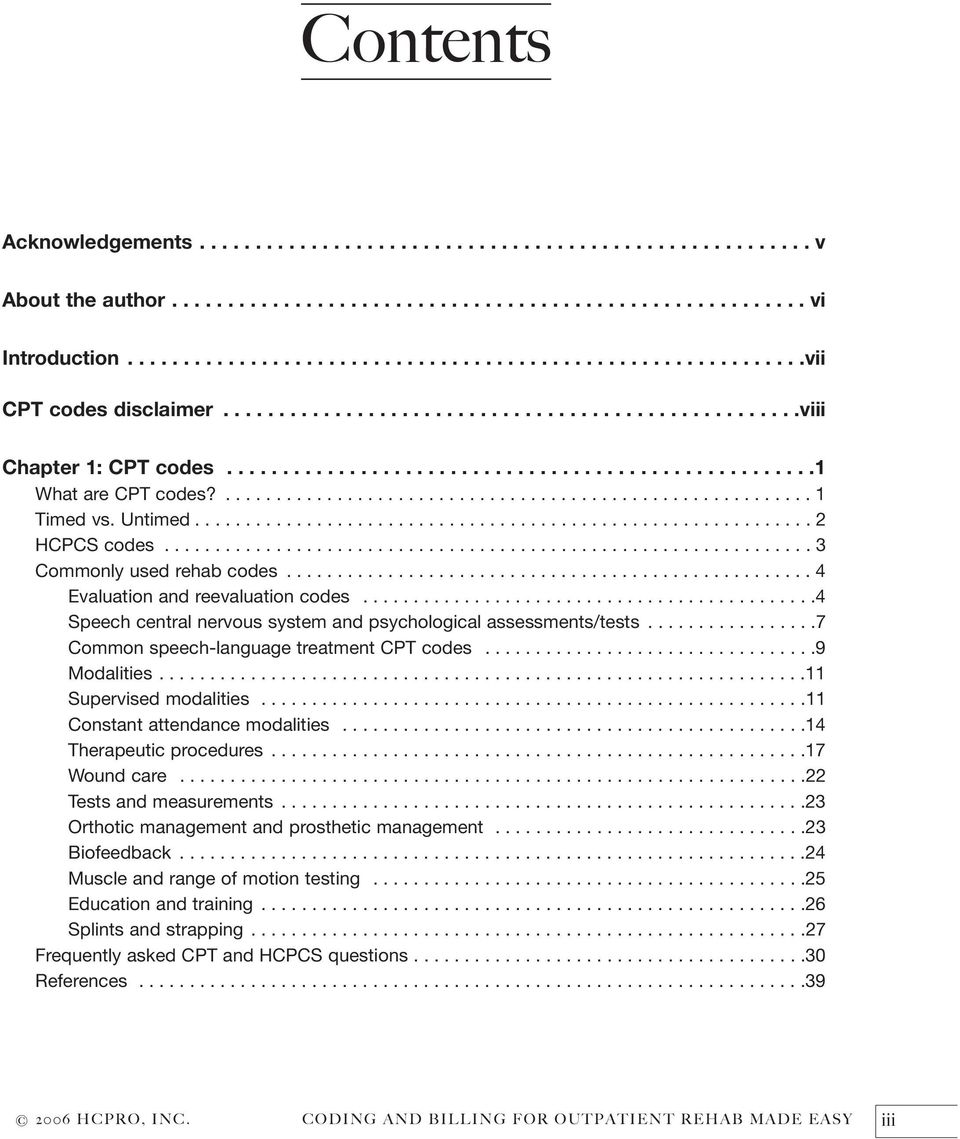
2 Contents Acknowledgements v About the author vi Introduction vii CPT codes disclaimer viii Chapter 1: CPT codes What are CPT codes? Timed vs. Untimed HCPCS codes Commonly used rehab codes Evaluation and reevaluation codes Speech central nervous system and psychological assessments/tests Common speech-language treatment CPT codes Modalities Supervised modalities Constant attendance modalities Therapeutic procedures Wound care Tests and measurements Orthotic management and prosthetic management Biofeedback Muscle and range of motion testing Education and training Splints and strapping Frequently asked CPT and HCPCS questions References HCPRO, INC. CODING AND BILLING FOR OUTPATIENT REHAB MADE EASY iii
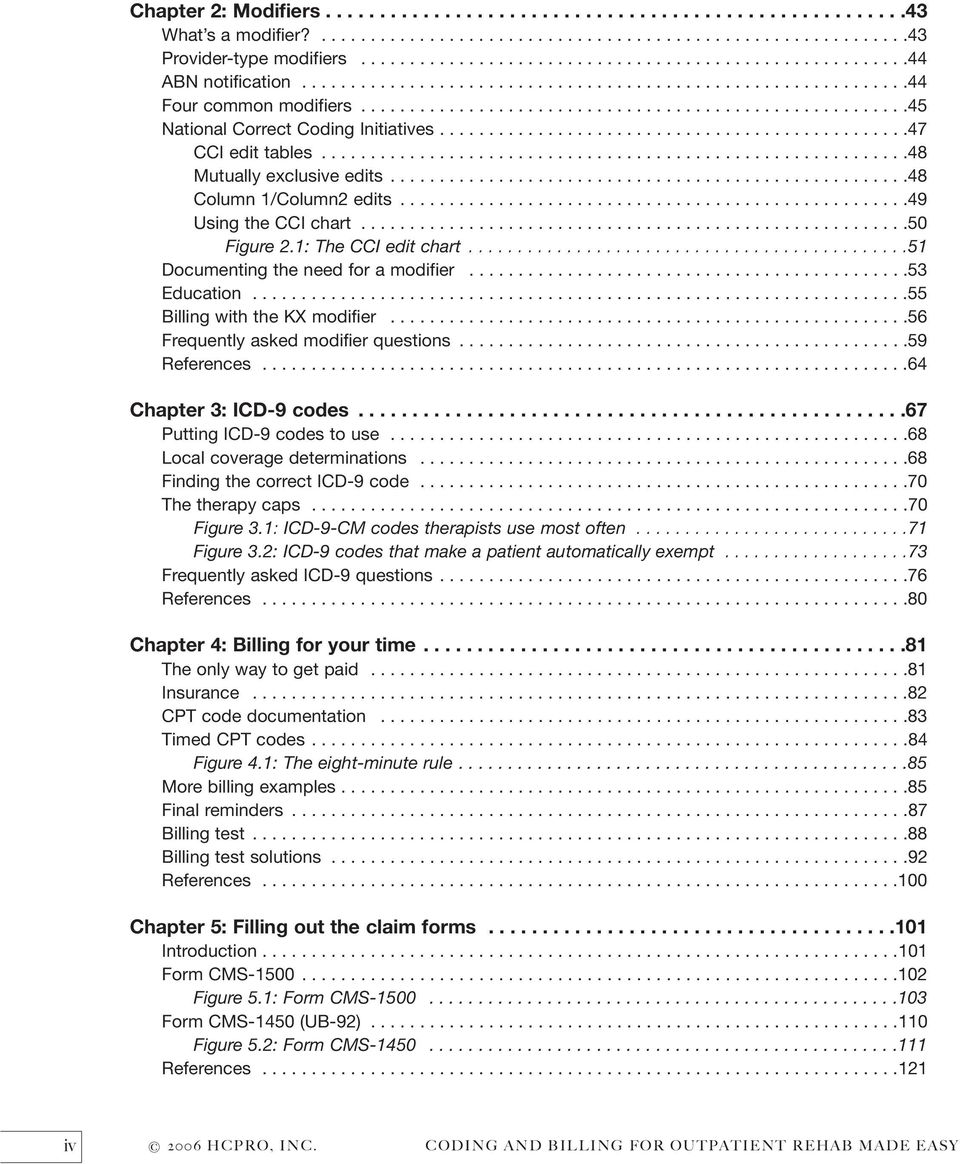
3 Chapter 2: Modifiers What s a modifier? Provider-type modifiers ABN notification Four common modifiers National Correct Coding Initiatives CCI edit tables Mutually exclusive edits Column 1/Column2 edits Using the CCI chart Figure 2.1: The CCI edit chart Documenting the need for a modifier Education Billing with the KX modifier Frequently asked modifier questions References Chapter 3: ICD-9 codes Putting ICD-9 codes to use Local coverage determinations Finding the correct ICD-9 code The therapy caps Figure 3.1: ICD-9-CM codes therapists use most often Figure 3.2: ICD-9 codes that make a patient automatically exempt Frequently asked ICD-9 questions References Chapter 4: Billing for your time The only way to get paid Insurance CPT code documentation Timed CPT codes Figure 4.1: The eight-minute rule More billing examples Final reminders Billing test Billing test solutions References Chapter 5: Filling out the claim forms Introduction Form CMS Figure 5.1: Form CMS Form CMS-1450 (UB-92) Figure 5.2: Form CMS References iv 2006 HCPRO, INC. CODING AND BILLING FOR OUTPATIENT REHAB MADE EASY
4 CHAPTER 1 CPT codes What are CPT codes? The American Medical Association (AMA) has developed current procedural terminology (CPT) codes to describe treatments rendered. These codes are owned and copyrighted by the AMA. The CPT book is updated annually, and the new CPT codes usually become effective January 1 of the year following the book s publication. 1 CPT codes, which are five-digit numbers assigned a specific service, enumerate and standardize medical and surgical procedures and are widely required by governmental and private insurance programs for claims processing and reimbursement. In addition, these codes are used to develop guidelines for medical review, pre- and post-payment review, and utilization review. 1 They are meant to be a uniform language that translates clinical services into claims processing. Each code describes a service that an insurance payer can then process into a payment. Public and private payers have the option of assigning values to each CPT code, although even if a CPT code exists for a service, the payers do not have to pay for that service. Many payers take their cues from Medicare on whether to pay for a code 2006 HCPRO, INC. CODING AND BILLING FOR OUTPATIENT REHAB MADE EASY 1

5 CHAPTER 1 and what the value of that code is. Verifying what therapy services an insurance plan will reimburse for and what services are not covered is vital to proper reimbursement. Therapy evaluations, aquatic therapy, group therapeutic procedures, and cognitive therapy are a few examples of services not covered by all payers under a therapy plan of care. Note that, effective January 1, 2005, the Centers for Medicare & Medicaid Services (CMS) no longer gives providers a 90-day grace period at the beginning of each year to use deleted CPT codes while they load the new CPT codes into their system. This change makes it even more important that facilities be familiar with the changes. 2 Check with non-medicare insurance carriers to determine whether they have a grace period when new CPT codes are added and others are deleted. Timed vs. Untimed There are two types of CPT codes: Time-based CPT codes These codes require that the provider spend direct one-onone time with the patient. Contact time ranges from minutes in length depending on the CPT code. Providers can bill multiple units of time-based codes by the same discipline to the same beneficiary on the same date of service. 3,4 Procedure/Service-based CPT codes Because procedure-based CPT codes are untimed, providers can only bill one unit of a procedure-based CPT code per discipline per beneficiary per session, regardless of the amount of time spent providing that specific procedure or modality and regardless of how many areas of the body are treated. These codes do not require direct one-on-one time, but the amount of time a therapist spends performing the procedure is irrelevant because only one unit can be billed per session. 4, HCPRO, INC. CODING AND BILLING FOR OUTPATIENT REHAB MADE EASY

6 CPT codes Tip: It is possible to bill more than one unit of a service-based CPT code to the same patient on the same day. This could occur if the patient was seen for outpatient therapy services twice on the same day during two separate sessions. An example would be a patient receiving whirlpool treatment in the morning and then again in the afternoon. Assuming the treatment was medically necessary and met all other requirements, the provider could bill two units of For Medicare patients, the provider would have to append modifier -59 to on the claim form. Modifier -59 will be discussed in Chapter 2. There are no specific CPT codes for PT, OT, or SLP services that can only be used by the PT, OT, or SLP. Physicians and non-physician practitioners may provide therapy services where state and local laws allow them to. As long as the PT, OT, or SLP provider is qualified to provide the service, he or she can bill for the service as well. The qualification can be met through education, licensure, continuing education, special certifications, etc., and must be allowed by the applicable state practice act and state laws. Refer to the specific payer for information on qualified provider criteria. An insurance payer has the last word on whether it will reimburse for a service, and whether the PT, OT, or SLP is qualified to provide the service. HCPCS codes The CPT codes are considered Level I in the Healthcare Common Procedure Coding System (HCPCS). HCPCS Level II codes were established primarily to identify products, supplies, and services not included in the CPT codes, such as ambulance services and durable medical equipment, prosthetics, orthotics, and supplies (DMEPOS) when used outside a physician s office HCPRO, INC. CODING AND BILLING FOR OUTPATIENT REHAB MADE EASY 3

7 CHAPTER 1 Level II HCPCS codes are a single alphabetical letter followed by four numbers. As with CPT codes, individual payers may decide to pay for them based on a value they assign. CMS maintain and updates these codes quarterly. The following letters represent particular services or equipment that rehab providers may use: A Medical and surgical supplies, ambulance services, and administrative, miscellaneous, and investigational services, most of which do not apply to rehab, although some of the medical supplies may apply. E Durable medical equipment, such as wheelchairs, crutches, and canes. G Temporary HCPCS codes that CMS assigns to procedures and services that the AMA is reviewing to decide whether to include them as future CPT codes. Once the AMA assigns a CPT code for that particular service, the G code is deleted. L Orthotic and prosthetic procedures and equipment. Commonly used rehab codes Evaluation and reevaluation codes Evaluation codes are used to bill an insurance carrier for the patient s initial therapy appointment, during which the therapist comprehensively examines and evaluates the physical and/or cognitive condition that merits therapy intervention. Some evaluation codes are untimed, so providers may only bill for one unit per discipline, per beneficiary, per day, regardless of the amount of time spent performing the evaluation. Others are timed, which means that providers can bill multiple units of the CPT code per discipline, per beneficiary, per day, if they meet the time requirements. 3,4, HCPRO, INC. CODING AND BILLING FOR OUTPATIENT REHAB MADE EASY

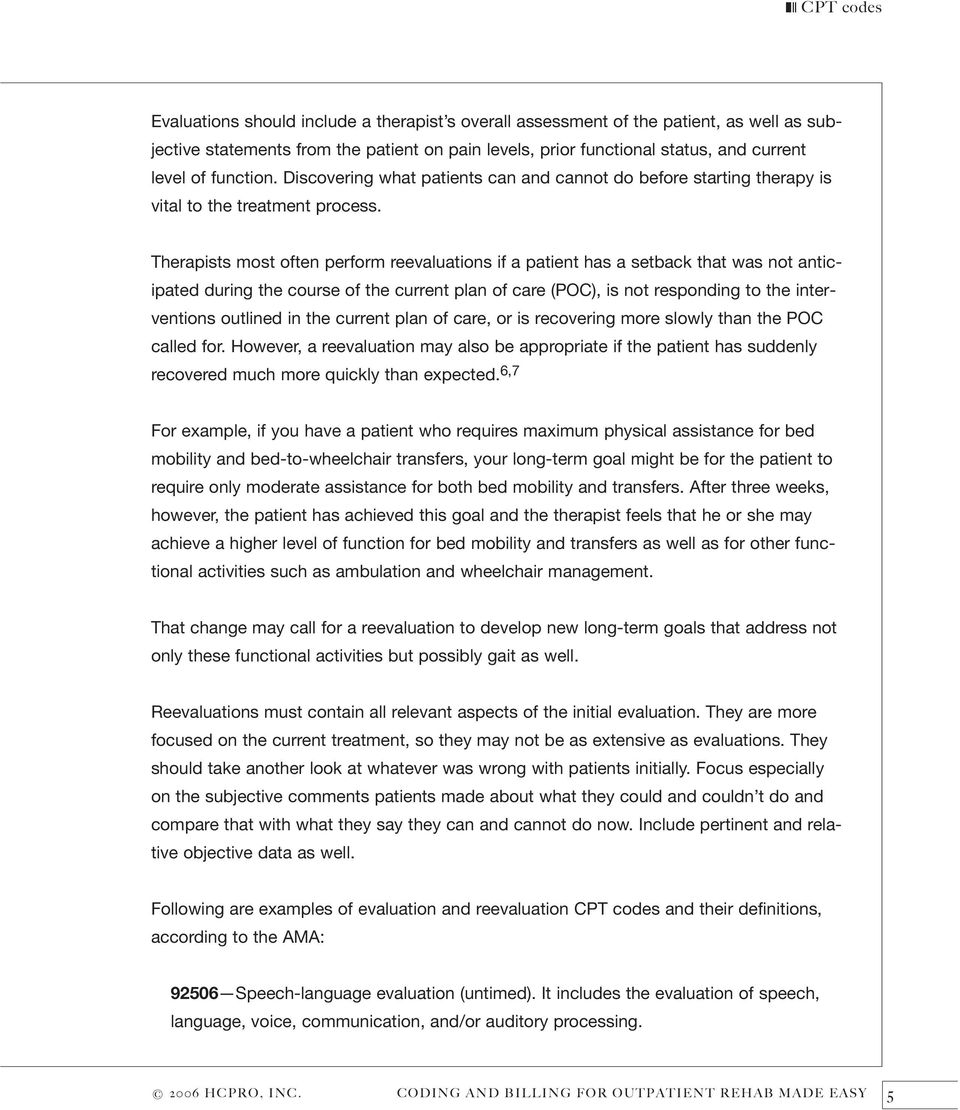
8 CPT codes Evaluations should include a therapist s overall assessment of the patient, as well as subjective statements from the patient on pain levels, prior functional status, and current level of function. Discovering what patients can and cannot do before starting therapy is vital to the treatment process. Therapists most often perform reevaluations if a patient has a setback that was not anticipated during the course of the current plan of care (POC), is not responding to the interventions outlined in the current plan of care, or is recovering more slowly than the POC called for. However, a reevaluation may also be appropriate if the patient has suddenly recovered much more quickly than expected. 6,7 For example, if you have a patient who requires maximum physical assistance for bed mobility and bed-to-wheelchair transfers, your long-term goal might be for the patient to require only moderate assistance for both bed mobility and transfers. After three weeks, however, the patient has achieved this goal and the therapist feels that he or she may achieve a higher level of function for bed mobility and transfers as well as for other functional activities such as ambulation and wheelchair management. That change may call for a reevaluation to develop new long-term goals that address not only these functional activities but possibly gait as well. Reevaluations must contain all relevant aspects of the initial evaluation. They are more focused on the current treatment, so they may not be as extensive as evaluations. They should take another look at whatever was wrong with patients initially. Focus especially on the subjective comments patients made about what they could and couldn t do and compare that with what they say they can and cannot do now. Include pertinent and relative objective data as well. Following are examples of evaluation and reevaluation CPT codes and their definitions, according to the AMA: Speech-language evaluation (untimed). It includes the evaluation of speech, language, voice, communication, and/or auditory processing HCPRO, INC. CODING AND BILLING FOR OUTPATIENT REHAB MADE EASY 5
9 CHAPTER Evaluation for the use or fitting of a voice prosthetic device to supplement oral speech (untimed) Evaluation for prescription of non-speech-generating augmentative and alternative communication devices (untimed). This CPT code is not reimbursable under Medicare Evaluation for prescription for speech-generating augmentative and alternative communication devices, face-to-face with patient; first hour Evaluation for prescription for speech-generating augmentative and alternative communication devices, face-to-face with patient; each additional 30 minutes past the initial one-hour time allotment (92607). Tip: Check with your contractor to determine how far past the 61st minute you must go to be able to bill for this Evaluation of oral and pharyngeal swallowing function (untimed) Motion fluoroscopic evaluation (untimed). This code is for modified barium swallowing evaluation Flexible fiberoptic endoscopic evaluation of swallowing by cine or video recording (untimed) Flexible fiberoptic endoscopic evaluation, laryngeal sensory testing by cine or video recording (untimed) Evaluation of auditory rehab status; one hour HCPRO, INC. CODING AND BILLING FOR OUTPATIENT REHAB MADE EASY

10 CPT codes Each additional 15 minutes of List separately, in addition to code for primary procedure. You will need to go more than eight minutes past the hour to bill for this code Physical therapy evaluation (untimed) Physical therapy reevaluation (untimed) Occupational therapy evaluation (untimed) Occupational therapy reevaluation (untimed) Athletic training evaluation (untimed). This code is not a reimbursable service under Medicare and most other payers Athletic training reevaluation (untimed). This service is not reimbursable under Medicare and most other payers. 3,5 Tip: Even though evaluations may take 45 or 60 minutes, suppliers and providers may only bill for one unit in most cases. In order to track productivity, many facilities will mark each 15 minutes spent with a patient as a unit to keep a record of a therapist s workload, but be careful that documentation stays in-house only. Speech central nervous system and psychological assessments/tests Psychological testing (includes psycho-diagnostic assessment of emotionality, intellectual abilities, personality, and psychopathology, e.g., MMPT, Rorschach, WAIS) per hour of the psychologist s or physician s time both face-to-face time with the patient and time interpreting test results and preparing the report HCPRO, INC. CODING AND BILLING FOR OUTPATIENT REHAB MADE EASY 7

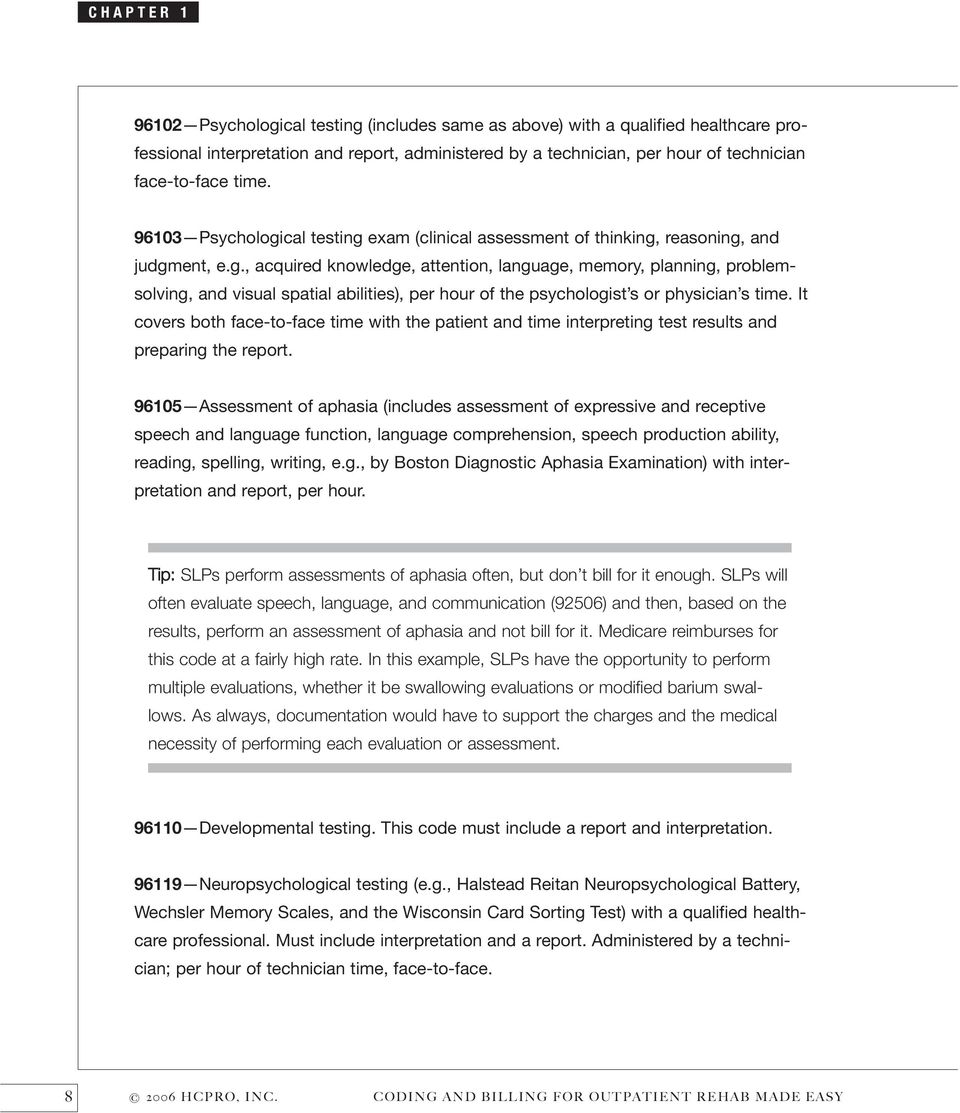
11 CHAPTER Psychological testing (includes same as above) with a qualified healthcare professional interpretation and report, administered by a technician, per hour of technician face-to-face time Psychological testing exam (clinical assessment of thinking, reasoning, and judgment, e.g., acquired knowledge, attention, language, memory, planning, problemsolving, and visual spatial abilities), per hour of the psychologist s or physician s time. It covers both face-to-face time with the patient and time interpreting test results and preparing the report Assessment of aphasia (includes assessment of expressive and receptive speech and language function, language comprehension, speech production ability, reading, spelling, writing, e.g., by Boston Diagnostic Aphasia Examination) with interpretation and report, per hour. Tip: SLPs perform assessments of aphasia often, but don t bill for it enough. SLPs will often evaluate speech, language, and communication (92506) and then, based on the results, perform an assessment of aphasia and not bill for it. Medicare reimburses for this code at a fairly high rate. In this example, SLPs have the opportunity to perform multiple evaluations, whether it be swallowing evaluations or modified barium swallows. As always, documentation would have to support the charges and the medical necessity of performing each evaluation or assessment Developmental testing. This code must include a report and interpretation Neuropsychological testing (e.g., Halstead Reitan Neuropsychological Battery, Wechsler Memory Scales, and the Wisconsin Card Sorting Test) with a qualified healthcare professional. Must include interpretation and a report. Administered by a technician; per hour of technician time, face-to-face HCPRO, INC. CODING AND BILLING FOR OUTPATIENT REHAB MADE EASY
12 CPT codes Neuropsychological testing (e.g., the Wisconsin Card Sorting Test) administered by a computer, with a qualified healthcare professional interpretation and report. 3 Tip: SLPs can use and to replace 96115, which the AMA deleted in Common speech-language treatment CPT codes Treatment of speech, language, voice, communication, and/or auditory processing disorder; individual (untimed). Any treatment provided to improve speech, language, voice, communication, and auditory processing should be billed under and not or For example, strengthening exercises to improve voice communication should be billed using this code and not CMS has issued a statement stating that SLPs are not able to bill using CPT codes or for treatment of speech or swallowing dysfunction in the outpatient setting. The American Speech-Language-Hearing Association has additional information in its Government Relations and Public Policy Update from November 2004 at Speech group services for two or more individuals (untimed). This CPT code should be used when the SLP has two or more patients working in a group with the focus on language, voice, communication, auditory processing, swallowing, feeding, etc. The key is that the SLP must be in constant attendance of all the patients, but is not providing direct one-on-one contact to either patient Treatment of swallowing dysfunction/oral function for feeding (untimed). As with 92507, if the patient performs strengthening exercises to improve swallowing/feeding, bill and not The same is true if the patient is performing neuromuscular reeducation exercise to improve feeding/swallowing the SLP must bill this intervention under and not HCPRO, INC. CODING AND BILLING FOR OUTPATIENT REHAB MADE EASY 9

13 CHAPTER 1 Use code in all treatments used to improve swallowing/oral function, except for electrical stimulation. The vast majority of Medicare contractors have stated that electrical stimulation (VitalStim) in the treatment of dysphagia is not inclusive of 92526; however, they do not reimburse separately for the electrical stimulation as the efficacy, in their opinion, has yet to be proven. Since it is not inclusive of and also non-covered by the Medicare contractors, providers may bill the patient for the electrical stimulation. Tip: If using Vitalstim to treat dysphagia, CMS does not reimburse separately for it because its efficacy has not been proven. However, as long as an SLP or OT documents other reasonable and necessary dysphagia treatment was provided with or without VitalStim, you can bill for Therapeutic services for the use of non-speech generating device, including programming and modification (untimed) Therapeutic services for the use of speech-generating device, including programming and modification (untimed) Auditory rehab; pre-lingual hearing loss (untimed). CMS does not reimburse for this CPT code. If provided by an SLP, CMS reimburses for this intervention under CPT code If provided by an audiologist, CMS does not reimburse for this service since audiologists can only be reimbursed for diagnostic services under the Medicare program Auditory rehab; post-lingual hearing loss (untimed). CMS does not reimburse for this CPT code. If provided by an SLP, CMS reimburses for this intervention under CPT code If provided by an audiologist, CMS does not reimburse for this service since audiologists can only be reimbursed for diagnostic services under the Medicare program HCPRO, INC. CODING AND BILLING FOR OUTPATIENT REHAB MADE EASY

14 CPT codes Modalities A modality is defined by the AMA as any physical agent applied to produce therapeutic changes, including thermal, acoustic, light, mechanical, or electric energy. 8 Modalities are divided into two categories: 8 1. Supervised Require the provider to watch over the application, though not necessarily at the patient s side. Those modalities that only require supervision do not require direct one-on-one contact by the provider and are procedure-/service-based codes. They are also untimed. Because of this, providers can only bill one unit per discipline, per beneficiary, per session, regardless of the amount of time for which the therapist provided the modality or the number of body areas treated. In these modalities, the therapist or therapist assistant can set the patient up and then walk away during the application and perform other interventions with other patients in the facility. As stated earlier, it is possible to bill more than one unit of a supervised modality on the same day, but the patient would have had to been treated twice on the same day at separate and distinct times. 2. Constant attendance Require the provider to be with the patient at all times. Modalities requiring constant attendance of the provider require direct one-on-one contact by the provider and are also time-based. Additionally, providers can bill multiple units of these codes per discipline, per beneficiary, on the same day of treatment. These constant attendance modalities are billed in 15-minute increments. 8 Constant attendance doesn t just mean that the provider needs to be in the room instead, it is used to describe modalities requiring the constant intervention and clinical decision-making of the therapist, or problem-solving ability of the assistant, to achieve the desired result. Supervised modalities The following codes all reference the application of a modality to one or more areas: Hot/cold packs. Heat and cold are typically used to reduce pain, decrease muscle spasm, and reduce edema and inflammation. Heat and cold should be used in 2006 HCPRO, INC. CODING AND BILLING FOR OUTPATIENT REHAB MADE EASY 11

15 CHAPTER 1 conjunction with other therapeutic procedures and not as stand-alone treatments. Under Medicare, hot and cold packs are not reimbursable. They are considered a bundled service with the other modalities and procedures provided to the beneficiary. 9 You must still document that you provided the hot/cold pack to the patient, its purpose, and the duration of treatment in the patient s medical record. Medicare carriers and FIs differ on whether to bill on the claim and whether a dollar amount should be attached. Check with your Medicare carrier or fiscal intermediatry (FI) for specific information. Just because Medicare doesn t pay for hot or cold packs, doesn t mean that the same is true of other insurance payers. If other payers reimburse for hot and cold packs, suppliers and providers of therapy services should bill those payers for the services rendered Mechanical traction. This includes both cervical and lumbar-pelvic mechanical traction. This CPT code does not include over-the-door cervical traction or other noncovered forms of traction. Specific indications for mechanical traction include cervical or lumbar radiculopathy, lumbago, sciatica, disc herniation, and other back disorders Unattended electrical stimulation. This is electrical stimulation that the provider does not need to manually apply to the patient. It is no longer recognized by Medicare but is still used by most other payers. Read on for more information on how Medicare uses codes G0281, G0282, and G0283. G0281 Unattended electrical stimulation for wound care. This code is specific to Medicare and is for electrical stimulation provided for wound care. The patient must have a chronic stage III or IV pressure ulcer, arterial ulcer, diabetic ulcer, or venous ulcer. He or she also must have had 30 days of conventional treatment in the POC for the ulcer, which did not demonstrate any signs of healing prior to Medicare reimbursing for electrical stimulation. CMS considers conventional treatment to be debridement or whirlpool with appropriate dressing changes. G0282 Unattended electrical stimulation for wound care other than described above. This code receives zero reimbursement from Medicare HCPRO, INC. CODING AND BILLING FOR OUTPATIENT REHAB MADE EASY

16 CPT codes G0283 Unattended electrical stimulation other than for wound care. This code should be used in conjunction with a therapy POC. Examples of electrical stimulation included in this code are Russian, HVPG, transcutaneous electrical neuromuscular stimulation, etc. Use these various types of electrical stimulation for pain reduction, edema reduction, and retraining weak muscles following surgery or injury Vasopneumatic devices. These devices are used to reduce edema in an extremity or to treat lymphedema. Patient education in the use of a lymphedema pump would be included in this code. Training with the patient must occur in person. Many insurance companies and Medicare contractors allow two to four treatments of this. Additional treatments may be reimbursed if documentation supports medical necessity of the intervention and why it requires the unique skills of a PT or OT. This could occur if the patient has circulatory deficiencies, areas of impaired sensation, open wounds, or fractures Paraffin bath. This superficial heating modality is used primarily for pain reduction in the hands and feet. Instruction to the patient in home use of paraffin must occur face to face with the patient. Many insurance companies and Medicare contractors allow two to four treatments of this. Additional treatments may be reimbursed if documentation supports medical necessity of the intervention and why it requires the unique skills of a PT or OT as outlined above in CPT code Whirlpool. This code includes wet and dry whirlpool. Whirlpools agitate water to relieve muscle spasm, reduce pain, and cleanse the wounds. Some Medicare carriers and FIs, as well as other insurance companies, also accept when billing for fluidotherapy that is considered to be a dry whirlpool. 10 A whirlpool may require the skills of a therapist when the patient s condition is complicated by circulatory deficiencies, areas of impaired sensation, impaired mobility or limitations in the positioning of the patient, safety concerns if left unsupervised, or open wounds. This list is not all inclusive Diathermy (e.g. Microwave). This deep-heating modality induces vasodilation for the reduction of pain, joint stiffness, and muscle spasm in deep tissue and joints HCPRO, INC. CODING AND BILLING FOR OUTPATIENT REHAB MADE EASY 13

17 CHAPTER 1 Because heating is accomplished without contact between the modality and the skin, it can be used even if skin is abraded, as long as there is no significant edema. Medicare does not reimburse for diathermy for the treatment of asthma, bronchitis, or other pulmonary conditions Infrared. This superficial heating modality is used to reduce acute and chronic pain, relieve muscle spasm, and reduce inflammation and edema. Skilled infrared should not be provided as an isolated treatment, but rather as part of a comprehensive therapy program that includes other medically necessary therapeutic procedures or modalities. Documentation must support the need for a therapist to perform the infrared. The supportive documentation should include the primary treatment condition and the comorbidity that requires the skilled application and assessment of the infrared treatment. Some third-party payers, including some Medicare carriers and FIs are reimbursing for Anodyne therapy under this CPT code. Check with your specific payer to verify that it covers Anodyne therapy and that this CPT code is the appropriate one to use Ultraviolet. This light therapy is most commonly used to treat psoriasis, but is also used to treat wounds. 8 Constant attendance modalities The modalities listed here are timed in 15-minute increments and require direct, one-onone contact by the provider. Regardless of how many body areas you provide the modality to, keep track of the time the provider spends with the patient one-on-one providing the skilled intervention. The time determines how many units you can bill, meaning that you can bill more than one unit of each of these codes. The following codes all refer to the application of a modality to one or more areas, each 15 minutes: Manual electrical stimulation. The provider must manually provide this electric stimulation to the patient and provide direct one-on-one patient contact. For example, HCPRO, INC. CODING AND BILLING FOR OUTPATIENT REHAB MADE EASY

18 CPT codes using a hand-held unit for the treatment of Bell s Palsy would constitute manual electrical stimulation. Providing a combination of ultrasound and electrical stimulation simultaneously to the patient through the sound head of an ultrasound also would qualify as manual electrical stimulation; however, the provider can only bill for either the ultrasound or the manual electrical stimulation, assuming the time spent allows you to bill one unit of either modality. Some third-party payers, including some Medicare carriers and FIs, allow suppliers and providers to bill this CPT code for the education and training in a home transcutaneous electro-nerve stimulator (TENS) unit. The time spent educating the patient where to place the electrodes on the skin, how to connect the lead wires to the electrodes, how to set the parameters of the unit, how to turn the unit on and off, how to inspect the skin after each treatment, etc., are all billable minutes because they are skilled services the therapist provided. In the July 2004 CPT Assistant, the AMA further defined constant attendance to involve visual or verbal contact with the patient during provisions of the services. Check with your specific payer to see if they cover and reimburse for the education and training in a home TENS unit. If it does, be sure to find out the correct CPT code to bill for this service Iontophoresis. Iontophoresis uses an electric current to introduce medication into the tissues to reduce pain and edema. The cost of the electrodes is included in the payment for this modality and may not be billed separately. The total time includes minutes spent educating the patient on why you are doing this, educating the patient about precautions, preparing the electrodes, placing the electrodes on the patient s skin, connecting the lead wires to the electrodes, setting the parameters of the unit, turning the machine on, inspecting the patient s skin upon conclusion of treatment, etc. The cost of the medication is not included in the reimbursement for iontophoresis. The physician should write the patient a prescription for the medication he or she wants to be used and the patient should obtain the medication from his or her pharmacy and bring it to the therapy appointment HCPRO, INC. CODING AND BILLING FOR OUTPATIENT REHAB MADE EASY 15

19 CHAPTER Contrast bath. Uses therapeutic heat and cold on distal extremities to reduce pain and inflammation, to treat extremities affected by reflex sympathetic dystrophy, rheumatoid arthritis, an acute sprain/strain, and to treat synovitis/tenosynovitis. Many insurance companies and Medicare contractors allow two to four treatments of this. Additional treatments may be reimbursed if documentation supports medical necessity of the intervention and why it requires the unique skills of a PT or OT. This could occur if the patient has circulatory deficiencies, areas of impaired sensation, open wounds, fractures, or other similar circumstances Ultrasound. This deep-heating modality uses sound waves to decrease pain, muscle spasm, and joint stiffness, and to increase muscle, tendon, and ligament flexibility. Medicare does not cover ultrasound for the treatment of pulmonary conditions Hubbard tank. This modality is used to treat wounds or ulcers, improve circulation, relieve/reduce muscle spasms, or to treat skin conditions. Use the Hubbard tank for extensive wounds or conditions that require an extensive area of the body to be immersed in water Unlisted modality. This CPT code should be used rarely only in instances where the modality the provider is using is not described by one of the other listed CPT codes. For example, an ice massage could probably only be billed one to three times because the provider could train patients to perform it themselves. This code also may be used to bill for fluidotherapy to insurance carriers that do not want it to be billed as Be sure to specify the type of modality applied, the time spent applying it, and whether there was constant provider attendance when using this code. Tip: Do not try to bill hot and cold packs under this CPT code to Medicare carriers; doing so could be considered fraud or abuse HCPRO, INC. CODING AND BILLING FOR OUTPATIENT REHAB MADE EASY
20 CPT codes Therapeutic procedures Therapeutic procedures are defined by the AMA as a manner of effecting change through the application of clinical skills/services that attempt to improve function. 8 The provider must have direct one-on-one contact with the patient. An exception is for group therapeutic procedures, which require the provider to be in constant attendance with the patient during therapy. 12 These procedures consist mainly of time-based codes, but they do contain three untimed procedure-/service-based codes. Each time-based CPT code is to be billed in 15-minute increments. Tip: Not all exercise a patient performs is therapeutic exercise. The exercise must directly help improve function to be considered therapeutic. Also take note of the difference between an exercise and an activity. An exercise is something a patient would not normally perform in everyday life e.g., wall climbs, straight leg rises, shoulder exercises with dumb bells, or quad sets. An activity is something a patient may do every day but that he or she is doing with a therapeutic intent, such as transfers, climbing, lifting, pushing, or carrying Therapeutic exercise to develop strength, endurance, range of motion (ROM), and flexibility. It can include active, active-assisted, and passive exercises. Passiveonly exercises should be limited to just a few visits and be related to restoring a loss of function. Remember that insurance carriers do not reimburse for therapy services for the purpose of increasing a patient s endurance. In addition, exercises to promote overall fitness, weight loss, or aerobic conditioning are not covered by Medicare or most other third-party payers under a therapy plan of care Neuromuscular reeducation of movement, balance, coordination, kinesthetic sense, posture, and proprioception. Treatments that could be billed under would include the use of a Baps board or trampoline to improve balance, the use of a body blade to improve kinesthetic awareness of an upper extremity, Bobath, Feldenkreis, 2006 HCPRO, INC. CODING AND BILLING FOR OUTPATIENT REHAB MADE EASY 17

21 CHAPTER 1 desensitization techniques, proprioceptive neuromuscular facilitation, and neuromuscular developmental techniques treatments. Some insurance payers only reimburse for this CPT code if the treating condition is neurological in origin, while other payers will reimburse for this CPT code for orthopedic conditions. Check with the patient s specific payer to find out which condition it pays for Aquatic therapy. This includes any therapeutic exercise that is performed in the water. Aquatic therapy may be considered reasonable and necessary for patients who are unable to tolerate a land-based program or when aquatic therapy facilitates progression to a land-based program. The procedure may be reasonable and medically necessary for a loss or restriction of joint motion, strength, mobility, or function that has resulted from a specific disease or injury Gait training including stairs. Providers must remember that gait training is more than just documenting Gait with standard walker 40 feet with Min PA (minimum physical assistance). Gait training should include your assessment of the phases of gait including stance phase; stride length; balance issues; what the ankle, knee, hip, and pelvis are doing during the gait cycle; push off and heel strike of the involved extremity; etc. Repetitive gait training solely to increase endurance and gait distance is not considered reasonable and necessary. There also must be an expectation that the patient s gait will improve as a result of the gait training under a therapy plan of care Massage. Includes effleurage, petrissage, and tapoment (e.g., stroking, compression, percussion). This procedure is used to decrease muscle spasm, increase relaxation, and improve mobility of pulmonary secretions Unlisted therapeutic procedure. Use this CPT code when the service you provided is not described by any other CPT code. The insurance carrier may ask for documentation to review why this CPT code was used Manual therapy. This CPT code includes joint mobilizations, manual traction, manual lymphatic drainage, decongestive therapy, myofascial release, and soft HCPRO, INC. CODING AND BILLING FOR OUTPATIENT REHAB MADE EASY
22 CPT codes tissue mobilization. Manual lymphatic drainage includes the application of compression bandaging. Tip: Do not confuse this code with for massage Therapeutic procedure(s), group (two or more individuals). Group therapy procedures involve constant attendance of the physician or therapist but do not require one-on-one patient contact by the physician or therapist, and they are untimed. 12 Providers may only bill one unit of group therapy per discipline, per beneficiary, per day, making this an untimed code. This definition of group therapy applies to all payers for outpatient therapy, not just Medicare. Many Medicare carriers and FIs require that providers document the number of participants in the group, the specific skilled treatments provided in the group, how the patient will benefit from group treatments, and how the group treatment relates to the plan of care and the patient s goals. In addition, some Medicare carriers and FIs limit the number of participants in a group setting based on the number of therapists and assistants in constant attendance. Check with your specific Medicare carrier or FI for their policies regarding group therapy under a therapy plan of care. Medicare further defines group therapy for providers by stating that Part B beneficiaries do not need to perform the same activity to be considered group therapy. 13 However, under Part A therapy benefits, patients in a group must be working toward a common goal Therapeutic activities. These activities involve the use of dynamic activities to improve functional performance. Examples include bending, reaching, lifting, carrying, pushing, and pulling tasks. In addition, bed mobility and transfer training could be billed using this code. The activities are usually directed at a loss or restriction of mobility, strength, balance, or coordination. Tasks that the patient performs on a daily basis typically fall under this code HCPRO, INC. CODING AND BILLING FOR OUTPATIENT REHAB MADE EASY 19
23 CHAPTER 1 Tip: This code is primarily used by OTs, but PTs probably under-use this code Cognitive skills development. This includes the development of cognitive skills to improve attention, memory, problem-solving, and compensatory training. There must be direct contact (one-on-one) with patient; each 15 minutes. These services may be medically necessary for patients with acquired cognitive deficits resulting from head trauma or acute neurological events, including cerebrovascular accidents. They are not appropriate for patients with chronic progressive brain conditions without the potential for improvement or restoration Sensory integration. This code involves techniques to enhance sensory processing to promote adaptive responses to environmental demands. Interventions under sensory integration are directed at restoring the patient s response to specific environmental demands while performing particular activities. This differs from neuromuscular reeducation (97112) in that focuses on training to restore the ability to perform the particular activities. There must be direct contact with patient by the provider; each 15 minutes. Tip: and are two timed codes SLPs can use under Medicare. CMS said that SLPs cannot use or Self care/home management training. This code is used for activities of daily living (ADL), meal preparation, safety procedures, and instruction in the use of adaptive equipment. Included in ADLs are toileting, bathing, dressing, personal hygiene, and cleaning. Additionally, bed mobility and transfer training could be billed using this code, as these tasks are ADLs that are performed daily. In addition, home visits may be billed using this CPT code, assuming the therapist is working on the tasks that would justify the use of this code HCPRO, INC. CODING AND BILLING FOR OUTPATIENT REHAB MADE EASY
24 CPT codes Community work/reintegration training. This code would be used when the focus of treatment is on helping the patient with function in the community. Treatment aspects could include shopping skills, money management, transportation, work environment/modification analysis, task analysis, and training in assistive technology device and adaptive equipment. Tip: Do not bill Medicare and other third-party payers for if the treatment focused on work environment/modification analysis, or work task analysis. Medicare and other third-party payers may deny claims for because they may feel that they should not be paying to get someone back to work. That typically falls under workers compensation or automobile claims Wheelchair management. Beginning January 1, 2006, this CPT code includes time spent on assessment, fitting, and training. Assessment includes, but is not limited to, determining the patient s need for a wheelchair, determining the type of wheelchair required, and assessing the patient s ROM and strength, endurance, skin integrity, sensation, sitting balance, transfer ability, etc. 15 This code includes instructing the patient or caregiver in how to propel or maneuver the wheelchair open and close the wheelchair lock/unlock the brakes remove and put on the arm rests, foot rests, and leg rests Work hardening/conditioning, initial two hours. This CPT code is not reimbursed by Medicare or by many other insurance carriers, other than workers compensation and auto coverage Work hardening/conditioning, each additional hour. This CPT code is not reimbursed by Medicare or by many other insurance carriers, other than workers compensation and auto coverage HCPRO, INC. CODING AND BILLING FOR OUTPATIENT REHAB MADE EASY 21
25 CHAPTER 1 Wound care Removal of devitalized tissue from wounds. Includes selective debridement without anesthesia (e.g., high pressure waterjet with or without suction, sharp selective debridement with scissors, scalpel, and forceps), with or without topical applications, wound assessment, and instruction for ongoing care. May include the use of a whirlpool. Bill for this per session when the total wound surface area is equal to or less than 20 sq cm Removal of devitalized tissue from wounds. Includes selective debridement without anesthesia (e.g., high pressure waterjet with or without suction, sharp selective debridement with scissors, scalpel, and forceps), with or without topical applications, wound assessment, and instruction for ongoing care. May include the use of a whirlpool. Bill for this per session when the total wound surface area is greater than 20 sq cm. Tip: When you are dealing with more than one wound for codes or 97598, add up the total wound surface of all the wounds. Also, if you perform whirlpool treatment and then debride the wound, you cannot bill separately for the whirlpool because it is included in these codes unless you either provided the whirlpool to a wound you did not debride or provided the whirlpool for a separate and distinct reason that documentation will support by showing medical necessity Non-selective debridement, without anesthesia. This code includes wet-todry/moist dressings and debridement by enzymatic application and abrasion. This code is also untimed and is not reimbursed by Medicare. Dressing supplies or time spent performing dressing changes should not be billed separately as they are included in the reimbursement amount. If you are a hospital outpatient department and this is the only service you provide to the patient on a given day, you may bill in addition to HCPRO, INC. CODING AND BILLING FOR OUTPATIENT REHAB MADE EASY
26 CPT codes Negative pressure wound therapy. Includes topical applications, wound assessment, and instructions for ongoing care. Total wound surface area must be less than or equal to 50 sq cm Negative pressure wound therapy. Includes topical applications, wound assessment, and instructions for ongoing care. Total wound surface area must be greater than 50 sq cm. Tests and measurements Physical performance test or measurement with written report. It is a separately identifiable test from the initial evaluation and could include a functional capacity evaluation, specific Biodex/Cybex testing, or Tinetti or Berg balance test. This may be used as a measurement to validate the patient s progress in therapy. Tip: You cannot bill this to Medicare on the same day as an evaluation or a reevaluation, although you can perform and bill for it on the subsequent treatment. Remember that you must generate a report to bill for this. The report could be generated by the equipment you are using and then interpreted by the therapist or the therapist could document the results with his or her interpretation directly into the patient s medical record Assistive technology assessment with written report. This code is to be used for the assessment of technological devices that can optimize functional tasks or maximize environmental accessibility. An example would be the assessment for adaptive equipment for a car or van to allow the patient to drive. Orthotic management and prosthetic management Orthotic management and training, including assessments and fitting (when not otherwise reported), upper extremity, lower extremity, and/or trunk; each HCPRO, INC. CODING AND BILLING FOR OUTPATIENT REHAB MADE EASY 23
27 CHAPTER 1 minutes. Assessment includes, but is not limited to, determining the patient s need for an orthotic, determining the type of orthotic required, assessing the ROM, strength testing, sensation testing, and designing and fabricating the orthotic. 17,18 If a supplier or provider bills an L code to the insurance company, then it can only bill the appropriate number of units of for the training since the reimbursement for the L code includes the assessment, fabrication time, and fitting. If you do not bill an L code, bill the appropriate number of units of for the time spent assessing the patient, designing and fabricating the orthotic, fitting the orthotic, and training the patient to perform tasks with the orthotic in place. Orthotic training usually requires no more than three or four visits to complete. Documentation for additional visits would need to explain the rationale and medical necessity for extending the number of visits. 17, Prosthetic training, upper or lower extremities. This code should involve demonstration and instruction to the patient/caregiver in the use of the prosthesis within the patient s environment; each 15 minutes Check out for orthotic/prosthetic use, established patient. This is an evaluation code and is medically necessary when you provide a new orthotic to an established patient. This code is also indicated when the therapist modifies a custom orthotic or reissues the device. An assessment by the therapist may be appropriate when the patient experiences impairment or a loss of function due to the prosthesis or orthotic. Examples would include falls, skin breakdown, and pain. Documentation should support the reason for the assessment and what was performed or provided to support the billing of this CPT code Unlisted physical medicine/rehabilitation service or procedure. The Medicare Physician Fee Schedule does not have a price for this code. The individual carriers and intermediaries price this code. 19 Biofeedback CPT codes used for biofeedback training are considered service-based codes, so they HCPRO, INC. CODING AND BILLING FOR OUTPATIENT REHAB MADE EASY
28 CPT codes are untimed. For urinary incontinence treatment for Medicare beneficiaries using biofeedback to be covered, the Medicare beneficiary must have first failed a documented trial of pelvic muscle exercise training that was at least four weeks in duration and must have demonstrated no improvement Biofeedback training by any modality. This code is used for muscle reeducation of specific muscles and for the treatment of spasticity, incapacitating muscle spasm, or weakness Biofeedback training for the treatment of urinary (stress or urge) incontinence. For Medicare beneficiaries, biofeedback is covered for the treatment of stress/urge incontinence in cognitively intact patients who have failed a documented trial of pelvic muscle exercise (PME) training, according to CMS. A failed trial of PME training is defined as no clinically significant improvement in urinary incontinence after completing four weeks of an ordered plan of PMEs to increase periurethral muscle strength. Contractors may decide whether to cover biofeedback as an initial treatment modality. Home use of biofeedback therapy is not covered. 20,21 Muscle and range of motion testing The CPT codes listed below are used for specific ROM and strength testing of a particular body part. Strength testing may be completed by manual muscle testing, dynamometer, or pinch gauge. This testing is separate from the initial evaluation or reevaluation. Use of these codes requires a generated report, and these codes are considered servicebased codes, so they are untimed. You may use these codes during the course of treatment when detailed strength or ROM measurements are required, but a complete reevaluation is not necessary. These codes are not designed for daily measurements the therapist may take of a particular joint. Use these codes rarely, and be sure that your documentation supports your charges Manual (separate procedure) muscle testing of the trunk or extremity, excluding hands HCPRO, INC. CODING AND BILLING FOR OUTPATIENT REHAB MADE EASY 25
29 CHAPTER Manual (separate procedure) muscle testing of the hand with or without comparison to the other side Manual (separate procedure) muscle testing of the total body, excluding hands Manual (separate procedure) muscle testing of the total body, including hands ROM measurement of each extremity or each spinal segment of the trunk, excluding hands ROM measurement of the hand with or without comparison to the other side. 22 Tip: Remember that, without the report, you cannot bill for any of the above codes. Education and training Beginning in 2006, the AMA added three codes for educating and training patients for physician-prescribed training on how to deal with a condition. These codes would be used when a therapist is educating a patient on his or her particular condition, such as lower back pain. The education must come from a structured curriculum and would teach the patient how to live with the back pain, in that instance Education and training for patient self management by a qualified, non-physician healthcare professional using standardized curriculum; face-to-face with the patient (could include caregiver or family if the patient is present) each 30 minutes; individual patient Education and training for patient self management by a qualified, nonphysician healthcare professional using standardized curriculum; face-to-face with HCPRO, INC. CODING AND BILLING FOR OUTPATIENT REHAB MADE EASY
30 CPT codes the patient (could include caregiver or family if the patient is present) each 30 minutes; two to four patients Education and training for patient self management by a qualified, non-physician healthcare professional using standardized curriculum; face-to-face with the patient (could include caregiver or family if the patient is present) each 30 minutes; five to eight patients. 23 As of January 1, 2006, Medicare does not reimburse for these three separate CPT codes. For therapists and therapist assistants who provide education and training to the patient/caregiver, those minutes spent on the training and education should be billed using the CPT code that best describes the training and education. For example, if the PT or OT is training a patient in exercises for the patient to perform at home, those minutes would be included in CPT code (therapeutic exercise). If the SLP was training a patient s spouse in chin tucks during swallowing, that time would be included under CPT code (treatment of swallowing dysfunction and/or function for feeding). Splints and strapping According to the AMA, splints and strapping are used to enhance task and movement performance, support weak or ineffective joints or muscles, reduce or correct joint limitations or deformities, and protect body parts from injury. Splinting and strapping are indicated for the treatment of fractures, dislocations, sprains, strains, tendonitis, postop reconstruction, contractures, or other deformities involving soft tissue, according to the AMA. These codes are all untimed. 24 Use the appropriate CPT code related to the area of the body you are splinting or strapping. If you also spend time training the patient in the use of the splint, you can bill (orthotic management and training) for the amount of one-on-one time training the patient how to perform tasks with the splint in place Application of long arm splint. Indicated for the shoulder and/or elbow HCPRO, INC. CODING AND BILLING FOR OUTPATIENT REHAB MADE EASY 27
31 CHAPTER Application of short arm splint; static. Indicated for the forearm, wrist, and/or hand Application of short arm splint; dynamic. Indicated for the forearm, wrist, and/or hand Application of finger splint; static. Indicated for the finger Application of finger splint; dynamic. Indicated for the finger Strapping; thorax. Indicated for any portion of the thorax Strapping; low back. Indicated for the lumbar spine or abdominal musculature Strapping; shoulder. Indicated for any portion of the shoulder girdle complex Strapping; elbow or wrist. Indicated for the elbow and wrist when there is involvement of the humerus, forearm, wrist, or hand Strapping; hand or finger. Indicated when there is involvement of the hand or digits Application of long leg splint. Indicated when there is involvement of the femur, patella, tibia, fibula, ankle, or foot Application of short leg splint. Indicated when there is involvement of the tibia, fibula, ankle, or foot Strapping; hip. Indicated when there is involvement of the lower back, abdomen, or hip HCPRO, INC. CODING AND BILLING FOR OUTPATIENT REHAB MADE EASY
32 CPT codes Strapping; knee. Indicated when there is involvement of the thigh, knee, or lower leg Strapping; ankle. Indicated when there is involvement of the lower leg, ankle, or foot Strapping; toes. Indicated when there is involvement of any of the toes Unna boot. A dressing for ulcers resulting from venous insufficiency Denis-Browne splint strapping. Specific for the correction of club foot. 24 The above list of CPT codes is not inclusive. Providers may provide any service and bill for it as long as they are qualified and their applicable state laws and state practice acts allow them to do so. They must purchase an updated CPT book yearly to stay current with the CPT codes HCPRO, INC. CODING AND BILLING FOR OUTPATIENT REHAB MADE EASY 29
33 CHAPTER 1 Frequently asked CPT and HCPCS questions Q A Medicare Part B therapy services considers supplies to be part of the practice expenses. Under the Medicare physician fee schedule, these expenses are already taken into account in the practice expense relative values. This is also true for most other thirdparty payers. Two exceptions could be automobile-related and workers compensation claims. Before billing 99070, check with those payers. Personally, I do not recommend using that CPT code. Can we use CPT code for reusable patient specific electrodes? Q A Q A Can we bill four contact units (i.e., minutes) and still include electrical stimulation (97014), which is untimed for both Medicare and other payers? I assume that the minutes for unattended electrical stimulation are in addition to the minutes. If that assumption is accurate, then the answer is yes. Using Medicare s eight-minute rule, if you provided minutes of direct one-on-one modalities and therapeutic procedures, you would be able to bill four units of timed-based procedures since your treatment time was at least 53 minutes but less than 68 minutes. The unattended electrical stimulation is not included in the minutes of the timed codes and is automatically billed as one unit. Remember, for Medicare Part B therapy services, you need to use G0283 for unattended electrical stimulation for indications other than wound care, not Does the new CPT code include dressing changes? If not, what CPT code do you use? I know includes whirlpool treatment, but can you actually bill and together as long as is modified? If you provide selective debridement (97597 or 97598), the dressing change is included in the reimbursement for and If you provide wound care without selective debridement and without whirlpool, bill for non-selective debridement (97602). The reimbursement includes the cost of the dressings (Medicare reimburses zero dollars for 97602) HCPRO, INC. CODING AND BILLING FOR OUTPATIENT REHAB MADE EASY
34 CPT codes If you provide wound care that includes whirlpool (97022) but not selective debridement, the reimbursement for includes the dressings. You may bill for both or and on the same day and receive reimbursement for both procedures if you apply modifier -59 (Editor s note: For more on modifier -59, read Chapter 2) to to show that the services are distinct from each other and were provided at separate and distinct times. If you whirlpool the wound to prepare that wound for debridement and then you debride that wound, do not bill separately for the whirlpool (97022) it is included in the reimbursement for either or An example of a case in which both would be reimbursable is if a patient has bilateral open wounds on his or her calves. The therapist selectively debrides the wounds on the right calf and then applies the appropriate dressings. For the wounds on the left, the therapist places the left lower extremity in the whirlpool for 15 minutes, removes the extremity, dries the calf, and applies the appropriate dressings to the left lower extremity. In this case, the therapist could bill using the selective debridement CPT code (97597 or 97598) for the treatment provided on the right lower extremity and for the treatment provided on the left lower extremity. Append modifier -59 to on the claim form and be sure the documentation would show that both services were medically necessary and provided at separate and distinct times. Q A Fluidotherapy is considered a dry whirlpool, so the appropriate CPT code to bill is 97022, unless otherwise directed by your Medicare contractor or other third-party payer is a service-based CPT code, so suppliers and providers may only bill one unit of the code per session regardless of the amount of time spent providing the fluidotherapy. What CPT code is appropriate when billing fluidotherapy? 2006 HCPRO, INC. CODING AND BILLING FOR OUTPATIENT REHAB MADE EASY 31
35 CHAPTER 1 Q We are compiling a protocol using electrical stimulation for chronic wounds, so G0281 is the appropriate code for this purpose. But what happens when we bill for electrical stimulation to multiple wound sites, requiring separate setups and treatment intervals? Is there any code that reflects this increased intensity of service? A Code G0281 is a code you would use to bill for unattended electrical stimulation to one or more areas for chronic stage III and stage IV pressure ulcers, arterial ulcers, diabetic ulcers, and venous stasis ulcers. To be reimbursed, the patient must have had 30 days of conventional wound therapy treatment that did not demonstrate measurable signs of healing before using electrical stimulation for wound care. Conventional wound care could include whirlpool, selective debridement, dressing changes, etc. Regardless of the number of sites or the amount of time provided, only bill one unit of G0281 per patient per day per discipline. Tip: Avoid using the word protocol in your documentation because you should individualize each treatment to the patient based on his or her needs to achieve the desired outcome. Q If iontophoresis (97033) is a timed code, how should we bill for a 24-hour, take-home iontophoresis delivery system? This type of iontophoresis can be applied in less than eight minutes, so can we bill for it? A Iontophoresis is a timed code that is billed in increments of 15 minutes. Additionally, iontophoresis is a constant attendance modality. This means that the therapist or therapist assistant must be present during the treatment providing direct one-on-one contact. Under Medicare regulations, add all timed CPT codes together to determine the number of billable units. In the case of a 24-hour, take-home iontophoresis delivery system, consider the time spent examining the patient s skin, applying the electrodes, and educating the patient about the purpose of the treatment, its possible side effects, and any other education you feel is appropriate HCPRO, INC. CODING AND BILLING FOR OUTPATIENT REHAB MADE EASY
36 CPT codes If this takes at least eight minutes to complete, bill for one unit of If it requires less than eight minutes and you provided no other timed modalities or therapeutic procedures to the patient, you may not bill using because you did not meet the time criteria. Documentation must include the education components you provided to the patient, in addition to the application of the electrodes and either the time the patient began and ended treatment or the total treatment time. Some Medicare contractors also require or recommend that you document the time spent on each CPT code you bill. Q A What CPT code should we use for patient education regarding the use of proper body mechanics during performance of ADLs and instrumental activities of daily living (IADL)? Providers should use the CPT code that best describes what they are educating the patient or their caregiver about. If you address proper body mechanics during the performance of ADLs and IADLs, bill those minutes using CPT code (self care/home management). You could also make a valid argument for billing these minutes under (therapeutic activities), which encompasses lifting, carrying, pushing, and pulling tasks that occur during the performance of ADLs and IADLs. As with the use of any CPT code(s), documentation must support the treatment provided and the CPT code(s) billed. If you are still not sure about which code to use, contact the specific payer and describe the services you provide to obtain an opinion. Q A Which CPT code should we use to bill an ergonomics or worksite evaluation on an established patient when I have already billed for a PT evaluation? The answer depends on the specific payer from which you request reimbursement. In many cases, it is possible to bill for a second PT evaluation because the evaluations are different. For ergonomics, include a written evaluation of the worksite, objective findings, your assessment and professional recommendations, applicable goals, and the patient s plan of care HCPRO, INC. CODING AND BILLING FOR OUTPATIENT REHAB MADE EASY 33
37 CHAPTER 1 Another option is to bill using CPT code (physical performance test or measure). This is a timed code and is billed in 15-minute increments. It also requires a written report. Check with your specific payer regarding which CPT code it wants billed. In addition, make sure that the third-party payer covers ergonomic or worksite evaluations. Q A When billing private insurance carriers for electrical stimulation, should I use the Medicare code G0283 or CPT code 97014? CPT code is a Level I HCPCS code and G0283 is a Level II HCPCS code. The AMA developed and copyrighted both codes. On April 1, 2003, Medicare contractors began to require that providers use G0283 for electrical stimulation for any reason other than wound care on all claims for Part B therapy services. Most other private insurances only accept and do not recognize G0283. There are some instances in which insurance companies aside from Medicare now require G0283 instead of 97014, but this is currently the exception and not the rule. If you need clarification regarding which code a specific payer wants, contact that company s provider inquiry department for further information. Q Our facility needs clarification regarding aquatic therapy and group exercise. Here is the scenario: A PT technician, under the direct supervision of a PT, performs therapeutic exercise with a group of patients in the pool. The PT is also in the pool, but he provides one-on-one aquatic therapy to another patient outside of the group. At the same time, this PT also supervises the PT technician. Can we charge the patient receiving the one-on-one therapy for aquatic therapy (97113) and also charge the patients receiving group therapy for group exercise (97150)? A Charge the patient working directly with the PT for one-on-one time. The PT would bill the appropriate number of units of based on the amount of time spent with the patient. Any services the PT technician provides to Medicare patients in the group setting are nonbillable because he or she does not meet the qualifications of a PT or PTA under Medicare rules and regulations. These services are also nonbillable by the PT under HCPRO, INC. CODING AND BILLING FOR OUTPATIENT REHAB MADE EASY
38 CPT codes Medicare because he or she is engaged one-on-one with another patient and is not in constant attendance of all the patients. You could also possibly bill the non-medicare patients for group exercise that the PT technician conducted and was supervised by the therapist, as long as the third-party payers and your state practice act allow a PT technician, under the supervision of a PT, to treat these patients. Refer to each payer s specific rules and regulations, and know your state practice act regarding whether you can use aides, what tasks they may perform, and what are the requirements of the PT supervising the aide. Q Our pulmonary rehab team has proposed matching therapeutic procedures CPT codes with discipline-specific revenue codes as a way to bill for various components. Can these codes (97110/97799) be used for services other than OT and PT? A Any provider may use any CPT code, as long as he or she is qualified to perform the particular service, modality, or procedure described by the billed CPT code. Qualification can include education, licensure, certification, registration, or on-the-job training. Providers also must be aware of state practice acts, state laws, and third-party payer rules and regulations regarding who can provide specific procedures or services and what qualifies an individual to provide them. Specific revenue codes used only on a CMS-1450 (UB-92) claim form and discipline modifiers (GN, GO, and GP) distinguish the type of service being provided. PT revenue codes range from 420 to 429, OT revenue codes range from 430 to 439, and SLP revenue codes range from 440 to HCPRO, INC. CODING AND BILLING FOR OUTPATIENT REHAB MADE EASY 35
39 CHAPTER 1 Q A I am looking for interpretations for the use of group therapy code in our outpatient rehab facility. Therapeutic procedures performed in a group (CPT code 97150) includes therapeutic procedures for two or more individuals and involves constant attendance of the physician or therapist, but it does not require one-on-one patient contact by the physician or therapist according to the CPT 2006 Standard Edition. This definition of group therapy applies to all third-party payers who reimburse based on CPT codes. Effective January 1, 2004, CPT codes described in the manual must be used when submitting claims electronically to all insurance carriers. In essence, if a therapist treats two or more patients at once, each patient (or his or her insurance carrier) should be charged for one unit of group therapy (97150), regardless of how much time is spent in the group because group therapy is a service-based code and is therefore untimed. Additionally, remember that patients participating in a group must do so because it is to their benefit, not to the provider s. Under Medicare Part B, patients in the group do not necessarily have to be performing the same activity. In addition, according to Medicare regulations, there is no limit to the number of patients that can be in a group. For example, if the therapist is treating two patients from 9 a.m. to 10 p.m., and then goes back and forth between the two patients spending five to seven minutes at a time with each patient, the therapist should add up all the minutes spent providing direct one-on-one contact with each patient and bill the appropriate number of time-based therapeutic procedures. Let s say, the therapist spent 30 minutes with each patient providing therapeutic exercise. Each patient would be billed two units of even though they were in the facility exercising for 60 minutes. The time the patient was performing the exercises when the therapist was working with the other patient is not billable because the patient was performing the exercises independently and not in a oneon-one situation with the therapist HCPRO, INC. CODING AND BILLING FOR OUTPATIENT REHAB MADE EASY
40 CPT codes Q A What is the appropriate use of the and 29xxx codes for splint application services? There seems to be an overlap in the descriptions, with 29xxx being untimed and more specific than The 29xxx CPT codes are untimed and used for the application of splints to enhance movement or task performance, support weak joints or muscles, and protect body parts from injury. Use code for orthotic management and training, regardless of extremity. For every 15 minutes of therapy, bill for one unit. The two codes descriptions overlap: 29xxx codes include splint application, and includes splint fitting. Some therapists may interpret these two descriptors to be the same, although others will argue that application is not the same as fitting. Contact the specific insurance carrier for its interpretation of the CPT codes. However, note that the 29xxx CPT codes do not include training, whereas does. Providers should bill using the appropriate 29xxx CPT code for application of the splint. For example, the therapist makes a pre-fabricated or custom-fabricated splint. If that therapist then trains the patient, he or she can bill using the appropriate number of units of 97504, depending on the amount of time spent on the training. Training can include discussing how to perform and complete functional activities with the orthotic in place. For example, an OT fabricates and applies a static short arm splint due to a fracture of the patient s right wrist and spends 20 minutes training the patient how to perform ADL tasks with the splint in place. The therapist should bill using one unit of and one unit of If this patient is a Medicare beneficiary, the therapist must append modifier -59 to to reimburse for both codes because is a component of Documentation must support that the therapist provided both services and that they occurred at separate and distinct times, according to CMS HCPRO, INC. CODING AND BILLING FOR OUTPATIENT REHAB MADE EASY 37
41 CHAPTER 1 Q A Should we bill ice massage under the CPT massage code or the unlisted modality code 97039? Ice massage is considered a modality, so bill it under the unlisted modality CPT code of Providers should document what they provided on the claim form. I would expect that you only bill for ice massage once or twice during an episode of care and that the therapist or therapist assistant would train the patient how to perform the ice massage independently at home. Q I noticed that in 2006, CPT codes 97504, 97520, and changed to 97760, 97761, and 97762, respectively. Besides the number changes, have there been any changes in their description and rationale for use? A The main change involves (formerly 97504) and its description in the CPT manual, as well as what this code may include. The new description for 2006 is Orthotic(s) management and training (including assessment and fitting when not otherwise reported), upper extremity(s), lower extremity(s), and/or trunk, each 15 minutes. Beginning in 2006, this CPT code may include assessment and the fabrication time when determining the number of units you can bill when not otherwise reported. Assessment includes, but is not limited to, determining the patient s need for an orthotic, determining the type of orthotic required, ROM and strength testing, sensation testing, and designing and fabricating the orthotic. This is good news for private practices that treat Medicare and non-medicare patients, and for all settings that custom fabricate orthotics. Under Medicare Part B, all settings besides private practice can bill their Medicare fiscal intermediary directly for L codes without needing a durable medical equipment (DME) license. The L code reimburses the supplier or provider for the assessment of the need for the device, the fabrication time, fitting of the device, and the supplies. Other insurance payers besides Medicare may allow suppliers or providers to bill for custom fabricated orthotics, regardless of whether they have a DME license HCPRO, INC. CODING AND BILLING FOR OUTPATIENT REHAB MADE EASY
42 CPT codes If the supplier or provider bills the L code to the insurance payer, it would then only bill the appropriate number of units of for training the patient how to perform tasks with the orthotic in place. If the supplier or provider does not bill the L code, then it should bill the appropriate number of units of for the time spent assessing the patient, fabricating the orthotic, fitting the orthotic, and training the patient how to perform tasks with the orthotic in place. With the change in the description of this CPT code, providers who may not have been able to bill Medicare or other payers for the time spent fabricating the orthotic will be able to do so using Find the rationale for this change in 2006 CPT Changes: An Insider s View. References 1. AMA, Current Procedural Terminology 2006 Standard Edition, xiii. 2. CMS, Pub Medicare Claims Processing Manual, Chapter 4 Part B Hospital (Including Inpatient Hospital Part B, Section manuals/downloads/clm104c04.pdf. 3. AMA, Current Procedural Terminology 2006 Standard Edition, 303, , and CMS, Pub Medicare Claims Processing Manual, Chapter 5 Part B Outpatient Rehabilitation and CORF Services, Section AMA, Current Procedural Terminology 2006 Standard Edition, and HCPRO, INC. CODING AND BILLING FOR OUTPATIENT REHAB MADE EASY 39
43 CHAPTER 1 6. CMS, Pub Medicare Benefit Policy Manual, Chapter 15 Covered Medical and Other Health Services, Section CMS, Pub Medicare Benefit Policy Manual, Chapter 15 Covered Medical and Other Health Services, Section 220.3B 8. AMA, Current Procedural Terminology 2006 Standard Edition, Federal Register, Vol. 70, No. 223, Medicare Program; Revisions to Payment Policies under the Physician Fee Schedule for Calendar Year 2006, November 21, 2005, CMS, Pub Medicare National Coverage Determinations Manual, Chapter 1, Part 2, Section CMS, Pub Medicare National Coverage Determinations Manual, Chapter 1, Part 2, Section AMA, Current Procedural Terminology 2006 Standard Edition, CMS, Medicare Claims Processing Manual, Chapter 5, Part B: Outpatient Rehabilitation and CORF Services, Section Federal Register, Medicare Program; PPS and Consolidated Billing for SNFs Update; Proposed Rule, May 10, 2001, AMA, CPT Changes 2006, An Insider s View, HCPRO, INC. CODING AND BILLING FOR OUTPATIENT REHAB MADE EASY
44 CPT codes 16. CMS Program Memorandum, Transmittal A , Change Request 2503, AMA, CPT Changes 2006, An Insiders View, AMA, CPT Assistant, December 2005, Volume 15, Issue12, 8 and AMA, Current Procedural Terminology 2006 Standard Edition, CMS, Pub Medicare National Coverage Determinations Manual, Chapter 1, Part 1, Section AMA, Current Procedural Terminology 2006 Standard Edition, AMA, Current Procedural Terminology 2006 Standard Edition, AMA, Current Procedural Terminology 2006 Standard Edition, AMA, Current Procedural Terminology 2006 Standard Edition, HCPRO, INC. CODING AND BILLING FOR OUTPATIENT REHAB MADE EASY 41
45 Order your copy today! Please fill in the title, price, order code and quantity, and add applicable shipping and tax. For price and order code, please visit If you received a special offer or discount source code, please enter it below. Title Price Order Code Quantity Total Name Title Your order is fully covered by a 30-day, money-back guarantee. Enter your special Source Code here: Organization Street Address City State ZIP Telephone Fax Address $ Shipping* $ (see information below) Sales Tax** $ (see information below) Grand Total $ *Shipping Information Please include applicable shipping. For books under $100, add $10. For books over $100, add $18. For shipping to AK, HI, or PR, add $ **Tax Information Please include applicable sales tax. States that tax products and shipping and handling: CA, CO, CT, FL, GA, IL, IN, KY, LA, MA, MD, ME, MI, MN, MO, NC, NJ, NM, NY, OH, OK, PA, RI, SC, TN, TX, VA, VT, WA, WI, WV. State that taxes products only: AZ. Billing Options: Bill me Check enclosed (payable to HCPro, Inc.) Bill my facility with PO # Bill my (3 one): Visa MasterCard AmEx Discover Signature Account No. Exp. Date (Required for authorization) (Your credit card bill will reflect a charge from HCPro, Inc.) Order online at Or if you prefer: Mail The Completed order form to: HCPro, Inc. P.O. Box 1168, Marblehead, MA Call our customer service Department at: 800/ fax The Completed order form to: 800/ [email protected] 2008 HCPro, Inc. HCPro, Inc. is not affiliated in any way with The Joint Commission, which owns the JCAHO and Joint Commission trademarks. Code: EBKPDF P.O. Box 1168 Marblehead, MA /
Preschool/School Supportive Health Services Program (SSHSP)
 SSHSP providers must use this select list of Current Procedural Terminology () codes to bill Medicaid for SSHSP services. This handout contains codes for the following SSHSP services that can be billed
Physical and Occupational Therapy Services Program Rulebook
 Health Services Office of Medical Assistance Programs Physical and Occupational Therapy Services Program Rulebook Includes: 1) Table of Contents 2) Current Update Information (changes since last update)
CHAPTER 515 COVERED SERVICES, LIMITATIONS, AND EXCLUSIONS FOR OCCUPATIONAL/PHYSICAL THERAPY SERVICES CHANGE LOG
 CHAPTER 515 COVERED SERVICES, LIMITATIONS, AND EXCLUSIONS FOR OCCUPATIONAL/PHYSICAL THERAPY SERVICES CHANGE LOG Replace Title Change Date Effective Date Section 515.1 Definitions 02/08/05 05/01/05 Section
Physical and Occupational Therapy Services Program Rulebook
 Division of Medical Assistance Programs Physical and Occupational Therapy Services Program Rulebook Includes: 1) Table of Contents 2) Current Update Information (changes since last update) 3) Other Provider
Occupational Therapy
 Occupational Therapy I. Policy University Health Alliance (UHA) will reimburse for occupational therapy when it is determined to be medically necessary and when it meets the medical criteria guidelines
Physical Therapy. Physical Therapy Payment Policy Policy number M.RTH.02.120301 effective 10/01/2015. Page 1
 Physical Therapy I. Policy University Health Alliance (UHA) will reimburse for physical therapy when it is determined to be medically necessary and when it meets the medical criteria guidelines (subject
Occupational Therapy
 Occupational Therapy Policy Number: Original Effective Date: MM.09.003 07/15/2003 Line(s) of Business: Current Effective Date: HMO; PPO; EUTF; HSTA; QUEST; Federal Plan 87 02/01/2012 Line(s) of Business
Physical Therapy MM.09.005 07/15/2003
 Physical Therapy Policy Number: Original Effective Date: MM.09.005 07/15/2003 Line(s) of Business: Current Effective Date: HMO; PPO; EUTF; HSTA; QUEST; Federal Plan 87 09/28/2012 Line(s) of Business Excluded:
Chiropractic Billing Guide
 Chiropractic Billing Guide AmeriHealth HMO Inc., and its affiliates (AmeriHealth) have created this 2006 Chiropractic Billing Guide Supplement in order to provide clear and helpful information about billing
Coding and Billing for Physical Therapy and Occupational Therapy Services
 Coding and Billing for Physical Therapy and Occupational Therapy Services -CPT Codes-97000 series -Timed Based Codes -Service Based Codes -CMS - "8" Minute Rule -ICD-9 codes -CCI edits -HCPCS(DME) MODALITIES
Healthcare and Family Services Therapy Provider Fee Schedule Key
 Healthcare and Family Services Therapy Provider Fee Schedule Key The therapy fee schedule and instructions apply to the following providers: Physical, Occupational, and Speech therapists billing with their
Chiropractic Billing Guide
 Chiropractic Billing Guide Independence Blue Cross (IBC) has created this 2006 Chiropractic Billing Guide Supplement in order to provide clear and helpful information about billing requirements for chiropractic
Physical Therapy 12/4/2014. Agenda. Time Based Billing. Presented by Regan Tyler, CPC, CPC-H, CPC-I, CPMA, CEMC Senior Consultant & NAMAS Instructor
 Physical Therapy Presented by Regan Tyler, CPC, CPC-H, CPC-I, CPMA, CEMC Senior Consultant & NAMAS Instructor Agenda Time based billing Therapeutic procedure(s) documentation Group therapy documentation
Timed Therapeutic Procedures
 Timed Therapeutic Procedures Policy Number: 10.01.526 Last Review: 4/2015 Origination: 4/2009 Next Review: 4/2016 Policy Documentation to support the reporting of timed procedure codes is required. The
Physical Therapy/Occupational Therapy Utilization Management Program FAQs November 2015
 Physical Therapy/Occupational Therapy Utilization Management Program FAQs November 2015 Background: Effective November 1, 2015, Anthem Blue Cross and Blue Shield (Anthem) implemented a physical therapy
Physical Medicine & Rehabilitation: Maximum Combined Frequency per Day Policy
 REIMBURSEMENT POLICY Policy Number Physical Medicine & Rehabilitation: Maximum Combined Frequency per Day Policy 2015R0101B Annual Approval Date 7/8/2015 Approved By Payment Policy Oversight Committee
Provider Type 34 Billing Guide
 Therapy Where to find state policy The Medicaid Services Manual (MSM) Chapter 1700 contains State policy for all therapy services, including respiratory therapy services (not discussed here. See MSM Chapter
UTILIZING STRAPPING AND TAPING CODES FOR HEALTH CARE REIMBURSEMENT:
 UTILIZING STRAPPING AND TAPING CODES FOR HEALTH CARE REIMBURSEMENT: A GUIDE TO BILLING FOR SPIDERTECH PRE-CUT APPLICATIONS AND TAPE Billing and coding taping and strapping services can be a complex issue.
Review of Texas Medicaid Acute Care Therapy Programs. Prepared by: Strategic Decision Support Health and Human Services Commission
 Review of Acute Care Therapy Programs Prepared by: Strategic Decision Support Health and Human Services Commission February 25, 2015 TABLE OF CONTENTS TABLE OF CONTENTS. i INTRODUCTION, BACKGROUND, & SUMMARY
Review the different reasons for documentation and goals for each Discuss strategies to prove medical necessity for treatment Review documentation
 Aaron Clark MS, ATC There are no conflicts of interest and information will be presented fairly and without bias No commercial support has been given for this presentation The focus of this presentation
CPT Development. CPT Coding for Outpatient PT. Who Can Use CPT Codes? Current Procedural Terminology (CPT) 4/17/2014
 CPT Coding for Outpatient PT Current Procedural Terminology (CPT) Kathleen Picard PT MNPTA Spring Conference St. Paul, Minnesota April 25, 2014 Descriptive terms and identifying codes for reporting medical
Chiropractic. Manual for Physicians and Providers Chiropractic
 Chiropractic www.bcbsfl.com 1 Introduction This section of the Manual for Physicians and Providers contains Chiropractic Billing and Coding Guidelines, developed with consideration of the latest coding
OCCUPATIONAL THERAPY
 OCCUPATIONAL THERAPY This document is subject to change. Please check our web site for updates. This provider manual outlines policy and claims submission guidelines for claims submitted to the North Dakota
Section 2. Physical Therapy and Occupational Therapy Services
 Division of Medicaid and Health Financing Updated July 2015 Section 2 Table of Contents 1 General Information... 2 1-1 General Policy... 2 1-2 Fee-For-Service or Managed Care... 3 1-3 Definitions... 3
Comments and Responses Regarding Draft Local Coverage Determination: Outpatient Physical and Occupational Therapy Services
 Comments and Responses Regarding Draft Local Coverage Determination: Outpatient Physical and Occupational Therapy Services As an important part of Medicare Local Coverage Determination (LCD) development,
REHABILITATION SERVICES (OUTPATIENT)
 REHABILITATION SERVICES (OUTPATIENT) Protocol: MSC028 Effective Date: March 1, 2016 Table of Contents Page COMMERCIAL COVERAGE RATIONALE... 1 DEFINITIONS... 2 APPLICABLE CODES... 4 REFERENCES... 7 POLICY
Chapter 24: Physical Medicine Services
 Payment Policies for Healthcare Services Provided to Injured Workers and Crime Victims Effective July 1, 2014 Link: Look for possible updates and corrections to these payment policies at: http://www.lni.wa.gov/claimsins/providers/billing/feesched/2014/
PAC - THE PRICING ACTION CODE IDENTIFIES NON-COVERED SERVICES OR THE SOURCE AND METHOD OF PRICING THE PROCEDURE (REFER TO TABLE II).
 PHYSICAL THERAPY, OCCUPATIONAL THERAPY, AND SPEECH AND LANGUAGE PATHOLOGY MAXIMUM ALLOWABLE FEE SCHEDULE THIS IS YOUR WISCONSIN MEDICAID MAXIMUM ALLOWABLE FEE SCHEDULE, WHICH IS IN EFFECT AS OF THE DATE
Local Coverage Determination (LCD): Outpatient Occupational Therapy (L31591)
 Local Coverage Determination (LCD): Outpatient Occupational Therapy (L31591) Contractor Information Contractor Name Palmetto GBA LCD Information Document Information LCD ID L31591 LCD Title Outpatient
Transmittal 55 Date: MAY 5, 2006. SUBJECT: Changes Conforming to CR3648 for Therapy Services
 CMS Manual System Pub 100-03 Medicare National Coverage Determinations Department of Health & Human Services (DHHS) Centers for Medicare & Medicaid Services (CMS) Transmittal 55 Date: MAY 5, 2006 Change
Physical Therapy Program
 Health and Recovery Services Administration Physical Therapy Program Billing Instructions ProviderOne Readiness Edition [WAC 388-545-0500] About This Publication This publication supersedes all previous
SAM KARAS ACUTE REHABILITATION CENTER
 SAM KARAS ACUTE REHABILITATION CENTER 1 MEDICAL CARE Sam Karas Acute Rehabilitation The Sam Karas Acute Rehabilitation Center is a comprehensive and interdisciplinary inpatient unit. Medical care is directed
OUTPATIENT PHYSICAL AND OCCUPATIONAL THERAPY PROTOCOL GUIDELINES
 OUTPATIENT PHYSICAL AND OCCUPATIONAL THERAPY PROTOCOL GUIDELINES General Therapy Guidelines 1. Therapy evaluations must be provided by licensed physical and/or occupational therapists. Therapy evaluations
Revised: 5/2001 3/2003 5/2003 4/2005 8/2008. CPT Code Definitions
 CPT Code Definitions Revised: 5/2001 3/2003 5/2003 4/2005 8/2008 90801 Outpatient Psych Eval (No time designation) The psychiatrist interviews the patient in an initial diagnostic examination, which includes
Rehabilitation Therapies
 Bluebonnet Medical Rehabilitation Hospital Rehabilitation Therapies 512-444-4835 or 800-252-5151 www.texasneurorehab.com Austin, Texas What Sets Us Apart Rehabilitation Therapies Physical Therapy - Neuromuscular
OUTPATIENT PHYSICAL, OCCUPATIONAL, & SPEECH THERAPY
 OUTPATIENT PHYSICAL, OCCUPATIONAL, & SPEECH THERAPY Policy NHP reimburses participating providers for the provision of medically necessary outpatient physical therapy, occupational therapy, and/or speech
Chiropractic Coding. Michael D. Miscoe JD, CPC, CASCC, CUC, CCPC, CPCO, CHCC. Disclaimer
 Chiropractic Coding Michael D. Miscoe JD, CPC, CASCC, CUC, CCPC, CPCO, CHCC 1 Disclaimer DISCLAIMER This presentation is for general education purposes only. The information contained in these materials,
ADDITIONAL FUNDING SOURCES
 Julie Guy, MT-BC & Angela Neve, MT-BC PO BOX 710772, San Diego, CA 92171-0772 [email protected] 1.877.620.7688 fax & VM ADDITIONAL FUNDING SOURCES Our mission is to make music therapy accessible
Providing Professional Care in Rehabilitation Services
 For more information about Inspira Rehab Care or for a patient evaluation, please contact any one of our facilities: Inspira Rehab Care Bridgeton Health Center 333 Irving Avenue Bridgeton, NJ 08302 (856)
Medicare Outpatient Therapy Billing
 DEPARTMENT OF HEALTH AND HUMAN SERVICES Centers for Medicare & Medicaid Services R Medicare Outpatient Therapy Billing August 2010 / ICN: 903663 DEPARTMENT OF HEALTH AND HUMAN SERVICES Centers for Medicare
Restorative Nursing Teleconference Script
 Slide 1 Slide 2 Slide 3 Maintaining independence in ADLs and mobility is very important to most of us. In fact, functional decline can lead to depression, withdrawal, social isolation, and complications
Resident will learn independently in addition to scheduled didactics. Learning is centered on the 7 core competencies as follows:
 Educational Goals & Objectives Physical and Occupational Therapies are an important part of patient care. The Physical Therapy rotation, under the supervision of the Director of Rehabilitation, is a one
How To Cover Occupational Therapy
 Guidelines for Medical Necessity Determination for Occupational Therapy These Guidelines for Medical Necessity Determination (Guidelines) identify the clinical information MassHealth needs to determine
NEW YORK STATE MEDICAID PROGRAM REHABILITATION SERVICES POLICY GUIDELINES
 NEW YORK STATE MEDICAID PROGRAM REHABILITATION SERVICES POLICY GUIDELINES Version 2015-1 Page 1 of 11 Table of Contents SECTION I REQUIREMENTS FOR PARTICIPATION IN MEDICAID 3 QUALIFIED PRACTITIONERS. 3
Questions: Procedure Coding Basics. Procedure Coding Basics. HCPCS II Codes. Coding for Slide Rehabilitation Title Services
 Coding for Slide Rehabilitation Title Services Questions: Jot down Questions may be addressed in the next few sentences or next slide Presenter Julia R. Olson, CPC If not addressed Ask during Q & A time
CHAPTER 700 SCHOOL-BASED CLAIMING PROGRAM/DIRECT SERVICE CLAIMING 700 CHAPTER OVERVIEW... 700-1 710 MEDICAL AND FINANCIAL RECORDS...
 700 CHAPTER OVERVIEW... 700-1 GENERAL REQUIREMENTS 700-1 REFERENCES. 700-3 710... 710-1 720 COVERED SERVICES... 720-1 A. AUDIOLOGY... 720-1 B. BEHAVIORAL HEALTH SERVICES... 720-2 BEHAVIORAL HEALTH PROVIDERS...
Coding and Billing Guidelines *Psychiatry and Psychology Services PSYCH-014 - L30489. Contractor Name Wisconsin Physicians Service (WPS)
 Coding and Billing Guidelines *Psychiatry and Psychology Services PSYCH-014 - L30489 Contractor Name Wisconsin Physicians Service (WPS) Contractor Number 00951, 00952, 00953, 00954 05101, 05201, 05301,
Occupational Therapy Program
 Health Care Authority Occupational Therapy Program Billing Instructions [WAC 182-545-0300] About This Publication This publication supersedes all previous Agency Occupational Therapy Program Billing Instructions
Early Intervention Service Procedure Codes, Limits and Rates
 BABIES INFORMATION AND BILLING SYSTEM Early Intervention Service Procedure Codes, Limits and Rates Georgia Department of Public Health Office of Maternal and Child Health Children and Youth with Special
Chapter 17. Medicaid Provider Manual
 Chapter 17 Medicaid Provider Manual February 2011 TABLE OF CONTENTS 17.1 Occupational Therapy... 1 17.1.1 Description... 1 17.1.2 Amount, Duration and Scope... 1 17.1.3 Exclusions... 1 17.1.4 Limitations...
Therapy Services INDIANA HEALTH COVERAGE PROGRAMS. Copyright 2016 Hewlett Packard Enterprise Development LP
 INDIANA HEALTH COVERAGE PROGRAMS PROVIDER REFERENCE M ODULE Therapy Services L I B R A R Y R E F E R E N C E N U M B E R : P R O M O D 0 0 0 4 9 P U B L I S H E D : F E B R U A R Y 2 5, 2 0 1 6 P O L I
REHABILITATION SERVICES
 REHABILITATION SERVICES S O U T H A M P T O N H O S P I T A L C o m m i t t e d to E xc e l l e n c e, to C o m m u n i t y, a n d to Yo u. A c ute C a r e R e h a b i l itati o n C a r d i o p u l m o
Table of Contents. Respiratory, Developmental,
 Provider Handbook Rehab and Restorative Services Table of Contents 1. Section Modifications... 1 2. Rehab, and Restorative Services... 2 2.1. General Policy... 2 2.2. Independent Occupational Therapists
OCCUPATIONAL THERAPY Corporate Medical Policy. Medical Policy
 OCCUPATIONAL THERAPY Corporate Medical Policy File name: Occupational Therapy File code: UM.REHAB.03 Origination: 01/1997 as a component of PT/OT/ST Medical Policy Last Review: 02/2014 (ICD-10 Remediation
Chapter. CPT only copyright 2010 American Medical Association. All rights reserved. 29Physical Medicine and Rehabilitation
 29Physical Medicine and Rehabilitation Chapter 29 29.1 Enrollment..................................................................... 29-2 29.2 Benefits, Limitations, and Authorization Requirements...........................
10-144 Chapter 101 MAINECARE BENEFITS MANUAL CHAPTER II SECTION 68 OCCUPATIONAL THERAPY SERVICES ESTABLISHED 9/1/87 LAST UPDATED 1/1/14
 MAINECARE BENEFITS MANUAL TABLE OF CONTENTS 68.01 PURPOSE... 1 PAGE 68.02 DEFINITIONS... 1 68.02-1 Functionally Significant Improvement... 1 68.02-2 Long-Term Chronic Pain... 1 68.02-3 Maintenance Care...
SECTION 2 PHYSICAL THERAPY SERVICES. BY INDEPENDENT PHYSICAL THERAPISTS (including Group Practices) Not in Rehabilitation Centers
 Division of Health Care Financing Updated July 2009 SECTION 2 PHYSICAL THERAPY SERVICES BY INDEPENDENT PHYSICAL THERAPISTS (including Group Practices) Not in Rehabilitation Centers Table of Contents 1
New York State Workers' Comp Board. Mid and Lower Back Treatment Guidelines. Summary From 1st Edition, June 30, 2010. Effective December 1, 2010
 New York State Workers' Comp Board Mid and Lower Back Treatment Guidelines Summary From 1st Edition, June 30, 2010 Effective December 1, 2010 General Principles Treatment should be focused on restoring
MEDICAL COVERAGE POLICY. SERVICE: Occupational Therapy SERVICE: PRIOR AUTHORIZATION: Not required.
 Important note Even though this policy may indicate that a particular service or supply may be considered covered, this conclusion is not based upon the terms of your particular benefit plan. Each benefit
Local Coverage Determination (LCD): Outpatient Physical and Occupational Therapy Services (L34049)
 Local Coverage Determination (LCD): Outpatient Physical and Occupational Therapy Services (L34049) Contractor Information Contractor Name CGS Administrators, LLC LCD Information Document Information LCD
Pediatric Case Study OCCUPATIONAL THERAPY EVALUATION REPORT AND INTERVENTION PLAN. Setting: community out-patient in-patient home based
 I. BACKGROUND INFORMATION Pediatric Case Study OCCUPATIONAL THERAPY EVALUATION REPORT AND INTERVENTION PLAN Date of report: Date of onset: Date of birth: Client s name: Date of referral: Age on date of
PARTNERSHIP HEALTHPLAN OF CALIFORNIA POLICY / PROCEDURE:
 PARTNERSHIP HEALTHPLAN OF CALIFORNIA POLICY/PROCEDURE Policy Number: MCUP3003 (previously UP100303) Reviewing Entities: Credentialing IQI P & T QUAC Approving Entities: BOARD CEO COMPLIANCE FINANCE PAC
Coverage and Recreation Therapy Services
 Coverage and Recreation Therapy Services Mary Lou Schilling, Ph.D., CTRS Associate Professor, Central Michigan University Past President, Central Rehabilitation Services, Inc. Session goals: Upon completion
Chapter. CPT only copyright 2009 American Medical Association. All rights reserved. 29Physical Medicine and Rehabilitation
 Chapter 29Physical Medicine and Rehabilitation 29 29.1 Enrollment...................................................... 29-2 29.2 Benefits, Limitations, and Authorization Requirements......................
PPTA Payer Summit Medical Review Challenges and Red Flags in Documentation. CPT Coding for Physical Therapy Services 97000 Series and Beyond
 PPTA Payer Summit Medical Review Challenges and Red Flags in Documentation November 19, 2014 Presented by Sandra McCuen, PT PPTA Reimbursement Specialist [email protected] 717.623.6135 CPT Coding
Rehabilitation Documentation and Proper Coding Guidelines
 Rehabilitation Documentation and Proper Coding Guidelines Purpose: 1) Develop a guide for doctors in South Dakota to follow when performing reviews on rehabilitation cases. 2) Provide doctors in South
Elbow Injuries and Disorders
 Elbow Injuries and Disorders Introduction Your elbow joint is made up of bone, cartilage, ligaments and fluid. Muscles and tendons help the elbow joint move. There are many injuries and disorders that
The following references are used throughout the billing scenarios that follow:
 11 Part B Billing Scenarios for PTs and OTs The following billing scenarios formerly appeared on the Frequently Asked Questions (FAQ) website and on the Therapy Medlearn website as "11 FAQs" - posted 9/13/02
Wound Care Charge Process
 There are six components to the wound care charge process. 1. Visit evaluation and management levels 2. Nursing / Rehab Therapist procedures 3. Physician procedures 4. Diagnostic testing 5. Dermal tissue
School Based Health Services Medicaid Policy Manual MODULE 6 OCCUPATIONAL AND PHYSICAL THERAPY SERVICES
 School Based Health Services Medicaid Policy Manual MODULE 6 OCCUPATIONAL AND PHYSICAL THERAPY SERVICES BACKGROUND Administrative Requirements SCHOOL BASED HEALTH SERVICES ARE REGULATED BY THE CENTERS
SUBCHAPTER 48C - SCOPE OF PHYSICAL THERAPY PRACTICE SECTION.0100 - PHYSICAL THERAPISTS
 SUBCHAPTER 48C - SCOPE OF PHYSICAL THERAPY PRACTICE SECTION.0100 - PHYSICAL THERAPISTS 21 NCAC 48C.0101 PERMITTED PRACTICE (a) Physical therapy is presumed to include any acts, tests, procedures, modalities,
Contractor Information. LCD Information. FUTURE Local Coverage Determination (LCD): Outpatient Physical and Occupational Therapy Services (L33631)
 FUTURE Local Coverage Determination (LCD): Outpatient Physical and Occupational Therapy Services (L33631) Please note: Future Effective Date. Contractor Information Contractor Name National Government
Coding and Payment Guide for the Physical Therapist. An essential coding, billing, and reimbursement resource for the physical therapist
 Coding and Payment Guide for the Physical Therapist An essential coding, billing, and reimbursement resource for the physical therapist 2011 Contents Introduction...1 Coding Systems... 1 HCPCS Level II
Who May Bill For Physical Medicine Services Board Certified Physical Medicine and Rehabilitation (Physiatry) Physicians
 PHYSICAL MEDICINE GENERAL INFORMATION Physical and occupational therapy services must be ordered by the worker s: Attending doctor Nurse practitioner or By the physician assistant for the attending doctor.
Instructions & Forms for Submitting Claims to Medicare
 Instructions & Forms for Submitting Claims to Medicare The Centers for Medicare and Medicaid services have issued a national coverage policy for the WalkAide. CMS will cover patients who have a diagnosis
SUMMA HEALTH SYSTEM. Summa s Outpatient Rehabilitation Services
 SUMMA HEALTH SYSTEM Summa s Outpatient Rehabilitation Services Summa s Outpatient Rehabilitation Services Patients have convenient access to therapy services ranging from acute rehab to wellness Summa
Issue #13-09. All SSHSP Medicaid Providers. NYS OHIP SSHSP & NYSED Medicaid in Education Units. DATE: July 30, 2013. Update to SSHSP Billing Codes
 New York State Office of Health Insurance Programs (OHIP) New York State Education Department Preschool/School Supportive Health Services Program (SSHSP) Medicaid in Education Units TO: FROM: All SSHSP
MEDICAL POLICY No. 91332-R3 NON-ACUTE INPATIENT SERVICES
 NON-ACUTE INPATIENT SERVICES Effective Date: November 16, 2007 Review Dates: 1/93, 12/99, 12/01, 12/02, 11/03, 11/04, 10/05, 10/06, 10/07, 10/08, 10/09, 10/10, 10/11, 10/12, 10/13, 11/14 Date of Origin:
How To Bill For Physical Therapy
 Procedure Codes for Occupational & Physical Therapy Practitioners BILLING CPT DEFINITION HOW ABBREV. CODE BILLED P 97001 Physical Therapy Evaluation Event B 97002 Physical Therapy Re-evaluation Event O
Coding and Payment Guide for Anesthesia Services. An essential coding, billing, and reimbursement resource for anesthesiology and pain management
 Coding and Payment Guide for Anesthesia Services An essential coding, billing, and reimbursement resource for anesthesiology and pain management 2011 Contents Introduction...1 Coding Systems... 1 Claim
Clinical Medical Policy Outpatient Rehab Therapies (PT & OT) for Members With Special Needs
 Benefit Coverage Rehabilitative services, (PT, OT,) are covered for members with neurodevelopmental disorders when recommended by a medical provider to address a specific condition, deficit, or dysfunction,
Medicare B Guideline Index
 Medicare B Guideline Index Medical Necessity Section 1862(a)(1)(A) of the SSA states: No Medicare payment shall be made for expenses incurred for items or services which are not reasonable and necessary
New Outpatient Therapy Evaluation and Intervention E&I Codes. An introduction to the new policy and new claims coding requirements
 New Outpatient Therapy Evaluation and Intervention E&I Codes An introduction to the new policy and new claims coding requirements Disclaimer Contents of this presentation are for educational purposes only.
GENERAL ADMISSION CRITERIA INPATIENT REHABILITATION PROGRAMS
 Originator: Case Management Original Date: 9/94 Review/Revision: 6/96, 2/98, 1/01, 4/02, 8/04, 3/06, 03/10, 3/11, 3/13 Stakeholders: Case Management, Medical Staff, Nursing, Inpatient Therapy GENERAL ADMISSION
The Do s & Don'ts of Mental Health Coding
 The Do s & Don'ts of Mental Health Coding Presented for Anthem Blue Cross and Blue Shield By Penny Osmon, BA, CPC October 31, 2007 Wisconsin Medical Society, Copyright 2007 CPT codes, descriptions and
Coding and Payment Guide for the Physical Therapist. An essential coding, billing, and payment resource for the physical therapist
 Coding and Payment Guide for the Physical Therapist An essential coding, billing, and payment resource for the physical therapist 2014 Contents Introduction...1 Coding Systems... 1 Claim Forms... 3 Contents
Neck Injuries and Disorders
 Neck Injuries and Disorders Introduction Any part of your neck can be affected by neck problems. These affect the muscles, bones, joints, tendons, ligaments or nerves in the neck. There are many common
Physical & Occupational Therapy
 In this section you will find our recommendations for exercises and everyday activities around your home. We hope that by following our guidelines your healing process will go faster and there will be
First Year. PT7040- Clinical Skills and Examination II
 First Year Summer PT7010 Anatomical Dissection for Physical Therapists This is a dissection-based, radiographic anatomical study of the spine, lower extremity, and upper extremity as related to physical
Answer Key: MRADL: Mobility Related Activity of Daily Living. (Within the home) Example: Feeding, toileting, dressing, grooming.
 1. Canes & Crutches 2. Walkers & 4 wheeled walkers 3. Manual Wheelchairs 4. Seat and Back Cushions for Wheelchairs 5. Power Wheelchairs and Mobility Scooters 6. Medicare Coverage Criteria 7. Repairs Answer