
Sunsuper insurance claims guide
|
|
|
- Patrick Dean
- 9 years ago
- Views:
Transcription
1 Sunsuper insurance claims guide Want to know more about: Making a claim How a claim is assessed 1 December 2015 make your dreams more than dreams

2 Getting Started What has happened to you or your loved one? You have an injury or sickness/illness which has permanently stopped you from working Please see Section 1: Total & permanent disability insurance claims 1 You ve lost a loved one Please see Section 2: Death insurance claims 11 You have an injury or sickness/illness which has stopped you from working temporarily Please see Section 3: Income protection insurance claims 23 You ve been diagnosed with a terminal illness Please see Section 4: Terminal illness claims 35
3 At Sunsuper, we understand that making a claim can be a stressful and difficult process. We appreciate that the circumstances of every claim are as different as the individuals making them. To help you and your family through this difficult time, Sunsuper has a team of dedicated and experienced staff who are able to assist you. Our Claims Team are trained specialists who will handle your claims journey with compassion and professionalism. We have developed this guide to help step you through the claims process. The following sections contain all the information you will need to help you make a claim. From basic details about the claim type and your eligibility through to in-depth guides on the information required for each claim, this comprehensive guide aims to simplify the process and explain all requirements in simple steps that are easy for you to follow. Sunsuper is committed to helping you access your entitlements. Our claims process has been designed During , Sunsuper paid so that in most cases, you or your family out just over $307 Million in should not require the assistance of a insurance claims. lawyer when making a claim. If you need help, our dedicated Claims Team is here to help guide you through the process. If you choose to seek professional help, we recommend that you first determine the costs involved in doing so and how they will impact your benefit payout. We give no priority to claims lodged by professionals all claims are dealt with in the same manner and follow the same process. Depending on the claim type, it can take up to six months or more for you to receive a final decision on your application. Once we have received your application, it is reviewed internally before being passed on to the Insurer who is ultimately responsible for assessing the claim. The assessment process involves many steps from working out whether you are eligible to claim, through to evaluating claim documentation including medical reports and other supporting evidence. While the process can be lengthy, we will strive to expedite it for you and keep you informed of your claim s status. If you have any further questions, please contact your dedicated Claims Officer or call our Contact Centre on

4 SUNSUPER INSURANCE CLAIMS GUIDE Contents 1 2 Total & permanent disability insurance claims What is Total & Permanent Disability (TPD) Insurance? How to make a TPD claim What does a TPD claims pack contain? 3 1. Claim Application (Employee statement) 3 2. Total and Permanent Disablement claim (Medical Attendant s statement) 3 3. Employer statement (Total and Permanent Disablement claim) 3 4. Benefit payment instruction 4 5. Centrelink Authority to Release Personal Information 4 6. Authority to release personal Medicare and Pharmaceutical Benefits Scheme (PBS) claims information What you will need to provide in your TPD claim 4 Certified proof of your identity 4 TPD claims Checklist The TPD insurance claim assessment process Frequently asked questions about TPD claims 8 Do I need a lawyer? 8 When can I make a TPD claim? 8 What if I am not sure I have insurance? 8 Why does it take so long? 8 Is there a Waiting Period? 8 Are there any injury or sickness/illness exceptions? 8 What happens if I have a self-inflicted injury? 8 How much will it cost? 8 What happens if I am receiving Income Protection payments? 8 What if I am self employed? 8 What if I am unemployed? 8 Death insurance claims What is a Death claim? How to make a Death claim What does a Death benefit claims pack contain? Appointment of representative Death benefit application form Employer statement What you will need to provide in the death claim 14 Certified proof of your identity 14 Death claims checklist Death insurance claim assessment process Frequently asked questions about Death claims 19 Do I need a lawyer? 19 What is a binding death nomination? 19 Who is eligible to receive the benefit? 19 Legal Personal Representatives 19 What is a dependant? 19 What is an interdependent relationship? 19 What is a financial dependant? 19 What happens if the deceased member committed suicide? 20 Are there any other exceptions? 20 Why does it take so long? 20 How much will I be paid? 20 What is the impact of where the benefit is paid? 20 What is a Family Provision application? 20 Will tax be payable on the benefit? 20 Will funeral expenses be reimbursed? 20 Will I be eligible for an anti-detriment payment? 20 Income protection insurance claims What is Income Protection (IP) Insurance How to make an IP claim What does an IP claims pack contain? Claim Application (Employee statement) Treating Doctor s Report An Employer statement Centrelink Authority to Release Personal Information Authority to release personal Medicare and Pharmaceutical Benefits Scheme (PBS) claims information Tax File Number declaration Bank Account Nomination form What you will need to provide in your IP claim 26 Certified proof of your identity 26 Income Protection claims checklist The IP claim assessment process Frequently Asked Questions about IP claims 30 Do I need a lawyer? 30 Do I have IP insurance? 30 Is there a Waiting Period? 30 Do I have to re-start a Waiting Period if I return to work? 30 Are there any exclusions or restrictions? 30 Sunsuper insurance claims guide

5 What happens if I m partially disabled? Frequently Asked Questions about TI claims 39 How much will I be paid? 30 Do I need a lawyer? 39 When are benefit payments made? 30 How much would I be entitled to? 39 Will I pay tax on the benefit? 31 Will there be offsets to my benefit payment? 31 What happens if I have a recurring injury or sickness/illness? 31 What happens if I am receiving an Income Protection payment? 39 How much will I be paid? 39 Are there any tax implications? 39 4 Rehabilitation in Super Work is Good Medicine 33 Terminal illness claims What is a Terminal Illness (TI) claim? 36 How is terminal illness defined? How to make a TI claim What does a TI claims pack contain? Application for early release of benefit form Employer statement Authority to access information Medical Practitioners certificate Binding death nomination form How do I prepare for the application process not being completed before my death? 39 Proof of identity requirements 41 When do you need to prove your identity? 42 What is an acceptable identification document? 42 What if you ve recently changed your name? 43 What do we mean by certified? 43 Who can certify your identification documents in Australia? 44 What if you live overseas? 45 Definitions What you will need to provide in your TI claim 38 Certified proof of your identity The TI claim assessment process 38 Coordination and assessment of your application 38 Payment of your claim 38 The Insurance claims guide provides information about making an insurance claim. For information about insurance cover, including eligibility and the terms and conditions that apply, you should refer to the applicable Product Disclosure Statement (PDS). For a copy of the PDS, call us on General advice disclaimer The information in this guide is general information only and doesn t take into account your personal objectives, financial situation or needs. You should consider the appropriateness of any general information in this guide having regard to your own personal objectives, financial situation and needs. You should consider the Product Disclosure Statement before making a decision. Call or visit sunsuper.com.au for a copy. You should obtain financial advice tailored to your personal circumstances. Call us if you would like to speak with one of our qualified financial planners. Our qualified financial planners provide simple advice about super at no additional cost. More detailed advice, including that provided as part of the SunTracker program, may incur a fee. Sunsuper employees provide advice as representatives of Sunsuper Financial Services Pty Ltd (ABN AFSL No ) (SFS), wholly owned by the Sunsuper Superannuation Fund. Protecting your privacy Sunsuper respects the privacy of the information you give us. If you require a copy of our Privacy Policy visit sunsuper.com.au/privacy or call sunsuper.com.au

6

7 1 Total & permanent disability insurance claims We can appreciate that being unable to work is a difficult and uncertain time for you. We will strive to ensure that your claim is processed in a timely manner, so you can receive a decision as quickly as possible. 1
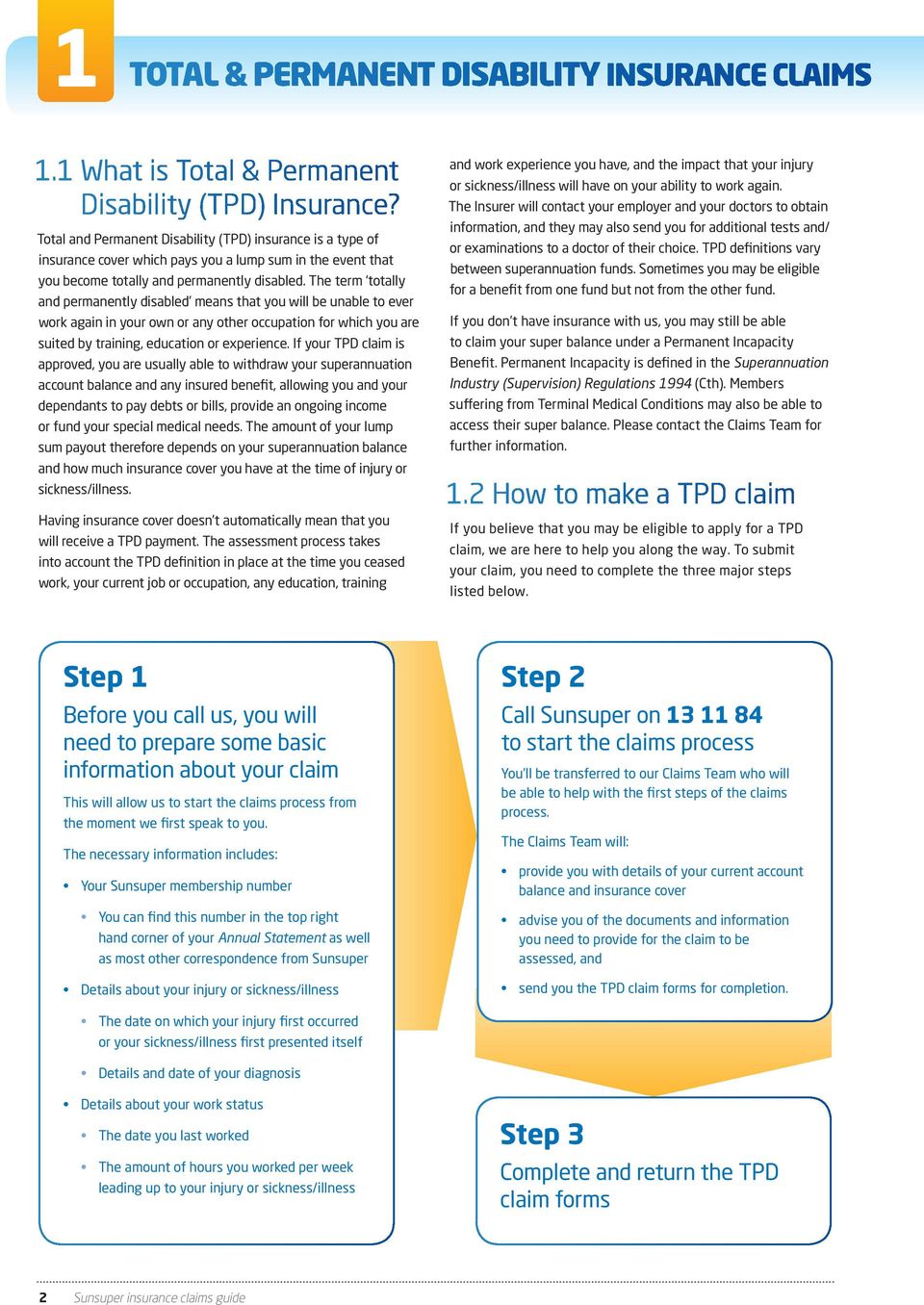
8 1 TOTAL & PERMANENT DISABILITY INSURANCE CLAIMS 1.1 What is Total & Permanent Disability (TPD) Insurance? Total and Permanent Disability (TPD) insurance is a type of insurance cover which pays you a lump sum in the event that you become totally and permanently disabled. The term totally and permanently disabled means that you will be unable to ever work again in your own or any other occupation for which you are suited by training, education or experience. If your TPD claim is approved, you are usually able to withdraw your superannuation account balance and any insured benefit, allowing you and your dependants to pay debts or bills, provide an ongoing income or fund your special medical needs. The amount of your lump sum payout therefore depends on your superannuation balance and how much insurance cover you have at the time of injury or sickness/illness. Having insurance cover doesn t automatically mean that you will receive a TPD payment. The assessment process takes into account the TPD definition in place at the time you ceased work, your current job or occupation, any education, training and work experience you have, and the impact that your injury or sickness/illness will have on your ability to work again. The Insurer will contact your employer and your doctors to obtain information, and they may also send you for additional tests and/ or examinations to a doctor of their choice. TPD definitions vary between superannuation funds. Sometimes you may be eligible for a benefit from one fund but not from the other fund. If you don t have insurance with us, you may still be able to claim your super balance under a Permanent Incapacity Benefit. Permanent Incapacity is defined in the Superannuation Industry (Supervision) Regulations 1994 (Cth). Members suffering from Terminal Medical Conditions may also be able to access their super balance. Please contact the Claims Team for further information. 1.2 How to make a TPD claim If you believe that you may be eligible to apply for a TPD claim, we are here to help you along the way. To submit your claim, you need to complete the three major steps listed below. Step 1 Before you call us, you will need to prepare some basic information about your claim This will allow us to start the claims process from the moment we first speak to you. The necessary information includes: Your Sunsuper membership number You can find this number in the top right hand corner of your Annual Statement as well as most other correspondence from Sunsuper Details about your injury or sickness/illness Step 2 Call Sunsuper on to start the claims process You ll be transferred to our Claims Team who will be able to help with the first steps of the claims process. The Claims Team will: provide you with details of your current account balance and insurance cover advise you of the documents and information you need to provide for the claim to be assessed, and send you the TPD claim forms for completion. The date on which your injury first occurred or your sickness/illness first presented itself Details and date of your diagnosis Details about your work status The date you last worked The amount of hours you worked per week leading up to your injury or sickness/illness Step 3 Complete and return the TPD claim forms 2 Sunsuper insurance claims guide
9 Please read all information we send to you carefully, and take the time you need to gather all information required to complete the claims process. You will need to answer several questions and provide us with additional information. Completing the claim form is the largest and most important step in this process: the details and evidence you provide will form the basis upon which the Insurer makes their decision in regards to your TPD claim. We recognise that this may be a daunting task. Our Claims Team is here to help you every step of the way, assisting with your claim and helping to answer any questions you may have. 1.3 What does a TPD claims pack contain? There are a number of forms you will need to complete when making a TPD claim (detailed below). Please do not hesitate to call the Claims Team if you have any questions. This will help us to ensure that your claim is processed as quickly as possible. 1. Claim Application (Employee statement) What is this form for? This form is to be completed by you. It includes your contact information, employment details and basic details about your injury or sickness/illness. It will ask specific details about the work you were performing leading up to your injury or sickness/illness, how your injury or sickness/illness has affected your ability to work, whether you ve had a similar condition before and whether you intend to claim other benefits. Tips: You must provide us with several pieces of information, and these tips will help you to find them. The Trading name of last employer will be detailed on your payslip or your Payment Summary (group certificate the trading name of your last employer may not be the name you know your employer as, so please check this carefully. Fund of choice means the superannuation fund your employer was paying into at the time of your injury or sickness/illness. If you are unsure about the dates and hours you worked, we recommend that you contact the Human Resources department of your (previous) employer or refer back to your payslips. 2. Total and Permanent Disablement claim (Medical Attendant s statement) What is this form for? This form is to be completed by the doctor who treated you at the time of your diagnosis. Their statement will describe the nature and extent of your injury or sickness/illness and provide evidence for it (such as medical records, test results etc.). Please note: So that we can make the process of lodging your claim as easy as possible, in some instances our Insurer will contact your treating doctor directly for completion of this form. If this is the case, this form will not be sent to you as it will be sent directly to your doctor. Tips: We recommend that you contact your doctor and let them know that you are in the process of making a TPD claim. You may be required to make an appointment with your doctor to have them complete this statement. Please note that you will be responsible for the costs of this appointment. 3. Employer statement (Total and Permanent Disablement claim) What is this form for? This form is to be completed by your (previous) employer with whom you were employed at the time of your injury or sickness/illness. They will need to provide information about the types of duties you performed in your role. Tips: We recommend that you contact the HR department or your direct manager from your (previous) employer, as this form must be completed by an authorised person. Why so many questions? In order to properly assess your claim, the Insurer requires detailed information from you, your employer and your doctor. While we recognise that your claim requires a number of questions to be answered, collecting as much information at the start will help validate your claim and speed up the process. We understand that this may be a daunting task, and our Claims Team is here to help you every step of the way. If you require assistance, please contact the Claims Team sunsuper.com.au 3

10 1 TOTAL & PERMANENT DISABILITY INSURANCE CLAIMS 4. Benefit payment instruction What is this form for? This form asks how you would like to receive your money should your claim be approved. Tips: Providing this information to us at the start will ensure that you can receive your claim monies without delay if your claim is approved. If you are unsure of how you would like your claim monies paid, we can arrange for you to speak with one of our qualified financial planners who will be able to assist you to make the best decision for your individual circumstances. 5. Centrelink Authority to Release Personal Information What is this form for? If you receive Centrelink benefits, you will be required to complete this form to give authority to Sunsuper and its Insurer to obtain information about your benefits. This form allows the Insurer to access any information or medical reports held by Centrelink which may help with the assessment of your claim. Please note: This form is not required in every instance and will only be included where necessary. 6. Authority to release personal Medicare and Pharmaceutical Benefits Scheme (PBS) claims information What are these form for? These forms provide authority for release of information from both Medicare and the Pharmaceutical Benefits Scheme (PBS) directly to the Insurer to assist them with the assessment of your claim. 1.4 What you will need to provide in your TPD claim Completing your TPD claim application is the largest and most important step in your claim process. The details and evidence you provide will form the basis upon which the Insurer makes their decision. Providing us with all the information we require and completing your forms correctly will speed up your claims process. If information is missing or incomplete, we will need to contact you to ask for it, which will delay your claim. We understand that completing the claims application may be a daunting task, and our Claims Team is here to help you every step of the way. Please contact the Claims Team who will assist you with any questions you have about the information we require and completing your claim forms. Certified proof of your identity You must provide a certified copy of your ID as proof of your identity (for example, a driver s licence or passport). Why? Your super is your money, so for security purposes, we need to be sure that the super belongs to the person submitting the claim. Understandably, you won t want to send us your original documents, so we ask that you have a copy certified by an authorised person. Tips: See our Proof of Identity Requirements section for information on what forms of ID are suitable and how to have a copy certified. Please note: These forms are not required in every instance and will only be included where necessary. Remember, if you need assistance please call the Claims Team 4 Sunsuper insurance claims guide

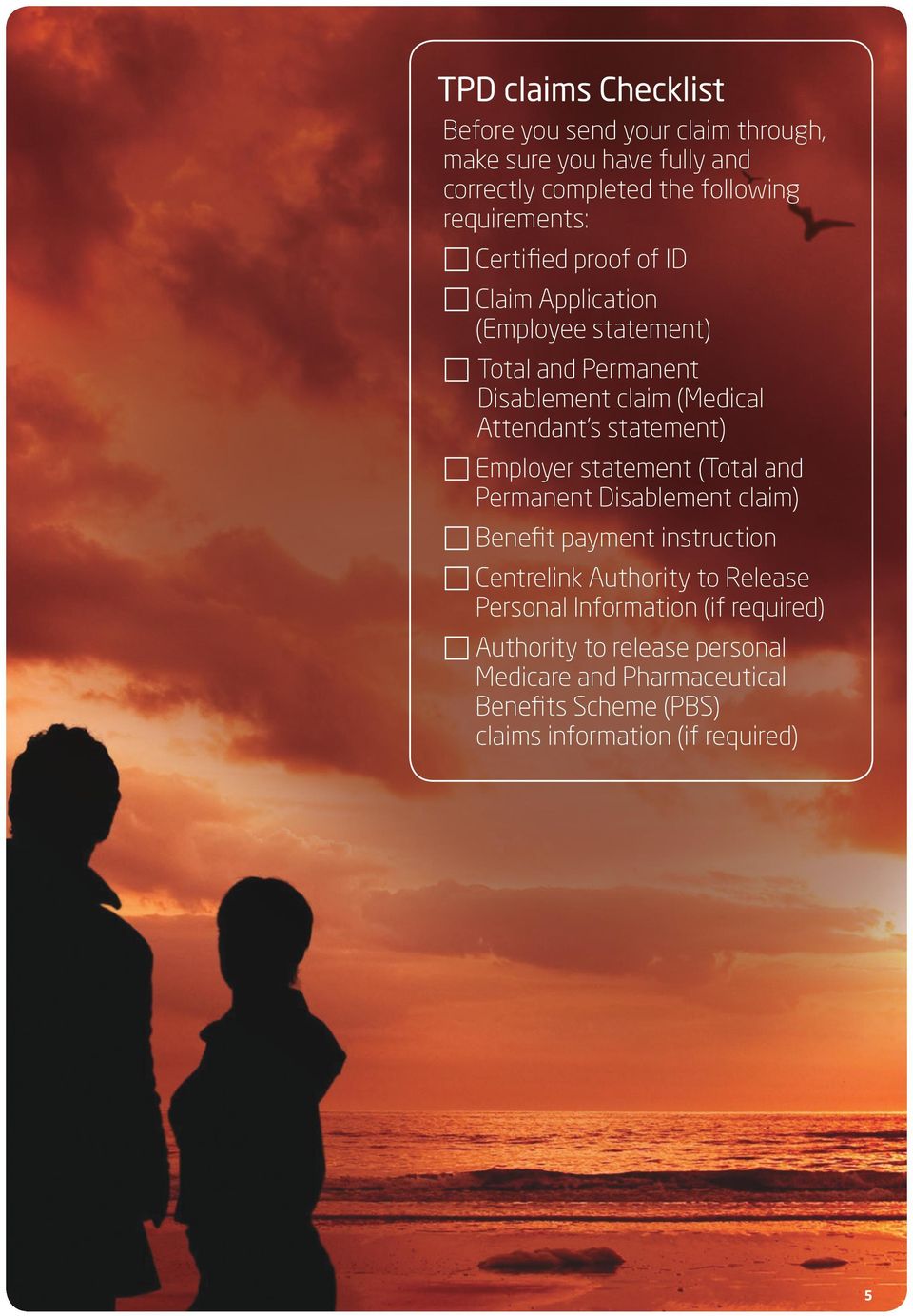
11 TPD claims Checklist Before you send your claim through, make sure you have fully and correctly completed the following requirements: Certified proof of ID Claim Application (Employee statement) Total and Permanent Disablement claim (Medical Attendant s statement) Employer statement (Total and Permanent Disablement claim) Benefit payment instruction Centrelink Authority to Release Personal Information (if required) Authority to release personal Medicare and Pharmaceutical Benefits Scheme (PBS) claims information (if required) 5
12 1 TOTAL & PERMANENT DISABILITY INSURANCE CLAIMS 1.5 The TPD insurance claim assessment process Claim forms are received Insurer assesses claim Claim is declined by Insurer Claim is accepted by Insurer Claim is deferred by Insurer Sunsuper Trustee reviews Insurer s decline of claim Sunsuper Trustee reviews Insurers acceptance of claim and makes payment Sunsuper Trustee disagrees with decline Sunsuper Trustee upholds decision to decline claim Please note: the process for Permanent Incapacity claims (where there is no insurance) is similar to the above but does not involve the insurer. Claim forms are received Insurer assesses claim Once we have received your claim forms, the Claims Team will review your application and ask you for any further information we require. Once we have received all the information we require for this initial stage, we can begin the assessment of your claim. Throughout the life of the claim, the Claims Team will keep you updated on its progress. The Insurer will use the information you, your employer and your treating doctor provide when making its assessment. The Insurer may also: ask for additional reports from your doctor/s ask you to provide more information ask your employer for more information, and/or make an appointment for you to have a medical examination with an independent specialist/s. The Insurer will pay for any additional medical reports they request and examinations they arrange for you to attend. Once all required information has been collected, the Insurer will assess your claim and decide whether it will accept, defer or decline your claim. 6 Sunsuper insurance claims guide

13 Claim is accepted by Insurer Claim is declined by Insurer If your insurance claim is accepted by the Insurer, the insurance monies will be paid to Sunsuper and initially invested in the Cash option. Funds will be held in this relatively stable investment option until the Sunsuper Trustee finalises payment to you. Sunsuper Trustee reviews Insurer s acceptance of claim and makes payment The Sunsuper Trustee will assess your claim and the Claims Team will contact you to advise that your claim has been approved. If you have already provided us with payment instructions via the Benefit payment instruction form (see page 4), we will pay your benefit accordingly. If your payment instructions have not been received, the Claims Team will contact you to discuss your payment options. You have the choice of taking the payment in cash, leaving it in your Sunsuper account or rolling it over to another approved superannuation fund. If you choose to take your benefit in cash (paid into your bank account or via cheque), you ll receive notification and details of the payment. PAYG tax will be withheld from your benefit where applicable. If you choose to leave your benefit in Sunsuper, any insurance proceeds will be moved into your chosen investment option(s) (or the Lifecycle Investment Strategy where you haven t made a choice). Please note that if your claim is successful, you will no longer be eligible to receive other default cover, such as a death benefit or another TPD benefit from Sunsuper unless you re-apply for cover, provide evidence of your health and the Insurer accepts your application. If your insurance claim is declined by the Insurer, it will be referred to the Sunsuper Trustee for assessment and consideration. If the Sunsuper Trustee disagrees with the decision of the Insurer and believes that your claim should be approved, your claim will be referred back to the Insurer for their reconsideration. The Claims Team will contact you to advise you of the next steps. Sunsuper Trustee reviews Insurer s decline of claim If the Sunsuper Trustee agrees with the decision to decline your claim, the Claims Team will contact you to advise you of this outcome. If you disagree with this decision, you can lodge a written complaint with Sunsuper. Your complaint will be investigated, and if you are not satisfied with our response, you are then able to ask the Superannuation Complaints Tribunal (SCT) whether you are eligible to submit a complaint to them. The SCT is an independent body set up by the Commonwealth Government to assist members (or their beneficiaries) in resolving certain superannuation complaints. Before seeking the SCT s help, you must first lodge a complaint directly with Sunsuper. Time limits affect when you can make a complaint to the SCT about a TPD claim. Call the SCT on or visit their website for more information. Claim is deferred by Insurer The Insurer may defer your claim for a period of time to determine the full extent of your disability and to ascertain whether it s permanent. Your claim will be reviewed at the end of this period, and either a decision will be made or your claim may be deferred again sunsuper.com.au 7
14 1 TOTAL & PERMANENT DISABILITY INSURANCE CLAIMS 1.6 Frequently asked questions about TPD claims Do I need a lawyer? Our claims process has been designed so that in most cases, you or your family should not require the assistance of a lawyer when making a claim. We don t give priority to claims lodged by lawyers all claims are dealt with in the same manner and follow the same process. If you are thinking about seeking legal help, we recommend that you first determine the costs involved in doing so and how they will impact your benefit payout. We recommend that you call us before seeking help from a lawyer. When can I make a TPD claim? If you are claiming for TPD, this means that you have been and are still suffering from an ongoing and serious injury or sickness/illness that is permanently preventing you from working or from performing daily activities. To apply for a TPD claim, you must satisfy the definition of Total and Permanent Disability and meet the Waiting Period requirements. See our Definitions section of this Guide for more information. What if I am not sure I have insurance? Login to Member Online and check your details at sunsuper.com.au/memberonline review your most recent statement or call us on Why does it take so long? There are many steps involved in assessing a claim. The process is lengthy and can take a number of months. We and the Insurer need to assess all relevant facts, including information from you, your employer, your doctor and medical specialists to ensure that the correct decision is made. Is there a Waiting Period? The current Waiting Period for a TPD claim is generally three months. This means that you must have been absent from work as a result of your injury or sickness/illness for a period of three months or more before you can lodge a TPD claim. There are some instances where the Waiting Period may not apply. Please check with the Sunsuper Claims Team if this applies to you. Are there any injury or sickness/illness exceptions? You will not be eligible to make a TPD claim where your injury or sickness/illness is caused, wholly or partly, directly or indirectly from you being deployed to a hostile environment as part of active military service. What happens if I have a selfinflicted injury? In some instances, you will not be eligible to make a TPD claim if your injury or sickness/illness is caused by an intentional selfinflicted act. Please check with the Sunsuper Claims Team if this applies to you. How much will it cost? To enable our Insurer to assess your claim, you ll need to provide medical evidence to support your application. The cost of any information required to initiate the claim process is to be met by you. This includes having a doctor complete a Medical Attendant s statement (if applicable). If the Insurer requests additional information or reports from your doctor, or requests an independent medical examination, the cost of these will be paid by the Insurer. What happens if I am receiving Income Protection payments? If you are receiving Income Protection payments, these will continue as long as you satisfy the terms of the Income Protection claim policy. What if I am self employed? The process of making a claim remains the same irrespective of whether you work for an organisation or work for yourself. What if I am unemployed? The assessment of your TPD claim may be based on a different definition than if you were working. See the Definitions section of this Guide for more information. 8 Sunsuper insurance claims guide

15 sunsuper.com.au 9

16 10

17 2 Death insurance claims We understand that dealing with the loss of a loved one is a difficult time. We are here to help you and your family with the process of applying for a death payment, and we will do our best to help ensure that your claim is dealt with as quickly as possible. 11

18 2 DEATH INSURANCE CLAIMS 2.1 What is a Death claim? A death claim is a claim for a deceased Sunsuper member s account balance. When the member had active death insurance at their time of death, the death insurance cover is also included in the death claim. 2.2 How to make a Death claim If you believe that you may be eligible to claim as a beneficiary of the member, we are here to help throughout the claims process. The three major steps that you need to complete in order to submit your claim are listed below. Step 1 Before you call us, you will need to prepare some basic information about your claim This will allow us to start the claims process from the moment we first speak to you. The necessary information includes: The member s Sunsuper membership number. You can find this number in the top right hand corner of the member s Annual Statement as well as most other correspondence from Sunsuper. Step 2 Call Sunsuper on to start the claims process You ll be transferred to our Claims Team who will be able to help with the first steps of the claims process. The Claims Team will: confirm details of the member, advise you of the documents and information you need to provide for the claim to be assessed, and send you the claim forms for completion. The member s date of birth. We will begin the death benefit claim process as soon as we hear of a member s death, however formal notification is required for any claim to proceed. We require a certified copy of one of the following documents: death certificate coroner s report autopsy report inquest finding a medical certificate of death, completed by a registered medical practitioner. Once we receive formal notification of the death, the member s existing account balance will be switched into Sunsuper s Cash Option, normally within five working days. Funds will be held here until the Sunsuper Trustee finalises payment to the beneficiaries. This is a relatively stable investment option subject to small growth and fluctuation. Any insurance benefits will also be paid into this option. Step 3 Complete and return the claim forms Please read all information we send to you carefully, and take the time you need to gather all information required to complete the claims process. You will need to answer several questions and provide us with additional information. We recognise that this may be an emotional and daunting task, and our Claims Team is here to help you every step of the way. We will provide you with the name and contact details of your own dedicated Claims Officer who will assist with your claim and help answer any questions you may have along the way. 12 Sunsuper insurance claims guide
19 2.3 What does a Death benefit claims pack contain? The claims Pack includes a number of forms that you need to complete when making a claim for death benefits. Please do not hesitate to call the Claims Team if you have any questions about these forms as we want to ensure that your claim is progressed as quickly as possible. 1. Appointment of representative What is this form for: this form is to be completed if you wish Sunsuper to communicate with, or release information to, a person or organisation acting on your behalf. Tips: Our claims process has been designed so that you or your family should not require the assistance of a lawyer when making a claim. If you require assistance, our dedicated Claims Team is here to help guide you through the process. If you choose to seek professional help, we recommend that you first determine the costs involved in doing so and how they will impact your benefit payout. We give no priority to claims lodged by professionals all claims are dealt with in the same manner and follow the same process. 2. Death benefit application form Probate is a Court order that allows the Executor named in a Will to manage the deceased individual s estate and assets. Letters of Administration: where the deceased has not left a Will, a person may apply to the Supreme Court (in the State or Territory in which the deceased resided) for a grant of Letters of Administration. Generally, the deceased person s next-of-kin will be granted Letters of Administration. Similar to a grant of Probate, Letters of Administration allow the person appointed to administer the deceased s estate. A person who is granted Letters of Administration is called an Administrator. 3. Employer statement What is this form for? This form is to be completed by the deceased member s (previous) employer with whom they were employed at the time of their death or immediately prior. This form will only be requested if there is active insurance at the time of the deceased member s death. Tips: We recommend that you contact the Human Resources department from the deceased s previous employer as this form must be completed by an authorised person. What is this form for: this form requests details about the deceased Sunsuper member, including details about their last employer and other superannuation accounts as well as information about you, the claimant and your relationship to the deceased. In order to ensure Sunsuper pays the correct beneficiary, we are required to ask about the deceased member s family situation, including details about their spouse, children, parents, living arrangements and financial affairs. Tips: As this form references a lot of legal terms, we have explained many of these below to make it quicker and easier for you fill in this form. A Will is a legal document that details how an individual s property and belongings are to be divided upon their death. Under a Will, an Executor who is responsible for looking after an individual s estate is appointed. Upon the individual s death, the executor will work out the individual s assets, pay any debts and then distribute the remaining assets in accordance with the details of the Will sunsuper.com.au 13
20 2 DEATH INSURANCE CLAIMS 2.4 What you will need to provide in the death claim Completing the claim forms is the largest and most important step in the claim process. The details and evidence you provide will form the basis upon which the Sunsuper Trustee and the Insurer (if relevant) makes their decision. Providing us with all the information we require and completing your forms correctly will speed up your claims process. If information is missing or incomplete, we will need to contact you to ask for it, which will delay your claim. We understand that completing the claim application may be a daunting and emotional task, and our Claims Team is here to help you every step of the way. Please contact the Claims Team who will assist you with any questions you have about the information we require and completing your claim forms. Certified proof of your identity You must provide a certified copy of your ID (for example, a driver s licence or passport) as proof of your identity. Why? For security purposes we need to be sure of the identity of the individual who is submitting the claim. Understandably, you won t want to send us your original documents, so we ask that you have a copy certified by an authorised person. Tips: See our Proof of Identity Requirements section for information on what forms of ID are suitable and how to have a copy certified. 14 Sunsuper insurance claims guide

21 Death claims checklist Before you send your claim through, make sure you have fully and correctly completed the following requirements: A certified copy of your ID Death benefit application form Employer statement Full Certificate of Death Certificate of the deceased s Birth or an extract of Birth Entry Last Will and Testament of the deceased (if one was left) Grant of Probate or Letters of Administration (if already obtained) Marriage Certificate of the deceased (if applicable) 15
22 2 DEATH INSURANCE CLAIMS 2.5 Death insurance claim assessment process Claim forms are received Claim is accepted by the insurer Insurer assesses claim Sunsuper Trustee assesses claim Claim is declined by Insurer Sunsuper trustee disagrees with insurer decision Claim outcome is advised claim staking is required Claim outcome is advised no claim staking is required Objection is received No objection is received Sunsuper trustee agrees with insurer decision Claim payment Please note: the process for Death claims for a deceased member s account balance where there is no insurance, or where an insurance claim has been rejected, is similar to the above but does not involve the insurer. 16 Sunsuper insurance claims guide
23 Claim forms are received Claim outcome is advised claim staking is required Once we have received your claim form, your Claims Officer will review your application and ask you for any further information we require. Once we have received all the information we require for this initial stage, we can begin the assessment of your claim. Throughout the claims process, your Claims Officer will keep you updated on its progress. After a decision has been made, the Sunsuper Trustee will contact all potential beneficiaries to advise where the benefit will be paid and in what proportions. This is referred to as the claim staking process. Any interested parties who are unhappy with the determination will have 28 days to object. Insurer assesses claim Objection is received Once you have provided the information requested, and we have confirmed that the member was insured at the date of death, we will submit an insurance claim to the Insurer. If the insurer declines the claim, it is then referred to the Sunsuper Trustee for review. Claim is accepted by the insurer Once a claim is accepted by the insurer, it goes to the Sunsuper Trustee to determine where the death benefit will be paid. Sunsuper Trustee assesses claim Once all the information is obtained from possible beneficiaries, the claim is submitted to the Sunsuper Trustee to determine where the benefit will be paid. The Claims Committee meets once a month to make these decisions. Uncomplicated claims for example where there is a lifetime partner and no other dependants may be determined more frequently. If we receive an objection, we will contact all potential beneficiaries to advise them that an objection has been received and allow a period of time for any further submissions. The claim will then be resubmitted to the next claims committee meeting where the Sunsuper Trustee will either confirm or change the initial decision. If the decision is confirmed, a confirmation letter will be sent to the beneficiaries, which then allows another 28 days for any potential beneficiaries still unhappy with the decision to lodge a complaint with the Superannuation Complaints Tribunal (SCT). If the decision is changed, applicants will once again have 28 days to notify the Sunsuper Trustee of any objections. If any party provides an objection to the revised decision, the process of advising all interested parties and inviting further submissions will be repeated before the claim is presented to the Sunsuper Trustee again. Claim outcome is advised no claim staking is required Claim staking is not required where a valid binding death benefit nomination exists. It may also not be required where the benefit amount is very small or in cases where there is only one possible dependant sunsuper.com.au 17
24 2 DEATH INSURANCE CLAIMS Claim is declined by Insurer If the claim is declined by the Insurer, it will be referred to the Sunsuper Trustee for assessment. If the Sunsuper Trustee disagrees with the decision of the Insurer and believes that the claim should be approved, the claim will be referred back to the Insurer for their reconsideration. Your Claims Officer will contact you to advise you of the next steps. If the Sunsuper Trustee agrees with the decision to decline the claim, your Claims Officer will contact you to advise you of this outcome. If you disagree with this decision you can lodge a written complaint with Sunsuper. Your complaint will be investigated, and if you are not satisfied with our response, you are then able to ask the Superannuation Complaints Tribunal (SCT) whether you are eligible to submit a complaint to them. The SCT is an independent body set up by the Commonwealth Government to assist members (or their beneficiaries) in resolving certain superannuation complaints. Before seeking the SCT s help, you must have first lodged a complaint directly with Sunsuper. Time limits affect when you can make a complaint to the SCT about a death claim. Call the SCT on or visit their website for more information. Claim payment Payment will generally be made to the beneficiaries within a few days of the Sunsuper Trustee decision (if no claim staking is required), or upon the 28 day objection period expiring, provided there are no objections. For payment to be made, we must have received certified proof of identity documents for the beneficiaries, TFN (where applicable) and been notified how and where the payment is to be made. The Sunsuper Trustee will generally pay the benefit directly to the beneficiaries determined, except in the case of minor children, when we may pay to a parent or legal guardian on behalf of a child, or pay to the Public Trustee. 18 Sunsuper insurance claims guide
25 2.6 Frequently asked questions about death claims Do I need a lawyer? Our claims process has been designed so that in most cases, you or your family should not require the assistance of a lawyer when making a claim. We don t give priority to claims lodged by lawyers all claims are dealt with in the same manner and follow the same process. If you are thinking about seeking legal help, we recommend that you first determine the costs involved in doing so and how they will impact your benefit payout. We recommend that you call us before seeking help from a lawyer. What is a binding death nomination? A binding death nomination is a legal instrument that binds the Sunsuper Trustee to pay the death benefit to the deceased member s dependants, or legal personal representative nominated by the deceased. Provided the nomination is valid and less than three years old, then the Sunsuper Trustee must pay the death benefit in accordance with the nomination. If the binding death benefit nomination is found to be invalid, then the Sunsuper Trustee will use its discretion to determine how the benefit is paid, much the same way as a preferred beneficiary nomination. If there is a Court order that the Sunsuper Trustee is subject to, the Sunsuper Trustee will be bound to follow that Court order. An invalid or lapsed nomination may still be used by the Sunsuper Trustee as a guide when paying the death benefit, however it does not ensure it will be paid in the same way as a valid binding death benefit nomination. Who is eligible to receive the benefit? When deciding where the benefit will be paid, the Sunsuper Trustee will check to see if the deceased member had recorded their wishes concerning who their super benefits will be paid to by completing a binding death benefit nomination. If there is a valid binding death benefit nomination, the Sunsuper Trustee is bound to pay the death benefit in accordance with that nomination. If there is no binding death benefit nomination, or the nomination is invalid, the Sunsuper Trustee will decide who the death benefit will be paid to. Regardless of whether there is a valid binding death benefit nomination in place,the legislation dictates that a death benefit can normally only be paid to a dependant, the deceased member s LPR, or a combination of deceased member s dependants and the LPR. As a general rule, if there is no valid binding nomination, a spouse (including a de-facto) and minor children will be given priority over other claimants (including adult children), especially claimants who were not financially dependent on the member. It is important to note, a de-facto relationship will generally exist where a couple live together on a genuine domestic basis. Also, in most cases, parents and friends aren t considered dependants unless an interdependent relationship exists or the person was dependant on the deceased for maintenance or support at the time of death. Legal Personal Representatives Where a deceased has a valid Will, a legal personal representative (LPR) is the executor of their estate. If no Will exists then the Supreme Court can appoint someone to be the LPR to administer the estate. This process is called a Grant of Letters of Administration. What is a dependant? A dependant can be any spouse (including a de-facto), any child, any person who was in an interdependent relationship or any other person who the Sunsuper Trustee considers was dependent on the deceased member for maintenance or support (financial dependant), at the date of death. What is an interdependent relationship? Someone can be in an interdependent relationship if they have a close personal relationship, they live together, one or each of them provides the other with financial support, and/or one or each of them provides the other with domestic support and personal care. Dependency can also arise where two people have a close personal relationship, but don t live together or provide each other with financial support or personal care because of a physical, intellectual or psychiatric disability. A person wishing to be considered on the grounds of an interdependent relationship will be asked to provide information to substantiate the existence of the relationship. Examples of this include, but are not limited to: evidence of a mutual commitment to a shared life evidence of jointly owned property or shared living costs public perception of a close personal relationship evidence of an intention that the relationship be permanent. What is a financial dependant? A financial dependency may exist where you relied on the deceased member for some or all of your financial needs (for example, where you had an ongoing reliance on the deceased member to assist with things such as rent or mortgage sunsuper.com.au 19
26 2 DEATH INSURANCE CLAIMS payments, and without their assistance your standard of living could not be maintained). A person wishing to be considered on the grounds of financial dependency will be asked to provide information to substantiate the existence of dependency. This would require evidence of either regular or irregular financial support from the deceased member. What happens if the deceased member committed suicide? In some instances, an insured death benefit will not be paid where the death is caused by suicide or any intentional selfinflicted act within 12 months of the deceased member s insurance cover start date. Please check with the Claims Team to see if this applies in your circumstance. Are there any other exceptions? An insured death benefit will not be paid where the death is caused, wholly or partly, directly or indirectly from the deceased member being deployed to a hostile environment as part of active military service. Why does it take so long? There are many steps involved in assessing a claim. The process is lengthy and can take a number of months. Sunsuper needs to assess all relevant facts to ensure that it is paying the monies to the right person/people. How much will I be paid? It is important that claimants understand that any insurance benefit payable is determined at the date of the deceased member s death. The insurance benefit amounts shown on the deceased member s Annual statements or online are as at a specific time and may be different than the amount at the date of their death. Total benefit paid will include the member s account balance and any insurance benefit payable. What is the impact of where the benefit is paid? If the benefit is paid to the LPR, the death benefit is paid directly to the deceased member s estate and will be paid in accordance with the terms of the deceased member s Will, and will be subject to family provision claims and claims by any creditors of the deceased member s estate. What is a Family Provision application? A Family Provision application is a challenge to a Will, which occurs where a family member of the deceased feels that they have not been adequately provided for under the Will. Will tax be payable on the benefit? Generally tax is not payable if the benefit is paid to a dependant, unless the beneficiary is an adult child who is 18 or more years of age and not financially dependent. Tax is also not payable when paid to the LPR where the beneficiaries of the estate are dependants of the deceased member under taxation laws. Payment to most other beneficiaries will be taxable. Tax on superannuation is complicated and we recommend you speak to one of our qualified financial advisers to understand how this will impact any benefits paid. Just call us on to arrange an over the phone or in person appointment today. Will funeral expenses be reimbursed? Under the Sunsuper Trust Deed and superannuation law, there is no specific provision that permits payment or reimbursement of funeral expenses from a superannuation death benefit. Any person who has paid funeral expenses is not, by reason only of that payment, a dependant for superannuation purposes. Will I be eligible for an anti-detriment payment? Some dependants may be eligible for an anti-detriment payment. This is essentially a payment that restores the deceased member s super balance to what it would have been if contributions tax had not been paid on the taxable contributions. If you are eligible for this payment, you will automatically be paid a separate payment shortly after the death benefit is paid. In some cases, PAYG tax on these payments may be applicable. It is important to understand the impact of where the benefit is paid. If the benefit is paid to a dependant, the death benefit is paid directly to the person(s) and does not form part of the deceased member s estate. It is consequently excluded from family provision claims against the deceased member s estate under relevant State or Territory legislation and from claims by any creditors of the deceased member s estate. 20 Sunsuper insurance claims guide
27 sunsuper.com.au 21
28 22
29 3 Income protection insurance claims We can appreciate that being unable to work would be a difficult and uncertain time for you. We will strive to ensure that your claim is processed in a timely manner so you can receive a decision as quickly as possible. 23
30 3 INCOME PROTECTION INSURANCE CLAIMS 3.1 What is Income Protection (IP) Insurance Income Protection (IP) insurance provides you with a monthly income while you re unable to work due to temporary injury or sickness/illness. It is intended to ease the financial burden of your injury or sickness/illness by helping to cover the costs of day-to-day living as well as your treatment costs. To make an IP claim, you must meet the definition of Total Disability as outlined in the Definitions section of this Guide and have become totally and temporarily disabled while you were insured with Sunsuper. 3.2 How to make an IP claim If you believe you that you may be eligible to apply for an IP payment, we are here to help you along the way. To submit your claim you need to complete three major steps: Step 1 Before you call us, you will need to prepare some basic information about your claim This will allow us to start the claims process from the moment we first speak to you. The necessary information includes: Your Sunsuper membership number You can find this number in the top right hand corner of your Annual Statement as well as most other correspondence from Sunsuper Details about your injury/illness Step 2 Call Sunsuper on to start the claims process You ll be transferred to our Claims Team who will be able to help with the first steps of the claims process. The Claims Team will: provide you with details of your current account balance and insurance cover advise you of the documents and information you need to provide for the claim to be assessed, and send you the IP claim forms for completion. Date on which your injury first occurred or your sickness/illness first presented itself Details and date of your diagnosis Details about your work status The date you last worked The amount of hours worked per week leading up to your injury or sickness/illness Step 3 Complete and return the IP claim forms Please read all information we send to you carefully, and take the time you need to gather all information required to complete the claims process. You will need to answer several questions and provide us with additional information. Completing the claim form is the largest and most important step in this process: the details and evidence you provide will form the basis upon which the Insurer makes their decision in regards to your IP claim. We recognise that this may be a daunting task, and our Claims Team is here to help you every step of the way. We will provide you with the name and contact details of your own dedicated Claims Officer who will assist with your claim and help answer any questions you may have along the way. 24 Sunsuper insurance claims guide
31 3.3 What does an IP claims pack contain? There are a number of forms you will need to complete when making an IP claim (detailed below). Please do not hesitate to call the Claims Team if you have any questions. This will help us to ensure that your claim is progressed as quickly as possible. 1. Claim Application (Employee statement) What is this form for? This form is to be completed by you. It includes your contact information, employment details and basic details about your injury or sickness/illness. It will ask specific details about the work you performed leading up to your injury or sickness/illness, how your injury or sickness/ illness has affected your ability to work, whether you ve had a similar condition before and whether you intend to claim other benefits. Tips: You must provide us with several pieces of information, and these tips will help you to find them. The Trading name of last employer will be detailed on your payslip or your Payment Summary (group certificate) the Trading name of your last employer may not be the name you know your employer as, so please check this carefully. Fund of choice means the fund your employer was paying into at the time of your injury or sickness/illness. If you are unsure about the dates and hours you worked, we recommend that you contact the Human Resources department of your (previous) employer or refer back to your previous payslips. 2. Treating Doctor s Report What is this form for? This form is to be completed by the doctor who treated you at the time of your diagnosis. Their statement will describe the nature and extent of your disability and provide evidence for it (such as medical records, test results etc.). Tips: We recommend that you phone your doctor and let them know that you are in the process of making an IP claim. You may be required to make an appointment with your doctor to have them to complete this statement. Please note that you will be responsible for the costs of this appointment and any other costs involved in obtaining this statement. 3. An Employer statement What is this form for? This form is to be completed by your employer with whom you were employed at the time of your injury or sickness/illness. Your employer will be required to detail the scope of your position and outline the types of duties you performed in your role. Tips: We recommend that you contact the Human Resources department or your direct manager from your employer as this form must be completed by an authorised person who worked closely with you. 4. Centrelink Authority to Release Personal Information What is this form for? If you receive Centrelink benefits, you must complete this form to give authority to Sunsuper and its Insurer to obtain information about your benefits. 5. Authority to release personal Medicare and Pharmaceutical Benefits Scheme (PBS) claims information What are these form for? These forms provide authority for release of information from both Medicare and the Pharmaceutical Benefits Scheme (PBS) directly to the Insurer to assist them with the assessment of your claim. Please note: These forms are not required in every instance and will only be included where necessary. 6. Tax File Number declaration What is this form for? We are required to advise the Australian Taxation Office that we are making income payments to you in lieu of your salary. 7. Bank Account Nomination form What is this form for? This form asks how you would like to receive your money should your claim be successful. Tips: Providing this information to us at the outset will ensure that you can receive your claim monies without delay if your claim is approved. Remember, if you need assistance please call the Claims Team sunsuper.com.au 25
32 3 INCOME PROTECTION INSURANCE CLAIMS 3.4 What you will need to provide in your IP claim Completing your IP claim forms is an important step in your claim process. The details and evidence you provide will form the basis upon which the Insurer makes their decision. Providing us with all the information we require and completing your forms correctly will speed up your claims process. If information is missing or incomplete, we will need to contact you to ask for it, which will delay your claim. We understand that completing the claims application may be a daunting task, and our Claims Team is here to help you every step of the way. Please contact the Claims Team who will assist you with any questions you have about the information we require and completing your claim forms. Certified proof of your identity You must provide a certified copy of your ID as proof of your identity (for example, a driver s licence or passport). Why? Your super is your money, so for security purposes, we need to be sure that the super belongs to the person submitting the claim. Understandably, you won t want to send us your original documents, so we ask that you have a copy certified by an authorised person. Tips: See our Proof of Identity Requirements section for information on what forms of ID are suitable and how to have a copy certified. 26 Sunsuper insurance claims guide
33 Income Protection claims checklist Before you send your claim through, make sure you have fully and correctly completed the following requirements: Certified proof of your ID Claim Application (Employee statement) Treating Doctor s Report Employer statement Centrelink Authority to Release Personal Information (if required) Authority to release personal Medicare and Pharmaceutical Benefits Scheme (PBS) Claims information (if required) Tax File Number declaration Bank Account Nomination form 27
34 3 INCOME PROTECTION INSURANCE CLAIMS 3.5 The IP claim assessment process Claim forms are received Insurer assesses the claim Claim is accepted by the Insurer Claim is declined by the Insurer Claim outcome and ongoing payment Sunsuper Trustee reviews Insurer s decline of claim Sunsuper Trustee disagrees with decline Sunsuper Trustee upholds decision to decline The Insurer may also: Claim forms are received Your dedicated Claims Officer will notify you once your claim has been received. Your Claims Officer will review your application and ask you for any further information we require. Once we have received all the information we require for this initial stage, we can begin the assessment of your claim. Your Claims Officer will endeavour to keep you updated on your claim s progress each fortnight. Insurer assesses the claim The Insurer will use the information you, your employer and your treating doctor provide when making its assessment. ask for additional reports from your doctor/s ask you to provide more information ask your employer for more information, and/or make an appointment for you to have a medical examination with an independent specialist/s. The Insurer will pay for any additional medical reports they request and any examinations they arrange for you to attend. Claim is accepted by the Insurer If your claim is accepted by the Insurer, we will contact you to advise that your claim has been approved, arrange for payment directly to your bank account, and send you a payment confirmation letter. 28 Sunsuper insurance claims guide
35 Claim outcome and ongoing payment Claim is declined by Insurer If your claim is accepted and you remain unable to work, each month you will be asked to fill in a progress claim form and arrange for your treating doctor to complete a Medical Attendant s Statement form, so that the Insurer can consider further payments. We will send these forms to you after each payment, and you must return them at least 10 working days before your next payment is due. Unless further medical evidence is required, the prompt return of these forms will ensure you receive your next payment on time. Please note you are required to meet the cost for completion of these forms. Benefit payments will generally continue until: you no longer satisfy the relevant definition, e.g. Total Disability, Limited Total Disability or Partial Disability you reach the end of the benefit payment period or you turn 65 (whichever is earlier) you are employed under a Class 457, 422 or 418 working visa and the term of the Class 457, 422 or 418 visa expires, or you permanently depart Australia (whichever occurs earlier) you reside overseas and have received 12 months of payments, or your death. If your claim is declined by the Insurer, this generally means that the Insurer doesn t regard you as Totally Disabled or Partially Disabled according to the policy definition. Sunsuper Trustee reviews Insurer s decline of claim All claims declined by the Insurer are referred to the Sunsuper Trustee for assessment and consideration. If the Sunsuper Trustee disagrees with the decision of the Insurer and believes that your claim should be approved, your claim will be referred back to the Insurer for their reconsideration. The Claims Team will contact you to advise you of the next steps. If the Sunsuper Trustee agrees with the decision to decline the claim, your Claims Officer will contact you to advise you of this outcome. If you disagree with this decision you can lodge a written complaint with Sunsuper. Your complaint will be investigated, and if you are not satisfied with our response, you may ask the Superannuation Complaints Tribunal (SCT) whether you are eligible to submit a complaint to them. Time limits apply that affect when you can make a complaint to the SCT about an IP claim. Call the SCT on or visit their website for more information sunsuper.com.au 29
36 3 INCOME PROTECTION INSURANCE CLAIMS 3.6 Frequently Asked Questions about IP claims Do I need a lawyer? Our claims process has been designed so that in most cases, you or your family should not require the assistance of a lawyer when making a claim. We don t give priority to claims lodged by lawyers all claims are dealt with in the same manner and follow the same process. If you are thinking about seeking legal help, we recommend that you first determine the costs involved in doing so and how they will impact your benefit payout. We recommend that you call us before seeking help from a lawyer. Do I have IP insurance? Not all Sunsuper members have IP insurance. To check your level of cover, login to Member Online, review your Annual Statement or call us on Is there a Waiting Period? In most cases, you will need to have been continuously unable to work due to injury or sickness for a period of time: 30, 60, 90 or 180 days depending on your type of cover. The Waiting Period will begin from the date you are Totally Disabled and unable to work as certified by a medical practitioner. Do I have to re-start a Waiting Period if I return to work? Generally, you may be able to return to work during the Waiting Period, but it is important to contact us to check this applies to you. If your waiting period is 30 days, you may be able to work for up to five days without having to start the Waiting Period again. If your Waiting Period is 60, 90 or 180 days, you may be able to return to work for up to 10 days during that time without having to re-start the Waiting Period. In these circumstances, if you do return to work, your original Waiting Period may be extended by the number of days you work. If you return to work for longer than the periods specified above, then the Waiting Period may start again. Are there any exclusions or restrictions? You will not be eligible to be paid an IP benefit if your injury or illness/sickness is caused, wholly or partly, directly or indirectly, from: deliberate self-inflicted injury or attempted suicide or self destruction while sane or insane uncomplicated pregnancy, childbirth or miscarriage your deployment to a hostile environment as part of active military service, or a criminal act committed by you. Limited cover will apply to your Standard IP cover for a period of 24 months and until you have been At Work for 30 consecutive days at the end of the 24 month period. What happens if I m partially disabled? A reduced monthly IP benefit may be payable if you become Partially Disabled. Please refer to the Definitions section of this Guide for further details. How much will I be paid? It is important to understand that any insurance benefit amount is determined at the date you became disabled; the insurance benefit amounts shown on your Annual statements or in Member Online may therefore differ to the amount at your disablement date. The monthly benefit you will be paid will be the lower of: the level of cover selected by you less any offsets, and 75% of your monthly rate of Pre-Disability Income less any offsets, plus a superannuation contribution where this forms part of your insured IP cover. When are benefit payments made? Once your claim has been accepted by the Insurer, your first monthly payment will be paid in arrears one month after the end of the waiting period. Subsequent payments are made monthly. 30 Sunsuper insurance claims guide
37 Will I pay tax on the benefit? Your monthly benefit will be paid to you, less any PAYG tax payable. You will receive a PAYG Payment Summary for IP benefits paid to you during the financial year as soon as possible after the 30th of June for inclusion in your annual tax return. Will there be offsets to my benefit payment? Your IP benefit payment may be reduced by the following payments: Workers Compensation or Transport Accident Compensation or similar legislation in relation to your injury or illness any other payments, statutory or otherwise, paid to you for loss of income in relation your injury or sickness any other payments made under any disability income type insurance policy, and/or any other lump sum payment which relates to loss of income due to injury or illness (other than a TPD or terminal illness benefit under this Policy). Your IP benefit payment may also be reduced by any sick leave from your employer, however you are generally not required to use all your sick leave before receiving an Income Protection benefit. What happens if I have a recurring injury or sickness/illness? Following a claim, if you make a further claim arising from the same or related cause as the first claim, the further claim will be: a) treated as a separate claim if it occurred after you returned to work for at least 6 continuous months, or b) deemed to be a continuation of the original claim if made within 6 months from the end of payments from the earlier claim. A further Waiting Period will not apply in this case, however the relevant benefit period will be adjusted to take into account prior benefits paid under this policy for the original claim sunsuper.com.au 31
38 32
39 Rehabilitation in Super Work is Good Medicine Returning to work can restore more than your income: it helps to restore your identity and self-esteem. At Sunsuper, we work with our insurers to offer you access to one of the largest and most experienced rehabilitation teams. This means that if you have suffered an injury, disability or health condition, we can arrange workrelated rehabilitation to assist in your return to meaningful work. Together with our insurers, we work in partnership with you, your treating health professionals and employer to help you return to suitable work as part of your recovery plan. If you are unemployed, we can help you improve your readiness for work and/or locate suitable employment. Rehabilitation services may include: initial meetings with a rehabilitation provider to identify your return to work needs workplace visits to identify solutions for your return to work plan equipment to ensure you maintain your job career guidance to explore alternative work options if you can t work in your usual role improving your skills and capabilities so that your return to work is sustainable. Rehabilitation is not appropriate for everyone. If you would like further information about your rehabilitation options please speak with your Claims Officer at Sunsuper by calling Together we may be able to assist you in getting back to work and back to a fuller life! 33
40 34
41 4 Terminal illness claims We know this must be a distressing and difficult time for you. We are here for you to help resolve your claim as quickly as possible. 35
42 4 TERMINAL ILLNESS CLAIMS 4.1 What is a Terminal Illness (TI) claim? Cover for Terminal Illness (TI) is included as part of death cover with Sunsuper. If your TI claim is approved, you will be able to withdraw your superannuation account balance and any insured benefit. If you don t have insurance with us, you may be able to claim your super balance as a Terminal Medical Condition (TMC) benefit. How is terminal illness defined? A person is considered to be suffering a terminal illness condition if two doctors certify the person is likely to pass away within 12 months *. The definition is: a) two registered medical practitioners have certified, jointly or separately, that you suffer from an illness, or have incurred an injury, that is likely to result in your death within a period (the certification period) that ends not more than 12 months * after the date of certification b) at least one of the registered medical practitioners must be a specialist practicing in an area related to the illness or injury suffered by the person, and c) for each of the certificates, the certification period has not ended. 4.2 How to make a TI claim If you believe you that you are eligible to make a TI claim, we are here to help you through the process. There are three major steps you need to complete: Step 1 Before you call us, you will need to prepare some basic information about your claim This will allow us to start the claims process from the moment we first speak to you. The necessary information includes: Your Sunsuper membership number You can find this number in the top right hand corner of your Annual Statement as well as most other correspondence from Sunsuper Details about your terminal illness Step 2 Call Sunsuper on to start the claims process You ll be transferred to our Claims Team who will be able to help with the first steps of the claims process. The Claims Team will: provide you with details of your current account balance and insurance cover advise you of the documents and information you need to provide for the claim to be assessed, and send you the TI claim forms for completion. Date on which your condition first presented itself Details and date of your diagnosis Step 3 Complete and return the TI claim forms * The Federal Government has changed the TMC benefit criteria of release to 24 months. It is important to note that the insurance definition for TI has not changed and the 12 month period will continue to apply for insured benefits. Depending on your situation, you may wish to consider applying for a TMC benefit to access part of your account balance if you don t yet qualify for a TI insurance benefit. In this situation it is important to leave enough money in your account for your insurance to continue. Contact the Claims Team for more information. Please read all information we send to you carefully, and take the time you need to gather the information required to complete the claims process. You will need to answer several questions and provide us with additional information. We recognise that this may be a daunting task, and our Claims Team is here to help you every step of the way. 36 Sunsuper insurance claims guide
43 4.3 What does a TI claims pack contain? 1. Application for early release of benefit form What is this form for? This form is to be completed by you. It includes your contact information, employment details and basic details about your medical condition. 2. Employer statement What is this form for? This form is to be completed by your (previous) employer with whom you were employed at the time of being advised of your medical condition. Tips: We recommend that you contact the Human Resources department or your direct manager from your (previous) employer, as this form must be completed by an authorised person. 3. Authority to access information What is this form? We recognised that you may wish to have someone act on your behalf during the claim process. This form provides the authority required to nominate such a person. 4. Medical Practitioners certificate What are these forms? A person is considered to be suffering a terminal illness if two doctors certify that the person is likely to pass away within 12 months*. This form needs to be completed by: a) two registered medical practitioners who certify, jointly or separately, that you suffer from an illness, or have incurred an injury, that is likely to result in your death within a period (the certification period) that ends not more than 12 months * after the date of certification, and b) at least one of the registered medical practitioners must be a specialist practicing in an area related to the illness or injury suffered by the person, and c) for each of the certificates, the certification period has not ended. 5. Binding death nomination form You may want to consider completing a Binding death benefit nomination. This will give you certainty about who will receive any death benefit, and in most cases it will also reduce the time taken to pay the benefits to your beneficiaries. * The Federal Government has changed the TMC benefit criteria of release to 24 months. It is important to note that the insurance definition for TI has not changed and the 12 month period will continue to apply for insured benefits. Depending on your situation, you may wish to consider applying for a TMC benefit to access part of your account balance if you don t yet qualify for a TI insurance benefit. In this situation it is important to leave enough money in your account for your insurance to continue. Contact the Claims Team for more information sunsuper.com.au 37
44 4 TERMINAL ILLNESS CLAIMS 4.4 What you will need to provide in your TI claim Completing your TI claim application is the largest and most important step in the claim process. The details and evidence you provide will form the basis upon which the Insurer makes their decision. Providing us with all the information we require and completing your forms correctly will speed up your claims process. If information is missing or incomplete, we will need to contact you to ask for it, which will delay your claim. We understand that completing the claim application may be a daunting and emotional task, and our Claims Team is here to help you every step of the way. Certified proof of your identity You must provide a certified copy of your ID (for example, a driver s licence or passport) as proof of your identity. Why? For security purposes we need to be sure of the identity of the individual who is submitting the claim. Understandably, you won t want to send us your original documents, so we ask that you have a copy certified by an authorised person. 4.5 The TI claim assessment process Coordination and assessment of your application We will check your application is complete and contact you if we need further details. If you have insurance, your application will be forwarded to our Insurer for initial assessment and then sent on to the Sunsuper Trustee. Please note that Claims Officers do not review medical evidence or make any decision about applications. They will act as a liaison between you and the Sunsuper Trustee and/or the Insurer, and are there to help answer any questions you may have during the process. Payment of your claim If your claim is accepted, payment will be made to you by the method you indicate on the application form. You will also receive a Member benefit statement. Tips: See our Proof of Identity Requirements section for information on what forms of ID are suitable and how to have a copy certified. 38 Sunsuper insurance claims guide
45 4.6 Frequently Asked Questions about TI claims Do I need a lawyer? Our claims process has been designed so that in most cases, you or your family should not require the assistance of a lawyer when making a claim. We don t give priority to claims lodged by lawyers all claims are dealt with in the same manner and follow the same process. If you are thinking about seeking legal help, we recommend that you first determine the costs involved in doing so and how they will impact your benefit payout. We recommend that you call us before seeking help from a lawyer. How much would I be entitled to? If you are assessed as suffering a terminal medical condition, you are entitled to cash-out your entire Sunsuper account balance. Additionally, if you have death insurance cover, you could apply to receive the amount you are insured for at the date of the most recent written certification 1. Any death cover you have over this amount will remain as your new death insurance cover, provided premiums continue to be paid and a minimum balance is maintained, otherwise your insurance will stop once the benefit has been paid. What happens if I am receiving an Income Protection payment? If you are currently receiving an Income Protection payment through Sunsuper, it will continue to be paid, subject to the relevant benefit period, terms and conditions. How much will I be paid? It is important to note that the amount of any insurance benefit payable is determined at the date of the most recent written certification 1. The insurance benefit amounts shown on your Annual Statements or online may be different than the amount at the date of the most recent written certification 1. It is also important to note that any increases to benefit levels may be subject to at work certification. Please refer to the Insurance Guide or contact us on for further information. Are there any tax implications? Before taking your money early, you should investigate whether there may be tax implications for you or your dependants: for example, eligibility for anti-detriment payments will change if a benefit amount is cashed out before death. We recommend you speak to a financial advisor to discuss your options in more detail. Our qualified financial planners 2 in our Member Advice Centre can help on How do I prepare for the application process not being completed before my death? A Binding death benefit nomination is a form that will allow you to nominate who will receive your death benefit. This form will ensure that we can pay any benefit monies from a successful claim that is not processed until after your death to your nominated beneficiaries as quickly as possible. Please contact us or read our Safeguarding your family fact sheet on our website for more information. 1 Date of the most recent written certification means the date your doctor signs the written certification that certifies you suffer from an illness, or have incurred an injury, that is likely to result in your death within 12 months from date of certification. 2 Our qualified financial planners provide simple advice about super at no additional cost. More detailed advice, including that provided as part of the SunTracker program, may incur a fee. Sunsuper employees provide advice as representatives of Sunsuper Financial Services Pty Ltd (ABN AFSL No ) (SFS), wholly owned by the Sunsuper Superannuation Fund sunsuper.com.au 39
46 40
47 5 Proof of identity requirements 41
48 5 PROOF OF IDENTITY REQUIREMENTS Australia s $2 trillion super pot represents a large and growing temptation for criminals, with identity theft the biggest risk when it comes to safeguarding your money; and no-one is immune. That s why super funds will ask you to provide certain information and documents about your identity when you request money from your account. We need to be sure that the super belongs to the person making the claim. Getting your identity documents together to access your money may seem like an unnecessary hassle, but we can assure you it s essential, your protection is our top priority. When do you need to prove your identity? All super funds, including Sunsuper, will ask you to provide certified identification before paying any money out. If you cannot provide us with one of the primary identification documents outlined on this page, then we may accept two of the documents listed in the table on the following page, one document from each column. It s important to note we cannot accept documents that have expired. We also reserve the right to request additional information to verify your identity before paying your benefit claim. What is an acceptable identification document? Any one of the following documents will be accepted as primary identification: a driver s licence or permit issued under a law of a State or Territory, or equivalent authority of a foreign country, that contains your photo, name, residential address and date of birth (please copy and certify both front and back sections if relevant) a passport issued by the Commonwealth a card issued under a law of a State or Territory for the purpose of proving the person s age which contains your photo, name and date of birth (please copy and certify both front and back sections if relevant), or a passport or a similar document issued for the purpose of international travel or a national identity card issued for the purpose of identification that: A. contains your photo, name and signature B. is issued by a foreign government, the United Nations or an agency of the United Nations C. if written in a language that is not understood by the person carrying out the verification, is accompanied by an English translation prepared by an accredited translator. If you don t have any primary identification, see the table over for acceptable forms of secondary identification. 42 Sunsuper insurance claims guide
49 One document from this column plus One document from this column A birth certificate or birth extract issued by a State or Territory A citizenship certificate issued by the Commonwealth A citizenship certificate issued by a foreign government A birth certificate issued by a foreign government, the United Nations or an agency of the United Nations A pension card issued by the Department of Human Services that entitles you to financial benefits A healthcare card issued by the Department of Human Services that entitles you to financial benefits A notice that: a) was issued to you by the Commonwealth, a State or a Territory within the preceding 12 months, b) contains your name and your residential address, and c) records the provision of financial benefits to you under a law of the Commonwealth, State or Territory (as the case may be). A notice that: a) was issued to you by the Australian Taxation Office within the preceding 12 months, b) contains your name and your residential address, and c) records a debt payable to or by you to the Commonwealth under Commonwealth law relating to taxation. A notice that: a) was issued to you by a local government body or utilities provider within the preceding three months, b) contains your name and your residential address, and c) records the provision of services by that local government body or utilities provider to your address or to that person. In relation to a person under the age of 18, a notice that: a) was issued to you by a school principal within the preceding three months, b) contains your name and your residential address, and c) records the period of time you attended the school. Note: If any of the approved documents have been issued by a foreign government and are written in a language that is not understood by the person carrying out the verification, the documents must be accompanied by an English translation prepared by an accredited translator. What if you ve recently changed your name? If you have changed your name and have not yet advised us, you will need to provide what is called a linking document. A linking document is used to prove a relationship exists between two (or more) names. Examples of acceptable linking documents are: certificate from the Births, Deaths and Marriages Registration Office or relevant government source from the issuing country (i.e. marriage certificate or change of name) deed poll or decree nisi. What do we mean by certified? We understand you ll want to provide us with copies of your identification documents rather than the originals. However, you must have these copies certified as a true copy of the original. This means that you need to have a person who is authorised to certify documents (see the section on the following page) sight the original document and the copy of the documents (e.g. a photocopy) to make sure both documents sunsuper.com.au 43
50 5 PROOF OF IDENTITY REQUIREMENTS are identical, and then certify all copied pages as true copies by writing or stamping certified true copy on them. They must also sign and print their name on the document and record their qualification (e.g. Justice of the Peace) and the date. Who can certify your identification documents in Australia? Only certain people are authorised to certify documents in Australia. Approved people include those who are currently authorised to witness a statutory declaration under the Statutory Declarations Regulations 1993 (Commonwealth), Schedule 2, Part 1 and Part 2. People authorised to certify your documents include a: Health professional, such as a Chiropractor, Dentist, Medical practitioner, Nurse, Optometrist, Pharmacist, Physiotherapist, Psychologist Legal professional, such as a Legal practitioner, Patent attorney, Trade marks attorney Teacher (full-time) at a school or tertiary education institution Accountant (member of ICA, ASA, IPA or CPA, ATMA, NTAA) Veterinary surgeon Bank officer, building society officer, credit union officer, finance company officer employed for five years or more Justice of the Peace, commissioner of declarations, or commissioner of affidavits police officer, sheriff or sheriff s officer notary public Those who hold a Court position, such as a Bailiff, Judge, Magistrate, Registrar, or Deputy Registrar, Clerk, Master of a court, CEO of a Commonwealth court Government representatives (elected): Federal, State or Territory or Local Public servants: Federal, State or Territory or Local employed for five years or more. Minister of religion, or marriage celebrant. If you are unable to locate any of the above certifiers, others may be accepted. We recommend you contact us on to confirm who else we will accept as a certifier. What does a certified identity document look like? This is what a certified proof of identity document should look like: Copy of the document that identifies you, (i.e. your passport or driver s license front and back) Write or stamp certified true copy of original document Have the authorised person sign the document Authorised person s stamp and registration number (if applicable) Name, qualification, phone number and address of authorised person, and Date of authorisation Sunsuper insurance claims guide
51 What if you live overseas? If your claim is submitted from outside Australia, we still require certified identification documents before we can pay out your benefit. The list of acceptable documents is still the same; however, we can only accept certified identification documents that are signed by an: Australian consular officer Australian diplomatic officer police officer of an overseas force Judge of a Court or magistrate in an overseas jurisdiction international Justice of the Peace (JP) registrar or deputy registrar of a Court commissioner of oaths. The person who is authorised to certify documents must sight the original and the copy to make sure both documents are identical, and then certify all copied pages as true copies by writing or stamping certified true copy followed by their signature, printed name, qualification (e.g. police officer) and date. We also require evidence of the certifier s status. Examples of what is acceptable include: notary public Qualification Police officer Judge or magistrate Justice of the Peace Certification Required Details of their police badge number Certificate of their appointment to their position Justice of the Peace stamp or number sunsuper.com.au 45
52 46
53 6 Definitions 47
54 6 DEFINITIONS IMPORTANT: The definitions shown in this section are some of the definitions that apply to insurance cover in Sunsuper for life, for whom the insurer is AIA Australia Limited ABN (AIA)). They may also apply to some Sunsuper for life Business and Sunsuper for life Corporate Plans, depending on the insurer and/or the insurance offered in the Plan. For the definitions that apply to a particular product or plan, refer to the applicable Product Disclosure Statement (PDS). For a copy of the PDS, call us on Accident is defined as a physical injury that is caused solely and directly by violent, visible, external and unexpected means that is not traceable, even indirectly, to any pre-existing mental or physical condition. Activities means: (i) Rising/sitting: the ability to rise and sit using a chair with arms without the help of another person. (ii) Hearing: the ability to clearly hear (with a hearing aid or other aid if normally used) conversational speech in a quiet room in your first language. (iii) Communicating through speech: the ability to speak with sufficient clarity to be able to hold a conversation in a quiet room in your first language. (iv) Seeing: the ability to see such that, when tested with visual aids, vision is measured at better than 6/60 in the better eye using a Snellen chart. (v) Walking: the ability to walk more than 200 metres on a level surface without stopping due to breathlessness, angina or severe pain somewhere in the body. (vi) Lifting and carrying: the ability to lift (from bench height) and carry a 2kg weight a distance of 10 metres and place the item back down at bench height. (vii) Communicating through written words: the ability to write legibly with a pen or pencil or use a keyboard with either hand. For the purpose of assessing a TPD claim, where you are unable to perform one or more of the Activities upon commencement of cover, that Activity shall not be taken into consideration for TPD assessment. Aids and adaptions mean equipment or fixtures to assist you without the assistance of another person to carry out Activities. Approved Leave means parental leave, annual leave, bereavement leave, long service leave or any other leave approved by your employer for reasons other than related to injury or sickness. At Work (for death, TPD and IP cover) means you are: a) actively performing or capable of performing all of your normal duties, without limitation or restriction due to injury or sickness, and where working you are working normal hours on the day cover is to commence, and b) in the Insurer s opinion, not restricted by sickness or injury from being capable of actively performing your full and normal duties on a full-time basis (for at least 30 hours per week) even though actual employment may be on a full-time, part-time, casual or contract basis, and c) not in receipt of, or entitled to claim, any income support benefits from any source including workers compensation benefits, statutory transport accident benefits and disability income benefits. You will be considered to be At Work on the applicable date, as the context requires, if you are on Approved Leave for reasons other than injury or sickness, and not taking into account the leave, are able to meet the At Work definition. In addition for death and TPD cover only, At Work also means if you are not gainfully employed but are engaged in full-time Domestic Duties you will meet the At Work requirement if you are able to actively perform your normal full-time Domestic Duties without restriction due to injury or sickness. Benefit Period means the maximum period of time for which benefits will be paid for any one period of Total Disability, Limited Total Disability or one period of Total and Partial Disability. Binding death benefit nomination is a legal instrument that binds the Trustee of Sunsuper to pay the death benefit to the dependants, or legal personal representative nominated in the binding death benefit nomination form. Provided the nomination is valid and less than three years old, then the Sunsuper Trustee has no discretion in relation to whom the benefit is paid. Cognitive Function means intellectual capacity, loss of which requires you to be under the continuous care and supervision of another adult person for at least 3 consecutive months and, at the end of that 3-month period, you are likely to require permanent ongoing continuous care and supervision by another adult person. Date of Disablement (for IP claims) is where you are: (a) working and then cease work as a result of a sickness or injury, the last day you worked provided this was as a result of a sickness or injury and which has been certified by a medical practitioner, or (b) on Approved Leave or unemployed and suffer a sickness or injury which prevents you from returning to work as a result of that sickness or injury, the Date of Disablement will be determined based on the certification provided by the medical practitioner as the date on which you became disabled. 48 Sunsuper insurance claims guide
55 Domestic Duties means where you have chosen to remain at home and perform unpaid home duties as your primary occupation. The choice to remain at home should not be due to unemployment or as a result of a sickness or injury. Employed (for TPD claims) means: (i) you are engaged under a contract of employment with an Australian employer (which includes on secondment or transfer to an international subsidiary or an associated or affiliated company of an Australian employer), or (ii) you are a Self-Employed person and earning an income under an ABN registered entity, or (iii) you have been unemployed for less than 12 months, or (iv) you have been on Unpaid Leave for less than 2 years with an Australian employer, or (v) you are working for an overseas employer at least 15 hours per week, or (vi) you are engaged in unpaid Domestic Duties in your own home. Income (for IP claims) means your pre-tax income derived from your occupation, less any expenses incurred in deriving that income. Unless otherwise agreed with the Insurer, Income does not include director s fees, overtime payments, commissions, bonuses, penalty or shift allowances, mandated superannuation contributions, investment income, income received from deferred compensation plans, disability income policies, retirement plans or any income derived from non-vocational activities. For Self-Employed Persons, Income means the income generated by the business or practice due to your personal exertion or activities, less your share of necessarily incurred business expenses and investment income. For Corporate Income Protection cover the definition of income may differ from this definition. Please refer to your Employer Plan guide which can be found on your Employer website. Proof of Income is also required at the time of a benefit claim. For claims, Income is determined at the first day of absence from your employment due to the injury or sickness resulting in Total Disability. The amount of benefit will depend on the cover most recently accepted by the Insurer. Limited cover means you are only covered for claims arising from a sickness which first Manifests itself or an injury which occurred on or after the date your cover commenced, most recently commenced or increased (where applicable) under the policy and was not related to the condition that occurred before the date your cover commenced, most recently commenced or increased (where applicable) under the policy. Manifests means that symptoms exist which would cause an ordinary prudent person to seek diagnosis, care or treatment, or that medical advice or treatment has been recommended by or received from a Medical Practitioner. Limited Total Disability (for IP claims) means as a result of sickness or injury, you: (a) have been incapacitated to such an extent as to render yourself unable to engage in your usual occupation or any occupation for which you are reasonably suited by education, training and experience, and (b) remain under the regular care, attendance and following the advice of a registered medical practitioner in relation to that sickness or injury, and (c) are not engaged in any occupation (whether paid or unpaid). The above definition applies for up to 24 months while you are on Unpaid Leave provided you were working on average less than 15 hours per week in the 3 months immediately prior to going on Unpaid Leave. Occupational Categories The following Occupational Categories apply within Tailored cover. Professional and White will also apply to White Collar cover. Professional White collar professionals performing no manual duties (e.g. doctor, lawyer, accountant). Usually those with a tertiary qualification or registered with a professional body (and they must be using these qualifications in their occupation). White Clerical, administration and managerial occupations involving office duties only. Includes those who do less than 10% light manual duties (e.g. administrator, bookkeeper, computer operator). Light Blue Certain light-manual skilled workers (e.g. photocopy/tv repairers), purchasing officers, travelling sales representatives, claims/loss assessor, business owners in non-hazardous industries involved in light manual work (e.g. coffee shop owner) and supervisors of workers in Medium Blue occupations. Medium Blue Qualified tradespeople involved in non-hazardous industries doing light manual work (e.g. qualified tradespeople such as cabinetmaker, carpenter, plumber, mechanic). Heavy Blue Heavy manual workers, unskilled or performing higher risk occupations, tradespeople involved in heavier manual work (e.g. brick layer (qualified), interstate bus driver, warehouse worker, carpet layer, house removalist). Hazardous There are other occupations classified as hazardous including airline crew and pilots, fire fighters, sunsuper.com.au 49
56 6 DEFINITIONS professional sportspeople, police, underground workers, miners, and those working at heights above 10 metres. For hazardous occupations, the Insurer reserves the right to assess applications for cover on a different premium basis to the five categories listed above. Partial Disability or Partially Disabled (for IP claims) means that, following a period of Total Disability (for 7 out of the first 10 working days of the Waiting Period) and while you continue to be either Totally or Partially Disabled during the Waiting Period you: (a) have returned to work in your usual or an alternative occupation, and (b) are under the care of and complying with the reasonable advice given by a registered medical practitioner, and (c) as a result of the disability, you have suffered and continue to suffer loss of income as a direct result of the injury or sickness. The income benefit paid during Partial Disability will be calculated in line with the proportionate loss of income from the end of the Waiting Period. Pre-Disability Income (for IP claims) means the higher of the gross monthly income you earned at the Date of Disablement or an average of the gross monthly income earned by you over the 3 months immediately prior to the Date of Disablement. If you are a casual or contract employee, or unemployed, the Pre-Disability Income means the average of the gross monthly income earned over the 12 months (or if employed less than 12 months, over your period of employment) immediately prior to the Date of Disablement. If you are Self-Employed, Pre-Disability Income means the greater of the average of the gross monthly income earned over the12 months and the latest financial year immediately prior to the Date of Disablement. Preferred beneficiary nomination is where the deceased member has advised us who they would like to receive their benefits when they die. It will act as a guide for the Sunsuper Trustee in deciding how to pay the death benefit. In most cases, the Sunsuper Trustee will pay the benefit as nominated, but not always. The Sunsuper Trustee has a responsibility to make sure the benefits are distributed in an appropriate manner. At the time of death, the nomination of a preferred beneficiary(s) may no longer be up-to-date, or there may be other dependants who have a claim to the benefits. For example, if an adult child has been nominated with no financial dependency to receive the benefit, and there was a spouse and minor child, it is likely the Sunsuper Trustee would pay the benefit to the spouse and minor child. Self-Employed Person means a person who is predominantly working in their own business on a regular basis and earning an income under an ABN registered entity. Terminal Illness means you are suffering from an illness, or have incurred an injury, that is likely to result in your death within a period of 12 months from the date of certification of the Terminal Illness by two registered Medical Practitioners (one being a specialist physician in the particular medical field), both acceptable to the insurer. The benefit the insurance policy pays out is called a Terminal Illness Benefit. Terminal Medical Condition is a condition of release under the Superannuation Industry (Supervision) Regulations 1994 (Cth). For more information, please refer to the Sunsuper for life guide. Total Disability or Totally Disabled (for IP claims) means that, as a direct result of injury or sickness, you are: (a) continuously and completely unable to perform at least one of the major duties of your usual occupation based on the work performed at the time of injury or sickness, and (b) under the regular care of and complying with the reasonable advice given by a registered medical practitioner in respect of that injury or sickness, and (c) not in any occupation for which a person would normally expect to receive remuneration or profit. A major duty is an income-producing duty of your regular occupation, which involves at least 20% of your overall occupational tasks. The above definition applies for up to 24 months while you are on Unpaid Leave provided you were working an average of 15 hours or more per week in the 3 months immediately prior to going on Unpaid Leave. Total Permanent Disability (TPD) means: Part A You have suffered the total and irrecoverable loss of: (i) the use of two limbs; or (ii) the use of the sight of both eyes; or (iii) the use of one limb and the sight of one eye; or (iv) Cognitive Function. (where limb is defined as the whole hand or the whole foot); and the Insurer, after considering all relevant evidence which is reasonably available, then determines you will be unable ever again to be gainfully employed in any occupation for which you are reasonably suited by education, training or experience; 50 Sunsuper insurance claims guide
57 or Part B Where, at the date of disablement, you were Employed: (i) you are unable to perform your occupation duties based on the work performed at the time of disablement by reason of an injury or sickness for a period of three consecutive months as a result of the injury or sickness; and (ii) you under the care of, and following the advice of, a medical practitioner; and (iii) the Insurer, after considering all relevant evidence which is or reasonably available, then determines you will be unable ever again to be gainfully employed in any occupation for which you are reasonably suited by education, training or experience. Part C Where, at the date of disablement, you were not Employed: (i) you have not, as a result of an injury or sickness, been able to perform at least two Activities for a period of three consecutive months after the occurrence of the injury or sickness; and (ii) you are under the care of, and following the advice of, a medical practitioner; and (iii) the Insurer, after considering all relevant evidence which is reasonably available, then determines that it is likely, due to the injury or sickness, that you are totally and permanently unable to perform (with Aids and adaptions) at least two Activities; and (iv) the Insurer, after considering all relevant evidence which is reasonably available, then determines you will be unable ever again to be gainfully employed in any occupation for which you are reasonably suited by education, training or experience. Note: a different TPD definition may apply to some members and if this applies to you, you will have been informed separately. Unpaid Leave means leave (not being cessation of employment) without pay from your employer. This leave must be: (a) approved by your employer or authorised by: (i) the Commonwealth, a State or a Territory, or (ii) a certified agreement or award made by a tribunal or body having the authority to do so under the law of the Commonwealth, a State or a Territory. (b) in relation to which you have a statutory or contractual right to resume employment at the end of the leave, and (c) in relation to which you are not being paid by the employer. Unpaid Leave excludes leave: (a) that is due to your injury or sickness, or (b) during which you receive or are entitled to receive: (i) income benefits, or (ii) disability income benefits, or (iii) social security sickness benefits, or (c) due to strike or lockout. Waiting Period TPD claims The waiting period for a TPD claim is the amount of time you may need to prove you have been absent from work for as a result of your disability. If your date of disablement occurred prior to 1/07/2011, you will need to provide the following Performs your occupational duties based on the work performed at the time of your disablement, or Where you were unemployed at the time of your disablement you are unable to perform either unpaid domestic duties or activities of daily living for a period of six (6) consecutive months as a result of your injury or illness. There is no waiting period if you ve suffered the total and irrevocable loss of use of: two limbs (where limb is defined as the whole hand or whole foot), or the sight of both eyes, or one limb and the sight of one eye. If your date of disablement occurred on or after 01/07/2011, you will need to provide the following proof before your claim can be assessed: proof that you are unable to perform your occupational duties based on the work performed at the time of your disablement, or proof that you are totally and permanently unable to perform (with aids and adaptations) at least two activities (refer to the PDS for the definition of activities ) for three (3) consecutive months as a result of your injury or illness. There is no waiting period if you ve suffered the total and irrevocable loss of use of: two limbs (where limb is defined as the whole hand or whole foot), or the sight of both eyes, or one limb and the sight of one eye, or cognitive function sunsuper.com.au 51
58 s Contacting us is easy: ( when overseas) GPO Box 2924 Brisbane QLD 4001 sunsuper.com.au twitter.com/sunsuper facebook.com/sunsuper linkedin.com/company/sunsuper Sunsuper is a member of The Association of Superannuation Funds of Australia Limited (ASFA). The Sunsuper insurance claims guide is prepared and issued by Sunsuper Pty Ltd, the issuer and Trustee of the Sunsuper Superannuation Fund (referred to as the Fund or Sunsuper ): Sunsuper Pty Ltd Sunsuper Superannuation Fund ABN ABN AFSL No SPIN SSR 0100 AU MySuper Authorisation Unique Super Identifier (USI) Copyright 2015 Sunsuper Pty Ltd 1860 (10/15)
Sunsuper for life. Insurance guide. Learn more about your insurance Identify your insurance needs
 Sunsuper for life Insurance guide Learn more about your insurance Identify your insurance needs Preparation date: 9 June 2015 Issue date: 1 July 2015 INSURANCE IN YOUR SUPER Contents 1 Why have insurance?
Benefits of investing with VicSuper FutureSaver. VicSuper FutureSaver Member Guide
 Benefits of investing with VicSuper FutureSaver VicSuper FutureSaver Member Guide Date prepared 1 July 2015 The information in this document forms part of the VicSuper FutureSaver Product Disclosure Statement
Complete this form to withdraw part or all of your benefit as a lump sum, roll over to another GESB account and/or to another complying super fund.
 Benefit access Gesb Super and West State Super SUP E R ANNUATION Complete this form to withdraw part or all of your benefit as a lump sum, roll over to another GESB account and/or to another complying
Lump sum benefit payment request for your superannuation or account based pension
 Lump sum benefit payment request for your superannuation or account based pension How to claim a benefit To claim a benefit you will need to complete the attached Benefit Payment Request and send it direct
Sunsuper for life guide
 Sunsuper for life guide Want to know more about: Superannuation Income in retirement Preparation date: 6 June 2016 Issue date: 1 July 2016 Contents 1 Benefits of investing with Sunsuper for life 1 Here
we make it easy for you
 Insurance Guide PDS Supplement we make it easy for you Dated 10 November 2015 CARE Super Pty Ltd (Trustee) ABN 91 006 670 060 AFSL 235226 CARE Super (Fund) ABN 98 172 275 725 PDS Supplement The information
Superannuation And Insurance For. People With Cancer (NEW SOUTH WALES EDITION)
 Superannuation And Insurance For People With Cancer (NEW SOUTH WALES EDITION) Prepared by John Berrill John Berrill Maurice Blackburn Lawyers Level 20, 201 Elizabeth Street, Sydney Phone: 1800 810 812
Zurich Super Estate Management
 Zurich Super Estate Management Binding Nominations The Trustee of the Zurich Master Superannuation Fund is Zurich Australian Superannuation Pty Limited ABN 78 000 880 553, AFSL 253 500, RSE Licence No.
Superannuation and cancer
 Many people with cancer have concerns about superannuation. This fact sheet explains how you may be able to access your superannuation and the insurance benefits attached to your fund. Finding all of your
Superannuation And Insurance For. People With Blood Cancer (SOUTH AUSTRALIAN EDITION)
 Superannuation And Insurance For People With Blood Cancer (SOUTH AUSTRALIAN EDITION) Prepared by John Berrill John Berrill Maurice Blackburn Lawyers Level 10, 456 Lonsdale Street, Melbourne Phone: 1800
Superannuation and cancer
 Many people with cancer have concerns about superannuation. This fact sheet explains how to access your superannuation and insurance benefits from your fund. Finding all of your superannuation It s common
Insurance and superannuation claims
 Fact Sheet Insurance and superannuation claims (excluding death claims) This fact sheet provides information about making claims for total and permanent disablement permanent incapacity, a terminal illness
Telstra Super Personal Plus Application Please complete this application form to open a Telstra Super Personal Plus account.
 Telstra Super Personal Plus Application Please complete this application form to open a Telstra Super Personal Plus account. RED SECTIONS FOR YOUR INFORMATION GREY SECTIONS TO FILL OUT INVESTMENT CHOICE
WA Super Insurance Guide
 MY SUPER APPROVED WA Super Insurance Guide The information in this document forms part of the WA Super Product Disclosure Statement, November 2013 You should read the PDS in conjunction with this Member
How to make an insurance claim
 How to make an insurance claim About Super Guru Super Guru is an initiative of the Association of Superannuation Funds of Australia (ASFA), a not-for-profit organisation that aims to help achieve effective
Issued by T.I.S. Pty Ltd ABN 73 065 319 735 AFSL 247249
 The Transport Industry Superannuation Fund Insurance Guide Prepared and issued 1 July 2014 Issued by T.I.S. Pty Ltd ABN 73 065 319 735 AFSL 247249. This information in this guide forms part of the Product
Insurance in your superannuation 3. Death and Total and Permanent Disablement (TPD) cover 3. Income protection cover 8. The Insurer s definitions 12
 1 July 2014 JUMP TO Insurance in your superannuation 3 Death and Total and Permanent Disablement (TPD) 3 Income protection 8 The Insurer s definitions 12 Nominating your beneficiary 16 The information
Your death and disability benefits (Rio Tinto)
 Rio Tinto Staff Superannuation Fund Guide 6 22 June 2012 Your death and disability benefits (Rio Tinto) The information in this document forms part of the Product Disclosure Statement for the Rio Tinto
Superannuation And Insurance For. People With Huntington s Disease (WESTERN AUSTRALIAN EDITION)
 Superannuation And Insurance For People With Huntington s Disease (WESTERN AUSTRALIAN EDITION) Prepared by Phil Gleeson Phil Gleeson Maurice Blackburn Lawyers Unit 1, 328 Carrington Street, Hamilton Hill
How To Understand Your Superannuation Account At Sunsuper For Life
 Sunsuper for life guide Want to know more about: Superannuation Income in retirement Preparation date: 9 June 2015 Issue date: 1 July 2015 Contents 1 Benefits of investing with Sunsuper for life 1 Here
The Insurer s definitions 12. Nominating your beneficiary 16
 Russell iq Super 1 July 2014 JUMP TO Insurance in your superannuation 3 The Insurer s definitions 12 Nominating your beneficiary 16 The information in this document provides additional information to the
Life Events/Salary Increase cover
 Fact sheet and form Life Events/Salary Increase cover What this fact sheet covers This fact sheet provides information about Life Events insurance cover and Salary Increase cover available through our
Tasmanian Accumulation Scheme Death and Incapacity Cover
 Death and Incapacity Cover Retirement Benefits Fund Tasmanian Accumulation Scheme Death and Incapacity Cover Information in this brochure is current as at 18 January 2012 Retirement Benefits Fund Tasmanian
Income protection claims
 PSSap14 04/12 Income protection claims Who should read this? Members with income protection cover who have not worked for an extended period of time due to injury or sickness and wish to claim for income
Application Form and Rollover Form
 Super Division Application Form and Rollover Form Version 21, Issued 1 July 2016 EXCEPTIONAL BENEFITS! Only Water Corporation employees have access to our super fund. So join today and don t miss this
Death only (including terminal illness) insurance cover (Prime division)
 FACT SHEET Death only (including terminal illness) insurance cover (Prime division) 1 May 2014 Please note before reading this fact sheet: As a member of Prime Super, you will generally be allocated a
WILLS AND ESTATES MAKING A WILL, OBTAINING GRANTS OF REPRESENTATION, DISPUTES & CLAIMS AGAINST A DECEASED ESTATE & ESTATE PLANNING
 WILLS AND ESTATES MAKING A WILL, OBTAINING GRANTS OF REPRESENTATION, DISPUTES & CLAIMS AGAINST A DECEASED ESTATE & ESTATE PLANNING The most difficult time in any person s life is when a loved one is ill
A Financial Planning Technical Guide
 Insurance and Estate Planning A Financial Planning Technical Guide Securitor Financial Group Limited ABN 48 009 189 495 AFSL 240687 Contents Introduction 1 General insurance 1 Private health insurance
Your death and disability benefits (Personal Members)
 Rio Tinto Staff Superannuation Fund Guide 7 Your death and disability benefits (Personal Members) The information in this document forms part of the following Product Disclosure Statements for the Rio
Early release of super on compassionate grounds How to make a claim
 Early release of super on compassionate grounds How to make a claim Please note if you have ceased work due to sickness or injury, call us on 13 11 84 before proceeding. Am I eligible to make a claim?
COMMINSURE PROTECTION
 COMMINSURE PROTECTION SUPPLEMENTARY COMBINED PRODUCT DISCLOSURE STATEMENT AND POLICY Issue date: 18 October 2015 This Supplementary Combined Product Disclosure Statement (SPDS) and Policy supplements the
Superannuation Product Disclosure Statement effective 1 January 2016
 Superannuation Pensions Insurance Financial Advice Superannuation Product Disclosure Statement effective 1 January 2016 Contents About us 2 How super works 3 Benefits of investing with us 3 Risks of super
Permanent Disability Benefit Guide. Issued: December 2013
 Permanent Disability Benefit Guide Issued: December 2013 Contents Your insurance... 3 Permanent disability benefit... 4 How is my benefit calculated?... 6 How is my benefit paid?... 7 Review and appeal
INSURANCE GUIDE INSIDE. Rebecca Farrell QIEC Super member
 INSURANCE GUIDE INSIDE Cover your family How much insurance do you need? Discount insurance products Insurance basics Rebecca Farrell QIEC Super member Prepared 1 June 2012 by the Trustee QIEC Super Pty
Application for benefit payment or transfer
 Application for benefit payment or transfer Use this form if you want to cash in your benefit or transfer all or part of your super balance to another super fund. This form should not be used by temporary
Withdrawal Flexi Pension
 Fact sheet and form Withdrawal Flexi Pension You can make a full or partial lump sum withdrawal from your Flexi Pension account at any time. What this fact sheet covers This fact sheet explains the rules
Sunsuper income protection insurance claims guide
 Sunsuper income protection insurance claims guide 1 December 2015 make your dreams more than dreams Income protection insurance claims We can appreciate that being unable to work would be a difficult and
Super taxes, caps, payments, thresholds and rebates
 Fact Sheet Super taxes, caps, payments, thresholds and rebates This fact sheet provides a useful one-stop reference guide to the tax rates, caps, thresholds and rebates that apply or are related to superannuation
How super is taxed. VicSuper FutureSaver Member Guide
 How super is taxed VicSuper FutureSaver Member Guide Date prepared 1 July 2015 The information in this document forms part of the VicSuper FutureSaver Product Disclosure Statement (PDS) dated 1 July 2015.
Insurance. Who should read this? What you re covered for. What you should know up front. Why should I have Death, TPD and IP cover?
 PSSap11 04/12 Insurance Who should read this? Members who want information about death, total permanent disability (TPD) income protection (IP) insurance. What you should know up front It is important
Product Disclosure Statement. Personal Division
 Product Disclosure Statement Personal Division www.amist.com.au [email protected] Issued: 18 June 2016 Contents 1. About AMIST Super Personal Division 1 2. How super works 1 3. Benefits of investing
Insurance and your PSSap super
 Insurance and your PSSap super Issued 22 June 2012 The information in this document forms part of the Product Disclosure Statement for the Public Sector Superannuation accumulation plan (PSSap), fourth
Insurance and estate planning. A Financial Planning Technical Guide
 Insurance and estate planning A Financial Planning Technical Guide 2 Insurance and estate planning Introduction 4 General insurance 4 Private health insurance 4 Personal insurance 5 Business insurance
Fixed insurance cover
 Fact sheet and form Fixed insurance cover When it comes to insurance cover, one size doesn t necessarily fit all. That s why you have the ability to convert your Death and Total & Permanent Disablement
Your guide to managing accounts after a death.
 Your guide to managing accounts after a death. We re here to help. If you ve recently suffered a loss, we sympathise and understand that you have a lot to deal with right now. We ve prepared this brochure
CLAIMING A BENEFIT FACT SHEET
 Leaving your employer If you cease employment with your current employer, you can remain a member of Club Super. Your account will continue to receive investment earnings, and you will regularly receive
AMP Eligible Rollover Fund
 AMP Eligible Rollover Fund Fact sheet Issued 30 June 2014 Issued by AMP Superannuation Limited ABN 31 008 414 104, AFSL No. 233060, the Trustee of AMP Eligible Rollover Fund ABN 32 931 224 407. Registered
Superannuation death benefits
 Last updated: 7 September 2010 Last updated: 1 January 2011 Superannuation death benefits This TapIn Guide looks at the key tax issues relating to superannuation death benefits paid from a complying superannuation
ESSSuper Claiming a Disability Benefit. Proudly serving our members. Issued 1 October 2015
 ESSSuper Claiming a Disability Benefit Proudly serving our members Issued 1 October 2015 Issued by: Emergency Services Superannuation Board ABN 28 161 296 741 as Trustee of the Emergency Services Superannuation
ADDITIONAL DESCRIPTION DATE INSURANCE GUIDE FOR EMPLOYERS AND THEIR EMPLOYEES 25 MAY 2015. Tailored Employer Plans
 ANZ Smart Headline Choice goes Super here ADDITIONAL DESCRIPTION DATE INSURANCE GUIDE FOR EMPLOYERS AND THEIR EMPLOYEES 25 MAY 2015 Tailored Employer Plans Legal entity referred to in this Guide Name of
Superannuation. A Financial Planning Technical Guide
 Superannuation A Financial Planning Technical Guide 2 Superannuation Contents Superannuation overview 4 Superannuation contributions 4 Superannuation taxation 7 Preservation 9 Beneficiary nomination 9
SOUTH AUSTRALIAN AMBULANCE SERVICE SUPERANNUATION SCHEME
 SOUTH AUSTRALIAN AMBULANCE SERVICE SUPERANNUATION SCHEME Product Disclosure Statement Product Disclosure Statement Date of issue: September 2015 IMPORTANT INFORMATION Issuer Super SA Board ABN 81 557 964
Wesley Mission Income Protection Claim Form
 Wesley Mission Income Protection Claim Form INCOME PROTECTION CLAIMS In order to alleviate any delay in the processing time of your claim, please ensure the following: The claim form is returned with all
AustChoice Super general reference guide (ACH.02)
 AustChoice Super general reference guide (ACH.02) Issued: 28 May 2015 This guide contains important information not included in the AustChoice Super PDS. We recommend you read this entire guide. The information
Your Super Guide. Product Disclosure Statement 15 December 2014 Nestlé Super Insured Accumulation category. Contents. Important Information
 Australia Group Superannuation Fund Your Super Guide Product Disclosure Statement 15 December 2014 Nestlé Super Insured Accumulation category Contents 1 About Nestlé Super p2 2 How super works p2 3 Benefits
ADVANCE RETIREMENT SAVINGS ACCOUNT Annual Report for year ended 30 June 2014. Issued by BT Funds Management Limited ABN 63 002 916 458 AFSL 233724
 ADVANCE RETIREMENT SAVINGS ACCOUNT Annual Report for year ended 30 June 2014 Issued by BT Funds Management Limited ABN 63 002 916 458 AFSL 233724 CONTENTS Introduction... 1 Recent developments in superannuation...
ASC Superannuation Plan
 ASC Superannuation Plan sub-plan of The Executive Superannuation Fund Product Disclosure Statement 28 June 2013 Things you should know: This Product Disclosure Statement ( PDS ) is a summary of significant
REST Corporate Insurance Guide
 REST Corporate Insurance Guide Including Application for insurance Effective 1 October 2015 The information in this document forms part of the REST Corporate Product Disclosure Statement (PDS), effective
BT Lifetime Super Employer Plan
 BT Lifetime Super Employer Plan Additional Information Booklet Part 3 Insurance Dated: 1 July 2015 Last updated: 1 July 2015 About this Additional Information Booklet This document is Part 3 of the Additional
Family law and superannuation
 Family law and superannuation Fact sheet This fact sheet looks at the process of splitting a superannuation benefit under the family law process and the types of benefits that may be affected, including
What to do after someone has died a guide
 DEPARTMENT OF THE ATTORNEY-GENERAL AND JUSTICE www.nt.gov.au What to do after someone has died a guide The death of a loved one can be a particularly difficult time for friends and family. This guide is
Challenger Guaranteed Allocated Pension
 Challenger Guaranteed Allocated Pension Product Disclosure Statement (PDS) Dated 1 January 2015 Challenger Retirement Fund Allocated Pension (SPIN CIT0101AU) (ABN 87 883 998 803) (RSE Registration Number
Insurance guide. SignatureSuper AMP Life Association and Personal fact sheet. Issued ₁ July ₂₀₁₅
 Issued ₁ July ₂₀₁₅ Insurance guide SignatureSuper AMP Life Association and Personal fact sheet AMP Corporate Super Registered trademark of AMP Life Limited ABN 84 079 300 379. The information in this document
Insurance in your super
 Insurance in your super Fact sheet Information in this fact sheet is current as at 1 July 2015 Contents Overview 1 What is Life cover? 5 How your Life cover works 6 When is your insured benefit payable?
BT Business Super. Additional Information Booklet Part 3 Insurance. Dated: 1 July 2015 Last updated: 1 July 2015
 BT Business Super Additional Information Booklet Part 3 Insurance Dated: 1 July 2015 Last updated: 1 July 2015 About this Additional Information Booklet This document is Part 3 of the Additional Information
Insurance guide. SignatureSuper AMP Life fact sheet. Issued ₁ July ₂₀₁₅
 Issued ₁ July ₂₀₁₅ Insurance guide SignatureSuper AMP Life fact sheet AMP Corporate Super Registered trademark of AMP Life Limited ABN 84 079 300 379. The information in this document forms part of the
Contents 1 Protect yourself and
 Insurance handbook for Sole Traders Auth. No. 75 493 363 262 473 1 November 2015 The information in this document forms part of the Product Disclosure Statement for Cbus Sole Trader Super of 1 November
Understanding Minors Trusts
 Understanding Minors Trusts 1 Understanding Minors Trusts As a parent or guardian of a child who is the beneficiary of a trust administered by State Trustees, it is important to understand how trusts operate,
Fact Sheet > Super SA > Triple S > Your Questions Answered MAKING AN INCOME PROTECTION CLAIM
 Fact Sheet > Super SA > Triple S > Your Questions Answered MAKING AN INCOME PROTECTION CLAIM > 1 IN THIS FACT SHEET > What is Income Protection (IP)? > Circumstances under which IP will not be paid > Step
AIA Australia Risk Only Super Solution
 AIA Australia Risk Only Super Solution A division of the AIA Superannuation Fund Member Product Disclosure Statement Dated 1 December 2014 Featuring: Death cover (including Terminal Illness cover) Total
Managing the tax affairs of someone who has died
 Page 1 of 13 Managing the tax affairs of someone who has died Introduction This guide will help you finalise the tax affairs of a deceased person. It tells you what tax returns you may need to lodge and
Core Super MySuper. Insurance & Other Important Information 3 August 2015
 Core Super MySuper Insurance & Other Important Information 3 August 2015 As a Core Super MySuper member you have Income Protection as well as Life and Total and Permanent Disablement [TPD] Insurance available
Personal Plan. Product Disclosure Statement. www.australiansuper.com/join
 Personal Plan Product Disclosure Statement www.australiansuper.com/join 1. About AustralianSuper 2. How super works 3. Benefits of investing with AustralianSuper 4. Risks of super 5. How we invest your
REQUEST FOR WITHDRAWAL
 REQUEST FOR WITHDRAWAL If you need help For assistance call NGS Super Customer Service Team on 1300 133 177. Step 1. Complete your personal details Please print in black or blue pen, in uppercase, one
KPMG Staff Superannuation Plan Product Disclosure Statement
 KPMG Staff Superannuation Plan Product Disclosure Statement Prepared: 27 June 2014 Things you should know: This Product Disclosure Statement ( PDS ) is a summary of significant information and contains
ANZ Smart Choice Super. Insurance Guide For employers and their employees
 ANZ Smart Choice Super Insurance Guide For employers and their employees INSURANCe GUIDE 11 NOVEMBER 2013 ANZ Smart Choice Super Entity details in this Insurance Guide Name of legal entity Registered numbers
INSURANCE Our claim on claims
 INSURANCE Our claim on claims A guide for advisers to help clients through an insurance claim Our claim on claims Our claims philosophy When a client suffers from an illness, injury or passes away unexpectedly,
Flexible Lifetime Super
 Issued ₁ July ₂₀₁₅ Flexible Lifetime Super Insurance fact sheet Registered trademark of AMP Life Limited ABN 84 079 300 379. This document is a fact sheet for the product disclosure statement (PDS) dated
Includes Tips & Tricks that could save you substantial $$$ and help make sure your claims get paid.
 Includes Tips & Tricks that could save you substantial $$$ and help make sure your claims get paid. WHAT IS INSURANCE? It s simply the transference of a risk from yourself to the Insurer. By paying the
BT Protection Plans. Product Disclosure Statement and Policy Document (PDS)
 BT Protection Plans Product Disclosure Statement and Policy Document (PDS) Dated 19 May 2014 Who s responsible for BT Protection Plans The Insurer is Westpac Life Insurance Services Limited ABN 31 003
GIO Funeral Insurance
 GIO Funeral Insurance Product Disclosure Statement and Policy Document Prepared on: 19 September 2014 Effective date: 20 October 2014 This product and combined Product Disclosure Statement and Policy Document
State Super retirement FuND
 State Super retirement FuND Additional Information Booklet Date of Issue 20 January 2015 State Super Financial Services Australia Limited ABN 86 003 742 756 Australian Financial Services Licence No. 238430
Income Protection Fact Sheet
 Income Protection Fact Sheet Who should read this fact sheet? The information in this fact sheet applies to most Defined Contribution (accumulation) members of Energy Super. It is not relevant to Defined
Salarylink. Member Guide. Commencement date 1 July 2014
 Salarylink Member Guide Commencement date 1 July 2014 Important information Contents Welcome to StatewideSuper Salarylink 3 What is super? 6 While we have taken care to ensure the information in this Member
Helping you get things in order. Releasing funds and closing accounts for loved ones that have passed away
 Helping you get things in order Releasing funds and closing accounts for loved ones that have passed away We re here to help If you ve recently lost a family member or friend, we understand that this is
CommInsure Corporate Insurance. Superannuation Trust. Annual Report 2013
 CommInsure Corporate Insurance Superannuation Trust Annual Report 2013 Fund CommInsure Corporate Insurance Superannuation Trust ABN 49 968 181 565 R1072457 PO Box 1282 ALBURY NSW 2640 Phone: 1300 767 400
Insurance guide. SignatureSuper MetLife fact sheet. Issued ₁ July ₂₀₁₅
 Issued ₁ July ₂₀₁₅ Insurance guide SignatureSuper MetLife fact sheet AMP Corporate Super Registered trademark of AMP Life Limited ABN 84 079 300 379. The information in this document forms part of the
Additional Information Booklet
 SuperWrap Additional Information Booklet Dated 1 July 2014 This Additional Information Booklet ( Booklet ) has been prepared by the issuer of SuperWrap: BT Funds Management Limited ABN 63 002 916 458 AFSL
Tax on contributions. Non-concessional (after tax) contribution caps. Age at 1 July 2015 Annual cap Tax rate Under 65 $180,000* Nil 65-74 $180,000 Nil
 This section summarises the main Federal Government taxes that apply to superannuation at the time of preparation. For more information, contact MyLife MySuper on 1300 MYLIFE (695 433) or the Australian
SIGNIFICANT FINANCIAL HARDSHIP - KIWISAVER
 SIGNIFICANT FINANCIAL HARDSHIP - KIWISAVER A significant financial hardship (hardship) withdrawal can help during times of financial difficulty; however the purpose of your KiwiSaver savings is for your
Insurance. Life. Insurance. Product Disclosure Statement and Policy
 Insurance Life Insurance Product Disclosure Statement and Policy Effective 11 October 2013 The information provided in this PDS is general information only and does not take into account your individual
Westpac Protection Plans
 Westpac Protection Plans Supplementary Product Disclosure Statement and Policy Addendum (SPDS) Dated 1 July 2014 This SPDS is dated 1 July 2014 and supplements the information contained in the Westpac
Your Guide. to the Meridian. Personal. Super Plan. Product Disclosure Statement. Issued 1 January 2004 MPS 4
 Your Guide to the Meridian Product Disclosure Statement Issued 1 January 2004 Personal Super Plan MPS 4 What this Guide is about MPSuper Product Disclosure Statement This Guide was prepared and issued