
REVISED PROTOTYPE LIMITED LIABILITY COMPANY ACT
|
|
|
- Blanche Mitchell
- 9 years ago
- Views:
Transcription
1 REVISED PROTOTYPE LIMITED LIABILITY COMPANY ACT May 1, 2011 Revised Prototype Limited Liability Company Act Editorial Board LLCs, Partnerships and Unincorporated Entities Committee Business Law Section American Bar Association ***The views expressed herein have not been approved by the House of Delegates or the Board of Governors of the American Bar Association or any of its Sections or Committees and, accordingly, should not be construed as representing the policy of the American Bar Association***

2 PREFACE TO THE REVISED PROTOTYPE LIMITED LIABILITY COMPANY ACT During the LLC explosion" of the early 1990s, to provide guidance for the analysis and resolution of issues involved in crafting LLC legislation, a working group of the American Bar Association s Committee on LLCs, Partnerships and Unincorporated Entities ("LPUE") drafted a "Prototype Limited Liability Company Act" (the "Prototype Act"), which was published in November Shortly thereafter the National Conference of Commissioners on Uniform State Laws ("NCCUSL") began work on a Uniform Limited Liability Company Act ("ULLCA") which was adopted in 1994 and subsequently amended in 1995 and By the end of 1996 LLC Acts had been adopted in all of the states, in the District of Columbia, and in Puerto Rico and the U.S. Virgin Islands. On January 1, 1997, the IRS repealed its "Kintner" regulations (classification of business entities as partnerships or corporations for tax purposes) and replaced them with the "check-thebox" classification regime. The Kintner classification regulations were an important and limiting factor in the drafting of LLC legislation. In response to the "check-the-box" changes, ULLCA was revised and many states have amended their LLC Acts. In addition, the LLC has become the fastest growing form of business and investment entity and states have amended their LLC Acts frequently to deal with emerging issues such as single member LLCs, series within an LLC, shelf LLCs, subsidiary style LLCs, conversions, and domestications. As a result, in early 2000, LPUE undertook the task of updating the Prototype LLC Act. The Revised Prototype LLC Act draws upon a number of sources and is intended to supplement other sources of statutory drafting, including NCCUSL s Revised Uniform Limited Liability Company Act ("RULLCA"), released in 2006 for adoption by the states, and the LLC Acts of bellwether states such as Delaware, Virginia, and Colorado. The Revised Prototype LLC Act will be an ongoing or "evergreen" project, and will be updated regularly to reflect changes in tax law, developments in case law, changes in the law applicable to other unincorporated business entities, academic commentary, and the adoption by states of innovative and constructive LLC legislation. LPUE recognizes that most states have developed their LLC statutes over a period of years and that many businesses and practitioners in those states are comfortable with the current law. Over the long term, however, LPUE expects that most jurisdictions will continue their practice of reviewing other legislative models when drafting amendments to their own LLC Acts. The original Prototype Act was used as a drafting base for many of the existing LLC Acts. LPUE encourages state legislative drafting entities to use this Revised Prototype LLC Act as a drafting resource in addition to RULLCA and other states legislation. In order to facilitate that process, LPUE has followed the approximate architecture of RULLCA, which is itself based on the architecture of the Revised Uniform Partnership Act ("RUPA") and the Revised Uniform Limited Partnership Act ("RULPA"). LPUE believes that, while a state may want to vary from the policy choices made in this or other legislative models, it would generally be in the best i

3 interests of those who use LLC statutes that all state statutes be organized in similar ways so that differences from state to state will be readily apparent. ii

4 OVERVIEW The Revised Prototype Limited Liability Company Act Editorial Board (the "RPLLCA Editorial Board") for the Revised Prototype Limited Liability Company Act (the "Act") is the primary drafter of the Act. Once approved by the RPLLCA Editorial Board, the Act is submitted to the main editorial board (the "LPUE Editorial Board") of the LLCs, Partnerships and Unincorporated Entities Committee ("LPUE") for final non-substantive editing. Once edited and approved by the LPUE Editorial Board, the Act is then submitted to LPUE for a vote to either approve or disapprove the Act. After the approval process is complete, the Act is not subject to review or approval by any other body within the American Bar Association. The RPLLCA Editorial Board in conjunction with LPUE will present programs on the Act at ABA meetings and other state bar meetings. Evergreen Nature of Drafting Process: The RPLLCA Editorial Board recognizes that the Act does not address or resolve all questions and concerns currently arising in the limited liability company context, but believes that potential solutions to those issues will develop over time by way of incremental steps and that new issues not yet contemplated will also arise. Thus, the RPLLCA Editorial Board s drafting process will continue on an ongoing or evergreen basis in an effort to anticipate and respond to the changing landscape of the laws affecting limited liability companies. By allowing the Act to remain under continual review and scrutiny, the RPLLCA Editorial Board hopes to keep the Act relevant and current. In that regard, the RPLLCA Editorial Board invites interested parties to submit suggestions and comments on the Act. Major Changes: The Act continues the tradition of the original Prototype Act by drawing from various business entity acts in an effort to provide the best of all acts. Such acts include, but are not limited to, the Colorado Limited Liability Company Act (Colo. Rev. Stat , et. seq.), the Colorado Corporations and Associations Act (Colo. Rev. Stat , et. seq.), the Delaware Limited Liability Company Act (6 Del. C , et. seq.), the Tennessee Revised Limited Liability Company Act (Tenn. Code Ann , et. seq.), the Texas Limited Liability Company Law (the provisions of Title 1 of the Texas Business Organizations Code (Tex. Bus. Orgs. Code ) to the extent applicable to limited liability companies and the provisions of Title 3 of the Texas Business Organizations Code (Tex. Bus. Orgs. Code )), the Virginia Limited Liability Company Act (Code of Virginia , et. seq.), the Revised Uniform Partnership Act (1997) ("RUPA"), the Revised Uniform Limited Partnership Act (1985) ("RULPA"), the Uniform Limited Partnership Act (2001) ("ULPA"), the Revised Uniform Limited Liability Company Act (2006) ("RULLCA"), and the Revised Model Business Corporation Act (2007) ("RMBCA"). At times, the Act provides new provisions that were not derived from existing statutes but rather were an attempt to advance the law in this area. The major changes from the original Prototype Act are summarized below: iii

5 1. Articles of Organization Changed to Certificate of Formation. The term articles of organization has been changed to certificate of formation to better align the Act with current limited liability company acts. 2. Operating Agreement Changed to Limited Liability Company Agreement. In an effort to better signify the nature of the agreement among the members by referring to the agreement in a manner consistent with the general and limited partnership statutes (which refer to the agreement of the partners as the partnership agreement ), the term limited liability company agreement has been used in lieu of the term operating agreement. 3. Consolidation of Provisions on Limited Liability Company Agreement Override. Following the RUPA formulation and subsequent uniform act formulations, the Act places in one section (section 110) the various provisions that may not be modified by the limited liability company agreement. This centralization allows for the elimination of the phrase "unless otherwise provided in the limited liability company agreement" or similar phrases throughout the Act and the ambiguity that results in the absence of the proper override language. Therefore, all provisions within the Act are default provisions that may be modified by the limited liability company agreement unless modifications are prohibited under section Elimination of Manager-Managed and Member-Managed Dichotomy and Statutory Actual and Apparent Authority. The Act changes significantly the original Prototype Act in that it eliminates the membermanaged and manager-managed bifurcation of management structures and the statutorily conferred actual and apparent authority of members and managers in those paradigms. Instead, the Act provides that a person s actual or apparent authority to bind the limited liability company will be determined with reference to the limited liability company agreement, decisions of the members in accordance with the limited liability company agreement or the default rules of the Act, a statement of authority, or law other than the Act such as the common law of agency. This approach allows drafters to provide for managers, officers, boards of directors, and other forms of governance that were difficult if not impossible to accomplish under the original Prototype Act. 5. Fiduciary Duties or Standards of Conduct; Express Authorization to Eliminate Fiduciary Duties by Agreement. The Act does not specify or define fiduciary duties or standards of conduct. Those matters are determined by the limited liability company agreement and other applicable law. The Act provides great contractual flexibility with respect to these matters by permitting the limited liability company agreement to expand, restrict, or eliminate default fiduciary duties. iv

6 The Act does not permit the agreement to eliminate the implied contractual covenant of good faith and fair dealing. 6. Limitations on Distributions and Liability for Improper Distributions. The Act includes a provision specifying limits on distributions and imposing liability on a member to the limited liability company for an improper distribution under specified circumstances. Although the RPLLCA Editorial Board recognized that this matter could be left to the general law of fraudulent conveyance, the RPLLCA Editorial Board included a provision on improper distributions in the Act because most state limited liability company acts include provisions addressing this issue. As is the case in many state limited liability company statutes (e.g., the statutes of Delaware, Virginia, Colorado, and Texas), the Act phrases the limitation on distributions and the liability that may be imposed with respect to an impermissible distribution in terms of distributions to a member. The RPLLCA Editorial Board discussed the question of whether the provisions apply to transfers of property to persons who are not members (either dissociated members or assignees) at the time of distribution. The definition of distribution (transfer of money or other property from a limited liability company, or series thereof, to another person on account of a limited liability company interest) would clearly apply to a transfer of money or property to an assignee of the member who initially owned the interest or where the member who owned the interest has dissociated. As the RPLLCA Editorial Board considered this issue, it determined that the statutory drafting to clarify the issue of the application of this provision to non-members could be difficult, would require further consideration, including its effect on other parts of the Act, and may be unnecessary. In contrast, the drafting committee of the original Prototype Act concluded that wrongful distributions by a limited liability company should be covered by the general law of fraudulent conveyances, and the original Prototype Act does not include any provisions imposing restrictions on distributions or liability in connection with a wrongful distribution. 7. Limited Liability Company Interest. The limited liability company interest continues to be personal property under the Act, and the assignment of the limited liability company interest is governed by the default rules that allow for the transfer of the financial rights or the rights of distribution attributable to the limited liability company interest. 8. UCC Considerations. The Act facilitates the enforceability of transfer restrictions in the limited liability company agreement by specifically overriding and of the Uniform Commercial Code. v

7 9. Charging Order. The charging order provisions have been changed to provide for a charge upon the right to distributions attributable to the limited liability company interest upon which a charge has been made only after the limited liability company is notified of the charging order. The limited liability company may also discharge the liability by depositing any distributions that may have been distributable to the holder of the charged limited liability company interest with the court that issued the charging order. The payment to the court discharges the liability of the limited liability company with respect to the distribution. The charging order provisions also provide for a mechanism to allow the judgment creditor and judgment debtor to resolve disputes over distributions and payments and to eliminate the responsibility of the limited liability company to do anything other than deposit the monies with the court. In addition, the charging order provision provides that it is the exclusive remedy and the judgment creditor shall have no right to foreclose, under the Act or any other law, upon the charging order, the charging order lien, or the judgment debtor s limited liability company interest. In addition, no judgment creditor or judgment debtor shall have any right to obtain possession or otherwise exercise legal remedies with respect to the property of the limited liability company. 10. Dissociation. The term "dissociation" has been adopted by the Act in response to utilization of that term under RUPA, ULPA, and other uniform acts. Even though the nomenclature has been changed, the result is the same under the Act in that a person who is dissociated as a member (ceases to be a member) shall have no right to participate in the activities and affairs of the limited liability company and is entitled only to receive the distribution to which that member would have been entitled had that member not been dissociated. Thus, consistent with the original Prototype Act, a person who ceases to be a member is no longer entitled to informational rights or other rights of management. 11. Delinquency. The concept of delinquency is a new concept to the Act. The concept was intended to provide the Secretary of State an efficient mechanism to designate as delinquent a limited liability company that has not complied with certain requirements of the Act (e.g., the filing of an annual report). The designation of delinquency does not constitute a dissolution of the limited liability company. This approach was derived from the Colorado Corporations and Associations Act and avoids many of the issues associated with the administrative dissolution provisions in many state limited liability company acts. vi

8 12. Dissolution. The dissolution provisions were modified slightly to align with the typical dissolution provisions provided under other limited liability company acts. 13. Reinstatement. A new concept of reinstatement after dissolution was added to the Act. While this concept is new to the Act, it is not necessarily new to unincorporated entity acts. For example, RUPA 802(b) permits the partners to reinstate the dissolved general partnership upon certain actions of the partners and dissociated partners. Likewise, the Act allows the members and/or owners of the limited liability company interests to reinstate the limited liability company with the potential of retroactive effect if it does not interfere with third parties rights. 14. Foreign Limited Liability Company. In order to streamline the application procedure required under the original Prototype Act for a foreign limited liability company to qualify to transact business, the Act simply provides for the delivery of a statement of foreign qualification for filing with the Secretary of State. Thus, the procedure in the Act eliminates any implication that qualification involves approval of an application and discretion on the part of the Secretary of State. 15. Derivative Actions. The original Prototype Act did not provide for derivative actions. The Act provides an extensive set of provisions dealing with derivative actions derived from the RMBCA and the Colorado Limited Liability Company Act. 16. Merger and Conversion. More fulsome merger and conversion provisions were added to the Act. Although there are similarities between the merger and conversion provisions in the Act and those of RULLCA, the provisions in the Act merge the concepts of conversion and domestication and leave merger and conversion as the two primary methods for reorganizing the limited liability company and other entities. 17. Series. Series provisions were provided throughout the Act in an effort to acknowledge a number of jurisdictions that have added series to their statutes. The Act permits a limited liability company to establish, by way of its limited liability company agreement, one or more designated series of assets with which certain members might be associated. vii

9 The series provisions were generally derived from and inspired by the Delaware Limited Liability Company Act and the Texas Limited Liability Company Law. Series provisions are primarily contained in Article 11 but are also included throughout the Act. 18. Reservation of the Power of the State to Alter or Repeal the Act. The Act expressly provides that any provision of the Act may be amended or repealed and that all limited liability companies and their members and agents are subject to those changes. This provision allows the state from time to time to make amendments that would apply to limited liability companies that were formed before the enactment of the amendment. This provision was added in anticipation of thoughtful but regular updates to the Act. viii

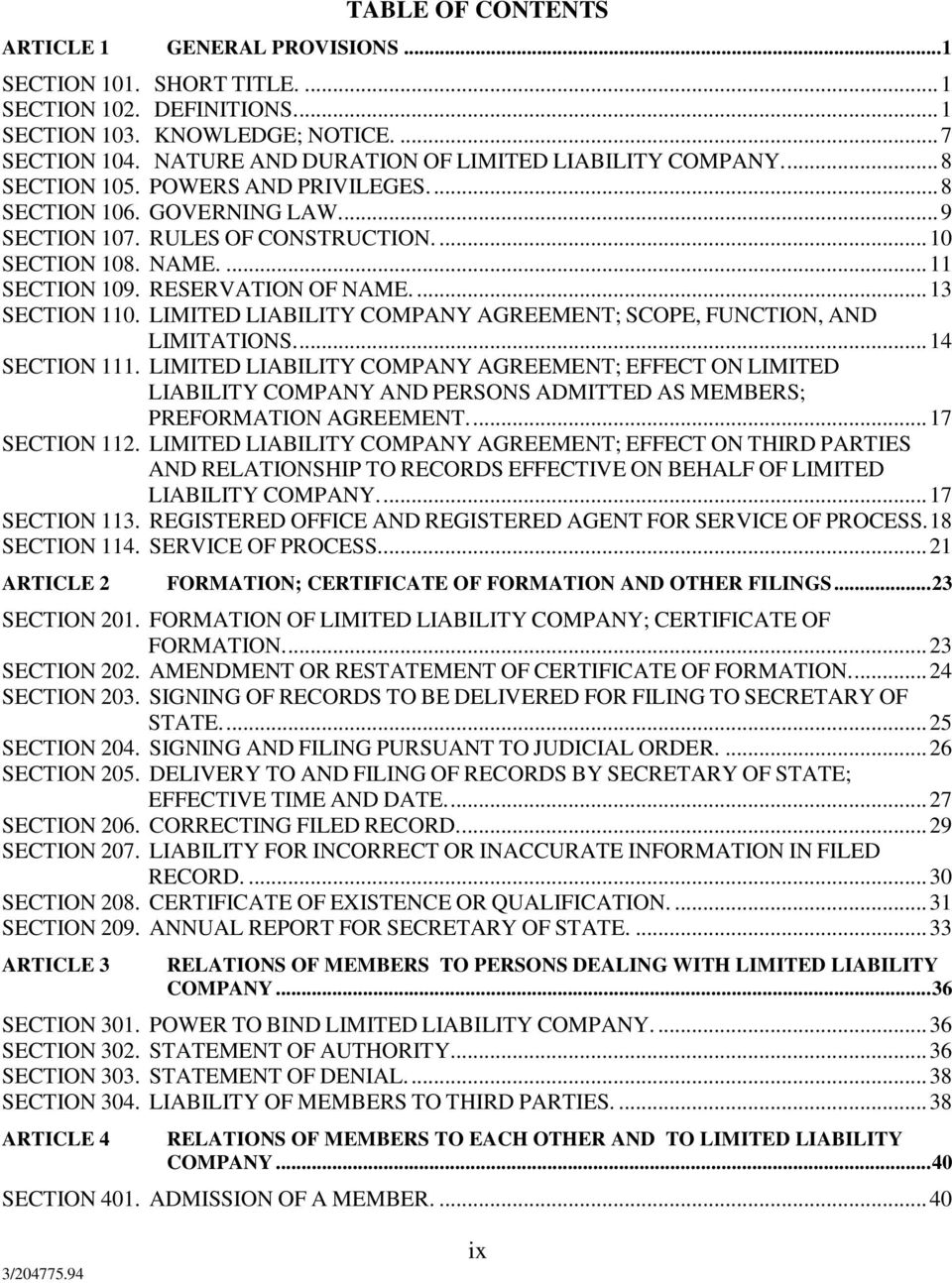
10 TABLE OF CONTENTS ARTICLE 1 GENERAL PROVISIONS... 1 SECTION 101. SHORT TITLE SECTION 102. DEFINITIONS SECTION 103. KNOWLEDGE; NOTICE SECTION 104. NATURE AND DURATION OF LIMITED LIABILITY COMPANY SECTION 105. POWERS AND PRIVILEGES SECTION 106. GOVERNING LAW SECTION 107. RULES OF CONSTRUCTION SECTION 108. NAME SECTION 109. RESERVATION OF NAME SECTION 110. LIMITED LIABILITY COMPANY AGREEMENT; SCOPE, FUNCTION, AND LIMITATIONS SECTION 111. LIMITED LIABILITY COMPANY AGREEMENT; EFFECT ON LIMITED LIABILITY COMPANY AND PERSONS ADMITTED AS MEMBERS; PREFORMATION AGREEMENT SECTION 112. LIMITED LIABILITY COMPANY AGREEMENT; EFFECT ON THIRD PARTIES AND RELATIONSHIP TO RECORDS EFFECTIVE ON BEHALF OF LIMITED LIABILITY COMPANY SECTION 113. REGISTERED OFFICE AND REGISTERED AGENT FOR SERVICE OF PROCESS. 18 SECTION 114. SERVICE OF PROCESS ARTICLE 2 FORMATION; CERTIFICATE OF FORMATION AND OTHER FILINGS SECTION 201. FORMATION OF LIMITED LIABILITY COMPANY; CERTIFICATE OF FORMATION SECTION 202. AMENDMENT OR RESTATEMENT OF CERTIFICATE OF FORMATION SECTION 203. SIGNING OF RECORDS TO BE DELIVERED FOR FILING TO SECRETARY OF STATE SECTION 204. SIGNING AND FILING PURSUANT TO JUDICIAL ORDER SECTION 205. DELIVERY TO AND FILING OF RECORDS BY SECRETARY OF STATE; EFFECTIVE TIME AND DATE SECTION 206. CORRECTING FILED RECORD SECTION 207. LIABILITY FOR INCORRECT OR INACCURATE INFORMATION IN FILED RECORD SECTION 208. CERTIFICATE OF EXISTENCE OR QUALIFICATION SECTION 209. ANNUAL REPORT FOR SECRETARY OF STATE ARTICLE 3 RELATIONS OF MEMBERS TO PERSONS DEALING WITH LIMITED LIABILITY COMPANY SECTION 301. POWER TO BIND LIMITED LIABILITY COMPANY SECTION 302. STATEMENT OF AUTHORITY SECTION 303. STATEMENT OF DENIAL SECTION 304. LIABILITY OF MEMBERS TO THIRD PARTIES ARTICLE 4 RELATIONS OF MEMBERS TO EACH OTHER AND TO LIMITED LIABILITY COMPANY SECTION 401. ADMISSION OF A MEMBER ix
11 SECTION 402. FORM OF CONTRIBUTION SECTION 403. LIABILITY FOR CONTRIBUTIONS SECTION 404. SHARING OF AND RIGHT TO DISTRIBUTIONS SECTION 405. LIMITATION ON DISTRIBUTION AND LIABILITY FOR IMPROPER DISTRIBUTION SECTION 406. ACTIVITIES AND AFFAIRS OF LIMITED LIABILITY COMPANY OR SERIES SECTION 407. INDEMNIFICATION, ADVANCEMENT, REIMBURSEMENT, AND INSURANCE SECTION 408. RIGHT OF MEMBERS AND DISSOCIATED MEMBERS TO INFORMATION SECTION 409. RELIANCE ON REPORTS AND INFORMATION ARTICLE 5 LIMITED LIABILITY COMPANY INTERESTS AND RIGHTS OF ASSIGNEES AND CREDITORS SECTION 501. MEMBER S LIMITED LIABILITY COMPANY INTEREST SECTION 502. ASSIGNMENT OF LIMITED LIABILITY COMPANY INTEREST SECTION 503. CHARGING ORDER SECTION 504. POWER OF PERSONAL REPRESENTATIVE OF DECEASED MEMBER ARTICLE 6 MEMBER S DISSOCIATION SECTION 601. MEMBER S POWER TO DISSOCIATE; WRONGFUL DISSOCIATION SECTION 602. EVENTS CAUSING DISSOCIATION SECTION 603. EFFECT OF PERSON S DISSOCIATION AS A MEMBER ARTICLE 7 DELINQUENCY, DISSOLUTION, WINDING UP AND REINSTATEMENT SECTION 701. GROUNDS FOR DELINQUENCY SECTION 702. DECLARATION OF DELINQUENCY SECTION 703. EFFECT OF DELINQUENCY SECTION 704. CURE OF DELINQUENCY SECTION 705. APPEAL FROM DECLARATION OF DELINQUENCY SECTION 706. EVENTS CAUSING DISSOLUTION SECTION 707. EFFECT OF DISSOLUTION SECTION 708. RIGHT TO WIND UP BUSINESS AND ACTIVITIES SECTION 709. KNOWN CLAIMS AGAINST DISSOLVED LIMITED LIABILITY COMPANY SECTION 710. OTHER CLAIMS AGAINST DISSOLVED LIMITED LIABILITY COMPANY SECTION 711. APPLICATION OF ASSETS IN WINDING UP LIMITED LIABILITY COMPANY S ACTIVITIES SECTION 712. REINSTATEMENT AFTER DISSOLUTION SECTION 713. CERTIFICATE OF REINSTATEMENT SECTION 714. LIMITED LIABILITY COMPANY NAME UPON REINSTATEMENT SECTION 715. EFFECT OF REINSTATEMENT ARTICLE 8 FOREIGN LIMITED LIABILITY COMPANIES SECTION 801. GOVERNING LAW SECTION 802. STATEMENT OF FOREIGN QUALIFICATION TO CONDUCT ACTIVITIES REQUIRED SECTION 803. ACTIONS NOT CONSTITUTING TRANSACTING BUSINESS OR CONDUCTING ACTIVITIES SECTION 804. NONCOMPLYING NAME OF FOREIGN LIMITED LIABILITY COMPANY x

12 SECTION 805. REVOCATION OF STATEMENT OF FOREIGN QUALIFICATION SECTION 806. STATEMENT OF CANCELLATION OF FOREIGN QUALIFICATION SECTION 807. EFFECT OF FAILURE TO HAVE STATEMENT OF FOREIGN QUALIFICATION.. 94 ARTICLE 9 ACTIONS BY MEMBERS SECTION 901. RIGHT OF DERIVATIVE ACTION SECTION 902. STANDING SECTION 903. DEMAND SECTION 904. STAY OF PROCEEDINGS SECTION 905. DISMISSAL SECTION 906. DISCONTINUANCE OR SETTLEMENT SECTION 907. PAYMENT OF EXPENSES SECTION 908. APPLICABILITY TO FOREIGN LIMITED LIABILITY COMPANIES SECTION 909. DIRECT ACTIONS BY MEMBERS ARTICLE 10 MERGER AND CONVERSION SECTION MERGER SECTION ACTION ON PLAN OF MERGER BY CONSTITUENT LIMITED LIABILITY COMPANY SECTION FILINGS REQUIRED FOR MERGER; EFFECTIVE DATE SECTION EFFECT OF MERGER SECTION CONVERSION SECTION ACTION ON PLAN OF CONVERSION BY CONVERTING LIMITED LIABILITY COMPANY SECTION FILINGS REQUIRED FOR CONVERSION; EFFECTIVE DATE SECTION EFFECT OF CONVERSION [SECTION RESTRICTIONS ON APPROVAL OF MERGERS AND CONVERSIONS.] SECTION ARTICLE NOT EXCLUSIVE ARTICLE 11 SERIES PROVISIONS SECTION SERIES OF ASSETS SECTION ENFORCEABILITY OF OBLIGATIONS AND EXPENSES OF SERIES AGAINST ASSETS SECTION ASSETS OF SERIES SECTION STATEMENT OF LIMITATION ON LIABILITIES OF SERIES SECTION MEMBER S POWER TO DISSOCIATE AS A MEMBER ASSOCIATED WITH A SERIES; WRONGFUL DISSOCIATION SECTION EVENTS CAUSING DISSOCIATION OF A MEMBER ASSOCIATED WITH A SERIES SECTION EFFECT OF PERSON S DISSOCIATION AS A MEMBER SECTION DISSOLUTION AND WINDING UP OF SERIES SECTION EVENTS REQUIRING DISSOLUTION SECTION EFFECT OF DISSOLUTION ON SERIES SECTION RIGHT TO WIND UP BUSINESS AND ACTIVITIES OF SERIES SECTION KNOWN CLAIMS AGAINST DISSOLVED SERIES SECTION OTHER CLAIMS AGAINST DISSOLVED SERIES SECTION APPLICATION OF ASSETS IN WINDING UP SERIES ACTIVITIES SECTION REINSTATEMENT AFTER DISSOLUTION OF A SERIES xi

13 SECTION EFFECT OF REINSTATEMENT ARTICLE 12 MISCELLANEOUS PROVISIONS SECTION RELATION TO ELECTRONIC SIGNATURES IN GLOBAL AND NATIONAL COMMERCE ACT SECTION INTERSTATE APPLICATION SECTION SAVINGS CLAUSE SECTION APPLICATION TO EXISTING RELATIONSHIPS SECTION RESERVED POWER OF THE STATE TO ALTER OR REPEAL ACT SECTION SEVERABILITY SECTION REPEALS SECTION EFFECTIVE DATE xii

14 REVISED PROTOTYPE LIMITED LIABILITY COMPANY ACT ARTICLE 1 GENERAL PROVISIONS SECTION 101. SHORT TITLE. This Act shall be known and may be cited as the [State] Limited Liability Company Act. This section is derived from the Prototype Limited Liability Company Act (1992) (the "Prototype Act") 101. All current statutes have short title provisions, so it is appropriate to start the Act in the same manner. Reference in the comment sections to "RUPA" refers to the Revised Uniform Partnership Act (1997); reference to "RULPA" refers to the Revised Uniform Limited Partnership Act (1985); reference to ULPA" refers to the Uniform Limited Partnership Act (2001); reference to "RULLCA" refers to the Revised Uniform Limited Liability Company Act (2006); and reference to "RMBCA" refers to the Revised Model Business Corporation Act (2007). Reference in the comment sections to "Colorado, " refers to a section in the Colorado Limited Liability Company Act (Colo. Rev. Stat , et. seq.) or the Colorado Corporations and Associations Act (Colo. Rev. Stat , et. seq.); reference in the comment sections to "Delaware, " refers to a section in the Delaware Limited Liability Company Act (6 Del. C , et. seq.); reference in the comment sections to "Tennessee, " refers to a section in the Tennessee Revised Limited Liability Company Act (Tenn. Code Ann., , et. seq.); reference in the comment sections to "Texas, " refers to a section in the Texas Business Organizations Code (Tex. Bus. Orgs. Code 1.001, et. seq.); and reference in the comment sections to "Virginia, " refers to a section in the Virginia Limited Liability Company Act (Code of Virginia, , et. seq.). SECTION 102. requires: DEFINITIONS. As used in this Act, unless the context otherwise (1) "Assignment" means a transfer, conveyance, deed, bill of sale, lease, mortgage, 1

15 security interest, encumbrance, gift, or transfer by operation of law. (2) "Certificate of formation" means the certificate described in section 201, and the certificate as amended or restated. (3) "Constituent limited liability company" means a constituent organization that is a limited liability company. (4) "Constituent organization" means an organization that is party to a merger. (5) "Contribution" means anything of value, including cash, property, or services rendered, or a promissory note or other binding obligation to contribute cash or property or to perform services, which a person contributes to a limited liability company, or a series thereof, in the person s capacity as a member. (6) "Converted organization" means the organization into which a converting organization converts pursuant to sections 1005 through (7) "Converting limited liability company" means a converting organization that is a limited liability company. (8) "Converting organization" means an organization that converts into a converted organization pursuant to section (9) "Debtor in bankruptcy" means a person that is the subject of: (a) an order for relief under Title 11 of the United States Code or a successor statute of general application; or (b) a comparable order under federal, state, or foreign law governing insolvency. (10) "Distribution," except as otherwise provided in section 405(e), means a transfer of money or other property from a limited liability company, or series thereof, to another person on 2

16 account of a limited liability company interest. (11) "Foreign limited liability company" means an organization that is: (a) an unincorporated association; (b) organized under laws of a [State] other than the laws of this [State], or under the laws of any foreign country; (c) organized under a statute pursuant to which an association may be formed that affords to each of its members limited liability with respect to the liabilities of the entity; and (d) not required to be registered, qualified, or organized under any statute of this [State] other than this Act. (12) "Governing statute" means the statute that governs an organization s internal affairs. (13) "Limited liability company," except in the phrase "foreign limited liability company," means an entity formed or existing under this Act. (14) "Limited liability company agreement" means any agreement (whether referred to as a limited liability company agreement, operating agreement, or otherwise), written, oral, or implied, of the member or members as to the affairs and activities of a limited liability company and any series thereof. The limited liability company agreement of a limited liability company having only one member shall not be unenforceable by reason of there being only one person who is a party to the limited liability company agreement. The limited liability company agreement includes any amendments to the limited liability company agreement. (15) "Limited liability company interest" means a member s right to receive distributions from a limited liability company or series thereof. (16) "Member" means a person that has been admitted as a member of a limited liability 3

17 company under section 401 and that has not dissociated as a member. (17) "Organization" means a partnership (whether general or limited), limited liability company, association, corporation, professional corporation, professional association, nonprofit corporation, business trust, statutory trust, cooperative association, or [ ] having a governing statute, in each case, whether foreign or domestic. (18) "Organizational documents" means: (a) for a general partnership or foreign general partnership, its partnership agreement; (b) for a limited partnership or foreign limited partnership, its certificate of limited partnership and partnership agreement; (c) for a limited liability company or foreign limited liability company, its certificate of formation and limited liability company agreement, or comparable records as provided in its governing statute; (d) for a business or statutory trust or foreign business or statutory trust, its agreement of trust and declaration of trust, or comparable records as provided in its governing statute; (e) for a corporation for profit or foreign corporation for profit, its articles of incorporation, bylaws, and other agreements among its shareholders that are authorized by its governing statute, or comparable records as provided in its governing statute; (f) for a nonprofit corporation or foreign nonprofit corporation, its articles of incorporation, bylaws, and other agreements that are authorized by its governing statute or comparable records as provided in its governing statute; 4
![business trust, statutory trust, cooperative association, or [ ] having a governing statute, in each case, whether foreign or domestic.](/docs-images/46/23525052/images/page_17.jpg "(18) \"Organizational documents\" means: (a) for a general partnership or foreign general partnership, its partnership agreement; (b) for a limited partnership or foreign limited partnership, its")
18 (g) for a professional corporation or foreign professional corporation, its articles of incorporation, bylaws, and other agreements among its shareholders that are authorized by its governing statute, or comparable records as provided in its governing statute; and (h) for any other organization, the basic records that create the organization, determine its internal governance, and determine the relations among the persons that own it, are members of it, or govern it. (19) "Person" means an individual, organization, trust, estate, government (including a country, state, county or any other governmental subdivision, agency or instrumentality), custodian, nominee, trustee, personal representative, fiduciary, or any other individual or entity (or series thereof) in its own or any representative capacity, in each case, whether foreign or domestic. (20) "Principal office" means the location specified by a limited liability company, foreign limited liability company, or other organization as its principal office in the last filed record in which the limited liability company, foreign limited liability company, or other organization was required to specify a principal office on the records of the Secretary of State. The principal office need not be located in this [State]. (21) "Record" means information that is inscribed on a tangible medium or that is stored in an electronic or other medium and is retrievable in written or paper form through an automated process. (22) "Sign" means, with the present intent to authenticate or adopt a record: (A) to execute or adopt a tangible symbol; or (B) to attach to or logically associate with the record an electronic symbol, sound, 5

19 or process. (23) "Surviving organization" means an organization into which one or more other organizations are merged, whether the organization pre-existed the merger or was created pursuant to the merger. (24) "State" means a state of the United States, the District of Columbia, Puerto Rico, the United States Virgin Islands, or any territory or insular possession subject to the jurisdiction of the United States. While some acts use subsidiary definitions (definitions used in different parts of the act and not located in one section) the definitions of this Act are all in one section. Subsection (2) "Articles of organization" used in the Prototype Act has been replaced with "certificate of formation." This follows the pattern set forth in the Delaware Limited Liability Company Act, RULPA, and RULLCA. Subsection (11) This section is derived from the Prototype Act 102(E). This section provides for a broader inclusion of foreign organizations and, thus, might be used to allow foreign organizations to file a Statement of Foreign Qualification under this Act if the entity is not already required to file a statement under another statute of the state. Subsection (14)--The change from "operating agreement" to "limited liability company agreement" reflects a combination of Colorado and Delaware law and conforms the agreement name to that used in other unincorporated entities i.e., "partnership agreement" and "limited partnership agreement." Subsection (17) The definition of "organization" is a list of entities. If the state wants to have additional entities added to the list, the state may add those entities in this definition. If the state wants a catch-all phrase, the state should refer to Colorado, (13) and (23). Subsection (19) The definition of "person" is derived from Delaware, (12). Colorado, (13), (23) and (99) were considered. Subsection (20) The definition of "principal office" is new. The principal office must be set forth in a limited liability company s certificate of formation and a foreign limited liability company s statement of qualification and in the annual reports required by section 209 of the Act. The principal office of a surviving or converted organization is required to be specified in the statement of merger or statement of conversion in certain circumstances. 6

20 SECTION 103. KNOWLEDGE; NOTICE. (a) A person knows a fact when the person: (1) has actual knowledge of it; or (2) is deemed to know it under law other than this Act. (b) A person has notice of a fact when the person: (1) knows of it; (2) receives notification of it; (3) has reason to know the fact from all of the facts known to the person at the time in question; or (4) is deemed to have notice of the fact under subsection (d). (c) A person notifies another of a fact by taking steps reasonably required to inform the other person in ordinary course, whether or not the other person knows the fact. (d) A person is deemed to have notice of a limited liability company s: (1) matters included in the certificate of formation under section 201(a)(1), (a)(2), (a)(3), and (a)(4), upon filing; (2) dissolution, 90 days after a statement of dissolution under section 707(b)(1) becomes effective; (3) merger or conversion, 90 days after a statement of merger or statement of conversion under Article 10 becomes effective; and (4) reinstatement, 90 days after a certificate of reinstatement under section 713 becomes effective. (e) A member s knowledge, notice, or receipt of a notification of a fact relating to the 7

21 limited liability company is not knowledge, notice, or receipt of a notification of a fact by the limited liability company solely by reason of the member s capacity as a member. Subsection (b) reflects the broader view of notice as captured by Prototype Act 1303, RUPA 102, and RULPA 103. Subsection (e) clarifies that a member s knowledge, notice, or receipt of a notification of a fact in that member s sole capacity as a member is not imputed to the limited liability company. If the member is an agent of the company, i.e., an officer or other agent, then the notice may be imputed to the limited liability company via the law of agency. Restatement Third, Agency 5.02(1). COMPANY. SECTION 104. NATURE AND DURATION OF LIMITED LIABILITY (a) A limited liability company is a separate legal entity. A limited liability company's status for tax purposes shall not affect its status as a separate legal entity formed under this Act. (b) A limited liability company has perpetual duration. Subsection (a) is not modifiable by the limited liability company agreement see section 110 (c)(1). The second sentence of subsection (a) is derived from Virginia, SECTION 105. POWERS AND PRIVILEGES. (a) A limited liability company may carry on any lawful activity, whether or not for profit. (b) A limited liability company shall possess and may exercise all the powers and privileges granted by this Act or by any other law or by its limited liability company agreement, 8
22 together with any powers incidental thereto, including those powers and privileges necessary or convenient to the conduct, promotion, or attainment of the business, purposes, or activities of the limited liability company. (c) Without limiting the general powers enumerated in subsection (b) of this section, a limited liability company shall have the power and authority to make contracts of guaranty and suretyship and enter into interest rate, basis, currency, hedge, or other swap agreements, or cap, floor, put, call, option, exchange, or collar agreements, derivative agreements, or other agreements similar to any of the foregoing. name, to: (d) A series established under this Act has the power and capacity, in the series' own (1) sue and be sued; (2) contract; (3) hold and convey title to assets of the series, including real property, personal property, and intangible property; and (4) grant liens and security interests in assets of the series. Section 105(c) is derived from Delaware, (c). The use of limited liability companies for nonprofit activities is authorized by this Act; however, as with all limited liability company acts, careful attention to drafting of the limited liability company agreement will be required to meet the tax requirements of the various taxing authorities. If a state wants to prohibit or exclude certain activities of a limited liability company, the state should prohibit or exclude those activities in this section. SECTION 106. GOVERNING LAW. The law of this [State] governs: (a) the organization and internal affairs of a limited liability company; (b) the liability of a member as a member for the debts, obligations, or other liabilities of 9
23 a limited liability company; (c) the authority of the members and agents of a limited liability company; and (d) the availability of the assets of a series or the limited liability company for the obligations of another series or the limited liability company. Subsection (d) clarifies the limitation on the liability of the assets of a series from the liability or assets of another series or from that of the limited liability company s commonly held assets. The scope of the internal affairs doctrine is not free from doubt and, as a result, this section was added. SECTION 107. RULES OF CONSTRUCTION. (a) It is the policy of this Act and this [State] to give maximum effect to the principles of freedom of contract and to the enforceability of limited liability company agreements. (b) Unless displaced by particular provisions of this Act, the principles of law and equity supplement this Act. (c) Rules that statutes in derogation of the common law are to be strictly construed shall have no application to this Act. (d) Unless the context otherwise requires, as used in this Act, the singular shall include the plural and the plural may refer to only the singular. The use of any gender shall be applicable to all genders. The captions contained in this Act are for purposes of convenience only and shall not control or affect the construction of this Act. (e) Sections and of the Uniform Commercial Code do not apply to any interest in a limited liability company, including all rights, powers, and interests arising under a limited liability company agreement or this Act. This provision prevails over sections and 10
24 9-408 of the Uniform Commercial Code, and is expressly intended to permit the enforcement of the provisions of a limited liability company agreement that would otherwise be ineffective under sections and of the Uniform Commercial Code. Subsections (a) through (c) are derived from Prototype Act Subsections (d) and (e) are derived from Delaware, (f) and (g). Section (e) was further derived from Virginia, (B). SECTION 108. NAME. (a) The name of a limited liability company must contain the words "limited liability company" or "limited company" or the abbreviation "L.L.C.", "LLC", "L.C.", or "LC". "Limited" may be abbreviated as "Ltd.", and "company" may be abbreviated as "Co.". (b) The name of a limited liability company must be distinguishable on the records of the Secretary of State from: (1) the name of each person that is not an individual and that is incorporated, organized, or authorized to conduct activities in this [State]; and (2) each name reserved under section 109 and [cite other [State] laws allowing the reservation or registration of organization names, including fictitious or assumed name statutes]. (c) Subsection (b) shall not apply if a person files with the Secretary of State either of the following: [(1) consent mechanism for substantially similar names]; or (2) a certified copy of a final decree of a court of competent jurisdiction 11
25 establishing the prior right of the person to the use of the name in this [State]. (d) The name of a delinquent limited liability company or a delinquent foreign limited liability company shall, on the records of the Secretary of State, include the word "delinquent", followed by the effective date of the delinquency of the limited liability company or the foreign limited liability company, after the four-hundredth day after the effective date of its delinquency under section 702. (e) If a foreign limited liability company s filed statement of foreign qualification is cancelled by the filing of a statement of cancellation of foreign qualification, the name of the foreign limited liability company shall, on the records of the Secretary of State, include the words "[state] statement of foreign qualification cancelled followed by the effective date of the statement of cancellation of foreign qualification. (f) If a limited liability company delivers to the Secretary of State for filing a statement of dissolution, the name of the limited liability company shall, on the records of the Secretary of State, include the word "dissolved" followed by the effective date of the dissolution of the limited liability company. To the extent that other law requires professionals, banks, or other entities or individuals to utilize certain names in the name of the limited liability company to conduct activities in a limited liability company, that other law must be followed in determining the name, but the name must nevertheless comply with section 108(a). Subsection (d) is derived from Colorado, Subsection (e) and (f) are derived from Colorado,
26 SECTION 109. RESERVATION OF NAME. (a) A person may reserve the exclusive use of the name of a limited liability company, including a fictitious or assumed name for a foreign limited liability company whose name is not available, by delivering an application to the Secretary of State for filing. The application must state the name and address of the applicant and the name proposed to be reserved. If the Secretary of State finds that the name applied for is available, the Secretary of State must reserve that name for the applicant s exclusive use for a 120-day period. (b) The owner of a reserved limited liability company name may renew the reservation for successive periods of 120 days each by delivering to the Secretary of State for filing, during the 45-day period preceding the date of expiration of the reservation, a renewal application. (c) The owner of a name reserved for a limited liability company may assign the reservation to another person by delivering to the Secretary of State for filing a signed notice of the assignment that states the name and address of the assignee. (d) The owner of a reserved limited liability company name may terminate the name reservation by delivering to the Secretary of State for filing a signed notice of withdrawal of name reservation. Subsection (b) is derived from Virginia, B. Subsection (d) is derived from Texas, 5.104(2). 13
27 SECTION 110. FUNCTION, AND LIMITATIONS. LIMITED LIABILITY COMPANY AGREEMENT; SCOPE, (a) Except as otherwise provided in subsections (b) and (c): (1) the limited liability company agreement governs relations among the members as members and between the members and the limited liability company; and (2) to the extent the limited liability company agreement does not otherwise provide for a matter described in subsection (a)(1), this Act governs the matter. (b) (1) To the extent that, at law or in equity, a member or other person has duties (including fiduciary duties) to the limited liability company, or to another member or to another person that is a party to or is otherwise bound by a limited liability company agreement, the member's or other person's duties may be expanded or restricted or eliminated by the [a written] limited liability company agreement, but the implied contractual covenant of good faith and fair dealing may not be eliminated. (2) A [written] limited liability company agreement may provide for the limitation or elimination of any and all liabilities for breach of contract and breach of duties (including fiduciary duties) of a member or other person to a limited liability company or to another member or to another person that is a party to or is otherwise bound by a limited liability company agreement, but a limited liability company agreement may not limit or eliminate liability for any act or omission that constitutes a bad faith violation of the implied contractual covenant of good faith and fair dealing. (3) A member or other person shall not be liable to a limited liability company or to another member or to another person that is a party to or is otherwise bound by a limited 14
28 liability company agreement for breach of fiduciary duty for the member's or other person's good faith reliance on the limited liability company agreement. (4) A limited liability company agreement may provide that: (A) a member or assignee who fails to perform in accordance with, or to comply with the terms and conditions of, the limited liability company agreement shall be subject to specified penalties or specified consequences; and (B) at the time or upon the happening of events specified in the limited liability company agreement, a member or assignee may be subject to specified penalties or specified consequences. (5) A penalty or consequence that may be specified under paragraph (4) of this subsection may include and take the form of reducing or eliminating the defaulting member's or assignee s proportionate interest in a limited liability company, subordinating the member's or assignee s limited liability company interest to that of nondefaulting members or assignees, forcing a sale of that limited liability company interest, forfeiting the defaulting member's or assignee s limited liability company interest, the lending by other members or assignees of the amount necessary to meet the defaulting member's or assignee s commitment, a fixing of the value of the defaulting member's or assignee s limited liability company interest by appraisal or by formula and redemption or sale of the limited liability company interest at that value, or other penalty or consequence. (c) A limited liability company agreement may not: (1) vary the nature of the limited liability company as a separate legal entity under 15
29 section 104(a); (2) vary the law applicable under section 106; (3) restrict the rights under this Act of a person other than a member, dissociated member, or assignee; (4) vary the power of the court under section 204; (5) eliminate the implied contractual covenant of good faith and fair dealing as provided under section 110(b)(1); (6) eliminate or limit the liability of a member or other person for any act or omission that constitutes a bad faith violation of the implied contractual covenant of good faith and fair dealing as provided under section 110(b)(2); (7) waive the requirements of section 403(a); (8) vary the law applicable under section 405(c); (9) reduce the limitations period specified under section 405(d) for an action commenced under other applicable law; (10) waive the prohibition on issuance of a certificate of a limited liability company interest in bearer form under section 502(d); or (11) waive the requirements of section 1102(b). Subsections (b)(1), (2), and (3) are derived from Delaware, (c), (e) and (d). Subsection (b)(4) is derived from Delaware, and (c). Subsection (c)(7) affirms the requirement that all contribution obligations must be set forth in writing, and that requirement may not be waived by a limited liability company agreement. 16
30 SECTION 111. LIMITED LIABILITY COMPANY AGREEMENT; EFFECT ON LIMITED LIABILITY COMPANY AND PERSONS ADMITTED AS MEMBERS; PREFORMATION AGREEMENT. (a) A limited liability company is bound by and may enforce the limited liability company agreement, whether or not the limited liability company has itself manifested assent to the limited liability company agreement. (b) A person that is admitted as a member of a limited liability company becomes a party to and assents to the limited liability company agreement except as provided in section 403(a). (c) Two or more persons intending to be the initial members of a limited liability company may make an agreement providing that upon the formation of the limited liability company the agreement will become the limited liability company agreement. One person intending to be the initial member of a limited liability company may assent to terms providing that upon the formation of the limited liability company the terms will become the limited liability company agreement. The language specifying that a person is deemed to become a party to the limited liability company agreement upon admission as a member is intended to make clear that the member is bound by and may enforce the agreement. SECTION 112. LIMITED LIABILITY COMPANY AGREEMENT; EFFECT ON THIRD PARTIES AND RELATIONSHIP TO RECORDS EFFECTIVE ON BEHALF OF LIMITED LIABILITY COMPANY. amended, including by requiring the approval of a person who is not a party to the limited 17 (a) If a limited liability company agreement provides for the manner in which it may be
31 liability company agreement or the satisfaction of conditions, it may be amended only in that manner or as otherwise permitted by law (except that the approval of any person may be waived by that person and any conditions may be waived by all persons for whose benefit those conditions were intended). (b) A limited liability company agreement may provide rights to any person, including a person who is not a party to the limited liability company agreement, to the extent set forth in the limited liability company agreement. (c) The obligations of a limited liability company and its members to a person in the person s capacity as an assignee or dissociated member are governed by the limited liability company agreement. An assignee and dissociated member are bound by the limited liability company agreement. Subsection (a) is derived from Delaware, (e). Subsection (b) is derived from Delaware, (7). In connection with subsection (c), see Bauer v. Blomfield Co./Holden Joint Venture, 849 P.2d 1365 (Alaska 1993) (holding that partners owed no duty to an assignee to act in good faith and that the assignee could not challenge the payment of a large commission to a partner that eliminated income payments to the assignee). SECTION 113. REGISTERED OFFICE AND REGISTERED AGENT FOR SERVICE OF PROCESS. (a) A limited liability company and a foreign limited liability company that has an effective statement of foreign qualification under section 802 must continuously maintain in this [State]: 18
32 (1) a registered office, which need not be a place of its activity in this [State]; and (2) a registered agent for service of process. (b) A registered agent of a limited liability company or foreign limited liability company must be an individual who is a resident of this [State] or an organization authorized to conduct activities in this [State], and the registered agent s office must be identical with the registered office. (c) A limited liability company or foreign limited liability company may change its registered office, its registered agent, or both by delivering to the Secretary of State for filing a statement of change setting forth: (1) the name of the limited liability company or foreign limited liability company; (2) the street and mailing addresses of its current registered office; (3) if the address of its registered office is to be changed, the street and mailing addresses to which the registered office is to be changed; (4) the name of its current registered agent; (5) if the registered agent is to be changed, the name of its successor registered agent; and (6) that after the change or changes are made, the street and mailing addresses of its registered office and the office of the registered agent will be identical. (d) A registered agent of a limited liability company or foreign limited liability company may change its name, its address as the address of the registered office of the limited liability company or foreign limited liability company, or both by delivering to the Secretary of State for filing a statement of change setting forth: 19
33 (1) the name of the limited liability company or foreign limited liability company represented by the registered agent; (2) the street and mailing addresses of the registered office of the limited liability company or foreign limited liability company as currently shown on the records of the Secretary of State; (3) if the address of the registered office is to be changed, the street and mailing addresses to which the registered office is to be changed; (4) the name of the registered agent of the limited liability company or foreign limited liability company as currently shown on the records of the Secretary of State; (5) if the name of the registered agent is to be changed, the new name of the registered agent; (6) a recitation that notice of the change was given to the limited liability company or foreign limited liability company at least 10 days before the date the statement is delivered for filing; and (7) that after the change or changes are made, the street and mailing addresses of the registered office and the office of the registered agent will be identical. (e) A registered agent of a limited liability company or foreign limited liability company may resign as registered agent by delivering to the Secretary of State for filing a statement of resignation setting forth the name of the limited liability company or foreign limited liability company and stating that the registered agent is resigning. (f) The Secretary of State shall file a statement of resignation delivered under subsection (e) and shall mail or otherwise provide or deliver a copy of the statement of resignation to the 20
34 registered office of the limited liability company or foreign limited liability company and another copy of the statement of resignation to the principal office of the limited liability company if the mailing address of the principal office appears in the records of the Secretary of State and is different from the mailing address of the registered office. (g) An agency for service of process terminates on the earlier of: (1) the 31st day after the Secretary of State files the statement of resignation; (2) when a record designating a new registered agent is delivered to the Secretary of State for filing on behalf of the limited liability company or foreign limited liability company and becomes effective. The traditional nomenclature of registered agent and registered office were maintained from the Prototype Act. Additionally, the Act drew upon RMBCA 5.01 and 5.02 and Texas, Section 209(e) of the Act provides for the option of allowing a change of registered office or registered agent to be made in the annual report. SECTION 114. SERVICE OF PROCESS. (a) A registered agent appointed by a limited liability company or foreign limited liability company is a registered agent of the limited liability company or foreign limited liability company for service of any process, notice, or demand required or permitted by law to be served on the limited liability company or foreign limited liability company. (b) If a limited liability company or foreign limited liability company does not appoint or maintain a registered agent in this [State] or the registered agent cannot with reasonable diligence be found at the registered office, the limited liability company or foreign limited liability company shall be deemed to have consented to service of process by certified mail 21
35 addressed to the limited liability company or foreign limited liability company at the principal office of the limited liability company or foreign limited liability company with respect to causes of action arising out of the conduct of activities in this [State]. (c) Service is effected under subsection (a) or (b) at the earliest of: (1) the date the limited liability company or foreign limited liability company receives the process, notice, or demand; (2) the date shown on the return receipt, if signed on behalf of the limited liability company or foreign limited liability company; or (3) five days after the process, notice, or demand is deposited with the United States Postal Service, if mailed postpaid and correctly addressed.. (d) This section does not affect the right to serve process, notice, or demand in any other manner provided by law. This section is new and reflects the thought that service of process directly on the limited liability company or foreign limited liability company is superior to service of process on the [Secretary of State], who would then serve the limited liability company or the foreign limited liability company. 22
36 ARTICLE 2 FORMATION; CERTIFICATE OF FORMATION AND OTHER FILINGS SECTION 201. FORMATION OF LIMITED LIABILITY COMPANY; CERTIFICATE OF FORMATION. (a) In order to form a limited liability company, one or more authorized persons must execute a certificate of formation and deliver it to the Secretary of State for filing. The certificate of formation shall set forth: (1) the name of the limited liability company; (2) the name of the limited liability company s registered agent and the street and mailing addresses of the limited liability company s registered office meeting the requirements of section 113; (3) the street and mailing addresses of the limited liability company s principal office; (4) if applicable, a statement as provided in section 1102(b)(3); and (5) any other matters the members determine to include in the certificate of formation. (b) A limited liability company is formed when: (1) a certificate of formation is filed by the Secretary of State or at any later date or time specified in the certificate of formation; and (2) a limited liability company agreement is in effect in accordance with subsection (d). (c) The fact that a certificate of formation is on file in the office of the Secretary of State is notice of the matters required to be included by subsections (a)(1), (a)(2), and (a)(3), and, if applicable, (a)(4), but is not notice of any other fact. 23
37 (d) A limited liability company agreement shall be entered into either before, after, or at the time of the filing of the certificate of formation and, whether entered into before, after, or at the time of the filing, may be made effective as of the filing of the certificate of formation or at any other time or date provided in the limited liability company agreement. Subsections (a) and (d) are derived from Delaware, (a) and (d). Subsection (b) is new. Subsection (c) is derived from Delaware, SECTION 202. AMENDMENT OR RESTATEMENT OF CERTIFICATE OF FORMATION. (a) A certificate of formation may be amended at any time. (b) A certificate of formation may be restated with or without amendment at any time. (c) To amend its certificate of formation, a limited liability company must deliver to the Secretary of State for filing an amendment stating: (1) the name of the limited liability company; (2) the date of filing of its certificate of formation; and (3) the changes the amendment makes to the certificate as most recently amended or restated. (d) A restated certificate of formation must be delivered to the Secretary of State for filing in the same manner as an amendment. A restated certificate of formation must be designated as such in the heading and state in the heading or in an introductory paragraph the limited liability company s name and the date of the filing of its certificate of formation. Any 24
38 amendment or change effected in connection with the restatement of the certificate of formation shall be subject to any other provision of this Act, not inconsistent with this section, which would apply if a separate certificate of amendment were filed to effect the amendment or change. (e) The original certificate of formation, as theretofore amended or supplemented, shall be superseded by the restated certificate of formation and thenceforth, the restated certificate of formation, including any further amendment or changes made thereby, shall be the certificate of formation of the limited liability company, but the original effective date of formation shall remain unchanged. The last sentence of subsection (d) is derived from Delaware, (e). Subsection (e) is derived from Delaware, (d). SECTION 203. SIGNING OF RECORDS TO BE DELIVERED FOR FILING TO SECRETARY OF STATE. (a) A record delivered to the Secretary of State for filing pursuant to this Act must be signed as provided by this section. (1) A limited liability company s initial certificate of formation must be signed by at least one authorized person. (2) A record signed on behalf of a limited liability company must be signed by a person authorized by the limited liability company. (3) A record filed on behalf of a dissolved limited liability company that has no members must be signed by the person winding up the limited liability company s activities 25
39 under section 708(a) or a person appointed under section 708(b) to wind up those activities. (4) A statement of denial by a person under section 303 must be signed by that person. (5) Any other record must be signed by the person on whose behalf the record is delivered to the Secretary of State. (b) Any record to be filed under this Act may be signed by an agent, including an attorney-in-fact. Powers of attorney relating to the signing of the record need not be delivered to the Secretary of State. Subsection (b) is a combination of the Prototype Act 204 (c) and RULLCA 203. SECTION 204. SIGNING AND FILING PURSUANT TO JUDICIAL ORDER. (a) If a person required by this Act to sign a record or deliver a record to the Secretary of State for filing under this Act does not do so, any other person that is aggrieved by that failure to sign may petition the [appropriate court] to order: (1) the person to sign the record; (2) the person to deliver the record to the Secretary of State for filing; or (3) the Secretary of State to file the record unsigned. (b) If a petitioner under subsection (a) is not the limited liability company or foreign limited liability company to whom the record pertains, the petitioner shall make the limited liability company or foreign limited liability company a party to the action. A person aggrieved under subsection (a) may seek the remedies provided in subsection (a) in a separate action 26
40 against the person required to sign the record or as a part of any other action concerning the limited liability company in which the person required to sign the record is made a party. (c) A record filed unsigned pursuant to this section is effective without being signed. [(d) A court may award reasonable expenses, including reasonable attorneys fees, to the party or parties who prevail, in whole or in part, with respect to any claim made under subsection (a).] This section is derived from RULPA 205. Subsection (d) is an attempt to balance the rights of the parties. SECTION 205. DELIVERY TO AND FILING OF RECORDS BY SECRETARY OF STATE; EFFECTIVE TIME AND DATE. (a) Each record authorized or required to be delivered to the Secretary of State for filing under this Act shall: (1) contain all information required by the law of this [State] to be contained in the record but, unless otherwise provided by law, shall not contain other information; (2) be on or in a medium acceptable to the Secretary of State and from which the Secretary of State may create a record that contains all of the information stated in the record. The Secretary of State may require that the record be delivered by any one or more means or on or in any one or more media acceptable to the Secretary of State. The Secretary of State is not required to file a record that is not delivered by a means and in a medium that complies with the requirements then established by the Secretary of State for the delivery and filing of records. If the Secretary of State permits a record to be delivered on paper, the record shall be typewritten or 27
41 machine printed, and the Secretary of State may impose reasonable requirements upon the dimensions, legibility, quality, and color of the paper and typewriting or printing and upon the format and other attributes of any record that is delivered electronically. The Secretary of State shall, at the earliest practicable time, allow for the delivery of a record for filing to be accomplished electronically, without the necessity for the delivery of a physical original record or the image thereof, if all required information is delivered and is readily retrievable from the data delivered. If the delivery of a record for filing is required to be accomplished electronically, that record shall not be accompanied by any physical record unless the Secretary of State permits that accompaniment. (3) be in English. A person s name set forth in the record need not be in English if expressed in English letters or Arabic or Roman numerals. Records of a foreign person need not be in English if accompanied by a reasonably authenticated English translation. (4) be delivered to the Secretary of State for filing and be accompanied by all required fees and penalties. (b) Unless the Secretary of State determines that a record does not comply with the filing requirements of this Act, the Secretary of State shall file the record and: (1) for a statement of denial, send a copy of the filed statement and a receipt for the fees to the person on whose behalf the statement was delivered for filing and to the limited liability company; (2) for all other records, send a copy of the filed record and a receipt for the fees to the person on whose behalf the record was filed. (c) Upon request and payment of the requisite fee, the Secretary of State shall send to the 28
42 requester a certified copy of a requested record. (d) Except as otherwise provided in sections 113(f) and 206, a record delivered to the Secretary of State for filing under this Act may specify an effective time and a delayed effective date. Subject to sections 113(f) and 206, a record filed by the Secretary of State is effective: (1) if the record does not specify an effective time and does not specify a delayed effective date, on the date and at the time the record is filed as evidenced by the Secretary of State s endorsement of the date and time on the record; (2) if the record specifies an effective time but not a delayed effective date, on the date the record is filed at the time specified in the record; (3) if the record specifies a delayed effective date but not an effective time, at 12:01 a.m. on the earlier of: (A) the specified date; or (B) the 90th day after the record is filed; or (4) if the record specifies an effective time and a delayed effective date, at the specified time on the earlier of: (A) the specified date; or (B) the 90th day after the record is filed. This section is derived from Colorado, SECTION 206. CORRECTING FILED RECORD. (a) A limited liability company or foreign limited liability company may deliver to the 29
43 Secretary of State for filing a statement of correction to correct a record previously delivered by the limited liability company or foreign limited liability company to the Secretary of State and filed by the Secretary of State if at the time of filing the record contained [incorrect or inaccurate] information or was defectively signed. (b) A statement of correction under subsection (a) may not state a delayed effective date and must: (1) describe the record to be corrected, including its filing date, or attach a copy of the record as filed; [(2) specify the incorrect information or the defect in the signing;] OR [(2) specify the inaccurate information or the defect in the signing; and] (3) correct the [incorrect or inaccurate] information or defective signature. (c) When filed by the Secretary of State, a statement of correction is effective retroactively as of the effective date of the record the statement corrects, but the statement is effective when filed as to persons that previously relied on the uncorrected record and would be adversely affected by the [correction] [retroactive effect]. Section 206 is derived from RULLCA 206. SECTION 207. LIABILITY FOR INCORRECT OR INACCURATE INFORMATION IN FILED RECORD. (a) A person who signs a record authorized or required to be filed under this Act thereby 30
44 affirms under the penalties of perjury [in the third degree (false swearing)] that the facts stated in the record are true [in all material respects]. (b) If a record delivered to the Secretary of State for filing under this Act and filed by the Secretary of State contains [incorrect or inaccurate] information, a person that suffers a loss by reasonable reliance on the information may recover damages for the loss from a person that signed the record, or caused another to sign it on the person s behalf, and knew the information to be [incorrect or inaccurate] at the time the record was signed. Section 207 is new and is a combination of provisions from a number of acts. SECTION 208. CERTIFICATE OF EXISTENCE OR QUALIFICATION. (a) The Secretary of State, upon request and payment of the requisite fee, shall furnish to any person a certificate of existence for a limited liability company if the records filed in the office of the Secretary of State show that the limited liability company has been formed under the laws of this [State]. A certificate of existence must state: (1) the limited liability company s name; (2) that the limited liability company was formed under the laws of this [State] and the date of formation; (3) that all fees, taxes, and penalties owed to this [State] have been paid in full, if: (i) payment is reflected in the records of the Secretary of State, and (ii) nonpayment affects the existence of the limited liability company; (4) whether the limited liability company s most recent annual report required by 31
45 section 209 has been filed by the Secretary of State; (5) whether the Secretary of State has determined that the limited liability company is delinquent; (6) whether the limited liability company has delivered to the Secretary of State for filing a statement of dissolution; (7) whether the limited liability company has delivered to the Secretary of State for filing a certificate of reinstatement; and (8) other facts of record in the office of the Secretary of State that are specified by the person requesting the certificate. (b) The Secretary of State, upon request and payment of the requisite fee, shall furnish to any person a certificate of qualification for a foreign limited liability company if the records filed in the office of the Secretary of State show that the Secretary of State has filed a statement of foreign qualification, has not revoked the statement of foreign qualification, and has not filed a statement of cancellation of foreign qualification. A certificate of qualification must state: (1) the foreign limited liability company s name and any alternate name adopted under section 804(a) for use in this [State]; (2) that the foreign limited liability company is authorized to conduct activities in this [State]; (3) that all fees, taxes, and penalties owed to this [State] have been paid in full, if: (A) payment is reflected in the records of the Secretary of State, and (B) nonpayment affects the statement of foreign qualification of the foreign limited liability company; 32
46 (4) whether the foreign limited liability company s most recent annual report required by section 209 has been filed by the Secretary of State; (5) that the Secretary of State has not revoked the foreign limited liability company s statement of foreign qualification; (6) that the Secretary of State has not filed a statement of cancellation of foreign qualification; (7) that the Secretary of State has not determined that the foreign limited liability company is delinquent; and (8) other facts of record in the office of the Secretary of State that are specified by the person requesting the certificate. (c) Subject to any qualification stated in the certificate, a certificate of existence or certificate of qualification issued by the Secretary of State is conclusive evidence that the limited liability company is in existence or the foreign limited liability company is authorized to conduct activities in this [State]. Section 208 is derived from RULLCA 208. SECTION 209. ANNUAL REPORT FOR SECRETARY OF STATE. (a) Each year, a limited liability company or a foreign limited liability company authorized to conduct activities in this [State] shall deliver to the Secretary of State for filing a report that states: (1) the name of the limited liability company or the foreign limited liability 33
47 company; (2) the street and mailing addresses of the limited liability company s or the foreign limited liability company s registered office and the name of its registered agent at that office in this [State]; (3) the street and mailing addresses of the limited liability company s or foreign limited liability company s principal office; and (4) in the case of a foreign limited liability company, the [State] or other jurisdiction under whose law the foreign limited liability company is formed and any alternate name adopted under section 804. (b) Information in an annual report under this section must be current as of the date the report is delivered to the Secretary of State for filing. (c) The first annual report under this section must be delivered to the Secretary of State between [January 1 and April 1] of the year following the calendar year in which a limited liability company was formed or a foreign limited liability company delivered its statement of foreign qualification to the Secretary of State for filing. A report must be delivered to the Secretary of State between [January 1 and April 1] of each subsequent calendar year. (d) If an annual report under this section does not contain the information required in subsection (a), the Secretary of State shall promptly notify the reporting limited liability company or foreign limited liability company and return the report to it for correction. If the report is corrected to contain the information required in subsection (a) and delivered to the Secretary of State within 30 days after the effective date of the notice, it is timely delivered. [(e) If an annual report under this section contains an address of a registered office 34
48 or the name of a registered agent that differs from the information shown in the records of the Secretary of State immediately before the annual report becomes effective, the differing information in the annual report is considered a statement of change under section 113.] Section 209 is derived from RULLCA
49 ARTICLE 3 RELATIONS OF MEMBERS TO PERSONS DEALING WITH LIMITED LIABILITY COMPANY SECTION 301. POWER TO BIND LIMITED LIABILITY COMPANY. No person shall have the power to bind the limited liability company, or a series thereof, except: (a) to the extent the person is authorized to act as the agent of the limited liability company or a series thereof under or pursuant to the limited liability company agreement; (b) to the extent the person is authorized to act as the agent of the limited liability company or a series thereof pursuant to section 406; (c) to the extent provided in section 302; or (d) to the extent provided by law other than this Act. This section is new. Nothing in this Act is intended to create any power to bind beyond what is possible under agency law. Theoretically, silence should accomplish the same result as the statements in this section, but the explicit provisions are included to make clear the difference between the approach taken in this Act and the approach taken in the Prototype Act. SECTION 302. STATEMENT OF AUTHORITY. (a) A limited liability company, on behalf of itself or a series thereof, may deliver to the Secretary of State for filing a statement of authority. The statement: (1) must include the name of the limited liability company; (2) may state the authority of a specific person, or, with respect to any position that exists in or with respect to the limited liability company or series thereof, of all persons 36
50 holding the position, to enter into transactions on behalf of the limited liability company or series thereof. (b) To amend or cancel a statement of authority filed by the Secretary of State, a limited liability company, on behalf of itself or a series thereof, must deliver to the Secretary of State for filing an amendment or cancellation stating: (1) the name of the limited liability company; (2) the date the statement was filed; and (3) the contents of the amendment or a declaration that the statement being affected is canceled. (c) An effective statement of authority is conclusive in favor of a person that gives value in reliance on the statement, except to the extent that when the person gives value the person has knowledge to the contrary. (d) Upon filing, a statement of dissolution filed pursuant to section 707(b)(1) operates as a cancellation, under subsection (b) of this section, of each statement of authority. (e) After a statement of dissolution becomes effective, a limited liability company may, on behalf of itself or a series thereof, deliver to the Secretary of State for filing a statement of authority that is designated as a post-dissolution statement of authority. (f) Upon filing, a statement of denial filed pursuant to section 303 operates as an amendment, under subsection (b) of this section, of the statement of authority to which the statement of denial pertains. Section 302 is new and is based on concepts provided in other acts. Although 37
51 provisions for a statement of authority or denial were not deemed necessary, the Act provides for these statements to accommodate those in the real estate area who believe the availability of these statements, and a party s ability to rely on them, in real estate transactions is desirable. SECTION 303. STATEMENT OF DENIAL. A person named in a filed statement of authority may deliver to the Secretary of State for filing a statement of denial that: (a) states the name of the limited liability company and the date of filing of the statement of authority to which the statement of denial pertains; and (b) denies the person s authority. This section is not necessary if the concept of statements in section 302 is not retained. Section 303 is derived from RULLCA 303. SECTION 304. LIABILITY OF MEMBERS TO THIRD PARTIES. A person who is a member of a limited liability company is not liable, solely by reason of being a member, for a debt, obligation, or liability of the limited liability company or a series thereof, whether arising in contract, tort, or otherwise or for the acts or omissions of any other member, agent, or employee of the limited liability company or a series thereof. This section is derived from Prototype Act 304. This section sets forth one of the major characteristics of the limited liability company--a member, as such, is not liable for the debts and obligations of the limited liability company or for the conduct of managers, employees, agents, or members of the limited liability company. Virginia, is consistent. This section is not intended to relieve a member from liability arising out of the member's own acts or omissions to the extent those acts or omissions would be actionable, 38
52 either in contract or in tort, against the member if the member were acting in his individual capacity. For instance, a member may become liable in contract to a third party creditor of the limited liability company through a guarantee or similar arrangement. Accordingly, with respect to a member s liability for the debts and obligations of the limited liability company, a member is analogous to a limited partner or a stockholder. This section does not address the liability of a limited liability company s agent for the debts and obligations of the limited liability company because, like a corporate officer, a limited liability company s agent serves only as an agent of the limited liability company. Consequently, as a general rule, there should be no grounds for imposing liability on the limited liability company s agents. See Restatement Third, Agency Note, by comparison, that members' liability under Article 4 for failure to make agreed contributions and for wrongful distributions is to the limited liability company, rather than to creditors. 39
53 ARTICLE 4 RELATIONS OF MEMBERS TO EACH OTHER AND TO LIMITED LIABILITY COMPANY SECTION 401. ADMISSION OF A MEMBER. (a) In connection with the formation of a limited liability company, a person is admitted as a member of the limited liability company upon the later to occur of: (1) the formation of the limited liability company; or (2) the time provided in and upon compliance with the limited liability company agreement or, if the limited liability company agreement does not provide, when the person s admission is reflected in the records of the limited liability company. (b) After formation of a limited liability company, a person is admitted as a member of the limited liability company: (1) as provided in the limited liability company agreement; (2) as the result of a transaction effective under Article 10; (3) with the consent of all the members; or (4) if, within 90 consecutive days after the occurrence of the dissociation of the last remaining member: (A) all holders of the limited liability company interest last assigned by the last person to have been a member consent to the designation of a person to be admitted as a member; and (B) the designated person consents to be admitted as a member effective 40
54 as of the date the last person to have been a member ceased to be a member. (c) A person may be admitted as a member without acquiring a limited liability company interest and without making or being obligated to make a contribution to the limited liability company. A person may be admitted as the sole member without acquiring a limited liability company interest and without making or being obligated to make a contribution to the limited liability company. Subsection (a) is derived from Delaware, (a). Subsection (b) is derived from RULLCA 401(d). Subsection (c) is derived from Delaware, (d). SECTION 402. FORM OF CONTRIBUTION. A contribution of a member to a limited liability company, or a series thereof, may consist of cash, property, services rendered, or a promissory note or other obligation to contribute cash or property or to perform services. This section is derived from Delaware, SECTION 403. LIABILITY FOR CONTRIBUTIONS. (a) A promise by a member to make a contribution to a limited liability company, or a series thereof, is not enforceable unless set forth in a writing signed by the member. (b) A member s obligation to make a contribution to a limited liability company, or a series thereof, is not excused by the member s death, disability, or other inability to perform personally. If a member does not make a contribution required by an enforceable promise, the member or the member s estate is obligated, at the election of the limited liability company, or 41
55 series thereof, to contribute money equal to the value of the portion of the contribution that has not been made. The foregoing election shall be in addition to, and not in lieu of, any other rights, including the right to specific performance, that the limited liability company, or series thereof, may have under the limited liability company agreement or applicable law. (c) (1) The obligation of a member to make a contribution to a limited liability company may be compromised only by consent of all the members. A conditional obligation of a member to make a contribution to a limited liability company may not be enforced unless the conditions of the obligation have been satisfied or waived as to or by that member. Conditional obligations include contributions payable upon a discretionary call of a limited liability company before the time the call occurs. (2) The obligation of a member associated with a series to make a contribution to the series may be compromised only by consent of all the members associated with that series. A conditional obligation of a member to make a contribution to a series may not be enforced unless the conditions of the obligation have been satisfied or waived as to or by that member. Conditional obligations include contributions payable upon a discretionary call of that series before the time the call occurs. (3) Subsection (c)(1) shall not apply to a member s obligation to make a contribution to a series of a limited liability company. Subsection (a) is derived from Prototype Act 502(A). Subsection (b) is a combination of RULLCA 403(a) and Prototype Act 502(B) and (C) as well as new provisions. Subsection (c)(1) is derived from Delaware, (b). 42
56 Subsection (c)(2) is new, but reflects subsection (c)(1). SECTION 404. SHARING OF AND RIGHT TO DISTRIBUTIONS. (a) (1) All members shall share equally in any distributions made by a limited liability company before its dissolution and winding up. (2) A member has a right to a distribution before the dissolution and winding up of a limited liability company as provided in the limited liability company agreement. A decision to make a distribution before the dissolution and winding up of the limited liability company is a decision in the ordinary course of activities of the limited liability company. A member s dissociation does not entitle the dissociated member to a distribution. (3) A member does not have a right to demand and receive a distribution from a limited liability company in any form other than money. Except as otherwise provided in section 711(c), a limited liability company may distribute an asset in kind if each member receives a percentage of the asset in proportion to the member s share of distributions. (4) If a member becomes entitled to receive a distribution, the member has the status of, and is entitled to all remedies available to, a creditor of the limited liability company with respect to the distribution. (b) (1) All members associated with a series shall share equally in any distributions made by the series before its dissolution and winding up. (2) A member associated with a series has a right to a distribution before the dissolution and winding up of the series as provided in the limited liability company agreement. A decision of the series to make a distribution before the dissolution and winding up of the series is a decision in the ordinary course of activities of the series. A member s dissociation from a 43
57 series with which the member is associated does not entitle the dissociated member to a distribution from the series. (3) A member associated with a series does not have a right to demand and receive a distribution from the series in any form other than money. Except as otherwise provided in section 1114(c), a series may distribute an asset in kind if each member associated with the series receives a percentage of the asset in proportion to the member s share of distributions from the series. (4) If a member associated with a series becomes entitled to receive a distribution from the series, the member has the status of, and is entitled to all remedies available to, a creditor of the series with respect to the distribution. (c) Subsection (a) shall not apply to a distribution made by a series. Subsection 404(a) is derived from RULLCA 404. Subsection 404(a)(2) clarifies that the decision to make a distribution before dissolution is a decision in the ordinary course. Subsection 404(b) is new, but reflects subsection 404(a). Distributions made pursuant to this section are subject to outstanding charging orders under section 503. SECTION 405. LIMITATION ON DISTRIBUTION AND LIABILITY FOR IMPROPER DISTRIBUTION. (a) (1) A limited liability company shall not make a distribution to a member to the extent that at the time of the distribution, after giving effect to the distribution, all liabilities of the limited liability company, other than liabilities to members on account of their limited 44
58 liability company interests and liabilities for which the recourse of creditors is limited to specific property of the limited liability company, exceed the fair value of the assets of the limited liability company, except that the fair value of the property that is subject to a liability for which recourse of creditors is limited shall be included in the assets of the limited liability company only to the extent that the fair value of the property exceeds that liability. (2) A member who receives a distribution in violation of subsection (a)(1) or the limited liability company agreement, and who knew at the time of the distribution that the distribution violated subsection (a)(1) or the limited liability company agreement, shall be liable to the limited liability company for the amount of the distribution. A member who receives a distribution in violation of subsection (a)(1) or the limited liability company agreement, and who did not know at the time of the distribution that the distribution violated subsection (a)(1) or the limited liability company agreement, shall not be liable for the amount of the distribution. (b) (1) A series shall not make a distribution to a member associated with the series to the extent that at the time of the distribution, after giving effect to the distribution, all liabilities of the series, other than liabilities to members associated with the series on account of their limited liability company interests and liabilities for which the recourse of creditors is limited to specific property of the series, exceed the fair value of the assets of the series, except that the fair value of the property that is subject to a liability for which recourse of creditors is limited shall be included in the assets of the series only to the extent that the fair value of the property exceeds that liability. (2) A member associated with a series who receives a distribution in violation of subsection (b)(1) or the limited liability company agreement, and who knew at the time of the 45
59 distribution that the distribution violated subsection (b)(1) or the limited liability company agreement, shall be liable to that series for the amount of the distribution. A member associated with a series who receives a distribution in violation of subsection (b)(1) or the limited liability company agreement, and who did not know at the time of the distribution that the distribution violated subsection (b)(1) or the limited liability company agreement, shall not be liable for the amount of the distribution. (3) Subsection (a) shall not apply to a distribution made by a series. (c) Except as provided in subsection (d) of this section, this section shall not affect any obligation or liability of a member under other applicable law for the amount of a distribution. (d) An action under this section or other applicable law is barred if not commenced within [two] years after the distribution. (e) For purposes of sections 405(a) and 405(b), "distribution" does not include amounts constituting reasonable compensation for present or past services or reasonable payments made in the ordinary course of business under a bona fide retirement plan or other benefits program. (f) This section shall not apply to distributions made in accordance with section 711. Subsections 405(a)(1) and (e) are derived from Delaware, (a), and subsection 405(a)(2) is derived from Delaware, (b). Subsection 405(b) is new, but reflects subsection 405(a). Section 405 avoids imposing liability based on authorization or consent to a distribution. This section (with the exception of subsection (d)) does not alter fraudulent transfer statutes and other applicable laws. Subsection (d), like the limited liability company acts of a number of states, including Delaware, , provides for a statute of limitations that applies to a claw back under this section or other applicable law, e.g., fraudulent transfer statutes. Conflict of laws principles may impact a court s analysis of the applicable statute of limitations in a fraudulent transfer action brought in a state other than the state adopting the Act. See In re 46
60 Heritage Org., LLC, 413 B.R. 438 (Bankr. N.D. Tex. 2009). Subsection (f) is derived from RMBCA 6.40(h). SECTION 406. ACTIVITIES AND AFFAIRS OF LIMITED LIABILITY COMPANY OR SERIES. (a) (1) The activities and affairs of the limited liability company shall be under the direction, and subject to the oversight, of its members. (2) The activities and affairs of a series shall be under the direction, and subject to the oversight, of the members associated with the series. (3) Subsection (a)(1) shall not apply to the activities and affairs of a series. (b) (1) Except as provided in subsection (c), a matter in the ordinary course of activities of the limited liability company may be decided by a majority of the members. (2) Except as provided in subsection (c), a matter in the ordinary course of activities of a series may be decided by a majority of the members associated with the series. (3) Subsection (b)(1) shall not apply to matters of a series. (c) (1) The consent of all members is required to: (A) amend the limited liability company agreement; (B) file a petition of the limited liability company for relief under Title 11 of the United States Code, or a successor statute of general application, or a comparable federal, state, or foreign law governing insolvency; (C) undertake any act outside the ordinary course of the limited liability company s activities; and (D) undertake, authorize, or approve any other act or matter for which this Act 47
61 requires the consent of all members. (2) The consent of all members associated with a series is required to: (A) undertake any act outside the ordinary course of the series activities; and (B) undertake, authorize, or approve any other act or matter for which this Act requires the consent of all the members associated with a series. (d) Any matter requiring the consent of members may be decided without a meeting, and a member may appoint a proxy or other agent to consent or otherwise act for the member by signing an appointing record, personally or by the member s agent. (e) This Act does not entitle a member to remuneration for services performed for a limited liability company, except for reasonable compensation for services rendered in winding up the activities of the limited liability company. Section 406 is new. Decision making is the focus of this section rather than agency power. Agency power will result from action of the decision makers. Language from the partnership context that arguably implies each member is an agent with authority to act in the absence of reason to know of a disagreement has been avoided. SECTION 407. INDEMNIFICATION, ADVANCEMENT, REIMBURSEMENT, AND INSURANCE. A limited liability company, or a series thereof, may indemnify and hold harmless a member or other person, pay in advance or reimburse expenses incurred by a member or other person, and purchase and maintain insurance on behalf of a member or other person. This section is derived from the Texas,
62 SECTION 408. RIGHT OF MEMBERS AND DISSOCIATED MEMBERS TO INFORMATION. (a) On [ten] days notice made in a record received by a limited liability company, a member may inspect and copy during regular business hours, at a reasonable location specified by the limited liability company, any record maintained by the limited liability company, to the extent the information is material to the member s rights and duties under the limited liability company agreement or this Act. (b) On [thirty] days notice made in a record received by a limited liability company, a dissociated member may inspect and copy, during regular business hours, at a reasonable location specified by the limited liability company, any record maintained by the limited liability company, to the extent the information pertains to the period during which the person was a member, was material to the person s rights and duties under the limited liability company agreement or this Act when the person was a member, and the person seeks the information in good faith. (c) A limited liability company may charge a person that makes a demand under this section the reasonable costs of labor and material for copying. (d) A member or dissociated member may exercise rights under this section through an agent or, in the case of an individual under legal disability, a legal representative. Any restriction or condition imposed by the limited liability company agreement or under subsection (f) applies both to the agent or legal representative and the member or dissociated member. (e) The rights under this section do not extend to an assignee. 49
63 (f) In addition to any restriction or condition stated in its limited liability company agreement, a limited liability company, as a matter within the ordinary course of its activities, may: (1) impose reasonable restrictions and conditions on access to and use of information to be furnished under this section, including designating information confidential and imposing nondisclosure and safeguarding obligations on the recipient; and (2) keep confidential from the members and any other persons, for such period of time as the limited liability company deems reasonable, any information that the limited liability company reasonably believes to be in the nature of trade secrets or other information the disclosure of which the limited liability company in good faith believes is not in the best interest of the limited liability company or could damage the limited liability company or its activities, or that the limited liability company is required by law or by agreement with a third party to keep confidential. Subsections (a) and (b) are new. Subsections (c), (d), (e), and (f) are derived from RULLCA 410(d), (e), (f), and (g). SECTION 409. RELIANCE ON REPORTS AND INFORMATION. A member of a limited liability company shall be fully protected in relying in good faith upon the records of the limited liability company and upon information, opinions, reports, or statements presented by another member or agent of the limited liability company, or by any other person as to matters the member reasonably believes are within that other person's 50
64 professional or expert competence, including information, opinions, reports, or statements as to the value and amount of the assets, liabilities, profits, or losses of the limited liability company or a series thereof, or the value and amount of assets or reserves or contracts, agreements, or other undertakings that would be sufficient to pay claims and obligations of the limited liability company, or series thereof, or to make reasonable provision to pay those claims and obligations, or any other facts pertinent to the existence and amount of assets from which distributions to members or creditors might properly be paid. This section is derived from Delaware,
65 ARTICLE 5 LIMITED LIABILITY COMPANY INTERESTS AND RIGHTS OF ASSIGNEES AND CREDITORS SECTION 501. MEMBER S LIMITED LIABILITY COMPANY INTEREST. The only interest of a member that is assignable is the member s limited liability company interest. A limited liability company interest is personal property. This section is derived from Prototype Act 703 and RULLCA 501. This Act does not include Prototype Act 701, which provided that "[p]roperty transferred to or otherwise acquired by a limited liability company is property of the limited liability company and not of the members individually." This language was determined to be unnecessary in the current Act based on the general state of the law of limited liability companies in which it is the common understanding that a limited liability company is an entity and its properties are not owned by its members. The member's "limited liability company interest" is defined in section 102(15) to mean only the members' financial rights --that is, the member's right to receive distributions. The member's "limited liability company interest" differs from the member s broader rights in the limited liability company. A member has both certain governance rights to participate in management and control and financial rights to receive distributions. In order to clarify the rights of members, assignees, creditors, and heirs, the statute defines what a member conveys by assignment in the absence of a contrary agreement. The most important differences between members rights and their "limited liability company interests" are that the latter do not include the rights to participate in decision making and to inspect the books and records of the limited liability company. Whether a "limited liability company interest" pledged as security is governed by Article 8 or Article 9 of the Uniform Commercial Code depends on the rules stated in those Articles. However, section 107(e) provides that and of the Uniform Commercial Code do not apply to an interest in a limited liability company, including all rights, powers, and interests assigned under a limited liability company agreement. 52
66 SECTION 502. ASSIGNMENT OF LIMITED LIABILITY COMPANY INTEREST. (a) An assignment, in whole or in part, of a limited liability company interest: (1) is permissible; (2) (A) does not by itself cause a member to cease to be a member of the limited liability company; and (B) does not by itself cause a member to cease to be associated with a series of the limited liability company; (3) does not by itself cause a dissolution and winding up of the limited liability company, or a series thereof; and (4) subject to section 504, does not entitle the assignee to: (A) participate in the management or conduct of the activities of the limited liability company, or series thereof; or (B) have access to records or other information concerning the activities of the limited liability company, or a series thereof. (b) An assignee has the right to receive, in accordance with the assignment, distributions to which the assignor would otherwise be entitled. (c) A limited liability company interest may be evidenced by a certificate of limited liability company interest issued by the limited liability company, or a series thereof. A limited liability company agreement may provide for the assignment of the limited liability company interest represented by the certificate and make other provisions with respect to the certificate. 53
67 (d) A limited liability company, or a series thereof, shall not issue a certificate of limited liability company interest in bearer form. (e) A limited liability company, or a series thereof, need not give effect to an assignee s rights under this section until the limited liability company, or a series thereof, has notice of the assignment. (f) Except as otherwise provided in sections 602(d)(2), 602(k), and 602(l), when a member assigns a limited liability company interest, the assignor retains the rights of a member other than the right to distributions assigned and retains all duties and obligations of a member. (g) When a member assigns a limited liability company interest to a person that is admitted as a member with respect to the assigned interest, the assignee is liable for the member s obligations under sections 403, 405(a)(2), and 405(b)(2) to the extent that the obligations are known to the assignee when the assignee voluntarily accepts admission as a member. This section is derived from Prototype Act 704 and RULLCA 502. Subsection (a). Unlike a corporate shareholder, as a default rule, a limited liability company member can freely assign only financial rights. Because an assignment of a limited liability company interest assigns only financial rights, it follows that an assignment does not constitute a change in membership. Subsection (a)(4) is intended to deny assignees of limited liability company interests not only voting and decisional rights, but also rights to information. Some limited liability companies may want to give assignees a right to compel winding up to prevent them from being completely locked in, and information rights required for federal and state income tax purposes and to protect them from unfair dealing by the members. Subsection (b). The Act does not specifically define the "distributions" to which assignees have a right. An assignee would probably expect to receive, in the absence of contrary agreement, a financial interest equal to that of the assignor, including the assignor s unreturned capital contribution, if any, and residual claim to the assets of the limited liability company after all fixed claims, including debts to members, have been paid. It does not include rights the member has other than on account of the member s capital investment, such as repayment of loans, indemnification, and accrued salaries. 54
68 Subsection (c). This section is a combination of Delaware, (c) and Prototype Act 704(B). Even without this provision, there is arguably no statutory impediment to issuing certificates. Issuing certificates may facilitate the assignment of limited liability company interests and certification may, therefore, be a desirable feature for many limited liability companies; however, the use of certificates can raise issues relating to Article 8 of the Uniform Commercial Code. Subsection (f). Under this subsection, the assignor retains decisional authority and information rights notwithstanding the assignment. However, under 602(d)(2) of the Act, the remaining members have the right to expel a member who has assigned all of the member s interest. Subsection (g). This subsection clarifies a point that was not explicitly addressed in the Prototype Act and limited liability company statutes based on it, i.e., that an assignee of a limited liability company interest does not have any of the obligations of a member until the assignee is admitted as a member voluntarily, at which point, the assignee acquires obligations as well as rights of membership known to the assignee at the time the assignee voluntarily became a member. This section clarifies that liabilities may not be involuntarily imposed on an assignee by effecting the assignee s admission as a member without the assignee s consent. SECTION 503. CHARGING ORDER. (a) On application to a court of competent jurisdiction by any judgment creditor of a member or assignee, the court may charge the limited liability company interest of the judgment debtor with payment of the unsatisfied amount of the judgment with interest. To the extent so charged and after the limited liability company has been served with the charging order, the judgment creditor has only the right to receive any distribution or distributions to which the judgment debtor would otherwise be entitled in respect of the limited liability company interest. (b) After being served with a charging order, the limited liability company shall be entitled to pay to or deposit with the clerk of the court so issuing the charging order any distribution or distributions to which the judgment debtor would otherwise be entitled in respect of the charged limited liability company interest, and the payment or deposit shall discharge the limited liability company and the judgment debtor from liability for the amount so paid or 55
69 deposited and any interest that might accrue thereon. Upon receipt of the payment or deposit, the clerk of the court shall notify the judgment creditor of the receipt of the payment or deposit. The judgment creditor shall, after any payment or deposit into the court, petition the court for payment of so much of the amount paid or deposited as may be necessary to pay the judgment creditor s judgment. To the extent the court has excess amounts paid or deposited on hand after the payment to the judgment creditor, the excess amounts paid or deposited shall be distributed to the judgment debtor, and the charging order shall be extinguished. The court may, in its discretion, order the clerk to deposit, pending the judgment creditor s petition, any money paid or deposited with the clerk, in an interest bearing account at a bank authorized to receive deposits of public funds. (c) A charging order constitutes a lien on the judgment debtor s limited liability company interest. (d) Subject to paragraph (c) of this section: (1) a judgment debtor that is a member retains the rights of a member and remains subject to all duties and obligations of a member; and (2) a judgment debtor that is an assignee retains the rights of an assignee and remains subject to all duties and obligations of an assignee. (e) This Act does not deprive any member or assignee of the benefit of any exemption laws applicable to the member s or assignee s limited liability company interest. (f) This section provides the exclusive remedy by which a judgment creditor of a member or assignee may satisfy a judgment out of the judgment debtor s limited liability company interest, and the judgment creditor shall have no right to foreclose, under this Act or any other 56
70 law, upon the charging order, the charging order lien, or the judgment debtor s limited liability company interest. A judgment creditor of a member or assignee has no right to obtain possession of, or otherwise exercise legal or equitable remedies with respect to, the property of a limited liability company. Court orders for actions or requests for accounts and inquiries that the judgment debtor might have made are not available to a judgment creditor attempting to satisfy the judgment out of the judgment debtor's limited liability company interest and may not be ordered by a court. This section provides that unsecured creditors can obtain from a court a "charging order," which is similar to an attachment or garnishment, against the member's limited liability company interest. Under this section, the charging order is available to judgment creditors of members or assignees. This is a change from Prototype Act 705, which did not provide for the judgment creditor of an assignee to obtain a charging order against an assignee s limited liability company interest. A charging order is not available to a party with rights against a member or assignee other than a judgment creditor. The phrase "judgment debtor" encompasses both members and assignees. This section attempts to balance the needs of the judgment creditor, the judgment debtor, and the limited liability company. The section achieves that balance by allowing the judgment creditor to collect on the judgment through the limited liability company interest of the judgment debtor while prohibiting interference in the management and activities of the limited liability company. Further, this section provides for a payment mechanism that is intended to protect all parties. Subsection (a). The Prototype Act provided the judgment creditor with the same rights as an assignee, and the scope of these rights may not be entirely clear. The language in this Act provides the judgment creditor with one specific right. That right is the right to receive any distribution that the judgment debtor would have received, but only after the limited liability company has been served with the charging order. This change was made in an effort to define what the judgment creditor was entitled to receive from the limited liability company and to protect the limited liability company from unknown charging orders. Subsection (b). This provision provides a method for the limited liability company to pay a distribution that is subject to a charging order to the court. A payment pursuant to this subsection discharges the limited liability company and the judgment debtor to the extent of the payment. Because the judgment creditor may have a number of sources for the payment of its judgment, this subsection provides a mechanism to protect the limited liability company, the judgment debtor, and the judgment creditor in the event a distribution exceeds the amount then owed to the judgment creditor. The judgment creditor has no say in the timing or amount of the distributions. The charging order does not entitle the judgment creditor to accelerate any distributions or otherwise to interfere with the management and activities of the limited liability company. 57
71 Subsection (c). This provision provides the judgment creditor with a lien for purposes of the Uniform Commercial Code, the Bankruptcy Code, and general creditor rights laws; however, the lien may not be foreclosed upon. This lien is also important in the context of a merger, conversion, reorganization, or other assignments of limited liability company interests. In the proper circumstances, such an organic change might trigger an order under subsection (f) by the court to enforce its charging order, or might give rise to a separate cause of action against the limited liability company, the judgment debtor, or the other holders of limited liability company interests. The priority of the lien as to other creditors will be determined under applicable law and is not addressed in this Act. The lien cannot be foreclosed upon as other liens. The limited scope of the remedy provided under this Act eliminates a significant number of issues presented by other statutes that attempt to provide rights of redemption and other pre- and post-foreclosure remedies. Those rights were seen as clumsy and ineffective in assisting the collection of the debt while potentially posing the threat that a judgment creditor might obtain an overly broad court order interfering with the day to day activities of the limited liability company. The inability to foreclose is expressly stated in paragraph (f) of this section. Subsection (d). This provision clarifies that a member or assignee whose limited liability company interest has been charged does not lose any of the member s or assignee s rights, other than the right to receive distributions from the limited liability company to the extent of the charging order. Subsection (e). This provision gives the judgment debtor the benefit of any exemptions applicable under state law with respect to the limited liability company interest; however, the extent of those exemptions vary from state to state. Subsection (f). The first two sentences of this provision are derived from Texas, (c), (d), and (f). This provision attempts to eliminate the problems encountered by overly broad court orders. The provision was not intended, nor should it be interpreted, to prevent a court from enforcing its charging order in the event of a violation of the charging order by the judgment debtor or the limited liability company. MEMBER. SECTION 504. POWER OF PERSONAL REPRESENTATIVE OF DECEASED If a member dies, the deceased member s personal representative or other legal representative may, for purposes of settling the estate, exercise the rights of a current member under section
72 This section is derived from Prototype Act 707 and RULLCA 504. This provision differs from Prototype Act 707 in that Prototype Act 707 provided guardians of incompetent members information rights as well. 59
73 ARTICLE 6 MEMBER S DISSOCIATION SECTION 601. MEMBER S POWER TO DISSOCIATE; WRONGFUL DISSOCIATION. (a) A person has the power to dissociate as a member. (b) A person s dissociation from a limited liability company is wrongful only if: (1) it is in breach of an express provision of the limited liability company agreement; (2) the person is expelled as a member by judicial determination under section 602(e); or (3) the person is dissociated by becoming a debtor in bankruptcy or making a general assignment for the benefit of creditors. (c) A person that wrongfully dissociates as a member is liable to the limited liability company and, subject to section 901, to the other members for damages caused by the dissociation. The liability is in addition to any other debt, obligation, or liability of the member to the limited liability company or the other members. This section is derived from RUPA 602, ULPA 601 and 604, and RULLCA 601. SECTION 602. EVENTS CAUSING DISSOCIATION. A person is dissociated as a member from a limited liability company when: (a) the limited liability company has notice of the person s express will to dissociate as a 60
74 member, unless the person specifies a dissociation date later than the date the limited liability company had notice, in which case the person is dissociated as a member on that later date; (b) an event stated in the limited liability company agreement as causing the person s dissociation occurs; (c) the person is expelled as a member pursuant to the limited liability company agreement; (d) the person is expelled as a member by the unanimous consent of the other members if: (1) it is unlawful to carry on the limited liability company s activities with the person as a member; (2) there has been an assignment of all of the person s limited liability company interest other than an assignment for security purposes; (3) the person is an organization and, within 90 days after the limited liability company notifies the person that it will be expelled as a member because the person has filed a statement of dissolution or the equivalent, or its right to conduct activities has been suspended by its jurisdiction of formation, the statement of dissolution or the equivalent has not been revoked or its right to conduct activities has not been reinstated; or (4) the person is an organization and, within 90 days after the limited liability company notifies the person that it will be expelled as a member because the person has been dissolved and its activities are being wound up, the organization has not been reinstated or the dissolution and winding up have not been revoked or cancelled; (e) on application by the limited liability company, the person is expelled as a member by judicial order because the person: 61
75 (1) has engaged, or is engaging, in wrongful conduct that has adversely and materially affected, or will adversely and materially affect, the limited liability company s activities; (2) has willfully or persistently committed, or is willfully and persistently committing, a material breach of the limited liability company agreement or the person s duty or obligation under this Act or other applicable law; or (3) has engaged, or is engaging, in conduct relating to the limited liability company s activities that makes it not reasonably practicable to carry on the activities with the person as a member; (f) in the case of a person who is an individual, the person dies, there is appointed a guardian or general conservator for the person, or there is a judicial determination that the person has otherwise become incapable of performing the person s duties as a member under this Act or the limited liability company agreement; (g) the person becomes a debtor in bankruptcy, executes an assignment for the benefit of creditors, or seeks, consents, or acquiesces to the appointment of a trustee, receiver, or liquidator of the person or of all or substantially all of the person s property, but this subsection (g) shall not apply to a person who is the sole remaining member of a limited liability company; (h) in the case of a person that is a trust or is acting as a member by virtue of being a trustee of a trust, the trust s entire limited liability company interest in the limited liability company is distributed, but not solely by reason of the substitution of a successor trustee; (i) in the case of a person that is an estate or is acting as a member by virtue of being a personal representative of an estate, the estate s entire limited liability company interest in the 62
76 limited liability company is distributed, but not solely by reason of the substitution of a successor personal representative; (j) in the case of a member that is not an individual, the legal existence of the person otherwise terminates; (k) the assignment of a member's entire remaining limited liability company interest to another member; or (l) the assignment of a member s entire remaining limited liability company interest to an assignee upon the assignee's becoming a member. This section is derived from RUPA 602 and RULLCA 602. Subsection (a). A state might want to consider not allowing dissociation at will. In recent years, states have reduced the default rules allowing an owner of an unincorporated entity (i.e., a member or partner) to voluntarily liquidate the owner s interest in the organization. This Act avoids having a default "put" right not by precluding the member from dissociating at will, but by limiting the consequences of dissociation to an elimination of governance rights so that the member does not have the ability, in the default, to force the limited liability company to buy back the member s interest. Subsection (k) is new. It is intended to clarify that the assignment of a member s entire limited liability company interest to another member would cause a dissociation of the assigning member. Subsection (l) is new. It is intended to clarify that the assignment of a member s entire limited liability company interest to a person who is not a member would cause dissociation when that person becomes a member. SECTION 603. EFFECT OF PERSON S DISSOCIATION AS A MEMBER (a) A person who has dissociated as a member shall have no right to participate in the activities and affairs of the limited liability company and is entitled only to receive the distributions to which that member would have been entitled if the member had not dissociated. 63
77 (b) A person s dissociation as a member does not of itself discharge the person from any debt, obligation, or liability to a limited liability company or the other members that the person incurred while a member. Subsection (a) is derived from Colorado, Unlike ULPA 602 and RUPA 603(b)(3), which make express references to the effect of dissociation on the partner s duties, this Act is silent as to the effect of dissociation on the duties of a member. If a member associated with a series is dissociated as a member of the limited liability company, section 1106(c) provides that the member is also dissociated as a member associated with a series. However, if a member associated with a series is dissociated as a member associated with the series, the member is not necessarily dissociated as a member of the limited liability company. The effects of dissociation are provided for in sections 603 and
78 ARTICLE 7 DELINQUENCY, DISSOLUTION, WINDING UP AND REINSTATEMENT SECTION 701. GROUNDS FOR DELINQUENCY. (a) A limited liability company may be declared delinquent under section 702 if: (1) the limited liability company does not pay any fee or penalty imposed by this Act when it is due; (2) the limited liability company does not comply with the requirements of section 209; or (3) the limited liability company does not comply with the requirements of section 113. (b) A foreign limited liability company may be declared delinquent under section 702 if: (1) the foreign limited liability company does not pay any fee or penalty imposed by this Act when it is due; (2) the foreign limited liability company does not comply with the requirements of section 209; (3) the foreign limited liability company does not comply with the requirements of section 113; (4) the foreign limited liability company does not deliver for filing an appropriate statement of change when necessary to make its statement of foreign qualification true in all respects; or (5) the Secretary of State receives an authenticated certificate from the Secretary of State or other official having custody of the foreign limited liability company records in the 65
79 jurisdiction under the law of which the foreign limited liability company was formed to the effect that the limited liability company no longer exists as the result of a merger or otherwise. This section is derived from Colorado, SECTION 702. DECLARATION OF DELINQUENCY. (a) If the Secretary of State determines that one or more grounds exist under section 701 for declaring a limited liability company or a foreign limited liability company delinquent, the Secretary of State shall deliver written notice stating those grounds to the limited liability company or foreign limited liability company at the limited liability company or foreign limited liability company s principal office address and registered office address. The notice shall state that, if the limited liability company or foreign limited liability company does not correct each ground for declaring it delinquent or demonstrate to the reasonable satisfaction of the Secretary of State that the ground does not exist within 60 days after delivery of the notice, the limited liability company or foreign limited liability company shall be delinquent following the expiration of the 60 days. (b) If the limited liability company or foreign limited liability company does not correct each ground identified in the notice of the Secretary of State for delinquency or demonstrate to the reasonable satisfaction of the Secretary of State that the ground does not exist within 60 days after delivery of the notice, the limited liability company or foreign limited liability company shall be delinquent following the expiration of the 60 days. Thereafter, the Secretary of State shall deliver notice of the fact of delinquency to the limited liability company or foreign limited 66
80 liability company at the principal office address and registered office address of the limited liability company or foreign limited liability; except that failure to deliver the notice shall not affect the fact of delinquency, and no person shall have a cause of action if the notice is not delivered. This section is derived from Colorado, SECTION 703. EFFECT OF DELINQUENCY. (a) A delinquent limited liability company or delinquent foreign limited liability company may not maintain a proceeding in any court in this [State] for the collection of its debts until it has cured its delinquency pursuant to section 704 (a), (b), or (c). (b) A court may stay a proceeding commenced by a limited liability company or foreign limited liability company until it determines whether the limited liability company or foreign limited liability company is delinquent. If the court determines that the limited liability company or foreign limited liability company is delinquent, it may further stay the proceeding until the limited liability company or foreign limited liability company cures its delinquency pursuant to section 704. If a delinquent limited liability company or delinquent foreign limited liability company cures its delinquency in accordance with section 704, no proceeding in any court in this [State] to which that limited liability company or foreign limited liability company is a party shall thereafter be dismissed by reason of that instance of delinquency. (c) The delinquency of a limited liability company or foreign limited liability company does not terminate the authority of the registered agent of the limited liability company or foreign limited liability company. 67
81 (d) The existence of a limited liability company or foreign limited liability company continues notwithstanding its delinquency. (e) The delinquency of a limited liability company does not dissolve the limited liability company. (f) A delinquent limited liability company may be dissolved at any time and by any manner as may be provided or permitted by its limited liability company agreement or this Act and, if it has failed to cure its delinquency for three years or more, the delinquent limited liability company may be dissolved pursuant to section 706. This section is derived from Colorado, SECTION 704. CURE OF DELINQUENCY. (a) A delinquent limited liability company or delinquent foreign limited liability company may cure its delinquency by: (1) correcting each ground cited by the Secretary of State in the notice delivered to the limited liability company or foreign limited liability company pursuant to section 702; and (2) paying all fees and penalties imposed by this Act. (b) In lieu of curing its delinquency pursuant to subsection (a) of this section, a delinquent foreign limited liability company may cure its delinquency by causing to be delivered to the Secretary of State, for filing pursuant to section 806, a statement of cancellation of foreign qualification. (c) A delinquent limited liability company may cure its delinquency by dissolving. 68
82 (d) (1) Except as provided in paragraphs (2) and (3) of this subsection (d), the name of a limited liability company or foreign limited liability company following the curing of its delinquency shall be the same as its name, determined without regard to section 108(d), at the time the limited liability company or foreign limited liability company cures its delinquency if the name complies with section 108 and, if applicable, section 804, at the time the limited liability company or foreign limited liability company cures its delinquency. If the name of the limited liability company or foreign limited liability company would not be distinguishable on the records of the Secretary of State as contemplated in section 108 and, if applicable, section 804, the name of the limited liability company or foreign limited liability company following curing of its delinquency shall be its name followed by the words "delinquency cured" and the year thereof. (2) In the case of a foreign limited liability company that cures its delinquency pursuant to subsection (b) of this section, the name of the foreign limited liability company shall be its name at the time it cures its delinquency, determined in accordance with section 108(e), without regard to section 108(d). (3) In the case of a limited liability company that cures its delinquency pursuant to subsection (c) of this section, the name of the limited liability company shall be its name at the time it cures its delinquency, determined in accordance with section 108(f), without regard to section 108(d). This section is derived from Colorado,
83 SECTION 705. APPEAL FROM DECLARATION OF DELINQUENCY. (a) A limited liability company or foreign limited liability company may appeal a declaration under section 702(b) that it is delinquent to the [appropriate court in the county] in which the street address of the limited liability company or foreign limited liability company's principal office is located, or, if the limited liability company or foreign limited liability company has no principal office in this state, to the [appropriate court in the county] in which the street address of its registered office is located or, if the limited liability company or foreign limited liability company has no registered agent, to the [appropriate court in the county of ] within thirty days after the effective date of its delinquency. The limited liability company or foreign limited liability company shall commence its appeal by petitioning the [appropriate court] to set aside the declaration of its delinquency or to determine that the limited liability company or foreign limited liability company has cured its delinquency and attaching to the petition copies of those records of the Secretary of State's as may be relevant. (b) The [appropriate court] may summarily order the Secretary of State to take whatever action the [appropriate court] considers appropriate or may take any other action the [appropriate court] considers appropriate. (c) The [appropriate court s] order or decision may be appealed as in other civil proceedings. This section is derived from Colorado, SECTION 706. EVENTS CAUSING DISSOLUTION. A limited liability company is dissolved, and its activities must be wound up, upon the 70
84 occurrence of any of the following: causes dissolution; (a) an event or circumstance that the limited liability company agreement states (b) the consent of all the members; (c) a delinquent limited liability company has failed to cure its delinquency for three years or more and any member or person authorized pursuant to section 301 consents to the dissolution; (d) the passage of 90 consecutive days after the occurrence of the dissociation of the last remaining member; or (e) on application by a member, the entry by the [appropriate court] of an order dissolving the limited liability company on the grounds that it is not reasonably practicable to carry on the limited liability company s activities in conformity with the limited liability company agreement. This section, with exception of subsection (c), is derived from Prototype Act 901, RUPA 801, RULPA 801, ULPA 801, and RULLCA 701. SECTION 707. EFFECT OF DISSOLUTION. (a) A dissolved limited liability company continues its existence as a limited liability company but may not carry on any activities except as is appropriate to wind up and liquidate its activities and affairs, including: (1) collecting its assets; (2) disposing of its properties that will not be distributed in kind to persons 71
85 owning limited liability company interests; (3) discharging or making provisions for discharging its liabilities; (4) distributing its remaining property in accordance with section 711; and (5) doing every other act necessary to wind up and liquidate its activities and affairs. (b) In winding up its activities, a limited liability company may: (1) deliver to the Secretary of State for filing a statement of dissolution setting forth: (A) the name of the limited liability company; (B) the date of the filing of its certificate of formation; (C) that the limited liability company has dissolved; (D) the effective date (which shall be a date certain) of the statement of dissolution if it is not to be effective upon the filing; and (E) any other information the limited liability company shall deem proper; (2) preserve the limited liability company s activities and property as a going concern for a reasonable time; (3) prosecute, defend, or settle actions or proceedings whether civil, criminal, or administrative; (4) make an assignment of the limited liability company s property; (5) resolve disputes by mediation or arbitration; and (6) merge or convert in accordance with Article
86 (c) A limited liability company s dissolution, in itself: (1) is not an assignment of the limited liability company s property; (2) does not prevent the commencement of a proceeding by or against the limited liability company in its limited liability company name; (3) does not abate or suspend a proceeding pending by or against the limited liability company on the effective date of dissolution; (4) does not terminate the authority of its registered agent; or [(5) does not abate, suspend, or otherwise alter the application of section 304.] This section is derived from RMBCA To the extent subsection (c)(5) is included in the Act, a similar provision should be inserted in the state s other business entity statutes to avoid the implication that a different result is intended with respect to those other business entities. SECTION 708. RIGHT TO WIND UP BUSINESS AND ACTIVITIES. (a) [Subject to section 707(c)(5)], [a]fter dissolution, the remaining members, if any, and if none, a person appointed by all holders of the limited liability company interest last assigned by the last person to have been a member, may wind up the limited liability company's activities. (b) The [appropriate court] may order judicial supervision of the winding up of a dissolved limited liability company, including the appointment of a person to wind up the limited liability company s activities: (1) on application of a member, if the applicant establishes good cause; (2) on application of an assignee, if: 73
87 (A) the limited liability company does not have any members; and (B) within a reasonable time following the dissolution a person has not been appointed pursuant to subsection (a); or (3) in connection with a proceeding under section 706(e). This section is derived from a combination of Prototype Act 904 and RUPA 803. The designation of the person with authority to wind up the limited liability company may be determined in the limited liability company agreement. For example, the parties may agree to have a liquidating trustee take control on dissolution. SECTION 709. KNOWN CLAIMS AGAINST DISSOLVED LIMITED LIABILITY COMPANY. (a) A dissolved limited liability company may dispose of any known claims against it by following the procedures described in subsection (b) at any time after the effective date of the dissolution of the limited liability company. (b) A dissolved limited liability company may give notice of the dissolution in a record to the holder of any known claim. The notice must: (1) identify the dissolved limited liability company; (2) describe the information required to be included in a claim; (3) provide a mailing address to which the claim is to be sent; (4) state the deadline, which may not be fewer than 120 days from the effective date of the notice, by which the dissolved limited liability company must receive the claim; and (5) state that if not sooner barred, the claim will be barred if not received by the 74
88 deadline. (c) Unless sooner barred by any other statute limiting actions, a claim against a dissolved limited liability company is barred: (1) if a claimant who was given notice under subsection (b) does not deliver the claim to the dissolved limited liability company by the deadline; or (2) if a claimant whose claim was rejected by the dissolved limited liability company does not commence a proceeding to enforce the claim within 90 days from the effective date of the rejected notice. (d) For purposes of this section, "known claim" or "claim" includes unliquidated claims, but does not include a contingent liability that has not matured so that there is no immediate right to bring suit or a claim based on an event occurring after the effective date of dissolution. limitations. (e) Nothing in this section shall be deemed to extend any otherwise applicable statute of This section is derived from RMBCA with certain variations. Subsection (d) clarifies that "known claim" or "claim" includes unliquidated claims but not contingent liabilities. This clarification can be found in the official comment to the RMBCA. SECTION 710. OTHER CLAIMS AGAINST DISSOLVED LIMITED LIABILITY COMPANY. (a) A dissolved limited liability company may publish notice of its dissolution and request that persons with claims against the dissolved limited liability company present them in accordance with the notice. 75
89 (b) The notice authorized by subsection (a) must: (1) be published at least one time in a newspaper of general circulation in the [county] in which the dissolved limited liability company s principal office is located or, if it has none in this [State], in the [county] in which the limited liability company s registered office is or was last located; (2) describe the information that must be included in a claim and provide a mailing address to which the claim is to be sent; and (3) state that if not sooner barred, a claim against the dissolved limited liability company will be barred unless a proceeding to enforce the claim is commenced within [three] years after the publication of the notice. (c) If a dissolved limited liability company publishes a newspaper notice in accordance with subsection (b), unless sooner barred by any other statute limiting actions, the claim of each of the following claimants is barred unless the claimant commences a proceeding to enforce the claim against the dissolved limited liability company within [three] years after the publication date of the newspaper notice: (1) a claimant who was not given notice under section 709(b); (2) a claimant whose claim was timely sent to the dissolved limited liability company but not acted on by the dissolved limited liability company; and (3) a claimant whose claim is contingent at the effective date of the dissolution of the limited liability company, or is based on an event occurring after the effective date of the dissolution of the limited liability company. (d) A claim that is not barred under this section, any other statute limiting actions, or 76
90 section 709 may be enforced: (1) against a dissolved limited liability company, to the extent of its undistributed assets; and (2) except as provided in subsection (h), if the assets of a dissolved limited liability company have been distributed after dissolution, against a member or assignee to the extent of that person s proportionate share of the claim or of the assets distributed to the member or assignee after dissolution, whichever is less, but a person s total liability for all claims under this subsection (d) may not exceed the total amount of assets distributed to the person after dissolution of the limited liability company. (e) A dissolved limited liability company that published a notice under this section may file an application with the [appropriate court] in the [county] in which the dissolved limited liability company s principal office is located or, if it has none in this [State], in the [county] in which the dissolved limited liability company s registered office is or was last located, for a determination of the amount and form of security to be provided for payment of claims that are contingent or have not been made known to the dissolved limited liability company or that are based on an event occurring after the effective date of the dissolution of the limited liability company but that, based on the facts known to the dissolved limited liability company, are reasonably estimated to arise after the effective date of the dissolution of the limited liability company. Provision need not be made for any claim that is or is reasonably anticipated to be barred under subsection (c). (f) Within ten days after the filing of the application provided for in subsection (e), notice of the proceeding shall be given by the dissolved limited liability company to each 77
91 potential claimant as described in subsection (e). (g) The [appropriate court] may appoint a guardian ad litem to represent all claimants whose identities are unknown in any proceeding brought under this section. The reasonable fees and expenses of the guardian, including all reasonable expert witness fees, shall be paid by the dissolved limited liability company. (h) Provision by the dissolved limited liability company for security in the amount and the form ordered by the [appropriate court] under subsection (e) shall satisfy the dissolved limited liability company s obligation with respect to claims that are contingent, have not been made known to the dissolved limited liability company, or are based on an event occurring after the effective date of the dissolution of the limited liability company, and those claims may not be enforced against a person owning a limited liability company interest to whom assets have been distributed by the dissolved limited liability company after the effective date of the dissolution of the limited liability company. (i) Nothing in this section shall be deemed to extend any otherwise applicable statute of limitations. This section is derived from RMBCA and SECTION 711. APPLICATION OF ASSETS IN WINDING UP LIMITED LIABILITY COMPANY S ACTIVITIES. (a) Upon the winding up of a limited liability company, payment, or adequate provision for payment, shall be made to creditors, including, to the extent permitted by law, members who are creditors, in satisfaction of liabilities of the limited liability company. 78
92 (b) After a limited liability company complies with subsection (a), any surplus shall be distributed: (1) first, to each person owning a limited liability company interest that reflects contributions made on account of the limited liability company interest and not previously returned, an amount equal to the value of the person s unreturned contributions; and (2) then to each person owning a limited liability company interest in the proportions in which the owners of limited liability company interests share in distributions before dissolution. (c) If the limited liability company does not have sufficient surplus to comply with subsection (b)(1), any surplus must be distributed among the owners of limited liability company interests in proportion to the value of their respective unreturned contributions. This section is derived from Prototype Act 905(A) and RULLCA 708 (b) and (c). Subsection (b)(2) is derived from Virginia, This Act does not require that distributions in liquidation be made in cash. Distributions made pursuant to this section are subject to outstanding charging orders under section 503. SECTION 712. REINSTATEMENT AFTER DISSOLUTION. (a) A limited liability company that has been dissolved may be reinstated upon compliance with the following conditions: (1) the affirmative vote or consent shall have been obtained from the members or other persons entitled to vote or consent at the time that is: 79
93 (i) required for reinstatement under its limited liability company agreement; or (ii) if its limited liability company agreement does not state the vote or consent required for reinstatement, sufficient for dissolution under this Act, or the greater or lesser vote or consent required for dissolution under its limited liability company agreement; (2) the members and other persons having authority under this Act and under its limited liability company agreement to bring about or prevent dissolution of the limited liability company shall not have, before or at the time of the vote or consent required by paragraph (1) of this subsection (a), voted against reinstatement or delivered to the limited liability company their written objection to reinstatement; and (3) in the case of a limited liability company dissolved in a judicial proceeding initiated by one or more of the members, the affirmative vote or consent of each of those members shall have been obtained and shall be included in the vote or consent required by paragraph (1) of this subsection (a). (b) To the extent that a limited liability company's limited liability company agreement provides for the voting rights of members or other persons, for the calling of meetings, for notices of meetings, for consents and actions of members and other persons without a meeting, for establishing a record date for meetings, or for other matters concerning the voting or consent of members and other persons, those provisions shall govern the vote or consent required by paragraph (1) of subsection (a) of this section with respect to the limited liability company and the vote or objection of members and other persons provided for in paragraph (2) of subsection (a) of this section with respect to the limited liability company. 80
94 This section is derived from Colorado, and SECTION 713. CERTIFICATE OF REINSTATEMENT. (a) In order to reinstate a limited liability company under this Article 7, a certificate of reinstatement shall be delivered to the Secretary of State for filing stating: (1) the name of the limited liability company before reinstatement; (2) the name of the limited liability company following reinstatement, which limited liability company name shall comply with section 108; (3) the date of formation of the limited liability company; (4) the date of dissolution of the limited liability company, if known; (5) a statement that all applicable conditions of section 712 have been satisfied; and (6) the address of the registered office and the name of the registered agent at that address in compliance with section 113. (b) If the certificate of formation is no longer in the records of the Secretary of State at the time the certificate of reinstatement is delivered to the Secretary of State for filing, the limited liability company shall cause a true and complete copy of its certificate of formation to be attached to its certificate of reinstatement. This section is derived from Colorado,
95 SECTION 714. LIMITED LIABILITY COMPANY NAME UPON REINSTATEMENT. The name of a limited liability company following reinstatement shall be the limited liability company name, determined without regard to section 108(f), at the time of reinstatement if that limited liability company name complies with section 108 at the time of reinstatement. If that limited liability company name does not comply with section 108, the name of the limited liability company following reinstatement shall be that limited liability company name followed by the word "reinstated" and the effective date of reinstatement. This section is derived from Colorado, SECTION 715. EFFECT OF REINSTATEMENT. (a) Subject to subsection (b) of this section, upon reinstatement, the limited liability company shall be deemed for all purposes to have continued its activities as if dissolution had never occurred; each right inuring to, and each debt, obligation, and liability incurred by, the limited liability company after the dissolution shall be determined as if the dissolution had never occurred. (b) The rights of persons acting in reliance on the dissolution before those persons had notice of the reinstatement shall not be adversely affected by the reinstatement. This section is derived from Colorado, The language of subsection (b) was altered to distinguish the language of subsection (b) from RUPA 802(b)(2). The drafters of this Act believe that comment 3 to RUPA s 802(b)(2) describes an incorrect result. Under subsection (b) of this section, a person must take an affirmative action in reliance upon the dissolution in order for the reinstatement not to be 82
96 effective as set forth in subsection (a). Thus, even if the underlying contract provides for a default or termination upon the dissolution of the limited liability company, if the other party to the contract does not attempt to exercise its rights upon such default, and the reinstatement occurs before any action taken by the other party in reliance upon the default, the contract would continue as if no dissolution ever occurred. On the other hand, if a loan was called as a result of the dissolution, then the calling of the loan was an action taken in reliance on the dissolution and cannot be adversely affected by the reinstatement. 83
97 ARTICLE 8 FOREIGN LIMITED LIABILITY COMPANIES SECTION 801. GOVERNING LAW. (a) The law of the [State] or other jurisdiction under which a foreign limited liability company is formed governs: (1) the organization and internal affairs of a foreign limited liability company; (2) the liability of a member as a member for the debts, obligations, or other liabilities of a foreign limited liability company or a series thereof; (3) the authority of the members and agents of a foreign limited liability company or a series thereof; and (4) the liability of the assets of a series or the foreign limited liability company for the obligations of another series or the foreign limited liability company. (b) A foreign limited liability company s statement of foreign qualification may not be denied by reason of any difference between the laws of the jurisdiction under which the limited liability company is formed and the laws of this [State]. (c) A foreign limited liability company, including a foreign limited liability company that has filed a statement of foreign qualification, may not engage in any activities in this [State] that a limited liability company is forbidden to engage in by the laws of this [State]. (d) A foreign limited liability company that has filed a statement of foreign qualification shall in this [State] (i) have the same but no greater rights than, (ii) have the same but no greater privileges as, and (iii) except as otherwise provided by this Act, be subject to the same duties, restrictions, penalties, and liabilities now or later imposed on, a limited liability company. 84
98 This section is derived from Prototype Act 1001 and Colorado, (3). Subsection (d) is derived from RMBCA 15.05(b). Under general choice-of-law principles, a court must follow a statutory directive of its own state on choice of law. Restatement Second, Conflict of Laws 6(1). This section of the Act provides such a statutory directive. Consistent with limited liability company acts around the country, this section specifies that the organization and internal affairs of a foreign limited liability company are governed by the laws of its jurisdiction of formation. To avoid any uncertainty as to whether the internal affairs of a limited liability company include the liability of the members for the debts and obligations of the limited liability company and the authority of members and agents, these matters are specified as matters that are governed by the laws of the limited liability company s jurisdiction of formation. The section also specifically provides that the internal liability shields in a series limited liability company are governed by the laws of the jurisdiction of the limited liability company s formation. A foreign limited liability company, irrespective of whether it has filed a statement of foreign qualification or is conducting activities, may not engage in activities that are not permitted for a domestic limited liability company. SECTION 802. STATEMENT OF FOREIGN QUALIFICATION TO CONDUCT ACTIVITIES REQUIRED (a) Neither a foreign limited liability company nor any one or more of its series shall conduct activities in this [State] until the foreign limited liability company s statement of foreign qualification is delivered to the Secretary of State for filing and the foreign limited liability company is otherwise in compliance with this Article 8. (b) A statement of foreign qualification must state: (1) the name of the foreign limited liability company and, if the name does not comply with section 108, a fictitious name adopted pursuant to section 804(a); (2) the name of the [State] or other jurisdiction under whose law the foreign 85
99 limited liability company is formed; (3) the street and mailing addresses of the foreign limited liability company s principal office; (4) the name of the foreign limited liability company s registered agent and street and mailing addresses of the foreign limited liability company s registered office in this [State] meeting the requirements of section 113; (5) that the foreign limited liability company is a foreign limited liability company as defined in section 102; and (6) the information required by section 802(c), if applicable. (c) If a foreign limited liability company establishes or provides for the establishment of one or more series of assets, that fact shall be so stated in the statement of foreign qualification. In addition, the foreign limited liability company shall state in the statement of foreign qualification whether the debts, liabilities, and obligations incurred, contracted for, or otherwise existing with respect to a particular series, if any, shall be enforceable against the assets of that series only, and not against the assets of the foreign limited liability company generally or any other series thereof, and whether any of the debts, liabilities, obligations, and expenses incurred, contracted for, or otherwise existing with respect to the foreign limited liability company generally or any other series thereof shall be enforceable against the assets of that series. (d) Upon any change in circumstances that makes any statement contained in its filed statement of foreign qualification no longer true, a foreign limited liability company authorized to conduct activities in this [State] shall deliver to the Secretary of State for filing an appropriate statement of change so that its statement of foreign qualification is in all respects true. 86
100 (e) A foreign limited liability company is authorized to conduct activities in this [State] from the effective date of its statement of foreign qualification until the earlier of the effective date of its statement of foreign qualification cancellation or the effective date of the Secretary of State s revocation of the statement of foreign qualification in accordance with section 805. A foreign limited liability company must deliver to the Secretary of State for filing a statement of foreign qualification before conducting activities; otherwise, it will be subject to the penalty provisions of section 807(d). There is no requirement that a certificate of existence from the jurisdiction of formation accompany the application for a certificate of authority. See section 207(b) regarding the effect of a filed document (perjury provision). Section (c) is derived from Delaware, (n). Note that subsection (d) presupposes that the foreign limited liability company in question continues to be a foreign limited liability company. As such, a successor foreign limited liability company to one that is qualified to conduct activities in a foreign jurisdiction may continue to be qualified by amending the statement of foreign qualification. The effective date of the statement of foreign qualification is determined in accordance with section 205(d). SECTION 803. ACTIONS NOT CONSTITUTING TRANSACTING BUSINESS OR CONDUCTING ACTIVITIES. (a) A foreign limited liability company shall not be considered to be conducting activities in this [State] within the meaning of this Article by reason of its or any one or more of its series carrying on in this [State] any one or more of the following actions: (1) maintaining, defending, or settling in its own behalf any proceeding or dispute; (2) holding meetings or carrying on any other activities concerning its internal affairs; (3) maintaining accounts in financial institutions; 87
101 (4) maintaining offices or agencies for the assignment, exchange, and registration of the foreign limited liability company s or its series own securities or interests or maintaining trustees or depositories with respect to those securities or interests; (5) selling through independent contractors; (6) soliciting or obtaining orders, whether by mail or electronic means or through employees or agents or otherwise, if the orders require acceptance outside this [State] before they become contracts; (7) creating, as borrower or lender, or acquiring indebtedness, mortgages, or security interests in real or personal property; (8) securing or collecting debts in its own behalf or enforcing mortgages or other security interests in real or personal property securing those debts, and holding, protecting, and maintaining property so acquired; (9) owning, without more, real or personal property; (10) conducting an isolated transaction that is not one in the course of repeated transactions of a like nature; and (11) conducting activities in interstate commerce. (b) A foreign limited liability company shall not be considered to be conducting activities in this [State] solely because it or any one or more of its series: this [State]; (1) owns a controlling interest in an organization that is conducting activities in 88
102 (2) is a limited partner of a limited partnership or foreign limited partnership that is conducting activities in this [State]; or (3) is a member of a limited liability company or foreign limited liability company that is conducting activities in this [State]. (c) This section does not apply in determining the contacts or activities that may subject a foreign limited liability company, or a series thereof, to service of process, taxation, or regulation under laws of this [State] other than this Act. (d) Nothing in this section shall limit or affect the right to subject a foreign limited liability company, or a series thereof, to the jurisdiction of the courts of this [State] or to serve upon any foreign limited liability company, or series thereof, any process, notice, or demand required or permitted by law to be served upon a foreign limited liability company, or series thereof, pursuant to any other provision of law or pursuant to the applicable rules of civil procedure. Subsection (a) is derived from Colorado, and Prototype Act In addition, similar language appears in RMBCA 15.01, RULLCA 803, and ULPA 903. COMPANY. SECTION 804. NONCOMPLYING NAME OF FOREIGN LIMITED LIABILITY (a) A foreign limited liability company whose name does not comply with section 108 may not file a statement of foreign qualification until it adopts, for the purpose of conducting activities in this [State], a fictitious name that complies with section 108. A foreign limited 89
103 liability company that adopts a fictitious name under this subsection and then files a statement of foreign qualification under that fictitious name need not comply with the [assumed name statute] when conducting activities under that fictitious name. After filing the statement of foreign qualification under a fictitious name, a foreign limited liability company shall conduct activities in this [State] under the fictitious name unless the foreign limited liability company is authorized under the [assumed name statute] to conduct activities in this [State] under another name. (b) If a foreign limited liability company to which a statement of foreign qualification has been filed changes its name to one that does not comply with section 108, it may not thereafter conduct activities in this [State] until it complies with subsection (a) by filing an amended statement of foreign qualification. This section is derived from ULPA 905, RULLCA 805, and Prototype Act The name of a foreign limited liability company filing a statement of foreign qualification is subject to the distinguishable upon the records standard of section 108. Where the actual name of a foreign limited liability company filing a statement of foreign qualification is not distinguishable, the foreign limited liability company may qualify under a "fictitious" name. SECTION 805. REVOCATION OF STATEMENT OF FOREIGN QUALIFICATION. (a) A statement of foreign qualification may be revoked by the Secretary of State in the manner provided in subsections (b) and (c) if the foreign limited liability company does not: 90
104 (1) deliver, within 60 days after the due date, its annual report required under section 209; (2) appoint and maintain a registered agent as required by section 113; (3) deliver for filing a statement of change under section 113(c) within 30 days after a change has occurred in the name of the registered agent or address of the registered office; or (4) file an amended statement of foreign qualification as required by section 802(d). (b) To revoke a statement of foreign qualification of a foreign limited liability company, the Secretary of State shall prepare, sign, and file a notice of revocation and send copies to the foreign limited liability company s registered agent in this [State] and to the foreign limited liability company s principal office address, each as last filed by the Secretary of State. The notice must state: (1) the revocation s effective date, which must be at least 60 days after the date the Secretary of State sends the copy of the notice of revocation; and (2) the grounds for revocation under subsection (a). (c) The authority of a foreign limited liability company, and all series thereof, to conduct activities in this [State] ceases on the effective date of the notice of revocation unless before that date the foreign limited liability company cures each ground for revocation stated in the notice filed under subsection (b). If the foreign limited liability company cures each ground, the Secretary of State shall file a record so stating, in which case the notice of revocation shall not have any further effect. 91
105 (d) Revocation of a statement of foreign qualification will not terminate the authority of any registered agent appointed by the foreign limited liability company. This section was generally derived from RMBCA The Prototype Act did not address revocation of the authority to conduct activities. Subsection (d) is derived from RMBCA 15.31(e). SECTION 806. STATEMENT OF CANCELLATION OF FOREIGN QUALIFICATION. (a) A foreign limited liability company that has a statement of foreign qualification in the records of the Secretary of State may cancel its statement of foreign qualification by delivering for filing a statement of cancellation of foreign qualification to the Secretary of State. (b) A statement of cancellation of foreign qualification shall set forth: (1) the name of the foreign limited liability company, any fictitious name adopted for use in this [State], and the name of the jurisdiction under whose law it is organized; (2) the street and mailing addresses of its principal office; (3) the street and mailing addresses of the registered office and the name of the registered agent at that address or, if a registered agent is no longer to be maintained, a statement that the foreign limited liability company will not maintain a registered agent, and the mailing address to which service of process may be mailed pursuant to section 113; 92
106 (4) that the foreign limited liability company, and all series thereof, will no longer conduct activities in this [State] and that it relinquishes its authority to conduct activities in this [State]; (5) that the foreign limited liability company is cancelling its statement of foreign qualification; and (6) that any statement of fictitious name it has on file in the records of the Secretary of State and any [assumed name] with respect to the foreign limited liability company, are withdrawn upon the effective date of the statement of cancellation of foreign qualification. (c) The statement of cancellation of foreign qualification shall be effective upon filing by the Secretary of State, whereupon the statement of foreign qualification shall be cancelled and the foreign limited liability company, and all series thereof, will be without authority to conduct activities in this [State]. (d) If a foreign limited liability company causes a statement of cancellation of foreign qualification to be delivered to the Secretary of State for filing before the date on which an annual report is due under section 209, the foreign limited liability company shall be relieved of its obligation to file the annual report or pay the fee therefor. This section is derived from Prototype Act 1006 and RMBCA Under many limited liability company acts, withdrawal entails two steps a filing of an application to cancel the certificate of authority and the Secretary of State s issuance of a certificate of cancellation. This Act abandons that two step process, allowing the foreign limited liability company to file a simple statement of cancellation that is effective either immediately or as the Act otherwise provides for delayed effective dates. While state revenue authorities may claim an interest in entities that are withdrawing from the state, the ability to tax a foreign limited liability company is not contingent upon its qualification to 93
107 conduct activities (section 803(c)), and those issues appropriately belong in the taxation statutes and not in the organizational law. SECTION 807. EFFECT OF FAILURE TO HAVE STATEMENT OF FOREIGN QUALIFICATION. (a) No foreign limited liability company, or a series thereof, conducting activities in this [State], nor anyone on its behalf, shall be permitted to maintain a proceeding in any court in this [State] for the collection of its debts unless an effective statement of foreign qualification for the foreign limited liability company is on file in the records of the Secretary of State. (b) A court may stay a proceeding commenced by a foreign limited liability company, or series thereof, until it determines whether the foreign limited liability company should have a statement of foreign qualification on file in the records of the Secretary of State. If the court determines that the foreign limited liability company should have a statement of foreign qualification on file in the records of the Secretary of State, the court may further stay the proceeding until there is an effective statement of foreign qualification on file in the records of the Secretary of State with respect to the foreign limited liability company. If a court determines that a foreign limited liability company should have a statement of foreign qualification on file in the records of the Secretary of State, and the foreign limited liability company subsequently delivers for filing to the Secretary of State a statement of foreign qualification, no proceeding in any court in this [State] to which the foreign limited liability company, or a series thereof, is a party shall, after the effective date of the statement of foreign qualification, be dismissed by reason of the foreign limited liability company s prior noncompliance with section 802. (c) If a foreign limited liability company, or a series thereof, conducts activities in this 94
108 [State] without having on file in the records of the Secretary of State a statement of foreign qualification, the foreign limited liability company shall be liable to this [State] for an amount equal to the fee as prescribed by the Secretary of State from time to time, not to exceed [one hundred dollars] for each calendar year or part of a calendar year during which the foreign limited liability company, or a series thereof, conducted activities in this [State] without having on file in the records of the Secretary of State a statement of foreign qualification, plus all penalties and interest imposed by this [State] pursuant to subsection (d) of this section for failure to pay that fee. No statement of foreign qualification shall be filed until payment of the amounts due under this subsection (c) and subsection (d) of this section is made. (d) If a foreign limited liability company, or a series thereof, conducts activities in this [State] without having a statement of foreign qualification on file in the records of the Secretary of State, the foreign limited liability company shall be subject to a civil penalty, payable to this [State], not to exceed [ ]. (e) The amounts due to this [State] under subsection (c) of this section and the civil penalties set forth in subsection (d) of this section may be recovered in an action brought by the Attorney General. Upon a finding by the court that a foreign limited liability company, or series thereof, has conducted activities in this [State] in violation of this Article 8, the court may issue, in addition to or in lieu of the imposition of a civil penalty, an injunction restraining the further conducting of activities by the foreign limited liability company and all of its series, and the further exercise of any rights and privileges of a foreign limited liability company in this [State] until all amounts plus any interest and court costs that the court may assess have been paid, and until the foreign limited liability company has otherwise complied with this Article 8. 95
109 (f) Notwithstanding subsections (a) and (b) of this section, the conducting of activities in this [State] by a foreign limited liability company, or a series thereof, without having a statement of foreign qualification on file in the records of the Secretary of State does not impair the validity of the acts of the foreign limited liability company, or a series thereof, or prevent the foreign limited liability company, or a series thereof, from defending any proceeding in this [State]. (g) Neither a member or agent of a foreign limited liability company nor a member associated with a series or agent of a series, is liable for the debts, obligations, or other liabilities of the foreign limited liability company, or a series thereof, solely because the foreign limited liability company, or a series thereof, conducted activities in this [State] without a statement of foreign qualification being on file in the records of the Secretary of State. This section is derived from Prototype Act 1007 and RMBCA The foreign limited liability company is permitted to defend an action notwithstanding that it does not have a statement of foreign qualification on file with the Secretary of State. An action by a foreign limited liability company may be stayed, as contrasted with dismissed, while the requirement of a statement of foreign qualification is determined and, if necessary, until the statement of qualification is filed. Failure to file the statement of foreign qualification does not invalidate or impair the actions of the foreign limited liability company and does not cause the members to have personal liability for the limited liability company s debts and obligations. 96
110 ARTICLE 9 ACTIONS BY MEMBERS SECTION 901. RIGHT OF DERIVATIVE ACTION. (a) A member may commence or maintain a derivative action in the right of a limited liability company to recover a judgment in favor of the limited liability company by complying with this Article 9. (b) A member associated with a series of a limited liability company may commence or maintain a derivative action in the right of the series to recover a judgment in favor of the series by complying this Article 9. This section is derived from RULPA SECTION 902. STANDING. (a) A member may commence or maintain a derivative action in the right of the limited liability company only if the member: (1) fairly and adequately represents the interests of the limited liability company in enforcing the right of the limited liability company; and (2) either: (A) was a member of the limited liability company at the time of the act or omission of which the member complains; or (B) acquired a limited liability company interest through assignment by operation of law from a person who was a member at the time of the act or omission of which the member 97
111 complains. (b) A member associated with a series of a limited liability company may commence or maintain a derivative action in the right of the series only if the member: (1) fairly and adequately represents the interests of the series in enforcing the right of the series; and (2) either: (A) was associated with the series at the time of the act or omission of which the member complains; or (B) acquired a limited liability company interest through assignment by operation of law from a person who was a member associated with the series at the time of the act or omission of which the member complains. This section is derived from RMBCA SECTION 903. DEMAND. A member may not commence a derivative action in the right of the limited liability company, or a series thereof, until: (a) a written demand has been made upon the limited liability company or the series, as the case may be, to take suitable action; and (b) [90] days have expired from the date the demand was made unless: (1) the member has earlier been notified that the demand has been rejected by the limited liability company or the series, as the case may be; or 98
112 (2) irreparable injury to the limited liability company or the series, as the case may be, would result by waiting for the expiration of the [90-day] period. This section is derived from RMBCA SECTION 904. STAY OF PROCEEDINGS. For the purpose of allowing the limited liability company or the series thereof, as the case may be, time to undertake an inquiry into the allegations made in the demand or complaint commenced pursuant to this Article, the court may stay any derivative action for the period the court deems appropriate. This section is derived from RMBCA 7.43 and Colorado, SECTION 905. DISMISSAL. (a) (1) A derivative action in the right of a limited liability company shall be dismissed by the court on motion by the limited liability company if one of the groups specified in paragraph (2) of this subsection has determined in good faith, after conducting a reasonable inquiry upon which its conclusions are based, that the maintenance of the derivative action is not in the best interests of the limited liability company. (2) Subject to the requirements of paragraph (3) of this subsection, the determination whether the maintenance of a derivative action in the right of a limited liability company is in the best interests of the limited liability company shall be made by a majority vote of: (A) the independent members of the limited liability company; or 99
113 (B) the committee members of a committee consisting of independent members appointed by a majority of the independent members. (3) If the determination is not made pursuant to paragraph (1) of this subsection, the determination shall be made by the person, or, in the case of more than one person, by a majority of the persons, sitting upon a panel of one or more persons appointed by a court upon motion filed with the court by the limited liability company for those purposes. (b) (1) A derivative action in the right of a series of a limited liability company shall be dismissed on motion by the series if one of the groups specified in paragraph (2) of this subsection has determined in good faith, after conducting a reasonable inquiry upon which its conclusions are based that the maintenance of the derivative action is not in the best interests of the series. (2) Subject to the requirements of paragraph (3) of this subsection, the determination whether the maintenance of a derivative action on behalf of a series of a limited liability company is in the best interests of the series shall be made by a majority vote of: (A) the independent members associated with the series; or (B) the committee members of a committee consisting of independent members associated with the series appointed by a majority of the independent members associated with the series. (3) If the determination is not made pursuant to paragraph (1) of this subsection, the determination shall be made by the person, or, in the case of more than one person, by a majority of the persons, sitting upon a panel of one or more persons appointed by a court upon motion filed with the court by the series for those purposes. 100
114 (c) The court shall appoint only independent persons to the panel described in subsection (a)(3) or subsection (b)(3) of this section. (d) The presence of one or more of the following circumstances, without more, shall not prevent a person from being considered independent for purposes of subsection (a)(2)(a) or subsection (b)(2)(a) of this section: (1) the naming of the person as a defendant in the derivative action or as a person against whom action is demanded; (2) the approval by that person of the act being challenged in the derivative action or demand where the act did not result in personal benefit to that person; or (3) the making of the demand pursuant to section 903 or the commencement of the derivative action pursuant to this Article. (e) Subject to section 906, a panel appointed by the court pursuant to subsection (a)(3) or subsection (b)(3) of this section shall have the authority to continue, settle, or discontinue the derivative proceeding as the court may confer upon the panel. (f) The plaintiff in the derivative action shall have the burden of proving that any of the requirements of subsections (a) and (b) of this section have not been met. This section is derived from RMBCA 7.44 and Colorado, SECTION 906. DISCONTINUANCE OR SETTLEMENT. A derivative action may not be discontinued or settled without the court s approval. If the court determines that a proposed discontinuance or settlement will substantially affect the interests of members of the 101
115 limited liability company, or the interests of members associated with a series of the limited liability company, the court shall direct that notice be given to the members affected. This section is derived from RMBCA 7.45 and Colorado, SECTION 907. PAYMENT OF EXPENSES. On termination of the derivative action the court may: (a) order the limited liability company to pay the plaintiff s reasonable expenses, including attorney fees, incurred by the plaintiff in the derivative action if the court finds that the derivative action has resulted in a substantial benefit to the limited liability company; (b) order a series to pay the plaintiff s reasonable expenses, including attorney fees, incurred by the plaintiff in the derivative action if the court finds that the derivative action has resulted in a substantial benefit to the series; [or] (c) order the plaintiff to pay any defendant s reasonable expenses, including attorney fees, incurred by the defendant in defending the derivative action if it finds that the derivative action was commenced or maintained without reasonable cause or for an improper purpose[.] [; or] [(d) order a party to pay an opposing party s expenses incurred because of the filing of a pleading, motion, or other paper, if it finds that the pleading, motion, or other paper was not well grounded in fact, after reasonable inquiry, or warranted by existing law or a good faith argument for the extension, modification, or reversal of existing law and was 102
116 interposed for an improper purpose, such as to harass or cause unnecessary delay or needless increase in the cost of litigation.] This section is derived from RMBCA 7.46 and Colorado, Subsection (c) may not be necessary see Fed. R. Civ. P. 11. SECTION 908. APPLICABILITY TO FOREIGN LIMITED LIABILITY COMPANIES. In any derivative action in the right of a foreign limited liability company, or a series thereof, the right of a person to commence or maintain a derivative action in the right of a foreign limited liability company, or a series thereof, and any matters raised in the action covered by sections 901 through 907 shall be governed by the law of the jurisdiction under which the foreign limited liability company was formed; except that any matters raised in the action covered by sections 904, 906, and 907 shall be governed by the law of this state. This section is derived from Colorado, and RMBCA SECTION 909. DIRECT ACTIONS BY MEMBERS. (a) Subject to subsection (b), a member may maintain a direct action against another member or members or the limited liability company, or a series thereof, to enforce the member s rights and otherwise protect the member s interests, including rights and interests 103
117 under the limited liability company agreement or this Act or arising independently of the membership relationship. (b) A member maintaining a direct action under subsection (a) must plead and prove an actual or threatened injury that is not solely the result of an injury suffered or threatened to be suffered by the limited liability company, or series thereof. (c) (1) A member may maintain a direct action to enforce a right of a limited liability company if all members at the time of suit are parties to the action. (2) A member associated with a series may maintain a direct action to enforce a right of the series if all members associated with the series at the time of suit are parties to the action. Section 909(c) deals with rights of the limited liability company, while subsections (a) and (b) deal with rights of the individual member. Subsection (c) is a modification of the ALI provision that allows the court to treat an action raising derivative claims as a direct action under certain circumstances. See Principles of Corporate Governance: Analysis and Recommendations 7.01(d). Having all the members before the court, without the other qualifications, should be a sufficient safeguard against multiple actions. Creditor protection, which is required to be considered by the court in allowing a direct suit under the ALI provision, is inconsistent with the function of litigation by limited liability company members, whether this litigation is "direct" or "derivative" in nature. As an alternative : [SECTION 909. CLOSELY HELD LIMITED LIABILITY COMPANY. (a) In this section, "closely held limited liability company" means a limited liability company that has: (1) fewer than [35] members; (2) no membership interests listed on a national securities exchange or regularly quoted in an over-the-counter market by one or more members of a national securities association; and (3) no series. (b) Except to the extent ordered by the court in an action under subsection (c)(1) of this section, sections 901 through 905 do not apply to a closely held limited liability company. (c) If justice requires: 104
118 (1) a derivative action commenced by a member of a closely held limited liability company may be treated by a court as a direct action brought by the member for the member's own benefit; and (2) a recovery in a direct or derivative action by a member of a closely held limited liability company may be paid directly (i) to the plaintiff or (ii) to the limited liability company if necessary to protect the interests of creditors or of other members.] OR This section is derived from Texas, SECTION 902. ACTIONS IN THE NAME AND ON BEHALF OF LIMITED LIABILITY COMPANY. (a) An action may be brought in the name and on behalf of the limited liability company by a member or members of a limited liability company if, and only if, the member or members are authorized to sue by the vote of a majority of the members, but in determining the vote required, the vote of any member who has an interest in the outcome of the suit that is adverse to the interest of the limited liability company shall be excluded. (b) An action may be brought in the name and on behalf of a series of a limited liability company by a member or members associated with the series if, and only if, the member or members are authorized to sue by the vote of a majority of the members associated with the series, but in determining the vote required, the vote of any member who has an interest in the outcome of the suit that is adverse to the interest of the series shall be excluded. Section 902 is based on the original Prototype Act. This section deals with actions on behalf of the limited liability company. It does not require that all members be before the court, but instead has the safeguard of a member vote. The provision is modified from the original Prototype Act to reflect the lack of member-managed/manager-managed bifurcation in the current version of the Act. The proposed provisions assume that the statute will include a Delaware-type freedom of contract provision as currently contemplated in section 110. Under such a provision, the agreement may, for example, provide for a different voting rule on limited liability company actions, arbitration, or other remedies, or even opt into the derivative remedy. Note that section 902, and particularly the "only if" language, is designed to prevent a Tzolis problem i.e., a court's implying a derivative remedy despite its non-inclusion in the statute. If the derivative remedy is eliminated, a more explicit negation of the remedy may be in order. See Tzolis v. Wolff, 884 N.E.2d 1005 (N.Y. 2008). Finally, the proposed language in this alternative assumes that there will also be a judicial dissolution remedy as currently provided in section 706(e). 105
119 ARTICLE 10 MERGER AND CONVERSION SECTION MERGER. (a) A limited liability company may merge with one or more other constituent organizations pursuant to this section, sections 1002 through 1004, and a plan of merger, if: (1) the governing statute of each of the other organizations authorizes the merger; (2) the merger is not prohibited by the law of a jurisdiction that enacted any of the governing statutes; and (3) each of the other organizations complies with its governing statute in effecting the merger. (b) A plan of merger must be in a record and must include: (1) the name and form of each constituent organization; (2) the name and form of the surviving organization and, if the surviving organization is to be created pursuant to the merger, a statement to that effect; (3) the terms and conditions of the merger, including the manner and basis for converting the interests in each constituent organization into any combination of money, interests in the surviving organization, and other consideration as allowed in section 1001(c); (4) if the surviving organization is to be created pursuant to the merger, the surviving organization s organizational documents that are proposed to be in a record; and (5) if the surviving organization is not to be created pursuant to the merger, any amendments to be made by the merger to the surviving organization s organizational documents 106
120 that are, or are proposed to be, in a record. (c) In connection with a merger, rights or securities of or interests in the constituent organization may be exchanged for or converted into cash, property, or rights or securities of or interests in the surviving organization, or, in addition to or in lieu thereof, may be exchanged for or converted into cash, property, or rights or securities of or interests in another organization or may be cancelled. This section is generally derived from and inspired by the Prototype Act, RUPA, ULPA, RULLCA, and RMBCA. SECTION ACTION ON PLAN OF MERGER BY CONSTITUENT LIMITED LIABILITY COMPANY. (a) A plan of merger must be consented to by all the members of a constituent limited liability company. (b) After the plan of merger is approved, and at any time before a statement of merger is delivered to the Secretary of State for filing under section 1003, a constituent limited liability company may amend the plan or abandon the merger: required to approve the plan. (1) as provided in the plan; or (2) except as otherwise prohibited in the plan, with the same consent as was This section is generally derived from and inspired by the Prototype Act, RUPA, ULPA, RULLCA, and RMBCA. 107
121 SECTION FILINGS REQUIRED FOR MERGER; EFFECTIVE DATE. (a) After each constituent organization has approved the plan of merger, a statement of merger must be signed on behalf of: (1) each constituent limited liability company, as provided in section 203(a); and (2) each other constituent organization, as provided in its governing statute. (b) A statement of merger under this section must include: (1) the name and form of each constituent organization and the jurisdiction of its governing statute; (2) the name and form of the surviving organization, the jurisdiction of its governing statute, and, if the surviving organization is created pursuant to the merger, a statement to that effect; (3) the date the merger is effective under the governing statute of the surviving organization; (4) if the surviving organization is to be created pursuant to the merger: (A) if it will be a limited liability company, the limited liability company s certificate of formation; or (B) if it will be an organization other than a limited liability company, any organizational document that creates the organization that is required to be in a public record; (5) if the surviving organization exists before the merger, any amendments provided for in the plan of merger for the organizational document that created the organization that are in a public record; (6) a statement as to each constituent organization that the merger was approved 108
122 as required by the organization s governing statute; (7) if the surviving organization is a foreign organization not authorized to conduct activities in this [State], the street and mailing addresses of its principal office for the purposes of section 1004(b); and (8) any additional information required by the governing statute of any constituent organization. (c) Each constituent limited liability company shall deliver the statement of merger for filing in the office of the Secretary of State. (d) A merger becomes effective under this Article: (1) if the surviving organization is a limited liability company, upon the later of: (A) compliance with subsection (c); or (B) as specified in the statement of merger; or (2) if the surviving organization is not a limited liability company, as provided by the governing statute of the surviving organization. This section is generally derived from and inspired by the Prototype Act, RUPA, ULPA, RULLCA, and RMBCA. Subsection 1003(d)(1)(B) is subject to the timing provisions of section 205(d). SECTION EFFECT OF MERGER. (a) When a merger becomes effective: (1) the surviving organization continues or comes into existence; 109
123 (2) each constituent organization that merges into the surviving organization ceases to exist as a separate entity; (3) all property owned by each constituent organization, or series thereof, that ceases to exist vests in the surviving organization without reservation or impairment; (4) all debts, obligations, or other liabilities of each constituent organization, or series thereof, that ceases to exist continue as debts, obligations, or other liabilities of the surviving organization; (5) an action or proceeding pending by or against any constituent organization, or series thereof, that ceases to exist, continues as if the merger had not occurred; (6) except as prohibited by other law, all of the rights, privileges, immunities, powers, and purposes of each constituent organization, or series thereof, that ceases to exist vest in the surviving organization; (7) except as otherwise provided in the plan of merger, the terms and conditions of the plan of merger take effect; (8) except as otherwise agreed, if a constituent limited liability company ceases to exist, the merger does not dissolve the limited liability company for the purposes of Article 7 and does not dissolve a series for purposes of Article 11; (9) if the surviving organization is created pursuant to the merger: (A) if it is a limited liability company, the certificate of formation becomes effective; or (B) if it is an organization other than a limited liability company, the organizational document that creates the organization becomes effective; and 110
124 (10) if the surviving organization existed before the merger, any amendments provided for in the statement of merger for the organizational document that created the organization become effective. (b) A surviving organization that is a foreign organization consents to the jurisdiction of the courts of this [State] to enforce any debt, obligation, or other liability owed by a constituent organization, if before the merger the constituent organization was subject to suit in this [State] on the debt, obligation, or other liability. Service of process on a surviving organization that is a foreign organization and not authorized to conduct activities in this [State] for the purposes of enforcing a debt, obligation, or other liability may be made in the same manner and has the same consequences as provided in section 114 as if the surviving organization was a foreign limited liability company. This section is generally derived from and inspired by the Prototype Act, RUPA, ULPA, RULLCA, and RMBCA. Under section 1004, the survivor in a merger and the parties that merge into the survivor become one. The survivor automatically becomes the owner of all real and personal property and becomes subject to all the liabilities, actual or contingent, of each party that is merged into it. A merger is not a conveyance, transfer, or assignment. It does not give rise to claims of reverter or impairment of title based on a prohibited conveyance, transfer, or assignment. It does not give rise to a claim or defense on the ground of nonassignability, unless the contract specifically provides that it does not survive a merger. All pending proceedings involving either the survivor or a party whose separate existence ceased as a result of the merger are continued. SECTION CONVERSION. (a) An organization other than a limited liability company may convert to a limited liability company, and a limited liability company may convert to an organization other than a 111
125 limited liability company pursuant to this section, sections 1006 through 1008, and a plan of conversion, if: (1) the governing statute of the organization that is not a limited liability company authorizes the conversion; (2) the law of the jurisdiction governing the converting organization and the converted organization does not prohibit the conversion; and (3) the converting organization and the converted organization comply with its respective governing statute and organizational documents in effecting the conversion. (b) A plan of conversion must be in a record and must include: (1) the name and form of the converting organization before conversion; (2) the name and form of the converted organization after conversion; (3) the terms and conditions of the conversion, including the manner and basis for converting interests in the converting organization into any combination of money, interests in the converted organization, and other consideration allowed in section 1005(c); and (4) the organizational documents of the converted organization that are, or are proposed to be, in a record. (c) In connection with a conversion, rights or securities of or interests in the converting organization may be exchanged for or converted into cash, property, or rights or securities of or interests in the converted organization, or, in addition to or in lieu thereof, may be exchanged for or converted into cash, property, or rights or securities of or interests in another organization or may be cancelled. 112
126 This section is generally derived from and inspired by the Prototype Act, RUPA, ULPA, RULLCA, and RMBCA. Subsection (a)(1) is a default provision that attempts to insure that both the laws of this state and, in a case where the converting or converted entity is governed by the law of another jurisdiction, the laws of that other jurisdiction authorize a conversion to allow for the vesting of rights and assets and the continuation of debts and other matters in both jurisdictions. A state considering this provision may choose to delete this provision on the basis that it creates an unnecessary impediment to a conversion in which the governing statute of a converting or converted foreign entity does not authorize the conversion. Removing this provision, however, may result in conversions in which benefits and effects of the conversion under this Act are not recognized under the foreign entity s governing statute. SECTION ACTION ON PLAN OF CONVERSION BY CONVERTING LIMITED LIABILITY COMPANY. (a) A plan of conversion must be consented to by all the members of a converting limited liability company. (b) After a conversion is approved, and at any time before the statement of conversion is delivered to the Secretary of State for filing under section 1007, a converting limited liability company may amend the plan or abandon the conversion: (1) as provided in the plan; or (2) except as otherwise prohibited in the plan, by the same consent as was required to approve the plan. This section is generally derived from and inspired by the Prototype Act, RUPA, ULPA, RULLCA, and RMBCA. 113
127 SECTION FILINGS REQUIRED FOR CONVERSION; EFFECTIVE DATE. (a) After a plan of conversion is approved: (1) a converting limited liability company shall deliver to the Secretary of State for filing a statement of conversion, which must be signed as provided in section 203(a) and must include: (A) a statement that the converting limited liability company has been converted into the converted organization; (B) the name and form of the converted organization and the jurisdiction of its governing statute; (C) the date the conversion is effective under the governing statute of the converted organization; (D) a statement that the conversion was approved as required by this Act; (E) a statement that the conversion was approved as required by the governing statute of the converted organization; and (F) if the converted organization is a foreign organization not authorized to conduct activities in this [State], the street and mailing addresses of its principal office for the purposes of section 1008(b); and (2) if the converted organization is a limited liability company, the converting organization shall deliver to the Secretary of State for filing a certificate of formation, which must include, in addition to the information required by section 201(a): (A) a statement that the converted organization was converted from the 114
128 converting organization; (B) the name and form of the converting organization and the jurisdiction of the converting organization s governing statute; and (C) a statement that the conversion was approved as required by the governing statute of the converting organization. (b) A conversion becomes effective: (1) if the converted organization is a limited liability company, when the certificate of formation takes effect; and (2) if the converted organization is not a limited liability company, as provided by the governing statute of the converted organization. This section is generally derived from and inspired by the Prototype Act, RUPA, ULPA, RULLCA, and RMBCA. SECTION EFFECT OF CONVERSION. (a) When a conversion takes effect: (1) all property owned by the converting organization, or series thereof, remains vested in the converted organization; (2) all debts, obligations, or other liabilities of the converting organization, or series thereof, continue as debts, obligations, or other liabilities of the converted organization; (3) an action or proceeding pending by or against the converting organization, or series thereof, continues as if the conversion had not occurred; 115
129 (4) except as prohibited by law other than this Act, all of the rights, privileges, immunities, powers, and purposes of the converting organization, or series thereof, remain vested in the converted organization; (5) except as otherwise provided in the plan of conversion, the terms and conditions of the plan of conversion take effect; (6) except as otherwise agreed, for all purposes of the laws of this [State], the converting organization, and any series thereof, shall not be required to wind up its affairs or pay its liabilities and distribute its assets, and the conversion shall not be deemed to constitute a dissolution of the converting organization, or series thereof; (7) for all purposes of the laws of this [State], the rights, privileges, powers, and interests in property of the converting organization, and all series thereof, as well as the debts, liabilities, and duties of the converting organization, and all series thereof, shall not be deemed, as a consequence of the conversion, to have been assigned to the converted organization; (8) if the converted organization is a limited liability company, for all purposes of the laws of this [State], the limited liability company shall be deemed to be the same organization as the converting organization, and the conversion shall constitute a continuation of the existence of the converting organization in the form of a limited liability company; and (9) if the converted organization is a limited liability company, the existence of the limited liability company shall be deemed to have commenced on the date the converting organization commenced its existence in the jurisdiction in which the converting organization was first created, formed, organized, incorporated, or otherwise came into being. (b) A converted organization that is a foreign organization consents to the jurisdiction of 116
130 the courts of this [State] to enforce any debt, obligation, or other liability for which the converting limited liability company, or series thereof, is liable if, before the conversion, the converting limited liability company, or series thereof, was subject to suit in this [State] on the debt, obligation, or other liability. Service of process on a converted organization that is a foreign organization and not authorized to conduct activities in this [State] for purposes of enforcing a debt, obligation, or other liability under this subsection may be made in the same manner and has the same consequences as provided in section 114, as if the converted organization were a foreign limited liability company. This section is generally derived from and inspired by the Prototype Act, RUPA, ULPA, RULLCA, and RMBCA. [SECTION RESTRICTIONS ON APPROVAL OF MERGERS AND CONVERSIONS.] [(a) If a member of a constituent or converting limited liability company will have personal liability with respect to a surviving or converted organization, approval or amendment of a plan of merger or conversion are ineffective without the consent of the member, unless: (1) the limited liability company s limited liability company agreement provides for approval of a merger or conversion with the consent of fewer than all the members; and (2) the member has consented to the provision of the limited liability 117
131 company agreement. (b) A member does not give the consent required by subsection (a) merely by consenting to a provision of the limited liability company agreement that permits the limited liability company agreement to be amended with the consent of fewer than all the members.] OR [(a) If a member of a converting or constituent limited liability company will have personal liability with respect to a converted or surviving organization, approval and amendment of a plan of conversion or plan of merger are ineffective without that member s consent to the plan. (b) A member does not give the consent required by subsection (a) merely by consenting to a provision of the limited liability company agreement that permits the limited liability company agreement to be amended with the consent of fewer than all the members.] This section is generally derived from and inspired by the Prototype Act, RUPA, ULPA, RULLCA, and RMBCA. SECTION ARTICLE NOT EXCLUSIVE. This Article does not preclude an entity from being merged or converted under law other than this Act. This section is generally derived from and inspired by the Prototype Act, RUPA, ULPA, RULLCA, and RMBCA. 118
132 ARTICLE 11 SERIES PROVISIONS SECTION SERIES OF ASSETS. (a) A limited liability company agreement may establish or provide for the establishment of one or more designated series of assets that has: (1) (A) separate rights, powers, or duties with respect to specified property or obligations of the limited liability company or profits and losses associated with specified property or obligations; or (B) a separate purpose or investment objective; and (2) at least one member associated with each series. (b) A series established in accordance with subsection (a) may carry on any activity, whether or not for profit. Article 11 is new. Given the contractual flexibility provided by section 110, members would have the ability to establish series of assets of the types described in section 1101 without the explicit authorization of section 1101; however, compliance with the provisions of section 1102 is necessary to limit liabilities to the assets of a particular series. This internal liability shield and certain entity-like powers and characteristics are features of series that would not be available absent the provisions of the Act specifically addressing series. The series provisions in Article 11 and throughout the Act are generally derived from and inspired by the Texas Limited Liability Company Law and the Delaware Limited Liability Company Act. 119
133 SECTION ENFORCEABILITY OF OBLIGATIONS AND EXPENSES OF SERIES AGAINST ASSETS. (a) Subject to subsection (b): (1) the debts, liabilities, obligations, and expenses incurred, contracted for, or otherwise existing with respect to a series shall be enforceable against the assets of that series only, and shall not be enforceable against the assets of the limited liability company generally or any other series thereof; and (2) none of the debts, liabilities, obligations, and expenses incurred, contracted for, or otherwise existing with respect to the limited liability company generally or any other series thereof shall be enforceable against the assets of a series. (b) Subsection (a) applies only if: (1) the records maintained for that series account for the assets of that series separately from the other assets of the company or any other series; (2) the limited liability company agreement contains a statement to the effect of the limitations provided in subsection (a); and (3) the limited liability company's certificate of formation contains a statement that the limited liability company may have one or more series of assets subject to the limitations provided in subsection (a). This section is new. 120
134 SECTION ASSETS OF SERIES. (a) Assets of a series may be held directly or indirectly, including being held in the name of the series, in the name of the limited liability company, through a nominee, or otherwise. (b) If the records of a series are maintained in a manner so that the assets of the series can be reasonably identified by specific listing, category, type, quantity, or computational or allocational formula or procedure, including a percentage or share of any assets, or by any other method in which the identity of the assets can be objectively determined, the records are considered to satisfy the requirements of section 1102(b)(1). This section is new. SECTION STATEMENT OF LIMITATION ON LIABILITIES OF SERIES. The statement of limitation on liabilities of a series required by section 1102(b)(3) is sufficient regardless of whether: (a) the limited liability company has established any series under this subchapter when the statement of limitations is contained in the certificate of formation; and (b) the statement of limitations makes reference to a specific series of the limited liability company. This section is new. 121
135 SECTION MEMBER S POWER TO DISSOCIATE AS A MEMBER ASSOCIATED WITH A SERIES; WRONGFUL DISSOCIATION. (a) A person has the power to dissociate as a member associated with a series. (b) A person s dissociation from a series is wrongful only if: (1) it is in breach of an express provision of the limited liability company agreement; or (2) the person is expelled as a member associated with the series by judicial determination under section 1106(f); or (3) the person is dissociated as a member associated with a series by becoming a debtor in bankruptcy or making a general assignment for the benefit of creditors. (c) A person that wrongfully dissociates as a member associated with a series is liable to the series and, subject to section 901, to the other members associated with that series for damages caused by the dissociation. The liability is in addition to any other debt, obligation, or liability of the member associated with a series to the series or the other members associated with that series. This section is derived from section 601 of this Act. SECTION EVENTS CAUSING DISSOCIATION OF A MEMBER ASSOCIATED WITH A SERIES. A person is dissociated as a member associated with a series when: (a) the series has notice of the person s express will to dissociate from the series, unless 122
136 the person specifies a dissociation date later than the date the series had notice, in which case the person is dissociated from the series on that later date; (b) an event stated in the limited liability company agreement as causing the person s dissociation from the series occurs; (c) the person is dissociated as a member of the limited liability company pursuant to section 602; (d) the person is expelled as a member associated with that series pursuant to the limited liability company agreement; (e) the person is expelled as a member associated with the series by the unanimous consent of the other members associated with that series if: (1) it is unlawful to carry on the series activities with the person as a member associated with that series; (2) there has been an assignment of all of the person s limited liability company interest other than an assignment for security purposes; (3) the person is an organization and, within 90 days after the series notifies the person that it will be expelled as a member associated with that series because the person has filed a statement of dissolution or the equivalent, or its right to conduct activities has been suspended by its jurisdiction of formation, the statement of dissolution or the equivalent has not been revoked or its right to conduct activities has not been reinstated; or (4) the person is an organization and, within 90 days after the series notifies the person that it will be expelled as a member associated with that series because the person has been dissolved and its activities are being wound up, the organization has not been reinstated or 123
137 the dissolution and winding up have not been revoked or cancelled; (f) on application by the series, the person is expelled as a member associated with that series by judicial order because the person: (1) has engaged, or is engaging, in wrongful conduct that has adversely and materially affected, or will adversely and materially affect, that series activities; (2) has willfully or persistently committed, or is willfully and persistently committing, a material breach of the limited liability company agreement or the person s duty or obligation under this Act or other applicable law; or (3) has engaged, or is engaging, in conduct relating to that series activities that makes it not reasonably practicable to carry on the activities with the person as a member associated with that series; (g) in the case of a person who is an individual, the person dies, there is appointed a guardian or general conservator for the person, or there is a judicial determination that the person has otherwise become incapable of performing the person s duties as a member associated with a series under this Act or the limited liability company agreement, (h) the person becomes a debtor in bankruptcy, executes an assignment for the benefit of creditors, or seeks, consents, or acquiesces to the appointment of a trustee, receiver, or liquidator of the person or of all or substantially all of the person s property but this subsection (h) shall not apply to a person who is the sole remaining member associated with a series; (i) in the case of a person that is a trust or is acting as a member associated with a series by virtue of being a trustee of a trust, the trust s entire limited liability company interest associated with the series is distributed, but not solely by reason of the substitution of a successor 124
138 trustee; (j) in the case of a person that is an estate or is acting as a member associated with a series by virtue of being a personal representative of an estate, the estate s entire limited liability company interest associated with the series is distributed, but not solely by reason of the substitution of a successor personal representative; (k) in the case of a member associated with a series that is not an individual, the legal existence of the person otherwise terminates; (l) the assignment by a member associated with a series of a member's entire remaining limited liability company interest associated with the series to another member associated with the series; or (m) the assignment by a member associated with a series of the member s entire remaining limited liability company interest associated with the series to an assignee upon the assignee s becoming a member associated with the series. This section is derived from section 602 of this Act. SECTION EFFECT OF PERSON S DISSOCIATION AS A MEMBER (a) A person who has dissociated as a member associated with a series shall have no right to participate in the activities and affairs of that series and is entitled only to receive the distributions to which that member would have been entitled if the member had not dissociated from that series. 125
139 (b) A person s dissociation as a member associated with a series does not of itself discharge the person from any debt, obligation, or liability to that series, the limited liability company or the other members that the person incurred while a member associated with that series. (c) A member s dissociation from a series does not, in itself, cause the member to dissociate from any other series or require the winding up of the series. (d) A member s dissociation from a series does not, in itself, cause the member to dissociate from the limited liability company. Subsection (a) is derived from Colorado, Unlike ULPA 602 and RUPA 603(b)(3), which make express references to the effect of dissociation on the partner s duties, this Act is silent as to the effect of dissociation on the duties of a member. SECTION DISSOLUTION AND WINDING UP OF SERIES. A series may be dissolved and its activities and affairs may be wound up without causing the dissolution of the limited liability company. The dissolution and winding up of a series does not abate, suspend, or otherwise affect the limitation on liabilities of the series provided by section This section is new. SECTION EVENTS REQUIRING DISSOLUTION. A series is dissolved and its activities and affairs shall be wound up upon the first to occur of the following: 126
140 (a) the dissolution of the limited liability company under section 706; (b) an event or circumstance that the limited liability company agreement states causes dissolution of the series; (c) the consent of all of the members associated with the series; (d) the passage of 90 days after the occurrence of the dissociation of the last remaining member associated with the series; or (e) on application by a member associated with the series, the entry by the [appropriate court] of an order dissolving the series on the grounds that it is not reasonably practicable to carry on the series activities in conformity with the limited liability company agreement. This section is derived from section 706 of this Act. SECTION EFFECT OF DISSOLUTION ON SERIES. (a) A dissolved series continues its existence as a series but may not carry on any activities except as is appropriate to wind up and liquidate its activities and affairs, including: (1) collecting the assets of the series; (2) disposing of the properties of the series that will not be distributed in kind to persons owning limited liability company interests associated with the series; (3) discharging or making provisions for discharging the liabilities of the series; (4) distributing the remaining property of the series in accordance with section 1114; and 127
141 (5) doing every other act necessary to wind up and liquidate the series activities and affairs. (b) In winding up a series activities, a series may: (1) preserve the series activities and property as a going concern for a reasonable time; (2) prosecute, defend, or settle actions or proceedings whether civil, criminal or administrative; (3) make an assignment of the series property; and (4) resolve disputes by mediation or arbitration. (c) A series dissolution, in itself: (1) is not an assignment of the series property; (2) does not prevent the commencement of a proceeding by or against the series in the series name; (3) does not abate or suspend a proceeding pending by or against the series on the effective date of dissolution; or [(4) does not abate, suspend, or otherwise alter the application of section 304.] This section is derived from section 707 of this Act. To the extent subsection (c)(4) is included in the Act, a similar provision should be inserted in the state s other business entity statutes to avoid the implication that a different result is intended with respect to those other business entities. 128
142 SECTION RIGHT TO WIND UP BUSINESS AND ACTIVITIES OF SERIES. (a) Subject to section 1110(c), after dissolution of a series, the remaining members associated with the series, if any, and if none, a person appointed by all holders of the limited liability company interest last assigned by the last person to have been a member associated with the series, may wind up the series activities. (b) The [appropriate court] may order judicial supervision of the winding up of a dissolved series, including the appointment of a person to wind up the series activities: (1) on application of a member associated with the series, if the applicant establishes good cause; (2) on the application of an assignee associated with a series, if: (A) there are no members associated with the series; and (B) within a reasonable time following the dissolution a person has not been appointed pursuant to subsection (a); or (3) in connection with a proceeding under section 1109(e). This section is derived from section 708 of this Act. SECTION KNOWN CLAIMS AGAINST DISSOLVED SERIES. (a) A dissolved series may dispose of any known claims against it by following the procedures described in subsection (b), at any time after the effective date of the dissolution of the series. 129
143 (b) A dissolved series may give notice of the dissolution in a record to the holder of any known claim. The notice must: (1) identify the limited liability company and the dissolved series; (2) describe the information required to be included in a claim; (3) provide a mailing address to which the claim is to be sent; (4) state the deadline, which may not be fewer than 120 days from the effective date of the notice, by which the dissolved series must receive the claim; and (5) state that if not sooner barred, the claim will be barred if not received by the deadline. (c) Unless sooner barred by any other statute limiting actions, a claim against a dissolved series is barred: (1) if a claimant who was given notice under subsection (b) does not deliver the claim to the dissolved series by the deadline; or (2) if a claimant whose claim was rejected by the dissolved series does not commence a proceeding to enforce the claim within 90 days from the effective date of the rejected notice. (d) For purposes of this section, "known claim" or "claim" includes unliquidated claims, but does not include a contingent liability that has not matured so that there is no immediate right to bring suit or a claim based on an event occurring after the effective date of dissolution. (e) Nothing in this section shall be deemed to extend any otherwise applicable statute of limitations. 130
144 This section is derived from section 709 of this Act. SECTION OTHER CLAIMS AGAINST DISSOLVED SERIES. (a) A dissolved series may publish notice of its dissolution and request that persons with claims against the dissolved series present them in accordance with the notice. (b) The notice authorized by subsection (a) must: (1) be published at least one time in a newspaper of general circulation in the [county] in which the limited liability company s principal office is located or, if it has none in this [State], in the [county] in which the limited liability company s registered office is or was last located; (2) describe the information that must be included in a claim and provide a mailing address to which the claim is to be sent; and (3) state that if not sooner barred, a claim against the dissolved series will be barred unless a proceeding to enforce the claim is commenced within [three] years after the publication of the notice. (c) If a dissolved series publishes a newspaper notice in accordance with subsection (b), unless sooner barred by any other statute limiting actions, the claim of each of the following claimants is barred unless the claimant commences a proceeding to enforce the claim against the dissolved series within [three] years after the publication date of the newspaper notice: (1) a claimant who was not given notice under section 1112(b); 131
145 (2) a claimant whose claim was timely sent to the dissolved series but not acted on by the dissolved series; and (3) a claimant whose claim is contingent at the effective date of the dissolution of the series, or is based on an event occurring after the effective date of the dissolution of the series. (d) A claim that is not barred under this section, any other statute limiting actions, or section 1112 may be enforced: (1) against a dissolved series, to the extent of its undistributed assets associated with the series; and (2) except as provided in subsection (h), if the assets of a dissolved series have been distributed after dissolution, against a member or assignee associated with the series to the extent of that person s proportionate share of the claim or of the assets of the series distributed to the member or assignee after dissolution, whichever is less, but a person s total liability for all claims under this subsection (d) may not exceed the total amount of assets of the series distributed to the person after dissolution of the series. (e) A dissolved series that published a notice under this section may file an application with the [appropriate court] in the [county] in which the limited liability company s principal office is located or, if it has none in this [State], in the [county] in which the limited liability company s registered office is or was last located, for a determination of the amount and form of security to be provided for payment of claims that are contingent or have not been made known to the dissolved series or that are based on an event occurring after the effective date of the dissolution of the series but that, based on the facts known to the dissolved series, are reasonably 132
146 estimated to arise after the effective date of the dissolution of the series. Provision need not be made for any claim that is or is reasonably anticipated to be barred under subsection (c). (f) Within [ten] days after the filing of the application provided for in subsection (e), notice of the proceeding shall be given by the dissolved series to each potential claimant as described in subsection (e). (g) The [appropriate court] may appoint a guardian ad litem to represent all claimants whose identities are unknown in any proceeding brought under this section. The reasonable fees and expenses of the guardian, including all reasonable expert witness fees, shall be paid by the dissolved series. (h) Provision by the dissolved series for security in the amount and the form ordered by the [appropriate court] under subsection (e) shall satisfy the dissolved series obligation with respect to claims that are contingent, have not been made known to the dissolved series, or are based on an event occurring after the effective date of the dissolution of the series, and those claims may not be enforced against a person owning a limited liability company interest to whom assets have been distributed by the dissolved series after the effective date of the dissolution of the series. (i) Nothing in this section shall be deemed to extend any otherwise applicable statute of limitations. This section is derived from section 710 of this Act. 133
147 SECTION APPLICATION OF ASSETS IN WINDING UP SERIES ACTIVITIES. (a) Upon the winding up of a series, payment, or adequate provision for payment, shall be made to creditors of the series, including, to the extent permitted by law, members who are associated with the series and who are also creditors of the series, in satisfaction of liabilities of the series. (b) After a series complies with subsection (a), any surplus shall be distributed: (1) first, to each person owning a limited liability company interest associated with the series that reflects contributions made on account of that limited liability company interest and not previously returned, an amount equal to the value of the person s unreturned contributions; and (2) then to each person owning a limited liability company interest associated with the series in the proportions in which the owners of limited liability company interests associated with the series share in distributions prior to dissolution of the series. (c) If the series does not have sufficient surplus to comply with subsection (b)(1), any surplus must be distributed among the owners of limited liability company interests associated with the series in proportion to the value of their respective unreturned contributions. This section is derived from section 711 of this Act. 134
148 SECTION REINSTATEMENT AFTER DISSOLUTION OF A SERIES. (a) A series that has been dissolved may be reinstated upon compliance with the following conditions: (1) the affirmative vote or consent shall have been obtained from the members or other persons associated with the series entitled to vote or consent at the time that is: (i) required for reinstatement under its limited liability company agreement; or (ii) if its limited liability company agreement does not state the vote or consent required for reinstatement of that series, sufficient for dissolution of a series under this Act, or such greater or lesser vote or consent as is required for dissolution of a series under its limited liability company agreement; (2) the members and other persons associated with a series having authority under this Act and under its limited liability company agreement to bring about or prevent dissolution of a series shall not have, before or at the time of the vote or consent required by paragraph (1) of this subsection (a), voted against reinstatement of a series or delivered to the limited liability company their written objection to reinstatement of a series; and (3) in the case of a series dissolved in a judicial proceeding initiated by one or more of the members associated with the series, the affirmative vote or consent of each such member shall have been obtained and shall be included in the vote or consent required by paragraph (1) of this subsection (a). (b) To the extent that a limited liability company agreement provides for the voting rights of members or other persons associated with a series, for the calling of meetings, for notices of meetings, for consents and actions of members and other persons associated with the series 135
149 without a meeting, for establishing a record date for meetings, or for other matters concerning the voting or consent of members and other persons associated with the series, those provisions shall govern the vote or consent required by paragraph (1) of subsection (a) of this section with respect to the series and the vote or objection of members and other persons associated with the series provided for in paragraph (2) of subsection (a) of this section with respect to the series. This section is derived from section 712 of this Act. SECTION EFFECT OF REINSTATEMENT. (a) Subject to subsection (b) of this section, upon reinstatement, a series shall be deemed for all purposes to have continued its activities as if dissolution had never occurred; each right inuring to, and each debt, obligation, and liability incurred by, the series after the dissolution shall be determined as if the dissolution had never occurred. (b) The rights of members and other persons associated with a series arising by reason of reliance on the dissolution of the series before those persons had notice of the reinstatement shall not be adversely affected by the reinstatement. This section is derived from section 715 of this Act. 136
150 ARTICLE 12 MISCELLANEOUS PROVISIONS SECTION RELATION TO ELECTRONIC SIGNATURES IN GLOBAL AND NATIONAL COMMERCE ACT. This Act modifies, limits, and supersedes the federal Electronic Signatures in Global and National Commerce Act, 15 U.S.C. Section 7001 et seq., but does not modify, limit, or supersede section 101(c) of that Act, 15 U.S.C. Section 7001(c), or authorize electronic delivery of any of the notices described in section 103(b) of that Act, 15 U.S.C. Section 7003(b). This section is derived from RUPA, ULPA and RULLCA. SECTION INTERSTATE APPLICATION. A limited liability company formed and existing under this Act may conduct its activities and affairs, carry on its operations, and have and exercise the powers granted by this Act in any state, foreign country, or other jurisdiction. This section is derived from Prototype Act Although the provisions are not necessarily binding on other states, they may be helpful for purposes of applying choice of law and constitutional principles in establishing the legislature s intent that the law be applied extraterritorially. SECTION SAVINGS CLAUSE. The repeal of a statute by this Act does not affect an action commenced, proceeding brought, or right accrued before this Act takes effect. 137
151 OR (a) Except as provided in subsection (b), the repeal of a statute by this Act does not affect: (1) the operation of the statute or any action taken under it before its repeal; (2) any ratification, right, remedy, privilege, obligation, or liability acquired, accrued, or incurred under the statute before its repeal; (3) any violation of the statute, or any penalty, forfeiture, or punishment incurred because of the violation, before its repeal; or (4) any proceeding, reorganization, or dissolution commenced under the statute before its repeal, and the proceeding, reorganization, or dissolution may be completed in accordance with the statute as if it had not been repealed. (b) If a penalty or punishment imposed for violation of a statute repealed by this Act is reduced by this Act, the penalty or punishment if not already imposed shall be imposed in accordance with this Act. The alternative language is derived from RMBCA SECTION APPLICATION TO EXISTING RELATIONSHIPS. (a) Before [all-inclusive date], this Act governs only: (1) a limited liability company formed on or after [the effective date of this Act]; and 138
152 (2) except as otherwise provided in subsection (c), a limited liability company formed before [the effective date of this Act] that elects, in the manner provided in its limited liability company agreement or by law for amending the limited liability company agreement, to be subject to this Act. (b) Except as otherwise provided in subsection (c), on and after [all-inclusive date] this Act governs all limited liability companies. (c) For purposes of applying this Act to a limited liability company formed before [the effective date of this Act] the limited liability company s (1) articles of organization are deemed to be the limited liability company s certificate of formation, and (2) the operating agreement is deemed to be the limited liability company s limited liability company agreement. (d) This Act applies to each foreign limited liability company that does not have a [certificate of authority] in effect on the [effective date of this Act]. The [old Act] shall apply to each foreign limited liability company with a [certificate of authority] in effect on [the effective date of this Act] until the due date of the first annual report required to be filed by the foreign limited liability company on or after [the effective date of this Act], after which due date this Act shall apply to that foreign limited liability company, and the [certificate of authority] shall for purposes of this Act constitute a statement of foreign qualification. Subsections (a), (b), and (c) are derived from RUPA, ULPA, and RULLCA. Subsection (d) is derived from Tennessee,
153 SECTION RESERVED POWER OF THE STATE TO ALTER OR REPEAL ACT. All provisions of this Act may be altered from time to time or repealed and all rights of members and agents are subject to this reservation. Unless expressly stated to the contrary in this Act, all amendments of this Act shall apply to limited liability companies and members and agents whether or not existing as such at the time of the enactment of any such amendment. This section is derived from Delaware, SECTION SEVERABILITY. If any provision of this Act or its application to any person or circumstance is held invalid by a court of competent jurisdiction, the invalidity does not affect other provisions or applications of the Act that can be given effect without the invalid provision or application, and to this end the provisions of the Act are severable. This section is derived from RMBCA SECTION REPEALS. Effective [all-inclusive date], the following acts and parts of acts are repealed: [the [State] limited liability company Act], as amended, and in effect immediately before the effective date of this Act]. This is a standard provision. SECTION EFFECTIVE DATE. This Act takes effect on
154 This is a standard provision. 141
P.L.2012, CHAPTER 50, approved September 19, 2012 Assembly, No. 1543 (First Reprint)
 Title. Chapter C. (New) Revised Uniform Limited Liability Company Act. - - C.:C- to :C- - Repealer - Note P.L.0, CHAPTER 0, approved September, 0 Assembly, No. (First Reprint) 0 0 AN ACT concerning the
Florida Department of State Division of Corporations Florida Revised Limited Liability Company Act
 Florida Department of State Division of Corporations Florida Revised Limited Liability Company Act Division of Corporations P.O. Box 6327 Tallahassee, Florida 32314 FOREWORD The Division of Corporations
ARTICLE 19 Limited Liability Companies
 53-19-1 53-19-1 LIMITED LIABILITY COMPANIES 53-19-1 ARTICLE 19 Limited Liability Companies Sec. 53-19-1. Short title. 53-19-2. Definitions. 53-19-3. Name. 53-19-4. Reservation of name. 53-19-5. Registered
Summary Outline of Mississippi Revised LLC Act (House Bill 683)
 Summary Outline of Mississippi Revised LLC Act (House Bill 683) In General The Revised Act is very friendly to small business but also supports freedom of contract principles. Existing LLCs that have written
IC 23-18 ARTICLE 18. LIMITED LIABILITY COMPANIES
 IC 23-18 ARTICLE 18. LIMITED LIABILITY COMPANIES IC 23-18-1 Chapter 1. Definitions IC 23-18-1-1 Citation of article Sec. 1. This article may be cited as the "Indiana business flexibility act". IC 23-18-1-2
DELAWARE CODE ANNOTATED *** CURRENT THROUGH 2009 REGULAR SESSION OF THE 145th GENERAL ASSEMBLY *** TITLE 6. COMMERCE AND TRADE SUBTITLE II.
 DELAWARE CODE ANNOTATED *** CURRENT THROUGH 2009 REGULAR SESSION OF THE 145th GENERAL ASSEMBLY *** TITLE 6. COMMERCE AND TRADE SUBTITLE II. OTHER LAWS RELATING TO COMMERCE AND TRADE CHAPTER 18. LIMITED
NC General Statutes - Chapter 57D Article 1 1
 Chapter 57D. North Carolina Limited Liability Company Act. Article 1. General Provisions. Part 1. Short Title; Reservation of Power; Definitions. 57D-1-01. Short title. This Chapter is the "North Carolina
REPORT BY THE CORPORATION LAW COMMITTEE RECOMMENDING ADOPTION BY NEW YORK STATE OF THE REVISED UNIFORM LIMITED LIABILITY COMPANY ACT EXECUTIVE SUMMARY
 Contact: Maria Cilenti - Director of Legislative Affairs - [email protected] - (212) 382-6655 REPORT BY THE CORPORATION LAW COMMITTEE RECOMMENDING ADOPTION BY NEW YORK STATE OF THE REVISED UNIFORM LIMITED
IDAHO UNIFORM BUSINESS ORGANIZATIONS CODE (IUBOC) PRELIMINARY PROVISIONS AND IDAHO UNIFORM LIMITED LIABILITY COMPANY ACT
 IDAHO UNIFORM BUSINESS ORGANIZATIONS CODE (IUBOC) PRELIMINARY PROVISIONS AND IDAHO UNIFORM LIMITED LIABILITY COMPANY ACT Compiled under the authority of Lawerence Denney Secretary of State July 1, 2015
LIMITED LIABILITY COMPANIES IN DELAWARE AND TENNESSEE: A COMPARATIVE APPROACH
 LIMITED LIABILITY COMPANIES IN AND : A COMPARATIVE APPROACH VICKI L. MAYFIELD 1 Table of Contents I. Introduction 330 II. Side-by-Side Comparison Chart: 333 A. General Provisions 333 B. Formation 336 C.
CHAPTER 29 WYOMING LIMITED LIABILITY COMPANIES ACT
 CHAPTER 29 WYOMING LIMITED LIABILITY COMPANIES ACT M.F. Corporate Services (Wyoming) Limited www.mossackfonseca.com i CHAPTER 29 LIMITED-LIABILITY COMPANIES ACT ARTICLE 1 - GENERAL PROVISIONS 17-29-101
HIGHLIGHTS OF THE NORTH DAKOTA LIMITED LIABILITY COMPANY ACT. N.D.C.C. Ch. 10-32.1. 2015 Real Property, Probate & Trust Section Seminar
 HIGHLIGHTS OF THE NORTH DAKOTA LIMITED LIABILITY COMPANY ACT N.D.C.C. Ch. 10-32.1 2015 Real Property, Probate & Trust Section Seminar State Bar Association of North Dakota William L. Guy III Fredrikson
White Paper. For. The Florida Revised Limited Liability Company Act
 White Paper For The Florida Revised Limited Liability Company Act March 18, 2013 (updated to October 1, 2013) Prepared by The Executive Committee of The Florida Bar Florida Revised LLC Act Drafting Committee
LLC Comparison Chart (January 2015)
 OPERATING AGREEMENT Mechanics LLC Comparison Chart Centralization of key provisions in operating agreement Centralization - 105-107 Contain three key provisions dealing with the operating agreement: 105
OPERATING AGREEMENT MEMBER MANAGED RECITAL: AGREEMENTS: 1.1 Name. The name of this limited liability company (the "Company") is.
 OPERATING AGREEMENT MEMBER MANAGED DATE: PARTIES: RECITAL: The parties to this agreement (the "Members") are entering into this agreement for the purpose of forming a limited liability company under the
9 Summary of California Law (10th), Corporations
 9 Summary of California Law (10th), Corporations I. INTRODUCTION A. In General. 1. [ 1] Nature of Corporation. 2. [ 2] Reserved Legislative Power Over Corporation Law. 3. [ 3] Statutory Development. 4.
Public Act No. 16-97
 Public Act No. 16-97 AN ACT CONCERNING ADOPTION OF THE CONNECTICUT UNIFORM LIMITED LIABILITY COMPANY ACT. Be it enacted by the Senate and House of Representatives in General Assembly convened: Section
AMENDED AND RESTATED CERTIFICATE OF INCORPORATION OF EASTMAN CHEMICAL COMPANY
 AMENDED AND RESTATED CERTIFICATE OF INCORPORATION OF EASTMAN CHEMICAL COMPANY ORIGINAL CERTIFICATE OF INCORPORATION FILED WITH SECRETARY OF STATE OF DELAWARE ON JULY 29, 1993; AMENDMENTS FILED ON DECEMBER
THIRD AMENDED AND RESTATED CERTIFICATE OF INCORPORATION OF DYNEGY INC. Pursuant to Section 303 of the Delaware General Corporation Law
 THIRD AMENDED AND RESTATED CERTIFICATE OF INCORPORATION OF DYNEGY INC. Pursuant to Section 303 of the Delaware General Corporation Law Dynegy Inc., a corporation duly organized and validly existing under
Explanation of 2015 Amendments to the Florida Revised LLC Act
 Explanation of 2015 Amendments to the Florida Revised LLC Act Gregory Marks Gary Teblum Wednesday, 03 June 2015, 12:00pm - 01:00pm The Florida Revised LLC Act ( Act ) was enacted in 2013 and took effect
CERTIFICATE OF FORMATION THE NASDAQ STOCK MARKET LLC
 CERTIFICATE OF FORMATION OF THE NASDAQ STOCK MARKET LLC This Certificate of Formation of The NASDAQ Stock Market LLC (the Company ), dated as, 2005, is being duly executed and filed by, as an authorized
NC General Statutes - Chapter 57D 1
 Chapter 57D. North Carolina Limited Liability Company Act. Article 1. General Provisions. Part 1. Short Title; Reservation of Power; Definitions. 57D-1-01. Short title. This Chapter is the "North Carolina
AMENDED AND RESTATED LIMITED LIABILITY COMPANY AGREEMENT OF ICE TRADE VAULT, LLC A DELAWARE LIMITED LIABILITY COMPANY
 AMENDED AND RESTATED LIMITED LIABILITY COMPANY AGREEMENT OF ICE TRADE VAULT, LLC A DELAWARE LIMITED LIABILITY COMPANY Intercontinenta!Exchange, Inc., a Delaware Corporation ("ICE" or the "Member") hereby
State of Wisconsin Department of Revenue Limited Liability Companies (LLCs)
 State of Wisconsin Department of Revenue Limited Liability Companies (LLCs) Publication 119 (2/15) Table of Contents 2 Page I. INTRODUCTION... 4 II. DEFINITIONS APPLICABLE TO LLCS... 4 III. FORMATION OF
NC General Statutes - Chapter 57C 1
 Chapter 57C. North Carolina Limited Liability Company Act. Article 1. General Provisions. Part 1. Short Title; Reservation of Power; Definitions. 57C-1-01. Short title. This Chapter is the "North Carolina
AMENDED AND RESTATED CERTIFICATE OF INCORPORATION OF GANNETT SPINCO, INC.
 AMENDED AND RESTATED CERTIFICATE OF INCORPORATION OF GANNETT SPINCO, INC. Gannett Spinco, Inc., a corporation organized and existing under the laws of the State of Delaware, pursuant to Sections 242 and
INTERNATIONAL COLLECTIVE INVESTMENT SCHEMES LAW
 REPUBLIC OF CYPRUS INTERNATIONAL COLLECTIVE INVESTMENT SCHEMES LAW (No 47(I) of 1999) English translation prepared by The Central Bank of Cyprus ARRANGEMENT OF SECTIONS PART I PRELIMINARY AND GENERAL Section
DELAWARE LLC ACT DELAWARE CODE ANNOTATED CURRENT THROUGH 75 DEL LAWS, CH 40
 DELAWARE LLC ACT DELAWARE CODE ANNOTATED CURRENT THROUGH 75 DEL LAWS, CH 40 TITLE 6. COMMERCE AND TRADE SUBTITLE II. OTHER LAWS RELATING TO COMMERCE AND TRADE CHAPTER 18. LIMITED LIABILITY COMPANY ACT
The Limited Partnership Bill, 2010 THE LIMITED LIABILITY PARTNERSHIP BILL 2010 ARRANGEMENT OF CLAUSES PART I PRELIMINARY. Clause
 THE LIMITED LIABILITY PARTNERSHIP BILL 2010 ARRANGEMENT OF CLAUSES 1 Short title and commencement. 2 Interpretation. PART I PRELIMINARY Clause PART II REGISTRAR AND REGISTRAR OF LIMITED LIABILITY PARTNERSHIPS
SOUTH AFRICAN COMPANIES ACT: CHAPTER 5-112-116, 124 Fundamental Transactions, Takeovers And Offers
 This document contains selected sections of the South African Companies Act and the Delaware General Corporation Law applicable to mergers and acquisitions. It is intended to be used in connection with
Subd. 54. Governing statute. Governing statute means the statute that governs an organization s internal affairs.
 322B Conversion provisions 322B.03 DEFINITIONS. [...] Subd. 34. Organization. Organization means a general partnership, including a limited liability partnership, limited partnership, including a limited
LLC LAW UPDATE. 36th Annual Gulf Coast Estate Planning Conference. September 22, 2015
 LLC LAW UPDATE 36th Annual Gulf Coast Estate Planning Conference September 22, 2015 John Johnny F. Lyle, III Adams and Reese LLP 11 North Water Street, Suite 23200 Mobile, Alabama 36602 251-433-3234 [email protected]
MICHIGAN LIMITED LIABILITY COMPANY ACT Act 23 of 1993
 MICHIGAN LIMITED LIABILITY COMPANY ACT Act 23 of 1993 AN ACT to provide for the organization and regulation of limited liability companies; to prescribe their duties, rights, powers, immunities, and liabilities;
Uniform Limited Liability Company Act
 STATE OF NEW JERSEY NEW JERSEY LAW REVISION COMMISSION Final Report Relating to Uniform Limited Liability Company Act December, 2011 John M. Cannel, Esq., Executive Director NEW JERSEY LAW REVISION COMMISSION
IC 23-18-11 Chapter 11. Foreign Limited Liability Companies
 IC 23-18-11 Chapter 11. Foreign Limited Liability Companies IC 23-18-11-1 Law governing; denial of registration; prohibited business Sec. 1. (a) The laws of the state or other jurisdiction under which
ST CHRISTOPHER AND NEVIS NEVIS ORDINANCES CHAPTER 7.04 (N) NEVIS LIMITED LIABILITY COMPANY ORDINANCE
 1 ST CHRISTOPHER AND NEVIS NEVIS ORDINANCES CHAPTER 7.04 NEVIS LIMITED LIABILITY COMPANY ORDINANCE and subsidiary legislation Revised Edition showing the law as at 31 December 2009 This is a revised edition
NEVADA CHAPTER 82 - NONPROFIT CORPORATIONS
 NEVADA CHAPTER 82 - NONPROFIT CORPORATIONS GENERAL PROVISIONS NRS 82.006 Definitions. As used in this chapter, unless the context otherwise requires, the words and terms defined in NRS 82.011 to 82.041,
ICE CLEAR EUROPE LIMITED. - and - COMPANY NAME
 Dated 20 ICE CLEAR EUROPE LIMITED - and - COMPANY NAME SPONSOR AGREEMENT LNDOCS01/795343.7 TABLE OF CONTENTS Clause Page PURPOSE OF THE AGREEMENT... 3 1. INTERPRETATION... 3 2. OBLIGATIONS OF THE COMPANY...
[Single Purpose Entity] LIMITED LIABILITY COMPANY AGREEMENT. XXX LLC A Delaware Limited Liability Company. Dated as of
![[Single Purpose Entity] LIMITED LIABILITY COMPANY AGREEMENT. XXX LLC A Delaware Limited Liability Company. Dated as of](/thumbs/27/9699402.jpg "[Single Purpose Entity] LIMITED LIABILITY COMPANY AGREEMENT. XXX LLC A Delaware Limited Liability Company. Dated as of") [Single Purpose Entity] LIMITED LIABILITY COMPANY AGREEMENT OF XXX LLC A Delaware Limited Liability Company Dated as of 1 TABLE OF CONTENTS ARTICLE I. DEFINITIONS...1 1.01 Definitions...1 1.02 Construction...2
[Single Purpose Entity] LIMITED LIABILITY COMPANY AGREEMENT OF XXX LLC A Delaware Limited Liability Company Dated as of 1 TABLE OF CONTENTS ARTICLE I. DEFINITIONS...1 1.01 Definitions...1 1.02 Construction...2
Labuan Limited Partnerships and Limited Liability Partnerships
 Labuan Limited Partnerships and Limited Liability Partnerships 1 laws OF MALAYSIA Act 707 LABUAN LIMITED PARTNERSHIPS AND LIMITED LIABILITY PARTNERSHIPS ACT 2010 2 Laws of Malaysia Act 707 Date of Royal
UNIFORM FIDUCIARY ACCESS TO DIGITAL ASSETS ACT. SECTION 1. SHORT TITLE. This [act] may be cited as the Uniform Fiduciary
![UNIFORM FIDUCIARY ACCESS TO DIGITAL ASSETS ACT. SECTION 1. SHORT TITLE. This [act] may be cited as the Uniform Fiduciary](/thumbs/39/18930798.jpg "UNIFORM FIDUCIARY ACCESS TO DIGITAL ASSETS ACT. SECTION 1. SHORT TITLE. This [act] may be cited as the Uniform Fiduciary") UNIFORM FIDUCIARY ACCESS TO DIGITAL ASSETS ACT SECTION 1. SHORT TITLE. This [act] may be cited as the Uniform Fiduciary Access to Digital Assets Act. SECTION 2. DEFINITIONS. In this [act]: (1) Account
UNIFORM FIDUCIARY ACCESS TO DIGITAL ASSETS ACT SECTION 1. SHORT TITLE. This [act] may be cited as the Uniform Fiduciary Access to Digital Assets Act. SECTION 2. DEFINITIONS. In this [act]: (1) Account
ARTICLE I WD-40 COMPANY ARTICLE II
 CERTIFICATE OF INCORPORATION OF WD-40 COMPANY ARTICLE I The name of the corporation (the "Corporation") is: WD-40 COMPANY ARTICLE II The address of the Corporation's registered office in the State of Delaware
Anthony Mancuso, 2007 Operating Agreement for Member-Managed Limited Liability Company Page 1 www.nolo.com
 LIMITED LIABILITY COMPANY DATASHEET This document will cite some of the basic facts for an LLC and conclude with a sample Operating Agreement for a Member-Managed LLC. As a new business you know that you
THE TEXAS BUSINESS ORGANIZATIONS CODE
 THE TEXAS BUSINESS ORGANIZATIONS CODE Doing Business with the Secretary of State On and After January 1, 2010 A Guide for Texas Nonprofit Corporations Materials Prepared By: Lorna Wassdorf Carmen Flores
OPERATING AGREEMENT W I T N E S S E T H: WHEREAS, the parties have created a Limited Liability Company under the laws of the State of New Jersey; and
 OPERATING AGREEMENT OPERATING AGREEMENT made effective this day of, 2012, by and between and, residing at, such individuals hereinafter being collectively referred to as Members and each individually as
[SIGNATURE PAGE FOLLOWS]
![[SIGNATURE PAGE FOLLOWS]](/thumbs/31/15235077.jpg "[SIGNATURE PAGE FOLLOWS]") [ ] TERM SHEET FOR SUBORDINATED VARIABLE PAYMENT DEBT (DEMAND DIVIDEND) THIS TERM SHEET outlines the principal terms of a proposed financing for [ ] (hereafter, the Company ), a [ ] corporation by [ ]
[ ] TERM SHEET FOR SUBORDINATED VARIABLE PAYMENT DEBT (DEMAND DIVIDEND) THIS TERM SHEET outlines the principal terms of a proposed financing for [ ] (hereafter, the Company ), a [ ] corporation by [ ]
PLAN OF CONVERSION OF RUSHNET INC., a Nevada corporation, INTO RUSHNET, INC., a Colorado corporation
 PLAN OF CONVERSION OF RUSHNET INC., a Nevada corporation, INTO RUSHNET, INC., a Colorado corporation This PLAN OF CONVERSION (the "Plan"), dated as of December 31, 2014, is hereby adopted by Rushnet Inc.,
florida ARECS Florida s New Revised Limited Liability Company ( LLC ) Act What Real Estate Attorneys Need to Know
 Florida s New Revised Limited Liability Company ( LLC ) Act What Real Estate Attorneys Need to Know James A Marx, Esq., Marx & Frankel PA, Miami, Florida Previously published in the spring 2015 edition
MEMBER CONTROL AGREEMENT of PRAIRIE WOOD DEVELOPMENT ASSOCIATION, LLC, a North Dakota Limited Liability Company organized under NDCC 10-32
 MEMBER CONTROL AGREEMENT of PRAIRIE WOOD DEVELOPMENT ASSOCIATION, LLC, a North Dakota Limited Liability Company organized under NDCC 10-32 ARTICLE 1 INITIAL DATE, PARTIES, AUTHORIZATION AND PURPOSE OF
LIMITED LIABILITY COMPANY OPERATING AGREEMENT, LLC
 LIMITED LIABILITY COMPANY OPERATING AGREEMENT, LLC A MemberManaged Limited Liability Company OPERATING AGREEMENT THIS OPERATING AGREEMENT is made and entered into effective, 20, by and among: [list the
I. OVERVIEW OF LLC S AND OTHER ENTITY OPTIONS. A. History and Types of Limited Liability Companies:
 I. OVERVIEW OF LLC S AND OTHER ENTITY OPTIONS A. History and Types of Limited Liability Companies: The concept of the limited liability company did not begin to develop until the 1970 s. In 1977 the state
AMENDED AND RESTATED CERTIFICATE OF INCORPORATION OF SCIENCE APPLICATIONS INTERNATIONAL CORPORATION
 AMENDED AND RESTATED CERTIFICATE OF INCORPORATION OF SCIENCE APPLICATIONS INTERNATIONAL CORPORATION FIRST: NAME. The name of the Corporation is Science Applications International Corporation. SECOND: ADDRESS.
OPERATING AGREEMENT OF A WYOMING LIMITED LIABILITY COMPANY
 OPERATING AGREEMENT OF A WYOMING LIMITED LIABILITY COMPANY THIS OPERATING AGREEMENT ("Agreement") is entered into the day of, 20, by and between the following persons: 5. 6. 7. 8. hereinafter, ("Members"
RESTATED CERTIFICATE OF INCORPORATION OF CHEVRON CORPORATION
 RESTATED CERTIFICATE OF INCORPORATION OF CHEVRON CORPORATION Chevron Corporation, a corporation organized and existing under the laws of the State of Delaware (the Corporation ), hereby certifies as follows:
THE DISTRICT OF COLUMBIA REVISED UNIFORM PARTNERSHIP ACT AND LIMITED LIABILITY PARTNERSHIPS
 THE DISTRICT OF COLUMBIA REVISED UNIFORM PARTNERSHIP ACT AND LIMITED LIABILITY PARTNERSHIPS [PUBLISHED IN MARCH/APRIL 1998 ISSUE OF WASHINGTON LAWYER MAGAZINE] [Vol. 12 No. 4] By Nicholas G. Karambelas,
The Limited Liability Company Handbook
 The Limited Liability Company Handbook CT Corporation The Legal Professional s First Choice A Comprehensive Look at the LLC for Business Owners and Legal Professionals THE LIMITED LIABILITY COMPANY HANDBOOK
THE EXEMPTED LIMITED PARTNERSHIP LAW,
 CAYMAN ISLANDS Supplement No. 1 published with Extraordinary Gazette No. 48 dated 2 nd July, 2014. THE EXEMPTED LIMITED PARTNERSHIP LAW, 2014 (LAW 5 OF 2014) 2 THE EXEMPTED LIMITED PARTNERSHIP LAW, 2014
NC General Statutes - Chapter 55 Article 15 1
 Article 15. Foreign Corporations. Part 1. Certificate of Authority. 55-15-01. Authority to transact business required. (a) A foreign corporation may not transact business in this State until it obtains
AMENDED AND RESTATED CERTIFICATE OF INCORPORATION KIMBERLY-CLARK CORPORATION
 AMENDED AND RESTATED CERTIFICATE OF INCORPORATION OF KIMBERLY-CLARK CORPORATION April 30, 2009 AMENDED AND RESTATED CERTIFICATE OF INCORPORATION OF KIMBERLY-CLARK CORPORATION ARTICLE I The name of this
LIMITED LIABILITY COMPANY AGREEMENT CANTOR EXCHANGE, LLC
 LIMITED LIABILITY COMPANY AGREEMENT OF CANTOR EXCHANGE, LLC THE UNDERSIGNED is executing this Limited Liability Company Agreement (this Agreement ) for the purpose of forming a limited liability company
BYLAWS TEXAS AMBULANCE ASSOCIATION, INC. ARTICLE I OFFICES. Section 1.02 The corporation may change its registered office or change its
 BYLAWS OF TEXAS AMBULANCE ASSOCIATION, INC. ARTICLE I OFFICES Section 1.01 The initial registered office and registered agent of the corporation is as set forth in the Articles of Incorporation. Section
THIRD AMENDED AND RESTATED CERTIFICATE OF INCORPORATION FEDEX CORPORATION
 THIRD AMENDED AND RESTATED CERTIFICATE OF INCORPORATION of FEDEX CORPORATION FedEx Corporation, a corporation organized and existing under the laws of the State of Delaware (the Corporation ), hereby certifies
MEMORANDUM ON LIMITED LIABILITY COMPANIES IN THE UNITED STATES
 MEMORANDUM ON LIMITED LIABILITY COMPANIES IN THE UNITED STATES This memorandum describes certain general characteristics of limited liability companies in the U.S. which we have found to be of interest
Amendment and Consent No. 2 (Morris County Renewable Energy Program, Series 2011)
 Execution Version Amendment and Consent No. 2 (Morris County Renewable Energy Program, Series 2011) by and among MORRIS COUNTY IMPROVEMENT AUTHORITY, COUNTY OF MORRIS, NEW JERSEY, U.S. BANK NATIONAL ASSOCIATION
LADENBURG THALMANN FINANCIAL SERVICES INC. QUALIFIED EMPLOYEE STOCK PURCHASE PLAN ARTICLE I BACKGROUND
 Adopted by Board: May 21, 2002 Adopted by Shareholders: November 6, 2002 Amendments Approved by Compensation Committee: December 29, 2005 Amendment Approved by Board: September 15, 2006 Amendment Approved
PENNSYLVANIA STATUTES TITLE 73. TRADE AND COMMERCE CHAPTER 41. REGULATORY ELECTRONIC TRANSACTIONS CHAPTER 1. PRELIMINARY PROVISIONS
 Page 1 2260.101. Short title PENNSYLVANIA STATUTES TITLE 73. TRADE AND COMMERCE CHAPTER 41. REGULATORY ELECTRONIC TRANSACTIONS CHAPTER 1. PRELIMINARY PROVISIONS (a) GENERAL.-- This act shall be known and
Personal Property Title Insurance Owner s Policy (PPT-1)
 Personal Property Title Insurance (PPT-1) Any notice of claim and any other notice or statement in writing required to be given to the Company under this Policy must be given to the Company at the address
LIMITED LIABILITY PARTNERSHIP ACT
 CAP. 30A LAWS OF KENYA LIMITED LIABILITY PARTNERSHIP ACT CHAPTER 30A Revised Edition 2012 [2011] Published by the National Council for Law Reporting with the Authority of the Attorney-General www.kenyalaw.org
LENDER PARTICIPATION AGREEMENT. By and Between. RAYMOND JAMES & ASSOCIATES, INC., as Program Administrator. and., as Participating Lender
 LENDER PARTICIPATION AGREEMENT By and Between RAYMOND JAMES & ASSOCIATES, INC., as Program Administrator and, as Participating Lender Made and entered into as of, 20 Table of Contents Page ARTICLE I DEFINITIONS
BYLAWS ASSOCIATION OF TEXAS COLLEGE AND UNIVERSITY FACILITIES PROFESSIONALS ARTICLE I - OFFICES
 BYLAWS ASSOCIATION OF TEXAS COLLEGE AND UNIVERSITY FACILITIES PROFESSIONALS ARTICLE I - OFFICES 1. REGISTERED OFFICE AND REGESTERED AGENT The initial registered office and registered agent of the Corporation
Delaware PAGE I. The First State
 Delaware PAGE I The First State I, JEFFREY W. BULLOCK, SECRETARY OF STATE OF THE STATE OF DELAWARE, DO HEREBY CERTIFY THE ATTACHED IS A TRUE AND CORRECT COPY OF THE RESTATED CERTIFICATE OF "JACOBS ENGINEERING
AMENDED AND RESTATED CERTIFICATE OF INCORPORATION OF GEOMET, INC.
 AMENDED AND RESTATED CERTIFICATE OF INCORPORATION OF GEOMET, INC. GeoMet, Inc., a corporation organized and existing under and by virtue of the General Corporation Law of the State of Delaware, hereby
NC General Statutes - Chapter 66 Article 40 1
 Article 40. Uniform Electronic Transactions Act. 66-311. Short title. This Article may be cited as the Uniform Electronic Transactions Act. (2000-152, s. 1.) 66-312. Definitions. As used in this Article,
Sixth Amended and Restated Certificate of Incorporation of Visa Inc.
 Sixth Amended and Restated Certificate of Incorporation of Visa Inc. Visa Inc., a corporation organized and existing under the laws of the State of Delaware (the Corporation ), hereby certifies that: 1.
Delaware PAGE I. The First State
 Delaware PAGE I The First State I, JEFFREY W. BULLOCK, SECRETARY OF STATE OF THE STATE OF DELAWARE, DO HEREBY CERTIFY THE ATTACHED IS A TRUE AND CORRECT COPY OF THE RESTATED CERTIFICATE OF "THE BLACKSANDS
Adopted by the Committee on Corporate Laws of the Section of Business Law with support of the American Bar Foundation
 MODEL BUSINESS CORPORATION ACT 3 rd Edition OFFICIAL TEXT Revised through 2002 Adopted by the Committee on Corporate Laws of the Section of Business Law with support of the American Bar Foundation TABLE
Below is an overview of the Molex lease process as it applies to Molex Application Tooling equipment.
 Dear Valued Customer, Below is an overview of the Molex lease process as it applies to Molex Application Tooling equipment. Lease process: Molex does not offer leases for all of the equipment that we promote.
CHAPTER 116. C.12A:12-1 Short title. 1. This act shall be known and may be cited as the "Uniform Electronic Transactions Act."
 CHAPTER 116 AN ACT creating the "Uniform Electronic Transactions Act;" supplementing Title 12A of the New Jersey Statutes and repealing R.S.1:1-2.4. BE IT ENACTED by the Senate and General Assembly of
BUSINESS LAW SECTION
 BUSINESS LAW SECTION CORPORATIONS COMMITTEE T HE STATE BAR OF CALIFORNIA 180 Howard Street San Francisco, CA 94105-1639 http://www.calbar.org/buslaw/corporations STATUTORY CLOSE CORPORATIONS LEGISLATIVE
RESTATED ARTICLES OF INCORPORATION NEXTERA ENERGY, INC. ARTICLE I. Name ARTICLE II. Purpose
 RESTATED ARTICLES OF INCORPORATION OF NEXTERA ENERGY, INC. ARTICLE I Name The name of the Corporation is NextEra Energy, Inc. ARTICLE II Purpose The purpose for which the Corporation is organized is the
A. For the consideration agreed below to be paid to Contractor by City, Contractor shall provide
 STATE OF TEXAS CONTRACT FOR SERVICES COUNTY OF DALLAS THIS CONTRACT is made and entered into by and between the CITY OF DALLAS, a Texas municipal corporation, located in Dallas County, Texas (hereinafter
LOAN AGREEMENT. (The City of Elk Grove Small Business Loan Program)
 LOAN AGREEMENT (The City of Elk Grove Small Business Loan Program) THIS LOAN AGREEMENT (the "Loan Agreement") is made and entered into as of [date], by and between The City of Elk Grove, a California municipal
Sample LLC Operating Agreement
 GA-00LLC-1 Sample LLC Operating Agreement This agreement is a sample operating agreement and should be modified to meet your needs. It provides for the LLC to be operated by one or more managers OR by
BA MASTER CREDIT CARD TRUST II AMENDED AND RESTATED RECEIVABLES PURCHASE AGREEMENT. between BANC OF AMERICA CONSUMER CARD SERVICES, LLC.
 EXECUTION COPY BA MASTER CREDIT CARD TRUST II AMENDED AND RESTATED RECEIVABLES PURCHASE AGREEMENT between BANC OF AMERICA CONSUMER CARD SERVICES, LLC and BA CREDIT CARD FUNDING, LLC Dated as of October
Protecting Yourself as a Secured Creditor New Developments: 2010 Proposed Amendments to Article 9
 Protecting Yourself as a Secured Creditor New Developments: 2010 Proposed Amendments to Article 9 By Cynthia G. Fischer The Uniform Commercial Code ( UCC ) was drafted by two independent commissions (the
9 Summary of California Law (10th), Partnership
 9 Summary of California Law (10th), Partnership I. INTRODUCTION A. [ 1] Statutes Affecting Partnerships. B. Fictitious Business Name. 1. [ 2] In General. 2. [ 3] Fictitious Name Defined. 3. [ 4] Coverage
AMENDED AND RESTATED CERTIFICATE OF INCORPORATION. 21ST CENTURY ONCOLOGY HOLDINGS, INC. (a Delaware corporation)
 AMENDED AND RESTATED CERTIFICATE OF INCORPORATION OF 21ST CENTURY ONCOLOGY HOLDINGS, INC. (a Delaware corporation) 21st Century Oncology Holdings, Inc., a Delaware corporation (the Corporation ), hereby