
Idaho Transportation Department Performance Audit
|
|
|
- Oscar Hudson
- 10 years ago
- Views:
Transcription
1 Idaho Transportation Department Performance Audit Idaho Transportation Department Performance Audit Follow up Report March 2011 Office of Performance Evaluations Idaho Legislature Report 11 04F

2 Office of Performance Evaluations Created in 1994, the legislative Office of Performance Evaluations operates under the authority of Idaho Code through Its mission is to promote confidence and accountability in state government through professional and independent assessment of state agencies and activities, consistent with legislative intent. The eight member, bipartisan Joint Legislative Oversight Committee approves evaluation topics and receives completed reports. Evaluations are conducted by Office of Performance Evaluations staff. The findings, conclusions, and recommendations in the reports do not necessarily reflect the views of the committee or its individual members Joint Legislative Oversight Committee Senate Elliot Werk, Co chair James C. Hammond Dean M. Mortimer Michelle Stennett House of Representatives Clifford R. Bayer, Co chair Maxine T. Bell Elaine Smith Shirley G. Ringo Rakesh Mohan, Director Office of Performance Evaluations
3 Table of Contents Idaho Transportation Department Performance Audit Page Executive Summary... iii Chapter 1: Introduction... 1 Background... 1 Follow Up Purpose and Objectives... 1 Interim Circumstances... 2 Chapter 2: Implementation Status of Audit Recommendations... 5 Strategy and Performance Management... 5 Preservation, Maintenance, and Asset Management... 7 Data and Information Management... 9 Organization and Human Resources Project, Contractor, and Consultant Management Financial Planning and Budgeting Chapter 3: Conclusions and Recommendations Appendix A: Recommendation Details and Implementation Status i
4 Office of Performance Evaluations ii
5 Idaho Transportation Department Performance Audit Executive Summary Idaho Transportation Department Performance Audit Follow up Report This follow-up report describes how the Idaho Transportation Department has responded to recommendations of our 2009 performance audit. Many recommendations have been completed and a number of recommendations designed for long-term change are in the process of being implemented. Our conclusion is that the department has aggressively pursued the audit recommendations. This report also recommends that in the future the focus should be on overseeing funding for local roads, finalizing strategic planning, integrating planning processes, and urging decision makers to continue to seek sources of revenues for funding preservation and maintenance. The 2009 performance audit of the Idaho Transportation Department (ITD) has had a significant impact in benefitting the citizens of Idaho. It documented the need for ITD to acquire necessary tools and develop capabilities to address short-term funding challenges while beginning to work toward long-term solutions aimed at a preservation first investment strategy. At the same time, the audit elevated issues to stakeholders and decision makers by highlighting areas in need of improved efficiency and effectiveness, and recommending targeted solutions. Although the audit was comprehensive and covered many aspects of ITD, there were inherent interdependencies throughout the audit findings. Very simply, the department needed to be able to measure its progress. This required goals and objectives against which performance could be tracked. Consistent statewide goals and objectives were lacking. To track progress, consistent statewide policies, organization, systems, data, and staff knowledge needed to be in place and used. These were stark shortcomings. Although the work ethic and desire of the ITD employees was never in question, they were cobbling together any information they could use to execute new projects, but were not able to keep up with the incessant demands of road repair and maintenance. The audit addressed weaknesses in all of these areas, and made sweeping recommendations for improvement. iii

6 Office of Performance Evaluations Recommendations included establishing departmental goals and objectives, setting consistent policies, designing improved organizational roles and functions, acquiring and implementing necessary professional-level systems and databases for tracking complex projects, managing and maintaining assets, and performing financial analyses. Developing the knowledge and skills of the personnel would achieve the largest return on investment from skillfully using the new and comprehensive information, and developing leaders for the future. Additionally, the audit motivated actions by the Governor, through an Executive Order, in directing ITD to implement the audit recommendations, and the Legislature in enacting legislation approving expenditures to acquire the proper tools. The Executive Order helped eliminate obstacles for ITD to achieve efficiencies and cost savings. The department has responded in a positive and aggressive way to the many audit recommendations. Many recommendations have been completed, a number of recommendations are in process and on schedule, and several are still under consideration. Because some of the recommendations are designed for long-term change, full implementation of all recommendations may take a year or two longer to complete. Besides finding the degree to which the audit recommendations were addressed, this study provides four recommendations for the future: 1. Pursue Oversight of Funding for Local Roads As a continuation of the Governor s Task Force for Modernizing Transportation Funding in Idaho, we recommend an active initiative to address consistent oversight of funding for local roads. This is necessary to determine how the local funds are used, and to establish comparativeuse statistics that can be used by policymakers in refining and improving the revenue allocation formula at the local level. 2. Finalize the Department Strategic Plan Although the department is in the process of implementing a number of initiatives, the current strategic plan, which pre-dates the current ITD director, can be improved. A thoroughly developed strategic plan would take into account, and integrate, a number of goals, objectives, performance measures, and planning initiatives. 3. Integrate Separate Planning Processes and Documents The implementation of an asset management philosophy throughout the department is underway. Our recommendation is, as the systems that are being implemented mature, to continue to link the goals, objectives, and projects of each of these systems and various guiding documents, in driving the department activities. The guiding documents include the statewide transportation improvement plan (STIP), the long-range transportation plan, the accountability report, and the strategic plan. iv
7 Idaho Transportation Department Performance Audit 4. Seek Alternative Funding Sources Using the recommendations from the Governor s transportation task force, as a start, the decision makers should continue to seek out and identify traditional and non-traditional sources of revenues for funding preservation and maintenance of highways and bridges. Acknowledgments We appreciate the cooperation and assistance of ITD officials and staff, including board Chairman Darrell Manning, Director Brian Ness, and the management team. This follow-up review also benefitted from the valuable input we received from the following officials: Lieutenant Governor Brad Little, Chair of the Governor s Transportation Task Force Senator James Hammond, Chair of the Senate Transportation Committee Senator John McGee, Former Chair of the Senate Transportation Committee and Member of the Governor s Transportation Task Force Senator Shawn Keough, Member of the Governor s Transportation Task Force Representative Leon Smith, Chair of the House Transportation and Defense Committee and Member of the Governor s Transportation Task Force Representative JoAn Wood, Former Chair of the House Transportation and Defense Committee and Member of the Governor s Transportation Task Force Representative Marv Hagedorn, Member of the Governor s Transportation Task Force Representative Bill Killen, Member of the Governor s Transportation Task Force Mr. Lance Holmstrom, Administrator of the Local Highway Technical Assistance Council This follow-up review was conducted by Jim Brock of Avant Infrastructure Management Consulting, Bob Thomas of Robert C. Thomas and Associates, and Lance McCleve of the Office of Performance Evaluations. Brekke Wilkinson of the office desktop published the report. v
8 Office of Performance Evaluations vi

9 Idaho Transportation Department Performance Audit Chapter 1 Introduction Background In 2008, the Idaho Legislature required a comprehensive performance audit of the Idaho Transportation Department (ITD). In order to obtain objective and factual information, the Legislature requested an independent, third-party performance audit to assess ITD s performance in several areas, such as construction, preservation, and maintenance. The 2009 Idaho Transportation Department Performance Audit contained 44 recommendations. Details for all of the recommendations are included in appendix A. In January 2011, we began a follow-up study to determine the implementation status of those recommendations. To ensure consistency and continuity in the evaluation, two consultants who performed the 2009 audit were again hired to conduct the follow-up study. This report describes the results, findings, and additional recommendations from the follow-up study. Follow Up Purpose and Objectives This follow-up study was designed to: assess how the previous audit recommendations have been addressed by decision makers and program implementers; identify factors affecting the implementation of audit findings and recommendations; examine any impact of the audit on ITD program development; and provide recommendations to enhance implementation. Throughout this follow-up study, special attention was given to obtaining documented evidence of ITD s efforts to implement the audit recommendations. Procedures We first developed a matrix of all recommendations with details contained in the 2009 audit and then evaluated the implementation status of each recommendation using the following four conditions: 1. Recommendation considered and rejected 2. Recommendation under consideration; no action taken 1
10 Office of Performance Evaluations 3. Recommendation partially implemented as recommended, or modified implementation 4. Recommendation implemented completely For the purposes of this study, all recommendations were divided into six main categories: 1. Strategy and performance management 2. Preservation, maintenance, and asset management 3. Data and information management 4. Organization and human resources 5. Project, contractor, and consultant management 6. Financial planning and budgeting Each category is described by a review of the key audit findings and description of the overarching progress, meant to capture the essence of all of the recommendations in that category. Using the recommendation matrix, we developed a concise list of research questions, inviting comment from stakeholders and providing evidence of the status of implementation from ITD. We used the following methods to assess the implementation of each recommendation. We reviewed ITD and other documents for substantive evidence of progress on the recommendations. We conducted interviews, both in person and by telephone. Questions were developed for each category that would explore how the recommendations were addressed and implemented since the audit. We communicated via with certain individuals who were not otherwise available for personal contact. The two main purposes of this study were to: Determine the degree to which audit recommendations were addressed, and assess whether any outcomes and impacts were achieved, and Based on the evaluation, provide any recommendations for the future. Interim Circumstances Following the 2009 performance audit, the department experienced some transitions during 2009, resulting from a management change in ITD leadership. In January 2010, about a year after the completion of the audit, a new ITD director was named to lead the department. 2
11 Idaho Transportation Department Performance Audit During the past two years, the financial constraints of the department were exacerbated by the downtrend in the national economy, which has had an adverse financial effect on Idaho (as many other states), limiting availability of funds for a wide range of transportation efforts. In March 2009, as a direct result of the audit, Governor Otter issued Executive Order , Requiring the Idaho Transportation Department to Publish an Annual Accountability Report. Based on the audit, which concluded that additional efficiencies and cost savings could be achieved, the Executive Order required ITD to provide regular status updates to the Governor and chairs of the Senate Transportation Committee and the House Transportation and Defense Committee on the progress of implementing the recommendations of the audit starting July 1, Among other requirements, ITD was directed to publish an annual accountability report no later than January 1 each year. The report was to include criteria, as approved by the ITD board, for prioritizing transportation infrastructure projects and expending state and federal funds in Idaho. The Executive Order required ITD to implement audit recommendations. Another notable requirement in the Executive Order was for ITD to provide a strategic action plan outlining quarterly benchmarks for achieving the recommendations in the audit, the responsibility of managers within ITD, and progress made in completing the requirements for that year. Further, by January 1, 2010, ITD was to have begun developing a statewide plan for Idaho s transportation system that linked ITD s strategic plan with the state transportation improvement program (STIP) and corridor plan. ITD was also required to develop strategic performance measures, establish an office to oversee and evaluate the development and implementation of strategic performance measures, and identify existing data and gaps for strategic performance measures. The Executive Order also included the implementation of technology and information systems. Specifically, it included the requirements for a departmental financial planning system and estimated cost of implementation, development of the requirements for a statewide pavement management system, maintenance management system, project scheduling system, and requests for proposals for those systems. By January 1, 2011, ITD was required to have completed the statewide plan and presented to the Governor and Legislature, reported on the data related to all strategic performance measures, issued an RFP for a financial planning system, and designed, and implemented pavement management and maintenance management systems. 3
12 Office of Performance Evaluations By January 1, 2012, ITD is required to: The Executive Order established a task force to address the funding shortfall. Set goals for strategic performance measures using the data from 2011; Link the statewide plan and strategic performance measures; Integrate maintenance management system, pavement management system, and project scheduling system into the financial planning system; and Complete the necessary training for staff. On June 23, 2009, the Governor issued an Executive Order , establishing the Governor s Task Force on Modernizing Transportation Funding in Idaho, to address the chronic funding shortfall for highway maintenance and preservation. The task force indicated that one of the several reasons for its convening was the audit finding that transportation funding could not keep pace with growth in costs. As mentioned, the performance audit and subsequent Executive Order recommended the implementation and integration of technology and information systems. These systems included a departmental financial planning system, a statewide pavement management system, maintenance management system, and project scheduling system. In order to fully realize the The Legislature appropriated funds for a new asset management system. recommended system integration, the audit also recommended that the Legislature provide the department with the necessary funding to obtain and integrate the recommended systems. The Legislature overwhelmingly supported the audit recommendations and appropriated funds to the department to secure a new maintenance and pavement system, a project scheduling system, and an enhanced financial planning system. Furthermore, during the 2009 legislative session, 21 pieces of legislation were introduced relating to transportation. Five of those bills passed that raised various motor vehicle fees, eliminated fuel tax exemptions, and limited temporary permits. 4
13 Chapter 2 Idaho Transportation Department Performance Audit Implementation Status of Audit Recommendations A number of recommendations in the audit overlap because of their interdependency. All of the recommendations were divided into six categories, described below. This study reports on each of the categories and provides a high-level status of the recommendations within each category, noting any impacts that may have resulted from those implemented. Strategy and Performance Management Findings and Recommendations The audit found that ITD lacked unified performance measures driven by strategic goals. At the time of the audit, there was no comprehensive long-term vision or strategy to address increasing capital and operational demands. Performance measures were lacking or not linked to key department standards, nor were any measures uniformly reported or evaluated. The overall recommendation was that the department should develop strategic performance goals and outcomes that flow from the ITD board through ITD central office to the districts all linked to a comprehensive vision and strategy. One of the specific recommendations was for ITD to adopt and deploy performance management accountability practices throughout the organization, statewide. Status In the past year, ITD has shown significant progress implementing these recommendations. Upon taking over the department leadership on January 11, 2010, the director adopted a two-year strategy that would first restore credibility and then build on that credibility and establish accountability. ITD plans to tie individual performance to department goals as the first step in establishing accountability. Evidence of the development of a long-term strategy is provided by the longrange transportation plan, published in December 2010, after several months of 5
14 Office of Performance Evaluations development and public comment. The department s long-range goals, improving safety, enhancing mobility, and supporting economic vitality are clearly itemized in the plan, together with clear, achievable objectives and investment strategies. Additional management approaches are documented in the long-range transportation plan as well as the annual accountability report, also published in December 2010, and described in several ITD board meeting minutes throughout The current strategic plan is carried over from the prior management administration. The department has indicated that a new strategic plan is scheduled for review, but not completion, in ITD has clearly demonstrated that its focus areas for 2011 are accountability, customer service, team work, efficiency, employee development, and pursuing a balanced investment approach statewide. ITD s published ITD will present new, meaningful performance measures to the board by July intention is that every employee will be held accountable in these areas. An initiative currently underway in the department is the development of relevant department-level performance measures. ITD currently reports regularly against nine specific performance measures that pre-date the current director s tenure. A performance measures group was formed in late 2010 to define meaningful department performance measures that will cascade down through the organization. The department has provided a definitive time line for this activity, which is expected to result in a presentation of the measures to the ITD board in July, A web-based dashboard (exhibit 2.1) has also been developed to indicate the status of the current measures. The enhanced measures being developed are planned to be added to the dashboard in late The process for institutionalizing the new department-level measures into individual performance evaluations is described later under the category of Organization and Human Resources. Other recommendations related to strategy and performance management are also well underway, specifically the audit recommendation regarding developing target goals for district maintenance activities, and establishing consistent performance priorities among the districts. This outcome is now possible due to the implementation of the asset management systems, discussed next. 6
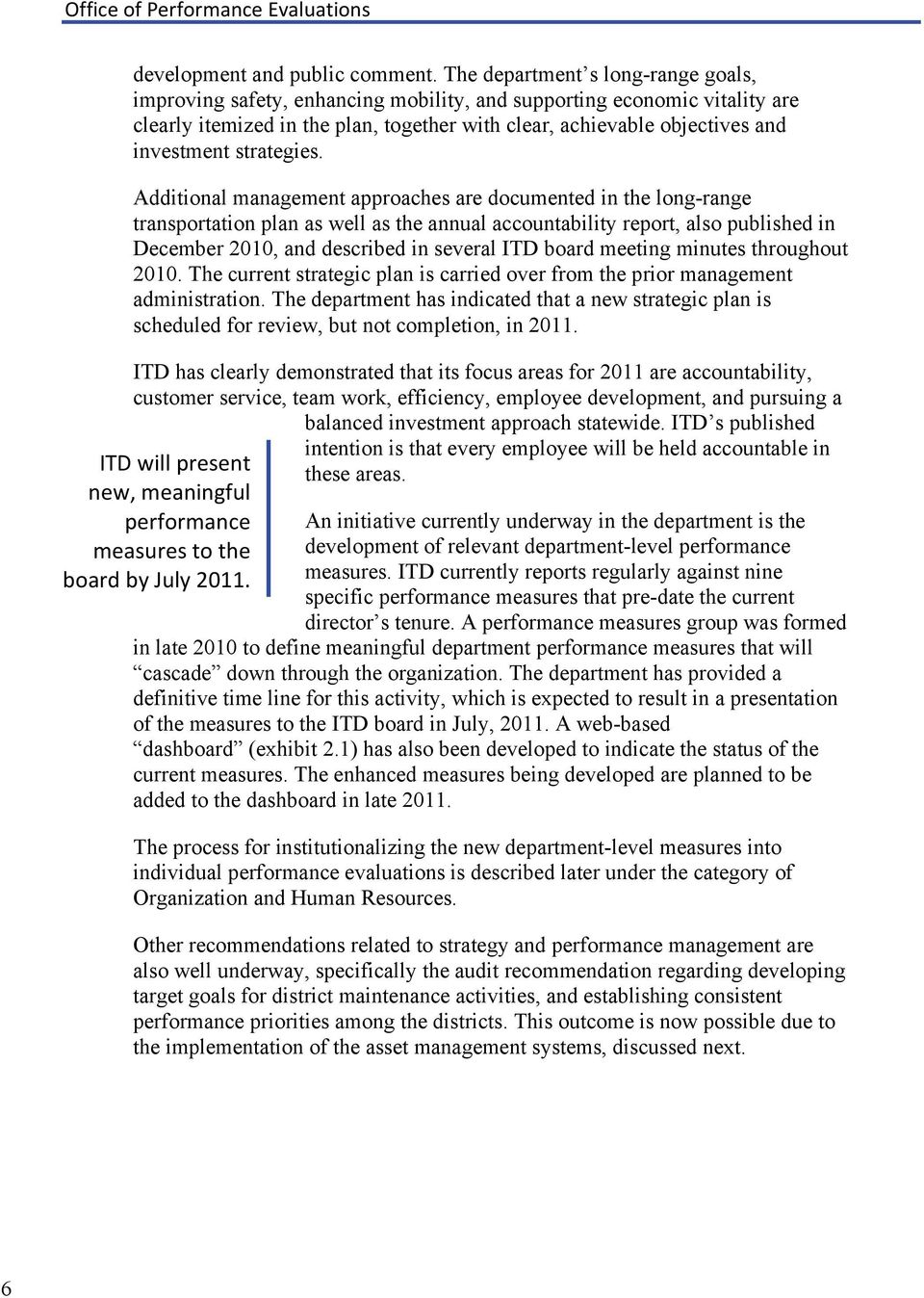
15 Idaho Transportation Department Performance Audit EXHIBIT 2.1 ITD PERFORMANCE MEASURES DASHBOARD Source: Idaho Transportation Department. Preservation, Maintenance, and Asset Management Findings and Recommendations The audit itemized significant findings regarding the department s deficiencies in preservation, maintenance, and asset management. A key finding was that operational and maintenance measurement and evaluation was inconsistent between the central office and the districts, and among the districts. Districts were not held accountable for meeting department-wide program and project performance goals and targets, and were operating independently. A significant reason for this was that department-wide performance goals and targets did not exist, in large part because there was no single asset-inventory system and 7
16 Office of Performance Evaluations therefore no comprehensive statewide asset management approach to tracking conditions and setting performance targets. The department s lack of asset condition information and decision-support tools precluded it from evaluating asset conditions and costs of maintaining assets at predetermined service levels. Thus, the department was incapable of developing practical formulas for scheduling highway preservation and maintenance services. The audit also found that needs-based maintenance-funding-allocation formulas were deficient and not in use because necessary internal systems to calculate the formulas did not exist. As a consequence, the districts were operating in a reactive manner, relying on a worst-first maintenance philosophy; that is, spending available funds on sections of roads and highways that are already in disrepair, and unable to keep up. The tangible effect was that the statewide road and highway conditions continued to deteriorate. 1 The audit recommended moving away from this mostexpensive approach, but in order to do so, it was imperative that the department acquire and develop the capability. The department s previous application of practical design was found to be a useful approach, given the limited funding and overall lack of decision-support tools, in limiting the scope of projects to the bare essentials and mitigating costs wherever practical. The audit recommended this effort should be continued and expanded, as it appeared to be a sensible management approach. The two overarching recommendations made in the audit that addressed the majority of the shortfalls in this category were to: 1) develop and implement a comprehensive approach to asset management as a strategic initiative to manage Idaho s highways and bridges; and 2) establish a district-focused businessplanning process, guided by departmental performance goals, providing a mechanism to track and report on project and program target operational goals. Status ITD has demonstrated a strong commitment to implementing a comprehensive asset management approach, with its implementation of appropriate systems and tools (described under the next category). In doing so, ITD has adopted a preservation-first strategy, which is an indispensable practice to achieve cost efficiencies, and is developing the 1 According to a presentation by David T. Hartgen, Ph.D., P.E., entitled Idaho Transportation Issues, presented to the Governor s Task Force on Modernizing Transportation Funding, July 2010, interstate conditions have made some marginal progress, but for the lower functional road classes including the local system (which makes up the majority of lane miles in the state), the condition has continued to deteriorate. 8

17 Idaho Transportation Department Performance Audit capabilities to move away from its previous worst-first approach. A preservation-first strategy ensures the right treatment to the right pavement at the right time. By maintaining pavement at a higher level earlier in the lifecycle, Idaho will get longer use of higher quality roads for less cost. This is expected to have significant financial benefits resulting from sustaining asset condition databases statewide, proactively maintaining asset condition, applying the systems use for lifecycle costing and level-of-service scenarios, and other operational and capital planning uses. In addition, the department has demonstrated successful progress in implementing a business planning process using district and department-wide business plans as a tool to communicate goals and levels of performance. The districts have created business plans for fiscal year This has been documented as a recurring annual process. The business plan includes the department s values, tangible results, and performance measures, which are used to guide the business objectives of each district. The expected benefits are that the districts will share in central office priorities, but also be empowered to select and justify projects to achieve strategic priorities. Finally, the use of practical design appears to have been integrated into the ongoing day-to-day operations process of the department. ITD s asset management strategy is moving from a worst first to a preservationfirst approach. Data and Information Management Findings and Recommendations The audit found that, in 2009, ITD did not have the necessary systems, processes, and tools to run a cost effective highway program. ITD was lacking operational technology and decision-support tools needed to operate effectively, measure results, and provide management accountability. The most significant recommendation to address this finding ITD is making was for the Idaho Legislature to appropriate $6 million to progress in acquire several new information management computer implementing a applications. The recommendation specified the acquisition of district business a new maintenance management system for performance-based planning process. budgeting; the acquisition and integration of a pavement management system; and the acquisition and further integration of a financial management system. These integrated systems, used in conjunction with a project scheduling system would result in building a broad-based, strategic asset management technology infrastructure. The essential 9
18 Office of Performance Evaluations EXHIBIT 2.2 ASSET MANAGEMENT BEST PRACTICES Pavement/Bridge Management System Maintenance Management System Financial System Source: Office of Performance Evaluations. elements for strategic asset management are a combination of business processes, planning tools, program delivery, analytical capabilities, and quality information. This recommendation was intended to give ITD the necessary tools and information to achieve considerable benefits from integrating asset management best practices (exhibit 2.2). The acquisition and implementation of these systems would provide a sound information-based infrastructure upon which to advance knowledge for optimal prioritization of maintenance expenditures and capital funding strategies. Status ITD is making significant progress towards implementing these recommendations. Most noteworthy is the fact that ITD received funding for, and is now completing implementation of its transportation asset management system (TAMS), which includes pavement management ITD is about to complete the implementation of its transportation asset management system (TAMS). (PM) and maintenance management (MM) modules. ITD is purchasing a financial planning system (FPS) by April 2011 and intends to integrate information from asset management systems into the FPS by the end of The financial planning system is a follow-on project to integrate financial data and performance measurement data from the pavement management, maintenance management, project scheduling systems, and geographic information systems (GIS). 10
19 Idaho Transportation Department Performance Audit TAMS has completed the initial implementation phase, and requisite data is now in the process of being populated and used to identify investment levels needed to address backlog, and to set priorities and make investments under an overall asset management approach. The pavement management system is fully implemented; the staff at the districts are trained, and the system is in startup use statewide. The maintenance management system is installed, and is in process of being implemented statewide, each district at a time. The expected final completion is April These integrated systems will identify, register, monitor, and track corridor assets. TAMS will capture maintenance activities performed, and the cost of those activities. The system will have the ability to forecast expected deterioration and, based on pre-determined operating assumptions, will recommend the most cost effective treatment applications. It will also have the ability to track life-cycle assessments. The largest benefit is expected to take place at the districts, because TAMS will build a consistent statewide database, optimized by district, and will be connected with the statewide transportation improvement plan (STIP). This combination of technologies will also link input resources with output achievements when all management systems are integrated, and will facilitate improved decision-making at the department. Organization and Human Resources Findings and Recommendations The key finding from the audit in this category was an inconsistency, or gap, between the central office and districts in definition and deployment of humanresource roles, responsibilities, and policies. Several recommendations were presented. ITD was encouraged to adopt board-driven department-wide policies that define the roles and responsibilities between the central office and the districts; develop retention and recruitment programs to reduce turnover and fill future positions; and to create and implement a management succession and leadership development process. It will take 2 3 years to complete the realignment of the department. ITD suffered from a high technical staff turnover rate and lacked retention and succession strategies. A chronic deficiency in technical personnel was causing an increase in the outsourcing of technical work to professional consultants to fill 11

20 Office of Performance Evaluations gaps in available resources. Even if resources were available, the department lacked an updated methodology to perform systematic internal-versus-outsource cost-benefit analyses. This circumstance was a result of inadequate systems to provide the relevant data for regular comparative resource analysis. Until better systems were implemented, the audit recommended ITD to increase the utilization of in-house resources whenever possible, as an interim cost-saving measure. Status Beginning in late 2010, the department initiated an organizational analysis to determine the optimal structure. Realignment efforts within the organization are continuing. According to the department, no employee will lose his job or any pay due to reorganization. The plan is to reduce supervisory levels from nine to five. There will be four executive officers that report directly to the director. ITD anticipates the transition to a new organizational makeup will take place over a two to three year period. The department realignment that is underway at ITD will address the finding of inconsistency in roles and functions. The district engineers have been brought into the leadership team so that they are part of the decision making process of the department. Each district engineer has been assigned as a district liaison for specific headquarters functions, such as procurement, right-of-way, materials, or finance. This collective effort is intended to eliminate the conflicts between central office and the districts. ITD is working to incorporate the department s performance measures in the employee evaluation process. The department has developed a recruitment and outreach initiative to attract staff engineers and developed a staff engineer pay policy to create more competitive pay. Retention and succession is being addressed through training programs and other measures underway. According to ITD, a course on the essentials of management has been created and is offered across the department and is also a component of the maintenance academy training. The department s Human Resources Division is coordinating a mentoring program in the Division of Highways. An Investing in Our People team was established to address the goal of creating a work environment where employees thrive. An additional team for employee recognition was also created to look for ways to formally recognize great employees. These initiatives may help to explain the fact that together with recruitment, more competitive pay, and the impact of the recession, all vacancies have been filled and, according to ITD, turnover in staff engineer positions has been reduced to 3 percent. This is a significant reduction from a historical turnover 12
21 Idaho Transportation Department Performance Audit rate in this employee classification of 10.7 percent. The economic benefit of this reduction is significant in saving hiring, retraining, and lost productivity costs over a period of years. Other organizational improvement initiatives and changes are also being pursued. For example, the audit recommended performance measures be defined for the department, and for all of the employees to be accountable for associated individual performance metrics. The performance measures for the department, as indicated earlier, are being defined. The employees performance and accountability measures will follow. Accordingly, the department is also in the process of addressing performance evaluations for all employees, which have been inconsistently administered over the past several years, and all evaluations, regardless of employee anniversary, are being adjusted to take place at the end of the fiscal year, which should coincide with end-of-year overall departmental performance results. The Human Resource function of ITD is in the process of incorporating performance measures in the performance evaluation process. The objective is to provide an institutional mechanism to measure tangible results. The project scheduling system (PSS) is expected to be operational by November Project, Contractor, and Consultant Management Findings and Recommendations Since ITD is predominately in the business of completing projects, a major finding of the audit was that ITD lacked a statewide project management system to ensure that construction projects (primarily in the STIP) are delivered on time and within budget. This requires statewide policy and project management standards, proactive and consistent reporting, and management of deadlines and deliverables using the proper methods. Other than variations of independent spreadsheets, consistent and professional project management tools were not used in ITD. Nor was there adequate internal capability or knowledge to use project management tools, such as project scheduling and tracking software and work-breakdown structures in a professional manner. Statewide project management consistency and tracking was a clear requirement. The major recommendations were for ITD to implement a department-wide project management office (PMO) for project monitoring, establishing standards, and risk management in scoping, tracking cost; and to develop The project management office is expected to be in place by April
22 Office of Performance Evaluations standard, statewide project management methods to reinforce district accountability for project costs and schedule. Other findings were that contractors and consultant procurement needed improvement in terms of selection (pre-qualification), contract execution, process standardization, and streamlining. Further, supervision of consultants was insufficient. The recommendation addressing these findings was for ITD to strengthen its procurement and supervision of contractors and consultants by implementing proper tools and procedures. Substantial progress has been made to institutionalize project management systems. Status The multi-phase implementation of a project scheduling system (PSS) was initiated in late 2009 and its functional requirements were completed in early All six districts initiated pilot projects, that are underway. Work breakdown structures and schedules were developed, and the pilot projects are expected to be evaluated, and business standards to ensure consistency should be identified by April A consultant has been hired to assist in the development of project portfolios and project management training. The system should be fully operational by November It is expected to provide real-time data, forecast capabilities of project delivery dates, identify where resources should be utilized, identify areas causing bottlenecks and delays, and provide clear information to all stakeholders. To take advantage of the project scheduling system, a project management academy has been formed within the department to develop and deploy professional project management training for personnel. In addition, a project management office (PMO) has been formed to provide oversight for policy, standards, and performance of projects, and is expected to be in place by April According to ITD, it is developing guidelines to streamline the consultant selection process, reporting of consultant evaluations, revised term and task agreements to streamline the selection process, and the inclusion of consultant administration in the curriculum of the project management academy training. The processes and tools have not yet been fully implemented, including the development of a contractor prequalification process and a methodology to make a comparative analysis on whether or not to outsource work. Overall, the progress on institutionalizing project management systems has been substantial given the complexity of implementation and changes required statewide. This effort will have a major beneficial impact on the department and the Idaho taxpayers in the near future. 14
23 Idaho Transportation Department Performance Audit Financial Planning and Budgeting Findings and Recommendations The 2009 audit found that ITD funding was insufficient to catch up and to match the expected growth in capital program costs for maintaining and preserving state highways and bridges. ITD had not developed an adequate mid- to longterm business and financial plan, and as a result, decision makers did not have sufficient information to make informed decisions about sustaining the state's transportation program. A key set of recommendations of the audit was that ITD should develop a complete financial plan that would forecast the impacts of system expansion projects, identify the ability of ITD to adequately operate, maintain and preserve its infrastructure, and to set funding targets for moving from a backlog reduction posture to a longer-term asset management approach that would invest more funds on early preventative maintenance. Status ITD is making significant progress towards implementing these recommendations. The specifications ITD is requiring for a new financial planning system (FPS) specifically address the elements for a complete financial plan as described in audit findings. In addition, ITD s planning efforts are appropriately aimed at integrating FPS with the recently implemented transportation asset management system (TAMS). The FPS is currently in the vendor selection stage with implementation scheduled for completion by August, with integration with other systems and population of all data by December Our interviews with ITD staff and our review of supporting documents lead us to conclude that implementation of the recommendations for a complete financial plan is well under way, and that the approach being taken by ITD has been deliberate and success-oriented. A new financial planning system (FPS) is expected to be in place by the end of Other audit findings and recommendations in the area of financial planning and budgeting further addressed how the financing and budgeting choices and setting priorities could be improved. Specifically with regard to setting priorities, the audit recommended that ITD should partner with municipal planning organizations (MPO) in the development of the regional long-range transportation plans and the statewide transportation improvement plan (STIP). The response of ITD to this recommendation has been positive, and implementation is in progress. During the fall of 2010, ITD worked closely with the COMPASS MPO (a transportation management area TMA for Ada and Canyon Counties) to develop a protocol for early and ongoing communications 15
24 Office of Performance Evaluations about project priorities, funding issues, and project delivery status. This protocol is intended to serve as a model for statewide, interagency consultation and cooperation in project selection and prioritization. With regard to making cost effective budgeting decisions, the audit recommended that ITD systematically capture data and calculate a department overhead rate to be able to compare direct and indirect costs of consultants to internal rates for cost-benefit comparison in outsourcing decisions. Although ITD had calculated an overhead cost for design activities several years ago, that analysis has not be updated since the audit, and the agency has not yet calculated a rate for any other activity. As such, we would characterize the status of this recommendation as being under consideration but not yet implemented. In the areas of making financing choices, and particularly for the remaining GARVEE projects, the audit recommended that ITD develop a formal written evaluation of alternative financing structures to be considered and shared with key decision makers through the Idaho Credit Enhancement Committee. Per interviews with ITD staff, funding scenarios were discussed with the House and Senate Transportation Committees and with the ITD board. We consider this recommendation to be partially implemented in a modified form. The last recommendation to be discussed in this section of our follow-up report was intended to address financial planning and budgeting in a broad sense on a statewide basis. The recommendation was for the Legislature to revise Idaho code to allow the ITD board to develop a proposed policy to guide the oversight of funding for local roads. As part of this oversight, ITD would compile the results of the municipal reporting and provide an annual Policymakers are interested in having more, and consistent, information about the impacts of local roads funding. report to the board and the Legislature. The report would highlight key trends and a summary of the general impact of the investment of the 38 percent of Highway Distribution Account revenues at the local level. Although no legislation has been introduced, we understand from our interviews with state policymakers that interest remains in having more, consistent information about the impacts of local roads funding. In part an outgrowth of discussion during the work of the Governor s task force, the Annual Road and Street Finance Report, in addition to including information on revenue and expenditures, will now include performance information on maintenance and construction activities. We consider this recommendation to be partially implemented in a modified form. As a final note, we learned during our follow-up efforts that Idaho state agencies are preparing zero-based budgets for 2013, and that ITD is already part way through the process. ITD is comparing its current operations to its legal mandate, and is conducting a gap analysis to compare actual performance to potential 16
25 Idaho Transportation Department Performance Audit performance. ITD believes that these efforts are promoting an understanding of how improvements can be made, and that the gap analysis, in particular, will be a benefit in implementing several of the audit recommendations to strengthen policy, performance indicators, and efficiency of operations. 17
26 18 Office of Performance Evaluations
27 Idaho Transportation Department Performance Audit Chapter 3 Conclusion and Recommendations Our conclusion is that ITD has aggressively pursued the recommendations made in the 2009 audit. In each category, we evaluated every recommendation in detail, and found a degree of progress on each, and compliance with the Governor s Executive Order. Appendix A is a matrix containing the status of each recommendation from the audit. Our observations during this follow-up study led to the following recommendations that should be pursued as a priority focus for the future: Pursue Oversight of Funding for Local Roads The Governor s task force examined methods to address the revenue allocation formula to local jurisdictions in a manner that incentivizes efficiency and ensures funds are allocated in a manner that can be most efficiently employed. An active initiative to address a need for consistent oversight of funding for local roads continues to be raised as a shortfall. Three main concerns were identified during the follow-up: 1. A need for a series of comparative criteria to be defined, to be used by municipalities to better justify the amount requested for funds, and for decision makers to be better equipped to approve allocations. 2. The municipalities should provide uniform, more detailed, reporting on how the funds were actually spent. This has been addressed through the development of additional uniform reporting categories, but the implementation is expected to take another year or so, depending on the level of training provided to the local agencies. 3. The expressed need for a comprehensive audit to determine how the local funds are used, and to establish comparative-use statistics that can be used by policymakers in refining and improving the revenue allocation formula. 19
28 Office of Performance Evaluations Finalize the Department Strategic Plan Although the department is in the process of implementing a number of initiatives, the need for a departmental strategic plan is recommended. In particular, the current strategic plan, which pre-dates the current director, can be improved. A thoroughly developed strategic plan would take into account, and integrate, a number of goals, objectives, and planning initiatives. In addition, the strategic plan would include departmental performance measures, customer-service plans, asset management strategies, human resource succession and leadership development targets, financial assumptions and projections (operations and capital), and district-business plans. This would be updated on an annual basis and guide the department s decision making for the ensuing fiscal year. Integrate Separate Planning Processes and Documents The implementation of an asset management philosophy throughout the department is underway. As this study indicates, the statewide transportation improvement plan (STIP), the long-range transportation plan, and the accountability report are important and well-developed. Our recommendation is to, as the systems that are implemented mature, continue to link the goals, objectives, and projects of each of these systems and various guidance documents, in driving the department activities. Seek Alternative Funding Sources The roads in Idaho continue to deteriorate at a faster rate than funding can cover preservation and maintenance. The implementation of the new asset management systems in ITD is a first step, but will not resolve the funding shortfall. Using the recommendations from the Governor s task force, as a start, the decision makers should continue to seek out and identify traditional and nontraditional sources of revenues for funding preservation and maintenance of highways and bridges. 20
29 Idaho Transportation Department Performance Audit Appendix A Recommendation Details and Implementation Status The following matrix contains the implementation status of each recommendation contained in our 2009 Idaho Transportation Department Performance Audit. All of the recommendations are divided into six areas. Category 1 Comprehensive Statewide Strategy and Performance Management Original Recommendation Details Status 1.1 Establish strategic and operational goals for ITD that flow from the board, through ITD central office, to the districts. Board should link strategic performance measures and outcomes to investments. Partially implemented: an initiative is currently underway to develop department level performance measures. The measurement component will come from the use of TAMS. ITD central office should translate strategic measures into division operational measures and expectations for all districts. Partially implemented: an initiative is currently underway to develop department level performance measures. The measurement component will come from the use of TAMS. Board and ITD should review department and system goals for effectiveness and modify them accordingly. Partially implemented: department has implemented a definitive timeline for this activity which is expected to result in a presentation to the ITD board in July, The measurement component will come with full integration of TAMS. ITD should set central office performance priorities, allowing the districts to select the projects accordingly to achieve the priorities. Partially implemented: strategic goals are under development. TAMS will aid in measuring performance to report against goals. 21
30 Office of Performance Evaluations Table Continued Original Recommendation Details Status 1.2 ITD should report performance against strategic and operational goals. Provide regular quarterly ITD to board communications on performance against the strategic goals and objectives. Partially implemented: strategic goals are under development. TAMS will aid in measuring performance to report against goals. Divisions should report, aggregate, and share common operational results and processes that relate to significant department activity. Partially implemented: this process is underway with the development of strategic plans, performance measures, and TAMS. ITD should complete organization and staffing of performance management office proposed by the department in FY Partially implemented: development of a performance management office is in process. 1.3 ITD should adopt performance management accountability practices throughout the organization. ITD should hasten its current effort to manage through performance measures and move to ensure that this initiative is a high priority. ITD should move immediately to improve highway and bridge performance measurement and evaluation by taking the following steps: Partially implemented: development of a performance management office is in process. Using peer states as models, ITD should immediately select 5 10 key operational targets and begin to measure them consistently at the district and program levels. These first performance measures should be linked to tangible results for Idaho taxpayers and should be aimed at improving processes. Initial measures are: Percent of environmental clearances completed on time Percent of pavement in good condition Overall maintenance levels Snow and ice control of total miles plowed and cost per plow mile Trends of number of customer complaints by district 22
31 Idaho Transportation Department Performance Audit 1.4 Provide for a technology transfer of project management capability in terms of expertise and tools from the GARVEE program to the PMO. 1.5 ITD should develop target goals for various maintenance activities for the districts, particularly in the key areas of surface maintenance and improvements, such as expected miles of seal coat and surface improvements. ITD should also track actual district cost savings from the efficiency report and evaluate these efficiencies. 1.6 ITD should create a formal mechanism for reporting problems that occurred in construction back to the development teams. 1.7 ITD should provide more frequent performance reports to the legislature. Adopt professional project management practices as the basis for establishing ITD s project management standards and performance measures. Implement the CIP methodologies and tools consistently across the districts and GARVEE projects. Institutionalize core project management practices and tools as used by the CIP into ITD. A statewide procedure should be established, including a central repository, accessible to all, to document, evaluate, and share various innovations, process changes, and implementation of new technologies. While each item may not be applicable in every district, a formal process should exist to review applicability. Maintenance management system tools should be re established and used in order to determine the optimal mix of in house to outsourcing for maintenance activities. Considered but rejected: tools are not compatible with ITD approach. Considered but rejected: CIP tools are not compatible with ITD's approach. However, the intent of this recommendation is addressed by the implementation of a project management office and statewide project management. Partially implemented: post construction reviews are scheduled by the State Construction Engineer with all districts. 23
32 Office of Performance Evaluations Table Continued Original Recommendation Details Status 1.8 ITD should continue enhancing its strategic planning process in order to translate strategy into operational goals with the supporting tracking and monitoring systems. This should include a business and financial planning process and use district and department wide business plans as a tool to communicate both goals and current levels of performance. Develop measurable objectives and performance metrics with tactical and operational plans. Business plan: implemented completely. Performance measures: partially implemented. Strategic plan: under consideration. For the long term, ITD should continue its effort to identify specific performance targets linked to departmental strategic objectives. Business plan: implemented completely. Performance measures: partially implemented. Strategic plan: under consideration. ITD should move toward standardizing what is measured within each program and among the six districts by establishing required measures. Business plan: implemented completely. Performance measures: partially implemented. Strategic plan: under consideration. ITD should work to develop cost effective tools to measure performance, by looking both inward to the districts to expand some successful measurement tools and outward to peer states. Partially implemented: the implementation of TAMS and project scheduling tools are underway. ITD should consider requiring that significant projects and operational initiatives are supported by business case analysis that demonstrates the need and cost effectiveness. ITD should realign operations and funding formulas to support asset management objectives and long term strategic goals. Partially implemented: strategic goals are included in both the long range plan and the strategic plan. However, the goals in the strategic plan are not completely in sync with those in the long range plan. The goals in the long range plan are the department's focus. 24
33 Idaho Transportation Department Performance Audit 1.9 Develop a comprehensive vision and strategy to address long term statewide capital program and operational demands. Increase funding as soon as possible to allow ITD to begin reducing the extensive backlog of subpar highways. Tie any funding increase to a short and long term strategy that addresses critical current needs, and that transitions ITD from a worst first approach to an asset management/systempreservation business model. Partially implemented: this issue has been addressed by the Governor s Task Force on Modernizing Transportation Funding in Idaho. Continue to enhance the department s strategic planning process by directly addressing long term transportation needs statewide. Develop and implement guidelines and criteria for prioritizing projects across all districts with flexibility to address unique local conditions. Long range plan: implemented completely. Project prioritization: implemented completely with the implementation of TAMS. Implementation with local districts: considered but rejected. The districts should develop specific business plans that flexibly address broad agency direction. Establish a mechanism to engage the Legislature more frequently in a meaningful review of performance goals, financial status, and future needs. Category 2 Preservation, Maintenance, and Asset Management Original Recommendation Details Status 2.1 Adopt board driven department wide policies that define the roles and responsibilities between the central office and the districts, and the relationship between board members and the districts. Establish a supporting district business plan that allow districts to: Identify key issues Propose a 5 year strategy for addressing key issues Identify resources needed Identify the district's strategy for transitioning to an asset management approach for managing their respective programs 25
34 Office of Performance Evaluations Table Continued Original Recommendation Details Status 2.2 ITD should develop a maintenance allocation formula that reflects key need criteria in conjunction with a maintenance management system. The formula should include factors such as vehicle miles travelled (VMT), average daily truck traffic (ADTT), weather, miles of road, roadway conditions, numbers of bridges, and bridge conditions. It should include a rationale for the criteria used and an assessment of the impact and benefits of a few key alternative approaches. In addition, it should establish the base level needed to provide basic winter services and other routine maintenance activities. This established base level should provide for funding to meet these winter and routine maintenance needs and to prevent formula fluctuations from year to year. Implemented completely: a component of the implementation of TAMS. 2.3 ITD should implement asset management as a strategic initiative. Establish and document objective criteria and an integrated process for project selection. Implemented completely: a component of the implementation of TAMS. Use asset management tools to select the best mix of preservation, restoration, and reconstruction projects for pavements and bridges. Implemented completely: a component of the implementation of TAMS. Incorporate current visions and horizons documents into a longer range, fiscally constrained plan with a realistic estimate of safety and expansion projects that can be afforded over the long term. Implemented completely: a component of the implementation of TAMS. Use objective scoring criteria for project inclusion in STIP. Implemented completely: a component of the implementation of TAMS. Use a 20+ year horizon in the plan and integrate long term financial forecasts. Implemented completely: a component of the implementation of TAMS. Link programs to statewide goals and performance measures. Implemented completely: a component of the implementation of TAMS. 26
35 Idaho Transportation Department Performance Audit 2.4 ITD should adopt an asset management approach to manage Idaho's highways and bridges. The department should first develop: 2.5 Continue to expand the use of practical design for all applicable projects. An asset management strategy and implementation plan to address the asset management needs of the agency prior to seeking a set of decision support tools. A strategic approach that encompasses multiple business processes. Reliable and accurate information and analytical capabilities from tools such as Pontis, maintenance management system, and pavement management system to complement decision making processes. Savings from the program and the process should be included in performance management goals. ITD should review the past work in this area, document the best practices and procedures, and provide overall direction to the districts. Care should be taken to ensure that the efficiency initiatives will not sacrifice safety or long term benefits of the project improvements. Implemented completely: a component of the implementation of TAMS. Implemented completely: a component of the implementation of TAMS. Implemented completely: a component of the implementation of TAMS. 27
36 Office of Performance Evaluations Category 3 Data and Information Management 3.1 Original Recommendation Details Status ITD should develop better communication tools so that success and challenges can be effectively shared throughout the department and then communicated externally to the Legislature, Governor, and other stakeholders. Establish a mechanism to engage the Legislature more frequently in performance goals, financial status, and the needs going forward. Strive for flexible and widely accessible public data, information, and reporting, because all stakeholders do not benefit from the same level of information. Also, correlate the information furnished to the intended audience. Engaging Legislature: Implemented completely. Performance goals and measures: partially implemented as recommended. Implemented completely: improved website reporting and accountability reports. Provide timely reports, presented on a regular basis, using standardized formats and established metrics reflective of ITD values. Implement three basic levels of reporting: 1. Operational and project reporting by program 2. District performance reporting 3. Overall departmental performance 3.2 ITD should implement a maintenance management system (discontinued in 2006) to support a needs based approach to allocating resources. The maintenance management system should be developed to systematically support and calculate items such as the following: Annul work program development and prioritization More effective use of available resources Staff time spent by maintenance activity Unit cost analysis of various maintenance activities Comparison of contractor vs. in house cost and productivity Trend analysis statewide and by district Generation of uniform needs and backlog reports district by district and statewide summaries Development of alternative investment scenarios such as comparing a needs based allocation to the current historical allocation approach for comparison purposes Implemented completely: TAMS has integrated pavement management and maintenance management modules. 28
37 Idaho Transportation Department Performance Audit Highest priority is to use an MMS with full functionality, such as workforce time entry by maintenance activity, trend analysis, and tracking of equipment and materials usage. This functionality is enhanced with an interface with the financial management system. Restore cost accounting functionality to allow ITD to evaluate productivity rates and establish the functionality to conduct performance based budgeting. Allow the districts to evaluate funding necessary to meet alternative level of service targets. Allow for the systematic evaluation of services to be contracted out. Provide information to more effectively distribute maintenance budgets to the districts. Develop a formal maintenance quality assurance plan to collect condition information and access future inventories for key assets such as pavements, signs, bridges, drainage features, and guardrails. Outline MMS implementation within the agency's asset management strategy an implementation plan. Implemented completely: TAMS has integrated pavement management and maintenance management modules. Implemented completely: TAMS has integrated pavement management and maintenance management modules. Implemented completely: TAMS has integrated pavement management and maintenance management modules. Implemented completely: TAMS has integrated pavement management and maintenance management modules. Implemented completely: TAMS has integrated pavement management and maintenance management modules. Implemented completely: TAMS has integrated pavement management and maintenance management modules. Implemented completely: TAMS has integrated pavement management and maintenance management modules. 3.3 The department should acquire and implement a maintenance management system. 29
38 Office of Performance Evaluations Table Continued 3.4 The department should implement a new or enhanced pavement management system. New management systems should be integrated with the existing financial management system this applies as well for the maintenance management system. At a minimum, expand the District 6 pilot PMS to the other districts. Provide for predictive capabilities to evaluate alternative strategies for most efficient mix of pavement treatments. Allow users to develop long term plans through the analyses of different treatment strategies over a multi year period. Provide a distributed database structure that enables separate databases to be linked transparently so that anyone (central office or districts) has access to the database. Implemented completely: TAMS has integrated pavement management and maintenance management modules. 3.5 The Idaho Legislature should consider appropriating $6 million for acquisition of recommended systems. Maintenance management system approximately $4 million Pavement management system approximately $1.5 million Interface with financial management system and training approximately $0.5 million Category 4 Organization and Human Resources Original Recommendation Details Status 4.1 ITD must create and implement a management succession and leadership development process, and continue to develop retention and recruitment strategies to reduce turnover. This recommendation addresses the large turnover percentage coupled with the future retirement of experienced engineering staff. The department should also strive for an overall turnover reduction rate of eight percent overall. 30
39 Idaho Transportation Department Performance Audit 4.2 Central office should develop targeted district and central office training for needed knowledge and skills, such as project management techniques, contractor and consultant management, and performance based management. ITD should examine the types of skills that the Highway Division will need to replace as experienced personnel retire and develop centralized training programs to support professional project management, consultant management, and performance management programs to advance the goals of the department and improve its effectiveness overall. This should be implemented in conjunction with a management succession process. Category 5 Project, Contractor, and Consultant Management Original Recommendation Details Status 5.1 ITD should develop standard, statewide monthly project management reports with quantitative information to reinforce district accountability for project costs and schedule progress on an ongoing basis. ITD should use standardized progress reports to focus on any projects that are slipping behind milestones or beginning to forecast overruns. Partially implemented: the project scheduling system was initiated in late 2009 and all six districts have implemented a pilot program. Business standards to ensure consistency should be identified by April ITD should set monthly project progress reports to keep districts accountable for project cost and schedule progress on an ongoing basis. ITD should use progress reports to focus attention on any projects that are slipping behind milestones or beginning to forecast overruns so that the appropriate resources can be brought to resolve issues. Partially implemented: the project scheduling system was initiated in late 2009 and all six districts have implemented a pilot program. Business standards to ensure consistency should be identified by April ITD should track and report on the causes for schedule delays and cost overruns as part of the program to measure schedule performance. Identify the cause each time a delay occurs. Use report summaries of causes to address recurring problems. Partially implemented: the project scheduling system was initiated in late 2009 and all six districts have implemented a pilot program. Business standards to ensure consistency should be identified by April
40 Office of Performance Evaluations Table Continued 5.4 Original Recommendation Details Status Strengthen ITD s management of consultant contract procurement by implementing the following practices for consultant agreements: Establish procedures that ensure scopes of work for services are developed by ITD staff. ITD staff should develop the initial scopes of work. Streamline the contract execution process and set performance targets for reducing the time it takes to execute agreements. Standardize the consultant procurement process, and enhance discipline by using standard scopes of work and a supporting work breakdown structure. Improve project cost estimation and budgeting by capturing actual historical man hour data. This data can be most helpful for estimating future contract levels of effort. Also, examine automating the consultant invoice submittal and approval process to enhance the capture of historical data and increase payment processing efficiency. Enhance the transparency of the term agreement process by reporting monthly on all term agreements awarded by consultant, and the dollar value. Require that consultant evaluation forms be completed yearly for agreements that are longer than one year, and revise the procurement procedures to ensure that current evaluations are considered in the consultant selection process. Establish a procedure to ensure evaluation feedback is acted upon. 5.5 Strengthen ITD s supervision of consultant contracts by implementing the following practices: Develop a district wide consultant supervision process that is more standardized and disciplined by using standard project schedule templates, and standard cost management tools. Implemented completely: ITD currently has no formal requirement on how these steps will be carried out, but these skills and tools are included in the curriculum for the program management academy and ITD focus is project management oriented. 32
41 Idaho Transportation Department Performance Audit 5.6 Expand the GARVEE Office as a divisionwide project management office (PMO) responsible for: Provide project management training to staff responsible for more complex consultant contracts. Implemented completely: through the program management academy Establish criteria and departmental guidelines for assigning ITD staff to support the agreement administrator in overseeing significant, large consultant contracts. This will help to ensure that expertise and management are appropriately matched to managing the complexity of the consultant assignment. Implemented completely: ITD currently has no formal requirement or directive on how these steps will be carried out, but these skills and tools are included in the curriculum for the program management academy and ITD focus is project management oriented. Central office should conduct periodic quality reviews of term agreement based work, comparing the quality of providers. Central office should provide these evaluations to the districts and the board. Implemented completely: ITD currently has no formal requirement or directive on how these steps will be carried out, but these skills and tools are included in the curriculum for the program management academy and ITD focus is project management oriented. Managing GARVEE and other major capital expansion projects Modified implementation: the project management office is under development. However, it will not be part of the GARVEE office. Establishing project management practice standards to be followed on all projects whether managed through the PMO or the districts Modified implementation: the department is using adopted professional management practices. Assembling project performance results, for projects managed by the PMO and the districts, and summarizing the results in relation to overall department/district objectives Modified implementation: the project management office is under development. However, it will not be part of the GARVEE office. 33
42 Office of Performance Evaluations Table Continued Original Recommendation Details Status 5.7 Assign the management of the Connecting Idaho Partners (CIP) consultant contract to the project management office (PMO). Direct PMO staff to act as project management champions. The champion role is to standardize successful project management practices and tools within the department for district wide use and for consultant contract procurement and supervision. Modified implementation: the role of Connecting Idaho Partners has been assumed by ITD. However, the details of the recommendation are still relevant to the project management office. 5.8 Provide for a technology transfer of project management capability in terms of expertise and tools from the GARVEE program to the PMO. Assign a qualified manager in each district as the liaison to the PMO in order to establish greater coordination and a higher performing highway program. Adopt professional project management practices as the basis for establishing ITD s project management standards and performance measures. Implement the CIP methodologies and tools consistently across the districts and GARVEE projects. Modified implementation: the role of Connecting Idaho Partners has been assumed by ITD. However, the details of the recommendation are still relevant to the project management office. Considered but rejected. ITD is using different technology platforms. Institutionalize core project management practices and tools as used by the CIP into ITD. Considered but rejected. ITD is using different technology platforms. 5.9 Clarify and resolve the delegation of authority during the GARVEE project construction phase between the District Engineer, Connecting Idaho Partners, and the GARVEE Office. The GARVEE Office should be formally designated and charged with the responsibility of resolving conflicts between the resident engineer and CIP over contractor management decisions such as approvals of contractor payments or changes. 5.1O ITD should consider having Connecting Idaho Partners expand its reporting related to right of way acquisition as beneficial. Connecting Idaho Partners should develop a fact sheet for ITD to communicate to the Legislature that covers the provisions and their authority related to GARVEE projects in general and right of way acquisition in particular. This fact sheet should also be made available to the general public. Considered but rejected: the role of Connecting Idaho Partners will be assumed by ITD. 34
43 Idaho Transportation Department Performance Audit 5.11 Use the Project Management Office to define and help implement formal risk management practices on projects that are tailored to fit the specific project Document identified risks and potential impact(s) using risk management tools (e.g. risk registers); integrate these risks into schedule and cost forecasting procedures Establish a process that would ensure that cost incentive based contracting is considered systematically Adopt a contractor prequalification system for large and complex construction contracts in order to provide ITD with the ability to ensure that contractors are able and qualified to perform the complex construction projects Pursue legislation that would provide ITD with the authority to use a wider range of project delivery options, in particular design build, which can both shorten the project delivery period and provide earlier assurance the budget will be achieved Upon legislation having been enacted to allow ITD the ability to use design build as a project delivery method, ITD should develop designbuild policy and procedures piloted on three to five projects within a two year timeframe. Right of way acquisitions should be included in overall annual report or progress reporting between Connecting Idaho Partners and ITD to emphasize transparency and to provide exception reporting to justify right of way actions. Over $5 million Significant bridge work Specialty contract/items Considered but rejected: the role of Connecting Idaho Partners will be assumed by ITD. Partially implemented: the establishment of the project management office is underway. Partially implemented: the establishment of the project management office is underway. No action taken: currently under consideration. No action taken: currently under consideration. 35
44 Office of Performance Evaluations Table Continued Original Recommendation Details Status 5.17 ITD should systematically capture data and calculate a department overhead rate to be able to compare direct and indirect costs of consultants to internal rates for cost benefit comparison in outsourcing decisions. ITD should develop outsourcing criteria, guidelines and strategy in conjunction with the implementation of the appropriate decision support systems that provide reliable data and tools for analyzing various professional service activities to determine which areas have potential for outsourcing. Data should include overhead costs applied to pay rates for various activities performed in house and the costs for similar and comparable activities for contracted work. The overhead would be applied to maintenance activities, traffic line painting, brooming, design activities, and construction inspection, among others The guidelines at a minimum should consider: costs, the need to expedite work, peak work volumes, unique skills, training and retraining, and the retention of strategic core competencies within ITD. ITD should re evaluate the current trend to bring design work in house to ensure that in house capabilities are being properly matched to the demands of design projects so that quality is not being sacrificed to achieve lower costs. Doing so can result in an adverse trade off of cost and quality that over time is far less cost effective. No action taken: awaiting financial planning system for capability. No action taken: under consideration, pending implementation of the financial planning system. No action taken: under consideration, pending implementation of the financial planning system. Category 6 Financial Planning and Budgeting Original Recommendation Details Status 6.1 New capacity projects should be rigorously and independently evaluated for cost effectiveness, with consideration also given to additional longterm maintenance costs. Such an evaluation should also include specific consideration of weather future proceeds from GARVEE can be directed to projects that reduce on going maintenance costs and support preservation and restoration priorities. Partially implemented: pending future funding decisions. However, ITD's adopted strategy is that investments will be cost effective and will maintain existing infrastructure first. 36
45 Idaho Transportation Department Performance Audit 6.2 Develop a complete financial plan that includes: A description of the selection of the proposed capital projects as compared to alternative capital project candidates, including preservation and restoration. A forecast of the financial implications of the completion of these projects on the overall ITD financial plan and the ability of ITD to adequately operate, maintain, preserve, and restore transportation infrastructure. Integration of the GARVEE financial plan into the overall ITD multiyear financial plan. Development of a formal written evaluation of alternative financing structures to be considered and shared with key decision makers through the Idaho Credit Enhancement Committee. 6.3 The planning and budgeting process should be improved to develop better estimates of project costs and priority for the STIP. ITD should partner with the MPOs to establish improved methods for prioritizing capital improvements for each program. The regional long range transportation plans and the statewide transportation improvement program (STIP) should be structured to: Identify and quantify need over a 25 year time horizon in five year increments. Establish the funding levels necessary to close the gap between available and needed resources. Set targets for backlog reduction. Set targets for moving from backlog reduction posture in the shorter term 5 10 years to an asset management approach 1 25 years that positions Idaho to spend increasingly more funds on early preventative maintenance. Partially Implemented, because the implementation is still in progress. The specifications ITD is requiring for a new financial planning system (FPS) specifically address the elements for a complete financial plan as described in audit findings. Partially Implemented. Partially implemented because alternative financing structures were presented and discussed, albeit informally. Partially implemented: the intent of the recommendation is being pursued. 37
46 Office of Performance Evaluations Table Continued Original Recommendation Details Status 6.4 The Legislature should revise Idaho code to allow the ITD board to develop a proposed policy to guide the oversight of funding for local roads. The policy should be developed with local input at least at an association level, such as local highway districts, association of counties, and association of cities. The policy should also be developed following a basic review of the oversight for state funded local roads and bridges in other states. The policy should include: Stated objectives or performance goals General priorities to guide the use of the funds A process for achieving the necessary oversight General standards for the use of the funds Basic reporting by municipalities to ITD on an annual basis in a uniform format Partially Implemented in a modified form. The Annual Road and Street Finance Report, in addition to including information on revenue and expenditures, will now include performance information on maintenance and construction activities. ITD should compile the results of the municipal reporting and provide an annual report to the board and the Legislature. The report should highlight key trends and a summary of the general impact of the investment. ITD should also do a few spot reviews of local funding each year. Consideration should be given to establishing a basic audit cycle in which ITD district staff review the local use of funds. Partially Implemented in a modified form. 6.5 Develop an integrated midterm business and financial planning process to address challenges such as revenue shortfalls and the implementation of ITD s strategic vision. Develop a minimum eight year financial plan based on existing forecasted revenues with operating expenditures to include the implications of current and forecasted capital projects. Require the use of the minimum eight year financial plan as the tool for reporting current year performance, the annual budget prioritization, and adoption process, and all revenue, taxation, and financing proposals. Partially Implemented, because the implementation is still in progress. Partially Implemented, because the implementation is still in progress. Continue to examine and recommend the introduction of alternative revenue sources with growth in revenues that generally keeps pace with the cost of delivering ITD projects and services. Widen the consideration of alternative revenue options that have a greater opportunity for growth that keeps pace with inflation. 38
47 Office of Performance Evaluations Reports, 2008 Present Publication numbers ending with F are follow-up reports of previous evaluations. Publication numbers ending with three letters are federal mandate reviews the letters indicate the legislative committee that requested the report. Pub. # Report Title Date Released Governance of Information Technology and Public Safety March 2008 Communications 08-02F State Substance Abuse Treatment Efforts March F Virtual School Operations March Public Education Funding in Idaho January F Higher Education Residency Requirements January Idaho Transportation Department Performance Audit January Feasibility of School District Services Consolidation February F School District Administration and Oversight February F Use of Average Daily Attendance in Public Education Funding February F Child Welfare Caseload Management February F Public Education Technology Initiatives February F Management in the Department of Health and Welfare March F Governance of Information Technology and Public Safety April 2009 Communications Operational Efficiencies in Idaho s Prison System January Increasing Efficiencies in Idaho's Parole Process February F Use of Average Daily Attendance in Public Education March Governance of EMS Agencies in Idaho November F Governance of Information Technology and Public Safety Communications November Distribution and Sale of Liquor in Idaho January Coordination and Delivery of Senior Services in Idaho February F Increasing Efficiencies in Idaho s Parole Process February F Idaho Transportation Department Performance Audit March The Claims Processing System of Medicaid March 2011 Reports are available from the OPE website at Office of Performance Evaluations PO Box Boise, ID Phone: (208) Fax: (208)
New Mexico DOT Transportation Asset Management Implementation Plan. final plan
 New Mexico DOT Transportation Asset Management Implementation Plan final plan February 23, 2015 report New Mexico DOT Transportation Asset Management Implementation Plan date February 23, 2015 Table
Capital Improvement Program: Public Input and the Need for a Multi-year Plan
 Attachment 1 OFFICE OF THE INDEPENDENT BUDGET ANALYST REPORT Date Issued: September 21, 2012 IBA Report Number: 12-39 Budget and Finance Committee Docket Date: September 26, 2012 Item Number: 8 OVERVIEW
Oversight of Information Technology Projects. Information Technology Audit
 O L A OFFICE OF THE LEGISLATIVE AUDITOR STATE OF MINNESOTA FINANCIAL AUDIT DIVISION REPORT Oversight of Information Technology Projects Information Technology Audit May 29, 2009 Report 09-19 FINANCIAL
September 2005 Report No. 06-009
 An Audit Report on The Health and Human Services Commission s Consolidation of Administrative Support Functions Report No. 06-009 John Keel, CPA State Auditor An Audit Report on The Health and Human Services
EXECUTIVE SUMMARY...5
 Table of Contents EXECUTIVE SUMMARY...5 CONTEXT...5 AUDIT OBJECTIVE...5 AUDIT SCOPE...5 AUDIT CONCLUSION...6 KEY OBSERVATIONS AND RECOMMENDATIONS...6 1. INTRODUCTION...9 1.1 BACKGROUND...9 1.2 OBJECTIVES...9
Asset Management Plan
 Example Transportation Asset Management Plan Outline This outline was created using the Transportation Asset Management Plan (TAMP) Builder ( www.tamptemplate.org ), a product of NCHRP Project 8-36/116.
Office of the Auditor General AUDIT OF IT GOVERNANCE. Tabled at Audit Committee March 12, 2015
 Office of the Auditor General AUDIT OF IT GOVERNANCE Tabled at Audit Committee March 12, 2015 This page has intentionally been left blank Table of Contents Executive Summary... 1 Introduction... 1 Background...
Final. North Carolina Procurement Transformation. Governance Model March 11, 2011
 North Carolina Procurement Transformation Governance Model March 11, 2011 Executive Summary Design Approach Process Governance Model Overview Recommended Governance Structure Recommended Governance Processes
MEMORANDUM FOR THE HEADS OF DEPARTMENTS AND AGENCIES
 MEMORANDUM FOR THE HEADS OF DEPARTMENTS AND AGENCIES FROM: SUBJECT: Peter R. Orszag Director Managing the Multi-Sector Workforce Federal agencies use both federal employees and private sector contractors
3.06. Infrastructure Asset Management at Colleges. Chapter 3 Section. Background. Ministry of Training, Colleges and Universities
 Chapter 3 Section 3.06 Ministry of Training, Colleges and Universities Infrastructure Asset Management at Colleges Chapter 3 VFM Section 3.06 Background The Ministry of Training, Colleges and Universities
Information Technology Project Oversight Framework
 i This Page Intentionally Left Blank i Table of Contents SECTION 1: INTRODUCTION AND OVERVIEW...1 SECTION 2: PROJECT CLASSIFICATION FOR OVERSIGHT...7 SECTION 3: DEPARTMENT PROJECT MANAGEMENT REQUIREMENTS...11
Department of Human Resources
 Workforce Services Workforce Policy and Planning Department Management/ Human Resource Information Systems Employee Relations Employment Compensation and Workforce Analysis Employee Benefits Organizational
V E H I C L E / E Q U I P M E N T R E P AI R T E C H N I C I AN S U P E R V I S O R Schematic Code 17318 (30005065)
 V E H I C L E / E Q U I P M E N T R E P AI R T E C H N I C I AN S U P E R V I S O R Schematic Code 17318 (30005065) I. DESCRIPTION OF WORK Positions in this banded class supervise of a group of mechanics,
A Legislative Briefing prepared by Volume 7, Number 1 February 2001
 fiscal forum A Legislative Briefing prepared by Volume 7, Number 1 February 2001 Mitchell E. Bean, Director P. O. Box 30014, Lansing, MI 48909-7514 517-373-8080! FAX 517-373-5874! www.house.state.mi.us/hfa
REPORT 2014/078 INTERNAL AUDIT DIVISION
 INTERNAL AUDIT DIVISION REPORT 2014/078 Audit of the Office for the Coordination of Humanitarian Affairs (OCHA) Managing Agent role for the Somalia Common Humanitarian Fund Overall results relating to
Procurement Programmes & Projects P3M3 v2.1 Self-Assessment Instructions and Questionnaire. P3M3 Project Management Self-Assessment
 Procurement Programmes & Projects P3M3 v2.1 Self-Assessment Instructions and Questionnaire P3M3 Project Management Self-Assessment Contents Introduction 3 User Guidance 4 P3M3 Self-Assessment Questionnaire
PERFORMANCE-BASED BUDGETING METHODOLOGY AND TOOLS
 LEARN HOW TO LINK YOUR BUDGET DECISIONS WITH STRATEGIC OUTCOMES In this time of economic instability, citizens want real-time updates on the financial decisions and budget allocations made by their local
December 2014 Report No. 15-017. An Audit Report on The Telecommunications Managed Services Contract at the Health and Human Services Commission
 John Keel, CPA State Auditor An Audit Report on The Telecommunications Managed Services Contract at the Health and Human Services Commission Report No. 15-017 An Audit Report on The Telecommunications
Department of Finance & Management Strategic Plan V.3.3
 Department of Finance & Management Strategic Plan V.3.3 Planning Period: 2012 2015 Table of Contents Message from the Commissioner... 3 Department Overview... 4 Department Strategic Planning Process...
Human Capital Update
 Finance & Administration Committee Information Item IV-A July 10, 2014 Human Capital Update Washington Metropolitan Area Transit Authority Board Action/Information Summary Action Information MEAD Number:
Department of Homeland Security Office of Inspector General. Federal Protective Service Contract Guard Procurement and Oversight Process
 Department of Homeland Security Office of Inspector General Federal Protective Service Contract Guard Procurement and Oversight Process OIG-09-51 April 2009 Office of Inspector General U.S. Department
Audit of Veterans Health Administration Blood Bank Modernization Project
 Department of Veterans Affairs Office of Inspector General Audit of Veterans Health Administration Blood Bank Modernization Project Report No. 06-03424-70 February 8, 2008 VA Office of Inspector General
ENTERPRISE PROJECT MANAGEMENT OFFICE
 ENTERPRISE PROJECT MANAGEMENT OFFICE QUALITY MANAGEMENT SYSTEM ISO 9001:2008 STATE CHIEF INFORMATION OFFICER CHRIS ESTES DEPUTY STATE CHIEF INFORMATION OFFICER AARON WIENSHIENK DEPARTMENT MANAGER JAMES
California Department of Corrections and Rehabilitation Enterprise Information Services. Business Information System Project
 California Department of Corrections and Rehabilitation Enterprise Information Services Business Information System Project Initiation: January 2001 Completion: December 2012 2013 NASCIO Recognition Award
Financial and Cash Management Task Force. Strategic Business Plan
 Financial and Cash Management Task Force January 30, 2009 Table Of Contents 1 Executive Summary... 4 2 Introduction... 6 2.1 External Reports on Project Aspire... 7 2.1.1 Council on Efficient Government
June 2008 Report No. 08-038. An Audit Report on The Department of Information Resources and the Consolidation of the State s Data Centers
 John Keel, CPA State Auditor An Audit Report on The Department of Information Resources and the Consolidation of the State s Data Centers Report No. 08-038 An Audit Report on The Department of Information
B o a r d of Governors of the Federal Reserve System. Supplemental Policy Statement on the. Internal Audit Function and Its Outsourcing
 B o a r d of Governors of the Federal Reserve System Supplemental Policy Statement on the Internal Audit Function and Its Outsourcing January 23, 2013 P U R P O S E This policy statement is being issued
Chapter 2 Planning, Resource Allocation, and Institutional Renewal
 Chapter 2 Planning, Resource Allocation, and Institutional Renewal An institution conducts ongoing planning and resource allocation based on its mission and utilizes the results of its assessment activities
Leadership Competency Self Assessment
 USDA Virtual University School of Talent Management Leadership Essentials Certificate Program Leadership Competency Self Assessment Building Blocks for Workforce Development Based on OPM Competencies Updated:
Strategic Plan for the Enterprise Portfolio Project Management Office Governors Office of Information Technology... Ron Huston Director
 Strategic Plan for the Enterprise Portfolio Project Management Office Governors Office of Information Technology.......... June 2010 Ron Huston Director Message from the State Enterprise Portfolio Project
Department of Finance. Strategic Plan 2015-2019. California s Fiscal Policy Experts
 Department of Finance Strategic Plan 2015-2019 California s Fiscal Policy Experts California s Fiscal Policy Experts MESSAGE FROM THE DIRECTOR Since fiscal year 2011-12, the state has recovered from budget
WORKFORCE AND SUCCESSION PLANNING
 2012 WORKFORCE AND SUCCESSION PLANNING Toolkit to Identify and Address Strategic Talent Gaps Workforce Management Office NOAA 1/1/2012 Table of contents Introduction... 3 Workforce Planning... 3 Step 1:
THE STATUS OF ENTERPRISE ARCHITECTURE AND INFORMATION TECHNOLOGY INVESTMENT MANAGEMENT IN THE DEPARTMENT OF JUSTICE
 THE STATUS OF ENTERPRISE ARCHITECTURE AND INFORMATION TECHNOLOGY INVESTMENT MANAGEMENT IN THE DEPARTMENT OF JUSTICE U.S. Department of Justice Office of the Inspector General Audit Division Audit Report
Human Resources FY 2014-16 Performance Plan
 Contents I. Mission Statement... 1 II. Department Overview... 1 III. Program Description and Responsibilities... 2 Administration... 2 Organization Development and Training... 2 Staffing and Recruitment...
VA Office of Inspector General
 VA Office of Inspector General OFFICE OF AUDITS AND EVALUATIONS Department of Veterans Affairs Audit of Office of Information Technology s Strategic Human Capital Management October 29, 2012 11-00324-20
APPLYING THE STRATEGIC PLANNING PROCESS
 MANAGEWARE APPLYING THE STRATEGIC PLANNING PROCESS Requirements Each department and agency of state government must engage in the process of strategic planning and must produce a strategic plan to be used
Financial Services FINANCIAL SERVICES UTILITIES 57 FINANCIAL SERVICES AND UTILITIES 2016-2018 BUSINESS PLAN. CR_2215 Attachment 1
 CR_2215 Attachment 1 Financial Services FINANCIAL SERVICES & UTILITIES 57 FINANCIAL SERVICES AND UTILITIES 2016-2018 BUSINESS PLAN Acting Branch Manager: Stacey Padbury Table of Contents INTRODUCTION Our
Your asset is your business. The more challenging the economy, the more valuable the asset becomes. Decisions are magnified. Risk is amplified.
 Asset management Your asset is your business. The more challenging the economy, the more valuable the asset becomes. Decisions are magnified. Risk is amplified. Data is about more than numbers. It tells
COMPREHENSIVE ASSET MANAGEMENT STRATEGY
 COMPREHENSIVE ASSET MANAGEMENT STRATEGY APPROVED BY SENIOR MANAGEMENT COMMITTEE ON AUGUST 23, 2012 (TO BE FINALIZED AFTER APPROVAL OF CAM POLICY BY COUNCIL) August 2012 Contents CONTENTS EXECUTIVE SUMMARY
FHWA Transportation Performance Management Case Study. North Carolina DOT: Development of a Performance Management System
 FHWA Transportation Performance Management Case Study North Carolina DOT: Development of a Performance Management System October 2013 Table of Contents 1. Introduction... 1 A. NCDOT Facts B. Identifying
Business Analyst Position Description
 Analyst Position Description September 4, 2015 Analysis Position Description September 4, 2015 Page i Table of Contents General Characteristics... 1 Career Path... 2 Explanation of Proficiency Level Definitions...
Audit of USAID's Staff Training and Development Activities Audit Report Number 9-000-02-005-P July 11, 2002
 Audit of USAID's Staff Training and Development Activities Audit Report Number 9-000-02-005-P July 11, 2002 Washington, D.C. U.S. AGENCY FOR INTERNATIONAL DEVELOPMENT July 11, 2002 MEMORANDUM FOR: FROM:
Department of Motor Vehicles
 New York State Office of the State Comptroller Thomas P. DiNapoli Division of State Government Accountability Motor Vehicle Financial Security and Safety Responsibility Acts: Assessable Expenses for the
Positioning Pima County Community College District s Human Capital Management for the Future
 Positioning Pima County Community College District s Human Capital Management for the Future February 4, 2015 Baker Tilly refers to Baker Tilly Virchow Krause, LLP, an independently owned and managed member
Project Governance Plan Next Generation 9-1-1 Project Oregon Military Department, Office of Emergency Management, 9-1-1 Program (The OEM 9-1-1)
 Oregon Military Department, Office of Emergency Management, 9-1-1 Program (The OEM 9-1-1) Date: October 1, 2014 Version: 3.1 DOCUMENT REVISION HISTORY Version Date Changes Updated By 0.1 02/13/014 Initial
Business Continuity Position Description
 Position Description February 9, 2015 Position Description February 9, 2015 Page i Table of Contents General Characteristics... 2 Career Path... 3 Explanation of Proficiency Level Definitions... 8 Summary
CAPITAL IMPROVEMENT PROGRAM (CIP) MANAGEMENT & TRACKING PROCESS, SYSTEMS, & PEOPLE APPROACH
 CAPITAL IMPROVEMENT PROGRAM (CIP) MANAGEMENT & TRACKING PROCESS, SYSTEMS, & PEOPLE APPROACH ABSTRACT Aditya Ramamurthy, PMP, ARCADIS US, Inc. Like most water and sanitary sewer utilities around the nation,
STATEMENT OF ROBERT A. TAYLOR DEPUTY ASSISTANT INSPECTOR GENERAL FOR AUDIT DEPARTMENT OF THE TREASURY OFFICE OF INSPECTOR GENERAL
 STATEMENT OF ROBERT A. TAYLOR DEPUTY ASSISTANT INSPECTOR GENERAL FOR AUDIT DEPARTMENT OF THE TREASURY OFFICE OF INSPECTOR GENERAL BEFORE THE HOUSE COMMITTEE ON OVERSIGHT AND GOVERNMENT REFORM SUBCOMMITTEE
IT Standards & Contract Management
 Appendix F IT Standards & Table of Contents Vision of Action... 2 Background... 3 Goals and Objectives... 4 Projects... 5 Metrics and Measures... 6 F IT Standards & Carol Steffanni Director, MDIT Bureau
Project Management Topics
 S E C T I O N II T W O Project Management Topics SECTION II: PROJECT MANAGEMENT TOPICS TABLE OF CONTENTS Introduction 3 1. PROJECT TRIAGE 5 1.1 Gather the Data 7 1.2 Review and Analyze the Data 10 1.3
TROY UNIVERSITY Sorrell College of Business Response to ACBSP Evaluation Feedback Report November 11, 2008
 TROY UNIVERSITY Sorrell College of Business Response to ACBSP Evaluation Feedback Report November 11, 2008 Standard ACBSP TROY SCOB 1 Although it is noted that the DCCs are a systematic approach to performance
QUALITY MANAGEMENT SYSTEM MANUAL
 The online version of this document is controlled. Therefore, all printed versions of this document are unofficial copies. QUALITY MANAGEMENT SYSTEM MANUAL 6901 Charles Street Towson, Maryland 21204 Manual
658 Cedar Street Saint Paul, MN 55155 www.oet.state.mn.us
 Legislative Report Consolidation of Information Technology Systems and Services January 19, 2012 658 Cedar Street Saint Paul, MN 55155 www.oet.state.mn.us PROVIDING THE LEADERSHIP AND SERVICES THAT IMPROVE
P3M3 Portfolio Management Self-Assessment
 Procurement Programmes & Projects P3M3 v2.1 Self-Assessment Instructions and Questionnaire P3M3 Portfolio Management Self-Assessment P3M3 is a registered trade mark of AXELOS Limited Contents Introduction
This page was left intentionally blank.
 This page was left intentionally blank. Workforce Planning Model Steps What This Step Accomplishes 1. Define the Scope Determines our focus could be long or short term could be a specific business unit
Blueprint for Selecting Improvement Approach
 Kenan-Flagler Business School State of North Carolina Business Systems Infrastructure Study Phase II Blueprint for Selecting Improvement Approach Executive Summary January 5, 2004 Business Case www.osc.state.nc.us
Management Advisory Postal Service Transformation Plan (Report Number OE-MA-03-001)
 October 29, 2002 RALPH J. MODEN VICE PRESIDENT, STRATEGIC PLANNING SUBJECT: Management Advisory Postal Service Transformation Plan (Report Number ) This management advisory presents the results of our
Oregon Department of Human Services Central and Shared Service Programs
 Overview DHS Central and Shared Services provide critical leadership and business supports necessary to achieve the mission of the agency: helping Oregonians achieve well-being and independence through
REPORT 2016/035 INTERNAL AUDIT DIVISION
 INTERNAL AUDIT DIVISION REPORT 2016/035 Audit of the use of consultants and individual contractors in the United Nations Stabilization Mission in Haiti Overall results relating to the effective hiring
Released December 18 th, 2007
 THE TEXAS A&M UNIVERSITY SYSTEM OFFICE STRATEGIC PLAN FY 2008-2012 Released December 18 th, 2007 (Updated as of June 16 th, 2008) Table of Contents Mission and Vision 3 Imperative 1: Customer Satisfaction
THE UNIVERSITY OF TEXAS AT AUSTIN ANNUAL PERFORMANCE EVALUATION FOR CLASSIFIED PERSONNEL AND NON-TEACHING PROFESSIONAL STAFF
 THE UNIVERSITY OF TEXAS AT AUSTIN ANNUAL PERFORMANCE EVALUATION FOR CLASSIFIED PERSONNEL AND NON-TEACHING PROFESSIONAL STAFF For Evaluation Period Ending: Employee Name: Department: Title: Manager KEY
Board Approved March 25, 2015 FLSA: EXEMPT DEAN, DISABLED STUDENT PROGRAMS & SERVICES
 Board Approved March 25, 2015 FLSA: EXEMPT DEAN, DISABLED STUDENT PROGRAMS & SERVICES DEFINITION Under administrative direction, plans, organizes, manages, and provides administrative direction and oversight
Technology Lifecycle Management. A Model for Enabling Systematic Budgeting and Administration of Government Technology Programs
 Technology Lifecycle Management A Model for Enabling Systematic Budgeting and Administration of Government Technology Programs Even as technology improves, government s fundamental IT challenge remains
Assessing the Need for Taxpayer Advocacy
 Evaluation Report 13-11 December 2013 Assessing the Need for Taxpayer Advocacy Assessing the Need for Taxpayer Advocacy Office of Performance Evaluations Idaho Legislature Promoting confidence and accountability
Audit of Contract Management Practices in the Common Administrative Services Directorate (CASD)
 Audit of Contract Management Practices in the Common Administrative Services Directorate (CASD) AUDIT REPORT Prepared for NSERC (Natural Sciences and Engineering Research Council) and SSHRC (Social Science
Asset Management Highway Division Plan
 Asset Management Highway Division Plan 3/17/15 Leading the Nation in Transportation Excellence 1 U.S. Transportation Agencies Challenges Rising Costs Higher customer demand for better and safer roads Highly
State of Washington. Guide to Developing Strategic Workforce Plans. Updated December 2008
 State of Washington Guide to Developing Strategic Workforce Plans Updated December 2008 Table of Contents Introduction... 3 What Is Workforce Planning?... 3 Workforce Planning Strategy Areas... 4 Strategic
Assessing the Appropriate Level of Project, Program, and PMO Structure
 PMI Virtual Library 2011 Daniel D. Magruder Assessing the Appropriate Level of Project, Program, and PMO Structure By Daniel D. Magruder, PMP Executive Summary Does your organization have in-flight projects
Corporate Leadership Training and Development Audit September 2011. Leaders in building public trust in civic government.
 Corporate Leadership Training and Development Audit September 2011 Leaders in building public trust in civic government Audit Department Table of Contents Executive Summary... 3 Key Observations and Recommendations...
The Department intends to select one team. The contract will be for two years with a one year extension at the discretion of the Department.
 TITLE: Statewide Asset Management Plan REQUEST FOR PROPOSALS USING AGENCY: NC Department of Transportation State Asset Management ISSUE DATE: November 15, 2013 SUBMITTAL DEADLINE: December 17, 2013 at
Final Report. Audit of the Project Management Framework. December 2014
 Final Report Audit of the Project Management Framework December 2014 Audit of the Project Management Framework Table of Contents Executive summary... i A - Introduction... 1 1. Background... 1 2. Audit
Developing and Implementing a Strategy for Technology Deployment
 TechTrends Developing and Implementing a Strategy for Technology Deployment Successfully deploying information technology requires executive-level support, a structured decision-making process, and a strategy
The Ohio State University. Office of Research. Five-Year Business Plan for Research Administrative Units
 The Ohio State University Office of Research Five-Year Business Plan for Research Administrative Units March 16, 2007 Table of Contents Executive Summary 3 Overview of OSU Research Enterprise 3 Strategic
White Paper from Global Process Innovation. Fourteen Metrics for a BPM Program
 White Paper from Global Process Innovation by Jim Boots Fourteen Metrics for a BPM Program This white paper presents 14 metrics which may be useful for monitoring progress on a BPM program or initiative.
2015-2018 Human Resources Strategic Plan
 2015-2018 Human Resources Strategic Plan Welcome to the 2015-2018 Human Resources Strategic Plan. The purpose of this plan is to stabilize and modernize the Human Resources system (people, processes, organization)
Telecommunications Systems Manager I (Supervisor) Essential Task Rating Results
 Telecommunications Systems Manager I (Supervisor) Essential Task Rating Results 1 2 3 4 5 6 7 8 9 10 11 12 13 Supervise activities and direct personnel in the implementation of various departmental programs
CITY OF BOULDER IT GOVERNANCE AND DECISION-MAKING STRUCTURE. (Approved May 2011)
 CITY OF BOULDER IT GOVERNANCE AND DECISION-MAKING STRUCTURE (Approved May 2011) I. Citywide IT Mission, Goals and Guiding Principles The following mission, goal and principle statements are applied throughout
II. Compliance Examinations - Compliance Management System. Compliance Management System. Introduction. Board of Directors and Management Oversight
 Compliance Management System Introduction Financial institutions operate in a dynamic environment influenced by industry consolidation, convergence of financial services, emerging technology, and market
INDOT 2000-2025 Long Range Plan
 Chapter 9 INDOT 2000-2025 Long Range Plan Highway Needs Analysis Overview The statewide transportation planning process provides for the identification of highway needs through a comprehensive process
BOARD AND CEO ROLES DIFFERENT JOBS DIFFERENT TASKS
 BOARD AND CEO ROLES DIFFERENT JOBS DIFFERENT TASKS Introduction Local boards of trustees and chief executive officers play different roles and have different responsibilities in leading their districts.
Testimony of James W. Runcie Chief Operating Officer Federal Student Aid U.S. Department of Education
 Testimony of James W. Runcie Chief Operating Officer Federal Student Aid U.S. Department of Education Before the Subcommittee on Higher Education and Workforce Training, House Education and the Workforce
Town of Bradford West Gwillimbury. Asset Management Strategy and Plan Project. Asset Management and IT Strategy Executive Summary
 Town of Bradford West Gwillimbury Asset Management Strategy and Plan Project Asset Management and IT Strategy Executive Summary March 2012 Table of Contents Introduction 1 Project Objectives 1 The Town
AN ASSET MANAGEMENT ASSESSMENT MODEL FOR STATE DEPARTMENTS OF TRANSPORTATION STEVEN ROBERT COOKSEY. Bachelor of Science in Civil Engineering
 AN ASSET MANAGEMENT ASSESSMENT MODEL FOR STATE DEPARTMENTS OF TRANSPORTATION By STEVEN ROBERT COOKSEY Bachelor of Science in Civil Engineering Oklahoma State University Stillwater, OK 2007 Submitted to
UNITED STATES DEPARTMENT OF EDUCATION OFFICE OF INSPECTOR GENERAL
 UNITED STATES DEPARTMENT OF EDUCATION OFFICE OF INSPECTOR GENERAL AUDIT SERVICES August 24, 2015 Control Number ED-OIG/A04N0004 James W. Runcie Chief Operating Officer U.S. Department of Education Federal