
Disability equipment and home adaptations
|
|
|
- Job Morton
- 9 years ago
- Views:
Transcription
1 Factsheet 42 August 2015 About this factsheet This factsheet covers the help you can get from the local authority to manage your daily tasks at home through the provision of specially designed equipment or home adaptations. It should be read in conjunction with Age UK s other relevant factsheets and information guides including: Age UK s Factsheet 46, Paying for care and support at home; Age UK s Factsheet 41, Social care assessment, eligibility and care planning; and the Information Guide Adapting your home. The information given in this factsheet is applicable in England. Different rules may apply in Wales, Northern Ireland and Scotland. Readers in these nations should contact their respective national Age UK organisation for information specific to where they live see section 17 for details. For details of how to order other Age UK Factsheet and information materials go to section 17. Factsheet 42 August of 48
2 Inside this factsheet Recent developments 4 Equipment provided by local authorities Assessment for daily living equipment Disability equipment and minor adaptations Equipment to meet health-related needs The retail model of community equipment 11 Home adaptations The Disabled Facilities Grant Who is eligible? What types of works are covered? Discretionary assistance Applying for a Disabled Facilities Grant The means test Property charge Problems and complaints Home improvement agencies (HIA) DFGs and private tenants 19 Wheelchairs 20 Community alarms and assistive technology Community alarms Telecare Telehealth Environmental Control Systems 24 The Care Act 2014 prevention duty 26 Equipment for employment 27 Things to consider when choosing equipment 27 Problems with equipment Problems getting equipment Complaints Problems with equipment that you have purchased 30 Buying and borrowing equipment Private companies, shops and the voluntary sector 30 Factsheet 42 August of 48

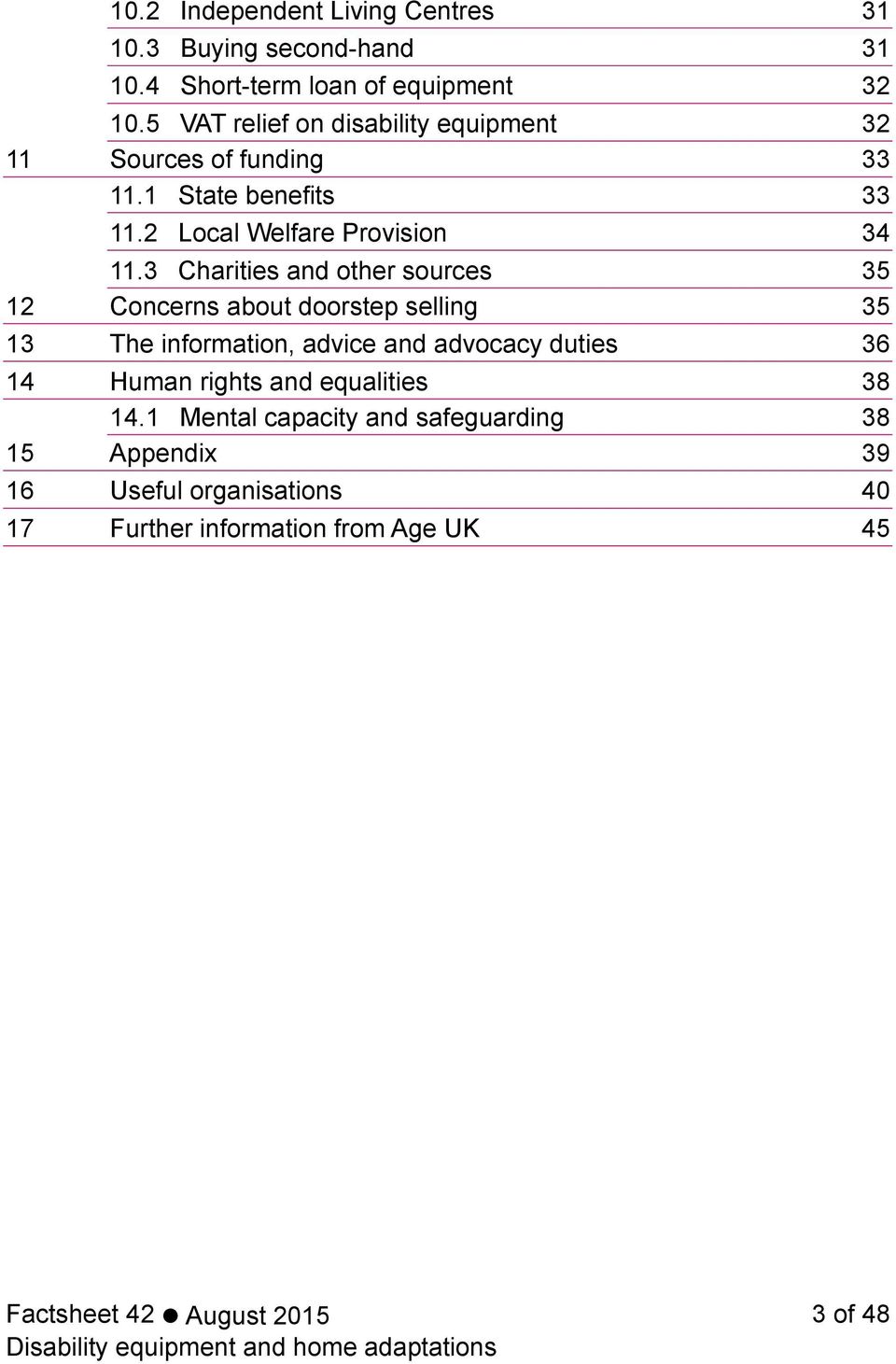
3 Independent Living Centres Buying second-hand Short-term loan of equipment VAT relief on disability equipment 32 Sources of funding State benefits Local Welfare Provision Charities and other sources 35 Concerns about doorstep selling 35 The information, advice and advocacy duties 36 Human rights and equalities Mental capacity and safeguarding 38 Appendix 39 Useful organisations 40 Further information from Age UK 45 Factsheet 42 August of 48
4 1 Recent developments The Care Act 2014 came into force on 1 st April 2015 along with a range of new supporting regulations and a single set of new statutory guidance, which, taken together, describe how the Act should be applied in practice. The aim of the change is to simplify and modernise the system, which had become untenably complex. It was also intended to introduce a new charging system in April 2016, but this has now been delayed until April This means that the existing system of adult social care of laws, regulations and guidance, developed over a period of 65 years, has generally been superseded and is now no longer applicable; except in a few cases, for example regarding the complaints regulations. Two examples of a significant new regulations relating to this factsheet are The Care and Support (Charging and Assessment of Resources) Regulations 2014, called the charging regulations in this text, and the Care and Support (Eligibility Criteria) Regulations 2014, called the eligibility regulations in this text. Another significant new document is the Care and Support Statutory Guidance 2014, which will be referred to as the statutory guidance in the text. When other relevant regulations are mentioned they will be cited in full in the text. Links to the main new documents supporting the Care Act 2014 have been placed in an Appendix in section 15. A list of repeals and revocations of existing legislation is provided in Annex 1 of the statutory guidance. These include: Chronically Sick and Disabled Persons Act 1970; National Health Service and Community Care Act 1990; The Community Care (Delayed Discharges etc.) Act (Qualifying Services) (England) Regulations The Care Act 2014 was actually intended to come into force in two stages, in April 2015 and April However, in July 2015, second part of the implementation was delayed until Some of the key changes being introduced in April 2015 are: Factsheet 42 August of 48

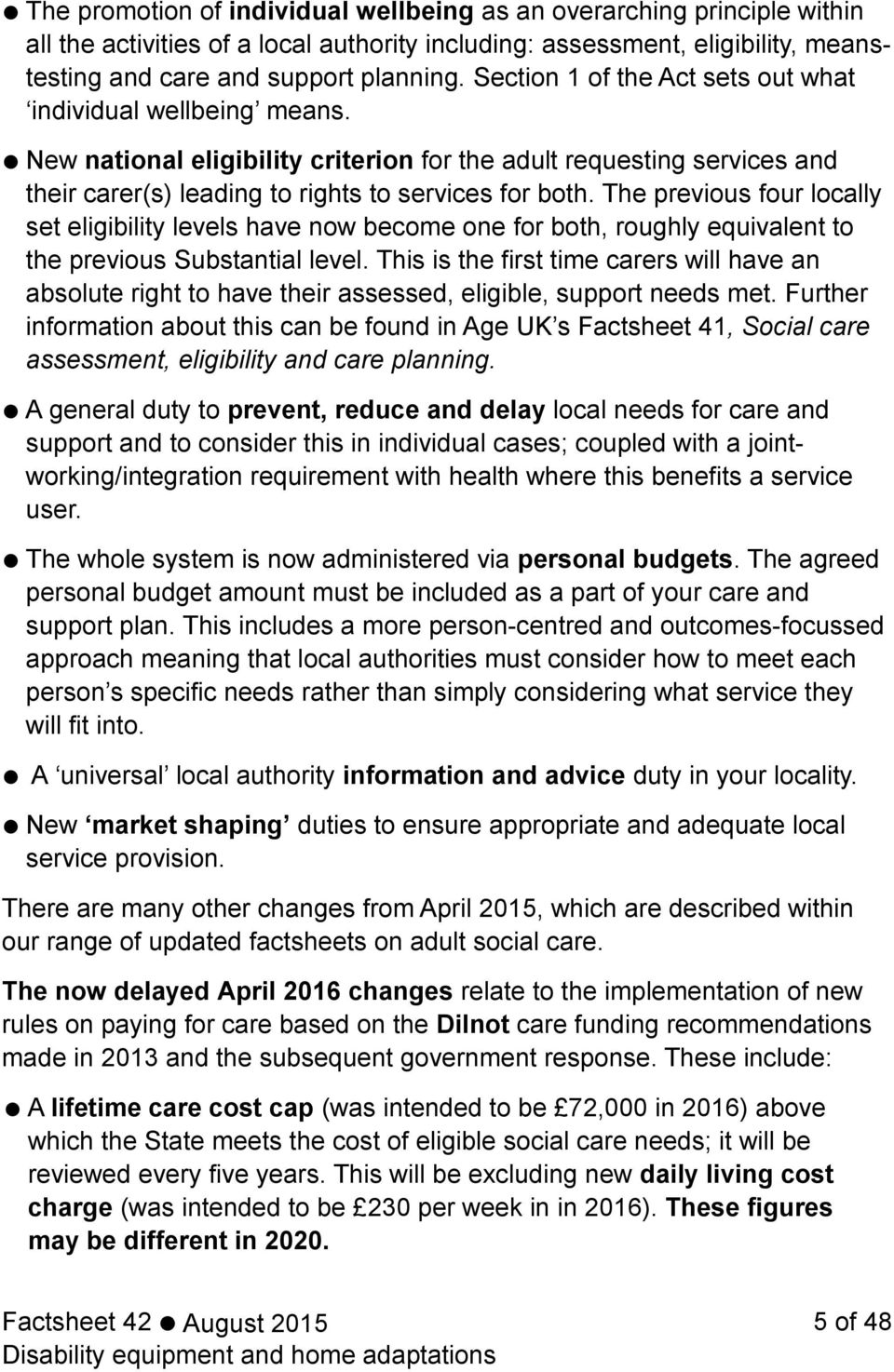
5 The promotion of individual wellbeing as an overarching principle within all the activities of a local authority including: assessment, eligibility, meanstesting and care and support planning. Section 1 of the Act sets out what individual wellbeing means. New national eligibility criterion for the adult requesting services and their carer(s) leading to rights to services for both. The previous four locally set eligibility levels have now become one for both, roughly equivalent to the previous Substantial level. This is the first time carers will have an absolute right to have their assessed, eligible, support needs met. Further information about this can be found in Age UK s Factsheet 41, Social care assessment, eligibility and care planning. A general duty to prevent, reduce and delay local needs for care and support and to consider this in individual cases; coupled with a jointworking/integration requirement with health where this benefits a service user. The whole system is now administered via personal budgets. The agreed personal budget amount must be included as a part of your care and support plan. This includes a more person-centred and outcomes-focussed approach meaning that local authorities must consider how to meet each person s specific needs rather than simply considering what service they will fit into. A universal local authority information and advice duty in your locality. New market shaping duties to ensure appropriate and adequate local service provision. There are many other changes from April 2015, which are described within our range of updated factsheets on adult social care. The now delayed April 2016 changes relate to the implementation of new rules on paying for care based on the Dilnot care funding recommendations made in 2013 and the subsequent government response. These include: A lifetime care cost cap (was intended to be 72,000 in 2016) above which the State meets the cost of eligible social care needs; it will be reviewed every five years. This will be excluding new daily living cost charge (was intended to be 230 per week in in 2016). These figures may be different in Factsheet 42 August of 48
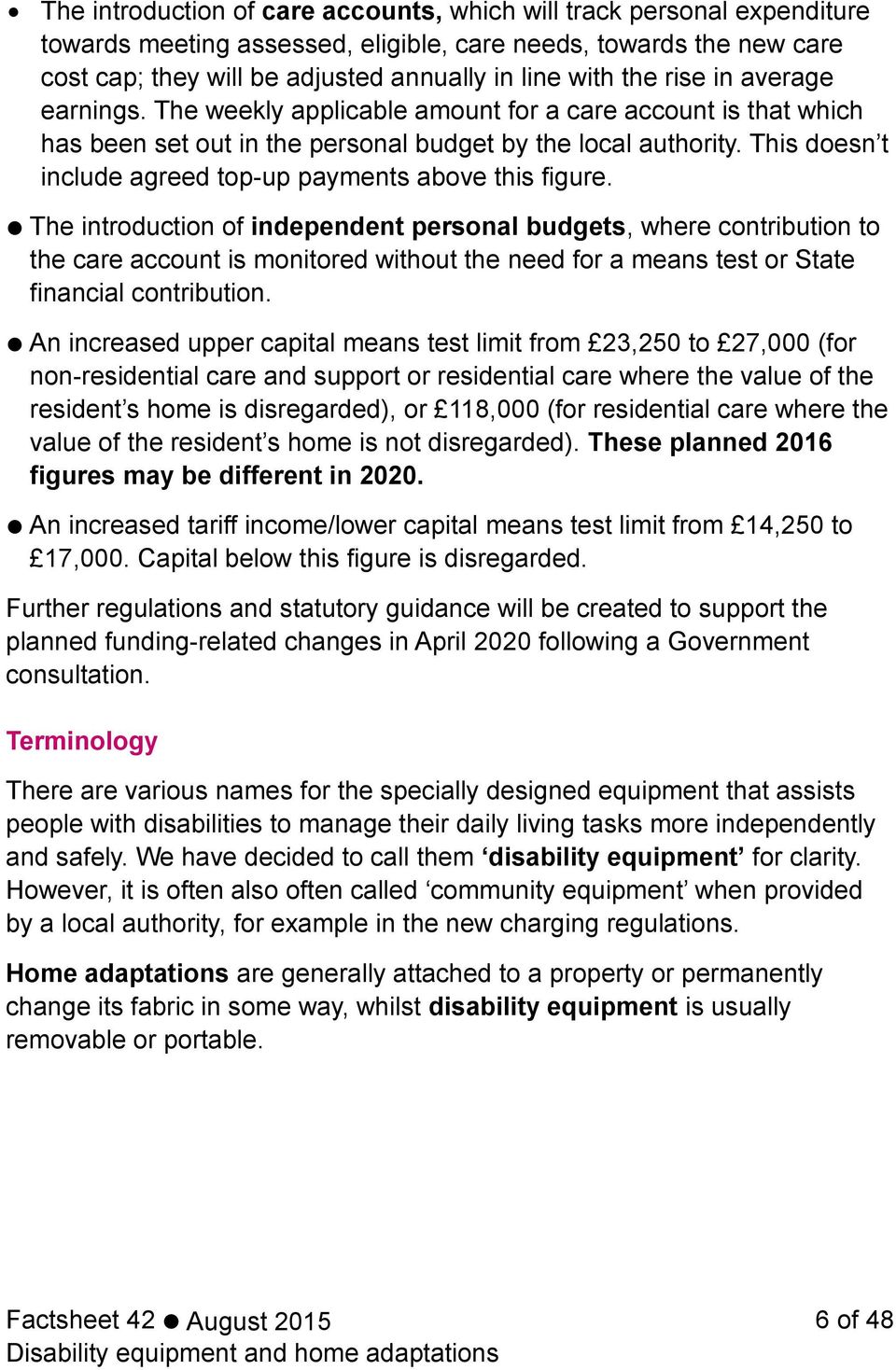
6 The introduction of care accounts, which will track personal expenditure towards meeting assessed, eligible, care needs, towards the new care cost cap; they will be adjusted annually in line with the rise in average earnings. The weekly applicable amount for a care account is that which has been set out in the personal budget by the local authority. This doesn t include agreed top-up payments above this figure. The introduction of independent personal budgets, where contribution to the care account is monitored without the need for a means test or State financial contribution. An increased upper capital means test limit from 23,250 to 27,000 (for non-residential care and support or residential care where the value of the resident s home is disregarded), or 118,000 (for residential care where the value of the resident s home is not disregarded). These planned 2016 figures may be different in An increased tariff income/lower capital means test limit from 14,250 to 17,000. Capital below this figure is disregarded. Further regulations and statutory guidance will be created to support the planned funding-related changes in April 2020 following a Government consultation. Terminology There are various names for the specially designed equipment that assists people with disabilities to manage their daily living tasks more independently and safely. We have decided to call them disability equipment for clarity. However, it is often also often called community equipment when provided by a local authority, for example in the new charging regulations. Home adaptations are generally attached to a property or permanently change its fabric in some way, whilst disability equipment is usually removable or portable. Factsheet 42 August of 48
7 The transitional system and eligibility In this factsheet we will describe the transitional system that is now in existence between April 2015 and April Government advice on how local authorities should manage the transition to the new system is set down in chapter 23 of the statutory guidance. Here, it states that the new national eligibility criteria is intended to allow for the same nationwide level of access to care and support to be maintained in adult social care in the vast majority of circumstances and cases. 2 Equipment provided by local authorities 2.1 Assessment for daily living equipment If you feel you need specialist disability equipment to help you manage more safely and easily around your home, you can contact the social services department of your local authority and ask for a needs assessment. You do not have to have a letter from your doctor supporting your needs but this can sometimes speed up the process. Your local authority will usually arrange for you to have an assessment in your home by a social worker or an occupational therapist (OT). A local authority OT will typically take a lead in a case where the main element is a need for disability equipment or a home adaptation. Certain types of equipment may also be provided via health professionals such physiotherapists and nurses (see section 2.4). Disability equipment and home adaptations are often provided alongside other services such as packages of home care support. Examples of disability equipment include: products for personal care and hygiene maintenance to assist in using the bath or toilet such as grab rails, bath boards and raised toilet seats; products for food preparation, for example lever taps, adapted kitchen utensils; and products to help with the use of beds and chairs, for example bed raisers and rising/reclining chairs and hoists. The Disabled Living Foundation provides extensive information on disability equipment (see section 16). Factsheet 42 August of 48
8 Under the Care Act 2014, your local authority has a duty to meet your needs once they have been assessed as eligible needs. It also has discretion to meet assessed needs in certain circumstances. Eligibility, within the new system, requires there to be a significant impact on your wellbeing as a result of not being able to achieve a number of Outcomes listed in the eligibility regulations - or having excessive difficulty. Section 9 requires a local authority to assess anyone who appears to have needs for care and support. Your assessed needs should be set down in an agreed care and support plan with recommendations to meet them, alongside other elements such as your personal budget amount. This is the amount the local authority considers is necessary to meet your eligible needs and your assessed contribution to this following your means test. The same eligibility principles apply to carers to meet their support needs, based on a slightly different eligibility criterion. If you have a carer their views can be included in your needs assessment. An example of a typical assessment recommendation could be where someone needs to be hoisted from a bed to a chair in their home as part of a care and support package to manage their dressing, hygiene and domestic needs. The recommended hoisting equipment, its use by properly trained home care staff and its on-going maintenance are part of the local authority duty to meet the assessed eligible needs in this case. Services to meet needs could also include minor or major home adaptations which are discussed later in this factsheet. In section 15 of the statutory guidance the following comment is made: Community equipment, along with telecare, aids and adaptations can support reablement, promote independence contributing to preventing the needs for care and support. More information about your right to an assessment and services can be found in Age UK s Factsheet 41, Social care assessment, eligibility and care planning. Factsheet 42 August of 48
9 2.2 Disability equipment and minor adaptations Under section 14 of the Care Act 2014, local authorities have a general power to charge for services. However, they are prohibited from charging for the provision of all types of disability equipment and minor adaptations. This charging prohibition is set down in Part 2 of the charging regulations. At section 3, it confirms that this relates to a service which consists of the provision of community equipment (aids and minor adaptations), which is then further described as an aid, or a minor adaptation to property, for the purpose of assisting with nursing at home or aiding daily living and an adaptation in this context is minor if the cost of making the adaptation is 1,000 or less. Larger, more expensive items may be classed as major adaptations (see section 3). Examples of these could be stairlifts and level access showers. They are financed via means tested Disabled Facilities Grants, which are managed by the local authority housing department. However, the initial assessment is usually carried out by a local authority occupational therapist (OT) as their recommendation for the specific adaptation is required. In practice, joint working between the two departments takes place throughout the process. This is further discussed in section 3. The work should be finished within 15 days of the day that someone was referred to the programme. 2.3 Equipment to meet health-related needs Some items of equipment, such as a commode or a walking aid, could meet both health and domestic daily living needs. Your GP, or a district nurse, may arrange for you to receive these items or they could suggest you approach social services for a broader assessment of your needs. In each locality, community equipment stores are usually jointly run by the NHS and the local authority. Factsheet 42 August of 48

10 Assistive mobility equipment may be provided following an assessment by a physiotherapist who will be able to recommend the most appropriate aid, and will ensure that you know how to use it safely. Other professionals, for example within the local falls prevention service, may also be trained and able to recommend equipment. The Disabled Living Foundation produces a factsheet called Choosing walking equipment (see section 16 for contact details). If you have hearing problems and might benefit from a hearing aid, contact your GP who may refer you to your local hospital for a hearing test. You have a right to have your hearing assessed, particularly if you think your hearing loss is becoming a problem. The NHS issues hearing aids on free loan to patients. Low vision aids may be able to help with particular sight problems. You can mainly find low vision services in hospital eye departments. They can make magnifiers and other low vision aids available on loan. Your local social services department may provide a range of support services or employ specialist social workers to help people with sight or hearing loss. For further information about help available to those with a hearing or visual impairment see section 9. Some items such as wigs or fabric supports (including spinal or abdominal supports) may be issued on an NHS prescription for which there is a specified charge. If you receive the Guarantee Credit part of Pension Credit, you will not have to pay for such items. If you are on a low income, you may qualify for help with these charges under the NHS Low Income Scheme. Ask for a copy of the NHS leaflet HC11 Help with health costs at your local post office or see Age UK s Factsheet 61, Help with health costs. Factsheet 42 August of 48
11 2.4 The retail model of community equipment The Government has introduced a retail model for the provision of simple pieces of community disability equipment in England. The aim of its Transforming Community Equipment and Wheelchair Services Programme is a model of service delivery that allows more choice and control over this type of equipment provision for service users and their carers. This is an example of the type of equipment intended to be included in the programme, from Tower Hamlets Community Equipment Service: Simple aids to daily living support people to maintain their independence in mobility, toileting, bathing, cooking, dressing, reaching, eating etc. Many of these items cost less than 30 and include items such as: kettle tippers, shower stools, reachers, adapted cutlery and raised toilet seats. The Government is developing prevention and personalisation agendas across a range of social care and health services. It sees the retail model as empowering service users and encouraging increased innovation in equipment provision to both state-provided service users and self-funders. The Programme began in April 2008 but it was not mandatory for local authorities and their health partners. Each authority can decide whether it is the best way to move forward with regard to equipment provision. You can check whether this option is available in your area. The model involves state bodies (such as local authorities and the NHS) issuing service users, where there is an assessed need for equipment, with a prescription that can be exchanged for free equipment at an accredited retailer. This means that the service user will own the equipment. Home delivery and fitting are also funded if they are part of the identified need. Complex equipment requiring regular servicing and maintenance, such as hoists and electric beds, are be delivered and fitted in the traditional manner, on loan. Bespoke, one-off equipment is also be kept within the existing loan arrangements. It covers equipment provided as part of the hospital discharge process and local authority community services. Hospital discharge may require the loan of equipment from a local stock with replenishment from an accredited retailer. Factsheet 42 August of 48
12 The model aims at improvements in access to information including a webbased information portal that will also provide a self-assessment tool. It covers adults and carers who currently receive state-provided community equipment. It provides a service to individuals who choose not to access state-provided community equipment services and those who are ineligible for local authority service provision. There are also individuals who are entitled to free equipment provision by the state who wish to access products not provided by local authorities. The prescription enables eligible service users and their carers to obtain equipment. It doesn t affect entitlement to receive equipment free of charge under the local authority eligibility criteria. Descriptions for the basic equipment list have been provided in a national catalogue containing a tariff price. If the service user wishes to obtain an alternative piece of equipment not on the national catalogue, they will have the opportunity to top-up the prescription. The state would fund the desired equipment up to a certain level with the service user making up the rest of the cost. The Government intends to broaden sources of supply of community equipment. It is working towards the development of a network of accredited retailers with staff trained to a minimum competency level for this purpose. It envisages private and third-sector organisations currently involved in providing these types of services, such as Disabled Living Centres and local Age UKs, taking a fuller role in this area. The model includes the independent needs assessors who assess equipment needs and make recommendations, and who can also provide other related services, such as additional therapeutic interventions and advice. These are appropriately qualified professionals such as occupational therapists and physiotherapists. They carry out assessments with individuals who either choose not to or are ineligible to access state provision. The Government would like to see these professionals also linking with other service providers, such as third-sector organisations, to meet the range of needs identified in the assessment. Factsheet 42 August of 48
13 3 Home adaptations 3.1 The Disabled Facilities Grant You may choose to fund meeting your own need for a home adaptation if you are having difficulties managing at home. However, the Government provides means tested assistance in certain circumstances via a Disabled Facilities Grant (DFG). DFGs are available to provide facilities and adaptations to help a people live as independently and safely as possible, and often also to assist carers in their duties. The provisions of mandatory DFGs are set out in the Housing Grants, Construction and Regeneration Act 1996, which was amended by the Regulatory Reform (Housing Assistance)(England and Wales) Order 2002 and the Housing Act This Act has not been affected by the introduction of the Care Act Who is eligible? In order to qualify you must be disabled under the terms of the Housing Grants, Construction and Regeneration Act 1996, which qualifies a person as being disabled if: their sight, hearing or speech is substantially impaired; they have a mental disorder or impairment of any kind; they are physically substantially disabled by illness, injury, impairment present since birth; or otherwise they are registered disabled (or could be registered) with the social services department under the terms of the National Assistance Act 1948 or the Children Act You can apply for a DFG whether you are a homeowner or the tenant of the property. Certain licensees or occupiers of houseboats or park homes can also apply. You do not have to be the disabled person for whom the works are required. For example a landlord, can apply to have the property adapted for a disabled tenant. Factsheet 42 August of 48
14 The applicant will have to provide the council with a certificate stating that the disabled occupant will live in the property for at least five years after the works are completed or for a shorter period if there are health or other special reasons. This may be difficult for private tenants as most of them will have assured-shorthold tenancies with security of tenure for only the first six months of tenancy. Local authority tenants and tenants of registered providers of social housing are eligible to apply for a DFG and are assessed based on their needs on the same basis as private tenants and owner-occupiers. However, in these circumstances, the local authority or housing association will decide whether to carry out the work using its own resources for capital works or to refer the applicant for DFG. 3.3 What types of works are covered? DFG is a mandatory grant in specific circumstances, which means you have an absolute right to it. It must be provided if you are disabled and do not have access to your home and to the basic amenities within it, provided that you qualify on income grounds. Your local authority will also have to agree that the work is reasonable and that it is possible to carry it out. You must also meet he the social care eligibility criteria. Examples of the types of work covered by a mandatory grant include: making it easier for you to get into and out of your home (eg, by widening the doors and installing ramps); making access easier to the living room, bedroom, kitchen and bathroom (eg, by installing a stair lift or providing a downstairs bathroom); providing suitable bathroom and kitchen facilities that you can use independently; making your home safe for you and people living with you (eg, by providing a specially adapted room where it is safe to leave a disabled person unattended or improve lighting to ensure better visibility); adapting heating or lighting controls to make them easier for you to use; improving the heating system in your home to make it suitable for the needs of the disabled person; Factsheet 42 August of 48
15 improving access to a garden by making it easier or safer. Note: A DFG can potentially also be provided for adaptations to common parts of a building containing one or more flats. See Age UK s Information Guide, Adapting your home for more information. 3.4 Discretionary assistance Local authorities have powers to give discretionary assistance for adaptations or to help you move to alternative accommodation. There is no restriction on the amount of assistance that may be given. It may be paid in addition, or as an alternative to, the grant. It may be given for example to: provide small adaptations that are not covered by the grant or to deliver remedies for urgent adaptations more quickly; top up the grant because the work is particularly expensive or the applicant cannot afford the contribution, or some work required is not eligible for the grant; assist the disabled person to move to a more suitable property where it is more cost effective than adapting their current home to make it suitable for his/her needs, even though the new property may need some adaptations. 3.5 Applying for a Disabled Facilities Grant A DFG is available from the housing department of the local council. You can approach either the local housing department or the local social services department at your council about applying for DFG. Whilst the formal application must be made to the housing department, in many cases you may be advised to make your first approach to the social services department. You can also ask your local home improvement agency (HIA) to assist you with the application. Factsheet 42 August of 48
16 Although the housing department has the responsibility for deciding whether you will get a grant, it must consult with the social services department to decide what adaptations are necessary and appropriate. This will normally mean that you will receive a visit from an occupational therapist from social services. An occupational therapist is someone trained to assess the special needs of people with disabilities. They will assess your needs and make recommendations on what work needs to be done. The housing department must be satisfied that the works are reasonable and practical in relation to the age and condition of the property. This assessment is usually done by an environmental health officer, a building surveyor from the council or possibly someone from a home improvement agency (HIA) jointly with the occupational therapist who visited your home to carry out the needs assessment. Note: You will not normally get any DFG if you start work on your property before the council approves your application. 3.6 The means test The DFG is means tested (unless granted for disabled children). In its assessment the council will only take into account the disabled person s income and savings and that of their partner. This applies even if the disabled person is not the applicant (eg, where the application was made by the owner of the house where the disabled person lives). This means that if you are, for example, a single, disabled person living with your grown-up daughter in the home that she owns: only your income and not hers should be included in the means-test calculation. The means test for a DFG will take into account the average weekly income of the relevant people. Certain disability benefits and savings below 6,000 will be ignored; for savings above 6,000, an assumed weekly tariff income is taken into account which is set against an assessment of basic needs recognised by a range of premiums and allowances. If the disabled person s resources are less than this assessment, then they will not normally be expected to contribute to the costs of the works. If the resources are more than the allowances, they may only get a part of the grant, or none at all. Factsheet 42 August of 48
17 If a disabled person receives the following benefits they will not normally have to make a contribution unless there are others being assessed who are not receiving such benefits: the Guarantee Credit part of Pension Credit; Income Support; income-related Employment and Support Allowance; income-based Jobseeker s Allowance; Housing Benefit; Council Tax Benefit (for applications approved before 1 April 2013) or Council Tax Reduction/Support; Working Tax Credit or Child Tax Credit with gross taxable income of less than 15,050. Note: At the time of writing the government has not yet stated how the test of resources will be amended to take account of Universal Credit. A step-by-step guide on how to work out your contribution is included in the Disability Rights Handbook published by the Disability Alliance or you can contact the council or other agency such as a local Age UK or HIA to get further information (see contact details in section 16). The maximum amount for a mandatory DFG in England is 30, Property charge In England, a local authority has discretion to impose a maximum charge of 10,000 on a property that has been adapted with a DFG if it is sold within 10 years. However, this applies only to adaptations where the cost of the DFG exceeds 5,000. In England a charge should only be imposed after taking into account individual circumstances on a case-by-case basis. Factsheet 42 August of 48

18 3.8 Problems and complaints There can be lengthy delays in applying for DFG, often because there is a long waiting list for assessment by an occupational therapist. However, as you do have certain rights to assistance, you should not have to wait an unreasonable amount of time. The law says that you should not have to wait more than six months after you make a formal application for DFG to hear whether you will get one. The decision must be made in writing and specify the works that are eligible for a grant and the amount of grant to be paid. If your application is refused, you must be told why. If you do not get a decision within six months of applying, you can make a written complaint to the local authority and request they make a decision. If you still do not get a decision, seek further advice or make a complaint to the relevant Ombudsman Local authority decision-making can also be challenged in courts by judicial review proceedings. Take further advice about how to follow this course of action. For more information see Age UK s Factsheet 43, Getting legal advice. If you are eligible for DFG, the housing department cannot refuse to pay on the grounds that it has not got sufficient money. The law also says that you should not have to wait more than 12 months from the date that you apply for a grant until the money is paid. The Government has said that payment should only be delayed in exceptional circumstances. 3.9 Home improvement agencies (HIA) Home improvement agencies, sometimes called Care & Repair or Staying Put, are not-for-profit organisations managed locally by housing associations, councils or charities. They provide support for vulnerable homeowners and for people living in private rented accommodation to help them undertake adaptations, repairs and improvements to their home. Their service will include guidance on how to get financial support to undertake the work, help in accessing that financial support, technical support in planning the work and ensuring that the work is undertaken by accredited trade persons. Most HIAs provide a range of housing-based services for vulnerable people that will enable them to retain independence in their own home. These may include a handyperson service, gardening and decorating services, safety and security improvement, and improved energy efficiency measures. Factsheet 42 August of 48

19 Even if you can afford to pay for the work yourself, you can take a lot of the worry out of organising it by using an agency service. To find out if there is one in your area, in England contact: your local Age UK; your local council s housing department; or foundations the national co-ordinating body for HIAs (see section 16 for contact details). You can also locate your nearest HIA on the Elderly Accommodation Counsel website at HIAs and the Care Act 2014 integration and cooperation policies Section 15 of the Care Act 2014 statutory guidance, entitled Integration, cooperation and partnerships, mentions HIAs playing a role in integration between the local authority and health-related services. It states that: Delivery or provision of care and support that is integrated with an assessment of the home, including general upkeep or scope for aids and adaptations, community equipment or other modifications could reduce the risk to health, help maintain independence or support reablement or recovery. For example, some specialist housing associations and home improvement agencies may offer a support service which could form part of a jointly agreed support plan. A housing assessment should form part of any assessment process, in terms of suitability, access, safety, repair, heating and lighting (e.g. efficiency) DFGs and private tenants If you are a private tenant you may be able to get a Disabled Facilities Grant. You will have to get the agreement of your landlord to any adaptations that affect the structure of the dwelling. This can sometimes be difficult if landlords are unwilling for major changes to be carried out to their property. If you are a regulated tenant your landlord cannot unreasonably refuse this permission, based on the requirements in the Equality Act When applying for a grant, you also have to state that you are going to live in your home for the next five years, which can sometimes be a problem for short-term tenancies. Factsheet 42 August of 48

20 4 Wheelchairs If you have long-term mobility problems, use of a wheelchair could help you to maintain your independence and interaction with the wider community. Your GP, hospital consultant or social services staff can refer you to your local NHS wheelchair centre for an assessment of your medical and lifestyle needs and, if you are eligible, help you to choose a suitable chair. Each centre has its own eligibility criteria. The NHS provides wheelchairs on free, long-term loan: they are usually standard models and there is not always great choice. Wheelchairs are either self-propelling or electrically powered with various control designs. If you are assessed as requiring one, the NHS can provide an electrically powered wheelchair suitable for indoor/outdoor use. This means that if you need an electric wheelchair indoors, the model provided may also allow outdoor use. Any wheelchair provided officially belongs to the NHS and is lent to you for as long as required. The NHS will pay for servicing and repairs so long as these are not needed because of misuse or neglect. The wheelchair voucher scheme You may be offered wheelchair vouchers if you are assessed as needing a manual wheelchair, if the wheelchair department is running the voucher scheme. The voucher is worth the value of a standard chair and can be put towards the purchase of a more expensive wheelchair. You may not be able to use the voucher scheme to get a powered wheelchair. Standard option: You are provided with a wheelchair that will be supplied, repaired and maintained free of charge. Partnership option: You choose an alternative to the type of wheelchair you are assessed as needing. The voucher reflects the value of the wheelchair originally recommended and you then pay the difference in cost. This lets you to buy a higher standard wheelchair. The wheelchair will be repaired and maintained free of charge. You do have to use an approved supplier who has to meet certain standards including quality of service. Independent option: This is similar to the partnership option but you own the wheelchair and are responsible for its repair and maintenance although your voucher will include an amount towards repair and maintenance costs. Factsheet 42 August of 48
21 Other things you need to know: The voucher period is generally five years and you will not normally be entitled to a new voucher until it has expired. However, if your needs change so that the wheelchair you bought becomes unsuitable, you will be eligible for a reassessment of your needs. You cannot exchange the voucher for cash and if you buy a wheelchair privately from a commercial company or individual, you cannot 'claim back' the money from the NHS Wheelchair Service. The voucher is non-taxable so it does not affect any disability benefits. The Motability scheme If you receive the higher rate mobility component of Disability Living Allowance, the enhanced rate of the mobility component of the Personal Independence Payment (PIP) or War Pensioner s Mobility Supplement and you need an outdoor electric wheelchair, scooter or a car you can use the Motability scheme to pay for it. Contact Motability for more information (see section 16). For more information about these benefits see Age UK s Factsheet 87, Personal Independence Payments and Disability Living Allowance. Outdoor electric scooters and buggies Note: The NHS and social services do not directly provide outdoor electric mobility scooters or buggies. A good source of information on these products is the Disabled Living Foundation (see section 16) website: It is important to trial this type of equipment before use. A reputable company will belong to a trade association that guarantees a good level of customer service, assessment and commitment to safe practices. You also need to be aware of government regulations for scooter use on the pavement or road. Issues of storage, charging and maintenance are also central to a planned purchase and ongoing use. Factsheet 42 August of 48
22 Charitable funding It may be possible to get charitable help to purchase a wheelchair. You can discuss this with staff at the local wheelchair department who should have information on bodies that provide funding and may also assist in making an application. The following website may be useful in finding out about funding: If you need a wheelchair temporarily you may be able to hire or borrow one on short-term loan from the British Red Cross or another voluntary organisation (see section 16). Wheelchairs are not included in the retail model for community equipment provision described in section Community alarms and assistive technology 5.1 Community alarms Community alarm systems allow you to be linked up 24 hours a day to a central service that can offer help in an emergency. The link is usually either by telephone, pull cord, a pendant that you wear round your neck, or a combination of these. If you need to summon help urgently and are unable to make a normal telephone call then you can use the pendant, pull the cord or use a special button on the telephone to contact a control centre. This centre is staffed by people who can talk to you, find out what you need and summon help as appropriate. In an emergency, the alarm operator gets in touch with the people you have agreed should be contacted in such circumstances, such as neighbours or relatives living nearby. They will have a set of keys to your home. The alarm operator also contacts the appropriate emergency service. Your local council may provide you with an alarm service. Each council has different rules about who they will supply, how they run the service and how much they charge. Contact your local social services department or housing department for details about the schemes available locally. Factsheet 42 August of 48
23 Your local Age UK may also have information about what is available in your area. Their address and telephone number should be in your local telephone directory, or you can call the Age UK Advice (see section 17). The Research Institute for Consumer Affairs (Rica) can provide information on alarms and publishes Calling for help: a guide to community alarms (see section 11.3). The Disabled Living Foundation produces a factsheet Personal alarm systems and telecare (see section 16). Community alarms are one example of a wide range of assistive technology that is available, often also called Telecare. The Government has confirmed the importance of technology within its preventive agenda, which is set out in the Care Act 2014 and its supporting statutory guidance. 5.2 Telecare Technological developments are continually offering new ways to provide support to those who need it. One of the main examples of this is Telecare which allows remote monitoring and communication with isolated people in their own homes to help them manage risk and to promote independent living, and wellbeing. This could be for short or longer periods of time during a day and. GPS-type equipment has also been developed to monitor someone outside of their own home in their local area. Telecare covers a wide range of equipment (detectors, monitors, alarms, pendants etc) and services (monitoring, call centres and response teams who may work alongside emergency services).items include: a fall detector epilepsy sensor chair and occupancy sensor flood detector gas leak valve shut-off sensor and a property exit sensor. In essence there are three types of telecare systems, parts of which may be used together: 1) Systems that help predict problems: These systems depend on software that takes signals from sensors and analyses the frequency and severity of monitored events, such as minor falls and alert carers to visit the person to find out what has changed. Factsheet 42 August of 48
24 2) Systems that reduce the chance of problems occurring: For example, a bed sensor can help prevent falls by activating a light when someone gets out of bed. This helps because the person does not need to reach for the light switch or move around in the dark. 3) Systems that mitigate harm: These devices, such as pendant alarms, heat sensors, smoke detectors or bed sensors - again - send alerts to a call centre after a pre-determined event so that help can arrive quickly. The bed sensor, for example, can raise an alarm if the person does not return to bed within a predetermined time. An alternative approach is contained in the Alertacall Safety Confirmation system where, if a person fails to press a button by a certain time each day to confirm that they are OK, then an alert is raised. By getting help quickly, problems do not escalate. 5.3 Telehealth Telehealth is the remote monitoring of a patient s vital signs in chronic condition management (eg blood pressure, glucose level and heart and lung function). For example, the correct daily dose of tablets can be pre-set and monitored. It can assist with diagnosis, review assessment and prevention. However, this must be in conjunction with suitably qualified clinicians as part of an agreed health care pathway. The aims of Telehealth s include: improving quality of life wellbeing, increasing safety and independence; reducing unplanned hospital admissions and emergency ambulance call outs; reducing pressure on GPs and nurses; management of long-term conditions; improving carer s quality of life; and reducing public costs. However, it is important to remember that technology cannot generally substitute for human interaction and support, and should never be inappropriately used as a replacement for this. 5.4 Environmental Control Systems Environmental Control Systems help to maintain and improve the independence and security of people with a severe physical disability who have poor manual dexterity. The ability to control everyday equipment such as the phone, TV and lighting is provided via a central control unit and a single switch. It can also be used to control access into the home and summon emergency help. Factsheet 42 August of 48
25 To obtain this equipment you should be assessed at home by a specialist Occupational Therapist (OT) at a local Environmental Control System service. An example of one of these services is: Assistive Technology Service Queen Mary s Hospital Roehampton Lane, London SW15 5PN Tel: / The equipment is carefully tailored for each individual taking into account their goals. Following installation of a system an engineer will provide training in its use. Maintenance and regular servicing are provided by the assistive technology provider. Reviews, on-going support and advice are provided by the Occupational Therapist to clients, carers and healthcare professionals. Environmental Control Systems are provided by the NHS on a long term loan basis and there is no charge to the client for standard equipment. Arrangements are also put in place for maintenance and emergency response. If new appliances are purchased e.g. TV, music system etc clients should contact the environmental control system provider who will arrange a visit to programme them into the system. The Assistive Technology Service does not fund the following items: additional phone lines; additional power sockets; window, curtain and door operators; door locks; electrical or carpentry work. The local Social Services Occupational Therapy Service should be contacted to enquire about the funding of these items. Factsheet 42 August of 48
26 Referrals to the specialist OT are normally received from Social Services or Health OTs working in the community. Referrals may be received from other professionals, family or carers following discussion with the Assistive Technology Service. A wide variety of switches are used to operate the systems including those controlled by hand, head or chin. The switch initiates a scanning process of displayed functions until the desired function is reached when it is again operated. Switches and the control unit can be mounted in a convenient position usually on a wheelchair or bed. Following the installation of an Environmental Control System the company engineer will train the client in its use. Ongoing support and advice should be given by the service and reviews carried out as necessary. 6 The Care Act 2014 prevention duty Section 2 of the Care Act 2014 is entitled Preventing needs for care and support. This section sets out local authority duties to prevent, reduce and delay needs for care and support in its area, based on the overarching wellbeing principle; via the provision of services, facilities, and resources. Section 2 of the statutory guidance further fleshes out this duty, setting out the benefits of different types of preventive interventions. With regard to equipment and adaptations, the following statement is made in the statutory guidance: Early intervention could also include a fall prevention clinic, adaptions to housing to improve accessibility or provide greater assistance, handyman services, short term provision of wheelchairs or telecare services. In order to identify those individuals most likely to benefit from such targeted services, local authorities may undertake screening or case finding, for instance to identify individuals at risk of developing specific health conditions or experiencing certain events (such as strokes, or falls), or those that have needs for care and support which are not currently met by the local authority. Targeted interventions should also include approaches to identifying carers, including those who are taking on new caring responsibilities. Carers can also benefit from support to help them develop the knowledge and skills to care effectively and look after their own health and wellbeing. Factsheet 42 August of 48
27 What is your local authority doing to meet its new prevention duties? 7 Equipment for employment The Access to Work scheme may fund equipment needed for work. You may be able to apply for a grant if you have a disability, health or mental health condition. The money you get can pay for things like: specialist equipment; travel when you can t use public transport; a communicator at a job interview. Contact the disability employment adviser at your local Jobcentre Plus for advice and assistance. 8 Things to consider when choosing equipment Always try to get independent or professional advice in choosing equipment, particularly if it is a large, expensive item. Occupational therapists or physiotherapists from a hospital, social services department or employed by a Disabled Living Centre (see section 16) should be able to advise you on equipment that is suitable for your needs and on what is available. You may also want to consider the following points when choosing equipment for yourself: Make sure that any products you buy comply with the necessary British Standards. Equipment that has been tested and approved by the British Standards Institute (BSI) will be marked with the BSI Kitemark. Check out how comfortable the equipment is and that it is easy for you to use. Where possible, try it out beforehand. If you are purchasing expensive equipment to help with bathing or toileting, you may want to ask for a trial of the product in your own home so that you can try it out properly. Make sure that it can be used in the environment in which you want to use it. Factsheet 42 August of 48
28 Make sure that the equipment is in good condition and that it is suitable for the task you require it for. Check that it is easy for you to use without help, and that appropriate and clear instructions for use or training in use are provided. If you need to transport the equipment, for example a wheelchair or other walking aid, consider how easy this will be. Does it fold up or come apart? Is it easy to do this? Will it fit in your car? Consider whether there is enough space to store it in your home. Check about repair and maintenance of the equipment. Will it be possible to find spare parts and someone to repair the equipment if necessary? Does the equipment need to be serviced regularly and if so, how much will this cost? What sort of after-sales service does the company you are buying from provide? Does the equipment come with a guarantee? Check the company policy on returning equipment if you don t need it any more for example your needs change or you have to move to a care home. Some companies have a buy-back guarantee scheme but check the details for example, how much money you receive if you return the item. Consider getting insurance to cover accidents and breakdown repairs for larger items such as electric scooters or power chairs. 9 Problems with equipment 9.1 Problems getting equipment It can be difficult to get the equipment you think you need from social services or the health service. There will be eligibility criteria and there can also be long waiting times for an OT assessment. Factsheet 42 August of 48
29 There is no legal time-limit within which disability equipment must be provided but you should not have to wait longer than is reasonable and excessive delays can be challenged; high risk needs must be dealt with promptly. There should be no reason for delay regarding the vast majority of standard pieces of equipment as they are stored in a local community equipment store. The local authority OT department should have procedures for appropriate prioritisation and risk assessment, and for arranging prompt equipment delivery in each particular case following a needs assessment. 9.2 Complaints Arrangements for complaints handling in adult social care services are covered in the Local Authority Social Services and NHS Complaints Regulations Each local authority social services department is required by law to have a complaints procedure that you can use to complain about the service or the assessment of your needs. You can also approach the Local Government Ombudsman, generally only after you have exhausted the local complaints procedure. Further details of these procedures are included in Age UK s Factsheet 41, Social care assessment, eligibility and care planning. If you have a complaint about a service that you have accessed through an NHS hospital you can contact their local Patient Advocacy and Liaison Service (PALS). They will try to help you resolve the problem informally. If they can t, they can give you information about the NHS complaints procedure and the local NHS Complaints Advocacy Service, which can help you make your complaint. Your local Healthwatch also exists to provide information and advice about complaints and problems within health and social care services, and to listen to the experiences of service users. See Age UK s Factsheet 59, How to resolve problems and make a complaint about social care and Age UK s Factsheet 66, How to resolve problems and make a complaint about the NHS for more information. See section 2.4 for developments related to the planned introduction of a retail model for community equipment. This should offer more support and advice for anyone arranging and funding equipment provision independently. Factsheet 42 August of 48
30 9.3 Problems with equipment that you have purchased If you are not happy with the equipment you have purchased, get in touch with the supplier as soon as possible. They may be able to arrange an exchange or replacement. If equipment is faulty it should be repaired or replaced, or you should get a refund. You do not have to accept a credit note. You may want to complain first verbally to the store manager. If you are not happy with the outcome you should put it in writing. You may also decide to report the seller, with details of your complaint, to the Trading Standards service at your local council. They can investigate false or misleading claims about services or products and advise on consumer problems. The Citizens Advice Consumer Service (CACS) may also be able to advise you about your rights. If the supplier of your equipment is a member of the British Healthcare Trades Association (BHTA and you are not happy with its service you can complain to the BHTA. A list of member firms is also available. The Disabled Living Foundation has a factsheet Making a complaint. For contact details of all these organisations see section Buying and borrowing equipment 10.1 Private companies, shops and the voluntary sector Private companies that sell disability equipment may have mail order catalogues or shops and showrooms. Look in your local Yellow Pages to see what is available in your area. Some large high street chemists stock smaller items of daily living equipment. They may also have their own mail order catalogues. See section 2.4 for developments related to the retail model for community equipment. This offers more support and advice for those arranging and funding equipment provision independently. Factsheet 42 August of 48
31 Various voluntary organisations, such as Age UK, now sell a range of specialist equipment. Age UK sells products such as walk-in showers, incontinence pads and riser-recliner chairs. See the following link to these products: New ways of finding equipment such as the Disabled Living Foundation s AskSARA website portal provide a free online, guided self-assessment, tool. It contains more than 1,300 links to product suggestions, useful help and advice and case studies. You can find this site at: Asksara.dlf.org.uk. It s important to be aware that you have a right to assessment, advice and possible free equipment provision by your local authority and health services. Some pieced of equipment may require training for safe use, for example a hoist, so seek advice if you are unsure how to proceed Independent Living Centres There is a network of independent living centres throughout the country. An example of this is East Cheshire Independent Living Centre. Its website states that it provides Advice, information and a permanent exhibition of a wide range of equipment for people with disabilities. Visitors can try out the equipment and obtain advice and assessment from an occupational therapist or social care assessor. It can be difficult to know if a piece of equipment or a planned adaptation is safe or suitable without actually trying it out, for example manoeuvring a wheelchair in a small space. A trip to one of these centres can make someone fully understand the reality of using some equipment prior to purchase, how their carer may cope if they have one, and can reduce anxiety Buying second-hand You may also be able to buy equipment second-hand. This is advertised in a number of places, including: Disability now, a newspaper published by Scope (see section 11.1); the Disability Equipment Register, which produces a national magazine which lists second-hand equipment both for sale and wanted (see section 11.1); Factsheet 42 August of 48
32 a factsheet from the Disabled Living Foundation listing journals that carry advertisements for second-hand equipment (see section 11.1); your local paper Short-term loan of equipment Your local Red Cross can often loan wheelchairs and other equipment for short periods, for example for the visit of a relative or a temporary injury. It should be listed in the local telephone directory (usually under British Red Cross) or you can find it on the Red Cross website: Your local Age UK can sometimes loan wheelchairs. It should be listed in your local telephone directory or you can call the Age UK Advice (see section 17). Shopmobility schemes lend or hire out manual and powered wheelchairs and powered scooters to people who need them to shop and use other facilities in town centres. There are schemes throughout the UK: some are free and some make a charge. A printed directory of shopmobility schemes in the UK is available by sending a cheque for 5 (including postage and packing) payable to the National Federation of Shopmobility UK. You can also find out about a scheme in your area on the website of the. Disabled Living Centres or DIALs may be able to provide you with information about wheelchair hire services or Shopmobility schemes locally. The Disabled Living Foundation can provide a list of wheelchair hire services in London. See section 16 for contact information for the above organisations VAT relief on disability equipment Disabled people do not have to pay VAT when purchasing equipment designed or adapted to help with daily living. To qualify for this exemption the equipment must be intended for use by disabled people and must relate to their disability. In addition, there is no VAT payable on the costs of servicing or maintaining disability equipment. Ask whether you can receive this VAT exemption before buying or ordering equipment. Factsheet 42 August of 48
33 The supplier needs to be registered for VAT and you need to sign a form declaring that you have a chronic illness or disability. Further information on VAT exemption is provided in the HM Revenue and Customs VAT leaflet 701/7, VAT reliefs for people with disabilities. Copies of this leaflet and further advice should be available from your local VAT office (it should be listed in your local telephone book) or ring the National Advice Service on The 5% VAT rating for mobility aids for older people People aged 60 or over can get mobility aids for their home at a reduced rate of 5% VAT. This covers the supply and installation of grab rails, ramps, stair lifts, bath lifts, built-in shower seats or showers containing built-in shower seats and walk-in baths with sealable doors. The reduced rate will not apply where the goods are supplied without installation (but will apply to installation services alone) or for any repairs or maintenance of the items once they are installed. For more information use the above telephone numbers. If you feel that you have been wrongly charged VAT and think that you meet the exemption requirement, you should contact your equipment supplier and request a refund. 11 Sources of funding If purchasing equipment privately you may be able to get help with the cost from other sources of funding State benefits If you are disabled, you may be entitled to Attendance Allowance or Disability Living Allowance/Personal Independence Payments. These are benefits to help disabled people meet the extra cost of living expenses relating to their disability. For more details of these benefits and how to claim them see Age UK s Factsheet 34, Attendance Allowance and Age UK s Factsheet 87, Personal Independence Payments and Disability Living Allowance. Factsheet 42 August of 48
34 11.2 Local Welfare Provision Local Welfare Provision has replaced the Crisis Loan and Community Care Grant part of the Social Fund since April It is now the responsibility of your local authority to set up a Local Welfare Provision scheme in your area. Each authority is free to make up its own scheme, though they don't have to call it Local Welfare Provision and it is not intended that any scheme will be the same as the old social fund schemes. Local authorities in England are running a number of different schemes though generally they are not proposing to offer cash except in exceptional circumstances and are looking to limit any such payments to small amounts. Examples include: having services delivered by the council; having services contracted out to other organisations; the provision of grants; using 'no interest loans; the use of Credit Union loans; providing 'white goods' - for example supplying a fridge rather than giving you the money to buy one; the use of prepayment cards; the use of vouchers; provision of furniture that might include daily living equipment. Medical, surgical, optical, aural and dental equipment were previously excluded under the old scheme. This was either because the health service had responsibility for providing them or because there were other arrangements for helping people on low incomes get assistance with the costs. See Age UK s Factsheet 49, The Social Fund, Advances of Benefit and Local Welfare Provision. Factsheet 42 August of 48
35 11.3 Charities and other sources You may be able to get financial help with buying mobility and disabilityrelated equipment from charities. However, it is advisable to find out whether equipment should be provided by your local authority, the NHS or another statutory organisation beforehand because charities will not generally provide funding unless this option has been fully investigated. Examples of charities are the Soldiers, Sailors, Airmen and Families Association (SSAFA) that supports those who have served in the forces and the BEAMA Foundation. The BEAMA Foundation makes grants for electrically operated aids which will increase mobility and independent living. It will only accept a funding request from a professional involved in an individual s case. It provides individual grants of up to 250. The following website may be of use in finding out about funding: The Disabled Living Foundation provides information about equipment for daily living and specialist advice on clothing. It also produces a factsheet on ways of raising funds to purchase equipment called Sources of funding for obtaining equipment for older and disabled people (see section 11.1). If you have been assessed by your local authority social services department or the local wheelchair department, for example by an occupational therapist, he or she may be able to help you apply for charitable funding. 12 Concerns about doorstep selling Recent research by the Office of Fair Trading (OFT) 1 raised concerns about inappropriate, high pressure, doorstep sales techniques being employed by companies that are selling disability products. The Office of Fair Trading was responsible for protecting consumer interests throughout the UK. It closed on 01 April 2014, with its responsibilities passing to a number of different organisations including the Competition and Markets Authority (CMA) and the Financial Conduct Authority. 1 ember_2012.pdf Factsheet 42 August of 48
36 See the following links to government doorstep selling regulations and resources: The information, advice and advocacy duties Section 4 of the Care Act 2014 states that each local authority must establish and maintain a service for providing people in its area with information and advice relating to care and support for adults and support for carers. The service must provide information and advice on the following areas: the local care and support system and how it operates; the choice of types of care and support, and the choice of providers available to those who are in the authority s area; how to access the care and support that is available; how to access independent financial advice on matters relevant to the meeting of needs for care and support; and how to raise concerns about the safety or well-being of an adult who has needs for care and support. With regard to this duty, a local authority must have regard to the importance of identifying local people who would benefit from this service to ensure that its provision enables people to: to identify matters that are or might be relevant to their personal financial position in this context; to make plans for meeting needs for care and support that might arise; and Factsheet 42 August of 48
37 to understand the different ways in which they may access independent financial advice on matters relevant to the meeting of needs for care and support. The information and advice provided or arranged by the local authority must be accessible and appropriate. Independent financial advice means financial advice provided by a person who is independent of the local authority in question. Section 3 of the new statutory guidance notes this should include information and advice on the availability of services that may help people remain independent for longer such as home improvement agencies, handyman or maintenance services. The independent advocacy duty The Care Act 2014 sets up a new independent advocacy scheme for people who struggle to understand or make decisions about their care and have no appropriate person to help them engage in the process. This builds on the scheme that already exists (under the Mental Capacity Act 2005) for people who have a significant mental impairment. Under the Act some older people are entitled to the support of an independent advocate at key stages in the process. This right applies to people who have substantial difficulty in doing any of these: understanding relevant information (about social care and health issues); retaining that information; using or weighing up the information; communicating their views, wishes or feelings. If you care for an older person in this category, then she or he will probably not be entitled to an advocate, because you will be seen as an appropriate person, so an advocate won t be necessary. Sometimes this changes if there is a dispute between you and the local authority over what s best for the person you care for. If the local authority thinks that what you want for that person isn t in their best interests, then they can appoint an independent advocate. The advocate s job is to try to find out what the person you care for wants and feels, and help identify what is in his or her best interests. Factsheet 42 August of 48
38 14 Human rights and equalities The Equality Act came into force on 1 October 2010, consolidating a wide range of equalities legislation into one statute. As part of the Act, a new Public Sector Equality Duty became law in April 2011 requiring public authorities, such as adult social services departments, to eliminate unlawful discrimination, promote equal opportunities and equality between protected groups. Age is one of the protected groups (or characteristics ) listed within the 2010 Act. On 1st October 2012, age discrimination against adults relating to the provision of services and public functions, including health and social care, became illegal. Under the 2010 Act, it is unlawful to discriminate unless a practice is covered by an exception from the ban or good reason can be shown for the differential treatment. This is known as 'objective justification'. However, there are no specific exceptions to the ban on age discrimination for health or social care services. This means that any age-based or related practices by the NHS and social care organisations must now be able to be objectively justified to ensure their legality. The Equality Act compliments service users rights and protections set out in the Human Rights Act 1998, the duties of service providers registered with the Care Quality Commission and of the local authority if it is involved. All local authorities must act to uphold the Human Rights Act Both of these legal systems underpin and inform other procedures such as the local authority and NHS complaints process Mental capacity and safeguarding The rights of service users who lack mental capacity to make a particular decision are protected under the Mental Capacity Act 2005 and its Code of Practice. Everyone who assists a person who lacks mental capacity to express their wishes must act in their best interests as defined by the Mental Capacity Act. These protections overlap with local authority adult protection duties, which have now been codified and standardised within the Care Act Factsheet 42 August of 48
39 Further information about these issues can be found in Age UK s Factsheet 22, Arranging for someone to make decisions about your finance and welfare, and Age UK s Factsheet 78, Safeguarding older people from abuse. 15 Appendix There are four main sources for the new law and rules on adult social care on which this factsheets is based: 1/ The Care Act Part 1 of the Act is the main source for this factsheet as it replaces over 65 years of adult social are legislation. 2/ Care and Support Statutory Guidance, issued under the Care Act 2014: /43380_ _Care_Act_Book.pdf This large document supports the Care Act 2014 and the regulations listed below. A local authority must have regard to its relevant sections when administering the charging system and generally follow what is required within it. There is significant overlap with some of the regulations, for example regarding section 8 Charging and financial assessment and the Annexes at the end of the document, particularly B and C on the treatment of capital and income. These largely mirror the charging regulations cited at 3/ below. 3/ The final negative regulations under part 1 of the Care Act 2014: / _Care_Act_Negative_Regulations_Master.pdf This document contains many new regulations including: The Care and Support (Charging and Assessment of Resources) Regulations 2014, The Care and Support (Preventing Needs for Care and Support) Regulations 2014 and The Care and Support (Direct Payments) Regulations Factsheet 42 August of 48
40 4/ The final affirmative regulations under part 1 of the Care Act 2014: /43738_ _Regs_Affirmative_Accessible.pdf A significant regulation within this document is the Care and Support (Eligibility Criteria) Regulations Note: The terms negative and affirmative refer to the regulations status prior to finally coming into force in April Useful organisations Adviceguide Help and advice on consumer problems. Tel: Website: British Healthcare Trades Association New Loom House, Suite 4.06, 101 Back Church Lane, London, E1 1LU Tel: Website: British Red Cross Can provide information about individual and personal budgets, and the retail model for providing community equipment. 44 Moorfields, London, EC2Y 9AL Tel: Website: Factsheet 42 August of 48
41 Citizens Advice Consumer Service (CACS) Provides trained advisers who can give consumer advice. Post Point 24, Town Hall, Walliscote Grove Road, Weston super Mare, North Somerset, BS23 1UJ Tel: Textphone: Website: Department of Health For information about individual and personal budgets. Website: DIAL (the Disability Information and Advice Line) DIAL UK is a network of local groups throughout the country providing information and advice to disabled people. They should be able to tell you if there is a group in your local area or it may be in the local telephone directory. 6 Market Road, London, N7 9PW Tel: [email protected] Website: Disability Equipment Register Produces a national magazine available on subscription that lists secondhand equipment both for sale and wanted. Tel: [email protected] Website: Disabled Living Centres There are local Disabled Living Centres throughout the country. They provide advice and information about a range of aids and equipment and can display and demonstrate this equipment. Factsheet 42 August of 48
42 Disabled Living Foundation (DLF) The DLF provides advice and information on disability equipment and assisted products. It has factsheets on a variety of subjects, including choosing wheelchairs and other equipment. 4th Floor, Jessica House, Red Lion Square, 191 Wandsworth High Street, London, SW18 4LS Tel: [email protected] Website: You can also visit the Equipment Demonstration Centre where a large number of items are displayed. The Centre does not sell, hire or lend equipment. If you would like advice from trained staff you need to ring for an appointment; tel: Equality Advisory and Support Service A new service, funded by the Government Equality Office, called the Equality Advisory and Support Service began operation on 1 st October The new service replaces the helpline run by the Equality and Human Rights Commission. Opening hours: 09:00 to 20:00 Monday to Friday 10:00 to 14:00 Saturday closed on Sundays and Bank Holidays FREEPOST Equality Advisory Support Service FPN4431 Tel: Textphone: Website Motability Tel: Website: National Federation of Shopmobility UK Tel: Website: Factsheet 42 August of 48
43 NHS Direct To obtain the address and telephone number of your local PALS and a 24 hour telephone service staffed by nurses offering advice on the most appropriate action to take if you are feeling unwell. Tel: (24 hours) Website: Charities providing advice to people with a disability Action on Hearing Loss Action on Hearing Loss campaigns and lobbies, raising awareness of deafness and hearing loss, providing services and through social, medical and technical research Featherstone Street, London, EC1Y 8SL Tel: (free call) Textphone: (free call) Tinnitus helpline tel: (free call), [email protected] Website: Alzheimer s Society Provides information and factsheets about all types of dementia and supports people, their families and carers. Devon House, 58 St Katharine s Way, London, E1W 1LB Tel: [email protected] Website: Arthritis Care Advice and information by trained counsellors, some of whom have arthritis. Over 400 branches, for people with arthritis and their families. Floor 4, Linen Court, 10 East Road, London, N1 6AD Tel: Helpline: Factsheet 42 August of 48
44 Website: Parkinson s Disease Society Helps people with Parkinson s Disease and their relatives with problems arising from this disease; collects and disseminates information on the disease; encourages and provides funds for research. 215 Vauxhall Bridge Road, London, SW1V 1EJ Tel: (free call) [email protected] Website: Royal National Institute for the Blind (RNIB) Information and advice about sight problems 105 Judd Street, London, WC1H 9NE Tel: Shop by phone: [email protected] Website: Scope Disability organisation with a focus on people with cerebral palsy provides information and advice. 6 Market Road, London, N7 9PW Tel: (free call) Website: Factsheet 42 August of 48
45 The Stroke Association Provides an information service and has some community services in different parts of England and Wales. Can also refer enquirers to stroke clubs throughout England and Wales. Stroke House, 240 City Road, London, EC1V 2PR Tel: Website: Publications Rica (Research Institute for Consumer Affairs) Independent research charity publishing unbiased guides for older people based on thorough professional research. All the guides are free when you send a large (A4) stamped, addressed envelope (SAE) to: Rica, G03, The Wenlock, Wharf Road, London, N1 7EU Tel: Textphone: [email protected] or you can download them from the website: Useful guides on disability equipment include: What s new? Newer devices for older and disabled people (2007) Calling for help: a guide to community alarms (2003) Taking control: a guide to buying or upgrading central heating controls (2004). Available on Rica website only under consumer reports. 17 Further information from Age UK Age UK Information Materials Age UK publishes a large number of free Information Guides and Factsheets on a range of subjects including money and benefits, health, social care, consumer issues, end of life, legal, employment and equality issues. Factsheet 42 August of 48
46 Whether you need information for yourself, a relative or a client our information guides will help you find the answers you are looking for and useful organisations who may be able to help. You can order as many copies of guides as you need and organisations can place bulk orders. Our factsheets provide detailed information if you are an adviser or you have a specific problem. Age UK Advice Visit the Age UK website, or call Age UK Advice free on if you would like: further information about our full range of information products to order copies of any of our information materials to request information in large print and audio expert advice if you cannot find the information you need in this factsheet contact details for your nearest local Age UK Age UK Age UK is the new force combining Age Concern and Help the Aged. We provide advice and information for people in later life through our, publications, online or by calling Age UK Advice. Age UK Advice: Website: In Wales, contact: Age Cymru: Website: In Scotland, contact Age Scotland by calling Silver Line Scotland: (This line is provided jointly by Silver Line Scotland and Age Scotland.) Website: In Northern Ireland, contact: Age NI: Website: Factsheet 42 August of 48
47 Support our work Age UK is the largest provider of services to older people in the UK after the NHS. We make a difference to the lives of thousands of older people through local resources such as our befriending schemes, day centres and lunch clubs; by distributing free information materials; and taking calls at Age UK Advice on If you would like to support our work by making a donation please call Supporter Services on (8.30 am 5.30 pm) or visit Legal statement Age UK is a charitable company limited by guarantee and registered in England and Wales (registered charity number and registered company number ). The registered address is Tavis House, 1-6 Tavistock Square, London, WD1H 9NA. Age UK and its subsidiary companies and charities form the Age UK Group, dedicated to improving later life. Factsheet 42 August of 48
48 Disclaimer and copyright information This factsheet has been prepared by Age UK and contains general advice only which we hope will be of use to you. Nothing in this factsheet should be construed as the giving of specific advice and it should not be relied on as a basis for any decision or action. Neither Age UK nor any of its subsidiary companies or charities accepts any liability arising from its use. We aim to ensure the information is as up to date and accurate as possible, but please be warned that certain areas are subject to change from time to time. Please note that the inclusion of named agencies, websites, companies, products, services or publications in this factsheet does not constitute a recommendation or endorsement by Age UK or any of its subsidiary companies or charities. Every effort has been made to ensure that the information contained in this factsheet is correct. However, things do change, so it is always a good idea to seek expert advice on your personal situation. Age UK. All rights reserved. This factsheet may be reproduced in whole or in part in unaltered form by local Age UK s with due acknowledgement to Age UK. No other reproduction in any form is permitted without written permission from Age UK. Factsheet 42 August of 48
Social Care Jargon Buster. 52 of the most commonly used social care words and phrases and what they mean
 Social Care Jargon Buster 52 of the most commonly used social care words and phrases and what they mean 1) Abuse Harm that is caused by anyone who has power over another person, which may include family
An easy guide to the Independent Living Service
 An easy guide to the Independent Living Service The Independent Living Service is for people who have a disability and their carers. It is run by Blackburn with Darwen Adult Social Services. 3 The service
Assessments and the Care Act
 factsheet Assessments and the Care Act Getting help in England from April 2015 carersuk.org factsheet This factsheet contains information about the new system of care and support that came into place in
Waltham Forest 2009-2011. Private Sector Housing. Renewal Assistance. Policy. Author: [email protected]
 Waltham Forest Private Sector Housing Renewal Assistance Policy 2009-2011 Author: [email protected] 1 Contents Page 1. Introduction and background 3 1.1 Tenure Mix in The Borough 3 1.2
A Guide to Community Alarm and Telecare Equipment
 Telecare in North West Surrey Contact Information If you would like further advice or information on any of the products mentioned in this brochure please contact your local North West Surrey Borough Council
Paying for care and support at home
 Factsheet 46 April 2015 About this factsheet This factsheet explains what financial assistance may be available to help you meet the costs of social care support needed to enable you to stay in your own
MS Essentials. Benefits and MS. This publication is available in large print Call 020 8438 0999 or email [email protected]
 Ninth edition December 2013 09 MS Essentials For people living with MS Benefits and MS Contents see page 2 03 What is happening to the benefits system in the UK? 06 Disability benefits 14 Unable to work
Paying for permanent residential care
 Factsheet 10 August 2015 About this factsheet This factsheet provides information on the financial help that may be available from the local authority for older people (aged 60 and over) needing care in
Occupational Therapy Services
 Occupational Therapy Services May 2014 For a copy of this leaflet in braille, large print, CD or tape call 01352 803444. The Purpose of this leaflet This leaflet has been given to you to provide some basic
Finance. Money matters. When your child has additional needs in England, Scotland and Wales
 Finance Money matters When your child has additional needs in England, Scotland and Wales Contents Disability and sickness benefits 3 Benefits if you re out of full time work 4 Benefits for working 4 Money
Guide to Funding a Major Adaptation
 Guide to Funding a Major Adaptation August 2010 Contents Contents... 1 Introduction... 1 Chapter 1: Policy and funding framework... 2 The importance of tenure... 2 The policy framework... 2 Overview of
Assessments and the Care Act
 factsheet Assessments and the Care Act Getting help in England from April 2015 carersuk.org factsheet This factsheet contains information about the new system of care and support that will come into place
Assessment and services from your local council in England
 Guide Guide 12 Assessment and services from your local council in England This guide explains about how to ask for a needs assessment and what support services you may receive from your local council if
Paying for residential and nursing home care if you own property
 M ay 20 15 Paying for residential and nursing home care if you own property If you need help understanding this leaflet, an interpreting service is available. Please phone Stockport Interpreting Unit on
Retirement Living Housing Options for older people In Warrington
 Retirement Living Housing Options for older people In Warrington 1 CONTENTS 1. Introduction to Housing Options 2. Staying in your own home Warrington Home Information & Improvement Agency (WHiA) Repairs
Paying for Adult Social Care services in Leeds
 Paying for Adult Social Care services in Leeds Financial information from April 2015 Introduction From April 2015 the way that care and support is provided is changing for the better. The Care Act 2014
Hart s Older Persons Housing Strategy 2011-14
 Hart s Older Persons Housing Strategy 2011-14 Helping local people find housing solutions Final Version Date: May 2011 Contents Introduction 3 Objective 1: Deliver a choice of good quality housing for
IS8 Homeowners Help with housing costs
 IS8 Homeowners Help with housing costs www.dsdni.gov.uk Homeowners help with housing costs This information sheet provides information on the help which may be available for owner-occupiers who have housing
Claiming income support and other benefits
 Factsheet For single parents in England and Wales April 2013 Freephone 0808 802 0925 Gingerbread Single Parent Helpline Claiming income support and other benefits This factsheet gives details of the benefits
Intermediate care and reablement
 Factsheet 76 May 2015 About this factsheet This factsheet explains intermediate care, a term that includes reablement. It consists of a range of integrated services that can be offered on a short term
What is disability living allowance?
 What is disability living allowance? Disability living allowance (DLA) is a non-means-tested cash benefit for people with a disability or long-term health problem. It is administered by the Department
Housing for people with disabilities
 Housing for people with disabilities Disability Information Factsheet 5 This factsheet gives a general overview of the accommodation options for people with disabilities including supports for adapting
Housing and Council Tax Benefit
 Factsheet 17 April 2011 Housing and Council Tax Benefit About this factsheet Housing Benefit (HB) helps with rent and Council Tax Benefit (CTB) helps with Council Tax. Both benefits are based on income
Universal Credit. In this factsheet you can find out what benefits are being replaced by UC, who can get it and how much you could get.
 Universal Credit Universal Credit (UC) is a new benefit for people of working age. You can get it if you have a low income or do not work. Some people started getting it in April 2013. In this factsheet
Benefits you can claim 1
 1 If you have arthritis, you may find that you need help with getting about or caring for yourself; these needs may lead to extra expenses. You may not be able to work, or you may need support to stay
FACTSHEET. Benefits for carers CARERS UK. Are you getting all the financial help you can? the voice of carers THE BENEFITS SYSTEM
 CARERS UK the voice of carers FACTSHEET Benefits for carers Are you getting all the financial help you can? The benefits system is very complex and it can feel like hard work getting the help that you
If you have Parkinson s, or care for someone who does, you may have
 Work, Symptoms money and and practical lifestyle matters Income Support If you have Parkinson s, or care for someone who does, you may have some concerns about how you will manage financially. There is
This publication lists the most common benefits that you are likely to be entitled to, and further information is separately available on each.
 Personal Independence Payment (PIP) is a new benefit for people who have problems getting around out of doors, or Welfare Rights Service WR12 Updated October 2013 EXTRA CARE SCHEMES who need personal care,
Adaptations: making it easier for you to get in and around your home. Be independent at home
 Adaptations: making it easier for you to get in and around your home Be independent at home About us Nottingham City Council aims to help you live more independently at home. Working with you and your
Personal Alert Victoria
 Personal Alert Victoria Personal Alert Victoria (PAV) is a personal monitoring and emergency response service. It is funded by the Victorian Government and provided free of charge to eligible frail, isolated
Section 117 after-care
 Section 117 after-care Free services for people who have been sectioned This factsheet explains if you can get free after-care under section 117 (pronounced one-one-seven ) of the Mental Health Act 1983.
Benefits if you are sick or disabled
 Welfare Benefits Council Tax Benefit Housing Benefit Benefits if you are sick or disabled information from the Mind in Enfield Advice Team Social Fund Sickness and/or disability can happen to anyone at
H o u s i n g B e n e f i t a n d C o uncil Ta x R e d u c t i o n a p p l i c a t i o n form
 HB&CTB-20ppForm-11Dec09-PM:Layout 1 11/12/2009 16:49 Page 1 H o u s i n g B e n e f i t a n d C o uncil Ta x R e d u c t i o n a p p l i c a t i o n form Section 1 Please use a black pen to fill in this
Care Home Fees: Paying them in Scotland
 Guide Guide 52 Care Home Fees: Paying them in Scotland Living in a care home can be expensive. Some people are able to pay their own care home fees, but others may need financial support from their local
Social Care Support - The Facts You Need to Know
 Factsheet What does the Care Act mean for me? Getting social care support under the new law in England This factsheet concentrates on parts of the Care Act which will most affect people who use social
factsheet Help with Council Tax
 factsheet Help with Council Tax 2015/16 carersuk.org factsheet This factsheet looks at what help is available for council tax and what to do if you disagree with a council tax decision. The information
DEFERRED PAYMENT AGREEMENT. Information Pack for our service users and their families or representatives
 12 WEEK PROPERTY DISREGARD PERIOD AND THE DEFERRED PAYMENT AGREEMENT Information Pack for our service users and their families or representatives What is the 12 week Property Disregard Period? The Council
Care Programme Approach (CPA)
 Care Programme Approach (CPA) The Care Programme Approach (CPA) is used to plan many people s mental health care. This factsheet explains what it is, when you should get and when it might stop. The Care
Disability Living Allowance (DLA)
 factsheet Disability Living Allowance (DLA) for children aged 16 and under 2016/17 carersuk.org factsheet If you are looking after a child with a health condition or disability who is under the age of
Housing & Care Options for Older People
 Housing & Care Options for Older People Advice for older people FirstStop provides advice and information about housing and care options for older people, their families and carers. This guide is an introduction
Factsheet 55 Carer's Allowance. April 2016
 Factsheet 55 Carer's Allowance April 2016 About this factsheet This factsheet explains what Carer s Allowance is, the eligibility criteria, and how to make a claim. It also explains how Carer s Allowance
Disability Living Allowance (DLA)
 factsheet Disability Living Allowance (DLA) for children aged 16 and under 2016/17 carersuk.org factsheet If you are looking after a child with a health condition or disability who is under the age of
Using direct payments or a personal budget
 Factsheet Using direct payments or a personal budget This factsheet is relevant to you if you have had a needs assessment and qualify for council support. Your personal budget is the amount of money that
Home Adaptations for Independent Living (HAIL) A Guide To Information And Services
 Home Adaptations for Independent Living (HAIL) A Guide To Information And Services Introduction This guide is designed to help you to understand how requests for adaptations are managed. It also supports
Making a house a home: Local Authorities and disabled adaptations
 Making a house a home: Local Authorities and disabled adaptations Focus report: learning lessons from complaints March 2016 www.lgo.org.uk Contents Introduction 1 Disabled Facilities Grants background
Quality standard Published: 11 June 2015 nice.org.uk/guidance/qs89
 Pressure ulcers Quality standard Published: 11 June 2015 nice.org.uk/guidance/qs89 NICE 2015. All rights reserved. Contents Introduction... 6 Why this quality standard is needed... 6 How this quality standard
Telecare and assistive technologies
 Telecare and assistive technologies Summary There are 10 million over 65s in the United Kingdom, and 1.5million of those are over 85. The number of people aged 80 or older is expected to double by mid-2037.
Adult Social Care. Charging Policy
 Adult Social Care Charging Policy Policy Cover Information Policy number 3 Version 0.4 Status Draft number Implementation All adult social care Implementation Autumn 2014 lead managers date Policy approved
1. What types of organisation do you fund? 2. Do you give grants for individual children and young people?
 Frequently Asked Questions (FAQs) Who can apply for a grant? 1. What types of organisation do you fund? 2. Do you give grants for individual children and young people? 3. Some of the young people our organisation
Get in on the Act. The Care Act 2014. Corporate
 Get in on the Act The Care Act 2014 Corporate Get in on the Act The Care Act 2014 Background The Care Act was first published as a Bill in the House of Lords on 9 May 2013, following prelegislative scrutiny.
PRIVATE SECTOR HOUSING RENEWAL POLICY
 Background and Local Context PRIVATE SECTOR HOUSING RENEWAL POLICY This Policy is published in response to the New Regulatory Reform Order 2002. The overall picture presented by Woking Borough Council
Priory View Independent Living
 Priory View Independent Living lifestyles Priory View is our first exciting Independent Living development for older people who want to retain their independence for as long as possible. Priory View offers
Benefits and Rheumatoid Arthritis. Benefits and Rheumatoid Arthritis
 Benefits and Rheumatoid Arthritis Benefits and Rheumatoid Arthritis A simple guide to the main benefits that could be available to people with rheumatoid arthritis May 2015 Foreword By Ailsa Bosworth Chief
Document 5. Role of a Personal Assistant
 Document 5 Role of a Personal Assistant Role of a Personal Assistant Document 5 A Personal Assistant s role can change depending on who they are working with and the tasks they have been asked to do, however,
Hospital discharge arrangements in Wales
 Factsheet 37w May 2012 Hospital discharge arrangements in Wales About this factsheet This factsheet explains how your discharge from hospital should be managed following NHS treatment so that you receive
Getting certain goods VAT free if you have a disability: helpsheet
 Getting certain goods VAT free if you have a disability: helpsheet If you re disabled you ll generally have to pay VAT on the things you buy. However, VAT relief s available on a limited range of goods
Community equipment and adaptations. services in Leeds
 Community equipment and adaptations Community equipment and adaptations services in Leeds August 2008 Keeping the booklets up to date: If you find anything wrong in this guide such as telephone numbers,
Controlling Scalding Risks from Bathing and Showering
 UKHCA Guidance Controlling Scalding Risks from Bathing and Showering January 2010 (revised September 2012) Prepared for UKHCA member organisations by: Colin Angel, Policy and Campaigns Director United
Direct Payments for Adult Social Care, Services for Carers and Children s Services. Guidance Policy
 Direct Payments for Adult Social Care, Services for Carers and Children s Services Guidance Policy February 2014 Direct Payments for Adult Social Care, Services for Carers and Children s Services Guidance
Witness information. Investigations
 Witness information Investigations We are the nursing and midwifery regulator for England, Wales, Scotland, Northern Ireland and the Islands. We exist to safeguard the health and wellbeing of the public.
Darlington Occupational Therapy, Rehabilitation, Adaptations and Equipment to help you at home
 Darlington Occupational Therapy, Rehabilitation, Adaptations and Equipment to help you at home Leaflet A5 Introduction Adult Social Care, Health and independent organisations work in partnership to provide
Cabinet Member for Adult Social Care and Health ASCH04 (14/15)
 Cabinet Member for Adult Social Care and Health ASCH04 (14/15) Commissioning of Telecare as part of wider Assistive Technology Services for West Sussex July 2014 Report by Director of Public Health and
Personal Independence Payment (PIP) - A Guide to the Rules.
 Personal Independence Payment (PIP) - A Guide to the Rules. (See also Personal Independence Payment A Guide on how to complete the Medical Assessment Form.) An information factsheet produced by the Welfare
Mortgage Repayment Cover
 Assurance Extra Mortgage Repayment Cover What is Mortgage Repayment Cover? Mortgage Repayment Cover is an insurance that pays you monthly amounts to cover your mortgage repayments if you become totally
Occupational therapy after stroke
 Stroke Helpline: 0303 3033 100 Website: stroke.org.uk Occupational therapy after stroke After a stroke, you are likely to need help to regain your abilities, learn new skills and cope with any remaining
In simple terms your return on investment of renting out a property is affected by two main things: rental income and your expenses.
 Copyright 2015 Letcom property agents 2015 Table of Contents 1 Introduction...2 2 Return on Your Investment...2 2.1 Rental Income...2 2.2 Expenses...3 3 Agreements and Legal Requirements...3 3.1 Agency
Benefits and tax credits if you work 16 or more hours a week
 Formed from the merger of the National Council for One Parent Families and Gingerbread Factsheet For single parents in England and Wales July 2011 Freephone 0808 802 0925 Gingerbread Single Parent Helpline
Financial arrangements for your stay in a residential or nursing care home
 Financial arrangements for your stay in a residential or nursing care home Sometimes living at home is no longer a practical option and moving into a residential or nursing care home may be the best way
Mental Capacity Act 2005
 At a glance 05 June 2010 Mental Capacity Act 2005 Key points The Mental Capacity Act (MCA) 2005 applies to everyone involved in the care, treatment and support of people aged 16 and over living in England
KNOWLEDGE REVIEW 13 SUMMARY. Outcomes-focused services for older people: A summary
 KNOWLEDGE REVIEW 13 SUMMARY Outcomes-focused services for older people: A summary ADULTS SERVICES ADULTS SUMMARY SERVICES Outcomes-focused services for older people Introduction This knowledge review includes:
Section 12 also has details of how to order other Age UK factsheets and information materials and the telephone numbers for Age UK Advice.
 Factsheet 55 April 2011 Carer s Allowance About this factsheet This factsheet covers Carer s Allowance, a benefit paid to people who care for someone receiving Attendance Allowance, Disability Living Allowance
Welcome to Kings Dock Mill, Liverpool
 Welcome to Kings Dock Mill, Liverpool Kings Dock Mill is a new development in a fantastic location on Liverpool s waterfront, close to the city centre. One-bedroom flats for people with disabilities are
What is Home Care? Printed in USA Arcadia Home Care & Staffing www.arcadiahomecare.com
 Printed in USA Arcadia Home Care & Staffing www.arcadiahomecare.com Home Care: What does it mean to you? For some people it may mean having only occasional help with the laundry, grocery shopping, or simple
A Guide to Breast Screening
 A Guide to Breast Screening Contents Information for Carers, Family, Friends and Medical Guardians of Care Introduction Information on BreastCheck Information on Attending Screening The Screening Story
KEY MORTGAGE INFORMATION & EXPLANATIONS
 KEY MORTGAGE INFORMATION & EXPLANATIONS THE SOCIETY Within this document reference to we us and our refers to the Society, full details of which are: Tipton & Coseley Building Society, 70 Owen Street,
We have over 20 years experience of helping people just like you. We are the only small business debt advice charity operating in the UK.
 Freephone 0800 197 6026 www.businessdebtline.org Debt relief orders (DROs) What this fact sheet covers This fact sheet tells you when a debt relief order may be a good option for you to deal with your
Repairs a guide for landlords and tenants. housing
 Repairs a guide for landlords and tenants housing This booklet does not give an authoritative interpretation of the law; only the courts can do that. Nor does it cover every case. If you are in doubt about
Paying for a permanent care home placement in Wales
 Factsheet 10w April 2015 Paying for a permanent care home placement in Wales About this factsheet This factsheet provides information on the financial help that may be available from the local authority