
PoS(EGICF12-EMITC2)005
|
|
|
- Melina Heath
- 10 years ago
- Views:
Transcription
1 , Or: How One HEP Experiment Is Evaluating Strategies to Incorporate The Cloud into the Existing Grid Infrastructure Daniel Colin van der Ster 1 [email protected] Fernando Harald Barreiro Megino [email protected] Ian Gable [email protected] Michael Paterson [email protected] Ryan Taylor [email protected] Rodney Walker [email protected] On behalf of the ATLAS Collaboration Abstract The ATLAS Computing Model was designed around the concept of grid computing and since the start of data taking, this model has proven very successful. However, new paradigms in computing, namely virtualization and Cloud Computing, present improved strategies for managing and provisioning IT resources that could allow ATLAS to more flexibly adapt and scale its storage and processing workloads on varied underlying resources. This work will present the current status and use-cases of the Cloud Computing R&D project in ATLAS Distributed Computing and the initial results found while running ATLAS simulation and analysis jobs in cloud resources. EGI Community Forum 2012 / EMI Second Technical Conference, Munich, Germany March, Speaker Copyright owned by the author(s) under the terms of the Creative Commons Attribution-NonCommercial-ShareAlike Licence.

2 1. Introduction Emerging standards and software often marketed as "Cloud Computing" bring attractive features to improve the operations and elasticity of scientific distributed computing. At the same time, the existing European Grid Infrastructure and Worldwide LHC Computing Grid (WLCG) have been highly customized over the past decade or more to the needs of the VOs and are operating with remarkable success. It is therefore interesting not to replace The Grid with The Cloud, but rather to consider strategies to integrate cloud resources, both commercial and academic, into the existing grid infrastructures, thereby forming a Grid-of-Clouds. This work will give an overview of the existing Cloud panorama and present the efforts underway in the CERN IT Experiment Support group along with the ATLAS experiment [1] to adapt existing grid workload and storage management services to Cloud Computing technologies. In the following sections we will explain the different foreseen use cases and will focus on the results of workload management activities in the cloud and the orchestrators developed so far to provide dynamic provisioning of cloud resources. 2. Related Cloud Computing panorama Cloud Computing [2] is the delivery of computing and storage capacity as a service to a community of end-recipients. Cloud computing entrusts services with a user's data, software and computation over a network. Although there are multiple service models, in the context of this paper we will refer to Cloud Computing as the Infrastructure as a Service (IaaS) model, where the providers rent computing, storage and network capacity to their customers. Amazon played a key role in the development of Cloud Computing, since this company was using as little as 10% of their capacity in order to leave room for occasional spikes. Therefore Amazon was interested in renting out the unused capacity to external customers, which resulted in the launching of the Amazon Web Services in 2006 and since then several other providers have joined the Cloud Computing evolution. Given Amazon s leading market position, the Amazon EC2 [3] and S3 [4] models and interfaces are considered by some as the de facto standards for computing and storage respectively. However, as Cloud Computing is a very recent technology emerging providers wish to offer services and models that distinguish them from the rest. Agreed standards and interfaces have not settled yet, but different working groups, such as the Open Cloud Computing Interface (OCCI) community [5] are working in order to provide interoperable and portable cloud interfaces. In Europe, the Helix Nebula Science Cloud [6] is an initiative that aims to set up a Cloud Computing infrastructure for the European Research Area and identify and adopt policies for trust, security and privacy on a European-level (see general timeline in Figure 1). A consortium of leading IT providers (e.g. ATOS, CloudSigma, T-Systems), research institutes (CERN, EMBL, ESA) and existing projects (e.g. the EGI Federated Cloud Task Force [7]) form the Helix Nebula partnership and aim to build a federation of interoperable clouds. 2

3 Timeline Set-up (2011) Pilot phase ( ) Full-scale cloud service market (2014 ) Select flagships use cases, identify service providers, define governance model Deploy flagships, Analysis of functionality, performance & financial model More applications, More services, More users, More service providers Figure 1 - Timeline of the Helix Nebula Science Cloud project In the scope of CERN s participation, one important task of the Helix Nebula project is to push the integration of Grid and Cloud Computing. This is also one of the main purposes of the March 2012 Ian Bird, CERN 35 EGI Federated Clouds Task Force, since many of EGI s current and new user communities would like to access the flexibility provided by virtualization across the infrastructure on demand. 3.Cloud Computing scenarios for ATLAS In mid-2011 the ATLAS experiment formed a Virtualization and Cloud Computing R&D [8] project to evaluate the new capabilities offered by these standards and to evaluate which of the existing grid workflows can best make use of them; this effort is being coordinated by the CERN IT Experiment Support group. In parallel, many existing grid sites have begun evaluations of cloud technologies (such as Open Nebula or OpenStack) to reorganize the internal management of their computing resources. In both cases, the usage of standards in common with commercial resource providers (e.g. Amazon, RackSpace) would enable an elastic adaptation of the amount of computing resources provided in relation to the varying user demand. 3.1 Data processing and workload management In the area of Data processing and workload management, the ultimate goal is to understand how to run jobs on cloud CPUs in a stable way and test different data access strategies. We distinguish following use cases: i. PanDA (ATLAS Production and Distributed Analysis framework [9]) queues in the cloud: The idea is that usual grid sites make themselves available through cloud interfaces and are centrally managed. The deployment is not trivial but scalable and benefits both ATLAS and the sites, while it is transparent to users. ii. Tier3 analysis clusters: For local analysis, Tier3 institutes can manage internally their resources in the cloud way. The deployment should have low to medium complexity. iii. Personal analysis queue: User managed group of Virtual Machines (VMs) on a cloud provider with low complexity setup to run urgent analysis. 3

4 3.2 Data management and storage In the area of data management, we see the following two use cases: i. Short term data caching to accelerate the above data processing use cases. Aggregating the disks that come with the VMs, we can build a data cache (e.g. with XRootD [10] or the Hadoop File System (HDFS) [11]) and store data in a transient way so that it can be reused. ii. Long-term data storage in the cloud by integrating cloud storage solutions into the ATLAS Distributed Data Management system [12]. Activities on the data management and storage part have just started and there is less experience than on the workload management part. Therefore this contribution will focus on the ATLAS data processing and workload. 4. Data processing and workload management on the cloud 4.1 PanDA workflow PanDA is the framework for the distributed analysis and production of ATLAS data on the grid. Figure 2 shows the basic workflow and how we can attach any cloud resource to a Condor [13] pool and therefore integrate cloud resources into the PanDA framework. 4.2 Running production jobs in the cloud Figure 2 - ATLAS distributed analysis workflow During the pilot phase of the Helix Nebula project introduced in Section 2, three laboratories (CERN, EMBL and ESA) will evaluate Cloud Computing resources from different European IT providers. ATLAS is committed to run real Monte Carlo simulation jobs for a few weeks on each commercial provider. The first provider, Cloud Sigma AG, has been successfully tested with the following basic idea: 4
![Long-term data storage in the cloud by integrating cloud storage solutions into the ATLAS Distributed Data Management system [12].](/docs-images/44/2304750/images/page_4.jpg "Activities on the data management and storage part have just started and there is less experience than on the workload management part.")
5 1. Upload the CernVM [14] image to Cloud Sigma. This image has the necessary software preinstalled 2. Boot a VM and configure it manually to join a Condor pool with the master (one of the pilot factories) at CERN. 3. Clone more instances of the VM 4. Create a new PanDA site HELIX a. The site is in brokeroff status so that jobs are not assigned automatically to it b. Real Monte Carlo simulation tasks are assigned manually. These tasks have a very high CPU consumption, while they have almost no I/O requirements. 5. The data input and output is copied over the WAN from the CERN Storage Element (lcgcp/lcg-cr for input/output) As a result we ran simulation tasks on 100 VMs (200 CPUs) and were able to finish 6 x 1000 job tasks in around 2 weeks. We ran one identical task at CERN to get reference numbers. The results are summarized in Table 1. Table 1 - Production statistics summary HELIX CERN Failure rate 265 failures 6000 succeeded 4% failure rate 36 failures 1000 succeeded 3.5% failure rate Job running time 16267s s 8137s s It is noticeable that there is a high variance in the job running time at HELIX, as we do not know what else is running on the bare metal our VMs are shared on. In respect of the mean running time, it is not fair to compare the running times at HELIX and CERN since there are different CPUs behind. The best comparison would be to have an estimation of CHF/event, which is presently unknown. Similar production jobs have also been ran at a smaller scale with success on the Stratuslab [15] test cloud in GRNet [16]. 4.3 Orchestrators In the gaps between tasks we are being billed for idle CPUs and therefore we need orchestrators that take care of the automatic provisioning and grow or shrink the size of the cluster based on the existing demand. In this topic there are two products: the centrally managed Cloud Scheduler and the personally managed Cloud Factory Cloud Scheduler Cloud Scheduler [8] is a Python package that boots VMs on Infrastructure-as-a-Service clouds and is based on Condor queues. The users create their usual batch jobs and submit them to e.g. PanDA and specify which VM type should run their images. The Cloud Scheduler will watch the depth of the queue and boot up/shut down VMs accordingly. 5
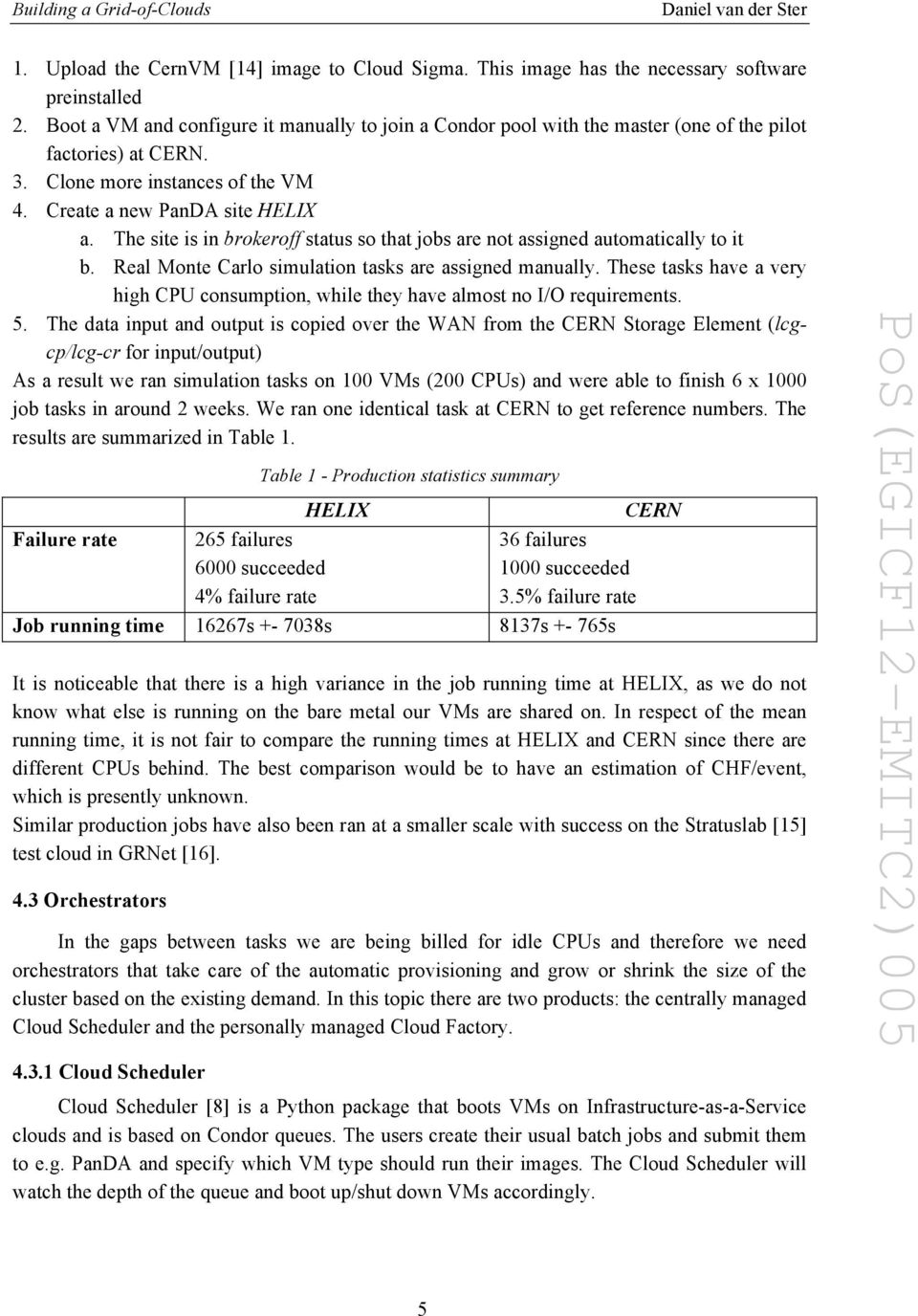
6 1500 Athena AOD lysis jobs over 1 day Figure 3 - Cloud Scheduler workflow The Cloud Scheduler works with multiple cloud sites simultaneously and supports different cloud APIs. It is based on CernVM and relies on Condor for the credential delegation at job submission time. It keeps the VMs alive until there are no more jobs needing that VM type. The Cloud Scheduler has been successfully used to run 1500 analysis jobs over 1 day. The worker nodes were part of FutureGrid (Chicago), which were reading the data from University of Victoria. Cloud Scheduler automatically manages 100 VMs. As opposed to the simulation jobs, these analysis jobs do have significant I/O requirements and during the exercise network traffics of up to 3.5 Gb/s were seen between Victoria and Chicago (see Figure 4). AOD Analysis Run Athena AOD obs over 1 day ALY_VICTORIA-WG1- EST queue UD_TEST queue ICTORIA-WG1- VMs, ically managed by AOD Analysis Run d 100 VMs, omatically managed by udscheduler ed in via gridftp ta staged in via gridftp to Gb/s 3.5 Gb/s of traffic of traffic ic - Chicago icago a AnalysisSkeleton_topOptions.py --inds=mc09_7tev jf17_herwig_jet_filter.merge.aod\ s765_s767_r1215_r1210/ --outds=user.rptaylor.victoria `uuidgen`\ =ANALY_VICTORIA-WG1-CLOUD_TEST --spacetoken=atlasscratchdisk isskeleton_topoptions.py --inds=mc09_7tev jf17_herwig_jet_filter.merge.aod\ 7_r1215_r1210/ --outds=user.rptaylor.victoria `uuidgen`\ Figure 4 - VM provisioning by the Cloud Scheduler and the generated 8% traffic ICTORIA-WG1-CLOUD_TEST --spacetoken=atlasscratchdisk 6 8%

7 4.3.2 Cloud Factory The other available orchestrator is the Cloud Factory [8], which is a proof of concept, personal orchestrator tested at CERN. The main difference is the simplicity to manage it: the Cloud Factory does not require the VMs to attach to any Condor pool. It gets the personal jobs from the PanDA queue and instantiates CernVM nodes to run them. For the moment it only speaks EC2. The Cloud Factory uses the Grid Messaging Service (MSG) [17] to let the VMs./cf communicate their status and a heartbeat to the Cloud Factory../cf is a proof-of-concept cloud factory Wraps cvm (CERN PH- SFT) to instantiate and contextualize VM instances speaks only EC2 (for now)./cf-wrapper is a cfenabled PanDA pilot wrapper./cf-heartbeat runs beside the pilot and reports the instance state back to a MQ 20/10/11 Cloud Factories -- D.vdS, F.B. 5 EGI-InSPIRE RI Conclusions PanDA ActiveMQ Cloud Factory EC2 Cloud e.g. LxCloud Figure 5 - Cloud Factory workflow Virtualisation and Cloud Computing bring new features to homogenize the infrastructure layer and improve resource scalability. For the HEP VOs, elastic scaling of resources could be employed to better match provisioned resources to the dynamic demand, thereby decreasing costs and improving the user experience. We also recall that one of the great strengths of grid computing is that it enables computing resource funding to be spent locally (to the benefit of the local economy) while providing the technology to pool global computing facilities to solve the Grand Challenges in computing. Cloud Computing does not sacrifice that strength. Indeed, sites are beginning to make their local resources available via a cloud API, enabling both local and remote users to use the facilities using an API that is shared in common with industry. By making it easy to target applications at both traditional "academic" resources and new commercial computing centres, the users can flexibly adapt according to budgetary and urgency constraints. However Cloud Computing is at an early stage and it would be beneficial if the Cloud Computing industry and technology providers agree on a standards-based open interface layer that allows common ways to provision, access and account resources across suppliers. The Virtualization and Cloud Computing R&D project in the ATLAS experiment is evaluating techniques to incorporate these technologies to the existing grid infrastructure. During the first year it has been successfully demonstrated that it is possible to run ATLAS payloads in the cloud. Given the lack of standards, the activity is still labour intensive and a lot of human effort has to be put in the configuration and preparation of the VMs for each cloud provider. Many of the activities are maturing and in the medium term we should determine what 7

8 we could deliver in production by automating the deployment procedures and improving the node monitoring. It must be noted that the current set ups are not necessarily the final ones that we would like to use in future: we should understand the models of cloud storage that can allow us to make use of different storage implementations in the cloud. Some institutes are starting to provide S3 storage endpoints and the effective R&D will start soon. As well, we are looking forward to more progress in data caching in the cloud using XRootD or HDFS. This research should allow bringing the data closer to the worker nodes and avoid the use of remote data I/O across the WAN. In addition, there are more topics that still need to be addressed, as can be security issues, privacy concerns, operational procedures or CPU accounting on the cloud. References [1] The ATLAS Collaboration, The ATLAS Experiment at the CERN Large Hadron Collider, 2008 JINST 3 S08003 doi: / /3/08/s08003 [2] [3] [4] [5] [6] [7] [8] Fernando Barreiro Megino et al, Exploiting Virtualization & Cloud Computing in ATLAS, CHEP, New York, Canada, May 21-25, 2012 [9] Tadashi Maeno et al, PanDA: distributed production and distributed analysis system for ATLAS, CHEP, Victoria, Canada, September 02-07, 2007 [10] Alvise Dorigo et al.; XROOTD- A highly scalable architecture for data access. WSEAS Transactions on Computers, 1(4.3), [11] [12] M Branco et al. Managing ATLAS data on a petabyte-scale with DQ J. Phys.: Conf. Ser doi: / /119/6/ [13] Jim Basney, Miron Livny, and Todd Tannenbaum, "High Throughput Computing with Condor", HPCU news, Volume 1(2), June [14] P Buncic et al, CernVM - a virtual appliance for LHC applications, Advanced Computing and Analysis Techniques in Physics Research, Erice, Italy, November 03-07, 2008 [15] [16] 8
9 [17] 9
Batch and Cloud overview. Andrew McNab University of Manchester GridPP and LHCb
 Batch and Cloud overview Andrew McNab University of Manchester GridPP and LHCb Overview Assumptions Batch systems The Grid Pilot Frameworks DIRAC Virtual Machines Vac Vcycle Tier-2 Evolution Containers
Scientific Cloud Computing Infrastructure for Europe Strategic Plan. Bob Jones,
 Scientific Cloud Computing Infrastructure for Europe Strategic Plan Bob Jones, IT department, CERN Origin of the initiative Conceived by ESA as a prospective for providing cloud services to space sector
PoS(EGICF12-EMITC2)110
 User-centric monitoring of the analysis and production activities within the ATLAS and CMS Virtual Organisations using the Experiment Dashboard system Julia Andreeva E-mail: [email protected] Mattia
Status and Evolution of ATLAS Workload Management System PanDA
 Status and Evolution of ATLAS Workload Management System PanDA Univ. of Texas at Arlington GRID 2012, Dubna Outline Overview PanDA design PanDA performance Recent Improvements Future Plans Why PanDA The
The Evolution of Cloud Computing in ATLAS
 The Evolution of Cloud Computing in ATLAS Ryan Taylor on behalf of the ATLAS collaboration CHEP 2015 Evolution of Cloud Computing in ATLAS 1 Outline Cloud Usage and IaaS Resource Management Software Services
The Evolution of Cloud Computing in ATLAS
 The Evolution of Cloud Computing in ATLAS Ryan P Taylor, 1 Frank Berghaus, 1 Franco Brasolin, 2 Cristovao Jose Domingues Cordeiro, 3 Ron Desmarais, 1 Laurence Field, 3 Ian Gable, 1 Domenico Giordano, 3
Building a Volunteer Cloud
 Building a Volunteer Cloud Ben Segal, Predrag Buncic, David Garcia Quintas / CERN Daniel Lombrana Gonzalez / University of Extremadura Artem Harutyunyan / Yerevan Physics Institute Jarno Rantala / Tampere
ATLAS job monitoring in the Dashboard Framework
 ATLAS job monitoring in the Dashboard Framework J Andreeva 1, S Campana 1, E Karavakis 1, L Kokoszkiewicz 1, P Saiz 1, L Sargsyan 2, J Schovancova 3, D Tuckett 1 on behalf of the ATLAS Collaboration 1
IaaS Cloud Architectures: Virtualized Data Centers to Federated Cloud Infrastructures
 IaaS Cloud Architectures: Virtualized Data Centers to Federated Cloud Infrastructures Dr. Sanjay P. Ahuja, Ph.D. 2010-14 FIS Distinguished Professor of Computer Science School of Computing, UNF Introduction
Nimbus: Cloud Computing with Science
 Nimbus: Cloud Computing with Science March 2010 globusworld, Chicago Kate Keahey [email protected] Nimbus Project University of Chicago Argonne National Laboratory Cloud Computing for Science Environment
Sistemi Operativi e Reti. Cloud Computing
 1 Sistemi Operativi e Reti Cloud Computing Facoltà di Scienze Matematiche Fisiche e Naturali Corso di Laurea Magistrale in Informatica Osvaldo Gervasi [email protected] 2 Introduction Technologies
Cloud-pilot.doc 12-12-2010 SA1 Marcus Hardt, Marcin Plociennik, Ahmad Hammad, Bartek Palak E U F O R I A
 Identifier: Date: Activity: Authors: Status: Link: Cloud-pilot.doc 12-12-2010 SA1 Marcus Hardt, Marcin Plociennik, Ahmad Hammad, Bartek Palak E U F O R I A J O I N T A C T I O N ( S A 1, J R A 3 ) F I
Shoal: IaaS Cloud Cache Publisher
 University of Victoria Faculty of Engineering Winter 2013 Work Term Report Shoal: IaaS Cloud Cache Publisher Department of Physics University of Victoria Victoria, BC Mike Chester V00711672 Work Term 3
Cloud Computing Architecture with OpenNebula HPC Cloud Use Cases
 NASA Ames NASA Advanced Supercomputing (NAS) Division California, May 24th, 2012 Cloud Computing Architecture with OpenNebula HPC Cloud Use Cases Ignacio M. Llorente Project Director OpenNebula Project.
Dynamic Resource Provisioning with HTCondor in the Cloud
 Dynamic Resource Provisioning with HTCondor in the Cloud Ryan Taylor Frank Berghaus 1 Overview Review of Condor + Cloud Scheduler system Condor job slot configuration Dynamic slot creation Automatic slot
Auto-Scaling Model for Cloud Computing System
 Auto-Scaling Model for Cloud Computing System Che-Lun Hung 1*, Yu-Chen Hu 2 and Kuan-Ching Li 3 1 Dept. of Computer Science & Communication Engineering, Providence University 2 Dept. of Computer Science
Leveraging BlobSeer to boost up the deployment and execution of Hadoop applications in Nimbus cloud environments on Grid 5000
 Leveraging BlobSeer to boost up the deployment and execution of Hadoop applications in Nimbus cloud environments on Grid 5000 Alexandra Carpen-Amarie Diana Moise Bogdan Nicolae KerData Team, INRIA Outline
Challenges in Hybrid and Federated Cloud Computing
 Cloud Day 2011 KTH-SICS Cloud Innovation Center and EIT ICT Labs Kista, Sweden, September 14th, 2011 Challenges in Hybrid and Federated Cloud Computing Ignacio M. Llorente Project Director Acknowledgments
Computing at the HL-LHC
 Computing at the HL-LHC Predrag Buncic on behalf of the Trigger/DAQ/Offline/Computing Preparatory Group ALICE: Pierre Vande Vyvre, Thorsten Kollegger, Predrag Buncic; ATLAS: David Rousseau, Benedetto Gorini,
Getting Started Hacking on OpenNebula
 LinuxTag 2013 Berlin, Germany, May 22nd Getting Started Hacking on OpenNebula Carlos Martín Project Engineer Acknowledgments The research leading to these results has received funding from Comunidad de
Managing the Cloud as an Incremental Step Forward
 WP Managing the Cloud as an Incremental Step Forward How brings cloud services into your IT infrastructure in a natural, manageable way white paper [email protected] Table of Contents Accepting the
Interoperating Cloud-based Virtual Farms
 Stefano Bagnasco, Domenico Elia, Grazia Luparello, Stefano Piano, Sara Vallero, Massimo Venaruzzo For the STOA-LHC Project Interoperating Cloud-based Virtual Farms The STOA-LHC project 1 Improve the robustness
Data intensive high energy physics analysis in a distributed cloud
 Data intensive high energy physics analysis in a distributed cloud A. Charbonneau 1, A. Agarwal 2, M. Anderson 2, P. Armstrong 2, K. Fransham 2, I. Gable 2, D. Harris 2, R. Impey 1, C. Leavett-Brown 2,
How To Run A Cloud Server On A Server Farm (Cloud)
 StratusLab: Darn Simple Cloud Charles (Cal) Loomis (CNRS/LAL & SixSq Sàrl) FOSDEM 13: Cloud Devroom (3 February 2013) StratusLab What is it? Complete Infrastructure as a Service (IaaS) cloud distribution
Analysis and Research of Cloud Computing System to Comparison of Several Cloud Computing Platforms
 Volume 1, Issue 1 ISSN: 2320-5288 International Journal of Engineering Technology & Management Research Journal homepage: www.ijetmr.org Analysis and Research of Cloud Computing System to Comparison of
CERN Cloud Storage Evaluation Geoffray Adde, Dirk Duellmann, Maitane Zotes CERN IT
 SS Data & Storage CERN Cloud Storage Evaluation Geoffray Adde, Dirk Duellmann, Maitane Zotes CERN IT HEPiX Fall 2012 Workshop October 15-19, 2012 Institute of High Energy Physics, Beijing, China SS Outline
Infrastructure-as-a-Service Cloud Computing for Science
 Infrastructure-as-a-Service Cloud Computing for Science October 2009 Banff Centre, Banff, Canada Kate Keahey [email protected] Nimbus project lead University of Chicago Argonne National Laboratory Cloud
STeP-IN SUMMIT 2013. June 18 21, 2013 at Bangalore, INDIA. Performance Testing of an IAAS Cloud Software (A CloudStack Use Case)
 10 th International Conference on Software Testing June 18 21, 2013 at Bangalore, INDIA by Sowmya Krishnan, Senior Software QA Engineer, Citrix Copyright: STeP-IN Forum and Quality Solutions for Information
Running a typical ROOT HEP analysis on Hadoop/MapReduce. Stefano Alberto Russo Michele Pinamonti Marina Cobal
 Running a typical ROOT HEP analysis on Hadoop/MapReduce Stefano Alberto Russo Michele Pinamonti Marina Cobal CHEP 2013 Amsterdam 14-18/10/2013 Topics The Hadoop/MapReduce model Hadoop and High Energy Physics
Cloud Computing with Red Hat Solutions. Sivaram Shunmugam Red Hat Asia Pacific Pte Ltd. [email protected]
 Cloud Computing with Red Hat Solutions Sivaram Shunmugam Red Hat Asia Pacific Pte Ltd [email protected] Linux Automation Details Red Hat's Linux Automation strategy for next-generation IT infrastructure
A Middleware Strategy to Survive Compute Peak Loads in Cloud
 A Middleware Strategy to Survive Compute Peak Loads in Cloud Sasko Ristov Ss. Cyril and Methodius University Faculty of Information Sciences and Computer Engineering Skopje, Macedonia Email: [email protected]
StratusLab project. Standards, Interoperability and Asset Exploitation. Vangelis Floros, GRNET
 StratusLab project Standards, Interoperability and Asset Exploitation Vangelis Floros, GRNET EGI Technical Forum 2011 19-22 September 2011, Lyon, France StratusLab is co-funded by the European Community
CernVM Online and Cloud Gateway a uniform interface for CernVM contextualization and deployment
 CernVM Online and Cloud Gateway a uniform interface for CernVM contextualization and deployment George Lestaris - Ioannis Charalampidis D. Berzano, J. Blomer, P. Buncic, G. Ganis and R. Meusel PH-SFT /
cloud functionality: advantages and Disadvantages
 Whitepaper RED HAT JOINS THE OPENSTACK COMMUNITY IN DEVELOPING AN OPEN SOURCE, PRIVATE CLOUD PLATFORM Introduction: CLOUD COMPUTING AND The Private Cloud cloud functionality: advantages and Disadvantages
Manjrasoft Market Oriented Cloud Computing Platform
 Manjrasoft Market Oriented Cloud Computing Platform Aneka Aneka is a market oriented Cloud development and management platform with rapid application development and workload distribution capabilities.
Test of cloud federation in CHAIN-REDS project
 Test of cloud federation in CHAIN-REDS project Italian National Institute of Nuclear Physics, Division of Catania - Italy E-mail: [email protected] Roberto Barbera Department of Physics and
DESIGN OF A PLATFORM OF VIRTUAL SERVICE CONTAINERS FOR SERVICE ORIENTED CLOUD COMPUTING. Carlos de Alfonso Andrés García Vicente Hernández
 DESIGN OF A PLATFORM OF VIRTUAL SERVICE CONTAINERS FOR SERVICE ORIENTED CLOUD COMPUTING Carlos de Alfonso Andrés García Vicente Hernández 2 INDEX Introduction Our approach Platform design Storage Security
The CMS openstack, opportunistic, overlay, online-cluster Cloud (CMSooooCloud)"
 The CMS openstack, opportunistic, overlay, online-cluster Cloud (CMSooooCloud)" J.A. Coarasa " CERN, Geneva, Switzerland" for the CMS TriDAS group." " CHEP2013, 14-18 October 2013, Amsterdam, The Netherlands
HTCondor at the RAL Tier-1
 HTCondor at the RAL Tier-1 Andrew Lahiff, Alastair Dewhurst, John Kelly, Ian Collier, James Adams STFC Rutherford Appleton Laboratory HTCondor Week 2014 Outline Overview of HTCondor at RAL Monitoring Multi-core
Planning the Migration of Enterprise Applications to the Cloud
 Planning the Migration of Enterprise Applications to the Cloud A Guide to Your Migration Options: Private and Public Clouds, Application Evaluation Criteria, and Application Migration Best Practices Introduction
Infrastructure as a Service (IaaS)
 Infrastructure as a Service (IaaS) (ENCS 691K Chapter 4) Roch Glitho, PhD Associate Professor and Canada Research Chair My URL - http://users.encs.concordia.ca/~glitho/ References 1. R. Moreno et al.,
Cloud Computing. Adam Barker
 Cloud Computing Adam Barker 1 Overview Introduction to Cloud computing Enabling technologies Different types of cloud: IaaS, PaaS and SaaS Cloud terminology Interacting with a cloud: management consoles
Solution for private cloud computing
 The CC1 system Solution for private cloud computing 1 Outline What is CC1? Features Technical details Use cases By scientist By HEP experiment System requirements and installation How to get it? 2 What
INDIGO-DataCloud Wupi 4 (Resource Virtualization)
 INDIGO-DataCloud Wupi 4 (Resource Virtualization) All stolen from Markus, Enol, Maciej, Giacionto and many others High level objective This work package is focusing on virtualizing local computing, storage
A Service for Data-Intensive Computations on Virtual Clusters
 A Service for Data-Intensive Computations on Virtual Clusters Executing Preservation Strategies at Scale Rainer Schmidt, Christian Sadilek, and Ross King [email protected] Planets Project Permanent
Plug-and-play Virtual Appliance Clusters Running Hadoop. Dr. Renato Figueiredo ACIS Lab - University of Florida
 Plug-and-play Virtual Appliance Clusters Running Hadoop Dr. Renato Figueiredo ACIS Lab - University of Florida Advanced Computing and Information Systems laboratory Introduction You have so far learned
Research computing in a distributed cloud environment
 Research computing in a distributed cloud environment K. Fransham 1, A. Agarwal 1, P. Armstrong 1, A. Bishop 1, A. Charbonneau 2, R. Desmarais 1, N. Hill 3, I. Gable 1, S. Gaudet 3, S. Goliath 3, R. Impey
What Is It? Business Architecture Research Challenges Bibliography. Cloud Computing. Research Challenges Overview. Carlos Eduardo Moreira dos Santos
 Research Challenges Overview May 3, 2010 Table of Contents I 1 What Is It? Related Technologies Grid Computing Virtualization Utility Computing Autonomic Computing Is It New? Definition 2 Business Business
Relational Databases in the Cloud
 Contact Information: February 2011 zimory scale White Paper Relational Databases in the Cloud Target audience CIO/CTOs/Architects with medium to large IT installations looking to reduce IT costs by creating
Cloud computing - Architecting in the cloud
 Cloud computing - Architecting in the cloud [email protected] 1 Outline Cloud computing What is? Levels of cloud computing: IaaS, PaaS, SaaS Moving to the cloud? Architecting in the cloud Best practices
Repoman: A Simple RESTful X.509 Virtual Machine Image Repository. Roger Impey
 Repoman: A Simple RESTful X.509 Virtual Machine Image Repository Roger Impey Project Term University of Victoria R.J. Sobie, M. Anderson, P. Armstrong, A. Agarwal, Kyle Fransham, D. Harris, I. Gable, C.
A High Performance Computing Scheduling and Resource Management Primer
 LLNL-TR-652476 A High Performance Computing Scheduling and Resource Management Primer D. H. Ahn, J. E. Garlick, M. A. Grondona, D. A. Lipari, R. R. Springmeyer March 31, 2014 Disclaimer This document was
Introduction to grid technologies, parallel and cloud computing. Alaa Osama Allam Saida Saad Mohamed Mohamed Ibrahim Gaber
 Introduction to grid technologies, parallel and cloud computing Alaa Osama Allam Saida Saad Mohamed Mohamed Ibrahim Gaber OUTLINES Grid Computing Parallel programming technologies (MPI- Open MP-Cuda )
Work in Progress on Cloud Computing in Myriads Team and Contrail European Project Christine Morin, Inria
 Potential collaboration talk Work in Progress on Cloud Computing in Myriads Team and Contrail European Project Christine Morin, Inria Design and implementation of autonomous distributed systems Internet