
Student Handbook
|
|
|
- Adele McBride
- 10 years ago
- Views:
Transcription
1 Student Handbook

2 UNIVERSITY OF CALIFORNIA, LOS ANGELES School of Nursing Factor Building Box Los Angeles, CA Dear Nursing Student: Welcome to the University of California Los Angeles (UCLA) School of Nursing! We are indeed happy you are here. The UCLA School of Nursing enjoys a national and international reputation for excellence in teaching, research and clinical practice. Our two prelicensure programs, the Bachelors of Science and Masters Entry to Clinical Nursing, are designed to prepare not only compassionate and competent bedside nurses, but also highly educated professionals with the skills and knowledge necessary to become future nursing leaders. Both programs prepare students for registered nurse (RN) licensure to function in multicultural complex environments of hospitals and other health-care delivery settings. The Master s of Science in Nursing Advanced Practice program provides baccalaureate prepared RNs with advanced skills and clinical training to sit for certification and function as nurse practitioners, clinical nurse specialists, and nurse administrators. Finally, our PhD program prepares outstanding nurse scholars and scientists who continue to contribute to nursing knowledge. Regardless of the program you have entered, you will surely benefit from the unparalleled faculty and academic community of the UCLA School of Nursing. This Handbook has been prepared to inform you about the School of Nursing and University policies. As a student, you are responsible for these policies. Please read them carefully. These materials are also available on UCLA School of Nursing website. We very much look forward to supporting you as you embark on this exciting academic and professional journey. Much Success, Courtney Lyder, RN, ND, FAAN Professor & Dean

3 TABLE OF CONTENTS HISTORY OF THE SCHOOL 1 PHILOSOPHY OF THE UCLA SCHOOL OF NURSING 1 MISSION OF THE UCLA SCHOOL OF NURSING 3 ACCREDITATION 3 NONDISCRIMINATION/AFFIRMATIVE ACTION POLICY 4 PRELICENSURE PROGRAMS: BACHELOR S OF SCIENCE (BS/Prelicensure) & MASTERS OF SCIENCE NURSING-MASTER S ENTRY CLINICAL NURSE (MSN-MECN) 5 PURPOSE 5 BACHELOR OF SCIENCE DEGREE PROGRAM 5 PROGRAM GOALS 5 BS/PRELICENSURE PROGRAM CURRICULUM PLAN 7 BS/PRELICENSURE GRADING POLICY 9 Grading Scale 9 BS/PRELICENSURE PROGRESSION 9 MSN-MASTERS ENTRY CLINICAL NURSE (MSN-MECN) PRELICENSURE PROGRAM 11 PROGRAM GOALS 11 MSN-MECN/PRELICENSURE PROGRAM CURRICULUM PLAN 12 MSN-MECN GRADING POLICY 13 Grading Scale 13 MSN-MECN PROGRESSION 13 ASSESSMENTS AND EXAMINATIONS FOR PRELICENSURE PROGRAMS 15 PERIODIC ASSESSMENTS AND EXAMINATIONS 15 PURPOSE 15 KAPLAN LEVEL/COURSE EXAMINATION 15 Scheduling 15 Mastery Score 16 Practicing for the KAPLAN Exams 16 KAPLAN Exit Examination (RN Comprehensive Predictor) 16 MECN WRITTEN COMPREHENSIVE EXAMINATION 17 POSTLICENSURE PROGRAMS IN THE SCHOOL OF NURSING 18 MASTER S OF SCIENCE NURSING-ADVANCED PRACTICE NURSE /POSTLICENSURE 18 ADVANCED PRACTICE NURSE (APN)/POSTLICENSURE 19 OVERVIEW OF MSN-APN/POSTLICENSURE COURSE REQUIREMENTS 19 MASTERS IN BUSINESS ADMINISTRATION/MASTERS OF SCIENCE IN 21 NURSING/POSTLICENSURE CONCURRENT DEGREE PROGRAM 21 MSN-APN/POSTLICENSURE GRADING POLICY 22 MSN-APN/POSTLICENSURE PROGRESSION 22 MSN-APN WRITTEN COMPREHENSIVE EXAMINATION 23 GENERAL ACADEMIC POLICIES FOR THE SCHOOL OF NURSING 24 GRADING AND BEHAVIOR POLICY 24 Posting of Grades and/or Distribution of Exams 24 PRELICENSURE APPEAL PROCESS 24 Grades not Preventing Progression 24 Grades Preventing Progression 24 EXPECTATIONS FOR BEHAVIOR 24 ESSENTIAL FUNCTIONS OF A NURSING STUDENTCOMMITMENT TO LEARNING 25

4 COMMITMENT TO LEARNING 26 CLINICAL EDUCATION: PRELICENSURE 27 CAMPUS SKILLS/SIMULATION LABORATORY 27 CLINICAL COURSE WORK 27 DOCUMENTATION OF INAPPROPRIATE BEHAVIOR OR UNSAFE CLINICAL PRACTICE 28 ISSUING AN ANECDOTAL NOTE 28 ELIGIBILITY FOR CLINICAL PRACTICE: ALL PROGRAMS 29 Health Evaluation 29 General 29 Physical Exam 29 Tuberculosis Evaluation 30 Immunization Status 30 Basic Life Support Cardio Pulmonary Resuscitation (BLS/CPR) 30 Background Check 31 HIPAA Privacy and Security Screening 31 Malpractice Insurance 31 PERSONAL APPEARANCE: PRELICENSURE 33 HYGIENE 33 NURSING UNIFORM AND DRESS CODES: PRELICENSURE 34 PERSONAL APPEARANCE AND PROFESSIONAL CLOTHING: MSN-APN/POSTLICENSURE 35 CLINICAL AGENCY RULES 35 CONFIDENTIALITY 36 HEALTH SITUATIONS INCREASING RISK IN THE CLINICAL SETTING 37 INJURED WHILE AT CLINICAL 37 UCLA SCHOOL OF NURSING POLICY ON HIV/AIDS AND OTHER BLOOD BORNE DISEASES 38 DEFINITIONS 38 HIV/AIDS 38 HIV Positive 38 PRINCIPLES UNDERLYING THE UCLA SCHOOL OF NURSING POLICY 38 POLICY 38 PROCEDURAL ADDENDUM TO UCLA SCHOOL OF NURSING S AIDS POLICY 39 POST-EXPOSURE PROPHYLAXIS INSTRUCTIONS 41 STUDENT - FACULTY COMMUNICATION 42 FACULTY ADVISEMENT 42 ATTENDANCE POLICIES 43 ABSENCES AND PUNCTUALITY 43 Theory Courses 43 Clinical Courses in the Pr licensure Programs 43 STUDENT INFORMATION 45 ACADEMIC HONESTY 45 LVN 45 UNIT OPTION 45 TRANSFER OF CREDITS 45 FINANCIAL ASSISTANCE 45 STUDENT INVOLVEMENT IN SCHOOL OF NURSING COMMITTEES 46 CURRICULUM COMMITTEE 46 STUDENT AFFAIRS COMMITTEE 46 ORGANIZATIONAL CHART OF THE UCLA SCHOOL OF NURSING 47 CAMPUS SERVICES 48

5 Student Health 48 Counseling & Physiological Services (CAPS) 48 Office for Students with Disabilities 48 Bruin Online 49 Housing 49 Transportation and Parking 49 Police 49 Emergency Plan 50 Emergency Services 50 Emergency Telephone Lines 50 ELIGIBILITY FOR LICENSURE 51 ELIGIBILITY FOR ADVANCED PRACTICE CERTIFICATION 51 CHANGES TO POLICY AND/OR CURRICULUM REQUIREMENTS 51 ORGANIZATIONS ASSOCIATED STUDENTS CAMPUS 52 GRADUATE STUDENTS ASSOCIATION CAMPUS 52 NURSING STUDENTS AT UCLA 52 MEN IN NURSING 52 NATIONAL STUDENT NURSES ASSOCIATION 52 GRADUATE STUDENTS IN NURSING ASSOCIATION GSNA 52 ALPHA TAU DELTA ATD 53 SIGMA THETA TAU STT 53 SIGNATURE AND CONFIRMATION PAGE 54
6 HISTORY OF THE SCHOOL In 1949, the Regents of the University of California authorized the School of Nursing as one of the professional schools of the UCLA Center for the Health Sciences. This action paved the way in 1950 for the opening of an undergraduate program in nursing leading to the Bachelor of Science (BS) degree and made possible the establishment of a graduate program to award a Master of Science (MS) degree in Nursing in In 1966, the Master of Nursing (MN) degree was established as an alternate option to the M.S. degree. The M.S. degree program was discontinued in The Regents approved the Doctor of Nursing Science (DNSc) degree program in 1986, and in 1987 the first doctoral students were admitted. In 1996, the Office of the President and the Regents approved the change in the master s degree designation from M.N. to Master of Science in Nursing (MSN); the change in doctoral degree designation from DNSc to PhD in Nursing was approved in The original BS program curriculum was revised in 1997 to meet the educational needs of students who are registered nurses with Associate Degrees or diplomas in nursing. In 2006, the School of Nursing reinstated the prelicensure bachelor s program (BS/Prelicensure) with admission at the freshman level. At the same time, the Masters Entry into Clinical Nurse (MECN)/prelicensure program within the MSN degree program designed for pre-licensure students with bachelor s degrees in another discipline was approved. PHILOSOPHY OF THE UCLA SCHOOL OF NURSING The UCLA School of Nursing is guided by a philosophy that embodies the mission and goals of the University of California. The philosophy addresses nursing, the clients of nursing, and nursing students. The school is committed to an interdisciplinary learning environment. Nursing encompasses clinical practice, education, research, consultation, leadership, management, and service to the profession and both the local and global community. It involves individuals, families, groups, organizations, and communities as clients. The profession must consider the human, physical and social environments that interact with these clients, who may have health conditions that range from wellness to illness. Nursing activities must, therefore, include health promotion and maintenance, intervention and treatment, rehabilitation and restoration, and palliation. At an advanced practice level, nursing involves comprehensive health care, which encompasses the responsibility and accountability for continuity of care across the health-illness spectrum. Nursing research is both applied and basic and has as its core actual or potential human responses to illness and as its goal the development of nursing science. Guided by ethical standards that consider the perspectives of the client, the health care provider, and the larger society, nursing has a social mission that encompasses the right and responsibility to provide leadership in health policy, as well as health care to all clients regardless of disease status, gender, race, or culture. People who receive client-centered nursing care are complex individuals who exist in relationship to others in their family and community. This complexity of person involves biological, behavioral, emotional, psychosocial, cultural, and spiritual dimensions. Each individual reflects a unique combination of these dimensions that interacts dynamically with the environment. The 1

7 clients of nursing are autonomous decision makers who have certain values and knowledge about themselves that not only are relevant but essential to successful health care outcomes. As a result, nurses have the responsibility to protect the patient s right to collaboratively participate with health care professionals involved in their care. Successful nursing students are active learners who bring unique gender, cultural, and ethnic life experiences to the professional practice of nursing and its advancement as a discipline. Students at all levels learn relevant theory, acquire practice skills, and are socialized into the profession of nursing. Increasing levels of complexity and sophistication of learning and socialization are expected of students in the different programs. Whether at the beginning practice, advanced practice, or scholar level, nursing students learn to apply knowledge, skills, and professional attitudes in their practice, which may include educative, administrative, and research arenas. While students have the right and responsibility to participate in their own learning, faculty members have the right and responsibility to structure the teaching/learning environment to facilitate learning. Individual academic counseling and a variety of one-on-one, small-group, and interactive learning formats assist students to meet program and individual learning goals 2
8 MISSION OF THE UCLA SCHOOL OF NURSING The mission of the UCLA School of Nursing is to advance nursing science through the conduct and dissemination of research and expand its national and international leadership in the educational preparation of nurses. The school is committed to preparing scholarly and highly qualified nurses at all levels for the provision of quality nursing care for a diverse multicultural society. The mission of the school focuses on three areas: education, research, and practice. The dominant mission is education of nurses at the undergraduate, master's, and doctoral levels. At the bachelor's level, nurses are prepared as generalists with special skills in primary, secondary, and tertiary prevention and care within a population-based context, leadership, and evidence-based practice. At the master's level, nurses are prepared as generalists in hospitalbased care or for advanced nursing practice as nurse practitioners, clinical specialists, or administrators in a variety of settings and specialized areas of healthcare, at the doctoral level, students are prepared as emerging scholars to advance nursing knowledge and science through systematic research. As graduates of the programs, all students are prepared to function as leaders in academic, healthcare, and governmental/policy settings. Advancing nursing science through significant and methodologically rigorous research is a critical component of the school's mission. The school is recognized as being one of the top schools of nursing in the country. The faculty is committed to increasing its standing in national and international research arenas. To this end, the faculty continues collaborative relationships with scientists and clinicians in other schools and departments at UCLA, within the University of California, at other university campuses, and at cooperative, clinical and research-oriented institutions locally, regionally, and internationally. The promotion of expert clinical practice is inherent with the mission and encompasses contributions of clinical expertise and knowledge to the community. This is accomplished by sharing innovations in nursing care and health promotion and by the participation of the faculty in the delivery of expert nursing care to special populations, including the underserved and vulnerable populations. ACCREDITATION The UCLA School of Nursing programs of study are approved by the Academic Senate of the University of California, the California Board of Registered Nursing, and are accredited by the Commission on Collegiate Nursing Education (CCNE). Curricular oversight and periodic reviews are conducted by the UCLA Academic Senate s Undergraduate and Graduate Councils. The University of California, Los Angeles holds accreditation from the Western Association of Schools and Colleges (WASC). In 2010, the Commission on Collegiate Nursing Education (CCNE) accredited the existing bachelor s and master s degree programs for a term of 10 years. 3

9 NONDISCRIMINATION/AFFIRMATIVE ACTION POLICY The University of California, in accordance with applicable Federal and State Laws and University Policies, does not discriminate on the basis of race, color, national origin, religion, sex, gender identity, pregnancy (including pregnancy, childbirth, post-partum period and medical conditions related to pregnancy and childbirth), disability, age, medical condition (cancer-related), ancestry, marital status, citizenship, sexual orientation, or status as a Vietnam-era veteran or special disabled veteran. The University also prohibits sexual harassment. This nondiscrimination policy covers admission, access, and treatment in University programs and activities. Inquiries regarding the University s student-related nondiscrimination policies may be directed to the UCLA Campus Counsel, 3149 Murphy Hall, Box , Los Angeles, CA , (310) Speech-and hearing- impaired persons may call TTY (310) ; or visit Students may complain of any action which they believe discriminates against them on the grounds of race, color, national origin, marital status, sex, sexual orientation, disability, or age and may contact the Office of the Dean of Students, 1206 Murphy Hall, and/or refer to Section of the University of California Policies Applying to Campus Activities, Organizations, and Students. For further information and procedures visit the UC Regents website. The Discrimination and Harassment Policy at UCLA that defines and describes the Nondiscrimination and Harassment Policy and Sexual Harassment. 4
10 PRELICENSURE PROGRAMS: BACHELORS OF SCIENCE (BS/PRELICENSURE) & MASTERS OF SCIENCE NURSING-MASTER S ENTRY CLINICAL NURSE (MSN-MECN) PURPOSE The purpose of the pre-licensure nursing programs at the University of California at Los Angeles, School of Nursing is to prepare graduates to provide therapeutic nursing care to all entrusted to care regardless of race/ethnicity, age, gender, culture, religion, or social status. At the prelicensure level, two programs are offered, the Bachelor of Science/Prelicensure (BS/Prelicensure) program and the Master of Science in Nursing-Masters Entry Clinical Nurse (MECN) program. This Handbook provides information to facilitate the progression of pre-licensure students in the UCLA School of Nursing. Students are also expected to read and utilize information contained in the UCLA School of Nursing s Announcement, the UCLA General Catalog, the Graduate Division Program and Degree Requirements, and the UCLA Schedule of Classes. BACHELOR OF SCIENCE DEGREE PROGRAM PROGRAM GOALS Graduates of the UCLA Bachelor of Science/Prelicensure (BS/Prelicensure) program are able to assume responsibility for organizing, implementing, and evaluating hospital-, population-, and/or community-based plans of nursing care for a highly complex and culturally diverse society. The Prelicensure program prepares students with a focus on primary, secondary and/or tertiary prevention and treatment. Students successfully completing this program are nurses prepared as generalists with special skills to provide nursing care across the lifespan. This program integrates concepts of multiculturalism and prepares students well for the changing healthcare system and the healthcare needs of California s demographically diverse population. Students successfully completing the BS degree also acquire an educational foundation for entry to the graduate program, that at the master s level prepares advanced practitioners, clinical specialists and administrators in primary and acute care and, at the doctoral level, prepares nurse scientists and scholars. After completing the BS/Prelicensure program, graduates achieve the following objectives: 1. Select, evaluate and apply appropriate theory and research findings concerning individualand population-based health promotion and disease prevention, biobehavioral and health systems, social-environment, and cultural and human diversity to the nursing process with a variety of clients, families, and communities from ethnically diverse cultural backgrounds 2. Utilize the nursing process to promote biopsychosocial health and disease prevention and to support the resources of culturally diverse clients and families in community- and/or hospital-based settings 3. Demonstrate effective communication and collaboration skills with clients and their families, research participants, other health professionals, colleagues, and policy makers 5

11 4. Identify practice-based problems and hypotheses and critique research on issues of importance to nursing and health care delivery within culturally diverse hospital- and community-based settings 5. Participate in professional and community organizations and/or interest groups relevant to health care delivery and modify nursing standards and practices in keeping with current trends 6. Demonstrate leadership as a member of the health team to plan, manage, and evaluate care of individuals, families, and communities for culturally diverse populations 7. Practice hospital- and community-based nursing, based on the principles of ethics and law. 6

12 BS/PRELICENSURE PROGRAM CURRICULUM PLAN BS/Pre-licensure Sample Course Schedule Four (4)-Year Exemplar *Please note that this is only a sample and subject to change. First Year Fall N10 Math 3A or 31A English 3/Writing I Chem 14A Units Winter N20 Chem 14B (GE) Life Science 2 Liberal Arts GE Units Spring Chem 14C GE (Com or Psych) Liberal Arts GE PhySci 13 Anatomy (UNEX) Units Summer Units Total* 15 Total* 16 Total* 19 Second Year Fall Life Science 3 N50 Biostat 100A GE (Com or Psych) Total* Units Winter Liberal Arts GE Elective Elective PhySci 3 Physiology (UNEX) Total* Units Spring N54A Microbiology 10 Liberal Arts GE Total* Units Summer Units Third Year Fall N54B N150A N152W N162A Units 2 3 T +1 C 5 3 T +1 C Winter N174 N115 N162B N150B Units T +2 C 3 T +1 C Spring N164 N173 N165 NC160 Units 3 T +2 C 4 3 T +2 C 4 Summer N166 Units 5 T +4 C Total* 15 Total* 18 Total* 18 Total* 9 Fourth Year Fall N161 N170 N168 Units 5 3 T +1 C 5 Winter N169 Units 12 Spring N171 UD Elective UD Elective Units 3 T +3 C 4 4 Summer Units Total* 14 Total* 12 Total* 14 T: Theory Units; C : Clinical Units; UNEX: University Exchange The Bachelor of Science degree must be completed within the unit limits. 7

13 BS/Prelicensure Nursing Courses Course No. Course Name Theory Clinical Total Quarter N10 Introduction to Nursing and Social Justice I 2 units 2 units Fall Year 1 N20 Introduction to Nursing and Social Justice II 2 units 2 units Winter Year 1 N50 Fundamentals of Epidemiology 4 units 4 units Winter Year 2 N54A Pathophysiology I 3 units 3 units Spring Year 2 N54B Pathophysiology II 2 units 2 units Fall Year 3 N150A Fundamentals of Professional Nursing 3 units 1 unit 4 units Fall Year 3 N152W Human Development/Health Promotion in Culturally Diverse Populations 5 units 5 units Fall Year 3 N162A Medical Surgical/Gerontology A 3 units 1 unit 4 units Fall Year 3 N174 Physical Assessment 4 units 4 units Winter Year 3 N115 Pharmacology and Therapeutics 4 units 4 units Winter Year 3 N162B Medical Surgical/Gerontology B 3 units 2 units 5 units Winter Year 3 N150B Fundamentals of Professional Nursing Laboratory 3 units 1 unit 4 units Winter Year 3 N164 Clinical Internship: Maternity 3 units 2 units 5 units Spring Year 3 N173 Introduction to Research 4 units 4 units Spring Year 3 *N165 Pediatrics Nursing (effective Spring 2012) 3 units 2 units 5 units Spring Year 3 N160 Secondary Prevention 4 units 4 units Spring Year 3 N166 Medical Surgical/Gerontology C 5 units 4 units 9 units Summer Year 3 N161 Mental Health Nursing 5 units 5 units Fall Year 4 N170 Human Responses to Critical Illness: An Introduction to Critical Care 3 units 1 unit 4 units Fall Year 4 N168 Advanced Leadership and Role Integration 5 units 5 units Fall Year 4 N169 Clinical Internship: Integration 12 units 12 units Winter Year 4 N171 Public Health Nursing 3 units 3 units 6 units Spring Year 4 *For Summer 2011, N165=N165B/N167 8

14 BS/PRE-LICENSURE (BS/PRE-LICENSURE) GRADING POLICY GRADING SCALE The grading scale is consistent for the grading scale at UCLA in general. The grading is also consistent for each nursing course and is as follows: Percentage <60 Letter Grade A+ A A- B+ B B- C+ C C- D+ D D- F BS/PRELICENSURE PROGRESSION 1. Progression within a course, from course to course and in class level (freshman, sophomore, junior, and senior) is governed by the Student Affairs Committee regulations as stated in this section. Students are responsible to complete all pre-major and nursing courses at the designed class level before going on to the next class level. 2. Faculty may ask the Student Affairs Committee to review a student s record on the basis of classroom and/or clinical performance, professionalism, attendance or tardiness. The committee may choose to put the student on probation, make conditional requirements, and/or dismiss the student. The Chairperson of the Student Affairs Committee will give a letter to the student stating the action of the committee. Appeal of this action by the student is made to the Chair of the Student Affairs Committee. 3. A minimum cumulative grade point average of 2.0 (on a 4.0 scale) must be maintained throughout the program. 4. A grade of C- or better (at least 70%) must be achieved in all general education and premajor science courses. A student receiving a grade below a C- in any such course is considered to have failed the course and then must repeat that course before progressing to the next level. 9

15 5. For progression within the BS/Prelicensure program, clinical-theory and -practice courses are linked. Students must satisfactorily pass both the theory and corresponding clinical components of the course and achieve a C (74% or better) to pass the course and progress to the next set of linked nursing theory and clinical course(s). If a student receives a grade of C- or below in a nursing theory-clinical course, they are required to repeat the course and achieve a passing grade A student is only permitted to fail one nursing course in the process of completing the BS/Prelicensure program. The student may retake that failed course, however, if the student fails that course again, or subsequently fails any other nursing course, the student may not continue in the program. 7. A student may not drop a nursing course to avoid receiving a failing grade. Students must seek counsel from their faculty advisor, the Assistant Dean for Student Affairs, and the Associate Dean for Academic Affairs before dropping a course. 8. A pre-major science course may be repeated only once; however, a student can repeat more than one pre-major science course to a maximum of sixteen (16) units. If a student completed a science course more than seven years ago, this science course must be repeated and this does not count as repeating a course for progression. 10

16 MSN-MASTERS ENTRY CLINICAL NURSE (MSN-MECN) PRELICENSURE PROGRAM PROGRAM GOALS The Master of Science in Nursing-Masters Entry Clinical Nurse (MSN-MECN)/Prelicensure program option is designed to produce nurse generalists with special leadership skills and cultural competency who assume accountability for healthcare outcomes for a specific group of clients through the assimilation and application of evidence-based research. These nurses function in the acute hospital-based setting, as well as, a variety of community settings. MSN-MECN nurses apply core concepts of ethical and social justice, research, primary, secondary and tertiary prevention, advanced research and systems theory, and health care policy to their role as provider and manager of care at the point of care to individuals and cohorts. After program completion, the MSN degree is awarded and the graduate is eligible to take the National Council Licensing Examination (NCLEX) to be certified as an RN. Graduates are prepared to implement outcomesbased practice and quality improvement in clinical settings. After completing the MSN-MECN, graduates are able to complete the following objectives: 1. Select, evaluate and apply, in an acute hospital and a variety of other settings, basic and advanced theoretical knowledge of core concepts, including advanced leadership and health care systems to the nursing process in order to deliver health care to clients from ethnically diverse cultural backgrounds 2. Analyze health problems at a unit, aggregate (community), and systems level, and develop nursing interventions that balance the health needs at the unit and cohort levels 3. Demonstrate effective communication and collaboration skills with clients, research participants, other health professionals, colleagues, and policy makers 4. Evaluate existing nursing and health care systems research, apply findings to nursing practice, and participate in the development of new knowledge 5. Demonstrate leadership and system skills and critical thinking that contribute to the effectiveness and efficiency of nursing and health care 6. Practice hospital- and community-based nursing, based on the principles of ethics and law 7. Participate in professional and community organizations and/or interest groups relevant to health care delivery and modify nursing standards and practices in keeping with current trends. 11

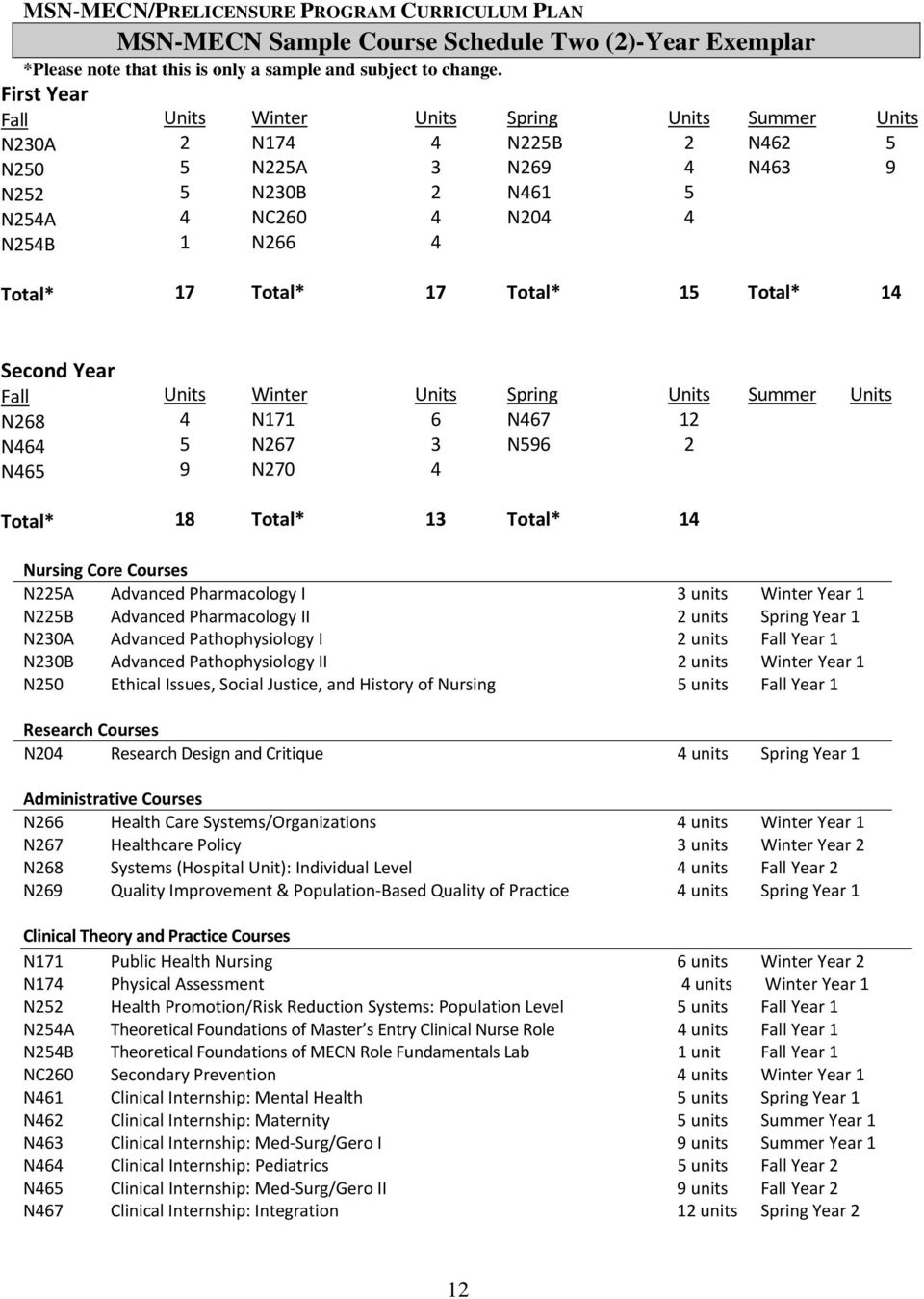
17 MSN-MECN/PRELICENSURE PROGRAM CURRICULUM PLAN MSN-MECN Sample Course Schedule Two (2)-Year Exemplar *Please note that this is only a sample and subject to change. First Year Fall N230A N250 N252 N254A N254B Units Winter N174 N225A N230B NC260 N266 Units Spring N225B N269 N461 N204 Units Summer N462 N463 Units 5 9 Total* 17 Total* 17 Total* 15 Total* 14 Second Year Fall N268 N464 N465 Units Winter N171 N267 N270 Units Spring N467 N596 Units 12 2 Summer Units Total* 18 Total* 13 Total* 14 Nursing Core Courses N225A Advanced Pharmacology I 3 units Winter Year 1 N225B Advanced Pharmacology II 2 units Spring Year 1 N230A Advanced Pathophysiology I 2 units Fall Year 1 N230B Advanced Pathophysiology II 2 units Winter Year 1 N250 Ethical Issues, Social Justice, and History of Nursing 5 units Fall Year 1 Research Courses N204 Research Design and Critique 4 units Spring Year 1 Administrative Courses N266 Health Care Systems/Organizations 4 units Winter Year 1 N267 Healthcare Policy 3 units Winter Year 2 N268 Systems (Hospital Unit): Individual Level 4 units Fall Year 2 N269 Quality Improvement & Population Based Quality of Practice 4 units Spring Year 1 Clinical Theory and Practice Courses N171 Public Health Nursing 6 units Winter Year 2 N174 Physical Assessment 4 units Winter Year 1 N252 Health Promotion/Risk Reduction Systems: Population Level 5 units Fall Year 1 N254A Theoretical Foundations of Master s Entry Clinical Nurse Role 4 units Fall Year 1 N254B Theoretical Foundations of MECN Role Fundamentals Lab 1 unit Fall Year 1 NC260 Secondary Prevention 4 units Winter Year 1 N461 Clinical Internship: Mental Health 5 units Spring Year 1 N462 Clinical Internship: Maternity 5 units Summer Year 1 N463 Clinical Internship: Med Surg/Gero I 9 units Summer Year 1 N464 Clinical Internship: Pediatrics 5 units Fall Year 2 N465 Clinical Internship: Med Surg/Gero II 9 units Fall Year 2 N467 Clinical Internship: Integration 12 units Spring Year 2 12
18 MSN-MECN GRADING POLICY GRADING SCALE The recommended grading scale for the Graduate Division at UCLA and the School of Nursing is as follows: Percentage <73 Letter Grade A+ A A- B+ B B- C+ C C- F MSN-MECN PROGRESSION 1. Progression within a course, from course to course and level to level is governed by the Student Affairs Committee regulations as stated in this section. Students are responsible to complete all courses at the designed level before going on to the next level. 2. Faculty may ask the Student Affairs Committee to review a student s record on the basis of classroom and/or clinical performance, professionalism, attendance or tardiness. The committee may choose to put the student on probation, make conditional requirements, and/or dismiss the student. The Chairperson of the Student Affairs Committee will give a letter to the student stating the action of the committee. Appeal of this action by the student is made to the Chair of the Student Affairs Committee. 3. A minimum cumulative grade point average of 3.0 (on a 4.0 scale) must be maintained throughout the program. 4. For progression within the MSN-MECN program clinical-theory and -practice courses are linked. Students must satisfactorily pass both theory and clinical components of the course and achieve a B (>84%) to pass the course and progress to the next theory-clinical course(s). If a student does not receive a grade of B, >84%, they will repeat the theoryclinical course during the next academic year. 5. For designated nursing courses, N252, N260, N225AB (pharmacology), N230AB (pathophysiology), students may progress within the program if a grade of a C (i.e. a score >74%) is earned. 13

19 6. A student is only permitted to fail one nursing course in the process of completing the MECN program. The student may retake that failed course, however, if the student fails that course again, or subsequently fails any other nursing course, the student may not continue in the program. 7. A student may not drop a nursing course to avoid receiving a failing grade. Students must seek counsel from their faculty advisor, the Assistant Dean for Student Affairs and the Associate Dean for Academic Affairs before dropping a course. 14

20 ASSESSMENTS AND EXAMINATIONS FOR PRELICENSURE PROGRAMS PERIODIC ASSESSMENTS AND EXAMINATIONS PURPOSE The Kaplan exams are administered to School of Nursing prelicensure nursing students to assess whether each student has acquired the necessary skills and knowledge to successfully pass the respective content areas on the RN-NCLEX. These tests are administered as coursework is completed and at the end of the program. Participation in the Kaplan testing program is mandatory for all pre-licensure nursing students. The cost of exam and review materials are the responsibility of each nursing student. KAPLAN LEVEL/COURSE EXAMINATION SCHEDULING: Each student must plan to be present on the days in which the respective Kaplan Level/Course examinations are administered. The schedule indicates the timeframe when the respective exams are administered. Students may not lobby to pressure faculty or other students to change test dates. Tests are scheduled during finals week of the specified quarters and students should plan personal commitments and travel so that they can attend the examination period. While the Kaplan examination scores do not contribute to course grades, a student will not have completed the corresponding course until the Kaplan Examination is completed. The course syllabus for any given quarter will contain the exact date when the Kaplan Level/Course Examination is administered. Exam administered at the conclusion of the corresponding course: Mastery Score BS/Prelicensure (Minimum) Corresponding Course Timing Fundamentals 68% N150B Fundamentals B Win Yr 3 Pharmacology 70% N 166 Med/Surg/ Gero II Sp Yr 3 Medical-Surgical 75% N 166 Med/Surg/ Gero II Sp Yr 3 Comprehensive Pediatric Nursing 65% N165 Pediatrics Sum Yr 3 OB Nursing, including 72-74% N164 Maternity Sum Yr 3 growth and development Management/ 75% N168 Leadership Role Fall Yr 4 Professional Issues Psychosocial Nursing 68% N161 Mental Health Fall Yr 4 Community Health 52% N171 Public Health Spr Yr 4 Nursing Comprehensive 69% N171 Public Health Nursing Spr Yr 4 15

21 Exam administered at the conclusion of the corresponding course: Mastery Score MSN-MECN (Minimum) Corresponding Course Timing Fundamentals 68% N254B Fundamental B Fall YR 1 Pharmacology 70% N465 Med/Surg/Gero II Fall YR 2 Medical-Surgical 75% N465 Med/Surg/ Gero II Fall YR 2 Comprehensive Pediatric Nursing 65% N464 Pediatrics Fall YR 2 OB Nursing, including 72-74% N462 Maternity Sum YR 1 growth and development Management/ 75% N268 Systems Fall YR 2 Professional Issues Psychosocial Nursing 68% N461 Mental Health Spr YR 1 Community Health 52% N171 Public Health Win YR 2 Nursing Comprehensive 69% N467 Integration Spr YR 2 MASTERY SCORE: If students receive scores that indicate less than mastery, they are responsible for contacting their advisor to discuss how they will plan for remediation. PRACTICING FOR THE KAPLAN EXAMS: To assure the success of each student in taking the Kaplan course/level examinations, Kaplan has made available online practice examinations and remediation tools to prepare students. Students should refer to the Kaplan website to access and take these practice exams ( KAPLAN EXIT EXAMINATION (RN COMPREHENSIVE PREDICTOR) The Kaplan Exit Examination is administered at the end of the student s final clinical course, and serves as a valuable assessment tool to determine the level of knowledge and skill of the nursing student near the end of the BS program. The price of the Kaplan exam encompasses the classes, exam and post-graduate review. The Kaplan exams are administered to SON prelicensure nursing students as periodic assessments as to whether each student has acquired the necessary skills and knowledge to successfully pass the respective content areas on the RN-NCLEX. These tests are administered both at the course level, and at the comprehensive level. Examinations are linked to courses, e.g., Maternity theory and clinical will be administered at the end of the corresponding academic quarter as the course offering. Participation in the Kaplan testing program is mandatory for all prelicensure nursing students and the cost of exam and review materials are the responsibility of each nursing student. The fee for in-program examination materials does include access to NCLEX-RN Prep offered by Kaplan Nursing following graduation. 16
22 MECN WRITTEN COMPREHENSIVE EXAMINATION Pursuant to requirements of the UCLA graduate division for graduation, the written Master s Comprehensive Examination is administered in spring quarter of the second year of study. Written instructions are distributed to students at least 10 weeks in advance of the (examination) due date. Each student completes the Comprehensive Examination out of class and independently. A passing score is 70% or more of possible points. The Comprehensive Examination may be attempted three times. Late examinations are not accepted for grading but do count as an attempt at passing unless otherwise approved by the Curriculum Committee in advance. Students who fail to achieve a passing score on their first attempt are eligible to participate in graduation ceremonies. However, the degree will be awarded in the quarter during which the Comprehensive Examination is passed. Successful completion of the Master s Comprehensive Examination is a requirement for completion of required nursing curriculum. Students will not be certified to any Board of Registered Nursing as having completed nursing course requirements until they have successfully completed the Master s Comprehensive Examination. 17
23 POSTLICENSURE PROGRAMS IN THE SCHOOL OF NURSING MASTER S OF SCIENCE NURSING-ADVANCED PRACTICE NURSE /POSTLICENSURE This program prepares nurses to be advanced practice nurses (APNs) across three tracks: 1) Clinical Nurse Specialist (CNS), 2) Nurse Practitioner (NP), and 3) Nurse Administrator (NA). In their practice, APNs use logic and reason distinguished by intellectual curiosity and individual creativity. APNs apply multidisciplinary theories, including nursing, biologic, behavioral, management, social/environmental, and organizational to develop, implement, and evaluate models of patient care and quality of services. They are able to competently assess, diagnose, plan, implement, manage, and evaluate the care of patients, groups of patients, and families from diverse cultural backgrounds. The curriculum prepares students for careers in advanced practice or management. After completing the MSN-APN Degree within an area of advanced practice, graduates achieve the following objectives: 1. Evaluate and apply, in a variety of settings, advanced theoretical knowledge in order to deliver health care to clients from diverse cultural backgrounds, including organizations and communities. 2. Demonstrate communication skills through collaboration with clients in health care plans. 3. Evaluate existing nursing research, utilize research findings in advanced nursing practice, and participate in the development of new knowledge. 4. Demonstrate leadership skills and critical thinking that contribute to the effectiveness and efficiency of nursing and health care. 5. Develop and maintain a practice environment based on the principles of ethics and law in which ethical dilemmas are rightfully resolved. 6. Consult and collaborate with Clients and other health professionals in the development, implementation, and evaluation of healthcare delivery, policies, and programs at the local, state, and national levels. In addition, functional objectives for each area of advanced practice for the MSN degree allow: 1. Nurse practitioners to deliver advanced nursing care through the assessment, diagnosis, and management of health/illness needs in primary health care, assuming responsibility and accountability for the continuity of health care in both health and illness states. 2. Clinical nurse specialists to deliver advanced nursing care in a clinical specialty and perform advanced practice consultative, educative, leadership, and research roles in inpatient and outpatient settings. 3. Nurse administrators to provide leadership and perform administrative roles, including direct healthcare administration, risk management, quality improvement, case management, education, or research support, within acute, long-term, ambulatory, and community settings with a focus on improving patient and organizational outcomes. 18
24 ADVANCED PRACTICE NURSE (APN)/POSTLICENSURE There are two sections in the MSN-APN program, Acute Care (AC) and the Primary Care (PC). The AC section includes programs in Adult/Gerontology Acute Care NP or CNS, Nursing Administration and Adult/Gerontology Oncology NP or CNS. The PC section includes Adult/Gerontology NP, Family NP, and Pediatrics NP or CNS, Adult/Occupational and Environmental Health Nursing NP, Nursing Administration/Occupational and Environmental Health. With approval of the faculty, students may complete course work for both NP and CNS roles in the Pediatric and Adult/Gerontology-Acute Care programs. They must complete all theory and clinical courses for both roles. Please note: While 300 clinical hours in the CNS role is required currently for completion of the dual NP/CNS program, it is highly recommended that dual NP/CNS students complete a minimum of 500 clinical hours in the CNS role to insure their eligibility to sit for national certification exams. The MSN-APN curriculum includes core courses, and additional specialty courses which vary by concentration. The APN core coursework, as specified in the Essentials of Masters Education for Advanced Practice Nursing (1996), include: N 231, Advanced Pathophysiology; N224, Advanced Pharmacology; and N 440, Advanced Assessment and Clinical Diagnosis. These courses are presented in the table below. The number of directly supervised clinical practice hours required for the degree ranges from Graduates are eligible to sit for national certification examinations in the role and population in which they are prepared. Effective September 2010, NP and CNS students will follow a slightly revised curricula, as indicated below. The core and required courses for each program are summarized in the following table: OVERVIEW OF MSN-APN/POSTLICENSURE COURSE REQUIREMENTS MSN-APN/Postlicensure Nurse Practitioner Sample Course Schedule *Please note that these requirements subject to change Family Nurse Practitioner Specialty MSN Core Courses Specialty Core Concentration Courses N 200 Biobehavioral Theoretical Foundations of Health N 211 Theoretical Foundations of Women s Assessment Health Care during the Reproductive Years N 204 Research Design and Critique N 212 Health Related Family Theory N 224 Pharmacology for Advanced Practice Nurses N 236 Essential Theoretical Foundations of Primary Care of Children N 231 Pathophysiology for Advanced Practice Nurses N 239 A,B,C Assessment and Management of Adult Healthcare I, II, III N 264 Professional Issues in Nursing N 429 A,B,C, D, E Family Nurse Practitioner Clinical Practicum I, II, III, IV, V N 440- Advanced Assessment and Clinical Diagnosis I Adult/Gerontology Primary Care Nurse Practitioner and Clinical Nurse Specialty MSN Core Courses Specialty Core Concentration Courses N 200 Biobehavioral Theoretical Foundations of Health N 211 Theoretical Foundations of Women s Assessment Health Care during the Reproductive Years N 204 Research Design and Critique N 232F Human Responses to Aging and Chronic Illness N 224 Pharmacology for Advanced Practice Nurses N 233F Human Responses to Aging and Chronic Illness N 231 Pathophysiology for Advanced Practice Nurses N 239 A,B,C Assessment and Management of 19
25 Adult Healthcare I, II, III N 264 Professional Issues in Nursing N 245 Theoretical Foundations for Clinical Nurse Specialist Practice (only CNS) N 440 Advanced Assessment & Clinical Diagnosis I N 439 A,B,C, D, E Advanced Practice Nursing: Clinical Practicum I, II, III, IV, V N 445 Advanced Practice Nursing: Clinical Nurse Specialist Practicum (only CNS) Occupational and Environmental Health Nursing Adult Nurse Practitioner MSN Core Courses Specialty Core Concentration Courses N 200 Biobehavioral Theoretical Foundations of Health N 213 Occupational and Environmental Health Assessment Nursing Role, Theory, and Research N 204 Research Design and Critique N 239 A,B,C Assessment and Management of Adult Healthcare I, II, III N 224 Pharmacology for APN N 439 A,B,C APN Clinical Practicum N 231 Pathophysiology for APN N 439D APN: Residency N 264 Professional Issues in Nursing Add N450: Listed as Clinical Elective N 440 Advanced Assessment & Clinical Diagnosis I Pediatric Specialty Nurse Practitioner and Clinical Nurse Specialist MSN Core Courses Specialty Core Concentration Courses N 200 Biobehavioral Theoretical Foundations of Health N 212 Health Related Family Theory Assessment N 204 Research Design and Critique N 223 Childhood Development Research and Application to Nursing N 220 Theories of Instruction and Learning in Nursing N 238 A,B,C Assessment and Management in (for CNS and Dual only) Pediatric Health Care I, II, and III N 224 Pharmacology for APN N 245 Theoretical Foundations for Clinical Nurse Specialist Practice (for CNS and Dual only) N 231 Pathophysiology for APN N 438 A,B,C, D Pediatric Nurse Practitioner: Clinical Practicum I, II, III, IV N 264 Professional Issues in Nursing N 445 Advanced Practice Nursing: Clinical Nurse Specialist Practicum (for CNS and Dual only) N 440 Advanced Assessment & Clinical Diagnosis I Adult/Acute Care Specialty Nurse Practitioner and Clinical Nurse Specialist MSN Core Courses Specialty Core Concentration Courses N 200 Biobehavioral Theoretical Foundations of Health N 216 A, B, C Adult/Gerontology Concepts for Assessment APN in Acute Care I, II, III N 204 Research Design and Critique N 245 Theoretical Foundations for Clinical Nurse Specialist Practice (for CNS and Dual only) N 220 Theories of Instruction and Learning in Nursing N 416 A, B, C, D, E Adult/Gerontology- Acute (for CNS and Dual only) Care Nurse Practitioner Practicum I, II, III, IV, V N 224 Pharmacology for APN N 229A, B, C System-Based Health Care, 1,2, 3 N 231 Pathophysiology for APN N Advanced Assessment & Clinical Diagnosis I N Advanced Assessment & Clinical Diagnosis II Adult/Oncology Specialty Nurse Practitioner and Clinical Nurse Specialist MSN Core Courses Specialty Core Concentration Courses N 200 Biobehavioral Theoretical Foundations of Health N 214A -- Seminar for Advanced Concepts in Assessment Oncology I N 204 Research Design and Critique N 214B Seminar for Advanced Concepts in Oncology II N 220 Theories of Instruction and Learning in Nursing N 216 A,B,C Acute Care Nurse Practitioner (for CNS and Dual only) Practicum I, II, III, IV, V 20
26 N 224 Pharmacology for APN N 231 Pathophysiology for APN N 264 Professional Issues in Nursing N 440 Advanced Assessment & Clinical Diagnosis I N 444 Advanced Assessment & Clinical Diagnosis II MSN Core Courses N 204 Research Design and Critique N 245 Theoretical Foundations for Clinical Nurse Specialist Practice (for CNS and Dual only) N 416 A, B, C, D, E Advanced Practice Nursing: Clinical Practicum N 445 Advanced Practice Nursing: Clinical Nurse Specialist Practicum (for CNS and Dual only) Nursing Administration Specialty Core Concentration Courses N 218 A, B, C, D Nursing Administration Theory N 219 A Essentials of Accounting and Budgeting in Health Care Organizations N 219 B Operations Planning and Control for Nurse Administrators N 418 A,B,C Nursing Administration Practicum N 418 D Nursing Administration Residency Nursing Administration/Occupational and Environmental Health MSN Core Courses Specialty Core Concentration Courses N 204 Research Design and Critique N 213 Occupational and Environmental Health Nursing Role, Theory, and Research N 218 A,B,C, D Nursing Administration Theory N 219 A Essentials of Accounting and Budgeting in Health Care Organizations N 219 B Operations Planning and Control for Nurse Administrators N 418 A,B,C Nursing Administration Practicum N 418 D Nursing Administration Residency MASTERS IN BUSINESS ADMINISTRATION/MASTERS OF SCIENCE IN NURSING/POSTLICENSURE CONCURRENT DEGREE PROGRAM This three-year program of study leads to a combined MASTERS IN BUSINESS ADMINISTRATION/MASTERS OF SCIENCE IN NURSING (MBA/MSN) degree. Course offerings from the School of Nursing and the Anderson Graduate School of Management provide opportunities to learn about management of health care services and organizations from both a business and a nursing perspective. Separate applications are needed for each school. 21
27 MSN-APN/POSTLICENSURE GRADING POLICY GRADING SCALE The recommended grading scale for the Graduate Division at UCLA and the School of Nursing is as follows: Percentage <73 Letter Grade A+ A A- B+ B B- C+ C C- F MSN-APN/POSTLICENSURE PROGRESSION 1. Progression within a course, from course to course and level to level is governed by the Student Affairs Committee regulations as stated in this section. Students are responsible to complete all courses at the designed level before going on to the next level. 2. Faculty may ask the Student Affairs Committee to review a student s record on the basis of classroom and/or clinical performance, professionalism, attendance or tardiness. The committee may choose to put the student on probation, make conditional requirements, and/or dismiss the student. The Chairperson of the Student Affairs Committee will give a letter to the student stating the action of the committee. Appeal of this action by the student is made to the Chair of the Student Affairs Committee. 3. A minimum cumulative grade point average of 3.0 (on a 4.0 scale) must be maintained throughout the program. 4. For progression within the MSN-APN program, students must satisfactorily pass both theory and clinical components of the course and achieve a B (>84%) to pass the course and progress to the next theory-clinical course(s). If a student does not receive a grade of B, >84%, they will need to repeat the theory or clinical course during the next academic year. 5. A student is only permitted to fail one nursing course in the process of completing the MSN-APN program. The student may retake that failed course, however, if the student fails that course again, or subsequently fails any other nursing course, the student may not continue in the program. 22
28 6. A student may not drop a nursing course to avoid receiving a failing grade. Students must seek counsel from their faculty advisor, the Assistant Dean for Student Affairs and the Associate Dean for Academic Affairs before dropping a course. MSN-APN WRITTEN COMPREHENSIVE EXAMINATION Pursuant to requirements of the UCLA Graduate Division for graduation, the written Master s Comprehensive Examination is administered in spring quarter of the second year of study. Written instructions are distributed to students at least 10 weeks in advance of the (examination) due date. The Comprehensive Examination is completed out of class and independently by each student. A passing score is 70% or more of possible points. The Comprehensive Examination may be attempted three times. Late examinations are not accepted for grading but do count as an attempt at passing unless otherwise approved by the faculty curriculum committee in advance. Students who fail to achieve a passing score on their first attempt may participate in graduation ceremonies. However, the degree will be awarded in the quarter during which the Comprehensive Examination is passed. Additionally, successful completion of the Master s Comprehensive Examination is a requirement for completion of required nursing curriculum. Students will not be verified to any Board of Registered Nursing or credentialing agency as having completed nursing course requirements until they have successfully completed the Master s Comprehensive Examination. 23
29 GENERAL ACADEMIC POLICIES FOR THE SCHOOL OF NURSING GRADING AND BEHAVIOR POLICY POSTING OF GRADES AND/OR DISTRIBUTION OF EXAMS 1. Grades for examinations and final course grades are truncated, not rounded. 2. For the Master s Comprehensive Examination scores are rounded. A. Examinations and answer sheets are the property of the UCLA School of Nursing. Test materials will be distributed for review only. B. Exam results will be reported to students or posted in the MyUCLA Gradebook system within a reasonable time after the administration of an exam. C. Once the student has reviewed their results, the student has 72 hours, when possible, to file a written request with the appropriate faculty member for consideration for credit of items missed. The request must be supported by written documentation from an academic source (e.g. nursing textbook, etc.). PRELICENSURE APPEAL PROCESS GRADES NOT PREVENTING PROGRESSION If a student wishes to challenge a test or clinical grade or the final grade in a course, the student must submit a written statement regarding the concerns and discuss these with the involved faculty member and the course coordinator if appropriate, within one week. The Student may also meet with their faculty advisor, the Assistant Dean for Student Affairs and the Associate Dean of Academic Affairs. If the student determines that the discussion is not satisfactory, a written appeal must be presented to the University Ombudsman within one week after the discussion with the faculty, course coordinator, the Assistant Dean of Student Affairs, or Associate Dean of Academic Affairs. GRADES PREVENTING PROGRESSION If a student wishes to challenge a test or clinical grade or the final grade in a course that is going to prevent progression, the student must submit a written statement regarding his or her concerns and discuss these with the involved faculty member and the course coordinator if appropriate, within one week of the issuance of the grade. The Student may also meet with their faculty advisor and the Assistant Dean for Student Affairs. If the student determines that the discussion is not satisfactory, a written appeal must be presented to the Student Affairs Committee of the School of Nursing. The Chair of the Student Affairs Committee will send the results of that meeting to the student within one week after the meeting. If the student determines that the final decision of the Student Affairs Committee is not satisfactory, a written appeal may be presented to the University Ombudsman within one week after receiving the written results from the Student Affairs Committee. EXPECTATIONS FOR BEHAVIOR The nursing profession has developed a set of common guidelines for behavior and decisionmaking called The Code of Ethics for Nurses with Interpretive statements, American Nurses 24
30 Association, The nursing faculty affirm these professional standards and believe that nursing students should perform in accordance with the provisions of the code. Violation of any of these general standards of conduct or provisions of the code is grounds for discipline and possible dismissal from the nursing program and/or the University. ESSENTIAL FUNCTIONS OF A NURSING STUDENT In order to practice nursing, a person must possess a variety of cognitive, sensory, affective and psychomotor skills. These functions are essential to successful progression in and completion of the nursing program requirements, and are a required part of each course. If a nursing student cannot meet these standards, the student must communicate this to the Assistant Dean for Student Affairs in writing to explore options for reasonable accommodations or modifications in order to meet program requirements. Faculty in the School of Nursing will work with the Office for Student Disabilities to provide accommodations for learning. ESSENTIAL FUNCTIONS OF A NURSING STUDENT Function Description/Standards Representative Activities (not all-inclusive) Interpersonal Skills Abilities sufficient to interact appropriately with diverse individuals, families and groups Communication Skills Communicate effectively in English in verbal and written form Mobility Motor Skills Critical Thinking Hearing Visual Tactile Emotional Stability Ability to move from place to place and to maneuver to perform nursing activities in small spaces, stand and walk for extended periods Gross and fine motor skills sufficient to provide safe, effective nursing care Ability to exercise sound nursing judgment Auditory ability enough for assessment and monitoring of client needs Ability enough for accurate assessment and monitoring of client needs Ability enough for accurate assessment and monitoring of client needs Ability to assume responsibility/accountability for actions Establish therapeutic relationships with clients, establish rapport with health care team members, negotiate interpersonal conflict. Explain treatment procedures, initiate health teaching, give oral reports, speak on the telephone, document on agency records. Bend, twist, stoop, move around in rooms, administer CPR, push and pull 25 pounds, move quickly, climb stairs. Calibrate and use equipment, position clients, basic key board skills, squeeze with fingers, pinch with fingers, grasp small objects with hands/fingers, reach above shoulders, below waist, maintain balance. Sequence information, identify cause effect, plan/control activities for others. Hear normal speaking level sounds, hear faint body sounds, auditory alarms. Distinguish color, see objects up to 20 inches or 20 feet away, use peripheral vision, perceive nonverbal communication, observe specimens. Feel vibrations, detect temperature, feel differences in size. Provide client with emotional support, adapt to stressful situations, monitor own emotions, perform multiple responsibilities concurrently. 25
31 COMMITMENT TO LEARNING The UCLA nursing faculty is committed to helping students learn. Learning is seriously compromised if assignments are not completed. Therefore, in order to pass each course in nursing, the student must satisfactorily complete each of the following criteria: 1. The student must submit all course work on time in the format described in the course syllabus. Any late or missed assignment may be subject to a grade reduction, as specified in the course syllabus or by the faculty. 2. The student must be present and is expected to verbally participate in classroom and clinical activities including pre- and post-conferences in the clinical area (see Attendance Policies on Page 43). 3. The student must meet all assigned scheduled commitments 4. The student must complete pre-assessment activities as required in each course. 5. Prelicensure students must purchase and take the periodically scheduled Kaplan Examination series. 6. Internet access at agencies will be limited to obtaining information directly related to patient care. 7. Text messages, instant messaging and cell phone use for personal business are prohibited during clinical courses. Learning is also seriously compromised by classroom disruptions. Therefore, in order to maximize learning, cellular devices must be turned off and stowed in book bags during class. Any student using a cellular device for any reason (without permission) will be asked to leave class and an unexcused absence will be recorded. Students using cellular devices during exams or graded activities may be cited for cheating (at the professor s discretion). In the case of an unexpected emergency, students may seek permission from the professor to leave their cellular device on during class, but the device must remain in silent or vibrating mode and placed in a pocket. Behaviors that are disrespectful to faculty or fellow students are equally disruptive and prohibited. Therefore, students may not bring anyone not enrolled in the course to class or leave such persons unattended on campus or at off-site clinical facilities. Other prohibited classroom behaviors include refusing to be seated, talking during lectures, sleeping, eating, non-class reading, entering the classroom late or leaving early without authorization. Faculty may also communicate the time and manner for student questions and expression of points of view in the instructional setting. Faculty may establish, communicate and enforce reasonable rules of classroom behavior and decorum. These rules are not intended to discourage appropriate classroom expression, discussion or disagreement, but to promote respectful interactions. Disruptive or disrespectful behaviors in the classroom are grounds for discipline and possible dismissal from the nursing program and/or the University. Students that exhibit a chronic pattern of hostility and intimidation as indicated by the issuance of more than one Anecdotal Note, including (but is not limited to) verbal abuse, shouting, profanity, stalking, swearing, threatening communication of any kind, or any other activity that meets the legal definition of harassment, shall be dismissed from the program. 26
32 CLINICAL EDUCATION: PRELICENSURE CAMPUS SKILLS/SIMULATION LABORATORY 1. Students are required to meet all scheduled nursing skills laboratory appointments. 2. Each student is expected to utilize the campus laboratory to become proficient in all skills before his/her clinical experience and demonstrate proficiency in particular skills to the appropriate faculty member. 3. Each student is expected to utilize the equipment during posted campus laboratory hours. 4. Due to the nature of some nursing courses, the student may be required to spend time outside of regularly scheduled class/clinical time to gain nursing skills. Students will be notified early in the quarter when practice laboratory sessions will be held. 5. Faculty may request that the student return to the clinical laboratory for practice to gain proficiency. Inability to demonstrate proficiency in an assigned skill during return demonstrations may result in the student being excluded from the associated clinical experience and/or failing to meet the course objectives. 6. A clinical experience missed due to inadequate preparation will be considered an unexcused absence. 7. All laboratory equipment is the property of the School of Nursing. Any student borrowing equipment from the School is responsible for the maintenance of that equipment until it is returned, and will be required to replace any damaged, lost or stolen items. CLINICAL COURSE WORK 1. Clinical experience provides the student the opportunity to apply theory to clinical situations. Participation in assigned clinical experiences is mandatory (see Attendance Policies). 2. Clinical evaluation tools are standard tools that are modified for each clinical course as appropriate. Each evaluation tool provides specific, measurable objectives that cover the scope and extent of each clinical course objective. These specific tools are essential if learning objectives are to be achieved. A clinical evaluation tool must be completed by each student and signed off by their clinical preceptor on a weekly basis in every clinical course. Each student should remember that evaluations are designed as tools to keep the student appraised of his/her progress. 3. The purpose of clinical evaluation is to provide an assessment of each student s abilities and to identify his/her strengths and/or weaknesses. The evaluation tool provides specific guidelines for satisfactory achievement of the clinical objectives. 4. The student must submit a weekly log on their clinical activities. Failure to submit such a log to the appropriate clinical faculty on time will result in the issuance of an Anecdotal Note (see section on Anecdotal Notes on Page 28). The student is required to retain a copy of his or her entire clinical log. 27
33 5. The clinical evaluation process is ongoing. Faculty will provide documentation on each student s clinical evaluation tool at the mid-term and the final clinical conferences. 6. Students receiving either a failure or Unsatisfactory in the clinical component of a nursing course may not continue the progression to the next didactic/clinical course, but must repeat the entire course since didactic and clinical are linked. Students are urged to read the section on grades preventing progression. 7. Prelicensure students and clinical instructor will sign the final summary page indicating that the mid-term and final evaluations were read and discussed. Students in APN programs review and sign the summary of clinical hours as part of their permanent folder. 8. Students must pass each clinical rotation and must do so by satisfying each clinical objective. Any student who does not achieve the above requirements in the clinical rotation will receive a grade that is not passing ( C- or below or Fail for BS/Prelicensure; B- or below or Unsatisfactory for MSN-MECN) for the course. 9. Both the theory and related clinical practice experiences must be passed in each clinical rotation in order to progress to the next rotation, course and/or level. 10. There may be occasions when dismissal of a student by the Student Affairs Committee becomes necessary prior to the end of a rotation or course. Examples include three or more anectodal notes, excessive medication errors (whether PO, IM or IV), gross negligence/misconduct involving clients, and/or professional misconduct. Reason for prompt dismissal is not limited to these examples (see the Attendance Policy for specific details regarding attendance requirements and their impact on dismissal. DOCUMENTATION OF INAPPROPRIATE BEHAVIOR OR UNSAFE CLINICAL PRACTICE Students engaged in inappropriate or unsafe behavior in class, at office hours, in the clinical setting, or in any other interaction in their role as a student of the School of Nursing will have their actions documented in an Anecdotal Note. ISSUING AN ANECDOTAL NOTE 1. Should a specific situation occur in lecture or clinical warranting documentation, the exact incident should be described on an Anecdotal Note. The Anecdotal Note is given to the student to read within twenty-four (24) hours of the specific incident when possible. All documentation is filed in the student s record in the Office of Student Affairs. The student is encouraged to sign indicating that the note has been read and understood. The student may submit a written statement to be added to his/her responding to the Anecdotal Note. 2. If a student's clinical performance is unsafe, the student will be sent home from the clinical area. This will be considered an unexcused absence and a U will be given for the day on the clinical evaluation tool with documentation of the unsafe conduct. 3. Faculty will clearly detail on an Anecdotal Note what is deemed "unsafe clinical practice" and discuss the behavior with the course coordinator. Concise written guidelines for improvement will be given to the student. 28
34 4. If the student's behavior or clinical performance is determined to be inappropriate or clinically unsafe, an Anecdotal Note will be issued. If three reports of inappropriate behavior or unsafe clinical practice are filed for a single course, the student will fail that course 5. If students receive more than three Anecdotal notes during the academic program, they will meet with their faculty advisor and be referred to the Associate Dean of Academic Affairs for counseling and to the Student Affairs Committee for review. ELIGIBILITY FOR CLINICAL PRACTICE: ALL PROGRAMS In order to be eligible for clinical practice, each student is required to provide the Office of Student Affairs with documentation of the items indicated in the following sections. HEALTH EVALUATION GENERAL 1. Students must meet the following School of Nursing minimum health evaluation requirements. 2. Depending on clinical placement, students will be required to meet any additional health evaluation requirements per individual institution s policy (see also Clinical Agency Rules). PHYSICAL EXAM 1 1. Students shall have a health examination by a person lawfully authorized to perform such an examination within six (6) months prior to entering the clinical nursing program. 2. Each examination shall include a medical history and physical evaluation. 3. The examination shall include laboratory work if indicated by the practitioner. 4. The report signed by the practitioner shall indicate that the person is able to perform assigned duties and that no health condition exists that would create a hazard for the student, colleagues, patients or visitors. 5. If a student is returning from an absence greater than or equal to one year, the student must complete a new health evaluation within six (6) months prior to reentering the program. 6. All persons working in a clinical setting who have symptoms of infectious disease shall be removed from contact with patients (see also Health Situations Increasing Risk in the Clinical Setting). TUBERCULOSIS EVALUATION 1. The initial health examination shall include a purified protein derivative intermediate strength intradermal skin test for tuberculosis or a chest X-ray. 1 California Code of Regulations, Title XXII,
35 2. Positive reaction to the skin test shall be followed by a cm x cm (14" x 17") chest X-ray. 3. Annual tuberculosis screening by a person lawfully authorized to perform such an examination that includes symptom/risk factor assessment must be performed prior to beginning each academic year. 4. A negative PPD tuberculin skin test or a chest x-ray within six (6) months prior to entering the program is required. The PPD must be repeated prior to beginning each academic year. If a student has a positive PPD and a negative chest x-ray prior to beginning the program, they must complete the TB questionnaire prior to beginning the next academic year. 5. Depending upon clinical site, additional requirements may be necessary (e.g. two checks). IMMUNIZATION STATUS 1. Students must demonstrate immunity to Rubella (Measles), Rubeola (Mumps), Varicella (Chicken Pox), Hepatitis A, Hepatitis B (i.e. documentation of adequate antibody titer levels post vaccination). a. If insufficient immunity status has developed, documentation of completion of vaccination series for above immunizations must be demonstrated. 2. Students must provide documentation of tetanus and pertussis immunization [tetanusdiphtheria-acellular pertussis (TDaP)] within ten (10) years prior to entering the program. 3. Per clinical placement requirements, students are required to take the seasonal flu shot. BASIC LIFE SUPPORT CARDIO PULMONARY RESUSCITATION (BLS/CPR) 1. All students are required to obtain, maintain and provide documentation of continuous Basic Life Support CPR certification during enrollment in the program. Such documentation must be given to the Student Affairs Office. 2. Students returning from an absence will be required to provide current documentation of Basic Life Support CPR prior to re-enrolling. 30
36 BACKGROUND CHECK 1. A background check is required of all students of the School of Nursing because nurses perform sensitive tasks that include: a. the care and security of patients, children, the elderly, the handicapped, the mentally impaired; b. direct access to controlled substances; c. issuance of keys to offices, rooms or buildings, 2. Students are required to submit to, and satisfactorily clear, a criminal background check prior to performing such duties. 3. Students must authorize the background check by signing the Background Check (Criminal Record) Authorization for UCLA Nursing Students form. 4. Students are also required to complete background check documentation. 5. Some agencies require additional background and security clearances that must be completed by students in advance of their clinical placement. Students will be given adequate time to prepare for and submit all documents for background clearances. HIPAA PRIVACY AND SECURITY SCREENING 1. The Health Insurance Portability and Accountability Act (HIPAA) was passed in 1996 in an effort to make health insurance more efficient and portable. Additionally, because of public concerns about confidentially, the Act also addresses information protection. 2. Because nurses have access to individual s protected health information, all students must a. have an understanding of what information must be protected under HIPAA privacy laws; b. have an understanding of the HIPAA patient rights; c. have an understanding of the nurse s role as a healthcare provider in maintaining privacy of protected health information for patient care, teaching, research, fundraising, marketing and media; d. be aware of consequences for non-compliance with federal regulations. 3. Students must successfully complete the following prior to entry into clinical practice. a. the Health Insurance Portability and Accountability Act (HIPAA) Privacy Standards Workforce Training MALPRACTICE INSURANCE Students are covered for liabilities arising out of activities within the scope of their clinical assignments. To the extent that students are rendering nursing services pursuant to statutory provisions of the Business and Professions Code or the Health and Safety Code of the State of California, they are considered University of California employees for malpractice liability purposes. This coverage applies when the University has the right of supervision and control 31
37 over student activities. The amount of coverage may vary with the affiliate. Enrollment in a degree program is not required if the individual is a bona fide student in the School of Nursing, as is the case for Advanced Practice students enrolled in Post-Master s Degree certification programs or taking clinical courses through the University Extension. However, students in the Advanced Practice programs, as responsible professionals, are encouraged to have private malpractice insurance in addition to the University coverage. 32
38 PERSONAL APPEARANCE: PRELICENSURE HYGIENE: 1. Good personal hygiene is an important aspect of professional nursing. Regular bathing and the use of body deodorant are essential. 2. Adornments are not to be worn in the hair. Small functional and conservative hair fasteners may be worn in order to secure a student s hair. Hair must be clean and secured off the collar. Beards and mustaches must be clean, short and neatly trimmed; otherwise male students should be clean-shaven. 3. Because odors can be offensive to ill clients, no perfume, colognes or after-shave lotions may be worn. 4. Make-up is to be in good taste and should not be used excessively. 5. Fingernails must be clean and short. Clear polish may be worn, except in the maternity areas where no polish may be worn. No artificial nails may be worn in clinical areas. 6. Jewelry will be limited to a plain wedding band, a watch with a second hand and one pair of earrings. Necklaces are not permitted. Earrings should be small single posts. For safety reasons, earrings that dangle are inappropriate. No other visible body piercing ornaments are allowed other than earrings. Multiple earrings or decorative pins on uniforms are not allowed. 7. Sweaters are not to be worn in the clinical area. 8. Gum chewing is not permitted in any clinical agency. 9. All visible tattoos are to be covered. 33
39 NURSING UNIFORM AND DRESS CODES: PRELICENSURE 1. Dress codes and uniforms will vary somewhat across the programs, based upon the role and the settings for clinical practice. For pre-licensure students, the uniform will consist of a Bruin/Royal blue top and bottom scrubs set with a nursing patch. 2. Some attire is never acceptable in the clinical area, including short pants, skirts shorter than 2 above the knee, open-toed shoes, sandals, visible piercing (e.g., noses, tongues, lips) or revealing attire (e.g., low-cut blouses). If students dress inappropriately, they may be dismissed from the clinical setting and some penalties may apply. 3. Every student will have the following articles in order to attend clinical, unless otherwise specified: a. UCLA School of Nursing Bruin-Card ID b. A watch with second hand/digital read out c. Bandage scissors d. Official UCLA School of Nursing name tag e. Black ballpoint pen f. Stethoscope g. Blood pressure cuff h. Goggles i. Penlight j. White laboratory coat 4. Uniforms must be clean, pressed, and fit well. Baggy or excessively loose clothing is unacceptable and unsafe for the clinical setting. 5. Students in an acute care setting, nursing shoes must be white shoes. No open-toed, openair or backless footwear is acceptable. Shoes should be clean and polished for every clinical visit. 6. In clinical facilities where uniforms are not worn, students are to follow the dress code for that agency. The student should consult the clinical instructor for clarification. Students going to pre-assessment or orientation at clinical sites should wear a lab coat with business casual street clothes underneath, (e.g. no denim clothing, sweat suits, or shirts with saying or logos are permitted). 7. The student should be wearing either a nursing uniform (as indicated in Articles 1 to 4), or business casual attire (as indicated in article 5) when meeting clinical agency personnel. 8. The UCLA School of Nursing Student Bruin-Card photo ID must be worn at all times in all clinical settings. Students may need additional IDs for individual facilities. 9. Uniforms are available for purchase at the UCLA Health Sciences Store, but can also be purchased from any other vendor. However, the uniform must conform with the standards outlined above. 34
40 PERSONAL APPEARANCE AND PROFESSIONAL CLOTHING MSN-APN/POSTLICENSURE As described above, MS-APN students are expected to use good judgment in personal hygiene and professional clothing. Clothing options for MSN-APN students vary according to the clinical agency. They may consist of scrub suits in acute-care clinical settings or business casual and laboratory coats in office or clinic settings. CLINICAL AGENCY RULES Students are educational guests in the clinical facility and are expected to abide by each facility s policies and procedures manuals. Students are expected to be familiar with emergency protocols for each clinical facility. No personal calls are to be placed or received while in the clinical setting. Students are not allowed to carry a beeper or use cellular device when in clinical unless doing so is required by the policies of the clinical site. Should a family member need to reach the student (in case of emergency only), they should call the clinical facility nursing office/ nursing office manager to will notify the faculty supervising the student. Students who fail to comply with ongoing health-related documentation will not be allowed to attend clinical and will be required to make up lost time. Students are expected to follow dress codes and/or specific rules unique to each facility, and to display professional demeanor while in the facility. 35
41 CONFIDENTIALITY 1. Nurses are ethically committed to a nonjudgmental attitude, to honesty, and to protecting the confidentiality and the right to privacy of the patient. 2. Patients often confide highly personal information to nurses, trusting them not to divulge that information carelessly. 3. Patient names should never be used when writing nursing care plans or presenting case studies, except when these care plans are recorded directly in the patient s chart and are used as a basis for ongoing patient care. Instead, the patients should be referred to by their initials to conceal identity. 4. Any information seen or heard concerning a patient s diagnosis, condition, treatment, financial or personal status must be held in absolute confidence. 5. Details of a patient s history or status should not be discussed in elevators, restrooms, cafeterias, or in any other public place. Discussing a patient s medical history merely for the sake of gossip is highly unethical and unprofessional and may result in dismissal from the nursing program. 6. When the clinical experiences terminate, the need to respect the client s confidentiality continues. 7. Under no circumstances should a student photocopy any part of the patient s record. 8. Theory examinations, clinical skills, and other testing situations are confidential. Details of these examinations should be discussed or shared only with other students and SON faculty. 36
42 HEALTH SITUATIONS INCREASING RISK IN THE CLINICAL SETTING Changes in student health status that may affect the safety of the student and/or client in health care agencies must be reported to the Assistant Dean for Student Affairs. This includes pregnancy, accident that causes injury, or other mental or physical condition including infectious diseases. A health care provider statement may be required indicating it is safe for the student to function in the clinical area. The School of Nursing will provide reasonable accommodations for student with specific needs stemming from a change in health status. As a part of providing care to ill persons, the student may be exposed to infectious and/or communicable diseases. Costs of testing, diagnosis, and treatment of any infectious and/or communicable disease, including those contracted while acting as a caregiver in a clinical experience, will be the responsibility of the student. The School of Nursing provides instruction to each student regarding Universal Precautions according to the recommendations of the Centers for Disease Control. IF THE STUDENT IS INJURED WHILE IN CLINICAL: 1. The student should immediately notify the faculty member, who will immediately notify Student Affairs 2. The student will be excused from clinical for the day to seek medical treatment. 3. If required, emergency care will be provided by the clinical site; the clinical site is responsible for costs associated with emergency treatment a. a needle stick is considered an urgent medical concern 4. The student is responsible for contacting his/her health care provider (often the Arthur Ashe Center) immediately following emergent care (ideally within 4 hours) to arrange for post-injury follow-up. 5. All costs associated with follow-up treatment are the responsibility of the student. 37
43 UCLA SCHOOL OF NURSING POLICY ON HIV/AIDS AND OTHER BLOOD BORNE DISEASES DEFINITIONS HIV/AIDS Acquired immunodeficiency syndrome (AIDS) is a condition in which the body s ability to defend itself against a variety of diseases is seriously reduced. This condition apparently is caused by a virus known most commonly as the human immunodeficiency virus (HIV). As yet, there is no known cure for AIDS. HIV POSITIVE When a person is infected with the HIV virus, his or her immune system responds by producing antibodies against the virus. Antibodies can be detected by a laboratory test, though symptoms of illness may not be present. Antibodies generally develop within three (3) to twelve (12) weeks after exposure but may take as long as fourteen (14) months. Such an infection apparently cannot be reversed, and may develop into AIDS. PRINCIPLES UNDERLYING THE UCLA SCHOOL OF NURSING POLICY 1. A primary objective of the UCLA School of Nursing HIV/AIDS policy is education for the prevention of any acquisition or transmission of HIV/AIDS. 2. UCLA School of Nursing shall respond to any known case of HIV/AIDS as it would to any other life-threatening, contagious disease. At no time will the University discriminate against any persons simply because they are infected by the HIV virus. 3. UCLA School of Nursing personnel will act to combat fear, prejudice, discrimination, irrationality, and/or paranoia commonly associated with HIV/AIDS. POLICY 1. Responsibility for ongoing, educational programming on HIV/AIDS shall be assigned to the faculty and the office of the Associate Dean of Academic Affairs. Such educational programming shall be directed to all members of the UCLA School of Nursing community, including administrators, faculty, staff, and students. 2. UCLA School of Nursing shall attempt to conform to all local, state, and federal laws and the Center for Disease Control guidelines. 3. UCLA School of Nursing allows persons who are HIV-positive to remain on campus, but they must not engage in or endorse life-style practices which might pose direct threat of transmitting the virus to others. 4. UCLA School of Nursing will not undertake program screening to identify persons infected with the HIV virus unless required to do so by law. Students and University employees desiring HIV testing are directed to seek assistance from their personal physicians or the public health departments. 38
44 5. All health care professionals are expected to adhere to medically determined policies regarding the safe disposal of hypodermic needles, blood, and other bodily fluids. Adherence to these same precautions will be practiced in laboratory courses and wherever members of the UCLA School of Nursing community, including administrators, faculty, staff and students encounter bodily fluids. 6. UCLA School of Nursing employees will protect the confidentiality of any person who tests HIV positive, as mandated by the Family Education Rights and Privacy Act of Students and University employees involved in extra-curricular activities and/or activities, which place them at risk, shall take appropriate, precautionary measures to reduce risk to themselves or others. 8. Due to the inherent risks of laboratory and nursing-clinical facilities, students are required to take appropriate precautionary measures in dealing with the blood and body fluids, handling of needles, and any laboratory or hospital equipment that may pose a threat to themselves or to other persons. In the event of an incident involving risk of HIV or Hepatitis transmission, the student or University employee has an ethical duty to immediately report the incident to a designated University official. 9. Additional information on AIDS/HIV can be obtained from the Center for Disease Control PROCEDURAL ADDENDUM TO UCLA SCHOOL OF NURSING S AIDS POLICY In addition to the University AIDS Policy, the following statements apply to nursing students and faculty in the School of Nursing in relation to Human Immunodeficiency Virus (HIV), Acquired Immunodeficiency Syndrome (AIDS), Hepatitis B Virus (HBV), Hepatitis C Virus (HCV), Hepatitis D Virus (HDV), and Hepatitis G Virus (HGV) since health care activities may put an individual at higher risk for these diseases. 1. No individual shall be denied an opportunity for admission into the nursing program or employment in connection with the nursing program because that individual is infected with a dangerous communicable disease such as HIV, AIDS, HBV, HCV, HCV, or HGV, so long as (a) UCLA School of Nursing is able to make reasonable accommodations for the individual and (b) the disease does not create a direct threat, as both of the underlined terms are defined in the Americans with Disabilities Act. 2. Students and faculty should be aware that as novice practitioners with limited skills in clinical settings, students may have a greater risk of unintended puncture with sharp medical instruments and are at a greater risk of exposure to HIV, AIDS, or Hepatitis. 3. No nursing student or faculty may ethically refuse to treat a patient solely because the patient is at risk of contracting, or has contracted, an infectious disease such as HIV, AIDS, or Hepatitis. 4. Nursing students and faculty must follow professional guidelines as well as guidelines of the health care agency relative to confidentially concerning the patient with HIV, AIDS, or Hepatitis 39
45 5. In order to reduce the possibility of exposure to Hepatitis B Virus, nursing students and faculty will follow the policies in effect for the School of Nursing at UCLA School of Nursing: 6. Students and faculty who are exposed to HIV, AIDS, or Hepatitis as a result of exposure to blood and body fluids such as a needle stick or other injury have the responsibility to notify their faculty or supervisor in the School of Nursing immediately after the occurrence and to follow post-exposure instructions under the guidance of their health care provider. Students will sign a UCLA School of Nursing post-exposure read and sign form. Information on post-exposure prophylaxis may also be obtained from the Centers for Disease Control and The National Clinicians Post-Exposure Prophylaxis Hotline (PEPline) (888) Exposure should be considered an urgent medical concern in order to ensure timely post-exposure management. The student will be excused from clinical for the day in order to seek treatment as indicated. a. Before starting the clinical sequence, nursing students are required to present verification that immunization for the Hepatitis B series has been started. Documentation that the series has been completed needs to be provided according to the appropriate time frame in order to continue in the clinical courses. b. Nursing faculty, who provide clinical supervision to students, will supply the Office of Student Affairs with documentation of vaccination, immunity, or a waiver of personal liability. The University will provide the cost of this vaccination when necessary. 7. Students are required to be tested for HIV when patients are exposed to the student s blood. Positive test results should be communicated to the health care agency and the agency procedure followed. 40
46 POST-EXPOSURE PROPHYLAXIS INSTRUCTIONS Human Immunodeficiency Virus (HIV), Hepatitis B Virus (HBV), and Hepatitis C Virus (HCV) Surveillance Guidelines: Due to the circumstances and possible exposure to HIV, HBV, and HCV, a student enrolled in the nursing program is considered as being at risk for these viruses given the amount of clinical learning expected of students. While it is not anticipated that any students will acquire any of these illnesses, any student deemed to be exposed to any of these illnesses would need to be under surveillance for six months from the date of exposure. During that surveillance period there are certain precautions that UCLA School of Nursing, the Center for Disease Control, and the World Health Organization recommend that the student practice to protect his/herself and others. 1. Each student is responsible for contacting his/her health care provider within two (2) to four (4) hours of exposure to discuss and arrange for the appropriate testing and postexposure prophylaxis. 2. If a student has not been vaccinated against Hepatitis B, he/she should start the series of vaccinations immediately. 3. If a student was previously vaccinated for Hepatitis B and his/her blood test demonstrates adequate concentrations of HBs antibodies, he/she will be considered protected against the Hepatitis B virus. If they are shown to have antibodies lower than the required levels, the student should receive a Hepatitis B vaccine booster. 4. For exposure to HIV, a student should have blood tests done for HIV antibodies at: a) time of exposure, b) four (4) to six (6) weeks after exposure, and c) three (3) months following exposure, or as recommended by his/her health care provider. The student should also follow his/her health care provider s recommendation for testing for Hepatitis B and C. 5. If a student is exposed to the HIV virus, he/she should use condom protection whenever engaging in sexual intercourse and should take precautions to prevent pregnancy from occurring while under HIV surveillance. 6. If a student has been exposed to any of the above named illnesses, he/she should temporarily remove themselves from being an organ donor, as indicated on the of his/her driver s license, and refrain from donating blood until there is no longer any suspicion of infection. 7. If a student is exposed to the HIV virus, he/she should notify his/her health care provider and dentist that he/she is under HIV surveillance program. 8. Each student should be constantly diligent about practicing Universal Precautions as outlined by the Centers for Disease Control. 9. A student entering any surveillance program for any of the above mentioned illnesses should discuss the matter with his/her spouse or significant other. Students looking for additional counseling should visit the Arthur Ashe Student Health Center on the UCLA campus. 41
47 STUDENT - FACULTY COMMUNICATION FACULTY ADVISEMENT On acceptance to the school, students are assigned a faculty advisor to aid in planning their total program. Students are encouraged to meet with their advisor each quarter and when problems or questions arise to evaluate progress, to identify academic and personal needs and match them with available school and University resources, to confirm University and course requirements, and to maximize the student s abilities to reach educational and professional goals. Freshman and sophomore students in the BS/Prelicensure program will meet with the Undergraduate Student Services Coordinator to plan their program of study. Upon entering their junior year, BS students will be assigned to a faculty advisor. Students are encouraged to take clinical or classroom-related concerns to the appropriate faculty member. If a concern is not resolved the student should contact their faculty advisor, the Assistant Dean of Student Affairs, the Associate Dean of Academic Affairs, and, if necessary, the Dean. Clinical and course evaluations as well as the Exit Survey provide additional mechanisms for students to provide feedback to faculty and the School of Nursing. 42
48 ATTENDANCE POLICIES In accordance with the University s philosophy, regular class and clinical attendance are considered necessary if the student is to complete the course objectives in a satisfactory manner. Attendance is considered a legitimate basis for grading. Due to the nature of the curriculum and obligations to clients, prelicensure students cannot easily make up time missed in the clinical area, eliminating the option for voluntary absences. Students are expected to attend all classes and every clinical session for which they are scheduled. Students are expected to come to class and clinical on time. ABSENCES AND PUNCTUALITY THEORY COURSES Regular class and lecture attendance is expected of all nursing students. The instructor for a given theory course determines how student attendance is incorporated in the final grading, as indicated in the course syllabus. The only acceptable absence excuse for missing a quiz or examination for a theory course is one s own illness, serious illness in one s immediate family or death of a family member, or other exceptional circumstances. Ideally, the instructor or school must be notified at least two (2) hours prior to a scheduled examination. A student who misses a quiz or examination must take the missed quiz or examination within one (1) week of the scheduled examination at the discretion of the faculty member. There is no reduction applied to the grade on the examination for an excused absence. If a student is absent on the day of a quiz or examination without explanation that absence is considered to be unexcused. In general, failure to notify the instructor or school prior to the exam time will render the absence unexcused, even if the absence was due to one s own illness, serious illness in one s immediate family or death of a family member. CLINICAL COURSES IN THE PRELICENSURE PROGRAMS Clinical scheduling may include days, evenings, nights or weekends. This will be determined by the clinical site. Excused absence: an acceptable excuse for missing a scheduled clinical is one s own illness, serious illness in one s immediate family, death of a family member, appearance in court, inclement weather with hazardous driving conditions, attendance at a professional meeting or an unforeseen catastrophic event. Missing a scheduled clinical for any other reason will be considered an unexcused absence. The instructor and/or clinical agency must be notified at least one (1) hour prior to the scheduled clinical before. The following rules apply to the permissibility of absence from attending any clinical hours: 1. The maximum number of absences which can be allowed before learning is considered to be compromised is one (1) clinical day in a quarter, and this absence must be made up of the student will fail the course. This is only permitted if the student has satisfactorily met all clinical objectives in all clinical rotations. Exceptions to this rule will be considered on a case by case basis. 43
49 2. If possible, makeup time for excused absences will be arranged. If such arrangements cannot be made, the student will be allowed to drop the course (to avoid failing). 3. An unexcused absence will result in the issuance of an Anecdotal Note (*see section on Anecdotal Notes). If the clinical time is not made up, the student Fails the course. 4. A release statement from a physician is required following a major injury, medical illness, surgery, or extended absence to indicate suitability to return to clinical and class. This applies to illnesses and/or surgeries, which occur during the holiday or summer breaks. 5. Students who become aware that they have a communicable illness should notify their clinical instructor promptly. In this case, student should not attend the scheduled clinical and should also notify the appropriate clinical facility within two (2) hours of the scheduled clinical. 6. Clinical makeup scheduling may include days, evenings, nights or weekends. This will be determined by the individual faculty involved. 7. If prelicensure students have more than one (1) unexcused clinical experience they fail the course and the course must be repeated. 8. A student with more than one (1) excused absence due to a documented condition/illness or unforeseen catastrophic event may be allowed to drop the course (to avoid failing). 9. If a student receives an incomplete because of an excused clinical absence due to a documented condition/illness or unforeseen catastrophic event, the student will be unable to proceed to the next course or the next rotation until the incomplete is removed. 10. If a student becomes ill during clinical time, the instructor will determine if the student should be excused. If the student is sent home, this will be considered an excused absence and must be made up. 11. If the faculty deems a student is not prepared for clinical, he/she may be sent home. The time missed will be considered an unexcused absence and must be made up. 12. A student who has not turned in a completed health form by the designated deadline will not be permitted to go to clinical and the time missed will be considered an unexcused absence and must be made up. 13. Prelicensure students are expected to report to the clinical facility on time. Because of the nature and demand of the profession, clients assigned to students who are more than thirty (30) minutes late will be returned to the care of the facility s staff which will result in an unsatisfactory rating on the clinical evaluation tool. If a student knows he/she will be late, the clinical site and faculty member must be notified as soon as possible. Lateness of greater than thirty (30) minutes is considered an unexcused absence and must be made up. 14. Students who fail to comply with ongoing health-related documentation will not be allowed to attend clinical and will be required to make up lost time. 44
50 STUDENT INFORMATION ACADEMIC HONESTY UCLA is a community of scholars. All members, including faculty, staff and students are responsible for maintaining standards of academic honesty. Cheating, plagiarism, unassigned collaborative work, multiple submissions without permission of the professor or other kinds of academic dishonesty are considered unacceptable behavior and will result in formal disciplinary proceedings usually resulting in suspension or dismissal. All reports of dishonesty will be reviewed by the Student Affairs Committee and referred to the UCLA Dean of Students Office. Every student is responsible for following the University s Student Code of Conduct. LVN 45 UNIT OPTION Licensed Vocational Nurses interested in completion the 45 unit option must meet the transfer admission requirements of both UCLA and the School of Nursing. LVN students must formally request to follow this option, which will not lead to conferral of a Bachelor of Science degree at UCLA. Interested students are required to meet with the Assistant Dean for Student Affairs for counseling prior to filing a petition. TRANSFER OF CREDITS The School of Nursing has limited availability for student admission from another college or university, including a junior college. Information about transfer of credits and UCLA s policy on transfer of credit is available through the UCLA General Catalogue. The Office of Undergraduate Admissions and Relations with Schools evaluates transcripts from other institutions to determine how the credit will transfer to UCLA. All transfer applicants to the Prelicensure Bachelor of Science degree program must complete a UC Application for Transfer Admission and Scholarships and the UCLA School of Nursing Supplemental Application for Transfer Admission. All transfer applicants must submit the Supplemental Application for Transfer Admission with supporting documents within the designated time period. Applicants must list all college coursework completed, in progress, or proposed for the academic year on the GE and Prerequisite Requirements template. The School of Nursing may request additional documentation such as a course outline or syllabus. UC transferrable electives may be used to make up the required 62 to 74 transfer units. FINANCIAL ASSISTANCE Students may apply for various types of financial aid, including loans, grant, fellowships (MECN) and scholarships. In order to apply for need-based financial aid all students must complete the Free Application for Federal Student Aid. In addition, graduate students must complete the Need Access Application to be considered for need-based aid. Funds for all types of assistance are limited and are awarded to students who demonstrate need as determined from an analysis of their application, merit or other information such as community service or area of study as indicated by the funding source or scholarship donor. To assist students with the financial aid process, the UCLA School of Nursing has an Undergraduate Financial Aid Coordinator and a Graduate Financial Aid Coordinator in the Student 45
51 Affairs Office. The financial aid staff will announce the availability of various scholarships or other funding source as they become available, counsel students, calculate need, and award loans and School of Nursing controlled funds. The Student Affairs Committee participates in the selection of scholarship recipients. STUDENT INVOLVEMENT IN SCHOOL OF NURSING COMMITTEES Student input is valued in the governance of the School of Nursing and UCLA. Thus, students may be nominated, asked to volunteer, or be appointed to serve on various committees within the School of Nursing and the University. Students are encouraged to be actively involved in the School of Nursing and University-wide activities. CURRICULUM COMMITTEE This committee shall be composed of ten individuals: the chair and vice chair and two faculty who teach in the baccalaureate program, two who teach in the Master s Advanced Practice Nursing program, two who teach in the Master s Entry into Clinical Practice program, and two who teach in the Doctoral Program. The Chair and Vice Chair shall be elected by the full Academic Senate Faculty for a two-year term. The Chair, Vice Chair and at least six of the eight other members must be Academic Senate Faculty. The Associate Dean for Academic Affairs shall serve as an ex officio member without vote. The duties of the committee shall be to monitor curricular matters, changes in courses, instruction and degree requirements; to oversee comprehensive and qualifying exams; to recommend cognate courses and student advisors for doctoral students; and to recommend policies regarding the programs. STUDENT AFFAIRS COMMITTEE This committee shall be composed of one Academic Senate Faculty representative from each of the program specialties within the faculty functional units and one non-academic Senate Faculty representative. The Chair shall be elected by the full Academic Senate Faculty for a two-year term. The Assistant Dean for Student Affairs shall serve as an ex officio member without vote. Student representatives shall not be included. The duties of the committee shall be to select students for admission to the baccalaureate, master's and doctoral programs, to review student candidates for awards, honors and scholarships, to make decisions and/or recommendations to appropriate funding bodies for recipients of awards, honors and scholarships, and to oversee all matters related to recruitment, progression and retention of students. Student participation is not allowed on this committee pursuant to the University Bylaws. 46
52 ORGANIZATIONAL CHART OF THE UCLA SCHOOL OF NURSING 47
53 CAMPUS SERVICES STUDENT HEALTH The mission of the UCLA Arthur Ashe Center is to promote and enhance students' good health and well-being to support student success and enhances the quality of campus life at UCLA. Student Health is committed to providing cost-effective health care and health promotion services specifically designed for the unique needs of students in a complex, urban campus community. The unique mission of Student Health is vital and essential to the University meeting its teaching, research, and public service mission, thereby contributing to its success as a large public research university striving for preeminence. The institutional context reinforces the need to provide health care services of the highest quality to meet the unique challenges inherent to the university setting. The health services must be easily accessible and geared to the unique health needs and concerns of the students. The mission must include a strong educational component in order to promote healthful lifestyles and prepare students to become knowledgeable health care advocates and consumers within the larger community. Convenient, prepaid health care, including health promotion and education, are integral student services which support students' learning, growth and achievement while at the University. Student Health supports and actively promotes the mental, social, and physical growth and development of the students in a healthy, safe, and intellectually challenging environment. In summary, the role of Arthur Ashe Center in assuring good health involves: 1. Access to quality, comprehensive, accessible, cost-effective, convenient health care, and health education and promotion services. 2. Promoting individual life style choices and behaviors that prevent illness and lead to optimal health. 3. Contributing to the University's mission of teaching, research and public service by interacting with other departments and being a health care advocate for the students. Contact: COUNSELING AND PSYCHOLOGICAL SERVICES (CAPS) Sometimes students find themselves in need of assistance to learn how to deal with various psychological and social issues. CAPS provides a safe and confidential place to talk with a professional about concerns or problems, no matter how minor or serious, which might interfere with personal growth or academic achievement. Their services can be obtained by calling (310) or at the website. OFFICE FOR STUDENTS WITH DISABILITIES If you need any accommodation for a disability, please contact the Office for Students with Disabilities (OSD) at (310) or visit their website. OSD will work with your faculty to accommodate your academic needs. The School of Nursing is committed to working with all students to create a successful learning environment. 48
54 BRUIN ONLINE Bruin OnLine (BOL) is a collection of services that provides UCLA students, faculty, and staff with: Web Hosting Services Network Connectivity, including Wireless Free Software and Support Phone: (310) 267-HELP (4357) HOUSING UCLA s Housing Office offers a variety of services to help with undergraduate and graduate housing needs. Their experienced staff is available to answer questions and assist student s with housing options, meal plans, budget counseling, and payment information. Phone: (310) TRANSPORTATION AND PARKING The Transportation and Parking Office coordinates the variety of transportation options available to students and staff at UCLA including, issuing parking permits, coordinating ride-share programs, overseeing campus shuttle services, and much more. Phone: (310) POLICE The University of California Police Department at Los Angeles is mission driven to maintain a safer environment by maintaining a high state of readiness and providing crime prevention programs. Core values such as community betterment, teamwork, quality service and education development provide a firm base for public safety. The UCLA Police Department works closely with local law enforcement in a collaborative effort to prevent crime and apprehend criminal suspects. The CSO Escort Service is a program implemented by the UCPD to assure the safety of UCLA students and staff. This service can be reached by dialing (310) 794-WALK (9255) Phone: (310) (non-emergency and emergency number) or 911 from a campus phone 49
55 EMERGENCY PLAN The evacuation area for the Factor Building is at the corner of Tiverton and Charles Young Drive, across the street from the building. If a fire alarm sounds, you MUST leave the building immediately. Take only your personal belongings with you. Re-enter the building only when the fire department tells you it is safe. Do not leave the evacuation area until instructed to do so. If an earthquake occurs, take cover immediately under a desk, table etc. Cover your head and neck and stay away from windows. Follow the evacuation plan when it is safe to do so. EMERGENCY SERVICES For any other emergencies on campus, please dial 911 from prefixes 206, 267, 794, or 825, or from off-campus ECS prefixes 312, 411, or 794. Call campus police at Call when calling from a cellular phone from campus or adjacent locations. To report any damage to the physical plant call EMERGENCY TELEPHONE LINES If an emergency occurs when you are NOT in class, you can call the hot line to find out information that will be helpful regarding classes in session, etc. Local radio and television stations will also broadcast any changes that the University might need to make based on local events. You can also check the UCLA website at UCLA Emergency Hotline: UCLA ( ) or
56 ELIGIBILITY FOR LICENSURE After completion of either the BS/Prelicensure or MS-MECN program, students should be eligible to take the RN-National Council Licensing Examination (RN-NCLEX) and upon successful passage of the RN-NCLEX, graduates should be able to use the designated title RN. Eligibility to write the RN-NCLEX is determined by each respective State Board of Nursing. For requirements on sitting for the RN-NCLEX, students should review the guidelines for the respective state board where they wish to seek licensure. ELIGIBILITY FOR ADVANCED PRACTICE CERTIFICATION Students should review the guidelines for the respective certifying bodies and determine their eligibility. Faculty, the Assistant Dean of Student Affairs, and the Associate Dean of Academic Affairs will assist students in this process. CHANGES TO POLICY AND/OR CURRICULUM REQUIREMENTS The School of Nursing, due to the nature and demands of an educational program and the nursing profession, reserves the right to change specific policies and/or curricular requirements to enhance and update the curriculum design for the program of nursing. These changes will be made known to the students as they occur. A signature page at the end of the Student Handbook must be read, signed and returned to the Office of Student Affairs prior to the first day of the student s first class. Students will not be allowed in any nursing class without having a signed signature page on file with the Office of Student Affairs. 51
57 ORGANIZATIONS There are many opportunities for students to be involved in nursing and UCLA organizations. Visit the UCLA Student Groups website for a complete list of these opportunities. ASSOCIATED STUDENTS - CAMPUS Student self-government, with its accompanying co-curricular program, is organized and administered by the Associate Students of UCLA, in which all undergraduates hold membership by virtue of paying the ASUCLA fee. For more information on the Undergraduate Students Association, see: GRADUATE STUDENTS ASSOCIATION - CAMPUS The Graduate Students Association (GSA) is the official organization representing the interests of UCLA graduate students in academic, administrative, campus and statewide areas. The School of Nursing belongs to GSA s Health Sciences Council. The Health Sciences Council is made up of students from the Schools of Medicine, Dentistry and Nursing. NURSING STUDENTS AT UCLA All undergraduate nursing students at UCLA are invited to become members of Nursing Students at UCLA (NS@UCLA), which strives to facilitate interaction among students and between students and the School of Nursing faculty and staff. NS@UCLA also seeks to further the quality of education in the School of Nursing through representation on all major faculty committees. MEN IN NURSING Men in Nursing at UCLA is intended to foster and promote a collaborative and supportive network amongst men and women within the nursing profession. We also seek to advance the inclusion of more men in the profession through the continuous promotion of a positive and strong image of male nurses. Men in Nursing at UCLA is proud to be a recognized chapter of the American Assembly for Men in Nursing. NATIONAL STUDENT NURSES ASSOCIATION National Student Nurses Association (NSNA) is a national organization for student nurses. Students are encouraged to join the UCLA School of Nursing chapter. The purpose of this organization is to: 1) Encourage student participation in a professional organization; 2)Provide opportunity to gain skills in leadership in a professional organization; 3) Enhance perspectives of students concerning broader nursing issues and/or organizations. GRADUATE STUDENTS IN NURSING ASSOCIATION GSNA The Graduate Students in Nursing Association (GSNA) is the official organization of the graduate students in nursing. The primary purpose of the organization is to further enhance graduate education by offering the graduate student opportunities for leadership experience, furnishing an avenue for student and student/faculty interaction, providing a forum for addressing issues 52
58 pertinent to the nursing profession, and fostering student participation in the greater University community. All graduate students enrolled in the School of Nursing are members of GSNA by virtue of their graduate student standing and are urged to become active participants. ALPHA TAU DELTA - ATD Alpha Tau Delta is a professional fraternity for nurses that was founded in 1921 at the University of California, Berkeley. College chapters are established only in schools of nursing fully accredited by the National League for Nursing. Alpha Tau Delta is also a charter member of the Professional Fraternity Association. The purposes of Alpha Tau Delta are to further higher professional educational standards for those in the nursing profession, develop character and leadership, organize the social life of its members as a contributing factor to their educational program, and form a close bond of friendship, fellowship, mutual helpfulness, and understanding among those in the nursing profession. Men and women are eligible for membership in the UCLA Gamma Chapter. Students must be recognized for their high professional, moral, and scholastic standards to be eligible for membership. SIGMA THETA TAU - STT The mission of the Honor Society of Nursing, Sigma Theta Tau International is to support the learning, knowledge and professional development of nurses committed to making a difference in health worldwide. The Society is focused on creating a global community of nurses who lead in using knowledge, scholarship, service and learning to improve the health of the world s people. STT recognizes individuals for leadership qualities, superior achievement, high professional standards, creative work, and commitment to the ideals and purposes of the profession. The Gamma Tau Chapter at Large was first established at UCLA in spring Members may be nominated for membership while students or as community members after they have entered practice. 53
59 SIGNATURE AND CONFIRMATION PAGE ACKNOWLEDGEMENT OF RECEIPT OF INFORMATION ABOUT UCLA SCHOOL OF NURSING ACADEMIC POLICIES Each student is responsible for reading and understanding the content of the UCLA School of Nursing Student Handbook, and acting in accordance within the guidelines and spirit of the provisions outlined therein. I Student s Name (Print) have read the UCLA School of Nursing Student Handbook, and my signature below indicates that I understand the content of the handbook as it applies to my course of study, and agree to abide by the policies and regulations outlined therein. Sign Date 54
University of California, Los Angeles
 student handbook 2013-2014 University of California, Los Angeles School of Nursing Factor Building Box 951702 Los Angeles, CA 90095-1702 Dear Nursing Student: Welcome to the University of California Los
University of California, Los Angeles
 student handbook 2014-2015 University of California, Los Angeles School of Nursing Factor Building Box 951702 Los Angeles, CA 90095-1702 Dear Nursing Student: Welcome to the UCLA School of Nursing. In
DEPARTMENT OF NURSING C.W.POST CAMPUS LONG ISLAND UNIVERSITY GRADUATE STUDENT HANDBOOK
 DEPARTMENT OF NURSING C.W.POST CAMPUS LONG ISLAND UNIVERSITY GRADUATE STUDENT HANDBOOK C.W. POST CAMPUS DEPARTMENT OF NURSING GRADUATE STUDENT HANDBOOK TABLE OF CONTENTS PAGE MISSION STATEMENT FOR C.W.
Master of Science in Nursing
 GRADUATE FACULTY COMMITTEE DOC. NO. 1149 Approved November 16, 2009 RECOMMENDATION OF THE SUBCOMMITTEE ON GRADUATE COURSE AND CURRICULUM AND THE GRADUATE PROGRAM COMMITTEE AND THE FACULTY OF THE COLLEGE
Master of Science in Nursing. Academic Programs of Study 2015 2016 MSN
 Master of Science in Academic Programs of Study 2015 2016 MSN TABLE OF CONTENTS 1) ACCREDITATION AND EDUCATIONAL OUTCOMES 3 2) REGISTRATION AND ADVISING 3) COURSE LOAD See Policies 4) CLINICAL EXPERIENCES
Center for Medicine, Nursing and Health Sciences North Haven Campus
 School of Nursing School and Program Information..................................................168 Mission Statement.............................................................. 169 Values.........................................................................
An Invitation to Apply: UNIVERSITY of CALIFORNIA IRVINE DIRECTOR, PROGRAM IN NURSING SCIENCE
 An Invitation to Apply: UNIVERSITY of CALIFORNIA IRVINE DIRECTOR, PROGRAM IN NURSING SCIENCE THE SEARCH The University of California, Irvine (UCI) invites applications and nominations for the position
SCHOOL OF NURSING BACCALAUREATE IN NURSING DEGREE (BSN) Nursing. Nursing. Julie Luetschwager, Ph.D., Dean
 105 SCHOOL OF NURSING Julie Luetschwager, Ph.D., Dean Regina Hall, Room 118 (920) 923-8094 Excellence in education is at the forefront of Marian s commitment to students. Graduates of our programs in nursing
NURSING. Faculty. Bachelor of Science in Nursing. Programs Offered
 NURSING (707) 664-2465 Fax: (707) 664-2653 www.sonoma.edu/nursing DEPARTMENT CHAIR Deborah A. Roberts ADMINISTRATIVE STAFF Ana Munoz Kristi Nellman Faculty *Liz Close Michelle Kelly Deborah Kindy Wendy
SOUTHERN UNIVERSITY AND A&M COLLEGE BATON ROUGE, LOUISIANA
 MASTER OF SCIENCE IN NURSING (MSN) COURSE DESCRIPTIONS 600. THEORETICAL FOUNDATIONS OF ADVANCED NURSING (Credit, 3 hours). A systematic examination of the concepts of nursing, human beings, health, and
NURSING. Faculty. Bachelor of Science in Nursing. Programs Offered
 NURSING DEPARTMENT OFFICE Nichols Hall 256, (707) 664-2465 Fax: (707) 664-2653 www.sonoma.edu/nursing DEPARTMENT CHAIR Deborah A. Roberts ADMINISTRATIVE STAFF Ana Munoz Kristi Nellman Faculty *Liz Close
Washburn University School of Nursing. Preceptor Handbook for Graduate Students
 1 Washburn University School of Nursing Preceptor Handbook for Graduate Students 2 TABLE OF CONTENTS Description of the Program...3 Graduate Program Preceptor Guidelines...4 Code of Professional Conduct...7
NUNAVUT. HEALTH & WELLNESS CAREERS Nursing PROGRAM REPORT. 198 Bachelor of Science in Arctic Nursing
 NUNAVUT HEALTH & WELLNESS CAREERS Nursing PROGRAM REPORT 198 Bachelor of Science in Arctic Nursing Start Term: No Specified Start Date End Term: No Specified End Date Program Status: Approved Action Type:
NURSING. Faculty. Bachelor of Science in Nursing. Programs Offered
 NURSING (707) 664-2465 Fax: (707) 664-2653 www.sonoma.edu/nursing DEPARTMENT CHAIR Deborah A. Roberts ADMINISTRATIVE STAFF Ana Munoz Eileen O Brien Faculty *Liz Close *Carole Heath Michelle Kelly Deborah
WWCC NURSING STUDENT HANDBOOK 2015-16 ADDENDUM: SECOND-YEAR STUDENTS DURING 2015-16 ACADEMIC YEAR ONLY (Revised 9.16.15) PROGRAM OF LEARNING
 WWCC NURSING STUDENT HANDBOOK 2015-16 ADDENDUM: SECOND-YEAR STUDENTS DURING 2015-16 ACADEMIC YEAR ONLY (Revised 9.16.15) Second-year nursing students during the 2015-16 academic year will be completing
COLLEGE OF HEALTH SCIENCES
 COLLEGE OF HEALTH SCIENCES Dr. Katherine Pasour, Dean Dr. Kerry Thompson, Chair SCHOOL OF NURSING NURSING FACULTY: Professors Judith Hilton, Kerry Thompson Associate Professors Sylvia Bradshaw, Kathryn
MSC - Catalog 2006-2008 Academic Programs - School of Nursing 131
 MSC - Catalog 2006-2008 School of Nursing 131 MISSION AND GOALS The School of Nursing is responsible for teaching, research, and service in the discipline of nursing, as accomplished through its educational
Clinical Practicum From the second semester of the sophomore year, students will engage in clinical practice in various clinical settings.
 School of Nursing Elizabeth Simon, RN, PhD, CCRN, CEN, ANP, Director Nursing Major - B.S. Primary Faculty, Rockland: Inseon Hwang, DNSc, NP-C, RN, Assistant Professor Maureen Kroning, EdD, RN, Associate
University of Virginia. School of Nursing
 University of Virginia School of Nursing Graduate Program ASSESSMENT/EVALUATION MODEL Student Learning Objectives And Program Objectives Philosophy of the UVa School of Nursing The central purpose of the
Post Graduate/APRN Certificate Programs
 POST-GRADUATE CERTIFICATE Post Graduate/APRN Certificate Programs Purpose This distance education program is designed for the experienced registered nurse who has earned a master s or doctoral degree in
School of Nursing Program
 School of Nursing Program 18 School of Nursing Program The Duke University School of Nursing Program Mission The mission of the Duke University School of Nursing is to create a center of excellence for
College of NURSING. Mary H. Mundt, DEAN UNDERGRADUATE PROGRAM
 College of NURSING Mary H. Mundt, DEAN The nursing profession is committed to the promotion of health through the provision of high quality nursing care within the health care system. Nursing encompasses
COLLEGE OF HEALTH & HUMAN SERVICES
 COLLEGE OF HEALTH AND HUMAN SERVICES 159 COLLEGE OF HEALTH & HUMAN SERVICES Degree Program Dothan Campus Montgomery Campus The College of Health and Human Services provides quality education for professional
Doctor of Nursing Practice (DNP)
 2014-2015 Creighton University Catalog 1 Doctor of Nursing Practice (DNP) Creighton University College of Nursing offers a program of study in nursing leading to the degree of Doctor of Nursing Practice
COLLEGE OF HEALTH & HUMAN SERVICES
 COLLEGE OF HEALTH AND HUMAN SERVICES 195 COLLEGE OF HEALTH & HUMAN SERVICES The College of Health and Human Services provides quality education for professional practice in a variety of areas associated
Computer competency includes word processing skills and the ability to communicate electronically.
 College of Nursing Graduate Programs The College of Nursing at the University of Toledo offers several graduate-level degree and certificate programs. DNP and MS degrees and academic certificates are offered.
Kaplan University School of Nursing
 Kaplan University School of Nursing 2013 School Overview healthcare.kaplan.edu Contents Who We Are... 5 Our Goal... 5 Kaplan University History... 6 School of Nursing Mission... 6 School of Nursing Philosophy...
How To Get A Nursing Degree At California State University San Mario
 Cal State San Marcos at Temecula Nursing Degree Programs Cal State San Marcos at Temecula Nursing Degree Programs In 2008, California State University San Marcos (CSUSM) forged a unique partnership with
How To Get A Nursing Degree
 MASTER OF SCIENCE IN NURSING Program Director Judith L. Papenhausen, Ph.D., RN Graduate Coordinator and Chairperson Denise M. Boren, Ph.D., RN The mission of the graduate program in nursing at California
Computer competency that includes word processing skills and the ability to communicate electronically.
 College of Nursing Graduate Programs The College of Nursing at the University of Toledo offers several graduate-level degree and certificate programs. DNP and MS degrees and academic certificates are offered.
Specialty Practice Master of Nursing Science (MSN) Programs 2014-2015
 Specialty Practice Master of Nursing Science (MSN) Programs 2014-2015 Updated June 6, 2014 1 P a g e Table of Contents General Information... 3 Program Objectives...3 MSN Curriculum Overview...3 Clinical
College of Nursing Catalog 2015-2016
 College of Nursing Catalog 2015-2016 Graduate The College of Nursing at the University of Toledo offers several graduate-level degree and certificate programs. Doctor of Nursing Practice (DNP) and Master
Masters of Science in Nursing Curriculum Guide Course Descriptions
 Masters of Science in Nursing Curriculum Guide Course Descriptions Core Courses (26 credits total) N502 Theoretical Foundations of Nursing Practice (3 credits) Theoretical Foundations of Nursing Practice
academic programs Accreditation Program Description Associate of Science Nursing (ASN) Program ASN Program Admission Requirements Career Pathways
 academic programs Nursing DEPARTMENT Associate of Science in Nursing Degree (ASN) (122 Credits) Bachelor of Science in Nursing Degree (RN/BSN) (184 Credits) Program Description The associate and baccalaureate
School of Nursing Program
 School of Nursing Program 18 Admisssion and Progression The Duke University School of Nursing Program MISSION The mission of the Duke University School of Nursing is to create a center of excellence for
Nursing. Admission. Nursing Phone: (540) 568-6314 Web site: http://www.nursing.jmu.edu/ Department Head Dr. Julie Sanford
 Nursing Nursing Phone: (540) 568-6314 Web site: http://www.nursing.jmu.edu/ Department Head Dr. Julie Sanford Graduate Program Director Dr. Patty Hale Professors P. Hale, M. Mast, J. Rocchiccioli, L. Hulton
Doctor of Nursing Practice (DNP)
 DOCTOR OF NURSING PRACTICE (DNP) Doctor of Nursing Practice (DNP) Purpose The distance education program leading to the Doctor of Nursing Practice degree at Wilkes University is linked to the mission statements
Purpose. Admission Requirements NURSING EDUCATION STUDENT LEARNING OUTCOMES RESIDENCY REQUIREMENTS. Clinical Requirements
 NURSING EDUCATION Purpose This program is designed for professional nurses who have earned a Master s or Doctoral Degree in Nursing and seek further education in advanced nursing practice. Concentrations
MASTER OF SCIENCE IN NURSING
 300 MASTER OF SCIENCE IN NURSING Clarke University offers a Master of Science in Nursing degree in Nurse Educator and Family Nurse Practitioner programs, a post-master s certificate program and a master
Nursing. Faculty. Programs Offered. Bachelor of Science in Nursing. (707) 664-2465 www.sonoma.edu/nursing
 Nursing (707) 664-2465 www.sonoma.edu/nursing Department Chair Liz Close Administrative Staff Ana Munoz Eileen O Brien Faculty Anita Catlin Liz Close Carole Heath Deborah Kindy Jeanette Koshar Deborah
SCHOOL OF NURSING. Baccalaureate in Nursing Degree (BSN) Nursing. Pat O Connor, Interim Dean Greta Kostac, Ph.D, Interim Dean
 102 SCHOOL OF NURSING Degree programs for Registered Nurses (RNs) Pat O Connor, Interim Dean Greta Kostac, Ph.D, Interim Dean Regina Hall, Room 118 (920) 923-8094 Excellence in education is at the forefront
Nursing. Admission. Nursing (540) 568-6314 http://www.nursing.jmu.edu/ Department Head Dr. Merle Mast. Graduate Program Coordinator Dr.
 Nursing Nursing (540) 568-6314 http://www.nursing.jmu.edu/ Department Head Dr. Merle Mast Graduate Program Coordinator Dr. Patty Hale Professors P. Hale, M. Mast, J. Rocchiccioli Associate Professors L.
COLLEGE OF HEALTH & HUMAN SERVICES
 COLLEGE OF HEALTH AND HUMAN SERVICES 187 COLLEGE OF HEALTH & HUMAN SERVICES The College of Health and Human Services provides quality education for professional practice in a variety of areas associated
They are reviewed annually and revised or revalidates for the upcoming academic year.
 2007 Introduction/Context The undergraduate nursing program has the overarching goal to prepare nurses for professional practice. The program is fully accredited by the Commission on Collegiate Nursing
College of Nursing. Admission to Graduate Programs. Graduate Programs. Admission Requirements (DNP): 2011-2012 Catalog Revision 9/28/11 Page 1
 College of Nursing Graduate Programs The College of Nursing at the University of Toledo offers several graduate-level degree and certificate programs. DNP and MS degrees and academic certificates are offered.
Advanced Practice Nursing
 Wegmans School of Nursing Master of Science in: Advanced Practice Nursing Program Overview The mission of the program at St. John Fisher College is to provide a stimulating milieu of academic and clinical
ESSENTIAL DUTIES AND RESPONSIBILITIES. Program Duties and Responsibilities:
 An Invitation to Apply: Simmons College School of Nursing and Health Sciences: Department of Nursing Director of the Doctor of Nursing Practice (DNP) Program THE SEARCH Simmons College School of Nursing
M.S.N. Graduate Program
 M.S.N. Graduate Program Graduate Program Mission The Saint Luke s College of Health Sciences is an educational leader serving exceptional students pursuing a graduate nursing degree. An institution of
Nursing Schools Presentation WEST COAST EDITION
 Nursing Schools Presentation WEST COAST EDITION UC San Francisco UC San Francisco General Information Ranked #4 in the nation by U.S. News Our mission To educate diverse health leaders, conduct research,
How To Become A Doctor Of Nursing Practice
 Department of Health Sciences Moss School of Nursing Doctor of Nursing Practice: Family Nurse Practitioner (DNP) DNP Program Information Packet The Doctor of Nursing Practice (DNP) degree is designed for
SCHOOL OF NURSING Baccalaureate Study in Nursing Goals and Assessment of Student Learning Outcomes
 SCHOOL OF NURSING Baccalaureate Study in Nursing Goals and Assessment of Student Learning Outcomes The baccalaureate program prepares students for beginning professional nursing practice. The School of
Bachelor of Science Degree In Nursing
 Bachelor of Science Degree In Nursing Option for Registered Nurses 2013/2014 Student Handbook On Blackboard at UT Martin Campus and UT Martin Ripley Center Campus Accredited by the Accreditation Commission
Nursing Science (NUR SCI)
 University of California, Irvine 2015-2016 1 Nursing Science (NUR SCI) Courses NUR SCI 40. Introduction to Nursing and Health Care. 2 Units. Introduction to roles and responsibilities of nursing professionals,
RIVERSIDE CITY COLLEGE SCHOOL OF NURSING ASSOCIATE DEGREE PROGRAM FOR REGISTERED NURSING 4800 Magnolia Avenue, Riverside, CA 92506-1299
 RIVERSIDE CITY COLLEGE SCHOOL OF NURSING ASSOCIATE DEGREE PROGRAM FOR REGISTERED NURSING 4800 Magnolia Avenue, Riverside, CA 92506-1299 ADN (RN) ADVANCED PLACEMENT/TRANSFER/30-UNIT OPTION INFORMATION SHEET
r o c h e s t e r co l l e g e c ta lo g 141
 School of Nursing r o c h e sdepartment School t e r coof l lnursing e gof e Religion cata lo& g Bible 2012-2013 141 school of (NUR) The mission of the Rochester College School of Nursing is to prepare
NURSING. Kathleen Hirthler, DNP, CRNP, FNP-BC; Chair, Graduate Nursing Program; Assistant Professor 570-408-5027 kathleen.hirthler
 NURSING Deborah A. Zbegner, Ph.D., CRNP, WHNP-BC; Dean of Nursing; Associate Professor 570-408-4086 [email protected] Kathleen Hirthler, DNP, CRNP, FNP-BC; Chair, Graduate Nursing Program; Assistant
College of Nursing. Undergraduate Study in Nursing. Accreditation. Admissions. Introduction. Admission Requirements
 University of Illinois at Chicago 1 College of Nursing Contact Information: Campus Location: 118 College of Nursing (NURS) (312) 996-7800 www.uic.edu/nursing Administration: Dean, Terri E. Weaver 102 NURS
Georgia Regents University M.Ed. Counselor Education Program
 Georgia Regents University M.Ed. Counselor Education Program Information for Prospective Students The Counselor Education Master of Education (M.Ed.) degree graduate program at Georgia Regents University
CERRITOS COLLEGE HEALTH OCCUPATIONS DIVISION ASSOCIATE DEGREE NURSING PROGRAM INFORMATION PACKET www.cerritos.edu/ho
 CERRITOS COLLEGE HEALTH OCCUPATIONS DIVISION ASSOCIATE DEGREE NURSING PROGRAM INFORMATION PACKET www.cerritos.edu/ho DEAR APPLICANT, Thank you for your interest in the Associate Degree Nursing Program,
UTHealth School of Nursing MSN Preceptor Handbook
 UTHealth School of Nursing MSN Preceptor Handbook Introduction A clinical preceptorship is a supervised clinical experience that allows students to apply knowledge and skills in a practice setting. Each
College of the Redwoods
 College of the Redwoods Health Occupations (707) 476-4214 Revised November 2003 7351 Tompkins Hill Road (707) 476-4419 (Fax) Eureka, CA 95501-9300 www.redwoods.edu/departments/ho/index.htm LVN to RN Career
Department of Health Sciences Moss School of Nursing. Master of Science Degree in Nursing (MSN)
 Department of Health Sciences Moss School of Nursing Master of Science Degree in Nursing (MSN) MSN Program Information Packet The Master of Science in Nursing degree will provide graduates with a foundation
ACCESS EVENING / WEEKEND BSN Program Admission & Progression Policy
 ACCESS has combined the strengths of the DeSales nursing education with an accelerated format that enables busy adult learners to earn a BSN degree while continuing to work, care for a family, and handle
Nursing (M.S.N.) and Certificate Programs
 Seattle Pacific University 2005 2006 Graduate Catalog 83 SCHOOL OF HEALTH SCIENCES MARSTON HALL 206.281.2233 [email protected] WWW.SPU.EDU/DEPTS/HSC Nursing (M.S.N.) and Certificate Programs At a time of
Calendar. Program Mission and Outcomes
 Mercy College of Nursing and Health Sciences 31 Mercy College of Nursing and Health Sciences Master of Science in Nursing Dean: Kezia Lilly Faculty: Dana Hunt Office: 4431 S. Fremont St. Springfield, MO
Doctor of Nursing Practice
 308 Doctor of Nursing Practice Clarke University offers a Doctor of Nursing degree in Family Nurse Practice to serve the needs of the working health care professionals seeking post baccalaureate study.
DEPARTMENT OF NURSING C.W.POST CAMPUS LONG ISLAND UNIVERSITY UNDERGRADUATE STUDENT HANDBOOK
 DEPARTMENT OF NURSING C.W.POST CAMPUS LONG ISLAND UNIVERSITY UNDERGRADUATE STUDENT HANDBOOK C.W. POST CAMPUS DEPARTMENT OF NURSING UNDERGRADUATE STUDENT HANDBOOK TABLE OF CONTENTS MISSION STATEMENT FOR
OAKLAND UNIVERSITY SCHOOL OF NURSING RN/BSN DEGREE COMPLETION SEQUENCE
 OAKLAND UNIVERSITY SCHOOL OF NURSING RN/BSN DEGREE COMPLETION SEQUENCE Please visit the School of Nursing website at: www2.oakland.edu/nursing/ ON-LINE PROGRAM AT IN-STATE TUITION RATES Oakland University
CERRITOS COLLEGE HEALTH OCCUPATIONS DIVISION ASSOCIATE DEGREE NURSING PROGRAM
 CERRITOS COLLEGE HEALTH OCCUPATIONS DIVISION ASSOCIATE DEGREE NURSING PROGRAM DEAR APPLICANT: Thank you for your interest in the Associate Degree Nursing Program, which leads to eligibility for licensure
COLLEGE OF NURSING UNIVERSITY OF SOUTH FLORIDA 2012-2013 UNDERGRADUATE CATALOG
 The program is accredited by the Commission on Collegiate Nursing Education, One DuPont Circle, NW Suite 530, Washington, DC, 20036, (202) 887-6791, and approved by the Florida State Board of Nursing.
Bachelor of Science in Nursing Entry Level COLLEGE OF NURSING
 Bachelor of Science in Nursing Entry Level COLLEGE OF NURSING nova southeastern university 2012 2013 The Largest Health Care Provider As you plan or consider a career as a registered nurse, you should
Nursing (NURS) 3205. Nursing Research and Evidence-Based Practice. 3215. Nursing Research
 Nursing (NURS) Dean: Professor Regina M. Cusson Office: Room 201, Storrs Hall For major requirements, see the School of Nursing section of this Catalog. 1110. Introduction to Health and the Discipline
Winona State University - Rochester 859 30th Avenue SE, Rochester, MN 55904 507.285.7473 or 800.366.5418 x7473 GRADUATE PROGRAMS IN NURSING
 Winona State University - Rochester 859 30th Avenue SE, Rochester, MN 55904 507.285.7473 or 800.366.5418 x7473 GRADUATE PROGRAMS IN NURSING THANK YOU for your interest in Winona State University s Graduate
The University of Louisiana at Monroe
 i The University of Louisiana at Monroe Online Doctoral Program in Marriage and Family Therapy: Concentration in Creative Systemic Studies Doctor of Philosophy Degree Program Handbook Policies and Procedures
RN-MS Program. Purpose. Admission Requirements. State Requirements for Online/Distance Education. Degree Requirements
 RN-MS PROGRAM RN-MS Program Purpose This accelerated program is designed for the experienced, practicing registered nurse who plans to continue nursing studies through the master's level and does not hold
What is a Nurse? A person trained to care for the sick or infirm, especially in a hospital.
 School of Nursing What is a Nurse? A person trained to care for the sick or infirm, especially in a hospital. Nursing is a profession within the health care sector focused on the care of individuals, families,
Graduate Curriculum Guide Course Descriptions: Core and DNP
 Graduate Curriculum Guide Course Descriptions: Core and DNP APN Core Courses (35 credits total) N502 Theoretical Foundations of Nursing Practice (3 credits) Theoretical Foundations of Nursing Practice
Program Outcomes At the completion of the baccalaureate program, the graduate will be able to:
 Bachelor of Science in Nursing Improving the nation s health in the twenty-first century requires increasing the variety of care delivery settings available to the general population. Professional nurses
Augusta University Counselor Education Program. Information for Prospective Student (M.Ed.)
 Augusta University Counselor Education Program Information for Prospective Student (M.Ed.) The Counselor Education Master of Education (M.Ed.) degree graduate program at Augusta University prepares students
Master of Science in Nursing: Concentration in Family Nurse Practitioner
 1 Master of Science in : Concentration in Family Nurse Practitioner The School of provides master s level educational opportunities for registered nurses and individuals with a bachelor s degree in other
Nursing (BS) Health assessment Leadership and management Nursing research Care of culturally diverse populations Global Health and policy issues
 Nursing (BS) ACADEMIC DIRECTOR: Margaret Reilly CUNY School of Professional Studies 101 West 31 st Street, 7 th Floor New York, NY 10001 Email Contact: Margaret Reilly, [email protected] URL: http://sps.cuny.edu/programs/bs_nursing
UW-MILWAUKEE/UW-PARKSIDE
 UW-MILWAUKEE/UW-PARKSIDE CONSORTIAL NURSING PROGRAM Tallent Hall 288 262-595-2480 Degree Offered: Bachelor of Science from UW-Milwaukee Dean College of Nursing: Lundeen, R.N., Ph.D., FAAN Associate Dean
NURSING PROGRAM. DEGREE INFORMATION Program Admission Deadlines: Fall: February 1 CONTACT INFORMATION. Doctor of Nursing Practice (D.N.P.
 NURSING PROGRAM Doctor of Nursing Practice (D.N.P.) Degree DEGREE INFORMATION Program Admission Deadlines: Fall: February 1 CONTACT INFORMATION College: Nursing Minimum Total Hours: 30-90 Program Level:
COMPASSIONATE NURSING CARE
 PROVIDE & GUIDE COMPASSIONATE NURSING CARE FOR ADULT CANCER PATIENTS, THEIR FAMILIES, AND CAREGIVERS»» Dual Oncology & Adult-Gerontology Primary Care Nurse Practitioner Master s Concentration University
Texas A&M University-Commerce Bachelor of Social Work (BSW) Student Handbook
 Texas A&M University-Commerce Bachelor of Social Work (BSW) Student Handbook Department of Social Work P. O. Box 3011 Commerce, TX 75429-3011 (903) 468-8100 www.tamu-commerce.edu/socialwork 1 Texas A&M
Texas A&M University Corpus Christi College of Nursing and Health Sciences Graduate Nursing Department
 Texas A&M University Corpus Christi College of Nursing and Health Sciences Graduate Nursing Department The Master of Science in Nursing (MSN) program prepares registered nurses for advanced clinical practice
graduate programs School of Health Sciences
 graduate programs School of Health Sciences 86 Nursing Our graduate education program in nursing allows the learner to demonstrate leadership in health care settings, practice in advanced clinical roles
Nurse Practitioner Student Learning Outcomes
 ADULT-GERONTOLOGY PRIMARY CARE NURSE PRACTITIONER Nurse Practitioner Student Learning Outcomes Students in the Nurse Practitioner Program at Wilkes University will: 1. Synthesize theoretical, scientific,
Full-Time Study 2 Years Part-Time Study Available Non-traditional Class & Clinical Schedule
 Contact us for the latest information regarding program changes/updates: Phone:(662)846-4255 Fax:(662)846-4271 E-mail: [email protected] WWW.DELTASTATE.EDU/NURSING Accredited by the National Commission
Department of Nursing
 Department of Nursing The Department of Nursing offers two undergraduate programs of study leading to the associate degree and the baccalaureate degree. Upon completion of the first two years, the student