
CHAPTER-II: SALES TAX/VALUE ADDED TAX
|
|
|
- Wilfred Hubbard
- 9 years ago
- Views:
Transcription
1 CHAPTER-II: SALES TAX/VALUE ADDED TAX Tax administration Assessments, levy and collection of value added tax (VAT) in Haryana are governed under the Haryana Value Added Tax Act, 2003 (HVAT Act) and rules framed thereunder. Excise and Taxation Commissioner (ETC) is the head of the Excise and Taxation Department for the administration of HVAT Act and Rules in Haryana. The Excise and Taxation Officers (ETOs) and Assistant Excise and Taxation Officers (AETOs) are responsible for registration of dealers, assessments, levy and collection of VAT. All the dealers registered under the Haryana General Sales Tax Act, 1973 (HGST Act) were liable to get registered under the HVAT Act. Every dealer whose gross turnover (GTO) exceeded ` five lakh were liable to get registered under the HVAT Act from the day following the day his GTO exceeded the taxable quantum. All dealers registered under the HVAT Act were assigned Taxpayers Identification Number (TIN). Under the HVAT Act, tax was levied at the prescribed rates at every point of sale after allowing deduction towards tax paid at the previous point {input tax credit (ITC)}. Assessments were made after scrutiny of books of accounts in selected cases under the Act Trend of receipts Actual receipts from Taxes on sales, trade etc./vat during the last five years to along with the total tax/non-tax receipts during the same period is exhibited in the following table: Year Budget estimates Actual VAT receipts Variation excess (+)/ shortfall (-) Percentage of variation (Col. 4 to Col. 2) Total tax/nontax receipts of the State (` in crore) Percentage of actual VAT receipts vis-àvis total tax / non-tax receipts (Col. 3 to Col. 6) , , (+) (+) 07 15, , , (-) (-) 01 16, , , (-) 1, (-) 17 14, , , (-) 1, (-) 16 15, , , (-) (-) 04 20, Source: State Budget and Finance accounts. The receipts from VAT increased from ` 6, crore to ` 11, crore during the period to

2 Report No. 3 of (Revenue Receipts) Budget estimates, actual receipts and total tax/non-tax receipts of the States (` in crore) , , , , , Budget estimates Actual receipts Total tax/non-tax receipts Analysis of arrears of revenue The arrears of sales tax/vat revenue as on 31 March 2011 amounted to ` 2, crore of which ` crore (25 per cent) were outstanding for more than five years. The following table depicts the position of arrears of revenue during the period to : Year Opening balance of VAT arrears Amount collected during the year Closing balance of VAT arrears Actual VAT receipts Percentage (Col. 3 to Col. 2) (` in crore) Percentage of arrears outstanding to VAT receipts (Col. 4 to Col. 5) , , , , , , , , , , , , , , , We observed that arrears of revenue had increased from ` 1, crore at the beginning of the year to ` 2, crore (153 per cent) at the end of the year The percentage of realisation of arrears to the arrears at the beginning of the year ranged between six to 10 per cent during the years to Though the VAT receipts increased by 62 per cent (from ` 6, crore in to ` 11, crore in ), the arrears of 14

3 Chapter-II Sales Tax/Value Added Tax VAT revenue increased by 153 per cent (from ` 1, crore as on 1 April 2006 to ` 2, crore as on 31 March 2011). The Government may advise the Department to take effective steps for collecting the arrears promptly to augment Government revenue Assessee profile 9,990 dealers were registered during the year ,69,707 dealers registered as on 31 March 2010 were required to file their periodical returns. The information relating to number of returns received and action taken by the Department to issue notices to the remaining dealers who failed to furnish returns is being ascertained from the Department and will be analysed Cost of VAT per assessee The number of assessees and sales tax/vat receipts during the period to as furnished by the Excise and Taxation Department are mentioned below: (` in lakh) Year Number of assessees Sales tax/vat receipts Average collection of VAT per assessee ,45,341 5,57, ,52,352 6,05, ,56,545 6,42, ,61,927 7,53, ,71,036 11,33, We observed that the average collection of VAT per assessee increased from ` 3.84 lakh in to ` 6.62 lakh in Arrears in assessments The number of cases pending assessment at the beginning of the year, cases becoming due during the year, cases disposed during the year and number of cases pending at the end of each year during to as furnished by the Excise and Taxation Department in respect of taxes on sales, trade etc./ VAT are mentioned below: Year Opening balance Cases due for assessment during the year Total Cases deemed assessed/regularly assessed during the year Balance cases at the close of the year Percentage of cases finalised to total cases (Col. 5 to col. 4) ,99,797 1,76,682 3,76,479 1,59,608 2,16, ,16,871 1,81,128 3,97,999 1,75,124 2,22, ,22,875 1,83,153 4,06,028 1,64,132 2,41,

4 Report No. 3 of (Revenue Receipts) Year Opening balance Cases due for assessment during the year Total Cases deemed assessed/regularly assessed during the year Balance cases at the close of the year Percentage of cases finalised to total cases (Col. 5 to col. 4) ,41,896 2,34,839 4,76,735 1,89,476 2,87, ,87,259 2,13,687 5,00,946 2,09,140 2,91, We observed that the number of pending assessment cases had been increasing every year during the period to and the pending cases in respect of sales tax/vat increased from 1,99,797 cases at the beginning of to 2,91,806 (46 per cent) at the end of The percentage of sales tax/vat assessment cases deemed assessed/regularly assessed to total cases during the period to ranged between 40 to 44 per cent. The Government may advise the Department to take necessary steps for early disposal of these pending assessment cases to augment Government revenue Cost of collection The gross collection in respect of revenue receipts of Taxes on sales, trade etc./vat, expenditure incurred on their collection and the percentage of such expenditure to gross collection during the years to along with the relevant all India average percentage of expenditure of collection to gross collection for the relevant year are mentioned below: Year Gross Collection Expenditure on collection Percentage of expenditure to gross collection (` in crore) All India average cost of collection , , , , , Source: Finance Accounts. 16

5 Chapter-II Sales Tax/Value Added Tax Analysis of collection The break-up of the total collection at pre-assessment stage and after regular assessments of sales tax/vat cases for the year and the corresponding figures for the preceding four years as furnished by the Excise and Taxation Department are mentioned below: Year Amount collected at preassessment stage Amount collected after regular assessment Amount refunded Net collection as per Department Net collection as per Finance Accounts (` in crore) Percentage of collection at preassessment stage to net collection (column 2 to column 5) , , , , , , , , , , , , , , , We observed that percentage of collection of revenue at pre-assessment stage to net collection ranged between 89 and 97 per cent during the years to Revenue impact of the Audit Position of Inspection Reports The performance of the Excise and Taxation Department to deal with the irregularities detected in the course of local audit conducted during the year 1 There are differences of ` crore, ` crore, ` 1, crore and ` 1, crore in the Departmental figures and the figures given in the Statement No. 11 Detailed accounts of revenue by minor heads in the Finance Accounts of the Government for the years , , and respectively. The Department stated in November 2011 that the figures relates to compensation under CST under head 1601 received by the Finance Department from the GOI. However, these figures have not yet been reconciled with the Finance Department. 17

6 Report No. 3 of (Revenue Receipts) and the corresponding figures for the preceding four years is tabulated below: (` in crore) Year Number Units audited Cases accepted Recovery made during the year Number of cases objected Amount Number Amount Number Amount 18 Percentage of recovery to amount accepted , Total 215 4,696 1, We observed that the recovery in respect of accepted cases during the years to was only 10 per cent Position of Audit Reports During the last five years (including the current year s report), audit through its Audit Reports had pointed out non/short levy/realisation, underassessment/ loss of revenue, incorrect exemption, concealment/suppression of turnover, application of incorrect rate of tax, incorrect computation etc., with revenue implication of ` crore in 47 paragraphs. Of these, the Department/ Government had accepted audit observations in 41 paragraphs involving ` crore and recovered ` 4.91 crore. The details are shown in the following table. (` in crore) Year of Report Paragraphs included Paragraphs accepted Amount recovered Number Amount Number Amount Number Amount Total We observed that the recovery in respect of accepted cases was only nine per cent. The slow progress of recovery even in respect of accepted cases is indicative of failure on the part of the heads of offices/department to initiate action to recover the Government dues promptly. We recommend that the Government may revamp the recovery mechanism to ensure that at least the amount involved in accepted cases are promptly recovered.

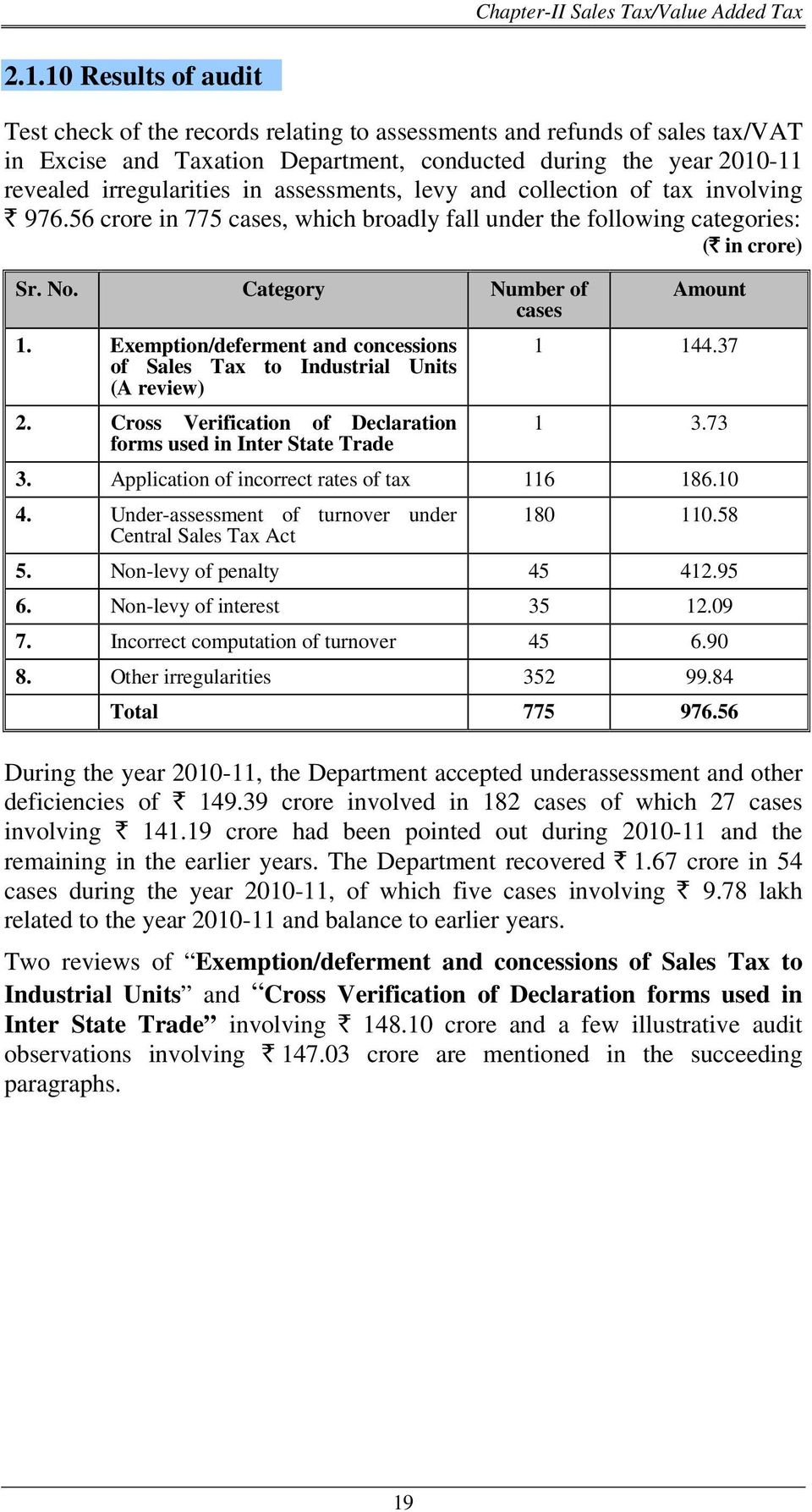
7 Chapter-II Sales Tax/Value Added Tax Results of audit Test check of the records relating to assessments and refunds of sales tax/vat in Excise and Taxation Department, conducted during the year revealed irregularities in assessments, levy and collection of tax involving ` crore in 775 cases, which broadly fall under the following categories: (` in crore) Sr. No. Category Number of cases 1. Exemption/deferment and concessions of Sales Tax to Industrial Units (A review) 2. Cross Verification of Declaration forms used in Inter State Trade Amount Application of incorrect rates of tax Under-assessment of turnover under Central Sales Tax Act Non-levy of penalty Non-levy of interest Incorrect computation of turnover Other irregularities Total During the year , the Department accepted underassessment and other deficiencies of ` crore involved in 182 cases of which 27 cases involving ` crore had been pointed out during and the remaining in the earlier years. The Department recovered ` 1.67 crore in 54 cases during the year , of which five cases involving ` 9.78 lakh related to the year and balance to earlier years. Two reviews of Exemption/deferment and concessions of Sales Tax to Industrial Units and Cross Verification of Declaration forms used in Inter State Trade involving ` crore and a few illustrative audit observations involving ` crore are mentioned in the succeeding paragraphs. 19
8 Report No. 3 of (Revenue Receipts) 2.2 Exemption/deferment and concessions of Sales Tax to Industrial Units Highlights No database was maintained either by the Industries Department or by the Excise and Taxation Department regarding units availing benefit of tax concessions. The Excise and Taxation Department had no database regarding tax benefits availed, tax recovered and due from units availing tax concession. An evaluation study of the Scheme was not carried out to evaluate the impact of tax concessions on growth of industries and employment. (Paragraph 2.2.7) We found that agro based and electronic/software industries did not set up units in the State despite attractive tax concessions of 250 and 300 per cent of fixed capital investment offered to them by the State Government under the Scheme. (Paragraph ) We noticed in four offices that 17 units after availing exemption had closed business and the Department had not recovered ` crore of exemption/deferment benefits availed by them. (Paragraph 2.2.8) Department had not kept records of repayment dues of exemption units. (Paragraph 2.2.9) The Department relaxed control measures on exemption units by belated assessments, the delays ranging from seven to 98 months. (Paragraph ) The Department granted excess benefit of tax deferment of ` 4.47 crore to an expansion unit treating it as a new unit. (Paragraph ) Interest free loan of ` 2.91 crore from nine units in three districts and interest of ` lakh on delayed payments from two dealers in two districts were also not recovered. (Paragraph and ) Incorrect allowance of deduction of ` 3.35 crore treating the sale of High Density Polyethylene (HDPE) fabric as tax free goods resulted in nonlevy of VAT of `!33.49 lakh. (Paragraph ) 20

9 Chapter-II Sales Tax/Value Added Tax Breach of conditions regarding maintenance of production levels in 36 cases were seen resulting in non-recovery of incentives of ` crore due. (Paragraph ) The Department neither raised nor recovered the demand of benefit availed and interest of ` 3.87 crore due from two dealers in Gurgaon/Rewari who had discontinued their manufacturing activities during currency period of exemption/deferment. (Paragraph ) Introduction In the interest of industrial development of the State, Government of Haryana introduced in May 1989, a new scheme for exemption/deferment of payment of sales tax in respect of new industrial units and the units undertaking expansion/diversification. This was applicable to those units which were established during the operative period starting from 1 April 1988 to 31 July 1997 under Rule 28 A of Haryana General Sales Tax Rules, 1975 (HGST Rules). The scheme was modified on 18 May 1999 effective from 1 August 1997 under Rule 28 B and further modified on 15 October 2001 effective from 15 November 1999 under Rule 28 C of HGST Rules. On introduction of HVAT Act, the provisions of Section 13 B and 25 A of the HVAT Act and the rules framed thereunder relating to tax concessions to industrial units remained in force subject to some exceptions under Section 61 read with Rules 69 of the HVAT Act. Exemption and capital subsidy ceased from 01 April The industrial units availing the benefit of exemption capital subsidy may, in the prescribed manner, change over to deferment of payment of tax for the remaining period and the remaining extent of benefit but where an industrial unit does not choose to do so, the benefit of capital subsidy/exemption to it from payment of tax shall cease to take effect on and from the appointing day. Deferred tax was to be repaid after five years or an industrial unit availing the benefit of deferment of payment of tax, whether by change over under the foregoing provisions or otherwise, may, in lieu of making payment of deferred tax after five years, pay half of the amount of deferred tax, upfront along with the returns and on making payment in this manner, the tax due according to returns shall be deemed to have been paid in full and the tax deferred in each other case shall be converted into interest free loan in the manner prescribed. The concerned DETC had to watch the production level of unit during post benefit period. The eligibility certificate granted to an industrial unit shall be liable to be withdrawn at any time during its currency period by appropriate screening committee, (HLSC or LLSC) in case of obtaining the eligibility certificate by fraud, closing down of the business and disposal or transfer of fixed assets. The benefits sanctioned under Rule 28 A and 28 B of HGST Rules were reviewed by us, and had already been printed in the Report of the Comptroller and Auditor General of India for the year In this Performance Audit, 21

10 Report No. 3 of (Revenue Receipts) we have focused on the modified scheme under Rule 28 C. The salient features of the scheme relating to tax concession are as under: Rule and period of Scheme Sale tax incentive Monetary ceiling Period of eligibility Remarks 28C 15 November 1999 to 30 April 2000 Concession of deferment of payment of sale tax and conversion of the same to capital subsidy computed on the sale of goods (including by -products and waste) manufactured by the unit or arising from the process of manufacturer and declared in the sale tax return. 1. For new units 100 per cent to 150 per cent of fixed capital investment (FCI) 2. For agro based units 250 per cent of FCI 3. For information technology/software/ electronic based industry 300 per cent of FCI 4 For expansion/ diversification units 100 per cent of additional investment in plant and machinery 5. Sick industrial units 100 per cent to 150 per cent of FCI Nine years to 11 years or earlier if the ceilings are reached. Nine years to 11 years or earlier if the ceilings are reached. Nine years to 11 years or earlier if the ceilings are reached. Five years or earlier if the ceilings are reached. Three years or earlier if the ceilings are reached. For new units 50 per cent concession for nine years or graded scale 80 per cent to 20 per cent from one year to 11 years of payable tax. For the purpose of calculation of benefit availed of under the Rule, tax payable including the component of tax to be converted into capital subsidy shall be taken into account Organisational set up The Eligibility Certificate for the Industries are issued by the Industrial Department, whereas the Taxation Department is required to ensure receipt of returns relating to sales tax and watching the payment of the deferred taxes after the completion of the concession period of the industry concerned. At the Government level, Financial Commissioner and Principal Secretary, Excise and Taxation Department (FCET) is responsible for the administration of Sales Tax Laws in the State. At the Departmental level, the ETC is responsible for the administration of Sales Tax/VAT/Central Sales Tax (CST) Acts and the rules framed thereunder. The ETC is assisted by Assistant Excise and Taxation Commissioners (AETCs), Joint Excise and Taxation Commissioners (JETCs) and Deputy Excise and Taxation Commissioners (Sales Tax) {(DETCs (ST)}, ETOs and allied staff at headquarters. Eligibility certificate in respect of small scale industry is issued at district level by the General Manager, District Industry Centre (GMDIC) and those in respect of medium and large scale industry is issued at Directorate level by the Additional Director of Industries. There are Screening Committees in place comprising of representatives of the Industries Department, Haryana State Industrial Corporation and the Excise and Taxation, Commissioner, for deciding on the issue of Eligibility Certificate to the industrial units. 22

11 Chapter-II Sales Tax/Value Added Tax Audit objectives We conducted the review with a view to ascertain whether: incentives sanctioned by the implementing agencies were as per norms; assessment of the units was taken up on priority basis to detect excess/incorrect availing of benefit; repayment of instalments of deferred tax due from the units availing benefits of the scheme were effected within the prescribed time period; quantum of incentive claimed by the eligible units was properly assessed; an internal control mechanism existed to prevent the loss of revenue and misuse of the provisions of the schemes; and compliance of provisions of rules made for post benefit period Audit criteria The audit findings were benchmarked against the following audit criteria: Haryana General Sales Tax Act, 1973 Haryana General Sales Tax Rules, 1975 New industrial policy/scheme for exemption/deferment of payments of sales tax 1989 as modified from time to time Haryana Value Added Tax Act/Rules, 2003 Central Sales Tax Act, 1956 Central Sales Tax (Punjab) (Haryana) Rules, 1957 and Departmental Notifications and Circulars issued regarding exemption/deferment of VAT in respect of industrial units Scope and methodology of audit The relevant records relating to exemption/deferment and concession to industrial units of 10 (out of 21) districts in the State for the period to were test checked between June 2010 and February We selected eight districts 2 on random sample selection basis by applying probability proportional to size method (without replacement) and Gurgaon and Faridabad districts were selected on the basis of the risk analysis. We have also included points of similar nature noticed during audit for the period to Acknowledgement The Indian Audit and Accounts Department acknowledges the co-operation of Industry and Excise and Taxation Department in providing necessary 2. Bhiwani, Hisar, Karnal, Mewat, Palwal, Panipat, Rewari and Sonepat. 23

12 Report No. 3 of (Revenue Receipts) information and records for facilitating audit by us. An entry conference was held in August 2010 with the Financial Commissioner-cum-Principal Secretary to Haryana Government (Excise and Taxation Department) and other Departmental officers wherein the audit objectives, methodology and selection of districts were explained. The suggestions of the Department were kept in view at the time of selection of districts and conducting audit. We forwarded the draft review report to the Department and Government in June and August An exit conference was held on 21 and 22 September 2011 with the Financial Commissioner and Principal Secretary to Haryana Government (Excise and Taxation Department) and Industries Department ETC, Additional Director and other officers. During the exit conference, the findings of the review and recommendations were discussed. The replies furnished by the Department during exit conference and at other times have been appropriately incorporated in the respective paragraphs Implementation of scheme by the Industries and Excise and Taxation Department Director of Industries and Commerce and Excise and Taxation Department did not have consolidated database figures of benefit sanctioned availed by various units. We could not assess the impact on revenue of the Government by way of exemption/deferment/concession and the benefits accrued/derived by the State as a result of implementation of scheme. Director of Industries and Commerce, Haryana stated that headquarter had only information of the cases to whom benefit of tax concession was approved by HLSC. The Department informed us that HLSC had approved tax concession in 38 cases amounting to ` crore, whereas we found that details of seven units to whom benefit of tax concession of ` crore was sanctioned under Rule 28 (C) were not included in the details of cases provided to audit. In Industrial policy 1999, the State Government had identified thrust areas to promote industrial investment in the State in agro based and food processing industries, electronics, information and technology and telecommunication, automobiles, automotive components, light and medium engineering, handloom, hosiery, textile and garment manufacturing and export oriented units. The State Government specially allowed 250 per cent of FCI as tax concession to agro based units and 300 per cent of FCI to information technology/software/electronic industries under Rule 28 C of HGST Rules. Despite 250 per cent benefit to agro industries and 300 per cent benefit to software based industries, as per information available from 13 3 districts, not a single unit had been set up under the scheme. The Industries Department had not made any evaluation study to evaluate the impact of tax concession on growth of above mentioned industries and on employment in the State. Information regarding status of industries whether these were closed or in the running position was not available at headquarters level. Excise and Taxation Department had also no database at Headquarter 3 Rewari, Jind, Rohtak, Yamunanagar, Bhiwani, Karnal, Kaithal, Hisar, Fatehabad, Sirsa, Gurgaon, Panipat and Jhajjar. 24

13 Chapter-II Sales Tax/Value Added Tax level regarding tax benefit availed, recovered and due from units availing benefit of tax concession As per information made available from 20 DETC (ST) offices benefit of deferment/concession of ` crore availed of by the units availing tax benefit of Exemption/deferment/concession under rule 28A/B/C of HGST Rules, 1975 and further opted deferment under Section 61 of HVAT Act, 2003 during the period to was as under: Year No. of units availed benefit Amount (` in crore) Total Note:- Above units include units under Rule 28A, B and C, which continued during above period. After we pointed out the case in August 2011, the Excise and Taxation Department stated in September 2011 that efforts would be made to maintain proper database at headquarter level. Audit findings System deficiencies Lack of co-ordination between implementing agencies to recover the demand on premature closure of business The main objective of sales tax incentive scheme was overall industrial development of the State. After issue of eligibility certificate for exemption/deferment of sales tax/vat, the Industries Department had to monitor proper running of the units and Excise and Taxation Department had to recover the benefit availed under the scheme on premature closure of the business. As per provision (9) under Rule 28 A of HGST Rules, the exemption/entitlement certificate granted to an eligible industrial unit shall be liable to be cancelled by the DETC (ST) concerned either in the case of discontinuance of its business by the unit any time for a period exceeding six months or closing down its business during the period of exemption/deferment. Further, under the rules ibid on cancellation of 25

14 Report No. 3 of (Revenue Receipts) eligibility certificate or exemption/entitlement certificate before it is due for expiry, the entire amount of tax exempted/deferred shall become payable immediately in lump sum and the provisions relating to recovery of tax, interest and imposition of penalty shall be applicable in such cases. A mention was made in the Report of the Comptroller and Auditor General of India for the year and was discussed in PAC during the year In 155 cases PAC desired to recover the outstanding amount of arrears but in 63 cases follow up action taken by Government was still awaited. During test check of the records of four offices of DETC (ST), between June 2010 and February 2011, we noticed that 17 units after availing exemption/deferment of ` crore during the years to discontinued their manufacturing process during the currency period of exemption/deferment. Though the concerned DETC cancelled the exemption/entitlement certificates of these units, they did not recover ` crore of exemption/deferment availed by the units including interest as detailed below: (` in crore) Sr. No. Name of DETCs No. of units Amount of exemption/deferment to be recovered 1. Rewari Sonepat Gurgaon (West) Bhiwani Total After we pointed out these cases between June 2010 and February 2011, DETC (ST), Rewari stated in one case that matter was pending in High Court and another case was pending in suo motu action with DETC (ST)-cum- Revisional Authority. DETC (ST), Bhiwani stated that efforts would be made to recover the amount. DETC (ST), Sonepat stated that notice had been issued to the dealer and DETC (ST), Gurgaon (West) stated that firm had been closed and property had been auctioned by bank and efforts would be made to recover the balance amount. We have not received further progress report (October 2011). 26

15 Chapter-II Sales Tax/Value Added Tax Non-maintenance of proper records of beneficiaries availing deferment of sales tax and non recovery of taxes Under Rule 28 A and 28 B of HGST Rules, tax allowed to be deferred, payable after five years and seven years respectively. DETCs were required to maintain a register to note the details of tax deferred and received. During test check of the records/register of the offices of DETC (ST), Bhiwani, Faridabad (West) and Gurgaon (West) between July 2010 and February 2011, we noticed that 18 dealers availed benefit of deferred tax aggregating to ` 3.76 crore during the years to but their repayment, which was due during the years and was not posted in the prescribed register. Audit could not ascertain whether the tax has been received or not as there was no entry in the prescribed register. After we pointed out these cases between July 2010 and February 2011, DETC (ST) Bhiwani stated in one case that unit had been declared sick unit by Board of Industrial and Financial Reconstruction (BIFR) in December The reply was not in consonance with the provisions of the Act as deferred tax was to be converted into interest free loan by Industry Department. No reply has been received from remaining 17 cases of DETC (ST) Faridabad and Gurgaon (October 2011). Further, the Excise and Taxation Department stated in September 2011 that records would be updated Control measures on exemption units relaxed by delay in assessment Under the provisions of HGST Rules, the assessment of an eligible industrial unit holding exemption/entitlement certificate shall be made in accordance with the provisions of the Act and rules framed thereunder as early as possible and shall be completed by 31 December in respect of the assessment year immediately preceding thereto and the additional demand so determined, if any, shall be paid as per provisions of the Act. During test check of the assessment records of 10 4 sales tax Districts of DETC (ST), we noticed between June 2010 and February 2011 that 52 assessment cases relating to the years to involving additional demand of `!10.36 crore were assessed after the prescribed dates. The delay ranged between seven to 98 months. After we pointed out the case between June 2010 and February 2011, DETC (ST) Faridabad (East) and Rewari stated (June and December 2010) that there was no loss of revenue due to delay in assessment. The replies of the 4 Bhiwani, Faridabad, Gurgaon, Hisar, Karnal, Mewat, Palwal, Panipat, Rewari and Sonepat. 27

16 Report No. 3 of (Revenue Receipts) Department were not in consonance with the provisions of the Act as due to delay in assessment, the additional demands were deposited late by dealer and consequently there was loss of interest to the Government. After we pointed out the case to the Government in June and August 2011, the Excise and Taxation Department stated in September 2011 that these cases were assessed as per provisions of HVAT Act, We found that the reply of the ETC was not in consonance with the law, since the Haryana Sales Tax Act and Rules framed thereunder relating to Tax Concessions continue in force even after introduction of the Haryana VAT Act and as such the assessments were required to be completed by December every year as per the HGST Act provisions mentioned above. Further regular assessments in time are essential as a control measures to ensure that the units are running after availing the tax concessions given to them by the Government under Section 61 (D) of HVAT Act. Compliance deficiencies Industries Department Excess benefit of deferment for expansion of industrial unit Rule 28B, 5 (A) of HGST Rules, expansion unit set up in low potential zone, the facility of sale tax deferment would be seven years and large and medium scale industry is eligible for benefit of tax deferment (125 per cent of FCI). During test check of the records of office of GMDIC Palwal in August 2010, we noticed that a firm manufacturing Hydraulic Turbines, Butterfly Valves and parts thereof applied in June 1999 for its expansion project at Prithla (District Palwal) to issue an eligibility certificate for deferment of sales tax for seven years to manufacture the same item. On the report of GMDIC Faridabad, the Director of Industries, Haryana issued an eligibility certificate for ` crore for the period from 02 August 1999 to 01 August 2008 treating it as a new unit instead of expansion unit. The unit was eligible for deferment for seven years (upto 1 August 2006). The dealer availed benefit of deferment of tax of ` crore against the eligible benefit of tax deferment of ` 6.58 crore during the period 02 August 1999 to 01 August This resulted in excess deferment of tax amounting to ` 4.47 crore which was availed during 02 August 2006 to 01 August After we pointed out the case in August 2010, the GMDIC Palwal stated (December 2010) that the firm had been asked to explain their position and to deposit the amount of excess benefit availed. Further, the Industry Department stated in September 2011 that facts would be verified and necessary corrective steps would be taken as per the scheme. We have not received further progress report. 28

17 Chapter-II Sales Tax/Value Added Tax Non/short recovery of interest free loan The State Government had approved a scheme in December 1992 to provide interest free loan to the extent of sales tax liabilities of an industrial unit, which had opted for its deferred payment under the industrial policy of the State Government. The eligible industrial units holding eligibility and entitlement certificate can avail benefit of the scheme by opting, to convert the tax deferred for the previous years into interest free loan provided assessment under the Income Tax Act for those years has not been finalised. GMDIC of the concerned district is fully empowered to recover the loan in the case of default as arrear of land revenue under the provision of the Haryana Public Money Recovery Act. In case of any default or delay in repayment of loan, interest will be charged as provided under HGST Act and the rules made thereunder During test check of the records of offices of GMDIC, Faridabad, Rewari and Gurgaon between August 2010 and January 2011, we noticed that interest free loan amounting to `!3.99 crore was sanctioned to nine dealers availing benefit of deferment of tax under Rule 28A and 28B of HGST Rule 1975 between March 1998 to March 2005 and was due for repayment between April 2003 to April Out of `!3.99 crore, an amount of `! 1.08 crore was recovered leaving a balance of ` 2.91 crore as shown below: (` in crore) Sr. No. District Industries Centre No. of units Amount of interest free loan sanctioned Amount recovered Amount not recovered 1 Faridabad Rewari Gurgaon Total After we pointed out these cases between August 2010 and January 2011, GMDIC, Rewari stated in January 2011 that claim had been filed with official liquidator in one case and in another case matter was under appeal with Hon ble High Court Delhi. GMDIC, Faridabad stated in January 2011 that efforts would be made to recover the balance amount. Further, the Industry Department admitted the facts and stated in September 2011 that ` 53 lakh had been recovered in respect of Faridabad district and in respect of Gurgaon district in one case the company had gone into liquidation and in another case GMDIC, Gurgaon had been asked to recover the amount of interest free loan (IFL) by invoking the bank guarantee furnished by the unit During test check of the records of offices of GMDIC, Rewari and Sonepat between June and September 2010 we noticed that two dealers 29

18 Report No. 3 of (Revenue Receipts) availing benefit of tax deferment under Rule 28A of HGST Rule 1975 had availed IFL from GMDIC in lieu of deferred tax. Interest amounting to ` lakh was not recovered on delayed payment of interest free loan as detailed below: (` in lakh) Sr. No. GMDIC Number of cases Interest due Interest Paid Non/short levy of interest 1 Sonepat Rewari Total After we pointed out these cases between June and September 2010, GMDIC Rewari stated that interest was to be recovered by Excise and Taxation Department. The reply of GMDIC, Rewari was not inconsonance of policy of interest free loan. Interest on delayed payment of IFL was to be recovered by GMDIC. In one case GMDIC, Sonepat stated in March 2011 that notice had been issued to the dealer and efforts would be made to recover the interest liability. Further, the Industry Department stated in September 2011 that interest would be recovered as per provisions of HGST Act Incorrect computation of fixed capital investment and excess tax concession Rule 28 C (2g) of HGST Rules, FCI means investment in (i) land under use; (ii) new construction; (iii) plant and machinery; (iv) capitalised installation expenditure for plant and machinery; (v) capitalised interest during the period of construction of the unit not exceeding five per cent of total FCI and (vi) technical knowhow fees. Investment under item (i) and (ii) shall, for the purpose of calculating FCI be limited to investment in items (iii) to (vi). During test check of the records of office of GMDIC, Bhiwani in February 2011, we noticed that in one case LLSC approved tax concession of `!11.49 lakh on the basis of 150 per cent of FCI of ` 7.66 lakh and had not limited the investment of item (i) and (ii) with the investment of item (iii) to (vi). The cost of land and building was to be limited to ` 2.90 lakh. The industrial unit was eligible of tax concession of ` 8.70 lakh on the basis of 150 per cent of FCI of ` 5.80 lakh resulting in excess concession. In another cases LLSC approved concession of ` 1.59 crore on the basis of FCI of ` lakh whereas the DETC (ST) verified the FCI of ` lakh and the concession of tax worked out to ` 1.47 crore (175 per cent of ` lakh) instead of ` 1.59 crore. This resulted in excess grant of concession of ` lakh, in both cases. 30

19 Chapter-II Sales Tax/Value Added Tax After we pointed out these cases in February 2011, the Department stated in April 2011 that the matter would be put up in the next meeting of LLSC to review its decision. Further, the Industry Department stated in September 2011 that matter would require reconsideration at the level of LLSC and HLSC. Excise and Taxation Department Irregular concession of tax deferment Under Section 61 read with Rule 69 (2) of the HVAT Act, the unit may, in lieu of availing deferment of tax, elect, by indicating in the application in form VAT A-5 made under sub rule (1), to make payment of one half of the tax otherwise due before the time prescribed for filing of quarterly returns and where the tax is so paid the unit shall have no further liability to pay tax for the said period as such payment for computation of tax benefit availed by the unit and input tax passed on to the purchaser, if otherwise, if admissible to him, shall be deemed full payment. This facility shall also be available to a unit who has been availing the benefit of deferment of payment of tax before the appointed day provided such unit sends an intimation to the officer incharge of the district within 15 days of coming into force of these rules. Sub rule (6) provides that the deferred amount of tax in other cases shall be converted into interest free loan in respect of each industrial unit on annual basis in the manner laid down by the Industry Department of the State During test check of the assessment records of office of DETC (ST), Faridabad (West) in December 2010, we noticed that two dealers availing benefit of deferment under Rule 28 B of HGST Rules, had not opted for making 50 per cent upfront payment along with returns under HVAT Act. The AA, while finalising the assessment for the years to between February 2007 and March 2009, had allowed 50 per cent concession amounting to ` lakh, which was irregular. After we pointed out the case in December 2010, ETO Faridabad (West) stated in December 2010 that notice would be issued to dealer regarding exercise the option. The reply of ETO Faridabad (West) was not in consonance with the provision of Rule 69 under Section 61 of HVAT Act, the option was to be given up to 24 October 2003 and the option cannot be given now. Further, the Excise and Taxation Department stated in September 2011 that there was no loss of revenue. Reply of the Department was not in consonance of the provisions of HVAT Act, if the tax was deferred hundred per cent as per option of dealer then Department had to receive interest free loan from GMDIC for full deferred amount. We have not received further progress report (October 2011) During test check of the records of the office of DETC (ST), Gurgaon (West) in July 2010, we noticed that one dealer availing tax deferment for the period from 7 July 1999 to 6 July 2008 under rule 28 B of HGST Rules, had opted in June 2003 under HVAT Act, to pay 50 per cent of tax due along with return in lieu of deferment of tax for remaining period from1 April 2003 to

20 Report No. 3 of (Revenue Receipts) 6 July 2008 for balance amount of ` lakh. The AA, while finalising the assessment for the years to between March 2007 and March 2010 allowed cent per cent deferment of tax liability of ` lakh instead of 50 per cent concession of ` lakh and deferred tax was also not converted into interest free loan from GMDIC. This resulted in excess deferment of ` lakh. After we pointed out the case in July 2010, we have not received any reply (October 2011) During test check of the records of the office of DETC (ST), Bhiwani in February 2011, we noticed that one dealer availing benefit of tax exemption for the period from 25 December 1998 to 24 December 2008 under rule 28 B of HGST Rules had opted to pay 50 per cent of tax due along with return in lieu of deferment of tax for remaining period from 1 April 2003 to 24 December 2008 for balance quantum. The AA, while finalising the assessment in July 2009 for the year allowed cent per cent deferment of tax of ` 6.06 lakh instead of ` 3.03 lakh under CST Act and the dealer had not paid fifty per cent upfront payment along with return. This resulted in underassessment of tax ` 4.24 lakh (including interest 5 of ` 1.21 lakh). After we pointed out the case in February 2011, DETC (ST), Bhiwani replied in February 2011 that matter is under examination. Further, the Excise and Taxation Department stated in September 2011 that as per notification dated 10 April 2003, no tax under the said Act was payable with effect from 11 May Reply of the Department was not in consonance of the provisions of HVAT Act as there was no such exemption of tax in said notification for the units availing deferment During test check of the assessment records and registers of the office of DETC Hisar in January 2011, we noticed that three dealers availing benefit of exemption of tax for the period from August 1995 to January 2009 had opted to pay fifty per cent of tax due along with return in lieu of deferment of tax for remaining period after 1 April 2003 under HVAT Act 2003 and also paid 50 per cent. To calculate the notional tax liability of availed benefit cent per cent amount was to be taken into account including 50 per cent tax paid by dealer along with return. The AA, while finalising the assessment deducted amount equal to fifty per cent tax concession availed by the dealer instead of cent per cent from balance quantum of deferment amount. This resulted in excess concession of ` lakh. After we pointed out the case in January 2011, the Excise and Taxation Department admitted the facts and stated that cases were under the suo motu action. 5 Interest calculated from 1 November 2007 to 30 June

21 Chapter-II Sales Tax/Value Added Tax Non-levy of tax on sale of HDPE Fabrics Under the HVAT Act, High Density Polyethylene (HDPE) fabrics (Plastic goods), being not specified item in any schedule, are leviable to tax at the general rate of 10 per cent with effect from 1 April Under HGST Rules, eligible industrial unit may avail benefit of exemption/deferment up to the quantum and period as prescribed in the eligibility certificate. During test check of the records of office of DETC (ST), Sonepat in September 2010, we noticed that a dealer availing benefit of tax deferment made sales of HDPE fabrics valued as ` 3.35 crore (HVAT: ` 0.36 crore, CST: ` 2.99 crore) during the year without payment of tax and without declaration of forms C. The AA while finalising the assessment in June 2006, allowed the deduction of ` 3.35 crore treating it as tax free goods under Schedule B of HVAT Act instead of levying tax at the prescribed rates. This resulted in non-levy of VAT amounting to ` lakh. After we pointed out the case in September 2010, the AA, Sonepat stated in September 2011 that the case could not be reassessed at this stage. However, the facts remains that due to non taking of timely action amount remained unrecovered Excess availment of tax deferment/exemption During test check of the registers of offices of DETC (ST), Panipat and Rewari in June and October 2010, we noticed that the amount of deferment/exemption of ` 5.62 crore was due against which benefit of deferment/exemption amounting to ` 5.87 crore was availed by four units. So exemption/deferment of tax amounting to ` 25 lakh availed in excess of the quantum prescribed in the eligibility certificate was to be recovered by the Department. After we pointed out the case in June and October 2010, DETC (ST), Panipat stated in September 2011 that demand of ` lakh had been created in one case and in another case an amount of ` 9.03 lakh out of ` lakh had been deposited along with interest of ` 7.40 lakh and notice had been issued in April 2011 to recover the balance amount. DETC (ST), Rewari stated in June 2010 that excess amount would be recovered in due course. We have not received further progress report (October 2011). A point of similar nature was printed in the Report of the Comptroller and Auditor General of India for the year and was discussed in PAC during the year In nine cases PAC has desired the latest status of amount to be recovered. Out of nine, in one case follow up action was yet to be taken by Government. 33
22 Report No. 3 of (Revenue Receipts) Non/short levy of interest Under Section 61(2) (d) (iii) of the HVAT Act, an industrial unit availing the benefit of deferment of payment of tax, whether by change over under the provisions of the Act or otherwise, may, in lieu of making payment of the deferred tax after five years, pay half the amount of tax deferred upfront along with the returns and on making payment in this manner, the tax due according to the returns shall be deemed to have been paid in full. If the tax calculated is more than the input tax, the difference of the two shall be the tax payable. Section 14 (6) of HVAT Act, inter alia lays down that if any dealer fails to make payment of tax, he shall be liable to pay in addition to the tax payable by him, simple interest at one and half per cent (one per cent with effect from 11 October 2007) per month, if the payment is made within ninety days and at three per cent per month (two per cent with effect from 11 October 2007) if the default continues beyond ninety days for the whole period from the last date specified for the payment of tax to the date he makes payment. During test check of the records of the offices of DETC (ST), Bhiwani and Palwal between September 2010 and February 2011, we noticed that four dealers who opted to pay 50 per cent upfront payment of due tax along with returns under Section 61 (2) (d) (i) (iii) had not paid due tax with returns. The AA, while finalising the assessment for the years to between August 2006 and March 2010 raised demand of ` lakh, without levy of interest amounting to ` lakh. After we pointed out the cases between September 2010 and February 2011, DETC (ST) Bhiwani stated in February 2011 that two cases were under examination and in another case the demand was due to wrong calculation of tax by the dealer. The reply of DETC (ST) Bhiwani was not in consonance with the provisions of the HVAT Act as the dealer had to pay due tax along with return and AA had to check correctness of tax deposited. Neither the dealer had paid due tax along with the return nor the AA check the correctness of tax due/deposited with return. We have not received reply from DETC (ST), Palwal in the remaining two cases (October 2011) Excess benefit of tax deferment due to non-adjustment of input tax credit During test check of the assessment records of the office of DETC (ST), Panipat in March 2008, we noticed a dealers availing the benefit of exemption from payment of tax of `! 1.61 crore during the period December 1998 to November 2007 had opted to pay 50 per cent of the tax in lieu of deferment of payment of tax under the HVAT Act/Rules. The dealer had made sale of goods valued as `!6.52 crore involving tax of ` lakh during the year After adjusting ITC of ` lakh 34
23 Chapter-II Sales Tax/Value Added Tax paid on purchase of goods, the balance tax payable was ` lakh. The dealer was entitled to concession of 50 per cent of deferred tax (` lakh) of ` 5.76 lakh. The AA, while finalising the assessment in May 2006 allowed ` lakh (50 per cent of total tax) instead of ` 5.76 lakh. This resulted in excess concession of tax of ` 7.27 lakh. Additionally interest amounting to ` 7.27 lakh was also leviable on default in tax demand. After we pointed out this case in March 2008, the DETC (ST) Panipat stated in January 2011 that revisional authority had created the demand of ` lakh. We have not received further progress of recovery (October 2011) Non- monitoring of exempted/deferred units To ascertain the amount of sale tax deferred/exempted, DETC (ST) of each district was required to review the performance of each eligible industrial unit and to send a quarterly report to the ETC in the following month. None of the DETC of 10 districts checked, sent quarterly performance reports to the ETC, Panchkula and no any action was taken by ETC against DETC for nonsubmission of prescribed quarterly reports. Thus, non-monitoring of exempted/deferred units resulted in non-raising of demand of tax and interest amounting to ` crore as detailed below: 35
24 Report No. 3 of (Revenue Receipts) Non-maintenance of production level Under HGST Rules, the benefit of tax exemption/deferment shall be subject to the condition that the beneficiary unit after having availed of the benefit shall continue its production at least for the next five years and not below the level of average production for preceding five years. In case of not opting the scheme under Section 61 of HVAT Act, the industrial unit shall be liable to maintain production at a level so that its annual turnover does not fall short of the average annual turnover during the periods of exemption. The DETC is required to watch production levels. In case the unit violates the condition it shall be liable to make, in addition to the full amount of tax benefit availed of by it during the period of exemption/deferment, payment of interest chargeable under the Act as if no tax exemption/deferment was ever available to it. During test check of the records of the offices of seven DETCs (ST) between June 2010 and February 2011, we noticed that 36 units after availing the exemption/deferment of ` crore did not maintain the level of production to the extent of average production for the prevailing five years and thus, they were liable to refund the full amount of tax exemption benefit along with interest and in case of units availing deferment were liable to pay interest, if deferred tax paid. Concerned DETCs (ST) did not raise the demand of benefit availed along with interest amounting to `! crore as detailed below: (` in crore) Name of DETC (ST) No. of Units not maintained average production Amount of benefit availed Amount to be recovered Total Exemption Deferment Exemption Deferment Exemption Interest Gurgaon (West) Gurgaon (East) Sonepat Panipat Faridabad (West) Rewari Hisar Total
25 Chapter-II Sales Tax/Value Added Tax After we pointed out these cases between June 2010 and January 2011, DETCs (ST), Gurgaon (East) and Gurgaon (West) stated between October 2010 and March 2011 that matter was under process in 19 cases and in three cases notices had been issued. Reply of DETC (ST) Gurgaon was not satisfactory as copy of notice issued to dealers was not found placed on file and in three cases notices were issued (February and March 2011) after the matter was pointed out by audit. Action taken in one case (March 2008) was also not finalised till April DETC (ST) Sonepat stated in September 2011 that in two cases demand of ` 1.31 crore has been created, in one case notice has been issued and in one case stated that action would be taken after completion of post benefit period. Reply in this case was not satisfactory, as average production was to be watched every year and not after completion of post benefit period and DETC Panipat stated in September 2011 that cases were under-examination. DETC (ST) Hisar stated in September 2011 that notices had been issued to take action. DETC (ST) Faridabad (West) stated in September 2011 that notice had been issued and DETC (ST) Rewari stated in June 2010 that action would be taken. A point of similar nature was printed in the Report of the Comptroller and Auditor General of India for the year and was discussed in PAC during the year In 13 cases PAC has desired the latest status of amount to be recovered. The follow up action in respect of 11 cases was still awaited Non-recovery of tax Under HGST Rules, the exemption/ entitlement certificate granted to an eligible industrial unit shall be liable to be cancelled by the DETC concerned either in the case of discontinuance of its business by the unit any time for a period exceeding six months or its closing down during the period of exemption/deferment. Further, under the rules ibid on cancellation of eligibility certificate or exemption/ entitlement certificate before it is due for expiry the entire amount of tax exempted/deferred shall become payable immediately in lump sum and the provision relating to recovery of tax, interest and imposition of penalty shall be applicable in such cases. During test check of the records of offices of DETC (ST) Gurgaon (East) and Rewari, between June and August 2010, we noticed from the assessment records that in two cases {(one each of Rewari and Gurgaon (East)}, the industrial unit after availing exemption/deferment of `! 1.94 crore discontinued their manufacturing process during the currency period of exemption/deferment. The exemption/ entitlement certificates were not cancelled by the DETCs (ST). Thus, `!3.87 crore (including interest of ` 1.93 crore) remained unrecovered. After we pointed out these cases between June and August 2010, DETC (ST) Rewari stated that action would be taken to recover the benefit availed by the dealers. DETC (Gurgaon East) stated in September 2011 that case was under 37
26 Report No. 3 of (Revenue Receipts) process. Reply was not acceptable as no document was found on the file to show that any action had been taken by the Department. We have not received further progress report (October 2011) Internal audit Internal audit system had not been set up in the Department in respect of assessment of sales tax cases. On being pointed out in May 2010, the ETC stated that there is no special authority for internal audit of assessment cases Conclusion The main objective of the Sales tax incentive scheme was overall industrial development of the State. It did not produce encouraging results, as a large number of units were closed during the currency period of the incentives. The progress made in industrial development was not watched. Excess availment of tax deferment/concession, incorrect computation of fixed capital investment and non recovery of tax, due to closure of business demonstrate that the Department had not monitor the scheme but also that the expected benefit had not accrued to the State despite tax exemptions granted. Database in respect of benefit allowed to number of units under the scheme and progress of the units, had not been kept at headquarters which shows that there was no monitoring at the level of headquarters and DETC level. The scheme was never been reviewed by the Department to evaluate the benefits derived by the State in terms of VAT/Sales Tax collection for formulating any new industrial policy in future Recommendations In order to plug loopholes and enforce control over working of Excise and Taxation Department and Industries Department for proper evaluation and implementation of the scheme, Government may consider:- Maintaining a centralised database of incentives sanctioned and availed to help the State Government in formulating a new tax concession scheme in future; Putting a system in place for effective co-ordination between the implementing agencies and the Excise and Taxation Department for monitoring recoveries due and for taking prompt action on units closing business; Setting up a system to watch the proper functioning of units availing benefits of tax concession; and Instituting an effective system in the implementing agencies for initiating action for prompt recovery of the taxes and other dues. 38
27 Chapter-II Sales Tax/Value Added Tax 2.3 Performance Audit on "Cross Verification of Declaration forms used in Inter State Trade" Highlights The Department had not put in place a system for verification of each and every declaration form submitted by the dealers with the database available in the TINXSYS Website before allowing exemptions/ concession of tax. Exemptions/concessions were allowed in 47 transactions for the assessment years and against fake 'C' Forms which were not issued to the dealers, resulting in short levy of CST of ` 1.30 crore. (Paragraph and ) Assessing Authority did not scrutinise the claims for concessional tax and cross verify the transactions as required under the Departmental instructions. This resulted in incorrect allowance of branch transfers on 'F' Forms, which consequently led to evasion of VAT of ` 4 lakh. Additionally, penalty was also leviable for evasion of tax. (Paragraph ) Non-verification of declaration Form 'C' by the Department resulted in suppression of sale of ` 2.88 crore involving underassessment of tax of ` lakh. Besides, penalty was also leviable for misdeclarations. (Paragraph ) In absence of a system to check utlisation statements of Declaration Forms, Mismatches between the selling and purchasing dealers as per the forms were not detected by the Assessing Authorities. Evasion of tax in these cases cannot be ruled out. (Paragraph ) Introduction Under the Central Sales Tax Act, 1956 (CST Act), registered dealers are eligible to certain concessions and exemptions of tax on interstate transactions on submission of prescribed declarations in Forms C and F. The State Government grants these incentives to dealers for furtherance of trade and commerce, on production of these declaration forms. It is the responsibility of the Commercial Tax Department to ensure proper accountal of declaration forms and to take adequate safeguards against misutilisation of declaration forms/certificates on which tax relief is allowed involving large amount of revenue to the State exchequer. It is the responsibility of the State Excise and Taxation Department to ensure proper accountal of declaration forms and to take adequate safeguard against misutilisation of these forms on which tax relief is allowed involving large amount of revenue to the State exchequer. 39
28 Report No. 3 of (Revenue Receipts) Form C Under the provisions of the CST Act, every dealer, who, in the course of interstate trade or Commerce, sells to a registered dealer, goods of the classes, specified in the certificate of registration of the purchasing dealer, shall be liable to pay tax at the concessional rate of four per cent, three per cent with effect from 1 April 2007 and two per cent with effect from 1 June 2008 respectively of such turnover provided such sales are supported by Declarations in form C Form F Under Section 6A of CST (Amendment) Act 1972, transfer of goods not by reason of sales by a registered dealer to any other place of his business outside the State or to his agent or principal in other States is exempt from tax on production of declaration in form F, duly filled in and signed by the principal offices of the other place of business or his agent or principal as the case may be, along with the evidence of despatch of such goods. Such authority may, after affording such dealer a reasonable opportunity of being heard, direct him to pay by way of penalty, in addition to the tax to which he is assessed or is liable to be assessed, a sum thrice the amount of tax which would have been avoided had such account, return, document or information, as the case may be, accepted as true and correct Maintenance of accounts of receipts and use of Declaration forms The forms are obtained by the ETC through the State Government press and supplied to the divisions for distribution amongst the circle offices under their jurisdiction. Declaration forms are issued to registered dealers by circle offices to enable them to issue the same to another registered dealer for purposes specified in their registration certificate in order to avail of exemption from levy of tax or to pay tax at concessional rate. Dealers have to submit periodical utilisation certificate to the circle office concerned for the declaration forms received and utilised by them, and the same is to be properly recorded by the Assessing Officer. No declaration form is to be issued by the circle office to the dealers till accounts of the utilisation of forms issued earlier to the dealer is submitted by him Receipt and issue of Forms The receipt and issue of the aforesaid declaration forms are accounted for in separate stock registers by the division and circle offices indicating receipt and issue of various declaration forms. When the forms are issued to the dealer, the signature of the dealer as token of receipt is to be obtained in the register. 40
29 Chapter-II Sales Tax/Value Added Tax Every registered dealer to whom any declaration form is issued by the appropriate authority shall maintain complete account of every such form. The dealer has to furnish utilisation certificate to the competent authority showing the name of dealer to whom the form is issued, bill number and date and description of goods with value. Section 10 (b) read with Section 10-A of CST Act stipulates that, if any registered dealer, falsely represents when purchasing any class of goods which are covered by his certificate of registration or not being a registered dealer, falsely represents when purchasing goods in the course of interstate trade or commerce that he is a registered dealer or after purchasing any goods for any of the purposes without reasonable excuse to make use of the goods for any such purpose shall be punishable with simple imprisonment which may extend to six months, or with fine, or with both, and when the offence is a continuing offence, with a daily fine which may extend to fifty rupees for everyday during which the offence continues and further the authority may also impose penalty of a sum not exceeding one and a half times of the tax evaded Operation of the Tax Information Exchange System (TINXSYS) Tax Information Exchange System (TINXSYS) is a centralised exchange of all Interstate dealers spread across the various States and Union Territories of India. TINXSYS is an exchange authored by the Empowered Committee of State Finance Ministers (EC) as a repository of interstate transactions taking place among various States and Union Territories. The website was designed to help the Commercial Tax Departments (CTDs) of various States and Union Territories to effectively monitor the interstate trade. TINXSYS can be used by any dealer to cross verify the counter party interstate dealer in any other State. Apart from dealer verification Commercial Tax Departments official used TINXSYS for verification of Central Statutory Forms issued by other State Commercial Tax Departments and submitted to them by dealers in support of claim for concessions. TINXSYS also provides MIS and business Intelligence Reports to the Commercial Tax Department to monitor interstate trade movements and enable the EC to monitor the trends in interstate trade. 41
30 Report No. 3 of (Revenue Receipts) Organisational Setup At the Government level, Financial Commissioner and Principal Secretary, Excise and Taxation Department (FCET) is responsible for administration of sales tax laws in the State. At the Departmental level, the ETC is responsible for the administration of Sales Tax/VAT/CST Acts and rules framed thereunder. The ETC is assisted by Additional Excise and Taxation Commissioners (AETCs), JETCs, DETCs (ST), Excise and Taxation Officer (ETOs) and other allied staff at headquarters, Range and division level Audit Objective The review aims to ascertain whether: a foolproof system for custody and issue of declaration forms exists; exemption/ concession of tax granted by the assessing authority were supported by the original declaration forms; there is a system for ascertaining genuineness of the forms for preventing evasion of tax; system of uploading the particulars in the TINXSYS website exists and data available there is utilised for verifying the correctness of the forms; appropriate steps were taken on receipt and detection of fake, invalid and defective (without proper or insufficient details) forms; and an effective and adequate internal control mechanism was exists Audit criteria The audit findings were benchmarked against the following audit criteria:- Central Sales Tax Act, 1956, Central Sales Tax Rules, 1957 Central Sales Tax (Haryana) Rules, 1956 Haryana VAT Act, 2003 Departmental Notifications and Circulars issued regarding exemption from payment of CST in respect of industrial units Scope and Methodology of Audit The audit covered the period of to and was conducted from September 2010 to February 2011 with reference to the records relating to scrutiny of forms covering all assessments of 15 units 6. Audit scrutiny also included verification of transaction of goods relating to stock transfers made to branches/agents situated outside Haryana State and interstate sale to different parts of the country with reference to various declarations in Form C and F, as verified from records in those States by our field Accountant General 6. Bahadurgarh, Charkhi Dadri, Faridabad (East), Faridabad (West), Gurgaon (East), Gurgaon (West), Karnal, Kaithal, Kurukshetra, Palwal, Panipat, Rewari, Sonepat, Gohana and Shahbad. 42
31 Chapter-II Sales Tax/Value Added Tax Offices. Similar points noticed during regular audit of DETC, Jhajjar at Bahadurgarh and Panipat during the year have also been included here Acknowledgement The Indian Audit and Accounts Department acknowledges the co-operation of the Excise and Taxation Department for providing necessary information and records for audit. An entry conference was held on 30 May 2011 with the Financial Commissioner and Principal Secretary to Haryana Government, Excise and Taxation Department. The audit objectives, scope and methodology of audit and selection of districts for the review were discussed during entry conference. We forwarded the draft review report to the Department and Government in October An exit conference was held on 17 November 2011 with the Financial Commissioner and Principal Secretary to Haryana Government (Excise and Taxation Department). During the exit conference, the findings of the review and recommendations were discussed. The replies furnished by the Department during exit conference and at other times have been appropriately incorporated in the respective paragraphs Trend of revenue under CST The variations between Budget estimates (BEs) and actual receipts under CST for the years to are mentioned below: (` in crore) Year Budget estimates Actual realisation as per Finance Accounts Actual realisation as per Department Variation excess (+) shortfall(-) (Col. 3- Col.2) Percentage of variation (Col. 5 to Col.2) (-) (-) (-) (+) (-) From the above table, it may be seen that actual receipts as per Finance Accounts were less than BEs during the years to and whereas the actual receipts were more than BEs only in The percentage of variation during to ranged between one and 40. The main reason for decline in CST collection was due to reduction of CST from four per cent to three per cent by the GOI. 43
32 Report No. 3 of (Revenue Receipts) Audit Findings Printing and custody of declaration forms We noticed that the ETC prepared a consolidated demand of forms C and F Forms as per requirement. The Controller of printing and stationery was the nodal Department to initiate action for the printing of these forms. Forms were got printed from private printers after completing all formalities. Size of forms and LOGO was also approved by the ETC. An officer was deputed by the ETC for adequate security and supervision. The stocks of these forms were reviewed from time to time by the Department. A separate room was used for the custody of these forms. System deficiencies Section 8 of the CST Act read with Rule 7 of the Central Sales Tax (PB), Haryana Rules, 1957 and Rule 12 of Central Sales Tax (Registration and Turnover) Rules, 1957 deal with the procedure about custody, utilisation and maintenance of forms. Scrutiny of the records revealed the following: Issue and accounting of declaration forms We noticed that the Department did not maintain any record/ database to show the year-wise position of sales against C / F Forms. There was no system in place to verify the utilisation statements of declaration forms Utilisation of declaration forms The Department had partly made these forms mandatory for the dealers to furnish the declaration forms while submitting in the wake of implementation of VAT Act; There was no system of calling for the utilisation statements from the dealers at the time of scrutiny of return/conducting tax audits, in case these were not available in the case records; The Department had not put in place a system for verification of each and every declaration form submitted by the dealers with the database available in the TINXSYS Website before allowing exemptions/concession of tax; The Assessing Authority did not have any details of the branches of the dealers to verify the authenticity of claims for exemption; and There was no prescribed time limit for utilisation of declaration forms Enforcement measures Declaration Forms C and F in the custody of a dealer, which were found lost, destroyed, stolen or defective were required to be reported to the concerned authority for taking necessary action to declare such forms as 44
33 Chapter-II Sales Tax/Value Added Tax invalid by giving wide publicity through issue of circulars to all divisions etc. Similar action in respect of Forms in the custody of the Department was also to be taken. Scrutiny of the records, however, revealed that: no notification/circular regarding such cases was either issued by the Department or details intimated to other State Governments for appropriate action; and the Department had not set-up any intelligence wing to assist ETC for providing the information of fake forms. During the exit conference, the Excise and Taxation Department admitted the audit observation and agreed that there was need to look into this aspect and would be taken care of. Compliance deficiencies Evasion of tax by fraudulent utilisation of fake forms Cross verification of C forms pertaining to interstate sale by the dealers of Haryana with the Section 8 (4) of the CST Act provides that the concession under sub section (1) shall not apply to any sale in the course of interstate trade or commerce unless the dealer selling the goods furnishes to the prescribed authority in the prescribed manner a declaration duly filled and signed by the registered dealer to whom the goods are sold containing the prescribed particulars in the prescribed form obtained from the prescribed authority. utilisation account of declaration forms/dealers of goods received through interstate purchases made by the dealers of four 7 States revealed that four (4) dealers under the control of three 8 DETCs had claimed and were allowed exemption/concessional rate of CST in 11 forms amounting to ` 5.06 crore between to for the assessment year against forms which were not issued to the purchasing dealers in those States. Thus, these forms being prima facie 'fake', the sales should be disallowed and differenctial tax of ` lakhs is recoverable. Besides penalty was also leviable under the Act Cross verification of C and F Forms pertaining to interstate sale by the dealers of Haryana with the utilisation account of declaration forms/ dealers of goods received through Interstate purchase by the dealers of Delhi State revealed that six dealers under the control of two DETCs had claimed and were allowed exemption/concessional rate of CST in 36 forms amounting to ` crore during for assessment year and against fake forms which were not issued to the dealers. This resulted in short levy of CST of ` 1 crore. Besides, penalty was also leviable under the Act. 7 8 Arunachal Pradesh, Bihar, Chhatisgarh and Uttar Pradesh. Faridabad (East), Faridabad (West) and Rewari. 45
34 Report No. 3 of (Revenue Receipts) Under Section 6A of the CST Act, transfer of goods from one State to another place of business in another State is exempt from levy of tax on production of F forms and if any dealer fails to prove to the satisfaction of the AA the claim of transfer of goods, then the movement of such goods shall be deemed for all purposes of this Act to have been occasioned as a result of sale. The ETC issued instructions in March 2006 that in the cases of specific traders (selected for scrutiny) all transactions totaling more than ` one lakh from a single VAT dealer in a year should be cross verified to detect evasion of VAT During test check of the records of the office of DETC (ST), Kaithal in July 2009, we noticed that a dealer claimed deduction of consignment sale of goods valued as ` 4.19 crore against declaration in forms F during the year The AA, while finalising the assessment (March 2009), allowed the deduction without cross verifying the transactions under form F relating to transfer of goods to branches outside the State. We conducted cross verification of records with other States TINXSYS in August 2009 and noticed that the dealer had suppressed his sales by submitting declaration forms to the tune of ` lakh, which was not issued to the dealer by that State. Thus, these forms being prima facie "fake". Failure on the part of AA to scrutinise the claim and cross verify the transactions as required in the ETC instructions dated 14 March 2006 resulted in incorrect allowance of deduction which consequently led to evasion of VAT of ` 4 lakh. Additionally, penalty was also leviable for evasion of tax. After we pointed out the case in July 2009, ETO, Kaithal stated in August 2009 that the form had been verified from issuing authority and found fictitious as the same was not issued by the issuing authority (VAT officer), Delhi. DETC (ST), Kaithal stated (November 2011) that 'F' form was not found genuine. Tax and penalty was imposed by the ETO-cum-AA (August 2011) by creating demand of ` lakh. Efforts would be made to recover the outstanding amount. Further, during the exit conference, the Excise and Taxation Department accepted the audit observation (November 2011) and the Financial Commissioner and Principal Secretary instructed his officer to issue necessary instructions to DETC, Kaithal for getting registered criminal case against the offending dealer Concealment of sales We noticed during cross verification of the assessment records of a selling dealer pertaining to interstate sale of Haryana with utilisation account of declaration forms/dealer of goods received through Interstate purchase by the dealer of Tamilnadu that the dealers under the control of the DETC, Rewari had claimed and allowed (February 2010) concessional rate of CST in one case during for assessment year amounting to ` 1.33 crore 46
35 Chapter-II Sales Tax/Value Added Tax whereas the purchasing dealers of Tamil Nadu had shown his purchases of ` 4.21 crore against the same form. Thus, sale of ` 2.88 crore (` 4.21 crore minus ` 1.33 crore) was suppressed by the selling dealers. Non-verification of declaration form by the Department resulted in underassessment of tax amounting to ` lakh based on the presumption that these goods have been sold locally in the State. Besides, penalty was also leviable under the Act. After we pointed out the case (October 2011), the Excise and Taxation Department admitted the facts (November 2011), during the exit conference Irregular grant of concession/exemption on invalid forms/forms issued to other dealers We noticed during cross verification of C and F Forms pertaining to interstate sale by the dealers of Haryana with utilisation account of declaration forms/dealers of goods received through Interstate purchase by the dealers of two 9 States, that six dealers under the control of five 10 DETCs (ST) had claimed and allowed exemption/concessional rate of CST in 13 C and F forms amounting to ` 6.56 crore during to for assessment year to Our verification revealed that the names of the purchasing dealers in the utilisation statement did not match with the Form numbers on which the goods were sold by the selling dealers. Thus, there was a mismatch between the name of the dealer to whom the goods were sold and the dealer who had purchased those goods. In the absence of a system to check the utilization statements, these discrepancies remained undetected. The matter requires, investigation to arrive at evasion of tax liability, if any. After we pointed out the case (October 2011), the Excise and Taxation Department admitted the facts (November 2011) during the exit conference Short/non-accounting of goods imported through use of declaration form Test Check of records as well as cross verification of assessment records of purchasing dealers pertaining to interstate sales of the dealers of Haryana with the assessment records of selling dealers received from Rajasthan State revealed that dealer under the control of DETC, Faridabad (West) had not accounted for his purchase of ` 4.01 crore in his books of accounts thereby concealing purchases worth ` 4.33 crore (after adding eight per cent profit during to as done for assessment year ). Failure of the assessing authority to cross verify the information with other States resulted in underassessment of tax of ` 2.16 crore (including penalty of ` 1.62 crore) under the Act. After we pointed out these cases in June 2011, the Assessing Authority has reassessed the case and created additional demand of tax of ` 2.10 crore in July The Excise and Taxation Department admitted (November 2011) the facts during the exit conference Delhi and Orissa. Gurgaon, Jhajjar, Panipat, Palwal and Sonepat. 47
36 Report No. 3 of (Revenue Receipts) Conclusion It is evident that due to systemic deficiencies and non-compliance with the provisions the Act/Rules, inadequate and improper check of the forms by the assessing officers and weak internal control mechanism, there was short levy of tax and revenue loss to the State Government. As such, the possibility of such cases of incorrect concession granted under various declaration forms at other places not checked by us, cannot be ruled out Recommendations It is recommended that the Government may consider the following steps: Putting in place an effective internal control mechanism to avoid extension of irregular exemption on account of deficient/incomplete forms at the time of completion of assessment; instituting system for cross verification of transactions relating to branch transfers within the stipulated time frame; there should be time limit for utilisation of declaration forms; proper checks should be prescribed and exercised to call for utilisation certificates of declaration forms from the dealers while submitting their tax returns; and to devise a system for uploading of details of declaration forms used on TINXSYS for verification of sale/purchase transactions. During the exit conference in November 2011, the Financial Commissioner and principal Secretary, Excise and Taxation Department accepted all the recommendations. 48
37 Chapter-II Sales Tax/Value Added Tax 2.4 Non-observance of the provisions of the Acts/Rules The HGST Act/HVAT Act/Central Sales Tax Act, 1956 (CST Act) and Rules made thereunder provide for:- (i) levy of tax/penalty at the prescribed rate; (ii) exemption from payment of tax to new industries under the HGST Act, who opt for deferment of tax under the HVAT Act on fulfilment of prescribed conditions; (iii) allowance of ITC as admissible; and (iv) Section 14 (6) of the HVAT Act inter alia lays down that if any dealer fails to make payment of tax, he shall be liable to pay, in addition to the tax payable by him, simple interest at one and half per cent (one per cent with effect from 11 October 2007) per month if the payment is made within ninety days, and at three per cent per month (two per cent with effect from 11 October 2007) if the default continues beyond ninety days for the whole period, from the last date specified for the payment of tax to the date he makes the payment. We noticed that the AAs, while finalising the assessments, did not observe the provisions of the rules in the cases mentioned in the paragraphs to This resulted in non/short levy/non-realisation of tax/interest/ penalty of ` 9.53 crore. 49
38 Report No. 3 of (Revenue Receipts) Non/short levy of value added tax and interest Under Section 61 (2) (d) (iii) of the Haryana Value Added Tax Act, 2003 (HVAT Act), an industrial unit availing the benefit of deferment of payment of tax, whether by change over under the provisions of the Act or otherwise, may, in lieu of making payment of the deferred tax after five years, pay half of the amount of the deferred tax upfront along with the returns and on making payment in this manner, the tax due according to the returns shall be deemed to have been paid in full. If the tax calculated is more than the input tax, the difference of the two shall be the tax payable. Further, Rule 40 (4) of the HVAT Rules, 2003 provides that the tax due required to be paid by a VAT dealer for a tax period shall be the output tax, calculated under sub-rule (1), plus the purchase tax, calculated under sub-rule (2), minus the input tax, calculated under sub-rule (3) During test check of the records of office of DETC (ST), Gurgaon (West) in July 2010, we noticed that a dealer having a main unit and four other expansion/ diversification units availing the benefit of deferment had made sale of goods valued as ` 1, crore involving tax of ` crore during the years to The dealer had claimed input tax credit (ITC) of ` crore on the purchase of raw material valued as ` 1, crore for his main unit and for other expansion/ diversification units which were enjoying the benefit of deferment. Units availing benefit of exemption/ deferment of tax had separate entity regarding calculation of tax. The benefit of ITC of the material consumed in expansion units, availing the benefit of deferment, could not be admitted in main unit. The assessing authority (AA), while finalising the assessments between February 2007 and March 2009 allowed ITC of ` crore including ITC of ` 4.26 crore on the material transferred (` crore) to expansion units, which were also availing the benefit of deferment. This resulted in non/short levy of VAT of ` 7.52 crore (including interest of ` 3.26 crore) in main unit and excess deferment in the expansion units. After we pointed out the case in July 2010, ETO Gurgaon (West) stated in July 2010 that the dealer had booked all the purchases in the main unit and claimed ITC and that it was not binding on the dealer to divide the ITC between the main unit and its ancillaries on pro-rata basis. The reply of the ETO was not in consonance with the provision of HVAT Act as each unit availing benefit of exemption/deferment of tax had separate entity regarding calculation of tax. However, the ETC admitted the facts during a special meeting held with him by us on 15 September We had not received report on recovery and action taken to levy interest (October 2011). 50
39 Chapter-II Sales Tax/Value Added Tax We pointed out the matter to the ETC, Excise and Taxation Department in July 2011 and reported to the Government in October 2011; we are yet to receive their reply During test check of the records of the office of DETC (ST), Ambala Cantonment in October 2010, Under Section 14 (3) of the HVAT Act, every dealer whose aggregate liability to pay tax under this Act and the Central Act according to the returns filed by him is equal to or more than ` one lakh or such other sum, computed by him in accordance with the provisions of this Act and the rules made thereunder; provided that if he is not able to quantify his tax liability accurately by that time, he shall pay an amount equal to monthly average of his tax liability in the last year as tax provisionally, and he shall pay the balance, if any, on or before the twenty-fifth day of the month. Further, interest was liable under Section 14 (6) of the HVAT Act. we noticed that a dealer deposited tax for the month of March 2007 of ` crore on due date (out of ` crore) and balance of ` 4.70 crore on 5 June 2007 against the due date of 15 April 2007 under Section 14 (3) of the HVAT Act. The AA, while finalising the assessment for the year in March 2010 did not levy interest on late deposit of tax of ` 4.70 crore for the month of March This resulted in non-levy of interest of` ` 9.64 lakh. After we pointed out the case in October 2010, the Excise and Taxation Officer (ETO)-cum-AA, Ambala cantonment admitted the facts and DETCcum-Revisional Authority created demand of ` 9.64 lakh in August We have not received report on recovery (October 2011). 51
40 Report No. 3 of (Revenue Receipts) Input tax credit allowed incorrectly Under Section 8 (1) of the Haryana Value Added Tax Act, 2003 (HVAT Act) read with Rule 20 of the HVAT Rules, 2003, claim of input tax can be allowed to the purchasing dealer only when the tax has been deposited by the selling dealer. With a view to detect evasion of VAT by claiming fraudulent ITC by issue of forged tax invoices or fictitious accounting of goods neither purchased nor sold etc., the Excise and Taxation Commissioner (ETC) issued instructions in March 2006 for cross verification of all purchase transactions totaling more than ` one lakh from a single VAT dealer in a year. As per directions issued by the Joint Excise and Taxation Commissioners {JETCs (Range)} Faridabad and Gurgaon between June 2006 and February 2010, claim of input tax in respect of purchases made from enlisted dealers was admissible at nil rates for the years to During test check of the records of eight 11 offices of DETC (ST) between February 2009 and November 2010, we noticed that 25 dealers purchased iron and steel, electrical goods, refractories, electronic goods and plywood valued at ` crore from dealers within the State (Faridabad, Gurgaon, Karnal and Sonepat) during the years to and claimed input tax credit (ITC) of `!1.40 crore. The AAs, while finalising the assessment between April 2007 and March 2010, allowed ITC of ` 1.40 crore on purchases made from dealers from whom ITC was not permissible as per directions issued (February 2008) by the Departmental s authorities at Faridabad, Gurgaon etc. Failure on the part of AAs to get the purchases of these dealers verified as they were also declared dealers for allowing ITC at nil rate and to take action as per directions of JETCs (Range) resulted in incorrect allowance of ITC of ` 1.40 crore. After we pointed out these cases between February 2009 and November 2010, DETCs Faridabad (West), Gurgaon (East) and Karnal stated between March and July 2010 that demand of ` lakh had been created in seven cases between May 2009 and March DETCs Gurgaon, Karnal and Rewari stated that eight cases had been sent to Revisional Authority for suo motu action in June and November DETC Faridabad (East) stated that notice had been served to the dealer in one case. DETC Ambala city stated in June 2009 that the case had been referred to DETC (Inspection) to examine legality and propriety. DETC (East) Gurgaon, Karnal and Panipat stated in 11 Ambala City, Faridabad (East), Faridabad (West), Gurgaon (East), Gurgaon (West), Karnal, Panipat and Rewari. 52
41 Chapter-II Sales Tax/Value Added Tax eight cases that the cases would be re-examined. We have not received further progress of recovery (October 2011). We pointed out the matter to the ETC, Excise and Taxation Department between April 2009 and January 2011 and reported to the Government in May 2011; we are yet to receive their reply (October 2011) Incorrect allowance of input tax credit Under Section 8 of the HVAT Act, input tax in respect of any goods purchased by a VAT dealer shall be the amount of tax paid to the State on the sale of such goods to him. Provided that where the goods purchased in the State are used or disposed of partly in the circumstances mentioned in Schedule E, no ITC on petroleum products and natural gas is admissible when used as fuel. During test check of the records of the office of DETC (ST), Gurgaon (East) and Rewari between July and November 2010, we noticed that three dealers purchased liquefied petroleum gas (LPG) and furnace oil (FO) valued as ` 3.64 crore for use as a fuel during the year and claimed ITC. The AA, while finalising the assessment between August 2009 and March 2010, allowed ITC of ` lakh though no ITC was admissible on purchases of petroleum products when used as fuel. This resulted in incorrect allowing of ITC of ` lakh. Additionally, interest amounting to ` lakh was also leviable under Section 14 (6) of HVAT Act. After we pointed out the cases between July and November 2010, DETC (ST), Gurgaon (East) stated in October 2010 that the reassessment was framed and ITC on purchases of LPG disallowed and demand for ` 87,632 had been created. DETC (Rewari) stated that the case had been sent for taking suo motu action on 24 November 2010 and final reply would be sent in due course. We have not received report on recovery and reply regarding action taken to levy interest (October 2011) Excess allowance of input tax credit due to mistake in calculation Under Section 19 of HVAT Act, any taxing authority or appellate authority, may, at any time, within a period of two years from the date of supply of copy of the order passed by it in any case, rectify any clerical or arithmetical mistake apparent from the record of the case after giving the person adversely affected thereby a reasonable opportunity of being heard. 53 During test check of the records of the offices of DETC (ST}, Gurgaon and Rewari in August 2008 and September 2009, we noticed that two dealers purchased spare parts valued as ` lakh at concessional rate against declaration form D1 and sold as such during the year The assessing authorities (AAs), while
42 Report No. 3 of (Revenue Receipts) finalising the assessments in February 2008, charged differential tax at the rate of eight per cent on ` lakh amounting to ` 7.36 lakh and added the same in output tax. Simultaneously, the AAs added ` 7.36 lakh in input tax credit (ITC) inadvertently. This resulted in allowing of excess ITC of ` 7.36 lakh. After we pointed out these cases in August 2008 and September 2009, DETC (ST), Rewari stated in February 2011 that the matter was under consideration and audit would be informed as and when the case was decided. DETC (ST), Gurgaon stated in February 2011 that the provisions of HVAT Act suggested that if the State Government did not get any tax on the sale of such goods under HVAT/CST Act then only purchase tax was leviable. Here since spare parts had been sold by the dealer either locally or in the course of inter-state trade and commerce and tax had been paid to the State on sale thereof, no purchase tax was leviable. Since the State Government did not get the tax on the sale of these spare parts, the dealer could not be asked to pay any additional tax on either the purchase or on the sales. It is immaterial whether the tax is paid by the seller or purchaser. The reply was not in consonance with the objection as the AA has rightly calculated the differential tax but added the same to ITC wrongly. We have not received further progress report (October 2011). We pointed out the matter to the ETC, Excise and Taxation Department in October and December 2008 and reported to the Government in May 2011; we are yet to receive their reply (October 2011) Underassessment of value added tax due to application of incorrect rate During test check of the assessment records of the office of DETC (ST), Karnal in October 2010, we Under Section 7 of the HVAT Act, VAT on all kinds of cooking appliances, cooking ranges, grills and microwave ovens and their parts and accessories is leviable at the rate of 12 per cent for the period from 1 st April 2003 to 30 June 2005 and thereafter at the rate of four per cent under Schedule C of the Act as clarified (January 2009) by the ETC, Haryana. noticed that a dealer availing benefit of fifty per cent concession under HVAT Act had sold pressure cookers valued as ` lakh during the period from 1 April 2003 to 31 March The AA, while finalising the assessment between July 2007 and January 2008 levied tax at the rate of four per cent instead of correct rate of 12 per cent. Application of incorrect rate of tax resulted in underassessment of VAT of ` 8.38 lakh (including interest of ` 4.19 lakh). After we pointed out the case in October 2010, DETC (ST), Karnal stated in January 2011 and the Excise and Taxation Department stated in September 2011 that the tax had been levied correctly. The reply of the 54
43 Chapter-II Sales Tax/Value Added Tax Department was not in consonance of the provisions of HVAT Act as pressure cooker was taxable at the rate of 12 per cent up to 30 June 2005 under HVAT Act During test check of the records of the office of DETC (ST), Panchkula in February 2010, Under section 7(1) (a) (iv) of the HVAT Act, nuts, bolts, screws and fasteners being non specified in any item in any schedule, are leviable to tax at the general rate of 10 per cent upto 30 June 2005 and 12.5 per cent thereafter upto As per the Haryana Government notification dated 29 December 2005 issued under the HVAT Act, nuts, bolts, screws and fasteners are taxable as specified commodity (Sr. No. 100 C) under Schedule C at the rate of four per cent. we noticed that a dealer sold nuts and bolts valued as ` lakh (1 April to 30 June 2005: ` lakh and July to December 2005: ` lakh) during the year The AA, while finalising the assessment in March 2009, levied tax at the lower rate (four per cent) instead of correct rate (10/12.5 per cent). Application of incorrect rate of tax resulted in underassessment of ` 6.28 lakh {including interest of ` 3.14 lakh under Section 14 (6) of the Act}. After we pointed out the case in February 2010, ETO, Panchkula stated in February 2010 that the rate of tax on nuts and bolts had been found valid and the case was being sent to revisional authority for taking suo motu action. Further, DETC (Inspection) cum-revisional authority, Panchkula stated in July 2011 that the AA has correctly levied tax at the rate of four per cent. The reply was not in consonance with the provision of the HVAT Act as the nuts and bolts were taxable at the rate of four per cent with effect from 29 December We have not received further progress report and reply regarding action taken to levy interest (October 2011). We pointed out the matter to the ETC, Excise and Taxation Department between March 2010 and February 2011 and reported to the Government in March 2011; we are yet to receive their reply (October 2011). 55
44 Report No. 3 of (Revenue Receipts) 2.5 Incorrect determination of classification/turnover The HVAT Act, CST Act and Rules framed thereunder provide for:- (i) disclosure of actual turnover by the dealer in the returns; (ii) levy of tax/interest/penalty at the prescribed rate; (iii) accurate determination of classification of goods by the AAs at the time of assessment; and (iv) accurate determination of turnover at the time of assessment. We noticed that the AAs, while finalising the assessments, in the cases mentioned in the paragraphs to 2.5.5, did not observe the provisions of the Act. This resulted in non/short levy/non-realisation of tax/interest/ penalty of ` crore Incorrect deductions of High sea sale and Transit sale High sea sale Under Section 5 (2) of Central Sales Tax Act, 1956 (CST Act), a sale or purchase of goods shall be deemed to take place in the course of the import of the goods into the territory of India only if the sale or purchase either occasions such import or is effected by a transfer of document of title to the goods before the goods have crossed the customs frontiers of India. Further, Section 38 of Haryana Value Added Tax Act, 2003 (HVAT Act) read with Section 9 (2) of CST Act provides for levy of penalty for filing/claiming incorrect returns/ benefit of exempted sale, a sum equal to three times the tax which would have been avoided had such account, return, document or information, as the case may be, been accepted as true and correct. During test check of the records of the office of DETC (ST), Faridabad (West) in August 2010, we noticed that a dealer of Faridabad (West) in pursuance of intent/order in September 2004 entered into agreement in May 2006 for supply of materials with Haryana Power Generation Corporation Limited, Panchkula (HPGCL). The dealer (contractor) after purchasing the materials from outside the Country valued at ` crore between April 2006 and March 2007 and supplied the same directly to the site of works through their accounts. The dealer claimed benefit of exempted sales, under Section 5 (2) of the CST Act by furnishing proof of import and agreement for high sea sale, which was allowed by the assessing authority (AA) while finalising assessment in these cases in March Thus, the benefit claimed/allowed was neither justified nor correct. This resulted in underassessment of VAT of ` crore. Additionally, penalty of ` crore was also not levied. After we pointed out this case in August 2010, the AA stated in November 2010 that the para was based on a single finding that endorsement/transfer of documents was in pursuance of pre-existing contract. 56
45 Chapter-II Sales Tax/Value Added Tax The issue of pre-existing contract was valid in the case of consignment/branch transfer but not in the case of high sea sales. The reply is contrary to the provisions of the Act as pre-existing contract is not valid in high sea sales and this is a case of contractor and contractee and the sales were liable to be taxed under the HVAT Act. Further, ETC Haryana admitted the case and issued guidelines in August 2011 to field offices in this regard. We have not received further progress report in these cases (October 2011) Transit sale Under Section 6 (2) of the CST Act, where a sale of any goods in the course of inter-state trade or commerce has either occasioned the movement of such goods from one State to another or has been effected by a transfer of documents of title to such goods during their movement one State to another, any subsequent sale during such movement effected by a transfer of documents of title to such goods to a dealer shall be exempt from tax, provided the dealer furnishes a certificate in prescribed form E-I or E-II obtained from selling dealer (s) and a declaration in form C obtained from purchasing dealer (s). Thus, the contract of supply of goods must come into existence after commencement and before termination of inter-state movement of goods. Further, penalty under Section 38 was also leviable under the HVAT Act. During test check of the records of the office of DETC (ST), Faridabad (West) in August 2010, we noticed that a dealer of Faridabad (West) entered into agreement in May 2006 for supply of materials with HPGCL. The dealer (contractor) after purchasing the materials from outside the State valued at ` crore between April 2006 and March 2007 and supplied the same directly to the site of works through their accounts. As the supply of materials was done within the State, the sale transactions were to be taxed under the provisions of the HVAT Act. Inspite of this, the dealer claimed benefit of exempted sales, under Section 6 (2) of the CST Act by furnishing proof of E-I, E-II and C forms, which was also allowed by the assessing authority (AA) while finalising assessment in these cases in March Thus, the benefit claimed/allowed was neither justified nor correct. This resulted in underassessment of VAT of ` crore. Additionally, penalty of ` crore was also not levied. After we pointed out these cases in August 2010, the AA stated in November 2010 that the issue of pre-existing contract was valid in the case of consignment/branch transfer but not in the E-I/E II sales. The reply is contrary to the provisions of the Act as pre-existing contract is not valid and this is a case of contractor and contractee. However, the sales were liable to be taxed under the HVAT Act. We have not received further action taken in these cases (October 2011). 57
46 Report No. 3 of (Revenue Receipts) During test check of the records of the office of the DETC (ST), Faridabad (West), between August 2008 and September 2010, we noticed that six dealers of Faridabad (West) entered into agreements in eight cases for supply of materials with the purchasing dealers within and outside the State. The dealers, after purchasing the materials from within and outside the State supplied the same valued as ` crore (local sales: ` 6.60 crore; outside the State: ` crore) through his accounts directly to the purchasing dealers between April 2004 and March As the supply of material was done within and outside the State, the sale transactions were to be taxed under the provisions of the HVAT and CST Acts. Inspite of this, the dealers claimed benefit of exempted sales under Section 6 (2) of the CST Act by furnishing E-I and C forms which was also allowed by the AAs while finalising assessments in these cases between March 2008 and March Thus, the benefit claimed/allowed was neither justified nor correct. This resulted in underassessment of tax of ` 8.97 crore. Additionally, penalty of ` crore was also leviable. After we pointed out these cases between August 2008 and September 2010, the ETO, Faridabad (West) did not admit the audit observation in the case of one dealer for the year (August 2008) as sale should be conducted through transfer of documents of title to goods under Section 3 (b) of the CST Act and sale made during movement of goods from one State to another in interstate trade and commerce. Hence deductions of transit sales were rightly allowed against production of E-1 and C forms. The reply is contrary to the provisions of the Act as the supply of materials was made in compliance of prior contract and sales were liable to be taxed under HVAT Act and CST Act. We have not received further report on action taken in these cases (October 2011). We pointed out the matter to the ETC, Excise and Taxation Department between December 2008 and December 2010 and reported to the Government in June 2011; we are yet to receive their reply (October 2011). 58
47 Chapter-II Sales Tax/Value Added Tax Non-levy of value added tax on sale of HDPE fabrics During test check of the records of four 13 offices of DETC (ST) between September and Under the Haryana Value Added Tax Act, 2003 (HVAT Act), High December 2010, we noticed that eight cases of eight Density Polytheylene (HDPE) dealers made sale of HDPE fabrics (plastic goods) are packing fabrics valued as materials and industrial inputs and are being sold to various industrial ` crore during and without payment units as packing materials, leviable of tax. The assessing to tax at the rate of four per cent. It authorities, while finalising has judicially been held 12 in June the assessments between 2010 that HDPE fabrics (plastic August 2009 and March goods) are covered under entry 2010, allowed the deductions Industrial inputs and packing of ` crore treating it as materials as prescribed in entry 102 of Schedule C and are leviable to tax at the rate of four per cent. Further, interest was also leviable tax free goods under Schedule B of the HVAT Act. This resulted in non-levy of VAT amounting to ` lakh under Section 14 (6) of the HVAT including interest of Act. ` lakh. After we pointed out these cases between September and December 2010, DETC Panipat and Rewari stated in two cases in November and December 2010 that the cases had been sent to the revisional authority for taking suo motu action. DETC Rohtak stated in August 2011 that all the five cases have been sent to revisional authority for taking suo motu action. We have not received further report on recovery and action taken to levy tax and reply in the remaining one case of Panipat (October 2011). We pointed out the matter to the ETC, Excise and Taxation Department in January and February 2011 and reported to the Government in May 2011; we are yet to receive their reply (October 2011) During test check of the records of office of DETC (ST), Sonepat in September 2010, we noticed that a dealer availing benefit of tax deferment made sales of HDPE fabrics valued as ` crore (HVAT: ` 2.56 crore, CST: ` 11 crore) during the years between and without payment of tax and without declaration of forms C. The AAs while finalising the assessments between June 2006 and August 2010, allowed the deduction of ` crore treating it as tax free goods under Schedule B of HVAT Act instead of levying tax at the prescribed rates. This resulted in non-levy of VAT amounting to ` 1.23 crore. 12 M/s Rishab Farms and Industries Limited, Jhazzar STA No. 823 of PHT 305 (HTT) FB. 13 Panipat, Palwal, Rewari and Rohtak. 59
48 Report No. 3 of (Revenue Receipts) After we pointed out the case in September 2010, the AA Sonepat stated in March and September 2011 that additional demand of ` lakh and ` lakh respectively had been raised for the years and We have not received further report on recovery (October 2011) Underassessment of tax due to incorrect computation of gross turnover Under Section 9 of the Haryana Value Added Tax Act, 2003 (HVAT Act), read with Rule 49 of the HVAT Rules, 2003 provides that a works contractor may either pay lump sum tax at the rate of four per cent of gross receipts of works contract or pay tax on value of goods involved in the execution of works contract. The Rules permit the deductions for labour and other service charges only from total contract value for determining sale value of goods sold for levy of tax. Further, interest was also leviable under Section 14 (6) of the HVAT Act. During test check of the records of the office of DETC (ST), Faridabad (West) in August 2008, we noticed that a dealer (contractor) had opted to pay lump sum tax in respect of works contract and received a total sum of ` crore during as valuable consideration for the execution of the contract. The dealer claimed deduction of ` 1.62 crore representing the amount of works charged contract and paid tax on balance amount of ` crore at the rate of four per cent. The assessing authority, while finalising the assessment in March 2008 also allowed the same, whereas the tax was to be charged on the total valuable consideration received. This resulted in underassessment of tax of ` lakh (including interest of ` 6.48 lakh). After we pointed out the case in August 2008, DETC (ST), Faridabad (West) stated in October 2011 that the gross receipts received by the dealer are inclusive of tax. The reply of the ETO was not in consonance with the provisions of the HVAT Act as this has clearly been mentioned in the HVAT Act that lump sum tax at the rate of four per cent of gross receipts of works contract was to be charged. We have not received further report on recovery (October 2011). We pointed out the matter to the Excise and Taxation Commissioner, Excise and Taxation Department in September 2009 and reported to the Government in May 2011; we are yet to receive their reply (October 2011). 60
49 Chapter-II Sales Tax/Value Added Tax Evasion of value added tax due to Suppression of purchases and sale Under Section 38 of the HVAT Act, if a dealer has maintained false or incorrect accounts or documents with a view to suppress his sales, purchases, or stock of goods, or has concealed any particulars or has furnished to or produced before any authority any account, return, document or information which is false or incorrect in any material particular, such authority may direct him to pay by way of penalty, in addition to the tax to which he is assessed or liable to be assessed, a sum thrice the amount of tax which would have been avoided had such account, return, document or information as the case may be, been accepted as true and correct. In order to prevent the tax evasion by fraudulent means, VAT provides for introduction of Tax Information Exchange System (TINXSYS) for proper tracing of inter- State sales transactions. Further, with a view to detect evasion of VAT by claiming fraudulent ITC by issuing forged tax invoices or fictitious accounting of goods neither purchased nor sold etc., the ETC issued instructions in March 2006 for cross verification of all purchase/sale transactions totaling more than ` one lakh from a single VAT dealer in a year. During test check of the records of the offices of DETC (ST), Faridabad (West) and Rewari between April and November 2010, we noticed that the Department failed to implement comprehensive computerised system and the AAs had also not conducted cross verification of the transactions (even within their district jurisdiction) before finalising the assessments. We conducted cross verification of transactions of sales and purchases between April and November 2010 and noticed that four dealers sold goods valued as ` crore to four dealers of Ambala City, Faridabad and Gurgaon and one dealer purchased goods valued as ` 1.17 crore from one dealer of Gurgaon during the years and These dealers had not shown these sales and purchases transactions in their accounts as well as in the quarterly returns submitted to the Department. Failure of the AAs to cross verify the transactions of sales and purchases before finalising the assessments between March 2009 and March 2010 despite ETC directions of March 2006, consequently led to evasion of VAT of ` 1.21 crore. Additionally, penalty amounting to ` 3.62 crore was also leviable on suppression of sales and purchases. After we pointed out these cases between April and November 2010, the ETOcum-AA, Faridabad (West) reassessed four cases and levied VAT and penalty in August and September 2010 and issued demand notice under Section 17 of the HVAT Act. ETO-cum-AA Rewari stated in November 2010 that the case was being sent for suo motu action. We have not received further report on recovery and final action in respect of these dealers (October 2011). 61
50 Report No. 3 of (Revenue Receipts) Non-levy of purchase tax and penalty due to misuse of VAT-D1 Under Section 7 (3) of the HVAT Act, where taxable goods are sold by one dealer to another dealer, tax is leviable at a lower rate (four per cent) if the purchasing dealer furnishes a declaration in VAT-D1 certifying that the goods are meant for use in the manufacturing of goods for sale. Further, if an authorised dealer after purchasing any goods fails to make use of the goods for the specified purpose, the AA may impose upon him, by way of penalty, under Section 7 (5) of the HVAT Act, a sum not exceeding one and a half times the tax which would have been levied additionally. However, no penalty would be imposed if the dealer voluntarily pays the tax which would have been levied additionally under Section 7 (1) (a) of the HVAT Act along with the returns for the period, when he failed to make use of the goods purchased for the specified purpose. During test check of the records of the office of DETC (ST), Panipat in October 2010, we noticed that a dealer enjoying fifty per cent benefit of tax concession under HVAT Act sold goods during the period and valued as ` 2.62 crore as such which were purchased at concessional rate against declaration in form VAT D1 for use in manufacturing. The dealer failed to make payment of additional tax along with returns. The AA, Panipat while finalising the assessment in January 2008 and March 2009 failed to levy tax additionally (normal tax leviable minus concessional tax levied) and penalty in one case. This resulted in non-levy of additional tax of ` lakh and maximum penalty of ` lakh. After we pointed out the case in October 2010, the Department stated that there was no provision in the Act to levy additional tax. The reply of the Department was not in consonance with the provisions of Act whereas the assessee was also required to pay additional tax along with the returns and failure to pay the same attracts the provisions for levy of penalty in addition to levy of tax. We have not received further reply (October 2011). 62
CHAPTER-II: TAXES/VAT ON SALES, TRADE ETC.
 CHAPTER-II: TAXES/VAT ON SALES, TRADE ETC. 2.1.1 Tax administration Assessments, levy and collection of value added tax (VAT) in Haryana are governed under the Haryana Value Added Tax Act, 2003 (HVAT Act)
Prescribed form for the registration under VAT- Form A1 with Annexure Prescribed form for the registration under CST- Form A
 Prescribed form for the registration under VAT- Form A1 with Annexure Prescribed form for the registration under CST- Form A Fee for Registration under VAT- Rs. 100/- Fee for Registration under CST- Rs.
CHAPTER II INCIDENCE AND LEVY OF TAX
 CHAPTER II INCIDENCE AND LEVY OF TAX Incidence Tax 3 (1) Liability: - Subject to other provisions of this Act, every dealer - (a) whose turnover during the year immediately preceding the commencement of
CHAPTER VI AUDIT, ASSESSMENT, RECOVERY OF TAX AND REFUND
 CHAPTER VI AUDIT, ASSESSMENT, RECOVERY OF TAX AND REFUND 41. Selection of dealers for tax audit. (1) The Commissioner shall, under the provision of section 41, select by the 31 st of January or by any
CHAPTER III THE INCIDENCE, LEVY AND RATE OF TAX. 9. There shall be levied in accordance with the provisions of this Act,
 CHAPTER III THE INCIDENCE, LEVY AND RATE OF TAX Charge to tax and incidence. 9. There shall be levied in accordance with the provisions of this Act, (a) a Value Added Tax hereinafter called VAT on the
DD MM YYYY. Description of Goods/ Classes of goods authorised to be purchased at concessional rate under sub-section (3) of section (7).
 Form VAT G1 Registration Certificate under section 11 of the Haryana Value Added Tax Act, 2003 [See rule 11(4), (7) and (9)) TIN (Tax Identification Number) 0 6 DISTRICT NAME AND STYLE OF THE BUSINESS
HARYANA GOVERNMENT EXCISE AND TAXATION DEPARTMENT NOTIFICATION. The 22 nd May, 2003
 HARYANA GOVERNMENT EXCISE AND TAXATION DEPARTMENT NOTIFICATION The 22 nd May, 2003 S.O. 79/H.A.6/2003/S.60/2003. In exercise of the powers conferred by sub-section (1) of section 60 of the Haryana Value
CHAPTER-II TAX AUTHORITIES AND APPELLATE TRIBUNAL
 CHAPTER-II TAX AUTHORITIES AND APPELLATE TRIBUNAL 3. Delegation of powers by the Commissioner. Subject to the provisions of the Act and rules made there under, the Commissioner may, by notification in
CHAPTER-II: COMMERCIAL TAX EXECUTIVE SUMMARY
 CHAPTER-II: COMMERCIAL TAX EXECUTIVE SUMMARY What we have highlighted in this Chapter Increase in tax collection Target not achieved by the Internal Audit Wing Results of audit conducted by us in 2011-12
ACT, 2003 (Haryana Act No. 6 of 2003)
 1 THE HARYANA VALUE ADDED TAX ACT, 2003 (Haryana Act No. 6 of 2003) No. Leg. 7/2003. - The following Act of the Legislature of the State of Haryana received the assent of the Governor of Haryana on the
EXPLANATORY NOTES - SERVICE TAX. The following changes are being proposed in the Finance Bill, 2006. [refer clause 68 of the Finance Bill, 2006]
![EXPLANATORY NOTES - SERVICE TAX. The following changes are being proposed in the Finance Bill, 2006. [refer clause 68 of the Finance Bill, 2006]](/thumbs/29/13210401.jpg "EXPLANATORY NOTES - SERVICE TAX. The following changes are being proposed in the Finance Bill, 2006. [refer clause 68 of the Finance Bill, 2006]") EXPLANATORY NOTES - SERVICE TAX The following changes are being proposed in the Finance Bill, 2006. [refer clause 68 of the Finance Bill, 2006] (I) Rate of service tax The rate of service tax is being
EXPLANATORY NOTES - SERVICE TAX The following changes are being proposed in the Finance Bill, 2006. [refer clause 68 of the Finance Bill, 2006] (I) Rate of service tax The rate of service tax is being
CHAPTER-VII OTHER TAX AND NON TAX RECEIPTS
 CHAPTER-VII OTHER TAX AND NON TAX RECEIPTS CHAPTER VII OTHER TAX AND NON TAX RECEIPTS 7.1 Results of Audit Test check of the records of 144 offices of the Revenue Department conducted during the year 2013-14,
The levy of VAT is administered by the Goa Value Added Tax Act, 2005 and the rules made thereunder.
 Frequently Asked Questions 1. What is VAT? VAT is the short form of Value Added Tax. VAT is the tax that has replaced the earlier levy of Sales Tax. Under the earlier first point system of levy of tax,
Paper 7- Direct Taxation
 Paper 7- Direct Taxation Academics Department, The Institute of Cost Accountants of India (Statutory Body under an Act of Parliament) Page 1 Paper 7- Direct Taxation Full Marks:100 Time allowed: 3 hours
11. Auditor is requested to sign and put his seal on every page of the report
 Form 88 Audit report under section 30E of the West Bengal Value Added Tax Act,2003. INSTRUCTIONS 1. Please read these instructions carefully before preparing the report. 2. No additional enclosure unless
VALUE ADDED TAX. Frequently Asked Questions
 VALUE ADDED TAX Frequently Asked Questions 1. What is VAT? VAT is a multi point levy where the tax paid on local purchases from the registered dealer can be set off against the tax payable on the sale
CHAPTER IV REVENUE RECEIPTS
 4.1 Trend of revenue receipts CHAPTER IV REVENUE RECEIPTS 4.1.1 The tax and non tax revenue raised by Government of Goa during the year 2009 10, the State s share of net proceeds of divisible Union taxes
Results of the survey:-
 RURAL DEVELOPMENT DEPARTMENT, HARYANA No. of Rural BPL Households in the State alongwith Definition of Rural Poverty At the instance of the Ministry of Rural Development, Govt. of India, the Below Poverty
LIFE INSURANCE CORPORATION OF INDIA CENTRAL OFFICE. Ref: Mktg/ZD/13/2010 23.3.2010.
 LIFE INSURANCE CORPORATION OF INDIA CENTRAL OFFICE Yogakshema Jeevan Bima Marg, MUMBAI 400 021. Ref: Mktg/ZD/13/2010 23.3.2010. TO ALL ZONAL MANAGERS, OFFICERS IN-CHARGE OF DIVISIONAL OFFICES. Re: Life
(6)The registering authority as referred to in these rules, shall mean
 CHAPTER IV REGISTRATION OF DEALERS, AMENDMENT AND CANCELLATION OF CERTIFICATE OF REGISTRATION 15. Application for registration. (1) Every dealer, who does not have more than one place of business, liable
tes for Guidance Taxes Consolidation Act 1997 Finance Act 2015 Edition - Part 12
 Part 12 Principal Provisions Relating to Loss Relief, Treatment of Certain Losses and Capital Allowances, and Group Relief CHAPTER 1 Income tax: loss relief 381 Right to repayment of tax by reference to
The Credit Information Companies (Regulation) Act, 2005 1
 Disclaimer : Text of this Act/Bill/Rules is provided for information only. We undertake no responsibility for any errors/mistakes in the same. Please refer to the Gazette of India for the authentic text.
CHAPTER - III THE INCIDENCE AND LEVY OF TAX
 CHAPTER - III THE INCIDENCE AND LEVY OF TAX 7. Incidence of tax: (1) Subject to other provisions of this Act, every dealer who has been liable immediately before the appointed day to pay tax under the
BASIC INFORMATION ABOUT TAX ON DEVELOPERS
 BASIC INFORMATION ABOUT TAX ON DEVELOPERS The Government of Maharashtra has amended the definition of Sale under the Maharashtra Value Added Tax Act, 2002 with effect from 20 th June 2006 thereby including
Review relating to Statutory Corporation
 Review relating to Statutory Corporation 6.2 Computerised energy billing system of Ranchi Electric Supply Circle of Jharkhand State Electricity Board Highlights Jharkhand State Electricity Board (JSEB)
Frequently Asked Questions on EPF.
 Frequently Asked Questions on EPF. Q1.Who are required to be enrolled to PF? Any person employed directly or indirectly by the establishment, working in or in connection with the establishment, including
PROFESSIONAL PROGRAMME Company Law Tax Laws
 Clarificatory Answers to the Academic Queries raised by Students pertaining to December 2014 Examination PROFESSIONAL PROGRAMME Company Law Tax Laws Disclaimer These FAQs are specifically developed for
Government Amendments to the Finance Bill 2016. Clause 3
 Government Amendments to the Finance Bill 2016 Clause 3 Clause (29A) of section 2 of the Income-tax Act defines "long-term capital asset" to mean a capital asset which is not a short-term capital asset.
SPEICAL RULES FOR TAMIL NADU LOCAL FUND AUDIT SERVICE RULES
 SPEICAL RULES FOR TAMIL NADU LOCAL FUND AUDIT SERVICE RULES 1) Constitution : The Service shall consist of the following categories of posts, namely :- Category I : (1) Examiner of Local Fund (2) Chief
2013 No. 2356 PUBLIC SERVICE PENSIONS, ENGLAND AND WALES. The Local Government Pension Scheme Regulations 2013
 S T A T U T O R Y I N S T R U M E N T S 2013 No. 2356 PUBLIC SERVICE PENSIONS, ENGLAND AND WALES The Local Government Pension Scheme Regulations 2013 Made - - - - 12th September 2013 Laid before Parliament
Companies (Acceptance of Deposits) Rules, 1975
 Companies (Acceptance of Deposits) Rules, 1975 In exercise of the powers conferred by section 58A, read with section 642 of the Companies Act, 1956(1 of 1956), the Central Government, in consultation with
THE PUNJAB HORSE-RACE BETTING TAX ACT, 1958 (IV OF 1958) CONTENTS
 THE PUNJAB HORSE-RACE BETTING TAX ACT, 1958 (IV OF 1958) CONTENTS 1. Short title, extent and commencement 2. Definitions 3. Levy of totalizator tax 4. Levy of betting tax 4-A. Power to Government to issue
CHAPTER-12 SETTLEMENT GUARANTEE FUND
 SETTLEMENT GUARANTEE FUND 12.1 Clearing Corporation or the Exchange to Maintain Settlement Guarantee Fund 12.1.1 The Clearing Corporation or the Exchange shall maintain Settlement Guarantee Fund(s), either
14:19 PREVIOUS CHAPTER
 TITLE 14 TITLE 14 Chapter 14:19 PREVIOUS CHAPTER STANDARDS DEVELOPMENT FUND ACT Acts 3/1987, 33/1989, 12/1997 (s. 11), 22/2001. ARRANGEMENT OF SECTIONS Section 1. Short title. 2. Interpretation. 3. Minister
FOREWORD. It is our expectation that the stakeholders would herein get the answers to their questions on the issues concerning VCES.
 DISCLAIMER Information is being made available in this booklet purely as a measure of public facilitation. The provisions of the Finance Act 1994, rules made thereunder, notifications and circulars or
TAX ON PRESUMPTIVE BASIS IN CASE OF CERTAIN ELIGIBLE BUSINESSES OR PROFESSIONS
 TAX ON PRESUMPTIVE BASIS IN CASE OF CERTAIN ELIGIBLE BUSINESSES OR PROFESSIONS To give relief to small taxpayers from the tedious job of maintenance of books of account and from getting the accounts audited,
THE HIMACHAL PRADESH VALUE ADDED TAX ACT, 2005.
 Act No. 12 of 2005 THE HIMACHAL PRADESH VALUE ADDED TAX ACT, 2005. (AS INTRODUCED IN THE LEGISLATIVE ASSEMBLY) A BILL to re-enact the law to provide for the levy of a value added tax on the sales or purchases
MINISTRY OF ENVIRONMENT AND FORESTS NOTIFICATION. (a) Act means the Public Liability Insurance Act, 1991(16 of 1991);
 [To be published in the Gazette of India, Extraordinary, Part-II, Section 3, Sub-section (i)] MINISTRY OF ENVIRONMENT AND FORESTS NOTIFICATION New Delhi, the 4 th November, 2008. G.S.R. 768 (E). In exercise
TENDER NOTICE. The Labour Commissioner Haryana reserves the Right to accept or reject any/all tender(s) without assigning any reason.
 TENDER NOTICE Labour Department intends to outsource the Judgement Writers, Senior Scale Stenographers, Stenographers, Clerks, Drivers, Peon and Chowkidar at various locations for a period of six months
Addendum. This addendum set out changes to be made in the Statement of Additional Information (SAI) of Tata Mutual Fund.
 Addendum This addendum set out changes to be made in the Statement of Additional Information (SAI) of Tata Mutual Fund. Date of Enactment of Finance Bill 2015: 14th May 2015 Section VI. TAX & LEGAL & GENERAL
The Rajasthan Electricity (Duty) Act 1962
 The Rajasthan Electricity (Duty) Act 1962 (1) Short title and extent.- (1) This Act may be called the Rajasthan Electricity (Duty) Act, 1962. (2) It extends to the whole of Rajasthan. (2) Definitions.-
PART XII FINANCE, PROPERTY, CONTRACTS AND SUITS CHAPTER I. FINANCE General 264. Interpretation. In this Part, Finance Commission means a Finance
 PART XII FINANCE, PROPERTY, CONTRACTS AND SUITS CHAPTER I. FINANCE General 264. Interpretation. In this Part, Finance Commission means a Finance Commission constituted under article 280. 265. Taxes not
THE PUNJAB SALES TAX ON SERVICES ACT 2012
 THE PUNJAB SALES TAX ON SERVICES ACT 2012 CHAPTER VIII OFFENCES AND PENALTIES 48. Offences and penalties. (1) If a person commits any offence described in column 2 of the Table below shall, in addition
THE GAZETTE OF INDIA EXTRAORDINARY PART III SECTION 4 PUBLISHED BY AUTHORITY NEW DELHI, APRIL 5, 2013 SECURITIES AND EXCHANGE BOARD OF INDIA
 THE GAZETTE OF INDIA EXTRAORDINARY PART III SECTION 4 PUBLISHED BY AUTHORITY NEW DELHI, APRIL 5, 2013 SECURITIES AND EXCHANGE BOARD OF INDIA NOTIFICATION Mumbai, the 5 th April, 2013 SECURITIES AND EXCHANGE
Highlights The present report contains the results of the performance audit of the Canteen Stores Department (CSD) under Ministry of Defence.
 Highlights The present report contains the results of the performance audit of the Canteen Stores Department (CSD) under Ministry of Defence. The audit was conducted by the office of the Director General
VAT in Special Transactions
 6 VAT in Special Transactions 6.1 VAT and Sales-Tax Incentives Traditionally all the State Governments have been using sales-tax incentives as an important developmental tool particularly, for industrial
TAX ADMINISTRATION LAWS AMENDMENT ACT
 REPUBLIC OF SOUTH AFRICA TAX ADMINISTRATION LAWS AMENDMENT ACT REPUBLIEK VAN SUID-AFRIKA WYSIGINGSWET OP BELASTING- ADMINISTRASIEWETTE No 21, 12 GENERAL EXPLANATORY NOTE: [ ] Words in bold type in square
Inter-Relationship between Accounting and Taxation
 12 Inter-Relationship between Accounting and Taxation Question 1 Explain whether there is conflict between accounting standards and provisions of the Incometax Act, 1961 in respect of the following: (i)
CHAPTER III THE INCIDENCE, LEVY AND RATE OF TAX
 CHAPTER III THE INCIDENCE, LEVY AND RATE OF TAX 9. Charge to tax and incidence. There shall be levied in accordance with the provisions of this Act, (a) a Value Added Tax hereinafter called VAT on the
APPLICATION FOR TOT REGISTRATION
 232 A.P. Value Added Tax Rules, 2005 APPLICATION FOR TOT REGISTRATION [ See Rule 4 (2) ] Submit in duplicate Use separate sheets where space is not sufficient. To The Asst. Commercial Tax Officer, Circle.
SAINT VINCENT AND THE GRENADINES INFORMATION AND COMMUNICATION TECHNOLOGY SERVICES INVESTMENT INCENTIVES ACT, 2007 ARRANGEMENT OF SECTIONS
 SAINT VINCENT AND THE GRENADINES INFORMATION AND COMMUNICATION TECHNOLOGY SERVICES INVESTMENT INCENTIVES ACT, 2007 SECTION 1. Short title and commencement 2. Objective 3. Interpretation ARRANGEMENT OF
ASSOCIATION OF MUTUAL FUNDS IN INDIA LEVY OF SERVICE TAX VIS-À-VIS MUTUAL FUNDS A GUIDANCE NOTE
 ASSOCIATION OF MUTUAL FUNDS IN INDIA LEVY OF SERVICE TAX VIS-À-VIS MUTUAL FUNDS A GUIDANCE NOTE A. BACKGROUND: Vide Finance Act, 2003, a new taxable service under the heading Business Auxiliary Service
BANK BRANCH STATUTORY AUDIT CERTAIN ASPECTS. Verify transactions during the year relating to:
 BANK BRANCH STATUTORY AUDIT CERTAIN ASPECTS S. Item Important Audit Checks 1. Deposit i. Term ii. Saving iii. Current iv. FCNR/ NRE/ NRNR Verify transactions during the year relating to: o New Accounts
VAT Certificate Course
 VAT Certificate Course Session 6 VAT Registrations & Compliance Obligations Saviour Bezzina 26 November 2014 Session 6 Agenda 2 Part 1 VAT Registrations 1.1 Article 10 Registration 1.3 Article 12 Registration
Land Agents Regulations 2010
 Version: 21.11.2015 South Australia Land Agents Regulations 2010 under the Land Agents Act 1994 Contents Part 1 Preliminary 1 Short title 3 Interpretation 4 Fees payment, waiver, reduction and refund Part
GOVERNMENT OF ANDHRA PRADESH ABSTRACT
 GOVERNMENT OF ANDHRA PRADESH ABSTRACT IT&C Department - e-governance Electronic Signatures, Electronic Delivery of Services and State Government Role Electronic Delivery of Services Rules Notification
REMUNERATION TO DIRECTORS DIRECTORS
 Directors are classified as follows: REMUNERATION TO DIRECTORS DIRECTORS EXECUTIVE NON-EXECUTIVE Remuneration to Executive Directors: A Company can remunerate its executive directors i.e. Managing Director
1.3 What is the cash accounting scheme?
 Foreword This notice cancels and replaces Notice 731 (August 2008). Details of any changes to the previous version can be found in paragraph 1.2 of this notice. The legal basis for the cash accounting
INTEREST PAYABLE BY THE TAXPAYER UNDER THE INCOME-TAX ACT
 INTEREST PAYABLE BY THE TAXPAYER UNDER THE INCOME-TAX ACT Introduction Under the Income-tax Act, different types of interests are levied for various kinds of delays/defaults. In this part, you can gain
CONSTRUCTION CONTRACTS (WORKS CONTRACT) FROM THE POINT OF VIEW OF VALUE ADDED TAX & SERVICE TAX
 CONSTRUCTION CONTRACTS (WORKS CONTRACT) FROM THE POINT OF VIEW OF VALUE ADDED TAX & SERVICE TAX INTRODUCTION: CA. P. Paul Thangam [email protected] There general accepted principle is that when a transaction
327 PROMOTION OF INVESTMENTS ACT
 LAWS OF MALAYSIA REPRINT Act 327 PROMOTION OF INVESTMENTS ACT 1986 Incorporating all amendments up to 1 January 2006 PUBLISHED BY THE COMMISSIONER OF LAW REVISION, MALAYSIA UNDER THE AUTHORITY OF THE REVISION
ST CHRISTOPHER AND NEVIS CHAPTER 20.21 HOUSING AND SOCIAL DEVELOPMENT LEVY ACT
 Housing and Social Development Levy Act Cap 20.21 1 ST CHRISTOPHER AND NEVIS CHAPTER 20.21 HOUSING AND SOCIAL DEVELOPMENT LEVY ACT Revised Edition showing the law as at 31 December 2009 This is a revised
Chapter 3 Financial Year
 [PART 6 FINANCIAL STATEMENTS, ANNUAL RETURN AND AUDIT Chapter 1 Preliminary 269. What this Part contains and use of prefixes - Companies Act and IFRS. 270. Overall limitation on discretions with respect
ACES. User Manual. Service Tax - Returns
 ACES Automation of Central Excise and Service Tax User Manual For Service Tax - Returns Version: 1.3 Document dated: August 23, 2010 1 Table of Contents 1 Introduction Service Tax - Returns... 3 2 Filing
DELHI ELECTRICITY REGULATORY COMMISSION
 DELHI ELECTRICITY REGULATORY COMMISSION DELHI ELECTRICITY REGULATORY COMMISSION (RENEWABLE PURCHASE OBLIGATION AND RENEWABLE ENERGY CERTIFICATE FRAMEWORK IMPLEMENTATION) REGULATIONS, 2011 No. Dated:. NOTIFICATION
BOARD NOTICE RAADSKENNISGEWING
 STAATSKOERANT, 8 MEI 2015 No. 38768 3 BOARD NOTICE RAADSKENNISGEWING BOARD NOTICE 101 OF 2015 FINANCIAL SERVICES BOARD FINANCIAL SERVICES BOARD ACT, 1990 LEVIES ON FINANCIAL INSTITUTIONS The Financial
EXTRAORDINARY PUBLISHED BY AUTHORITY
 The Orissa G a z e t t e EXTRAORDINARY PUBLISHED BY AUTHORITY NO. 1386 CUTTACK, FRIDAY, SEPTEMBER 29,2000 / ASWINA 7, 1922 LAW DEPARTMENT NOTIFICATION The 28 th September, 2000 No. 12132 - Legis. - The
Section 195 Related-TDS payment to non residents T.G. Suresh Chartered Accountant
 Section 195 Related-TDS payment to non residents T.G. Suresh Chartered Accountant Presentation Overview Section Analysis Tax rates PAN Mandate/206AA Procedural Aspects (Form 15CA and Form 15CB) Consequences
IREDA-NCEF REFINANCE SCHEME
 IREDA-NCEF REFINANCE SCHEME REVIVAL OF THE OPERATIONS OF EXISTING BIOMASS POWER & SMALL HYDRO POWER PROJECTS AFFECTED DUE TO UNFORSEEN CIRCUMSTANCES SUPPORTED BY THE NATIONAL CLEAN ENERGY FUND IREDA NCEF
THE ELECTRONIC SERVICE DELIVERY BILL, 2011
 THE ELECTRONIC SERVICE DELIVERY BILL, 2011 A BILL to provide for delivery of public services by the Government to all persons by electronic mode to enhance transparency, efficiency, accountability, accessibility
EXECUTIVE PROGRAMME TAX LAWS AND PRACTICE SAMPLE TEST PAPER
 EXECUTIVE PROGRAMME TAX LAWS AND PRACTICE SAMPLE TEST PAPER (This test paper is for practice and self study only and not to be sent to the institute) Time allowed: 3 hours Maximum mark: 100 [Attempt all
Form DVAT 04 Cover Page [See Rule 12]
![Form DVAT 04 Cover Page [See Rule 12]](/thumbs/40/21169131.jpg "Form DVAT 04 Cover Page [See Rule 12]") Department of Trade and Taxes Government of NCT of Delhi Form DVAT 04 Form DVAT 04 Cover Page [See Rule 12] Application for Registration under Delhi Value Added Tax Act, 2004 Please tick as applicable
Department of Trade and Taxes Government of NCT of Delhi Form DVAT 04 Form DVAT 04 Cover Page [See Rule 12] Application for Registration under Delhi Value Added Tax Act, 2004 Please tick as applicable
Onshore Bond for Wrap Key Features
 Onshore Bond for Wrap Key Features This is an important document. Please read it and keep it along with your personal illustration for future reference. The Financial Conduct Authority is a financial services
Department of Technical Education Haryana
 Department of Technical Education Haryana 1 Skilling and creating productive job employment for youth is one of the biggest challenges that we face today. The Prime Minister s National Council on Skill
SWACHH BHARAT CESS (SBC) FREQUENTLY ASKED QUESTIONS (FAQ)
 Background: SWACHH BHARAT CESS (SBC) FREQUENTLY ASKED QUESTIONS (FAQ) Chapter VI (Section 119) of the Finance Act 2015 contains provisions for levy and collection of Swachh Bharat Cess (SBC). Now the Government
SENTINEL RETIREMENT FUND RULES
 SENTINEL RETIREMENT FUND RULES November 2013 TABLE OF CONTENTS PAGE 1. INTRODUCTION... 1 2. DEFINITIONS... 2 3. MEMBERSHIP... 8 4. CONTRIBUTIONS... 11 4.1 Contributions by MEMBERS and EMPLOYERS... 11 4.2
Additional Tax, Penalty and Prosecution
 Index Additional Tax, Penalty and Prosecution 1. Section 205. Additional tax.-... 462 2. Section 182. Penalty for failure to furnish a return or statement.-... 463 3. Section 183. Penalty for non-payment
DRAFT RULES UNDER THE COMPANIES ACT, 2013 CHAPTER V ACCEPTANCE OF DEPOSITS BY COMPANIES
 DRAFT RULES UNDER THE COMPANIES ACT, 2013 CHAPTER V ACCEPTANCE OF DEPOSITS BY COMPANIES G.S.R -- In exercise of the powers conferred by sub-section (31) of section 2, sections 73 and 76, read with sub-sections
CHAPTER V : REVIEW ON SERVICE TAX ON MANPOWER RECRUITMENT AGENCY S SERVICES AND SECURITY AGENCY S SERVICES
 CHAPTER V : REVIEW ON SERVICE TAX ON MANPOWER RECRUITMENT AGENCY S SERVICES AND SECURITY AGENCY S SERVICES 5.1 Highlights Measures taken by the department to bring unregistered service providers into tax
CHAPTER II COMMON CONDITIONS FOR PUBLIC ISSUES AND RIGHTS ISSUES
 CHAPTER II COMMON CONDITIONS FOR PUBLIC ISSUES AND RIGHTS ISSUES General conditions. 4. (1) Any issuer offering specified securities through a public issue or rights issue shall satisfy the conditions
AP VALUE ADDED TAX RULES 2005. 1 Short Title 79 2. Commencement 79 3. Definitions 79
 AP VALUE ADDED TAX RULES 2005 INDEX RULE PRELIMINARY Pg.No. CHAPTER I 79 1 Short Title 79 2. Commencement 79 3. Definitions 79 REGISTRATION CHAPTER II 80-94 4. Procedure for Registration 80 5. Time to
LEGISLATIVE COUNCIL PANEL ON COMMERCE AND INDUSTRY. Proposed amendments to the Import and Export (Registration) Regulations (Cap. 60 sub. leg.
 CB(1)278/06-07(06) For information On 21 November 2006 LEGISLATIVE COUNCIL PANEL ON COMMERCE AND INDUSTRY Proposed amendments to the Import and Export (Registration) Regulations (Cap. 60 sub. leg. E) Introduction
Scrutiny of returns was ineffective and policy for scrutinising these was ambiguous.
 CHAPTER V : REVIEW ON SERVICE TAX ON MANAGEMENT CONSULTANT S SERVICES, SCIENTIFIC OR TECHNICAL CONSULTANCY SERVICES, TECHNICAL TESTING AND ANALYSIS SERVICES & TECHNICAL INSPECTION AND CERTIFICATION SERVICES
THE PRIVATE SECURITY SERVICE BILL (No. VI of 2004) Explanatory Memorandum
 THE PRIVATE SECURITY SERVICE BILL (No. VI of 2004) Explanatory Memorandum The object of this Bill is to provide for the licensing of private security services, the registration of security guards, the
Chamber of Income-tax Consultants Tax deduction at source from payments to Non-residents August 2006 Naresh Ajwani Chartered Accountant
 Chamber of Income-tax Consultants Tax deduction at source from payments to Non-residents August 2006 Naresh Ajwani Chartered Accountant Importance of the subject: The subject of Tax deduction at source
THE INSURANCE ACT. Regulations made by the Minister under sections 88 and 92 of the Insurance Act PART I PRELIMINARY
 Government Notice No... of 2015 1. Short title THE INSURANCE ACT Regulations made by the Minister under sections 88 and 92 of the Insurance Act PART I PRELIMINARY These regulations may be cited as the
15. Give the following particulars of the capital asset converted into stock-in-trade:
 FORM NO. 3CD [See rule 6 G(2)] Statement of particulars required to be furnished under section 44AB of the Income-tax Act, 1961 PART A 1. Name of the assessee 2. Address 3. Permanent Account Number (PAN)
Advance learning on Retirement Benefits (Theoretical)
 Advance learning on Retirement Benefits (Theoretical) Major retirement benefits An employee gets various retirement benefits, viz: Retirement benefits Leave encashment Gratuity Un-commuted pension Commuted
How To Pay Off A Loan From A Bank
 International Bank for Reconstruction and Development General Conditions for Loans Dated March 12, 2012 Table of Contents ARTICLE I Introductory Provisions... 1 Section 1.01. Application of General Conditions...
THE FACTORING REGULATION BILL, 2011
 Bill No. 24-F of 2011 ORIGINAL THE FACTORING REGULATION BILL, 2011 (AS PASSED BY THE HOUSES OF PARLIAMENT LOK SABHA ON 21ST DECEMBER, 2011 RAJYA SABHA ON 27TH DECEMBER, 2011) ASSENTED TO ON 22ND JANUARY,
DIPLOMA COURSES GENERAL RULES AND REGULATIONS GOVERNING DIPLOMA IN TAXATION LAWS, LABOUR LAWS, INTELLECTUAL PROPERTY LAWS
 DIPLOMA COURSES GENERAL RULES AND REGULATIONS GOVERNING DIPLOMA IN TAXATION LAWS, LABOUR LAWS, INTELLECTUAL PROPERTY LAWS Duration : Medium of course : Eligibility : The duration of the course will be
Guidance Note on Cost Accounting Standard on Direct Expenses (CAS-10)
 Guidance Note on Cost Accounting Standard on Direct Expenses (CAS-10) Issued by THE INSTITUTE OF COST ACCOUNTANTS OF INDIA (A Statutory Body under an Act of Parliament) 12, Sudder Street, Kolkata- 700016
Frequently Asked Questions
 Frequently Asked Questions Q 1) Can we avail input credit for all purchases like stationery, consumables, machine parts etc., made in Karnataka if our supplier issues a tax invoice, charging VAT? Q 2)
Exemptions to Private Companies as per Companies Act, 2013
 Exemptions to Private Companies as per Companies Act, 2013 A Private Company (PC) was entitled to various exemptions under Companies Act, 1956 (1956 Act). Companies Act, 2013 (2013 Act) has brought in
BANK BRANCH AUDIT PLANNING
 BANK BRANCH AUDIT PLANNING Banking Industry in India is developing and expanding day by day. The basic work culture in banks in India is fairly different as compared to banks in other countries. The customers