
[Example] Social Media Acceptable Use Policy
|
|
|
- Laurence Hampton
- 10 years ago
- Views:
Transcription
1 [Example] Social Media Acceptable Use Policy Overview The [agency] recognises that there are legitimate business and personal reasons for using social media at work or using corporate computing resources. To enable employees to take advantage of the business value of these sites and to promote an open, trusting, collaborative workplace, the agency policy allows employees to use social media within the specified guidelines. Scope This policy applies to all workplace participants, which include: all employees including casual, fixed term and otherwise temporary employees, employees on probation, part-time employees, managers, employees working from home as well as fulltime and ongoing employees; people providing services to the agency on a contract basis or on secondment from or to another agency, even if they are only working on a temporary basis; students, graduates and others on work experience or undertaking voluntary work. What is Social Media? Social media (sometimes referred to as social networking or Web 2.0 technologies) are online services and tools used for publishing, sharing and discussing information. They can include forums, blogs, wikis, social networking websites, and any other websites that allow individual users to upload and share content. Social media services and tools can involve a combination of technology, telecommunications and social interaction. They can use a variety of different formats, for example text, pictures, video and audio. Social media can provide unique opportunities for users to communicate and share information, and to build networks locally, nationally, and internationally. Information shared may include (but is not limited to) personal information, opinions, research, commentary, or business information. Social Media Examples Blogs A blog is a web log. Many blogs provide commentary or news on a particular subject; others function as more personal online diaries. Usually, viewers can comment, ask questions, share information and subscribe. A typical blog combines text, images, and links. Forums / boards An internet forum, or message board, is an online discussion site. Users can post messages and comment on other messages. Other types of social media often incorporate forums, sometimes with their own social conventions and etiquette (or netiquette ). Micro-blogs A micro-blog has a similar purpose to a blog, except that entries are smaller - usually limited to a certain number of characters (e.g. 140). A popular example is Twitter. It allows users to follow one another so that they are notified when a new update is posted. Page 1 of 9

2 Users can connect quickly and through many different tools such as their mobile phone. Photo sharing sites A photo sharing site, such as Flickr, allows users to upload images and is useful for categorising and organising pictures. They allow other users to comment on them, or re-use them with permission. Social bookmarking Social bookmarking is used for saving the address of a website or item of content and adding a tag to allow other users to easily find your research. It is useful for organising and sharing links, and for keeping track of links recommended by others. Delicious, Digg, and Reddit are popular examples. Social networking websites Social networking websites focus on building online communities of people who share interests. Popular examples include MySpace, Facebook and LinkedIn. Users can build their own profile page, join groups, share photos and videos, post messages, and run other applications. Video sharing sites A video sharing site allows users to upload video clips to be stored on the server, allowing other users to view them. YouTube is a popular example. Virtual worlds Virtual worlds such as Second Life are online places where users can create representations of themselves (avatars) and socialise with other residents. Wikis A wiki is a website using wiki software that allows web pages to be created, interlinked, and edited by any user. The most well known wiki is Wikipedia an online encyclopaedia. Inappropriate Content While social media contains legitimate business and personal content, it may also include content that is offensive, obscene, pornographic, sexually suggestive, abusive or discriminatory, defamatory, threatening, harassing, bullying, hateful, racist, sexist, that infringes copyright, or is otherwise unlawful. Therefore, the same inappropriate content policy that applies to the broader web and , also applies to content found within social media. Inappropriate content must not be accessed by employees while at work, or while using [agency] resources. Likewise, staff must not post inappropriate material using agency resources. Employees are expected to use common sense, and consideration for others, when deciding on content appropriate for the workplace. Productivity The [agency] recognises that employees may have a need, at times, to conduct both official and personal business within social media while at work or using [agency] resources. Therefore, the [agency] allows limited access to non-business social media content. For example, employees are allowed to access personal communications applications, , and blog content within social media which is based on a quota time allocation. It is the responsibility of the employee to ensure that personal use is consistent with the [agency] guidelines on the [insert ICT appropriate use policy or other]. Content Publishing and Classification Guidelines Page 2 of 9

3 The following are guidelines regarding what you should and should not do when publishing content in social media. Employees are responsible for content they publish in social media and can be held personally liable for content published. Employees can also be subject to disciplinary action by the agency for publishing inappropriate or classified content. These guidelines only cover a sample of all possible content publishing scenarios, and are not a substitute for good judgment. It is important to note that these guidelines apply to all social media publishing whether personal or agency-sponsored. When accessing social media via the agency's internet, intranet systems, you must do so in accordance with the agency's [reference appropriate Code-of-Conduct or Acceptable Use policy] which requires you to use these resources 'reasonably', in a manner that does not interfere with your work, and is not inappropriate or excessively accessed. Personal use of social media The agency recognises that you may wish to use social media in your personal life outside of work time. This policy does not intend to discourage nor unduly limit your personal expression or online activities. However, you should recognise the potential for damage to be caused (either directly or indirectly) to the agency in certain circumstances via your personal use of social media when you can be identified as an agency employee. Accordingly, you should comply with this policy to ensure that the risk of such damage is minimised. You are personally responsible for the content you publish in a personal capacity on any form of social media platform. When in doubt, you should seek guidance from the agency on how to comply with the following obligations. Personal Posts Personal Posts are those made via a private social media account in your own name, or a name of your choosing. Personal accounts should not identify officers as working for the agency, however it is noted that in the cyber sphere it can be relatively easy for people to connect separate pieces of information to largely identify users. Use of Personal Posts should follow similar considerations as the use of other agency ICT communication resources [eg. , etc], and not disclose information that would otherwise not be disclosed; speculate on policy or possible policy; or indicate possible future decisions of the Government. Personal social media accounts should not be linked to agency accounts. If you feel that you could be easily identified as an officer of the agency, it is recommended a disclaimer be used - see Appendix 1 Dos and Don'ts. Where you can be identified as an Agency Officer Do not disclose information that would otherwise not be disclosed; speculate on policy or possible policy; or indicate possible future decisions of the agency or Tasmanian Government. Ensure that all content you publish is accurate and not misleading. Page 3 of 9

4 State on all postings (identifying you as a State or Local Government employee) the stated views are your own and are not those of the agency and do not imply that you are authorised to speak as a representative of, or on behalf of, the agency. Maintain the standard of professionalism expected in your role. Do not publish material that could harm the reputation of the agency (including officials, elected Ministers/Members, or their staff), stakeholders or clients. Adhere to the Terms of Use of the relevant social media platform/website, as well as copyright, privacy, defamation, discrimination, harassment and other applicable laws. Do not use your agency address or agency logos/identifiers. Do not use or disclose any confidential information or personal information. Do not post material that is, or might be construed as, threatening, harassing, bullying or discriminatory towards another employee/contractor of the agency, or towards clients or stakeholders. Do not post images or footage of colleagues without their permission. Do not post any material that might cause damage to the agency's reputation or bring it into disrepute. Professional Posts Professional use of social media is based on your area of expertise and/or association with other practitioners in that field. Some employees are subject matter experts in fields that may relate to their employment in the agency, or may be wholly separate from it, and might make comment in that capacity. An employee's manager should be made aware of any sites or accounts an employee holds that may reasonably reflect on their employment in a professional capacity at the agency. This includes formally blogging or hosting accounts on issues relevant to their area of professional expertise. The employee should also make it clear when making public comment in that role that they are not representing the agency. Official Posts The agency reserves the right to make Official Posts on social media sites, as it does in the traditional media, to address queries, discussion and misinformation. Any Official Posts will identify the information provided as attributable to the agency as official comment. Official Posts will be executed by a fully authorised representative of the Agency. As with any public statements, any official posts must be developed in-conjunction with the [Communications Branch], and subject matter experts. Care should be taken when considering official posts as social media is an open and dynamic environment which can generally not be controlled - consider the potential implications of any proposed posts, the likely audience, and whether it will assist in delivering outcomes for the agency. If at any time the agency chooses to make official comment via social media this will be managed Page 4 of 9

5 by the [Communications Branch] in conjunction with the subject matter area(s). Official Posts are also required to follow the agency's [Communications Policy] and protocols. Section 8.5 Non-Tasmanian Government websites of the Tasmanian Government Communications Policy provides information on Whole-of-Government protocols on making public comment and participating online. Authorisation to Represent the agency in Social Media Before engaging in social media as a representative of the agency, you must be formally authorised to comment. You may not comment as a representative of the agency unless you are authorised to do so. Only those persons officially designated by the agency have the authorisation to represent the agency on employee sponsored social media pages, or other social media pages. If and when staff engage in advocacy for the agency, and have the authorisation to participate in social media, they should identify themselves as such. Authorisation to represent the agency in social media must be sought from and granted by the [Communications Branch] who will update and maintain the agency register of official social media accounts as appropriate. While the agency allows limited personal use of social media, personal accounts should not be used to convey official posts, and staff should take due care that the use of social media does not impinge on performing their work, or be used excessively. Malware and Online Crime Prevention Social media is commonly used by the online criminal community to deliver malware, and carry out schemes designed to damage property or steal classified information. While these guidelines help to reduce risk, they do not cover all possible threats and are not a substitute for good judgment. Security settings, applications and common sense should be used when using social media. For tips see the Dos and Don'ts section below, and/or contact the agency's ICT Manager. Policy breaches and Non Compliance Non-compliance and breaches of this policy will be dealt with in accordance with the relevant employment agreement and corporate policy. Allegations of misconduct will be investigated according to established procedures. Sanctions for non-compliance or violations of this policy may include the following: 1. Temporary or permanent revocation of access to some, or all, computing and networking resources and facilities; 2. Disciplinary action including possible termination of employment or contract; and/or 3. Where inappropriate use constitutes a breach of any law, legal action may be taken in accordance with that law by the agency, or concerned third parties. Page 5 of 9
6 Related Policies This policy should be read in conjunction with existing corporate policies including the [Conflict of Interest Policy, ICT Acceptable Use Policy/ and Internet Use Policy, Records and Document Management Policy, State Service Principles, relevant Codes of Conduct, and the Workplace Behaviour Policy etc]. Employee Declaration I,, hereby acknowledge that I have read and understand the Social Media Acceptable Use Policy. I agree to abide by the terms and conditions of this policy, and ensure that persons working under my supervision abide by the terms and conditions of this policy. I understand that if I violate or fail to comply with this policy, I may face legal or disciplinary action according to the agency s disciplinary procedures. Employee Signature Date Manager Signature Date [Social Media] Program Administrator Signature Date Page 6 of 9

7 Appendix 1 Social Media Do s and Don ts DO Follow the policies. Make yourself aware of and follow all agency privacy and classification guidelines. All guidelines, as well as laws such as copyright, fair use, and disclosure laws apply to social media. Ensure you have read and understood any Terms of Use for the social media platform you intend to use. Be professional. If you have identified yourself as an [agency] employee within a social site, you are connected to your colleagues, managers and the agency s customers. You should ensure that content associated with you is consistent with your work at the agency. Ask permission to publish or report on conversations that are meant to be private or internal to the agency. When in doubt, always ask permission from the agency s Communications Office, legal section or your manager. Communicate in the first person (I, me) when engaging in personal social media communications. Make it clear you are speaking for yourself, and not on behalf of the agency. Use a disclaimer. If you publish personal social media communications and it has something to do with the work you do, or subjects associated with the agency, use a disclaimer such as The views expressed on this site are my own, and don t necessarily represent those of the [agency]. When you do make an (approved) reference to a stakeholder, where possible link back to the source. Be aware of your association with social media. If you identify yourself as an [agency] employee, ensure your profile and related content is consistent with how you wish to present yourself with colleagues and customers. Note activity is logged. Be aware that the agency employs technical controls to provide reminders, allow auditing, and enforce these guidelines. DO NOT DO NOT use ethnic slurs, personal insults, obscenity or engage in any conduct that would not be acceptable in the agency s workplace. You should also show proper consideration for others privacy and for topics that may be considered objectionable or inflammatory. DO NOT conduct classified business with a stakeholder or client through your personal, or other, social media. DO NOT register accounts using the agency s brand name, or any other unregistered or registered trademarks. DO NOT use the same passwords for social media that you use to access agency computing resources. DO NOT follow links on social media pages posted by individuals or organisations that you do not know. DO NOT cite or reference stakeholders without their written approval. DO NOT download software posted or recommended by individuals or organisations that you do not know. DO NOT comment on agency or Government business. Page 7 of 9
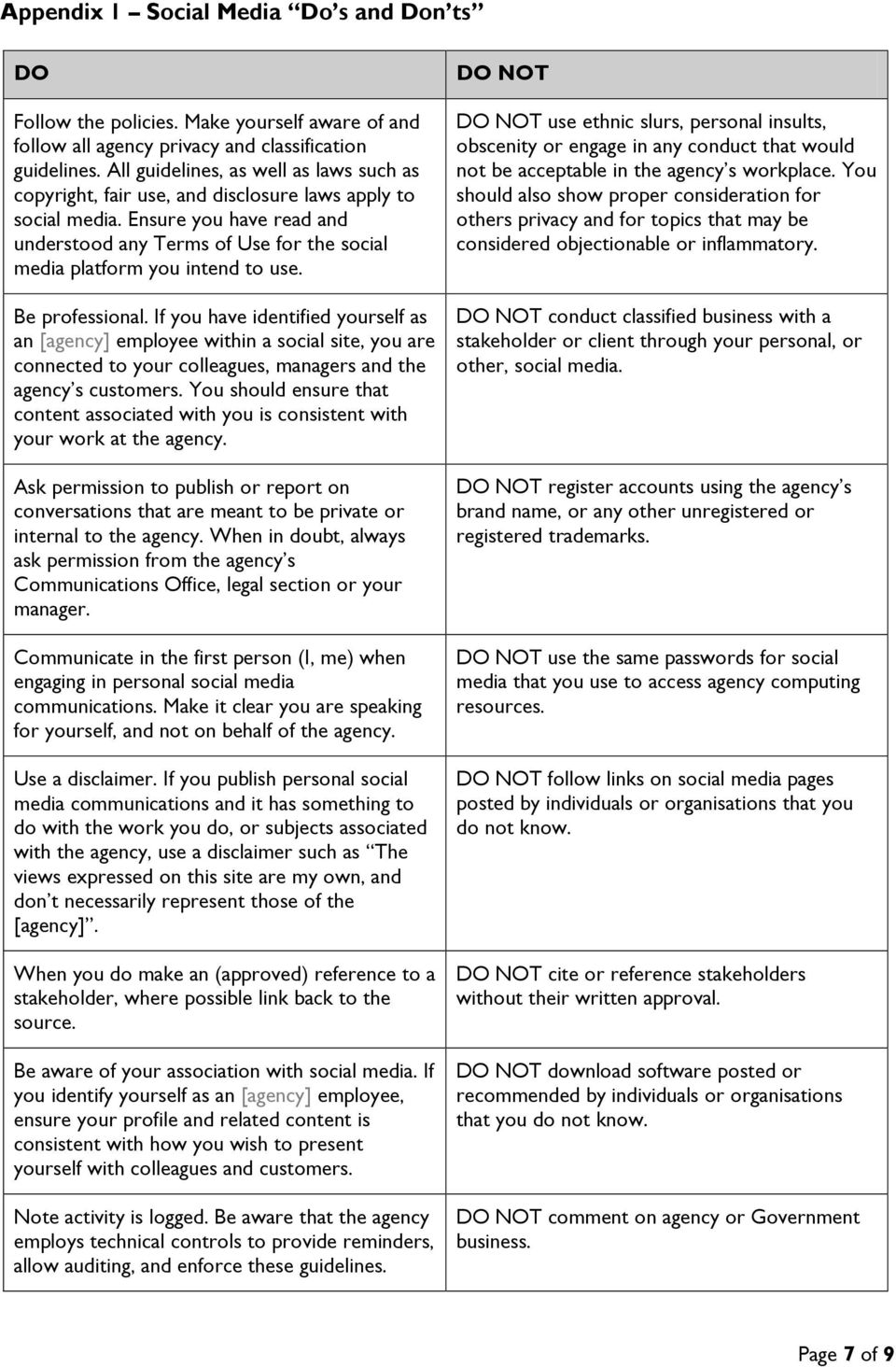
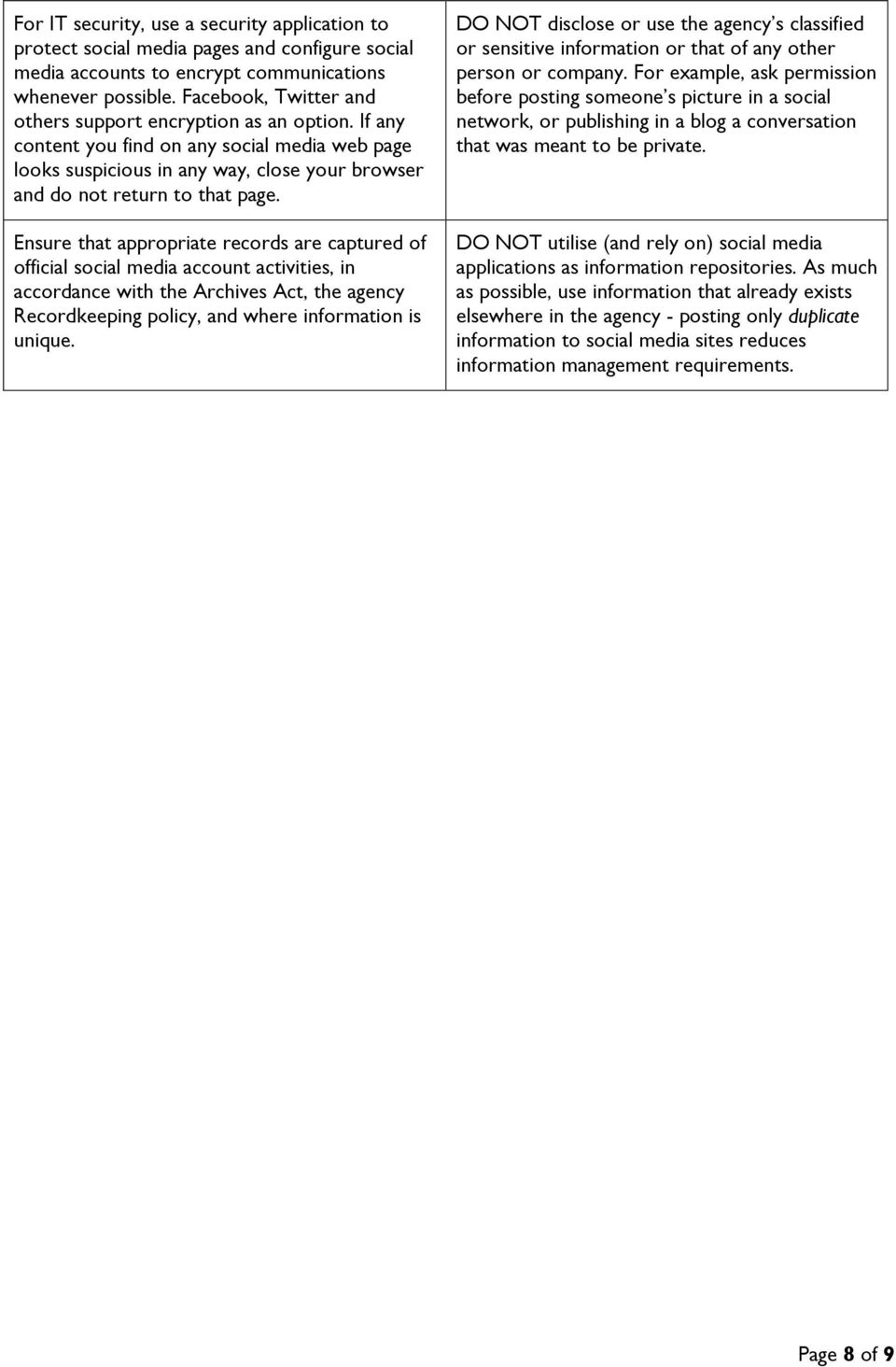
8 For IT security, use a security application to protect social media pages and configure social media accounts to encrypt communications whenever possible. Facebook, Twitter and others support encryption as an option. If any content you find on any social media web page looks suspicious in any way, close your browser and do not return to that page. Ensure that appropriate records are captured of official social media account activities, in accordance with the Archives Act, the agency Recordkeeping policy, and where information is unique. DO NOT disclose or use the agency s classified or sensitive information or that of any other person or company. For example, ask permission before posting someone s picture in a social network, or publishing in a blog a conversation that was meant to be private. DO NOT utilise (and rely on) social media applications as information repositories. As much as possible, use information that already exists elsewhere in the agency - posting only duplicate information to social media sites reduces information management requirements. Page 8 of 9
9 Acknowledgements Social Media Employee Acceptable Use Policy - Australian Government Department of Infrastructure and Transport, Social Media guidelines South Australian State Government, Use of Social Media Policy Australian Broadcasting Commission, Page 9 of 9
Information Management Advice 57 Sample Social Media Acceptable Use Policy
 Information Management Advice 57 Sample Social Media Acceptable Use Policy Overview The [agency] recognises that there are legitimate business and personal reasons for using social media at work or using
Guidance on the Use of Social Networking
 Guidance on the Use of Social Networking Version 1 - January 2012 Reviewed: September 2013 Version 2 Approved by SM: November 2013 Version 2 modified and approved by the PCC Board: April 2014 Overview
Policy. Social Media Acceptable Use Policy. Executive Lead. Review Date. Low
 Policy Social Media Acceptable Use Policy Date approved by - ISG Version Issue Date Review Date Executive Lead 11/6/2013 1.0 11/6/2013 11/6/2015 Mike Robson Executive Director Finance Procedure/Policy
REVIEWED BY Q&S COMMITTEE ON THE 4 TH JUNE 2015. Social Media Policy
 Social Media Policy SOCIAL MEDIA POLICY This Policy applies to all academy staff regardless of their employment status. It is to be read in conjunction with the E Safety and Data Security Policy. This
Social Media in the Workplace
 Social Media in the Workplace A Guide for CWU Members CWU Youth Committee 2013 CONTENTS Introduction... 3 Social Networking in Ireland... 4 Guidelines for using Social Media Responsibly... 5 2 INTRODUCTION
Human Resources Policies and Procedures
 SUBJECT: Social Media and Internet Policy PURPOSE The AppleOne Group of Companies ( AppleOne ) recognizes the fast-changing landscape of the Internet which has increased the popularity of social media
Social Media Policy. Policies and Procedures. Social Media Policy
 Policies and Procedures Social Media Policy 1 1. Introduction...3 2. Privacy settings and personal information.....3 3. Use of Social Media at Work.....4 4. Account Administrators and Login Details......4
SOCIAL MEDIA POLICY. Introduction
 Introduction Throughout this Policy, the words Translink Company and/or the Group refer to all corporate entities under the ownership of the Northern Ireland Transport Holding Company (NITHC). This includes
SOCIAL MEDIA Guidance for Agencies and Staff
 SOCIAL MEDIA Guidance for Agencies and Staff About this guide Information technology has changed forever the way in which people communicate and share information. While the wide range of technologies
BLACKPOOL COUNCIL Topic Social Media Policy
 1. Introduction 1.1 The widespread use of social media, particularly social networking sites, necessitates Blackpool has a policy in place to ensure that appropriate control mechanisms exist to minimise
6.9 Social Media Policy
 Policy Statement It is the policy of the to encourage clear and effective communication with all Nova Scotians using a variety of accepted tools, including social media. Social media is helping government
City of Edmonton Social Media Guidelines
 City of Edmonton Social Media Guidelines June, 2011 Table of Contents Introduction What are Social Media? Risks and Benefits of using Social Media General guidelines Speaking to the media Personal accounts
SOCIAL MEDIA POLICY. Senior Governance Officer, NHS North of England Commissioning Support Unit Reference No
 SOCIAL MEDIA POLICY Ratified Governance & Risk Committee 08/2015 Status Final Issued August 2015 Approved By Governance and Risk Committee Consultation Governance and Risk Committee Equality Impact Assessment
CCG Social Media Policy
 Corporate CCG Social Media Policy Version Number Date Issued Review Date 2 25/03/2015 25/03/2017 Prepared By: Consultation Process: Formally Approved: Governance Manager, North of England Commissioning
Model Policy for a Law Enforcement Agency s use of Social Networking
 Model Policy for a Law Enforcement Agency s use of Social Networking Disclaimer: This is a model policy was designed to provide a guide to writing a policy related to social networking use. This model
DISTRICT COUNCIL OF LOXTON WAIKERIE. Social Media Policy
 DISTRICT COUNCIL OF LOXTON WAIKERIE Social Media Policy Policy Identification: Adoption Date: 20 April 2012 Last Review: 17 April 2015 Next Review Date: April 2017 Every 2 years Responsible Officer(s):
INTERNET, EMAIL AND COMPUTER USE POLICY.
 INTERNET, EMAIL AND COMPUTER USE POLICY. CONSIDERATIONS Code of Conduct Discipline and termination policy Privacy Policy Sexual Harassment policy Workplace Health & Safety Policy LEGISLATION Copyright
Social Media. Scope. Computer Use Employee Code of Conduct Privacy Emergency Management Plan Communications Strategy Community Engagement Strategy
 Social Media Responsible officer: Director Community and Corporate Services Key Result Area: Governance and Decision Making Document type: Policy Reference: 10/01/0004 Approved by: Council Date approved:
Social Networking Protocol for Schools Managed Staff
 Social Networking Protocol for Schools Managed Staff Created by HR Consultancy June 2010 1 Social Networking Protocol 2010 Contents 1. Purpose 2. Scope 3. School s Expectations 4. Safeguarding 5. Monitoring
With the increasing popularity of social media you need a Social Media Policy to protect your company.
 Dear Reader, With the increasing popularity of social media you need a Social Media Policy to protect your company. It can become your biggest nightmare when employees distribute information that s not
MINNETONKA PUBLIC SCHOOLS
 MINNETONKA PUBLIC SCHOOLS Policy #470: Employee Use of Social Media I. PURPOSE As a national leader in using technology as an accelerator of learning, the Minnetonka School District recognizes the value
Dundalk Institute of Technology. Acceptable Usage Policy. Version 1.0.1
 Dundalk Institute of Technology Acceptable Usage Policy Version 1.0.1 1 Document Location..\DkIT_Policy_Documents\Policies Revision History Date of this revision: Date of next review: Version Revision
Social Media Guidance for Staff
 Social Media Guidance for Staff May 2013 Social media guidance aims Establish practical and reasonable guidelines to help staff in their professional use of social media. Promote a safe environment to
NYC Department of Education Social Media Guidelines
 Spring 2012 NYC Department of Education Social Media Guidelines A. Introduction/Purpose 1. Social media technology can serve as a powerful tool to enhance education, communication, and learning. This technology
STAFF & GOVERNOR USE OF SOCIAL MEDIA AND INTERNET SITES POLICY
 Page 1 of 7 Alveston CofE Primary School has adopted this policy from the Local Authority. INTRODUCTION Social media includes online social forums such as Facebook, Twitter and LinkedIn, and websites such
ICT Student Usage Policy
 ICT Student Usage Policy Document status Document owner Vice Principal Finance and Resources Document author IT Manager Document type Policy Date of document January 2015 Version number 04 Review requirements
Acceptable Use of Information Technology
 Acceptable Use of Information Technology No.: 3501 Category: Information Technology Services Approving Body: Leadership Team Executive Division: Learning and Technology Services Department Responsible:
Social Media Guidelines
 Northern Virginia Community College Social Media Guidelines social networks, social media, blogs, wikis and virtual worlds April 2013 (revised) 04.11.13 Page 1 Table of Contents Introduction 3 Connect
Internet Use Policy and Code of Conduct
 Internet Use Policy and Code of Conduct UNIQUE REF NUMBER: AC/IG/023/V1.1 DOCUMENT STATUS: Agreed by Audit Committee 18 July 2013 DATE ISSUED: July 2013 DATE TO BE REVIEWED: July 2014 1 P age AMENDMENT
POLICY. Responsible Use of Social Media
 POLICY Responsible Use of Social Media Contact Officer Director of Personnel Director of Communications & Participation Senior Project Manager: Corporate Policies (Policy author) Purpose The primary aims
Computer Facilities and External Networks Acceptable Use by Students
 Related Policies Copyright Media Usage Offshore Data Hosting Privacy Web Publishing Purpose Policy Computer facilities and external networks are made available as resources for use by students in Catholic
Australian Ethical Investment Limited and Australian Ethical Superannuation Pty Ltd. Code of Conduct
 Australian Ethical Investment Limited and Australian Ethical Superannuation Pty Ltd Code of Conduct The Australian Ethical Code of Conduct is intended to provide guidance for Directors and employees on
Acceptable Use of ICT Policy For Staff
 Policy Document Acceptable Use of ICT Policy For Staff Acceptable Use of ICT Policy For Staff Policy Implementation Date Review Date and Frequency January 2012 Every two Years Rev 1: 26 January 2014 Policy
EASTNOR PAROCHIAL PRIMARY SCHOOL STAFF SOCIAL NETWORKING POLICY. Inspire and Achieve
 EASTNOR PAROCHIAL PRIMARY SCHOOL STAFF SOCIAL NETWORKING POLICY Inspire and Achieve Introduction This document sets out the guidance on social networking and aims to: Set clear expectations of behaviour
Use of Social Networking Websites Policy. Joint Management Trade Union Committee. ENDORSED BY: Consultative Committee DATE: 14 February 2013
 Use of Social Networking Websites Policy START DATE: March, 2013 NEXT REVIEW: March 2015 COMMITTEE APPROVAL: Joint Management Trade Union Committee CHAIR S SIGNATURE: STAFF SIDE CHAIR S SIGNATURE: DATE:
Terms & Conditions. In this section you can find: - Website usage terms and conditions 1, 2, 3. - Website disclaimer
 1 Terms & Conditions In this section you can find: - Website usage terms and conditions 1, 2, 3 - Website disclaimer -Acceptable internet use policy 1,2,3,4 - Acceptable email use policy 1, 2 - Copyright
YWCA Metro St. Louis Social Media Policy
 YWCA Metro St. Louis Social Media Policy I. Purpose Social media encompasses a growing collection of online technologies and tools that allow and encourage users to interact and build relationships by
COMPUTER /ONLINE SERVICES (Acceptable Use and Internet Safety)
 COMPUTER /ONLINE SERVICES (Acceptable Use and Internet Safety) The Middletown City School District provides an electronic communications network that allows District-authorized individuals internal access
Policy on Staff/Governor Use of Social Networking and Internet Sites
 Warwickshire Education Services Policy on Staff/Governor Use of Social Networking and Internet Sites January 2014 Warwickshire County Council Policy on Staff/Governor Use of Social Networking and Internet
How To Deal With Social Media At Larks Hill J & I School
 LARKS HILL JUNIOR & INFANT SCHOOL Social Media Policy Written: Reviewed Autumn Term 2015 Larks Hill J & I School Social Media Policy 1. Introduction For the purposes of this policy, social media refers
SOCIAL MEDIA & DIGITAL MARKETING POLICIES AND PROCEDURES
 SOCIAL MEDIA & DIGITAL MARKETING POLICIES AND PROCEDURES The purpose of the Social Media and Digital Marketing Policy is to ensure the proper use of county social sites, web based marketing and technologies
Communications 01: Social Media
 Communications 01: Social Media Policy: To communicate the Network s mission publicly, to inform and engage the community regarding the Network s activities, and to establish appropriate and professional
Policy on Use of IT Resources of Government of India
 Policy on Use of IT Resources of Government of India October 2014 Version 1.0 Department of Electronics and Information Technology Ministry of Communications and Information Technology Government of India
The British Academy of Management. Website and Social Media Policy
 The British Academy of Management s Website and Social Media Policy The creation of management knowledge through research and its dissemination through teaching and application The British Academy of Management
COLCHESTER HIGH SCHOOL SOCIAL MEDIA POLICY
 Date of this version: January 2015, to be reviewed January 2016. Page 1 At a glance: This policy sets out expectations for professional and personal social media use. It sets out what all staff should
1. Computer and Technology Use, Cell Phones. 1.1. Information Technology Policy
 1. Computer and Technology Use, Cell Phones 1.1. Information Technology Policy Employees are provided with Internet access and electronic communications services (which may include, but are not limited
Acceptable Use Policy
 Acceptable Use Policy TABLE OF CONTENTS PURPOSE... 4 SCOPE... 4 AUDIENCE... 4 COMPLIANCE & ENFORCEMENT... 4 POLICY STATEMENTS... 5 1. General... 5 2. Authorized Users... 5 3. Loss and Theft... 5 4. Illegal
The term Broadway Pet Stores refers we to the owner of the website whose registered office is 6-8 Muswell Hill Broadway, London, N10 3RT.
 Website - Terms and Conditions Welcome to our website. If you continue to browse and use this website you are agreeing to comply with and be bound by the following terms and conditions of use, which together
YU General Guidelines for Use of Social Media
 INTRODUCTION AND SCOPE General Guidelines for Use of Social Media Social media can be a valuable and powerful means of communication. Yeshiva University and its constituent schools (collectively, the University
Non-Official/Personal Use of Social Media and Social Networking. Availability of Information and Access to Persons Without Internet Access
 Department of the Interior Social Media Policy ~ 1 ~ Table of Contents Section 1: Social Media and Social Networking Policy Overview of Policy Official Use of Social Media and Social Networking at DOI
TERMS OF USE AGREEMENT
 TERMS OF USE AGREEMENT Last Updated: October 20, 2010 PLEASE READ THIS TERMS CAREFULLY BEFORE ACCESSING THE WEBSITE I GENERAL 1) The Web Portal MEGA BRAZIL TV is a part of the MEGA LOPES, LLC family of
Student use of the Internet Systems is governed by this Policy, OCS regulations, policies and guidelines, and applicable law.
 OCS Internet Acceptable Use and Safety Policy for Students The Opportunity Charter School ( OCS or the School ) provides access to OCS s Internet Systems for its students for educational purposes, in conformance
COMPUTER USAGE - EMAIL
 BASIC BELIEF This policy relates to the use of staff email at Mater Dei and is designed to provide guidelines for individual staff regarding their use. It encourages users to make responsible choices when
Networking and Social Media Policy
 Networking and Social Media Policy 1 Objectives This policy sets out the Millfields Community School policy on social networking. New technologies are an integral part of our lives and are powerful tools
SOUTHERN SLOPES COUNTY COUNCIL COMPUTER & INFORMATION TECHNOLOGY USE POLICY
 SOUTHERN SLOPES COUNTY COUNCIL COMPUTER & INFORMATION TECHNOLOGY USE POLICY OBJECTIVE To provide users with guidelines for the use of information technology resources provided by Council. SCOPE This policy
State Records Guideline No 18. Managing Social Media Records
 State Records Guideline No 18 Managing Social Media Records Table of Contents 1 Introduction... 4 1.1 Purpose... 4 1.2 Authority... 5 2 Social Media records are State records... 5 3 Identifying Risks...
Rules for the use of the IT facilities. Effective August 2015 Present
 Rules for the use of the IT facilities Effective August 2015 Present INFORMATION MANAGEMENT GUIDE RULES FOR THE USE OF THE UNIVERSITY S IT FACILITIES ( The Rules ) 1. Introduction 2. Interpretation 3.
Social Media Policy. Version 1.0. November 2012
 Social Media Policy Version 1.0 November 2012 Table of Contents Introduction... 3 1.1 Document Purpose... 3 1.2 Document Scope... 3 1.3 Audience... 3 1.4 Related documents... 3 2. Background... 4 3. Guiding
SOCIAL MEDIA POLICY FOR VOLUNTEERS TEMPLATE
 SOCIAL MEDIA POLICY FOR VOLUNTEERS TEMPLATE SOCIAL MEDIA POLICY FOR VOLUNTEERS TEMPLATE (Insert Your Organisation Name) uses social media in its work and recognises that those who are involved in its work
Social Media Policy. 1 Southbank International School: Social Media Policy. Abstract
 1 Southbank International School: Abstract The Policy seeks to provide support and guidance to social media users who are associated with the School (employees, students), and who establish and maintain
WORKPLACE INTERNET, EMAIL AND NETWORK USAGE POLICY
 WORKPLACE INTERNET, EMAIL AND NETWORK USAGE POLICY MAY 2013 DOCUMENT SUMMARY Document Number Responsible Officer P0 DO0008.2 Assistant Directors Effective Date May 2013 Superseded Docs Workplace Internet,
Virginia Commonwealth University Police Department
 Virginia Commonwealth University Police Department NUMBER SECTION CHIEF OF POLICE EFFECTIVE REVIEW DATE 2 9 1/2013 2/2013 SUBJECT SOCIAL MEDIA GENERAL The department endorses the secure use of social media
Sutter Health and Affiliates Administrative Policies and Procedures SOCIAL MEDIA POLICY
 Sutter Health and Affiliates Administrative Policies and Procedures SOCIAL MEDIA POLICY Communications & Marketing Policy 12-745 Approved by: System Management Team Origination Date: 08/2009 Revised Date:
DIGITAL TECHNOLOGY POLICY St Example s School
 DIGITAL TECHNOLOGY POLICY St Example s School RATIONALE: At St Example s we provide guidelines to all parents, staff and students on the use of electronic media e-mail, internet, intranet, facsimile, phone
INFORMATION SERVICES SOCIAL MEDIA GUIDE FOR STAFF
 INFORMATION SERVICES SOCIAL MEDIA GUIDE FOR STAFF go.qub.ac.uk/socialmedia WHY ARE SOCIAL MEDIA TOOLS IMPORTANT TO QUEEN S UNIVERSITY? The term social media is used to describe a range of communication
Angard Acceptable Use Policy
 Angard Acceptable Use Policy Angard Staffing employees who are placed on assignments with Royal Mail will have access to a range of IT systems and mobile devices such as laptops and personal digital assistants
UNIVERSITY OF ST ANDREWS. EMAIL POLICY November 2005
 UNIVERSITY OF ST ANDREWS EMAIL POLICY November 2005 I Introduction 1. Email is an important method of communication for University business, and carries the same weight as paper-based communications. The
HUMAN RESOURCES POLICIES & PROCEDURES
 HUMAN RESOURCES POLICIES & PROCEDURES Policy title Application IT systems and social networking policy All employees and students CONTENTS PAGE Introduction and scope 2 General points 2 Authorisation to
TAUNTON PUBLIC SCHOOLS Internet Acceptable Use and Social Networking Policies and Administrative Procedures
 TAUNTON PUBLIC SCHOOLS Internet Acceptable Use and Social Networking Policies and Administrative Procedures A. INTERNET ACCEPTABLE USE POLICY OF THE TAUNTON PUBLIC SCHOOLS I. Mission Statement: Academic
Guidance on staff use of Social Media
 Guidance on staff use of Social Media Introduction Social networking through the use of Internet-based and other electronic social media tools is integrated into everyday life. Use of Facebook, LinkedIn,
Acceptable Use of Information Systems Standard. Guidance for all staff
 Acceptable Use of Information Systems Standard Guidance for all staff 2 Equipment security and passwords You are responsible for the security of the equipment allocated to, or used by you, and must not
SOCIAL MEDIA GUIDELINES FOR SCHOOLS
 SOCIAL MEDIA GUIDELINES FOR SCHOOLS The goal of these guidelines is to provide, staff, administrators, students, parents and the school district community direction when using social media applications