
Information and Communications Technology Controls Report
|
|
|
- Nickolas Holmes
- 10 years ago
- Views:
Transcription
1 Information and Communications Technology Controls Report Victorian Auditor-General s Report October :12
2

3 V I C T O R I A Victorian Auditor-General Information and Communications Technology Controls Report Ordered to be printed VICTORIAN GOVERNMENT PRINTER October 2014 PP No 380, Session
4 This report is printed on Monza Recycled paper. Monza Recycled is certified Carbon Neutral by The Carbon Reduction Institute (CRI) in accordance with the global Greenhouse Gas Protocol and ISO framework. The Lifecycle Analysis (LCA) for Monza Recycled is cradle to grave including Scopes 1, 2 and 3. It has FSC Mix Certification combined with 55% recycled content. ISBN

5 The Hon. Bruce Atkinson MLC President Legislative Council Parliament House Melbourne The Hon. Christine Fyffe MP Speaker Legislative Assembly Parliament House Melbourne Dear Presiding Officers Under the provisions of section 16AB of the Audit Act 1994, I transmit my report Information and Communications Technology Controls Report This report is the first of its type by my office and aims to provide additional insight and increase visibility of ICT-related audit findings, raised as part of our financial audits. The report is intended to provide decision-makers with relevant information to assist them to address audit findings and improve processes. For this audit, 39 entities with a financial year-end date of either 31 December 2013 or 30 June 2014 were selected for analysis. Sixty-four key financial ICT applications and their infrastructure were audited, with 364 associated audit findings used as the basis for this report s analysis. Most ICT audit findings were medium risk, with none ranked as an extreme risk. High-risk ICT audit findings are concentrated in a few ICT general controls categories. This report also draws out five clear emerging themes from the analysis and I have made seven recommendations to help address these. In future reports, we will perform detailed maturity assessments of selected entities' ICT environments and also examine some selected areas of focus, such as identity and access management, software licensing and wireless network security. Yours faithfully John Doyle Auditor-General 15 October 2014 Victorian Auditor-General s Report Information and Communications Technology Controls Report iii

6

7 Contents Auditor-General's comments... vii Audit summary...ix Conclusions... ix Findings... ix Recommendations... xi Submissions and comments received... xi 1. Background Introduction Internal control framework Recent key changes to the sector Departments and agencies in scope ICT systems in scope Reliance on the work of others Audit conduct Structure of the report Results of ICT audits Introduction ICT general controls audits results ICT general controls categories ICT controls maturity assessment Themes from ICT audits Introduction Top five themes noted in Appendix A. Ratings definitions Appendix B. ICT controls report : scope and coverage Appendix C. Audit Act 1994 section 16 submissions and comments Victorian Auditor-General s Report Information and Communications Technology Controls Report v
8

9 Auditor-General s comments My office undertakes a number of information and communications technology (ICT) audits each financial year to verify whether key financial ICT systems are managed appropriately to support the financial reporting process. Reflecting on the 364 ICT audit findings relevant to the 39 entities selected for this inaugural report, I see a number of key issues that require much more focused attention and oversight by accountable officers and governance bodies. Overwhelmingly, a recurring finding is the need to improve ICT security controls. Inadequate management of ICT security accounts for a large proportion of the ICT audit findings reported during our financial audits. John Doyle Auditor-General Software patch management and ICT disaster recovery planning are also areas which require urgent attention. Disappointingly, some 45 per cent of audit findings from previous years are yet to be rectified. Agencies need to accelerate the rate at which they are resolving audit findings and make sure that their underlying processes are improved so that audit findings do not re-occur. Agencies seem to be having more success at addressing low-risk ICT audit findings compared to medium- and high-risk findings. This may be correlated with the degree of effort that is required in driving appropriate actions, but also raises questions about how audit recommendations are prioritised, tracked and monitored by management and key governance bodies, such as audit committees. Audit team Paul O'Connor Engagement Leader Ian Yaw Team Leader Rue Maharaj Team Member Consequently, I will be closely monitoring agencies' progress in the implementation of audit recommendations in future iterations of this ICT controls report. Looking to the future, the growth of ICT outsourcing to the private sector and adoption of cloud-based ICT services is a trend that is likely to continue. While there may be many potential benefits from these services, the risks associated with such an approach need to be understood and actively managed by entities that are taking up such arrangements. I would like to thank the participating agencies for their assistance and cooperation during the preparation of this audit. Tonderai Nduru Team Member Engagement Quality Control Reviewer Paul Martin John Doyle Auditor-General October 2014 Victorian Auditor-General s Report Information and Communications Technology Controls Report vii

10

11 Audit summary This report summarises the results of our audits of selected public sector entities' information and communication technology (ICT) general controls performed in support of VAGO's financial audits. ICT general controls are policies, procedures and activities put in place by an entity to assist and maintain the confidentiality, integrity and availability of its ICT systems and data. This report is the first of its type and aims to provide additional insight and increase visibility of our ICT audit findings. This report is also intended to provide decision-makers with relevant information to assist them to address audit findings, and improve processes, and to enhance accountability across government. For this audit, 39 entities with a financial year-end date of either 31 December 2013 or 30 June 2014 were selected for analysis. The audit findings of 64 ICT applications relevant to financial reporting and associated infrastructure are analysed in this report. The audit findings give a high-level view of ICT general controls and weaknesses, which identifies wider trends that may not be covered in reports we make to an entity's management during the course of a financial audit. Conclusions Despite some deficiencies in ICT controls, VAGO was able to rely on them for financial reporting purposes, as satisfactory mitigations had been identified and tested. Most of the ICT audit findings were in the medium-risk category, with none ranked as an extreme risk. High-risk ICT audit findings are concentrated in a few ICT general controls categories. For the financial year, there are five clear emerging themes or trends. Findings High-risk ICT audit findings are concentrated around deficiencies in controls for: managing access to ICT applications and data assurance obtained by entities over ICT general controls performed by external organisations entities using ICT systems, which are no longer supported by vendors authenticating users to ICT systems, such as password controls software patch management, such as implementing software releases by vendors to fix security vulnerabilities or operational issues maintaining processes to assist in the recovery of an entity's ICT in the event of a disaster. Victorian Auditor-General s Report Information and Communications Technology Controls Report ix

12 Audit summary Collectively, these findings account for 87 per cent of all high-risk findings. Based on our analysis of the ICT audit findings, we identified the following top five themes: ICT security controls need improvement ICT security audit findings account for the majority of all audit findings reported in the financial year. Further analysis shows that such audit findings are widespread across government, with VAGO reporting ICT security audit findings at most of the audited agencies. Management of service organisation assurance activities requires attention in the context of this report, service organisations are ICT service providers, data processing services and external investment managers, with the state's ICT shared services body, CenITex, being an example of such an arrangement. Where such organisations have control over key ICT processes, VAGO would seek to obtain a service assurance report that articulates the effective control environment. There is an increase in the number of service assurance reports and similar instruments being obtained by public sector entities. It is likely that management's and VAGO's reliance on such reports will continue given the government's goal to outsource CenITex and for entities to consider using cloud-based applications. Prior-period audit findings are not being addressed in a timely manner a number of weaknesses in ICT general controls raised in prior years have not been completely resolved by entities, despite agreement and commitment by management to resolve them. Patch management processes need improvement most of the audited agencies have audit findings relating to patch management. Of the ICT general controls categories, patch management is ranked the lowest in terms of maturity, reflecting a need for management to improve their processes in this area. ICT disaster recovery planning is weak a number of high-risk findings were highlighted in our audit reports. Most notable is an audit finding for one of the key providers for ICT services which relates to the absence of a formalised disaster recovery plan and framework and limited capability to respond to a significant ICT disaster.

13 Audit summary Recommendations Number Recommendation Page Noting the high-level findings, public sector entities governing bodies and management and the Department of State Development, Business and Innovation, should: 1. enforce information and communication technology security policies and procedures, including improving user access management, authentication controls and patch management processes 2. develop and implement appropriate policy and guidance on assurance activities surrounding outsourced information and communication technology arrangements 3. enhance their understanding of the Assurance or Auditing Standards requirements for service assurance reports, ensure that reports received are fit for purpose and provide an accurate reflection of the control environment 4. implement actions to address control weaknesses in outsourced information and communication technology arrangements 5. implement sustainable process improvements to prevent re-occurring audit findings 6. through audit committees, implement appropriate monitoring mechanisms to ensure audit findings are addressed by management 7. develop appropriate information and communication technology disaster recovery capabilities, involving information and communication technology service providers as necessary Submissions and comments received We have engaged with the Chief Technology Advocate within the Department of State Development, Business and Innovation and the Chief Information Officer Council throughout the course of the audit. In accordance with section 16(3) of the Audit Act 1994, we provided a copy of this report to the Department of State Development, Business and Innovation and requested their submissions or comments. We have considered those views in reaching our audit conclusions and have represented them to the extent relevant and warranted. The full section 16(3) submissions and comments are included in Appendix C. Victorian Auditor-General s Report Information and Communications Technology Controls Report xi

14

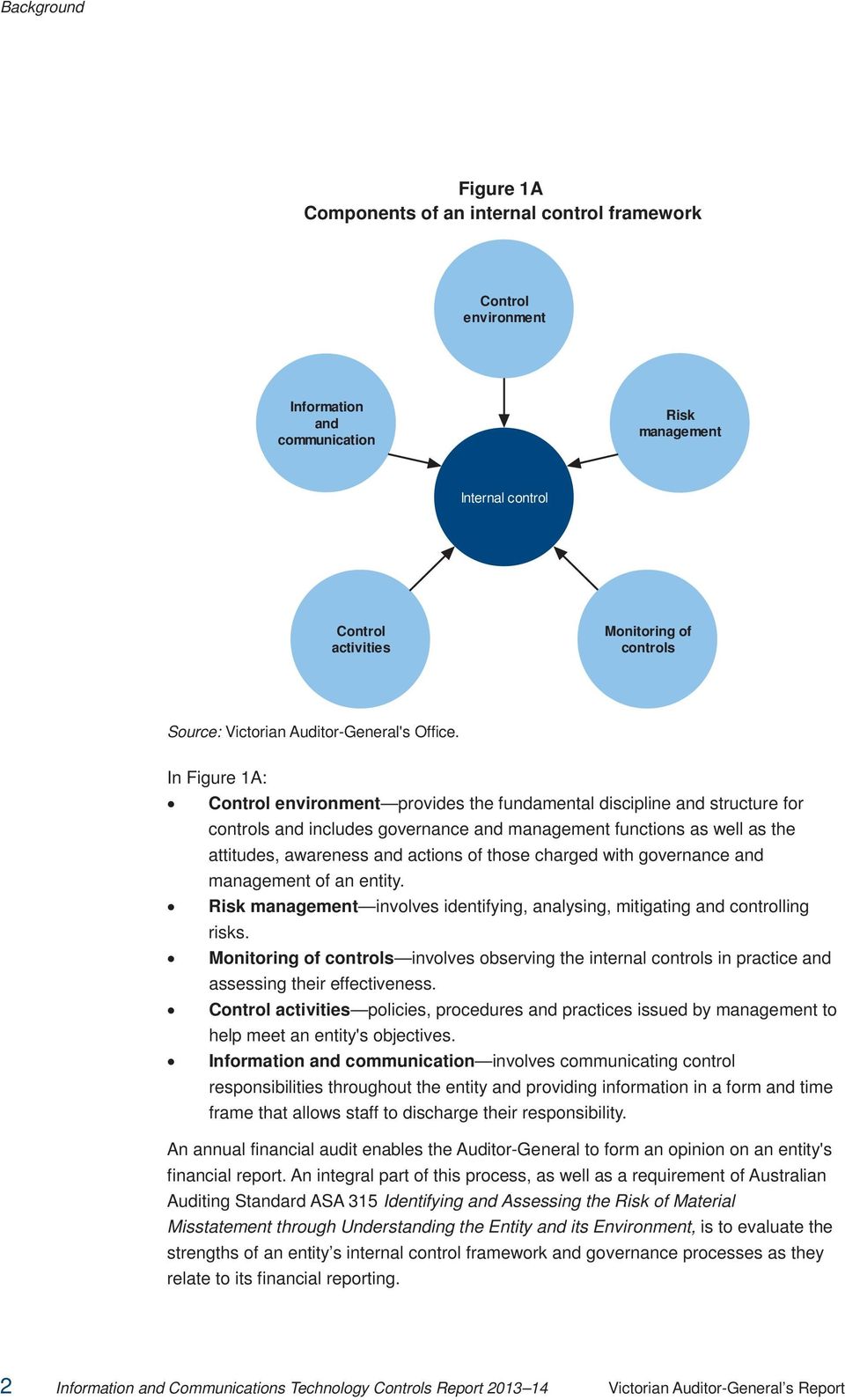
15 1 Background 1.1 Introduction The Auditor-General is the external auditor of Victoria's public sector entities, and has a legislated obligation to provide independent assurance to the Parliament about the financial status as well as efficiency, effectiveness and economy of these entities. VAGO audits around 550 entities, including departments and agencies, public hospitals and other health services, universities and other educational institutions, water authorities, public sector superannuation funds, as well as companies, trusts and joint ventures controlled by public sector agencies. Financial audits give independent assurance to Parliament and the community that the information contained in an agency's financial statements is fairly presented in accordance with Australian Accounting Standards and applicable legislation. When planning a financial audit, VAGO seeks to understand and evaluate an entity's information and communications technology (ICT) environment and any related risks to the reliability of financial reporting. This report summarises the results of our audits of public sector entities' ICT general controls as part of the financial audits. It is the first report of its type and aims to provide extra insight into VAGO's ICT audit findings, and identify wider trends that may not be covered in reports to an entity's management. In future reports, we will perform detailed maturity assessments of selected entities' ICT environments and examine some selected areas of focus, such as identity and access management, software licensing and wireless network security. 1.2 Internal control framework An entity's governing body and its accountable officer are responsible for developing and maintaining an internal control framework. Internal controls are systems, policies and procedures which help an entity to reliably and cost effectively meet its objectives, as well as minimise risk and fraud. The components of an internal control framework are shown in Figure 1A. Victorian Auditor-General s Report Information and Communications Technology Controls Report
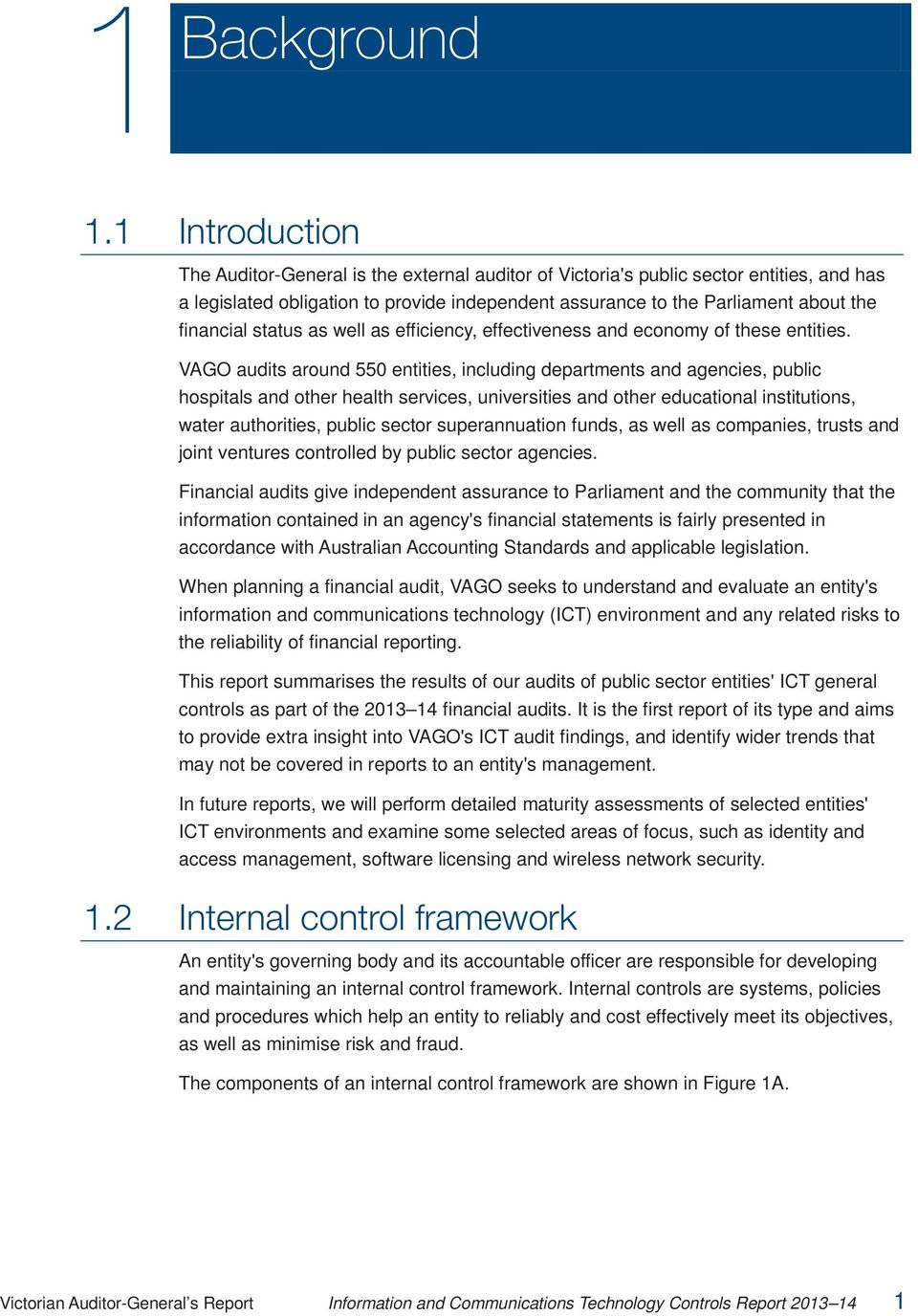
16 Background Figure 1A Components of an internal control framework Control environment Information and communication Risk management Internal control Control activities Monitoring of controls Source: Victorian Auditor-General's Office. In Figure 1A: Control environment provides the fundamental discipline and structure for controls and includes governance and management functions as well as the attitudes, awareness and actions of those charged with governance and management of an entity. Risk management involves identifying, analysing, mitigating and controlling risks. Monitoring of controls involves observing the internal controls in practice and assessing their effectiveness. Control activities policies, procedures and practices issued by management to help meet an entity's objectives. Information and communication involves communicating control responsibilities throughout the entity and providing information in a form and time frame that allows staff to discharge their responsibility. An annual financial audit enables the Auditor-General to form an opinion on an entity's financial report. An integral part of this process, as well as a requirement of Australian Auditing Standard ASA 315 Identifying and Assessing the Risk of Material Misstatement through Understanding the Entity and its Environment, is to evaluate the strengths of an entity s internal control framework and governance processes as they relate to its financial reporting. 2 Information and Communications Technology Controls Report Victorian Auditor-General s Report
17 Background While the auditor considers the internal controls relevant to financial reporting, there is no requirement for the auditor to provide an opinion on its effectiveness. Consequently, an unmodified audit opinion on the financial report is not an opinion on the adequacy or otherwise of the entity s internal control environment. The ultimate responsibility for the effective operation of the internal control at all times remains with the entity s management. Significant internal control deficiencies identified during an audit are communicated to the entity's governing body and management so that they may be rectified. Such deficiencies or weaknesses in controls will usually not result in a qualified audit opinion as often an entity will have compensating controls in place that aid in mitigating the risk of a material error or misstatement in the financial report, or the auditor may be able to obtain evidence through performing substantive procedures. However, for entities that use highly automated ICT systems to initiate and process transactions, the ICT system is the sole repository of the documentation for financial transactions. A significant internal control weakness in the ICT system may result in a qualification if it prevents the auditor from obtaining sufficient evidence about the accuracy, completeness and reliability of the financial information being reported. The importance of ICT systems and ICT general controls An ICT system is a collection of computer hardware and programs that work together to support business or operational processes. ICT systems are generally made up of three components: Operating system core programs that run on the ICT hardware that enable other programs to work. Examples of operating systems include Microsoft Windows, Unix and IBM OS/400. Databases programs that organise and store data. Examples of database software include Oracle database and Microsoft SQL Server. Applications programs that deliver operational or business requirements. There are various types of ICT applications, which are described in Section 1.5. These components are supported by an entity's network infrastructure. A typical VAGO scope for an ICT general controls audit covers all three ICT system components for in-scope key financial systems. This is shown in Figure 1B. Victorian Auditor-General s Report Information and Communications Technology Controls Report
18 Background Figure 1B Typical scope for an ICT general controls audit Source: Victorian Auditor-General's Office. ICT general controls are policies, procedures and activities put in place by an entity to assist and ensure the confidentiality, integrity and availability of its ICT systems and data. Auditing Standard ASA 315 Identifying and Assessing the Risks of Material Misstatement through Understanding the Entity and Its Environment states that ICT benefits internal control by enabling an entity to: consistently apply predefined business rules and perform complex calculations in processing large volumes of transactions or data enhance the timeliness, availability, and accuracy of information reduce the risk that controls will be circumvented enhance the ability to achieve effective segregation of duties by implementing security controls in applications, databases, and operating systems. An example of an ICT general control is whether access requests to ICT systems are properly reviewed and authorised by management. The objective of this control is to ensure only authorised users have access to entities' ICT systems. Ineffective ICT general controls may have an impact on the reliability and integrity of the system's underlying financial data and programs and may impact the ability of VAGO to rely on underlying business and process controls. 4 Information and Communications Technology Controls Report Victorian Auditor-General s Report

19 Background Auditing Standard ASA 265 Communicating Deficiencies in Internal Control to Those Charged with Governance and Management requires the auditor to: communicate, in writing, all significant deficiencies in internal control and their potential effects to those charged with governance, and where appropriate, management communicate to management other identified deficiencies in internal control that the auditor considers to be of sufficient importance to merit management s attention. Weaknesses identified by VAGO during an ICT audit are brought to the attention of the entity's accountable officer and chair of the governing body, as well as the chief financial officer, chief information officer and audit committee, by way of a management letter. We also seek management's comments on remediation plans and time frames for addressing any audit observations or recommendations. 1.3 Recent key changes to the sector Recent changes within the public sector have impacted the scope of our ICT audits. Machinery-of-government changes Machinery-of-government changes were announced in April 2013, culminating in a restructuring of departments early in the financial year. The changes affected a number of key departments. From an ICT perspective, most notable was the restructure of the former Department of Business and Innovation to form the Department of State Development, Business and Innovation (DSDBI), along with newly assigned responsibilities for public sector ICT strategy, policy, and operations. Given its role for ICT matters with government, VAGO consulted with DSDBI as the lead agency for this report. CenITex CenITex is an ICT shared services agency, set up as a state body by the Victorian Government in July 2008 to centralise ICT services for government agencies. CenITex provides ICT infrastructure and services to DSDBI, as well as the departments of Environment and Primary Industries, Health, Human Services, Justice, Premier and Cabinet, Transport, Planning and Local Infrastructure, Treasury and Finance, some of these departments' associated agencies, as well as the Environment Protection Authority, Public Transport Victoria and Court Services Victoria. As a key service provider for ICT services to a number of government departments and agencies, a number of this audit's findings are associated with CenITex and the ICT infrastructure and processes that it manages. Victorian Auditor-General s Report Information and Communications Technology Controls Report
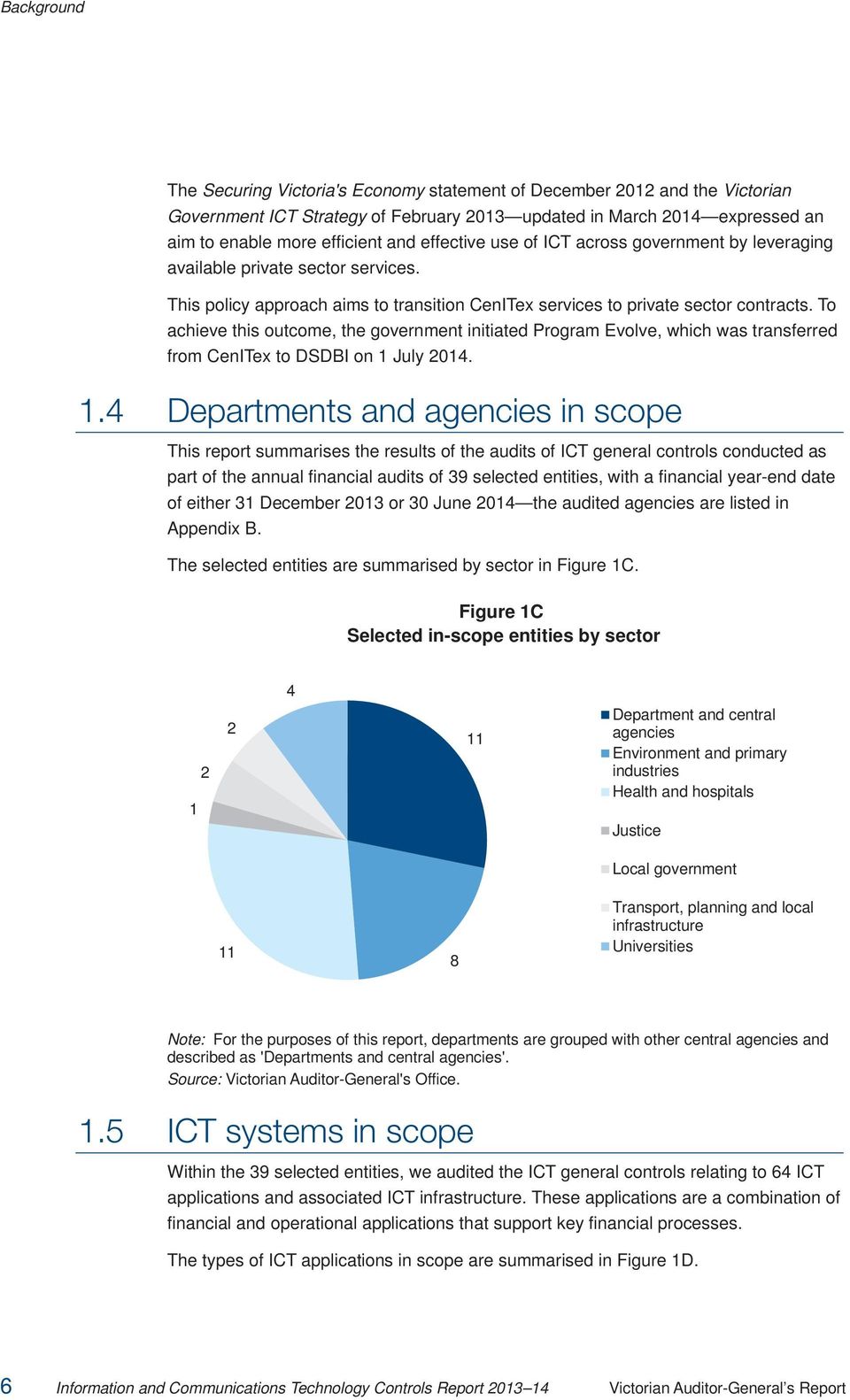
20 Background The Securing Victoria's Economy statement of December 2012 and the Victorian Government ICT Strategy of February 2013 updated in March 2014 expressed an aim to enable more efficient and effective use of ICT across government by leveraging available private sector services. This policy approach aims to transition CenITex services to private sector contracts. To achieve this outcome, the government initiated Program Evolve, which was transferred from CenITex to DSDBI on 1 July Departments and agencies in scope This report summarises the results of the audits of ICT general controls conducted as part of the annual financial audits of 39 selected entities, with a financial year-end date of either 31 December 2013 or 30 June 2014 the audited agencies are listed in Appendix B. The selected entities are summarised by sector in Figure 1C. Figure 1C Selected in-scope entities by sector Department and central agencies Environment and primary industries Health and hospitals Justice Local government 11 8 Transport, planning and local infrastructure Universities Note: For the purposes of this report, departments are grouped with other central agencies and described as 'Departments and central agencies'. Source: Victorian Auditor-General's Office. 1.5 ICT systems in scope Within the 39 selected entities, we audited the ICT general controls relating to 64 ICT applications and associated ICT infrastructure. These applications are a combination of financial and operational applications that support key financial processes. The types of ICT applications in scope are summarised in Figure 1D. 6 Information and Communications Technology Controls Report Victorian Auditor-General s Report
21 Background Figure 1D In-scope ICT applications by type 13 Bespoke 25 Enterprise Resource Planning Packaged 26 Source: Victorian Auditor-General's Office. A description of the ICT applications follows: Bespoke software includes custom developed applications that are purpose built with a specific need in mind, e.g. the myki system used by Public Transport Victoria. Enterprise Resource Planning complex applications that deliver a wide range of business processes across the organisation. For example, the Oracle E-business suite is used to support financial reporting in a number of departments and agencies. Packaged applications also known as commercial 'off-the-shelf' packages, are usually designed to support a specific process. This software will typically function without extensive customisation, although there have been some instances of customisation. For example, the Chris21 application is used to support payroll processes in a number of entities. 1.6 Reliance on the work of others To reduce duplication of audit effort and to maximise audit effectiveness and efficiency, as part of VAGO's audit methodology, the audit team considered the work performed by other parties where a similar scope of work was performed during the audit period. From an ICT perspective, reliance on work performed by others can be grouped into two categories: Internal audit an effective internal audit function will often allow a modification in the nature and timing, and a reduction in the extent of procedures performed by VAGO, but cannot entirely eliminate the need for independent testing. When we intend to rely on specific internal audit work, we evaluate and test that work to confirm its adequacy for our purposes. Victorian Auditor-General s Report Information and Communications Technology Controls Report
22 Background Service assurance reports these reports typically relate to shared service providers for ICT or data processing services and external investment managers. CenITex is an example of such an arrangement. Where such organisations are used to support controls over key processes, we seek to obtain a service assurance report that articulates the control environment. These reports provide independent assurance to management that an effective internal control environment had been maintained, which allows them to meet the requirements under the provisions of the Financial Management Act 1994 pursuant to the Standing Directions of the Minister for Finance. Where the work of others is used to support controls, and can be relied upon over key processes and cycles, VAGO assesses the scope and findings for impact on our financial audit approach. This would, in turn, guide any additional testing that may be required. For the purposes of this report, where VAGO has relied on the work of others in our financial audits, relevant findings identified by the service auditor have been consolidated with our work. 1.7 Audit conduct The audits of the 39 entities were undertaken in accordance with Australian Auditing Standards. Pursuant to section 20(3) of the Audit Act 1994, unless otherwise indicated, any persons named in this report are not the subject of adverse comment or opinion. The cost of preparing and printing this report was $ Structure of the report The remainder of this report is structured as follows: Part 2 provides a summary of the ICT audit findings noted as part of the audits. Part 3 examines the top five themes or trends noted during the course of the ICT audits. 8 Information and Communications Technology Controls Report Victorian Auditor-General s Report
23 2 Results of ICT audits At a glance Background For the 39 selected entities in scope for this report, we prepared management letters to bring to the entity's attention any identified control weaknesses from our information and communications technology (ICT) audits. For this report, these management letters were analysed to allow comment on issues and to identify any overarching themes that may have a broader impact. Conclusion Despite some deficiencies in ICT controls, VAGO was able to rely on controls for financial reporting purposes, as satisfactory mitigations had been identified and tested. Most of the ICT audit findings were in the medium-risk category, with none rated as extreme risk. Findings User access management and authentication controls are weak and account for the most frequent high-risk findings, highlighting the need for improvements in this area. Other prominent high-risk ICT audit findings identified related to: 'other' ICT general controls categories, namely, third party assurance and high-risk systems end-of-life patch management backup management, business continuity and ICT disaster recovery planning. Victorian Auditor-General s Report Information and Communications Technology Controls Report
24 Results of ICT audits 2.1 Introduction This Part analyses, at a high level, the outputs from our information communications technology (ICT) general controls audits conducted as part of the financial audits. The audit findings were analysed according to: risk rating the ratings are Extreme, High, Medium and Low. The ratings are explained in Section 2.2, with further detail in Appendix A. ICT general controls category for example, user access management. These audit findings were also used for our maturity assessment of the ICT controls environment, and are detailed in Section ICT general controls audits results Overview of ICT audit findings For the 39 selected entities for the financial year, 364 new and previously identified ICT audit findings were reported. As shown in Figure 2A, of these audit findings: 75 were shared findings as a result of ICT environments being shared across entities 84 were identified from outsourced ICT service assurance reports. Figure 2A Total new and prior-year audit findings not addressed 75 Unique findings 205 Service assurance report findings Shared findings 84 Source: Victorian Auditor-General's Office. 10 Information and Communications Technology Controls Report Victorian Auditor-General s Report
25 Results of ICT audits Of the audit findings, 77 per cent relate to VAGO's ICT audits of the in-scope entities, with the remaining 23 per cent relating to the outsourced ICT service assurance reports. Further insights into these outsourced ICT service assurance engagements are in Part 3. ICT audit findings by risk rating All our ICT audit findings are given a risk rating. The rating reflects our assessment of both the likelihood and consequence of each identified issue and assists management to prioritise remedial action. Figure 2B show an analysis of findings by risk rating and whether the findings were new or prior-year findings. Figure 2B Findings by risk rating new and prior year audit findings not addressed Extreme High Medium Low financial year Prior to financial year Source: Victorian Auditor-General's Office. ICT audit findings by category Financial audit procedures including the need to understand and evaluate an entity's ICT environment and general controls are risk based. ICT general controls commonly reviewed by VAGO as part of the financial audit are summarised into the following categories: user access management authentication controls audit logging and monitoring of the ICT environment ICT change management patch management backup management, business continuity and ICT disaster recovery planning other ICT general controls. Victorian Auditor-General s Report Information and Communications Technology Controls Report
26 Results of ICT audits 'Other' ICT general controls are a collection of findings that do not necessarily correspond with the above groups. Figure 2C highlights the percentage of ICT audit findings identified by category. Figure 2C Percentage of findings by ICT general controls category User access management 32% 26% Authentication controls Audit logging and monitoring of the ICT environment ICT change management 13% Patch management 8% 7% 8% 6% Backup management, business continuity and ICT disaster recovery planning ICT general controls - other Source: Victorian Auditor-General's Office. ICT audit findings by category and risk As shown in Figure 2D, high-risk ICT audit findings are concentrated around the following ICT general control categories accounting for 87 per cent of all high-risk findings: user access management 'other' ICT general controls categories third party assurance and systems end-of-life authentication controls patch management backup management, business continuity and ICT disaster recovery planning. 12 Information and Communications Technology Controls Report Victorian Auditor-General s Report
27 Results of ICT audits Figure 2D Distribution percentages of audit findings by risk ratings Source: Victorian Auditor-General's Office. 2.3 ICT general controls categories User access management Description of the ICT general controls category User access management relates to the process of managing access to applications and data, including how access is approved, revoked and periodically reviewed to ensure it is aligned with staff roles and responsibilities. This area also involves a review of appropriateness of 'super users', or users who have wide-ranging authorisation within applications and systems, including the creation of other regular and super users. User access management's primary objective is to maintain the confidentiality and integrity of ICT systems and data. Why is this important? Weaknesses in user access management controls may result in inappropriate and excessive privileges assigned to system and data access, which could affect the completeness and accuracy of transactions. Victorian Auditor-General s Report Information and Communications Technology Controls Report
28 Results of ICT audits Audit procedures performed Our audit program examined the policies and procedures governing this process, as well as understanding and evaluating controls implemented by management to ensure access to systems and data is restricted to authorised users who require it for a legitimate business purposes. Detailed analysis of audit findings A total of 96 audit findings relating to user access management were reported in , representing 27 per cent of total findings identified. User access management controls weaknesses accounted for 28 per cent of high-risk audit findings. Figure 2E shows an even distribution of audit findings across the ICT environment operating system, database and application which suggests that improvements are required at all levels. Figure 2E User access management audit findings 9% 10% 23% Application user access weaknesses Database user access weaknesses Privileged user access weaknesses 18% 20% Policies and procedures weaknesses Operating system user access weaknesses Network user access weaknesses 20% Source: Victorian Auditor-General's Office. Our analysis found that 82 per cent of the control weaknesses within user access management related to user account administration, which typically covers matters such as: inappropriate approval prior to access creation non-removal of user access upon termination non-review by management to ensure system access rights are aligned to a staff member's responsibilities. 14 Information and Communications Technology Controls Report Victorian Auditor-General s Report
29 Results of ICT audits A lower percentage of ICT audit findings in user access management related to policies and procedures, suggesting that these issues are mostly related to a lack of operational enforcement. Excerpts of audit findings Figure 2F gives examples of de-identified observations noted during ICT audits as part of financial audits. Figure 2F Typical user access management audit findings 80 accounts have been assigned super-user privileges to the <in-scope application> database server seven <vendor> staff have inappropriate SYSADMIN access to the <in-scope application>system periodic user access reviews have not been performed. Source: Victorian Auditor-General s Office Authentication controls Description of the ICT general controls category Authentication controls assist in determining whether a user attempting to access a system is who they claim to be. In ICT systems, authentication is commonly performed through the use of passwords, and through the use of two-factor authentication in more tightly managed environments. Two-factor authentication includes something the user knows i.e. a password and something the user has i.e. a security token. Why is this important? Weaknesses in authentication controls may lead to an increased risk that user account credentials could be compromised when passwords are not regularly changed, or are too easy to guess. This may lead to breaches in the confidentiality, integrity and availability of systems and data. Audit procedures performed Our audit program examined policies and procedures over password controls, as well as understanding and evaluating password controls implemented by management to restrict access to in-scope ICT applications and support infrastructure. Detailed analysis of audit findings Authentication controls weaknesses accounted for 46 audit findings, or 13 per cent, of the total findings identified. Weaknesses in authentication controls accounted for 13 per cent of high-risk audit findings. Victorian Auditor-General s Report Information and Communications Technology Controls Report
30 Results of ICT audits As highlighted in Figure 2G, although there was a relatively high proportion of audit findings relating to policies and procedures, these findings do not necessarily reflect an absence of policies but rather a need to make existing policies more comprehensive to cover the full spectrum of password controls, such as database password controls and service accounts. The audit findings are quite evenly distributed across the ICT environment application, operating system, database and network. Figure 2G Authentication controls audit findings 16% 23% 19% 21% Network password controls weaknesses Operating system password controls weaknesses Policies and procedures weaknesses Database password controls weaknesses Application password controls weaknesses 21% Source: Victorian Auditor-General's Office. Excerpts of audit findings Figure 2H gives examples of de-identified observations noted during ICT audits as part of financial audits. Figure 2H Typical authentication controls audit findings 113 network user accounts have passwords that are configured to not expire. This includes five accounts assigned with super-user privileges to <organisation> network. Review of <in-scope system> password controls identified the following inappropriate configurations. Passwords to 79 <in-scope system> accounts have not been changed in a timely manner. The password ages range from 98 to 742 days. Source: Victorian Auditor-General's Office. 16 Information and Communications Technology Controls Report Victorian Auditor-General s Report
31 Results of ICT audits Audit logging and monitoring of the ICT environment Description of the ICT general controls category Audit logging and monitoring of the ICT environment involves the recording and analysing of system and user activities in order to detect and mitigate unusual events within financial systems. Why is this important? Weaknesses in audit logging and monitoring of the ICT environment may lead to an increased risk that inappropriate or unauthorised activities could go undetected by management. Where inappropriate activities have occurred, management may not be able to trace the origins of the event due to incomplete or missing audit trails. Audit procedures performed Our audit examined audit logging and monitoring of policies and procedures, as well as understanding and evaluating audit logging and monitoring controls implemented by management. Detailed analysis of audit findings Audit logging and monitoring of the ICT environment control weaknesses accounted for 21 audit findings, or 6 per cent, of all identified findings. There were no high-risk audit findings, with most findings rated as medium risk. As shown in Figure 2I, the audit findings are fairly evenly distributed across the different technology layers, with a slight bias towards network logging. Figure 2I Audit logging and monitoring audit findings 16% 24% 32% Network logging weaknesses Database logging weaknesses Operating system logging weaknesses Application logging weaknesses 28% Source: Victorian Auditor-General's Office. Victorian Auditor-General s Report Information and Communications Technology Controls Report
32 Results of ICT audits Excerpts of audit findings Figure 2J gives examples of de-identified observations noted during ICT audits as part of the financial audits. Figure 2J Typical audit logging and monitoring audit findings Network monitoring at <Organisation> is administered through freeware utilities which provide limited oversight across the technical environment. These solutions are not subject to vendor support and maintenance. Audit logging has not been enabled within the <in-scope system> database. Source: Victorian Auditor-General's Office ICT change management Description of the ICT general controls category The objective of ICT change management is to make sure that changes to an ICT environment are appropriate and preserve the integrity of underlying programs and data. Why is this important? Weaknesses in ICT change management may lead to an increased risk that unauthorised changes could be made to systems and programs. This could impact the integrity of the data of underlying financial systems. Audit procedures performed Our audit procedures include examining the policies and procedures governing ICT change management. Where appropriate, we performed sample testing of changes to in-scope ICT applications to validate whether the changes were appropriately authorised and tested, and whether the migration to the production environment was approved. Detailed analysis of audit findings ICT change management control weaknesses accounted for 28 audit findings, or 8 per cent, of the total identified findings. As shown in Figure 2K, there is a higher distribution of audit findings relating to policies and procedures. However, analysis of the underlying audit findings does not indicate that frameworks surrounding change management are as weak as the results suggest. This is largely due to shared findings between shared ICT environments for key financial systems. 18 Information and Communications Technology Controls Report Victorian Auditor-General s Report
33 Results of ICT audits Findings in ICT change management typically relate to: retention of evidence surrounding key change management controls absence of appropriate testing inappropriate segregation of duties between production and non-production environments. As a percentage, there are relatively fewer high-risk ICT change management audit findings compared with other ICT general controls categories. Figure 2K ICT change management audit findings 13% 15% 50% Policies and procedures weaknesses Retention of evidence weaknesses Acceptance testing weaknesses Segregation of duties weaknesses 22% Source: Victorian Auditor-General's Office. Excerpts of audit findings Figure 2L gives examples of de-identified observations noted during ICT audits as part of financial audits. Figure 2L Typical ICT change management audit findings Policy is silent on baseline sign-offs, documentation such as change implementation plan or levels of testing that must be performed before a change is implemented. Evidence of acceptance testing was not available at the time of the audit for five changes released into production. The environment which hosts < in-scope system> is also used for testing and development operations. Source: Victorian Auditor-General's Office. Victorian Auditor-General s Report Information and Communications Technology Controls Report
34 Results of ICT audits Patch management Description of the ICT general controls category A patch is an additional piece of software released by vendors to fix security vulnerabilities or operational issues. Periodic patching aims to reduce the risk of security vulnerabilities in systems and enhance the overall security profile of the ICT infrastructure. Why is this important? Where patches are not applied on a periodic basis, security vulnerabilities within systems remain exposed. This may result in unauthorised access to systems and data, and increases the risk of financial, operational and reputational loss. Audit procedures performed Our audit program examines policies and procedures over patch management processes, and validates that the production environment for in-scope ICT applications has been patched by management in accordance with policies and recommended industry practices. Detailed analysis of audit findings Patch management control weaknesses accounted for 26 audit findings, or 7 per cent, of the total identified findings. Weaknesses in patch management controls represent 10 per cent of high-risk audit findings. Figure 2M Patch management audit findings 4% 20% 20% 29% Operating system patching weaknesses Database patching weaknesses Network patching weaknesses Policies and procedures weaknesses Application patching weaknesses 27% Source: Victorian Auditor-General's Office. 20 Information and Communications Technology Controls Report Victorian Auditor-General s Report
35 Results of ICT audits Patch management is a pervasive issue, impacting the majority 56 per cent of the audited departments and agencies. The maturity of patch management practices is variable across government. It can range from patches being omitted as a result of accidental oversight in better managed organisations, to organisations where patching is not actively managed and systems go unpatched for years. Excerpts of audit findings Figure 2N gives examples of de-identified observations noted during ICT audits as part of financial audits. Figure 2N Typical patch management audit findings The <in-scope system> has not been patched since July The current vendor-recommended patch level is dated October The software manufacturer released updates containing security fixes that have not been applied to the <in-scope system>. 21 vendor-recommended patches have not been applied to the <in-scope system> database server i.e. the server which hosts <in-scope system> and its data. Of these, three were classed as critical with the earliest patch having been made available in March Source: Victorian Auditor-General's Office Backup management, business continuity and ICT disaster recovery planning Description of the ICT general controls category Backup management, business continuity and ICT disaster recovery planning involves the identification of the entity's business continuity requirements and data backup needs. A business continuity plan (BCP) details the response strategy and process of an organisation in order to continue operations and minimise the impact in the event of a disaster. A disaster recovery plan (DRP) is a documented process, or set of procedures, to assist in the recovery of an organisation's ICT infrastructure in the event of a disaster. Why is this important? Weaknesses in backup management, business continuity and ICT disaster recovery planning may impact the ability of an organisation to recover its critical systems and transactions in a complete and timely manner. Victorian Auditor-General s Report Information and Communications Technology Controls Report
36 Results of ICT audits Audit procedures performed Our audit program examined each organisation's policies surrounding data backups and the framework for business continuity and disaster recovery planning. Testing involved: examining whether backups are performed as intended, and whether data is periodically tested and recoverable examining if business continuity and disaster recovery plans exist, are updated, and are periodically tested by management. Detailed analysis of audit findings Collectively, backup management, business continuity and ICT disaster recovery planning accounted for 30 audit findings, or 8 per cent, of the total number of findings identified. As highlighted in Figure 2O, the audit findings relating to disaster recovery planning require the most improvement. Findings typically range from a DRP not being updated periodically and not tested, to an absence of a formalised DRP. Figure 2O Backup management, business continuity and ICT disaster recovery audit findings 16% Disaster recovery planning weaknesses Business continuity planning weaknesses 27% 57% Backup management weaknesses Source: Victorian Auditor-General's Office. Excerpts of audit findings Figure 2P gives examples of de-identified observations noted during ICT audits as part of financial audits. 22 Information and Communications Technology Controls Report Victorian Auditor-General s Report
37 Results of ICT audits Figure 2P Typical backup management, business continuity and ICT disaster recovery audit findings The organisation-wide BCP is in draft. Further, a DRP for <in-scope system> has not been established. While a draft DRP is in place within the organisation, this document does not include specific guidance to support <in-scope system's> recovery in the event of a disaster. The disaster recovery documentation for this system has not been reviewed since November It is understood that there have been changes to system functionality and to key technical support personnel over this period to date. The BCP is not tested on a periodic basis. Source: Victorian Auditor-General's Office 'Other' ICT general controls Description of the ICT general controls category The remaining ICT audit findings have been classified as other and relate to observations that fall outside of the definition of the previous categories. These observations include: Third party assurance relates to the assurance that third party service providers design and operate appropriate ICT controls over outsourced financial systems. System end-of-life relates to the ICT system vendor intending to stop or limit support for its product in the near future. In some cases, vendor support has expired. Security and architecture relates to vulnerabilities or limitations in the organisation's network security configuration or management framework. Physical and environmental controls relates to controls surrounding in-scope applications within the data centres. Specifically, physical access to the ICT infrastructure and environment controls such as appropriate temperature and humidity controls, and continuity of power supply. Penetration testing relates to the process and outcomes of a technical evaluation of the internal and external vulnerabilities of ICT systems. Malware protection relates to protection of network and computer systems from malicious software designed to cause disruption or damage to systems. ICT operations relates to procedures and processes that support and maintain computer systems to ensure that they remain operational. Governance relates to entity level controls including overarching frameworks, policies and standards. Victorian Auditor-General s Report Information and Communications Technology Controls Report
38 Results of ICT audits Figure 2Q 'Other' ICT general controls audit findings System end-of-life Security and architecture Third party assurance Governance Physical and environmental controls Penetration testing Malware protection IT Operations Source: Victorian Auditor-General's Office. Collectively, other control weaknesses accounted for 117 audit findings, or 32 per cent of the total number of findings, as well as the highest number 39 per cent of high-risk audit findings. About 75 per cent of the high-risk findings identified in the other category relate to: System end-of-life posing a risk to the ICT environment as a whole. Most system end-of-life audit findings tend to be rated high unless management was able to demonstrate upgrade plans or were in advanced stages of remediation prior to end of support. Third party assurance relating to how management obtains assurance over an outsourced function or ICT environment. This is discussed in greater detail in Part 3. Excerpts of audit findings Figure 2R gives examples of de-identified observations noted during ICT audits as part of financial audits. Figure 2R Typical 'other' audit findings An Information Systems strategy has been established for the period However, supporting policies, procedures and standards have not been established within the organisation. No technical support or system documentation is available for the interface environment. Source: Victorian Auditor-General's Office. 24 Information and Communications Technology Controls Report Victorian Auditor-General s Report
39 Results of ICT audits 2.4 ICT controls maturity assessment One of the objectives of this report is to leverage the results of our ICT audits to assess the capability maturity of entities. Maturity models allow an assessment of how well developed and capable the established ICT general controls are, and measure this against an objective baseline. Initial maturity assessment This audit used data obtained during VAGO s financial audits. To rate and assess the maturity of ICT controls at the audited entities we utilised definitions from a generic capability maturity model in applying the ratings. For the financial year onwards, VAGO will use the COBIT 5 Process Maturity Model, which is based on the internationally recognised ISO/IEC Information Technology Process Assessment Standard. The COBIT 5 model will require our existing audit programs to be enhanced and the compilation of additional data. This future approach will also incorporate a discussion with management on maturity scores during the ICT component of the annual financial audit. How did we assess maturity? Through an analysis of our ICT audit findings for the financial year, each entity was assessed for the maturity of its ICT general controls by category and provided with a rating. The sector maturity assessment is derived from each entity's ratings after applying simple averages. The maturity level definition is outlined below, with the five levels of capability as follows: 1. Initial process no sustainable, repeatable capabilities, dependent on individual effort. No strategic view or policies to guide practices. Policies or procedures, where defined, are either ineffective, not being followed or not performed. An absence of standardised process. 2. Repeatable process sustainable and repeatable practices and procedures. Some key policies may be defined to achieve a baseline level of control, but may be ineffective or out-of-date. Policies and procedures may be ill-defined but staff are aware of role and requirements. Controls across ICT environment may be inconsistent. 3. Defined process defined processes to achieve a baseline level of control, practices uniformly applied. Key policies are defined but good process controls, used throughout the company, are not pervasive or vigorously enforced. 4. Managed process integrated across the organisation, is governed and risk managed. Up-to-date and effective strategy, policies and procedures. Best end-to-end practice in place, standardised and enforced. Strong visibility and monitoring. Victorian Auditor-General s Report Information and Communications Technology Controls Report
40 Results of ICT audits 5. Optimised process defined processes are embedded or continually improving. Outstanding processes are fully aligned with strategies, policies and procedures. Continuous monitoring drives process improvements. Leading processes are integrated and standardised company-wide. Proactive and complete risk management and performance. Based on our findings for the selected 39 entities, our maturity assessment scores of the ICT general controls categories are in Figure 2S. Figure 2S Overall ICT maturity assessment for audited entities User access management 5 Backup management, business continuity and ICT disaster recovery planning Authentication controls Patch management Audit logging and monitoring of the ICT environment 1 Initial process 2 Repeatable process 3 Defined process ICT change management 4 Managed process 5 Optimised process Source: Victorian Auditor-General's Office. As shown in Figure 2S, the least mature IT general controls category is patch management. Patch management had an overall average maturity score of approximately 1.8, which is between initial process and repeatable process. This indicates there are a large number of entities where there is no sustainable or repeatable capability, or where policies or procedures were defined, they are either ineffective, not being followed or not performed. Although there were entities that scored 2 and more, the average score is relatively low. The results of our ICT audits suggest ICT change management is a more mature ICT general controls category. In a number of entities we audited, there are defined ICT change policies and procedures guiding the overall process, and key governance structures within the organisation are involved in ensuring that duly authorised, approved and tested changes are implemented into the live ICT environment. 26 Information and Communications Technology Controls Report Victorian Auditor-General s Report
41 Results of ICT audits Conclusion Consistent with our overview and themes, our capability maturity assessment for financial year assessments highlights the need for entities to urgently establish better controls to manage: user access management patch management. Victorian Auditor-General s Report Information and Communications Technology Controls Report
42
43 3 Themes from ICT audits At a glance Background Key information communications technology (ICT) themes are drawn from testing performed as part of each entity's annual financial audit, discussions with management and analysis of our ICT audit findings. These themes are prepared to provide insight and actionable recommendations for public sector entities. Conclusion For the financial year, we identified five clear emerging themes from ICT audits, with a number of recommendations that can be put in place to address them. Findings The five themes identified through our ICT audits are: ICT security controls need improvement management of service organisation assurance activities requires attention prior-period audit findings are not being addressed in a timely manner patch management processes need improvement ICT disaster recovery planning is weak. Recommendations Noting the high-level findings, public sector entities governing bodies and management and DSDBI, should: enforce ICT security policies and procedures, including improving user access management, authentication controls and patch management processes develop and implement appropriate policy and guidance on assurance activities surrounding outsourced ICT arrangements enhance their understanding of the Assurance or Auditing Standards requirements for service assurance reports implement actions to address control weaknesses in outsourced ICT arrangements implement sustainable process improvements to prevent re-occurring audit findings through audit committees, implement appropriate monitoring mechanisms to ensure audit findings are addressed by management develop appropriate ICT disaster recovery capabilities, involving ICT service providers as necessary. Victorian Auditor-General s Report Information and Communications Technology Controls Report
44 Themes from ICT audits 3.1 Introduction This Part provides insight on: the top five themes noted during the information and communications technology (ICT) audits conducted for the financial year root cause analysis and insights into the ICT audit themes strategic implications and recommendations for possible future action plans. 3.2 Top five themes noted in Based on our analysis of the ICT audit issues noted during , the top five themes were: ICT security controls need improvement management of service organisation assurance activities require attention prior-period audit findings are not being addressed in a timely manner patch management processes need improvement ICT disaster recovery planning is weak ICT security controls need improvement Our observations ICT security audit findings are within the following ICT general controls categories: user access management authentication controls patch management audit logging and monitoring of ICT environment other ICT general control sub-categories, including malware protection, penetration testing, physical and environment controls, security and architecture. Collectively, the audit findings from the above ICT general controls categories account for 67 per cent of all audit findings reported in the financial year. These ICT security audit findings affected 36 of the 39 entities in-scope for this report. When analysed by risk rating, 38 of the 69 high-risk findings (55 per cent) relate to ICT security weaknesses, highlighting the need for public sector chief information officers (CIO) to focus additional effort on ICT security processes and controls. 30 Information and Communications Technology Controls Report Victorian Auditor-General s Report
45 Themes from ICT audits Insights and implications Our analysis of these findings identified the following probable causes: Lack of enforcement as noted from the detailed analysis in Part 2, the financial audits show that about 65 per cent of our audit findings are due to laxity or lack of enforcement by management. Lack of monitoring controls there is an opportunity for management to implement controls that periodically monitor the ICT environment and its security. Monitoring controls could include process health checks to make sure that controls are functioning as designed, and if there are lapses, that they are detected and corrected on a timely basis. Given the frequency of these audit findings and its associated risk rating, it is vital that management focus on ICT security processes and controls, and increase enforcement of the organisation's ICT security policies Management of service organisation assurance activities require attention Our observations When a department or public sector agency relies on an outsourced provider to operate and maintain ICT controls, they need to obtain assurance that the controls managed by the outsourced provider have been operating effectively during the financial year. Assurance over effectiveness of the control environment at outsourced service providers is part of the overall internal control framework of an entity. By using an outsourced ICT arrangement, the entity s management does not forego its duty to ensure that controls are adequate and that sensitive data and information is protected. In the context of the Victorian public sector, the service organisation is the provider of the ICT services, such as CenITex and private providers. The user entity is the department or public sector agency, and their auditor is VAGO. The Australian Standard on Assurance Engagements, ASAE 3402 Assurance Reports on Controls at a Service Organisation, outlines the requirements for assurance practitioners who are engaged to provide an assurance report on the controls at a service organisation for user entities and their auditors. Although ASAE 3402 reports are typical of what we receive, there are also other reports provided under other standards, such as Auditing Standard AUS810 Special purpose reports on the effectiveness of control procedures, which account for 10 per cent of the service assurance reports we received. There is a noticeable upward trend in the number of service assurance reports and similar instruments obtained by public sector entities, which they relied upon for financial reporting purposes and VAGO utilised as part of our financial audits. Victorian Auditor-General s Report Information and Communications Technology Controls Report
46 Themes from ICT audits In the financial year, there were 10 service assurance reports shared with VAGO for the ICT general controls operating at outsourced ICT environments. This compares to four reports received for the financial year and one for the financial year. This trend is shown in Figure 3A. Figure 3A Number of service assurance reports received Note: Where a service assurance report is prepared over a shared ICT environment such as CenITex, these are accounted for in the graph as one report. Source: Victorian Auditor-General's Office. Given that two of the government's goals are to outsource the CenITex-based ICT infrastructure and for entities to consider using cloud-based applications, it is likely that reliance by management and VAGO on such reports will continue. Of the 10 service assurance reports that were obtained by entities in , there was one report that, in our opinion, did not comply with the requirements of the assurance standards. VAGO reported this as a high-risk issue in our management letters to the affected entities. When analysed by risk rating, 11 of the 69 high-risk findings identified during the financial year (16 per cent) related to service assurance reports. These findings were due to an absence of assurance, or the prepared report not complying with the requirements of the assurance standard. Insights and implications Outsourcing to the private sector and the growth of cloud-based ICT services is likely to impact on the public sector and VAGO as follows: Policy guidance the Financial Management Act 1994 and the Standing Directions of the Minister for Finance require an entity s management to maintain an effective internal controls environment. How an agency chooses to do so may require further policy guidance, as our findings show that a number of agencies do not currently obtain any form of assurance over controls operating at outsourced service providers. 32 Information and Communications Technology Controls Report Victorian Auditor-General s Report
47 Themes from ICT audits Prevalence and maturity given the government s outsourcing goals, there will likely be an increase in the assurance being sought through service assurance reports. It is important that each entity's management has more awareness of such instruments, particularly about what the Assurance or Auditing Standards require and how management is able to leverage such reports to achieve their Financial Management Act 1994 obligations and operate an effective and secure internal controls framework. Accountability as the control environment may not be directly under management's control, there may be a perception that risks and audit findings have been outsourced, which is not the case. Under the provisions of the Financial Management Act 1994 and the Standing Directions of the Minister for Finance, the public sector entity s accountable officer is ultimately responsible for maintaining an effective internal control environment over its transactions. Enhanced reporting to audit committees with potentially more ICT applications being audited under such arrangements in future years, ICT general controls testing performed directly by VAGO may reduce, as more audit findings may be noted within service assurance reports. The potential reduction in audit findings within VAGO management letters may lead some entities to believe that the overall ICT controls environment is improving. To mitigate this risk, from the financial year onwards, we will summarise relevant audit findings highlighted by the service auditor in our management letters and also check whether management activities to address the control weaknesses are documented Prior-period audit findings are not being addressed in a timely manner Our observations A number of the ICT general controls weaknesses raised in prior years have not been addressed by entities, despite agreement and commitment by management to resolve them. Of the 214 ICT audit findings included in prior-year management letters, 118 (55 per cent) were addressed by management. The remaining 96 findings were re-raised in the financial year management letters, as they were either not fully addressed, or activities did not ensure that further control weaknesses would not re-occur. Of the 96 prior period open issues identified: 19 per cent were high-risk audit findings 67 per cent were medium-risk audit findings 15 per cent were low-risk audit findings. As shown in Figure 3B, management is having relatively better success at addressing low-risk issues, but is failing to adequately address higher-risk control weaknesses. Victorian Auditor-General s Report Information and Communications Technology Controls Report
48 Themes from ICT audits Figure 3B Prior-period audit findings by rating High Medium Low Closed Open Source: Victorian Auditor-General's Office. Insights and implications Based on our discussions with management, and supplemented by a high-level analysis of our data, our insights relating to prior-period audit findings are as follows: Fixing symptoms rather than implementing process improvements although management is generally efficient at addressing audit findings that have been reported by the auditors, they are less effective in implementing process improvements. An example of a symptom might be inappropriate access granted to users once reported, management would remove the access without necessarily implementing periodic user access reviews or improving existing user access provisioning or removal processes, which is required to ensure the audit finding does not re-occur. High-risk system end-of-life audit findings nine of the 18 high-risk prior-period open audit findings are associated with system end-of-life for the use of software such as Microsoft Windows 2000, Windows XP and applications that have limited vendor support. Technology refresh projects typically require a longer period for entity management to action as the ICT project life cycle generally involves budget funding and allocation processes, business cases and approval gates, as well as time to deliver outcomes. We will continue to review key financial ICT infrastructure for system end-of-life risk and monitor management's plans and report as necessary. Period of time taken to complete management actions a number of ICT audit findings from prior years have remained un-addressed for an extended period of time. 34 Information and Communications Technology Controls Report Victorian Auditor-General s Report
49 Themes from ICT audits Role of the audit committee as a key governance body, there is an expectation that the audit committee would hold the entity s management responsible for un-actioned audit findings. Given the large number of prior-year audit findings that are not being addressed, it is important that the audit committees set the appropriate tone at the top and oversee appropriate management action. While some findings, such as high-risk system end-of-life audit findings, require more time to address, these findings account for a relatively small proportion of our overall prior-period issues. Re-occurring audit findings are likely a reflection of management's attitude towards maintaining a well-managed ICT environment and functional controls and the general lack of resources or funding. A poorly managed ICT control environment poses a higher risk of controls being bypassed and a higher risk to the integrity of underlying financial data that supports the financial reporting process Patch management processes lacks maturity Our observations A patch is an additional piece of software designed to fix security vulnerabilities or operational issues. The Australian Signals Directorate (ASD) is the Australian Government s key information security agency, and provides advice and assistance on information and communication security to all Australian government jurisdictions. According to the ASD, at least 85 per cent of targeted cyber intrusions can be mitigated by implementing ASD s 'Top 4 Strategies to Mitigate Targeted Cyber Intrusions. The Victorian Government s information security standards require 'inner whole-of-victorian-government (WoVG) agencies' to implement ASD s top four strategies. Two of these strategies relate to patching, specifically: maintain up-to-date software patches for applications maintain up-to-date patches of operating systems. The scope of this report covers 14 of the 20 inner WoVG agencies. Inner agencies include government departments, Victoria Police, Public Transport Victoria, Ambulance Victoria, CenITex, Country Fire Authority, VicRoads, the Environment Protection Authority Victoria, the Victoria State Emergency Service and the Emergency Services Telecommunications Authority. Figure 3C shows how these findings are distributed across the departments and agencies in scope, with all government sub-sectors equally represented. Of the 39 selected departments and agencies, 22 (or 56 per cent) had open audit findings relating to patch management. Victorian Auditor-General s Report Information and Communications Technology Controls Report
50 Themes from ICT audits Figure 3C Entities with patch management related issues Departments and central agencies Environment and primary industries Health and hospitals Justice Local government 3 Transport, planning and local infrastructure Universities Source: Victorian Auditor-General's Office. 4 Although this does not directly suggest a strong trend of patch management related weaknesses, it is important to note that where patch management issues are reported, there is a greater probability that the audit finding is higher risk, with patch management high-risk issues accounting for 10 per cent of the high-risk findings reported in the financial year. Of the ICT general controls categories discussed in this report, patch management is ranked the lowest in terms of process maturity. Our observations are consistent with VAGO's WoVG Information Security Management Framework performance audit report, tabled in November 2013, which identified patching issues at all examined entities. The performance audit report also noted that the biggest impediment to patching was a lack of resources to test the impact of vendor patches on entity networks and software applications. Other probable causes for patch management findings have been articulated earlier in this Part, and they relate to: lack of enforcement lack of monitoring controls fixing symptoms and not implementing process improvements. 36 Information and Communications Technology Controls Report Victorian Auditor-General s Report
51 Themes from ICT audits ICT disaster recovery planning is weak Our observations An ICT disaster recovery plan (DRP) is a documented process, or set of procedures, to assist in the recovery of an organisation's ICT infrastructure in the event of a disaster. In the financial year, there are 21 findings related to DRP, five of which are high-risk rated audit findings, which account for 7 per cent of all reported high-risk findings. The analysis of these audit findings shows that they are spread across government, suggesting a general need for greater effectiveness in the way public sector entities manage and restore ICT services after a significant event such as a large scale disaster. Although these are reported to each entity s management, there are broader issues underlying ICT disaster recovery as a capability within government that require urgent attention. One of the findings relating to disaster recovery planning is related to a key provider of ICT services to government which does not have a formalised ICT disaster recovery plan. There is also no framework surrounding how this service provider prioritises and responds to a significant event such as a disaster impacting a number of supported departments and agencies which would place unprecedented strain on its manpower and resource pool. This observation is consistent with VAGO's Portfolio Departments and Associated Entities: Results of the Audits, which found that: the service provider does not have sufficient ICT disaster recovery capability to respond to a significant event departments and agencies are not informing themselves adequately about the service provider s ICT disaster recovery capability because it is unassessed and unmanaged, the risk of ICT failure after a significant event is significant and unacceptable although the service provider had advised the departments and agencies in its annual attestations that it does not having an ICT disaster recovery plan to address significant failures, there had been no action by the service provider to address the risk. As the role of this service provider changes in the future, the affected departments and agencies will need to ensure this risk is tracked and sufficiently managed to safeguard the continuity of its operations and delivery of services to the public. It is critical that government assess, invest and develop an appropriate ICT disaster recovery framework at a WoVG-level. Victorian Auditor-General s Report Information and Communications Technology Controls Report
52 Themes from ICT audits Recommendations Noting the high-level findings, public sector entities governing bodies and management and the Department of State Development, Business and Innovation, should: 1. enforce information and communication technology security policies and procedures, including improving user access management, authentication controls and patch management processes 2. develop and implement appropriate policy and guidance on assurance activities surrounding outsourced information and communication technology arrangements 3. enhance their understanding of the Assurance or Auditing Standards requirements for service assurance reports, ensure that reports received are fit for purpose and provide an accurate reflection of the control environment 4. implement actions to address control weaknesses in outsourced information and communication technology arrangements. 5. implement sustainable process improvements to prevent re-occurring audit findings. 6. through audit committees, implement appropriate monitoring mechanisms to ensure audit findings are addressed by management 7. develop appropriate information and communication technology disaster recovery capabilities, involving information and communication technology service providers as necessary. 38 Information and Communications Technology Controls Report Victorian Auditor-General s Report
53 Appendix A. Rating definitions Ratings for audit issues reflect our assessment of both the likelihood and consequence of each identified issue in terms of its impact on: the effectiveness and efficiency of operations, including probity, propriety and compliance with applicable laws the reliability, accuracy and timeliness of financial reporting. The ratings also assist management to prioritise remedial action. Figure A1 Rating definitions and management action Rating Definition Management action required Extreme High Medium The issue represents: a control weakness which could cause or is causing severe disruption of the process or severe adverse effect on the ability to achieve process objectives and comply with relevant legislation or a material misstatement in the financial report has occurred. The issue represents: a control weakness which could have or is having a major adverse effect on the ability to achieve process objectives and comply with relevant legislation or a material misstatement in the financial report that is likely to occur. The issue represents: a control weakness which could have or is having a moderate adverse effect on the ability to achieve process objectives and comply with relevant legislation or a misstatement in the financial report that is not material and has occurred. Requires immediate management intervention with a detailed action plan to be implemented within one month. Requires executive management to correct the material misstatement in the financial report as a matter of urgency to avoid a modified audit opinion. Requires prompt management intervention with a detailed action plan implemented within two months. Requires executive management to correct the material misstatement in the financial report to avoid a modified audit opinion. Requires management intervention with a detailed action plan implemented within three to six months. Victorian Auditor-General s Report Information and Communications Technology Controls Report
54 Appendix A. Rating definitions Figure A1 Rating definitions and management action continued Rating Definition Management action required The issue represents: a minor control weakness with minimal but reportable impact on the ability to achieve process Low objectives and comply with relevant legislation or a misstatement in the financial report that is likely to occur. Source: Victorian Auditor-General s Office. Requires management intervention with a detailed action plan implemented within six to 12 months. 40 Information and Communications Technology Controls Report Victorian Auditor-General s Report
55 Appendix B. ICT controls report : scope and coverage Entities Figure B1 Selected entities that are in scope for ICT controls report Department of Education and Early Childhood Development Department of Environment and Primary Industries Department of Health includes health and shared services Department of Human Services Department of Justice Department of Premier and Cabinet Department of State Development, Business and Innovation includes CenITex Department of Transport, Planning and Local Infrastructure Department of Treasury and Finance includes State Revenue Office State Trustees Limited Victoria Police Central Gippsland Regional Water Corporation City West Water Corporation Coliban Region Water Corporation Goulburn-Murray Region Water Corporation Melbourne Water Corporation South East Water Corporation Vicforests Yarra Valley Water Corporation Austin Health Australian Health Practitioner Regulation Agency Ambulance Victoria Ballarat Health Services Barwon Health Melbourne Health Monash Health Peter MacCallum Cancer Centre Sector Department and central agencies Department and central agencies Department and central agencies Department and central agencies Department and central agencies Department and central agencies Department and central agencies Department and central agencies Department and central agencies Department and central agencies Department and central agencies Environment and primary industries Environment and primary industries Environment and primary industries Environment and primary industries Environment and primary industries Environment and primary industries Environment and primary industries Environment and primary industries Health and hospitals Health and hospitals Health and hospitals Health and hospitals Health and hospitals Health and hospitals Health and hospitals Health and hospitals Victorian Auditor-General s Report Information and Communications Technology Controls Report
56 Appendix B. ICT controls report : scope and coverage Entities The Royal Children's Hospital The Royal Women's Hospital Western Health Figure B1 Selected entities that are in scope for ICT controls report continued Victorian Commission of Gambling and Liquor Regulation Greater Geelong City Council Mornington Peninsula Shire Council Places Victoria Public Transport Victoria Deakin University Monash University Royal Melbourne Institute of Technology Swinburne University Source: Victorian Auditor-General's Office. Sector Health and hospitals Health and hospitals Health and hospitals Justice Local government Local government Transport, planning and local infrastructure Transport, planning and local infrastructure Universities Universities Universities Universities 42 Information and Communications Technology Controls Report Victorian Auditor-General s Report
57 Appendix C. Audit Act 1994 section 16 submissions and comments Introduction In accordance with section 16(3) of the Audit Act 1994, a copy of this report, or part of this report, was provided to the Department of State Development, Business and Innovation. The submissions and comments provided are not subject to audit nor the evidentiary standards required to reach an audit conclusion. Responsibility for the accuracy, fairness and balance of those comments rests solely with the agency head. Responses were received as follows: Department of State Development, Business and Innovation Further audit comment: Auditor-General s response to the Department of State Development, Business and Innovation Victorian Auditor-General s Report Information and Communications Technology Controls Report
58 Appendix C. Audit Act 1994 section 16 submissions and comments RESPONSE provided by the Secretary, Department of State Development, Business and Innovation 44 Information and Communications Technology Controls Report Victorian Auditor-General s Report
59 Appendix C. Audit Act 1994 section 16 submissions and comments RESPONSE provided by the Secretary, Department of State Development, Business and Innovation continued Victorian Auditor-General s Report Information and Communications Technology Controls Report
60 Appendix C. Audit Act 1994 section 16 submissions and comments RESPONSE provided by the Secretary, Department of State Development, Business and Innovation continued 46 Information and Communications Technology Controls Report Victorian Auditor-General s Report
61 Appendix C. Audit Act 1994 section 16 submissions and comments Auditor-General s response to the Department of State Development, Business and Innovation I would like to thank you for the comments provided. I acknowledge the formal scope of public entities within the Chief Technology Advocate s (CTA) mandate and your comments that while the scope of the CTA is restricted, this has not stopped 'outer' agencies utilising the advice and guidance by the CTA (it is publicly available). I believe my view is consistent with the department's understanding, in that the role of the CTA is one of strategic leadership and 'strengthening of ICT governance' within government. This includes providing leadership in the form of publicly available advice and guidance. I confirm that each entity s management and governing body is the accountable party for completing remedial action arising from detailed audit findings reported at their respective agencies. Notwithstanding, it should be noted that 50 per cent of the analysed audit findings for Information and Communications Technology Controls Report relate to departments and agencies within the purview of the CTA. Given the origins of the audit findings and how the audit findings are distributed, I am of the view that the engagement of the CTA and the department is appropriate and will positively influence remedial action. I would also like to clarify that the letter and proposed draft report, dated 3 October 2014, was hand delivered to your nominated delegate on 2 October 2014 in a meeting at 5 00 pm. As the letter and draft report were provided after hours, professional courtesy was extended by dating the letter to the next business day. The turnaround response time requested is in accordance with other similar reports from my office and was included in the briefing with your department and nominated delegate. Victorian Auditor-General s Report Information and Communications Technology Controls Report
62
63 Auditor-General s reports Reports tabled during Report title Date tabled Technical and Further Education Institutes: Results of the 2013 Audits ( :1) August 2014 Coordinating Public Transport ( :2) August 2014 Managing the Environmental Impacts of Transport ( :3) August 2014 Access to Legal Aid ( :4) August 2014 Managing Landfills ( :5) September 2014 Management and Oversight of the Caulfield Racecourse Reserve ( :6) September 2014 Effectiveness of Catchment Management Authorities ( :7) September 2014 Heatwave Management: Reducing the Risk to Public Health ( :8) October 2014 Emergency Response ICT Systems ( :9) October 2014 Public Sector Performance Measurement and Reporting ( :10) October 2014 Mental Health Strategies for the Justice System ( :11) October 2014 VAGO s website at contains a comprehensive list of all reports issued by VAGO.
64 Availability of reports All reports are available for download in PDF and HTML format on our website Or contact us at: Victorian Auditor-General's Office Level 24, 35 Collins Street Melbourne Vic AUSTRALIA Phone: Fax: [email protected]
WoVG Information Security Management Framework
 WoVG Information Security Management Framework Victorian Auditor-General s Report November 2013 2013 14:12 V I C T O R I A Victorian Auditor-General WoVG Information Security Management Framework Ordered
CONTROL AND COMPLIANCE AUDITS
 V I C T O R I A Auditor-General of Victoria CONTROL AND COMPLIANCE AUDITS Payroll management and Administration of the goods and services tax March 2003 Ordered to be printed by Authority. Government Printer
Asset Management and Maintenance by Councils
 Asset Management and Maintenance by Councils Victorian Auditor-General s Report February 2014 2013 14:22 V I C T O R I A Victorian Auditor-General Asset Management and Maintenance by Councils Ordered
Managing internet security
 Managing internet security GOOD PRACTICE GUIDE Contents About internet security 2 What are the key components of an internet system? 3 Assessing internet security 4 Internet security check list 5 Further
REVIEW OF AUDITOR-GENERAL S REPORT NO. 10 OF 2015: 2014 15 FINANCIAL AUDITS S TANDING C OMMITTEE ON P UBLIC A CCOUNTS REPORT 26 APRIL 2016
 REVIEW OF AUDITOR-GENERAL S REPORT NO. 10 OF 2015: 2014 15 FINANCIAL AUDITS S TANDING C OMMITTEE ON P UBLIC A CCOUNTS APRIL 2016 REPORT 26 REVIEW OF AUDITOR- GENERAL S REPORT NO. 10 OF 2015: 2014 15 FINANCIAL
FMCF certification checklist 2014-15 (incorporating the detailed procedures) 2014-15 certification period. Updated May 2015
 FMCF certification checklist 2014-15 (incorporating the detailed procedures) 2014-15 certification period Updated May 2015 The Secretary Department of Treasury and Finance 1 Treasury Place Melbourne Victoria
External Supplier Control Requirements
 External Supplier Control s Cyber Security For Suppliers Categorised as Low Cyber Risk 1. Asset Protection and System Configuration Barclays Data and the assets or systems storing or processing it must
INFORMATION TECHNOLOGY SECURITY STANDARDS
 INFORMATION TECHNOLOGY SECURITY STANDARDS Version 2.0 December 2013 Table of Contents 1 OVERVIEW 3 2 SCOPE 4 3 STRUCTURE 5 4 ASSET MANAGEMENT 6 5 HUMAN RESOURCES SECURITY 7 6 PHYSICAL AND ENVIRONMENTAL
Audit summary of Security of Infrastructure Control Systems for Water and Transport
 V I C T O R I A Victorian Auditor-General Audit summary of Security of Infrastructure Control Systems for Water and Transport Tabled in Parliament 6 October 2010 Background Infrastructure critical to the
GUIDELINE NO. 22 REGULATORY AUDITS OF ENERGY BUSINESSES
 Level 37, 2 Lonsdale Street Melbourne 3000, Australia Telephone.+61 3 9302 1300 +61 1300 664 969 Facsimile +61 3 9302 1303 GUIDELINE NO. 22 REGULATORY AUDITS OF ENERGY BUSINESSES ENERGY INDUSTRIES JANUARY
Head of Information & Communications Technology Responsible work team: ICT Security. Key point summary... 2
 Policy Procedure Information security policy Policy number: 442 Old instruction number: MAN:F005:a1 Issue date: 24 August 2006 Reviewed as current: 11 July 2014 Owner: Head of Information & Communications
OVERVIEW. In all, this report makes recommendations in 14 areas, such as. Page iii
 The Office of the Auditor General has conducted a procedural review of the State Data Center (Data Center), a part of the Arizona Strategic Enterprise Technology (ASET) Division within the Arizona Department
Internal Audit Progress Report Performance and Overview Committee (19 th August 2015) Cheshire Fire Authority
 Internal Audit Progress Report (19 th August 2015) Contents 1. Introduction 2. Key Messages for Committee Attention 3. Work in progress Appendix A: Risk Classification and Assurance Levels Appendix B:
Polish Financial Supervision Authority. Guidelines
 Polish Financial Supervision Authority Guidelines on the Management of Information Technology and ICT Environment Security for Insurance and Reinsurance Undertakings Warsaw, 16 December 2014 Table of Contents
Management of Business Support Service Contracts
 The Auditor-General Audit Report No.37 2004 05 Business Support Process Audit Management of Business Support Service Contracts Australian National Audit Office Commonwealth of Australia 2005 ISSN 1036
IT General Controls Domain COBIT Domain Control Objective Control Activity Test Plan Test of Controls Results
 Acquire or develop application systems software Controls provide reasonable assurance that application and system software is acquired or developed that effectively supports financial reporting requirements.
Part A OVERVIEW...1. 1. Introduction...1. 2. Applicability...2. 3. Legal Provision...2. Part B SOUND DATA MANAGEMENT AND MIS PRACTICES...
 Part A OVERVIEW...1 1. Introduction...1 2. Applicability...2 3. Legal Provision...2 Part B SOUND DATA MANAGEMENT AND MIS PRACTICES...3 4. Guiding Principles...3 Part C IMPLEMENTATION...13 5. Implementation
Aberdeen City Council IT Security (Network and perimeter)
 Aberdeen City Council IT Security (Network and perimeter) Internal Audit Report 2014/2015 for Aberdeen City Council August 2014 Internal Audit KPIs Target Dates Actual Dates Red/Amber/Green Commentary
Information Security Policies. Version 6.1
 Information Security Policies Version 6.1 Information Security Policies Contents: 1. Information Security page 3 2. Business Continuity page 5 3. Compliance page 6 4. Outsourcing and Third Party Access
VA Office of Inspector General
 VA Office of Inspector General OFFICE OF AUDITS & EVALUATIONS Department of Veterans Affairs Federal Information Security Management Act Audit for Fiscal Year 2013 May 29, 2014 13-01391-72 ACRONYMS AND
Effectiveness of Small Business Victoria s
 Effectiveness of Small Business Victoria s Support Programs Effectiveness of Small Business Victoria s Support Programs March 2011 Victorian Auditor-General s Report Telephone 61 3 8601 7000 Facsimile
NSERC SSHRC AUDIT OF IT SECURITY Corporate Internal Audit Division
 AUDIT OF IT SECURITY Corporate Internal Audit Division Natural Sciences and Engineering Research Council of Canada Social Sciences and Humanities Research Council of Canada September 20, 2012 Corporate
Solihull Metropolitan Borough Council. IT Audit Findings Report September 2015
 Solihull Metropolitan Borough Council IT Audit Findings Report September 2015 Version: Responses v6.0 SMBC Management Response July 2015 Financial Year: 2014/2015 Key to assessment of internal control
OUTSOURCING INVOLVING SHARED COMPUTING SERVICES (INCLUDING CLOUD) 6 July 2015
 OUTSOURCING INVOLVING SHARED COMPUTING SERVICES (INCLUDING CLOUD) 6 July 2015 Disclaimer and Copyright While APRA endeavours to ensure the quality of this publication, it does not accept any responsibility
DIVISION OF INFORMATION SECURITY (DIS)
 DIVISION OF INFORMATION SECURITY (DIS) Information Security Policy Information Systems Acquisitions, Development, and Maintenance v1.0 October 15, 2013 Revision History Update this table every time a new
ICT NETWORK AND INFRASTRUCTURE FILE SERVER POLICY
 ICT NETWORK AND INFRASTRUCTURE FILE SERVER POLICY Version 1.0 Ratified By Date Ratified Author(s) Responsible Committee / Officers Issue Date Review Date Intended Audience Impact Assessed CCG Committee
Office of the Auditor General Performance Audit Report. Statewide UNIX Security Controls Department of Technology, Management, and Budget
 Office of the Auditor General Performance Audit Report Statewide UNIX Security Controls Department of Technology, Management, and Budget December 2015 State of Michigan Auditor General Doug A. Ringler,
Operational Risk Publication Date: May 2015. 1. Operational Risk... 3
 OPERATIONAL RISK Contents 1. Operational Risk... 3 1.1 Legislation... 3 1.2 Guidance... 3 1.3 Risk management process... 4 1.4 Risk register... 7 1.5 EBA Guidelines on the Security of Internet Payments...
WEST LOTHIAN COUNCIL INFORMATION SECURITY POLICY
 WEST LOTHIAN COUNCIL INFORMATION SECURITY POLICY DATA LABEL: PUBLIC INFORMATION SECURITY POLICY CONTENTS 1. INTRODUCTION... 3 2. MAIN OBJECTIVES... 3 3. LEGISLATION... 4 4. SCOPE... 4 5. STANDARDS... 4
ACT Auditor-General s Office. Performance Audit Report. Whole-of-Government Information and Communication Technology Security Management and Services
 ACT Auditor-General s Office Performance Audit Report Whole-of-Government Information and Communication Technology Security Management and Services Report No. 2 / 2012 PA 09/03 The Speaker ACT Legislative
CYBER SECURITY AND RISK MANAGEMENT. An Executive level responsibility
 CYBER SECURITY AND RISK MANAGEMENT An Executive level responsibility Cyberspace poses risks as well as opportunities Cyber security risks are a constantly evolving threat to an organisation s ability to
External Penetration Assessment and Database Access Review
 External Penetration Assessment and Database Access Review Performed by Protiviti, Inc. At the request of Internal Audit April 25, 2012 Note: This presentation is intended solely for the use of the management
Build (develop) and document Acceptance Transition to production (installation) Operations and maintenance support (postinstallation)
 It is a well-known fact in computer security that security problems are very often a direct result of software bugs. That leads security researches to pay lots of attention to software engineering. The
NSW Government Digital Information Security Policy
 NSW Government Digital Information Security Policy Version: 1.0 Date: November 2012 CONTENTS PART 1 PRELIMINARY... 3 1.1 Scope... 3 1.2 Application... 3 1.3 Objectives... 3 PART 2 CORE REQUIREMENTS...
Office of Inspector General
 DEPARTMENT OF HOMELAND SECURITY Office of Inspector General Security Weaknesses Increase Risks to Critical United States Secret Service Database (Redacted) Notice: The Department of Homeland Security,
Information security controls. Briefing for clients on Experian information security controls
 Information security controls Briefing for clients on Experian information security controls Introduction Security sits at the core of Experian s operations. The vast majority of modern organisations face
IT REVIEW OF THE DISASTER RECOVERY ARRANGEMENTS
 NOTTINGHAM CITY HOMES IT REVIEW OF THE DISASTER RECOVERY ARRANGEMENTS Report issued: February 2011 Audit Plan: The matters raised in this report are only those that came to the attention of the auditor
Reporting on Control Procedures at Outsourcing Entities
 Auditing Guidance Statement AGS 1042 (July 2002) Reporting on Control Procedures at Outsourcing Entities Prepared by the Auditing & Assurance Standards Board of the Australian Accounting Research Foundation
Cloud Computing Security Considerations
 Cloud Computing Security Considerations Roger Halbheer, Chief Security Advisor, Public Sector, EMEA Doug Cavit, Principal Security Strategist Lead, Trustworthy Computing, USA January 2010 1 Introduction
Interim Audit Report. Borough of Broxbourne Audit 2010/11
 Interim Audit Report Borough of Broxbourne Audit 2010/11 The Audit Commission is an independent watchdog, driving economy, efficiency and effectiveness in local public services to deliver better outcomes
Aberdeen City Council IT Disaster Recovery
 Aberdeen City Council IT Disaster Recovery Internal Audit Report 2014/2015 for Aberdeen City Council January 2015 Terms or reference agreed 4 weeks prior to fieldwork Target Dates per agreed Actual Dates
External Supplier Control Requirements
 External Supplier Control Requirements Cyber Security For Suppliers Categorised as High Cyber Risk Cyber Security Requirement Description Why this is important 1. Asset Protection and System Configuration
EVALUATION REPORT. Weaknesses Identified During the FY 2014 Federal Information Security Management Act Review. March 13, 2015 REPORT NUMBER 15-07
 EVALUATION REPORT Weaknesses Identified During the FY 2014 Federal Information Security Management Act Review March 13, 2015 REPORT NUMBER 15-07 EXECUTIVE SUMMARY Weaknesses Identified During the FY 2014
IT NETWORK AND INFRASTRUCTURE FILE SERVER POLICY
 IT NETWORK AND INFRASTRUCTURE FILE SERVER POLICY Version 3.0 Ratified By Date Ratified April 2013 Author(s) Responsible Committee / Officers Issue Date January 2014 Review Date Intended Audience Impact
IT NETWORK AND INFRASTRUCTURE FILE SERVER POLICY (for Cheshire CCGs)
 IT NETWORK AND INFRASTRUCTURE FILE SERVER POLICY (for Cheshire CCGs) Version 3.2 Ratified By Date Ratified November 2014 Author(s) Responsible Committee / Officers Issue Date November 2014 Review Date
This interpretation of the revised Annex
 Reprinted from PHARMACEUTICAL ENGINEERING The Official Magazine of ISPE July/August 2011, Vol. 31 No. 4 www.ispe.org Copyright ISPE 2011 The ISPE GAMP Community of Practice (COP) provides its interpretation
¼ããÀ ããè¾ã ¹ãÆãä ã¼ãîãä ã ããõà ãäìããä ã½ã¾ã ºããñ à Securities and Exchange Board of India
 CIRCULAR CIR/MRD/DP/13/2015 July 06, 2015 To, All Stock Exchanges, Clearing Corporation and Depositories. Dear Sir / Madam, Subject: Cyber Security and Cyber Resilience framework of Stock Exchanges, Clearing
NSW Government Digital Information Security Policy
 NSW Government Digital Information Security Policy Version: 2.0 Date: April 2015 CONTENTS PART 1 PRELIMINARY... 3 1.1 Scope... 3 1.2 Application... 3 1.3 Objectives... 3 PART 2 POLICY STATEMENT... 4 Core
University of Aberdeen Information Security Policy
 University of Aberdeen Information Security Policy Contents Introduction to Information Security... 1 How can information be protected?... 1 1. Information Security Policy... 3 Subsidiary Policy details:...
MICHIGAN AUDIT REPORT OFFICE OF THE AUDITOR GENERAL THOMAS H. MCTAVISH, C.P.A. AUDITOR GENERAL
 MICHIGAN OFFICE OF THE AUDITOR GENERAL AUDIT REPORT THOMAS H. MCTAVISH, C.P.A. AUDITOR GENERAL ...The auditor general shall conduct post audits of financial transactions and accounts of the state and of
PFMA 2011-12 The drivers of internal control: Audit committees and internal audit
 1 PFMA The drivers of internal control: Audit committees and internal audit CONSOLIDATED GENERAL REPORT on NATIONAL and PROVINCIAL audit outcomes Our reputation promise/mission The Auditor-General of South
Independent Auditors Report to the Commissioner for Law Enforcement Data Security -
 Commissioner for Law Enforcement Data Security Audit of Victoria Police Compliance with CLEDS standards on Access Control and Release June 2008 Reference: Version: FY07/08 Final Date of review: April -
University of Sunderland Business Assurance Information Security Policy
 University of Sunderland Business Assurance Information Security Policy Document Classification: Public Policy Reference Central Register Policy Reference Faculty / Service IG 003 Policy Owner Assistant
Third Party Security Requirements Policy
 Overview This policy sets out the requirements expected of third parties to effectively protect BBC information. Audience Owner Contacts This policy applies to all third parties and staff, including contractors,
Information Management Advice 35: Implementing Information Security Part 1: A Step by Step Approach to your Agency Project
 Information Management Advice 35: Implementing Information Security Part 1: A Step by Step Approach to your Agency Project Introduction This Advice provides an overview of the steps agencies need to take
Information Security Risk Assessment Checklist. A High-Level Tool to Assist USG Institutions with Risk Analysis
 Information Security Risk Assessment Checklist A High-Level Tool to Assist USG Institutions with Risk Analysis Updated Oct 2008 Introduction Information security is an important issue for the University
Information Technology Auditing for Non-IT Specialist
 Information Technology Auditing for Non-IT Specialist IIA Pittsburgh Chapter October 4, 2010 Agenda Introductions What are General Computer Controls? Auditing IT processes controls Understanding and evaluating
LEEDS BECKETT UNIVERSITY. Information Security Policy. 1.0 Introduction
 LEEDS BECKETT UNIVERSITY Information Security Policy 1.0 Introduction 1.1 Information in all of its forms is crucial to the effective functioning and good governance of our University. We are committed
05.0 Application Development
 Number 5.0 Policy Owner Information Security and Technology Policy Application Development Effective 01/01/2014 Last Revision 12/30/2013 Department of Innovation and Technology 5. Application Development
AUSTRALIAN GOVERNMENT INFORMATION MANAGEMENT OFFICE CYBER SECURITY CAPABILITY FRAMEWORK & MAPPING OF ISM ROLES
 AUSTRALIAN GOVERNMENT INFORMATION MANAGEMENT OFFICE CYBER SECURITY CAPABILITY FRAMEWORK & MAPPING OF ISM ROLES Final Report Prepared by Dr Janet Tweedie & Dr Julie West June 2010 Produced for AGIMO by
The Protection and Security of Electronic Information Held by Australian Government Agencies
 The Auditor-General Audit Report No.33 2010 11 Performance Audit The Protection and Security of Electronic Information Held by Australian Government Agencies Australian National Audit Office Commonwealth
Budget development and management within departments
 V I C T O R I A Auditor General Victoria Budget development and management within departments Ordered to be printed by Authority. Government Printer for the State of Victoria No. 39, Session 2003-2004
Lord Chancellor s Code of Practice on the management of records issued under section 46 of the Freedom of Information Act 2000
 Lord Chancellor s Code of Practice on the management of records issued under section 46 of the Freedom of Information Act 2000 Lord Chancellor s Code of Practice on the management of records issued under
Proposed guidance for firms outsourcing to the cloud and other third-party IT services
 Guidance consultation 15/6 Proposed guidance for firms outsourcing to the cloud and other third-party IT services November 2015 1. Introduction and consultation 1.1 The purpose of this draft guidance is
Office of the Auditor General Performance Audit Report. Statewide Oracle Database Controls Department of Technology, Management, and Budget
 Office of the Auditor General Performance Audit Report Statewide Oracle Database Controls Department of Technology, Management, and Budget March 2015 071-0565-14 State of Michigan Auditor General Doug
Audit of NSERC Award Management Information System
 Internal Audit Audit Report Audit of NSERC Award Management Information System TABLE OF CONTENTS 1. EXECUTIVE SUMMARY... 2 2. INTRODUCTION... 3 3. AUDIT FINDINGS- BUSINESS PROCESS CONTROLS... 5 4. AUDIT
Information System Audit Guide
 Australian Government Department of Defence Information System Audit Guide VERSION 11.1 January 2012 Commonwealth of Australia 2011 Page 1 TABLE OF CONTENTS 1. INTRODUCTION TO ACCREDITATION...4 2. THE
LAMAR STATE COLLEGE - ORANGE INFORMATION RESOURCES SECURITY MANUAL. for INFORMATION RESOURCES
 LAMAR STATE COLLEGE - ORANGE INFORMATION RESOURCES SECURITY MANUAL for INFORMATION RESOURCES Updated: June 2007 Information Resources Security Manual 1. Purpose of Security Manual 2. Audience 3. Acceptable
Department of Homeland Security
 for the Immigration and Customs Enforcement Component of the FY 2013 Department of Homeland Security s Financial Statement Audit OIG-14-85 April 2014 OFFICE OF INSPECTOR GENERAL Department of Homeland
IM&T Infrastructure Security Policy. Document author Assured by Review cycle. 1. Introduction...3. 2. Policy Statement...3. 3. Purpose...
 IM&T Infrastructure Security Policy Board library reference Document author Assured by Review cycle P070 Information Security and Technical Assurance Manager Finance and Planning Committee 3 Years This
ICT Policy. Executive Summary. Date of ratification Executive Team Committee 22nd October 2013. Document Author(s) Collette McQueen
 ICT Policy THCCGIT20 Version: 01 Executive Summary This document defines the Network Infrastructure and File Server Security Policy for Tower Hamlets Clinical Commissioning Group (CCG). The Network Infrastructure
Practical Guidance for Auditing IT General Controls. September 2, 2009
 Practical Guidance for Auditing IT General Controls Chase Whitaker, CPA, CIA September 2, 2009 About Hospital Corporation of America $28B annual revenue $24B total assets $4.6B EBDITA $673M Net Income
Business Operations. Module Db. Capita s Combined Offer for Business & Enforcement Operations delivers many overarching benefits for TfL:
 Module Db Technical Solution Capita s Combined Offer for Business & Enforcement Operations delivers many overarching benefits for TfL: Cost is reduced through greater economies of scale, removal of duplication
U.S. ELECTION ASSISTANCE COMMISSION OFFICE OF INSPECTOR GENERAL
 U.S. ELECTION ASSISTANCE COMMISSION OFFICE OF INSPECTOR GENERAL FINAL REPORT: U.S. Election Assistance Commission Compliance with the Requirements of the Federal Information Security Management Act Fiscal
Christchurch Polytechnic Institute of Technology Information Systems Acquisition, Development and Maintenance Security Standard
 Christchurch Polytechnic Institute of Technology Information Systems Acquisition, Development and Maintenance Security Standard Corporate Policies & Procedures Section 1: General Administration Document
ULH-IM&T-ISP06. Information Governance Board
 Network Security Policy Policy number: Version: 2.0 New or Replacement: Approved by: ULH-IM&T-ISP06 Replacement Date approved: 30 th April 2007 Name of author: Name of Executive Sponsor: Name of responsible
VA Office of Inspector General
 VA Office of Inspector General OFFICE OF AUDITS & EVALUATIONS Department of Veterans Affairs Federal Information Security Management Act Audit for Fiscal Year 2014 May 19, 2015 14-01820-355 ACRONYMS CRISP
Using COBiT For Sarbanes Oxley. Japan November 18 th 2006 Gary A Bannister
 Using COBiT For Sarbanes Oxley Japan November 18 th 2006 Gary A Bannister Who Am I? Who am I & What I Do? I am an accountant with 28 years experience working in various International Control & IT roles.
Indigenous Education Strategies for Government Schools
 Indigenous Education Strategies for Government Schools Indigenous Education Strategies for Government Schools June 2011 Victorian Auditor-General s Report Telephone 61 3 8601 7000 Facsimile 61 3 8601 7010
Best Practices Report
 Overview As an IT leader within your organization, you face new challenges every day from managing user requirements and operational needs to the burden of IT Compliance. Developing a strong IT general
PeopleSoft IT General Controls
 PeopleSoft IT General Controls Performance Audit December 2009 Office of the Auditor Audit Services Division City and County of Denver Dennis J. Gallagher Auditor The Auditor of the City and County of