
An Internet Based Anonymous Electronic Cash System
|
|
|
- Justin McDonald
- 10 years ago
- Views:
Transcription
1 Research Paper American Journal of Engineering Research (AJER) e-issn: p-issn : Volume-4, Issue-4, pp Open Access An Internet Based Anonymous Electronic Cash System Israt Jahan 1, Mohammad Zahidur Rahman 2, K M Akkas Ali 3, Israt Jerin 4 1,2 Department of Computer Science and Engineering, Jahangirnagar University, Dhaka, Bangladesh 3 Institute of Information Technology, Jahangirnagar University, Dhaka, Bangladesh 4 Britannia University, Paduar Bazar, Bissaw Road, Comilla, Bangladesh ABSTRACT: There is an increase activity in research to improve the current electronic payment system which is parallel with the progress of internet. Electronic cash system is a cryptographic payment system which offers anonymity during withdrawal and purchase. Electronic cash displays serial numbers which can be recorded to allow further tracing. Contrary to their physical counterparts, e-cash have an inherent limitation; they are easy to copy and reuse (double-spending). An observer is a tamper-resistant device, issued by the Internet bank, which is incorporated with the Internet user s computer that prevents double-spending physically, i.e., the user has no access to her e-cash and therefore he cannot copy them. In this paper, we shall present an anonymous electronic cash scheme on the internet which incorporates tamper-resistant device with user-module. KEYWORDS- E-cash, Double-spending, Tamper-resistant device, Blind signature, Internet banking. I. INTRODUCTION Electronic commerce is one of the most important applications for the internet. The prerequisite for establishing an electronic marketplace is a secure payment. Several electronic protocols have been proposed to implement different kinds of payment: credit card payments, micropayments, and digital e-cash. Cryptographically, the most challenging task is the design of digital e-cash for every payment system mentioned above we have the requirement that the payment token has to be unforgeable. In 1982, D. Chaum [7] presented the notion of blind signatures that offer the possibility to design electronic e-cash. The bank signs a set of data chosen by the user which guarantees both the unforgeability of the e-cash and their anonymity, since the bank does not get any information about data it signed. But blind signatures solve only half of the problem: since digital data can be copied, a user can spend a valid e-cash several times (double-spending) if the deposit of e- cash is not done on-line [3]. To validate each e-cash on-line means that the vendor has to contact the bank in every purchase. From the efficiency s point of view this is undesirable. Therefore, we restrict our attention to off-line systems, i.e., the vendor has to check the validity of e-cash without contacting the bank. An e-cash is constructed in a way that allows its owner to spend it anonymously once, but reveals his identification if he spent it twice [5]. From a theoretic point of view this solution is quite elegant. But in practice it is unsatisfactory. A way to prevent the user physically from copying her coins is to store essential parts of a coin in a tamperresistant device called the observer [7]. II. AN E-CASH MODEL WITH TAMPER-RESISTANT DEVICE An internet based anonymous off-line electronic e-cash scheme [1, 8 and 9] with tamper resistant device consists of three collections of probabilistic, polynomially- bounded parties [2], a bank B, users U i, and shops S j, and four main procedures: withdrawal, blind signature issuing, payment and deposit (Figure 1). Users and shops maintain separate account with the Internet Bank [10]. - When user (U i ) needs e-cash, then Bank issues e-cash from user s account in his (user s) tamper-resistant device T i over an authenticated channel. - When user (U i ) wants to spend this e-cash, it is validated by bank (B) by blind signature issuing protocol. - U i spends an e-cash by participating in a payment protocol with a shop S j over an anonymous channel, and - S j performs a deposit protocol with the bank B, to deposit the user s e-cash into his account. w w w. a j e r. o r g Page 148
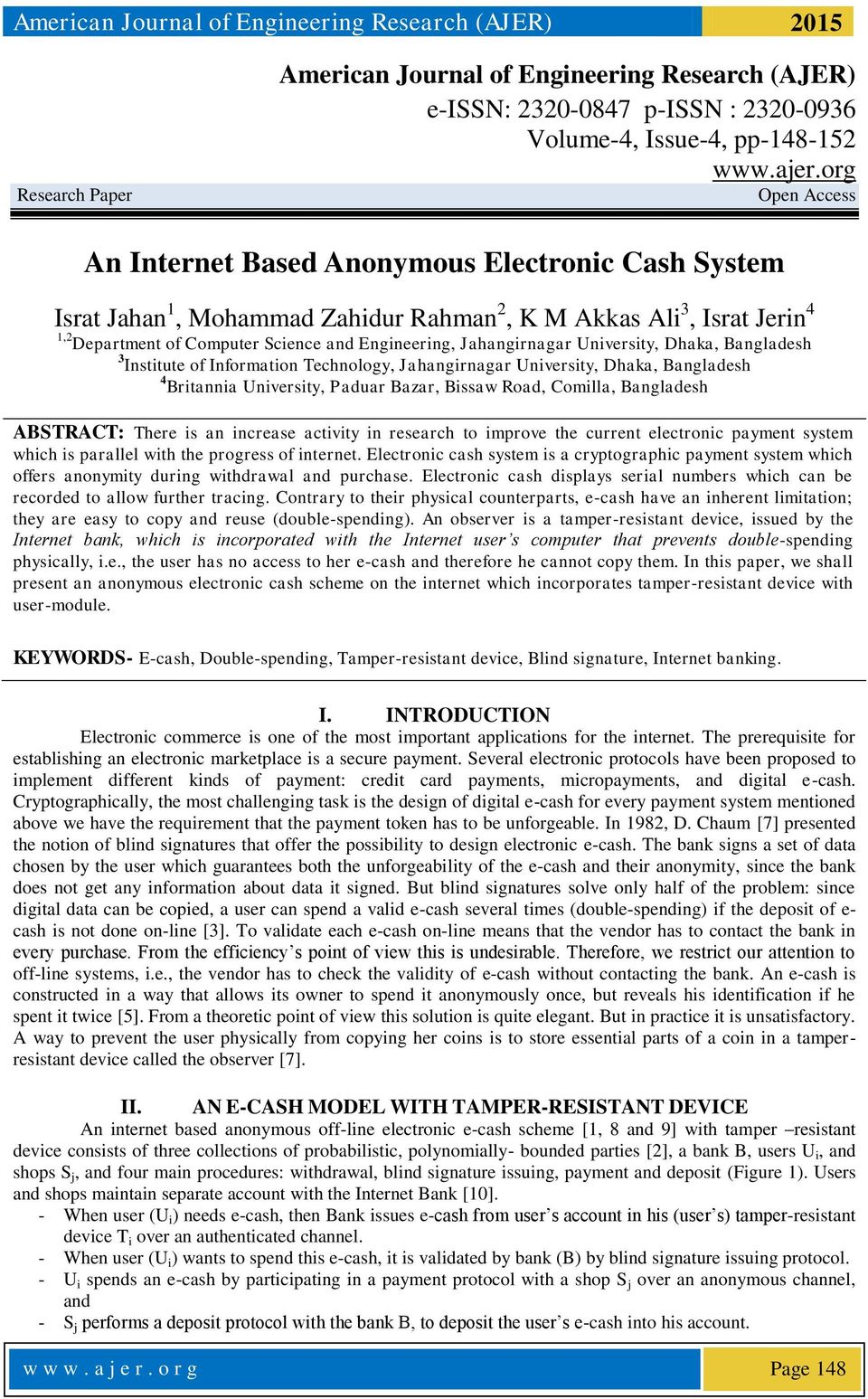
2 Bank (1) Withdrawal protocol (2) Blind signature issuing protocol (3) Payment protocol (4) Deposit protocol (1) (2) (4) Tamper-resistant device Service provider User (3) Figure 1: Model of e-cash with tamper-resistant device III. AN INTERNET BASED ANONYMOUS E-CASH SYSTEM We shall now represent an anonymous off-line e-cash transaction system on the Internet. 3.1 The Bank s setup protocol - All arithmetic is performed in a group G q of prime order q chosen by bank (B). The bank generates independently at random four numbers g 0, g 1, g 2, h G q and a number x Z q. The bank also determines a collision-free hash function H(.) such as to make the Schnorr signature scheme secure [4]. A public key that is issued by the bank to the user is a pair ( h i, a i ) G q *G q. - The number x is the secret key of the bank, and the corresponding public key is the tuple (g 0, g 1, g 2,h, G q, H(.)). A certificate of the bank on the public key ( h i, a i ) of the user is a triple (z i, c, r ) such that c =H(h i, a i, z i, g o r h -c, (h i ) r (z i ) -c ). - The secret key that corresponds to the public key (h i, a i ) of the user is a pair ((β 1, α 1 ), (β 2, α 2 )), such that h i =g 1 β1 g 2 α1 and α i = g 1 β2 g 2 α The actions The Internet bank will be denoted by B, the user by U i, and the service provider by S j. The computer of U i is denoted by C i, and his tamper-resistant device by T i Account establishment protocol U i installs on his computer, a software program for performing the protocols. When U i opens an account with B, the following procedure takes place. - C i generates independently at random a secret key x i2 Z q, and stores it. C i sends h i2 = g 1 xi2, to B, together with an appropriate verifiable description of the identity of U i. It then generates independently at random a secret key x i1 Z q for U i. B lists this number (h i2 ) in its so-called account database, together with at least a balance variable that keeps track of the amount of money that U i has in its account with B, and the description of U i s identity. - B then issues to U i a tamper-resistant device T i which has stored in non-volatile memory at least the following items: the numbers x i1 and g 1, and a description of G q ; code to perform its role in the protocols; and a counter variable, from now on denoted by balce, that keeps track of the amount of money that is held by U i. - B makes h i1 =g 1 xi1, known to U i ; this is the public key of T i. B then computes h i =h i1 h i2 (the joint public key of T i and U i and stores h i in his account database along with its other information on U i ). The bank B does not know the joint secret key, (x i1 +x i2 ) mod q, of T i and U i. - Finally, B computes (h i g 2 ) x, which will henceforth be denoted by z i known to U i. w w w. a j e r. o r g Page 149

3 3.2.2 Withdrawal protocol The withdrawal of electronic cash appears as follows: T i is assumed to have in common with B a secret key k. This secret key, and a sequence number, seq, (which has been set to some initial value, such as zero), have been stored by B before issuing T i to U i. In addition, the description of a one-way function f 1 (.) has been stored by B in T i. B decreases the balance, balce, of U i by amount. It then increases seq by one, and transfers v f 1 (k, seq, amount) to T i by sending it to C i. T i receives v from C i. It then computes f 1 (k, seq, amount), and compares it for equality with v. If equality holds, it increases seq by one, and balance by amount. The withdrawal protocol appears as follows: Tamper-resistant Device (T i ) Bank (B) balce balce - amount Verify ( v)----- v f 1 (k, seq, amount) v = f 1 (k, seq, amount) seq seq+1 then, seq seq+1 balce balce + amount Table 1: The withdrawal protocol The Pre-processing of blind signature issuing protocol Payment of an amount requires U i to provide the service provider with a signature on the amount (and additional data). To prepare for the withdrawal of a blind signature on e-cash, T i and C i perform the following off-line processing. - Ti generates independently at random a number w i R Z q, and sends a i g 1 wi to C i. T i stores w i for later use in the payment protocol. - C i generates independently at random a vector (α 1,α 2, α 3,α 4, α 5 ) Z q 5, such that α 0 mod q. It then computes h i (h i g 2 ) α1, a i = a i α1 g 1 α2 g 2 α3, z i z i α1, temp 1 h α4 g 0 α5, temp 2 (z i ) α4 (h i g 2 ) α1α5. - C i stores (h i, a i ) and (α 1, α 2, α 3 ) and temp 1, temp 2, α 4 and α 5 for the later use in the payment protocol The blind signature issuing protocol The issuing of blind signature [6] is done by means of the following on-line certificate issuing protocol between C i and B. The blind signature issuing appears as follows: Compouter(C i ) Bank(B) w Z q w a g 0 c H(h i, a i,a temp 1,b α1 temp 2 ) c c +α 4 mod q (a,b) (c) (r ) The pre-processing of payment protocol Table 2: The blind signature issuing protocol b (h i g 2 ) w r cx + w mod q To pay to S j an amount, T i and C i perform the following pre-processing. - C i determines the specification, denoted by spec, of the payment. This number is a concatenation, in a standardized format, of that is to be transferred, the time and date of transaction, and an identification number that is uniquely associated with S j. Additional data fields may be included in variable spec. C i then sends (h i, a i ) and spec to T i. - T i verifies that w i is still in memory, and thatbalance exceeds amount (T i can read this value from spec). If this is the case, it computes d=h(h i,a i,spec) and r 1 =dx i1 + w i mod q. It then decreases balance by amount, erases w i from memory, and sends r i to C i. - C i computes d=h(h i, a i,spec), and verifies that g 1 r1 h i1 -d =a i. If this is the case, C i computes r 1 =α 1 (r 1 +dx i2 )+ α 2 mod q, r 2 dα 1 +α 3 mod q. The pre-processing of payment protocol appears as follows: w w w. a j e r. o r g Page 150
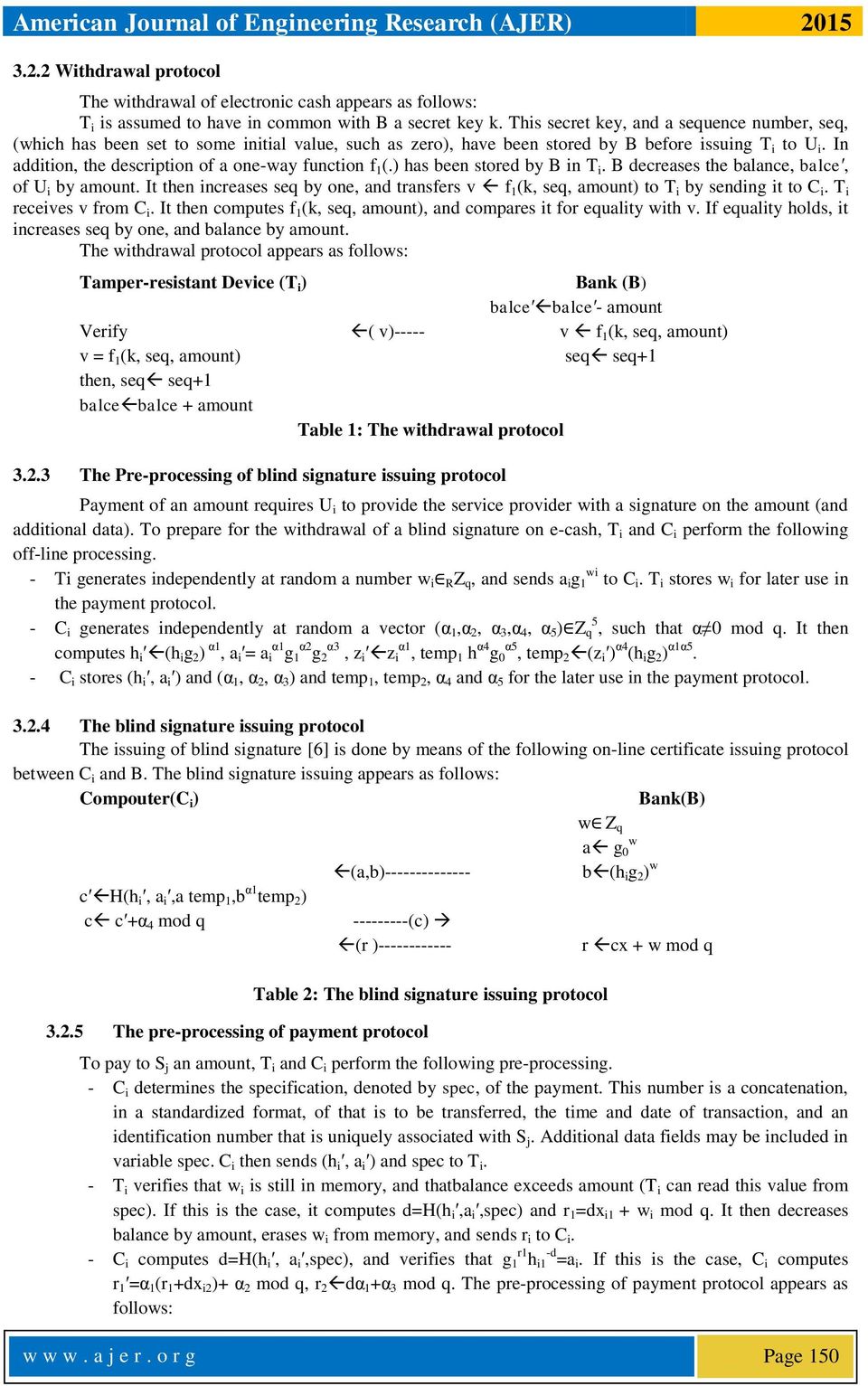
4 User computer(c i ) Tamper-resistant device(t i ) (h i, a i ) d=h(h i, a i,spec) balce balce - amount (r 1 ) d=h(h i, a i,spec) verify g r1 -d 1 h i1 = a i r 1 α 1 (r 1 +dx i2 )+ α 2 mod q r 2 dα1+α3 mod q r 1 =dx i1 +w i erases w i Table 3: The preprocessing of payment protocol The payment protocol The actual payment is done by means of the following on-line payment protocol between C i and S j. - C i sends (h i, a i ),(z i,c,r ),(r 1,r 2 )to S j. - S j computers d in the same way as did C i and T i and accepts the transferred information if and only if h i 1,c =H(h i, a i, z i, g o r h -c, (h i ) r (z i ) -c ) and g 1 r1 g 2 r2 (h i ) -d =a i - The payment protocol appears as follows: Computer(C i ) Service Provider(S j ) -- (h i, a i ),(z i,c,r ),(r 1,r 2 ) Check d=h(h i, a i,spec) c =H(h i, a i, z i, g o r h -c, (h i ) r (z i ) -c ) g 1 r1 g 2 r2 (h i ) -d = a i The deposit Protocol Table 4: The payment protocol At a suitable time, preferably when network traffic is low, S j sends the payment transcript, consisting of (h i,a i ), (z i, c, r ), (r 1,r 2 ) and spec, to B. B verifies that spec has been formed correctly by S j. If this is the case, it searches its so-called deposit database to find out if it has stored (h i,a i ) before. There are two possible situations: 1. (h i,a i ) is not in the deposit database. B then computes d=h(h i, a i,spec), and verifies the payment transcript by verifying that h i 1, c =H(h i, a i, z i,g r o h -c, (h i ) r (z i ) -c ) and g r1 1 g r2 2 (h i ) - d =a i. If these verifications hold, B stores (h i, a i ),(z i,c,r ) and (r 1,r 2 ) in the deposit database, and credits the account of S j by amount. 2. (h i,a i ) is already in the deposit database. In that case a fraud has occurred. If spec of the already stored information is identical to that of the new payment transcript, then S j is trying to deposit the same transcript twice. Otherwise, B verifies the transcript as described insituation 1. If the verification holds (the payment transcript is valid), then the certified public key (h i,a i ) must have been double-spent with overwhelming probability. Since, B now has at its disposal a pair (r 1,r 2 ) from the new transcript and a pair, say (r 1,r 2 ), from the already deposited information, it can compute (r 1 - r 1 )/( r 2 - r 2 ) mod q. B then searches its account database (r1 - r1 )/( r2- for joint public key g r2 ) 1. Since, the identity of the corresponding account holder is known to B, appropriate legal actions can be taken. The number (r 1 - r 1 )/( r 2 - r 2 ) mod q serves as the proof of B that the traced user has compromised his tamper-resistant device and has double-spent the certified public key (h i,a i ). w w w. a j e r. o r g Page 151

5 IV. DISCUSSIONS In the e-cash scheme with tamper-resistant device, the user s secret is shared between the user and his observer. The combined secret is a modular sum of the two shares, so one share of the secret reveals no information about the combined secret. Co-operation of the user and the tamper-resistant device is necessary in order to create a valid response to a challenge during a payment transaction. It prevents the tamper resistant device from leaking any information about the user. V. CONCLUSIONS We presented electronic cash system which provides a physical defense against double-spending detection. To guarantee the prevention of double-spending, the bank has to be sure that the tamper-resistant device cannot be tampered with by the users. The use of a tamper-resistant device is a kind of first line of defense. If the user cannot manipulate the device, the tamper-resistant device can prevent double-spending. If the user succeeds in tampering the observer, the double-spending detection identifies the user afterwards. REFERENCES [1] Ogiela, M.R., & Sulkowski, P. Improved Cryptographic protocol for digital coin exchange. 15th International Symposium on Soft Computing and Intelligent Systems (SCIS), 2014, [2] Miers, I., Garman, C., Green, M., & Rubin, A.D. Zerocoin: Anonymous Distributed E-Cash from Bitcoin. IEEE Symposium on Security and Privacy (SP), 2013, [3] Jiangxiao Zhang., Zhoujun Li., Hua Guo., & Chang Xu. Efficient Divisible E-Cash in the Standard Model. IEEE International Conference on Green Computing and Communications (GreenCom), 2013, [4] Yun-kyung Lee., Seung-Wan Han., Sok-joon Lee., Byung-ho Chung., & Deok Gyu Lee. Anonymous Authentication System Using Group Signature. International Conference on Complex, Intelligent and Software Intensive Systems, 2009, [5] Israt Jahan., Mohammad Zahidur Rahman., & Md. Golam Moazzem. Review of Anonymous Electronic Payment System. Journal of Electronics and Computer Science, 2003, [6] Tsiounis, Y.S. Efficient Electronic Cash: New Notions and Techniques. Northern University, Massachusetts. PhD Thesis, [7] Chaum, D., & Pedersen, T. Wallet Databases with Observers. In proceedings of CRYPTO, 1993, [8] Brands, S. Untraceable Off-line Cash in Wallets With Observers. In proceedings of CRYPTO, 1993, [9] Schnorr, C.P. Efficient Signature Generation by Smart Cards. Journal of Cryptology, 1991, 4(3), [10] Chaum, D. Blind Signatures for Untraceable Payments. Advances in cryptology-proceedings of Crypto 82, Lecture Notes in Computer Science, Springer-Verlag, 1982, w w w. a j e r. o r g Page 152
Cryptanalysis of a Partially Blind Signature Scheme or How to make $100 bills with $1 and $2 ones
 Cryptanalysis of a Partially Blind Signature Scheme or How to make $100 bills with $1 and $2 ones Gwenaëlle Martinet 1, Guillaume Poupard 1, and Philippe Sola 2 1 DCSSI Crypto Lab, 51 boulevard de La Tour-Maubourg
Security in Electronic Payment Systems
 Security in Electronic Payment Systems Jan L. Camenisch, Jean-Marc Piveteau, Markus A. Stadler Institute for Theoretical Computer Science, ETH Zurich, CH-8092 Zurich e-mail: {camenisch, stadler}@inf.ethz.ch
Cryptography: Authentication, Blind Signatures, and Digital Cash
 Cryptography: Authentication, Blind Signatures, and Digital Cash Rebecca Bellovin 1 Introduction One of the most exciting ideas in cryptography in the past few decades, with the widest array of applications,
Electronic Cash Payment Protocols and Systems
 Electronic Cash Payment Protocols and Systems Speaker: Jerry Gao Ph.D. San Jose State University email: [email protected] URL: http://www.engr.sjsu.edu/gaojerry May, 2000 Presentation Outline - Overview
An electronic cash scheme and its management
 An electronic cash scheme and its management Hua Wang (*) Yanchun Zhang (**) Jinli Cao (***) (*)Department of Maths & Computing, University of Southern Queensland Toowoomba QLD 4350 Australia Email: [email protected]
Application of Electronic Currency on the Online Payment System like PayPal
 Application of Electronic Currency on the Online Payment System like PayPal Rafael Martínez Peláez, Francisco J. Rico Novella Technical University of Catalonia (UPC), Department of Telematics Engineering
 Group Blind Digital Signatures: Theory and Applications by Zulækar Amin Ramzan Submitted to the Department of Electrical Engineering and Computer Science in partial fulællment of the requirements for the
A blind digital signature scheme using elliptic curve digital signature algorithm
 A blind digital signature scheme using elliptic curve digital signature algorithm İsmail BÜTÜN * and Mehmet DEMİRER *Department of Electrical Engineering, University of South Florida, Tampa, FL, USA Department
COMP-530 Cryptographic Systems Security *Requires Programming Background. University of Nicosia, Cyprus
 COMP-530 Cryptographic Systems Security *Requires Programming Background University of Nicosia, Cyprus Course Code Course Title ECTS Credits COMP-530 Cryptographic Systems 10 Security Department Semester
A novel deniable authentication protocol using generalized ElGamal signature scheme
 Information Sciences 177 (2007) 1376 1381 www.elsevier.com/locate/ins A novel deniable authentication protocol using generalized ElGamal signature scheme Wei-Bin Lee a, Chia-Chun Wu a, Woei-Jiunn Tsaur
Security Arguments for Digital Signatures and Blind Signatures
 Journal of Cryptology, Volume 13, Number 3. Pages 361 396, Springer-Verlag, 2000. 2000 International Association for Cryptologic Research Security Arguments for Digital Signatures and Blind Signatures
ZQL. a cryptographic compiler for processing private data. George Danezis. Joint work with Cédric Fournet, Markulf Kohlweiss, Zhengqin Luo
 ZQL Work in progress a cryptographic compiler for processing private data George Danezis Joint work with Cédric Fournet, Markulf Kohlweiss, Zhengqin Luo Microsoft Research and Joint INRIA-MSR Centre Data
Victor Shoup Avi Rubin. fshoup,[email protected]. Abstract
 Session Key Distribution Using Smart Cards Victor Shoup Avi Rubin Bellcore, 445 South St., Morristown, NJ 07960 fshoup,[email protected] Abstract In this paper, we investigate a method by which smart
Mobile Electronic Payments
 Chapter 7 Mobile Electronic Payments 7.1 Rationale and Motivation Mobile electronic payments are rapidly becoming a reality. There is no doubt that users of mobile phones are willing and even asking to
VoteID 2011 Internet Voting System with Cast as Intended Verification
 VoteID 2011 Internet Voting System with Cast as Intended Verification September 2011 VP R&D Jordi [email protected] Index Introduction Proposal Security Conclusions 2. Introduction Client computers could
A Survey on Untransferable Anonymous Credentials
 A Survey on Untransferable Anonymous Credentials extended abstract Sebastian Pape Databases and Interactive Systems Research Group, University of Kassel Abstract. There are at least two principal approaches
Basic Security of the ecash Payment System
 Basic Security of the ecash Payment System Berry Schoenmakers DigiCash Kruislaan 419 NL-1098 VA Amsterdam The Netherlands [email protected] Abstract. ecash TM is a payment system designed and implemented
Electronic Payments. EITN40 - Advanced Web Security
 Electronic Payments EITN40 - Advanced Web Security 1 Card transactions Card-Present Smart Cards Card-Not-Present SET 3D Secure Untraceable E-Cash Micropayments Payword Electronic Lottery Tickets Peppercoin
Efficient construction of vote-tags to allow open objection to the tally in electronic elections
 Information Processing Letters 75 (2000) 211 215 Efficient construction of vote-tags to allow open objection to the tally in electronic elections Andreu Riera a,,joseprifà b, Joan Borrell b a isoco, Intelligent
Cryptanalysis and security enhancement on the generation of Mu-Varadharajan electronic voting protocol. Vahid Jahandideh and Amir S.
 72 Int. J. Electronic Governance, Vol. 3, No. 1, 2010 Cryptanalysis and security enhancement on the generation of Mu-Varadharajan electronic voting protocol Vahid Jahandideh and Amir S. Mortazavi Department
Enhanced Privacy ID (EPID) Ernie Brickell and Jiangtao Li Intel Corporation
 Enhanced Privacy ID (EPID) Ernie Brickell and Jiangtao Li Intel Corporation 1 Agenda EPID overview EPID usages Device Authentication Government Issued ID EPID performance and standardization efforts 2
Privacy-preserving Digital Identity Management for Cloud Computing
 Privacy-preserving Digital Identity Management for Cloud Computing Elisa Bertino [email protected] Federica Paci [email protected] Ning Shang [email protected] Rodolfo Ferrini [email protected]
Strengthen RFID Tags Security Using New Data Structure
 International Journal of Control and Automation 51 Strengthen RFID Tags Security Using New Data Structure Yan Liang and Chunming Rong Department of Electrical Engineering and Computer Science, University
A Vulnerability in the Song Authentication Protocol for Low-Cost RFID Tags
 A Vulnerability in the Song Authentication Protocol for Low-Cost RFID Tags Sarah Abughazalah, Konstantinos Markantonakis, and Keith Mayes Smart Card Centre-Information Security Group (SCC-ISG) Royal Holloway,
Efficient Unlinkable Secret Handshakes for Anonymous Communications
 보안공학연구논문지 (Journal of Security Engineering), 제 7권 제 6호 2010년 12월 Efficient Unlinkable Secret Handshakes for Anonymous Communications Eun-Kyung Ryu 1), Kee-Young Yoo 2), Keum-Sook Ha 3) Abstract The technique
A Secure RFID Ticket System For Public Transport
 A Secure RFID Ticket System For Public Transport Kun Peng and Feng Bao Institute for Infocomm Research, Singapore Abstract. A secure RFID ticket system for public transport is proposed in this paper. It
Improved Online/Offline Signature Schemes
 Improved Online/Offline Signature Schemes Adi Shamir and Yael Tauman Applied Math. Dept. The Weizmann Institute of Science Rehovot 76100, Israel {shamir,tauman}@wisdom.weizmann.ac.il Abstract. The notion
An Analysis of the Bitcoin Electronic Cash System
 An Analysis of the Bitcoin Electronic Cash System Danielle Drainville University of Waterloo December 21, 2012 1 Abstract In a world that relies heavily on technology, privacy is sought by many. Privacy,
An Electronic Voting System Based On Blind Signature Protocol
 CSMR, VOL. 1, NO. 1 (2011) An Electronic Voting System Based On Blind Signature Protocol Marius Ion, Ionuţ Posea University POLITEHNICA of Bucharest Faculty of Automatic Control and Computers, Computer
Secure Large-Scale Bingo
 Secure Large-Scale Bingo Antoni Martínez-Ballesté, Francesc Sebé and Josep Domingo-Ferrer Universitat Rovira i Virgili, Dept. of Computer Engineering and Maths, Av. Països Catalans 26, E-43007 Tarragona,
On the Difficulty of Software Key Escrow
 On the Difficulty of Software Key Escrow Lars R. Knudsen and Torben P. Pedersen Katholieke Universiteit Leuven, Belgium, email: [email protected] Cryptomathic, Denmark, email: [email protected]
3-6 Toward Realizing Privacy-Preserving IP-Traceback
 3-6 Toward Realizing Privacy-Preserving IP-Traceback The IP-traceback technology enables us to trace widely spread illegal users on Internet. However, to deploy this attractive technology, some problems
DEVELOPMENT OF CERTIFICATE LESS DIGITAL SIGNATURE SCHEME & ITS APPLICATION IN E-CASH SYSTEM
 DEVELOPMENT OF CERTIFICATE LESS DIGITAL SIGNATURE SCHEME & ITS APPLICATION IN E-CASH SYSTEM A Thesis is submitted in partial fulfilment of the requirements for the degree of Bachelor of Technology In Computer
Electronic Payment Systems on Open Computer Networks: A Survey
 Electronic Payment Systems on Open Computer Networks: A Survey Working paper Thomi Pilioura Abstract The extraordinary growth of international interconnected computer networks and the pervasive trend of
SECURITY ANALYSIS OF PASSWORD BASED MUTUAL AUTHENTICATION METHOD FOR REMOTE USER
 SECURITY ANALYSIS OF PASSWORD BASED MUTUAL AUTHENTICATION METHOD FOR REMOTE USER Mrs. P.Venkateswari Assistant Professor / CSE Erode Sengunthar Engineering College, Thudupathi ABSTRACT Nowadays Communication
Peppercoin Micropayments
 Peppercoin Micropayments Ronald L. Rivest MIT CSAIL (joint work with Prof. Silvio Micali) Outline Micropayment examples Challenges Aggregation methods The Peppercoin method (In England a peppercorn is
An Anonymous Credit Card System
 An Anonymous Credit Card System Elli Androulaki and Steven Bellovin {elli,smb}@cs.columbia.edu Columbia University Abstract. Credit cards have many important benefits; however, these same benefits often
Payment systems. Tuomas Aura CSE-C3400 Information security. Aalto University, autumn 2015
 Payment systems Tuomas Aura CSE-C3400 Information security Aalto University, autumn 2015 Outline 1. Card payment 2. (Anonymous digital cash) 3. Bitcoin 2 CARD PAYMENT 3 Bank cards Credit or debit card
Outline. Computer Science 418. Digital Signatures: Observations. Digital Signatures: Definition. Definition 1 (Digital signature) Digital Signatures
 Outline Computer Science 418 Digital Signatures Mike Jacobson Department of Computer Science University of Calgary Week 12 1 Digital Signatures 2 Signatures via Public Key Cryptosystems 3 Provable 4 Mike
A More Robust Authentication Scheme for Roaming Service in Global Mobility Networks Using ECC
 International Journal of Network Security, Vol.18, No.2, PP.217-223, Mar. 2016 217 A More Robust Authentication Scheme for Roaming Service in Global Mobility Networks Using ECC Dianli Guo and Fengtong
Breaking Generalized Diffie-Hellman Modulo a Composite is no Easier than Factoring
 Breaking Generalized Diffie-Hellman Modulo a Composite is no Easier than Factoring Eli Biham Dan Boneh Omer Reingold Abstract The Diffie-Hellman key-exchange protocol may naturally be extended to k > 2
Distributed Public Key Infrastructure via the Blockchain. Sean Pearl [email protected] April 28, 2015
 Distributed Public Key Infrastructure via the Blockchain Sean Pearl [email protected] April 28, 2015 Overview Motivation: Electronic Money Example TTP: PayPal Bitcoin (BTC) Background Structure Other
TELECOMMUNICATION NETWORKS
 THE USE OF INFORMATION TECHNOLOGY STANDARDS TO SECURE TELECOMMUNICATION NETWORKS John Snare * Manager Telematic and Security Systems Section Telecom Australia Research Laboratories Victoria TELECOMMUNICATIONS
Lecture 25: Pairing-Based Cryptography
 6.897 Special Topics in Cryptography Instructors: Ran Canetti and Ron Rivest May 5, 2004 Lecture 25: Pairing-Based Cryptography Scribe: Ben Adida 1 Introduction The field of Pairing-Based Cryptography
CSC 474 -- Network Security. User Authentication Basics. Authentication and Identity. What is identity? Authentication: verify a user s identity
 CSC 474 -- Network Security Topic 6.2 User Authentication CSC 474 Dr. Peng Ning 1 User Authentication Basics CSC 474 Dr. Peng Ning 2 Authentication and Identity What is identity? which characteristics
Privacy-Providing Signatures and Their Applications. PhD Thesis. Author: Somayeh Heidarvand. Advisor: Jorge L. Villar
 Privacy-Providing Signatures and Their Applications PhD Thesis Author: Somayeh Heidarvand Advisor: Jorge L. Villar Privacy-Providing Signatures and Their Applications by Somayeh Heidarvand In fulfillment
CHAPTER 6. Learning Objectives. Learning Objectives. E-commerce Payment Systems. Types of Payment Systems
 CHAPTER 6 E-commerce Payment Created by, David Zolzer, Northwestern State University Louisiana Copyright 2002 Pearson Education, Inc. Slide 6-1 Copyright 2002 Pearson Education, Inc. Slide 6-2 Learning
Payment systems. Tuomas Aura T-110.4206 Information security technology
 Payment systems Tuomas Aura T-110.4206 Information security technology Outline 1. Money transfer 2. Card payments 3. Anonymous payments 2 MONEY TRANSFER 3 Common payment systems Cash Electronic credit
Electronic Payment Systems. Traditional Methods
 Electronic Payment Systems Michael B. Spring Department of Information Science and Telecommunications University of Pittsburgh [email protected] http://www.sis.pitt.edu/~spring Traditional Methods Traditional
SECURE AND EFFICIENT PRIVACY-PRESERVING PUBLIC AUDITING SCHEME FOR CLOUD STORAGE
 International Journal of Computer Network and Security(IJCNS) Vol 7. No.1 2015 Pp. 1-8 gopalax Journals, Singapore available at : www.ijcns.com ISSN: 0975-8283 ----------------------------------------------------------------------------------------------------------------------------------------------------------
SECURE CLOUD STORAGE PRIVACY-PRESERVING PUBLIC AUDITING FOR DATA STORAGE SECURITY IN CLOUD
 Volume 1, Issue 7, PP:, JAN JUL 2015. SECURE CLOUD STORAGE PRIVACY-PRESERVING PUBLIC AUDITING FOR DATA STORAGE SECURITY IN CLOUD B ANNAPURNA 1*, G RAVI 2*, 1. II-M.Tech Student, MRCET 2. Assoc. Prof, Dept.
Randomized Hashing for Digital Signatures
 NIST Special Publication 800-106 Randomized Hashing for Digital Signatures Quynh Dang Computer Security Division Information Technology Laboratory C O M P U T E R S E C U R I T Y February 2009 U.S. Department
Electronic payment systems
 Electronic payment systems overview of basic concepts credit-card based systems (MOTO, SSL, SET) electronic cash systems (DigiCash) micropayment schemes (PayWord, probabilistic schemes) brief history of
Security Aspects of. Database Outsourcing. Vahid Khodabakhshi Hadi Halvachi. Dec, 2012
 Security Aspects of Database Outsourcing Dec, 2012 Vahid Khodabakhshi Hadi Halvachi Security Aspects of Database Outsourcing Security Aspects of Database Outsourcing 2 Outline Introduction to Database
2015-11-02. Electronic Payments Part 1
 Electronic Payments Part Card transactions Card-Present Smart Cards Card-Not-Present SET 3D Secure Untraceable E-Cash Micropayments Payword Electronic Lottery Tickets Peppercoin Bitcoin EITN4 - Advanced
Signature Amortization Technique for Authenticating Delay Sensitive Stream
 Signature Amortization Technique for Authenticating Delay Sensitive Stream M Bruntha 1, Dr J. Premalatha Ph.D. 2 1 M.E., 2 Professor, Department of Information Technology, Kongu Engineering College, Perundurai,
1 Digital Signatures. 1.1 The RSA Function: The eth Power Map on Z n. Crypto: Primitives and Protocols Lecture 6.
 1 Digital Signatures A digital signature is a fundamental cryptographic primitive, technologically equivalent to a handwritten signature. In many applications, digital signatures are used as building blocks
Enabling Public Auditing for Secured Data Storage in Cloud Computing
 IOSR Journal of Engineering (IOSRJEN) e-issn: 2250-3021, p-issn: 2278-8719 Vol. 3, Issue 5 (May. 2013), V3 PP 01-05 Enabling Public Auditing for Secured Data Storage in Cloud Computing 1 Er.Amandeep Kaur,
MACs Message authentication and integrity. Table of contents
 MACs Message authentication and integrity Foundations of Cryptography Computer Science Department Wellesley College Table of contents Introduction MACs Constructing Secure MACs Secure communication and
A New Receipt-Free E-Voting Scheme Based on Blind Signature (Abstract)
 A New Receipt-Free E-Voting Scheme Based on Blind Signature (Abstract) Zhe Xia University of Surrey [email protected] Steve Schneider University of Surrey [email protected] May 25, 2006 Abstract
Internet Usage (as of November 1, 2011)
 ebusiness Chapter 11 Online Payment Systems Internet Usage (as of November 1, 2011) United States Population: 312,521,655 Internet users: 245,000,000 (78.4% of population) Facebook users: 151,350,260 (61.8%
SAFE SYSTEM: SECURE APPLICATIONS FOR FINANCIAL ENVIRONMENTS USING MOBILE PHONES
 SAFE SYSTEM: SECURE APPLICATIONS FOR FINANCIAL ENVIRONMENTS USING MOBILE PHONES Sead Muftic 1, Feng Zhang 1 1Department of Computer and System Sciences, Royal Institute of Technology, Stockholm, Sweden
HASH CODE BASED SECURITY IN CLOUD COMPUTING
 ABSTRACT HASH CODE BASED SECURITY IN CLOUD COMPUTING Kaleem Ur Rehman M.Tech student (CSE), College of Engineering, TMU Moradabad (India) The Hash functions describe as a phenomenon of information security
Overview of Cryptographic Tools for Data Security. Murat Kantarcioglu
 UT DALLAS Erik Jonsson School of Engineering & Computer Science Overview of Cryptographic Tools for Data Security Murat Kantarcioglu Pag. 1 Purdue University Cryptographic Primitives We will discuss the
Digital Signatures. What are Signature Schemes?
 Digital Signatures Debdeep Mukhopadhyay IIT Kharagpur What are Signature Schemes? Provides message integrity in the public key setting Counter-parts of the message authentication schemes in the public
Rfid Authentication Protocol for security and privacy Maintenance in Cloud Based Employee Management System
 Rfid Authentication Protocol for security and privacy Maintenance in Cloud Based Employee Management System ArchanaThange Post Graduate Student, DKGOI s COE, Swami Chincholi, Maharashtra, India [email protected],
Two Factor Zero Knowledge Proof Authentication System
 Two Factor Zero Knowledge Proof Authentication System Quan Nguyen Mikhail Rudoy Arjun Srinivasan 6.857 Spring 2014 Project Abstract It is often necessary to log onto a website or other system from an untrusted
Authentication requirement Authentication function MAC Hash function Security of
 UNIT 3 AUTHENTICATION Authentication requirement Authentication function MAC Hash function Security of hash function and MAC SHA HMAC CMAC Digital signature and authentication protocols DSS Slides Courtesy
The Mathematics of the RSA Public-Key Cryptosystem
 The Mathematics of the RSA Public-Key Cryptosystem Burt Kaliski RSA Laboratories ABOUT THE AUTHOR: Dr Burt Kaliski is a computer scientist whose involvement with the security industry has been through
ARCHIVED PUBLICATION
 ARCHIVED PUBLICATION The attached publication, FIPS Publication 186-3 (dated June 2009), was superseded on July 19, 2013 and is provided here only for historical purposes. For the most current revision
Introduction. Digital Signature
 Introduction Electronic transactions and activities taken place over Internet need to be protected against all kinds of interference, accidental or malicious. The general task of the information technology
Electronic Contract Signing without Using Trusted Third Party
 Electronic Contract Signing without Using Trusted Third Party Zhiguo Wan 1, Robert H. Deng 2 and David Lee 1 Sim Kim Boon Institute for Financial Economics 1, School of Information Science 2, Singapore