
AGFA GRAPHICS. Agfa-Gevaert
|
|
|
- Claud Neal
- 10 years ago
- Views:
Transcription
1 AGFA GRAPHICS 1 Agfa-Gevaert 2011
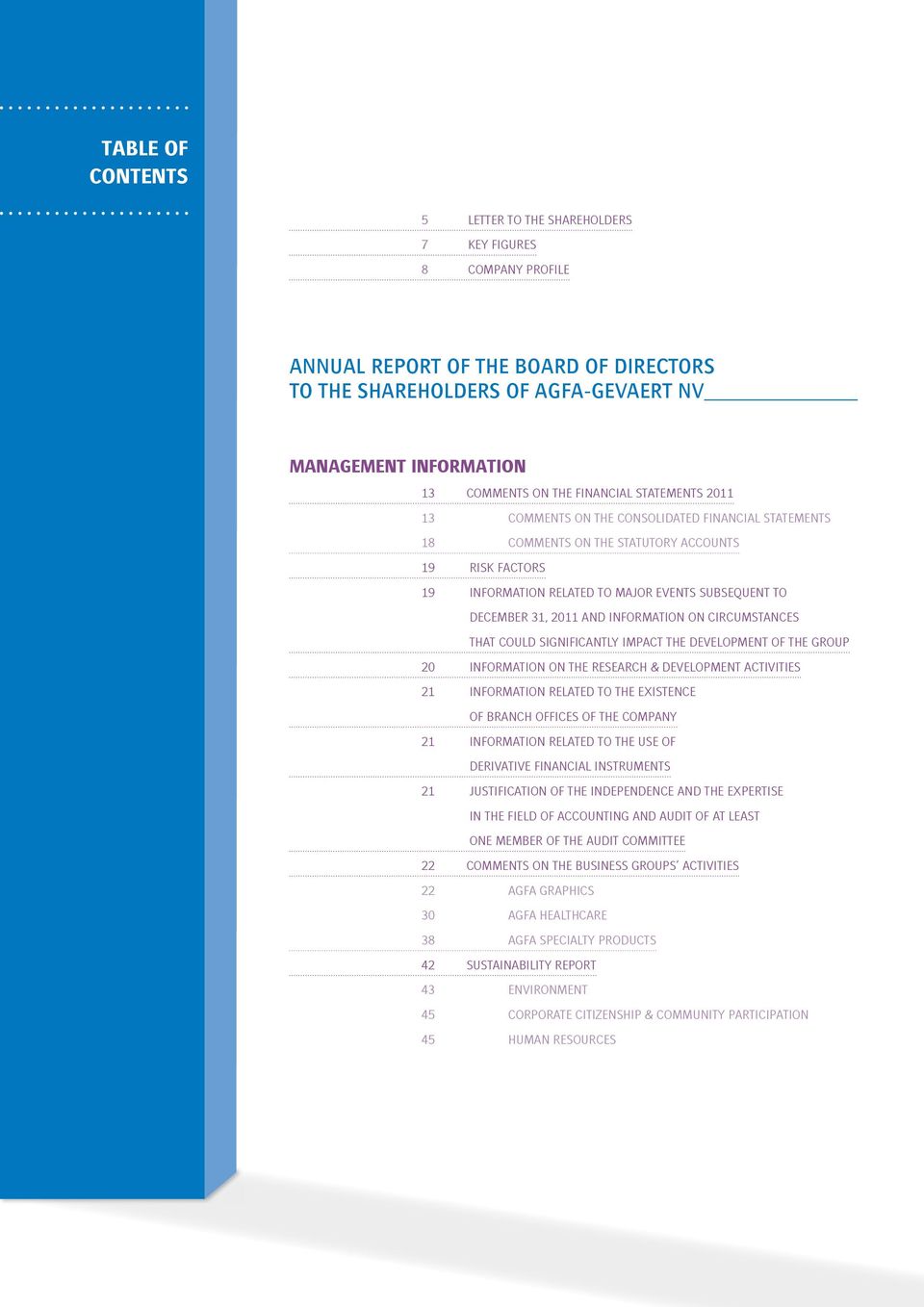
2 2 TABLE OF CONTENTS 5 LETTER TO THE SHAREHOLDERS 7 KEY FIGURES 8 COMPANY PROFILE ANNUAL REPORT OF THE BOARD OF DIRECTORS TO THE SHAREHOLDERS OF AGFA-GEVAERT NV MANAGEMENT INFORMATION 13 COMMENTS ON THE FINANCIAL STATEMENTS COMMENTS ON THE CONSOLIDATED FINANCIAL STATEMENTS 18 COMMENTS ON THE STATUTORY ACCOUNTS 19 RISK FACTORS 19 INFORMATION RELATED TO MAJOR EVENTS SUBSEQUENT TO DECEMBER 31, 2011 AND INFORMATION ON CIRCUMSTANCES THAT COULD SIGNIFICANTLY IMPACT THE DEVELOPMENT OF THE GROUP 20 INFORMATION ON THE RESEARCH & DEVELOPMENT ACTIVITIES 21 INFORMATION RELATED TO THE EXISTENCE OF BRANCH OFFICES OF THE COMPANY 21 INFORMATION RELATED TO THE USE OF DERIVATIVE FINANCIAL INSTRUMENTS 21 JUSTIFICATION OF THE INDEPENDENCE AND THE EXPERTISE IN THE FIELD OF ACCOUNTING AND AUDIT OF AT LEAST ONE MEMBER OF THE AUDIT COMMITTEE 22 COMMENTS ON THE BUSINESS GROUPS ACTIVITIES 22 AGFA GRAPHICS 30 AGFA HEALTHCARE 38 AGFA SPECIALTY PRODUCTS 42 SUSTAINABILITY REPORT 43 ENVIRONMENT 45 CORPORATE CITIZENSHIP & COMMUNITY PARTICIPATION 45 HUMAN RESOURCES
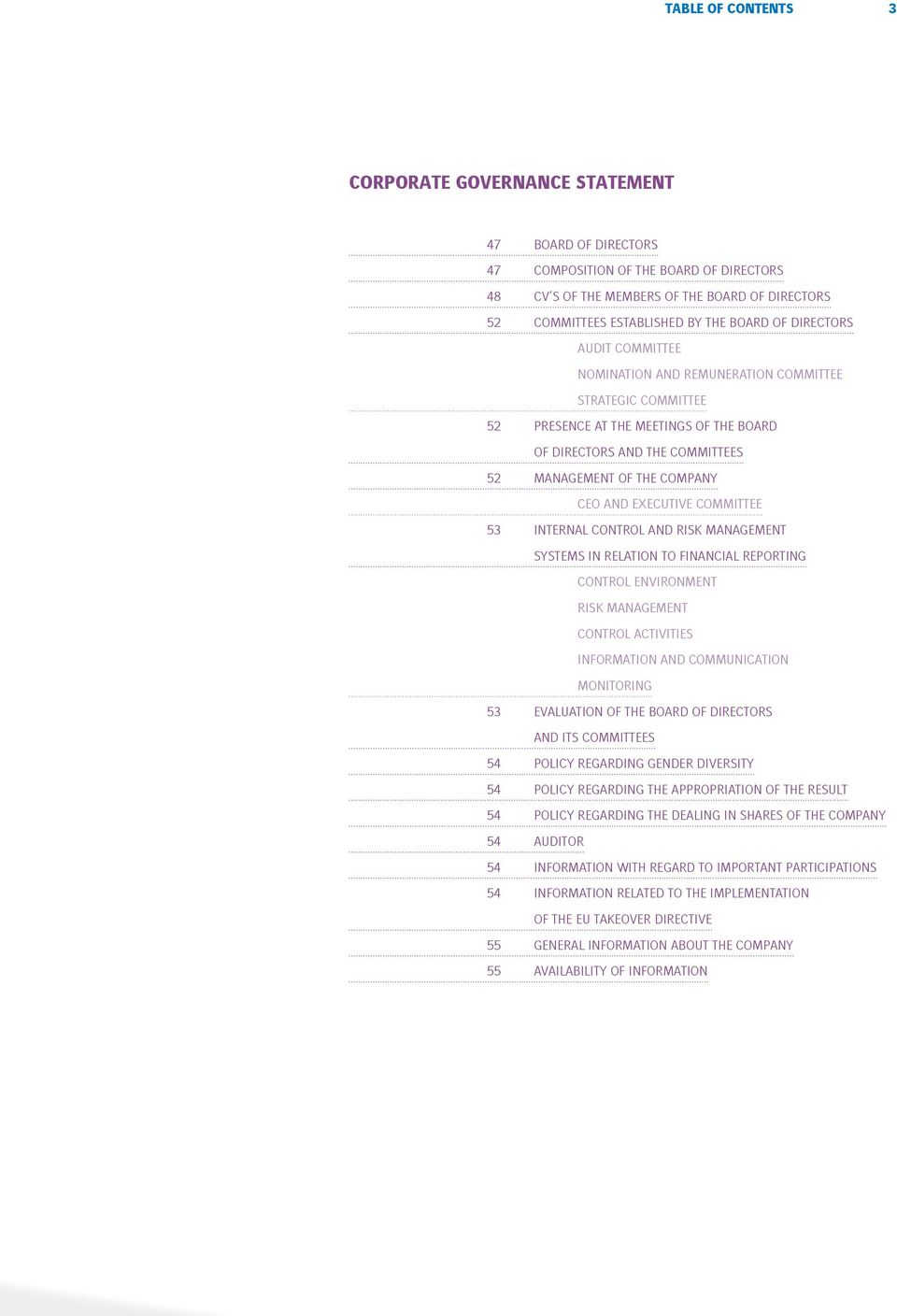
3 TABLE OF CONTENTS 3 CORPORATE GOVERNANCE STATEMENT 47 BOARD OF DIRECTORS 47 COMPOSITION OF THE BOARD OF DIRECTORS 48 CV S OF THE MEMBERS OF THE BOARD OF DIRECTORS 52 COMMITTEES ESTABLISHED BY THE BOARD OF DIRECTORS AUDIT COMMITTEE NOMINATION AND REMUNERATION COMMITTEE STRATEGIC COMMITTEE 52 PRESENCE AT THE MEETINGS OF THE BOARD OF DIRECTORS AND THE COMMITTEES 52 MANAGEMENT OF THE COMPANY CEO AND EXECUTIVE COMMITTEE 53 INTERNAL CONTROL AND RISK MANAGEMENT SYSTEMS IN RELATION TO FINANCIAL REPORTING CONTROL ENVIRONMENT RISK MANAGEMENT CONTROL ACTIVITIES INFORMATION AND COMMUNICATION MONITORING 53 EVALUATION OF THE BOARD OF DIRECTORS AND ITS COMMITTEES 54 POLICY REGARDING GENDER DIVERSITY 54 POLICY REGARDING THE APPROPRIATION OF THE RESULT 54 POLICY REGARDING THE DEALING IN SHARES OF THE COMPANY 54 AUDITOR 54 INFORMATION WITH REGARD TO IMPORTANT PARTICIPATIONS 54 INFORMATION RELATED TO THE IMPLEMENTATION OF THE EU TAKEOVER DIRECTIVE 55 GENERAL INFORMATION ABOUT THE COMPANY 55 AVAILABILITY OF INFORMATION
4 4 REMUNERATION REPORT 57 REMUNERATIONS 57 BOARD OF DIRECTORS 58 CEO 58 EXCO 59 SHARES AND OPTIONS 59 SEVERANCE FINANCIAL STATEMENTS 61 OPINION ON THE FAIR PRESENTATION IN ACCORDANCE WITH THE ROYAL DECREE OF NOVEMBER 14, CONSOLIDATED FINANCIAL STATEMENTS 62 PROFIT OR LOSS 63 COMPREHENSIVE INCOME 64 STATEMENT OF FINANCIAL POSITION 65 CHANGES IN EQUITY 66 CASH FLOWS 67 NOTES TO THE CONSOLIDATED FINANCIAL STATEMENTS 139 AUDITOR S REPORT TO THE GENERAL MEETING OF SHAREHOLDERS 141 STATUTORY ACCOUNTS 144 GLOSSARY 149 OVERVIEW TABLES CONSOLIDATED STATEMENT OF PROFIT OR LOSS 150 CONSOLIDATED STATEMENT OF CASH FLOWS 152 CONSOLIDATED STATEMENT OF FINANCIAL POSITION 153 SHAREHOLDER INFORMATION THE WORDS IN ITALICS ARE EXPLAINED IN THE GLOSSARY (P )

5 LETTTER TO THE SHAREHOLDERS 5 CHRISTIAN REINAUDO PRESIDENT AND CHIEF EXECUTIVE OFFICER JULIEN DE WILDE CHAIRMAN OF THE BOARD OF DIRECTORS Dear Shareholders, For the global economy and in particular the European economy 2011 was a very turbulent year. Towards the end of 2010, raw material prices skyrocketed. The trend continued in 2011, partly because of the massive speculation in gold and silver. Also, the aluminum price was very high in the same period. As you know, silver and aluminum are very important for the production of our various film products (silver) and our printing plates (aluminum). The impact of the high prices on our costs cannot be underestimated. At the end of April 2011, the silver price reached the absolute record level of 50 dollar per Troy ounce. Later, the price fell back to around 30 dollar, which still is twice as high as in the first half of However, in these tough conditions, Agfa-Gevaert has proved that it is able to resist extreme economic challenges. In spite of the accelerated decrease in the demand for classic film products, all three business groups recorded revenue growth (excluding currency effects). This was due to the organic growth of our digital solutions on the one hand, and to the contributions of our recent strategic moves on the other hand. Agfa Graphics revenue increased as a result of the substantial growth in the large format inkjet segment and of the acquisitions of Pitman and Gandi in The revenue of Agfa HealthCare slightly grew, and as expected 2011 became the first year in which the digital and IT solutions were able to compensate for the decline in the traditional film business. Agfa Specialty Products recorded strong growth due to the strong performance of the Functional Foils and Advanced Chemicals & Coatings segments. Without any doubt, we can say that the growth strategy we designed two years ago is a success, in spite of the tough economic conditions that impact our markets around the globe. However, the situation of some of our competitors shows us that we have to remain vigilant in these challenging times. It is clear that the digital solutions are the future, and we must strengthen the focus on these activities. The economic crisis and the high silver prices accelerated the decline in the demand for most of the analog film products. We will therefore align the cost structure of our film manufacturing units to the structural changes in the film industry.

6 6 Against the background of the global crisis, it has become obvious that a growth strategy for the emerging markets is essential. It is important to adapt our human resources, our product portfolio and our cost structure of our mature markets to the demands of the emerging markets. For all these measures, the necessary provisions have already been booked at the end of These provisions largely explain the Group s net loss in Nevertheless, the financial situation of the Agfa-Gevaert Group is solid. At the end of 2011, net financial debt amounted to only 267 million euro, which means that the debt/ebitda ratio of the Group is at a very acceptable level. At the end of June, Agfa-Gevaert NV was able to close a new multi-currency revolving credit facility of 445 million Euro with a syndicate of six banks. This new facility runs until May 31, In addition to the credit facility that Agfa received from the European Investment Bank at the end of 2010, the new facility will be used for general company purposes and for the realization of our growth strategy. For example, Agfa HealthCare acquired all shares of WPD one of the major healthcare IT companies in Brazil in September With a population of over 200 million, Brazil grows faster than any European market. It goes without saying that the country offers substantial opportunities in the field of healthcare IT. Another important part of our growth strategy is formed by the significant R&D efforts the company makes. Last year we spent about 162 million Euro on R&D. Agfa Graphics invested further in the development of UV inks and equipment for the growing industrial inkjet market. Also, Agfa Graphics focuses on making chemistry free plate solutions even more robust to answer the needs for more demanding markets with higher printing speed or longer press runs. Next to product improvements, Agfa Graphics also focuses strongly in ways to make its manufacturing and logistic processes more sustainable, thereby reducing the impact on the environment. Agfa HealthCare is focusing its R&D on expanding and strengthening its portfolio of digital radiography (computed radiography, direct radiography and PACS solutions). The business group successfully introduced many new solutions in this domain in Agfa Specialty Products is focusing its R&D efforts on the development of products for growth areas based on Agfa s core competencies in polymeric materials, ink, film and coating technology. We sincerely thank our customers and our dealers for their confidence in our company and we are committed to continue to serve all of them with the most advanced, highquality and reliable products and services. We also wish to thank our employees for their strong contribution to the success of the company and for their special efforts in this tough and challenging year. Furthermore, we are grateful to our shareholders for their support and their confidence in our growth strategy. For the implementation of this strategy, we will need all existing financial resources. Therefore, the Board of Directors will propose to the Annual General Assembly of Shareholders not to pay a dividend for CHRISTIAN REINAUDO PRESIDENT AND CHIEF EXECUTIVE OFFICER JULIEN DE WILDE CHAIRMAN OF THE BOARD OF DIRECTORS

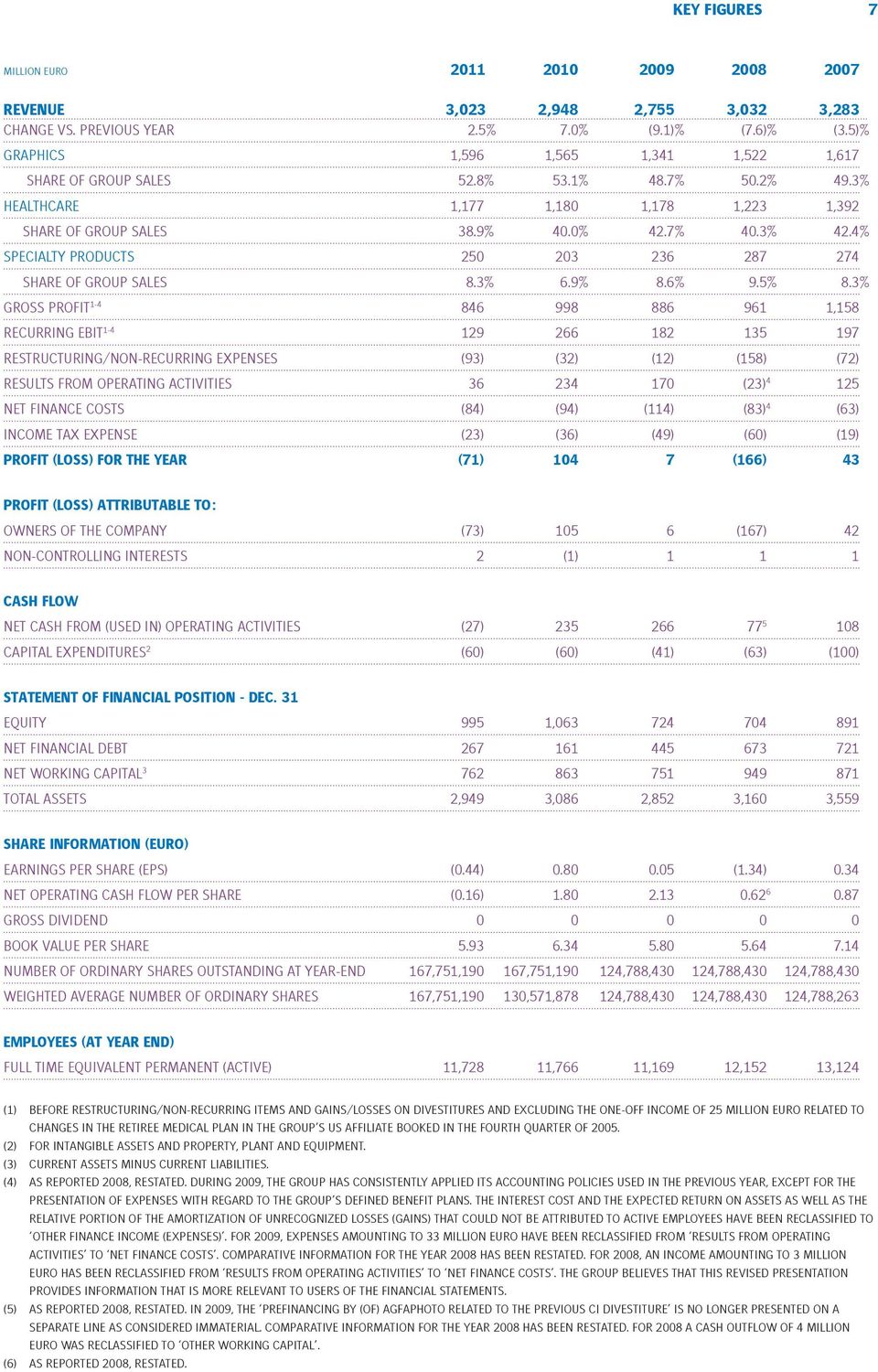
7 KEY FIGURES 7 MILLION EURO REVENUE 3,023 2,948 2,755 3,032 3,283 CHANGE VS. PREVIOUS YEAR 2.5% 7.0% (9.1)% (7.6)% (3.5)% GRAPHICS 1,596 1,565 1,341 1,522 1,617 SHARE OF GROUP SALES 52.8% 53.1% 48.7% 50.2% 49.3% HEALTHCARE 1,177 1,180 1,178 1,223 1,392 SHARE OF GROUP SALES 38.9% 40.0% 42.7% 40.3% 42.4% SPECIALTY PRODUCTS SHARE OF GROUP SALES 8.3% 6.9% 8.6% 9.5% 8.3% GROSS PROFIT ,158 RECURRING EBIT RESTRUCTURING/NON-RECURRING EXPENSES (93) (32) (12) (158) (72) RESULTS FROM OPERATING ACTIVITIES (23) NET FINANCE COSTS (84) (94) (114) (83) 4 (63) INCOME TAX EXPENSE (23) (36) (49) (60) (19) PROFIT (LOSS) FOR THE YEAR (71) (166) 43 PROFIT (LOSS) ATTRIBUTABLE TO: OWNERS OF THE COMPANY (73) (167) 42 NON-CONTROLLING INTERESTS 2 (1) CASH FLOW NET CASH FROM (USED IN) OPERATING ACTIVITIES (27) CAPITAL EXPENDITURES 2 (60) (60) (41) (63) (100) STATEMENT OF FINANCIAL POSITION - DEC. 31 EQUITY 995 1, NET FINANCIAL DEBT NET WORKING CAPITAL TOTAL ASSETS 2,949 3,086 2,852 3,160 3,559 SHARE INFORMATION (EURO) EARNINGS PER SHARE (EPS) (0.44) (1.34) 0.34 NET OPERATING CASH FLOW PER SHARE (0.16) GROSS DIVIDEND BOOK VALUE PER SHARE NUMBER OF ORDINARY SHARES OUTSTANDING AT YEAR-END 167,751, ,751, ,788, ,788, ,788,430 WEIGHTED AVERAGE NUMBER OF ORDINARY SHARES 167,751, ,571, ,788, ,788, ,788,263 EMPLOYEES (AT YEAR END) FULL TIME EQUIVALENT PERMANENT (ACTIVE) 11,728 11,766 11,169 12,152 13,124 (1) BEFORE RESTRUCTURING/NON-RECURRING ITEMS AND GAINS/LOSSES ON DIVESTITURES AND EXCLUDING THE ONE-OFF INCOME OF 25 MILLION EURO RELATED TO CHANGES IN THE RETIREE MEDICAL PLAN IN THE GROUP S US AFFILIATE BOOKED IN THE FOURTH QUARTER OF (2) FOR INTANGIBLE ASSETS AND PROPERTY, PLANT AND EQUIPMENT. (3) CURRENT ASSETS MINUS CURRENT LIABILITIES. (4) AS REPORTED 2008, RESTATED. DURING 2009, THE GROUP HAS CONSISTENTLY APPLIED ITS ACCOUNTING POLICIES USED IN THE PREVIOUS YEAR, EXCEPT FOR THE PRESENTATION OF EXPENSES WITH REGARD TO THE GROUP S DEFINED BENEFIT PLANS. THE INTEREST COST AND THE EXPECTED RETURN ON ASSETS AS WELL AS THE RELATIVE PORTION OF THE AMORTIZATION OF UNRECOGNIZED LOSSES (GAINS) THAT COULD NOT BE ATTRIBUTED TO ACTIVE EMPLOYEES HAVE BEEN RECLASSIFIED TO OTHER FINANCE INCOME (EXPENSES). FOR 2009, EXPENSES AMOUNTING TO 33 MILLION EURO HAVE BEEN RECLASSIFIED FROM RESULTS FROM OPERATING ACTIVITIES TO NET FINANCE COSTS. COMPARATIVE INFORMATION FOR THE YEAR 2008 HAS BEEN RESTATED. FOR 2008, AN INCOME AMOUNTING TO 3 MILLION EURO HAS BEEN RECLASSIFIED FROM RESULTS FROM OPERATING ACTIVITIES TO NET FINANCE COSTS. THE GROUP BELIEVES THAT THIS REVISED PRESENTATION PROVIDES INFORMATION THAT IS MORE RELEVANT TO USERS OF THE FINANCIAL STATEMENTS. (5) AS REPORTED 2008, RESTATED. IN 2009, THE PREFINANCING BY (OF) AGFAPHOTO RELATED TO THE PREVIOUS CI DIVESTITURE IS NO LONGER PRESENTED ON A SEPARATE LINE AS CONSIDERED IMMATERIAL. COMPARATIVE INFORMATION FOR THE YEAR 2008 HAS BEEN RESTATED. FOR 2008 A CASH OUTFLOW OF 4 MILLION EURO WAS RECLASSIFIED TO OTHER WORKING CAPITAL. (6) AS REPORTED 2008, RESTATED.
8 8 Company profile THE AGFA-GEVAERT GROUP DEVELOPS, PRODUCES AND DISTRIBUTES AN EXTENSIVE RANGE OF ANALOG AND DIGITAL IMAGING SYSTEMS AND IT SOLUTIONS, MAINLY FOR THE PRINTING INDUSTRY AND THE HEALTHCARE SECTOR, AS WELL AS FOR SPECIFIC INDUSTRIAL APPLICATIONS. Global production and sales network Agfa s headquarters and parent company are located in Mortsel, Belgium. The Group s operational activities are divided in three independent business groups, Agfa Graphics, Agfa HealthCare and Agfa Specialty Products. All business groups have strong market positions, well-defined strategies and full responsibilities, authority and accountability. Agfa-Gevaert has production facilities around the world, with the largest production and research centers in Belgium, the United States, Canada, Germany, France, Italy and China. Agfa is commercially active worldwide through wholly owned sales organizations in more than 40 countries. In countries where Agfa does not have its own sales organization, the market is served by a network of agents and representatives. Agfa Graphics Agfa Graphics offers integrated prepress solutions to the printing industry. These solutions comprise consumables, hardware, software and services for production workflow, project and color management. Agfa Graphics is a worldwide leader with its computerto-film, computer-to-plate and digital proofing systems for commercial and packaging printing and the newspaper publishing markets. Agfa Graphics is developing its position in the new segments of industrial inkjet with comprehensive solutions for various applications such as documents, posters, banners, signage, displays, labels and packaging materials. Its experience in both imaging and emulsion technology has provided the expertise required for developing a complete assortment of high-quality inks. Agfa HealthCare Agfa HealthCare is a leading provider of diagnostic imaging and healthcare IT solutions for hospitals and care centers around the world. The business group is a major player on the diagnostic imaging market, providing analog, digital and IT technologies to meet the needs of specialized clinicians worldwide. The business group is also a key player on the healthcare enterprise IT market, integrating administrative, financial and clinical workflows for

9 individual hospitals and hospital groups. Today, Agfa HealthCare offers over 100 markets access to its leading technologies and solutions, which range from Clinical Information Systems (CIS) and Hospital Information Systems (HIS), Radiology Information Systems (RIS), Picture Archiving and Communication Systems (PACS), Data Centers, as well as advanced systems for reporting, cardiology, decision support, advanced clinical applications and data storage, systems for Direct Radiography (DR) and Computed Radiography (CR), classic X-ray film solutions and contrast media. Agfa Specialty Products Agfa Specialty Products supplies a wide variety of products to large business-to-business customers outside the graphic and healthcare markets. On the one hand, the business group produces classic film-based products, such as film for non-destructive testing, motion pictures, aerial photography, microfilm and film for the production of printed circuit boards. On the other hand, Agfa Specialty Products targets promising growth markets with innovative solutions. Examples are materials for high-security ID documents, conductive polymers, synthetic papers and membranes for hydrogen production. Agfa s major production and R&D centers 1 Mortsel, Belgium 2 Ghent, Belgium 3 Wiesbaden, Germany 4 Munich, Germany 5 Bonn, Germany 6 Leeds, United Kingdom 7 Pont-à-Marcq, France 8 Bordeaux, France 9 Manerbio, Italy 10 Macerata, Italy 11 Yokneam Elit, Israel 12 Wuxi, China 13 Banwol, South Korea 14 Bushy Park, SC, US 15 Branchburg, NJ, US 16 Westerly, RI, US 17 Thousand Oaks, CA, US 18 Waterloo, Canada 19 Mississauga, Canada 20 Suzano, Brazil 21 Recife, Brazil 22 Varela, Argentina Milestones 1867 Founding of the Aktiengesellschaft für Anilinfabrikation (Agfa), Berlin, specialized in color dyes Founding of L. Gevaert en Cie., Antwerp, specialized in photographic paper Merger of Agfa and Gevaert Agfa-Gevaert 100% owned by Bayer Acquisition of Hoechst s printing plate division (Germany) Acquisition of DuPont s graphic film and offset plate activities (US) IPO - On June 1, 1999, the Agfa shares were introduced to the stock market Acquisitions of Dotrix (Belgium), developer of digital color print systems for industrial applications and of Symphonie On Line (France), developer of hospital information systems. Divestment of the Consumer Imaging division Acquisition of GWI (Germany), developer of hospital information systems, and Heartlab (US), developer of digital image and information networks for cardiology Acquisition of Insight Agents (Germany), a European developer and producer of contrast media, and of Gandi Innovations (Canada), a global leader in large format inkjet systems Agfa Graphics and Shenzhen Brothers create joint venture Agfa Graphics Asia to reinforce their position in the Greater China and ASEAN region. Acquisition of Harold M. Pitman Company, a leading US supplier of prepress, industrial inkjet, pressroom and packaging printing products and systems Acquisition of WPD, a leading HIS company in Brazil.
10 10 Annual report of the Board of Directors to the Shareholders of Agfa-Gevaert NV
11 11 The Board of Directors of Agfa-Gevaert NV has the honor to present you the combined annual report for the financial year ending December 31, 2011, in accordance with articles 96 and 119 of the Belgian Code of Companies. This annual report includes a corporate governance statement and a remuneration report.

12 12 2 Management Information

13 MANAGEMENT INFORMATION 13 Group Revenue Share of Group Revenue 2011 MILLION EURO PERCENT BY BUSINESS GROUP PERCENT BY REGION 2,948 3, Agfa Graphics 52.8% Agfa HealthCare 38.9% Agfa Specialty Products 8.3% Europe 43.5% NAFTA 23.5% Asia/Oceania/Africa 24.7% Latin America 8.3% COMMENTS ON THE FINANCIAL STATEMENTS 2011 Comments on the Consolidated financial statements Revenue In 2011, the Agfa-Gevaert Group s revenue grew 2.5% to 3,023 million Euro (2,948 million Euro in 2010). Excluding currency effects, the increase amounted to 3.7 percent. The first half of the year was characterized by a strong increase in revenues, due to both internal growth from the innovative digital solutions and the contribution of the recent strategic moves. In the third quarter, the accelerating decline of traditional film sales, adverse currency effects and the uncertain economic situation impacted the Group s top line. In the fourth quarter, both the Agfa Graphics and the Agfa HealthCare business groups performed well quarter on quarter, the latter clearly benefiting from its strong IT order book. Agfa Graphics full year revenue increased by 2.0 percent to 1,596 million Euro. Excluding currency effects, the increase amounted to 3.1%. The business group s top line was driven by the double-digit growth in wide-format segment of the industrial inkjet business, as well as by the strategic moves made in In the prepress segment, volumes in the digital computer-to-plate (CtP) business continued to grow. The decline in analogue computer-to-film (CtF) accelerated due to the film price increases that were implemented in reaction to the high raw material prices. Excluding currency effects, Agfa HealthCare s full year revenue increased by 0.9% to 1,177 million Euro. Excluding currency effects, the full year revenue increased by 0.9 percent. As expected, 2011 became the first year in which the digital and IT solutions were able to compensate for the decline in the traditional film business. In the Imaging segment, the market-driven decline for traditional X-ray products accelerated, while the digital radiology business continued to grow, with Direct Radiography (DR) almost tripling in value. Powered by the strong performance in the fourth quarter, the Imaging IT segment s revenue remained stable in spite of the adverse economic conditions. The Enterprise IT segment recorded satisfactory revenue growth.

14 14 Key figures Profit & Loss MILLION EURO Recurring EBITDA 1 Recurring EBIT 1 MILLION EURO MILLION EURO Revenue 2,948 3,023 Recurring gross profit Recurring EBITDA Recurring EBIT Restructuring and non-recurring items (32) (93) Results from operating activities Net finance costs (94) (84) Profit attributable to the owners of the Company 105 (73) (1) BEFORE RESTRUCTURING/NON-RECURRING ITEMS. Mainly due to a very strong first half of the year, Agfa Specialty Products full year revenue grew significantly with 23.2% from 203 million Euro in 2010 to 250 million Euro in The growth was attributable to the Functional Foils segment and to the non-destructive testing segment. With 52.8% of revenue, Agfa Graphics remains the largest business group. Agfa HealthCare represents 38.9% and Agfa Specialty Products 8.3% of Group sales. In 2011, Europe accounted for 43.5% of Group revenue (2010: 44.9%), NAFTA for 23.5% (2010: 22.0%), Asia/ Oceania/Africa for 24.7% (2010: 24.4%) and Latin America for 8.3% (2010: 8.6%). Results Recurring gross profit decreased from 998 million Euro in 2010 to 846 million Euro in Throughout the year, profitability was impacted by the very high raw material prices, adverse product mix changes, volume effects and related manufacturing inefficiencies. The Group succeeded in partially offsetting these elements through film price increases and continuous efforts to improve efficiency. As expected, the Group s gross profit margin improved in the fourth quarter, reaching 28.0 percent for the full year. Agfa Graphics margins were impacted by the high raw material prices and the competitive pressure in CtP. The decline of the film volumes affected manufacturing efficiency. These adverse elements were partially offset by Agfa Graphics film price increases and other measures to improve efficiency. The gross profit margin decreased from 30.9 percent in 2010 to 25.2 percent.
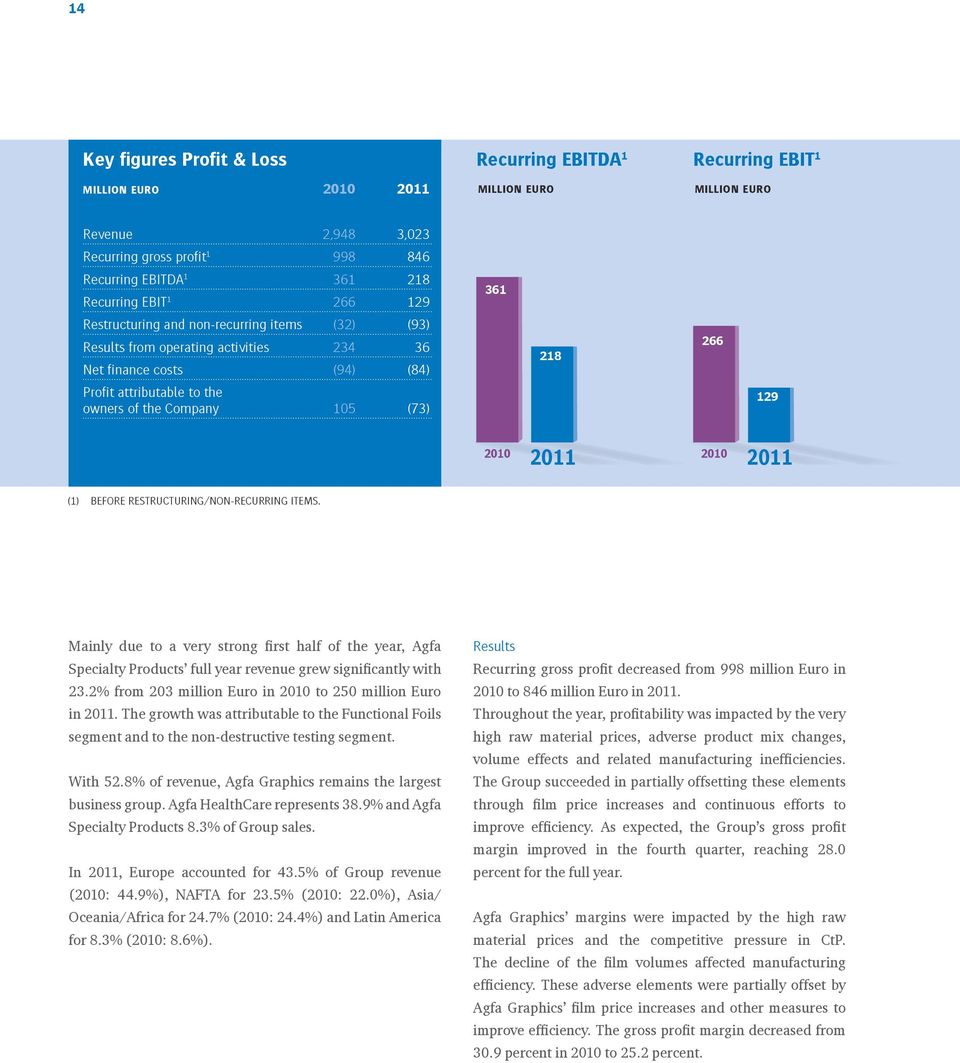
15 MANAGEMENT INFORMATION 15 Results from operating activities MILLION EURO Key figures Statement of financial position MILLION EURO Non-current assets 3,086 3,086 1,253 2,949 2,949 1,221 Liabilities 2,023 1, Current assets 1,833 1, ASSETS Equity 1, LIABILITIES 995 The high silver price, product mix changes and the production inefficiencies resulting from the reduced use of the Group s film production capacity impacted Agfa HealthCare s profitability. The business group succeeded in partially offsetting these adverse elements through film price increases and other efforts to improve efficiency. As a result, the gross profit margin decreased to 34.8 percent, versus 39.7 percent in R&D expenditure amounted to 162 million Euro in 2011, compared to 153 million Euro in The Group s recurring EBITDA (the sum of Graphics, HealthCare, Specialty Products and the unallocated portion) decreased from 361 million Euro to 218 million Euro. Recurring EBIT decreased from 266 million Euro (9.0% of revenue) to 129 million Euro (4.3% of revenue). Agfa Specialty Products profitability was impacted by the high raw material prices and by manufacturing inefficiencies resulting from the reduced use of the film production capacity. Due to the booking of additional charges in the fourth quarter, restructuring and non-recurring items resulted in an expense of 93 million Euro, versus an expense of 32 million Euro in As a percentage of revenue, the Group s Selling and General Administration expenses slightly decreased to 19.0%, versus 19.9% in the previous year. The net finance costs amounted to 84 million Euro in 2011, versus 94 million Euro in Income tax expense amounted to 23 million Euro, compared to 36 million Euro in 2010.
16 16 Inventories Trade receivables 1 Trade payables MILLION EURO/DAYS MILLION EURO/DAYS MILLION EURO/DAYS Dec. 10 Dec. 11 Dec. 10 Dec. 11 Dec. 10 Dec. 11 (1) MINUS DEFERRED REVENUE AND ADVANCED PAYMENTS FROM CUSTOMERS The results from operating activities decreased to 36 million Euro, versus 234 million Euro in the previous year. The loss before taxes thus reached 48 million Euro in 2011, against a profit before income taxes of 140 million Euro in A result attributable to the owners of the Company of minus 73 million Euro was booked, compared to 105 million Euro in This result is largely explained by the decision taken in the fourth quarter to implement extra restructuring measures. The major part of these measures are taken to tackle the structural changes in the film industry and to refocus some of the other businesses. They aim at immediate and sustainable profitability improvements. Statement of financial position At the end of 2011, total assets were 2,949 million Euro, compared to 3,086 million Euro at the end of Working capital Inventories amounted to 639 million Euro (or 106 days). Trade receivables (minus deferred revenue and advanced payments from customers) amounted to 527 million Euro, or 59 days and trade payables were 275 million Euro, or 45 days. Financial debt Net financial debt amounted to 267 million Euro, versus 161 million Euro at the end of At the end of 2011, the Group s gearing ratio amounted to 26.8%.

17 MANAGEMENT INFORMATION 17 Net cash from (used in) operating activities MILLION EURO NET Earnings per share EUROCENT (27) (134) (44) Equity Equity amounted to 995 million Euro, against 1,063 million Euro at the end of Cash flow In 2011, net cash from operating activities, which also takes into account the changes in working capital, reached minus 27 million Euro. Capital expenditure totaled 60 million Euro. Outlook Given the rather unpredictable economic environment, it is difficult to provide guidance. Assuming that raw material prices will not substantially differ from their current levels, the Group is aiming at restoring operational efficiency in order to reach a double digit recurring EBITDA percentage for the Group in the medium to long term. Human Resources At the end of 2011, Agfa employed 11,728 active full time equivalents, compared to 11,766 at the end of 2010.

18 18 Comments on the Statutory accounts of Agfa-Gevaert NV The Annual Accounts as will be presented to the General Meeting of Shareholders of 24 April 2012, were tested by the Board of Directors against the valuation rules, and approved in that form. The following points, in particular, will be submitted to the General Meeting of Shareholders for approval: The Annual Accounts close with a loss for the accounting year 2011 of 89,536, Euro. It is proposed to allocate the balance of the profit as follows: Deduction of the loss of 89,536, Euro from the result carried forward. As a result hereof the result carried forward will amount to 594,596, Euro. Explanation of the most significant entries of the Annual Accounts: In 2011, the Company achieved a turnover of million Euro. This means an increase of 6.7% compared to The increase in turnover was mainly caused by an increase of the sales prices. The price of silver in 2011 was on average 809 Euro per kg, a 65% increase compared to In 2011 the average monthly price of silver experienced a volatile course with a low value of 684 Euro per kg in January 2011 and a peak value of 903 Euro per kg in August In Belgium, 13.0 million Euro was spent on research and development in In 2011, the number of Agfa-Gevaert NV employees in Belgium decreased by 53 employees to 2,458 employees on December 31, This decrease is the result of the recruitment of 36 new employees and 89 employees leaving the company. Agfa-Gevaert NV & Co. KG made losses in 2011 of 3,428,876 Euro. In 2011 the permanent establishment of the Company in the UK made losses of 15, Euro. Agfa-Gevaert NV has, as in the past, taken the necessary steps for satisfying the requirements relating to environmental legislation.

19 19 RISK FACTORS Market, technology and competition risks As with any company, Agfa is continually confronted with market and competition risks. Its traditional imaging business in Graphics as well as in HealthCare is faced with rapid changes in technology and has in the past been characterized by price erosion. The economic crisis has an impact on the demand for our products, as well as for the products of our competitors. This is primarily the case for investment goods, but for Agfa Graphics and Agfa Specialty Products, the crisis also negatively affects the demand for consumables. Agfa is also introducing many new technologies, such as industrial inkjet for Graphics and, for HealthCare, computed and direct radiography as well as information systems. The digital imaging and information marketplace, in which Agfa is increasingly operating, is highly competitive and subject to rapid change. Cost of raw materials Agfa relies on other companies to supply certain key raw materials. The most important of these are aluminum and silver. Fluctuating raw material prices and any failure to obtain the needed raw materials on a timely basis could adversely affect Agfa s business, operational result and financial status. Furthermore, Agfa may choose to hedge a portion or the totality of its raw materials exposure, as it deems appropriate. Product liability The activities of the Group may expose Agfa to product liability claims. Particularly with respect to its HealthCare activities, Agfa complies completely with regulatory systems in many different countries. To mitigate product liability risks, Agfa has implemented a strict quality policy and control and has concluded a general insurance policy. Agfa has never suffered significant losses with respect to product liability, but there can be no assurance that this will not occur in the future. Environmental matters Agfa is subject to many environmental requirements in the various countries in which it operates, including air and wastewater emissions, hazardous materials and spill prevention and clean up. Significant operating and capital expenditures are required to comply with applicable standards. Provision is also made for current and reasonably foreseeable compliance and remediation costs. Proprietary technology Agfa owns, has applications pending for and is licensed under many patents relating to a variety of products as well as software. The company relies on a combination of patent, copyright, trademark and trade secret legislation, trade secrets, confidentiality procedures, contractual provisions and license arrangements to establish and to protect its proprietary rights. On the other hand, the Group has a policy of strictly respecting third parties intellectual property rights. Agfa is not aware that any of its products are infringing upon the intellectual property rights of others. However, there can be no assurance that third parties will not claim such infringements in the future. Litigation Agfa is currently not involved in any major litigation apart from those related to the AgfaPhoto insolvency, which are commented in detail under note 17 p. 115 and 116, note 22 p. 130, note 23 p. 131 and note 26 p. 132 of the financial statements. Miscellanea Furthermore, certain risks should be taken into account which could have a negative impact on the company and its activities. Examples are risks concerning the continuity of production, extraordinary impairment of assets, pension obligations, changes in currency exchange rates and acquisitions. More information about these risks is to be found in the prospectus that was published within the framework of the issue of new shares at the end of This prospectus can be consulted in the Capital Increase section of the Investor Relations pages of the Group s website. INFORMATION RELATED TO MAJOR EVENTS SUBSEQUENT TO DECEMBER 31, 2011 AND INFORMATION ON CIRCUMSTANCES THAT COULD SIGNIFICANTLY IMPACT THE DEVELOPMENT OF THE GROUP No such events occurred.
20 20 INFORMATION ON THE RESEARCH & DEVELOPMENT ACTIVITIES The Agfa-Gevaert Group s R&D expenses amounted to 162 million Euro in % of R&D expenditure was related to Graphics, 64% to HealthCare and 6% to Specialty Products. In 2011, Agfa Graphics continued to strengthen its leading position in chemistry-free printing plate systems. R&D efforts now focus on making chemistry free plate solutions even more robust to answer the needs for more demanding markets with higher printing speed or longer press runs. Next to product improvements, Agfa Graphics also focuses strongly in ways to make its manufacturing and logistic processes more sustainable, thereby reducing the impact on the environment. Agfa Graphics software :Apogee Suite for commercial printers continues to integrate with more digital print engines and Management Information Systems. There is also a strong focus on automating file delivery to printers through the internet. To this aim, Agfa creates software for printers that allows them to set up web-to-print solutions. Agfa Graphics :Arkitex suite for newspapers was prepared to integrate the interface between the newspaper production and e-publishing/e-reading. New trends for industrial server based applications focus on hardware independent platforms, and cloud based computing and SaaS (Software as a Service) solutions. Agfa Graphics invested further in the development of UV inks and equipment for the growing industrial inkjet market, thereby aligning innovation projects in Belgium and Canada (former Gandi Innovations). The :Jeti 3020 Titan was introduced as the first :Jeti printer with a high degree of flexibility and upgradeability. The :Anapurna 2540FB, based on the same technology as the successful :Anapurna 2050, introduces true flatbed printing in the entry level industrial inkjet from Agfa Graphics. In the upper segment of the industrial inkjet solutions, Agfa Graphics introduced a semi automatic :M-Press Leopard targeting quality demanding customers, focusing on enhanced image quality and data processing. In 2011, Agfa HealthCare focused its R&D efforts on expanding and strengthening its portfolio. The next generation of affordable Computed Radiography solutions, the further expansion of the Direct Radiography product line, the introduction of its latest IMPAX solution, the expansion of its Data Centre & zero footprint viewer technologies to provide secure access to images and reports in locations throughout a hospital, or across an entire region, as well as the continued upgrading of its leading HIS/CIS solution ORBIS were key focuses. The business group successfully introduced many of these solutions in Examples are the next generation CR 30-X, the automated DX-D 600 DR room, the mobile DX-D 100 DR and the wireless DX-D 30 Cesium based DR detector; the IMPAX 6.5 solution and IDC / XERO 2.0 solutions. Agfa Specialty Products focused its R&D efforts on the development of products for growth areas based on Agfa s core competencies in polymeric materials, ink, film- and

21 21 coating technology. In 2008, Synaps was launched, a polyester based synthetic paper. Development efforts have been concentrated on extending the synthetic paper portfolio to electrophotographic printing and copying systems. For the high-end smartcard market, the new PETix products were developed and launched. These polyester films are compatible with all major personalization and security techniques. The performance of conductive pastes, inks and coatings for the electronics industry, based on the Orgacon technology, has been further enhanced. In the industrial ink segment, the R&D efforts were focused on the development of UV inks for packaging applications, and on water-based inks for the decorative market. In 2011, Agfa Specialty Products also participated in a number of pre-competitive longer term research projects. INFORMATION RELATED TO THE USE OF DERIVATIVE FINANCIAL INSTRUMENTS In order to minimize the risk of fluctuations in exchange rates and interest rates, the appropriate hedge contracts were implemented. These mainly include short-term transactions in foreign currencies, option contracts and interest swaps. Their implementation occurs according to uniform guidelines, is subject to internal audits, and is limited to cover for the operational activities, and related money investments and financial transactions. Further detail hereon is provided in the Notes to the Consolidated Financial Statements. INFORMATION RELATED TO THE EXISTENCE OF BRANCH OFFICES OF THE COMPANY Agfa-Gevaert NV has a branch office in the United Kingdom (Agfa Materials UK). JUSTIFICATION OF THE INDEPENDENCE AND THE EXPERTISE IN THE FIELD OF ACCOUNTING AND AUDIT OF AT LEAST ONE MEMBER OF THE AUDIT COMMITTEE Three members of the Audit Committee are independent in accordance with article 526ter of the Belgian Code of Companies. These three members have obtained by their education and professional experience the required expertise in the field of accounting and audit. In this context we refer to the CV s in the Corporate Governance Statement of this publication.
22 22 Agfa Graphics AGFA GRAPHICS HEAD OFFICE IS LOCATED IN MORTSEL (BELGIUM). THE BUSINESS GROUP HAS SALES ORGANIZATIONS IN OVER 40 COUNTRIES AND REPRESENTATIVES IN MORE THAN 100 OTHER COUNTRIES. ITS PRODUCTION SITES ARE SITUATED IN BELGIUM, GERMANY, FRANCE, THE UNITED KINGDOM, THE UNITED STATES, BRAZIL, CHINA, SOUTH KOREA AND CANADA.
23 23 AGFA GRAPHICS MILLION EURO % change REVENUE 1,596 1, % RECURRING EBITDA (50.5)% % OF REVENUE 5.5% 11.3% RECURRING EBIT (64.3)% RESULTS FROM OPERATING ACTIVITIES -(7.2) (106.0)% (1) BEFORE RESTRUCTURING AND NON-RECURRING ITEMS. Agfa Graphics full year revenue increased by 2.0% to 1,596 million Euro. Excluding currency effects, an increase of 3.1% would have been posted. Agfa Graphics top line was driven by the double-digit growth in the industrial inkjet business, as well as by the strategic moves. In the prepress segment, volumes in the digital computerto-plate (CtP) business continued to grow. The decline in analogue computer-to-film (CtF) accelerated due to the film price increases that were implemented in reaction to the high raw material prices. A TRUSTED PARTNER FOR PROFESSIONAL PRINTERS Agfa Graphics is a leading supplier of integrated prepress solutions and advanced industrial inkjet systems. All over the world, professional printers and publishers rely on the business group s experience and first-rate technology. Prepress The term prepress is used for the chain of processes that precede the actual printing process. Prepress activities begin after the print layout decisions are made and end where the printing process itself begins. In these preparatory stages, text and images are combined in a layout, colors are qualitycontrolled, pages are correctly positioned and a number of digital proofs are made. When approved, these pages will be prepared for the printing process. In case of offset printing, pages are exposed onto a printing plate, either directly, with computer-to-plate technology, or via an intermediate film, with computer-to-film technology. Following this process, the exposed plate is mounted on the printing press. In an industry in which efficiency is key, analog CtF systems are making way for digital CtP technology. By eliminating intermediate stages in the process, CtP allows the printer to complete more jobs and to increase the control of the production process without the need to expand the workforce. Printers rely on Agfa Graphics equipment, consumables (such as graphic film and printing plates), software and services for almost every stage in the preparatory process. The business group s software packages include workflow management software, technology for digital proofing and screening, as well as tools for managing color and quality consistency. These software systems offer printers faster processing, better quality and improved cost efficiency. With its integrated prepress systems, Agfa Graphics mainly serves customers in the information printing segment of the graphic market. It is the habitat of newspaper printers and commercial printers, which produce magazines, brochures and books. In the info printing segment, offset printing is the most commonly used technology.
24 24 Agfa Graphics also supplies prepress technology to customers in the industrial printing segment. Compared to the information printing segment, the industrial printing segment is more specialized and uses a wider variety of technologies to create a broad range of printwork, such as packaging, labels, signs, displays, In this segment, Agfa Graphics mainly supplies prepress solutions to customers specializing in offset and flexo printing for packaging purposes. In prepress, Agfa Graphics supplies almost one third of the industry s printing plates worldwide. It is the clear market leader in the field of eco-friendly chemistry-free printing plates. In addition, Agfa Graphics is one of the few remaining suppliers of CtF film. They are ideally suited for high-quality printing on an extremely wide variety of substrates for various applications, such as packaging, posters and displays, promotional materials, labels and decorative materials. Agfa Graphics supplies a comprehensive range of printing presses, as well as high-quality UV curable inks and media. Currently, industrial inkjet systems mainly compete with screen printing and flexo printing machines. Industrial inkjet has a substantial growth potential. Digital printing is quickly picking up to replace conventional industrial screen printing applications. For sign, display and some decorative applications, wide format is even able to offer solutions that can not be answered with conventional print. Industrial inkjet Most people associate the term inkjet with the home and office printers that they use every day. That, however, is not the market Agfa Graphics is operating in. With its industrial inkjet technology, the business group focuses on the industrial printing segment of the graphic market. Powered by the most advanced inkjet technologies, Agfa Graphics cost effective digital printing systems are state-of-the-art alternatives for traditional printing technologies. THE :AVALON N8-80 XT PLATESETTER IS EQUIPPED WITH A NEW HIGH- CAPACITY CLEAN-OUT UNIT. IT PROCESSES THE THERMOFUS BASED :AZURA TS CHEMISTRY-FREE PRINTING PLATE. EASILY HANDLING OVER 40,000 M² OF PRINTING PLATES PER YEAR, THE SYSTEM IS THE IDEAL ECO-FRIENDLY SOLUTION FOR HIGH-VOLUME COMMERCIAL PRINTERS.
25 AGFA GRAPHICS 25 STRATEGIC POSITIONS IN RAPIDLY EVOLVING MARKETS Agfa Graphics strongly believes in the continued need for printing. Notwithstanding the increasing competition of electronic media, print will remain a powerful and essential value-adding communication tool. Agfa Graphics will therefore continue to promote the position of print in the total communication mix. Agfa Graphics is addressing the trends in the rapidly evolving graphic market with welldefined strategies. Prepress: cost efficiency, technological excellence, ecology, and market leadership are key Cost efficiency is one of Agfa Graphics major focuses. A lot of effort goes into structural reforms in its operations, supply chain and distribution channels. The business group continually adapts its operational structure to the evolution in its markets. A global strive for sustainable production helps to support the cost efficiency focus. One of the most important trends in prepress is the accelerating technology shift from CtF to CtP in the emerging countries. These growth markets can build on the experience in North America and Western Europe, where almost all printers have already made the transition. Therefore, the conversion to CtP will happen much faster in the emerging countries than it did in the Western world. As a consequence of this evolution, the global market for CtF consumables is declining rapidly. This decline accelerated further in 2011 as a consequence of the silver price increase. Agfa Graphics continuously works on improving its efficiency, in order to play an important role in the consolidation of the CtF market. Closely linked to cost efficiency is technological excellence. Printers are constantly looking for affordable and efficient prepress solutions that improve their competitive position. Therefore, Agfa Graphics strives to be the industry s preferred technology partner. The business group continuously invests in efficient and powerful CtP solutions that allow customers to improve their competitiveness and achieve profitable growth. Essential in Agfa Graphics business model are its renowned support and service. In 2011, the German print business consultants company Apenberg+Partner reported that of all CtP systems providers Agfa Graphics scores best with regards to system services. As is the case in other industries, the pressure to work more ecologically is increasing on the printing sector. Agfa Graphics is a front runner in developing imaging technologies that reduce the ecological footprint of the printing industry. The business group s systems allow printers to eliminate toxic chemicals, reduce waste, lower ink and water consumption and save energy during the prepress and printing process. For instance, Agfa Graphics is the global market leader for chemistry-free printing plates. Furthermore, Agfa Graphics is developing programs to reduce the environmental impact of its own operations. Another cornerstone of Agfa Graphics strategy is the consolidation of its market positions. The business group is defending its strong position in Europe and North America. In both regions, electronic media are starting to impact the use of printed information. In 2010, Agfa Graphics acquired the assets of the Harold M. Pitman Company in order to improve its position in the US, to diversify its portfolio in prepress, CtP and inkjet and to strengthen its distribution power. Furthermore, the business group seeks further growth in the emerging markets in general and the BRIC countries (Brazil, Russia, India, China) in particular. In these markets, offset printing is growing strongly, as the printing industry follows the evolution of the literacy rate and the gross domestic product (GDP). In addition, companies are outsourcing non-time sensitive print jobs to low-cost countries. Through targeted actions and strategic partnerships, Agfa Graphics is anticipating on these important growth opportunities. For instance, in 2010, Agfa Graphics and its Chinese business partner Shenzhen Brothers established the Agfa Graphics Asia joint venture aiming at reinforcing both partners market position in the Greater China and ASEAN region. Industrial inkjet: participate in the technological revolution of industrial printing Participators in the industrial printing business are keen to replace their traditional technologies (including screen printing technology, flexo printing technology and offset printing technology) by advanced digital systems to boost their efficiency and expand the range of services for their customers. Of all new digital technologies, industrial inkjet has clearly won the battle to become the technology of choice for the major part of the industry. Agfa Graphics continuously invests in its very broad range of systems to become a technology leader in the inkjet market. The business group is able to cater to the needs of all customers wishing to boost their business through digitization: from small businesses seeking entry-level solutions for poster printing to print companies willing to invest in state-of-the-art high-throughput machines. In addition to its inkjet printing machines, Agfa Graphics also offers an extensive range of UV curable inks. As a result of the before mentioned Pitman acquisition, the business group
26 26 was able to add additional inks, as well as inkjet media to its portfolio. To further improve its market position, Agfa Graphics intends to capitalize on its strong brand name, its global market access and the development of next-generation highperformance equipment and inks. At the IGAS trade show in Japan, Agfa Graphics demonstrated its high-capacity thermal :Azura TS system, which combines the :Avalon N8-80 XT platesetter with a new high-capacity clean-out unit and the ThermoFuse based :Azura TS chemistry-free printing plate. Easily handling over 40,000 m² of printing plates per year, the system is the ideal eco-friendly solution for high-volume commercial printers. PRODUCT DEVELOPMENT Prepress Agfa Graphics has a very broad portfolio of products and solutions for commercial printers. The business group is a pioneer in the field of chemistryfree CtP technology, including equipment, as well as thermal and violet printing plates. This technology reduces the environmental footprint of its users, at the same time enhancing the efficiency of their prepress activities. In 2011, Agfa Graphics introduced two new thermal platesetters in different speed versions. Both the :Avalon N8-60 and the :Avalon N8-80 feature a next-generation laser imager, which enhances the image quality, reliability and throughput. Furthermore, the new systems allow the customer to reduce power consumption. They are suited for all commercial and offset packaging applications. Agfa Graphics also further expanded its range of conventional thermal printing plates. Designed for use with a wide variety of plate setters, the new no-bake :Energy Elite Pro plate typically serves the high demanding printing environments. In the field of software, Agfa Graphics introduced a new version of its award-winning workflow management suite. :Apogee Prepress 7.1 offers among other upgrades significant integration and automation improvements, as well as extended digital printing support. Another innovation is the new software tool that allows printers to connect to their :Apogee Prepress server using an ipad, iphone or ipod Touch. The app can be used to get a quick check of a specific print job during production or to get a status overview of the prepress equipment. At the end of the year, Agfa Graphics announced the release of a new version of :Fortuna, its widely-used security printing software. Designed for the highest security applications, such as banknotes, :Fortuna is also used for among other applications - ID-card security, brand protection, document security and packaging. Today, Agfa Graphics protects over 75% of world banknotes. For newspaper printers, Agfa Graphics further expanded its range of systems that help streamline the prepress process. Also in the newspaper industry, Agfa Graphics strives to be a frontrunner in the field of eco-friendly prepress systems. In 2011, the business group introduced a new addition to its range of chemistry-free printing plates. The violet :N94-VCF plate helps newspapers to reduce their ecological footprint and save costs. At the IFRA 2011 trade show, Agfa Graphics demonstrated its new comprehensive eco-friendly CtP solution, including the :Advantage platesetter (producing up to 300 printing plates per hour), the :N94-VCF printing plates and the high-speed :VXCF85 clean-out unit. PRINTING TODAY IS CHALLENGED BY RISING COSTS, WHILE STILL BEING EXPECTED TO REACT TO DEMANDS FOR HIGHER QUALITY AND PRODUCTIVITY. AUTOMATION IS A KEY ENABLER FOR COST REDUCTION. :APOGEE INKSAVE IS DESIGNED TO PRESERVE AND ENHANCE QUALITY AUTOMATICALLY AND PROVIDES A SERIOUS FINANCIAL BONUS BY REDUCING INK COSTS. In addition, Agfa Graphics launched a number of software innovations. At IFRA, important enhancements to the business group s market-leading :Arkitex workflow management suite were introduced. The :Arkitex tools are designed to give customers a competitive edge by increasing
27 AGFA GRAPHICS 27 THE :JETI 3020 TITAN FTR IS A HIGH-PRODUCTION HYBRID INKJET PRINTER. THANKS TO ITS MODULAR APPROACH, ITS COLOR AND SPEED CAPABILITIES CAN BE EASILY EXTENDED TO KEEP UP WITH THE OWNER S CHANGING NEEDS. productivity and quality while reducing costs. Completely new is :Arkitex Eversify. The tool offers newspapers a straightforward way to enter the new world of mobile digital publishing without increasing production costs. Industrial inkjet In the wide format printing segment, Agfa Graphics further expanded its portfolio of entry-level and mid-range :Anapurna and :Jeti printers. These systems are typically but not exclusively used to produce posters, banners and displays on all kinds of substrates. Two new systems were added to the already broad range of :Anapurna systems. The :Anapurna M1600 prints in 4 colors plus white on roll-to-roll substrates and rigid substrates including mirror glass and plexiglass. It is suitable for all types of applications up to a width of 1.6 meter. Designed for optimum productivity on most rigid substrates, the versatile :Anapurna M2540 FB flatbed engine is able to print all sizes of applications, up to a maximum of 2.54 meter in width. Users can supply prints on small products like DVD s and coasters on the one hand, and large format output like interior décor prints and exterior signs and displays on the other hand. The :Jeti family of large format printers also welcomed several new members. The :Jeti 3020 Titan FTR, for instance, is a high-production hybrid inkjet printer. Thanks to its modular approach, its color and speed capabilities can be easily extended to keep up with the owner s changing needs. In the segment of high-end industrial flatbed presses, the market leading :M-Press Tiger engine was joined by the new :M-Press Leopard. The :M-Press range is able to replace traditional equipment for all possible screen print work. Whereas the :M-Press Tiger is suited for high run-length digital printing, the :M-Press Leopard is designed for low to medium run-lengths. It is the ideal solution for display producers who look for the best quality and speed and who require fast change-over between print jobs. The :M-Press Tiger and Leopard machines deliver top quality prints for all indoor and outdoor applications on a wide variety of substrates: backlit material, paper, self adhesive vinyl, fluted display board, metal plates, corrugated board, PVC and much more.
28 28 THE :M-PRESS TIGER AND LEOPARD HIGH-END INDUSTRIAL FLATBED PRESSES USES AGFA S OWN :ANUVIA UV INKJET INK TO DELIVER TOP QUALITY PRINTS FOR ALL INDOOR AND OUTDOOR APPLICATIONS ON A WIDE VARIETY OF SUBSTRATES: BACKLIT MATERIAL, PAPER, SELF ADHESIVE VINYL, FLUTED DISPLAY BOARD, METAL PLATES, CORRUGATED BOARD, PVC AND MUCH MORE. COMMERCIAL SUCCESSES In 2011, Agfa Graphics was able to achieve important commercial successes. Printers and publishers showed strong interest in its innovative portfolio of market-leading products and solutions. Prepress In the commercial printing segment, Agfa Graphics is the undisputed technology and market leader in chemistry-free printing plates for thermal and violet prepress systems. A good illustration of this market leadership is a remarkable milestone that was reached in the Japanese market. In the course of the year, King Printers (Osaka) became the 300 th Japanese user of the :Azura TS printing plate. The number of :Apogee workflow software installations also continues its steady growth. At the end of the year, more than 7,000 :Apogee systems were installed in the world. As is the case in the commercial segment, newly closed contracts in the newspaper segment often concern complete prepress solutions. Dansk Avis Tryk A/S, for instance, bought an :Advantage N DL XT platesetter with a 3-year printing plate contract. The Dansk Avis Tryk A/S is the largest contract newspaper printer in Denmark. A number of important newspaper contracts were also signed in Asia. In Korea, for instance, the Korean Economic Daily and The Seoul Shinmun newspaper companies both signed five-year contracts for Agfa Graphics photopolymer printing plates. In April, the Agfa Graphics Asia joint venture organized the Chinese debut for a number of environmentally-friendly products and solutions at the Print China 2011 trade fair, thus confirming its commitment towards the growing Chinese printing industry. It is expected that a lot of printers in the emerging countries will step from CtF directly to chemistryfree CtP. Agfa Graphics accounts for approximately 80% of the fast growing segment of chemistry-free printing plates in the world. Following the trend in the commercial segment, newspaper printers all over the world are now choosing eco-friendly prepress systems. Greensheet Publishing in Houston (Texas), for instance, recently made the switch to Agfa Graphics chemistry-free prepress technology. Greensheet Publishing prints among other publications the New York Times for southern Texas. Another good example is Urschweiz AG. The publisher of the largest daily newspaper in Switzerland signed a contract for two :Advantage N platesetters, :Arkitex workflow software and chemistry-free printing plates.
29 AGFA GRAPHICS 29 Although the technology is fairly new for newspaper environments, over 200 newspaper printers are already using Agfa Graphics chemistry-free printing plates to reduce their costs as well as their impact on the environment. Industrial inkjet All over the world, printers acknowledge the superior print quality and productivity of Agfa Graphics industrial inkjet solutions. It is not without reason that Agfa Graphics industrial inkjet machines are major crowd-pullers at many trade shows. Agfa Graphics continued to expand its position in the wide-format segment with its :Anapurna and :Jeti printers. In September, Agfa Graphics signed an agreement with Spandex, who will distribute the range of :Anapurna printers in Europe. Spandex is one of the world s leading trade suppliers to the sign making and display industries. With more than 200 new installations in 2011, over 1,000 :Anapurna systems are now in operation all over the world. New customers such as J-C Press (Owatonna, Minnesota) often praise the fact that their :Anapurna machine gives them the opportunity to offer new solutions to their customers. Also the installed base for the :Jeti printers grew in The strong selling points of :Jeti machines are high print quality, high production speed and great versatility. The installed base of the high-speed flatbed press :M-Press Tiger continued to grow steadily in The Manchester (UK) based Cestrian Imaging company purchased its second :M-Press Tiger in the course of the first quarter. Cestrian commented that their first :M-Press has fuelled the digital revolution at the company, as customers often specifically request :M-Press prints for their marketing campaigns. Cestrian is one of the UK s leading digital print suppliers. The first :M-Press Tiger with in-line screen printing unit in the North American region was purchased by Graphic Tech (Fullerton, California). Immediately after the introduction of the new :M-Press Leopard press, the first contract was signed with the Bachmann-Dambach Group, one of the leading screen printing companies in Germany. Two more were installed in UK and Ireland.
30 30 Agfa HealthCare AGFA HEALTHCARE S HEAD OFFICE IS LOCATED IN MORTSEL (BELGIUM). THE BUSINESS GROUP HAS SALES ORGANIZATIONS AND REPRESENTATIVES IN OVER 100 COUNTRIES. ITS PRODUCTION AND RESEARCH SITES ARE LOCATED IN BELGIUM, GERMANY, FRANCE, ITALY, AUSTRIA, THE UNITED STATES, CANADA, CHINA AND BRAZIL.
31 31 AGFA HEALTHCARE MILLION EURO % change REVENUE 1,177 1,180 (0.3)% RECURRING EBITDA (29.1)% % OF REVENUE 10.5% 14.8% RECURRING EBIT (37.5)% RESULTS FROM OPERATING ACTIVITIES (63.3)% (1) BEFORE RESTRUCTURING AND NON-RECURRING ITEMS. Agfa HealthCare s full year revenue remained almost stable at 1,177 million Euro. Excluding currency effects, the full year revenue increased by 0.9%. As expected, 2011 became the first year in which the digital and IT solutions were able to compensate for the decline in the traditional film business. In the Imaging segment, the market-driven decline for traditional X-ray products accelerated, while the digital radiology business continued to grow, with Direct Radiography (DR) almost tripling in value. Powered by the strong performance in the fourth quarter, the Imaging IT segment s revenue remained stable in spite of the adverse economic conditions. The Enterprise IT segment recorded satisfactory revenue growth. AN EXPERT IN MEDICAL IMAGING AND HEALTHCARE IT In the rapidly changing healthcare market, Agfa HealthCare is a global provider of diagnostic imaging and healthcare IT solutions. The business group supports hospitals and healthcare facilities with products and systems for capturing, managing and processing diagnostic images and data, as well as solutions for streamlining and managing the overall clinical and administrative information flow. Clinicians in care facilities all over the world rely on Agfa HealthCare to help meet the challenges of modern day healthcare. In 2011, Agfa HealthCare s dedication towards its customers was recognized by the Premier healthcare alliance, which honored the business group with a Performance Award. This award applauds the efforts of contracted suppliers that meet and exceed operational expectations. The Agfa HealthCare business group is organized in two business units: Imaging and IT. Imaging Accounting for slightly more than 60% of Agfa HealthCare s revenue, the Imaging division supplies traditional X-ray film, hardcopy film and printers, digital radiography equipment and contrast media. Agfa HealthCare s roots are in traditional medical imaging and today, classic X-ray film and hardcopy film on which digital images are printed still account for more than 40% of the business group s revenue. In recent years, X-ray film is rapidly losing ground to digital radiography. In 2011, this trend further accelerated due to the high cost of silver, which is used to produce X-ray film. The situation on the raw materials markets confirmed Agfa HealthCare s strategy in the imaging segment. The business group strives to leverage its favorable point of departure in radiology departments to assist existing and new customers in their transition from analog systems to digital radiography and IT systems. Due to the competition of softcopy diagnosis, the hardcopy film market continues to decline in the US and Western Europe. In the emerging countries, the market segment is growing.
32 32 For medical film, Agfa HealthCare is the market leader in Europe and the runner-up in the rest of the world. Agfa HealthCare takes all necessary measures to safeguard and improve its efficiency in order to remain competitive in the declining film market. Besides hardcopy film, Agfa HealthCare also supplies DRYSTAR hardcopy printers that enable clinicians to print digital images made by general radiography equipment, as well as images made by other modalities, including CT and MRI-scanners. Agfa HealthCare s range of advanced printers includes both high quality tabletop solutions and network printers for large volume needs. In digital radiography, Agfa HealthCare is active with both Computed Radiography and Direct Radiography technologies. Traditionally, Agfa HealthCare has a strong reputation with its extensive range of CR digitizers. Compatible with traditional radiography equipment, CR offers image intensive departments an affordable entry to digital imaging. The systems convert analog images to digital, allowing departments to improve their efficiency and increase overall patient throughput. In addition, Agfa HealthCare invests in broadening its portfolio of DR equipment. DR offers instant imaging excellence at lower dose for immediate validation wherever needed, from the Intensive Care Unit to the wards, and deliver a higher throughput. Many hospitals combine both technologies to cover all their X-ray imaging needs using the same acquisition and image processing software. As a technology leader in both areas, Agfa HealthCare is in a unique position to offer tailormade solutions to healthcare facilities planning to invest in digital imaging. In 2010, Agfa HealthCare entered the market of generic contrast media through the acquisition of the German company Insight Agents GmbH. In 2011, the contrast media range was rebranded to Agfa HealthCare Imaging Agents, as the business group is expanding the market presence of its high-quality and cost efficient products globally. IT Accounting already for almost 40% of Agfa HealthCare s revenue, the IT division is a leading player in the fast growing but fragmented healthcare IT market with its image and data networks and enterprise IT solutions. Agfa HealthCare offers care organizations the tools to improve the overall efficiency and quality of patient care. The ultimate goal is to connect all healthcare stakeholders through seamless integration. AGFA HEALTHCARE S DX-D 100: MOBILE, COMPACT, EASY-TO-USE, FAST DISPLAY OF HIGH QUALITY IMAGES, LOWER X-RAY DOSE. Imaging informatics The introduction of digital radiography in the early 1990 s was a first concrete step towards the development of fully integrated hospital IT systems. In order to efficiently store, manage, process and distribute digital medical images from various imaging modalities, radiology departments install Picture Archiving and Communication Systems (PACS). These solutions are often linked to specialized information systems, such as Radiology Information Systems (RIS). In those early years, Agfa HealthCare was one of the first companies to introduce PACS to the global market. Today, it continues to invest in groundbreaking innovations. For care providers all over the world, the IMPAX trademark equals reliability and efficiency. Based on its experience in radiology, Agfa HealthCare has developed a number of IMPAX solutions for other hospital departments that work intensively with medical images, including cardiology, orthopedics and nuclear medicine, as well as for certain specialized medical disciplines, such as women s care and digital pathology. Whereas PACS and RIS solutions were originally linked to one hospital department, care organizations now also use them to link their radiology departments with other image intensive departments and even to link departments from different hospital sites. With Agfa HealthCare s IMPAX Data Centers using XERO technology, it is even possible to centrally store the imaging data from all image intensive departments of all care organizations in entire regions. As
33 AGFA HEALTHCARE 33 images and linked data are instantly accessible, the systems speed up overall diagnosis, thereby enhancing patient care. In Radiology PACS, Agfa HealthCare has a very strong position in Europe and a growing market share in the US, Canada, Europe and Latin-America. In Regional Imaging, where data from disparate systems is consolidated on a regional level, Agfa HealthCare has a leading position worldwide. Enterprise IT Going beyond imaging, Agfa HealthCare has established itself as a leading player in the fast growing market for enterprise IT systems. ORBIS, Agfa HealthCare s leading Hospital Information System/Clinical Information System (HIS/CIS), connects medical departments and administrative departments of hospitals into one virtual network. It offers immediate and complete access to all relevant patient information including medical images, and clinical and administrative data enabling quicker diagnosis and treatment. Furthermore, it supports administration, billing, planning of appointments and examinations, as well as financial reporting. The system can serve as a base for a full-blown Electronic Patient Record (EPR). In short, ORBIS is designed to bring care facilities in to the digital world thereby helping them to increase productivity, improve the delivery of care and save cost. AGFA S IMPAX DATA CENTER IS A DYNAMIC SOLUTION THAT WAS SPECIFICALLY DESIGNED TO BE VENDOR-NEUTRAL, ALLOWING SEAMLESS DISTRIBUTION OF RELEVANT CLINICAL DATA TO THE CLINICIAN AT THE POINT OF CARE. Agfa HealthCare s step by step approach enables care organizations to implement ORBIS at their own pace, allowing the solution s various modules to be installed separately, tailored to the needs of the customer. With ORBIS, Agfa HealthCare made the strategic decision to focus on selected European countries. Currently, the systems are available for customers in Germany, France, Belgium, Austria, Switzerland, Luxembourg, and since 2011 the UK. Successes in these selected markets will be the basis for a gradual expansion into other countries. The second important system in Agfa HealthCare s enterprise IT offering is the HYDMedia electronic archiving solution. HYDMedia enables hospitals and care facilities of all sizes to integrate all their paper-based and electronic documentation, creating a complete digital archive of patient records. HYDMedia reduces the need for physical archiving space, cuts down information retrieval time and reduces associated costs. HYDMedia is available in Germany, Switzerland, Austria, Luxemburg and since 2011 France. It will gradually be introduced in additional countries. It is Agfa HealthCare s ambition to participate in the consolidation of the fragmented enterprise IT market. In September 2011, the business group announced the acquisition of the Brazilian company WPD, a leading HIS company. Through the acquisition, Agfa HealthCare enters the growing HIS/CIS market in Brazil, where it already has a strong position with its imaging and imaging IT solutions. In the longer term, the strategic step will facilitate the go-tomarket of its ORBIS clinical solutions in Brazil. MARKET TRENDS Care providers continuously aim for better quality, faster service, and increased patient satisfaction. At the same time, however, multiple societal drivers pressure them to do this at a lower cost. Although the current uncertain economic conditions push certain governments to scale down their healthcare budgets and hospitals to postpone their investments, it is generally acknowledged that digitization and IT are essential to balance quality of care, patient safety and cost-efficiency. A key driver for the transformation of healthcare is the evolution of the world population. According to forecasts of the United Nations, the world population could grow to 9.3 billion by Furthermore, it is expected that by 2050, the percentage of people aged 65 and above could increase from ca. 16% today to ca. 26% in developed countries and
34 34 from ca. 6% to ca. 15% in less developed countries. As the need for care is highly correlated with age, this evolution puts pressure on healthcare systems all over the globe calling to increase productivity in order to manage the growing patient flow in a cost-efficient manner. Related with the ageing population and the dramatic changes in people s lifestyles is the rapid development of chronic diseases, which results in a paradigm shift from curative healthcare to preventive healthcare and a growing volume of medical diagnostic imaging procedures. Evidence is mounting that, as a result of these trends, current health systems of nations around the world will become unsustainable on the long term if unchanged. Conscious of the need to find solutions that combine quality with cost effectiveness, governments and local authorities are promoting the introduction of digital technologies, IT and e-health solutions. This is not only the case in the Western world, but also in emerging markets with strong economic growth rates. The introduction of IT is also accelerated by the growing awareness that medical errors are often caused by the lack of availability of appropriate information about the patient s medical history and needs, as well as the absence of easy access to clinical guidelines or drug databases and embedded reasoning tools. IT systems that bundle all relevant patient data, deliver them to the medical staff in a well-organized manner and support the medical decision processes, have become a cornerstone of today s healthcare provision. As a result, authorities and care providers are increasingly investing in Electronic Patient Records and Electronic Health Records. Computerization has led to an increasingly informed and aware patient population. The growth of the internet as a source of public information has resulted in a more emancipated patient. Access to medical information now means that patients have increasing control over personal health matters and will actively look for the care center that best suits their needs. This is placing further pressure on healthcare providers to deliver qualitative and affordable healthcare services. Furthermore, the growing patient awareness has accelerated the development of less invasive visualization methods (such as Agfa HealthCare s virtual colonoscopy solution). PRODUCT DEVELOPMENT In Imaging as well as in IT, Agfa HealthCare aims to offer integrated solutions tailored to the needs of the customer. The business group continuously invests in the innovation of the healthcare sector. THE VERSATILE, FULLY AUTOMATED DX-D 600 IS A TOP-OF-THE-LINE DIRECT RADIOGRAPHY SOLUTION, WHICH IS IDEAL FOR FACILITIES WITH A HIGH PATIENT LOAD LOOKING TO STREAMLINE WORKFLOW AND INCREASE THROUGHPUT.
35 AGFA HEALTHCARE 35 Imaging Agfa HealthCare offers a complete portfolio of traditional X-ray film products, hardcopy film and printers and CR and DR solutions. The business group strives to reduce the silver content in its film products and to make these products more environmentally-friendly and cost efficient. Furthermore, Agfa HealthCare invests in the completion of its extensive range of digital imaging solutions. In computed radiography, Agfa HealthCare launched two new entry-level solutions, based on its much-praised CR 30-X high-volume desktop digitizer. The CR 30-x is a lowvolume system, supporting the same broad range of general radiology applications as the CR 30-X. The versatile highvolume CR 30-Xm can be used for both mammography and general radiology. In the 2011 top 20 Best in KLAS Awards: Medical Equipment and Infrastructure, Agfa HealthCare was again named category leader for single plate CR. The CR 30-X digitizer was the No. 1 ranked CR product for the third consecutive year. The next milestone in the accelerated conversion from analog to digital will be the introduction of the new lightweight tabletop CR 10-X digitizer during Agfa HealthCare is also rapidly building a strong reputation in direct radiography. All Agfa HealthCare DR solutions are designed to deliver strong productivity and workflow improvement benefits, as well as very high image quality at reduced X-ray dose. In 2011, a number of innovative DR solutions were introduced to the market. The DX-D 100 with wireless detector is a mobile DR X-ray unit designed for bedside use. The compact and easy to install DX-D 400 solution can be tailored to the specific needs of the department. Furthermore, Agfa HealthCare launched two complete digital X-ray rooms. The high-productivity DX-D 600 is ideal for facilities with a high patient load that are looking to streamline workflow and increase throughput. The DX-D 800 is a multi-purpose system that allows both static and dynamic imaging and the broadest range of radiology exams. All Agfa HealthCare s CR and DR systems are offered with the business group s leading MUSICA² image processing software and its NX workstation for image identification, acquisition and quality control. Agfa HealthCare introduced SKINTELL during EADV 2011, the largest European Congress for Dermatology in Lisbon, Portugal. SKINTELL is a non-invasive imaging technology for visualizing skin morphology and measuring dimensions in the skin layers. SKINTELL OCT IS A NON-INVASIVE TECHNIQUE EMPLOYING INFRARED LIGHT OPTICS TO EXAMINE THE DERMIS MORPHOLOGY THAT SUCCESSFULLY OVERCOMES SOME OF THE CONSIDERABLE LIMITATIONS OF CLASSICAL BIOPSIES. IT Image and data networks Agfa HealthCare strives to continually improve its IMPAX portfolio, which offers seamless integration of RIS, PACS and the systems for reporting on or working with examination results. In 2011, Agfa HealthCare has made its XERO Technology available for IMPAX 6.5, the latest version of its PACS system. The zero footprint viewer offers physicians real-time and secure access to medical images and reports without the need to download software of any kind. The system is compatible with all standard browsers and operating systems. Users report excellent performance, even on limited internet connections. In 2011, the business group also unveiled its expanded portfolio of Cloud and Managed Services and Mobility Solutions, which aims to better help healthcare facilities
36 36 achieve their performance and cost objectives. The solutions allow caregivers to view patient information virtually everywhere and anytime. With the latest 2.1 version of its IMPAX Clinical Applications, Agfa HealthCare designed a suite of advanced image processing and 3D rendering tools to combine clinical and cost efficiency. Especially when interpreting large, complex exams, radiologists can work faster and more efficiently, as the processing tools are integrated directly into their IMPAX workflow. The fact that users can switch between applications is only one of the advantages of the new technology. With its new IMPAX Business Intelligence solution, Agfa HealthCare offers radiology departments a tool to analyze every aspect of their operations and to enhance efficiency, improve patient experience and save costs. The solution also offers hospitals in the US a set of tools that help them to achieve compliance with Meaningful Use standards. In the field of cardiology, Agfa HealthCare added three new data management modules to IMPAX Cardiovascular, its comprehensive portfolio of cardiovascular IT solutions. The new modules allow digital reporting for Cardiac CT, Transcatheter Aortic Valve Implantation and Congenital Echocardiography. Agfa HealthCare unveiled its integrated digital pathology/ PACS solution at RSNA The system is now being used in hospital trials, leveraging the company s PACS, informatics, image storage and distribution expertise with the new digital pathology solution. Enterprise IT Agfa HealthCare permanently evaluates and improves its ORBIS HIS/CIS platform and its HYDMedia archiving solution. As adapting these comprehensive core international systems to the requirements of countries national healthcare systems demands vast R&D efforts, Agfa HealthCare only gradually introduces its enterprise IT solutions into additional markets. COMMERCIAL SUCCESSES Imaging In the field of traditional X-ray film and hardcopy technology, the group purchase department of Premier awarded Agfa HealthCare with a new three-year multi-source contract for its entire line of traditional diagnostic film, hardcopy film and hardcopy printers. By the terms of the agreement, Agfa HealthCare will provide these products to Premier s 2,500 member hospitals and 75,000 other member healthcare sites in the US. The digital radiography segment performed strongly in In the second quarter, Agfa HealthCare announced that it already produced over 10,000 units of the CR 30-X system. The milestone highlights the continued success of the tabletop computed radiography digitizer, which is key in the business group s strategy to assist hospitals in their shift to digital imaging. Since the introduction of the direct radiography systems in 2009, their installed base and order entry continues to grow according to plan. In 2011, several leading healthcare centers such as Sunnybrook Health Sciences Center, Canada s largest trauma center have made the transition to Agfa HealthCare s versatile and highly productive DR systems. In September, a new three-year contract was signed with Novation. The contract offers Novation s more than 30,000 member organizations in the US access to Agfa HealthCare s range of DR systems. Also in Europe, different care providers, such as the 860-bed Lucus Augusti University Hospital in Spain, the 680-bed Bethanien Hospital in Germany and the Mont Blanc Medical Imaging Center in France, invested in Agfa HealthCare s direct radiography solutions for their various diagnostic imaging needs. IT In 2011, Agfa HealthCare signed IT agreements with new customers around the globe. These customers include a wide range of healthcare providers, from large multi-site facilities and regional care providers, to medium-sized facilities and imaging centers. AGFA HEALTHCARE S ICIS PROVIDES CLINICIANS AN INTEGRATED POINT OF ACCESS FOR ALL MEDICAL IMAGES AND RESULTS. AGFA HEALTHCARE S XERO TECHNOLOGY IMAGE-ENABLES THE CIS/EHR/ PORTAL WITH EMBEDDED PATIENT-CENTRIC IMAGES.
37 AGFA HEALTHCARE 37 WITH AGFA HEALTHCARE S INTEGRATED CARDIOVASCULAR SOLUTION, CARDIOLOGISTS ARE ABLE TO IMPROVE THE DELIVERY OF PATIENT CARE AS THEY CAN NOW ACCESS STUDY RESULTS AND IMAGES FROM MULTIPLE LOCATIONS WITHIN EACH HOSPITAL OR SECURELY AT OUTSIDE LOCATIONS LIKE OFFICES OR HOME. IMPAX FOR BREAST IMAGING IS A POWERFUL DIAGNOSTIC PLATFORM THAT FACILITATES REPORTING WORKFLOW IN DIGITAL BREAST IMAGING ENVIRONMENTS. IT IS COMPATIBLE WITH MODALITIES FROM ALL MAJOR VENDORS, INCLUDING ALL APPROVED MAMMOGRAPHY VENDORS. Image and data networks In the US, Premier and Agfa HealthCare signed a new three-year multi-source contract, allowing Agfa HealthCare to offer its IMPAX Data Center solutions and IMPAX RIS/ PACS systems to the members of the Premier alliance. Furthermore, Agfa HealthCare was awarded a US Government DIN-PACS (Digital Imaging Network Picture Archiving and Communication System) contract for the third consecutive time. Agfa HealthCare is the only company that has held a DIN-PACS contract since 1998, and it is the US Government s top supplier for these systems. Over the years, Agfa HealthCare has installed solutions at more than 180 US Department of Defense and Department of Veterans Affairs facilities. In Europe, a number of comprehensive IMPAX contracts were signed with leading healthcare organizations. The Danish Hovedstaden Region (Capital Region) contracted Agfa HealthCare to consolidate its imaging IT infrastructure through the installation of IMPAX RIS/PACS in its 12 hospitals, as well as a central IMPAX Data Center. In Finland, the hospital district of Helsinki and Uusimaa will install IMPAX 6.5 across its 30 imaging centers. The University Hospital in Krakow selected Agfa HealthCare for the implementation of the largest PACS solution in Poland. Another good example of Agfa HealthCare s ability to offer comprehensive solutions is the contract signed with Birmingham Children s Hospital NHS Foundation Trust in the UK. Agfa HealthCare will update the organization s PACS and RIS, as well as its CR infrastructure. In the Benelux region, the Ziekenhuis Oost-Limburg (Genk, Belgium) will implement IMPAX for Cardiology, IMPAX for Radiology and IMPAX Enterprise. The hospital is already using IMPAX RIS and ORBIS. The Dutch University Medical Center in Maastricht decided to install Agfa HealthCare s IMPAX solutions for radiology and nuclear medicine. Enterprise IT With a significant number of new agreements signed in 2011, Agfa HealthCare further strengthened its leading position in the European market for HIS/CIS and hospital document management solutions. In Germany, Agfa HealthCare continued to further strengthen its already leading position with its Enterprise IT solutions. The St. Vincenz Hospital in Limburg, for instance, contacted Agfa HealthCare to replace its existing HIS and digital archive with the ORBIS HIS and HYDMedia archiving solution. Another major contract was signed with the Foundation of the Cellitinnen zur hl. Maria, which is extending its use of ORBIS across its sites. Five of the hospitals were already using ORBIS and now the four remaining sites are replacing their existing systems by Agfa HealthCare s solution. Other examples of leading hospitals replacing their existing information systems with ORBIS are the Städtisches Klinikum Karlsruhe and the Kliniken des Landskreises Göppingen. In 2011, the HYDMedia solution was introduced on the French market. The Centre Hospitalier Alès-Cévennes and the Centre Hospitalier Jean Monnet in Epinal were the first French care organizations to install the archiving solution. In Luxembourg, a major agreement was signed with the three hospitals of the François-Elisabeth Foundation for the replacement of their existing solutions with ORBIS and HYDMedia.
38 38 Agfa Specialty Products AGFA SPECIALTY PRODUCTS HEAD OFFICE IS LOCATED IN MORTSEL (BELGIUM). ITS PRODUCTION SITES ARE SITUATED IN BELGIUM, THE UNITED STATES AND CHINA.
39 39 AGFA SPECIALTY PRODUCTS MILLION EURO % change REVENUE % RECURRING EBITDA (21.1)% % OF REVENUE 3.9% 6.1% RECURRING EBIT (37.3)% RESULTS FROM OPERATING ACTIVITIES -(2.3) 5.2 (144.2)% (1) BEFORE RESTRUCTURING AND NON-RECURRING ITEMS. Mainly due to a very strong first half of the year, Agfa Specialty Products full year revenue grew significantly. The growth was attributable to the Functional Foils segment and to the non-destructive testing segment. In the first half of the year, the printed circuit board film business and the Orgacon Electronic Materials business performed well, but towards the end of the year both businesses were influenced by the slowdown in the electronics industry. Throughout the year, the Motion Picture segment increasingly felt the effects of the digitization of the industry. Classic Films Agfa Specialty Products supplies traditional film-based consumables to imaging markets outside the scope of Agfa Graphics and Agfa HealthCare. In these markets, analog systems are gradually replaced by digital alternatives. In some segments, however, film is still the standard. It guarantees high resolution and imaging quality and is easy to use, whereas the transition to digital technology often demands substantial investments. The business group s activities in these markets are broken down into the following main areas: INNOVATIVE SOLUTIONS FOR INDUSTRIAL APPLICATIONS Agfa Specialty Products supplies customers in a variety of industrial markets with a broad range of both classic film products and innovative products. The Agfa Specialty Products business group relies on Agfa s key chemical competencies for the production of polymer substrates and special coatings. In this context, it builds on the Agfa Group s longstanding expertise in (photo-) chemical film manufacturing. Agfa Specialty Products activities are subdivided in Classic Films, Functional Foils and Advanced Coatings & Chemicals. In addition, the Agfa-Labs division offers customers services in the field of materials and coating research. Non-Destructive Testing (NDT): Agfa Specialty Products produces high-quality X-ray film for non-destructive testing of among others welds in pipelines, steel structures and fuselages. When Agfa divested its NDT business group to General Electric Company (GE) in 2003, both parties signed a long-term agreement whereby Agfa continued to supply X-ray film to GE. Agfa now acts as the exclusive manufacturer of GE s NDT X-ray films and related chemistry. In 2011, demand in this segment was stable. Motion Picture: In the movie industry, Agfa supplies both color print film, as well as sound recording film directly to motion picture film laboratories throughout the world. In 2011, movie theatres around the world have been accelerating their investments in digital projection technology. As a result, revenue in this segment continued to decrease.
40 40 Aerial Photography: For aerial photography, Agfa Specialty Products supplies films, chemicals, photo paper and software. Due to further progress of the digital alternatives, the traditional film market has been declining. Agfa Specialty Products managed to keep its market share in 2011 and the business declined further in line with the general market. Microfilm: Agfa Specialty Products microfilm is known for its high sensitivity and exceptional image quality. Due to the increasing digitization, the traditional microfilm market continues to decline at a pace of 10 to 15% per year. In this declining market, Specialty Products successfully maintained its position. Functional Foils Functional Foils groups Agfa Specialty Products activities as a manufacturer of specialty films for applications in Security, Print and other industries. Security: With the increasing attention given to security and identification, authorities invest in high-tech electronic ID documents of which the authenticity can be checked quickly and efficiently. Agfa Specialty Products responds to this growing need for fraud-proof ID documents with a portfolio of specialty films, targeting applications with high demands on durability and security (e.g. personal ID documents, banking/credit cards, ). Agfa s competence in PET manufacturing allowed it to develop reliable and long-lasting card materials under the PETix brand name, that can be combined with state-of-the-art personalization and security techniques. Revenue in 2011 was positively impacted by increased project sales. Print: Synthetic paper is an alternative to coated paper for applications with high demands on durability. Agfa Specialty Products launched its polyester-based synthetic paper in Marketed under the Synaps & Essense brands, the paper is noted for its exceptionally fast drying time and its resistance to water, tearing and UV light, which allows it to be used in outdoor environments. Synaps can be printed with standard inks, on all offset printing presses, as well as UV inkjet printers. It is suitable for a wide variety of applications, such as labels, indoor and outdoor displays, premium commercial printwork and certain types of packaging. Early 2011, Agfa Specialty Products added a new member to its portfolio of synthetic papers. Synaps XM is ideally suitable for use with laser printers. The synthetic paper range now consists of Synaps OM for offset and UV inkjet printing, the self-adhesive Synaps AP and AR papers, Synaps XM and Essense printable foils. In 2011, revenue of this business continued to grow steadily. Industrial Foils: Agfa Specialty Products supplies state-ofthe-art PET film bases, chemical materials and high-tech (semi-)finished materials to industrial customers. These materials can be tailor-made according to customer specific requirements, for instance for the production of imaging products. Advanced Coatings & Chemicals Based on its core competencies in chemical formulations and in film coatings, Agfa Specialty Products is actively developing advanced products and materials for promising growth markets. AGFA S EXTENSIVE EXPERTISE IN FILM MANUFACTURE AND COATING PROCESSES HAVE RESULTED IN THE DEVELOPMENT OF SYNAPS, A WORLD-CLASS SYNTHETIC PAPER WITH SUPERIOR PRINTABILITY AND THE DISTINCTIVE LOOK AND FEEL OF A LUXURY PAPER. Orgacon Electronic Materials: Agfa Specialty Products is an expert in the field of products based on conductive polymers for use as an antistatic protection layer for films and components. Based on these products, Agfa has developed its Orgacon product line of printing inks, pastes and emulsions for the production of transparent conductive films for use in OLED lighting and flexible solar cells. In 2011, this activity continued to grow steadily. Membranes: Agfa Specialty Products developed the Zirfon Perl separator membrane for hydrogen production. The membrane can be produced on the business group s existing coating infrastructure.
41 AGFA SPECIALTY PRODUCTS 41 THE ORGACON LINE COVERS A WIDE RANGE OF PRODUCTS FOR VARIOUS APPLICATIONS: ANTISTATIC PROTECTION LAYERS FOR OPTICAL FILMS USED IN LCD-TV S; TRANSPARENT ELECTRODES FOR ELECTROLUMINESCENT BACKLIGHTING OF KEYPADS FOR MOBILE DEVICES; CAPACITIVE TOUCH SENSORS AND MEMBRANE SWITCHES. AGFA S LONG STANDING EXPERIENCE IN CHEMICAL ENGINEERING, IMAGING AND SYSTEM DESIGN HAS LED TO THE DEVELOPMENT OF PETix, A RANGE OF HIGH PERFORMANCE POLYESTER FILMS FOR THE PRODUCTION OF CARDS THAT HAVE BEST-IN-CLASS ROBUSTNESS, YET ARE COST-EFFECTIVE. Industrial Inkjet Inks: Building on the Group s intellectual property and knowledge in the field of inkjet ink technology, Agfa Specialty Products is developing and marketing inkjet inks for a number of industrial applications outside the scope of Agfa Graphics. The main focus is on food and pharma packaging and on printing on wood, textile and glass. Phototooling: Agfa Specialty Products is an important producer of phototooling film for the production of printed circuit boards (PCB) for the electronics industry. Producers of electronics use the film to register the extremely fine conductive lines on printed circuit boards. As inkjet is identified as a promising technology for future PCB manufacturing, Agfa Specialty Products is focusing its R&D efforts on the development of PCB inkjet inks. Like the electronics industry in which its customers operate, the phototooling business is extremely sensitive to economic fluctuations. Moreover, it was challenged in 2011 by a strong rise in the cost of film, due to the sharp increase in the price of silver. In the first half of the year, the business continued its steady growth, but in the second half of the year the effects of the economic crisis became visible. In total Agfa Specialty Products 2011 PCB revenue showed a slight decline versus the previous year. The business group succeeded in maintaining its market share. STRATEGY AND ORGANIZATION All Agfa s Research & Development activities related to materials have been centralized in the Agfa Materials Technology Center. Based on core competencies and welldefined technology platforms the center will support innovation and research for all Agfa s business groups. Via the Agfa-Labs initiative, the center s know-how and research infrastructure are also made available to third parties. Agfa Specialty Products strategy is focused along two axes: Agfa Specialty Products aims at consolidating its position in the Classic Film market segments, which account for the business group s recurring revenues. For this purpose, Agfa Specialty Products organization is highly focused on cost-efficiency and lean manufacturing without compromising on quality and in close cooperation with its customers. The activities for Functional Foils and Advanced Coatings & Chemicals should gradually create a substantial and profitable flow of revenues that should complement the recurring revenues from the more traditional film based consumables. In this context, the business group will continue to invest in research and development, marketing and production capabilities. Based on core competencies and well-defined technology platforms, such as PET manufacturing and coating, the Materials Technology Center supports this innovation with materials related research & development.
42 42 Sustainability Report AGFA PUBLISHES THE INFORMATION ON ITS SUSTAINABILITY ACTIVITIES IN A BIENNIAL REPORT, COMPLETED WITH AN UPDATE EVERY OTHER YEAR. THE REPORT PROVIDES AN OVERVIEW OF AGFA S STRATEGIES, ACTIVITIES AND PROGRESS IN THE FIELD OF SUSTAINABILITY. IT IS PUBLISHED ON AGFA S WEBSITE:
43 43 AGFA CONTINUES TO INVEST IN PROJECTS TO FURTHER REDUCE THE ENVIRONMENTAL IMPACT OF ITS ACTIVITIES. AT THE END OF 2011, A SECOND COMBINED HEAT AND POWER PLANT CAME INTO SERVICE IN MORTSEL. ENVIRONMENT Agfa is committed to conserving natural resources, operating its facilities safely and restricting the environmental impact of its activities to a minimum. The decreased specific wastewater load, emissions to air, energy consumption and hazardous waste volumes are positive results of these efforts. Agfa continues to invest in projects to further diminish its environmental impact. Examples are the investments in biological water treatment with water re-use in the manufacturing process, in energy production with a Combined Heat and Power Plant (CHPP) and in the renewal of installations to reduce emissions to water and air. Summary of Environmental Achievements In 2011, Agfa was able to make considerable progress in the fields of specific wastewater load, specific emissions to air, specific energy consumption and specific hazardous waste volumes. The specific water consumption and the specific waste volume increased slightly compared to With a slight increase by 0.4%, the total water consumption remained almost stable versus The specific water consumption increased by 2.9%. In Agfa Graphics, consumption increased by 3%, which is in line with the increase in manufacturing volumes. Consumption in the Agfa HealthCare plants decreased by 10% as a result of the optimization efforts at the plant in Munich. In the Belgian plants, water consumption decreased by 8.8% due to the shift from classic film manufacturing to new products. The wastewater load, total as well as specific, decreased substantially by approximately 40%. This is mainly the result of the coming into service of the new biological water treatment facility in Mortsel. This process reduces the emissions and removes silver more efficiently than the former treatment process. The coming into operation of a new filtering system in Wiesbaden allowed for more efficient recuperation of aluminum from the wastewater.
44 44 Energy consumption decreased by 8.7%. Specific energy consumption decreased by 6.5%. Partly because of this achievement, CO 2 emissions were reduced by approximately 10%. This was mainly the case in the Belgian plants due to lower manufacturing volumes; thorough research in the field of no-load losses; and the fact that 2011 was a warmer year (approximately 25% less Heating Degree Days in 2011 versus 2010). Agfa HealthCare s energy consumption and CO 2 emissions were reduced by 29.3% and 16.6% respectively as a result of the demolition of old locations and the occupation of new, more energy efficient buildings. The energy consumption and CO 2 emissions in the Agfa Graphics sites were reduced as a result of among other measures investments in new, more energy efficient installations and the optimization of the usage of residual heat from production processes for the heating of buildings. The specific emissions to air, CO 2 emissions excluded, increased by 4.8% compared to On the one hand, the emissions of volatile organic compounds (VOC) and NO x decreased by 14 and 10 tonnes respectively. On the other hand, the emissions of SO 2 increased by 35 tonnes, which explains the increase in specific emissions. This increase in SO 2 emissions is mainly due to the wearing of Agfa s first Combined Heat and Power Plant. At the end of 2011, the installation was subject to a thorough maintenance check. On the one hand, the decrease in VOC emissions is due to the lower film manufacturing volumes. On the other hand, process optimizations at the Westerlo site resulted in a reduction of the VOC emissions by 70%. The total waste volume increased slightly by 0.7%. The specific waste volume increased by 2.8%. After the coming into service of the new biological water treatment process, the old installation was cleaned, which resulted in additional sludge waste. Moreover, the amount of externally recycled film waste increased by 1,310 tonnes as a result of an inventory reduction program. The increase in the waste volume was partially compensated by the processing of additional waste water streams in the new water treatment installation. The specific hazardous waste volume was reduced by 0.7% versus This confirms the downward trend since Environmental incidents were mainly reported by the Mortsel plant. They mainly concerned breaches of the water discharge permits. All incidents were reported to the authorities and none of them resulted in a fine. IN THE AUTUMN OF 2011, A NEW BIOLOGICAL WATER TREATMENT INSTALLATION CAME INTO OPERATION AT AGFA-GEVAERT S SITE IN MORTSEL. THANKS TO THE INSTALLATION, ABOUT 40% OF THE INDUSTRIAL WASTEWATER CAN BE RE-USED IN THE MANUFACTURING PROCESS.
45 SUSTAINABILITY REPORT 45 As the Mortsel plant is enclosed by residential area, it was the only plant to report complaints by neighbors. About 60% of these complaints concerned noise nuisance. As a consequence, additional investments were made to prevent noise nuisance. One quarter of the complaints concerned odor nuisance. The nuisance was mainly caused by the cleaning operations that were conducted when the new water treatment installation came into service. Corporate citizenship & community participation Agfa invests time, money and effort in forming strong and sustainable relationships with the communities in which it operates. In many of the countries where Agfa is active, the Company is confronted with social, economic and environmental challenges, which are outside the normal scope of its business activities. By taking a dedicated and active interest in resolving issues, by improving the quality of life in local communities, and by taking a proactive stance with stakeholder groups, Agfa aims to make a tangible difference to people s lives. Human resources In the present rapidly changing business environment, the ability to learn and to quickly acquire new competencies is a key competitive advantage for future growth. All employees should therefore be able to continuously develop and learn new competencies. To this aim, Agfa has implemented a wide set of policies, programs and actions. Employability, from a company as well as from an individual perspective, is a key objective for Agfa s management in this period of intensive transformation of Agfa s industry and its company activities. Agfa aims to be an employer with clearly defined and applied health and safety standards, respecting all legal requirements and adhering to the overall principles of the international declaration of human rights. The Group also supports Agfa Aid, an organization of Agfa volunteers. The mission of Agfa Aid is to support small-scale projects, mainly focused on children. Agfa colleagues are directly involved in these projects. Agfa Aid raises funds through benefit concerts and the collection of donations. Agfa Aid has projects all over the world: Centro Andino (South America): material and financial support for hospitals and schools. SOS Brazil (Brazil): a horticultural school, community house and workshop project. Hogar Para Todos (Ecuador): scholarships and support to schools and orphanages. Gammol (Gambia): water supply projects. Bayti (Morocco): literacy project and day center for street children. Moeders voor Moeders (Belgium): food and material support to underprivileged families in Antwerp. De Markgrave (Belgium): activity center for the blind and partially sighted. Fepts (India): support for an orphanage and a school. Shaken voor een deken (India): support of a school. Talmid (Rumania): educational support for Roma gipsies. Azia (Nigeria): support for the construction of a school. Kiemma (Belgium): organizational support for activities for the children of homeless and needy families in Antwerp.
46 46 2 Corporate Governance Statement
47 47 The Company has decided to apply the Belgian Corporate Governance Code 2009 as reference code. The Code can be consulted on the website Unless otherwise stated in the relevant sections of this Statement, the Company is completely in line with the Belgian Corporate Governance Code The complete Corporate Governance Charter of the Company is published on the website: This Corporate Governance Statement is also in line with the Law on Corporate Governance of April 6, 2010, published in the Belgian State Gazette on April 23, The Law on Corporate Governance can be consulted on the website of the Belgian State Gazette The Remuneration Report is part of this Corporate Governance Statement. T he governance structure of the Company is built up round the Board of Directors, the Chief Executive Officer (CEO) and the Executive Committee (Exco). The Board of Directors is assisted by a Nomination and Remuneration Committee, an Audit Committee and a Strategic Committee. Board of Directors As the ultimate management body of the Company, the Board of Directors is empowered to carry out any necessary or useful actions for the achievement of the corporate purpose, the exception being the powers reserved by law for the General Meeting of Shareholders (such as amendments to the articles of association, capital increases other than through the authorized capital, capital decreases). The powers and operation of the Board of Directors are described extensively in the Corporate Governance Charter. The articles of association determine that the Board of Directors meets whenever the interest of the Company so requires or following a request by two directors. In 2011, eight meetings took place. In the course of 2011, the Board of Directors discussed and decided upon, inter alia: defining the corporate strategy and key policies, perspectives for 2012 and action plans for the years to come, recommendations from the various Committees to the Board of Directors, risk management, the approval of budgets, cost control scenarios, the evolution of important litigation and the approval of the annual accounts. Directors likely to have conflicting interests with regard to any item on the agenda must disclose the conflict before any deliberation and abstain from deliberating and voting on that item. More particularly, the directors must not put themselves in conflict situations as described in the Corporate Governance Charter of the Company. Should such an event occur against their will, they must disclose it before any deliberation relating to the conflicting item and must abstain from deliberating and voting on that item. In 2011, there were no occurrences where a director had directly or indirectly conflicting interests with a decision made by the Board of Directors. Composition of the Board of Directors The articles of association of the Company provide that the Board of Directors has at least six members, who do not need to be shareholders and who are appointed for a renewable maximum term of three-years. At least half of the members are to be non-executive directors, including a minimum of three independent directors. The mandates as a director of Messrs Willy Duron and Roland Junck, Pamica NV, with permanent representative Mr Michel Akkermans and Value Consult Management- und Unternehmensberatungsgesellschaft mbh, with permanent representative Mr Horst Heidsieck, expired immediately following the General Meeting of Shareholders of April 26, 2011.
48 48 During the General Meeting of Shareholders of April 26, 2011, the shareholders reappointed Messrs Willy Duron and Roland Junck, Pamica NV, with permanent representative Mr Michel Akkermans and Value Consult Management- und Unternehmensberatungsgesellschaft mbh, with permanent representative Mr Horst Heidsieck, as independent directors for a new three-year term. Hence, as from April 26, 2011, the Board of Directors consists of the following eight members: De Wilde J Management BVBA 1, with permanent representative Julien De Wilde, Chairman, member since 2006, Director of companies CRBA Management BVBA, with permanent representative Christian Reinaudo, CEO, member since 2010, Director of companies Pamica NV 1, with permanent representative Michel Akkermans, member since 2008, Director of companies Mercodi BVBA, with permanent representative Jozef Cornu, member since 2002, Director of companies Willy Duron 1, member since 2008, Director of companies Value Consult Management- und Unternehmensberatungsgesellschaft mbh 1, with permanent representative Horst Heidsieck, member since 2008, Director of companies Roland Junck 1, member since 2008, Director of companies Christian Leysen 1, member since 2003, Director of companies (1) INDEPENDENT DIRECTOR IN ACCORDANCE WITH ARTICLE 526TER OF THE BELGIAN CODE OF COMPANIES. The mandates as a director of Mr Christian Leysen and of De Wilde J Management, with permanent representative Mr Julien De Wilde expire immediately following the General Meeting of Shareholders of April 24, They both seek re-election. During the General Meeting of Shareholders of April 24, 2012, the shareholders will be proposed to reappoint De Wilde J Management, with permanent representative Mr Julien De Wilde as independent director for a new three-year term. The shareholders will also be proposed during the General Meeting of Shareholders of April 24, 2012, to reappoint Mr Christian Leysen as director for a new three-year term. In case of his reappointment, this being his fourth consecutive mandate as non-executive director, Christian Leysen no longer meets the requirements for independence as stipulated in article 526ter of the Code of Companies. CV S OF THE MEMBERS OF THE BOARD OF DIRECTORS Julien De Wilde ( Belgian) obtained an engineering degree from the Catholic University of Louvain (Belgium). From 1969 onwards he held various managerial positions at Texaco. In 1986 he was appointed member of the European Management Board of Texaco in New York. In 1988 he became head of the research and business development department of Recticel. A year later he became a member of the Executive Board of Alcatel Bell, where he was responsible for strategy and general services. From 1995 to 1998 Julien De Wilde was CEO of Alcatel Bell and from 1999 to 2002 he was Executive Vice-President and member of the Executive Board of Alcatel in Paris, responsible for Europe, the Middle East, Latin America, India and Africa. From July 1, 2002 to May 2006, he was CEO of the Bekaert Group. Julien De Wilde joined Agfa-Gevaert s Board of Directors in In April 2008, he became Chairman of the Board of Directors. Current mandates Chairman Board of Directors Nyrstar NV. Director KBC Bank NV, Arseus NV and Telenet NV. Honorary Chairman Agoria.
49 CORPORATE GOVERNANCE STATEMENT 49 Christian Reinaudo ( French) is a graduate from the Ecole de Physique et de Chimie Industrielles de Paris and holds a doctorate from the University of Paris (France). He started his career with Alcatel (formerly named Compagnie Générale d Electricité ) in 1978 in the Research and Development Centre of Marcoussis (France). During his Alcatel period he managed several multi billion Euro businesses and international sales and services organizations. From 1984 to 1996, he held several positions in the Cable Group of Alcatel (now Nexans), from research and development, to manufacturing, procurement, sales support and services. He took the position of President of the Submarine Networks Division in early Appointed President of the whole Optics Group in 1999, he enters the Executive Committee of Alcatel early 2000 as Executive Vice-President. In 2003, he was appointed President of Alcatel Asia Pacific and moved to Shanghai (China) where he stayed until During this period he was also the Vice-Chairman of the Board of Directors of Alcatel Shanghai Bell, the Chinese joint venture of Alcatel with the Chinese government. In 2006, he came back to Paris to manage the integration and the transition process associated with the merger of Alcatel and Lucent Technologies. He also became Director in the Board of Directors of Draka Comteq (The Netherlands). In 2007, he was appointed President Northern and Eastern Europe of Alcatel-Lucent and he joined the Board of Directors of Alcatel-Lucent Bell (Belgium). Early 2008, he joined Agfa-Gevaert to be President of Agfa HealthCare. Christian Reinaudo joined the Agfa-Gevaert Board of Directors in As from May 1, 2010, he is CEO of Agfa-Gevaert. Michel Akkermans ( Belgian) holds a master of sciences in electronic engineering and computer sciences and a degree in economics and finance from the Catholic University of Louvain (Belgium). He held management positions in a series of international banks and consulting companies before founding FICS, a leading software provider in the field of online banking and regulatory financial reporting, in In 1999, FICS, together with Edify and Vertical One, merged with Security First Technologies, creating S1 Corporation, the market leader in internet banking, with Michel Akkermans as its Chairman. In 2002, Michel Akkermans became Chairman and CEO of Clear2Pay, an innovative e-finance company focused on delivering globally applicable solutions for secure electronic payments. Michel Akkermans joined the Agfa-Gevaert Board of Directors in On April 26, 2011, he was reappointed as director. Current mandates Chairman and CEO Clear2Pay NV. Chairman of Enqio and RealDolmen. Director Quest for Growth NV and Approach NV.
50 50 Jo Cornu ( Belgian) graduated as an engineer specializing in electrotechnology and mechanics from the Catholic University of Louvain (Belgium) and later obtained a PhD in electronics from the Carlton University in Ottawa (Canada). Jo Cornu was CEO of Mietec from 1982 to 1984 and later General Manager for Bell Telephone until From 1988 to 1995 he was member of the Executive Board of Alcatel NV and from 1995 to 1999 he was COO for Alcatel Telecom. Later he became an advisor to the Chairman of the Board of Directors of Alcatel. From 2005 to 2007, Jo Cornu was Chairman of the ISTAG Group (Information Society Technologies Advisory Group) of the European Commission. From the beginning of March 2007 to the end of January 2008, he was Chairman of Medea +, the Eureka Cluster for micro electronics research in Europe. Jo Cornu joined the Agfa-Gevaert Board of Directors in At the end of November 2007, Jo Cornu was appointed CEO of Agfa-Gevaert. He resigned as CEO as from May 1, On April 27, 2010, he was reappointed as director. Current mandates Director KBC Group NV, Electrawinds and Belgacom NV of public law. Willy Duron ( Belgian) has a master of mathematics from Ghent University (Belgium) and a master of actuarial science from the Catholic University of Louvain (Belgium). He began his career in 1970 as an actuary for ABB Insurance (Assurantie van de Belgische Boerenbond), where he became Director Life and Reinsurance in 1984 and later Vice Director-General. He became Chairman of the Executive Board of KBC Insurance in 2000 and President of the Executive Board of KBC Bank and Insurance Holding Company in From early 2005 to late 2006, he was CEO of KBC Group NV. Willy Duron joined the Agfa-Gevaert Board of Directors in On April 26, 2011, he was reappointed as director. Current mandates Director of Tigenix, Ravago Plastics NV, Van Breda Risk & Benefits, Amonis, Universitair Centrum St.-Jozef and the Universitaire Ziekenhuizen Leuven. Member of the Supervisory Board of Van Lanschot Bankiers. Horst Heidsieck ( German) holds a PhD in physics. During his studies at the University of Bonn (Germany) and the Technical University of Aachen (Germany), he focused on solid state physics, solid state electronics as well as metal science. From 1980 to 1991, he held various managerial positions including a position in the Executive Board within the Degussa Group. In 1990, he became CEO of the Leybold technology group and from 1995 to 1998 he successfully integrated the former competitors Leybold and Balzers into the newly established Balzers und Leybold Group. In the following years, Horst Heidsieck was a member of the Advisory Board and later CEO of Heraeus Holding, a highly diversified technology group. From 2003 to the end of 2006, he was CEO of Demag Holding, a portfolio of seven companies which had been acquired from Siemens
51 CORPORATE GOVERNANCE STATEMENT 51 by Kohlberg Kravis Roberts in As from January 2007, he is a managing shareholder of the newly founded consulting company Value Consult, acting as a member of advisory boards, helping senior management to materialize improvement potentials in their companies. Horst Heidsieck joined the Agfa-Gevaert Board of Directors in On April 26, 2011, he was reappointed as director. Current mandates President Coperion GmbH. Member of the Supervisory Board of Homag Group AG. Member of the advisory board of EAC (Europe Asia Consulting). Roland Junck ( Luxemburger) graduated from the Federal Polytechnic Institute in Zurich (Switzerland) and earned an MBA from Sacred Heart University of Luxembourg. He started his career with Arbed. At TrefilARBED Bissen he was named General Manager in 1993 and Managing Director in After having held various other managerial positions at Arbed, he became Senior Vice-President of Aceralia (Spain) in He was a member of the Arbed Group Management Board from 1999 to In 2002 he was appointed Senior Executive Vice- President of the newly created Arcelor after the merger of Aceralia, Arbed and Usinor. In August 2006, he became CEO of Arcelor Mittal and a member of the Group s Management Board. Following the reorganization of the company s senior management structure in November 2006, he became an advisor to the CEO while he remained a member of the Board until July In February 2009, he was appointed CEO of Nyrstar NV. Roland Junck joined the Agfa-Gevaert Board of Directors in On April 26, 2011, he was reappointed as director. Current mandates CEO Nyrstar NV. Director Interseroh AG and SAMWHA Steel SA. Christian Leysen ( Belgian) obtained a degree of commercial engineering and a master s degree in law at the Vrije Universiteit Brussel (Belgium). In 1984 he founded Xylos, a service provider in information and communication technology. In 1989 he became responsible for the day-to-day management of the maritime and logistics company Ahlers, where he has been CEO since From 2000 to 2002, he was a Chairman of the Board of Directors of Antwerpse Waterwerken. In 2004, he became Chairman of the Board of Directors of the University of Antwerp Management School. Christian Leysen joined the Agfa-Gevaert Board of Directors in Current mandates Chairman Ahlers NV, Xylos NV, Axe Investments NV, University of Antwerp Management School and Designcenter De Winkelhaak NV. Director Egemin NV, Astra Immo, Astros Immo, Astros Logistic Center, BIM NV, ALC International and ADM CVBA.
52 52 Committees established by the Board of Directors Audit Committee (AC) The Audit Committee will complete the tasks as described in article 526bis 4 of the Belgian Code of Companies and assists the Board of Directors in achieving its mission of control in the broadest sense. Its powers and the way it functions are described extensively in chapter 5.1 of the Corporate Governance Charter. As from May 1, 2010, the Audit Committee consists of the following four non-executive directors, Messrs W. Duron, Chairman, H. Heidsieck, R. Junck and J. Cornu. Three of them are independent directors. They all meet the requirements described in article 526bis 2 of the Belgian Code of Companies, with respect to the expertise in the field of accounting and audit. The Committee held five meetings in Amongst other items the following topics were discussed in 2011: the verification of the annual accounts 2010, the quarterly results of 2011 and the reports of the internal audit department, the follow-up of important legal issues such as the AgfaPhoto file and the evaluation of risk management in the Group. Nomination and Remuneration Committee (NRC) The Nomination and Remuneration Committee has been entrusted by the Board of Directors with responsibilities concerning the nomination for appointment, reappointment or dismissal of Directors and members of the Executive Management, the remunerations policies and the individual remuneration of the Directors and the members of the Executive management. Operation and functions of the NRC are described extensively in chapter 5.2 of the Corporate Governance Charter. The Nomination and Remuneration Committee consists exclusively of non-executive directors. Since May 1, 2010, date on which J. Cornu was appointed to this committee, the Nomination and Remuneration Committee consists of four members, i.e. Mr C. Leysen, Chairman, and Messrs J. De Wilde, M. Akkermans and J. Cornu. The Committee had three meetings in 2011 and the following items, amongst others, were discussed in the course of 2011: composition of the Board of Directors and the Committees, the compensation and benefits philosophy, performance and remuneration of the Executive Management and Senior Executives, pension obligations and drafting of the Remuneration Report. Strategic Committee (SC) The powers and the way the Strategic Committee functions are described extensively in the Corporate Governance Charter. The Strategic Committee advises the Board of Directors about the strategic policy options and, in particular, about strategic developments in the areas where the Company operates. The Strategic Committee also advises the Board about the five-year plan which the Executive Management submits every year, concerning strategic matters such as acquisitions, disinvestments, strategic partnerships, and the execution and follow-up of such issues. The Committee was established through a decision of the Board of Directors on December 12, The Chairman is Mr J. De Wilde and the members are the Chairmen of the other Committees and any other Board member appointed by the Board. Mr J. Cornu was appointed to the Strategic Committee as from May 1, There was one meeting in Presence at the meetings of the Board of Directors and the Committees NAME BOARD AC NRC SC MR JULIEN DE WILDE 8/8 3/3 1/1 MR CHRISTIAN REINAUDO 8/8 MR MICHEL AKKERMANS 8/8 3/3 MR JO CORNU 8/8 5/5 3/3 1/1 MR WILLY DURON 8/8 5/5 1/1 MR HORST HEIDSIECK 6/8 3/5 MR ROLAND JUNCK 5/8 1/5 MR CHRISTIAN LEYSEN 8/8 3/3 1/1 Management of the Company CEO and Executive Committee (Exco) The executive management is at present entrusted to a managing director/ceo, CRBA Management BVBA, with permanent representative Mr Christian Reinaudo, assisted by an Exco. Together they form the Executive Management. The CEO is responsible for the implementation of the Company s policy and strategy laid down by the Board of Directors. Consequently, he has the most extensive powers regarding day-to-day management as well as a number of specific special powers. These powers are described extensively in the Corporate Governance Charter. In order to allow the Board of Directors to exercise its control, the CEO regularly reports about his activities and about the development of the subsidiaries and affiliated companies.
53 CORPORATE GOVERNANCE STATEMENT 53 Since April 1, 2011, the Exco is composed as follows: Mr Albert Follens Vice-Chairman of the Executive Committee Mr Kris Hoornaert Chief Financial Officer Mr Stefaan Vanhooren President Agfa Graphics Mr Luc Delagaye President Agfa Materials Mr Luc Thijs President Agfa HealthCare Internal control and risk management systems in relation to financial reporting Agfa s Executive Management is responsible for the Group s internal control and risk system including those over financial reporting as approved by the Board of Directors. Internal control over financial reporting includes the assessment of the relevant risks, the identification and monitoring of key controls and actions taken to correct deficiencies as identified. The Audit Committee reviews the effectiveness of the internal control and risk management systems. Control environment Agfa s control environment comprises of central finance functions such as consolidation and reporting, tax, treasury, investor relations on the one hand and finance functions at the level of the three business groups on the other hand. All finance functions report (in) directly to the Chief Financial Officer. All Group entities follow uniform central accounting policies and reporting requirements which are described in Agfa s Corporate Controlling and Accounting Manual. Risk management Based on monthly review meetings with the central functions and business group management, the Executive Management has a process in place to identify, assess and follow-up on risks including those with regards to the financial reporting process on a regular basis and reports on those risks to the Audit Committee. These risks are being reviewed by the Audit Committee who might define further actions to the Executive Management. Control activities Each business group is responsible for the monitoring of the financial performance and forecasting and reports to the Executive Management on a monthly basis. The consolidation process, based on a more extensive reporting, is performed on a quarterly basis and reviewed by the Executive Management and the Audit Committee who might define actions to the business groups and the central functions. Information and communication All entities use uniform central reporting tools and report in accordance with the instructions and reporting guidelines set out by the central reporting department. Financial information (including key performance indicators) are prepared on a consistent basis for each business group and at consolidated level and reviewed by the appropriate responsible. The Executive Management reports to the Audit Committee on all key risk factors on a regular basis. Monitoring One of the responsibilities of the Corporate Controlling and Accounting department is to improve the procedures used to prepare and process financial information. Regular reviews are conducted on the key control procedures in the preparation of financial information in the subsidiaries and at Group level in order to ensure proper application of instructions and guidelines with regards to financial reporting. Internal Audit performs reviews on the monitoring of internal policies, guidelines and controls both relating to financial reporting and operational matters such as sales, production and R&D. Internal Audit reports to the Audit Committee which monitors the effectiveness. The Company Secretary has been appointed as Compliance Officer to monitor the Director s and other designated persons compliance with the Group s policy with regard to insider dealing and market manipulation. Evaluation of the Board of Directors and its Committees The major features of the evaluation process for the Board of Directors and its Committees include assessing how the Board of Directors and its Committees operate, checking that the important issues are suitably prepared and discussed, evaluating the actual contribution of each Director s work and their involvement in discussions and decision-making. The complete evaluation process is extensively dealt with in the chapters 3, 4 and 5 of the aforementioned Corporate Governance Charter. The last formal evaluation occurred in 2010, in which an internal evaluation process has taken place on the initiative of the Chairman of the Board and in collaboration with the Chairman of the Nomination and Remuneration
54 54 Committee, involving contacts with the members of the Board of Directors and of the Executive Management in order to evaluate the functioning of the Board and the Executive Management (on individual level as well as on a corporate body level) on the one hand and the cooperation and relation between both bodies on the other hand. The criteria taken into consideration for the evaluation concerned the size, composition and performance of the Board of Directors and the Committees as well as the quality of the interaction between the Board of Directors and the Executive Management. The results were based on answers given to a questionnaire (containing about seventy questions divided into ten chapters) on the one hand and the feedback provided during individual interviews on the other hand. In the years where no formal evaluation is scheduled, the Chairman of the Board will informally inquire the Members of the Board and of the Executive Management at regular intervals regarding the functioning of the various corporate bodies. Policy regarding gender diversity The Board of Directors has taken note of the Belgian Law of July 28, 2011, regarding gender diversity on Board level. As of the implementation of this Law in 2012, the Board of Directors will pay particular attention to this policy. Policy regarding the appropriation of the result _ The Board of Directors proposals to the General Meeting of Shareholders with regard to the allocation and distribution of the result take into consideration several factors, such as the Company s financial situation, the operating results, the current and expected cash flows and the plans for expansion. Policy regarding the dealing in shares of the company Consistent with its principles and values, Agfa-Gevaert formulated a Code of Dealing immediately after the IPO in The Code contains rules with which directors and members of senior management have to comply in case they wish to deal in financial instruments of the Company. The Code forbids these persons, inter alia, to deal during welldefined periods preceding the announcement of its financial results and the announcement of other price sensitive information. Taking into account the Law of August 2, 2002, and the Royal Decree of March 5, 2006, concerning market abuse, Agfa-Gevaert has changed this Code to make it compliant with the current legal regulations. The adapted version of the Code is available on the Company s website as part of the Corporate Governance Charter. Auditor Agfa-Gevaert NV s auditor is KPMG represented by Messrs Filip De Bock and Erik Clinck. The auditor was reappointed at the General Meeting of Shareholders of April 27, 2010, for another three-year term. Hence, the mandate will expire immediately following the General Meeting of Shareholders of World-wide fees in relation to services provided by KPMG amounted to 2,185,794 Euro in This amount comprises fees of 1,894,114 Euro for the audit of the annual financial statements, 119,408 Euro for other audit services, 62,755 Euro for tax services and 109,517 Euro for other non-audit related services. Information with regard to important participations According to the information available to the Company by virtue of the transparency declarations received in accordance with the relevant legal and statutory stipulations, the main shareholders on date of this Annual Report are the following: Classic Fund Management AG with between 5% and 10% of the outstanding stock as from September 1, 2008; JP Morgan Securities Ltd. with between 3% and 5% of the outstanding stock as from January 19, 2009; Dimensional Fund Advisors LP with between 3% and 5% of the outstanding stock as from September 5, The Company has 2.39% of its own stock as treasury stock. Hence, the free float currently amounts between 77.61% and 86.61%. Information related to the implementation of the EU takeover directive The Board of Directors hereby states that the Annual Report has been drafted in accordance with article 34 of the Royal Decree of November 14, In this respect the Board of Directors explains that: A complete overview of the capital structure dated March 31, 2011, is included in the Annual Financial Report; There are no statutory restrictions with respect to the transfer of securities of the Company nor the exercise of voting rights; There are no special rights attached to the issued shares of the Company; The Company has entered into certain financial agreements which would either become effective, be amended and/or terminated due to any change of control over the Company as a result of a public takeover bid;
55 CORPORATE GOVERNANCE STATEMENT 55 The Company is not aware of the existence of shareholder agreements resulting in restrictions on the transfer of securities and/or on the voting rights; The procedure for the appointment and replacement of Members of the Board and the amendment of the Articles of Association of the Company are extensively described in the Articles of Association and the Corporate Governance Charter of the Company, both of which can be consulted on the Investor Relations page of the website The powers of the Board of Directors regarding issuing and purchasing stock are extensively described in article 7 and 14 of the Articles of Association of the Company; All important agreements entered into as from the date of the Royal Decree mentioned above, to which the Company is a party and which contain a change-ofcontrol clause, have been submitted for approval to the respective annual meetings; The agreements with the members of the Executive Management no longer contain a change of control clause, following which they would receive compensation if their agreement with the Company would terminate as a result of a change of the control over the Company. General information about the Company Agfa-Gevaert NV (Company number , Register of Legal Entities Antwerp) is a public limited liability company under Belgian law who did a public call for savings, incorporated on June 10, The registered office of the Company is located at Septestraat 27, in 2640 Mortsel, Belgium. The full and annotated financial data and statements are available via the website of the Company, or at the registered office of the Company itself. Information with respect to environmental matters can be found in the Sustainability Report of the Company which is published every two years and of which an annual update is published on the Company s website. Availability of information The Company s articles of association are available at the clerk s office of the commercial court of Antwerp (Belgium) and at the registered office of the Company. They can also be found on the website of the Company, The Corporate Governance Charter and the Code of Dealing can be found on the Investor Relations page of the website, The annual accounts are filed with the National Bank of Belgium. The annual accounts, together with the related reports, are communicated every year to the holders of registered shares and upon request to any interested party. The Annual Financial Report, containing the Annual Report, the statutory and consolidated annual accounts, and including the report of the auditor, can be found on the website and at the registered office. The convocation to the General Meeting of Shareholders is published in the financial press and can also be found on the website. As regards financial information, the financial results and the other required information are published on the website of the Company, in compliance with the guidelines of the Financial Services and Markets Authority (FSMA). The decisions with respect to the nomination and dismissal of members of the Board of Directors are published in the Annexes to the Belgian State Gazette. Any interested party can register free of charge on to receive the press releases and required financial information by . The Annual Report is available on the website in Dutch and English. A short summary of the Sustainability Report is also published in this annual report.
56 56 2 Remuneration Report THE NOMINATION AND REMUNERATION COMMITTEE (NRC) MEETS AT LEAST THREE TIMES A YEAR TO, AMONG OTHERS, DRAW UP PROPOSALS FOR THE BOARD OF DIRECTORS REGARDING THE REMUNERATION POLICY AND REMUNERATION LEVELS FOR THE DIRECTORS AND THE MEMBERS OF THE EXECUTIVE MANAGEMENT.
57 57 The remuneration criteria aim to recruit, retain and motivate Directors and Executive Management members complying with the profile determined by the Board of Directors. The remuneration of the non executive Directors takes into account their general role as Board Member and their specific roles as Chairman of the Board, Chairman or Member of a Committee, as well as their responsibilities and time needs resulting from these functions. REMUNERATIONS Board of Directors There is no automatic adjustment of the remuneration levels, but they are being reviewed on a regular basis in order to verify whether they are still in line with the policy. The latest adjustment for the members of the Board of Directors was done on the occasion of the Annual Meeting of The remuneration of the Chairman was defined at the time of his appointment in The NRC determines the level and structure of the remuneration of the Executive Management members in function of the recruitment, retaining and motivation of qualified and competent professionals, taking into account the nature and extension of their individual responsibilities. The current remuneration policy is described extensively in the Corporate Governance Charter (under items 3.8 and 4.7). There are no plans to introduce important changes to this policy in the next two years. A fix, annual standard remuneration is foreseen, which is different for the Board meetings on the one hand and the Committee meetings on the other hand. There is also a distinction between the remuneration of the Chairman and that of the members. The remuneration covers a predetermined number of meetings. When this number is exceeded on an individual basis, an additional fee per additional meeting is foreseen. The following standard remunerations are provided: BOARD OF DIRECTORS (FOR A MAXIMUM OF SEVEN MEETINGS PER CALENDAR YEAR) CHAIRMAN 1 MEMBERS 180,000 EURO 50,000 EURO AC (FOR A MAXIMUM OF FIVE MEETINGS PER CALENDAR YEAR) CHAIRMAN MEMBERS 25,000 EURO 12,500 EURO NRC (FOR A MAXIMUM OF THREE MEETINGS PER CALENDAR YEAR) CHAIRMAN MEMBERS 15,000 EURO 7,500 EURO SC CHAIRMAN MEMBERS NO REMUNERATION PROVIDED NO REMUNERATION PROVIDED (1) THIS REMUNERATION IS COMPREHENSIVE, MEANING THAT IT INCLUDES THE REMUNERATION RELATED TO THE MANDATE IN THE NRC AND THE SC AS WELL AS THE POSSIBLE VARIABLE REMUNERATIONS PROVIDED FOR THE NUMBER OF MEETINGS EXCEEDING THE SET MAXIMUM. Additional fix remuneration of 2,500 Euro for every meeting exceeding the set maximum of seven, five or three meetings per calendar year, for respectively the fixed remuneration for the Board, AC or NRC.
58 58 The annual individual remuneration for the members (executives as well as non-executives) of the Board of Directors for the exercise of their mandate for 2011 is as follows: EURO BOARD OF DIRECTORS COMMITTEES TOTAL MR MICHEL AKKERMANS 1 52, , , MR CHRISTIAN REINAUDO 2 52, , MR JO CORNU 3 52, , , MR JULIEN DE WILDE 4 180, , MR WILLY DURON 52, , , MR HORST HEIDSIECK 5 50, , , MR ROLAND JUNCK 50, , , MR CHRISTIAN LEYSEN 52, , , TOTAL 542, , , (1) PERMANENT REPRESENTATIVE OF PAMICA NV (2) EXECUTIVE DIRECTOR AND PERMANENT REPRESENTATIVE OF CRBA MANAGEMENT BVBA (3) PERMANENT REPRESENTATIVE OF MERCODI BVBA (4) PERMANENT REPRESENTATIVE OF DE WILDE J MANAGEMENT BVBA (5) PERMANENT REPRESENTATIVE OF VALUE CONSULT MANAGEMENT- UND UNTERNEHMENSBERATUNGSGESELLSCHAFT MBH CEO After the Annual General Meeting of April 27, 2010, the Board of Directors appointed CRBA Management BVBA, represented by Mr Christian Reinaudo, as Managing Director/CEO. The agreement with CRBA Management BVBA does not provide for an automatic adjustment. The remuneration is reviewed on a regular basis in order to verify whether it is still in line with the policy. The fix annual remuneration of the CEO, CRBA Management BVBA, represented by Mr Christian Reinaudo, was set at 1,136,800 Euro. This remuneration also comprises the remunerations of Mr Reinaudo as a Director in certain Agfa subsidiaries. A variable remuneration on target of 435,500 Euro has also been provided for. The variable remuneration of CRBA Management BVBA depends on the following parameters: for 20%: individual targets; for 80%: financial targets. For 2011, the remuneration for the CEO was: Fix remuneration: 1,136, Euro 1 Variable remuneration: 350, Euro Benefits in kind: 14, Euro Compensation for transport and various insurances: 41, Euro (1) INCL. THE REMUNERATIONS OF MR REINAUDO AS A DIRECTOR IN CERTAIN AGFA SUBSIDIARIES. No pension or group insurance contributions were paid for the CEO. The cash component of the variable remuneration was earned to the full in the short term (max. one year). EXCO There is no automatic adjustment of the remuneration levels, but they are being reviewed on a regular basis in order to verify whether they are still in line with the policy. The overall gross fix remuneration for the Exco (incl. Mr Luc Thijs for the period April - December) in 2011 amounted to 1,855, Euro (excluding employers social contributions). The total annual on target variable remuneration amounts to 913, Euro, which generally represents 50% of the gross fix remuneration and as a consequence about 25% of the global annual remuneration. The payment of this variable fee is depending on the following parameters: for 20%: individual targets; for 80%: financial targets. For 2011, the global variable compensation amounts to 719, Euro (excluding employers social security contributions). For the members of the Exco, depending on their personal situation, part of this compensation is converted into a pension allowance. The pension contributions paid for these members amounted to 416, Euro and 48, Euro as benefits in kind.
59 REMUNERATION REPORT 59 The cash component of the variable remuneration was earned to the full in the short term (max. one year). The benefits in kind, which may vary from member to member, include a home PC, a company car, a representation allowance and various insurances (directors liability, travel and medical insurance, private accidents). In 2011, no severance payments were made to the Executive Management. Shares and options Nor the CEO, nor the members of the Exco were granted shares as part of their remuneration. As in previous years, the Board of Directors decided not to grant options to the Executive Management for At the end of 2011, the number of share options or other rights to acquire shares that have been granted to the members of the Exco is as follows: In the agreements with the Executive Management members, there is no contractual recovery right for a variable remuneration granted on the basis of incorrect financial data TOTAL STRIKE PRICE (EURO) MR ALBERT FOLLENS 16,350 22,000 24,000 62,350 MR STEFAAN VANHOOREN 8,650 22,000 30,000 60,650 TOTAL 25,000 44,000 54, ,000 In 2011, no other Long Term Incentive Plan was granted to the Executive Management. Severance The stipulations with regards to severance in the contracts with the different members of the Executive Management, can be summarized as follows: The Board of Directors can withdraw the appointment of CRBA Management BVBA, represented by Mr. C. Reinaudo, with immediate effect. In such case, CRBA Management BVBA will be entitled to an indemnity equal to six months of remuneration (nine months as per January 1, 2013), to be calculated on the fixed income that CRBA Management BVBA and Mr. Christian Reinaudo earn yearly from the Agfa- Group worldwide, with the exception of any director s fee paid by Agfa-Gevaert NV to CRBA Management BVBA or to Mr. Reinaudo. In case of withdrawal of the appointment for an Event of Serious Fault (being established and confirmed after compliance with a certain internal Board procedure), no indemnity will be due. In case of termination by the company (and except for an Event of Serious Fault), Messrs. Hoornaert and Thijs will be entitled to a notice period calculated in conformity with the minimum of art of the Law of 3 July 1978 (3 months per 5 years of seniority, with a minimum of 12 months for Mr Hoornaert). Mr. Vanhooren has no explicit contractual severance clause and falls under the application of general Belgian law. In case of termination by the company (and except for an Event of Serious Fault), Mr. Delagaye will be entitled to a notice period calculated in conformity with a certain schedule. This schedule foresees a minimum notice period of 6 months and a maximum of 15 months upon retirement. Furthermore, in those cases where they are to comply with the contractual non-compete arrangement, Messrs. Hoornaert, Vanhooren, Delagaye and Thijs will be entitled to an additional indemnity equal to 75% of their gross remuneration for the 12 months of the non-compete. As Mr Follens retired on a pension on February 29, 2012, information with respect to severance no longer is of relevance in his regards.
60 Financial Statements
61 61 OPINION ON THE FAIR PRESENTATION IN ACCORDANCE WITH THE ROYAL DECREE OF NOVEMBER 14, 2007 The Board of Directors and the Executive Management of Agfa-Gevaert NV, represented by Mr Julien De Wilde, Chairman of the Board of Directors, Mr Christian Reinaudo, President and Chief Executive Officer, and Mr Kris Hoornaert, Chief Financial Officer, hereby declare that, to the best of their knowledge, the consolidated financial statements give a true and fair view of the Group s net worth and financial position and of its results in accordance with international Financial Reporting Standards; the annual report gives a true and fair view of the developments and results of the company and its subsidiaries included in the consolidated financial statements, as well as a description of the main risks and uncertainties which the Group is facing. The accompanying notes are an integral part of these consolidated financial statements.
62 62 MILLION EURO NOTE AGFA-GEVAERT NOTES TO THE CONSOLIDATED GROUP CONSOLIDATED FINANCIAL STATEMENTS OF PROFIT OR LOSS REVENUE 5 3,023 2,948 COST OF SALES (2,181) (1,950) GROSS PROFIT SELLING EXPENSES (388) (394) RESEARCH AND DEVELOPMENT EXPENSES (162) (153) ADMINISTRATIVE EXPENSES (197) (214) OTHER OPERATING INCOME OTHER OPERATING EXPENSES 10 (325) (339) RESULTS FROM OPERATING ACTIVITIES INTEREST INCOME (EXPENSE) NET (12) (11) INTEREST INCOME INTEREST EXPENSE 11 (15) (14) OTHER FINANCE INCOME (EXPENSE) NET (72) (83) OTHER FINANCE INCOME OTHER FINANCE EXPENSE 11 (225) (399) NET FINANCE COSTS (84) (94) PROFIT (LOSS) BEFORE INCOME TAXES (48) 140 INCOME TAX EXPENSE 12 (23) (36) PROFIT (LOSS) FOR THE YEAR (71) 104 PROFIT (LOSS) ATTRIBUTABLE TO: OWNERS OF THE COMPANY (73) 105 NON-CONTROLLING INTERESTS 2 (1) EARNINGS PER SHARE (EURO) BASIC EARNINGS PER SHARE (EURO) 28 (0.44) 0.80 DILUTED EARNINGS PER SHARE (EURO) 28 (0.44) 0.80
63 CONSOLIDATED FINANCIAL STATEMENTS 63 MILLION EURO AGFA-GEVAERT GROUP CONSOLIDATED STATEMENT OF COMPREHENSIVE INCOME PROFIT (LOSS) FOR THE YEAR (71) 104 OTHER COMPREHENSIVE INCOME EXCHANGE DIFFERENCES: EXCHANGE DIFFERENCES ON TRANSLATION OF FOREIGN OPERATIONS EXCHANGE DIFFERENCES ON NET INVESTMENT HEDGE (3) (7) INCOME TAX ON EXCHANGE DIFFERENCES ON NET INVESTMENT HEDGE 1 - CASH FLOW HEDGES: (9) - EFFECTIVE PORTION OF CHANGES IN FAIR VALUE OF CASH FLOW HEDGES (7) - CHANGE IN FAIR VALUE OF CASH FLOW HEDGES RECLASSIFIED TO PROFIT OR LOSS (6) - INCOME TAXES 4 - AVAILABLE-FOR-SALE FINANCIAL ASSETS: (1) - CHANGES IN THE FAIR VALUE OF AVAILABLE-FOR-SALE FINANCIAL ASSETS (1) - INCOME TAXES - - OTHER COMPREHENSIVE INCOME FOR THE YEAR, NET OF TAX: 3 68 TOTAL COMPREHENSIVE INCOME FOR THE YEAR ATTRIBUTABLE TO: (68) 172 OWNERS OF THE COMPANY (73) 172 NON-CONTROLLING INTERESTS 5 -
64 64 MILLION EURO NOTE DEC. 31, 2011 DEC. 31, 2010 AGFA-GEVAERT NOTES TO THE CONSOLIDATED GROUP CONSOLIDATED FINANCIAL STATEMENTS OF FINANCIAL POSITION ASSETS NON-CURRENT ASSETS 1,221 1,253 INTANGIBLE ASSETS PROPERTY, PLANT AND EQUIPMENT INVESTMENTS DEFERRED TAX ASSETS CURRENT ASSETS 1,728 1,833 INVENTORIES TRADE RECEIVABLES CURRENT TAX ASSETS OTHER RECEIVABLES AND OTHER ASSETS DEFERRED CHARGES DERIVATIVE FINANCIAL INSTRUMENTS 7 (E) 1 10 CASH AND CASH EQUIVALENTS TOTAL ASSETS 2,949 3,086 EQUITY AND LIABILITIES EQUITY ,063 EQUITY ATTRIBUTABLE TO OWNERS OF THE COMPANY 960 1,033 SHARE CAPITAL SHARE PREMIUM RETAINED EARNINGS RESERVES (90) (68) TRANSLATION RESERVE 11 1 NON-CONTROLLING INTERESTS NON-CURRENT LIABILITIES 988 1,053 LIABILITIES FOR POST-EMPLOYMENT AND LONG-TERM TERMINATION BENEFIT PLANS OTHER EMPLOYEE BENEFITS LOANS AND BORROWINGS PROVISIONS DEFERRED INCOME 4 6 DEFERRED TAX LIABILITIES CURRENT LIABILITIES LOANS AND BORROWINGS PROVISIONS TRADE PAYABLES DEFERRED REVENUE & ADVANCE PAYMENTS CURRENT TAX LIABILITIES OTHER PAYABLES EMPLOYEE BENEFITS DEFERRED INCOME 4 4 DERIVATIVE FINANCIAL INSTRUMENTS 7 (E) 14 1 TOTAL EQUITY AND LIABILITIES 2,949 3,086
65 NOTES TO THE CONSOLIDATED FINANCIAL STATEMENTS 65 AGFA-GEVAERT GROUP CONSOLIDATED STATEMENT OF CHANGES IN EQUITY MILLION EURO NOTE SHARE CAPITAL ATTRIBUTABLE TO OWNERS OF THE COMPANY BALANCE AT JANUARY 1, (296) (66) COMPREHENSIVE INCOME FOR THE YEAR PROFIT (LOSS) FOR THE YEAR (1) 104 OTHER COMPREHENSIVE INCOME NET OF TAX 19 (I) TOTAL COMPREHENSIVE INCOME FOR THE YEAR TRANSACTIONS WITH OWNERS, RECORDED DIRECTLY IN EQUITY CHANGE IN OWNERSHIP INTEREST IN SUBSIDIARIES CHANGE IN OWNERSHIP INTEREST IN SUBSIDIARIES THAT DO NOT RESULT IN A LOSS OF CONTROL - - (5) (5) CONTRIBUTIONS BY AND DISTRIBUTIONS TO OWNERS CAPITAL INCREASE 19 (A) (B) (3) DIVIDENDS (1) (1) PRIOR PERIOD CANCELLATION OF OWN SHARES 19 (B) - - (214) TOTAL OF TRANSACTIONS WITH OWNERS, RECORDED DIRECTLY IN EQUITY (222) BALANCE AT DECEMBER 31, (E) (82) , ,063 SHARE PREMIUM RETAINED EARNINGS RESERVE FOR OWN SHARES REVALUATION RESERVE SHARE-BASED PAYMENT RESERVE HEDGING RESERVE TRANSLATION RESERVE TOTAL NON-CONTROLLING INTERESTS TOTAL EQUITY BALANCE AT JANUARY 1, (82) , ,063 COMPREHENSIVE INCOME FOR THE YEAR PROFIT (LOSS) FOR THE YEAR - - (73) (73) 2 (71) OTHER COMPREHENSIVE INCOME NET OF TAX 19 (I) (1) - (9) TOTAL COMPREHENSIVE INCOME FOR THE YEAR - - (73) - (1) - (9) 10 (73) 5 (68) TRANSACTIONS WITH OWNERS, RECORDED DIRECTLY IN EQUITY CONTRIBUTIONS BY AND DISTRIBUTIONS TO OWNERS RECLASSIFICATION OF SHARE-BASED PAYMENTS RECORDED IN PROFIT OR LOSS IN PREVIOUS PERIODS 19 (C) (12) TOTAL OF TRANSACTIONS WITH OWNERS, RECORDED DIRECTLY IN EQUITY (12) BALANCE AT DECEMBER 31, (E) (82) (1) - (7)
66 66 MILLION EURO NOTE AGFA-GEVAERT GROUP CONSOLIDATED STATEMENT OF CASH FLOWS PROFIT (LOSS) FOR THE PERIOD (71) 104 ADJUSTMENTS FOR: DEPRECIATION, AMORTIZATION AND IMPAIRMENT LOSSES 13/ CHANGES IN FAIR VALUE OF DERIVATIVE FINANCIAL INSTRUMENTS 1 - ADJUSTMENT FOR OTHER NON-CASH INCOME (1) (2) (GAINS) LOSSES ON SALE OF NON-CURRENT ASSETS 9/10 (1) (7) GAIN FROM BARGAIN PURCHASE 6 - (4) NET FINANCE COSTS INCOME TAX EXPENSE CHANGES IN: INVENTORIES (38) (34) TRADE RECEIVABLES INCLUDING CASH INFLOWS FROM SECURITIZATION 6 74 TRADE PAYABLES 30 (6) DEFERRED REVENUE AND ADVANCE PAYMENTS (16) 20 OTHER WORKING CAPITAL (43) (3) NON-CURRENT PROVISIONS (74) (107) CURRENT PROVISIONS (2) (1) CASH GENERATED FROM OPERATING ACTIVITIES (8) 260 INCOME TAXES PAID (19) (25) NET CASH FROM (USED IN) OPERATING ACTIVITIES (27) 235 INTEREST RECEIVED 3 3 DIVIDENDS RECEIVED - - PROCEEDS FROM SALE OF INTANGIBLE ASSETS PROCEEDS FROM SALE OF PROPERTY, PLANT AND EQUIPMENT PROCEEDS FROM ASSETS HELD FOR SALE - 5 ACQUISITIONS OF INTANGIBLE ASSETS 13 (5) (12) ACQUISITIONS OF PROPERTY, PLANT AND EQUIPMENT 14 (55) (48) CHANGES IN LEASE PORTFOLIO 4 32 ACQUISITIONS OF SUBSIDIARY, NET OF CASH ACQUIRED 6 (28) (71) CHANGES IN OTHER INVESTING ACTIVITIES 1 6 NET CASH FROM (USED IN) INVESTING ACTIVITIES (71) (76) INTEREST PAID (14) (15) DIVIDENDS PAID - - CAPITAL INCREASE PROCEEDS FROM BORROWINGS 21 (B) 70 - REPAYMENT OF BORROWINGS (93) (176) OTHER FINANCIAL FLOWS (8) (3) NET CASH FROM (USED IN) FINANCING ACTIVITIES (45) (49) NET INCREASE (DECREASE) IN CASH AND CASH EQUIVALENTS (143) 110 CASH AND CASH EQUIVALENTS AT JANUARY EFFECT OF EXCHANGE RATE FLUCTUATIONS 3 10 CASH AND CASH EQUIVALENTS AT DECEMBER
67 NOTES TO THE CONSOLIDATED FINANCIAL STATEMENTS REPORTING ENTITY Agfa-Gevaert NV (the Company ) is a company domiciled in Belgium. The address of the Company s registered office is Septestraat 27, 2640 Mortsel. The 2011 Consolidated Financial Statements of the Group include the Company and 109 consolidated subsidiaries (2010: 114 consolidated subsidiaries) controlled by the Company. Investments in subsidiaries and associates are listed in note 29. The principal change within the Group structure relate to the acquisition of WPD Informatica Ltda., a leading healthcare IT company located in Brazil. With this acquisition, Agfa HealthCare complements its own offering in the Brazilian market. Agfa s CIS solution (ORBIS), being deployed approximately 1,000 times in Europe, is complemented with one of the leading local HIS offerings and enables our customers an all-encompassing view of medical information. Additional information on the acquisition is provided in note 6. Furthermore, Agfa Graphics reviewed its functional model in Europe. Agfa Graphics NV remains a legal entity, organized under Belgian law whereas its former subsidiaries are replaced by branches in respective countries being subject to local legislation. This organizational change intends to simplify Graphics group transactions and governance structure. The transformation happens gradually and is expected to be finalized in the course of During 2011, the business of the following sales organizations was integrated into Agfa Graphics NV, resulting in a decrease of the number of consolidated subsidiaries: Agfa Graphics Netherlands B.V., Agfa-Gevaert A/S (Denmark), Agfa Graphics Norway AS, Agfa Graphics Czech Republic S.r.o. and Agfa Graphics Portugal, Unipessoal Lda. 2. BASIS OF PREPARATION (A) STATEMENT OF COMPLIANCE The consolidated financial statements have been prepared in accordance with the International Financial Reporting Standards (IFRS) issued by the International Accounting Standards Board (IASB), as adopted by the European Union up to December 31, Standards and interpretations issued by the IASB effective for annual periods beginning on January 1, 2011, have been applied for the first time and did not have an impact on the consolidated statements of the Group. The Group has not early adopted any new IFRS requirements that were not yet effective in Further information is provided in note 4 New standards and interpretations not yet adopted. The consolidated financial statements were authorized for issue by the Board of Directors on March 21, (B) BASIS OF MEASUREMENT Depending on the applicable IFRS requirements, the measurement basis used in preparing the consolidated financial statements is cost, net realizable value, fair value or recoverable amount. Whenever IFRS provides an option between cost and another measurement basis, the cost approach is applied. (C) FUNCTIONAL AND PRESENTATION CURRENCY The consolidated financial statements are presented in Euro, which is the Company s functional currency. All financial information presented in Euro has been rounded to the nearest million, except when otherwise indicated. (D) USE OF ESTIMATES AND JUDGMENTS The preparation of the consolidated financial statements in conformity with IFRSs requires management to make certain judgments, assumptions and accounting estimates that may substantially impact the presentation of the Group s financial position and/or results of operations. Accounting estimates and underlying assumptions are continually reviewed but may vary from the actual values.
68 68 The areas involving a higher degree of judgment or complexity, or areas where assumptions and estimates are significant to the consolidated financial statements are listed below with reference to the respective note(s) where more information is disclosed: AREA OF JUDGMENTS, ASSUMPTIONS AND ACCOUNTING ESTIMATES THE DISCOUNTED CASH FLOWS USED FOR IMPAIRMENT TESTING AND PURCHASE PRICE ALLOCATIONS THE USEFUL LIVES OF INTANGIBLE ASSETS WITH FINITE USEFUL LIVES THE DETERMINATION OF THE GROUP S INCOME TAX EXPENSE (INCOME) IN GENERAL AND MORE IN PARTICULAR THE RECOVERABILITY OF DEFERRED TAX ASSETS THE ACTUARIAL ASSUMPTIONS USED FOR THE MEASUREMENT OF DEFINED BENEFIT OBLIGATIONS THE MEASUREMENT OF PROVISIONS AND CONTINGENCIES WITH RESPECT TO THE INSOLVENCY OF AGFAPHOTO GMBH REVENUE RECOGNITION WITH REGARD TO MULTIPLE-ELEMENT ARRANGEMENTS EXPLANATORY NOTES NOTE 6 ACQUISITIONS AND DIVESTITURES NOTE 13 INTANGIBLE ASSETS NOTE 13 INTANGIBLE ASSETS NOTE 12 INCOME TAXES NOTE 20 EMPLOYEE BENEFITS NOTE 22 PROVISIONS NOTE 26 COMMITMENTS AND CONTINGENCIES NOTE 24 DEFERRED REVENUE & ADVANCE PAYMENTS 3. SIGNIFICANT ACCOUNTING POLICIES (A) BASIS OF CONSOLIDATION 1 - Business combinations Business combinations are accounted for using the acquisition method as at the acquisition date, which is the date on which control is transferred to the Group. Control is the power to govern the financial and operating policies of an entity so as to obtain benefits from its activities. In assessing control, the Group takes into consideration potential voting rights that currently are exercisable. Goodwill is not amortized but tested for impairment on an annual basis and whenever there is an indication that the cash generating unit to which goodwill has been allocated may be impaired. The impairment testing process is described in the appropriate section of these policies. Goodwill is stated at cost less accumulated impairment losses. With respect to associates, the carrying amount of goodwill is included in the carrying amount of the investment. For acquisitions on or after January 1, 2010, the Group measures goodwill at the acquisition date as: i. the fair value of the consideration transferred; plus ii. the recognized amount of any non-controlling interests in the acquiree; plus if the business combination is achieved in stages, the fair value of the existing equity interest in the acquiree; less iii. the net fair value of the identifiable assets acquired and liabilities assumed. When the excess is negative, a bargain purchase gain is recognized immediately in profit or loss. Any contingent consideration payable is recognized at fair value at the acquisition date. Subsequent changes to the fair value of the contingent consideration are recognized in profit or loss. Costs related to the acquisition are expensed as incurred. 2 - Acquisitions of non-controlling interests Acquisitions of non-controlling interests are accounted for as transactions with owners in their capacity as owners and therefore no goodwill is recognized as a result. Adjustments to non-controlling interests arising from transactions that do not involve the loss of control are based on a proportionate amount of the net assets of the subsidiary. 3 - Subsidiaries A subsidiary is an entity controlled by the Company. Control exists when the Company has the power to govern the financial and operating policies of an entity so as to obtain benefits from its activities. The income and expenses of a subsidiary are included in the consolidated financial statements from the acquisition date until the date when the parent ceases to control the subsidiary.
69 NOTES TO THE CONSOLIDATED FINANCIAL STATEMENTS 69 Changes in a parent s ownership interest in a subsidiary that do not result in a loss of control Changes in a parent s ownership interest in a subsidiary that do not result in a loss of control are accounted for as equity transactions (i.e. transactions with owners in their capacity as owners). In such circumstances the carrying amounts of the controlling and non-controlling interests shall be adjusted to reflect the changes in their relative interests in the subsidiary. Any difference between the amount by which the non-controlling interests are adjusted and the fair value of the consideration paid or received shall be recognized in equity and attributed to the owners of the parent. 4 - Loss of control On the loss of control, the Group derecognizes the assets and liabilities of the subsidiary, any non-controlling interests and the other components of equity related to the subsidiary. Any surplus or deficit arising on the loss of control is recognized in profit or loss. If the Group retains any interest in the previous subsidiary, then such interest is measured at fair value at the date that control is lost. Subsequently it is accounted for as an equity-accounted investee or as an available-for-sale financial asset depending on the level of influence retained. 5 - Investments in associates An associate is an entity in which the Company has significant influence and that is neither a subsidiary nor an interest in a joint venture. Significant influence is presumed to exist when the Company holds between 20% and 50% of the voting power of another entity. An investment in an associate is accounted for using the equity method from the date on which it becomes an associate and is recognized initially at cost. The cost of the investment includes transaction costs. On acquisition of the investment, any difference between the cost of the investment and the Company s share of the net fair value of the associate s identifiable assets and liabilities is accounted for as follows: i. Goodwill relating to an associate is included in the carrying amount of the investment. ii. Any excess of the Company s share of the net fair value of the associate s identifiable assets and liabilities over the cost of the investment is included as income in the determination of the Company s share of the associate s profit or loss in the period in which the investment is acquired. If there is an indication that an investment in an associate may be impaired, the accounting policy with respect to impairment is applied. Elimination of unrealized profits and losses on transactions with associates Profits and losses resulting from upstream and downstream transactions between the Company included its consolidated subsidiaries and an associate must be eliminated to the extent of the Company s interest in the associate. Upstream transactions are, for example, sales of assets from an associate to the Company. Downstream transactions are, for example, sales of assets from the Company to an associate. When an investment ceases to be an associate From the date when the Company ceases to have significant influence over an associate, it accounts for related investment in accordance with IAS39 from that date. On the loss of significant influence, the Company measures at fair value any investment the Company retains in the former associate. The Company recognizes in profit or loss any difference between: - the fair value of any retained investment and any proceeds from disposing of the (partial) interest in the associate; and - the carrying amount of the investment at the date when significant influence is lost. 6 - Jointly controlled entities and jointly controlled operations Jointly controlled entity A jointly controlled entity is an entity over whose activities the Group has joint control, established by contractual agreement and requiring unanimous consent for strategic financial and operating decisions. Investments in jointly controlled entities are accounted for using the equity method and are recognized at cost. The cost of the investment includes transaction costs. Jointly controlled operation A jointly controlled operation is a joint venture carried on by each venturer using its own assets in pursuit of the joint operations. The consolidated financial statements include the assets that the Group controls and the liabilities that it incurs in the course of pursuing the joint operation, and the expenses that the Group incurs and its share of the income that it earns from the joint operation.
70 Transactions eliminated on consolidation Intragroup balances and transactions, including income, expenses and dividends, are eliminated in full. Profits and losses resulting from intragroup transactions that are recognized in assets, such as inventory and fixed assets, are eliminated in full. Unrealized gains arising from transactions with equity-accounted investees are eliminated against the investment to the extent of the Group s interest in the investee. Unrealized losses are eliminated in the same way as unrealized gains, but only to the extent that there is no evidence of impairment. (B) FOREIGN CURRENCY Items included in the financial statements of each of the Company s entities are measured using the currency of the primary economic environment in which the entity operates ( the functional currency ). The consolidated financial statements are presented in Euro, which is the Company s functional and presentation currency. 1 - Foreign currency transactions All transactions in currencies other than the functional currency are foreign currency transactions. Foreign currency transactions are translated into the functional currency using the exchange rates prevailing at the dates of the transactions. Foreign currency gains and losses resulting from the settlement of such transactions and from the translation at closing rates of monetary assets and liabilities denominated in foreign currencies are recognized in profit or loss. Non-monetary assets and liabilities measured at historical cost that are denominated in foreign currencies are translated using the exchange rate at the date of the transaction. 2 - Foreign operations A foreign operation is an entity that is a subsidiary, associate, joint venture or branch of the Company, the activities of which are based or conducted in a currency other than the Euro. The financial statements of foreign operations are translated for the purpose of the consolidation as follows: i. assets and liabilities are translated at the closing rate; ii. income and expenses are translated at average exchange rates; and iii. equity components are translated at historical rates, excluding current year movements, which are translated at actual rates. All resulting exchange differences are recognized in other comprehensive income and accumulated in a separate component of equity. The amount attributable to any non-controlling interests is allocated to and recognized as part of non-controlling interests. On the disposal of a foreign operation, the cumulative amount of the exchange differences relating to that foreign operation, recognized in other comprehensive income and accumulated in the separate component of equity, are reclassified from equity to profit or loss when the gain or loss on disposal is recognized. When the disposal of a foreign operation relates to a subsidiary, the cumulative amount of the exchange differences that have been attributed to non-controlling interests are derecognized and reclassified to retained earnings. On the partial disposal of a subsidiary that includes a foreign operation, the proportionate share of the cumulative amount of the exchange differences recognized in other comprehensive income is re-attributed to non-controlling interests in that foreign operation. Any other partial disposal of a foreign operation related to an associate, joint venture or branch of the Company results in a reclassification to profit or loss of the proportionate share of the cumulative amount of the exchange differences recognized in other comprehensive income. A partial disposal of an entity s interest in a foreign operation is any reduction in an entity s ownership interest in a foreign operation, except for those reductions resulting in: i. the loss of control of a subsidiary; ii. the loss of significant influence over an associate; iii. the loss of joint control over a jointly controlled entity. These reductions are accounted for as disposals resulting in a reclassification from equity to profit or loss of the cumulative amount of the exchange differences relating to that foreign operation.
71 NOTES TO THE CONSOLIDATED FINANCIAL STATEMENTS Hedge of a net investment in a foreign operation Where a foreign currency liability hedges a net investment in a foreign operation, foreign exchange differences arising on the translation of the liability to the functional currency are recognized directly in equity. Where a derivative financial instrument hedges a net investment in a foreign operation, the portion of the gain or loss on the hedging instrument that is determined to be an effective hedge is recognized directly in equity, while the ineffective portion is reported in profit or loss. (C) FINANCIAL INSTRUMENTS Financial instruments include a broad range of financial assets and liabilities. They include both primary financial instruments such as cash, receivables, debt and shares in another entity and derivative financial instruments. 1 - Non-derivative financial assets The Group initially recognizes loans and receivables on the date that they are originated. All other non-derivative financial assets are recognized on the trade date when the Group becomes a party to the contractual provisions of the instrument. The Group derecognizes a financial asset when the contractual rights to the cash flows from the asset expire, or when it transfers the rights to receive the contractual cash flows on a financial asset in a transaction in which substantially all the risks and rewards of ownership of the financial asset are transferred. In a transaction where an entity neither transfers nor retains substantially all of the risks and rewards of ownership of a financial asset, the related asset is derecognized in case the entity lost control of the asset. Financial assets and liabilities are offset and the net amount presented in the statement of financial position when, and only when, the Group has a legal right to offset the amounts and intends either to settle on a net basis or to realize the asset and settle the liability simultaneously. The Group has the following categories of non-derivative financial assets: financial assets at fair value through profit and loss, held-to-maturity financial assets, loans and receivables and available-for-sale financial assets. a. Financial assets at fair value through profit or loss A financial asset is classified at fair value through profit or loss if it is classified as held for trading or if it is designated as such upon initial recognition. These assets are measured at fair value with changes in fair value recognized in profit or loss. Non-derivative financial assets at fair value through profit or loss comprise investments in mutual funds. b. Held-to-maturity financial assets If the Group has a positive intent to hold debt securities with fixed or determinable payments and fixed maturity till maturity date, then such financial assets are classified as held-to-maturity. Held-to-maturity financial assets are initially recognized at fair value plus any directly attributable transaction costs. Subsequent to initial recognition held-to-maturity financial assets are measured at amortized cost using the effective interest method, less any impairment losses (see note 3 (G)). Held-to-maturity financial assets comprise debt securities with a short term maturity and consequently presented under Cash and cash equivalents as well as debt securities with a longer maturity date that are presented under Investments. c. Loans and receivables Loans and receivables are financial assets with fixed or determinable payments that are not quoted in an active market. These financial assets are initially recognized at fair value plus any directly attributable transaction costs. Subsequent to initial recognition, these financial assets are carried at amortized cost using the effective interest rate method, less any impairment losses (see note 3 (G)). Loans and receivables comprise trade receivables, lease and other receivables, cash on hand, demand deposits and checks as well as loans and receivables included in investments. Cash and cash equivalents categorized under loans and receivables comprise cash balances, demand deposits and checks with maturities of three months or less from the acquisition date that are subject to an insignificant risk of changes in fair value, and are used by the Group in the management of its short-term commitments.
72 72 d. Available-for-sale financial assets Available-for-sale financial assets are non-derivative financial assets that are designated as available-for-sale and not classified in any of the previous categories. Available-for-sale financial assets are stated at fair value plus any directly attributable transaction costs, except for unquoted equity instruments whose fair value cannot be estimated reliably. These investments are carried at cost. A gain or loss arising from a change in fair value of an investment classified as available-forsale is recognized in other comprehensive income except for foreign exchange gains and losses on available-for-sale monetary items and impairment losses on all available-for-sale financial assets, which are recognized in profit or loss. The Group s investments in equity securities and certain debt securities are classified as available-for-sale financial assets. When the investment is sold, collected, or otherwise disposed of, or when the carrying amount of the investment is impaired, the gains or losses previously accumulated in other comprehensive income are reclassified to profit or loss. 2 - Non-derivative financial liabilities Financial liabilities are recognized initially at fair value on the trade date at which the Group becomes a party to the contractual provisions of the instrument. Interest-bearing loans and borrowings are recognized initially at fair value, less attributable transaction costs. Subsequent to initial recognition, interest-bearing loans and borrowings are stated at amortized cost with any difference between the initial amount and the maturity amount being recognized in profit or loss over the expected life of the instrument on an effective interest rate basis. The Group derecognizes a financial liability when its contractual obligations are discharged, cancelled or expired. Non-derivative financial liabilities comprise debentures, uncommitted bank facilities, revolving and other credit facilities, trade and other payables. 3 - Share capital Ordinary shares Ordinary shares are classified as equity. Incremental costs directly attributable to the issue of ordinary shares are recognized as a deduction from retained earnings. Repurchase of share capital When share capital recognized as equity is repurchased, the amount of the consideration paid, including directly attributable costs, is recognized as a change in equity. Repurchased shares are classified as treasury shares and presented as a deduction from total equity under the caption Reserve for own shares. Cancelled treasury shares are transferred from Reserve for own shares to retained earnings. 4 - Derivative financial instruments The Group uses derivative financial instruments primarily to manage its exposure to interest rate and foreign currency risks arising from operational, financing and investment activities. In accordance with its treasury policy, the Group does not currently hold or issue derivatives for trading purposes. Derivative financial instruments that are economic hedges but that do not meet the strict IAS 39 Financial Instruments: Recognition and Measurement hedge accounting criteria, however, are accounted for as financial assets or liabilities at fair value through profit or loss. Derivative financial instruments are initially recognized at fair value on the date at which a derivative contract is entered into (trade date) and are subsequently re-measured at their fair value. Depending on whether cash flow or net investment hedge accounting is applied or not, any gain or loss is either recognized directly in equity or in profit or loss. Cash flow, fair value or net investment hedge accounting is applied to all hedges that qualify for hedge accounting when required documentation of the hedging relationship is in place and when the hedge is determined to be effective. The fair values of derivative interest contracts are estimated by discounting expected future cash flows using current market interest rates and yield curve over the remaining term of the instrument. The fair value of forward exchange contracts is their quoted market price at December 31, 2011, being the present value of the quoted forward price.
73 NOTES TO THE CONSOLIDATED FINANCIAL STATEMENTS 73 Fair value hedges When a derivative financial instrument hedges the changes in fair value of a recognized asset or liability or an unrecognized firm commitment, any resulting gain or loss on the hedging instrument is recognized in profit or loss. The hedged item is also stated at fair value in respect of the risk being hedged, with any gain or loss being recognized in profit or loss. Cash flow hedges When a derivative financial instrument hedges the variability in cash flows that is attributable to a particular risk associated with a recognized asset or liability or a highly probable forecasted transaction, the effective portion of any resulting gain or loss on the hedging instrument is recognized directly in other comprehensive income. When the forecasted transaction results in the recognition of a non-financial asset or a non-financial liability, the cumulative gain or loss is reclassified from other comprehensive income to profit or loss as a reclassification adjustment in the same period during which the asset acquired or liability assumed affects profit or loss (in the periods that depreciation expense or cost of sales is recognized). When the hedge relates to financial assets or liabilities, the cumulative gain or loss on the hedging instrument is reclassified from other comprehensive income to profit or loss in the same period during which the hedged forecasted cash flow affects profit or loss (for instance when the forecasted transaction takes place or when the variable interest expense is recognized). The gain or loss relating to any ineffective portion is recognized immediately in profit or loss. When a hedging instrument expires or is sold, terminated or exercised, or when a hedge no longer meets the criteria for hedge accounting but the hedged transaction is still expected to occur, the cumulative gain or loss (at that point) remains in other comprehensive income and is reclassified in accordance with the above policy when the hedged transaction occurs. If the hedged transaction is no longer expected to occur, the cumulative gain or loss recognized in other comprehensive income is recognized in profit or loss immediately. (D) PROPERTY, PLANT & EQUIPMENT 1 - Recognition and measurement Items of property, plant and equipment are measured at cost less accumulated depreciation and impairment losses. The cost of an item of property, plant and equipment comprises: a. Its purchase price, including import duties and non-refundable purchase taxes; b. Any costs directly attributable to bringing the asset to the location and condition necessary for it to be capable of operating in the manner intended by management. c. The initial estimate of the costs of dismantling and removing the item and restoring the site on which it is located, the obligation for which the Company incurs either when the item is acquired or as a consequence of having used the item during a particular period for purposes other than to produce inventories during that period. d. Capitalized borrowing costs. For self-constructed assets, directly attributable costs are direct cost of materials, direct manufacturing expenses, appropriate allocations of material and manufacturing overheads, and an appropriate share of the depreciation of assets used in construction. It includes the share of expenses for company pension plans and discretionary employee benefits that are attributable to construction and capitalized borrowing costs. 2 - Subsequent costs Expenses for the repair of property, plant and equipment are usually expensed as incurred. They are, however, capitalized when they increase the future economic benefits embodied in the item of property, plant and equipment. 3 - Leased assets Leases in terms of which the Group assumes substantially all the risks and rewards of ownership are classified as finance leases. Property, plant and equipment acquired by way of finance lease is stated at an amount equal to the lower of its fair value and the present value of the minimum lease payments at inception of the lease, less accumulated depreciation and impairment losses.
74 Depreciation Property, plant and equipment is depreciated on a straight-line basis over the estimated useful life of the item, except where the declining-balance basis is more appropriate in light of the actual utilization pattern. For leased assets, the depreciation period is the estimated useful life of the asset, or the lease term if shorter. The estimated useful lives of the respective asset categories are as follows: OWNED ASSETS BUILDINGS OUTDOOR INFRASTRUCTURE PLANT INSTALLATIONS MACHINERY AND EQUIPMENT LABORATORY AND RESEARCH FACILITIES VEHICLES COMPUTER EQUIPMENT FURNITURE AND FIXTURES 20 TO 50 YEARS 10 TO 20 YEARS 6 TO 20 YEARS 6 TO 12 YEARS 3 TO 5 YEARS 4 TO 8 YEARS 3 TO 5 YEARS 4 TO 10 YEARS Depreciation methods, useful lives and residual values are reviewed at each reporting date and adjusted if appropriate. (E) INTANGIBLE ASSETS AND GOODWILL 1. Goodwill Goodwill that arises on the acquisition of subsidiaries is presented with intangible assets. For the measurement of goodwill at initial recognition, see note 3.A.1 Business combinations. Subsequent measurement Goodwill is measured at cost less accumulated impairment losses. In respect of equity-accounted investees, the carrying amount of goodwill is included in the carrying amount of the investment, and any impairment loss is allocated to the carrying amount of the equity-accounted investee as a whole. 2. Research and development Research and development costs are expensed as they are incurred, except for certain development costs, which are capitalized when it is probable that a development project will be a success, and certain criteria, including technological and commercial feasibility, have been met. Capitalized development costs are amortized on a systematic basis over their expected useful lives. 3. Other intangible assets Intangible assets with indefinite useful lives, such as trademarks, are stated at cost less accumulated impairment losses. Intangible assets with finite useful lives are stated at cost less accumulated amortization and impairment losses. In accordance with IFRS 3 Business Combinations, if an intangible asset is acquired in a business combination, the cost of that intangible asset is its fair value at the acquisition date. The fair value of an intangible asset reflects market expectations about the probability that the future economic benefits embodied in the asset will flow to the entity. 4. Subsequent expenditure Subsequent expenditure is capitalized only when it increases the future economic benefits embodied in the specific asset to which it relates. All other expenditure is recognized in profit or loss as incurred. 5. Amortization Intangible assets with indefinite useful lives are not amortized. Instead, they are tested for impairment annually and whenever there is an indication that the intangible asset may be impaired. Intangible assets with finite useful lives, such as acquired technology and customer relationships are amortized on a straightline basis over their estimated useful lives, generally for periods ranging from 3 to 20 years.
75 NOTES TO THE CONSOLIDATED FINANCIAL STATEMENTS 75 (F) INVENTORIES Raw materials, supplies and goods purchased for resale are valued at purchase cost. Work in progress and finished goods are valued at the cost of production. The cost of production comprises the direct cost of materials, direct manufacturing expenses, appropriate allocations of material and manufacturing overheads, and an appropriate share of the depreciation of assets used for production. It includes the share of expenses for company pension plans and discretionary employee benefits that are attributable to production. Administrative costs are included where they are attributable to production. Inventories are valued using the weighted-average cost method. If the purchase or production cost is higher than the net realizable value, inventories are written down to net realizable value. Net realizable value is the estimated selling price in the ordinary course of business, less the estimated costs of completion and distribution expenses. (G) IMPAIRMENT 1 - Non-derivative financial assets A financial asset not classified as at fair value through profit or loss is assessed at each reporting date to determine whether there is objective evidence that it is impaired. When indication for impairment exists, the asset s recoverable amount is estimated. a. Financial assets measured at amortized cost The recoverable amount of the Group s loans and receivables and held-to-maturity financial assets is the present value of the estimated future cash flows discounted at the financial asset s original effective interest rate. When the carrying amount of a financial asset is higher than its recoverable amount, an impairment loss is recognized in profit or loss and the carrying amount of related asset is reduced through use of an allowance account. An impairment loss recognized in prior periods on financial assets measured at amortized cost shall be reversed if, and only if, there has been a change in the estimates used to determine the asset s recoverable amount since the last impairment loss was recognized. For trade accounts receivable, the Company assesses at least on a quarterly basis the biggest outstanding accounts receivable (totalling +/- 70% of total accounts receivable) individually for collectibility. Adjustments to the allowance account are made based on professional judgment and taking into account following general principles: i. All receivables of which the collection is handled by the legal department are fully impaired; ii. The remaining outstanding receivables receivables not individually assessed or handled by the legal department are impaired based on the number of days overdue. iii. Doubtful accounts receivable that are credit insured are only impaired based on the risk that is contractually retained by the Group. iv. Outstanding amounts covered by a letter of credit are not impaired. To cover the credit risk of the lease receivables, the Company assesses at least on a quarterly basis all lease receivables individually for collectibility. Adjustments to the allowance account are generally made based on the number of days overdue. Deviations however remain possible based on supporting evidence from the Credit and Collections department. In assessing the recoverability of the lease receivables, management considers remarketing values, credit insurance and the existence of a letter of credit. b. Available-for-sale financial assets Available-for-sale financial assets comprise investments in equity securities, other than investments in associates and are stated at fair value, except for unquoted equity instruments whose fair value cannot be estimated reliably. Impairment losses on available-for-sale financial assets that are measured at fair value are recognized by reclassifying the losses accumulated in Revaluation reserve in other comprehensive income to profit or loss. The cumulative loss that is reclassified from other comprehensive income to profit or loss is the difference between the acquisition cost, net of any principal repayment and amortization, and the current fair value, less any impairment loss recognized previously in profit or loss. Changes in cumulative impairment losses attributable to application of the effective interest method are reflected as a
76 76 component of interest income. If, in a subsequent period, the fair value of an impaired available-for-sale debt security increases and the increase can be related objectively to an event occurring after the impairment loss was recognized, then the impairment loss is reversed, with the amount of the reversal recognized in profit or loss. However, any subsequent recovery in the fair value of an impaired available-for-sale equity security is recognized in other comprehensive income. 2 - Non-financial assets Goodwill and intangible assets with indefinite useful lives are tested for impairment at least annually and upon the occurrence of an indication of impairment. The impairment tests are performed annually at the same time each year and at the cash-generating unit level. The Group defines its cash-generating units based on the way that it monitors its goodwill and will derive economic benefit from the acquired goodwill and intangibles. The impairment tests are performed by comparing the carrying value of the assets of these cash-generating units with their recoverable amount, based on their future projected cash flows discounted at an appropriate pre-tax rate of return. The discount rate used in calculating the present value of the estimated future cash flows is based on a weighted average cost of equity and debt capital (WACC), based on a debt-equity ratio of an average market participant. An additional risk premium was added to the cost of equity. The cost of debt is based on conditions on which comparable companies can obtain long-term financing. The forecasting risk related to silver and aluminum is reflected in the cash flow projections. An impairment loss is recognized whenever the carrying amount of the cash-generating unit exceeds its recoverable amount. Impairment losses are recognized in profit or loss. Consideration is given at each reporting date to determine whether there is any indication of impairment of the carrying amounts of the Group s property, plant and equipment and intangible assets with finite useful lives. If any such indication exists, the asset s recoverable amount is estimated. An impairment loss is recognized whenever the carrying amount of an asset exceeds its recoverable amount. Impairment losses are recognized in profit or loss and the carrying amount of related asset is reduced through use of an allowance account. The recoverable amount of the Group s property, plant and equipment and intangible assets with finite useful lives is the greater of the fair value less costs to sell and value in use. In assessing value in use, the estimated future cash flows are discounted to their present value using a pre-tax discount rate that reflects current market assessments of the time value of money and the risks specific to the asset. An impairment loss recognized in prior periods for an asset other than goodwill shall be reversed if, and only if, there has been a change in the estimates used to determine the asset s recoverable amount since the last impairment loss was recognized. (H) ASSETS HELD FOR SALE OR DISTRIBUTION The Group classifies an asset (or disposal group) as held for sale if its carrying amount will be recovered principally through a sale transaction rather than through continuing use. Immediately before classification as held for sale, the Group measures the carrying amount of the asset (or all the assets and liabilities in the disposal group) in accordance with applicable IFRS. Then, on initial classification as held for sale, assets and disposal groups are recognized at the lower of their carrying amounts and fair value less costs to sell. Impairment losses are recognized for any initial or subsequent write-down of the asset (or disposal group) to fair value less costs to sell. Assets classified as held for sale are no longer amortized or depreciated.
77 NOTES TO THE CONSOLIDATED FINANCIAL STATEMENTS 77 (I) EMPLOYEE BENEFITS 1 - Defined contribution plans Contributions to defined contribution pension plans are recognized as an expense in profit or loss as incurred. 2 - Defined benefit plans For defined benefit plans, the amount recognized in the statement of financial position is determined as the present value of the defined benefit obligation adjusted for the unrecognized actuarial gains and losses and less any past service costs not yet recognized and the fair value of any plan assets. Where the calculation results in a net surplus, the recognized asset does not exceed the total of any cumulative unrecognized net actuarial losses and past service costs and the present value of any economic benefits available in the form of refunds from the plan or reductions in future contributions to the plan. The recognition of actuarial gains and losses is determined separately for each defined benefit plan. To the extent that the net cumulative unrecognized gain or loss exceeds ten percent of the greater of the present value of the defined benefit obligation and the fair value of plan assets, that excess is recognized in profit or loss over the expected average remaining working lives of the employees participating in that plan. Otherwise, the actuarial gain or loss is not recognized. Past service costs are recognized as an expense on a straight-line basis over the average period until the benefits become vested. To the extent that the benefits are already vested following the introduction of, or changes to, a defined benefit plan, past service costs are recognized as an expense immediately. The Group recognizes gains and losses on the curtailment or settlement of a defined benefit plan when the curtailment or settlement occurs. The gain or loss on curtailment comprises any resulting change in the fair value of plan assets, change in the present value of defined benefit obligation and any related actuarial gains and losses and past service cost that had not previously been recognized. The present value of the defined benefit obligations and the related service costs are calculated by a qualified actuary using the projected unit credit method. The discount rate used is the yield at reporting date on high quality corporate bonds that have maturity dates approximating the terms of the Group s obligations. The amount charged to profit or loss consists of current service cost, interest cost, the expected return on any plan assets, actuarial gains and losses and the impact of any curtailment or settlement. Pre-retirement pensions are treated as termination benefits. 3 - Other long-term employee benefits The Group s net obligation in respect of long-term employee benefits, other than pension plans, post employment life insurance and medical care, is the amount of future benefit that employees have earned in return for their service in current and prior periods. The obligation is calculated using the projected unit credit method and is discounted to its present value and the fair value of any related assets is deducted. The discount rate used is the yield at reporting date on high quality corporate bonds that have maturity dates approximating the terms of the Group s obligations. 4 - Termination benefits Termination benefits are recognized as a liability and an expense when a Group company is demonstrably committed to either: (a) terminate the employment of an employee or group of employees before the normal retirement date; or (b) provide termination benefits as a result of an offer made in order to encourage voluntary redundancy. Where termination benefits fall due more than twelve months after the reporting date, they are discounted using a discount rate which is the yield at reporting date on high quality corporate bonds that have maturity dates approximating the terms of the Group s obligations. 5 - Short-term employee benefits Short-term employee benefit obligations are measured on an undiscounted basis and are expensed as the related service is provided. A liability is recognized for the amount expected to be paid within twelve months if the Group has a present legal or constructive obligation to pay this amount as a result of past service provided by the employee, and the obligation can be estimated reliably.
78 Share-based payment transactions The Group has equity-settled share-based payment transactions. The fair value of the employee services received in exchange for the grant of the options is recognized as an expense. The total amount to be expensed over the vesting period is determined by reference to the fair value of the options granted, excluding the impact of any non-market vesting conditions. Non-market vesting conditions are included in assumptions about the number of options that are expected to become exercisable. At each reporting date, the Group revises its estimates of the number of options that are expected to become exercisable. It recognizes the impact of the revision of original estimates, if any, in profit or loss, and a corresponding adjustment to equity over the remaining vesting period. When the options are exercised, equity is increased by the amount of the proceeds received. (J) PROVISIONS Provisions are recognized in the statement of financial position when a Group company has a present obligation (legal or constructive) as a result of a past event, it is probable that an outflow of resources embodying economic benefits will be required to settle the obligation and a reliable estimate can be made of the amount of the obligation. The amount recognized as a provision is the best estimate of the expenditure required to settle the present obligation at the reporting date. If the effect is material, provisions are determined by discounting the expected future cash flows at a pre-tax rate that reflects current market assessments of the time value of money and, where appropriate, the risks specific to the liability. 1 - Warranties A provision for product warranty is made at the time of revenue recognition and reflects the estimated cost of replacement that will be incurred by the Group. 2 - Restructuring A provision for restructuring is recognized when the Group has approved a detailed and formal restructuring plan, and the restructuring has either commenced or has been announced to those affected by it. Future operating costs are not provided for. 3 - Site restoration In accordance with the Group s published environmental policy and applicable legal requirements, a provision for site restoration in respect of contaminated land is recognized when the land is contaminated. 4 - Onerous contracts A provision for onerous contracts is recognized when the expected benefits to be derived by the Group from a contract are lower than the unavoidable cost of meeting its obligations under the contract. (K) REVENUE Revenues are recorded net of sales taxes, customer discounts, rebates and similar charges. The Group recognizes revenue in profit or loss when significant risks and rewards of ownership have been transferred to the buyer, when the amount of revenue can be measured reliably and there are no significant uncertainties regarding recovery of the consideration due, the associated costs or the possible return of goods. 1 - Goods sold For product sales including the sale of consumables, chemicals, spare parts, stand-alone equipment sales and software licenses, these criteria are generally met at the time the product is shipped and delivered to the customer and, depending on delivery conditions, title and risk have passed to the customer and acceptance of the product has been obtained. 2 - Services Revenue related to services, including maintenance, is recognized on a straight-line basis over the period during which the services are performed.
79 NOTES TO THE CONSOLIDATED FINANCIAL STATEMENTS Royalties Fees and royalties paid for the use of the company s assets are recognized on an accrual basis in accordance with the terms and substance of the relevant agreement. In some cases, whether or not a licence fee or royalty will be received is contingent on the occurrence of a future event. In such cases, revenue is recognized only when it is probable that the fee or royalty will be received, which is generally when the event has occurred. 4 - Multiple-element arrangements The Group also enters into arrangements combining multiple deliverables such as software, hardware/equipment and services, including training, maintenance and post-contract customer support. Such arrangements are assessed to determine whether the deliverables represent separate units of accounting. The delivered elements are subject to separate recognition only if (a) they have value to the customer on a stand-alone basis, (b) there is objective and reliable evidence of the fair value of the undelivered element(s) and (c), in case a general right of return exists relative to the delivered element(s), delivery or performance of the undelivered element(s) is considered probable and in the control of the company. To the extent that the multiple-element arrangements do not involve significant modification or customization of the software element, the total arrangement fee is allocated to each deliverable of the arrangement based upon its relative fair value as determined by vendor specific objective evidence. Vendor specific objective evidence of fair value for the elements of an arrangement is based upon established list prices for each element, when sold separately on the market. Revenue allocated to each deliverable within a multiple-element arrangement, not requiring significant modification of the software, is recognized on an element-by-element basis when persuasive evidence of an arrangement exists, delivery has occurred, the sales price is fixed or determinable and collectibility is reasonably assured. When the fair value of one or more delivered elements in the arrangement cannot be determined objectively, but objective evidence of fair value exists for all undelivered elements, the Group defers revenue for the undelivered elements and recognizes the residual amount of the arrangement fee related to the delivered elements when the above mentioned recognition criteria are met. Within the HealthCare business segment, the vast majority of the multiple-element arrangements do not require significant modification or customization of the software element. Revenue related to the hardware component of the arrangement is generally recognized when the product is delivered to the customer and creates value on a stand-alone basis. Revenue related to the software component of the arrangement is recognized after successful installation at the client s premises. Any related services are recognized as rendered. For equipment sales that require substantive installation activities within the Graphics business segment, revenue is recognized when the installation of the equipment has been finalized in accordance with the contractually agreed specifications and the system is ready to be used by the customer. Revenue related to multiple-element arrangements that require significant customization or modification of the software, is recognized following the percentage of completion method. This method applies to HealthCare solutions which have not met the three major milestones as defined in the Solution Launch Process, so-called pilot projects. The contract stage of completion is calculated as the ratio of total contract costs incurred compared to the estimated total contract costs for completing the project. If no sufficient basis to measure progress to completion is available, revenue is recognized upon final acceptance of the customer. (L) FINANCE INCOME AND FINANCE COSTS Interest income (expense) comprises of interest payable on borrowings from banks and interest receivable on funds invested with banks. Interest income (expense) comprises interests received/paid in relation to items of the net financial debt position. Net financial debt is defined as current and non-current financial liabilities less cash and cash equivalents. Other finance income (expense) comprises interest received/paid on other assets and liabilities not part of the net financial debt position, exchange results on non-operating activities, changes in the fair value of derivative instruments hedging nonoperating activities, impairment losses recognized on available-for-sale financial assets, results on the sale of marketable securities, the portion of the net periodic pension cost that can not be attributed to Profit from operating activities and other finance income (expense).
80 80 Interest income is recognized in profit or loss as it accrues, taking into account the effective yield on the asset. Dividend income is recognized in profit or loss on the date that the dividend is declared. All interest and other costs incurred in connection with borrowings are expensed as incurred. The interest expense component of finance lease payments is recognized in profit or loss using the effective interest rate method. (M) TAX Income tax on the profit (loss) for the year comprises current and deferred tax. Income tax is recognized in profit or loss except to the extent that it relates to items recognized directly in other comprehensive income, in which case it is recognized in other comprehensive income. Current tax is the expected tax payable on the taxable income for the year, using tax rates enacted or substantially enacted at the reporting date, and any adjustment to tax payable in respect of previous years. Deferred tax is calculated using the balance sheet method, providing for temporary differences between the carrying amount of assets and liabilities for financial reporting purposes and the amounts used for taxation purposes. The following temporary differences are not provided for: the initial recognition of goodwill, the initial recognition of an asset or liability in a transaction which is not a business combination and at the time of the transaction, affects neither accounting profit nor taxable profit (tax loss), and differences relating to investments in subsidiaries to the extent that they will probably not reverse in the foreseeable future. The amount of deferred tax provided is based on the expected manner of realization or settlement of the carrying amount of assets and liabilities, using tax rates enacted or substantially enacted at the reporting date. A deferred tax asset is recognized only to the extent that it is probable that future taxable profits will be available against which the deductible temporary differences, unused tax losses and credits can be utilized. Deferred tax assets are reduced to the extent that it is no longer probable that the related tax benefit will be realized. Additional income taxes that arise from the distribution of dividends are recognized at the same time as the liability to pay the related dividend. In determining the amount of current and deferred tax the Company takes into account the impact of uncertain tax positions and whether additional taxes and interest may be due. The Company believes that its accruals for tax liabilities are adequate for all open tax years based on its assessment of many factors, including interpretations of tax law and prior experience. This assessment relies on estimates and assumptions and may involve a series of judgements about future events. New information may become available that causes the Company to change its judgement regarding the adequacy of existing tax liabilities; such changes to tax liabilities will impact tax expense in the period that such a determination is made. (N) DISCONTINUED OPERATIONS Classification as a discontinued operation occurs on disposal or when the operation meets the criteria to be classified as held for sale (see note 3.H), if earlier. When an operation is classified as a discontinued operation, the comparative statement of comprehensive income is represented as if the operation had been discontinued from the start of the comparative year. (O) SEGMENT REPORTING The Group s management identified three operating segments: Graphics, HealthCare and Specialty Products. The decisive factor in the identification of the Group s operating segments is the level at which the Group s CEO and the Executive Committee review the business and make decisions about the allocation of resources and other operating matters. The Group s reportable segments equal its operating segments. Segment results include revenue and expenses directly attributable to a segment and the relevant portion of revenue and expenses that can be allocated on a reasonable basis to a segment. Segment assets and liabilities comprise those operating assets and liabilities that are directly attributable to the segment or can be allocated to the segment on a reasonable basis. Segment assets and liabilities do not include income tax items.
81 NOTES TO THE CONSOLIDATED FINANCIAL STATEMENTS 81 The allocation of assets and liabilities that are commonly used by more than one reportable segment can be summarized as follows: In general, each item of the operating assets is assigned in full to one of the reportable segments, i.e. a single asset such as an office building is assigned to a single segment. If a related asset is employed by more than one reportable segment, one segment owns the asset and the other segment(s) rents it (by means of cross charging via a Service Agreement). The same applies for operating liabilities such as employee related liabilities. As all employees, except for the employees belonging to the Corporate Centre and the inactive employees (see below), are dedicated to a single reporting segment, related liabilities and provisions are assigned to the segment to which the employee belongs. The main exception to the above principle relates to the film and chemicals manufacturing part of the production unit Materials that produces goods for all the reportable segments. The production unit Materials is the combination of the dedicated part of the segment Specialty Products and the manufacturing of film consumables worldwide. Operating income and expenses and operating assets and liabilities that relate to film consumables remain allocated to the different reportable segments using allocation keys. The results, assets and liabilities related to inactive employees cannot be allocated on a reasonable basis to one or more reportable segments. The data are included in the reconciling items between the total reportable segment information and the total entity information. Inactive employees are defined as permanently retired employees, former employees with vested rights, and other employees who are not expected to return to active status, e.g. early retirement. Employees who are in principle only temporarily inactive, e.g. long-term disability or illness, maternity leave, military service, etc. are treated as active employees and are consequently assigned to one of the reportable segments. The reconciling items also comprise the outstanding balances resulting from distribution, supply and service agreements concluded between the Group and AgfaPhoto together with liabilities related to the former Consumer Imaging segment that remained with the Group. 4. NEW STANDARDS AND INTERPRETATIONS NOT YET ADOPTED In 2011, the following accounting standards and interpretations were applied for the first time. These new standards and interpretations had no impact on the consolidated financial statements or on earnings per share. It relates to: Classification of Rights Issues: Amendments to IAS 32; Improvements to IFRSs 2010; IAS 24 Related Party Disclosures (revised); Prepayments of a minimum funding requirement Amendments to IFRIC 14; IFRIC 19 Extinguishing Financial Liabilities with Equity Instruments. A number of new IFRS standards, amendments to IFRS standards and interpretations issued, were not yet effective for the year ended on December 31, 2011 and have not been applied in preparing the consolidated financial statements. It relates to: IFRS 9 Financial Instruments In November 2009, the IASB issued IFRS 9 Financial Instruments, amending the classification and measurement of financial assets. In December 2011 an amendment was passed, postponing the effective implementation date to annual periods beginning on or after January 1, According IFRS 9 - Classification and measurement of financial assets, an entity shall subsequent to initial recognition, measure financial assets at either amortized cost or at fair value on the basis of an entity s business model for managing the financial asset and the contractual cash flow characteristics of the financial asset. Gains or losses on financial assets measured at fair value and not part of a hedging relationship are recognized in profit and loss unless the financial asset is an investment in an equity instrument. Gains and losses on financial assets measured at amortized cost and not part of a hedging relationship shall be recognized in profit and loss when the financial asset is derecognized, impaired or reclassified. IFRS 9 is not expected to have a material impact on the consolidated financial statements.
82 82 In October 2010, the IASB reissued IFRS 9, incorporating new requirements on accounting for financial liabilities and derecognition, applicable to annual periods beginning on or after January 1, As this amendment does not change the basic accounting model for financial liabilities, it will have no impact on the consolidated financial statements. Improvements to IFRSs 2010 In May 2010, the IASB issued Improvements to IFRSs setting out non-urgent but necessary amendments to IFRS standards and the related Bases for Conclusions and guidance made in the IASB s annual improvements project. They consist mainly of editorial changes to existing standards. Some of the amendments are to be applied for annual periods beginning on or after January 1, 2011 and as such already applied. Some improvements are applicable for annual periods beginning on or after July 1, It is expected that these changes will not have a material impact on the presentation of the Group s financial position. IFRS 7: Financial Instruments Disclosures In October 2010, the IASB issued an amendment to IFRS 7 Financial Instruments effective for annual periods beginning on or after July 1, This amendment requires additional disclosures on transactions that transfer financial assets (for example securitization) in order to provide insight in the possible effects of any risks that would remain with the entity that transferred the assets. Additional disclosures are required if a disproportionate amount of transfer transactions are undertaken around the end of a reporting period. The Group will disclose transfer transactions when these would occur in accordance with this revised standard. IAS 12: Income Taxes - Limited scope amendment (recovery of underlying assets) In December 2010, the IASB issued an amendment to IAS 12 Income Taxes effective retrospectively for annual periods beginning on or after January 1, This amendment requires an entity to measure the deferred tax relating to an asset on whether the entity expects to recover the carrying amount of the asset through use or sale. This amendment will not have a major impact on the consolidated financial statements. IFRS 10: Consolidated Financial Statements In May 2011, the IASB issued IFRS 10 Consolidated Financial Statements effective for annual periods beginning on or after January 1, This standard establishes principles for the presentation and preparation of consolidated financial statements. The inclusion of a company s participating interests in the consolidated statements is based on a principle of control as defined in the standard. This standard supersedes the previous version of IAS 27 Consolidated and Separate Financial Statements and SIC 12- Consolidation special purpose entities. IFRS 10 is not expected to have a material impact to the consolidated financial statements. IFRS 11: Joint Arrangements In May 2011, the IASB issued IFRS 11 Joint Arrangements effective for annual periods beginning on or after January 1, The standard defines the accounting for joint arrangements whereby control is shared with a third party. The accounting treatment is determined by the rights and obligations from the joint arrangement rather than by its legal form. Joint arrangements are classified as either joint operations or joint ventures. Interests in joint venture should be accounted for using the equity method. IFRS 11 supersedes IAS 31 Interests in Joint Ventures and SIC 13- Jointly controlled Entities. IFRS 11 is not expected to have a material impact to the consolidated financial statements. IFRS 12: Disclosure of Interests in Other Entities In May 2011, the IASB issued IFRS 12 Disclosure of Interests in Other Entities effective for annual periods beginning on or after January 1, IFRS 12 addresses the information to be disclosed on interests in subsidiaries, associates, joint arrangements and non-consolidated entities. The objective of these disclosures is to enable users of the financial statements to understand the nature of the interests in other entities, risks associated with them and the effects on the consolidated financial statements. The Group will disclose all information required in accordance with this revised standard. IFRS 13: Fair Value Measurement In May 2011, the IASB issued IFRS 13 Fair Value Measurement effective for annual periods beginning on or after January 1, This standard provides a clear definition of fair value and how it is measured. It moreover defines the information to be disclosed in the notes to the consolidated financial statements. Fair value is defined as the price that would be received or paid when transferring an asset or a liability. IFRS 13 is not expected to have a material impact to the consolidated financial statements.
83 NOTES TO THE CONSOLIDATED FINANCIAL STATEMENTS 83 Amendments to IAS 27 Separate Financial Statements and IAS 28 Investments in Associates and Joint Ventures In May 2011, in the light of the new standards IFRS 10 and IFRS 12, the IASB reissued IAS 27 and IAS 28 effective for annual periods beginning on or after January 1, The new standard IAS 27 focuses entirely on accounting for investments in subsidiaries, jointly controlled entities and associates in separate financial statements when the entity elects or is required by local regulations, to present separate (non-consolidated) financial statements. The revised standard 28 prescribes the accounting for investments in associates and sets out the requirements for the use of the equity method. The application of these amendments will not have a material impact to the consolidated financial statements. Amendments to IAS 1 Presentation of Financial Statements In June 2011, the IASB published amendments to IAS 1 Presentation of Financial Statements effective for annual periods beginning on or after July 1, These amendments specify that items recognized in other comprehensive income should be grouped according whether or not they may subsequently become reclassifiable to profit or loss. This amendment might change the presentation of the statement of other comprehensive income but will not materially affect the consolidated financial statements. Amendments to IAS 19 Employee Benefits In June 2011, the IASB published amendments to IAS 19 Employee Benefits effective for annual periods beginning on or after January 1, The amendment eliminates the use of the corridor method, a method that allows to defer the recognition of actuarial gains and losses in profit or loss over multiple accounting periods. The amendment stipulates that the net liability of defined benefit plans must be recognized in full and the change in the liability from actuarial gains and losses should be recognized in other comprehensive income. The net interest cost for defined benefit plans should be calculated based on the net liability, being the difference between the defined benefit obligation and the fair value of the plan assets. The effects of plan amendments shall have to be recognized immediately in profit or loss. The impact of these amendments on the net liability of defined benefit plans for the Group s material countries at December 31, 2012 will amount to about the value of the unrecognized loss at December 31, 2011, 687 million Euro. During the next fiscal year 2012, the Group expects a net periodic pension cost of 89 million Euro for its material retirement and other postemployment plans. When the amendments to IAS 19 are applied on the 2012 financials, the net periodic pension cost would decrease by 27 million Euro. This reduction is mainly resulting from the removement of the amortization of unrecognized losses from profit or loss, partly compensated by an increase of the net interest cost. The latter is due to the new requirement to calculate the return of the plan assets at the discount rate. IFRIC 20 Stripping Costs in the Production of a Surface Mine In October 2011 the IASB published IFRIC 20 effective for annual periods beginning on or after January 1, This IFRIC is not applicable to the financial statements of the Group. Offsetting Financial Assets and Financial Liabilities and Disclosures (amendments to IAS 32) Offsetting Financial Assets and Financial Liabilities (amendments to IFRS 7) In December 2011, the IASB issued an amendment to IAS 32 effective for annual periods beginning on or after January 1, 2014 and amendments to IFRS 7 effective for annual periods beginning on or after January 1, 2013 to be applied retrospectively. The amendments clarify rights to set-off financial assets and liabilities and rights for a simultaneous settlement. Gross and net offsetting amounts should be disclosed in the notes to the consolidated financial statements. These amendments are not expected to have a material impact to the consolidated statements. In December 2011, the IASB issued a second amendment to IFRS 7 requiring disclosures on the first implementation of IFRS 9. This second amendment is effective for annual periods beginning on or after January 1, 2015 or when IFRS 9 is first applied.
84 84 5. REPORTABLE SEGMENTS The Group distinguishes three reportable segments: Graphics, HealthCare and Specialty Products. The reportable segments reflect the level at which the Group s CEO and the Executive Committee review the business and make decisions about the allocation of resources and other operating matters. The Group s reportable segments equal its operating segments. The reportable segments Graphics, HealthCare and Specialty Products comprise the following activities: Graphics offers integrated prepress solutions as well as advanced industrial inkjet printing solutions. The prepress solutions include consumables, hardware, software and services for production workflow, project and color management. As a player in the industrial inkjet market, Graphics is offering comprehensive solutions, including high-quality inks, for various applications such as documents, posters, banners, signage, displays, labels, and packaging materials. HealthCare offers diagnostic imaging and healthcare IT solutions. As a player in the diagnostic imaging market, HealthCare provides analogue, digital and IT technologies to meet the needs of specialized clinicians worldwide. HealthCare is also active on the healthcare enterprise IT market, integrating administrative, financial and clinical workflows for entire, and even multisite, hospitals. Specialty Products offers a wide range of film-based products and high-tech solutions to large business-to-business customers outside of the graphic and healthcare markets. Its main products are film for non-destructive testing, motion pictures, aerial photography, microfilm and film for the production of printed circuit boards. On the other hand, Agfa Specialty Products targets promising growth markets with innovative solutions. Examples are materials for high-security ID documents, conductive polymers, synthetic papers and membranes for hydrogen production. The accounting policies of the reportable segments are the same as described in note 3. Key data for the reportable segments are based on the internal management reports and have been calculated as follows: - Recurring EBIT is the result from operating activities before restructuring and non-recurring items. - % of revenue is the ratio of recurring EBIT to revenue. - Segment result is the profit from operating activities. - Segment assets are those operating assets that are employed by a reportable segment in its operating activities. - Segment liabilities are those operating liabilities that result from the operating activities of a reportable segment. - Net cash from (used in) operating activities is the excess of cash receipts over cash disbursements from operating activities before investing and financing activities. - Segment capital expenditure is the total cost incurred during the period to acquire segment assets that are expected to be used for more than one year. - Other non-cash items include impairment losses and reversal of impairment losses of receivables and inventory and additions and reversals of provisions, excluding provisions for income tax, to the extent reflected in results from operating activities. Internal management reports include geographical information by region. The Group distinguishes four geographical regions: Europe, NAFTA, Latin America and Asia/Oceania/Africa. The Group s country of domicile is Belgium. No single customer of the Group accounted for more than 10% of the consolidated revenue.
85 NOTES TO THE CONSOLIDATED FINANCIAL STATEMENTS 85 KEY DATA BY BUSINESS REPORTABLE SEGMENT GRAPHICS HEALTHCARE SPECIALTY TOTAL PRODUCTS MILLION EURO REVENUE 1,596 1,565 1,177 1, ,023 2,948 CHANGE 2.0% 16.7% (0.3)% 0.2% 23.2% (14.0)% 2.5% 7.0% RECURRING EBIT % OF REVENUE 3.0% 8.6% 6.7% 10.7% 2.0% 3.9% 4.4% 9.1% SEGMENT RESULT (7) (2) SEGMENT ASSETS ,345 1, ,422 2,382 SEGMENT LIABILITIES NET CASH FROM (USED IN) OPERATING ACTIVITIES (2) CAPITAL EXPENDITURES AMORTIZATION AND DEPRECIATION IMPAIRMENT LOSSES RECOGNIZED OTHER NON-CASH ITEMS RESEARCH AND DEVELOPMENT EXPENSES NUMBER OF EMPLOYEES AT YEAR END (FULL HEADS) 5,434 5,587 6,060 5, ,092 12,196 NUMBER OF EMPLOYEES AT YEAR END (FULL TIME EQUIVALENTS) 11,728 11,766
86 86 RECONCILIATION OF REVENUE, PROFIT OR LOSS, ASSETS AND LIABILITIES AND OTHER MATERIAL ITEMS MILLION EURO REVENUE REVENUE FOR REPORTABLE SEGMENTS 3,023 2,948 REVENUE NOT ALLOCATED TO A REPORTABLE SEGMENT - - CONSOLIDATED REVENUE 3,023 2,948 PROFIT OR LOSS SEGMENT RESULT PROFIT (LOSS) FROM OPERATING ACTIVITIES NOT ALLOCATED TO A REPORTABLE SEGMENT 4 (2) RESULTS FROM OPERATING ACTIVITIES OTHER UNALLOCATED AMOUNTS: INTEREST INCOME (EXPENSE) - NET (12) (11) OTHER FINANCE INCOME (EXPENSE) - NET (72) (83) CONSOLIDATED PROFIT (LOSS) BEFORE INCOME TAXES (48) 140 ASSETS TOTAL ASSETS FOR REPORTABLE SEGMENTS 2,422 2,382 OPERATING ASSETS NOT ALLOCATED TO A REPORTABLE SEGMENT INVESTMENTS DEFERRED TAX ASSETS RECEIVABLES UNDER FINANCE LEASES DERIVATIVE FINANCIAL INSTRUMENTS 1 10 CASH AND CASH EQUIVALENTS OTHER UNALLOCATED RECEIVABLES CONSOLIDATED TOTAL ASSETS 2,949 3,086 LIABILITIES TOTAL LIABILITIES FOR REPORTABLE SEGMENTS OPERATING LIABILITIES NOT ALLOCATED TO A REPORTABLE SEGMENT LOANS AND BORROWINGS DEFERRED TAX LIABILITIES DERIVATIVE FINANCIAL INSTRUMENTS 14 1 OTHER UNALLOCATED LIABILITIES CONSOLIDATED TOTAL LIABILITIES 1,954 2,023
87 NOTES TO THE CONSOLIDATED FINANCIAL STATEMENTS 87 OTHER MATERIAL ITEMS 2011 REPORTABLE ADJUSTMENTS TOTAL MILLION EURO SEGMENTS TOTAL CAPITAL EXPENDITURES AMORTIZATION AND DEPRECIATION IMPAIRMENT LOSSES RECOGNIZED 5-5 OTHER NON-CASH ITEMS 274 (6) 268 RESEARCH AND DEVELOPMENT EXPENSES NET CASH FROM (USED IN) OPERATING ACTIVITIES 54 (81) (27) OTHER MATERIAL ITEMS 2010 REPORTABLE ADJUSTMENTS TOTAL MILLION EURO SEGMENTS TOTAL CAPITAL EXPENDITURES AMORTIZATION AND DEPRECIATION IMPAIRMENT LOSSES RECOGNIZED 1-1 OTHER NON-CASH ITEMS RESEARCH AND DEVELOPMENT EXPENSES NET CASH FROM (USED IN) OPERATING ACTIVITIES 342 (107) 235 GEOGRAPHICAL INFORMATION 2011 REVENUE NON-CURRENT MILLION EURO BY MARKET 2 ASSETS 3 EUROPE 1 1, NAFTA LATIN AMERICA ASIA/OCEANIA/AFRICA TOTAL 3, (1) WHICH INCLUDES THE COUNTRY OF DOMICILE BELGIUM (2) LOCATION OF CUSTOMERS (3) EXCLUDING DEFERRED TAX ASSETS GEOGRAPHICAL INFORMATION 2010 REVENUE NON-CURRENT MILLION EURO BY MARKET 2 ASSETS 3 EUROPE 1 1, NAFTA LATIN AMERICA ASIA/OCEANIA/AFRICA TOTAL 2,948 1,007 (1) WHICH INCLUDES THE COUNTRY OF DOMICILE BELGIUM (2) LOCATION OF CUSTOMERS (3) EXCLUDING DEFERRED TAX ASSETS
88 88 6. ACQUISITIONS AND DIVESTITURES Acquisitions are accounted for using the acquisition method. The purchase prices of acquired companies outside the euro zone are translated at the exchange rates at the respective dates of acquisition. Results of the acquired businesses are included as from the dates of acquisition. (A) ACQUISITIONS 2011 In September 2011, the Group acquired all of the shares of WPD Informatica Ltda, a leading HealthCare IT company located in Brazil. With this acquisition, Agfa HealthCare complements its own offering in the Brazilian market. Agfa s CIS solution (ORBIS), being deployed approximately 1,000 times in Europe, is complemented with one of the leading local HIS offerings and enables our customers an all-encompassing view of medical information. The purchase price consists of an upfront cash payment of 20 million Euro and an amount of 2 million Euro retained by the Group covering the seller s indemnification obligation. The amount is retained by the Group for a period of up to 5 years after Closing Date, except if an event subject to indemnification arises. Each year an assessment is made of the retained amount that can be released to the Seller. Identifiable assets acquired and liabilities assumed are measured at their acquisition-date fair values. Identifiable assets acquired and liabilities assumed: MILLION EURO NOTE WPD INFORMATICA LTDA. INTANGIBLE ASSETS WITH FINITE USEFUL LIVES: ACQUIRED TECHNOLOGY 13 2 CUSTOMER RELATED INTANGIBLES 13 3 TRADE RECEIVABLES 1 DEFERRED TAXES 12 (2) IDENTIFIABLE NET ASSETS 4 The fair values of intangibles acquired have been determined based on a discounted cash flow model. Acquired Technology is amortized over a period of 10 years, customer related intangibles are amortized over a period of mainly 10 years. Trade receivables comprise gross contractual amounts of 1 million Euro. The impact of the acquisition on the Group s revenue and EBIT/profit (loss) for the year is not disclosed as considered impracticable. The acquired business has been integrated in the organization structure of the HealthCare business. This acquisition did not affect earnings per share. A goodwill amount of 18 million Euro was recognized as a result of the acquisition and is calculated as follows: MILLION EURO NOTE WPD INFORMATICA LTDA. TOTAL CONSIDERATION TRANSFERRED 20 CONSIDERATION TO BE PAID IN FUTURE PERIODS 2 FAIR VALUE OF IDENTIFIABLE NET ASSETS (4) GOODWILL AMOUNT RECOGNIZED The amount of goodwill recognized reflects the synergies expected to be achieved from integrating the company into the Group s existing IT business. The goodwill is not deductible for tax purposes. Acquisition related costs relate to external fees and due diligence costs. They are immaterial and have been reflected in the Group s profit or loss.
89 NOTES TO THE CONSOLIDATED FINANCIAL STATEMENTS 89 (B) ACQUISITIONS 2010 On January 15, 2010 Agfa Graphics acquired most of the assets and liabilities of Gandi Innovations Holdings LLC s North American operations and the shares of its principal foreign subsidiaries. Gandi Innovations is a player in the wide format inkjet printing market. It delivers complete mid range systems to the industry. The purchase price amounted to 29 million Euro. Identifiable assets acquired and liabilities assumed are measured at their acquisition-date fair values. Identifiable assets acquired and liabilities assumed: MILLION EURO NOTE GANDI INNOVATIONS PROPERTY, PLANT AND EQUIPMENT 14 1 INVENTORIES 15 TRADE RECEIVABLES 20 OTHER RECEIVABLES 1 CASH AND CASH EQUIVALENTS 2 EMPLOYEE BENEFITS (2) TRADE PAYABLES (1) PROVISIONS (2) DEFERRED REVENUE AND ADVANCED PAYMENTS (1) IDENTIFIABLE NET ASSETS 33 The consideration to be paid in future periods amounts to 9 million Euro. This contingent consideration will be paid upon collection of the trade receivables acquired. In the course of 2011, 8 million Euro of this contingent consideration was paid. The remaining 1 million Euro is expected to be paid in The fair value of the acquired trade and other receivables comprise gross contractual amounts of 35 million Euro, of which 14 million Euro related to trade receivables, that were expected to be uncollectible at acquisition date. Due to the fact that Gandi Innovations was operating under CCAA protection in Canada and Chapter 15 in the USA since May 2009, the Group was able to acquire the assets at a price lower than the fair value of the net assets acquired. The gain from the bargain purchase amounted to 4 million Euro. Before having recognized aforementioned gain, the Group has reassessed whether it has correctly identified all of the assets acquired and all of the liabilities assumed, in compliance with the requirements of IFRS A gain from a bargain purchase is calculated as follows: MILLION EURO GANDI INNOVATIONS TOTAL CONSIDERATION TRANSFERRED 20 CONSIDERATION TO BE PAID IN FUTURE PERIODS 9 FAIR VALUE OF IDENTIFIABLE NET ASSETS (33) GAIN FROM BARGAIN PURCHASE (4) On August 10, 2010 the Group purchased selected assets and liabilities of Harold M. Pitman Company, a US supplier of prepress, industrial inkjet, pressroom & packaging products and systems. The acquisition will enable the Group to significantly strengthen its position in the US printing industry. Pitman s customer base and industry knowledge will offer growth opportunities for the Group s industrial inkjet and prepress solutions. The purchase price amounted to 57 million Euro.
90 90 Identifiable assets acquired and liabilities assumed are measured at their acquisition-date fair values. Identifiable assets acquired and liabilities assumed: MILLION EURO NOTE HAROLD M. PITMAN COMPANY INTANGIBLE ASSETS WITH FINITE USEFUL LIVES: TRADEMARKS 13 8 CONTRACTUAL CUSTOMER RELATIONSHIPS 13 7 PROPERTY, PLANT AND EQUIPMENT 14 1 INVENTORIES 31 TRADE RECEIVABLES 43 OTHER RECEIVABLES 5 DEFERRED CHARGES 1 CASH AND CASH EQUIVALENTS 4 EMPLOYEE BENEFITS (1) TRADE PAYABLES (42) PROVISIONS (3) DEFERRED REVENUE AND ADVANCED PAYMENTS (1) DEFERRED TAX LIABILITIES (1) IDENTIFIABLE NET ASSETS 52 The fair value of the acquired trade and other receivables comprise gross contractual amounts of 54 million Euro, of which 6 million Euro, related to trade receivables, that were expected to be uncollectible at acquisition date. Intangible assets with finite useful life acquired from this business combination are amortized over a period of 10 years. The fair value of intangibles acquired has been determined based on a discounted cash flow model. The goodwill on acquisition mainly relates to operating synergies and assembled workforce. The total amount of goodwill that is expected to be deductible for tax purposes amounts to 5 million Euro. The goodwill on acquisition was calculated as follows: MILLION EURO NOTE HAROLD M. PITMAN COMPANY TOTAL CONSIDERATION TRANSFERRED 57 FAIR VALUE OF IDENTIFIABLE NET ASSETS (52) GOODWILL AMOUNT RECOGNIZED 13 5 In May 2010, the Group reacquired the remaining 50% of the shares of PlanOrg Medica GmbH, hereby increasing its ownership interest to 100%. Consequently as from June 2010 onwards, the investment has been reclassified out of investments in associated companies and the subsidiary is fully consolidated. As per September 2010, the company merged with Agfa HealthCare GmbH. Identifiable assets acquired and liabilities assumed are measured at their acquisition-date fair values. Identifiable assets acquired and liabilities assumed: PLANORG MEDICA GMBH 2010 MEASUREMENT 2011 MILLION EURO PERIOD ADJUSTMENT INVENTORIES 1 1 TRADE RECEIVABLES 1 1 OTHER RECEIVABLES 1 1 CASH AND CASH EQUIVALENTS 5 5 OTHER PAYABLES (4) 1 (3) DEFERRED REVENUE AND ADVANCED PAYMENTS (2) (2) IDENTIFIABLE NET ASSETS 2 3
91 NOTES TO THE CONSOLIDATED FINANCIAL STATEMENTS 91 The goodwill on acquisition is calculated as follows: MILLION EURO PLANORG MEDICA GMBH NOTE 2010 MEASUREMENT 2011 PERIOD ADJUSTMENT TOTAL CONSIDERATION TRANSFERRED 5 5 FAIR VALUE OF IDENTIFIABLE NET ASSETS (2) (1) (3) FAIR VALUE OF PRE-EXISTING INTEREST IN PLANORG MEDICA GMBH 1 1 GOODWILL AMOUNT RECOGNIZED 13 4 (1) 3 The goodwill on acquisition mainly relates to operating synergies and amounts to 4 million Euro. The goodwill is not deductible for tax purposes. In the course of 2011, the goodwill amount recognized was decreased with 1 million Euro as a result of a change in identifiable liabilities assumed during the measurement period. The impact of the acquisitions made in 2010 on the Group s revenue and EBIT/profit (loss) for the year is not disclosed as considered impracticable. The acquired business was either immediately integrated in the organization structure of the Group s graphics and healthcare business or assumed to be interrelated with the Group s operations given the existing relationship between contracting parties at the time of the acquisition. 7. FINANCIAL RISK MANAGEMENT In the normal course of its business, the Group is exposed to a number of financial risks such as currency risk, interest rate risk, commodity price risk, liquidity risk and credit risk that could affect its financial position and its result of operations. The Group s objectives, policies and processes in managing the financial risks are described further in this note. In managing these risks the Group may use derivative financial instruments. The use of derivative financial instruments is subject to internal controls and uniform guidelines set up by a central Treasury Committee, having a delegating authority over all third party banking and financing operations in the Group. Derivatives used are over-the-counter instruments, particularly forward exchange contracts. Since a few years, the Group also concluded a number of metal swaps. (A) MARKET RISK Foreign currency risk Foreign currency risk is the risk that the fair value or future cash flows of a financial instrument will fluctuate due to changes in foreign exchange rates. The foreign currency risk management distinguishes between three types of foreign currency risk: foreign currency transaction risk, foreign currency translation risk and foreign currency economic risk. The Group incurs foreign currency transaction risk on accounts receivable and accounts payable that are denominated in a currency other than the company s functional currency. Foreign currency transaction risk in the Group s operations also arises from the variability of cash flows in respect of forecasted transactions. Foreign operations which do not have the Euro as their functional currency give rise to a translation risk. The foreign currency economic risk is the risk that future cash flows and earnings generated by foreign operations may vary. Foreign currency economic risk is highly connected with other factors such as the foreign operations competitive position within an industry, its relationship with customers and suppliers. In monitoring the foreign currency risk exposures, the central treasury department focuses on the transaction and translation risk exposures whereas business management seeks to manage the foreign economic risk through natural hedges. Each of the above types of foreign currency risk exposure impacts the financial statements differently. The central treasury department monitors and manages foreign currency exposure from the view of its impact on either the statement of financial position or profit or loss.
92 92 Foreign currency transaction risk in the statement of financial position The currencies that primarily impact the net foreign currency exposure on the statement of financial position are the US Dollar, Pound Sterling, Canadian Dollar and Australian Dollar. With regard to these currencies, the Group was exposed as of December 31, 2011 to the following foreign currency risk: MILLION FOREIGN CURRENCY DECEMBER 31, 2011 NET EXPOSURE OF RECEIVABLES AND PAYABLES HEDGING CASH, CASH EQUIVALENTS LOANS & DEPOSITS DERIVATIVE FINANCIAL INSTRUMENTS NET POSITION USD (134.6) GBP 6.9 (16.4) 7.8 (1.7) CAD (0.9) AUD 19.9 (9.3) DECEMBER 31, 2010 USD (194.6) GBP (15.8) (0.2) CAD (18.6) (46.3) 52 (12.9) AUD 14.4 (36.7) The aim of Group s management regarding transaction exposure in the statement of financial position is to minimize, over the short term, the revaluation results both realized and unrealized of items in the statement of financial position that are denominated in a currency other than the company s functional currency. In order to keep the exposures within predefined risk adjusted limits, the central treasury department economically hedges the net outstanding monetary items in the statement of financial position in foreign currency using derivative financial instruments such as forward exchange contracts. As of December 31, 2011, the outstanding derivative financial instruments are all forward exchange contracts with maturities of generally less than one year. Where derivative financial instruments are used to economically hedge the foreign exchange exposure of recognized monetary assets or liabilities, no hedge accounting is applied. Changes in the fair value of these derivative financial instruments are recognized in profit or loss. Foreign currency translation risk in the statement of financial position When the functional currency of the entity that holds the investment is different from the functional currency of the related subsidiary, the currency fluctuations on the net investment directly affect the shareholders equity ( Translation reserve ) unless any hedging mechanism exists. All subsidiaries and associates have as functional currency the currency of the country in which they operate. The currencies giving rise to the Group s translation risk in the statement of financial position are primarily US Dollar and Canadian Dollar. NET INVESTMENT IN A FOREIGN ENTITY MILLION FOREIGN CURRENCY DECEMBER 31, 2011 DECEMBER 31, 2010 USD CAD The central treasury department monitors the translation exposure in the statement of financial position of the Group at least on a quarterly basis. The Treasury Committee proposes corrective actions if needed to the Executive Management.
93 NOTES TO THE CONSOLIDATED FINANCIAL STATEMENTS 93 During 2011, the USD denominated bank loans (120 million USD) hedging the foreign currency exposure of the Group s net investment in its subsidiary in the United States (Agfa Corporation), have been rolled over into forward exchange contracts (120 million USD). As of December 31, 2011, the hedge of the net investment in Agfa Corporation (US) has been determined to be effective and as a result the effective portion of the gain on the hedging instruments has been recognized directly in equity (Translation reserve: 24 million Euro, before tax). Foreign currency risk in profit or loss Foreign currency risk in profit or loss includes both the risk of the variability of cash flows in respect of forecasted transactions as a result of changes in exchange rates and the risk that the profit (loss) for the year generated by foreign operations may vary in amount when translated into the presentation currency (Euro). The central treasury department monitors and manages both risks simultaneously. The currencies that primarily impact the net foreign currency exposure in profit or loss are US Dollar, currencies highly correlated to the US Dollar i.e. Hong Kong Dollar and Chinese Renminbi Canadian Dollar, Pound Sterling and Australian Dollar. The Executive Management decides on the hedging policy of aforementioned currency exposures considering the market situation and upon proposal of the Treasury Committee. The objective of the Group s management of exposure in profit or loss is mainly to increase the predictability of results but also to protect the business within a defined time horizon in which the business cannot react to the changing environment (e.g. by adapting prices or shifting production). In the course of 2010 and 2011, the Group designated foreign exchange contracts as cash flow hedges of its foreign currency exposure in US Dollar and Pound Sterling related to highly probable forecasted revenue over the following 12 months. The portion of the gain on the forward exchange contracts that is determined to be an effective hedge is recognized directly in equity (December 31, 2011: nil; December 31, 2010: 1 million Euro). At the end of December 2011, all contracts reached maturity date. During 2011, gains amounting to 3 million Euro have been recognized in other comprehensive income. An amount of 4 million Euro gains has been reclassified from equity and included in revenue. Sensitivity analysis A strengthening / weakening of the Euro by 10% against the currencies listed hereafter with all other variables held constant, would have increased (decreased) profit or loss by the amounts shown below. The analysis has been carried out on the budgeted net exposure for the year 2011, net of the use of cash flow hedges. MILLION EURO USD AND CURRENCIES HIGHLY STRENGTHENING OF THE EURO BY 10% PROFIT OR LOSS WEAKENING OF THE EURO BY 10% STRENGTHENING OF THE EURO BY 10% WEAKENING OF THE EURO BY 10% RELATED TO THE USD - HKD - RMB 1.0 (1.0) (5.0) 5.0 CAD 1.3 (1.3) 0.9 (0.9) GBP (4.0) 4.0 (6.8) 6.8 AUD (5.1) 5.1 (4.7) 4.7
94 94 Interest rate risk Interest rate risk is the risk that the fair value or future cash flows of a financial instrument will fluctuate due to changes in market interest rates. The Group s exposure to changes in interest rates primarily relates to the Group s net financial debt position, including the FX-swaps that economically hedge intercompany loans and deposits. For the most important currencies the following interest rate profile exists at the reporting date: MILLION EURO OUTSTANDING AMOUNT OUTSTANDING AMOUNT AT FLOATING RATE AT FIXED RATE AT FLOATING RATE AT FIXED RATE EUR (7) 265 (31) 195 USD GBP (11) RMB CAD (33) - (39) - AUD (21) - (21) - JPY Sensitivity analysis A change of 100 basis points in interest rates at December 31, 2011 would have increased (decreased) profit or loss and equity by the amounts shown below. This analysis assumes that all other variables, in particular foreign currency rates, remain constant. The analysis is performed on the same basis for PROFIT OR LOSS DECEMBER 31, BP INCREASE 100 BP DECREASE NET IMPACT 0.1 (0.1) DECEMBER 31, 2010 NET IMPACT 0.3 (0.3) Commodity price risk The Group s most important raw material exposures relate to silver and aluminum. The Group s commodity price risk i.e. the risk that its future cash flows and earnings may vary because of changed material prices is highly connected with other factors such as the Group s competitive position within an industry, its relationship with customers and suppliers. In order to prevent negative effects from potential future price rises or price volatility of silver and aluminum, the Group applies a strategy of partly purchasing at spot rates combined with a system of Rolling layered forward buying. This Rolling layered forward buying is generally achieved by means of forward contracts that are entered into with commodity suppliers for the delivery of commodities in accordance with the Group s expected usage requirements. This Rolling layered forward buying model has been set up mainly for increasing the predictability with respect to raw material prices. According to this model, the Group purchases a predefined % of the planned yearly consumption. The Commodities Steering Committee periodically reviews the commodity purchasing and hedging strategy. Deviations from the predefined Rolling layered forward buying model are possible in which case the Corporate Executive Committee takes the final decision. The aforementioned model also considers the monitoring of the currency exposure related to the purchase of commodities. The Group makes use of derivative instruments such as metal swap agreements that are concluded with investment banks, hedging the Group s exposure to commodity price volatility related to highly probable forecasted purchases of commodities. During 2011 and 2010, the Group concluded a number of metal swap agreements with an investment bank. These swap agreements have been designated as cash flow hedges, hedging the Group s exposure to fluctuations in commodity prices related to highly probable forecasted purchases of commodities. It relates to commodity contracts that were entered into and
95 NOTES TO THE CONSOLIDATED FINANCIAL STATEMENTS 95 continue to be held for the purpose of the receipt of commodities in accordance with the Group s expected usage requirements. The portion of the gain or loss on the swap contracts that is determined to be an effective hedge is recognized directly in equity (December 31, 2011: (7) million Euro; December 31, 2010: 1 million Euro). During 2011, losses amounting to 10 million Euro have been recognized in other comprehensive income. An amount of 2 million Euro gains has been reclassified from equity and included in cost of sales. (B) CREDIT RISK Credit risk is the risk that the counterparty to a financial instrument may fail to discharge an obligation and cause the Group to incur a financial loss. The Group manages exposure to credit risk by working with upfront agreed counterparty credit limits and through diversification of counterparties. Credit risk arises mainly from the Group s receivables from customers, investments and foreign currency forward contracts. The exposure to credit risk from customer receivables is monitored on an ongoing basis by the Credit Committee. Credit limits are set for each customer based on its creditworthiness and are reviewed periodically by the Credit Committee. In monitoring the credit risk, customers are grouped in risk categories according to their financial characteristics. It is the Group s policy to cover a portion of the receivables portfolio through credit insurance to cover default risk. Goods sold are subject to retention of title clauses, so that in event of non-payment the Group may have a secured claim. In normal circumstances, the Group does not require collateral in respect of trade or other receivables. Transactions involving derivative financial instruments are only allowed with counterparties that have good credit ratings. To minimize the concentration of counterparty risk, the Group enters into derivative transactions with a number of financial institutions. Investments are only allowed in liquid assets. Exposure to credit risk As a result of the Group s broad customer portfolio, there were no significant concentrations of credit risk at December 31, The carrying amounts of the financial assets, including derivative financial instruments, in the statement of financial position reflect the maximum exposure to credit risk. The maximum exposure to credit risk at the reporting date per class of financial asset is as follows: EXPOSURE TO CREDIT RISK MILLION EURO NOTE AVAILABLE-FOR-SALE FINANCIAL ASSETS INCLUDED IN INVESTMENTS INCLUDED IN CASH & CASH EQUIVALENTS HELD-TO-MATURITY INVESTMENTS INCLUDED IN INVESTMENTS INCLUDED IN CASH & CASH EQUIVALENTS FINANCIAL ASSETS AT FAIR VALUE THROUGH PROFIT OR LOSS DERIVATIVE FINANCIAL INSTRUMENTS DESIGNATED AS CASH FLOW HEDGES ASSETS 7E - 4 DERIVATIVE FINANCIAL INSTRUMENTS NOT PART OF A HEDGING RELATIONSHIP ASSETS 7E 1 6 OTHER FINANCIAL ASSETS DESIGNATED AT FAIR VALUE THROUGH PROFIT OR LOSS INCLUDED IN INVESTMENTS LOANS AND RECEIVABLES TRADE RECEIVABLES RECEIVABLES UNDER FINANCE LEASES OTHER FINANCIAL RECEIVABLES LOANS AND RECEIVABLES INCLUDED IN INVESTMENTS CASH ON HAND, DEMAND DEPOSITS AND CHECKS
96 96 Impairment losses The Group assesses at least on a quarterly basis whether there is objective evidence that a financial asset or group of financial assets is impaired. The Group establishes an allowance for impairment that represents its estimate of incurred losses in respect of trade and other receivables, being the difference between the carrying amount and the present value of the estimated future cash flows. Specific loss allowances are established for individually significant exposures after consultation with the Credit Committee. Groups of similar assets which are of minor importance are subject to a collective loss allowance. The ageing of trade receivables, receivables under finance lease at the reporting date was: MILLION EURO TRADE RECEIVABLES GROSS VALUE IMPAIRMENT LOSS NET GROSS VALUE IMPAIRMENT LOSS NOT PAST DUE 570 (5) (5) 490 PAST DUE 0 30 DAYS 41 (1) (1) 38 PAST DUE DAYS 24 (1) (1) 28 PAST DUE MORE THAN 90 DAYS 116 (72) (86) 63 TOTAL TRADE RECEIVABLES 751 (79) (93) 619 NET RECEIVABLES UNDER FINANCE LEASES NOT PAST DUE 109 (2) (2) 110 PAST DUE 0 30 DAYS PAST DUE DAYS 2 (1) PAST DUE MORE THAN 90 DAYS 2 (2) - 3 (3) - TOTAL RECEIVABLES UNDER FINANCE LEASES 114 (5) (5) 112 LOANS RECEIVABLE NOT PAST DUE PAST DUE 0 30 DAYS PAST DUE DAYS PAST DUE MORE THAN 90 DAYS TOTAL LOANS RECEIVABLE Past due amounts are not impaired when collection is still considered likely or sufficient collaterals have been obtained. The movement in the allowance for impairment in respect of loans and receivables during the year was: MILLION EURO BALANCE AT JANUARY ACQUISITIONS 2011/ ADDITIONS/REVERSALS CHARGED TO PROFIT OR LOSS 3 19 DEDUCTIONS FROM ALLOWANCE 1 (17) (14) EXCHANGE DIFFERENCES - 1 BALANCE AT DECEMBER (1) WRITE-OFFS FOR WHICH AN ALLOWANCE WAS PREVIOUSLY RECORDED. An impairment loss of 1 million Euro in respect of held-to-maturity investments was recognized during the current year based on financial difficulties being experienced by the issuer of these securities.
97 NOTES TO THE CONSOLIDATED FINANCIAL STATEMENTS 97 (C) LIQUIDITY RISK Liquidity risk is the risk that the Group will encounter difficulties in meeting commitments related to financial liabilities when they fall due. The Group ensures that it has sufficient liquidity to meet its liabilities. Liquidity risk is managed by maintaining a sufficient degree of diversification of funding sources. The Group has a policy in place to limit concentrations related to liquidity risk. The total share of gross drawn term debt and all undrawn committed facilities provided by one bank or bank group should not exceed predetermined limits. Risk concentrations are monitored on an ongoing basis by the Treasury Committee. In managing its liquidity risk the Group has a revolving multi-currency committed credit facility it can access to meet its liquidity needs. In the course of 2011, the Company renewed the revolving credit facility in the amount of 445 million Euro with maturity date May 31, Drawdowns under these lines are made for shorter periods but the Group has the discretion to roll-over the liability under the existing committed loan agreement. In the liquidity analysis, repayments of the committed facilities are included in the earliest time band the Group could be required to repay its liabilities. The earliest time band of the revolving multi-currency credit facilities is determined by the sixmonthly evaluations of covenants, which are mainly based on EBITDA ratios. Under the current business plans used for impairment testing computations, there is no indication of obstacles for a roll-over of the revolving credit lines until their contractual due dates. Contractual maturity dates and notional amounts of the committed credit facilities are disclosed in Note 21 Loans and Borrowings REMAINING CONTRACTUAL MATURITIES MILLION EURO CARRYING AMOUNT CONTRACTUAL UNDISCOUNTED CASH FLOWS 1 3 MONTHS OR LESS 3-12 MONTHS 1-5 YEARS MORE THAN 5 YEARS NON-DERIVATIVE FINANCIAL LIABILITIES DEBENTURE REVOLVING MULTI-CURRENCY CREDIT FACILITY EIB LOAN OTHER LOANS TRADE PAYABLES OTHER FINANCIAL PAYABLES DERIVATIVE FINANCIAL INSTRUMENTS FORWARD EXCHANGE CONTRACTS DESIGNATED AS HEDGE OF A NET INVESTMENT: OUTFLOW (3) (89) (89) INFLOW OTHER FORWARD EXCHANGE CONTRACTS: OUTFLOW 0 (95) (95) INFLOW SWAP CONTRACTS DESIGNATED AS CASH FLOW HEDGES³: (10) (10) (2) (8) - - (1) THE AMOUNT OF CONTRACTUAL UNDISCOUNTED CASH FLOWS RELATED TO NON-DERIVATIVE FINANCIAL LIABILITIES IS DETERMINED BASED ON CONDITIONS EXISTING ON DECEMBER 31, 2011, I.E. EXCHANGE RATES AND INTEREST RATES. THE AMOUNT OF INTEREST PAYMENTS IS BASED ON OUTSTANDING AMOUNTS AT DECEMBER 31, THE CONTRACTUAL UNDISCOUNTED CASH FLOWS FOR FORWARD EXCHANGE CONTRACTS ARE DETERMINED USING CURRENCY FORWARD RATES. (2) TRANSACTION COSTS ARE INCLUDED IN THE INITIAL MEASUREMENT OF THE FINANCIAL LIABILITY (MULTI-CURRENCY CREDIT FACILITY 3 MILLION EURO, EIB LOAN 1 MILLION EURO). (3) THE REMAINING CONTRACTUAL MATURITIES FOR CASH FLOW HEDGES REFLECT THE PERIODS WHEN THE CASH FLOWS ARE EXPECTED TO OCCUR AND WHEN THEY ARE EXPECTED TO AFFECT PROFIT AND LOSS.
98 REMAINING CONTRACTUAL MATURITIES MILLION EURO NON-DERIVATIVE FINANCIAL LIABILITIES CARRYING AMOUNT CONTRACTUAL UNDISCOUNTED CASH FLOWS 1 3 MONTHS OR LESS 3-12 MONTHS 1-5 YEARS MORE THAN 5 YEARS DEBENTURE REVOLVING MULTI-CURRENCY CREDIT FACILITIES DRAWN PORTION UNCOMMITTED BANK FACILITIES AND BANK OVERDRAFTS TRADE PAYABLES OTHER FINANCIAL PAYABLES DERIVATIVE FINANCIAL INSTRUMENTS FORWARD EXCHANGE CONTRACTS DESIGNATED AS CASH FLOW HEDGES 2 : OUTFLOW - (52) (52) INFLOW OTHER FORWARD EXCHANGE CONTRACTS: OUTFLOW - (227) (227) INFLOW CROSS CURRENCY INTEREST RATE SWAP: OUTFLOW - (59) - (59) - - INFLOW (1) THE AMOUNT OF CONTRACTUAL UNDISCOUNTED CASH FLOWS RELATED TO NON-DERIVATIVE FINANCIAL LIABILITIES IS DETERMINED BASED ON CONDITIONS EXISTING ON DECEMBER 31, 2010, I.E. EXCHANGE RATES AND INTEREST RATES. THE AMOUNT OF INTEREST PAYMENTS IS BASED ON OUTSTANDING AMOUNTS AT DECEMBER 31, THE CONTRACTUAL UNDISCOUNTED CASH FLOWS FOR FORWARD EXCHANGE CONTRACTS ARE DETERMINED USING CURRENCY FORWARD RATES. (2) THE REMAINING CONTRACTUAL MATURITIES FOR CASH FLOW HEDGES REFLECT THE PERIODS WHEN THE CASH FLOWS ARE EXPECTED TO OCCUR AND WHEN THEY ARE EXPECTED TO AFFECT PROFIT AND LOSS. Maturities of future lease payments from finance lease liabilities are provided in note 21 Loans and Borrowings. (D) CAPITAL MANAGEMENT The Executive Management seeks to maintain a balance between the components of the shareholders equity and the net financial debt at an agreed level. Net financial debt is defined as current and non-current financial liabilities less cash and cash equivalents. There were no changes in the Group s approach to capital management during the year. The Group is not subject to any externally imposed capital requirements, with the exception of the statutory minimum equity funding requirements that apply to its subsidiaries in the different countries. In previous years, the Group purchased its own shares in the market. These shares are intended to be used for issuing shares under the Group s different option plans. The Group does not have a defined share buy-back plan.
99 NOTES TO THE CONSOLIDATED FINANCIAL STATEMENTS 99 (E) FAIR VALUES AND CARRYING AMOUNTS OF FINANCIAL ASSETS AND LIABILITIES Fair value is the amount for which an asset could be exchanged, or a liability settled, between knowledgeable, willing parties in an at arm s length transaction. All derivative financial instruments are recognized at fair value in the statement of financial position. The fair values of financial assets and liabilities by class, together with the carrying amounts shown in the statement of financial position, are presented in the table below. The Group aggregates its financial instruments into classes based on their nature and characteristics MEASURED AT FAIR VALUE MEASURED AT AMORTIZED COST MILLION EURO NOTE HELD FOR TRADING DESIGNATED AT FAIR VALUE THROUGH PROFIT AND LOSS AVAILABLE-FOR-SALE TOTAL MEASURED AT FAIR VALUE AVAILABLE-FOR-SALE HELD-TO-MATURITY LOANS AND RECEIVABLES TOTAL MEASURED AT AMORTIZED COST NON-FINANCIAL ASSETS AND LIABILITIES TOTAL CARRYING AMOUNT ASSETS INVESTMENTS CARRYING AMOUNT FAIR VALUE (FOR INFORMATION PURPOSES) TRADE RECEIVABLES CARRYING AMOUNT FAIR VALUE (FOR INFORMATION PURPOSES) 672 OTHER RECEIVABLES AND OTHER ASSETS CARRYING AMOUNT FAIR VALUE (FOR INFORMATION PURPOSES) 198 DERIVATIVE FINANCIAL INSTRUMENTS: OTHER FORWARD EXCHANGE CONTRACTS CASH AND CASH EQUIVALENTS CARRYING AMOUNT FAIR VALUE (FOR INFORMATION PURPOSES) 2 95 TOTAL ,002 LIABILITIES LOANS AND BORROWINGS CARRYING AMOUNT 21 NON- CURRENT BANK LIABILITIES FAIR VALUE (FOR INFORMATION PURPOSES) 161 CURRENT BANK AND OTHER CREDIT LIABILITIES FAIR VALUE (FOR INFORMATION PURPOSES) 14 DEBENTURE FAIR VALUE (FOR INFORMATION PURPOSES) 173 FINANCE LEASE LIABILITIES FAIR VALUE (FOR INFORMATION PURPOSES) 1 TRADE PAYABLES CARRYING AMOUNT FAIR VALUE (FOR INFORMATION PURPOSES) 275 OTHER PAYABLES CARRYING AMOUNT FAIR VALUE (FOR INFORMATION PURPOSES) 102 DERIVATIVE FINANCIAL INSTRUMENTS: FORWARD EXCHANGE CONTRACTS USED FOR HEDGING SWAP CONTRACTS USED FOR HEDGING OTHER FORWARD EXCHANGE CONTRACTS TOTAL
100 MEASURED AT FAIR VALUE MEASURED AT AMORTIZED COST MILLION EURO NOTE HELD FOR TRADING DESIGNATED AT FAIR VALUE THROUGH PROFIT AND LOSS AVAILABLE-FOR-SALE TOTAL MEASURED AT FAIR VALUE AVAILABLE-FOR-SALE HELD-TO-MATURITY LOANS AND RECEIVABLES TOTAL MEASURED AT AMORTIZED COST NON-FINANCIAL ASSETS AND LIABILITIES TOTAL CARRYING AMOUNT ASSETS INVESTMENTS CARRYING AMOUNT FAIR VALUE (FOR INFORMATION PURPOSES) 2 2 TRADE RECEIVABLES CARRYING AMOUNT FAIR VALUE (FOR INFORMATION PURPOSES) 619 OTHER RECEIVABLES AND OTHER ASSETS CARRYING AMOUNT FAIR VALUE (FOR INFORMATION PURPOSES) 253 DERIVATIVE FINANCIAL INSTRUMENTS: FORWARD EXCHANGE CONTRACTS USED FOR HEDGING SWAP CONTRACTS USED FOR HEDGING OTHER FORWARD EXCHANGE CONTRACTS OTHER SWAP CONTRACTS CASH AND CASH EQUIVALENTS FAIR VALUE (FOR INFORMATION PURPOSES) 239 TOTAL ,113 1, ,177 LIABILITIES LOANS AND BORROWINGS CARRYING AMOUNT 21 BANK LIABILITIES FAIR VALUE (FOR INFORMATION PURPOSES) 204 DEBENTURE FAIR VALUE (FOR INFORMATION PURPOSES) 189 FINANCE LEASE LIABILITIES FAIR VALUE (FOR INFORMATION PURPOSES) 1 TRADE PAYABLES CARRYING AMOUNT FAIR VALUE (FOR INFORMATION PURPOSES) 246 OTHER PAYABLES- CARRYING AMOUNT FAIR VALUE (FOR INFORMATION PURPOSES) 136 DERIVATIVE FINANCIAL INSTRUMENTS: OTHER FORWARD EXCHANGE CONTRACTS TOTAL Basis for determining fair values Significant methods and assumptions used in estimated the fair values of financial instruments are as follows: Available-for-sale financial assets Investments in equity securities, other than associates, are classified as available-for-sale and are stated at fair value, except for unquoted equity instruments whose fair value cannot be estimated reliably. The fair value of available-for-sale financial assets is determined by reference to their quoted market price at the reporting date.
101 NOTES TO THE CONSOLIDATED FINANCIAL STATEMENTS 101 Financial assets and liabilities at fair value through profit or loss The fair value of forward exchange contracts is their quoted market price at the reporting date. The fair values of derivative interest contracts are estimated by discounting expected future cash flows using current market interest rates and yield curve over the remaining term of the instrument. Loans and receivables The fair value of trade and other receivables is estimated as the present value of future cash flows, discounted at the market rate of interest at the reporting date. The fair value of lease receivables is based on the present value of future minimum lease receivables discounted at a market rate of interest for similar assets. Financial liabilities at amortized cost Fair value is calculated based on the present value of future principal and interest cash flows, discounted at market rates of interest at the reporting date. With the exception of the debenture, and the loan from the European Investment Bank (EIB), all carrying amounts of financial liabilities approximate fair value as drawdowns are made for short periods. The fair value of the debenture is the quoted market price at the reporting date. There is no active market for the EIB loan. The fair value for the EIB loan as presented in the fair value table is the gross drawn portion. For finance leases the market rate of interest is determined by reference to similar lease contracts. Fair value hierarchy table Fair value measurements related to financial instruments carried at fair value are classified using a fair value hierarchy that reflects the significance of the inputs used in making the measurements. The fair value hierarchy has following levels: level 1 - quoted prices (unadjusted) in active markets; level 2 - inputs other than quoted prices but that are observable for the related asset or liability; either directly (as prices) or indirectly (derived from prices); level 3 - inputs not based on observable market data (unobservable inputs). FAIR VALUE HIERARCHY TABLE DECEMBER 31, 2011 FAIR VALUE HIERARCHY DECEMBER 31, 2010 FAIR VALUE HIERARCHY MILLION EURO LEVEL 1 LEVEL 2 LEVEL 3 LEVEL 1 LEVEL 2 LEVEL 3 AVAILABLE-FOR-SALE FINANCIAL ASSETS CARRIED AT FAIR VALUE (INCL. MARKETABLE SECURITIES) FINANCIAL ASSETS/LIABILITIES CARRIED AT FAIR VALUE CLASSIFIED AS HELD FOR TRADING FORWARD EXCHANGE CONTRACTS DESIGNATED AS CASH FLOW HEDGES: ASSETS LIABILITIES - (3) SWAP CONTRACTS DESIGNATED AS CASH FLOW HEDGES: - ASSETS LIABILITIES - (10) FORWARD EXCHANGE CONTRACTS NOT PART OF A DESIGNATED HEDGING RELATIONSHIP: ASSETS LIABILITIES - (1) - - (1) - CROSS CURRENCY INTEREST RATE SWAP NOT PART OF A DESIGNATED HEDGING RELATIONSHIP ASSETS LIABILITIES DESIGNATED AT FAIR VALUE THROUGH PROFIT OR LOSS
102 102 (F) ITEMS OF INCOME, EXPENSE, GAINS AND LOSSES ON FINANCIAL INSTRUMENTS 2011 MILLION EURO LOANS AND RECEIVABLES HELD-TO-MATURITY INVESTMENTS AVAILABLE-FOR-SALE FINANCIAL ASSETS HELD FOR TRADING (DERIVATIVES ONLY) FINANCIAL LIABILITIES CARRIED AT AMORTIZED COST INTEREST INCOME INTEREST EXPENSE (15) (15) FINANCE LEASE INCOME CHANGE IN FAIR VALUE (6) - (6) IMPAIRMENT CHARGES (15) (1) (16) INCOME FROM REVERSAL OF IMPAIRMENT LOSSES LOSSES FROM DISPOSAL - - (1) - - (1) TOTAL 2010 MILLION EURO LOANS AND RECEIVABLES HELD-TO-MATURITY INVESTMENTS AVAILABLE-FOR-SALE FINANCIAL ASSETS HELD FOR TRADING (DERIVATIVES ONLY) FINANCIAL LIABILITIES CARRIED AT AMORTIZED COST INTEREST INCOME INTEREST EXPENSE (15) (15) FINANCE LEASE INCOME CHANGE IN FAIR VALUE IMPAIRMENT CHARGES (31) (31) INCOME FROM REVERSAL OF IMPAIRMENT LOSSES TOTAL 8. INFORMATION ON THE NATURE OF EXPENSES The following table gives an overview of the major expenses classified by nature: MILLION EURO NOTE COST OF RAW MATERIALS, GOODS PURCHASED FOR RESALE AND PRODUCTION RELATED COSTS 1,497 1,274 COST OF SERVICES PURCHASED PERSONNEL EXPENSES AMORTIZATION & DEPRECIATION 13/ IMPAIRMENT LOSSES ON INTANGIBLE ASSETS & PROPERTY, PLANT AND EQUIPMENT 5 1 WRITE-DOWN ON INVENTORIES IMPAIRMENT LOSSES ON LOANS AND RECEIVABLES Cost of raw materials, goods purchased for resale and production related costs cover the total amount on third party supplies (including purchases of electricity and other utilities) to the extent reflected in the cost of sales as comprised in profit (loss) for the year.
103 NOTES TO THE CONSOLIDATED FINANCIAL STATEMENTS 103 The evolution can be explained by the increased raw material prices. Cost of services purchased cover the external preliminary work for the processing or manufacturing of products and projects on behalf of the company to the extent reflected in the cost of sales as comprised in profit (loss) for the year. Personnel expenses in 2011 amounted to 945 million Euro compared to 881 million Euro in The increase of 64 million Euro is for 48 million Euro explained by the evolution in the restructuring expenses. The breakdown of personnel expenses is as follows: MILLION EURO WAGES AND SALARIES SOCIAL SECURITY CONTRIBUTIONS EXPENSES FOR POST-EMPLOYMENT PERSONNEL RELATED RESTRUCTURING EXPENSES OTHER PERSONNEL EXPENSES 6 6 TOTAL Expenses for post-employment (2011: 36 million Euro, 2010: 37 million Euro) comprise expenses for defined benefit plans only to the extent related to active employees and expenses for defined contribution plans. The average number of employees in equivalent heads for 2011 amounted to 11,746 (2010: 11,706). Classified per corporate function, this average can be presented as follows: MANUFACTURING/ENGINEERING 3,755 3,799 RESEARCH & DEVELOPMENT 1,562 1,409 SALES & MARKETING/SERVICE 4,390 4,507 ADMINISTRATION 2,039 1,991 TOTAL 11,746 11,706 The increase in the number of employees in Research & Development can be explained by the acquisition of WPD in Brazil and a transfer of the application staff from Sales to Research & Development function. 9. OTHER OPERATING INCOME MILLION EURO EXCHANGE GAINS RECHARGE TO CUSTOMER REVERSAL OF UNUTILIZED PROVISIONS RECOGNIZED IN PREVIOUS YEARS REVERSAL OF IMPAIRMENT LOSSES ON LOANS AND RECEIVABLES FINANCE LEASE INCOME PAST SERVICE GAIN RESULTING FROM CHANGES TO DEFINED BENEFIT PLANS 9 - GAINS ON THE SALE OF PROPERTY, PLANT AND EQUIPMENT 2 8 CHANGES IN FAIR VALUE OF FINANCIAL INSTRUMENTS 2 5 GAIN FROM BARGAIN PURCHASE (GANDI) - 4 OTHER INCOME TOTAL
104 104 Changes in the fair value of financial instruments relate to net losses from ineffectiveness of hedging instruments designated as cash flow hedges (2011: minus 1 million Euro; 2010: 4 million Euro) and revaluation gains on derivatives, not designated as hedging instruments (2011: 3 million Euro; 2010: 1 million Euro). Income from recharge to customers mainly reflects the recharge of freight and research and development expenses. 10. OTHER OPERATING EXPENSES MILLION EURO EXCHANGE LOSSES RESTRUCTURING EXPENSES IMPAIRMENT LOSSES ON LOANS AND RECEIVABLES PROVISIONS 6 4 BANK CHARGES 4 3 CHANGES IN FAIR VALUE OF FINANCIAL INSTRUMENTS 3 5 IMPAIRMENT LOSSES ON INTANGIBLE ASSETS & PROPERTY, PLANT AND EQUIPMENT 3 1 OPERATIONAL AND FINANCIAL LEASING EXPENSES 1 1 LOSSES ON SALE OF PROPERTY, PLANT AND EQUIPMENT 1 1 OTHER EXPENSES TOTAL (1) COMPRISES 2 MILLION EURO OF IMPAIRMENT LOSSES ON PROPERTY, PLANT AND EQUIPMENT. Changes in the fair value of financial instruments relate to revaluation losses on derivatives not designated as hedging instruments (2011: 3 million Euro; 2010: 1 million Euro) and losses from ineffectiveness of hedging instruments designated as cash flow hedges (2011: nil; 2010: 4 million Euro). Restructuring charges In 2011, the Group has recorded restructuring expenses of 78 million Euro (2010: 26 million Euro) of which 71 million Euro (2010: 23 million Euro) relate to employee termination costs.
105 NOTES TO THE CONSOLIDATED FINANCIAL STATEMENTS NET FINANCE COSTS MILLION EURO INTEREST INCOME ON BANK DEPOSITS 3 3 TOTAL INTEREST INCOME 3 3 INTEREST EXPENSE ON FINANCIAL LIABILITIES MEASURED AT AMORTIZED COST ON BANK LOANS (7) (5) ON DEBENTURES (8) (9) TOTAL INTEREST EXPENSE (15) (14) OTHER FINANCE INCOME EXCHANGE GAINS ON NON-OPERATING ACTIVITIES FINANCIAL ASSETS AT FAIR VALUE THROUGH PROFIT OR LOSS: CHANGE IN FAIR VALUE OF DERIVATIVE FINANCIAL INSTRUMENTS NOT PART OF A HEDGING RELATIONSHIP LOANS AND RECEIVABLES: INTEREST INCOME ON TRADE AND OTHER RECEIVABLES 1 2 AVAILABLE-FOR-SALE FINANCIAL ASSETS: IMPAIRMENT LOSS REVERSED ON AVAILABLE-FOR-SALE FINANCIAL ASSETS - 2 OTHER FINANCE INCOME 2 - TOTAL OTHER FINANCE INCOME OTHER FINANCE EXPENSE NET PERIODIC PENSION COST TREATED AS OTHER FINANCE INCOME (EXPENSE) AND INTEREST PORTION ON OTHER INTEREST-BEARING PROVISIONS 1 (60) (73) EXCHANGE LOSSES ON NON-OPERATING ACTIVITIES (121) (244) LOANS AND RECEIVABLES: IMPAIRMENT LOSS RECOGNIZED ON LOANS RECEIVABLE - (1) LIABILITIES AT AMORTIZED COST: INTEREST EXPENSE ON FINANCIAL LIABILITIES NOT PART OF THE NET FINANCIAL DEBT POSITION - (1) INTEREST EXPENSE ON OTHER LIABILITIES (5) (3) UNWIND OF DISCOUNT ON LIABILITIES AT AMORTIZED COST (1) - FINANCIAL ASSETS AT FAIR VALUE THROUGH PROFIT OR LOSS: CHANGE IN FAIR VALUE OF DERIVATIVE FINANCIAL INSTRUMENTS NOT PART OF A HEDGING RELATIONSHIP (28) (68) AVAILABLE-FOR-SALE FINANCIAL ASSETS: LOSSES ON THE DISPOSAL OF MARKETABLE SECURITIES (1) - HELD-TO-MATURITY INVESTMENTS IMPAIRMENT LOSS RECOGNIZED (1) - OTHER FINANCE EXPENSE (8) (9) TOTAL OTHER FINANCE EXPENSE (225) (399) NET FINANCE COSTS (84) 2 (94) 2 (1) THE INTEREST PORTION OF OTHER INTEREST-BEARING PROVISIONS PRIMARILY COMPRISES THE ALLOCATION OF INTEREST ON PROVISIONS FOR PRE-RETIREMENT. (2) THE ABOVE FINANCE INCOME AND FINANCE COSTS INCLUDE THE FOLLOWING INTEREST INCOME AND EXPENSE IN RESPECT OF ASSETS (LIABILITIES) NOT AT FAIR VALUE THROUGH PROFIT OR LOSS. TOTAL INTEREST INCOME ON FINANCIAL ASSETS 4 5 TOTAL INTEREST EXPENSE ON FINANCIAL LIABILITIES (15) (15)
106 INCOME TAXES (A) RECOGNIZED IN THE STATEMENT OF PROFIT OR LOSS MILLION EURO CURRENT TAX EXPENSE CURRENT TAX RELATED TO THIS YEAR CURRENT TAX RELATED TO PRIOR YEARS (3) 3 DEFERRED TAX EXPENSE (INCOME) 7 9 INCOME TAX EXPENSE (B) RELATIONSHIP BETWEEN INCOME TAX EXPENSE AND PROFIT (LOSS) BEFORE INCOME TAXES Summary 2011 MILLION EURO PROFIT (LOSS) BEFORE INCOME TAXES (48) INCOME TAX EXPENSE 23 TAX RATE (47.92%) Reconciliation of effective tax rate MILLION EURO PROFIT (LOSS) BEFORE INCOME TAXES (48) THEORETICAL INCOME TAX EXPENSE (INCOME) (17) THEORETICAL TAX RATE % DISALLOWED ITEMS 7 IMPACT OF DEDUCTION FROM TAX BASIS (34) TAX FREE INCOME (1) TAX EXPENSE (INCOME) DUE TO TAX PROVISIONS (3) IMPACT OF UTILIZATION OF TAX LOSSES CARRIED FORWARD (2) TAX LOSSES FOR WHICH NO DEFERRED TAX ASSET HAS BEEN RECORDED 6 DEFERRAL OF TAX DEDUCTIBLE PROVISIONS 42 REMAINING DEDUCTIBLE TEMPORARY DIFFERENCES FOR WHICH NO DEFERRED TAX HAS BEEN RECORDED 15 REVERSAL OF DEFERRED TAX BALANCES RECORDED PREVIOUS YEARS: PRIMARILY RELATED TO TEMPORARY DIFFERENCES 14 TAX INCOME RELATED TO TAX CREDITS (3) OTHER (1) INCOME TAX EXPENSE 23 EFFECTIVE TAX RATE (47.92%) (1) THE THEORETICAL TAX RATE IS THE WEIGHTED AVERAGE TAX RATE OF THE COMPANY AND ALL SUBSIDIARIES INCLUDED IN THE CONSOLIDATION. Summary 2010 MILLION EURO PROFIT (LOSS) BEFORE INCOME TAXES 140 INCOME TAX EXPENSE 36 TAX RATE 25.71%
107 NOTES TO THE CONSOLIDATED FINANCIAL STATEMENTS 107 Reconciliation of effective tax rate MILLION EURO PROFIT (LOSS) BEFORE INCOME TAXES 140 THEORETICAL INCOME TAX EXPENSE 46 THEORETICAL TAX RATE % DISALLOWED ITEMS 7 IMPACT OF TAX CREDITS & OTHER DEDUCTION FROM TAX BASIS (26) TAX FREE INCOME (DIVIDENDS AND CAPITAL GAINS) - TAX EXPENSE DUE TO TAX AUDITS 3 TAX LOSSES OF THE YEAR FOR WHICH NO DEFERRED TAX ASSET HAS BEEN RECORDED 8 TAX LOSSES USED IN 2010 FOR WHICH NO DEFERRED TAX ASSET HAD BEEN RECORDED (3) REVERSAL OF DEFERRED TAX BALANCES RECORDED PREVIOUS YEARS: PRIMARILY RELATED TO TAX LOSSES 10 TAX INCOME RECORDED ON LOSSES FROM PREVIOUS YEARS (10) TAX EXPENSE DUE TO WITHOLDING TAX ON DIVIDENDS 2 OTHER (1) INCOME TAX EXPENSE 36 EFFECTIVE TAX RATE 25.71% (1) THE THEORETICAL TAX RATE IS THE WEIGHTED AVERAGE TAX RATE OF THE COMPANY AND ALL SUBSIDIARIES INCLUDED IN THE CONSOLIDATION. (C) DEFERRED TAX ASSETS AND LIABILITIES Deferred tax assets and liabilities are attributable to the following items: DECEMBER 31, 2011 DECEMBER 31, 2010 MILLION EURO ASSETS LIABILITIES NET ASSETS LIABILITIES NET INTANGIBLE ASSETS PROPERTY, PLANT AND EQUIPMENT 9 27 (18) (19) INVESTMENTS INVENTORIES RECEIVABLES 5 10 (5) PROVISIONS AND LIABILITIES FOR POST-EMPLOYMENT BENEFITS (14) OTHER CURRENT ASSETS & OTHER LIABILITIES DEFERRED TAX ASSETS AND LIABILITIES RELATED TO TEMPORARY DIFFERENCES TAX LOSS CARRY-FORWARDS EXCESS TAX CREDITS DEFERRED TAX ASSETS/LIABILITIES SET OFF OF TAX (86) (86) - (64) (64) - NET DEFERRED TAX ASSETS/LIABILITIES Deferred tax assets and deferred tax liabilities are offset if they relate to income taxes levied by the same taxation authority. Deferred tax assets are recognized where it is sufficiently probable that taxable income will be available in the future to enable the deductible temporary differences, tax loss carry forwards and tax credits to be utilized. The Group s management regularly assesses the recoverability of its deferred tax assets, mainly based on the long-term business plans for the operating segments Graphics and HealthCare and considering historical profitability and projected future taxable income of the individual consolidated entities that are involved. Other parameters such as the expected timing of the reversals of existing temporary differences and tax planning strategies are considered as well in this assessment. Material changes to business plans and/or business (goods and services) flows impacting the taxable profit or loss of certain entities of the Group may influence the realization of deferred tax assets. Differences arising between the actual results and the assumptions made, or future changes to such assumptions, could necessitate reversing certain deferred tax assets resulting in an increase of the Group s effective tax rate.
108 108 (D) UNRECOGNIZED DEFERRED TAX ASSETS Deferred tax assets have not been recognized in respect of tax loss carry-forwards, tax credits and temporary differences for the amounts stated hereafter because it is not probable that future taxable profit will be available against which the Group can utilize the benefits there from: Tax loss carry-forwards: 185 million Euro (2010: 183 million Euro); Tax credits: 43 million Euro (2010: 54 million Euro); Temporary differences: 122 million Euro (2010: 57 million Euro). The deferred tax asset impact on unused temporary differences, tax credits and tax losses expires as follows: MILLION EURO TEMPORARY DIFFERENCES TAX LOSSES TAX CREDITS TOTAL EXPIRY IN: AFTER NO EXPIRY TOTAL (E) MOVEMENT IN TEMPORARY DIFFERENCES DURING MILLION EURO DECEMBER 31, 2009 CHANGE IN CONSOLIDATION SCOPE RECOGNIZED IN PROFIT OR LOSS RECOGNIZED IN OTHER COMPREHENSIVE INCOME TRANSLATION RESERVES DECEMBER 31, 2010 CHANGE IN CONSOLIDATION SCOPE RECOGNIZED IN PROFIT OR LOSS RECOGNIZED IN OTHER COMPREHENSIVE INCOME TRANSLATION RESERVES DECEMBER 31, 2011 INTANGIBLE ASSETS 107 (3) (15) (2) (20) PROPERTY, PLANT AND EQUIPMENT (16) (1) (19) (18) INVESTMENTS INVENTORIES 12 (1) (3) (13) RECEIVABLES (2) (6) - - (5) PROVISIONS AND LIABILITIES FOR POST-EMPLOYMENT BENEFITS 6 - (8) (13) - (1) (14) OTHER CURRENT ASSETS & OTHER LIABILITIES (6) DEFERRED TAX ASSETS AND LIABILITIES RELATED TO TEMPORARY DIFFERENCES 109 (1) (10) (2) (41) 5-64 TAX LOSS CARRY-FORWARDS 66 - (2) EXCESS TAX CREDITS DEFERRED TAX ASSETS/LIABILITIES 180 (1) (9) (2) (7)
109 NOTES TO THE CONSOLIDATED FINANCIAL STATEMENTS INTANGIBLE ASSETS INTANGIBLE ASSETS WITH INDEFINITE USEFUL LIVES INTANGIBLE ASSETS WITH FINITE USEFUL LIVES MILLION EURO GOODWILL TRADEMARKS CAPITALIZED DEVELOPMENT COSTS TECHNOLOGY CONTRACTUAL CUSTOMER RELATIONSHIPS TRADEMARKS MANAGEMENT INFORMATION SYSTEMS INDUSTRIAL PROPERTY RIGHTS AND OTHER LICENCES ADVANCE PAYMENTS TO ACQUIRE INTANGIBLE ASSETS TOTAL COST AT DECEMBER 31, ,078 EXCHANGE DIFFERENCES (2) - 36 CHANGE IN CONSOLIDATION SCOPE CAPITAL EXPENDITURES RETIREMENTS (6) - (6) TRANSFERS COST AT DECEMBER 31, ,149 EXCHANGE DIFFERENCES (4) - 3 CHANGE IN CONSOLIDATION SCOPE CAPITAL EXPENDITURES RETIREMENTS (1) (4) - (5) TRANSFERS COST AT DECEMBER 31, ,181 ACCUMULATED AMORTIZATION AND IMPAIRMENT LOSSES DECEMBER 31, EXCHANGE DIFFERENCES (1) - 9 CHANGE IN CONSOLIDATION SCOPE AMORTIZATION DURING THE YEAR IMPAIRMENT LOSS DURING THE YEAR RETIREMENTS (1) - (1) TRANSFERS - - (1) ACCUMULATED AMORTIZATION AND IMPAIRMENT LOSSES DECEMBER 31, EXCHANGE DIFFERENCES (3) - (1) CHANGE IN CONSOLIDATION SCOPE AMORTIZATION DURING THE YEAR IMPAIRMENT LOSS DURING THE YEAR RETIREMENTS (1) - (1) TRANSFERS ACCUMULATED AMORTIZATION AND IMPAIRMENT LOSSES DECEMBER 31, CARRYING AMOUNT DECEMBER 31, CARRYING AMOUNT DECEMBER 31, CARRYING AMOUNT DECEMBER 31,
110 110 In 2011, the capital expenditures for intangible assets amount to 6 million Euro. Cash outflows for additions to intangible assets amount to 5 million Euro in the consolidated statement of cash flows. The difference of 1 million Euro relates to attributed emission rights which did not result in a cash outflow. As a result of acquisitions performed in 2011, the intangible assets increased with 24 million Euro, of which 23 million Euro relates to the acquisition of WPD Informatica Ltda. and the remaining 1 million Euro relates to contractual customer relationships that Agfa Graphics NV acquired from Litho Supplies (UK) Ltd. Further information on intangibles acquired from WPD Informatica Ltda. is provided in note 6. In the course of 2011, the goodwill amount recognized upon the acquisition in 2010 of 50% of the shares of PlanOrg Medica GmbH was decreased with 1 million Euro as a result of a change in identifiable net assets during the measurement period. In 2010, as a result of acquisitions the intangible assets increased with 24 million Euro, of which 20 million Euro relates to the acquisition of Harold M. Pitman Company. The remaining 4 million Euro relates to the goodwill on 50% of the shares of PlanOrg Medica Gmbh acquired in June Further information on acquisitions is provided in note 6. In 2010, capital expenditures for intangible assets amount to 12 million Euro and include the acquisition of contractual customer relationships that Agfa Graphics NV acquired from its business partner Shenzhen Brothers for the amount of 4 million Euro. At year-end 2011 and 2010, the Group has tested its goodwill and intangible assets with indefinite useful lives, being trademarks fully attributed to the operating segment HealthCare, for impairment. These tests did not result in the recording of any impairment loss. In addition, the Group assessed whether there was an indication of impairment for intangible assets with finite useful lives. As a result, the Group has recorded in 2011 an impairment loss of 1 million Euro on contractual customer relationships. The Group s management has reviewed the appropriateness of the useful lives of its major intangible assets at year-end This review has not resulted in revised amortization periods. More information on the underlying assumptions of the useful lives is provided in section (B) of this note. (A) IMPAIRMENT TESTS FOR GOODWILL For the financial statements of the Group, goodwill is tested for impairment annually and whenever there is an indication of impairment. For the purpose of impairment testing, goodwill is allocated to a cash-generating unit. In line with the definition of cash-generating units, the management of the Group has identified the reportable segments as the cash-generating units, i.e. Graphics, HealthCare and Specialty Products. The operating segment is the lowest level within the Group at which the goodwill is monitored for internal management purposes. The impairment test for goodwill is performed by comparing the carrying amount of each cash-generating unit (CGU) to its recoverable amount. The recoverable amount of the CGU has been determined based upon a value in use calculation. The value in use is determined as the present value of estimated future cash flows that are derived from the current long-term planning of the Group. The discount rate used in calculating the present value of the estimated future cash flows, is based on an average market participant s weighted average cost of equity and debt capital (WACC). The WACC considers a debt/equity ratio for an average market s participant increased with an additional risk premium to the cost of equity. The cost of debt is based on the conditions on which comparable companies can obtain long-term financing. The pre-tax discount rates are derived from the WACC by means of iteration. The forecasting risk related to silver and aluminum has been reflected in the cash flow projections. CGU Graphics At December 31, 2011, the carrying amount of the CGU Graphics comprises goodwill of 35 million Euro. At year-end 2011, the Group tested its goodwill of the CGU Graphics for impairment. Based on the assumptions used, the calculated value in use of the CGU was higher than its carrying amount and no impairment loss was recognized.
111 NOTES TO THE CONSOLIDATED FINANCIAL STATEMENTS 111 The value in use of the CGU Graphics has been determined based on estimated cash flow projections covering the next four years. The estimated cash flow projections are based upon the strategic business plan formally approved by the Board of Directors. After the business plan period a terminal value is computed using a growth rate of 0.0% for the prepress business, 3.0% for the inkjet business and 2.0% for the packaging business. These growth rates are derived from respective market information. The main assumptions used in the annual impairment test are determined by the reportable segment s key management and are based on past performance and management s expectations for the market development. Key assumptions are: After-tax WACC: 8.03% (2010: 7.4%). Pre-tax discount rate: 9.54% (2010: 9.2%). Terminal growth rate (after 4 years): 0.0% (2010: 0.0%) for the prepress business, 3.0% (2010: 3.0%) for the inkjet business and 2.0% (2010: 2.0%) for the packaging business. Aluminum: range between 1,643-1,732 Euro/Ton (2010: 1,700-1,900 Euro/Ton). Silver: range between USD/Troz. (2010: USD/Troz.). Exchange rate US dollar/euro: 1.40 (2010: 1.30). Net working capital: the estimated future cash flows take into account strong efforts to improve working capital. Within the Graphics business segment, the focus is set at further reducing the days of inventories on hand (DIOH). Over a 4-year period, the target is a reduction of up to a maximum of 15 days. This will be mainly triggered by the rationalisation of the Graphics product portfolio. Revenue and gross margin: revenue and gross margin reflect management s best expectations, based on past experience and taken into account the specific business risks. A sensitivity analysis on WACC changes has been performed. The analysis was based on a 100 basis points increase in the weighted average cost of capital. This increased parameter has not revealed any risk for impairment loss. Based upon this sensitivity analysis on the key assumptions specified above, management is of the opinion that a reasonable, possible change in a key assumption would not trigger an impairment loss to occur. It should be noted that the Group s management will react on increased raw material prices by mitigating this impact through sales price adaptations and cost efficiency measures amongst other measures, depending on the size of the price increases of the raw materials and considering currency evolutions and the general market circumstances. CGU HealthCare At December 31, 2011, the carrying amount of the CGU HealthCare comprises goodwill of 488 million Euro. At year-end 2011, the Group tested its goodwill of the CGU HealthCare for impairment. Based on the assumptions used, the calculated value in use of the CGU was higher than its carrying amount and no impairment loss was recognized. The value in use of the CGU HealthCare has been determined based on estimated cash flow projections covering the next five years. The estimated cash flow projections are based upon the strategic business plan formally approved by the Board of Directors. After five years a terminal value is computed using a growth rate in the division Information Technologies (IT solutions) of 2.09% and a negative growth rate in the division Imaging Systems of 1.05%. These growth rates are derived from respective market information. The main assumptions used in the annual impairment test are determined by the reportable segment s key management and are based on past performance and management s expectations for the market development. Key assumptions are: After-tax WACC: 8.03% (2010: 7.4%). Pre-tax discount rate: 10.05% (2010: 10.1%). Terminal growth rate (after 5 years): 2.09% for IT Systems (2010: 2.3%) and -1.05% for Imaging Systems (2010: -1.3%). Silver: range between USD/Troz. (2010: range between USD/Troz.) Sensitivity analyses have been performed (see infra). Exchange rate US dollar/euro: 1.40 (2010: 1.30).
112 112 Net working capital: the estimated future cash flows in the five-year plan take into account strong efforts in improving working capital. Within the HealthCare business segment, the focus is set at further reducing the days of sales outstanding (DSO-receivables). Over a five-year period a reduction of up to a maximum of 9 days is foreseen in the plan. It is expected that this reduction will be mainly achieved by means of continuous collection improvement, a reduction of payment terms and especially within IT systems a particular focus on offering more standard solutions. Revenue and gross margin: revenue and gross margin reflect management s best expectations, based on past experience and taken into account the specific business risks. Sensitivity analyses on changes in key assumptions, i.e. substantially increased silver prices and WACC changes, have been performed. The sensitivity analysis was based on a substantially increased silver price (+5 USD/Troz. over the long term horizon) and a 100 basis points increase in the weighted average cost of capital. These combined increased parameters have not revealed any risk for impairment loss. Based upon these sensitivity analyses on the key assumptions specified above, management is of the opinion that a reasonable, possible change in a key assumption would not trigger an impairment loss to occur. It should be noted that the Group s management will react on increased raw material prices by mitigating this impact through sales price adaptations and cost efficiency measures amongst other measures, depending on the size of the price increases of the raw materials and considering currency evolutions and the general market circumstances. CGU Specialty Products At December 31, 2011, the carrying amount of the CGU Specialty Products comprises goodwill of 1 million Euro. For the CGU Specialty Products, the calculated value in use is higher than its carrying amount. The value in use of the CGU Specialty Products has been determined based on estimated cash flow projections covering the next five years. The estimated cash flow projections are based upon the strategic business plan formally approved by the Board of Directors which foresees a growth in new businesses, based on Agfa s core competences (Industrial Foils, conductive polymers, materials for smart cards, industrial inkjet inks and synthetic paper) that should compensate for the expected decrease in the classic film business. Management consequently expects an improvement of the gross margin. (B) USEFUL LIVES OF INTANGIBLE ASSETS WITH FINITE USEFUL LIVES The useful life of an intangible asset is the period over which the asset is expected to contribute directly or indirectly to the future cash flows of the Group. Acquired technology and customer relationships are the most crucial recognized intangible assets with finite useful lives for the Group. For acquired technology, the estimation of the remaining useful life is based on the analysis of factors such as typical product life cycles in the industry and technological and commercial obsolescence arising mainly from expected actions by competitors or potential competitors. At December 31, 2011, the net carrying amount of the Group s acquired technology amounted to 74 million Euro (2010: 86 million Euro). The Group s acquired technology has an estimated weighted average remaining useful life of approximately 9 years. The useful lives are periodically reviewed and revised if necessary. For acquired contractual customer relationships, the estimated remaining useful life is assessed by reference to customer attrition rates. For the estimation of appropriate customer attrition rates, the Group assesses the probability that existing contracts will be renegotiated. For the assessment of the probability that existing contracts can be renegotiated, demand as well as competition and other factors such as technological lock-in and related sunk costs are of importance. At December 31, 2011, the net carrying amount of the Group s acquired contractual customer relationships amounted to 39 million Euro (2010: 39 million Euro). The Group s acquired contractual customer relationships have an estimated weighted average remaining useful life of approximately 11 years. The useful lives are periodically reviewed and revised if necessary. While the Group believes that the assumptions (such as attrition rates and product life cycles) used for the determination of the useful lives of aforementioned intangibles are appropriate, significant differences in actual experience would affect the Group s future amortization expense.
113 NOTES TO THE CONSOLIDATED FINANCIAL STATEMENTS PROPERTY, PLANT AND EQUIPMENT MILLION EURO LAND, BUILDINGS AND INFRASTRUCTURE MACHINERY AND TECHNICAL EQUIPMENT FURNITURE, FIXTURES AND OTHER EQUIPMENT CONSTRUCTION IN PROGRESS AND ADVANCE PAYMENTS TO VENDORS AND CONTRACTORS TOTAL COST AT DECEMBER 31, , ,091 EXCHANGE DIFFERENCES CHANGE IN CONSOLIDATION SCOPE CAPITAL EXPENDITURES RETIREMENTS (9) (21) (15) - (45) TRANSFERS (11) (6) COST AT DECEMBER 31, , ,127 EXCHANGE DIFFERENCES CHANGE IN CONSOLIDATION SCOPE CAPITAL EXPENDITURES RETIREMENTS (2) (6) (37) (1) (46) TRANSFERS (40) (3) COST AT DECEMBER 31, , ,139 ACCUMULATED DEPRECIATION AND IMPAIRMENT LOSSES DECEMBER 31, , ,765 EXCHANGE DIFFERENCES CHANGE IN CONSOLIDATION SCOPE AMORTIZATION DURING THE YEAR IMPAIRMENT LOSS DURING THE YEAR RETIREMENTS (8) (21) (13) - (42) TRANSFERS - - (1) - (1) ACCUMULATED DEPRECIATION AND IMPAIRMENT LOSSES DECEMBER 31, , ,814 EXCHANGE DIFFERENCES CHANGE IN CONSOLIDATION SCOPE AMORTIZATION DURING THE YEAR IMPAIRMENT LOSS DURING THE YEAR RETIREMENTS (2) (5) (34) - (41) TRANSFERS ACCUMULATED DEPRECIATION AND IMPAIRMENT LOSSES DECEMBER 31, , ,838 CARRYING AMOUNT DECEMBER 31, CARRYING AMOUNT DECEMBER 31, CARRYING AMOUNT DECEMBER 31, In 2011, capital expenditures for property, plant and equipment amount to 55 million Euro, of which 29 million Euro relates to construction in progress for ecological and production efficiency projects in Belgium, Germany, Brazil and Canada.
114 114 The Group, as lessee, leases mainly production equipment under a number of finance lease agreements. At the end of the lease term, the Group has the option to purchase the leased asset at a beneficial price. As of December 31, 2011 the net carrying amount of property, plant and equipment held under finance leases amounted to 1 million Euro (2010: 1 million Euro). The leased assets secure lease obligations (note 21). Lease payments do not include contingent rent. The Group, as lessor, included assets subject to operating leases in its statement of financial position under the caption Other Equipment. At the end of December 2011, the assets subject to operating leases have a total net carrying amount of 2 million Euro (2010: 3 million Euro). The future minimum lease income under non-cancellable operating leases is presented in note INVESTMENTS MILLION EURO HELD-TO-MATURITY INVESTMENTS 2 - FINANCIAL ASSETS DESIGNATED AT FAIR VALUE THROUGH PROFIT OR LOSS 3 3 AVAILABLE-FOR-SALE FINANCIAL ASSETS 6 3 INVESTMENTS IN ASSOCIATES AND OTHER INVESTMENTS 2 6 LOANS AND RECEIVABLES 2 2 TOTAL Available-for-sale financial assets comprise investments in equity securities, other than investments in associates, and are stated at fair value, except for unquoted equity instruments whose fair value cannot be estimated reliably. At December 31, 2011 available-for-sale financial assets comprise investments carried at cost. During 2011, an investment ceased to be an investment in an associate and accordingly is classified as available-for-sale financial asset (2011: 5 million Euro). Financial assets designated at fair value through profit or loss comprise an investment in a mutual fund designated as such upon initial recognition. Changes in the fair value of both the financial asset and the corresponding liability are recognized in profit or loss. Held-to-maturity investments comprise debt securities with fixed maturity till end INVENTORIES MILLION EURO RAW MATERIALS AND AUXILIARIES WORK IN PROGRESS & SEMI-FINISHED GOODS FINISHED GOODS GOODS PURCHASED FOR RESALE INCLUDING SPARE PARTS INVENTORY IN TRANSIT & OTHER INVENTORY TOTAL In 2011, inventories are written down to net realizable value for an amount of 24 million Euro (2010: 26 million Euro). These write-downs are included in cost of sales in the consolidated statement of profit or loss. As of December 2011, the Group has no inventory carried at fair value less cost to sell.
115 NOTES TO THE CONSOLIDATED FINANCIAL STATEMENTS TRADE AND OTHER RECEIVABLES AND OTHER ASSETS MILLION EURO FINANCIAL ASSETS CLASSIFIED AS LOANS & RECEIVABLES TRADE RECEIVABLES RECEIVABLES UNDER FINANCE LEASES OTHER FINANCIAL RECEIVABLES DEFERRED PURCHASE PRICE RELATED TO SECURITIZATION PROGRAMS - 62 RECEIVABLES AGAINST AGFAPHOTO GROUP COMPANIES ACCRUED INTEREST ON LOANS RECEIVABLE 1 1 SUBSIDIES TO RECEIVE 1 4 OTHER FINANCIAL RECEIVABLES OTHER ASSETS TOTAL Other receivables and other assets, as presented in the statement of financial position, amounted to 214 million Euro (2010: 295 million Euro) and comprise: receivables under finance leases 109 million Euro (2010: 112 million Euro), other financial receivables 89 million Euro (2010:141 million Euro) and other assets for 16 million Euro (2010: 42 million Euro). The Group s exposure to currency risk related to trade receivables is disclosed in note 7. Given the Group s broad customer portfolio, there were in 2011 no significant concentrations of credit risk. More information on the Group s maximum exposure to credit risk by class of financial asset is provided in note 7. (A) RECEIVABLES UNDER FINANCE LEASES Lease agreements in which the other party, as lessee, is to be regarded as the economic owner of the leased assets give rise to accounts receivable in the amount of the discounted future lease payments. These receivables amounted to 114 million Euro as of December 31, 2011 (2010: 117 million Euro) and will bear interest income until their maturity dates of 14 million Euro (2010: 13 million Euro). As of December 31, 2011, the impairment losses on the receivables under finance leases amounted to 5 million Euro (2010: 5 million Euro). The receivables under finance leases are as follows: MILLION EURO TOTAL FUTURE PAYMENTS UNEARNED INTEREST INCOME PRESENT VALUE TOTAL FUTURE PAYMENTS UNEARNED INTEREST INCOME PRESENT VALUE NOT LATER THAN ONE YEAR BETWEEN ONE AND FIVE YEARS LATER THAN FIVE YEARS TOTAL The Group leases out its commercial equipment under finance leases mainly via Agfa Finance (i.e. Agfa Finance NV, its subsidiaries and Agfa Finance Corp.) and via Agfa sales organizations in Mexico and Latin America. At the inception of the lease, the present value of the minimum lease payments generally amounts to at least 90% of the fair value of the leased assets. The major part of the leases concluded with Agfa Finance typically run for a non-cancellable period of four years. The contracts generally include an option to purchase the leased equipment after that period at a price that generally lies between 2% and 5% of the gross investment at the inception of the lease. Sometimes, the fair value of the leased asset is paid back by means of a purchase obligation for consumables at a value higher than its market value, in such a way that this mark-up is sufficient to cover the amount initially invested by the lessor. In these types of contracts the mark-up and/or the lease term can be subject to change.
116 116 Agfa Finance offers its products via its subsidiaries in Canada, France, Italy and Poland and its branches in Europe (Spain, Switzerland, Benelux, Germany, UK and the Nordic countries) and Japan, and via Agfa Finance Corp. in the US. As of December 31, 2011, the present value of the total future lease payments for Agfa Finance amounted to 112 million Euro (2010: 115 million Euro). Agfa sales organizations in Mexico, Brazil, Argentina and Colombia offer customer financing of graphical equipment with an average remaining term of twelve months. As of December 31, 2011, the present value of the total future lease payments amounted to 2 million Euro (2010: 2 million Euro). During 2011, the Group has sold receivables under finance lease amounting to 2 million Euro (2010: 23 million Euro). (B) DEFERRED PURCHASE PRICE RELATED TO SECURITIZATION PROGRAMS In the course of 2009, the Group entered into securitization programs of accounts receivable with a consortium of banks, constituting a true sale of receivables. Under these programs, the Group disposed of a maximum funding capacity of 160 million Euro, of which 38 million Euro was used at December 31, The securitization program ended in June The agreement foresaw in periodic settlements comprising an initial purchase price and a deferred price mechanism considering the dilution risk. As of December 31, 2010 the receivable resulting from the deferred purchase price mechanism and the time gap between the selling date and the settlement date of the accounts receivable sold, amounted to 62 million Euro. (C) RECEIVABLES AGAINST AGFAPHOTO GROUP COMPANIES In connection with the sale of its Consumer Imaging business to the AgfaPhoto group of companies in 2004, the Group had agreed to act for a limited period of time as a service provider and distributor for AgfaPhoto group companies. Since the insolvency of AgfaPhoto GmbH, settlements with respect to the outstanding balances resulting from distribution, supply and service agreements were achieved in various countries, while the receiver of AgfaPhoto GmbH initiated in December 2007 arbitration proceedings before the ICC International Court of Arbitration in Paris, France, in connection with a dispute over such outstanding balances. In 2008, the receiver of AgfaPhoto Austria Ges.m.b.H. also initiated ICC arbitration proceedings in connection with a dispute over the outstanding balances resulting from the distribution, supply and service agreements in Austria. Both aforementioned ICC arbitration proceedings are still ongoing. The Group has adequately constituted provisions and write-downs on outstanding balances for probable losses related to the different distribution, supply and service agreements.
117 NOTES TO THE CONSOLIDATED FINANCIAL STATEMENTS CASH AND CASH EQUIVALENTS The reconciliation of cash and cash equivalents with its corresponding items in the statement of financial position can be presented as follows: MILLION EURO MARKETABLE SECURITIES AND OTHER INSTRUMENTS 5 - CASH ON HAND, DEMAND DEPOSITS AND CHECKS CASH COLLATERAL DERIVATIVE FINANCIAL INSTRUMENTS (METAL SWAPS) 11 - OTHER CASH ON HAND, DEMAND DEPOSITS AND CHECKS TOTAL CASH AND CASH EQUIVALENTS AS REPORTED IN THE CONSOLIDATED STATEMENT OF FINANCIAL POSITION ACCOUNTS RECEIVABLE UNDER CASH MANAGEMENT AGREEMENTS (REPORTED UNDER OTHER RECEIVABLES) - - LIABILITIES UNDER CASH MANAGEMENT AGREEMENTS (REPORTED UNDER OTHER PAYABLES) (2) (1) TOTAL CASH AND CASH EQUIVALENTS AS REPORTED IN THE CONSOLIDATED STATEMENT OF CASH FLOWS EQUITY The various components of Equity and the changes therein from January 1, 2010 to December 31, 2011 are presented in the Consolidated Statements of Changes in Equity. (A) CAPITAL STOCK AND SHARE PREMIUM The issued capital of the Company as of January 1, 2010 amounts to 140 million Euro, represented by 128,888,282 fully paid ordinary shares without par value. On October 18, 2010 the Board of Directors decided on the issuance of 42,962,760 shares without nominal value with VVPR strips at an exercise price of 3.45 Euro per share. All issued shares are fully paid. The issuance of the shares has been allocated to share capital (47 million Euro) and to share premium (101 million Euro). Transaction costs related to the public offering have been recognized as a deduction from retained earnings (4 million Euro). At December 31, 2011 the issued capital of the Company amounts to 187 million Euro, represented by 171,851,042 fully paid ordinary shares. (B) RESERVE FOR OWN SHARES The reserve for the Company s own shares comprises the cost of the Company s shares held by the Group. Following the public offering, the existing shareholders of the Company were offered one preferential subscription right per existing share held. These preferential rights have not been exercised but were sold by the Company. The net proceeds related to the sale of the preferential rights (VVPR strips) amounting to 1 million Euro has been recognized in retained earnings. At December 31, 2011 the Group held 4,099,852 (2010: 4,099,852) of the Company s shares. During 2010, a reclassification was made out of the caption Reserve for own shares to the caption Retained Earnings. This reclassification amounting to 214 million Euro, relates to previously cancelled own shares. No stock options were exercised during 2011 and (C) SHARE-BASED PAYMENT RESERVE The share-based payment reserve comprised the calculated fair value of share-based payment transactions the Long Term Incentive Plan tranche no. 5, tranche no. 6, tranche no. 6a, tranche no. 7 and tranche no. 8. This calculated fair value has been expensed over the vesting period with a corresponding increase in equity in previous periods. Therefore, the fair value of the share-based payment transactions has been reclassified to retained earnings during 2011 (12 million Euro).
118 118 (D) REVALUATION RESERVE The revaluation reserve comprises the revaluation of the Group s investment in Medivision Medical Imaging Ltd., classified as available-for-sale. (E) HEDGING RESERVE As of December 31, 2011, the hedging reserve comprises both metal swap agreements and foreign exchange contracts for a total amount of minus 7 million Euro (December 31, 2010: 2 million Euro). During 2011 and 2010, the Group concluded a number of metal swap agreements with an investment bank. These swap agreements have been designated as cash flow hedges, hedging the Group s exposure to fluctuations in commodity prices related to highly probable forecasted purchases of commodities. It relates to commodity contracts that were entered into and continue to be held for the purpose of the receipt of commodities in accordance with the Group s expected usage requirements. The portion of the gain or loss on the swap contracts that is determined to be an effective hedge is recognized directly in equity (December 31, 2011 minus 7 million Euro; December 31, 2010: 1 million Euro). In the course of 2010 and 2011, the Group designated foreign exchange contracts as cash flow hedges of its foreign currency exposure in US Dollar and Pound Sterling related to highly probable forecasted revenue over the following 12 months. The portion of the gain on the forward exchange contracts that is determined to be an effective hedge is recognized directly in equity (December 31, 2011: nil; December 31, 2010: 1 million Euro). At the end of December 2011, all contracts reached maturity date. (F) TRANSLATION RESERVE The translation reserve comprises all foreign currency differences arising from the translation of the financial statements of foreign operations, as well as from the translation of financial instruments that hedge the Company s net investment in a foreign subsidiary. The Group utilized forward exchange contracts to hedge the foreign currency exposure of the Group s net investment in its subsidiary in the United States (note 7 A1). (G) DIVIDENDS In 2010, no dividend has been paid out based on the decision of the General Assembly of Shareholders of Agfa-Gevaert NV on April 27, In 2011, no dividend has been paid out based on the decision of the General Assembly of Shareholders of Agfa-Gevaert NV on April 26, For 2012, no dividend has been recommended by the Board of Directors. (H) NON-CONTROLLING INTERESTS Effective September 1, 2010, Agfa Graphics NV and its business partner Shenzhen Brothers combined their activities aiming at reinforcing both partner s market position in Greater China and ASEAN region. The Group, through its subsidiary Agfa Graphics NV, retains control through a 51% stake in Agfa Hong Kong Limited (previously 100 per cent owned by the Group), the holding company of the combined operations of both parties, and through the various governance structures put in place. The change in ownership interest resulted in an increase of the non-controlling interests of 28 million Euro in During 2011, the increase in non-controlling interest is explained by the profit of the period and the part of foreign currency differences attributable to non-controlling interests. During 2010, a subsidiary in which the Group held 60% ownership interest has paid out a local dividend hereby decreasing the non-controlling interest with 1 million Euro.
119 NOTES TO THE CONSOLIDATED FINANCIAL STATEMENTS 119 (I) OTHER COMPREHENSIVE INCOME, NET OF TAX ATTRIBUTED TO OWNERS OF THE COMPANY MILLION EURO TRANSLATION RESERVE HEDGING RESERVE REVALUATION RESERVE RETAINED EARNINGS TOTAL NON-CONTROLLING INTERESTS TOTAL OTHER COMPREHENSIVE INCOME, NET OF TAX 2011 EXCHANGE DIFFERENCES ON TRANSLATION OF FOREIGN OPERATIONS NET LOSS ON HEDGE OF NET INVESTMENT IN FOREIGN OPERATION, NET OF TAX (2) (2) - (2) EFFECTIVE PORTION OF CHANGES IN FAIR VALUE OF CASH FLOW HEDGES, NET OF TAX - (5) - - (5) - (5) NET CHANGES IN FAIR VALUE OF CASH FLOW HEDGES RECLASSIFIED TO PROFIT OR LOSS, NET OF TAX - (4) - - (4) - (4) NET CHANGE IN FAIR VALUE OF AVAILABLE-FOR-SALE FINANCIAL ASSETS - - (1) - (1) - (1) TOTAL OTHER COMPREHENSIVE INCOME, NET OF TAX 10 (9) (1) EXCHANGE DIFFERENCES ON TRANSLATION OF FOREIGN OPERATIONS NET LOSS ON HEDGE OF NET INVESTMENT IN FOREIGN OPERATION (7) (7) - (7) TOTAL OTHER COMPREHENSIVE INCOME, NET OF TAX EMPLOYEE BENEFITS (A) LIABILITIES FOR POST-EMPLOYMENT AND LONG-TERM TERMINATION BENEFIT PLANS Agfa-Gevaert Group companies maintain retirement benefits in most countries in which the Group operates. These plans generally cover all employees and generally provide benefits that are related to an employee s remuneration and years of service. The Group also provides post-retirement medical benefits in the US and long-term benefit plans in Germany. These benefits are accounted for under IAS 19 and are treated as post-employment and long-term benefit plans. At December 31, 2011, the Group s total net liability for post-employment and long-term termination benefit plans amounted to 542 million Euro (559 million Euro at December 31, 2010), comprising of the following: MILLION EURO DECEMBER 31, 2011 DECEMBER 31, 2010 NET LIABILITY FOR MATERIAL COUNTRIES NET LIABILITY FOR TERMINATION BENEFITS NET LIABILITY FOR NON-MATERIAL COUNTRIES TOTAL NET LIABILITY The principle for determining the Group s material countries is based on the level of IAS 19 pension expense. Material countries represent more than 90% of the Group s total IAS 19 pension expense.
120 120 Defined contribution plans In the case of defined contribution plans, Agfa-Gevaert Group companies pay contributions to publicly or privately administered pension funds or insurance contracts. Once the contributions have been paid, the Group companies have no further payment obligation. The regular contributions constitute an expense for the year in which they are due. In 2011, the defined contribution plan expense for the Group s material countries amounted to 10 million Euro (10 million Euro in 2010). Defined benefit plans In the UK and the US, the defined benefit retirement plans are closed to new entrants and employees do not accrue future service benefits anymore (for the US as from 2009; for the UK as from 2010). The past service benefits of related defined benefit retirement plans are no longer linked to future salary increases. For the defined benefit plans, the total expense for 2011 for the Group s material countries amounted to 63 million Euro (82 million Euro for 2010) MILLION EURO RETIREMENT PLANS OTHER POST-EMPLOYMENT AND LONG-TERM BENEFIT PLANS TOTAL RETIREMENT PLANS OTHER POST-EMPLOYMENT AND LONG-TERM BENEFIT PLANS TOTAL SERVICE COST, EXCLUSIVE OF EMPLOYEE CONTRIBUTIONS INTEREST COST EXPECTED RETURN ON ASSETS (63) 0 (63) (58) 0 (58) RECOGNIZED PAST SERVICE COST (7) (2) (9) AMORTIZATION OF UNRECOGNIZED (GAIN) / LOSSES (GAIN) LOSSES ON SETTLEMENTS OR CURTAILMENTS NET PERIODIC PENSION COST Actual results that differ from the Group s actuarial assumptions or changes in actuarial assumptions are recorded as unrecognized gains and losses. To the extent that the net cumulative unrecognized gain or loss exceeds ten per cent of the greater of the defined benefit obligation and the fair value of plan assets (determined separately for each defined benefit plan), that excess is recognized in profit or loss over the expected average remaining working lives of the employees participating in that plan. The net cumulative unrecognized loss recognized in profit or loss of 2011 amounted to 31 million Euro ( million Euro). For 2011, the past service cost of minus 9 million Euro mainly relates to the plan changes in the UK and the US as described below: UK Pension Plan: For 2011, the Company has changed its constructive obligation to pay pension benefits in line with the Retail Price Index (RPI) to payments in line with the Consumer Price Index (CPI). This change has therefore been considered as a plan amendment resulting in a one-off past service gain of 7 million Euro. US Post-Retirement Medical Plan: A plan amendment was implemented relating to the elimination of the Cost of Living Adjustment subsidy for retirees as of January 1, This has resulted in a one-off past service gain of 2 million Euro. The change in net liability recognized during the years 2011 and 2010 is set out in the table below.
121 NOTES TO THE CONSOLIDATED FINANCIAL STATEMENTS MILLION EURO RETIREMENT PLANS OTHER POST-EMPLOYMENT AND LONG-TERM BENEFIT PLANS TOTAL RETIREMENT PLANS OTHER POST-EMPLOYMENT AND LONG-TERM BENEFIT PLANS TOTAL NET LIABILITY AT JANUARY NET PERIODIC PENSION COST EMPLOYER CONTRIBUTIONS (39) - (39) (40) - (40) BENEFITS PAID DIRECTLY BY THE COMPANY (43) (6) (49) (46) (6) (52) CURRENCY EFFECTS: CHARGE (OR CREDIT) (3) 2 (1) NET LIABILITY AT DECEMBER During the next fiscal year 2012, the Group expects to contribute 90 million Euro for its material retirement and other postemployment plans. The defined benefit obligation, plan assets and funded status for the Group s material countries are shown below. At December 31, 2011, the total defined benefit obligation for the Group amounted to 2,027 million Euro (1,878 million Euro at December 31, 2010). Of this amount, 1,317 million Euro (1,164 million Euro at December 31, 2010) related to wholly or partly funded plans and 710 million Euro (714 million Euro at December 31, 2010) related to unfunded plans MILLION EURO RETIREMENT PLANS OTHER POST-EMPLOYMENT AND LONG-TERM BENEFIT PLANS TOTAL RETIREMENT PLANS OTHER POST-EMPLOYMENT AND LONG-TERM BENEFIT PLANS TOTAL CHANGE IN DEFINED BENEFIT OBLIGATION DEFINED BENEFIT OBLIGATION AT JANUARY 1 1, ,878 1, ,782 SERVICE COST, EXCLUSIVE OF EMPLOYEE CONTRIBUTIONS INTEREST COST EMPLOYEE CONTRIBUTIONS PAST SERVICE COST (7) (2) (9) ACTUARIAL (GAINS) LOSSES 131 (1) BENEFIT PAYMENTS (103) (6) (109) (110) (6) (116) PREMIUMS PAID (1) 0 (1) SETTLEMENT OR CURTAILMENT CURRENCY EFFECTS: CHARGE (OR CREDIT) DEFINED BENEFIT OBLIGATION AT DECEMBER 31 1, ,027 1, ,878
122 MILLION EURO CHANGE IN PLAN ASSETS RETIREMENT PLANS OTHER POST-EMPLOYMENT AND LONG-TERM BENEFIT PLANS TOTAL RETIREMENT PLANS OTHER POST-EMPLOYMENT AND LONG-TERM BENEFIT PLANS FAIR VALUE OF ASSETS AT JANUARY EMPLOYER CONTRIBUTIONS EMPLOYEE CONTRIBUTIONS ACTUAL RETURN ON ASSETS BENEFIT PAYMENTS (103) (6) (109) (110) (6) (116) PREMIUMS PAID (1) 0 (1) CURRENCY EFFECTS: (CHARGE) OR CREDIT FAIR VALUE OF ASSETS AT DECEMBER TOTAL FUNDED STATUS AT DECEMBER 31 FUNDED STATUS (1,025) (66) (1,091) (879) (70) (949) UNRECOGNIZED NET (GAIN) OR LOSS UNRECOGNIZED PAST SERVICE COST NET (LIABILITY) AT DECEMBER 31 (355) (49) (404) (379) (51) (430) The liabilities and net periodic pension cost of the Group s retirement plans are determined using actuarial valuations that involve several actuarial assumptions. At the end of the reporting periods 2011 and 2010, the following principal actuarial assumptions (weighted averages) have been used: MILLION EURO DECEMBER 31, 2011 DECEMBER 31, 2010 DISCOUNT RATE 4.7% 5.0% EXPECTED RETURN ON PLAN ASSETS 7.0% 7.0% FUTURE SALARY INCREASES 2.8% 2.8% Discount rate and salary increases have been weighted by the defined benefit obligations; expected return on plan assets has been weighted by the fair value of the plan assets. The weighted averages comprise the Group s actuarial assumptions of its material countries: Belgium, Germany, US and UK. The discount rate assumptions reflect the rates available on high-quality corporate bonds of appropriate duration at the reporting date. The expected return on plan assets assumptions are determined on a uniform basis, considering long-term historical returns, asset allocation and future estimates of long-term investment returns. The following information illustrates the sensitivity to a change as at December 31, 2011 in certain assumptions for the retirement plans of the Group s material countries.
123 NOTES TO THE CONSOLIDATED FINANCIAL STATEMENTS 123 MILLION EURO EFFECT ON 2012 PRE-TAX EXPECTED NET PERIODIC PENSION COST EFFECT ON DECEMBER 31, 2011 DEFINED BENEFIT OBLIGATION ONE PERCENTAGE POINT DECREASE IN DISCOUNT RATE ONE PERCENTAGE POINT INCREASE IN DISCOUNT RATE (23) (237) ONE PERCENTAGE POINT DECREASE IN EXPECTED RETURN ON ASSETS 9 - ONE PERCENTAGE POINT INCREASE IN EXPECTED RETURN ON ASSETS (9) - IMPROVEMENT IN MORTALITY TABLE, ASSUMING EMPLOYEES LIVE ONE YEAR LONGER 5 41 A 1% increase or decrease in the assumed medical cost trend rate would not have a significant impact on the accumulated post-employment benefit obligation or the aggregate of the service cost and interest cost. Under the post-retirement medical plan, eligible members are entitled to an account that can be used to pay for medical cost at retirement. The size of this account is independent of the actual medical cost or future increases in medical cost. History of asset values, DBO, surplus (deficit) in scheme and experience gains (losses) for 2011 and previous four annual periods MILLION EURO DEC. 31, 2011 DEC. 31, 2010 DEC. 31, 2009 DEC. 31, 2008 DEC. 31, 2007 FAIR VALUE OF PLAN ASSETS PRESENT VALUE OF DEFINED BENEFIT OBLIGATION 2,027 1,878 1,782 1,590 1,698 SURPLUS (DEFICIT) IN THE PLAN (1,091) (949) (960) (859) (713) MILLION EURO EXPERIENCE GAINS (LOSSES) ON PLAN ASSETS (54) (248) (36) EXPERIENCE GAINS (LOSSES) ON PLAN LIABILITIES (16) 0 (2) (35) 3 GAIN (LOSS) ON PLAN LIABILITIES DUE TO CHANGE IN ASSUMPTIONS (114) (60) (209) Fair value of assets, split by major asset class. MILLION EURO DECEMBER 31, 2011 DECEMBER 31, 2010 EQUITY INSTRUMENTS DEBT INSTRUMENTS OTHER TOTAL At year-end 2010 and 2011, the fair value of assets does not comprise equity or debt instruments of the Company or its subsidiaries. (B) SHARE-BASED PAYMENT TRANSACTIONS Long Term Incentive Plan (tranche no. 4) On June 17, 2002 the Group established a stock option plan (the Long Term Incentive Plan tranche no. 4) for the members of the Board of Management (today: Executive Committee) of the Company and executives employed at levels A, B and C of the Company or at equivalent levels within the Group. One option gives the holder the right to buy one ordinary share of the Company. In total 600,300 options were issued and allocated to the beneficiaries of the plan. The options were offered free of charge. In accordance with the program, the options are only exercisable as from August 26, 2005 until August 27, 2011, after which date they become null and void. The exercise price of the options is equal to 18 Euro.
124 124 The following table summarizes information about the stock options outstanding at December 31, 2011: OPTIONS GRANTED 600,300 OPTIONS FORFEITED DURING ,300 OPTIONS FORFEITED DURING ,500 OPTIONS EXERCISED DURING ,800 OPTIONS EXERCISED DURING ,460 OPTIONS FORFEITED DURING ,800 OPTIONS EXERCISED DURING ,900 OPTIONS FORFEITED DURING ,900 OPTIONS FORFEITED DURING ,800 OPTIONS FORFEITED DURING ,840 OPTIONS OUTSTANDING AT DECEMBER 31, Long Term Incentive Plan (tranche no. 5) On April 29, 2003 the Group established a stock option plan (the Long Term Incentive Plan tranche no. 5) for the members of the Board of Management (today: Executive Committee) of the Company and executives employed at levels A, B and C of the Company or at equivalent levels within the Group. One option gives the holder the right to buy one ordinary share of the Company. In total 567,974 options were issued and allocated to the beneficiaries of the plan. The options were offered free of charge. In accordance with the program, the options are only exercisable as from July 28, 2006 until July 27, 2013, after which date they become null and void. The exercise price of the options is equal to Euro. The fair value of the Long Term Incentive Plan tranche no. 5 at grant date has been calculated using a Trinomial Lattice model for Bermudian options with discrete dividend parameters. Following key parameters were used in the valuation model: FAIR VALUE OF OPTION GRANTED 6.60 SHARE PRICE EXERCISE PRICE GRANT DATE SEPTEMBER 26, 2003 EXPECTED VOLATILITY 32.40% EXPECTED DIVIDENDS/YEAR 0.60 RISK-FREE INTEREST RATE CURVE 2.09% % Expected volatility is calculated based on historical volatility of the share price over a 1-year period. The options granted under the Long Term Incentive Plan tranche no. 5 vested in July 2006, after a 3-year period from grant date. The calculated fair value was expensed over the vesting period according to the modified grant date method, by reference to the number of options that ultimately vested. The following table summarizes information about the stock options outstanding at December 31, 2011: OPTIONS GRANTED 567,974 OPTIONS FORFEITED DURING ,800 OPTIONS EXERCISED DURING ,800 OPTIONS FORFEITED DURING ,600 OPTIONS FORFEITED DURING ,450 OPTIONS FORFEITED DURING ,600 OPTIONS FORFEITED DURING ,300 OPTIONS OUTSTANDING AT DECEMBER 31, ,424
125 NOTES TO THE CONSOLIDATED FINANCIAL STATEMENTS 125 Long Term Incentive Plan (tranche no. 6 and no. 6a) On June 22, 2004 the Group established a stock option plan (the Long Term Incentive Plan - tranche no. 6 and no. 6a) for the members of the Board of Management (today: Executive Committee) of the Company and executives employed at levels A, B and C of the Company or at equivalent levels within the Group. One option gives the holder the right to buy one ordinary share of the Company. In total 488,880 options were granted to the beneficiaries of the plan. The options were offered free of charge. In accordance with the program, the options under tranche no. 6 are only exercisable as from August 10, 2007 until August 10, 2011, after which date they become null and void. The exercise price of the options is equal to Euro. The options offered under tranche no. 6a are only exercisable as from December 15, 2007 until December 14, 2011, after which date they become null and void. The exercise price of the options is equal to Euro. The fair value of the Long Term Incentive Plan tranche no. 6 and no. 6a at grant date has been calculated using a Trinomial Lattice model for Bermudian options with discrete dividend parameters. Following key parameters were used in the valuation model: TRANCHE NO. 6 TRANCHE NO. 6A FAIR VALUE OF OPTION GRANTED SHARE PRICE EXERCISE PRICE GRANT DATE OCTOBER 10, 2004 FEBRUARY 13, 2005 EXPECTED VOLATILITY 24.61% 27.83% EXPECTED DIVIDENDS/YEAR RISK-FREE INTEREST RATE 3.67% 3.00% Expected volatility is calculated based on historical volatility of the share price over a 1-year period. The options granted under the Long Term Incentive Plan tranche no. 6 and no. 6a respectively vested in August and December 2007, after a 3-year vesting period from grant date. The calculated fair value was expensed over the vesting period according to the modified grant date method, by reference to the number of options that ultimately vested. The following table summarizes information about the stock options outstanding at December 31, 2011: TRANCHE NO. 6 TRANCHE NO. 6A OPTIONS GRANTED 471,380 17,500 OPTIONS FORFEITED DURING ,080 - OPTIONS FORFEITED DURING ,600 - OPTIONS FORFEITED DURING ,300 - OPTIONS FORFEITED DURING ,500 OPTIONS FORFEITED DURING ,600 - OPTIONS FORFEITED DURING ,800 5,000 OPTIONS OUTSTANDING AT DECEMBER 31, Long Term Incentive Plan (tranche no. 7) On June 22, 2005 the Group established a stock option plan (the Long Term Incentive Plan tranche no. 7) for the members of the Executive Committee of the Company and executives employed at levels I and II of the Company and for specifically appointed personnel members of the Group. One option gives the holder the right to buy one ordinary share of the Company. In total 589,650 options were granted to the beneficiaries of the plan. The options were offered free of charge. In accordance with the program, the options under tranche no. 7 are only exercisable as from July 15, 2008 until July 15, 2012, after which date they become null and void. The exercise price of the options is equal to Euro.
126 126 The fair value of the Long Term Incentive Plan tranche no. 7 at grant date has been calculated using a Trinomial Lattice model for Bermudian options with discrete dividend parameters. Following key parameters were used in the valuation model: FAIR VALUE OF OPTION GRANTED 6.23 SHARE PRICE EXERCISE PRICE GRANT DATE SEPTEMBER 14, 2005 EXPECTED VOLATILITY 28% EXPECTED DIVIDENDS/YEAR 0.56 RISK-FREE INTEREST RATE 3% Expected volatility is calculated based on historical volatility of the share price over a 1-year period. The options vest over 3 years from grant date onwards. The calculated fair value is expensed over the vesting period according to the modified grant date method. The calculated fair value was expensed over the vesting period according to the modified grant date method, by reference to the number of options that ultimately vested. The following table summarizes information about the stock options outstanding at December 31, 2011: OPTIONS GRANTED 589,650 OPTIONS FORFEITED DURING ,200 OPTIONS FORFEITED DURING ,160 OPTIONS FORFEITED DURING ,190 OPTIONS FORFEITED DURING ,900 OPTIONS FORFEITED DURING ,200 OPTIONS FORFEITED DURING ,900 OPTIONS OUTSTANDING AT DECEMBER 31, ,100 Long Term Incentive Plan (tranche no. 8) On June 21, 2006 the Group established a stock option plan (the Long Term Incentive Plan tranche no. 8) for the members of the Executive Committee of the Company and executives employed at levels I and II of the Company and for specifically appointed personnel members of the Group. One option gives the holder the right to buy one ordinary share of the Company. In total 733,570 options were granted to the beneficiaries of the plan. The options were offered free of charge. In accordance with the program, the options under tranche no. 8 are only exercisable as from July 17, 2009 until July 17, 2013, after which date they become null and void. The exercise price of the options is equal to Euro. The fair value of the Long Term Incentive Plan tranche no. 8 at grant date has been calculated using a Trinomial Lattice model for Bermudian options with discrete dividend parameters. Following key parameters were used in the valuation model: FAIR VALUE OF OPTION GRANTED 4.17 SHARE PRICE EXERCISE PRICE GRANT DATE SEPTEMBER 15, 2006 EXPECTED VOLATILITY 28.50% EXPECTED DIVIDENDS/YEAR 0.56 RISK-FREE INTEREST RATE 4.18% Expected volatility is calculated based on historical volatility of the share price over a 1-year period. The options vest over 3 years from grant date onwards. The calculated fair value is expensed over the vesting period according to the modified grant date method, by reference to the number of shares that ultimately vested.
127 NOTES TO THE CONSOLIDATED FINANCIAL STATEMENTS 127 The following table summarizes information about the stock options outstanding at December 31, 2011: OPTIONS GRANTED 733,570 OPTIONS FORFEITED DURING ,810 OPTIONS FORFEITED DURING ,060 OPTIONS FORFEITED DURING ,400 OPTIONS FORFEITED DURING ,800 OPTIONS FORFEITED DURING ,920 OPTIONS OUTSTANDING AT DECEMBER 31, ,580 The shares subject to the aforementioned stock option plans are covered by shares held in treasury. 21. LOANS AND BORROWINGS MILLION EURO NON-CURRENT LIABILITIES REVOLVING MULTI-CURRENCY CREDIT FACILITY LIABILITIES TO BANKS 75 3 DEBENTURES LIABILITIES UNDER FINANCE LEASE AGREEMENTS - 1 CURRENT LIABILITIES LIABILITIES TO BANKS OTHER CREDIT LIABILITIES 2 - LIABILITIES UNDER FINANCE LEASE AGREEMENTS 1 - (A) REVOLVING MULTI-CURRENCY COMMITTED UNSECURED CREDIT FACILITIES In the course of 2011, the Company renegotiated the revolving credit facility in the amount of 445 million Euro with maturity date May In general, drawdowns under these lines are made for short periods up to one year but the Group has the discretion to roll-over the liability under the existing committed loan agreement. These loan facilities are unsecured. Transaction costs of 3 million Euro have been included in the initial measurement of the financial liability. The split over the relevant periods is as follows: NOTIONAL AMOUNT OUTSTANDING AMOUNT CURRENCY INTEREST RATE MILLION EURO MATURITY DATE EUR 2.40%-2.45% USD %-0.74% TOTAL EUR %
128 128 (B) LIABILITIES TO BANKS Long-term facilities Maturities of long-term unsecured facilities were as follows: MILLION EURO OUTSTANDING AMOUNT WEIGHTED AVERAGE INTEREST RATE OUTSTANDING AMOUNT WEIGHTED AVERAGE INTEREST RATE MATURING IN < 5 YEARS % - - > 5 YEARS % % TOTAL 75 3 Long-term facilities maturing less than five years relate to local facilities. Long-term facilities maturing more than five years after reporting date relate to the loan agreement with the European Investment Bank (EIB) that the Group concluded in the fourth quarter of The EIB is lending 130 million Euro to finance research, development and innovation (RDI) projects in HealthCare IT and imaging technology of the Group, undertaken from 2010 up to The amount of the loan shall not exceed 50% of the total costs of the projects. A first amount of 70 million Euro has been withdrawn in Transaction costs of 1 million Euro have been included in the initial measurement of the financial liability. Subject to the fulfilment of certain conditions, an amount of up to 60 million Euro will be made available for disbursement as of 2012 up to the final availability date being December 31, Short-term facilities Short-term liabilities to banks are mainly unsecured. The weighted average interest rate of these facilities is 5.78% (2010: 5.39%). (C) DEBENTURES In May 2005, the Company issued a bond with nominal value of 200 million Euro. The bond carries a 4.375% coupon and matures in June Interests are payable annually in arrear. The issue price was %. The bond is carried at amortized cost. During 2009, part of the bond (5 million Euro) was redeemed by the Company. (D) LIABILITIES UNDER FINANCE LEASE AGREEMENTS Lease agreements in which the Group is a lessee, give rise to financial liabilities in the statement of financial position, equal at the inception of the lease to the fair value of the leased property or, if lower, at the present value of the minimum lease payments. These liabilities amounted to 1 million Euro as of December 31, The financial liabilities are payable as follows: MILLION EURO TOTAL FUTURE PAYMENTS UNEXPIRED INTEREST EXPENSE PRESENT VALUE TOTAL FUTURE PAYMENTS UNEXPIRED INTEREST EXPENSE PRESENT VALUE NOT LATER THAN ONE YEAR BETWEEN ONE AND FIVE YEARS LATER THAN FIVE YEARS TOTAL
129 NOTES TO THE CONSOLIDATED FINANCIAL STATEMENTS PROVISIONS (A) NON-CURRENT As of December 31, 2011, non-current provisions amounted to 25 million Euro (2010: 24 million Euro). MILLION EURO ENVIRONMENTAL RESTRUCTURING OTHER TOTAL PROVISIONS AT DECEMBER 31, PROVISIONS MADE DURING THE YEAR PROVISIONS USED DURING THE YEAR - (2) (1) (3) PROVISIONS REVERSED DURING THE YEAR EXCHANGE DIFFERENCES TRANSFERS - (3) (3) PROVISIONS AT DECEMBER 31, Other non-current provisions comprise a provision for onerous rent, a provision for demolition costs as well as a provision related to former personnel resulting from the sale of the logistics operations to the group H. Essers, and a provision for pension insurance that is payable after 1 year. (B) CURRENT As of December 31, 2011, current provisions amounted to 223 million Euro (2010: 200 million Euro). MILLION EURO ENVIRONMENTAL TRADE-RELATED TAXES RESTRUCTURING OTHER TOTAL PROVISIONS AT DECEMBER 31, PROVISIONS MADE DURING THE YEAR PROVISIONS USED DURING THE YEAR (3) (10) (34) (8) (15) (70) PROVISIONS REVERSED DURING THE YEAR - (13) (10) (3) - (26) EXCHANGE DIFFERENCES TRANSFERS PROVISIONS AT DECEMBER 31, Provisions for environmental protection relate to future re-landscaping, landfill modernization and the remediation of land contaminated by past industrial operations. Provisions for trade-related commitments primarily include provisions for bonuses and rebates related to goods and services purchased by customers in the accounting period, commissions to agents, warranty provisions, commercial litigations and onerous contracts. Provisions for taxes relate to both income tax and other tax. Provisions for income tax are established for income tax calculated but not yet prepaid as well as for liabilities for pending or expected income tax audits over previous years. Furthermore, they comprise provision to return true-ups over previous years. The Group is subject to income taxes in numerous jurisdictions. Uncertainties exist with respect to the interpretations of complex tax regulations in the respective countries. The Group establishes provisions for anticipated tax audit issues based on reasonable estimates of whether additional taxes will be due, considering various factors such as experience with previous tax audits and differing legal interpretations by the taxable entity and the responsible tax authority. Differences arising between the actual results and the assumptions made, or future changes to such assumptions, could necessitate adjustments to tax income and expense in future periods.
130 130 Provisions for other tax mainly relate to VAT and other indirect taxes. Provisions for restructuring mainly comprise employee termination costs. Other current provisions comprise the current portion of commitments resulting from the sale of logistics operations to the group H. Essers. Furthermore, they comprise the current portion of the provision for pension insurance, provisions for onerous contract non-trade related (e.g. rent) and legal claims non-trade related (e.g. legal claims from former staff). Other current provisions also relate to litigations resulting from the divestment of the Consumer Imaging (CI) business in These provisions primarily relate to probable losses from the distribution agreement, litigations with former CI-employees that transferred to AgfaPhoto and commercial litigations. (C) MEASUREMENT OF PROVISIONS WITH RESPECT TO THE INSOLVENCY OF AGFAPHOTO GMBH On November 1, 2004, the Group sold all of its Consumer Imaging activities, including the production, sales and services related to photographic film, finishing products and lab equipment to AgfaPhoto Holding GmbH. The AgfaPhoto group of companies fully operated the Consumer Imaging business from that moment on until the end of May 2005, when AgfaPhoto GmbH filed for insolvency in Germany, followed by insolvency filings of some of the AgfaPhoto sales organizations. In October 2005, the receiver of AgfaPhoto GmbH decided to liquidate the company. Although AgfaPhoto GmbH and its subsidiaries operated completely independently from the Group, the insolvency and liquidation of AgfaPhoto GmbH and some of its subsidiaries has affected the Group in several ways. The receiver of AgfaPhoto GmbH initiated arbitration proceedings in December 2007 before the ICC International Court of Arbitration in Paris, France, in connection with a dispute over the outstanding balances resulting from distribution, supply and service agreements. The receiver of AgfaPhoto Austria Ges.m.b.H. initiated ICC arbitration proceedings in September 2008 in connection with a dispute over the outstanding balances resulting from the distribution, supply and service agreements in Austria only. Both aforementioned ICC arbitration proceedings are still ongoing. The Group also became confronted with a number of lawsuits filed by its former Consumer Imaging employees that transferred to AgfaPhoto. In Germany, the Federal Labor Court (Bundesarbeitsgericht) rendered, in the course of 2011, final judgments in 7 more cases, bringing the total to 53 final judgments since The Court s decisions on, and further clarification of, many disputed labour law issues led to an accelerated resolution of a number of pending labour cases in Germany, in conformity with the Group s risk assessments and provisions. Agfa Finance is still involved in lawsuits, both as plaintiff and as defendant, in cases relating to leasing contracts for minilabs. While some cases could be settled or are in the process of being settled, the currently still pending cases are in conformity with the Group s risk assessments and provisions. The Group has adequately constituted provisions and impairment losses on outstanding balances for probable losses related to the distribution, supply and service agreements as well as for other claims and costs, such as employee-related claims. The Group recognizes provisions for estimated loss contingencies when it assesses that a loss is probable and the amount of the loss can be reasonably estimated. Provisions for contingent losses are based upon assumptions and estimates, and advice of legal counsel regarding the probable outcomes of the matter. As new developments occur or more information becomes available, it is possible that the assumptions and estimates in these matters will change. Further information is provided in note 26.
131 NOTES TO THE CONSOLIDATED FINANCIAL STATEMENTS TRADE AND OTHER PAYABLES Trade and other liabilities can be presented as follows: MILLION EURO TRADE PAYABLES OTHER PAYABLES OTHER FINANCIAL LIABILITIES LIABILITIES AGAINST AGFAPHOTO GROUP COMPANIES ACCRUED INTEREST ON LIABILITIES 6 5 GANDI: CONSIDERATION TO BE PAID (NOTE 6) 1 9 WPD: CONSIDERATION TO BE PAID (NOTE 6) 2 - OTHER PAYABLES OTHER LIABILITIES LIABILITIES FOR SOCIAL EXPENSES PAYROLL LIABILITIES TOTAL The Group s exposure to currency and liquidity risk related to trade payables is disclosed in note 7. Liabilities against AgfaPhoto group companies result from agreements with the AgfaPhoto group companies or its receivers with regard to certain distribution, invoicing and collection activities. Further information is provided in note 17. Liabilities for social expenses include, in particular, social insurance contributions that have not been paid at December 31, Other payables mainly relate to invoices to receive and liabilities under cash management. 24. DEFERRED REVENUE AND ADVANCE PAYMENTS Deferred revenue comprises amounts invoiced as well as invoices to prepare, both in accordance with contractually agreed terms but unearned whereas advance payments reflect the amounts paid by customers who have not yet received an invoice and to whom the Company still has to fulfil its commitment, i.e. delivery of goods and/or services. As of December 31, 2011, deferred revenue and advance payments amounted to 145 million Euro (2010: 152 million Euro) and primary result from milestone billing in arrangements combining multiple deliverables such as software, hardware, services, (multiple-element arrangements) and from the advance billing of service and maintenance contracts. The application of the Group s accounting policy on recognition of revenue with regard to multiple-element arrangements requires management to judge whether or not an arrangement comprises multiple elements, and if so, whether reliable vendor-specific objective evidence of fair value exists for those elements. Allocating the total arrangement fee, including any discounts, to each deliverable based on vendor specific objective evidence of fair value involves the use of significant estimates and assumptions. Changes to the elements in a multiple-element arrangement and the respective fair value of the related elements could materially impact the amount of earned and unearned revenue. 25. OPERATING LEASES (A) LEASES AS LESSEE The Group leases mainly buildings and infrastructure under a number of operating lease agreements. The future lease payments under these non-cancellable operating leases are due as follows:
132 132 MILLION EURO NOT LATER THAN ONE YEAR BETWEEN ONE AND FIVE YEARS LATER THAN FIVE YEARS TOTAL (B) LEASES AS LESSOR The Group leases out business accommodation and other equipment under operating leases. Non-cancellable operating lease rentals are as follows: MILLION EURO NOT LATER THAN ONE YEAR 1 2 BETWEEN ONE AND FIVE YEARS 1 1 LATER THAN FIVE YEARS - - TOTAL COMMITMENTS AND CONTINGENCIES (A) CONTINGENT LIABILITIES Contingent liabilities resulted entirely from commitments given to third parties and comprise: MILLION EURO BANKGUARANTEES OTHER 2 2 TOTAL Total purchase commitments in connection with major capital expenditure projects for which the respective contracts have already been awarded or orders placed amounted to 1 million Euro as of December 31, 2011 (2010: 1 million Euro). (B) LEGAL RISKS/CONTINGENCIES The Group is currently not involved in any major litigation apart from those related to the AgfaPhoto insolvency. AgfaPhoto In connection with the divestment of the Consumer Imaging business of Agfa-Gevaert AG and certain of its subsidiaries, the Group entered into various contractual relationships with AgfaPhoto Holding GmbH, AgfaPhoto GmbH and their subsidiaries in various countries (the AgfaPhoto Group ), providing for the transfer of its Consumer Imaging business, including assets, liabilities, contracts and employees, to AgfaPhoto Group companies. Subsequent to the divestment, insolvency proceedings have been opened with respect to AgfaPhoto GmbH and a number of its subsidiaries in both Germany and other countries. The Group has been named as a defendant in lawsuits or other actions in various countries in connection with a number of disputes including labour law disputes in Germany, seeking a variety of damages and other relief relative to the insolvency proceedings and subsequent liquidation of the AgfaPhoto Group companies. The Group believes that it has meritorious defences in these lawsuits and other actions and is defending itself vigorously. With respect to this divestment, the receiver of AgfaPhoto GmbH initiated arbitration proceedings before the ICC International Court of Arbitration in Paris and claims alleged damages suffered as a result of inter alia, undercapitalization of AgfaPhoto GmbH and causation of the insolvency of AgfaPhoto GmbH. The Group has rejected all of the claims as unsubstantiated and without merit. The Group believes that it has meritorious defences with respect to these claims and is defending itself vigorously.
133 NOTES TO THE CONSOLIDATED FINANCIAL STATEMENTS 133 The main remaining disputes are between certain Agfa group companies and the receiver of AgfaPhoto GmbH, most of them being currently subject to arbitration proceedings. Some amounts claimed are so claimed in duplicate either on different legal grounds or against different constellations of Agfa defendants. Due to what we believe to be a highly speculative nature of the claims and counterclaims asserted by the receiver of AgfaPhoto GmbH, we deem it impossible to arrive at a reliable estimate of the financial implications of several of these arbitration proceedings. 27. RELATED PARTY TRANSACTIONS (A) TRANSACTIONS WITH DIRECTORS AND MEMBERS OF THE EXECUTIVE MANAGEMENT (KEY MANAGEMENT PERSONNEL) Key management personnel compensation included in profit or loss can be detailed as follows: MILLION EURO DIRECTORS EXECUTIVE MANAGEMENT DIRECTORS EXECUTIVE MANAGEMENT SHORT-TERM EMPLOYEE BENEFITS POST-EMPLOYMENT BENEFITS SHARE-BASED PAYMENT TOTAL As of December 31, 2011 there were no loans outstanding to members of the Executive Management nor to members of the Board of Directors. Pension provisions for members and retired members of the Executive Management, amounting to 15 million Euro, are reflected in the statement of financial position of the Group at December 31, (B) OTHER RELATED PARTY TRANSACTIONS Transactions with related companies are mainly trade transactions and are priced at arm s length. The revenue and expenses related to these transactions are immaterial to the consolidated financial statements as a whole. 28. EARNINGS PER SHARE (A) BASIC EARNINGS PER SHARE The calculation of basic earnings per share at December 31, 2011 was based on the profit (loss) attributable to owners of the Company of minus 73 million Euro (2010: 105 million Euro) and a weighted average number of ordinary shares outstanding during the year ended December 31, 2011 of 167,751,190 (2010: 130,571,878). The weighted average number of ordinary shares is calculated as follows: NUMBER OF ORDINARY SHARES AT JANUARY 1, ,751,190 EFFECT OF OPTIONS EXCERCISED DURING WEIGHTED AVERAGE NUMBER OF ORDINARY SHARES AT DECEMBER 31, ,751,190 EURO BASIC EARNINGS PER SHARE (0.44) 0.80
134 134 (B) DILUTED EARNINGS PER SHARE The calculation of diluted earnings per share at December 31, 2011 was based on the profit (loss) attributable to owners of the Company of minus 73 million Euro (2010: 105 million Euro) and a weighted average number of ordinary shares outstanding during the year ended December 31, 2011 of 167,751,190 (2010: 130,571,878). It should be noted that the different stock option plans (Long Term Incentive Plan tranche no. 2-8) have been anti-dilutive, in 2010 as well as in The weighted average number of ordinary shares (diluted) is calculated as follows: NUMBER OF ORDINARY SHARES AT JANUARY 1, ,751,190 EFFECT OF STOCK OPTIONS ON ISSUE - WEIGHTED AVERAGE NUMBER OF ORDINARY SHARES AT DECEMBER 31, ,751,190 The average fair value of one ordinary share during 2011 was 2.54 Euro. EURO DILUTED EARNINGS PER SHARE (0.44) 0.80
135 NOTES TO THE CONSOLIDATED FINANCIAL STATEMENTS INVESTMENTS IN SUBSIDIARIES AND ASSOCIATES AGFA-GEVAERT GROUP The ultimate parent of the Group is Agfa-Gevaert NV (BE ), Mortsel (Belgium). The Company is the parent company for the following significant subsidiaries: CONSOLIDATED COMPANIES, DECEMBER 31, 2011 NAME OF THE COMPANY LOCATION EFFECTIVE INTEREST % AGFA (PTY.) LTD. ISANDO/REP. OF SOUTH AFRICA 100 AGFA (WUXI) IMAGING CO., LTD. WUXI/PR CHINA AGFA (WUXI) PRINTING PLATE CO. LTD. WUXI/PR CHINA 51 AGFA ASEAN SDN. BHD. PETALING JAYA/MALAYSIA 51 AGFA CORPORATION RIDGEFIELD PARK/UNITED STATES 100 AGFA DE MEXICO S.A. DE C.V. DEL. BENITO JUAREZ/MEXICO 100 AGFA FINANCE CORP. WILMINGTON/UNITED STATES 100 AGFA FINANCE INC. TORONTO/CANADA 100 AGFA FINANCE ITALY S.P.A. MILAN/ITALY 100 AGFA FINANCE NV - BE MORTSEL/BELGIUM 100 AGFA FINANCE POLAND SP.Z.O.O. WARSAW/POLAND 100 AGFA FINCO HOLDING S.À R.L. LUXEMBURG/LUXEMBURG 100 AGFA FINCO NV - BE MORTSEL/BELGIUM 100 AGFA GRAPHICS ARGENTINA S.A. BUENOS AIRES/ARGENTINA 100 AGFA GRAPHICS ASIA LTD. HONG KONG/CHINA 51 AGFA GRAPHICS AUSTRIA GMBH VIENNA/AUSTRIA 100 AGFA GRAPHICS GERMANY GMBH & CO. KG COLOGNE/GERMANY 100 AGFA GRAPHICS IRELAND LTD. DUBLIN/IRELAND 100 AGFA GRAPHICS LTD. LEEDS/UNITED KINGDOM 100 AGFA GRAPHICS MIDDLE EAST FZCO DUBAI/UNITED ARAB EMIRATES 100 AGFA GRAPHICS NV - BE MORTSEL/BELGIUM 100 AGFA GRAPHICS S.R.L. MILAN/ITALY 100 AGFA GRAPHICS SP. Z.O.O. WARSAW/POLAND 100 AGFA GRAPHICS SWITZERLAND AG DÜBENDORF/SWITZERLAND 100 AGFA HEALTHCARE - KNIGHTSBRIDGE GMBH VIENNA/AUSTRIA 60 AGFA HEALTHCARE AG DÜBENDORF/SWITZERLAND 100 AGFA HEALTHCARE AG TRIER/GERMANY 100 AGFA HEALTHCARE ARGENTINA S.A. BUENOS AIRES/ARGENTINA 100 AGFA HEALTHCARE AUSTRALIA LIMITED VICTORIA/AUSTRALIA 100 AGFA HEALTHCARE BRAZIL IMPORTACAO E SERVICOS LTDA. SAO PAULO/BRAZIL 100 AGFA HEALTHCARE CHILE LTDA. SANTIAGO DE CHILE/CHILE 100 AGFA HEALTHCARE COLOMBIA LTDA. BOGOTA/COLOMBIA 100 AGFA HEALTHCARE CORPORATION GREENVILLE/UNITED STATES 100 AGFA HEALTHCARE CZECH S.R.O. PRAGUE/CZECH REPUBLIC 100 AGFA HEALTHCARE DENMARK A/S COPENHAGEN/DENMARK 100 AGFA HEALTHCARE ENTERPRISE SOLUTIONS S.A. ARTIGUES PRÈS BORDEAUX/FRANCE 100 AGFA HEALTHCARE EQUIPMENTS PORTUGAL LDA. OEIRAS/PORTUGAL 100 AGFA HEALTHCARE FINLAND OY AB ESPOO/FINLAND 100 AGFA HEALTHCARE GERMANY GMBH BONN/GERMANY 100 AGFA HEALTHCARE GES.MBH VIENNA/AUSTRIA 100 AGFA HEALTHCARE GMBH BONN/GERMANY 100 AGFA HEALTHCARE HELLAS A.E.B.E. PERISTERI/GREECE 100 AGFA HEALTHCARE HONG KONG LTD. HONG KONG, PR CHINA 100 AGFA HEALTHCARE HUNGARY KFT. BUDAPEST/HUNGARIA 100
136 136 CONSOLIDATED COMPANIES, DECEMBER 31, 2011 NAME OF THE COMPANY LOCATION EFFECTIVE INTEREST % AGFA HEALTHCARE IMAGING AGENTS GMBH COLOGNE/GERMANY 100 AGFA HEALTHCARE INC. TORONTO/CANADA 100 AGFA HEALTHCARE INDIA PRIVATE LTD. THANE/INDIA 100 AGFA HEALTHCARE LUXEMBOURG S.A. BERTRANGE/LUXEMBURG 100 AGFA HEALTHCARE MALAYSIA SDN. BHD. KUALA LUMPUR/MALAYSIA 100 AGFA HEALTHCARE MEXICO S.A. DE C.V. DEL. BENITO JUAREZ/MEXICO 100 AGFA HEALTHCARE NORWAY AS OSLO/NORWAY 100 AGFA HEALTHCARE NV - BE MORTSEL/BELGIUM 100 AGFA HEALTHCARE SHANGHAI LTD. SHANGHAI/PR CHINA 100 AGFA HEALTHCARE SINGAPORE PTE. LTD. SINGAPORE 100 AGFA HEALTHCARE SOUTH AFRICA PTY. LTD. ISANDO/REP. OF SOUTH AFRICA 100 AGFA HEALTHCARE SPAIN S.A.U. BARCELONA/SPAIN 100 AGFA HEALTHCARE SWEDEN AB KISTA/SWEDEN 100 AGFA HEALTHCARE SYSTEMS TAIWAN CO. LTD. TAIPEI/TAIWAN 100 AGFA HEALTHCARE UK LIMITED BRENTFORD/UNITED KINGDOM 100 AGFA II ACQUISITION CORP. (PITMAN) WILMINGTON/UNITED STATES 100 AGFA IMAGING (SHENZHEN) CO LTD. SHENZHEN/CHINA 51 AGFA INC. TORONTO/CANADA 100 AGFA INDIA PRIVATE LTD. THANE/INDIA 100 AGFA INDUSTRIES KOREA LTD. KYUNGGI-DO/SOUTH KOREA 100 AGFA LIMITED DUBLIN/IRELAND 100 AGFA MATERIALS CORPORATION WILMINGTON/UNITED STATES 100 AGFA MATERIALS HONG KONG LTD. HONG KONG/PR CHINA 100 AGFA MATERIALS JAPAN LTD. TOKYO/JAPAN 100 AGFA MATERIALS LTD. PINEWOOD/UNITED KINGDOM 100 AGFA MATERIALS TAIWAN CO. LTD. TAIPEI/TAIWAN 100 AGFA SCOTS LTD. EDINBURGH/UNITED KINGDOM 100 AGFA SINGAPORE PTE. LTD. SINGAPORE 51 AGFA SOLUTIONS SAS RUEIL-MALMAISON/FRANCE 100 AGFA SP. Z.O.O. WARSAW/POLAND 100 AGFA TAIWAN CO. LTD. TAIPEI/TAIWAN 51 AGFA-DOTRIX NV - BE GHENT/BELGIUM 100 AGFA-GEVAERT A.E.B.E. ATHENS/GREECE 100 AGFA-GEVAERT AB KISTA/SWEDEN 100 AGFA-GEVAERT AKTIENGESELLSCHAFT FÜR ALTERSVERSORGUNG COLOGNE/GERMANY 100 AGFA-GEVAERT ARGENTINA S.A. BUENOS AIRES/ARGENTINA 100 AGFA-GEVAERT B.V. RIJSWIJK/NETHERLANDS 100 AGFA-GEVAERT COLOMBIA LTDA. BOGOTA/COLOMBIA 100 AGFA-GEVAERT DE VENEZUELA S.A. CARACAS/VENEZUELA 100 AGFA-GEVAERT DO BRASIL LTDA. SAO PAULO/BRAZIL 100 AGFA-GEVAERT GRAPHIC SYSTEMS GMBH COLOGNE/GERMANY 100 AGFA-GEVAERT HEALTHCARE GMBH COLOGNE/GERMANY 100 AGFA-GEVAERT INTERNATIONAL NV - BE MORTSEL/BELGIUM 100 AGFA-GEVAERT INVESTMENT FUND NV - BE MORTSEL/BELGIUM 100 AGFA-GEVAERT JAPAN, LTD. TOKYO/JAPAN 100 AGFA-GEVAERT LIMITED VICTORIA/AUSTRALIA 100 AGFA-GEVAERT LIMITED BRENTFORD/UNITED KINGDOM 100 AGFA-GEVAERT LTDA. SANTIAGO DE CHILE/CHILE 100 AGFA-GEVAERT NV & CO. KG COLOGNE/GERMANY 100
137 NOTES TO THE CONSOLIDATED FINANCIAL STATEMENTS 137 CONSOLIDATED COMPANIES, DECEMBER 31, 2011 NAME OF THE COMPANY LOCATION EFFECTIVE INTEREST % AGFA-GEVAERT NZ LTD. AUCKLAND/NEW ZEALAND 100 AGFA-GEVAERT S.A. RUEIL-MALMAISON/FRANCE AGFA-GEVAERT S.A.U. BARCELONA/SPAIN 100 AGFA-GEVAERT S.P.A. MILAN/ITALY 100 INSIGHT AGENTS FRANCE S.R.L. MARCQ EN BAROEUL/FRANCE 100 LASTRA ATTREZZATURE S.R.L. MANERBIO/ITALY 60 LITHO SUPPLIES (UK) LTD. DERBY/UNITED KINGDOM 100 LUITHAGEN NV - BE MORTSEL/BELGIUM 100 NEW PROIMAGE AMERICA INC. PRINCETON/UNITED STATES 100 NEW PROIMAGE LTD. TEL AVIV/ISRAEL 100 OOO AGFA MOSCOW/RUSSIAN FEDERATION 100 OOO AGFA GRAPHICS MOSCOW/RUSSIAN FEDERATION 100 OY AGFA-GEVAERT AB ESPOO/FINLAND 100 PLURIMETAL DO BRASIL LTDA. RIO DE JANEIRO/BRASIL 100 SHANGHAI AGFA IMAGING PRODUCTS CO., LTD. SHANGHAI/PR CHINA 51 WPD INFORMATICA LTDA. PARNAMIRIM/BRASIL 100 ASSOCIATES, DECEMBER 31, 2011 NAME OF THE COMPANY LOCATION EFFECTIVE INTEREST % PLANORG INFORMATIK GMBH JENA/GERMANY EVENTS SUBSEQUENT TO DECEMBER 31, 2011 There are no subsequent events.
138 INFORMATION ON THE AUDITOR S ASSIGNMENTS AND RELATED FEES The following fees for the services of KPMG Bedrijfsrevisoren/Réviseurs d Entreprises were recognized as an expense: EURO FEES OF THE INDEPENDENT AUDITOR WITH RESPECT TO THE STATUTORY AUDIT MANDATE FOR THE COMPANY AND THE GROUP (BELGIUM) 559, ,352 FEES FOR NON-AUDIT SERVICES RENDERED BY THE INDEPENDENT AUDITOR TO THE COMPANY AND THE GROUP OTHER ATTESTATION 15, ,430 TAX 26,755 98,975 OTHER NON-AUDIT 10,000 23,650 SUBTOTAL 611,039 1,108,407 FEES OF INDEPENDENT AUDITOR S NETWORK WITH RESPECT TO A STATUTORY AUDIT MANDATE AT THE LEVEL OF THE GROUP (FOREIGN OPERATIONS) 1,334,830 1,339,056 FEES FOR NON-AUDIT SERVICES RENDERED BY THE INDEPENDENT AUDITOR S NETWORK TO THE GROUP OTHER ATTESTATION 104, ,987 TAX 36,000 47,372 OTHER NON-AUDIT 99, ,997 SUBTOTAL 1,574,755 2,232,412 TOTAL 2,185,794 3,340,819 The fees for the auditing of financial statements comprise those for the audits of the consolidated financial statements of the Agfa-Gevaert Group and the financial statements of its subsidiaries in Belgium and abroad. Other non-audit fees mainly relate to advice and due diligence assistance. In 2010, these fees were significantly impacted by the capital increase and various due diligence engagements.
139 STATUTORY AUDITOR S REPORT TO THE GENERAL MEETING OF SHAREHOLDERS 139 STATUTORY AUDITOR S REPORT TO THE GENERAL MEETING OF SHAREHOLDERS STATUTORY AUDITOR S REPORT TO THE GENERAL MEETING OF SHAREHOLDERS OF AGFA-GEVAERT NV ON THE CONSOLIDATED FINANCIAL STATEMENTS FOR THE YEAR ENDED DECEMBER 31, 2011 In accordance with legal and statutory requirements, we report to you on the performance of our audit mandate. This report includes our opinion on the consolidated financial statements together with the required additional comment. Unqualified audit opinion on the consolidated financial statements We have audited the consolidated financial statements of Agfa-Gevaert NV ( the Company ) and its subsidiaries (jointly the Group ), prepared in accordance with International Financial Reporting Standards, as adopted by the European Union, and with the legal and regulatory requirements applicable in Belgium. These consolidated accounts comprise the consolidated statement of financial position as at December 31, 2011 and the consolidated statements of income, comprehensive income, changes in equity and cash flows for the year then ended, and notes, comprising a summary of significant accounting policies and other explanatory information. The total of the consolidated statement of financial position amounts to 2,949 million Euro and the consolidated statement of income shows a loss for the year of 71 million Euro. Board of directors responsibility for the Consolidated Financial Statements The board of directors of the Company is responsible for the preparation and fair presentation of these consolidated financial statements in accordance with International Financial Reporting Standards, as adopted by the European Union and with the legal and regulatory requirements applicable in Belgium, and for such internal control as the board of directors determines is necessary to enable the preparation of consolidated financial statements that are free from material misstatement, whether due to fraud or error. Auditor s Responsibility Our responsibility is to express an opinion on these consolidated financial statements based on our audit. We conducted our audit in accordance with International Standards on Auditing, legal requirements and auditing standards applicable in Belgium, as issued by the Institut des Réviseurs d Entreprises/Instituut van de Bedrijfsrevisoren. Those standards require that we comply with ethical requirements and plan and perform the audit to obtain reasonable assurance whether the consolidated financial statements are free from material misstatement. An audit involves performing procedures to obtain audit evidence about the amounts and disclosures in the consolidated financial statements. The procedures selected depend on our judgment, including the assessment of the risks of material misstatement of the consolidated financial statements, whether due to fraud or error. In making those risk assessments, we consider internal control relevant to the group s preparation and fair presentation of the consolidated financial statements in order to design audit procedures that are appropriate in the circumstances, but not for the purpose of expressing an opinion on the effectiveness of the group s internal control. An audit also includes evaluating the appropriateness of the accounting policies used and the reasonableness of accounting estimates made by the board of directors as well as the overall presentation of the consolidated financial statements. Finally, we have obtained from management and responsible officers of the company the explanations and information necessary for our audit.
140 140 We believe that the audit evidence we have obtained provides a reasonable basis for our audit opinion. Opinion In our opinion, the consolidated financial statements give a true and fair view of the Group s net worth and consolidated financial position as at December 31, 2011 and of its consolidated financial performance and its consolidated cash flows for the year then ended in accordance with International Financial Reporting Standards, as adopted by the European Union, and with the legal and regulatory requirements applicable in Belgium. Additional comment The preparation of the management report on the consolidated financial statements and its content are the responsibility of the board of directors. Our responsibility is to supplement our report with the following additional comment, which do not modify our audit opinion on the financial statements: The management report on the consolidated financial statements includes the information required by law and is consistent with the consolidated financial statements. We are, however, unable to comment on the description of the principal risks and uncertainties which the Group is facing, and on its financial situation, its foreseeable evolution or the significant influence of certain facts on its future development. We can nevertheless confirm that the matters disclosed do not present any obvious inconsistencies with the information that we became aware of during the performance of our mandate. Kontich, March 22, 2012 KPMG Bedrijfsrevisoren Statutory auditor represented by Erik Clinck Bedrijfsrevisor Filip De Bock Bedrijfsrevisor
141 STATUTORY ACCOUNTS 141 STATUTORY ACCOUNTS The following pages are extracts of the statutory annual accounts of Agfa-Gevaert NV prepared under Belgian accounting policies. The management report of the Board of Directors to the Annual General Meeting of Shareholders and the annual accounts of Agfa-Gevaert NV as well as the Auditor s report, will be filed with the National Bank of Belgium within the statutory stipulated periods. These documents are available on request from Agfa s Investor Relations department and at Only the consolidated annual financial statements as set forth in the preceding pages present a true and fair view of the financial position and performance of the Agfa-Gevaert Group. The statutory auditor s report is unqualified and certifies that the non-consolidated financial statements of Agfa-Gevaert NV for the year ending December 31, 2011 give a true and fair view of the financial position and results of the company in accordance with all legal and regulatory dispositions.
142 142 SUMMARY VERSION OF STATUTORY ACCOUNTS OF AGFA-GEVAERT NV PROFIT OR LOSS MILLION EURO I. OPERATING INCOME A. TURNOVER B. STOCKS OF FINISHED GOODS, WORK AND CONTRACTS IN PROGRESS (INCREASE +,DECREASE -) 7 12 C. OWN WORK CAPITALISED D. OTHER OPERATING INCOME TOTAL OPERATING INCOME II. OPERATING CHARGES A. RAW MATERIALS, CONSUMABLES 1. PURCHASES STOCKS (INCREASE -, DECREASE +) - (3) B. SERVICES AND OTHER GOODS C. REMUNERATION, SOCIAL SECURITY COSTS AND PENSIONS D. DEPRECIATION OF AND OTHER AMOUNTS WRITTEN OFF FORMATION EXPENSES, INTANGIBLE AND TANGIBLE FIXED ASSETS E. AMOUNTS WRITTEN OFF STOCKS, CONTRACTS IN PROGRESS AND TRADE DEBTORS (APPROPRIATIONS +, WRITE-BACKS -) (1) 5 F. PROVISIONS FOR LIABILITIES AND CHARGES (APPROPRIATIONS +, USES AND WRITE-BACKS -) 6 (29) G. OTHER OPERATING CHARGES 11 9 TOTAL OPERATING CHARGES III. OPERATING PROFIT (LOSS) (50) 48 IV. FINANCIAL INCOME V. FINANCIAL CHARGES (252) (340) VI. GAIN (LOSS) ON ORDINARY ACTIVITIES BEFORE TAXES (60) 82 VII. EXTRAORDINARY INCOME 2 35 VIII. EXTRAORDINARY CHARGES (32) (4) IX. GAIN (LOSS) FOR THE PERIOD BEFORE TAXES (90) 113 IXBIS. TRANSFER FROM DEFERRED TAXES 0 0 X. INCOME TAXES 0 3 XI. GAIN (LOSS) OF THE PERIOD (90) 116 XII. TRANSFER TO UNTAXED RESERVES 0 0 XIII. GAIN (LOSS) OF THE PERIOD AVAILABLE FOR APPROPRIATION (90) 116 APPROPRIATION ACCOUNT A. PROFIT TO BE APPROPRIATED GAIN (LOSS) OF THE PERIOD AVAILABLE FOR APPROPRIATION (90) PROFIT (LOSS) BROUGHT FORWARD B. WITHDRAWELS FROM CAPITAL AND RESERVES 0 0 C. TRANSFERS TO CAPITAL AND RESERVES 0 5 D. PROFIT TO BE CARRIED FORWARD F. PROFIT TO BE DISTRIBUTED 0 0
143 STATUTORY ACCOUNTS 143 SUMMARY VERSION OF STATUTORY ACCOUNTS OF AGFA-GEVAERT NV STATEMENT OF FINANCIAL POSITION MILLION EURO DEC. 31, 2011 DEC. 31, 2010 ASSETS I. FORMATION EXPENSES 4 0 II. INTANGIBLE FIXED ASSETS III. TANGIBLE FIXED ASSETS IV. FINANCIAL FIXED ASSETS 3,310 3,162 V. AMOUNTS RECEIVABLE AFTER MORE THAN 1 YEAR 0 0 VI. STOCKS AND CONTRACTS IN PROGRESS VII. AMOUNTS RECEIVABLE WITHIN ONE YEAR VIII. CURRENT INVESTMENTS IX. CASH AT BANK AND IN HAND 2 22 X. DEFERRED CHARGES AND ACCRUED INCOME 1 1 TOTAL 3,874 3,956 LIABILITIES I. CAPITAL II. SHARE PREMIUM ACCOUNT IV. RESERVES V. ACCUMULATED PROFITS VI. INVESTMENT GRANTS 2 4 TOTAL 1,411 1,503 VII. PROVISIONS AND DEFERRED TAXES VIII. AMOUNTS PAYABLE AFTER MORE THAN ONE YEAR IX. AMOUNTS PAYABLE WITHIN ONE YEAR 2,140 2,021 X. ACCRUED CHARGES AND DEFERRED INCOME TOTAL 3,874 3,956
144 144 2 Glossary ASEAN The Association of Southeast Asian Nations consists of Brunei Darussalam, Cambodia, Indonesia, Lao PDR, Malaysia, Myanmar, Philippines, Singapore, Thailand and Vietnam. The organization aims to support the cooperation between its member states. cardiac CT Cardiac CT or cardiac computed tomography is a test that uses X-ray technology to take detailed pictures of the heart. chemistry-free printing plate A printing plate that does not require chemical processing after imaging. color print film Film on which copies of the master version of a motion picture film are printed. These copies are distributed to the cinemas. computed radiography (CR) The technology of making X-ray images with conventional X-ray equipment but whereby the images are captured on reusable image plates, instead of X-ray film. The information on the plates is read by a digitizer and provides a digital image. Dedicated imaging software (such as Agfa s MUSICA²) can be used to automatically maximize the quality of the images for diagnostic purposes. The digital images can also be completed with manual inputs (annotations, measurements, etc.) and are ready for archiving on a PACS system. SEE ALSO DIRECT RADIOGRAPHY computer to film (CtF) A process whereby the pages or artwork of printed matter - e.g. the pages of newspapers or magazines - are digitally imaged onto (transparent) film directly from computer files. The films are then chemically processed and used to produce printing plates. SEE ALSO COMPUTER-TO-PLATE computer to plate (CtP) A process whereby the pages or artwork of printed matter - e.g. the pages of newspapers or magazines - are digitally imaged onto printing plates directly from computer files without the intermediate step of film. SEE ALSO COMPUTER-TO-FILM contrast media
145 145 contrast media Can be administered to the patient before a medical imaging examination with X-ray, CT and MRI technology, to highlight specific anatomical structures (mostly vessels). CT (computed tomography) A CT scanner uses a series of X-rays to create image slices of the body. Agfa s product portfolio does not include CT scanners, but its PACS systems are used for the management and the (3D) visualization of the digital images. Agfa s hardcopy printers are used to produce high quality prints of the images. digital radiography A form of X-ray imaging, where digital technology is used instead of traditional photographic X-ray film. The most commonly used digital radiography technologies are computed radiography and direct radiography. digitizer SEE COMPUTED RADIOGRAPHY direct radiography (DR) Radiographic technology that converts X-ray energy into digital data without the use of intermediate image capturing plates or films. These digital data generate a diagnostic image on a PC. As the data are digital, a wide range of possibilities is available for image optimization or completion as well as for archiving the images on PACS systems. DR systems are mostly used in centralized radiology environments. SEE ALSO COMPUTED RADIOGRAPHY echocardiography Echocardiography uses sound waves to create a moving picture of the heart. An echocardiogram allows doctors to examine the beating of the heart, as well as the heart valves and other structures of the heart. e-health Term used to describe the application of information and communication technologies in the health sector. Electronic Health Record (EHR) An EHR is created when a person s Electronic Patient Record is linked to his/her non-medical electronic files from organizations such as governments and insurance companies. Electronic Patient Record (EPR) The electronic alternative to a patient s paper file. The EPR contains all patient data, such as demographics, examination orders & results, laboratory reports, radiological images and reports, treatment plans, catering needs etc., and can be easily accessed throughout the hospital and, if required, from other sources. flatbed (press) With flatbed presses, the paper (or other material) is put on a flat surface, while the printing heads move over it to print the image. flexo(graphic) printing Method of printing using flexible, rubber or synthetic printing plates attached to rollers. The inked image is transferred from the plate directly to the paper, or other substrate. hardcopy A hardcopy is the printed version of a digital image. Agfa HealthCare s hardcopy printers are used for printing medical images from various sources: Computed Tomography (CT) scans, Magnetic Resonance Imaging (MRI) scans, Computed Radiography, Direct Radiography etc. Agfa produces both the so-called wet and dry printers. Wet laser technology implies the use of aqueous chemical solutions to develop the image. The environmentally friendly dry technology prints the image directly from the computer onto a special film by thermal effect. Harold M. Pitman Company Founded in 1906, this leading US supplier of prepress, industrial inkjet, pressroom and packaging printing products and systems is based in Totowa, New Jersey. Agfa Graphics acquired the assets of the Harold M. Pitman Company in August image processing software These software applications analyze medical digital images and automatically apply image enhancement techniques to better visualize all details. They improve the workflow in the radiography department and allow the radiologist to work faster and more accurately. Agfa HealthCare s MUSICA² software is generally accepted as a standard in the market.
146 146 IMPAX IMPAX is Agfa HealthCare s brand name for its range of Picture Archiving and Communication Systems and Radiology Information Systems. The IMPAX 6.5 operating software is the heart of Agfa HealthCare s IMPAX Suites. Based on the latest PACS and RIS solutions, each suite is designed to support the activities of a specific type of customer. They range from comprehensive solutions that link all imageintensive departments of multi-site healthcare organizations, over solutions for single hospitals and imaging centers, to specialized radiology, mammography, cardiovascular, and orthopaedic systems. inkjet system Any printer that transfers extremely small droplets of ink onto paper to create an image, from small models for office use over medium models e.g. for poster printing to larger equipment for industrial applications. Insight Agents GmbH Based in Heidelberg, Germany, Insight Agents develops, produces and distributes contrast media. In 2009, Agfa HealthCare bought all the shares of Insight Agents from Curagita Holding AG. KLAS A research firm specializing in monitoring and reporting the performance of healthcare vendors. KLAS works together with executives from over 4,500 hospitals and over 2,500 clinics. large format printer A large format printer sometimes referred to as a wide format printer is a digital printer that prints on sheets or rolls 24-inches/60 cm wide or more. laser Abbreviation for Light Amplification by Stimulated Emission of Radiation: a device that amplifies a single frequency of light within the spectrum to create a directional, intense beam. That beam of light can be used to write data on a printing plate or film. There are thermal lasers and visiblelight lasers. The first are used with materials sensitive to heat; the latter image materials sensitive to light and can be divided into green, violet and red laser beams. Red is rarely chosen nowadays, while violet lasers popularity has increased substantially because of their easy operation, high reliability and low cost. Meaningful Use The US Medicare and Medicaid incentive programs for Electronic Health Records provide a financial incentive for the meaningful use of certified EHR technology to achieve health and efficiency goals. Providers who wish to benefit from the incentive have to be able to show that they are using certified EHR technology in ways that can be measured significantly in quality and in quantity. membrane Thin, flexible layer or material designed to separate components of a solution. modalities In this report this term is used for the various imaging systems, including radiology equipment, Positron Emission Tomography scanners, MRI scanners and CT scanners. These systems can all be connected to an Agfa HealthCare PACS system. MRI (Magnetic Resonance Imaging) The MRI scanner uses very strong magnetic fields and creates images by pulsing radio waves that are directed at the parts of the body to be examined. Agfa s product portfolio does not include MRI scanners but its PACS systems are used for the management and visualization of the digital images. Agfa s hardcopy printers are used to produce high quality prints of the images. no bake (printing plate) To reach long print-runs, most thermal printing plates need to be baked in an oven. With Agfa Graphics no bake thermal printing plate it is possible to produce more than 500,000 impressions without baking, saving time and energy cost. non-destructive testing To check the structure and tolerance of materials without damaging or deforming them. Novation Leading healthcare supply contracting company offering an extensive range of contracting services to over 30,000 healthcare organizations in the United States.
147 GLOSSARY 147 offset printing Printing technique where thin aluminum printing plates are wrapped and fixed round a cylinder on a (litho) printing press. While rotating, the printing plates obtain ink and water. The ink adheres to the image whilst the water prevents ink adhering to the non-printing areas. The inked image is transferred onto a rubber blanket attached to a second cylinder and then transferred from the blanket to the paper or other medium. PET (polyethylene terephthalate or polyester) Polyethylene terephthalate or polyester is a chemical prepared with a base of ethylene glycol and terephtalic acid. It is the basic raw material for the substrate of photographic film; it is coated with different types of purpose specific chemical layers, such as for medical and graphic purposes. Picture Archiving and Communication System (PACS) Agfa s PACS solutions are marketed under the name IMPAX. PACS was originally developed to efficiently manage the distribution and archiving of diagnostic images produced by radiology departments. Due to specific software developments IMPAX is also suitable for use by other departments in the hospital, such as cardiology, orthopaedics and women s care. Extensive PACS systems are also used to connect all hospital departments that intensively use clinical images on one network. Agfa s MUSICA² software is used to process and optimize the images on the PACS system. platesetter A platesetter digitally images the pages or artwork of printed matter from the computer onto printing plates, which are then processed and mounted on a printing press. There are flatbed platesetters and drum based systems. In the first the printing plates remain flat during the imaging process, whereas in the latter the printing plates are wrapped around or inside a drum. polymer A polymer is a large molecule composed of many smaller units (monomers) joined together. Polymers can be natural (e.g. proteins and rubber) or man-made (e.g. plastics and nylon). Conductive polymers conduct electricity. Orgacon is the trade name for Agfa Materials conductive polymer product line. Premier Premier Purchasing Partners, L.P., the group purchasing division of the Premier healthcare alliance, serves more than 2,500 US hospitals and 80,000 other healthcare sites. Premier Purchasing Partners is one of the largest healthcare group purchasing organizations in the United States. prepress The preparation and processing of content and document files for final output to printing plates, including highresolution scanning of images, color separation, different types of proofs, etc. printed circuit board (PCB) A thin plate on which chips and other electronic components are placed. Computers consist, principally, of one or more boards. printing plate - for computer-to-film technology Printing plates consisting of a high-quality aluminum substrate with a coating designed to respond to relatively high levels of ultraviolet (UV) light energy. An exposed film is vacuum contacted with a plate. The UV light source copies the artwork from the film onto the plate, whereby the art or page elements are opaque parts of the film and the rest is transparent. The UV light hits the plate only where the film is transparent. A chemical developing process etches the exposed elements, and leaves unchanged the non-exposed parts. The ink adheres to the exposed or chemically treated parts during the printing process. - for computer-to-plate technology Printing plates consisting of a high-quality grained and anodized aluminum substrate and a (silver or photopolymer) coating several thousand times more sensitive than that of analog plates. The lasers used to expose these plates typically operate on thermal energy or visible light. The coatings respond to the laser energy creating chemical/ physical changes to the plate surface. Just as with CtFplates, the CtP-plates are chemically processed to create a press-ready plate, though some CtP-plate technologies are effectively process-free. proof Based on the proof which represents the way the colors will be reproduced on press the customer (print buyer) decides whether the job is ready to go to the printing press. This representation of the final result is made possible by Agfa s high-tech color management software systems.
148 148 Radiology Information System (RIS) Agfa s RIS solutions are marketed under the name IMPAX. A RIS is a computer-based solution for the planning, followup and communication of all data relating to patients and their examinations in the radiology department, i.e. starting from the moment that an examination is requested up to the radiologist s report. The RIS is strongly linked with PACS the Picture Archiving and Communication System (for the images contained in the examinations). RSNA Radiological Society of North America. The RSNA s mission is to promote and develop the highest standards of radiology and related sciences through education and research. RSNA hosts the world s largest annual radiology meeting. In 2011, the meeting (held in Chicago, Illinois, USA) counted 681 exhibitors and almost 60,000 visitors. screening The creation of a pattern of dots of different sizes used to reproduce color or greyscale continuous-tone images. There are various types of screening. screen printing The printing procedure, during which a viscous ink is applied through a metal or nylon gauze onto the paper. The gauze is made impermeable by use of stencils in the nonprinting parts. Shenzhen Brothers Shenzhen Brothers started finishing and distribution activities of Agfa Graphics master roll graphic films in Over the years, Shenzhen Brothers has built up through this partnership, a leading and successful distribution network in the Chinese printing industry. sound recording film This type of polyester based film is especially designed for recording and printing all current types of soundtracks, such as analog, Dolby, Digital, DTS (Digital Theater Systems) and SDDS (Sony Dynamic Digital Sound). UV curable ink UV curable inks consist mainly of acrylic monomers. After printing, the ink is transformed into a hard polymerized film by a high dose of UV light. The advantage of UV curable inks is that they dry instantly, can print on a wide range of uncoated substrates and make a very robust image. The ink does not contain hazardous components such as Volatile Organic Compounds (VOC) or solvents and does not evaporate. violet (printing plate) Violet (laser) technologies expose or image printing plates using the violet band of the visible-light spectrum, allowing fast output, convenient plate handling and high reliability. virtual colonoscopy Examination using CT scans to detect polyps and cancerous tumors in the colon. Agfa HealthCare s software combines the CT images into a 3D reproduction of the interior of the colon. The radiologist has the possibility to virtually navigate through the colon to detect irregularities in the wall of the intestine. In contrast to conventional colonoscopy, this technology does not require the insertion of a tube into the patient s colon. workflow management software Software that allows operators to control the prepress process with a software interface. It also streamlines the flow of work by automating individual steps in the process thus saving time and reducing costs. WPD The leading Brazilian healthcare IT systems and consulting services provider, with more than 250 healthcare units as customers. Agfa HealthCare announced the acquisition of WPD in September thermal (printing plate) Technology where the platesetter uses thermal energy to expose the printing plates. ThermoFuse Agfa s ThermoFuse technology physically bonds images to the printing plate without any chemical processing. The result is highly stable and predictable thermal imaging that effectively eliminates variables and compromises on press.
149 149 CONSOLIDATED STATEMENT OF PROFIT OR LOSS MILLION EURO REVENUE 3,023 2,948 2,755 3,032 3,283 COST OF SALES (2,181) (1,950) (1,869) (2,069) 2 (2,136) GROSS PROFIT ,147 SELLING EXPENSES (388) (394) (372) (439) 2 (523) RESEARCH AND DEVELOPMENT EXPENSES (162) (153) (149) (174) 2 (191) ADMINISTRATIVE EXPENSES (197) (214) (198) (225) 2 (262) OTHER OPERATING INCOME OTHER OPERATING EXPENSES (325) (339) (306) (599) 2 (379) RESULTS FROM OPERATING ACTIVITIES (23) INTEREST INCOME (EXPENSE) - NET (12) (11) (17) (38) (40) 1 OTHER FINANCE INCOME (EXPENSE) - NET (72) (83) (97) (45) 2 (23) 1 NET FINANCE COSTS (84) (94) (114) (83) 2 (63) PROFIT (LOSS) BEFORE INCOME TAXES (48) (106) 62 INCOME TAX EXPENSE (23) (36) (49) (60) (19) PROFIT (LOSS) FOR THE YEAR (71) (166) 43 PROFIT (LOSS) ATTRIBUTABLE TO: (71) (166) 43 OWNERS OF THE COMPANY (73) (167) 42 NON-CONTROLLING INTERESTS 2 (1) EARNINGS PER SHARE BASIC EARNINGS PER SHARE (EURO) (0.44) (1.34) 0.34 DILUTED EARNINGS PER SHARE (EURO) (0.44) (1.34) 0.34 (1) AS REPORTED 2007, RESTATED. IN THE COURSE OF 2008, THE DEFINITION OF INTEREST INCOME (EXPENSE) IN PROFIT OR LOSS HAS BEEN NARROWED AND COMPRISES ONLY INTERESTS PAID/RECEIVED ON THE ITEMS OF THE NET FINANCIAL DEBT POSITION. INTERESTS RECEIVED/PAID ON OTHER ASSETS AND LIABILITIES HAVE BEEN RECLASSIFIED TO OTHER NON-OPERATING INCOME (EXPENSE) IN THE CONSOLIDATED STATEMENTS OF INCOME. COMPARATIVE INFORMATION FOR THE YEAR 2007 HAS BEEN RESTATED. FOR THE YEAR 2007, NET INTEREST INCOME THAT HAS BEEN RECLASSIFIED TO OTHER NON-OPERATING INCOME (EXPENSE) AMOUNTS TO 5 MILLION EURO. THE GROUP BELIEVES THAT THIS REVISED PRESENTATION PROVIDES INFORMATION THAT IS MORE RELEVANT TO USERS OF THE FINANCIAL STATEMENTS. (2) DURING 2009, THE GROUP HAS CONSISTENTLY APPLIED ITS ACCOUNTING POLICIES USED IN THE PREVIOUS YEAR, EXCEPT FOR THE PRESENTATION OF EXPENSES WITH REGARD TO THE GROUP S DEFINED BENEFIT PLANS. THE INTEREST COST AND THE EXPECTED RETURN ON ASSETS AS WELL AS THE RELATIVE PORTION OF THE AMORTIZATION OF UNRECOGNIZED LOSSES (GAINS) THAT COULD NOT BE ATTRIBUTED TO ACTIVE EMPLOYEES HAVE BEEN RECLASSIFIED TO OTHER FINANCE INCOME (EXPENSES). FOR 2009, EXPENSES AMOUNTING TO 33 MILLION EURO HAVE BEEN RECLASSIFIED FROM RESULTS FROM OPERATING ACTIVITIES TO NET FINANCE COSTS. COMPARATIVE INFORMATION FOR THE YEAR 2008 HAS BEEN RESTATED. FOR 2008, AN INCOME AMOUNTING TO 3 MILLION EURO HAS BEEN RECLASSIFIED FROM RESULTS FROM OPERATING ACTIVITIES TO NET FINANCE COSTS. THE GROUP BELIEVES THAT THIS REVISED PRESENTATION PROVIDES INFORMATION THAT IS MORE RELEVANT TO USERS OF THE FINANCIAL STATEMENTS.
150 150 CONSOLIDATED STATEMENT OF CASH FLOWS MILLION EURO PROFIT (LOSS) FOR THE PERIOD (71) (166) ADJUSTMENTS FOR : - DEPRECIATION, AMORTIZATION AND IMPAIRMENT LOSSES CHANGES IN FAIR VALUE OF DERIVATIVE FINANCIAL INSTRUMENTS (4) - ADJUSTMENT FOR OTHER NON-CASH INCOME (1) (2) 0 (1) - (GAINS) LOSSES ON RETIREMENT OF NON-CURRRENT ASSETS (1) (7) (2) (23) - GAIN FROM BARGAIN PURCHASE 0 (4) NET FINANCE COSTS INCOME TAX EXPENSE CHANGES IN : - INVENTORIES (38) (34) 91 (2) - TRADE RECEIVABLES INCLUDING CASH INFLOWS FROM SECURITIZATION TRADE PAYABLES 30 (6) (21) (47) - DEFERRED REVENUE AND ADVANCE PAYMENTS (16) OTHER WORKING CAPITAL (43) (3) (11) (16) NON-CURRENT PROVISIONS (74) (107) (116) (100) 1 - CURRENT PROVISIONS (2) (1) (23) (45) 2 CASH GENERATED FROM OPERATING ACTIVITIES (8) INCOME TAXES PAID (19) (25) (18) (18) 2 NET CASH FROM (USED IN) OPERATING ACTIVITIES (27) INTEREST RECEIVED DIVIDENDS RECEIVED PROCEEDS FROM SALE OF INTANGIBLE ASSETS PROCEEDS FROM SALE OF PROPERTY, PLANT AND EQUIPMENT PROCEEDS FROM ASSETS HELD FOR SALE ACQUISITION OF INTANGIBLE ASSETS (5) (12) (7) (14) ACQUISITION OF PROPERTY, PLANT AND EQUIPMENT (55) (48) (34) (49) CHANGES IN LEASE PORTFOLIO ACQUISITION OF SUBSIDIARY, NET OF CASH ACQUIRED (28) (71) (7) 0 CHANGE IN OTHER INVESTING ACTIVITIES NET CASH FROM (USED IN) INVESTING ACTIVITIES (71) (76) (2) 17 INTEREST PAID (14) (15) (22) (41) DIVIDENDS PAID CAPITAL INCREASE LOANS AND BORROWINGS (23) (176) (255) (56) OTHER FINANCIAL FLOWS (8) (3) (16) 3 NET CASH FROM (USED IN) FINANCING ACTIVITIES (45) (49) (293) (94) 4 NET INCREASE (DECREASE) IN CASH AND CASH EQUIVALENT (143) 110 (29) 0 CASH AND CASH EQUIVALENTS AT JANUARY EFFECT OF EXCHANGE RATE FLUCTUATIONS (2) EFFECT OF CHANGE IN CONSOLIDATION SCOPE 0 0 (7) 0 CASH AND CASH EQUIVALENTS AT DECEMBER (1) AS REPORTED 2008, RESTATED. DURING THE FIRST QUARTER OF 2009, THE GROUP HAS CHANGED THE PRESENTATION OF EXPENSES WITH REGARD TO THE GROUP S DEFINED BENEFIT PLANS. THE INTEREST COST AND THE EXPECTED RETURN ON ASSETS AS WELL AS THE RELATIVE PORTION OF THE AMORTIZATION OF UNRECOGNIZED LOSSES (GAINS) THAT COULD NOT BE ATTRIBUTED TO ACTIVE EMPLOYEES HAVE BEEN RECLASSIFIED TO OTHER FINANCE INCOME (EXPENSE). COMPARATIVE INFORMATION FOR THE YEAR 2008 HAS BEEN RESTATED. THE LINES RESULT FROM OPERATING ACTIVITIES AND CHANGE IN NON-CURRENT PROVISIONS IN THE CONSOLIDATED STATEMENT OF CASH FLOWS HAVE BEEN IMPACTED BY THIS CHANGE. (2) AS REPORTED 2008, RESTATED. IN THE COURSE OF THE FOURTH QUARTER OF 2009 INCOME TAXES PAID ARE BEING PRESENTED ON A SEPERATE LINE CFR IAS 7. INCOME TAXES PAID HAVE BEEN RECLASSIFIED FROM CHANGE IN CURRENT PROVISION, CHANGE IN OTHER WORKING CAPITAL AND CURRENT TAX INCOME (EXPENSE). COMPARATIVE INFORMATION FOR THE YEAR 2008 HAS BEEN RESTATED. (3) AS REPORTED 2008, RESTATED. IN THE COURSE OF THE FOURTH QUARTER OF 2009 CASH INFLOWS FROM LEASE PORTFOLIO HAVE BEEN SEPARATED FROM CASH INFLOWS FROM EQUITY AND DEBT INSTRUMENTS. THE LATTER WAS RENAMED CASH OUTFLOWS FOR OTHER INVESTING ACTIVITIES. (4) AS REPORTED 2008, RESTATED. IN 2009 THE PREFINANCING BY (OF) AGFAPHOTO RELATED TO THE PREVIOUS CI DIVESTITURE IS NO LONGER PRESENTED ON A SEPARATE LINE AS CONSIDERED IMMATERIAL. COMPARATIVE INFORMATION FOR THE YEAR 2008 HAS BEEN RESTATED. FOR 2008 A CASH OUTFLOW OF 4 MILLION EURO WAS RECLASSIFIED TO OTHER WORKING CAPITAL.
151 151 CONSOLIDATED STATEMENT OF CASH FLOWS MILLION EURO 2007 PROFIT FROM OPERATING ACTIVITIES 125 CURRENT TAX EXPENSE (53) DEPRECIATION, AMORTIZATION AND IMPAIRMENT LOSSES 148 CHANGES IN FAIR VALUE OF DERIVATIVE FINANCIAL INSTRUMENTS (2) ADJUSTMENT FOR OTHER NON-CASH INCOME (2) (GAINS) LOSSES ON RETIREMENT OF NON-CURRENT ASSETS (17) CHANGE IN LONG-TERM PROVISIONS (106) LOSS (GAINS) ON DIVESTITURE 1 GROSS CASH PROVIDED BY OPERATING ACTIVITIES 94 OF WHICH DISCONTINUED OPERATIONS (35) MOVEMENT IN SHORT-TERM PROVISIONS (14) DECREASE (INCREASE) IN INVENTORIES 26 DECREASE (INCREASE) IN TRADE RECEIVABLES 1 INCREASE (DECREASE) IN TRADE PAYABLES AND DEFERRED REVENUE (17) CHANGE IN OTHER WORKING CAPITAL 18 NET CASH PROVIDED BY OPERATING ACTIVITIES 108 OF WHICH DISCONTINUED OPERATIONS (13) CASH OUTFLOWS FOR ADDITIONS TO INTANGIBLE ASSETS (29) CASH OUTFLOWS FOR ADDITIONS TO PROPERTY, PLANT AND EQUIPMENT (71) CASH INFLOWS FROM DISPOSALS OF INTANGIBLE ASSETS 2 CASH INFLOWS FROM DISPOSALS OF PROPERTY, PLANT AND EQUIPMENT 37 CASH INFLOWS FROM DISPOSALS OF ASSETS HELD FOR SALE 19 CASH INFLOWS (OUTFLOWS) FROM EQUITY AND DEBT INSTRUMENTS 67 CASH OUTFLOWS FOR TAXES PAID ON PREVIOUS DISPOSALS - CASH OUTFLOWS FOR PREVIOUS ACQUISITIONS (38) CASH INFLOWS FROM DIVESTITURE 2 INTERESTS AND DIVIDENDS RECEIVED 3 5 NET CASH PROVIDED BY (USED IN) INVESTING ACTIVITIES (8) 5 OF WHICH DISCONTINUED OPERATIONS 34 5 NET ISSUANCES OF DEBT 106 INTEREST PAID (43) 5 OTHER FINANCIAL FLOWS (9) 5 DIVIDEND PAYMENTS TO STOCKHOLDERS (63) REPURCHASE OF OWN SHARES - CAPITAL CONTRIBUTIONS - PREFINANCING BY (OF) AGFAPHOTO RELATED TO PREVIOUS CONSUMER IMAGING DIVESTITURE (17) NET CASH PROVIDED BY (USED IN) FINANCING ACTIVITIES (26) 5 OF WHICH DISCONTINUED OPERATIONS (13) 5 CHANGE IN CASH AND CASH EQUIVALENTS DUE TO BUSINESS ACTIVITIES 74 CHANGE IN CASH AND CASH EQUIVALENTS DUE TO EXCHANGE RATE FLUCTUATIONS (6) CHANGE IN CASH AND CASH EQUIVALENTS 68 CASH AND CASH EQUIVALENTS AT BEGINNING OF YEAR 83 CASH AND CASH EQUIVALENTS AT END OF YEAR 151 (5) AS REPORTED 2007, RESTATED. IN THE COURSE OF 2008, THE DEFINITION OF INTEREST INCOME (EXPENSE) IN PROFIT OR LOSS HAS BEEN NARROWED AND COMPRISES ONLY INTERESTS PAID/RECEIVED ON THE ITEMS OF THE NET FINANCIAL DEBT POSITION. INTERESTS RECEIVED/PAID ON OTHER ASSETS AND LIABILITIES HAVE BEEN RECLASSIFIED TO OTHER FINANCE INCOME (EXPENSE) IN PROFIT OR LOSS AND CONSEQUENTLY TO OTHER FINANCIAL FLOWS IN THE CONSOLIDATED STATEMENT OF CASH FLOWS. COMPARATIVE INFORMATION FOR THE YEAR 2007 HAS BEEN RESTATED.
152 152 CONSOLIDATED STATEMENT OF FINANCIAL POSITION DEC. 31 DEC. 31 DEC. 31 DEC. 31 DEC. 31 MILLION EURO ASSETS NON-CURRENT ASSETS 1,221 1,253 1,236 1,311 1,573 INTANGIBLE ASSETS PROPERTY, PLANT AND EQUIPMENT INVESTMENTS DEFERRED TAX ASSETS LONG-TERM LOANS RECEIVABLE DERIVATIVE FINANCIAL INSTRUMENTS CURRENT ASSETS 1,728 1,833 1,616 1,849 1,986 INVENTORIES TRADE RECEIVABLES CURRENT TAX ASSETS OTHER RECEIVABLES AND OTHER ASSETS DEFERRED CHARGES DERIVATIVE FINANCIAL INSTRUMENTS CASH AND CASH EQUIVALENTS ASSETS CLASSIFIED AS HELD FOR SALE TOTAL ASSETS 2,949 3,086 2,852 3,160 3,559 EQUITY AND LIABILITIES EQUITY 995 1, SHARE CAPITAL SHARE PREMIUM RETAINED EARNINGS RESERVES (90) (68) (282) (273) (288) TRANSLATION RESERVE 11 1 (66) (90) (54) NON-CONTROLLING INTERESTS NON-CURRENT LIABILITIES 988 1,053 1,263 1,556 1,553 LIABILITIES FOR POST-EMPLOYMENT AND LONG-TERM TERMINATION BENEFIT PLANS OTHER EMPLOYEE BENEFITS LOANS AND BORROWINGS PROVISIONS DEFERRED INCOME DEFERRED TAX LIABILITIES CURRENT LIABILITIES ,115 LOANS AND BORROWINGS PROVISIONS TRADE PAYABLES DEFERRED REVENUE AND ADVANCE PAYMENTS CURRENT TAX LIABILITIES OTHER PAYABLES EMPLOYEE BENEFITS DEFERRED INCOME DERIVATIVE FINANCIAL INSTRUMENTS TOTAL EQUITY AND LIABILITIES 2,949 3,086 2,852 3,160 3,559 (1) IN 2009, DEFERRED TAX ASSETS/LIABILITIES HAVE BEEN RECLASSIFIED TO NON-CURRENT ASSETS/NON-CURRENT LIABILITIES. COMPARATIVE INFORMATION FOR THE YEAR 2008 HAS BEEN RESTATED. (2) IN 2009, CURRENT TAX ASSETS AND CURRENT TAX LIABILITIES HAVE BEEN PRESENTED SEPARATELY ON THE FACE OF THE STATEMENT OF FINANCIAL POSITION. CURRENT TAX ASSETS AND CURRENT TAX LIABILITIES HAVE BEEN RECLASSIFIED FROM OTHER RECEIVABLES AND OTHER ASSETS AND FROM OTHER LIABILITIES RESPECTIVELY. COMPARATIVE INFORMATION FOR THE YEAR 2008 HAS BEEN RESTATED.
153 153 SHAREHOLDER INFORMATION LISTING REUTERS TICKER BLOOMBERG TICKER DATASTREAM BRUSSELS STOCK EXCHANGE AGFAt.BR AGFB: BB/AGE GR B:AGF Shareholder structure (March 15, 2012) According to the information available to the Company by virtue of the transparency declarations received in accordance with the relevant legal and statutory stipulations, the main shareholders currently are the following: Classic Fund Management AG with between 5% and 10% of the outstanding stock as from September 1, 2008; JP Morgan Securities Ltd. with between 3% and 5% of the outstanding stock as from January 19, 2009; Dimensional Fund Advisors LP with between 3% and 5% of the outstanding stock as from September 5, SHARE INFORMATION FIRST DAY OF LISTING JUNE 1, 1999 NUMBER OF SHARES OUTSTANDING ON DEC.31, ,751,190 MARKET CAPITALIZATION ON DEC.31, MILLION EURO The Company has 2.39% of its own stock as treasury stock. Hence, the free float currently amounts between 77.61% and 86.61%. MILLION EURO EARNINGS PER SHARE (0.44) (1.34) 0.34 NET OPERATING CASH FLOW PER SHARE (0.16) GROSS DIVIDEND YEAR END PRICE YEAR S HIGH YEAR S LOW AVERAGE VOLUME OF SHARES TRADED/DAY 599, , ,279 1,099,793 1,020,110 WEIGHTED AVERAGE NUMBER OF ORDINARY SHARES 167,751, ,571, ,788, ,788, ,788,263 (1) AS REPORTED 2008, RESTATED SHAREHOLDER QUERIES INVESTOR RELATIONS DEPARTMENT SEPTESTRAAT 27, B-2640 MORTSEL, BELGIUM PHONE +32-(0) FAX +32-(0) FINANCIAL CALENDAR 2012 ANNUAL GENERAL MEETING APRIL 24, 2012 FIRST QUARTER 2012 RESULTS MAY 9, 2012 SECOND QUARTER 2012 RESULTS AUGUST 22, 2012 THIRD QUARTER 2012 RESULTS NOVEMBER 14, 2012 [email protected]
154 154 Published by Agfa-Gevaert NV Corporate Communication Septestraat 27 B-2640 Mortsel, Belgium Phone Fax Agfa, the Agfa Rhombus, and other mentioned Agfa products and services are trademarks of the Agfa Group. They may be registered in certain jurisdictions in the name of Agfa, Belgium, or one of its affiliates. All other trademarks, product names, and company names or logos cited herein, are the property of their respective owners. DESIGN, PRODUCTION & CO-ORDINATION Lu s Paragraph, Mechelen PHOTOGRAPHY Agfa Publishing Library (unless mentioned otherwise)
155 NOTES 155
156 156
Strong first quarter sales growth in all business groups
 Strong first quarter sales growth in all business groups Agfa-Gevaert announced its first quarter results. All business groups reported solid sales, leading to an increase in Group sales of 8.1 percent
Agfa-Gevaert. Annual Report 2013
 Agfa-Gevaert Annual Report 2013 Content 4 Letter to the Shareholders 8 Key Figures 9 Company Profile 11 Agfa, all over the world 12 Highlights 2013 13 Mission 14 Growth 20 Innovation 23 Sustainability
Agfa-Gevaert Annual Report
 Agfa-Gevaert Annual Report 2012 Content 4 About 2012 8 Key Figures 9 Company Profile 11 Agfa, all over the world 12 2012 Highlights 15 Mission 16 Growth 22 Innovation 27 Sustainability 34 Working@Agfa
Our results at a glance
 1Report 15 AkzoNobel I Report for the first quarter 2015 2 AkzoNobel around the world Revenue by destination (44 percent in high growth markets) A North America B Emerging Europe C Mature Europe D Asia
Financial Information
 Financial Information Solid results with in all key financial metrics of 23.6 bn, up 0.4% like-for like Adjusted EBITA margin up 0.3 pt on organic basis Net profit up +4% to 1.9 bn Record Free Cash Flow
GrandVision reports 2.8 billion Revenue and 449 million EBITDA for 2014
 GrandVision reports 2.8 billion Revenue and 449 million EBITDA for 2014 Schiphol, the Netherlands 18 March 2015. GrandVision N.V. publishes Full Year and Quarter 2014 results. 2014 Highlights Revenue grew
FOR IMMEDIATE RELEASE
 FOR IMMEDIATE RELEASE O-I REPORTS FULL YEAR AND FOURTH QUARTER 2014 RESULTS O-I generates second highest free cash flow in the Company s history PERRYSBURG, Ohio (February 2, 2015) Owens-Illinois, Inc.
Cytec Announces First Quarter 2010 Results. As-Adjusted EPS of $0.66, Significantly Above Prior Year As-Adjusted EPS of $0.06
 cytec News & Information Cytec Industries Inc. Five Garret Mountain Plaza Woodland Park, New Jersey 07424 www.cytec.com Contact: Jodi Allen (Investor Relations) (973) 357-3283 Release Date: Immediate Cytec
IBM REPORTS 2014 FOURTH-QUARTER AND FULL-YEAR RESULTS
 IBM REPORTS 2014 FOURTH-QUARTER AND FULL-YEAR RESULTS Fourth-Quarter 2014: o Diluted EPS from continuing operations: - GAAP: $5.54, down 4 percent; - Operating (non-gaap): $5.81, down 6 percent; o Pre-tax
Intel Reports Fourth-Quarter and Annual Results
 Intel Corporation 2200 Mission College Blvd. P.O. Box 58119 Santa Clara, CA 95052-8119 CONTACTS: Reuben Gallegos Amy Kircos Investor Relations Media Relations 408-765-5374 480-552-8803 [email protected]
Consolidated sales of 6,347 million euros, up 10% on a like-for-like basis (7% as reported)
 14.18 Order intake surged 25% to 9.1 billion euros Sales came in at 6.3 billion euros, up 10% like for like (7% as reported) Operating margin (1) up 15% to 442 million euros, or 7.0% of sales Net income
GrandVision reports Revenue growth of 13.8% and EPS growth of 31.7%
 GrandVision reports Revenue of 13.8% and EPS of 31.7% Schiphol, the Netherlands 16 March 2015. GrandVision NV (EURONEXT: GVNV) publishes Full Year and Fourth Quarter 2015 results. 2015 Highlights Revenue
Consolidated Financial Results for the First Two Quarters of the Fiscal Year Ending March 31, 2016 (Japan GAAP)
 Consolidated Financial Results for the First Two Quarters of the Fiscal Year Ending March 31, 2016 (Japan GAAP) Name of Listed Company: Yokogawa Electric Corporation (the Company herein) Stock Exchanges
Hydrogenics Reports Fourth Quarter and Full Year 2015 Results
 PRESS RELEASE Hydrogenics Reports Fourth Quarter and Full Year 2015 Results Kolon, Alstom, and China Wins Highlight 2015 Achievements Mississauga, Ontario. March 9, 2016 Hydrogenics Corporation (NASDAQ:
Second Quarter Results of Operations
 PRESS RELEASE Besi Posts Strong Q2 and H1-15 Results. Significant Expansion of Net Cash Position vs. 14 Duiven, the Netherlands, July 23, - BE Semiconductor Industries N.V. (the Company" or "Besi") (Euronext
W.W. Grainger, Inc. First Quarter 2015 Results Page 1 of 9
 W.W. Grainger, Inc. First Quarter 2015 Results Page 1 of 9 News Release GRAINGER REPORTS RESULTS FOR THE 2015 FIRST QUARTER Revises 2015 Guidance Quarterly Summary Sales of $2.4 billion, up 2 percent Operating
Tower International Reports Solid Third Quarter And Raises Full Year Outlook
 FOR IMMEDIATE RELEASE Tower International Reports Solid Third Quarter And Raises Full Year Outlook LIVONIA, Mich., November 3, 2011 Tower International, Inc. [NYSE: TOWR], a leading integrated global manufacturer
MILLION EUROS 2004 2003 2002 2001 2000
 Annual Report 2004 Key Figures MILLION EUROS 2004 2003 2002 2001 2000 Net sales 3,762 4,215 4,683 4,911 5,260 change vs. previous year (10.7)% (10.0)% (4.6)% (6.6)% 11.2% Graphic Systems 1,673 1,622 1,813
Investor and analyst factsheet
 Investor and analyst factsheet 2015 2014 1 Variation 4Q 15 4Q 14 1 Variation in m in m in m in m Sales 7,683 5,952 +29.1% 1,760 1,431 +23.0% Prices (4.7)% (8.5)% Volumes +0.2% +2.1% FX +7.8% +5.1% Portfolio
2015 Results and Prospects
 PRESS RELEASE Paris, 23 March 2016 2015 Results and Prospects Revenues: 2,579.3 million, up 3.2% EBITDA: 342.0 million, an operating margin of 13.3% 2016 Objectives: revenues close to 3 billion and an
TO OUR SHAREHOLDERS DYNAMIC FIRST HALF YEAR
 HALF YEAR REPORT AS OF JUNE 30, 2015 TO OUR SHAREHOLDERS Patrik Heider, Spokesman of the Executive Board and CFOO The Nemetschek Group maintained its dynamic development from the first quarter of 2015
CANON REPORTS RESULTS FOR FISCAL 1999
 February 14, 2000 CANON REPORTS RESULTS FOR FISCAL 1999 1. CONSOLIDATED RESULTS Millions of yen (except per share amounts) Actual Projected 1999 1998 Change(%) 2000 Change(%) Net sales 2,622,265 2,826,269-7.2
Consolidated Financial Results for the First Three Quarters of the Fiscal Year Ending March 31, 2016 (Japan GAAP)
 Consolidated Financial Results for the First Three Quarters of the Fiscal Year Ending March 31, 2016 (Japan GAAP) Name of Listed Company: Yokogawa Electric Corporation (the Company herein) Stock Exchanges
Ahlers AG, Herford. ISIN DE0005009708 and DE0005009732 INTERIM REPORT
 Ahlers AG, Herford ISIN DE0005009708 and DE0005009732 I N T E R I M R E P O R T for the first six months of the 2006/07 financial year (December 1, 2006 to May 31, 2007) BUSINESS DEVELOPMENT IN THE FIRST
HALF YEAR REPORT AS OF JUNE 30
 2 0 1 4 HALF YEAR REPORT AS OF JUNE 30 T O O U R S H A R E H O L D E R S Dear shareholders, ladies and gentlemen, The Nemetschek Group continued its successful development in the second quarter of 2014
Intel Reports Second-Quarter Results
 Intel Corporation 2200 Mission College Blvd. Santa Clara, CA 95054-1549 CONTACTS: Mark Henninger Amy Kircos Investor Relations Media Relations 408-653-9944 480-552-8803 [email protected] [email protected]
Half year results 2011
 Half year results 2011 29 July 2011 Bert De Graeve, Chief Executive Officer Bruno Humblet, Chief Financial Officer Address by Bert De Graeve, Chief Executive Officer Introductory remark The consolidated
METRO GROUP increases sales 2012 in a challenging consumer environment
 METRO GROUP increases sales in a challenging consumer environment Sales rose by 1.2% to 66.7 billion (adjusted for portfolio measures: +2.3%); EBIT before special items reached around 2.0 billion Operating
*See note 4 to our Summary Financial Information table below concerning our current operational and reporting structure
 INTERIM REPORT 1(39) Nokia Corporation Interim Report for Q1 2014 FINANCIAL AND OPERATING HIGHLIGHTS First quarter 2014 highlights for continuing operations*: Nokia s non-ifrs diluted EPS in Q1 2014 of
Zebra Technologies Announces Record Sales for Second Quarter of 2006
 FOR IMMEDIATE RELEASE Zebra Technologies Announces Record Sales for Second Quarter of 2006 Vernon Hills, IL, July 26, 2006 Zebra Technologies Corporation (NASDAQ: ZBRA) today announced that net income
OPTION REPORTS FULL YEAR 2013 RESULTS
 OPTION REPORTS FULL YEAR 2013 RESULTS Leuven, Belgium March 13, 2014 Option N.V. (EURONEXT Brussels: OPTI; OTC: OPNVY), a global leader in wireless connectivity, security and experience, today announced
IMCD reports strong results for 2014
 IMCD reports strong results for 2014 Rotterdam, The Netherlands 11 March 2015 - IMCD N.V. ( IMCD or Company ), a leading international speciality chemicals-focused distributor, today announces the 2014
2014 Half-Year Results
 2014 Half-Year Results July 30, 2014 Amsterdam Nancy McKinstry Chief Executive Officer and Chairman Kevin Entricken Chief Financial Officer Forward-looking Statements This presentation contains forward-looking
Consolidated Statement of Profit or Loss (in million Euro)
 Consolidated Statement of Profit or Loss (in million Euro) Q2 2012 Q2 2013 % H1 2012 H1 2013 % Restated * change Restated * change Revenue 779 732-6.0% 1,513 1,437-5.0% Cost of sales (553) (521) -5.8%
1. CONSOLIDATED OPERATING RESULTS
 1. CONSOLIDATED OPERATING RESULTS (1) Qualitative Information of Consolidated Performance 1. Overview of Consolidated Performance Three months ended June 30, 2014 (From April 1, 2014 to June 30, 2014)
BlackBerry Reports Software and Services Growth of 106 Percent for Q4 and 113 Percent for Fiscal 2016
 April 1, FOR IMMEDIATE RELEASE BlackBerry Reports Software and Services Growth of 106 Percent for Q4 and 113 Percent for Fiscal Company reports positive free cash flow for eighth consecutive quarter and
Key figures as of June 30, 2013 1st half
 Never standing still. Interim Report as of June 30, 2013 Contents 2 Key figures as of June 30, 2013 1st half 3 Key figures as of June 30, 2013 2nd quarter 6 Strong revenue growth 12 Consolidated interim
Diluted net income per share (Yen) 90.03 129.05. Net assets per share assets. Equity
 Summary of Consolidated Financial Results for the Nine months Ended December 31, 2008 February 3, 2009 Listed company name : Sysmex Corporation Code : 6869 Listed stock exchanges : Tokyo Stock Exchange
24.02.2015 Press release Van de Velde: annual results 2014
 24.02.2015 Press release Van de Velde: annual results 2014 REBITDA ROSE ON A COMPARABLE BASIS BY 14.8%. RECURRING NET PROFIT INCREASED, BUT NET PROFIT WAS NEGATIVELY IMPACTED BY IMPAIRMENT ON INTIMACY
Management s Discussion and Analysis
 Management s Discussion and Analysis of Financial Conditions and Results of Operations For the quarter and six months ended June 30, 2012 All figures in US dollars This Interim Management s Discussion
Group sales stable on a currency-neutral basis Results significantly impacted by negative currency effects adidas Group confirms full year guidance
 For immediate release Herzogenaurach, May 6, 2014 First Quarter 2014 Results: Group sales stable on a currency-neutral basis Results significantly impacted by negative currency effects adidas Group confirms
ROFIN-SINAR REPORTS RESULTS FOR THE FIRST QUARTER OF FISCAL YEAR 2016
 - PRESS RELEASE - Contact: Katharina Manok ROFIN-SINAR 011-49-40-733-63-4256 - or - 734-416-0206 ROFIN-SINAR REPORTS RESULTS FOR THE FIRST QUARTER OF FISCAL YEAR 2016 Quarterly earnings per share increased
Consolidated Earnings Report for the Second Quarter of Fiscal 2011 [Japanese GAAP]
![Consolidated Earnings Report for the Second Quarter of Fiscal 2011 [Japanese GAAP]](/thumbs/39/20260573.jpg "Consolidated Earnings Report for the Second Quarter of Fiscal 2011 [Japanese GAAP]") Consolidated Earnings Report for the Second Quarter of Fiscal 2011 [Japanese GAAP] October 27, 2010 Company Name: KOITO MANUFACTURING CO., LTD. Stock Listing: First Section, Tokyo Stock Exchange Code Number:
Consolidated Earnings Report for the Second Quarter of Fiscal 2011 [Japanese GAAP] October 27, 2010 Company Name: KOITO MANUFACTURING CO., LTD. Stock Listing: First Section, Tokyo Stock Exchange Code Number:
Europe: Growth of +7.8% in Recurring Operating Income France: New half of improved profitability
 2014 FIRST HALF RESULTS: CONTINUED GROWTH Organic sales growth of 4.3% Increase in Recurring Operating Income of +13.8% Strong increase in adjusted net income, Group share of +16.7% Strong profit growth
IBM REPORTS 2013 FOURTH-QUARTER AND FULL-YEAR RESULTS
 IBM REPORTS 2013 FOURTH-QUARTER AND FULL-YEAR RESULTS Fourth-Quarter 2013: o Diluted EPS: - GAAP: $5.73, up 12 percent; - Operating (non-gaap): $6.13, up 14 percent; o Net income: - GAAP: $6.2 billion,
Quarterly Report Q1 Financial Year 2014 / 2015 NEW HORIZONS OPPORTUNITIES
 Quarterly Report Q1 Financial Year 2014 / 2015 150 NEW HORIZONS OPPORTUNITIES ISRA VISION Quarterly Report Q1 Financial Year 2014 / 2015 2 ISRA VISION AG: 1st Quarter 2014/2015 revenues rise by 9%, EBT
Herzogenaurach, Germany, July 27, 2004 PUMA AG announces its consolidated nd
 P Quarter P Half-Year For immediate release MEDIA CONTACT: INVESTOR CONTACT: U.S.A.: Lisa Beachy, Tel. +1 617 488 2945 Europe: Ulf Santjer, Tel. +49 9132 81 2489 Dieter Bock, Tel. +49 9132 81 2261 Herzogenaurach,
adidas Group records stellar financial performance in Q3 2015 and raises full year guidance
 FOR IMMEDIATE RELEASE Herzogenaurach, November 5, 2015 Nine Months 2015 Results: adidas Group records stellar financial performance in Q3 2015 and raises full year guidance Major developments in Q3 2015
Management s Discussion and Analysis
 Management s Discussion and Analysis 6 Financial Policy Sysmex regards increasing its market capitalization to maximize corporate value an important management objective and pays careful attention to stable
Significant reduction in net loss
 press release 12 May 2015 Royal Imtech publishes first quarter 2015 results Significant reduction in net loss Order intake in Q1 at a satisfactorily level of 912 million Revenue 3% down excluding Germany
Media Contact: Mike Conway Director, Corporate Communications Sherwin-Williams Direct: 216.515.4393 Pager: 216.422.3751 mike.conway@sherwin.
 The Sherwin-Williams Company Reports First Quarter 2012 Financial Results Consolidated net sales increased 15.1% to a record $2.14 billion Diluted net income per common share increased 50.8% to a record
Accenture Reports Third-Quarter Fiscal 2015 Results. -- Revenues of $7.8 billion, up 0.4% in U.S. dollars and 10% in local currency --
 Accenture Reports Third-Quarter Fiscal 2015 Results -- Revenues of $7.8 billion, up 0.4% in U.S. dollars and 10% in local currency -- -- EPS of $1.24 include a $0.06 non-cash pension settlement charge.
FRANKLIN ELECTRIC REPORTS RECORD SECOND QUARTER 2013 SALES AND EARNINGS
 For Immediate Release For Further Information Refer to: John J. Haines 260-824-2900 FRANKLIN ELECTRIC REPORTS RECORD SECOND QUARTER 2013 SALES AND EARNINGS Bluffton, Indiana July 30, 2013 - Franklin Electric
UNAUDITED CONDENSED INTERIM CONSOLIDATED FINANCIAL STATEMENTS FOR THE SIX MONTHS ENDED JUNE 30, 2015
 BE SEMICONDUCTOR INDUSTRIES N.V. DUIVEN, THE NETHERLANDS UNAUDITED CONDENSED INTERIM CONSOLIDATED FINANCIAL STATEMENTS FOR THE SIX MONTHS ENDED JUNE 30, 2015 Contents Unaudited Condensed Interim Consolidated
D.E MASTER BLENDERS 1753 N.V.
 UNAUDITED CONDENSED CONSOLIDATED INTERIM FINANCIAL STATEMENTS For the six months periods ended 31 December 2012 and 31 December 2011 TABLE OF CONTENTS UNAUDITED CONDENSED CONSOLIDATED INTERIM FINANCIAL
Results PostNL Q1 2015
 Results PostNL Q1 2015 On track to achieve full year 2015 outlook Financial highlights Q1 2015 Revenue at 1,058 million (Q1 2014: 1,033 million) Underlying cash operating income at 68 million (Q1 2014:
NEWS CORPORATION REPORTS SECOND QUARTER RESULTS FOR FISCAL 2016
 NEWS CORPORATION REPORTS SECOND QUARTER RESULTS FOR FISCAL 2016 FISCAL 2016 SECOND QUARTER KEY FINANCIAL HIGHLIGHTS Revenues of $2.16 billion compared to $2.26 billion in the prior year; Excluding the
2015 FULL YEAR RESULTS
 2015 FULL YEAR RESULTS Thierry Le Hénaff Chairman and CEO 3 MARCH 2016 10-YEAR SUCCESSFUL TURNAROUND STRONG FINANCIALS x3 EBITDA 13.8% EBITDA margin (6.2% in 2005) 1.90 dividend* (no dividend at start)
HP Inc. Reports Hewlett-Packard Company Fiscal 2015 Full-Year and Fourth Quarter Results
 HP Inc. 1501 Page Mill Road Palo Alto, CA 94304 hp.com News Release HP Inc. Reports Hewlett-Packard Company Fiscal 2015 Full-Year and Fourth Quarter Results Editorial contacts HP Inc. Media Relations [email protected]
2015 Quarterly Report II
 2015 Quarterly Report II 2 Key data Eckert & Ziegler 01 06/2015 01 06/2014 Change Sales million 69.0 61.9 + 11 % Return on revenue before tax % 16 % 9 % + 87 % EBITDA million 15.6 9.7 + 61 % EBIT million
How To Improve Profits At Dismana
 Life Sciences and Materials Sciences Presentation to Investors Q1 2015 Results, 29 April 2015 Safe harbor statement This presentation may contain forward-looking statements with respect to DSM s future
Makita Corporation. Consolidated Financial Results for the nine months ended December 31, 2007 (U.S. GAAP Financial Information)
 Makita Corporation Consolidated Financial Results for the nine months ended (U.S. GAAP Financial Information) (English translation of "ZAIMU/GYOSEKI NO GAIKYO" originally issued in Japanese language) CONSOLIDATED
Reed Elsevier Results 2013 Erik Engstrom, CEO Duncan Palmer, CFO
 Reed Elsevier Results Erik Engstrom, CEO Duncan Palmer, CFO FORWARD-LOOKING STATEMENTS This presentation contains forward-looking statements within the meaning of Section 27A of the US Securities Act of
Delta Galil Reports 2016 First Quarter Results
 Delta Galil Reports 2016 First Quarter Results Sales Rise to $256.7 Million; Net Income to Shareholders is $7.9 Million Reaffirms 2016 Guidance; Sales Expected to Reach $1,090 Million-$1,110 Million and
Summary of Consolidated Financial Statements for the Second Quarter of Fiscal Year Ending March 31, 2012 (Japanese GAAP)
 This document is a translation of the Japanese financial statements and is not in conformity with accounting principles of the United States. Summary of Consolidated Financial Statements for the Second
Verifone Reports Results for the Second Quarter of Fiscal 2016
 Verifone Reports Results for the Second Quarter of Fiscal 2016 SAN JOSE, Calif. (BUSINESS WIRE) Verifone (NYSE: PAY), a world leader in payments and commerce solutions, today announced financial results
Airbus Group Achieves Record Revenues, EBIT* And Order Backlog In 2014
 Airbus Group Achieves Record Revenues, EBIT* And Order Backlog In Revenues increase five percent to 60.7 billion Reported EBIT* up 54 percent to 4.0 billion with a 6.7% return on sales Earnings per share
THIRD QUARTER 2015 RECORD RESULTS REPORTED BY AMPHENOL CORPORATION
 Amphenol News Release World Headquarters 358 Hall Avenue P. O. Box 5030 Wallingford, CT 06492-7530 Telephone (203) 265-8900 FOR IMMEDIATE RELEASE For Further Information: Craig A. Lampo Senior Vice President
FURTHER PROFIT GROWTH IN FIRST-HALF 2015
 FURTHER PROFIT GROWTH IN FIRST-HALF 2015 Net sales of 37.7bn, up +5.2% (+2.9% on an organic basis) Growth in Recurring Operating Income: 726m, +2.6% at constant rates Strong growth in adjusted net income,
BlackBerry Reports Strong Software Revenue and Positive Cash Flow for the Fiscal 2016 First Quarter
 FOR IMMEDIATE RELEASE June 23, BlackBerry Reports Strong Software Revenue and Positive Cash Flow for the Fiscal 2016 First Quarter Waterloo, ON BlackBerry Limited (NASDAQ: BBRY; TSX: BB), a global leader
Contact Christopher Mecray D +1 215 255 7970 [email protected]
 Axalta Coating Systems 2001 Market Street Suite 3600 Philadelphia, PA 19103 USA Contact Christopher Mecray D +1 215 255 7970 [email protected] For Immediate Release Axalta Releases Second
Consolidated Results for the First Quarter of the Fiscal Year Ending March 20, 2016
 Consolidated Results for the First Quarter of the Fiscal Year Ending March 20, 2016 [Japan GAAP] July 21, 2015 Listed company name: YASKAWA Electric Corporation http://www.yaskawa.co.jp/en/ Representative:
Cembre (a STAR listed company): approved a distribution of a 0.26 dividend per share
 Joint-stock Company Main Office: Via Serenissima, 9 25135 Brescia VAT no: 00541390175 Share Capital: 8,840,000 fully paid up Registration no: 00541390175 tel.: +39 0303692.1 fax: +39 0303365766 Press release
DOLLARAMA REPORTS STRONG SALES AND NET EARNINGS INCREASES TO CLOSE FISCAL YEAR 2011
 For immediate distribution DOLLARAMA REPORTS STRONG SALES AND NET EARNINGS INCREASES TO CLOSE FISCAL YEAR 2011 MONTREAL, Quebec, April 7, 2011 Dollarama Inc. (TSX: DOL) ( Dollarama or the Corporation )
Consolidated Statement of Profit or Loss (in million Euro)
 Consolidated Statement of Profit or Loss (in million Euro) Q3 2013 Q3 2014 % change 9m 2013 9m 2014 % change Revenue 689 636-7.7% 2,126 1,909-10.2% Cost of sales (497) (440) -11.5% (1,520) (1,324) -12.9%
FOSSIL GROUP, INC. REPORTS FOURTH QUARTER AND FISCAL YEAR 2014 RESULTS; Fourth Quarter Net Sales of $1.065 Billion; Diluted EPS Increases 12% to $3.
 FOSSIL GROUP, INC. REPORTS FOURTH QUARTER AND FISCAL YEAR 2014 RESULTS; Fourth Quarter Net Sales of $1.065 Billion; Diluted EPS Increases 12% to $3.00 Fiscal Year 2014 Net Sales Increase 8% to $3.510 Billion;
per share diluted 44.40 Equity ratio millions of yen 188,789 Total
 Consolidated Financial Results for the First Half of the Fiscal Year Ending March h 31, 2016 (April 1, 2015 through September 30, 2015) ( Prepared pursuant to Japanese GAAP) All financial information has
Announcement of Completion of Heraeus Holding GmbH s Dental Materials Business Share Purchase
 July 1, 2013 Mitsui Chemicals, Inc. Announcement of Completion of Heraeus Holding GmbH s Dental Materials Business Share Purchase Mitsui Chemicals, Inc. (Toshikazu Tanaka, President & CEO) announced in
How To Profit From A Strong Dollar
 For Immediate Release MERCER INTERNATIONAL INC. REPORTS STRONG 2015 THIRD QUARTER RESULTS ANNOUNCES QUARTERLY CASH DIVIDEND OF $0.115 NEW YORK, NY, October 29, 2015 - Mercer International Inc. (Nasdaq:
2015 Second Quarter Earnings Conference Call. Dante C. Parrini, Chairman & CEO John P. Jacunski, EVP & CFO August 4, 2015 NYSE: GLT
 2015 Second Quarter Earnings Conference Call Dante C. Parrini, Chairman & CEO John P. Jacunski, EVP & CFO August 4, 2015 NYSE: GLT Forward-Looking Statements and Use of Non-GAAP Financial Measures Any
Pfeiffer Vacuum announces results for FY 2014
 PRESS RELEASE Pfeiffer Vacuum announces results for FY 2014 Total sales of 406,6 million EBIT margin at 11,0 percent Dividend proposal of 2.65 euros Asslar, Germany, March 26, 2015. Total sales for FY
Consolidated Financial Results for the Third Quarter Ended December 31, 2014
 Consolidated Financial Results for the Third Quarter Ended February 3, 2015 SHARP CORPORATION Stock exchange listings: Tokyo Code number: 6753 URL: http://www.sharp.co.jp/ Representative: Kozo Takahashi,
March 5, 2015. 2015 First Quarter Conference Call
 March 5, 2015 2015 First Quarter Conference Call Safe Harbor Forward-Looking Statements This presentation contains certain forward-looking information within the meaning of the Private Securities Litigation
Logwin AG. Interim Financial Report as of 31 March 2015
 Logwin AG Interim Financial Report as of 31 March 2015 Key Figures 1 January 31 March 2015 Earnings position In thousand EUR 2015 2014 Revenues Group 274,433 278,533 Change on 2014-1.5% Solutions 101,821
5N PLUS INC. Condensed Interim Consolidated Financial Statements (Unaudited) For the three month periods ended March 31, 2016 and 2015 (in thousands
 Condensed Interim Consolidated Financial Statements (Unaudited) (in thousands of United States dollars) Condensed Interim Consolidated Statements of Financial Position (in thousands of United States dollars)
Conference call on 2014 half year results 13 August 2014
 Conference call on 2014 half year results 13 August 2014 IMCD IMCD Group N.V. Disclaimer Forward looking statements This half year report contains forward looking statements. These statements are based
Half Year 2015 Results
 Half Year 2015 Results Letter to shareholders LifeWatch First Half Highlights Revenue growth of 9.1% to USD 52.5 million Above-market growth of over 12% in core monitoring services resulting in market
Staples, Inc. Announces First Quarter 2016 Performance
 Media Contact: Mark Cautela 508-253-3832 Investor Contact: Chris Powers/Scott Tilghman 508-253-4632/1487 Staples, Inc. Announces First Quarter 2016 Performance FRAMINGHAM, Mass., May 18, 2016 Staples,
COTT ANNOUNCES FIRST QUARTER 2012 RESULTS AND SHARE REPURCHASE PROGRAM FOR UP TO $35 MILLION IN COMMON SHARES
 CONTACT: Michael C. Massi Investor Relations Tel: (813) 313-1786 [email protected] COTT ANNOUNCES FIRST QUARTER 2012 RESULTS AND SHARE REPURCHASE PROGRAM FOR UP TO $35 MILLION IN COMMON SHARES
Earnings Release Q1 FY 2016 October 1 to December 31, 2015
 Munich, Germany, January 25, 2016 Earnings Release FY 2016 October 1 to December 31, 2015 Strong start into the fiscal year earnings outlook raised»we delivered a strong quarter and are well underway in
Brunswick Earnings Conference Call Q3, 2015
 Brunswick Earnings Conference Call Q3, 2015 Helping Active People Live Active Lives Forward-Looking Statements Certain statements in this presentation are forward-looking as defined in the Private Securities
Introduction. Now, I ll turn the call over to Mark Loughridge.
 Introduction Thank you. This is Patricia Murphy, Vice President of Investor Relations for IBM. I m here with Mark Loughridge, IBM s Senior Vice President and CFO, Finance and Enterprise Transformation.
Consolidated Financial Results for the First Quarter of the Fiscal Year Ending March 31, 2016 (Japan GAAP)
 Consolidated Financial Results for the First Quarter of the Fiscal Year Ending March 31, 2016 (Japan GAAP) Name of Listed Company: Yokogawa Electric Corporation (the Company herein) Stock Exchanges Where
FY 2014-2015 press release
 FY 2014-2015 press release (Results for the year ended 31 March 2015) Press release May 29, 2015 Huizingen, Belgium Under embargo until May 29, 2015 1,8 year-over-year turnover growth resulting from 9,6
Charlene Hamrah (Investment Community) (212) 770-7074 Joe Norton (News Media) (212) 770-3144
 Contact: Charlene Hamrah (Investment Community) (212) 770-7074 Joe Norton (News Media) (212) 770-3144 AIG REPORTS FIRST QUARTER 2006 NET INCOME OF $3.20 BILLION NEW YORK, NY, May 10, 2006 American International